





September 2004
www.loicz.org
No. 32
New Challenges for Nutrient
· pollution from both diffused and point
Management in the Danube
sources is important;
· the nutrient storage in the catchment
Basin the daNUbs project
(soil, groundwater etc.) are orders of
M. Zessner, H. Kroiss
magnitude higher than the yearly
and Ch. Lampert
nutrient turnover;
· the entire population is contributing to
Introduction
the problem by its life style;
Worldwide it is recognized that river
· economic development or crises have
basin management can play a key role
a strong triggering effect;
for sustainability in water and land use
· the complex relations between anthro-
as well as coastal management. While
pogenic and natural processes effec-
this task is already difficult on smaller
ting nutrient fluxes and coastal loads
The LOICZ Newsletter is produced
scale for river basins influencing only
result in a rather poor understanding of
quarterly to provide news and information
the national coastal areas it becomes
regarding LOICZ activities
the cause-effect relationships;
even more complex in trans-boundary
· adequate mathematical models are
river basins which may affect a multi-
CONTENTS
required to support optimal application
national coastline. It is therefore critical
Nutrient management in Danube basin
of scientific knowledge for manage-
to base coastal water quality manage-
M. Zessner, H. Kroiss and Ch. Lampert
ment;
ment on sound scientific understanding
· the development of management tools
Land-Ocean
of the relation between pollution and
has to take into consideration the
interactions & Intertgrated management
water quality in the whole catchment.
in Oder/Odra estuary
specific regional, political, economical
Successful strategies for sustainable
Gerard Schernewski
and natural conditions.
coastal development consequently need
"Zukunft Kueste-Coastal Futures"
to be based on sound political and
Most of the topics mentioned above are
A German contribution to LOICZ
economic considerations on full catch-
addressed in the project "Nutrient
Research
ment scale.
Andreas Kannen
Management in the Danube Basin and its
Impact on the Black Sea" (daNUbs)
IPO Notes:
The Danube River catchment including
which started in 2001 and will be finished
Meeting report & Announcements
its receiving Black Sea coastal area is an
in 2005. The project is coordinated by the
FIRST CALL-LOICZ II Inaugural
excellent example for such a situation.
Institute for Water Quality and Waste
Open Science Meeting 2005
13 countries featuring a broad variety of
Management, at the University of
languages, religions and different levels
Technology, Vienna, Austria. Within the
of economic development form the
to study the cause effect relationship of a
research team of 17 partner institutions
Danube catchment. The International
management change in full scale.
the ICPDR plays an active role.
Commission for the Protection of the
Danube River (ICPDR) and the Inter-
Coastal nutrient loads: a challenge for
This paper sketches the project findings
national Commission for the Protection
trans-boundary management
to date and aims to show the complexity
of the Black Sea (ICPBS) have been Discharges from the rivers influence
of aspects that have to be considered in
established in order to find management
strongly the quality of the receiving seas.
context of river basin management on an
solutions which are then adopted by the
Therefore the mitigation of problems in
international scale. Figure 1 shows a
member states for implementation.
the Sea requires a proper management of
scheme of the basic concept of the
emissions in the catchments of the rivers.
daNUbs project. Research elements of
The economic crisis, following the Within this context, nutrients (nitrogen
3 different foci are included: (I) impro-
dramatic political changes in several and phosphorus) play a dominant role:
vement of process understanding, (II)
Eastern Danubian Countries (EDC)
improvement and application of mathe-
during the last decade resulted in · even if river quality standards are met,
matical models and (III) considerations
dramatic changes in nutrient manage-
nutrients may still have a strong effect
of strategic planning of nutrient manage-
ment in the agricultural and industry
on the marine coastal areas and result
ment. A combined research approach
sectors. This has created the opportunity
in eutrophication;
aims at improved process understanding
A core project of the
International Geosphere-Biosphere Programme and the
International Human Dimensions Programme on Global Environmental Change
page 2
LOICZ NEWSLETTER
Behrendt et al., 2004). However, despite
(I.)
(II.)
(III.)
dramatic changes in N-fertilizer appli-
Sources, pathways and stocks
cation these changes are not compa-
in the catchment
rably significant indicators of society's
(i) nutrient balances
(i) Handbook for
agriculture, nutrition, diffuse
response. This is because large nitrogen
(i) MONERIS
pollution etc.
nutrient balances
stocks (soil, groundwater) in the catch-
ment slow down any possible effect in
Emissions to surface water
the coastal zone deriving from changes
(ii) transport
in diffuse N-emissions into the river
(ii) DWQM
in rivers
system.
(ii) scenario
· Phosphorus is the limiting nutrient for
In stream transports, fluxes to Delta
evaluation
algae growth in the Romanian coastal
waters, in Bulgarian waters it is mainly
(iii) DDM
Nitrogen (Velikova, 2004)
Solutions for nutrient
Fluxes to Black Sea
management
Reduction of nutrient discharges to the
Black Sea by the River Danube were
(iii) Effects on
(iv) Shelf Model
Black Sea
Legend:
driven by:
Process
Model
Strategic
· Economic crises in the many Danubian
understanding
planning
Critical nutrient loads
Countries, which resulted in the
Results
- closure of large industrial animal
Figure 1 Basic concept of the daNUbs project; MONERIS = MOdelling of Nutrient
farms with manure discharges to the
Emissions into RIver Systems; DWQM = Danube Water Quality Model;
river system,
DDM = Danube Delta Model
- reduced fertilizer production and
consequently decreasing emissions
and quantitative modeling in respect to
About 65 80% of the nutrient load
from fertilizer factories,
sources, pathways and stocks of
entering this part of the Black Sea stem
- reduced animal stock and density,
nutrients in the catchment, emissions to
from River Danube.
- strongly reduced market fertilizer
surface waters, instream transport and
· The marine ecology in the Western
application,
retention in the river system and effects
Black Sea coastal area (WBSC) has
· introduction of P free detergents in
on the Black Sea. It ultimately serves as
significantly improved since the late
Germany and Austria and the start of a
a basis for the evaluation of scenarios
1980s and early 1990s, which is
similar development in the eastern
that showcase possible solutions of
indicated by:
Danubian countries,
future nutrient management.
- reduced eutrophication (algae pro-
· P and N removal in treatment plants in
duction),
some countries (A, D,CZ),
The Danube River catchment is the
- recovery of the zoo-benthos and · progress in improved agricultural
second largest river basin in Europe. At
phytoplankton,
practice in Austria and Germany.
its mouth to the Black Sea it has a mean
- a nearly optimal N/P ratio (redfield
discharge of roughly 6500 m3 s-1 repre-
ratio) in WBSC.
Analyses of nutrient emissions and
senting a very high dilution capacity for
- a nearly complete disappearance of
river loads
all anthropogenic pollution loads. The
anaerobic conditions at the bottom of
Management of nutrients is only possible
whole Danube basin has an area of
WBSC between 1999 and 2002
if the sources of the nutrients as well as
around 800,000 km2. The total length of
which is similar to the 1960s their fate in the catchment are known.
the main river is 2857 km. About 85 Mio.
situation, whereas between 1970 up
For this purpose the flows, transfor-
inhabitants are living in the catchment;
to about 1990 a steady increase in
mations and storage processes in terms
the average population density therefore
these adverse conditions had been
of mass loads have to be identified and
is little more than 100 inhabitants km-2.
observed;
described. The transformation and
There are 18 states which contribute to the
- However, fish stock is still out of
storage processes from the sources to the
catchment, 13 of them with more than
balance, which can likely be attri-
large rivers can be described using the
2000 km2 (Austria; Bosnia-Herzegovina;
buted to over fishing. (Horstmann
MONERIS model (fig.1), developed by
Bulgaria; Croatia; Czech Republic;
2004)
Behrendt et al. (1999) and adapted and
Germany; Hungary; Moldova; Romania;
applied for the Danube catchment by
Serbia; Slovakia; Slovenia and Ukraine).
The main causes of the improvement of
Schreiber et al. (2003). The transfor-
Therefore: nutrient management in the
the environmental state in WBSC are
mation of the nutrient loads along the
Danube Basin is really a transboundary
that:
large rivers is modelled using the
challenge.
· Phosphorus loads transported by the
DWQM and the DDM (van Gils and
Danube have decreased by more than
Constantinescu, 2002). The output data
Analysis of the water quality situation
30% as compared to the situation in the
of the Danube Delta Model are used by
in Western Black Sea coastal areas
1980s (Behrendt et al., 2004). (see
two ocean models, a physical model
influenced by the Danube River
figure 2)
describing the flow of Danube water in
· The river Danube is the main contri-
· Nitrogen loads from the Danube the WBSC and an adapted quality model
butor to eutrophication phenomena in
Basins to the WBSC have decreased as
(Kourafalou et al., 2004).
Western Black Sea coastal areas.
well (by ~20% as compared to 1990,
page 3
LOICZ NEWSLETTER
Results
Possibilities for future management
· a "stand-still" scenario would be
Despite severe problems with data relia-
Despite the fact that the actual situation
recommendable for the nutrient loads
bility for Nitrogen compounds in the
indicates a major improvement of the
to the Black Sea but clearly contradicts
Danube river Schreiber et al., 2003 make
environmental quality in the WBSC
the economic development especially
the following calculation: the actual risks of not reaching good ecological
in the eastern Danubian countries;
N emission to the Danube Basin system status in respect to eutrophication will
· economic development in these coun-
is ~ 690 kt y-1. The natural background persist and may even grow in the future.
tries is desirable even if it leads to a
(N losses without any anthropogenic This risk is linked to expected recovery
certain increase of nutrient emissions
influence) represents about 25% of the
of the economy in the Eastern Danubian
(e.g., from agriculture in some regions);
total N-emission to the system. It ranges
Countries (EDC) at the expense of · this increase of nutrient emissions has
in the same order of magnitude as the environmental quality. Special attention
to be compensated by reductions at
N-discharge caused by waste water
needs to be paid to the agricultural
other sources;
management (predominantly point development as the actual situation is
· a development in the agricultural sector
sources). Another contribution of about
economically not sustainable. In addition
similar to the period 1970 to 1990 has
25% can probably be attributed to and sewer development and recovery of
to be avoided, e.g.,
influenced by improved agricultural industrial production (especially fertili-
- redevelopment of centralized (indus-
practice (e.g., reduced intensity). The rest
zers) might lead to an increase of nutrient
trialized) animal production,
of the agricultural contribution can hardly
(Phosphorus!) discharges with negative
- strong intensification of agricultural
be influenced if this sector remains a effects on the Black Sea ecosystem. As
production by excessive industrial
priority economic activity. About 8% can
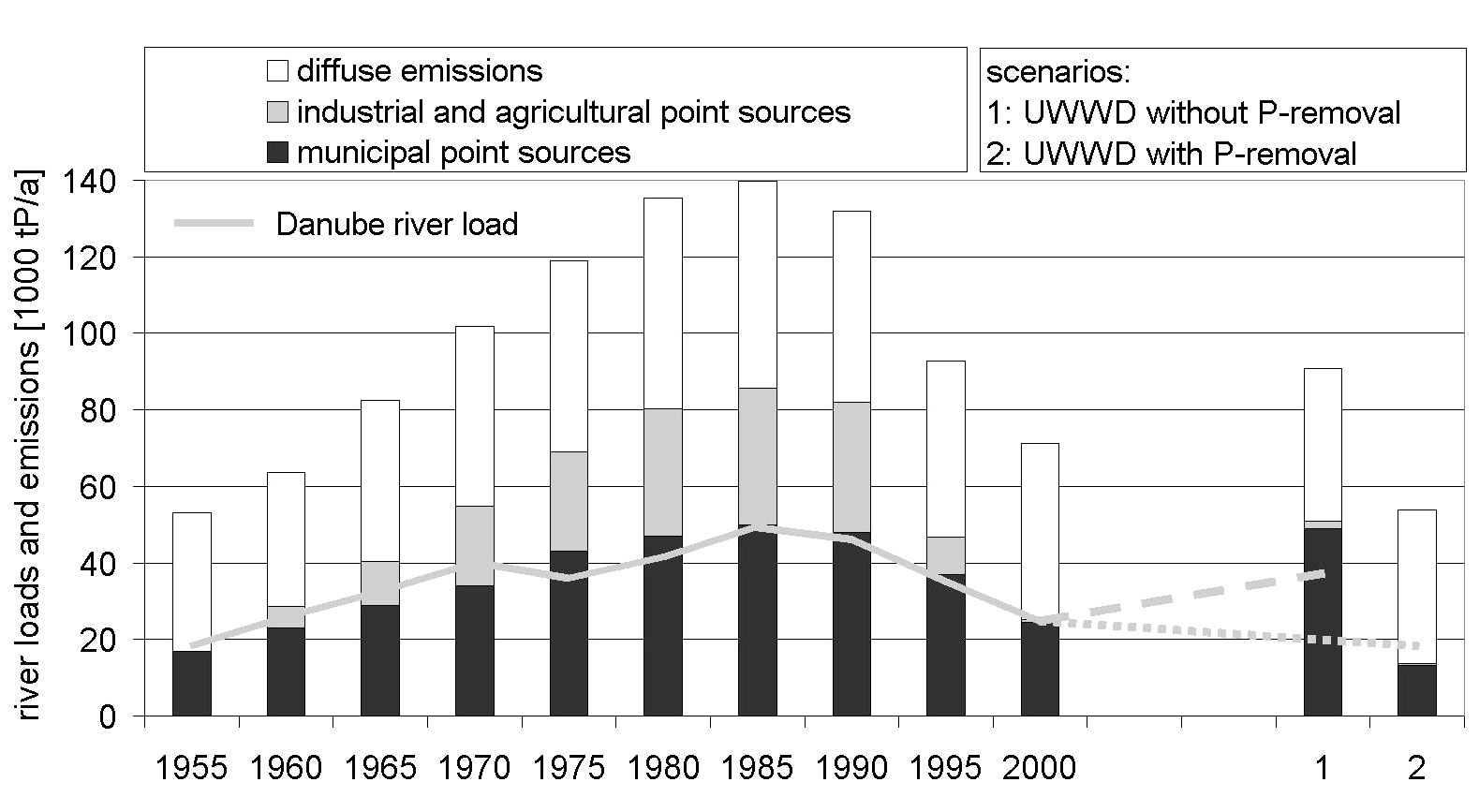
figure 2 shows, the implementation of
fertilizer application or fodder import,
be related to air pollution by combustion
EU Urban Waste Water Directive
- Strong export oriented production
and traffic mainly with NOx.
(UWWD) in respect to connections to
(especially of animals).
sewer systems for all settlements > 2000
· strict control of Phosphorus and
About 65% of the Nitrogen emissions to
inhabitants alone might lead to an
Nitrogen emissions from point sources
the river system (450 kt y-1) are dischar-
increase of P-emissions and discharges
in the whole catchment should be
ged to the Black Sea. The rest of the
to the Black Sea coastal area. Only if
applied. This can be achieved by:
emissions are removed from the river
P-removal in waste water treatment as
- implementation of EU Urban Waste
system by denitrification. The river
required for sensitive areas is effectively
Water Directive (271/91) using the
network of smaller rivers is much more
implemented as well the river load is
requirements for "sensitive areas", as
effective in this respect as the Danube
expected to decrease (scenario 2).
it is the case in Austria and Germany,
(including its main tributaries) as well as
(see fig.2);
the Danube Delta, which contribute to
Conclusions
- introduction of P-free detergents;
these losses with only about 2% each
Analysis of nutrient balances on catch-
- implementation of EU ICCP Direc-
(van Gils, 2004).
ment scale as a basis for improved
tive for industrial and trade effluents
management including coastal waters is
with special emphasis on nutrient
For Phosphorus the situation is different.
a highly complex subject. The daNUbs-
control.
The annual total emissions to surface
project tries to combine a set of mode-
· development of sewerage treatment
waters in the Danube Basin is actually
ling approaches in order to cover the
systems (fulfilling EU UWWD) has to
about 70 kt. Waste water discharges
different aspects of nutrient emission,
strictly including N and P removal.
(point sources, combined sewer over-
transformation and their effects on the
Alternative sanitation systems with
flows and emissions from non sewered
marine ecosystem. From the analysis of
nutrient recovery should be considered
areas) contribute up to about 45% of the
the actual situation and the historic deve-
as well for areas not connected to sewer
total and roughly 65 to 75% of the lopment the following conclusions can be
systems yet. Actually only about 50%
dissolved easily accessible P-emissions
drawn for future nutrient management:
of the population in eastern Danubian
to the catchment river system. About
44% of total P-load originates from
agricultural land due to a high extent of
erosion and is therefore mainly in parti-
culate form. The natural background is
about 10%, air pollution is negligible.
About 35% (about 25 kt y-1) of the emis-
sions to surface waters reach the Black
Sea (van Gils, 2004). The rest is stored in
the rivers and the river corridor of the
catchment. The region of the Iron Gate
reservoir plays a significant role as point
sink in this respect (P-storage of about
8-10 kt y-1, van Gils, 2004). Nevertheless
the main part of the storage of emitted
Phosphorus takes place in the network of
small to medium size tributaries. The Figure 2 Development of Phosphorus emissions and river loads (Danube discharges to the
Danube Delta only contributes about
Black Sea) in the Danube catchment 1955-2000 (adapted from Behrendt et al.,
0.7 kt y-1 to this retention (van Gils, 2004).
2004) and scenarios of future development.
page 4
LOICZ NEWSLETTER
countries is connected to sewer systems.
Bulgarian Academy of Sciences, Sofia,
applicatons, deliverable D5.2 and D5.6
From the nutrient management point
BULGARIA
of the EU-funded Project daNUbs,
of view sewerage should actually have
· Department of Systems Ecology, "Nutrient Management in the Danube
a rather low priority although this is in
University of Bucharest, ROMANIA
Basin and its Impact on the Black Sea,
obvious conflict with the ground water
· ICPDR has the status of a continuous
contract EVK1-CT-2000-00051 by the
protection strategy;
observer
Energy, Environment and Sustainable
· improved nutrient management in
Development (EESD)
agriculture (diffuse sources) has to be
To the EU 5th framework programme:
Van Gils J. (2004) Transport and Reten-
achieved by better agricultural practice
Results presented derive to a large extent
tion of Nutrients in the Danube River and
throughout the basin taking into
from the project "Nutrient Management
its Large Transboundary Tributaries,
account economical and ecological
in the Danube Basin and its Impact on
ICPDR UNDP/GEF workshop docu-
considerations but also the specific
the Black Sea" (daNUbs) supported
ments: Nutrients as a Transboundary
local climatic, geological and hydro-
under contract EVK1-CT-2000-00051
Pressure in the Danube River Basin.
logic situation;
by the Energy, Environment and Sustai-
26 27 January 2004, Sofia, Bulgaria
· erosion prevention is important to
nable Development (EESD) 5th EU
Velikova V. (2004) Deliverable D7.6
reduce the input of particulate Framework Programme. Further detail on
internal working paper of the daNUbs
Phosphorus into the river system and
the project can be found on the project
project (unpublished)
the Black Sea since particulate Phos-
homepage: http://danubs.tuwien.ac.at/.
phorus is not immediately available
for algae growth but represents a
Contact details:
Land-Ocean interactions and
potential P-source for eutrophication. Institute for Water Quality and Waste
integrated management of the
Management, Vienna University of
Oder/Odra estuary region
Acknowledgements
Technology, Karlsplatz 13/226,
To the daNUbs Team: Most of the results
1040 Vienna, Austria,
Gerald Schernewski
presented have been elaborated by
(E-mail: mzessner@iwag.tuwien.ac.at)
Baltic Sea Research Institute Warnemünde, Germany
researchers of the daNUbs team,
and EUCC-Die Küsten Union Deutschland
which consist of the following partner
institutions:
References
The Oder estuary (figure 2) is suffering
· Institute for Water Quality and Waste
Behrendt H., Huber P., Kornmilch M.,
from heavy eutrophication and water
Management, TU Vienna, AUSTRIA;
Opitz D., Schmoll O., Scholz G. und Uebe
quality problems. Source for this pollu-
Co-ordinator
R. (1999) Nährstoffbilanzen deutscher
tion is the river Oder (in Polish Odra) and
· Danube Delta National Institute for
Flußeinzugsbiete, Forschungsbericht
its 120.000 m2 large catchment area.
Research and Development, Tulcea,
296 25 515, Umweltbundesamt Berlin.
Poor water quality is a serious problem
ROMANIA
Behrendt H., van Gils J., Schreiber H.,
for tourism development, nature conser-
· Stichting Waterloopkundig Labora-
Zessner M. (2004) Changes of nutrient
vation and other coastal activities in
torium, Delft Hydraulics, Delft,
emissions from point and diffuse sources
Germany and Poland. The fact that the
NETHERLANDS
and loads in the Danube river system
Oder river controls the water quality of
· Bureau of Sustainable Agriculture,
within the last decades, Archiv Hydro-
coastal waters means that river basin
Hanhofen, GERMANY
biol., accepted.
management in this regions is at the
· Institute Fisheries, Berlin, GERMANY
Kourafalou V., Staneva J. and Tsiaras K.
same time coastal water management
· Institute of Hydraulics, Hydrology and
(2004) Report on realistic simulations
(figure 1).
Water Resources Management, TU
performed by model HB and 3-D coupled
Vienna, AUSTRIA
physical and biogeochemical model
· Institute for Land and Water Manage-
calibrated and validated for the Black
ment, Petzenkirchen, AUSTRIA
Sea, deliverable D8.7 and D8.8 of the
· Institute for Marine Research,
EU-funded Project daNUbs, "Nutrient
University Kiel, GERMANY
Management in the Danube Basin and
· Hellenic Centre for Marine Research,
its Impact on the Black Sea, contract
Athens, GREECE
EVK1-CT-2000-00051 by the Energy,
· National Institute for Marine Research
Environment and Sustainable Develop-
and Development "Grigore Antipa",
ment (EESD)
Constanta, ROMANIA
Schreiber H., Constantinescu L.,
· Institute for Water Pollution Control,
Cvitanic I., Drumea D., Jabucar D, Juran
Vituki Budapest, HUNGARY
St., Pataki B., Snishko S., Zessner M. and
· Department of Sanitary and Environ-
Behrendt H. (2003) Harmonised Inven-
mental Engineering, Budapest,
tory of Point and Diffuse Emissions of
HUNGARY
Nitrogen and Phosphorus for a Trans-
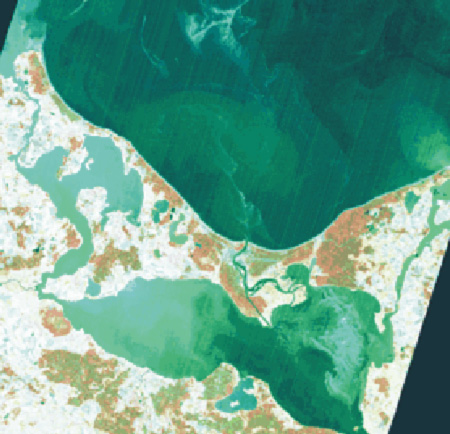
Figure 1 The Oder estuary from space: The
· Institute of Public Finance and Infra-
boundary River Basin, Research Report
dark Oder river plume enters the Szecin
structure Policy, TU Vienna, AUSTRIA
200 22 232, on behalf of the federal Lagoon. White ares indicate a lower
· Department of Meteorology and environmental agency, Berlin, Germany.
transparency due to increased primary
Geophysics, University of Sofia,
Van Gils J. and Constantinescu A.
production and floating algae accumula-
BULGARIA
(2002) Draft Danube Delta Model and
tions (from Schernewski, Neumann,
· Institute of Water Problems,
Danube Water Quality Model, first
Podsetchine & Siegel 2001).
page 5
LOICZ NEWSLETTER
To support a regional ICZM, which
Peene-
ICZM
essentially can be transferred region-
strom
Baltic Sea
ally, supports the development of a
Oder
Karlshagen
national ICZM strategy in Germany
and can be regarded as a successful
Zinnowitz
Pomeranian Bay
Wolgast
W
Zempin
Dziwna
international case study.
Koserow
(Oder Bay)
Kolpinsee
· Catchment area Coast Baltic Sea:
Spatially integrative perspective on
Bansin
Swina
Heringsdorf
processes, structures, planning on the
Ahlbeck
Miedzyzdroje
background of a desired catchment
Usedom
Wolin
coast management (Water Frame-
Anklam
Swinoujscie
work Directive, UNEP, LOICZ).
Kleines Haff
· Infrastructures: To create structures
Szczecin (Oder-)
Poland
that function as a sustainable umbrella
Lagoon
Germany
Wielki Zalew
for ICZM, exceeding the project dura-
Üeckermünde
tion, including regional projects and to
promote the practical regional imple-
mentation of ICZM in the long run.
10 km
Oder/Odra
The project does not deal with the
practical implementation of single
measures, but supports the initiation
and implementation with scientific
advice, the search for funding, the pro-
vision of a supporting infrastructure
N
and the integration in the project.
· Participation and communication: To
Szczecin
W
E
test and evaluate procedures to inte-
ODER
NOTEC
grate the public (regional Agenda 21 in
S
cooperation with local agenda's), to
WARTA
Coastal catchment
improve cross-border communication,
(10 000 km2)
Oder river basin
information flow and cooperation as
Zielona
Poznan
(120 000 km2)
well as to promote the coastal catch-
Pollution `hot spots'
Glogow
ment area dialogue. The goal is not the
ODRA
Lodz
NEISSE
creation of further new structures, but
the support, exploitation, concentration
Wroclaw
and optimization of existing activities
and structures with regard to ICZM.
ODRA
· Vision and strategy: To stimulate a
The project 'ICZM-Oder'
vision and strategy for ICZM through
is financially supported by:
Katowice
a synthesis of existing approaches. The
Ostrawa
strategy should have a cross-border
approach, integrate coastal waters and
land and consider the interactions
between coast and catchment. The
Figure 2 The Oder river basin (bottom) and the German/Polish Oder estuary region, area of
strategy is future-oriented by including
the project ICZM-Oder.
foreseeable problems such as global
climate change.
Against this background the project
"Principles", "National Status Quo" and
`Research for an Integrated Coastal
"National Strategies" as recommended
Altogether 11 partners from different
Zone Management in the Oder Estuary
by the EC (EC 413/2002). The creation
disciplines are involved in the project,
Region' was initiated. The special of sustainable perspectives and structures,
which started in May 2004. The project
challenge of the project lies in carrying
exceeding the duration of the project, is
has a budget of about 2 Mio. Euro and is
out science on an international level and,
the core of all activities. In general the
funded by the German National Ministry
at the same time, to establish and support
project aims are covered:
for Education and Research (BMBF,
the implementation of ICZM within the
· Science, Innovation and Perspectives:
No.03F0403A). It belongs to the LOICZ
regional Agenda 21. The project was a
To answer scientific and innovative
inititaive (Land-Ocean-Interactions in the
consequence of the EC Recommen-
questions on ICZM, which are of
Coastal Zone) and is part of UNEP-
dations on Integrated Coastal Zone
essential and national importance, but
ICARM (Integrated Coastal Area and
Management (ICZM). The aims and
based on concrete regional require-
River Basin Management). For more
tasks within the project result from the
ments. In addition shortcomings must
information about the project please con-
specific situation and demands of the
be exposed and scientific prospects for
tact the coordinator, Gerald Schernewski
region. At the same time the project
the future created.
(schernewski@eucc-d.de) or visit the
tackles the aspects "Strategic Approach",
· Regional-National-International:
website http://www.ikzm-oder.de/.
page 6
LOICZ NEWSLETTER
"Zukunft Kueste Coastal Futures"
A German contribution to LOICZ
Mariculture
research in Integrated Manage-
Employ-
ment
Windpower
ment and coastal governance
Benthos
Riskof
o ship
Industry
f ship
Andreas Kannen
Fish
accidents
Harbour
Development
Public
Zukunft Küste Coastal Futures is a
Ecosystem
Accep-
-
Socio Economic
-
research project focussing on sustainable
tance
System
coastal development, but working on
Birds
different scales from the North Frisian
Visual Impact
Marine
islands and adjacent counties as a local
Mammals
Tourism
investigation area up to the Wadden Sea
Local
and North Sea level. In collaboration
Income
Fisheries
with LOICZ Zukunft Küste Coastal
Futures aims to use its investigation area
focussed activities as a case study for the
development and application of integra-
Figure 1 Offshore wind farms and their most important interactions with the ecosystem and
tive research concepts and assessment
the socio-economic system (Kannen 2004b)
tools, which can be applied in other parts
of the world as well.
rability of coastal systems and hazards to
processes between different actors on
The project involves a total of 50 project
human societies) and 2 (Implications of
different scales including interactions
partners and consists of four interrelated
global change for coastal ecosystems
between European, national and regional
project modules with 12 sub-projects,
and sustainable development).
levels of decision making.
each of which is guided by specific
A key theme will be the assessment of
research questions. Zukunft Küste interactions resulting from offshore wind
Coastal Futures is coordinated by the
farm development, including impacts on
References
Research and Technology Centre West-
ecosystem and habitat structures, Gee, K, Kannen, A, Glaeser, B, Sterr,
coast in Buesum, a branch of Kiel economy and infrastructure, conflicts
H (2004): National ICZM strategies in
University and funded since April 2004
between stakeholders and social values
Germany: A spatial planning approach.
as one of two pilot projects by the such as perception of the coast by local
In: Schernewski G, Loeser, N (eds.,
German Federal Ministry of Education
people (Figure 1). To ensure methodo-
2004): Managing the Baltic Sea, Coast-
and Research (BMBF). The scientific
logical integration, indicators based on
line Reports 2 (2004), pp. 23-33. ISSN
concept is based on linking tools from
the DPSIR approach and integrated
0928-2734.
both natural and social sciences - e.g.
assessment form the overall framework.
Kannen, A (2004a): Holistic Systems
scenario techniques, modelling, stake-
Another level of integration is the
Analysis for ICZM: The Coastal Futures
holder dialogues and Multi-Criteria
comprehensive dialogue with local,
Approach. In: Schernewski G, Dolch, T
Analysis - in order to develop planning
regional and national stakeholders,
(eds., 2004): Geographie der Meere und
and management options at the local,
which aims to integrate these actors as
Küsten. Coastline Reports 1 (2004),
regional and national level (Kannen
active research partners.
pp.177-181. ISSN 0928-2734.
2004a). Assessments will be based Using offshore wind farms as an
Kannen, A (2004b): The need for
largely on available data, a compre-
example, changing spatial structures
Integrated Assessment for large scale
hensive stakeholder mapping, modelling
through new forms of use are form a
offshore wind farm development. In:
exercises and expert assessments.
focal point of the project. The impact of
Managing European Coasts: Past, Present
The project activities directly assist the
such developments, on established and Future, Vermaat, JE, Ledoux, L,
national German ICZM strategy, economic sectors, e.g. tourism, will be
Turner, RK, Salomons, W (eds. 2004),
currently under development (Gee at al.
analysed. At the same time the joint
Environmental Science Monograph
2004). Especially the work across
project will use offshore wind park
Series, Springer, Berlin, Germany,
several scales is expected to contribute to
development/mariculture/tourism as a
submitted for print.
governance structures and spatial case study to assess options for imple-
planning concepts for marine areas.
menting multiple use areas, providing
Contact and additional information:
While aiming to translate the exemplary
specific suggestions for multi-
Dr. Andreas Kannen (Project Coordinator)
concepts, methods and tools into functional use of coastal space in the
Research and Technology Centre
approaches that can be transferred to
form of "polycultures".
Westcoast (Forschungs- und Technolo-
other coastal regions worldwide,
The research approach aims to raise giezentrum Westkueste, FTZ),
Zukunft Kueste Coastal Futures awareness for the complexities surroun-
Hafentoern, D-25761 Buesum
contributes to theme 5 (Towards coastal
ding coastal zone decision-making.
Fon / Fax: +49 (0)4834 604-121 / -299,
system sustainability by managing land-
Apart from a comprehensive assessment
Email: kannen@ftz-west.uni-kiel.de
ocean interactions) in the LOICZ II
of interactions, communication plays an
www.coastal-futures.org
science plan and implementation essential role in implementing integrated
(under construction)
strategy. Other LOICZ themes, which
management. The project therefore
relate to the project are theme 1 (Vulne-
analyses and supports communication
page 7
LOICZ NEWSLETTER
workshop, LOICZ also co-presented
21-23 June 2005, Oslo, Norway: Inter-
IPO NOTES
with Envision Partners LLP a workshop
national workshop on Human Security
on "Capacity building for integrated
and Climate Change of the Global Envi-
coastal management" that explored the
ronmental Change and Human Security
Around 300 participants from 180 mechanisms for education to integrate
(GECHS) Project of the International
organisations and over 40 countries met
scientific outcomes to decision making
Human Dimensions Programme on
in Brisbane, Australia for the second
needs.
Environmental Change (IHDP).
Coastal Zone Asia Pacific conference
The strong presence of LOICZ at the
www.cicero.uio.no/humces or e-mail:
from 5 9 September 2004. The focus of
conference along with our sponsored
humsec-secretariat@cicero.uio.no
the conference was to explore integrated
workshop speakers generated much
approaches to manage the pressures and
awareness in LOICZ, its new mandate
27-29 June 2005, Plymouth, UK:
impacts from "Improving the quality of
and a renewed interest in the opportunity
Advances in Marine Ecosystems Model-
life in coastal areas". LOICZ had a
for LOICZ to work with regional scien-
ling Research (AMEMR). Endorsed by:
strong representation with Martin Le
tists in the broad Asian Oceania region.
GLOBEC, NERC, IMBER and CASIX.
Tissier (DEO), John Parslow (Theme 4
For more info go to: www.amemr.info
Co-ordinator), Chris Crossland (ex-EO)
attending. During the conference a full 1
ANNOUCEMENTS
START Fellowship/Visiting Scientist
day workshop was held between LOICZ
Program -Deadline for the thirteenth
and the Global Ocean Observing System
round of awards is: December 1, 2004.
(GOOS) to explore how the two For a complete list of future meetings
Visit www.start.org .
programmes could collaborate to sup-
and regular updates visit our web-site at
port LOICZ II and the implementation
www.loicz.org and click on `Calendar'
of the coastal module of GOOS. As well
as presentations from Martin and John,
11-12 November 2004,
Santiago,
For address or subscription changes
the workshop also heard from Miguel
Chile: The Southern Pacific University
please contact the LOICZ IPO by
Fortes (Marine Science Institute CS,
Network (RUSPUR) third meeting
regular or e-mail (loicz@nioz.nl)
University of the Philippines and recently
"Biophysical and Socioeconomic Im-
indicating you wish to receive
seconded to UNESCO/WESTPAC),
pacts of ENSO on Marine and Terrestrial
the newsletter:
Gullaya Wattayakorn (Department of
Ecosystems".
Marine Sciences, Chulalongkorn
www.udep.edu.pe/rupsur/
A. by an e-mail alert when it is posted
University, Thailand) and Nguyen
on the LOICZ website
Hoang Tri (Centre for Natural Research
5-7 January 2005, Manchester, UK:
B. by receiving an e-mail with the
& Environmental Studies, Vietnam
The International Global Atmospheric
newsletter as PDF file attached
National University, Vietnam) who Chemistry project (IGAC), NOAA and
C. by hard copy
presented examples of LOICZ research
NASA announce a speciality conference
D. Unsubscribe
and activity from the Asian region and
on the indirect effects of aerosols on
looked forward to future research needs.
climate.
The workshop then discussed the most
www.al.noaa.gov/igac/
IPO STAFF
appropriate modus operandi for colla-
boration between LOICZ and C-GOOS
8-14 January 2005, Rio Grande do Sul,
recognising that both needed to (1) think
Brazil: 3rd South American Dendrochro-
Hartwig Kremer
at local, regional and global levels, and
nological Field week.
Executive Officer
that (2) a strong scientific underpinning
www.cricyt.edu
Martin Le Tissier
of long term sustained monitoring and
or contact Dr Fidel A Roig,
observation is required for managing
froig@lab.cricyt.edu.ar
Deputy Executive Officer
coastal zones. The workshop concluded
Hester Whyte
that there was strong potential for 18-20 January 2005, Ahmedabad,
Office Manager
mutually beneficial collaboration
India: Centre for Environment Educa-
between LOICZ and C-GOOS but there
tion (CEE) workshop on Education for
was also a need to ensure that the scien-
Ocean Conservation in association with
LOICZ International Project
tific community and funding agencies
the World Ocean Network at the Inter-
Office
recognised the differences between the
national Conference on Education for a
Royal Netherlands Institute
research goals of LOICZ and the Sustainable Future (ESF).
for Sea Research
C-GOOS goals of long-term, sustained
www.ceeindia.org/esf
PO Box 59
observations. However, C-GOOS recog-
1790 AB Den Burg - Texel
nises the need for research and `proof of
13-16 March 2005, Atlanta, USA:
concept' projects in developing and
International conference-Emerging Issues
The Netherlands
designing coastal observations. Two
Along Urban/Rural Interfaces: Linking
Phone: +31-222 369404
such projects in the Indian Ocean are led
Science and Society. Final date for
Fax: +31-222 369430
by members of the LOICZ SSC Ticky
abstract submission: 15 November 2004.
Forbes and Nalin Wikramanayake who
www.sfws.auburn.edu/urbanruralinter
E-mail: loicz@nioz.nl
also presented during the workshop.
faces/ or contact Dr David N. Laband,
www.loicz.org
As well as the joint LOICZ/C-GOOS
e-mail: labandn@auburn.edu







FIRST ANNOUNCEMENT AND CALL FOR PAPERS
COASTS AND COASTAL PEOPLE - SCENARIOS OF
CHANGE AND RESPONSES
Egmond aan Zee, Netherlands
27-29 June, 2005
Land-Ocean Interactions in the Coastal Zone
LOICZ II Inaugural Open Science Meeting
Setting the stage for research on global environmental change and
human dimensions in the coastal zone.
The meeting seeks to bring together human dimension and natural scientists, decision-makers,
managers and user groups in the coastal zone.
Abstracts that address one or more of the LOICZ II Themes or cross-cutting activities are solicited.
Theme 1: Vulnerability of coastal systems and hazards to human societies.
Theme 2: Implications of global change for coastal ecosystems and sustainable development.
Theme 3: Anthropogenic influences on the river basin and coastal zone.
Theme 4: Fate and transformation of materials in coastal and shelf waters.
Theme 5: Towards coastal system sustainability by managing land-ocean interactions.
www.loicz.org/conference
A core project of the International Geosphere-Biosphere Programme
and the International Human Dimensions Programme on Global
Environmental Change