December 2002
http://www.nioz.nl/loicz
No. 25
macrofauna in the shallowest,
Understanding
sandiest sediments, which may
explain the high abundance of fish.
the biocatalytic sand filter
Despite their ecological and economic
in the shelf
importance, permeable shelf sands
have been poorly studied with respect
Markus Huettel, Max Planck Insti-
to their role in the coastal cycles of
tute for Marine Microbiology,
matter partly owing to the miscon-
Bremen, Germany
ception that a sediment that is poor in
organic matter cannot contribute
In coastal and shelf environments
significantly to organic matter,
strong bottom flows, lateral sediment
nutrient and contaminant cycles.
transport, an abundant benthic fauna
Recent studies, however, indicate that
and strong seasonal variations cause
sandy ecosystems may be very effi-
high variability in the biogeochemical
cient in the transformation of organic
cycles and turn the investigation of
compounds (Bacon et al. 1994, Shum
this important zone into a challenging
and Sundby 1996) and underline the
task. A major focus of the current
This is the twenty fifth
necessity of a concerted effort in
LOICZ program is the cycling of
newsletter of the Land Ocean
investigating this important coastal
matter in the coastal zone with
Interactions in the Coastal Zone
system.
emphasis on the fate of organic
(LOICZ) International Project of
carbon, and this theme will be exten-
the IGBP. It is produced quarterly
The composition and structure of the
ded in the new LOICZ program. Key
to provide news and information
sediments in the coastal zone are
issues within this research framework
regarding LOICZ activities
controlled by the input of particulate
will be the processing of materials
matter from land and ocean, currents
while transported across the shelf and
the SEEP-I area, Rowe et al. (1988)
and waves, and by benthic biological
the contributions of these materials to
reported the highest benthic biomass
and geochemical processes (Figure 1).
the oceanic cycles of matter. Due to
and the highest relative importance of
the intense coupling of water column
and sedimentary processes in the
shelf, the seabed plays a central role
in the transformation of matter in the
coastal oceans. In this contribution,
we highlight the potential importance
of sandy shelf beds for the cycling of
matter in the coastal zone. Our rela-
tively poor understanding of these
sedimentary systems calls for a joint
effort in this interesting field of
research.
More than 50% of the continental
shelves are covered by sandy sedi-
ments and these sea beds are of signi-
ficant socio-economic value: they
support the most productive fishing
grounds and are important sources for Figure 1. The relative contribution of sediment to the cycle of organic matter and
a variety of raw materials (oil, gas, the dominant transport mechanisms for the exchange of matter between sediment
water, minerals). From their work in and overlying water column (from Huettel and Rusch 2000).
A CORE PROJECT OF THE
I
G
B
P
INTERNATIONAL GEOSPHERE-BIOSPHERE PROGRAMME
page 2
LOICZ NEWSLETTER
With decreasing distance from land,
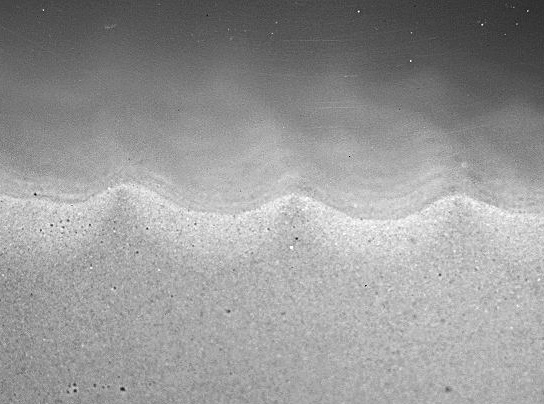
ment ripple is associated with a pore-
shelf (Rowe et al. 1988). On the
nutrient concentrations in the water
water flow field with intrusion zones
eastern North Pacific continental
column increase, fueling intense in the ripple troughs and upwelling
margin similar results have been
primary production and associated zones under the ripple crests (Figure 2). reported (Archer and Devol 1992,
pelagic life. The decreasing water
Devol and Christensen 1993).
depth boosts the impact of currents
and waves on the sedimentary
In their study of mineralization
environment. Where the water is
processes in sandy sediments of the
shallower than approximately half the
South Atlantic Bight Continental
wave length of the surface gravity
Shelf, Marinelli et al. (1998) found
waves, oscillating flows are generated
mineralization rates that suggest a
at the sea floor, bed ripples form and
residence time of particulate organic
the upper sediment layer is eroded
nitrogen in the upper 12 cm of the
and resuspended during storm events.
sediment column of only 6 years.
Likewise, tidal oscillations enhance
With ammonium production rates
bottom currents and further increase
Figure 2.
Pore-water exchange at
similar to those in fine grained near-
the hydrodynamic forcing acting on
sediment ripples due to wave-genera-
shore sediments, these results suggest
the shelf beds. Mineral inputs from
ted flow oscillations.
that the low content of particulate
land and frequent sediment resuspen-
organic nitrogen is due to rapid
sion and winnowing produce per-
In shelf beds with the common grain
nitrogen cycling in these sediments.
meable shelf sediments with relatively
size spectrum of 200-500 µm, this
Despite this intensive degradation
coarse grain size and low organic advective pore-water exchange repre-
process, advective pore water
content (Huettel and Rusch 2000).
sents an effective mechanism for
exchange keeps the nutrient con-
organic matter transport into the bed.
centrations in these sediments low.
The sedimentological characteristics
Investigations of excess 210Pb in the
However, the high benthic primary
of the shelf beds reveal important
Middle Atlantic Bight Continental
production despite low nutrient
clues about the mechanisms and
Shelf sediment indicate that fine par-
concentrations in the water column
intensity of the exchange of matter
ticulate matter must undergo several
indicates that the sediments are an
between water column and sediment.
cycles of burial and resuspension
important source of nutrients. At the
The intense bottom currents in near-
during its transit across the shelf, study sites in the South Atlantic Bight
shore regions easily resuspend depo-
revealing the intense coupling between
Continental Shelf visited by Jahnke
sited low-density materials, preven-
sedimentary and water column pro-
et al. (2000) between May and Sep-
ting accumulation of organic matter at
cesses (Bacon et al. 1994). Flume and
tember 1996, benthic microalgal
the sea floor. This observation may
in-situ experiments have demon-
gross primary production averaged
suggest that sandy beds in high-
strated that planktonic algae are 400 ± 260 mg C m-2 d-1 while water
energy nearshore regions cannot
carried several centimeters into sandy
column primary productivity ave-
accumulate organic matter. However,
sediment within a few hours, where
raged 682 ± 176 mg C m-2 d-1 demon-
where sediment permeability exceeds
they accumulate at a specific depth
strating the importance of the sandy
10-12 m2, advective transport proces-
dependent on their size, stickiness
beds for nutrient regeneration and the
ses gain importance for the transfer of and strength of pore-water flow
organic matter cycles in the shelf.
solutes and particles into and out of
(Huettel and Rusch 2000; Pilditch
the sediments, providing a pathway
et al. 1998). Larger aggregations of
Analogous to the transfer of oxygen
for organic matter into the bed. Wave organic matter that can accumulate in
or planktonic algae into sandy sedi-
pumping, the pore water exchange
ripple troughs are buried temporally
ment, dissolved and suspended con-
due to surface wave-induced hydro-
by migrating ripples (Jenness and
taminants are carried into permeable
static pressure oscillations at the sea
Duineveld 1985) or by abundant shelf beds with the advective
floor, filters on average 33 l m-2 d-1
benthic fauna (Ziebis et al. 1996).
pore-water flows. The 210Pb that is
through shallow sandy shelf sediments
Percolated by intruding oxygen-rich
transported into the sediments reveals
(Riedl et al. 1972). The filtration rate
water, these organic matter accu-
how these permeable beds can extract
produced by the interaction of boun-
mulations are rapidly degraded.
contaminants from the water column
dary flows with small sea-bed topo-
Removal of the decomposition and demonstrates the importance of
graphy can be one order of magnitude
products with the advective flows
sorption in the coarse grained sands.
larger (Webb and Theodor 1968).
enhances mineralization and releases
Study of the sandy Middle Atlantic
Here, boundary flows driven by wind,
the products of this process, the
Bight Continental Shelf sediment
tides and waves are deflected by nutrients, to the water column. showed that more than half of the total
protruding and recessed sediment
Oxygen consumption in sandy 210Pb inventory was contained in the
surface structures, generating lateral
sediments of the northeastern US
coarse fraction of the sediment and
pressure gradients that force fluid into
shelf reaches comparable values to
could be removed by repeated sonifi-
the permeable bed and draw pore
that of the fine-grained organic-rich
cation (Bacon et al. 1994). This 210Pb
water out of the sediment. Each sedi-
deposits from nearby locations in the
that initially was transported into the
page 3
LOICZ NEWSLETTER
sediment adhering to organic particles,
In flume experiments dissolved consequence of these increases,
thus was subsequently adsorbed by
ferrous iron was carried within such
numerous ecological niches for
coatings on the sand grains when the
an anoxic channel through 10 cm of
bottom-dwelling organisms are
organic matter was mineralized. A
oxic sediment and released to the
generated, which in a feedback loop
similar behavior can be expected for
water column (Huettel et al. 1998).
further enhances the spatial and
heavy metals or organic contaminants.
Ferric iron precipitation and iron temporal heterogeneity of the shallow
oxidizing bacteria, growing where the
sediment environment.
However, the assumption that the
pore-water emerged exemplifies this
adsorbed substances are removed
upwelling process. The same Our perception of benthic environ-
from the cycles of matter in the shelf
mechanism can release heavy metals
ments and their metabolic functions is
is misleading. The fluid that is drawn
from deeper sediment layers within
dominated by the concept of deep
from deeper sediment layers to the
short time periods if suitable flow and
water fine grained sediments that
surface by the reduced pressure asso-
topography are present, and the
display a horizontal lamination of
ciated with protruding sea bed anoxic pore fluid ascending through
biogeochemical zones that, although
topography can generate vertical
oxic layers can leach precipitated perturbed by the occasional bottom
anoxic channels that link the deeper,
substances from the sediment.
dweller, does not change significantly
anoxic sediment layers to the water
over time and space. This conser-
column (Figure 3).
vative view is reflected in the paucity
of methods suitable for the investi-
gation of dynamic coastal sediments.
With very few exceptions, sediment
samplers or coring devices are not
suitable for non-cohesive sediments
because they cannot seal and stabilize
the sampled core and the ensuing
mixing and (partial) loss of pore
water can fundamentally change the
biogeochemical zonation of in the
retrieved sediment. Likewise, the
removal of permeable sediment from
its flow environment immediately
changes its geochemical charac-
teristics, making subsequent
measurements in isolated cores
highly questionable. Although bottom
currents and permeability are crucial
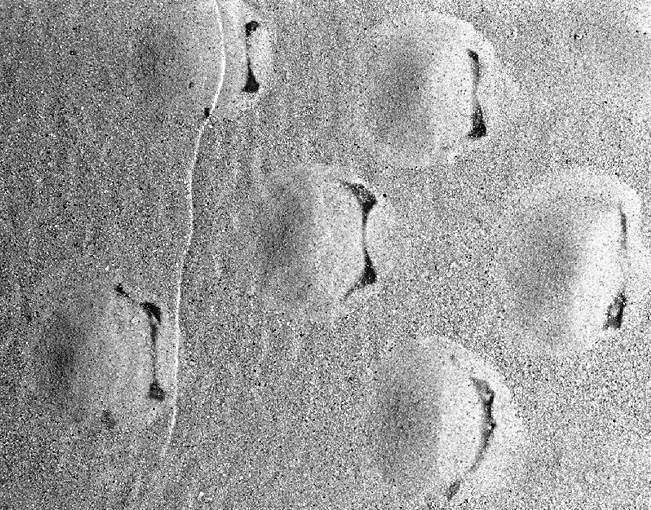
Figure 3. Upper graph: Transport of
When ripple topography starts
factors determining the transport and
ferrous iron to the sediment surface
moving under strong surface waves or
reaction in coastal sediments, hardly
with upwelling pore water in a flume.
bottom currents, the associated any publication addressing processes
The sediment was sand with median
pore-water upwelling zones move
in shelf beds contains information
grain size of 350 µm, flow was 10 cm
accordingly and a mechanism is regarding these important para-
s-1 at 8 cm above the sediment surface.
initiated that subjects the upper meters. The magnitude of spatial
sediment layer to a moving pattern of
heterogeneity in coastal deposits may
Lower graph:
Small mounds on a
up- and down-welling zones. In
match the magnitude of the temporal
sediment exposed to unidirectional
extreme cases, each location within
variability requiring revised sample
flow in a flume. Ferric iron precipita-
this layer experiences redox states
dimensions and sampling strategies.
ted where pore water rich in ferrous
oscillating between fully oxic and
One-dimensional modeling approaches
iron is released from the sediment.
fully anoxic conditions with a assuming diffusion to be the only
(modified from Huettel et al. 1998)
frequency dictated by the ripple
significant transport mechanism are
movement, a scenario most effective
unanimously applied for the
for stimulation of microbial activity
estimation of geochemical reaction
and mobilization of sorbed sub-
rates, fluxes and diagenetic processes
stances (Aller 1994).
in all marine sediments, although
these models may not be suitable for
Thus, with decreasing distance from
shelf beds with increased sediment
the coast, the sedimentary bio-
permeability.
geochemical processes not only
become more intense but also their
After a critical look at our present
spatial and temporal complexity
knowledge of the contribution of the
increases dramatically. As a
shallow shelf to the oceanic cycles of
page 4
LOICZ NEWSLETTER
matter, we may have to admit that this
Jenness, M. I. & Duineveld, G. C. A.
a) Support and operational
biogeochemically most active, most
(1985) Effects of tidal currents on
structure
diverse and most endangered chlorophyll a content of sandy sedi-
While considerable funding provided
environment on our coasts is the one
ments in the southern North Sea. Mar.
on a project basis sustains various
least understood. International Ecol. Prog. Ser., 21, 283-287.
large and medium size activities
initiatives such as LOICZ, the SCOR
Marinelli, R. L., Jahnke, R. A., Craven,
through and into LOICZ Phase II, the
Group 114 "Transport and Reaction
D. B., Nelson, J. R. & Eckman, J. E.
SSC and IPO have intensified their
in Permeable Sediments" and the
(1998) Sediment nutrient dynamics
efforts to generate the necessary
Gordon Research Conference 2003
on the South Atlantic Bight conti-
operational funding.
on "Permeable Sediments" work
nental shelf. Limnol. & Oceanogr.,
towards a better insight into shallow
43(6), 1305-1320.
Following the recent recommenda-
coastal zone processes.
Pilditch, C. A., Emerson, C. W. &
tions of the international evaluation of
Grant, J. (1998) Effect of scallop
the LOICZ IPO, the Dutch funding
shells and sediment grain size on
agencies and our hosting institution
References
phytoplankton flux to the bed. (Royal NIOZ) are investigating
Aller, R. (1994) Bioturbation and
Continental Shelf Res., 17(15),
options to keep the IPO executive
remineralization of sedimentary
1869-1885.
node in the Netherlands for another
organic matter: effects of redox
Riedl, R., Huang, N. & Machan, R.
three years. The generous support
oscillation. Chem. Geol., 114, 331-
(1972) The subtidal pump: a
from the Netherlands in the past has
345.
mechanism of intertidal water
allowed LOICZ to successfully fulfil
Archer, D. & Devol, A. (1992) Benthic
exchange by wave action. Mar Biol,
its global commitments and con-
oxygen flxes on the Washington
13(3), 210-221.
tinued support will allow the IPO to
shelf and slope: a comparison of in
Rowe, G. T., Theroux, R., W., P.,
sustain the LOICZ transition into the
situ micro-electrode and chamber
Quinby, H., Wilke, R., Koschoreck,
new phase.
fluxes. Limnol. Oceanogr., 37, 614-
D., Whitledge, T. E., Falkowski, P.
629.
G. & Fray, C. (1988) Benthic In parallel and building on the
Bacon, M. P., Belastock, R. A. &
carbon budgets for the continental
experience of Phase I, which showed
Bothner, M. H. (1994) 210Pb balance
shelf south of New England. the necessity for an operational focus
and implications for particle Continental Shelf Res., 8, 511-527.
at regional scales - the IPO has
transport on the continental shelf,
Shum, K. T. & Sundby, B. (1996) Orga-
intensified its efforts to identify and
U.S. Middle Atlantic Bight. Deep
nic matter processing in continental
establish "Thematic/Regional IPO
Sea Research Part II Topical shelf sediments - the subtidal pump
Research Nodes". The objective of
Studies in Oceanography, 41(2-3),
revisited. Mar Chem, 53(1-2), 81-87.
this distributed IPO model is to
511-535.
Webb, J. E. & Theodor, J. (1968) Irri-
improve the networks and visibility of
Devol, A. H. & Christensen, J. P.
gation of submerged marine sands
LOICZ research regionally, and to
(1993) Benthic fluxes and nitrogen
through wave action. Nature, 220:,
broaden the operational base by better
cycling in sediments of the conti-
682-685.
accessing regional funding
nental margin of the eastern North
Ziebis, W., Forster, S., Huettel, M. &
mechanisms. The distributed IPO in
Pacific.
Journal of Marine
Jørgensen, B. B. (1996) Complex
total will maintain responsibilities
Research, 51(2), 345-372.
burrows of the mud shrimp comparable to the present "single
Huettel, M. & Rusch, A. (2000)
Callianassa truncata and their geo-
office" situation.
Transport and degradation of chemical impact in the sea-bed.
phytoplankton in permeable sedi-
Nature, 382, 619-622.
The regional nodes through their
ment. Limnology & Oceanography,
active participation in a distributed
45(3), 534-549.
LOICZ IPO, will access the global
Huettel, M., Ziebis, W., Forster, S. &
framework and thinking of the
III., G. L. (1998) Advective transport
The Future of LOICZ
LOICZ science network and provide a
affecting metal and nutrient distri-
Status and Perspectives
platform for global synthesis of
bution and interfacial fluxes in
thematic issues by regional experts
permeable sediments. Geochim.
While the Synthesis of the first period
into the global LOICZ work,
Cosmochim. Acta, 62(4), 613-631.
of LOICZ is continuing increasing
supported by external funding. This
Jahnke, R. A., Nelson, J. R., Marinelli,
efforts have been undertaken to start
interface will enable regional
R. L. & Eckman, J. E. (2000) Benthic
shaping the future LOICZ. In its scientists to better engage with the
flux of biogenic elements on the
transition phase LOICZ is expected to
global scientific and user community.
south-eastern US continental shelf:
undergo considerable change in It is anticipated that the nodes will
influence of pore water advective
structure, operations, scientific
establish and maintain networks of
transport and benthic microalgae.
objectives and scope of the project.
excellence in a particular field or
Continental Shelf Res., 20(1), 109-
This challenging process needs to rely
fields of the future LOICZ research
127.
on a solid funding base for both, interests as endorsed by the LOICZ
operations and the science.
SSC.
page 5
LOICZ NEWSLETTER
Currently successful talks have taken
DIVERSITAS. The IGBP-SC will
climate change affects expected to
place in Singapore (with the Division.
discuss LOICZ II developments in
impact the coastal zone. Public parti-
of Environmental & Water Resource
January 2003 and the IHDP-SC (are)
cipation and involvement has gene-
Engineering, the En
e
vironmental xpected to consider the LOICZ rated a sound basis and considerable
co-sponsoring issue in March 2003.
Engineering Research Centre,
ownership of issues for integrated
Nanyang Technological University),
management in Australia different
in Australia ( with the Cooperative
Successful steps have also been made
than in most other places of the world.
Research Centre for Coastal Zone,
towards a broadening of the However, the often missing link
Estuaries and Waterways Manage-
sponsoring base for scientific between the catchments and their land
ment and several Queensland state
assessment and synthesis. LOICZ
based issues with coastal seas as a
agencies), and Germany (with the
was invited to present its future single water cascade system needs
GKSS Research Centre, Geesthacht).
directions to the recent SCOR
growing attention. For more details of
A draft TOR has been exchanged and
General Meeting held in Sapporo,
the contributions and outcomes a
letters of ag
Japan, in earl
reement are under
y October 2002. The
summary and reports of the thematic
dev
potential for a co-sponsoring role of
elopment, tailored to the
working group discussions are
individual needs of the potential
SCOR supporting the new LOICZ
available through the following links:
nodes. Generally, the funding basis
implementation was discussed and
http://www.coastal.crc.org.au/coast2
for node operations has been agreed
there was in-principle agreement
coast2002/orderproceedings.pdf and
on in-principle and options for
towards a new level of links with
http://www.coastal.crc.org.au/coast2
implementation are being developed.
LOICZ. Both organizations look back
coast2002/proceedings.html#conclu-
Singapore is expected to be the first
on a successful co-operation by sions
IPO node star
specialist w
ting operations.
orking groups, e.g., on
Potential for further IPO nodes is coral adaptation to climate change
currently being discussed with China
and on submarine groundwater
LOICZ IPO NOTES
and Brazil.
discharge. While not all aspects of the
new LOICZ science thematics are of
b) Science planning and sponsor-
core interest to SCOR, it was Newsletter review and Communi-
ship
recognized that the broad interdisci-
cations We need your input!
LOICZ IPO has intensified its plinary focus of LOICZ, encompas-
LOICZ would like to improve our level
contacts with the IHDP with a view to
sing the continental shelf, would of information transfer and science
establishing a close affiliation
complement the scientific priorities
dissemination, as part of a broader
between LOICZ II and IHDP as well
of SCOR. Comparable sponsorship
communication strategy in our new
as with IGBP. A joint working group
arrangements being discussed with
strategic plan. We would like to provide
of IHDP- and LOICZ SSC represen-
UNESCO/IOC.
information through tailored media
tatives is being established to develop
interfaces to a variety of target groups.
the new LOICZ Science Plan; each
Those groups include: the internal
IHDP core project and the recently
"Source to Sea"
LOICZ community, the wider scien-
launched urbanization task team will
tific world, and the public and science
Coast to Coast 2002,
be represented in the working group.
users. In a first step, we want to
Australia's National Coastal
We expect the working group to hold
evaluate the utility and effectiveness of
a first scoping meeting in early 2003.
Conference
our current LOICZ newsletter. We ask
The Science Plan will be founded on
your help by completion of the atta-
the five main thematics identified
Coastal Management and the com-
ched questionnaire and returning it
over the last 18 months through
plex role of science, institutional
to us no later than the 23rd of January
workshops, the May 2002 Miami
issues and participation under 2003. This will allow us to improve our
Conference and wide ranging discus-
scenarios of increasing demographic
current product to better match your
sion documents. The joint working
and climate change pressures were
needs and expectations and thus
group will consider the thematics and
addressed in the Coast to Coast serving the internal and external infor-
develop the " traditional" natural and
conference hosted by the states of
mation flow and visibility of LOICZ.
the "new" human dimensions oriented
New South Wales and Queensland in
We count on your support and look for-
sciences and links.
Tweed Heads, Australia, 4-8 Nov.
ward to your invaluable information.
2002. With a view on federal and state
LOICZ is looking forward to this
levels a status review was provided
close operational engagement with
and perspectives of change response
Chris Crossland anchors at the
IHDP, which is expected to generate
options were investigated extensively.
Sunshine Coast.
an appropriate integration of socio-
While in the global context The LOICZ IPO and SSC and all the
economic research into the future
Australia's coastal issues seem to be
people who have worked with Chris
LOICZ contribution to the collabo-
less concerning, on local scales would like to wish him and his family
rative Earth System Science Program
growing concern is driven parti-
a shining future back in Australia. It
(ESSP) of IGBP, IHDP, WCRP and
cularly by increasing tourism and has been a pleasure and a matter of
page 6
LOICZ NEWSLETTER
constructive intercultural and practi-
of its inspiration from LOICZ, and he
Report of the International Future
cal learning, working with Chris and
could do so because he was trusted and
Search Conference: http://www.rab-
later also Jan in the IPO. Chris as a
appreciated by all involved. As a bitgraph.de/inwent
person and an expert was a rich expe-
colleague and as a friend he will be
rience for all of us and an invaluable
missed by all of us in the Dutch marine
generator of momentum for LOICZ.
science community and beyond.
LOICZ PUBLICATIONS
LOICZ is now heading into a future
featuring new challenges, new tracks
Carlo Heip, Centre for Estuarine and
to follow, gaps to bridge and quite a
Marine Ecology,Chair of the former
Available as printed copies and also
bit of uncertainty to deal with and we
Netherlands LOICZ Committee and
downloadable from the LOICZ web-
look forward to keep close contacts
Chair of the Flemish-Dutch Coopera-
site. For hard copies of LOICZ R&S
with Chris.
tion Programme in Estuarine and
volumes (as long as stocks last),
We plan to ensure that the LOICZ Coastal Science also on behalf of the
e-mail: mildred@nioz.nl .
project continues to provide the sound
LOICZ IPO and Chair
scientific information and models "to
Caribbean Basins: LOICZ Global
tell Chris in time when he needs to
Assessment and Synthesis of River
leave his home at the beach and climb
HAVE YOU SEEN
Catchment/Island-Coastal Sea
Mount Coolum to escape whatever
Interaction and Human Dimen-
nasty events Global Change has
sions; with a desktop study of
prepared for us "Coastal dwellers" as
Global Terrestrial Observing System:
Oceania Basins. Eds. Kjerfve, B.,
a revenge for our efforts to uncover its
LocClim CD-ROM v1.0, the FAO
W.J. Wiebe, H.H. Kremer, W. Salo-
secrets..."
Local Climate Estimator. LocClim
mons and J.I. Marshall Crossland
provides estimates of climatic (Caribbean); N. Morcom, N. Harvey
All the best.
conditions at locations for which no
and J.I. Marshall Crossland
Hartwig, Hester & Mildred
observations are available.
(Oceania). 2002, LOICZ Reports &
Visit:
http://www.fao.or/sd/2001/EN
Studies No.27, ii + 174 pages, LOICZ
1102_en.htm and
IPO, Texel, The Netherlands.
In memoriam
http://www.fao.org/gtos/tems/tsite_
Wim van Raaphorst
list.jsp. For free copy of CD-ROM
On Wednesday 6 November 2002 v1.0 , please send your request to
OTHER PUBLICATIONS
Dr Wim van Raaphorst of the Royal
gtos@fao.org & provide your full
Netherlands Institute of Sea Research
mailing address.
was hit by a car while cycling home
Special Issue: Regimes of Regional
on his beloved island of Texel and
and Global Coastal Change. A selec-
died later that evening. Wim van
tion of papers from the 4th LOICZ Open
WHAT'S ON THE WWWEB
Raaphorst was head of the
Science Meeting, Bahia Blanca, Argen-
department of Marine Chemistry and
tina, November 1999; Eds.: Kremer, H.,
Geology at NIOZ and has been a Web-sites on Biogeochemical Budgets
Pacyna, J. and N. Pirrone; in: Regional
supporter of LOICZ-related research
and Modelling, Typology, Basins, Environmental Change Vol. 3, No. 1-3,
in the Netherlands since many years.
Deltas Management & South-Asia
117 pages; Springer, Berlin, Heidelberg
He served on the LOICZ committee
Coastal Fluxes are accessible via the
New York (order and inquires to:
of the Royal Netherlands Academy of
LOICZ home page:
journal@springer-ny.com)
Arts and Sciences when it was in the
http://www.nioz.nl/loicz
transition between planning and
Climate Of The 21st Century:
executing the science. Furthermore
GOOS Newsflashes:
Changes and Risks, 448 pages,
he was a member of the steering http://ioc.unesco.org/goos/GOOS
2001, Germany. Eds: J.Lozan, H.
committee for the Flemish-Dutch
news/flashes.htm
Grassl, P. Hupfer.
cooperation programme in Estuarine
For more information & to order visit:
and Coastal Research, which also
Launching of Indian Ocean GOOS
http://www.r rz.uni-hamburg.de/
sponsors LOICZ-related research. In
(IOGOOS) at the IOGOOS
Klima2000 or e-mail:
this capacity, Wim has exerted an
Conference in Grand Bay Mauritius.
Lozan@uni-hamburg.de
important influence in shaping these
For more info visit:
Price: e 30,- + e 5,- for postage and
programmes and in the selection of
http://ioc.unesco.org/iode/contents.
handling.
LOICZ Newsletter
the projects and his wisdom and
php?id=110
readers get a discount of 30%.
objectivity where widely appreciated
by his colleagues in these com-
Remote Sensing Handbook for
mittees. He also had a major role in
Tropical Coastal Management
Coasts: Form, Process and Evolu-
developing the cooperation between
(extracts) at:
tion, by Colin D. Woodroffe, 2002,
Royal NIOZ and the Netherlands Insti-
http://www.unesco.org/csi/pub/source/
616 pages, Cambridge University
tute of Ecology, which also got much
rs.htm
Press, Australia.
page 7
LOICZ NEWSLETTER
For more info and ordering pre-publica-
Publications, GPO Box 461, Darwin
EGS/AGU/EUG Joint Assembly,
tion please send request to: Cambridge
NT 0801; tel: 08 8920 1100;
6-11 April 2003, Nice, France. Visit:
University Press-Australian Branch,
fax: 08 8920 1199; Street address:
http://www.copernicus.org/egsa-
477 Williamstown Rd (Private Bag 31),
Environment Australia Building, cnr
gueug/index.html. Special attention
Port
Melbourne, Victoria 3201, Pederson Rd & Fenton Ct, Marrara
to session: "BG1.06: Coastal biogeo-
Australia. Phone: +61 (0)3 86711400,
NT 0812;
chemistry and its response to anthro-
fax: +61 (0)3 96769955 or e-mail:
e-mail: publications_ssd@ea.gov.au;
pogenic perturbations: inputs, gas
info@cambridge.edu.au
web-site: www.ea.gov.au/ssd
exchange and nutrients" For the full
(PB 2 A$ 89.95, HB @ A$ 265 incl.
list of proposed sessions visit:
GST)
CQD Journal for the Maritime http://www.copernicus.org/EGS/egsg
Environment Industry Volume 8.4 is
a/nice03/programme/overview.htm
Coastal Management in Australia,
now on-line. Reports include updates
Deadline for abstracts: 15 January 2003.
by Nick Harvey and Brian Caton,
from the Marine Environmental
availabel soon, 352 pages, Oxford Protection Committee meeting in
Open Meeting of the Human
University Press, Australia. For more
October. Treatment of ballast water for
Dimensions of Global Environmental
info & ordering send request to GPO
invasive species, recycling of ships, and
Change Research Community, 16-18
Box 2784Y, Melbourne, Victoria
greenhouse gas emissions provisions
October 2003, Montreal, Canada.
3001, Australia. Phone: 1300 650616,
are highlighted. In addition, this
For information visit:
fax: +61-(0)3 99349100 or e-mail:
Volume #8.4 includes comments regar-
http://sedac.ciesin.columbia.edu/open
cs@oup.com.au,
ding shipper's concerns about new
meeting. Deadline for submissions:
free fax: 1800 813 602.
maritime security measures and the 30 March 2003
Web-site: www.oup.com.au
curtailment of merchant shipper's
(PB A$ 35.95 incl. GST)
access to certain ports. Go to:
http://www.cqdjournal.com/CQD_
OTHER MEETINGS
Arctic Social Sciences: Opportuni-
Table_Contents/env_8_4/env_8_4.htm
ties in Arctic Research, published by
the Arctic Research Consortium of
New Elsevier publications in their
Abrupt Climate Change Discussion
the United States (ARCUS) for the
Virtual Exhibit at:
Meeting 4 & 5 February 2003 at the
National Science Foundation Arctic
http://earth.elsevier.com
Royal Society, London, United
Social Sciences Program, is now
Kingdom. For information and registra-
available electronic at:
URL's for Springer LINK site on
tion visit: www.royalsoc.ac.uk/events
http://www.arcus.org/ASSP/fr_down
Regional Environmental Change:
load.html and in printed form from
General info: http://link.springer.de/
The Georgia Basin/Puget Sound
ARCUS, 600 University Avenue,
link/service/journals/10113/index.htm
Research Conference 31 March- 3 April
Suite 1, Fairbanks, AK 99709, USA,
Publications and online first articles:
2003, Westin Bayshore Hotel,
phone: +1 907 474 1600, fax: +1 907
http://link.springer.de/link/service/
Vancouver, Canada.
474 1604, e-mail: arcus@arcus.org
journals/10113/tocs.htm
For more information visit:
Instructions for editors:
http://www.wa.gov/puget_sound/
New publications of the Supervising
http://link.springer.de/link/service/
Publications/2003research/RC2003_
Scientist Division (Environment journals/10113/instr.htm
abstracts.htm
Australia) are available at:
Subscribe to LINK at:
For more information on the Georgia
www.ea.gov.au/ssd/publications.
http://link.springer.de/alert or
Basin Ecosystem Initiative, visit:
For information about the Super-
http://link.springer-ny.com/alert
http://www.pyr.ec.gc.ca/GeorgiaBasin/
vising Scientist Division visit:
gbi_eIndex.htm
www.ea.gov.au/ssd/index.
Among a variety of environmental
Oceans III Millennium: Second
LOICZ/IGBP/IHDP
issues those dealing with climate
International Congress on Marine
CALENDAR
change affecting erosion processes
Science and Technology, April 2003,
and hydrology, wetland ecology and
on the campus of the Universidad de
conservation are of specific interest
For the latest meeting updates go to
Alicante, Spain. Please consult the
(Report 165 and 166).
http://www.nioz.nl/loicz and click on
conference web-site and give your
Executive summary online
`Calendar'
opinion at: www.fomar.org
http://www.ea.gov.au/ssd/
publications/ssr/165.html
European Conference on Coastal Zone
Final International JGOFS Open
Executive summary online
Research: an ELOISE Approach, 24-27
Science Conference "A Sea of
http://www.ea.gov.au/ssd/
March 2003, Gdansk, Poland. Infor-
Change: JGOFS Accomplishments
publications/ssr/166.html
mation and instructions for abstract and the Future of Ocean Bio-
Inquiries about Supervising Scientist
preparations visit:
geochemistry", 5-8 May, 2003,
Division publications should be
http://www.nilu.no/project/eloise/.
Washington DC, visit:
directed to:
Deadline for abstracts: 15 January 2003
http://usjgofs.whoi.edu/osc2003.html
page 8
LOICZ NEWSLETTER
Deadline for early registration
For more information please contact 3rd IAHR Symposium on River,
& submission of poster abstracts:
Carolina Katz Reid, e-mail:
Coastal and Estuarine Morpho-
15 January 2003.
conference@milleniumassessment.org dynamics, 1-5 September 2003,
or visit:
Barcelona, Spain. Call for papers and
Rights and Duties in the Coastal
http://www.milleniumassessment.org description of this Symposium visit:
Zone. Multidisciplinary Scientific
http://www-ehma.upc.es/rcem2003/
Conference on Sustainable Coastal
Sixth Regional Symposium PACON index.htm Deadline for submission:
Zone Management. 12-14 June 2003,
2003: Ocean Capital Year. 29 June- 15 February 2003
Stockholm, Sweden.
2 July 2003, Kaohsiung, Taiwan.
For more information visit:
For information & submission of International Conference on Reme-
www.beijer.kva.se/conference.htm.
abstract visit:
diation of Contaminated Sediments,
Deadline for abstract: 15 January 2003
http://www.hawaii.edu/pacon.
30 September- 3 October 2003,
Deadline for abstract: 15 January 2003. Venice, Italy. For information,
The Chinese Academy of Science,
registration and abstract submission
Institute of Geographical Science and
7th
International Conference on visit: www.battelle.org/sedimentscon
natural Resources Research & The
Coelenterate Biology-ICCB7, 6-11 Deadline for abstracts:
Xishuangbanna Tropical Botanical
July 2003, at the University of 10 January 2003.
Gardens and The Millenium Eco-
Kansas, Lawrence, Kansas, USA.
system Assessment `s International
For information visit:
Conference : Bridging Scales and
www.nhm.ukans.edu/inverts/iccb
Epistemologies:
IPO STAFF
Linking Local Knowledge with The Impact of Global Environmental
Global Science in Multi-Scale Problems on Continental & Coastal
Assessments, 23-26 June 2003, Marine Waters, 16-18 July 2003, CHRIS CROSSLAND
Kunming, China. Call for Proposals,
Geneva, Switzerland. Visit:
Executive Officer
deadline 20 December 2002.
www.unige.ch/sciences/near
HARTWIG KREMER
Deputy Executive Officer
The LOICZ IPO staff
HESTER WHYTE,
would like to wish everyone
Office Manager
a Merry Christmas
MILDRED JOURDAN,
&
Office Assistant
all the best in the New Year.
MAARTEN SCHEFFERS
Liaison Officer
We look forward to your future collaboration
JAN CROSSLAND
towards the new LOICZ.
Editor
FOR MORE INFORMATION,
PLEASE CONTACT:
LOICZ INTERNATIONAL PROJECT
OFFICE
NETHERLANDS INSTITUTE FOR
SEA RESEARCH
PO BOX 59
1790 AB DEN BURG - TEXEL
THE NETHERLANDS
PHONE: 31-222 369404
FAX:
31-222 369430
E-MAIL: LOICZ@NIOZ.NL
WWW HOME PAGE:
HTTP://WWW.NIOZ.NL/LOICZ/
A CORE PROJECT OF THE
I
G
B
P
INTERNATIONAL GEOSPHERE-BIOSPHERE PROGRAMME