March 2002
http://www.nioz.nl/loicz
No. 22
Land Ocean Interaction in Africa -
Cameroon and Congo
the current status of the LOICZ
- Cameroon estuary complex, Cameroon
regional assessment and synthesis
(18); Rio-del-Rey estuary complex,
Cameroon (18); Congo (Zaire) River
Following from the Pan African
estuary, Democratic Republic of Congo
Conference on Sustainable Integrated
(18)
Coastal Management (PACSICOM) in
South Africa
July 1998 and the START/IOC/LOICZ
- Langebaan Lagoon (20); Berg River
Workshop on Climate Change and
estuary, Western Cape (20); Breede River
Coastal Processes in West Africa in
estuary, Western Cape (20); Knysna
November 1998, a key objective for
Lagoon, Western Cape (18, 20); Gamtoos
LOICZ was to add a regional African
River estuary, St Francis Bay, Eastern
overview to its global synthesis of
Cape (18); Great Fish River estuary,
coastal change and human dimensions
Eastern Cape (20); Kariega River estuary,
under natural and anthropogenic
Eastern Cape (20); Kromme River
pressure. This covers two aspects of coas-
estuary, St Francis Bay, Eastern Cape
tal change: the coastal change itself, as
(18); Sundays River estuary, Algoa Bay,
This is the twenty-second
determined by biogeochemical indicators,
Eastern Cape (18); Swartkops River
newsletter of the Land Ocean
and the land-based drivers of coastal
estuary, Algoa Bay, Eastern Cape (18);
Interactions in the Coastal Zone
change, within the river basins.
Mhlathuze River estuary, KwaZulu-Natal
(LOICZ) International Project of
(18); Mvoti River estuary, KwaZulu-
the IGBP. It is produced quarterly
As part of the UNEP/GEF-supported
Natal (20); Nhlabane River estuary,
to provide news and information
project The Role of the Coastal Ocean in
KwaZulu-Natal (20); Thukela River
regarding LOICZ activities
the Disturbed and Undisturbed Nutrient
Estuary, KwaZulu-Natal (18)
and Carbon Cycles, LOICZ has been
actively involved in a variety of assess-
ment and synthesis efforts in Africa since
1998. These have provided models and
budgets in estuarine and coastal seas of
carbon, nitrogen and phosphorus fluxes
and net system metabolism, developed by
an expanding group of regional experts. A
common methodology (LOICZ Reports
and Studies Volume 5) was applied to
assist with comparison between sites as
local to global scales. Results are
published in LOICZ Reports & Studies
Volumes 18, 19 and 20
(see www.nioz.nl/loicz/fordownload)
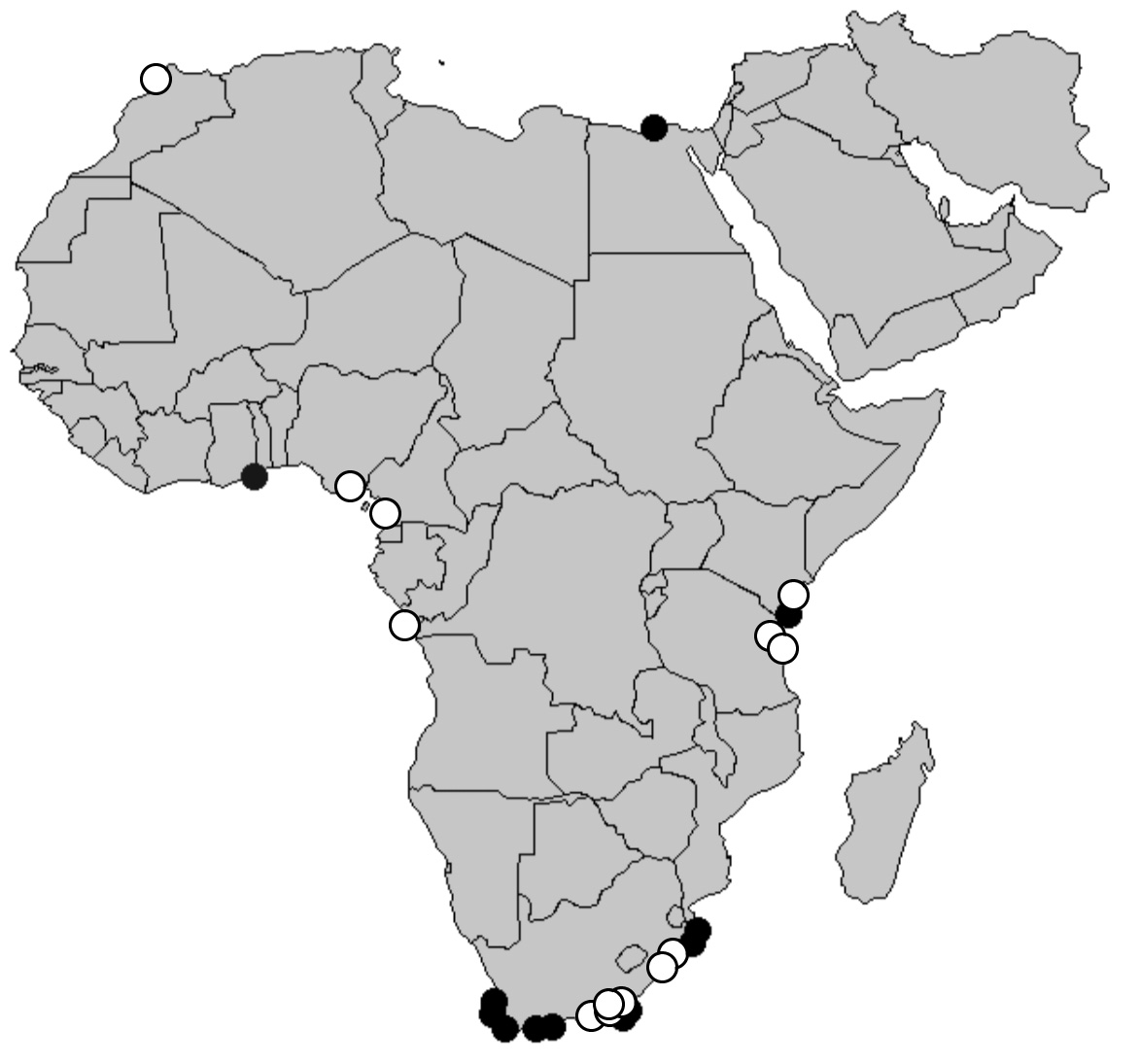
and the sites are shown in Figure 1:
Egypt
- Nile River delta: Rosetta Branch and
Edku Lagoon (20)
Morocco
- Moulay Bousselham Lagoon (19)
Ghana
- Angaw Lagoon, in the Volta River
deltaic estuary (20)
Figure 1. Biogeochemical budget sites white circles, R&S Vols 18/19; filled circles,
R&S 20.
A CORE PROJECT OF THE
I
G
B
P
INTERNATIONAL GEOSPHERE-BIOSPHERE PROGRAMME
page 2
LOICZ NEWSLETTER
Tanzania and Kenya
logy following the DPSIR framework to
They differ widely not only in the biophy-
- Gazi Bay mangrove creek, Kenya (20);
gather and analyze current knowledge of
sical nature of their catchments but also in
Malindi Bay, Kenya (18); Chwaka Bay,
catchment-based drivers affecting coastal
the availability and quality of existing data
Zanzibar (18); Makoba Bay, Zanzibar (18).
systems and future trends. A multidiscipli-
relating to their material fluxes (see also
nary network of scientists integrated coas-
R&S 18/19/20 for net flux information in
Some key outcomes and findings from the
tal, marine, land-use and demographic
estuaries in these sub-regions):
workshops:
information into expert typologies of
Estuarine nutrient budgets and models
rivercoast interactions. Results include a
· the Nile and
represent a range of localities including
qualitative ranking of the key driver/pres-
· the Congo, with little information avai-
small to large estuaries and coastal embay-
sure on systems allowing visualisation of
lable about land-based drivers and how
ments exhibiting a wide range of N and P
hot spots or negative trends versus medium
they relate to coastal issues were asses-
loads and marked seasonality between wet
or low-level impact areas.
sed as single catchment sub-regions;
and dry season flow conditions across the
· the Red Sea was considered outside the
temperate, sub-temperate and tropical and
Information was up-scaled from single
scope of this assessment; as a highly arid
monsoonal locations. Budget models cover
catchments, via sub-regions determined by
sub-region it receives no major runoff
land-dominated and ocean-dominated sys-
either climatic, demographic or coastal
but should be included in a full African
tems, in some of which the dominance
conditions (expert judgement), to provide
sub-regional division;
changes with season. Drywet season net
the "broad picture" at a continental level.
· East Africa, featuring the small and me-
metabolic performance changes were
Where available, quantitative data allow
dium size catchments under monsoonal
shown in some cases, wherein values chan-
down-scaling to the localised management
forcing (seasonal flushing);
ged (e.g., Malindi Bay, Kenya) and sign
through estimates of critical loads and
· Central and South Mozambique (again
changed (e.g., Rio del Rey, Cameroon;
thresholds for coastal system stability or
high seasonality in runoff characteristics
Kromme River, South Africa). These chan-
functioning. The assessments provide
and transboundary issues);
ges reflected a combination of forcing from
insights into potential catchment policy
· South-east Africa, characterised by
seasonal precipitation and the interactions
responses, such as:
catchments subject to various human use
of river flow/flushing with tides and ocean
- nutrient control and the implementation
patterns and plans in place for intensive
inputs affecting water residence times and
of best agricultural practices
damming (e.g., the Thukela), pressures
nutrient loading.
- erosion control
in harbour areas e.g., Richards Bay, dune
- regulation of water by diversion and
mining in Natal. This sub-region
Several of the sites were subject to popula-
damming
encompasses subtropical to the warm
tion, land-use and water management con-
- upgrading of sewage treatment plants
temperate zones;
trol of flow rates, e.g., the Nile Delta, Mou-
especially in growing economies
· South West Africa, with limited river
lay Bousselham Lagoon, the Volta Delta,
- changes in rural land-cover
runoff to a coastal sea which is mainly
the Great Fish River, the Knysna system
- regulatory changes in point and diffuse
dominated by the upwelling system of
and the Kariega system. The modified flow
source discharges, and
the Benguela Current;
rates have implicit effects on the net meta-
- the demands of road traffic and tourism.
· West Africa, featuring a variety of big
bolism of the systems.
rivers subject to major damming resul-
Nine sub-regions were identified within
ting in reduced sediment and water
In the assessment of estuarine metabolic
Africa, featuring specific sets of geomor-
fluxes, severe coastal erosion and redu-
performance, it was necessary to consider
phological and climatic characteristics
ced coastal stability as a growing threat
the estuarine systems as a multiple set of
(Figure 2).
to the lagoon-based cities; and finally
horizontal biogeochemical budget boxes to
encompass the physical circumstances of
salinity and mixing. In these cases, the
inner (landward) and outer (seaward)
"boxes" often showed different tendencies
for net carbon metabolism and net nitrogen
balance e.g., Knysna Lagoon, South Africa.
The Congo River estuary provided an unu-
sual case with the estuary being strongly
influenced by deep ocean waters and an
apparent remineralisation zone associated
with a continental shelf submarine canyon.
Partially developed budgets, requiring furt-
her fieldwork reflect the disparity in data
and coastal system research within the
region.
A second effort strongly supported by
UNESCO/ IOC, START and NORAD con-
centrated on the interaction of river catch-
ments and coastal zones. As part of the glo-
bal LOICZ Basins project, two AfriBasins
workshops (2000 and 2001) used a standar- Figure 2. Sub-regions for the assessment of river catchment coastal sea interaction
dised assessment and synthesis methodo-
in LOICZ workshops.
page 3
LOICZ NEWSLETTER
· North West Africa, an arid sub-region
ments, e.g., the Tana and Sabaki Rivers in
cascading through the catchments to the
with seasonal runoff and, at least in
Kenya. Human settlement was a major
coastal seas.
Morocco, major human pressure
contributor to eutrophication and the
A shortlist of "hot spots" has been iden-
through diversion and damming cau-
proliferation of aquatic weeds in the large
tified for future interdisciplinary
sing a variety of coastal change issues. West African catchments. Elsewhere,
research, perhaps following the EuroCat
while eutrophication and pollution were
example (http://www.iia-cnr.unical.it/
Catchments were selected subject to avai-
recognised, they were mostly restricted to
EUROCAT/ project.htm). This would
lability of data and considered as
local (coastal) urban-industrial sources,
parallel similar efforts in South America
representative of a sub-region. Besides
e.g., Alexandria, Mombasa, Saldanha Bay
and East Asia. Meanwhile, AfriBasins
Africa's `big four' river basins Nile,
and Cape Town. Loss of biodiversity or
and the estuarine biogeochemical assess-
Zambezi, Congo and Niger important
biological functioning was seen as
ments can rely on a growing interdisci-
transnational-boundary basins such as the
another common issue, related to a com-
plinary network of scientists who are also
Gariep, Cross, Volta and Senegal rivers on
plex interplay of human and natural
exposed to training opportunities within
the western coast, and the Limpopo and
drivers.
the LOICZ framework and beyond to help
Incomati in the east were included.
build regional capacities. A Basins web-
Medium and small basins have also been
In general these data are characteristic of
site has recently been set up and can be
assessed, including the Sabaki and Tana
developing economy situations where accessed through www.nioz.nl/loicz/.
rivers in Kenya, the Rufiji in Tanzania, the
economic growth and water use exceed
Thukela, Great Fish, Kromme and Groot
the development of the necessary urban
Brak east of the Cape of Good Hope, the
and industrial infrastructure. The results
References
Olifants and Berg west of the Cape and
mirror those from the South American
IOC 1999 GOOS Africa: Global Ocean
the Sebou and Moulouya in Morocco.
(SAmBas), and East Asian Basins
Observing System for SICOM.
(Lacerda et al. 2001, Hong et al. in prep.).
IOC Workshop Report 152 (GOOS
However, the heterogeneity of the African
Report 62), UNESCO, Paris.
Up-scaling to the regional African
sub-regions seems more pronounced than
IOC 1999 GOOS Africa: Global Ocean
assessment
in the other regions, making the ranking
Observing System for SICOM.
An initial ranking order was drawn up
of issues and drivers in Africa a complex
IOC Workshop Report 152 (GOOS
together with expected future trends in
challenge.
Report 62), UNESCO, Paris.
impacts (Table 1).
START/IOC/LOICZ Workshop on climate
change and coastal processes in West
Table 1: Major activities (drivers), present status and trends affecting
Africa (in preparation).
the coastal zone.
Dupra, V., S.V. Smith, J.I. Marshall
Anthropogenic
Major state
Present
Trend
Major areas affected (as for Figure 2)
Crossland and C.J. Crossland (eds)
drivers
changes and
status
expectations
impact
2001 Estuarine Systems of sub-Saharan
Damming
Erosion
Major
Increasing
Almost all sub-regions, with Nile and
Africa: C, N and P Fluxes.
Sedimentation
West Africa as particular "hot spots"
LOICZ R&S 18, 83 pages.
Diversion
Salinisation
Local
(e.g., Incomati estuary, Moulouya plain)
Dupra,V., S.V. Smith, J.I. Marshall Cross-
land and C.J. Crossland (eds) 2001
Nutrient depletion
(e.g., sites in KwaZulu-Natal, Morocco)
Coastal and Estuarine Systems of the
Various drivers
Biodiversity loss
Major
Almost all sub-regions
Mediterranean and Black Sea Regions:
Deforestation
Erosion
Medium ranking for most sub-regions,
C, N and P fluxes. LOICZ R&S 19,
Sedimentation
but major for coastal impacts generated
in small and medium size catchments,
101 pages.
Agriculture
e.g., Tana, Sabaki (Kenya) Moulouya
Dupra, V., S.V. Smith, L.T. David, H. Wal-
Eutrophication
and Sebou (Morocco)
Medium
Increasing
dron, J.I. Marshall Crossland & C.J.
Pollution
Urbanisation
Medium overall but major in Nile sub-
Crossland (eds) 2002 Estuarine Sys-
region
tems of Africa (Regional Workshop II):
Industrialisation
Pollution
As above, but in most cases more
C, N and P Fluxes. LOICZ R&S 20,
coastal than catchment-based (e.g.,
81 pages.
Alexandria, Mombasa, Saldanha Bay)
Lacerda, L.D., H.H. Kremer, B. Kjerfve,
Coastal geomorphological change invol-
The LOICZ Basins assessment is linking
W. Salomons, J.I. Marshall Crossland
ving erosion and sedimentation balances
with existing initiatives, both scientific
and C.J. Crossland (eds) 2002 South
was a significant and progressive impact
and management including: the African
American Basins LOICZ Global
in nearly all sub-regions, the problem
Centre for Wetlands (Ghana), the GEF
Change Assessment and Synthesis of
being acute in the Nile Delta and West
MSP on "Development and Protection of
River Catchment Coastal Sea Interac-
African lagoon systems. Damming was
Coastal and Marine Environment in sub-
tion and Human Dimensions.
the principal driver in such change, with
Saharan Africa" driven by the Advisory
LOICZ R&S 21, 212 pages.
consequent reductions in stream flow and
Committee on Protection of the Sea
Hong, G.H. et al. (in preparation) East
sediment flushing. Damming was also
(ACOPS), and UNESCO/IOC program-
Asia Basins LOICZ Global Change
seen as largely responsible for estuarine
mes. As with the biogeochemical estu-
Assessment and Synthesis of River
salinisation, e.g., the Incomati River in
arine assessments, the scarcity of standar-
Catchment Coastal Sea Interaction
Mozambique, and nutrient depletion in
dised data (scientific or socio-economic)
and Human Dimensions. LOICZ R&S.
the coastal sea, e.g., off KwaZulu-Natal
is a recurrent problem in most of the sub-
and Morocco. In most sub-regions, defo-
regions. Time-series data are particularly
restation and agriculture were important
sparse. The workshops highlighted a
drivers, particularly for coastal sedimen-
dearth of knowledge about the critical
tation from medium and small catch-
loads and thresholds of material fluxes
page 4
LOICZ NEWSLETTER
current transition period.
(PI: Dr H. Ridderinkhof; NIOZ, Delft
In addition the LOICZ Scientific Steering
Technical University, RIKZ, IMAU).
LOICZ IPO NOTES
Committee is engaging in discussions
· Archeal carbon fixation and burial and
with a number of national and internatio-
terrestrial organic matter input in the
Synthesis and futures
nal governments and agencies seeking
coastal system as revealed by tetraether
funding and other contributions to the
membrane lipids (PI: Dr Sinninghe
In 2001, we have two major activities on
support and development of the new
Manste; NIOZ, NIOO).
the go in LOICZ the development of our
program, and sustenance for our existing
· Bio-geomorphological interactions
"synthesis" of the last 9 years of LOICZ,
efforts. Encouragingly, we are having
within floodplains and their role in
and the preparation of a future Science
strong interest shown in LOICZ - now and
sediment transport and ecological
Plan for LOICZ II.
for the future.
transformation processes in the lower
Rhine delta (PI: Prof. E.E Koster;
The work on synthesising the finding of
Utrecht University, University of
LOICZ to date is progressing and will
Nijmegen).
form a major theme for discussion at the
LOICZ web-site
· Mechanisms involved in salt-marsh
LOICZ Synthesis and Futures meeting in
rejuvenation (PI: Prof. J.P. Bakker;
Miami in late May. A large number of
Our web site is being updated and exten-
University of Groningen, NIOO,
"LOICZ scientists" are working on the
ded to provide access to a wider range of
Alterra, RIKZ).
synthesis and more people are being
core activities. The Biogeochemical
This new regional work is extended from
enlisted in the effort through coordination
Budgets and Modelling and Typology
recent approval of substantial new
of lead authors for the various chapters of
web-sites are a click away from the
research projects by the Flemish-Dutch
the synthesis book. The book is planned
LOICZ web-site, and both core project
Coastal-associated Marine Research on:
for publication in early 2003 with
sites continue to expand with new infor-
· The balance between heterotrophic
Springer, as part of the IGBP Series of
mation, assessments and tools.
amd autotrophic processes in the
Syntheses from core projects of IGBP.
Scheldt Estuary: consequences for the
Two new web sites in LOICZ have been
carbon and nitrogen cycles (Co-Pis:
A LOICZ Futures discussion document,
added and are accessible:
Dr D. Frank & Dr J. Middelburg:
initially built on LOICZ SSC conside-
University of Brussels, NIOO).
rations, is being circulated widely to
The work of the LOICZ River Basins
· Diversity productivity relationships
individual scientists and interested
network is now available on the web and
in microphytobenthos (Co-Pis:
agencies and groups. A draft version will
under continuing expansion with new and
Dr V. Wim & Dr S. Lucas; University of
be a second theme of consideration at the
novel information pressures and changes
Gent, NIOO).
Miami meeting in May, where scientists,
in continental river basins and effects on
· Food, oxygen and bioturbation: an
potential sponsors and science-user
material flows.
experimental study of meiofauna
agencies will be represented. From those
community structure (Co-Pis:
discussion a draft Science Plan for
The Deltas Management web site is
Dr V. Magda & Dr H. Peter; University
LOICZ II (2003-2012) will be prepared
accessible and a network group is buil-
of Gent, NIOO).
through the latter part of 2002. An
ding a profile of management actions and
· Tidal freshwater marshes as processors
iterative process of drafting and inclusion
assessment of effectiveness of manage-
and sinks of nitrogen in estuaries: a
of comments is underway as we work
ment approaches and how these are
whole ecosystem 15M-labeling study
towards defining a set of questions and
influencing deltaic systems. The main
(Prof. P. Meire & Dr H.T.S. Boschker;
strategies for additional scientific assess-
focus is on major deltaic regions of the
University of Antwerp, NIOO).
ment of global change in the coastal zone.
world.
If you have not received a copy and would
like to participate in this planning, contact
the LOICZ IPO.
IGBP Integration and New Quanta
Dutch LOICZ and associated
Supportive to both the Synthesis and
research
Clearly, the International Geosphere-
Futures activities of LOICZ is the
Biosphere Programme parent of LOICZ
continued writing and preparation of sub-
The Netherlands government continues to
has made extraordinary contributions to
stantive reports addressing regional
provide the vital support needed for the
scientific understanding of the biogeo-
evaluations of coastal catchments and
LOICZ IPO and to assist in the overall
chemical processes and function of the
coastal seas. New LOICZ Reports and
science activities of LOICZ. In addition
planet during its decade-long research to
manuscripts in science journals continue
the Netherlands government, through
date. This was notably demonstrated at
to be produced and form a tapestry of
NWO, recently approved five research
the IGBP Congress (with allied global
findings from LOICZ activities especially
projects within a new and significant
research programs of International
from local and regional research. This
Dutch LOICZ programme involving
Human Dimensions Programme and
work continues unabated as do discus-
several million Euro in funding, inclu-
World Climate Research Programme)
sions with science-users to promote
ding:
in Amsterdam, July 2001
application of our science.
· Budgeting of carbon and related
(see http://www.igbp.kva.se).
nutrient pools and fluxes in the North
A new LOICZ programme of actions
Sea employing a coupled hydrodyna-
A February meeting of the IGBP-
from 2003 will require continued support
mic ecosystem model (PI: Dr Helmuth
Scientific Committee in Stockholm
from a global network of scientists. We
Thomas; NIOZ).
consolidated and extended this view in
look forward to your continued support
· The transport of suspended particulate
discussions of new research findings and
and involvement through and beyond this
matter in the Dutch coastal zone
direction for the evolving IGBP II
page 5
LOICZ NEWSLETTER
programme. IGBP core projects outlined
"Coastal Change and the
reactive materials carried in the coastal
their progress and findings in the last year
Anthropocene"
sea. (Chapter 5)
and reported on the many "syntheses"
LOICZ Synthesis and Futures
· Science for Management in the
activities underway as many of the
Meeting, 29 May 01 June 2002,
Coastal Zone: Hot issues, key findings
projects complete their first decade of
Rosenstiel School for
and implications of the LOICZ
IGBP work. Over the next 18 months, a
Oceanography, Miami
programme. (Chapter 6)
number of global assessments will be
published that integrate the regional and
After 10 years drawing on the extensive
B: Future Questions and Issues:
global scales of our understanding of
collaborative research provided by a
Based on the synthesis and gaps iden-
integral parts of the Earth. These "synthe-
network of more than 2000 scientists
tified in the second part of the Meeting,
ses" are a vital and compelling dimension
around the world addressing Global
plenaries and Futures working groups
to the multitude of published papers
Change in the coastal zone, LOICZ aims
will include views on LOICZ invited from
describing small pieces of the jigsaw the
to synthesise its major findings and to
other programmes addressing Earth
"bigger pictures" are being further distil-
identify priority directions for future
Systems Interfaces and Change such as
led in an integrated Earth System canvas
work on coastal change issues within the
OceanAtmosphere (SOLAS), Land
by work of the IGBP-SC.
Earth System Science Partnership (ESSP)
AtmosphereWater (including GLOBEC
of IGBP, IHDP, WCRP and Diversitas.
and PAGES). Priority will be given to the
In addition to the science outcomes, the
integrated questions in the broader human
continued commitment of a large network
With a selected group of key scientists
and institutional dimensions context such
of researchers and their supporting
bringing together the broad geographic
as "System, Space and Human Dimen-
institutions is evident indeed, funda-
and scientific scope of LOICZ research
sions". Five working groups will address:
mental to the function and successes.
from the last decade the Synthesis and
1. River Basins and Human Dimensions
Also apparent, is the increasing collegiate
Futures Meeting will be held in Miami,
2. Spatial Issues: Implications of Land
nature of the elements of IGBP working
USA 29 May-01 June 2002. Taking a
and Sea Use Changes in the Coastal
for synergy to achieve goals and explore
two-pronged approach, the Meeting will
Zone
new dimensions. The new IGBP program
be the final forum to wrap up and to:
3. Fate and Transformation of Materials
and the collaborative Global Environ-
a) deliver a first integrated assessment of
in Coastal and Shelf Waters
mental Change partnership alliance with
global change in the coastal zone,
4. System Sustainability and Resource
IHDP, WCRP and Diversitas will provide
dealing with material flux models and
Management Issues
a new set of opportunities.
processes, and the human dimensions,
5. Risk and Vulnerability Issues
and
IGBP is advancing well with its develop-
b) derive key implications for changing
These thematics are still liable to change
ment of new plans for the IGBP II
coastal environments under natural
since they reflect the current stage of
program. Three "compartment" projects
and anthropogenic forcing that will
discussion in our dynamic process of
(land, air, ocean), three "interface"
direct the identification of priority
engaging community response to the
projects (land-ocean, land-atmosphere,
scientific questions to be addressed in
future shaping and design process. The
ocean-atmosphere) and two "integrating
the future.
working groups will address key issues
projects" (GAIM and PAGES) are buil-
and refine scientific questions for future
ding new science plans to address key
The task is to review and refine the
coastal change research in order to
questions across a time span of
integrated results and to promote discus-
provide for the development of a science
2003-2012. The wider global science
sions to enable the updating of the various
plan for LOICZ beyond 2002.
community is involved or being asked to
chapters that will form the first global
contribute to this work.
LOICZ assessment report to be published
Preliminary draft outlines, parts or even
early 2003. The Meeting comprises
larger blocks of the LOICZ synthesis
The Earth System Science Partnership of
plenary and working group sessions
chapters as well as a working document
programmes (IGBP, IHDP, WCRP, Diver-
arranged along the topics of the major
on the futures form the background for
sitas) has developed as a collaborative
LOICZ synthesis chapters, which are:
discussions and will be distributed to par-
alliance that should add a new and
ticipants prior to the meeting. You'll find
exciting dimension to new global
A: LOICZ work to date:
a draft programme on the LOICZ
environmental studies, affecting indivi-
· Coastal Habitats and Living Resour-
web-site http://nioz.nl/loicz/ - click on the
dual to programmatic work and oppor-
ces: Changing habitats on land and in
"New" button.
tunities. Joint programmatic studies of
the coastal seas, and changing resour-
big questions carbon, food, water have
ces. (Chapter 2)
been identified for fully collaborative
COMING. . .
· Water and the Coastal Zone: River
approaches and planning and research is
Basin-Coast Interactions: Land
in progress.
The next LOICZ newsletter will feature:
based drivers affecting the flow of sub-
stances to the coastal zones critical
A full description of the plans, progress
The use of scenarios in integrated
loads and trends of coastal change and
and initiatives will be a feature of the next
environmental assessment of coastal-
human dimensions. (Chapter 3)
IGBP Newsletters (available in hard copy
catchment zones: the case of the
· Dynamics of the Coastal Zone: Fate
of through the IGBP web site in the next
and process of materials including
Humber Estuary, U.K.
few months). In the meantime, the IGBP
sediments and "non-reactive" matter.
web site provides evolving information
(Chapter 4)
by L. Ledoux, R. Cave and R.K. Turner,
that should be of interest to all LOICZ
· Impacts and Feedbacks of Changes in
CSERGE, School of Environmental
associates.
C, N and P Cycling in the Coastal
Sciences, University of East Anglia,
Zone: Fate and process of chemically
Norwich, UK.
page 6
LOICZ NEWSLETTER
South Asia Coastal Fluxes:
Coastal Areas: Hydrology and Integrated
HAVE YOU SEEN
http://www.coastal-fluxes.slt.lk
Coastal Zone Management. 9-12 Septem-
ber 2002, Bremerhaven, Germany.
IGBP Science Series Publications
Contact Alicia Aureli, UNESCO
LOICZ PUBLICATIONS
A fascinating series of scientific outcomes
(a.aureli@unesco.org).
in summary from IGBP and the core
projects.
LOICZ publications are available as prin-
Joint IAMAS/CACGP/IGAC Scientific
A new volume will be added to the Series
ted copies and are also downloadable from
Conference on Atmospheric Chemistry in
as each IGBP core project completes its
the LOICZ web-site.
the Earth System: From Regional Pollution
"synthesis".
to Global Change, 15-18 September 2002,
· Ocean Biogeochemistry and Global
Estuarine Systems of Africa ( Regional
Crete, Greece. Abstract deadline sub-
Change.
Workshop II): C, N and P fluxes. Eds. V.
mission March 2002.
IGBP Science No. 2, 2001 (JGOFS)
Dupra, S.V. Smith, L.T. David, H. Waldron,
Contact: igac2002@chemistry.uoc.gr Visit:
· Environmental Variability and Climate
J.I. Marshall Crossland and C.J. Crossland.
http://atlas.chemistry.uoc.gr/IGAC2002
Change.
LOICZ R&S 20, 2002. LOICZ UNEP
IGBP Science No. 3, 2001 (PAGES)
workshop report.
11th International Biennial Conference on
· Global Change and the Earth System:
Physics of Estuaries and Coastal Seas
A planet under pressure.
South American Basins LOICZ Global
(PECS'02), September 17-20, 2002.,
IGBP Science No. 4, 2001 (IGBP)
Change Assessment and Synthesis of
Hamburg, Germany. For information visit:
River Catchment Coastal Sea Interac-
http://www.pecs-conference.org.
Copies are available from the IGBP Secre-
tion and Human Dimensions. Eds L.D.
tariat in electronic form (http://www.igbp.
Lacerda, H.H. Kremer, B. Kjerfve, W. Salo-
34th COSPAR Scientific Assembly and
kva.se) and hard copy (email: sec@igbp.
mons, J.I. Marshall Crossland and C.J.
Second World Space Congress, 10-19 Octo-
kva.se). LOICZ IPO can assist you if elec-
Crossland, LOICZ R&S 21, 2002. LOICZ
ber 2002, Houston, Texas, USA. For infor-
tronic access is a constraint.
UNEP, UNESCO/IOC and CNPq works-
mation visit: http://www.copernicus.org/
hop report.
COSPAR/COSPAR.html
Land-Ocean Interactions in the Coastal
Zone: Special Issue
LOICZ/UNEP Regional Synthesis
IPO STAFF
(Journal of Sea Research Volume 46,
Workshops:Australasia-Asia, the Ameri-
Issue 2, 2001) Collected papers describing
cas, Africa-Europe, Summary Report
some steps taken by LOICZ scientists to
and Compendium. Eds. R.W. Buddemeier,
CHRIS CROSSLAND
improve our understanding and advancing
C.J.Crossland, B.A. Maxwell, S.V. Smith,
Executive Officer
novel ideas and approaches in coastal zone
D.P. Swaney, J.D. Bartley, G. Misgna, V.C.
HARTWIG KREMER
research.
Dupra and J.I. Marshall Crossland. LOICZ
Deputy Executive Officer
R&S 22, 2002. LOICZ UNEP workshops
HESTER WHYTE,
Topics include: coastal classification,
report including CD-ROM.
Office Manager
groundwater, radiation boundary con-
MILDRED JOURDAN,
ditions, biogeochemical models, estuarine
Office Assistant
temperatures and heat fluxes, estuarine
LOICZ CALENDAR
freshwater transport, sampling submarine
MAARTEN SCHEFFERS
aquifers.
LOICZ SSC Meeting 27 May & 2 June
Liaison Officer
2002, Miami, Florida, USA
JAN CROSSLAND
Editor
WHAT'S ON THE WWWEB
LOICZ Synthesis and Futures meeting,
29 May1 June 2002, Miami, Florida, USA
FOR MORE INFORMATION,
All these sites are accessible via the LOICZ
(by invitation). Contact LOICZ IPO.
PLEASE CONTACT:
web-site.
Biogeochemical Budgets and Modelling
OTHER MEETINGS
LOICZ INTERNATIONAL PROJECT
new sites and tutorial materials
OFFICE
(http://data.ecology.su.se/MNODE/)
Joint Water Project of WCRP/IGBP/IHDP/
NETHERLANDS INSTITUTE FOR
DIVERSITAS, 8-10 May 2002, Paris,
SEA RESEARCH
Typology web-site: (http://water.kgs.ukans.
France. For information please contact Car-
PO BOX 59
edu:8888/public/Typpages/index.htm)
lo Jaeger at: carlo.jaeger@pik-potsdam.de
1790 AB DEN BURG - TEXEL
and (www.kgs.ukans.edu/Hexacoral/
or Charles Vorosmarty
THE NETHERLANDS
Workshops)
at: charles.vorosmarty@unh. edu
PHONE: 31-222 369404
NEW LINKS:
7th International Estuarine Biogeoche-
FAX:
31-222 369430
Basins:
mistry Symposium, 28-30 May 2002,
http://w3g.gkss.de/projects/loicz_basins/
Grimstad, Norway. For information please
E-MAIL: LOICZ@NIOZ.NL
Deltas management:
contact: http://www.niva.no
WWW HOME PAGE:
http://www.deltasnetwork.nl
International Symposium on Low-Lying
HTTP://WWW.NIOZ.NL/LOICZ/
A CORE PROJECT OF THE
I
G
B
P
INTERNATIONAL GEOSPHERE-BIOSPHERE PROGRAMME