December 2001
http://www.nioz.nl/loicz
No. 21
Carbon-nitrogen-phosphorus
than tailored to specific sites. Finally, it
fluxes in the coastal zone:
was deemed desirable that the method be
the LOICZ approach to global
informative, at some level, about proces-
assessment, and scaling issues
ses influencing CNP fluxes.
with available data
by
The LOICZ approach is based on one of
S. V. Smith, on behalf of the LOICZ
the most fundamental concepts of the
Modelling Team
physical sciences: conservation of mass.
October 31, 2001
Details of the approach are given in Gor-
don et al. (1996) and on the LOICZ
Background
Modelling web page (http://data.eco-
One of the major questions within
logy.su.se/MNODE). Briefly, the proce-
LOICZ is to evaluate the role of the coas-
dure is as follows. Water volume and salt
tal ocean in global carbon-nitrogen-
content in the system remain constant
phosphorus cycles. Carbon is generally
over time, as water flows through the
considered to be the "major currency"
system and mixes with adjacent systems.
within the IGBP, and the nitrogen and
The net flow of water can be described
This is the twenty-first
phosphorus cycles are intimately linked
by a water budget. Information about
newsletter of the Land Ocean
to carbon. This question, within the
mixing can be deduced from a salt bud-
Interactions in the Coastal Zone
IGBP aim, has some particular challen-
get of non-reactive materials. The data to
ges within the coastal zone. Unlike much
(LOICZ) International Project of
establish at least crude water and salt
of the IGBP, the "domain" of LOICZ
the IGBP. It is produced quarterly
budgets can be found for many sites
(nominally 200 m below sea level to
to provide news and information
around the globe.
200 m above sea level, with emphasis on
regarding LOICZ activities
the reactions within the marine portion
Nutrients not only move with the water
of the strip) is tremendously difficult to
While LOICZ is concerned with these
but also undergo reactions within the
describe in detail. Because the zone is
vertical fluxes, it also deals heavily with
system. Nutrient data (especially data on
relatively narrow (visualize a strip of coas-
the horizontal flux of material from land,
the dissolved inorganic forms of phos-
tal real estate that is about 500,000 km in
largely through lateral flow of water to the
phorus and nitrogen, here termed DIP
length but only averages about 50 km in
shoreline, and then lateral transport away
and DIN) can be found for many of these
width), it is not well represented in grid-
from the shoreline.
same sites and used to establish nutrient
ded global data bases. Further, the zone
budgets. These nutrient budgets include
is heterogeneous both along the length of
Analytical Methods and a Strategy for
the water flow and mixing, as defined by
this strip and across its width.
Progress
the water and salt budgets, and an addi-
Within the limits of these considerations,
tional term that describes net uptake or
Arguments can be made that both the
the LOICZ project set up a "globally
release of these nutrients within the
large load of materials from land and the
applicable" method of estimating fluxes
system. In the jargon of oceanography,
human influence along the seashore cause
within the coastal ocean, especially the
these are termed "nonconservative
much of the net reaction of this zone to
bays and estuaries of the inner coastal
fluxes," because the nutrients do not
occur in bays and estuaries along the land-
zone. It was necessary to erect a metho-
exactly follow the flux pathways of water
ward margin of the strip. The region is not
dology that could depend largely on
and salt.
well represented as an extension of
secondary data, because, within the time
oceanic processes up onto the shelf and
span of LOICZ, funding was not likely to
The nonconservative flux of DIP can be
into the bays and estuaries, because the
be available for collecting significant
used as an approximation of net uptake
influence of both bottom chemical reac-
amounts of new data. Secondly, if the
of phosphorus into organic matter during
tions and terrestrial inputs (including
methodology were to be useful for most
primary production or release from orga-
especially those associated with human
of the coastal zone, the data require-
nic matter by respiration. The DIP flux is
activities) render this region very diffe-
ments had to be minimal. Thirdly, in
scaled to an estimated carbon flux via a
rent from the open ocean. Much of IGBP
order to allow effective comparison
scaling ratio (typically a molar C:P ratio
deals primarily with vertical fluxes:
among sites, the methodology had to be
of 106:1, representing the so-called
land-atmosphere, ocean-atmosphere.
widely applicable and uniform, rather
"Redfield Ratio).
A CORE PROJECT OF THE
I
G
B
P
INTERNATIONAL GEOSPHERE-BIOSPHERE PROGRAMME
page 2
LOICZ NEWSLETTER
While it would be desirable to have direct
possible without financial support. The
Such a wide diversity of site descriptions
measurement of carbon uptake into
initial workshops were held using LOICZ
and data quality poses significant chal-
organic matter, such data are not
core project funding, critical funding and
lenges to comparison, and that compara-
available for most locations. Therefore,
in-kind support from local host institu-
tive effort is presently underway. For the
the flux of DIP becomes a proxy for net
tions, and funding from The Netherlands
present analysis we have set aside
carbon flux. The primary shortcoming of
government agency, WOTRO. Funding
systems for which the basic data are
this proxy is that systems with high
from the GEF programme of UNEP
incomplete, open shelf systems, and sys-
amounts of suspended mineral material
supported the majority of this effort.
tems with an average depth >100 meters,
(e.g., from turbid rivers) may show evi-
in order to facilitate comparisons among
dence for DIP adsorption onto the parti-
The Global Network of LOICZ Scien-
sites. This parsed data set includes about
culate materials or desorption from them.
tists
80 systems. The remainder of this
To date, budgets have been developed
section is devoted to a brief overview of
In the open ocean DIN is often scaled in
and posted on the web pages for approxi-
material loads from land to the coastal
exactly this manner to carbon. That
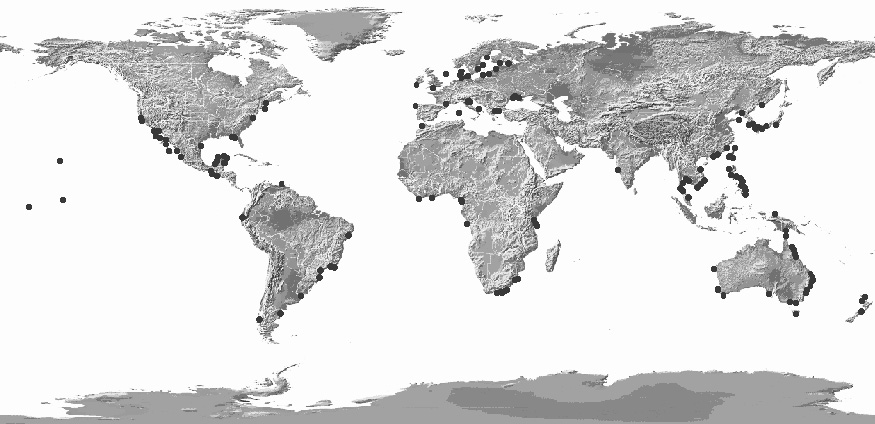
mately 170 sites worldwide (Figure 1).
zone, exchange between the inner coas-
scaling in general does not work well in
About 30 more sites are under develop-
tal zone and offshore waters, and some
the coastal ocean, for a reason that con-
ment and will be available for the final
characteristics of net biogeochemical
tains a great deal of information itself.
LOICZ synthesis.
fluxes.
Nitrogen fixation and denitrification are
important metabolic processes in bot-
tom-dominated systems and can account
for most of the observed nonconserva-
tive flux of DIN. Therefore, calculations
derived from the budgets use DIP flux as
a proxy to calculate how much net car-
bon uptake or release has occurred, scale
this to expected nitrogen flux (typically
using the Redfield N:P ratio of 16:1),
and then use the deviation between the
observed DIN flux and the expected flux
to estimate the net of nitrogen fixation
and denitrification. As is true with car-
bon, it would be desirable to have "direct
Figure 1.
Figure 2 illustrates frequency distribu-
measurements" for these important
Map of LOICZ budget sites, October 2001.
tions of the apparent rates of production
nitrogen fluxes- and the global data are
minus respiration [p-r] and nitrogen fixa-
extremely limited. As is also true in the
Nearly 150 persons have authored or co-
tion minus denitrification [nfix-denit] as
use of DIP as a carbon proxy, the mineral
authored those budgets. Many of those
calculated from the nonconservative
reactions involving DIP are probably the
persons have attended one or more of the
nutrient fluxes for these systems. Note
greatest shortcoming of the DIP proxy
LOICZ workshops. Even without discus-
that these are net rates, the difference
for nitrogen metabolism. Despite these
sing the scientific results of these labors,
between storage and release processes.
limitations, semi-quantitative insight is
the process of budget development has
These net rates are more relevant than
gained into the rates of the processes of
represented a remarkable success in deve-
gross rates to evaluating the role of coas-
primary production minus respiration
loping a network of coastal zone resear-
tal systems in carbon-nitrogen-phos-
(abbreviated [p-r]) and nitrogen fixation
chers from around the world to represent
phorus exchange. The rates cluster near 0
minus denitrification [nfix-denit].
some of their results within a common
for both [p-r] and [nfix-denit].
conceptual framework.
A strategy and funding were required to
implement this process globally. The stra-
Beginning to synthesize the results -
tegy was to mount a two-pronged attack
spatial scaling of available budget data
on acquainting the scientific community
This article considers some spatial scaling
with the budgeting procedures. The first
issues with respect to nutrient fluxes in the
prong has been publication of a web page
coastal zone. The budget sites (Figure 1)
(http://data.ecology.su.se/MNODE) that
vary dramatically in their characteristics:
summarizes and updates the budgeting
from lagoons and estuaries less than
procedures, provides tools for imple-
1 km2 in area, to the 106 km2 East China
menting the procedures, provides
Sea; from sites that are decimeters deep
various forms of teaching materials, and
to sites that are hundreds of meters deep;
posts existing budgets as they are deve-
from sites that are virtually devoid of loa-
loped. The second prong has been to
ding from land to sites that receive heavy
hold a series of workshops around the
loads of inorganic nutrients derived from
Figure 2. Frequency distributions of [p-r]
world, in order to teach people how to do
human wastes, agriculture, and other
and [nfix-denit] at the budget sites.
the budgets and to get them to prepare
sources; from sites that are river-domina-
budgets that can be used by LOICZ. At
ted estuaries to hypersaline embayments;
Further analysis will be required in order
this writing, about 200 site budgets have
from tropical to arctic climate zones. For
both to extrapolate from these individual
been developed, largely as products of
some sites data quality and quantity are
site measurements to estimates of net
more than 15 workshops held around the
both high; other sites suffer in the quality
metabolism for the global coastal zone
world. This effort would not have been
and quantity of information available.
and to evaluate the regional distributions
page 3
LOICZ NEWSLETTER
of these rates. In the meantime, further
DIN flux also responds to loading; as DIN
June 2000) in order to accomplish this
insight into comparisons can be derived
loading increases above about 1 mmol
extrapolation. The combined typology
from these data.
m-2 d-1 systems tend to take up DIN.
and budgeting studies have led to a "glo-
bal synthesis workshop" that was held in
Figure 3 illustrates terrestrial nutrient
Coastal ecosystems not only receive
Lawrence, Kansas, in November 2001;
loading to the budget sites. In order to
inputs from land but also exchange water
further analyses are proceeding.
allow comparison across sites, the data
with the adjacent ocean. The ocean water
have been normalized to the budgeted
may have a range of nutrient levels, but
The major expected product of the com-
area of the receiving water bodies. Two
these levels typically approximate natural
bined typology and budgeting efforts is a
important aspects emerge from this
oceanic nutrient concentrations. Usually
chapter to be written for the LOICZ syn-
figure. First, the area-normalized loading
this water is low in both DIN and DIP,
thesis book. A preliminary draft of that
spans 3-4 orders of magnitude.
relative to the terrigenous load, and has an
book will be prepared over the next year.
N:P ratio of <10. Water exchange time is
a measure of the time it takes for the coas-
There have been literally dozens of
tal water body of interest to exchange its
contributors to this effort (see the list of
volume with the adjacent ocean.
contributing authors, on the LOICZ
Exchange time is expressed as the ratio of
Modelling web page, http://data.eco-
water volume in the system of interest to
logy.su.se/MNODE/). The core team
the sum of water flow through the system
consists of the following individuals:
plus mixing between the system and
S. Smith, F. Wulff, D. Swaney, V. Dupra,
adjacent water. The budgeted systems
V. Camacho, L. David, M. McGlone,
have exchange times ranging from H. Waldron. In addition, we have close
<1day to several years. The lower panels
interaction with the Typology Team
Figure 3. Area-normalized DIP load versus
of Figure 4 demonstrate that water
(headed by R. Buddemeier) and from the
DIN load to the budget sites. The N:P loading
exchange times of <100days generally
LOICZ International Project Office
ratio diminishes as total load increases.
promote more rapid nonconservative
(C. Crossland et al.).
DIP and DIN fluxes.
Nutrient loading at the low end of the
range is roughly equivalent to upward
mixing of nutrients from the deep ocean
to the oligotrophic mid-latitude gyres of
surface ocean. At the other extreme, the
high loads are roughly equivalent to
direct waste discharge from one person
for every 30m2 of area budgeted! Clearly
this range of conditions imposes
dramatic differences on the water bodies
receiving these loads.
A second important aspect of this loading
pattern is that the DIN:DIP loading ratio
changes by a factor of about 4 over the
loading range. This changing loading
ratio represents a change from both low
loading and high N:P loading ratio for
oligotrophic systems not dramatically
influenced by human activities, to both
higher loading and lower loading ratio
Figure 4. Non-conservative nutrient fluxes in
under the influence of human waste dis-
response to nutrient loading (top panels) and
Sustainability and Human Use of
charges. DIN:DIP flux ratios of around
water exchange time (bottom panels). Abso-
Coastal Systems
30:1 typify discharge from relatively
lute rates of nonconservative fluxes are hig-
by
pristine river systems, while values near
her at high loads and short exchange times.
Peter Burbridge
10:1 typify domestic waste discharge.
Department of Marine Sciences and
Where to, from here?
Coastal Management University
Net nutrient reactions in coastal ecosys-
These sorts of scaling analyses are useful
of Newcastle Newcastle-upon-Tyne,
tems clearly respond to nutrient load. The
for generalizing loading, internal
United Kingdom
upper panels of Figure 4 demonstrate that
reaction, and exchange of materials in
in general, as nutrient load goes up, the
coastal ecosystems. However, the data
Introduction
absolute values of nonconservative fluxes
are inevitably biased by the availability of
In 1998 the British House of Commons
increase. DIP and DIN behave somewhat
sites for which budgetary analyses are
Select Committee on Agriculture report
differently. At low DIP loads nonconser-
possible. The next challenge of the analy-
on Coastal Flooding and Erosion called
vative flux is near 0; at loads in excess of
sis is to extrapolate these site-specific
for a fundamental change in the way we
about 0.01 mmol m-2 d-1, nonconservative
results to the global coastal zone.
plan for and manage human activities
DIP flux may become either positive or
Towards this end, the budgeting group is
because massive human intervention in
negative, reflecting either uptake or rele-
working closely with the typology group
coastal systems cannot be sustained and
ase within the systems. Nonconservative
in LOICZ (LOICZ Newsletter No. 15,
is resulting in increased hazards to life,
page 4
LOICZ NEWSLETTER
property and investment. The prospects
The term "Sustainability" is as much an
would mean that their natural capital
for achieving this basic change are
expression of social choice as it is an
expressed in terms of biological diver-
limited by poor conceptual linkages
expression of the ability of the environ-
sity, generation or renewable resources,
between natural sciences such as
ment to continue to support human needs
and maintenance of natural processes
Geomorphology and social sciences
and aspirations. What at first may appear
and functions would remain constant or
such as Economics. They are also
rational social choice can lead to unsu-
increase.
weakened by sector-based institutional
stainable coastal development where such
systems which govern human develop-
choices are based on inadequate know-
Solutions to the problems of sustaining
ment activities and which have neither
ledge of coastal processes. A good exa-
human uses of coastal areas and resour-
the spatial or temporal perspectives to
mple is the choice of an eroding coastline
ces posed by the series of errors com-
deal with the dynamics of coastal change.
for the location of an atomic power station
mitted through past management practi-
as in the case of the Sizewell power station
ces become increasingly difficult to find,
The longer-term nature of coastal change
in Britain. The benefits of a cheap site
because we continue to compound the
is also difficult for politicians to deal with
away from major human settlements with
errors by inappropriate developments of
as sustainable and equitable human uses
easy access to abundant cooling water at
all kinds. This drives us further and furt-
of coastal systems require a radical shift
first seem good reasons to choose the site.
her away from strong sustainability.
away from focusing on short-term
However, as we have learned to our great
sectoral development objectives and
cost, the site is on an eroding shore and to
A future response
towards more integrated systems-based
avoid damage to the plant we have to
We are at a crossroads in respect to
planning and management. All of these
invest millions of pounds to counteract
sustainable use of many of Europe's
limitations will have to be addressed by
the erosion which would otherwise under-
coastal regions. The spiral towards weak
innovative scientific research in a number
mine the plant's foundations. The econo-
sustainability where coastal defences
of disciplines and the integration of the
mic benefits derived from a coastal loca-
encourage development that, in turn,
knowledge gained to form more robust
tion for the generation of electricity have
create the need for enhanced defences
guidelines to help politicians, planners
been eroded because insufficient atten-
must be broken. The natural defence of
and mangers formulate more appro-
tion was paid to the long-term dynamics
coastal areas provided by wetlands, tidal
priate policies, investment strategies and
of the coastal system. This is by no means
deltas and other components of the coas-
natural resources management plans to
an isolated case.
tal mosaic have yet to be fully apprecia-
guide coastal development. These issues
ted by policy makers, planners and
are highlighted in the findings of the
"Weak" sustainability
managers. If we adopt a more dynamic
LOICZ programme, and the EU-funded
The need to defend coastal infrastructure
viewpoint, however, then it appears that
demonstration programme on Integrated
such as power stations from natural coas-
these same coastal landforms remain
Coastal Zone Management (ICZM) (EU
tal processes could be termed "weak
intact, it is only their location that will
2000). The need for more integrated
sustainability" because of the need to
change. If we persist in applying our sta-
scientific information is also recognized
allocate natural resources (stone and sand
tic coastal management systems as sea
in the draft EU Strategy to promote more
= natural capital) and man-made capital
levels rise then an increasing disparity
integrated approaches to coastal
(money and machines to build engineered
will arise between our needs and the
management and the sustainable use of
shoreline defences to sustain the viability
coastal resource. This will mean a furt-
resources (EU 2000).
of the power plant). Weak sustainability is
her move away from "strong" sustaina-
also associated with the assumption that
bility and a loss of sustainable develop-
The question of sustainability
there can be unlimited substitution possi-
ment opportunities. Instead we must
Burbridge and Pethick (2001) argued that
bilities between different forms of capital
move toward "strong" sustainability by
comprehensive knowledge and under-
via technical progress. For example, the
beginning to manage change at the coast
standing of the dynamic process and
reclamation of intertidal mudflats and
in a more positive manner.
functions of coastal systems are required
marshes has proceeded on the basis that
to avoid inappropriate policies, invest-
there was little capital value represented
ment and human use of coastal areas that
by these coastal ecosystems and greater
References
can only be sustained through major
man-made capital could be achieved by
Burbridge, P.R. and Pethick, J. (2001)
investment of man-made capital. The aut-
their transformation into dry land. Howe-
Sustainability and management of
hors examine the implications of such
ver, advances in scientific knowledge
coastal systems: our great challenge.
subsidies of man-made capital using the
have identified highly valuable functions
Proc. Hanse Conference on a Marine
concepts of "Weak" and "Strong" sustai-
performed by wetlands as well as grave
Policy for Europe, Bremen, March
nability set out by Turner et al. (1998) in
risks to the sustainable use of reclaimed
2000 (forthcoming).
the LOICZ Focus Four programme using
areas resulting from both the destruction
European Union (1999)
examples of natural and man-induced
of the functions of wetlands and other
Towards a European Integrated Coas-
change in coastal systems. These examp-
coastal systems, and rising sea level. We
tal Zone Management (ICZM) Stra-
les demonstrate that failure to understand
will return to this point later.
tegy: General principles and policy
powerful and dynamic coastal processes
options- A reflection paper. European
can result in a loss of natural capital and
"Strong" sustainability
Commission, Brussels.
in inefficient allocation of man-made
Strong sustainability is associated in
European Union (2000)
capital that could be used in better ways to
economic thinking with the conservation
A Communication from the Commis-
improve human welfare. This forces us
of different forms of capital (man-made,
sion to the Council and the European
towards "weak" sustainability and effecti-
human, natural, social/moral) in respect
Parliament on "Integrated Coastal
vely forecloses options for developing
to meeting the needs of human popula-
Zone Management: A Strategy for
more sustainable human uses of natural
tions over time. Strong sustainability
Europe". (COM/00/547 of 17 Sept.
and man-made capital.
applied to marine and coastal systems
2000), Brussels.
page 5
LOICZ NEWSLETTER
House of Commons (1998)
call is out for scientists, globally, to con-
toring" system. The COOP framework is
Flood and coastal defence. House of
tribute to the work of the Assessment.
an exciting and vital initiative that, while
Commons Agriculture Select Commit-
There are a number of areas in which
providing some challenges to the coastal
tee. HMSO.
LOICZ-associated scientists could assist.
scientists, managers and users, has a real
Turner, R.K., Adger, W.N. and Loren-
More information can be found on the
capacity for networking global skills and
zoni, I. (1998)
MEA web-site: www.ma-secretariat.org.
science to meet the needs of the wider
Towards integrated modelling and
community by providing systematic data
analysis in coastal zones: principles
As part of the development of the Global
sets and products.
and practices. LOICZ Reports and
Ocean Observing System (GOOS),
Studies No. 11, IGBP/LOICZ, Texel,
LOICZ has helped in the planning for the
The 2002 World Summit on Sustainable
the Netherlands, iii+122 pages.
Coastal-GOOS module over the last two
Development in Johannesburg is the
years. A decision was made to combine
focus of much attention from scientific,
the plans for the coastal, living marine
environmental and policy sectors at the
resources and health of the oceans
moment. The Summit will review the
LOICZ IPO NOTES
elements into one programme. The com-
progress and global response on environ-
bining efforts were the basis of a work-
mental issues since the Earth Summit in
From all of us at the LOICZ International
shop in Trieste in June, and the new panel
Rio de Janeiro 10 years ago. In early
Project Office:
-Coastal Ocean Observations Panel
December, the Intergovernmental Oce-
THE BEST WISHES FOR 2002
(COOP)- is completing the work for
anographic Commission (IOC) hosted an
adoption and implementation. The goal is
"Oceans and Coasts at Rio+10". The
Over the last few months, LOICZ scien-
to establish an international operational
meeting attracted about 400 people from
tists have been involved with the design
framework of regional scaled observa-
all sectors interested in the coastal and
and collaborative development of new
tion elements that will monitor, assess
ocean environment and, through a
programs of science and assessment.
and predict effects of natural variations
structured set of plenaries and workshops
With other representatives of several of
and human activities on the marine envi-
derived a "progress report" for use in the
the IGBP core projects, LOICZ partici-
ronment and ecosystems of the coastal
preparation of the coastal-marine assess-
pated in the second technical design
zone. Fundamental scientific research
ments to be provided in Johannesburg.
workshop for the Millennium Ecosystem
information, tools and assessment
The general outcome was a strong reali-
Assessment in Capetown, South Africa.
methodologies such as those coming
sation that science knowledge and pro-
The work plan design is in final draft for
from the LOICZ core project of IGBP
grammatic tools and information have
consideration by the MEA Board and a
will provide underpinning of the "moni-
progressed markedly in the last 10 years
Literature Review: Trace Gases in the Coastal Zone
· More research is needed to better understand future changes of trace gas fluxes
in the coastal zone. On the basis of the past trends of global warming, frequent
Jozef M. Pacyna and Øystein Hov
formation of algal blooms, increased transport of particulate matter, including
Norwegian Institute for Air Research, Kjeller, Norway
organic matter with rivers and to some extent atmospheric deposition, and
enhanced primary production in the ocean, it can be expected that the sea-to-
http://www.nilu.no
air flux of trace gases in coastal areas will increase in the future.
Aim
Acknowledgements
· to establish the relevance of the coastal zone for atmospheric sources and
The authors are grateful to many scientists for providing the data needed for this
sinks of trace gases (except CO ) on the basis of a literature review.
2
review and preparing comments and additions for this report. The
Why do coastal seas differ from the open ocean with respect to the air-sea
authors would like to thank especially:
exchange of trace gases?
· Dr. Robert C. Upstill-Goddard and Dr. Guenther Uher of the Department
· the coastal ocean is more efficiently and more often affected by the anthro-
of Marine Sciences and Coastal Management, the University of Newcastle,
pogenic drivers of environmental change than is the open ocean.
Newcastle upon Tyne, UK
· the ecosystem functioning and structure in the coastal zone is changing more
· Dr. Wiliam T. Sturges and Dr. Gill Malin of the School of Environmental
quickly and to greater degree.
Sciences, the University of East Anglia, Norwich, UK
· biogeochemical cycling of chemicals, including sea-air exchange of trace
· Dr. Nicola Carslaw of the School of Chemistry, the University of Leeds,
gases, is affected by differences between the coastal seas and the open ocean.
Leeds, UK
Issues specific for air-sea exchange for trace gases in the coastal ocean
· Dr. Wendy Broadgate of the IGBP Secretariat, Natural Sciences, Stock-
· Proximity to the emission sources and regions.
holm, Sweden
· The tidal regime of some estuaries leads to an increased residence time of
· Dr. L.J. Carpenter of the Department of Chemistry, the University of York,
fresh water in the estuarine mixing zone and pronounced changes in the spe-
Heslington, UK
ciation of various chemicals.
· Dr. Stuart W. Gibb of the Environmental Research Institute, the North High-
· The shelf break zone as the area where the sea-air exchange processes for
land College, Thurso, Scotland
many trace gases are the most effective, resulting in enhanced production of
· Dr. Michel Frankignoulle of the University of Liege, Liege, Belgium
trace gases.
· Dr. Jack J. Middelburg of the Netherlands Institute of Ecology, Yerseke, the
· Turbulence in tidal estuaries due to the tidal currents and their interaction
Netherlands and
with wind and bottom topography clearly depends on the tidal energy and the
· Dr. Hermann W. Bange of the Institute for Marine Research, Kiel, Germany.
depth and morphology of the estuary.
Type
Estuary to
Qunatity of
Estuary
Costal sea
Costal sea
· The continental margin plays a significant role in air-sea exchange through
gas
open ocean
estuary
contribution
contribution
contribution
the activities of organisms, more available in coastal areas than in the open
flux rate
emissions in
in total
to the total
to global
ocean.
ratio
Europe,
European
sea to air
emission
ktonnes/yr
emission %
flux
%
· The role of natural wetlands in the generation of trace gases.
CH2
- 1000
580
2.5
up to 30%
0.2 - 2.0
Concluding remarks
N2O
- 100
120
9.4
up to 60%
2.0 - 15.0
· The coastal ocean is an important source of CH , N O, DMS, COS and Hg
4
2
DMS
1 - 3
60 (as S)
1.0
up to 10%
2.0
emission to the atmosphere.
COS
10 - 100
up to 50%
· Flux rates from the surface water to the air for these gases are up to several
Hg
- 10
12 x 10-3
3.5
up to 20%
- 0.5
orders of magnitude higher in the coastal areas than in the open sea.
· Estuaries can contribute a few percent to the total emissions of CH
Contribution to the total European or global emissions of sulphur
4, DMS
and COS and a bit more to N O on a global scale.
2
This work has been prepared within contracts from the LOICZ International
· Coastal areas contribute up to 50-60% to the total oceanic emissions of N O
2
Project Office and the Norwegian Research Council (NFR). The authors are
and COS on a global scale, and 10 to 30% for CH4, DMS and Hg.
grateful for the financial support of LOICZ and NFR.
page 6
LOICZ NEWSLETTER
(but there are major difficulties in objecti-
for and operational links to the global
drivers of impacts are pessimistic. Island-
vely determining environmental quality),
change science arena will be another key
based sites included in the more detailed
as has the development of conventions
feature of European coastal research.
CariBas assessment are the polluted and
and top-down accords and governance
LOICZ is expected to play an important
urbanized area of Kingston Harbor,
instruments. However, there remains a
role in complementing and supporting
Jamaica and the Caroni River basin and
significant gap between the science and
this effort through its own synthesis and
Gulf of Paria on Trinidad/Tobago.
understanding and the policy arena, such
in bringing in the global perspective and
that concerted actions based on the interg-
a global set of links to application. The
Future regional LOICZ activities will
overnmental instruments are still limited.
ELOISE synthesis, to be executed in
seek links to the GEF/WB project on the
Despite the continued general trend of
2002, has to call for tenders.
Meso-American Reef. Further island
decline in global environmental quality,
sites e.g., on Cuba and Hispaniola, are
the efforts of community, science and
likely to be included in the proposal deve-
governance appear to be tracking in a
LOICZ Basins: Regional assessment
lopment at a later stage. Potential for
favorable direction but it is a long slow
of river catchment - coast interaction
links to UNESCO/ IOC's IOCARIBE
progress.
and human dimensions: Caribbean
Sub-Commission are being pursued.
coastal states and Africa
ERA
Following recommendations of the 4th
Supported by START/NORAD and
The status of the ELOISE project cluster,
LOICZ Open Science Meeting, Bahia
UNESCO/IOC and hosted by UNEP's
perspectives for improved synthesis in the
Blanca, Argentina 1999, to include
Regional Office for Africa in co-opera-
new European Research Area, ERA, and
island-dominated regions into the global
tion with the Pan African START Secre-
links into the competitive surrounding of
assessment of river catchmentcoast
tariat, PASS, the second LOICZ AfriBas-
the 6th Framework Program (2002-2006)
interaction, a CariBas core group, sup-
ins workshop took place in Nairobi,
were discussed at the 4th Annual ELOISE
ported by LOICZ and the IOC, held its
Kenya 29 Oct-2 Nov 2001. Two working
conference held in Rende, Italy 5-7 Sep.
synthesis meeting at the Rosenstiel
groups (western and eastern coasts) iden-
2001. The Commission pointed out that
School for Marine and Atmospheric
tified coastal change and river catch-
future European coastal research needs a
Science, Miami, USA, in June 2001. Key
ment-based forcing of change in eight
balance of fundamental and applied
investigators mainly from the CARI-
sub-regions by considering coastal geo-
science encapsulated in a sound synthesi-
COMP network evaluated natural and
morphology, coastal habitats/biodiver-
zing and communication mechanism.
human-induced flux changes to the coas-
sity, climatic conditions, people rela-
The objective is to overcome the current
tal seas, impacts and critical loads in this
tionships (demography and drivers),
fragmentation of activities through sys-
heterogeneous area including islands and
catchment size and seasonal runoff, land
tem-based integrated approaches and
continental, mountainous countries.
use and cover. The sub regions were:
improved scaling including river catch-
Coastal change in this sub-region origi-
· the Nile, including the wider coastal
ments and socio-economics. Meeting
nates from driver patterns such as sea-
stretches influenced by the Nile catch-
these and related policy objectives will
sonal tourism, agriculture, oil exploita-
ment reflecting land-based drivers
allow both better testing of the robustness
tion and urbanization. Natural drivers
including the Aswan dam, Cairo urba-
of, for example, the products of ELOISE
include climatic extreme events.
nisation and agriculture in the Delta.
(with currently 35 projects still in opera-
· East Africa (Somalia to northern
tion) and a better contribution to sustaina-
Sites addressed in detail were the Magda-
Mozambique), featuring the small- and
ble development in Europe as outlined in
lena River, Colombia, Golfo Triste and
medium-sized catchments under mon-
the recently formulated communication
Aroa-Yaracuy River along the Venezuelan
soonal forcing (seasonal flushing) and
to the Parliament. However, the global
coast. Agriculture and urbanization affect
subject to damming, and extensive
change dimension will be a crucial link
the reefs where live coral cover has fallen
coral reefs.
for up-scaling and inter-comparison of
from 35% to 5% and total biodiversity is
· Southern/central Mozambique, again
the European research.
down to 20%. In Costa Rica, agricultural
with high seasonality in runoff charac-
and logging activities in the Estrella River
teristics and transboundary issues
In the longer term the European Research
catchment caused deterioration in the
including damming and impacts such
Area, a newly formed initiative proposed
Cahuita reef. Both cases indicate that
as salinisation in the coastal zone.
in 2000, will be the platform where both
respective ecological critical thresholds
· South-east Africa, ranging from subt-
national programs and the 6th Framew-
for coastal system stability based on river-
ropical in the north to the warm tem-
ork Program and thus any sort of conti-
ine material flux have been exceeded visi-
perate on the Cape coast and characte-
nued ELOISE cluster will fit. The ERA
bly. Trend expectations are pessimistic.
rised by generally small catchments
aims to facilitate the development of a
that are subject to various human use
European Policy for research and to anti-
In a broad sub-regional approach, the
patterns with plans in place for inten-
cipate the future science and technology
whole Meso-American Reef area stret-
sive damming.
needs on EU level. It needs to build on
ching from Mexico via Belize south to
· South-west Africa (Cape of Good
research which meets the above criteria
Guatemala and Honduras was evaluated.
Hope to southern Angola), mainly
with special emphasis on interdisciplina-
This, the world's second largest barrier
dominated by the upwelling system of
rity, transboundary scaling and on an
reef, currently the subject of a broad
the Benguela current, cool and tempe-
improved coherence of national research
GEF/WB research project, shows signs
rate in the south, arid in the north with
agendas. The future of the projects which
of environmental impacts. However,
limited river runoff to the coastal sea.
will meet the new criteria for support in
while indicators such as live coral cover,
· the Congo, a central African sub-region
this context will therefore include much
coral disease rates and macroalgal cover
with a very large catchment with exten-
broader networks of excellence than in
are still s relatively healthy, the distances
sive rainforest but little information
the past aimed to also form a sort of "vir-
to the respective critical thresholds are
available about its land-based drivers
tual" laboratories. An improved visibility
decreasing and trend expectations for the
and how they relate to coastal issues.
page 7
LOICZ NEWSLETTER
· West Africa, featuring a variety of large
industrial infrastructure. This finding
adding a dozen new budgets in the region,
rivers subject to major damming resul-
parallels those made in the South Ameri-
plus a budget assessment for the Nile
ting in reduced sediment and water
can (Lacerda et al. 2002 LOICZ R&S
Delta.
fluxes and reduced coastal stability as
21 in press), and East Asian basins asses-
a growing threat to the lagoon-based
sments (Hong et al., in prep.). However,
A workshop hosted by Fred Wulff, Uni-
cities.
the heterogeneity of the African sub-
versity of Stockholm, successfully deve-
· North-west Africa, a relatively arid sub-
regions seems to be more pronounced,
loped a range of budget assessments for
region with seasonal runoff and, at least
making the ranking of issues and drivers
estuarine and regional seas across the
in Morocco, major human pressure
in Africa a more complex challenge.
Russian polar coast, and within the Both-
through diversion and damming cau-
nian Sea. This provided a vital latitudinal
sing a variety of coastal change issues.
A second task was to use this assessment
extension to the LOICZ information with
The sub-regions show wide variations in
to identify potential demonstration sites
indications that the N and P inputs are pre-
both biophysical nature the availability
for future holistic studies on coastal
dominantly from the ocean rather than
and quality of existing material flux data.
change and human dimensions. For this
from land sources.
The catchments chosen were considered
purpose "hot spots" important for future
representative for their sub-region. The
research evaluation and a project design
These two workshops, along with the
big four (Nile, Zambezi, Congo and
applicable to various spatial and temporal
workshop held in Ensenada in April 2001
Niger) have been included, as have the
scales had to be identified. The workshop
addressing additional Latin American
important basins of the Senegal, Volta,
concentrated on the draft "AfriCat" pro-
sites, will contribute an additional 30-40
Cross and Gariep rivers on the western
posal, which was developed from the
new sites across Africa, the Americas and
coast, and the Limpopo and Incomati on
ongoing "EuroCat" project. The empha-
the polar region and significantly increase
the eastern coast. Medium and small bas-
sis was on adjustment of this project draft
our capacity to build global and inter-
ins have also been assessed including the
to the regional African needs and case
regional understanding of the material
Sebou and Moulouya in Morocco, the
studies a process that is ongoing. In
fluxes in the global coastal zone.
Olifants and Berg west of the Cape and
close co-operation with IOC and the
Tugela, Kariega, Kromme and Groot
Advisory Committee on the Protection of
Regional application of the LOICZ typo-
Brak rivers east of the Cape in South
the Sea (ACOPS), results of this LOICZ
logy approach was extended to the Africa-
Africa, the Rufiji in Tanzania and the
effort complement the development of a
Europe regions in a workshop hosted by
Sabaki and Tana in Kenya.
bigger African project to be established
Maarten Scheffers, Coastal Zone
through a Partnership Conference at
Management Centre-RIKZ, The Hague
Coastal geomorphological change, ero-
Johannesburg.
in early July. Around 30 participants
sion and sedimentation were identified as
applied the tools to sub-regional
a significant and progressive impact in
Biogeochemical Budgets and Integra-
questions of scaling and to issues relating
nearly all of the sub-regions, the problem
tion
to biogeochemical budgets. The LOICZ-
being acute on the Nile delta and in West
Some 180 biogeochemical budgets have
View tool was further developed to
African lagoon systems. Damming was
been developed for estuaries and coastal
include additional statistical elements.
viewed as the principal driver in such
seas using the LOICZ approach, suppor-
change, with consequent reductions in
ted especially by a network of global
An integration workshop was held in
stream flow and sediment flushing. Other
researchers and the UNEP GEF-funded
Kansas, 11-14 November 2001, that drew
coastal impacts ascribed to river dam-
project (see lead article). The spatial
together the existing biogeochemical
ming include salinisation, e.g., in the
coverage is now fairly much global with
assessments and developed a number of
Incomati estuarine plain in Mozambique,
the exception of the South Asia region
general trends and relationships between
and nutrient depletion in coastal seas e.g.,
field and assessment work is current in
the biogeochemical budgets. The typo-
Kwazulu-Natal. In most sub-regions
South Asian sites through national pro-
logy tool, LOICZView, was applied to the
deforestation and agriculture were seen
grams and support from APN. Integration
regional and global synthesis, particularly
as important drivers, particularly in
of the budget sites information to address
to the development of coastal classifica-
respect of coastal sedimentation from
core LOICZ questions about C, N and P
tions based on climate and other physico-
medium and small catchments, e.g. the
sinks/sources and fluxes is being conduc-
chemical factors, and to the question of
Tana and Sabaki rivers in Kenya. Human
ted by a networked group of scientists,
land-derived loads of nutrients to the
settlement was regarded as a major con-
making use of the LOICZVIEW typology
coastal zone. The workshop marked the
tributor to eutrophication and the occur-
tools as a key approach.
final activity of the UNEP GEF project
rence of aquatic weeds in the large West
carried out by LOICZ and outcomes are
African catchments. Elsewhere, while
Several regional workshops have been
contributing to the overall LOICZ Syn-
eutrophication and pollution were recog-
held over the last six months to add to
thesis activities. Further synthesis and
nised as important issues, they were rela-
regional coverage of "budget" sites and to
assessment of the biogeochemical charac-
ted in many cases to local (coastal)
extend the training, use and assessments
teristics of the global coastal zone are pro-
urban-industrial sources e.g., Alexandria,
with the typology techniques.
ceeding through a networked group of
Mombasa, Saldanha Bay and Cape
LOICZ scientists.
Town. Loss of biodiversity or biological
Howard Waldron, University of Cape
functioning was another common issue,
Town, hosted a well-attended workshop
Publication of the reports from these
though related probably to complex ran-
in early September to develop additional
workshops will be available in January
ges of human and natural drivers. In
budgets and to provide further training
2002, as hard copy in the LOICZ Reports
general these data are characteristic of
and awareness in Africa. The sub-Saharan
and Studies series (with a CD-ROM ver-
developing economy situations where
region now has a broad representation of
sion of all typology outcomes) and acces-
economic growth and water use exceed
budget sites across a range of climatic and
sible through the LOICZ web-site.
development of the necessary urban and
landscape settings, with the workshop
page 8
LOICZ NEWSLETTER
LOICZ Typology web-site: (http://water.
France, 22-26 April 2002. In the Section
HAVE YOU SEEN
kgs.ukans.edu:8888/public/Typpages/
Nonlinear processes there will be a ses-
index.htm) and (www.kgs.ukans.edu/ sion on NP 6: Climate models: nonlinear
Aguirre-Minoz, R.W. Buddemeier, V. Ca-
Hexacoral/Workshops)
response and thresholds, organized by
macho-Ibar, J.D. Carriquiry, S.E Ibarra-
Ulrike Feudel, Institute for Chemistry and
Obando, B.W. Massey, S.V. Smith and
LOICZ Basins preliminary web-site:
Biology of the Marine Environment,
F. Wulff 2001. Sustainability of coastal
http://w3g.gkss.de/projects/loicz_basins/
University Oldenburg, Germany
Resource use in San Quintin, Mexico.
which links to GKSS through http://coast.
(u.feudel@ icbm.uni-oldenburg.de) and
Ambio 30 (3):142-149.
gkss.de/themen/anthro/ - a final version
Martin Claussen, Potsdam-Institute for
will be available by the end of January
Climate Impact Research, Potsdam,
S.V. Smith, W.H. Renwick, R.W. Budde-
Germany (claussen@pik-potsdam.de).
meier and C.J. Crossland 2001. Budgets
of soil erosion and deposition for sedi-
LOICZ CALENDAR
11th International BiennialConference on
ments and sedimentary organic carbon
Physics of Estuaries and Coastal Seas
across the conterminous United States.
LOICZ SSC Meeting, 27 May & 2 June
(PECS'02), September 17-20, 2002.,
Global Biogeochemical Cycles 15 (3):
2002, Miami, Florida, USA
Hamburg, Germany. For information
697-707.
visit: http://www.pecs-conference.org.
LOICZ Synthesis and Futures meeting,
The European Geophysical Society
29 May - 1 June 2002, Miami, Florida,
Joint IAMAS/CACGP/IGAC Scientific
(EGS) has launched a new interdiscipli-
USA (by invitation). Contact LOICZ IPO.
Conference on Atmospheric Chemistry in
nary working group (IWG) on Biogeo-
the Earth System: From Regional Pollu-
sciences (BG). The goal of this IWG is to
tion to Global Change, 18-15 September
OTHER MEETINGS
increase the visibility of biological disci-
2002, Crete, Greece. Abstract deadline
plines within EGS, attract new members
submission March 2002 Contact: igac
and promote interaction of biology with
International Conference on "Coastal
2002@chemistry.uoc.gr Visit: http://atlas.
geology, hydrology and geophysics. Tight
Zone Management and Development
chemistry.uoc.gr/IGAC2002
coordination with the existing EGS sec-
(ICCZMD)", 18-20 March 2002, Kuwait:
tions and IWG will be achieved through
Dr. Mohammad Al-Sarawi (sarawi@epa.
IPO STAFF
co-sponsorship of symposia. Interaction
org.kw or alobaid@epa.org.kw).
with the Biogeoscience section of the
Visit: www.epa.org.kw/cc/
American Geophysical Union (AGU)
CHRIS CROSSLAND
will also be sought, beginning with the
Coastal Zone Asia-Pacific: "Improving
Executive Officer
upcoming joint EGS-AGU meeting due
the State of the Coastal Areas" May
HARTWIG KREMER
to take place in 2003. Additional infor-
12-16, 2002, Bangkok, Thailand. Dead-
Deputy Executive Officer
mation on BG can be found at http://
line for abstracts 15 January 2002: www.
HESTER WHYTE,
www.obs-vlfr.fr/~gattuso/jpg_bg.htm
vims.edu/czap or: Dr. Ratana Chuenpag-
Office Manager
and a more detailed document can be
dee (ratana@vims.edu)
MILDRED JOURDAN,
downloaded at http://www.obs-vlfr.fr/
Office Assistant
~gattuso/files/EGS_BG.pdf.
Advanced Training Institute on Climatic
MAARTEN SCHEFFERS
Variability and Food Security at the IRI
Liaison Officer
(International Research Institute for Cli-
JAN CROSSLAND
LOICZ PUBLICATIONS
mate Prediction (IRI) of Columbia Uni-
Editor
versity, New York) 8-26. For more details
LOICZ Publications are available as
check on the web-site (http://iri.colum-
printed copies and are downloadable
bia.edu/outreach/meeting/ATI2002).
FOR MORE INFORMATION,
from the LOICZ web-site
PLEASE CONTACT:
Two forthcoming ACSYS/CliC events,
Coastal and Estuarine Systems of the
15-17 and 18-19 April 2002:
LOICZ I
Mediterranean and Black Sea
1) A workshop on `Sea-ice extent and
NTERNATIONAL PROJECT
Regions: C, N and P fluxes. Eds. V. Dupra,
the global climate system'. http://acsys.
OFFICE
S.V. Smith, J.I. Marshall Crossland and
npolar.no/meetings/toulouse/ice.htm .
NETHERLANDS INSTITUTE FOR
C.J. Crossland. LOICZ R&S 19, 2001.
2) A mini-conference on `Long-term
SEA RESEARCH
LOICZ UNEP, NCMR, ELOISE work-
variability of the Barents Sea region'.
PO BOX 59
shop report.
http://acsys.npolar.no/meetings/toulouse/
1790 AB DEN BURG - TEXEL
barents.htm>. These events will be held
THE NETHERLANDS
one after the other at Météo France in Tou-
WHAT'S ON THE WWWEB
louse, France, with the hope that some re-
PHONE: 31-222 369404
searchers will participate actively in both.
FAX:
31-222 369430
LOICZ web-site: Biogeochemical Bud-
Contact: Tordis.Villinger@npolar.no.
gets and Modelling - new sites and tuto-
E-MAIL: LOICZ@NIOZ.NL
rial materials (http://data.ecology. su.se/
The European Geophysical Society
WWW HOME PAGE:
MNODE/)
(EGS) XXVII General Assembly, Nice,
HTTP://WWW.NIOZ.NL/LOICZ/
A CORE PROJECT OF THE
I
G
B
P
INTERNATIONAL GEOSPHERE-BIOSPHERE PROGRAMME