September 2001
http://www.nioz.nl/loicz
No. 20
Global change in the coastal
South-east Asia showcases the most
zone: The case of South-east Asia
diverse assemblage of marine life inha-
biting shallow waters, with 20 of 50
Liana Talaue-McManus
known seagrass species, 45 of 51 man-
Marine Science Institute, University of
grove species, and 50 of 70 hard coral
the Philippines, Quezon City,
genera are found in the region. The
Philippines & Rosenstiel School of
countries of South-east Asia have among
Marine and Atmospheric Science,
the highest population growth rates in
University of Miami, Florida, USA
the world and economies that rely
heavily on living resources from land
South-east Asia highlights the human-
and sea. The archipelagos, low-lying
natural interactions and feedbacks
areas of islands and continental shelves
between changing climate regimes, a
are extremely vulnerable to changes in
rapidly increasing population, and
sea level rise, and to flooding and storm
an extremely rich though seriously
surges that result from a changing
threatened living resource base within
monsoonal climate. Thus, the inter-
the coastal domain. The current state of
actions between human societies and the
This is the twentieth
coastal science in the region has begun
environment within the domain of the
newsletter of the Land Ocean
to unravel the local-global dynamics of
coastal zone is most dramatic in South-
Interactions in the Coastal Zone
these interactions. What is known to
east Asia. Indeed, the coastal zone of this
(LOICZ) International Project of
date provides compelling reasons to
region is a global environmental hot-spot.
the IGBP. It is produced quarterly
make the knowledge base transparent to
to provide news and information
the policy process so that local action
Pressures on the coastal zone: popu-
regarding LOICZ activities
throughout the world can maintain the
lation and a resource-dependent eco-
life support functions of the global
nomy.
uses such as aquaculture. The coastal
coastal zone.
South-east Asia is home to 500 million
zone receives waste generated by land-
people. Ninety percent of them live
Where is the coastal zone and why
based activities including sewage, sedi-
within 100 km from a coast (Burke et al.
South-east Asia?
ments and industrial effluents. Agricul-
2000). About 85 million, 7% of the
The coastal zone represents the inter-
tural chemicals notably fertilizers and
world's poor, subsist on USD 1.00 per
phase domain between the atmosphere,
pesticides contribute to degrading the
person per day or less (ESCAP 2001).
land and sea. It includes the coastal plains,
quality of coastal waters. The continuing
The developing economies of the region
estuaries and embayments, and extends to
assault on the coastal zone through
are largely defined by the trade of natural
the edge of continental and island shelves
extraction of goods and through modifi-
resources to earn foreign exchange as
(Pernetta & Milliman 1995). On a global
cation has profound impacts on food and
evidenced by the significant contribution
scale, the coastal zone occupies about
environmental security for humankind.
of agriculture to the gross domestic
20% of the earth's surface, but accounts
product (GDP) of each country (Table 1).
for 90% of the world's fisheries. The rich
Country
Coastal
Area of
Pop. in 20002
Pop. within
Per cap.
Per cap.
GDP from
ecosystems in shallow waters including
length1
continental
(x 1000) and
100 km
fish food
GDP3 (US $)
Agriculture3 (%)
coral reefs, seagrasses and mangroves are
(km)
shelf1
annual growth
from coast1
supply4
(same year as
(same year as
not only home for some diverse groups of
(x 1000 km2)
rate3 (%)
(%)
(kg/P/Y)
food supply)
food supply)
living organisms, but also areas where
Cambodia
1,127
34.6
12,212 (2.4)
24
(1995) 9.0
309
51
nutrients cycle among their dissolved and
Indonesia
95,181
1,847.7
224,784 (1.3)
96
(1998) 16.3
1,018
24
particulate forms.
Malaysia
9,323
335.9
21,793 (2.0)
98
(1999) 69.0
4,523
12
Myanmar
14,708
216.4
41,735 (1.8)
49
(1994) 16.6
220
38
Because of its proximity to land, the
Philippines
33,900
244.5
81,160 (2.0)
100
(1998) 25.9
644
17
living resources in the coastal zone are
Thailand
7,066
185.4
61,231 (1.0)
39
(1998) 23.6
1,970
11
heavily exploited, often beyond rates at
Vietnam
11,409
352.4
78,774 (1.4)
83
(1996) 11.5
267
40
which these can regenerate. Coastal eco-
Cf Japan
29,020
304.2
126,550 (0.2)
96
(1997) 64.0
(1998) 24,070
2
systems continue to deteriorate with
Table 1. Socio-economic indicators for South-east Asian countries. Sources: 1Burke et al., 2001; 2The World Almanac, 2001;
heavy harvesting or are altered for other
3ESCAP & ADB, 2000; 4Fishery Country Profile from www.fao.org/fi/fcp.
A CORE PROJECT OF THE
I
G
B
P
INTERNATIONAL GEOSPHERE-BIOSPHERE PROGRAMME
page 2
LOICZ NEWSLETTER
The fluxes of materials (gaseous emis-
nitrogen through rain (Paerl 1997; Paerl
Nutrients from minimally treated domes-
sions, sediments, nutrients, solid and
et al. 1999). Nitrogen loading through
tic waste of a rapidly increasing popula-
liquid waste) resulting from this trade
precipitation can increase the flux of new
tion and from fertilizer applications in a
underpin, among others, the current state
nitrogen to the coastal zone and poten-
widening expanse of tillage explain why
of the coastal zone in the region. With
tially exacerbate eutrophication.
eutrophication is the most pressing pollu-
high annual population growth rates and
tion problem in coastal waters (Tilman et
a high degree of dependence on natural
Over a 37-year period, profound climatic
al. 2001). Asia currently uses 50% of
resources, the people of South-east Asia
changes in South-east Asia have been
annual global fertilizer production or
are among those most vulnerable to
recorded which directly influence the
about 70 million t. In three study sites in
global environmental change.
fluxes and the temperature regime at
South-east Asia, dissolved inorganic
which chemical transformations occur
nitrogen discharged to coastal basins
Vertical interactions: air pollution and
on land, in air and sea (Manton et al.
have been found to represent anywhere
climatic changes.
2001). The number of hot days and warm
from 10 to 50% of waste generated by
Because 90% of South-east Asians live
nights per year has increased and the con-
land-based activities notably agriculture
near the coast, anthropogenic gas emis-
tribution of extreme events like La Niña
and the household sectors (Talaue-
sions in the region mostly emanate from
to the annual rainfall in the region has
McManus in prep.; Table 2).
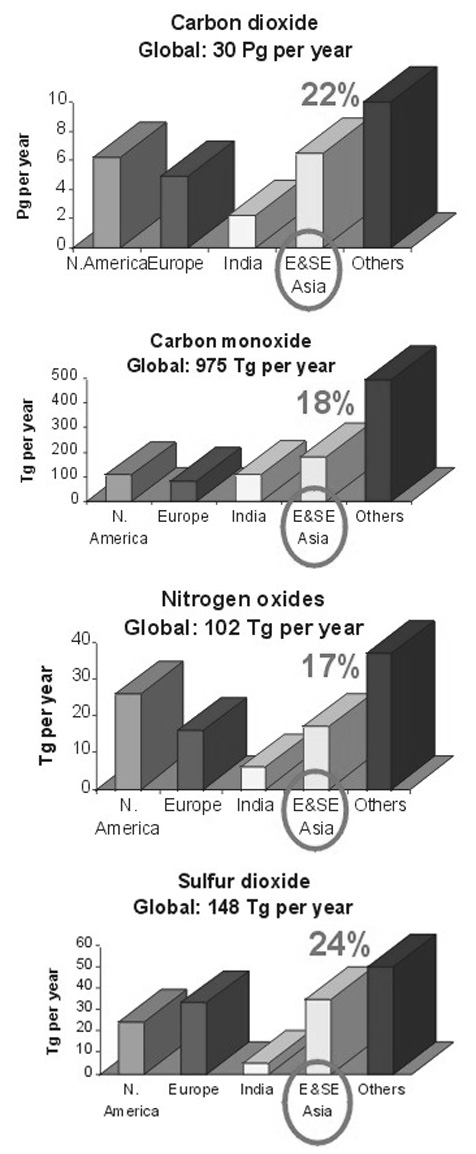
the coastal domain. In a global context,
increased. These regional changes inter-
East and South-east Asia releases
act with larger-scale increases in the heat
Nutrients reaching nearshore waters via
17-24% of total gas emissions worldwide
content of the ocean over the last 45 years
rivers or direct loading lead to profound
(Lelieveld et al. 2001) (Fig. 1).
(Barnett et al. 2001). Monsoonal shifts in
changes in ecosystem structure and func-
the climate patterns have begun to have
tion. These can include toxic algal
dramatic effects on the natural resource-
blooms (Tilman et al. 2001), shifts from
based economies of South-east Asia and
coral to algal dominated coral reef com-
on the increasing vulnerability of low-
munities in synergism with the over-
lying areas to increasing frequency of
harvest of herbivorous fish (McManus et
typhoons and flooding events.
al. 2000), and the occurrence of hypoxic
zones which produce nitrous oxide and
Horizontal interactions:
sediments
methane, both potent greenhouse gases
and nutrients.
(Naqvi et al. 2000; Purvaja & Ramesh
The vertical interactions between the
2000). Hypoxic zones probably com-
coastal zone and the atmosphere repre-
monly occur in the shallow waters of
sent one complex subset of changes. The
South-east Asia given intense rainfall,
horizontal interactions of the coast with
large river runoff, and high nutrient and
the land and the sea represent another.
organic matter loading. The frequency
From deforested land and poorly mana-
and extent of their occurrence remain to
ged tillage, large quantities of soil end up
be established and quantified.
as mud in tropical estuaries with serious
environmental consequences (Wolanski
Coastal ecosystems: corals and man-
& Spagnol 2000). Asian rivers account
groves.
for about 40% of total annual sediment
Changing climatic patterns, the extent of
discharge from land to sea or about 3000
material delivery, as well as those of
t km-2 yr-1(Milliman & Syvitsky 1992).
harvest and habitat modification, deter-
Burial of filter-feeding animals including
mine the state of the coastal ecosystems
corals (Wesseling et al. 1999) and benthic
of South-east Asia.
plants (causing a decrease in their bio-
diversity and productivity) (Terrados et al.
South-east Asia contains 25% of the
2000), decreased water transparency for
world's charted reefs, with Indonesia
phytoplankton and other autotrophs, and
and the Philippines accounting for 80%
economic losses from degraded aes-
of this, or 20% of the known global area
thetics are among the major impacts of
(Bryant et al. 1998). A risk assessment of
increased sedimentation. Biogeochemi-
corals is being conducted under the aegis
cally, the sediments contain a significant
of the World Resources Institute with
amount of organic carbon that is an
partners from the region (see www.wri.
important component of the global car-
org). Their findings as of October 2000
Fig. 1. Greenhouse gas emissions from East
bon cycle (Schlünz & Schneider 2000).
indicate that 86% of all reefs in the region
and South-east Asia and other regions (data
Parameter
Red River Delta,
Lingayen Gulf,
Merbok Estuary,
from Lelieveld et al. 2001).
Vietnam
Philippines
Malaysia
Coastal population (X 1000)
19,870
2,600
300
The collective composition of these
Drainage area (km2)
117,700
8,810
550
gases reduces the oxidizing power of the
Coastal basin area (km2)
(mudflats) 1,510
2,100
(waterways) 10
atmosphere, allowing methane gas to
(mangroves) 45
remain longer in the air, increasing the
Anthropogenic generated DIN
latter's impact as a greenhouse gas. The
(mmoles km-2 basin area yr-1)
4,410
800
2,480
increasing amount of nitrogen in the
DIN discharged to coastal basin
atmosphere in the form of nitrous oxides
(mmoles km-2 basin area yr-1)
405
420
600
can lead to enhanced direct deposition of
Table 2. Nutrient fluxes in three South-east Asian sites (Talaue-McManus et al. in prep). DIN = dissolved inorganic
nitrogen is a major component of sewage and fertilizer that cause eutrophication in coastal waters.
page 3
LOICZ NEWSLETTER
are at medium or higher anthropogenic
Regionalizing global change science
Burke, L., Y. Kura, K. Kassem, C. Reven-
threat. Overfishing affects about 60% of
for policy contexts.
ga, M. Spalding, and D. McAllister 2000.
reefs, destructive fishing 50%, while
Interactions and feedbacks between
Pilot Analysis of Global Ecosystems.
coastal development and sedimentation
natural and anthropogenic components
Coastal Ecosystems. World Resources
each impacts about 20% of reefs in
of the earth system within the coastal
Institute, Washington, D.C., 93 p.
South-east Asia. Preliminary analyses
domain are complex and require a mul-
Economic and Social Commission for Asia
further show that only less than 1% of the
tiplicity and synergy of actions from
and the Pacific and Asian Development
reefs are in well-managed marine protec-
many disciplines and stakeholders. Coas-
Bank 2000. State of the Environment
ted areas.
tal zone science and management are
in Asia and the Pacific. United Nations,
daunting tasks. In the South-east Asian
New York. See http://www.unescap.org.
Superimposed on the human-induced
context, good science and sound
Economic and Social Commission for Asia
threats to coral reefs are anomalous
management are matters of survival. So
and the Pacific 2001. Economic and
occurrences of prolonged high sea sur-
what can we do?
Social Survey of Asia and the Pacific. See
face temperatures, as witnessed during
http://www.unescap.org.
the 1997-1998 El Niño event. Mortality
We need to put global earth science in
Food and Agricultural Administration 1996.
because of bleaching as documented
regional contexts so that the variability
The State of World Fisheries and Aqua-
during this extreme event was unprece-
and magnitude of environmental change
culture. FAO, Rome, 125 p.
dented in the past 3000 years (Aronson et
can be made transparent and accessible to
Kleypas, J.A., R.W Buddemeier, D. Archer,
al. 2000). In addition to elevated sea sur-
the policy-making process. Global
J.-P. Gattuso, C. Langdon and B. Opdyke
face temperatures, the increasing con-
models do not provide sufficient finer-
1999. Geochemical consequences of
centration of carbon dioxide in the air has
grain nuances of the causes and impacts
increased atmospheric CO2 on coral
been shown to decrease the extent to
of environmental change needed in
reefs. Science 284:118-120.
which corals can produce chalk or
formulating economic and legal instru-
Leclercq, N., J.-P. Gattuso, and J. Jaubert
calcium carbonate (Kleypas et al. 1999).
ments within jurisdictional limits. Action
2000. CO2 partial pressure controls the
Leclerq et al. (2000) predict that the
plans from various states will need to be
calcification rate of a coral community.
calcification rate of reef-dominated com-
harmonized so that they can effectively
Global Change Biology 6:329-334.
munities including corals, calcareous
address the transboundary features of
Lelieveld, J., P.J. Crutzen, V. Ramanathan,
algae, crustaceans, gastropods and echi-
coastal issues and problems. Thus,
M.O. Andreae, C.A.M. Brenninkmeijer,
noderms, may decrease by as much as
regional models should aim to evoke
T. Campos, G.R. Cass, R.R. Dickerson,
21% from the pre-industrial period
local action that addresses issues of
H.Fischer, J.A. de Gouw, A. Hansel, A.
(1880) to the time when CO
global significance.
2 is expected
Jefferson, D. Kley, A.T.J. de Laat, S. Lal,
to double its concentration in 2065.
M.G. Lawrence, J.M. Lobert, O.L. Mayol-
Although Baker's (2001) results indicate
A prudent strategy to pursue might be to
Bracero, A.P. Mitra, T. Novakov, S.J. Olt-
that coral bleaching has adaptive value
amplify existing scientific and mana-
mans, K.A. Prather, T. Reiner, H. Rodhe,
that allows corals to expel sub-optimal
gement support at the local scale with the
H.A. Scheeren, D. Sikka, J. Williams
symbionts and to acquire healthy ones,
goal of providing the experience for
2000. The Indian Ocean Experiment:
the question remains to what extent cor-
regional collective action. The Land Use
Widespread air pollution from South and
als under siege by anthropogenic threats
and Cover Change (LUCC) and the
South-east Asia. Science 291:1031-1036.
can survive adverse climate change.
Land-Ocean Interactions in the Coastal
Manton, M.J., P.M. Della-Marta, M.R. Hay-
Zone (LOICZ) Projects of the Interna-
lock, K.J. Hennessy, N. Nicholls, L.E.
Like corals, mangroves in South-east
tional Geosphere-Biosphere Programme
Chambers, D.A. Collins, G. Daw, A.
Asia represent a heavily altered coastal
have designed regional projects in South-
Finet, D. Gunawan, K. Inape, H. Isobe,
ecosystem in the reduction of its area to
east Asia that address the complexity of
T.S. Kestin, P Lefale, C.H. Leyu, T. Lwin,
about a third of the cover estimated for
natural and human interactions in the
L. Maitrepierre, N. Ouprasitwong, C.M.
the early 1900s. Estimated loss rates
coastal zone and associated catchments.
Page., J. Pahalad, N. Plummer, M.J. Salin-
range from 1 to 4% of total area per year.
They are good templates for much nee-
ger, R. Suppiah, V.L. Tran, B. Trewin,
At present rates, the region will lose its
ded integrative and synthetic research at
I. Tibig, and D. Yee 2001. Trends in
mangrove forests by about 2030 (Talaue-
local scales and are excellent platforms
extreme daily rainfall and temperature in
McManus 2000). The dominant pressure,
for site comparisons that can allow
South-east Asia and the South Pacific:
as always, is economic. Mangrove
researchers to evolve regional scenarios
1961-1998. International Journal of Cli-
swamps continue to be converted to
of change. The knowledge base these
matology 21:269-284.
short-lived shrimp production ponds to
initiatives provide should stimulate a
McManus, J.L., A.B. Meñez., K. Reyes., S.
earn foreign exchange, among other
progressive policy climate for a holistic
Vergara, and M. Ablan 2000. Coral reef
uses. Thus, four countries in the region
and functional management of the coas-
fishing and coral-algal phase shifts:
accounteded for 50% of the global
tal domain at the local and national
implications for global reef status. ICES
shrimp trade in 1984, increasing to70%
levels. At the regional scale, regional con-
Journal of Marine Science 57(3):572-
in 1994 (FAO 1997). Naylor et al. (2000)
ventions may be appropriately designed
578.
estimate a reduction of fish biomass of
to address transboundary interactions.
Milliman, J. and J. Syvitsky 1992. Geo-
about 434 g for every kg of farmed
morphic/tectonic control of sediment dis-
shrimp because of habitat conversion
charge to the ocean: the importance of
alone. In addition, the loss of major eco-
References
small mountainous rivers. Journal of
logical functions such as sediment
Aronson, R.B., W.F. Precht, I.G.
Geology 91:1-21.
trapping and shoreline protection serves
Macintyre, T.J.T. Murdoch 2000. Coral
Naqvi, S.W.A., D.A Jayakumar, P.V. Narve-
to underscore the unsustainability of
bleach-out in Belize. Nature 405:36
kar, H. Naik, V.V.S.S. Sarma, W. D'Souza,
mangrove conversion as an attempt to
Baker, A. 2001. Reef corals bleach to
S. Joseph and M.D. George 2000. Incre-
increase food production.
survive change. Nature 411:765-766.
ased marine production of N2O due to
page 4
LOICZ NEWSLETTER
intensifying anoxia on the Indian conti-
Supply and flux of sediment
last gauging station on the rivers. These
nental shelf. Nature 408:346-349.
along hydrological pathways:
stations may be well inland, and many
Naylor, R., R. Goldburg, J. Primavera, N.
Anthropogenic influences
factors (such as estuarine trapping) could
Kautsky, M. Beveridge, J. Clay, C. Folke,
at the global scale
influence the fate of the sediment after
J. Lubchenco, H. Mooney and M. Troell
the gauging station and before the coas-
2000. Effect of aquaculture on world fish
James P.M. Syvitski
tal ocean. Fourthly, most water discharge
supplies. Nature 405:1017-1024.
Environmental Computation and
and/or sediment concentration data are
Paerl, H.W. 1997. Coastal eutrophication and
Imaging Group, Institute of Arctic and
collected only for a short duration (a few
harmful algal blooms: Importance of
Alpine Research, University of
years). This leads to the question of the
atmospheric deposition and groundwater
Colorado, Boulder CO, 80309-0450
usefulness of mean numbers for sedi-
as "new" nitrogen and other nutrient
ment and water discharge. Both inter- and
sources. Limnology and Oceanography
This is a summary of a panel report from
intra-annual variations within river basins
42(5 part 2):1154-1165.
the IGBP Water Group
need to be considered. Finally, much of
Paerl, H.W., J.D. Willey, M. Go, B.L. Peierls,
the data are from the 1960's and 1970's, so
J.L. Pinckney, and M.L Fogel 1999.
Introduction
sediment flux estimates are a few decades
Rainfall stimulation of primary produc-
Humans and changing climate both
old. The construction of dams and other
tion in western Atlantic Ocean waters:
influence the supply and flux of sedi-
engineering within watersheds may have
roles of different nitrogen sources and
ments along hydrological pathways and
affected this number significantly.
co-limiting nutrients. Marine Ecology
to the coastal zone. River systems evolve
Approximately 30% of the sediment is
Progress Series 176:205-214.
through time and modern rivers are
trapped behind the large reservoirs of the
Pernetta, J.C. and J.D. Milliman (eds) 1995.
strongly influenced both by paleo con-
world (Vorosmarty et al. 1997).
Land-Ocean Interactions in the Coastal
ditions within the watershed and pertur-
Zone. Implementation Plan. IGBP Report
bations by humans. Understanding sedi-
Paleo-flux under pristine conditions
No. 33. International Geosphere-Bio-
ment discharge across this broad
The fluvial systems of the past are the
sphere Programme, Stockholm, 215 p.
time-scale allows us to better predict the
keys to the geomorphic character of
Purvaja, R. and R. Ramesh 2000. Human
impact of humans and changes to global
rivers today. Fluvial systems evolve
impacts on methane emission from man-
climate. For example, the trapping
along with the landscape, and much of
grove ecosystems in India. Regional Envi-
efficiency of terrestrial reservoirs, both
the sediment yield we see today is in-
ronmental Change 1(2): 86-97.
man-made and natural, is fundamental
fluenced by the paleo systems. It is
Schlünz, B. and R.R. Schneider 2000. Trans-
to our understanding on the future dis-
difficult to determine what a "pristine"
port of terrestrial organic carbon to the
charge of sediment to the coastal oceans..
river would be, due to natural variability
oceans by rivers: re-estimating flux and
within river systems. There is no accep-
burial rates. International Journal of
1. Sediment flux to the coast: past,
ted value for the paleo-flux of sediment
Earth Sciences 88:599-606.
present, and future.
to the coastal oceans. One region may
Talaue-McManus, L. 2000. Transboundary
Present flux to coast
have had pristine conditions long after
diagnostic analysis for the South China
Current estimates put the annual sediment
the intense development by humans in
Sea. EAS/RCU Technical Report Series
flux to the global ocean between 18x109
other regions. Over what time period do
No. 14. UNEP, Bangkok, Thailand.
to 24x109 metric tons (Milliman &
we try to calculate the paleo-flux? When
Terrados, J., C.M. Duarte, M.D. Fortes,
Syvitski 1992; Syvitski, Vorosmarty &
were all rivers pristine? Some studies
J. Borum, N.S.R. Agawin, S. Bach,
Morehead, in prep.). These estimates are
have determined the times of maximum
U. Thampanya, L. Kamp-Nielsen, W.J.
based on the extrapolation of measure-
sedimentation rates on the continental
Kenworthy, O. Geertz-Hansen and J. Ver-
ments (sediment gauging records of
shelves. Should this time period be used
maat 1998. Changes in community struc-
varying time-scales and quality) across
for the paleo estimation? One approach is
ture and biomass of seagrass communities
the world's landmass. The variance in
to use a substitution of space for time, so
along gradients of siltation in SE Asia.
these estimates is due to the methods used
data from modern pristine rivers can be
Estuarine, Coastal and Shelf Science
to extrapolate data to less-studied regions.
used to estimate the sediment flux from
46:757-768.
There are several important considera-
rivers that are no longer pristine. Changes
Tilman, D., J. Fargione, B. Wolff, C. D'Anto-
tions when viewing the uncertainty in
due to man and/or climate affect small
nio, A. Dobson, R. Howarth, D. Schindler,
these estimates. Firstly, the measurements
river basins more dramatically than larger
W.H. Schlesinger, D. Simberloff, and
are based solely on a river's suspended
river basins. This modulation by larger
D. Swackhamer 2001. Forecasting agri-
load bedload was not considered. For
rivers, coupled with a predominance of
culturally driven global environmental
some regions (Siberian Arctic) bedload
studies in larger basins may provide a ske-
change. Science 292:281-284.
may represent a significant proportion of
wed view on paleo-flux estimates.
Wesseling, I., A.J. Uychiaoco, P.M. Aliño,
the annual sediment flux. Secondly, very
T. Aurin, and J.E. Vermaat 1999. Damage
few small rivers have been monitored
Future sediment flux
and recovery of four Philippine corals
throughout the world. The large number
The future flux of sediment to the coastal
from short-term sediment burial. Marine
of small rivers in many regions leads to a
oceans will be influenced by man and/or
Ecology Progress Series 176:11-15.
severe lack of data in some areas. It is dif-
climate change. Determining the balance
Wolanski, E. and S. Spagnol 2000. Environ-
ficult (perhaps impossible) to extrapolate
between increasing sediment loads (land
mental degradation by mud in tropical
data from large rivers to the smaller rivers
use, engineering, climate change, cli-
estuaries.
Regional Environmental
akin to a comparison of apples and oran-
mate variability) and decreasing sedi-
Change 1:152-162.
ges. The importance of events (e.g.,
ment loads (reservoirs, engineering, cli-
landslides, floods) from small rivers has
mate change and climate variability) is of
also been neglected. Thirdly, the actual
utmost importance. In general, the future
global estimate is not of sediment flux to
load of rivers should be less than the cur-
the coastal ocean, but sediment flux to the
rent estimates provided above, mostly
page 5
LOICZ NEWSLETTER
because of the construction of large dams
2. Global change and sensitive areas
landforms and reconstruction of sedi-
on rivers. We need time-series data to
A sensitive region or process, in the light
mentary histories are clearly important.
determine trends, with a focus on the last
of global change and sediment transport
In the historic timeframe, data related to
20 years. New methods need to be
conditions, may be defined by geo-
the effects of land-use change, from
developed (or old ones reassessed) to uti-
graphic regions, curvilinear features such
government or academic data archives,
lize available data for water discharge.
as river channels or coastlines,
need to be identified, preserved, cata-
biological communities that may be
logued and mined. Extreme years in the
When modeling possible future sedi-
especially vulnerable to warming, chan-
historic record may reflect conditions
ment flux, economics needs to be con-
ges in quantity or style of runoff, or new
that resemble the world under a changed-
sidered. The effects of development and
forms of erosional processes. One might
climate scenario.
land-use are vital in understanding the
also include regions or situations that
global sediment flux. The change in the
rapidly demonstrate the effects of global
Arctic
sediment yield on a regional basis may
change to policy makers and regions
The Arctic may be the only terrestrial
be of much more importance than the
where the interactions between growing
region where the effects of climate
global volume of sediment entering the
populations and their associated infra-
change may dominate over human
coastal zone. Sediment-starved regions
structure greatly alters the erosion and
effects. We must consider the interaction
may undergo erosion, while sediment-
sediment transport processes such that
of glacial and snow-melt-dominated
inundated regions may experience biolo-
people are placed at risk.
hydrological regimes and sediment
gical consequences such as burial of
transport. Presumably, changes in ero-
benthic biota. The global mass also says
Sensitivity as a research issue
sion and sediment transport will be mar-
nothing about changes in sediment com-
The Earth's environment is not in a
kedly different in mountainous regions
position (texture, quality).
steady state; everything is transitory:
such as Alaska, compared to the vast flat
regional populations and economies, sedi-
regions in northern Europe, Siberia and
Sediments in river basins
ment sinks, soil inventories, vegetation
Canada. Fire, for example, is a major
Erosion of bedrock by rivers takes place
cover, and so on. Moreover, we are not
element of the Boreal forest. In these
almost entirely in the headwaters of the
necessarily dealing with linear (cause and
regions, much of the landscape is so flat
catchment. This newly eroded sediment
effect) systems. Our understanding of for-
that there is not enough erosivity to form
must then be transported to the coastal
cing and responses remains inadequate.
gullies, and the erosional response of
zone. How long does it take for this trans-
An analysis of sensitivity should therefore
deforestation appears minimal and
port? How does sediment make the jour-
be oriented towards an understanding of
regeneration is rapid. Instead we must
ney? Sediment budgets are the best
the dynamics of landscapes. A critical
consider the effects of an extension of the
method to increase understanding in
issue in analysis of the effects of global
warm season and changes in precipita-
these systems. Many budget questions
change on sediment fluxes is the role of
tion. For example, in Amur River, a
remain unanswered.
thresholds, which, when crossed, effect a
one-degree warming would cause an
· What is the source type of the eroded
substantial change in the nature of erosion
eleven-day increase the warm period per
sediment?
and sediment transport. What are these
year; precipitation would increase by
· Did it come from slopes, gullies, or
thresholds? For a particular scenario, what
38 mm per year (from 600 mm/yr)
landslides?
is the likelihood that a threshold will be
(N. Bobrovitskaya, pers. comm. 1999). In
· How does a river's size scale with
crossed? How do we aggregate scales?
mountainous areas with glaciers, there
natural storage capacity for water and
How long does it take for the effects of
may be big spikes in the sediment load,
sediment?
local processes to propagate into larger-
followed by a decrease in load with soil
· What are the sediment-transit times for
scale systems (e.g., Gilbert cycles)?
formation and reforestation. Would this
different segments of the river?
decrease drop erosion to rates that were
· What roles do biogeochemical proces-
Most rivers are event-driven, with the
less than at times when glaciers were the
ses play in these transit times? What is
tendency for the greatest impact to be on
dominating force? We must also consider
the affect of man on the system
smaller and drier river systems. We need
the role of mining and oil exploration on
(reservoirs, levees, other engineering
to monitor these significant events on a
sediment transport down river to ocean,
projects)?
variety of scales to characterize fluxes to
including consideration of economic
· Is sediment permanently removed
oceans and the eventual fate of sediments.
activity/inactivity cycles.
from the system or transferred to
What is the role of stream order in a sen-
another river basin (sand mining,
sitivity analysis? Presumably there is a
Low-runoff areas
dredging)?
strong relation to stream order. Do low-
The superposition of climate (drying)
· What is the delivery ratio of eroded
order rivers that deliver to the ocean have
and human water utilization drive many
sediment in a catchment, region,
major impact? We also need better under-
hydrological and erosional systems. Two
globally? Some estimate that globally
standings on the teleconnections, whe-
issues might be considered:
it may be ~4%.
reby changes in one region substantially
1) areas that become moister and start
· On a global basis, how long until we
modify the state of another, perhaps dis-
generating runoff, thereby initiating
fill the terrestrial sediment sinks
tant, and region. For example, drying and
sediment transport to the ocean; and
(natural and man made)?
land-use change in Africa cause substan-
more probably
· What effect will this have on the coas-
tial dust deposition in the Caribbean.
2) areas that cease flowing to the ocean
tal zone and the global sediment flux?
because of a combination of drying
· What is the sensitivity to erosion on a
Paleo reconstruction and the mining of
and water utilization by growing pop-
global scale? Can we create some index
historic data
ulations. Important regions include the
related to this that may inform us of the
We need to document the prehistoric
Mediterranean basin, Sub-Saharan
relative erosion change in regions due
impact of changes in climate in the post-
Africa, south-western North America
to disturbance (man or climate)?
glacial world. Geomorphic analysis of
and Central Asia.
page 6
LOICZ NEWSLETTER
Research must identify the population
lake cores, delta and mangroves cores,
the global scale. Observations could be
thresholds and behaviors that have strong
and other bore holes. Satellite imagery is
linked to upriver processes and infor-
hydrologic and erosional effects. Some
not yet compiled for use to hindcast the
mation about rates of change of docu-
coastal issues include the erosion or sub-
sediment flux to the ocean.
mented human impact. Vignettes should
sidence of sediment-starved deltas and
be compiled for each critical region,
delayed responses. The coupling of incre-
Access to data and other data issues
globally. Clearly-documented examples
ased nutrient inputs and decreased sedi-
Countries, such as the U.S. and Canada,
provide a way to construct a typology
ment loads may promote coastal-zone
have open access to all sediment dis-
guided by the use of typical scenarios for
eutrophication (dominated by cyanobac-
charge data. In most other countries,
these representative regions.
teria) and hypoxia. Does air-borne sedi-
governments or industries hold the data
ment transport out of these regions
as proprietary. Some databases are esta-
The science community must establish
exceed fluvial transport?
blished in the academic community (e.g.
linkages with the risk community such as
Milliman & Syvitski 1992; Mulder &
the insurance industry and public policy
Wet mountainous areas
Syvitski, 1995; Meybeck & Ragu 1996;
groups, and with the agricultural
In many regions, landslides dominate the
Nash 1998; Syvitski et al. 2000; Milli-
community. The sediment erosion and
hillslope erosional regime. Triggering
man & Farnsworth, in press). Compatibi-
discharge community must begin
events such as threshold-crossing rainfall
lity between data sets from different sour-
bridging the gap with the satellite com-
or earthquakes are often required for
ces (e.g. countries) becomes a problem.
munity. Microwave remote sensing could
natural landslide erosion. Climate shifts
Different countries use very different
be used for salinity and coastal plume
might increase the number of landslide-
methodologies. In addition global data
studies (also SeaWiFs). Tropical Rainfall
producing rainstorms. Many human
often mix different periods of obser-
Monitoring Mission could be used for
activities, notably intensive agriculture,
vation (years spanned), with different
rainfall intensity and landslide work. Can
construction and road building, promote
temporal resolutions. Further, there is no
we upscale fine-grained information in
landslides by undercutting hillslopes or
metadata that indicate what if any pristine
SLAR topographic maps of the earth, to
by altering hillslope hydrology. Where
basins can be used as a benchmark to
practical scales for other types of data?
lands have been deforested, rates of slide-
measure change. Pristine basins may
related erosion are many-fold greater. We
tend to be more headward; further from
Recommendations
know that in tropical mountains, without
coasts, yet most of the population is con-
IGBP Water Group participants recom-
supply-limited substrates, rates of phy-
centrated in the coastal zone.
mend the following:
sical erosion increase steeply at runoffs
· Establish global maps delineating sedi-
greater than 800 mm/yr. We also know
Typology
ment sources and/or sensitivity to dis-
enough to be able to construct landslide-
Synthesis is now imminent based on
turbance. This would allow for a better
hazard maps in any region given a suffi-
collection of data and collection of tools.
understanding of the effect of change
ciently high-resolution DEM, geology
The conjunction of several data sets
on the system.
and rainfall distribution. In this context,
allows value-added products through
· Create of an index to encapsulate sedi-
prognostications about both the roles of
typology. Typology is essentially a
ment transit times within basins. This
growing populations and shifting rainfall
spatial-statistical similarity analysis.
index must be scale-independent as
regimes should be possible. Deforesta-
An example from the analysis of deltas
small river basins are expected to have
tion also reduces ET and induces spikier
is the classical fluvial- vs. tidal- vs. wave-
much shorter transit times than larger
runoff in deforested mountainous
dominated delta descriptors. The Milli-
river basins. This infers that changes
regions. How does land-use change
man & Syvitski (1992) approach is a
occur much more rapidly in smaller
affect erosion? What is the role of road
"crude" typology, as is the Syvitski &
basins than larger ones.
building and mechanized agriculture/
Morehead (1999) approach. Other exam-
· Determine how long before river loads
sylviculture? What about tillage styles?
ples are the similarity/scaling of river
will fill up the terrestrial sediment
How important is mining in steep versus
plumes using dimensionless numbers
traps, and what the subsequent impacts
mountainous landscapes?
(Skene et al. 1998), or the Master
will be downstream (e.g. the coastal
Environmental Library that describes the
zone). Effort needs to establish the
3. Data - Typology (upscaling, down-
climatology in the coastal ocean
linkages between land and ocean.
scaling)
(http://mel.dmso.mil). New products
· Research the balance between increa-
Data
would include:
sing and decreasing sediment loads
Discharge and sediment loads are avai-
· Global, consistent data sets for fluxes of
due to man and/or climate change.
lable for about 700 of the largest rivers;
sediment to the coastal zone (including
· Link coastal sediment budgets to terre-
these drain about 80% of the total land-
error checking, harmonization, verifi-
strial sediment budgets. This would
mass. Based on the total length of the
cation, and temporal compatibility)
allow a bridge between the data from
coastline, global data remain sparse.
· GIS layers of global inventories with
upstream gauging stations and the
Using total discharge and sediment load
ability to engage in sub-grid-scale
coastal ocean, taking into account
budgets, global data are much better. The
parameterization
interactions within estuaries.
number of small rivers draining to the
· Upscaling, downscaling algorithms for
ocean (including very small ones) is very
process-level understanding
large (thousands), but their total contri-
· Remotely sensed sediment discharge
References
bution (in terms of discharge) is small
data.
Meybeck, M.M. & Ragu, A. 1996.
compared to the big rivers. The quality of
GEMS/Water Contribution to the Glo-
discharge and sediment load data is not
4. Knowledge Gaps and Opportunities
bal Register of River Inputs. GEMS/
the same for all rivers. Cores and other
There is a need to assemble existing maps
Water Programme (UNEP/WHO/
proxy stratigraphic data are the "tape
and databases for the coastal zone
UNESCO). World Health Organiza-
recorders" of earth history, and include
morphology and sediment situations at
tion. Geneva, Switzerland.
page 7
LOICZ NEWSLETTER
Milliman, J.D. & Syvitski, J.P.M. 1992.
including research goals and objectives,
nary working group (IWG) on Biogeo-
Geomorphic/tectonic control of sedi-
thematic and cross-cutting issues,
sciences (BG). The goal of this IWG is to
ment discharge to the ocean: The im-
administrative and operating structures,
increase the visibility of biological disci-
portance of small mountainous rivers.
links with companion agencies and net-
plines within EGS, attract new members
Journal of Geology 100:525-544.
works. The structures and linkage areas
and promote interaction of Biology with
Milliman, J.D. & Farnsworth, K.L. (in
will be described in the prospectus and
Geology, Hydrology and Geophysics.
press). River runoff, erosion and deli-
open for comment and advice in the near
Tight coordination with the existing
very to the coastal ocean: a global
future. A draft outline of potential
EGS sections and IWG will be achieved
analysis. Oxford University.
themes and research questions is being
through co-sponsorship of symposia.
Mulder, T. & Syvitski, J.P.M. 1995. Tur-
developed as a discussion document for
Interaction with the Biogeoscience
bidity currents generated at river
wider consultation within and beyond
section of the American Geophysical
mouths during exceptional discharge
LOICZ more of that over the next few
Union (AGU) will also be sought,
to the world oceans. Journal of Geo-
months. We need your input! Develop-
beginning with the upcoming joint EGS-
logy 103:285-298.
ment of the research program is expected
AGU meeting due to take place in 2003.
Nash, D.B. 1994. Effective sediment
to extend through to the middle of 2002,
transporting discharge from magni-
and to interact with (and probably
Additional information on BG can be
tude frequency analysis: Journal of
incorporate some elements of) Futures
found at http://www.obs-vlfr.fr/~gattuso/
Geology 102:79-95.
discussions on Oceans and Terrestrial
jpg_bg.htm and a more detailed docu-
Syvitski, J.P. & Morehead, M.D. 1999.
science within IGBP. Importantly, the
ment can be downloaded at http://www.
Estimating river-sediment discharge
proposed IGBP II will see a close
obs- lfr.fr/~gattuso/files/EGS_BG.pdf.
to the ocean: application to the Eel
association of IGBP, IHDP and WCRP
Margin, northern California. Marine
within core projects of each program and
BG will organize sessions at the EGS
Geology 154:13-28.
conjointly in cross-cutting projects.
General Assembly that will take place in
Syvitski, J.P.M., Morehead, M.D., Bahr,
Nice in March 2002. The tentative list of
D. & Mulder, T. 2000. Estimating
In late May 2002, LOICZ will be
sessions is shown at http://www.coperni
fluvial sediment transport: the rating
holding a workshop on Synthesis and
cus.org/EGS/egsga/nice02/programme/
parameters. Water Resource Research
Futures in Miami, USA. It is expected
BGS.program.htm. Information about
36 (9):2747-2760.
that about 130-140 invited participants
registration and submission of abstracts
Syvitski, J.P.M., Nicholson, M., Skene,
will consider and review the Synthesis
will be posted soon on the EGS web-site.
K. & Morehead, M.D. 1998.
chapters, identify key outcomes and
PLUME1.1: Deposition of sediment
needs for new research, and give consi-
Encyclopedia of Global Environmental
from a fluvial plume. Computers and
deration to a draft set of scientific
Change
Geoscience 24(2):159-171.
research goals and themes for LOICZ II.
John Wiley & Sons. A 5-volume invalu-
Vorosmarty, C.J., Meybeck, M., Fekete,
able resource for the environmental scien-
B. & Sharma, K. 1997. The potential
Early July was a busy period for many
tist. For further information, FREE-
impact of neo-Castorization on sedi-
IGBP researchers involved in the IGBP
sample articles and your chance to win a
ment transport by the global network
Congress, Amsterdam and in the allied
copy visit: http://www.wiley.co.uk/egec
of rivers. In: Human Impact on Ero-
workshops and meetings surrounding
sion and Sedimentation, IAHS Publ.
Congress. More than 1500 people took
Land Ocean Interaction Measuring
No. 245:261-273.
part and had a very successful time in dis-
and Modelling Fluxes from River
cussion, debate and learning about the
Basins to Coastal Seas
wide and fascinating scientific achieve-
Editor(s): D. Huntley, G. Leeks, D. Wal-
LOICZ IPO NOTES
ments of the last decade of IGBP. The
ling, July 2001, ISBN: 1900222108. IWA
next newsletter from IGBP will contain a
Members Price: £ 53.00/ UD$ 80.00 Non
The 12th meeting of the LOICZ SSC in
full coverage of the Congress if you do
Members £70.00/US$105.00. Jo Bell.
Amsterdam, 7-8 July, focussed on the cur-
not get a copy, check the IGBP web-site
Visit: http://www.iwapublishing.com/
rent Synthesis process within LOICZ and
in October. The article in this LOICZ
template. cfm?name=isbn1900222108
considered directions for LOICZ's future
Newsletter by Liana Talaue-McManus is
under the proposed new program of
an abstract of her plenary paper to the
IGBP. The Synthesis work of bringing
Congress; papers presented by other
WHAT'S ON THE WWWEB
together the last 9 years of LOICZ
LOICZ researchers will be highlighted in
activities to address its core questions is
the next two LOICZ Newsletters.
proceeding well. Many contributions and
LOICZ Web Site: Biogeochemical Bud-
offers of help have come from the global
Hartwig and Connie Kremer have achie-
gets and Modelling new sites and
network of LOICZ researchers to the lead
ved a complementing pair with the birth
tutorial materials (http://data.ecology.su.
authors of the chapters of the book that is
of a son, Linus, on 27 September. Hart-
se/MNODE/)
in preparation (see LOICZ Newsletter No
wig will be now less distracted than over
17, December 2000). We aim to bring
the last few weeks, but undoubtedly a lit-
LOICZ Web Site: Typology (http://water.
these developments into the wider
tle shorter on sleep for the near future!
kgs.ukans.edu:8888/public/Typpages/
LOICZ forum over the next months.
index.htm) and (www.kgs.ukans.edu/
Hexacoral/Workshops)
The SSC has started planning for a new
HAVE YOU SEEN
SURVAS Overview Workshop Report
Science Plan to underpin a future land-
(June 2001, UK) on the project outcomes
ocean project within IGBP II, due to start
and achievements on http://www.survas.
January 2003. At this stage, we are
The European Geophysical Society
mdx.ac.uk
preparing a prospectus for the future,
(EGS) has launched a new interdiscipli-
page 8
LOICZ NEWSLETTER
IGBP/IHDP/WRCP Joint Carbon Pro-
IGCP Project 464 1st Annual Conference
Global Conference on Oceans and
ject: Prospectus ( in pdf format) and rela-
(Asian Venue) 25-28 October 2001, The
Coasts at Rio+10: Assessing Progress,
ted information on project development
University of Hong Kong, Hong Kong
Addressing Continuing and New Chal-
is available on http:gaim.sr.unh.edu/cjp
Island: http://www.uniroma1/igcp464.
lenges. 3-7 December 2001, UNESCO,
html
Paris: IOC Secretariat, Paris.
The ODINAFRICA web site for
September: http://odinafrica.org.
6th international conference of the Aqua-
IAS/SEPM Environmental Sedimento-
For more info on the ODINAFRICA
tic ecosystem health and management
logy Workshop: Continental Shelves
project please contact Mika Odido
society (aehms), Aquatic ecosystem
Processes, Record, Utilization and
(m.odido@unesco.org) or Sekou Cisse
health: barometer of integrity and sustai-
Management. 7-10 January 2002, Hong
(s.cisse@unesco.org)
nable development, November 4-7 2001
Kong: Wyss Yim (wwsyim@khu.hk).
Amsterdam, The Netherlands:
The new OceanPortal on http://
(www.caos.nl/aehms).
International Conference on " Coastal
oceanportal.org enables you to submit
Zone management and Development
URLs, suggest corrections and make
Euresco CLIVAR/PAGES Conference
(ICCZMD)", 18-20 March 2002,
detailed searches in the portal database.
on Abrupt Climate Change Dynamics.
Kuwait: Dr. Mohammad Al-Sarawi
There are now almost 2400 links to
10-15 November 2001, Castelvecchio
(sarawi@epa.org.kw) or (alobaid@epa.
important ocean-related sites on the web,
Pascoli, Italy: PAGES IPO (pages@
org.kw). Visit: www.epa.org.kw/cc/
so we believe it is fair to say that it is the
pages.unibe.ch).
largest ocean-related Portal on the
Coastal Zone Asia-Pacific: "Improving
Internet. The OceanPortal has been
EMECS 2001: 5th International Confe-
the State of the Coastal Areas" May 12-
developed by Greg Reed and Murray
rence on the Environmental Manage-
16, 2002, Bankok, Thailand. Deadline for
Brown. We hope these newly improved
ment of Enclosed Coastal Seas: Towards
abstracts 15 January 2002: www.vims.
resources from the IODE Program will
Coastal Zone Management that Ensures
edu/czap or: Dr. Ratana Chuenpagdee
better meet researchers' data and infor-
Coexistence between People and Nature
(ratana@ vims.edu)
mation needs, and provide institutions
in the 21st Century, 19-22 November
with a higher visibility in the general
2001, City of Kobe and Awaji Island,
ocean community.
Japan: emecs2001@jtbcom.co.jp Visit:
IPO STAFF
http://emecs2001.jtbcom.co.jp
LOICZ Publications are available as prin-
ted copies and are downloadable from the
IASC (International Arctic Sciences
CHRIS CROSSLAND
LOICZ web-site: www/nioz.nl/loicz
Committee) project ACD (Arctic Coas-
Executive Officer
tal Dynamics). 2nd ACD workshop,
HARTWIG KREMER
26-30 November 2001, Potsdam,
Deputy Executive Officer
Germany: Volker Rachold (vrachold@
HESTER WHYTE,
LOICZ CALENDAR
AWI-Potsdam.DE) or (http://www.awi-
Office Manager
potsdam.de/www-pot/geo/acd.html).
MILDRED JOURDAN,
AfriBasins II workshop on African river
Office Assistant
catchments/coastal fluxes and human
International Training Workshop on
MAARTEN SCHEFFERS
dimensions. 29 October - 1 November
Recent Trends in Eco-hydrology:
Liaison Officer
2001, Nairobi, Kenya (by invitation).
A contribution to UNESCO Interna-
Contact: LOICZ IPO.
tional Hydrological Programme (IHP)
Phase V, Project 2 Ecohydrological
LOICZ-UNEP Global Synthesis Expert
processes in the surficial environment.
workshop on Coastal Biogeochemistry
School of Environmental Sciences,
FOR MORE INFORMATION,
and Scaling. 11-14 November 2001,
Jawaharlal Nehru University, 26-30
PLEASE CONTACT:
Lawrence, Kansas USA. (by invitation)
November 2001, New Delhi, India: Prof.
Contact LOICZ IPO.
V. Subramanian (subra@jnuniv.ernet.in),
LOICZ INTERNATIONAL PROJECT
Dr. A.L. Ramanathan (alrama@jnuniv.
LOICZ Synthesis and Futures meeting,
O
ernet.in), or Dr. R. Jayakumar (r.jayaku
FFICE
29 May-1 June 2002, Miami, Florida,
mar@ unesco.org).
NETHERLANDS INSTITUTE FOR
USA. Contact LOICZ IPO.
SEA RESEARCH
Management Center for Priorize
PO BOX 59
programs and Project (GEPROP) and
1790 AB DEN BURG - TEXEL
the Cuban National Program for the
THE NETHERLANDS
OTHER MEETINGS
Global Change and the Evolution of the
Cuban Environment :Scientific Forum
PHONE: 31-222 369404
Joint IAPSO-IABO Assembly and XII
About The Studies of the Global
FAX:
31-222 369430
Colloquium: 2001 - An Ocean Odyssey.
Change, 28-30 November 2001, Havana,
21-28 October 2001, Mar del Plata,
E-MAIL: LOICZ@NIOZ.NL
Cuba: Caridad Camejo (geprop@ceniai.
Argentina: (perillo@criba.edu.ar or iado
inf.cu) or http://www2cubamar.cu
WWW HOME PAGE:
@criba.edu.ar).
HTTP://WWW.NIOZ.NL/LOICZ/
A CORE PROJECT OF THE
I
G
B
P
INTERNATIONAL GEOSPHERE-BIOSPHERE PROGRAMME