March 2001
http://www.nioz.nl/loicz
No. 18
1996; Moore, 1996). Because the com-
LOICZ Group Investigates
position of groundwater is typically dif-
Groundwater Discharge in
ferent than receiving coastal waters, sub-
Australia
marine groundwater discharge (SGD)
may be important as a pathway for dis-
by Bill Burnett1 and Jeffrey Turner2
solved constituents such as nutrients.
The concentrations of many parameters
Abstract
(e.g., nitrate) in groundwater is typically
The direct discharge of groundwater into
several times higher than seawater, even
the coastal zone has received increased
in pristine aquifers. In areas where
attention in the last few years as it is now
groundwater contamination has occur-
recognized that this process represents
red, SGD may also be a pathway for anth-
an important pathway for material trans-
ropogenic material fluxes.
port. Assessing these material fluxes and
their impacts on the near-shore marine
Although submarine springs and seeps
environment is difficult, as there is no
have been known for many years
simple means to gauge the groundwater
(written accounts exist from at least the
This is the eighteenth
flux. To meet this challenge, a working
Roman period), these features have
newsletter of the Land Ocean
group established by the Scientific Com-
traditionally been perceived as hydro-
Interactions in the Coastal Zone
mittee on Oceanic Research (SCOR)
logic "curiosities" rather than objects for
(LOICZ) International Project of
and the Land-Ocean Interactions in the
serious scientific investigation. This
the IGBP. It is produced quarterly
Coastal Zone (LOICZ) project of IGBP
perception is changing. Within the last
to provide news and information
is conducting a series of groundwater
two decades there has emerged a recog-
regarding LOICZ activites
discharge assessment intercomparison
nition that, at least in some cases, SGD
experiments. One such experiment was
may be both volumetrically and chemi-
recently held in Cockburn Sound,
red to improve this situation by integra-
cally important (Johannes, 1980). Alt-
Western Australia. A multi-disciplinary
ted application of hydrological and
hough this process may not play a signi-
group of investigators made estimates of
oceanographic techniques. Standard
ficant role in the global water balance,
submarine groundwater discharge based
hydrological and oceanographic metho-
there are reasons to believe that the geo-
on a range of methodologies including
dological approaches are quite different
chemical cycles of some major and
seepage meter measurements, natural
and have rarely been systematically
minor elements may be strongly
isotopic tracers, onshore and offshore
applied to compare results at a single
influenced either by the direct discharge
CTD profiling and hydrogeological
location. Hydrogeologists and oceano-
of fresh groundwater into the sea or by
modeling approaches. Preliminary
graphers are literally approaching the
chemical reactions that occur during the
results suggest good correspondence
same problem from different ends.
recirculation of seawater through a
between tracers and seepage meters.
coastal aquifer system. It is also recog-
Like surface water, groundwater flows
nized that groundwater discharge may be
Introduction
down-gradient. Therefore, groundwater
an important pathway for diffuse
While the major rivers of the world are
flows directly into the ocean wherever a
pollution to enter the coastal zone where
reasonably well gauged and analyzed,
coastal aquifer is connected to the sea.
coastal aquifers have become conta-
thus allowing comparatively precise esti-
Furthermore, artesian aquifers can
minated by septic systems or other
mates of riverine inputs to the ocean, it
extend for considerable distances from
pollution sources.
remains very difficult to evaluate the inf-
shore, underneath the continental shelf
luence of direct groundwater discharge
with discharge to the ocean at their
SCOR/LOICZ Working Group 112
into the ocean. The principal reason that
points of outcrop (Figure 1). While the
One of the outcomes of the recent interest
groundwater estimates have not attained
magnitude of such discharge may be
in SGD has been the establishment of a
the precision base that is typically achie-
relatively minor in areas dominated by
small group of experts "...to define
ved of other oceanic inputs is that the
river flow, recent studies have indicated
more accurately and completely how
direct discharge of groundwater into the
that groundwater may occasionally
submarine groundwater discharge influ-
coastal zone is inherently very difficult
account for a significant fraction of the
ences chemical and biological processes
to measure. Concerted efforts are requi-
fresh water inflow (e.g., Buddemeier,
in the coastal ocean" (Burnett, 1999).
A CORE PROJECT OF THE
I
G
B
P
INTERNATIONAL GEOSPHERE-BIOSPHERE PROGRAMME
page 2
LOICZ NEWSLETTER
for the SGD assessment intercomparison
was along an open beach in the Northern
Harbor area.
Preliminary Results
Over 20 scientists from Australia,
U.S.A., Japan, Sweden, and Russia par-
ticipated in this experiment (Table 1).
Several types of SGD assessment
approaches, including hydrogeologic
measurements, manual and automated
seepage meter readings, and tracer
measurements were collected during the
10-day intensive experiment. The
Figure 1. Diagrammatic view of the relationships between coastal aquifers, seawater, and
weather conditions were generally
groundwater discharge. Three types of submarine groundwater discharge are illustrated:
favorable although brisk on-shore sea
(1) nearshore seepage; (2) offshore seepage; and (3) submarine springs (Burnett et al., 2001).
breezes typical of the west Australian
This working group (SCOR working
Cockburn Sound, Australia
coast were present at times. Although
group 112, "Magnitude of Submarine
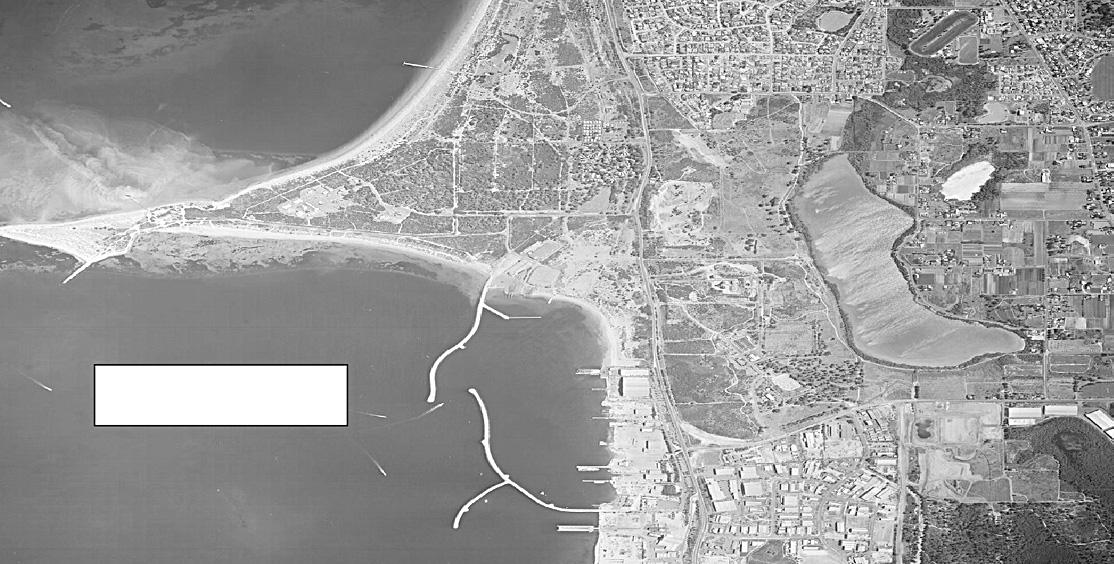
We performed our first large-scale inter-
several research teams are still analyzing
Groundwater Discharge and Its Influ-
comparison (Nov. 25-Dec. 6, 2000) at
samples, developing models, collating
ence on Coastal Oceanographic Proces-
Cockburn Sound, located in the south-
and synthesizing their results, enough
ses") is co-sponsored by LOICZ. The
west margin of continental Australia,
information is now available for a "first-
group quickly recognized the need to
near metropolitan Perth and Fremantle
look" at some results. More detailed
define further and improve the methodo-
(Figure 2). Cockburn Sound is a marine
presentations of each of the data sets,
logies of SGD assessment. One mecha-
embayment protected from the open
including hydrogeological modeling
nism towards this end is to conduct a
Indian Ocean by reefs, a chain of islands
results, will be forthcoming.
series of SGD assessment intercompa-
and a man-made causeway. The area has
Several manual seepage meter measure-
rison experiments. Additional support
recently been the subject of extensive
ments were made each day of the experi-
has now been obtained from the Inter-
environmental assessment in order to
ment for each of the 8 "Lee-type" meters
governmental Oceanographic Commis-
address strategic environmental mana-
deployed along the two transects (4
sion (IOC) to organize a series of these
gement and the management of waste
meters on each transect). A traditional
experiments in different hydrogeologic
discharges into Perth's coastal waters.
seepage meter is simply an open-ended
environments over the next several years.
Cockburn Sound itself is flanked on its
chamber (top or bottom section of a 55-
The sites will be selected based on a
eastern margin by a low-lying sandy
gallon oil drum) implanted open-end
variety of criteria including logistics,
coastal plain. Much of Perth's commer-
down into the sea bed with a small ope-
background information, amount of SGD
cial and industrial activity is focused
ning on the top of the chamber for instal-
expected and hydrological and geological
along the southern metropolitan coast-
lation of plastic collection bags. The col-
characteristics. Each intercomparison
line and includes the shoreline of Cock-
lector bags are deployed over measured
exercise will involve as many methodo-
burn Sound. Influx of pollutants to the
time intervals to assess the volume of
logies as possible including various
nearshore marine environment from
water displaced via seepage. Once
modeling approaches, "direct" meas-
these activities has been a point of major
several measurements are taken, the
urements (seepage meters of varying
concern in recent years and SGD has
results are pooled as a "daily average"
design, piezometers), natural tracer stu-
been recognized as an important path-
and integrated by distance offshore to
dies (radium isotopes, radon, methane),
way for contaminants. Accordingly, a
obtain estimates of total seepage per
and possibly artificial tracers (SF
meter shoreline (Figure 3). Once this
6, 18O-
significant amount of baseline environ-
enriched water).
mental information has been gathered
has been done, it is a simple matter to
over the past 20 years. The primary site
estimate discharge into a designated area
(100 m wide in this case). A dramatic
improvement in seepage meter design
has been achieved by automating the
measurement process by either heat-
pulse (Taniguchi and Fukuo, 1993) or
acoustic Doppler technologies (Paulsen
et al., 1997). These automated systems
were deployed during the intercompa-
rison as well with specific discharge
S G D
being recorded on 15-minute intervals.
I n t e r c o m p a r i s o n
One of the stations in a central portion of
E x p e r i m e n t
the experimental area was equipped with
a device for continuously sampling near-
bottom seawater and analyzing for
222Rn, a good natural tracer of SGD
Figure 2. Low altitude site map prior to land reclamation of Northern Harbor, Woodman
(high in groundwater, low in seawater,
Point, Western Australia (photo from S. Kruppa).
page 3
LOICZ NEWSLETTER
Table 1. Participants in the SGD assessment intercomparison experiment, Cockburn Sound, Wes-
component).
tern Australia (Nov. 28 Dec. 5, 2000).
Future Intercomparisons
Participants
Affiliation
Activity
Sites for additional SGD assessment
Jeff Turner
CSIRO Land and Water
Logistics
intercomparisons have not been selected
David Herne
Floreat Laboratory
Automatic seepage meters modeling
as yet but serious consideration is being
Tony Smith
Perth, Western Australia
Wayne Hick
given to a coastal plain area on eastern
Long Island (West Neck, N.Y.) where
Bill Burnett
Florida State University
Natural tracers: 222Rn, 226Ra
Mike Lambert
Tallahassee, FL, U.S.A.
Manual seepage meters
there is a tremendous fresh water head
Evgeny Kontar
P.P. Shirshov Institute
Geophysics
driving discharge in addition to tidal
of Oceanology, Moscow
Sampling logistics
pumping of SGD. We also hope to
Makoto Taniguchi
Department of Earth Sciences
Heat pulse automated seepage meters
include at least one volcanically-based
Nara University of Education
Sub-surface thermal gradients
coastal aquifer system (perhaps in
Nara 630-8528, Japan
Hawaii or Japan), a karst system (e.g.,
Henry Bokuniewicz
SUNY Stony Brook
Ultrasonic automatic seepage meters
Sicily, Croatia), and a deltaic system
Chris Smith
Cornell Cooperative
Porewater resistivity measurements
Dan O'Rourke
Ex. Marine Program
(e.g., Venice). It is also planned to
Ron Paulsen
Riverhead, NY, U.S.A.
include coastal management aspects in
Leslie Smith
Dept. Earth & Ocean Sciences
Hydrogeological measurements Modeling
future intercomparisons in order to
Univ. British Columbia
provide coastal planners and scientists
Vancouver, Canada
with the knowledge and some of the
Willard Moore
University of South Carolina
Radium isotopes (223Ra, 224Ra, 228Ra, 226Ra)
Columbia, SC, U.S.A.
tools for assessment of SGD, the
June Oberdorfer
Department of Geology San Jose
Hydrogeological measurements Modeling
invisible pathway between land and sea.
State Univ., San Jose, CA, U.S.A.
Dr. Georgia Destouni
Royal Institute of Technology
Hydrogeological measurements Modeling
Acknowledgments
Carmen Prieto
Water Resources Engineering
The participants gratefully acknowledge
Stockholm, Sweden
the very helpful support of the Perth labo-
Geoff Garrison
Dept. Geology & Geophysics Univ.
222Rn, 226Ra, Cl
ratory of CSIRO Land and Water for their
of Hawaii, Honolulu, HI, U.S.A.
generous personnel and logistical sup-
Charlene Grall
RSMAS
He isotopes, 3H fluorocarbons
Zafer Top
University of Miami
port. The working group is sponsored by
Jim Happell
Miami, FL, U.S.A.
the Scientific Committee on Oceanic
Steve Krupa
South Florida Water Management
"Krupaseep" automatic seepage meter
Research (SCOR) and the Land-Ocean
Cynthia Gefvert
District Palm Beach, FL, U.S.A.
Water quality sensors
Interactions in the Coastal Zone
Mandy Krupa
(LOICZ) project of IGBP. Scientific sup-
Sydney T. Bacchus
Institute of Ecology Univ. of Georgia
Seepage meter measurements Geophysics
port for some of the measurements made
Chari Patariachi
Centre for Water Research,
CDT Profiling of offshore
during the Cockburn Sound intercom-
Univ. Western Australia.
marine water column
parison was provided by grants to WCB
Thomas Stieglitz
James Cook University
Geophysics: seismic profiling,
Townsville, Australia
conductivity probes
from the Office of Naval Research
(N00014-00-0175) and Florida Sea
conservative). The monitor measures
(Figure 4) and show higher concen-
Grant (R/C-E-42) and to WSM from
total 222Rn from a continuous stream of
trations during the lowest tides, a feature
the National Science Foundation
water brought to the surface via a sub-
we have noted elsewhere. Both the radon
(OCE-9712298).
mersible pump (Burnett et al., 2001).
record and the seepage meter results are
Grab samples of seawater were also
suggestive of a strong tidal influence on
collected from the same location at
the transient magnitude of the SGD flux.
various times and analyzed by conven-
We applied a 1-dimensional advection-
Table 2. Comparison of discharge estimates via
integrated seepage meter and radon measure-
tional radon emanation techniques with
diffusion model (Cable et al., 1996) to
ments. The discharge values represent flow into a
results very close to those provided by
account for the observed radon inven-
10,000m2 domain.
the continuous monitor. The radon
tories by estimated an upwelling rate for
Date
Lee
Radon
Remarks
data shows a pattern generally similar to
the radon-enriched groundwater. These
meter
monitor
that of the automated seepage meter
estimates agree well with the integrated
daily rate
daily rate
seepage meter values (Table 2). The see-
11/27/00
0.17
page meter estimates may be somewhat
11/28/00
0.17
0.15
higher because the measurements were
all made during the day, coinciding with
11/29/00
0.22
0.15
the low tide (higher seepage) intervals.
11/30/00
0.22
0.14
The hydrogeologic modeling results are
12/1/00
0.24
0.19
not available as yet. Rough Darcy's Law
12/2/00
0.26
0.19
calculations indicate much lower appa-
12/3/00
0.21
0.09
Lost 6
rent flow than that based on the seepage
hrs data
meter or tracer studies. This may be an
12/4/00
0.16
At Rn
Figure 3. Manual seepage meter results for
indication that recirculated seawater
peak
November 28, 2000, Cockburn Sound. The two
plays an important role in this
12/5/00
0.16
trends correspond to the west (integrated flux =
environment (the simple modeling
2.2 m3/m.d) and east (2.7 m3/m.d) transects,
12/6/00
0.41
Only 4
would account for only the freshwater
respectively.
hrs data
page 4
LOICZ NEWSLETTER
Author address list:
relative sea-level data sets, which in part,
1. Department of Oceanography,
indicate that relative sea-level has been
Florida State University,
non-linear and has fluctuated about the
Tallahassee, FL 32306, U.S.A.;
modelled long-term Post-Glacial hydro-
wburnett@mailer.fsu.edu
isostatic sea-level history. Factors influ-
2. International Atomic Energy Agency,
encing the non-linearity are: local verti-
Isotope Hydrology Section, Vienna,
cal movements of the land through
Rn (dpm/L) m
Austria; J.V.Turner@iaea.org
tectonic processes; small eustatic
222
contributions from fluctuations in global
ice volume; and the impact of small
PAGES-LOICZ Workshop on Coas-
climate fluctuations on ocean tempe-
cm/d
tal Records of Sea-Level and Climate
ratures and salinity, which affect the
Variability over the last 2000 years
ocean density and steric sea-level. The
Time/Date 2000
recognition that the field-derived
I. Goodwin1, N. Harvey2, O. van de
relative sea-level records describe varia-
Figure 4. Temporal variation of (a) tidal height;
(b) radon concentration; and (c) specific discharge
Plassche3, R. Oglesby4, and F. Oldfield5
bility not explained by the post-glacial
during the time period Dec. 2 1200 to Dec. 5 0900.
isostatic adjustments alone indicates that
Data for specific discharge measured at one loca-
Recently the IGBP core projects on Past
both the tectonic effects, and the climate
tion via an ultrasonically-based automatic seepage
Global Changes (PAGES) and LOICZ
forcing of multi-decadal to centennial
meter on a 15-minute schedule (Smith, Paulsen,
sponsored a workshop to: examine the
sea-level fluctuations may indeed be
and O'Rourke, unpublished).
characteristics, temporal resolution, geo-
significant. This underscores the need
References
graphic coverage and forcing of
for high-resolution sea-level studies for
Buddemeier, R.W. (ed.) 1996.
relative sea-level histories for the last
the past 2000 years.
Groundwater flux to the oceans: defini-
1-2000 years; to assess existing
tions, data, applications, uncertainties.
geochronological control of sealevel
An expanding archive of paleoclimate
In: Proceedings, "The International
histories and the application of new
data spanning the last few thousand
Symposium on Groundwater Dischar-
or developing geochronological tech-
years has enabled researchers to
ges to the Coastal Zone"
niques; and, to review the paleoclimate
conclude that significant regional, and
LOICZ/R&S/96-8, iv+179 pp. LOICZ,
archive spanning the last 1-2000 years.
perhaps hemispherical climatic fluc-
Texel, The Netherlands.
tuations have occurred on multi-decadal
Burnett, W.C., 1999.
Over 30 scientists, including, coastal
and centennial timescales during the last
Offshore springs and seeps are focus of
geologists and geomorphologists, clima-
few thousand years. Critical to future cli-
working group. EOS, 80, 13-15.
tologists and oceanographers with both
mate and sea-level predictions, is the
Burnett, W.C., G. Kim,
modern and palaeo specialisations, and
extent to which these climatic fluc-
and D. Lane-Smith, 2001.
ocean and geodynamic modellers partici-
tuations have affected decadal to
A continuous radon monitor for use in
pated in the workshop. The workshop
centennial sea-level and coastal
coastal ocean waters. Jour. Radioanal.
participants had strong geographic
evolutionary response over the past
Nucl. Chem., in press.
research foci on the tropical Pacific and
2,000 years. Whilst the sea-level
Cable, J., G. Bugna, W. Burnett,
Indian Ocean regions, and on the North
anomalies are likely to be on the order of
and J. Chanton, 1996.
Atlantic Ocean region.
ca. 0.5 to 1.0 m, this magnitude is
Application of 222Rn and CH4 for
critical to the habitation of many small
assessment of groundwater discharge
Sea-level rise as a consequence of
island states and low lying continental
to the coastal ocean. Limnol. Oceanog.
`Greenhouse induced' global warming
regions. Reciprocally, spatial and
41, 1347-1353.
has been a major focus of global change
temporal variation in high-resolution
Johannes, R.E., 1980.
science for the last 2 decades. The main
paleo sea-level records is relevant to the
The ecological significance of the sub-
approach has been to test climate-forced
study of ocean-atmosphere interactions.
marine discharge of groundwater.
sea-level models by comparing model
Mar. Ecol. Prog. Ser. 3, 365-373.
results with regional or global averages
Key conclusions from the workshop,
Moore, W. S., 1996.
of sea-level rise based on multi-decadal,
which provide the foundation for the
Large groundwater inputs to coastal
and in a few cases, centennial tide-gauge
future development of the project,
waters revealed by 226Ra enrichments.
records corrected for local crustal move-
include:
Nature 380, 612-614.
ments which in turn are based on millen-
· That coastal responses to climate
Paulsen, R.J., C.F. Smith,
nial-scale records of relative sea-level
forced sea-level variability can be
and T.-F. Wong, 1997.
change. The majority of the multi-deca-
detected at a sub-decadal to millennial
Development and evaluation of an
dal instrumental records are inherently
scale, in the period since the post-gla-
ultrasonic groundwater seepage meter.
noisy (± 0.3 m) due to sub-decadal and
cial sea-level highstand was attained;
In: "Geology of Long Island and
decadal variability in ocean temperature,
· That fluctuations in sea-level over the
Metropolitan New York," 88-97.
salinity fields and circulation (any of
last few millennia are the same magni-
Taniguchi, M. and Y. Fukuo, 1993.
which can affect density and hence local
tude as that are predicted for the future,
Continuous measurements of ground-
sea level). This variability is induced by
under `Greenhouse conditions';
water seepage using an automatic
atmospheric and oceanographic pheno-
· That empirical fluctuations are not pre-
seepage meter.
mena such as ENSO and the NAO.
sently captured by numerical model-
Ground Water, 31, 675-679.
Field research has continually produced
ling; and
page 5
LOICZ NEWSLETTER
· That scientific techniques are develo-
4. Department of Earth and Atmosphe-
Recommendations
ping which will enable the separation
ric Sciences, Purdue University, West
· Global mapping of sediment sources
of climate-forced sea-level changes
Lafayette, Indiana 47907, U.S.A.
and/or sensitivity to disturbance; to
from the cumulative or integrated sea-
5. PAGES IPO, Barenplatz 2, CH-3011
allow for a better understanding of the
level curve.
Bern, Switzerland.
affect of change on the system.
· Creation of an index to understand
The project, entitled, "Coastal Records of
IGBP Water-Sediment Workshop
sediment transit times within basins.
Sea-Level and Climate Variability over
This needs inclusion of smaller river
the last 2000 Years", will contribute to
A subset of IGBP Water Group (repre-
basins, as transit times are expected to
overall sea-level studies by yielding
sentatives from BAHC, LOICZ,
be much shorter than that for the
critical data from which a global sea-
PAGES) augmented by selected invitees
larger rivers. This infers that changes
level budget for the last 2,000 years can
met at the Institute of Arctic and Alpine
occur much more rapidly in smaller
be refined. It is anticipated that the
Research, University of Colorado,
basins than larger ones.
project will develop a focus on glacio-
Boulder 25-27 September 2000. The
· Determination of how long before
eustatic contributions in the future, but its
workshop participants discussed anthro-
river loads fill up the terrestrial sedi-
present focus will remain on resolving
pogenic influences at the global scale, on
ment traps, and what the subsequent
the influence of decadal to centennial,
the supply and flux of sediment along
impacts will be downstream (e.g. the
ocean thermal and circulation changes on
hydrological pathways. Key issues inclu-
coastal zone).
steric sea-level. Field projects will be
ded:
· Research the balance between increa-
focused on both expanding the spatial
sing and decreasing sediment loads
coverage or relative sea-level histories
1. Sediment flux to the coast,
due to man and/or climate change.
and refining the existing relative sea-
presently, in the past, and under pris-
· Coastal sediment budgets need to be
level histories at key geographic
tine conditions.
linked to terrestrial sediment budgets;
locations to achieve at least 0.5-1.0 m
River systems evolve through time, and
to allow a bridge between the data
resolution in the sea-level archives. The
as such the modern river systems are
from upstream gauging station and the
tectonic history at each site will be a key
strongly influenced by past conditions
coastal ocean, taking into account the
area for research, and particularly, the
within the watershed as well as modern
interaction within estuaries.
resolution of pre- and post-seismic
conditions. Understanding the discharge
tectonic adjustments.
of sediment across a broad time-scale
A full report will be published as a
will allow us to make better predictions
special issue of Global and Planetary
The workshop was held at the East West
for the future. The trapping efficiency of
Change.
Center, University of Hawaii, Honolulu,
terrestrial reservoirs, both man-made
6-8 November 1999, in conjunction with
and natural, is important to understan-
CMTT Progress and "Synthesis"
the IGCP 437 symposium on `The Non-
ding the future discharge of sediment to
Steady State of the Inner Shelf and Shore-
the coastal oceans.
The Continental Margin Task Team (a
line: Coastal Change on the Time Scale of
1.1 Present Flux to Coast
joint LOICZ/JGOFS) effort has been tas-
Decades to Millennia in the Late Quater-
Current estimates put the annual sedi-
ked with assessing the fluxes of major
nary'. Abstracts from the PAGES-LOICZ
ment flux to the global ocean between 18
biogenic elements in continental margins
workshop and further information about
x 10 9 to 24 x 10 9 metric tons
relevant to climate change. The product
the project can be obtained from Dr Ian
1.2 Paleo Flux and Pristine Conditions
of the assessment will be a synthesis
Goodwin,Ian.Goodwin@newcastle.edu.
Fluvial systems evolve along with the
book supported by IGBP.
au. A full workshop report by Goodwin et
landscape, and much of the sediment
al. (2000) was published in EOS.
yield we see today is influenced by the
The CMTT has divided the task up into
paleo-systems.
sub-groups: eastern and western boun-
References
1.3 Future Sediment Flux
dary systems, polar margins, tropical
Goodwin, I., Harvey, N., van de Plassche,
The main understanding needed is the
margins and marginal seas.
O., Oglesby, R. and Oldfield, F. (2000).
balance of increased sediment versus
Prospects for resolving climate-
decreased sediment due to the influence
The eastern and western boundary
induced sea level fluctuations over the
of man and/or climate change biological
systems group met in November 2000 in
last 2,000 years.
consequences such as burial of benthic
Norfolk, Virginia, USA with Larry At-
EOS, Transactions, American Geophy-
biota.
kinson as local host and Renato
sical Union 81 (28), 311-312
1.4 Sediments in River Basins
Quinones and Larry as co-hosts. Atten-
It is understood that the erosion of bed-
ding the meeting were the following:
Author address list:
rock by rivers takes place almost entirely
Larry Atkinson (USA), Renato Quinones
1. School of Geosciences, University of
in the headwaters of the catchment. This
(Chile), Francisco Chavez (USA), Lei
Newcastle, Callaghan NSW 2308
newly eroded sediment must then be
Chou (Belgium), Lou Codispoti (USA),
Australia.
transported to the coastal zone. How
George Cresswell (Australia), Richard
2. Department of Geographical and
long it takes for this transport and how
Jahnke (USA), K. K. Liu (Taiwan), John
Environmental Studies, The Univer-
sediment makes the journey are the two
Moisan (USA), Pedro Monteiro (South
sity of Adelaide, Australia 5005.
important questions
Africa), and Wajih Naqvi (India).
3. Faculty of Earth Sciences, Vrije Uni-
2.
Global Change & Sensitive Areas
versiteit, De Boelelaan 1085, 1081
3.
Data - Typology (upscaling, down-
The outcome of the meeting was the
HV Amsterdam, The Netherlands.
scaling)
design of the synthesis chapter and
page 6
LOICZ NEWSLETTER
recommendations to LOICZ and JGOFS
Biogeochemical Budgets and
highlight applications beyond the LOICZ
regarding issues of coverage.
Typology
purpose and ancillary tools to assist use.
The further development of estuarine and
Great interest (and developmental sup-
Workshops on polar seas hosted by
coastal biogeochemical budgets, follo-
port) is being shown in the LOICZ typo-
Robbie McDonald (Canada) and
wing the LOICZ approach, gained furt-
logy initiative by scientists, environmen-
marginal and tropical seas hosted by
her impetus through several recent
tal managers and policy agencies. Some
K. K. Liu are being planned.
workshops. With UNEP and EU support,
of these developments and applications
a workshop was held in Athens (February
can be seen and accessed at http://www.
Land Interactions in the Russian
2001) which addressed the Mediterra-
kgs.ukans.edu/Hexacoral/.
Arctic
nean and Black Sea region. More than a
The third LOIRA workshop held at in
dozen C-N-P budgets for sites in North
BASINS Developments and Status
Moscow, Russia (5-8 December 2000)
Africa, from Spain to Turkey and within
The LOICZ BASINS project continues
provided an exciting new window into
the Black Sea were developed, ranging
to address coastal change issues from the
research findings relating to the Arctic
from systems of a few km2 to large seas.
perspective of the sustainable manage-
coastal zone of Russia. Despite the onus
The participants continue to evaluate
ment of river catchments or islands. The
and time conflicts enforced by end-of
further sites. The participants spent time
aim is to develop and apply a set of
year reports, the workshop was attended
considering the LOICZ typology appro-
methods and tools to assess coastal state
by more than 50 LOIRA and other
ach and its application for a variety of
changes and to make predictions of
related scientists plus interested
scientific purposes, including use as a
future trends under various natural and
members of the Institute of Oceanology.
tool in assisting the further synthesis of
human forcing of the water cascade.
ELOISE project outcomes.
BASINS regional assessment workshops
Natural science issues ranged across river
are integrating scientific information on
catchment science to river and estuarine
The workshop contributed to the regional
how coastal change reflects catchment-
fluxes and processes to coastal seas of the
series that has been supported by UNEP
based pressures.
Arctic Ocean. Geographical distribution
GEF over the last 18 months, wherein
of work extended across the entire polar
training and use of the LOICZ budgetting
Catchments are dynamic. In the short
coast including the Barent, Kara and East
approach has been coupled with the deli-
term, scientific tools are needed to help
Siberian Seas and their subsidiary sea ele-
very of budget sites in regions of the
predict the impact of point sources of
ment, notably the Pechora, Laptev and
world (Latin America, South East Asia,
nutrient or chemical loads (e.g., the
White Seas. Characteristics of river flows,
East Asia, South Asia, Sub-saharan
Romanian cyanide accident), and sud-
loads and changes were considered in
Africa). The LOICZ biogeochemical
den events like weather extremes (e.g.,
light of earlier evaluations. Advances in
modelling project now has in excess of
the recent weather extremes in the UK
coastal and deltaic biogeochemical pro-
180 sites described (http://data.ecology.
and southern Europe). Equally impor-
cesses in major systems were described
su.se/MNODE/), with additional sites
tant is the prediction and assessment of
with new information on seasonal charac-
continuing to be contributed from the
long term changes of pressures (e.g.,
teristics or winter and summer conditions.
global research community. A proposed
population growth/migration, land use
A joint German-Russian program stu-
Polar region workshop later this year is
change, urbanisation) that impact on
dying the Laptev Sea provided new infor-
expected to give further insights into the
material fluxes along the water pathways
mation on coastal circulation and material
latitutdinal performance and characteris-
and ultimately affect coastal goods and
transport, particularly demonstrating use
tics of coastal systems.
services and environmental health.
of an acoustic in situ sensor whose results
BASINS analyses also provide insights
raised some tantalising questions about
The UNEP GEF project supported the
into policy responses, such as :
linked biology and physical processes
first "integration" workshop held in Bris-
under surface ice conditions. The Pechora
bane Australia in January 2001 addres-
- nutrient control and the implementa-
Sea is a major focus for land-ocean
sing the Asian and Australasian regions,
tion of best agricultural practice
studies encompassing nearly every issue
providing training in use and application
- erosion control
familiar to coastal scientists. Socio-
of the LOICZ typology methods. Partici-
- regulation of water - diversion and
economic research and program develop-
pants developed typologies at various
damming
ments also were highlighted here a key
scales to address coastal forcing function
- upgrading of sewage treatment plants
issue is the development of gas and oil
and vulnerability, habitat and estuarine
especially in growing economies
exploration/extraction and how to achieve
distribution, and coastal processes. This
- changes in rural land cover
appropriate wise use of the relevant
work will be extended to the Americas
- regulatory changes in point and dif-
coastal regions to advantage of all stake-
and Africa-Europe regions by two works-
fuse source discharges, and
holders.
hops over the next few months. A final
- the demands of road traffic, tourism.
synthesis workshop will be held later in
The Arctic region is vital to the big
the year to develop a global typology of
These management responses and asso-
picture of global change and earth
estuarine system performance.
ciated long-term investments differen-
system function. The LOIRA plan and
tially influence the ecological status of
the scientific response and enthusiasm is
The typology databases (located at
surface waters and the quality of ground-
strong, and global collaboration is being
University of Kansas) and the LOICZ-
water. To allow global comparison of the
actively sought be Russian researchers.
View methodology (Swarthmore Col-
regional BASINS assesments, emphasis
Contact Dr V.V. Gordeev for more infor-
lege, Pennsylvania) continue to evolve as
is placed on using a standardised proce-
mation (gordeev@geo.sio.rssi.ru).
workshop participants and other users
dure and process for information.
page 7
LOICZ NEWSLETTER
Recent workshops in Europe, South
· What are the major driver/pressure settings cau-
support funding to support participants.
America and Africa (1999-2000) and in
sing coastal impact observed and what are the
East Asia (2001), and current regional
future trends: on catchment level, on sub-regio-
IGBP-SC 2001
nal/island or country level, on regional level?
studies in the Caribbean and Oceania,
The IGBP Scientific Committee held its
4. Assessment and synthesis of scientific and/or
closely follow the DPSIR (Driver-Pres-
policy/management response.
annual meeting in Chiang Mai, Thailand
sure-State-Impact-Response) framework.
· What is the current status of response taken on
20-23 February 2001. Major issues inclu-
scientific or policy/management level against the
ded election of a new Chair, the future of
Taking biogeochemical and socio-
major coastal issues in the region?
IGBP (science and structure), the Amster-
economic factors into consideration, we
5. Assessment and synthesis of gaps in understan-
dam Congress, and status of core project
are developing a descriptive set of ding, hot spots and research needs.
activities.
· What are the major gaps in our current under-
indices to quantify observations and
standing of river catchment coastal sea interac-
expected trends. Coastal impacts/issues
tion in the region of concern and which hot spots
Guy Brasseur (Chair IGAC) was nomina-
and land-based drivers and pressures are
should be addressed in a future integrated scien-
ted for IGBP Chair commencing January
being categorised and ranked for sub-
tific effort/ proposal (natural and socio economic
2002. The Vice Presidents (Bob Wasson,
sequent comparison and upscaling,
disciplines)
Paul Crutzen) will increase their formal
using the LOICZ typology approach.
involvement through identified portfolio
It is intended to apply this approach to all
activities in IGBP.
An example in Europe is the Rotterdam
the BASINS studies, South American
Rhine project dealing with forecasting of
BASINS II in May, Caribbean BASINS
The future of IGBP was discussed at
sediment quality where BASINS provi-
II in June, African BASINS II in August,
length. Major questions about functio-
des a scientific frame for trend analysis
and to an Australasian assessment
ning of the whole Earth system is the
and interdisciplinary catchment scale
meeting in December. The Oceania
theme for future work. The representatio-
approaches against concrete user needs
island assessment desk studie currently
nal model involving three compartments
(http://w3g.gkss.de/i_a/dredged_material/
underway at the University of Adelaide
(land, ocean, atmosphere) and three inter-
index.html).
will follow the same lines. The EURO-
compartmental interfaces (land-atmosp-
CAT project (http://www.iia-cnr.unical.it/
here, ocean-atmosphere, land-ocean),
The BASINS task group (Wim Salomons,
EUROCAT / project.htm) will apply the
adopted at IGBP-SC Cuernavaca in 2000,
Horst Behrendt, Jozef Pacyna, Nicola
BASINS tables to provide a first
forms the basis for the development of an
Pirrone, Kerry Turner, Hartwig Kremer)
European baseline study of our under-
identified IGBP II (Earth Systems
recently confirmed this approach with a
standing of these issues.
Science) Program - to extend for another
set of standardized assessment tables for
10 years fromJanuary 2003.
use in the process of regional syntheses
(usually the phase two BASIN work-
LOICZ IPO Notes
While existing core projects are identified
shops). It was applied in the East Asian
as foci for the further development of
BASINS workshop in Hong Kong (late
LOICZ Synthesis
questions, objectives and structure dis-
February), and provided guidance to
The outline for the LOICZ Synthesis
cussions which will proceed over the next
working group discussions, allowing
Book (1993-2002) [LOICZ Newsletter
18 months, there is a reasonably clear
comprehensive regional overviews in a
No 17, December 2000] has been
recognition that IGBP II will not be a
limited timeframe.
moving forward. Lead authors have been
retrofit of objectives to the existing struc-
refining and developing chapter content
ture. The Oceans futures (with SCOR)
The BASINS assessment tables are distri-
in collaboration with a wide range of
and Terrestrial futures working groups
buted to participants prior to workshops
global scientists. This is not and cannot
will continue in this year to identify the
and finilezed during in the synthesis pro-
be an exclusive exercise. Please accept
key sectoral issues for global questions -
cess. Moving from coastal issues upwards
the challenge to be part of this collective
and are structured to work beyond these
along the river catchment at various spa-
effort and talk with the lead authors
compartment to encompass elements of
tial scales, they follow a sequence of steps
about how you can contribution and
the interfaces. The refined SOLAS
guided by a set of key questions:
become part of the wider team.
project has been approved (jointly by
SCOR and IGBP-SC) as the basis for the
1. Assessing Issues/Impacts (critical thresholds)
LOICZ plans to hold a "Synthesis
ocean-atmosphere interface; a land-
based on coastal change in the region.
Science Meeting" in early-middle May
atmosphere core project is mooted. IGAC
· What are the major impacts (coastal issues) on/in
next year. This is seen as a mini-Open
will lead towards middle and upper
the coastal zone and do we know anything on
Science Meeting to which we will invite
atmosphere questions.
· How close they are to a critical threshold of sys-
key people from within and outside the
tem functioning?
LOICZ community, and all other inte-
LOICZ was identified - and clearly
2. Assessment and synthesis of major Drivers/ Pres-
sures generating the coastal Impact/Issues.
rested people to attend. The core of the
expected by the SC - to continue beyond
· What are the major (up to 10) driver/ pressure set-
meeting would be presentation of the
2002 as the focus for land-ocean inter-
tings on catchment level causing coastal change?
highlights of the draft synthesis chapters
actions, noting that new/additional
· Can we identify spatial scales on which certain
and, through working groups, we would
questions and an appropriate structure
driver/pressure settings dominate coastal issues?
aim to address gaps and start to
would need be evolved. This is a chal-
3. Assessment and synthesis of regional
develop an across-project synthesis (for
lenge that will be addressed, initially, by
Driver/Pressure settings generating the coastal
Chapter 7). The IPO will start making
the LOICZ SSC through development in
Impact/Issues and expected trends in a hierarchical
upscaling approach.
arrangements for the meeting over the
this year of a discussion paper. Also,
next few months, including additional
LOICZ is investigating sponsorship
page 8
LOICZ NEWSLETTER
arrangement with several agencies and
LOICZ Web Site: Typology (http://
18-20 June 2001, Halifax, Nova Scotia,
national governments which have pre-
water.kgs.ukans.edu:8888/public/
Canada. More information on
viously indicated an interest in being co-
Typpages/index.htm) Also (www.kgs.
http:\\agc.bio.ns.ca/coastgis2001
sponsors of the core project.
ukans.edu/Hexacoral/Workshops)
IGBP Open Science Conference.
10-14 July, 2001, Amsterdam, The
LOICZ sponsors
Netherlands. Contact: igbp@congrex.nl,
LOICZ CALENDAR
The committee of Dutch core funders of
www.sciconf.igbp.kva.se
LOICZ met in late January to review our
3rd International Conference on Land
status and progress. The committee was
LOICZ UNEP Americas thematic
Degradation and Meeting of the IUSS
positive and greatly encouraged by our
workshop on upscaling and assessment
SubcommissionC Soil and Water Con-
performance and direction.
of nutrient fluxes in coastal estuarine
servation. 17-21 Sept 2001, Rio de
systems. 29 April2 May 2001.
Janeiro, Brazil. More information on
Farewell to SSC member
Ensenada, Mexico (by invitation).
www.cnps.embrapa.br/icld3/
Dr Silvia Ibarra Obando has finished her
Contact: LOICZ IPO.
IAPSO-IABO Assembly and XII Col-
6 year term on the LOICZ SSC. Howe-
SAMBAS II workshop on South Ameri-
loquium: 2001 - An Ocean Odyssey.
ver, she will remain in close contact with
can Basins and Caribbean river catch-
21-28 October 2001, Mar del Plata, Ar-
LOICZ, and will be contributing to the
ments/coastal fluxes and human dimen-
gentina. Contact: gmperill@criba.edu.ar
LOICZ Synthesis book.
sions. 2-6 May 2001. Fortaleza.Brazil.
or iado@criba.edu.ar
(by invitation). Contact: LOICZ IPO.
Global Conference on Oceans and
Correction and apology
LOICZ UNEP Africa and Europe the-
Coasts at Rio+10: Assessing Progress,
Dr Han Lindeboom's correct email
matic workshop on upscaling and as-
Addressing Continuing and New Chal-
address is:
sessment of nutrient fluxes in coastal
lenges. 3-7 December 2001. UNESCO,
H.J.Lindeboom@Alterra.wag-ur.nl
estuarine systems. 2-5 July 2001. RIKZ-
Paris. Contact IOC Secretariat, Paris.
Please note the error in LOICZ News-
CZMC, The Hague, The Netherlands (by
IAS/SEPM Environmental Sedimento-
letter No.17 December 2000.
invitation). Contact: LOICZ IPO.
logy Workshop: Continental Shelves
LOICZ Scientific Steering Committee
Processes, Record, Utilization and Mana-
Meeting. 7-8 July 2001, Amsterdam.
gement. 7-10 January 2002. Hong Kong.
HAVE YOU SEEN
Contact: LOICZ IPO.
Contact Wyss Yim (wwsyim@khu.hk).
AfriBASINS II workshop on African
The CD-ROM on Arctic river gauges for
river catchments/coastal fluxes and
IPO STAFF
all major river basins.:
human dimensions . August 2001.
Lammers, R.B., Shiklomanoz, A.I. com-
Nairobi, Kenya (by invitation).
pilers, 2000. R-ArcticNet, A Regional
Contact: LOICZ IPO.
CHRIS CROSSLAND
Hydrographic Data Network for the
LOICZ-UNEP Polar regions workshop
Executive Officer
Pan-Arctic Region. Durham NH: Water
on biogeochemical modelling of
HARTWIG KREMER
Systems Analysis Group, Univ. of New
estuarine systems. Tromso, Norway.
Deputy Executive Officer
Hampshire, distributed by the National
September, 2001. (tentative)
HESTER WHYTE,
Snow and Ice Data Centre (nsidc@kryos.
LOICZ UNEP Global thematic work-
Office Manager
colorado.edu).
shop on upscaling and assessment of
MILDRED JOURDAN,
nutrient fluxes in coastal estuarine
Office Assistant
systems. 5-9 November, 2001. TBA.
MAARTEN SCHEFFERS
LOICZ PUBLICATIONS
Austral-AsiaBASINS workshop on
Liaison Officer
Australasian and Southeast Asian river
[Available as printed copies or from the
catchments/coastal fluxes and human
F
LOICZ web site: www/nioz.nl/loicz]
dimensions. Australia, December, 2001
OR MORE INFORMATION,
(tentative)
PLEASE CONTACT:
Estuarine Systems of the East Asian Re-
LOICZ "Synthesis" and Open Science
gion: C, N, P Fluxes, 2000. LOICZ UNEP
Meeting. May 2002. TBA.
LOICZ INTERNATIONAL PROJECT
workshop report. Eds. V. Dupra, S.V.
OFFICE
Smith, J.I. Marshall Crossland and C.J.
NETHERLANDS INSTITUTE FOR
Crossland. LOICZ R&S no. 16, 2000.
OTHER MEETINGS
SEA RESEARCH
PO BOX 59
SARCS-WOTRO-LOICZ: Biogeochemi-
GEOTROP 4th Internat'l Conference on
1790 AB DEN BURG - TEXEL
cal and Human Dimensions of Coastal
Environmental Chemistry & Geoche-
THE NETHERLANDS
Functioning and Change in Southeast
mistry in the Tropics. 7-11 May 2001,
Asia. LOICZ R&S No. 17, 2001.
Townsville, Australia. Contact: Greg
PHONE: 31-222 369404
Brunskill (g.brunskil@aims.gov.au) or
F
LOICZ Web Site: Biogeochemical Bud-
www.tvl.clw.csiro.au/geotrop2001/
AX:
31-222 369430
gets and Modelling new sites and tuto-
CoastGIS 2001: 4th International Con-
E-MAIL: LOICZ@NIOZ.NL
rial materials (http://data.ecology.su.se/
ference on Computer Mapping and GIS
WWW HOME PAGE:
MNODE?).
for CZM Managing the Interfaces.
HTTP://WWW.NIOZ.NL/LOICZ/
A CORE PROJECT OF THE
I
G
B
P
INTERNATIONAL GEOSPHERE-BIOSPHERE PROGRAMME