LAND-OCEAN INTERACTIONS IN THE COASTAL ZONE
June 2000
No. 15
LOICZ NEWSLETTER
Typology: Low-budget
Remote Sensing
Robert W. Buddemeier
and Bruce A. Maxwell
Background and Concepts
Suppose that we contracted with a
group of very clever engineers to
build a satellite from off-the-shelf
parts that would return a signal sen-
sitive to the carbon, nitrogen, and
phosphorus fluxes in the various
parts of the world coastal zone.
The satellite is built, launched and it
This is the fifteenth newsletter
successfully returns lovely images
of the Land Ocean Interactions
in shades of red, green, blue, and
in the Coastal Zone (LOICZ)
various combinations. A great suc-
International Project of the
cess -- as soon as we know what
IGBP. It is produced quarterly
the colors mean! To make use of
to provide news and information
this information, we must have
regarding LOICZ activities.
ground truth -- actual on-the-ground
and in-the-water measurements of
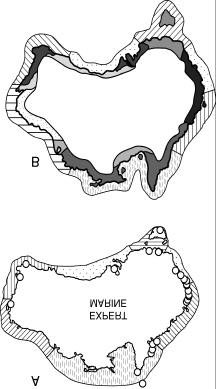
the processes that are represented clustering software (3), described Figure 1: An Australian example -
indirectly by colors from the sky.
expert typologies developed for the
below.
marine (A) and terrestrial (B) coastal
Once we have measured what is
environments (reference 9). Circles
represented by the various colors If there is such a good model for indicate the location of budget sites.
and combinations, we can con- what we are doing, then why does it
struct algorithms to interpolate and generate so much confusion? First, accustomed to evaluating "science"
extrapolate the images to the times "typology" (study of, or analysis or by its reliance on testable hypothe-
and places where we have not classification based on, types) is ses and an ever-increasing number
made measurements.
not a common term in the jargon of of high-tech measurements of
the scientific disciplines involved. greater and greater precision.
This is a good analogy for the It's a perfectly good English word, However, a rigorous, linear engi-
LOICZ approach to determining the but not one that conveys mental neering approach to earth system
global-scale biogeochemical func- images the way 'taxonomy' does, problems is simply not feasible in
tion of the coastal zone. The Bio- for example. Second, we haven't many cases. We suffer from a glut
geochemical Modelling (1) activity actually done it all the way yet, so of information and a dearth of un-
is the ground-truth acquisition pro- we don't have any complete exam- derstanding, and if we are to grasp
cess, collecting, interpreting, and ples to point to. And, third, we are the holistic nature of large, complex
comparing CNP budgets from doing it backwards. We are collect- systems we must explore them in
coastal sites around the world. The ing the ground truth first, wherever breadth as well as in depth. Hence
Typology effort (2) is the satellite we can, and then we will devise the strategy to use available data
analogue -- viewing the world from through typology an image genera- (since there is much available and
a conceptual distance, on the tor that will produce a generalizable neither time nor money to collect
bases of bands of information rep- context (the analogue of the re- more), and to search for the pat-
resented by globally available envi- motely sensed image) for the avail- terns and connections within.
ronmental databases. To extend able ground truth.
the analogy even further, the inter-
So Typology will divide the world
pretative algorithms are to be pro- This process may seem rather im- coastal zone into land, coast and
vided in large part by the LoiczView precise and untidy in a world grown sea cells half a degree on a side,
page 2
LOICZ NEWSLETTER
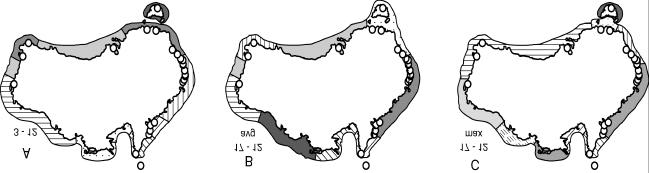
Figure 2: Australia as clustered by the LoiczView approaches described in the text; see text for description of variables.
(A) Results using the mean scaled distance and 3 hydrologic variables; (B) Mean scaled distance and 17 variables; (C)
Maximum scaled distance and 17 variables. Note: The maps do not show 12 clusters because (1) small and/or highly
fragmented clusters were omitted for visual clarity; and (2) New Zealand was included in the clustering experiment, but
is not shown here. Symbols are used to distinguish and relate the classes, and do not indicate identity between figures.
and will populate those cells with the coastal research community will life in the environmental sciences.
data on dozens of variables ranging develop and test alternative ap- It also includes features that permit
from air temperature to population proaches, we also recognized that selection of number of clusters,
density and from bathymetry to soil achieving the LOICZ goals on a number of iterations, distance mea-
texture. Then various populations credible time scale means selecting sure, and visualization options. The
of cells will be statistically clustered and applying some consistent last two features are particularly
to identify similarities and differ- method. Our choice is the useful for interpretation and tuning
ences -- which will in turn be exam- LoiczView geospatial clustering of the process. The distance mea-
ined for their ability to explain or software package (3), developed by sure issue is discussed below; the
describe the distribution of types of Bruce Maxwell specifically for this visualization option uses a color
biogeochemical budgets in the application. The software currently similarity algorithm that relates the
coastal database. Once data se- runs on UNIX and LINUX platforms, colors of the mapped clusters to the
lection, weighting and tuning have and is being adapted for deploy- statistical distance between them
resulted in a set of typologies that ment on the Internet.
(e.g., red and pink similar, red and
are robustly predictive of the bud-
blue very different) (6). A support-
gets, we will start the process of Traditional approaches to typology ing technique, the use of minimum
extrapolating to regional and global development are top-down and description length and error, has
coast zone function.
bottom-up:
been developed to identifty the opti-
In a top-down approach, experts mal number of clusters for a given
Overall, the process is reminiscent design a decision tree based on data set (7)
of the classical approaches to sci- different variables and variable
entific exploration. Darwin did not ranges that seem appropriate for In the top-down typology approach,
board the Beagle with an engineer- the environment being considered, the result is completely dependent
ing design and a set of testable apply this scheme to a data set, and upon expert decisions. Since this is
hypotheses for the theory of natural iteratively refine the classifications. the first time a quantitative upscal-
selection -- he arrived at his grand A variation on this approach is to ing of coastal function has been
formulation as a parsimonious and have experts classify a training set attempted, we quickly recognized
convincing model for the way the for a pattern classifier and then that there are no total experts on
world works. To do so, he assimi- have the pattern classifier "learn" whose judgment we can unques-
lated large amounts of information the classes from the training set tioningly rely. The bottom-up ap-
(his personal observations are an and generalize the classification proach, which we have adopted,
analogue for the global data bases strategy to unseen data.
incorporates a more realistically
in our case) and brought it to bear In the bottom-up approach, a clus- achievable level of expert judgment
on specific phenomena (type bud- tering method is used to determine by developing tools to combine bio-
gets are for us what Galapagos groups of similar data points which geochemical and related areas of
finches were for Darwin). We are then form standard classes. Tradi- expertise with the critical statistical
not necessarily suggesting that the tional clustering methods include and analytical decision making.
21st Century analogue of The Origin agglomerative clustering and the Apart from the obvious issue of
of Species will appear in the LOICZ K-means clustering algorithm, also choice of variables, a typology is
Reports and Studies series, but we known as Vector Quantization [VQ] affected by two major factors, both
do expect that many new insights (4)(5).
of which can be guided by expert
will be gained on our way to the
input. First, how many classes
global budget estimate.
The LoiczView package uses the should there be in the typology?
VQ approach, and is specifically Second, how do we measure simi-
A tool for the job: LoiczView
designed for application to high- larity between data points? The
We recognize that there are many dimensionality data sets (many second is especially important
possible ways, both conceptually variables) with imperfect coverage when we consider multi-
and methodologically, to classify -- missing data and non-normal dis- dimensional heterogeneous
and extrapolate coastal characteris- tributions are an unfortunate fact of vectors--data points that have multi-
tics. While we profoundly hope that
ple variables with different ranges,
page 3
LOICZ NEWSLETTER
variances, and meanings. Cluster cal sense (vary in a reasonable way same symbol are actually the
separation can be judged either on over the data set); and 3. was the same) Despite the differences in
the basis of the distance between variable a natural 'forcing function' variables and methods used for the
the means of the scaled vectors, or that would reasonably be expected typologies, the general form of the
on the maximum difference in any to influence biogeochemical pro- different classes is similar, with our
variable in the set. The results are cesses without giving too strong a data-driven typology showing more
related, but lend very different weight to any one aspect of the detail in terms of local phenomena
weights to the types of variation environment.
The biggest difference between the
observed. (8)
mean-distance and expert typolo-
We used the minimum description gies is that a number of the local-
LoiczView allows us to analyze and length principle and error plots and ized classes in the data-driven ty-
visualize large heterogeneous data found the appropriate number of pology do not show up in the
sets. Our process for developing clusters (using the mean scaled coarser expert typology. When we
and validating a horizontal (not hier- distance) is between 10 and 15. We compare alternative Maximum
archical) typology is as follows.
selected 12 classes in this exam- Scaled Distance (MSD) distance
1 Select the variables to use
ple. We first used the VQ algorithm measure with the mean-distance
2 Select how many classes and the average scaled Euclidean approach, the biggest differences
(clusters) to create
distance measure to generate a set occur on the southern and northern
3 Apply the VQ algorithm using of representative classes, running it coasts of Australia. The southern
an appropriate distance mea- ten times and taking the lowest coast apparently has fewer extreme
sure
error result. This was done for two differences (but higher average dif-
4 Apply semantic labels to each subsets of the data, one with 3 ferences) than the northern coast.
cluster
variables and one with 17 variables. Thus, the MSD distance does not
5 Compare with expert judge- The 17-variable set was also pro- divide the southern coast into two
ment or pre-existing typologies cessed using the maximum scaled sections in a 12-class clustering,
6 Repeat the process, with sys- distance method. The tests are but the average scaled Euclidean
tematic variation, until a classi- summarized in Table 1, and the distance does.
fication system is achieved that results illustrated in Figure 2.
satisfies the project needs and
An important footnote to this last
qualitatively "makes sense" in We can compare the classes identi- comparison is that using the differ-
terms of the variables used and fied in the unsupervised clustering ent distance measure also causes
classes identified.
of Australasia with a pre-existing the representational error to
expert typology to see how well the change, and the description length
A test and example:
process compares. Figure 2 visu- to have a different minimum--in this
At a recent expert workshop, we ally compares our 12-class typolo- case one that is much larger. For
tested typology development on gies (3- and 17-variable mean dis- the MSD method, the minimum de-
Australasia, which is a good exam- tance, 17-variable maximum dis- scription length analysis says that
ple location because of the exis- tance), in a format permitting com- instead of 12 classes, there should
tence of both expert typologies for parison with the expert typologies be more like 24-40. When you are
the region and a large number of presented in Figure 1. (The sym- looking at extremes rather than av-
budget sites which we can use for bols used are intended to show erages, there are more extremes to
flux estimation (9). For our proto- general patterns and similarities, be considered.
type typology development we use and not to suggest that the clusters
a subset of the original LOICZ data in different maps shown with the
set corresponding to the Australia/ Table 1: Test of Australian Coastal Classification by LoiczView Clustering
New Zealand coastline. This data Test Clusters
Distance
Variable
Values
set has a spatial resolution of 1 1
12
Mean scaled
Temperature
Annual mean
degree; the revised and updated
Precipitation
Annual mean
dataset will be based on half-
Runoff
Annual mean
degree cells. Figure 1 shows the 2
12
Mean Scaled
Air temperature
Seasonal maximum and minimum
components of the expert typology
Precipitation
Seasonal maximum and minimum
and Figure 2 the similarly presented
Runoff
Annual mean
results of several different cluster-
Soil moisture
Seasonal maximum and minimum
ing tests (described below). Both
Evaporation
Proxy index (see note 1)
figures have been simplified for
Elevation
Standard deviation of cell mean
small-scale black and white presen-
Sea surface
Seasonal maximum and minimum
tation, but the major patterns are
temperature
indicated.
Salinity
Seasonal maximum and minimum
CS Color Scanner
Seasonal maximum and minimum
Variable selection was based on
Wave height
Annual mean
three factors: 1. did the variable
Tidal Mixing
Proxy index (see note 2)
provide good coverage of the area 3
12
Maximum
Same as Test 2
[Note: 12 clusters is suboptimal for
(<10% missing data); 2. did the
scaled
the maximum distance method]
variable actually provide useful in-
formation in an information/statisti- Note 1: Evaporation Proxy = (wind speed)x(vapor pressure)x10
Note 2: Tidal mixing = (tide range)x(F), where F = 1 if diurnal, 2 if mixed, 3 if semidiurnal
page 4
LOICZ NEWSLETTER
Summary of results
tested and refined at the upcoming 00/distances.htm
The importance of these clustering synthesis workshops.
(9) Smith, S.V., C.J. Crossland (eds.).
experiments should not be under-
1999. Austalasian Estuarine Systems:
estimated. Not only does the pro-
Within IGBP, we have developed a Carbon, Nitrogen and Phosphorus
Fluxes, LOICZ Reports & Studies No.
cess work, in an operational sense, working integration of our coastal 12, ii + 182 pp. LOICZ, Texel, The
but several key findings emerge
grid and database with the BAHC Netherlands.
from the results:
(Biospheric Aspects of the Hydro-
Ø The strong similarities among
logic Cycle) river basin flux typol-
the expert typologies and the
ogy, and we are looking forward to
Nutrient budgets
various clustering approaches
linking to the activities and products
indicate that there is robust,
of LUCC (Land Use and Cover
and modelling in
distinguishable 'structure' in the Change) and GLOBEC (Global
South Asia
nature of coastal environments Ocean Ecosystem Dynamics).
-- classification is both reason-
able and feasible with manage- As we actively pursue the typology
(LOICZ UNEP biogeochemical
able numbers of classes.
work, immediate goals include be-
workshop, 14-17 February 2000)
Ø The significant and generally
ginning the process to relating the
understandable differences
biogeochemical budget types to the LOICZ has developed over 150 site
among the approaches means coastal types, and including more budgets describing the net
that we have the tools to tune
human dimension variables into the metabolism and models of nutrient
and calibrate the classification
coastal classification mix.
flux in estuarine and coastal lagoon
approach.
systems globally, using the LOICZ
Ø At our present budget data
What can you
do? Join the action. approach developed earlier in the
density, most of the major
We are providing templates and life of LOICZ. The target of an
classes are represented by at
methods, not prescriptions or an- array of settings, in excess of 200
least one budget site, and
swers (at least, not yet). If you think site descriptions, is needed if we
some have enough for statisti- you have a better approach -- try it. are to make a first assessment of
cal comparisons of the budget- If you have a specific application or global changes in material fluxes
coast relationship.
idea for use of the data and/or and the coastal biogeochemical
methods we are developing -- do it. system responses across the salin-
ity interface. The recent support
Where now?
Do you have or know of a relevant from UNEP with GEF funding has
We are organizing three major re- global (or even regional) dataset? provided a major impetus to this
gional synthesis workshops to be Make it accessible. But above all, LOICZ effort, providing for training
held in 2001, leading to a global communicate. Peer review is vital, and evaluation workshops across
synthesis effort immediately there- but the traditional paper publication most regions.
after. We know that we will not be is too slow. We all have to take the
producing "final answers," but we responsibility of working 'on-line,' The recent workshop was gener-
will be opening new territory for properly explaining and qualifying ously hosted by the National Insti-
research, modeling, and policy ap- our results, and both giving and tute of Oceanography in Goa, India.
plictions, and identifying what is incorporating feedback. LOICZ ef- It addressed coastal ecosystems in
needed -- and possible -- for the forts cannot create a community -- the South Asia region. Representa-
succeeding steps. At present we but we can hope to connect and tives from India, Bangladesh and
envision using workshops on Asia, enable one, and that goal seems Sri Lanka joined in the workshop of
Australia and Oceania and on the worthy of the effort.
tutorial and plenary activities to train
Americas and Europe to explore
and use a variety of recently devel-
specific issues and approaches in References
oped modelling tools, and to de-
the areas where we have a reason- (1) http://data.ecology.su.se/MNODE
velop coastal site models using ex-
able density of budgets (1), and to (2) http://water.kgs.ukans.edu:8888/
isting data. Relatively unimpacted
end by extrapolating the knowledge public/Typpages/index.htm
(3) http://
to highly polluted systems were
gained to classification of the data- www.palantir.swarthmore.edu/
considered as working examples.
poor coastlines of Africa and the ~maxwell/loicz/
The achievements and outputs will
Indian subcontinent.
(4) Anderberg, M R (1973) Cluster
be reported in a LOICZ R&S report
Analysis for Applications, Academic
and placed on the LOICZ web site.
LoiczView 1.3 is available in its beta Press, New York.
It is expected that participants will
version (3), and is being actively (5) Rabiner, L, and Juang, B-H (1993) continue to make contribution to
used for a variety of applications; a Fundamentals of Speech Recognition, this wider LOICZ effort by further
limited-access web-based version Prentice-Hall, Englewood Cliffs, NJ.
assessments of nutrient transfer
is in development and is scheduled (6) http://
www.palantir.swarthmore.edu/
and fluxes in additional coastal sys-
to be operational in August of this ~maxwell/loicz/talks/iscc00poster.pdf tems from the region. This effort
year. The LOICZ half degree-cell (7) http://
will be carried forward by the SAS-
structure is defined (2), and www.palantir.swarthmore.edu/
COM II modelling workshop to be
database assembly is proceeding ~maxwell/loicz/workshop.3-
held in Sri Lanka in September this
rapidly. The rest of this year will be 00/methods.htm
year and being coordinated by Dr
devoted to putting together tutori- (8) http://
Janaka Ratnasiri.
als, methods, and approaches to be www.palantir.swarthmore.edu/
~maxwell/loicz/workshop.3-
page 5
LOICZ NEWSLETTER
of GOOS is to detect and predict cus 4 activities in LOICZ. He will be
LOIRA Project
the effects of changing inputs of strongly supported by other SSC
energy and materials from terres- member, especially Profs. Peter
V.V. Gordeev
trial, atmospheric, oceanic, and an- Burbridge and Jahara Yahara, in
thropogenic sources on coastal ma- adding to the vital work on socio-
The LOIRA project (Land-Ocean rine and estuarine ecosystems and economic assessments in LOICZ
Interactions in the Russian Arctic) is the human populations that live, that have been produced through
a multidisciplinary project, devoted work and recreate in coastal envi- Prof Kerry Turner's contributions.
to investigations of the exchange ronments.
processes of matter and energy
The IGBP historically has focussed
and socio-economical problems in The Plan contains several sections on elucidating the global changes in
the Russian Arctic. The overall describing:
biogeochemical processes and sys-
goals of the project are to develop
· the initial observing sub-
tems of planet Earth. In recent
fundamental research and ensure
system with selection of
years, there has been an increasing
sustainable development of the re-
core variables and observ- awareness and emphasis placed
gion in a transitional period in Rus-
ing systems,
on the human elements of these
sia. At the start, the LOIRA Science
· communication network
changes indeed, there is clear
Plan (IASC, Norway, 1997) has
and data management
recognition that the human factors
been basically adapted from the
subsystem with description must be an integral part of the pro-
LOICZ and ELOISE projects to the
of data policy,
gram. Hence, the structure and
Russian Arctic.
· infrastructure,
objectives of the "younger" IGBP
· provision and evaluation of core projects, such as LOICZ,
The project contains seven Foci:
data services,
GLOBEC and LUCC, interweave
1-coastal fluxes, 2-coastal zone
· modeling and applications the "people" aspects into their core
permafrost, 3-terrestrial and coastal
subsystem, and
work. In addition, close working
ecosystems, 4-marine ecosystems,
· description of 5 pilot pro-
association has been developed
5-geomorphology of coastal zone,
jects in various parts of the with global programs addressing
6-carbon fluxes and 7-socio-
world.
the human dimension, especially
economic development.
The Plan will be available in its the International Human Dimen-
final version later this year.
sions Programme (IHDP).
In the initial stage (1999-2002), the
LOIRA project deals with the There are various scientific and pol- While most recognise that the IGBP
Pechra Sea basin and the system icy issues which should be consid- program to assess biogeophysical
approach allows the choice of at ered jointly by C-GOOS and LOICZ. change is challenging, the evalua-
least three priority Foci at this stage The knowledge and techniques to tion of the human dimensions of
- Foci 1, 3 and 7. Later the project study budgets of C, N and P in local change measurement, method-
will be expanded to the eastern ecosystems and on regional to ologies, concepts is an equally
sector of the Russian Arctic (the global scale, developed by LOICZ, difficult arena in itself. Further, the
Kara Sea - stage 2, 2003-2005); are of crucial importance to the tools to integrate "people" effects
and the Laptev, East-Siberian and development of C-GOOS. On the with the natural world are still rudi-
Chukchi Seas stage 3, 2006-2009. other hand, C-GOOS will provide mentary. Under Kerry Turner's ear-
In May 2000, the IASC Secretariat much of the data and modeling lier tutelage, LOICZ has made
(Oslo, Norway) published the capabilities required to predict some major steps towards meeting
LOIRA Implementation Plan. At changes in the biogeochemical and resolving these scientific diffi-
present the project does not have budgets and to extrapolate results culties (see LOICZ R&S Report No.
full support funding and this is being to coastal ecosystems that are not 11, 1998). The work of the SARCS-
pursued.
the subject of LOICZ. It was con- WOTRO-LOICZ South East Asian
cluded that C-GOOS will promote project Phase I has been a signifi-
the use of new knowledge and cant contribution.
The Third International LOIRA technological advances (sensors,
Workshop "LOIRA: the new ap- models, data management) gener- As LOICZ moves further into its
proaches and methods" will be held ated by LOICZ for applied pur- global assessment of changes in
in Moscow 5-8 December 2000, poses. It will also provide the material fluxes and extends into its
with financial support of the IASC.
framework of observations required integration and synthesis phase
to extrapolate research results to over the next two years, we are
Coastal GOOS Plan
coastal systems that have not been giving greater emphasis to answer-
the subject of an in-depth LOICZ ing questions such as: "What are
Jozef Pacyna
study.
system change implications on
socio-economics and human wel-
A final session of the C-GOOS
fare? How can our science con-
Panel was organized in Gdansk, Focus 4 Human Dimen- tribute to ensuring societal future in
Poland, 2-6 May 2000. The main
sions Developments the face of global change in the
goal of the meeting was to finalize
coastal zone? What are the man-
the Strategic Design Plan for the
agement decisions needed to en-
Coastal Component of GOOS. The Prof. Bob Costanza has agreed to sure human benefit?
broad aim of the coastal component lead the further development of Fo-
page 6
LOICZ NEWSLETTER
These and related issues were sub- of the UNEP GEF project (The Role impacts in the region will be consid-
ject of discussion at the recent of the Coastal Ocean in the Dis- ered. (PI: Prof Nobuo Mimura, with
LOICZ Executive Committee meet- turbed and Undisturbed Nutrient SURVAS)
ing and new projects and ap- and Carbon Cycles; 1999-2001).
proaches are foreshadowed for res- This is estimating the changes and iv)
Recent Sea-level Change
olution by the LOICZ SSC later this impacts of nutrients and carbon flux and Coastal Management Implica-
year. In the meantime, a number of in the coastal oceans from empiri- tions for Oceania. The project will
LOICZ scientists have been plan- cal biogeochemical models of local examine existing evidence and col-
ning and gaining support for allied coastal systems which assess their lect new data on recent sea-level
research, for example, through new state of eutrophication and using changes, assess the coastal re-
projects on sea-level rise and re- up-scaling methods to gain a global sponse to these sea-level varia-
gional capacity building workshops. picture. (see lead article)
tions, and will provide useful ana-
logues for adapting current man-
Importantly, we are increasingly try- The recent APN funding will support agement practices in the Asia Pa-
ing to integrate the human dimen- new research, capacity building and cific region. Capacity building and
sion into the material flux measure- regional assessments vital to collaborative work with coastal zone
ments and process evaluations. LOICZ and often are collaborative managers and policy makers will be
This is at the core of the regional activities with other projects, such key elements (PI: A/Prof Nick Har-
river catchment analyses presently as IGBP START. The supported vey)
underway. Adding to this, LOICZ is projects include:
supporting a new project within Bob
NOPP Funded
Costanza's laboratory evaluating APN Funded
The NOPP project funding was
the implications of changes in ma- i)
International Human Di- awarded to Prof Daphne Fautin for
terial fluxes in the coastal zone on mensions Workshop 2000 Hu- the project: "Biogeoinformatics of
ecosystem services. The work will man Dimensions Issues in the Hexacorallia (Corals, Sea
link the material flux models with Coastal Zone. The workshop for Anemones and other Allies): Inter-
ecosystem services. This will allow younger researchers from develop- facing Geospatial, Taxonomic, and
us to estimate the changes in ing countries in the Asia Pacific Environmental Data for a Group of
ecosystem services and their value region will address the driving fac- Marine Invertebrates." The project
based on changes in material bal- tors of global environmental change contributes to the Ocean Biogeo-
ances caused by changes in land- in the coastal zone, the vulnerability graphical Information System topic
use in coastal watersheds and of society to projected changes, of NOPP which aims to provide an
other human-induced effects.
and the possible response options individual selecting any area or vol-
(PI: A/Prof Nick Harvey; with IHDP). ume of water on a global map to
bring up information on what has
Funding Successes
ii)
Training Workshop for Ca- been reported to live there. A fun-
Support LOICZ
pacity Building and Networking in damental part of the project is the
the Area of biogeochemical Budget- application and further develop-
ing and Socio-economic Modeling ment of the typology approach that
Recently further funding has been in the Coastal Systems of South has been a core activity of the
obtained from the Asia Pacific Net- Asia. The training workshop will LOICZ team led by Dr Bob Budde-
work for Global Change Research focus on biogeochemical budgeting meier. This project should yield
(APN) and from the US National and coastal zone socio-economic strong mutual benefit to NOPP-
Oceanographic Partnership Pro- modeling for active scientists OBIS and LOICZ.
gram/Alfred P. Sloan Foundation to through a mixture of tutorials,
support LOICZ activities and LOICZ hands-on training and active model-
related projects.
ing. It will further build the network
South Asia Modeling
of South Asian coastal scientists.
LOICZ depends on information (PI: Dr Janaka Ratnasiri, with
workshop
from nationally-supported research START SASCOM).
projects that individual researchers
The Sri Lanka National Committee
and agencies obtain. The LOICZ iii)
APN/SURVAS/IGBP Joint of IGBP will host the Regional
IPO and many of our global activi- Conference on Coastal Impacts of Training Workshop on Biogeo-
ties aimed at integrating relevant Climate Change and Adaptation. chemical Budgeting and Socio-
coastal science is underpinned by The Conference will synthesis and Economic Modelling for Coastal
the Dutch government commit- aggregate existing studies on the Scientists to be held 18-22 Septem-
ments to the core project. How- impacts of sea-level rise and cli- ber, 2000 in Colombo, Sri Lanka. It
ever, for new research and regional mate change in the Asia Pacific is organized in association with the
studies we rely upon funding "won" region, contributing to the global South Asia Committee (SASCOM)
from agencies which support inter- database for coastal vulnerability of START and LOICZ, and spon-
national and regional scale re- being developed by the SURVAS sored principally by the Asia-Pacific
search. LOICZ actively seeks such (Synthesis & Upscaling of Sea-level Network for Global Change Re-
funding support, directly or in asso- Rise Vulnerability Assessment search (APN).
ciation with contributing
re- Studies PI: Dr Robert Nicholls) pro- Many countries in the region have
searchers and research groups. A ject. The capacity and possible developed or are in the process of
major success in 1999 was the start measures for adaptation to coastal developing coastal zone manage-
page 7
LOICZ NEWSLETTER
ment plans. It is important that The Workshop will be limited to Conference on Coastal Impacts of
coastal environments are managed active coastal scientists in the Climate Change and Adaptation in
in a sustainable manner for which it member countries of SASCOM and the Asia-Pacific Region will bring all
is essential to adopt an integrated recommended by the national SAS- the relevant researchers and policy-
approach involving the physical en- COM members. It is envisaged makers in this field to develop a
vironment and the socio-economic that each country will nominate sci- comprehensive understanding on
aspects. In order to achieve a entists familiar with some aspects the national and regional vulnerabil-
better understanding of the coastal of Biogeochemical monitoring/ ity to climate change and sea-level
zone processes and their interac- modelling or socio-economic mod- rise, and possible adaptation strate-
tions, physical observations need to elling, who are prepared to under- gies. The meeting will be attended
be supported by modelling of these take studies using the methodolo- by 70 experts including about 20
processes. LOICZ has developed gies introduced at the workshop. invitees from developing countries
methodologies for carrying out The participating scientists are en- in the region.
these exercises, which could be couraged to form a nucleus to es-
applied in different geographical ar- tablish a regional research network Key objectives are:
eas. These include both biogeo- among active coastal researchers - To synthesize and aggregate the
chemical budgeting models and in the South Asian region, which is country studies on the impacts of
socio-economic models and mod- one of the goals of START.
sea-level and climate change.
els for integrating the two.
- To examine the capacity and pos-
sible measures of adaptation to the
The objective of the Workshop, in
coastal impacts in the region.
particular, is to train the coastal
APN/SURVAS/LOICZ - To share the results of country
scientists in the use of current
studies and IGBP/LOICZ studies in
methodologies including computer
Joint Conference on
Asia and the Pacific with other re-
models, enabling them to:
Coastal
gions in the SURVAS project.
Impacts of Climate
- To develop a global database for
· Achieve a better understanding
coastal vulnerability.
of the processes and improved
Change and
- To enhance networking of the
capability of modeling sediment Adaptation in the Asia- researchers in the region to pro-
dynamics and biogeochemistry
mote the scientific basis for the
of coastal systems comprising
Pacific Region
capacity building and the policy
estuaries including deltas and
making process in terms of the miti-
lagoons,
14-16 November 2000
gation and adaptation of climate
· Assess the economic and so-
APN Center, Kobe, Japan
change.
cial impacts of global climate
Asia-Pacific Network for Global En-
change in the coastal aquatic
vironment Research (APN) and
Provisional schedule:
systems and the extent to
Science Council of Japan
September: Deadline of abstract
which measures for mitigation
(1p.), and program determination
and adaptation to such impacts The Asia and Pacific region is a October: Submission of National
would affect the coastal human focus for impacts of climate change synthesis results
populations,
and sea-level. However, the link- November: APN/SURVAS/LOICZ
· Assess the impacts of human
age between global climate change Joint Conference
activities of economic impor-
and societal impacts, and the feasi- February 2001: Proceedings of the
tance being undertaken in the
bility of adaptation are poorly under- Conference
coastal zones, on the coastal
stood. It is also questioned how the
environs and ecosystems, and present environmental problems Contacts
the biogeochemical budgets,
and development practices are re- Prof. Nobuo Mimura: Center for
and
lated to the future threats. The Water Environment Studies,
· Integrate the natural sciences
Synthesis and Upscaling of Sea- Ibaraki University, Hitachi,
with the socio-economics for
Level Rise Vulnerability Assess- 316-8511, Japan. Fax: +81-294-
proper management of coastal ment Studies (SURVAS) project is 38-5268,
zones.
synthesising and aggregating na- mimura@hcs.ibaraki.ac.jp
tional vulnerability assessments or
The resource persons will comprise and building networks through re- Prof. Tetsuo Yanagi: Research In-
senior scientists actively engaged in gional workshops to increase the stitute for Applied Mechanics,
coastal modeling studies. The pro- knowledge base on coastal vulner- Kyushu University, Kasuga
gramme will include tutorial ses- ability and hence to support inte- 816-8580, Japan. Fax +81-92-
sions, plenary sessions and `hands- grated assessments and policy 583-7492, tyanagi@riam.kyushu-
on' training sessions. The `hands- making. In Asia and the Pacific, u.ac.jp
on' sessions will allow participants LOICZ has focussed on the eco-
to either work with their own data to nomic and social impacts of global
develop budgets and models, or to change on coastal system among
work through case studies provided other subjects.
during the sessions.
The APN/SURVAS/LOICZ Joint
page 8
LOICZ NEWSLETTER
September 2000, Zanzibar (by
tems. February 2001, Athens,
HAVE YOU SEEN.......
invitation). Contact LOICZ IPO
Greece. (by invitation)
Past Global Changes and their Sig-
APN-START-LOICZ regional
nificance for the Future. PAGES
training workshop on biogeo-
OTHER MEETINGS
Eds. Keith Alverson, Frank Oldfield
chemical budgeting and socio-
and Ray Bradley. Quaternary Sci-
economic modelling. 18-22
International training work-
ence Reviews 19: 1-479, 2000.
September 2000. Colombo, Sri
shop on Integrated Coastal
Lanka (by invitation) Contact:
Area Management and its
Dr Janaka Ratnasiri,
integration with Marine
LOICZ PUBLICATIONS
(janakara@slknet.lk)
Sciences. 25-30 September,
St. Petersburg, Russia.
[Available as printed copies or
IGBP LOICZ water/sediments
Contact: ggg@sici.ru
from the LOICZ web site:
workshop. 25-27 September
www.nioz.nl/loicz/]
2000. Boulder, Colorado, USA
The Third World Fisheries
LOICZ OSM4. 1999. Conference
(by invitation). Contact: Dr
Congress. 31 October-3
Proceedings of Open Science
James Syvitski (syvitski@
November 2000, Beijing, P.R.
Meeting, Bahia Blanca, Ar-
stripe.colorado.edu)
of China.
gentina, November 1999. Eds.
C.J. Crossland, H. Kremer and
LOICZ SSC Meeting,
IGBP Open Science Confer-
J.I. Marshall Crossland.
3-6 October 2000, Arcachon,
ence. 10-14 July, 2001, Ams-
France. (by invitation)
terdam, The Netherlands.
Estuarine Systems of the South
Contact: igbp@congrex.nl
China Sea Region: C, N, P
APN/SURVAS/LOICZ Confer-
Fluxes. 2000. LOICZ UNEP work-
ence on Coastal Impacts of
Joint IAPSO-IABO Assembly,
shop report. Eds. V. Dupra, S.V.
Climate Change and Adapta-
Mar del Plata, Argentina,
Smith, J.I. Marshall Crossland
tion in Asia Pacific Region. 14-
21-28 October 2001. Contact:
and C.J. Crossland. LOICZ R&S
16 November 2000. Contact:
gmperill@criba.edu.ar
no. 14.
Prof. Nobuo Mimura
(mimura@hcs.ibaraki.ac.jp) or
Estuarine Systems of the South
Prof. Tetsuo Yanagi
American Region: C, N, P Fluxes.
(tyanagi@riam.kyushu-u.ac.jp)
IPO STAFF
2000. LOICZ UNEP workshop re-
port. Eds. V. Dupra, S.V. Smith,
East Asia BASINS I workshop CHRIS CROSSLAND
J.I. Marshall Crossland and C.J.
on catchments/coastal fluxes
Executive Officer
Crossland. LOICZ R&S no. 15.
and human dimensions. De- HARTWIG KREMER
cember 2000. Hong Kong (by
Deputy Executive Officer
LOICZ Web site: Typology (http://
invitation). Contact: LOICZ IPO CYNTHIA PATTIRUHU,
water.kgs.ukans.edu:8888/public/
Office Manager
Typpages/index.htm)
LOIRA Meeting. 5-8 December MILDRED JOURDAN,
2000. Moscow, Russia (see
Office Assistant
LOICZ Web site: Biogeochemical
LOIRA article).
MAARTEN SCHEFFERS
Budgets and Modelling - new
Contact: Dr V.V. Gordeev,
Liaison Officer
(gordeev@geo.sio.rssi.ru)
sites and tutorial materials (http://
data.ecology.su.se/MNODE/)
LOICZ UNEP Asia and Ocea-
nia thematic workshop on up-
FOR MORE INFORMATION,
SURVAS Web site: Synthesis &
scaling and assessment of nu-
Upscaling of Sea-level Rise Vul-
PLEASE CONTACT:
trient fluxes in coastal estuarine
nerability Assessment Studies
systems. January 2001. Bris-
LOICZ INTERNATIONAL
(http://www.survas.mdx.ac.uk)
bane, Australia (by invitation).
PROJECT OFFICE
Contact: LOICZ IPO.
NETHERLANDS INSTITUTE FOR
LOICZ CALENDAR
SEA RESEARCH
SAMBAS II workshop on South
American Basins and
PO BOX 59
AfriBasins I workshop on
Caribbean catchments/ coastal
1790 AB DEN BURG - TEXEL
catchment/ coastal fluxes and
fluxes and human dimensions .
THE NETHERLANDS
human dimensions. 23-27 July
January 2001, Caracas,
2000, Nairobi, Kenya (by invita-
Venezuela. (by invitation) Con-
PHONE: 31-222 369404
tion). Contact LOICZ IPO
tact: LOICZ IPO
FAX:
31-222 369430
LOICZ-UNEP Sub-Saharan
E-MAIL: LOICZ@NIOZ.NL
LOICZ-UNEP-EU Medittera-
Africa workshop on biogeo-
WWW H
nean, Black Sea, North Africa
OME PAGE: HTTP://
chemical modelling of estuar-
workshop on biogeochemical
WWW.NIOZ.NL/LOICZ/
ine and coastal systems. 12-14
modelling of estuarine sys-