


2009 · Issue 1
ISSN 2070-2000
Land-Ocean Interactions in the Coastal Zone
INPRINT
New call for affiliate activities and early stage research Young LOICZ
Affiliates: Coastal Management in Thailand it works if benefits are visible
PT1: Research Mission to Indonesia Science and Coastal Snapshot
PT2: More nutrients more fish? Hypoxia, Nutrients, Fisheries, and Ecosystems
SCOPE Biofuels Project: Rapid Assessment on Biofuels and Environment
Swedish-Vietnamese exchange program uses LOICZ tools
PT3: LOICZ Session at IHDP Open Congress Governance counts
CCA: Great Barrier Reef and its Ecosystem Services
Deltas at Risk a mirror of human /environment interaction
Miscellaneous: SSC who says good bye, who brings new perspectives?
LOICZ Activities in China
Complexity of making science useful UN Evaluation of the LOICZ Biogeochemistry project
Sea level rise and storms threaten small
COSYNA Coastal Observation System for Northern and Arctic Seas
islands (Photo: Bernhard Glaeser)
Contents
LOICZ People
2
LOICZ Affiliated Activities
3
CHARM: Coastal Habitats and Resources Management project in
Thailand and mainstreaming of co-management practices into policies 3
Epoca
5
PRIORITY TOPIC 1 6
Research Mission to Pekanbaru, Riau Province (Sumatra, Indonesia),
914 November 2008
6
PRIORITY TOPIC 2
7
Hypoxia, Nutrients, Fisheries, and their Ecosystems
7
SCOPE Biofuels Project: Update on the Rapid Assessment on
Biofuels and Environment
11
Swedish-Vietnamese exchange program uses LOICZ tools
14
PRIORITY TOPIC 3
16
LOICZ Session at the IHDP Open Congress, Bonn, 2630 April 2009 16
Cross-Cutting Activities
16
Great Barrier Reef Ecosystem Services
16
Deltas at Risk
17
1st cross-cutting workshop on Coastal Lagoons at the Université
Mohamed V in Rabat, Morocco, May 1115, 2009
19
LOICZ SSC News
20
LOICZ has a new Chair Person
20
SSC members and Chair rotate off
20
New SSC Members welcome on board!
20
LOICZ Regional Nodes
21
IPO Notes
22
LOICZ Activities in China
22
Guest from Yantai Institute of Coastal Zone Research for Sustainable
Development (YIC), Chinese Academy of Sciences at LOICZ IPO
23
Coastal Cities Summit 2008: Values and Vulnerabilities, Hosted by the US
branch of the International Ocean Institute, IOI in St. Petersburg Florida,
November 1720, 2008
23
Research assistant: affiliated projects at LOICZ IPO
24
The Role of the Coastal Ocean in the Disturbed and Undisturbed
Nutrient and Carbon Cycles
24
LOICZ Host GKSS The COSYNA project
27
Publications
28
Have you seen
30
Second Open Science Meeting
30
Ocean Colour Training Course Tanzania
30
Coastal Snapshot
30
Trip to Pekanbaru, Riau Province, Sumatra and Spermonde
Arcipelago, South Sulawesi, 20 February 11 March 2009
30
www.loicz.org
Calendar
34

LOICZ People
LOICZ Scientific Steering Committee
Masumi Yamamuro Japan
The University of Tokyo
Alice Newton (Chair) Norway
Graduate School of Frontier Sciences
Faculty of Science and Technology
University of Algarve
Jozef M. Pacyna (Past Chair) Norway
Center for Ecological Economics (CEE)
Felino P. Lansigan (Vice-Chair) Philippines
Norwegian Institute for Air Research NILU
School of Environmental Science and
Management and
Institute of Statistics
For full contact details of the SSC Members, Regional IPO
University of the Philippines Los Banos
Nodes and LOICZ IPO staff, please visit www.loicz.org
Nancy N. Rabalais (Vice-Chair) USA
LUMCON Louisiana Universities Marine
Zhongyuan Chen China
LOICZ Regional IPO Nodes
East China Normal University
State Key Laboratory for Estuarine and Coastal Research
Southeast Asia Regional Node Singapore
Beverly Goh
William C. Dennison USA
National Institute of Education
Center for Environmental Science
Nanyang Technological University
University of Maryland
East Asia Regional Node China
Juan D. Restrepo Colombia
Cheng Tang
Department of Geological Sciences
Yantai Institute of Coastal Zone Research for Sustainable
EAFIT University
Development (YIC)
Antonio C. Diegues Brazil
West Africa Node (Associated: START/PACOM)
Universidade de Sao Paulo
Chris Gordon
Research Center on Human Population and Environment
Centre of African Wetlands
University of Ghana
Marion Glaser Germany
Center for Tropical Marine Ecology (ZMT)
Bremen
LOICZ IPO
Eva Roth Denmark
Hartwig H. Kremer
Department of Environmental and Business Economics
Chief Executive Officer
University of Southern Denmark
hartwig.kremer@loicz.org
Bernhard Glaeser Germany
Juergen Weichselgartner
Senior Science Coordinator
Research Center Berlin (WZB)
j.weichselgartner@loicz.org
Remigius W.P.M. Laane The Netherlands
Barbe Goldberg
Deltares, Delft
Communications Manager
Ellen-Barbe.goldberg@loicz.org
Laurence Mee UK
The Scottish Association for Marine Science
Christiane Hagemann
Office Administration
Dunstaffnage Marine Laboratory
c.hagemann@loicz.org
Stephen B. Olsen USA
Lara Wever
Coastal Resources Center
Research assistant: affiliated projects /synthesis process
University of Rhode Island
lara.wever@loicz.org
Ramachandran Ramesh India
Götz Flöser
Institute of Ocean Management
Contributing Scientist, Polar Activities
Anna University
Institute of Coastal Research, GKSS Research Centre
floeser@gkss.de
Dennis P. Swaney USA
Department of Ecology and Evolutionary Biology
Address updates and subscription
Cornell University
Please use the LOICZ online database for address updates and
subscription to the LOICZ newsletter. If you have any questions,
Eric Wolanski Australia
please contact the IPO at loicz.ipo@loicz.org
Coastal Oceanography Group
Australian Institute of Marine Science
This newsletter is also available online at www.loicz.org
2



INPRINT
2009/1
LOICZ Affiliated Activities
CHARM: Coastal Habitats and Resources Management project in Thailand and mainstreaming
of co-management practices into policies
Yves Henocque1 and Sanchai Tandavanitj2
The CHARM Project was a 5-years project (20022007)
local governments with negotiation and planning (Natural
of the Royal Thai Government supported by the
Resources Management Committee), learning (Learning
European Union. Its focus on developing coastal habitats
centre) and financial (saving group) facilitating platforms.
and resources co-management processes is based on
The awareness and contribution of the Education sector
the assumption that the most important aspect of ineffi-
(schools) is considered as crucial for today and tomorrow.
cient use of coastal resources lies in governance
The upscaling process operates through the provincial
practices. Among the different types of governance,
governance level and volunteer organisations (VO) sup-
self-organizing networks are believed to be of particular
ported by coordinated Department provincial offices and
relevance when sharing a common pool of resources. It
NGO networks. As a driving force, the market mecha-
involves the transformation of a system of local govern-
nism calls for Public-Private partnership agreements.
ment into a system of local governance, including
Knowledge centres (universities, research centres) got
complex sets of organizations drawn from the public and
committed in the governance process through practicing
private sector. Beyond the so-called community-based
useful knowledge transfers to users and decision-makers.
management approach, the project seeks to establish
dialogue and communication throughout the governing
process. Primarily this has been tried through the devel-
opment of self-organizing networks between organiza-
tions and communities within the Southern Thailand
project areas of Phang Nga Bay and Ban Don Bay in more
than 40 coastal "Tambon" or sub-districts distributed in
5 provinces from the Andaman Sea to the Gulf of
Thailand. After the Tsunami hit the coast of Thailand in
December 2004, the approach by CHARM in rehabilitation
and development of the affected areas was about part-
nership with the local authorities and communities. This
was aimed to strengthen the capacity of these local gov-
ernments in respect to the needs of the communities.
The financing agreement indicated results of (1) Habitat,
With such a scope of intervention and a constant pres-
socio-economic and institutional baselines obtained and
ence in the field, the project has gained the global
sampling strategy developed, (2) Policy and legal reform
positive image of a project that implements what it says
requirements characterised, (3) Individuals trained and
through negotiation and "learning by doing" with the
build capacity amongst key actor groups and institutions
coastal communities and local authorities. Through a
built, (4) Appropriate (less damaging) livelihoods devel-
nested governance approach, co-management arrange-
oped, (5) Co-management procedures and plans developed
ment and practices feed policies towards a national strategy
and (6) Lessons learned and information disseminated.
for coast and ocean integrated management.
The project had problems with the baseline data and
sampling strategy, and never achieved the high-level re-
sult expected. Work on policy and legal reform was
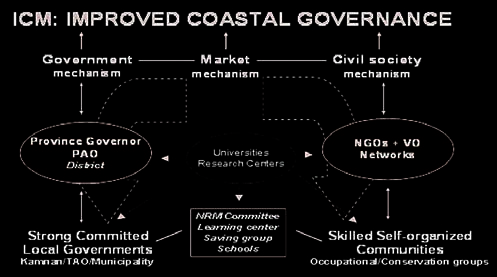
(Source Charm)
efficient overall and did lead to a final policy brief and
Co-management arrangement scheme: improved coastal
green paper. However the project was correct to focus
governance towards Integrated Coastal Management
more on procedural and governance aspects rather than
(ICM) depends on government, market and civil society
to attempt legal or policy reform. The project adopted a
mechanisms. At local level, it is conditioned by both
shotgun approach to livelihood development and did a far
skilled self-organized communities and strong committed
greater number of interventions than expected. A more
3


The backbone of LOICZ: Affiliated Activities
you to regularly check and update the project information on
On
the LOICZ database
e aim of LOICZ is to provide a framework to encourage the
fullest participation of multi-national, regional, and national re-
http://kopc01.gkss.de:7777/loiczdb/faces/app/Welcome.jspx,
search activities in its global research. These activities shall
including relevant publications and reports on your research
contribute to achieving the goals, aims and objectives outlined
findings. In order to edit your project information on-line, you
in the LOICZ Science Plan and Implementation Strategy (SPIS).
need to log in with your user name and password. If you re-
A way we accomplish this is to actively engage with the inter-
quire any assistance, please contact the IPO.
national research community concerned with natural and so-
Call for affiliation of research activities
cial sciences on Global Environmental Change in the coastal
zone. LOICZ is a forum to assimilate, synthesize and integrate
LOICZ seeks to expand its network of scientists by endorsing
the outputs of the research community. It provides an oppor-
research activities concerned with any of its priority topics on
tunity to communicate, discuss and disseminate these outputs
a global, regional or national level.
making them available to the global audience of scientific
Within these topics LOICZ strives to develop:
peers, the general public, and decision-makers in policy and
· methodologies or models that allow data assimilation, pro-
practice. Information on Affiliated Activities is held in a central
cessing and synthesis, including up and/or down scaling;
database that is accessible online through the LOICZ website.
· scenarios of change and/or response to change in socio-eco-
It makes basic information and regular updates available to the
logical systems;
wider global community as well as to LOICZ for its assessment
· scientific context for the evaluation of existing policies and
and synthesis task and its reporting requirements.
structures;
We encourage coastal scientists to seek affiliation of their re-
· globally applicable tools for scientific synthesis, decision
search project/s, PhD thesis or capacity-building activities to
support and structure development; and
LOICZ and become a member of the global science communi-
· dissemination interfaces to provide information and assist
ty and network of researchers and practitioners. Since 1993,
sustainable coastal development on appropriate scales.
more than 400 individual activities from all over the world have
To achieve this, LOICZ is calling for proposals to bring high
already been involved in this LOICZ research portfolio.
quality research activities into the LOICZ cluster of Affiliated
Early stage research
Activities. As well as fundamental science projects, LOICZ also
looks for projects that have a multidisciplinary perspective, es-
We particularly encourage early stage researchers from
pecially combining natural and social sciences. Projects can fo-
PhD student to Post-Doc level to seek affiliation of their proj-
cus on global, regional or local scales and address coastal sci-
ects. LOICZ acknowledges that much of the work contributing
ences and/or coastal management questions. Projects that col-
to coastal Earth System science is being carried out by young
laborate with other Earth System Science Partnership (ESSP)
scientists. Therefore LOICZ wants to support these efforts by
elements, especially with other Core Projects of IHDP and IGBP,
enhancing their visibility and introduction to scientific peers in
are sought in particular. Also projects that synthesize and ana-
the global research community. Affiliated early stage research
lyze research outcomes already available or involve dissemi-
will thus contribute to the global research portfolio and its
nation and outreach that will lead to better public knowledge
products and information will also feed into the global LOICZ
are most welcome. LOICZ particularly encourages affiliation of
synthesis likewise with the larger affiliated projects.
early stage research at PhD and Post-doc level. Details about
Affiliation will give early stage scientists comprehensive infor-
projects already affiliated to LOICZ can be found in the LOICZ
mation about the variety of scientific activities in their field and
Project database accessible through the LOICZ website.
allow them to foster their network with senior scientists and
the global research community. They may also have easier ac-
Although LOICZ cannot offer funding to Affiliated Activities,
cess to participation in workshops, conferences and meetings
its endorsement provides the following benefits:
organized by LOICZ that relate to their own work. By promot-
1. support in the state of proposal for funding;
ing their individual research on a global platform, early stage
2. promotion of the project and associated activities, its con-
researchers will be given the opportunity to contribute to
tributing team, outputs and outcomes through the LOICZ
LOICZ aims and objectives directly.
website and/or newsletter;
Application for affiliation of scientific work at PhD and Post Doc
3. contribution to workshops, conferences and meetings or-
level needs the same set of principle information and delivery
ganized by LOICZ and hence establish linkages to other
of appropriate documents (e.g. thesis outline instead of a proj-
projects operating in similar fields and/or addressing sim-
ect proposal if applicable). In addition and to guarantee a good
ilar issues;
conduct in quality control LOICZ kindly asks for a co-signature
4. access to a wide circle of information related to funding
and professional affiliation details of the supervising scientist.
and the science community that is available through the
The review conducted by the LOICZ scientific peers will apply
LOICZ database; and
the same standards as for senior projects. Detailed information
5. Principle Investigators of Affiliated Activities are offered
on the affiliation procedure is available on the LOICZ website in
a Corresponding Membership to the LOICZ Scientific
the 'Projects' section
Steering Committee (does not apply to PhD level). This ap-
http://www.loicz.org/projects/index.html.en
pointment is subject to annual review.
6. Affiliated Activities will generally feed into the global
Synthesis of Affiliated Activities
LOICZ synthesis (Interim Synthesis planned for 2010).
LOICZ is preparing for an interim scientific synthesis in 2010,
and as part of the synthesis the Affiliated Activities will be eval-
Researchers whose work fits into the LOICZ portfolio are en-
uated in the context of the LOICZ scientific framework. The
couraged to submit proposals to the LOICZ IPO as soon as pos-
synthesis is an opportunity to share your research findings
sible. The required form is accessible after registration to the
with the global LOICZ community and value your contribution
LOICZ project database and additional information can be ob-
to coastal and global change research. We therefore encourage
tained from the LOICZ website or via contacting the LOICZ IPO.
4
INPRINT
2009/1
efficient result would have been achieved if fewer, more
and inputs agreed on. Effectiveness: The most important
strategic, interventions were chosen. The strategy being
lesson learned overall is that to deliver effective co-man-
to maximise lessons learned. The quality of the co-man-
agement, a two-track approach is needed. For line
agement approaches and linked monitoring control and
departments they need to be aware of the limitations of
surveillance systems was very high and more diverse
laws and regulations and recognise that there are indi-
than expected. Lesson learning was reasonable and the
viduals and agencies around that can be used to facilitate
quality of communication materials was excellent. How-
and develop the positive at low cost to themselves. For
ever the tracking of what people did with the information
coastal communities the need is for demonstrations, in-
and lessons learned were poor. The project also pro-
dividuals and or communities that they can visit to learn
duced some very high quality unexpected results such
about alternatives to habitat-damaging jobs and relation-
as the plan for the Krabi Marina which will satisfy inter-
ships. The project did achieve good progress on both
national EIA standards. The final project logical frame-
tracks but it is sad that they did not have the analytical ca-
work contained nine results, ignored baselines and
pacity to derive a minimalist approach or simple recipe
added participatory linkages (networks), monitoring and
for replicable success. Impact: The major lesson learned
evaluation, multiplier effect (actually impact) and project
about improving impact in projects producing manage-
management. Overall the project's cost efficiency was
ment prescriptions to improve habitats is to pick cases
good because the number of people positively affected
that can rapidly show income benefits and diversity im-
by the project was very high.
provements. For the coast this means community-based
tourism linked ventures and emphasis on mangroves.
Financial sustainability for project outcomes comes from
Once demonstrated in these areas, more problematic
three sources: 1) private sector investment, large and
livelihood solutions and ecosystems can be tackled.
small, 2) access to loans and credit including revolving
Another lesson learned is to pick areas with motivated
funds set up by the project and 3) public funds at
staff or counterparts at provincial or tambon level, able to
Tambon, Provincial, and national levels which can be aug-
draw on services from line departments. Sustainability:
mented by donors. The mission found relevant and
The most important lesson learned on sustainability by
excellent examples of all three sources still in place al-
the mission, is that it is vital that private capital and en-
most one year after the project had finished. Large scale
terprise is brought into any plan for the co-management
investment for a Marina in the port of Krabi had been se-
of coastal resources. The two-track approach needs cap-
cured. The Marina would follow EIA advice and conform
ital to cover the opportunity cost of change. The project
to principles of coastal co-management contributing
has demonstrated this for community-based tourism.
funds of 5 million baht per year to the province that could
be used for habitat restoration. Small-scale investments
More details: www.charmproject.org
include the many community-based tourism initiatives
e.g., at Liled, where tourism is linked to the improvement
1 IFREMER, 155 rue J.J. Rousseau, 92138 Issy les Moulineaux,
and maintenance of coastal habitats. The Kamnan (tradi-
France · e-mail: yves.henocque@ifremer.fr
2 Department of Fisheries, Kaset-Klang, Chatuchak, Bangkok 10900,
tional headman) at Liled has also provided an investment in
Thailand · e-mail: sanchaitan@gmail.com
kind in the form of his speed-boat for monitoring control
and surveillance. Most project communities now have
greater access to loans than before the project and many
still maintain the revolving fund e.g. at Liled where the
funds retained equate to 183,000 baht. The Liled tambon
will now invest 300,000 baht for community-based
tourism. Krabi province now has a two-year budget for
coastal co-management amounting to 400,000 baht for
mangroves, 200,000 baht for sea-grass and 500,000 baht
for awareness raising. The Department of Fisheries
In November 2008, approximately 40 scientists from
budgets will now be influenced by the project in a big
10 countries met at IFM-GEOMAR in Kiel, Germany to
way in that its five year plan, known as the Marine
establish an international agreement on best practices
Fisheries Management Master Plan of Thailand, has many
for ocean acidification research. The workshop was spon-
of the project suggested procedures at its core.
sored by the European Project on Ocean Acidification
(EPOCA), the International Ocean Carbon Coordination
One year after the project ended, the ex-post monitoring
Project (IOCCP), the US Ocean Carbon and Biogeo-
study concluded the following: Efficiency: A key lesson
chemistry Program (OCB), and the Kiel "Future Ocean"
learned related to the need for an inception report within
Excellence Cluster. It covered seawater carbonate chem-
6 months of a project starting. This should include the
istry, experimental design of perturbation experiments,
plan for monitoring and evaluation. The adequacy of this
measurements of CO -sensitive processes and data re-
2
could be checked by the Delegation, and sufficient scope
porting and usage.
5

The participants agreed on the recommendations that
dynamics in Indonesia. Bernhard Glaeser (LOICZ SSC)
would appear in a guide as well as on authors and time-
complemented the report by presenting ,,Riau Province
lines for drafting each section. While this first workshop
in West Sumatra: Tentative themes for SPICE II SES re-
was kept necessarily small, the development of the best
search".
practices guide is meant to be an open community-wide
activity. EPOCA invites interested experts to visit the
EPOCA web site (http://epoca-project.eu/ under "Best
practices guide") to review the presentations from the
meeting, the timeline for drafting and reviewing the
guide, and contacts.
Priority Topics
PRIORITY TOPIC 1
Linking social and
ecological systems
in the coastal zone
Research Mission
to Pekanbaru, Riau Province
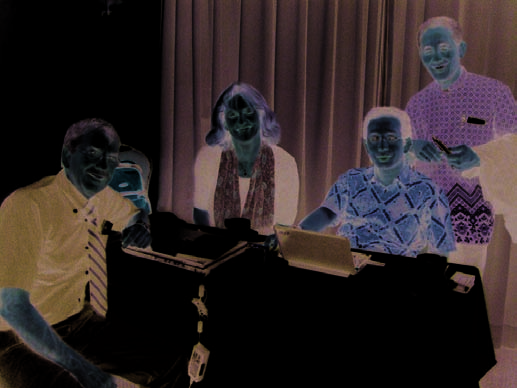
Workshop Pekanbaru. Bernhard Glaeser, Marion Glaser, Luky Adrianto,
(Sumatra, Indonesia),
Agus Kristijono (from left)
914 November 2008
2. Break-outs and meetings to prepare a workshop in
Bernhard Glaeser
Pekanbaru in early March 2009
The objective of the mission to Pekanbaru was threefold:
The aim of the sub-meetings was to prepare a workshop,
to present LOICZ research activities, to prepare a work-
possibly including a summer school, to present SES
shop in Pekanbaru in early March 2009, and to prepare a
research activities, to enhance further international and
research plan as part of LOICZ research on socio ecolog-
interdisciplinary collaboration, and with establishing a
ical systems (SES-PT1). This was an activity within the
short-term summer school to teach methods related to
SPICE project. SPICE (Science for the Protection of
SES research.
Indonesian Coastal Ecosystems) is a LOICZ affiliated
project; Riau Province on Sumatra is one of three SPICE
Field trip as part of the activities above
project sites, the other two being Spermonde Archipelago
A field trip downstream Siak river to Sri Indrapura and
in southwest Sulawesi and Segara Anakan in southwest
back complemented the above activities.
Java.
Participants from the region were Dr. Suardi Tarumun
The mission to Pekanbaru was divided into three activities:
(UNRI: University of Riau, Pekanbaru) and eight UNRI
1. International workshop ,,SPICE II Roundtable Meeting";
research students (mostly M.Sc. students in the
Environmental Health program of UNRI.
2. Break-outs and meetings to prepare a workshop in
Pekanbaru in early March 2009;
3. Field trip as part of the activities above.
1. International workshop ,,SPICE II Roundtable Meeting"
The ,,SPICE II Roundtable Meeting" presenting the state
of the art of SPICE research, included cluster group
meetings, and prepared a first draft report on SPICE fu-
ture research perspectives, to be submitted to the SPICE
steering committee. Marion Glaser (LOICZ SSC) pre-
sented ,,SPICE Cluster 6: Governance and management
of coastal social-ecological systems a cross-regional
and transdisciplinary social science project". The main
objective is an integrated analysis of natural and social
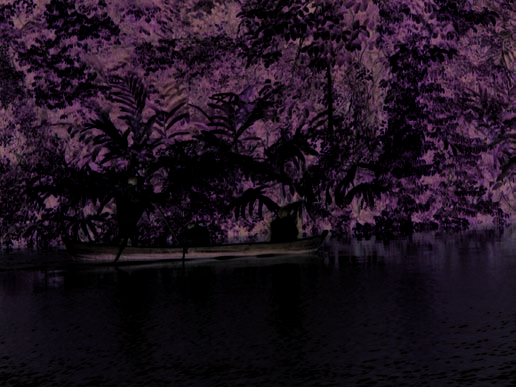
Leisure fishing
6

INPRINT
2009/1
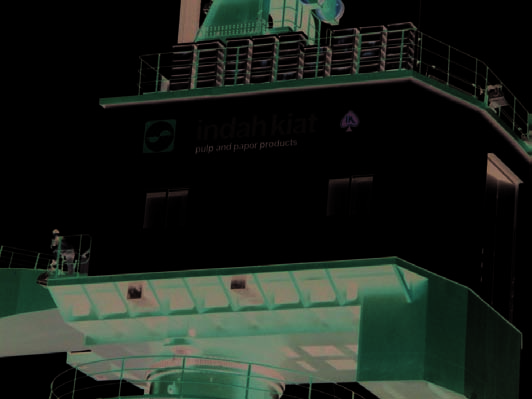
Plywood industry, closing down
Pulp and paper company
Potential research themes /areas within the socio-eco-
logical systems framework were identified:
public health and river health
poverty alleviation and rural development
gender aspects
pollution by oil and chemicals disrupting fisheries.
A follow up mission to Indonesia took place between
20 February and 11 March 2009. This time Pekanbaru,
Riau Province (Sumatra) and Spermonde Archipelago
(South Sulawesi) were the target regions. Bernhard
Glaeser and Marion Glaser provide a feature article on
this second mission which scetches a socio geographic
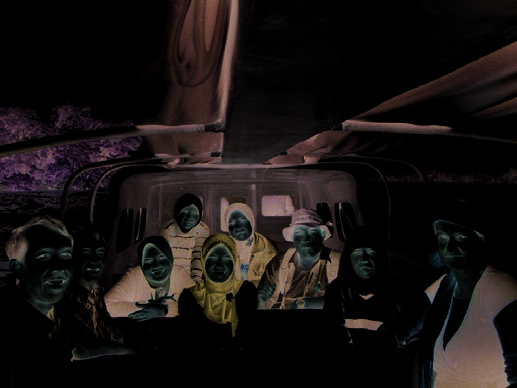
Field trip on Siak River--Suardi Tarumun, Bernhard Glaeser, Indonesian
overview of this interesting region. This second article is
MSc students and Marion Glaser (from left)
therefore published in our section "Coastal Snapshots".
(all photos by Bernhard Glaeser)
PRIORITY TOPIC 2
Assessing and
predicting impacts
of environmental change
on coastal ecosystems
Hypoxia, Nutrients,
Fisheries, and their Ecosystems
Denise Breitburg1, Karin Limburg2, Lori Davias3, and
ASLO (American Society of Limnology and Oceano-
Dennis Swaney4
graphy) in Nice, France. These discussions marked the
first in a series of three planned workshops of the LOICZ-
Background
affiliated project, Nitrogen, Hypoxia and Fishes: Moving
Globally, fisheries are in decline, humans increasingly af-
Beyond Fisheries Data to Understand Effects on Upper
fect the coastal zone with nutrient loadings, and hypoxic
Trophic Levels in Estuaries and Semi-Enclosed Seas', or-
areas are increasing in occurrence, size, and duration.
ganized by Denise Breitburg and Karin Limburg. The aim
The question of how these phenomena are related, and
of the workshop and special session was to discuss the
how to identify interactive effects of eutrophication and
relationships between nutrient loading, hypoxia, and ma-
fisheries removals on fish abundances and landings,
rine fish populations, to engage the broader community
were the subjects of a planning workshop and open
of coastal and marine scientists in these issues, and to
lunchtime discussion at the January, 2009 meeting of
plan the next stages of this work.
7

Descriptions of coastal waters in both the popular and
Dennis Swaney presented an overview of methods for
technical press evoke contrasting images of massive
estimating nutrient fluxes to coastal regions, and a dis-
'dead zones' and productive fisheries in systems af-
cussion of the LOICZ nutrient budgeting approach, noting
fected by hypoxia. These contrasts emerge from the
that budget approaches include information in addition to
juxtaposition of nutrient enrichment, habitat degrada-
terrestrial nutrient fluxes that may be useful in explaining
tion, and high population densities in the coastal zones of
patterns of variation of marine organisms. Such multidi-
the world's waters. Nitrogen enrichment generally in-
mensional approaches can become the basis of coastal
creases biological production (Nixon & Buckley 2002),
typological analyses, and a considerable database of
while hypoxia reduces biomass through reduction in
coastal data exists (both within LOICZ and elsewhere) that
habitat quality and quantity (Caddy 1993, Diaz 2001,
could be applied to analyses and classification of hypoxic
Rabalais & Turner 2001). The effects of nitrogen enrich-
zones. Karin Limburg presented a review of trophic eco-
ment and hypoxia on food webs and fisheries may
logical interactions (top-down trophic control and trophic
therefore be strongly influenced by the extent to which
cascades, Carpenter et al. 1985) that could potentially play
these two factors co-occur, and the ways in which their
a role in the persistence of effects of elevated nutrients,
effects are either masked or exacerbated by fisheries
even after abatement.
removals. It is both important and challenging to disen-
After lunch, Olle Hjerne and Susa Niiranen, both from
tangle the causal factors, understand synergistic inter-
Stockholm University, presented a modeling framework,
actions, and more toward more holistic management.
EcoPath with EcoSim and EcoSpace, they are employing
in the Baltic Sea. This framework, developed by Jeffrey
Polovina, Villy Christensen, Carl Walters and Daniel Pauly,
Sunday Workshop
is widely used for ecosystem-based analyses of fisheries.
Ten scientists, including SSC members Alice Newton
Olle presented an application of EcoPath with EcoSim
(SSC Chair) and Dennis Swaney, met in a pre-conference
(EwE) to the Baltic Sea. The Baltic Sea is subject to peri-
workshop to lay out the issues. Denise Breitburg kicked
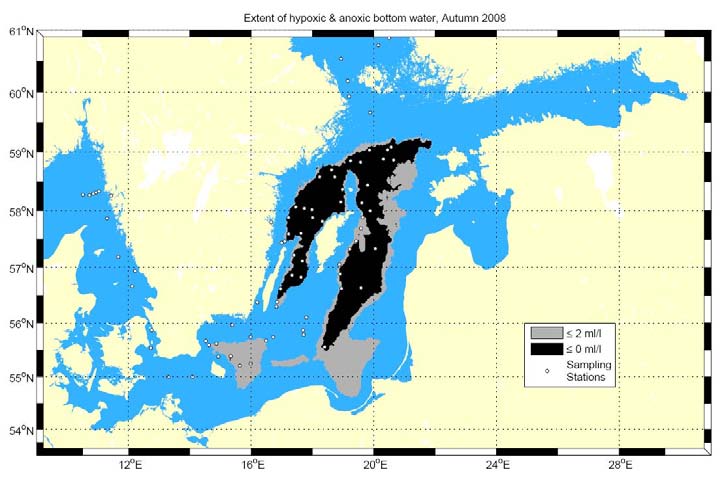
odic hypoxia/anoxia covering large areas (Fig. 2) that is
off the workshop with an overview of the topic, present-
strongly influenced by nutrient inputs from the surround-
ing results from a synthesis undertaken by her and
ing catchment.
collaborators. Breitburg presented evidence that in some
The areas of low oxygen tend to be the saltiest in this low-
cases, hypoxia is associated with declines in fisheries,
salinity system, and these areas, if oxygenated, would be
but not in others, and discussed compensatory factors
the best spawning areas for cod, as their eggs require at
that might limit effects of hypoxia at the whole-system
least 11 psu to be viable. The Baltic EwE is entering a
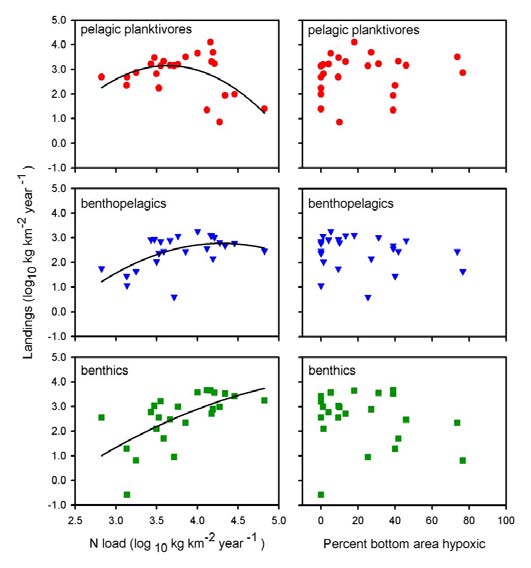
or population scale (Breitburg et al. 2009; Fig. 1).
second phase of development, which will include incor-
porating eutrophication and anoxia. Susa Niiranen has
developed a first generation version of a Baltic EcoSpace
model, where phytoplankton, zooplankton, and key fish
species are spatially distributed according to optimal habi-
tat, and hypoxia is accounted for in "reproductive volume",
a multiplier of cod reproduction (Fig. 3).
Questions that she intends to address include: what are
the impacts of different fishing pressure (e.g., heavy fish-
ing vs. marine protected areas) on regional eutrophication
through top-down control mechanisms? and conversely,
what are impacts of hypoxia on food webs (via bottom-up
and top-down mechanisms)?
Daniel Conley (Lund University) wrapped up the presenta-
tions with a discussion of recent work on the hysteresis of
ecosystems receiving excessive nutrient loading. A study
published recently in Estuaries and Coasts (Duarte et al.
2009) suggests that a return to original conditions, once
nutrient loadings are abated, is unlikely in many coastal
ecosystems (i.e., they exhibit a "shifting baseline"). The
causes may be multiple, but the implication is that large in-
vestments in regional nutrient management plans may not
always produce the desired result. The degree to which
fisheries and/or hypoxia affect the persistence of elevated
Figure 1: Different relationships between fisheries landings, nitrogen
nutrients was a topic of discussion and will be one of further
loading, and spatial intensity of hypoxia are evident from synthesis of a
broad literature (Breitburg et al. 2009)
research.
8
INPRINT
2009/1
Figure 2:
Extent of hypoxia and anoxic bottom
water in the Baltic Sea, autumn 2008.
Source: HELCOM
p
)
Figure 3:
Available habitat for key organisms.
· Entire Baltic described with one
hab.
salinity
Graduate student Susa Niiranen is
model
closed ecosystem
currently developing an EcoSpace model
that will help predict effects of nutrient
· Impact of nutrient reductions
reduction on the Baltic food web. The
model incorporates effects of advection,
studied with different scenarios
salinity and bottom-layer hypoxia as
well as other factors on the spatial dis-
· Advection, salinity, bottom hypoxia
tribution of relative biomasses (relative
and fish nursery sites described.
B) of important species and trophic
groups. Organisms sort out on salinity
relative B:
gradients, and are prevented from col-
her(ad)
her(j)
zp
pp
onizing hypoxic/anoxic areas.
high
Key: her (ad) = adult herring
her (j) = juvenile herring
zp = zooplankton
pp = phytoplankton
low
Questions that she intends to address include: what are the
result. The degree to which fisheries and/or hypoxia affect
impacts of different fishing pressure (e.g., heavy fishing vs.
the persistence of elevated nutrients was a topic of dis-
marine protected areas) on regional eutrophication through
cussion and will be one of further research.The meeting
top-down control mechanisms? and conversely, what
wrapped up with discussions and ideas presented by
are impacts of hypoxia on food webs (via bottom-up and
workshop participants on how to use existing and devel-
top-down mechanisms)?
oping EcoPath and EcoSim models, and calibration
datasets on which they're based, as estimates of fish
Daniel Conley (Lund University) wrapped up the presen-
biomass in cross-system comparisons. This approach
tations with a discussion of recent work on the
would allow analyses to use biomass and species com-
hysteresis of ecosystems receiving excessive nutrient
position as endpoints of statistical models, and use
loading. A study published recently in Estuaries and
nutrient loads, hypoxia, fisheries removals and system
Coasts (Duarte et al. 2009) suggests that a return to orig-
characteristics as independent variables.
inal conditions, once nutrient loadings are abated, is
unlikely in many coastal ecosystems (i.e., they exhibit a
"shifting baseline"). The causes may be multiple, but the
Tuesday Discussion Session
implication is that large investments in regional nutrient
The goals of this session, scheduled during the ASLO
management plans may not always produce the desired
meeting itself, were to evaluate interest from other
9

scientists who might have data or ideas to contribute and
of disciplines, from chemical oceanography, to ecosystem
to put together a list of contact information and area of
science, watershed management, and fisheries science
expertise from participants. The meeting drew over
(Fig. 4).
30 attendees representing eight countries and a breadth
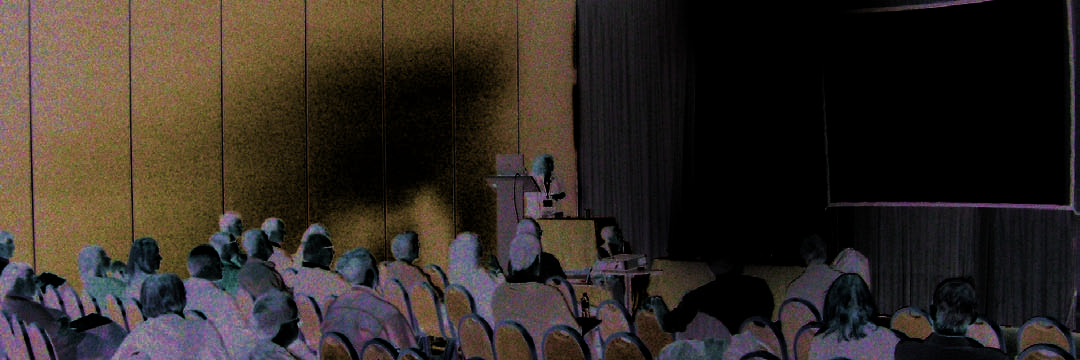
Figure 4: Denise Breitburg and Karin Limburg give a project overview to participants in the Tuesday lunch workshop
After a brief review of the highlights of the workshop and
understanding of the large-scale effects of nutrient en-
the broader issue of nutrients, hypoxia and fisheries, a
richment and hypoxia in systems stressed by human
lively discussion ensued in which participants described
influences that include both these factors and fisheries
their own experiences and perspectives on the issues.
removals. Sound management of our coastal ecosys-
Questions and comments from the group were diverse.
tems is not possible unless we can correctly identify the
Among the interesting ideas emerging from the discus-
effects of individual and interacting stressors that alter
sion were:
food webs and system productivity. Members of the
· the importance of including a paleoecological perspec-
LOICZ community, and coastal researchers in general,
tive,
who are interested in participating in contributing data and
participating in this effort should contact Denise Breitburg
· the potential to better understand the effects of hypox-
(breitburgd@si.edu) or Lori Davias (daviasl@si.edu). We
ia and nutrient enrichment by comparing upwelling
look forward to your participation, and value your contri-
systems with estuaries and semi-enclosed seas,
butions.
· the potential importance of categorizing systems by
the intensity of fisheries exploitation as well as hydrol-
The next workshop will be a working meeting dedicated
ogy and physical characteristics,
to compiling and beginning analysis of the dataset that in-
· the need to consider joint management of fisheries
cludes EWE model biomass estimates. We are currently
and nutrients,
identifying possible dates in late summer or fall of 2009.
· the importance of considering different sources of
nutrients,
· accounting for spatial and temporal decoupling of data
sources, and
References
· the potential importance of including other sources of
habitat degradation in analyses.
Breitburg, D.L.; Hondorp, D.W; Davias, L.A. & Diaz, R.J. (2009):
Hypoxia, nitrogen and fisheries: Integrating effects across local
and global landscapes. Annual Reviews in Marine Science
Future Goals and Next Steps
1(1):32949.
One of the goals in organizing the initial meeting (beyond
Caddy, J. F. (1993): Toward a comparative evaluation of human
providing the opportunity for a discussion) was to solicit
impacts on fishery ecosystems of enclosed and semi-enclosed
help and participation in developing a database that in-
seas. Reviews in Fisheries Science 1: 5795.
cludes not only nitrogen loads, but also the spatial extent
Carpenter S.R.; Kitchell J.F.; & Hodgson J.R. (1985): Cascading
of hypoxia, fisheries landings and estimated abundances
trophic interactions and lake productivity. BioScience 35:
of fishes and mobile macroinvertebrates targeted by
634639.
fisheries (crabs, shrimp, lobsters, cephalopods). This will
Diaz R.J. (2001): Overview of hypoxia around the world. Journal
be a community database that can be used to improve
of Environmental Quality 30:27581.
10
INPRINT
2009/1
Duarte C.M.; Conley D.J.; Carstensen J. & Sánchez-Camacho, M.
Contact:
(2009): Return to Neverland: shifting baselines affect eutrophi-
1breitburgd@si.edu, Smithsonian Environmental Research
cation restoration targets. Estuaries and Coasts 32: 2936.
Center, Edgewater, MD
Nixon, S.W. & Buckley, B.A. (2002): "A strikingly rich zone"
2klimburg@esf.edu, Dept. of Environmental & Forest Biology,
nutrient enrichment and secondary production in coastal
State University of NY,
3
marine ecosystems. Estuaries 25:78296.
College of Environmental Science and Forestry, Syracuse, NY
daviasl@si.edu, Smithsonian Environmental Research Center,
Rabalais, N.N. & Turner, R.E., eds. (2001): Coastal Hypoxia: Conse-
Edgewater, MD
quences for Living Resources and Ecosystems. Washington,
4dps1@cornell.edu, Dept. of Ecology& Evolutionary Biol, Cornell
D.C.: American Geophysical Union.
University, Ithaca, NY
SCOPE Biofuels Project: Update on the Rapid Assessment on Biofuels and Environment
Robert W. Howarth and Dennis P. Swaney
The Scientific Committee on Problems of the Environment (SCOPE) of the International Council for Science (ICSU)
established the International SCOPE Biofuels Project to provide a comprehensive and objective, science-based
analysis of the effects of biofuels on the environment. The SCOPE Biofuels Project held an international workshop
in Gummersbach, Germany, organized by Bob Howarth (Cornell University, USA) and Stefan Bringezu (Wuppertal
Institute, Germany) from September 2224, 2008 to develop a "rapid assessment" of these environmental conse-
quences. Scientists from 21 countries representing a diversity of disciplines participated in the assessment. The
executive summary and individual chapters of the workshop report are now available online at
http://cip.cornell.edu/biofuels/. The workshop report is also covered in an article in the March 20, 2009 Scientific
American: http://www.sciam.com/article.cfm?id=nitrogen-fertilizer-anniversary. SCOPE Biofuels is a LOICZ-affiliated
project. This excerpt from the executive summary outlines some of the major environmental issues discussed in the
report.
The Rise of Biofuels
Although many countries anticipate large increases in
production, the current global production of liquid biofu-
Many countries and companies are investing heavily in
els is dominated by just a handful of countries. The
biofuels for transport, motivated by concerns and oppor-
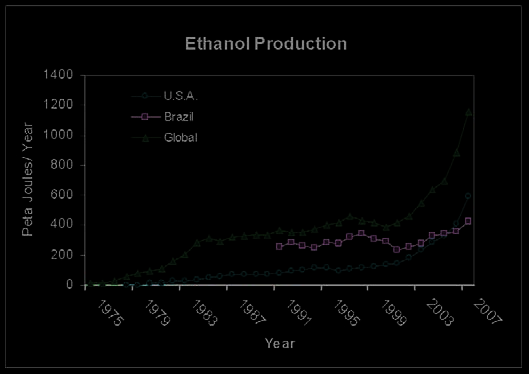
combined production of ethanol in Brazil and in the
tunities related to global climate change, energy security,
United States has accounted for 75 % or more of the
and rural development. Production targets and mandates
global production for decades (Figure 1b). Ethanol is the
for biofuels vary among nations, but many have goals to
major liquid biofuel globally, with a production of approx-
use biofuels for 10 % or more of liquid transportation fuels
imately 1.2 EJ (1.2 x 10¹⁸ joules, or 55 billion liters) in
in 10 to 20 years (Chapters 2 and 11).
2007. China and India are the next largest producers, to-
Governmental energy policies have focused largely on
gether accounting for 12 % of global ethanol production
liquid biofuels (ethanol and biodiesel) rather than solid
in 2006. The global production of biodiesel in 2007 was
biofuels (wood and charcoal), in part because the liquid
approximately 0.4 EJ (12 billion liters) per year, about one
fuels can readily replace conventional transportation fuels
third the rate of ethanol production (by energy content).
without major modifications in transportation technologies
Almost 80 % of the world's production of biodiesel occurs
currently used. The convenience of liquid fuels for trans-
in the European Union, and almost 50 % in Germany
portation has long resulted in a price differential between
(Chapter 1).
liquid and solid fuels, and as of 2007, crude oil was worth
some 12-times more than coal per unit energy (Chapter 1).
The vast majority of current production of liquid biofuels
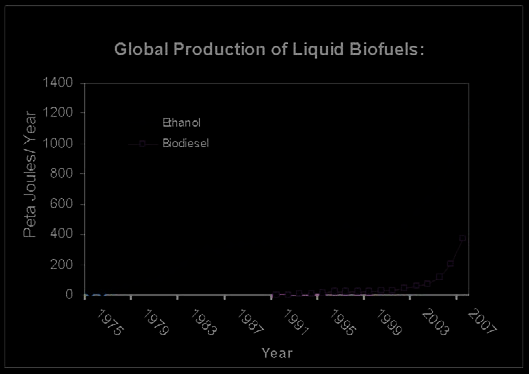
Global production of liquid biofuels has grown exponen-
is based on crops that can also be used for food: corn
tially since 2000 (Figure 1a). Despite this growth, liquid
(maize) in the United States (the world's largest pro-
biofuels are still small contributors to the global
ducer); sugar cane in Brazil (the world's second largest
energy supply. As of 2006, they supplied 1.8 % of the
producer); and rapeseed (also called canola) in Germany
global use of liquid transportation fuels. This is equiva-
(the world's third largest producer). In 2007, the United
lent to 1% of the total liquid fuel use globally (including
States used 24 % of its national corn harvest to produce
liquid fuels used other than for transportation), or 0.4 %
ethanol, which contributed 1.3 % of national liquid fuel
of the total global energy consumption from all sources.
use (transportation fuels plus other uses of liquid fuels)
By comparison, solid biofuels supplied approximately
(Chapter 1). This illustrates the difficulty of reaching cur-
10 % to 13 % of total global energy consumption, or some
rent mandates for production of liquid biofuels. Meeting
30-fold more energy than liquid biofuels (Chapter 1).
these goals would require some combination of a large
11

increase in the area devoted to biofuels crops and an un-
crease crop productivity is not infinite, and increasing
precedented increase in the yield of biofuels crops per
population and improved diets with higher protein con-
unit of land, water, and fertilizers (Chapter 4). Estimates
tent are placing ever greater demands on land for food
for the range of new agricultural land required to meet a
production so that competition and conflict with biofuel
global target of 10 % biofuel substitution for liquid trans-
production using current methods can only increase in a
portation fuel use range from 118 to 508 million hectares,
world where some billion people are already underfed
depending upon the crop produced and the level of crop
(Chapter 4).
production assumed. This compares with the current
area of arable land in the world of 1,400 million hectares
Biofuel production and consumption have a variety of
(Chapter 6). Because of constraints on the productivity of
local and regional environmental impacts. Growing crops
biofuel crops such as water availability, the higher end of
is essentially the same for biofuels as for other agricul-
estimates for land use needs may be most reasonable
tural purposes. But the environmental impacts of crop
(Chapters 4 and 16).
production often increase as more land is used, land is
farmed more intensively, and so-called marginal lands
are placed into agriculture. The environmental conse-
quences of biofuels depend on what crops or materials
are used, where and how these feedstocks are grown,
how the biofuel is produced and used, and how much is
produced and consumed. Both positive and negative ef-
fects on the environment can occur. Before looking into
effects on greenhouse gases the next paragraph de-
scribes initial feedacks with water and coastal sytems.
Biofuels and effects on water and coastal systems
Water pollution can result from runoff from agricultural
fields and from wastes produced during biofuel produc-
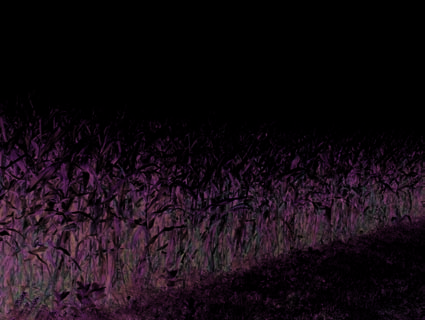
tion. Nitrogen losses from corn fields is a particular
a)
problem (Figure 2). Compared to most crops, corn is es-
pecially leaky of nitrogen because of its shallow rooting
system and short period of active nutrient uptake. In re-
gions where soils have artificial drainage such as much of
the "corn belt" of the upper Mississippi basin in the United
States, nitrogen losses associated with growing corn can
be quite high. This is the single largest source of nutrient
pollution leading to the "dead zone," or area of low-oxygen
water in the plume of the Mississippi River in the Gulf of
Mexico. The increase in corn to support ethanol goals in
the United States is predicted to increase nitrogen inputs
to the Mississippi River by 37 %. This works against the
national goal of reducing nitrogen inputs by at least 40 %
to mitigate the "dead zone." When perennial crops such
as switchgrass are used instead of annual ones such as
b)
corn, water pollution is much less (Chapter 9).
Figure 1: Global production of ethanol and biodiesel (1a, top) and com-
Organic wastes from the sugar-cane-ethanol system
parison of production of ethanol in the the USA and Brazil with global
production 1b, (bottom) from 1975 to 2007. A petajoule is 1015 (one
("vinasse") are another serious problem. These wastes
quadrillion) joules. One thousand petajoules equals an exajoule (EJ).
are nutrient rich, and so can be recycled onto fields as an
Reprinted from Chapter 1 of the SCOPE Biofuels project report
effective fertilizer. However, excessive fertilization with
vinasse results in runoff to surface waters and contami-
The challenge of meeting land needs for the expansion
nation of groundwaters, and sometimes these wastes
of biofuel production must be considered in the context
are directly discharged to surface waters. The high organic
of a growing demand for food. The global population more
content of the vinasse rapidly consumes oxygen, severely
than doubled since 1960, and world agricultural area per
degrading water quality. In Brazil, the government has
person decreased 2-fold. In the past, food consumption
enacted environmental laws that if followed will greatly
per person was able to increase due to a dramatic increase
reduce the potential impacts of the ethanol industry on
in crop productivity per area. However, the ability to in-
water quality (Chapter 9).
12
INPRINT
2009/1
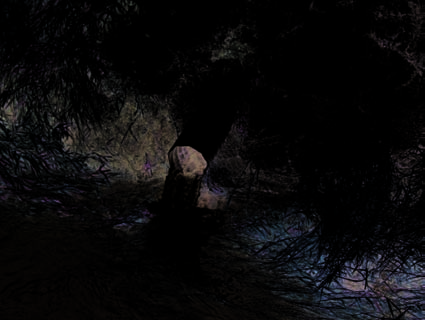
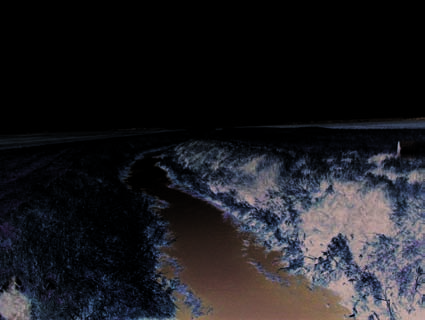
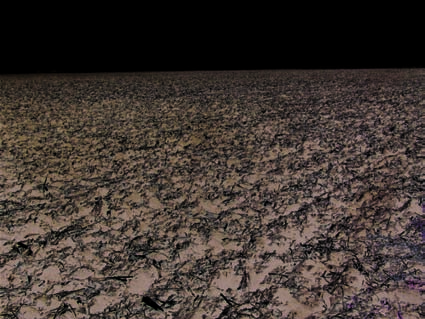
Figure 2:
Because of a shallow rooting
system and short time period
of active nutrient uptake, corn
is particularly leaky of nutri-
ents. In regions with artificial
drainage, the nitrogen loss
associated with growing corn
can be quite high. This is the
single largest source of nutri-
ent pollution leading to the
"dead zone," or area of low-
oxygen water in the plume of
the Mississippi River in the
Gulf of Mexico.
(Photo: Robert W. Howarth).
Biofuels and the Emission of Greenhouse Gases
Biofuels are often promoted as a way to reduce global
ences in co-product allocation methods (e.g., whether or
warming. However, many biofuel systems can increase
not waste products are used for animal feeds) and as-
the release of greenhouse gases relative to the fossil
sumptions made about the types of energy inputs used
fuels they replace, aggravating global warming. Green-
to make biofuels and transport crops to processing sites.
house gas emissions from biofuels occur from farming
In general, the agricultural and transformation phases ac-
practices, refining operations, and the conversion of
count for the vast majority of total greenhouse gas
ecosystems to cropland for biofuel production. The de-
emissions from biofuels (Chapter 5).
tails of how and where crops are grown, how crops are
transported before being processed into fuels, and how
The studies summarized in the paragraph above may un-
fuels are made are all important in determining the net ef-
derestimate the release of one greenhouse gas - nitrous
fect on greenhouse gas emissions. Most recent studies
oxide (N O) from biofuel production, and therefore are
2
based on life-cycle analysis conclude that when ethanol
probably too optimistic. Nitrous oxide is not as abundant
from sugar cane is used to replace fossil fuels in trans-
as carbon dioxide in the atmosphere, and is not as im-
portation, a substantial reduction in net greenhouse gas
portant as a driver of global warming. However, for an
emissions may result: an 80 % to greater than 100 %
equivalent mass, it is almost 300-fold greater in its ability
savings are recorded (when low emissions of nitrous
to warm the planet, and it is currently the third most im-
oxide are assumed). On the other hand, using ethanol
portant gas in causing global warming, after carbon
from corn is less favorable, resulting in 30 %50 % sav-
dioxide and methane. Most studies on biofuels and
ings relative to burning fossil fuels; in some cases, using
greenhouse gas emissions have used the Intergovern-
ethanol from corn results in an increase of greenhouse
mental Panel on Climate Change (IPCC) approach for
gas emissions compared to simply burning gasoline,
estimating emissions of nitrous oxide. Recent evidence
rather than any saving. Using biodiesel from rapeseed
suggests that nitrous oxide emissions may well be 4-fold
has a benefit intermediate between ethanol from sugar
greater than this, with high emissions both from agricul-
cane and ethanol from corn: greenhouse gas emissions
tural fields and from downstream aquatic ecosystems
are reduced by 20 %85 % compared to using fossil
resulting from the use of synthetic nitrogen fertilizer. If
fuels. In general, the wide range of reported results for all
so, the increased N O fluxes associated with producing
2
types of biofuels can be largely attributed to differ-
ethanol from corn is likely to more than offset any positive
13

advantage from reduced carbon dioxide fluxes (com-
and agricultural and forest residues for biofuels is also
pared to burning fossil fuels). Even for ethanol from
likely to produce greenhouse gas benefits, but care must
sugar cane or biodiesel from rapeseed, emissions of ni-
be taken to assure that enough residuals are left behind
trous oxide probably make these fuels less effective as
to protect soil health and productivity which depend on
an approach for reducing global warming than has been
carbon levels.
previously believed (Chapter 1).
Other Environmental Effects
There are multiple indirect effects of increased biofuels
production, and researchers are only starting to unfold
Biodiversity: Increased biofuel production will have neg-
those effects and measure their environmental implica-
ative impacts on biodiversity mostly as a result of habitat
tions (Chapter 14). One of the greatest concerns is this
loss associated with deforestation and conversion of
indirect effect of land-use change on emission of green-
grasslands and savannas to biofuel crops. Small-scale
house gases. The rapidly growing production of biofuels
biofuel production systems in which biodiversity is main-
requires additional cropland. In some cases, this comes
tained are possible. Particularly promising is the
from agricultural land previously used to grow crops, but
management of natural grasslands and forests for har-
in a hungry world, land elsewhere including in different
vest of biofuel material at moderate levels, providing
countries and on different continents may be converted
reasonable protection for biodiversity (Chapter 7).
to agricultural food-crop production to compensate for this
Competition for freshwater: Freshwater is increasingly
loss. Additional cropland is usually made available through
in short supply and may not meet future demands for
the conversion of native ecosystems such as grasslands,
food production in many regions. Using irrigation to grow
savannahs, and forests, as well as by returning perma-
biofuel crops will aggravate these shortages, reducing
nent fallow or abandoned croplands to production. These
water available for other uses and further impacting
land conversions can have a substantial impact on the
freshwater (and in some cases coastal marine) ecosys-
greenhouse-gas balances of biofuels. In general, when
tems. The water requirements of biofuel-derived energy
biofuel cropping is associated with the conversion of na-
are 70 to 400 times larger than other energy sources
tive ecosystems (particularly forests, and especially peat
such as fossil fuels, wind or solar. Roughly 45 billion
land), the net greenhouse-gas balance is negative, and
cubic meters of irrigation water were used for biofuels
more greenhouse gases are emitted to the atmosphere
production in 2007, or some 6 times more water than used
than if fossil fuels were used instead. The carbon debt of
for drinking water globally. The greatest use is for the pro-
this conversion in theory can eventually be re-paid through
duction of the feedstock crops. Several approaches exist
the extended use of biofuels over time, but this requires
which could improve water productivity of agriculture for
many decades or even hundreds of years to balance out
both biofuel and food crops. Also, alternative feedstock
the initial carbon losses. In the meanwhile, the biofuel
crops can be used to reduce the demand for water in bio-
system has aggravated rather than helped to mitigate
fuel production. However, the water implications of future
global warming, even for systems where the life-cycle
large-scale biofuel production remain uncertain (Chapter 8).
analyses indicate a positive influence on net greenhouse
gas emissions (Chapter 6). As one example, conversion
Local and regional air pollution: The use of ethanol and
of rainforests with peat soils to palm plantations to pro-
biodiesel as fuels or as fuel additives to fossil fuels can
duce biodiesel can increase the net emissions of
reduce the emissions of some pollutants from vehicle
greenhouse gas emissions by 20-fold relative to simply
exhaust such as fine particles and carbon monoxide, but
using fossil fuels instead (Chapter 5). Plans for such de-
tends to increase other pollutant emissions such as nitro-
velopment in Indonesia could cause a globally significant
gen gases (Chapters 1 and 10). One of the largest sources
increase in emissions of carbon dioxide to the atmos-
of air pollution from biofuel production comes from the
phere (Chapter 1). If global warming is the primary concern,
practice of burning sugar cane before harvest. The re-
leaving natural ecosystems (particularly forests) alone is
sulting smoke, fine particles, and nitrogen gases in the
often a better strategy than clearing them to grow crops.
atmosphere cause acid rain and contribute to a variety of
Currently, the global emissions of greenhouse gases
human health impacts.
from deforestation are roughly equal to those emitted
while burning fuels for transportation (Chapter 14).
Swedish-Vietnamese exchange program uses
Biofuel crops offer their greatest promise for green-
LOICZ tools
house gas benefits if grown on abandoned, degraded, or
marginal lands. On these lands, carbon losses from con-
Lars Rahm
version to biofuels are often small. Of course, if the lands
have the potential to revert to forests, conversion to bio-
An ongoing academic exchange program between insti-
fuels represents a lost opportunity for carbon storage.
tutions in Sweden and Vietnam makes use of LOICZ
The environmental consequences of inputs (irrigation
tools as part of its curriculum in water resources. The pro-
water, fertilizer) required to make degraded and marginal
gram currently focuses on Masters-level environmental
lands productive must also be considered. Using wastes
education, with travel expenses funded by the Swedish
14
INPRINT
2009/1
International Development Cooperation Agency (SIDA)
Two coastal nutrient budgets, from the Tien and Hau
as part of its Linnaeus-Palme activity. This year's course
Rivers (part of the Mekong system), which were devel-
is part of an exchange between Linköping University
oped in previous LOICZ workshops, have been used in
(LiU) and Vietnam Academy for Water Resources
the curriculum as examples of the LOICZ methodology,
(VAWR) in Hanoi. The focus at both locations is on sus-
illustrating the biogeochemical process of nitrogen fixa-
tainable resource utilization. VAWR is trying to broaden
tion, denitrification, and net ecosystem metabolism, as
its focus on a more interdisciplinary curriculum, while LiU
well as how to estimate them from the LOICZ budget
is developing more material on hydrology and terrestrial
perspective. The course is introductory at this stage, as
processes. The challenge is to create courses that use
the students are more inclined to focus on hydrological
the available teachers in the best way to meet both ob-
and irrigation problems, and are relatively new to consid-
jectives.
ering the potential problems of the coastal zone in large.
Rahm reports that "despite some problems of commu-
This year focused on teacher exchange, in which two
nicating in English, the students are nevertheless eager to
Vietnamese lecturers visited LiU and two Swedish lec-
learn and 25 students passed the final exam. If things go
turers travelled to Hanoi. In the March, 2009, course in
well we will try to expand this project to include a limited
Hanoi, the two Swedish professors, Lars Rahm and
master student exchange as well. The question is whether
Reinhold Castensson, both from the department of Water
we can expand it further to include PhD-students in
and Environmental Studies at LiU, are looking into coastal
future."
zone management issues. Rahm is introducing biogeo-
chemical aspects of the coastal zone to his Vietnamese
For more information on LOICZ nutrient budgets, visit:
students, and has to some extent relied on LOICZ studies
http://nest.su.se/mnode/
and material. Castensson is a cultural geographer and has
For more information on the course, contact Lars Rahm
his focus on planning and implementation of policy issues
(lars.rahm@liu.se)
including the European Water Framework.
or Reinhold Castensson (reinhold.castensson@liu.se).
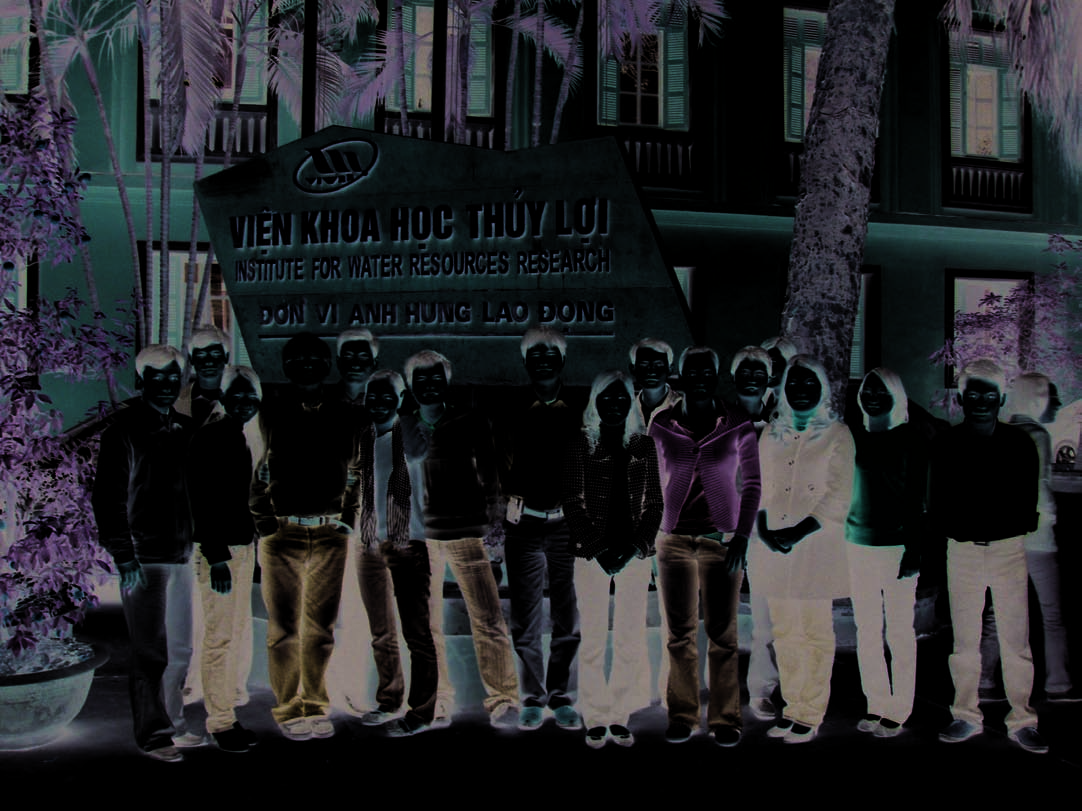
VAWR students participating in this year's course in Hanoi, supported by the SIDA-funded faculty exchange program
15

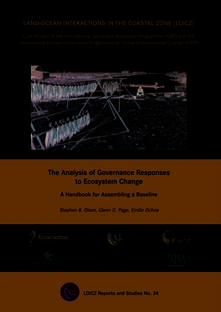
New LOICZ R&S Report No. 34
PRIORITY TOPIC 3
Linking
online
governance and
science in coastal
The Analysis of Governance
regions
LOICZ Session
Responses to Ecosystem
Change
at the IHDP Open Congress, Bonn, 2630 April 2009
A Handbook for Assembling
Responding to Coastal and Marine Change: Comparative
a Baseline
Assessment of Coastal Governance Initiatives
Andreas Kannen (GKSS, Coastal Futures)
Stephen B. Olsen, Glenn G.
Page, Emilio Ochoa
A workshop discussing coastal governance from a set of
global case studies, covering examples from the Arctic,
Direct link for download:
Latin America, New Zealand and Europe was organized by
http://www.loicz.org/products/publication/reports/index.html.en
LOICZ Priority Topic 3 together with the affiliated project
Coastal Futures at the IHDP Open Congress 2009 in Bonn
on 30 April. The workshop started with an introduction by
the organizer, discussing selected aspects which are rele-
vant for governance of coastal social-ecological systems.
Cross-Cutting Activities
Another five presentations discussed core principles and
parameters, which they derived from regional case stud-
ies. These were followed by one presentation of the IHDP
Great Barrier Reef Ecosystem Services
Earth System Governance project and another one outlin-
Eric Wolanski, James Cook University
ing the importance of complexity theory in the context of
coastal planning and management. Following the presen-
A mini symposium organized by G. Lukacs and E. Wolanski
tations, a very lively and controversial discussion among
was held in Townsville on February 9, 2009 on the eco-
the more than 20 participants developed. A full workshop
systems services of the Great Barrier Reef (GBR). The
report will be published in the next INPRINT.
stakeholders were James Cook University (JCU), the
Contact: kannen@gkss.de
CSIRO, and the Great Barrier Marine Park Authority.
D. Wachenfeld (GBRMPA) opened the symposium, stress-
ing the potential benefits of quantifying the ecosystem
services of the GBR.
In the biophysics session, D. Bellwood (JCU) identified
critical ecosystem processes or functions of coral reefs.
Initial findings suggest that key processes may be depend-
ent on just a few critical species and that biodiversity may
not offer the protection we once hoped. There is increased
recognition that it is the processes not species that are
important if we are to maintain ecosystems and the serv-
ices they provide. E. Wolanski (JCU) described the oceanic
and coastal drivers of the GBR. Ecohydrology modeling
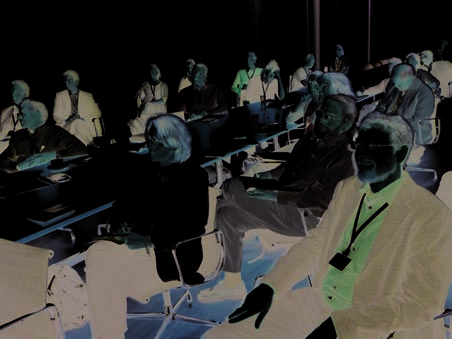
(Photo: LOCZ IPO)
(Photo: Juergen Weichselgartner)
predicts a gloomy scenario for coral cover by 2050.
In the ecosystem services session, M. Finlayson (CSU)
described the Millennium Ecosystem Assessment
methodology to provide a knowledge base to support im-
proved decisions to enhance the contribution of eco-
systems to human well-being, particularly by altering the
current balance between provisioning and regulating
services. M. van Grieken and J. Butler (CSIRO) presented
the results for assessing potential trade-offs in the provi-
sion of a regulating hydrological ecosystem service, the
control of agricultural diffuse pollution by land use man-
agement practices and the restoration of native riparian
vegetation. Using ecosystem services they explored the
16

INPRINT
2009/1
options for improving links between the ecological and
Evaluating trade-offs requires both an understanding of
social systems, including payments for ecosystem serv-
the biophysical magnitudes of ES changes that result
ices, and building resilience and adaptive capacity to
from human actions, as well as an understanding of their
protect the GBR.
impact on human well-being, broadly conceived. The
state of the art of ES assessment and modeling was dis-
In the ecosystem value section, J. Rolfe (CQU) provided
cussed, including the potential of integrated ecological
an overview of non-market valuation techniques that are
economic modeling. A discussion followed among the
relevant to the Great Barrier Reef, and illustrated some
70 participants, moderated by G. Lukacs (JCU); the com-
results of recent studies. N. Stoeckl (JCU) reviewed the
mon thread emerged that (1) the GBR ecosystem is not
studies that have estimated economic values associated
as resilient as we had thought; (2) it is suffering a lot
with ecosystem services in the Great Barrier Reef re-
more from human impact than the politicians and tourist
gion. She highlighted gaps in current knowledge that
brochures say; (3) the assessment of its ecosystem serv-
warrant further investigations.
ices need much attention; (4) the survival of the GBR
depends on co-managing the land and the sea, some-
In the threats to the GBR session, K. Fabricius (AIMS)
thing which is not done at present and which could be
showed that the reefs of the Great Barrier Reef have
done using ecosystem services as a common currency
been losing >0.25 % coral cover per year since ~1970,
for the land and the sea. There is no common currency at
due to cumulative disturbances. She provided an over-
present; (5) research much focus on the continued sup-
view of the main past and present disturbances to the
ply of ecosystem services to provide a bridge between
Great Barrier Reef. She discussed how the intensity, fre-
various disciplines of science and with the human di-
quency and types of threat are continuing to change with
mension to help ensure the future of the GBR; (6) Major
increasing CO
levels and an exponentially growing
2
reform across all levels of state and Commonwealth gov-
human population.
ernments to focus on sustaining ecosystem services in
the whole GBR ecosystem (land and sea) may be neces-
In the ecosystem services overview session, R. Costanza
sary to achieve the above.
(U. Vermont) demonstrated how an ecosystem services
based approach can assess the trade-offs inherent in
managing humans embedded in ecological systems.
Contact: eric.wolanskI@jcu.edu.au
Healthy inshore reef
(Photo: L. McCook)
Suffocated inshore reef
(Photo: R.H. Richmond)
Deltas at Risk
Ilan Kelman
From New Orleans to Bangkok, from the Okavango to
face between bodies of water and land, along with land
the Volga, more than 350 million people worldwide live in
deltas and dry deltas, deltas often represent the end of
deltas. At least the same number depends on deltas for
rivers yet are a rich mine on which ecosystems and soci-
their livelihoods plus hundreds of millions more people
eties have been built.
affect, and are affected by, deltas every day. As an inter-
17

Deltas are shaped by physical, biological, and social
methods. Reams of data are available from three-
processes. Physical processes include tides, waves, cur-
hourly ocean wave heights to indigenous knowledge
rents, flow rates, and rainfall. Ecosystems affect erosion,
digital libraries, from topography and bathymetry to
create microclimates, and contribute nutrients and nutri-
poverty indices and happiness indices - but few data-
ent cycling. People dredge and dig, direct rivers and build
bases provide the material on a delta-by-delta basis. And
structures, introduce and exterminate biota. Different
a delta is not isolated. These data are also needed for
cultures have different perceptions of risks and opportu-
deltas' catchments and drainage areas.
nities while fulfilling different needs and desires for
livelihoods and luxuries.
Scale also emerged as a prominent issue. The appropri-
ate space and time scales for observing and modeling
These complexities lead to significant challenges in un-
basic delta functions, such as nutrient flows and trans-
derstanding and managing deltas and their regions of
formations, are not fully understood. Yet they are needed
influence. They also highlight the dangers facing deltas.
for establishing baselines to monitor changes along with
Poorly constructed buildings are raised within the river
knowing sources and sinks and being able to correlate
and coastal floodplains and on delta soils prone to lique-
micro-scale nutrient changes with macro-scale changes
faction during earthquakes. Endangered species find
to the delta's morphology and ecology. They would also
homes in deltas caught between interests vying for pro-
help to understand the development, lifetime, and devo-
tected areas, resource extraction, and subsistence living.
lution of deltas plus deltaic influences on biology and
Environmental changes far away, for instance deforesta-
people.
tion, alter a delta's structure and functions (Restrepo &
Syvitski 2006).
The scales for human interaction with deltas are not well
defined either. Activities including river and coastal engi-
To understand, and to develop solutions for, these
neering and farming affect a delta, whether they take
threats and vulnerabilities, a scoping workshop was held
place inside or outside the delta. Delta cities create their
in Boulder, Colorado, USA in September 2007 on "Deltas
own microclimates while human-caused climate change
at Risk" or, more formally, "Dynamics and Vulnerability
has left few deltas, even those isolated from settle-
of River Delta Systems". Research and application chal-
ments, untouched. Computing power, data, and
lenges from deltas were explored by twenty-five
conceptual understanding are not always sufficient for
attendees from four continents. From modeling geomor-
resolving such scale issues either theoretically or for spe-
phological dynamics (Kubo et al. 2005) to implementing
cific case studies.
disaster risk reduction (e.g. O'Brien et al. 2006, for com-
ments on hurricane risk reduction for the Mississippi
The inseparability of humans from their environment, ex-
River delta) to overcoming legal and resource challenges
emplified by the strong shaping of deltas by societies
in transboundary regions (e.g., Glantz 2005, for Aral Sea
(e.g., Syvitski & Saito 2007) and vice versa (e.g., Rothuis
deltas), diverse topics were examined in order to establish
et al. 1998), raised further questions about the data,
the pressing research and application questions and the
modeling, and governance and decision processes avail-
data and techniques available for tackling those questions.
able for tackling delta vulnerabilities. How could
scientific and traditional knowledge bases and tech-
The workshop was hosted by the Institute of Arctic and
niques be applied to inform and affect individual and
Alpine Research (INSTAAR; http://instaar.colorado.edu)
collective behavior? How much science and how much
at the University of Colorado and was sponsored by the
tradition are used, and how much of each is needed, for
Global Water Systems Project (GWSP;
decision analysis and decision-making? How can uncer-
http://www.gwsp.org), Land-Ocean Interactions in the
tainties and contrary views be communicated and
Coastal Zone (LOICZ; http://www.loicz.org), and the
incorporated without inhibiting delta management? How
Community Surface Dynamic Modeling System (CSDMS;
could human and natural influences and signals be sepa-
http://csdms.colorado.edu). Participant presentations
rated in deltas to better understand how they influence
covered theory and practice, with case studies as dis-
each other? How can the available vulnerability work
parate as the Danube (e.g., Giosan et al. 1999) and the
(e.g., Hewitt 2007; Lewis 1999; Wisner et al. 2004) be
Indus (Giosan et al. 2006). The history of deltas looked
applied to deltas?
back decades and millennia while similar timeframes for
the future were considered. Delta demographics, eco-
Answering such questions feeds into describing how
systems, morphology, formation, land-atmosphere-ocean
deltas work and why they are important, which in turn
interactions, pollution, governance, and management
promotes improved management of them (McManus
regimes were covered.
2002). To make that link, many options are available, cov-
ering GIS, role-playing games, participatory processes,
Many basic traits of deltas are the subject of ongoing and
inventorying and surveying techniques (for physical, bio-
needed work, including classification and description
logical, and social processes), expert elicitation, model
18
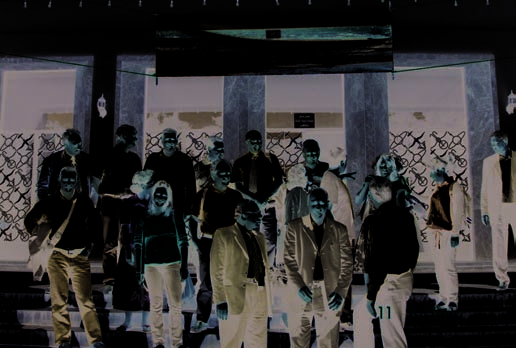
INPRINT
2009/1
coupling techniques, and methods for visualizing obser-
Kubo, Y.; Syvitski, J.P.M.; Hutton, E.W.H. & Paola, C. (2005):
vations and model results. Research is also needed for
Advance and application of the stratigraphic simulation model
developing, monitoring, and evaluating good practices
2D-SedFlux: From tank experiment to geological scale simula-
tion. Sedimentary Geology 178: 187195.
for applying and combining these options for particular
deltaic ecologies and societies.
Lewis, J. (1999): Development in disaster-prone places: studies
of vulnerability. Intermediate Technology Publications, London.
Many more scientific questions exist, along with the
McManus, J. (2002): Deltaic responses to changes in river
challenges of converting knowledge into policy and ac-
regimes. Marine Chemistry (79): 155170.
tion. These are articulated in a LOICZ Reports and
O'Brien, G.; O'Keefe, P.; Rose, J. & Wisner, B. (2006): Climate
Studies volume which is currently in it`s final editing in
change and disaster management. Disasters 30 (1): 6480.
collaboration with CSDMS (Boulder Colorado) and GWSP
Overeem, I. & Syvitski, J.P.M. (in press): Dynamics and Vulnerability
in Bonn. This Volume "Dynamics and Vulnerability of Delta
of Delta Systems. LOICZ Reports & Studies, No. 35. GKSS
Systems" (No. 35 is soon available on the LOICZ web-
Research Centre, Geesthacht.
site) has been developed by the workshop participants in
Restrepo, J. D. & Syvitski, J.P.M. (2006): Assessing the effect
order to set the agenda for future delta research and
of natural controls and land use change on sediment yield in a
application of resulting knowledge products. That way, a
major Andean river: the Magdalena drainage basin, Colombia.
coherent, comprehensive, and doable plan will be avail-
Ambio (35): 6574.
able, not only for adding to delta science but also for
Rothuis, A.J.; Nhan, D.K.; Richter, C.J.J. & Ollevier, F. (1998):
ensuring that the science is useful and useable.
Rice with fish culture in the semi-deep waters of the Mekong
Delta, Vietnam: interaction of rice culture and fish husbandry
management on fish production. Aquaculture Research 29 (1):
References
5966.
Giosan, L.; Bokuniewicz, H.; Panin, N. & Postolache, I. (1999):
Longshore sediment transport pattern along the Romanian
Syvitski, J.P.M. & Saito, Y. (2007): Morphodynamics of deltas
Danube delta coast. Journal of Coastal Research 15 (4): 859
under the influence of humans. Global and Planetary Change 57:
871.
261282.
Giosan, L.; Constantinescu, S.; Clift, P.D.; Tabrezd, A.R.;
Wisner, B.; Blaikie, P.; Cannon, T. & Davis, I. (2004): At risk:
Danish, M. & Inam, A. (2006): Recent morphodynamics of the
natural hazards, people's vulnerability and disasters, 2nd ed.
Indus delta shore and shelf. Continental Shelf Research 26 (14):
Routledge, London.
16681684.
Glantz, M.H. (2005): Water, climate, and development issues in
the Amu Darya basin. Mitigation and Adaptation Strategies for
Global Change 10 (1): 2350.
Contact: Center for International Climate and Environmental
Hewitt, K. (2007): Preventable disasters: addressing social vul-
Research (CICERO), Oslo
nerability, institutional risk, and civil ethics. Geographische
Rundschau: International Edition 3 (1): 4352.
http://www.ilankelman.org/contact.html
1st cross-cutting workshop on Coastal Lagoons at the Université Mohamed V in Rabat, Morocco, May 1115, 2009
Following up on the IGBP-MENA (Middle East and North
Africa ) workshop held in Cairo in November 2008, LOICZ
held its 1st cross-cutting workshop on Coastal Lagoons
at the Université Mohamed V in Rabat, Morocco. The
workshop was hosted by Prof. Maria Snoussi. It concen-
trated on a particular issue each day: residence time
(Stephen Mudge), biogeochemical budgets (Gianmarco
Giordani), sea-level rise (Georg Umgiesser and Saida
Niazi), conceptual diagrams (Sonia Cristina), DPSIR (Alice
Newton), assessment of trophic status (John Icely). The
workshop also included a field trip to the lagoon of
Moulay BouSelhan. 22 researchers, mostly from MENA
countries, Morocco, Algeria, Tunisia and Egypt attended
the workshop, as well as researchers from Portugal,
Spain, France, Italy and the UK.
(Photo: Alice Newton)
19


and the following SSC Members
LOICZ SSC News
Alison Gilbert, Institute for Environmental Studies (IVM),
Vrije Universiteit, Netherlands
LOICZ has a new Chair Person
Anthony Forbes, School of Life and Environmental
Sciences, Marine & Estuarine Research, University of Natal,
Since 1 January 2009, Professor Alice Newton is the
South Africa.
new Chair of the LOICZ Scientific Steering Committee.
Huang Weigen, State Key Lab. of Satellite Ocean
During a ceremonial delivery at Christmas, Prof. Alice
Environment Dynamics, State Oceanic Administration,
Newton has signed the contract at the LOICZ IPO in
Second Institute of Oceanography (SIO), China
Geesthacht.
Yoshiki Saito, Institute of Geology and Geoinformation
(IGG), Geological Survey of Japan
have finished their membership in the LOICZ Scientific
Steering Committee. We are very grateful for their sup-
port and great work for LOICZ in the last years and would
greatly appreciate if they keep being relatet and active in
participating in future LOICZ activities. We will miss all of
them, Alison, Ticky, Weigen and Yoshi at our next SSC
Meeting, which will take place in Kjeller, Norway. Jozef
Pacyna who has been with LOICZ for 9 years in total will
continue for one more year as a Past Chair and we look
forward to his continued senior support.
New SSC Members welcome on board!
LOICZ, following IGBP and IHDP approval has appointed
four new SSC members, who officially started their
Alice Newton signs the contract at the LOICZ IPO, Geesthacht
membership on 1 January, 2009.
(Photo: Barbe Goldberg)
In the following we like to introduce the first two of our
new Scientific Steering Committee members Masumi
One of the objectives of LOICZ is to identify the most vul-
nerable coastal regions under global change. Alice's
Yamamuro and Remi Laane to the LOICZ community.
Professor Zhongyuan Chen (State Kay Laboratory for
research on coastal lagoons has direct relevance to
Estuarine and Coastal Research, East China Normal
these fragile and valuable coastal systems that are very
University, Shanghai) and Professor Antonio C. Diegues
vulnerable to eutrophication, changes in sediment sup-
(Universidade de Sao Paulo Research Center on Human
ply and sea-level.
Population and Environment) will be introduced in the next
Alice's main research interest is eutrophication, particu-
volume.
larly with respect to the biogeochemical cycles.
Eutrophication expresses itself through a cascade of di-
Remi Laane
rect and indirect impacts on ecology and economy with
DELTARES
major implications for land-use and coastal zone devel-
Phone: 0031-15-2858655
opment.
Fax: 0031-15-2858582
Capacity building is an important part of the cross-cut-
e-mail: remi.laane@deltares.nl
ting activities of LOICZ. The linking of Integrated River
My experience and knowledge
Basin Management and Integrated Coastal Zone
is based on more than 35 years
Management is the major objective of the Erasmus
involvement in fundamental and
Mundus Joint Master of which Alice is the coordinator.
applied scientific studies in the
The course is the joint effort of 60 Universities that pool
coastal environment all over
human resources to develop a global postgraduate pro-
the world. It started in the Ems-
gram in Water and Coastal Management.
Dollard estuary and Wadden Sea in the Netherlands
where I, as a trained chemist and biologist, could work in
SSC members and Chair rotate off
a multidisciplinary group to study the estuarine carbon and
nitrogen cycle. During this period the scope evolved
By the end of 2008 our Chair for the last 3 years,
from national to international studies: various EU projects
Jozef Pacyna, Norwegian Institute for Air Research (NILU),
(e.g. NOWESP, EUROCAT, SPI-WATER, DIPOL) and the
20

INPRINT
2009/1
SCOPE-UNEP project "Transport of Carbon and major
Her present interest includes the effect of nitrogen loads
minerals from world rivers".
from acid rain to the water quality of watersheds.
My past work at a governmental agency of Rijkswaterstaat
Dr. Yamamuro obtained her academic training from The
and nowadays within DELTARES brings me in the oppor-
Faculty of Science, The University of Tokyo (B.A & M.S.,
tunity to bridge the gap between fundamental science
Geography) and Ocean Research Institute, The University of
and the valorization of the results in national and interna-
Tokyo (PhD, Geography). She began her career at the
tional policy plans. International networks, as ICES,
Geological Survey of Japan (Marine Geology Department)
OSPAR and LOICZ, where the backbone of my work. As
in 1991, and started in academia as professor at the
a member of (inter)national scientific advisory board of
University of Tokyo in 2007.
ICES, participation within OSPAR and various LOICZ proj-
Dr. Yamamuro is a review editor of "Aquatic Biology",
ects and within the Water Frame Work and Marine
and serves as an expert of limnetic ecology at the
Directives of the EU, I learned that capacity building on at
International Ecology Institute. She is a member of the
least transboundary catchment level is necessary to inte-
Japanese Society of Limnology (Ex-Councilor) and the
grate and to valorize scientific information to policymakers
Oceanographic Society of Japan (Ex-Councilor). She is also
and to technological applications. Especially this last ex-
a member of the Ocean Development Subcommittee,
pertise will be mobilized within my future LOICZ work.
Council for Science and Technology, Japan.
Besides being a scientific advisor with DELTARES I am
part time professor in marine biogeochemistry at the
University of Amsterdam and chairman of the environ-
mental and toxicology section of the Royal Dutch
Chemistry Society. I published more than 200 scientific
LOICZ Regional Nodes
papers and reports and six popular books on various as-
pects of the North Sea.
Masumi Yamamuro
Department of Natural
Environmental Studies, Graduate
School of Frontier Sciences,
The University of Tokyo
Phone: 81-47136-4770
Fax: 81-47136-4756
E-mail: yamamuro@k.u-tokyo.ac.jp
Dr. Masumi Yamamuro is a
Professor at the Department
of Natural Environmental
Studies, Graduate School of
Frontier Sciences, University
(Photo: Cheng Tang)
of Tokyo. She also serves as a guest researcher of
Geological Survey of Japan, AIST.
New address
Dr. Yamamuro has studied the following themes:
The Yantai Institute of Coastal Zone Research for
Sustainable Development which kindly hosts the LOICZ
· Nitrogen cycles in coral reefs
Regional Node East Asia has moved into a new building.
· Eutrophication control through food web management
Please note the new address!
in estuarine lagoons
· Measurement of seagrass standing crop using under-
LOICZ East Asia Regional Node
water ROV in subtropical coast
Yantai Institute of Coastal Zone Research for Sustainable
Development,
· Detection of POP's in detritus feeding coastal fishes
Chinese Academy of Sciences
· Dynamism in the complex ecosystem of coral reef,
Chunhui Road 26, Laishan District, Yantai, Shandong,
seagrass bed and mangrove forest
P.R. China
· Oxygen consumption process in the hypolimnion of an
Mailbox 1488, Post: 264003
estuarine lagoon
Tel: 86-535-2109021
· Invasion process of biofouling mytilids into an estuary
after the decline of seagrass beds.
Fax: 86-535-2109021
21

The third sub-session, chaired by O. Matsuda, was very
IPO Notes
diverse with regards to the contents of its presentations.
A general overview of the ICZM in Iran was given with a
LOICZ Activities in China
special emphasis on the delimitation of the coastal zone.
Several presentation had a very specific scientific focus,
Juergen Weichselgartner (LOICZ IPO) and
namely on the impact of the strong typhoon on the sea
Cheng Tang (LOICZ Regional Node East Asia)
temperature along the coast of Korea; the eutrophication
of the coastal area in Australia; and environmental impli-
From 28 October to 3 November, 2008, Dr. Juergen
cations of excess heavy metals in the Mikawa bay in
Weichselgartner (Senior Science Coordinator, LOICZ
Japan. Finally, an interesting case of environmental edu-
IPO), the LOICZ East Asia Regional Node (EARN), and as-
cation in the Seto Inland Sea was presented.
sociates gathered in Shanghai, Yantai, and Qingdao to
hold a session at the EMECS-8 conference, discuss vari-
The fourth sub-session, chaired by I. Trumbic, had only
ous issues of future activities according to the LOICZ
three presentations. Simulation of coastal currents and
Activity Plan, and to meet with the with LOICZ Chinese
river discharges in the south eastern Black Sea has
National Committee and the State Oceanic
shown the impact of river basins of Turkey on the Black
Administration (SOA).
Sea. The presentation on the sedimentation rate of the
tidal flat at Yuantuojiao Peak in China has shown the ex-
At the EMECS-8 Conference in Shanghai, LOICZ hosted ses-
tent of the coastal retreat. Finally, pelagic variables in two
sion 5 on "Institutional Models for Regional Collaboration
contrasting coastal systems on the Hokkaido Island in
in Coastal Science and Management (LOICZ related)",
Japan were presented.
which took place on 29 October, 2008. In total, 18 pre-
sentations were given with only one presenter being
The presentations given in session 5 pointed to various
absent. The authors came from 12 countries, predomi-
barriers that exist between scientists and policy makers.
nantly from Asia and Europe. The presentations were
While the scientists strive to excel in their research,
grouped in 4 sub-sessions and one could divide them in
sometimes their message seems to be not fully clear to
two major thematic groups: (1) presentations that elabo-
the decision makers. It is fair to say that some of the is-
rated on institutional models and the achievements in
sues the scientists are confronted with, such as open
practical implementation of ICZM; and (2) presentations
ocean issues, are not always easy to transmit in a simple
that focused on scientific aspects of coastal management.
language. On the other hand, it is evident that policy mak-
ers often want quick solutions and do not always take
The first sub-session, chaired by Prof. P. Shi, had invited
into account the scientific findings, particularly those that
speakers, giving a general overview of the ICZM achieve-
require long-term and costly solutions.
ments in their respective regions. LOICZ presented
current developments and outlined scientific themes and
All the presentations were of a high technical and visual
activities, emphasizing capacity building. The Regional
quality. After the conference sessions, J. Weichselgartner
Seas Programme of UNEP was represented by two of its
and C. Tang discussed with APN Science Officer
plans: MAP and NOWPAP. The former presented the re-
L. Stevenson possibilities of a joint workshop to develop
cently adopted regional Protocol on ICZM, an innovative
a regional research proposal, which would build on past
tool for regional coastal governance, while the latter in-
and current successful collaborations between the APN
troduced a wide range of activities achieved in relatively
and LOICZ. It was particularly agreed that a closer collab-
short period of time. One presentation dwelled specifi-
oration between the APN and the LOICZ Regional Node
cally on the comparative studies for coastal zone health
East Asia would be welcome.
assessment. The PEMSEA representative gave an elab-
The following two days were filled with presentations
orate overview of its activities concentrating on the
and discussions at the Yantai Institute of Coastal Zone
coastal zone (land and marine) spatial planning.
Research for Sustainable Development (YIC) and a field
The second sub-session, chaired by J. Weichselgartner,
trip along the coast. In the morning of 2 November,
was mainly concerned with water modeling along the
J. Weichselgartner and C. Tang departed to Qingdao to
coast with a specific emphasis on sediment flows. Three
meet the Chinese Committee of LOICZ at the Institute of
estuaries were explored: Yellow River and Pearl River in
Oceanology of the Chinese Academy of Sciences. After a
China, and Nile River Delta in Egypt. One presentation
joint lunch, discussions followed with Dunxin HU (IO-CAS),
elaborated on the ocean-atmosphere model for ocean
Shikui ZHAI (OUC), Xianshi JIN (YSFRI), Chaolun LI (IO-CAS),
currents with a view of estimating their renewable en-
and Chongguang PANG (IO-CAS). The next day, a visit of
ergy potential. A science based decision-support system
the First Institute of Oceanography, State Oceanic
for the Baltic Sea was also presented, with a view of pro-
Administration (SOA) was on the agenda. After a warm
viding the decision makers with the arguments to adopt
welcome, Mr. Gong-ke TAN (Director, Office of International
measures aimed at reducing the pollution flow into the
Cooperation) introduced the institute. Thereafter,
Baltic Sea.
Dr. Xianwei MENG (vice-director) introduced the Marine
22
INPRINT
2009/1
Geology Lab of FIO-SOA and Dr. Shuqin QIAO presented
Dahlem-Style meeting in Oslo, Norway in June. During
an ongoing project on Delta Risk Assessment in China.
my 10 weeks stay, I will also get informed about the
SOA and the LOICZ host GKSS are both involved in the
coastal research at GKSS as well as to obtain an
research project Yellow Sea Observation Forecasting
overview of national activities in the field of coastal re-
and Information System (YEOS). The professional and in-
search in Germany and Europe. A general task will be to
teresting meeting finished with a joint visit of the Marine
figure out the plan for a summer school in Yantai, China in
Geological Museum of FIO-SOA and a subsequent lunch
2010, and coordinate this with a capacity building work-
in a nearby restaurant.
shop "Toward a secure ecosystem based on environ-
mental monitoring techniques in the coastal zone
The science trip ended in Beijing with a meeting on funding
effective science communication practice" by UNITAR,
schemes. Together with T. LIU (Helmholtz Association of
LOICZ and YIC in the following October. I hope during
German Research Centres) and Prof. Xiaoping YANG
this short visit I will familiarize with the IPO running pro-
(Institute of Geology & Geophysics, CAS),
cedures, including how to coordinate with international
J. Weichselgartner discussed current and future LOICZ
science programs in coastal zone research, and I hope to
activities with regard to potential funding mechanisms.
apply this kind of knowledge later in the East Asia Node
network."
A fisherman sells his catch at the coast of Yantai, China
(Photo: J. Weichselgartner)
Guest from Yantai Institute of Coastal Zone
Research for Sustainable Development (YIC),
Chinese Academy of Sciences at LOICZ IPO
Cheng TANG
Cheng TANG
(Photo:
Jens Wegner)
LOICZ East Asia Node Coordinator Cheng TANG has
been working in the marine geology department of the
South China Sea Institute of Oceanology (SCSIO), Chinese
Coastal Cities Summit 2008: Values and Vulnerabilities,
Academy of Sciences (CAS). His PhD work correlates to
the Sino-German project "Pearl River Estuary Related
Hosted by the US branch of the International Ocean Institute,
IOI inSt. Petersburg Florida, November 1720, 2008
Sediments as Response to Holocene Climate Change
www.coastalcities.org
and Anthropogenic Impact (PECAI)", which closely re-
lates to the focus of LOICZ, and was funded by the
An initial brief comment on this first international work-
Max-Planck Society in the IOW, Germany, for scientific
shop targeted to explore the current resilience and future
training from 20042005.
risks for coastal urbanisation and cities
In 2006, he moved to the newly established Yantai Institute
Hartwig Kremer
of Coastal Zone Research for Sustainable Development
(YIC). It was a big challenge to step into a multidiscipli-
The newly established US branch of the International
nary area, but he very much looks forward to helping the
Ocean Institute, IOI, founded originally by German author,
new institute and colleagues to join the LOICZ network
Thomas Mann's, daughter Elisabeth Mann Borgese ac-
and activities.
cessed rather complex grounds by looking into the values
"From May 5th, I will stay at the Institute of Coastal
and vulnerabilities of coastal cities now and in the future.
Research at the GKSS and support the upcoming LOICZ
It was a first workshop of this kind which successfully
23

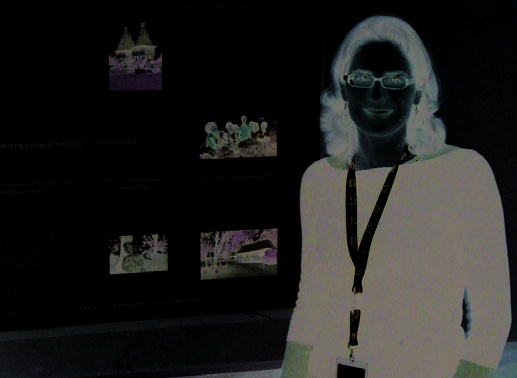
brought together multidisciplinary scientists from all over
sideration of the rapidly changing world particularly in
the world as well as practitioners such as mayors and city
coastal zones. Storminess, sea level rise, subsidence by
planers, funding agencies such as the World Bank and
human activity and issues of large scale constructions for
the UN. The overall goal was to explore what global
infrastructure, protection and coastal land and sea use in
change actually means in terms of increasing hazard
general were explored. Subsequently a vital discussion
risks to coastal urban developments including but not ex-
evolved in which scientists and practitioners came to
clusively looking into mega cities.
quite comparable views on the current and future risks
for our fast developing coastal cities.
For LOICZ this summit indicated the high priority the
project has in its focus on coastal vulnerability and gover-
nance. The importance of exploring the right scales of
coastal change, risks and hazards that LOICZ is looking
into basically in all its Themes and Topics was confirmed.
This includes both spatial and temporal boundaries in the
human environment system as well as institutional
dimensions which were also key issues discussed in
St. Petersburg.
LOICZ together with the IOI and potential other ESSP
partners aims to explore in which way we can engage in
future plans for a continued dialogue and assessment of
(Photo: Hartwig Kremer)
coastal cities in a changing world. We expect a full fea-
Presentations and discussions zoomed in on issues of
ture article going into higher detail and also lining out the
post war urban planning targeted towards economic
options for future collaboration on this subject in the
development, mobility and welfare but taking little con-
forthcoming newsletter.
Research assistant: affiliated projects at LOICZ IPO
Lara Wever joins the LOICZ project office from January
management. Her particular area of interest is coastal
to July this year. She is responsible for regularly commu-
zone management in the context of global environmental
nicating and collaborating with projects and activities that
change. Her master's thesis assessed the potential for
are affiliated to LOICZ. In this position, she takes care of
sustainable, integrated coastal zone management in East
the project database, regular information exchange with
Timor.
affiliated project partners, and she is developing a frame-
work for scientific evaluation and synthesis of affiliated
Lara has an international and interdisciplinary back-
activities.
ground. In the past she has lived and studied in Brazil,
Indonesia, East Timor, and Australia. She is not a new-
comer to the Earth System Science Partnership: Lara
previously worked as administrative and finance officer
at the Global Water System Project (GWSP) office in
Bonn, Germany.
The Role of the Coastal Ocean in the Disturbed and
Undisturbed Nutrient and Carbon Cycles
An abstract of the terminal evaluation of the UNEP/GEF,
GF/1100-99-07 project which was carried out by LOICZ
since the late 1990s. This project formed one of the back-
bones of LOICZ' biogeochemical research activities in
the past years. UNEP has kindly given permission to pub-
(Photo: Lara Wever)
lish an extract of the key findings.
Lara holds an undergraduate degree in international manage-
ment and a Master with Honours degree in environmental
Peter David Whalley, with additional remarks by the IPO.
24
INPRINT
2009/1
Executive Summary
· Used a typology approach (comparing coastal
regions of similar types) which enabled a relatively
1. This report represents an extract of the Terminal
small number of coastal budget estimates for
Evaluation of the UNEP/GEF Medium Sized Project:
nutrients and carbon to be extrapolated to provide
The Role of the Coastal Ocean in the Disturbed and
regional and global estimations of fluxes;
Undisturbed Nutrient and Carbon Cycle which was car-
· Provided training and tools to enable countries to
ried out by LOICZ as an implementing research project.
assess the role of coastal waters as sinks/sources
2. The overall goals of the project were:
of carbon and contributed to the on-going research
to reduce the scientific uncertainties in the global
· To estimate the impacts of nutrient enrichment on
carbon cycle.
coastal waters;
· The sustainability of the UNEP/GEF project has
· To estimate the changes on regional and global
been assured by
biochemical cycling of nutrients and carbon flux
· The LOICZ programme continuing;
from coastal and shelf seas to the atmosphere;
· The results from this UNEP/GEF project (and
· To assist governments in assessing the role of
those of the on-going LOICZ) will continue to be an
their coastal waters as sinks/sources of carbon;
important resource for GEF IW projects;
· To resolve scientific uncertainties concerning the
· The work of LOICZ will continue to be applied in
Global Carbon Cycle....
the activities of UNEP-DEWA.
3. The project has given a first global appreciation of dis-
7. A possible short-coming of the ProDoc was the fail-
turbed estuarine and coastal systems, including the
ure to include the need for management recommen-
regional differences in intensity of disturbance and
dations to enable mitigation steps to be adopted by
an array of system performance under differential
governments. At the end of the project the Task
loading. This has implications for the status of natu-
Manager and the LOICZ-IPO agreed to hold a final
ral resources and the probable trends in system func-
workshop to identify options that led to the produc-
tion; information that will have impact on thinking for
tion of a final report providing UNEP and the GEF (and
sustainability options and carbon-nitrogen cycling. The
their International Waters projects) with recommen-
final report provides policy recommendations and
dations on how to utilise the work of LOICZ.
reflects the implications of changing nutrient fluxes
8. Although this project contained a limited M&E sys-
for management. The report also provides an assess-
tem (as considered by current best practice) the proj-
ment of project outcomes and implications in the
ect did self-assess performance against the project
context of the GEF Operational Programmes. This
objectives with indicators defined in the ProDoc.
Targeted Research Project is still very relevant under
9. It is not clear how much use of this project (or the
GEF-4 Strategic Programme 2: 'Reducing nutrient over-
overall LOICZ programme) is being made by govern-
enrichment and oxygen depletion from land-based
ments in reporting carbon information to UNFCCC
pollution of coastal waters in LMEs consistent with
etc., although there are indications that countries sur-
the GPA'.
rounding the North Sea, South Africa, and the USA
4. The Executing Agency was the LOICZ-IPO (Land
are beginning to adopt the approaches of LOICZ. This
Ocean Interactions in the Coastal Zone International
is likely to expand further as the work of LOICZ is
Project Office). The project duration was initially 30
continued.*
months starting in July 1999. This was revised and
extended to be completed in December 2006, mak-
Conclusion and Rating
ing a total duration of 87 months.
10. The overall rating of this project was satisfactory. The
5. The main sources of information for this evaluation
following important issues were rated as being highly
have been the UNEP Task Manager, the LOICZ-IPO
successful with regards to meeting the planned
CEO, and literature from the project and the wider
objectives:
LOICZ initiative. A short email questionnaire was dis-
tributed to specialists within UNEP and the project to
· The project has considerably added to the pool of
seek wider information.
budget models (170 added**) for nutrients and
carbon in coastal waters. The project had a focus
6. The project has:
on sub-tropical and tropical sites where data was
· Enabled estimates of nutrient enrichment in
previously limited enabling more comprehensive
coastal waters to be made;
global assessments to be made.
· Estimated changes in biogeochemical cycling in
· The information collected under the UNEP/GEF
coastal waters;
project is still being utilised by the scientific com-
25

munity involved in the on-going work of LOICZ
the scientific community through to policy
ensuring that the input of UNEP/GEF is sustained.
change and management actions that can result
· The project has reached a wide number of scien-
in mitigation measures. This project did not
tific experts from government and academic insti-
directly address the use of the scientific under-
tutes around the world, and presented an agreed
standing in terms of management planning, yet
methodology for undertaking coastal assess-
the techniques developed lend themselves to
ments of nutrients and carbon.
'what if' scenarios for evaluating pollution reduc-
tion actions. (It should be noted that the final
· The project initiated a role of a 'mentor' to provide
report 'A management perspective' prepared
regional assistance to the work undertaken by the
by the project did provide some preliminary sug-
project and this is still continuing.
gestions of the next steps to utilise the LOICZ
approach for management).
Recommendations
iv. As a first step to raising awareness on the topic,
11. The following observations are made as an introduc-
UNEP should include a detailed summary of the
tion to the main recommendations.
main outputs (in graphical or map format) of the
· Targeted research is an excellent instrument
LOICZ work that clearly shows the distribution of
enabling the GEF to assist with improving the sci-
global budget model sites, trend information,
ence base on globally important issues. In this
sinks/sources of carbon and nutrients, etc. This
case, on nutrients and carbon source/sinks in
can be largely based on the Final Report of the
coastal waters providing access to scientists from
project and other key publications made by
GEF eligible countries to international expertise,
LOICZ.
thus strengthening national capacity, and provid-
v. UNEP should develop a mechanism to further
ing a mechanism to collect/analyse data from
propagate the valuable work undertaken by
regions where data is scarce leading to better
LOICZ for both on-going and future IW projects
global understanding of problems.
involved with nutrients and / or carbon budgets in
· This UNEP/GEF MSP developed, through the
coastal waters. This should be a more compre-
existing international structure of LOICZ, models,
hensive programme than just publishing a simple
budgets of nutrients and carbon, assessments of
brochure and making references to the LOICZ
loads and networks of experts, etc. information
web site. A plan should be developed to assist
and methods that are of significant importance and
IW projects utilise the very technical work of
relevance to the policy objectives of the current
LOICZ and to assist the projects with an appreci-
GEF-4 International Waters Strategic Programme 2.
ation of how this science based information can
12. The following recommendations are made as a result
best aid management decision making. It is
of this evaluation of the UNEP/GEF Targeted Research
important that UNEP continue a close relation-
Project 'The role of the coastal ocean in the dis-
ship with LOICZ to ensure that the on-going
turbed and undisturbed nutrient and carbon cycles'
work of this global programme can be assimilat-
ed and transferred to IW projects, where appro-
i.
The GEF, in co-operation with the IAs, should
priate utilising the extensive network of experts
develop a strategy to ensure that future targeted
familiar with the topic within LOICZ. It could be
research projects have a clear vision from the
beneficial in this 'awareness' raising to consider
outset on how the GEF and IAs will utilise the
a side-event at the next GEF IW Conference
work to assist countries or to facilitate the work
focusing on LOICZ. This could be an opportunity
of other projects on similar issues.
to showcase the work undertaken and to explain
ii. UNEP and the GEF need to have a mechanism
how the budget models, results of LOICZ in
for absorbing key recommendations that arise
terms of trends, retrospective baseline condi-
from projects (this probably applies to all projects
tions etc. and the network of experts in LOICZ
not just Target Research Projects). At the end of
could assist IW projects addressing coastal
the project, UNEP requested a final workshop to
issues of for example, nutrients. However prior
develop policy and management recommenda-
to this it would be essential for UNEP to have in
tions. This was a useful addition to the original
place a mechanism to continue support the
project design and provided detailed analysis of
requests for information and assistance from IW
how GEF policy could utilise the work with
projects on this issue.
improved linkages between policy and science ...
iv. UNEP and GEF should identify means to ensure
iii. Future projects should explicitly develop a strate-
the results of targeted research projects, and
gy (for subsequent use by GEF / IAs) for how the
their networks of experts, are integrated into
products of the research can best migrate from
future IW projects addressing similar problems.
26
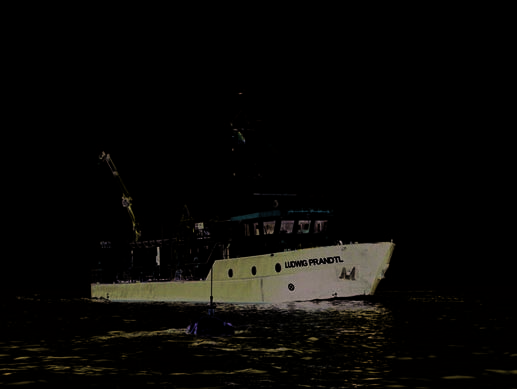
INPRINT
2009/1
The current project offers an excellent set of data
Among the list of LOICZ affiliated projects and core and
and assessments that could assist river and
cross-cutting activities there are also a number that keep
coastal projects with, for example TDA baseline
using and further developing LOICZ methodologies from
evaluations and scenarios resulting in potential
this project in various systems such as lagoons.
future management actions. For example, an
important publication by the LOICZ programme,
utilising information obtained by the UNEP/GEF
LOICZ Host GKSS The COSYNA project
project indicates a three-fold increase in coastal
nutrients between the 1970s and 1990s. Whilst
Coastal research: Helmholtz Association to invest twelve
acknowledging that these estimates were
million euros in a new observation system for the North
derived in different ways, the paper states there
Sea to be developed and implemented by GKSS.
are clear evidence that the increases are 'real' as
a result of human activity.
vii. UNEP and GEF require a better mechanism for
engaging scientists and policy makers in discus-
sions to ensure that relevant tools are developed
to assist management decisions and that tools
that are available are understood and applied.
Such a mechanism would be valuable in assess-
ing the design of projects and programmes to
ensure their relevance to global environment is-
sues.
viii. UNEP should ensure that the recently approved
GEF MSP 'Global: Enhancing the use of Science in
International Waters Projects to Improve Project
Results' integrates the findings of this evaluation
within the project's work programme.***
(Photo: GKSS)
Remarks form the LOICZ IPO:
With the major COSYNA project (Coastal Observation
LOICZ appreciates this evaluation and the permission by
System for Northern and Arctic Seas), a comprehensive
UNEP to publish an extract of key findings and recom-
observation system is being created in the area of the
mendations. They touch upon a central discussion on
German North Sea for the collection, prediction and sci-
how best to design an active and adaptable science policy
entific analysis of the current condition and develop-
interface an issue which is continuously being ad-
ment of the coastal sea. This project is being coordinated
dressed also by the new LOICZ. LOICZ is now also a core
by the GKSS Research Centre Geesthacht.
project of the International Human Dimensions
Porgramme on Global Environmental Change a mutually
"Today's major problems of the coasts and the seas in-
beneficial link by which the goal to inform better manage-
clude overfishing, overfertilisation with nutrients and the
ment through sound scientific information of inter-
discharge of toxic substances on top of this, there are
disciplinary kind is underlined. Special points of interest:
the effects of climate change. However, we lack the sci-
entific tools to precisely assess and predict parameters
* a major development in the context of biogeochemical
such as currents, water temperature or algae concentra-
budgets and estuarine assessments is carried out by the
tion", explains Prof. Franciscus Colijn, head of the
Mediterranean network LaguNet which strives for a
Institute of Coastal Research of the GKSS Research
whole regional sea budget.
Centre Geesthacht.
** meanwhile some 400 budget sites applying the same
methodology exist the application including model review,
"With the comprehensive data from COSYNA, we hope
refinement and complementary approaches is ongoing,
to better understand the development of the system of
driven largely by scientists' own initiative
the coastal sea as a consequence of physical, ecological
and biogeochemical processes in detail and thus allow its
*** LOICZ has been invited and agreed to take an active
prediction", Colijn continues.
role in the upcoming IW Science MSP
For the COSYNA measurement network, the Helmholtz
For a list of directly resulting LOICZ reports the LOICZ
Association is providing money in the amount of EUR 12
IPO recommends to check Reports and Studies volumes
million. COSYNA is later to be extended to the Arctic
and the Policy Implications report under www.loicz.org.
Ocean. A national initiation workshop will be held on
27

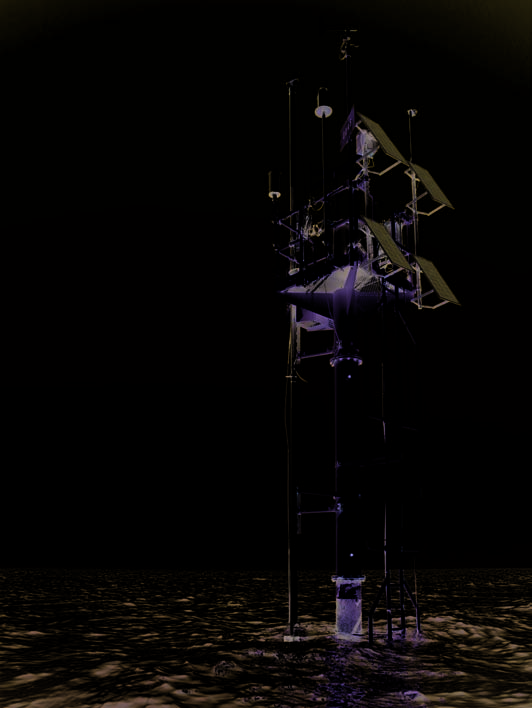
15 January 2009 at the Federal Maritime and Hydrographic
This provides the foundations for managing the coasts.
Agency (BSH) in Hamburg.
Specific future research questions might include: How
do the intensity and distribution of the current and mo-
tion of the sea or salt and acid levels change in the short
and long term? How does a temperature rise affect the
ecosystem? What controls the occurrence of algae
blooms or jellyfish swarms? What zones in the Wadden
Sea must be protected as a priority in the event of oil
spills?
COSYNA is being developed in close coordination and
cooperation with the German Marine Research
Consortium (KDM) and the relevant bodies of federal and
state governments. In a first step, a feasibility study will
show how COSYNA can be linked with observation sys-
tems of countries with a North Sea coast in the future.
Detailed information on COSYNA can be found at:
http://www.gkss.de/imperia/md/content/gkss/presse/unter
_uns/iii2008/titelthema.pdf
Publications
Towards sustainable
development of deltas,
estuaries and coastal zones
Trends and responses,
Deltares, January 2009, Delft,
The Netherlands
(Photo: GKSS)
Abstract
Observing, understanding, predicting
The report describes the
responses in deltas to a
On the operation method of the researchers: The auto-
number of drivers such as
mated measurement systems used by the scientists,
economic growth and climate change as well as to a number
such as radar technology, measurement buoys or satel-
of trends in society such as privatization and decentralization.
lites observing the planet, establish, for instance, current
The research described in the report has explored the perspec-
conditions, salinity or oxygen levels, the temperature and
tives of and experiences with four response themes. manage-
ment and restoration of natural systems, extension and
motion of the sea or the concentration of algae.
revitalization of infrastructure, development and adaptation of
land and water use and governance of delta management.
This data is fed by the Geesthacht coastal researchers
into complex simulation models, with the help of which
Some of the responses described may already be classified as
'best practices' (at least in the local context), others are yet
the physical, ecological and biogeochemical condition of
promising approaches. An effort has been made to arrange
the North Sea can be derived in high temporal or spatial
these practices into trends. These trends, illustrated with
resolution. The first objectives of the model are short-
examples taken from deltas all over the world, provide a com-
term forecasts on the current conditions in the North
prehensive overview of the type of current activities and devel-
Sea.
opments to enable delta life.
The research described in the report was part of the preparation
The complex COSYNA measurement and model system
of the Aquaterra 2009 conference, the World Forum on Delta
improves the understanding of the North Sea as a sys-
and Coastal Development.
tem and thus allows well-founded analyses of the risks
and options of the current climate change and use of the
Delft, April 2, 2009
North Sea.
Herman van der Most, DELTARES
28
INPRINT
2009/1
Coastal Wetlands
tions by natural and social scientists, the book examines both
An Integrated Ecosystem
the political and biophysical forces affecting semi-enclosed
Approach
marine systems.
SEMS comprise a substantial portion of the coasts-areas with
high population density and we rely on them for often-com-
Edited by
peting services such as navigation and transport, disposal of
Gerardo Perillo, Instituto
waste, provision of food, extraction of minerals, and leisure.
Argentino de Oceanografia,
The book describes how human activities could irrevocably
Bahia Blanca, Argentina
alter these fragile ecosystems, exploring threats from runoff to
Eric Wolanski, James Cook
climate change. It also addresses the unique challenges of
University, Queensland,
managing SEMS, including cooperation between multiple
nations.
Australia
Donald Cahoon, Patuxent
Wildlife
Edited by Edward R. Urban, Jr., Bjørn Sundby,
Research Center, US Geological Survey, Beltsville, MD, USA
Paola Malanotte-Rizzoli, and Jerry M. Melillo
Mark Brinson, East Carolina University, Greenville, NC, USA
Edward R. Urban, Jr. is SCOR Executive Director. Bjørn Sundby
is professor at the Université du Québec à Rimouski and in the
Description
Department of Earth and Planetary Sciences at McGill University,
Coastal wetlands are under a great deal of pressure from the
and is the SCOR President. Paola Malanotte-Rizzoli is a professor
dual forces of rising sea level and the intervention of human
of Physical Oceanography in the Department of Earth, Atmos-
populations both along the estuary and in the river catchment.
pheric, and Planetary Sciences at the Massachusetts Institute of
Direct impacts include the destruction or degradation of wet-
Technology and past president of IAPSO. Jerry M. Melillo is
lands from land reclamation and infrastructures. Indirect
past president of SCOPE and co-director of The Ecosystems
impacts derive from the discharge of pollutants, changes in
Center of the Marine Biological Laboratory in Woods Hole,
river flows and sediment supplies, land clearing, and dam oper-
Massachusetts.
ations. As sea level rises, coastal wetlands in most areas of the
world migrate landward to occupy former uplands. The compe-
tition of these lands with human development is intensifying,
New Policy Brief:
making the landward migration impossible in many cases. This
UNESCO
SCOPE
UNEP
book provides an understanding of the functioning of coastal
ecosystems and the ecological services that they provide, and
Coastal Basins on the edge
suggestions for their management. In this book a CD is included
containing color figures of wetlands and estuaries in different
parts of the world.
Coastal Basins on the Edge: This
policy brief, based on the report
Target audience
Watersheds, Bays and Bounded
students, engineers, scientists, researchers on coastal environ-
Seas, provides a summary for
ments, and resource managers with special interest in coastal
policymakers, students, and non-
wetland ecosystems.
scientists of the importance of
semi-enclosed marine systems,
Order at ELSEVIER:
the consequences of human im-
http://www.elsevier.com/wps/find/bookdescription.cws_home
pacts on these systems, and
/716674/description#description
recommendations about how to manage human impacts.
Copies are available from SCOPE, UNESCO, UNEP, and SCOR.
The policy brief can be found at
Watersheds, Bays and
http://www.scor-int.org/Publications/PB07.pdf
Bounded Seas
The Science and Management
of Semi-Enclosed Marine
Enhanced ocean carbon storage from anaerobic alkalinity
Systems
generation in coastal sediments
Some of the world's most impor-
H. Thomas1,2, L.-S. Schiettecatte3, K. Suykens3,
tant bodies of water, from the
Y. J. M. Koné3, E. H. Shadwick1, A. E. F. Prowe1,4,
Black Sea to the Bay of Bengal,
Y. Bozec5, H. J. W. de Baar2, and A. V. Borges3
are classified as "semi-enclosed
1 Dalhousie University, Dep. of Oceanography, Halifax, Canada
marine systems" (SEMS).
2 Royal Netherlands Institute for Sea Research, Den Burg, Texel,
Separated from the open seas by a
The Netherlands
strait, island archipelago, or physi-
3 University of Liège, Chemical Oceanography Unit, Liège,
cal process, SEMS are particularly vulnerable to environmental
Belgium
damage and particularly difficult to fully understand and manage.
4 Leibniz-Institut für Meereswissenschaften, IFM-GEOMAR,
Watersheds, Bays, and Bounded Seas provides state-of-the-
Kiel, Germany
science information about these complex systems and identifies
5 Station Biologique de Roscoff, UMR 7144 CNRS et UPMC
best management practices to preserve them. With contribu-
Univ. Paris 6, Equipe Chimie Marine, Roscoff, France
29


Abstract
"HABs in eutrophic systems" held in Baltimore in 2005,
The coastal ocean is a crucial link between land, the open ocean
the second OSM meeting is designed to bring experts
and the atmosphere. The shallowness of the water column per-
together from around the world to review the state-of-
mits close interactions between the sedimentary, aquatic and
the-art knowledge on eutrophication and HABs, and to
atmospheric compartments, which otherwise are decoupled at
take steps in designing the next phase researches to ad-
long time scales ( 1000 yr) in the open oceans. Despite the
prominent role of the coastal oceans in absorbing atmospheric
dress this critical global issue.
CO and transferring it into the deep oceans via the continental
2
shelf pump, the underlying mechanisms remain only partly
Meeting Website:
understood. Evaluating observations from the North Sea, a NW
www.geohab.info; www.geohab-osm-bj.ac.cn
European shelf sea, we provide evidence that anaerobic degra-
dation of organic matter, fuelled from land and ocean, gener-
ates total alkalinity (AT) and increases the CO buffer capacity
2
Ocean Colour Training Course Tanzania
of seawater. At both the basin wide and annual scales anaero-
bic AT generation in the North Sea's tidal mud flat area irre-
As a contribution to the ChloroGIN network, the Joint
versibly facilitates 710 %, or taking into consideration benthic
denitrification in the North Sea, 2025 % of the North Sea's
Research Centre (EC), in conjunction with the Institute of
overall CO uptake. At the global scale, anaerobic AT genera-
Marine Sciences, University of Dar-es-Salaam (Tanzania), is
2
tion could be accountable for as much as 60 % of the uptake of
offering a training course on "Methods and Applications of
CO in shelf and marginal seas, making this process, the anaero-
2
Ocean Colour Remote Sensing in African Coastal and
bic pump, a key player in the biological carbon pump. Under
Regional Seas". The course will take place from 1223
future high CO conditions oceanic CO storage via the anaero-
2
2
bic pump may even gain further relevance because of stimulated
October, 2009, at the University of Dar-es-Salaam, Stone
ocean productivity.
Town, Zanzibar, Tanzania and will be co-sponsored by
several organisations.
Final Revised Paper (PDF,630KB)
http://www.biogeosciences.net/6/267/2009/bg-6-267-
The course will provide the theoretical basis of satellite
2009.pdf
ocean colour measurements, as well as key applications
in monitoring and managing the coastal zone, in protect-
Discussion Paper (BGD)
ing marine ecosystems and resources. It is intended for
http://www.biogeosciences-discuss.net/5/3575/2008/bgd-5-
3575-2008.pdf
scientists, environmental managers, graduate students,
and post-doctoral fellows from all African and Western
Indian Ocean countries. Candidates should be fluent in
English and have adequate computer skills. A limited
number of scholarships will be awarded to help cover
Have you seen
travel and accommodation expenses.
Second Open Science Meeting
Further information on the course, plus the necessary
Application Forms are available on the training course
HABs and Eutrophication
website at:
1821 October, 2009, Beijing, China
http://amis.jrc.ec.europa.eu/oc2009africa.php.
The GEOHAB Programme, endorsed by SCOR and IOC
of UNESCO, is an international programme aimed at fos-
tering and promoting cooperative researches in marine
Coastal Snapshot
and brackish waters directed toward improving the pre-
diction of harmful algal bloom events.
Trip to Pekanbaru, Riau Province, Sumatra and
Spermonde Arcipelago, South Sulawesi
The GEOHAB Scientific Goal is to improve prediction of
HABs by determining the ecological and oceanographic
20 February 11 March 2009
mechanisms underlying their population dynamics, inte-
grating biological, chemical, and physical studies
Report by Bernhard Glaeser and Marion Glaser, LOICZ SSC
supported by enhanced observation and modelling sys-
tems. The GEOHAB Mission is to foster international
The trip to Indonesia in early 2009 led the LOICZ/SPICE
co-operative research on HABs in ecosystem types shar-
team Marion Glaser and Bernhard Glaeser to two desti-
ing common features, comparing the key species
nations: first to Pekanbaru in Riau Province (north
involved and the oceanographic processes that influence
Sumatra), February 2024, then to Makassar and the
their population dynamics. Eutrophication is recognized
nearby Spermonde Archipelago in southwest Sulawesi,
as one of the factors contributing to the increasing prolif-
February 27 to March 11. Both visits consisted of a work-
eration of harmful algal blooms in coastal areas
shop with summer school for Indonesian (in Pekanbaru
worldwide. After the first Open Science Meeting on
for German and Indonesian) students and a field trip.
30
INPRINT
2009/1
Whereas the field trip to some coral reef islands in the
Indonesia as a whole has seen rapid deforestation
Spermonde Archipelago marked the beginning of an
caused by large scale conversion projects, mainly for
Indonesian-German research activity which is largely
palm oil plantations. Deforestation reached 1.8 million
funded by the German Ministry for Education and
hectares per year between 1987 and 1997. It rose sharply
Research (BMBF) and the Indonesian Ministry for
to 2.8 million hectares annually from 1998 to 2000 and
Research and Technology (RISTEK) the much shorter
then declined again to 1.8 million hectares between 2000
workshop and field trip in Riau assembled a team of
and 2006 (The Jakarta Post, February 25, 2009: 5).
Indonesian and German researchers and students with-
out funding, designed to develop a future research plan
The aim of the field trip was to have an impression of the
and proposal.
pollution in the river, caused by riverine industrial plants,
including palm oil industry and pulp and paper, and to in-
SPICE (Science for the Protection of Indonesian Coastal
terview villagers in the adjacent and nearby villages
Ecosystems) is a LOICZ project. SPICE Cluster 6
about possible health effects and waterborne deceases.
"Governance und Management of Indonesian Coastal
As an example: About 400 families live in the town of
Social-Ecological Systems" is coordinated by Marion
Siak Sri Indrapura. Twenty percent of the population use
Glaser and Agus Heri Purnomo. It is related to LOICZ
the river water for daily use like washing, laundering
Priority Topic 1, Social-Ecological Systems (SES) Analysis
clothes and brushing teeth, but they hardly drink the river
and a pioneer project in empirical SES analysis.
water. In 1985/86, fish started to die, presumably caused
by factory effluents. The number of fishermen has not in-
creased since then. Pollution comes and goes. The
1. Riau/Sumatra
villagers smell the chemical substances when they arrive,
Riau Province on Sumatra is one of three SPICE project
usually two to three times a year. This year, chemicals ap-
sites, the other two being Spermonde Archipelago in
peared already. The respondent reported that the fish
southwest Sulawesi (see below) and Segara Anakan in
was unconscious. They do not eat dead fish but they eat
southwest Java.
them when they are still alive but seem to be dazed. The
occurrence of pollution is usually reported to the local
The German-Indonesian SPICE meeting in Pekanbaru
fishery department, but until now no measure has been
consisted of two parts. Part 1 was a two day field trip to
taken. Skin diseases are the most prominent problems.
the Siak river estuary and to the Districts of Bengkalis
and Siak, on February 2122, 2009, funded by LOICZ.
Presentations at the following workshop presented scien-
Part 2 was a two day International Workshop and Summer
tific findings and confirmed the complaints encountered in
School on February 2324, 2009, which was prepared and
the villages. According to Dr Christine Jose, food scientist
funded by UNRI (Riau University in Pekanbaru).
at the Chemistry Department of Riau University,
Participants were Indonesian and German researchers
as well as public health students from both countries.
Siak river is a source of potable water, but contaminated
The arrival in Pekanbaru, the province capital, was over-
by E. coli
shadowed by smog which darkened not only the city but
Siak river is a sink of urban drainage and industrial
large parts of northern Sumatra, the Malacca Strait,
effluent
Singapore and south Malaysia. The smog was caused by
People are exposed to water borne diseases
illegal forest burning and clearance and lasted for several
days. The objective was to have space for new palm-oil
As Siak water is used for daily life, food, glassware
plantations. Indonesia is one of the world's largest palm-
and utensil may be contaminated by E. coli
oil exporters. Plantation pesticides and other chemicals
Heavy metals are also present in the water and con-
pollute the Siak river, one of the largest Indonesian rivers.
taminate fish
The population in the villages along the river uses its
water for different purposes, such as fishing, washing,
The bioactive component in the heavy metal contam-
cooking, and even drinking. Negative health effects are
inated fish may enter the human body as people con-
likely to happen.
sume the fish
The bioactive component may pass through the cell
Observations in Riau along the Siak river have shown
nucleus and negatively affect the DNA and RNA
that, between 2006 and 2008, most pulp and paper
plants had been shut down because there were no more
trees to be felled. Deforestation was complete. Regional
Outcome: The workshop participants agreed to develop a
development cannot be maintained, sustainable forest
framework for a research proposal (,,skeleton"). All collab-
production is lacking. Reafforestation on the cleared terri-
orators were requested to fill in and to add ,,flesh to the
tories was limited. Instead, pulp and paper was replaced
bones". Indonesian and German public health theses form
with monocultural palm oil plantations and industries
the research nucleus. The first ones are expected to be
whose effluents pollute the river.
ready in early 2010.
31

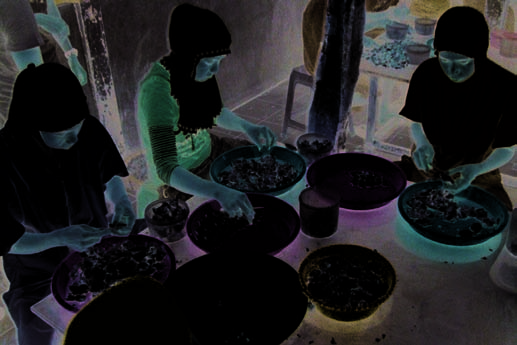
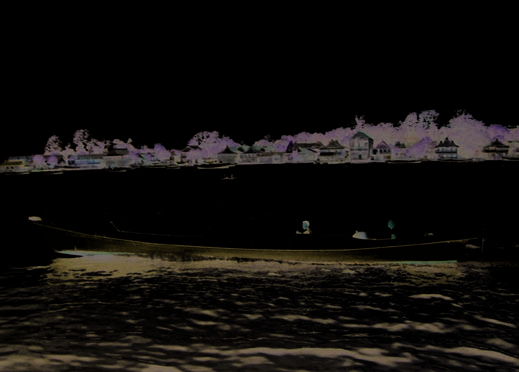
A joint publication is planned as a book chapter: "River
long ago. Fishermen for one boat don't mix, women do
health and community health" (working title). Within the
not visit the houses on the other (eastern) side.
conceptual framework of social-ecological systems
Excursion participants suffered low-grade aggression
(SES) and governance analysis, the focus is on poverty,
(verbal, pushing, grabbing) from people from the poorer
health and sustainable development within the Siak river
(western) part of the village. The excluded part in the
catchment area in Riau Province.
west has erosion problems quite a few houses had
been washed away by the waves and less develop-
ment money or projects. Wooden wave breakers had
2. Spermonde /Sulawesi
been installed but were not very effective.
The preparation of the Spermonde research, including
questionnaire development, was done in Bremen (ZMT)
and Makassar (UNHAS University) during the winter time
of 2008/2009. A final preparatory workshop was con-
ducted in Makassar on February 2728 before a nine day
field trip (March 19) was started to visit four coral reef is-
lands in Spermonde. A local style white ship named Cinta
Laut (Love of the Sea) embarked about 30 participants:
Indonesian research students, Indonesian and German
supervisors and researchers, a film team, a Jakarta Post
reporter, and crew members, including two cooks.
The four islands visited appeared to be, much to the sur-
prise of some of the Indonesian students, totally different
from one another, economically, socially, or politically. Let
me attach nicknames to highlight their peculiarities as the
Women work in a crab processing factory (Photo: Bernhard Glaeser)
research team identified them, no doubt with a subjec-
"Women's Island" (Saugi) is characterized by women's
tive bias. We visited "Haji Island", "Conflict Island",
labor. Women work in a crab processing factory, they are
"Women's Island" and "Pirate Island". The Spermonde
seasonally employed in seaweed (rumput laut) culture,
population speaks three different Malay languages:
and they are self-employed as small village traders. This
Bahasa Indonesia (the official Indonesian national lan-
island looks traditional, tidy and well-kept: Flowers and
guage), Makassarese and Buginese-a fact that renders
fruit trees (bananas) have been planted, roads are clean,
research somewhat difficult, even for Indonesians.
gardens have fences, goats are on leashes. Different
The routine was the same for all four islands, namely two
from other islands, village assemblies don't show a strict
days' visits, including two overnight stays: Arrival mid-
right-left segregation between men and women as is the
day, followed by an official welcome, lunch, and
custom in a mosque. Women on Saugi island earn money
discussion with the villagers at the village office or in a
on a regular basis. This is an extra family and village in-
school. After that, the research team split up into sub-
come in addition to what the fishermen earn. The fact
teams to assemble focus groups, consisting of two male
that women earn money renders them more influential
and two female groups representing more or less influ-
and may cause social change.
ence and wealth. In the evening, a film was shown
publicly at a central village place. The second day was re-
served for further focus group discussions or individual
interviews. On the third day, the ship moved on to the
next island.
"Haji Island" (Barrang Caddi) is dominated by an innova-
tive fish entrepreneur and trader (punggawa). At the same
time, he is a haji (pilgrim to Mecca) and thus an eminent
leader due to religious credentials. The social capital of a
prominent figure (tokoh) is gained in one or more of the fol-
lowing fields: religion (agama), economy (ekonomi), social
network (sosial), knowledge, including innovation (penge-
tahuan). Our leader dominates in all of them.
"Conflict Island" (Badi) is divided. The population is seg-
regated into two fractions that don't get along well since
"Pirate fishers" take off to bomb the reef (Photo: Bernhard Glaeser)
32
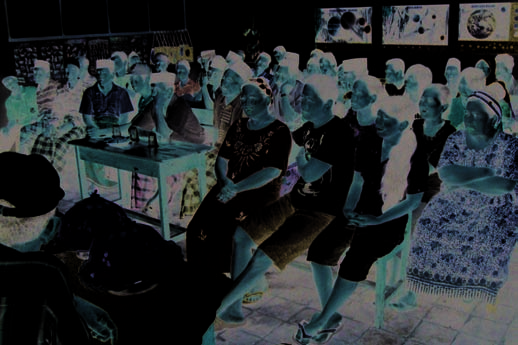
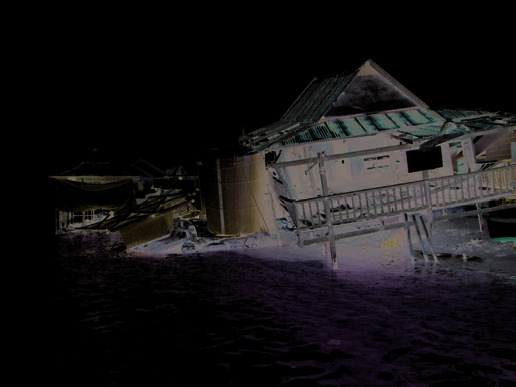
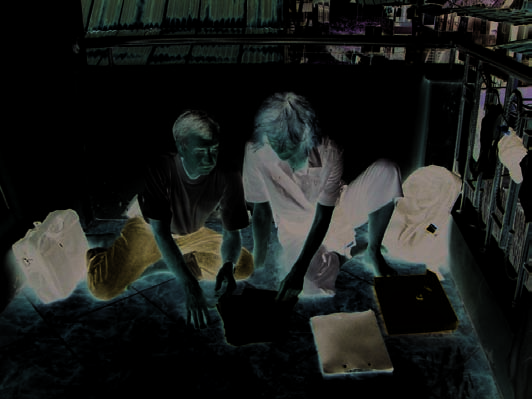
INPRINT
2009/1
"Pirate Island" (Karanrang) builds on "pirate fishing",
Many local inhabitants acknowledge that present fishing
using bombs and cyanide for fishing whereby the fisher-
practices, if unchanged, will result in the degradation, if
men destroy the reef, the fundamental biotope to
not destruction, of the reef. Sea level rise is threatening
support a highly diverse biocoenosis, including fish. This
the islands. Houses have been destroyed, already.
island is the wealthiest and the most "modern". The
People moved to relatives or left their island. There are
welcoming lunch was chicken (not fish) and was served
few sources for income. A vision or concept for future
in styrofoam boxes.
development seems to be non-existent. The respon-
dents simply hope for more fish in the future. The
One could see TV sets and mobile phones. The popula-
conviction of a God-given destiny is ever present.
tion included 40 hajis, which means that 40 trips to
Mecca had to be financed in one year. A huge mosque
A positive exception were the women on Saugi Island
had been constructed recently.
who found employment or were self-employed. They
went to work when the men came home from fishing.
Employment opportunities for women and aquaculture
(sea cucumbers, fish cages, algae cultivation) seem to be
a way out of the stagnant economic situation and should
be pursued by on the provincial and district level to pro-
mote local and regional development. Reef restoration is
an option to reduce beach erosion. Social-ecological sys-
tems analysis aims at understanding how to increase
reef resilience and to enhance people's livelihoods.
Indonesia's Fisheries Minister Freddy Numberi advo-
cates a policy shift to focus the country's development
on the oceans: "An ocean policy, made with the cooper-
ation of all stakeholders ..., will set us on the right course
to realize the full potential of our marine resources" (The
"Pirate Island" (Karanrang) Villagers discuss past developments and
Jakarta Post, February 26, 2009: 4).
future options with researchers (Photo: Marion Glaser)
The overall picture was slightly depressing. Fish re-
sources have been depleted. A sixty-five year old Saugi
fisherman phrased it like this: "Crabs are much smaller
now. Formerly, four to five crabs weighed one kg, now it
takes 12 crabs to reach that weight. Whereas the small
ones used to be thrown back, now everything is taken. In
former times, we went fishing only when the weather
was good. Now, they go every day, even when it storms.
When a storm came, previously, we would throw the an-
chor and stay. Nowadays, the boat would sink. This
proves that the waves are higher now."
Bernhard Glaeser and Marion Glaser (LOICZ SSC members and authors
of the article) discuss questionnaires (Photo: unknown research student;
Bernhard Glaeser's camera)
Outcome: The research will be continued in May, 2009. A
final report will be prepared which includes the islanders'
reconstruction of their long term historical time lines and
their future visioning, social networks, and spatial and
seasonal mapping in order to understand which people,
resources and locations are of special importance to the
community and what constitutes the specific social-eco-
Sea level rise and storms threaten small islands (Photo: Bernhard Glaeser)
logical focus system(s).
33

ECSA Symposium: Estuarine Goods and Services
Calendar
29 August 4 September 2009 Venue: Dublin, IRELAND
http://www.ecsa-news.org/
2009
7th Baltic Sea Science Congress 2009
1721 August 2009
2nd International Conference on Water Economics,
Tallinn, ESTONIA
Statistics, and Finance
http://www.bssc2009.org
35 July 2009
Alexandroupolis, Thrace, GREECE
ECSA Symposium: Estuarine Goods and Services
http://www.soc.uoc.gr/iwa/2009/iwa_page.php?IWAdoc=
29 August 4 September 2009
Dublin, IRELAND
PAGES 1st Young Scientists Meeting
http://www.ecsa-news.org/
67 July 2009
Oregon State University, Corvallis, USA
24th International Meeting on Organic Geochemistry
http://www.pages-osm.org/
611 September 2009
Bremen, GERMANY
7th International Conference on Geomorphology (ANZIAG)
http://www.marum.de/imog2009/
Acient Landscapes Modern Perspectives
611 July 2009
5th International Conference on River Basin Management
Melbourne Convention & Exhibition Centre, Australia
79 September 2009 Venue: Malta
http://www.geomorphology2009.com/
http://www2.wessex.ac.uk/09-conferences/river-basin-management-
2009.html
ECOSUD 2009 7th International Conference on
Ecosystems and Sustainable Development
European Marine Biology Symposium 2009
810 July 2009
711 September 2009 Venue: Liverpool, UK
Chianciano Terme, ITALY
http://www.liv.ac.uk/marinebiology/embs.html
http://www.wessex.ac.uk/images/stories/pdf_cfps/2009/ecosud_
09.pdf
Water Resources Management 2009
911 September 2009, Malta
PAGES 3rd Open Science Meeting
http://www.wessex.ac.uk
Oregon State University, Corvallis, USA
811 July 2009
http://www.pages-osm.org/
Coastal Processes 2009
1416 September 2009, Malta
MARE Conference People and the Sea V
http://www2.wessex.ac.uk/09-conferences/coastal-processes-
911 July 2009
2009.html
Amsterdam, The Netherlands
http://www.marecentre.nl/people_and_the_sea_5/index.html
Coasts, Marine Structures and Breakwaters 2009
1618 September 2009
Third AMMA International Conference
Edinburgh, UK
2024 July 2009
http://www.ice-breakwaters.com/
Venue: Hotel Azalai Independance, Ouagadougou, Burkina
http://amma-international.org
ICES Annual Science Conference
2125 September, Berlin, Germany
www.ices.dk/asc2009/
iLEAPS Science Conference
Call for sessions: iLEAPS Science Conference 2009
OceanObs'09
iLEAPS, the Integrated Land Ecosystem-Atmosphere Processes
2125 September 2009, Venice, Italy
Study (http://www.ileaps.org/) is organizing a Science Conference
http://www.oceanobs09.net/
2428 August 2009 in Melbourne, Australia.
session: High-resolution deltaic architecture at:
2nd International Conference on Progress in Marine
IAS 2009 27th Meeting
Conservation in Europe 2009
Alghero, Island of Sardinia, Italy
1014 August 2009
2023 September 2009
Stralsund, Germany
The second circular of the IAS 2009 meeting is now available on
http://www.sesame-ip.eu/public/news
the web site: http://www.ias2009.com
34
INPRINT
2009/1
CarboOcean Final Conference
20th biennial conference: CERF 2009 Coasts and Estuaries in a
59 October 2009, Bergen, Norway
Changing World, 15 November 2009, Oregon Convention
Contact: Christoph Heinze
Center, Portland, Oregon USA .
Christoph.Heinze@gfi.uib.no
3rd International Conference on Aquatic Resources ICAR-09
6th GKSS School on Environmental Research
" Prospects and Challenges"
School on Statistical Analysis in Climate Research
1720 November 2009, Alexandria, Egypt
in Lecce, Italy, 6-16 October 2009
http://www.empnetwork.net/icar09/
http://coast.gkss.de/events/6thschool)
Contact: Götz Flöser
4th European Conference on Coastal Lagoon Research
Telefon: +49 4152 87 23 45
Research and Management for the Conservation of Coastal
Telefax: +49 4152 87 28 18
Lagoon Ecosystems, South-North comparisons
Goetz.floeser@gkss.de
Montpellier from 1418 December 2009
http://www.ecolag.univ-montp2.fr/lagoon-conference
HABs and Eutrophication
SECOND OPEN SCIENCE MEETING
2010
1821 October 2009 Beijing, China
Meeting Website: www.geohab.info; www.geohab-osm-bj.ac.cn
An ICES Symposium on the Collection and Interpretation of
Fishery Dependent Data will be held during the summer 2010,
First international conference on Asia Quaternary
in Galway, Ireland with N. Graham (Ireland), K. Nedreaas (Norway),
Research (AsQUA)
and W. Karp (USA) as Conveners.
Beijing, 1923 October 2009, in conjunction with International
A Scientific Steering Group will be established with members nom-
Symposium on Paleoanthropology in Commemoration of the
inated by relevant Working Groups to assist the Conveners in
80th Anniversary of the Discovery of the First Skull of Peking
planning the Symposium. The Symposium will be co-sponsored by
the Marine Research Institute of Ireland and the United States
Man.
National Oceanic and Atmospheric Administration and will be held in
If you have any questions, please contact Prof. GAO Xing
association with FAO. In consultation with the Conveners, the
(gaoxing@ivpp.ac.cn).
General Secretary will solicit further co-sponsorship as appropriate.
Second DIVERSITAS Open Science Conference:
ASLO-NABS 2010 Meeting
Biodiversity and society: understanding connections, adapting
Global Changes from the Center to the Edge
to change,1316 October 2009, in Cape Town, South Africa
June 611, 2010
Contact: Mélinda SEENEEVASSEN
Santa Fe, New Mexico, USA
DIVERSITAS Secretariat
http://www.aslo.org/forms/santafe2010.html
Muséum National d'Histoire Naturelle (MNHN)
Session proposals must be submitted online by 23:59 U.S.
Maison Buffon
Central Daylight Time, 30 September, 2009
57 rue Cuvier - CP 41
75231 Paris Cedex 05, France
Tel: + 33 1 40 79 80 40
11th INTERNATIONAL MEETING on STATISTICAL
Fax: + 33 1 40 79 80 45
CLIMATOLOGY
Email: secretariat@diversitas-international.org
JULY 1216, 2010, UNIVERSITY OF EDINBURGH, SCOTLAND
http://www.diversitas-international.org
http://cccma.seos.uvic.ca/imsc/11imsc.shtml
Coasts and Estuaries in a Changing World (CERF 2009)
An ICES/NASCO/NPAFC Symposium on Marine Mortality of
15 November 2009 Ort: Portland, Oregon, UNITED STATES
Salmon will be held in October 2010 in Europe with Niall Ó
http://www.erf.org/newsletter/Winter07-CERF09-ExecDir.html
Maoiléidigh (ICES), Malcolm Windsor (NASCO), and Jim Irvine
(NPAFC) as Conveners.
A Scientific Steering Group will be established with members
MEDCOAST 2009
nominated by each organization to
The Ninth International Conference on the Mediterranean
assist the Conveners in planning the Symposium.
Coastal Environment
1014 November 2009, Sochi, Russia
www.medcoast.org.tr
2011
International Symposium on Integrated Coastal Zone
The East Asian Seas (EAS) Congress 2009 in Manila,
Management
Philippines on 2327 November 2009
1216 June 2011
Calls for Abstracts and for Exhibitors are also now open. To
Arendal, NORWAY
know more about EAS Congress events and participation op-
http://www.imr.no/iczm/
portunities, please visit www.pemsea.org/eascongress
For further inquiries, please email the EAS Congress Secretariat
at congress@pemsea.org.
All dates are also available on our website:
To register, please visit: www.pemsea.org/eascongress/registration
http://www.loicz.org/calender/index.html.en
35



Publication details
LOICZ in brief
The LOICZ Newsletter is produced three times per year
LOICZ aims to provide science that contributes
to provide news and information regarding LOICZ activ-
towards understanding the Earth system in order to
ities. The views and opinions in this newsletter do not
inform, educate and contribute to the sustainability of
necessarily represent the position of LOICZ or its spon-
the world's coastal zone. LOICZ is a core project of the
soring organizations.
International Geopsphere-Biospere Programme (IGBP)
and the International Human Dimensions Programme
Published and edited by:
on Global Environmental Change (IHDP).
The Land-Ocean Interactions in the Coastal Zone
International Project Office
The LOICZ IPO is hosted by the Institute of Coastal
Research at GKSS Research Centre which is part of the
Design:
Helmholtz foundation.
Barbe Goldberg
Gerit Stoffregen
Hester Whyte
LOICZ research as outlined in the science plan and im-
plementation strategy is organised around five themes:
Printing and layout:
GKSS, TFP Print Media, Geesthacht, Germany
· Vulnerability of coastal systems and hazards to
Photographs and illustration:
society
The illustration of the coastal zone on the front page is
made by the artist Glynn Gorick, UK, 2005 and commis-
· Implications of global change for coastal eco-
sioned by LOICZ/IGBP. The photographs on the front and
systems and sustainable development
back page of this newsletter are copyright to Martin Le
Tissier.
· Human influences on river-basin-coastal zone interaction
Contact:
· Biogeochemical cycles of coastal and shelf waters
GKSS Research Centre, LOICZ IPO
Institute of Coastal Research
Max-Planck-Str. 1
· Towards coastal system sustainability by managing
21502 Geesthacht, Germany
land-ocean interactions
phone: +49 41 52 87 20 09 · fax: +49 41 52 87 20 40
e-mail: loicz.ipo@loicz.org · url: www.loicz.org
The Science Plan and Implementation Strategy is avail-
© Copyright 2009, Land Ocean Interaction in the Coastal
able electronically on the LOICZ website and in hard
Zone, Core project of IGBP and IHDP
copy at the LOICZ IPO.
Get involved
If you wish to contribute to LOICZ INPRINT please send an e-mail to: loicz.ipo@loicz.org or visit the LOICZ
website www.loicz.org for article requirements.
If you have a project you would like to affiliate to LOICZ please go to www.loicz.org and click on research for
detailed information.