



























Land-Ocean Interactions in the Coastal Zone
INPRINT
The IPO and SSC wish you all a happy and
successful New Ye a r. We thank you for
great LOICZ work in 2006 and look forw a r d
to even more good collaboration and new
and exiting LOICZ science in 2007.
Contents
Morphodynamics of Deltas and the Influence
of Humans
3
Assessment of Estuarine Trophic Status using
the ASSETS methodology - Rationale,
development and examples.
6
SPICE/LOICZ/ATSEF/SEACORM (SLAS)
Southeast Asia Coastal Governance and
Management Forum: Science Meets Policy
for Coastal Management and Capacity Building,
Bali, 14th - 16th November 2006
10
The LOICZ project database - a new feature on
the website
11
Water, Sea level, Storms and Urbanization -
Coasts at Risk
At the 1st ESSP Open Congress (09-12. Nov. Beijing, China)
LOICZ and Earth System Partners took an
interdisciplinary look onto coastal change
13
The future of the LOICZ Typology -
Conceptualizing coastal classification and
interpretation of complex data relations
15
New LOICZ Regional Node to be set up in Yantai, China
Initial talks underway between LOICZ IPO and YIC
16
START/PACOM Regional Node for Wetlands and
Coastal Zone Management - a nucleus for
regional LOICZ research
16
SSC Changes, IPO staff changes
19
Publications
20
Have you seen, Calendar
23
www.loicz.org
2006/3
L O I C Z P E O P L E
LOICZ Scientific Steering Committee
Yoshiki Saito - Japan
Geological Survey of Japan, AIST
Jozef M. Pacyna (Chair) - Norway
Center for Ecological Economics (CEE)
Dennis P. Swaney - USA
Norwegian Institute for Air Research NILU
Department of Ecology and Evolutionary Biology
Cornell University
Felino P. Lansigan (Vice-chair) - Philippines
University of the Philippines Los Banos (UPLB)
School of Environmental Science and Management (SESAM)
LOICZ Regional IPO Nodes
and Institute of Statistics (INSTAT)
South Asia Regional Node - Sri Lanka
Nancy N. Rabalais (Vice-chair) - USA
Nalin Wikramanayake
LUMCON - Louisiana Universities Marine
Department of Civil Engineering
Open University of Sri Lanka
William C. Dennison - USA
tomwiks@yahoo.com - www.nsf.ac.lk/loicz
University of Maryland
Center for Environmental Science
European Regional Node - Germany
Götz Flöser
Anthony "Ticky" Forbes - South Africa
Institute for Coastal Research
Marine & Estuarine Research
GKSS Research Centre
Biomonitoring, Research and Environmental management
floeser@gkss.de - http://coast.gkss.de/loicz
Juan D. Restrepo - Colombia
Southeast & East Asia Regional Node -
Department of Geological Sciences
Singapore
EAFIT University
Beverly Goh
National Institute of Education
John Parslow - Australia
Nanyang Technological University
CSIRO Marine Research
bgoh@nie.edu.sg
Eva Roth - Denmark
Department of Environmental and Business Economics
LOICZ IPO
University of Southern Denmark
Hartwig H. Kremer - hartwig.kremer@loicz.org
Alice Newton - Portugal
Chief executive officer
Faculty of Science and Technology
University of Algarve
Barbe Goldberg - loicz.ipo@loicz.org
Office and communications manager
Alison Gilbert - Netherlands
Institute for Environmental Studies (IVM)
Maike Paul - maike.paul@loicz.org
Free University Amsterdam
Project assistant
Bernhard Glaeser - Germany
Social Science Research Center Berlin (WZB)
For full contact details of the SSC members,
Regional IPO Nodes and LOICZ IPO staff please
Weigen Huang - China
go to www.loicz.org
Second Institute of Oceanography
State Oceanic Administration
Isao Koike - Japan
Ocean Research Institute, University of Tokyo
Address updates and subscription
Laurence Mee - UK
Marine Institute
For address updates and subscription to the LOICZ
University of Plymouth
newsletter please contact the IPO
at loicz.ipo@loicz.org.
Stephen B. Olsen - USA
Coastal Resources Center
If you want to receive the newsletter electronically or
Graduate School of Oceanography
if you wish to unsubscribe please let us know.
University of Rhode Island
This newsletter is also available online at
Ramesh Ramachandran - India
www.loicz.org
Institute of Ocean Management
Anna University
2
I N P R I N T
2006/3
Morphodynamics of Deltas and the Influence of
Delta plains, once the home to vast areas of wetlands,
Humans
now host vast agriculture infrastructures.
James P.M. Syvitski1, Yoshiki Saito2
A new study (Syvitski and Saito, in press) describes the
1 INSTAAR, U. Colorado, Boulder CO, USA, 80309-0450,
morphodynamics of global deltas under human influ-
syvitski@colorado.edu
ence, in terms of ratios of key environmental
2 IGG, Geological Survey of Japan, Tsukuba 305-8567,
Japan, yoshiki.saito@aist.go.jp
characteristics:
1. cumulative distributary channel width to river
A delta forms through the interaction between:
width,
1. sediment supply from a river's bedload and
2. marine power to fluvial power,
suspended load, a reflection of drainage-basin
3. short-term sediment supply to sediment dispersal,
charac-
teristics, water discharge and sedi-
4. long-term sediment supply to sediment retention,
ment yield;
and
5. peak discharge to average discharge, Qmx/Qav.
2. accommodation space, as controlled by sealevel
Type deltas (Fig. 1) include those influenced by low
fluctuations, offshore bathymetry, tectonics,
marine energy, polar and desert deltas, temperate
subsidence, compaction, and isostasy;
rainforest and tropical deltas, and wave or tide-
3. coastal energy, through the influence of waves
dominated deltas.
and tides, longshore and cross-shelf
transport; and
4. density differences between river and
coastal waters critical in defining the
dynamics of discharge plumes.
Most deltas started to form between
4,000 y BC and 6,000 y BC, with the
recovery of global sea level. A delta's
various distributary outlets may be dif-
ferentially influenced by river dis-
charge, wave action and tides.
Deltas and their estuaries hold both eco-
logical and economic value and are major
centers of population and agriculture.
Approximately 0.5 billion people now reside
on deltas, often focused on major
metropolitans, e.g. Shanghai (Yangtze),
Guangzhou (Zhujiang), Bangkok (Chao
Phraya), Yangon (Irrawaddy), Karachi -
Hyderabad (Indus), Buenos Aires (Parana),
Vancouver (Fraser), New Orleans
(Mississippi), Lagos (Niger), Ho Chi Minh
City (Mekong), Houston (Brazos),
Hanoi/Haiphong (Song Hong), and
Marseilles (Rhone). The Nile alone has close
to 50 million people populating its delta
plain, and hosts the mega-cities of
Alexandria and Cairo. The Ganges-
Brahmaputra delta is home to 130 million
people, including the megacities of Calcutta
& Dhaka. Today, Asian deltas contain 0.25
billion people and probably 0.33 billion by
the year 2015 (Woodroffe et al., 2006).
Humans often control key factors that Figure 1:
Examples of distributary channels draining type deltas:
A) A small portion of the giant polar and river-dominated Lena delta.
affect a delta's morphodynamics: sediment
B) A small portion of the giant tropical Orinoco delta. C) The low-tide, low-wave,
flux (Syvitski et al., 2005a), water flux
river-influenced Mississippi delta, developed since 1400 A.D. D) The central portion of the
(Vörösmarty and Sahagian, 2000), flow
tide and wave-influenced, tropical, Niger delta. E) The southern portion of the wave-
dominated temperate Danube delta. F) The tide-dominated tropical Fly delta. For details see
pathways (Syvitski et al., 2005c), and the
Syvitski and Saito, in press.
shoreline position (Syvitski et al., 2005b).
3
Deltas influenced by low marine energy, i.e. no to low
gradient by 2.9 times, resulting in upstream scouring (Hui
tides and wave action (e.g. Mississippi: Fig. 1C; Volga),
and Huang, 2005). Under a global warming scenario,
are truly unique, displaying channels developed from
arctic deltas likely will receive greater discharge (Syvitski
bank failure and crevasse splays, leading to channel split-
2003) and thus their delta gradients should decrease.
ting and/or channel feathering. Smaller deltas (e.g.
The number of distributary channels depends on the ratio
Squamish, Var) are invariably dominated by ocean energy
of peak river discharge to marine power. If the ratio is
and sediment dispersal. Polar deltas, located along the
large, then over time more distributary channels will
shores of the Arctic Ocean, are influenced by river dis-
form. With upstream dams reducing the seasonal flood
charge (Fig. 1A). Sea ice eliminates the impact of
wave, the number of distributary channels is thus
wintertime storm-generated waves, and Arctic Ocean
decreasing on many deltas (e.g. Po, Nile, Magdelena).
tides are typically small, although high tidal regions do
Waves work to super-elevate the delta plain with coarse
occur (e.g. Pechora). Polar rivers have some of the high-
material, tides enlarge existing channels. Both marine
est Qmx/Qav ratios, comparable to desert rivers, and
influences are limiting the formation of distributary chan-
their many smaller distributary channels are active for
nels.
less than one month.
Human engineering now controls the growth and evolu-
Deltas that receive a high level of precipitation include
tion of more and more deltas. One intervention is for the
the temperate rainforest deltas (e.g. Homathko,
control of the flow path of distributary channels, either to
Klinaklini) and most tropical deltas (e.g. Amazon,
redirect (e.g. Po, Huanghe, and Colorado (TX) deltas), or
Orinoco, Fly, Irrawaddy). Rapid growth of vegetation
to harden and stabilize (e.g. Fraser, Rhone). Another
stabilizes newly developed channel levees and mouth
intervention is for the mitigation of the seasonal flood
bars. Tropical deltas experience intense convective
wave (e.g. Mekong, Yangtze, Indus). A third intervention
rainfall and establish runoff channels that influence the
is for the irrigation of increasingly diverse crops (e.g. Nile,
pathway and connectivity of their distributary channels
Krishna). These engineering feats are not widely appreci-
(e.g. Orinoco: Fig. 1B, Niger: Fig. 1D). Desert deltas are
ated in the natural science literature. For example, the
located mostly in the sub-tropics (e.g. Nile, Tigris-
collapse of the Tongwaxiang dike in 1855 caused the
Euphrates, Indus and Orange) and today are often
Huanghe to change course, from discharge into the
irrigated for crop production. Barriers and beaches
Yellow Sea to discharge into the Bohai Sea where a new
develop where wave energy is high, as conditioned by
delta formed at a rate of ca. 22 km2/y. The main distribu-
longshore transport (e.g. Copper, Danube: Fig. 1E).
tary channel remains under engineering control to
Where tidal energy is high, funnel-shaped channels
support of oil-field infrastructure. An act of the US
develop with mouths widened by the tidal currents (e.g.
Congress opened up historical log jams on the Colorado
Fly: Fig. 1F): the larger the tidal energy, the larger the
River, Texas, which prior to 1929 carried little sediment to
distributary mouth widths relative to the river width.
its river mouth. Since 1929, a bird-foot delta grew rapidly
into the bay under the control of engineers for the sole
Using predictive relationships, Syvitski and Saito (in
purpose of aiding the construction of a highway to an off-
press) show how present and future anthropogenic im-
shore barrier island. In Europe, habitants have been
pacts will alter deltaic systems away from their natural
re-directing the Po River since 1150 initially in aid of
state. A delta's size depends on the river's discharge of
transportation (Syvitski et al., 2005c), and later (1600) to
water and sediment, and the water depth of the
keep unwanted sediment out of the Venice Lagoon.
receiving basin. As bedload and suspended sediment
Artificial subsidence (from methane production),
delivery to the coastal ocean is almost universally de-
riverbed excavation, and hinterland reservoir construc-
creasing with reservoir construction and mitigation of the
tion have combined to stop the growth of the delta, while
flood wave, most deltas are expected to shrink, some
stop banks (flood protection levees) and water gates
(e.g. Mississippi, Ebro, Nile, Huanghe) already are.
confine and control the flow through the modern distri-
butary channels. The number of distributary channels
The seaward gradient of a delta depends on the ratio of
has continuously decreased under the influence of
sediment supply to sediment retention, being inversely
humans (Fig. 2A).
impacted by a river's discharge. For small discharge
rivers, their delta gradient varies little from the river
Our African example dates from the beginning of the
gradient. Breaking waves disperse sediment down a
20th century, when 15 distributary channels coursed
coast thus limiting a delta's area and allowing a delta's
through the Nile delta. With the construction of the
gradient to remain relatively steep. As sediment supply is
Aswan Dam and mitigation of the annual flood wave,
reduced, most deltas will see steeper channel gradients
many of the seasonal-overflow distributary channels no
develop (e.g. Colorado, Huanghe). Recent engineering
longer carry water (Fig. 2B). Today only 6 distributary
of the Huanghe has reduced the length of the main dis-
channels can be recognized with countless irrigation
tributary channel by 16 km, and steepened the riverbed
canals re-supplying water for year-round crops (Fig. 2C).
4







I N P R I N T
2006/3
Figure 2: A) The Po delta shows a slowly decreasing number
of distributary channels over the last 300 years, reflecting
decreases in the sediment flux and human intervention
through channel manipulation and reservoir construction.
B) Mean annual and maximum monthly discharge for the Nile
River. Operation of the Aswan dam and loss of water to evap-
otranspiration through crop irrigation has reduced mean
discharge by 64%, virtually eliminated (82%) the seasonal
flood wave, and (not shown) reduced the sediment flux to the
coastal zone by 98%. C) The Nile delta shows a high number
of distributary channels for much of the last 300 years (with
variation) until the construction and operation of the Aswan
Dam. Data after Syvitski and Saito, in press.
References
Hui, F., Huang, H. 2005, Changes in Huanghe (Yellow)
River estuary since artificial re-routing in 1996. Chinese
J. Oceanology and Limnology 23, 299-305.
Syvitski, J.P.M. 2002, Sediment Transport Variability in
Arctic Rivers: Implications for a Warmer Future. Polar
Research, 21(2): 323-330.
Syvitski, J.P.M., Saito, Y. in press, Morphodynamics of
Deltas under the Influence of Humans. Global and
Planetary Changes.
Syvitski, J.P.M., Vörösmarty C, Kettner, A.J., Green, P.,
2005a. Impact of humans on the flux of terrestrial sedi-
A similar story exists for deltas from the Indian sub-
ment to the global coastal ocean. Science 308, 376-
continent (e.g. Krishna, Mahanadi).
380.
On deltas still subject to seasonal flood waves, distribu-
Syvitski, J.P.M., Harvey, N., Wollanski, E., Burnett,
tary channels are often hardened and fixed in space to
W.C., Perillo, G.M.E., Gornitz, V., 2005b. Dynamics of
protect both infrastructure and habitants. On the eastern
the Coastal Zone. In: Crossland, C.J., Kremer, H.H.,
portion of the Rhone delta, France, levees are hardened
Lindeboom, H.J., Marshall Crossland, J.I., Le Tissier,
to protect the infrastructure associated with saltwater
M.D.A. (Eds.) Coastal Fluxes in the Anthropocene.
extraction mining and associated shipping facilities. On
Springer, Berlin, pp. 39-94.
the northern portion of the Fraser delta, Canada, the
Vancouver International Airport, located on an inter-
Syvitski, J.P.M., Kettner, A.J., Correggiari, A.,
distributary bar, is protected by hardened levees. These
Nelson, B.W., 2005c. Distributary channels and
and countless other examples demonstrate that the
their impact on sediment dispersal. Marine Geology
morphodynamics of modern deltas is commonly much
222-223, 75-94.
different under human influence and engineering. The
Vörösmarty, C.V., Sahagian, D., 2000.
cost of this morphodynamic engineering, in terms of
Anthropogenic disturbance of the terrestrial water
ecosystem diversity, coastal fisheries and human habi-
cycle. BioScience, 50, 753-765.
tat, remains a largely unanswered question.
Woodroffe, C.D., Nicholls, R.J., Saito, Y., Chen, Z.,
and Goodbred, S.L. 2006. Landscape Variability and the
Acknowledgements
Response of Asian Megadeltas to Environmental
Change. In: N. Harvey (ed.) Global Change and
This study forms a formal contribution to the
Integrated Coastal Management; The Asia-Pacific
SCOR/LOICZ working group 122 dealing with the global
Region, APN, Springer Dordrecht, The Netherlands,
influence of competing factors in estuarine sediment re-
Coastal Systems and Continental Margins - Volume 10,
tention.
pp 277-314.
5
Assessment of Estuarine Trophic Status using the
Vincent et al., 2003). Complementary EU directives such
ASSETS methodology - Rationale, development and
as "Habitats" and the forthcoming Marine Strategy
examples.
directive are also of importance. In the US, the federal
legislative context is based on the Environmental
S.B. Bricker1, J. G. Ferreira2
Protection Agency (EPA) Clean Water Act (1977; see e.g.
1 NOAA - National Ocean Service, National Centers for
Gibson et al., 2000), and there is widespread recognition
Coastal Ocean Science, 1305 East West Highway, Silver
Spring, MD 20910, USA, email: suzanne.bricker@noaa.gov
that type-specific reference conditions for eutrophication
(corresponding author)
symptoms are a prerequisite for appropriate assessment
2 IMAR - Institute of Marine Research, Centre for Ecological
and management (e.g. Bricker et al., 2004; Buddemeier
Modelling
IMAR-DCEA, Fac. Ciencias e Tecnologia, Qta Torre, 2829-
et al., in press).
516 Monte de Caparica, Portugal, Fax: +44 20 7691 7827
Development
Rationale
History and main components
Increased nutrient loading to the coastal zone has re-
The Assessment of Estuarine Trophic Status (ASSETS)
sulted in eutrophication problems in estuarine and
model, developed from the US National Estuarine
coastal systems in many parts of the world (e.g. US, Italy,
Eutrophication Assessment (NEEA), is a method for eval-
Germany, Australia, U.K., Japan and China). Assessment
uating the impact of eutrophication on coastal water
of eutrophication in coastal systems, and particularly in
bodies with the intent to inform the management con-
estuaries, is challenging for a number of reasons:
cerned (Bricker et al. 1999, 2003). It uses a (three part)
Pressure-State-Response framework:
1. The symptoms are diverse, may potentially be due
to a range of causes, and vary widely in scale
1. Influencing factors (IF) on development of conditions
(e.g. river to estuary to continental shelf).
(Pressure),
2. The association between pressure and state is
2. Overall eutrophic conditions (OEC) within a water
strongly modulated by estuarine geomorphology
body (State), and
and hydrodynamics: estuaries subject to similar
nutrient related pressures frequently exhibit total-
3. Future outlook (FO) for conditions within the system
ly different eutrophic symptoms, or none at all.
(Response).
Water residence time, tidal range, and turbidity
play a major role in determining the nature and
Pressure - Influencing Factors
magnitude of symptom expression.
The influence of human related inputs relative to the
natural tendency of a system to either retain or flush
nutrients (i.e. susceptibility) is determined by combina-
3. Biological interactions, such as top-down control
tion of an estimation of susceptibility of a system and the
of phytoplankton, may affect the expression of
level of nutrient inputs from the watershed in a matrix. A
eutrophication symptoms. These may occur in
simple model which compares anthropogenic nutrient
similar types of estuaries, due to natural variability,
loading and natural background concentrations is used to
but also due to human activities such as shellfish
determine the nutrient load component. It factors in po-
aquaculture. In the latter case, selective filtration
tential nutrient inputs from oceanic sources, thus is
may additionally affect biodiversity by altering the
addressing the question of whether management meas-
phytoplankton species composition.
ures would be successful.
4. Changes in biodiversity may be natural, related to
State - Overall Eutrophic Condition
eutrophication or xenobiotic pollution, or linked to
Five variables are used to determine the eutrophic condi-
phenomena such as climate change.
tion. They are divided into two groups: primary or early
stage symptoms (chlorophyll a (Chl a) and macroalgae)
and secondary or well developed symptoms (Dissolved
An improved understanding of these issues is driven by
Oxygen (DO), Submerged Aquatic Vegetation (SAV) loss,
regulatory requirements in order to support water quality
harmful algal bloom occurrence). The level of each indi-
management in estuarine and coastal systems. In the
cator combines the extreme concentration or condition
EU, Directive 2000/60/EC (Water Framework Directive -
of the variable (e.g. bloom concentration of Chl a, or low-
WFD) establishes the division of transitional and coastal
est concentration of DO), the spatial area over which the
systems into different types based on physical factors.
extreme conditions occur, and the frequency with which
For each type reference conditions must be defined in
it is observed (e.g. annually, periodically, episodically).
order to determine Ecological Quality Ratios (see e.g.
Separate salinity zone results are combined to give a
6
I N P R I N T
2006/3
weighted average value for the estuary, which is then
Environmental Protection Agency (EPA NCA; USEPA,
converted to a categorical rating (i.e. High, Moderate,
2004), the eutrophication model developed by the
Low). Primary symptom level is determined by averaging
Organization for Economic Cooperation and
the values for Chl a and macroalgae, but for the secon-
Development (OECD; see e.g. Lee et al., 1978) and the
dary symptoms, a precautionary approach is used by se-
Nutrient Index (NI) used to evaluate Chinese coastal
lecting the worst of the three symptoms. The values are
water bodies. While there is much overlap among indica-
combined to determine an overall rating of eutrophic con-
tors used (Table 1), each method combines them to a
ditions for the estuary.
final rating in a different manner (Table 2).
This suite of variables was designed to be broad enough
to assess all estuarine types and to provide clear distinc-
tion of conditions among systems. Ranges were
developed from US estuarine data and selected to be
simple to use and to distinguish the magnitude of
impacts among estuaries. However, these ranges do not
work universally and there are efforts underway to more
accurately characterize conditions by type of estuary
(sensu WFD). Nevertheless, these variables are consis-
tent with international requirements: for instance, phyto-
plankton is listed in the WFD as a biological quality
element for both transitional and coastal waters, and
phytoplankton indicators are an integral part of the
OSPAR Comprehensive Procedure (OSPAR, 2002) and
ICES eutrophication assessment methods (ICES, 2004),
with biomass, abundance and composition defined as
Table 1: Comparison of indicator variables used by the assessment
the key parameters.
methods (See Bricker et al., 1999, 2003; OSPAR, 2002; USEPA, 2004;
Vollenweider, 1976; Lee et al., 1978)
Response - Determination of Future Outlook
The Response (Future Outlook) component estimates
OSPAR
changes that might occur given predicted changes in
The OSPAR COMPP (OSPAR, 2002) is applied to all areas
nutrient input to a system. This component is deter-
that are initially identified as Problem Area (PA) or
mined by a matrix that combines susceptibility of the
Potential Problem Area (PPA), and results in classification
system with expected future changes in nutrient loads.
of a water body as a PA, PPA or NPA (Non Problem Area)
Predictions of nutrient loading (increase, decrease,
based on a combination of indicators from four cate-
unchanged) are based on predicted population increase,
gories: Causative Factors, Direct Effects, Indirect
planned management actions and expected changes in
Effects, and Other Possible Effects of nutrient enrich-
watershed uses - for many watersheds agricultural uses
ment. A score is determined for every element in each
and practices are a key component.
category where, in general, an indicator that is equal to or
below a background or reference level (RL) (determined
Synthesis - Grouping pressure, state and response indi-
from a similar but pristine site, from historical data or
cators
from model results) is indicated as a NPA. Values be-
The ASSETS synthesis uses a matrix to combine IF, OEC,
tween RL and 1.5RL are considered PPA, and values
and FO into a single overall score falling into one of five
above 1.5RL are considered indicative of a PA. Increasing
categories: high, good, moderate, poor, or bad. These
trends, compared to previous years (or decreasing in the
categories conform to the WFD and the framework pro-
case of DO concentrations), can be used in the evalu-
vides a scale for setting eutrophication-related reference
ation to indicate a PA. An overall classification is deter-
conditions for different types of systems on an interna-
mined by considering the category scores using a
tional basis.
one-out-all-out criterion. For example, one PA score in a
category will result in the entire category being classified
Comparison with other assessment methods
as a PA. Thus, there is no weighting of direct and indirect
effects with respect to potential consequences for the
Several other eutrophication assessment methods are
ecosystem or severity of impact.
available, including the Oslo Paris Convention for the
Protection of the North East Atlantic Comprehensive
EPA NCA
Procedure (OSPAR COMPP; OSPAR, 2002), the National
The NCA Program is implemented through a federal -
Coastal Assessment method used by the US
state partnership and is national in scope with several
7
overall indicators; the Water Quality Indicator (WQI)
describes nutrient related conditions (US EPA, 2004).
Samples for the WQI are taken once per year during an
index period in all estuaries and coastal water bodies
included in the study at sampling locations determined
via a random probabilistic model. All samples are
collected during late summer, within a three month
window, with the assumption that conditions are con-
stant during that time period. The WQI combines data on
the status of 5 indicators: Dissolved Inorganic Nitrogen
(DIN), Dissolved Inorganic Phosphorus (DIP), chlorophyll,
water clarity, and Dissolved Oxygen (DO), with no
weighting of the indicators. The WQI is intended to
characterize acutely degraded conditions within coastal
regions, not individual water bodies.
OECD
During the 1970s the OECD sponsored an international
study of the relationship between nutrient loading and
nutrient related water quality for 22 countries and 200
lakes and impoundments based on preliminary work of
Vollenweider (1976). His work showed a relationship in
lakes between normalized phosphorus load and mean
summertime Chl a, Secchi depth and hypolimnetic oxy-
gen depletion rate. Data for about 800 lakes were used to
determine thresholds among eutrophication impact
levels which were termed: eutrophic, mesotrophic and
oligotrophic. Studies using this method have included a
few estuaries. However, due to the focus on phosphorus
as the limiting nutrient to algal growth this method is
primarily used in freshwater systems. The complexity
Table 2: Summary comparison of three assessment methods (See
and dependencies of eutrophic symptoms reduce the
Bricker et al., 1999, 2003; OSPAR, 2002; USEPA, 2004; Vollenweider,
applicability of this approach to estuarine and coastal sys-
1976; Lee et al., 1978)
tems.
China
Various methods exist, largely based on water chemistry.
Applications
For instance, the Nutrient Index (NI) in seawater com-
pares Chemical Oxygen Demand (COD), Dissolved
US National Surveys
Inorganic Nitrogen (DIN) and Dissolved Inorganic
NEEA 1999: Data for conditions and trends in 138 US
Phosphorus (DIP) to a standard product of COD, DIN and
estuaries and the Mississippi/Atchafalaya River Plume
DIP in Chinese waters to determine eutrophic status (Eq.
were collected in a series of questionnaires, site visits
1). A water body is considered eutrophic if NI > 1.
and regional workshops. Results show that 84 of 138 US
systems have moderate to high eutrophic conditions,
representing 65% of estuarine and coastal water bodies.
Further, 86 systems were expected to become worse in
the future, with only 8 expected to improve from the
(Eq. 1)
early 1990s to the year 2020 (Bricker et al., 1999).
NEEA Update 2004: Preliminary results of a recent
update of the 1999 NEEA shows that in the early 2000s
there are still a significant number of US systems that are
8




I N P R I N T
2006/3
highly impacted. Eutrophic conditions were moderate to
exceed the farm carrying capacity, resulting in very low
high in 63 systems (57% of the total water body surface).
growth (APP H 1). The reduction in DO due to mussel
As in the 1999 analysis, estuaries with high levels of
respiration at high cultivation densities worsens the
eutrophic conditions were found in every region. During
ASSETS score for this secondary symptom.
the decade between studies, conditions improved in 35
systems but worsened in 27 systems. Moreover, these
International application
results show that we know less now than we did a
decade ago; the number of systems with inadequate
data for assessment increased from 17 in the early
1990s to 43 in the early 2000s (http://www.eutro.us;
Bricker et al., in prep.).
Interaction with other models
ASSETS is a highly aggregated screening model and may
draw on measured data and/or research models as infor-
mation sources. In particular, the evaluation of
management scenarios can be made by using ecosys-
tem models to assess changes in pressures due to
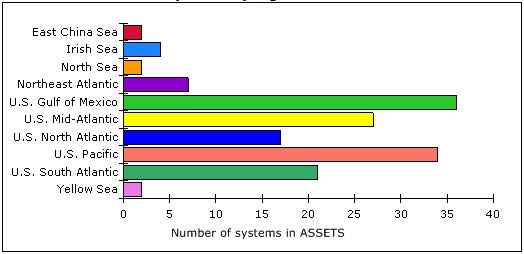
Figure 1: Application of ASSETS to coastal systems
management action on drivers (see e.g. Nobre et al.,
The ASSETS model has been applied to a number of
2005). Additionally, a subset of the ASSETS approach can
estuarine and coastal systems in the European Union
be used at the local scale, as in the example below.
and China (Fig. 1). From this work, which has taken place
Aquaculture screening models
over the last five years, there have been significant
Table 3 shows an application of the FARM model for the
developments to the rationale. As an example, the prac-
evaluation of the role of shellfish in reducing eutrophica-
tice in China of using the opportunistic seaweed
tion. This assessment uses a simplified version of
Enteromorpha (Fig. 2) as a food source means that the
ASSETS (http://www.farmscale.org). A medium density
occurrence of this primary eutrophication symptom is
of mussels in suspended raft culture provides the best
seen as an asset rather than a liability by the local popu-
solution with respect to production, Average Physical
lation.
Production (APP - the ratio of harvest to seed biomass),
income and reduction of eutrophication symptoms.
Figure 2: Seaweed Enteromorpha (photo: Joao Ferreira)
The model now reflects this perspective, and a large-
scale evaluation of coastal eutrophication in China is
currently starting through a collaborative project - Trophic
Assessment In China (TAICHI) - with the collaboration of
Chinese LOICZ. The initial focus is on keystone systems
such as the Changjiang and Pearl River estuaries
(http://www.eutro.cn).
Table 3: Environmental assessment for a shellfish aquaculture farm -
The application of ASSETS is implemented through a
the ASSETS model (above the dotted line: initial conditions, with
web-based interface (http://www.eutro.org and the US
NEEA through http://www.eutro.us). Scientists who are
scenario changes underlined; below the line: model outputs)
interested in applying this approach to estuarine or
Low cultivation densities have very little impact on Chl a
coastal areas throughout the world are welcome to
concentration in the water column, high densities
contact the authors.
9
Acknowledgements
Gibson, G.R., Bowman, M.L., Gerritsen, J., Snyder, B.D., 2000.
Estuarine and Coastal Marine Waters: Bioassessment and
We are grateful to A. Newton for introducing and pro-
Biocriteria Technical Guidance. EPA822-B-00-024. US
moting the ASSETS methodology to the LOICZ
Environmental Protection Agency, Office of Water,
community, and to A.J.S.Hawkins for making available
Washington, DC.
the ShellSIM model.
ICES, 2004. Report of the Study Group to Review Ecological
Selected References
Quality Objectives for Eutrophication. ICES CM 2004/ACE:04.
Bricker S.B., C.G. Clement, D.E. Pirhalla, S.P. Orlando and
Lee, G.F., W. Rast and R.A. Jones. 1978. Eutrophication of
D.R.G. Farrow. 1999. National Estuarine Eutrophication
waterbodies: Insights for an age-old problem. Environmental
Assessment. Effects of Nutrient Enrichment in the Nation's
Science & Technology 12:900-908.
Estuaries. NOAA, National Ocean Service, Special Projects
Office and National Centers for Coastal Ocean Science, Silver
Nobre, A.M., J.G. Ferreira, A. Newton, T. Simas, J.D.Icely, R.
Spring.
Neves, 2005. Management of coastal eutrophication:
http://spo.nos.noaa.gov/projects/cads/nees/Eutro_Report.pdf
Integration of field data, ecosystem-scale simulations and
screening models. Journal of Marine Systems, 56 (3/4), 375-
Bricker, S.B., B. Longstaff, W.C. Dennison, J. Woerner, A.
390.
Jones, C. Wicks and K. Boicourt. National Estuarine
Eutrophication Assessment: Effects of Nutrient Enrichment in
Oslo Paris Convention for the Protection of the North Sea
the Nation's Estuaries 1999 - 2004. National Oceanic and
(OSPAR). 2002. Common Assessment Criteria, their
Atmospheric Administration, National Ocean Service, National
Assessment Levels and Area Classification within the
Centers for Coastal Ocean Science, Center for Coastal
Comprehensive Procedure of the Common Procedure. OSPAR
Monitoring and Assessment and The University of Maryland,
Commission for the protection of the marine environment of
Center for Environmental Science, Integration and Application
the North-East Atlantic. http://www.ospar.org/eng/html/wel-
Network. In preparation.
come.html
Bricker, S.B., J.G. Ferreira, T. Simas, 2003. An Integrated
United States Environmental Protection Agency (USEPA).
Methodology for Assessment of Estuarine Trophic Status.
2004. National Coastal Condition Report II. United States
Ecological Modelling, 169(1), 39-60.
Environmental Protection Agency, Office of Research and
Development, Office of Water, Washington, DC. EPA- 620/
Bricker, S., G. Matlock, J. Snider, A. Mason, M. Alber, W.
R-03/002. http://www.epa.gov/owow/oceans/nccr2/
Boynton, D. Brock, G. Brush, D. Chestnut, U. Claussen, W.
Dennison, E. Dettmann, D. Dunn, J. Ferreira, D. Flemer, P.
Vincent, C., Heinrich, H., Edwards, A., Nygaard, K.,
Fong, J. Fourqurean, J. Hameedi, D. Hernandez, D. Hoover, D.
Haythornthwaite, J., 2003. Guidance on Typology,
Johnston, S. Jones, K. Kamer, R. Kelty, D. Keeley, R. Langan, J.
Classification and Reference Conditions for Transitional and
Latimer, D. Lipton, R. Magnien, T. Malone, G. Morrison, J.
Coastal Waters. European Commission, Report of CIS WG2.4,
Newton, J. Pennock, N. Rabalais, D. Scheurer, J. Sharp, D.
European Commission, Brussels.
Smith, S. Smith, P. Tester, R. Thom, D. Trueblood and R. Van
Dolah. 2004. National Estuarine Eutrophication Assessment
Vollenweider, R.A. 1976. Advances in defining critical loading
Update: Workshop summary and recommendations for devel-
levels for phosphorus in lake eutrophication. Mem Ist. Ital.
opment of a long-term monitoring and assessment program.
Idrobio. 33: 53-83.
Proceedings of a workshop 4-5 September 2002. Patuxent
Wildlife Research Refuge, Laurel, Maryland.
LOICZ News
Buddemeier, R.W., S.V. Smith, D.P. Swaney, C.J. Crossland,
B.A. Maxwell. Coastal Typology: An integrative "neutral" tech-
nique for coastal zone characterization and analysis. Est. Coast.
SPICE/LOICZ/ATSEF/SEACORM (SLAS) Southeast
Shelf Sci. In Press.
Asia Coastal Governance and Management Forum:
Science Meets Policy for Coastal Management and
Ferreira, J.G., S.B. Bricker, T.C. Simas, 2006. Application and
Capacity Building, Bali, 14th - 16th November 2006
sensitivity testing of an eutrophication assessment method on
coastal systems in the United States and European Union. J.
Dr. Eberhard Krain (SPICE), eberhard.krain@zmt-
Environmental Management, In Press.
bremen.de, and Frida Sidik (SEACORM),
frida_sidik@yahoo.com
Ferreira, J. G., Hawkins, A.J.S., Bricker, S.B., 2006.
Management of productivity, environmental effects and prof-
From November 14-16 the Southeast Asia Coastal
itability of shellfish aquaculture - the Farm Aquaculture
Governance and Management Forum: Science Meets
Resource Management (FARM) model. Aquaculture, In Press.
Policy for Coastal Management and Capacity Building
10
I N P R I N T
2006/3
took place at the Balihai, in Bali. The conference had
conservation project was visited. A second excursion
been jointly organized by the Indonesian-German re-
was conducted to the Mangrove Information Center
search Initiative Science for the Protection of Indonesian
(MIC), Bali Post Group office, and to sites near and
Coastal Marine Ecosystems (SPICE), the Land-Ocean
around the famous beaches of Sanur and Kuta where
Interactions in the Coastal Zone (LOICZ) project, the
environmentally friendly tourism examples were shown
Arafura & Timor Seas Expert Forum (ATSEF) and the
and discussed.
Indonesian host, the Southeast Asia Center for Ocean
On the last day of the conference participants also de-
Research and Monitoring (SEACORM).
liberated about a) how the SPICE program can be further
improved for the future second phase, b) how the link-
About 120 scientists, policy-makers and coastal practi-
ages between SPICE and other networks can be
tioners from 11 countries participated. The conference
strengthened, and c) how the gap between science and
was opened by the Chairman of the Marine and Fisheries
coastal management can be better bridged.
Research Agency of the Ministry of Marine Affairs and
Fisheries. The conference dealt with four themes:
During the conference a wealth of interesting scientific
results was presented and discussed. Progress was also
1. Supporting policy development for a resilient
made with respect to introducing socio-economic to
coast,
otherwise strong natural science related research. An
important connection was also made between research
2. The coast as a vulnerable social-ecological system:
addressing gradual and sudden changes because of ex-
I. Coral reefs, sea grass beds, mangroves,
treme events such as tsunamis. The link between
science and policy- and decision making was streng-
3. The coast as a vulnerable social-ecological system:
thened through the conference to some extent. Overall
II. Rivers, estuaries and up-welling systems, and
the conference had been a very successful event
4. Disaster risk and coastal management as a multi-
bringing together many scientists from Indonesia,
level governance issue. Each session was intro-
Germany, Australia and the southeast Asian region.
duced by a renowned keynote speaker and then
followed by oral presentations. In total 4 keynotes
and 35 oral presentations were held. Additional
topics were presented on 58 posters.
The LOICZ project database - a new feature on the
website
LOICZ provides a forum to assimilate, integrate and syn-
Figure 1:
thesise the outputs of affiliated projects. Additionally, it
Beverly Goh,
provides an opportunity to communicate and dissemi-
leader of the
LOICZ
nate these outputs making them available not only to
Southeast
other scientists, but also the public, decision-makers and
Asia Node,
gave an intro-
managers. Information on affiliated projects is held on a
ductory
central database that is accessible online through the
speech about
LOICZ website now. It makes basic information and reg-
LOICZ activi-
ular updates available to the wider community as well as
to LOICZ for its reporting requirements.
The database accomplishes an essential element that
applies for all LOICZ interdisciplinary studies within and
beyond the project namely data sharing and exchange.
On the second day of the conference two excursions
LOICZ protects its community members by restricting
were undertaken in order to familiarize conference par-
access to contact details in the public part of the data-
ticipants with coastal issues in Bali. One excursion was
base. But every community member and person
conducted to the SEACORM facilities at Perancak in the
interested in the activities affiliated to LOICZ is invited to
West of Bali, where the remote sensing facilities were
register and then view full contact details and be able to
shown and a trip made to Perancak village where a turtle
submit and edit own projects.
11
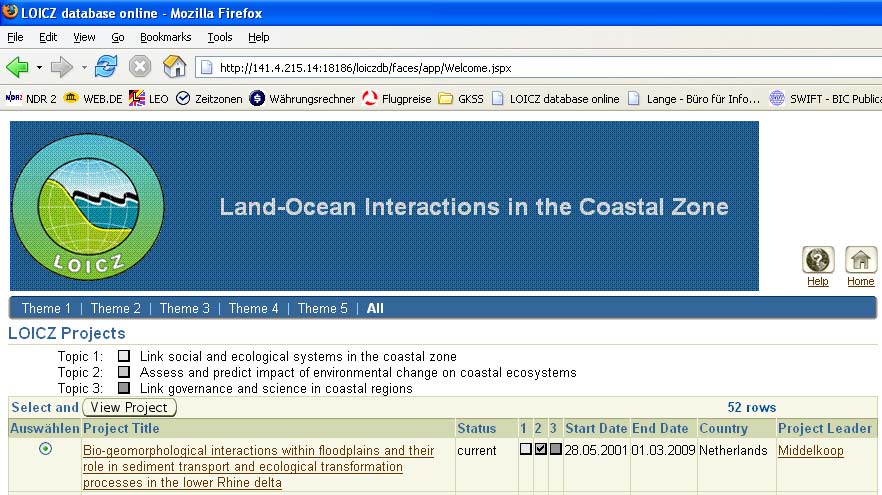
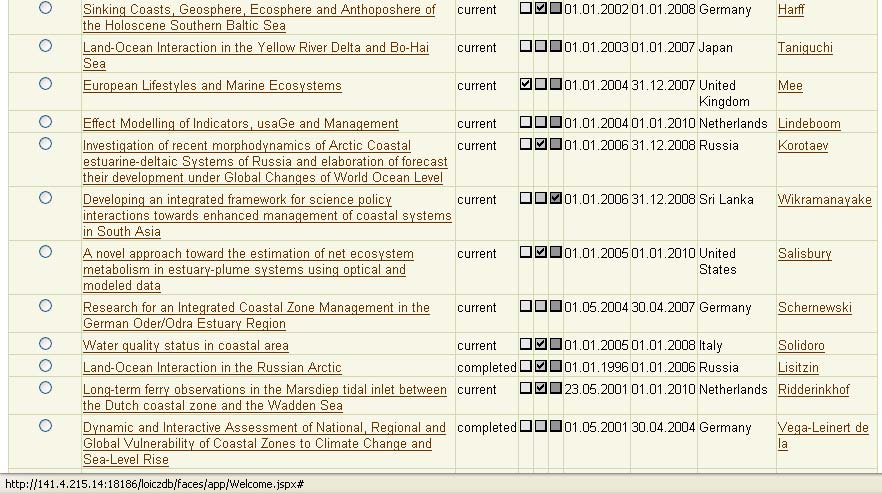
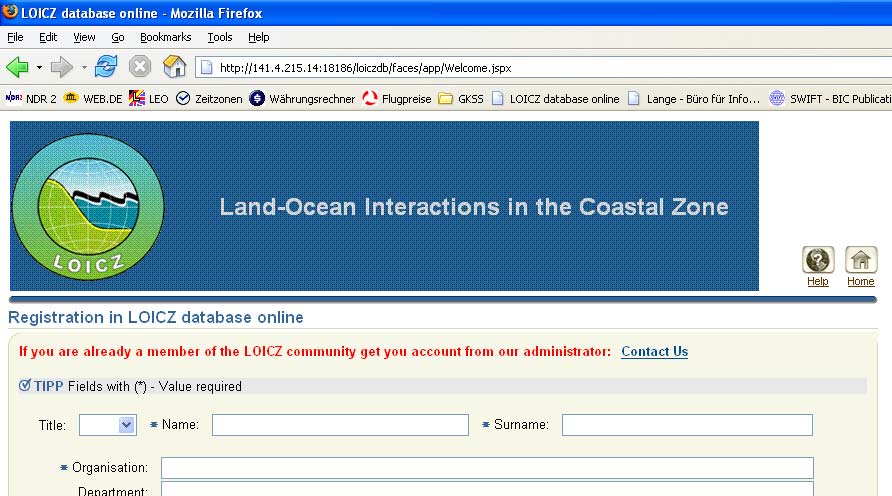
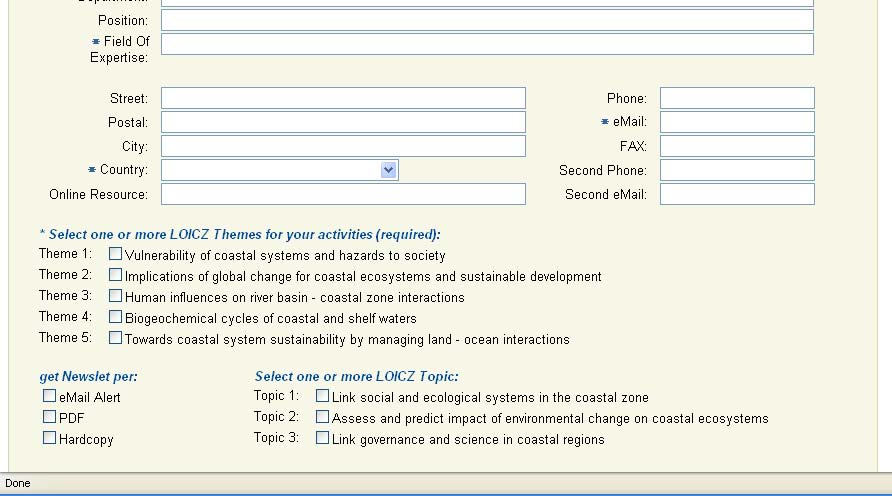
Figure 1: The database provides a
comprehensive list of affiliated
projects and links allow to learn
about individual projects in more
detail.
Figure 2: Registration form of the
LOICZ database. Active or formerly
active members of the LOICZ com-
munity should contact the IPO for
registration. Everybody else is in-
vited to fill in this form. Fields
marked with a * are required, but
the more information we hold about
community members the better
can we inform them about relevant
activities and involve them in LOICZ
work.
12








I N P R I N T
2006/3
As the database is linked to the LOICZ contact database,
· access to a wide circle of information related to funding
all newsletter recipients are already recorded. If you wish
and the science community that is available through
to receive your login name and password for the data-
the LOICZ database.
base, please do not use the form as shown in figure 2,
but send us an email to loicz.ipo@loicz.org
Researchers whose work fits into this LOICZ portfolio
are encouraged to submit proposals to the LOICZ IPO as
Call for research proposals concerned with
soon as possible. The required form and additional infor-
Land-Ocean Interactions in the Coastal Zone
mation can be obtained from the LOICZ website or via
contacting the LOICZ IPO.
LOICZ has developed three key topics that will form the
focus of research interest in the coming years. Within all
three topics, LOICZ seeks to expand its network of sci-
entists by endorsing research activities concerned with
Water, Sea level, Storms and Urbanization - Coasts
any of these topics on a global, regional or national level.
at Risk
Within these topics LOICZ strives to develop:
At the 1st ESSP Open Congress (09-12. Nov. Beijing,
· methodologies or models that allow data assimilation,
China) LOICZ and Earth System Partners took an inter-
processing and synthesis, including up and/or down
disciplinary look onto coastal change, risks and
scaling;
risk-perception, and challenges to science
· scenarios of change and/or response to change in
socio-ecological systems;
The first Earth System Science Partnership (ESSP)
· scientific context for the evaluation of existing policies
Congress proved to be a platform for vital discussions
and structures
about the central role of coastal zones for social and eco-
· globally applicable tools for scientific synthesis, deci-
logical development. As "Society's Edge" coastal zones
sion support and structure development; and
had quite correctly been characterized earlier as a major
· dissemination interfaces to provide information and
trajectory of human development and a mirror of welfare
assist sustainable coastal development on appropriate
and also of pressures and change. LOICZ, drawing on its
scales.
new Science Plan, focuses on socio-ecological system
perspectives. By looking into biogeochemical and physi-
To achieve this, LOICZ is calling for proposals to bring
cal change in the wider context of human choice and
high quality research activities into the LOICZ cluster
governance LOICZ engaged in three topical sessions.
of affiliated projects. As well as fundamental science
The multiplicity and competence of the co-convening
projects, we also seek projects that have a multidiscipli-
partners were an expression of the high complexity of
nary perspective, especially combining natural and social
current and future coastal change issues underlining
sciences. Projects can have global, regional or local
strongly the need for partnership and collaborative action
scales and be focussed on coastal sciences and/or
in future coastal earth system science. Here a brief sum-
coastal management. Projects that collaborate with
mary and highlights of the sessions:
other Earth Science System Partnership (ESSP) projects,
especially with other Core Projects of IHDP and IGBP, are
sought in particular, as well as projects that synthesise
and analyse research outcomes already available or in-
volve dissemination and outreach that will lead to better
public knowledge. Examples of projects already affiliated
to LOICZ can be found on the LOICZ website under
Projects.
Although LOICZ cannot offer funding to affiliated pro-
jects, its endorsement provides the following benefits:
In "How do coastal and freshwater systems interact
· support in proposing for funding;
under the global water system?" (Session 21) Global
· promotion of the project and associated activities, its
Water Systems (GWSP) and LOICZ jointly looked into a
contributing team, outputs and outcomes through the
variety of issues. The river-coast continuum, and its
LOICZ website and/or newsletter;
characteristic material fluxes and change received
· contribution to workshops, conferences and meetings
central attention, because they trigger the increasing risk
organised by LOICZ and hence establish linkages to
of deltaic regions. The rational for the session was to
other projects operating in similar fields and/or
cover issues common to freshwater, coastal systems
addressing similar issues; and
and the global water system such as:
13
· effective and efficient governance,
pogenic forcing. It became clear that in some cases
· environmental flows,
human intervention of coastal land and sea use can actu-
· freshwater and coastal nutrient fluxes and the global
ally override those signals currently attributed to climate
nutrient cycles,
change. However, it is an interesting observation that
· impacts of river diversions,
relatively little attention has been given to the differential
· land use change, and
vulnerability extreme events expose and the oppor-
· climate change.
tunities that exist for reducing their negative conse-
The goal was to develop a framework for linking science
quences. This is a very complex issue because beyond
and resource management, and to define a strategy for
scientifically proven facts or credible scenarions there is
collaboration and a network for research. In review of
an obviously strong role human perception plays in the
current knowledge and understanding of links between
evaluation of what determines coastal risk and the un-
hydrological processes and coastal change it was intrigu-
certainty, triggering the level of preparedness to
ing to review the relevance of human intervention in the
respond. Being specifically prone to coastal hazards that
water and material flux cycles and to see the relative im-
affect a large number of people at the same time and in
pact this triggers in observed coastal change, e.g.
their role as a key pillar for multiple national economies
erosion. Society's increasing water demand in tandem
coastal urban areas are in the center of this discussion.
with and partly as a response to global change is trigger-
Integrated approaches are needed to describe the links
ing enormous efforts of catchment engineering. While
between global environmental change, and coastal urban
this phenomenon can be traced back for thousands of
security. Oral papers in detail:
years of human development and intervention, pres-
sures to date have reached a level where in many places
M. Pelling (UK): Natural disasters and social instability in
signals of coastal subsidence in highly populated areas
urbanized coastal zones;
can be attributed much more to anthropogenic forcing
H. von Storch (Germany): Storm surges: The case of
inland rather than for instance sea level rise. Oral papers
Hamburg, Germany;
in detail:
A. de Sherbinin (USA): Interactive vulnerabilities: A sys-
tematic assessment of population and land area in
F. Lansigan (Philippines): Rationale for Session 21, Link
distribution in urban coastal zones;
between GWSP and LOICZ;
N. B. Alungal (India): Management strategies for urban
A. Ducharne (France): Evolution of water and nutrient
coastal zones: Integrating DPSIR concepts with GIS
fluxes from a human impacted river under plausible
tools in people's participatory programmes.
changes of anthropogenic pressures during the 21st
century;
For "Sealevel rise, vulnerability and impacts"
V. Kourafalou (USA): Changes in freshwater and nutri-
(Session 36) NOAA, WCRP and LOICZ joined forces to
ent fluxes around the Florida keys national marine
explore challenges the climate and global change re-
sanctuary: Everglades restoration project and river
search community is increasingly facing as to better
inputs;
focus on coastal people, infrastructure, ecosystems, and
S. Haida (Morocco): Geomorphological response of
their goods and services. While it is commonly shared
regulated rivers and climate change in the Sebou coastal
that sea level rise and variability is a global issue spanning
zone;
the earth sciences as a whole, this session revealed the
T. R. Healy (New Zealand): Climate change impact on
still considerable level of uncertainties in our under-
sedimentation in New Zealand estuaries;
standing of observed sea level rise. In addressing the
J. Alcamo (Germany): New scenarios of future freshwa-
consequences of those uncertainties and expected im-
ter inflows to major world estuaries under climate
pact scenarios it became clear that public perception is
change;
often based on limited or even false information.
M. B. Endejan (Germany) Providing a holistic view of the
Commonplace arguments that evolve around the im-
global water system through a digital water atlas.
pacts of warming, storm surges and sea level rise may
hold for the global scale but need to undergo scientifi-
Session 26 focused on "Global environmental change,
cally sound regional review, if impact scenarios are to be
natural disasters, and their implications for human
developed on regional or even smaller scale. In other
security in coastal urban areas". Together with IHDP's
words Synthesis and initial modeling efforts need to look
Human Security and Urbanization projects GECHS and
at both, the global change factors that determine
UGEC catastrophic events of recent years were investi-
vulnerability of socio-ecological coastal systems and -
gated to look at the linkages between human security
more on regional or smaller scale potential ways for
and global environmental change. This included dis-
adaptation to avoid and/or mitigate the physical, ecologi-
cussing whether and to which extent hazards to coastal
cal and societal impact of sea level rise on all levels
communities can exclusively be attributed to global,
relevant for human society. Monetarization of coastal
namely climate driven changes, as compared to anthro-
goods and services, their eventual losses and
14








I N P R I N T
2006/3
response options are helpful tools for improvement of in-
In LOICZ I the development of databases and software,
formed decision making. This will also generate new
primarily in connection with user-based workshops has
demands for the monitoring and observation community
made substantial progress. However, development of
as well as quality and variety of data which help building
auxiliary materials such as tutorials, user guides, and
meaningful scenarios. Oral papers in detail:
demonstration datasets fell behind. These materials re-
present value-added to scientific, management, and edu-
J. A. Church (Australia): Understanding sea level rise;
cational audiences and their development will be a
H. von Storch (Germany): Detailed projections of coastal
primary focus of the next few years. Development of
climate change until 2100 in Northern Europe, (PS
these materials will occur both as targeted activities in
37/O3);
small working meetings of LOICZ scientists and as
N. Mimura (Japan): Impacts of sea level rise and coastal
somewhat larger (but still focused) workshops. These
vulnerability in the Asia and Pacific Region;
N. Harvey (Australia): Australian approaches to coastal
will involve members of the above audience groups fo-
vulnerability assessment and sea level change;
cusing on multiple non-scientific user groups as well as
R. J. Nicholls (UK): Coastal vulnerability and sea level
partners from the Earth System Science community. As
rise and variability: A national to global perspective.
such the typology cross cutting activity in LOICZ will pro-
vide both downloadable materials for capacity building,
We are grateful to the conference organizers for the ex-
and educational activities themselves.
cellent setup and for providing this great opportunity for
exchange and we express our sincere gratitude in par-
ticular to all the presenters including the numerous high
quality posters. We are planning (subject to permission)
to post the presentations of the contributors to these
very inspiring sessions on the LOICZ website early 2007.
The future of the LOICZ Typology - Conceptualizing
coastal classification and interpretation of complex
data relations
Realistic scenarios and scientific questions require data
on multiple biophysical and human dimension attributes
Figure 1: The workshop participants are discussing past and future of
the LOICZ typology. From left: Bruce Maxwell, Bob Buddemeier,
of the coastal zone at a variety of spatial and temporal
Ganapuram Sreedhar, Dennis Swaney, Gianmarco Giordani, Maike
scales. One of the difficulties with interpreting the scien-
Paul, Martin Le Tissier
tific results of data collection or modeling of coastal
systems is visualizing and understanding the large
A workshop was held at the IPO between 17 and 21
amount of spatial and temporal data produced. Typology
November to develop a first strategic outline of the main-
is one method of data exploration and visualization by
tenance and the future direction of the LOICZ typology
compressing high-dimensional spatial and temporal data
study and approaches that meet the demands of the
into categories that are easier to visualize and compre-
new LOICZ. The workshop was attended by Bob
hensive. It enhances understanding of models and data
Buddemeier, Bruce Maxwell, Dennis Swaney,
by connecting complex relationships within the data to
Gianmarco Giordani and Ganapuram Sreedhar (Erasmus
semantic meaning. This is done by grouping the data into
Mundus Fellow) along with Hartwig Kremer, Maike Paul
categories that exhibit similar variable values and consis-
and Martin Le Tissier from the IPO and Gisbert Breitbach
tent relationships between different variables.
from the GKSS Institute for Coastal Research. Three gen-
eral areas were discussed:
All typologies, fully supervised or data-driven ones, re-
· LOICZ typological tools and their development
quire various levels of expert knowledge to define group
· LOICZ datasets and their development
exemplars, group boundaries or to create the categories
· Personnel and financial requirements in support of the
and to define their semantic meaning, to weight their im-
above
portance, or to select the method of identifying the
natural groupings within the data. In LOICZ typology has
Besides the further development of methods and tools
been developed and used to discover relationships be-
as well as multiple user interfaces, the future typology
tween variables within a data set. Because each
will seek to make biophysical and human dimension data
typological group exhibits particular relationships be-
easily accessible and include them into the manipulation
tween variables, it can be used for analogy-based
and visualization tools. An element of the capacity build-
reasoning and for discovering spatially or temporally dis-
ing mentioned above will also be developed to educate
parate areas that exhibit similar patterns. In other words
the coastal zone science, management, and stakeholder
it is very helpful for example as a means for up-scaling.
community about the value of typology as a method of
15
enhancing understanding of complex data and communi-
livelihoods of several million people, supplying vital re-
cating results and implications to managers and
sources of fish and materials, as well as providing critical
policy-makers. Specific areas that will be developed in-
ecological functions and services. The rapid growth of
clude:
coastal cities is one of the most pressing environmental
· Further development of the DISCO tool
concerns in Africa and coastal zones mirror all the pres-
(http://www.loicz.org/loicz_nl/1143436b19f9ec83839a
sures originating from demographic change, agriculture,
82b9b5676207.php)
fisheries, and water management in one place, the inter-
· Development of the next generation of database and
face between marine and river systems, infrastructure,
typology tools
and urban and industrial development.
· Development of links and partnerships with other
projects and researchers whose data could contribute
This new initiative creates a regional node for wetlands
to the LOICZ typology
and coastal zone management in Africa under
· Instigation of a series of workshops to facilitate the
START/PACOM (Pan-African Regional Committee for
development and use of the LOICZ typology
START). The immediate target group is African re-
searchers and young scientists working in the area of
GKSS has enabled LOICZ to establish a solid foundation
conservation and management. The overall objective is
for the necessary hardware and pave the way for the
to understand the implications of global change on
long-term further development of coastal typologies in
ecosystems so as to provide data and research results
Earth Sciences. This includes establishment of a server
that will contribute to the integrated management of a
that will allow LOICZ in a first step to set up a mirror of
healthy and productive environment in Africa. This
the database currently hosted by the Kansas Geological
would be a significant contribution to the fundamental
Survey - this should be online by mid to late 2007 - with
human needs expressed in the Millennium Development
analytical software to follow in the third and fourth quar-
Goals such as clean water, appropriate sanitation, food
ters of 2007. The scientific work in the further
security and economic development all of which largely
development of the typology will run in parallel likely for
depend on a healthy environment.
the lifetime of the project. A more detailed article will be
featured in one of the next LOICZ INPRINT volumes.
The specific objective of the START/PACOM node is to
catalyse concerted regional research and training in
the area of Global Change science focusing on wet-
New LOICZ Regional Node to be set up in Yantai,
land and coastal habitats. The node will accomplish its
China - Initial talks underway between LOICZ IPO
objective by creating an enabling environment for con-
and YIC
servation and management. It will deliver three
The Yantai Institute of Coastal Zone Research for
outcomes:
Sustainable Development (YIC) is in discussion with the
1.Formation and consolidation of regional networks of
LOICZ IPO on hosting a LOICZ Regional Node in the in-
experts, practitioners, decision makers and other
stitute. The YIC is newly established by the Chinese
stakeholders.
Academy of Sciences in collaboration with the Shandong
Provincial Government and the Yantai City Government.
2.Enhanced capacity for wetlands management and re-
The institute is focusing its research on coastal-zone re-
search at regional level by the support of young scien-
sources and environment and their sustainable utilization
tists.
(http://www.yic.ac.cn/). Initial fruitful discussions have
3.Increased awareness of the importance and values of
been made between Dr. Hartwig Kremer, CEO of the
wetlands and the coastal zone amongst decision
LOICZ IPO, and Prof. Dr. Ping Shi, Director of the YIC.
makers and other stakeholders at regional level.
They both agree that a LOICZ Regional Node in the YIC
would be mutually beneficial in promoting LOICZ activi-
These three specific goals are integral to the underlying
ties and fostering the scientific networking in coastal
mission of the Centre for African Wetlands which is to
change research throughout China and in East Asia but
contribute to the preservation of the global, regional,
also in fostering the YIC research capacity building.
national and local values of West African wetlands for
the benefit of society as a whole. The activities of the
Centre seek to maintain wetland biodiversity and en-
START/PACOM Regional Node for Wetlands and
hance the general ecological integrity of wetlands and
Coastal Zone Management - a nucleus for regional
through this improve the quality of life for people living
LOICZ research
within and around wetlands. After a stakeholder analysis
Host Institution: Centre of African Wetlands,
and participatory identification of research priorities
University of Ghana, Legon Accra Ghana
spanning 12 West African countries, the Centre and its
Prof. Chris Gordon, cgordon@ug.edu.gh
network selected several over arching issues as core;
Africa's wetlands and coastal zones are critical to the
these are Poverty Alleviation; Gender equity; Capacity
16
































I N P R I N T
2006/3
building; Partnerships; Conflict Resolution; Trans-boun-
viding an academic environment for its work. It is gov-
dary Issues; Good Governance. The research focus for
erned by a Management Board and a Scientific Steering
the network was distilled into four main areas:
Committee made up of senior scientists from the region
· Inventory and Classification: Mapping; Hydrology;
and international wetland experts. The Centre for African
Biodiversity; Sustainable Use;
Wetlands has its own purpose-built structures on the
· Long term Assessment and Monitoring:
park like campus of the University. The 1200 m2 building
Methodologies; Indicators; Key wetland areas; Ramsar
is made up of eleven offices; a seminar room for up to 50
support activities;
people, a library and a laboratory. The Centre also has an
· Pollution/Degradation/Contamination: Climate Change;
auditorium for 150 people and an ICT connected base-
Invasive and Exotic Species; Watersheds; Disease;
ment facility. The START/PACOM regional node will
· Conservation and Utilization: Local Livelihoods;
support
and
promote
all
relevant
LOICZ
Ecotourism; Traditional Knowledge Systems; Laws and
projects and activities and this new initiative is expected
Policy.
to improve the flow of information and the quality of
research within the region.
The current activities of the Centre and the planned ac-
tivities of the START/PACOM regional node (i.e.
References
Graduate Student support; Information dissemination,
Communications, Sub-Regional Workshops) provide op-
Ipsen, N., Dyhr-Nielsen, M. & Hassing, J. 2002 Linking Fresh
portunities for synergy with the LOICZ regional and
Water Resources Management and Coastal Zone
global implementation, specifically focusing on its three
Management General Issues Paper. FreshCo Partnership 14p
priority topics:
· Linking Social and Ecological Systems in the Coastal
UNEP/MAP/PAP, 1999 Conceptual Framework and Planning
Zone
Guidelines for Integrated Coastal Area and River Basin
· Assessing and Predicting Impact of Environmental
Management, Split, Priority Actions Programme. UNEP 79p
Change on Coastal Ecosystems
· Linking Governance and Science in Coastal Regions
The Centre activities in the START/PACOM regional node
also support the ideas underlying the ICARM concept
(Integrated Coastal Area and River Management) of
UNEP (UNEP/MAP/PAP, 1999) as well as the manage-
ment requirements outlined in the FreshCo Partnership
(Ipsen, et al., 2002, and http://teams.dhi.dk/freshco), that
is the need for:
· The enabling environment - the general framework of
national legislation, strategies and policies, and the dis-
semination of information for natural resources mana-
Figure 1: General view of the Centre for African Wetland
gement stakeholders. This framework constitute the
"game board and the rules of the game" and enable all
stakeholders to play their respective roles in the deve-
lopment and management of the resources.
· The institutional roles that allow effective interaction
between various administrative levels and stakehol-
ders. Collaborative mechanisms and "fora" are needed
to facilitate the stakeholder participation.
· Management instruments, including operational instru-
ments for effective planning, regulation, implementa-
tion, monitoring and enforcement. With such
instruments the decision-makers will be able to make
informed choices between alternative actions. These
choices are based on agreed policies, available
resources, environmental impacts and the social and
Figure 2: Group discussions in the Centres' library by
economic consequences. (Ipsen, et al., 2002)
participants the Centre for African Wetlands (CAW)-
The institutional setting and location of the Centre for
United Nations Development Programme (UNDP)
Capacity Building in Integrated Water Resources
African Wetlands as a NGO hosted by the University of
Management in Ghana Training Workshop for Key stake-
Ghana promotes rapid response to issues as well as pro-
holders
17
Call for research proposals concerned with
The backbone of LOICZ: affiliated projects
Land-Ocean Interactions in the Coastal Zone
LOICZ has a mandate to address key issues of
LOICZ has developed three key topics that will form
coastal change and use in the context of scenar-
the focus of research interest in the coming years.
ios of future human activity and environmental
Within all three topics, LOICZ seeks to expand its net-
change. LOICZ endorses and seeks to support
work of scientists by endorsing research activities con-
both fundamental coastal zone research and re-
cerned with any of these topics on a global, regional or
search that synthesises and up-scales results for
national level. Within these topics LOICZ strives to
dissemination within the scientific c o m m u n i t y,
d e v e l o p :
and outreach to policy makers and the public.
· methodologies or models that allow data assimila-
tion, processing and synthesis, including up and/or
This research is partly carried out by groups of
down scaling;
scientists, aided and supported by the LOICZ
· scenarios of change and/or response to change in
IPO, Regional Nodes and/or SSC, with funds that
socio-ecological systems;
LOICZ has secured from external funding agen-
· scientific context for the evaluation of existing policies
cies. Another important part of the LOICZ project
and structures;
is carried out by researchers who affiliate their
· globally applicable tools for scientific synthesis,
projects to LOICZ thereby becoming part of the
decision support and structure development, and
global network of LOICZ. These projects build
· dissemination interfaces to provide information and
the backbone for up- and down-scaling of LOICZ
assist sustainable coastal development on appropriate
results and the LOICZ synthesis. LOICZ has re-
scales.
cently restructured the affiliation process so that
applications for affiliation will be reviewed by the
To achieve this, LOICZ is calling for proposals to bring
IPO and the coordinator of the theme/topic they
high quality research activities into the LOICZ cluster
are contributing to most. This new procedure will
of affiliated projects. As well as fundamental science
allow LOICZ to maintain an up-to-date record of
projects, we also seek projects that have a multidisci-
global research activity as relates to the LOICZ
plinary perspective, especially combining natural and
social sciences. Projects can have global, regional or
Science Plan as well as ensure that affiliated pro-
local scales and be focussed on coastal sciences
jects are given opportunity to fully participate in
and/or coastal management. Projects that collaborate
LOICZ activities such as workshops and joint
with other Earth System Science Partnership (ESSP)
projects.
projects, especially with other Core Projects of IHDP
and IGBP, are sought in particular, as well as projects
LOICZ provides a forum to assimilate, integrate
that synthesise and analyse research outcomes al-
and synthesise the outputs of affiliated projects.
ready available or involve dissemination and outreach
Additionally, it provides an opportunity to com-
that will lead to better public knowledge. Examples of
municate and disseminate these outputs making
projects already affiliated to LOICZ can be found on
them available not only to other scientists, but
the LOICZ website under Projects.
also the public, decision-makers and managers.
Although LOICZ cannot offer funding to affiliated
Information on affiliated projects is held on a cen-
projects, its endorsement provides the following ben-
tral database that will in the near future be made
efits:
available on-line so that basic information and
· support in proposing for funding;
regular updates are available to the wider com-
· promotion of the project and associated activities, its
munity as well as to LOICZ for its own reporting
contributing team, outputs and outcomes through
requirements.
the LOICZ website and/or newsletter;
· contribution to workshops, conferences and meet-
An essential element that applies for all LOICZ in-
ings organised by LOICZ and hence establish link-
ages to other projects operating in similar fields
terdisciplinary studies within and beyond the
and/or addressing similar issues; and
project is data sharing and exchange. To facilitate
· access to a wide circle of information related to
this exchange LOICZ has developed a Data
funding and the science community that is available
Policy to help affiliated projects and LOICZ to
through the LOICZ database.
fully benefit from each other. Both documents,
the Terms of Reference for affiliated activities
Researchers whose work fits into this LOICZ portfolio
and the Data Policy, can be found on the LOICZ
are encouraged to submit proposals to the LOICZ IPO
website.
as soon as possible. The required form and additional
information can be obtained from the LOICZ website
18
































I N P R I N T
2006/3
In the year 2002 he was awarded DST-JSPS (Japan)
IPO Notes
Award to conduct advanced research in groundwater
SSC Update
management. He has to his credit more than 40 research
papers published in international journals. He had au-
After serving on the LOICZ
thored a book and edited four others relating to coastal
SSC for 2 years Dr.
systems research and water resources management. Dr.
Nalin Wikramanayake
Ramesh has been operating several research projects
from Colombo, Sri Lanka
sponsored by the Government of India as well as
has served his term and
International funding agencies.
will rotate off the SSC as
of the 1st of January 2007.
We welcome Professor Ramesh in the Scientific
We would like to thank
Steering Committee of LOICZ.
Nalin on behalf of the
whole SSC and IPO for his
valuable input.
Contact:
The regional IPO Node for
Institute for Ocean Management
the South Asia Region remains in the capable hands of
Anna University, Chennai 600 025, India
Dr. Wikramanayake and we look forward to continue our
Phone (Off.)[91] 44-2230-0108
collaboration in the future.
(Res.) [91] 44-2663-0182/ 2663-1537
FAX [91] 44-2220-0158
New face in the SSC
Email:
rramesh_au@hotmail.com
ramesh@annauniv.edu
IPO staff changes
,,May I introduce myself?"
My name is Ellen-Barbe
Prof. Dr. R. Ramesh
Goldberg. In the passed years
in Hamburg I have been work-
ramesh@annauniv.edu
ing as an assistant to senior
management as well as to
Prof. Dr. R. Ramesh is currently Director and Professor at
project managers. This was in
the Institute for Ocean Management, Anna University,
companies who closely co-
Chennai, in India.
operate with Universities in
The main activities of the Centre are to coordinate in re-
national and international
search, dissemination of information and development
projects.
of interaction with multi-disciplinary groups and user in-
Most of my experiences I gained in the competency cen-
dustries working in coastal zone issues.
tre for broadband network in Bremen, which had the goal
Prof. Dr. R. Ramesh received his M.Phil and Ph.D in
to promote Bremen`s path into the information society.
Environmental Sciences from Jawaharlal Nehru
University, New Delhi and another Ph.D degree in Marine
My recent professional involvement was in contribution
Sciences from McGill University, Canada.
to the so called "Bologna Process", which is aimed to
harmonize graduation procedures across European
His current research interests include Global Climate
Universities and promotes international links and cooper-
Change and Biogeochemical Cycles in Coastal and
ation of academic institutions. My emphasis was on
Riverine Ecosystems, Coastal and Ground water
project management, marketing and public communica-
Hydrology .
tion.
He is a recipient of the Technology BOYSCAST
Since the 1st of December 2006 I support the LOICZ IPO
Department of Science (Better Opportunities for
and I very much look forward to talking to you and get to
Young scientists in Chosen Areas of Science and
know you.
Technology) Award and the Indian National Science
Academy's Exchange Award to conduct advanced
I wish you a successful and exciting new year and for
research in Global Climate Change at Harvard University,
2007 all the best.
USA during 1994 and the MaxPlanck Institute
for Chemistry, Germany in 1996-97 respectively.
Ellen-Barbe Goldberg
19










Publications
The changing faces of Europe's coastal areas - EEA report
no. 6/2006
This report provides information on the state of the environ-
Managing Coastal Vulnerability
ment in the coastal areas of Europe, and provides evidence of
L. McFadden, R.J. Nicholls and E.C. Penning-Rowsell (eds.)
the need for a more integrated, long-term approach. Since
2006: Managing Coastal Vulnerability. An Integrated Approach,
1995, concern about the state of Europe's coastline has led to
Elsevier Science, Amsterdam, The Netherlands, 282 pages,
a number of EU initiatives, which build on the concept of inte-
ISBN-13: 978-0-08-044703-2, ISBN-10: 0-08-044703-1
grated coastal zone management (ICZM). ICZM attempts to ba-
lance the needs of development with protection of the very re-
sources that sustain coastal economies. It also takes into ac-
This book explores the role of vulnera-
count the public's concern about the deteriorating
bility analysis as an important
environmental, socio-economic and cultural state of the
component of Coastal Zone Manage-
European coastline.
ment. The primary focus of the book is
not on the problems that define vulner-
able coastal systems per se or on
Delta Sedimentation - East Coast of India
methodologies or tools to quantify the
Singh, I.B., Swamy, A.S.R.
vulnerabilities of coastal systems.
Deltas are the most dynamic parts of a coastal region witnes-
Rather, the context and challenge of
sing high rates of sedimentation, responding to the coastal evo-
this volume is to identify opportunities
lution in response to tectonic and sea level changes. Delta-
and barriers to applying this knowledge
related deposits usually have a high potential of hydrocarbons
in order to improve the basic status of
as stratigraphic traps.
coastal environments and their commu-
nities. Limited information currently
This book offers a comprehensive account of deltas and geolo-
exists as to how vulnerability can be actively reduced to pro-
gical evolution of the east coast of India since its separation
mote the sustainable development and use of the coastal zone.
from Antarctica-Australia assembly and the present situation of
This volume explicitly addresses this question, discussing how
Bay of Bengal. Oceanographic processes, sedimentation,
vulnerability can be managed to ensure sustainable coastal
depositional patterns of coastal zone, continental margin and
futures.
Bengal Fan are discussed. The east coast of India shows a
number of small and large deltas with varying hydrologic
The book brings together a wide range of international experts
characteristics. Seven important deltas of the east coast,
to share their experience on the challenges and opportunities
namely Ganga, Subarnarekha, Mahanadi, Godavari, Krishna,
for managing vulnerable coasts. The chapters explore coastal
Penner and Cauvery are discussed in detail. Geomorphology,
behaviour across a range of spatial and temporal scales, physi-
river mouth processes, depositional environments, vertical
cal coastal types and socio-economic settings. They address
facies model and sand distribution patterns of each delta are
questions such as the purpose of coastal areas, how they func-
given. This information is useful to develop hydrocarbon explo-
tion, and the dynamics of the balance between potential im-
ration strategies for a variety of delta systems.
pacts and the effects of adaptation to climate and human-
induced forcing. Building on the approaches presented within
The book is emphasizing possible delta building activities of dif-
this book, cross-cutting lessons for vulnerability reduction in
ferent east coast basins in the geological past, Holocene evolu-
coastal environments and communities are developed, as well
tion of deltas, response to changing sea-levels and systems
as suggestions for future research.
tract concept. It is useful to hydrocarbon exploration geologists
engaged in delta systems, oceanographers, physical geogra-
Communicating Science Effectively - A Practical Handbook
phers, geologists and land planners of coastal areas.
for Integrating Visual Elements
Other Publications
J Thomas, A Jones, T Saxby, T Carruthers, E Abal, W Dennison,
2006, 136 p., Paperback, ISBN: 1843391252
Buddemeier, R.W., S.V. Smith, D.P. Swaney, C.J. Crossland and B.A.
This is a practical handbook on how to
Maxwell. Coastal Typology: An integrative "neutral" technique for
coastal zone characterization and analysis. Estuarine, Coastal and Shelf
communicate science effectively. The
Science, accepted.
first part is an introduction to the princi-
ples of science communication what
Christian, R. R., P. M DiGiacomo, T. C. Malone and L. Talaue-McManus.
effective science communication is,
2006. Opportunities and challenges of establishing coastal observing
why it is important, and how to do it.
systems. Estuaries and Coasts 9(5): 871-875.
This introduction is followed by chap-
Giordani, G., M. Austoni, J. M. Zaldívar, D. P. Swaney and P. Viaroli.
ters outlining techniques and principles
Modelling ecosystem functions and properties at different time and
for communicating in different media -
spatial scales in shallow coastal lagoons: an application of the LOICZ
desktop publishing (including posters
biogeochemical model. Estuarine, Coastal and Shelf Science,
and newsletters), presentations and
accepted.
websites. Techniques in these chapters
IGOS. A Coastal Theme for the IGOS Partnership - For the Monitoring
include image, color, and font formats,
of our Environment from Space and from Earth. Paris, UNESCO 2006.
resolution and design tips for different
60 pp. IOC Information Document No. 1220. http://www.igospart-
media.
ners.org/docs/theme-reports/IGOS COASTAL REPORT midrez.pdf
The book is accompanied by a case study and extensive inter-
Liu, K. K., L. Atkinson, R. Quiñones and L. Talaue-McManus (eds).
net resources, including interactive software tutorials for the
Carbon and nutrient fluxes in continental margins: a global synthesis.
different software programs commonly used in communica-
Global Change: The IGBP (International Geosphere-Biosphere Project)
Series. Springer-Verlag, in prep.
tion, discussion forums for science communication issues, and
links to other websites of interest.
Olsen, S.B., Ipsen, N., Adrianse, M. 2006. Ecosystem-based
This book will be a valuable resource for scientists, working in
Management: Markers for Assessing Progress. The Global Program of
government, research, management agencies, and education.
Action on Land-based Sources of Pollution, Amsterdam, The
Netherlands.
Although environmental scientists are the primary audience,
Olsen, S.B., Padma, P.V., Richter, B. 2006. Managing Freshwater
the principles and techniques discussed are applicable to scien-
Inflows to Estuaries: A Methods Guide. The Nature Conservancy and
tists from all fields.
Coastal Resources Center.
20
I N P R I N T
2006/3
Update us so we can update you
LOICZ INPRINT informs you about the LOICZ Project and its activities. But LOICZ has access to much more
information and wants to make this information available to you as effectively as possible. To be able to provide you with
LOICZ information that fits your expertise and interests most, we need input from your side telling us what your inter-
ests in LOICZ are and how we can contact you.
Please complete the following form where applicable and return by fax, post or e-mail to the LOICZ IPO.
(An electronic version of this form can also be found on www.loicz.org under Newsletter.)
First name:
Last name:
Organization/Institution:
Address:
Place:
Postal code:
Phone (include country code):
Fax (include country code):
e-mail:
(Organization's) website:
Field of expertise:
Please indicate which LOICZ theme(s)* you are contributing to:
Theme 1
Theme 2
Theme 3
Theme 4
Theme 5
Please indicate which LOICZ key topic(s)** you are interested in:
Topic 1
Topic 2
Topic 3
other
How do you want to receive the LOICZ Newsletter in the future?
hardcopy
pdf-file via e-mail
e-mail alert not at all
*
More detailed information on the LOICZ Research Themes is available in the Science Plan on the
LOICZ website (www.loicz.org)
** Detailed descriptions of the topics are featured in first issue of INPRINT and on the website
Please return this form by:
·
e-mail to loicz.ipo@loicz.org
·
fax to
+49(0)4152 87 2040
·
mail to
LOICZ IPO GKSS Research Centre
Institute for Coastal Research
Max-Planck-Strasse 1
D-21502 Geesthacht, Germany
21
22
I N P R I N T
2006/3
continued Publications
Bremen International Graduate School for Marine
Olsen, S.B., Sutinen, J.G., Juda, L., Hennessey, T.M. 2006. A
Sciences Global Change in the Marine Realm
Handbook on the Governance and Socioeconomics of Large Marine
Ecosystems. The Coastal Resources Center, Narragansett, Rhode
Funded by the Excellence Initiative of the German
Island.
federal and state governments this Graduate School
Smith, S.V., DP Swaney, and L. Talaue-McManus. Carbon-Nitrogen-
aims at educating young scientists in the field of marine
Phosphorus Fluxes in the Coastal Zone: The LOICZ Approach to Global
sciences. Within a global-change framework these
Assessment. In: Liu, K. K., L. Atkinson, R. Quiñones and L. Talaue-
McManus (eds). Carbon and nutrient fluxes in continental margins: a
encompass the natural sciences as well as the humani-
global synthesis. Global Change: The IGBP (International Geosphere-
ties. Besides becoming experts in their special field the
Biosphere Project) Series. Springer-Verlag, in prep.
PhD students will get a solid background across many
Swaney, D.P., D. Scavia, R.W. Howarth, and R.M. Marino. Estuarine
disciplines of marine sciences.
Classification and Response to Nitrogen Loading: Insights from Simple
Structured into four Research Areas, (a) Oceans and
Ecological Models. Estuarine, Coastal and Shelf Science, in press.
Climate, (b) Coastal Zone Processes, (c) Marine Ecology
Talaue-McManus, L. 2006: Pressures on Rural Coasts in the Asia-
and Biogeochemistry, (d) Challenges to Society the
Pacific Region (Chapter 8). In: N. Harvey (ed.) Global Change and
Graduate School covers a variety of disciplines. It offers
Integrated Coastal Management; The Asia-Pacific Region, APN,
a well-structured curriculum with a broad research
Springer Dordrecht, The Netherlands, Coastal Systems and Continental
training programme and the possibility to compete for
Margins - Volume 10, pp 197-229.
internal funds.
Talaue-McManus, L. Examining human impacts on global biogeoche-
The Graduate School offers 4 Associate Scientist
mical cycling via the coastal zone and ocean margins. In: Liu, K. K., L.
Positions (one per Research Area) and 3 PhD positions.
Atkinson, R. Quiñones and L. Talaue-McManus (eds). Carbon and nu-
Further details and application forms are available at
trient fluxes in continental margins: a global synthesis. Global Change:
The IGBP (International Geosphere-Biosphere Project) Series. Springer-
www.rcom.marum.de/glomar.html.
Verlag, in prep.
Wilson, M. A., R. Costanza, R. Boumans, and S. Liu. 2005. Integrated
Update us so we can update you
assessment and valuation of ecosystem goods and services provided
by coastal systems. Pp. 1-24 in J. G. Wilson (ed) The Intertidal
LOICZ INPRINT informs you about the LOICZ Project
Ecosystem, Royal Irish Academy Press, Dublin 206 pgs.
and its activities. But LOICZ has access to much more
Have you seen
information and wants to make this information avail-
able to you as effectively as possible. To be able to pro-
EDULINK is the first ACP-EU Cooperation Programme in
vide you with LOICZ information that fits your expert-
Higher Education. It is open to all countries of the African,
ise and interests most, we need input from your side
Caribbean and Pacific Group of States (ACP) and to the 15
telling us what your interests in LOICZ are and how
EU Member States that are signatories to the 9th European
we can contact you. Please complete the form on
Development Fund (EDF).
page 21.
EDULINK's overall objective is to foster capacity building
and regional integration in the fi eld of higher education
Calendar
through institutional networking, and to support a quality
higher education system that is relevant to the needs of
the labour market and consistent with ACP socio-
Arctic Frontiers Science conference on Food web dynamics
economic development priorities.
and biogeochemical fluxes in the Arctic Ocean.
EDULINK is a programme of the ACP Secretariat and the
21-26 January, Tromsø, Norway
European Commission to improve the effectiveness and
www.arctic-frontiers.com
the impact of ACP-EU cooperation in the field of higher
education. More information is available on
International Dialogue on Science and Practice in
http://www.acp-edulink.eu/
Sustainable Development: Linking knowledge with action.
23-27 January, Chiangmai, Thailand
IGBP/IHDP-LOICZ/IASC/AMAP Arctic Coastal Workshop
www.sustdialogue.org
2007
International Conference on Coastal Zone Environment
Arctic Coastal Zones at Risk is the current working title of
and Sustainable Development Vulnerability, Adaptation
an interdisciplinary workshop LOICZ is planning for
and Beyond 12-15 February, New Delhi, India
September 2007 jointly with International Arctic Science
http://czesd.tripod.com/
Committee (IASC), the Arctic Monitoring and
Assessment Program (AMAP) and the International
Workshop on the Interdisciplinary Science of Climate
Human Dimensions Programme for Global
Changes: Basic Elements
Environmental Change (IHDP). Currently IASC and
12 March - 4 April, Buenos Aires, Argentina,
LOICZ have taken the initiative to organize this workshop
http://agenda.ictp.it/smr.php?1877
addressing the physical, ecological and social Arctic
Coastal issues, which will be held in Tromsø (Norway),
Beach drainage technology: The Way ahead?
September 2007. Focusing on processes, people and
15 April, Gold Coast, Australia
the socio-ecological coupling the workshop program will
http://www.griffith.edu.au/school/eng/ics2007
be built around the ICARP II science plan of working
group 3 (Arctic Coastal Processes), the IASC Projects
Arctic Coastal Dynamics (ACD) and Arctic Coastal
Biodiversity (ACBio) and the LOICZ priority topics. More
For more meetings and regular updates please
information will be available at the LOICZ
also visit the LOICZ website www.loicz.org
(www.loicz.org) and IASC website (www.iasc.se) soon.
23
















Publication details
LOICZ in brief
The LOICZ Newsletter is produced three times per
LOICZ aims to provide science that contributes
year to provide news and information regarding LOICZ
towards understanding the Earth system in order to
activities. The views and opinions in this newsletter do
inform, educate and contribute to the sustainability of
not necessarily represent the position of LOICZ or its
the world's coastal zone. LOICZ is a core project of the
sponsoring organizations.
International Geopsphere-Biospere Programme
(IGBP) and the International Human Dimensions
Programme on Global Environmental Change (IHDP).
Published and edited by:
The Land-Ocean Interactions in the Coastal Zone
The LOICZ IPO is hosted by the Institute of Coastal
International Project Office
Research at GKSS Research Centre which is part of
the Helmholtz foundation.
Design:
LOICZ research as outlined in the science plan and im-
plementation strategy is organised around five
Hester Whyte
themes:
Printing and lay-out:
· Vulnerability of coastal systems and hazards to
GKSS-Hausdruckerei, Geesthacht, Germany
society
· Implications of global change for coastal eco-
Photographs and illustration:
systems and sustainable development
The illustration of the coastal zone on the front page is
made by the artist Glynn Gorick, UK, 2005 and com-
missioned by LOICZ/IGBP. The photographs on the
· Human influences on river-basin-coastal zone inter-
front and back page of this newsletter are copyright to
action
Martin Le Tissier.
· Biogeochemical cycles of coastal and shelf waters
Contact:
GKSS Research Centre, LOICZ IPO
· Towards coastal system sustainability by managing
Institute for Coastal Research
land-ocean interactions
Max-Planck-Str. 1
21502 Geesthacht, Germany
The Science Plan and Implementation Strategy is
phone: +49-4152-872009 · fax: +49-4152-872949
available electronically on the LOICZ website and in
e-mail: loicz.ipo@loicz.org · internet: www.loicz.org
hard copy at the LOICZ IPO.
Get involved
If you wish to contribute to LOICZ INPRINT please send an e-mail to: loicz.ipo@loicz.org or visit the LOICZ
website www.loicz.org for article requirements.
If you have a project you would like to affiliate to LOICZ please go to www.loicz.org and click on research
for detailed information.