THE WORLD BANK/IFC/M.I.G.A.
OFFICE MEMORANDUM
DATE:
April 25, 2001
TO:
Mr. Mohamed El-Ashry, CEO/Chairman, GEF
FROM:
Lars Vidaeus, GEF Executive Coordinator
EXTENSION:
34188
SUBJECT:
ARGENTINA: Coastal Contamination Prevention and Maritime Management
Final GEF CEO Endorsement
1. Please find attached the electronic file of the Project Appraisal Document (PAD) for the
above-mentioned project for circulation to Council and your final endorsement.
2. The PAD is fully consistent with the objectives and expected impacts included in the proposal
endorsed by Council as part of the March1998 Work Program. The Project reflects the
linkages and synergies with other GEF and Bank-supported activities to protect international
waters (IW) from the La Plata basin to the Patagonia Large Marine Ecosystem (see Annex 1
to this Memorandum) and will develop as a key output a transboundary analysis using IW
indicators as required by OP 8 (see draft in Annex 2). However, some changes in scope, as
outlined below, have been introduced during final project preparation. Responses to
GEFSEC, STAP, and Council comments received at WP entry are also addressed and
summarized below.
Changes in Scope
3. The objectives and key outputs of the incremental GEF project activities remain the same as
presented to the Council at Work Program entry ("Argentina: Coastal Contamination
Prevention and Marine Management Project", March 1998). The core objectives of the
project at WP entry (from the March 98 Annex 1) were to reduce pollution of marine and
coastal areas and to promote the sustainable use of Patagonian fisheries. These goals were
linked to the global objective of conserving marine biodiversity and improving management of
coastal and marine resources in the Patagonian Large Marine Ecosystem (LME). The major
outputs of the proposal, as approved at WP entry and as now appraised are:
(a) improved capacity for oil spill prevention and mitigation;
(b) reduced navigational risks and improved vessel tracking through an Electronic Marine
Information Infrastructure;
(c) improved institutional capacity to regulate fishing activities and determine its direct and
indirect effects on marine biodiversity; and,
(d) increased capacity and engagement of regional stakeholders in marine resources
management.
Mr. M. El-Ashry
-2-
4. While the GEF project objectives and outcomes remain constant, a number of changes have
been introduced during the two year preparation period to adapt the project to current events
and to enhance operational effectiveness. The main differences between the project
described in the attached PAD and the March 1998 Project Brief may be summarized as
follows (see Annex 3 of this Memorandum for details):
i.
fisheries management has shifted from incremental (GEF) to baseline (IBRD) funding:
activities related to overfishing originally included for GEF incremental cost support at the
WP entry stage are now addressed by a new WB Learning and Innovation Loan (LIL) for
Sustainable Fisheries Management. This has resulted in sustainable fisheries actions being
shifted to the baseline; consequently, the proposed GEF project focuses on complementary
activities, such as developing tools and capacity for protecting marine biodiversity in the
context of fishing activities and improving the knowledge base about Patagonia's marine
environment;
ii.
composition of proposed GEF expenditures has shifted: following detailed preparation,
appraisal revealed that (a) the capacity-building element of the project required greater
attention, (b) Electronic Marine Information Infrastructure (EMII) activities required less
funding than anticipated due to technology changes/cost reductions over the past two years;
and (c) the need for an improved information base for sound resource management
decisions. Consequently, it is proposed to shift part of the GEF financing no longer needed
for EMII investments and fisheries management activities to incremental cost support for
capacity-building and a matching grant program for marine biodiversity protection and
pollution abatement;
iii.
additional co-financing has been leveraged: the total cost of baseline investments and
incremental GEF project components has increased from $28.85 million at WP entry to
$36.76 million following appraisal. This represents leveraging additional $7.91 million,
comprising new baseline assistance from the WB ($5 million for the Fisheries LIL), and
increased government and private counterpart funding of $2.91 million;
iv.
components have been aligned with implementing agencies: as proposed in the WP Project
Brief dated March 1998, institutional arrangements for implementation were clarified during
preparation; three implementing agencies will be responsible for project execution, and
project activities have been consolidated into three components (from five) to correspond
to the agreed implementation responsibilities; and,
v.
the logical framework has been sharpened: to focus exclusively on incremental global
benefits and performance indicators for activities supported by the proposed project.
Comments by GEFSEC
2
Mr. M. El-Ashry
-3-
5. Excellent example of a GEF-IW project addressing several transboundry priority issues
from a single country basis. Indeed, the project addresses these issues by focusing on
marine pollution risk reduction, navigational safety concerns, and improving marine
biodiversity management in the international waters surrounding Argentina.
6. Questions regarding geographic extent of activities in Argentina waters were
answered. Addressed at the time of work program inclusion and further reviewed by the
UK government under the disputed territory operational policy. At the time of WP inclusion,
the proposal envisaged that the project area would include the entire Patagonia shelf; as the
Republic of Argentina and the United Kingdom both lay claim to the waters surrounding the
Falkland/ Malvinas islands the proposed scope of work was reviewed and agreed to by the
representatives of the UK under the WB disputed territory operational policy prior to
submission to Council. As appraised, the project will only include the ecoregions of the
Patagonia shelf, Northern Patagonian gulfs and the parts of the channels in Tierra de Fuego
and the Uruguay- Buenos Aires shelf under Argentine jurisdiction, thus removing the disputed
waters from the project area. This will exclude all activities in the Falklands / Malvinas
ecoregion as illustrated by Figure 1 of the PAD.
7. Technical comments regarding collaboration with UNDP Maritime Front IW Projects.
The preparation of this project has progressed in tandem with the Maritime Front project,
currently under implementation. There has been regular exchange about the preparation
between the teams in both countries and by Bank staff working on preparation. The projects
are completely complementary at this point as described in detail in Annex 1 which presents
the linkages and synergies of this project with other GEF and baseline activities. Section 2 of
the PAD presents additional information.
8. The final strategic step of National Action Plans developed by an Interministerial
Committee in each country be incorporated into the project. The project has raised the
issue of a marine electronic highway along the coast from Argentina to Brazil, where many of
the same designed features are currently being considered for the WB/GEF Uruguay
Maritime Management project and a proposed Brazil Coastal Zone Management Project.
The work on biodiversity of the Patagonia shelf has permitted an exchange of technical
experts from the UK and Argentina.
Comments by STAP:
9. The issue of migratory fish stocks traveling beyond the EEZ of Argentina and the
involvement of relevant countries: With the reduction of the fisheries issues in the
proposed PAD, there is less focus on this issue of migratory fish species. The World Bank
fisheries loan, does, however, address the issue of management of some of the stocks
including the Southern Hake, mentioned by the STAP reviewer. Further work in this field is
envisioned under a new proposed operation, that could include the implementation of
CAMALAR and other international fisheries agreements.
3
Mr. M. El-Ashry
-4-
10. Marine Biodiversity maintenance through improved fisheries management and the
involvement of the fishing industry. The fisheries loan is primarily designed to improve
fisheries management, including better monitoring and control mechanisms to determine where
fishing takes place. The involvement of the fishing industry is also being addressed by
fisheries observers, and the introduction of individual transferable quotas. The GEF support
under the competitive grant scheme will serve as a learining tool for effective approaches to
biodiversity maintenance and sustainable fisheries management. While much remain to be
done on this issue, the proposed GEF financed study of marine protected areas and their
potential development in the context of fisheries management is likely to generate
recommendations of how to move this agenda forward.
11. Lessons learned from outside of the region: The experiences of the Red Sea SAP were
used, in particular the navigational safety work. The work on the Maritime front has also been
closely monitored by the preparation team. Other experiences from the Baltic, Black and
Mediterranean programs have been available to the project team. The competitive grant
program has built on experiences from similar programs in Brazil and Chile.
12. Introduction of exotic species: The current project deals with exotic species introduction in
the context of ballast water (design of treatment facilities), monitoring of exotic introductions,
and the enforcement of IMO regulations. During project preparation there were efforts to
understand the risks facing the Argentine waters from such introductions, and there exists
some work on this topic in Argentina. The project might also fund some pilot activities of this
nature under the competitive grant component
13. The introduction of transponders to monitor the fishing fleet. Transponders are currently
in use on most of the larger fishing vessels using the MOMPESAT system, a transponder
system implemented during the last three years and covering 450 fishing vessels. A second
generation system is being considered under the fisheries LIL project. An evaluation of the
MOMPESAT system will be conducted under the proposed GEF project to determine its
implementation success and appropriateness for introduction into the oil tanker fleet.
Comments by Council:
14. The impact of activities in coastal areas on international waters: The Council member
from France raised concerns about the linkage between land based activities and international
waters. This concern is being addressed mainly through the Pollution Management Project,
part of the project baseline.
15. The Place of "fisheries and fish stocks" in international waters: The Council member
from France raised concerns about the relevance of fisheries in international waters projects.
This concern has been resolved by the GEFSEC since the comments made in April 1998
and, as understood by the World Bank, establishing sustainable fisheries regimes in
international waters is an activity that can be considered for GEF support. In the case of this
project, such regime is part of the baseline.
4
Mr. M. El-Ashry
-5-
Conclusion
16. We believe the proposed Argentina Coastal Contamination Prevention and Marine
Management Project is consistent with the original project objectives and outcomes
envisaged at the time of WP entry, while providing a stronger operational vehicle for achieving
results on the ground. The proposal as submitted for CEO endorsement is considered an
improved design because more co-financing has been leveraged, a clearer monitoring
framework is in place, and full client ownership has been achieved by adapting activities to
local needs and conditions.
17. We look forward to receiving your final endorsement of the Project Appraisal Document,
following circulation to Council.
Annex 1: Linkage and Synergies with other GEF-Projects Selected Baseline Projects
Annex 2: Preliminary Draft of a Transboundry Analysis
Annex 3: Detailed Description of Changes in Project Scope
cc : Messrs./Mmes. Alexander (LCC7C); Redwood, Cackler, Serra, Lovejoy, Lundin,
Shepardson, Bradley (LCSES); Castro, Hatziolos (ENV); Montiel (LEGLA); ENVGC ISC
Files; LCSES IRIS2
5
Mr. M. El-Ashry
-6-
ANNEX 1:
Linkage and Synergies with other GEF-Projects and Selected Baseline Projects
A. GEF-supported Projects
The proposed project has a close linkage to two GEF funded activities addressing protection of IW
and implemented through UNDP: (i) Patagonia Coastal Zone Management Project Phase II; and
(ii) The Maritime Front Project.
Argentina Coastal Zone Management Project Phase II (underway). The proposed Project
was developed on the basis of the experiences of the first UNDP/GEF supported project and
specifically seeks to complement the Coastal Zone Management Project Phase II in three aspects:
· the scope of the UNDP/GEF project is mostly linked to coastal activities, such as coastal zone
management, land-use planning, tourism management, whereas the proposed WB/GEF
supported Project focuses on prevention of maritime pollution and marine biodiversity protection;
· the UNDP/GEF project also includes improvements in artisanal fisheries technologies to
mitigate impacts on biodiversity, whereas the proposed project focuses on better understanding
and mitigating the effects of large-scale fisheries on marine biodiversity; and,
· the UNDP/GEF project emphasizes primarily protection measures from land and conservation
measures for terrestrial reserves; the proposed project would complement these programs by
supporting capacity building activities and protection tools focussed on marine areas, such as the
preparatory work for piloting of marine reserves.
During project implementation, the teams of these projects will continue a coordination effort
initiated during the preparation phase. The overlap of several of the key consultants and consultation
with relevant government officials in the preparation process facilitated the identification of
complementary activities.
Maritime Front Project. This project being implemented by the joint Uruguay and Argentina
Maritime Front Commission and the joint Rio de la Plata Commission is already building maritime
management capacity in the region. The proposed Project complements activities aimed at
developing the information base and capacity for understanding the dynamics of oceans and marine
life. The coordination between the projects is ensured because a key institutional leader on
technical matters on the Argentinean side is the same for both projects: the Navy's Hydrographic
Service. The project teams have exchanged information on project design to maximize synergies
and to avoid overlap or duplication. The key areas of coordination between the projects are:
· Hydrology and pollution modeling is undertaken in both projects, and therefore data, capacity
and assumptions are being exchanged between the participating institutions.
· Each project will fund an oceanic buoy for which compatible design and maintenance aspects
have been considered by the teams. The location of the buoys will be very far apart to ensure
proper coverage and minimize overlap. The distance between the two buoys is approximately
200 nautical miles.
· The development of the sensitivity atlas will be a joint output with consistent format and
specifications for data gathering and presentation.
6
Mr. M. El-Ashry
-7-
Finally, the marine electronic highway activities will also be implemented in the project area of the
Maritime front project, and interchange of information will be an important component of ensuring
improved navigational safety.
B. Selected Baseline Projects
Sustainable Fisheries Management Project.
Overfishing has caused a near collapse of the key commercial species in Argentina. Captures of
hake were estimated at over 800,000 metric tons in 1997, compared to the recommended total
allowable catch of 395,000 metric tons. The impact of overfishing has become even more apparent
as fishing effort per unit catch has increased and the average size of fish caught has dropped
dramatically. To address these issues, a new fisheries law, mandating the implementation of a
quota management system (QMS) based on Individual Transferable Quotas (ITQs), went into
effect in January 1998 with the goal of developing an improved framework for fisheries
management.
Under a phased program of support, the Sustainable Fisheries Management Project supported
by a $5 million Learning and Innovation Loan was approved in September 2000, and will support the
following key activities:
· Strengthen the government's ability to carry out its core management functions, and particularly
those required under QMS, including identification of service requirements (i.e., licensing, quota
registry, dockside and at-sea inspection service, on-board observer program, and improved
utilization of information from these and the Monpesat system to improve the effectiveness of
control activities, research, public information and public consultation).
· provide assistance and worker counseling to unemployed fisheries workers resulting from
closure of hake fishery to access national and local government unemployment assistance
programs and provide the government with an assessment of the effectiveness of existing labor
programs to address the needs of vulnerable industry workers.
Port Modernization Project supported by the IDB through a $104 million and an equal
contribution from GOA is currently under implementation with a considerable emphasis on
environmental improvements in the ports. The most important contribution for the Port
Modernization project to the proposed Project will be in the ports of Puerto Madryn and Ushuaia
where the capacity of the Coast Guard (Prefectura Naval Argentina) to deal with oil spills will be
strengthened. In addition, the project scope includes funding for waste reception facilities, including
solid waste, sewage and ballast water, intended to improve complia nce with MARPOL regulations.
Two fire prevention ships will be procured, and environmental capacity building will be directed at
ports in Patagonia.
The Uruguay Maritime Management Project, currently under preparation has as main
objectives to improve navigational safety in the Rio de la Plata and its maritime front, reduce marine
pollution at sea, in rivers and ports, improve fisheries management and manage aquatic biodiversity
in a sustainable manner. The development of the Uruguay project has progressed in parallel with
this project in Argentina. During final design of the Uruguay project close attention will be paid to
7
Mr. M. El-Ashry
-8-
technical solutions that will ensure compatibility and exchange of electronic information and
management relevant information with Argentina.
8
ANNEX 2. Preliminary Draft of a Transboundary Analysis.
International Water (I/W) Indicators Describing Issues Affecting Biodiversity and Environment of the Patagonia
Marine Ecosystems.
Issue
Sources/Causes Impacts
Scale
Severity I/W
Project \Program to Activity
Indicators
Address Issue
(P, S, E)
Pollution
Oil pollution
Tankers and Cargo
Oiling of coastal areas, Localized throughout the
Moderate
Number of oiled
1. CPMM
1. Maritime Pollution
from Ships
vessels washing of
traces of oil
region, especially in
birds (E)
Prevention
and port
ballast water and bad
derivatives in marine
major port such as
2. Port Modernization Project
Component
operations
practices for loading
mammals and seabirds
Comodoro Rivadavia,
2. Environment
Caleta Olivia
3. Uruguay MM
Component
3. TBD
Oil pollution
Ship wrecks and oil
Massive oiling of
Local effects unevenly
Moderate
Number of oiled
1. CPMM
1. Maritime Pollution
from
terminal accidents
coastal areas, in some
distributed over time.
birds (E)
Prevention
contingency
instances with long
2. Uruguay MM
Component
situations
recovery periods.
2. TBD
3. Frente Maritimo (GEF)
Contaminatio
Urban wastewater and
Some eutrophication
Highly Localized
Low
BOD, Coliform
1. Pollution Management Loan Improved monitoring
n
industrial effluent
of coastal waters, high
throughout the region,
Counts (E)
2. Municipal Development
and improved
effluents and
concentrations of
especially in urban areas
Loan
wastewater management
solid waste
coliforms and toxic
such as Puerto Madryn
3. Montevideo Water supply
and solid waste disposal
algal blooms
and Ushuaia
and Sanitation Program \ IDB
facilities
4. Provincial funding.
Contaminatio
Agricultural run-off
Bio-accumulation in
Localized, especially in
Low
Chemical
1. CPMM
Grants to research
n by
marine mammals and
the Province of Río
(suspected,
residue analysis,
institutions to identify
pesticides
seabirds
Negro
but not fully
BOD (E)
problem areas.
documented
)
Mr. M. El-Ashry
-10-
Heavy metals
Effluents from old
Bio-accumulation in
Regional, however, most
Low-
Chemical
1. CPMM
Grants to research
mining operations and
mollusks, crustaceans,
of sources are localized in moderate
analysis,
institutions to identify
urban centers
marine mammals, and
urban centers
(suspected,
particularly of
problem areas.
seabirds
but not fully
bivalves (E)
documented
)
10
Mr. M. El-Ashry
-11-
ANNEX 2. Preliminary Draft of a Transboundary Analysis (continued).
Issue
Sources/Causes
Impacts
Scale
Severity
I/W Indicators
Project
Activity
(P, S, E)
\Program to
Address Issue
Fisheries
Over-fishing of
Commercial fishing
Hake, croaker, southern
Regional
Moderate to high
Hake Catches are
1. Sustainable Fisheries
1. ITQ system and
target species
operations
blue whiting, Patagonian
depending on
controlled via quotas
Management Project
Monitoring, Control
toothfish, sea trout,
species
consistent with
and Surveillance
southern king crab, and
sustainable level (S)
System
southern fake king crab
2. Uruguay MM
2. Same as above
Over-fishing of
Commercial fishing
Sharks, juvenile hake, etc.
Regional
Moderate-high
By catch is reduced (S)
1. CPMM
1. Assessment of
non-target
operations
(suspected, but
2. Coastal Zone Mgt.
size and composition
species
not fully
II
of by-catch; pilot
documented)
gear changes
2. Mitigation in
artisanal fisheries
3. Uruguay MM
3. Pilot gear changes
Incidental capture Commercial fishing
Dusky, commerson, and
Regional
Low to moderate
Incidental Captures are
1. CCPMM
1. Pilot gear changes
of marine
operations
peale dolphins, and
reduced (S)
2. Coastal Zone Mgt.
2. Mitigation in
mammals
southern sea lions
II
artisanal fisheries
3. Pilot gear changes
3. Uruguay MM
Incidental capture Commercial fishing
Penguins, albatross,
Regional
Unknown
Incidental Captures are
1. CCPMM
1. Assess extent of
of seabirds
operations, especially
petrels, and seagulls
reduced (S)
problem
longliners and trawlers
Offal generation
Commercial fishing
Bird populations and
Regional
Low
HACCEP compliance
1. Pollution Mgt.
1. Puerto Madryn
operations and processing
benthic organisms, and
Measurement of
Project
Solid Waste
plants
human populations (i.e.,
anaerobic conditions at
2. Uruguay MM
subproject
through smell)
disposal sites (P)
2. TBD
Habitat alteration
Commercial fishing
Regional, however,
Unknown
Video Surveys of
1. Potential New
TBD
and destruction
operations, especially
impacts are expected
selected bottoms (E)
operation under
trawlers and dredges
to be more
discussion
11
Mr. M. El-Ashry
-12-
pronounced in
certain areas such as
the Gulf of San Jorge
Genetic erosion
Commercial fishing
Illex squid
Regional
Unknown
Genetic analysis (E)
1. Potential New
TBD
operations, primarily
operation under
jiggers
discussion
12
Mr. M. El-Ashry
-13-
ANNEX 2. Preliminary Draft of a Transboundary Analysis
Issues
Sources/
Impacts
Scale
Severity I/W Indicators
Project \Program
Activity
Causes
(P,S, E)
to Address Issue
Other
Introduction
Ballast water
Unknown, but can be quite Regional
Unknown
Identification of exotic
CPMM
Monitoring of status of exotics,
of non-native
significant and with high economic
species or diseases (E)
preparation of action plans to address
species
costs.
specific threats under competitive
grant component.
Maritime Front Project
To be confirmed during
implementation.
Climate
Accumulation Shifts in biological productivity,
Global
Unknown
Temperature
UNDP GEF Funded
Climate modeling,
change
of greenhouse temperatures, currents and
measurements, ocean
Climate change project
Mitigation studies
gases in the
potentially destruction of some
current measurements,
atmosphere
ecosystems
biological productivity
(E)
Toxic algae
Oceanographi
Human poisoning and deaths, finfish
Regional
Low-
Bioassays (E)
Maritime Front Project
To be confirmed during
c conditions
and shellfish poisoning, and fish
moderate
(to be confirmed)
implementation.
deaths
Ozone
CFC
Diminished primary productivity,
Global
Moderate-
Ground level UV B
Montreal Protocol:
Reduction in emission of CFCs.
depletion
genetic lesions, etc.
high
measurements (E)
Argentina is signatory
Acronyms:
CCPMM = COASTAL CONTAMINATION PREVENTION AND MARINE MANAGEMENT (the proposed Project)
Uruguay MM = URUGUAY MARITIME MANAGEMENT
TBD = To Be Determined
International Waters Indicators:
P: Process Indicators
S: Stress Reduction Indicators
13
Mr. M. El-Ashry
-14-
E: Environmental Status Indicators
14
Mr. M. El-Ashry
-15-
ANNEX 3.
Detailed Description of Changes in Project Scope
(i) Shifts from incremental to baseline funding
Marine Biodiversity Protection in Fisheries Management: The Project Brief approved by Council in 1998
indicated that the proposed Project would address the problem of over-fishing of key commercial species (mainly
hake) and would improve the understanding of impacts of fishing activities on marine biodiversity. The Fisheries
component aimed at improving: (i) the information base and policy framework for addressing the problem of over-
fishing; and, (ii) the understanding of direct and indirect linkages between fishing practices and marine and coastal
biodiversity. In addition, specific tools for biodiversity protection such as marine protected areas were to be
introduced.
With respect to item (i), the Bank conducted sector work in 1998-99 on these issues, helping to develop an adequate
information base; the resulting Sustainable Fisheries Management LIL, approved in September, 2000, will continue to
strengthen the information base and will also address the policy framework (Fisheries Law, IQCs, training, etc.) for
managing the problem of over-fishing. Therefore, these activities are now presented in the attached PAD as
baseline .
With respect to item (ii), this sub-component remains in the proposed project as an incremental activity meriting GEF
support. Assessments made during project preparation lead us and our counterparts to conclude that the knowledge
base about the condition and health of the Patagonian marine ecosystem is poor and haphazardly tracked. For
fisheries, in particular, there are limited systematic studies evaluating the impacts of fishing activities on marine
biodiversity. Based on these findings, the emphasis of the incremental activities is on: (a) improving the knowledge
base on linkages between fisheries and marine biodiversity; (b) piloting marine protection tools, such as more
selective fishing gear; (c) improving local capacity to utilize this knowledge; and (d) preparing the foundation for
future establishment of marine reserves by developing technical and regulatory studies.
(ii) Shifts in composition of GEF expenditures
Increased Emphasis on Capacity Building: Following the change in administration, the Environment
Undersecretariat indicated that the project design did not adequately address the large capacity gaps and lack of
collaboration incentives among public and not-for-profit institutions involved in maritime management and marine
conservation in the Patagonian Provinces. This assessment was confirmed by other project stakeholders (NGO's ,
research bodies) during the two consultative workshops held during project preparation in Ushuaia and Puerto
Madryn. To address concerns raised by both public sector and civil society stakeholders, capacity-building activities
have been strengthened in two ways:
(i) capacity building at the central government level for improved coordination of environmental policy has been
strengthened (see PAD Annex 2, Sections 3.1, 3.2, and 3.3); and
(ii) a regional capacity building sub-component to encourage collaboration and applied research for marine
biodiversity protection and pollution abatement has been added (see PAD Annex 2, Section 2.3 for a detailed
description of the proposed matching grant program).
Incremental cost support of the expanded capacity-building sub-component at the central level (item (i) above) is
proposed to increase from $0.7 million at WP entry (8% of GEF funding) to $1.92 million in the final project design
15
Mr. M. El-Ashry
-16-
(or 23% of GEF funding). The incremental cost of introducing the regional matching grant program amounts to $2.6
million (31% of GEF funding), and will generate dual benefits related to both capacity building as well as knowledge
management/improved marine biodiversity protection. The increased emphasis on capacity-building is expected to
contribute to improved institutional and social sustainability of global benefits in the post-project implementation
period.
Electronic Marine Information Infrastructure: At the time of WP entry, the cost of establishing an Electronic
Marine Information Infrastructure (EMII) as a tool for enhancing navigational safety and for controlling marine
traffic, including oil tankers and fishing vessels, was estimated at $8.0 million (of which the agreed GEF incremental
cost share was $4.7 million or 56% of total GEF support). The reason that costs were so high at that time was that
access to satellite information required the purchase of five differential Global Positioning System (GPS) decoders
and their installation in ground-based stations (without a decoder, the positioning error could be up to 100 meters).
However, the US government (which designed and operates the GPS) has recently decided to discontinue use of the
"selective availability channel" that required the special decoders, and to allow direct access between ships and
satellite for accurate positioning information (within a few meters). As a result of this US policy change, the EMII
component will deliver the same electronic information to the shipping industry as envisaged with the original design,
but at a much lower cost: $1.91 million total cost, of which $0.94 million is proposed for GEF incremental cost
support (11% of total GEF support).
(iii) Project costs/GEF leveraging
As mentioned above, the total cost of associated baseline investments and incremental GEF project components has
increased from $28.85 million at WP entry to $36.76 million following appraisal. This represents a leveraging of
$7.91 million, comprising new baseline assistance from the WB ($5 million for the LIL fisheries program), and
increased government counterpart and private sector participation amounting to $2.91 million. The GEF share of
total baseline/incremental project costs has decreased from 29% at WP entry to 22% as now appraised. This
reflects the leveraging that has occurred during project preparation due to GEF involvement.
(iv) Component Realignment
During project preparation, a new government was elected in Argentina and ministerial responsibilities were
reorganized. To ensure effective project implementation, project activities have been clustered into components
corresponding to the functional mandates of the three lead public sector agencies involved in this sphere: PNA (the
Coast Guard), SHN (Hydrographic Service), and SDSyPA (Natural Resources and Environment Secretariat). As a
result, the number of components has been reduced from five at WP entry stage to three currently. PNA will be
responsible for Components 1:1 and 1.2 A addressing improving prevention and response to oil spills and vessel
tracking systems (formerly components B and D). SHN will be responsible for Components 1.2B and 2.1
addressing hydrographic mapping of critical zones, improving the electronic charts system, improving the knowledge
base and identifying ecologically sensitive areas (formerly component C, as streamlined due to the approval of the
WB LIL). Finally, SDSyPA will be responsible for developing marine protection tools, promoting capacity building
and knowledge sharing on marine biodiversity protection, and capacity Building, M&E and overall project
management (formerly components A and E). The clustering of project activities by component as conceived at WP
entry stage and in the attached PAD for CEO endorsement is presented in Table 1 attached.
(v) Sharpening of the Project Logical Framework
In the Project Brief submitted for WP entry, the associated baseline investments and incremental activities
contributing to achievement of global objectives were combined in a single project financing plan (total costs as
16
Mr. M. El-Ashry
-17-
mentioned above: $28.85 million), merging domestic and global benefits and performance indicators in the logical
framework (Annex 1 of the Project Brief for WP entry). This framework included elements of already approved
IBRD projects (e.g., Pollution Management) which were providing the platform for proposed GEF incremental
activities.
During final project preparation, project stakeholders became confused and concerned that they would be
held accountable for activities financed under associated but separate baseline projects. To remove this source of
confusion and anxiety, the attached PAD describes the associated baseline investments, costs, and expected outputs
in a separate section which deals with Government Strategy (see Section B.2 (b) of the PAD). The cost of the
associated baseline activities is estimated at $18.0 million. The description and cost of the proposed GEF project is
limited to those activities which are incremental to the associated baseline investments and whose purpose is to
generate global benefits. The cost of the incremental GEF project is estimated at $18.76 million (of which GEF is
$8.35 million).
As a consequence of the separate description of associated baseline investments and incremental GEF
project components, it has been possible in the final PAD attached to sharpen the logical framework presentation. In
the logical framework submitted for CEO endorsement, the proposed project activities are directly linked to specific
outputs and performance indicators with global benefits (see PAD, Annex 1).
17
Table 1: Outputs at WP entry and CEO Endorsement stages
Components at Work GEF Outputs:
Outputs:
Program ENTRY:
APPRAISED
COMPONENTS:
A. Institutional
Incremental support to national
3. Capacity Building, M&E
3.1 Workshops and consultancies to enhance
Strengthening to
environmental agency to take catalytic role
and Project Management
the role of the national government as well as
Mainstream
in addressing marine biodiversity
3.1 Local Capacity Building
strengthen the marine resources management
Environmental Policy protection, coastal pollution prevention,
and Dissemination
capacity of provincial and municipal
and sustainable fisheries management.
3.2 Monitoring and
governments and disseminate information
(GEF $0.3 million , 4% of
Evaluation
generated by the project
total GEF)
3.3 Project Management
3.2 Monitoring and Evaluation (includes
and,
(GEF $1.92 million; 23% of
support for Consultative Group of Patagonia
total GEF)
COFEMA to monitor project outputs)
E. Program Coordination
and Management
Financing of Steering Committee and
institutional arrangements for
(GEF $0.4 million; 5% of implementation under each component.
total GEF)
(Sensitivity Maps are outputs of
B. Control and Prevent
1. Maritime Pollution
Component 2. Marine Biodiversity
Marine and Coastal
(i) Completed cross-sectoral
Prevention
Component-next page)
Pollution
Environmental Analysis of Ecological
Threats to Hot Spots and produced
1.1 Improve preparedness
a) Improved organization and analysis of
(GEF $1.25 million; 14% sensitivity maps.
and response to oil spills
contingency plans using modern tools for
of total GEF)
(ii) Completed oil spill trajectory modeling
(GEF $1.20 million; 14% of
database organization
system and oil spill contingency plans for
total GEF)
2-3 coastal areas
b) Extensive training for effective oil spills
(iii) Develop SAP (Strategic Action Plan)
response
through stakeholder consultation.
c) Oil spill trajectory modeling
(iv) Implement SAP; GEF funding focused
d) Improved enforcement of MARPOL
on capacity building and reasearch.
regulations on ship-waste discharges
Mr. M. El-Ashry
-20-
Components at Work GEF Outputs:
Outputs:
Program ENTRY:
APPRAISED
COMPONENTS:
(i) Establish Differential GPS Stations,
a) Enhancing the Vessel Tracking System.
Establish Data Networks and Support
D. Develop and Establish
Quality Control
b) Hydrographic mapping of critical zones
an Electronic Marine
1.2 Reduce navigational
and improvement of the electronic charts
Information
(ii) Create Electronic Nautical Charts and
risks introducing a marine
system
Infrastructure
Harbor Charts for the Argentine Coastline
electronic infrastructure
program
($4.7 million; 56% of
(iii) Provision of Baseline Data, Training
total GEF)
and Capacity Building:
(GEF $0.94 million; 11% of
total GEF)
(See Attached file for - Fisheries
LIL Outputs)
2. Marine Biodiversity
a.i) Patagonian tidal wave model for
C. Promote Sustainable
Protection
simulating oil spill trajectory
Use of Southwest
a.ii) Pilot ocean monitoring by oceanographic
Atlantic Fisheries
2.1.1 Stakeholder consultation completed
(GEF $1.74 million; 21% of
buoys
by end of PY2
total for 2.1 and 2.2)
a.iii) Extensive ocean monitoring by ship using
(GEF $1.7 million; 20%
2.1.2 Sustainable Fisheries Action Plan,
conventional methodologies
of total GEF)
including relevant policies, agreed upon
2.1 Improve knowledge base
b.i) Transboundary analysis of Patagonian
and operational by end of PY2.
about Patagonia shelf and
ecosystems
(The SFA was expected to include, as
complete identification of
b.ii) Completion of the sensitivity atlas to
written in PCD text:
ecologically sensitive areas
improve knowledge base on the Patagonia
i. identify the impact of commercial fishing
shelf and complete identification of
practices on marine and coastal
ecologically sensitive areas.
biodiversity; and,
c) Inter calibration of key marine institutions
20
Mr. M. El-Ashry
-21-
Components at Work GEF Outputs:
Outputs:
Program ENTRY:
APPRAISED
COMPONENTS:
a) Priority setting of areas for marine
biodiversity and preparation of legal and
technical aspects for piloting marine reserves
ii. explore the direct and indirect links
2.2 Develop marine protection
reducing incidental catch of birds and
between alternative fisheries management
tools.
mammals.
scenarios and biodiversity conservation.
b) Evaluation of the incidental catch of birds
and mammals and development of an action
iii. establishing marine protected areas or
program based on the severity of impacts
fisheries reserves for maintaining marine
biodiversity.)
2.1.3 Monitoring system for Southwest
(Extension of existing
Atlantic fisheries operational by end of
MONPESAT system or
PY3
implementation of new vessel
2.2.1 Electronic Marine Information
tracking system to be evaluated
Infrastructure, including a network of 7
under Component 1.2 above)
stations and X number of staff trained,
fully operational by end of PY3.
2.2.2 X number of paid users of EMII by
a) Although demand driven, identified
end of PY5
subprojects include:
· Evaluation of impacts of by-catch on
marine biodiversity;
· feasibility analysis of alternative or more
2.3 Subprojects under Matching
selective fishing gear; and,
Grant Program
· commercial potential for non-traditional
fisheries to reduce pressure on commercial
(GEF $2.55 million; 31% of
species.
total GEF)
(includes funding for evaluation
committee)
21
Mr. M. El-Ashry
-22-
Components at Work GEF Outputs:
Outputs:
Program ENTRY:
APPRAISED
COMPONENTS:
WB145722
L:\WORD\DOC\ARG-GEF\argentina CEO endorsement.doc
04/13/01 5:32 PM
22
Document of
The World Bank
Report No:
PROJECT APPRAISAL DOCUMENT
ON A
PROPOSED GRANT FROM THE
GLOBAL ENVIRONMENT FACILITY TRUST FUND
IN THE AMOUNT OF SDR 6.5 MILLION (US$8.35 MILLION EQUIVALENT)
TO THE
ARGENTINE REPUBLIC
FOR THE
COASTAL CONTAMINATION PREVENTION AND
MARINE MANAGEMENT PROJECT
(April 25, 2001 Draft)
Argentina, Chile, Paraguay and Uruguay Country Management Unit
Environmentally & Socially Sustainable Development Unit
Latin America and Caribbean Region
CURRENCY EQUIVALENTS
(Exchange Rate Effective April 2000)
Currency Unit = Argentine peso
US$1.00 = Arg$1.00
FISCAL YEAR
January 1 December 31
ABBREVIATIONS AND ACRONYMS
CENPAT
-
Centro Nacional Patagónico, or the National Patagonian Center
COFEMA
-
Consejo Federal de Medio Ambiente, or National Environmental Council
FPN
-
Fundación Patagonia Natural, or the Natural Patagonia Foundation
LME
-
Large Marine Ecosystem
IMO
International Maritime Organization of the United Nations
INIDEP
-
Instituto Nacional de Investigación y Desarrollo Pesquero, or the National
Research and Fisheries Development Institute
M&E
-
Monitoring and Evaluation
MARPOL
-
International Convention for the Prevention of Pollution from Ships
MSDEP
Ministry of Social Development and Environmental Policy
NGOs
-
Non-Governmental Organizations
PEU
Project Execution Unit
PNA
-
Prefectura Naval Argentina, or the Argentine Coast Guard
QMS
-
Quota Management System
SDSyPA
Secretaría de Desarrollo Sustentable y Política Ambiental, or the
Sustainable Development and Environmental Policy Secretariat
SHN
-
Servicio de Hidrografía Naval, or the Naval Hydrographic Service
SOLAS
-
International Convention for the Safety of Life at Sea (1960, 1974)
UFI
-
Unidad de Financiamiento Internacional
UNPA
-
Universidad Nacional de la Patagonia, or National University of Patagonia
Vice President:
David de Ferranti
Country Manager/Director:
Myrna L. Alexander
Sector Manager/Director:
John Redwood
Task Team Leader/Task Manager:
Laura E. Tlaiye
CONTENTS
A. Project Development Objective...............................................................................................2
1. Project development objective ...................................................................................................2
2. Global objective .......................................................................................................................2
3. Key performance indicators.......................................................................................................2
B. Strategic Context....................................................................................................................2
1. Sector-related Country Assistance Strategy (CAS) goal supported by the project..........................2
2. Main sector issues and Government strategy ..............................................................................3
3. Sector issues to be addressed by the project and strategic choices ................................................6
C. Project Description Summary .................................................................................................7
1. Project components...................................................................................................................7
2. Key policy and institutional reforms supported by the project......................................................9
3. Benefits and target population ...................................................................................................9
4. Institutional and implementation arrangements...........................................................................9
D. Project Rationale .................................................................................................................. 11
1. Project alternatives considered and reasons for rejection ........................................................... 11
2. Major related projects financed by the Bank and other development agencies............................. 11
3. Lessons learned and reflected in proposed project design .......................................................... 12
4. Indications of borrower commitment and ownership ................................................................. 12
5. Value added of Bank support in this project ............................................................................. 13
E. Summary Project Analysis ....................................................................................................13
1. Economic ............................................................................................................................... 13
2. Financial................................................................................................................................ 13
3. Technical............................................................................................................................... 14
4. Institutional............................................................................................................................ 14
5. Environmental........................................................................................................................ 16
6. Social .................................................................................................................................... 16
7. Safeguard policies .................................................................................................................. 17
F. Sustainability and Risks ........................................................................................................ 18
1. Sustainability ......................................................................................................................... 18
2. Critical risks ........................................................................................................................... 19
3. Possible controversial aspects.................................................................................................. 19
G. Main Conditions ................................................................................................................. 20
1. Effectiveness Conditions ......................................................................................................... 20
2. Other..................................................................................................................................... 20
H. Readiness for Implementation............................................................................................. 20
I. Compliance with Bank Policies ............................................................................................. 20
Annexes
Annex 1. Project Design Summary ........................................................................................... 21
Annex 2: Project Description.................................................................................................... 26
Annex 3: Estimated Project Costs............................................................................................. 34
Annex 4: Cost Benefit Analysis Summary/Incremental Cost Analysis ......................................... 35
Annex 5: Financial Summary for Revenue-Earning Project Entities, or Financial Summary ......... 39
Annex 6: Procurement and Disbursement Arrangements............................................................ 40
Annex 7: Project Processing Schedule ...................................................................................... 46
Annex 8: Documents in the Project File .................................................................................... 47
Annex 9: Statement of Loans and Credits.................................................................................. 48
Annex 10: Country at a Glance................................................................................................... 52
Maps
ARGENTINA
COASTAL CONTAMINATION PREVENTION AND MARINE MANAGEMENT
Project Appraisal Document
Latin America and the Caribbean Region
Argentina, Chile and Uruguay Country Management Unit
LCSEN
Date: April 25, 2001
Team Leader: Laura E. Tlaiye
Country Manager/Director: Myrna L. Alexander
Sector Manager/Director: John Redwood
Project ID: P049012
Sector(s): VP - Pollution Control / Waste
Management
Lending Instrument: Global Environment Fund
Poverty Targeted Intervention: No
Project Financing Data: GEF Grant
For Loans/Credits/Others:
Amount (US$m/SDRm): SDR 6.5 million (US$8.35 million equivalent)
Proposed Terms: Grant
Financing Plan: Source
Local
Foreign
Total
GEF Trust Fund
6.09
2.26
8.35
Government Counterpart
4.35
4.35
Beneficiaries
6.06
6.06
Sub-Total
16.50
2.26
18.76
Baseline Financing:
18.00
Total Project Cost
36.76
Borrower/Recipient: Argentine Republic
Responsible agency: Secretariat of Sustainable Development and Environmental Policy (SDSyPA)
Estimated disbursements ( Bank FY/US$M):
FY
FY2002
FY2003
FY2004
FY2005
FY2006
FY2007
Annual
0.47
1.90
2.44
1.67
1.56
0.31
Cumulative
0.47
2.37
4.81
6.48
8.04
8.35
Project implementation period: 5 years
Expected effectiveness date: December 31, 2001
Expected closing date: December 31, 2006
A. Project Development Objective
1. Project development objective: (see Annex 1)
The objective of the proposed GEF Project is to strengthen Argentina's efforts to reduce pollution of
the Patagonia marine environment and improve sustainable management of marine biodiversity by:
(i) Improving oil spill prevention and response capacity and preventing ship-based pollution;
(ii) Improving the knowledge base about the Patagonia marine environment and its biodiversity; and
(iii) Building capacity and promoting regional knowle dge sharing for sustainable management of marine
resources.
2. Global objective: (see Annex 1)
The Project's global environmental objective is to support long-term protection of international
waters and the conservation and sustainable use of marine resources. This objective will be achieved by
financing incremental activities aimed at improving Argentina's capacity to protect marine biodiversity and
safeguard Patagonia's marine ecosystem.
3. Key performance indicators: (see Annex 1)
The Project's main expected outcomes/impact indicators are: (i) reduced ship-based pollution
(oil/waste spilled or discharged per ton transported and % of ballast water treated in ports); (ii)identification
of priority areas with sensitive marine ecosystems laying a foundation for protection; and, (iii) improved
capacity to incorporate lessons from pilot marine protection projects in government policies.
The key output indicators for the Project are:
(i)
Prevention of oil spills and ship-based pollution: integrated zonal oil spill contingency plans leading
to a more effective response to oil spills; improved navigational aids in high-risk channels and passages; and,
improved control of ship-based pollution (operational discharges and solid waste);
(ii)
Improved knowledge base: more systematic and internationally compatible set of oceanographic and
biological data; sensitivity atlas including identification of ecologically sensitive areas in Patagonia's waters;
setting priority areas for marine biodiversity protection; and
(iii)
Capacity building: training and lessons from pilot projects on pollution prevention and marine
conservation tools (e.g., alternative fishing methods, pollution mitigation techniques) leading to improved
institutional capacity in national and provincial governments, and in the local NGO and research community
to work more cooperatively in evaluating the effects of economic activity on marine biodiversity.
B. Strategic Context
1. Sector-related Country Assistance Strategy (CAS) goal supported by the project: (see Annex 1)
Document number: 20354
Date of latest CAS discussion: CAS discussed by the Board of Executive Directors on June 27, 2000.
The Project directly supports the CAS goal of promoting sustainable management of natural
resources and protection of biodiversity. This is achieved by building institutional capacity to prevent ocean
pollution and by improving the knowledge base about Patagonia's marine environment and its biodiversity.
In addition, the Project also enhances the central government's ability to harmonize environmental policies
among provincial governments along the Patagonia coastline and fosters participation of other non-public
stakeholders in the development of marine protection measures.
2
1a. Global Operational strategy/Program objective addressed by the project:
Argentina ratified the Convention for Biological Diversity on November 22, 1994. The proposed
project is consistent with the GEF Operational Strategy in that it supports long-term protection of
international waters and the conservation and sustainable use of biodiversity. The Project complies with the
GEF Operational Programs "Coastal, Marine and Freshwater Ecosystems," "Water-body Based", and
"Contaminant-Based" (Operational Programs No. 2, 8 & 10, respectively). The Project enables the
development of a richer and more integrated knowledge base about the dynamics of marine biodiversity and
the Patagonian Large Marine Ecosystem (LME) including the effects of resource extraction and pollution.
By continuing the consultation and collaboration between the central and provincial governments initiated
during the preparation phase, the Project provides capacity building to increase the opportunity for adoption
of marine protection in provincial waters (up to 12 miles from the coast). Furthermore, the Project promotes
increased enforcement of regulations against ship-based chemical washings and a stronger emphasis on oil
spill prevention through improved navigational aids. The Project's matching grant program will build
capacity of local NGOs and research institutions by co-financing pilot projects and studies that promote
fishing technologies with reduced impacts on marine biodiversity and improve the usefulness of research for
protection of the Patagonia marine ecosystem.
2. Main sector issues and government strategy (Baseline Situation):
Within the South Atlantic Large Marine Ecosystem (LME) comprising a large expanse of
international resources lays the Patagonia Shelf LME, a biologically productive area supporting a wide
variety of marine life. A recent priority setting analysis 1 has further specified distinct ecoregions within this
LME according to patterns of ocean circulation, coastal morphology, and distribution of ma jor faunal
populations. The North-Patagonian Gulf Ecoregion and the Patagonian Shelf Ecoregion stretch along the
coastal waters of the four Argentinean provinces of Chubut, Rio Negro, Santa Cruz, and Tierra del Fuego
(see Figure 1 in Annex 2). These ecoregions, for simplicity referred to here as the Patagonia marine
ecosystem, cover approximately 600,000 kms2 of ocean and host a large number of marine species ranging
from the endemic Magellan's penguin, the Southern Elephant Seal to the Southern Right Wha le.
The highly productive and diverse Patagonia marine ecosystem is an important region for
Argentina's economy. Commercial fishing, oil exploration, tourism, and a past national policy promoting
industrial development (mining and manufacturing), have shaped the process of human settlement along the
coast. The impact of these human activities on the overall health of the marine ecosystem is not fully known
as monitoring and research is insufficient to draw firm conclusions; however, continued growth and risks
involved in oil exploration and transportation may threaten ecological sustainability. In particular,
overfishing, pollution from oil storage and shipping, and land-based pollution are the main issues affecting,
not only marine ecosystems, but also local and national interests.
(a) Main Sector Issues. The main sector issues affecting the sustainability of Patagonia's marine ecosystem
are:
Overfishing. As in many other countries, Argentina's rich marine resources are being exploited at a
rate that significantly exceeds the biological capacity of the resource to reproduce itself. Captures of hake, the
most important commercial species, were estimated at over 800,000 metric tons in 1997, compared to the
recommended total allowable catch of 395,000 metric tons. The impact of overfishing has become evident to
all as fishing effort per unit catch has increased and the average size of fish caught has dropped dramatically.
Government efforts to control fishing have been largely ineffective due to political concerns regarding short-
term employment loss, legal challenges and the lack of training, and financing and accountability of the
1 Sullivan Sealey, K. and Bustamante, G. 1999. Setting geographic priorities for marine conservation in Latin America
and the Caribbean. The Nature Conservancy. (Under the Biodiversity Support Program funded by USAID).
3
national fisheries management agency. The impacts of overfishing go beyond the commercial species and a
sector issue yet to be addressed is the integration of biodiversity concerns and marine ecosystem
sustainability into the fisheries management policy.
Oil Spills and Ship-based Pollution. Oil spills from tankers and cargo ships pose the largest threat due
to the potential severity of the coastal impacts. The first GEF Coastal Management Project for Patagonia
estimated the number of penguins killed by oil pollution at 40,000 per year. Argentina is a signatory of
MARPOL, and the Prefectura Naval Argentina (equivalent of the Coast Guard in other countries) is by law
(Ordenanza 8-98 Regimen para la Protección del Ambiente) the responsible agency for preventing and
fighting pollution from ships, as well as pollution from hydrocarbon and hazardous materials that affect the
marine environment originating from maritime terminals, oil buoys and off-shore platforms. PNA also
controls bilge waters and operational discharges and solid waste from ships (fishing vessels, oil tankers,
tourist vessels and cruise boats). The regulatory framework mandating PNA to perform these controls is
adequate; however, PNA's resources and institutional capacity for enforcement are insufficient. Hence, the
bulk of the institution's attention is directed to disaster management with little progress made so far in
preventive measures. For example, use of electronic navigational aids to prevent accidents is in its infancy.
Furthermore, much of the oil spill response equipment available in Argentina resides in private stockpiles
and, while PNA has developed some sharing arrangements with private companies, much remains to be done
to maximize the synergies of private oil spill response capacity.
Land-Based Pollution. Human population along the Patagonia coast is relatively low, although
tourism doubles the number of people during the high season (December to February). The urban
infrastructure in most Patagonian coastal cities and towns lacks, for the most part, facilities for sewage
treatment and solid waste disposal. In some cases, waste from industries located along the coast, particularly
from the petroleum, aluminum, and fish processing plants cause localized impacts.
Insufficient Knowledge about the Patagonia's Marine Environment. A number of research
institutions have had a central role in developing the knowledge base about the marine environment;
however, three problems reduce their contribution to management decisions: (i) the information is not
sufficient nor properly integrated; (ii) the institutions tend to minimize knowledge sharing because of
competition for research funding and prestige; and, (iii) these institutions have limited dialogue with policy
makers and have few applied marine research programs.
Weak Institutional Capacity. Article 41 of Argentina's Constitution establishes a government mandate
to protect biodiversity, and specifically requires the central government to set minimum standards for
environmental protection and requires provincial governments to complement these standards with
regulations. Article 124 of the same Constitution indicates that the provinces hold sovereign control over the
natural resources in their territories. Hence, provinces have jurisdiction over all living resources within their
territorial waters up to 12 miles from the coast. The national government is yet to enact the minimum
standards for environmental protection and the needed coordination with provincial governments has been
slow to take hold. While Argentina has made significant progress in protecting terrestrial ecosystems with
enhancements of the protected areas system (national and provincial parks), marine ecosystems remain
relatively less documented and unprotected. The provincial institutions in Patagonia could benefit from
capacity building for environmental management, and specifically for biodiversity protection, including
greater collaboration with the NGO community.
4
(b) Government Strategy (Baseline):
Fisheries Management. To address the serious issues outlined above, a new fisheries' law went into
effect in January 1998 with the goal of developing an improved framework for fisheries management. The
law mandated the implementation of a quota management system (QMS). QMS, by assigning quasi-property
rights to harvest fish, is emerging as an international best-practice means of addressing the inefficiencies and
perverse incentives associated with open-access or common property resource systems.
In order to address the immediate risk of stock collapse of key commercia l species, the GOA limited
catch for the first quarter of CY2000 to 35,000 tons and limited the activities of the freezer-factory fleet to a
reduced area. The Sustainable Fisheries Management Project, a $ 5 million World Bank LIL, will help build
capacity for operation of the QMS for fisheries, focusing on restoring the sustainability of commercial
fisheries species. Management Project primarily supports the strengthening of the fisheries authority to carry
out catch monitoring and control functions required under QMS, including a license registry, quota registry,
dockside and at-sea inspection service, on-board observer program, and improved utilization of information
for these control activities.
Oil-Spills. The national system for oil spill prevention and response is based on the development of
contingency plans mandated by law since 1998. The oil industry has prepared about 1200 individual plans
for each platform, port, vessel, and loading and unloading facility. PNA is reviewing these plans for approval
but this will take time because of PNA's limited resources. Recognizing the importance of increasing PNA's
capacity to lead oil spill response efforts and prevent pollution, the GOA has obtained assistance from the
IDB (through its Port Modernization Loan) to strengthen PNA's capacity through the acquisition of
mitigation equipment. Yet, oil skimmers, barriers and similar oil spill mitigation equipment may be
insufficient or not deployed to its full potential without adequate planning and capacity to rapidly manage a
response effort.
Land-based Pollution. Local governments along the Patagonia coast, from the southern part of the
Buenos Aires Province to the Provinces of Rio Negro, Santa Cruz, Chubut, and Tierra del Fuego, together
with the national government are increasingly implementing measures to reduce land-based pollution. For
example, investments in wastewater treatment are taking place in Puerto Madryn (Province of Chubut) and in
solid waste disposal in Bahía Blanca (Province of Buenos Aires).
Capacity Building. Assistance to improve the capacity to address pollution issues is being provided
to Patagonian municipalities through the World Bank's Pollution Management Project. The project is
supporting the development of a model low-cost solid waste management facility, starting with Puerto
Madryn, to be disseminated to other municipalities. In addition, the project supports laboratory equipment
and training to create capacity at the municipal level for environmental quality monitoring. Through an
Institutional Development Grant to a local NGO (Fundación Patagonia Natural), the Bank supported a
training program on public involvement for municipal environmental management. The IDF helped raise
awareness about pollution problems among other municipalities in Patagonia and many of them are working
to find solutions. Furthermore, the central government received assistance from IDB for strengthening the
capacity of environmental institutions, primarily in the central government, but also benefiting provincial
institutions. The assistance was mainly aimed at improving administrative functions of the national agency
(improving information systems and support infrastructure), reviewing and revising regulations on hazardous
waste and proposals for minimum environmental quality standards, and integrating environment in education
programs. The support did not address pollution of oceans and protection marine ecosystems which are
mainly the responsibility of Provinces and the PNA.
Improving Knowledge Base. Several government actions relevant to the proposed Project support
development of information systems in Patagonia and marine research and monitoring. The government
5
maintains a national environmental information system with nodes in Patagonian provinces and supports a
marine research program through its Science and Technology system. Finally, SDSyPA in collaboration with
the national space agency is implementing a satellite-based monitoring program of the Southern Right Whale.
A summary of expenditures under the baseline scenario is presented below:
Government Strategies
Total
Bank
IDB
GOA
Reduce overfishing
8.5
5.0
--
3.5
Prevent oil spills and ship-based
4.5
--
2.5
2.0
pollution
Reduce land-based pollution
2.1
1.0
--
1.1
Build capacity and improve knowledge
2.9
1.8
0.3
0.8
management in Patagonia
TOTAL
18.0
7.8
2.8
7.4
While the baseline scenario described above addresses important issues for sustainable national
development, it does not fully integrate actions, which would protect the global environment.
Outstanding sector issues that remain to be addressed include:
· Fisheries: efforts to better understand and reduce additional impacts caused by overfishing, such as
imbalances in other species, by-catch, and incidental trapping of sea mammals and birds are not being
addressed.
· Oil spill prevention: oil spill mitigation equipment may be insufficient without adequate planning and
capacity to rapidly manage a response effort. A rational approach would be to consolidate site-specific
plans into local response plans so that all available mitigation equipment and human resources within a
given area are coordinated regardless of origin (private or public). An area's contingency plan could
include bringing in equipment from other parts of the country or even from abroad.
· Ship-based pollution: Current GOA programs/strategies do not take advantage of modern tools and
electronic infrastructure technology available around the world, which could accelerate and enhance the
country's capacity to reduce the impacts of ship-based pollution. Measures to reduce navigational risks
and improved monitoring of ship-waste could provide for immediate prevention and be of importance as
models for other countries in similar economic circumstances.
· Improving knowledge base: An improved knowledge base is necessary to support decisions on protection
of marine resources. The human resources are in place but appropriate incentives for collaboration and
for sharing lessons with regional policy makers are still missing.
· Institutional capacity: National and provincial environmental authorities need to increase dialogue and
deepen their understanding of marine biodiversity and ecosystem sustainability. A strengthened
COFEMA offers a unique opportunity as a platform for this dialogue.
Recognizing the above gaps, the GOA is already working on developing protection of coastal marine
ecosystems with support from GEF through UNDP for a coastal zone management plan for the Patagonia
provinces. The program is geared to terrestrial activities and artisanal fisheries and does not overlap with the
proposed Project (see section D. 2 for more details on this program).
3. Sector issues to be addressed by the project and strategic choices:
The Project will address the pending sector issues described in the preceding section:
· Improving the understanding of Patagonia's marine ecosystems and the impacts caused by
fishing and polluting activities;
6
· Enhancing prevention of maritime pollution from oil transport and of other ship-waste;
· Improving capacity of national and provincial authorities and other stakeholders to protect
marine biodiversity.
The strategic design choices include a framework cooperative arrangements between the national
environmental authority (SDSyPA) and key players in the above sector issues (PNA for maritime
pollution, SHN and research institutions for knowledge on the marine environment and fisheries
management, and provincial environmental authorities) rather than one based on pressure. This
approach is deemed more effective and consistent with the national authorities policy of closer
working relationships with the provinces and local stakeholders. To foster a true partnership, the
Project requires cost sharing by all beneficiaries to increase ownership and accountability for results.
C. Project Description Summary
1. Project components (see Annex 2 for a detailed description and Annex 3 for a detailed cost
breakdown):
The proposed GEF project complements Argentina's efforts to reduce pollution of the Patagonian
marine environment and improve sustainable management of marine resources by supporting incremental
activities aimed at protecting marine biodiversity and safeguarding Patagonia's marine ecosystem. The
project is composed of three primary components. The specific objectives, estimated costs, and GEF
financing for these components are shown below.
7
Indicative % of
GEF
% of
Component
Costs
Total
financing
total
(US$M)
(US$M)
financing
1. Maritime Pollution Prevention
1.1 Improve preparedness and response to oil spills and
prevent ship-based pollution
A. Improved organization and analysis of contingency
0.13
1%
0.13
1%
plans using modern tools for database organization
B. Extensive training for effective oil spills response
1.25
7%
0.91
11%
C. Oil spill trajectory modeling
0.07
0%
0.06
1%
D. Improved enforcement of MARPOL regulations on
0.16
1%
0.10
1%
ship-waste discharge
Subtotal Component 1.1
1.61
9%
1.20
14%
1.2 Reduce navigational ris ks by introducing a marine
electronic infrastructure program
A. Enhancing the Vessel Tracking System
0.05
0%
0.05
1%
B. Hydrographic Mapping of Critical Zones and
1.86
10%
0.89
10%
Improving the Electronic Charts System
Subtotal Component 1.2
1.91
10%
0.94
11%
Total Component 1
3.52
19%
2.14
25%
2. Marine Biodiversity Protection
2.1 Improve knowledge base and identify ecologically
sensitive areas
A. Targeted programs for understanding the dynamics
2.47
13%
1.13
14%
of ocean production and environmental degradation of
key areas of the Patagonia ecosystem
B. Transboundary analysis and sensitivity atlas to
0.21
1%
0.10
1%
improve knowledge base on the Patagonia marine
ecosystem and complete identification of ecologically
sensitive areas
C. Inter-calibration of key marine laboratories
0.63
3%
0.20
2%
Subtotal Component 2.1
3.31
17%
1.43
17%
2.2 Develop marine protection tools
A. Priority setting of areas for marine biodiversity and
0.24
1%
0.17
2%
analysis of regulatory and technical aspects for piloting
marine reserves
B. Evaluation of the incidental catch of birds and
0.25
2%
0.14
2%
mammals and development of an action program based
on the severity of impacts
Subtotal Component 2.2
0.49
3%
0.31
4%
2.3 Promote capacity building and knowledge sharing on
marine biodiversity protection
A. Matching Grant Program
8.66
46%
2.55
31%
Subtotal Component 2.3
8.66
46%
2.55
31%
Total Component 2
12.46
66%
4.29
52%
3. Capacity Building, M&E and Project Management
3.1 Local Capacity Building and Dissemination
0.84
4%
0.49
6%
3.2 Monitoring and Evaluation
0.52
3%
0.32
4%
3.3 Project Management
1.42
8%
1.11
13%
Total Component 3
2.78
15%
1.92
23%
PROJECT TOTAL
18.76
100%
8.35
100%
8
2. Key policy and institutional reforms supported by the project:
The project supports an improved capacity of key institutions responsible for preventing and
mitigating ocean pollution and promotes knowledge sharing and collaboration between central and regional
marine resources research organizations and NGOs. In addition, the project promotes a stronger linkage
between applied research and policy-making for the protection of marine resources.
3. Benefits and target population:
The most direct and quantifiable benefits of the proposed project will be:
(i)
A stronger capacity for preventing ship-based pollution and responding to oil spills; and,
(ii)
An improved knowledge base on pollution impacts on Patagonia's marine biodiversity and on marine
protection tools.
The longer-term benefits of these improvements are enabling the protection of Patagonia's large
marine ecosystem and its biodiversit y.
The direct beneficiaries of the project are:
(a)
The national and provincial governments: they will increase their appreciation of marine biodiversity
through an improved information base, training, and collaboration with local constituencies that will help
develop tools for its protection.
(b)
The national and global marine resources research community: improved access to more information
sources of greater quality and reliability.
(c)
Coastal communities, tourism interests; and the international community reduced risk of oil spills
affecting the shore communities and the marine resources, which represent Patagonia's coast main tourism
attraction.
(d)
The research institutions and NGOs participating in the matching grant program: their capacity and
influence on policy-making is expected to be improved by participating in this project.
(e)
The maritime shipping industry: navigational aids, improved charts and maps will improve
conditions for vessel traffic safety with the associated reduction of accident risks.
In addition, a number of initiatives in other countries in Latin America and elsewhere will greatly
benefit from the lessons learned through the tools tested in this Project. The electronic marine infrastructure
tools to enhance pollution prevention and response and the matching grant program will inform design of
future projects under preparation in Uruguay and Brazil.
4. Institutional and implementation arrangements:
SDSyPA, as the national environmental authority, will have overall responsibility for project
implementation. SDSyPA will be assisted by a Project Executing Unit (PEU) that will manage and oversee
the project's execution. As for the technical oversight of the Project, and as shown in the diagram below, the
PEU will share responsibilities with PNA and SHN. PNA and SHN would each appoint a Technical
Manager, who will oversee the technical aspects of the respective tasks. Since these institutions are the main
beneficiaries of these tasks, they have agreed to provide the corresponding counterpart funds.
9
SDSyPA
PNA
SHN
PEU
Technical oversight for:
Technical oversight for:
Technical oversight for:
1.1
Improve preparedness
1.2B Hydrographic mapping of
2.2 Develop marine protection
and response to oil spills
Critical Zones and Improving the
1.2A
tools
Enhancing the Vessel
Electronic Charts System
2.3 Promote capacity building
Tracking System
2.1 Improve knowledge base and
and knowledge sharing on
identify ecologically sensitive
marine biodiversity protection
areas
3 Capacity Building, M&E and
Project Management
UNDP will serve as a neutral party to receive and deposit the GEF grant funds and the counterpart
funds into a single project account (no Special Account will be necessary) for timely payments for project
purchases and consultant assignments. UNDP will provide this assistance under a standard Cost-Sharing
Agreement, which includes an annex describing the special procedures for Bank funded operations
indicating, inter-alia, that the procurement and financial reporting activities for the GEF funded portion of the
project will follow Bank guidelines. UNDP's administrative fee would be covered as part of SDSyPA's
counterpart funds for the Project.
The PEU will also receive support from a new Administration Unit within SDSyPA in areas of
procurement, treasury, and financial management. The Unit was created to improve SDSyPA's project
management capacity for all externally funded projects. SDSyPA's procurement and financial management
actions are overseen by UFI (Unidad de Financiamiento Internacional) at MSDEP and coordination
problems between SDSyPA and UFI have caused delays in the past. The Administration Unit within
SDSyPA is expected to address these problems by clearly outlining contract processing responsibilities
(including clearances by UFI). To further improve communication, UFI has appointed one of its
professionals to interact with the Administration Unit at SDSyPA.
The establishment of the PEU and the Project Operations Manual (which outlines the project's
implementation arrangements and includes an Annex with the Guidelines for the Matching Grant Program
Sub-component 2.3), as well as a satisfactory UNDP Cost-Sharing Agreement, will be a condition of
effectiveness for the proposed Project.
Financial Management:
A Financial Management Specialist (FMS) has carried out an assessment of the project for PMR-based
disbursements. The FMS found that the project has adequate internal controls and accounting systems to
satisfy the Bank's minimum financial requirements; however, the project does not yet have in place an
adequate project financial management system that can provide, with reasonable assurance, accurate and
timely information on the status of the project as required by the Bank for PMR-Based Disbursements. Upon
effectiveness, the PEU will request an initial disbursement to the UNDP project account for the first six
months of planned expenditures, which will be documented on the basis of statements of expenditure (SOE),
and full documentation for those claims made against contracts requiring the Bank's prior review. At the end
of six months, the FMS will re-assess the Project Unit's capacity for PMR-Based Disbursements. The FMS
has developed and agreed with the PEU a time-bound action plan for strengthening the financial management
10
system to achieve PMR-based disbursements. The project accounts will be audited annually by Argentina's
Auditoría General de la Nación (AGN).
D. Project Rationale
1. Project alternatives considere d and reasons for rejection:
At PCD stage, the project originally proposed to directly address sustainable fisheries management
and the associated biodiversity concerns. The Bank developed a deeper understanding of the fisheries sector
issues through ESW and policy dialogue and, at the request of the GOA, prepared a separate Sustainable
Fisheries Management operation currently at the negotiations stage which supports improved management
practices and social assistance activities to mitigate the impact of reductions in fishing effort. The proposed
Project design focuses on complementary activities on biodiversity conservation in the Patagonia area
building a stronger knowledge base of the effects of fishing activity on biodiversity it also promotes testing of
fishing technologies with reduced impacts on other species. These issues are gaining importance within the
broader context of improved fisheries management.
2. Major related projects financed by the Bank and/or other development agencies (completed,
ongoing and planned).
Latest Supervision
Sector Issue
Project
(PSR) Ratings
(Bank-financed projects
only)
Bank-financed
Implementation Development
Progress (IP)
Objective
(DO)
Pollution Management
Argentina Pollution
S
S
Management Project
Sustainable Fisheries Management
Argentina Sustainable
(not yet
(not yet
Fisheries Management Project
effective)
effective)
Maritime Management
Uruguay Maritime
Management Project (under
preparation)
Technical Assistance
Uruguay Technical
S
S
Assistance II
Port Modernization
Uruguay - Forest Products
S
S
Transport Project
Other development agencies
Coastal Zone Management and Marine UNDP/GEF Maritime Front
Biodiversity
Project (underway)
UNDP/GEF Argentina
Coastal Zone Management
Project Phase II (underway)
Port Modernization
IDB Argentina Port
Modernization Program
(underway)
IP/DO Ratings: HS (Highly Satisfactory), S (Satisfactory), U (Unsatisfactory), HU (Highly Unsatisfactory)
11
The proposed project is complementing and builds upon the above projects. Regarding GEF funded
projects, design was developed on the basis of the experiences of the first UNDP/GEF supported project and
in parallel with Phase II project. It specifically seeks to complement the above UNDP/GEF Coastal Zone
Management Project Phase II in three aspects: (i) the scope of the UNDP/GEF project is mostly linked to
coastal activities, such as coastal zone management, land-use planning, tourism management, whereas the
proposed WB/GEF supported Project focuses on prevention of maritime pollution and marine biodiversity
protection; (ii) the UNDP/GEF project also includes improvements in artisanal fisheries technologies to
mitigate impacts on biodiversity, whereas the proposed project focuses on better understanding and
mitigating the effects of large-scale fisheries on marine biodiversity; and (iii) the knowledge management
activities and marine protection tools proposed, such as the preparatory work for piloting of marine reserves,
would complement the programs planned under the UNDP/GEF project that mostly emphasize protection
measures from land and conservation measures for terrestrial reserves. During project implementation, the
PEU would liaise with the executing agency of UNDP/GEF project to continue a coordination effort initiated
during the preparation phase. The overlap of several of the key consultants and consultation with relevant
government officials in the preparation process facilitated the identification of complementary activities.
For Bank and IDB funded projects, the proposed project also complements the GEF funded Maritime
Front Project by supporting activities aimed at developing the information base and capacity for
understanding the dynamics of oceans and marine life. The maritime Front Project is being implemented by
the joint Uruguay and Argentina Maritime Front Commission and the joint Rio de la Plata Commission is
already building maritime management capacity in the region. The coordination between the projects is
ensured because a key institutional leader on technical matters on the Argentinean side is the same for both
projects: the Navy's Hydrographic Service.
In addition, the proposed project builds upon the baseline investments supported under the Bank's
Pollution Management Project (environmental monitoring and waste management in Patagonia) and IDB's
Port Modernization Project (improved waste management and oil spill response capacity in Patagonian
ports).
3. Lessons learned and reflected in the project design:
Environmental projects in Argentina have offered two important lessons: (i) the need for local
ownership and expanded use of local or regional specialists; and (ii) project success largely depends on
implementation capacity at the executing agency (in this case, SDSyPA). The project incorporated an
extensive process of consultation and use of national experts and its matching cost program continues to
support local participation during implementation. An experienced procurement team that will support the
project, a good Project Operations Manual, and UNDP's requirements for procurement and financial
management are all expected to improve SDSyPA's capacity to implement the project although this remains
as a risk.
4. Indications of borrower and recipient commitment and ownership:
SDSyPA, PNA, and SHN have demonstrated strong commitment to the Project as reflected by the
official designation of a Project Coordinator and/or point person within their institutions and by pledging
financial support to the project. Furthermore, the new leadership at SDSyPA sees this Project as an
opportunity to strengthen the cooperation with provincial authorities and specifically requested that the
Project be monitored by a Consultative Group of the Patagonian COFEMA (the subgroup of environmental
authorities from the four Patagonian provinces). Other Project stakeholders also demonstrated their interest
in the project by submitting a total of about 70 proposals during project preparation workshops held in two
Patagonian provinces (Chubut and Tierra del Fuego). Some of these proposals formed the basis of the main
project components and proposals for applied research and technology innovation projects, which motivated
the matching grant program supported under Sub-component 2.3.
12
5. Value added of Bank and Global support in this project:
The external support provided to this Project is critical because the Bank is able to provide a wide
range of practical experience from regional, coastal, and marine management programs (Mexico Marine
Parks I and II, Mesoamerican Biological Corridor, Baltic Sea, Black Sea, Red Sea and Gulf of Aden, etc.)
and acts as an honest broker among stakeholders. The global support by GEF facilitates the mobilization of
government and stakeholder resources that would otherwise be very difficult to raise and helps address
marine management issues that transcend national interests.
E. Summary Project Analysis
1. Economic (supported by Annex 4 Incremental Cost Analysis):
The economic loss associated with a deterioration of marine environment in Patagonia is difficult to
ascertain because of the lack of data on the highly complex processes and linkages involved. The only
exception is the direct loss caused by overfishing: a sustained collapse of the hake catch is estimated to cost
US$1.67 billion on a net present value basis. Excessive extraction of marine resources causes reductions in
primary and secondary productivity of the oceans, which leads to alteration in the food chain. Pollution
impacts materialize over the long term with increased mortality or morbidity and transport of toxic
compounds across species. These impacts undermine the health conditions of marine species on which the
tourism and fisheries industries depend; however, the specific economic losses are very difficult to predict.
The information needed to conduct these types of analyses is necessary to support the economic rationale of
future protection policies. The proposed Project promotes improved data collection and capacity to evaluate
these impacts. In addition, the proposed emphasis on oil spill prevention is more cost-effective than
remediation: a quick and well organized response in the first few hours of an oil spill determine the scale of
coastal impacts and associated clean-up costs.
The results of the GEF incremental cost analyses (Annex 4) indicate that the "baseline" activities
represent the course of action chosen by Argentina without explicit consideration of global benefits. By
complementing these baseline activities with incremental resources for prevention of maritime pollution and
enhanced capacity for protection marine biodiversity, additional global benefits would materialize.
2. Financial (see Annex 5):
The proposed Project seeks to utilize GEF financing to leverage additional government and
stakeholder support for activities with global benefits that would otherwise not take place. For example, the
matching grant program for innovation and applied research would leverage 70 cents for every 30 cents
(US$) of GEF financing. Similarly, the government has pledged to finance most of the operational costs of
ocean monitoring activities. The proposed investments in specialized studies for improved navigation and
vessel tracking supported by GEF help catalyze financing by users in the maritime shipping industry.
Finally, full-scale electronic charts and the sensitivity atlas would be sold to users support future updating
and production costs.
Fiscal Impact:
The counterpart funds from the central government required for this Project are estimated at
approximately US$4.35 million over 5 years which is considered a low fiscal impact for a country the size of
Argentina. The Project leverages about US$6.1 million of non-government beneficiary counterpart further
mitigating fiscal impact.
13
3. Technical:
The technical analyses supporting this Project included three assessments:
(i)
The adaptability of electronic marine infrastructure tools to the existing human capacity,
management traditions and counterpart financing capacity of the target institution. A local expert on oil spill
contingency planning working with the assistance of an international specialist directly in charge of oil spill
response efforts (from the International Tanker Owners Association) assessed prevention and mitigation
needs and held extensive consultations with the oil industry, PNA, and SHN;
(ii)
The extent and quality of data available about marine ecosystems and the application of this
information. A group of local marine biologists reviewed existing sources and combined with the findings of
a Biodiversity Overlay Study funded by GEF, recommended the activities included in the Marine
Biodiversity Component;
(iii)
Review of programs to provide incentives for applied research and technology innovation. The
World Bank supports scientific development programs and environmental management projects involving
competitive matching grant schemes (e.g., Chile's Millennium Science Initiative, Brazil's National
Environment Project) which were used to inform project design.
4. Institutional:
Argentina's institutional framework for addressing maritime pollution and sustainable marine
resources management requires strengthening. The key stakeholder in this Project are: (i) the national
environmental authority (SDSyPA); (ii) PNA; (iii) SHN; (iv) the provincial environmental authorities; (v) the
research community and NGOS; and (vi) the private oil and the fishing industry.
Under the country's federal system, provinces and municipalities have independent legislative and
executive powers. SDSyPA has therefore very limited formal authority over provincial territories and waters
(only in the area of hazardous substances when provinces lack their own laws) and has traditionally played a
limited role in issues related to marine conservation. PNA is a decentralized agency of the Interior Ministry
and its primary responsibility is civil protection in Argentine waters. PNA is the regulatory authority over
polluting activities at sea and ports, although its enforcement capacity is generally weak. SHN, an agency of
the Argentine Navy, is in charge of navigational safety and oceanographic data gathering for both civilian
and strategic purposes. Although in recent years, SHN's research activities have been reduced due to budget
restrictions, its technical staff remains highly regarded in the country and elsewhere. Patagonia is endowed
with a capable and active research and NGO community interested in the marine environment. However,
their actions tend to be isolated from one another in part due to competition for limited funding. The private
oil industry and the fishing industry, who are experiencing very different economic conditions (the former
doing very well and the latter facing a crisis due to the colla pse of important commercial species) have
enjoyed a relatively unregulated access to marine resources due to institutional weakness. The approach of
the proposed project is to gradually improve institutional capacity for enforcement, strengthening the capacity
of SDSyPA, PNA and provincial authorities, while also providing a framework for cooperation and
participation of the private and non-official stakeholders in marine protection activities.
An encouraging sign of progress regarding environmental policy formulation is the importance
placed by the national government on federal councils aimed at improving dialogue between the central
government, the provinces, and other stakeholders. For example, fisheries management issues are being
discussed through the Federal Fisheries Council, comprised of coastal provincial governments, one
representative of SDSyPA, one representative of the Foreign Affairs Ministry, two representatives designated
by the President and one representative of the Ministry of Agricult ure, which chairs the council. Likewise, a
Federal Environmental Council (FEC) gathers SDSyPA and the provinces together to discuss the nation's
environmental issues and policies. SDSyPA was elected chair of the FEC during its April 2000 meeting.
14
The proposed project supports SDSyPA's role as promoter of policy dialogue with the provinces about
protection of marine biodiversity and fosters a closer partnership with PNA and SHN for prevention of
maritime pollution.
4.1 Executing agencies:
The executing agency of the project is SDSyPA for overall coordination and administration of project
activities with the assistance of UNDP under a Cost-Sharing Agreement Under respective implementation
agreements, PNA and SHN will assist in technical aspects of specific components are described in Section 4
(Institutional and Implementation Arrangements). Within SDSyPA, which is a secretariat within the Ministry
of Social Development and Environment, the Undersecretariat of Environmental Policy will be responsible
for this Project. Within PNA, the Environment Protection Directorate reporting directly to PNA's head will
be responsible for the above activities. Within SHN, the Department of Oceanography will be responsible
for coordinating project activities with other departments of the service and with the participating external
stakeholders.
4.2 Project management:
SDSyPA already administers two Bank projects (AR-4095 Native Forests and Protected Areas, and
AR-4281 Pollution Management) and will draw upon this experience for the proposed Project. Since the
change in administration (December 1999), institutional changes have occurred resulting in some loss of
institutional memory. The new permanent staff at SDSyPA related to the Project will be provided extensive
training in Bank procedures and reporting guidelines. In addition, the Secretariat has created an
Administration Unit that will support the project's PEU in contract processing and financial management.
All substantive/technical decisions regardin g these activities would reside with the PEU, SHN, and PNA for
their respective project activities.
4.3 Procurement issues:
SDSyPA's Administration Unit is staffed with an experienced Procurement Specialist, who has prior
experience with Bank projects, who would support the planning and execution of major procurement actions
under the Project. The PEU will be supported by an additional procurement specialist who will be directly
responsible for producing the Project's procurement documents and overseeing contract processing. A
Procurement Capacity Assessment was conducted by the Bank's Procurement Specialist (PS) and the overall
risk assessment was average. The PS's recommendations for improving the PEU's capacity, which are
currently being implemented, include detailed inclusion of procurement aspects in the Project Operations
Manual, adoption of an information system that facilitates procurement post-review, and training of new staff
in Bank procedures. The PS also reviewed a preliminary procurement plan for the first year and found it
acceptable. A satisfactory revised Procurement Plan for the first year of execution will be a condition of
effectiveness.
4.4 Financial management issues:
The PEU will receive the assistance of experienced accountants of SDSyPA's Administration Unit to
maintain adequate financial management systems--including accounting, financial reporting, and auditing
systems--to ensure that they can provide the Bank accurate and timely information regarding project
resources and expenditures, in accordance with: (i) the Financial Accounting, Reporting and Auditing
Handbook (Washington, D.C.: World Bank, 1995), (ii) the Guidelines and Terms of Reference for Audits of
Projects with Financing by the World Bank in Latin America (World Bank, May 1999), and (iii) the Bank's
Operational Policy (OP) and Best Practice (BP) 10.02, dated July 1996. A financial management assessment
of the Project Implementation Unit has been carried out by the Bank's FMS, who confirmed that the project
15
does satisfy the Bank's minimum financial management requirements. The project was given a 4-B rating, as
its financial reporting system is not yet able to provide , with reasonable assurance, accurate and timely
information on the status of the project (PMR) as required by the Bank for PMR-Based Disbursements. The
Financial Management Specialist has developed and agreed with the PEU a time-bound action plan for
strengthening the financial management system.
5. Environmental:
Environmental Category: C
The project is a category C for environmental assessment purposes consistent with the provisions of
OP 4.01, because it does not create direct or induce indirect impacts on the environment. The information
management equipment and training activities for oil spill management, reduction of navigational risks, and
improved knowledge base on marine biodiversity will not have an adverse environmental impact. No civil
works or remediation activities are financed under the Project. This classification was endorsed by LCSES-
QAT (Memorandum dated February 8, 2001).
5.1 Summarize the steps undertaken for environmental assessment and EMP preparation (including
consultation and disclosure) and the significant issues and their treatment emerging from this analysis.
The project is expected to have a beneficial environmental impact and no negative environmental impacts are
foreseen.
5.2 What are the main features of the EMP and are they adequate?
Not applicable.
5.3 For Category A and B projects, timeline and status of EA:
Date of receipt of final draft: Not Applicable
5.4 How have stakeholders been consulted at the stage of (a) environmental screening and (b) draft EA
report on the environmental impacts and proposed environment management plan? Describe mechanisms of
consultation that were used and which groups were consulted?
Not applicable.
5.5 What mechanisms have been established to monitor and evaluate the impact of the project on the
environment? Do the indicators reflect the objectives and results of the EMP?
Not applicable. The project does not create impacts on the environment; on the contrary, it supports an
increased capacity to prevent pollution and better understand the Patagonia marine ecosystem.
6. Social:
6.1 Summarize key social issues relevant to the project objectives, and specify the project's social
development outcomes.
There are no social issues associated with the project objectives.
6.2 Participatory Approach: How are key stakeholders participating in the project?
During project preparation, consultative workshops were held in the provinces of Chubut and Tierra
del Fuego and participants from the other provinces of Patagonia also participated. These workshops, which
16
were financed by the project's Preparation Grant, brought together over 62 participants representing
government, academic institutions, research agencies, and NGOs, such as PNA, SHN, CENPAT, INIDEP,
UMPA, and FPN. The workshops helped to design a consultative mechanism for the Project's Marine
Biodiversity Component that will be used to support regional knowledge sharing and collaboration among
institutions through a matching grants program. These workshops also helped to build consensus about the
evaluation criteria that would be used to rank proposals under the Matching Grant Program (component 2.3).
In addition, SDSyPA will report progress in project implementation to a Consultative Group composed of
provincial representatives of Patagonia during Project workshops and regular COFEMA meetings.
6.3 How does the project involve consultations or collaboration with NGOs or other civil society
organizations?
NGOs are eligible participants in the matching grant program. Furthermore, consultation workshops
will be held during project implementation. Civil society will be periodically informed about project outputs
through a Project newsletter.
6.4 What institutional arrangements have been provided to ensure the project achieves its social
development outcomes?
Not applicable.
6.5 How will the project monitor performance in terms of social development outcomes?
Not applicable.
7. Safeguard Policies
7.1 Do any of the following safeguard policies apply to the project?
Policy
Applicability
Environmental Assessment (OD 4.01)
Yes
Natural Habitats (OP/BP/GP 4.04)
No
Forestry (OP 4.36)
No
Pest Management (OP 4.09)
No
Cultural Property (OPN 11.03)
No
Indigenous Peoples (OD 4.20)
No
Involuntary Resettlement (OP 4.30)
No
Safety of Dams (OP 4.37)
No
Projects on International Waterways (OP 7.50)
No
Projects in Disputed Areas (OP 7.60)
Yes
7.2 Describe provisions made by the project to ensure compliance with applicable safeguard policies.
For Environmental Assessment purposes, the Project has been classified as "C" (section 5 above).
Originally, the proposed project was to cover fisheries management issues which raised concerns
about potential project activities in the area of the Malvinas/Falklands Islands, as well as the appropriate
sustainable sharing of fishing stocks between the U.K. and Argentina, an area contested by the two countries.
As preparation progressed, it was decided that the fisheries component would become a separate Sustainable
Fisheries Management Project (LIL). Technical consultations were held with the U.K. and Argentina both of
which requested certain adjustments to the scope of that project and the LIL was approved on September 18,
2000. As for the proposed GEF project, both governments have been consulted as well and their respective
comments on this Project Appraisal Document (PAD) have been incorporated.
17
F. Sustainability and Risks
1. Sustainability:
1.
Sustainability:
The sustainability of the proposed Project is expected to be ensured as the government and other
stakeholders have demonstrated strong commitment to its goals, and as the project incorporates mechanisms
for financing recurrent costs and for reducing the implementation risks as described below.
(a)
Government and Stakeholder Commitment. The GOA has demonstrated its support to the broad
objectives of pollution prevention and protection of the coastal environment in Patagonia by co-financing the
activities under Bank and IDB loans described in section 2 (Baseline Situation). Furthermore, the new
administration supports the proposed Project and is expected to allocate additional counterpart funds to
support 55% of total project costs. The other stakeholders that participated in preparation workshops (i.e.,
research institutions, NGOs, the oil industry, coastal municipalities, and provincial authorities) have high
expectations for the Project and are likely to exert pressure on the implementing agencies for results. The
matching grant program (Component 2.3) is intended to pilot a mechanism for promoting stakeholder
commitment by requiring co-financing from subproject proponents.
(b)
Financial Sustainability. For activities involving recurrent costs beyond the Project's
implementation period (e.g., those involving equipment maintenance and updating of information), the
project includes two types of sources for sustainable financing: user fees and government budget support.
User fees will be considered for activities generating outputs with commercial or quasi-commercial value
(e.g., sensitivity maps, electronic navigation charts). The maintenance and operation of equipment purchased
under the project will be sustained by government budgets; this will included as a legal covenant in the
implementation agreements with SHN and PNA.
2.
Risks
The risks associated with the proposed Project are summarized in the table below. Three types of
risk require special attention:
(a)
Poor/Inefficient Project Administration: For all projects with international financing, SDSyPA
depends on the UFI within the MSDEP for formal clearances of procurement and for certain aspects of
financial management. The coordination between them has been problematic in the past resulting in delays
in contract approval and signing. The proposed approach for mitigating this risk is to ensure that the division
of responsibilities are clearly laid out in operational procedures between UFI, the PEU, and the
Administration Unit within SDSyPA. Training on Bank procurement guidelines and financial management
will be provided to the PEU before Project Launch.
(b)
Inadequate Institutional Absorption of Project Outputs: Projects with a high technological and
informational content may be insufficiently absorbed into the normal functioning of the institutions they are
intended to strengthen. For this project, the specialized training and the technological improvements
proposed for PNA's oil spill contingency planning and response functions, as well as navigational aids for
the maritime shipping industry operating in Patagonia could potentially present such case. The risk mitigation
measures include a highly participatory project design where beneficiaries have provided input about the
scope and level of sophistication desired for each tool. The detailed training programs and specifications of
equipment and systems supported under the Project will continue to take the beneficiaries' needs as a central
consideration.
18
(c)
Counterpart Funds may not Materialize: The counterpart funds for this Project to be provided by
SDSyPA, PNA and SHN would be included in each calendar year budget during the middle of the previous
year. Budget cuts in central government institutions have been common, as Argentina remains committed to
fiscal austerity. Therefore, even when budget allocations are made at the beginning of the year, economic
authorities may later constrain the counterpart funds when fiscal conditions warrant such extreme measures.
This causes delays in project implementation until the counterpart funds are made available. To mitigate this
risk, two measures will be taken: (i) the implementation agreements with PNA and SHN will require a pari-
passu disbursement schedule with the counterpart funds so that project funds are not drawn down when
counterpart funds are cut; and, (ii) an up-front deposit of each year's counterpart will be required as part of
the Agreement with UNDP. Since deposits are made to a third party, subsequent budget cuts during the year
would not affect Project implementation.
2. Critical Risks (reflecting assumptions in the fourth column of Annex 1):
Risk
Risk Rating
Risk Minimization Measure
From Outputs to Objective
(i) Counterpart funds may not
H
- agreements with PNA and SHN will require pari-passu
materialize.
project disbursements with counterpart funds; and,
- require an up-front deposit of each year's counterpart to
UNDP.
(ii) Project administration may
M
- clarify division of functions between UFI, PEU and
not be efficient.
Administration Unit as agreed in other ongoing projects
(Pollution Management Project, Native Forests Project); and,
- proper staffing and training of PEU's personnel on
procurement and financial management.
From Components to Outputs
(i) PNA may be unable to absorb
M
- PNA's input was incorporated in scope and level of
or internalize project outputs
sophistication for each tool. Training programs and
specifications of equipment will consider beneficiaries' needs as
a central consideration.
(ii) SHN loses leader and is
M
- Top official at SHN is committed to the Project and, in
unable to continue steering
addition to leader, other officers at SHN will be part of the
technical work and knowledge
implementing team.
sharing
(iii) SDSyPA is unable or
M
- Matching grant program includes a transparent and open
unwilling to collaborate with
process of proposal evaluation and approval using independent
provincial and fisheries
experts and following a disclosed operational manual.
institutions/NGOs
- Current dialogue within COFEMA supports this Project.
Overall Risk Rating
M
Risk Rating - H (High Risk), S (Substantial Risk), M (Modest Risk), N (Negligible or Low Risk)
3. Possible Controversial Aspects:
See item 7.2 regarding Safeguards (Projects in Disputed Areas).
19
G. Main Conditions
1. Effectiveness Conditions
(a) Establishment of the PEU with qualifications and experience satisfactory to the Bank;
(b) Signature of Implementation Agreements with PNA and SHN;
(c) Completion and Bank approval of a Project Operational Manual including a self-standing chapter on the
Matching Grant program (component 2.3) as instructions to applicants.
(d) Updated Procurement Plan for the first year of project execution.
(e) Signature of a Cost-Sharing Agreement between UNDP and SDSyPA satisfactory to the Bank.
2. Other
The PEU shall:
(a) Produce quarterly Proje ct Management Reports using formats agreed at negotiations;
(b) Arrange for annual audits to be undertaken by AGN;
(c) Undertake a mid-term and final evaluation of the project.
H. Readiness for Implementation
A draft Project Implementation Plan has been appraised and found to be realistic and of satisfactory
quality. Further improvements will be introduced while the Grant is officially approved by the GOA.
I. Compliance with Bank Policies
This project complies with all applicable Bank policies.
Task Team Leader: Laura Tlaiye, LCSES
Sector Manager/Director: John Redwood, LCSES
Director: Myrna Alexander, LCC7C
20
Annex 1: Project Design Summary
COASTAL CONTAMINATION PREVENTION AND MARINE MANAGEMENT
Hierarchy of
Key Performance Indicators Monitoring &
Critical
Objectives
Evaluation
Assumptions
Sector-related CAS Goal: Sector Indicators:
Sector/ country
(from Goal to
Promoting sustainable
reports:
Bank Mission)
management of natural
Reports on technical Continued
resources and protection of
Improved institutional capacity and cooperation and
commitment from
biodiversity.
collaboration between central and
roles agreed through: Argentina to support
provincial governments and other
environmental
stakeholders for pollution prevention - Collaboration
management and
GEF Operational
and adoption of more sustainable use of
agreements;
cooperation with sub-
Program:
marine resources.
- Enhanced policy
national and
Supporting long-term
dialogue at Federal
private/NGO
protection of international
Environment
stakeholders.
Commission.
waters and the conservation
Policies supported
and sustainable use of
Sustainable Management of
For fisheries:
under Sustainable
biodiversity.
Fisheries Resources
INIDEP reports.
Fisheries Management
Project are
·
implemented.
Project Development
Outcome / Impact Indicators: Project reports:
(from Objective to
Objective:
Goal)
Reduce pollution of the
Patagonia marine
PNA reports of
environment and improve
Reduced ship-based pollution
pollution incidents
Proper collaboration
sustainable management of
(oil/waste spilled or discharged per and routine ship
between SDSyPA,
marine biodiversity by:
ton transported and % of ballast
inspections.
PNA, SHN, provincial
(i) improving oil spill
water treated in ports) by reducing
Comparison of
authorities, research
prevention and response
navigational risks; improving
preparedness and
bodies, tanker owners,
capacity and preventing ship-
preparedness and response to oil
response to an oil
fishermen, NGOs.
waste pollution;
spills; and better monitoring of
spill before and after
pollution from ships.
project (functionality
of: contingency
Sustainable Fisheries,
planning, equipment,
(ii) improve the knowledge
Sensitive areas prioritized for
courses developed,
Maritime Front, and
base of Patagonia's marine
protection based on dissemination of personnel trained and Port Modernization
environment and its
marine biology and oceanographic
public and private
Projects implemented
biodiversity; and,
data of global and local relevance.
integration).
on schedule.
(iii) build capacity and
Improved capacity in national and
Maps, data series,
promote regional knowledge
provincial governments to assess the and sensitivity atlas.
sharing about sustainable
effects of economic activity on the
Evaluation of
management of marine
marine environment and ability to
competitive projects.
resources.
incorporate lessons from pilot
projects in marine protection
policies.
21
Hierarchy of
Key Performance Indicators Monitoring &
Critical
Objectives
Evaluation
Assumptions
Output from each
Output Indicators:
Project reports:
(from Outputs to
component:
Objective)
1. Maritime Pollution
All provinces capable of using
Annual progress
Prevention
integrated zonal contingency plans
reports to the Bank
through drills
and supervision
Reduced drill response time in PNA missions.
by 30%.
Contingency
Volumes of ship waste (oil, garbage
response drills.
and chemical residues) measured and
collection increased by 30%.
1.1. Improve
Quarterly progress
PNA remains
preparedness and
reports prepared by committed to Project
response to oil spills and
PEU and PNA
Objectives and
prevent ship -waste
(SHN assistance for provides counterpart
pollution
oil spill model).
funding.
a) Improved organization
· Reduction of the processing time
and analysis of contingency
by PNA of private sector
plans using modern tools for
contingency plans.
data base organization.
b) Extensive training for
· Number of national personnel
Port Modernization
effective oil spills response.
trained abroad in oil spill
Project Implemented
emergency response.
on schedule.
c) Oil spill trajectory
· Demonstrated accuracy of oil
PNA and SHN
modeling
spill trajectory models in field
cooperate in their
tests.
respective areas.
d) Improved enforcement of · Percentage of ships calling on
Evaluation of
Political will to
MARPOL regulations on ship Patagonian ports inspected by
proposed facilities
enforce the
waste discharges.
PNA to control waste discharges. done by
regulations.
· Percentage of ships convicted
international
for violations of MARPOL of
experts.
ships that have been prosecuted.
· Design of waste reception
facilities for ports in Patagonia
done to international standards.
1.2. Reduce navigational
Quarterly reports
SHN adopts
risks by introducing a
prepared by SHN
technological
marine electronic
and PNA.
improvements.
infrastructure program.
a) Enhanced vessel tracking · Number of ships caught in
MONPESAT or
system.
violation of MARPOL.
replacement system
· Number of tar balls in coastal
operating according to
surveys from baseline levels.
design.
· Number of spills detected by
satellite and air patrols.
22
Hierarchy of
Key Performance Indicators Monitoring &
Critical
Objectives
Evaluation
Assumptions
b) Hydrographic mapping of · Three access channels to ports
Survey conducted
critical zones and
and maritime passages mapped
among tanker
improvement of the
hydrographically.
captains after mid
electronic charts system.
· Presence of accidentally spilled term review and
chemicals mostly eliminated in
project completion.
water quality surveys.
· Quantity and quality of
navigation charts improved
according to international
standards.
c) Pilot ocean buoys as
· Performance of buoys and their Survey conducted
sources of real time data on
usage by oil tankers.
among tanker
navigation conditions
captains after mid
(funded under Component
term review and
2).
project completion.
2. Marine Biodiversity
Quarterly reports
Protection is integrated in
prepared by PEU
government policies
and SHN.
2.1. Improve the knowledge · Marine biological data
User surveys,
SHN continues to lead
base on the Patagonia shelf
distributed to national and
including tanker
technical work and
and complete identification
provincial decision makers to
captains.
promote knowledge
of ecologically sensitive
improve sector policies.
sharing.
areas
· Water quality indicators (tar
Primary productivity
balls, garbage, sewage, heavy
of ecosystems in the
metals and fish offal) recorded
LME maintained.
and trends established over
Regulations under
project implementation.
Sustainable Fisheries
· Hake catches begin to recover in
Project effectively
five years with a trend towards
implemented.
pre 1990 catch levels.
· Reduction in the observed
numb er of seabirds killed by oil
during project implementation.
a.i) Patagonian Tidal Wave ·
Tidal wave model and selected
Counterpart funding
Model for Simulating Oil
areas data loaded and ready for use
for oceanographic
Spill Trajectory.
by SHN and PNA.
ships campaigns in a
a ii)Pilot ocean and coastal ·
End-users with better access to
timely manner.
monitoring by two
useful and relevant data.
oceanographic buoys.
a.iii) Extensive ocean
· Capacity to conduct
monitoring by ship using
oceanographic measurements in
conventional
ten areas in Patagonia established
methodologies.
23
Hierarchy of
Key Performance Indicators Monitoring &
Critical
Objectives
Evaluation
Assumptions
bi) Transboundary Analysis ·
Analysis permitting actors to
Separate TBA
Agreement is reached
(TBA) of Patagonian
make informed decisions.
Report.
with the other GEF
Ecosystems
· Agreement with neighbors exists
projects on formats
on the key actions to be taken
and division of labor
during the next 15 years.
of TBA.
bii) Develop maritime
· Establishment of a system for
Atlas in print and
sensitivity atlas to improve
continuous updating of the atlas.
electronic versions.
knowledge base on the
Patagonia shelf and
complete identification of
ecologically sensitive areas.
· Percentage of institutions
Interviews with
Laboratories continue
c) Inter calibration of key
reaching international standards of laboratory officials. participating in the
laboratories of the marine
data requirements.
program.
institutions.
· Sustainability of the program at
the end of the project
implementation phase.
2.2 Develop marine
Progress reports by SDSyPA effectively
protection tools based on
PEU.
collaborates with
impact evaluations
provincial
governments and
fisheries institutions.
a) Priority setting of areas ·
All key ecosystems included in
Evaluation report
for marine biodiversity and
the prioritized areas for marine
and result of
preparation of legal and
reserves.
consultations.
technical aspects for
· Lessons from pilot projects to
piloting marine reserves.
protect marine biodiversity from
Matching Grant Program
· Analysis of legal and
management aspects for
establishing reserves in federal
and provincial waters.
b) Evaluate the incidental
· Extent and severity of incidental Evaluation report
Fisheries Under
catch of birds and mammals
catches of key populations
and workshop
Secretariat maintains a
and development of an
assessed and demonstration of
results.
Fishing Observer
action program based on the
techniques to reduce impacts.
Program and Fishing
severity of impacts.
Companies cooperate
with the incidental
catch studies.
2.3 Promote capacity
· Five pilot conservation and
Evaluation of
Counterpart funding
building and regional
pollution prevention tools of an
proposed sub-
from beneficiaries
knowledge sharing on
innovative nature developed.
projects for Bank
available in a timely
marine biodiversity
· Cooperative research project
approval.
manner.
protection
implemented and results
Subproject progress
disseminated.
reports and ex-post
by PEU.
24
Hierarchy of
Key Performance Indicators Monitoring &
Critical
Objectives
Evaluation
Assumptions
3. Capacity Building,
· Training for provincial
Annual reports to
SDSyPA maintains its
Monitoring and
authorities.
the Bank and
key personnel to
Evaluation and Project
· Environmental Information
supervision
ensure an efficient
Management
System for the Patagonia Shelf
missions.
administrative system.
Area with nodes in each
Steering Committee
Patagonian province.
gets timely
· Monitoring and Evaluation
information from all
program measures health of LME.
participating agencies.
· Sustainable policies adopted by
Provincial environmental
authorities.
Project Components /
Inputs: (budget for each
Sub-components:
component)
1. Maritime Pollution
Prevention
1.1. Improved
1.1 $ 1.61 million
preparedness and response ($ 1.20 million GEF)
to oil spills and prevention
of ship-based pollution
1.2. Reduced navigational 1.2 $ 1.91 million
risks by introducing a
($ 0.94 million GEF)
marine electronic
infrastructure program.
2. Marine Biodiversity
Protection.
2.1. Improved knowledge
2.1. $ 3.31 million
base and completed
($ 1.43 million GEF)
identification of
ecologically sensitive areas
2.2 Developed marine
2.2. $ 0.49 million
protection tools based on
($ 0.31 million GEF)
impact evaluations
2.3 Promoted capacity
2.3. $ 8.66 million
building and regional
($ 2.55 million GEF)
knowledge sharing on
marine biodiversity
protection
3. Capacity Building,
3. $ 2.78 million
Monitoring and
($ 1.92 million GEF)
Evaluation and Project
Management
25
Annex 2: Project Description
COASTAL CONTAMINATION PREVENTION AND MARINE MANAGEMENT
The Western South Atlantic comprises a large expanse of international resources sometimes referred
to as the Patagonia Shelf Large Marine Ecosystem (LME), a biologically productive area supporting a wide
variety of marine life. This area is considered a world-class haven for marine biodiversity because its unique
characteristics favor production of large amounts of plankton from nutrient-rich waters that cover a wide and
relatively shallow continental shelf. A recent priority setting analysis2 has further specified distinct
ecoregions within this LME according to patterns of ocean circulation, coastal morphology, and distribution
of major faunal populations. The North-Patagonian Gulf Eco-region and the Patagonian Shelf Eco-region
stretch along the coastal waters of the four Argentinean provinces of Chubut, Rio Negro, Santa Cruz, and
Tierra del Fuego (see Figure 1). This area covers approximately 600,000 kms2 of ocean and hosts a large
number of fish species (e.g., anchovy, southern hake, Fueguian sprat, hoki, blue whiting, and Patagonian
Toothfish); whales, including baleen whales and the endangered Southern Right Whale; sea lions and
elephant seal; dolphins, penguins, albatross, petrels, and many more seabird species and invertebrates. These
ecoregions, for simplicity referred to here as the Patagonia marine ecosystem, are threatened by a number of
anthropogenic activities, including pollution from ships, land based sources and off shore activities, over-
fishing and non-selective fishing methods.
The proposed GEF project complements Argentina's efforts to reduce pollution of the Patagonian
marine environment and improve sustainable management of marine resources by supporting incremental
activities aimed at protecting marine biodiversity and safeguarding Patagonia's marine ecosystem.
Achievement of the objectives would be measured by: (a) faster response to oil spills and reduced impacts on
marine environment; (b) improved knowledge base about the Patagonia marine ecosystem and its
biodiversity; and (c) improved institutional capacity for pollution prevention and adoption of more
sustainable use of marine resources.
The project supports Argentina's implementation of MARPOL and other marine pollution oriented
conventions and national and provincial policies to improve the management of the marine and coastal
environment. The GEF funding provided for the proposed project is designed to achieve global
environmental benefits by removing barriers that prevent implementation of international waters protection
such as the support for high priority improvements in navigational safety in the region and an effective
"prevention" oriented program. Furthermore, the GEF financing is used to catalyze initial investments by the
Government and stakeholders; all recurrent costs are covered by user fees and Government budget support.
The project would include three components:
1. Maritime Pollution Prevention;
2. Marine Biodiversity Protection; and
3. Capacity Building, Monitoring and Evaluation, and Project Management
Project Component 1 - Maritime Pollution Prevention -
(US$3.52 million with US$ 2.14 million of GEF contribution)
This component aims at mitigating some of the threats and impacts affecting the Patagonian marine
environment originating from ship based pollution and oil spills. To achieve this objective, two sub-
components address the need to strengthen current institutional capacity by:
2 Sullivan Sealey, K. and Bustamante, G. 1999. Setting geographic priorities for marine conservation in Latin America
and the Caribbean. The Nature Conservancy. (Under the Biodiversity Support Program funded by USAID).
26
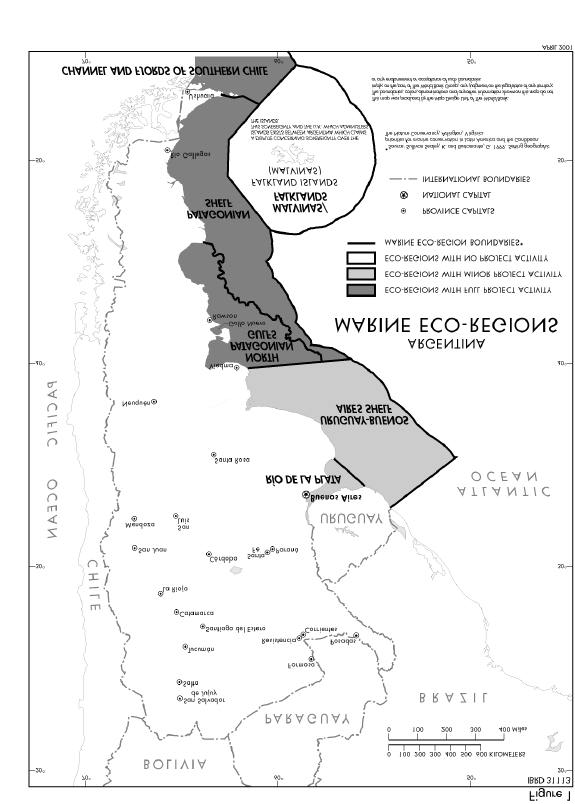
27
Y Improving preparedness and response to oil spills and preventing ship-based pollution.
Y Reducing navigational risks by introducing a marine electronic infrastructure program.
1.1. Improve preparedness and response to oil spills. This sub-component aims at strengthening PNA's
(Prefectura Naval Argentina) capacity to prevent maritime pollution generated by ships and activities related
to offshore oil exploitation. Through IDB baseline financing, the Patagonia ports are receiving financial
assistance to strengthen PNA's equipment needs to handle contingency situations. The GEF project would
complement baseline investments by focusing on remaining capacity gaps. Four activities are included under
this sub-component.
a) Improved organization and analysis of contingency plans using modern tools for data base organization.
The PNA is in charge of administering the "National System of Pollution Prevention and Control for
Hydrocarbons, Other Toxic Substances, and Potentially Hazardous Substances." All petroleum, shipping
and port industries have currently presented their respective contingency plans (approximately 1,200).
Each of these plans will have to be analyzed and approved by the Environmental Protection Directorate
(Dirección de Protección de Medio Ambiente, DPMA). To ensure adequate review and implementation,
this activity would support: (i) hiring of consultants with expertise in contingency planning to accelerate
the analysis of the private sector contingency and emergency response; (ii) training a group of
management staff and their alternates on the specific techniques of contingency planning; and, (iii)
developing a geographically referenced database that would quickly identify the availability of
equipment and human resources at the national, zonal and local levels and in the public and private
sector, for the prevention of hydrocarbon spills. This information would be incorporated to the software
to provide a graphic illustration of the occurrence of oil spills in the sea.
b) Extensive training for effective oil spills response. This component includes training at PNA's
headquarters and at the regional level at PNA's Patagonian Training Center. Specific ally, the project
would: (i) train two groups of six officers and alternates at CEDRES in France and OSRL in Great
Britain, respectively; (ii) create a training program in Puerto Madryn on the Patagonia Coast to provide
instruction to PNA, private sector and public sector personnel; (iii) furnish the training center with proper
equipment (e.g. barriers, surface sewers, and related materials); and, (iv) maintain an evaluation and
registration system of training participants. The purchase of the training equipment will be phased to
permit the implementation of the data base in the previous activity to ensure that the purchases made for
this activity are the optimal use of the resources and complement existing equipment. The project would
finance an international consultancy after 2.5 years of project implementation to assess the evolution of
the response capacity of oil spills at the national level as a result of project activities and support from
baseline sources. Based on this assessment, the necessary complementary equipment for the Patagonian
Training Center would be determined and acquired. The activity complements the investments
undertaken under the IDB funded port modernization project where contingency equipment is purchased
for all of the bigger ports in Argentina. The IDB project is mainly focused on port contingencies and
operational accidents, and will only provide a limited ability to address contingency situations outside of
ports.
c) Oil spill trajectory modeling. This activity consists of two sub-activities that require close collaboration
between PNA and SHN. The first sub-activity is the implementation of a Patagonia Tidal Wave model
that would help simulate the behavior of an oil spill in the ocean. The SHN will oversee this subactivity
and its description is included in component 2.1 (a). With the platform provided by the Tidal Wave
model regarding behavior of currents and winds, the second sub-activity consists of providing PNA with
a computer model for simulating the transport of oil spills in specific zones and staff training staff on the
use of the software.
28
d) Improved enforcement of MARPOL regulations on waste discharges. This activity aims at improving
control of all the ships that enter national ports, through inspection of their books, of the installed systems
in the ship and of the wastes on board before departure. PNA staff already conducts studies on the subject
and the proposed activity is to deepen and update their knowledge through specialized training courses.
A second objective is to generate a record of the movement of cargo ships in Argentine ports and their
waste management. This statistical information would enable the Subsecretaría de Transporte por Agua
y Puertos of the Ministerio de Infraestructura y Vivienda to design the waste reception facilities that are
required for the Patagonian ports, adapting them to the waste volumes managed by each port. The project
will support the following activities: (i) develop a training system, specific for senior staff of the PNA to
control waste discharges of ships; (ii) offer three theory and practical training courses to senior staff of
the PNA that carries out control of waste discharges in ports of the Patagonia, in compliance with the
MARPOL agreement; (iii) design data recordin g tabulations for all the ships that call in Argentine ports
during a one-year period; (iv) register the inspections carried out in ships to control waste discharges; (v)
produce a database with the tabulations designed and with the inspections carried out; (vi) design waste
reception systems for each port in the Patagonia, based on gathered statistics.
1.2. Reduce navigational risks by introducing a marine electronic infrastructure program. This sub-
component aims at reducing the risks involved in maritime navigation through the use of modern
technologies. At this time there has been an introduction of some electronic technologies to improve
navigational safety like the DGPS system that is now widely used, but much remains to be done. The new
technologies allow for a greater understanding of the hydrographic conditions surrounding the navigated
zones and the positioning of oil and cargo ships. Two activities are included under this sub-component.
a) Enhancing the Vessel Tracking System. At present, the only effective knowledge on oil tankers sailing
along the Patagonia coast comes from the movement message that each ship transmits twice a day to the
stations of the Servicio Móvil Marítimo of the PNA. This information system is insufficient for an
effective control to prevent illegal discharges. IMO's Maritime Safety Committee, has recently
established new rules on voyage data recorders (VDR) and automatic identification systems (AIS),
making it mandatory for all flag states to introduce new systems with some minimum requirements over
the next few years as specified by the International Convention for the Safety of Life at Sea (SOLAS).
The information to be provided include the following: ship's identity, type, position, course, speed,
navigational status and other safety-related information. In order to address the provisions of SOLAS,
Argentina needs to decide on a VDR and AIS system that satisfies the needs of the convention, while
meeting the management needs of the government. The Secretaría de Agricultura, Ganadería, Pesca y
Alimentación (SAGPyA), jointly with the Argentine Army and the PNA, has implemented a system
named MONPESAT. This is a tracking system of the fishing fleet through a satellite transmitter that
emits the position of the ship at predetermined intervals. The cost of extending the MONPESAT system
to the oceanic oil fleet could easily be absorbed by the ship owners because of the secondary benefits of
the system. However, it is important to note that the MONPESAT system has not been free of operational
problems. With the new provisions from IMO Argentina will have to develop the rules and a timeframe
for implementation over the next couple of years. This activity supports: (i) conducting further
consultation with private industry on the ir interest in technologies recommended by IMO and other
alternatives to MONPESAT (e.g., ARGOS); (ii) evaluating the advantages and costs of adopting and
modifying the MONPESAT or its alternatives vs. creating a new, simpler system dedicated to oil ships
and cargo vessels following the IMO recommendations; (iii) if necessary, designing the new system; (iv)
provide a legal consultant to help draft the regulations for AIS requirements in Argentina; and, (v)
installing and rendering the system operative.
b) Hydrographic Mapping of Critical Zones and Improving the Electronic Charts System. This activity
would finance a comparative study of commercially available multi-beam scanners to detect rocky peaks
and other important bottom features. The system that best suits the special conditions of the operator
29
(SHN) and the critical zones3 to be scanned would then be acquired and the equipment placed into
operation. The data gathered would then be incorporated into Argentina's naval cartography. Once the
new hydrographic mapping is carried out, the project would support the shift to using digital methods to
represent naval charts in replacement of or as complement to traditional paper charts. The most advanced
electronic cartography systems include the possibility of automatically representing the ship in the chart
through navigation data and even of superposing radar data to the electronic chart.
Project Component 2 - Marine Biodiversity Protection -
(US$ 12.46 million with a GEF contribution of US$ 4.29 million)
This component aims at improving the knowledge base about marine resources to inform decision-
makers about marine protection and building management capacity at the regional level. The component
addresses the need to better understand and document the specific effects and extent of impacts of
anthropogenic activities on the marine environment. In addition, while a number of research institutions have
had a central role in developing the available knowledge base on the Patagonia marine resources, three
problems have reduced their contribution to marine protection decisions: (i) the information is not sufficient
and properly integrated; (ii) the institutions tend to minimize knowledge sharing because of competition for
research funding and prestige; and, (iii) these institutions have limited dialogue with policy makers and lack
applied marine research programs. Three sub-components are proposed to address these problems by:
· Improving the knowledge base on the Patagonia marine ecosystem and completing identification of
ecologically sensitive areas.
· Developing marine protection tools based on impact evaluations.
· Promoting capacity building and regional knowledge sharing on marine biodiversity protection.
2. 1. Improve the knowledge base on the Patagonia marine ecosystem and complete identification of
ecologically sensitive areas. The overall goal of this sub-component is to generate a more systematic and
internationally compatible set of oceanographic and biological data. This would enhance Argentina's
knowledge about its marine resources and offer improved information for global conservation. The following
three activities are proposed under this sub-component.
a) Targeted programs for understanding the dynamics of ocean circulation, production and environmental
degradation of key areas of the Patagonia ecosystem. This activity would include:
(i) Patagonian Tidal Wave Model for Simulating Oil Spill Trajectory. To aid PNA's assessment of
how an oil spill behaves in the ocean, SHN will implement a Patagonia Tidal Wave Model and
associated data acquisition. The model would simulate the propagation of a tide wave, the general
circulation produced by currents in the continental platform, and the effects of the wind. In addition,
this model would provide the outline conditions for local models, in the sites of interest, such as oil
loading platforms, oil production and perforation platforms and the traditional courses of oil tankers.
Local models would be calibrated with in-situ measurements of currents, tides and winds. The oil
spill trajectory modeling would not only predict the path of a spill in real time, but also carry out
different types of simulations to establish a priori the possible path of the slick. Specifically, this
activity overseen by SHN would support: (i) acquiring a computer program to model the
hydrodynamic systems (currents, winds and bathymetry); (ii) determining precisely the local zones of
interest to incorporate detailed information on tide currents; (iii) contracting measurements of
3 The transit areas of highest navigational risk in Patagonia are the near-coast access points to ports and channels in:
Strait of Le Maire, Beagle Channel, between Punta Tombo and Cabo Aristizabal, between Cabo Blanco and Pingüino
Island, and the access to Puerto Deseado.
30
currents and tides during a minimum period of 30 days in each of the sites that require a detailed
model; (iv) incorporating the information obtained from the hydrodynamic models to the database of
the program for spills monitoring; (v) in collaboration with PNA, the implementation of the spill
monitoring program and carrying out simulations in each of the detailed zones; and, (vi) identifying
the zones of possible impact for the detailed zones, based on the stochastic simulations.
(ii) Pilot Ocean Monitoring by Oceanographic Buoys. This activity would support: (i) the selection
of an area in the Patagonia waters where the monitoring pilot program is to be conducted (currently
proposed for continental slope area east of Peninsula Valdez for the ocean buoy and Punta Tombo for
the coastal buoy during the first year); (ii) the development of the specifications for the buoys
including quantity and quality of sensors, internal processing capacity, source of energy transmission
mechanism and remote control options; (iii) the design of a system of data receptors, including its
processing and dissemination via the Internet and to maritime traffic in real time; (iv) the
investigation of mechanisms for data sharing with other countries; (v) the design of an inspectio n,
control and maintenance system for the buoys; (vi) the acquisition and installation of the buoys; (vii)
the operation and maintenance of the buoys; and (viii) the reception, processing, and dissemination of
the transmitted data. The component would also develop a program of collaboration to run the
operation when the GEF project supports ends and evaluate the need to develop a network of buoys
in the South Atlantic waters.
(iii) Extensive Ocean Monitoring by ship using conventional methodologies. A significant capacity
for oceanographic research by the SHN in collaboration with CONICET existed during the 1970s and
1980s. However, the data has not been properly calibrated and processed and there are indications
that there is room for improvements in the land-based part of oceanographic operations. This activity
would: (i) design and plan research programs, use of boats, instruments and personnel; (ii)
systematically measure physical and chemical parameters in the sea with an oceanographic vessel,
covering the continental platform from 39 degrees to 54 degrees South; (iii) process, publish and
disseminate the data within one year of measurement, for the use of the community and international
partners; and (iv) produce a geo-referenced database.
bi) Transboundary Analysis of Patagonian Ecosystems. This study is a standard product of GEF
international waters projects and it aims at informing project stakeholders and neighboring countries
about the health status of marine resources and the key sources of environmental stress. The
transboundry analysis would help set priorities for local and regional action on marine resource
management. A diagnostic study on the biodiveristy and environmental status of the Patagonia marine
ecosystems has been conducted (Biodiversity of the Patagonia Shelf see reference in Annex 8) as part of
project preparation and provides a starting point for this analysis. The task would be implemented by a
drafting team lead by the PEU with participating staff from the SDSyPA, and would be subject to
consultations in workshops. The transboundry analysis should be completed within the first three years
of project implementation.
bii) Completion of the sensitivity atlas to improve knowledge base on the Patagonia marine ecosystem and
complete identification of ecologically sensitive areas. This activity would make available to the
Argentine public an atlas in paper and electronic form with specific information on the marine and
coastal resources and their interaction with man. In particular, the atlas would permit the oil industry and
PNA to better assess risks and take precautions to prevent accidents from occurring. Areas of high
importance for the protection against pollution and environmental degradation have been mapped in the
past in Argentina. There is, however, no official document assisting operators of potentially polluting
activities in prioritizing areas of special importance.
c) Inter-calibration of key marine laboratories. The inconsistent availability of analytical data has limited
Argentina in managing its marine resources over the years. In particular, international sharing of data has
been a problem, lowering the value of some of the research done. The following activities would be
31
supported: (i) organize workshops with international research institutions and facilitators to establish
international standards of applicability to Argentina; (ii) reach an agreement on a lead laboratory for each
aspect of data to be calibrated; (iii) conduct inter-calibration work by sending samples between the
participating institutions and the reference laboratories; (iv) evaluate the need for further extension of this
program, after two years of implementation; and (v) analyze methods of funding to maintain this program
after the end of this proposed project.
2.2. Develop marine protection tools based on impact evaluations . Two main sets of activities are
envisioned.
a) Priority setting of areas for marine biodiversity and analysis of regulatory and technical aspects for
piloting marine reserves. The development of marine reserves in Argentina has just begun with the
introduction of restricted areas for fishing during spawning seasons. The possibility of using these
methodologies beyond the protection of commercially important fish stocks and to extend protection to
other forms of marine life has not yet been attempted. A number of coastal parks, however, do exist.
Also, under the UNPD\GEF Patagonia Coastal Zone Management Project, the development of coastal
reserves is envisaged. This activity supports a consultancy to draft lists of areas of key importance for
marine protection and workshops with key experts to prioritize marine reserves. The consultancy would
also analyze regulatory and technical aspects of optimal methods for establishing marine reserves in
federal and provincial waters and would present recommendations for future piloting of marine reserves.
b) Evaluation of the incidental catch of birds and mammals and development of an action program based
on the severity of impacts. The rate and importance of incidental catches of marine mammals and birds
in the Patagonia waters by the fishing industry is not well documented. This activity would support a
consultancy to establish the dimensions of the issue and workshops with key experts to prioritize threats
and potential protective actions.
2.3. Promote capacity building and regional knowledge sharing on marine biodiversity protection.
This sub-component would be implemented as a Matching Grant Program to support local pilot projects for
innovation in resource use technologies and applied research. Pilot projects would receive a grant of less
than US$100,000 each. The GEF grant would support up to 30% of total pilot project costs and the project
proponent support the remaining 70% (including in-kind contributions). The limit of in-kind contribution will
be 50% of the counterpart contribution. The priorities for this program have been developed through two
workshops involving most of the key stakeholders. Representatives for the provinces proposed the following
specific topics to be promoted through this sub-component:
· Deepen the understanding of impacts of pollution and fishing on marine biodiversity;
· Pilot activities that reduce or mitigate impacts of pollution on the Patagonia marine environment;
· Pilot activities that reduce the impacts of current fishing technologies on marine biodiversity; and
· Fund programs that improve the collaboration between the public/private sectors and civil society and
that increase Argentina's national, provincial and municipal capacity to protect its marine resources.
The Program's criteria for qualification of projects would be based on an agreed point-based ranking system
applied by a panel of national and international experts. In addition to technical soundness, key criteria
include the following:
· Projects must respond to current explicit policy priorities related to protection of marine resources as
expressed by the four Patagonian provinces;
· Projects that promote greater collaboration among institutions and propose wider dissemination strategies
will be ranked higher; and
32
· Projects that incorporate capacity building of policy makers and provide policy-relevant lessons would be
ranked higher.
Project Component 3 -Capacity Building, Monitoring and Evaluation, and Project Management
(US$ 2.78 million with GEF contribution of US$ 1.92 million)
3.1. Local Capacity Building and Dissemination. This component would address the need to strengthen the
marine resources management capacity of the local provincial and municipal governments and help
disseminate the information on Patagonia's marine environment generated by the Project and that available
from other sources. Two primary tasks will be supported: a training program for provincial authorities and an
environmental information system.
a) Training Program. To be developed on a cost sharing basis with the entities to be trained, to strengthen
specific skills. The themes to be covered in the training program are marine pollution prevention, living
marine resources management, and marine conservation programs. Participation in contingency training
programs and participation in national conferences in this field would also be supported.
b) Environmental Information System for the Patagonia Marine Ecosystems. Project resources would be
used to support the aggregation of available data from public institutions, NGOs, and the private sector,
for the processing of the information, and for the development of a network of ocean and coastal related
information database for Patagonia (includes the information generated by the Project). Using modern
search engines and tools, such as open directories for information management, the project would support
the development of regional nodes for different specialties. The information would be disseminated
through the Internet by using web pages and list servers.
3.2. Monitoring and Evaluation. The project will be guided by bi-annual reviews of results using progress
reports prepared by the PEU (Project Execution Unit) according to the Project Operations Manual that will
include outputs indicators developed on the basis of Annex 1. Based on the findings of these reviews,
SDSyPA and the World Bank supervision missions will identify specific measures to: (i) address any areas of
implementation weaknesses; and (ii) accommodate changes in priorities. These measures for improvement
will be reflected in the proposal for the forthcoming year's project budget. A mid term review will be
conducted to assess the progress of project implementation, and the need to modifications of the resources,
depending on project implementation success. At the provincial level, a Consultative Group of the
Patagonian COFEMA4 will monitor project outputs and their contribution to policy-making on the basis of
progress reports reviewed during Project workshops and during the regular COFEMA meetings.
3.3 Project Management. The project supports the creation of a Project Execution Unit (PEU) within
SDSyPA staffed with a Project Coordinator, two technical specialists, a procurement specialist (to report to
SDSyPA's Administration Unit), and a lawyer. The Project Operations Manual will describe in detail, inter
alia,: (i) the TORs of each PEU staff; (ii) the applicable procedures for each procurement method as per Bank
guidelines; (iii) a procurement decisions flow-chart incorporating Bank, UNDP, and government clearances;
(iv) a time-bound procurement and implementation plan for the first year. Finally, this subtask will fund
consultation and dissemination workshops, travel for the PEU staff, and public outreach activities (project
brochure/newsletter).
4 The environmental authorities in the central government are promoting a stronger role of the COFEMA for
environmental policy coordination with the provincial jurisdictions. The Patagonian provinces are represented in the
Patagonian COFEMA which intends to address a common agenda.
33
Annex 3: Estimated Project Costs
COASTAL CONTAMINATION PREVENTION AND MARINE MANAGEMENT
Project Cost By Component
Local
Foreign
Total
----------US $million----------
1. Maritime Pollution Prevention
1.1 Improve preparedness and response to oil
0.68
0.85
1.53
spills
1.2. Reduce navigational risks by introducing a
1.21
0.64
1.85
marine electronic infrastructure program
2. Marine Biodiversity Protection
2.1. Improve knowledge base and identify
2.75
0.44
3.19
ecologically sensitive areas
2.2. Develop marine protection tools
0.45
0.03
0.48
2.3. Promote capacity building and knowledge
8.47
0.02
8.49
sharing on marine biodiversit y protection
3. Capacity Building, Monitoring and Evaluation,
2.66
0.05
2.71
and Project Management
TOTAL BASELINE COSTS
16.22
2.03
18.25
Physical Contingencies
0.05
0.09
0.14
Price Contingencies
0.34
0.03
0.37
TOTAL PROJECT COSTS
16.61
2.15
18.76
34
Annex 4: Cost-Benefit Analysis Summary/Incremental Cost Analysis
Within the South Atlantic Large Marine Ecosystem (LME) comprising a large expanse of
international resources lays the Patagonia Shelf LME, a biologically productive area supporting a wide
variety of marine life. The Patagonia marine ecosystems, host a large number of marine species of global
importance ranging from the endemic Magellan's penguin, the Southern Elephant Seal to the Southern Right
Whale. The highly productive and diverse Patagonia marine ecosystems are an important region for
Argentina's economy. Commercial fishing, oil exploration, tourism, and a past national policy promoting
industrial development (mining and manufacturing), have shaped the process of human settlement along the
coast. The impact of these human activities on the overall health of the marine ecosystems are not fully
known as monitoring and research is insufficient to draw firm conclusions; however, continued growth and
risks involved in oil exploration and transportation may threaten ecological sustainability. In particular,
overfishing, pollution from oil storage and shipping, and land-based pollution are the main issues affecting,
not only marine ecosystems, but also local and national interests.
Baseline Scenario
The international waters of the Patagonia marine ecosystems are subject to a number of pressures from
human activities as mentioned above. In the absence of GEF assistance for addressing the international waters
objectives it is clear that Argentina would continue to support the development of the productive sectors of the
economy, with limited consideration for the environment. In particular the industries that are characterized by a
"frontier mentality" like the oil industry and the mining industry. Even an industry relying on renewable natural
resources, like the fishing industry, has seen highly unsustainable practices. For the purpose of this project the
baseline has been calculated at US$ 18 million.
The baseline consists of the following investments:
In the field of sustainable fisheries management the Secretariat for Agriculture, Livestock, Fisheries and
Food, SAGPyA is implementing a Learning and Invocation Loan (LIL) of US$ 8.5 million, including a US$ 5
million IBRD loan. The projects primary focus is improving the management of the fishing sector and the
operation of the monitoring, control and surveillance systems. The project has recently become effective and is
intended to have a three year implementation period. Not all sustainability issues will be addressed during the
life-cycle of this project, and there will remain a number of issues that will need further attention.
Regarding Land Based Sources of Marine Pollution the main public investment, through foreign
collaboration, is the IDB financed Port Modernization Project. The environment component of this project will
purchase equipment and improve management in some of the bigger ports in Argentina. The value of the
environment investments, that are currently being made, is US$ 6.6 million. Within the baseline, there will be
some limited capacity building together with the oil industry, particularly through joint training programs that
currently occur annually.
To build the knowledge base of the marine ecosystems in Argentina and translate this knowledge into
management there are a number of provincial programs under way. One activity is the Institution Development
Fund Grant to a local NGO and a Bank supported program on public involvement in municipal environmental
management. There is also some support for information management through a national network of
environmental information. This program has been supported by the IDB-funded Environment Institution
Strengthening Project. It has provided some web-based information systems at the SDSyPA.
Monitoring and evaluation of project management is largely a project specific activity, as a result there is
no baseline available for this component.
35
Global Environmental Objective
The project aims to promote the conservation and sustainable management of marine and coastal
resources of the international waters along the Argentine coastline through the prevention and mitigation of
coastal pollution and the sustainable use of fisheries and marine resources. The project development objectives
are to: (a) address the threats from water-based and land-based contamination in the Patagonia coastal area; (b)
improve fisheries management to eliminate and prevent over harvesting in the project region; and (c) safeguard
marine biodiversity from increased commercial traffic of hazardous and toxic substances. The GEF Alternative
intends to achieve these outputs at a total incremental cost of approximately US$8.35 million.
Project development objective:
The objective of the proposed GEF Project is to complement Argentina's efforts to reduce pollution
of the Patagonia marine environment and improve sustainable management of marine biodiversity by:
(i) improving oil spill prevention and response capacity;
(ii) improving the knowledge base about the Patagonia marine environment and its biodiversity, and
(iii) promoting capacity building and regional knowledge sharing to promote sustainable management of
marine resources.
GEF Alternative
With the GEF assistance for addressing the international waters objectives outlined above, the GOA
would be able to undertake a more ambitious program, that would generate both national and global benefits.
The GEF alternative would comprise the baseline scenario, described above (fisheries management, basic oil
spill equipment and limited information sharing), augmented with an expanded marine pollution prevention
capacity and establishment of a marine electronic highway structure and the implementation of pilot
activities in fisheries management and marine conservation. The total amount for the GEF alternative is
calculated at US$ 36.76 million.
It is anticipated that the GEF alternative would catalyze additional development resources, beyond
the baseline scenario, totaling US$ 18.76 million including the GEF contribution of US$ 8.35 million and an
additional US$ 10.41 million, primarily for various aspects of the establishment of the marine electronic
highway, improvements in maritime safety and piloting various program to reduce marine pollution and improve
marine resources management. These resources would only be available under the GEF scenario.
The GEF alternative will make possible some pilot studies of how to reduce the biodiversity impacts
from the fishing sector, and set the stage for policy changes that will include biodiversity considerations in
the fishing sector. In particular the reduction of non target species, though the introduction of new
technologies and use of restricted fishing areas, based on more accurate bottom maps. The GEF alternative
increment would be US$ 0.49 million, and the GEF contribution to this is US$ 0.31 million.
The GEF alternative would have a significant effect on reducing maritime traffic risks and the
associated damage that can effect the marine environment. The improvements under the GEF alternative will
also provide practical management experiences to the key government agencies responsible for management
in cutting edge technology and international collaboration. The policing of the actual polluters will also be
significantly enhanced, making criminal practices and negligent behavior a less attractive proposition. The
GEF alternative would cost US$ 10.12 million. The GEF alternative increment would be US$ 3.52 million
with the GEF contributing US$ 2.14 million.
36
To improve sustainable management of international waters resources in Patagonian waters and
enhance the knowledge base there will be significant global benefits including the testing of innovative
marine resources management alternatives, priority setting of future conservation needs, enhancement of the
global knowledge base of the resources and calibration of the Argentine institutional laboratories with the
international standards, on a continuos basis. There will also be some domestic benefits from GEF alternative
including the strengthening of Patagonia based institutions and the human capacity to manage the marine
resources. The project also intends to foster a better climate for collaboration between the key actors. The
GEF alternative would cost US$ 14.87 million with the increment costing US$ 11.97 million and the GEF
contribution being US$ 3.98 million.
Finally the monitoring and evaluation activities and project management would generate some global
benefits including the lessons from project implementation, a good baseline for future work and design
experiences for future projects. The GEF alternative would be the same as the increment US$ 2.78 million
with a GEF contribution of US$ 1.92 million.
Incremental Cost
The difference in cost between the Baseline Scenario and the proposed GEF alternative is estimated
at US$ 18.76 million. Of this amount, it is estimated that about US$ 4.35 million would be contributions
from the GOA, US$ 6.06 million would be contributions from the beneficiaries of the matching grant
programs. It is estimated that an incremental cost of US$ 8.35 million will be incurred to achieve global
environmental benefits through the improved management of international waters. This amount would
therefor be eligible for GEF support. See the following table for a summary of the project components and
the proposed financing plan of the incremental cost.
37
COASTAL CONTAMINATION PREVENTION AND MARINE MANAGEMENT
Component Sector
Cost
US$
Domestic Benefit
Global Benefit
Category
Million
Fisheries
Baseline
8.50
Increased sustainability of commercial
Management
fisheries and social assistance program
in the event of periodic closures of the
fishery or sharp TA C reductions.
Alternative
8.99
Same as above.
Improved understanding and reduction of
additional impacts on other species and
on the marine ecosystem.
Increment
0.49
(GEF)
(0.31)
Land-based and
Baseline
6.60
Some capacity for remediation of oil
maritime pollution
spills and gradually improve the
prevention
capacity to respond oil spills
Alternative
10.12
Same as above
Significant improvement in risk reduction
of global/regional environmental
degradation from maritime traffic and
pollution through establishment and
implementation of an "effective" oriented
program.
Increment
3.52
(GEF)
(2.14)
Knowledge Base
Baseline
2.90
Limited support for information
on Patagonia
management through nodes of national
Ecosystem and
network for environmental information.
Capacity Building
on Sustainable
Management of
Marine Biodiversity
Alternative
14.87
Strengthened institutional and human
Major enhancement of knowledge base of
capacity in Patagonia region for
global relevance on Patagonia
sustainable management of marine
ecosystem; testing and innovation of
resources.
marine biodiversity protection measures;
and identification of priority ecological
areas. Increased collaboration among
research institutions linked to global
scientific programs .
Increment
11.97
(GEF)
(3.98)
Capacity Building,
Baseline
0.0
M&E, and Project
Management
Alternative
2.78
Lessons from project implementation
relevant for similar projects elsewhere.
Increment
2.78
(GEF)
(1.92)
Totals
Baseline
18.00
Alternative
36.76
Increment
18.76
(GEF)
8.35
Footnotes to Incremental Cost Matrix:
The Baseline Scenario represents government funding (including WB and IDB support) for the activities described in
Section 2 (b) Government Strategy. The Alternative Scenario represents the additional activities under proposed
Project which include government and beneficiary counterpart financing. Sub-component 2.2 addressing the
development of marine protection tools is the incremental activity for Sustainable Fisheries Management. All other
components of the Proposed Project are the incremental activities of corresponding baseline area.
38
Annex 5: Financial Summary
COASTAL CONTAMINATION PREVENTION AND MARINE MANAGEMENT
Years Ending December 31
(US$, 2002 base year)
Implementation Period
Operational Period
Year 1 Year 2 Year 3 Year 4 Year 5 Year 1 Year 2 Year 3
Project Costs
Investment Costs
0.99
4.48
4.26
4.27
2.46
Recurrent Costs
0.30
0.30
0.40
0.50
0.80
0.07
0.07
0.07
Total
1.29
4.78
4.66
4.77
3.26
0.07
0.07
0.07
Financing Sources (% of
total project costs)
GEF
57%
68%
35%
36%
31%
Government
43%
23%
22%
18%
25%
Beneficiaries
9%
43%
46%
44%
Total
100%
100%
100%
100%
100%
Operational Period Main Assumptions
During the operational period, financing will be required to cover: (i) the reproduction of an
ecological sensitivity atlas; (ii) courses that PNA will offer to the private sector on oil spill prevention; and
(iii) maintenance of a GPS Differential System to determine the positioning of ships in areas at the greatest
risk. These operational costs will be financed by private beneficiaries, through the sale of the ecological
sensitivity atlas, course fees paid by the private sector, and maintenance fees paid by the ship owners,
respectively.
39
Annex 6: Procurement and Disbursement Arrangements
COASTAL CONTAMINATION PREVENTION AND MARINE MANAGEMENT
Procurement
Table A. Project Costs by Procurement Arrangements
Table A1. Consultant Selection Arrangements
Table B. Thresholds for Procurement Methods and Prior Review
Disbursement
Table C. Allocation of Grant Proceeds
40
Annex 6, Table A: Project Costs by Procurement Arrangements
(US$ million equivalent)
Expenditure Category
Procurement Method
Total Cost
(including
contingencies)
ICB
NCB
Othera
N.B.F.
1. Goods
1.60
0.14
0.28
0.06
2.08
(1.60)
(0.14)
(0.28)
(2.02)
2. Services and Workshops
2.78
1.02
3.80
(2.78)
(2.78)
Matching Grants
2.50
6.06
8.56
(2.50)
(2.50)
3. Incremental Operating
1.05
3.27
4.32
Costs
(1.05)
(1.05)
Total
1.60
0.14
6.61
10.41
18.76
(1.60)
(0.14)
(6.61)
(8.35)
Note: ICB = International Competitive Bidding
NCB = National Competitive Bidding
N.B.F. = Not Bank-Financed
Figures in parenthesis are the amounts to be financed by the GEF grant.
a Includes goods to be procured through national shopping, consulting services, services of
contracted staff of the project management office, technical assistance services, workshop
expenses, as well as expenditures for travel, training course fees and other costs related to the
execution of the project.
41
Annex 6, Table A1: Consultant Selection Arrangements
(US$ million equivalent)
Selection Method
Total Cost
Consultant Services
(including
Expenditure Category
contingencies)
QCBS QBS
SFB
LCS
CQ
Other N.B.F.
A. Firms
0.13
0.76
0.41
1.30
(0.13)
(0.76)
(0.89)
B. Individuals
1.59
0.61
2.20
(1.59)
(1.59)
Total
0.13
0.76
1.59
1.02
3.50
(0.13)
(0.76) (1.59)
(2.48)
Note: QCBS = Quality- and Cost-Based Selection
QBS = Quality-based Selection
SFB = Selection under a Fixed Budget
LCS = Least-Cost Selection
CQ = Selection Based on Consultants' Qualifications
Other = Selection of individual consultants (per Section V of Consultants Guidelines),
Commercial Practices, etc.
N.B.F. = Not Bank-financed
Figures in parenthesis are the amounts to be financed by the GEF grant.
42
Annex 6, Table B: Thresholds for Procurement Methods and Prior Review
Contract Value
Contracts Subject to
Threshold
Procurement
Prior Review
Expenditure Category
(US$ thousands)
Method
(US$ millions)
1. Goods
>350
ICB/NCB
All
100 to 350
ICB/NCB
First two contracts
<100
Shopping
First two contracts
2. Services
Firms
>100
QBS/CQ
All
< 100
CQ/Other
First two contracts
Individuals
>50
Other
All
<50
Other
Review of TORs only
Approximate total value of contracts subject to prior review:
$3,549,200
Procurement Risk Assessment and
Assessment of Agency's Capacity to Implement Project Procurement
The Overall Procurement Risk is assessed as AVERAGE. A Procurement Assessment has been
carried out by the Procurement Specialist (PS), who found that the project does meet the Bank's minimum
procurement management requirements and that the Project Execution Unit (PEU) has satisfactory
organization and staffing arrangements. The PS has guided the PEU in preparing a preliminary Procurement
Plan and has instructed the PEU on the procurement arrangements (such as standard bidding documents for
NCB, shopping procedures, and rules on the hiring of individual consultants) that should be included in the
project's Operational Manual. The PS found that project's current information system should be modified to
produce the specific procurement information needed for ex-post supervision. Consequently, the grant is
ineligible for PMR-Based disbursements. The PS has worked with the PEU to prepare an Action Plan in
which an adequate information system will be implemented within six months of project effectiveness. At
the end of the six-month period, the Procurement Specialist will re-assess the procurement risk. If the risk is
assessed as low, the project may become eligible for PMR-based disbursements.
Procurement Action Plan:
Agreements
Due Date
1. Revised Procurement Plan for the first year of project implementation.
Negotiations.
2. Operational Manual (OM) shall contain specific rules on (a) hiring of
Approval by the Bank
individual consultants, (b) procurement below ICB thresholds, (c) filing and
of the OM is a
handling of correspondence, and (d) guidelines for the Matching Grant
condition of
Program. OM shall also contain applicable standing bidding / selection
effectiveness.
documents. OM to include Update of the first year Procurement Plan and a
mandate to update the Plan at least twice a year.
3. Information System shall be modified in order to produce specific
Within six months of
information for ex-post procurement supervision.
effectiveness.
43
Frequency of procurement supervision missions proposed: One every 6 months (includes special
procurement supervision for post-review/audits). Procurement supervision will be performed by the
Procurement Specialist (PS) and will include a review of: (i) the PEU's capacity; (ii) the procurement plan
for the project, including a timetable for procurement actions anticipated during the next 12 months; (iii) the
PEU's monitoring system; and (iv) complete records for one in every five contracts (for goods and consulting
services, respectively).
Scope of Procurement under the GEF Grant
Procurement of goods and services, as well as contracting of consultants with GEF grant funds, would be
carried out in accordance with Guidelines for Procurement under IBRD loans and IDA credits (January 1995,
revised September 1997 and January 1999) and the Guidelines for the Use of Consultants (January 1997,
revised September 1997 and January 1999).
Goods (prior review threshold $350,000). The GEF grant would finance goods and equipment for: (i)
contingency plan analysis, the development of a geographically referenced database for the prevention of
hydrocarbon spills, and furnishing a training center, as well as for oil spill trajectory modeling and producing
a database to document ships entering Argentine ports and inspections; (ii) installation of a vessel tracking
system; (iii) development of an Environmental Information System, ocean monitoring via oceanographic
buoys and a ship, and completion of a sensitivity atlas. It is estimated that about US$2.02 million of the GEF
grant would be allocated to goods and equipment.
Consultants' Services and Workshops (prior review threshold $100,000 for firms and $50,000 for
individuals). The GEF grant would finance consulting services, including studies (about US$2.48 million) ,
workshop expenses (approximately US$0.30 million) and the competit ive grant scheme (about US$2.50
million), for a total estimated US$5.28 million.
Incremental Operating Costs. The grant would also finance incremental costs (about US$1.05 million),
including travel expenses, training course fees, and other costs related to the execution of the Project.
44
Annex 6, Table C: Allocation of Grant Proceeds
Expenditure Category
Amount in
Financing Percentage
US$ million
1. Maritime Pollution Prevention
a. Goods and Equipment
1.37
100% (net of taxes)
b. Consultants' Services and Workshops
0.36
100%
c. Incremental Operating Costs1
0.42
100%
2. Marine Biodiversity Protection
a. Goods and Equipment
0.59
100% (net of taxes)
b. Consultants' Services and Workshops
0.68
100%
c. Incremental Operating Costs
0.51
100%
d. Competitive Grant Scheme
2.50
100% of amounts
disbursed
3. Capacity Building, M&E and Project Management
a. Goods and Equipment
0.06
100% (net of taxes)
b. Consultants' Services and Workshops
1.74
100%
c. Incremental Operating Costs
0.12
100%
Total
8.35
1 Incremental operating costs include expenses for travel and training course fees, as well as other expenses related to
project execution.
45
Annex 7: Project Processing Schedule
COASTAL CONTAMINATION PREVENTION AND MARINE MANAGEMENT
Project Schedule
Planned
Actual
Time taken to prepare the project (months)
39
First Bank mission (identification)
03/1997
03/1997
Appraisal mission departure
11/2000
03/2001
Negotiations
02/2001
03/2001
Planned Date of Effectiveness
03/2001
12/2001
Prepared by: Secretariat of Sustainable Development and Environmental Policy
Preparation assistance: GEF Project Preparation Grant (PPG No. 28491)
Bank staff who worked on the project included:
Name
Specialty
Laura Tlaiye
Team Leader, Operational Aspects, Senior
Environmental Specialist
Carl Lundin
Marine Biodiversity and Pollution Issues
Susana Cirigliano
Financial Management Specialist
Andrés Mac Gaul
Procurement Specialist
Angela Armstrong
Operations Analyst
Beatriz Iraheta
Language Program Assistant
Others who worked on project
Fernando Manibog
Former TL
John Kellenberg
Natural Resources Economist
Luis Vila
Local Expert on Maritime Pollution
Renan Poveda
Consultant
Steven Schonberger
Fisheries Issues
Rocio Sarmiento
Language Program Assistant
46
Annex 8: Documents in the Project File*
COASTAL CONTAMINATION PREVENTION AND MARINE MANAGEMENT
A. Project Implementation Plan
The Borrower submitted a draft Project Implementation Plan and Project Manual in December 2000.
The Project Implementation Plan will be finalized prior to project effectiveness.
B. Bank Staff Assessments (Found in Project files.)
Project Financial Management Assessment, Susana Cirigliano, Financial Management Specialist, January
11, 2001
Project Procurement Capacity Assessment, Andres Mac Gaul, Procurement Specialist, January 29, 2001
Biodiversity of the Patagonia Shelf, Agar, Astralaga and Lundin, draft 1999 in English and Spanish
C. Other
ARGENTINA: Towards Rights-Based Fisheries Management - Bank ESW Report 1999
Biodiversity of the Patagonia Shelf, MRAG Report 1999
Consolidation and Implementation of the Patagonia Coastal Zone Management Programme for
Biodiversity Conservation--UNDP Project Document 1999
Coast Watch Argentina Coastal Surveillance, Proposal by Radarsat and Hatfield, 2000
Electronic Marine Information Infrastructure component report, Lovingfoss 1998
Mission report for biodiversity overlay study, Astralaga, 1999
Preparation studies by Spider international, 1997
Puerto Madryn Workshop Findings on Biodiversity, Coastal Pollution, and Fisheries 1999
Site Visit and Assessment of Oil Spill Response Preparedness, ITPOF Report 1999
Technical Analysis of Electronic Marine Infrastructure Systems, Ezcurra & Schmidt S.A. Report 1999
Ushuaia Workshop Findings on Biodiversity, Coastal Pollution, and Fisheries 1999
*Including electronic files in the project workspace
47
Annex 9: Statement of Loans and Credits
COASTAL CONTAMINATION PREVENTION AND MARINE MANAGEMENT
A. Statement of IBRD Loans and IDA Credits in Argentina (as of September 28, 2000)
Active
Difference Between
Projects
Expected and Actual
Original Amount in
Disbursements a/
US$ Millions
Project
Project Name
Fiscal
IBRD
IDA
GE Cancel.
Undisb.
Orig.
Frm
ID
Year
Rev'd
P044447 AR Catamarca Provincial Reform
2001
70.7
0
0
0
70.7
0
0
P057449 AR State Modernization
1999
30.3
0
0
0
26.6
21.6
0
P043418 AR-AIDS AND STD CONTROL
1997
15
0
0
0
3.5
2.8
0
P058526 AR-DRUG PREVENTION (LIL)
1999
4.8
0
0
0
4.7
2.2
0
P063388 AR-HEALTH INSURANCE FOR
2000
4.9
0
0
0
4.9
1.4
0
THE UNINSURED
P045687 AR-HEALTH INSURANCE TA
1996
25
0
0
0
0.9
0.9
0
P034091 AR-HIGHER ED. REFORM
1996
165
0
0
0
76.5
76.5
2.2
P006059 AR-MATERNAL & CHILD HLTH
1997
100
0
0
0
59.1
0.1
0
& NUTRITION 2
P006030 AR-PROV. HEALTH SECTOR
1996
101.4
0
0
0
48
45.7
0
DEVELOPMENT
P055482 AR-PUB. HLTH. SURV. &
2000
52.5
0
0
0
52.5
6.8
0
DISEASE CONTROL
P005992 AR-SECONDARY ED 1
1995
190
0
0
21.3
31
52.3
32.3
P006057 AR-SECONDARY ED. 2
1996
115.5
0
0
0
68.2
60.1
0
P050714 AR-SECONDARY EDUCATION 3
1998
119
0
0
0
31.1
29.4
0
P049269 AR-SOCIAL PROTECTION 3
1998
284
0
0
0
72.3
72.3
0
P006058 AR-SOCIAL PROTECTION 4
1999
90.8
0
0
0
75.5
10.5
0
P039584 B.A.URB.TSP
1997
200
0
0
0
141.5
69.8
0
P039787 BIODIVER.CONSEV PROJ
1998
0
0
10.1
0
8.4
-0.2
0
P055935 EL NINO EMERGENCY
1998
42
0
0
0
32.9
32.9
15.5
P006052 FLOOD PROTECTION
1997
200
0
0
0
165.3
98.7
35
P006040 FORESTRY/DV
1996
16
0
0
0
8.6
3.8
0
P006055 MINING SCTR DEVT
1996
30
0
0
0
1.8
0.5
0
P057473 INDIGENOUS COMMUNITY
2001
0
0
0
0
0
0
0
DEVELOPMENT LIL
48
P055477 MINING TA
1998
39.5
0
0
0
13.8
13.8
0
P050713 MODEL COURT DEV.
1998
5
0
0
0
4.2
3.5
0
P006060 MUNIC DEVT II
1995
210
0
0
0
69.9
-51.4
0
P040808 N.FOREST/PROTC
1997
19.5
0
0
0
13.5
-1.2
0
P052590 NAT HWY REHAB&MAINT
1998
450
0
0
0
271.7
165.9
0
P046821 PENSION TA
1997
20
0
0
0
8.8
8
0
P006050 POLLUTION MGT.
1998
18
0
0
0
17.6
10.1
1
P006010 PROV AG DEVT I
1997
125
0
0
0
116.2
30.9
6.3
P006018 PROV DEVT II
1995
225
0
0
0
85.2
-1.1
0
P005980 PROV ROADS
1997
300
0
0
0
265.1
166.4
0
P037049 PUB.INV.STRENGTHG
1996
16
0
0
5.5
7.3
12.8
0
P005920 REDUCTION OF OZONE D
1997
0
0
0
0
13.4
-8.3
0
P006043 RENEW.ENERGY R.MKTS
1999
30
0
0
0
29.1
3.3
0
P005968 SEGBA V
1987
276
0
0
0
32.2
32.2
0
P006041 SMALL FARMER DV.
1998
75
0
0
0
42.2
22.2
17.9
P055461 SOC&FISC NTL ID SYS
1999
10
0
0
0
7.3
4.3
0
P062992 SPEC REPURCHASE
1999
505
0
0
0
500
0
0
P062991 SPECIAL SAL (SSAL)
1999
2525.3
0
0
250
500
750
500
P057459 Sustainable Fisheries Management
2001
5
0
0
0
5
0
0
Project
P006046 WATER SCTR RFRM
1999
30
0
0
0
30
8.3
0
Result
6741.1
0
10.1
276.8
3016.3
1752.7
610.2
49
B. Statement of IFC's Held and Disbursed Portfolio
As of 8/31/00
(In US Dollars Millions)
Held
Disbursed
FY Approval
Company
Loan
Equity
Quasi
Partic
Loan Equity Quasi Partic
1998
AUTCL
5.63
0.00
0.00
0.00
5.63
0.00
0.00
0.00
1994
Aceitera Chabas
0.00
0.00
3.10
0.00
0.00
0.00
3.10
0.00
1994
Aceitera General
7.50
0.00
6.90
0.00
7.50
0.00
6.90
0.00
1960/95/97/99
Acindar
50.00
0.00
0.00
0.00
50.00
0.00
0.00
0.00
1994/95/96
Aguas
0.00
0.00
0.00
0.00
0.00
0.00
0.00
0.00
1977/84/86/88/94/96
Alpargatas
10.00
0.00
0.00
40.50
10.00
0.00
0.00 40.50
1999
American Plast
10.00
0.00
0.00
0.00
10.00
0.00
0.00
0.00
1993
Arg Equity Inv.
0.00
2.84
0.00
0.00
0.00
2.84
0.00
0.00
2000
Argentina SMMC
0.00
12.50
0.00
0.00
0.00
0.00
0.00
0.00
1994/99
BGN
0.00
0.00
33.00
0.00
0.00
0.00
33.00
0.00
1989/91/96
Banco Frances
4.10
0.00
0.00
0.00
4.10
0.00
0.00
0.00
1996/99
Banco Galicia
50.00
0.00
0.00
245.00
50.00
0.00
0.00 245.00
1995/97
Banco Roberts
30.00
0.00
0.00
0.00
30.00
0.00
0.00
0.00
1996
Bansud
3.39
0.00
0.00
0.00
3.39
0.00
0.00
0.00
2000
Bco Hipotecario
25.00
0.00
0.00
102.50
25.00
0.00
0.00 102.50
1996
Brahma - ARG
14.93
0.00
0.00
16.50
14.93
0.00
0.00 16.50
1988/93
Bunge y Born
0.53
0.00
0.00
4.01
0.53
0.00
0.00
4.01
1996
CAPSA
9.82
0.00
5.00
27.00
9.82
0.00
5.00 27.00
1999
CCI
0.00
20.00
20.00
0.00
0.00 20.00
6.00
0.00
1995
CEPA
6.67
0.00
3.00
1.20
6.67
0.00
3.00
1.20
2000
Cefas
10.00
0.00
5.00
0.00
0.00
0.00
0.00
0.00
1999
Correo Argentino
63.00
6.82
5.18
0.00
63.00
6.82
5.18
0.00
1994/95
EDENOR
0.00
0.00
0.00
0.00
0.00
0.00
0.00
0.00
1998
F.V. S.A.
11.25
0.00
4.00
0.00
11.25
0.00
4.00
0.00
1998
FAID
0.00
2.75
0.00
0.00
0.00
2.75
0.00
0.00
2000
FAPLAC
10.00
0.00
5.00
0.00
10.00
0.00
5.00
0.00
1992
FEPSA
2.75
0.00
2.00
0.00
2.75
0.00
2.00
0.00
1997
FRIAR
10.00
0.00
2.50
7.00
10.00
0.00
2.50
7.00
1996
Grunbaum
6.00
0.00
2.00
3.33
6.00
0.00
2.00
3.33
1997
Guipeba
13.93
0.00
5.00
0.00
13.93
0.00
5.00
0.00
1998
Hospital Privado
9.60
0.00
0.00
0.00
6.50
0.00
0.00
0.00
1992
Huantraico
0.00
17.00
0.00
0.00
0.00
0.00
0.00
0.00
1995/97
Kleppe/Caldero
6.00
0.00
0.00
0.00
6.00
0.00
0.00
0.00
1996
MBA
0.00
0.16
0.00
0.00
0.00
0.16
0.00
0.00
1992/93/96
Malteria Pampa
3.50
0.00
1.00
0.00
3.50
0.00
1.00
0.00
1995
Mastellone
0.00
0.00
0.00
0.00
0.00
0.00
0.00
0.00
0/97
Milkaut
7.50
0.00
10.00
3.00
7.50
0.00
10.00
3.00
1978/81/86/87/91/93/96/99 Minetti
30.00
0.00
14.00
100.00
30.00
0.00
14.00 100.00
1993/94
Molinos
0.00
1.24
0.00
0.00
0.00
1.24
0.00
0.00
1995
Nahuelsat
17.50
5.00
0.00
0.00
17.50
5.00
0.00
0.00
1996/99
Neuquen Basin
0.00
5.00
0.00
0.00
0.00
3.81
0.00
0.00
1993
Nuevo Central
3.13
3.00
0.00
3.75
3.13
3.00
0.00
3.75
1992
Oleaginosa Oeste
1.53
0.00
2.50
0.62
1.53
0.00
2.50
0.62
1992/95
PAE - Argentine
9.09
0.00
0.00
18.18
9.09
0.00
0.00 18.18
50
1998
Patagonia
5.00
0.00
1.00
0.00
5.00
0.00
1.00
0.00
1998
Patagonia Fund
0.00
24.97
0.00
0.00
0.00
7.08
0.00
0.00
1990/94
Petroken
11.13
0.00
0.00
1.59
11.13
0.00
0.00
1.59
1994
Quilmes
7.14
0.00
0.00
2.50
7.14
0.00
0.00
2.50
1996
Refisan
12.73
0.00
0.00
15.00
12.73
0.00
0.00 15.00
1992
Rioplatense
5.33
1.00
0.00
1.67
5.33
1.00
0.00
1.67
1999
S.A. San Miguel
9.76
0.00
0.00
0.00
9.76
0.00
0.00
0.00
1995
SIDECO
0.00
15.00
0.00
0.00
0.00 15.00
0.00
0.00
1995
SanCor
12.50
0.00
20.00
9.00
12.50
0.00
20.00
9.00
1995
Socma
10.42
0.00
0.00
25.00
10.42
0.00
0.00 25.00
1997/98
Suquia
35.00
0.00
0.00
25.00
35.00
0.00
0.00 25.00
1997
T6I
10.00
0.00
5.00
26.25
10.00
0.00
5.00 26.25
1987/89/90/96/97
Terminal 6
10.00
0.00
0.00
11.38
10.00
0.00
0.00 11.38
1995
Terminales Port.
6.50
0.00
0.00
0.00
6.50
0.00
0.00
0.00
1995/00
Tower Fund
0.00
5.00
0.00
0.00
0.00
2.47
0.00
0.00
1995
Tower Fund Mgr
0.00
0.14
0.00
0.00
0.00
0.14
0.00
0.00
1996
Transconor
22.85
0.00
19.78
180.90
22.85
0.00
19.78 180.90
1998
U.Belgrano
7.00
0.00
0.00
0.00
0.00
0.00
0.00
0.00
1997
Vicentin
21.25
0.00
0.00
6.00
21.25
0.00
0.00
6.00
1993
Yacylec
5.50
5.04
0.00
6.09
5.50
5.04
0.00
6.09
1996
Zanon
11.67
0.00
6.00
0.00
11.67
0.00
6.00
0.00
Total Portfolio:
646.13
127.46 180.96
882.97 626.03 76.35 161.96 882.97
Approvals Pending Commitment
Loan
Equity
Quasi Partic
2000
ALEF
25000
0
0 150000
2000
APSF
20000
5000
0
30000
1999
American Plast
0
350
0
0
2000
Argentina SMMC
100000
0
0 450000
1999
Biopork
5200
0
2000
5000
2000
CAG Fund
0
10000
0
0
1999
DI TELLA
9000
0
0
0
1999
Galicia BLINC
0
0
0
75000
1998
U.Belgrano
15000
0
0
0
2001
USAL
10000
0
0
0
1999
Unisoy
5000
0
2000
4000
Total Pending Commitment:
189200
15350
4000 714000
51
Annex 10:
Argentina at a glance
9/12/2000
Latin
Upper-
POVERTY and SOCIAL
America
middle-
Argentina
& Carib.
income
Development diamond*
1999
Population, mid-year (millions)
36.6
509
573
Life expectancy
GNP per capita (Atlas method, US$)
7,600
3,840
4,900
GNP (Atlas method, US$ billions)
277.9
1,955
2,811
Average annual growth, 1993-99
Population (%)
1.3
1.6
1.4
Labor force (%)
2.1
2.5
2.1
GNP
Gross
per
primary
Most recent estimate (latest year available, 1993-99)
capita
enrollment
Poverty (% of population below national poverty line)
18
..
..
Urban population (% of total population)
90
75
76
Life expectancy at birth (years)
73
70
70
Infant mortality (per 1,000 live births)
19
31
27
Child malnutrition (% of children under 5)
2
8
7
Access to safe water
Access to improved water source (% of population)
65
75
78
Illiteracy (% of population age 15+)
3
12
10
Gross primary enrollment (% of school-age population)
111
113
109
Argentina
Male
111
..
..
Upper-middle-income group
Female
111
..
..
KEY ECONOMIC RATIOS and LONG-TERM TRENDS
1979
1989
1998
1999
Economic ratios*
GDP (US$ billions)
69.3
76.6
298.1
282.8
Gross domestic investment/GDP
25.9
15.5
19.9
19.1
Trade
Exports of goods and services/GDP
6.5
13.1
10.4
9.8
Gross domestic savings/GDP
26.0
22.0
17.4
17.4
Gross national savings/GDP
25.2
13.6
15.1
14.8
Current account balance/GDP
-0.8
-1.7
-4.8
-4.3
Domestic
Interest payments/GDP
1.4
2.0
2.4
2.8
Investment
Savings
Total debt/GDP
30.2
85.6
47.1
51.2
Total debt service/exports
22.7
36.4
52.8
69.6
Present value of debt/GDP
..
..
50.5
..
Present value of debt/exports
..
..
410.1
..
Indebtedness
1979-89
1989-99
1998
1999
1999-03
(average annual growth)
GDP
-0.4
5.0
3.9
-3.1
3.8
Argentina
GNP per capita
-2.4
4.1
2.4
-4.1
2.9
Upper-middle-income group
Exports of goods and services
2.5
8.9
10.1
-1.1
4.1
STRUCTURE of the ECONOMY
1979
1989
1998
1999
Growth of investment and GDP (%)
(% of GDP)
20
Agriculture
7.8
9.6
5.7
4.6
Industry
44.0
42.3
28.7
28.3
10
Manufacturing
32.7
30.9
19.1
18.2
0
Services
48.2
48.0
65.6
67.1
94
95
96
97
98
99
-10
Private consumption
63.0
73.5
70.7
69.7
-20
General government consumption
11.0
4.5
11.9
12.9
GDI
GDP
Imports of goods and services
6.3
6.6
12.9
11.5
1979-89
1989-99
1998
1999
Growth of exports and imports (%)
(average annual growth)
Agriculture
0.5
4.0
10.3
-0.5
30
Industry
-1.2
4.6
3.2
-5.1
20
Manufacturing
-0.9
3.6
1.6
-6.9
Services
0.5
5.0
4.7
-1.4
10
Private consumption
..
3.8
12.1
-4.2
0
General government consumption
..
1.3
-1.1
1.2
94
95
96
97
98
99
Gross domestic investment
-4.6
9.3
6.6
-7.6
-10
Imports of goods and services
-5.4
19.6
8.4
-11.2
Exports
Imports
Gross national product
-1.0
5.4
3.5
-3.3
Note: 1999 data are preliminary estimates.
* The diamonds show four key indicators in the country (in bold) compared with its income-group average. If data are missing, the diamond will
be incomplete.
52
Argentina
PRICES and GOVERNMENT FINANCE
1979
1989
1998
1999
Inflation (%)
Domestic prices
15
(% change)
Consumer prices
159.5
3,066.3
0.9
-2.2
10
Implicit GDP deflator
147.4
3,057.6
-2.0
-2.2
5
Government finance
0
(% of GDP, includes current grants)
93
94
95
96
97
98
99
Current revenue
8.0
15.5
18.8
19.3
-5
Current budget balance
3.7
-3.5
-0.3
-1.5
GDP deflator
CPI
Overall surplus/deficit
-1.4
-6.3
-1.4
-1.7
TRADE
1979
1989
1998
1999
Export and import levels (US$ mill.)
(US$ millions)
Total exports (fob)
..
9,656
26,441
23,315
35,000
Food
..
1,016
3,056
2,428
28,000
Meat
..
716
836
653
Manufactures
..
3,186
17,387
15,082
21,000
Total imports (cif)
..
4,230
31,404
25,538
14,000
Food
..
..
..
466
Fuel and energy
..
389
852
674
7,000
Capital goods
..
1,450
15,649
11,909
0
93
94
95
96
97
98
99
Export price index (1995=100)
..
..
92
80
Import price index (1995=100)
..
..
92
85
Exports
Imports
Terms of trade (1995=100)
..
..
101
94
BALANCE of PAYMENTS
1979
1989
1998
1999
Current account balance to GDP (%)
(US$ millions)
Exports of goods and services
9,176
11,759
31,123
27,758
0
Imports of goods and services
8,773
6,254
38,568
32,557
93
94
95
96
97
98
99
Resource balance
403
5,505
-7,445
-4,799
-2
Net income
-973
-6,818
-7,335
-7,847
Net current transfers
26
8
388
394
Current account balance
-544
-1,305
-14,392
-12,252
-4
Financing items (net)
..
107
10,954
11,051
Changes in net reserves
..
1,198
3,438
1,201
-6
Memo:
Reserves including gold (US$ millions)
..
10,814
24,906
26,407
Conversion rate (DEC, local/US$)
2.79E-8
4.23E-2
1.0
1.0
EXTERNAL DEBT and RESOURCE FLOWS
1979
1989
1998
1999
(US$ millions)
Composition of 1998 debt (US$ mill.)
Total debt outstanding and disbursed
20,942
65,618
140,489
144,657
IBRD
367
2,281
7,417
8,591
A: 7,417
IDA
0
0
0
0
C: 5,442
G: 30,956
D: 1,705
Total debt service
2,251
4,385
19,690
23,571
E: 7,400
IBRD
59
417
725
998
IDA
0
0
0
0
Composition of net resource flows
Official grants
-2
54
31
6
Official creditors
233
660
2,072
1,538
Private creditors
4,334
-732
9,527
2,882
Foreign direct investment
206
1,028
6,150
11,120
Portfolio equity
0
8
50
-2,093
F: 87,569
World Bank program
Commitments
96
35
3,815
132
A - IBRD
E - Bilateral
Disbursements
39
316
2,029
1,573
B - IDA
D - Other multilateral
F - Private
Principal repayments
24
221
350
445
C - IMF
G - Short-term
Net flows
15
96
1,678
1,128
Interest payments
36
196
375
553
Net transfers
-21
-101
1,304
575
Development Economics
53
LTlaiye
L:\WORD\DOC\ARG-GEF\PAD\Arg Coastal-Marine PAD-updtd (Feb24).doc
2/24/01 5:11 PM
54