ANNUAL REPORT
on the Activities of the
ICPDR in 2003
icpdr
Contents
TABLE OF CONTENTS
1.
OPERATIONAL AND INSTITUTIONAL FRAMEWORK
6
2.
FINANCIAL CONTRIBUTIONS AND BUDGETARY SITUATION
9
3.
PROGRESS IN THE IMPLEMENTATION OF THE EU WATER FRAMEWORK DIRECTIVE
IN THE DANUBE RIVER BASIN
12
4.
WATER QUALITY AND HYDROLOGICAL SITUATION IN THE DANUBE RIVER BASIN
18
5.
POLLUTION CONTROL STRATEGY IN LINE WITH WFD REQUIREMENTS
22
6.
OPERATION OF THE DANUBE ACCIDENT EMERGENCY WARNING SYSTEM
25
7.
FLOOD PROTECTION IN THE DANUBE RIVER BASIN
26
8.
IMPLEMENTATION OF THE JOINT ACTION PROGRAMME (JAP)
27
9.
ACCIDENT PREVENTION IN THE DANUBE RIVER BASIN
28
10. INFORMATION
MANAGEMENT
29
11. PUBLIC PARTICIPATION IN THE ICPDR
32
12. INTERNATIONAL COOPERATION
34
13. UNDP/GEF DANUBE REGIONAL PROJECT: STRENGTHENING THE IMPLEMENTATION
CAPACITIES FOR NUTRIENT REDUCTION AND TRANSBOUNDARY COOPERATION
IN THE DANUBE RIVER BASIN
36
14. GLOSSARY / ABBREVIATIONS & ACRONYMS
40
ANNEX 1: COMPOSITION OF THE ICPDR IN 2003
41
ANNEX 2: OBSERVER STATUS PER 31. 12. 2003
44
- 3 -

Foreword
Looking back, the past year has been a
year of consolidation and strengthening
of the ICPDR.
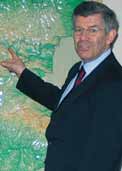
Philip Weller
Fritz Holzwarth
The integration of two new Contracting Parties to the Commission, Ukraine and Serbia and
Montenegro, was an important step for the ICPDR towards becoming the major international
organization for coordinating water management in the Danube River Basin. With thirteen mem-
ber countries the family of Danube countries is now almost completely gathered under the roof
of the ICPDR. Only Bosnia i Herzegovina has not yet become a full member.
The joining of Serbia and Montenegro is of special importance since it eliminates the "white
spot" on the map of international cooperation in the middle of the Danube River Basin. With
Ukraine, we welcome a country which is not only an important partner for addressing water
management problems in the Danube River Basin but which can also help to further develop the
links between the Danube River and the Black Sea. We look forward to working together with
our Serbian and Ukrainian colleagues in strengthening cooperation and aiming at full implemen-
tation of the objectives set forth in the Danube River Protection Convention.
When I started the ICPDR presidency, I committed myself to travel to some of the downstream
Danube countries to gain a personal insight into the concerns and problems that prevail in those
countries, and also to emphasize the important role of the ICPDR as the platform for jointly
addressing those problems and concerns. I am hopeful that these visits paved the way for key
decision-makers to better understand that the cooperation in the framework of the ICPDR is
beneficial for their respective countries; but that they also raised awareness of the fact that all
partners need to feel responsible and contribute to the common work. I admit that for me the
visits to Romania, Moldova, Bulgaria and Serbia and Montenegro were an outstanding personal
experience. I learned a lot about the countries themselves, their people, and the important role
the Danube River plays in their country.
In 2003, the major focus of the ICPDR Working Groups and the Secretariat has been the preparation
of coordinated reports as required by the EU Water Framework Directive (WFD). The ICPDR has
proved its capacity for effectively coordinating the response of the Danube countries (EU
- 4 -
Foreword
Members States, Applicant Countries and other European countries) to the WFD, which is not
an easy task taking into account the number and variety of the countries involved. What needs
to be pointed out in particular is the serious commitment and full engagement of non-accession
countries, which are not obliged to apply the WFD, and of those countries, which will join the
EU in future years. Not just by chance has the well functioning cooperation in the Danube River
Basin attracted the attention and appreciation in international and global fora.
The year 2003 also marks the starting-point of a more strategic approach by the ICPDR towards
active information and involvement of the public and participation of non-governmental organizations.
First elements of a public participation strategy - including the celebration of the international
Danube Day - were endorsed and are now being implemented; the web-site was improved and
the ICPDR magazine "Danube Watch" became much more attractive to a wider public.
Critical to these achievements and developments has been the continued support of the
UNDP/GEF Danube Regional Project. It assists the ICPDR in supporting the countries in their
efforts and activities aiming to enhance the knowledge and the understanding of the activities
needed for the improvement of the ecological status of the Danube River and Black Sea. We are
grateful for the support provided by UNDP/GEF and look forward to Phase 2 of the Danube
Regional Project, which will solidify the efforts made so far.
2003 was also a year of change for the Secretariat: in August 2003 Philip Weller took over the
responsibilities as Executive Secretary from Joachim Bendow, who retired after a successful
four-year term during which he contributed significantly to make the ICPDR and its Secretariat
a highly acknowledged and reputable organization.
Fritz Holzwarth
President of the ICPDR 2003
- 5 -
1. Operational and
Institutional Framework
In 2003 the ICPDR was strengthened through the
i Herzegovina, having a share of more than 2,000
addition of two new Contracting Parties: Ukraine
km2 in the Danube River Basin, have joined the
(13 March) and Serbia and Montenegro (19 August).
Danube River Protection Convention (DRPC).
With the addition of these new members, the
ICPDR now has 13 Contracting Parties. Therefore
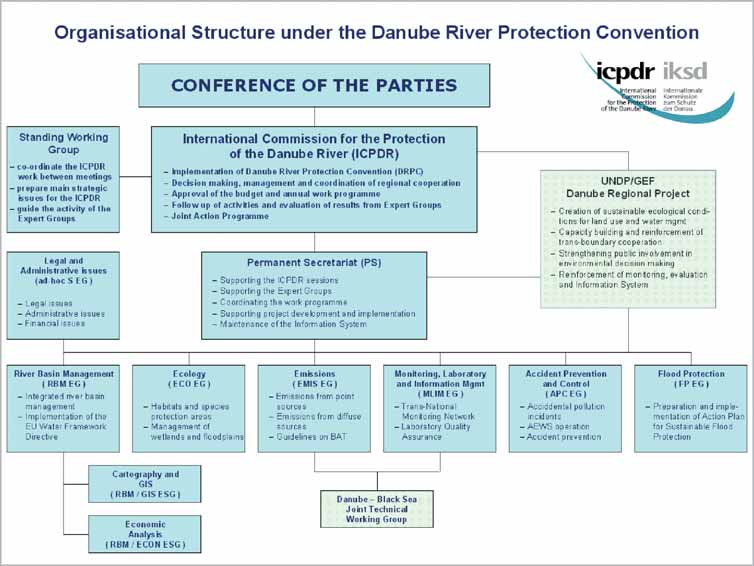
The organisational structure of the ICPDR in 2003
all Danube countries, with the exception of Bosnia
is shown below:
- 6 -
1. Operational and
Institutional Framework
Further efforts were made to ensure the active
from point and diffuse sources of emissions into
participation of all Contracting Parties in the work
the waters of the Danube and its tributaries. A
of the ICPDR and particularly in the Expert Groups.
priority issue is harmonization with the EU
The Expert Groups are essential to the operation of
directives (WFD, Nitrate Directive, IPPC Directive);
the ICPDR and rely upon the inputs and
contributions of experts from the Contracting
· Expert Group on Monitoring, Laboratory and
Parties. In 2003, six Expert Groups and two Expert
Information Management (MLIM EG) was
Sub-Groups dealt with technical issues, and one
responsible for issues concerning water quality
ad-hoc Expert Group addressed administrative and
assessment and classification including the
legal matters arising from the implementation of
operation of the Trans-National Monitoring
the DRPC. Specifically:
Network and Analytical Quality Control. In 2003,
special activities of this Expert Group related to the
· Expert Group on River Basin Management (RBM
implementation of the WFD in the Danube River
EG) defined and prepared the work necessary for
Basin;
the implementation of the EU Water Framework
Directive in the Danube River Basin, in particular
· Expert Group on Accident Prevention and
finalising the Roof Report 2003 and developing the
Control (APC EG) was responsible for the improve-
Roof Report 2004. The work of the RBM EG was
ment and operation of the Accident Emergency
supported by two Expert Sub-Groups, namely:
Warning System and the communication of
- Expert Sub-Group on Cartography and Geo-
alarm/warning messages during accidents. An
graphical Information System (GIS ESG), which
additional task of this Expert Group lies in pollution
dealt with establishing an overview map for the
prevention and precautionary control in the whole
Danube River Basin, and developing the Strategic
Danube River Basin. Special working groups under
Plan for a Danube River Basin Geographical
the APC EG deal with the preparation of inventories,
Information System;
specifically an inventory of potential accident risk
- Expert Sub-Group on Economic Analysis (ECON
spots and of old contaminated sites in potentially
ESG), which dealt with establishing economic flooded areas;
indicators to be used within the Roof Report 2004;
· Expert Group on Flood Protection (FP EG) has the
· Expert Group on Ecology (ECO EG) was establis-
responsibility to develop and implement an action
hed to support the ICPDR activities related to the
plan for sustainable flood protection in the Danube
conservation, restoration and sustainable manage-
River Basin.
ment of aquatic ecosystems and those terrestrial eco-
systems and wetlands directly dependent on them.
Specialised Working Groups dealt with the following
This Expert Group has also contributed to the imple-
issues:
mentation of the ecological provisions of the WFD;
· the UNESCO/IHP Water Balance Working Group
· Expert Group on Emission (EMIS EG) focuses its
is preparing the water balance of the Danube River
activities on the reduction of pollution resulting
for the ICPDR;
- 7 -
1. Operational and
Institutional Framework
· the Working Group on the Sava River Basin
the 5th Ordinary Meeting of the ICPDR in
Management Plan, established in 2002, was con-
November 2002 decided to provide the Secretariat
verted into the Interim Sava Commission, and now
with further technical support. Therefore, in 2003,
cooperates closely with ICPDR expert bodies;
the following external experts began working for
the ICPDR:
· the Danube-Black Sea Joint Technical Working
- Expert on Ecology dealing with the work of the
Group coordinates the work of the ICPDR and the
ECO ESG;
International Commission for the Protection of the
- Expert on Cartography and GIS dealing with the
Black Sea (BSC) aimed at nutrient reduction and
work of the GIS ESG;
pollution control to ensure recovery of the Black
- Expert on Economics dealing with the work of the
Sea ecosystem.
ECON ESG;
- Expert on Hydrology dealing with the work of the
In 2003, the Secretariat of the ICPDR underwent
FP EG and water balance.
changes with the retirement of the Executive
Secretary Joachim Bendow. This post was taken
Having recognised the necessity for active infor-
over by Philip Weller in August.
mation for the public, and to raise awareness about
the work of the ICPDR, a full-time but limited-term
As a result of the expanding scope of activities,
expert position on Public Participation and
related particularly to implementation of the WFD,
Communication was established.
Country / Organization
Status
Since
Austria
AT
Contracting Party
22-Oct-98
Bulgaria
BG
Contracting Party
02-Aug-99
Croatia
HR
Contracting Party
22-Oct-98
Czech Republic
CZ
Contracting Party
22-Oct-98
Germany
DE
Contracting Party
22-Oct-98
Hungary
HU
Contracting Party
22-Oct-98
Moldova
MD
Contracting Party
29-Aug-99
Romania
RO
Contracting Party
22-Oct-98
Serbia and Montenegro
CS
Contracting Party
19-Aug-03
Slovakia
SK
Contracting Party
22-Oct-98
Slovenia
SI
Contracting Party
22-Oct-98
Ukraine
UA
Contracting Party
13-Mar-03
European Union
EC
Contracting Party
22-Oct-98
Bosnia i Herzegovina
BA
Participant with
17-Jul-97
consultative status
- 8 -
2. Financial Contributions
and Budgetary Situation
Regular budget
Special funds
The 4th Plenary Session of the ICPDR (Vienna,
In addition to the regular budget, special funds,
Austria 29 to 30 November 2001) approved the
provided by various donors or funders, have allo-
budget for the year 2003 of 813,502.18 .
wed the ICPDR to undertake special activities in
support of the Convention beyond those possible
Recognising the financial difficulties of Moldova,
through the regular budget.
the 4th Plenary Session had decided that all
Moldova's outstanding contributions should be
All financial contributions to the ICPDR are
revoked, provided that the full contributions were
shown separately in the ICPDR account.
paid from 2002 onward. However, considering
Moldova's continuous economical problems, the 1st
Joint Danube Survey
Standing Working Group Meeting (Prien am
The financial arrangements related to the Joint
Chiemsee, Germany, 12 to 13 June 2003), has taken
Danube Survey conducted in 2002 were finalized
note of Moldova's request to reduce the contributi-
in 2003. The Austrian and German government
on key to 1%, an amount of 8,135.02 . Moldova
funding of 99,110.- and 458,262.- respective-
was unable to fulfil its full engagement, and still
ly was almost entirely used, with the exception of
has an outstanding amount of 2,135.02 .
1,881.72 , which was refunded to Germany on
2 December 2003, and the account closed.
The annual contributions actually paid by the
Contracting Parties therefore amounted to a total of
Joint Danube Survey -
778,777.25 , 34,724.93 short of the projected
Investigation of the Tisza River
figure. Consequently, expenditures were reduced by
The ICPDR-organized investigation of the Tisza
this amount.
River as a technical follow-up to the JDS was
partly financed by the European Commission
A slight revision of the budget was necessary and
(approx. 95,000 ) and partly by in-kind contri-
was effected on 20 November 2002 and approved
butions of the participating countries (approx.
by the ICPDR President. The final breakdown of
56,500 ).
regular expenditures per budget line is as follows:
Partners in the project included VITUKI Plc of
Budapest, Hungary (total contractual amount of
Budget Chapters
Amount in
54,280.- ), Hessisches Landesamt für Umwelt und
Geologie of Wiesbaden, Germany (21,720.- ) and
1. Staff
387,941.-
the Federal Hydrometeorological Institute of
2. Services
112,835.-
Belgrade, Serbia and Montenegro, formerly
3. Equipment
14,520.-
Federal Republic of Yugoslavia (14,000.- ). The
4. Other
88,450.-
account for the project had a positive balance of
5. Operational costs
175,031.-
4,654.57 at the end of 2003 which is needed to
Overall total
778,777.-
cover the final payments to the FHMI, Belgrade,
when the final invoice is submitted.
- 9 -
2. Financial Contributions
and Budgetary Situation
Analytical Quality Control - 2003
for supporting the monitoring of pollution from
In order to assure quality control among labora-
the Danube to the Black Sea. An amount of
tories, the ICPDR has been receiving voluntary
32,771.40 was transferred into the ICPDR
contributions from Contracting Parties since
account and later used to cover the cost of
2001. Voluntary contributions were offered by
purchasing and installing the instrument in
Hungary (11,000.- ), Slovakia (2,000.- ),
Constant,a. The handover took place on 24 July
Romania (2,300.- ), Germany (4,500.- ) and
2003, after which payment was made and the
Austria (2,200.- ) for 2003 costs. While the
account closed.
Hungarian, Slovak and Romanian contributions
were directly transferred to VITUKI Plc, the
ICPDR Information System -
German and Austrian contributions were paid
re-design of public website
through the ICPDR Secretariat.
The website of the ICPDR has become an increa-
singly important source of information for the
The final report was approved by the MLIM EG
general public on Danube River Basin issues and
and the final invoice paid on 18 December 2003.
on the activities of the ICPDR. In order to meet
Thus the account was closed.
this increasing demand for information by the
public, the public website of the ICPDR needs to
Danube - Black Sea Task Force
be revised and reorganized. The German govern-
(DABLAS Task Force)
ment has financed this activity (which will be
The DG Environment of the European
completed in 2004) with a grant of 15,000.- .
Commission asked the ICPDR Secretariat in 2002
to update the database on municipal investments
Danube Day 2004
for wastewater treatment in the Danube River
In order to celebrate the first Danube Day event on
Basin and to create a list of projects - with parti-
29 June 2004, joint effort is being made by all
cular attention to nutrient reduction - that could
Danube countries. Beyond its basic coordination
attract financing, especially from international
role, the ICPDR also contributes financially to the
finance institutions (IFIs). Financial support for
event. Based on the decision of the ICPDR
these activities was also provided by the European
President, the amount of 10,000.- out of the
Commission to the amount of 57,435.60 , out of
regular budget 2003 was reserved for this purpose.
which 54,096.- was awarded to consultants in
the Danube River Basin. After approval of the
Ministerial Meeting 2004
final report the account was closed.
Ten years after the signing of the Danube River
Protection Convention in Sofia, the ICPDR will
ALCOA Foundation
for the first time convene an Ordinary Meeting at
In 2003 the ICPDR began a new type of partners-
Ministerial level. This Ministerial Meeting will
hip with the private sector - the Alcoa
take place in Vienna on 13 December 2004. To
Foundation. The foundation donated a Total
cover the organisational costs of this event, an
Organic Carbon/Total Nitrogen Analyser for the
amount of 10,000.- was reserved in the ICPDR
Marine Research Institute in Constant,a, Romania,
regular budget 2003.
- 10 -
2. Financial Contributions
and Budgetary Situation
· Financial Situation
Regular Budget 20031
Contributions2
Contracting Parties
Contribution Keys in %
Contributions in
Planned
Actual
Germany
13.91
113,175.45
113,175.45
Austria
13.91
113,175.45
113,175.45
Czech Republic
10.94
88,976.71
88,976.71
Slovakia
8.95
72,844.46
72,844.46
Hungary
10.94
88,976.71
88,927.00
Slovenia
10.94
88,976.71
88,976.71
Croatia
8.95
72,844.46
72,844.46
Bulgaria
5.00
40,675.11
40,675.00
Romania
8.95
72,844.46
72,844.46
Moldova
5.00
40,675.11
6,000.00
European Union
2.50
20,337.55
20,337.55
Total Contributions
100.00
813,502.18
778,777.25
Expenditures2
Approved Expenditures
Engagements
Totalcharges
Status as of
budget
31-Dec-2003
A. Administrative costs
in
1. Staff
432,000.00
387,941.36
0.00
387,941.36
44,058.64
2. Services
166,000.00
91,347.02
21,488.45
112,835.47
53,164.53
3. Equipment
35,000.00
6,585.54
7,934.23
14,519.77
20,480.23
4. Other
80,000.00
85,517.16
2,932.44
88,449.60
-8,449.60
Sub-total A
713,000.00
571,391.08
32,355.12
603,746.20
109,253.80
B. Operational costs
100,502.18
153,191.05
21,840.00
175,031.05
-74,528.87
Overall total ( A + B )
813,502.18
724,582.13
54,195.11
778,777.25
34,724.93
1Serbia and Montenegro and Ukraine joined the DRPC during 2003
2Minor differences are due to rounding
- 11 -
3. Progress in the implementation of
the EU Water Framework Directive
in the Danube River Basin
Focus of work in 2003
· all lakes, reservoirs and lagoons with a surface
The countries cooperating under the Danube River
area of at least 100 km2
Protection Convention have agreed to use the
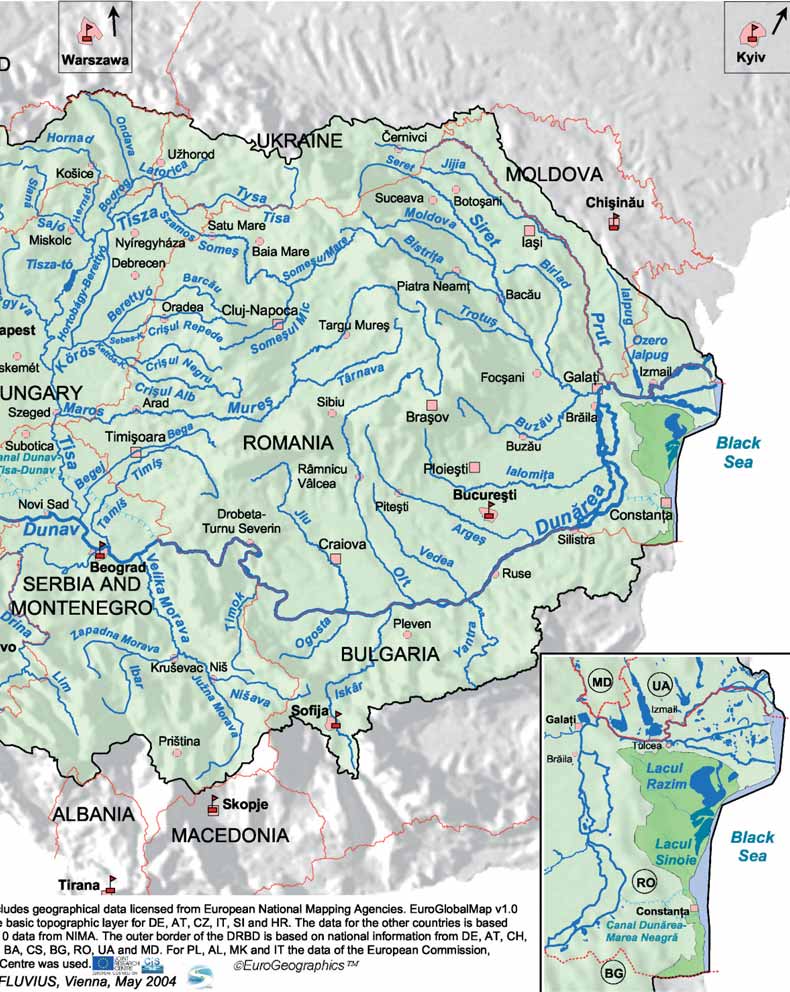
· the main canals (see Figure 3.1: Danube River
ICPDR as the coordinating platform for the imple-
Basin District overview map)
mentation of the EU Water Framework Directive
(WFD) in the Danube River Basin. The River Basin
Preparation of WFD Roof Report 2004
Management Expert Group (RBM EG) was created
The reporting obligation under Art. 5 WFD covers
to prepare the necessary activities. The work of the
the characterisation and analysis of the river basin
RBM EG focussed on the following issues in 2003:
district. It is necessary to define the typology and
1) WFD Roof Report 2003 (Art. 3.8 and Annex I);
the reference conditions of surface waters, to review
2) preparation of the WFD Roof Report 2004 (Art. 5
the environmental impacts of human activity on
and Annexes II, III);
surface water and groundwater, and to carry out an
3) public participation in the frame of WFD.
economic analysis of the water uses. The Report
2004 will also consist of two parts, the Roof Report
WFD Roof Report 2003
(Part A) and the national reports (Part B). The RBM
According to Art. 3.8, WFD "Member States shall
EG has developed an outline for the Roof report
provide the Commission with a list of their compe-
2004 defining what information should be given at
tent authorities and of the competent authorities of
the roof level. In cooperation with other expert
all the international bodies in which they participate"
groups of the ICPDR, the different parts of the
at the latest by 22 June, 2004. The requested infor-
analysis have been prepared. These issues, being
mation includes the delineation of the river basin
highly interrelated, necessitated close cooperation
district and the description of the international rela-
between the different groups, which was greatly
tionships established for WFD implementation. The
facilitated through the support provided by the
report will consist of two parts: 1) the Roof Report
UNDP/GEF Danube Regional Project.
dealing with all issues of basin-wide importance (Part
The following results were achieved in 2003:
A); and 2) the national reports dealing with all natio-
nal issues and those that have been coordinated bila-
Characterisation and analysis
terally (Part B). The Roof Report was compiled by the
of surface waters
ICPDR in cooperation with the members of the RBM
· Typology and reference conditions
EG and approved in its final draft by the ICPDR
Since the Danube flows through or borders on the
Contracting Parties and Bosnia i Herzegovina in
national territory of 10 countries, it was necessary
December 2003. It describes the particular situation
to develop a typology for the Danube River in an
in the Danube River Basin, lists the competent aut-
overall approach. The Danube typology was develo-
horities for WFD implementation, and describes the
ped using the abiotic parameters of System B, and
cooperation mechanisms at the basin-wide level. It
was then validated with biological data that had
also defines the boundaries of the Danube River
been collected during the Joint Danube Survey in
Basin District and identifies the surface waters that
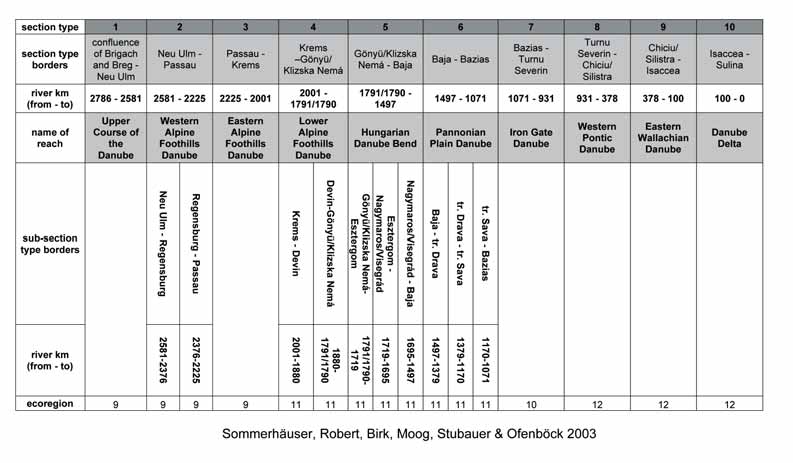
2001 (see Figure 3.2: Typology of the Danube
are of basin-wide importance, including:
River). The development of the Danube typology
· all rivers with catchments larger than 4000 km2
was carried out in cooperation with the MLIM EG
- 12 -

3. Progress in the implementation
of the EU Water Framework
Directive in the Danube River Basin
and with the support of the UNDP/GEF Danube
the Danube originate from hydropower generation,
Regional Project. The typology was discussed and
from hydraulic works and from navigation.
agreed with all countries concerned.
Other anthropogenic pressures that will be addres-
In addition, the Danube River Basin countries are
sed in the Roof Report include pressures resulting
developing the typologies for the surface waters on
from accident pollution, from navigation and from
their national territories. At the 2nd Surface Water
invasive species.
Workshop in September 2003 the Danube River
Basin countries presented the current status of their
· Intercalibration
national typologies, which gave an excellent over-
According to Annex V of the WFD, the comparabi-
view of the tremendous progress made.
lity of the biological monitoring results must be
ensured. For this purpose an intercalibration exerci-
· Pressure analysis
se will be carried out in 2005/2006 which will be
The WFD stipulates the identification of the signifi-
used to revise and establish by 2006 the appropria-
cant pressures in the river basin district. The te monitoring systems. In order to intercalibrate the
emission inventories of the ICPDR are the basis for
results in a meaningful way, geographical intercali-
the pressure analysis of point sources. These have
bration groups have been created. The Danube River
been finalised with the data for 2002 for municipal,
Basin will fall almost completely into the Eastern
industrial and agricultural sources. In addition, EMIS
Continental Intercalibration Group. Germany and
EG has established criteria to define what significant
almost all of Austria, however, will be part of the
pressure means on the basin-wide level for munici-
Central Group. For the Eastern Continental Group,
pal, industrial and agricultural point sources. These
common intercalibration types have been defined
criteria will be applied to the emission inventories in
and reported to the European Joint Research Centre,
the year 2004 in preparation of the Roof Report.
which is organising the intercalibration process and
hosting the draft register of intercalibration sites. EU
A description of the pressures from diffuse sources
Member States and accession countries entered
will be based on the nutrient model MONERIS,
their intercalibration sites into the intercalibration
which was completed for the Danube River Basin in
register. The draft register was approved by the
2003. In addition, the results of the EU-funded
WFD Committee in Brussels in November 2003.
daNUbs Project will be an important source of
Further amendments will be possible in 2004 befo-
information for the Roof Report.
re its final approval in December 2004.
For the analysis of significant hydromorphological
Characterisation and analysis
alterations a study was carried out to identify major
of groundwater
impacts resulting from significant water abstrac-
The WFD stipulates an initial characterisation of all
tion, significant water flow regulation and from sig-
groundwater bodies, which includes their identifica-
nificant morphological alterations (with the support
tion and an analysis of the pressures, to which these
of UNDP/GEF Danube Regional Project). From this
bodies are liable to be subject. The Roof Report will
analysis it became clear that the main pressures on
deal with those groundwater bodies of basin-wide
- 13 -
3. Progress in the implementation
of the EU Water Framework
Directive in the Danube River Basin
importance. These are the transboundary ground-
analysis. Two workshops have taken place which
water bodies that are larger than 4000 km2, or some
have provided crucial input into the work of the
smaller transboundary ones that are of great impor-
Econ ESG:
tance. The importance of the groundwater body
· 1st Economics Workshop: 3-4 February 2003 in
needs to be bilaterally agreed according to defined
Vienna
criteria. At the 2nd Groundwater Workshop in May
· 2nd Economics Workshop: 10-11 July 2003 in
2003 countries reported on the identification of
Budapest
groundwater bodies in their countries, on the
A major milestone in the work undertaken by the
pressure analysis and on existing monitoring Econ ESG was developing a list of indicators, which
programmes. In addition, the contents of the Roof
will be the basis for the chapter on economic
Report were defined.
analysis in the Roof Report. The Roof Report will
give information on the assessment of the economic
Protected areas for
importance of water uses and on projecting trends
species and habitat protection
in key economic indicators and drivers up to the
The ECO EG contributed to the development of an
year 2015. The description of the current levels of
inventory of protected areas for species and habitat
cost recovery of water services will be dealt with in
protection. Since the WFD requires de facto an
the national reports (Parts B), since this is country-
inventory of water related Natura 2000 sites, the
and region-specific and cannot be meaningfully
final selection of areas cannot take place before the
compared on the basin-wide level.
European Natura 2000 network is completed.
Therefore as a first step countries were asked to
Public participation in the
identify/list protected areas of international impor-
Danube River Basin
tance, i.e. the national parks, biosphere reserves,
Public involvement is not only a core element of the
Ramsar sites and other important "water-related"
WFD, but is the "modus operandi" of the ICPDR.
national protected areas. The draft inventory However, due to the growing political importance of
contains 237 sites nominated by the countries. A
public participation - especially for implementati-
core data set has been established with connections
on of the WFD - a Public Participation Expert
to Natura 2000/Emerald and Ramsar inventories.
Group has been formed under the RBM EG to stra-
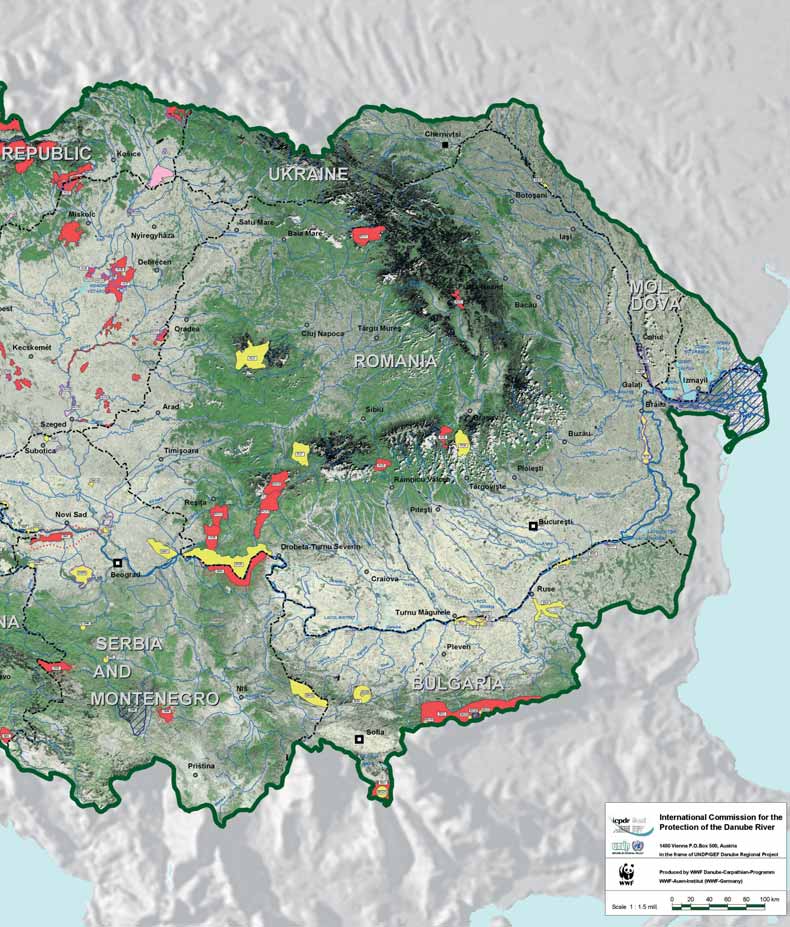
The database and an overview map on a scale of
tegically plan community involvement in the
1:1.5 million are available in a draft version (see
ICPDR. As a result, the "Danube River Basin
Figure 3.3: Map of protected areas for species and
Strategy for Public Participation in River Basin
habitat protection).
Management Planning 2003-2009" was defined
and adopted by the ICPDR in June 2003. Based on
Economic analysis of water uses
this Strategy, an Operational Plan has been develo-
The ECON ESG is coordinating the implementation
ped, which outlines the activities, including a time-
of the economic elements of the WFD. With the help
table and a workplan (covering a 12-18 months
of the UNDP/GEF Danube Regional Project, natio-
period, until the end of 2004) at the Danube Basin
nal scoping studies were carried out on the availa-
level. Further details on these two documents can be
bility of economic data for conducting economic
found in Chapter 11 (Public Participation).
- 14 -
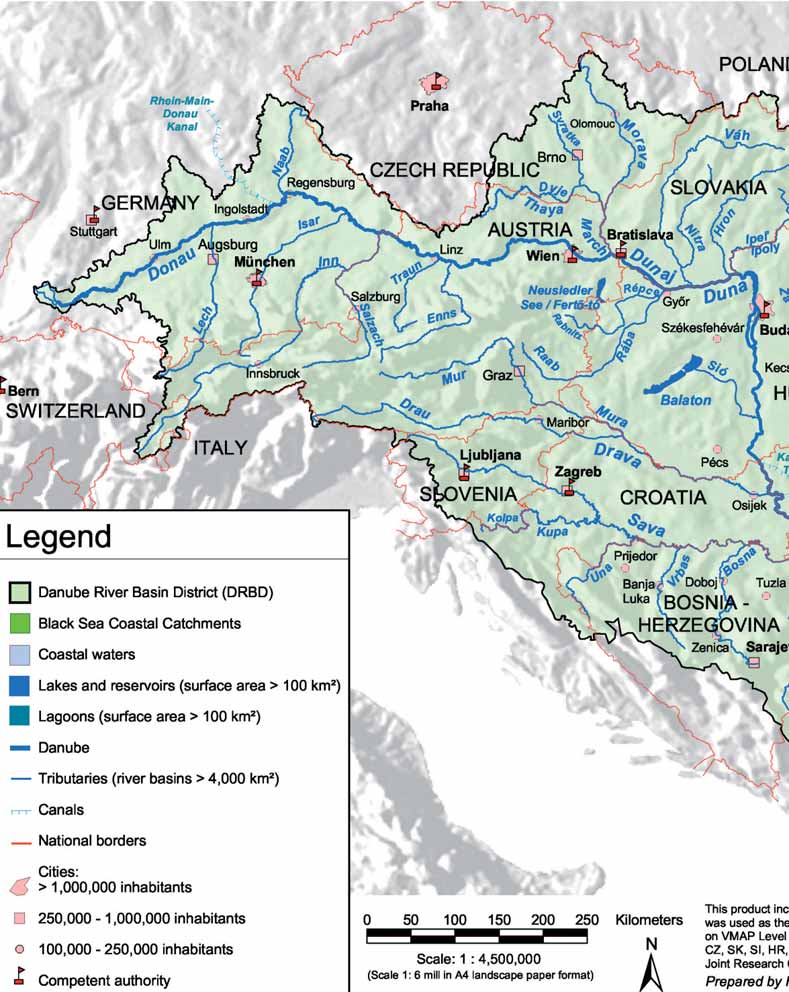
Figure 3.1 Danube River Basin District Overview Map
- 15 -
3. Progress in the implementation
of the EU Water Framework
Directive in the Danube River Basin
Figure 3.2 Typology of the Danube River
- 16 -
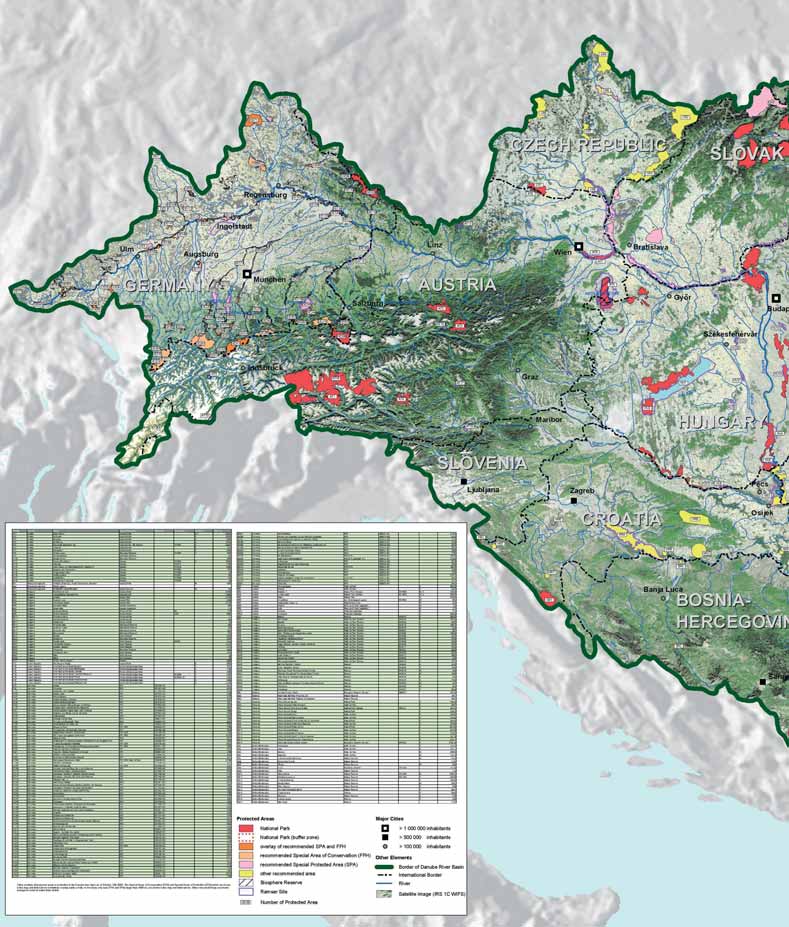
Figure 3.3 Relevant Protected Areas for the Future Inventory of Areas Designated for the
Protection of habitats or Species for WFD Purposes within the DRB, October 2003
- 17 -
4. Water Quality and Hydrological
Situation in the Danube River Basin
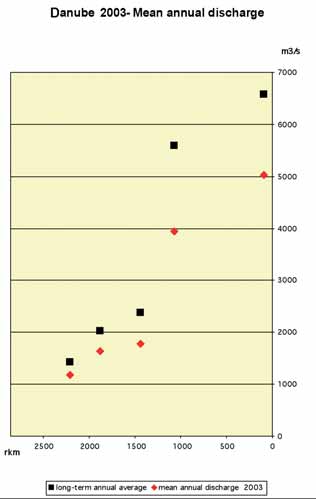
The long-term daily mean flow of the Danube
precipitation deficit in 2003 was reported by
River is about 6500 m3s-1, which represents an
the Danube countries. In Germany a long-term
average annual discharge of 207 km3. The
drought between February and September was
discharge in 2003 was 158.5 km3 (76.6 % of the
caused by the accumulation and stability of
average annual discharge).
anticyclone weather conditions (" exposure"
of the atmospheric circulation over Central
Europe). Hence the air temperature and sunshi-
ne duration exceeded the annual mean values
and in total ten months of the year were drier
than average. Many gauging stations in
Germany recorded the hottest summer for the
entire observation period. In the other upstream
countries low precipitation and excessive tem-
peratures were reported in 2003 as well. The
overall water deficit in the upper Danube was
partly compensated by increased glacial water
due to excessive melting in the alpine regions.
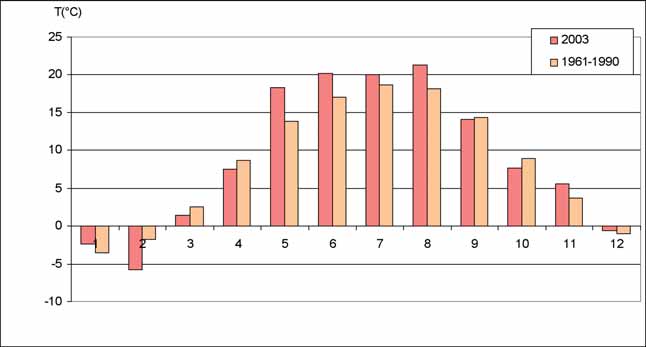
In the lower part of the Danube River Basin the
weather was also warmer compared to the
average climatic pattern, as can be seen from
the example showing monthly average tempe-
ratures in Romania (Fig.4.2, see page 19).
This influenced the temperature of surface
waters. In the summer period, the monthly
average water temperature of the Danube at
Bezdan in Serbia and Montenegro exceeded the
maximum-recorded values. The elevated air
temperatures were accompanied by a precipita-
tion deficit in the downstream countries as well.
In Hungary the dry season caused significant
decrease of water levels in the two biggest
Figure 4.1 The Danube - Mean annual
discharges in 2003
natural lakes - Lake Balaton and Lake Velence.
Decreased precipitation was recorded also in
Serbia and Montenegro and Romania.
Hydrological situation
The values of the total precipitation in 2003, as
In contrast to the previous year a remarkable
well as the relative precipitation in the same
- 18 -
4. Water Quality and Hydrological
Situation in the Danube River Basin
year when compared to a long-term annual
average in selected countries, are shown in the
following table:
Country
Total annual precipitation
Relative annual precipitation
in 2003 [mm]
in 2003 [%]
Germany
714
71
Austria
760
74
Czech Republic
547
76.5
Slovakia
573
75
Hungary
570
95
Slovenia
1024
73
Serbia and Montenegro
587
88
Romania
522
80.7
Figure 4.2 Average monthly air temperature variation in Romania in 2003 compared to the
long-term average pattern (1961-1990)
- 19 -
4. Water Quality and Hydrological
Situation in the Danube River Basin
Pollution due to accidents
focus of the authorities' efforts. In Germany,
actions were set to obtain bathing water quality
In 2003, only minor accidents in the Danube
in the Isar River (Danube tributary). Therefore,
mainstream were reported, with no significant
in 2003, six wastewater treatment plants were
impacts on the Danube River water quality.
improved with UV-disinfection. A similar
Most of these accidents were caused by oil
upgrade is planned for the other eight plants in
pollution mainly originating from navigation.
2005.
In Germany the effects of the infiltration of
The development of the sewerage systems and
hexachlorobutadiene (HCBD) into the river Inn
wastewater treatment in municipalities has a
which occurred in 2001 have further diminished.
high priority in Hungary. Under the National
The rehabilitation activities, however, still con-
Municipal Sewerage and Wastewater Treatment
tinue.
Programme, altogether 113 projects were sup-
ported in different municipalities and the total
In Serbia and Montenegro increased Atrazine
value of implemented investments was about
concentrations were detected in the Sava River
227 million in 2003.
in January 2003 and increased concentration of
ammonium ions together with a poor oxygen
The Hungarian capital Budapest with its 1.7
regime were detected on the river Tisza in July
million inhabitants produces the highest pollu-
2003.
tion load along the whole Hungarian stretch of
the Danube because insufficiently treated
Accidents which triggered the Danube Accident
wastewaters are being discharged into the river.
Emergency Warning System (AEWS) are repor-
An important step forward was made in 2003,
ted in the Chapter 6.
when the Hungarian government decided to
build the central WWTP in Budapest. This com-
Improvements in wastewater treatment
plex project includes building of the main
collecting sewer on the Buda side, which will
In the upper Danube countries, intensified
transport wastewaters under the Danube River
efforts have been continued to achieve nutrient
to the new treatment plant on the other side of
reduction in wastewater treatment plants
the river. The estimated costs of this project are
(WWTPs). In the Czech Republic the reconstruction
approx. 416 million . Completion of the WWTP
of three WWTPs (Tebic¬, Uherské Hradis¬te and
is expected in 2008.
Vsetín) was finished in 2003 and, at present,
these plants are in a test operation. Three other
Also, in the lower Danube River Basin, attention
WWTPs that had been reconstructed earlier
is being given to the upgrade of WWTPs. In
(Vys¬kov, Hodonin and Hranice na Morave¬) are
Bulgaria the wastewater treatment plants in
already in full operation.
Sofia and in three other cities are under recon-
struction. In Romania 13 WWTPs were moder-
However, nutrient reduction is not the only
nized in 2003.
- 20 -
4. Water Quality and Hydrological
Situation in the Danube River Basin
Water quality trends
countries. Due to the hydrological
deficit, temporary water quality problems were
In Germany the warm weather conditions in
caused on some small watercourses in Hungary as
2003 resulted in higher water temperature and
a result of overloading by the effluents from muni-
slight decline in dissolved oxygen concentrati-
cipal sewage treatment plants. Analogous problems
ons. Due to considerable deficit of surface and
were recorded in the channel network and small
drainage water, the pressures resulting from
streams in Serbia and Montenegro, where an
diffuse emissions (nutrients and pesticides)
increased number of polluting events leading to the
decreased to a minimum. This resulted in redu-
oxygen deficit was detected as a consequence of
ced concentrations of nutrients, degradable
elevated temperatures and droughts.
organic substances and pesticides in Bavarian
rivers. Hence the nutrient loads reported in the
In general, compared to the previous year, no
German part of the Danube River Basin in 2003
significant changes in the water quality of the
were the lowest since the start of the water
Danube mainstream were observed in Austria,
quality monitoring. On the other hand, the
Slovakia, Hungary, Croatia, Serbia and
point pressures became more important, especi-
Montenegro and Bulgaria. A slight improve-
ally in small catchments with low flow regimes.
ment in water quality was detected in Romania,
most probably the result of an improving effi-
A similar phenomenon of attenuated point-source
ciency of enforcement of environmental legis-
pressures was also observed in the other Danube
lation.
- 21 -
5. Pollution Control Strategy
in line with WFD Requirements
An essential task for the ICPDR is the evaluation
year 2002, was made publicly accessible in 2003.
and assessment of pollution sources to the Danube
The EMIS Inventory has expanded in scope to
River and its tributaries. In 2003 an update of the
collect data from all settlements having more than
Emission Inventory (EMIS Inventory) in the
10,000 inhabitants, and provided information on
Danube River Basin was undertaken (based on
industrial pollution-prevention activities as well as
2002 data) and is providing important information
agricultural discharges. The recent trends in pre-
for the implementation of Danube River Protection
ventive environmental management and water
Convention, as well as providing a basis for
pollution required adjustments in the information
pollution control strategies under the Water
in the inventory and in particular consideration of
Framework Directive (WFD).
the implementation results of the IPPC Directive,
the use of best available techniques (BAT), intro-
The 2002 EMIS Inventory provides policy makers
duction of Cleaner Production and Environmental
and the public with an understanding of the key
Management Standards, and incorporation of the
polluting sources, or "pressures". Information is
ICPDR preliminary list of priority substances.
available on how these sources have changed with
economic growth and how they are likely to con-
This updated information in the 2002 EMIS inven-
tribute to pollution in the future. This understan-
tory will assist the ICPDR and the countries when
ding is essential for a focused "response" to the
complying with Article 5 of the WFD, which requi-
problems associated with water pollution and in
res, for each river basin district, information to be
meeting the demands of achieving sustainable
listed and assessed on the type and scale of signi-
development.
ficant anthropogenic pressures, including point and
diffuse sources of pollution.
The 2002 Emission Inventories
(EMIS Inventory)
Preliminary analysis of the municipal and indu-
To upgrade the EMIS Inventory a standard metho-
strial emission inventory 2002 has revealed a
dology was developed which incorporated impor-
significant decrease in pollutant emissions. The
tant additional information to the previous inven-
reasons for this are the decrease in production at
tory in 2000. Owners or operators of point sources
key facilities polluting the environment, increased
are required by environmental authorities to main-
investments both from governmental and private
tain records and report on emissions (discharges)
resources to the water sector, and an increase in
into national waters. These data, in addition to the
pollution charge rates, which have reached a
information provided by national authorities in the
level that motivates polluting sources to decrease
emission inventories templates, are the basis for the
emissions.
point source discharge summaries for countries of
the Danube River Basin.
Further refinements in the inventory are planned
for future years in order to harmonize reporting in
This updated basin-wide EMIS Inventory of pol-
line with the newly established EU pollution regi-
lutants released into the water from municipal,
stry "European Pollution Emission Register"
industrial and agricultural dischargers, for reference
(EPER http://www.eper.cec.eu.int).
- 22 -
5. Pollution Control Strategy
in line with WFD Requirements
Controlling agricultural pollution
Danube River Basins. The model uses data on river
It is considered that the ongoing enlargement of
flow and water quality as well as digital maps.
the EU across the Danube River Basin will initiate
MONERIS estimates the different pathways of
a new period of more intensive farming, especially
pollutants using existing and new approaches
in the more fertile areas of the region, which in
developed especially for modelling in the medium
turn will increase agricultural pollution. This calls
and large spatial scale. Seven pathways are consi-
for the development of a long-term strategy to
dered: point sources; atmospheric deposition;
address the problems of pollution, and especially
erosion; surface runoff; groundwater; tile drainage;
diffuse pollution from agriculture. Diffuse pollutants
urban surface water runoff.
include nutrients from the over-application of
fertilizers, from soil erosion, and from pesticide use.
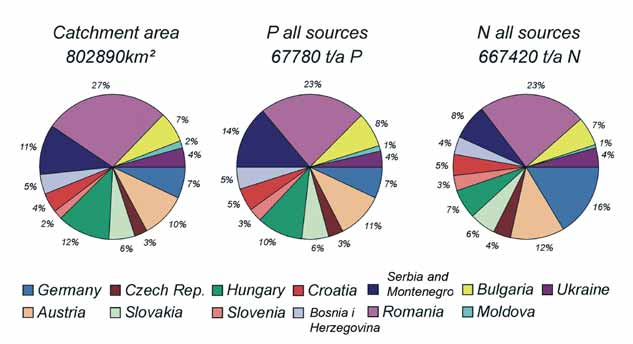
Proportional distribution by country, in the total
catchment area of the Danube, as well as phos-
A summary of measures to control diffuse water
phorus and nitrogen discharges by point and
pollution from agriculture has been concluded for
diffuse pathways, are presented in Fig. 5.1 (see
the Danube countries by the UNDP/GEF Danube
page 24).
Regional project. The assessment of diffuse water
pollution from agriculture was based on the avai-
For phosphorus (P) a total emission by point and
lable evidence from previous projects, studies and
diffuse sources of 67780 t/a P was estimated for
demonstration projects, and includes cost-effective
the period 1998-2000. A total of 35 % of the P-
and proportionate policy measures aiming to redu-
emissions originated as discharges from munici-
ce the agricultural pollution to levels that meet
pal waste water treatment plants and industrial
existing commitments and encourage sustainable
waste water; 37 % of the total P-emissions were
farm practices in the Danube River Basin.
caused by erosion and 13 % by discharges from
urban areas and households not connected to
Work will continue within the ICPDR on using
wastewater treatment plants (WWTP`s) and
these. A better understanding of agricultural pol-
sewer systems. P-emissions into the surface
lution is provided through the first agro-industrial
water by groundwater and natural interflow as
point sources inventory contained in the 2002
well as surface runoff contributed 7 % and 6 %
EMIS Inventory.
respectively to the total P-emissions. Other sour-
ces are of minor importance for the P-emissions
Use of MONERIS in addressing diffuse
into the river system of the Danube. The propor-
sources of pollution
tion of the different pathways to the total P-
Of great benefit for future work by the ICPDR, the
emissions varies widely between the sub-
Leibniz Institute of Freshwater Ecology and Inland
catchments of the Danube. Point source P-
Fisheries in Berlin/Germany compiled a harmoni-
discharges of more than 50 % were estimated for
zed inventory for point and diffuse sources of
Pannonian Danube, Banat-Eastern Serbia, Velika
pollution using the model MONERIS (MOdelling
Morava, Iskar and Arges. These are mainly
Nutrient Emissions in RIver Systems) to estimate
catchments in which the large cities of Budapest,
the nutrient emissions into surface water of
Belgrade, Sofia and Bucharest are located.
- 23 -
5. Pollution Control Strategy
in line with WFD Requirements
MONERIS allows the estimation of nutrient emissi-
· to improve knowledge on the sources, pathways,
ons to the surface water on a very large geographi-
stocks, losses and sinks of nutrients in the Danube;
cal scale and provides quantification of nutrient
· to develop, improve and combine management
emissions to the surface water at the catchment
tools for nutrients in the Danube Basins;
level (rather than administrative units), in order to
· to develop scenarios and prognoses for nutrient
optimally support the river basin approach.
management and its effect on water quality and
their consequences on the socio-economic deve-
Intermediate results of nutrient manage-
lopment in the Danube countries.
ment in the Danube Basin and its impact
on the Black Sea Project (daNUbs)
Initial results confirm that the loads of nitrogen,
Another useful contribution to the understanding of
phosphorus and silica transported by the Danube
the water quality situation in the Danube has been
to the Black Sea have been significantly reduced
the work conducted under the daNUbs Project,
since the 1980s. It has also been estimated that
which presented important results in 2003. The
nutrient levels are low in comparison to other river
general objectives of the daNUbs Project include:
basins.
Fig 5.1. Proportion of the countries in the total catchment area of the Danube and the P and N
discharges by point and diffuse pathways.
- 24 -
6. Operation of the Danube Accident
Emergency Warning System
In 2003 the Accident Emergency Warning System
satellite-based communication was replaced by
(AEWS) was activated by four accidents. An
web-based communication via Internet and SMS
overview of accidents in the Danube River Basin
messages to become an integral part of the ICPDR
in 2003 is given below.
information system (DANUBIS). A series of tests
of the web-based system was performed in sum-
Upgrade of AEWS
mer/autumn 2003 in all Danube countries to
A substantial upgrade of AEWS was carried out in
debug the software, to check the technical setup
2003 with the support of the UNDP/GEF Danube
of national GSM operators and to train the staff of
Regional Project to make the whole warning
Principle International Alert Centres. An official
system more effective and cost-efficient. The
launch of the new system is expected in 2004.
Site of accident
Affected river
Primary pollutant
International
Transboundary
Date
satellite messages
impact
Croatia
Sava
Atrazine
PIAC-13 PIAC-07: CR:
Yes
(Serbia and Montenegro)
(from rkm 200)
"Request for Information"
28.02.2003
Slovakia
Hron
Ammonium
PIAC-04 PIAC-05 SK: No
(Banska Bystrica-
(from rkm 181 to rkm 165)
"End of Alert"
Salkova)
18.07.2003
Ukraine
Latorica
Mineral oil
PIAC-05 PIAC-04 and 11:
UA: No
(Slovakia)
(from rkm 180)
"Request for Information"
17.09.2003
Failure of the oil-pipeline
PIAC-04 PIAC-11:
Druzba in the Latorica
"Request for Information"
catchment
PIAC-04 PIAC-05
(tributary of River Bodrog)
"Warning - Pollution"
Ukraine
Uh
Mineral oil
PIAC-04 PIAC-05 UA: Yes
(Slovakia)
(from rkm 16.6)
"Warning - Pollution"
SK: No
24.12.2003
(tributary of River Laborec)
PIAC-04 PIAC-11:
"Request for Information"
PIAC-04 PIAC-05
"End of Alert"
Note: The indicated "Yes" notice in the column "Transboundary impact" means that accidental water pollution entered into the
downstream country.
- 25 -
7. Flood Protection in the Danube River Basin
Disastrous floods occurred in August 2002 in the
members discussed the content of the basin-wide
Danube and Elbe river basins and accelerated the
Action Programme. The developed Table of
efforts of the ICPDR in the field of flood control.
Contents of the Action Programme, as well as a
At the 5th ICPDR Ordinary Meeting in 2002 the
detailed time plan, including required actions and
Contracting Parties decided to establish an Expert
milestones, was then agreed by the ICPDR. In
Group on Flood Protection (FP EG). The new
autumn 2003 flood experts organized the prepa-
expert body was charged with the task of elabo-
ration of this important policy document which
rating an Action Programme for Sustainable
will outline the actions necessary to safeguard
Flood Protection in the Danube River Basin until
sustainable flood protection in the Danube River
October 2004. The national flood experts started
Basin. It is foreseen that the Action Programme
their joint activities in early 2003. The FP EG had
will be presented at the ICPDR Ministerial
two meetings in 2003, at which the Expert Group
Conference in 2004.
Table of contents of the Action Programme
for Sustainable Flood Protection in the Danube River Basin
(as agreed at the 6th ICPDR Ordinary Meeting, 1-2 December 2003)
1) Introduction
2) Floods and flood defence in the Danube River Basin
3) Basic principles and approaches
4) Targets of the Action Programme (basin-wide targets)
i) Improvement of flood forecasting and warning
ii) Harmonization of design criteria and safety regulations of the structures
at border sections
iii) Creating forums for exchange of expert knowledge
iv) Recommendations on the structure and the content of the AP at sub-basin level
v) Increased awareness of flooding on basin-wide scale
5) Measures
6) Economic and organisational conditions of implementation
- 26 -
8. Implementation of the
Joint Action Programme (JAP)
The Joint Action Programme (JAP) 2001-2005
River Basin addressing nutrient reduction goals
identifies the need to reduce the pollution loads
was prepared within the framework of the EU
originating from municipal, industrial and agri-
DABLAS project (Danube - Black Sea Project).
cultural sectors as immediate priority. Since 2001
This project was financially supported by the
the Contracting Parties have undertaken activities
European Commission - DG Environment. A total
to address the priorities under the water manage-
of 158 investment projects for municipal waste-
ment strategy of the ICPDR. In 2003 work conti-
water treatment for 11 Danube River Basin coun-
nued in all Danube countries. A mid-term report
tries (not including Germany and Austria) were
on the JAP will be available in 2004.
identified, of which 45 are fully funded to the
amount of 622 . The total investment required
The specific efforts related to improving waste-
for the remaining 113 projects is 2,567 .
water infrastructure in urban and rural areas
through developing water resources and provi-
The current DABLAS database for investment
ding services for human and industrial water
projects in the Danube River Basin countries is
supply have been of significance. An updated list
accessible in DANUBIS.
of municipal investment projects in the Danube
- 27 -
9. Accident Prevention
in the Danube River Basin
Inventory of accident risk spots in the
The second step of the risk assessment will follow
Danube River Basin
in 2004 - evaluation of flood risk at the sites
The accidental spills in the Tisza River Basin in
which passed through the M1 methodology. The
2000 proved that inadequate prevention measures
appropriate methodology for flood risk assess-
at Accident Risk Spots (ARS) could lead to harmful
ment (M2 methodology) is under development.
effects on humans as well as the environment. That
After the finalization of the M2 methodology a
is why the Accident Prevention and Control Expert
list of sites posing a high risk of contamination
Group (APC EG) elaborated a basin-wide inventory
of water bodies during floods will be available.
of potential accident risk spots in 2001. For esti-
mation of a real risk at a particular site a set of
Safety requirements for contaminated
checklists was elaborated and made available to the
sites in flood-risk areas
Danube countries. In 2003 the existing ARS
Contaminated sites in flood-risk areas represent
Inventory was supplemented by data from Austria
a danger to the environment. A preliminary
and Bosnia i Herzegovina. To advance with the risk
survey of contaminated sites in the Danube
estimation a pilot project on demonstration of ARS
catchment area has revealed the relevance of
checklists application is expected to start in 2004.
this problem for the Danube River Basin and
has emphasized the need for further action. For
Inventory of contaminated sites in
this reason the APC EG initiated the develop-
flood-risk areas
ment of safety requirements for contaminated
The floods in August 2002 identified that, despite
sites located in flood-risk areas in order to
implementation of precautionary measures against
improve the safety level of those sites.
accidental spill at a particular landfill or any other
chemical storage facility, the inundation of this site
At its 6th Ordinary Meeting in December 2003,
during floods can lead to contaminated releases.
the ICPDR approved the Safety Requirements
The response of the ICPDR to this problem was to
for Contaminated Sites in Flood-risk Areas and
elaborate an inventory of contaminated sites in
recommended their application at national
flood-risk areas in the Danube River Basin. The
level. In principle, the Safety Requirements are
preparatory activities for this inventory started in
considered as a living document that will be
2002 and work was completed in 2003. For an
further developed based on future experience
initial risk assessment of all "candidate" sites iden-
gained by the Danube countries in this sector.
tified, the M1 methodology was developed. This
methodology is based on assessment of toxic
In addition to the adoption of the safety requi-
potentials of soil or waste, taking into considerati-
rements, and taking into account the relevance
on harmful substances to be expected in a certain
of a general precautionary principle, the ICPDR
type of waste or in a specific industrial branch. In
also encouraged the Danube countries to esta-
addition, the size of the contaminated area is taken
blish the policy framework and take the neces-
into account. When applying the M1 methodology
sary measures to prevent any future contami-
a draft ranking list of contaminated sites was pre-
nation of sites in flood-risk areas.
pared based on the results of national inventories.
- 28 -
10. Information management
Information management (collection and presen-
The plan, prepared by the Cartography and GIS
tation of information about the Danube) continu-
Expert Sub-Group (GIS ESG), addresses organiza-
ed to be an important aspect of the work of the
tional, technical and financial issues of, and
ICPDR in 2003. The ICPDR Information System
defines a planning procedure for, the establish-
(DANUBIS), set up in 2000, continued to fulfil its
ment of a common Danube River Basin GIS. The
original goal of supporting the work of the dele-
development of a common, consistent and har-
gations and expert bodies, as well as informing
monized Danube River Basin GIS was initiated to
the general public about the activities of the
help provide a basis for the coordination of data
ICPDR. After four years of operation, a decision
collection between Danube River Basin countries.
was taken in 2003 to revise the goals and objec-
The Strategic Plan for the Danube River Basin
tives of the system to meet the new challenge of
Geographic Information System is being prepared
implementing the EU Water Framework Directive,
by the GIS ESG. A decision about the system will
and the increasingly important demand for
be made in 2004.
publicly accessible information about the
Danube, particularly through the internet. In
Emission Inventories (EMIS Inventory)
addition to these new functions, the system will
The EMIS Inventory 2002 is available on the
continue to serve as the general platform provi-
public website and presents the information (with
ding the Contracting Parties and work groups
predefined reporting formats) both by country
with the information needed for their work under
and by river basin, and also through click-on
the Danube River Protection Convention.
maps. Generation of tabular reports of main pol-
lutants, detailed data of the emission sources, and
Development of a new public website
bar charts of annual loads for selected pollutant
The ICPDR website was not originally set up with
by river basin are also possible.
the primary purpose of communicating informa-
tion to the public in a user-friendly way. In order
Trans-National Monitoring Network
to meet the increasing demand to provide infor-
Database (TNMN Database)
mation to the public, a process of revision and
Data for the years 1996 through 2001 are available.
reorganization was begun in 2003. The German
Users can generate pre-defined reports for:
Government and the UNDP/GEF Danube
Regional Project, together with the ICPDR
· overview data (annual average, minimum and
Secretariat, ensured that financial resources are
maximum values of a selected determinand
available for this work, the bulk of which will be
and/or for selected monitoring point);
carried out in 2004.
· results of analysis at monitoring points (detailed
Geographical Information System
data of samples and analysis at selected monito-
Responding to the need for collection of geogra-
ring points);
phical based information, the ICPDR has develo-
ped a Strategic Plan for the Danube River Basin
· TNMN monitoring points, determinands and
Geographic Information System (GIS) in 2003.
analytical methods.
- 29 -
10. Information management
Charts are also available for:
Other activities
· average values;
User training
· determinand values by date of sampling.
The training programme for all internal DANUBIS
users, which was launched in December 2002 with
The collection, checking and processing of 2002
the support of the UNDP/GEF Danube Regional
data is under way.
Project, has been continued and completed in 2003,
and involved a series of training programmes for
Library system and electronic publishing
members of the Expert Groups.
of ICPDR documents
All official documents of the ICPDR were placed on
User management
the public website. In addition several publications
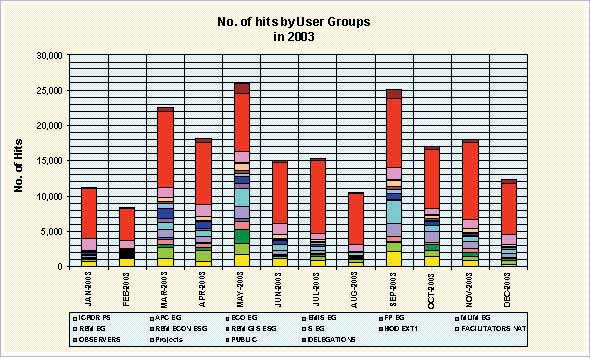
There were 416 registered users by the end of 2003.
appeared in 2003, including:
The activities of the most important user groups are
shown in the figure below.
· Annual Reports on the activities of the ICPDR in
2001 and 2002;
A new End-User License Agreement was launched
· Danube Watch Magazine 1/2003 and 2/2003;
in 2003 to facilitate users who are not members of
· TNMN Yearbooks 1999 and 2000.
any internal user group to use database information
- 30 -
10. Information management
for scientific purposes. These users are now registe-
who reviewed Danube Watch and carried out
red and agree to use data downloaded from the
research among readers and other stakeholders to
different ICPDR databases only for the specified
determine the public's views on the magazine's
scientific purpose. In addition, researchers send one
effectiveness and on how it could be improved.
electronic copy of the paper or publication they
have prepared.
The outcome of the analysis was encouraging,
since it clearly showed that readers find Danube
Assessment of Danube Watch
Watch informative, useful and topical. What they
Danube Watch, as the magazine for the Danube
find most valuable are practical case studies,
basin, was launched 10 years ago with support of
summaries of progress, features about how
PHARE and as part of the Danube Environment
problems were addressed, and information on
Programme
concrete measures and project results which can
be applied to other cases.
Following a period of UNDP support, the ICPDR
took over full responsibility for Danube Watch in
However, the analysis also revealed areas for
1998. Throughout these years, Danube Watch has
improvement, which will be reflected in the
been a major information tool used to spread
design and further production of Danube Watch.
information and knowledge about sustainable
This feedback is important, as the ICPDR will
river and water management in the Danube River
increasingly take on a stronger financial responsi-
Basin. Several editions of Danube Watch have
bility for the magazine. For the moment, how-
been published so far and distributed to decision-
ever, the production of Danube Watch will be
makers and the interested public.
continued, financially supported by the
UNDP/GEF Danube Regional Project, and
In 2003, in support of the ICPDR, the UNEP/GEF
strengthened by all the positive feedback received
Danube Regional Project funded nine consultants
from its readers.
- 31 -
11. Public Participation
in the ICPDR
The active involvement of the public is a core
Based on Article 14 of the WFD, the objectives of
principle in sustainable water management.
this Strategy are:
This basic fact was recognised when the Danube
River Protection Convention (DRPC) was deve-
· to ensure public participation in the implemen-
loped and signed 10 years ago. The DRPC already
tation of the WFD in the Danube River Basin,
included the involvement of the organized
especially in the first instance concerning the
public in the framework of its implementation.
development of the Danube River Basin
To date, 10 organizations have taken this
Management Plan;
opportunity and have been granted observer
· to facilitate the establishment of effective struc-
status to the ICPDR. These organizations inclu-
tures and mechanisms for public participation in
de NGOs such as the Danube Environmental
the Danube River Basin which will continue ope-
Forum (DEF), International Association for
rating beyond the first cycle of River Basin
Danube Research (IAD), Global Water
Management planning;
Partnership (GWP), WWF International, semi-
· to provide guidance to national governments
governmental organizations such as REC, repre-
on how to comply with their obligations under
sentatives of private industry such as the
the WFD, by providing them with practical support
International Association of Water Supply
and guidance in addressing public participation
Companies in the Danube River Catchment Area
in River Basin Management Planning;
(IAWD), and other inter-governmental organi-
· to inform key stakeholders about the structures
zations such as the Danube Navigation
for public participation and public involvement
Commission, the Black Sea Protection
at the various levels.
Commission, the International Hydrological
Programme of the UNESCO and the RAMSAR
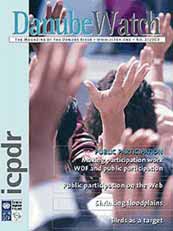
One edition of Danube Watch 2003 has
Secretariat. This cooperation, which grants
been dedicated to Public Participation
observers the full right to participate at decisi-
and to describing ongoing participation
on-making meetings and Expert Group meetings
processes in the Danube Basin.
of the ICPDR, has proven to be successful in
ensuring that different aspects and approaches
could influence and shape the current water
management in the Danube Basin.
This approach of involving the public has even
been enlarged by the requirements of the EU
Water Framework Directive (WFD). The ICPDR
has taken this new challenge as a basis for
reviewing its ongoing practice, and has decided
to start an active process towards defining a
Danube River Basin Strategy for Public
Participation.
- 32 -

11. Public Participation
in the ICPDR
This process began with an ICPDR Issue Paper on
Danube River Protection Convention, and aiming
Public Participation, which was developed by
to postulate a "Danube Solidarity" through cele-
GWP and WWF in 2002. The Issue Paper was a
brations of the Danube, from the Black Forest to
first draft of the policy background highlighting
the Black Sea. The Danube Day will be used to
key issues requiring attention to ensure that con-
show the importance of trans-border cooperation
tributions from stakeholders and from the public
in water management, and stimulate the public to
can be incorporated when implementing the WFD
become involved in this important undertaking.
in all of the Danube countries. Based on this
document and with support from UNDP/GEF
Despite universal agreement that public participa-
Danube Regional Project, the work of defining
tion is of key importance for implementing the
this Strategy began and cumulated in the holding
WFD, no other major international river basin has
of a basin-wide workshop on public participation
yet produced a basin-wide Strategy for Public
in Bratislava in April 2003. At this workshop,
Participation. The Danube is one of the first major
more than 40 participants from the Danube coun-
river basins to embark on this process. Therefore
tries (representing governments and NGOs), the
it represents a unique opportunity for the Danube
EC, the WFD CIS Drafting Group on Public
countries to take the lead, but it is also a major
Participation, the ICPDR, including members of
challenge.
RBM EG, and other international organizations
took part and developed the pillars of the Danube
Also visit the Danube Day website at
River Basin Strategy for Public Participation,
www.danubeday.org, to find out what
which was endorsed by the Standing Working
became of the wild idea to unite the 80
Group Meeting of the ICPDR in June 2003.
million Danube people through one
Danube Day.
As a next important step, the Strategy had to be
enlivened, and detailed activities at the Danube
Basin level had to be developed. This work has
been carried out under the guidance of the RBM
EG and is summarised in an Operational Plan.
This Plan provides a detailed description of the
activities at the roof level, including a timetable
and a workplan (covering a 12-18-month period
until the end of 2004). The Operational Plan is
seen as a planning document which is regularly
adjusted to the needs of the ICPDR.
One important activity of the Operational Plan,
which should be carried out during the year 2004,
is the celebration of Danube Day on June 29, mar-
king the 10-year anniversary of the signing of the
- 33 -
12. International Cooperation
Danube-Black Sea Joint Technical
tives of the Black Sea Secretariat, and the Project
Working Group
Manager of the UNDP/GEF Black Sea Project.
Cooperation with the Black Sea Protection
Both organizations have agreed to improve their
Commission continued in 2003 under the frame-
mutual coordination and cooperation (to facilita-
work of the Danube-Black Sea Joint Technical
te their work in the implementation of the MoU
Working Group. A detailed work-plan for the
and WFD. It was agreed that a consultation and
implementation of the Memorandum of
coordination meeting should take place in
Understanding (MoU) between the two commissi-
Vienna on 10 November 2003 between the
ons was prepared in 2002, and on the occasion of
UNDP/GEF Danube and Black Sea Projects on the
the 3rd Danube-Black Sea Joint Technical
one side, and the Danube and Black Sea
Working Group (JTWG) meeting (19 to 20 May
Secretariats as the beneficiaries on the other side.
2003, Kiev), the work programme was revised to
To facilitate the consultation and coordination
respond to the tasks related to the "Implementation
process, a discussion paper has been prepared,
of WFD requirements in regard to achieving the
taking into account the various project compo-
good status of coastal waters in the Black Sea".
nents and activities from UNDP/GEF Danube and
This work programme has been approved by the
Black Sea Projects.
1st Standing Working Group meeting of the ICPDR
(June 2003, Priem /Germany).
DABLAS Task Force (Danube Black Sea
Task Force)
A central task of the JTWG is agreement on
The ICPDR continued its participation in the
reporting formats for measures undertaken to
DABLAS Task Force, which was formed as a
reduce nutrients and hazardous substances in the
platform for cooperation and to develop finan-
Danube River Basin in line with Joint Action
cing mechanisms for the implementation of
Programme (JAP), and in the Black Sea
investment projects for pollution reduction in the
Protection Convention area in line with the
Danube and Black Sea area. In 2002 a priority list
Strategic Action Programme. In addition, propo-
of projects for funding was developed and
sals for reporting on the agreed indicators for
International Financing Institutions support has
ecological conditions have been developed and
been secured for some of the projects on this list.
must be discussed in detail at the next meeting in
2004.
The ICPDR submitted to DABLAS a proposal to
support the further evaluation of financing needs
Strengthening cooperation between the
for pollution control projects, and to evaluate
Danube and Black Sea Commission
implementation of pollution control efforts. This
Secretariats
project was approved at the end of 2003 and will
Strengthening and further development of the
be undertaken in 2004 with the funding support
relationship between the ICPDR and BSC was
of the EU.
achieved at a consultation meeting held in
Istanbul, Turkey (23 to 24 September 2003) between
the Executive Secretary of the ICPDR, representa-
- 34 -
12. International Cooperation
Cooperation with Alcoa Foundation
transboundary cooperation between Romania and
In 2002/2003 a new partnership developed Hungary. This proposal would specifically facilita-
between the ICPDR and the Alcoa Foundation. This
te procurement of new equipment and capacity
partnership has broken new ground for the ICPDR
building which will assist the local branch (Oradea)
in relations with the private sector and has served
of the National Administration "Apele Romane", to
as a learning basis for future joint activities with
run an integrated monitoring system in order to
the business sector.
fulfil the monitoring requirements of the Danube
River Protection Convention under the Trans-
Specifically, Alcoa has supported the ICPDR in its
national Monitoring Network (TNMN). In addition
transboundary monitoring efforts by providing
the project will enhance the ability of the water
financial support for a Total Organic Carbon/Total
authorities in Romania and Hungary to respond to
Nitrogen analyser to the National Institute for
WFD implementation tasks, in particular in identi-
Marine Research and Development in Const,anta,
fication and assessment of biological, chemical,
Romania. This analyser has been essential in provi-
and physical data for basin-wide planning and
ding the capacities to measure important aspects of
public participation.
Danube pollution and the contribution of the
Danube to the pollution of the Black Sea. The Aloca
The Alcoa Foundation supports a range of
company, the world's leading producer of primary
national, international and policy organizations
and fabricated aluminium, has seen this support as
emphasizing various interests and Areas of
a contribution to the communities and countries in
Excellence. The specific objectives of the requested
which it operates.
grant fit within Alcoa's specified area of excel-
lence, "Conservation and Sustainability".
A follow-up proposal has been discussed with
Alcoa for additional support in strengthening
- 35 -
13. International Cooperation UNDP/GEF Danube Regional Project:
Strengthening the Implementation Capacities for Nutrient Reduction
and Transboundary Cooperation in the Danube River Basin
The UNDP/GEF Danube Regional Project
of basin-wide capacity building activities, with
The UNDP/GEF Danube Regional Project (DRP),
particular attention to the development and
"Strengthening the Implementation Capacities for
implementation of policies for pollution reduction,
Nutrient Reduction and Transboundary
effective legal and economic instruments, mech-
Cooperation in the Danube River Basin", is
anisms for monitoring and evaluation, the creation
actually one of three components of the 95 mil-
of inter-ministerial committees, and the develop-
lion USD GEF Strategic Partnership for Nutrient
ment of programmes for public participation and
Reduction in the Danube / Black Sea Basin -
NGO strengthening. Altogether 20 project com-
GEF's largest and perhaps most ambitious water-
ponents with a number of activities are being
related project in the world. Together with the
carried out, thereby establishing a solid base for
UNDP/GEF Black Sea Ecosystems Recovery
the implementation of Phase 2 of the Project.
Project and the World Bank Investment Fund for
Nutrient Reduction, it supports the intermediate
The second phase of the project (2004-2006) will
goal of the Commissions for the Danube and
set up institutional and legal instruments at both
Black Sea to reduce nutrient and toxic loads in
national and regional level to ensure nutrient
the Black Seas to mid-90s levels, and their long-
reduction and sustainable management of water
term goal to reduce nutrients and toxic sub-
bodies and ecological resources, involving all
stances to the levels necessary to allow Black Sea
stakeholders and building up adequate monito-
ecosystems to recover to conditions in the 1960s.
ring and information systems.
The overall objective of the Danube Regional
Progress in 2003
Project is to complement the activities of the
In 2003 the project continued according to the
ICPDR required to provide a regional approach
Project Implementation Plan, prepared in 2002.
and global significance to the development of
The overall effort was focused on implementation
national policies and legislation, and the definiti-
and completion of the project activities. As of
on of priority actions for nutrient reduction and
December 2003, almost all project components
pollution control, with particular attention to
are in their final stage of execution by project
achieving sustainable transboundary ecological
subcontractors and international or national con-
effects within the DRB and the Black Sea area. In
sultants. Only two project components will have
this context, the Project supports the ICPDR, its
to be contracted in 2004, and their implementation
structures and the participating countries, in
will take place during the first half of 2004.
order to ensure an integrated and coherent imple-
Minor changes (time-frame and outputs) in res-
mentation of the Strategic Action Plan 1994 (SAP
pective project components' work plans were
1994), the ICPDR Joint Action Programme (JAP)
entailed by the development of the programmes
and the related investment programmes in line
and requirements of the ICPDR Expert Groups.
with the objectives of the DRPC.
Preliminary results have been thoroughly discus-
The first phase of the project (2002-2003) is
sed and agreed with the major stakeholders,
specifically focused on preparation and initiating
including the ICPDR and its Expert Groups. The
- 36 -
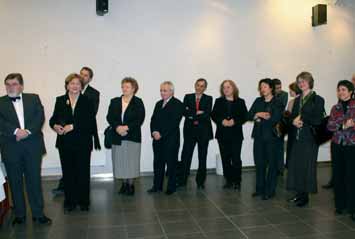
project team has been participating in ICPDR
ICPDR. Capacity building at regional level conti-
Expert Group Meetings, and the respective com-
nued with a workshop on Facilitation Skills held
ponents were implemented using a participatory
in May 2003, and will be further extended in the
approach. All project activities were harmonized
second phase of the project.
with the ICPDR EG Work Plans. Many of the pro-
ject activities supported the implementation of
Activities relating to the TNMN (Trans-National
the EU WFD, being one of the major priorities for
Monitoring Network), EMIS Inventory
the ICPDR.
Harmonization (Danube pollution inventories)
and Accident Emergency Response (Danube
In the framework of Project Objective 1: Creation
Accident and Early Warning System) - launched
of sustainable ecological conditions for land use
in the last quarter of 2002 - were finalized by the
and water management, the project activities
end of 2003 as the basis for full implementation
focused on economic analysis, typology, ecologi-
of improvements to the respective systems in
cal classification, GIS, groundwater assessment
Phase 2.
and public participation, as well as on preparation
of concepts and methodologies relating to polices
Project Objective 3: Strengthening of public
and legal instruments for agriculture, industry,
involvement in environmental decision making
wetlands restoration and analysis and concepts
and reinforcement of community actions for pol-
for water tariffs and charges. A number of works-
lution reduction and protection of ecosystems is
hops were organized to ensure involvement of
designed mainly to support and strengthen the
the project stakeholders in the project implemen-
Danube Basin NGOs. In this context the Danube
tation in key project components, e.g. Public
Environment Forum (DEF), the umbrella network
Participation Workshop (April 2003),
of NGOs, continued implementing their strategy
Groundwater Workshop (May 2003), Workshop
and work plan to improve cooperation among the
on Best Agricultural Practices (October 2003),
NGOs. The project supported activities of the DEF
Stakeholder Analysis Workshop (December 2003).
Secretariat, in particular the preparation of furt-
The activities of Project Objective 2: Capacity
her DEF publications and the organization of 11
building and reinforcement of transboundary
national DEF meetings, held between April and
cooperation for the improvement of water quali-
June 2003, including training on nutrient reduc-
ty and environmental standards in the Danube
tion measures.
River Basin were focused on the improvement
and strengthening of the existing ICPDR tools
The Small Grants Programme (SGP) is carried out
and structures. Based on the DANUBIS User
by a sub-contractor, the Regional Environmental
Survey (2002), the project supported the hard-
Centre (REC), with involvement of regional NGOs,
ware upgrade of the Information System at
in particular the DEF. The first call for proposals
national level, and a user training programme
was ready in March 2003. By November 2003,
was conducted in 11 countries ensuring a regio-
the national and regional projects were selected
nally consistent approach towards information
and ready for full implementation in all 11 coun-
management within the various activities of the
tries with funding that should be made available
- 37 -
13. International Cooperation UNDP/GEF Danube Regional Project:
Strengthening the Implementation Capacities for Nutrient Reduction
and Transboundary Cooperation in the Danube River Basin
in Phase 2. In total, 58 national grants and 5
minary results, inputs from the ICPDR Expert
regional grants were awarded.
Groups, and other inputs from consultants and
various stakeholders. A new project component
Activities on Communication and Public
3.4 on "Enhancing Support of Public Participation
Awareness were initiated. In 2003 the project
in Addressing Priority Sources of Pollution ('hot
supported the publication of Danube Watch. In
spots') through Improved Access to Information in
addition, an assessment of Danube Watch was
the Frame of the EU Water Framework Directive"
carried out in order to make it a more effective
has been added to the DRP Phase 2, focusing on
communication tool in the future.
Bosnia i Herzegovina, Bulgaria, Croatia, Romania
and Serbia and Montenegro. The Project
In the framework of Project Objective 4:
Document for Phase 2 was submitted to UNDP for
Reinforcement of monitoring, evaluation and
final review at the beginning of October 2003. It
information systems to control transboundary
will be circulated for signature by the President of
pollution, and to reduce nutrients and harmful
the ICPDR and government representatives of the
substances, the appropriate methodologies for the
beneficiary countries in 2004.
monitoring of nutrient reduction in wetlands
were assessed and guidelines prepared as the
A key challenge for Phase 2 implementation will
basis for establishing pilot monitoring program-
be to ensure that non-EU Accession countries
mes in phase 2. The project also initiated prepa-
(Bosnia i Herzegovina, Croatia, Moldova, Serbia
ratory activities for development of the monito-
and Montenegro and Ukraine) can and will parti-
ring and evaluation system and identification of
cipate in implementing the EU WFD and in par-
indicators, harmonized with EU WFD and GEF
ticular project-related activities. The DRP will
requirements, in order to evaluate environmental
place special emphasis on cooperation with these
effects of policy and programme implementation.
countries in Phase 2 to strengthen their abilities
to participate on an equal basis within the regional
framework.
Preparation of Project Phase II
Based on the Project Brief Tranche 2, approved in
The overview on the implementation of project
May 2003 by the GEF Council, the Project
components as of December 2003 is shown in the
Document was prepared based on Phase 1 preli-
following table:
- 38 -
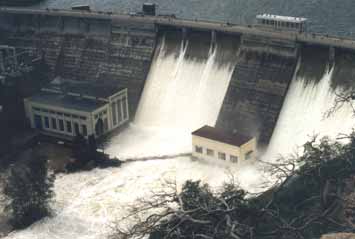
Ref.
Component
Status
finalized continue start
in 2004 in 2004
1.1-1, 1.1-5
GIS- Danube Basin District Map,
needs assessment and conceptual design
for a DRB GIS System
1.1-3
Applying EU Economic Guidelines
for economic analysis to the DRB
1.1-2,1.1-6, 1.1-7
Stress/pressure and impact analysis, typology
of surface waters and ecol. classification
1.1-8
Characterization and Analysis of
Transboundary Ground Water Bodies
1.1-9
Pilot River Basin Plan in the Sava
1.2, 1.3
Policies for the control of agricultural point
and non-point sources of pollution; pilot projects
on agric pollution reduction
1.4
Integrated land use assessment
and inventory of protected areas
1.5
Industrial reform and development of policies
and legislation for reduction of nutrients
and dangerous substances
1.6, 1.7
Assessment and development
of water and waste water tariffs
and effluent charges designs
1.8
Recommendations for the reduction
of phosphorus in detergents
2.1
Inter-ministerial Coordination Mechanisms
2.2
Support for TNMN and EMIS Inventory harmonization
2.3-2,2.3-3
Accident Risk Spots Inventory and preventive measures
2.3-4
Support for DBAM
2.4, 2.3-1
Support for DANUBIS reinforcement
2.5
Danube - Black Sea MoU / Support
for Joint D-BS Working Group
2.6
Training and consultation workshops
3.1
Institutional development of NGOs
and community involvement
3.2
Initiating the Small Grants Programme -1st contract
3.3, 3.3-1
Developing a DRB Communications Strategy
4.1
Indicators for project monitoring and evaluation
4.3
Monitoring and assessment of nutrient removal
capacities of riverine wetlands
4.4
Study on pollution trading and corresponding
economic instruments for nutrient reduction
- 39 -
14. Glossary /
Abbreviations & Acronyms
AEWS
Accident Emergency Warning System
APC EG
Expert Group on Accident Prevention and Control
ARS
Accident Risk Sites
BAP
Best Available Practices
BAT
Best Available Techniques
Danube RBM Plan
Danube River Basin Management Plan
DEF
Danube Environmental Forum
DRB
Danube River Basin
DRP
Danube Regional Project
DRPC
Danube River Protection Convention, short for Convention on Cooperation
for the Protection and Sustainable use of the Danube River
ECO EG
Expert Group on Ecology
ECON ESG
Expert Subgroup on Economics
EGM
EuroGlobalMap
EMIS EG
Expert Group on Emission
GIS ESG
Expert Subgroup on Cartography and GIS
FP EG
Expert Group on Flood Protection
GW
Groundwater
GWP-CEE
Global Water Partnership for Central and Eastern Europe
ICPDR
International Commission for the Protection of the Danube River
IFI
International Finance Institution
IPPC
Integrated Pollution Prevention Control
IUCN
World Conservation Union
JAP
Joint Action Programme
JTWG
Joint Technical Working Group
MLIM EG
Expert Group on Monitoring, Laboratory and Information Management
MONERIS
Modelling Nutrient Emissions in RIver Systems
MoU
Memorandum of Understanding
PE
Population Equivalent
PIP
Project Implementation Plan
RBM EG
Expert Group on River Basin Management
REC
Regional Environmental Center for Central and Eastern Europe
TNMN
Trans-National Monitoring Network
WFD
EU Water Framework Directive (Directive 2000/60/EC)
WWF
World Wide Fund for Nature
WWTP
Wastewater Treatment Plant
- 40 -
Annex 1:
Composition
of the ICPDR in 2003
PRESIDENT
Croatia: Zeljko OSTOJIC¬
Germany: Fritz HOLZWARTH
State Water Directorate, Ulica Grada Vukovara
Permanent Delegate of the Federal German
220, HR-10 000 Zagreb, Croatia
Republic
Bosnia i Herzegovina: Mehmed CERO
Federal Ministry of Physical Planning and
HEADS OF DELEGATION
Environment, M.Tita 9a, BiH-71000 Sarajevo,
Germany: Thomas STRATENWERTH
Bosnia i Herzegovina
Federal Ministry for the Environment,
Borislav JAKSIC
Nature Conservation and Nuclear Safety,
Ministry of Spatial Planning, Civil Engineering
P.O.Box 120629, Robert Schuman Platz 3,
& Ecology, Trg Srpskih
D-53048 Bonn, Germany
Junaka 4, 78000 Banja Luka, Republika Srpska
Austria: Wolfgang STALZER
Serbia and Montenegro (former Yugoslavia):
Federal Ministry for Agriculture, Forestry,
Zdravko TUVIC up to Sep 2003
Environment and Water Management,
Head of Stability Pact Group,
Section VII, Marxergase 2,
Federal Ministry of Foreign Affairs,
A-1030 Vienna, Austria
Kneza Milosha 24, Belgrade,
Serbia and Montenegro
Czech Republic: Jaroslav KINKOR
Igor TADIC as of Oct 2003
Director, Water Protection Department,
Ministry of Agriculture & Water Management,
Ministry of the Environment,
Directorate for Water, 2 Bulevar Umetnosti,
Vrsovicka 65, CZ-10010 Praha 10, Czech Republic
11000 Belgrade, Serbia and Montenegro
Slovakia: Milan MATUs¬KA up to Sep 2003
Bulgaria: Nikolai KOUYUMDZIEV
Marian SUPEK as of Oct 2003
Deputy Minister, Ministry of Environment
Ministry of Environment/
and Water, Bd. Maria Luisa 22,
Water Research Institute, Nabrezie arm.gen.L.
BG-1000 Sofia, Bulgaria
Svobodu 5, SK-81235 Bratislava, Slovakia
Romania: Florin STADIU
Hungary: Gyula HOLLÓ
Secretary of State, Ministry Environment and
Ministry of Environment and Water,
Water Management, 12 Libertatii, Sect. 5,
Fö utca 44-50, POB 351,
RO-04129 Bucharest, Romania
H-1394 Budapest, Hungary
Moldova: Gheorge DUCA
Slovenia: Mitja BRICELJ
Minister, Ministry of Ecology, Construction and
Ministry of Environment,
Territorial Development, 9 Cosmonautilor St.,
Spatial Planning and Energy,
MD-2005 Chisinau, Moldova
Dunajska cesta 48, SI-1000 Ljubljana, Slovenia
- 41 -
Annex 1:
Composition
of the ICPDR in 2003
Ukraine: Anatoliy V. GRYTSENKO
Sylvia KERSCH: Support Staff - PA
Cabinet of Ministers, Ministry of Environment and
Management Assistant as of Oct 2003
Natural Resources, 35, Urytshkogo str.,
UA-01001 Kiev, Ukraine
CHAIRMEN OF THE EXPERT GROUPS AND
European Commission:
SUBGROUPS
Jean-Francois VERSTRYNGE/
Expert Group on River Basin Management
Andrew MURPHY up to Feb 2003
(RBM EG)
Helmut BLÖCH as of Apr 2003
Fritz BARTH: up to Sep 2003
ENV.B.1 Water, Marine and Soil
Joachim D'EUGENIO: as of Oct 2003
European Commission, 200,
European Commission, DG/Environment,
rue de la Loi, B-1049 Brussels, Belgium
Rue de la Loi 200, B-1049 Brussels, Belgium
Expert Subgroup on GIS (GIS ESG)
PERMANENT SECRETARIAT
Doris GRUBER: up to Jul 2003
Joachim BENDOW: Executive Secretary
Federal Environment Agency, Spittelauer Lände 5,
up to 17 Aug 2003
A-1090 Wien, Austria
Visnja OMERBEGOVIC: as of Aug 2003
Philip WELLER: Executive Secretary
Croatian Waters, Ulica grada Vukovara 220,
as of 18 Aug 2003
HR-10 000 Zagreb, Croatia
Károly FUTAKI: Information Management
Expert Subgroup on Economics (ECON ESG)
and Administration Officer
Ibolya GAZDAG
Ministry of Transport and Water Management,
Igor LISKA: Technical Expert for Water
Dob u. 75-81. H-1077 Budapest, Hungary
Management - Water Quality
Expert Group on Ecology (ECO EG)
Mihaela POPOVICI: Technical Expert
Gábor MAGYAR
for Water Management - Pollution Control
Ministry of Environment and Water,
Authority for Nature Conservation,
Ursula SCHMEDTJE: Technical Expert for River
Költö utca 21. H-1121 Budapest, Hungary
Basin Management
Expert Group on Emissions (EMIS EG)
Jasmine BACHMANN: Technical Support -
Zdena KELNAROVÁ
Public Participation & Public Relation
Water protection Department, Ministry of
Environment, Namestie L' Stura 1,
Julia KÖLBLINGER: Support Staff -
SK-81235 Bratislava, Slovakia
Finance & Relation with Host Country Services
Financial Officer as of Oct 2003
- 42 -
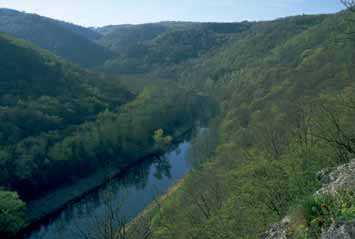
Annex 1:
Composition
of the ICPDR in 2003
Expert Group on Monitoring, Laboratory and
Information Management (MLIM EG)
Liviu Nicolae POPESCU: Senior Expert,
ICIM Research & Engineering Institute for
Environment,
Spl. Independentei 294, Sect. 6,
RO-77703 Bucharest, Romania
Accident Prevention and Control Expert Group
(APC EG)
Aurel VARDUCA: Head of the Department,
ICIM Research & Engineering Institute for
Environment,
Spl. Independentei nr 294, Sect. 6,
RO-77703 Bucharest, Romania
Flood Expert Group (Flood EG)
Sándor TÓTH
National Water Authority, Márvány u. 1/c
H-1012 Budapest, Hungary
ad hoc Strategic Expert Group (S EG)
Knut BEYER
Federal Ministry for the Environment,
Nature Conservation and Nuclear Safety,
BMUNR, WA I 6B, Robert Schuman Platz 3,
D-53048 Bonn, Germany
- 43 -
Annex 2:
Observer Status
per 31. 12. 2003
Organization Name
Address
Danube Commission for inland navigation
Mr. Danail Nedialkov, Director General
(CD)
Benczúr utca 25., H-1068 Budapest, Hungary
WWF International
Mr. Dave Tickner,
Danube Carpathian Programme
WWF-DCP Freshwater TeamLeader,
Mariahilferstr. 88a/3/9, A-1070 Vienna, Austria
International Association
Dr. Meinhard Breiling, General Secretary
for Danube Water Research
Schiffmühlenstr. 120, A-1220 Vienna, Austria
(IAD; in the framework of SIL)
RAMSAR Convention on Wetlands
Mr. Tobias Salathe, Regional Coordinator for Europe
Rue Mauverney 28, CH-1196 Gland, Switzerland
Danube Environmental Forum (DEF)
Mr. Jan Seffer, DEF Secretariat, Rytierska 2,
SK - 841 10 Bratislava, Slovak Republic
Regional Environmental Center
Ms. Márta Szigeti-Bonifert, Executive Director
for Central and Eastern Europe (REC)
Ady Endre út 9-11., H-2000 Szentendre, Hungary
International Commission
Mr. Plamen Dzhadzhev
for the Protection of the Black Sea (BSC)
Dolmabahce Sarayi II., Hareket köskü II,
34353 Besiktas, Istanbul, Turkey
Global Water Partnership
Mr. József Gayer up to Aug 2003
(GWP-CEE)
Mr. Milan Matuska as of Sep 2003
GWP-CEE Secretariat
c/o Slovak Hydrometeorological Institute
Jeseniová 17, 83315 Bratislava, Slovak Republic
UNESCO/IHP
Mr. Philippe Pypaert, UNESCO Venice Office
Dorsoduro, 1262/A, I - 30123 Venice, Italy
Mr. Miklós Domokos, Hungarian IHP/OHL
NC - Secretary VITUKI
Kvassay J. út 1., 1453 Budapest, Hungary
International Working Association
Mr. Markus Werderitsch
of Water Works in the Danube Basin (IAWD)
c/o Wiener Wasserwerke
Grabnergasse 4-6
A-1061 Vienna, Austria
- 44 -
ICPDR - International Commission for the Protection
of the Danube River / Permanent Secretariat
Vienna International Centre, D0412
P. O. Box 500, 1400 Vienna / Austria
Tel: 0043-1-260 60-5738, Fax: 0043-1-260 60-5895
e-mail: icpdr@unvienna.org, www.icpdr.org