ICPDR
Annual Report 2006
/ /D
eutschland //// Österreich //// Ceská republika //// Slovensko //// Magyarország //// Slovenija //// Hrvatska //// Bosn
a
i H
er
cegovina
Srbija //// Crna Gora //// România //// ÅÎ,,Ëfl //// Moldova //// ìÍªÌ ////
Table of Contents
Foreword
5
1. working For the entire river Basin: operational and institutional Framework
6
Closer relationships with navigation
6
Collaborating with business in the basin
6
preparing for the eu water Framework directive
7
responding to danger
8
a structure of support
8
2. danuBe CheCk-up: water Quality and the hydrologiCal situation in the danuBe river Basin
9
assessing the hydrological situation
9
high waters in the basin
9
looking at water quality trends
12
monitoring water quality
12
assessing conditions
13
3. integrated river Basin management: implementation oF the eu water Framework direCtive
14
significant water management issues
14
outlining future plans
14
taking action
15
Comparing quality classes
15
working together
16
the tisza river sub-basin
16
the sava river sub-basin
17
4. keeping the danuBe Clean: pollution Control strategies and the eu water Framework direCtive
18
the iCpdr pollution control strategy
18
taking action to control pollution
18
implementing the urban wastewater treatment directive
19
the european pollutant release and transfer register in the danube Basin
20
decision support for river Basin management plans
20
nutrient pollution
20
Joint action produces key results
21
securing project funding
22
nutrient pollution and phosphates in laundry detergents
22
5. warning downstream neighBours: the danuBe aCCident emergenCy warning system
24
ensuring efficient round-the-clock performance
24
6. guarding against high waters: Flood proteCtion in the danuBe river Basin
25
effective defence measures
25
reinforcing protection
25
estimating damages and losses
27
opportunities for learning
30
the danube early Flood alert system
32
7. minimising risks: the aCCident prevention task group
33
assessing contaminated sites
33
Checking technical safety
33
mutual assistance and contingency planning
33
8. the Flow oF inFormation: iCpdr inFormation systems and puBliC partiCipation
34
keeping users up-to-date
34
iCpdr publications
34
iCpdr information system danubis
35
danube river Basin geographical information system
36
9. inviting puBliC partiCipation
36
Broadening cooperation
36
10. shared river, shared responsiBility: international and regional Cooperation
38
the danube regional project
38
the danube-Black sea Joint technical working group
40
daBlas task Force
42
alcoa Foundation
43
green danube partnership with the Coca-Cola system
43
11. river oF liFe: danuBe day 2006
44
exploring natural habitats
44
Bringing communities together
44
danube art masters in vienna
46
turning the river into art
46
12. the danuBe in sChool: the danuBe Box
47
partners in education
47
an integrated education on rivers
47
13. Budget and FinanCial ContriButions
49
regular budget financial year 2006
49
special funds in 2006
49
aBout the iCpdr
50
annex - Composition oF the iCpdr in 2006
52
///////// Deutschland //// Österreich //// Ceská republika //// Slovensko //// Magyarország //// Slovenija //// Hrvatska //// Bosna i Hercegovina //// Srbija //// Crna Gora //// România //// ÅÎ,,Ëfl //// Moldova //// ìÍªÌ //// Deutschland //// Österreich //// Ceská republika //// Slovensko //// Magyarország //// Slovenija //// Hrvatska ////// Bosna i Hercegovina /// Srbija //// Crna Gora

5
Foreword
The year 2006 was a challenging one for the Danube River Basin,
but all Danube countries worked hard to further develop constructive
cooperation to overcome the ordinary and unexpected problems that
appeared during the year like the severe floods in the spring. These
events demonstrated once again that we need to cooperate to find the
best solutions for emergencies and that the ICPDR is a great platform
for negotiation, collaboration, development and further progress in
the region.
Implementation of the EU Water Framework Directive (WFD) was
and remains a key activity of the ICPDR. Significant progress was
made in the field of sub-basin cooperation through continuation of
the Tisza project, starting development of the Prut initiative and the
Danube Delta cooperation with involvement from Romania, Moldova,
Ukraine and international institutions. This process strengthens
the cooperation between these countries in order to facilitate and
Constantin Mihailescu
better harmonise implementation of the WFD provisions in the
ICPDR President 2006,
regions especially the elaboration and implementation of the
Minister of Environment
and Natural Resources
Integrated Management Plan for the entire Danube River Basin.
of Moldova
It was also a very successful year for the Danube family. The number
of observers to the ICPDR increased, contracting parties worked more
efficiently to further develop regional cooperation, successful coop-
eration continued with the Black Sea Commission, the ICPDR brand
was brought to other river protection and navigation commissions and
events in 2006 demonstrated once again that the iCpdr
more stakeholders and members of the business sector and civil soci-
is a great platform for negotiation, collaboration, development
ety were involved in events throughout our common basin.
and further progress in the region.
This year's Danube Day celebrations in Moldova were celebrated in a
transboundary context. In Moldova, the day was turned into an entire
week involving thousands of people from both sides of the Prut River.
This was a wonderful opportunity to bring together people from vary-
ing backgrounds and with different visions, and to raise awareness
of the Danube's problems and the plans for its future development by
making them feel united by our common river the blue Danube.
///////// Deutschland //// Österreich //// Ceská republika //// Slovensko //// Magyarország //// Slovenija //// Hrvatska //// Bosna i Hercegovina //// Srbija //// Crna Gora //// România //// ÅÎ,,Ëfl //// Moldova //// ìÍªÌ //// Deutschland //// Österreich //// Ceská republika //// Slovensko //// Magyarország //// Slovenija //// Hrvatska ////// Bosna i Hercegovina /// Srbija //// Crna Gora
6
1. Working for the entire river basin:
operational and institutional framework
since its establishment in 1988, the iCpdr has grown into one of the largest and most active international bodies of river basin management
in europe. working toward the protection of the danube river and its tributaries and groundwater resources throughout the basin, the iCpdr
has also been nominated as the platform for coordination of the implementation of the eu water Framework directive. the iCpdr pursues its
mission by making recommendations for the improvement of water quality, developing mechanisms for flood and accident control, agreeing
on standards for emissions, assuring that these are reflected in the contracting parties' national legislations and applied in their policies. For
everyone in the river basin, 2006 was a year of improvement and development.
In 2006, Moldova took over the presidency of the ICPDR, and though
Closer relationships with navigation
Moldova is a small country it brought much to the work of the ICPDR. Historically the Danube and its tributaries have formed important
The NGO (non-governmental organisation) and Business Forum that
trade routes across Europe. To further cooperation on navigation and
took place in October 2006 in Chisinau was one of the first steps
transport issues, the ICPDR contacted the Danube Commission and
toward building a new dialogue between governments, NGOs and the
the International Commission for the Protection of the Sava River
private sector. This dialogue will play an important role in the imple-
Basin to initiate an intense, cross-sectoral discussion process to create
mentation of the EU Water Framework Directive (WFD) as well as in
a `Joint statement on inland navigation and environmental sustainability in the
the provisions of the Danube River Protection Convention and will
danube river Basin´. This process will be carried out in 2007.
further encourage the involvement of civil society in the implementa-
tion of the integrated river basin management plan.
Two organisations joined the ICPDR as observers this year via
donau and the European Barge Union (see chapter 9 for more details).
Membership in the ICPDR was adjusted slightly in 2006 to accom-
These two organisations will strengthen the involvement of the navi-
modate the split of Serbia and Montenegro into two separate states in
gation sector and help ensure navigation issues on the Danube and
June. Serbia took over as a full contracting party to the Danube River
its navigable tributaries are brought up in the implementation of the
Protection Convention and continued its membership of the ICPDR.
WFD and included in the Danube River Basin Management Plan.
Montenegro has remained in contact with the ICPDR, as more than
2000 km2 of the country's territory lies within the Danube River
Basin. This relationship is leading towards Montenegro joining the
Collaborating with business in the basin
ICPDR as a full contracting party soon.
Cooperation with business has always been an important part of
the ICPDR's work to involve stakeholders in integrated river basin
management. In 2006, partnership with the business community
continued to build support for ICPDR's programmes and activities.
Cooperation with organisations like the Alcoa Foundation and The
Coca-Cola Company and its largest European bottler Coca-Cola
Hellenic Bottling Company S.A. (Coca-Cola HBC) have made
possible vital advances in water quality monitoring efforts and helped
create public participation programmes throughout the entire basin
(see chapter 10 for details).
/ / / / / Deutschland ///// Bosna i Hercegovina //// Srbija //// Crna Gora //// România / / ÅÎ,,Ëfl / / Moldova // ìÍªÌ //// Deutschland //// Österreich //// Ceská republika //// Slovensko //////// Magyarország //// Slovenija //// Hrvatska //////// Bosna i Hercegovina //// Srbija //// Crna Gora //// România //// ÅÎ,,Ëfl // Moldova //// ìÍªÌ //// Deutschland //// Österreich // Ceská republika ////
7
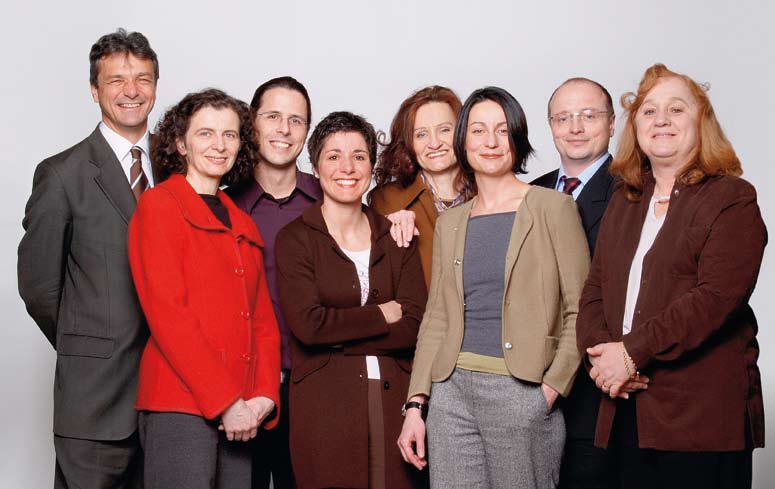
The core team at the Secretariat, supporting the ICPDR:
Philip Weller, Executive Secretary; Anna Koch, Financial Officer;
Alex Höbart, Information Management & GIS; Jasmine Bachmann,
Public Participation & Public Relations; Sylvia Kersch, Management Assistant;
Birgit Vogel, River Basin Management; Igor Liska, Water Quality &
Water Management; Mihaela Popovici, Pollution Control & Water Management.
One tool to come out of the ICPDR's partnership with business is the
Preparing for the EU Water Framework Directive
Danube Box. The Danube Box is a comprehensive teaching kit that
Implementation of the WFD continues to be the highest priority
helps give schoolchildren a greater understanding of the river basin,
for the Danube countries. Much of the ICPDR's work in 2006 was
the threats facing the river and the need to preserve water resources.
focused on meeting these requirements, including updating the road
The Danube Box was created as part of the `Green Danube Partner-
map and strategic paper which are the basis for fulfilling WFD
ship' between the ICPDR, The Coca-Cola Company and Coca-Cola
obligations (see chapter 3 for details).
HBC. Coca-Cola is committed to funding the implementation of the
Danube Box in as many Danube countries as possible, and following
Further development toward the WFD is under way by the Ad-hoc
the code of conduct of Coca-Cola, no marketing of any of their prod-
Information Management and Geographical Information System
ucts is linked to the Danube Box (see chapter 12 for more details).
Expert Group. A series of maps of the Danube River Basin and the
Strategic Plan for a Danube River Basin geographic information
system (GIS) have been developed, which will help the ICPDR
provide tools to manage and share vital information.
/ / / / / Deutschland ///// Bosna i Hercegovina //// Srbija //// Crna Gora //// România / / ÅÎ,,Ëfl / / Moldova // ìÍªÌ //// Deutschland //// Österreich //// Ceská republika //// Slovensko //////// Magyarország //// Slovenija //// Hrvatska //////// Bosna i Hercegovina //// Srbija //// Crna Gora //// România //// ÅÎ,,Ëfl // Moldova //// ìÍªÌ //// Deutschland //// Österreich // Ceská republika ////
8
The joint management of the Sava River Basin shared by Slovenia,
Responding to danger
Croatia, Serbia and Bosnia and Herzegovina is a crucial test case
A number of spills occurred in 2006; the most serious were oil spills
for the implementation of the WFD for the Danube and Europe. The
in October and December (see chapter 5 for details). These accidents
International Sava River Basin Commission was established in 2005
caused problems in Bulgaria, Romania and Serbia and triggered
and opened its Secretariat in Zagreb, Croatia. The Sava Commission
intense discussions between all countries on how better to manage
implements the Framework Agreement on the Sava River Basin and
incidents. The spills highlighted the need for cooperation and
the Protocol on the Navigation Regime, both signed in 2002, which
strengthened efforts related to the Accident Emergency Warning
promote regional cooperation on issues related to navigation, eco-
System and the ICPDR Accident Prevention Task Group.
nomic development, comprehensive water management and environ-
mental protection.
Floods in the spring and summer of 2006 were a lesson in preparation.
In many cases, while flood waters threatened communities, danger
was avoided by swift implementation of flood control measures.
The floods once again reinforced the need to work together and to
see what can be done to promote effective measures (see chapter 6
for details).
A structure of support
Finally, there have been several staff and structural changes within
the ICPDR secretariat. Following the reorganisation of the ICPDR's
/ / / / / Deutschland ///Ceská republika ///// Österreich / / Ceská republika
expert bodies and the secretariat in 2005, two staff positions have
////
been changed or restructured: the Technical Expert for Information
Mag
Management and GIS and the Technical Expert for Public Participa-
yaro
tion and Public Relations. In addition, in 2006 the ICPDR provided
rszá
internships to representatives from Danube countries to work in the
g ///
ICPDR Secretariat for a period of one year. These internships gain
/ Slo
valuable experience working in the most international river basins in
ven
the world.
ija //// Hrvatska // Bosna i Hercegovina //// Srbija //// Crna Gora //// România //// ÅÎ,,Ëfl //// Moldova /// ìÍªÌ //// Deutschland ///// Österreich //// Ceská republika /////////////////////// Slovensko ///////// Magyarország //// Slovenija //// Hrvatska //// Bosna i Her-
9
2. Danube check-up:
water quality and hydrological situation
in the Danube River Basin
as the most international river in the world, the waters of the danube and its tributaries connect 19 countries. the changing water levels and water quality
affect the lives of some 81 million people living in the basin.
The total discharge of the Danube River to the Black Sea was 265.6 km3 These meteorological extremes were also reflected in the discharge
in 2006, or about 128% when compared with the long-term average
of the Danube and its tributaries. The first small floods occurred by
of 207 km3 total annual discharge. In terms of the average mean flow,
February, but it was the combination of the March and April pre-
its value in 2006 was 8423 m3s-1 compared with a long-term average
cipitation and the beginning of the snowmelt that caused a major
of 6500 m3s-1.
increase in discharge of the Danube as well as severe flooding. In the
following months, however, this trend was reversed. A drought period
occurred in July, and in the autumn low flows continued until Decem-
Assessing the hydrological situation
ber. Heavy thundershowers in June were only of local importance and
A comparison of the 2006 meteorological data for the upper Danube
increased flow for short time periods only. The long-term monthly
Basin with the long-term mean between 1961 and 1990 shows a high-
average was exceeded just once during August as a direct conse-
er-than-average sunshine duration, a positive temperature deviation
quence of continuous rain.
and a precipitation deficit all similar trends to 2005. In the upper
Danube, 2006 was a year of weather extremes: eight out of twelve
months were drier than normal (with a deviation range of 4% to 49%
High waters in the basin
of the mean for 19611990) while the spring months of March to May In the Czech Republic, the month with the highest precipitation was
and August (which had the highest monthly precipitation of the year
August at 157 mm, and the minimum precipitation was in Septem-
at 166 mm) were too wet in comparison to the mean for 19611990.
ber at 18 mm. Stream flows in the Morava River and the Czech part
March in particular was distinctly wetter (+ 90%) due to heavy snow
of the Thaya River were significantly higher than long-term mean
fall. An extraordinary incident was the long period of snow cover
flows. Melting snow together with rainfall in March and April caused
(from January to March).
a flood in the Czech part of the Thaya Basin (a 10-year flood) and
/ / / / / Deutschland ///Ceská republika ///// Österreich / / Ceská republika
in the Morava Basin (a 2050-year flood). In Hungary, high flood
////
The monthly temperature distribution also shows a majority of warm
M
waters passed into the Danube in early April, producing historically
ag
months; eight out of twelve months were warmer than normal. The
high water levels downstream of the Hron and Ipel'/Ipoly mouths.
yaro
highest deviation of the long-term mean (about + 4.1 °C) occurred
The almost simultaneous floods on the Tisza River produced histori-
rszá
in July by far the warmest July since weather recording began.
cal water level maximums downstream of Tiszaug down to the mouth
g ///
Also, the autumn months and December were particularly warm. The
(Titel in Serbia).
/ Slo
remaining months remained statistically cold, especially January.
venija /
Precipitation in Slovenia in 2006
FIG. 1
/// Hrvatsk
250.0
250.0
a //
200.0
200.0
/ Bosn
150.0
150.0
a i He
100.0
100.0
rcegovina //// Srbija //// Crna Gora //// România //// ÅÎ,,Ëfl //// Moldova /// ìÍ
50.0
50.0
ªÌ
0.0
0.0
////
mm
Jan Feb mar apr may Jun Jul aug sep oct nov dec
mm
Deuts
2006
average 19611990
chland ///// Österreich //// Ceská republika /////////////////////// Slovensko ///////// Magyarország //// Slovenija //// Hrvatska //// Bosna i Her-
10
/ / //(//// Österreich //// Ceská republika //// Slovensko //// Magyarország //// Slovenija //// Hrvatska //// Bosna i Hercegovina //// Srbija //// Crna Gora // România //// ÅÎ,,Ëfl // Moldova //// ìÍªÌ //// Deutschland //// Österreich //// Ceská republika //// Slovensko //// Magyarország //// Slovenija //////////////// Hrvatska //////// Bosna i Herce-
High waters on Slovenian rivers occurred in an unusual period
On the lower Danube, there was generally a slight positive deviation
of 2006 and approximately 50% less high water than normal was
from a long-term average in both temperature and precipitation
recorded. The frequency of the flood waters was unusual with high
during most of the year. In Romania in 2006, the mean, all-country
waters occurring in spring, no normal floods in autumn and torrential
thermal pattern was 0.1 ºC above the climatological norm, ranking
floods in late summer. The major flood in 2006 occurred in March on
within normal limits. The first two months of the year were colder
the Krka River in south-eastern Slovenia. The Krka also flooded in an
than normal by 1.32.0 ºC, whereas March and May were colder
uncharacteristic flooding area, reaching a maximal discharge of up to
by 0.40.8 ºC. The rest of the months were warmer than usual by
20-year return periods.
0.11.2 ºC, the largest positive deviation against the normal being
1.8 ºC in December. It is remarkable that although positive deviations
were not very large, every month from April to the end of the year
was warmer than the reference period, May excepted (fig. 2).
Monthly temperature in Romania in 2006
FIG. 2
20.0
20.0
15.0
15.0
10.0
10.0
5.0
5.0
0.0
0.0
-5.0
-5.0
t (°C)
Jan Feb mar apr may Jun Jul aug sep oct nov dec
t (°C)
2006
average 19611990
Precipitation in Romania in 2006
FIG. 3
140.0
120.0
100.0
250.0
80.0
200.0
60.0
150.0
40.0
100.0
20.0
50.0
0.0
0.0
mm
Jan Feb mar apr may Jun Jul aug sep oct nov dec
mm
2006
average 19611990
11
/ / //(//// Österreich //// Ceská republika //// Slovensko //// Magyarország //// Slovenija //// Hrvatska //// Bosna i Hercegovina //// Srbija //// Crna Gora // România //// ÅÎ,,Ëfl // Moldova //// ìÍªÌ //// Deutschland //// Österreich //// Ceská republika //// Slovensko //// Magyarország //// Slovenija //////////////// Hrvatska //////// Bosna i Herce-
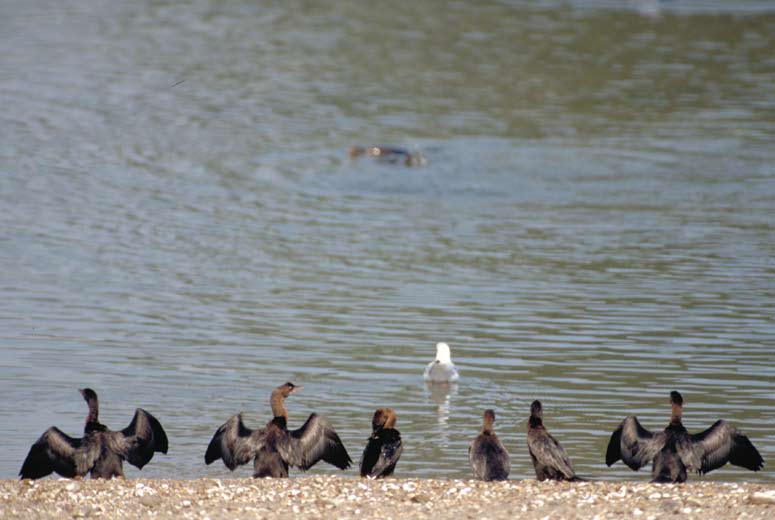
The Danube River Basin provides habitats for more than 300 varieties of birds, all of which depend on a healthy river system for survival.
At the whole-country level, the amount of precipitation in 2006 was
The Danube mean annual discharges in 2006
FIG. 4
683.5 mm (against a 647 mm climatological norm). The amounts
above normal were in January, February, May, July, September
9000
through December and those in excess of the average were in March,
8000
April, June and August, and resulted in a 5.6% annual positive
7000
deviation against the reference period, with a precipitation pattern
6000
within the normal limits.
5000
4000
Wide deviations in the excess domain against the norm were reported
3000
in March at 118.9% and August at 105.8%. From September to the
2000
end of the year, the precipitation pattern displayed a deficit, with a
55.0% negative deviation recorded in December (fig. 3).
1000
0
m³/s-1
rkm
2500
2000
1500
1000
500
0
long-term annual average
mean annual discharge 2006
//////(/////// România //// ÅÎ
12
,,Ëfl //// Moldova //// ìÍªÌ //// Deutschland //// Österreich //// Ceská republika //// Slovensko //// Magyarország ////// Slovenija /// Hrvatska //
The values of the total precipitation in 2006 as well as the relative
in the upper danube, 2006 was a year of weather extremes:
Bosn
precipitation in the same year when compared to a long-term annual
eight out of twelve months were drier than normal, while the
a i H
average in the Danube catchment in selected countries are shown in
spring months of march to may and august were too wet.
erceg
table 1:
ovina //// Srbija //// C
Total precipitation in 2006
rna Gora //// România //// ÅÎ,,Ëfl //// Moldova //// ìÍªÌ ////
Table 1
Country
total annual precipitation in 2006 [mm]
relative annual precipitation in 2006 [%]
germany
917
93
austria
1012
98
Czech republic
719
100.5
slovakia
772
102
hungary
584
97
slovenia
1127
84
serbia
712
105
Bosnia and herzegovina
920
90
romania
683
106
Looking at water quality trends
Monitoring water quality
Higher than average concentrations of ammonia were recorded in
In 2006 in the Czech Republic, 170200 parameters were monitored
Germany, due to the meteorological conditions in spring. Snowmelt
in the Lanzhot station on the Morava River and the Pohansko station
and thunderstorms resulted in elevated values for suspended solids
on the Thaya River. Most of the results, according to the Czech classi-
in many samples, accompanied by an increase of concentrations of
fication, fell into classes I and II. Some results for COD, Hg, NH -N,
4
phosphorus and heavy metals. In the following warm and dry periods
NO -N, SO and PAH were within class III. Fecal streptococus, BOD,
3
4
water temperature increased significantly but the oxygen regime and
P , Fe , AOX exes were in class IV and only chlorophyl was in
total
total
nutrients were not affected.
class V. A number of parameters improved during 2006 relative to
2004: Hg Hg, Ni, Zn and Mn improved from class III to class II, AOX
Priority and hazardous substances were generally low or not detect-
improved from class V to class IV, BOD and P moved from class
total
able. A new monitoring programme for pesticides has been imple-
III to class IV.
mented, and first results show that pesticides were detected mainly in
small rivers exceeding quality standards during the pesticide applica-
In Slovakia there were no significant changes observed in water qual-
tion period while during the rest of the year concentrations were
ity compared to the 2004-2005 period. For the Danube River itself,
frequently below detection limits.
as well as for its tributaries the Váh River, the Hron River and Ipel'
River, the surface water quality generally shows relatively good con-
In Austria, a further improvement was achieved concerning the sapro-
ditions in the groups of oxygen regime, basic physic-chemical deter-
biological river water reflecting the situation of organic pollution.
minands and nutrients (except for the Ipel' River). Slightly higher
The assessment of rivers with a catchment area of >100 km2 (total
concentrations for total iron and total organic carbon were generally
length of river net 11.500 km) in 2005 proved that 88% have already
recorded. The worst situation regarding water quality is still alu-
achieved `very good' or `good' water quality (saprobiological water
minium concentrations and microbiological determinands (taking into
quality class I, I-II or II). Some 11% are between `good' and
account the national classification system), although an improvement
`moderate' quality (saprobiological class II-III), and less than 1%
is visible according to the lowered concentrations of both parameters.
is classified with poorer quality due to organic pollution (saprobio-
logical class III).
//////(/////// România //// ÅÎ,,
13
Ëfl //// Moldova //// ìÍªÌ //// Deutschland //// Österreich //// Ceská republika //// Slovensko //// Magyarország ////// Slovenija /// Hrvatska // Bosna i Hercegovina //// Srbija //// Crna Gora //// România //// ÅÎ,,Ëfl //// Moldova //// ìÍªÌ ////
Water quality in the Danube has
improved during the last decade, but
further improvement is still needed.
In general, compared to the previous year, no significant changes
Based on initial water monitoring assessment results, water quality at
in water quality were observed in the Hungarian part of the Danube
the national level in Romania in 2006 was: 85% high and good status
River Basin. In Serbia, significant changes were not detected as com-
water quality, about 8% moderate status and about 7% poor or bad
pared to previous years. According to the current categorisation law
status. The improvement of river water quality in recent years was
in Serbia, the water quality of the Danube River in 2006 was class
mainly due to the reduction and disappearance of some industrial and
II/III. Values for the Saprobic plankton index as per Pantle-Buch were
agricultural units, especially the large polluters. At the same time,
between 1.82 and 2.40 and the saprobic degree as per Liebman was
this improvement was possible as a result of better implementation
-mezosaprobic.
of measures applied for the improvement of water status such as
increasing inspections and controls and more strict application of
permitting procedures by the national water authorities in Romania.
Assessing conditions
There were no major changes observed in water quality in Slovenia
The Saprobic Index (SI) for benthic macro-invertebrates mean
as compared to recent years. The water quality at the Sava Jesenice na
value was 2.10 at the entrance into the country at Bazias, 2.02 at
Dolenjskem monitoring station improved as a result of reduced emis-
Pristol/Novo Selo, 2.15 upstream at Arges, 2.1 at Chiciu/Silistra and
sion of AOX. According to the saprobic index for benthic invertebrate
2.21 downstream at Reni before the entrance to the Danube Delta.
fauna both Slovenian TNMN stations belong to quality class II.
it was the combination of the march and april precipitation
and the first snowmelt that caused a major increase in discharge
of the danube as well as severe flooding.
14
3. Integrated river basin management:
implementation of the
EU Water Framework Directive
the eu water Framework directive (wFd) is the highest priority for the danube countries, and all countries within the basin have committed to it, whether
they are legally required to or not. the main environmental objectives of the wFd are to reach a good ecological and chemical status for all surface water
bodies, a good chemical and quantitative status for groundwater bodies and the good ecological potential for heavily modified water Bodies by 2015.
To meet these objectives, the ICPDR's goal is to compile the Dan-
Significant water management issues
ube River Basin Management Plan, including a Joint Programme
Information from the Roof Report identified four Significant
of Measures, by 2009. The River Basin Management Expert Group
Water Management Issues (SWMI) in the Danube River Basin:
coordinates the work for the River Basin Management Plan with
1. pollution by organic substances
support from all other ICPDR Expert Groups. The creation of the
2. pollution by nutrient input
Danube River Basin Management Plan will be possible through the
3. pollution by hazardous substances
intensive cooperation of all ICPDR Expert Groups and the active
4. hydromorphological alterations.
input of all Danube countries.
Issue papers related to each significant water management issue in
A tremendous achievement towards the River Basin Management
the Danube River Basin have been drafted, and will be completed
Plan was the Danube Basin Analysis (Roof Report) in 2004. This
in 2007. The issue papers provide an overall strategy and guidance
analysis was the first characterisation of the entire Danube River
for addressing each issue, for developing a relevant management
Basin regarding the natural characteristics of the basin and the exist-
approach regarding measures and for improving status all on a
ing pressures and impacts.
basin-wide scale. The documents include management objectives for
the entire basin, based on visions which will guide the Danube coun-
The Roof Report is the basis for all further steps towards creating the
tries towards a common environmental aim.
Danube River Basin Management Plan. However, several other docu-
ments have been drafted to guide efforts towards a joint River Basin
the creation of the danube river Basin management plan will be
Management Plan, including a strategy paper for the development of
possible through the intensive cooperation of all iCpdr expert groups
a Danube River Basin District Management Plan and a corresponding
and the active input of all danube countries.
Road Map/Work Plan. The strategic steps and timelines to achieve the
final plan are included in these documents.
Outlining future plans
The River Basin Management Expert Group, together with the other
Expert Groups, began work on a summary of the issue papers for the
document on significant water management issues as required by the WFD.
This document will be the first outline of the Danube River Basin
Management Plan/Joint Programme of Measures, describing the
agyarország //// Slovenija //// Hrvatska //////// Bosna i Herce
overall scope as well as the approach to achieving it. The document
will include visions and management objectives for each issue,
and will be available to the public by the end of 2007.
/////// ÅÎ,,Ëfl //// Moldova //// ìÍªÌ // / Deutschland //// Österreich ///////
//////(// Srbija //// Crna Gora //// România //// ÅÎ,,Ëfl //// Moldova //// ìÍªÌ //// Deutschland //// Österreich //// Ceská republika / / Slovensko //// M
/
15
The ICPDR, with support from the UNDP GEF/Danube Regional
the danube river Basin management plan will include a
Project, organised a workshop on wFd and hydromorphological alterations
Joint programme of measures and follow the basin-wide approach.
in the danube river Basin, on 10-11 July 2006 in Neusiedl/See, Austria.
Approximately 70 participants attended the workshop representing
all Danube countries, stakeholders, NGOs and the scientific com-
Comparing quality classes
munity. The findings of the workshop and its three different working
The intercalibration exercise (IC) was finalised in 2006. The Eastern
groups provided valuable input for further developing the issue paper
Continental Geographical Intercalibration Group (EC GIG) was
on hydromorphological alterations.
jointly coordinated by the River Basin Management Expert Group
and Monitoring and Assessment Expert Group. The aim of the IC
The workshop provided a sound basis to enable the definition of the
exercise was to compare national quality classes among countries
main future tasks/deliverables towards the Programme of Measures
according to the normative definitions of the WFD. Austria, Bul-
related to hydromorphological alterations as part of the River Basin
garia, the Czech Republic, Hungary, Romania and Slovakia partici-
Management Plan, enabled the revision and further development of
pated in the IC exercise, which included five different types in the
the iCpdr issue paper on hydromorphological alterations in the danube river
Eastern Continental region.
Basin, will serve as a basis for drafting of the document on Significant
Water Management Issues and continued the stakeholder discussion
In mid-September 2006 the ICPDR reported the exercise results to
related to the issue of hydromorphology.
the European Commission's Joint Research Centre. The intercalibra-
tion exercise was successful within the Eastern Continental region,
although it could not be fully completed the requirements of the
Taking action
WFD are not fully satisfied. The main shortcomings were the exist-
As part of the activities for the issue paper on hydromorphological
ing lack of data and existing WFD compliant methods when the
alterations, the River Basin Management Expert Group established a
IC exercise was performed. However, the IC exercise improved the
sturgeon task group in the Danube River Basin. All remaining sturgeon
knowledge on the issue considerably and the existing gaps are fully
populations are near to extinction in the Danube River Basin and
identified as the basis for further steps.
action must be taken to ensure they survive. The Task Group
identified the overlaps of the Sturgeon Action Plan and the River
Basin Management Plan to identify further steps needed. So far, a
feasibility study regarding the restoration of longitudinal continuity
through the Iron Gate I & II and habitats is included within the
issue paper on hydromorphological alterations in the danube river Basin and
could be part of the River Basin Management Plan.
Further, in the frame of the activities on hydromorphological altera-
tions, Austria, Hungary and Romania and the ICPDR Secretariat
drafted the document `Management problems of sediment quality
and quantity in the Danube River Basin'. The document includes a
agyarország //// Slovenija //// Hrvatska //////// Bosna i Herce
work plan to support the respective addendum in line with the Roof
Report. Operational conclusions focus on the process and further
work between 2007 and 2009. It will be annexed to the Issue Paper
on Hydromorphological Alterations.
//////(// Srbija //// Crna Gora //// România //// ÅÎ,,Ëfl //// Moldova //// ìÍªÌ //// Deutschland //// Österreich //// Ceská republika / / Slovensko //// M
16
Working together
Coordination of sub-basin activities is taking place for the Tisza,
Sava, Prut Basins and for the Danube Delta (see boxes), and river
basin management plans on the sub-basin level are being prepared.
Activities in the Tisza Basin are the most advanced Tisza Basin
Analysis was drafted in 2006 and will be completed in 2007. The
Sava Commission initiated the development of the Sava Basin
Analysis with ICPDR support.
All ICPDR expert groups are cooperating for River Basin Manage-
ment Planning, including the Public Participation Expert Group for
stakeholder involvement in frame of WFD, and the GIS and Informa-
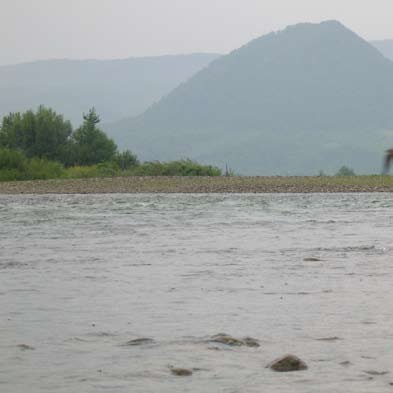
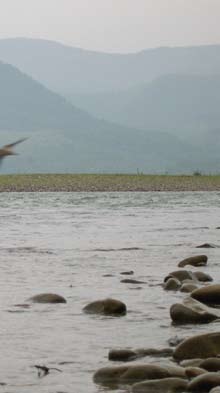
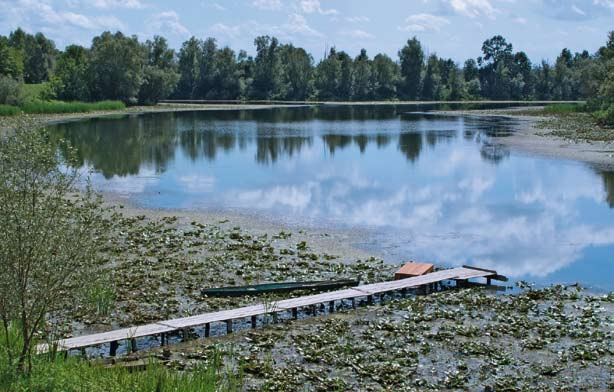
The Tisza River (left), together with its tributaries, drains the largest catch-
tion Management Expert Group, to make the Danube GIS interoper-
ment area in the Carpathian Mountains before flowing through the Pannon-
ian Plain to the Danube River. The Sava River (right) boasts large retention
able with the European Water Information System.
areas that are the most effective flood control systems in Europe.
The Tisza River Sub-basin
the tisza river sub-basin is the largest sub-basin in the danube river Basin, draining an area of 57,186 km2. the tisza is the longest tributary
of the danube at 966 km, and the second largest tributary by flow after the sava river.
According to the EU Water Framework Directive, member states may supplement the River Basin Management Plan by producing more de-
tailed programmes and management plans for sub-basins. The Tisza Group countries have made the decision to establish a Tisza River
Sub-basin initiative, to work together in the framework of the ICPDR to produce a sub-basin level Tisza River Basin Management Plan by
2009, which will also integrate issues on flood and water quality management.
Working together for sustainable development
At the first Ministerial Meeting of the ICPDR in December 2004, ministers and high-level representatives of the five Tisza countries signed the
Memorandum of Understanding, an effort towards a river basin management plan for the Tisza River Sub-basin which would support sustain-
able development of the region. The ICPDR established the Tisza Group for coordination as well as implementation of this plan.
The Tisza Group consist of representatives nominated by the five Tisza River Basin countries Hungary, Serbia, Slovakia, Romania and
Ukraine as well as a representative from the EU and from the River Basin Management Expert Group. The Tisza Group also includes addi-
tional experts from organisations involved in Tisza-related activities, such as UNDP, UNEP, WWF and REC. Representatives from other organ-
isations may become accredited observers to the group through the procedures of the ICPDR relating to observer status.
Since the establishment of the Tisza Group, several meetings have been organised to achieve the first main objective to prepare the Tisza
Analysis Report, which will be presented at the Sixth Ministerial Meeting `Environment for Europe' in Belgrade in October 2007. To prepare
this Tisza Analysis Report, the Tisza Group is now supported by the European Commission EU Grant.
17
The Sava River Sub-basin
the sava river is the biggest danube tributary by volume (25%). it runs 946 km from west to east beginning in slovenia near the italian border
and ending at its confluence with the danube in Belgrade. the catchment area is 95,020 km2, which is some 12% of the danube Basin.
the sava river Basin is shared by slovenia, Croatia, Bosnia and herzegovina, serbia and montenegro which is not yet a contracting party of
the danube river protection Convention.
The Framework Agreement on the Sava River Basin (FASRB) and the Protocol on the Navigation Regime, both signed in 2002, promote
regional cooperation throughout the Sava River Basin on issues related to navigation, economic development, integrated water management
and environmental protection.
Under the FASRB, the Sava Basin states have agreed to cooperate in the integrated management of surface and ground water resources,
including a sufficient quantity and quality of water to protect, preserve and improve aquatic systems, and to protect against the harmful effects
of floods. Considerable emphasis in the agreement relates to maintaining and improving navigation, and to providing financing for the
construction of new, navigable waterways.
Establishing cooperation
The International Sava River Basin Commission was established in June 2005 and opened its Secretariat in Zagreb, Croatia, in January 2006.
The aims of the Sava Commission are to fully implement the Agreement, to facilitate opportunities for economic development and to enhance
relations and cooperation between the parties. One of the Commission's main tasks is to develop the Sava River Basin Management Plan in
line with the WFD.
Planning for the future
The River Basin Management Expert Group of the Sava Commission is focused on developing the Sava River Basin Analysis, which should be
finalised by the end of 2007. Input from the ICPDR is very well received in the Sava Commission, and is seen as guidance for development of
the Sava Analysis Report. The ICPDR strongly supports the sub-basin activities and the first step towards the Sava River Basin Management
Plan the development of the Sava Basin Analysis.
input from the iCpdr is very well received in the isrBC, and is seen as guidance for development of the sava analysis report. the iCpdr strongly supports the sub-
basin activities and the first step towards the sava river Basin management plan the development of the sava Basin analysis.
//////(//////////// Hrvatska /////// B
18
osna i
4. Keeping the Danube clean:
Hercegovina //// Srbija //// Crna G
pollution control strategies and the
ora //// România //// ÅÎ,,Ëfl //// Moldova //// ìÍªÌ //// Deutschland //// Österreich // Ceská r
EU Water Framework Directive
epublika // Slove
reducing pollution is a practical concern. after all, what most people, governments and communities want for their rivers, ecosystems and
nsko ///
regions is good water quality, clean rivers and a healthy environment. meeting those goals is one of the iCpdr's challenges.
///// Magyarország //// Slovenija //// Hrvatska ///
Full integration of EU policies into the national and basin-wide
A comparison of the significant point source emissions assessed for
pollution control strategies is a long-term challenge of the ICPDR. In
the Roof Report illustrates that only a few point sources are responsi-
the short term, the ICPDR is proposing a gradual approach based on
ble for about half the point discharges into the Danube River system.
key priority objectives of the EU Water Framework Directive (WFD).
Reduction of emissions (organic substances and nutrients) from these
sources would therefore lead to a remarkable reduction of the total
In response to the WFD requirements, a new system to collect and
point source pollution.
calculate emission data for the whole Danube River Basin has been
designed. This system has begun to be implemented in line with
In order to reach WFD objectives and to tackle the pressures result-
EU regulations and is bridging the efforts of the non-EU countries
ing from diffuse sources, the pollution control strategy of the ICPDR
in the basin that will use the European Data Collection Systems
aims to combine current implementation processes in both policy
and Methodologies.
fields the Common Agricultural Policy reform and the WFD.
The ICPDR pollution control strategy
Taking action to control pollution
The ICPDR's water pollution abatement activities continue to focus
There has been a high level of transposition of the EU directives
on the effective coordination of approaches to regional problems. The
into the national legislations of the accession Danube countries. The
ICPDR has undertaken one stage of the characterisation involving
Urban Wastewater Treatment Directive (UWWTD) and Integrated
the assessment of pressures on the water bodies, including point and
Pollution Prevention and Control Directive (IPPC) are considered
diffuse sources of pollution. This assessment allows for the identifica-
the most challenging areas for compliance. This is reflected in the
tion of water bodies which are at risk of failing to meet relevant WFD
long transition periods for the UWWTD (such as 2010 for the Czech
objectives. The following pressure categories have been considered in
Republic, 2015 for Slovenia and 2018 for Romania) or the IPPC
initial characterisation for their impact on water bodies:
(such as 2012 for the Czech Republic and 2011 for Slovenia).
organic pollution (point and diffuse sources of pollution)
hazardous substances
nutrient pollution
hydromorphological alterations.
throughout the basin, planning and construction is under way to
provide water pollution control and abatement from municipal and
The results of the Danube Basin Analysis 2004 (Roof Report) pro-
industrial wastewater discharges into danube Basin waters.
vide further information about the pressures, impacts and economic
aspects of water uses. This is necessary to develop measures and
compare their effectiveness to support the achievement of WFD
objectives. Detailed information on pressures and impacts is needed
by 2007 to justify designating water bodies as heavily modified or
artificial, and for exemptions from the directive's objectives.
//////(//////////// Hrvatska /////// Bos
19
na i Hercegovina //// Srbija //// Crna Gora //// România //// ÅÎ,,Ëfl //// Moldova //// ìÍªÌ //// Deutschland //// Österreich // Ceská republika // Slovensko //////// Magyarország //// Slovenija //// Hrvatska ///
Implementing the Urban Wastewater Treatment Directive
The report of the project `development of the urban wastewater treatment
The risk assessment for organic pollution was based on a combined
in the danube river Basin' (20062007) gives a comprehensive overview
evaluation approach considering both significant pressures and in-
of development plans and cost estimates to implement the UWWTD
stream quality data. A water body is classified as being `at risk' if it is
for EU member states and accession countries, or the national devel-
subject to a significant pressure from municipal, industrial or agricul-
opment plans for urban wastewater treatment in the non-EU countries
tural point sources by exceeding the limit values for organic pollution
within the ICPDR and the anticipated impacts of these measures in
as defined by the agreed criteria at the basin-wide level.
terms of nutrient and organic pollution loads for 20062015.
The discharge of partially treated or untreated wastewater from urban
areas is especially significant and does not meet the requirements of
relevant EU legislation, in particular the UWWTD and the IPPC. In
2005, the COD and BOD discharges from significant point sources
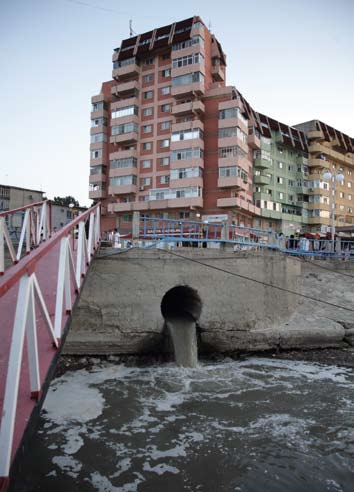
The contamination of groundwater and rivers by untreated wastewater is
(municipal, industrial and agricultural) were 741,069 tonnes and
one of the core problems in the Danube River Basin. The long-term effects
281,132 tonnes, respectively.
of such pollution reduce biodiversity in aquatic ecosystems, and affect
human water uses, such as drinking water sources.
The Saprobic Index using benthic invertebrates was used from the
point of view of the impact of organic pollution. The critical thresh-
olds were defined at the basin-wide level for the `at risk' category.
The evaluations of the risk analysis for the Danube are based on the
length of the water bodies that have been identified. Data on the risk
assessment is available for the total length of the Danube. Based on
the assessment, the percentages of river length were calculated as
being `at risk', `possibly at risk' and `not at risk'. In total, 58% of the
Danube is `at risk' or `possibly at risk' due to organic pollution. Also,
43% of the Danube's tributaries (with catchment >4,000 km2) is `at
risk' or `possibly at risk' due to organic pollution.
The Pressures and Measures Expert Group prepared methodologies to
improve the pressures analyses for municipal, agricultural and indus-
trial sectors. The overall goal for the Danube countries is to make the
best use of mandatory reporting requirements and time constraints
given by the implementation of the WFD.
20
Decision support for River Basin management plans
The update of MONERIS will provide a management tool for the
ICPDR in the decision-making process based on the comparison of
the effects of various measures implemented in different sectors,
The European Pollutant Release and Transfer Register in the Danube Basin
countries and regions in the Danube River Basin. Considering the
Member states are obligated to promote awareness of the European
WFD timeframe, a fully operational system is required at the drafting
Pollutant Release and Transfer Register (E-PRTR) and to take appro-
stage of the river basin management plan as well as the identification
priate measures to access the E-PRTR information.
of the programme of measures by the end of 2007. The goal is to de-
termine if the implemented measures or packages of measures meet
The `Development of the E-PRTR for the Danube River Basin' pro-
WFD and Danube River Protection Convention targets in one specific
posal promotes the development and implementation of integrated
sub-basin or the whole catchment. This will support the ICPDR in
national pollutants registers (PRTRs) within the EU accession and
giving policy advice to governments on the need to invest in nutrient
non-EU countries of the ICPDR.
reduction projects, or implement specific measures in response to EU
directives.
To ensure reporting under the E-PRTR, the ICPDR will launch a
broad Danube Basin consultation on the current status and possible
The system will allow for the calculation of scenarios for possible
developments in areas of environment policy which address impacts
changes of nutrient loads within the Danube River Basin and to the
of large point and diffuse sources on the environment. The ICPDR
Black Sea according to sets of measures proposed by the ICPDR.
is interested in the views of all stakeholders and encourages them to
There are many areas that may benefit from the update of MONERIS,
play an active role in the debate on implementation issues as well as
including pollution prevention and control, river basin management,
future developments.
design for priority investments and reporting.
It is therefore important that a clear understanding of the benefits of
reducing pollutant levels exists in Danube countries. The stakehold-
Nutrient pollution
ers must be prepared on either an individual installation or sectoral
Reducing nutrient pollution is especially important for the ICPDR
basis to recognise that the economic and social costs of some forms
given the expanded interest in reducing downstream eutrophication
of pollution prevention or control may not be justified by the benefits
problems in the Black Sea. Furthermore, nutrient reduction activities
in the short or longer term. Further, dissemination of good practice
would benefit all Danube managers including the European Com-
may also provide help to any Danube country that needs it.
mission, the ICPDR and Danube countries since nutrient pollution
was one of the four key issues identified as putting Danube countries
The ICPDR is committed to facilitating public access to information
at risk of not being able to meet WFD requirements. Countries were
relevant for Danube River Basin countries. Through its DANUBIS
also obliged to reduce their nutrient loads to meet other EU directives
information system, the ICPDR provides access to information on
including the UWWTD and the Nitrates Directive.
legislation, water pollution and water quality, data bases, funding
opportunities and policies at the EU, basin-wide and regional and
Other key ICPDR targets include introducing best agricultural prac-
national levels.
tices, conserving wetlands, improving the financial operations of
water and wastewater utilities, reducing phosphate use in laundry
Project results will be a major contribution to data availability and
detergents, improving public awareness and strengthening public
reliability of the ICPDR emission inventories and to the baseline sce-
participation.
nario of the Danube River Basin Management Plan, as improvement
of industrial wastewater treatment will account for a significant part
of the resources spent on water management in the next years.
/////////// Magyarország //// Slovenija //// Hrvatska //// Bosna i Hercegovina //// Srbija //// Crna Gora //// România //// ÅÎ,,Ëfl //// Moldova / / ìÍªÌ //// Deutschland //////// Österreich //// Ceská republika //// Slovensko //// Magyarország //// Slovenija //// Hrvatska //// Bosna i Hercegovina /// Srbija // Crna Gora // România / / ÅÎ,,Ëfl ///////// Moldova //// ìÍªÌ //// Deutschland
21
Joint action produces key results
the municipal projects in danube Basin countries, excluding germany
The achievements of the Joint Action Program (JAP) show there has
and austria, serve an estimated 22 million inhabitants.
been substantial legislative reform in particular the implementation
of EU community law within the Danube River Basin. The WFD has
strengthened efforts to coordinate actions supporting integrated river
The ICPDR's JAP, with support from DABLAS (Danube-Black Sea
basin management and pollution control and reduction. Still, the key
Task Force), prepared a prioritised list of investments for nutrient
challenge some Danube countries face in the policy field is to iden-
pollution reduction. The estimated total costs of these projects were in
tify the most effective ways of transposing EU environmental direc-
excess of 4,000 million USD with expected reductions of nitrogen
tives. Choosing how to achieve compliance with EU directives will
emissions by 50 kilotonnes/year (kt/a) and of phosphorus emissions
have a significant influence on compliance costs for countries.
by 9 kt/a. Total emissions to the Danube Basin prior to the projects
were estimated at 700 kt/a for nitrogen and 70 kt/a for phosphorus,
Throughout the basin, planning and construction is under way to
with the measured loads to the Black Sea estimated at 400 kt/a for
provide water pollution control and abatement from municipal and in-
nitrogen and 12 kt/a for phosphorus.
dustrial wastewater discharges into Danube Basin waters. Regulatory
demands regarding implementation of tertiary treatment are variable
The JAP will be `transformed' under the WFD to become part of the
among countries, depending primarily on how the sensitivity of sur-
programme of measures of the Danube River Basin Management Plan.
face water resources has been classified in national legislation. The
majority of the projects have tertiary treatment technology, as a result
The municipal projects in Danube Basin countries, excluding
of legislative transposition during the EU accession period. Nitrogen
Germany and Austria, serve an estimated 22 million inhabitants.
removal is more prevalent than phosphorus removal among municipal
A considerable amount of pollution reduction has been and will be
projects. However, all projects completed by 2003 do have tertiary
realised through the implementation of the 224 municipal waste -
treatment technology.
water projects. Annual reductions are estimated at more than
290,000 tons of BOD, nearly 45,000 tons of total nitrogen, and
approximately 18,000 tons of total phosphorus.
Overview of total projects
Table 2
pollution reduction [t/a]
no. of projects
Combined no. of inhabitants
Combined pe of wwtps
Bod
n
pr
total projects
224
21,845,158
32,534,026
291,082
44,685
17,887
/////////// Magyarország //// Slovenija //// Hrvatska //// Bosna i Hercegovina //// Srbija //// Crna Gora //// România //// ÅÎ,,Ëfl //// Moldova / / ìÍªÌ //// Deutschland //////// Österreich //// Ceská republika //// Slovensko //// Magyarország //// Slovenija //// Hrvatska //// Bosna i Hercegovina /// Srbija // Crna Gora // România / / ÅÎ,,Ëfl ///////// Moldova //// ìÍªÌ //// Deutschland
22
Securing project funding
International financing has been instrumental to the development
extended loans to municipalities for many of these projects, to help
of the municipal wastewater sector in the Danube River Basin.
cover co-financing requirements. The World Bank-GEF Investment
EU grant financing has played a large role in the funding of several
Fund has also participated in municipal wastewater projects, in addi-
projects throughout the EU countries and the EBRD (European Bank
tion to agricultural reform and other nutrient reduction efforts in the
for Rural Development) and EIB (European Investment Bank) have
basin.
Sources of funding
Table 3
source of funding [%]
Country
no. of projects
total cost [meur]
national
eBrd
eiB
eu
geF
wB
other iFi
missing
Bosnia and herzegovina
8
254.1
3.5
2
15.6
78.9
Bulgaria
33
325.5
21.1
1.8
2.7
70.7
0.3
3.4
Croatia
16
527
35.6
12.3
12
1.3
21.8
16.9
Czech republic
35
215.8
50.1
22.5
9.6
7.3
10.6
hungary
17
1,061.4
28
8.9
62.4
0.7
0
moldova
15
38
1.6
1.1
0.8
1.1
94.1
1.3
republic of serbia
8
605
31
0.8
1
4
63.9
romania
25
782.1
19
11.7
1.5
67.4
0.3
slovak republic
20
294.9
44.6
28.8
0.8
25.8
slovenia
34
390.7
44.3
3.6
45
0.4
6.7
ukraine
13
50.1
26.4
73.6
total
224
4,544.6
Of the 224 projects, 86 are fullyfinanced and have either been com-
Among the partiallyfinanced projects, the portion of local and na-
pleted or are being implemented. The combined investment cost of
tional co-financing is lower than for fullyfinanced projects. This
the 84 fully financed projects is approximately 2,268 million, repre-
indicates that these projects will require more grant financing than in
senting approximately 50% of the total.
the mid and upstream countries. Limited development in the waste-
water sector has been achieved in the downstream, non-EU countries,
The majority of the fullyfinanced projects are located in the four
including Bosnia and Herzegovina, the Republic of Serbia, Moldova
countries that joined the EU in 2004: the Czech Republic, Hungary,
and Ukraine.
Slovakia and Slovenia. A large proportion of project financing for
these investments came from local and national sources. Romania,
part of the EU since January 2007, also has a number of fullyfinanced Nutrient pollution and phosphates in laundry detergents
projects; significant achievements have been made there in the waste-
Recommendations are being provided to Danube national govern-
water sector since the last DABLAS update in 2004. Bulgaria and
ments on the use of phosphates in household laundry detergents and
Croatia have also progressed, but mostly with project preparation.
how consumers and industry can switch to alternative phosphate-free
rvatska //////////// Bosna i Hercegovina //// Srbija //// Crna Gora //// România //// ÅÎ,,Ëfl //// Moldova //// ìÍªÌ ////
products. Early studies have found detergent phosphates to be a major
urban contributor to nutrient pollution, and that their removal would
be the fastest and cheapest way to significantly reduce phosphorus
currently released into the basin.
/ / / (/ / / / / ÅÎ,,Ëfl //////// Moldova //// ìÍªÌ //// Deutschland //// Österreich //// Ceská republika //// Slovensko / // Magyarország // / Slovenija ///// H
23
rvatska //////////// Bosna i Hercegovina //// Srbija //// Crna Gora //// România //// ÅÎ,,Ëfl //// Moldova //// ìÍªÌ ////
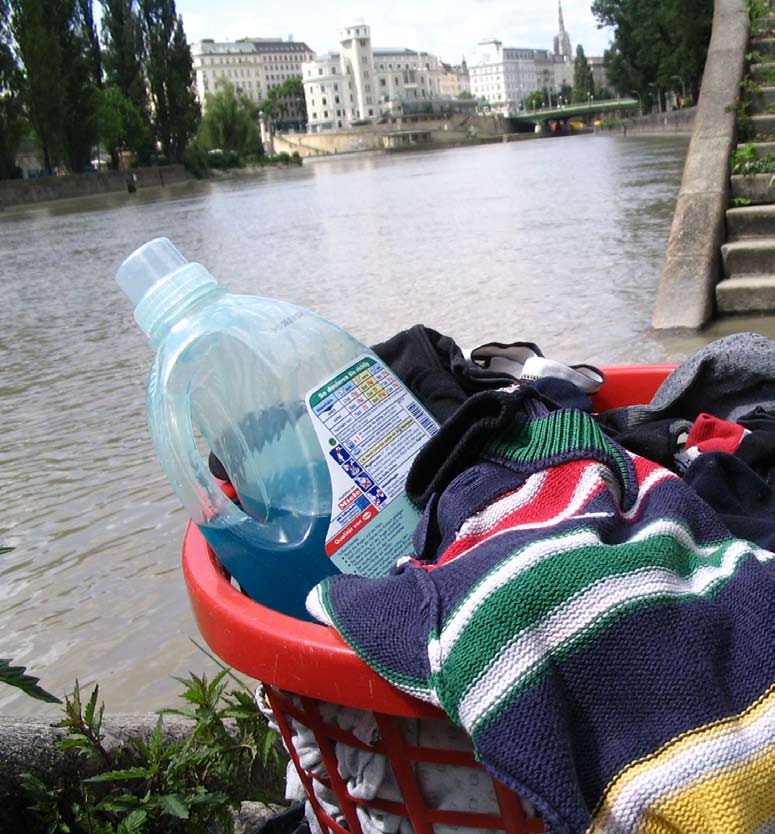
Phosphates are commonly used in domestic and industrial detergents to
soften water and make washing more effective. However, they can also lead to
excess nutrients in the river, reducing biodiversity through eutrophication.
/ / / (/ / / / / ÅÎ,,Ëfl //////// Moldova //// ìÍªÌ //// Deutschland //// Österreich //// Ceská republika //// Slovensko / // Magyarország // / Slovenija ///// H
24
5. Warning downstream neighbours:
the Danube Accident
Emergency Warning System
to respond to a pollution accident, downstream users need critical information to put environmental protection and
public safety measures into action and they need it fast.
In 2006, the Danube Accident and Emergency Warning System
(AEWS) was activated for eight accidents. An overview of the events
is given below:
Table 4
site & date of accident
affected river
primary pollutant
routing of international messages
petronell
danube, rkm 1891 to 1889
mineral oil
piaC-02 q piaC-04, piaC-05
`warning-pollution'
14.01.2006
danube upstream melk
danube, rkm 2072 to 2042
mineral oil
piaC-02 q piaC-04, piaC-05
`warning-pollution'
eutsch
03.03.2006
smederevo
danube, rkm 1112.2 to 1112
mineral oil
piaC-13 q piaC-08, piaC-09
`standard message'
03.04.2006
piaC-13 q piaC-08, piaC-09
`end of alert'
Jamena
sava, rkm 196 to 176
atrazine
piaC-13 q piaC-07, piaC-14
`warning-pollution'
17.06.2006
piaC-07 q piaC-13, piaC-14
`standard message'
Bratislava
danube at Bratislava
mineral oil
piaC-04 q piaC-05
`warning-pollution'
28.06.2006
piaC-04 q piaC-05
`end of alert'
oldova //// ìÍªÌ //// D
prahovo
danube, rkm 849 to 855
mineral oil
piaC-08 q piaC-09
`standard message'
02.10.2006
piaC-08 q piaC-13
`request for information'
piaC-08 q piaC-09, piaC-10, piaC-12
`standard message'
piaC-08 q piaC-09, piaC-10, piaC-12, piaC-13
`end of alert'
iCpdr/ps q piaC-08, piaC-09, piaC-12, piaC-13
`request for information'
Bulgarian danube
danube, rkm 824 to 817
mineral oil
iCpdr/ps q piaC-09, piaC-13, piaC-08
`request for information'
07.12.2006
piaC-08 q iCpdr/ps
`end of alert'
ânia //// ÅÎ,,Ëfl //// M
piaC-09 q iCpdr/ps, piaC-08, piaC-13
`warning-pollution'
om
Bulgarian danube
danube, rkm 790
mineral oil
piaC-09 q piaC-08
`warning-pollution'
22.12.2006
ora //// R
rna G
The overview table (table 4) shows that mineral oil was the most
One issue which still requires attention is ensuring the preparedness
common polluting substance released by accidents. Navigation
of the staff of the principal international alert centres to trigger the
was the major cause of these accidental spills, although leaks from
system promptly at the national level. The lessons learned from the
on-shore installations occur as well.
oil spills on the lower Danube from October to December 2006 show
the necessity of having sustainable emergency procedures in place
in the Danube countries to ensure timely and concerted actions of all
Ensuring efficient round-the-clock performance
stakeholders at the national level (river authorities, river inspectorates,
A test of AEWS, organised in November 2006, as well as the
civil protection, police, fire brigades, etc.) to respond to accidental
performance of the warning system during the accidents, showed that
water pollution. These procedures must include the timely activation
from the technical point of view, the internet-based system is
of AEWS.
performing well and is fully capable of distributing warning messages
in time and according to the operational manual.
/////// Deutschland ///////////// Hrvatska //// Bosna i Hercegovina //////// Srbija //// Crna Gora //// România //// ÅÎ,,Ëfl //// Moldova //// ìÍªÌ //// Deutschland / / Österreich / / Ceská republika / // Slovensko //// Magyarország //// Slovenija //////// Hrvatska //// Bosna i Hercegovina //// Srbija //// C
25
6. Guarding against high waters:
flood protection
in the Danube River Basin
winter 2005/2006 was exceptional: temperatures were below average from november to march over large areas in europe. in the danube region, several
cycles of intense snowfall accumulated large water supplies in the snow cover during winter. Consequently, the melting and fast runoff was due to
relatively high daily air temperatures and intensive rainfall. this led to increasing river water stages and caused several significant floods in the third
week of march and the first week of april.
The flood situation on the upper Danube was not critical in 2006. The
Reinforcing protection
Hydrological Service of the Slovak Hydrometeorological Institute
The most challenging situations existed in towns along the Danube
evaluated the discharges at approximately a 10 years' return period
River (Novi Sad, Belgrade, Smederevo, Veliko Gradiste and Golubac),
at the Devín and Medved'ov stations, and an average return period of
where flood protection structures have insufficient freeboard above
less than 50 years at the Komárno and Stúrovo stations.
the flood level, due to urban planning criteria. With major efforts
eutsch
made by organisations responsible for flood defence, citizens and the
An exception was observed in the Morava River Basin, where peak
Army, temporary dikes made of sandbags were erected in these cities
discharges were reached From March 3 to April 1 and discharges in
and towns on top of existing structures. Additionally, great efforts
some profiles reached values with a return period of 100200 years.
were made to increase the height of non-reconstructed levees along
The Dyje and Morava River catchments were struck simultaneously
the lower course of the Tisza, where water levels were influenced by
by floods a first in the 80 years´ history of discharge monitoring.
the Danube backwater. Secondary levee lines were built along the
oldova //// ìÍªÌ //// D
Flood discharges in Hungary (Nagymaros: 9,000 m3/s; Budapest:
Tisza to protect populated areas in the event of a main levee flooding
8,800 m3/s) indicated that this flood was in the range of an 80100
or breach.
years' return period
In Romania water levels induced the failure of longitudinal dikes
at the Ghidici-Rast-Bistret, Bechet-Dabuleni, Oltenita-Surlari-Dor-
Effective defence measures
obantu, Oltina, Ostrov-Pecineaga and Ciulinet-Isaccea enclosures.
In Serbia floods threatened the entire region along the Danube and
ânia //// ÅÎ,,Ëfl //// M
om
the Tisza, but as a result of the emergency flood defence measures
that were implemented, there were no levee overtopping or breaches.
Extremely high groundwater levels throughout the spring period oc-
ora //// R
curred in protected areas.
rna G
All levees along the Danube and the Tisza which were reconstructed
during the last 30 to 40 years in compliance with national technical
criteria were able to withstand long-lasting high water levels. Only
the unprotected areas were flooded (between levees, or very short
stretches without levees), and the damage identified below relates
to these areas. Residents were evacuated from these areas, as well as
from other areas where the safety of defences was assessed as insuf-
ficient, such as the Ada Ciganlija recreation centre in Belgrade.
/////// Deutschland ///////////// Hrvatska //// Bosna i Hercegovina //////// Srbija //// Crna Gora //// România //// ÅÎ,,Ëfl //// Moldova //// ìÍªÌ //// Deutschland / / Österreich / / Ceská republika / // Slovensko //// Magyarország //// Slovenija //////// Hrvatska //// Bosna i Hercegovina //// Srbija //// C
26
Breaches along the Danube, date and time
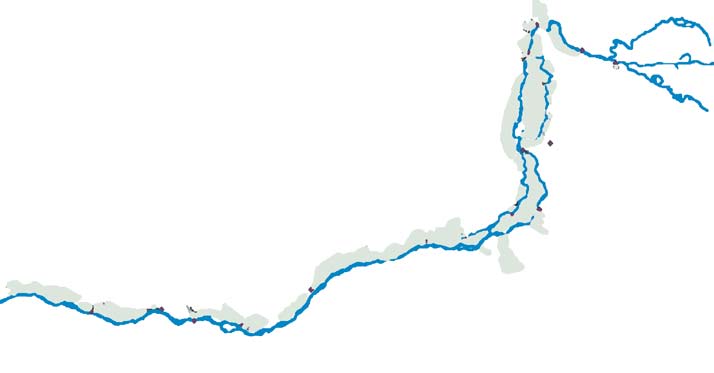
FIG. 5
Cardon, 24.04.2006, 7.00 hrs.
obretin, 20.04.2006, 12.00 hrs.
Ceatalchioi, 25.04.2006, 18.00 hrs.
Calaras¸i-râul, 17.04.2006,
16.00 hrs., controlled flooding
Canal Împut¸ita
rast, 14.04.2006, 11.30 hrs.
spant¸ov, 23.04.2006, 14.30 hrs.
21.04.2006, 14.00 hrs.
controlled flooding
Bistret¸, 24.04.2006, 7.50 hrs.
tatina, 3.05.2006, 11.10 hrs.
nedeia, 3.05.2006,
15.41 hrs., water evacuation
Bechet, 24.04.2006, 7.15 hrs.
from the enclosure
manastirea, 2.05.2006,
ostrov, 26.04.2006, 19.40 hrs.
17.10 hrs., water evacuation
from the enclosure
nedeia, 3.05.2006
15.41 hrs., water evacuation
oltina, 22.04.2006, 17.00 hrs.
from the enclosure
Facaieni, 15.04.2006,
19.00 hrs., controlled flooding
The large volume of stored water in the Ghidici-Rast-Bistret enclosure
Considering that dikes were under enormous pressure for almost
was followed by a partition dike failure to the Bistret-Nedeia-Jiu
two months, the opportunity was taken to analyse controlled breaches.
enclosure and stored water volume in the Bechet-Dabuleni enclosure
Two areas were flooded in a controlled manner through controlled
conducted to a partition dike failure to the Potelu-Corabia enclosure.
breaches (dynamiting dikes): in Calarasi county: Calarasi-Raul
In Oltenita-Surlari-Dorobantu two existing partition dikes were
10,748 ha and in Ialomita county: Facaieni-Vladeni 4859 ha.
damaged.
//////// Hrvatska //// Bosna i Hercegovina //// Srbija //// Crna Gora //// România //// ÅÎ,,Ëfl //// Moldova //// ìÍªÌ // Deutschland // Österreich //// Ceská republika //// Slovensko //// Magyarország
27
Estimating damage and losses
germany Bavaria
There were no victims, and larger damage to settlement areas and
infrastructure was prevented by flood control measures.
the Czech republic
Three people lost their lives during the flood in the Morava
River Basin.
Flood damage in the Morava River Basin was estimated at 70 mil-
lion and heavy damage to agricultural land due to flooding also
occurred with 16,000 hectares of agricultural land underwater.
slovakia
The floods in Slovakia caused almost 2.8 billion SKK (approximately
74 million) worth of damage. The costs for safeguarding and safety
works were estimated to be 376 million SKK (9.9 million), and
approximately 2424 billion SKK ( 64.1 million) for repairing damage
to property of state, municipalities, inhabitants, etc. 512 municipalities
were directly affected by floods, 915 people were evacuated, 1 human
life was lost.
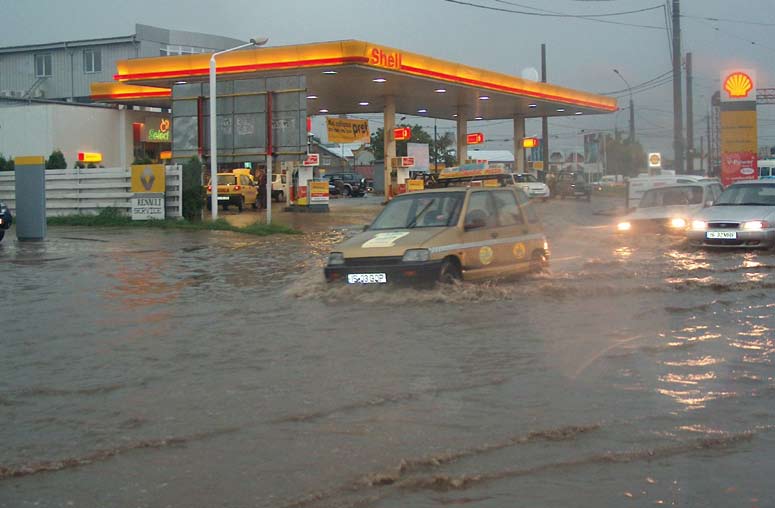
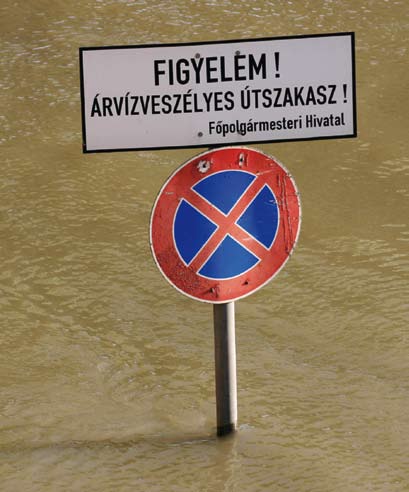
The Danube River Basin struggled to cope with devastating
floods that swept though the region this year, ravaging
communities and causing millions of euros in damages.
//////// Hrvatska //// Bosna i Hercegovina //// Srbija //// Crna Gora //// România //// ÅÎ,,Ëfl //// Moldova //// ìÍªÌ // Deutschland // Österreich //// Ceská republika //// Slovensko //// Magyarország
28
hungary
There were no flood victims. According to the post-flood assessment,
damage and losses occurred in the floodway and in the open flood-
plain on 385 properties upstream from Budapest, without exception.
Nearly 30% of the damage was registered in Szentendre, Nagymaros
and Visegrád. The cost of repairing damage to private property was
HUF 192 million (approximately 770,000), and the cost of repairing
damage to the properties of municipalities, including public roads
damaged by heavy traffic due to emergency operation and damaged
facilities like ports and ferries was HUF 595 million (approximately
2.3 million). Restoration costs are of course higher, totalling
HUF 861 million (approximately 3.5 million).
In Budapest, 39 public properties (buildings roads and defence struc-
tures) and 51 private properties were damaged, costing nearly
HUF 100 million (approximately 400,000) in repairs. Hydro meteo-
ro logical conditions of 2006 justified a different level of alert along
different river stretches, and a summary of the costs of emergency
operations is given below for different periods.
Table 5
1 Jan 3 apr 2006
4 10 apr 2006
11 apr 30 June 2006
nomination
valley
prior to extraordinary alert
during extraordinary alert
after extraordinary alert
total [mil huF]
total [mil )
Flood emergency
danube valley
389.0
1,011.0
629.0
2,029.0
8.07
recovery of the capacity
of the defences during
flood fighting
danube valley
569.2
569.2
total
2,598.2
10.3
Table 6
1 Jan 14 apr 2006
15 apr 9 may 2006
10 may 15 July 2006
nomination
valley
prior to extraordinary alert
during extraordinary alert
after extraordinary alert
total [mil huF]
total [mil )
Flood emergency
tisza valley
3,263
10,279
4,427
17,969
71.5
The costs of emergency operations along the Tisza and its tributaries
include the immediate recovery interventions ordered to secure the
stability of the flood defences.
/////// Româ//////// Magyarország //// Slovenija //// Hrvatska //// Bosna i Hercegovina //// Srbija //// Crna Gora // România //// ÅÎ,,Ëfl //// Moldova //// ìÍªÌ //// Deutschland //////// Österreich //// Ceská republika //// Slovensko //// Magyarország //// Slovenija //// Hrvatska //// Bosna i Hercegovina //// Srbija //// Crna Gora //// România ///// ÅÎ,,Ëfl // Moldova

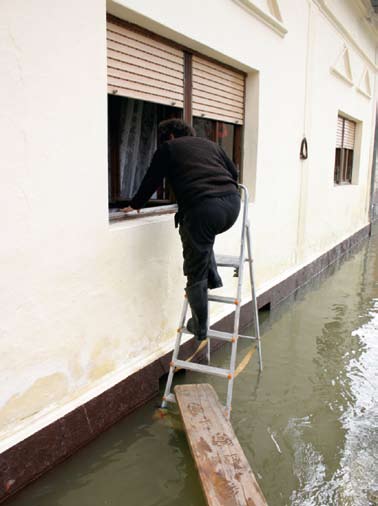
29
Swollen rivers and rising ground-
water levels caused widespread
damage and forced thousands to
leave their homes.
serbia
In 2006, 240,000 hectares of agricultural land within Serbia was
flooded, approximately half by rivers and half by groundwater. During
April and May 2006, 2000 houses in 30 communities within unpro-
tected areas were flooded. Civil Defence forces evacuated about 1000
residents and there were no flood victims.
Water management companies reported flood defence costs of
approximately 10 million. The cost of repairing preliminary damage
was estimated at roughly 40 million.
romania
In total, 681 dwellings and 487 bridges and footbridges were
destroyed, and 2598 dwellings were affected. There were no human
losses during the flooding. The estimated total cost for repairing
damage in Romania amounted to approximately to 200 million.
Table 7
affected constructions
railroads and roads
destroyed
affected
dependencies
wells
railroads
local, county and
Bridges and
other
County
dwellings [no.]
dwellings [no.]
[no.]
[no.]
[km.]
national roads [km.]
footbridges [no.]
constructions [no.]
teleorman
9
28
-
27
-
-
1
5
olt
3
5
87
-
-
4
11
4
Calaras¸i
312
792
934
866
-
1
4
4
giurgiu
-
8
3
-
-
0,2
-
2
galat¸i
-
-
-
-
-
-
-
1
Constant¸a
7
141
145
3
0.5
3
4
1
Braila
-
11
-
-
-
-
-
-
ialomit¸a
2
2
8
-
-
2
1
-
tulcea
144
101
-
-
-
-
-
-
dolj
372
919
596
2,133
21.0
3
169
48
mehedint¸i
29
79
-
70
-
2
134
-
/////// Rom
Caras¸ severin
3
442
990
782
2.4
6
163
3
â//////// Mag
total
681
2,598
2,763
3,881
23.9
22
487
67
yarország //// Slovenija //// Hrvatska //// Bosna i Hercegovina //// Srbija //// Crna Gora // România //// ÅÎ,,Ëfl //// Moldova //// ìÍªÌ //// Deutschland //////// Österreich //// Ceská republika //// Slovensko //// Magyarország //// Slovenija //// Hrvatska //// Bosna i Hercegovina //// Srbija //// Crna Gora //// România ///// ÅÎ,,Ëfl // Moldova
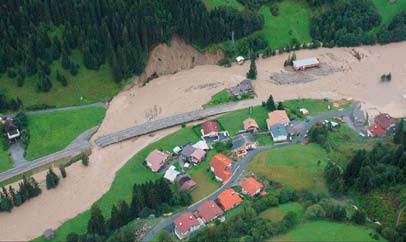
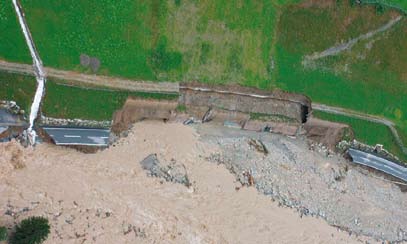
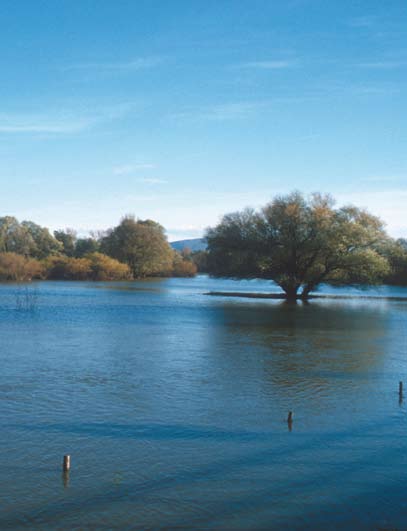
30
rvatska / / Bosna i Hercegovina / / Srbija / / Crna Gora //// România //// ÅÎ,,Ëfl //// Moldova //// ìÍªÌ //// Deutschland /////////// Österreich //// Ceská republika ////
oldova / / ìÍªÌ //// Deutschland //// Österreich //// Ceská republika //// Slovensko //// Magyarország //// Slovenija / / / / H
/ / / / / / ÅÎ,,Ëfl / / M
Opportunities for learning
germany Bavaria
In the German Danube catchment the flood events during March and
April 2006 brought about water levels that required only local meas-
ures for flood control. The Bavarian flood protection strategy with its
components of `natural retention', `technical flood protection' and
`flood precaution' also a part of the ICPDR's Flood Action Pro-
gramme proved to be effective.
slovakia
The floods emphasised the need for:
appropriate technical measures in localities for intense seepage
in the bodies and backgrounds of dikes, such as seals,
underground walls and seepage canals
revisions and repairs to several pumping stations
improvement of the quality of the grass slopes of the dikes
removal of scrubs from channel banks and flood plains
revision of current flood plans incorporating new experiences
from the floods.
The heavy floods that inundated Central
and Eastern Europe this spring underlined
the urgent need for all countries in the
Danube River Basin to work together to
protect against floods.
31
rvatska / / Bosna i Hercegovina / / Srbija / / Crna Gora //// România //// ÅÎ,,Ëfl //// Moldova //// ìÍªÌ //// Deutschland /////////// Österreich //// Ceská republika ////
oldova / / ìÍªÌ //// Deutschland //// Österreich //// Ceská republika //// Slovensko //// Magyarország //// Slovenija / / / / H
/ / / / / / ÅÎ,,Ëfl / / M
hungary
Croatia
Thanks to successful emergency operations, the extreme floods of
It was noticed that a lot of problems were caused not by high water
the Danube and Tisza rivers passed without disaster. Success was
levels, but by the long duration of the flood. There were a significant
achieved through the experience that the participating organisations
number of seepage incidents, through and under the dikes. Fortu-
and their staff gained during previous floods.
nately, all problems of this type were solved in a very short time and
without further consequences. This, however, highlights the impor-
In detail:
tance of the detailed control of existing dikes, and the reconsideration
forecast and warning:
of the design standards for new ones. Additionally, careful monitoring
indispensable prerequisites of successful flood mitigation are accurate
of dikes during floods proved to be vital for successful flood defence.
information and forecasting and proper evaluation of the situation.
the application of lisFlood in a number of cases could prolong the lead
serbia
time of warnings on tributaries.
The 2006 flood defence action revealed a number of general and
Better utilisation of the possibilities of hydrodynamic modelling is needed,
operational deficiencies. Existing regulations, guidelines and prac-
and forecasts should be based on consideration of the results of different
tices need to be amended as follows:
methods.
a comprehensive natural disaster strategy (including floods) should be
land use:
enacted at the national level and should resolve civil defence issues.
Building permission processes must better consider the advice of water
Flood defence structures should have the highest priority in the program for
directorates to reduce damage potential in flood prone areas.
water infrastructure Construction, reconstruction and maintenance.
it is necessary to introduce the classification of land according to the
adequate funding must be provided and construction and reconstruction
danger of inundation and the connecting limitations in the detailed
projects must be executed to upgrade defence lines along the danube and
physical plans and land registers.
the tisza.
development of the flood defence system:
hydrologic monitoring, forecast and warning systems should be enhanced.
Flood mitigation experiences again justified that natural and financial
a high level of connection between hydrometeorological station serbia and
expenditures on emergency operations are substantially lower along
the danube river Basin system is needed.
defence sections meeting the standards. this is why it is imperative to
Flood zoning should be completed as set forth in the danube river Basin
make every effort to develop defence structures to meet standards.
Flood action plan.
however, based on flood emergency experiences, revisions and updates of
the long-term development plan of flood defence system must be made,
with special regard to prioritising and solutions. special attention has to
be paid to the development of the defences of municipalities, with empha-
sis on those of Budapest, and to the reconsideration of summer dikes.
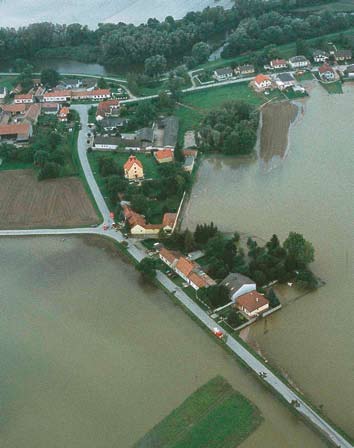
32
romania
moldova
The information flow and the action mode in operative centres
For a more successful and safer management of spring floods, a
emphasised better coordination, removing difficulties from 2005
deeper spring depletion of the water catching reservoirs is needed.
floods. The measures taken last year from a legislative and technical
An annual inspection of the state dike banks is required and their
point of view induced real coherence and an early response to threats.
appropriate elevation level must be ensured.
However there were some difficulties, organisationally and legisla-
tively, regarding maintenance of hydraulic structures and updating
The Danube Early Flood Alert System
documentation.
Despite some drawbacks of the current system (coarse calibration
and coarse resolution input data), the snowmelt floods of 2006 were a
To improve the adequate response to manage emergency situations,
great success for the Early Flood Alert System (EFAS), operationally.
the following is needed:
In total, more than 50 reports were sent to partner organisations, and
intervention equipment and tools specific to each risk type
the start of the floods (particularly the start of the Elbe and Danube
the elaboration of a concept for integrated preparation of all decision makers floods in the Czech Republic) were very well forecasted several days
in this kind of risk
in advance. In Slovakia the EFAS reports were used operationally and
the organisation of volunteer services for emergency situations;
brought added value to the flood forecasts.
training courses for public administration and for members of operative
centres for emergency situations
an increase in the number of exercises, both decision-information flow and
intervention
integrated medical care units set up in all county inspectorates for
emergency situations
the realisation of risk studies with risk scenarios behind dikes in the areas
One element of the ICPDR's Flood Action Programme is the
development of a new international flood warning system,
with high density of population
overseen by the ICPDR, which supplements national systems
the improvement of international cooperation inside the danube Basin
and gives up to 10 days' warning of expected floods.
(especially with the serbian part) to improve forecasting and decisions
concerning the management of hydraulic structures
the future solution for danube's floodplain rehabilitation should be taken
into account for the new national strategy for Flood risk (approved in de-
cember 2005) based on the new european principles included in the future
Flood directive in the course of approval referring to people and goods pro-
tection through the realisation of structural defence works such as reservoirs,
polders, dikes and high water derivation, wetland restoration for preserving
and development biodiversity and peak flow mitigation.
agyarország / // Slovenija //// Hrvatska //// Bosna i Hercegovina //// Srbija //// Crna
/////////////// Österreich //// Ceská republika //// Slovensko //// Magyarország //// Slovenija //////////// Hrvatska //// Bosna i Hercegovina //// Srbija //// Crna Gora /// România //// ÅÎ,,Ëfl //// Moldova //// ìÍªÌ //// Deutschland //// Österreich // Ceská republika // Slovensko //// M
33
7. Minimising risks:
the Accident Prevention Task Group
the activities of the accident prevention task group in 2006 were based on the assessment of contaminated sites and follow-up to the iCpdr resolutions
regarding the status of country reports on accidental risk sites, as well as on the idea of transboundary assistance in case of large accidental pollution
and the contingency planning in connection with mutual assistance.
Assessing contaminated sites
Mutual assistance and contingency planning
The UNDP/GEF Danube Regional Project (DRP) supported the Task
The Programmes and Measures Expert Group and the Accident
Group in developing a methodology to assess contaminated sites.
Prevention Task Group are preparing a proposal to assess the capacity
The existing inventory of contaminated sites susceptible to flooding
for ensuring necessary assistance is given to affected countries in the
with both former industrial sites and former waste deposits is
event of accidental pollution by elaborating procedures for mutual
considered a `Working List'. The updated inventories may provide a
assistance, on the basis of EU and ECE legislation and bilateral
clear picture of the potential risk sites as well as possible targets to
agreements.
reduce and control accidental pollution.
The Accident Prevention Task Group will more precisely assess exist-
ing mechanisms and their features for mutual assistance as well as for
Checking technical safety
contingency planning. Recommendations for the introduction of spe-
The DRP consultants prepared recommendations for in-plant pipeline
cific ICPDR mechanisms for mutual assistance and for contingency
safety, sealing systems, fire prevention, storage facilities and equip-
planning will be developed on the basis of these findings.
ments of tanks. The Recommendation for Refineries checklist is
available, which also covers requirements for wastewater treatment
plants. The Task Group will prepare a concept for implementing the
risk assessment methodology and checklist at the national level.
An important component of the Task Group's work is to develop the
methodology for the `Quantification of real risk' to determine the
potential danger, calculate the modified Water Risk Index and assess
treatment plants.
the updated inventories of contaminated sites may provide a clear picture
of the potential risk sites as well as possible targets to reduce and control
accidental pollution.
agyarország / // Slovenija //// Hrvatska //// Bosna i Hercegovina //// Srbija //// Crna
/////////////// Österreich //// Ceská republika //// Slovensko //// Magyarország //// Slovenija //////////// Hrvatska //// Bosna i Hercegovina //// Srbija //// Crna Gora /// România //// ÅÎ,,Ëfl //// Moldova //// ìÍªÌ //// Deutschland //// Österreich // Ceská republika // Slovensko //// M

34
8. The flow of information:
ICPDR information systems
and public participation
providing access to information arms stakeholders with the knowledge they need to make a difference in the danube river Basin.
After a thorough design phase, the new ICPDR website, www.icpdr.org,
within nine months of its launch, more than 30,000 people visited the
was launched on 27 March 2006. Within nine months, more than
iCpdr website an average of 1,300 visits per week.
30,000 people visited the website an average of 1,300 visits per
week (see fig.6). The total number of page views was over half a
million.
The website targets interest groups, decision makers, journalists, sci-
entists and the general public. To accommodate this diverse range of
people and backgrounds, all pages provide a progression in depth of
knowledge: a very short introduction is followed by a more detailed,
but still easy-to-read text. Further information is provided as in-depth
documents in PDF format for download, as well as links to related
content and other websites. Four main sections group the content geo-
graphically, by issue, by sector and the fourth section provides the
solutions: the ICPDR, projects, programmes, publications and events.
The visual design supports this clear structure while conveying the
The ICPDR homepage
and the Danube Day website
vision of an intact environment in the Danube River Basin.
keep visitors up-to-date
on news and events and
provide access to documents
and detailed information.
Keeping users up-to-date
The home page always provides access to the latest news and most
important topics. Additional useful features are available: users can
ICPDR publications
adjust the font size to their own needs, recommend a page to a friend
In 2006, four issues of danube watch, including a double issue, were
by email and search the site by keywords. The website will be con-
published 10,000 copies of danube watch were printed per issue and
tinually updated to provide links to all publications of the ICPDR and
distributed for free. In addition, danube watch can be downloaded from
related projects.
the ICPDR website. External funding was received in 2006 from the
UNDP/GEF Danube Regional Project for one issue and from the
The Danube Day website, www.danubeday.org, was also redesigned to
Federal Ministry of the Environment, Nature Conservation and
better communicate this year's topic and put the country events into
Nuclear Safety of Germany for the double issue. The other issue was
the centre of attention. The website had more than 12,000 visitors and
financed through the ICPDR budget.
177,000 page views this year 25% of them within the two months
surrounding the Danube Day event.
Other publications were produced in 2006 highlighting the work
of the ICPDR:
the danube river Basin overview map
a poster featuring the fish of the danube river Basin.
//////////// Magyarország //// Slovenija //// Hrvatska //// Bosna i Hercegovina //////// Srbija //// Crna Gora //// România //// ÅÎ,,Ëfl //// Moldova //// ìÍªÌ //// Deutschland //// Österreich //// Ceská republika //// Slovensko //// Magyarország //// Slovenija










More than just a valuable source of
nutrition for the human population,
healthy numbers of fish serve as an
important indicator of the biological
Beluga
quality of the river. To celebrate Danube
Huso huso
Day, a special poster highlighted several
of the fish that live in the basin.
Danube salmon
European Catfi sh
Hucho hucho
Silurus glanis
Pikeperch
Sander lucioperca
Danube Roach
Rutilus pigus
Bream
Pike
Abramis brama
Esox lucius
Assessing contaminated sites
Burbot
Lota lota
Knife
The UNDP/GEF Danube Regional Project (DRP) supported the Task
Pelecus cultratus
Blue Bream
Abramis ballerus
Group in developing a methodolo
ICPDR information system Danubis gy to assess contaminated sites.
Nase
Chondrostoma nasus
The existing inventor
The ICPDR infor
y of contaminated sites susceptib
mation system Danubis, www.icpdr le to flooding
.org/danubis,
Zingel
Asp
Zingel zingel
Aspius aspius
with both former industrial sites and for
continued to support the deleg
mer w
ations and exper aste deposits is con
t groups as an inter
-
nal
Schraetser
Gymnocephalus schraetser
sidered a `W
w
orking List'. The updated inventories ma
orking area to share documents and other infor
y provide a clear
mation related to
picture of the potential risk sites as w
their work.
ell as possible targets to reduce
White Bream
Abramis bjoerkna
Sterlet
Danube Bream
Acipenser ruthenus
Abramis sapa
and control accidental pollution.
Danubis also provides access to several databases: the Transnational
Danube Streber
Danube Ruffe
Barbel
Zingel streber
Gymnocephalus baloni
Barbus barbus
Monitoring Network (TNMN) Database, the Emission Inventory
Checking technical safety
Database and the DABLAS Investment Projects Database. The
The DRP consultants prepared recommendations for in-plant pipeline
TNMN Database is updated yearly and currently contains water
safety, sealing systems, f
quality data from the y ire prevention, storage f
ears 19962004.
acilities and equip-
ments of tanks. The Recommendation for Refineries checklist is
Danube River Basin geographical information system
available, which also co
During 2006, 190 ne
vers requirements for w
w users were re
astewater treatment
gistered to Danubis, increasing
The prototype of the Danube River Basin geographical information
plants. The Task Group will prepare a concept for implementing the
the total number of users to 670. Access to the databases is open to
system (DANUBE GIS) was launched in January 2006. The system
risk assessment methodolo
everyone upon re
gy and checklist at the national le
gistration.
vel.
was tested by the members of the Information Management and GIS
Expert Group and further development steps were defined in more
An important component of the Task Group's work is to develop the
detail based on the System Definition from 2005. The Umweltbun-
methodology for the `Quantification of real risk' to determine the
desamt Wien/Vienna started with the implementation, which will be
potential danger, calculate the modified Water Risk Index and assess
finished in June 2007. Since December 2006, the system has already
treatment plants.
been used to collect GIS data in common template formats that are
filled out and uploaded by countries.
Number of weekly visits (at least one page view per person) to the ICPDR sites in 2006
FIG. 6
number of visits per week
number of visits per week
2,000
2,000
1,800
1,800
1,600
1,600
1,400
1,400
1,200
1,200
1,000
1,000
800
800
600
600
400
400
200
200
0
0
Week 1 2 3 4 5 6 7 8 9 10 11 12 13 14 15 16 17 18 19 20 21 22 23 24 25 26 27 28 29 30 31 32 33 34 35 36 37 38 39 40 41 42 43 44 45 46 47 48 49 50 51 52 Week
//////////// Magyarország //// Slovenija //// Hrvatska //// Bosna i Hercegovina //////// Srbija //// Crna Gora //// România //// ÅÎ,,Ëfl //// Moldova //// ìÍªÌ //// Deutschland //// Österreich //// Ceská re
iCpdr
danube day
danubis
publika //// Slovensko //// Magyarország //// Slovenija
/ / // Slovensko
36
/ / /
9. Inviting public participation
/ Magyarország //// Slo
participation by stakeholder groups is vital for the iCpdr, and from the beginning the iCpdr has worked to ensure that international stakeholders are
venija //// Hr
actively involved in its working groups and delegation meetings. securing the active participation of stakeholder groups is a cross-sectoral initiative and
vatska //// Bosna i Hercegovina //// Srbija //// Crna Gora
their involvement is encouraged in all expert groups, not just the ad-hoc public participation expert group. only the full involvement of interest groups can
/ / R
ensure the integrated management of the danube river Basin.
omânia // ÅÎ,,Ëfl // M
While stakeholder participation takes place throughout the work of
oldov
the ICPDR, the Ad-hoc Public Participation Expert Group focuses on
a //// ì
the outreach programme of the ICPDR. The Ad-hoc Public Participa-
ͪÌ
tion Group organises programmes like Danube Day and the Danube
//// Deutsc
Box, and facilitates networking and information sharing between
hland //// Österreich //// Ceská republika
countries.
via donau Österreichische Wasserstraßen-Gesellschaft mbH
/ / / /
The organisation was founded in January 2005 by the Austrian
Slove
In 2006, the Ad-hoc Public Participation Expert Group launched a
Federal Ministry of Transport, Innovation and Technology for the
nsko
network of experts throughout the basin, and the Expert Group is
preservation and development of the Danube waterway. The company
/ / M
currently working on:
was formed by the merger of Österreichische Donau-Betriebs AG,
agya
sharing public participation experiences regarding the eu water
Österreichische Donau-Technik GmbH, via donau Entwicklungs-
rorsz
Framework directive (wFd) at the national level
gesellschaft mbH für Telematik und Donauschifffahrt and the priva-
ág //
linking different levels of implementation local, national, sub-basin and
tised Waterways Authority. Authority is held by via donau to operate
Slo
international for public involvement activities
v
waterways and execute sovereign functions on behalf of the federal
enija
developing joint activities for danube day
authorities with regard to waterways and waterway transport. In addi-
/ / H
discussing and implementing joint outreach projects
tion to the tasks of federal waterway administration and transport
rvats
ensuring the flow of information between iCpdr national experts.
development, via donau carries out pioneering work by planning and
ka / /
managing the Integrated River Engineering Project east of Vienna
Bosna
as well as operating a navigation information system called Danube
i Hercegovina //// Srbija //// Crna
Broadening cooperation
River Information Services (DoRIS).
The ICPDR has committed to cooperating more closely with the
navigation sector on the Danube and its navigable tributaries. Work-
In cooperation with national and international partners, via donau
ing together is necessary to focus on the next steps to implement the
implements projects designed to intensify waterway transport. Thus,
WFD and develop the Danube River Basin Management Plan.
the company contributes significantly to safeguarding business
In 2006, two new organisations joined the ICPDR as observers,
locations for Austrian companies as well as to the environmentally
representing navigation interests: via donau and the European Barge
friendly management of future traffic volumes along the Danube
Union.
corridor.
The European Barge Union
The European Barge Union (EBU) was founded in December 2001
to represent the inland navigation interests towards the European and
international institutions.
The association has its seat in Brussels, Belgium and Rotterdam,
Netherlands, and members of EBU are also based in Germany, Aus-
tria and the Czech Republic. The association represents the interests
of inland navigation on a pan-European level and handles all ques-
tions of the future development of the inland navigation industry and
inland waterway transport.
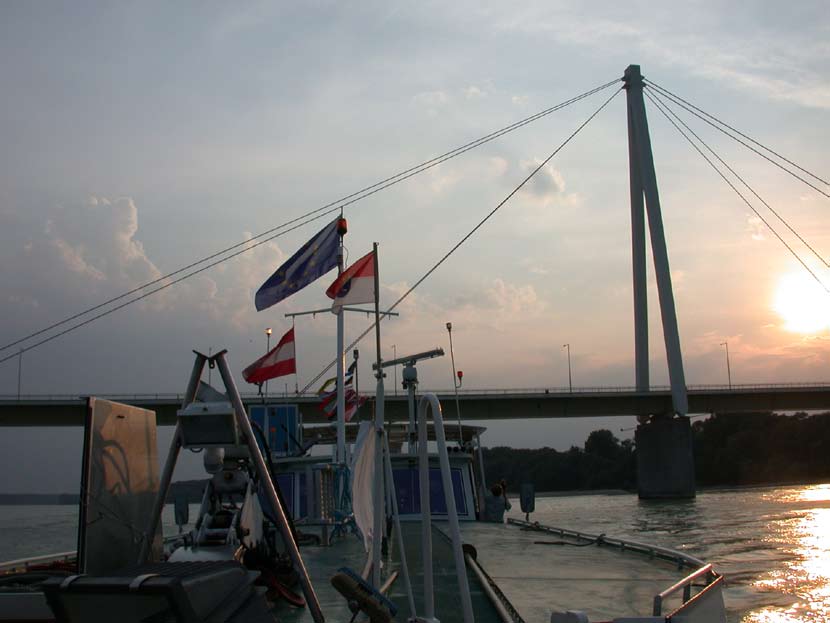
/ / // Slovensko /
37
/ / / Magyarország //// Slovenija //// Hrvatska //// Bosna i Hercegovina //// Srbija //// Crna Gora // România //
Å
The ICPDR's public participation programmes link diverse
Î,,
communities of international stakeholders by actively involving
Ëfl
them in ICPDR working groups and delegation meetings.
/ / Moldova //// ìÍªÌ //// Deutschland //// Österreich //// Ceská republika //// Slovensko // Magyarország // Slovenija // Hrvatska // Bosna i Hercegovina //// Srbija //// Crna
The EBU focuses on:
the development of the european transport policy
only the full involvement of interest groups can ensure the
the improvement of the economic position of inland navigation
integrated management of the danube river Basin.
the structured cooperation with national and international institutions
the exchange of information and experience between the parties involved.
38
10. Shared river, shared responsibility:
international and regional cooperation
with 81 million people sharing the danube river Basin, it takes broad cooperation involving national and international institutions to ensure that the
ecological and economic value of the river can be preserved for future generations. to achieve the goal of integrated river basin management, the iCpdr
cooperates with regional and international agencies, non-governmental organisations and scientific and business communities.
The Danube Regional Project
encouraging change
The long-term objective of the Danube Regional Project (DRP),
The DRP Small Grants Programme is the DRP's main vehicle for
funded by UNDP and GEF, is to help countries reduce nutrient and
engaging local stakeholders. In early 2006, a total of 62 NGOs were
toxic pollution in the Danube and its tributaries to permit Black Sea
awarded over $636,000 to reduce nutrient and toxic pollution to
ecosystem recovery, and to strengthen transboundary cooperation
Danube waters. This second round of grants was financed by the DRP
among countries in the region. In anticipation of the project's end in
via the Regional Environmental Center (REC). The NGO projects
2007, many activities were finalised in 2006 following an exit strat-
were launched in 11 Danube River Basin countries Bosnia and
egy which defined the scope of the DRP support to the ICPDR until
Herzegovina, Bulgaria, Croatia, Czech Republic, Hungary, Moldova,
the end of the project and identified activities which need to be
Romania, Serbia, Slovakia, Slovenia and Ukraine. Examples of
continued by the ICPDR, governments, institutions and other stake-
project goals include promoting best agricultural practices, environ-
holders to ensure the sustainability of the project results.
mentally-friendly detergents and wastewater cleaning systems for
households.
implementing wFd requirements
In April, the ICPDR and DRP co-hosted the `WFD and Agriculture'
Raising awareness about Danube issues and solutions through
workshop in Malinska, Croatia, to identify tools to support the imple-
strategic communications and encouraging public participation in
mentation of the WFD in the Danube River Basin, especially rural
environmental decision-making have been key features of the DRP's
development measures available under the EU Common Agricultural
activities. In a basin-wide `Dissemination Workshop' held October
Policy and to create better coordination between government water
1617, at the REC in Szentendre, Hungary, 50 participants from
managers and agriculture managers in the basin. One key result was
13 Danube countries met to discuss tools and methodologies to
agreement on the need to implement a set of regulatory, financial and
improve public access to information about water quality and to share
information and communications measures.
best practices, many of them developed through the DRP sub-project.
The DRP launched a new project to help Sava River Basin country
introducing best practices
governments Croatia, Bosnia and Herzegovina, Serbia and Slovenia
Eight farms were selected as demonstration sites for the DRP's Phase
develop their Sava River Basin Management Plan under the coordi-
II project to reduce water pollution from agriculture. The farms, with
nation of the new Sava River Basin Commission. This assistance will
pig and cattle production ranging in size from small and medium to
put the Sava countries into a pilot position in terms of WFD imple-
large, are located in Vojvodina, Serbia and Montenegro. The farms
mentation in Europe.
are testing the application of newly introduced best agricultural prac-
tices, and results have been transferred to other Danube countries
through national training workshops.
//////////// Magyarország //////// Moldova //// ìÍ
In late April, the report on recommendations for how Danube Basin
ªÌ / /
governments can enact voluntary agreements to reduce the use of
/ Deut
phosphates in detergents was presented to the ICPDR's Pressures and
schla
Measures Expert Group. Early studies found detergent phosphates to
nd / /
be a major urban contributor to nutrient pollution, and that the fast-
/ Öste
est and cheapest way to reduce the amount of phosphorus currently
rreich
released into the basin would be to remove them.
/ / Ceská republika /////////// Slovensko
/ / / / / / / / / / Slovensko / / Magyarország //// Slovenija //// Hrvatska //// Bosna i Hercegovina //// Srbija //// Crna Gora //// România //// ÅÎ,,Ëfl // / Moldova / / ìÍªÌ //////////
//// Magyarország //// Slovenija //// Hrvatska
39
protecting and restoring wetlands
looking to the future
A DRP-funded campaign was launched by the NGO Daphne in
The DRP will hold its final seminar on february 2122, 2007, in
Slovakia to raise awareness about the importance of wetlands in river
Bucharest, Romania, to disseminate overall DRP results since the
basin management. The campaign is linked to a DRP project encour-
project began in 2001, discuss how they will be used by the ICPDR,
aging national water managers throughout the Danube Basin to better
and to get feedback and lessons learned from Danube countries and
use wetlands in reducing water pollution, and to include such actions
the ICPDR. Selected participants will include representatives from
in their national plans for meeting the WFD. It also links to the Inter-
ICPDR delegations and expert groups, international organisations
national Wetlands Campaign of the Danube Environmental Forum,
and NGOs.
which includes Daphne as a member.
The seminar will be followed by a high-level meeting of ministerial
The sub-project Monitoring and Assessment of Nutrient Removal
representatives from Danube and Black Sea countries where Environ-
Capacities of Riverine Wetlands began with the establishment of
ment Ministers from all of the 16 countries sharing the Danube River
a literature database with over 130 scientific reports and a project
Basin and Black Sea region and the European Commission will adopt
database with over 50 projects dealing with wetland restoration and/
a new Declaration on the Enhancement of Cooperation. The Declara-
or nutrient removal in the Danube Basin. Three pilot sites in Moldova, tion will recognise the important values of the Danube/Black Sea
Romania and Ukraine were also selected to develop and implement
region, the historical damage that it has undergone and recent signs of
wetland restoration and nutrient retention programmes. These real
environmental recovery as a result of cooperative actions.
world examples will highlight the importance of including nutrient
removal into wetland management planning, to be incorporated into
a final `Guidance Document' in wetland restoration and management
for wetland and river basin managers. A final meeting disseminating
15 Years of Managing the Danube River Basin: 19912006:
the DRP's overall efforts related to wetlands will be held in the
a brochure celebrating the work of the drp presents the key political decisions
Danube Delta in April 2007.
made related to building river basin management in the danube Basin over
15 years and their results. the brochure highlights the lessons learned with the
hope of transferring them to other river basins.
/ / / / / / / / / / Slovensko / / Magyarország //// Slovenija //// Hrvatska //// Bosna i Hercegovina //// Srbija //// Crna Gora //// România //// ÅÎ,,Ëfl // / Moldova / / ìÍªÌ //////////
40
Phosphorus loads discharged
by the Danube into the Black Sea
FIG. 7
river loads and emissions (1000 tp/a)
//// ///////////// Deutschland //// Österreich //// Ceská republika //// Slovensko //// Magyarország //// Slovenija //// Hrvatska //// Bosna i Hercegovina /// Srbija //// Crna Gora //// România //// ÅÎ,,Ëfl / / Moldova //// ìÍªÌ //// Deutschland //// Österreich //// Ceská republika //// Slovensko //// Magyarország //// Slovenija //// Hrvatska //////// Bosna i Hercegovina ////
140
120
The Danube-Black Sea Joint Technical Working Group
100
In 2006, the ICPDR began evaluating the provision of data on
80
ecological status and content of priority substances in sediments and
60
biota in the Danube close to the Black Sea, and the ICPDR reports
40
annually to the Black Sea Commission (BSC). The Joint Technical
Working Group assesses the completeness and suitability of para-
20
meters provided and the extent and character of missing data.
0
1995 1960 1965 1970 1975 1980 1985 1990 1995 2000
For the Danube, the data on pollutant loads discharged to the Black
diffuse source emissions
Sea are based on the Transnational Monitoring Network (TNMN)
industrial and agricultural point sources
station at Reni. The data on loads of suspended solids, inorganic
nitrogen, phosphates, total phosphorus, BOD5, ammonium, nitrates,
nitrites, total nitrogen, cadmium, copper, lead, mercury and silicates
from 2005 on are taken from the TNMN load assessment programme.
evidence of eutrophication in the danube river Basin and Black sea
The ICPDR and BSC discuss ways to strengthen efforts to present
information on the influence of the northwest shelf of the Black Sea
and the ecological status of the Black Sea. A technical report on the
state of knowledge of the impact of the Danube on the Eutrophication
of the northwest shelf of the Black Sea was prepared by the UNDP/
GEF Danube Regional Project (DRP) and the Black Sea Ecosystem
Recovery Project (BSERP).
The ecological situation in the Black Sea has improved considerably
in the last decade, including reduced eutrophication, reduced appear-
ance of anoxic conditions and regeneration of zoo-benthos and phyto-
plankton. This improvement is due to nutrient removal at wastewater
treatment plants, the replacement of phosphate-containing laundry
detergents in some countries and the economic crises in
several countries during the 1990s leading to a reduction of loads
from industry and agri-industrial discharges.
Phosphorus loads discharged by the Danube River in 2000 are
3050% lower than in the 1980s. The current emissions are similar to
those in the 1960s (fig. 7).
The Black Sea is the most isolated sea in the world geographically,
but cooperation such as that between the ICPDR and the Black Sea
Commission is bringing the goal of rehabilitation and protection of
the Black Sea closer than ever before.
41
//// ///////////// Deutschland //// Österreich //// Ceská republika //// Slovensko //// Magyarország //// Slovenija //// Hrvatska //// Bosna i Hercegovina /// Srbija //// Crna Gora //// România //// ÅÎ,,Ëfl / / Moldova //// ìÍªÌ //// Deutschland //// Österreich //// Ceská republika //// Slovensko //// Magyarország //// Slovenija //// Hrvatska //////// Bosna i Hercegovina ////
steps for the future
For the Black Sea, the BSC will prepare a statement on historical
The Danube-Black Sea Joint Technical Working Group agreed to
data and on the methodology for the development of the Black Sea
review the indicators used to assess the impact of the Danube River
monitoring system necessary for collecting the data on ten agreed
on the Black Sea. This review would include a precise definition of
indicators. The BSERP has analysed the quality of data and applica-
the indicators, including the measurements needed and any interpreta-
bility of information on indicators collected, and this information will
tion of this data, and be in line with the European Marine Strategy.
be used to assist in further development of the monitoring system of
the Black Sea (called BSIMAP). An analytical quality control system
It is essential that both Commissions would ensure that all contracting
for the Black Sea monitoring programme has to be developed, and it
parties deliver required information on agreed parameters and indica-
is expected that monitoring coastal waters will also be included in the
tors in a timely and comprehensive manner.
BSIMAP.
42
The DABLAS Task Force provides a cooperation platform for the protection of water and
water-related ecosystems in the Danube and Black Sea Region, and ensures there is coordinated
action between all financial instruments operating in the region.
DABLAS Task Force
The Danube-Black Sea Task Force (DABLAS) Implementation
DABLAS should explore which elements of the WFD process could
Working Group was established in 2005 to continue work on past
be beneficial and promote the sharing of experiences and good
activities, including the project pipeline development and improve-
practices. The investment needs and the programmes and projects for
ment of reporting on pollution reduction following the DABLAS
improving the environmental situation in the Danube region
initiative. New tasks set at the 5th DABLAS Task Force meeting in
will emerge from the WFD/ICPDR process. DABLAS, together
Istanbul, Turkey, in July 2006 have been jointly implemented with
with EU Water Initiative, facilitates the identification of funding
the ICPDR, including widening the scope of DABLAS to cover
sources to implement these projects and ensure that financing is
all measures identified under WFD implementation, linking the
swift and efficient.
WFD and EU Water Initiative and identifying special initiatives for
the Black Sea and Danube countries.
Additional joint efforts are necessary to establish an efficient analysis
and financing process based on the principles of the WFD, including
The ICPDR considers that there is scope to use the WFD as a tool to
coastal waters, in the Black Sea region. The lessons learnt from the
implement the goals of DABLAS for countries where the WFD is
Danube region could be transferred into other major river basins dis-
not directly relevant. For the EU member states and the accession
charging into the Black Sea.
countries, where the WFD is a driving force, DABLAS should focus
on facilitating and financing the identified programme of measures
under the WFD. For the other DABLAS countries,
43
Alcoa Foundation
Green Danube partnership with the Coca-Cola system
The specific objectives of the ongoing two-year Alcoa Founda-
On 2005 The Coca-Cola Company and its largest European bottler,
tion grant, implemented in the Mures River Basin, fit within Alcoa
Coca-Cola Hellenic Bottling Company S.A., signed a Memorandum
Foundation's area of excellence `Conservation and Sustainability'
of Understanding with the ICPDR for the joint protection and pres-
and support the monitoring efforts of Romania and Hungary in trans-
ervation of the Danube River. Under the agreement, the three parties
boundary areas.
started work towards celebrating the Danube River as a symbol of life
and the environment in Central and Eastern Europe. The Memoran-
In 2006, the Arad branch of the Romanian National Administration
dum of Understanding encourages the participation of other leading
Apele Romane received new laboratory equipment, a TOC and Ntotal
companies, extends celebrations of Danube Day, and works with local
analyser and atomic absorption spectrophotometer, made possible
governments, educational institutions and NGOs on hands-on projects
through Alcoa Foundation. The equipment was used for the Mures
in Bulgaria, Hungary, Romania, Serbia, Slovakia and Ukraine.
River Basin to provide the necessary laboratory analysis at the Arad
laboratory to meet ICPDR and WFD reporting requirements. The
In 2006, the partnership has achieved:
grant also provided training which allowed professionals to use
Financial support for international danube day 2006 celebrations
appropriate equipment, learn about new assessment techniques and
Financial support for travel of the winner of the danube art master Competi-
enhance their perception of the impact of water pollution.
tion to vienna in december 2006
Financial and technical support for national activities in serbia, Bulgaria,
Building stronger partnerships
romania, moldova, hungary, ukraine, Croatia, austria and slovakia, involv-
The second grant implemented in 2006 focused on encouraging
ing danube day celebrations and other water related initiatives
partnership between communities, governments and NGOs to reduce
technical support for the development of the `Business Friends of the dan-
pollution and protect natural resources. One result of this partner-
ube' programme
ship is the development of a handbook for the ICPDR, its affiliates
Financial and technical support for the development of the danube Box edu-
and extended network to use to cultivate and pursue partnerships
cation materials for the danube river Basin.
with multi-stakeholders. The handbook will be finalised in 2007 and
will also complement the ICPDR's internal training programmes and
For more information about Danube Day and the Danube Box, see
workshops with stakeholders.
chapter 11, 12.
The handbook will provide advice on identifying and involving com-
munities of interest in shared concerns and common ground. It will
include ways of determining the potential nature and scope of public
involvement, ensuring there is ongoing participation and feedback on
the evaluation of partnerships. The handbook will highlight the best
practices and lessons learned about using water quality monitoring
data to communicate with different internal and external stakeholders
within the Danube River Basin.
Cooperation in Romania
in addition to the alcoa Foundation grants, the apele romane water authority in oradea has identified supplementary resources to organise and launch
an ecological awareness campaign in the Black Cris river Basin to identify the best approaches for engaging and educating the public about pollution control.
opportunities also arose from the new partnership with the business sector, such as with the wastewater treatment plant of the largest drinks producers in
romania european drinks in ordea.
44
11. River of Life:
Danube Day 2006
Celebrations stretched across the region on June 29 for danube day 2006. approximately 250,000 people attended 130 events in 13 countries.
danube day inspired change across the basin and made a difference to the future of rivers and the people who rely on them.
As the 2006 ICPDR President, the spotlight was on Moldova to host a
Bringing communities together
grand celebration and they did not disappoint turning the `Day' into
In Serbia, visitors travelled to 12 towns at once by viewing exhibi-
a `Danube Week' involving over 6000 people. Focus was on the Prut
tions from almost every Serbian city on the river, enjoying the distinc-
River, Moldova's western border with Romania, where Environment
tive traditions and rich history of each. The sight of 20 traditional
Ministers from both countries, Constantin Mihailescu and Sulfina
wooden boats sailing down the Mura greeted 3000 visitors in Slov-
Barbu, jointly opened Danube Day at the Costesti-Stinca Reservoir.
enia this year as a reminder of the river's past.
Cross-border ministerial events, cultural and awareness raising cel-
ebrations, river clean-up days and actions to improve water quality
The slogan for Danube Day in Bulgaria, where events centred on
ensured it was a week of celebration and achievement.
flood prevention at a meeting of the Basin Council at Pleven, was
`Protect the river in order to be protected by her'. Celebrations in
Croatia included a touching commemoration and day of thanks in
Exploring natural habitats
Vukovar to those who worked so hard during the dramatic Danube
Budding young ecologists from the Vylkove Danube Club in Ukraine
floods of April 2006.
took part in a two-day expedition to record the most threatened fish
species: the sturgeon. School children in Austria were introduced to
the river's amazing wildlife with river safaris to the Lobau. In Regens-
burg, Germany, children were captivated by creepy-crawlies and fun
water experiments at a `Water and Life Day'.
On riverbanks in Bosnia and Herzegovina, children paid tribute to the
Danube by creating artworks, reciting poetry and learning about river
science in natural surroundings. A returning highlight from last year,
Slovak children sent `Danube Greetings' as messages of international
goodwill to the region. Startling and inspirational environmental
films and artworks took centre stage at this year's Czech Danube Day.
Seven days of celebration in Romania included outdoor activities like
the `Danube Walk', a day of merriment and summer dancing. Stur-
geon fever came to Hungary with the Three Nations (ViennaBratis-
lavaGyör) giving cycling enthusiasts from six countries the chance
to share experiences and highlight the EU Sturgeon Action Plan.
//// //////////////// Bosna i Hercegovina /// Srbija //// Crna Gora //// România //// ÅÎ,,Ëfl / / Moldova //// ìÍªÌ //// Deutschland / // Österreich //// Ceská republika //// Slovensko / / Magyarország / / / / Slovenija / / Hrvatska //// Bosna i Hercegovina //////// Srbija //// Crna Gora //// România //// ÅÎ,,Ëfl //// Moldova //// ìÍªÌ //// Deutschland //// Österreich ///////// Ceská republika //// Slovensko
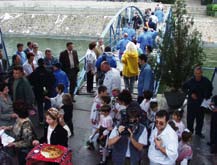
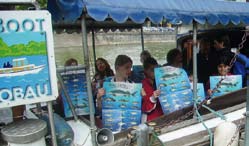
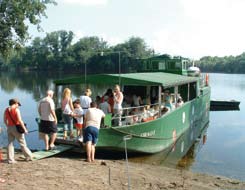
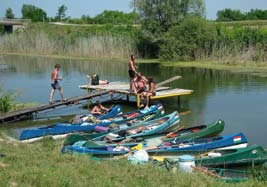

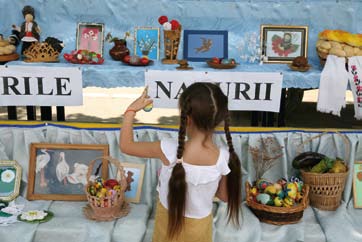
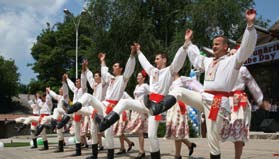
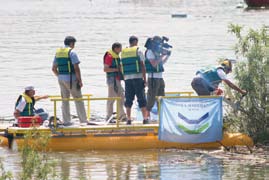

Tens of thousands participated in Danube Day events ranging
from conferences and workshops to concerts and exhibitions all
designed to entertain, educate and enthral!
//// //////////////// Bosna i Hercegovina /// Srbija //// Crna Gora //// România //// ÅÎ,,Ëfl / / Moldova //// ìÍªÌ //// Deutschland / // Österreich //// Ceská republika //// Slovensko / / Magyarország / / / / Slovenija / / Hrvatska //// Bosna i Hercegovina //////// Srbija //// Crna Gora //// România //// ÅÎ,,Ëfl //// Moldova //// ìÍªÌ //// Deutschland //// Österreich ///////// Ceská republika //// Slovensko
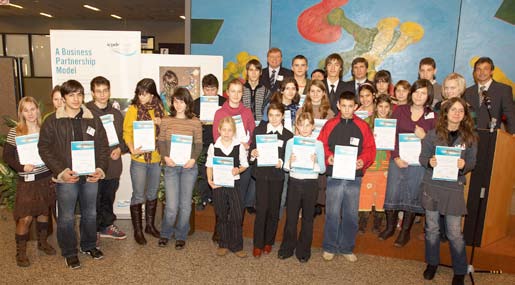

46
Danube Art Masters in Vienna
Turning the river into art
Twenty-six young artists chosen as national art masters from around
Participants were challenged to visit their local rivers and to contem-
the Danube River Basin met in December 2006 in Vienna to award
plate what the river means to them. The winning entry expressed the
the 2006 International Danube Art Masters to four 17-year-olds from
solidarity of humans with the Danube by using body painting and
Romania for their piece `The Danube Flows Through Us'.
natural materials. "We had so much fun when making the art. And at
the same time we felt connected with the other pupils all along the
The `International Danube Art Master 2006' competition is part of
Danube and its tributaries!" said co-winner Simona Oana Udrea.
Danube Day and the International Master is selected from the winners
of the national `Danube Art Master' competitions, which are held in
The award ceremony was held as part of the Annual Meeting of the
all 13 Danube Basin countries. The competition was organised by the
Delegations to the ICPDR and was accompanied by a week-long
ICPDR in cooperation with the Danube Environmental Forum and the exhibition of the art work in the Exhibition Hall of the United Nations
ministries responsible for water management from the ICPDR Con-
in Vienna. The ceremony was the highlight of a three-day trip to
tracting Parties.
Vienna for all national winners and was supported by Coca-Cola
HBC and The Coca-Cola Company, and was organised by Global
"We believe that this competition encourages children to learn more
Water Partnership Hungary.
about the Danube and help protect it," said ICPDR Executive Secre-
tary Philip Weller. "It is also an artistic reminder for adults and the
representatives of Danube national governments of their joint respon-
sibility to ensure that the Danube is protected for future generations."
Over 5000 students were inspired to participate in this year's Danube Art Master Competition.
The winning entry elegantly expressed the solidarity of humans with the Danube by using body painting
and natural materials, which united to create an impressive work.
//// //// ÅÎ,,Ëfl //// Moldova //// ìÍªÌ //// Deutschland //// Österreich //// Ceská republika //// Slovensko //// Magyarország //// Slovenija //// Hrvatska //// Bosna i Hercegovina //// Srbija //// Crna Gora //// România //// ÅÎ,,Ëfl //// Moldova // ìÍªÌ //////////
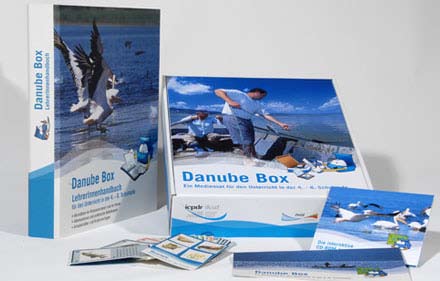
47
12. The Danube in school: the Danube Box
most children in the danube Basin are able to name the river, that is closestto them. But they might have difficulty saying where the river flows from or to.
and it might be impossible for them to name the ten countries the danube flows through. a new educational tool based on the principles and objectives of
sustainability and environmental education will now assist teachers in bringing the danube closer to the minds and the hearts of the future generation.
The innovative education kit is the most comprehensive education kit
about a river basin in the world, and is designed for teachers working
with children aged 9 to 12. It can be used in classrooms and outdoors
and reflects the methods of modern environmental education and
education for sustainable development. The kit includes a handbook
for teachers, a Danube poster, playing cards, worksheets, a CD-ROM
with pictures from all over the Danube River Basin, maps and a quiz.
Partners in education
The Danube Box was developed by the Green Danube Partnership,
established in 2005 between The Coca-Cola Company, Coca-Cola
HBC and the ICPDR. The Green Danube Partnership is an initiative
to demonstrate business responsibility for the future of the Danube.
Although water education materials exist in nearly all
The Danube Box as a product of the Green Danube Partnership
Danube countries, tools focusing on the concept of integrated
helps address the needs of countries, through workshops in Serbia,
river basin management have been missing until now.
Bulgaria, Romania, Hungary and Slovakia.
"We take our corporate social responsibilities very seriously indeed,"
An integrated education on rivers
said Sir Michael Llewellyn-Smith, a member of the board of directors
The Danube Box not only focuses on ecology, but links all aspects of
of Coca-Cola HBC, "and we have significant operations along the
the river its importance in history, its economic value and its main
Danube River which contribute to water conservation and to a wider
problems. Furthermore, the Danube Box explains in simple terms
understanding of the concept of sustainable development."
what each and everyone can do to help the Danube River Basin or to
support the concept of integrated river basin management.
The Danube Box was launched on Danube Day 2006 by Austrian
Water Minister Josef Pröll, and City of Vienna Environment
The Danube Box answers a need to effectively communicate informa-
Councillor Ulli Sima, as well as representatives from Coca-Cola:
tion and appreciation to the younger generation on the importance of
Ulrike Gehmacher, Coca-Cola HBC; Monika Polster, Coca-Cola
the Danube River and its tributaries as part of our natural heritage.
Austria. The Danube Box is in use in German in Austria and a trans-
lated version began for use in Hungary. Translations and adaptations
The Danube Box was a great success in Austria 2000 boxes were
are also under way for national versions for Germany, Romania and
requested in the first six months after the launch, and requests were
Serbia, and the box is available online in English (www.icpdr.org).
still coming in.
//// //// ÅÎ,,Ëfl //// Moldova //// ìÍªÌ //// Deutschland //// Österreich //// Ceská republika //// Slovensko //// Magyarország //// Slovenija //// Hrvatska //// Bosna i Hercegovina //// Srbija //// Crna Gora //// România //// ÅÎ,,Ëfl //// Moldova // ìÍªÌ //////////
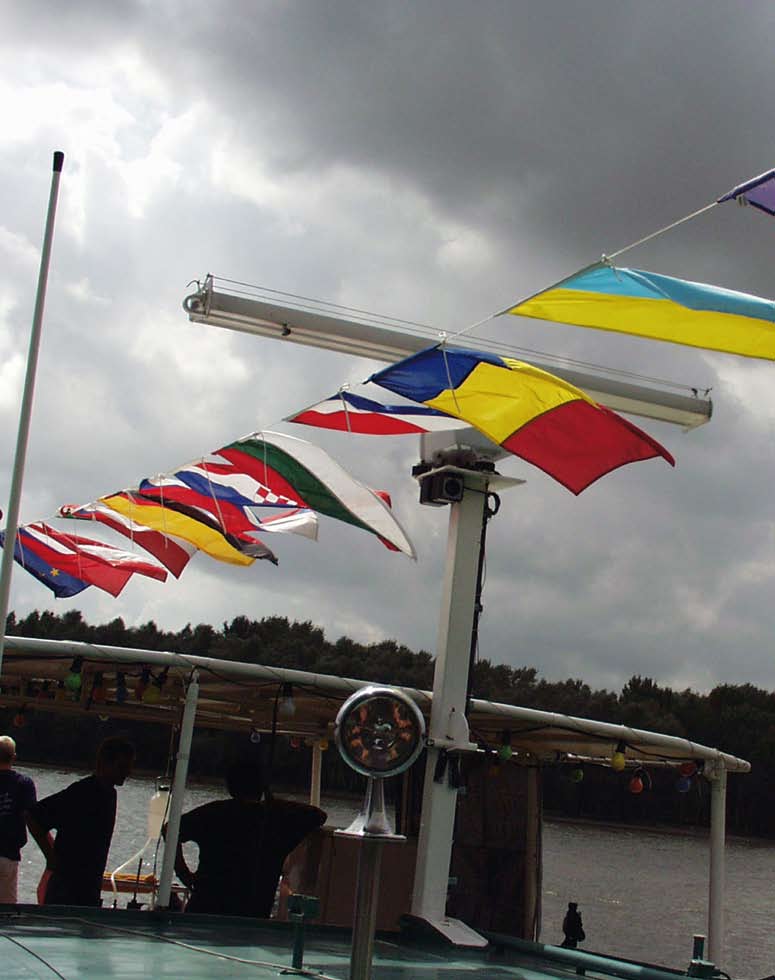
48
Balancing the individual needs of each country with the needs of the entire
Danube River Basin requires an integrated approach to river basin management.
49
49
13. Budget and financial contributions
Regular budget financial year 2006
At the 8th Ordinary Meeting of the ICPDR, (Vienna, 12 to 13 December 2005), the budget for the year 2006 of E 858,436.71 was approved.
Contributions FY 2006
Contribution
Contribution
actually paid
in%
in euro
in euro
germany
11.25
96,574.13
96,574.13
austria
11.25
96,574.13
96,574.13
Czech republic
11.25
96,574.13
96,574.13
slovakia
11.25
96,574.13
96,574.13
hungary
11.25
96,574.13
96,574.41
slovenia
11.25
96,574.13
96,574.13
Croatia
7.00
60,090.57
60,090.57
serbia
7.00
60,090.57
60,090.57
Bulgaria
7.00
60,090.57
60,090.57
romania
7.00
60,090.57
60,090.57
moldova
1.00
8,584.37
8,584.37
ukraine
1.00
8,584.37
8,584.37
european Commission
2.50
21,460.91
21,460.91
total
100.00
858,436.71
858,436.99
In financial year 2006 all outstanding payments from previous years were received.
Expenditures FY 2006
approved Budget
expenditures
Balance
in euro
in euro
in euro
a) administrative Costs
1. staff
495,500.00
488,719.59
6,780.41
2. services
174,600.00
174,542.43
57.57
3. equipment
5,000.00
4,523.98
476.02
4. other
103,436.71
102,856.28
580.43
subtotal a
778,536.71
770,642.28
7,894.43
B) operational Costs
79,900.00
79,802.30
97.70
overall total (a+B)
858,436.71
850,444.58
7,992.13
Special funds in 2006
In addition to the regular budget, special funds provided by various
donors have allowed the ICPDR to undertake special activities in
support of the Convention beyond those possible through the
regular budget. All financial contributions to the ICPDR are shown
separately in the account of the ICPDR.
50
About the ICPDR
The international Commission for the protection of the danube river (iCpdr)
European Union
is an international organisation consisting of 14 contracting parties,
European Commission, DG Environment
http://ec.europa.eu/environment/
including the European Union. Since its establishment in 1998, it has
grown into one of the largest and most active international bodies
engaged in river basin management in Europe. Its activities relate not
only to the Danube River, but also to the tributaries and ground water
resources of the entire Danube River Basin.
Germany
The ultimate goal of the ICPDR is to implement the Danube River
Federal Ministry for the Environment,
Nature Conservation and Nuclear Safety
Protection Convention. Its mission is to promote and coordinate
www.bmu.de/
sustainable and equitable water management, including conservation,
and the improvement and rational use of waters for the benefit of the
Danube River Basin countries and their people. The ICPDR pursues
its mission by making recommendations for the improvement of
water quality, developing mechanisms for flood and accident control,
agreeing standards for emissions and ensuring that these measures are
reflected in national legislation.
The ICPDR is supported by a Secretariat based in the Vienna
International Centre in Vienna, Austria.
The contracting parties to the ICPDR are shown here, along with
their organisations and website addresses:
Austria
Ministry for Agriculture, Forestry,
Environment and Water Management
www.lebensministerium.at
Slovenia
Ministry of the Environment
and Spatial Planning
www.mop.gov.si/
Croatia
Ministry of Agriculture,
/////////// Moldova / / ìÍªÌ //////// Deutschland / / Österreich
Forestry and Water Management
/ / C
www.mps.hr/
eská republika //// Slovensko / / Magyarország //// Slovenija / / Hrvatska / / Bosna i Hercegovina //// Srbija //// Crna Gora //// România //// ÅÎ,,Ëfl
51
Hungary
Ministry of Environment and Water
Czech Republic
www.kvvm.hu/
Ministry of the Environment
www.env.cz/
Ukraine
Ministry for Environmental Protection
Moldova
Slovakia:
www.menr.gov.ua/
Ministry of Agriculture, Forestry
Ministry of Environment
and Water Management
www.enviro.gov.sk/
Romania
Ministry of Environment and
Sustainable Development
www.mmediu.ro/
/////////// Moldova / / ìÍªÌ //////// Deutschland / / Österreich / / Ceská republika //// Slovensko // Magyarország //// Slovenija // Hrvatska // Bosna i
Bosnia and Herzegovina
Serbia
Bulgaria
He
Ministry of Foreign Trade and
Ministry of Agriculture, Forestry
Ministry of Environment and Water
rce
Economic Relations
and Water Management
www.moew.government.bg/
go
www.mvteo.gov.ba/
www.minpolj.sr.gov.yu/
vina //// Srbija //// Crna Gora //// România //// ÅÎ,,Ëfl
52
ANNEX
Composition of the ICPDR in 2006
1. PRESIDENT
moldova
Constantin mihailesCu
minister, ministry of ecology and natural resources
9 Cosmonautilor str., 2005 Chisinau
2. HEADS OF DELEGATION
germany
Fritz holZwarth
Federal ministry for the environment, nature Conservation and nuclear safety
robert schuman platz 3, 53175 Bonn
austria
wolfgang stalZer
Federal ministry for agriculture, Forestry, environment and water management, section vii
marxergasse 2, 1030 vienna
the Czech republic
Jan hodovsky
ministry of the environment
vrsovicka 65, 10010 praha 10
slovakia
marian supek
ministry of environment, division of waters and energetic sources
namestie l. stura 1, 81235 Bratislava
hungary
gyula hollÓ
department river Basin management, ministry of transport and water management
Fö utca 44-50, poB 351, 1394 Budapest
slovenia
mitja BriCelJ
ministry of environment & spatial planning
dunajska cesta 48, 1000 ljubljana
Croatia
Zeljko ostoJi´C
state water directorate
ulica grada vukovara 220, 10 000 Zagreb
Bosnia and herzegovina
reuf hedZiBegiC
ministry of Foreign trade and economic relations
musala 9, 71000 sarajevo
serbia
nikola marJanovi´C
ministry of agriculture, Forestry and water management, directorate for water
2a Bulevar umetnosti, 11000 Belgrade
Bulgaria
nikolai kouyumdZiev
deputy minister, ministry of environment and water
lubka katChakova from mar 2006
Bd. maria luisa 22, 1000 sofia
romania
lucia ana varga
state secretary, ministry of environment and water management
12 B-dul libertatii, sect. 5, Bucharest
moldova
dumitri drumea
ministry of ecology and natural resources
9 Cosmonautilor str., 2005 Chisinau
ukraine
stepan lyZun
ministry for environmental protection (mep)
03035 uritskogo str., kiev
european Commission
helmut BlÖCh
eC dg environment, unit water and marine protection
1049 Brussels, Belgium
/////////////// ÅÎ,,Ëfl //// Moldova //// ìÍªÌ / / Deutschland /// Österreich //// Ceská republika // Slovensko // Magyarország //// Slovenija //// Hrvatska //// Bosna i Hercegovina //////// Srbija //// Crna Gora //// România //// ÅÎ,,Ëfl //// Moldova //// ìÍªÌ //// Deutschland //// Österreich //// Ceská republika //// Slovensko //// Magyarország //// Slovenija //// Hr-
53
3. SECRETARIAT
philip weller
executive secretary
igor liska
technical expert water management & water Quality
mihaela popoviCi
technical expert water management & emissions pollution Control
Birgit vogel
technical expert river Basin management & wFd implementation
Jasmine BaChmann
technical expert public participation & public relations
alexander hÖBart
technical expert information management & gis
anna koCh
Finance officer
sylvia kersCh
management assistant
diana heilmann
intern (tisza)
milica dJuriC
intern (sava)
Charlotte kJellander (until october 15)
project support staff
patricia Faltusova (since october 15)
4. CHAIRPERSONS OF THE EXPERT GROUPS AND EXPERT SUB-GROUPS
river Basin management expert group (rBm eg)
Joachim d'eugenio
european Commission, dg-environment
1049 Brussels, Belgium
ad hoc tisza group
Joachim d'eugenio
european Commission, dg-environment
1049 Brussels, Belgium
ad hoc strategic expert group (s eg)
knut Beyer
Federal ministry for the environment, nature Conservation and nuclear safety
wa i 6B, robert schuman platz 3, 53048 Bonn, germany
ad hoc gis &
eva sovJakova
department of water protection, ministry of environment
information management expert group (gis&im eg)
vrsovicka 65, 100 10 praha 10, Czech republic
pressures & measures expert group (p&m eg)
Joachim heidemeyer
umweltbundesamt
postfach 330022, 1419 Berlin, germany
monitoring & assessment expert group (ma eg)
liviu popesCu
senior expert, iCim research & engineering institute for environment
spl. independentei 294, sect. 6, 77703 Bucharest, romania
Flood expert group (Flood eg)
sandor toth
national water authority
marvany u. 1/c, 1012 Budapest, hungary
ad hoc public participation expert group (pp eg)
anemari Ciurea
ministry of environment and water management
12 libertatii Bd, sector 5, Bucharest, romania
/////////////// ÅÎ,,Ëfl //// Moldova //// ìÍªÌ / / Deutschland /// Österreich //// Ceská republika // Slovensko // Magyarország //// Slovenija //// Hrvatska //// Bosna i Hercegovina //////// Srbija //// Crna Gora //// România //// ÅÎ,,Ëfl //// Moldova //// ìÍªÌ //// Deutschland //// Österreich //// Ceská republika //// Slovensko //// Magyarország //// Slovenija //// Hr-
5. OBSERVER STATUS AT 31.12. 2006
organisation name
address
danube Commission for inland navigation
danail nedialkov, director general
Benczúr utca 25, 1068 Budapest, hungary
wwF international
michael Baltzer, director dCp
mariahilferstr. 88a/3/9, 1070 vienna, austria
international association for danube water research (iad) meinhard Breiling, general secretary
dampfschiffhaufen 54, 1220 vienna, austria
ramsar Convention on wetlands
tobias salathe, regional Coordinator for europe
rue mauverney 28, 1196 gland, switzerland
danube environmental Forum (deF)
eniko anna tamas, deF secretariat
deri stny 13. iii.4, 6500 Baja, hungary
regional environmental Center
marta szigeti-Bonifert, executive director
for Central and eastern europe (reC)
ady endre ut 9-11, 2000 szentendre, hungary
international Commission
plamen dzhadzhev
for the protection of the Black sea (BsC)
dolmabahce sarayi ii, hareket köskü ii, 34353 Besiktas, istanbul, turkey
global water partnership (gwp-Cee)
milan matuska, gwp-Cee secretariat
Jeseniova 17, 83315 Bratislava, slovakia
unesCo/ihp
minorad miloradov, Chairman ihp nC
republic of serbia
international working association of water works
markus werderitsch
in the danube Basin (iawd)
c/o wiener wasserwerke, grabnergasse 4-6, 1061 vienna, austria
danube tourism Commission (die donau)
ursula deutsch
margaretenstrasse 1, 1040 vienna, austria
vgB power tech
Juergen lenz, CC2 Fossil fired power plants
klinkestrasse 27-31, 45136 essen, germany
international sava river Basin Commission (isrBC)
dejan komatina, secretary
nova ves 11, 10000 Zagreb, Croatia
european Barge union (eBu)
theresia hacksteiner, managing director
postbus 23210, 3001 rotterdam, nederlands
via donau
manfred seitz, general director
donau-City-strasse 1, 1220 vienna, austria
Contact:
ICPDR Secretariat
Vienna International Centre, D0412
P.O. Box 500
A-1400 Vienna, Austria
T: +43 (1) 26060-5738
F: +43 (1) 26060-5895
icpdr@unvienna.org
www.icpdr.org
Published by:
ICPDR International Commission for the Protection of the Danube River
Vienna International Center, DO412
PO Box 500, 1400 Vienna, Austria
Editor: Jasmine Bachmann
Text: ICPDR Secretariat and Kirstie Shepherd
Concept / Layout: Büro X Wien, www.buerox.at
Photos: page 2, 19, 42, 55: Coca-Cola HBC/Fallander;
page 5, 7: ICPDR/Stögmüller; page 11: DRP/Mello;
page 13, 50: Peter Literathy; page 16: Alexei Iarochevitch;
page 17: Zvonimir Orec; page 23: Paul Csagoly;
page 27: Apele Romane/Anca Savin; page 28: Solymosi Tamás;
page 29: Darko Dozet; page 30: Distelverein/Neuhauser, Lebens-
ministerium (2); page 32: Nationalpark Donauauen/Kovacs;
page 37: Federal Agency for Water Management/Austria;
page 40: Georg Batumi; page 48: ECCG Galati,
Coca-Cola HBC/Bruckner; page 49: Message;
The ICPDR would like to thank the organisations and photographers
for providing the pictures for free.
Print:
Number printed: 500 / © ICPDR 2007
printed on Munken Lynx, 100%TCF, FCS, awarded with the Nordic swan
// Deutschland
//// Österreich //// Ceská republika /
Slovensko
M
ag
yaro
rsz
ág
////
Sl
oven
ora //// România //// ÅÎ,,Ëfl //// Moldova ////
i
ìÍ
ja
ªÌ
/
//
H
rv
atska
//
// Bosna i Hercegovina //// Srbija //// Crna G