
AnnualReport2004_innen 10.08.2005 12:20 Uhr Seite 1
ANNUAL REPORT
on the Activities of the
ICPDR in 2004
Information
ICPDR International Commission for the Protection
of the Danube River / Permanent Secretariat
Vienna International Centre, D0412
P.O. Box 500, 1400 Vienna / Austria
Tel: 0043-1-260 60-5738, Fax: 0043-1-260 60-5895
e-mail: icpdr@unvienna.org, www.icpdr.org
AnnualReport2004_innen 10.08.2005 12:20 Uhr Seite 2
Imprint
Owner: ICPDR International Commission for the Protection of the Danube River / Permanent
Secretariat; Production & Graphic Design: p:matter, Vienna; Photos: Igor Liska, Maria Galambos,
`
´
Sandra Holzner, Lucian Tropan, Vizy Zsigmond, Mark Fallander (Coca-Cola HBC), Milena
Dimitrova; Proofreading: Susannah Wight, London; Print: Print-Tech, Budapest
AnnualReport2004_innen 10.08.2005 12:20 Uhr Seite 3
Contents
1.
OPERATIONAL AND INSTITUTIONAL FRAMEWORK
6
2.
FINANCIAL CONTRIBUTIONS AND BUDGETARY SITUATION
11
3.
ICPDR MEETING OF DANUBE MINISTERS
15
4.
WATER QUALITY AND HYDROLOGICAL SITUATION
16
5.
IMPLEMENTATION OF WFD
20
6.
POLLUTION CONTROL STRATEGY IN LINE WITH WFD REQUIREMENTS
24
7.
OPERATION OF THE DANUBE ACCIDENT WARNING SYSTEM
28
8.
FLOOD PROTECTION IN THE DANUBE RIVER BASIN
30
9.
ACCIDENT PREVENTION IN THE DANUBE RIVER BASIN
32
10. PUBLIC COMMUNICATION
36
11. INTERNATIONAL AND REGIONAL COOPERATION
39
12. ABBREVIATIONS AND ACRONYMS
45
ANNEX 1: COMPOSITION OF THE ICPDR IN 2004
46
ANNEX 2: OBSERVER STATUS AS OF 31.12.2004
48
- 3 -

AnnualReport2004_innen 10.08.2005 12:20 Uhr Seite 4
Foreword
2004, the tenth anniversary year of the signing of the Danube River Protection
Convention, was an eventful and productive year for the ICPDR, in which a num-
ber of important milestones were reached.
Among the 2004 highlights was the Ministerial Meeting in December 2004. It
brought together, for the first time since the signing of the Convention, Ministers
responsible for water management in the Danube region to review the work of the
ICPDR. Ministers adopted the Danube Basin Analysis (`Roof Report') under the EU
Water Framework Directive, the Danube Flood Action Programme, and signed the Tisza Memorandum
of Understanding. All these important achievements were endorsed and supported by Danube
Ministers in a very constructive and positive atmosphere of cooperation. The Danube, although one
of the most international river basins in the world, and presumably the most complicated from the
point of view of coordination of interests, has nonetheless managed to achieve an involvement and
cooperation which has set standards.
Our cooperation and commitment to coordination will be indispensable to address existing and
emerging challenges. Ministers at the Ministerial meeting agreed on a Danube Declaration which
underlines some of the great successes that have been achieved but also the work we have ahead of
us. Given the high degree of cooperation prevailing, I am optimistic we will be able to deliver in the
years to come on the commitments made in the Danube Declaration.
Among the significant achievements of 2004 were the events linked to the first ever Danube Day held
on June 29, 2004. Throughout the Danube basin celebrations were held in connection with Danube
Day, reinforcing the concept of basin solidarity and joint responsibility for management and care for
our Danube and its tributaries. A special highlight of Danube Day was the award of Danube Art
Masters in each country from thousands of art works produced by children throughout the Danube
basin. The engagement and enthusiasm of the children for expressing their views on ensuring the
protection and restoration of the Danube, which the ICPDR Heads of Delegation got first-hand
experience of at the Ordinary Meeting in December 2004, was more than evident and offers hope of
a bright future for the Danube.
Of great importance for the work of the ICPDR was the ratification by Bosnia and Herzegovina of
the Danube River Protection Convention. This act means that the family of Danube countries work-
ing under the Convention is now complete. I am especially pleased that Bosnia and Herzegovina is
now a full member of the Commission and that work will be intensified to ensure active involvement of
experts from Bosnia and Herzegovina in the work of the ICPDR.
- 4 -
AnnualReport2004_innen 10.08.2005 12:20 Uhr Seite 5
Foreword
The completion of the Danube Basin Analysis is an essential building block for the future work of
the ICPDR. This product, involving the input of all Danube countries, was prepared to meet the
requirements and commitments under the EU Water Framework Directive. As Director General of DG
Environment I am fully aware of the significance of this report, which was legally mandatory for EU
Member States but required for its delivery strong commitment of non-Member States as well. Active
work by non-Member States using the Water Framework Directive methodology has set a positive
example for other regions of Europe. This report will form the basis for the decisions and actions to
be taken to ensure good quality of waters throughout Europe by 2015.
Following the disastrous floods of 2002, Danube countries have also shown their commitment to
reducing the risk posed by floods, jointly working hard to complete the Danube Flood Action
Programme. The Programme was agreed during this past year and represents an essential step along
the way to refining and coordinating efforts to minimise the negative impacts of floods.
The year 2004 was special for the EU because of the eastward expansion of its borders. Four main
Danube countries joined the EU and have brought important benefits to the EU. I have seen during
my year of Presidency of the ICPDR how important it is to ensure that cooperation under the Danube
River Protection Convention is supported and built upon. This convention has been important not
only within the EU but also in linking the EU in cooperative management arrangements with neigh-
bouring countries.
The year 2004 as President of the ICPDR has been special, and rewarding, for me.
Catherine Day
President of the ICPDR 2004
- 5 -


AnnualReport2004_innen 10.08.2005 12:20 Uhr Seite 6
1. Operational and
Institutional Framework
Contracting Parties
Party in early 2005. The ICPDR warmly welcomed
Bosnia and Herzegovina in its advanced mem-
In 2004, Bosnia and Herzegovina initiated the
bership status and expressed its willingness to
process to become a full member of the Danube
provide Bosnia and Herzegovina with all neces-
River Protection Convention (DRPC). Thus, the
sary assistance in order to participate in the work
last country having more than a 2,000 km2 share
of the ICPDR.
in the Danube River Basin becomes a Contracting
Country/Organisation
Status
Since
Austria
AT
Contracting Party
22-Oct-98
Bulgaria
BG
Contracting Party
02-Aug-99
Bosnia and Herzegovina
BA
Participant with Consultative Status
17-July-97
Croatia
HR
Contracting Party
22-Oct-98
Czech Republic
CZ
Contracting Party
22-Oct-98
European Union
EU
Contracting Party
22-Oct-98
Germany
DE
Contracting Party
22-Oct-98
Hungary
HU
Contracting Party
22-Oct-98
Moldova
MD
Contracting Party
29-Aug-99
Romania
RO
Contracting Party
22-Oct-98
Serbia and Montenegro
CS
Contracting Party
19-Aug-03
Slovakia
SK
Contracting Party
22-Oct-98
Slovenia
SI
Contracting Party
22-Oct-98
Ukraine
UA
Contracting Party
13-Mar-03
- 6 -

AnnualReport2004_innen 10.08.2005 12:20 Uhr Seite 7
1. Operational and
Institutional Framework
The organisational structure of the ICPDR in 2004 is shown below:
Organisational Structure under the Danube River Protection Convention
CONFERENCE OF THE PARTIES
UNDP/GEF
Danube Regional Project
Standing Working
International Commission for the
Group
Protection of the Danube River - ICPDR
Creation of sustainable ecological
conditions for land use and water mgmt
Coordinate the work
Implementation of the Danube River
Capacity building and reinforcement of
between meetings
Protection Convention (DPRC)
trans-boundary cooperation
Prepare main
Decision making, management and
Strengthening public involvement in
strategic issues
coordination of regional cooperation
environmental decision making
Guide the activity of
Approval of the budget and annual work
Reinforcement of monitoring, evaluation
the Expert Groups
programme
and information systems
Follow up on activities and evaluation of
results of Expert Groups
Joint Action Programme
Tisza RBMP
Legal and
Permanent Secretariat (PS)
(ad-hoc Tisza Group)
Administrative issues
(ad-hoc S EG)
Supporting the ICPDR sessions
Develop the Tisza
Supporting the Expert Groups
River Basin
Legal issues
Coordinating the work programme
Management Plan
Administrative issues
Supporting project development and
Incorporating:
Financial issues
implementation
- flood protection and
Maintenance of the Information
- water quality
System
River Basin Management
Ecology
Emission
Monitoring, Laboratory
Accident Prevention
Flood Protection
(RBM EG)
(ECO EG)
(EMIS EG)
and Information
and Control (APC EG)
(FLOOD EG)
Management
Integrate river basin
Habitats and species
Emissions from
(MLIM EG)
Accidental pollution
Preparation and
management
protection areas
point sources
incidents
implementation of
Implementation of
Management of wet-
Emissions from
Trans-National
AEWS operation
Action Plan for
EU Water Framework
lands and floodplains
Monitoring Network
diffuse sources
Accident prevention
Sustainable Flood
Laboratory Quality
Directive
Guidelines on BAT
Protection
Assurance
Cartography
and GIS
(RBM / GIS ESG)
Danube - Black Sea
Joint Technical
Economic
Working Group
Analysis
(RBM / ECON ESG)
- 7 -


AnnualReport2004_innen 10.08.2005 12:20 Uhr Seite 8
1. Operational and
Institutional Framework
Observers
Convention. The Observers make practical and
valuable contributions to the implementation of
The Observers to the DRPC are international or
the main principles and goals of the DRPC. In
national organisations, or other bodies invited by
2004, the Danube Tourism Commission joined the
the International Commission to participate in all
ICPDR as an observer. The full list of Observers to
or selected activities in the framework of the
the DRPC is shown below:
Observer Organisations
Abbreviation
Black Sea Commission
BSC
Convention on Wetlands of International Importance
Ramsar
esp. as Waterfowl Habitat
Danube Commission
DC
Danube Environmental Forum
DEF
Danube Tourism Commission
Die Donau
Global Water Partnership - Central and Eastern Europe
GWP / CEE
International Association for Danube Research
IAD
International Association for Water Works in the Danube Basin
IAWD
Regional Environmental Centre for Central and Eastern Europe
REC
UNESCO - International Hydrological Programme
UNESCO / IHP
World Wide Fund for Nature
WWF
Expert Bodies
ad-hoc expert group addressed administrative and
legal matters arising from the implementation of
Further efforts were made to ensure the active
the DRPC. Specifically:
participation of all Contracting Parties in the work
of the ICPDR and particularly in the expert
The Standing Working Group (StWG) coordina-
groups. The expert groups are essential to the ope-
tes the work of the ICPDR between its meetings
ration of the ICPDR and rely upon the inputs and
and prepares the topics for the meetings of the
contributions of experts from the Contracting
ICPDR. In particular, the Standing Working Group
Parties. In 2004, the Standing Working Group, six
should guide the activities of the expert bodies
expert groups, two expert subgroups and one ad-
and prepare the main strategic issues to be resol-
hoc group dealt with technical issues and another
ved by the ICPDR. It may revise the Programmes
- 8 -

AnnualReport2004_innen 10.08.2005 12:20 Uhr Seite 9
1. Operational and
Institutional Framework
of Work of the expert bodies. It also reviews
The Expert Group on Monitoring, Laboratory
administrative and financial issues requiring
and Information Management (MLIM EG) is res-
urgent con-sideration.
ponsible for issues concerning water quality
assessment and classification including the opera-
The Expert Group on River Basin Management
tion of the Trans-National Monitoring Network
(RBM EG) defined and prepared the work neces-
and Analytical Quality Control. In 2004, special
sary for the implementation of the EU Water
activities of this expert group related to the imple-
Framework Directive (WFD) in the Danube River
mentation of the WFD in the Danube River Basin.
Basin, particularly finalising the Roof Report
2004. The work of the RBM EG is supported by
The Expert Group on Accident Prevention and
two expert subgroups, namely:
Control (APC EG) is responsible for the improve-
ment and operation of the Accident and
- The Expert Subgroup on Cartography and
Emergency Warning System and the communica-
Geographical Information System (GIS ESG),
tion of alarm/warning messages during accidents.
which dealt with preparing an overview map for
An additional task of this expert group lies in pol-
the Danube River Basin, and developing the
lution prevention and precautionary control in
System Definition for a Danube River Basin
the whole Danube River Basin. Special working
Geographical Information System;
groups under the APC EG deal with the prepara-
- The Expert Subgroup on Economic Analysis
tion of inventories, specifically an inventory of
(ECON ESG), which dealt with defining economic
potential accident risk spots and of old contami-
indicators to be used in the Roof Report 2004.
nated sites in potentially flooded areas.
The Expert Group on Ecology (ECO EG) was
The Expert Group on Flood Protection (FP EG)
established to support the ICPDR activities related
has the responsibility to develop and implement
to the conservation, restoration and sustainable
the Action Plan for Sustainable Flood Protection
management of aquatic ecosystems and those ter-
in the Danube River Basin.
restrial ecosystems and wetlands directly depen-
ding on them. This expert group has also contri-
The ad-hoc Tisza Group has the responsibility
buted to the implementation of the ecological
to contribute to the development of the Tisza
provisions of the WFD.
River Basin cooperation by developing, within the
framework of the ICPDR, a harmonised Sub-Basin
The Expert Group on Emission (EMIS EG) focu-
Management Plan and Flood Action Plan / Flood
ses its activities on the reduction of pollution
Risk Management Plan for the Tisza River Basin
resulting from point and diffuse sources of emis-
in line with EU and ICPDR requirements.
sions into the waters of the Danube and its tri-
butaries. A priority issue is harmonisation with
the EU directives (WFD, Nitrate Directive, IPPC
Directive).
- 9 -
AnnualReport2004_innen 10.08.2005 12:20 Uhr Seite 10
1. Operational and
Institutional Framework
Special working groups dealt with the following
Celebration of 1st Danube Day on June 29, 2004
issues:
The largest celebration ever for the Danube Basin
- the UNESCO/IHP Water Balance Working Group
and its people was first organised in 13 countries,
is preparing the water balance of the Danube
with 100 events throughout the basin. This festi-
River for the ICPDR;
val honoured the Danube and the rivers that flow
- the Working Group on the Sava River Basin
into it. It paid tribute to the vital role they play in
Management Plan, established in 2002, was incor-
people's lives: providing water, food, power,
porated into the interim Sava Commission, and
recreation and livelihood. Danube Day celebrated
now cooperates closely with ICPDR expert bodies;
the people of the region and the wildlife that finds
- the Danube-Black Sea Joint Technical Working
refuge there.
Group coordinates the work of the ICPDR and the
International Commission for the Protection of
A special publication specifying the activities that
the Black Sea (BSC) aiming at nutrient reduction
took place has been produced.
and pollution control to ensure recovery of the
Black Sea ecosystem.
- 10 -

AnnualReport2004_innen 10.08.2005 12:20 Uhr Seite 11
2. Financial Contributions
and Budgetary Situation
Regular budget
December 1 - 2, 2003), the deficit resulting from
reduced contribution was offset by the contribu-
The 5th Ordinary Meeting of the ICPDR (Vienna,
tions of the new Contracting Parties.
November 28 - 29, 2002), approved the budget
for the year 2004 of 827,738.48.
A slight revision of the annual budget to ensure
funds in the categories where expenditures were
The 2004 budget included a contribution from
higher than anticipated was also deemed neces-
Moldova of 41,386.92. The 1st Standing
sary and was approved by the ICPDR president on
Working Group Meeting (Prien am Chiemsee,
November 30, 2004. The final breakdown of regu-
June 12 - 13, 2003) had however, taken note of,
lar expenditures per budget line is as follows:
and supported, Moldova's request to reduce their
contribution to 1% of the budget, an amount of
8,135.02 for 2003 and 8,277.38 for 2004. In
Budget Chapters
Amount in
2004 Moldova succeeded in fulfilling its financi-
al obligations for the financial year 2004, paying
its reduced contribution and in addition paid the
1. Staff
447,897.-
outstanding amount of 2,135.02 from 2003.
2. Services
134,839.-
3. Equipment
4,958.-
Therefore the annual contributions actually paid
4. Other
87,826.-
to the budget by the Contracting Parties amoun-
5. Operational costs
124,599.-
ted to 794,579.04, 33,159.44 short of the
projected figure. On the basis of the decision
Overall total
800,119.-
made by the 6th Ordinary Meeting (Vienna,
Special Funds in 2004
Analytical Quality Control (AQC) 2004
In order to assure quality control among labora-
In addition to the regular budget, special funds,
tories, the ICPDR has been receiving voluntary
provided by various donors or funders, have
contributions from contracting parties since
allowed the ICPDR to undertake special activities
2001. Voluntary contributions were offered by
in support of the Convention beyond those pos-
Hungary ( 11,000), Slovakia ( 2,000), Romania
sible through the regular budget. All financial
( 2,300), Germany ( 4,500) and Austria ( 2,200)
contributions to the ICPDR are shown separately
for 2004 costs. While the Hungarian, Slovak and
in the account of the ICPDR.
Romanian contributions were directly transferred
to VITUKI Plc, the German and Austrian contri-
butions were paid through the ICPDR Secretariat.
- 11 -
AnnualReport2004_innen 10.08.2005 12:20 Uhr Seite 12
2. Financial Contributions
and Budgetary Situation
Alcoa Foundation
ICPDR Information System - (re)design
A two-year project has been concluded between
of public area
the ICPDR and the Alcoa Foundation. The project
The website of the ICPDR has recently become
objective is to improve the capacity of the local
increasingly important as a source of informati-
laboratory to run an integrated monitoring
on for the general public on Danube issues and
system by procurement of new and proper
as a source of information for the public on the
equipment, which will assist the defining of
workings of the Commission. It is apparent
some microbiological, biological and chemical
though that this website was not set up to com-
elements/parameters, in order to fulfil the moni-
municate information to the public in a user fri-
toring requirements of TNMN, of the Water
endly way and that in order to meet the increa-
Frame-work Directive and of other European
sing demand for information by the public there
directives in the field of waters. The Alcoa
was a need to revise and reorganise the site in
Foundation has donated US$ 100,000 to use for
2004. The German government decided in
covering the costs of purchasing and installing
December 2003 to finance this activity with
various water quality monitoring instruments in
15,000.
Romania.
Based on a new concept, a new layout has been
Danube - Black Sea Task Force (DABLAS II)
designed, and the new structure has been deve-
The DABLAS II project assisted the ICPDR in
loped. Text for the new structure was prepared
evaluating the accomplishments realised in 11
and edited, and is being uploaded into the new
countries of the Danube River Basin, in terms of
structure which is expected to go online in 2005.
policies, legislation, regulations and investment
projects. The results are used as a baseline for
UNESCO World Water Assessment
evaluating subsequent progress at the national
Programme (WWAP)
and regional levels. The ICPDR-DABLAS database
The ICPDR, as partner of UNESCO-WWAP, partici-
(prepared in 2003) has been revised to include
pated in this project to enhance the activities and
municipal, industrial, agro-industrial, wetland
programmes undertaken by UNESCO-WWAP. The
restoration, and agricultural and land use projects.
ICPDR takes part in the elaboration of the second
UN World Water Development Report to be issued
The DG Environment of the European Comm-
in 2006, and the German government decided to
ission has provided the ICPDR Secretariat in 2004
finance this activity with 15,000 which was made
with financial support for these activities in a
available on December 14, 2004.
total of 124,000 out of which 99,200 has been
transferred to the ICPDR account on June 29,
Posters for the Ministerial Meeting
2004. The sub-contractors received 40,000 as
In order to present the results of the ICPDR in its
advance payment, and by the end of the year the
7th Ordinary (Ministerial) Meeting, the govern-
ICPDR contribution of 5,950 as well as other
ment of Germany made available 7,790 to the
expenditures of 24,124 has been disbursed.
Secretariat for developing posters. These posters
- 12 -
AnnualReport2004_innen 10.08.2005 12:21 Uhr Seite 13
2. Financial Contributions
and Budgetary Situation
have been presented during the meeting to the
invitees, and can further serve the Secretariat for
2004 the first instalment of 6,804.70 has been
other presentations as well. A Service Agreement
paid out. The second instalment will be paid, and
of 7,790 has been awarded to consultants for
the final invoice to the German government will
preparing these posters, and on December 27,
be submitted in 2005.
Support for Danube Art Master event
EC Support for the Ministerial Meeting
During the events of the first Danube Day (June
The 7th Ordinary (Ministerial) Meeting was orga-
29, 2004) a contest of Danube Art Masters was
nised outside the Vienna International Centre,
organised by the ICPDR in each participating
with the aim of celebrating the signature of the
Danube country. The national winners of this
Danube Declaration and Tisza Memorandum of
contest have been invited to the 7th Ordinary
Understanding at the closing event of the ICPDR
(Ministerial) Meeting in Vienna, where the over-
10th anniversary. The European Commission pro-
all winner has been selected and awarded. The
vided the ICPDR Secretariat with a financial sup-
government of Germany has provided the
port of 15,108.28 for these activities. This cover-
Secretariat with financial support for the visit of
ed logistical costs of the meeting, out of which, by
the young winners in a total of 1,741.05 for
the end of the year, a total of 6,773.88 was dis-
covering their expenses while in Vienna. The
bursed as advance payment. The remaining amo-
amount has been fully utilised and the final
unt of 8,334.40 has not yet been invoiced to the
invoice to the German government will be sub-
Secretariat. After having received and pre-paid
mitted in 2005.
the full cost, the final invoice will be submitted to
the EC for reimbursement.
- 13 -
AnnualReport2004_innen 10.08.2005 12:21 Uhr Seite 14
2. Financial Contributions
and Budgetary Situation
REGULAR BUDGET 2004
Contributions
Contracting Contribution Contributions in
Parties Keys1 %
Planned
Actual
Germany
13.51
111,890.98
111,890.98
Austria
13.51
111,890.98
111,890.98
Czech Republic
10.94
90,533.90
90,533.90
Slovakia
9.22
76,295.84
76,295.84
Hungary
10.94
90,533.90
90,484.00
Slovenia
10.94
90,533.90
90,533.90
Croatia
9.22
76,295.84
76,295.84
Bulgaria
5.00
41,386.92
41,386.92
Romania
9.22
76,295.84
76,295.84
Moldova2
5.00
41,386.92
8,277.38
European Union
2.50
20,693.46
20,693.46
Total Contributions
100.00
827,738.48
794,579.04
Expenditures1
Approved
Expenditures
Engagements
Status as of
budget
31-Dec-2004
A. Administrative costs
in
in
in
in
1. Staff
464,500.00
442,646.49
5,250.12
16,603.39
2. Services
134,500.00
128,890.06
5,948.56
-338.62
3. Equipment
5,000.00
958.25
4,000.00
41.75
4. Other
85,000.00
76,309.10
11,517.25
-2,826.35
Sub-total A
689,000.00
648,803.90
26,715.93
13,480.17
B. Operational costs
138,738.48
112,977.11
11,622.08
14,139.29
Overall total (A + B)
827,738.48
761,781.01
38,338.01
27,619.46
1 Minor differences are due to roundings
2 Accepted by the ICPDR to reduce to 1%
- 14 -

AnnualReport2004_innen 10.08.2005 12:21 Uhr Seite 15
3. ICPDR Meeting
of Danube Ministers
On December 12, 2004 Ministers responsible for
the requirements of the EU Water Framework
water resource management in the Danube basin
Directive. The report describes the main environ-
met for the first time since the signing of the
mental problems in the Danube River Basin and
Danube River Protection Convention to discuss fur-
reveals that if no action is taken the majority of
ther actions to reinforce transboundary cooperation
water bodies may fail to achieve good status by
on sustainable water resource management within
2015. Based on this report, a cost-effective pro-
the Danube region. As the conclusion of this histo-
gramme of measures will be developed in order to
ric meeting, the Ministers agreed upon a "Danube
ensure that the objectives of the Water Framework
Declaration", which expresses their commitment to
Directive are met. This programme of measures will
future actions necessary to achieve progress under
be included in the Danube River Basin Management
the Convention.
Plan to be completed in 2009.
The Action Programme for Sustainable Flood
In her opening speech to the meeting, Catherine
Protection in the Danube River Basin was also
Day, President of the ICPDR and Director General
adopted at the meeting. The Flood Action
for Environment of the European Commission, sta-
Programme aims at achieving a long-term and
ted "the Ministerial Meeting should be used to eva-
sustainable approach for managing the risk of
luate the progress that has been made to improve the
floods to protect human life and property, while at
management and the quality of the Danube waters
the same time encouraging conservation and the
and, more importantly, to identify the strategies and
improvement of water related ecosystems. The
actions necessary for addressing the challenges that
action programme will now be implemented in the
remain". To continue, the Bosnia and Herzegovina
coming years.
delegation announced that their country had
In addition, a Tisza Memorandum of Under-
recently adopted the ratification instrument to join
standing, specifying additional commitments to
the Danube River Protection Convention. This posi-
coordinate water quality and flood risk manage-
tive commitment was followed by a discussion of
ment in the Tisza River Basin, was signed by
the Ministers and agreement on a number of issu-
Hungary, Romania, Serbia and Montenegro,
es, in particular:
Slovakia and Ukraine.
The Ministerial meeting, which was held in the
The Danube Declaration, "The Danube Basin -
context of the ICPDR Ordinary Meeting, provided
Rivers in the Heart of Europe", underlines the
strong support for the work that had been done in
commitment of the respective countries to coopera-
the previous decade since the signing of the Danube
te in identifying and implementing solutions for
River Protection Convention, and outlined key chal-
integrated and sustainable water resource manage-
lenges and actions for the coming years. The mee-
ment in the Danube River Basin. The Declaration
ting was clearly an important milestone in the
also sets out the priorities, objectives and major
ongoing work of the ICPDR and was concluded
actions for the ten years ahead.
with a commitment of the Ministers to meet again
The adoption of the Danube Basin Analysis (or
in five years to review the progress that had been
Roof Report 2004) at the meeting fulfilled one of
achieved.
- 15 -
AnnualReport2004_innen 10.08.2005 12:21 Uhr Seite 16
4. Water Quality and Hydrological Situation
The long-term daily mean flow of the Danube
age and the water levels in the two large
River is about 6,500 m3s-1. This represents an
Hungarian lakes, Lake Balaton and Lake Velence,
average annual discharge of 207 km3. The
were higher than in 2003. The total stream flow
discharge in 2004 was very close to the long-
in Slovenia (difference between outflow from and
term average - almost 207 km3 (99.5% of the
inflow to the country) was 4% above the average.
average annual discharge).
Danube 2004 - Mean annual discharges
Hydrological situation
7,000
m3/s
The weather situation in the upper Danube River
Basin in 2004 was similar to the previous year
6,000
although less extreme when compared to the
long-term average. In general, the observed sun-
5,000
shine duration and annual temperature level were
both above average and a precipitation deficit
4,000
was recorded. In line with these meteorological
conditions, water levels of rivers and lakes remai-
3,000
ned low in the upper Danube region and that
situation was compounded by the initial hydrolo-
2,000
gical conditions (i.e., dry year 2003). The flows of
the Danube tributaries in Bavaria as well as the
1,000
Morava and Thaya/Dyje rivers in the Czech
0
Republic were significantly lower than average.
rkm 2500
2000
1500
1000
500
0
Only one high flood event was recorded in
long-term annual average mean annual discharge 2004
Germany (January 12 - 16) resulting from the
coincidence of rainfall and snowmelt. However,
no remarkable snowmelt occurred in the alpine
Figure 1: The Danube - Mean annual discharges in 2004
region.
The weather situation in the central Danube regi-
In the major part of the lower Danube area the
on differed from that in the upper region and
annual rainfall was close to the long-term aver-
resulted in precipitation over the long-term mean
age (1 - 2% below). The monthly distribution of
value. In Hungary, a significant amount of preci-
the precipitation in Romania is shown in Figure 2.
pitation was observed in June and July (100 - 150
mm). In Slovenia, October was the month with
the highest rainfall (190% of a long-term mean).
Overall there were elevated discharges and water
levels in the central area. The annual flow of the
Tisza River at Szeged was 6.7% above the aver-
- 16 -
AnnualReport2004_innen 10.08.2005 12:21 Uhr Seite 17
4. Water Quality and
Hydrological Situation
Pp (mm)
120
2004
100
1961-1990
80
60
40
20
0
1
2
3
4
5
6
7
8
9
10
11
12
month
Figure 2: Average monthly precipitation in Romania in 2004 compared to the long-term average pattern (1961-1990)
In Romania, from the hydrological point of view,
lowest discharge of the Danube River in 2004 in
year 2004 was characterised by an elevated run-
Romania was recorded in September (2,300 m3/s).
off in the rivers in the western part of the coun-
In Bulgaria, the annual discharge of the monito-
try and a less-than average discharge of the rivers
red rivers in 2004 was 3% below the average. The
in the rest of the country. The peak discharge of
values of the total precipitation in 2004 as well as
the Danube in Romania (10,800 m3/s) was reached
the relative precipitation in the same year when
in April, when also the maximum average month-
compared to a long-term annual average in selec-
ly discharge of 9,660 m3/s was recorded. The
ted countries are shown in the following table:
Country
Total annual
Relative annual
precipitation in
precipitation in
2004 [mm]
2004 [%]
Germany
899
91
Austria
820
80
Czech Republic
641
89.7
Hungary
665
110
Slovenia
1,511
108
Serbia and Montenegro
915
117
Romania
639
98.8
Moldova
692
134
- 17 -
AnnualReport2004_innen 10.08.2005 12:21 Uhr Seite 18
4. Water Quality and Hydrological Situation
Pollution due to accidents
Accidents that triggered the Danube Accident
In 2004 in the Danube River and its major tri-
Emergency Warning System are reported in
butaries only minor accidents were reported
Chapter 7.
with negligible impacts on the water quality.
The majority of the accidents involved oil pol-
Improvements in wastewater treatment
lution.
Technical improvements aiming at nitrogen and
phosphorus reduction were performed in several
In Germany, the impact caused by infiltration
wastewater treatment plants (WWTPs) in
of hexachlorobutadiene (HCBD) into the river
Germany. By the end of 2004, WWTPs in the
Inn in 2001 has been further reduced. The
German portion of the Danube larger than 100,000
restoration activities still continue.
person equivalents (PE) achieved the EU require-
ments on nitrogen and phosphorus treatment (this
In Hungary there was an accidental spill at
part of the Danube Basin is not considered to be a
Dorog Incinerator Plant. The spill entered the
sensitive area). Specific attention was given in
Kenyérmezei creek, a secondary tributary of the
recent years to plants on the river Isar, an up-
Danube. The estimated volume of the spill was
stream tributary of the Danube. At this alpine river
100 m3, out of which there were 48 tons of
six WWTPs were equipped in previous years with
diverse pollutants (a mixture of oils and orga-
a UV disinfection or membrane filtration to achie-
nic extracts containing toluene, xylene and
ve bathing water quality. Eight more WWTPs will
benzene). The floating material was removed by
be upgraded in the same way in 2005. Moreover,
an adsorbent. Water quality measurements on
at the Austrian border a bilateral water treatment
August 6, 2004, in the Danube at the river kilo-
project was finished. Thanks to these efforts, water
metre 1,721 and at Esztergom bank-filtered
quality of the Isar River in the sensitive down-
water resource showed that pollutant concen-
stream alpine area has improved significantly.
trations were below the detection limits.
Pollution did not affect the downstream coun-
The share of population in Austria connected to
tries. A floating municipal garbage-waste
central WWTPs is 87%. Approximately 90% of
(about 100 m3) came from Ukraine to Hungary
these WWTPs utilise tertiary treatment; the rest of
in September in the Tisza River as a result of
the treatment plants apply biological carbon eli-
surface runoff caused by a heavy rainfall.
mination and in some cases nitrification.
In Serbia, several local minor accidents occur-
In the Czech Republic in 2004, technical improve-
red in the Banat region and in the vicinity of
ment of wastewater treatment aiming at reduction
Belgrade, resulting in an increase of concentra-
of pollution at point sources continued to be a
tions of ammomium, MBAS and phenol. Fish
positive trend. Because the whole area of the
kills were registered only during the pollution
Danube catchment in the Czech Republic has been
of the river Plovni Begej, in the area of Srpski
declared a sensitive area, a main objective has
Itebej, in the beginning of August.
been reduction of nutrient discharges in line with
- 18 -
AnnualReport2004_innen 10.08.2005 12:21 Uhr Seite 19
4. Water Quality and
Hydrological Situation
the UWWT Directive. In WWTPs larger than
in 2004 out of which about 47% performed
100,000 PE only one plant is still in need of
satisfactory. Ten WWTPs were in construction or
improvement. As a consequence more attention
being modernised.
was given to plants with capacity ranging from
10,000 to 100,000 PE. In the Czech part of the
Water quality trends
Morava River basin all point sources over 10,000
Similarly to 2003, reduced precipitation resulted in
PE have been equipped with adequate biological
diffuse pollution levels below average values in
treatment, however, only about half of these
Germany. This resulted in lower concentrations of
include nutrient reduction. In 2004, planned
nutrients, degradable organic substances and
reconstruction of two WWTPs was finished;
pesticides when compared to a long-term mean.
reconstruction activities at three additional
WWTPs had started.
When compared to 2003, no significant changes in
the water quality of the Danube River and its
In Hungary, under the National Municipal
major tributaries were observed in the Czech
Sewerage and Wastewater Treatment
Republic, Hungary, Slovenia, Croatia, and Serbia
Programme, seven major WWTP projects for the
and Montenegro. A similar situation was reported
towns of Györ, Szeged, Pécs, Sopron,
in Bulgaria for the Danube River; although some
Szombathely, Kecskemét and Debrecen were in
slight water quality problems were observed in
the implementation phase in 2004.
smaller tributaries caused by discharges of sewage
from municipalities without WWTP.
Technical improvements aiming at N-reduction
were performed on several smaller WWTPs in
A continuous improvement of water quality in
Slovenia. At present, two of the Slovenian plants
2004 was reported by Romania. The major amo-
larger than 100,000 PE still have to be adapted
unts of pollution reduction originated from the
to the UWWT Directive requirements and recon-
industrial and agricultural sectors. The chemical
struction activities are progressing according to
and mining industry as well as farming activities
the national environmental action plan.
have decreased substantially in Romania since
1989. Use of fertilisers in agriculture has decreased
The Croatian National Water Management Plan
significantly after 1989 with a reduction in 2004
is under preparation although at the same time
of more than 62%.
pollution reduction activities are in progress -
the WWTP for the city of Vinkovci for example
was completed. In Serbia and Montenegro,
reform of water tariffs and taxes is needed to
generate the funds necessary to make progress in
waste water treatment. There were no new in-
vestments in the waste water sector in 2004. In
Romania about 1,460 WWTPs were in operation
- 19 -
AnnualReport2004_innen 10.08.2005 12:21 Uhr Seite 20
5. Implementation of WFD
During 2004 the work of the ICPDR continued to
cussed in the RBM EG Meetings. All comments
focus on meeting the reporting requirements of
from countries and conclusions from the RBM EG
the Water Framework Directive and focused on
Meeting were integrated into the revised version
the following issues:
of the report. In addition, the Secretariat made
1) finalisation of WFD Roof Report 2003
structural and editorial changes to streamline the
(Art. 3.8 and Annex I)
report and to enhance readability.
2) preparation of the WFD Roof Report 2004
(Art. 5 with Annexes II and III, and Art. 6
A number of workshops have taken place, partial-
with Annex IV)
ly supported by the UNDP/GEF Danube Regional
3) public participation in connection with
Project, which have provided crucial input into
WFD implementation.
the work:
WFD Roof Report 2003 (Art. 3.8 and Annex I)
Workshop on nutrients as a transboundary
The WFD Roof Report 2003 (Art. 3.8 and Annex I)
pressure: January 26 - 27, 2004, in Sofia,
was finalised on April 16, 2004 and sent to the
Workshop on heavily modified water bodies:
European Commission as informal information on
February 9 - 10, 2004, in Bucharest,
June 22, 2004. In addition, the national reports of
Workshop "WFD Implementation in Serbia-
the EU Non-Member States were sent to the
Montenegro": June 7 - 8, 2004, in Belgrade,
Commission (Croatia, Serbia and Montenegro,
3rd Surface Water Workshop - Estimation of
Bulgaria, Romania and Moldova). Ukraine is cur-
the risk of failure to reach the environmental
rently not in a position to report on WFD imple-
objectives: June 24 - 25, 2004, in Neusiedl am See.
mentation.
Main results of the Danube Basin Analysis
Preparation of WFD Roof Report 2004
(WFD Roof Report 2004)
(Art. 5, 6 and Annexes II, III, IV)
The first report on the characterisation and ana-
The WFD Report 2004 (reporting deadline: March
lysis of the Danube River Basin District has
22, 2005) deals with the characterisation of surfa-
shown that in recent decades the environmental
ce waters and groundwater, with the assessment
conditions in the Danube basin have considera-
of significant pressures and impacts, and with the
bly improved. Where investments, e.g. in waste-
economic analysis of water uses. The preparation
water treatment, have taken place, the improve-
of this report has been coordinated by the River
ment of the water quality is clearly visible.
Basin Management Expert Group.
However, a major part of pollution reduction can
be attributed to the decline of industries and
The Roof Report was based on an agreed outline.
agricultural activities in the middle and lower
The chapters were prepared by consultants, by
part of the basin. The main pressures are due to
expert groups, by country experts or by members
organic pollution, hazardous substances and
of the Secretariat based on the data provided by
nutrients. In addition, hydro-morphological alte-
the Danube River Basin countries. Drafts were dis-
rations are the cause of degradation throughout
- 20 -
AnnualReport2004_innen 10.08.2005 12:21 Uhr Seite 21
5. Implementation of WFD
the basin. In these areas, investments for a
Pollution from hazardous substances is significant
sustainable reduction of pollution levels as well
in many parts of the basin. Hundreds of hazar-
as from other pressures has just started and will
dous substances are being used and released into
have to continue for another ten to 20 years.
the surface waters, although the full extent can-
not be evaluated to date. There are only few data
In surface waters, the loads of organic pollution
available for some hazardous substances (such as
are still unacceptably high in most of the Danube
heavy metals and pesticides), which indicate the
tributaries and in some parts of the Danube River.
transboundary scale of the problem. Cadmium
The considerable discharge of untreated or insuf-
and lead can be considered to be the most serious
ficiently treated wastewater from municipal,
heavy metals exceeding the target values consi-
industrial and agricultural point sources are
derably in many locations on the lower Danube.
widespread, in particular in the middle and lower
Also, pesticides show alarming concentrations in
part of the basin. A significant reduction poten-
some tributaries and in the lower Danube.
tial for organic pollution exists through the
application of best available techniques for
The extent of the hydromorphological alterations
wastewater treatment facilities. Considerable
in the Danube basin has been significant over the
efforts, in particular as regards financial invest-
past centuries. Such alterations include, inter alia,
ment, will be necessary to reduce organic pollu-
the building of dams, weirs and sluices, the cana-
tion to acceptable levels in some parts of the mid-
lisation of rivers and subsequent disconnection of
dle and lower basin.
their floodplains and old arms, erosion (incision)
of the riverbed and lowering of water tables with
Among the pressures those from diffuse sources
consequently higher flood risks. Some of these
of nutrients are the most significant. Overall,
changes are irreversible; however, there is a
nutrient loads into the Danube basin have signi-
potential for rehabilitation, which should be
ficantly decreased over the past 20 years, but
explored to the fullest extent. This is particularly
they are still well above the levels of 1955. In the
the case where floodplains could be reconnected
future, this development may be reversed as dif-
with the main river thereby improving natural
fuse pollution from agriculture increases again
flood retention and enhancing fish migration to
after the breakdown of the economic situation in
their natural habitats. In addition, migration
many countries of the region in the early 1990s.
pathways would be needed on barriers on the
Impacts from nutrients can mainly be seen in the
Danube and most of its tributaries.
receiving coastal waters of the Black Sea, but also
in many lakes and groundwater bodies through-
Due to these significant hydromorphological
out the basin. While in rivers nutrients generally
changes large parts of the Danube River and of
cause fewer problems due to turbulent flow con-
numerous tributaries have been provisionally
ditions, some slow flowing river stretches such as
identified as heavily modified water bodies on the
the middle Danube, impounded river sections and
basin-wide scale. Dams and weirs on the Danube
lakes also show effects of eutrophication.
as well as bank reinforcements and fixations on
- 21 -
AnnualReport2004_innen 10.08.2005 12:21 Uhr Seite 22
5. Implementation of WFD
the tributaries put these stretches "at risk" of fai-
of the Black Sea is highly complex and strongly
ling to reach the "good ecological status".
influenced not only from high nutrient loads from
the Danube and other Black Sea tributaries, but
Some parts of the Danube River Basin are still rat-
also from other pressures such as over-fishing and
her untouched ecosystems and a unique heritage
changes in the food web.
to be preserved. The basin hosts a large number of
wetlands offering unique habitats for a rich and
Groundwater is mainly used for drinking water
diverse aquatic community. Many of these areas
supply and for agriculture. In some areas signifi-
have high protection status such as the large wet-
cant pressures result from over abstraction, high
land complexes protected under international
nutrient levels infiltrating the groundwater as
conventions, others still deserve to be designated
well as from hazardous substances originating
as protected areas, but have not been granted
from inadequate waste treatment. For these rea-
such status. 80% of the historical floodplain on
sons a few important transboundary groundwater
the large rivers has been lost during the last 150
bodies are estimated to be "at risk" to reach the
years mainly from significant hydromorphologi-
environmental objectives. Since many of the gro-
cal alterations, and many already protected areas
undwater bodies are highly vulnerable special
deteriorate due to new human interventions. Still
protection strategies are needed to ensure the
today, many wetlands are under pressure from
sustainable use and protection of groundwater.
navigation, hydropower plants, intensive agricul-
ture and forestry as well as from new infrastruc-
Finally, the economic aspects of implementing the
ture projects. Wetland restoration can bring many
Water Framework Directive need to be strengthe-
benefits, in particular for flood protection. As a
ned. Currently, economic data are being collected
first step, an inventory of the most important
based on administrative boundaries, which are
water-related protected areas for species and
not in accordance with the hydrological bounda-
habitat protection has been established for the
ries of the river basins. It has become apparent
Danube River Basin.
that this is a problem throughout Europe, not only
in the Danube River Basin. Best practices on
The coastal waters and the larger marine environ-
assessing cost-effectiveness and introduction of
ment of the Black Sea have been strongly influ-
water pricing strategies should be shared.
enced by high nutrient loads from the inflowing
rivers especially in the period up to the mid 1980s.
Public participation in connection
Since then a significant reduction of nutrient
with WFD implementation
input has taken place, but the nutrient levels are
The ICPDR has approved the first and second
still significantly higher than in the 1960s. The
stage of the ICPDR Operational Plan (activities in
effects of reduced nutrient inputs are clearly visi-
2004 and 2005). The ICPDR intends to repeat
ble in the north-western shelf of the Black Sea,
Danube Day on an annual basis. In particular for
which is shallow and therefore particularly sus-
2005, it will be used as a forum to present the
ceptible to eutrophication. The marine ecosystem
WFD Roof Report 2004 and to start the public
- 22 -

AnnualReport2004_innen 10.08.2005 12:21 Uhr Seite 23
5. Implementation of WFD
participation process. In addition, the ICPDR is
This high level political commitment should help
planning the first Stakeholder Conference to step
secure the support for the implementation of mea-
from information to active involvement of the
sures necessary to achieve the good ecological
stakeholders. The Stakeholder Conference will be
and chemical status in surface waters and the
organised back-to-back with Danube Day in
good quantitative and good chemical status for
2005. The conference will give information on:
groundwater by the year 2015.
the planned involvement of stakeholders on the
The next steps in the planning process for the
level of the ICPDR
development of the Danube River Basin
the results of the WFD Roof Report 2004
Management Plan will include identifying the key
the Flood Action Plan.
water management issues according to Art. 14
WFD and setting up the timetable and work pro-
The Conference will proactively involve stakehol-
gramme for its development. This needs to be
ders and it will be possible for stakeholders to
published by the end of 2006.
become accredited observers of the ICPDR after
the conference.
Conclusions and next steps
This first comprehensive analysis of the signifi-
cant pressures and impacts in the Danube River
Basin District was endorsed by the Contracting
Parties under the Danube River Protection
Convention at the 7th Ordinary (Ministerial)
Meeting held on December 13 - 14, 2004, in
Vienna. At that same meeting the Ministers also
adopted the Danube Declaration ("The Danube
Basin - Rivers in the Heart of Europe"), which
affirms the role of the ICPDR as a catalyst for
cooperation, records the achievements in the
basin, but also notes with concern the problems of
nutrient pollution, hazardous substances such as
heavy metals and pesticides, the existence of a
large number of sites at risk to reach the environ-
mental objectives. The Ministers agreed to aspire
to achieve the implementation of the WFD inclu-
ding the development of the Danube River Basin
Management Plan.
- 23 -
AnnualReport2004_innen 10.08.2005 12:21 Uhr Seite 24
6. Pollution Control Strategy in
Line with WFD Requirements
Background
these categories, must also be identified. In addi-
Progressive reduction of point and diffuse pollu-
tion, there is a requirement to consider land use
tion from municipalities, industries and agricul-
patterns (e.g. urban, industrial, agricultural, fore-
ture is needed in the Danube basin. An emission
stry) as these may be useful to indicate areas, in
inventory prepared by the ICPDR has tracked the
which specific pressures are located.
information related to emissions and has been
used for assessing the effects of anthropogenic
The ICPDR inventory has expanded in scope to
activities on water pollution under the Water
collect data from all settlements having more
Framework Directive.
than 10,000 inhabitants, industrial pollution-
prevention activities, as well agricultural dischar-
In supporting the implementation of DRPC and
ges. For each river basin district, information has
WFD, updated templates of emission inventories
been listed and assessed on the type and scale of
were prepared that provide information on
significant anthropogenic pressures, including
discharges basin wide and deliver results in an
point and diffuse sources of pollution. The list of
easily accessible and user-friendly form. The
pressures has been screened according to certain
emissions inventories include municipal, indu-
criteria, which determine what "significant pres-
strial and agricultural point sources (discharges
sure" means for the whole Danube district.
from municipal waste water treatment plants and
direct industrial discharges).
Recent trends in preventive environmental mana-
gement and water pollution necessitated changes
Significant point source pollution
in the focus of the industrial discharges inventory.
In response to Article 5 of the WFD, an updated
Consideration has been given to the IPPC imple-
basin-wide Emission Inventory of pollutants relea-
mentation results, the use of Best Available
sed to the water from municipal, industrial and
Techniques, integration of CP and Environmental
agricultural dischargers, for reference years 2002
Management Standards, and incorporation of the
and 2003, has been made publicly accessible in
ICPDR preliminary list of priority substances.
2004. The WFD requires information to be collec-
Information from the updated emission inventory
ted and maintained on the type and magnitude of
methodology will be used to recommend industri-
significant anthropogenic pressures, and indicates
al control policy at the country level, which can
a broad categorisation of the pressures into:
be supported by BAT in individual installations
and plants, in line with IPPC.
point sources of pollution
diffuse sources of pollution
The municipal and industrial emission invento-
effects of modifying the flow regime through
ries 2002 shows a significant decrease of pol-
abstraction or regulation
lutant emissions. The reason for the decrease is
morphological alterations.
increased investments both from governmental
and private resources to the water sector, and
Any other pressures, i.e. those not falling within
increase of pollution charge rates, which have
- 24 -

AnnualReport2004_innen 10.08.2005 12:21 Uhr Seite 25
6. Pollution Control Strategy in
Line with WFD Requirements
motivated reduction. Key policy issues, such as
In taking appropriate actions we must be able to
the control of diffuse water pollution, land-use
respond in a focused way to control and reduce
planning, the designation of heavily modified
pollution while avoiding larger-scale damage to
water bodies and the role of wetlands in the
economic development. Emission inventories
Directive must be addressed by the ICPDR pollu-
provide policy makers and the public with an
tion control strategy. Particular emphasis should
understanding of the key polluting sources or the
be placed on the diverse sources of diffuse pollu-
"pressures" as WFD requires, how these sources
tion to help to meet the challenging environ-
have developed with economic growth and how
mental standards required by the Directive for
they are likely to contribute to pollution in the
hazardous substances. These include discharges
future. This understanding is essential for a focu-
from agriculture and also from other land-uses
sed "response" to the problems associated with
such as urban developments, transport infra-
water pollution and to meet the demands of
structure and abandoned mineral workings.
sustainable development.
Diffuse pollution
In coming years it is hoped that the ICPDR emis-
Diffuse pollution from agriculture is an important
sion inventory will be further refined to meeting
issue in the Danube countries. A better under-
the existing management challenges.
standing of agricultural pollution is possible due
to the development of the first agro-industrial
Joint Action Programme - Interim
point sources inventory, reference year 2002. This
Implementation Report
inventory is a reference document for use by
In 2004 the ICPDR prepared an interim report on
decision makers, local environmental and agri-
the mid term results of the work done under the
cultural authorities in the implementation of dif-
Joint Action Programme. The JAP contains com-
fuse source pollution management programmes.
mitments for country actions from January 1,
2001, to December 31, 2005.
The results of the MONERIS model calculation of
diffuse pollution have also contributed to the dis-
The interim report found that there has been sub-
cussion on the appropriate instruments for pollu-
stantial legislative reform and in particular the
tion control.
implementation of EU community law within the
DRB. Despite the difficulties of cooperation
The spatial resolution of parts of the database is
among the large number of states within the
insufficient with regard to the demand for the
Danube region there has been important progress
management of the whole river system according
in establishing the necessary mechanisms for
to the WFD. Therefore, the model and the data-
coordination and cooperation under the frame-
base have to be improved in coming years. In
work of the Danube River Protection Convention.
addition, the model approach could be utilised to
address other substances such as heavy metals
The EU Water Framework Directive has added
and organic materials.
strength to the efforts to coordinate actions in
- 25 -
AnnualReport2004_innen 10.08.2005 12:21 Uhr Seite 26
6. Pollution Control Strategy in
Line with WFD Requirements
support of integrated river basin management
influence on compliance costs. Progress has been
and pollution control and reduction.
achieved in ensuring a coordinated, harmonised
and transferable policy approaches and legislati-
In recent years, EU environmental policy has
ve measures introduced at the national level of
evolved from a traditional, command-and-control
the participating countries. The analysis of the
approach towards a more integrated and flexible
JAP implementation has, however, highlighted
approach. New instruments to tackle pollution
both the implementation efforts and deficits. This
caused by point and diffuse sources are being
is especially the case for those EU directives that
used by Danube countries to control pollution.
require substantial administrative reform and
These include: flexible legislation imposing addi-
financial investments.
tional site-specific or national rules, which will
vary from one installation to another within the
In addition to assessing policy changes the interim
Union (e.g. the IPPC Directive), voluntary and/or
JAP report identified significant investments in
market-based instruments setting the basic rules
pollution control.
for operators who want to exploit market oppor-
tunities (e.g. the EMAS regulation and a future
The current analysis and reviews of activities con-
emissions trading scheme), or the introduction of
ducted at the national level within the framework
EU-wide environmental quality standards esta-
of the Joint Action Programme show that many
blished through the water directives.
investments and actions are happening. Table 1
presents the investments made and projected in
A country's choice on how to achieve complian-
the coming years.
ce with EU directives will have a significant
- 26 -
AnnualReport2004_innen 10.08.2005 12:21 Uhr Seite 27
6. Pollution Control Strategy in
Line with WFD Requirements
Project Realisation (all sectors combined)
Country
All Projects
Projects Completed
Projects Completed
Projects Completed
by 2003
by 2005
after 2005
No. of
Investment
No. of
Investment
No. of
Investment
No. of
Investment
Projects
MEUR
Projects
MEUR
Projects
MEUR
Projects
MEUR
Bosnia and
Herzegovina
30
198
0
0
2
0.6
28
197.4
Bulgaria
47
260.8
0
0
2
7.8
45
253
Croatia
19
221.5
0
0
2
2.2
17
219.3
Czech Republic
42
283.6
5
40.6
16
169.8
26
113.9
Hungary
26
1029.9
8
57.7
15
110.7
11
919.2
Moldova
43
63
0
0
1
0.3
42
62.7
Romania
38
584.7
0
0
0
0
38
584.7
Serbia and
Montenegro
5
530
0
0
0
0
5
530
Slovakia
42
308.6
11
46.5
23
100.5
19
208.1
Slovenia
39
327.7
5
77
14
176.5
25
151.2
Ukraine
23
74.2
0
0
2
3.9
21
70.4
Totals:
354
3,882
29
222
77
572
277
3,310
Table 1: Projects in the municipal, industrial, agricultural sectors and wetlands finalised before the end of 2003, 2005 and after 2005
Among the 354 projects covering all sectors, 93
ness of policies in Danube countries. Second, it
projects are fully finance, representing 33%
shows that appropriate tasks implementation and
(1,247 MEUR) of the total 3,822 MEUR estimated
reporting are useful for the Danube countries in
investment cost. An additional 115 projects have
order to better address and measure the policy
secured partial funding and/or have more or less
responses. Third, the report highlighted the need
completed the planning stages but have not yet
to streamline reporting obligations under various
attained financing. These 115 projects have a
directives in implementing various JAP tasks.
combined total investment need of 1,798 MEUR
(47% of the total costs), of which 543 MEUR are
confirmed. There are an additional 146 projects
(837 MEUR) indicated as "unprepared", referring
to projects that have no secured funding and
require technical assistance for further project
planning.
The interim report provides a useful starting
point for undertaking analysis related to and
reporting on the implementation and effective-
- 27 -
AnnualReport2004_innen 10.08.2005 12:21 Uhr Seite 28
7. Operation of the Danube
Accident Emergency Warning System
In 2004 the Accident Emergency Warning System (AEWS) was activated by five accidents. An over-
view of these accidents is given below.
Site of Accident / Date
Affected River
Primary
AEWS
Tranboundary
Pollutant
Messages
Impact
Hungary (Dorog)
Kenyermezei
Oil,
PIAC-05 PIAC-04
H: No
30.07. - 09.08.2004
creek,
Organic
"Standard Message"
Tati-Danube
extracts
PIAC-08 PIAC-05
branch
"Request-for-Information"
PIAC-05 PIAC-07
PIAC-08
PIAC-13
"Standard Message"
PIAC-05 PIAC-04
PIAC-07
PIAC-08
PIAC-13
"End-of-Alert"
PIAC-05 PIAC-08
"End-of-Alert" (repeated)
Romania
Cisla creek,
Slurry
PIAC-05 PIAC-08
Ro: No
(Baja Borsa)
Viseu River
PIAC-11
04.09.2004
"Request-for-Information"
PIAC-08 PIAC-05
"End-of-Alert"
Ukraine, Romania
Tisza River
Floating
PIAC-05 PIAC-11
H: No
Hungary (Tiszabecs)
municipal
"Request-for-Information"
27.09. - 29.09.2004
garbage
PIAC-05 PIAC-04
"Warning-Pollution"
PIAC-05 PIAC-04
PIAC-11
"End-of-Alert"
Hungary (Komarom)
Danube - trans-
Oil
PIAC-05 PIAC-04
H: No
(Slovakia)
boundary section
"Standard Message"
07.10.2004
PIAC-0405 PIAC-04
"End-of-Alert"
Slovakia (Gabcikovo)
Danube
Oil
PIAC-05 PIAC-04
Sk: No
27.10.2004
"Standard Message"
PIAC-0405 PIAC-04
"End-of-Alert"
Note: A "Yes" in the "Transboundary Impact" column means that accidental water pollution entered into the downstream country.
- 28 -

AnnualReport2004_innen 10.08.2005 12:21 Uhr Seite 29
7. Operation of the Danube
Accident Emergency
Warning System
Upgrade of AEWS
as expected and is ready for use. Consequently,
An essential improvement of AEWS was carried
the ICPDR at its 7th Ordinary Meeting approved
out in 2003/2004 with support of the UNDP/GEF
the upgrade of AEWS to an internet-based infor-
Danube Regional Project. The goal of this up-
mation system. To enable a further harmonisati-
grade was to increase the effectiveness and cost-
on of accident control procedures, the ICPDR
efficiency of the warning system by replacing
encouraged the Danube countries to consider the
the satellite communication with an internet-
application of the internet-based AEWS on a
based information system using GSM/SMS mes-
bilateral level. This would enable a more effec-
sages for alerting the PIAC staff. The final test of
tive use of the developed set-up by extending its
the upgraded system was performed on June 14,
scope of use to the bilateral border river com-
2004. The test has proven that the system works
missions.
- 29 -
AnnualReport2004_innen 10.08.2005 12:21 Uhr Seite 30
8. Flood Protection in the Danube River Basin
In 2004 the ICPDR completed an important step to
ristics of the Danube River Basin as well as an
responding to floods. Following the major floods
overview of floods and flood protection. The sec-
in 2002, a need became apparent for achieving
tion on "General considerations, basic principles
concerted, coordinated action to prevent or redu-
and approaches" of the Action Programme refers
ce risks caused by floods and to improve the over-
primarily to UN-ECE Guidelines on Sustainable
all level of protection against floods.
Flood Prevention, EU Best Practices on Flood
Prevention, Protection and Mitigation and to the
In response to the danger of flooding and in line
EU Communication on Flood Risk Management,
with its Joint Action Programme, the
COM(2004)472.
International Commission for the Protection of
the Danube River (ICPDR) decided in 2000 to esta-
The major principles advocated are: (i) the shift
blish the long-term Action Programme for
from defensive action against hazards to manage-
Sustainable Flood Prevention in the Danube River
ment of the risk and living with floods (ii), the
Basin. The whole process was accelerated after
river basin approach taking into account the
disastrous floods in 2002 and resulted in adopti-
Water Framework Directive, (iii) joint action of
on of the Action Programme at the ICPDR 7th
governments, municipalities and stakeholders
Ordinary (Ministerial) Meeting on December 13 -
towards flood risk management and awareness
14, 2004.
raising, (iv) reduction of flood risks via natural
retention, structural flood protection and hazard
This Action Programme is based on the sustaina-
reduction, and (v) solidarity.
ble flood protection programmes developed in
various Danube countries as well as on networ-
Targets of the Action Programme are set on a
king existing structures and using the future-
basin-wide and a sub-basin level taking into
oriented knowledge base accumulated through a
account the above-mentioned principles.
wide range of activities over the past decade. The
overall goal of the Action Programme is to achie-
There are four major basin-wide targets:
ve a long term and sustainable approach for
improvement of flood forecasting and early
managing the risks of floods to protect human life
flood warning systems; interlinking national or
and property, while encouraging conservation
regional systems
and improvement of water related ecosystems.
Given the large area, the complexity and the
support for the preparation of and coordination
internal differences in the Danube River Basin, the
between sub-basin-wide flood action plans
Action Programme represents an overall frame-
work, which needs to be specified in further detail
creating forums for exchange of expert know-
for sub-basins.
ledge
The Action Programme begins with a description
recommendation for a common approach in
of the general hydrological and climate characte-
assessment of flood-prone areas and evaluation of
- 30 -
AnnualReport2004_innen 10.08.2005 12:21 Uhr Seite 31
8. Flood Protection in the
Danube River Basin
flood risk.
and multilateral agreements. In sub-basins of
At the sub-basin level six targets have been identi-
multinational interest, development of Action
fied in the Action Programme:
Plans should be coordinated using existing fra-
meworks such as the working groups under the
to reduce the adverse impact and the likelihood
Tisza Forum or the interim Sava Commission.
of floods in each sub-basin through the develop-
Where the mechanisms of sub-basin-wide coope-
ment and implementation of a long-term flood
ration do not exist, consideration of the establish-
protection and retention strategy based on the
ment of the appropriate working forums is recom-
enhancement of natural retention as far as possible
mended.
to improve flood forecasting and warning sui-
Financial resources necessary for the implementa-
ted to local and regional needs as necessary
tion of the Action Programme are intended to
come from national budgets and other national
to increase the capacity building and raise the
sources, EU funds, including new cohesion policy
level of preparedness of the organisations respon-
funds, and loans from international financing
sible for flood mitigation
institutions.
to develop flood risk maps
to harmonise design criteria and safety regula-
tions along and across border sections
to prevent and mitigate pollution of water cau-
sed by floods.
The measures of the Action Programme are direc-
tly linked with the targets mentioned above.
As regards the sub-basin measures, the Action
Programme provides a recommended structure of
the flood action plans to be prepared at the sub-
basin level and gives an overview of activities to
be considered during their preparation.
Decisions on the framework of implementation of
the sub-basin Action Plans are the task and res-
ponsibility of the countries affected, according to
their national legislation as well as their bilateral
- 31 -
AnnualReport2004_innen 10.08.2005 12:21 Uhr Seite 32
9. Accident Prevention in the Danube River Basin
General concept of accident prevention
began developing a comprehensive concept of
under the ICPDR
accident prevention. At present, this concept is
An effective way to minimise risks stemming
based on the following key elements:
from environmental disasters is to develop acci-
dent prevention strategies. Following the disa-
elaboration of inventories of potential Accident
strous spills in the Tisza River Basin the ICPDR
Risk Spots (ARS) in the Danube River Basin
committed itself to establishing a prevention
implementation of safety measures minimising
policy under the Joint Action Programme and
the risk potential.
The general structure of this strategy is demonstrated below:
ICPDR Accident Prevention
ARS Inventory
Safety Measures
Industrial Sites
Industrial Sites
Recommendations
Checklist
- Basic safety
requirements
- CS
WRI-Methodology
M1-Methodology
- Safety against floods
- Industrial ARS
- Safety of CS
Inventory of accident risk spots
For both inventories a specific methodology was
in the Danube River Basin
developed to (i) identify potential ARS and (ii)
establish a ranking system to evaluate a real risk.
The ARS Inventory contains two subsets:
For ARS based on industrial activities the ICPDR
developed a method for evaluation of potential
1) Inventory of industrial sites (ongoing activities)
risk resulting in preliminary ranking of potential
Accident Risk Spots in the Danube River Basin.
2) Inventory of contaminated sites in flood-risk
This inventory was finalised in 2001 and updated
areas (closed-down waste disposal sites and indu-
in 2003 (Map 1).
strial installations in flood-risk areas).
- 32 -
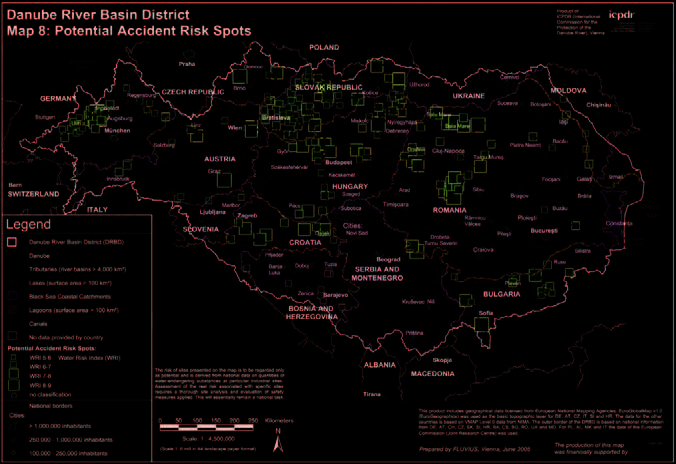
AnnualReport2004_innen 10.08.2005 12:21 Uhr Seite 33
9. Accident Prevention
in the Danube River Basin
Map 1: Danube River Basin District - Potential Accident Risks Spots
The floods of August 2002 highlighted the pro-
(see Map 2). In a second step, risk of flooding and
blem of inundation with water of landfills, dump
safety measures applied will be evaluated to
sites and storage facilities where harmful sub-
receive a priority ranking. For this evaluation, a
stances are deposited. Flooding of such sites can
draft of so-called M2 methodology was elabora-
mobilise the contaminants and cause pollution. To
ted by the Working Group on Inventories (WGI) in
avoid this kind of risk the elaboration of an
2004 and agreed by the APC EG. This M2 metho-
inventory of contaminated sites in flood-risk
dology will be further refined in 2005 and a site
areas was initiated. For an initial risk assessment
classification system will be developed with sup-
of all submitted "candidate" sites a so-called M1
port of the UNDP/GEF Danube Regional Project.
methodology was developed in 2003 and used for
For final ranking and prioritisation of contamina-
creating a draft ranking list of contaminated sites
ted sites, the respective checklists will be produced.
- 33 -
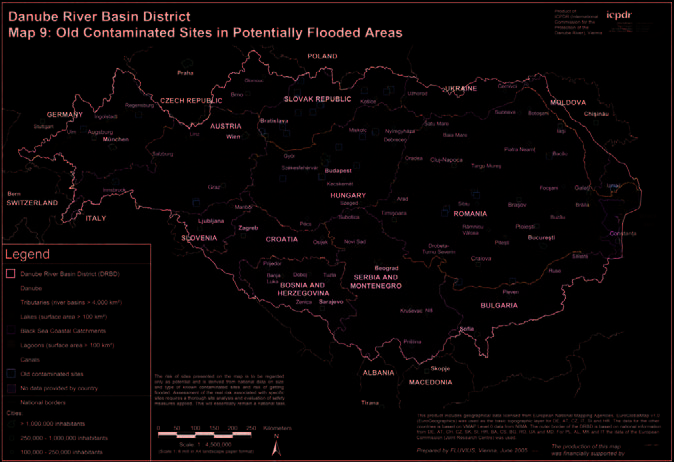
AnnualReport2004_innen 10.08.2005 12:21 Uhr Seite 34
9. Accident Prevention in the Danube River Basin
At present, both inventories and related maps
reflect only potential dangers; the actual danger
to the environment can only be determined on
the basis of safety measures that have been put
in place including a thorough site analysis. This
will predominantly be a national task still to be
performed.
Map 2: Danube River Basin District - Contaminated Sites in Flood-Risk Areas
- 34 -
AnnualReport2004_innen 10.08.2005 12:21 Uhr Seite 35
9. Accident Prevention
in the Danube River Basin
Safety measures
refers here to any kind of inundation as the result
The philosophy of water protection, as seen in
of high water, backflow from water bodies or
relation to industrial installations in developed
from a canal network, rising groundwater levels
industrial countries, is based on the assumption
ensuing from long-term high-water events or
that the potential hazard to water bodies can be
from fire-fighting water that was retained by a
compensated by comprehensive technological
fire-fighting water retention facility. The require-
and organisational safety precautions. An evalua-
ments apply equally both to all existing plants as
tion of the quality and quantity of prevention, or
well as to all plants that are to be newly con-
of the safety rating of the ARS concerned, is there-
structed.
fore one of the major future tasks of the ICPDR.
For the checking of safety measures at the
For this purpose two major instruments are used
ongoing industrial sites a series of checklists was
by the APC EG:
developed by the German Federal Environmental
Agency (Umweltbundesamt, UBA) on the basis of
recommendations for safety guidelines as sup-
the safety recommendations of the International
porting instruments for the Danube member sta-
River Commissions from the Rhine and Elbe. The
tes to improve the current standard of safety mea-
application of these checklists in the Danube
sures
River Basin will be tested in 2005 and 2006 in the
frame of a pilot project supported by UNDP/GEF.
application of existing and development of
Another set of checklists is under preparation for
new checklists to control the implemented safety
assessment of safety measures in contaminated
measures at existing ARS.
sites in flood-risk areas. The first draft is expected
to be available in 2005.
Concerning safety recommendations, the ICPDR is
building on the work and experience of other
river commissions. Two relevant documents were
elaborated by the APC EG and adopted by the
ICPDR (Basic Requirements for Installations
Handling Water Endangering Substances and
Safety Requirements for Contaminated Sites in
Flood-risk Areas). In 2004, the ICPDR approved
the "Recommendations on requirements for indu-
strial plants containing water-polluting sub-
stances in areas with a risk of flooding" and
recommended their application at national level.
These recommendations apply to plants, plant
components as well as to safety equipment that
could be affected by flooding. The term flooding
- 35 -
AnnualReport2004_innen 10.08.2005 12:21 Uhr Seite 36
10. Public Communication
Redesigning the look of Danube Watch - the
Activities to improve Danube Watch were possible
magazine of the ICPDR
through the financial support of the UNDP/GEF
In 2004, a small team within the ICPDR and the
Danube Regional Project.
UNDP/GEF Danube Regional Project started the
challenging process of comprehensively evalua-
Other publications
ting the magazine of the ICPDR, Danube Watch.
In 2004 two other publications were produced,
highlighting the work of the ICPDR:
In addition to carrying out an in-depth professio-
nal review, readers were directly asked for feed-
a special publication documenting the activi-
back. The aims of the review were to find out if
ties of Danube Day
the production costs of Danube Watch were justi-
fied, if water professionals throughout the basin
a special ten-year review of the work of the
see Danube Watch as a valuable information tool
ICPDR, entitled "Active for the Danube River
and - if there was a clear yes to the first two que-
Basin: 1994 - 2004. Ten years of cooperation in
stions - how the magazine could be improved.
the Danube River Basin" was produced and distri-
buted at the Ministerial Meeting.
Happily, "readers find
Danube Watch infor-
ICPDR Information System
mative, useful and
Information management (collection and presen-
topical", as stated in
tation of information about the Danube) continu-
the Danube Watch
ed to be an important aspect of the work of the
evaluation. They find
ICPDR in 2004. The ICPDR Information System
most valuable the
(DANUBIS), set up in 2000, continued to fulfil its
practical case studies,
original goal of supporting the work of the dele-
summaries of progress,
gations and expert bodies, as well as informing
features about how
the general public about the activities of the
problems were addres-
ICPDR. After four years of operation, a decision
sed, and information on concrete measures and
was taken in 2003 to revise the goals and objec-
project results, which can be used in other cases.
tives of the system to meet the new challenge of
implementing the EU Water Framework Directive,
Based on this review greater attention and effort
and the increasingly important demand to make
was provided to Danube Watch to make it as
publicly accessible information about the Danube
informative and enjoyable as possible. The ICPDR
through the internet. In addition to the new fun-
has also focused effort on redesign. The goal was
ctions, the system will continue to serve as the
to make Danube Watch more visually appealing
general platform of providing the Contracting
to its readers, so that readers not only enjoy rea-
Parties and work groups with the information
ding its messages, but also browse through its
needed for their work under the Danube River
pages.
Protection Convention.
- 36 -

AnnualReport2004_innen 10.08.2005 12:21 Uhr Seite 37
10. Public Communication
Development of a new public website
vide a basis for the coordination of data collection
The ICPDR website was originally not set up with
between Danube River Basin countries and to
the primary purpose of communicating informa-
facilitate the WFD reporting at the level of the
tion to the public in a user-friendly way. In order
Danube basin.
to meet the increasing demand to provide infor-
mation to the public, a process of revision and
The Strategic Plan for the Danube River Basin
reorganisation was begun in 2003. The German
Geographic Information System was finalised
Government and the UNDP/GEF Danube Regional
by the GIS ESG and adopted by the ICPDR and
Project, together with the ICPDR Secretariat, ensu-
its expert bodies. The Austrian Environmental
red that financial resources are available for this
Agency (Umweltbundesamt - UBA) was selected
work, the bulk of which was carried out in 2004.
to design and implement the system in close
Based on a new concept, a new layout has been
collaboration with the GIS ESG and other
designed, and the new structure has been develo-
expert bodies of the ICPDR. The UNDP/GEF
ped. Text for the new structure was prepared and
Danube Regional Project financed the design
edited, and uploaded into the new structure.
work.
Since the new public website is based on open
The final draft of the system definition was com-
source software, it had to be separated from the
pleted at the end of 2004 with alternative soluti-
current website, a task that will be completed in
ons for software platform use. In order to facilita-
2005. In the web text hyperlinks will be defined
te the decisions on future development a work
to point to documents finalised by the ICPDR
plan and cost estimation were also provided. In
experts. The task has not been completed yet. The
2005 the ICPDR will make a final decision on the
redesign of the restricted area, which is reserved
next steps and then work on design and imple-
for ICPDR experts to elaborate documents, will
mentation of the DRB GIS can begin. In addition
shortly follow the public part.
to the financial support secured from the
UNDP/GEF DRP, other financial contributions will
Geographical Information System
be necessary to complete the work.
Responding to the need for collection of geogra-
phical-based information, the ICPDR has develo-
Trans-National Monitoring Network
ped a Strategic Plan for the Danube River Basin
Database (TNMN Database)
Geographic Information System (GIS) in 2003-
Data for the years 1996 to 2001 are available.
2004. The plan prepared by the Cartography and
Users can generate predefined reports for:
GIS Expert Subgroup (GIS ESG) addresses organi-
sational, technical and financial issues, and defi-
overview data (annual average, minimum and
nes a planning procedure, for the establishment of
maximum values of a selected determinand
a common Danube River Basin GIS. The develop-
and/or for selected monitoring point)
ment of a common, consistent and harmonised
Danube River Basin GIS was initiated to help pro-
- 37 -
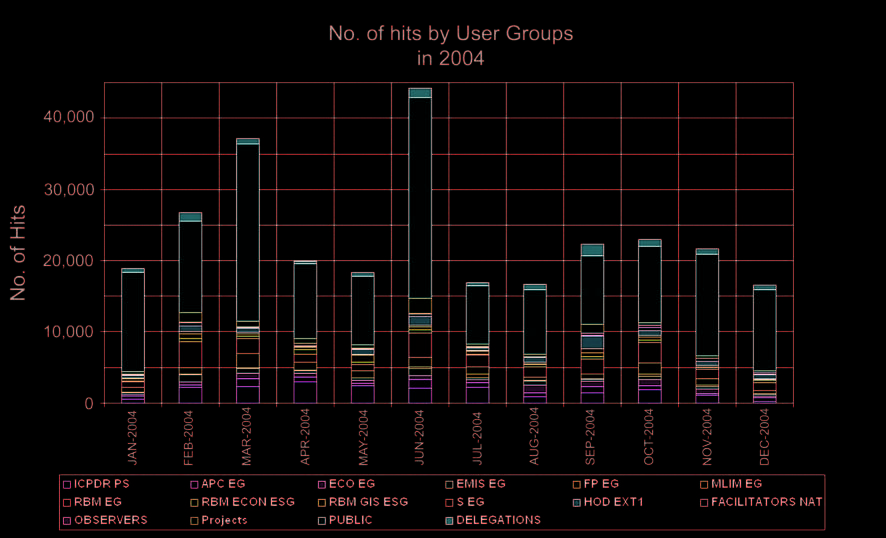
AnnualReport2004_innen 10.08.2005 12:21 Uhr Seite 38
10. Public Communication
results of analysis at monitoring points (detai-
DANUBIS network at the end of 2004. The activi-
led data of samples and analysis at selected moni-
ties of the most important user groups are shown
toring points)
in the figure below.
TNMN monitoring points, determinands and
A new End-User License Agreement was launched
analytical methods.
in 2003 and continued in 2004 to facilitate users
(not members of any internal working group) to
Charts are also available for:
use database information for scientific purposes.
average values
Those users, after a simple registration procedure,
determinand values by date of sampling.
can use data downloaded from the different
ICPDR databases for individual, specified scienti-
Other activities
fic purposes.
User and access management
There were 504 registered users of the ICPDR
- 38 -

AnnualReport2004_innen 10.08.2005 12:21 Uhr Seite 39
11. International and
Regional Cooperation
The UNDP/GEF Danube Regional Project
Progress in 2004
In 2001 a two phase Danube Regional Project
In 2004 the project components of Phase 2 were
"Strengthening the Implementation Capacities for
in different stages of implementation. Some of the
Nutrient Reduction and Transboundary
largest components were prepared already by the
Cooperation in the Danube River Basin" was
end of the Phase 1 or continued (e.g. support for
launched with the primary goal of reducing pol-
the DEF, Small Grants, Access to Information,
lution loadings into the Danube River and its tri-
Tariffs and Charges). The Project Team continued
butaries, to improve water quality and to restore
with preparation of Terms of References (TORs)
ecosystems of the Danube - Black Sea Basin, and
for remaining components, in cooperation with
of strengthening transboundary cooperation
the ICPDR Expert Groups and Technical Experts
among countries in this region. The Danube
of the Secretariat.
Regional Project is complementing the activities
of the International Commission for the
For the Project Objective 1: "Creation of sustain-
Protection of the Danube River, required to
able ecological conditions for land use and water
strengthen a regional approach for solving trans-
management", the project activities focused
boundary problems.
mainly on providing support for the analytical
The UNDP/GEF Danube Regional Project also
work related to preparing the Roof Report 2004,
continued its implementation in 2004. The period
e.g. on nutrients, ground waters, water bodies,
January to June 2004 was a transitory period for
significant point and diffuse sources of pollution,
the project. The results of Phase 1 have been con-
maps, etc. To provide support to EU Water
solidated and components of Phase 2 were under
Framework Directive (WFD) Implementation in
preparation. In June 2004, Phase 2 of the project
non-accession countries, the DRP organised
was officially launched.
workshops on the implementation of the WFD in
Serbia and Montenegro, and Bosnia and Herze-
In November 2004, the project organised a mid-
govina. Components on agriculture, industry, wet-
term stocktaking meeting where the progress of the
lands and detergents were in preparation with an
GEF Danube-Black Sea Strategic Partnership
expected start in 2005.
implementation and the results obtained were pre-
sented to the key stakeholders: the representatives
The activities of the Project Objective 2: "Capacity
of the Danube and Black Sea countries, the two
building and reinforcement of transboundary
commissions, GEF and UN organisations, World
cooperation for the improvement of water quality
Bank, donors and NGOs. This meeting was desi-
and environmental standards in the Danube River
gned to review the results obtained so far, bott-
Basin" were mostly in the planning phase under
lenecks in the implementation and to give recom-
discussion with the relevant ICPDR Expert
mendations for further reinforcement of cooperati-
Groups. In particular activities for Accident
on and to increase the efficiency of the GEF inter-
Emergency Response were agreed concerning the
ventions to nutrient reduction and environmental
support for the PIAC in Serbia and Montenegro,
protection in the Danube-Black Sea Region.
further development and application of checklists
- 39 -
AnnualReport2004_innen 10.08.2005 12:21 Uhr Seite 40
11. International and Regional Cooperation
for the assessment of complex industrial sites, and
Activities on communication and public awaren-
the development of a methodology for the asses-
ess were initiated. The DRP has worked to develop
sment of contaminated sites at risk from flooding.
a communication/media strategy for implementa-
Attention was also given to planning of the furt-
tion in Phase 2 of the project. In this context the
her reinforcement of ICPDR information system
preparation and arrangement of the Danube Day
DANUBIS. A first independent assessment of the
has been one of the priorities in addition to pre-
DANUBIS was carried out, in order to identify
paring basic branding and communication activi-
additional needs and to give guidance and recom-
ties for the project and supporting the develop-
mendations for its further development and ways
ment of the Danube Watch magazine.
its usefulness for external users could be increased.
A large component on enhancing public access to
The Project Objective 3: "Strengthening of public
information was launched at the beginning of
involvement in environmental decision making
Phase 2. National and regional workshops have
and reinforcement of community actions for pol-
been held in Bulgaria, Romania, Serbia and
lution reduction and protection of ecosystems"
Montenegro, and Bosnia and Herzegovina to ana-
was designed to support and strengthen the
lyse country-specific situations and to identify po-
Danube Basin NGOs community and strengthen
tential demonstration projects for implementation.
the public involvement and awareness in envi-
ronmental issues.
The activities of the Project Objective 4:
"Reinforcement of monitoring, evaluation and
The DRP continues to provide assistance to the
information systems to control transboundary
Danube Environmental Forum (DEF), the umbrel-
pollution, and to reduce nutrients and harmful
la organisation of the Danube NGO, in the form of
substances" are mostly under preparation. One
financial support to the Secretariat and national
component on the study in pollution trading and
focal points as well as through assistance in deve-
economic instruments was finalised at the end of
loping the work programme, communication stra-
2004.
tegy and capacity building training. The DEF
Secretariat and network is now fully operational
A key challenge for Phase 2 will be to assist the
and a wide range of activities is being initiated
non-accession countries (Bosnia and Herzego-
and implemented.
vina, Moldova, Serbia and Montenegro, and
Ukraine) to participate in the implementation of
In Phase 1 of the DRP initiative on the Small
the EU WFD and in particular project-related
Grants Programme (SGP) 58 national grants and
activities. The DRP will place a special emphasis
five regional grants, coordinated by the Regional
on cooperation with these countries in Phase 2 to
Environmental Centre (REC), were implemented.
strengthen their abilities to participate on an
The second call for national and regional grants is
equal basis within the regional framework.
foreseen in 2005.
- 40 -

AnnualReport2004_innen 10.08.2005 12:21 Uhr Seite 41
11. International and
Regional Cooperation
An overview on the implementation of DRP project components during the period January - December
2004 is shown in the following table:
Ref.
Component
Status
Phase 1
Phase 2
finalised
started
in 2005
1.1
Roof Report 2004
X
1.1-5
Danube GIS development
X
X
1.1-9
Pilot River Basin Plan in the Sava
X
X
1.2,
Policies for the control of agricultural point and non-point
X
X
1.3
sources of pollution; Pilot projects on agric pollution reduction
1.4
Integrated land use assessment and inventory of protected areas
X
X
1.5
Industrial reform and development of policies and legislation
X
X
for reduction of nutrients and dangerous substances
1.6, 1.7
Assessment and development of water and waste water tariffs and
X
X
effluent charges designs
1.8
Recommendations for the reduction of phosphorus in detergents
X
2.1
Interministerial coordination mechanisms
X
X
2.2
Support for TNMN and EMIS Inventory harmonisation
X
X
2.3
Accident prevention and control
X
X
X
2.4
Support for DANUBIS reinforcement
X
X
2.6
Training and consultation workshops
X
X
3.1
Institutional development of NGOs and community involvement
X
X
3.2
Initiating the Small Grants Programme -1st contract
X
X
3.3
Developing a DRB Communications Strategy
X
X
3.4
Public access to information
4.1
Indicators for project monitoring and evaluation
X
X
4.2
Assessment of Iron Gates sediments
X
4.3
Monitoring and assessment of nutrient removal capacities
X
of riverine wetlands
4.4
Study on pollution trading and corresponding economic
X
X
instruments for nutrient reduction
The Danube - Black Sea Cooperation
by ICPDR on June 3, 2004, were to (i) assess avai-
Danube-Black Sea Joint Technical Working
lability of the information on the indicators on
Group (JTWG)
the state of the Black Sea agreed by the JTWG, (ii)
The objectives of the 4th meeting of JTWG hosted
refine the work programme of JTWG to respond
- 41 -
AnnualReport2004_innen 10.08.2005 12:21 Uhr Seite 42
11. International and Regional Cooperation
to the tasks related to the "Implementation of
presented to the ICPDR. This information is inten-
WFD requirements in regard to achieving the
ded to be used to assist in further development of
good status of coastal waters in the Black Sea",
the monitoring system of the Black Sea. The BSC
(iii) inform on the progress with development
has agreed to prepare a statement on historical
monitoring and assessment in both commissions,
data and on the methodology for the development
and (iv) share information on DABLAS-related
of the Black Sea monitoring system necessary for
activities in both commissions.
collecting the data on ten agreed indicators. It was
agreed that an analytical quality control system
Based on the presentations and discussions on the
for the Black Sea monitoring programme has to
monitoring results from the Danube and Black
be developed.
Sea the following conclusions were made:
Further work will be needed to secure the needed
The Danube
information from the BSC related to the status of
The data on loads of pollutants discharged to the
the Black Sea.
Black Sea will be based on the TNMN station
Reni.
Strengthening cooperation between the Danube
The data on loads of suspended solids, inorga-
and Black Sea Commission Secretariats
nic nitrogen, phosphates, total phosphorus and
On the occasion of the stocktaking meeting in
BOD5 until 2005 will be taken from the TNMN
November 2004 a preparatory meeting was held
load assessment programme.
between the representatives of the JTWG.
The data on loads of ammonium, nitrates and
Discussions were focused on the reporting data
nitrites until 2005 will be calculated from the
submitted by BSC and the need to further harmo-
TNMN results on yearly average concentrations.
nise them with those provided by the ICPDR.
The data on loads of suspended solids, inorga-
nic nitrogen, phosphates, total phosphorus, BOD5,
Cooperation with Alcoa Foundation
ammonium, nitrates, nitrites, total nitrogen, cad-
In 2004 additional support for pollution control
mium, copper, lead, mercury and silicates as of
and monitoring came from the Alcoa Foundation
2005 onwards will be taken from the TNMN load
to the ICPDR. A grant proposal was submitted
assessment programme.
within the Alcoa specified area of excellence
"Conservation and Sustainability".
An inevitable precondition for delivery of the data
is the availability of AQC results in the responsible
Progress has been made in the 2003 grant for pro-
laboratory.
curement of new and proper equipment, which
will assist the defining of some microbiological,
The Black Sea
biological and chemical elements/parameters for
The historical data on ten indicators have been
laboratory of the local branch (Oradea) of the
collected and will be analysed by the BSC and
national administration "Apele Romane" in
- 42 -

AnnualReport2004_innen 10.08.2005 12:21 Uhr Seite 43
11. International and
Regional Cooperation
Romania. The outcomes of this grant include (i)
The grants will also allow communication objec-
improved capacity of the local branch (Oradea) of
tives to be met so as to provide an effective edu-
the national administration "Apele Romane", to
cational opportunity that would allow the profes-
run an integrated monitoring system in order to
sional to use appropriate equipment, learn about
fulfil the monitoring requirements of the Danube
new assessment techniques and enhance their
River Protection Convention, through the Trans-
perception of the water pollution impacts.
National Monitoring Network (TNMN), (ii) enhan-
ced ability of the water authorities in Romania
Cooperation with GEF-FFEM
and Hungary to respond to WFD implementation
The French GEF Project entitled "Transboundary
tasks, in particular in identification and asses-
River Basin Management of the Körös/Crisuri
sment of biological, chemical and physical data to
Rivers, a Tisza River sub-basin", which is aiming
provide information for basin-wide planning, and
at building the capacity of the Romanian-
(iii) developing a dynamic bilateral example of
Hungarian Commission by strengthening the
cooperative, interagency assessment teams which
Romanian and Hungarian organisations in charge
can gather and interpret information about the
of water management, was further developed in
water quality in a transboundary water.
2004. Specifically the project "would assist in the
preparation of the basin characterization and pro-
In 2004 two more grant proposals were submitted
cedures for a preliminary transboundary, harmoni-
for: (i) laboratory equipment for Mures River
zed management plan in accordance with the
Basin to respond to WFD and ICPDR reporting
recommendations of the WFD".
requirements, and (ii) encouraging partnership
between communities, government and NGOs on
The French GEF has developed a draft agreement
reducing pollution and protecting natural resour-
(covenant) between the ICPDR and the French
ces everywhere in the Danube River Basin.
GEF to regulate the oversight and quality control
of the project. The covenant has been agreed to
One main outcome of this grant will be a hand-
and work on this project will begin in 2005. The
book on effective strategies for partnerships on
ICPDR is acting as a management authority for
specific issues of interest for the ICPDR's water
this project and ensuring the coordination of
management policies and strategies. It will assist
activities with ICPDR work groups.
in determining the potential nature and scope for
public involvement, ensuring ongoing participati-
Cooperation with DABALS Taskforce
on and feedback on evaluation of partnerships.
The ICPDR continued to be involved in the work
The handbook will capture the best practices and
of the DABLAS Taskforce and has undertaken a
lessons learned about how to use water quality
major project to evaluate work under this forum.
monitoring data in communicating with different
The project was titled: "Evaluation of policies,
internal and external stakeholders within DRB.
regulation, and investment projects implemented
Best practices will be identified, reviewed, discus-
in the last five years in DRB in line with EU direc-
sed and published.
tives and regulations".
- 43 -
AnnualReport2004_innen 10.08.2005 12:21 Uhr Seite 44
11. International and Regional Cooperation
With funding from the EU ICPDR undertook a
reforms and land use planning analysis, taking
second EU DABLAS project with the aim of com-
into account:
piling information and providing a clear picture
- projects implemented in the past five years
of the results achieved by the individual Danube
considering the type of project (technical
countries on pollution control, the policy and legal
description), investment cost, financing
reforms under preparation, the gaps to be filled
modalities and achieved results in terms of
and the investment projects, that need further
compliance with EU directives and pollution
technical and financial support. The results are to
reduction (BOD, COD, N and P)
be used as a baseline for evaluating subsequent
progress at national and regional levels.
- projects under implementation or in the
pipeline, which are well prepared and do not
As part of the project the existing ICPDR-
need any further technical or financial sup-
DABLAS database has been revised to include
port, considering the same points as above,
municipal, industrial, agro-industrial, wetland
indicating expected results
restoration, and agricultural and land use projects.
The project has included two main tasks:
- projects in preparation, which need further
technical and financial support; these projects
(i) to evaluate the implementation of policies,
will be described as above, indicating the
regulations and measures of compliance in line
needs for technical and financial support for
with the provisions of the ICPDR Joint Action
project preparation and/or project implemen-
Programme at the national level, taking into
tation and the expected results (for municipal
account:
projects, the results of the above EU DABLAS
project will be taken into account and upda-
- the transfer of EU water-related directives
ted).
(Nitrates Directive, Urban Waste Water
Directive, IPPC Directive, Water Framework
The DABLAS database has been developed as an
Directive, etc. ) into national policies, regula-
interactive tool to be used for evaluating remai-
tions, and compliance mechanisms
ning needs for investments and policy measures
on a regional, national, and sector basis.
- the estimated cost for reforms concerning
institutional and legal measures and direct
The current DABLAS database for investment
investments that have been carried out to
projects in the Danube River Basin countries is
respond to new water related regulations
accessible under www.icpdr.org.
(pollution reduction targets)
(ii) to implement investment projects, for muni-
cipal, industrial and agro-industrial schemes,
measures for wetland restoration, agricultural
- 44 -
AnnualReport2004_innen 10.08.2005 12:21 Uhr Seite 45
12. Abbreviations
and Acronyms
AEWS
Accident Emergency Warning System
APC EG
Expert Group on Accident Prevention and Control
ARS
Accident Risk Spot
AQC
Analytical Quality Control
BAP
Best Agricultural Practices
BAT
Best Available Techniques
CAP
Common Agricultural Reform
DABLAS TF
Dablas Task Force
Danube RBM Plan
Danube River Basin Management Plan
daNUbs
Nutrient Management in the Danube Basin and its impact in the Black Sea
DEF
Danube Environmental Forum
DRB
Danube River Basin
DRP
Danube Regional Project
DRPC
Danube River Protection Convention, short for Convention on Cooperation
for the Protection and Sustainable use of the Danube River
DW
Danube Watch
ECO EG
Expert Group on Ecology
ECON ESG
Expert Subgroup on Economics
EGM
EuroGlobalMap
EMIS EG
Expert Group on Emission
EPER
European Pollutant Emission Register
FAP
Flood Action Programme
GIS
Expert Subgroup on Cartography and GIS
GW
Groundwater
GWP-CEE
Global Water Partnership for Central and Eastern Europe
HMWB
Heavily Modified Water Bodies
ICPDR
International Commission for the Protection of the Danube River
IFIs
International Finance Institutions
IPPC
Integrated Pollution Prevention Control
IUCN
World Conservation Union
JAP
Joint Action Programme
DBS-JTWG
Danube Black Sea - Joint Technical Working Group
MLIM EG
Expert Group on Monitoring, Laboratory and Information Management
MONERIS
MOdelling Nutrient Emissions in RIver Systems
MoU
Memorandum of Understanding
PE
Population Equivalent
PIP
Project Implementation Plan
PRTR
Pollutant Release and Transfer Registers
RBM EG
Expert Group on River Basin Management
REC
Regional Environmental Center for Central and Eastern Europe
SOP
Standard Operational Procedure
TNMN
Trans-National Monitoring Network
UNDP/GEF
United Nations Development Programme - Global Environment Facility
UWWTD
Urban Wastewater Treatment Directive
WFD
EU Water Framework Directive (Directive 2000/60/EC)
WWF
Worldwide Fund for Nature
WWTP
Wastewater Treatment Plant
- 45 -
AnnualReport2004_innen 10.08.2005 12:21 Uhr Seite 46
Annex 1: Composition of the ICPDR in 2004
PRESIDENT: Catherine DAY
Borislav JAKSIC
`´ ´, Ministry for Urbanism,
Director General - Environment
Construction, Communal Issues and Ecology,
Trh Srpskih Junaka 4, 78000 Banja Luka,
HEADS OF THE DELEGATIONS:
Republika Srpska
Germany: Fritz HOLZWARTH, Federal Ministry
for the Environment, Nature Conservation and
Serbia and Montenegro: Igor TADIC
´ , up to April
Nuclear Safety, Robert Schuman Platz 3,
2004, Ministry of Agriculture and Water
D-53048 Bonn, Germany
Management, Directorate for Water, 2 Bulevar
Umetnosti, 11000 Belgrade, Serbia and
Austria: Wolfgang STALZER, Federal Ministry
Montenegro
for Agriculture, Forestry, Environment and Water
Nikola MARJANOVIC
´ , as of May 2004
Management, Section VII, Marxergase 2,
Ministry of Agriculture, Forestry and Water
A-1030 Vienna, Austria
Management, Directorate for Water, 2a Bulevar
Umetnosti, 11000 Belgrade, Serbia and
Czech Republic: Jaroslav KINKOR, Director,
Montenegro
Water Protection Department, Ministry of
Environment, Vrsovicka 65,
Bulgaria: Nikolai KOUYUMDZIEV, Deputy
CZ-10010 Praha 10, Czech Republic
Minister, Ministry of Environment and Water,
Bd. Maria Luisa 22, BG-1000 Sofia, Bulgaria
Slovakia: Marian SUPEK, Ministry of
Environment, Division of Water Namestie
Romania: Florin STADIU, Secretary of State,
L'Stura 1, SK-81235 Bratislava, Slovakia
Ministry of the Water and Environmental
Protection, 12 B-dul Libertatii, Sect. 5, RO-
Hungary: Gyula HOLLÓ, Department River
Bucharest, Romania
Basin Management, Ministry of Transport and
Water Management, Fö utca 44-50, POB 351,
Moldova: Gheorge DUCA, up to March 2004,
H-1394 Budapest, Hungary
Minister, Ministry of Ecology, Construction and
Territorial Development, 9 Cosmonautilor str.,
Slovenia: Mitja BRICELJ, Ministry of
MD-2005 Chisinau, Moldova
Environment and Spatial Planning,
Constantin MIHAILESCU, as of April 2004
Dunajska cesta 48, SI-1000 Ljubljana, Slovenia
Minister, Ministry of Ecology and Natural
Resources, 9 Cosmonautilor str., MD-2005
Croatia: Zeljk
`´ o OSTOJIC´, State Water
Chisinau, Moldova
Directorate, Ulica grada Vukovara 220,
HR-10 000 Zagreb, Croatia
Ukraine: Anatoliy V. GRYTSENKO, Cabinet of
Ministers, Ministry of Environment and Natural
Bosnia-Herzegovina: Mehmed CERO, Federal
Resources, Khreshchatyk 5, UA-252601 Kiev,
Ministry of Physical Planning and Environment,
Ukraine
M.Tita 9a, BiH-71000 Sarajevo,
Bosnia and Herzogevina
- 46 -
AnnualReport2004_innen 10.08.2005 12:21 Uhr Seite 47
Annex 1: Composition of
the ICPDR in 2004
European Community: Helmut BLÖCH, European
Expert Group on Ecology (ECO EG): Gabor
Commission, DG-Einvironment - Unit Water
MAGYAR, until March 2004, Ministry of
and Marine Protection, 200 rue de la Loi,
Environment and Water, Authority for Nature
B-1049 Brussels, Belgium
Conservation, Költö utca 21, H-1121 Budapest,
Hungary, Adriana KLINDOVA, as of March 2004,
PERMANENT SECRETARIAT:
Ministry of Environment, Nature and Landscape
Philip WELLER, Executive Secretary
Protection Dept., Namestie Ludovita Stura 1,
Károly FUTAKI, Information Management and
SK-812 35, Bratislava, Slovakia
Administration Officer
Igor LISKA
`´
, Technical Expert for Water
Expert Group on Emissions (EMIS EG):
Management and Water Quality
Zdenka KELNAROVA, until June 2004, Water
Mihaela POPOVICI, Technical Expert for Water
Protection Department, Ministry of Environment,
Management and Emission Pollution Control
Namestie L' Stura 1, SK-81235 Bratislava,
Ursula SCHMEDTJE, Technical Expert for River
Slovakia, Joachim HEIDEMEYER, as of July
Basin Management
2004, Umweltbundesamt, Postfach 330022,
Jasmine BACHMANN, Technical Expert for
D-1419 Berlin, Germany
Public Relations and Communications
Julia KÖLBLINGER, Finance Officer
Expert Group on Monitoring, Laboratory
Sylvia KERSCH, Management Assistant
and Information Management (MLIM EG):
Liviu POPESCU, Senior Expert, ICIM Research
CHAIRPERSONS OF THE EXPERT GROUPS
& Engineering Institute for Environment,
AND SUBGROUPS:
Spl. Independentei 294, Sect. 6,
Expert Group on River Basin Management
RO-77703 Bucharest, Romania
(RBM EG): Joachim D'EUGENIO, European
Commission, DG/Environment, 200 rue de la Loi,
Accident Prevention and Control Expert Group
B-1049 Brussels, Belgium
(APC EG): Aurel VARDUCA, Head of the
Department, ICIM Research & Engineering
Expert Subgroup on GIS (GIS ESG): Visnja
Institute for Environment, Spl. Independentei
OMERBEGOVIC
´ , until September 2004,
nr. 294, Sect. 6, RO-77703 Bucharest, Romania
Eva SOVJAKOVA, as of October 2004, Croatian
Waters, Ulica grada Vukovara 220, HR-10 000
Flood Expert Group (Flood EG): Sandor TOTH,
Zagreb, Croatia
National Water Authority, Marvany u. 1/c
H-1012 Budapest, Hungary
Expert Subgroup on Economics (ECON ESG):
Ibolya GAZDAG, Ministry of Transport and Water
ad hoc Strategic Expert Group (S EG):
Management, Dob ut. 75-81, H-1077 Budapest,
Knut BEYER, Federal Ministry for the Environment,
Hungary
Nature Conservation and Nuclear Safety, BMUNR,
WA I 6B, Robert Schuman Platz 3, D-53048 Bonn,
Germany
- 47 -
AnnualReport2004_innen 10.08.2005 12:21 Uhr Seite 48
Annex 2: Observer Status per 31. 12. 2004
Name of Organisation
Address
Danube Commission (DC)
Danail Nedialkov, Director General,
Benczúr utca 25, H-1068 Budapest, Hungary
World Wide Fund for Nature
Dave Tickner, Michael Baltzer, Director,
(WWF)
Danube Carpathian Programme
Mariahilferstr. 88a/3/9, A-1070 Vienna, Austria
International Association for Danube
Meinhard Breiling, General Secretary,
Research (IAD)
Dampfschiffhaufen 54, A-1220 Vienna, Austria
Convention on Wetlands of Inernational
Tobias Salathe, Regional Coordinator for Europe
Importance especially as Waterfowl Habitat
Rue Mauverney 28, CH-1196 Gland, Switzerland
(RAMSAR)
Danube Environmental Forum (DEF)
Jan Seffer, DEF Secretariat
Rytierska 2, SK-841 10 Bratislava, Slovakia
Regional Environmental Center for
Marta Szigeti-Bonifert, Executive Director,
Central and Eastern Europe (REC)
Ady Endre ut 9-11, H-2000 Szentendre, Hungary
The Commission for the Protection of the
Plamen Dzhadzhev, Dolmabahce Sarayi II.
Black Sea Against Pollution (BSC)
Hareket köskü II, 34353 Besiktas, Istanbul, Turkey
Global Water Partnership for Central and
Milan Matuska, GWP-CEE Secretariat
Eastern Europe (GWP-CEE)
c/o Slovak Hydrometeorological Institute,
Jeseniova 17, 83315 Bratislava, Slovakia
United Nations Educational, Scientific and
Philippe Pypaert, UNESCO Venice Office
Cultural Organization - International
Dorsoduro, 1262/A, I-30123 Venice, Italy
Hydrological Programme (UNESCO / IHP)
Miklos Domokos, Hungarian IHP/OHL,
NC-Secretary VITUKI, Kvasay J. ut 1.,
1453 Budapest, Hungary
International Association for Water Works
Markus Werderitsch, c/o Wiener Wasserwerke
in the Danube Basin (IAWD)
Grabnergasse 4-6, A-1061 Vienna, Austria
The Danube Tourism Commission
Ursula Deutsch, Margaretenstrasse 1
(Die Donau)
A-1040 Vienna, Austria
- 48 -