Final Evaluation of the UNDP/GEF
Lake Manzala Engineered Wetlands Project
EGY/93/G31
Final Report
24, October 2007
PREFACE
This evaluation report provides findings, lessons learned and recommendations for the
UNDP/GEF Lake Manzala Engineered Wetlands Project (LMEWP). The report conforms to the
Terms of Reference developed by UNDP-Cairo for this assignment. The evaluation has been
developed based on a review of project reports and reference materials coupled with interviews
and site visits, carried out during May June 2007. The conclusions and recommendations
provided are solely those of the evaluator and are not binding upon the project management &
sponsors.
Contact:
Alan Fox
Transboundary Consulting
i
TABLE OF CONTENTS
Preface
i
Table of Contents
ii
Executive Summary
iii
Glossary
vi
1 Introduction
1
2 The project and its development context
2
2.1
Problems that the project sought to address
3
2.2
Project start and duration
4
2.3
Immediate and development objectives of the project
5
2.3.1
Overall Objectives
5
2.4
Main stakeholders
5
2.5
Expected Results
6
3 Findings and Conclusions
8
3.1
Project Formulation
8
3.1.1
Conceptualization/Design (R)
8
3.1.2
Country-ownership/Driveness
9
3.1.3
Replication approach
11
3.1.4
Linkages to Other Projects
11
3.2
Project Implementation
12
3.2.1
Implementation Approach (R)
13
3.2.2
Monitoring and Evaluation (R)
14
3.2.3
Stakeholder participation / Public Involvement (R)
17
3.2.4
Financial Planning
18
3.2.5
CoSt-effectiveness of Achievements
19
3.2.6
Financial Management and Co-financing
19
3.2.7
Leveraged resources
20
3.2.8
Execution and implementation modalities
21
3.3
Project Results
22
3.3.1
Attainment of Outcomes/Achievement of objectives (R)
22
3.3.2
Sustainability
30
3.4
Contribution to upgrading skills of the national staff/experts
31
3.4.1
Comparative Analysis engineered wetlands vs. other treatment systems
32
4 Recommendations
34
4.1
Future directions for Lake Manzala and Egypt
34
4.2
Considerations for UNDP/GEF and other Funders
36
ii
EXECUTIVE SUMMARY
Brief description of the project
The Lake Manzala Engineered Wetland Project (LMEWP) demonstrates low-cost innovative water
treatment solutions in the Nile Delta of Egypt. The project is managed by the Egyptian Environmental
Affairs Agency (EEAA), implemented by UNDP and funded through the GEF International Waters
focal area. The project commenced in 1999 and has recently concluded (July 2007).
The main aim of the project was to construct and operate an engineered wetland facility to treat 25,000
50,000 m3 per day of wastewater from the Bahr El Baqar Drain (Bashtir Canal), flowing into Lake
Manzala. In addition to the construction of a treatment facility, the project evolved to include a
commercial scale 60 feddans (= acres) fish farm, designed to utilise the treated water and help offset
plant operational costs. The fish farm is still under development.
Through the construction and testing of the LMEWP, project sponsors hoped to stimulate an increased
use of innovative, low cost wastewater treatment technologies in the region, to improve water quality
and fisheries production in Lake Manzala and to enhance economic opportunities in the local area
where the facility was constructed.
The poor quality of north-flowing drainage waters in Egypt is a major environmental and economic
concern. Much of the heavily polluted drain water crossing the Nile Delta enters large coastal lakes,
such as Lake Manzala, before flowing into the Mediterranean Sea. The resulting pollution of the
Mediterranean Sea violates international agreements, including the Barcelona Convention, signed by
Egypt.
Lake Manzala is located on the north-eastern edge of the Nile Delta, between the two port cities of
Dormietta and Port Said. The area is one of the most poorly served in Egypt. Local residents do not
have access to potable water, sanitation, electricity and other basic services. Contaminated water and
tainted fish stocks bring human and ecosystem health risks. Many people live as squatters on
government land and lack the security of land ownership and economic stability.
Concise summary of the findings and conclusions
Working under challenging site conditions, the project team has constructed a functioning wastewater
treatment facility and has demonstrated that engineered wetlands are an appropriate and cost-effective
treatment technology for agriculture drainage water. Egypt and nations with similar economic and
climactic conditions can benefit from the adoption of this technology, especially in rural areas where
land availability is not a major constraint. The project has demonstrated that treatment levels can be
attained that enable a wide range of (non-potable) reuse options, in particular for fish farming.
The project has expanded national expertise on engineered wetlands. The Egyptian consulting and
engineering teams who worked on the project, the six PhD and Masters degree students who conducted
research at the site, and the many water hydrology and water pollution control experts who are now
familiar with the technology as a result of the LMEWP are helping to make Egypt self-sufficient in
engineered wetlands and a regional leader in the use of innovative waste water treatment technologies.
In addition to constructing an innovative treatment facility, the project set ambitious ,,ancillary
expectations with respect to wetlands research, local economic development and improvements to the
iii
Lake Manzala ecosystem. Many of these broader expectations remain still to be achieved at the end of
GEF funding.
The Project was to test various methodologies at the site in order to optimise treatment
effectiveness, including trials with various wetland species and different types and strength of
wastewater.
While some demonstrations to determine optimal treatment efficiencies were carried out, more trials
will be required to consider treatment effectiveness at higher flow rates, with stronger effluent
types, and with the higher pollutant loadings from the fish farm effluent. Work is still needed to
determine optimal use of a TVA proprietary Reciprocating Gravelbed System (RGS) that has yet
to become fully operable. More work is needed to consider what wetland plant species can be used
effectively in the highly saline soils of the region.
The LMEWP design included expectations for follow-on plans and feasibility studies to utilise
engineered wetlands to improve Lake Manzala water quality and replicate the treatment technology
elsewhere
These expectations were not met. A draft Test Plan developed by consultants late in the project
provides recommendations on future planning and research, however these recommendations come
too late for the project team to implement and should be taken up by the government as the project
is mainstreamed within national institutions.
The project was expected to support the local community through training and the marketing of
bio-products
Training of local residents included a workshop on engineered wetlands and fish farming attended
by 25 persons. Beyond this, local support was limited. There was no marketing of bio-products,
although local farmers were given permission to harvest the reeds as animal fodder.
Intentions were for the project to broaden government, scientific and public support for the use of
engineered wetlands
Some progress was made in building government and scientific support, especially through the
Technical Advisory Committee (TAC). Some public support was raised, with good media interest
for the facility start up and closing ceremonies. Promotion of the project through scientific papers
and the public media was limited.
Further studies were expected on utilising the LMEWP technology to improve Lake Manzala water
quality and to support fisheries research and production to help restore and strengthen Lake Manzala
fisheries
No water quality studies were initiated through the LMEWP for Lake Manzala and the project
made no significant contribution to the restoration and strengthening of Lake Manzala fisheries
At the end of the GEF contribution, the project has succeeded to develop and operate an engineered
wetland treatment system, yet has been unable to accomplish broader environmental and economic
goals. Achievement of these broader goals has been stymied by a number of constraints on project
design and implementation:
Unresolved land ownership issues in the Delta region remain a key constraint on government efforts
to improve environmental and economic conditions.
iv
Multiple agencies at the national and governorate level have overlapping authority over water
pollution, agriculture drainage, and fisheries. To make a substantive contribution to Lake Manzala
environmental quality, all of the key government actors need to be involved.
The LMEWP was designed to achieve policy and public awareness outcomes as well as technical /
engineering outcomes, yet only a two person, technically-focused team arrangement was proposed
and implemented. Policy and legal development, communications and stakeholder outreach, and
community development are all areas where special expertise is needed if broader social and
economic outcomes are to be achieved.
The natural tendency in demonstration projects is to focus attention on near term practical matters,
such as managing construction and handling operations. It is up to the advisory committees and
implementing agencies such as UNDP, to keep broader project goals in focus.
At the conclusion of the GEF project, there is reason for optimism concerning sustainability. During
the final months of the project, the Egyptian government finalised its future management expectations
for the facility, with responsibility now under the National Water Research Centre (NWRC) and its
Drainage Research Institute (DRI). The NWRC has committed financing to operate the facility and to
continue research efforts. The NWRC have received a series of reports from LMEWP consultants
giving detailed recommendations on facility operations and maintenance, monitoring, business planning
and suggested further research efforts. These recommendations constitute a solid basis for future facility
planning, however additional work will be needed to streamline and integrate the recommendations.
In the future, the Egyptian government will need to decide whether and how to pursue some of the
broader LMEWP objectives. With donor assistance, the government of Egypt has been making major
improvements in sewerage and treatment upstream along the Nile, with attendant positive effects on the
drainage canals flowing into Lake Manzala. Nevertheless, the drainage of pollutants into Lake Manzala
still exceeds national limits and fisheries production remains imperilled.
The LMEWP offers a useful model to study and learn from for future projects involving the
construction of innovative low cost wastewater technologies. A multitude of issues for the LMEWP
will surely arise elsewhere, including:
coping with land ownership controversies,
overcoming site complexities,
identifying cost recovery options including profitable reuse,
effectively using international consultants and their proprietary techniques,
the appropriate size and scope of management teams,
the extent of monitoring needed and its cost implications,
the scope for private sector involvement, and
how to build public support.
Taking into account the many project achievements and lessons learned, on balance the Lake Manzala
effort represents a successful demonstration of engineered wetlands technology, which should provide
important knowledge sharing on low-cost wastewater treatment systems options.
v
GLOSSARY
APP
Advisory Panel Project on Water Management
APR
Annual Project/Programme Report
BAT
Best Available Technology
BOD
Biological Oxygen Demand
CIDA
Canadian International Development Agency
COD
Chemical Oxygen Demand
DRI
Drainage Research Institute (Egypt)
EC
European Commission
EEAA
Egyptian Environmental Affairs Agency
EIA
Environmental Impact Assessment
EPADP
Egyptian Public Authority for Drainage Projects
EU
European Union
EUR
Euro
GDP
Gross Domestic Product
GEF
Global Environment Facility
GIS
Geographical Information System
ICLARM
International Centre for Living Aquatic Resources Management (Egypt)
IW
International Waters
LE
Egyptian Pound (currency)
LFA
Logical Framework Approach
LMEW
Lake Manzala Engineered Wetlands
M&E
Monitoring and Evaluation
MOU
Memorandum of Understanding
MSEA
Ministry of State for Environmental Affairs (Egypt)
MTE
Mid-Term Evaluation Report
MWRI
Ministry of Water Resources and Irrigation (Egypt)
NAWQAM
National Water Quality and Availability Management Project
NGOs
Non Government Organisations
NWRC
National Water Research Centre (Egypt)
OP8
Operational Programme 8
PCU
Project Coordination Unit
PIR
Project Implementation Review
ProDoc
Project Document
RGS
Reciprocating gravel system (TVA proprietary design)
SAP
Strategic Action Plan
TAC
Technical Advisory Committee
TDA
Transboundary Diagnostic Analysis
TOR
Terms of Reference
TRC
Tripartite Review Committee
TRR
Tripartite Review Reports
TSS
Total Suspended Solids
TVA
Tennessee Valley Authority (USA)
UNDP
United Nations Development Program
UNOPS
United Nations Office for Project Services
USD
United States Dollar
vi
1
INTRODUCTION
Purpose of the Evaluation
This report provides an assessment of the relevance, performance and success of the UNDP/GEF
Lake Manzala Engineered Wetlands project (LMEWP) in conformance with evaluation guidelines
and Terms of Reference set by the UN Development Programme (UNDP) and the Global
Environmental Facility (GEF).
Key issues addressed
The evaluation considers potential impacts and sustainability of results, including the contribution to
capacity development and the achievement of global environmental goals. As a demonstration
project, it is important to capture key parameters (technical, economic and social) which have
facilitated or constrained replication of the prototype. The evaluation includes recommendations for
Egypt and other countries as they consider using innovative wastewater treatment technologies.
The project has faced many constraints, including unresolved land tenure issues and difficult site
conditions. These and other challenges are discussed within the evaluation, highlighting where
progress has been achieved, and where adaptive management approaches have been taken.
Methodology and structure of the evaluation
The report is based from a document review, field visit to the LMEWP and interviews with key
stakeholders, including Egyptian government officials, local and international consultants and other
involved persons. The mission itinerary and a list of reviewed documents are included as annexes to
the report.
1
2
THE PROJECT AND ITS DEVELOPMENT CONTEXT
The Lake Manzala Engineered Wetland Project (LMEWP) has been funded by the Global
Environmental Facility (GEF) and implemented through the Cairo office of the UN Development
Programme (UNDP). The executing agency was the Ministry of State for Environmental Affairs
(MSEA) through the Egyptian Environmental Affairs Agency (EEAA). A closely associated
government partner has been the Ministry for Water Resources and Irrigation (MWRI), and its
affiliated agency the National Water Research Centre (NWRC). In the final stages of the LMEWP,
ownership and responsibility of the facility passed to the MWRI.
The objectives of the Lake Manzala Wetland Project were to (1) promote sustainable development
by enhancing environmental and economic opportunities at the local and national level and (2)
construct and operate a demonstration engineered wetland facility that will treat 25,000 50,000 m3
per day of wastewater from the Bahr El Baqar Drain (Bashtir Canal), which flows into Lake
Manzala.
The wetland facility was designed to demonstrate innovative, low-cost approaches for improving
water quality and to promote Egyptian self-sufficiency in engineered wetlands technology. The
project also sought to enhance sustainable development by involving local residents and
organisations in the design, construction, and operation of the facility, and by engaging local
residents and non-governmental organisations (NGOs) in research, training and other national
capacity building activities.
The facility plan evolved to include a 60 feddans (= acres) fish farm, still under development, which
will utilise the wetlands-treated effluent. The expected income from fish production will be used to
offset plant operational costs.
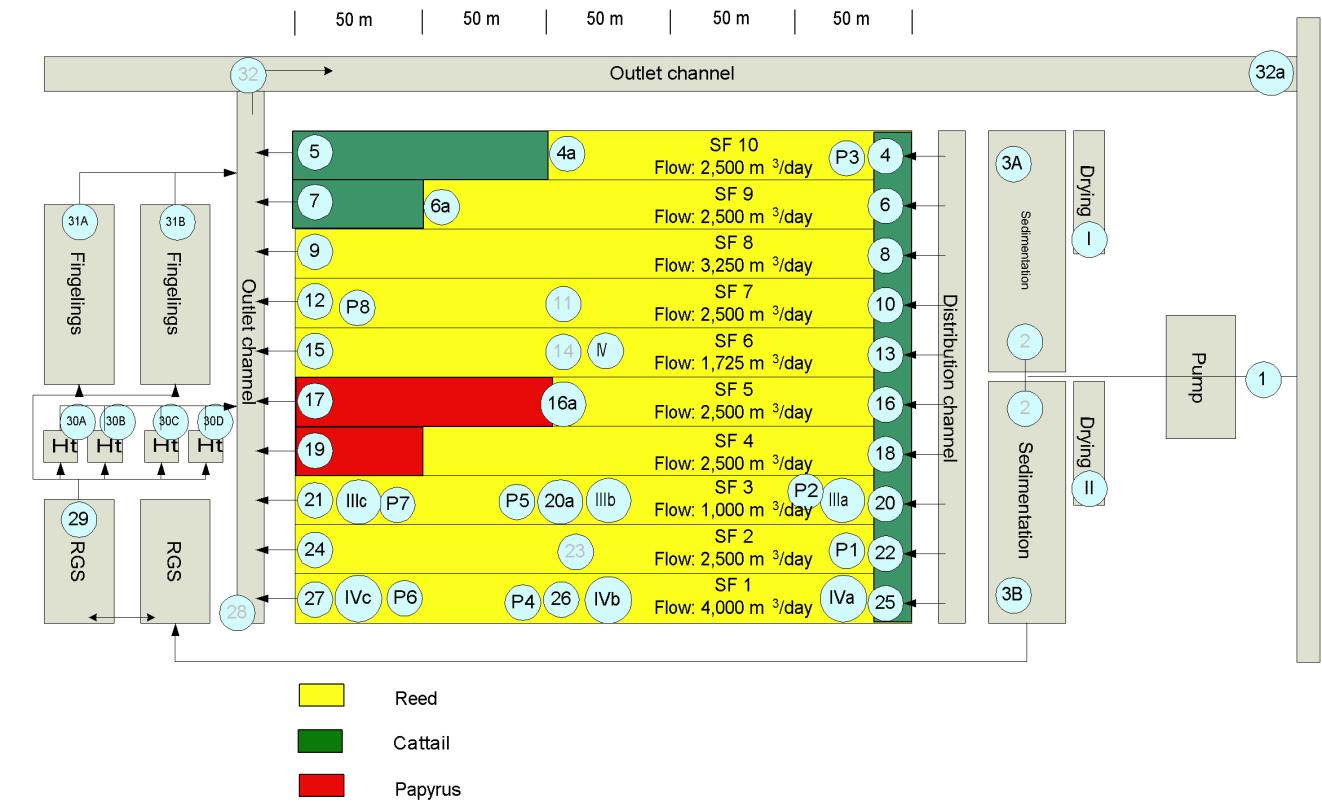
The entire facility includes:
Administration building, laboratory & equipment shed
Intake and pumping facilities
Two sedimentation basins
Ten surface flow wetland treatment cells
Two reciprocating flow gravel beds
6 small ponds (4 hatchery, 2 fingerlings)
Water distribution and outflow channels
Weather and climate monitoring station
Fish ponds (10 cells, 5 acres each)
The following is a flow diagram of the treatment facility and includes sample points and
anticipated flows. This diagram does not include the new fish farm.
2
2.1 PROBLEMS THAT THE PROJECT SOUGHT TO ADDRESS
As noted in the LMEWP Project Document (ProDoc), Egypt faces development and population
pressures contributing to the deterioration of Nile River water quality, with ramifications for
human and ecological health. While the Government of Egypt has over the past 20 years initiated a
large number of sanitation projects designed to significantly reduce the discharge of untreated or
partially treated sewage water, the extent of the treatment needs in Egypt remain substantially in
excess of available local, national and international funding, especially if Egypt continues to opt
for high-cost conventional treatment methods.
The poor quality of north-flowing drainage waters is a major environmental and economic
concern. In this arid country, heavily dependent on agricultural production, the Nile is a vital
resource. It is estimated that each m3 of Nile water gets used and returned two to three times. Much
of the heavily polluted drain water crossing the Nile Delta flows through a complex network of
irrigation canals, including the Bahr El Baqar drain. These canals empty into coastal lakes,
including Lake Manzala, before flowing into the Mediterranean Sea. The resulting pollution of the
Mediterranean Sea violates international agreements that Egypt is party to, in particular the
Barcelona Convention.
Lake Manzala is located on the north-eastern edge of the Nile Delta, between the two port cities of
Dormietta and Port Said. The area is one of the most poorly served in Egypt. Local residents do
not have access to potable water, sanitation, electricity and other basic services. Contaminated
water and tainted fish stocks bring human and ecosystem health risks. Many people live as
squatters on Government land and lack the security of land ownership and economic stability.
As noted in the LMEWP Project Document, Lake Manzala is highly eutrophic with both
macrophytes and planktonic algae contributing to extensive carbon fixation. The nutrient input
3
comes from fresh water inflows, and productivity decreases as salinity increases nearer the
Mediterranean Sea. The nutrient input, particularly through the Bahr El Baqar drain, has a relative
excess of phosphorous compared to nitrogen.
At the end of the 1990s approximately 90 percent of the total catch in Lake Manzala consisted of
four species of tilapia with the majority of individual fish less than ten centimetres in length.
Catches in this lake, which once provided 30 percent of all Egypt's fish, are dominated by the
smallest and hardiest of the tilapia species, T. zilli. This species has shown a high frequency (85
percent) of organ malformation and discoloration, caused by environmental and contaminant
stress. Among the Port Said inhabitants, Lake Manzala fish now have a reputation for
contamination (chemical and microbial) and are avoided by those who can afford to. The resulting
reduction in economic benefit from Lake Manzala fishing has had a severe social and economic
impact on lake area residents as well as local and national political repercussions.
2.2 PROJECT START AND DURATION
The LMEWP builds upon a project concept developed in the early 1990s to significantly reduce
the levels of pollution flowing into Lake Manzala from the Bahr El Baqar drain. The initial project
idea was to construct a large scale facility capable of treating as much as 50% of the Bahr El Baqar
flow. The concept received interest from the Danish government to provide financial support, but
the Danes eventually withdrew. One reason for the failure of the initial project idea had to do with
land tenure. The complexities of developing a large scale engineered wetland facility, requiring
the use of hundreds of acres of land, in an area inhabited by ,,squatters without land title, proved
too contentious. Denmark was not willing to proceed unless the land tenure issues were first
resolved.
In 1994, GEF support was sought for the project idea, and the concept was reduced in scope to a
demonstration project, which would treat approximately 1% of the Bahr El Baqar drain flow. With
this change, the project became an opportunity to demonstrate the effectiveness of engineered
wetlands, yet ceased to be an instrument to significantly improve Lake Manzala water quality. The
project shifted from direct environmental impact brought about by extensive treatment, to a more
indirect impact built on applied research, training, public awareness raising and replication.
GEF support was provided for project planning in 1996, and a project document for the LMEWP
was prepared for UNDP by the Tennessee Valley Authority1 (TVA) in March, 1997. After
development of the Project Document, several years were required to finalise the project
particulars and begin implementation. GEF funding and Egyptian co-financing commitments were
secured in late 1999, and the project timeline was expected to last 5 years, through the end of 2004.
The project duration was subsequently extended twice, and finally concluded in June 2007. The
1 The TVA is a US Government Agency, established in 1933 to improve the navigability of the Tennessee
River, provide flood control and also to boost agricultural and industrial development and reforestation in the
Tennessee Valley. The TVA has evolved into a wide-ranging parastatal agency, and is the US largest public
power company. TVA also operates the US largest research and development facility dedicated to the
science and engineering of constructed wetland treatment systems.
4
extended project implementation period did not require additional GEF financial support.
Extensions were requested and approved to account for delays in project construction and
treatment monitoring.
2.3 IMMEDIATE AND DEVELOPMENT OBJECTIVES OF THE PROJECT
2.3.1 OVERALL OBJECTIVES
The project was expected to demonstrate cost effective methods for improving water quality
entering Lake Manzala and the Mediterranean Sea and to facilitate the transfer of a low cost
biotechnology (engineered wetlands) to Egypt. A local hiring policy and a technical assistance
program were to be established to facilitate successful operation of the wetlands and transfer of the
technology to other parts of the country.
The cleaner water made possible through the engineered wetlands system should help to "increase
job opportunities for local residents, small scale industries that utilise biomass by-products;
opportunities for the women in the local community; support and reinforcement of regional efforts
to manage the resources of Lake Manzala and the coastal Mediterranean area; an improved fishery
in Lake Manzala; decreased health risk associated with consumption of Lake Manzala fish; and
decreased health risk associated with contact with the water from Lake Manzala." (LMEWP
ProDoc)
2.4 MAIN STAKEHOLDERS
The Project Document utilises the term ,,beneficiaries rather than ,,stakeholders to define those
persons and organisations likely to benefit from successful implementation of the LMEWP. These
include:
Local residents and in particular, those that are involved in operating the wetland for biomass
products and aquaculture.
Local residents who will be employees in the construction and operation of the wetland.
Local fishermen who adopt improved fish farming techniques demonstrated by the aquaculture
facility.
NGOs that participate in the wetland demonstration and focus on the project area and its
development.
All residents regardless of economic category because of the enhanced environmental
awareness and emphasis on the health risk associated with water pollution.
Regional scientific institutions and individual scientists that use the wetland facility for
research studies and training.
The Governorate of Port Said.
National governmental bodies, and in particular, the EEAA.
It should also be recognised that successful implementation of this engineered wetlands
demonstration may benefit local communities in other countries where low-cost innovative
technologies can help address pollution problems.
5
2.5 EXPECTED RESULTS
The ProDoc includes a list of expected benefits (emphasis added):
At the end of the five year project, there will be a fully operational, engineered wetland
treating 25,000 to 50,000 m3 per day of highly-polluted drain water. There will be a biomass
harvesting and aquaculture facility operated by local employees and assisted by NGOs.
The project will provide an example of sustainable development in practice, with
improvements in both the local economy and the environment
By the end of the project, there will be a wetland authority that will be responsible for the
facility. The institutional arrangements for long-term operation of the facility will be
determined before the project ends. At the end of the project, much of the routine operations
and maintenance will be conducted by the local employees who are selling biomass and fish
products. There will be a continuing need for the Government of Egypt to provide the
electricity to the facility and oversight management and monitoring.
The wetland will demonstrate a sustainable low cost alternative to conventional waste
treatment in Egypt and a national self-sufficiency to implement this technology throughout
the country.
The project team, governmental technical focal points, and selected graduate students will be
familiar with the biotechnology and will be able to lead Egypt's efforts in wetland
self-sufficiency. The project team will compile economic and monitoring data on the
effectiveness of the wetland and aquaculture systems over a range of conditions. Information
will be obtained concerning wetland function, operation, and transferability to other sites in
Egypt
Institutional strengthening will occur at the local and national level through the cooperative
efforts required to plan and manage the wetland, and to market wetland by-products.
EEAA will have an enhanced role and reputation as a leader in the provision and protection of
environmental quality in Egypt. EEAA will gain institutional strength in project delivery
and implementation that can be transferred to other Egyptian problem areas.
The quality of life for the local participants will improve as the wetland generates
employment, reduces the risk of disease from contaminated water and fish, and improves local
fisheries.
The local participants will be assisted in operating the aquaculture facility, and in harvesting
and marketing biomass products, such as fuel pellets and animal feed.
An integrated environmental monitoring and information program will be implemented to
record, compile, and assess the wetland operating efficiency, including pollution reduction,
biophysical changes, and socioeconomic improvements.
The level of pollutants flowing into Lake Manzala and the Mediterranean Sea will decrease.
The improved quality of water entering the Lake through the Bahr El Baqar drain will promote
biodiversity and enhance habitats for fish and bird species that are unable to survive in the
present aquatic ecosystem.
6
The production of greenhouse gases from the polluted Bahr El Baqar drain flowing into Lake
Manzala will be reduced and the generation of oxygen will increase.
With extrapolation and wider use of this technology by local residents, both Lake Manzala and
the Mediterranean Sea will have improved water and sediment quality as inflow
contaminants are reduced. There will be enhanced fish habitats, healthier fish, more fish
and bird biodiversity, and a reduction in climate gases of the anoxic drain water. The
health of the local population will be improved with the enhanced environmental quality.
7
3
FINDINGS AND CONCLUSIONS2
3.1 PROJECT FORMULATION
The findings on project formulation include consideration of the project design, the extent to which
the project feeds into Egyptian government priorities, the planned involvement of stakeholders,
and ,,other aspects, including the projects connection to related projects and the role of UNDP as
the implementing agency.
3.1.1 CONCEPTUALIZATION/DESIGN (R)
The project included expectations for tendering and awarding of an international contract for
consulting assistance. The expectation was for a five year contract, to include an International
Coordinator, International Wetland Designer, International Wetland Advisor, and International
Field Manager. The Tennessee Valley Authority (TVA) was awarded the contract in 1999. The
chief deliverable from TVA was the Conceptual plan, submitted in November 1999. TVA
provided design assistance until March of 2003 and was compensated $272,000. Unfortunately,
they were restricted from travelling to Egypt for consultations on final construction and start up,
due to US government security concerns, and withdrew from the project.
Achievement of the project conceptualisation and design has been satisfactory. The LMEWP
Project Document and annexes set out plans for a treatment system that is based on proven
concepts and designs from the Tennessee Valley Authority (TVA), who have decades of
experience in running such systems in the US. Whats more, the concept of utilising engineered
wetlands to treat agriculture drain water is highly relevant for Egypt. The decision to scale down
the project to demonstration level made sense as it was clear during the planning stages there was
a lack of financing, available land and political will to construct a large scale wetland treatment
facility.
The LMEWP ProDoc retained some grand objectives relating to the improvement of Lake Manzala
water quality and fisheries. As a small scale demonstration project, substantial environmental
improvement would require considerable attention to replication and policy reform. While the
ProDoc sets transformational objectives, it does not identify and then allocate funding for the kinds
of activities and mechanisms that would be needed to accomplish significant environmental
improvements.
The LMEWP Project Document was developed prior to the UNDP/GEF requirements to include
logical frameworks, and prior to the strengthening of requirements to elaborate verifiable
indicators. Accordingly, while the activities focused on facility construction are clear and
achievable, and the indicators are straightforward, the projects socio-economic objectives are less
clearly elaborated, and have proven difficult to implement.
2 Some of the subsections are denoted with (R), which indicates that a rating has been given,
based on a 4 point scale of project achievement: Highly Satisfactory, Satisfactory, Marginally
Satisfactory, and Unsatisfactory.
8
In hindsight, it is apparent that the timescales for facility completion were overly optimistic.
However, the delays were primarily due to the difficulties in utilising the chosen facility site.
Under less arduous and difficult conditions, the timescales, including a two year time horizon for
construction and facility start-up, would have been reasonable.
Site Selection
Site selection was a major issue both in the original (Danish-supported) concept and then during
the UNDP/GEF supported initiative. The Egyptian Government, together with the Governorate of
Port Said, selected a challenging site for the facility. The positives and negatives of the site
location can be considered as follows:
+ site positives
-- site negatives
close proximity to Lake Manzala, so
12 kilometres away from the nearest
positive, albeit minor, impact on lake water
electricity lines, no potable water or
quality
sanitation
Publicly owned land so minimal cost and
Difficult access due to unpaved road and
legal problems
structurally unsound bridges
Chance to improve the quality of life for
Poorly situated for extensive research: no
impoverished local residents
overnight facilities, no computer/internet
Chance to clean up social problems in the
access, and potentially unsafe area, distant
area, increasing safety for residents
from the cooperating universities.
Well-suited for aquaculture
Poorly suited for agriculture poor saline
soils
Facility Design:
The design for the engineered wetlands facility is appropriate and based on longstanding
experience with the technology by TVA. The project included initial construction of a small pilot
test site, and then development of the full scale facility.
The project included construction of a reciprocating gravel system (RGS), based from a TVA
proprietary design that has proven successful for TVA when applied in the US, including in hot,
arid climates not significantly different from the climate in the Delta area of Egypt. Unfortunately,
the withdrawal of TVA from the project prior to facility completion created difficulties for the
project team to effectively operate the RGS
The two sediment basins were scaled according to expected influent parameters analysed during
the project development stage. 7 years later, when the facility came on line, it was soon evident
that 50% smaller sediment basins would have been sufficient. The over-estimate was due in large
part to the improving water quality of the Bahr El Baqar Drain as a result of upstream water quality
treatment improvements in the Cairo metropolitan area.
3.1.2 COUNTRY-OWNERSHIP/DRIVENESS
The LMEWP is highly relevant to the Egyptian environment and economy and to human health.
The project was formulated in full realisation of the importance of finding low-cost solutions to
Egypts pressing wastewater treatment needs.
9
The Egyptian Environmental Affairs Agency has served as national executing agency, responsible
for overall project management. The rationale for EEAA supervision was sound, as it is the GEF
focal point and also has a cross-functional mandate; however a case could also have been made for
implementation through the Ministry for Water Resources and Irrigation (MWRI), which is
directly involved in the management of irrigation canals throughout Egypt. As it turns out, the
logic of MWRI responsibility grew as the project progressed. At the conclusion of the LMEWP,
responsibility for the facility has changed hands to the National Water Research Centre (NWRC)
of the MWRI.
The project was viewed by the Egyptian Government as an important aspect of its goal to focus
increased attention on ,,environmental black spots" such as Lake Manzala. The lake has been
prominently featured in Egypts National Environmental Action Plan and the LMEWP was
included as an important project for Egypts Supreme Committee for the Rehabilitation of Lake
Manzala.
The Government of Egypt, and Port Said, agreed to a set of financial commitments during project
formulation, to include covering basic municipal infrastructure (land, road access), offices and
equipment, and some manpower contributions, for steering committee meetings, etc. In the end,
the government has followed through, and its in-kind contributions have exceeded their initial
commitments.
While spurring local economic development was a key project objective, the facility was not part
of any comprehensive development plans by the Port Said Governorate to improve development
opportunities and quality of life in the area. The LMEWP was rather a ,,one-off project whose
economic benefit has so far been very limited.
There are other aspects of country ownership that blend project formulation and implementation
issues. For instance, there is the question of whether the government has approved policies and/or
modified regulatory frameworks in line with the projects objectives. In the case of the LMEWP,
the project formulation did not lay out expectations for changing national policies, and
implementation of the project did not deliver policy transformation.
Based on interviews with Egyptian officials and scientists, the project has increased interest in the
merits of engineered wetlands. The project has successfully added to earlier research and
investigations on gravel bed hydroponic systems, carried out in 1991 - 1995 in Ismalia, Egypt, by
the Suez Canal University with UK support.
While the LMEWP has been under development, the Government of Egypt has approved a new
Code on wastewater reuse. The new reuse code has been under development for 8 years and its
final approval is unrelated to the Manzala project, nevertheless the code is a welcome addition to
Egyptian law, and should spur increased interest in engineered wetland systems. Also of note, the
NWRC is expanding its engineered wetland research, with promising studies already undertaken
on in-situ wetland systems within the agricultural drains.
The Manzala project included private sector participation in the design, engineering and
construction of the facility. As a result of the project, Egyptian contractors now possess expertise
that can be put to use in future constructed wetlands projects in the region. The availability of local
expertise is critical to replication of the technology as it should allow for lower design and
construction costs.
10
There have been some small scale actions involving employment of local residents for security and
maintenance of the facility; however the extent of local economic development is below initial
expectations, given ProDoc indications that there would be substantial increased economic benefits
to the surrounding community. While it was the executing agency for the project, the EEAA
expressed interest for the planned aquaculture business to be opened to private investment and
management. The NWRC has not indicated whether it will consider using private concession
contracts.
The project was able to provide training for 25 local persons on engineered wetlands and water
quality for fish farming; however it is unclear whether this training has resulted in local economic
benefits, such as improvements in local fish farming practices or replication of the engineered
wetlands treatment process.
3.1.3 REPLICATION APPROACH
The LMEWP Project Document does not set out a replication approach. Instead, replication
opportunities are inferred on page 23 in the capacity building and dissemination outputs 1.2 & 1.3.
There are no specific outputs for scaling up the LMEWP, for reforming policies and remove
barriers to replication, or for applying lessons learned elsewhere in Egypt.
While the project developers did not articulate how replication should be fostered, it is important to
recognise there is real potential for Egypt to expand its use of constructed wetland systems. The
NWRC is considering these systems to extend treatment of the Bahr El Baqar Drain, and there is
interest to extend the technology for treatment of domestic sewage for villages on the fringes of the
delta where land is more readily available.
3.1.4 LINKAGES TO OTHER PROJECTS
The project was not developed with explicit linkages to other related projects. The Project
Document lists a series of related projects (see ProDoc pg 11) but makes no mention of synergies,
shared resources, shared information, etc.
A related pilot rock-reed wetland demonstration at Ismalia was operated by the Suez Canal
University in collaboration with Portsmouth Polytechnic in the UK. Project management was
aware of this effort, however no specific efforts were made to compare and contrast results.
The ProDoc indicates that the Water Hyacinth Institute was working to commercialize water
hyacinth products and the LMEWP provided an opportunity to turn benchmark results into
commercial opportunities. The LMEWP project team has indicated it did some research on water
hyacinths during the pilot phase and concluded that the saline groundwater and soils at the site
made it impossible to cultivate this wetland plant.
Where there were successful programme linkages were through the NWRC and its Drainage
Research Institute (DRI). For instance, the DRI has been studying various low-cost mechanisms to
improve water quality in the agricultural drains, and are considering lessons learned from the
LMEWP.
11
3.2 PROJECT IMPLEMENTATION
The selection process for facility design and construction supervision was carried out in an
appropriate manner and the contractors chosen were well qualified for the assignment. The
Tennessee Valley Authority (TVA) was the original facility design engineers, supporting a local
engineering team, led by Ahmed Abdel Warith Consulting Engineers (AAW), together with
KOMEX Egypt. The construction contract was awarded to Misr Concrete Development Co. in
November 2000.
It is understood that design and construction complications created unanticipated costs, in
particular due to the difficult site location; however the original contracts and pricing were
honoured. The local team was very much on its own, with limited help from TVA. That the
facility is now operating at or above design criteria, (with the notable exception of the RGS), is a
testament to the capabilities of the local design and construction team.
After TVA withdrew in 2003, The PCU tendered for another external consultant to assist on
operations and maintenance issues and monitoring plans. After an open tendering process, the
Danish firm NIRAS, together with their local affiliates ECMA, were awarded the contract.
Unfortunately, two years passed before the NIRAS team was selected and started to work.
The initial concept was to utilise the LMEW treated effluent for small scale agriculture and
aquaculture research, including fish stocking for Lake Manzala. NIRAS recommended a shift to
commercial scale aquaculture. A decision was made for the project to develop a fish farming
enterprise at the site. The issue was taken up at the 2005 Tripartite Review Committee meeting
and received strong support. The UNDP Resident Representative strongly encouraged that the fish
farm be pursued as an important job creation component of the project.
The earthworks for the agreed upon 60 acre fish farm were completed in August, 2007, and by
October 2007 the ponds were flooded. Operations have yet to commence, and funding is needed to
get the facility into production, including for fish stock (fingerlings), fish food, aeration systems,
etc.
Developing the facility to include a commercial fish farm was a reasonable adaptation of the
project, especially if it enhances local job creation, ensures an ongoing source of revenues to
operate the treatment facility, and enables the NWRC to continue using the facility as a research
station.
It is evident that the LMEWP site was selected due to its proximity to Lake Manzala and the Bahr
El Baqar drain, and because it was a relatively large under-utilised site without private land title
issues. These factors allowed the site to come without land purchase costs, and the short distance to
the Bahr El Baqar drain ensured lower pumping costs. The selection of this particular site also had
negative consequences. There were construction delays, largely stemming from the facility
location, and the need for extensive road excavations and also significant earthworks on site. Also,
water and electricity services have yet to be extended to the area where the facility is located. In
addition, the isolated location of the site and lack of overnight accommodation created problems in
carrying out project management and research. Considering these various tradeoffs, the site was
not ideal, yet it was workable. There is little in the project background information to suggest that
a major effort was made to compare the pros and cons of possible sites.
It wasnt until August 2006 that the monitoring plan developed with the assistance of NIRAS was
implemented. While there are data available from analyses starting from sampling in 2004, the
12
inconsistent monitoring up until 2006 means that it is only in the final months of 2007 that annual
and seasonal comparisons of treatment effectiveness can start to be made. Plant operations and
monitoring were further impacted during the period April June 2007 while negotiations were
carried out concerning the transfer of plant supervision from EEAA to MWRI.
3.2.1 IMPLEMENTATION APPROACH (R)
The implementation approach taken in the LMEWP can be considered marginally satisfactory. A
review of the annual APR/PIR reports, coupled with the projects annual work plan spreadsheet and
notes from the tripartite review meetings, suggest that the project management focused mainly on
the practical matters of construction and operation. In this regard there is a good measure of
success.
The second level of planning and management concerns the applied research and monitoring at the
facility, as well as the development of training programmes and public awareness campaigns. Here
the project had marginal success but more was expected. .
On the positive side, there was a useful partnership put together with the MWRI/NWRC, which
operated linked research activities at the site. This partnership served to maintain NWRC interest
and create the opportunity for their assumption of project ownership and management in 2007.
Through the NWRC, a close cooperation was formed with the Dutch-Egyptian Advisory Panel
Project (APP) on Water Management, which carried out 2 training workshops for Egyptian experts
that also included several regional representatives from Uganda, Sudan and Ethiopia. In addition,
twenty five local residents received training in a workshop on engineered wetlands and fish
farming that ICLARM led on behalf of the project.
On the minus side, the project made little use of electronic information technologies to support
project implementation, participation and monitoring. In addition, it was not apparent that lessons
and practices from other engineered wetlands projects were taken into account for the LMEWP,
other than serving as the basis for TVAs initial conceptual design.
Adaptive management is an important aspect of project implementation, as circumstances change
teams must react and adapt. In the case of the LMEWP, the team had to handle land use and
squatter issues, site construction difficulties, a shifting currency exchange rate, and the withdrawal
of TVA, its key external consultant. The project also made a significant change in expected
outcomes with the decision to build a fish farm. Each of these constraints was handled, but with
varying methods and degrees of success.
The squatter issues were handled temporarily through equal parts diplomacy and increased
security, yet the fundamental land tenure issues in the region remain. The site construction issues
were handled through tough negotiations with contractors. Budgets were kept but schedules
slipped. The shifting currency rates enabled the project to be extended without additional funding,
yet project management decided to operate using a very thin project team and a number of the
broader research expectations were not achieved. The facility was completed without TVA
involvement; however TVAs proprietary RGS was a casualty as it has never worked properly.
In these adaptive management cases, the decision making process was led by the project team
leader, with recommendations from the TRC and TAC advisory committees, including UNDP. In
each case, while there appeared to be open discussions on the way forward, a detailed analysis of
risks and opportunities was not included. The decision to establish a 60 feddan fish pond was
13
supported through NIRAS recommendations including some basic financial analysis of costs and
benefits (see NIRAS Inspection Report, 09082005), and discussed in comments to the NIRAS
inspection report and at the 2005 TRC meeting. Nevertheless, there is no indication that the
project document or project implementation plan were revised to account for this change from a
small aquaculture facility raising juvenile fish for restocking of Lake Manzala to a fish farm. In
general, it can be seen that UNDPs risk management and monitoring system was not closely
followed as the project responded to changing circumstances.
The major TORs developed during the project were uneven. The ProDoc provides a rather
perfunctory TOR outline for the Project Manager and Senior Project Engineer, and outlines the
roles of four international consultants - an international coordinator, international wetland
designer, international wetland advisor and international field manager. In hindsight, the project
management ranks were far to thin, and the project would have benefited from the inclusion of
another expert to handle the significant public awareness, training, outreach and external linkage
expectations.
The ProDoc included a top-heavy team of four international consultants from TVA, who provided
the requisite design parameters but then were not available to offer first hand troubleshooting
assistance. It is exceedingly difficult to provide effective advice and guidance on an innovative
project with proprietary design systems, without periodically travelling to the site.
3.2.2 MONITORING AND EVALUATION (R)
The Lake Manzala project has included both a mid term and final evaluation, there have been
regularly scheduled annual Tripartite Review Meetings (Project Steering Committee), and the
project has been audited annually by an independent accounting firm. The M&R activities have
been carried out in a satisfactory manner.
The mid term evaluation for the Lake Manzala project was carried out in December and January
2004. The MTE included provided the following recommendations for the project:
Extend the project for 1 year (until 2007) to enable the monitoring and experimental
programme to be devised and implemented;
Undertake a detailed review of the facility design, in particular to consider issues such as
sediment pond desludging and the potential for short-circuiting within the wetland beds
Draw up an action plan for engaging the local community and disseminating information to
them.
Develop on-site laboratory facilities, have technically and scientifically qualified personnel on
site at all times, and utilise continuous flow measurements for the influent and effluent
streams, plus composite flow sampling for water quality parameters.
Develop an external peer review process during project inception to address facility problems
as they arise.
Formalise arrangements, including appropriate resources, with external consultants involved in
the feasibility and conceptual designs, to avoid risks of ,,weakening technology transfer
aspects of the project.
14
The recommendations were by and large accepted and utilised by the project management,
although an action plan for engagement of the local community and information dissemination was
not realised.
The project document did not include a logical framework (LFA) and none were subsequently
developed. There were a number of expected outcomes, in the areas of training, public awareness,
and for small business sideline ventures like the sludge bricks and papyrus cultivation concepts,
where the project might have been able achieve greater success if an LFA with verifiable indicators
were developed.
Tripartite Review Committee (TRC) meetings were conducted during the project on an annual
basis. The TRC included representatives from the project team, UNDP Cairo, EEAA, and the
Egyptian Ministry for Foreign Affairs. Tripartite Review Reports (TRR) were produced, and
include information on project status and decisions made.
The project team met its expected obligations to UNDP/GEF with respect to the completion and
submission of annual progress implementation reports (PIRs) and Annual Progress Reports
(APRs).
Facility Monitoring
Consideration of project oversight and monitoring can also include the establishment of a
monitoring programme for the treatment facility. After TVA ceased its involvement, the LMEWP
Steering Committee agreed to tender for another international consultant to help with monitoring
systems development, operational planning and staff training.
The outcome of the tendering procedure was the awarding of a contract in May, 2005 to the Danish
company NIRAS (and its local partner ECMA). NIRAS together with ECMA were contracted to
do the following:
Coordinate with NWRC, through the Project Manager, to train staff, transfer technology and
raise NWRC competence to a level that it can operate the facility after GEF project
completion.
Produce an inspection report assessing how the project as built deviates from the original
project conceptual plan and rational for design set out in the project Document.
Develop a Monitoring and Experimental Program Plan, identifying additional facility
modifications deemed necessary to meet operational demonstration and research objectives.
This plan is to include also a communication strategy for promotion of the technology.
Develop Operating Procedures and Guidelines for the wetland facility, including technical
assistance and training in sampling techniques, water quality analysis, and plant harvesting and
data management.
The TOR developed for the monitoring consultancy covered some but not all of the essential
activities that the consultant ended up participating in. By project conclusion, the consultant had
done significantly more than was initially intended, including in particular the development of a
business plan for the facility.
As is common in many demonstration project TORs, the terms developed for the monitoring
consultancy focus directly on facility operations, and offer very little assistance on the broader
project aspects such as replication and local economic development. The TOR did include an
15
expectation that the consultant provide a communications strategy within the commissioned
Research Plan. The most significant missing aspect to the TOR was a clarification on the feedback
loop. There were no requirements indicated in terms of presenting findings and discussing
alternatives. The expectation was just for the consultants to present their draft plans, and then
await approval and then receive payment. This effectively placed the monitoring consultant as an
external provider of ideas rather than an integral part of the project team.
NIRAS conducted their facility inspection in May - June, 2005 and their inspection report noted a
number of key issues.
With respect to the RGS system, it was mentioned (pg 4) that "It is questionable whether RGS
systems normally would be used for treating irrigation drainage water. This system is first of all
designed for treating higher strength wastewater. Further, it is doubtful whether it would be
affordable for fish farmers to install such a cost-intensive system, both in establishment and
operation. However, this component is now in place, and should therefore be tested in order to
verify the expected performance, or if possible, adapt the technology to local conditions, which is
likely to be of benefit to other treatment situations in Egypt".
The Inspection report sets out a proposal for 5 testing objectives:
Overall objective: A focal centre for engineered wetlands capacity building, technology
transfer, adaptation and awareness creation established.
Immediate objective 1. Establish feasibility of improving the water quality of Lake Manzala
through engineered wetland technology.
Immediate objective 2. Potential for local economic activities enabled by engineered wetland
technology established.
Immediate objective 3. Low cost solutions for village level waste water treatment identified
and design foundation specified.
Immediate objective 4. Cost effective affordable, competitive means of water production for
economic activities developed.
Immediate objective 5. Steady state conditions, long term sustainability, lifespan forecasting
and life cycle economics established.
NIRAS recommended developing a floating pontoon system for continuous rather than batch
desludging of the sedimentation ponds. They also suggested options for revising the v-notch
system of weirs from the sedimentation ponds to the wetland cells. The facility should either revise
the weirs to provide a 6 cm fall, installing wheeled gates of the v-notch type for better accurate
hydraulic adjustment, or then dispensing with the v-notches and constructing valve chambers in the
inlet and outlet of each cell wetland, with electronic flow meters.
NIRAS provides a suggestion to undertake research in treating higher strength wastewater, from a
nearby village, or industrial facility, septic sludge, or from intensive agricultural production. The
proposal was to switch one of the surface flow wetland beds to a subsurface flow bed in the pilot
system. NIRAS also suggested developing a subsurface flow bed in the main wetland system next
to the RGS to better compare the performance of the RGS. They further suggested testing the
performance of the RGS at different pulse/pause schemes and load levels in order to set
management and operational parameters based on strength of the wastewater, size of the system
and degree of treatment desired.
16
NIRAS advocated expansion of the fish farming, utilising 60 feddans (+ acres) of land utilising
12,500 m3 /d of treated water. NIRAS further suggested that a closed circuit water supply for the
fish production be developed, which would circulate fish farm water back through the treatment
facility. NIRAS suggested franchising the fish farming activities out to local fishermen, and
establishing a quality control program for fish production.
The inception / inspection report is comprehensive and provides very good recommendations for
how to proceed in the completion of the LMEWP both in terms of facility operational fine
tuning, and also with respect to research and outreach activities. Some of the recommendations
were carried out for instance the major decision to develop a commercial fish farm. Other
aspects, in particular related to operating the RGS, were not achieved. Also, the suggested studies
of higher strength wastewater were not done. It is recognised that the remote position of the
facility made it somewhat difficult to bring wastewater to the site for testing.
At the time of the evaluation mission, NIRAS had drafted out reports covering the rest of their
expected outputs. These were:
Operations and Maintenance Manual (draft final, May 2007) \
Test Plan (draft final, May 2007)
Monitoring Plan (draft final May 2007)
Business Plan (draft final, June 2007)
In the following sections, each of these plans and manuals is discussed. In general, they provide
useful information and will contribute to the sustainability and replicability of the project. Yet
there are shortcomings, mostly relating to the fact that they are external consultant reports, not
facility plans. Released at the end of the project, they now require discussions, agreements and
major revisions to become documents that can be used as plans that can guide the future
activities at the Manzala facility. Some expected deliverables such as a communications strategy
for promoting engineered wetlands technology, were not well developed in the Business Plan, and
were delivered too late in the project to be implemented.
3.2.3 STAKEHOLDER PARTICIPATION / PUBLIC INVOLVEMENT (R)
Achievement in the area of stakeholder participation and public involvement was marginally
satisfactory. The project team was able to solve a crucial initial problem, regarding the suspicion
and mistrust of some members of the local population where the facility was to be constructed.
This issue not only imperilled the project, it also constituted a safety issue for facility personnel
and construction crews. The ability of the project team to win over the trust of local inhabitants,
and to complete the project without any major security incidences, was a significant achievement.
The project team employed persons from the local community for site construction, security and
maintenance. The project team also provided ad hoc opportunities for community members to
view the wetland and fish pond system, and to receive training and advice on how to use wetland
systems for improving fish pond water quality.
In terms of more general stakeholder involvement, the project was not very successful. In
particular, information dissemination, through the development and implementation of public
outreach and awareness campaigns, did not progress as expected. It is evident that for much of the
project, the small project team was consumed with day to day construction management and
17
facility operations, so communications and public relations received less attention. A
communications strategy was not developed by the team, and as noted above, the NIRAS
developed Business Plan included only a very brief consideration of communications aspects as
part of the recommended Action Plan, which was only delivered during the final several months of
the project. Nevertheless, some public information and dissemination activities were successfully
carried out. In 2004, a short documentary film was produced, including interviews with
participants and local residents. This was subsequently updated and utilised together with a case-
study note for the RBAS/RBEC Virtual Water Fair, November 15-17, 2006. Several project
brochures on the facility have been developed, the last in early 2006, and an explanatory note and
presentation were given at the GEF International Waters Conference in Cape Town, South Africa,
July, 2007. The project team participated and made presentations at a series of workshops
sponsored by APP and NAWQAM, and has participated in international processes through the
GEF IW:LEARN project (e.g. participation in Brazil international conference on nutrient reduction
and control).
The project manager maintained regular communications with key institutional managers and
technical experts. During evaluation interviews, the top management at both the Egyptian
Environmental Affairs Agency (EEAA) and the Ministry of Water Resources and Irrigation
(MWRI) expressed their satisfaction with the information flow from the project and expressed
interest in sustaining the facility.
Involvement with local and international NGOs during the project was minimal. In part, this can
be attributed to the isolated site, and the absence of NGO activity in this part of the Nile Delta.
Stakeholder involvement was primarily achieved through the meetings of the TAC. For instance,
the World Fish Centre (ICLARM) served as a member of the TAC and was also contracted by the
project, in November 2005, to organise a training course on constructed wetlands and fish farming
for the local community in the Lake Manzala area. 25 local residents received this training.
To improve upon project effectiveness in the area of stakeholder outreach and public participation,
another project expert should have been added to the team, with communications and writing
expertise.
3.2.4 FINANCIAL PLANNING
The Lake Manzala project has utilised the UNDP Cairos OUDA financial management system,
tracking all receipts and expenditures carried out under the project. The system is easy to utilise
and appears to have functioned well. All project funds were expended by July 2007. Indications
are that the invoice and payment procedures with UNDP-Cairo were handled professionally, with a
minimum of delay.
The project team developed annual work plans, which provide a general expectation of funds to be
spent against objectives, outputs and activities. However, there is no evidence that these work
plans were closely matched against actual expenditures. Also there was no effort to develop a
shadow budget for keeping day to day accounts matched against outputs and activities. The
annual work plan budgets do not include an aggregate sum of the funds utilised previously for
particular outputs and activities.
18
3.2.5 COST-EFFECTIVENESS OF ACHIEVEMENTS
The cost effectiveness of achievements on the LMEW project can be considered based upon:
Completion of planned activities and meeting of objectives
Use of benchmarking or comparison approach to setting the cost structure
In terms of the timely achievement of objectives, and their relationship to cost effectiveness, it can
be seen that the difficulties of developing the chosen site led to significant project delays, which
were exacerbated by delays in switching international consultants. Some parts of the operation
have failed to work as intended, in particular the RGS, and can therefore be considered
uneconomical at this point.
No benchmarking was initiated at the project document stage, or subsequently, to consider the cost
of the facility against other facilities of its kind in similar developing regions. Partly this can be
attributed to the lack of available data from other treatment facilities treating agricultural drainage
water.
Some comparative cost calculations were done by the project staff to consider the LMEW against
more conventional technologies. Rough calculations suggest that engineered wetland systems can
be built and operated for 10% of the cost of an activated sludge wastewater treatment system in
Egypt however these comparisons are based against very general design estimates, not actual
expenditures, as follows:
Method of Treatment
Capital Cost (L.E/m3)
Running Cost (L.E/m3)
Extended Aeration
3500
140
Oxidation Ditch
1700
105
Aerated Lagoon
1800
70
Oxidation Pond
1300
20
Engineered Wetland
400
Less than 1
3.2.6 FINANCIAL MANAGEMENT AND CO-FINANCING
The project was originally planned to conclude at the end of 2003, and yet it lasted through mid-
2007. The plan was also altered to enable construction of a commercial fish farm. These changes
have been made without additional financing from GEF, and despite increased construction costs
for the facility, which grew from L.E. 6.7 million to L.E. 10.9 million. The budget was able to
stretch because of:
A rigid enforcement of contractually-agreed financial terms with contractors, regardless of cost overruns
and unforeseen facility construction complications.
An (overly) lean project staffing.
Cutbacks in some expected research efforts
Additional in-kind support from Egypt
The strengthening dollar against the Egyptian Pound (LE), led to an increased project budget in
Egyptian Pounds. In the January 2003 LE devaluation the $ value jumped from LE 3.30 to LE 5.75.
Since the project budget was in dollars, the amount in LE was increased. (It should be noted that while
this increased the project amount in LE, it also resulted in negative impacts on the project contractor, in
particular when buying foreign goods and services).
19
The LMEW has been audited on an annual basis. The 2006 audit, submitted by an independent
auditor in April, 2007, states that the project statements of assets and equipment, as well as its
stated cash position, present a fair and accurate indication of the projects financial condition. In
addition, the auditors indicate that appropriate steps were taken by project management in response
to (minor) recommendations from previous audits.
The LMEWP received financial and in-kind support from the GEF, and co-financing from the
Government of Egypt. No additional grants, loans, concessional credits or equity investments were
provided. Egypt has provided direct support matching its planned co-financing contribution of
$346,000, which was roughly 8% of the overall project budget. Based on the project team
estimates, the Egyptian contribution can be considered as high as $1.5 million - if the cost of land
is factored in.
The team has estimated the land value at LE 23,000 per feddan, which for 245 feddans
(including the treatment facility, fish ponds and unused space on the property) comes to just
more than $1 million.
The cost of the 12 km of road construction is estimated at $350,000 ,
Another $81,000 has been estimated for donated office space and utilities.
An additional in-kind contribution of $18,000 in time and expenses has been estimated for the
project technical committee.
The NWRC has also financed some facility O&M costs, including paying for diesel fuel to run
the plant.
With the Governments agreement to continue to operate the LMEW Facility, and its plans to
develop a commercial scale fish farm, there will be a significant continuing financial obligation by
the Egyptian Government, at least until such time as the fish farm is making a profit.
The draft Business Plan submitted by NIRAS in June 2007 includes cost / benefit analyses for the
treatment facility and fish farm operation. The Business Plan sets out expectations that the
operation can be self sustaining following its 3rd year of operation, but suggests that an additional 1
million LE ($200,000 US) will be needed in order to get the fish farm into full production while
continuing to operate the treatment works. The Business Plan further suggests a tripling of the fish
farm size, in order to make the operation fully self sustaining and capable of paying back the initial
NWRC/DRI investment.
3.2.7 LEVERAGED RESOURCES
Leveraged resources can include connected activities carried out by the Government of Egypt,
NGOs and private companies. The annual PIR/APR reports for the project include an assessment
of partnership strategies, including estimated financial contributions. The total leveraged amount,
$155,000, roughly 3% of the total project budget, includes:
$45,000 in parallel funding from the National Water Availability and Quality Monitoring
Project (NAWQAM) -- a Canadian supported (CIDA) project, for sampling and analyzing the
irrigation related parameters of the LMEWP facility influent and effluent, and testing the use
of water for irrigation.
$30,000 in direct costs absorbed by the Dutch-Egyptian Water Advisory Panel for two joint
workshop and training programme at the LMEWP facility,
20
$20,000 in-kind from the World Fish Centre (ICLARM), providing planning and advice for the
projects fish farming activities.
$60,000 provided in-kind from the German company Bona Nova to demonstrate/compare
biophysical wastewater treatment techniques vis-à-vis the engineered wetlands method.
Several Universities provided resources to enable their doctoral students to work at the site.
The Project team was not expected to develop a donor strategy or devote time to identifying
additional external sources of funding for post-GEF sustainability and replication; however donor
support will likely be needed, in particular for undertaking continued research programmes that
have been identified in the draft Test Plan. Canada has reportedly expressed some interest to
provide further funding support for wetlands research through its ongoing partnership with Egypt
in the NAWQAM programme.
3.2.8 EXECUTION AND IMPLEMENTATION MODALITIES
UNDP Implementation
The UNDP has been an appropriate implementing agency for the LMEWP, bringing several
comparative advantages. It is focused on capacity building and the application of new techniques
for environmental improvement and social development. While other UN agencies provide
important services in the areas of environmental protection (UNEP) and scientific research
(UNESCO), the UNDP has long played a pivotal role in supporting structural and policy changes
that improve environmental management, and in particular that foster sustainable development.
The UNDP office in Cairo has a good track record in working with Egyptian counterparts at
national and local levels. They played a significant backstopping role for the LMEWP in
particular through developing and disseminating public communications on the project. A close
UNDP-LMEWP connection was forged after the senior LMEWP project engineer joined UNDP
Cairo in 2002.
UNDP effectively played its traditional fiduciary role, overseeing payments and ensuring that
consulting assignments were carried out using proper UNDP procedures, (approved TORs, open
bidding procedures, etc.). UNDP also played a useful role helping to coordinate between the
national and governorate authorities during LMEWP facility construction, and assisted the project
team with prodding EEAA and MWRI to accelerate their handover negotiations prior to project
conclusion.
Greater UNDP support would have been useful during the critical transition period when the
facility was under construction and TVA announced it was unable to provide direct, on-site review
because of US security restrictions. The project would have benefited from a rapid tendering for
new external consulting assistance, as well as an agreement with TVA to continue providing ad
hoc assistance on specific design aspects. Unfortunately, the tendering process that brought NIRAS
into the picture took over a year, and TVA ceased to provide substantive input.
Greater UNDP oversight would have been helpful in terms of monitoring project achievements
beyond facility construction. It would have been helpful for the supervisory groups: UNDP, the
Tripartite Review Committee, and Technical Advisory Committee, to periodically refer back to the
project concept, and push the project team to pay attention to the broader, longer term project aims
for Lake Manzala ecosystem improvements, technology replication and local community uplift.
21
National Implementation
The EEAA bore responsibility for the project effort. While its involvement through many stretches
of the project was largely passive, the Agency was quite active in several key situations. Early on,
the Agency lobbied the Port Said Governorate to allocate the land for the facility and provided a
strong defence of the project during public hearings in Parliament. Later, they successfully
intervened just prior to project conclusion when a land claim issue arose just prior to the project
closing ceremony. Meanwhile, the other key national government authority MWRI, played a
significant role throughout, with interest in the project shown across the span of authority, from
Minister to researcher. In particular, the NWRC was actively involved in carrying out the
monitoring and sampling analysis programme at the LMEWP. An initial agreement on transfer of
authority to the MWRI took place in 2003, yet the handover was only consummated in 2007. It is
evident that UNDP/GEF project closure proved to be the necessary motivation for the transfer, as
the final details were quickly hammered out in four months, ending June 2007.
The Port Said Governorate has played a key role. The Governor has participated in the project
closing ceremony and has been supportive of the initiative throughout. The Port Said Governorate
provided the land for the site and also assisted with security early on during the design and
construction phase, when there was the possibility of hostility from squatters. The Governorate is
responsible for local infrastructure. In this regard, the project team requested on several occasions
that the electricity grid be extended to the project site, which would improve working conditions,
and also benefit local residents. While a 12 km gap still remains to be closed, the Governor
indicated during the October 2007 project closure ceremony that electricity is planned to be
extended to the facility during 2008.
3.3 PROJECT RESULTS
3.3.1 ATTAINMENT OF OUTCOMES/ACHIEVEMENT OF OBJECTIVES (R)
The following discussion of findings is taken from the objectives and activities set out in annual
work plans for the LMEWP. These deviate slightly from the original activities set out in the
ProDoc. The revised set of activities was agreed to at project inception, reflecting the changing
situation several years after the ProDoc was written. Findings are set out for each output, with
particular points raised on many of the activities within each output.
Objective 1 is designed to provide capacity building for sustainable development in managing
Lake Manzala, including local and national participation.
The first output (1.1) seeks to "Strengthen and promote community involvement in
environmental management activities". Within this first output are five activities aiming to get
local residents involved in the development and operation of the project. The project achievements
in this area have been marginally satisfactory.
The ProDoc envisioned a collaborative process that would engage local residents in an ongoing
manner, enabling them to provide input on employment opportunities, environmental
improvements, and operational techniques at the facility. This was an unrealistic expectation for
22
local collaboration, recognising the lack of a cohesive community, the lack of local NGOs, and the
lack of land tenure for many nearby residents.
There was an expectation that project management would work with local media outlets, especially
within the Governorate of Port Said, to increase environmental awareness and establish a
programme of interactive education. This was not achieved. However, there were a number of
public relations activities carried out, many of them spearheaded by the UNDP Cairo office.
UNDP Cairo office arranged for a film crew to film the facility as part of the activities of the
UNDP- Cairo Media and Reporting Unit, The filming took place ion the 24th of February,
2004, several weeks prior to the official opening ceremony. The film included description of
the facility items, the surround community and Lake Manzala. UNDP also arranged for the
film to be broadcast on Egyptian television.
The opening ceremony for the facility on March 14, 2004, received good press coverage and
was attended by H.E. Dr. Mamdouh Riad Minister of State for Environmental Affairs, H.E. Dr.
Mahmoud Abu Zeid Minister of Water Resources and Irrigation and Mr. Antonio Vigilante
Resident Representative of UNDP in Egypt.
The UNDP Cairo office arranged for another media event in May 2004, which included brief
presentations by Technical Advisory Committee members on the various project elements and
the expected impacts from carrying out the project.
Activity 1.1.4 sets out expectations for assistance to local participants in business development,
including expectations that the LMEWP project manager would assist local persons to increase
incomes through construction activities, marketing of biomass products and operating the
aquaculture facility. During the project, there were a couple of on-site visits for local persons to
view the treatment facility and local farmers were engaged to cut and remove wetland reeds which
they used for animal fodder. Beyond these activities, local business development assistance has
not progressed very far. More success was achieved with Activity 1.1.5 to involve local persons in
facility construction and maintenance. During the course of the project, several local persons were
employed for security and maintenance services.
Output 1.2 establishes expectations for capacity building and human resource development to
ensure that the engineered wetland can be operated and replicated on a regional scale. The output
included one activity to identify government and academic/research organisations and personnel
to participate in the project and establish communication. This output was achieved in a
satisfactory manner, as the project included well-functioning supervisory structures, including the
Tripartite Review Committee, and Technical Advisory Committee.
There have been the following research and training efforts carried out at the site:
NWRC/DRI
The Egyptian NWRC / Drainage Research Institute conducted a separate research effort at the
LMEW site during 2005-2007 looking at agriculture crops and the potential for cultivation in
the brackish soils that are present at the LMEWP site. The chief researcher for the DRI effort
has contributed engineering plans and provided construction management for a new village
scale wastewater treatment facility in the Port Said Governorate, using engineered wetlands
within the treatment system
23
ICLARM:
Training for the staff of the national water research centre in rising of tilapia fish and training
community members on water quality and fish production.
NAWQAM
Providing training sessions on the use of treated water in reducing soil salinity and the use of
treated water for irrigation.
Dutch-Egyptian Advisory Panel Project (APP) on Water Management.
2 workshops carried out at the facility, including "Wetlands Management: Vision, Strategy and
Application" in December, 2005 involving participants from Egypt (34), Uganda (2), Sudan
(1), and Ethiopia (1).
Research students:
Three Ph.D. students and three M.Sc student, belonging to four Egyptian universities (Ain
Shams, Shebin El Kom, Mansoura and Cairo Universities), have conducted their research in
the wetland facility.
Output 1.3 addresses the dissemination of lessons and experiences of wetlands project at global,
national, and community levels. Achievement of this output has been marginally satisfactory.
Annual reports were developed to meet UNDP/GEF requirements but annual reports were not
developed for public consumption. There were no press releases or web content detailing interim
results, providing cost and performance information, or discussing local benefits. The project has
not developed and disseminated socio-economic reports on improvements to rural water quality,
development of biomass businesses and the impact on rural families. There was very limited
preparation and distribution of scientific papers and reports either through primary or secondary
literature. Hopefully the NWRC will consider producing more scientific and public information
literature about the project in the future, (in Arabic and English) especially as the fish farm comes
on line.
Objective 2: Demonstration of engineered wetland technology as a low-cost and efficient
method of treating large bodies of water in Egypt and promoting a cleaner Mediterranean
Sea.
The expectations for Output 2.1 were to "successfully complete preconstruction work for a
demonstration scale wetland to treat wastewater". This included 8 activities:
select a project team;
prepare detailed design drawings and engineering specifications;
establish the project offices and lab facilities;
tender the international contract;
undertake field studies;
collect hydrometric and water quality data from Bahr El Baqar drain and the Bashtir Canal;
prepare and award tenders
Prepare scientific study and monitoring workplan
This output constitutes the bulk of the work and costs of the LMEWP. Most of the expectations
were met, and the achievements satisfactory, albeit in a longer time frame than was initially
expected.
24
The project team was selected. The project has been led by a Project Manager (PM) and a series of
Senior Project Engineers, plus support staff, including drivers and unskilled labour. The PM has
remained the same person throughout the project. He has operated from Cairo as expected, in order
to maintain a liaison among government agencies, to ensure interagency cooperation, and to obtain
permits and approvals. He effectively carried out these activities.
It has been up to the Senior Project Engineer(s) to provide continuous on-site project management.
There have been six senior engineers employed during the project, (M. Bayoumi (1999-9/2000) M.
Ghafar 1999-7/2001, K. Amer (9/2001-12/2001) A. Abbas (8/2002 10/2002), H. Sadany (8/2002
10/2003), and I. Gaafar (11/2003 6/2007). While the delays in project construction and facility
start up were in large part due to the difficulties in working at the selected site, the revolving door
of senior engineers did not help matters.
From late 2003 to project conclusion was the time when many facility fine tuning and research
activities were supposed to take place, such as development of biomass projects, the testing of
different wetlands plant species, the fine tuning and operation of the reciprocating gravel bed
system, the establishment of a monitoring programme, implementing a communications plan,
developing a fish farm, and planning for the sustainability and replication post-GEF. It is evident
that the project team since 2004 was not adequately staffed to manage all of the expected activities.
It has been noted that the Senior Engineer during the final project years had a heavy load, carrying
out all on-site activities plus handling budgeting and office chores all while completing his PhD
Thesis.
A project office was initially established for the project in Port Said and a flat was financed for the
use of project staff. The flat and apartment were utilised until the end of 2001, at which point a
project office was made available through EEAA in the Cairo area, and use of the flat
discontinued. The long travels back and forth from Cairo to Port Said created some problems for
site supervision. It also made it more difficult for the Senior Engineer to oversee the expected
socio-economic activities (see activity 2.1.3)
A lab facility was set up. At the time of the evaluation mission in May 2007 there existed a basic
set of equipment to do water quality testing, such as for temperature and turbidity, however it
appeared that the equipment had not been used regularly. It was indicated by project staff that
running water for the facility was provided through an elevated tank and the on site diesel
generator could provide continuous current, so the lab equipment could be used, however
researchers preferred to utilise better equipped facilities elsewhere. A review of the project budget
indicates GEF funding of more than $50,000 (more than 250,000 LE) for lab equipment. At this
stage of the operation, based on the May, 2007 on-site observation, this investment in lab
equipment has been underutilised. An additional $12,000 (62,000 LE) was used to construct an
automated metrological station, providing continuous readings on temperature, wind (speed and
direction) and barometric information. The metrological station was installed at the beginning of
2007, and is working as expected.
Contract tendering was achieved in a satisfactory fashion, as tenders were prepared in accordance
with construction regulations and codes of good engineering practice in Egypt. Tender documents
were released for open bidding and a transparent process for evaluating bids was developed.
Deadlines and time schedules were set into the compliance expectations of contracting and
subcontracting firms.
25
An environmental impact assessment was adequately carried out for the treatment facility, in
conformity with Egyptian law. An EIA was not carried out for the later project extension that
added the 60 feddan fish farm, however recognising that the area is undeveloped / agrarian, that the
sites previous use was for fish farming, and that the sites saline soils are unfit for other
agricultural activity, it is reasonable to assume that the fish farming expansion meets
environmental requirements especially if the fish effluent is returned back through the treatment
facility prior to discharge.
Monitoring Plan
Expectations were that the team would develop a scientific study and monitoring work plan,
including protocols and schedules for assessing wetland operations and measuring water quality
and ecological parameters. Analytical laboratories would be identified and contracted on an
annual basis and routine low technology parameters would be analyzed on site by graduate
students as part of their research studies. These expectations were met. The general Monitoring
Programme for the LMEWP was started in January 2005 according to a programme defined in a
report submitted by the Egyptian consulting firm KOMEX.
When NIRAS and ECMA came on board as external consultants, they visited the site on 10
occasions, over 160 days, analysing plant operations and considering refinements to the operations
and monitoring programmes. The resulting revised Monitoring Plan for the LMEWP was finally
published in May 2007, although the essential pieces were already in place by August 2006. The
Monitoring Plan includes a description of the actual measurements to be carried out, by whom and
at what frequency.
NWRC was contracted in 2006 to carry out sampling and analysis. The monthly reports over 20
months are well documented. NIRAS in its inception report and monitoring plan note that based
on their QA/QC of the NWRC analyses, their work was of consistent high quality.
Output 2.2 seeks to construct a 120 feddan demonstration wetland treatment system
consisting of sedimentation pond, engineered wetlands, and aquaculture facility capable of
treating 25,000 to 50,000 cubic meters per day.
The achievement of this objective can be considered satisfactory. The treatment facility is
operational and is effectively treating the expected flow. The analysis from collected field data,
since August 2006 indicates the following removal efficiencies of the facility, based on the ratio
between the influent wastewater and effluent water concentrations:
Constituent
Removal Efficiency
Biological Oxygen Demand
61.2%
Total Suspended Solids
80.0%
Total Phosphorous
15.2%
Total Nitrogen
51.4%
Organic Nitrogen
25.9%
Total Coliform
99.7%
Activity 2.2.4 concerns establishing wetland cells and notes that engineered wetlands will require a
large supply of wetland plants such as cattail, bulrush, phragmites, duckweed, and water hyacinth.
26
The project concept envisioned that there would a series of tests to determine the optimum mix of
wetland plants. Some experimentation did occur. During the pilot phase, water hyacinth, duck
weed and azola were tested; however the results were negative due to high soil salinity. It would
have been useful for the project team to better document the early trials and to experiment with
different salinity levels in order to determine what wetland plant types could be used.
It was noted in the Mid Term Evaluation for the LMEWP that international design standards would
normally call for a synthetic lining system for the sediment ponds, wetland cells, drying beds and
interconnecting canals (MTE pg 15). This prevents erosion and emergent vegetation, and
especially prevents transfer to the groundwater system. LMEWP management decided not to use
liners, due to cost considerations, because the groundwater under the site was already brackish and
unfit for use, and because the soil composition was suitable for compacting. Nevertheless, failure
to use liners has had consequences exacerbating turbidity problems in the sediment basins and
ensuring mixing of effluent with highly saline soils and groundwater, thereby making it difficult to
utilise salt-sensitive wetland plants. As a demonstration project, this issue of whether to use liners
should have been subject to testing and analysis, for example by lining some sections but not
others and comparing operational differences and results.
Operations and Maintenance
Operations and maintenance are a key component of the facility management. The draft
Operations and Maintenance Manual (May, 2007) sets out the layout and staffing for the LMEWP,
lists operations and maintenance tasks to be conducted, identifies health, safety and environmental
issues, and provides various lists for recording water levels and flows.
The O&M Manual provides a clear understanding of the plant operations. It also proposes a
staffing plan for the facility. The staffing plan (pg 11) identifies an 8 person management staff,
including plant manager, plant operator, lab supervisor, plant admin supervisor, hydraulic
supervisor, vegetation and aquatic supervisor and mechanical/electric supervisors (2). For a
facility treating between 25,000 and 50,000 m3/d of wastewater this is an over-abundance of
supervisory personnel.
The O&M manual no longer includes the inception report recommendation of installing a pontoon
system for dealing with de-sludging of the sedimentation ponds. It is assumed this decision not to
install the system is because of its cost to operate and/or because the amount of sludge collecting in
the ponds is lower than originally expected (due to improving canal water quality).
The Manual focuses significant attention on the problem of fish biomass in the sedimentation
ponds which are a leading cause of higher than expected turbidity in the effluent waters flowing on
to the wetland cells. The suggested remedies are screening the inlets to the sedimentation ponds
and introducing predator fish (Nile Perch or European Sea bass). These two options are
appropriate.
It was evident during the evaluation mission that the previous sedimentation pond draining (to deal
with the unwanted fish biomass in the sedimentation ponds) had a negative effect on the health of
the reeds in the wetland cells. If a batch sludge removal process remains the technique of choice,
then the pond to wetland flow regime needs to be revised such that on a temporary basis, the active
sedimentation pond feeds all wetland cells. This should be possible as the research has shown
that the sedimentation ponds were over-designed for treating 25,000 m2 per day, and that just one
of the basins is sufficient for maintaining adequate flow through the wetland cells.
27
A checklist for operations and maintenance activities is included in the O&M Manual (see
Appendix 1, General Checklist). Ideally these should be transferred to a daily, weekly, monthly,
annual operations schedule, and of course translated into Arabic so they can be well-utilised by
plant staff. The checklist indicates that for most of the more complex machinery (RGS, pumps,
overhead travelling crane, and power generator); routine maintenance should be carried out in
accordance with the Suppliers Manuals. It will be important that these Manuals are readily
available on site, and that the routine maintenance activities are copied and appended to the O&M
Manual, and translated as necessary.
Output 2.3 seeks to "Implement an innovative wetland technology to treat 25,000 to 50,000
cubic meters of polluted water per day, provide a viable basis for sustainable development,
and create opportunities for socioeconomic growth in an environmentally sound manner".
There were two ancillary activities: to develop marketable wetland products and to inform the local
inhabitants of environmental and economic improvements as a result of the project. The biomass
harvesting and aquaculture operations have not developed as planned; however there should be
expectations that as the aquaculture business becomes operational there will be opportunities for
job creation.
Wetland by-products of commercial value have not been established, and there is a real risk that
this aspect of the project will never be fully realised. One project expectation was that sludge
bricks could be produced. The project team indicated that this is not possible due to the sandy
composition of the sediment basin sludge, and the low quantity of sludge produced. It is important
to note that this is anecdotal information since the project team did not provide written
documentation of attempts to make sludge bricks.
The second area where commercial value was to be considered was in the harvesting of reeds. The
project team did not attempt to sell any reeds, however they did agree that local farmers could cut
the reeds and take them as animal fodder. There is a commercial aspect to this barter transaction
both in reducing maintenance costs at the facility and reducing animal feed costs for local farmers.
The only wetland plant considered to have significant commercial potential in Egypt is papyrus.
Results from the small bit of papyrus cultivation during the project are equivocal. The one small
patch of papyrus observed during the evaluation was dying off, reportedly because of a temporary
shut down of water flow through some of the wetland cells due to sedimentation basin
maintenance.
The second activity, to assess environmental and economic improvements, has not occurred. The
project team made some contact with local residents, but no formal assessment of economic
activity took place. The local population is transient, disenfranchised and suspicious of government
intentions. Some make their incomes "off the books" through unregistered fish farms and other
economic endeavours, including reportedly smuggling activities.
The potential environmental and economic benefits to Lake Manzala of expanded use of the
wetland technology was supposed to be quantified, with an analysis made between the costs and
benefits of engineered wetlands techniques compared with conventional technologies. These
economic analyses were not carried out. NIRAS has provided in its Test Plan a set of
recommendations for economic analysis that would meet this project expectation; however it
would have been logical for these to get carried out during the LMEWP not now, after the project
has concluded. The NWRC should consider seeking external funding to finally carry out these
analyses.
28
Output 2.4 sets expectations for the establishment of a monitoring and evaluation system to
enable the Egyptian Environmental Affairs Agency (EEAA) to maintain expected
performance levels. This has been accomplished in a satisfactory fashion. An initial monitoring
programme has been in place since 2005, and was revamped in August 2006. The plant has been
able to collect one year of consistent data since the new monitoring plan was established. It is
important to note, however, that during the evaluation mission, and subsequently as GEF support
has ended and as the changeover of responsibility has slowly been shifting, there has been a let up
in the sampling and analysis regime.
The draft operations & maintenance manual meets the expectations set out in activity 2.4.1&2 with
respect to routine operational procedures, and the checklist of parameters to act as performance
indicators. It is important to recognise within this output area that the initial plans called for the
testing of alternative operating methods and procedures. This has not been done sufficiently, in
particular with respect to different wetland plant schemes, different types and strength of
wastewater, and the RGS operations. Testing has mostly centred on different flow rates and depths
through the wetland cells.
A Test Plan was submitted in draft final form by NIRAS in May, 2007. The Test Plan sets out
theoretical models for surface flow wetland cells and sedimentation basins and the testing plan to
be established for their calibration under the conditions present at the LMEW. The Test Plan sets
out the main general parameters governing performance of wetland cells and sedimentation.
Interestingly, it concludes that a theoretical formula to calculate the performance of the RGS
system is not available because the system was invented by TVA and is under US patent.
The Test Plan sets out a course of study using the LMEWP treatment methods and achievements,
set against the volume of polluted water discharge into Lake Manzala, to consider how a scaled-up
wetlands system might be configured to appreciably improve Lake Manzala water quality. The
Test Plan notes there are real difficulties in identifying what would be the acceptable pollution
loading into Lake Manzala, as there have not been recent studies done to determine the extent of
eutrophication present and the extent of toxic effects stemming from heavy metals and chemical
residues in the lake water. The test plan makes a useful suggestion that further studies on the
environmental conditions and pollution reduction objectives for Lake Manzala are needed.
The Test Plan provides useful information with respect to the acceptable parameters for land
applications of sediment ponds sludge, based from Egypts Code 204 for Treated Wastewater
Reuse in Agriculture.
Section 4.4 of the Test Plan presents a key set of tests that need to be conducted now that the fish
farm is soon to go into production. The recommended testing to determine fish production quality
and to achieve results sufficient for certification to the EU market is critical for economic success.
Also, a very important recommendation is provided to investigate whether recirculation of the fish
pond effluent in a closed circuit system is possible while maintaining the desired high level of
fish production quality.
The Test Plan proscribes data flow, storage, and reporting and feedback system for the three sets of
envisioned monitoring: general long term, operations and maintenance, and special short term
monitoring.
The Test Plan provides an amended proposed organisation chart, adding a technical science
advisor position, an information technology supervisor, a special short term monitoring team, and
29
general long term monitoring team to the previously suggested 8 person team set out in the O& M
Manual. This constitutes a quite large array of staff. Whereas the LMEWP erred in having too thin
a staffing plan, this suggested new plan appears to err in the opposite direction.
The Test Plan offers a well considered set of testing protocols and database systems to fully
achieve project objectives. As the LMEWP has ended, it is up to the NWRC to consider whether
they have the interest and resources to implement these recommendations.
3.3.2 SUSTAINABILITY
Many signs point to sustainability for the LMEW facility. The wetlands treatment system is now in
operation, and it has been agreed the facility will be operated through the NWRC. This is a suitable
solution, as the NWRC is the Egyptian governmental body best suited to successfully carry the
engineered wetlands concept forward, and developing a role for the facility as a regional centre for
engineered wetlands research. During the handover / project closure ceremony, the Minister of
Water Resources indicated that a budget has been established through the NWRC for the facility
management and operations for 2007 and beyond. NWRC have committed LE 1 million so far to
support operations and research at the facility.
There will continue to be a great need for improving drainage quality flowing into Lake Manzala
and across the Delta. This is likely for two reasons first because of Egypts international
environmental obligations, and even more important, because of the reuse potential in reclaimed
drainage water. The LMEWP has demonstrated that engineered wetlands can meet reuse water
quality requirements. The revision and approval of the effluent reuse law in Egypt should help to
increase interest in the LMEWP and replication of this technology in other locations.
Business Plan
A Business Plan has been drafted (NIRAS, June 2007) which is designed to help NWRC place the
facility on a sustainable financial footing for the future. With some modifications, the Business
Plan can be very helpful as a blueprint for LMEW operations. The Plan provides a cost / benefit
analysis and cash flow projection through the 1st 5 years of NWRC management. Noted on page 10
of the Plan is an expectation that approximately 1 million LE ($200,000) should be secured for full
mobilisation of the LMEW facility through these first five years of operation. In particular,
additional costs will be incurred during the first 3 years of this five year plan, to get the fish
farming activities up to full production. The cash flow projections suggest that cash revenues will
exceed expenses starting in year 4, however profits will not be sufficient to offset the initial start
up costs even through year 20.
The Plan includes a recommendation to add more fish ponds, expanding the farm from 52 feddans
to 156 feddans. Should that happen, NIRAS suggests that the present benefit to cost ratio would
shift from 1.14 to 1.26, and a pay back of the full project costs (including construction) would be
possible within a 20 year project life cycle. This recommended scaling up makes sense as long as
the following criteria are met:
The first 60 feddan facility gets successfully developed and achieves target production goals
during the years 1 & 2.
Marketing efforts are successful, so profits meet or exceed projections
30
Local economic development goal are achieved in terms of local hiring and making sections
of the facility available for private ownership and operation.
The Business Plan provides a detailed elaboration of the management of the fish farm, include a
discussion on fish feed consumption. Also included are various options provided to enhance fish
production, including a greenhouse system to provide a higher rate of brood stock survival and
earlier spawning.
The projections for several of the revenue streams in the Business Plan are highly speculative,
especially revenues that may be derived from cropping and selling wetland plants. There is no data
to suggest a market for reeds, and while there is presumed market for papyrus, there is no evidence
that the LMEWP will be able to grow these plants in commercial quantities. As noted in the
LMEWP draft Business Plan (pg 34), there is no evidence that papyrus has been successfully
grown in the climactic and water quality conditions that exist at the site. Further, there is no
evidence that sludge bricks can be produced. In addition, no plans have yet been developed that
would bring in additional revenues through research and training. The authors of the Business Plan
recognise that there are great uncertainties on these potential additional revenue streams, and count
them as revenue neutral with respect to benefit cost ratio calculations.
Suggested steps for developing an Action Plan for are put forward for realising the Business Plan.
Included in first 3 years are:
securing funding,
commencing fish farming operations,
developing the research training and consultation activities, and
starting papyrus cultivation.
Missing from the fisheries aspects of the business plan are some important business issues, such as
the processing and marketing of the fish produced at the site. Will initial processing be done on
site (gutting, etc) or will this be outsourced? What are the costs and benefits to either approach?
Also given scant attention are the costs and risks associated to disease. What contingencies need to
be established in the case of a disease outbreak? And what are the recommendations in terms of
operations to reduce this risk? It will be important for the NWRC to augment the NIRAS business
plan recommendations with a more extensive risk and marketing assessment for this facility.
3.4 CONTRIBUTION TO UPGRADING SKILLS OF THE NATIONAL
STAFF/EXPERTS
There has been a modest contribution to skills upgrading of national staff and experts from the
project. Beyond the project staff itself, there were 6 researchers utilising the facility for their PhD
and Masters theses. There were also two regional workshops by NWRC and the Dutch government
through the AAP. These seminars enabled more than 40 Egyptian participants, and a few
international engineers and experts from Ethiopia, Sudan and Uganda to gain experience and
knowledge in the management of engineered wetland systems.
31
3.4.1 COMPARATIVE ANALYSIS ENGINEERED WETLANDS VS. OTHER
TREATMENT SYSTEMS
The TOR for the evaluation sets an expectation that the evaluation team provide a "comparative
section looking into efficiency, cost-effectiveness, environmental impacts and social acceptability
of engineered wetlands v/s other treatment facilities". An exhaustive comparison is beyond the
scope for this limited evaluation exercise, and is made difficult by minimal work on cost
comparisons carried out by the project team and hired consultants. Nevertheless the following
comments can be made:
NIRAS has indicated in its Business Plan (pg 33) that based on 2 years of monitoring data, the
facility performance is as follows:
Parameter
Inlet concentration mg/l
Retention capacity %
Total detailed in the
facility, tones per year
TSS
80
0.45
246.4
BOD
20
0.43
58.9
TOT N
12
0.18
14.8
TOT P
1.9
0.06
0.8
(NIRAS draft final Business Plan pg 33)
These numbers assume the facility is in operation 75% of the time.
Interestingly, the LMEWP project management provides data collected from August, 2006
indicating removal estimates as follows:
Constituent
Removal Efficiency
Biological Oxygen Demand
61.2%
Total Suspended Solids
80.0%
Total Phosphorous
15.2%
Total Nitrogen
51.4%
Organic Nitrogen
25.9%
Total Coliform
99.7%
(LMEWP Case Study prepared for UNDP H2O Knowledge Fair)
In this case, removal efficiency and retention capacity can be considered the same, as they relate to
the percentage of pollutants entering the system that are removed before discharge from the
system. The percentage discrepancies suggest improved performance during 2006 over 2005,
although it is symptomatic of the project that its internal management and external monitoring
consultant utilise different measurements to consider system effectiveness.
The facility has not been tested with high BOD content municipal wastewater or with industrial
wastewaters. As a consequence, it is difficult to make an effective comparison against the
effectiveness of conventional systems that are receiving a different type of effluent.
The initial estimates were that the total construction costs for the facility would be L.E 6.7 million,
indicating a total cost of 268 L.E m-3 if treating 25,000 m3 per day, and L.E 134 m-3 if treating
50,000 m3 per day. As noted in the MTE (pg 18) this compares with estimates of L.E. 300 m-3 for
similar small scale projects in Egypt and L.E 800 m-3 for conventional secondary wastewater
treatment plants in Egypt. As noted below, the final tabulation of capital costs came in 30% higher
(L.E. 10.9 million). This then suggests that the costs of construction were between L.E. 436 and
32
L.E. 218 m-3 depending on whether the facility treats 25,000 or 50,000 m3 per day. This suggests
the system is competitive with other small scale facilities, and remains no more than half the cost
of secondary wastewater treatment facility construction.
In addition to cost and treatment performance, comparisons with conventional treatment works are
even more favourable when consideration is given to aesthetics and social acceptability. Properly
managed engineered wetland facilities emit fewer odours and are more visually pleasing than
conventional wastewater treatment systems. On the negative side, there are space considerations,
as engineered wetland systems typically take two to three times as much space as conventional
systems.
Capital Costs of the Facility
Items
Cost (L.E.)
Cost (USD)
Project Site (area of 70 feddan)
1,600,000
320,000
Construction & Management Construction
o Civil Works
4,898,973
979,795
o Electromechanical Works
1,860,727
372,145
Equipment & Transportation
751,133
150,226
Consultancy (International & National)
1,795,000
359,000
Total
10,905,833
2,181,167
Actual Running Cost of the Facility
Item
Cost L.E / year
Cost USD/Year
Energy Consumption
120,000
24,000
Electromechanical Maintenance and Operation Costs
60,000
12,000
Maintenance of Buildings and Civil Works
10,000
2,000
Transportation and Miscellaneous Cost
48,000
9,600
Water Quality Monitoring Cost
240,000
48,000
De-sludging and Cleaning Costs
48,000
9,600
Harvesting of Plants
60,000
12,000
Total
586,000
117,200
33
4
RECOMMENDATIONS
4.1 FUTURE DIRECTIONS FOR LAKE MANZALA AND EGYPT
1. The NWRC should operate the LMEW facility with three aims in mind: as an applied
research centre for innovative wastewater treatment technologies, as a driver and change agent for
local economic development, and as a leading aquaculture production and research facility. The
Business Plan adds to this vision with recommendations to continue using the facility to develop
practical solutions to the water quality problems in Lake Manzala. The facility has great potential
in all of these areas. Commitment from the Egyptian (and Port Said) government(s) to enable the
facility to take on these multiple roles can leverage further bilateral donor support.
2. The conditions of the Lake Manzala ecosystem have not been monitored closely over the past
decade. Information on the status of fisheries is dated, and studies have not been carried out
recently to determine whether the improving water quality in the agricultural drains is having a
positive impact on Lake Manzala water quality and the health of fisheries and other aquatic
species. The NWRC and EEAA should include in their research priorities an ongoing ecosystem
monitoring program for Lake Manzala.
3. Suggestions are made in the Test Plan for socio-economic studies to determine the impact of
establishing a large scale array of engineered wetlands close to Lake Manzala or along the Bahr El
Baqar Drain. The NWRC has meanwhile been considering whether in-situ wetland systems could
be developed within the drains or in shallow areas of the lake itself. At the conclusion of the
LMEWP, the time is ripe to commission an analysis of such opportunities to prepare for follow
on projects that can further enhance Lake Manzala water quality.
4. The LMEW facility was developed in part to spur local economic development but only
minor progress was made. Now, with the Port Said Governorate committed to provide electricity to
the area in 2008, there is a real opportunity for expansion of other basic services and increased
economic opportunities. The LMEWP is in the position to play a job creation role through the fish
farming business. Workers for the fish farm should be locally hired and a management training
programme should be established. Private concession contracts, if established, should also require
local employment and local management opportunities.
5. The O&M, Test, Monitoring and Business Plans provide many useful recommendations that
the NWRC should seriously consider. The depth of information and quality of recommendations is
high. It is important to note, however, that they remain works in progress. At this stage the plans
do not yet fit together. There are several different recommendations on staffing, as well as other
redundancies and overlaps. In particular, a more practical format should be developed that allows
the NIRAS operational recommendations to be used as day to day guidance. A suggested way
forward would be to combine the different plans into separate management and operational plans
for the treatment facility and for the fish farm. A suggested list of aspects to include in each is set
out in the box below:
34
Treatment Facility Management Plan:
Projected costs (and revenue streams) for the treatment operation
Research and training programme, including elements of the Test Plan that seek to address
larger objectives such as improving Lake Manzala water quality, providing socio-economic
benefit to the local community, replicating the technology and building public awareness and
support for engineered wetlands.
Annexed legal and policy information, including Egyptian environmental statutes
Treatment Facility Operations Manual:
Treatment facility aspects now included in the O&M, Monitoring and Test Plans.
Fish Farm Business / Management Plan:
Cost and benefit analyses for the envisioned business, with additional breakouts for the
benefits of recommended additions, including greenhouse construction, cultivation of
additional species beyond tilapia, development of additional hatchery ponds and concrete
tanks, and tripling the fish farm size,
Risk assessment that factors into planning the risks of disease, marketing problems and other
factors that could severely reduce profitability
Opportunities and plans to franchise some or all of the fish farming activities to local private
interests through private concession contracts
Marketing opportunities and conditions to sell fish produce in Egypt, other regional markets
and international (European) markets.
Annexed legal and policy information regarding aquaculture
Fish Farm Operations Manual:
Aquaculture facility aspects now included in the O&M Monitoring and Test Plans
6. The Test Plan includes a recommendation to use engineered wetlands as a low-cost solution
for village level wastewater treatment. The LMEWP was supposed to have provided an
opportunity to test the system with stronger wastewaters, but these trials have not been carried out.
It will be important for NWRC to carry out further studies to establish a design foundation for
village level treatment based on the LMEWP prototype.
7.
The NWRC should initiate an additional research effort to explore the potential treatment
opportunities afforded by the existence of the RGS system at the Manzala site. The RGS has not
yet been fully tested to determine its treatment efficiencies as a stand alone system or in parallel
with the wetland cells. Now that the security issues that stymied TVA involvement have subsided,
it would be useful for the NWRC to bring the TVA back into the picture to troubleshoot the RGS
system and provide an operational and monitoring plan for it. US financial support could be sought
to complete this aspect of the research programme.
8.
The LMEW fish farm has been constructed without a return-flow mechanism to treat the
fish pond effluent prior to discharge into the drain. This is contrary to the recommendations from
the NIRAS consulting team and the TAC, and contrary to generally accepted practices. Merely
diluting the fish farm effluent with wetland cell treated effluent before discharge is not appropriate.
It diminishes the initial intention of the project which is to reduce pollution flow into Lake
Manzala, and misses a further research and analysis opportunity to gauge the wetland facility
capabilities in treating fish farm waste. The system should be revised to enable a closed circuit
effluent system
35
9. From a financial and operational basis, it is recommended to distinguish the farm staffing
from the treatment staffing, and to remove several of the NIRAS suggested positions for the
treatment works as follows:
Treatment works:
Plant Manager (in direct charge also of administrative issues and business development)
Plant Operator + assistant (directly managing hydraulics, vegetation, mechanical and
electrical)
Research and training director (overseeing lab work, research projects, training workshops)
(plus assistant)
Accounts manager (handling financial accounting also for the fish farm)
Fish farm:
Aquaculture Business Manager
Hatchery, fingerlings, fisheries Operations Manager
Fish production & Marketing Manager
10. The NIRAS draft Business Plan cost and income projections are useful for considering the
long term economic viability of the Manzala facility, but more work is needed to break out the
construction, installation and consultancy costs of the project so that the project can better serve as
a template for replication. It should be expected that future project developers in Egypt and
countries with similar economic and climactic conditions can build similar treatment works for
significantly less by utilizing local expertise and building upon the LMEWP lessons.
11. The draft Test Plan should be augmented to include additional cost and treatment
effectiveness comparisons between traditional wastewater treatment technologies and engineered
wetlands systems. The comparisons so far derived are quite general and speculative.
12. The original project concept note mentioned the need for policy reforms to increase the use of
innovative low cost technologies. The newly approved Code on Water Reuse may be just the
policy tool to raise interest in using innovative wastewater treatment technologies in Egypt. Water
scarcity and treatment cost are both likely to push interest in low cost alternatives, and engineered
wetlands should be a preferred treatment option. The NWRC should consider commissioning a
study in the near future that assesses the results of the LMEWP together with the Ismalia
subsurface wetland demonstration and other pilots carried out in Egypt, to see what systems work
optimally in this environment and to consider in greater detail the treatment costs.
4.2 CONSIDERATIONS FOR UNDP/GEF AND OTHER FUNDERS
13. The development of Business Plans for demonstration facilities is an important aspect to
insert into future demonstration projects of this type. Business Plan development needs to be done
early enough in the project cycle that plans can start to be implemented while projects are ongoing.
14. The LMEW facility could have benefited from a ,,transitional strategy" soon after the
facility commenced operation, designed to assist the Egyptian Ministries in planning for facility
operations after the end of GEF support. Transitional, or ,,exit strategies should become regular
features of GEF projects as they force project teams and their supervisors to consider
sustainability issues years ahead of project conclusion.
36
15. Future GEF projects should avoid utilizing proprietary technologies (like the RGS), unless
there are contractual obligations established that ensure access to detailed system information and
ensure the on-site availability of system experts.
16. The creation of multi-faceted project teams with access to technical (engineering) expertise,
legal, policy, economic and institutional expertise and communications expertise provides a
distinct leg up for project managers. Diplomatic and ,,door-opening skills are also in high
demand. As can be seen from the LMEWP, project teams run the risk of missing out on
achievements if the teams do not have sufficient staff, possessing multiple skills.
17. Replication of the LMEWP concept should be considered in a wider geographical context
beyond Egypt. There are other countries in the Mid East and elsewhere facing similar demands to
utilise, treat and reuse scarce water resources, protect natural systems and stimulate economic
activity and food production. Combining engineered wetland systems and fish farming and/or
other agricultural production offers the possibility to help address environmental and economic
demands using a low-cost, low-maintenance, integrated systems approach, whose cost recovery
features make it attractive to private as well as government interests. UNDP and other donors
should include engineered wetlands and other innovative treatment solutions as a core component
of their rural water management assistance strategies for developing countries.
37