|
Project Identification Form (PIF)[1] Project Type: FSP the GEF Trust Fund |

SSubmission Date: 9 May 2008
Re-submission Date:
|
Indicative Calendar | |
|
Milestones |
Expected Dates |
|
Work Program (for FSP) |
Next WP 2008 |
|
CEO Endorsement/Approval |
July 2009 |
|
GEF Agency Approval |
September 2009 |
|
Implementation Start |
October 2009 |
|
Mid-term Review |
2011 |
|
Implementation Completion |
2013 |
part i: project IDentification
GEFSEC Project ID[2]:
gef agency Project ID: 4056
Country(ies): Albania, Bosnia-Herzegovina, Croatia, Montenegro (the non GEF recipient countries Italy, Slovenia and Greece will also participate to the project)
Project Title: Protection and Sustainable Use of the Dinaric Karst Aquifer System
GEF Agency(ies): UNDP
Other Executing partners: UNESCO
GEF Focal Areas: International Waters
GEF-4 Strategic program(S): IW-SP3
A. Project framework (Expand table as necessary)
|
Project Objective: The project’s objectives are to (i) improve the understanding of the transboundary water resources of the Dinaric Karst Aquifer System, (ii) facilitate their equitable and sustainable utilization, and (iii) protect the unique groundwater dependent ecosystems that characterize the Dinaric Karst region of the Balkan peninsula. | ||||||||
Project Components |
Indicate whether Investment, TA, or STA** |
Expected Outcomes |
Expected Outputs |
Indicative GEF Financing* |
Indicative Co-financing* |
Total ($) | ||
(M$) |
% |
(M$) |
% | |||||
|
1. Improving the Understanding of the Resource and of its Environmental Status |
STA |
Countries recognize the Karst Aquifer System as a shared and highly vulnerable resource, and agree to take steps to deal with its transboundary implications. Regional agreement on priority TB issues, immediate and root causes |
(i) A Transboundary Diagnostic Analysis developed (ii) baseline conditions identified, and environmental status indicators agreed upon and adopted. |
800,000 |
44 |
1,000,000 |
56 |
1,800,000 |
|
2. Establishing cooperation mechanisms among countries sharing the aquifer |
TA |
The strengthened collective knowledge and coordination among development plans of countries, projects, agencies and donors,. |
(iii) A multi-country consultative body established and operational; (iv) Through SAP process, water resources and environmental quality targets adopted and a joint harmonized monitoring program of the environmental status established. (v) A mechanism for coordination and exchanges with other relevant projects and initiatives, including the GEF supported Mediterranean Partnership and others, established and operational. |
500,000 |
36 |
900,000 |
64 |
1,400,000 |
|
3. Facilitating harmonization of policies and priority reforms |
TA |
Political commitment reached among countries on implementing priority legal, institutional and policy reforms for the protection and equitable utilization of the Karst Aquifer System. |
(vi) Countries establish ad hoc inter-ministerial committees focused on harmonization of existing frameworks, and on priority reforms. (vii) A partnership conference consolidates international support for the implementation of the priority actions. viii) Regional SAP (and NAPs) adopted at high level |
300,000 |
38 |
500,000 |
62 |
800,000 |
|
4. Communication, Dissemination and Replication Activities |
TA |
Long term sustainability of achievements enhanced through public and political awareness campaigns, stakeholder involvement and replication mechanisms. |
(ix) Selected media events to highlight project’s progress and achievements; (ix) targeted capacity building programs to encourage replication of new practices, behaviors and technique; (x) participation to IW LEARN activities, and establishment of website. |
360,000 |
47 |
400,000. |
53 |
760,000 |
|
5. Project management |
200,000 |
44 |
250,000 |
56 |
450,000 | |||
|
Total project costs |
2,160,000 |
41 |
3,050,000 |
59 |
5,210,000 | |||
* List the dollar amount by project components. The percentage is the share of GEF/co-financing amount to the total amount for the component.
** STA = Scientific & technical analysis.
B. Indicative Financing Plan Summary For The Project ($)
|
Project Preparation |
Project |
Agency Fee |
Total | |
| GEF Grant |
200,000 |
2,160,000 |
236,000 |
2,596,000 |
| Co-financing |
250,000 |
3,050,000 |
3,300,000 | |
|
Total |
450,000 |
5,210,000 |
236,000 |
5,896,000 |
C. Indicative Co-financing for the project by source ($), If Available
|
Sources of Co-financing |
Type of Co-financing |
Amount |
|
Project Government Contribution |
1,400,000 | |
|
GEF Agency(ies) |
100,000 | |
|
Bilateral Aid Agency(ies) |
600,000 | |
|
Multilateral Agency(ies) |
500,000 | |
| Private Sector |
250,000 | |
| NGO |
200,000 | |
|
Total co-financing |
3,050,000 |
part ii: project JustiFication
A. State the issue, how the project seeks to solve it, and the expected global environmental benefits to be delivered:
Summary: The proposed project is the first ever attempted globally to introduce sustainable integrated management principles in a transboundary karstic freshwater aquifer of the magnitude of the Dinaric Karst System. The Dinaric Karst Aquifer System, shared by 4 countries and one of the world’s largest, has been identified as an ideal opportunity for applying new and integrated management approaches to these unique freshwater resources and ecosystems. This transboundary aquifer contains huge amounts of high quality freshwater that is essential for the development of the entire region, and for the integrity of rich freshwater ecosystems and coastal habitats. This resource is highly vulnerable to contamination, poorly understood as a transboundary resource, and threatened by a number of human activities and by the lack of appropriate internationally harmonized land use planning policies. The project’s objectives are to improve the understanding of the system and of its interconnected transboundary nature, facilitate the equitable and sustainable utilization of its transboundary water resources, and protect the unique groundwater dependent ecosystems that characterize the Dinaric Karst region of the Balkan Peninsula. These objectives are expected to be achieved through a concerted multi-country effort involving improvement in scientific understanding, the building of political consensus around key reforms and new policies, the enhanced coordination among countries, donors, projects and agencies, and the consolidation of national and international support. Outcomes/outputs: the Project will produce a better knowledge of the resource and consensus on the causes of its degradation (TDA), a consultation mechanism among the countries sharing the aquifer, formal agreement on corrective actions including policy, legal and institutional reforms to be taken jointly (SAP), and improved awareness and sustained international support. Results will be measured in terms of the achievement of key benchmarks (establishment of national inter-ministry committees, approval of TDA, endorsement of SAP, establishment of a joint permanent consultation mechanism).
The term “karst” is applied to a specific geological landscape and morphology that develops wherever limestone formations, or other carbonatic rocks, constitute the bulk of the geological substratum of a region and outcrop over extensive areas. Due to their solubility, these rock formations develop high permeability along fractures and faults, with the formation of sinkholes, chasms, underground streams, and caves. “Karst” hydrogeology is hence characterized by very high fracture controlled heterogeneous permeability, almost total absence of surface drainage (which has been largely diverted into subterranean routes), high infiltration rates and rapid underground flows of groundwater. Karstic reservoirs, or aquifers, contain large amounts of groundwater, and thanks to their high transmissibility can sustain substantial yields. They also support unique ecosystems very rich in biodiversity (in Croatia alone, karst ecosystems host 3,500 species of flora, 12 species of amphibians, 36 species of reptiles, 200 species of resident birds, 79 species of mammals, and 64 species of freshwater fish). Karstic aquifers and dependent ecosystems, are however very fragile, and vulnerable to anthropogenic, as well as climatic stresses. Any change in land use (Karstic landscapes under natural conditions are normally densely forested), or in rainfall patterns will rapidly impact water quality, quantity, and even subterranean flows. Karstic landscapes in fact represent in their entirety the recharge areas of the aquifer system, where rain water infiltrates rapidly through sinkholes and fractures, directly impacting groundwater quality, given the absence of a soil and/or fine sediment cover that may filter out contaminants and nutrients before they reach the groundwater table. Karstic aquifers are widespread globally: from Central America, to East Asia and to the Mediterranean region. They are often transboundary and generally contain very large freshwater resources. Their potential and characteristics are however little known, and the general lack of understanding of their vulnerability to land use patterns and water channeling/diversions are threatening their value and long term sustainability.
The proposed project aims at addressing the issue of the sustainable management of karstic groundwater and ecosystems. It focuses on one of the world’s largest karstic geological province and aquifer system: the karst region corresponding to the Dinaric Mountain range, which runs from Friuli (NE Italy) through Slovenia, Croatia, Bosnia - Herzegovina, Montenegro, Albania and NW Greece. This region is still largely pristine, with large extensions of densely forested areas, viable populations of large carnivores, many thousands of caves, unique karstic lakes (Ohrid, Prespa, Plitvice, Shkodra and many more) and abundant high yield and quality freshwater springs. In most of the countries sharing the Dinaric Aquifer, karst freshwater constitutes by far the main source of drinking water. The general flow of the huge groundwater resources contained in the Dinaric Karst Aquifer System is towards the Adriatic and Ionian Seas (apart from minor flows to the Sava basin, and the Aegean). The gradient is steep, over 1%, broken in a stepwise fashion by a series of karstic depressions descending from well over 1000 m of altitude, down to 100-200 m asl, creating a very favorable environment for hydropower generation. Groundwater eventually enters the coastal area through few rivers (Neretva, Cetina, Trebisnjica, and others) and more importantly through strong submarine groundwater flows that characterize the coastal areas of Istria and Dalmatia. The total amount of groundwater entering the coastal environment with its load of nutrients and other contaminants is not known, but certainly very large: it is estimated that karstic groundwater is the largest source of freshwater entering the Adriatic Sea.
Prior to the 1991-1995 war that ravaged the Dinaric region, the government of Yugoslavia directed the development of the Dinaric region towards mass tourism along the coastal areas, and hydropower production in the mountainous interior, activities that have heavily impacted the quality of the freshwater resources contained in the Dinaric Karst Aquifer System, and the integrity of its dependent ecosystems. Today, while the region is on a fast track of economic growth, spurred, at least for some of the countries by the opening of EU accession discussions, countries are determined to move towards more sustainable development models and to deal with the main threats to the long term sustainability of the Dinatric Karst Aquifer System and their transboundary implications. These threats are:
(i) lack of full understanding of the characteristics of the resource, of recognition of the system boundaries (the Dinaric Karst recognized as just one interconnected transboundary aquifer system), and of integration between surface and groundwater management approaches;
(ii) Areas of over-extraction, and lack of a conceptual framework for balancing the various demands on the resources;
(iii) the lack of harmonized multi-country policies regulating land-use and physical planning throughout the karstic region in view of the aquifer’s high vulnerability to contamination;
(iv) the need to mitigate/prevent the often transboundary negative impacts of hydraulic infrastructure: unforeseen “downstream” consequences, e.g.: salinization of coastal groundwater (Neretva Delta), less or more water delivered to water users in another country, disappearance of natural springs, flooding of caverns, coastal impacts, etc., that are causing conflicts among user/regions/countries;
(v) the lack of coordination and overall optimization among the many relevant ongoing and planned initiatives, including GEF supported ones;
(vi) the potential impacts of climate change, such as excessive variability in rainfall patterns, flooding etc.
The project is expected to address effectively all the above issues, and to set the basis for reversing present and future degradation trends through a concerted multi-country effort involving (a) improvement in scientific understanding of the system through the development of the Transboundary Diagnostic Analysis, in order to reach an informed consensus on the factors affecting its integrity at the national and at the transboundary level, (b) the building of political consensus around key priority reforms and new policies through the development and adoption of the Strategic Action Programme and national Action Plans, (c) the enhanced coordination among countries, donors, projects and agencies, and (d) the consolidation of national and international support. The TDA/SAP methodology to be used in this project is developed by GEF and tested in several projects over rte Globe.
The global benefits that the project will accrue are threefold: the improved protection and sustainability of a globally significant transboundary freshwater resource, the Dinaric Karst Aquifer and its ecosystems, reflecting in improvements in the overall stability and water security in the region; the demonstration of globally replicable approaches to the management of karst aquifers and ecosystems; the enhancement of the effectiveness of other complementary GEF initiatives in the region (among others: the Ohrid, Prespa and Shkodra Lakes projects, the Croatian Karst Biodiversity Protection project, the Strategic Partnership for the Mediterranean Sea LME and its Investment Fund sub-projects (e.g.: Neretva Basin, Montenegro Tourism, etc.).
B. Describe the consistency of the project with national plans. In March 2006, country representatives that participated to a workshop on the Dinaric Karst organized by UNESCO in Belgrade concurred that the key priority was “... to gain a better mutual understanding of the peculiar properties and functions of the Dinaric Karst Aquifer System, and to adopt policies for its joint management, based on a regional consultative and management mechanism”. This remarkable consensus is in part the result of scientific initiatives such as the UNESCO ISARM Program for the Balkans, and of a number of international processes (the Petersburg Process, the Athens Declaration and related consensus building measures), and EU initiatives such as the Stabilization and Association Process that is ongoing in the region, and the Regional Environment Reconstruction Programme for SEE (REReP) initiated by the European Commission. So far in fact, none of the countries sharing the aquifer recognize in their water resources and environmental plans and policies the interconnected and transboundary nature of the aquifer system as a whole, and their plans regarding the management and protection of their karst ecosystems, and various water utilization policies are necessarily fragmented and with mostly local relevance. Only recently has a better geologic understanding coupled with the improvement of environmental sciences started to translate into the realization of the need for a comprehensive management approach. The scientific community of the involved countries, is leading the effort to mobilize political interest in the countries on this shared, complex but huge water resource.
C. Describe the consistency of the project with gef strategies and fit with strategic programs: The project is consistent with the Strategic Objective 1 of the International Waters Focal Area “To foster international, multi-state cooperation on priority transboundary water concerns through more comprehensive, ecosystem based approaches” and is expected to produce the relevant impacts of enhanced multi-state cooperation, stability and water security. The project would be part of the IW Strategic Program 3 “Balancing overuse and conflicting uses of water resources in transboundary surface and groundwater basins” setting a globally replicable and highly innovative example of the use of IWRM principles for balancing conflicting water uses in a karstic environment.
D. Outline the Coordination with other related initiatives: The project will result in a more comprehensive and shared understanding of the freshwater resources of the whole Dinaric Karst region. This in turn is expected to enhance the effectiveness of a number of complementary ongoing and planned initiatives (e.g. Ohrid, Prespa and Shkodra Lakes projects) by providing the so far lacking overall ecosystem context and planning framework. A specific activity, with related outputs, is foreseen as part of the project (Component 2 (v)), that will establish a mechanism for coordination and exchanges among projects, national agencies, bilateral and multi-lateral donors.
E. Describe the incremental reasoning of the project: The incremental reasoning at the basis of this project is quite simple. In fact, the project aims at adding the multi-country, regional dimension needed to reform and harmonize present national policies and physical plans, and address the transboundary implications of the shared nature of the resource. This regional dimension will involve and bring about the shared recognition of the system boundaries (in line with the ecosystem approach), the establishment of multi-country mechanisms for cooperation, and the enhancement of regional awareness and stakeholder involvement, all of which is incremental with respect to the “baseline” represented by the fragmented, single-country approach to groundwater exploitation presently adopted by the countries sharing the Dinaric Karst Aquifer System. None of the participating countries is at present ready to fully appreciate the global and the domestic benefits that will eventually be accrued from the integrated management of the Dinaric Karst Aquifer as a whole, and hence will not engage in this initiative. Without the facilitation of the GEF, the countries would continue to implement fragmented and poorly coordinated exploitation policies that would not take into systematic consideration the advancements in scientific understanding of the characteristics of this karst aquifer system, nor the transboundary implications of its interconnected and shared nature, thereby exacerbating conflicts among users, threatening water security and the integrity of groundwater dependent ecosystems and coastal environments.
F. Indicate risks, including climate change risks, that might prevent the project objective(s) from being achieved. Outline the risk management measures, including improving resilience to climate change, that the project proposes to undertake:
The only major risk that may prevent the full success of the project is the lack of sustained political support for this cooperative effort in the countries and states sharing the aquifer, many of which recently emerged from a long and devastating war. The project proponents, fully aware of this challenge, have focused practically all project activities to the strengthening of this commitment through improved science and understanding, exchanges and consultations, awareness campaigns and capacity building, etc. It is also expected that non GEF recipient countries participating to the project (Italy, Slovenia and Greece) will exercise leadership and help improve conditions for cooperation. Finally, the EU admission political objective of some of the countries will also help in moving the project successfully forward.
Given the nature of the project, oriented at improving science, establishing processes and creating enabling political environments, Climate Change will not have any impact on the project likelihood of success. Climate change and increased climatic fluctuations will have on the other hand to be taken into full consideration as part of the technical components of the project, from the diagnostic analysis, to the identification of needed priority actions. so that future management of the aquifer will include measures and provisions to face this new challenge to sustainability.
G. describe, if possible, the expected cost-effectiveness of the project (e.g. $/ton of CO2 abated). If cost-effectiveness is not presented, outline the steps that project preparation would undertake to present cost-effectiveness at CEO endorsement:
The methodology adopted by the project consists of a step by step approach that through shared science, joint work and capacity building, will build consensus, trust and commitment to action among users and countries. This approach has been tested and found effective in many GEF IW projects since the establishment of the Operational Strategy in 1995. The role of science and improved technical understanding is considered key in the case of this highly innovative project and hence the comparatively higher percentage of GEF resources being proposed for Component 1 “Improving understanding of the resource and of its environmental status” is considered a cost effective utilization of these resources.
H. Justify the comparative advantage of GEF agency:
The project, dealing essentially with capacity building and TA activities, falls squarely within UNDP’s comparative advantages. UNDP is by far the most experienced GEF IA/EA in the area of supporting TDA/SAP development (11 TDA/SAPs) and implementation (7 SAPs). UNDP has assisted in the creation or strengthening of 14 multicountry marine/coastal and river basin Commissions. Moreover UNDP will be joined by UNESCO as executing agency, thus strengthening project execution in all aspects related to science of groundwater resources. This partnership will also allow the project to build on the accomplishments and networks of the UNESCO ISARM Balkan Program.
part iii: approval/endorsement by gef operational focal point(s) and GEF agency(ies)
A. Record of Endorsement of GEF Operational Focal Point (S) on Behalf of the Government(S): (Please attach the country endorsement letter(s) or regional endorsement letter(s) with this template).
|
Mr. P. Abeshi, General Secretary, Ministry of Environment, Forestry and Water Administration, Albania |
Date: 21/01/2008 |
|
Mr. S. Oprasie, Head of Environmental Protection Department, Ministry of Foreign trade and economic relations, Bosnia and Herzegovina |
Date: 24/03/2008 |
|
Ms. G. Ruklic, Head of International Relations Department, Ministry of Environmental Protection Physical Planning and Construction, Croatia |
Date: 04/02/2008 |
|
Mr. S. Stankovic, Deputy Minister, Ministry of Tourism and Environment, Montenegro |
Date: 29/12/2007 |
B. GEF Agency(ies) Certification
|
This request has been prepared in accordance with GEF policies and procedures and meets the GEF criteria for project identification and preparation. | |
|
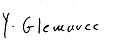
Yannick Glemarec GEF Executive Coordinator |
Vladimir Mamaev, Regional Technical Advisor Project Contact Person |
|
Date: 9 May 2008 |
Tel. and Email:vladimir.mamaev@undp.org |