

Project Inception Report
31 October 2008
UNDP-GEF Medium-Sized Project:
Good Practices and Portfolio Learning in GEF Transboundary
Freshwater and Marine Legal and Institutional Frameworks
Submitted to UNDP by Project Director, Richard K. Paisley
Institute for Asian Research, UBC
El Colegio de Mexico
Aquatic Resources Conservation Group
1
Table of Contents
1.0 Overview of Project ............................................................................3
1.1 Introduction ....................................................................................3
1.2
International Waters .......................................................................4
1.3
Qualifications of Project Proponents...............................................6
1.4 Specific Components of Project......................................................8
1.5 Partial List of Project Co-Financiers (October 2008).....................10
1.6
Evaluation ....................................................................................11
2.0 Project Inception Meeting and Project Inception Report....................11
3.0 Updates on Changes to Project Activities .........................................12
4.0 Updates on Changes to Project Budget ............................................13
6.0 Year 1 Project Workplan with Budget and Indicators.........................14
7.0 Appendices.......................................................................................16
A. Participants at Project Inception Meeting .......................................... 18
B. Project Inception Meeting Program ...............................................21
C. Project Steering Committee Terms of Reference..........................26
D. Project Advisory Group Terms of Reference.................................27
E. Selected Bios of members of Project Steering Committee and
Advisory Group......................................................................................28
F. Rapporteur Report from Project Inception Meeting........................45
G. Group Photograph from Project Inception Meeting .......................51
H. Preliminary Set of Case Studies for Evaluation.............................52
I. Year 1 Project Workplan Schematic with Budget and Indicators...56
J. Preliminary List of Study Sites ......................................................63
2
1.0 Overview of Project
This project is entitled "Good Practices and Portfolio Learning in GEF
Transboundary Freshwater and Marine Legal and Institutional Frameworks".
This project is dedicated towards fostering more sustainable governance
and more effective decision making in global transboundary international
waters management through identification, collection, adaptation and
replication of beneficial practices and lessons learned from international
experience.
This project fosters dialogue between individuals and organizations
engaged in the governance of international waters and builds on South-
South learning experiences to be sustained in part by the South-South Peer
Review Group initiated in the first component and established in a manner
that will facilitate on-going exchange of ideas and solutions after the project
concludes.
The key benefit in measurable terms of this project is ensuring that the
various lessons learned from multi-country experiences, including
identification of areas where problems and delays are typically experienced,
get assimilated by various target audiences in a meaningful way.
1.1 Introduction
Currently some 2.4 billion people throughout the world do not have access
to adequate sanitation. As a result, an estimated 2.3 billion people suffer
from water borne diseases.1 Eighty percent of illnesses are transmitted by
contaminated water,2 yet ninety percent of the wastewater discharged to
waterways in developing countries goes untreated.3
1 Ibid.; See, also UN Commission on Sustainable Development, Comprehensive Assessment of the Freshwater Resources of the
World, Report of the Secretary General (N.Y. 1999) at p. 39.
2 Preliminary report submitted by Mr. El Hadji Guisse in pursuance of decision 2002/105 of the Commission on Human Rights and
resolution 2001/2 of the Sub-Commission on Promotion and Protection of Human Rights, at p.3, UN Doc. E/CN.4/Sub.2/2002/10 (25
June 2002).
3 UNEP International Environmental Technology Centre (http://www.unep.or.jp/ietc/Issues/Freshwater.asp at p.1).
3
"The loss of water may have serious consequences for humans if
it amounts to 10 percent of body mass and may cause death if it
reaches 20 percent or more....[W]ater...constitutes 58-67 percent
of body weight among healthy adult males and 66-74 percent
among newborns. When over a bil ion people are short of this
source of life, our species has reason to be alarmed."4
In response to the emerging global crisis in water scarcity and diminution in
water quality, there has been a global water agenda since at least the
United Nations Conference on the Human Environment in Stockholm in
1972, which famously acknowledged the importance of protecting and
improving the human environment.5
Combinations of governments, experts and nongovernmental organizations
have joined to raise international attention and priority to the issues and to
commit themselves to addressing the most acute problems.
This has resulted in various ministerial declarations proclaiming water as a
"security" issue while acknowledging that water scarcity contributes to
poverty and water supply to its reduction.
1.2 International
Waters
International waters refer to international fresh water, international
groundwater and international marine water resources that are shared by
two or more sovereign states. Nowhere is the current world water crisis
more applicable than in the case of international waters:6
International waters are critically important in the context of the current
world water crisis.
First, agreements governing utilization of international waters serve not only
to protect and promote sustainable development but also to affect security
4 Preliminary report submitted by Mr. El Hadji Guisse in pursuance of decision 2002/105 of the Commission on Human Rights and
resolution 2001/2 of the Sub-Commission on Promotion and Protection of Human Rights, at p.3, UN Doc. E/CN.4/Sub.2/2002/10 (25
June 2002).
5 See, http://www.unesco.org/iau/sd/stockholm.html (accessed 08 October 2003).
6 Leighton, above n 2.
4
throughout an entire basin. In other words, international agreements have a
propensity to stabilize and enhance security at the regional level and the
security return generated is independent of the concrete ecological and
economic benefits produced by such agreements.
Second, international waters are important because nearly half of the
world's population is located within one or more of the 263 international
freshwater drainage basins alone shared by two or more states.7 At least
145 nations currently include territory within international freshwater
drainage basins. At least 21 nations lie in their entirety within international
freshwater drainage basins including 33 countries which have greater than
95% of their territory within these basins. Nineteen of these basins are
shared by 5 or more riparian countries. The Danube has 13[a1] riparian
nations. The Congo, Niger, Nile, Rhine and Zambezi are shared by between
9 and 11 countries. The remaining 13 basins have between 5 and 8 riparian
countries.
Severe deforestation, soil erosion, salinization, toxic contamination, drought
and flooding, water overuse and scarcity, and air and water pollution in a
global international waters context are just some of the environmental
calamities that can increase international tension. Conversely, the very
process of reaching accommodation while developing bilateral resources
and environmental mechanisms for cooperation in a trans-boundary water
context creates a stabilizing and more transparent atmosphere. The mere
fact of negotiation usually widens political participation, builds political
stability and spreads confidence between basin states. Even in cases in
which riparians merely agree to share information and exchange data, while
agreeing to disagree on substantive issues, increased confidence usually
emerges.
Developing more effective governance mechanisms for the management of
international waters is both challenging and urgent. While this demands
considerable effort at national levels, there is added complexity in creating
institutional structures that span different national jurisdictions in
transboundary water management. Policy and management of resources
7 International Bureau of the Permanent Court of Arbitration (ed.), The Resolution of International Water Disputes: Papers emanating
form the Sixth PCA International Law Seminar 08 November 2002, Kluwer Law International, The Hague/London/New York, at xix.
5
depend greatly on scientific input to develop coherent and feasible
programs for resource use. The combined effects of climate change,
increased pressure from population growth and development, and shifting
societal values make trends in resource availability and use difficult to
predict.8 Climate change predictions indicate that the only real certainty will
be one of `change,' as there is little consensus regarding the extent of
precipitation alterations, save that they will be markedly different.9
Consequently, assumptions on hydrologic patterns that have been used to
make agreements, prescribe allocations, and permit consumption patterns,
will likely alter, making those agreements and allocations unrealistic.
1.3 Qualifications
of
Project
Proponents
El Colegio de Mexico (COLMEX) in Mexico City, Mexico is the leading
academic institution in Mexico with a longstanding interest in the better
governance of transboundary waters as well as in social, economic and
environmental sustainability.
The Aquatic Resources Conservation Group (ARC) is a federally
recognized, Washington State registered, 501(c)(3) non-profit public interest
consulting firm. For more than two decades, it has been dedicated to the
use of science, economics, law and policy to maintain healthy, diverse and
plentiful aquatic ecosystems. With offices in Seattle and Port Townsend,
WA and Melaque, Mexico, ARC provides research, position papers, draft
legislation and planning advice to further governance processes that assure
better conservation.
8 See, Holling, C. S. and S. Sanderson (1996). The dynamics of (dis)harmony in human and ecological systems. Rights to Nature:
Ecological, Economic, Cultural, and Political Principles of Institutions for the Environment. C. F. S. Hanna, K.G. Mäler, and A. Janssen.
Washington, D.C., Island Press: 57-85; Postel, S. (1999). Pil ar of Sand: Can the Irrigation Miracle Last? New York, Norton & Company;
Postel, S. and B. Richter (2003). Rivers for Life: Managing Waters for People and Nature, Island Press; and Regier, H. and J. Kay
(2002). Phase Shifts and Flip Flops in Complex Systems. Volume 5, Social and economic dimensions of global environmental change,
in Encyclopaedia of Environmental Change. P. Timmerman. Chichester, John Wiley & Sons, Ltd: 422-429.
9 See, Bruce, J. M., H; Alden, M, Mortsch, L; Mills, B (2003). "Implications of Climate Change for Canada-US Boundary Water
Agreements" Report for Natural Resources Canada Annex A, and Hamlet, A. (2003). "Effects of Climate Change on Pacific Northwest
Rivers." Climate Change in the Columbia Basin Conference Proceedings, Columbia Mountains Institute of Applied Ecology, January
17-18, 2003. . Also Mote, P. (2003). "Twenty Thousand Years of Climate Change in the Columbia Basin: What's New This Time?"
Climate Change in the Columbia Basin Conference Proceedings, Columbia Mountains Institute of Applied Ecology, January 17-18,
2003. There are often large disparities between the model outputs, with some models suggesting large increases in precipitation while
others predicting large decreases. In one study (Bruce, 2003) different models run for the upper Columbia basin gave summer
precipitation values ranging between 18% and +19% of current levels. Such differences in potential precipitation will make the task of
dispersing water all the more difficult. Also, not only are annual variations expected to be different, but also potential y more importantly
seasons variations wil render many of our current consumption patterns unviable.
6
ARC's water conservation projects include establishment of ecosanitation
utilities in Mexico and rebuilding of failed water supply systems in Africa.
Ecosystem projects involve protecting rain forests in Costa Rica, limiting
over-exploitation of marine fishes in Alaska and decreasing by-catch and
mortality of sea turtles in shrimp fisheries in the Southeast of the USA. ARC
has written on coastal zone management and long term planning, marine
protected areas, marine fisheries policy and watershed and lake
conservation issues.
The mission of the world renowned Institute of Asian Research (IAR) at the
University of British Columbia in Vancouver, Canada includes a focus on the
impact of globalization in Asia and globally; social, environmental and
economic sustainability, natural resources management and development
aid effectiveness. Historically, IAR has been successful in obtaining support
from granting agencies such as SSHRC, CIDA, IDRC and the UN family for
research and development assistance programs in Asia and globally. This
will continue and new sources of support are being explored, including
funding agencies such as the Rockefeller Foundation, Ford Foundation,
MacArthur Foundation and Carnegie Endowment. In addition, IAR will
continue to intensify the publication of research and policy papers and
monographs, derived from its research and development program activities.
Richard Paisley is the Director of the International Waters Initiative and a
senior research associate at the Institute of Asian Research as well as an
adjunct professor and founding director (2000 to 2007) of the Dr. Andrew R.
Thompson Natural Resources Law Program at the UBC Faculty of Law.
Richard's academic background includes degrees in biochemistry, marine
resource management, law and international law from UBC, University of
Washington, Pepperdine University School of Law and the London School
of Economics. His current research, teaching and legal practice interests
are in the areas of international water and energy law, international
environmental law, negotiations and environmental conflict resolution. He
has directed a wide range of conferences, workshops and research
projects, published extensively and been an advisor, trainer and special
counsel on these subjects to numerous international agencies,
governments, non governmental organizations and aboriginal groups
7
including the: FAO, UNDP, IUCN, GEF, WWF, CIDA, DFAIT Canada,
CPAWS, TFN, World Bank, UNOPS, Nile Basin Organization, Mekong River
Commission Secretariat and the Nepal Water and Energy Commission
Secretariat.
1.4 Specific Components of Project
Component 1:
The primary goal of Component 1 is increasing understanding and
knowledge of key elements of the prime legal and institutional frameworks
necessary for good governance and decision-making. This will be achieved
through the identification, analysis and codification of successful
approaches of international waters (IW) governance within and beyond the
GEF portfolio, and the determination of performance measures.
Component 2:
The primary goal of component 2 is accelerating capacity building for good
governance of IW through the creation and promotion of novel experiential
learning tools specifically targeted for GEF IW practitioners, designed in
collaboration with local experts and practitioners. The outcome of this
component will be an enhanced ability to promote good governance in IW.
The output will be a series of specialized experiential learning tools for good
governance focusing on understanding and promoting effective legal and
institutional frameworks and decision-making. The experiential learning
tools will include case studies, negotiations, role play simulation exercises,
and interactive tools. One of the modules will comprise gender
mainstreaming training, with introduction to such learning tools as provided
by the International Women's Rights Project, which is a member of the
Gender and Water Alliance and the Gender and Water Network. Tools will
be developed in collaboration with South-South PRG and regional groups
and local experts. The tools will include electronic CDs and web-based
platforms. Possible software will be tool-books, illumina and visio-basic for
example. The tools will be developed for capacity building of professional
practitioners, but will also be available as teaching tools in universities for
graduate courses. El Colegio de Mexico will be a key partner institution in
8
this and other academic partners may include the University of La Rochelle,
France (Hans Hartmann); Uppsala University, Sweden (Ashok Swain); the
Mekong Program on Water, Environment and Resilience, Chiang Mai
University, Thailand (John Dore); Bates College, USA (Lynne Lewis);
Oregon State University (Aaron Wolf); University of Washington (Bil Burke);
Texas Tech University (Gabriel Eckstein); University of Bogota (Jose
Vicente Zapata) as well as additional institutions in Africa and the Americas.
The other major output from Component 2 will be the creation of a cadre of
local experts trained in tool delivery to ensure replication and on-going
development of the tools. A trainers guide and course programs of 1, 2 and
5 days duration will be developed, including electronic presentation
packages. The guide will be tested and enhanced during the creation of a
cadre of local experts who will be responsible for the majority of the training
under component 3. Two Experiential learning capacity development
courses will be conducted for training local experts in tool delivery through
appropriate institutions, such as UNESCO-IHE, IAR, and/or El Colegio de
Mexico. Training Guides will be available in English, French, Spanish and
Portuguese as appropriate. Information and promotion of the tools will be
done at regional workshops and international conferences. The commitment
to gender equality will ensure that a minimum of 20%, with a target of 30%,
of the trainees will be women.
Component 3:
The primary goal of Component 3 is building local capacity of GEF and
other IW practitioners in good governance through targeted experiential
training and adaptive learning; and ensuring local capacity to replicate
experiential learning programs that foster a culture of good governance in
IW. The outcome will be enhanced capacity of GEF practitioners in good
governance and effective decision-making, including experienced local
experts to replicate learning programs. Activities will center on conducting
regional targeted programs where local experts are delivering to regional
practitioners. This activity will take place over at least three regional
capacity building sessions and will be given to a minimum of 60 GEF
practitioners in IW, with the same minimum of 20% of who will be women,
with a target of 30%. Advantage will be taken of all regional and
international meetings to deliver the materials, but a minimum of 3 programs
9
of 5 days will be conducted. The outcome will be enhanced collaboration
between GEF practitioners, increased effectiveness in decision-making,
including engagement and participation of civil society and other interest
groups. A survey determining understanding and knowledge of IW practices
will also be conducted to monitor the success of the workshops.
A secondary goal of Component 3 will be promotion to raise awareness of
the availability of the tools. This will be achieved through partner
organizations and the continuation of the South-South PRG, academic
papers, conferences, media, web-based platforms such as IW:LEARN, CAP
at UNESCO-IHE. Development and the continued maintenance of UBC IAR
web site will assure ease of accessibility to tools, Teaching Guide and
project gathered/developed materials.
1.5 Partial List of Project Co-Financiers (October 2008)
NGOs -- The Environmental Law Alliance Worldwide (E-LAW, Bern Johnson
and Lori Maddox); The Institute for Governance and Sustainable
Development (Durwood Zaelke); the Canadian Water Research Society
(Maaria Solin Curlier); the Network for Environment & Sustainable
Development in Africa Cameroon (Justice Prudence Galega); and the
Central Asia Environmental Institute, Kazakhstan (Vadim Ni).
Government and quasi-government Agencies -- Environment Canada,
DFAIT (Department of Foreign Affairs and International Trade Canada),
Columbia Basin Trust, GEF , UNDP.
Universities -- University of La Rochelle, France (Hans Hartmann); Uppsala
University, Sweden (Ashok Swain); Mekong Program on Water,
Environment and Resilience, Chiang Mai University, Thailand (John Dore);
Bates College, USA (Lynne Lewis); Oregon State University (Aaron Wolf);
University of Washington (Bill Burke); Texas Tech University (Gabriel
Eckstein).
Private Sector -- Holguin, Neira & Pombo, Bogotá (Jose Vicente Zapata);
Lawson Lundell, Vancouver (Chris Sanderson); Pierce Atwood, Portland,
10
ME (Elizabeth Butler); Speir & Associates, New Orleans (Jerry Speir); Case
& White, Washington, D.C. (Rahim Moloo).
International Water, Energy and Gender Experts John Metzger, Vientiane,
Laos PDR and Entebbe, Uganda; George Radosevich, Bangkok, Thailand;
Tim Hannan, Kingston, Ontario; Glen Hearns, Vancouver; Susan Bazilli,
IWRP-SA, Johannesburg, South Africa, Hans Schreier, Vancouver.
Major letters of support have also been received from the Director of
UNESCO's Institute for Water Education, Steve McCaffrey (University of the
Pacific) and the Canadian Consul General in Seattle, USA.
The project is also in ongoing discussions with the: IUCN Environmental
Law Programme (Alejandro Iza), FAO (Stefano Burchi and Jake Burke),
World Bank Institute (Mei Xie), UNESCO Water Center University of
Dundee (Patricia Wouters) and UNESCO (Alice Aureli).
1.6 Evaluation
Rigorous evaluation of this project will determine the degree to which
objectives were met and methods followed.
Included will be both a process evaluation (an evaluation to determine
whether the project was consistent with the plan and the relationship of
different program activities to the effectiveness of the project) and a product
evaluation (an evaluation to determine the extent to which the project has
achieved its stated objectives and the extent to which the accomplishment
of objectives can be attributed to the project).
2.0 Project Inception Meeting and Project Inception Report
The project inception meeting took place in Whistler, British Columbia,
Canada on 02 and 03 October 2008.
The objectives of the project inception meeting were to:
11
1. Establish the Project Steering Committee and the Advisory Group
including their roles and responsibilities;
2.
Confirm reporting and accounting requirements for the project;
3. Provide ideas, oversight and strategic guidance to the project;
4. Advance the identification and promotion of best practices and
lessons learned for international waters management, and where
the best case studies of those areas exist.
Pursuant to the requirements of the UNDP Project Document signed for
UNDP by Yannick Glemarec on 18 March 2008 and by UBC, the Project
Inception Report has been prepared immediately following the project
inception meeting. The Project Inception Report includes a detailed Year 1
Workplan. The Year 1 Workplan is divided into quarterly time frames
detailing activities and progress indicators that will guide implementation
during the first year of the project. The Year 1 Workplan includes the
projected dates of field visits and support missions as well as time frames
for meetings of the projects decision making structures. The Year 1
Workplan includes the project budget for the first full year of implementation
and includes any monitoring and evaluation requirements to effectively
measure project performance during the targeted 12 month time frame.
When finalized, the Project Inception Report will be circulated to project
counterparts who will be given a period of one calendar month in which to
respond to comments or queries. Prior to this circulation of the project
inception report, the UNDP GEF HQ will review the document.
3.0 Updates on Changes to Project Activities
There are no major changes anticipated in project activities. However, at
the suggestion of GEF, UNDP and others, additional effort will be made to
recruit more women and more individuals from developing countries and
more individuals with expertise in marine transboundary international waters
to act as both advisors and consultants to the project.
12
4.0 Updates on Changes to Project Budget
The project budget has not changed significantly since inception.
However, there continues to be wild swings in the exchange rate between
the Canadian and US dollar which have the potential to either benefit or
negatively impact the project.
Since the inception of the project there has also been some fluctuation in
co-finance contributors. Notably White & Case, one of the largest private
sector law firms in the world, has recently pledged to support the project at a
major level still to be determined.
5.0 Overview of Project Governance and Administrative
Arrangements
The core team is comprised of a half time project director, a half time
technical advisor and a number of graduate students with particular interest
and aptitude in the international waters area.
Anticipated to be finalized shortly are the selection of a marine
legal/institutional expert and a governance expert for the core team as well
as various consultants and/or contractors.
Both the Steering Committee and the Advisory Group are solidly in place
with the caveat that additional effort will be made to recruit more women and
more individuals from developing countries and more individuals with
expertise in marine transboundary international waters to act as both
advisors and consultants to the project.
Also in place and active in the governance and administration of the Project
are key individuals at the Institute of Asian Research at UBC (Pitman Potter,
Marietta Lao, Judy Wang, Karen Jew, Rozalea Mate), COLMEX (Boris
Graizbord) and ARC (Bo Bricklemyer).
13
6.0 Year 1 Project Workplan with Budget and Indicators
Project activities in Year 1 focus on increasing understanding and
knowledge of key elements of the prime legal and institutional frameworks
necessary for good governance and decision-making.
This will be achieved through the identification, analysis and codification of
successful approaches of international waters (IW) within and beyond the
GEF portfolio.
The output of this process will be a Report on the identification of
performance measures for good governance of international waters.
Activities associated with researching and writing this report will include
desk analysis, interviews, interaction with field practitioners and field visits to
selected areas for detailed analysis including all 5 regions of the world
where GEF IW is active
A gender analysis will also be undertaken as it is generally a key indicator of
good governance.
It is anticipated that the authors of the Report will have had the benefit of
having investigated up to 25 waterbodies, including travel to a lesser
number of locations to allow for more in-depth analysis. These could include
many of those listed in Appendix J to this report e.g. Rivers -- the Nile, the
Danube, the Rhine, the Dnieper, the Okavango, the Kagera, the Senegal,
the Bermejo, the Mekong, the Syr Darya, the Amu Darya, the Zambezi and
the Columbia; Lakes - Lake Victoria, Lake Tanganyika and the Great Lakes;
Groundwater Iullemeden Aquifer, the NW Sahara, the Nubian, the Dinaric
Karst, the Franco-Swiss and the Guarani Aquifers; Marine systems the
Benguela Current, the Guinea Current, the Canary, the Red Sea, The Black
Sea, the Caspian Sea, the South China Sea Large Marine Ecosystem, the
Mesoamerica Barrier Reef System project, the Mediterranean GPA
Protocol, the Pacific SIDS fisheries project and the Eastern Tropical Pacific
Seascape Initiative.
14
The Report will be worked on in the 4th quarter of 2008 and 1st quarter of
2009 with a view towards being presented as a work in progress to selected
target audiences in late in the 2nd or 3rd quarter of 2009.
Component 1 activities will also involve:
· development of a "brand", logo and website;
· recruiting additional participants especially in the marine area and from
developing countries;
· beginning the process of promoting facilitated exchanges of experience
and increased partnership implementation. This will be achieved through
the establishment of a South-South Peer Review Group(s) (S-S PRG)
and learning networks, and will incorporate local objectives for capacity
building. The S-S PRG will be initiated at the onset of the project and will
continue for the duration of the project. This will involve regional meetings
as well as global meetings and taking advantage of IW conferences and
workshops. This is projected in Year 1 to include activities in Africa
including various countries of the Nile Basin throughout 2009; in
Central/South America including Mexico and Colombia starting in the 1st
quarter of 2009 and possibly the World Water Forum in Istanbul in March
2009.
Activities in the 3rd quarter of Year 1 have already included outreach and
promotional activities at the World Water Congress in Montpellier, France in
September 2008.
Appendix H contains a tentative list of various evaluation variables.
See Appendix I for a more detailed description of the Year 1 Work Plan with
budget and indicators.
Appendix J contains a more complete listing of potential sites.
The start date of the project is July 1, 2008, with the final date being June
30, 2011. This has been confirmed in writing by a no-cost extension.
15
7.0 Appendices
16
17
A. Participants at Project Inception Meeting
People Institution
Country
Steering Committee
Ismael Aguilar Barajas
COLMEX
Mexico
Stefano Burchi
FAO
Italy
Al Duda
GEF
USA
Boris Graizbord
COLMEX
Mexico
Andrew Hudson
UNDP
USA
Alice Laberge
RBC
Canada
Chloe O'Laughlin
CPAWS
Canada
Marta Molares
World Bank
USA and Argentina
Rahim Moloo
White & Case
USA
Shawn Morton
DFAIT
Canada
Stephen Owen
UBC
Canada
Pittman Potter
UBC
Canada
Patrick Quealey
DFAIT
Canada
Vicente Ugalde Saldaña COLMEX
Mexico
Robert Wabunoha
UNEP
Kenya
Joe Weiler
UBC
Canada
additional members TBC
Advisory Group
Natasha Affolder
UBC
Canada
Julie Davidson
CPAWS
Canada
Lienna Detrasavong
Laos PDR
Salimah Ebrahim
NY Times
Canada and Egypt
Gabriel Eckstein
Texas Tech
USA
Karin Emond
Lawson Lundel Canada
Sarah Freeman
Louis Berger
USA
Prudence Galega
Cameroon
18
Pacific
Alex Grzybowski
Canada
Resolutions
Mish Hamid
IW LEARN
Slovakia and USA
Mike Healey
UBC
Canada
Adele Hurley
U of Toronto
Canada
Elin Kelsey
USA
Cuauhtemoc Leon
COLMEX
Mexico
Steve McCaffrey
U Pacific
USA
Janot-Reine Mendler de IW LEARN
USA
Suarez
Canada and
Sokhem Pech
Hatfield Group
Cambodia
Chris Sanderson
Lawson Lundel Canada
Hans Schreier
UBC
Canada
Abdulkarim Seid
NBI
Ethiopia
Aaron Wolf
U Oregon State USA
Jose Vicente Zapata
HNP ABOGADOS Colombia
Additional members TBC
Regrets
Eugene (Bo) Bricklemyer ARC Group
USA
Lienna Detrasavong
Laos PDR
Boris Graizbord
COLMEX
Mexico
Mike Healey
UBC
Canada
Adele Hurley
U of Toronto
Canada
Elin Kelsey
USA
Alice Laberge
RBC
Canada
Cuauhtemoc Leon
COLMEX
Mexico
Janot-Reine Mendler de IW LEARN
USA
Suarez
Marta Molares
World Bank
Shawn Morton
DFAIT
Canada
Stephen Owen
UBC
Canada
Sokhem Pech
Hatfield Group
Canada and
19
Cambodia
Pittman Potter
UBC
Canada
Patrick Quealey
DFAIT
Canada
Hans Schreier
UBC
Canada
Robert Wabunoha
UNEP
Kenya
Jose Vicente Zapata
HNP ABOGADOS Colombia
Project Team
Susan Bazilli
Heather Davidson
U McGill
Glen Hearns
UBC
Kate Neville
UBC
Richard Paisley
UBC
Maaria Solin Curlier
CWRS
Patrick Weiler
20
B. Project Inception Meeting Program
Good Practices and Portfolio Learning in GEF Transboundary Freshwater and Marine
Legal and Institutional Frameworks
Steering Committee and Advisory Group Meetings / Inception Workshop
____________________________________________________________
Thursday Oct 2, 2008 and Friday Oct 3, 2008
Whistler, British Columbia
Meeting Objectives:
The objectives of this meeting are to:
1. Establish the steering committee and advisory group including their roles and
responsibilities;
2. Confirm reporting and accounting requirements for the project;
3. Provide ideas, oversight and strategic guidance to the project;
4. Advance the identification and promotion of best practices and lessons learned for
international waters management, and where the best case studies of those areas exist.
21
Attendees:
Steering Committee
Advisory Group
Al Duda, GEF
Natasha Affolder (chair)
Andy Hudson, UNDP
Chris Sanderson
Pitman Potter, UBC IAR
Gabriel Eckstein
Joe Weiler, UBC Law (chair)
Steve McCaffrey
Rahim Moloo, White & Case
Chloe O'Loughlin / Julie Davidson, CPAWS
Stefano Burchi, FAO
Abdulkarim Seid
Janot Reine Mendler De
Salimah Ibrahim
Suarez/Mish Hamid, IW LEARN
C. O'Laughlin, CPAWS (observer)
Pech Sokhem
Boris Graizbord or representative,
Aaron Wolf
El Colegio de Mexico
(COLMEX)(Dr. Ismael Aguilar
and/or Dr. Vicente Ugalde)
Alex
Grzybowski
Prudence Galega
Sarah Freeman (observer)
Karen Emond (observer)
Regrets: Stephen Owen UBC;
Regrets: Hans Schreier, Adele Hurley, Mike
Patrick Quealey / Shawn Morton
Healey; Jose Vicente Zapata; Lienna
DFAIT (via telephone); UNEP
Detrasavong; Elin Kelsey
representative; M. Molares / S.
Salman; World Bank Goup; Alice
Laberge (observer)
22
Workshop Agenda
Agenda: Wednesday, Oct 1 2008 Travel/Arrival of Attendees
Time Activity
Afternoon/
Attendees arrive at YVR and travel to Whistler via the YVR/Whistler shuttle if
Evening
they arrive at the airport. They will be met at Whistler Creekside.
7:00-9:00
Informal reception at the Taluswood condos
Agenda: Thursday, Oct 2 2008 Day 1 - Steering Committee meeting
Time
Activity
Objectives
Documents Lead
8:00-
9:00
Breakfast
All
· Introduce all participants
(incl. project team)
9:00-
· Appoint meeting chair (Joe
Welcome members /
RKP
TOR for SC
9:30
Weiler) and rapporteurs
review SC role
(PW and HD)
· Review and approve
Agenda
9:30-
· Overview of Project
Inform
RKP
RKP powerpoint
10:00
including objectives, critical
Manage expectations
path, work plan
· Confirm Management
10:00-
Strategy, Partners / Co-
confirmation
RKP/
10:45
Financers, roles of Steering
GH
Committee / Advisory
Committee
10:45-
Break
11:00
11:00-
· Confirm finance and
confirmation
SB
23
12:00
budget strategy including
formal reporting
· Review / Adopt Year 1
Workplan
12:00-
Working Lunch Served
12:30
1230-
· Review / Adopt Year 1
GH/ RKP/
Approval Draft
document
1330
Workplan continued
AG
1330 -
· Confirm Progress Indicators
GH/
14:30
Approval Draft
document
for Year 1 Workplan
RKP/AG
· Confirm related activities?
14:30
e.g. GEF, UNDP, FAO,
PW/
Consistency
15:00
World Bank Group, other ?
HD
· Wrap up
19:00
Dinner
All
Agenda: Friday, Oct 3 2008 Day 3 Advisory Group meeting (Steering Committee also
attends)
Time
Activity
Objectives
Documents Lead
8:00-
Breakfast
9:00
9:00-
· Introductions
Introduce participants
AG TOR
RKP/
10:00
· Appoint chair (Affolder)
Review SC role
GH/
and rapporteurs (KN, HD
SB
and PW)
· Confirm Objectives
· Confirm TOR of Advisory
Committee
9:30-
· Project Overview
Background and
RKP powerpoint
RKP/
10:30
· Q&A
understanding
GH
10:30-
Break
10:45
10:45-
· IW Governance issues
Identify challenges and
Articles
RK/P
24
12:30
including "best practices" /
opportunities previously
sent
GH
"lessons learned"
out
· Case studies.
12:30-
Working Lunch
13:00
13:00-
· Experiential learning / active Identify challenges and
Demonstration
RKP/
14:00
adaptive management tools opportunities
and discussion GH/
· South South cooperation
RKP, GH and
SB
and learning
SB
14:00-
· Local Experts for
GH
14:30
workshops?
14:30-
· Review and next steps?
Open Discussion
All
15:00
19:00
Dinner (final location to be
All
confirmed by Berkley)
Saturday, Oct 4 2008 Day 4 Travel/Departure of Attendees
25
C. Project Steering Committee Terms of Reference
The Project Steering Committee will focus on providing oversight and
strategic guidance. The terms of reference for the Project Steering
Committee for the project include:
· Providing
oversight;
·
Providing strategic guidance;
·
Reviewing annual work plans;
· Reviewing
budgets;
·
Reviewing overall progress;
·
Reviewing the gender inclusion of all initiatives for the project;
·
Approving substantive revisions if necessary to help ensure project
objectives are attained; and
·
Helping to ensure that the project continues to be complementary to
other initiatives.
26
D. Project Advisory Group Terms of Reference
The project Advisory Group is an expert group in international water
governance and experiential learning. The terms of reference for the
Advisory Group include:
·
Peer reviewing learning tools and delivery mechanisms including
experiential learning techniques;
·
Helping to ensure intellectual rigour;
·
Helping to source necessary expertise and state-of-the-art knowledge
and practices;
·
Providing specialized advice regarding the panoply of governance
experience with international waters especial y in developing countries;
·
Providing specialized advice in the realm of cross cultural
communication and learning;
·
Ensuring that issues specific to vulnerable communities are integrated
into the methodology;
·
Providing expertise on gender and water so that the under-resourced
issues of women and water in communities in the Global South are included
by ensuring a minimum of 20% women on the AP.
27
E. Selected Bios of members of Project Steering Committee
and Advisory Group
NATASHA AFFOLDER (Canada) joined the Faculty of Law in July 2004.
Prior to coming to UBC, Professor Affolder worked at Harvard Business
School as a Research Associate in the area of large project negotiation. Her
research, teaching and legal practice interests span the fields of
international law, sustainable development law, natural resources,
environmental law, and land use law. Professor Affolder holds an LLB from
the University of Alberta and a BCL and doctorate from Oxford University
where she was a Rhodes Scholar. Professor Affolder practiced law in
Boston for four years with the firms Hil and Barlow P.C. and Piper Rudnick
LLP. She has worked in various capacities for international non-
governmental and inter-governmental organizations including Oxfam and
the United Nations Environment Programme (UNEP).
EUGENE (BO) BRICKLEMYER (USA) is an attorney, long-range planner
and environmental activist. He has worked with most major US
conservationist groups, from the National Audubon Society to the
EarthJustice Legal Defense Fund. For almost a decade, he was Senior
Counsel of Greenpeace's Ocean Ecology Campaign and has formed, and is
on the board of directors of numerous NGOs, including four international
organizations. His most recent effort has launched a Mexican ecosanitation
utility, the first initiated by a Municipality in Latin America and funded by
UNEP's Global Action Programme for the Protection of the Marine
Environment (GPA). With a J.D. from the University of North Carolina and
an LL.M. in Law and Marine Affairs from the University of Washington (UW),
Bo has worked for state and local governments and as an attorney for the
US Marine Mainmal Commission and currently for the Office of General
Counsel, US Department of Homeland Security. He has been on the
Faculties of Law, Fisheries, and Urban Design and Planning at the UW, and
on the Faculty of Law at the University of Mississippi. He is President of
Aquatic Resources Conservation Group (www.arc-group.org), a federal 501
(c) (3) non-profit, registered in Washington State.
28
MAARIA CURLIER (Canada) graduated from the University of Washington
with a Masters in Marine Affairs and a Masters in International Affairs. She
has worked with various organisations to establish marine protected areas
in British Columbia. Fluent in French, she has also been involved in many
projects ranging from international rivers and basins to ecosanitation.
JULIE DAVIDSON (Canada) has a strong passion for the outdoors and wild
places, coupled with experience in environmental project funding and board
leadership which led her to become a director on the CPAWS-BC board.
She has twenty years' experience in the human resources field, most
recently board-related in the not-for-profit business sector. Julie worked with
Mountain Equipment Coop's board through ten years of rapid growth and
organizational development. Her experience encompasses strategic
planning, agreement negotiations, conflict resolution, consulting with
communities, developing human resources and managing organizational
change. As a recent mature graduate from Simon Fraser University, she is
embarking on a new path in social policy issues.
AL DUDA (USA) Dr. Alfred M. Duda serves as Senior Advisor,
International Waters, for the Global Environment Facility (GEF) Secretariat
in Washington, DC. He has been posted for the last 13 years in a number of
management positions at the GEF following his appointment to the World
Bank Group in 1991. Following completion of his doctoral work at Duke
University, Dr. Duda worked in a series of supervisory positions in the water
quality regulatory agency of the State of North Carolina and then at the
corporate environment staff of the Tennessee Val ey Authority. In 1987, he
was named by the U.S. Department of State as Director and Chief of
Diplomatic Mission of the Great Lakes Office of the International Joint
Commission (Canada and U.S.) in Windsor, Ontario. The Commission has
responsibilities to resolve, and avoid where possible, water disputes along
the border under the Boundary Waters Treaty of 1909. Dr. Duda's work at
the World Bank and GEF continues to address relations among sovereign
nations in sharing benefits from transboundary water systems such as
LMEs and shared surface or groundwater systems.
SALIMAH EBRAHIM (Canada) is a recent graduate of the University of
Toronto, Salimah Ebrahim is an acclaimed journalist and environmentalist,
29
having lived between Africa, the Middle East and North America
documenting some of the most important stories of her generation including:
the war in Iraq, regional environmental security challenges, global youth
movements, US Presidential politics, and G8 summitry across France, Italy
& Russia. Her work for major international outlets has appeared in The
Globe and Mail, the CBC, the Cairo Times and A&E's Biography Channel.
As founding member of the Spirit Bear Youth Coalition, the largest youth led
environmental organization in the world - Salimah has, for the past decade,
been fighting for the protection of Canada's White Spirit Bear and its
remarkable habitat in the Great Bear Rainforest. With a membership of over
6 million members in 60 countries, Salimah and the Youth Coalition have
enjoyed the support and mentorship from many high profile figures
ranging from Dr. Jane Goodall to Robert F. Kennedy Jr. As Co-Executive
Producer for the groundbreaking The Spirit Bear the first major Hollywood
animated movie with a mission to protect its namesake - Salimah is
dedicated to a new approach to environmentalism where global social and
economic bottom lines finally allow for the establishment of a new paradigm
of social entrepreneurship one that constructively engages young people
in tackling global issues. Salimah has been awarded and recognized for her
work as both journalist and environmentalist, having been profiled by CBC
Television as one of 25 young Canadians who are changing the world. Most
recently, Chatelaine magazine declared her one of its "80 amazing
Canadian women to watch."
GABRIEL ECKSTEIN (USA) is a Professor at Texas Tech University. Dr.
Eckstein is an expert in US and international water law and policy and has
significant experience in US and international environmental law and policy.
He has lectured in various law and science fora, including national and
international conferences and United Nations meetings. He has also served
as an expert advisor or consultant on US and international water and
environmental issues to various organizations, including the World
Commission on Dams, Organization of American States (OAS), US Agency
for International Development, and local water districts in Texas. Currently,
Professor Eckstein is an advisor to the U.N. Educational, Scientific, and
Cultural Organization's International Hydrological Programme (UNESCO-
IHP) and Ambassador Chusei Yamada of the U.N. International Law
Commission in the development of an international agreement on
30
transboundary ground water resources. He also participates in meetings of
ISARM (International Shared Aquifer Resources Management) Americas
Programme, a joint effort of the International Association of
Hydrogeologists, UNESCO-IHP, and OAS, and advises on issues related to
international water law and transboundary ground water resources. At
Texas Tech University, Professor Eckstein directs the university's Center for
Water Law & Policy, and teaches courses and seminars on US and
international water law, US and international environmental law, US
property law, and law and science. Prior to joining academia, Professor
Eckstein served as Senior Counsel for CropLife America, a U.S. trade
association of agricultural chemicals and biotech companies, advising on
matters of U.S. and international regulatory and environmental law and
compliance related to agricultural chemicals and biotechnology, air and
water pollution, endangered species, and intellectual property. Prior to that,
he worked as a litigator in private practice on environmental, toxic tort, and
asbestos cases. Professor Eckstein holds LL.M. and JD degrees from
American University's Washington College of Law, M.S. in International
Affairs from Florida State University, and a B.S. in Geology from Kent State
University.
KARIN EMOND (Canada) is a lawyer who has been working for the
Lawson Lundell firm since 2006 and joined the Litigation and Environmental
law groups following the completion of her articles in 2007. Throughout her
articles Karin supported litigation initiatives for clients before both the B.C.
Supreme Court and the B.C. Court of Appeal. She graduated from the
University of British Columbia with her B.HK in 1998 and her LL.B in 2006.
SARAH FREEMAN (USA) is a Water Resources Engineer with the Louis
Berger Group's International Environmental Resources group. Her primary
focus is on water resources management and sustainable development at
both local and global scales with a strong interest in transboundary waters
and how science and policy can better inform each other. Past project
experiences have included environmental and socioeconomic baseline
assessments, environmental impact assessment and management plans,
and communicating and teaching technical engineering work to diverse
audiences. Additionally, she has experience in managing and coordinating
31
small-scale research and assessment programs in Ecuador, China, Peru
and the US. Additional research work includes international environmental
policy and the application of GIS and mapping techniques to water
resources management and climatological issues. She holds a Bachelors of
Science in Mechanical Engineering and a Masters of Science in Water
Resources Engineering from Tufts University. She is fluent in Spanish.
JUSTICE PRUDENCE GALEGA (Cameroon) is a magistrate by profession
and currently a Sub-Director in the Cameroon Ministry of Justice. Justice
Galega is also the Coordinator of Network for the Environment and
Sustainable Development in Central Africa (NESDA CA), an environmental
governance NGO carrying out policy research and reform advocacy. She
has been actively consulting for organizations such as the UNEP and the
World Resources Institute, and has served as a legal expert for various
international water projects such as the 1995 GEF-sponsored Gulf of
Guinea-Large Marine Ecosystem (LME) Project, and the UNEP's Regional
Seas Programme for East and West Africa (Nairobi and Abidjan
Conventions). Most recently, Justice Galega participated in an LME capacity
building workshop focused on the socio-economic and governance modules
of the LME concept. Organized by the University of Rhode Island with
sponsorship from IW: LEARN, this workshop provided an opportunity to
better understand the techniques that should be applied in conducting
assessments of LMEs.
BORIS GRAIZBORD (Mexico) is the national program director for LEAD
Mexico. Before joining LEAD, he served twice as academic coordinator for
the master's program in urban development at El Colegio de Mexico. Since
1979, he has been a research professor at the Center of Demographic
Studies and Urban Development in El Colegio de Mexico and, since 1977,
lecturer at the Mexico's National University (UNAM). He also teaches at
other academic institutions, including in the U.S the University of Southern
California, the University of Pennsylvania, and the New School. Mr.
Graizbord has served as a researcher at the Institute of Geography at
UNAM (1977-1979), and as the director of Center of Social Development
Studies. He has written more than 50 chapters and articles that have
appeared in books and in national and international periodicals, magazines
32
and newspapers, and has co-authored four books. His research activities
cover urban, regional and environmental issues related to sustainable
development. He has a bachelor's degree in architecture from UNAM and a
master's degree in urban geography from the University of Durham in the
United Kingdom. He pursued doctoral studies in social geography at the
London School of Economics and Political Science.
ALEX GRZYBOWSKI (Canada) has extensive experience dealing with
multi-party dispute resolution and partnership development in the public and
private sectors over land use and related resource and environmental
conflicts in Canada and internationally. Mr. Grzybowski has successfully
mediated many highly conflicted land use and resource management issues
across the province of BC. He has facilitated government to government
negotiations between all levels of government in Canada, including
protocols between the Province of BC and various Aboriginal Nations, as
well as negotiations amongst Aboriginal Nations regarding overlapping
concerns. Internationally, Mr. Grzybowski has participated in a wide range
of conflict management and peace building projects in Southeast Asia, Latin
America and Africa, focused on institutional development and capacity
building as well as specific dispute situations. He recently facilitated
negotiations between Cambodia, Laos, Thailand and Vietnam regarding
implementation protocols for the Mekong Agreement on behalf of the
Mekong River Commission Secretariat. He has delivered applied conflict
management and negotiation training to human rights organizations,
non-government organizations, police, and a wide range of National and
local government agencies in all of the regions where he has worked.
MISH HAMID (Slovakia) is a program associate performing many roles for
the GEF IW:LEARN project since 2000, covering project management, to
partnership development, workshop training, to development of information
management solutions for GEF projects. In addition to helping build the
original International Waters Resource Centre, Mish developed solutions for
projects from San Juan to the Dnieper River Basins. At present, in addition
to supporting IW:LEARN's overall efforts, Mish helps lead the project's
activities in eastern Europe and central Asia, as well as developing its
outreach products. The majority of his field experience is in this region. In
addition to IW:LEARN, Mish worked in both Serbia and Kosovo on elections
33
and post-conflict peace implementation. In 2005, Mish completed a master's
in conflict management and international economics from the Johns
Hopkins School of Advanced International Studies. Mish speaks Dutch,
German and limited Russian.
MICHAEL HEALEY (Canada) is recognized internationally as an expert in
the ecology of Pacific salmon and as an expert in the design of resource
management systems. He has served as a consultant to government and
industry in Canada, the United States and Asia on the management of fish
and fish habitat and on restoration of aquatic ecosystems. For the past eight
years he has been an advisor on ecosystem restoration to the CALFED
Bay-Delta program in California. He is the author of more than 200 articles
and books on fisheries, ecology and resource management. Professor
Healey was a scientist with the federal government from 1970 to 1990. He
worked at the Winnipeg Freshwater Institute from 1970 to 1974 where he
conducted research on ecology and management of freshwater fishes in
Canada's north. In 1974, he worked at the Pacific Biological Station in
Nanaimo where he conducted research on the ecology and management of
Pacific salmon. In 1990, he joined the University of British Columbia (UBC)
as Director of the Westwater Research Centre, a multidisciplinary centre
devoted to research and policy analysis of issues related to water. Michael
Healey received his Bachelor of Science and Master of Science degrees
from UBC in 1964 and 1966, and his Doctorate from the University of
Aberdeen, Scotland in 1969.
GLEN HEARNS (Canada) is a senior policy analyst at EcoPlan
International and a board member of the Canadian Water Research Society.
He has over a decade of experience in facilitation, conflict resolution,
resource management and strategic planning. He is currently a conducting
PhD studies at the Institute for Resources, Environment and Sustainability
at the University of British Columbia, in the area of international water
governance. He is also involved in managing, training and implementing
strategic planning for local economic development related to several
projects in Africa, Latin America and Asia as part of EcoPlan's on-going
LED project, developed jointly with UN-Habitat. He has also been involved
in developing national water resources strategies. He was a member of the
Crucible Group: a multi-disciplinary international think tank on genetic
34
resources, and has helped formulate genetic resource policies with the
Ticuna Indians in Colombia, and the governments of Lao and Viet Nam. For
almost a decade he managed the environmental component of a Track Two
diplomatic process to develop confidence building measures for territorial
dispute resolution in Southeast Asia. From 2002-04 he worked with
Médecins Sans Frontières to help create and implement local health care
programs in rural Colombia and the Congo.
ANDREW HUDSON (USA) has served since 1996 as Principal Technical
Advisor, International Waters, to the United Nations Development Program's
Global Environment Facility unit. He provides technical guidance on all
aspects of the development, implementation and monitoring of UNDP's GEF
International Waters portfolio ($300 million) which focuses on providing
assistance to developing and transition countries in addressing the
transboundary environmental problems of shared waterbodies. Prior to
working at UNDP, Mr. Hudson was Executive Director of The Center for
Field Research at Earthwatch Institute, where he directed the development
of its annual field research program of 150 projects and over $3 mil ion in
grants. He received his B.S. (1979) and M.S. (1980) in Earth and Planetary
Sciences from MIT, was a doctoral student in Oceanography at the
University of Rhode Island (1980-1983), and received his Ph.D. (1993) in
Environmental Sciences from the University of Massachusetts-Boston,
specializing in Environmental Economics and Policy.
ADÈLE HURLEY (Canada) is the Director of the Program on Water Issues
at the Munk Centre for International Studies at the University of Toronto. In
the 1980s, during the early days of the Reagan Administration, Adèle Hurley
moved to Washington and co-founded the Canadian Coalition on Acid Rain.
For several years she worked on a successful campaign that brought about
amendments to the US Clean Air Act, as well as regulations that reduced
pollutants from large Canadian emitters. In the early 1990s she was
appointed to the Board of Ontario Hydro. In 1995, she was appointed by
the Prime Minister's Office to serve as Canadian Co-Chair of the
International Joint Commission which oversees Canada/US Boundary water
issues according to the Boundary Waters Treaty of 1909. Adèle has served
as a member of the Canadian Federal Government's International Trade
Advisory Committee - Task Force on Environment and Trade Policy. She is
35
a member of the advisory board of the Columbia Basin Trust and was
appointed in 2006 to the board of directors of the Ontario Power Authority.
She has won numerous awards for her work including the Conservation
Council of Ontario's Lieutenant Governor's Conservation Award.
ELIN KELSEY (USA) has more than 25 years of professional and academic
experience in the fields of environmental education, communications and
community-based research. She has developed policies, strategies,
exhibits, research initiatives and programs for international, national and
local organizations, including the Secretariat to the Convention on Biological
Diversity; the Commission for Environmental Cooperation (the NAFTA
Environmental Secretariat); the World Conservation Union (IUCN); the
Canadian Biodiversity Convention Office; the Canadian Global Change
Program; and the Monterey Bay Aquarium. Before establishing her
consultancy, she served as Chief of Science Education at the Canadian
Museum of Nature; Director of Exhibits and Interpretation at the Vancouver
Aquarium; and Manager of Interpretive Services at the Calgary Zoo,
Botanical Garden and Prehistoric Park. Her consultancy business, Elin
Kelsey & company, creates and facilitates strategic planning and visioning
meetings and participatory decision-making workshops for international,
national, and local organizations, institutions and businesses. Her company
employs creative facilitation approaches that build on the existing
knowledge, expertise and passions of the participants, such as Open Space
Technology, Appreciative Inquiry, Conversation Cafes and Future Search.
Elin is the award-winning author of nine books, and her work has appeared
in magazines such as BBC Wildlife, New Scientist and OWL Magazine (a
science and nature discovery magazine for kids). Ms. Kelsey is skilled at
communicating science and environmental issues through the media and
has been a regular contributor to the Canadian Broadcasting Corporation
(CBC Radio) and a contributing editor for OWL. Elin received her BSc in
Zoology from the University of Guelph and her MA in Science Learning in
Informal Settings from the University of British Columbia. She obtained her
PhD in Science Education and International Environmental Policy from
King's College (University of London) as a King's College Alumni Research
Scholarship recipient. She is an adjunct professor of Environmental
Education and Communications at Royal Roads University in Canada and
was nominated by her students for RRU's 2007 Kelly Outstanding Teaching
36
Award. Her research interests focus on public engagement and the roles of
informal learning organizations in environmental and sustainability
initiatives. An avid international traveler, Elin has led ecotour expeditions to
India, Nepal, Indonesia, Micronesia, Malaysia, Mexico, and the Canadian
High Arctic. She is a Canadian citizen and a permanent resident of the
United States.
ALICE LABERGE (Canada) is a Corporate Director of the Royal Bank of
Canada, and until July 1, 2005 was the President and Chief Executive
Officer of Fincentric Corporation, having served as Fincentric's Chief
Financial Officer until 2003. Prior to this, Ms. Laberge was the Chief
Financial Officer and Senior Vice-President of Finance for MacMillan
Bloedel Limited. Ms. Laberge serves on the boards of Catalyst Paper
Corporation, Potash Corporation of Saskatchewan, United Way of the
Lower Mainland and St. Paul's Hospital Foundation. In 2001, Ms. Laberge
was honored with the 2001 PEAK Award for Lifetime Achievement from the
Association of Women in Finance. Ms. Laberge holds a Masters of Business
Administration from the University of British Columbia and a Bachelor of
Science from the University of Alberta.
CUAUHTEMOC LEON DIEZ (Mexico) is a marine ecologist. His special
areas of interest include border issues, territorial planning, environmental
impact assessment and coastal management. As LEAD-Mexico Academic
Director, he was involved in the design of various El Colegio de Mexico
Environmental Programs, which included a curriculum and research
strategy development. He has been working in multi-disciplinary research
teams with an emphasis in social sciences since 1989. Recent research is
linked with regional coastal management approaches along the Gulf of
California and Gulf of Mexico. He has been a trainer in alternative conflict
resolution, high efficiency teamwork and cross cultural communication
workshops. As a Mexico City Government employee, he was responsible for
public policies for rural areas linked to watershed management, ecotourism,
organic agriculture, capacity building and communication strategies. He has
recently been advisor to federal Mexican government regarding coastal
policies for the Caribbean and the Biological Mesoamerican Corridor (GEF
project), and is the technical advisor to the National Association of Coastal
Municipalities.
37
STEPHEN C. MCCAFFREY (USA) is Distinguished Professor and Scholar
at the University of the Pacific, McGeorge School of Law in Sacramento,
California. He is a former member of the International Law Commission
(ILC), having served as its chair and as special rapporteur for its work on
international watercourses. That work formed the basis of the 1997 United
Nations Convention on the Law of the Non-Navigational Uses of
International Watercourses. Professor McCaffrey currently serves as Legal
Adviser to the Nile Basin Initiative Council of Ministers (Nile-COM) regarding
the negotiation of a Nile River Basin Cooperative Framework Agreement.
He has represented states in cases before the International Court of Justice,
and continues to do so. He has served as Counselor on International Law in
the U.S. State Department and represented governments in disputes over
international watercourses. A member of the Pacific McGeorge faculty since
1977, he has published a number of books and more than 70 articles in law
journals.
JANOT-REINE MENDLER DE SUAREZ (USA) has been central to the
development of the Global Environment Facility's International Waters
Learning Exchange and Resource Network project (IW:LEARN). Since
1998, when she was instrumental in launching an experimental distance
M.Sc. degree program focused on transboundary water resource
management, she has served as Project Coordinator and Deputy Director
and currently oversees a diverse portfolio of regional and thematic
partnership and structured learning activities. Ms. Mendler wrote her
undergraduate thesis on the catalytic role of environmental issues in world
affairs at the Georgetown University School of Foreign Service, studied at
the University of Nairobi, and holds a Bachelor's degree in Biological
Sciences and Political Science from Mount Holyoke College. She earned a
certificate in Leadership and Management, and did her Master's thesis
research on drought-resilient agriculture in Africa at the Fletcher School of
Law and Diplomacy. Following 3 years as a Senior Lecturer in the
Department of Geography, she held a 3 year appointment as an Honorary
Research Associate with the Centre for Developing Areas Research at
Royal Holloway, University of London. In 2004 she organized the Regional
Consultative Meeting on the GPA Programme of Work in the Wider
Caribbean for CATHALAC and UNEP, and serves on the International
38
Committee of the Latin American and Caribbean Water Prizes (PLACA). In
partnership with the Gender & Water Alliance, Ms. Mendler has developed a
traveling gender and water exhibit currently touring in Latin America and the
South Pacific, while an Africa expo is in the making.
RAHIM MOLOO (Canada) is a member of the international arbitration group
at White & Case LLP, and is based in the Washington D.C. office. After
obtaining his Bachelor of Science (First Class) from Queen's University,
Rahim obtained a first law degree from the University of British Columbia
and an LL.M. in international legal studies from NYU. At NYU, Rahim was a
Graduate Editor of the NYU Journal of International Law and Politics and
was named the All-University Valedictorian for Graduate and Professional
Students. Prior to joining White & Case, Rahim practiced in the litigation and
arbitration group at a large Canadian law firm. White & Case is
distinguished not only by the depth and scope of its legal advisory services,
but also by unmatched experience in the international arena, particularly in
providing legal advisory services to, and in, developing or emerging
countries. The Firm's lawyers have decades of experience in
multijurisdictional issues in numerous legal systems -- some well
established, some in their infancy -- as well as in transitional economic and
political systems.
KATE NEVILLE (Canada) is a PhD student in the Political Science
department at the University of British Columbia, and a writer for the
International Institute for Sustainable Development's Earth Negotiations
Bulletin (an independent reporting service for multilateral environmental
negotiations). Her research interests are in the international political and
human security implications of conflict and cooperation over transboundary
waters. As a Fulbright-OAS Ecology Initiative scholar, she received a
Master's of Environmental Science degree from the School of Forestry and
Environmental Studies at Yale University, where she focused her research
on public-private partnerships for urban water provision in the Philippines.
She was an intern with the Fiji Mission to the United Nations in New York.
She holds a Bachelor of Science degree in biology, and has worked on
avian field ecology projects in Central and North America.
39
STEPHEN OWEN (Canada) is Vice President, External, Legal and
Community Relations at the University of British Columbia. His
responsibilities include guiding and enhancing engagement with
government at all levels - municipal, provincial, national and international.
Mr. Owen develops community relationships with civil society,
neighbourhood associations and social movements; enhances cultural
aspects of university life related to staff, faculty and students studying, living
and working together; and builds a sense of belonging to form a vibrant and
cohesive community. Mr. Owen's career has taken him from legal advocacy
work in Vancouver's Downtown Eastside, through a variety of high-profile
senior provincial positions such as Ombudsman and Deputy Attorney
General, and forward to the national and international stages. Following
election as MP for Quadra in 2000, he served as Secretary of State for
Indian Affairs and Northern Development, Minister of Public Works and
Government Services, and Minister of Western Economic Development.
From 1997-2000, he was David Lam Professor of Law at the University of
Victoria, and he has consulted internationally on a variety of human rights
issues.
RICHARD KYLE PAISLEY (Canada) is the Director of the Global
Transboundary International Waters Initiative and a senior research
associate at the Institute of Asian Research as well as an adjunct professor
and founding director (2000 to 2007) of the Dr. Andrew R. Thompson
Natural Resources Law Program at the UBC Faculty of Law. Richard's
academic background includes degrees in biochemistry, marine resource
management, law and international law from UBC, University of
Washington, Pepperdine University School of Law and the London School
of Economics. His current research, teaching and legal practice interests
are in the areas of international water and energy law, international
environmental law, negotiations and environmental conflict resolution. He
has directed a wide range of conferences, workshops and research
projects, published extensively and been an advisor, trainer and special
counsel on these subjects to numerous international agencies,
governments, non governmental organizations and aboriginal groups
including the: FAO, UNDP, IUCN, GEF, WWF, CIDA, DFAIT Canada,
CPAWS, TFN, World Bank, UNOPS, Nile Basin Organization, Mekong River
40
Commission Secretariat and the Nepal Water and Energy Commission
Secretariat.
PITMAN POTTER (Canada) is both a Professor of Law and the Director of
Institute of Asian Research at the University of British Columbia. Dr. Potter's
teaching and research efforts concentrate on law and policy involving the
Peoples Republic of China and Taiwan. They are focused in the areas of
foreign trade and investment, dispute resolution, intel ectual property,
contracts, business regulation, and human rights. Dr. Potter serves on the
editorial boards of The China Quarterly; The Hong Kong Law Journal;
China: An International Journal; and Pacific Affairs. In addition to his
academic activities, he is admitted to the practice of law in British Columbia,
Washington and California, and serves as a consultant to the Canadian
national law firm of Borden Ladner Gervals, LLP. He is a member of the
Board of Directors of the Canada China Business Council and the Board of
Trustees of the British Columbia International Commercial Arbitration
Centre. Dr. Potter serves as an arbitrator in international trade disputes
involving China, and advises governments and private companies on
Chinese affairs.
CHRIS SANDERSON (Canada) is a partner at Lawson Lundell LLP who
focuses on government relations and regulation in the energy and resource
sectors throughout western Canada. He advises utilities, independent power
producers, marketers, mine and energy project developers and
governments with respect to regulatory matters in the electricity, oil and
natural gas and mining sectors. Chris appears frequently before regulatory
boards in energy and environmental matters in British Columbia, Alberta
and the Northwest Territories. He represents clients in judicial proceedings
arising in the regulatory context or, more generally, from the relationship
between business and government heard by the courts of British Columbia
and Alberta and in the federal court system. Chris is recognized by the
LEXPERT®/American Lawyer Guide to the Leading 500 Lawyers in Canada
for his expertise in energy (electricity). He is also recognized in the
Canadian Legal LEXPERT® Directory and in the Best Lawyers in Canada®
directory in the energy (electricity) and oil and gas category. Chris got his
B.A. in 1972 and his LL.B in 1977 from the University of British Columbia.
41
HANS SCHREIER (Canada) is an award winning professor at the Institute
for Resources, Environment and Sustainability at The University of British
Columbia in Vancouver, Canada. His research interests include Watershed
analysis (system dynamics, simulation modeling), Geographic Information
Systems (GIS), Land/Water interactions (land use and its impact on water
resources), non-point source pollution and cumulative effects, water and soil
quality and pollution (excess nutrients, trace metals, sediments),
Geomorphological and pedological processes, land degradation processes
and rehabilitation. He has dedicated much of his research time to water and
resource issues in the Himalayas and Andes and has developed a number
of multi-media CD-ROMs to create awareness of mountain processes. He
also developed four distance education courses on watershed management
that are delivered via the Internet. Participants from the remotest mountain
systems of the world can thus participate in this educational program. He
believes that looking to the mountains may give us an early indication of
what's in store for the entire planet. Hans has a varied education including
diplomas in Organic Chemistry (National Certification, Basel) and Air Photo
Interpretation and Remote sensing (international Institute of Aerial Surveys
and Earth Sciences, Encshede, Netherlands), as well as a B.A. in Physical
Geography (University of Colorado), an M.Sc. in Geomorphology &
Resource Management (University of Sheffield) and a Ph.D. in
Geomorphology from the University of British Columbia.
JOE WEILER (Canada) is a Professor of Law at the University of British
Columbia. Professor Weiler has long career in alternative dispute resolution
during which acted as a mediator and arbitrator in over 400 disputes and
was elected to the National Academy of Arbitrators in 1984. He served as
Special Advisor to the Vancouver Canucks Hockey Club from 1992-5.
Professor Weiler is founding director and president of the Pacific Institute of
Law and Public Policy; served as executive director of the Asia Pacific
Business Institute (1985-87), chaired the Canadian Bar Association Asian
Law Task Force (1986-89) and was executive director of the Nemetz Centre
for Dispute Resolution from 1989-1991. From 1986-87, Professor Weiler
served as Industrial Inquiry Commissioner of the Port of Vancouver
Container Traffic Commission. In 1991-1992 he was Chair of the B.C.
Motion Picture Industry- Government Roundtable. From 1995-200 he
served on the Board of Directors of BC Film and from 1997-2003 he was on
42
the Telus New Media and Broadcast Fund Advisory Board. From 1997-
2002, he was executive director and general counsel of the BC Seafood
Sector Council. He currently serves as Past Chair of the Board of the West
Vancouver Arts Centre Trust and sits on the District of West Vancouver's
2010 Olympic/Paralympic Committee. Professor Weiler has edited, co-
edited and authored a variety of publications.
AARON T. WOLF (USA) is a professor of geography in the Department of
Geosciences at Oregon State University. His research focuses on issues
relating transboundary water resources to political conflict and cooperation.
Professor Wolf currently coordinates the Transboundary Freshwater Dispute
Database, which includes a computer compilation of 400 water-related
treaties, negotiating notes and background material on fourteen case
studies of conflict resolution, news files on cases of acute water-related
conflict, and assessments of indigenous/traditional methods of water conflict
resolution. He has acted as consultant on various aspects of international
water resources and dispute resolution matters to the US Department of
State, the US Agency for International Development, and the World Bank.
He has been involved in developing the strategies for resolving water
aspects of the Arab-Israeli conflict, including co-authoring a State
Department reference text, and participating in both official and "track 11"
meetings between co-riparians. He is (co-) author or (co-) editor of seven
books, and close to fifty journal articles, book chapters, and professional
reports on various aspects of transboundary waters. He is an associate
editor of World Water Policy and the Journal of the American Water
Resources Association, and is on the editorial board of Water International
(he was an associate editor from 1995-1999).
JOSE VICENTE ZAPATA-LUGO (Colombia) is counted among the leading
environmental law practioners in Colombia. Over the past years, Mr.
Zapata-Lugo has participated actively in environmental conflict resolution
and resource management, particularly with respect to water as a
fundamental natural resource. He has also participated in the drafting of
environmental regulations and policies in Colombia. Mr. Zapata-Lugo is a
partner at Holguin, Neira, Pombo and Mendoza in Bogota, and heads the
environmental law practice of the firm. He is a member of several boards of
directors of multinational corporations from the automobile, energy, and
43
industrial sectors, as well as member of the American Society of
International Law, founder and General Secretary of the Colombian Institute
for Environmental Law and a member of the Colegio de Abogados de Minas
& Petr6leos. He graduated from Pontificia Universidad Javeriana (Bogota)
and holds a Master of Laws (LL.M.) from McGill University in Canada. He
has taken courses in the Management Program for Lawyers at Yale's
School of Management. Mr. Zapata-Lugo has been visiting professor at the
universities Javeriana, Rosario, Militar-Nueva Granada, Externado and
Andes.
44
F. Rapporteur Report from Project Inception Meeting
Good Practices and Portfolio Learning in GEF Transboundary Freshwater
and Marine Legal and Institutional Frameworks
Rapporteurs' Summary of Inception Meeting
Oct 1-3, 2008, Whistler BC, Canada
Inception Meeting and Project Launch: Overview
The inception meeting and launch of the UNDP-GEF International Waters
Initiative was held October 1-3, 2008, in Whistler, British Columbia. The
Steering Committee met on Thursday to review, clarify and reconfirm the
project objectives, timelines, and financing; and were joined by the Advisory
Group on Friday to discuss the substantive components of the initiative
including case studies and thematic focal areas. The project is aimed at
developing interactive and cross-cutting tools for improving transboundary
water cooperation, negotiations and processes.
The Advisory Group and Steering Committee worked through identifying
criteria and focal areas for analysis of existing water cooperation legal and
institutional agreements, including: dispute resolution; civil society, youth,
and gender; data and information exchange; institutional design, and others.
Specific case studies were identified, intentionally spanning marine,
groundwater, and freshwater systems, in areas where participants have
expertise and connections. Discussions were animated over the specific
outcomes of the projects, including deliverables and demand for and use of
the resulting tools. Both Committees also adopted Terms of Reference for
their work.
The meeting concluded with a series of concrete actions for the project, and
the commitment of participants to engaging in its further development. This
report contains a summary of the discussions and outcomes of the meeting,
and highlights the next steps for moving forward.
Steering Committee: Thursday, October 2
Chaired by Joe Weiler, professor of law at UBC, the Steering Committee
meeting reviewed and agreed upon the 2008 budget and work plan, project
goals, promised deliverables, and timelines of the project, and adopted its
Terms of Reference.
The three main objectives of the project were presented by Richard Paisley
and Glen Hearns: 1) to facilitate better transboundary waters governance,
more effective decision making and more effective institutional frameworks;
2) to strengthen and promote regional and international cooperation and
learning; and 3) to facilitate sustainability through south-south dialogue and
experiential learning.
Richard Paisley of UBC, and Al Duda of the Global Environment Facility,
outlined the stages of the project, describing first, the choice of selection
criteria for case study selection for the project, second, the development
and validation of experiential teaching and learning tools, and third, the
deliverance and refinement of those interactive tools through continual
feedback and development from regional learning networks and capacity
sharing across the global south. They stressed the need to manage
expectations in the project, emphasizing the goal of under-committing and
over-delivering on project outcomes.
Participants then discussed the major project goal of creation of
mechanisms and tools to facilitate the transfer of best practices and
experiences across regional water cooperation efforts and projects, from a
policy and governance-focused, rather than a science-focused, perspective.
The need to find more effective means to disseminate project findings was
highlighted, with the aim of building capacity and promoting more
sustainable governance through identification, codification, and replication
of practices.
46
Key factors in the project include the development of a framework for
assessing regimes for transboundary waters cooperation; determining the
objectives of the stakeholders involved in projects; considering failed as well
as successful cases; assessing pressures that will necessitate flexibility and
adaptation in regimes; and identifying financial realities of agreements and
negotiation processes.
Discussions on the Annual Project Work Plan for year 1 focused on: the
development of performance indicators and sustainability; a demand-driven
project focus; the need to develop clear terms of reference for the various
project deliverables; education and information sharing with regional and
national governments; the cross-cutting and integrated nature of marine,
freshwater, and groundwater systems; the potential development of an
electronic network to facilitate project work; the barriers to electronic access
for some relevant stakeholders; and the importance of feedback
mechanisms in the project.
Budget discussions noted potential impacts of currency value changes; the
difference in funds available for developed and developing country project
participants; and potential additional sources of funding. The possibility for
matching funds for financial or in-kind donations by the GEF was noted.
Advisory Group: Friday, October 3
The ambitious scope of the project was illuminated through discussions on
Friday, chaired by Natasha Affolder, from the UBC Law School. The
majority of the day was spent developing a set of considerations and
potential focal areas for projects, and clarifying the specific goals of the
project to the Advisory Committee. The importance of sharing benefits,
building trust, developing negotiation skills, and promoting wide-ranging
benefits was noted.
Potential focal areas for case analysis were suggested, with major
categories emerging:
o Data and Information Sharing, Exchange, and Harmonization
o Dispute Resolution
47
o Participation and the Role of Multiple Stakeholders (eg. civil
society, youth, and the private sector)
o Flexibility and Adaptability, in relation to challenges like climate
change
o Sustainable Financing
o Compliance and Monitoring of transboundary legal frameworks
o Institutional Design
o Benefit Sharing and Cost-Benefit Assessment and Apportionment
o Implementation Frameworks and Operational Mechanisms
Gender was emphasized as a cross-cutting theme, as were the
development of evaluation criteria and measurements for success. The
need for increased developing country participation in the project was
emphasized, especially in relation to the demand-side driven approaches
advocated by many. Comments on mechanisms for sustainable financing
included both institutional development and maintenance; similarly,
institutional design was described as involving the aspects of both
agreement formation and operation, including anchoring and
implementation of agreements in international and domestic institutions.
Funding and the ongoing role of the advisory group were additional topics
canvassed.
Final comments around the table addressed major challenges to, and
opportunities for, the project including urging the team to review known
cases and establish priorities, tap into existing expertise, look into less
prominent case studies, and consider values and other intangible concerns
in the project. Additional comments pointed to a need to focus on
developing practical tools, incorporate technological developments in case
study assessments, utilize private sector expertise, and consider the
benefits of project outcomes and findings to a multiplicity of sectors,
including those outside the water sector. Several comments reflected on the
fact the project is intended to assist developing countries, and urged the
group not to forget on whose behalf they are working.
48
Moving Forward: Next Steps for the Project
The meeting concluded with the reiteration of commitment from everyone
around the table, and an emphasis on managing the high expectations of
the diverse participants and stakeholders.
A number of concrete steps were determined for moving forward: 1) working
on case study selection and project focal areas and the further opening of
communication channels between the Project Team, Steering Committee,
and Advisory Panel including developing and implementing a
comprehensive communications plan; 2) the development of a brand, logo,
and website; 3) organizing a fol ow-up meeting; 4) recruiting of additional
participants from the global south and marine experts; and 5) extension of
the Transboundary Dispute Database.
First, on case selection and focal areas, the Project Team committed to
circulating synthesis documents for comment from the Advisory Committee
members within three weeks of this meeting. These will outline the specific
case studies (e.g. transboundary waterbodies) under consideration and the
proposed major themes that will be the focus of the studies. For
communication channels, it was decided that the members of the Advisory
Committee will be contacted on an as-needed basis for project advice, and
are encouraged to contact the project team with ideas, comments, and
guidance.
Second, the rapid development of a project website, to be hosted through
the GEF IW-Learn platform, was highlighted, and the development of a
specific short title and logo for the project was suggested. Project
documents and drafts, participants lists and contact details, and additional
information will be available online at http://iwgoodpractices.org/ and
http://www.iwlearn.net/iw-projects/iwproject.2007-09-
10.1683285368/view?searchterm=None.
Third, the engagement of additional participants for the Advisory Panel was
established as a priority, particularly to strengthen the representation of
perspectives from developing countries and the marine sector.
49
Finally, the first steps of the project will include the extension of the
database on freshwater treaties developed through Aaron Wolf's team at
Oregon State University, and will reflect the focal areas discussed by the
Advisory Panel, and incorporate case studies on marine and groundwater
systems. This further database development will provide the larger
framework for global analyses of experiences in transboundary water
cooperation, and will offer additional context for evaluating the individual
case studies.
The meeting concluded with the reiteration of commitment from many
around the table, and an emphasis on managing the high expectations of
the diverse participants and stakeholders. Great optimism was expressed at
the opportunities presented through this project for collaboration, the
development of more extensive toolkits for those involved in water
negotiations, and for sharing knowledge and experience.
50
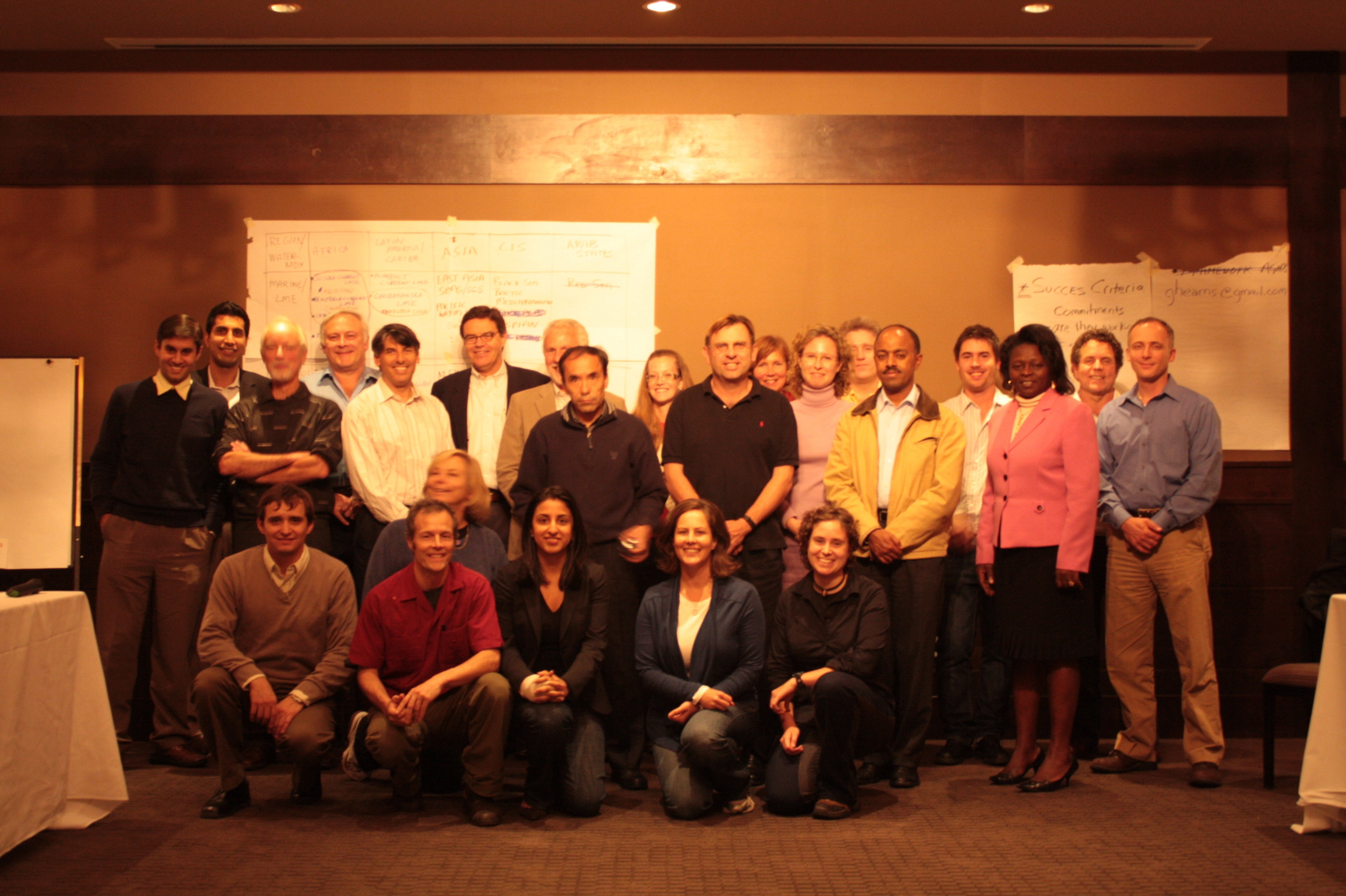
G. Group Photograph from Project Inception Meeting
51
H. Preliminary Set of Case Studies for Evaluation
Rough
Category Comments
Rating
6 Data
Information Harmonization of methods and metrics of
Sharing, Exchange,
monitoring, data collection, modeling.
and Harmonization
7 Dispute
Resolution
Prevention, avoidance, of disputes.
Balancing trade offs.
8 Participation
and
the
Civil society, youth, and the private sector.
Role of Multiple
Methods for engagement
Stakeholders
8 Flexibility
and Dealing with challenges like climate change,
adaptability of
and increasing demand.
agreements
Use of adaptive management.
7
Financing, costs and
Minimizing transactional and operational
benefits
costs of operating a secretariat (conducting
monitoring and analysis).
Evaluation of costs and contributions of
parties, incorporating intangibles in benefit
analysis, understanding ecosystem benefits.
Benefit sharing and cost-benefit assessment
and apportionment.
2 Compliance
and Ensuring that parties are applying the
Monitoring
agreement and contributing to its success.
9 Implementation Institutional design and operations
Frameworks and
Relation with multi lateral, domestic level,
Operational
and non-water sectors
Mechanisms
On the ground activities
Decision making and balancing trade offs.
3
Institutional capacity
Ability to deliver on commitments, conduct
necessary monitoring, modeling etc.
Included were discussions relating to key issues of environmental
sustainability and being able to incorporate intangibles into decision-making;
exploring innovative arrangements, such as those found in the private
sector; and, understanding the political and social structure under which
agreements were developed.
52
Gender was emphasized as a cross-cutting theme, as were the
development of evaluation criteria and measurements for success. The
need for increased developing country participation in the project was
emphasized, especially in relation to the demand-side driven approaches
advocated by many. Comments on mechanisms for sustainable financing
included both institutional development and maintenance; similarly,
institutional design was described as involving the aspects of both
agreement formation and operation, including anchoring and
implementation of agreements in international and domestic institutions.
53
Preliminary Categories for comparison
Category Performance
Measure
Data and
Data and information exchange Assesses if
Information
there are formal protocols of information and data
exchange.
Effectiveness Evaluates the effectiveness of this
exchange in terms of methods and metrics of
monitoring, data collection, modelling and
harmonization.
Dispute Resolution Dispute mechanism Assesses if there is a
formalised dispute mechanism in place. Based on
treaty text.
Dispute mechanism effectiveness Evaluates
how effective that mechanism has been in dealing
with differences between parties. This will be
primarily based on interviews and expert judgement.
Informal dispute mechanism - Assesses the
degree to which disputes are dealt with through
informal means.
Participation and
Multiple stakeholder involvement Assesses
the Role of Multiple degree of stakeholder involvement. The final metric
Stakeholders
is a aggregated value, based on inclusion of:
- Civil society,
- youth, and the
- private sector.
Disaggregated data for each will be collected and
presented. Based on text of treaties and
agreements, reports, attendees in meetings etc.
Effectiveness of stakeholder involvement
Evaluation of the implication and effectiveness of
stakeholder involvement.
Flexibility
Does flexibility exist in the agreement Assesses
whether there is any forum for alterations of the
substantive elements of an agreement, or inclusion
of new issues as they arise.
54
Flexibility rating Evaluates the actual flexibility of
the agreement in terms of having to deal with new
issues, or the potential to deal with them.
Sustainable
% donor funding What % of the transactional and
Financing
operational costs (including in-kind) are funded by
the donor community (these are not large capital
costs).
Costs and Benefits Minimizing transactional and operational costs of
operating a secretariat (conducting monitoring and
analysis).
Evaluation of costs and contributions of parties,
incorporating intangibles in benefit analysis,
understanding ecosystem benefits.
Benefit sharing and cost-benefit assessment and
apportionment.
Implementation
Construction of institutional arrangement
Frameworks and
Describes the arrangement, ie secretariat, a
Operational
commission, etc.
Mechanisms
Institutional effectiveness Evaluates the
effectiveness of the arrangement in terms of:
- meeting multiple objectives
- on the ground activities
Primary metrics, such as if a dispute resolution mechanism exists, will be
assessed through examination of the treaty or agreement and sub
agreements.
Secondary metrics, such as evaluating effectiveness of stakeholder, will
involve developing constructed scales such as "poor / fairly poor / neutral /
good / excellent". Overall assessments using these constructed scales will
be based on surveys and completed by local experts and practitioners as
well as other interested persons through IW:LEARN and at South South
Peer Group Meetings.
55
I. Year 1 Project Workplan Schematic with Budget and Indicators
WORKPLAN FOR YEAR 1
Input
Time Frame
Input Co-Fin
SMART Indicators
GEF
COMPONENT 1: IDENTIFICATION AND UNDERSTANDING OF GOOD 3RD QUARTER
PRACTICES AND FOSTERING A SOUTH-SOUTH 2008
D
210,000 280,000
IALOGUE
THROUGH 3RD
QUARTER
2009
OBJECTIVE 1.1 INDENTIFY AND ANALYSE SUCCESSFUL (AND VARIOUS UNSUCCESSFUL) APPROACHES TO GOVERNANCE OF IW WITHIN AND BEYOND
THE GEF PORTFOLIO, AND DEFINE PERFORMANCE MEASURES FOR LEGAL AND INSTITUTIONAL ARRANGEMENTS IN COOPERATIVE
REGIME BUILDING.
OUTCOME 1.1.1
A CLEAR UNDERSTANDING OF INSTITUTIONAL AND DECISION MAKING FRAMEWORKS THAT PROVIDE EFFECTIVE GOVERNANCE OF
INTERNATIONAL WATER RESOURCES, WITH A PARTICULAR FOCUS ON THOSE ELEMENTS WHICH SOUTHERN PRACTITIONERS FIND MOST
BENEFICIAL
OUTPUT 1.1.1.1
REPORT AND CD "REVIEW AND ANALYSIS OF GEF AND NON-GEF INTERNATIONAL WATERS LEGAL AND INSTITUTIONAL FRAMEWORKS
AND OTHER RELEVANT FRAMEWORKS."
ACTIVITY
REVIEW, ANALYZE AND SYNTHESIZE EFFECTIVE GOVERNANCE MECHANISMS AND GOOD PRACTICES INCLUDING BOTH GEF AND NON-
GEF FUNDED INTERNATIONAL WATER INITIATIVES.
· Development of common elements of `good
governance' with respect to legal and
COMMON
institutional frameworks. These common
ELEMENNTS OF
GOOD
elements should be cross cutting between
GOVERNANCE
HAVE BEEN
groundwater, freshwater, and marine
DETERMINED AND
institutional arrangements. They will form
4TH
CIRCULATED TO AP
QUARTER
AND SC.
the basis for analysis of governance
2008
15,000 20,000
Common
systems and the development of the training
elements
framework are
tool kit. The common elements will be
confirmed and
developed with input from the Advisory
refined by
practitioners and
Panel, the Steering Committee, interviews
field meetings
etc.
with practitioners and academics, and field
visits. A framework for analysis will be
developed early in the project and will be
used for assessing the common elements of
`good governance'. Where appropriate the
project will advance the Oregon State
University international waters database
· Review and analysis of GEF and Non-GEF
international waters legal and institutional
frameworks to assess elements of `good
governance'. This review will also allow a
A
3RD
NALYSIS OF
QUARTER
clearer refinement of elements of `good
2008
CASE-STUDIES IN
TO 2ND
COMPLETED.
governance'. The review will be primarily a
QUARTER
35,000 35,000
2009
Includes refined
desk review of project documents, papers
elements of `good
governance'
and reports and interviews with
knowledgeable practitioners and academics.
See Appendix G for list of case studies.
· Develop close ties with relevant projects.
Close ties will be developed with the
UNDP/GEF-MSP Transboundary Waters
Management Experience in Europe,
LINKS AND
Caucasus and Central Asian program, as
I
RELATIONSHIPS
ST QUARTER
well as with the proposed regional MSP
15,000 20,000
2009
DEVELOPED AND
ACTIVELY
testing adaptive learning mechanisms to
WORKING.
improve regional water systems governance
in Africa in order to complement that work
and to share both project implementation
58
experiences as well as substantive
findings[a2].
· Report and CD on key common elements of
`good governance' and institutional
performance measures (ie how well are
institutions applying the key elements). A
2ND AND 3RD
REPORT
report and CD will be developed based on
QUARTER
5,000 10,000 COMPLETED AND
the review and analysis. The results of the
2009
CIRCULATED.
research will be circulated to the Advisory
Panel as well as the South-South Peer
Review Group.
· Exchange of information and knowledge
with professionals, academics and others at
key conferences and meetings. Including
3rd Q, 2008 -
promotion of the project and IW:LEARN web 3rd Q, 2009
site.
-- 15,000
MEETINGS ATTENED
o World Water Congress Montpelier
Sept., 3rd Q, 2008
o ?
OUTPUT 1.1.1.2
ON THE GROUND ANALYSIS OF A VARIETY OF IW REGIMES AT VARIOUS STAGES OF DEVELOPMENT AND ASSESSMENT OF CAPACITY
DEVELOPMENT NEEDS.
ACTIVITY
ASSESS IN THE FIELD, `ON-THE GROUND' NEEDS AND EXPERIENCES FOR CAPACITY BUILDING, INCLUDING THOSE ALREADY GENERATED
BY IWLEARN AND PDFA WORKSHOP AND SURVEY RESULTS.
· Assessment of capacity needs through
1-3RD
SURVEY
targeted questionnaire and interviews with
5000 10,000
QUARTER,
CONDUCTED.
59
practitioners regarding main capacity
2009
building needs with respect to key elements
of `good governance'. Analysis will take
place on projects with a transboundary
nature, but also at the local level where
effects can be explored between
international-national-local interaction.
Continue work inititated in 3rd quarter 2006
· Field visits to 5-9 international water projects
(GEF and other relevant projects). Initial
visits to include, amongst others:
o Nile Basin, R. Paisley as lead. 4th Q,
2008-1st Q 2009
o Iullemeden Aquifer, G. Hearns as
lead, 4th Q, 2008
o Columbia River, R. Paisley as lead,
4th Q, 2008-
FIELD VISITS
1st and 2nd Q 2009
3rd Q, 2009
55,000 70,800 CONDUCTED
o Rio Grande, B. Graizbord as lead, 1st
Q, 2009
o Cartagena Convention, M. Healey as
lead, 2nd Q, 2009
o Abidjan Convention, TDB,
o Local national international
regime study, Costa Rica Panama
60
case study, H. Hartman, 3rd Q, 2008
to 2nd Q 2009.
OBJECTIVE 1.2 PROMOTE FACILITATED EXCHANGES OF EXPERIENCE THROUGH SOUTH-SOUTH PEER LEARNING NETWORKS, AND INCORPORATE LOCAL
OBJECTIVES FOR CAPACITY BUILDING.
OUTCOME 1.2.1
INCREASED INTERACTION AND SOUTH-SOUTH DIALOGUE OF EXPERIENCES AND OBJECTIVES IN REGIME MANAGEMENT.
ACTIVITY
INITIATE SOUTH-SOUTH DIALOGUE TO INCORPORATE FIELD EXPERIENCE IN THE ANALYSIS, AND ESTABLISH A CORE PEER GROUP FOR ON
GOING PROJECT REFERENCE, AND BEYOND.
· Determine Peer Group members. Develop
links to projects and institutions which can
4TH QUARTER
provide the necessary field experience and
2008 AND 1ST
P
5000 10000 EER GROUPS
QUARTER
DEVELOPED
insight to provide direction for development
2009
of capacity building tools.
· Initial meeting of the Latin American cohort
of the SSPG to provide input to the
development of the key elements of good
governance, and tool development. Meeting
25,000 30,000 M
1ST
EETING HELD
QUARTER
likely held in Mexico at El Colegio de
2009
Mexico.
· Initial meeting of the Africa and Asia cohorts
of the SSPG to provide input to the
2ND OR 3RD
development of the key elements of good
QUARTER
50,000 60,000 MEETING HELD
governance, and tool development. Meeting
2009
place to be determined.
61
62
J. Preliminary List of Study Sites
Region/Water
Large Marine
Rivers and Lakes
Groundwater
Body
Ecosystems
Africa
· Guinea current,
Okavango
Il umeden (no agreement
· Benguela current
Niger
in place)
· Canary current
Nile
Abidjan Convention
Lake Chad
Lake Tanganyika
Orange
Senegal
Lake Victoria
Volta
Latin America and
Humbolt Current
Amazon
Guarani (no agreement
Caribbean
Caribbean Sea LME
Plata/Uruguay +
in place)
-Cartagena Convention Paraguay
-Joint (fisheries)
Rio Bravo (soon to be
development zone
GEF)
between Jamaica and
Columbia
-South Atlantic
Fisheries zone
(Argentina and
Falklands)
Asia East
Asian
Seas
Mekong
South China Sea
Pacific Warm Pool
WCPFC
Commonwealth of
Black Sea (Black Sea
Danube
Dinaric Karst (no
Independent States
Conv)
Lake Orhid/Prespa
agreement in place)
Baltic (Helsinki Conv)
Lake Peipsi
Caspian (Conv for prot
Sava Basin
of)
Dnipro [a3]
Arab States
Red Sea[a4]
Nubian
NW Sahara
Europe Mediterranean
Franco-Swiss Genvese
(Barcelona Conv 1975)
Aquifer