E2150
V4
Public Disclosure Authorized
GEF SANPRP
INTEGRATED AGRICULTURAL
POLLUTION REDUCTION TECHNIQUES PROJECT
PEST MANAGEMENT PLAN
DRAFT VERSION
Public Disclosure Authorized
Public Disclosure Authorized
APRIL 2009
PREPARED FOR SHANGHAI PROJCET MANAGEMENT OFFICE
BY EAST CHINA NORMAL UNIVERSITY (ECNU)
Public Disclosure Authorized
CONTENTS
1 INTRODUCTION ......................................................................................................................................1
1.1 NECESSITY OF PROJECT.......................................................................................................................1
1.2 OBJECTS OF PROJECT..........................................................................................................................1
1.3 BASES OF PROJECT OPERATION .............................................................................................................2
1.3.1 Foundation of base selection .......................................................................................................2
1.3.2 Base name ...............................................................................................................................2
1.4 INTEGRATED PEST MANAGEMENT ...........................................................................................................2
2 DESCRIPTION OF THE DEMONSTRATION BASES...................................................................................4
2.1 DEMONSTRATION BASE IN SHANGHAI JINSHAN DISTRICT MODERNIZED AGRICULTURAL GARDEN.........................5
2.2 QINGPU ZHUJIAJIAO PRODUCTION BASE (QZPB).......................................................................................5
2.3 DEMONSTRATION BASE IN CHONGMING CHANGJIANG FARM (CCF) ...............................................................6
3 CURRENT PEST MANAGEMENT APPROACH .........................................................................................8
3.1 CURRENT AND ANTICIPATED PEST PROBLEMS...........................................................................................8
3.2 AGRICULTURAL AND PHYSICAL CONTROL METHODS ...................................................................................9
3.3 BIOLOGICAL CONTROL METHODS..........................................................................................................10
3.4 CHEMICAL CONTROL METHODS ............................................................................................................10
3.4.1 Non-Pesticide Chemical Control Methods ...................................................................................10
3.4.2 Overall Pesticide Usage ............................................................................................................10
3.5 GENERAL ASSESSMENT OF CURRENT PEST MANAGEMENT APPROACH ........................................................11
4 CHINA AND SHANGHAI POLICIES ON PLANT PROTECTION AND IPM...................................................12
5 PROPOSED PRACTICES OF IPM UNDER IAPDT...................................................................................13
5.1 OBJECTIVES OF PROPOSED PRACTICES .................................................................................................13
5.2 PROPOSED PRACTICES FOR IPM ..........................................................................................................13
5.2.1 Agricultural and Physical Control Method ....................................................................................13
5.2.2 Biological Control Methods ........................................................................................................14
5.2.3 Chemical Control Methods.........................................................................................................14
6 PESTICIDE MANAGEMENT UNDER IAPRTD ..........................................................................................16
6.1 IPM FOR MAJOR CROPS .....................................................................................................................16
6.1.1 Objectives................................................................................................................................16
6.1.2 Principle ..................................................................................................................................16
i
6.1.3 Measures.................................................................................................................................17
6.2 SELECTION PRINCIPLE OF PESTICIDES ...................................................................................................18
6.3 PESTICIDES RECOMMENDED FOR USE IN IAPRTD ...................................................................................19
6.4 ENVIRONMENTAL, OCCUPATIONAL AND HEALTH POTENTIAL RISKS AND MITIGATION MEASURES .......................22
6.4.1 Environmental Potential Risks and Mitigation Measures ...............................................................22
6.4.2 Occupational/Health Potential Risks and Mitigation Measures.......................................................22
7 EIGHTENING CAPACITY OF PEST MANAGEMENT UNDER IAPRTD.......................................................24
7.1 ENHANCING SENSE TO IMPLEMENT POLICY.............................................................................................24
7.2 STRENGTHENING OF THE BASIC PLANT PROTECTION INFRASTRUCTURE .......................................................24
7.3 TRAINING AND HUMAN RESOURCE DEVELOPMENT....................................................................................25
7.4 TRAINING OF FARMERS .......................................................................................................................25
8 MONITORING AND EVALUATION UNDER IAPDTD .................................................................................26
8.1 ACTIVITIES REQUIRING LOCAL MONITORING DURING IMPLEMENTATION.........................................................26
8.2 ACTIVITIES REQUIRING MONITORING DURING SUPERVISION .......................................................................26
8.3 MONITORING AND SUPERVISION PLAN ...................................................................................................26
8.3.1 Monitoring of Pest Management.................................................................................................26
8.3.2 Supervision Plan.......................................................................................................................26
8.3.3 Responsibilities ........................................................................................................................27
8.3.4 Professional technology required................................................................................................27
8.3.5 Budget.....................................................................................................................................27
ii
LIST OF TABLES
Table
The Major Insect Pests in Project District of Shanghai
9
3.1
Suburbs..............................
Table
Pesticides Recommended for Use in IAPRTD
18
6.1
................................................
Table
Agricultural, Physical and Biological Measures for Pest Management of Major
19
6.2
Crops ......
iii
LIST OF FIGURES
Figure
Sketch Map of Geographic Location to Key Demonstration
4
2.1
Bases..............................
Figure
Sketch Map of the Geographic Location to Demonstration Base in
5
2.2
SJDMAG..................
Figure
Sketch Map of Geographic Location to Zhangma Vegetables Demonstration
6
2.3
Base............
Figure
Sketch Map of Geographic Location to Changjiang Farm Demonstration Base
7
2.4
...............
iv
ABBREVIATIONS, ACRONYMES
AND UNITS
AS Aqueous
Solutions
ATESC
Agro-Technology Extension and Service Center
CCF Chongming
Changjiang
Farm
COD Chemical
Oxygen
Demand
D/C
District/County
EC Emulsifiable
Concentrate
ECNU
East China Normal University
FAO
Food and Agriculture Organization of the United Stations
GB State
Standard
GEF Global
Environment
Facility
IAPRTD
Integrated Agricultural Pol ution Reduction Techniques Description
IPM Integrated
Pest
Management
ME Microemulsion
mu
A unit of area, Chinese acre (=0.0667 hectare)
NH3-N Ammonia
Nitrogen
NPV Nuclear
Polyhedrosis
Virus
PMO
(Shanghai) Project Management Office
PIB Polyhedral
inclusion
body
PMP
Pest Management Plan
PRC
People's Republic of China
QZPB
Qingpu Zhujiajiao Production Base
RMB
Chinese Yuan (Renminbi )
RSV Rice
Stripe
Virus
SANPRP
Shanghai Agriculture and Non-point Pol ution Reduction Project
SATESC
Shanghai Agro-Technology Extension and Service Center
SJDMAG
Shanghai Jinshan District Modernized Agricultural Garden
SP Soluble
Powders
TP Total
Phosphorus
USD United
States
Dol ar
WB
The World Bank
WDG Water
Dispersible
Granule
WHO
World Health Organization
WP Wet able
Powders
v
1 INTRODUCTION
1.1 Necessity of Project
Up till the present moment, the use of the pesticides in shanghai has
some questions to be improved in comparison with the other areas of our
country. First of all, the use amount of the pesticides in rural area of Shanghai
is relative larger than the other regions of our country, not only the total
amount but also amount used every unit area. The second, the pesticide
varieties and structure are not reasonable and the pesticide uses excessively,
it could make the natural pest enemies to be in peril of extinction. The natural
control action is much weakened. The third, the agricultural labor
organizations are decentralized as a result of management difficulty. The
fourth, application technique of the pesticides and spray equipments are
outmoded in some respects, it could make the agricultural chemicals use
efficiency to be low, also causes the non-point source pollution on
atmosphere, water body, the soil and so on. In addition, the technical
guidance to the peasants also has some questions to be improved. So it is
necessary for carrying out the project of integrated agricultural pollution
reduction techniques description.
1.2 Objects of Project
There are two specific objects for the project. The first specific object will
set up three core demonstrating base of agriculture production with 8730 mu,
forming fine ecological cycle of agriculture production. To the pest
management plan (PMP) involved, there are some respects as follows:
(1) Pesticides amount used every unit area will be 10% less than average
level of other rural area of Shanghai
(2) The popularizing ratio of green control techniques will reach to 100 %;
(3) The use ratio of the middle toxicity pesticides will be down from 58% to
below 40%;
(4) The use ratio of the green pesticides will be up above 90%;
(5) The varieties of pesticides structure will be more optimization.
The other project's specific object will popularize the integrated
agricultural non point source pollution reduction techniques in Shanghai
suburbs by application of local experience to the entire area. To the PMP
involved, there are some respects as follows: The availability of the pesticides
and the level of the green control techniques will be improve, for reducing
pesticides flowing away to polluting environment.
1
Carries on the technical implementation and the demonstration in the
core demonstration base, Fans out from point to area, to core model district
periphery radiation, enhances the efficiency of utilization on fertilizer and
agricultural chemicals in suburbs, improve green pest control techniques
levels, reduce environment pollution by the chemical fertilizers, pesticides and
agricultural organic waste outflow.
1.3 Bases of Project Operation
1.3.1 Foundation of base selection
(1) The bases should be situated at the water source protection zone of the
upper reaches of the Huangpu River, the Chongming ecology island and
the Tai Lake basin scope. These regions are the important agricultural
production regions related to environment and resources protection.
(2) In the demonstration region the crop production holds certain proportion,
the crops type is relatively stable, the local government has certain
safeguard to the agricultural investment.
The farmers in the regions have the good desire and the demand to the
agricultural new technology promotion, and they would be expected to put the
technology standard into practice.
1.3.2 Base name
According to the above reasons, the three core demonstrating bases of
agriculture production will be set up. Among them, Chongming Changjiang
farm is the modernized agriculture comprehensive experiment base, the high
water quality in Qingpu link Tai Lake is requested, Jinshan District
Modernized Agricultural Garden is located in Jinshan Langxia Town in which
there is a large stock farm. The attention key point in the Garden is the
combined agriculture and stock and the resources circulation use. Their
names are as follows (The more detailed description shown in second
chapter):
(1) Demonstration Base in Shanghai Jinshan District Modernized Agricultural
Garden (SJDMAG);
(2) Demonstration Base in Qingpu Zhujiajiao Production Base (QZPB);
(3) Demonstration Base in Chongming Changjiang Farm (CCF).
1.4 Integrated Pest Management
In agriculture, the Integrated Pest Management (IPM) is a pest control
strategy.Implement of the strategy can be divided three stages closely
together: prevention, observation, and intervention. An array of
2
complementary methods may be used in three stages. These methods
include agriculture, physical, biological, and chemical management. IPM is an
ecological approach with a main goal of significantly reducing or eliminating
the use of pesticides and mitigating environmental pollution from use
chemicals. IPM was formulated into national policy in 1972.
The project would support integrated pest management (IPM), including:
(1) Keeping pests below economically damaging levels, managing pests
rather than seeking to eradicate them;
(2) Relying, to the extent possible, on non chemical measures to keep pest
populations low;
(3) When pesticides have to be used, selecting them that are less toxic, and
applying them in a way that minimizes adverse effects on beneficial
organisms, human beings, and the ecological environment. As a result,
there is a need for preparation of a Pest Management Plan (PMP) for the
project.
The Pest Management Plan (PMP) of the project will promote the use of
biological and environmental control methods for pests and diseases, which
will reduce the reliance on synthetic chemical pesticides.
3

2 DESCRIPTION OF THE DEMONSTRATION BASES
Three key demonstration Bases of agricultural production in Jinshan
District, Qingpu District and Chongming County will be set up under IAPDTD.
These bases are located at SJDMAG, QZPB and CCF respectively. The
geographic location of key demonstration bases is shown at figure 2.1.
Figure 2.1 Sketch Map of Geographic Location to Key Demonstration Bases.
4

2.1 Demonstration Base in Shanghai Jinshan District Modernized Agricultural Garden
The 2400 mu lands of Nanlu village, Nantang village, Youhao village and
the No.7 Team of Jinshanyinglong in Liangxia Town are selected as
demonstrating bases. The main crops are rice, wheat and vegetable. The
geographic location of demonstration base in SJDMAG is shown at figure 2.2.
Figure 2.2 Sketch Map of the Geographic Location to Demonstration Base in
SJDMAG
The demonstration base in SJDMAG is located on Jinshan Langxia Town,
the Huigaojing river flows past the Base land from south to north and interlinks
with Beijuegang River. According to Functional Divisions of Water
Environment in Shanghai , the Huigaojing river and the west areas of it is
located on III class surface water functional divisions, the III grade of
Environmental Quality Standard for Surface Water (GB3838-2002) is
adopted. The east areas of Huigaojing is located on V class surface water
functional divisions, the V grade Standard is adopted. The surface water of
Huigaojing canal was sampled and determined. The conclusion obtained
showed that CODCr is 29.92 mg/L, NH3-N 1.03mg/L and TP 0.220mg/L. The
CODCr, NH3-N and TP reach the IV grade water standard of « Environmental
Quality Standard for Surface Water GB3838-2002».
2.2 Qingpu Zhujiajiao Production Base (QZPB)
The 2630 mu lands of Huangjin village, Xinsheng village and Zhangma
village in Zhujiajiao Town are selected as demonstrating bases. The main
5
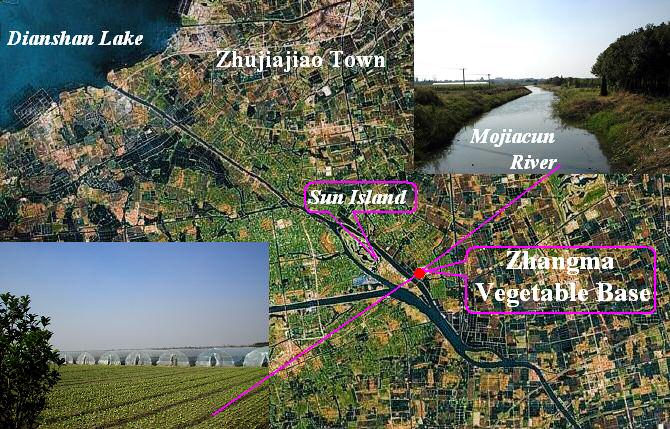
crops are rice, wheat and vegetable. The geographic location of Zhangma
vegetables demonstration base in QZPB is shown at figure 2.3.
Figure 2.3 Sketch Map of Geographic Location to Zhangma Vegetables Demonstration Base
The scope of Zhangma Vegetables Demonstration Base is east from
Shentai road, west to Yuejin canal, south from cobble pathway, north to
Mojiacun canal. The acreage under vegetable is about 146 mu.
The Zhangma Vegetables Demonstration Base is located on the water
source protection zone of the upper reaches of the Huangpu River, the river
system around the base can flow into the upper reaches of the Huangpu River
directly. The base is adjacent to protection zone of natural landscape in Sun
Island. The Zhangma Vegetables Demonstration Base is the nearest to the
water source of upper reaches of the Huangpu River among the
Demonstration Bases in Qingpu. The surface water of the base drawing water
site, that is a confluence of Mojiacun canal with Yuejin canal, was sampled
and determined. The conclusion obtained showed that CODCr is 14.86 mg/L,
NH3-N 0.22 mg/L and TP 0.188mg/L. The CODCr and NH3-N reach the II
grade water standard of « Environmental Quality Standard for Surface Water
GB3838-2002». TP reaches the III grade water standard.
The main crops are wild rice stem, Chinese cabbage, cauliflower and
other green vegetables in the Demonstration Base. These dry farming
vegetables will be planted in the brooder.
2.3 Demonstration Base in Chongming Changjiang Farm (CCF)
The 3700 mu lands of Pingdong No. 3 team and Qianjiang No.7 team in
Chongming Changjiang Farm are selected as demonstrating bases. The main
crops are rice and wheat with yielding two crops a year. The geographic
6
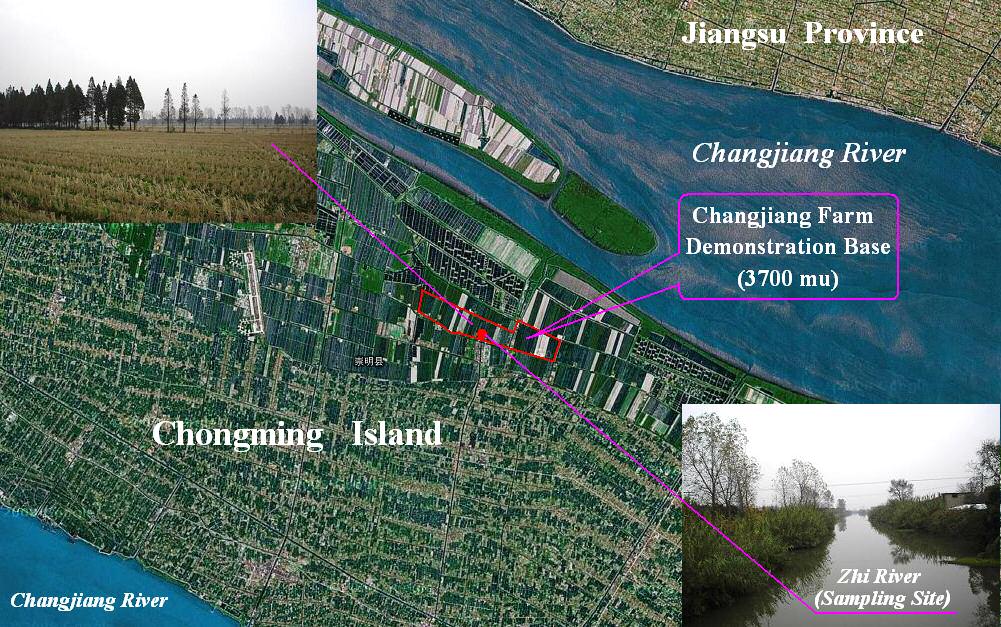
location of Changjiang Farm demonstration base in Chongming is shown at
figure 2.4.
Figure 2.4 Sketch Map of Geographic Location to Changjiang Farm
Demonstration Base
The Changjiang Farm Demonstration Base in Chongming is located on
the middle-east part of the Island, the Zhi river flows past the Base land from
south to north and interlinks with canal of surrounding island. According to
Functional Divisions of Water Environment in Shanghai , the areas of
Demonstration Base located on III class surface water functional divisions, the
III grade of Environmental Quality Standard for Surface Water (GB3838-
2002) is adopted. The surface water of Zhi river was sampled and
determined. The conclusion obtained showed that CODCr is 17.27mg/L, NH3-
N 1.16mg/L and TP 0.126mg/L. The CODCr and TP reach the III grade water
standard of « Environmental Quality Standard for Surface Water GB3838-
2002». NH3-N reaches the IV grade water standard.
7
3 CURRENT PEST MANAGEMENT APPROACH
3.1 Current and Anticipated Pest Problems
According to the statistical data, plant diseases and insect pests has
about the area 36,000,000 acres times annual mean, about preventing and
controlling area 42,000,000 acres times in Shanghai.
It is the rice stripe Tenuivirus to the Shanghai grain crops harm big main
plant disease and pest, is one kind of paddy rice viral disease which spreads
poisonously by the Laodelphax striatellus. When it occurs seriously, the big
area rice reduction of output would take place, even gets no crop.
The Shanghai ATESC organized district/county plant protection
department to the sample investigation and the having poison rate
determination for the Laodelphax striatellus wintered in 36 townships (towns)
of the city. 576 fields of the whole city were investigated, 547 fields with
Laodelphax striatellus had been discovered. It occupied adjusts the land
survey block number 94.97%, also in investigation each kind of type field
(wheat field, rape field, green field, weed land, rice stubble field) had the
discovery.
According to investigating results, the Laodelphax striatellus insect
quantity is 13600 heads /mu, the scope 0.18
55,200 heads /mu, highest
434,000 heads /mu, Looked from the Laodelphax striatellus's distribution that,
the insect quantity highest is the weed land, next is the wheat field, green
field, the rice stubble field and the rape field; From the region which occurs
looked that, the highest insect quantity /mu is in Jinshan area, reaching
434,000 heads /mu, average insect quantity/ mu is 52,500 heads /mu. The
insect quantity /mu less than 10,000 heads is in Qingpu area and Chongming
area.
The average having poison rate is 16.68%, it increased 3.75 percentage
points than the 12.93% in the same time last year. The value has surpassed
12% greatly which is regarded the serious epidemic index. Highest is the
Nanhui District (31.5%), Qingpu District (12.50%), Chongming County
(19.60%) and Jinshan District (10.01%).
The Cnaphalocrocis medinalis Guenee and Nilaparvata lugens Stal are
the two kinds of harmful insects with migration by flying. From 2003, the
Cnaphalocrocis medinalis Guenee assumes great epidemic tendency every
year, from 2005 the Nilaparvata lugens Stal enters newly turn epidemic time.
In recent years, the effective agricultural control and chemistry preventing
and controlling measures have be adopted in Shanghai, the stem borer's
spontaneous generation degree has the drop. But as a result of factor
8
influences, such as climatic conditions, antibiotic nature and so on, the rice
stem borer is still having certain harm in Shanghai.
The main disease insect pests are the wheat head blight, powdery
mildew and wheat aphides to wheat crop in Shanghai areas. Average year the
areas occurred these main disease insect pests are about 1,800,000 mu
times.
The Sclerotinia sclerotiorum de Bary is the main plant disease of oilseed
rape in Shanghai. The primary factors which could lead to the plant disease
taken place are resistance of variety, the fungus source, the cultivation
management and weather situation from flowering to the last week of
harvests.
The major insect pests of economic significance in Shanghai suburbs are
shown in Table3.1.
Table 3.1 The Major Insect Pests in Project District of Shanghai Suburbs
Crop
Main Disease Insect Pests
Rice stripe tenuivirus
Cnaphalocrocis medinalis guenee
Rice
Nilaparvata lugens stal
Rice stem borer
Wheat head blight
Wheat
Powdery mildew
Wheat aphides
Oilseed Rape
Sclerotinia sclerotiorum de bary
Spodoptera exigua
Spodoptera litura
vegetables
Diamondback moth
Aphides
Cabbage worm
3.2 Agricultural and Physical Control Methods
Agricultural and physical methods used by farmers to help control insect
pests include:
1 Tillage practices, including deep tillage to bury straw and vegetative trash
to prevent insect pest egg buildup, and soil tillage in rice paddy
immediately after harvesting to prevent buildup of rice stem borers;
2 Regular rotation of dry land crops to avoid buildup of soil-borne insect
pests and diseases;
3 Regular rotation of dry land and water land crops to avoid buildup of soil-
borne insect pests and diseases;
9
4 Straw and trash control to prevent buildup of insect pests and eggs in
crop straw and trash;
5 Cutting and burning of diseased or egg/insect infected leaves in
vegetable crops, and branches in plants;
6 Deep flooding practices in rice paddy to assist control of soil-borne eggs
and pupae of rice pests and other insects;
7 Use of lure boxes to collect worms and caterpillars;
8 Light lures making use of insect phototaxis to attract pests in vegetables;
9 Hand-picking of eggs, caterpillars and larvae during periods of high
infestation;
3.3 Biological Control Methods
Biological control measures used by farmers include:
1 Extension of crop varieties resistant to insect pests;
2 Intercropping of target species to attract insect pests away from the main cash
crop.
3.4 Chemical Control Methods
3.4.1 Non-Pesticide Chemical Control Methods
Non-pesticide chemicals are used to control specific insect pests on
some crops
for example, use of sugar-vinegar mixtures to attract and trap
insects in vegetable greenhouses, these can also be used in conjunction with
lights to initially attract insects.
3.4.2 Overal Pesticide Usage
Pesticides are the insect pest chemistry preventing and controlling main
form. According to 2007 the statistics, the Shanghai grain field pesticides
amount of use (calculated as pure chemicals) is 9.66kg/hm2 (the
644.27g/Chinese acre), the vegetables field agricultural chemicals amount of
use (calculated as pure chemicals) 7.74kg/hm2 (the 516g/Chinese acre). The
grain field pesticide, the disinfectant, the weed killer proportion are
approximately 3.2:1.2:1, but the developed country is 1:1:2, the vegetables
field pesticide reaches as high as 45.1%. The grain field middle and low toxic
pesticides proportion is 6:4, the vegetables, industrial crop and so on, the low
poisonous agricultural chemicals account for the proportion above 95%. At the
same time, the instruments of sprinkling pesticides are outmoded equipments.
The agricultural chemicals use efficiency is low.
10
3.5 General Assessment of Current Pest Management Approach
Studies conducted during project preparation indicated the following issues on
the current pest management approaches used in the project area:
1 Dependence on chemical control methods, especially for large areas of mono-
crop species, such as rice, wheat;
2 Over application of pesticides;
3 Inappropriate handling and management of pesticides and other agricultural
chemicals;
4 Environmentally unsound disposal of chemicals and chemical packaging;
5 Inadequate enforcement of laws and regulations on labeling and sales of
agricultural chemicals;
6 Low level of awareness amongst farmers, extension services and chemical
resellers of IPM;
7 Poor sense of safe use of pesticides.
11
4 CHINA AND SHANGHAI POLICIES ON PLANT PROTECTION AND IPM
Relevant national and Shanghai policies on plant protection and
integrated pest management are as follows:
z
Regulation on Management of Pesticides of PRC
(Issued by the State
Council and implemented on May 8, 1997)
z
Methods for Implementing Pesticides Management Regulation
(Issued
by Ministry of Agriculture on December 27, 2007)
z
Management Methods on "Pollution-Free" Farm Products
(issued by
Ministry of Agriculture and State Quality Supervision, Test and
Quarantine Bureau in 2002)
z
Pesticide application guideline for green food production
NY/T393-2000
z
Standard for Safe Use of Pesticides GB4285-89
z
Standard for Safe Use of Pesticides GB8321.6-1999
z
Testing on the Residues of Organophosphate Pesticides in Food
(GB/T 5009.20-2003)
z
Stipulations on Operation, Use and Management of Pesticides of
Shanghai (Issued by Shanghai Municipal People's Government on
December 19, 1997)
z
Provisional Method on Supervisory and Management of Edible Farm
Produce Security of Shanghai
(Issued by Shanghai Municipal People's
Government on July 3, 1997)
12
5 PROPOSED PRACTICES OF IPM UNDER IAPDT
5.1 Objectives of Proposed Practices
z Apply low and green pesticides against high toxicity chemicals;
z Decrease the levels of sales of inappropriate and inadequately labeled
chemicals to farmers;
z Promote safe use and management of chemicals;
z Promote the awareness, knowledge and adoption of IPM
z Reduce environmental pollution from unreasonable application of
pesticides;
z Lower the occupational/health risks from pesticide use.
5.2 Proposed Practices for IPM
5.2.1 Agricultural and Physical Control Method
z Tillage practices, including deep tillage to bury straw and vegetative
trash to prevent insect pest egg buildup; and soil tillage in rice paddy
immediately after harvesting to prevent buildup of rice stem borers
z Regular rotation of dry land crops to avoid buildup of soil-borne insect
pests and diseases, e.g., vegetables followed by beans followed by
vegetables.
z Regular rotation of dry land and water land crops to avoid buildup of soil-
borne insect pests and diseases.
z After summer crops harvested, the tilling of fields and irrigation must be
made in time to wipe out effectively source of the fly louse.
z Clear away the weeds by the side of lands, ditches and roads, worsen
living environment of fly louse, reduce and host plant, cut off the host
chain.
z Raise rice seedlings together, the rice seedling beds are grouped and far
away from wheat lands for prevention of the fly louse. Intensify
demonstration and promotion insect prevention network and other
physical control method.
z Carry out spring ploughing and irrigation, during the period of forming
pupa (from a period of last ten days in March to a period of first ten days
in May), the tilling of fields be made by middle-sized tractor and irrigation
to wipe out source of fly louse.
13
z Straw and trash control to prevent buildup of insect pests and eggs in
crop straw and trash.
z Cutting and burning of diseased or egg/insect infected leaves in
vegetable crops;
z Use of lure boxes for worm and caterpillar (e.g., greenhouse vegetables);
z Making use of light lures to attract phototaxis insect pests in vegetables;
z Hand-picking of eggs, caterpillars and larvae during periods of high
infestation.
5.2.2 Biological Control Methods
z Extension of crop varieties resistant to insect pests;
z Intercropping of target species to attract insect pests away from the main
cash crop;
z Nurturing and protecting predators for rice pests, making good use of
predators such as frogs and spiders to control pests.
5.2.3 Chemical Control Methods
The principles of chemical control methods are as follows:
z Non-pesticide chemicals with appropriate and cost-effective are used to
control specific insect pests on some crops, such as, use of sugar-
vinegar mixtures to attract and trap insects in vegetable greenhouses.
z Application of highly effective, low toxicity, and low residue pesticides
z Extend control techniques that have low toxicity to human beings,
domestic animals, and fauna; low residues in agricultural products; and
little environmental pollution. Such techniques include: Use of low toxicity
and low residue pesticides, spraying of pesticides before transplanting,
applying timely, effective low concentration pesticides to control various
insect pest species when the density of insect pests is above a critical
threshold to ensure optimal effectiveness of each pesticide application;
maintaining safe intervals between pesticide applications.
z Use of safe spray equipment (e.g., backpack sprayers) to increase the
efficiency of pesticide use and control effectiveness;
z Extension and training in safe methods of pesticide application (e.g.,
correct clothing, how to spraying in still conditions, and so on);
z Safe storage of chemicals (e.g., away from children and food, etc);
z Proper disposal of chemical wastes and used chemical containers.
14
15
6 PESTICIDE MANAGEMENT UNDER IAPRTD
6.1 IPM for Major Crops
6.1.1 Objectives
In order to control pests and reduce use of chemical pesticides, the
following Specific objectives are worked out under IAPRTD:
(1) Pesticides amount used every unit area will be 10% less than average
level of other rural area of Shanghai.
(2) The level of the green control techniques will be heightened and the
popularizing ratio of green control techniques will reach to 100 %.
(3) The use ratio of the middle toxicity pesticides will be down from 58% to
below 40%, the use ratio of the green pesticides will be up above 90%.
(4) The varieties of pesticides structure will be more optimization, the
availability of the pesticides will be raised and reducing pesticides flow
away to polluting environment.
(5) Eliminate any poisoning accident caused by unsafe management, storage
and unreasonable handling of discarded waste.
(6) Pesticide residue in farm products will not exceed WHO and the State
standards.
(7) Maintain the biological diversity of farms and establish farm biological
models
6.1.2 Principle
Value and strengthen pest forecasts, spread the green pest control
techniques, apply agricultural control measures first, then choose physical
and biological control measures, and finally chemical control measures.
Strengthens and provides accurate forecasts of diseases and pests.
SATESC and ATESC (District/County) should provide timely disease and pest
control information to farmers including control targets, appropriate timing of
control measures, technology and pesticides, etc. Such information should be
given to farmers 7-10 days ahead of implementing control measures. Directs
farmer suitable time preventing and controlling, enhances the preventing and
controlling effect. Promote and renew spray equipments for raising effective
utilization of the pesticides and reducing environmental pollution.
16
6.1.3 Measures
(1) Agricultural control measures
z Choose improved varieties and nurturing of healthy seedlings: Removal
of poor quality seedlings and nurturing high quality seedlings, this is an
important measure for improving crop resistance to pests and reducing
use of chemical pesticides.
z Crop rotation: To avoid buildup of insect pests and diseases
z Intercropping: For example, intercropping tomato, cabbage and pepper
can reduce the migration of aphids.
z Reasonable planting season should be selected for minimizing crop
damage from diseases and pests.
z Tillage practices: Deep tillage to bury straw and vegetative trash to
prevent insect pest buildup; soil tillage in rice paddy immediately after
harvest to prevent buildup of rice borer.
z After harvest of dry land crops, the land should be deep-tilled to avoid
buildup of pests in the topsoil and to freeze pests hibernating in the soil
for winter.
z Appropriate use of fertilizers and timely implementation of irrigation and
drainage: Application of abundant base manure and limited use of
nitrogen and phosphate fertilizers, and increased use of calcium to
strengthen pest resistance of crops. Sound irrigation and drainage
management will be effective in pest and disease control.
z Improve tillage and weeding to reduce pest and disease occurrence.
z Clean land: Removal of infected leaves and crop plants from the field to
reduce diseases and pests.
(2) Physical control measures
z Use pest-proof nets in vegetable cultivation to keep out pests and
diseases, rain and wind, to keep out sunlight and maintain moisture as
required. The brooder technology in vegetable cultivation could be
adopted.
z Trap and kill pests: Use yellow boards to trap white flies and aphids, use
frequency vibration lamps and black light lamps to trap and kill moths
and beetles, use sugar and vinegar solution to trap and kill moths.
z In the project implementation area, demonstrates positively and
promotes is advantageous in the reduced agricultural chemicals use,
application of green pest control techniques, renew the spray equipment,
17
pay attention to each technical the integration and the comprehensive
application.
z In the project implementation area, insect forecast sites would be set to
systematic monitor the pests and diseases, and linkage with "Early
warning system of agricultural harmful organisms in Shanghai" network
system. Achieve automation for collection, statistics and consultation of
monitoring data. Provide the online expert diagnosis and the consultation
for the farmer and the technical personnel, enhances the monitor system
early warning the precision. Propose the science preventing and
controlling opinion.
(3) Biological control measures
z Use of natural pest enemies, for example, frog;
z Use of sex attractants to trap and kill pests
(4) Chemical control measures
Use of pesticides combined with other control measures is an effective
and economic way to increase control efficiency, and guarantee agricultural
yields increased. High quality pesticides should be used that are effective in
pest control, have no- or low-toxicity to human beings and animals, and are
safe on crops. Key pesticide control measures are as follows:
z Prohibit use of severe or highly toxic and high residue pesticide;
z Use different pesticides to control different pests;
z Spray pesticides at the best times based on pest occurrence situation;
z Spray appropriate amounts of pesticide based on pest occurrence
situation;
z Appropriately mixed or alternative use of pesticide based on pest
occurrence situation;
z Strictly implement safe harvest intervals (see GB4285-89);
6.2 Selection Principle of Pesticides
In principle the application of pesticide by beneficiaries would be
recommended from Agro-Technology Extension. The purchasing, storage and
application of pesticides must abide by the law of PRC and accord with
standards acceptable to the World Bank. Pesticides selected for use must
meet the World Bank's OP 4.09 criteria. The main criteria are as follows:
z Must have negligible adverse human health effects;
z Must be shown to be effective against the target species;
18
z Must have minimal effect on non-target species and the natural
environment; the methods, timing, and frequency of pesticide application
are aimed to minimize damage to natural enemies.
z The pesticides use must take into account the need to prevent the
development of resistance in pests.
z Besides that, the entire process of use pesticide should be detailed
recorded, including application of land, variety, quantity, date, effect and
crop output.
6.3 Pesticides Recommended for Use in IAPRTD
During project implementation, it will be necessary to use pesticides in
conjunction with agricultural control, physical and biological control measures.
The application of pesticide should follow the principles of economic, safe and
effective, pesticides used must be highly effective, low toxicity, and nil or low
residues. Table 6.1 lists pesticides recommended for IAPRTD
implementation.
Table 6.1 Pesticides Recommended for Use in IAPRTD
Crops No.
Main Pests Name
Recommended Chemical Pesticides with
low toxicity
Rice stem borer;
1
200g/L
Rice case worm.
Chlorantraniliprole suspension
2
Rice Planthopper
25% buprofezin WP
3
Rice case worm
2% Avermectins AS
4
Rice case worm
16000IU/mg Bacil us thuringiensis WP
5
Asiatic rice striped borer
25% Avermectins·Chlorpyrifos EC
Rice
6
Rice Planthopper
10% Imidacloprid WP
Rice stripe virus(RSV);
7
2% Ningnanmycin AS
Fusarium graminearum
Thanatephorus
8
15% jinggangmycin A SP
cucumeris(Frank)Donk
Thanatephorus
9
300g/L Difenoconazole·propiconazol EC
cucumeris(Frank)Donk
10 Wheat
aphides
10% Imidacloprid WP
Wheat
11 Wheat
aphides
25% pymetrozine WP
12 Wheat
head
blight
25% Carbendazol·Triadimefon WP
Cabbage worm;
Vegetable 13 Spodoptera exigua;
150g/L Indoxacarb suspension
s
Diamondback moth
14 Spodoptera
exigua
2.2% Methylamino abamectin Benzoate ME
15 Spodoptera
exigua
1 bil ion PIB/mL Autographa californica
NPVsuspension
16 Spodoptera
exigua
30 billion PIB/g Spodoptera litura NPV WDG
17 Spodoptera
litura
20 bil ion PIB/g Spodoptera litura NPV WDG
19
Crops No.
Main Pests Name
Recommended Chemical Pesticides with
low toxicity
Diamondback moth;
18
10% Chlorfenapyr suspension
Spodoptera exigua
19 Spodoptera
exigua
3% Methylamino abamectin Benzoate ME
20 Liriomyza
Sativae
75% Cyromazine WP
Blanchard
21 Aphid
70% Imidacloprid WDG
22 Cabbage
worm
40% Phoxim EC
23 Spodoptera
exigua
1.5% Methylamino abamectin Benzoate EC
24 Spodoptera
exigua
240g/L Methoxyfenozide suspension
25 Spodoptera
exigua
50g/L Lufenuron EC
Diamondback moth;
26
25g/L spinosad
Thripidae
27 Snail
metaldehyde
granules
Wax gourd Plasmopara
viticola;
Anthracnose;
Alternaria solani, late blight;
Cauliflower downy mildew;
Cucumber powdery
28
250 g/L Azoxystrobin suspension
mildew cladospori
Vegetabl
cucumerinum, gummy stem
es
blight, Plasmopara
viticola pepper anthracnose,
phytophthora blight of
pepper, etc
29 Cucumber
Downy
mildew
50% Dimethomorph WP
30 Tomato, Pepper, Tobacco
8% Ningnanmycin AS
virus disease
Cucumber Downy mildew
31 phytophthora blight of
52.5% Famoxadone·cymoxanil WDG
pepper;
Botrytis cinerea Pers
32
400g/L pyrimethanil suspension
Botrytis cinerea Pers
Common bean Powdery
33 Mildew;
400g/L flusilazole EC
Cladosporium cucumerinum
Ell .et Arthur;
Other measures for pest management of major crops are summarized in
Table 6.2.
Table 6.2 The Other Measures for Pest Management of Major Crops
Crops
Agricultural and Physical Measures
Biological
Measures
z
Deep tillage to bury stubble. After the
Spread resistant
Rice
harvesting of summer crops, the land should pests varieties,
20
be deep-tilled and irrigated in time for
protection and
effective killing the fly louse;
utilization of
natural pest
z
The weeds in farmland or by the side of
enemies.
fields, ditches and roads should be weeded
out to deteriorated living environment of fly
louse, to reduce transition host plant. It can
cut off host plan chain and lighten pests and
diseases;
z
Suitable put off the seeding time of rice
seedlings. After the summer crops in the
same area are as harvesting as possible,
the rice grows by direct seeding. This can
keep away from a generation of fly louse to
move into the rice field.
z
Raise rice seedlings together, the rice
seedling beds are grouped and far away
from wheat lands for prevention of the fly
louse.
z
Intensify demonstration and promotion
insect prevention network and other physical
control method, protect the rice seedling to
avert fly louse calamity.
z
Carry out the spring ploughing by middle
type tractor and spring irrigation to wipe out
the winter pest and disease;
z
Installed with frequency vibration lamps and
black light lamps to trap and kill moths and
beetles,
z
Forecasting for plant diseases and insect
pests.
z
Pay attention to the integrated prevention
and control of plant diseases and elimination
of winter pests, the weeds by the side of
fields should be weeded out, limited use of
nitrogen fertilizers, and increased use of
Spread resistant
phosphate fertilizers, potash fertilizers and
pests varieties,
Wheat
organic fertilizers.
protection and
utilization of
z
Make investigation and study in the field for
natural pest
controlling dynamic condition of plant
enemies.
diseases and pests occurrence and wheat
growth.
z
Forecasting for plant diseases and insect
pests.
Vegetable z Forecasting for vegetables diseases and
Use of natural
t
i
21
s
insect pests.
pest enemies.
z
Use of sex attractants to trap and kill pests
z
Installed black light lamps to trap and kill
moths and beetles.
6.4 Environmental, Occupational and Health Potential Risks and Mitigation Measures
6.4.1 Environmental Potential Risks and Mitigation Measures
The main environmental potential risks from application of pesticide in
IAPDTD project are as follows:
z Deterioration of water quality may be caused by application of pesticide
or pesticide residues and potential for residual increases in aquatic biota
(e.g., fish).
z The pollution of surface water may be caused by application of pesticide
and chemical spills near drinking water sources.
z Possible impacts on non-target species (especially bees, birds) by
application of pesticides.
z Development of pest resistance from continued overuse of some
pesticides;
z The pollution of soil from pesticide residues;
The mitigation measures on environmental potential risks are as follows:
z The village leaders, farmers and chemical resellers should be trained,
and make them to familiarize the properties of pesticides likely caused
environmental impacts, and recommended spraying methods and
equipments.
z The village leaders should monitored spraying pesticides to ensure that
spraying of toxic chemicals is not conducted near water sources.
z Procurement and use of approved safe spray equipment under the
project;
z Application of pesticides with low residual half-lives;
z Use of different pest control techniques (agricultural/physical, biological,
chemical) to ensure that pest resistance to chemical pesticides does not
build up.
6.4.2 Occupational/Health Potential Risks and Mitigation Measures
The main occupational/health potential risks from pesticide use are as
follows:
22
z Sickness resulting from inhalation of pesticide fumes when handling
concentrated chemicals and/or pesticide vapor during spraying if protective
masks are not used.
z Skin damage from sprays or chemical spillage during handling chemical
if protective clothing is not worn
z Contamination of water sources if spraying is conducted close to water sources,
or if there are chemical spills near water sources.
The mitigation measures on occupational/health potential risks are as
follows:
z The village leaders, farmers and chemical resellers should be trained
and demonstrated, the contents of training and demonstration include:
Likely occupational/health impacts of specific chemicals;
Recommended handling and spraying methods;
Approved equipment
and its use;
Wearing of safe clothing (long sleeve shirt, mask, hat,
gloves, long trousers);
Spraying method in still conditions;
Safe
storage of chemicals in locked cupboards ;
Safe disposal of chemical
packaging and wastes;
z Regularly training and demonstrating by specialists from Agro-
Technology Extension and Service Center or Plant Protection and
Quarantine Station, and acceptance of supervision from departments of
government.
23
7 EIGHTENING CAPACITY OF PEST MANAGEMENT UNDER IAPRTD
7.1 Enhancing Sense to Implement Policy
The sense to pest management policy measures to be enhanced by the
Project implementing, these are as follows:
z Reduce current usage rates of chemical pesticides on project activities;
z Banning the use of unregistered pesticides for project activities;
z Banning the use of high toxic pesticides (WHO Class I pesticides), and requiring
their replacement with less toxic alternatives for project activities.
z FAO Code of Conduct on the Regulation, Distribution and Use of Pesticides (or
Chinese equivalent);
z FAO Guidelines for Packaging and Storage of Pesticides (or Chinese
equivalent);
z FAO Guidelines on Good Labeling Practice for Pesticides (or Chinese
equivalent);
z FAO Guidelines for the Disposal of Waste Pesticide and Pesticide Containers on
the Farm (or Chinese equivalent).
z Where Chinese equivalents to these FAO Guidelines do not exist, then such
Guidelines should be prepared for implementation by the Project.
Encourage District/County and Township Governments to promote and support
IPM approaches by discussions and project activities particularly long-term benefits;
7.2 Strengthening of the Basic Plant Protection Infrastructure
The basic plant protection infrastructure to be strengthened by the Project
implementing, these are as follows:
(1) Training of district/county plant protection specialists, township extension
personneland farmers;
(2) By the Project implementing, the plant protection staffs are familiar with
IMP measures. The farmers also have some knowledge of IMP measures.
(3) By the Project implementing, the relation of plant protection has be
strengthened to municipality, district/county, town and village. The
implement of PMP has been promoted.
24
7.3 Training and Human Resource Development
During the project implementing phase, a series of training classes will be
hold. The objects of training are district/county and township technicians,
farmers, and training of trainers. The extension materials will be prepared and
provided, including audio-visual, television, multi-meda; It must make the
technicians to spend more time in the field visiting farmers; building of
agricultural extension field demonstration sites, rehabilitation of activity and
teaching centers; provision of books, journals, and magazines on agricultural
technology.
7.4 Training of Farmers
(1) Times and contents of training activities
The aim of farmer training is to strengthen farmers' ability to safely and
cost-effectively control insect pests. This includes training farmers how to
identify insect pests, make appropriate control decisions, and take proper
measures to control insect pests.
Each farmer would receive 1-2 training courses (1 day) per year, with
relevant courses conducted during the pest control period each year. Training
content would include:
· Characteristics of insect pests and crop damage caused by different
insect pests;
· Natural enemies of each major insect pest;
·
Field sampling approaches;
· Control measures, including IPM approaches involving agricultural,
physical, biological, and chemical control methods;
· Safety in storage, handling, and disposal of chemical wastes and
containers;
· Chemical application methods and protective clothing requirements
(2) Possible training providers:
·
Leader of farmers and demonstration households
·
Trained township, county and municipality extension services
·
Chemical resellers
25
8 MONITORING AND EVALUATION UNDER IAPDTD
8.1 Activities Requiring Local Monitoring during Implementation
·
Extent of IPM adoption by farmers;
·
Pesticide use pattern;
·
Crop production;
·
Changes to the agro-ecosystem
·
Other indicators
The above monitoring should be done by District/County Agro-
Technology Extension and Service Center (D/C ATESC) staff based on a
sample of project households in each Demonstration Base. Early World Bank
supervision missions should assist the D/C ATESC with establishment of an
appropriate monitoring system, sampling procedure, and provide training in
implementation and analysis of the monitoring system.
8.2 Activities Requiring Monitoring during Supervision
The following activities require external monitoring during World Bank
supervision missions:
·
Pesticide registration
·
Use of Class I pesticides;
·
Policy issues;
·
Implementation of the local monitoring program, and assistance in
analyzing results
8.3 Monitoring and Supervision Plan
8.3.1 Monitoring of Pest Management
The monitoring work will be done jointly by ATESC and PMO at municipal
and district/county level with the participation of farmers. Once a pest is
discovered, it should be reported and handled in a timely manner.
8.3.2 Supervision Plan
The PMO will be responsible for ensuring regular supervision is
undertaken. During peak pest infestation periods, the ATESC will be
responsible for supervision and control.
26
8.3.3 Responsibilities
The ATESC at each level will be responsible for guidance, supervision,
monitoring and training on IPM. The PMO and stakeholders have duties and
responsibilities for discovering and timely reporting of pest attacks and for
implementing the IPM plan in accordance with the requirements.
8.3.4 Professional technology required
Plant protection expertise and methods should be supplied by the ATESC
at each level.
8.3.5 Budget
Pest management work should be listed in the daily management work of
PMO, and the budgets should be included in the overheads of the ATESC
and PMO. The management costs could place on the pesticide reasonable
use, the early warning monitor, training, propaganda and management.
27
28