E2150
V2
Public Disclosure Authorized
GEF SHANGHAI AGRICULTURAL AND NON-POINT
POLLUTION REDUCTION PROJECT
ENVIRONMENTAL ASSESSMENT SUMMARY
DRAFT VERSION
Public Disclosure Authorized
Public Disclosure Authorized
APRIL 2009
PREPARED FOR SHANGHAI PROJCET MANAGEMENT OFFICE
Public Disclosure Authorized
BY EAST CHINA NORMAL UNIVERSITY (ECNU)
EA Summary for the GEF Shanghai Agricultural and Non-point Pollution Reduction Project
Draft Version
CONTENTS
1 INTRODUCTION......................................................................................................................... 2
1.1 Project Background ........................................................................................................... 2
1.2 Consistent with Governmental Plan .................................................................................. 2
1.3 Purpose and Scope ............................................................................................................ 2
1.4 Basis of Compilation......................................................................................................... 2
1.4.1 Related Sub-projects EA Documents and FSRs.................................................... 2
1.4.2 Related Laws of the PRC ...................................................................................... 2
1.4.3 Related Regulations of Shanghai .......................................................................... 2
1.4.4 World Bank's Relevant Safeguard Policies .......................................................... 2
1.4.5 Technical Documents for Assessment .................................................................. 2
1.5 Standard of Assessment..................................................................................................... 2
1.5.1 Standard of Environment Quality Assessment...................................................... 2
1.5.2 Sewage Discharging Standard ............................................................................... 2
1.6 Grade of Assessment ......................................................................................................... 2
1.7 Scope of Assessment ......................................................................................................... 2
1.7.1 Surface Water Environment .................................................................................. 2
1.7.2 Environment Air.................................................................................................... 2
1.7.3 Environmental Noise............................................................................................. 2
1.8 Environment Protection Aims ........................................................................................... 2
1.8.1 Surface Water Environment Protection Aims ....................................................... 2
1.8.2 Environment Air Protection Aims......................................................................... 2
1.8.3 Sound Environment Protection Aims.................................................................... 2
1.8.4 Environmental Sensitive Objectives ..................................................................... 2
1.9 Organization of the EA Report.......................................................................................... 3
2 OVERVIEW OF PROJECT .......................................................................................................... 3
2.1 Project Frame .................................................................................................................... 3
2.2 Description of Livestock Waste Management Technology Demonstration....................... 3
2.2.1 Description of Sub-project1-A .............................................................................. 3
2.2.2 Description of Sub-project1-B .............................................................................. 3
2.2.3 Description of Sub-project1-C .............................................................................. 3
2.3 Description of Wetland Sewage Treatment System........................................................... 3
2.3.1 Description of Sub-project2-A .............................................................................. 3
2.3.1 Description of Sub-project2-B .............................................................................. 3
2.4 Total Project Investment.................................................................................................... 3
3 REGION ENVIRONMENTAL GENERAL SITUATION............................................................ 4
3.1 Physical Environment ....................................................................................................... 4
3.1.1 Geographical Position ........................................................................................... 4
i
EA Summary for the GEF Shanghai Agricultural and Non-point Pollution Reduction Project
Draft Version
3.1.2 Geology and Terrain Features ............................................................................... 5
3.1.3 Climate .................................................................................................................. 5
3.1.4 Surface Water System ........................................................................................... 5
3.1.5 Groundwater.......................................................................................................... 7
3.1.6 Surface Ground Temperature ................................................................................ 7
3.1.7 Natural Disaster..................................................................................................... 7
3.2 Water Quality .................................................................................................................... 7
3.2.1 Surface Water Quality Zones inside Shanghai City .............................................. 7
3.2.2 Water Quality inside Shanghai City ...................................................................... 8
3.3 Ecological Environment .................................................................................................. 10
3.3.1 Jinze and Liantang Towns in Qingpu.................................................................. 10
3.3.2 Langxia Town in Jinshan .................................................................................... 10
3.3.3 Shuxin towm and Zhongxing Town in Chongming ............................................ 10
3.3.4 Waigang Town and Juyuan New Area in Jiading ............................................... 10
3.4. Social and Economic Conditions ....................................................................................11
3.4.1 Population and Acres ...........................................................................................11
3.4.2 Social Economy Condition...................................................................................11
4 PROJECT ALTERNATIVES ..................................................................................................... 13
4.1. With and Without Projects ............................................................................................. 13
4.1.1 With and Without the LWMTD Component....................................................... 13
4.1.2 With and Without the Wetland Sewage Treatment System Component............. 13
4.2 Alternative Locations ...................................................................................................... 13
4.2.1 Livestock Waste Management Technology Demonstration Project Locations .... 13
4.2.2 Wetland Sewage Treatment System Project Locations....................................... 14
4.3 ALTERNATIVE TECHNICAL PROCESS AND DESIGN .......................................... 24
4.3.1 Livestock Waste Management Technology Demonstration Project ................... 24
4.3.2 Wetland Sewage Treatment System Project........................................................ 28
5 IMPACT ASSESSMENT AND MITIGATION .......................................................................... 34
5.1 POLLUTION SOURCE ANALYSIS.............................................................................. 34
5.1.1 Livestock Waste Management Technology Demonstration Project ................... 34
5.1.2 Wetland Sewage Treatment System Project........................................................ 38
5.2 Environmental Impacts & Mitigation Measures during Construction Phase .................. 40
5.2.1 Livestock Waste Management Technology Demonstration................................. 40
5.2.2 Wetland Sewage Treatment System Project........................................................ 45
5.3 Environmental Impacts & Mitigation Measures during Operation Phase....................... 49
5.3.1 Livestock Waste Management Technology Demonstration................................. 49
5.3.2 Wetland Sewage Treatment System Project........................................................ 53
5.4 Risks and Hidden Danger................................................................................................ 55
6 PROJECT BENEFITS ................................................................................................................ 56
6.1 Benefits of Sub-project 1-A ............................................................................................ 56
6.1.1 Social benefits ..................................................................................................... 56
ii
EA Summary for the GEF Shanghai Agricultural and Non-point Pollution Reduction Project
Draft Version
6.1.2 Environmental Benefits....................................................................................... 56
6.1.3 Economic Benefit................................................................................................ 57
6.2 Benefits of Sub-Project 1-B ............................................................................................ 57
6.2.1 Social benefits ..................................................................................................... 57
6.2.2 Environmental Benefits....................................................................................... 58
6.2.3 Economic Benefit................................................................................................ 58
6.3 Benefits of Sub-Project 1-C ............................................................................................ 58
6.3.1 Social benefits ..................................................................................................... 58
6.3.2 Environmental Benefits....................................................................................... 59
6.3.3 Economic Benefit................................................................................................ 60
6.4 Benefits of Sub-Project 2-A ............................................................................................ 60
6.4.1 Social benefits ..................................................................................................... 60
6.4.2 Environmental Benefits....................................................................................... 60
6.4.3 Economic Benefit................................................................................................ 60
6.5 Benefits of Sub-Project 2-B ............................................................................................ 61
6.5.1 Social benefits ..................................................................................................... 61
6.5.2 Environmental Benefits....................................................................................... 61
6.6 Benefits of Integrated Agricultural Pollution Reduction Techniques Demonstration ..... 62
6.6.1 Mitigation of Surface Water Pollution from Livestock Wastes........................... 62
6.6.2 Mitigation of Non-point Pollution Come from Use Chemical Fertilizer ............ 62
6.6.3 Extension of Green Prevention and Control Technology & Mitigation of
Pesticides Pollution ...................................................................................................... 62
6.6.4 Overall Mitigation of Non-point Environmental Pollution ................................. 62
6.7 Summary on Bnvironmental Benefits ............................................................................. 62
7 PUBLIC CONSULTATION & INFORMATION DISCLOSURE............................................. 64
7.1 Information Disclosure.................................................................................................... 64
7.2 Public Participation ......................................................................................................... 64
7.2.1 Public Consultation and Main Result in the Network Investigation ................... 64
7.2.2 Main Results Obtained from the Questionnaires................................................. 65
7.2.3 Main Conclusion to the public participates ......................................................... 65
8 DESCRIPTION AND EMP ON IAPRTD PROJECT ................................................................ 67
8.1 Description of IAPRTD Project ...................................................................................... 67
8.1.1 Project Base and Objective ................................................................................. 67
8.1.2 Implement Scope and Contents........................................................................... 67
8.1.3 Implementing Index ............................................................................................ 68
8.1.4 Training and Propaganda .................................................................................... 69
8.1.5 Extension and Demonstration Plan ..................................................................... 69
8.2 Environmental Management Plan ................................................................................... 70
8.2.1 Summary of Environmental Management Plan for Demonstration Pilots A
(Langxia, Jinshan) ........................................................................................................ 70
8.2.2 Summary of Environmental Management Plan for Demonstration Pilots B
(Zhujiajiao, Qingpu)..................................................................................................... 74
iii
EA Summary for the GEF Shanghai Agricultural and Non-point Pollution Reduction Project
Draft Version
8.2.3 Summary of Environmental Management Plan for Demonstration Pilots C
(Changjiang Fanm, Chongming).................................................................................. 77
9 ENVIRONMENTAL MANAGEMENT PLAN ......................................................................... 79
9.1 Objectives of EMP .......................................................................................................... 79
9.2 Role of EMP.................................................................................................................... 79
9.3 Contractual Management ................................................................................................ 79
9.3.1 Contractual Dispositions ..................................................................................... 79
9.3.2 Obligations of the Contractor.............................................................................. 79
9.4 Organization for EMP Implementation ........................................................................... 80
9.5 Cost Estimate for EMP.................................................................................................... 81
9.6 SUMMARY OF EMP ..................................................................................................... 83
9.6.1 Summary of Environmental Management Plan for the Sub-project 1-A ............ 83
9.6.2 Summary of Environmental Management Plan for the Sub-project 1-B ............ 88
9.6.3 Summary of Environmental Management Plan for the Sub-project 1-C ............ 92
9.6.4 Summary of Environmental Management Plan for the Sub-project 2-A ............ 97
9.6.5 Summary of Environmental Management Plan for the Sub-project 2-B ............ 99
10 Conclusions ............................................................................................................................. 101
iv
EA Summary for the GEF Shanghai Agricultural and Non-point Pollution Reduction Project
Draft Version
ABBREVIATIONS, ACRONYMES
AND UNITS
AC
Agriculture Commission
ATESC
Agro-Technology Extension and Service Center
BOD
Biochemical Oxygen Demand
COD
Chemical Oxygen Demand
Demonstration Pilot
Demonstration Base in Shanghai Jinshan District Modernized
A
Agricultural Garden
Demonstration Pilot
Demonstration Base in Qingpu Zhujiajiao Production Base
B
Demonstration Pilot
Demonstration Base in Chongming Changjiang Farm
C
EA
Environmental Assessment
EMP
Environmental Management and Monitoring Plan
EPB
Environmental Protection Bureau
GB
State Standard
GEF
Globe Environmental Facility
mu
A unit of area, Chinese acre (=0.0667 hectare)
NH3-N
Ammonia Nitrogen
PMO
Project Management Office
RMB( )
Chinese Yuan (Renminbi )
SATESC
Shanghai Agro-Technology Extension and Service Center
SMG
Shanghai Municipal Government
SS
Suspended Solids
Sub-project 1-A
Jinshan Holstan Dairy Farm Waste Management Project
Sub-project 1-B
The Eastern part of Chongming Livestock Waste Management
Centre Project
Sub-project 1-C
Integrated Livestock and Agriculture Wastes Management of Qianwei
Village, Chongming County
Sub-project 2-A
Drainage Network Wetland Demonstration Project of Waigang
Town and Juyuan New District, Jiading.
Sub-project 2-B
Qingpu Rural Sewage Treatment Project (Phase I)
TN
Total Nitrogen
TP
Total Phosphorus
WB
World Bank
i
EA Summary for the GEF Shanghai Agricultural and Non-point Pollution Reduction Project
Draft Version
1 INTRODUCTION
1.1 Project Background
1.2 Consistent with Governmental Plan
1.3 Purpose and Scope
1.4 Basis of Compilation
1.4.1 Related Sub-projects EA Documents and FSRs
1.4.2 Related Laws of the PRC
1.4.3 Related Regulations of Shanghai
1.4.4 World Bank's Relevant Safeguard Policies
1.4.5 Technical Documents for Assessment
1.5 Standard of Assessment
1.5.1 Standard of Environment Quality Assessment
1.5.2 Sewage Discharging Standard
1.6 Grade of Assessment
1.7 Scope of Assessment
1.7.1 Surface Water Environment
1.7.2 Environment Air
1.7.3 Environmental Noise
1.8 Environment Protection Aims
1.8.1 Surface Water Environment Protection Aims
1.8.2 Environment Air Protection Aims
1.8.3 Sound Environment Protection Aims
1.8.4 Environmental Sensitive Objectives
2
EA Summary for the GEF Shanghai Agricultural and Non-point Pollution Reduction Project
Draft Version
1.9 Organization of the EA Report
2 OVERVIEW OF PROJECT
2.1 Project Frame
2.2 Description of Livestock Waste Management Technology Demonstration
2.2.1 Description of Sub-project1-A
2.2.2 Description of Sub-project1-B
2.2.3 Description of Sub-project1-C
2.3 Description of Wetland Sewage Treatment System
2.3.1 Description of Sub-project2-A
2.3.1 Description of Sub-project2-B
2.4 Total Project Investment
3
EA Summary for the GEF Shanghai Agricultural and Non-point Pollution Reduction Project
Draft Version
3 REGION ENVIRONMENTAL GENERAL SITUATION
3.1 Physical Environment
3.1.1 Geographical Position
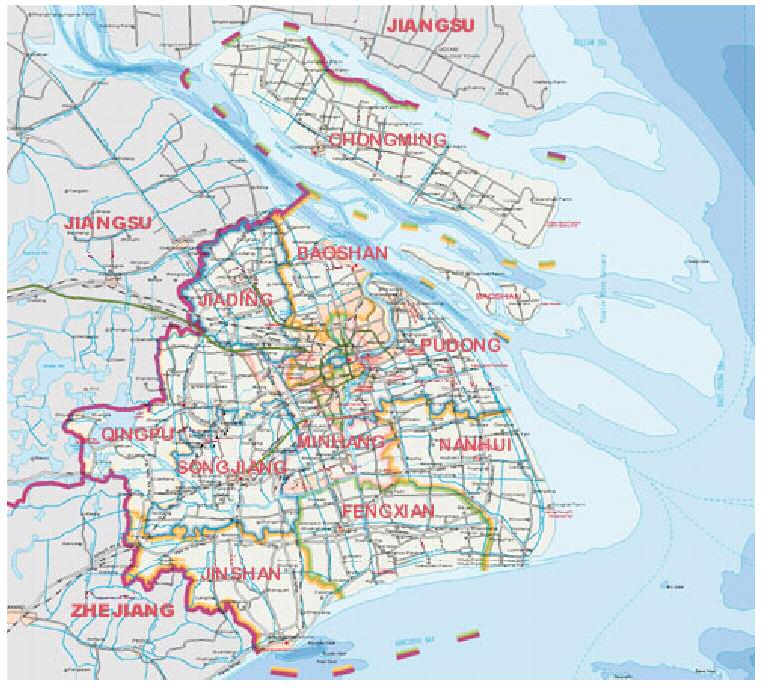
The sub-project 1-A is located in the Langxia Town of Shanghai Jinshan District,
the south of Shanghai city. The sub-project 1-B and 1-C are located in the Zhongxing
Town and Shuxin Town of Shanghai Chongming County, the east of Shanghai city.
The sub-project 2-A is located in the Waigang Town and Juyuan New Area of
Shanghai Jiading District, thenorthwest of Shanghai city.
The sub-project 2-B is located in the Jinze Town and Liantang Town of Shanghai
Qingpu District, the southwest of Shanghai city. So the components of the GEF
Shanghai agricultural and non-point pollution reduction project are located in the east,
south, northwest, southwest parts of Shanghai Municipality, which is at the southeast
edge of the estuary in Changjiang River Delta.
Figure 3.1: The Map of Shanghai Municipality Administrative Area
4
EA Summary for the GEF Shanghai Agricultural and Non-point Pollution Reduction Project
Draft Version
3.1.2 Geology and Terrain Features
The district, one part of the Changjiang River Delta Alluvial plain, is broad, level
and low. According to rising and falling of the fine terrain features, substance to form
the surface of the earth and the characteristic of growth history it belongs to the dish-
edge highlands forward edge of the Changjiang River Delta. In the area, the sea level
elevation is about from 3.5m to 4.5 m and the average altitude is 3.87m.
3.1.3 Climate
The project region lies in the near sea region, which be situated at the East Asia monsoon
belonging to the north subtropical zone. It is the subtropical zone oceanic monsoon climate. In
winter it blows mainly northwest wind, so that climate is cold and dry. In summer it blows
southeast wind, so that climate is torrid heat and moist. The average annual temperature is 15.7°C
with an extreme temperature of 39.6°C and a lowest temperature of -8.5°C. The average annual
precipitation is 1127.7mm and the average sunshine time is approximately 2,170 hours. The
annual average wind speed in this area is 3.2m/s. Sometimes summer is effected by the typhoon or
the Torrid Zone windstorm.
3.1.4 Surface Water System
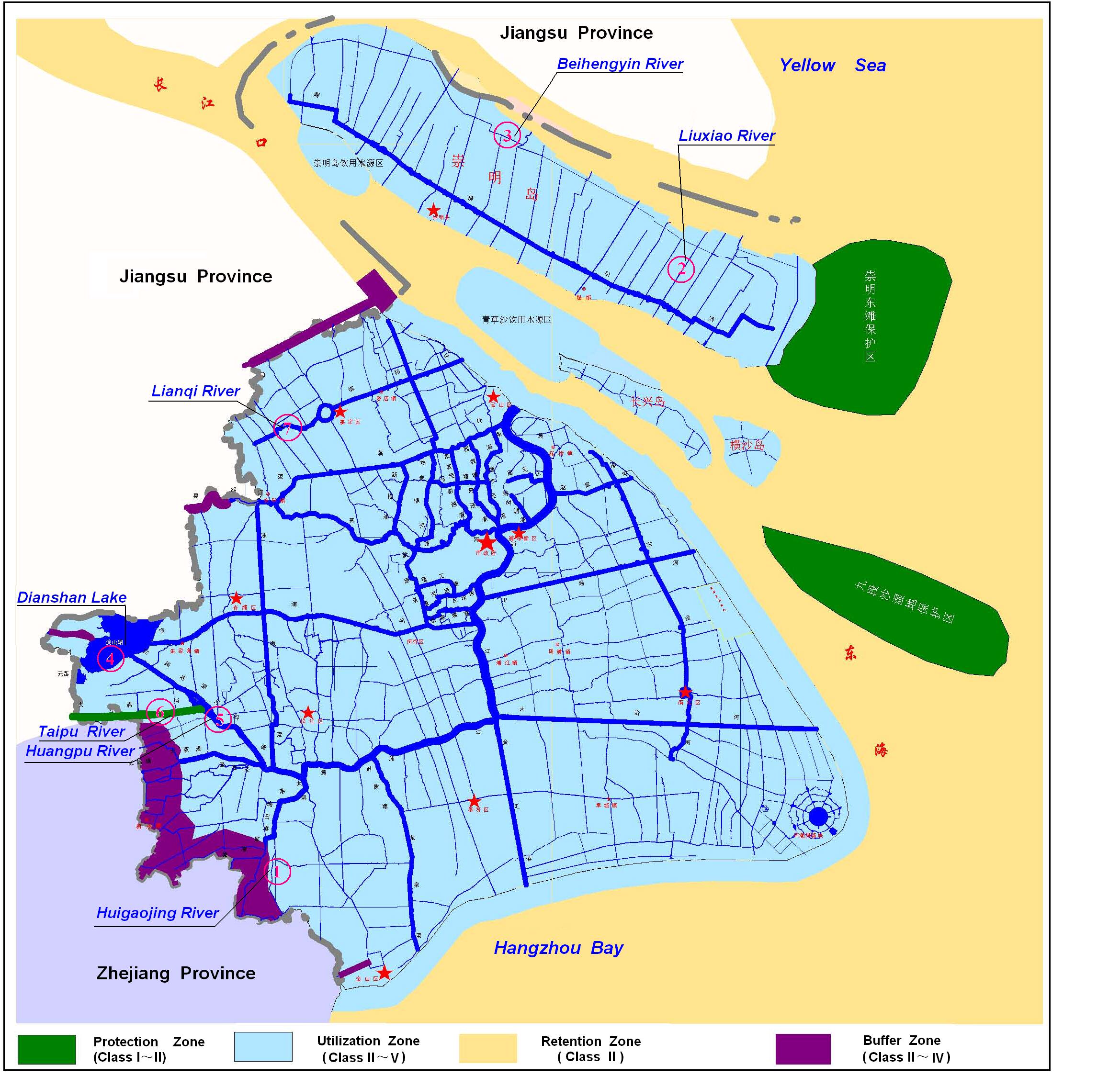
The location of main rivers and lakes in the project area are as follows:
There are Huigaojing River and its branch Hongqiaogang River in Jinshan
Langxia Town, Liuxiao River in Chongming Zhongxing Town, Beihengyin River in
Shuxin Town, Dianshan Lake, Huangpu River and Taipu River in Qingpu Jinze Town
and Liantang Town, Lianqi River in Waigang Town and Juyuan New Area. They are
shown on Figure 3.2.
Figure 3.2 The Location of the main River in the Project Area
5
EA Summary for the GEF Shanghai Agricultural and Non-point Pollution Reduction Project
Draft Version
The density of the network of waterways in Shanghai is about 26~27km/km2
including rivers and lakes, most of which belong to the Taihu Lake Basin. The main
rivers are Changjiang River, Huangpu River, Shuzhou Creek, and so on. The main
lake is Dianshan Lake.
Changjiang River is the biggest water resource passing through Shanghai. The
length is about 70 km from Liu River to Chaoyang Farm in Shanghai. The maximum
width is more than 90 km. It is shown from the data of Datong Hydrographic Station,
the average water flow in history is 29300 m3/s, the maximum water flow in history is
92600 m3/s, the minimum water flow is 4620 m3/s, the total runoff volume is 924000
million m3/a. The runoff volume changes with season changing obviously. Out of the
Changjiang estuary the tide is a regular half-day tide, but into the estuary, it changes
to unregular half-day tide under the influence of runoff from upstream.
Huangpu River is the last branch for Changjiang River entering the sea and the
main passageway for Taihu basin's drainage. It sources from Dianshan Lake that
bears 80% of the total water quantity of Taihu basin. The length of river course is
108km. The depth of the river is 8~17m. The average flow quantity of several years is
304m3/s. The river flows through Qingpu, Songjiang, Jinshan, Fengxian,
Pudongxinqu, Xuhui, Luwan, Huangpu, Hongkou, Yangpu and Baoshan Districts,
Huangpu River is classified as lake-source tidal river. The average tidal stage of
several years is 3.28 m at Wusong hydrometric station.
6
EA Summary for the GEF Shanghai Agricultural and Non-point Pollution Reduction Project
Draft Version
The inner rivers, which don't subjected to tidal influence, have water level of
approximately 2.5m to prevent flood and to ensure the navigation and agricultural
irrigation.
3.1.5 Groundwater
The ground water is plentiful in the area of shanghai, the ground water level is
relatively high with the water table depth ranging from 0.5 to 1.5m. The deep
groundwater is mainly stored in the sand and gravel soils of variable thickness. There
are four types of aquifers in the area located to depth ranging from 20-30m to 240-
250m. Shallow groundwater is main slight salty water and half-salt water and the
depth layer is main fresh water. The ground water in the shallow layers has been
widely exploited.
3.1.6 Surface Ground Temperature
The surface ground temperature of soil is higher 3.5
than the average air
temperature. The annual average ground temperature of the depth of 5cm and 10cm
below surface is high of 1.7
~1.9
comparing to the average air temperature.
3.1.7 Natural Disaster
The district of Shanghai is located at the front edge of Changjiang Delta in the
mid-latitude of Latitude North, which is affected by monsoon with variable from July
to September every year. Typhoon intensity is amplified during the flood tide.
This area is located at east to Kunshan-Huzhou seismic belt in Changjiang
Triange Continent. It is an area with less earthquake and low intensity earthquake.
3.2 Water Quality
3.2.1 Surface Water Quality Zones inside Shanghai City
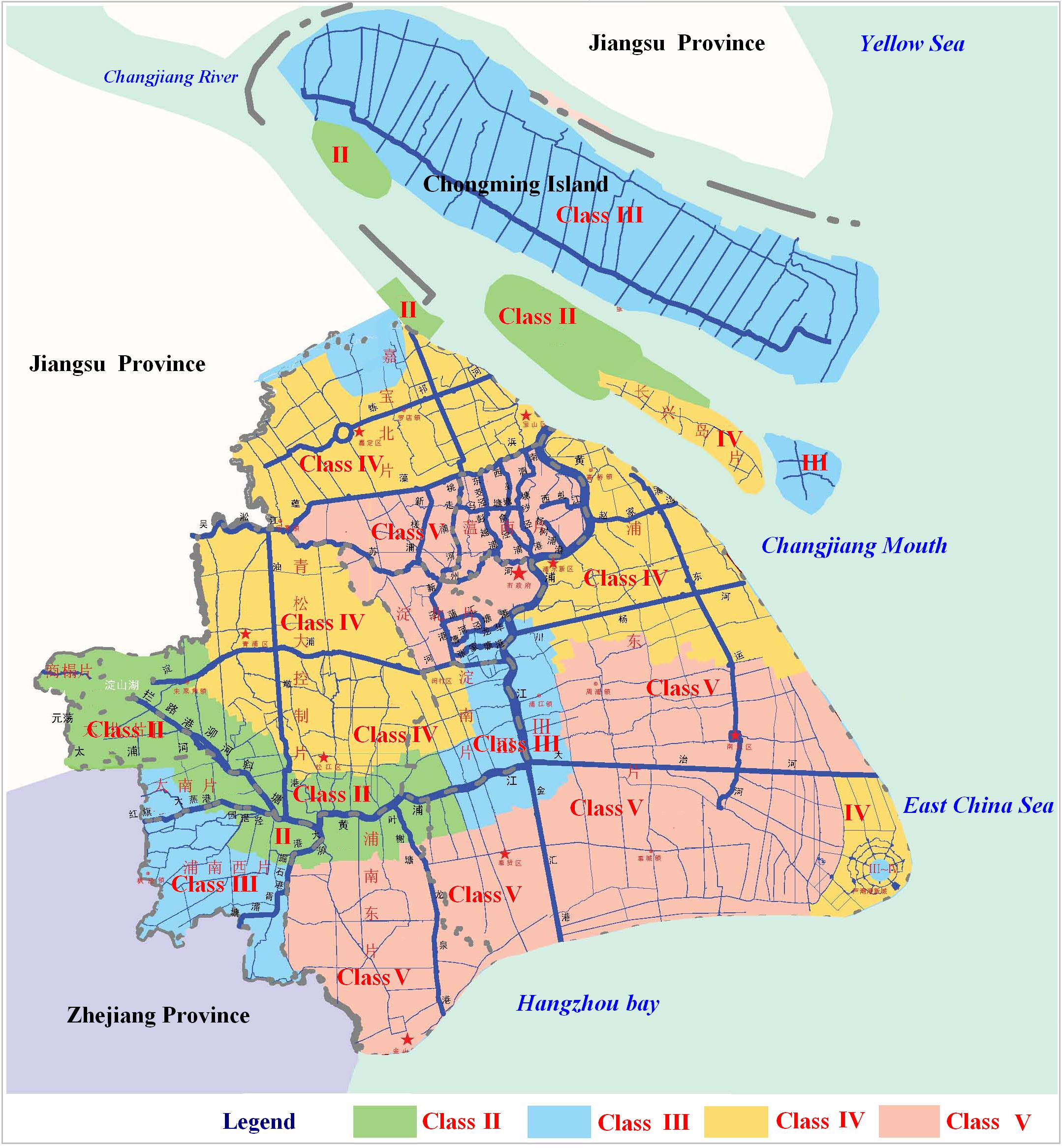
The planned water quality objectives of surface water bodies in Shanghai
Municipality are as the Figure 3.3 shown.
Figure 3.3 Water Quality Zones of Surface Water Bodies in Shanghai Municipality
7
EA Summary for the GEF Shanghai Agricultural and Non-point Pollution Reduction Project
Draft Version
3.2.2 Water Quality inside Shanghai City
(1) Water Quality of Dianfeng Station in Dianshan Lake
Dianfeng station of Dianshan Lake is located outward of Huangpu River entry
from Dianshan Lake. The average water quality of Dianfeng station in Dianshan Lake
in 2007 is as follows:
Dissolved oxygen is 7.79mg/L(class I), chemical oxygen demand 16.3
mg/L(class III), Biochemical oxygen demand 3.65 mg/L(class III), Ammonia-
nitrogen 1.81 mg/L(class V), total phosphorus 0.201 mg/L(inferior to class V) and
total nitrogen 3.71 mg/L(inferior to class V).
The general water quality of Dianshan Lake in 2007 compares with 2006, the
concentration of chemical oxygen demand and biochemical oxygen demand
8
EA Summary for the GEF Shanghai Agricultural and Non-point Pollution Reduction Project
Draft Version
decreases, but the concentration of Ammonia-nitrogen, total phosphorus and total
nitrogen rises slightly.
(2) Water Quality of Dianfeng and Songpu Bridge Stations in Upper Reaches of
the Huangpu River
Dianfeng station and Songpu Bridge station are located in water source
protection zone of the upper reaches of the Huangpu River, the Dianfeng station is in
the southwest of Zhujiajiao town, the average water quality of Dianfeng station in
2007 is as follows:
Dissolved oxygen is 6.08mg/L (class II), Chemical oxygen demand 18.5 mg/L
(class III), Biochemical oxygen demand 3.64 mg/L (class III), Ammonia-nitrogen
1.60 mg/L (class V), Total phosphorus 0.187 mg/L (class III) and Total nitrogen 4.19
mg/L. The concentration of chemical oxygen demand, biochemical oxygen demand,
Ammonia-nitrogen and Total phosphorus are above the II class standard.
The average water quality of Songpu Bridge station in 2007 is as follows:
Dissolved oxygen is 3.87mg/L (class IV), Chemical oxygen demand 18.0 mg/L
(class III), Biochemical oxygen demand 3.04 mg/L (class III), Ammonia-nitrogen
1.47 mg/L (class V), Total phosphorus 0.263 mg/L (class III) and Total nitrogen 4.18
mg/L. The concentration of chemical oxygen demand, biochemical oxygen demand,
Ammonia-nitrogen and Total phosphorus are above the II class standard.
(3) Water Quality of Taipu River Bridge Station
Taipu River Bridge station in Taipu River is located in the region of Liantang
town of Qingpu District. The average water quality of Taipu River Bridge station in
2007 is as follows:
Dissolved oxygen is 4.98mg/L (class IV), Chemical oxygen demand 15.6
mg/L(class III), Biochemical oxygen demand 4.22 mg/L(class IV), Ammonia-
nitrogen 2.59 mg/L(inferior to class V), Total phosphorus 0.165 mg/L(class III) and
Total nitrogen 5.07 mg/L.
(4) Water Quality of Lianqi River Jiading New Water Plant Bridge Station
The Lianqi River Jiading New Water Plant Bridge Station is located in east of
Jiading urban area. The average water quality of the station in 2007 is as follows:
Dissolved oxygen is 2.84mg/L (class V), Chemical oxygen demand 19.0 mg/L
(class III), Biochemical oxygen demand 4.89 mg/L (class I V), Ammonia-nitrogen
3.59 mg/L (inferior to class V), Total phosphorus 0.338 mg/L (class V) and Total
nitrogen 5.62 mg/L.
(5) Chaoyang Farm Station in Changjiang Mouth Area
Chaoyang Farm Station in Changjiang Mouth Area is located Bailonggang lower
reaches, outside of the Nanhui District Chaoyang Farm. The average water quality of
Chaoyang Farm station in 2007 is as follows:
9
EA Summary for the GEF Shanghai Agricultural and Non-point Pollution Reduction Project
Draft Version
Dissolved oxygen is 8.46mg/L (class I), Chemical oxygen demand 7.12 mg/L
(class I), Biochemical oxygen demand 1.06 mg/L (class I), Ammonia-nitrogen 0.53
mg/L (class III), Total phosphorus 0.203 mg/L (class IV) and Total nitrogen 1.97
mg/L.
The general water quality of Changjiang Mouth area in 2007 compares with
2006, maintain equilibrium basically. In general, from 2001 to 2007 the concentration
of chemical oxygen demand appears to decline tendency, Ammonia-nitrogen and
Total nitrogen appears to decline tendency slightly, Total phosphorus appears to rises
slightly.
3.3 Ecological Environment
Project area is in the Shanghai suburban district, with typical suburban ecology
character.
3.3.1 Jinze and Liantang Towns in Qingpu
Jinze and Liantang towns of Qingpu are in the southwest of Shanghai city,
nearby the Dianshan Lake, the Sun Island inside Huangpu River, with some specific
nature ecological areas. The vegetation is suburban green plant in chief, with scenery,
style and features. The crops are mainly rice, wild rice stem, vegetables and so on.
3.3.2 Langxia Town in Jinshan
Langxia Town of Jinshan District is in the south of Shanghai city. It also owns
some nature ecological features. The main crops are rice and vegetables.
3.3.3 Shuxin towm and Zhongxing Town in Chongming
Shuxin towm and Zhongxing Town in Chongmin are in the east of Shanghai city,
near the Dongping National Forest Park and The Natural Protection Zone of Birds in
the East Beach in Chongming County of Shanghai city. It owns some nature
ecological scenery, style and features. The main birds are winter migratory birds and
wild duck. Main plants are reed, brushwood, water plants and so on. The main crops
are rice and vegetables.
In the Changjiang estuary, the varieties of aquatic community structures are
complex, with three categories of the freshwater biology, freshwater-trend biology
and coastal low-salty biology.
3.3.4 Waigang Town and Juyuan New Area in Jiading
Waigang Town and Juyuan New Area are in the northwest of Shanghai city, near
the west of Jiading urban area. At present, this area is the countryside area, has the
suburb natural ecology characteristic, the main wetland vegetation has the reed, the
plant nursery, the main crops for the paddy rice and the vegetables, in the area have
the artificial fish pond, breeds kinds of economical fish.
10
EA Summary for the GEF Shanghai Agricultural and Non-point Pollution Reduction Project
Draft Version
3.4. Social and Economic Conditions
3.4.1 Population and Acres
Table 3.1 Population and Ground of Region
Ground
Population at
Population Density
District Town
Area (km2)
End of
(person /km2)
2007(person)
Jinze 108.50
81961 755
Qingpu
Liantang 93.66
70040
748
Shuxin 58.85
44580
758
Chongming Zhongxing 45.54 30819
677
Jinshan Langxia
51
41000
804
Juyuan New
18.61 42000
2257
Jiading
Area
Waigang 50.91
65000(31000) 1277
3.4.2 Social Economy Condition
(1) Jinshan Langxia Town
The Langxia Town governs been determined as developing agricultural park in
Shanghai, with 33600 persons of agricultural population and the 17% of urbanize the
countryside. In 2006, gross domestic product reached 730 billion RMB . The state
revenue reached 125 billion RMB . The average per farmer income was 8711
RMB .
(2) Qingpu Liantang Town
The Liantang Town governs 25 administrative villages and 4 neighbourhood
committee. In 2006, gross domestic product reached 3249 billion RMB . The state
revenue reached 768 billion RMB . The average per farmer income was 12982
RMB . The fine rice and wild rice stem are the special local products.
(3) Qingpu Jinze Town
The Jinze Town governs 30 administrative villages and 5 neighbourhood
committee. In 2006, gross domestic product reached 3726 billion RMB . The state
revenue reached 338 billion RMB , 15.9% increase compared to the former year.
(4) Chongming Zhongxing Town
The Zhongxing Town governs 12 administrative villages and 5 neighbourhood
committee. The cultivated area is 2329.6 ha. The tree coverage reaches 26%. The fine
cauliflower is the special local product.
(5) Chongming Shuxin Town
The Shuxin Town governs 21 administrative villages and 2 neighbourhood
committee, with 38378 persons of agricultural population. In 2004, gross domestic
product reached 493.9 billion RMB . The state revenue reached 28.77 billion
RMB . The average per farmer income was 3430 RMB .
11
EA Summary for the GEF Shanghai Agricultural and Non-point Pollution Reduction Project
Draft Version
(6) Jiading Juyuan New Area
The Juyuan New Area governs 5 administrative villages and 5 neighborhood
committee, with 42000 persons of the resident population. In 2006, GDP reached
1.1432 billion RMB , the same ratio grows 20.51%. The state revenue reached 338
billion RMB , 15.9% increase compared to the former year. Three produces the
increase in value 560 million Yuan, the same ratio increases 26.62%. Tax revenue
total amount accumulation completes 471 million RMB , the same ratio grows
14.23%.
(7) Jiading Waigang Town
The Waigang Town governs 22 administrative villages and 2 neighborhood
committee, with 50.91km2 of the total areas. The management system of government
finance is combined with the Shanghai international automobile city industry garden.
The main crops are the paddy rice and the vegetables.
12
EA Summary for the GEF Shanghai Agricultural and Non-point Pollution Reduction Project
Draft Version
4 PROJECT ALTERNATIVES
4.1. With and Without Projects
4.1.1 With and Without the LWMTD Component
Based on the analysis of environment benefit and social benefit to the project and
demand of regional economic development, after analysis, the conclusion shows that
in the conditions of without Livestock Waste Management Technology
Demonstration project, the environment quality in these rural regions will lower,
especially, the quality of surface water Environment will continue to deteriorate, it
could affect the safety to water source protection zone. It is unfavourable to reduce
the rural and agricultural pollution to the Changjiang River Mouth and East China
Sea. In addition, the problem on Livestock Waste polluting environment must be
settle for Stock Raising.
The bad smelly produced by the dung and urine which are deposited and stacked
on the organic fertilizer center of Shanghai Guangming Holstein Jinshan Strain Dairy,
spreads around inorganizately and causes an environmental pollution to the Dairy
farm and the surrounding area; if the yearly output 18,000 tons feces and 1,0500 tons
urine swage produced by the Shanghai Shenye Seed Cow Dairy farm released without
disposal ,it will pollute the water environmental of East Sea finally; The whole
organic waste of Qianwei village is about 7320 tons a year, among this, straw is 2500
tons, living rubbish is 800 tons, the feces of the breeding farm is 2920 tons, the rice
huller and chaff is 1100 tons and the sewage of breeding industry is 4380 tons ( pig
urine ). Without this project, the wastes mentioned upwards will be released directly
without disposal, and finally will pollute the water environment of East Sea. So the
project is necessary.
4.1.2 With and Without the Wetland Sewage Treatment System Component
Based on the analysis of environment benefit and social benefit to the project and
demand of regional economic development, after analysis, the conclusion shows that
without the sub-project 2-A and 2-B, the peasants living in these rural regions will
still discharge the sewage into the surface water directly or indirectly, sewage
collection system will be not build in a short time in the regions, the quality of surface
water Environment will continue to deteriorate, so It is unfavourable to protect the
water environment of the Tai lake and East China Sea against pollution, and is also
unfavourable to health of local residents. So the project is necessary.
4.2 Alternative Locations
4.2.1 Livestock Waste Management Technology Demonstration Project Locations
1
Selection Principles of Site
13
EA Summary for the GEF Shanghai Agricultural and Non-point Pollution Reduction Project
Draft Version
Refer to selection of site, the following principles are considered, and the most
suitable site is selected under abiding by national land law and policy.
z Try to utilize the convenience and advantage of landform such as near the stock
raising and far from the residence;
z Avoid environmentally sensitive spots and resident's removal and building
demolition;
z Low investment for project construction.
2
Alternative Locations of Sub-project 1
A
Considering the ground situation of Shanghai Guangming Holstein Jinshan
Strain Dairy, constructing this project in the old position has less effect to the
environment and less investment than constructing the same scale project on a new
position, also has a more economical and reasonable circulation. So, it is a better
choice to construct the project on the position of the dairy farm.
3
Alternative Locations of Sub-project 1-B
Constructing the feces disposal center of east Chongming inside the location of
Shenye seed dairy farm located on the Beiliuxiao reclamation area has a less effect to
the environment and less investment contrasting with the same construction on a new
position, and also has a more economical and reasonable circulation.There is no
inhabitations within 500 m around the farm. So, it is a better choice to construct this
center on the position of the seed dairy farm.
4
Alternative Locations of Sub-project 1-C
The position of this project is inside the circular form ecological demonstration
zone of the Qianwei ecological village, located on the north of the middle line of east
and west axes of Qianwei village, between the No. 2 and No. 4 longitude roads, the
north of the intensive pig farm that is under building now. The land now is pound,
breeding land and cultivated plants land, and won't involved to the land requisition.
There is no inhabitations within 500 m around the farm, and located on the down
wind direction of the local leading wind direction in summer. Contract with
contrasting the same construction on a new position, this project has a less effect to
the environment and less investment. It also has a more economical and reasonable
circulation. So, the location of this project is reasonable.
4.2.2 Wetland Sewage Treatment System Project Locations
1
Selection Principles of Site
Under abiding by national land law and policy, according to the local landform
and distribution of residence, road and river, following items are also considered:
14
EA Summary for the GEF Shanghai Agricultural and Non-point Pollution Reduction Project
Draft Version
z Convenient to be constructed and maintained;
z Avoid environmental sensitive spot;
z Good water body condition and consistent to drainage construction regulation;
z Low investment for project construction
z Low operation cost;
z Being Consistent to local planning.
2
Alternative Locations of Sub-project 2
A
The Waigang town and Juyuan new area river-net wetland demonstration project
in Jiading District is located on the north-west of north suburb wetland which is under
programming now, and the range of this project is the area surrounded by Lianqi
river, Gujing river and Miaojing river. This area possesses the character of
countryside river-net natural wetland. It can be a river-net demonstration zone for the
environment protection assistant with some artificial wetland. Considering the
principle mentioned previously and the practical situation, the position of this project
is reasonable.
3
Alternative Locations of Sub-project 2
B
A. Alternative Locations of Sewage Treatment Station in Jintian Village,
Liantang Town
The physiognomy inside the service region of the Jingtian village sewage
disposal station of Liantang town is oppositely smooth. The sewage station can be
built on the available space field according to the physiognomy condition of the
village.
Table 4.1 The Site Selection Constract of Jingtian Sewage Station
Item
Plan 1
Plan 2
Location
The south of No.34 north
The playing ground before the front
region of Jintian village (Fig.
door of Jintian village community
4.1)
activity centre Fig. 4.2
Area 1200
m2
560 m2
Terrain conditions
Even open , be to sprinkle a
The floor is already hardened , is
wasteland within space now
playing court now
Geology condition
Fine, proper project of
Engineering geology condition is fine ,
engineering geology condition
the floor hardened will handle to be put
construction
into use
dismantled and move
no
Renovate the floor
out amounts
Traffic condition
Facilitate very much
Facilitate
water and electricity
conveniency conveniency
supply
Sewage out-way
58 m away from the river-way
1 m away from the river-way
Develop space
big
small
15
EA Summary for the GEF Shanghai Agricultural and Non-point Pollution Reduction Project
Draft Version
Environment effection
Little environment effection
Little environment effection
Sewage transport pipes The sewage pipage is more
The sewage pipage is closer
distant
Fig.4.1
The map of sewage collection system in Jintian village
Plan 1
Fig.4.2
The map of sewage collection system in Jintian village
Plan 2
After the upper analysis and contrast, plan 1 and plan 2 all can satisfy to the
requirement of the universe programming and environment protection. Contrast with
the field in the plan 2, the one in the plan 1 has some strongpoints like more regular
and bigger, more benefit to the establishments'design and lay out, less environment
impacts, no-need to move out, except there is little far to release the tail water. The
field in the plan 2 located in a court, has a worse independency than the one in the
plan 1 and nearby land requirement, although it's convenience to release the tail
water. It will cause an impact on the tree growing during the construct and operating,
because the nearby old tree. So, the plan 1 is more reasonable.
16
EA Summary for the GEF Shanghai Agricultural and Non-point Pollution Reduction Project
Draft Version
B. Alternative Locations of Sewage Treatment Station in Qianwan Village,
Liantang Town
The physiognomy inside the service region of the Qianwan village swage
disposal station of Liantang town is relatively smooth. The sewage station can be built
on the available space field according to the physiognomy condition. Considering the
swage collection and disposal system on the north-east of the village, it's more proper
to build this station on the west or the south-east of the village.
Plan 1
The swage is collected uniformly from the west of the Qianwan village to
disposal on the south-east of the village. The main collecting pipes are layed
according to the actuality distribution of the households. The collected sewage of the
others can flow into the side pipe. Pipeline construction acrossing the river use
SLIDE. The sewage station is located on the west of the No. 82 south-east section, the
west and east length is 50 m, the north and south width is 50 m, covered area is about
2500 m2, The station nearby the road has a convenience transportation, but it's 70 m
away from the river-way. The geology of the project is great, and there is no pollution
source nearby. The daily designed water flow is 69 m3. The plan of swage collection
is showed in the Fig. 4.3.
Fig.4.3
The map of sewage collection system in Qianwan village
Plan 1
Plan 2
Building two sewage disposal stations located partly on the west and south-east
of the village to collect and disposal the living swage of two regions. The west service
region has a populatin of 221 and a daily disposal sewage of 40 m3; the south-east
service region has a population of 297, a daily disposal sewage of 30 m3.
17
EA Summary for the GEF Shanghai Agricultural and Non-point Pollution Reduction Project
Draft Version
The main collecting pipes are laid according to the actuality distribution of the
houses. The collected sewage of the others by the side pipe can flow into the main
pipes. Lifting pump station will not be built during the transport.
The sewage station of this project is located on the south-east of the No 82
south-east section, and the north of the Qianwan village No. 15 west section. The west
and east length of the south-west field is 50 m, the north and south width is 50 m,
covered area is about 2500 m2. The west and east length of the west field is 27 m, the
north and south width is 10 m, covered area is about 270 m2. There is no pollution
source nearby. The plan of sewage collection is showed in the Fig. 4.4.
Fig.4.4
The map of sewage collection system in Qianwan village
Plan 2
The investment in the plan 1 is lower than the plan 2. Considering the operation
cost, which is mainly built up by power cost and machine depreciation cost in the
sewage disposal station, the cost is obviously lower in the plan 1 than in the plan 2.
Considering the environment, the output water of the two plants adopt Grade 1 B
standard. So, FSR suggest that the plan 1 is more reasonable.
C. Alternative Locations of Sewage Treatment Station in Beiwangbang Village,
Liantang Town
The service region of Beiwangbang sewage disposal station in Liantang town
with a crisscross river-way is divided Beiwangbang to north, north-west, south-west,
south-west, north-east and south-east five parts. Collecting and disposal swage
uniformally will cause the difficulty in construction, too great of the main pipes'
length and higher investment. So, the sewage will be disposed partly in this village.
The land is getting lower from the west of Beiwangbang village to the east.
Considering the principle of sewage disposal station' construction and its effect
factors, taking the Beiwangbang river as the boundary the sewage of the north shore
18
EA Summary for the GEF Shanghai Agricultural and Non-point Pollution Reduction Project
Draft Version
will be collected and disposal together, and the sewage of the south shore will be
collected and disposal together.
a. Alternative Locations of Sewage Treatment Station in north shore of
Beiwangbang,
Plan 1
The sewage station of this project is located on north of the No 167 south-east
section, the west and east length of the station is 20 m, the north and south width is 44
m, occupied area is about 880 m2. The whole field is wasteland now. This field is
close to the river bank but no road to reach. The foundation should be treated for
nearby the river bank.
The main collecting pipes are paved according to the actuality distribution of the
houses in this region, the collected swage of the others can flow into the main pipe.
Pipeline construction acrossing the river use SLIDE. The plan of sewage collection is
showed in the Fig. 4.5.
Fig.4.5
The map of sewage collection system in Beiwangbang village
Plan 1
Plan 2:
The sewage station of this project is located on north of the No. 174 north
section, the west and east length of the field is 30 m, the north and south width is 25
m, occupied area is about 750 m2. The whole field is wasteland now. This field is
close to the river bank but no road to reach. The foundation should be treated for
nearby the river bank.
The main collecting pipes are paved according to the actuality distribution of the
houses in this region. The collected swage of the others can flow into the main pipe.
Pipeline construction acrossing the river use SLIDE. The plane lay of this project is
showed in the additional Fig. 4.6.
19
EA Summary for the GEF Shanghai Agricultural and Non-point Pollution Reduction Project
Draft Version
Fig.4.6 The map of sewage collection system in Beiwangbang village
Plan 2
The site celection constract of Beiwangbang north shore Sewage Stations are
shown in table 4.2.
Table 4.2 The Site Selection Constract of Beiwangbang Sewage north shore
Stations
Item Plan
1
Plan
2
Location
The north of No.167 north-east
The north of No174 north region of
region of Beiwangbang village
Beiwangbang village
Area 880
m2
750 m2
Terrain conditions
Even open , be to sprinkle a
Even open , be to sprinkle a wasteland
wasteland within space now
within space now
Geology condition
Along river bank, consolidate
Along river bank, consolidate
foundation is necessaries
foundation along is necessaries
dismantled and move
no
Renovate the floor
out amounts
Traffic condition
Facilitate very much
Facilitate
water and electricity
conveniency conveniency
supply
Swage out-way
1 m away from the river-way
1 m away from the river-way
Develop space
small
big
Environment
Little environment effection
Little environment effection
effection
Sewage transport
The sewage pipage is more distant
The sewage pipage is distant
pipes
After the upper analysis and contrast, plan 1 and plan 2 all can meet to the
requirement of the universe programming and environment protection. The fields now
are constituted mainly by wasteland and greenery coverage, and the power, water
20
EA Summary for the GEF Shanghai Agricultural and Non-point Pollution Reduction Project
Draft Version
supply in those regions all can satisfy the requirement of construction except the
inconvenient traffic. There is no bad geological actions can affect the steady of the
project, like constitution collapsing, land sliding, earth hole, bank rush, earth crack
etc. in those region, Contrast with the field in the plan 2, the one in the plan 1 has
some strongpoints like more regular and bigger, big space for improvement, more
benefit to the establishments'design and layout, less environment impacts, no-need to
move out, also with a good relief that it's getting higher from the east to the west of
Beiwangbang.
Plan 1 is more proper than the plan 2 comprehensively considering the less
environment effect and easy for the long-tem program in the plan 1. So, plan 1 is
recommend to be adopted as the construction plan of the north bank sewage disposal
station of Beiwangbang river.
b. Alternative Locations of Sewage Treatment Station in south shore of
Beiwangbang,
Plan 1
The sewage disposal station will be located on the south of the No. 289 south-
east region in this project with a west-east length of 20 m, north-south width of 39 m,
and covered area of 780 m2. The state of the filed now is wasteland, and the traffic is
convenient where can be reached through a long-river road. The geography condition
of the land is great. It won't affect the farmers around even it's nearby the croplands.
The main swage collecting pipes are paved according to the actuality distribution
of the houses in this project, the collected swage of the others can flow into the main
pipe. Pipeline construction acrossing the river use SLIDE. The plane lay of this
project is shown in the additional Fig. 4.5.
Plan 2
The swage disposal station will be located on the grain-sunning ground of the
south-east region in this project. The field has a west-east length of 19 m, north-south
width of 24 m, the occupied area is about 456 m2. The state of the field now is grain-
sunning ground and has been hardened but it should be treated before application.
This region is nearby the river without road to reach except a long-river path.
The main sewage collecting pipes are paved according to the actuality
distribution of the houses in this project, the collected sewage of the others can flow
into the main pipe. Pipeline construction acrossing the river use SLIDE. The plane lay
of this project is shown in the additional Fig. 4.6.
The site celection constract of Beiwangbang north shore Sewage Stations are
shown in table 4.3.
21
EA Summary for the GEF Shanghai Agricultural and Non-point Pollution Reduction Project
Draft Version
Table 4.3 The Site Selection Constract of Beiwangbang Sewage south shore
Stations
Item Plan
1
Plan
2
Location
The south of No.298 south-
The grain-sunning ground of south-
west region of Beiwangbang
east region Beiwangbang country
country
Area 780
m2
456 m2
Terrain conditions
Even open , be to sprinkle a
Now is grain-sunning ground,
wasteland within space now
comparatively neat
Geology condition
Geology condition is fine
The floor already hardens
dismantled and move
no
Renovate the floor
out amounts
Traffic condition
Do not facilitate
Do not facilitate
Water and electricity
conveniency conveniency
supply
Swage out-way
10 m away from the river-
1 m away from the river-way
way
Develop space
bigger
small
Environment effection
Little environment effection
Little environment effection
Swage transport pipes
The foul water pipage is
The foul water main pipage is closer
more distant
than the plan 1
After the upper analysis and contrast, plan 1 and plan 2 all can satisfy to the
requirement of the universe programming and environment protection. The fields now
are constituted mainly by wasteland and greenery coverage, and the power, water
supply in those regions all can satisfy the requirement of construction except the
inconvenient traffic. There is no bad geological actions can affect the steady of the
project in the region, like constitution collapsing, land sliding, earth hole, bank rush,
earth crack etc. It will be proper to build this project after treating the ground base.
Contrast with the field in the plan 2, the one in the plan 1 has some strongpoints like
more regular, bigger, more space for improvement, more benefit to the
establishments'design and layout, less environment impacts and no-need to move out.
But the main pipe length in plan 2 is shorter than the one in plan 1 and has a good
relief that it's getting higher from the east to the west of Beiwangbang.
Plan 1 is more proper than the plan 2 comprehensively considering the less
environment effect and easy for the long-tem program in the plan 1. So, plan 1 is
recommend to be adopted as the construction plan of the south bank swage disposal
station of Beiwangbang river.
D. Alternative Locations of Sewage Treatment Station in Xiezhuang Village,
Jinze Town
Xichen sewage treatment plant has been built 600 m away from the north of the
Xiezhuang country. Its daily designed sewage disposal is 5000 m3, but the practical
daily swage disposal is 1200 m3 now, so the living swage from Xiezhuang country
22
EA Summary for the GEF Shanghai Agricultural and Non-point Pollution Reduction Project
Draft Version
can be disposed here. The teachnic of MSBR is adopted in this factory, and the
quality of output water reaches the Grade 1 A standards of Discharging Standard of
Pollutants for Municippal Wastewater Treatment Plant (GB18918-2002), and meet
the water quality requirement of the upstream water source protection zone.
According the construction of municipal swage treatment facilities around
Xiezhuang village combined with the characters of Xiezhuang, there are two project
plans can be adopted:
(1) The sewage collected discharge to the Xichen Sewage Teatment Plant.
(2) The sewage collected discharge to treatment station builted byvillage.
Based on this, contrasting the environment, economic and social benefits of the
two plans, the technical support for the final decision will be offered.
Plan 1
The plan daily swage water in this project is 144 m3. The main collecting pipes
are paved according to the actuality distribution of the houses in the project, the
collected sewage of the others can flow into the main pipe. Pipeline construction
acrossing the river use SLIDE. After the sewage flows through the Sichagang Bridge,
then into the main pipe paved along the Shanchen side road. Finally the sewage flows
into the Xichen Sewage Teatment Plant.
Plan 2
It breaches the economical benefits if the sewage collected from East
Xiezhuang be treated uniformly on the Xiezhuang which is about 300 m away from
east Xiezhuang. So, the sewage will be colleted and treated alone.
It's against to layout the swage pipes and put the pipes crossing the river
because that most farmers living nearby the river bank where has been hardened, and
the river crisscross in the region of Xiezhuang. With the north-south direction river as
the boundary the swage from the north-west region and south-west region of
Xiezhuang will be collected and treated uniformaly in the west bank sewage treatment
station, and the sewage from the east region will be colleted and treated uniformaly in
the east bank sewage treatment station. The service population of the west bank
sewage treatment station is 580, and its daily designed swage quantity will be 78 m3,
if every person's daily swage quantity is 110 L.
The west bank sewage treatment station of Xiezhuang will be built on the grain-
sunning ground which is on the north of No. 76 north-west region in this project. The
field has a west-east length of 20 m, north-south width of 20 m, the occupied area is
about 400 m2. The state of the field now is grain-sunning ground and has been
hardened. This ground is nearby the river without road to reach except a long-river
path.
The east bank sewage treatment station of Xiezhuang will be built on the grain-
sunning ground which is on river bank trifurcate cross of the east region in this
23
EA Summary for the GEF Shanghai Agricultural and Non-point Pollution Reduction Project
Draft Version
project. The field has a west-east length of 24 m, north-south width of 20 m, the
occupied area is about 480 m2. The state of the field now is grain-sunning ground and
has been hardened. This ground is nearby the river without road to reach except a
long-river path. The Plan 2 is showed in the additional Fig. 4.7.
Fig.4.7 The map of Plan 2 sewage collection system
Two sewage treatment stations will be built in plan2 to treat, operate and
maintenance the swage collected from Xiezhuang. Considering that the ground has
been hardened in this village, the thrashing ground which has a small space to
improve is the only choice to build this project. The sewage treatment cost is lower
using artificial wetland, and that will be easy accepted by farmers. So the plan 2 is
recommend to using on the swage treatment of Xiezhuang.
4.3 ALTERNATIVE TECHNICAL PROCESS AND DESIGN
4.3.1 Livestock Waste Management Technology Demonstration Project
(1) Sub-project 1-A: Alternative Technical Process
The cattle feces and urine can produce biogas via pretreatment and anaerobic
fermentation, then the gas will be cleaned and pass the gas-fired biogas generator to
produce electric; the excess heat produced by the generator will be used to heat the
input; the liquid produced by the anaerobic fermentation will be used to irrigate the
feed stuff field, and clinkers will be sold as organic fertilizer after treatment.
A
Alternative Key Technical Process on the Anaerobic Reactor
The applicability Constract of representative anaerobic reactors is shown in
table 4.4.
Table 4.4 The Applicability Constract of Representative Anaerobic Reactors
Reactor name
Merit
Shortcoming
Applicability
Complete mixing Little investment, simple
Have the mixing
Apply to treating
anaerobic
running and
device
livestock and birds
24
EA Summary for the GEF Shanghai Agricultural and Non-point Pollution Reduction Project
Draft Version
reactor(CSTR) management,strong
to
feces with high
bear impingement, high
concentration and more
output
float thing
Anaerobism
Little investment, simple
Sojourn time is
Apply to organic swage
touches reactor
running and
longer, needs
with high concentration
management,strong to
setting up the
and more float thing
bear impingement
sludge reflux
upflow anaerobic efficient treatment rate,
big investment,
Apply to organic waste
sludge bed
high quality of out-
high requirement
water of low contents
reactor (UASB)
water
on the contents of
SS solubility
SS in the swage
upflow anaerobic efficient treatment rate
High requirement
Apply to organic swage
solid
high volume of load
on the input
contains much soild
reactor
USR
factor
uniform
Contrasting the 4 technics upwards, the complete mixing anaerobic reactor is
adopted in this project. Its advantages are: big handling capacity, big output biogas,
easy to start-up and management and lower operation cost. This machine is fit for the
region mainly producing biogas and holding the condition of using organic liquid
fertilizer.
According to the structural characteristics of the anaerobic tank, the project will
adopt integrated anaerobic tank. There are the main advantages of the integrated
anaerobic tank:
Suitable for high concentrations of fecal material mixed fermentation: TS8% -
12%;
Safe and reliable: low-pressure gas production, low pressure gas store, prevent
gas leakage;
Low cost: reduction of divided gas collector, 15 percent lower cost;
Small occupied area: the reduction in the size of an area to save 30%;
Short period: 50% shorter construction period;
Cold winter can be normal operation.
B
Alternative Equipments of Biogas Generator
Combined heat and power gas generator configuration selection is shown in
Table 4.5.
Table 4.5 Domestic generating set and entrance generating set comparison
Effective
Effective
General
Overhaul
Type
electric
thermal
utilization
Price
life
power
energy
ratio
Domestic
generating
30% 40% 70%
3
year
Cheaper
set
Entrance
Amount to
generating
32 % 40 45%
5 year Expensive
80% maximal
set
25
EA Summary for the GEF Shanghai Agricultural and Non-point Pollution Reduction Project
Draft Version
Now, the home biogas dynamotor can translate 30% biogas into electric, and
40% into heat, the total efficiency of this machine is 70%. The import biogas
dynamotor can translate 35-40% biogas into electric, and about 40-45% can be
recycled in the form of waste heat, its total efficiency can reach 80%. The electric
produced by the biogas dynamotor can be sold on the internet, and the waste heat
recollected by the waste heat recollection and translation machine can be used to heat
the anaerobic fermentation jar and the water using on the cattle farm production.
(2) Sub-project 1-B: Alternative Technical Process
The treatment of livestock and poultry manure is generally anaerobic methane
fermentation, and then the "three marsh" utilization; processed into organic fertilizer
production; after maturity it will be used as fertilizer for agriculture or training
materials. From the analysis of the specific circumstances of the project, choosing to
produce solid organic fertilizer and organic liquid fertilizer is the best approach. The
large farms located on the field of Beiliuyao, now is in urgent need of fertilizer, and
there is no tenants and small biogas need. So, it's not suitable for producing biogas
project in there.
The technic treating dry feces and urine swage separately is adopted in this
project after contrast. The feces of bests and birds will be produced to solid organic
fertilizer after thrown overturn and biological treatment. The urine swage will return
to the field after the no-power under ground anaerobic harmless treatment. This
technic was chosen the first place after evaluating 52 treatment technics by the
professors who were organized by Shanghai Investment and Consulting CO.,LTD in
1999.
The safe operation of the process, save time and labor, low operating cost, fully
integrated to meet the requirements of environmental protection. Program of the main
features of the process is economical, low running costs, simple operation, waste to
treasure, in line with local conditions, the application of shallow low-temperature
fermentation more fully, particularly into films suitable for crop cultivation areas and
food-money crop large-scale farms.
(3) Sub-project 1-C: Alternative Technical Process
A
Alternative biogas technical process by straw and other agricultural solid waste
fermentation
The project not only in the use of livestock manure which is raw materials
commonly used in traditional gas works, also using organic crop stalks and living
garbage. Straw 60s in the last century as a major raw materials for fermentation is
using for biogas engineering practice, but, in the past using straw as a raw material of
biogas lack the mature technology support. The basic raw material of biogas now
shifts to the livestock and poultry manure. As a result of changes in lifestyle in rural
areas, straw as a direct function of rural energy has basically lost. However, in
addition to some of the directrly returning to the field, feedstuff and paper-making
26
EA Summary for the GEF Shanghai Agricultural and Non-point Pollution Reduction Project
Draft Version
raw materials, a large part of straw were burned or abandoned by the peasants in the
fields. This is not only a waste of resources, and has given rise to a series of
ecological and environmental problems. Making full use of Straw to produce methane
gas is bound to become the development direction of China, while straw is also an
important source of raw material items. At present, the use of straw in biogas
production has been a great deal of research and made a series of results, the direct
use of straw for gas production has basically been a mature technology. Pretreatment
on the straw is an effective way to improve the utilization of straw and improve the
rate of gas production and it's become an important aspect of research.
The constraction between the technics of Intermediate temperature internal
circulation producing acid combined with producing the second level biogas and the
traditional single-phase comparison of solid methane fermentation process is shown in
table 4.6.
Table 4.6 The comparison of two types of agricultural solid waste biogas production
process
Intermediate temperature
Traditional single-phase
internal circulation producing comparison of solid
Project
acid combined with
methane fermentation
producing the second level
process
biogas
Handle
Above 80%
Above 70%
efficiency
Structure is complicated ,
Structure is simple,
Facilities
designs degree of difficulty
designs degree of difficulty
fermenting
highly
is low
Operation
and
Simple, steady
Difficult , unsteady
management
Marsh gas
About 2400m³/d
About 2100m3/d
output
Tnvestment
2,200,000 Yuan
2,000,000 Yuan
Note: The investment for the fermentation unit investment budget.
As can be seen from Table 4.6, in the middle temperature within the cycle of co-
acid bisgas methane fermentation processing technology of high efficiency, high gas
production, although more complex structure, but has a relatively simple operation
and management of stability, the design process from Tongji University. The project
recommended the use of the technology.
B. Straw gasification and biomass energy-assisted molding process selection
Thermal gasification of biomass technology, is the use of agents at a high
temperature gasification of biomass thermo-chemical gasification.The gasification
agents include: pure oxygen , water steam , water steam- air and hydrogen. Using air
and water steam as gasification agent has overcome the shortcoming of calorific value
27
EA Summary for the GEF Shanghai Agricultural and Non-point Pollution Reduction Project
Draft Version
low and the need of outside heat when using air to be gasification agent, and that can
produce a middle calorific value burn gas with a 11.5 MJ/m3 heat which is suitable to
industry and civil energy supply, and can rearrange with biogas. The main
constitution of the rude gasification gas produced by high temperature generating
biomass is:CO , CO2 , N2 , H2 , CH4 , CmHn , O2 etc,and a few constitutive mix mortar
deleterious share like H2S , HCl , HCN , SO2 , NH3 etc ,carbon pellet , alkali metal
and foreign substance such as tar ,water gas are contained.
Biomass molding technology is compressing the all kinds biomass waste straw
stem , rice hull , saw dust , wood particle etc to solid molding fuel with certain form
and bigger density by using machinery compression (heat or not heating) method. The
combustion characteristics of the molding fuel have comparatively improvement and
easy to storage, transport, use convenient, clean hygiene by contrast with the fuel
before molding. The molding fuel can replace mineral sources of energy applying to
field of producion and living.
Straw gasification technology, wide adaptability of raw materials, if the fuel is
supplied fully, gasification is complete. Gasification has to start soon at the same time
and regulate neatly. It can overcome the shortcomings of being difficult to regulate
neatly by methane fermentation. It is significative to choose of straw gasification and
biomass energy systems on the whole shape of the flexible regulation and control, and
it can also absorb pollutants.
4.3.2 Wetland Sewage Treatment System Project
(1) Sub-project 2-A: Alternative Control Scheme
After the alternative selections of river course plane shape, the slope protection
plant and the shore protection structure choice, the river course right side structure,
decided initially that maintain river bank the natural form, avoid the waterfront the
sole straight line, concave-convex to rich fluent fluid state; Plant choice by native
plant primarily, as far as possible few introduced plant, in order to avoid the
introduced plant harm to the native plant and the river course; The plant variety
chooses the variety which easy to survive and maintain; Pays attention to the aquatic
plant type the multiplicity; Shore protection structure by common plant measure or
earthwork material enhancement primarily; The river course right side construction
should make diversification of the vertical surface shape, building fresh continuous
successive vegetation series of aquatic - wetland - land, the control slope in 1:2.5~1:4.
The following project will construct the artificial wetland to process the village
life sewage, the rivers cushion belt processing farmland non-point source pollution
and the natural wetland process the surface water pollution. The sewage flows into the
reed - coarse sand artificial wetland system by vertical dive pattern for purification.
Through interception, filtration and conversion of the pollutants, by the river bank
both sides cushion belt, to reduce eutrophication influence from non-point source
pollution. The surface water by natural wetland processed can use as the landscape
water and the ecology river course water in the model district.
28
EA Summary for the GEF Shanghai Agricultural and Non-point Pollution Reduction Project
Draft Version
(2) Sub-project 2-B: Alternative Technical Process
With regard to the alternative technologies on the sewage treatment process
analysis, these principles must be considered, such as location, treatment, emission
standards, the nature of sewage, construction investment and operating costs.
Therefore, for the dispersion of domestic sewage in rural areas, decentralized
wastewater treatment system with simple process , guaranteed results and simple
operation (Decentralized Sanitation and Reuses, DESAR) is a selection of the best
overall efficiency, which includes sewage water treatment and resource utilization of
a double meaning, emphasising on decentralization and recycling of nutrients as far as
possible. Domestic and rural life of conventional wastewater technology is shown in
table 4.7.
Table 4.7 Comparison of Sewage Treatment Technology with Rural Life at Home and
Abroad (1)
No. State Technolog
basic principles
Advantages and
y
disadvantages
1
China Sewage The traditional biogas
With the benefits of sterilization,
gas
technology is used in the
accessing to clean energy (biogas),
purificatio
domestic sewage by the
no power (no electricity) running.
n device
anaerobic fermentation, and
However, domestic sewage is a
then filtered through oxygen
low load of pollution. We must
tank to the discharge polluted deal biogas digesters with a
water to digest.
combination of other pollutants,
but there is a certain degree of
difficulty in practice.
2
China Soil
Water and purifying water
In the permitted Conditions, the
infiltration are absorbed by plants and
technology is effective, but the
field
soil, and then it returns to the main problem is that it pollutes the
groundwater. Similar to land
local groundwater and surface
treatment systems.
water.
3
China Hybrid Combine the biofilm reactor
The stronger stability of the
biological
system and activated sludge
system, the stronger adapted to
treatment
system. Because of the
environmental change .The
system
addition of filler, the
complex system has the capacity
mechanism and effectiveness of removing nitrogen and
of sewage treatment has
phosphorus.
changed significantly.
4
China Earthwor
Earthworm eco-filter is an
Operation and management of
m
artificial ecosystem based on
eco-filter is very convenient and it
microbial
filter bed. It uses earthworms can withstand strong shock
ecology
and other micro-organisms in loading and reduce resource
Filter
the filter bed synergies to
consumption, energy conservation
deal with organic pollutants,
and ecological characteristics. It
because earthworms have the achieves zero waste emissions,
ecological functions with
congestion and an effective
improving the performance
solution to the problem of poor
of soil aeration and
sanitation, and by collecting
promoting the
earthworms and earthworm
decomposition of organic
excrement it also gives a certain
matter.
degree of economic efficiency.
29
EA Summary for the GEF Shanghai Agricultural and Non-point Pollution Reduction Project
Draft Version
5
China Composite
New energy-saving modular
Composite filter can complete the
filter -
complex biological filter
transfer of oxygen absorption and
active
(referred to as composite
utilization by micro-organisms on
biological
filter) is mainly composed by the conditions of no gas in it, and
filter bed
the filter (filter bed and
the active biological filter bed can
filter), water installations and improve the shortcoming of the
drainage systems. Effluent
traditional active biological filter
and micro-organisms in the
bed covered a major area .
biofilm media fully contact,
and pollutants are adsorbed
of degraded by microbial,
and ultimately turn into CO2
and N2. After the activity of
the ecological bio-filter bed
processing, it achieves the
purpose of sewage
purification.
6
China No
General it is composed of the Low cost and almost no energy.
driving
hydrolysis of sedimentation
Less excess sludge, purification
force for
tank, biological filter and
equipment may be buried in the
efficient
contact oxidation tank. The
ground. Dealing with water should
sewage
contact oxidation tank
not be too high.
purificatio
adhibits oxidation structure.
n
Reversaling up and down
equipment and around and increasing
the water stirred in order to
enhance the dissolved
oxygen in the water.
7
Australi
"FILTER" It is a drainage water reuse
Sewage water which is filtrated
a
sewage
system composed of filter,
is brought together under the
treatment
land treatment and
underground pipe drainage system
and
underground pipe drainage.
in the end, and with water pumps,
recycling
The main principle is using
control the treated effluent
systems
drainage water for crop
emissions above the underground
irrigation. After the adoption
pipe underground. HLTER system
of irrigated land, survey and
treats the domestic sewage well ,
excrete from underground
and its low operating costs,
pipe.
especially for resource-rich land to
fallow rotation areas, mainly
pasture or planted areas, but higher
cost.
8
South
Wetland
A land - plant system mainly
This method requires less energy
Korea
treatment
filters the sewage pollution
and low cost. Disadvantage is the
system
in wetlands absorbs in the
need for a large land. Wetlands
soil or changes into harmless and a single handle can not meet
material by micro-organisms.
the requirements of wastewater
discharge standards.
9
Japan Biofilm Biofilm is mainly a manual
Required for simple equipment,
treatment
processing technologies to
low energy consumption, cost and
system
treat decentralized sewage.
low maintenance costs, and
decentrali
Including two types of
efficiency of sewage treatment.
zed
anaerobic and aerobic
However, the method requires
sewage
biofilm, it mainly uses the
specialized technical personnel to
30
EA Summary for the GEF Shanghai Agricultural and Non-point Pollution Reduction Project
Draft Version
treatment anaerobic
or
aerobic
operate and maintain, not to
microorganisms attached to
facilitate the application of China's
the carrier surface to form a
rural areas.
biofilm to adsorb and reduce
the sewage pollutants in the
water to achieve the purpose
of purification.
10 China Stabilizati
Use the common role of
Infrastructure with low investment
on pond
bacteria to algae to remove
and low running costs,
technolog
pollutants in wastewater.
maintenance is simple, easy to
y
operate, effectively remove the
organic matter in sewage and
pathogens as well as the need for
sludge treatment and so on.
However, large area, low
efficiency, especially in the winter
it is difficult to deal with
emissions in the standard.
11 China Anaerobic
A combination treatment
The use of anaerobic technology
-
processes with anaerobic
can improve wetland covered a
Constructe
process technology and
major area and wetland can
d
constructed wetlands
improve the anaerobic process
Wetlands
technology. The use of
with unpleasant smell.
anaerobic technology can
significantly reduce the
organic content in
wastewater and reduce the
load of the artificial
wetlands.
12 America
MBR
With
a
combination
of
Pollutant removal efficiency, not
membrane separation unit
only for solid-liquid separation,
and biological treatment unit. but also for removing pathogenic
Sewage can be purified
microorganisms. Compacted
through physical filtration
structure, modular design,
and biological degradation.
integration, automatic control,
process operations to have greater
flexibility and adaptability. Short
construction period, construction
convenience. However, It is easy
to plug the film.
From the above twelve kinds of sewage treatment process, we select the
anaerobic - combination of constructed wetland treatment technology, composite filter
- active biological filter bed technology for a detailed comparison and selection (see
table 4.8)
31
EA Summary for the GEF Shanghai Agricultural and Non-point Pollution Reduction Project
Draft Version
Table 4.8 Compare of Sewage Treatment Process in Rural Areas Suitable for Qingpu
Area
Anaerobic - combination of Constructed
Composite Filter - Active Biological
Wetlands Technology
Filter Bed Technology
Stability to meet the water requirements,
Stability to meet the water requirements, mature
technology maturity. It is successfully applied
technology, have a wealth of operational
in Shanghai, Changsha, Zhangjiajie and other
experience.
places
No noise, methane gas produced.
No noise, no gas pollution.
A certain degree of stability of the sludge, the
Very low sludge production, and many have
need for anaerobic digestion of sludge processing.
reached stability.
Without aeration, less equipment, management is
Without aeration, less equipment,
simple, a small amount of repair and
management is simple, a small amount of
maintenance.
repair and maintenance.
Civil engineering structures and the volume
The total volume of the larger structures, large
of total volume smaller than the province of
civil engineering, construction investment more.
construction investment.
The application of sewage treatment in the towns
Applicable to rural water, landscape water
and villages, deep processing of agricultural and
and lake water and organic industrial waste
rural waste water treatment of livestock and
water treatment. Site installation, to meet the
poultry processing waste water, but also to hotels, requirements of different environments, to
villas and other decentralized sewage treatment.
deal with adjustable scale.
Adjustable size.
Larger area. Water accounts for about a ton to
Small footprint, the total water per ton to
15m2.
about 3m2.
Dynamic unit power consumption : 0.1Wh / m3,
Unit power consumption: 0.1Wh / m3. Low
lower operating costs.
operating costs.
Major structures and equipment investment:
Major structures and equipment investment:
11,800 yuan
7020 yuan
No power when operating costs of about 0.05
yuan / m3, dynamic about 0.15 yuan / m3
0.1-0.15 million operating cost / m3
We can see from Table 4.8, anaerobic - artificial wetland treatment technology
portfolio has the disadvantage of covering large areas and paying high cost.
Composite filter - active biological filter bed technology program has the less total
investment than anaerobic - combination of artificial wetlands processing technology
programs, and lower operating costs. Based on the above analysis, from technical,
economic, system reliability, energy saving, etc. composite filter - combination of
active biological filter bed to deal with has more obvious advantages. Water quality
and stability of the process are efficient, and have a greater potential for purification
32
EA Summary for the GEF Shanghai Agricultural and Non-point Pollution Reduction Project
Draft Version
Therefore, the work of Qingpu district is in accordance with the actual situation
in villages. We recommend using composite filter - combination of active biological
filter bed sewage treatment process as a process program.
33
EA Summary for the GEF Shanghai Agricultural and Non-point Pollution Reduction Project
Draft Version
5 IMPACT ASSESSMENT AND MITIGATION
5.1 POLLUTION SOURCE ANALYSIS
5.1.1 Livestock Waste Management Technology Demonstration Project
(1) Pollution Analysis of Sub-project 1-A
A. Main Environmental Impact Behavior during Construction Period
According to field exploration and investigation, the main environmental impact
behaviors are shown in table 5.1.
Table 5.1 Main Environmental Impact Behaviors during Construction Phase
No. Environmental
Impact
Behaviors Environmental
Factors
1
Mud and living sewage
Water pollution
2
construction rising dust, waste gas emission by
Air pollution
equipment
3
Noise by equipment running
Noise
4
Living garbage by builder and waste soild
Soild waste
produced decoration
5
building refuse produced by dismantle and
Soild waste
rebuilding original working shop
6
Temporary covered land and road
Social
7
covered original manure field and removed
Water, air pollution
8
Green transplant
Ecological Environment
B. Main Environmental Impact Behavior during Operation Period
The main environmental impact behaviors are shown in table 5.2.
Table 5.2 Main Environmental Impact Behaviors during Operation Phase
No. Environmental
Impact
Behaviors
Environmental
Factors
1
Field manure mixture rainwater into anti-epidemic
Water environment
river
2
Odor emission from dung and urine sewage
Air environment
3
Noise emission from workshop and equipments
Noise
4
Percolation or overflow from Liquid organic
Water environment,
Fertilizer field irrigation system
soil
5
N, P Liquid Fertilizer Field Farmland not Matched
Water environment,
soil
6
Dust produced by solid origanic fertilizerworkshop Air
environment
(2) Pollution Analysis of Sub-project 1-B
A
Main Environmental Impact Behavior during Construction Period
34
EA Summary for the GEF Shanghai Agricultural and Non-point Pollution Reduction Project
Draft Version
According to field exploration and investigation, the main environmental impact
behaviors are shown in table 5.3.
Table 5.3 Main Environmental Impact Behaviors during Construction Phase
No. Environmental
Impact
Behaviors
Environmental
Factors
1
Mud and living sewage during construction phase
Water pollution
2
construction rising dust, waste gas emission by
air pollution
equipment
3
Noise by equipment running
noise
4
Living garbage by builder and waste soild
Soild waste
produced decoration
5
Temporary covered land and road
Social
6
Green transplant
Ecological
Environment
B. Main Environmental Impact Behavior during Operation Period
The main environmental impact behaviors are shown in table 5.4.
Table 5.4 Main Environmental Impact Behaviors during Operation Phase
No. Environmental
Impact
Behaviors
Environmental
Factors
1
Field manure mixture rainwater into anti-epidemic
Water environment
river
2
Odor emission from dung and urine sewage
Air environment
3
Noise emission from workshop and equipments
Noise
4
Percolation or overflow from Liquid organic
Water environment,
Fertilizer field irrigation system
soil
5
N, P Liquid Fertilizer Field Farmland not Matched
Water environment,
soil
6
Dust produced by solid origanic
Air environment
fertilizerworkshop
C. Nutrient balance analysis of land capacity analysis and fertilization
Dairy cattle population is 1600. Annual production capacity of solid manure is
18,000 tons. Sewage is 10,500 tons. Solid manure is used in the production of organic
fertilizer. Sewage as liquid fertilizer is used in field. Field crops are mainly rice and
cauliflower. Table 5.5 is for the nitrogen and phosphorus content of cow dung.
Table 5.5 Nitrogen and Phosphorus Content of Cow Dung
Cow Dung
Daily amount
kg/d
TN content
%
TN content
%
Dung 30 0.43 0.34
sewage 29.5
0.67 0.053
According to Table 5.5 of sewage nitrogen and phosphorus content, nitrogen
liquid fertilizer produced is about 113.9 tons, and phosphorus is 9.01 tons each year.
Combined with the demand for rice of nitrogen and phosphorus (9.15 kilograms of
nitrogen / acre · year, P 5.13 kilograms / acre · year), can be calculated crop field
35
EA Summary for the GEF Shanghai Agricultural and Non-point Pollution Reduction Project
Draft Version
matching farmland based on the demand for liquid fertilizer nitrogen and phosphorus
(Table 5.6).
Table5.6 Calculated Base on Plant Demand for N, P Liquid Fertilizer Field Farmland
Matched
Rice cauliflower
Type of Plant
Base on N
Base on P
Base on N
Base on P
Matched
12448 1756 5363 1733
area
mu
In addition, according to the demand for nitrogen and phosphorus nutrient
bucket effect, and about 62.5 percent average utilization rate of fertilizer in Shanghai,
and combined with the local 2 year cauliflower crop cultivation, we calculated liquid
fertilizer field farmland to be matched as follows:
a. If all types of field crops are rice, it needs to match the 20,000 acres of farmland.
b. If all types of field crops are the cauliflower, it needs to match the 5000 acres of
farmland.
c. If the type of field crops is rice and cauliflower, it needs to match farmland field
in accordance with the corresponding ratio of farmland.
Currently Chongming modern agricultural park has a plantation area of 1,975
acres of cauliflower, 250 acres of greenhouse vegetable, and 988 acres of rice. It can
eliminate the production of liquid fertilizer.
(3) Pollution Analysis of Sub-project 1-C
A. Main Environmental Impact Behavior during Construction Period
According to field exploration and investigation, the main environmental impact
behaviors are shown in table 5.7.
Table 5.7 Main Environmental Impact Behaviors during Construction Phase
No.
Environmental Impact Behaviors
Environmental Factors
1
Mud and living sewage during construction phase
Water pollution
2
construction rising dust, waste gas emission by equipment
air pollution
3
Noise by equipment running
Noise
4
Living garbage by builder and waste soild produced
Soild waste
decoration
5
building refuse by removing original biogas system
Soild waste
6
Temporary covered land and road
Social
B. Main Environmental Impact Behavior during Operation Period
The main environmental impact behaviors are shown in table 5.8.
Table 5.8 Main Environmental Impact Behaviors during Operation Phase
No.
Environmental Impact Behaviors
Environmental Factors
1
Field rainwater polluted into anti-epidemic river
Water environment
2
Odor emission from dung and urine sewage
Air environment
36
EA Summary for the GEF Shanghai Agricultural and Non-point Pollution Reduction Project
Draft Version
3
Noise emission from workshop and equipments
Noise
4
Percolation or overflow from Liquid organic Fertilizer field
Water environment, soil
irrigation system
5
N, P Liquid Fertilizer Field Farmland not Matched
Water environment, soil
6
Dust produced by solid origanic fertilizerworkshop
Air environment
C. The demand for farmland fertilizer nutrient analysis
a. Actual status of fertilizer applied in Qianwei village
Based on actual survey, the current mode of avant-garde fertilization village is
based on the model with Table 5.9. The actual nutrient application is 70.4 tons for
total nitrogen, 5.3 tons for total phosphorus, and 37.3 tons for total potassium. No
application for organic manure. Fertilizer is very unreasonable. A typical feature is
too much nitrogenous and potash fertilizers, and a serious shortage of phosphor
fertilizers and organic manure.
Table 5.9 Current mode of fertilizer applied in Qianwei village
kg·hm-2
Rape Rice
Nutriment;
Base
Base
Total
Topdressing
Topdressing
manure
manure
N
75
75
90
90
330
P
12
/
13
0
25
K
79
/
96
/
175
Organic
mass
/ / / / /
a. The project farmland fertilizer nutrient supply and nutrient balance analysis
The nutrient supply of this project is mainly from dregs and bioliquid. The
nutrients composition of dregs and bioliquid is in table 5.10 and table 5.11.
Table 5.10 Dregs and Solid Organic Fertilizer Nutrient Equivalent and
Absorptive
Organic
T-N T-P T-K
Item
matter
Remarks
%
%
%
%
After the entire mixed-
A large number of inorganic
type fermentation dregs
3.9 0.7 0.9 30.4 residue in the dregs
(not dry)
Most of inorganic acid to be
Straw acid residues
0.1 0.03
0.3 86 taken away by the middle of
straw
Solid organic fertilizer
Solid organic fertilizer
1.25 0.23 0.48
69.24
manufactured by mixing two or
more
Table 5.11 Nutriment Equivalent and Acceptor Leve l of Residue Liquid as
Organic Fertilizer
Item T-N T-P T-K
CODcr Remarks
37
EA Summary for the GEF Shanghai Agricultural and Non-point Pollution Reduction Project
Draft Version
mg/L
mg/L
mg/L
mg/L
Residue
985 96 1043
500
3%
dregs
liquid
Output of the entire process of dregs and bioliquid is 55.7 tons of nitrogen, 7.1
tons of phosphorus, 45.6 tons of potassium and 2513 tons of organic matter. The
avant-garde Village is planning 3200 mu of cultivated land, or 213hm2. The village's
annual demand for farmland fertilizer nutrients is 67.2 tons for total nitrogen, 9.6 tons
for total phosphorus, 33.7 tons for potassium, and 1323 tons for organic matter
decomposition. Through nutritional supply and demand for a comparative analysis of
farmland, it can get the nutritional needs of the village farmland to fully digest dregs
and nitrogen and phosphorus of bioliquid. The results of the analysis are in table 5.12.
Table5.12 Nutritional supply and demand for a comparative analysis of
farmland,
Organi
Item N
P
K
Remarks
c mass
Nutrition
55.7 7.1 45.6 2513
Systematic export
supply
t/a
Farmland
67.2 9.6 33.7 1323
demand
t/a
Insufficiency
t/a
Surplus of nutrition matter
-11.5 -2.5 11.9 1190
returnedto farmland
Insufficiency
The surplus account for per
-17 -26 26 90
scale
%
cent of thefFarmland demand
5.1.2 Wetland Sewage Treatment System Project
(1) Pollution Analysis of Sub-project 2-A
A. Main Environmental Impact Behavior during Construction Period
According to field exploration and investigation, the main environmental impact
behaviors are shown in table 5.13.
Table 5.13 Main Environmental Impact Behaviors during Construction Phase
No. Environmental
Impact
Behaviors Environmental
Factors
1
Mud and living sewage during construction
Water pollution
phase
2
construction rising dust, waste gas emission
air pollution
by equipment
3
Noise by equipment running
Noise
4
Living garbage by builder and waste soild
Soild waste
produced decoration
38
EA Summary for the GEF Shanghai Agricultural and Non-point Pollution Reduction Project
Draft Version
5
Dredging and transporting sediment
Soild waste, Air
environment
6
Temporary covered land and road
Social
7
Green transplant
Ecological Environment
B. Main Environmental Impact Behavior during Operation Period
The main environmental impact behaviors are shown in table 5.14.
Table 5.14 Main Environmental Impact Behaviors during Operation Phase
No.
Environmental Impact Behaviors
Environmental Factors
1
Surface runoff
Water environment,
2
Invasion of foreign plants
Ecological Environment
3
Discharge wastewater or tail water
Water environment,
(2) Pollution Analysis of Sub-project 1-B
A. Main Environmental Impact Behavior during Construction Period
According to field exploration and investigation, the main environmental impact
behaviors are shown in table 5.15.
Table 5.15 Main Environmental Impact Behaviors during Construction Phase
No.
Environmental Impact Behaviors
Environmental Factors
1
Mud and living sewage during construction
Water pollution
phase
2
construction rising dust, waste gas emission
air pollution
by equipment
3
Noise by equipment running
Noise
4
Living garbage by builder and waste soild
Soild waste
produced decoration
5
building refuse by removing floor hardened
Soild waste,
6
Discarded soil and building refuse
Soild waste ,Air
transportation
environment
7
Temporary covered land and road
Social
8
Green transplant
Ecological Environment
B. Main Environmental Impact Behavior during Operation Period
The main environmental impact behaviors are shown in table 5.16.
Table 5.16 Main Environmental Impact Behaviors during Operation Phase
No. Environmental
Impact
Behaviors
Environmental
Factors
1
surface runoff
Water environment,
2
Pump running
Noise
3
Discharge wastewater or tail water
Water environment,
4
Odor from pump room and grille well
Air environment
39
EA Summary for the GEF Shanghai Agricultural and Non-point Pollution Reduction Project
Draft Version
5.2 Environmental Impacts & Mitigation Measures during Construction Phase
In this section, the forecast construction period will have the negative impact on
the environment, but this impact is temporary and partial. If we appropriate mitigation
measures, the negative impact will minimize even eliminate, and the impact of the
other is insignificant. The construction period may be the potential impact, including
soil, air, noise, green and the surrounding community
5.2.1 Livestock Waste Management Technology Demonstration
1
Environmental Impacts & Mitigation Measures for sub-project 1-A
Table5.17 Environmental Impacts & Mitigation Measures for sub-project 1-A during
Construction Phase (1)
Potential Impact
Mitigation Measures related
The rising dust produced during such operations as loading and unloading,
Rising dust
stacking and burden of discarded soils, building refuse and building materials
will pollute air, increase TSP, especially in strong- windy weather. The
following measures should be adopted.
z
Shanghai's Management Measures on Rising Dust Pollution will be
performed strictly. Frequently sprinkle water on the discarded soils in sunny or
strong-windy weather, clear away the soils without delay and short the time limit
for the project if possible, besides, sprinkle water or cover the soils during
transport.
z
Building materials such as sand and cement that produce rising dust easily
should be put in proper place where there are wind-guard or retaining wall, put
cement in storage, use dust cover when unload bulk cement.
z
Limit speed when vehicle enter the construction site; keep the road clean and
moist.
z
Strengthen the scene of construction management. Pay attention to the character
of construction units. When them are selected, write down the alleviation
measures of environmental impacts on the document (contract), besides
strengthen checking and urging from start to finish.
z
If the buildings or structures of the project will be built at original green. It will
be made an impact on some green. According Management measures for
planting trees in Shanghai Urban , the original trees should be transplant as
Green
many as possible. For trees transplanted living well, owner may employ green
experts to finish this work.
z
It should be recovered green areas as many as possible after the project finished
and mitigating the impact on some green to the least.
z
Choose low-noise machines and equipments. If the construction site is near
residential quarters, should set up simple sound insulating board.
z
According to the demands of GB12523-90, not make high-noise work from
Noise
p.m.22:00~6:00 a.m. except when get approved from environment protection
department for the technical demands, and give a notice to reassure the public.
z
If buildings produced strong noise, should make acoustical insulation during
design and construction.
z
A certain amount of discarded soil and building refuse will be produced during
the construction. According to Shanghai's administrative regime of building
Discarded soil and
refuse and discarded soil
the owner in charge of construction should report
building refuse
the management plan to shanghai administrative department of discarded soil
before construction, and do not apply to do it until the plan is approved.
z
If poisonous waste is found during the construction, it's necessary to suspend the
construction and to get in touch with the environmental protection and the
sanitation departments, until safety measures are taken.
z
The construction needs a number of building workers, and usually living house
Living garbage
set up in temporary working area, a certain amount of living garbage is
40
EA Summary for the GEF Shanghai Agricultural and Non-point Pollution Reduction Project
Draft Version
set up in temporary working area, a certain amount of living garbage is
produced. The owner should keep in contact with environmental and sanitation
departments to get the garbage away in time.
z
Besides contractor should often give the building workers education of civilized
construction, so that sanitation and clean working and living surrounding is
brought about.
z
A number of diesel machines will be used in construction, and the high-quality
and full-combustion diesel machines should be used, in addition, to far away
Waste gas
from residential quarters and other sensitizing regions.
z
It's similar to transport vehicles. As for those vehicles that have bad combustion
and emit waste gas heavily should be repaired before being used.
z
Set up different size precipitating tanks for mud water of different amount
Waste water
coming from land being dig, etc. Drain the upper water into river nearby and
take the sediment as solid waste that is not mixed with living refuse.
z
Traffic will be affected by digging road, before working, must be approved from
Social
the traffic department, on intersection of road there are some persons on duty to
Traffic immigratio
keep watch and give guidance for pedestrian, set up retaining fence or blocks to
n etc.
avoid traffic accidents.
z
The construction of the project doesn't involve the immigration.
z
The cultural relic isn't found. If some culture relic is dug out, the contractors
Cultural relic
will protect the site immediately and report to local culture administration
agency.
1
Environmental Impacts & Mitigation Measures for sub-project 1-A
Table5.18 Environmental Impacts & Mitigation Measures for sub-project 1-A during
Construction Phase (1)
Potential Impact
Mitigation Measures related
Rising dust
The rising dust produced during such operations as loading and
unloading, stacking and burden of discarded soils, building
refuse and building materials will pollute air, increase TSP,
especially in strong- windy weather. The following
measures should be adopted.
z
Shanghai's Management Measures on Rising Dust
Pollution will be performed strictly. Frequently sprinkle
water on the discarded soils in sunny or strong-windy
weather, clear away the soils without delay and short the
time limit for the project if possible, besides, sprinkle water
or cover the soils during transport.
z Building materials such as sand and cement that produce
rising dust easily should be put in proper place where there
are wind-guard or retaining wall, put cement in storage, use
dust cover when unload bulk cement.
z Limit speed when vehicle enter the construction site; keep
the road clean and moist.
z Strengthen the scene of construction management. Pay
attention to the character of construction units. When them
are selected, write down the alleviation measures of
41
EA Summary for the GEF Shanghai Agricultural and Non-point Pollution Reduction Project
Draft Version
environmental impacts on the document (contract), besides
strengthen checking and urging from start to finish.
z If the buildings or structures of the project will be built at
original green. It will be made an impact on some green.
According Management measures for planting trees in
Shanghai Urban , the original trees should be transplant as
Green
many as possible. For trees transplanted living well, owner
may employ green experts to finish this work.
z It should be recovered green areas as many as possible after
the project finished and mitigating the impact on some green
to the least.
z Choose low-noise machines and equipments. If the
construction site is near residential quarters, should set up
simple sound insulating board.
Noise
z According to the demands of GB12523-90, not make high-
noise work from p.m.22:00~6:00 a.m. except when get
approved from environment protection department for the
technical demands, and give a notice to reassure the public.
Discarded soil
z A certain amount of discarded soil and building refuse will
and building
be produced during the construction. According to
refuse
Shanghai's administrative regime of building refuse and
discarded soil
the owner in charge of construction
should report the management plan to shanghai
administrative department of discarded soil before
construction, and do not apply to do it until the plan is
approved.
z If poisonous waste is found during the construction, it's
necessary to suspend the construction and to get in touch
with the environmental protection and the sanitation
departments, until safety measures are taken.
z The construction needs a number of building workers, and
usually living house set up in temporary working area, a
certain amount of living garbage is produced. The owner
should keep in contact with environmental and sanitation
Living garbage
departments to get the garbage away in time.
z Besides contractor should often give the building workers
education of civilized construction, so that sanitation and
clean working and living surrounding is brought about.
z A number of diesel machines will be used in construction,
and the high-quality and full-combustion diesel machines
should be used, in addition, to far away from residential
Waste gas
quarters and other sensitizing regions.
z It's similar to transport vehicles. As for those vehicles that
have bad combustion and emit waste gas heavily should be
repaired before being used.
z A number of diesel machines will be used in construction,
and the high-quality and full-combustion diesel machines
Waste gas
should be used, in addition, to far away from residential
quarters and other sensitizing regions.
42
EA Summary for the GEF Shanghai Agricultural and Non-point Pollution Reduction Project
Draft Version
z It's similar to transport vehicles. As for those vehicles that
have bad combustion and emit waste gas heavily should be
repaired before being used.
z The cultural relic isn't found. If some culture relic is dug
Cultural relic
out, the contractors will protect the site immediately and
report to local culture administration agency.
3
Environmental Impacts & Mitigation Measures for sub-project 1-A
Table5.19 Environmental Impacts & Mitigation Measures for sub-project 1-A during
Construction Phase (1)
Potential Impact
Mitigation Measures related
Rising dust
The rising dust produced during such operations as loading and
unloading, stacking and burden of discarded soils, building
refuse and building materials will pollute air, increase TSP,
especially in strong- windy weather. The following
measures should be adopted.
z
Shanghai's Management Measures on Rising Dust
Pollution will be performed strictly. Frequently sprinkle
water on the discarded soils in sunny or strong-windy
weather, clear away the soils without delay and short the
time limit for the project if possible, besides, sprinkle water
or cover the soils during transport.
z Building materials such as sand and cement that produce
rising dust easily should be put in proper place where there
are wind-guard or retaining wall, put cement in storage, use
dust cover when unload bulk cement.
z Limit speed when vehicle enter the construction site; keep
the road clean and moist.
z Strengthen the scene of construction management. Pay
attention to the character of construction units. When them
are selected, write down the alleviation measures of
environmental impacts on the document (contract), besides
strengthen checking and urging from start to finish.
z If the buildings or structures of the project will be built at
original green. It will be made an impact on some green.
According Management measures for planting trees in
Shanghai Urban , the original trees should be transplant as
Green
many as possible. For trees transplanted living well, owner
may employ green experts to finish this work.
z It should be recovered green areas as many as possible after
the project finished and mitigating the impact on some green
to the least.
43
EA Summary for the GEF Shanghai Agricultural and Non-point Pollution Reduction Project
Draft Version
z Choose low-noise machines and equipments. If the
construction site is near residential quarters, should set up
simple sound insulating board.
z According to the demands of GB12523-90, not make high-
Noise
noise work from p.m.22:00~6:00 a.m. except when get
approved from environment protection department for the
technical demands, and give a notice to reassure the public.
z If buildings produced strong noise, should make acoustical
insulation during design and construction.
Discarded soil
z A certain amount of discarded soil and building refuse will
and building
be produced during the construction. According to
refuse
Shanghai's administrative regime of building refuse and
discarded soil
the owner in charge of construction
should report the management plan to shanghai
administrative department of discarded soil before
construction, and do not apply to do it until the plan is
approved.
z If poisonous waste is found during the construction, it's
necessary to suspend the construction and to get in touch
with the environmental protection and the sanitation
departments, until safety measures are taken.
z The construction needs a number of building workers, and
usually living house set up in temporary working area, a
certain amount of living garbage is produced. The owner
should keep in contact with environmental and sanitation
Living garbage
departments to get the garbage away in time.
z Besides contractor should often give the building workers
education of civilized construction, so that sanitation and
clean working and living surrounding is brought about.
z A number of diesel machines will be used in construction,
and the high-quality and full-combustion diesel machines
should be used, in addition, to far away from residential
Waste gas
quarters and other sensitizing regions.
z It's similar to transport vehicles. As for those vehicles that
have bad combustion and emit waste gas heavily should be
repaired before being used.
z Set up different size precipitating tanks for mud water of
different amount coming from land being dig, etc. Drain the
Waste water
upper water into river nearby and take the sediment as solid
waste that is not mixed with living refuse.
z Traffic will be affected by digging road, before working,
must be approved from the traffic department, on
Social
intersection of road there are some persons on duty to keep
Traffic immi
watch and give guidance for pedestrian, set up retaining
gration etc.
fence or blocks to avoid traffic accidents.
z The construction of the project doesn't involve the
immigration.
z The cultural relic isn't found. If some culture relic is dug
Cultural relic
out, the contractors will protect the site immediately and
44
EA Summary for the GEF Shanghai Agricultural and Non-point Pollution Reduction Project
Draft Version
report to local culture administration agency.
5.2.2 Wetland Sewage Treatment System Project
1
Environmental Impacts & Mitigation Measures for sub-project 2-A
Table5.20 Environmental Impacts & Mitigation Measures for sub-project 2-A during
Construction Phase (1)
Potential Impact
Mitigation Measures related
The rising dust produced during such operations as loading and
unloading, stacking and burden of discarded soils, building
refuse and building materials will pollute air, increase TSP,
especially in strong- windy weather. The following
measures should be adopted.
z
Shanghai's Management Measures on Rising Dust
Pollution will be performed strictly. Frequently sprinkle
Rising dust
water on the discarded soils in sunny or strong-windy
weather, clear away the soils without delay and short the
time limit for the project if possible, besides, sprinkle water
or cover the soils during transport.
z Building materials such as sand and cement that produce
rising dust easily should be put in proper place where there
are wind-guard or retaining wall, put cement in storage, use
dust cover when unload bulk cement.
z Strengthen the scene of construction management. Pay
attention to the character of construction units. When them
are selected, write down the alleviation measures of
environmental impacts on the document (contract), besides
strengthen checking and urging from start to finish.
z The channel dredging, the river bank improvement to
afforests has the influence.According Management
measures for planting trees in Shanghai Urban , the
original trees should be transplant as many as possible. For
Green and
trees transplanted living well, owner may employ green
vegetation
experts to finish this work.
z It should be recovered green areas as many as possible after
the project finished and mitigating the impact on some green
to the least
Water plant
z To prevent and avoid the invasion of foreign plants.
z Choose low-noise machines and equipments. If the
construction site is near residential quarters, should set up
simple sound insulating board.
Noise
z According to the demands of GB12523-90, not make high-
noise work from p.m.22:00~6:00 a.m. except when get
approved from environment protection department for the
45
EA Summary for the GEF Shanghai Agricultural and Non-point Pollution Reduction Project
Draft Version
technical demands, and give a notice to reassure the public.
Discarded soil
z A certain amount of discarded soil and building refuse will
and building
be produced during the construction. According to
refuse
Shanghai's administrative regime of building refuse and
discarded soil
the owner in charge of construction
should report the management plan to shanghai
administrative department of discarded soil before
construction, and do not apply to do it until the plan is
approved.
z If poisonous waste is found during the construction, it's
necessary to suspend the construction and to get in touch
with the environmental protection and the sanitation
departments, until safety measures are taken.
z Should nearby set up the sedimentation pond, the supernate
discharges the river course, the precipitation silt passes
through the examination, if the precipitation silt meets the
standard of Environmental Quality Standard for Soils
GB15618
1995
,can take as the agriculture use,
&KDQQHO
otherwise the settling took waste regular processing, cannot
GUHGJLQJ
mix firmly with life trash puts.
z conforms to the agriculture to be possible to make the
farmland with the standard uses the earth with the earth or
the afforestation, otherwise the settling took waste regular
processing, cannot mix firmly with life trash puts
z The construction needs a number of building workers, and
usually living house set up in temporary working area, a
certain amount of living garbage is produced. The owner
should keep in contact with environmental and sanitation
Living garbage
departments to get the garbage away in time.
z Besides contractor should often give the building workers
education of civilized construction, so that sanitation and
clean working and living surrounding is brought about.
z A number of diesel machines will be used in construction,
and the high-quality and full-combustion diesel machines
should be used, in addition, to far away from residential
Waste gas
quarters and other sensitizing regions.
z It's similar to transport vehicles. As for those vehicles that
have bad combustion and emit waste gas heavily should be
repaired before being used.
z Set up different size precipitating tanks for mud water of
different amount coming from land being dig, etc. Drain the
Waste water
upper water into river nearby and take the sediment as solid
waste that is not mixed with living refuse.
z Dredging river course to have to block the river course, wins
River course
the water service department approval beforehand.
blocks
z pay attention to the weather make the precautionary
measure to flood protection and maintains field draining
46
EA Summary for the GEF Shanghai Agricultural and Non-point Pollution Reduction Project
Draft Version
water to be unobstructed.
z The river course blocks, affects the farmland irrigation,
should inform the correlation unit and the peasant household
beforehand, obtains forgiveness.
z Traffic will be affected by digging road, before working,
must be approved from the traffic department, on
Social
intersection of road there are some persons on duty to keep
Traffic immi
watch and give guidance for pedestrian, set up retaining
gration etc.
fence or blocks to avoid traffic accidents.
z The construction of the project doesn't involve the
immigration.
z The cultural relic isn't found. If some culture relic is dug
Cultural relic
out, the contractors will protect the site immediately and
report to local culture administration agency.
2
Environmental Impacts & Mitigation Measures for sub-project 2-B
Table5.21 Environmental Impacts & Mitigation Measures for sub-project 2-A during
Construction Phase (1)
Potential
Mitigation Measures related
Impact
The rising dust produced during such operations as loading and
unloading, stacking and burden of discarded soils, building
refuse and building materials will pollute air, increase TSP,
especially in strong- windy weather. The following
measures should be adopted.
z
Shanghai's Management Measures on Rising Dust
Pollution will be performed strictly. Frequently sprinkle
water on the discarded soils in sunny or strong-windy
weather, clear away the soils without delay and short the
Rising dust
time limit for the project if possible, besides, sprinkle water
or cover the soils during transport.
z Building materials such as sand and cement that produce
rising dust easily should be put in proper place where there
are wind-guard or retaining wall, put cement in storage, use
dust cover when unload bulk cement.
z Strengthen the scene of construction management. Pay
attention to the character of construction units. When them
are selected, write down the alleviation measures of
environmental impacts on the document (contract), besides
47
EA Summary for the GEF Shanghai Agricultural and Non-point Pollution Reduction Project
Draft Version
strengthen checking and urging from start to finish.
z If the buildings or structures of the project will be built at
original green. It will be made an impact on some green.
According Management measures for planting trees in
Shanghai Urban , the original trees should be transplant as
Green and
many as possible. For trees transplanted living well, owner
vegetation;
may employ green experts to finish this work.
z It should be recovered green areas as many as possible after
the project finished and mitigating the impact on some green
to the least.
z hoose low-noise machines and equipments. If the
construction site is near residential quarters, should set up
simple sound insulating board.
Noise
z According to the demands of GB12523-90, not make high-
noise work from p.m.22:00~6:00 a.m. except when get
approved from environment protection department for the
technical demands, and give a notice to reassure the public.
z A certain amount of discarded soil and building refuse will
be produced during the construction. According to
Shanghai's administrative regime of building refuse and
discarded soil
the owner in charge of construction
should report the management plan to shanghai
Discarded soil
administrative department of discarded soil before
and building
construction, and do not apply to do it until the plan is
refuse
approved.
z If poisonous waste is found during the construction, it's
necessary to suspend the construction and to get in touch
with the environmental protection and the sanitation
departments, until safety measures are taken.
z The construction needs a number of building workers, and
usually living house set up in temporary working area, a
certain amount of living garbage is produced. The owner
should keep in contact with environmental and sanitation
Living garbage
departments to get the garbage away in time.
z Besides contractor should often give the building workers
education of civilized construction, so that sanitation and
clean working and living surrounding is brought about.
z A number of diesel machines will be used in construction,
and the high-quality and full-combustion diesel machines
should be used, in addition, to far away from residential
Waste gas
quarters and other sensitizing regions.
z It's similar to transport vehicles. As for those vehicles that
have bad combustion and emit waste gas heavily should be
repaired before being used.
Waste water
z Set up different size precipitating tanks for mud water of
48
EA Summary for the GEF Shanghai Agricultural and Non-point Pollution Reduction Project
Draft Version
different amount coming from land being dig, etc. Drain the
upper water into river nearby and take the sediment as solid
waste that is not mixed with living refuse.
z Traffic will be affected by digging road, before working,
must be approved from the traffic department, on
Social
intersection of road there are some persons on duty to keep
Traffic immi
watch and give guidance for pedestrian, set up retaining
fence or blocks to avoid traffic accidents.
gration etc.
z The construction of the project doesn't involve the
immigration.
z The cultural relic isn't found. If some culture relic is dug
Cultural relic
out, the contractors will protect the site immediately and
report to local culture administration agency.
5.3 Environmental Impacts & Mitigation Measures during Operation Phase
During operation phase the main environmental impacts are the mechanical
operation noise like water pump noise and so on, the odor comes from the poultry
excrement and the sewage treatment station, sewage collection well or the
sedimentation sludge and so on.
5.3.1 Livestock Waste Management Technology Demonstration
1
Environmental Impacts & Mitigation Measures for sub-project 1-A
Table5.22 Environmental Impacts & Mitigation Measures for sub-project 1-A during Operation
Phase (1)
Potential Impact
Mitigation Measures related
z Choose low noise equipment. Noise levels are generally lower
than 70 dB (A). Be installed in the appropriate place.
z Select low-noise pump. The noise level is less than ordinary
pumps. The noise level of water pump is an important
parameter. It should be taken into account.
z The low-frequency noise which is caused by pump can use
Pumps, mixers,
special sound-absorbing materials to deal with.
mill and generator z
Pumping station can effectively reduce the noise insulation.
noise
z Mechanical noise caused by rotating components in dynamic
imbalance can be adjusted to balance of mechanical vibration.
Pipe vibration noise can use isolation. The use of damping
materials, including rehabilitation measures such as import and
exhaust noise can be installed muffler. The noise generated by
49
EA Summary for the GEF Shanghai Agricultural and Non-point Pollution Reduction Project
Draft Version
gear friction lubricants can put lube and install insulation cover.
z Select group of low-noise generator. Take measures of sound
absorption, noise reduction and acoustic. The pedestal needs
z Cut from the feed. Residue and organic fertilize which can
cause dust should be generated by collection device to recycle.
z Hydrogen sulfide gas is purified by desulfurization devices.
z Cow dung is dried naturally in drying shed. Odor will escape.
Ventilation should be strengthened. The location of drying shed
should be reasonable.
z Ozone concentrations should be controlled in accordance with
the "livestock emission standards". Planting trees is to adsorb
noise and odor in the community.
Ambient air
z Set distance protection according to the EIA report
requirements. Set full green greenbelt in the protection zone.
Strictly prohibit constructing residential areas, schools and
hospitals and other sensitive construction in the health
protection area.
z Strictly manage for stacking, transport and process.
z Emissions from a small number of rural sewage stench stations
need through the ventilation device.
z Dust from a workshop should be taken dust removal measures.
Workers should have protective equipment to operate
z Strictly manage sewage treatment equipment to ensure that the
device is in normal working condition so that the water comes
to the emission standards.
z Living wastewater such as laundry wastewater can not be
directly discharged into the river or dumped at random.
z Organic fertilizer storage tank and pipelines should be strictly
managed to prevent polluting land and rivers.
z Ensure the liquid organic fertilizer to reach the "farmland
Surface water
irrigation water quality standard" (GB5084-92).
environment
z
n order to reduce non-point source pollution. Do not fertilize
before raining and excessive fertilization.
z Reservoir tank must be covered to prevent rainwater inflow and
overflow of liquid organic fertilizer.
z Sewage and livestock manure is prohibited into the river
immunization.
z
The precipitation rain can vent into the prevention epidemic
River.
z Gate sedimentation tank sludge and the sludge should be
collected regularly. Solid waste should be handled by the
sanitation department in time.
z Sulfur removed by gas desulfurization devices and abandoned
Solid waste
sulfur should be recovered and disposed by appropriate units.
z Ban on livestock manure waste piling up everywhere in the
pasture. Disposal in the form of seepage pits.
z Garbage sanitation sector should be timely collection and
disposal.
50
EA Summary for the GEF Shanghai Agricultural and Non-point Pollution Reduction Project
Draft Version
2
Environmental Impacts & Mitigation Measures for sub-project 1-B
Table5.23 Environmental Impacts & Mitigation Measures for sub-project 1-A during Operation
Phase (1)
Potential Impact
Mitigation Measures related
z The equipments with the low- noise quality should be chosen.
The Noise grade general lower than 70 dB (A). It should be
installed at applicable place.
z Choose low-noise submersible pump, the noise of which is
smaller than axial-flow pump. Noise grade of pump is an
important character, it should be considered.
z Make balance adjustment to diminish the noise produced by
Noise of pump,
dynamic un-equilibrium of the part rotated of machine, for the
puddle mixer,
noise produced by the vibration of machine and piping,
grinding machine
damping material and wrapping technology; for the noise
coming from the course of gas entering and out, use muffler and
anechoic louver; for the noise produced by friction of gear, use
lubrication oil and sound insulating cover.
z The noise of the pumping station can be efficaciously lower and
deafening by closed to the pump room.
z Dust from the fodder cutter, dregs and organic fertilizer drying,
can be eliminated by dust-cleaning apparatus.
z The dung was dried in the canopy by air naturally, the odor will
diffuse. It should strengthen ventilation and reasonable fix up
the canopy.
z Odor concentration will be controlled according to Discharge
standard of pollutants for livestock and poultry breeding ,
planting tree at plants boundary for acoustical isolation and
adsorbing odor.
Environmental
z Protective Distance will be set up according to EA report tables
air
respectively. It must be green fully in the project area and
setting up green isolation belt. Strictly forbid to plan and build
the residential architecture, school and hospital in protective
area.
z To stacking, transporting and treating process must be managed
strictly.
z Dust elimination measure must be taken in the workshop
produced dust and the workers must have physical protection
apparatus.
Surface water
z Inhibiting the sewage, such as wash clothes' sewage, discharge
to river directly or pour out anywhere.
51
EA Summary for the GEF Shanghai Agricultural and Non-point Pollution Reduction Project
Draft Version
z The saving cell and transporting pipeline for fluid organic
fertilizer should be managed strictly, being strictly on guard
against divulging and polluting the soil and river.
z ensure that fluid organic fertilizer must reach the standard of
Standards for irrigation water quality (GB5084-92).
z No fertilizer irrigation before rain and excessive spread manure,
for reducing pollution of non-point source.
z The saving tank must have a cover for preventing the rainwater
flow into cell and fluid organic fertilizer overflow.
z Prohibit that sewage and livestock waste discharge into
epidemic prevention river.
z The rainwater after settled discharge into epidemic prevention
river.
z Prohibit that livestock waste stacks in the field everywhere and
treat the livestock waste by seepage pit.
Solid waste
z The living garbage should be collected and managing by the
environmental and sanitation departments in time.
3
Environmental Impacts & Mitigation Measures for sub-project 1-C
Table5.24 Environmental Impacts & Mitigation Measures for sub-project 1-A during Operation
Phase (1)
Potential Impact
Mitigation Measures related
z The equipments with the low- noise quality should be chosen.
The Noise grade general lower than 70 dB (A). It should be
installed at applicable place.
z Choose low-noise submersible pump, the noise of which is
smaller than axial-flow pump. Noise grade of pump is an
important character, it should be considered.
z The low-frequency noise produced by the running of immiscible
Noise of pump,
pump can be absorbed used special materials.
puddle mixer,
z The noise of the pumping station can be efficaciously lower and
deafening by closed to the pump room.
grinding machine z Make balance adjustment to diminish the noise produced by
and generator
dynamic un-equilibrium of the part rotated of machine, for the
noise produced by the vibration of machine and piping,
damping material and wrapping technology; for the noise
coming from the course of gas entering and out, use muffler and
anechoic louver; for the noise produced by friction of gear, use
lubrication oil and sound insulating cover.
z Dust from the fodder cutter, dregs and organic fertilizer drying,
can be eliminated by dust-cleaning apparatus.
Environmental
z Bio-gas contained H2S gas should be cleaned by the
air
desulfurizing apparatus.
z The dung was dried in the canopy by air naturally, the odor will
52
EA Summary for the GEF Shanghai Agricultural and Non-point Pollution Reduction Project
Draft Version
diffuse. It should strengthen ventilation and reasonable fix up
the canopy.
z Odor concentration will be controlled according to Discharge
standard of pollutants for livestock and poultry breeding ,
planting tree at plants boundary for acoustical isolation and
adsorbing odor.
z Protective Distance will be set up according to EA report tables
respectively. It must be green fully in the project area and
setting up green isolation belt. Strictly forbid to plan and build
the residential architecture, school and hospital in protective
area.
z To stacking, transporting and treating process must be managed
strictly.
z A few odor from the village sewage treating stations should be
discharge by ventilation.
z Inhibiting the sewage, such as wash clothes' sewage, discharge
to river directly or pour out anywhere.
z No fertilizer irrigation before rain and excessive spread manure,
for reducing pollution of non-point source.
z ensure that fluid organic fertilizer must reach the standard of
Standards for irrigation water quality (GB5084-92).
Surface water
z No fertilizer irrigation before rain and excessive spread manure,
environment
for reducing pollution of non-point source.
z The saving tank must have a cover for preventing the rainwater
flow into cell and fluid organic fertilizer overflow.
z Prohibit that sewage and livestock waste discharge into
epidemic prevention river.
z The rainwater after settled discharge into epidemic prevention
river.
z Grillage garbage from gathering well and sludge from the
precipitation cell should be clean up at regular intervals.
z The sulfur and discard desulphurizer from the Bio-gas
desulfurizing apparatus should be collected and managing by
Solid waste
the unit with relevant credentials.
z Prohibit that livestock waste stacks in the field everywhere and
treat the livestock waste by seepage pit.
z The solid waste is handled by the environmental and sanitation
departments in time.
5.3.2 Wetland Sewage Treatment System Project
1
Environmental Impacts & Mitigation Measures for sub-project 2-A
53
EA Summary for the GEF Shanghai Agricultural and Non-point Pollution Reduction Project
Draft Version
Table5.25 Environmental Impacts & Mitigation Measures for sub-project 2-A during Operation
Phase (1)
Environmental
Mitigation measures related
Impact
z Strictly manage the sewage treatment equipment. Ensure that
the device is in normal working condition. Ensure that the end
of the water in line with the "Integrated Wastewater Discharge
Standard of Shanghai" (DB31/199-1997) II emission standards.
Surface water
Living wastewater such as laundry wastewater can not be
environment
directly discharged into the river or dumped at random.
z
Ensure unobstructed river flowing. Prohibited untreated
effluent into rivers.
z
Ensure the aquatic plants in an orderly control. Prevent the
invasion of alien aquatic plants. .
z
Enhance the protection of the river slope green landscape.
Green with
z
Imply of soil and water conservation measures.
vegetation
z
Protect the wetland vegetation such as reeds.
2
Environmental Impacts & Mitigation Measures for sub-project 2-B
Table5.26 Environmental Impacts & Mitigation Measures for sub-project 2-b during Operation
Phase (1)
Environmental
Mitigation measures related
Impact
z The equipments with the low- noise quality should be chosen.
The Noise grade general lower than 70 dB (A). It should be
installed at applicable place.
z Choose low-noise submersible pump, the noise of which is
smaller than axial-flow pump. Noise grade of pump is an
important character, it should be considered.
z The low-frequency noise produced by the running of immiscible
pump can be absorbed used special materials.
Pump
z The noise of the pumping station can be efficaciously lower and
deafening by closed to the pump room.
z Make balance adjustment to diminish the noise produced by
dynamic un-equilibrium of the part rotated of machine, for the
noise produced by the vibration of machine and piping,
damping material and wrapping technology; for the noise
coming from the course of gas entering and out, use muffler and
anechoic louver; for the noise produced by friction of gear, use
lubrication oil and sound insulating cover.
54
EA Summary for the GEF Shanghai Agricultural and Non-point Pollution Reduction Project
Draft Version
Environmental
z A few odor from the village sewage treating stations should be
air
discharge by ventilation.
z For the village sewage treating stations should be managed
strictly, being ensure that installations keep normal status and
Surface water
tail water reach the standard of discharge.
z Inhibiting the sewage, such as wash clothes' sewage, discharge
to river directly or pour out anywhere.
z Grillage garbage from gathering well and sludge from the
precipitation cell should be clean up at regular intervals. The
solid waste is handled by the environmental and sanitation
Solid waste
departments in time.
z The living garbage should be collected and managing by the
environmental and sanitation departments in time.
5.4 Risks and Hidden Danger
(1) Explosion and Deflagration
The sub-project 1-A and 1-C involve the production, stockpile and use of bio-gas. The bio-
gas is a kind of inflammable and explosive gas. During these processes, there are some risk and
hidden danger. So in the region there is no smoking and the fire hydrant, fire apparatuses and
lightning arrester should be set up according national technical standard on fire protection. The
crash program on fire protection should be made up and fire-fighting exercises be carried
periodically. But, the probability of the explosion and deflagration is very small so long as the
personnel pay attention to the fire protection.
(2) Harmful Weather
The harmful weather involved typhoons, rainstorm, long-term rain has a hidden
danger on liquid organic fertilizer irrigation. If the typhoons, rainstorm, long-term rain
take place, the liquid organic fertilizer overflowing from the saving cell may be take
place and polluting the soil and river, If the pipeline disrupt, the state of polluting the
soil and river also appear. So the crash program on harmful weather should be made
up. The saving cell of liquid organic fertilizer must be enough large for dealing with
harmful weather.
55
EA Summary for the GEF Shanghai Agricultural and Non-point Pollution Reduction Project
Draft Version
6 PROJECT BENEFITS
The project's objective is to reduce the rural & agricultural pollution to the East
China Sea through demonstration of effective and innovative pollution reduction
activities in Shanghai's selected rural areas. It is earnestly hoped to solve or mitigate
serious and urgent agricultural and non-point pollution issue in rural Shanghai, such
as livestock wastes, agricultural chemicals (chemical fertilizer, pesticide), rural
residential wastes and crop stalks, by carrying out the projects. The project will be
selected as one of the projects under the Shanghai Fourth-round Three-year
Environmental Protection and Construction Action Plan (2009-2011). So the eventual
environmental impacts of such projects are obviously beneficial.
Generally the project is a typical environment benefit project. After the
implementation of the project, the environmental qualities will be improved,
especially to the surface water environmental qualities. Overall efficiency of project
construction will embody three aspects of the social benefit, environmental benefit
and economic benefit.
6.1 Benefits of Sub-project 1-A
6.1.1 Social benefits
(1) Accomplish the cycle utilization of biotic regenerate energy resources
The sub-project' brilliant advantage is that accomplish the integration model of
virtuous circle of the economy for livestock, production, the use of the livestock
waste, biotic regenerate power generation, producing organic fertilizer, improving soil
and planting green crop. It will be beneficial to sustained growth of production for
intensive livestock.
(2) Providing and Using Cleaning Energy Sources
Bio-gas is one kind of cleaning energy resource. The main environmental
problems of the livestock waste can be solved by the livestock waste general
management and bio-gas power generation. The bio-gas electricity generation project
can have the massive electrical energies and the heat energy, also had found the
widespread application prospect for the bio-gas comprehensive utilization. Under the
power cutting or short of electric power, the farm owner will utilize electric power
from the bio-gas power generation for processing silage, drawing water, the high-
pressured pump transporting treated effluent from anaerobic digester and so on.
6.1.2 Environmental Benefits
(1) Reducing the Emission of Green-house Gases
The emission of CH4 gas will be reduced through bio-gas power generation.
When reducing emission of one ton CH4 gas, it is equal to reduce emission 25 ton of
56
EA Summary for the GEF Shanghai Agricultural and Non-point Pollution Reduction Project
Draft Version
CO2 gas and will be beneficial to mitigate green-house effect. After the sub-project
finished, correspond to the emission of CO2 gas will be reduced 55.98 t /d.
(2) Reducing Odor Issue
The time of stacking the livestock waste is shortened, the issue of the odor will
be reduced effectively, improving ambient environment air quality.
(3) Reducing SO2 and dust Issue
1m3 biogas is equal to 1.12
2kg coal
it can reduce 0.018
0.032kg SO2 and
0.013
0.024kg dust Emission. After the sub-project finished, it corresponds to
reducing 56.43
100.3kg SO2 and 40.76
75.24 kg dust emission. It is beneficial to
reduce acidic rain and protect the ecological environment.
(4) Reducing the Organic Pollutant Discharge
When the project finished, it can treat 88550 t livestock waste a year. After the
livestock waste anaerobic digested, the solid portion is produced as organic fertilizer.
The residue liquid portion is as liquid fertilizer for the irrigation water. The tail water
does not directly discharge to the surface water. Therefore it can mostly reduce the
organic pollution loading discharged to Hongqiao River and its branches. According
to the estimation, it can reduce CODCr pollution loading 2.7t/d.
(5) Reducing Pathogen Transmission
Kills the germ, the virus and the parasite egg in cow excrement, reduces the
human and livestock plant disease.
6.1.3 Economic Benefit
Base on the feasibility research report of the Sub-project, After this project was
constructed, it will be produced biogas 5700 m3/d, solid organic fertilizer 14 ton/d,
liquid organic fertilizer 252 ton/d. electric energy 9720kWh/d. The rate of return on
investment is about 0.8%.
6.2 Benefits of Sub-Project 1-B
6.2.1 Social benefits
(1) Demonstration of Organic Agriculture Plantation
Livestock waste is one kind of the fertilizers. It is very important to use organic
fertilizers for the products with green and harmless. The sub-project will ensure
supply the organic fertilizers for organic agriculture plantation.
57
EA Summary for the GEF Shanghai Agricultural and Non-point Pollution Reduction Project
Draft Version
(2) Demonstration of Livestock Waste Integrated Management Technology
Up to the end of 2007 year, there are thirty-four intensive livestock farms which
distribute mainly in the west part and middle part of Chongming rural area. These
livestock wastes have polluted to environment. After this project constructed, it will
be demonstrated for the intensive livestock farms.
6.2.2 Environmental Benefits
(1) Surface Water Environment Protection
The water environment of Beiheng canal and East China Sea will be protected
through integrated livestock waste management.
(2) Demonstration of Saline-alkali Soil Improved
The sub-project 1-B located in the east of Chongming island. the soil belongs to
saline-alkali soil. Through applying organic fertilizers, the soil will be improved.
Fertility of soil will be increased and the crop output is also increasing.
(3) Reducing Discharge of the Organic Pollutant CODCr
Because the cow urine sewage by anaerobic digested can be produced as fertilize
and apply fertilizer to farmland and afforested forest land, no longer discharge
directly into the surface water, the organic pollution load will greatly reduce.
According to estimate, if the excrement and the urine sewage CODCr average
concentration is 10000mg/L and the sewage quantity 18000 t/a, the organic pollutant
load CODCr will reduce 180 ton/a.
6.2.3 Economic Benefit
1
Direct Benefit
It will produce the solid organic fertilizer 6000 ton/a, liquid organic fertilizer
fermented 10500 ton/a. It will get some profit by selling partial fertilizers. The returns
on investment will be about nine years.
2
Indirect Benefit
As a result of applied organic fertilizer, appliance of the pesticide and chemical
fertilizer will be reduced. Fertility of soil will be increased. The output will increase
and quality will improve. It is obviously on indirect benefit.
6.3 Benefits of Sub-Project 1-C
6.3.1 Social benefits
(1) Demonstration of Ecologic Agriculture
58
EA Summary for the GEF Shanghai Agricultural and Non-point Pollution Reduction Project
Draft Version
Base on the three kinds of ecologic technology such as matter recycle, main body
symbiosis and ecologic environmental integrated management, adopting the
connection of planting, livestock and biogas power generation, it will be played a role
of demonstration to construction of the ecologic new village.
(2) Demonstration of Sightseeing, Supply and Popular Science Base
The Qianwei village will become the base of the tourist sightseeing, special
supply and popular science education. That is the popular science and education of the
ecologic environment, tourist sightseeing on ecologic agriculture and special supply
for The World Exposition 2010 Shanghai, China with agricultural products and
subsidiary foodstuffs. The base will play a role of demonstration with ecologic
features.
(3) Using Cleaning Energy Source
It will use cleaning energy resources by biogas power generation. It will be
giving attention to the regenerated cleaning energy and construction of multiple
energy resources.
6.3.2 Environmental Benefits
(3) Reducing Discharge of the Organic Pollutant
Through the comprehensive utilization of poultry manure, solid waste, and
agricultural waste including straw, we can get clean energy and organic fertilizer. It
can reduce organic pollutants in bodies of surface water emissions, and protect local
water sources, and directly reduce the emissions from terrestrial to marine. It is in
favor of the Yangtze River estuary and East China Sea to protect the marine
environment. Table 6.1 is the computing load for the project CODcr reduction.
Table 6.1 Project CODcr reduction in the load table (unit: tons)
Serial number
name units
Amount
Coefficient
Reduction
1
Pig Fecal
Tons
2920
0.03
87.6
2
Pig urine
Tons
4380
0.006
26.28
3
Straw Tons
2000 0.035
70
Organic
4
Tons 800
0.028
22.4
garbage
5
Total
10100
206.28
From Table 6.1, we can see that the number of sub-project 1-C CODcr reduction
is up to 206.28 tons / year.
(2) Reducing the Emission of Green-house Gases
As a result of the use of clean energy and methane gas for power generation, it
will reduce the using of fossil fuel. Get rid of the habits of burning crops directly. It
has been estimated to reduce carbon dioxide emissions equivalent to 21.0 tons / day.
59
EA Summary for the GEF Shanghai Agricultural and Non-point Pollution Reduction Project
Draft Version
6.3.3 Economic Benefit
Projects can product an annual output of 1801 tons of solid organic fertilizer and
11093 tons of liquid organic fertilizer, and with an annual output of combustible gas,
clean energy 780390m ³. The annual power is 1240000 kWh.
According to the FSRs, Total profit will reach 1,062,000 RMB yuan/a. It can
retrench funds of treating agriculture waste 268,000 RMB yuan/a.
6.4 Benefits of Sub-Project 2-A
6.4.1 Social benefits
Through improving the river system and constructing the demonstrative ecotype
river in the region, may beautify the region landscape and environment, promote the
Jiading overall image. It is advantageous to enhance the public environmental
protection consciousness and to heighten the public confidence to construct the
suburb new countryside.
6.4.2 Environmental Benefits
(1) Advantage water environmental protection to East China Sea
Through improving the regional river system, constructing the demonstrative
ecotype river and the wetland processing sewage system as well as strengthening
environment management, may reduce regional non-point source pollution from
agricultural production and villages, reduce the pollutants of Lianqi river, finally
reduces the east sea water environment pollution. It is consistent with this project
goal.
(2) Improving ecological environment and beautifying landscape
Through dredging work and river improvement, the water environment quality
improve, make the green of the river side slope, iIt is advantageous to beautify the
local natural landscape. The project region is a part of Beijiao wetland and also is a
kind of important environment and the tourist resources.
(3) Increase biodiversity
After the channel dredging, the cross section shape and depth is different, it may
increase benthos biodiversity.
6.4.3 Economic Benefit
The economic benefit of the Sub-Project 2-A is indirect and potential. As
improving water environmental qualities and beautifying the environment, the value
60
EA Summary for the GEF Shanghai Agricultural and Non-point Pollution Reduction Project
Draft Version
of the land will be increased. The ecological agriculture and sightseeing tourism will
be promoted and developed.
6.5 Benefits of Sub-Project 2-B
6.5.1 Social benefits
(1) Enhance Education of Environmental Protection
The construction of the Sub-project 2-B can strengthen to masses' education of
environmental protection about water source protection zone. It could play an
important role in propaganda of protecting and managing water environment.
(2) Improvement of Residential Lever to the Peasants
Through the Sewage Integrated discharging management of the five villages, the
water environment quality in this region and the peasants' residential lever will be
improved finely.
(3) Important Action on Water Environmental Integrated Management for the
Tai Lake
The Sewage Integrated discharging management of the five villages is one of the
integrated management for the Tai Lake. After the project phase I finished, it could be
extended gradually. It plays an important action on integrated management for the Tai
Lake.
6.5.2 Environmental Benefits
1
Reducing Organic Pollutant Discharge
After the project phase I finished, it will intercept and treat 521m3/d of sewage.
So it can mostly reduce the organic pollution loading discharged to Huangpu River
and its branches. According to the estimation of research report, it can reduce CODCr
pollution loading 55.15 t/a, BOD5 pollution loading 30.43t/a, NH3-N pollution
loading 3.34t/a, TP pollution loading 0.57kg/a, SS pollution loading 34.23t/a.
2
Beautify the Environment by Constructed Wetland
By using technology of constructed wetland, it can clean the water body and
beautify the environment as well as absorb the N, P nutrient substance by plants. The
eutrophication of the water body can be mitigated. It will be beneficial for
environmental protection of water source protection zone.
61
EA Summary for the GEF Shanghai Agricultural and Non-point Pollution Reduction Project
Draft Version
6.6 Benefits of Integrated Agricultural Pollution Reduction Techniques
Demonstration
6.6.1 Mitigation of Surface Water Pollution from Livestock Wastes
Integrated livestock waste management technology and utilization as resources
can reduce the direct pollution of surface water. The application and dissemination of
organic fertilizer can reduce the use amounts of chemical fertilizer. The implement of
measure increase soil fertility, also improve the qualities of the agricultural products.
It can reduce nitrogen and phosphorus pollution of surface water. One ton organic
fertilizer is equal to 40 kg of pure nitrogen, phosphorus and potassium fertilizer.
6.6.2 Mitigation of Non-point Pollution Come from Use Chemical Fertilizer
The implement of key technology in soil measure for ingredient and fertilizing,
"measure, ingredient, production, supply and fertilizing" five links, make the farmers
scientific fertilizing according soil fertility and objective outputs. The phenomenon,
such as to pell-mell fertilizing and excessive employ nitrogen fertilizer, disuse the
phosphorus and potassium fertilizer, will be reduced. It increases adsorption ratio of
fertilizer and mitigation of non-point pollution come from use chemical fertilizer.
6.6.3 Extension of Green Prevention and Control Technology & Mitigation of
Pesticides Pollution
Through early warning measure for insect and spread green prevention
technology, guiding the prevention and control of plant diseases, reducing the use
amounts of chemicals, improving utilization ratio of pesticides, the environmental
pollution from pesticides will be mitigated.
6.6.4 Overall Mitigation of Non-point Environmental Pollution
In implement region of project, the level of livestock and agriculture wastes
integrated utilization enhance, and the use amounts of chemical fertilizer and
pesticides drop off. The ratio of utilization for the rice special use fertilizers are 100%.
The use area of the organic fertilizer is 100%. The pesticides use amounts of every
unit area are lower 10% than the average level of the suburban district. The
popularization ratio of green prevention and control technology reach 100%. The ratio
of utilization for middle toxicity pesticides drops from 58% to below 40%. The ratio
of utilization for green type pesticides raise above 90%. Non-point agriculture
environmental pollution will be mitigated overall.
6.7 Summary on Bnvironmental Benefits
(1) The disposal of livestock manure pollutants is 123850t/a. The disposal of organic
garbage is 800t /a. The sewage disposal is 190165m3/a. The straw disposal is
2000t/a. Mitigate emissions from agricultural waste pollution on the environment.
62
EA Summary for the GEF Shanghai Agricultural and Non-point Pollution Reduction Project
Draft Version
(2) The reduction in COD is 1279t /a. Substantial reduction of N, P and other
nutrients is much. It is propitious to the protection of the Huangpu River, the
Yangtze River and the water environment in the East China Sea.
(3) Restore river wetlands. Build the new wetland and beautify the local environment.
(4) Use gas for power generation. Reducing greenhouse gas emissions of carbon
dioxide is equivalent of 28098t /a. It is conducive to the mitigation of climate
warming, an annual generation of about 4,788,000 degrees.
(5) Promote agricultural non-point source pollution control technology. It can ease
environmental pollution caused by unreasonable application of chemical fertilizers
and pesticides. It can reduce agricultural non-point source pollution on the
environment.
63
EA Summary for the GEF Shanghai Agricultural and Non-point Pollution Reduction Project
Draft Version
7 PUBLIC CONSULTATION & INFORMATION DISCLOSURE
According to Interim Procedures on Public Participation of Environment
Impact Assessment issued by Environmental Protection Ministry in Feb., 2006. The
construction project, which maybe cause enormous environmental impact and must
prepare the environmental impact statement, should make public participation for EIA
and write a relevant chapter in the statement. The project is regarded as improving
environmental one and the environmental impact report table is only prepared, does
not need to establish the public participation chapter generally, except the
Environmental Protection Bureau has the special request. But According to World
Bank environmental assessment policy (OP4.01), public participation work should
carry out during Environmental Assessment to involve the people directly or
indirectly related to this project.
7.1 Information Disclosure
The first disclosure of the construction project was carried out in October
2008.The basic construction information was issued on the Shanghai Environment
Hot Line Website (http://www.envir.gov.cn/info/2008/20081023970.htm.), The five
sub-projects, which must construct a number of buildings or the construction, were
announced and simultaneously announced the project management unit and EA
consultancy unit and the related contact person. An overview of the sub-projects will
be provided respectively.
7.2 Public Participation
7.2.1 Public Consultation and Main Result in the Network Investigation
According to the statistical data to the SANPRP public consultation from
October 23, 2008 to November 17, 2008 on the Shanghai Environment Hot Line
Website (http://www.envir.gov.cn/ eia/2008/10232/), the total visiting population is
2734, average visiting population are 105 every day, get 31 sheets of effective
questionnaire.
The main statistical result is as follows:
Basic information: Male accounts for 54.84%, the female accounts for 38.71%; The age 20-
35 year old occupies 9.68%, 35-50 years old account for 80.65%,> 50 years old account for
3.23%; The level of education, college and above accounts for 87.1%; The environmental
protection professional accounts for 9.68%.
The investigation main result is as follows:
In recent years satisfaction investigation to the government pay attention to water
environment government, thought quite satisfied accounts for 58.06%. To the main
environment question existed of project construction thought is the sewage accounts
for 61.29%. To the inhabited area peripheral environment condition thought not ideal
accounts for 58.06%. To the biggest environmental effect during the project
construction phase thought is the rising dust account for 45.16%. To the environment
impacts during the project construction phase thought can forgive accounts for
64
EA Summary for the GEF Shanghai Agricultural and Non-point Pollution Reduction Project
Draft Version
48.39%. After the project construction which environment question most worried to
think is the waste water or the odor accounts for 32.26% respectively. After project
construction, the environment quality whether can improve the question expressed
does not know accounts for 61.29%. To the GEF Shanghai Agriculture and Non-point
Source Pollution Reduction Project thought unknown accounts for 64.52%. Holds the
support manner to the project construction account for 54.84%, holds the indifferent
manner account for 25.81%.
7.2.2 Main Results Obtained from the Questionnaires
On September 4, 2008, November 4 and November 11,2008, the group carried
on the public participate in the questionnaire survey for the sub-projects 1-A, 1-B and
1-C, provided and receives effective questionnaire 58, the mainly statistical results to
be as follows:
Basic information: Male accounts for 63.79%, the female accounts for 36.21%; The age 20-
35 year old occupies 22.41%, 35-50 years old accounts for 39.66%, over 50 years old accounts for
37.93%; The college educated and above accounts for 32.75%, the high school accounts for
17.24%, the middle school accounts for 29.31%, the elementary school accounts for 17.24%; The
environmental protection professional accounts for 6.70%.
The investigation main results are as follows:
The project construction information from the unit knows accounts for 62.07%, listens to others to
say accounts for 31.03%. To hold the support manner for the project construction accounts for
91.38%. In recent years satisfaction investigation to the government pay attention to
water environment government, thought satisfaction accounts for 60.34%, fairly satisfied
accounts for 31.03%. To the main environment question existed of project construction
thought is the sewage accounts for 61.29%, thought is the odor accounts for 18.96%,
thought no influence accounted for 56.90%. To the inhabited area peripheral environment
condition thought ideal accounts for 37.93%, fairly ideal accounts for 50.00%, not ideal accounts
for 10.34%. To the biggest environmental impact during the project construction phase
thought is the noise accounts for 36.21%, is the rising dust account for 29.31%. To the
environment impacts during the project construction phase thought can forgive
accounts for 91.38%. After the project construction which environment question most
worried to think is the waste water accounts for 15.52%, is the odor accounts for 17.24%, no
worry to account for 62.07%. After project construction, the environment quality whether
can improve, indicated can improve accounts for 84.48%.
7.2.3 Main Conclusion to the public participates
Through the public participation investigation, may obtain the public to support
the GEF Shanghai Agriculture and Non-point Pollution Reduction Project
construction generally, look forward to finish the project, the environment quality to
be able to have the effective improvement, in particular places hopes on regarding the
sewage and the odor government question, to the temporary environment impacts
during the project construction phase express forgiveness.
65
EA Summary for the GEF Shanghai Agricultural and Non-point Pollution Reduction Project
Draft Version
66
EA Summary for the GEF Shanghai Agricultural and Non-point Pollution Reduction Project
Draft Version
8 DESCRIPTION AND EMP ON IAPRTD PROJECT
8.1 Description of IAPRTD Project
The chemical fertilizer and pesticide is the important material base for sustained
growth of production. The usage on chemical fertilizer and pesticide should be
scientific and equitable. Many cases must be avoided which include excessive making
use of chemical fertilizer and pesticide, variety single, increasing to use chemical
fertilizer, reducing to use organic composite fertilizer, etc. The cases can bring about
the soil nutrient flowing away, soil structure destroyed and polluting environment
directly. It will bring the assignable influence and harmfulness. For reducing and
controlling the agriculture non-point source pollution, the project of IAPRTD is one
of the control measures. It is necessary to carry out and spread integrated agricultural
pollution reduction techniques. It has great practical importance to protect water
resource and construct fine ecological environment.
8.1.1 Project Base and Objective
(1) Base
Material base is as follows
z Five organic fertilizer centers have been building in Shanghai, productive
power is 80000 ton/a.
z Four special complex fertilizers (BB fertilizer) for rice have been developed
and special fertilizers for vegetables also have been prepared respectively.
z It has been carrying out for the forecast of crops pest-outbreak system in
Shanghai.
z It has been developing that investigation on the amount used of chemical
fertilizer and pesticide and implement key technology demonstration of
reducing amount of chemicals in Shanghai suburbs.
(2) Objective
z It will set up three core demonstrating base of agriculture production with
8730 mu. The fine agricultural ecological circle will be formed.
z It will spread the integrate management techniques of the non-point
agriculture pollution in Shanghai suburbs combined point with side.
8.1.2 Implement Scope and Contents
For practicable and implement to the project of Integrated Agricultural Pollution
Reduction Techniques, the three agricultural parks have been selected by Shanghai
Agro-Technology Extension Service Center, which belongs to Agricultural
Commission of Shanghai Government. The three Developing Agricultural Parks are as
flowers:
z Shanghai Jinshan Langxia Developing Agricultural Park
67
EA Summary for the GEF Shanghai Agricultural and Non-point Pollution Reduction Project
Draft Version
The commodity organic fertilizers and special fertilizers for grain crop will be
overall used. The green management techniques, including ecological regulate and
control, physical induce and catch scientific use of pesticide, will be application and
dissemination.
z Qingpu Zhujiajiao Production Base
Adequate fertilization linked with the formula from measuring soil will be
spread, the amounts of using chemical fertilizers will be reduced and the absorptive
power of fertilizers will be raised. The organic fertilizers and special fertilizers for
vegetables will be overall application and dissemination. The green pest control
techniques, including application of highly effective, low toxicity, and low residue
pesticides and biological pesticides, will be spread.
z Chongming Changjiang Farm
The main crops in farm are the grain crops and oil-bearing crops, there are dairy
and domestic farm in it. The harmless compost prepared by livestock wastes and
grinding crop stalks will be used as organic fertilizers back to the farmland. The grain
production model of combined plant with cultivation will be established. The green
pest control techniques, such as the ecological regulate and control, physical induce
and catch scientific use of pesticide, will be application and dissemination.
8.1.3 Implementing Index
z Commodity Organic Fertilizer Extension Demonstration
In the implementing demonstration region, commodity organic fertilizer 150
kg/mu will be used. Total areas will reach 8000mu and total amounts of organic
fertilizer about 1200 tons/a. The operating technical regulation on commodity organic
fertilizer will be prepared.
z Fertilization Technique by Measure Soil Prescription Extension
In the implementing demonstration area, the special fertilizers 25 kg/mu·a will
be used. Total areas will reach 8000mu and total amounts of special fertilizers about
200 tons/a.
z Rational Application of Pesticide
In the implementing demonstration area, application areas of highly effective,
low toxicity, and low residue pesticides and biological pesticides will reach 8000mu.
Forbidden to use the high toxicity and high residue pesticides and limit to use
amounts for middle toxicity organic phosphorus pesticides and so on. The green pest
control techniques will be application and Extension for reducing use pesticides.
z Early Warning Measure and Monitoring Management for the Soil and
Insect
In the implementing demonstration area, the three sites of early warning measure
have be set up and will spread to the upper reaches partial area of Huangpu River. It
will be linkage with shanghai agriculture harmful organisms Early warning system.
68
EA Summary for the GEF Shanghai Agricultural and Non-point Pollution Reduction Project
Draft Version
The three measure site of soil fertility will be set up and collect forty samples for
every measure site a year. The quality of organic fertilizer will be trailed and
monitoring management.
8.1.4 Training and Propaganda
z Training class in municipal level: Training of district/county and project site
agriculture technology extension personnel. Training class in district/county
level: Training of township, cooperative and farm agriculture technology
extension personnel. Training total personnel are about 1100 personnel ·time
/a.
z To hold training class before implement of key technology: imparting
technical skill and directing at work field.
z Make use of mediums including television, multi-meda, scientific and
technological activities, strengthen propaganda and expand the region.
8.1.5 Extension and Demonstration Plan
After achieving success of implement project in above bases, extension step by
step, spread to suburbs. The plan of extension is as follows:
z Spread scheme of green rotation and fallow: The green cultivated area
reaches 250000 mu/a.
z Spread the technology of crop stalk returning into fields: The amounts of
crop stalk returning into fields reaches about 80%.
z Spread use of commodity organic fertilizer, establish scheme of combining
plant with fallow: The use amounts of commodity organic fertilizer reach
100,000 ton/a and the area 500,000mu.
z Spread use of the special fertilizers, improve composition of fertilizers,
increase adsorption ratio of nitrogen fertilizer, The use amounts of the special
fertilizers for rice and vegetables reach 40000 ton/a and the area about 1.6
million mu.
z Extension of the green prevention and control technology: The use times of
highly effective, low toxicity, and low residue pesticides reach one
million/mu·time, and extension of other green prevention and control
technology.
z Extension of the new types of atomizing apparatuses: The use amounts of
new types atomizing apparatuses with carrying on the back and manual
operation reach 5000 apparatuses.
69
EA Summary for the GEF Shanghai Agricultural and Non-point Pollution Reduction Project
Draft Version
8.2 Environmental Management Plan
8.2.1 Summary of Environmental Management Plan for Demonstration Pilots A (Langxia, Jinshan)
Responsibility
Monitoring
Responsibility
Monitorin
Potential
for
Paramet
Monitoring
Budget
Item
Indicators/
for
g
impacts
Implementatio
ers
Frequency
RMB
Parameters
Supervision
Location
n
SMAC,SATE
Before
N
SC,
N
Background
Operator
implementati
Fixed site
800
P
JDAC,JDATE
P
on
C
After
Fixed site
Soil
N
N
implementat
Operator
Ditto
2 time/a
3200
P
P
ion
Measure soil
Fixed site
for
-
Operator
Ditto
-
-
15000
ingredient
NH3-N
NH
Before
Jiading
3-N
Huigao
Background
CODcr
Operator
COD
implementati
1000
District EPB
cr
river
Surface
TP
TP
on
water
After
NH3-N
NH3-N
Huigao
implementat
CODcr
Operator
Ditto
CODcr
2 time/a
4000
river
ion
TP
TP
Rice special
SMAC,SATES
use
25kg/mu
Operator
C,
-
-
-
fertilizers
JDAC,JDATEC
Investigation budget
Use
Vegetables
for the use of
amounts of
special use
25kg/mu
Operator
Ditto
-
-
-
fertilizers, pesticides
organic
fertilizers
and crop outputs and
fertilizer
Commodity
so on. 25200/3a
organic
150kg/mu
Operator
Ditto
-
-
-
fertilizer
70
EA Summary for the GEF Shanghai Agricultural and Non-point Pollution Reduction Project
Draft Version
71
EA Summary for the GEF Shanghai Agricultural and Non-point Pollution Reduction Project
Draft Version
Summary of Environmental Management Plan for Demonstration Pilots A (Langxia, Jinshan) (2)
Responsibility
Monitoring
Responsibility
Monitorin
Potential
for
Parameter
Monitoring
Budget
Item
Indicators/
for
g
impacts
Implementatio
s
Frequency
RMB
Parameters
Supervision
Location
n
Nitrogen
Operator
Ditto
-
-
-
-
fertilizer
Use amounts of
Phosphorus
Operator
Ditto
-
-
-
-
chemical
fertilizer
fertilizer
Inorganic
complex
Operator
Ditto
-
-
-
-
fertilizer
Crop stalk
returning into
Reach 80%
Operator
Ditto
-
-
-
-
fields
Middle toxicity
40%
Operator
Ditto
-
-
-
-
Use amounts of
pesticides
pesticides
Low toxicity
90%
Operator
Ditto
-
-
-
-
pesticides
Frequency
vibration kill
28
Operator
Ditto
-
-
-
25200
pests lamps
Green pest
Sex attractants
840
Operator
Ditto
-
-
-
84000
control
Trap boards
140
Operator
Ditto
-
-
-
8400
techniques
Atomizing
112
Operator
Ditto
-
-
-
11200
apparatuses
Green crop and
Operator
Ditto
-
-
-
-
rotation
Train and
-
SATESC
Ditto
-
-
-
Special cost
propaganda
Before
Rice
Operator
Ditto
Outputs
-
-
-
implementation
Vegetables
Crop outputs
After
Rice
Operator
Ditto
Outputs
-
-
-
implementation
Vegetables
72
EA Summary for the GEF Shanghai Agricultural and Non-point Pollution Reduction Project
Draft Version
73
EA Summary for the GEF Shanghai Agricultural and Non-point Pollution Reduction Project
Draft Version
8.2.2 Summary of Environmental Management Plan for Demonstration Pilots B (Zhujiajiao, Qingpu)
Responsibility
Monitoring
Responsibility
Monitorin
Potential
for
Parameter
Monitoring
Budget
Item
Indicators/
for
g
impacts
Implementatio
s
Frequency
RMB
Parameters
Supervision
Location
n
SMAC,
Before
N
SATESC,
N
implementatio
Background
Operator
Fixed site
800
P
QDAC,
P
n
QDATESC
1 time
Soil
After
N
N
implementati
Operator
Ditto
2time/a
Fixed site
3200
P
P
on
Measure soil
N
N
Operator
Ditto
40sample/a
Fixed site
15000
for ingredient
P
P
Before
NH3-N
NH
Qingpu
3-N
implementatio
Mojiacun
Background
CODcr
Operator
CODcr
1000
District EPB
n
river
Surface
TP
TP
water
After
NH3-N
NH
Qingpu
3-N
Mojiacun
implementati
CODcr
Operator
CODcr
2time/a
4000
District EPB
river
on
TP
TP
Use
SMAC,SATE
Investigation
amounts of
Rice special
SC,
budget for the use
25kg/mu
Operator
organic
use fertilizers
QDAC,QDA
of fertilizers,
fertilizer
TESC
pesticides and crop
Vegetables
outputs and so on.
special use
25kg/mu
Operator
Ditto
25200/3a
fertilizers
74
EA Summary for the GEF Shanghai Agricultural and Non-point Pollution Reduction Project
Draft Version
Commodity
organic
150kg/mu
Operator
Ditto
fertilizer
Summary of Environmental Management Plan for Demonstration Pilots B (Zhujiajiao, Qingpu) (2)
Monitoring
Responsibility for
Responsibility for
Monitoring
Monitoring
Budget
Item
Potential impacts
Indicators/
Parameters
Implementation
Supervision
Frequency
Location
RMB
Parameters
Nitrogen fertilizer
Operator
Ditto
Use amounts of
Phosphorus
Operator
Ditto
chemical
fertilizer
fertilizer
Inorganic
Operator
Ditto
complex fertilizer
Crop stalk
returning into
-
Reach 80%
Operator
Ditto
fields
Middle toxicity
40%
Operator
Ditto
Use amounts of
pesticides
pesticides
Low toxicity
90%
Operator
Ditto
pesticides
Frequency
vibration kill
30
Operator
Ditto
27000
pests lamps
Sex attractants
900
Operator
Ditto
90000
Green pest
control
Trap boards
150
Operator
Ditto
9000
techniques
Atomizing
120
Operator
Ditto
12000
apparatuses
Green crop and
Operator
Ditto
rotation
Train and
-
SATESC
Ditto
Special cost
propaganda
75
EA Summary for the GEF Shanghai Agricultural and Non-point Pollution Reduction Project
Draft Version
Before
Rice
Operator
Ditto
Outputs
-
-
-
implementation
Vegetables
Crop outputs
After
Rice
Operator
Ditto
Outputs
-
-
-
implementation
Vegetables
76
EA Summary for the GEF Shanghai Agricultural and Non-point Pollution Reduction Project
Draft Version
8.2.3 Summary of Environmental Management Plan for Demonstration Pilots C (Changjiang Fanm, Chongming)
Monitoring
Responsibility for
Responsibility for
Monitoring
Monitoring
Budget
Item
Potential impacts
Indicators/
Parameters
Implementation
Supervision
Frequency
Location
RMB
Parameters
Before
N
SMAC,SATESC,
N
Background
Operator
implementation
Fixed site
800
P
CCAC,CCATEC
P
1 time
Soil
After
N
N
Operator
Ditto
2time/a
Fixed site
3200
implementation
P
P
Measure soil for
N
N
Operator
Ditto
40sample/a
Fixed site
15000
ingredient
P
P
NH3-N
NH
Before
Chongming
3-N
Background
CODcr
Operator
CODcr
implementation
Zhi river
1000
County EPB
TP
TP
Surface water
NH
NH
After
3-N
Chongming
3-N
CODcr
Operator
CODcr
2time/a
Zhi river
4000
implementation
County EPB
TP
TP
Rice special use
SMAC,SATESC,
25kg/mu
Operator
fertilizers
CCAC,CCATEC
Investigation budget for the
Use amounts of
Vegetables
use of fertilizers, pesticides
organic
special use
25kg/mu
Operator
Ditto
and crop outputs and so on.
fertilizer
fertilizers
25200/3a
Commodity
150kg/mu
Operator
Ditto
organic fertilizer
Summary of Environmental Management Plan for Demonstration Pilots C (Changjiang Fanm, Chongming) (2)
Monitoring
Responsibility for
Responsibility for
Monitoring
Monitoring
Budget
Item
Potential impacts
Indicators/
Parameters
Implementation
Supervision
Frequency
Location
RMB
Parameters
Use amounts of
Nitrogen
Operator
Ditto
chemical
fertilizer
77
EA Summary for the GEF Shanghai Agricultural and Non-point Pollution Reduction Project
Draft Version
fertilizer
Phosphorus
Operator
Ditto
fertilizer
Inorganic
complex
Operator
Ditto
fertilizer
Crop stalk
returning into
-
Reach80%
Operator
Ditto
fields
Middle toxicity
40%
Operator
Ditto
Use amounts of
pesticides
pesticides
Low toxicity
90%
Operator
Ditto
pesticides
Frequency
vibration kill
52
Operator
Ditto
46800
pests lamps
Green pest
Sex attractants
1260
Operator
Ditto
126000
control
Trap boards
210
Operator
Ditto
12600
techniques
Atomizing
168
Operator
Ditto
16800
apparatuses
Green crop and
Operator
Ditto
rotation
Train and
-
Operator
Ditto
Special cost
propaganda
Before
Rice
Operator
Ditto
Outputs
-
-
-
implementation
Vegetables
Crop outputs
After
Rice
Operator
Ditto
Outputs
-
-
-
implementation
Vegetables
78
EA Summary for the GEF Shanghai Agricultural and Non-point Pollution Reduction Project
Draft Version
9 ENVIRONMENTAL MANAGEMENT PLAN
9.1 Objectives of EMP
The objective of the EMP work out series of environmental countermeasure of
feasible in technology, sustainable in finance and workable in reality for the
environmental impacts caused by project construction. The countermeasure will be
applied during the construction phase and operation phase as to avoid, reduce or
control the adverse environmental and social impacts as possible. Through mitigation
measures implemented, the possible environmental impacts could reduce or mitigate.
9.2 Role of EMP
The role of the EMP is to outline the environmental countermeasure, monitoring
and institutional measures to be considered during project implementation and
operation to avoid or control adverse environmental impacts, and the actions deemed
necessary to implement these measures. The EMP provides the significant link
between impacts and alternative mitigation measures evaluated and described in the
EA reports and the way these measures are implemented to achieve their mitigation
objectives. For each proposed measure, the EMP defines the technical content, the
estimated cost, the schedule of implementation, the role and responsibilities of
Government Agencies, the source of funding and the way to monitor the results.
9.3 Contractual Management
9.3.1 Contractual Dispositions
The owner of the project should pose civilized construction request and detailed
environmental and social specifications in contractual documentation during the
bidding process and signing agreements. It should examine and manage the construct
schemes, manage the quality and process of the construction, demand the contractor
abide the regulations and institutions, take kinds of necessary engineering and non-
engineering measures, supervise and urge the execution of environmental mitigation
measures.
9.3.2 Obligations of the Contractor
(1) Construction Site Environmental Protection Management
Environmental Management Program aiming at protecting the work sites and
their surroundings against potentially adverse impacts. It will include the facilities and
procedures for the management of camps and construction wastes, the soil
conservation measures and proposed rehabilitation works once the construction end,
the preventive measures against water pollution and the monitoring program (air,
noise) will be made.
(2) Labor Camps and Occupational Health Management
79
EA Summary for the GEF Shanghai Agricultural and Non-point Pollution Reduction Project
Draft Version
If necessary, the contractor should provide a temporary lodgment with food
supply and canteen, waste management, water supply, treatment of sewage and
sanitary conditions on site for the builder. The lodgment will be sterilized every
moon.
(3) Safety Management
The system of personal responsibility and operating rules of profession will be
lay down. The operating personnel will be professional train to avoid operating,
examining and repairing mistake and accident.
(4) Social Management
Owing to the Project involved livestock waste management technology and
wetland sewage treatment, most of these conditions will focus on how to reduce
nuisance to residents, mainly anticipated from noise, from the temporary road dig and
so on. The contractor should adopt workable environmental mitigation measures.
9.4 Organization for EMP Implementation
The Shanghai Urban Environment Project (SHUEP) implementation will be
managed by a Project Management Office (PMO) under the Shanghai Municipal
Government. This Project also is managed by PMO. Under this PMO, two Project
Implementation Units (PIU) may be created, one for the Livestock Waste
Management Technology component, other for the Wetland Sewage Treatment
component. The PMO will be assisted by an independent Construction Supervision
Engineer (CSE) during the construction stage. The environmental and social
management will be intensified during the implementation of the EMP at both PMO
and CSE or owner levels.
An Environmental and Social Group (ESG) will be established by the PMO
during project preparation and implementation for guarantee that the mitigation
measures decided in the EMP could be effective implemented.
80
EA Summary for the GEF Shanghai Agricultural and Non-point Pollution Reduction Project
Draft Version
9.5 Cost Estimate for EMP
The investment of project environmental protection includes two parts of
environment project measures investment and the environmental management cost.
The environment sub-projects measures investment budget is shown in table 9.1.
Table 9.1 Environment Sub-projects Measures Investment Budget
Total Investment
Projects
RMB
RMB
Sub-project 1-A
371,000 57,080
Sub-project 1-B
54,000 8,310
Sub-project 1-C
178,000 27,380
Sub-project 2-A
88,000 13,540
Sub-project 2-B
115,000 17,690
Total
806,000 124,000
The owner unit should bear the environmental monitoring related expense, the
charge standard should execute the charge standard which stipulated according to the
municipal government, the owner unit and the monitor unit should sign the related
agreement or the contract. The environmental monitoring will be supposed to entrust
exterior environmental monitoring station implementation, the monitor expense to
provide the safeguard by the project co-funding. The preliminary estimate expense
during construction phase is shown in table 9.2 and during operation phase is shown
in table 9.3.
Table9.2 Environmental monitoring cost budget during the construction phase
Sub-projects
Budget (RMB
)
Source of
Sub-projects First
year
Second
year
funds
Sub-project 1-A
15,200
15,200
Owner
Sub-project 1-B
15,400
/
Owner
Sub-project 1-C
12,400
/
Owner
Sub-project 2-A
17,900
15,100
Owner
Sub-project 2-B
14,600
/
Owner
75,500 30,300
81
EA Summary for the GEF Shanghai Agricultural and Non-point Pollution Reduction Project
Draft Version
Table9.3 Environmental monitoring cost budget during the operation phase
Budget (RMB
)
Source of
Sub-projects
Second
funds
First year
Third year
year
Sub-project 1-A
11,800
/
/
Owner
Sub-project 1-B
11,800
11,800
/
Owner
Sub-project 1-C
11,050
11,050
/
Owner
Sub-project 2-A
8,000
/
/
Owner
Sub-project 2-B
25500
25500
/
Owner
Demonstration Pilots A
2,800 2,800 2,800 Owner
(Langxia, Jinshan)
Demonstration Pilots B
2,800 2,800 2,800 Owner
(Zhujiajiao, Qingpu)
Demonstration Pilots C
(Changjiang Fanm,
2,800 2,800 2,800 Owner
Chongming)
Total 765,50
56,750
8,400
The environmental monitoring total expense is abut 105,800 RMB Yuan during
construction phase, The environmental monitoring total expense about 141,700 RMB
Yuan during operation phase.
82
EA Summary for the GEF Shanghai Agricultural and Non-point Pollution Reduction Project
Draft Version
9.6 SUMMARY OF EMP
9.6.1 Summary of Environmental Management Plan for the Sub-project 1-A
Responsibility
Responsibility
Monitoring
Potential
Monitoring
Monitoring
Budget
Mitigation Measures
for
for
Indicators/
impacts
Location
Frequency
RMB
Implementation
Supervision
Parameters
Construction Phase
z
Shanghai's Management Measures on Rising Dust
Pollution will be performed strictly.
z
Frequently sprinkle water on the discarded soils in sunny or
strong-windy weather, clear away the soils without delay
and short the time limit for the project if possible, besides,
sprinkle water or cover the soils during transport.
z
Building materials such as sand and cement that produce
rising dust easily should be put in proper place where there
Shanghai/
Rising dust
are wind-guard or retaining wall, put cement in storage, use
Contractor
Jinshan
Construction Site
TSP
1time/season
5600
dust cover when unload bulk cement.
District EPB
z
Limit speed when vehicle enter the construction site; keep
the road clean and moist.
z
Not allow to use air compressor for cleaning dusts on the
surface of vehicle and equipment.
z
After project finished, the ground grading should be
conducted by contractor in 30 days. The spoil and dump
also be cleaned.
z
Set up different size precipitating tanks for mud water of
different amount coming from land being dig, etc. Drain the
Outlet of
upper water into river nearby and take the sediment as solid
sedimentation
Shanghai/
waste that is not mixed with living refuse.
tank
SS, Petrol BOD
Waste water
Contractor
Jinshan
1time/season
18800
z
Rational set up building materials piling site, avoid the fine
Hongqiaogang
NH
District EPB
3-N, CODcr,TP
sand inflowing to the river.
river
Anti-
z
Before the tail water discharge into river, must meet the
epidemic river
discharge standard.
83
EA Summary for the GEF Shanghai Agricultural and Non-point Pollution Reduction Project
Draft Version
Summary of Environmental Management Plan for the Sub-project 1-A (2)
Potential
Mitigation Measures
Responsibility
Responsibility
Monitoring
Monitoring
Monitoring
Budget RMB
impacts
for
for
Location
Indicators/
Frequency
Implementation
Supervision
Parameters
z
According to the demands of GB12523-90, not make
high-noise work from p.m.22:00~6:00 a.m. except when
get approved from environmental protection department
for the technical demands, and give a notice to reassure
the public.
Shanghai/
Boundary of
Noise
z
Choose low-noise machines and equipments, maintain at
Contractor
Jinshan
Leq
1time/season
4800
factory
regular intervals
District EPB
z
Insulating board be set around the working field, as
possible as reducing environment impacts;
z
Buildings produced strong noise will make acoustical
insulation during design and construction
z
A certain amount of discarded soil and building refuse
will be produced during the construction. According to
Shanghai's administrative regime of building refuse
and discarded soil
,the owner in charge of construction
should report the management plan to shanghai
Shanghai/
administrative department of discarded soil before
Solid wastes
Contractor
Jinshan
-
-
-
-
construction, and do not apply to do it until the plan is
approved.
District EPB
z
If poisonous waste is found during the construction, it's
necessary to suspend the construction and to get in touch
with the environmental protection and the sanitation
departments, until safety measures are taken.
z
Forbid excessive deforestation during construction.
z
Shanghai/
Implement soil and water conservation measures.
Ecology
z
Contractor
Jinshan
-
-
-
-
Replant trees and vegetation on completion of
District EPB
construction.
Public
z
Enhance hygiene and sanitation of the construction
Contractor
Shanghai/
-
-
-
-
84
EA Summary for the GEF Shanghai Agricultural and Non-point Pollution Reduction Project
Draft Version
Health and
camp. Clinics facilities will be provided in construction
Jinshan
Safety
camps. Strengthen education and training for disease
District PHB
prevention for epidemic diseases.
Summary of Environmental Management Plan for the Sub-project 1-A (3)
Responsibility
Responsibility
Monitoring
Potential
Monitoring
Monitoring
Mitigation Measures
for
for
Indicators/
Budget RMB
impacts
Location
Frequency
Implementation
Supervision
Parameters
Shanghai/
Social
z
Construction activities will be planned to minimize
Contractor
Jinshan
-
-
-
-
Impact
duration of disturbance to utility services or resident.
District EPB
z
Once and if some culture relic is dug out, the
Shanghai/
Cultural
contractors will protect the site immediately and report
Contractor
Jinshan
-
-
-
-
property
to local culture administration agency.
District EPB
Operation Phase
z
Inhibiting sewerage and livestock waste discharging
into the anti-epidemic river and reducing pollution to
water environment.
a. Hongqiaogang
z
Inhibiting sewerage and livestock waste discharge into
river
the anti-epidemic river and reducing pollution to water
b. Anti-epidemic
environment.
Shanghai/
a.& b.NH3-N,
a.& b
river
Waste water
z
To examine the pipeline of transporting fluid organic
Operator
Jinshan
CODcr, TP BOD
2time/a
5400
c. Outlet of
fertilizer at regular intervals, seep-proof and preventing
District EPB
c.TN,TP,COD
c:1time/season
sedimentation
pollution to water environment.
tank
z
No fertilizer irrigation before rain and excessive spread
manure, for reducing pollution of non-point source.
z
Treated effluent from anaerobic digester must meet the
Standards for Irrigation Water Quality (GB5084-92).
z
The solid waste should be classified, collected and
Shanghai/
treated.
Solid wastes
Operator
Jinshan
-
-
-
-
z
The waste absorbent from the desulfurizing should be
District EPB
kept in reserve and selling and using as resource.
85
EA Summary for the GEF Shanghai Agricultural and Non-point Pollution Reduction Project
Draft Version
z
To examine the standing site of solid waste at regular
intervals, avoid to producing pollution.
Summary of Environmental Management Plan for the Sub-project 1-A (4)
Responsibility
Responsibility
Potential
Monitoring
Monitoring Indicators/
Monitoring
Mitigation Measures
for
for
Budget RMB
impacts
Location
Parameters
Frequency
Implementation
Supervision
z
The equipments, such as fodder mixer, centrifuge
dehumidifier, water pump and so on, should be
chosen with the low-noise quality. For the noise
source with higher level noise should adopt
measures of sound insulation, noise elimination
Shanghai/
Boundary of
Noise
and reduce vibration.
Operator
Jinshan
Leq
2 time/a
1200
z
factory
The noise at Plants Boundary must accord with 1st
District EPB
grade standard of Standard of noise at boundary
of industrial enterprises (GB12348-90).
z Reasonable planting tree at Plants Boundary for
acoustical isolation and adsorbing odor.
z
To examine the odor emission in production site at
regular intervals, assuring ventilation well. Prevent
to emission of exceeding standard, avoid air
pollution.
z
Bio-gas by anaerobic digestion should be cleaned
by the desulfurizing and dehydration apparatus
Shanghai/
z
Odor
Controlling odor pollution, the concentration at
Boundary of
,Dust
Operator
Jinshan
Plants Boundary must accord with
Discharge
factory
Odor
H2S
NH3
1time/summer
4000
District EPB
standard of pollutants for livestock and poultry
breeding (GB18596-2001).
z
The distance between Plants Boundary to
Boundary of prohibiting construction area is no
less than 300m.
z
Reasonable planting tree at Plants Boundary for
86
EA Summary for the GEF Shanghai Agricultural and Non-point Pollution Reduction Project
Draft Version
acoustical isolation and adsorbing odor.
z
Treated effluent from anaerobic digester will use
Shanghai/
Site spreaded
Soil
as organic fertilizer. The soil spreaded manure
Operator
Jinshan
COD TN TP
2time/a
1200
manure
must be implemented Monitoring and management.
District EPB
87
EA Summary for the GEF Shanghai Agricultural and Non-point Pollution Reduction Project
Draft Version
9.6.2 Summary of Environmental Management Plan for the Sub-project 1-B
Responsibility
Monitoring
Potential
Responsibility for
Monitoring
Monitoring
Budget
Mitigation Measures
for
Indicators/
impacts
Implementation
Location
Frequency
RMB
Supervision
Parameters
Construction Phase
z
Shanghai's Management Measures on Rising Dust
Pollution will be performed strictly.
z
Frequently sprinkle water on the discarded soils in sunny or
strong-windy weather, clear away the soils without delay and
short the time limit for the project if possible, besides,
sprinkle water or cover the soils during transport.
z
Building materials such as sand and cement that produce
rising dust easily should be put in proper place where there
Chongming
Construction
Rising dust
are wind-guard or retaining wall, put cement in storage, use
Contractor
Tsp
1time/season
2800
dust cover when unload bulk cement.
County EPB
Site
z
Limit speed when vehicle enter the
construction site; keep the road clean and moist.
z
Not allow to use air compressor for cleaning dusts on the
surface of vehicle and equipment.
z
After project finished, the ground grading should be
conducted by contractor in 30 days. The spoil and dump also
be cleaned.
z
Set up different size precipitating tanks for
mud water of different amount coming from land being dig,
Liuxiao
etc. Drain the upper water into river nearby and take the
river
SS, Petrol, BOD
sediment as solid waste that is not mixed with living refuse.
Chongming
Outlet of
Waste water
z
Rational set up building materials piling site,
Contractor
NH3-N,
1time/season
9400
County EPB
sedimentation
avoid the fine sand inflowing to the river.
COD
tank
cr,TP
z
Before the tail water discharge into river, must meet the
discharge standard.
88
EA Summary for the GEF Shanghai Agricultural and Non-point Pollution Reduction Project
Draft Version
Summary of Environmental Management Plan for the Sub-project 1-B (2)
Responsibility
Monitoring
Potential
Responsibility for
Monitoring
Monitoring
Budget
Mitigation Measures
for
Indicators/
impacts
Implementation
Location
Frequency
RMB
Supervision
Parameters
z
According to the demands of GB12523-90, not make high-
noise work from p.m.22:00~6:00 a.m. except when get
approved from environmental protection department for the
technical demands, and give a notice to reassure the public.
z
Choose low-noise machines and equipments, maintain at
Chongming
Boundary
Noise
Contractor
Leq
1time/season
2000
regular intervals
County EPB
of factory
z
Insulating board be set around the working field, as possible
as reducing environment impacts;
z
Buildings produced strong noise will make acoustical
insulation during design and construction
z
A certain amount of discarded soil and building refuse will
be produced during the construction. According to
Shanghai's administrative regime of building refuse and
discarded soil
,the owner in charge of construction should
report the management plan to shanghai administrative
Chongming
Solid wastes
department of discarded soil before construction, and do not
Contractor
-
-
-
County EPB
apply to do it until the plan is approved.
z
If poisonous waste is found during the construction, it's
necessary to suspend the construction and to get in touch
with the environmental protection and the sanitation
departments, until safety measures are taken.
z
Forbid excessive deforestation during construction.
Chongming
Ecology
z
Implement soil and water conservation measures.
Contractor
-
-
-
County EPB
z
Replant trees and vegetation on completion of construction.
z
Enhance hygiene and sanitation of the construction camp.
Public
Clinics facilities will be provided in construction camps.
Chongming
Health and
Contractor
-
-
-
Strengthen education and training for disease prevention for
County HEB
Safety
epidemic diseases.
89
EA Summary for the GEF Shanghai Agricultural and Non-point Pollution Reduction Project
Draft Version
Summary of Environmental Management Plan for the Sub-project 1-B (3)
Responsibility
Monitoring
Potential
Responsibility for
Monitoring
Monitoring
Budget
Mitigation Measures
for
Indicators/
impacts
Implementation
Location
Frequency
RMB
Supervision
Parameters
Social
z
Construction activities will be planned to minimize duration
Chongming
Contractor
-
-
-
Impact
of disturbance to utility services or resident.
County EPB
z
Once and if some culture relic is dug out, the contractors will
Cultural
Chongming
protect the site immediately and report to local culture
Contractor
-
-
-
property
County EPB
administration agency.
Operation Phase
z
Inhibiting sewerage and livestock waste discharging into the
anti-epidemic river and reducing pollution to water
environment.
z
Inhibiting sewerage and livestock waste discharge into the
anti-epidemic river and reducing pollution to water
a. Liuxiao
a.
environment.
a.NH
Chongming
river
3-N, CODcr,
2time/a
Waste water
z
To examine the pipeline of transporting fluid organic
Operator
TP BOD
10800
County EPB
b Effluent
b:
fertilizer at regular intervals, seep-proof and preventing
b.TN,TP, COD
tank
1time/season
pollution to water environment.
z
No fertilizer irrigation before rain and excessive spread
manure, for reducing pollution of non-point source.
z
Treated effluent from anaerobic digester must meet the
Standards for Irrigation Water Quality (GB5084-92).
z
The equipments, such as fodder mixer, centrifuge
dehumidifier, water pump and so on, should be chosen with
the low-noise quality. For the noise source with higher level
noise should adopt measures of sound insulation, noise
elimination and reduce vibration.
Chongming
Boundary
Noise
Operator
Leq
2time/a
2400
z
The noise at Plants Boundary must accord with 1st grade
County EPB
of factory
standard of Standard of noise at boundary of industrial
enterprises (GB12348-90).
z
Reasonable planting tree at Plants Boundary for acoustical
isolation and adsorbing odor.
90
EA Summary for the GEF Shanghai Agricultural and Non-point Pollution Reduction Project
Draft Version
Summary of Environmental Management Plan for the Sub-project 1-B (4)
Responsibility
Monitoring
Potential
Responsibility for
Monitoring
Monitoring
Budget
Mitigation Measures
for
Indicators/
impacts
Implementation
Location
Frequency
RMB
Supervision
Parameters
z
To examine the odor emission in production site at regular
intervals, assuring ventilation well. Prevent to emission of
exceeding standard, avoid air pollution.
z
Controlling odor pollution, the concentration at Plants
Boundary must meet
Discharge standard of pollutants for
Chongming
Boundary
1
Odor,Dust
Operator
Odor
H
8000
livestock and poultry breeding (GB18596-2001).
County EPB
of factory
2S
NH3
time/summer
z
The distance between Plants Boundary to Boundary of
prohibiting construction area is no less than 500m.
z
Reasonable planting tree at Plants Boundary for acoustical
isolation and adsorbing odor.
z
The solid waste should be classified, collected and treated.
Chongming
Solid wastes
z
To examine the standing site of solid waste at regular
Operator
-
-
-
-
County EPB
intervals, avoid to producing pollution.
z
Treated effluent from anaerobic digester will use as organic
Site
Chongming
Soil
fertilizer. The soil spreaded manure must be implemented
Operator
spreaded
COD TN TP
2time/a
1200
County EPB
Monitoring and management.
manure
91
EA Summary for the GEF Shanghai Agricultural and Non-point Pollution Reduction Project
Draft Version
9.6.3 Summary of Environmental Management Plan for the Sub-project 1-C
Responsibility
Monitoring
Potential
Responsibility
Monitoring
Monitoring
Mitigation Measures
for
Indicators/
Budget RMB
impacts
for Supervision
Location
Frequency
Implementation
Parameters
Construction Phase
z
Shanghai's Management Measures on Rising Dust
Pollution will be performed strictly.
z
Frequently sprinkle water on the discarded soils in
sunny or strong-windy weather, clear away the soils
without delay and short the time limit for the project
if possible, besides, sprinkle water or cover the soils
during transport.
z
Building materials such as sand and cement that
Shanghai
produce rising dust easily should be put in proper
Municipal/
Construction
Rising dust
place where there are wind-guard or retaining wall,
Contractor
TSP
1time/season
2800
(Chongming
Site
put cement in storage, use dust cover when unload
County) EPB
bulk cement.
z
Limit speed when vehicle enter the
construction site; keep the road clean and moist.
z
Not allow to use air compressor for cleaning dusts on
the surface of vehicle and equipment.
z
After project finished, the ground grading should be
conducted by contractor in 30 days. The spoil and
dump also be cleaned.
z
Set up different size precipitating tanks
for mud water of different amount coming from land
Drainage
being dig, etc. Drain the upper water into river nearby
Shanghai
ditch
and take the sediment as solid waste that is not mixed
Municipal/
SS, Petrol BOD
Waste water
Contractor
Outlet of
1time/season
6400
with living refuse.
(Chongming
NH
sedimentation
3-N, CODcr,TP
z
Rational set up building materials piling
County) EPB
tank
site, avoid the fine sand inflowing to the river.
z
Before the tail water discharge into river, must meet
92
EA Summary for the GEF Shanghai Agricultural and Non-point Pollution Reduction Project
Draft Version
the discharge standard.
Summary of Environmental Management Plan for the Sub-project 1-C (2)
Monitoring
Potential
Responsibility for
Responsibility
Monitoring
Monitoring
Budget R
Mitigation Measures
Indicators/
impacts
Implementation
for Supervision
Location
Frequency
MB
Parameters
z
According to the demands of GB12523-90, not make
high-noise work from p.m.22:00~6:00 a.m. except when
get approved from environmental protection department
for the technical demands, and give a notice to reassure
Shanghai
the public.
Municipal/
Boundary of
Noise
z
Choose low-noise machines and equipments, maintain at
Contractor
Leq
1time/season
2000
(Chongming
factory
regular intervals
County) EPB
z
Insulating board be set around the working field, as
possible as reducing environment impacts;
z
Buildings produced strong noise will make acoustical
insulation during design and construction
z
A certain amount of discarded soil and building refuse
will be produced during the construction. According to
Shanghai's administrative regime of building refuse and
discarded soil
,the owner in charge of construction
should report the management plan to shanghai
Shanghai
administrative department of discarded soil before
Municipal/
Solid wastes
Contractor
-
-
-
construction, and do not apply to do it until the plan is
(Chongming
approved.
County) EPB
z
If poisonous waste is found during the construction, it's
necessary to suspend the construction and to get in touch
with the environmental protection and the sanitation
departments, until safety measures are taken.
z
Forbid excessive deforestation during construction.
Shanghai
z
Implement soil and water conservation measures.
Municipal/
Ecology
Contractor
-
-
-
z
Replant trees and vegetation on completion of
(Chongming
construction.
County) EPB
93
EA Summary for the GEF Shanghai Agricultural and Non-point Pollution Reduction Project
Draft Version
Summary of Environmental Management Plan for the Sub-project 1-C (3)
Monitoring
Potential
Responsibility for
Responsibility
Monitoring
Monitoring
Budget R
Mitigation Measures
Indicators/
impacts
Implementation
for Supervision
Location
Frequency
MB
Parameters
z
Enhance hygiene and sanitation of the construction camp.
Shanghai
ublic Health
Clinics facilities will be provided in construction camps.
Municipal/
Contractor
-
-
-
and Safety
Strengthen education and training for disease prevention
(Chongming
for epidemic diseases.
County) HEB
Shanghai
Social
z
Construction activities will be planned to minimize
Municipal/
Contractor
-
-
-
Impact
duration of disturbance to utility services or resident.
(Chongming
County) EPB
Shanghai
z
Once and if some culture relic is dug out, the contractors
Cultural
Municipal/
will protect the site immediately and report to local
Contractor
-
-
-
property
(Chongming
culture administration agency.
County) EPB
Shanghai
Retired
z
When the new anaerobic digestion system is operation
Municipal/
anaerobic
regularly, the former anaerobic digestion system will be
Contractor
-
-
-
(Chongming
digestion cell
eliminated and digestion cell demolish.
County) EPB
Operation Phase
z
Prohibit that sewage and livestock waste discharging into
anti-epidemic river. These wastewaters will be gathered
and Treated effluent from anaerobic digester must meet
the Standards for Irrigation Water Quality (GB5084-92).
Shanghai
a Drainage
z
a.NH
The effluent tank must have a cover for preventing the
Municipal/
ditch
3-N,
a:2time/a
Waste water
Operator
COD
9300
rainwater flow into cell and fluid organic fertilizer
(Chongming
b Effluent
cr, TP BOD
b:1time/season
b.TN,TP,COD
overflow
County) EPB
tank
z
The irrigation will be not applied before rain.The farmland
applied organic fertilizer will be monitoring and
management every year.
94
EA Summary for the GEF Shanghai Agricultural and Non-point Pollution Reduction Project
Draft Version
Summary of Environmental Management Plan for the Sub-project 1-C (4)
Monitoring
Potential
Responsibility for
Responsibility for
Monitoring
Monitoring
Budget R
Mitigation Measures
Indicators/
impacts
Implementation
Supervision
Location
Frequency
MB
Parameters
z
The equipments, such as centrifuge dehumidifier, water
pump and so on, should be chosen with the low-noise
quality. For the noise source with higher level noise
should adopt measures of sound insulation, noise
Shanghai
Boundary
elimination and reduce vibration.
Municipal/
of
Noise
Operator
Leq
2time/a
2400
z
The noise at Plants Boundary must accord with 1st grade
(Chongming
factory
2
standard of Standard of noise at boundary of industrial
County) EPB
sites
enterprises (GB12348-90).
z
Reasonable planting tree at plants boundary for acoustical
isolation and adsorbing odor.
z
To examine the odor emission in production site at regular
intervals, assuring ventilation well. Prevent to emission of
exceeding standard, avoid air pollution.
z
Controlling odor pollution, the concentration at Plants
Shanghai
Boundary
1time/summer
Boundary must meet
Discharge standard of pollutants
Municipal/
of
1day/time
2sa
Odor, Dust
Operator
Odor, H
8000
for livestock and poultry breeding (GB18596-2001).
(Chongming
factory
2
2S, NH3
mple/day
2yea
z
The distance between Plants Boundary to Boundary of
County) EPB
sites
r
prohibiting construction area is no less than 500m.
z
Reasonable planting tree at Plants Boundary for acoustical
isolation and adsorbing odor.
z
The solid waste should be classified, collected and treated.
z
The waste absorbent from the desulfurizing should be
Shanghai Municipal/
Solid wastes
kept in reserve and selling and using as resource.
Operator
(ChongmingCounty)
-
-
-
-
z
To examine the standing site of solid waste at regular
EPB
intervals, avoid to producing pollution.
z
Treated effluent from anaerobic digester will use as
Shanghai Municipal/
Site
Soil
Operator
COD TN TP
2time/a
1200
organic fertilizer. The soil spreaded manure must be
(Chongming
spreaded
95
EA Summary for the GEF Shanghai Agricultural and Non-point Pollution Reduction Project
Draft Version
implemented Monitoring and management.
County) EPB
manure
96
EA Summary for the GEF Shanghai Agricultural and Non-point Pollution Reduction Project
Draft Version
9.6.4 Summary of Environmental Management Plan for the Sub-project 2-A
Responsibility
Responsibility
Monitoring
Potential
Monitoring
Monitoring
Budget
Mitigation Measures
for
for
Indicators/
impacts
Location
Frequency
RMB
Implementation
Supervision
Parameters
Construction Phase
z
Materials will be stored in appropriate places and covered
Shanghai
or sprayed to minimize fugitive dust.
Municipal/
Construction
Rising dust
Contractor
TSP
1time/season
2800
z
Materials will be covered during transportation to avoid
(Jiading
Site
spillage or dust generation.
District) EPB
Gujing canal
Shanghai
Miaojing canal,
z
In the dredging region set up mud precipitation pit near the
Municipal/
Shenjiazhai
SS, Petrol, BOD
Wastewater
river, the upper clear water after precipitated will be
Contractor
1time/season
9300
(Jiading
canal, Outlet of
NH
discharged.
3-N, CODcr,TP
District) EPB
sedimentation
tank
z
Vehicles and construction machinery will be required to be
Shanghai
properly maintained and to comply with relevant emission
Municipal/
Boundary of
Noise
Contractor
Leq
1time/season
2000
standards. The simple sound insulating board will be set up
(Jiading
factory
if the construction site is near residential quarters.
District) EPB
Shanghai
z
According to relevant rules the mud dredged waste will be
Municipal/
Sedimentation
Pb, Cu, Zn, Cd,
Solid Waste
promptly removed from the sites to prevent secondary
Contractor
2time/a
1000
(Jiading
tank
Hg
pollution.
District) EPB
Shanghai
z
Forbid excessive deforestation during construction.
Municipal/
Ecology
Implement soil and water conservation measures. Replant
Contractor
-
-
-
-
(Jiading
trees and vegetation after finished the project construction.
District) EPB
Shanghai
Public
z
Enhance hygiene and sanitation of the construction camp.
Municipal/
Health and
Strengthen education and training for disease prevention of
Contractor
-
-
-
-
(Jiading
Safety
epidemic diseases.
District) HEB
97
EA Summary for the GEF Shanghai Agricultural and Non-point Pollution Reduction Project
Draft Version
Summary of Environmental Management Plan for the Sub-project 2-A (2)
Potential
Mitigation Measures
Responsibility
Responsibility
Monitoring
Monitoring
Monitoring
Budget
impacts
for
for
Location
Indicators/
Frequency
RMB
Implementation
Supervision
Parameters
Shanghai
Social
z
Construction activities will be planned to minimize
Municipal/
Contractor
-
-
-
-
Impact
duration of disturbance to utility services or resident.
(Jiading
District) EPB
Shanghai
z
Once and if some culture relic is dug out, the contractors
Cultural
Municipal/
will protect the site immediately and report to local culture
Contractor
-
-
-
-
property
(Jiading
administration agency.
District) EPB
Operation Phase
Shanghai
Gujing canal
z
Keeping the river unobstructed, inhibiting discharge into
Surface
Municipal/
Miaojing canal,
NH3-N, CODcr, TP
the river without treating sewage, ensuring the aquatic
Operator
2time/a
4800
water
(Jiading
Shenjiazhai
BOD
plants in perfect order and controllable;
District) HEB
canal,
Shanghai
Municipal/
water plant
z
To prevent and avoid the invasion of foreign plants.
Operator
-
-
-
-
(Jiading
District) HEB
Miaojing
z
To enhance the green of the river side slope and protect the
Shanghai
Green and
canal,
landscape, to implement the water and soil protective
Municipal/
SS, Petrol,BOD
landscape at
Operator
Outlet of
1time/season
3200
measures, to protect the reed and wetland vegetations and
(Jiading
NH3-N, CODcr,TP
side slope
Constructed
so on;
District) HEB
wetland
98
EA Summary for the GEF Shanghai Agricultural and Non-point Pollution Reduction Project
Draft Version
9.6.5 Summary of Environmental Management Plan for the Sub-project 2-B
Responsibility
Responsibility
Monitoring
Potential
Monitoring
Monitoring
Budget
Mitigation Measures
for
for
Indicators/
impacts
Location
Frequency
RMB
Implementation
Supervision
Parameters
Construction Phase
z
Spray water for transportation routes and materials handling
sites where dust is being generated.
Shanghai
Construction
z
Materials will be stored in appropriate places and covered
Municipal/
Rising dust
Contractor
site
TSP
1time/season
3200
or sprayed to minimize fugitive dust.
(Qingpu
2 site
z
Materials will be covered during transportation to avoid
District) EPB
spillage or dust generation.
z
All construction equipment wash down areas will be
Village river
Shanghai
equipped with water collection basins, including oil
2 site
Municipal/
SS, Petrol
BOD
Wastewater
separators, and sediment traps.
Contractor
Outlet of
1time/season
9400
(Qingpu
z
NH
Set up mud pit control measures, the upper clear water after
sedimentation
3-N, CODcr,TP
District) EPB
precipitated will be discharged.
tank
z
Timely clean-up, truck out the garbage in covered vehicles.
Shanghai
z
There will be no on-site landfills developed at any of the
Municipal/
Solid Waste
construction sites.
Contractor
-
-
-
-
(Qingpu
z
Construction waste will be promptly removed from the sites
District) EPB
according to relevant rules.
z
Vehicles and construction machinery will be required to be
properly maintained and to comply with relevant emission
Shanghai
standards.
Boundary of
Municipal/
Noise
z
Construction with higher noise will be prohibited between
Contractor
factory
Leq
1time/season
2000
(Qingpu
22:00 pm and 6:00 am, 12:00 pm to 14:30 adjacent to
2 site
District) EPB
residential areas. The simple sound insulating board will be
set up if the construction site is near residential quarters.
Shanghai
z
Forbid excessive deforestation during construction.
Municipal/
Ecology
z
Implement soil and water conservation measures.
Contractor
-
-
-
-
(Qingpu
z
Replant trees and vegetation on completion of construction.
District) EPB
99
EA Summary for the GEF Shanghai Agricultural and Non-point Pollution Reduction Project
Draft Version
Summary of Environmental Management Plan for the Sub-project 2-B (2)
Potential
Mitigation Measures
Responsibility
Responsibility
Monitoring
Monitoring
Monitoring
Budget
impacts
for
for
Location
Indicators/
Frequency
RMB
Implementation
Supervision
Parameters
z
Enhance hygiene and sanitation of the construction camp.
Shanghai
Public
Clinics facilities will be provided in construction camps.
Municipal/
Health and
Contractor
-
-
-
-
z
Strengthen education and training for disease prevention for
(Qingpu
Safety
epidemic diseases.
District) HEB
z
Construction activities will be planned to minimize duration
of disturbance to utility services or resident.
Social
z
Traffic will be affected by digging road, some persons are
Contractor
Shanghai
-
-
-
-
Impact
on duty to keep watch and give guidance for pedestrian, to
Municipal/
avoid traffic accidents.
(Qingpu
z
Once and if some culture relic is dug out, the contractors
District) EPB
Cultural
will protect the site immediately and report to local culture
Contractor
-
-
-
-
property
administration agency.
Operation Phase
Shanghai
z
Keeping the sewage treatment station and artificial
Village river
Municipal/
SS, Petrol
BOD
Wastewater
underflow wet land on the regular operation; discharged tail
Operator
Outlet of tail
2time/a
32800
(Qingpu
NH
water reaches the 1st B grade standard.
water
3-N, CODcr,TP
District) EPB
Shanghai
z
Select low-noise equipments, install noise prevention
Municipal/
Boundary of
Noise
facilities,;
Operator
Leq
2time /a
3000
(Qingpu
factory
z
Greening lowering noise around plant boundary.
District) EPB
Shanghai
z
The odor from the village sewage treating stations should be
Municipal/
Boundary of
Odor
discharge by ventilation.
Operator
Odor
1time/season
10000
(Qingpu
factory
z
Planting trees around plant boundary.
District) EPB
z
Dregs from gathering well and sludge from the precipitation
Shanghai
cell should be clean up at regular intervals.
Municipal/
Solid Waste
Operator
-
-
-
-
z
The solid waste is handled by the environmental and
(Qingpu
sanitation departments in time.
District) EPB
100
EA Summary for the GEF Shanghai Agricultural and Non-point Pollution Reduction Project
Draft Version
10 Conclusions
The project's objectives are to achieve comprehensive utilization of integrated
livestock and agricultural waste and to protect the environment against pollution,
improve water quality of surface water in these regions. The implement of the project
will reduce the amounts of the pollutants following surface runoff inflow the Huangpu
River and Changjiang Mouth offshore area. So it is very important to protect the
surface water environmental quality in project's regions and the Changjiang Mouth
offshore area.
The main implementing contents of the project are the livestock waste
management technology demonstration and rural constructed wetland sewage
treatment system demonstration
These contents are in accordance with
The
Eleventh Five-year Plan Framework for Shanghai's National Economy and Social
Development
on promoting Cleaner Production and source comprehensive
utilization, strengthening environmental protection and controlling pollution,
promoting comprehensive utilization of the crop stalks and the livestock waste. It is
also consistent with
The Outline of the Eleventh Five-Year Plan for Marine
Economic Development in Shanghai
on controlling effectively pollutants
discharging total amounts from land in the offshore area. By 2010, the discharging
total amounts of the main pollutants from land will reduce 15% than 2005.
However, some impacts with detrimental effects may result from projects
implementation, mainly during its construction, such as local impacts directly
involved by construction activities, but these detrimental effects may avoid or reduce
by taking some proper implementation of mitigation measures. So environment
management plan has been prepared for the project. It will involve government and
professional institutions for supervision, monitoring, and management of
environmental affairs.
Through project integrated benefit analysis, when project finished, it could treat
208910 ton livestock waste by reduction, harmless treat and recycle to get
comprehensive utilization. Every year reducing 1279ton COD discharge into surface
water, the discharging amount of TP and NH3-N also reduce, the surface water
environmental quality will be improved. It plays an important role in protection of
surface water environmental quality to Huangpu River, Changjiang Mouth and East
China Sea. It make use of bio-gas by anaerobic fermentation for generating electricity
4035535kWh every year, correspond to reducing discharge CO2 41667ton, it has a
current significance to mitigate climatic warming up. Through the project
demonstration effect, finding broad application and dissemination step by step, the
environmental positive benefits will be extremely remarkable. The public
participation investigation indicate that the public support the GEF Shanghai
Agriculture and Non-point Pollution Reduction Project construction generally, look
forward to finish the project, the environment quality to be able to have the effective
improvement, to the temporary environment impacts during the project construction
phase express forgiveness.
So long as strict implement above environment mitigation measure, considering from the
view of environment protection, the project is feasible.
101
EA Summary for the GEF Shanghai Agricultural and Non-point Pollution Reduction Project
Draft Version
102