E2150
V1
Public Disclosure Authorized
GEF SHANGHAI AGRICULTURAL AND NON-POINT
POLLUTION REDUCTION PROJECT
ENVIRONMENTAL ASSESSMENT SUMMARY
DRAFT VERSION
Public Disclosure Authorized
Public Disclosure Authorized
APRIL 2009
PREPARED FOR SHANGHAI PROJCET MANAGEMENT OFFICE
Public Disclosure Authorized
BY EAST CHINA NORMAL UNIVERSITY (ECNU)
EA Summary for the GEF Shanghai Agricultural and Non-point Pollution Reduction Project
Draft Version
CONTENTS
1 INTRODUCTION......................................................................................................................... 1
1.1 Project Background ........................................................................................................... 1
1.2 Consistent with Governmental Plan .................................................................................. 2
1.3 Purpose and Scope ............................................................................................................ 2
1.4 Basis of Compilation......................................................................................................... 3
1.4.1 Related Sub-projects EA Documents and FSRs.................................................... 3
1.4.2 Related Laws of the PRC ...................................................................................... 3
1.4.3 Related Regulations of Shanghai .......................................................................... 4
1.4.4 World Bank's Relevant Safeguard Policies .......................................................... 4
1.4.5 Technical Documents for Assessment .................................................................. 5
1.5 Standard of Assessment..................................................................................................... 5
1.5.1 Standard of Environment Quality Assessment...................................................... 5
1.5.2 Sewage Discharging Standard ............................................................................... 7
1.6 Grade of Assessment ....................................................................................................... 10
1.7 Scope of Assessment ....................................................................................................... 10
1.7.1 Surface Water Environment ................................................................................ 10
1.7.2 Environment Air.................................................................................................. 10
1.7.3 Environmental Noise............................................................................................11
1.8 Environment Protection Aims ..........................................................................................11
1.8.1 Surface Water Environment Protection Aims ......................................................11
1.8.2 Environment Air Protection Aims........................................................................11
1.8.3 Sound Environment Protection Aims...................................................................11
1.8.4 Environmental Sensitive Objectives ....................................................................11
1.9 Organization of the EA Report........................................................................................ 12
2 OVERVIEW OF PROJECT ........................................................................................................ 14
2.1 Project Frame .................................................................................................................. 14
2.2 Description of Livestock Waste Management Technology Demonstration..................... 16
2.2.1 Description of Sub-project1-A ............................................................................ 16
2.2.2 Description of Sub-project1-B ............................................................................ 18
2.2.3 Description of Sub-project1-C ............................................................................ 20
2.3 Description of Wetland Sewage Treatment System......................................................... 24
2.3.1 Description of Sub-project2-A ............................................................................ 24
2.3.1 Description of Sub-project2-B ............................................................................ 26
2.4 Total Project Investment.................................................................................................. 27
3 REGION ENVIRONMENTAL GENERAL SITUATION.......................................................... 29
3.1 Physical Environment ..................................................................................................... 29
3.1.1 Geographical Position ......................................................................................... 29
i
EA Summary for the GEF Shanghai Agricultural and Non-point Pollution Reduction Project
Draft Version
3.1.2 Geology and Terrain Features ............................................................................. 29
3.1.3 Climate ................................................................. Error! Bookmark not defined.
3.1.4 Surface Water System .......................................... Error! Bookmark not defined.
3.1.5 Groundwater........................................................................................................ 29
3.1.6 Surface Ground Temperature .............................................................................. 29
3.1.7 Natural Disaster................................................................................................... 29
3.2 Water Quality .................................................................................................................. 29
3.2.1 Surface Water Quality Zones inside Shanghai City ............................................ 29
3.2.2 Water Quality inside Shanghai City .................................................................... 29
3.3 Ecological Environment .................................................................................................. 29
3.3.1 Jinze and Liantang Towns in Qingpu.................................................................. 29
3.3.2 Langxia Town in Jinshan .................................................................................... 29
3.3.3 Shuxin towm and Zhongxing Town in Chongming ............................................ 29
3.3.4 Waigang Town and Juyuan New Area in Jiading ............................................... 29
3.4. Social and Economic Conditions ................................................................................... 29
3.4.1 Population and Acres .......................................................................................... 29
3.4.2 Social Economy Condition.................................................................................. 29
4 PROJECT ALTERNATIVES ..................................................................................................... 29
4.1. With and Without Projects ............................................................................................. 29
4.1.1 With and Without the LWMTD Component....................................................... 29
4.1.2 With and Without the Wetland Sewage Treatment System Component............. 29
4.2 Alternative Locations ...................................................................................................... 29
4.2.1 Livestock Waste Management Technology Demonstration Project Locations .... 30
4.2.2 Wetland Sewage Treatment System Project Locations....................................... 30
4.3 ALTERNATIVE TECHNICAL PROCESS AND DESIGN .......................................... 30
4.3.1 Livestock Waste Management Technology Demonstration Project ................... 30
4.3.2 Wetland Sewage Treatment System Project........................................................ 30
5 IMPACT ASSESSMENT AND MITIGATION .......................................................................... 30
5.1 POLLUTION SOURCE ANALYSIS.............................................................................. 30
5.1.1 Livestock Waste Management Technology Demonstration Project ................... 30
5.1.2 Wetland Sewage Treatment System Project......... Error! Bookmark not defined.
5.2 Environmental Impacts & Mitigation Measures during Construction Phase .................. 30
5.2.1 Livestock Waste Management Technology Demonstration................................. 30
5.2.2 Wetland Sewage Treatment System Project........................................................ 30
5.3 Environmental Impacts & Mitigation Measures during Operation Phase....................... 30
5.3.1 Livestock Waste Management Technology Demonstration................................. 30
5.3.2 Wetland Sewage Treatment System Project........................................................ 30
5.4 Risks and Hidden Danger................................................................................................ 30
6 PROJECT BENEFITS ................................................................................................................ 30
6.1 Benefits of Sub-project 1-A ............................................................................................ 30
6.1.1 Social benefits ..................................................................................................... 30
ii
EA Summary for the GEF Shanghai Agricultural and Non-point Pollution Reduction Project
Draft Version
6.1.2 Environmental Benefits....................................................................................... 30
6.1.3 Economic Benefit................................................................................................ 30
6.2 Benefits of Sub-Project 1-B ............................................................................................ 30
6.2.1 Social benefits ..................................................................................................... 30
6.2.2 Environmental Benefits....................................................................................... 30
6.2.3 Economic Benefit................................................................................................ 31
6.3 Benefits of Sub-Project 1-C ............................................................................................ 31
6.3.1 Social benefits ..................................................................................................... 31
6.3.2 Environmental Benefits....................................................................................... 31
6.3.3 Economic Benefit................................................................................................ 31
6.4 Benefits of Sub-Project 2-A ............................................................................................ 31
6.4.1 Social benefits ..................................................................................................... 31
6.4.2 Environmental Benefits....................................................................................... 31
6.4.3 Economic Benefit................................................................................................ 31
6.5 Benefits of Sub-Project 2-B ............................................................................................ 31
6.5.1 Social benefits ..................................................................................................... 31
6.5.2 Environmental Benefits....................................................................................... 31
6.6 Benefits of Integrated Agricultural Pollution Reduction Techniques Demonstration ..... 31
6.6.1 Mitigation of Surface Water Pollution from Livestock Wastes........................... 31
6.6.2 Mitigation of Non-point Pollution Come from Use Chemical Fertilizer ............ 31
6.6.3 Extension of Green Prevention and Control Technology & Mitigation of
Pesticides Pollution ...................................................................................................... 31
6.6.4 Overall Mitigation of Non-point Environmental Pollution ................................. 31
6.7 Summary on Bnvironmental Benefits ............................................................................. 31
7 PUBLIC CONSULTATION & INFORMATION DISCLOSURE............................................. 31
7.1 Information Disclosure.................................................................................................... 31
7.2 Public Participation ......................................................................................................... 31
7.2.1 Public Consultation and Main Result in the Network Investigation ................... 31
7.2.2 Main Results Obtained from the Questionnaires................................................. 32
7.2.3 Main Conclusion to the public participates ......................................................... 32
8 DESCRIPTION AND EMP ON IAPRTD PROJECT ................................................................ 32
8.1 Description of IAPRTD Project ...................................................................................... 32
8.1.1 Project Base and Objective ................................................................................. 32
8.1.2 Implement Scope and Contents........................................................................... 32
8.1.3 Implementing Index ............................................................................................ 32
8.1.4 Training and Propaganda .................................................................................... 32
8.1.5 Extension and Demonstration Plan ..................................................................... 32
8.2 Environmental Management Plan ................................................................................... 32
8.2.1 Summary of Environmental Management Plan for Demonstration Pilots A
(Langxia, Jinshan) ........................................................................................................ 32
8.2.2 Summary of Environmental Management Plan for Demonstration Pilots B
(Zhujiajiao, Qingpu)..................................................................................................... 32
iii
EA Summary for the GEF Shanghai Agricultural and Non-point Pollution Reduction Project
Draft Version
8.2.3 Summary of Environmental Management Plan for Demonstration Pilots C
(Changjiang Fanm, Chongming).................................................................................. 32
9 ENVIRONMENTAL MANAGEMENT PLAN ......................................................................... 32
9.1 Objectives of EMP .......................................................................................................... 32
9.2 Role of EMP.................................................................................................................... 32
9.3 Contractual Management ................................................................................................ 32
9.3.1 Contractual Dispositions ..................................................................................... 32
9.3.2 Obligations of the Contractor.............................................................................. 32
9.4 Organization for EMP Implementation ........................................................................... 32
9.5 Cost Estimate for EMP.................................................................................................... 32
9.6 SUMMARY OF EMP ..................................................................................................... 33
9.6.1 Summary of Environmental Management Plan for the Sub-project 1-A ............ 33
9.6.2 Summary of Environmental Management Plan for the Sub-project 1-B ............ 33
9.6.3 Summary of Environmental Management Plan for the Sub-project 1-C ............ 33
9.6.4 Summary of Environmental Management Plan for the Sub-project 2-A ............ 33
9.6.5 Summary of Environmental Management Plan for the Sub-project 2-B ............ 33
10 Conclusions ............................................................................................................................... 33
iv
EA Summary for the GEF Shanghai Agricultural and Non-point Pollution Reduction Project
Draft Version
ABBREVIATIONS, ACRONYMES
AND UNITS
AC
Agriculture Commission
ATESC
Agro-Technology Extension and Service Center
BOD
Biochemical Oxygen Demand
COD
Chemical Oxygen Demand
Demonstration Pilot
Demonstration Base in Shanghai Jinshan District Modernized
A
Agricultural Garden
Demonstration Pilot
Demonstration Base in Qingpu Zhujiajiao Production Base
B
Demonstration Pilot
Demonstration Base in Chongming Changjiang Farm
C
EA
Environmental Assessment
EMP
Environmental Management and Monitoring Plan
EPB
Environmental Protection Bureau
GB
State Standard
GEF
Globe Environmental Facility
mu
A unit of area, Chinese acre (=0.0667 hectare)
NH3-N
Ammonia Nitrogen
PMO
Project Management Office
RMB( )
Chinese Yuan (Renminbi )
SATESC
Shanghai Agro-Technology Extension and Service Center
SMG
Shanghai Municipal Government
SS
Suspended Solids
Sub-project 1-A
Jinshan Holstan Dairy Farm Waste Management Project
Sub-project 1-B
The Eastern part of Chongming Livestock Waste Management
Centre Project
Sub-project 1-C
Integrated Livestock and Agriculture Wastes Management of Qianwei
Village, Chongming County
Sub-project 2-A
Drainage Network Wetland Demonstration Project of Waigang
Town and Juyuan New District, Jiading.
Sub-project 2-B
Qingpu Rural Sewage Treatment Project (Phase I)
TN
Total Nitrogen
TP
Total Phosphorus
WB
World Bank
i
EA Summary for the GEF Shanghai Agricultural and Non-point Pollution Reduction Project
Draft Version
1 INTRODUCTION
1.1 Project Background
By 2007, Shanghai is China's largest city with a total population of 18 million
and total area 6340.5km2. Shanghai also is the mostly developed city in China. The
suburban district of Shanghai is the important production region of industry and
agriculture. The N, P and organic substance of discharge into water body are about
60 70 from suburban areas. The main sources of pollutants are agriculture and
livestock waste, agricultural chemicals (chemical fertilizer, pesticide) surface runoff
including rain runoff and farm irrigation issue, discharge of sewage and untreated
industrial wastewater and so on. It is the main cause which can give rise to the
eutrophication of water body. The non-point pollution has become main pollution
source of the water environment in Shanghai. The water contamination is not to be
neglected that the pollution runoff flows into Huangpu River and Changjiang River.
In recent years, water pollution in water source protection zone of the upper reaches
of the Huangpu River is to make one worry, so the development of Qingcaosha water
source has be in progress rapidly. For reducing the pollution from land to Changjiang
Mouth offshore area, improving natural and ecological environment of Shanghai,
changing the unconformity with the urgent agricultural and non-point pollution to the
building of environmental amicable type city, the Executive Body of WB-GEF and
Shanghai Municipal Government are cooperating to search for new practicable
approach for reducing pollution. It is a difficult problem must be surmounted in rural
region economy develop and urbanize the countryside.
GEF ratified idea on the Shanghai agricultural and non-point pollution reduction
project in November, 2007 and GEF Shanghai Project preparation grant document
signed with the Ministry of Finance of the PRC in June 24, 2008. The Project will be
invested by Shanghai Municipal Government (SMG) and GEF together,
implementation by SMG. The Project will practice a series of environmental
protection demonstrative components for reducing pollutants inflow to Huangpu
River and Changjiang Mouth offshore area, protecting and improving Surface Water
Environment Quality in Project's area and the East China Sea.
This project invests together by Shanghai Municipal government and GEF,
carries out by Shanghai Municipal government. The project will implement a series of
environmental protection demonstration content, will reduce agricultural and the non-
point source environmental pollution question, will protect the water environment.
The project implementation has the demonstration significance. In future it will be
extended and developed by dissemination. The project implementation has a vital
significance to the environmental protection, water environmental mangement and
ecology in Shanghai rural area added water especially the environment government
and the eco-management, the project implementation finally reduced the agricultural
non-point pollution to the Changjiang Mouth and the East China Sea.
1
EA Summary for the GEF Shanghai Agricultural and Non-point Pollution Reduction Project
Draft Version
1.2 Consistent with Governmental Plan
The
The Eleventh Five-year Plan Framework for Shanghai's National
Economy and Social Development
has been implementing from 2006, it is the
Shanghai national economy and social development strategic, programmatic quality,
comprehensive overall plan. It points out that, must develop the circulation ecological
agriculture, reduces the chemical fertilizer, the agricultural chemicals, the mulching
plastic use, promoting comprehensive utilization of the crop stalks and the livestock
waste, expanding commodity organic fertilizer useable area. Speeds up the suburb
river course government, further improves the suburb river course water quality.
Enhancing modern agriculture garden area construction, focal points of the
construction are Chongming three islands, upper reaches of the Huangpu River,
Hangzhou bay north shore, the intersection of suburb and urban wedge-shaped
agricultural regions.
The Outline of the Eleventh Five-Year Plan for Marine Economic
Development in Shanghai
pointed out about the enhancement sea ecological
environment construction that, the protection marine environment, controls the
additional pollution load strictly, by 2010, a land source main pollutant discharge total
amounts will reduce 15% than 2005.
Shanghai Fourth-round Three-year Environmental Protection and
Construction Action Plan (2006-2008)
regarding the poultry breeding farm
standards government and the poultry excrement comprehensive utilization question,
request enhancement poultry breeding farm law enforcement supervising and
managing, further establishes and improves the facility of poultry excrement
converting into resources uses. About the agricultural non-point source pollution
government question, the request promotes to use organic fertilizer, reduces the
chemical fertilizer and agricultural chemicals amount of use, reduces the agricultural
non-point source pollution load effectively, improve farmland ecological
environment, therefore this project implementation is with the municipal government
about the environmental protection and the government plan request consistent.
1.3 Purpose and Scope
In accordance with PRC National Regulations and the World Bank Operational
Policy 4.01 and 4.09 related to Environmental Assessment, based on the type,
location, sensitivity, scale of the proposed Project sub-components, and the nature and
magnitude of its potential environmental impacts, classification of EA for this Project
fall under the Category B project and as such, have been subject to fair EA. A second
major objective is to prepare an Environmental Management Plan which should
provide the operational basis for the implementation of mitigation measures both
during construction and operation stages of the project.
In order to comply with PRC Regulation "Strengthening Environmental Impact
Assessment (EIA)Management for the Construction Project Loaned by International
Finance Organization" of June 21, 1993 and with World Bank Safeguards Operational
Policy, the Project Management Office (PMO) and the Project Owner have
2
EA Summary for the GEF Shanghai Agricultural and Non-point Pollution Reduction Project
Draft Version
commissioned the Shanghai University to carry out the EIA study for Integrated
Livestock and Agricultural Waste Management of Qianwei village in Chongming and
stalk gasification for generate electricity and biomass molding project of Qianwei
village in Chongming, and Shanghai Normal University for Chongming Shenye
cooperative society Livestock Waste Management Centre project.
1.4 Basis of Compilation
1.4.1 Related Sub-projects EA Documents and FSRs
This document of the summary Environmental Assessment for GEF Shanghai
agricultural and non-point pollution reduction project based on the following EA
documents and feasibility study reports (FSRs):
(1) Environment Impact Assessment Report Table for Integrated Livestock and
Agricultural Waste Management of Qianwei village in Chongming project,
Shanghai University, July 2006.
(2) Environment Impact Assessment Report Table for stalk gasification for generating
electricity and biomass forming project, Shanghai University, July 2006.
(3) Environment Impact Assessment Report Table for Chongming Eastern Region
Livestock Waste Management Centre Project, Shanghai Normal University,
Nov.2007.
(4) The FSR of Power Generation Project by Using Biogas yielded from dung and
urine in Shanghai Bright Holstein Jinshan Strain Dairy, March, 2009. [Shorter
form: Sub-project 1-A]
(5) The FSR of eastern part of Chongming Livestock Waste Management Centre
Project, Shanghai Shenye Dairy Cooperative Society, July, 2008. [Shorter form:
Sub-project 1-B]
(6) The FSR of Integrated livestock and agriculture wastes management of Qianwei
Village, Chongming County; Tongji University, July, 2008. [Shorter form: Sub-
project 1-C]
(7) The FSR of Drainage network wetland demonstration project of Waigang Town
and Juyuan New District, Jiading; Shanghai Investment Consulting Co., LTD.
April, 2009. [Shorter form: Sub-project 2-A]
(8) The FSR of Qingpu District Rural Sewage Treatment Engineering Phase I,
February, 2009. [Shorter form: Sub-project 2-B]
1.4.2 Related Laws of the PRC
This document of the summary Environmental Assessment for GEF Shanghai
agricultural and non-point pollution reduction project based on the following Law
documents:
3
EA Summary for the GEF Shanghai Agricultural and Non-point Pollution Reduction Project
Draft Version
(1) Law of Environmental Protection of the Peoples Republic of China (December,
1989)
(2) Law of Environment Impact Assessment of the PRC
(October,2002)
(3) Law of Air Pollution Prevention and Control of the PRC
(April, 2000)
(4) Law of Water Pollution Prevention and Control of the PRC (February, 2008)
(5) Law of Environmental Noise Pollution Prevention and Control of the PRC
(October, 1996)
(6) Management Regulations on Environmental Protection for Construction
Projects People Republic of China State Council No.253 order (November.
1998)
(7) Law of Solid Waste Pollution Prevention and Control of the PRC (December,
2004 )
(8)
Law of Cleaning Production Promotion of the PRC
(June, 2002)
(9)
Law of the People's Republic of China on Regenerated Energy
(February,2005)
(10)
Management regulation on Regenerated energy source for generating
electricity
(January, 2006)
1.4.3 Related Regulations of Shanghai
(1) Regulations of Shanghai Environmental Protection (May,2006)
(2) Functional Division of Shanghai Water Environment (December,2004)
(3) Functional Division of Shanghai Ambient Atmospheric Quality (July,2004)
(4) Functional Division of Shanghai urban noise Environment (June,2008)
(5) Eleventh Five Year Plan of Shanghai National Economic and Social
Development
(6) Shanghai Wastewater Treatment System Plan (2005-2020)
(7) Shanghai Three-Year Environment Protection, Construction and Action Plan for
2006-2008
1.4.4 World Bank's Relevant Safeguard Policies
(1)
The World Bank's OP/BP4.01
Environmental Assessment
(2)
The World Bank's OP4.09
Pest Management
(3)
The World Bank's OP/BP4.12 (Involuntary Resettlement)
(4)
The World Bank's OP/BP 4.36 (Forests)
(5)
The World Bank's OP/BP 4.37. (Safety of Dams)
4
EA Summary for the GEF Shanghai Agricultural and Non-point Pollution Reduction Project
Draft Version
(6)
The World Bank's OP/BP7.50 (International Waterways)
(7)
The World Bank's /BP7.60 (Projects in Disputed Areas)
(8)
The World Bank's OP/BP4.11 (Physical Cultural Resources)
(9)
The World Bank's OP/BP4.10 (Indigenous Peoples)
(10)
The World Bank's OP/BP 4.04 (Natural Habitats)
1.4.5 Technical Documents for Assessment
(1) Professional Standard
The Technology Guiding of Environment Impact Assessment the
Principle
(HJ/T2.1-93)
(2) Professional Standard
The Technology Guiding of Environment Impact Assessment
Environment air
HJ/T2. 2-93)
(3) Professional Standard
The Technology Guiding of Environment Impact Assessment
Surface Water Environment
(HJ/T2. 3-93)
(4) Professional Standard
Technology Guiding of Environment Impact Assessment Sound
Environment
(HJ/T2. 4-1995)
(5) Professional Standard
Technology Guiding of Environment Impact Assessment
Ecological Environment of Nature Resource Development
(HJ/T19-1997)
1.5 Standard of Assessment
On the basis of the Sub-projects in the region and Functional Division of
Shanghai Environment about water, ambient atmospheric quality and noise, and
related regulations, the following standards of assessment are adopted.
1.5.1 Standard of Environment Quality Assessment
(1) Surface Water Environment Quality Standard
According to Functional Divisions of Water Environment in Shanghai , the
areas of sub-project 2-B is located on water source protection zone of the upper
reaches of the Huangpu River, the II grade of Environmental Quality Standard for
Surface Water (GB3838-2002) is adopted. The sub-project 1-B and 1-C in
Chongming Island adopt III grade. The sub-project 1-A in Jinshan adopt V grade
standard because its position in the V type region. The sub-project 2-A in Waigang
Town and Juyuan New Area, Jiading District adopt IV grade standard. The Surface
Water Environment Quality Standard is shown in table 1.1.
Table 1.1 Environment Quality Standard for Surface Water(GB3838-2002) mg/L except pH
No. Item
II
III
V
1
pH value
69
69
69
2
DO
6
5
2
3
CODCr
15
20
40
5
EA Summary for the GEF Shanghai Agricultural and Non-point Pollution Reduction Project
Draft Version
4
BOD
5
3
4
10
5
NH3-N
0.5
1.0
2.0
TP
0.1
0.2
0.4
6
(calculated as P) (lake
reservoir 0.025)
(lake
reservoir 0.05) (lake
reservoir 0.2)
(2) The Standard of Environmental Noise Quality
According to Area of application for standard of environment noise of urban
area in Shanghai , the areas of sub-project 1-A ,1-B, 1-C and 2-B are the 1st regions.
Sound environment must reach the 1st grade of Standard of Environmental noise of
urban area (GB3096-2008). The areas of sub-project 2-A is the 2nd class regions.
Sound environment must reach the 2nd grade. The standard of environment noise of
urban area is shown in table1.2.
Table1.2 Environmental Quality Standard for Noise (GB3096-2008) Leq(A)
dB
Standard Value
Standard Value
Grade
Grade
Daytime Nighttime
Daytime Nighttime
0
50
40
3
65
55
1
55
45
4
70
55
2
60
50
(3) The Standard of Environment Air Quality
According to
Functional Division of Shanghai Ambient Atmospheric Quality
, the areas
of sub-project 1-B and 1-C are the 1st regions. The standard of Environment air Quality adopt 1st
grade. The areas of sub-project 2-B are divided two parts, One belongs to The Natural Landscape
Protection Zone of the Sun Island and The Scenery of the Dianshan Lake and Its Water body Style
and Features Protection Zone, adopted 1st grade standard. The others apply to 2nd grade
standard. The areas of sub-project 1-A and 2-A also apply to 2nd grade standard. Environment
Quality Standard for Environment air is shown in table 1.3.
Table1.3 Ambient Air Quality Standard
GB3095-1996
mg/m3
Item Sampling
Time TSP PM10 SO2
NO2
Annual average
0.08
0.04
0.02 0.04
1st
Daily average
0.12
0.05
0.05 0.08
Standard
Hourly average
0.15 0.12
Annual average
0.20
0.10
0.06 0.08
2nd
Daily average
0.30
0.15
0.15 0.12
Standard
Hourly average
0.50 0.24
(4) Standard of Assessment for Sediment
The II degree standard of Environmental Quality Standard for Soils
GB15618
1995
will be adopted to assess the sediment (Table1.4).
6
EA Summary for the GEF Shanghai Agricultural and Non-point Pollution Reduction Project
Draft Version
Table1.4 Executive Standard of Assessment for Sediment
Factor Standard
and
Degree Item Standard
Value
Copper mg/kg 100
Lead mg/kg 350
Environmental quality
Chromium mg/kg
250
standard for
Environmental
soils
GB15618
1995
Zinc mg/kg 300
soil
II degree
Cadmium mg/kg
0.60
Arsenic mg/kg 30
Mercury mg/kg 1.0
1.5.2 Sewage Discharging Standard
(1) Pollutant Discharging Standard
Sewage discharging standard is adopted from Shanghai Sewage Integrated
discharging Standard (DB31/199-1997) and Discharging Standard of Pollutants
for Municippal Wastewater Treatment Plant (GB18918-2002) . The areas of sub-
project 2-B is located in water source protection zone of the upper reaches of the
Huangpu River. The 1st grade 1st grade B Standard is adopted for the sewage
treatment station. The area of sub-project 1-B and 1-C belongs to the III class water
body region, so the 1st grade standard is adopted. The areas of sub-project2-A and 1-
A belong to the 4th and 5th class water body region respectively, the 2nd grade
discharging standard is adopted. Shanghai Sewage Integrated discharging
Standard (DB31/199-1997)is shown in Table1.5 and Discharging Standard of
Pollutants for Municippal Wastewater Treatment Plant (GB18918-2002) is shown in
Table1.6.
Table1.5 Integrated Sewage discharging Standard in Shanghai (DB31/199-1997)
mg/L
Standard
The maximum allowable emission concentration
for second class of Pollutants
Grade I
Grade II
BOD5
20 30
CODcr 100 100
Petrol 5 10
NH3-N 10 15
SS 70 150
Vegetable and animal oils
10
15
Table1.6 Discharging Standard of Pollutants for Municippal Wastewater
Treatment Plant (GB18918-2002)
(mg/L)
Standard
Grade I
Grade II
Grade III
7
EA Summary for the GEF Shanghai Agricultural and Non-point Pollution Reduction Project
Draft Version
Grade A
Grade B
BOD5
10 20 30 60
CODcr 50
60
100
120
Petrol 1
3
5
15
NH3-N
5
8
8(15) 25(30)
-
TN calculated as N
15
20
-
-
SS 10
20
30
50
Vegetable and animal
1
3
5
20
oils
TP (calculated as P)
0.5
1
3
5
After anaerobic fermentation, the treated effluent from anaerobic digester of sub-
project 1-A, 1-B and 1-C to land application, So Executive Standard of Standards
for irrigation water quality (GB5084-92) will be suitable. The standard is shown in
table 1.7.
Table1.7 Standards for Irrigation Water Quality (GB5084-92) (mg/L except
pH)
Item Water
plant
Dry
farming
Vegetables
BOD5
80
150
80
CODcr
200
300
150
SS
150
200
100
TP (calculated as P)
5
10
10
pH
5.5
8.5 5.5
8.5 5.5
8.5
Notes:
Discharging Standard for treated effluent from anaerobic digester to
land application
(2) Emission standards for odor pollutants
The livestock of scale of the sub-project 1-A and 1-B have been intensive scale,
and Livestock Waste Management Centre project also are located in scope of farm. So
the Odor Discharging may adopted Discharge standard of pollutants for livestock
and poultry breeding (GB18596-2001). But the sewage treatment stations of the sub-
project 2-B must follow this principle. The 1st grade standard of (GB14554-93) is
adopted in the first class region and 2nd grade standard in the second class region.
The standards are shown in table 1.8 and table 1.9.
Table 1.8 Discharge Standard of Pollutant for livestock and Poultry Breeding
(GB18596-2001)
Discharging Factors
Limited value
Odor concentration No unit 70
Table 1.9 Plants Boundary Standard Value of Odor Pollutants (GB14554-93)
8
EA Summary for the GEF Shanghai Agricultural and Non-point Pollution Reduction Project
Draft Version
Second Grade
Discharging Factors
First Grade
new or rebuild
before June 8,
1994
NH3-N (mg/m3)
1.0 1.5
2.0
H2S (mg/m3)
0.03 0.06
0.10
Odor concentration No
10 20
30
unit
(3) Discharging Standard for Noise
According to Standard of noise at boundary of industrial
enterprises (GB12348-2008), the areas of sub-project 1-A ,1-B, 1-C and 2-B are the
1st regions. The noise at boundary must reach the 1st grade of (GB12348-2008). The
areas of sub-project 2-A is the 2nd regions. The noise at boundary must reach the 2nd
grade. The standard is shown in table 1.10
Table 1.10 Standard of Noise at Boundary of Industrial Enterprises (GB12348-2008)
Leq(A)
dB
Class Daytime Nighttime Class Daytime Nighttime
0
50
40
3
65
55
1
55
45
4
70
55
2
60
50
(3) Discharging Standard for Sediment
In order to manage the treatment and discharging of the dredging sediment,
Environmental Quality Standard for Soils
GB15618
1995
and Control standards
for pollutants in sludges from agricultural use. ( GB 4284-84) will be adopted (shown
in Table1.11 ).
Table1.11 Control standards of pollutants in sludge for agricultural use (GB 4284-84)
Standard Limited Value
mg/kg dried sludge
Pollutant Standard
Factors
Neutral and
Acidic Soil
Basic Soil
(pH<6.5)
(pH 6.5)
Control
Cadmium and its
Sediment
standards
compounds (calculated as
5
20
of
Cd )
pollutants
Mercury and its
in sludge
compounds (calculated as
5
15
for
Hg )
agricultural
Lead and its compounds
300 1000
use (GB
(calculated as Pb )
4284-84)
Chromium and its
compounds (calculated as
600 1000
Cr )
9
EA Summary for the GEF Shanghai Agricultural and Non-point Pollution Reduction Project
Draft Version
Arsenic and its
compounds (calculated as
75 75
As )
Copper and its
compounds (calculated as
250 500
Cu )
Zinc and its compounds
500 1000
(calculated as Zn )
Nickel and its compounds
100 200
(calculated as Ni )
1.6 Grade of Assessment
The grade of assessment is divided according to
Technology Guiding of Environment
Impact Assessment
HJ/T2.12.3-93
HJ/T2.4-1995
HJ/T19-1997
.
(1) Waste Water
After anaerobic fermentation, the harmless liquid of sub-project 1-A, 1-B and 1-C will be
used as irrigation farmland, not discharge directly into surface water. For the sub-project 2-B, the
water quality of the tail-water flowed from artificial wet land can reached 1st B standard and water
volume discharged is between 500m3/d·station, so the 3rd grade assessment is defined for surface
water assessment.
(2) Noise
The noise of the construction period is short term, and the lower noise machinery will be
selected; during the operation period the additional value is very small(
3 dB(A)), so the 3rd
grade assessment is defined.
(3) Environment Air
During the construction period, raise dust is the main influence for environment
air, and the odor mainly come from the Livestock wastes, after treated, may accorded
with related standard. In the area of sanitation protection distance (300m) there are
non sensitive object, so the 3rd grade assessment is defined.
1.7 Scope of Assessment
1.7.1 Surface Water Environment
For the sub-project 2-A and 2-B area, this scope of Assessment is mainly the river received
tail-water from the constructed wetland. For the sub-project 1-A area, this scope of Assessment is
mainly the Hongqiao river near the dairy. For the sub-project 1-B and 1-C areas, the scope of
Assessment is mainly around river system. Of course, the coverage of East China Sea water area is
also paid attention.
1.7.2 Environment Air
The scope of Assessment is mainly region of construction and 500m range round the project
site.
10
EA Summary for the GEF Shanghai Agricultural and Non-point Pollution Reduction Project
Draft Version
1.7.3 Environmental Noise
The scope of Assessment is mainly region of construction and 100m range round the project
site and 50 m along laying pipes.
1.8 Environment Protection Aims
1.8.1 Surface Water Environment Protection Aims
The water quality of river in sub-project 1-B and 1-C area reaches the III grade water
standard of « Environmental Quality Standard for Surface Water ».
The water quality of Hongqiao River in sub-project 1-A area reaches the V grade water standard
of « Surface Water Environment Quality Standard».
The water quality of rivers in sub-project 2-A area reaches the IV grade water standard of «
Surface Water Environment Quality Standard».
The water quality of rivers in sub-project 2-B area reaches the II grade water standard of «
Surface Water Environment Quality Standard».
1.8.2 Environment Air Protection Aims
The regional environment air of sub-project 1-B and 1-C reaches the 1st grade of « The
Standard of Environment air Quality». The regional environment air of sub-project 2-B reaches
the 1st grade of « The Standard of Environment air Quality» in the protection zone of natural
landscape in sun island and protection zone of scenery and water body style and features of
Dianshan Lake, the other area reaches the 2nd grade.
1.8.3 Sound Environment Protection Aims
The regional environment noise reaches the first grade standard of (QYLURQPHQWDO 4XDOLW\
for sub-project 1-A, 1-B, 1-C and 2-B regions, the second
6WDQGDUG
IRU
1RLVH
*%�
grade standard for sub-project 2-A region.
1.8.4 Environmental Sensitive Objectives
The construction sites of sub-project 1-B, the 1-C is far away the village, the
peripheral non-inhabited area has no sensitive objectives; for the sub-project 1-A, in
the 300m zone of protection region still had the villagers to live at present; the south
side constructed wetland of the sub-project 2-A had the common peasant residence;
nearby constructed wetland of the sub-project 2-B and the sewage treatment stations
had the common peasant residence. Table 1.12 has listed these sensitive objectives
position.
Table1.12 Position of the environmental sensitive objectives
No. Sub-projects
Sensitive
objectives
Position
Distance
m
1
Yonggan village
Southeast
About 100
Sub-project 1-A
2
Nantang village
North
About 100
3
Sub-project 2-A Zhujiazhai village
North
About 15
11
EA Summary for the GEF Shanghai Agricultural and Non-point Pollution Reduction Project
Draft Version
4
No.34,Jintian village
North
About 10
5
No.82,Qianwan village
West
About 10
6
No.167,Beiwangbang village
South
About 10
7
Sub-project 2-B No.289,the South of Beiwangbang North About
10
village
8
No.76,the West of Xiezhuang village
North
About 10
9
The East of Xiezhuang village
North
About 10
1.9 Organization of the EA Report
The chapters of this report deal with the following topics:
Chapter 1 Introduction
Base on the EA of the sub-Projects, summaries the background, assessment
purpose, scope, standard, grade and so on for the total projects.
Chapter 2 Project Composition & Description
An overview of the sub-projects will be provided respectively.
Chapter 3 Region Environmental General Situation
A general summary of the environmental conditions and social conditions will be
provided.
Chapter 4 Project Alternatives
Summaries the main alternatives for the projects during construction and
operation phase.
Chapter 5 Impact Assessment and Mitigation
In this chapter, presents briefly the benefits of each sub-project and during
construction and operation phase impact assessment and mitigation.
Chapter 6 Project Benefits
In this chapter, presents overall efficiency of project from three aspects of the
social benefit, environmental benefit and economic benefit.
Chapter 7 Public Participation
The main information disclosure, Participation Means and Public view will be
summarized.
Chapter 8 Integrated Agricultural Pollution Reduction Techniques Description
In this chapter, will present briefly the project and make an EMP for it. Owing to
it involves the use of pesticide. The PMP will be prepared in another report.
Chapter 9 Environmental Management Plan
In this chapter, the EMP of the projects will be description respectively.
Chapter 10 Conclusions
12
EA Summary for the GEF Shanghai Agricultural and Non-point Pollution Reduction Project
Draft Version
Summaries the main conclusions of the EA report.
13
EA Summary for the GEF Shanghai Agricultural and Non-point Pollution Reduction Project
Draft Version
2 OVERVIEW OF PROJECT
The proposed Project would focus on most serious and urgent agricultural and
non-point pollution issue prevailing in rural Shanghai. These pollutants are mainly
livestock wastes, agricultural chemicals (chemical fertilizer, pesticide), rural
residential wastes and crop stalks. The proposed project would be integrated into the
Governments' general programs and serve as a pilot under the Shanghai Fourth-round
Three-year Environmental Protection and Construction Action Plan (2009-2011).
2.1 Project Frame
In general, the project plays a demonstration role by carried out the integrated
livestock and agricultural waste management, wetland sewage treatment system, and
integrated agricultural pollution reduction techniques. The object of the project is to
reduce the rural agricultural pollution to the East China Sea through demonstration of
effective and innovative pollution reduction activities in Shanghai's selected rural
areas. Another objective is that would also pilot the green-house gas emission
reduction practice through anaerobic digestion of livestock wastes to address climate
change issue in Shanghai.
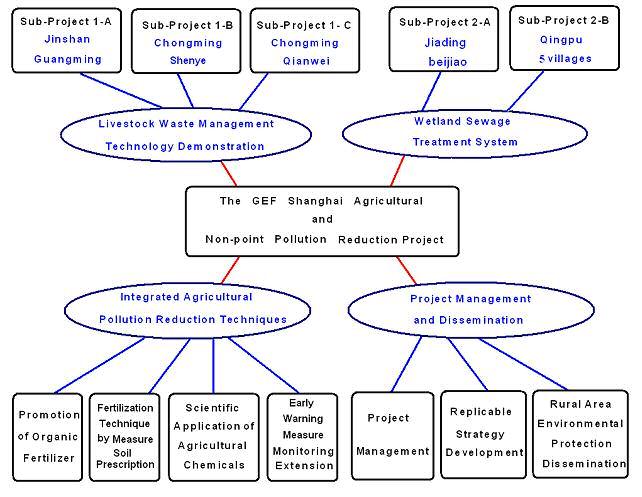
A summary block diagram of the GEF Shanghai agricultural and non-point
pollution reduction project is shown as Figure 2.1.
Figure2.1 Overview of Components of the GEF Shanghai Agricultural and Non-
point Pollution Reduction Project
14
EA Summary for the GEF Shanghai Agricultural and Non-point Pollution Reduction Project
Draft Version
Among the above-mentioned components, sub-projects, which belong to
Livestock Waste Management Technology Demonstration and Wetland Sewage
Treatment System, will prepare EA and EMP. So these Sub-Projects will be
description briefly. According to Law of Environment Impact Assessment of the
PRC , the project of Integrated Agricultural Pollution Reduction Techniques does
not prepare EA, but in another chapter the environmental impacts and EMP will be
description briefly. The 4th part of the GEF Shanghai agricultural and non-point
pollution reduction project, Project Management and Dissemination, isn't involved in
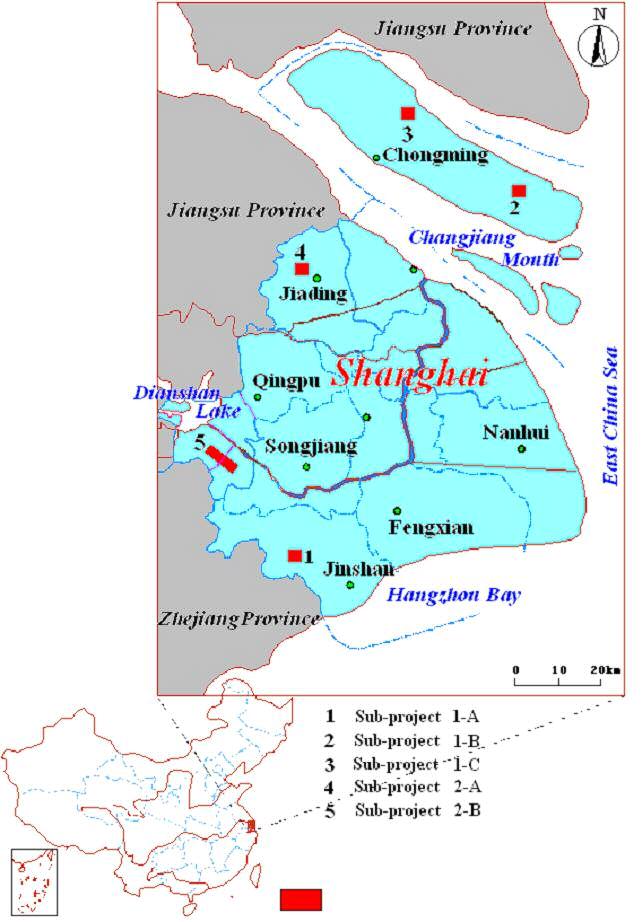
this report. The construction locations of Livestock Waste Management Technology
Demonstration Component and Wetland Sewage Treatment System Component are
shown on the figure 2.2.
Figure 2.2 Sketch Map of Livestock Waste Management Technology Demonstration
Component and Wetland Sewage Treatment System Component
15
EA Summary for the GEF Shanghai Agricultural and Non-point Pollution Reduction Project
Draft Version
2.2 Description of Livestock Waste Management Technology Demonstration
The Livestock Waste Management Technology Demonstration Component
consists of three sub-projects.
2.2.1 Description of Sub-project1-A
1
Owner
Shanghai Bright Holstein Co., Ltd.
2
Selection of Site and Main Contents of Construction
16
EA Summary for the GEF Shanghai Agricultural and Non-point Pollution Reduction Project
Draft Version
The site of project will be selected on Shanghai Bright Holstein Jinshan Strain
Dairy, which is in the Shanghai Jinshan District Modernized Agricultural Garden.
In this project, the daily sewage of urine and feces produced by the 5000 heads
of milch cow in the cattle farm, the liquid of silage crops ,the sewage for washing
milking tools and sunstroke prevent can produce biogas via pretreatment and
anaerobic fermentation, then the biogas will be cleaned and pass the gas-fired biogas
generator to produce electric; the excess heat produced by the generator will be used
to heat the input; the liquid produced by the anaerobic fermentation will be used to
irrigate the feed stuff field of 4000 mu, and clinkers will be sold as organic fertilizer
after treatment.
The main contents consist of two parts: building projects and facilities. The
building projects are mainly anaerobic reactor, biogas tank, fermented liquid storage
tank and etc. The construction contents of institutions and facilities are mainly biogas
electric power generation, electric power transmission system pipe network
construction and so on.
3
Drainage system
The rainwater and sewage separated drainage system is used and the rainwater
settled discharge to anti-epidemic river.
4
Economical Technical Specification
The main economical technical specification of sub-project 1-A is shown in table 2.1.
Table 2.1 Main Economical Technical Specification of Sub-project 1-A
No. Item Economical
Technical
Index
1
Total covered area (m2)
2,460
2
Buildings covered area (m2)
820
3
Structures covered area (m2)
740
4
Road area (m2)
400
5
Green area (m2)
500
6
Handling capacity (t/d)
270
7
Construction phase (month)
17
8
Scale of investment (RMB
)
36,000,200
9
Total cost unit price (RMB
/t)
37.77
10 Operating
cost
unit
price
14.27
(RMB
/t)
5
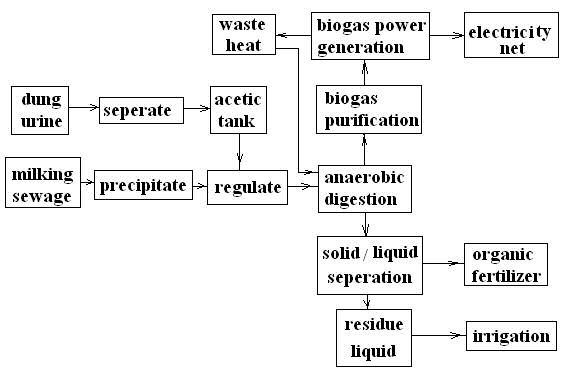
Integrated Dispose Process of Dry Feces and Urine
Integrated dispose process of dry feces and urine of the project is shown on
figure 2.3.
17
EA Summary for the GEF Shanghai Agricultural and Non-point Pollution Reduction Project
Draft Version
Fig.2.3 Flow chart of integrated dispose process of dry feces and urine of the
project
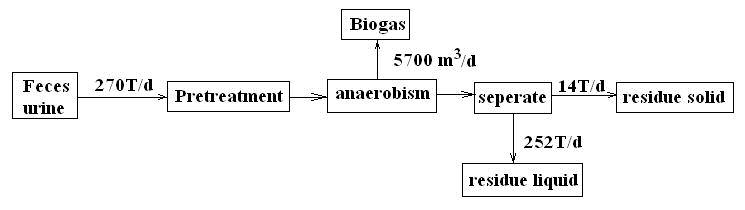
6
Equilibrium of material and products
Fig.2.4 Equilibrium of material and products
2.2.2 Description of Sub-project1-B
1
Owner
Shanghai Shenye Dairy Cooperative Society.
2
Selection of Site and Main Contents of Construction
The site of project will be selected on Shanghai Bright Holstein Jinshan Strain
Dairy, which is in the Shanghai Jinshan District Modernized Agricultural Garden.
The site of project will be selected on the Chongming seed dairy farm, which is
in the planning modern agricultural garden in Chongming island. The total area of the
project is about 18,750 m2.
Eastern part of Chongming Livestock Waste Management Centre Project (
Charged by the Shanghai Shenye Dairy Cooperative Society) with a yearly output
6,000 tons solid biological organic fertilizer and 10500 tons organic liquid fertilizer
will be buill.The main contents consist of two parts: The disposal system for the dry
feces and the disposal and transport system for the sewage.
The total covered area of project is 7075 m2,the Structures capacity is 2130 m3,
the fermentation plant is 4000 m2, the liquid transport line in the field is about 3000
m.
18
EA Summary for the GEF Shanghai Agricultural and Non-point Pollution Reduction Project
Draft Version
A: The new structure area of the disposal center is 7075 m2(Among this: the
dung collecting room is 200 m2, the fermentation plant is 2000 m2, the fertilizer
process plant is 300 m2, the storeroom is 2400 m2,the office room is 125 m2, the living
room is 100 m2,the other assistant room is 150 m2.
B: The new structure capacity of the swage disposal and transport system is 2130
m3, among this: the fermentation tank is 900 m3.The pre-deposition tank and the
storage tank are 1230 m3. The liquid transport line in the field is about 3000 m.
3
Economical Technical Specification
The main economical technical specification of sub-project 1-B is shown in table 2.2.
Table 2.1 Main Economical Technical Specification of Sub-project 1-B
No. Item Economical
Technical
Index
1
Total covered area (m2)
18,750
2
Buildings covered area (m2)
7,075
3
Volume of structure (m3)
2,130
4
Road and hardened ground(m2)
2,500
5
Green area (m2)
1,600
6
Handling capacity of the fresh dung
49.3
(t/d)
7
Construction phase (month)
9
8
Total investment (RMB
)
6,449,000
4
Process
Separated process of dry feces and urine sewage will be used.
A
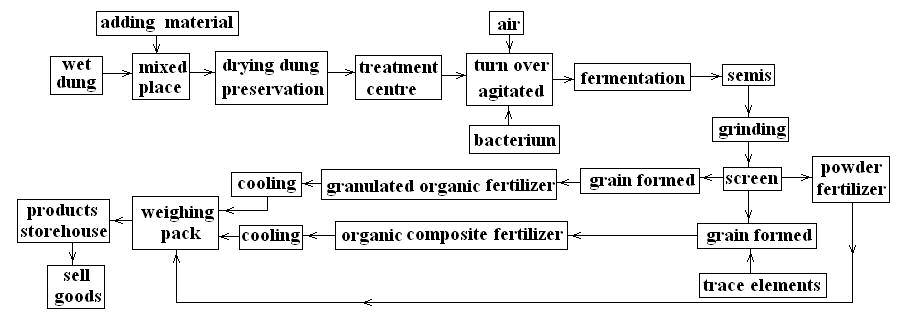
Dspose process of dry feces:
After collecting in the farm, the dry feces will transport to the fermentation plant,
where it will be thrown and overturned by special machine. During this process,
adding oxygen biology cultures cutting up the crop straws ( Assistant material )and
mixing up are completed automatically. Then the mixture begin the high effect
stacking fermentation phase (second level fermentation), after high temperature to kill
the producing germ and eggs, will be made as powdery or grainy high quality organic
fertilizer by deep processing.
B
Dspose process of urine sewage
The swage colleted from the farm will be send to the no-power underground
anaerobic and natural aerobic fermentation system. After anaerobic fermentation and
natural aerobic, it is turns to be the high quality organic liquid fertilizer, and then be
transport to the field returning to the nature harmlessly through the canal and pipe-
nets.
19

EA Summary for the GEF Shanghai Agricultural and Non-point Pollution Reduction Project
Draft Version
5
Technological flow sheet
Fig.2.5 Technological flow sheet of urine sewage treatment
Fig.2.6 Technological flow sheet of dry feces process
2.2.3 Description of Sub-project1-C
1
Owner
Qianwei village committee
2
Selection of Site
The position of this project is selected inside the circular ecological
demonstration zone of the Qianwei ecological village, located on the north of the
middle line of east and west axes of Qianwei village, between the N0 2 and No 4
longitude roads, the north of No 2 latitude road. The project total covered area of
6900 m2, about 10.3 mu.
The land occupied in this project belongs to the Qianwei biological village
themselves, present situation is pound, breeding land and cultivated plants land.
Connected with open ditch and water course, the land has a 150 m2 brick structure
monolayer construction, a 3m width soil road connected with a 4 m width sand-gravel
road that can allowed agriculture tractor pass through, but doesn't have the water and
power supply. The south of this land borders the biological pig raise base of Qianwei
village, which has a 4,000 heads of livestock and a yearly output 10,000 heads.
3
Main Construction Contents
20
EA Summary for the GEF Shanghai Agricultural and Non-point Pollution Reduction Project
Draft Version
This project has two independency subsystem constructions: the first subsystem
is that using agricultural multi-waste produce biogas to generate electric and nutrition
returns to the field. The second subsystem is that gasified straws to generate electric
and biomass to take shape. The two subsystems adjust each other when operated to
ensure a stable energy supply.
The total occupied area of this project is 6900 m2 ( plane 90m*60m and 50 m×30
m), the first subsystem covered an area of 5400 m2( plane 90 m×60 m), and the
second subsystem covered 1500 m2 (plane 50 m×30 m).
The capacity of the construction in the first subsystem is about 2550 m3, the shed
construction covers about 1190 m2, the plants and assistant rooms covers about 650
m2, the temporary tank for the liquid during the biogas production is about 1200 m3,
and the length of the transport line in the field is about 11000 m.
The buildings in the second subsystem cover about 280 m2. The capacity of the
construction is about 50 m3. The shed construction covers about 500 m2.
The biogas station which was invested 2,66 0,000 yuan build in 1993 with a
capacity of 600 m3 and a daliy output 150m3 will be knocking-out when the project is
completed .
4
Economical Technical Specification
The main economical technical specification of sub-project 1-C is shown in table 2.3.
Table 2.3 Main Economical Technical Specification of Sub-project 1-C
No. Item Economical
Technical
Index
1
Total covered area (m2)
6,900
2
Buildings covered area (m2)
2620
3
Volume of structure (m3)
2,600
4
Yield electricity ( kwh/a)
940,000
5
Biogas(m3/d) 2,138
6
Output of solid organic fertilizer
1,801
t/a)
7
Output of liquid organic fertilizer
11,093
(t/a)
8
Construction phase (month)
8
9
Total investment (RMB
)
20,720,000
10 Profits
(RMB
/a) 1,060,000
11
Returns time limit on investment
20
21
EA Summary for the GEF Shanghai Agricultural and Non-point Pollution Reduction Project
Draft Version
(year)
5
Process
A. Overall Process
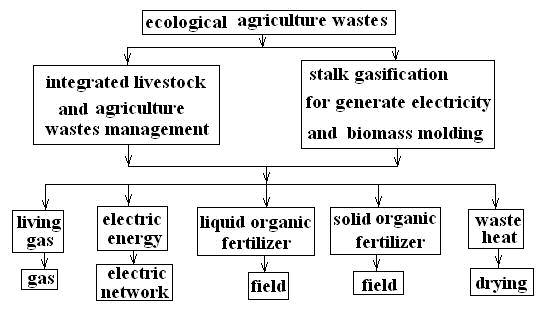
This project has two independency subsystem constructions: the first subsystem
is that using agricultural multi-waste produce biogas to generate electric and nutrition
returns to the field, the second subsystem is that gasified straws to generate electric
and biomass to take shape; The two subsystem adjust each other when operated to
ensure a stable energy supply.(shown on figure 2.7). The biogas fermentation used to
generate electric and nutrient substance return to the field, in the first subsystem
adopted different input materials treats and ferments separately.
Fig.2.7 Flow sheet of general process
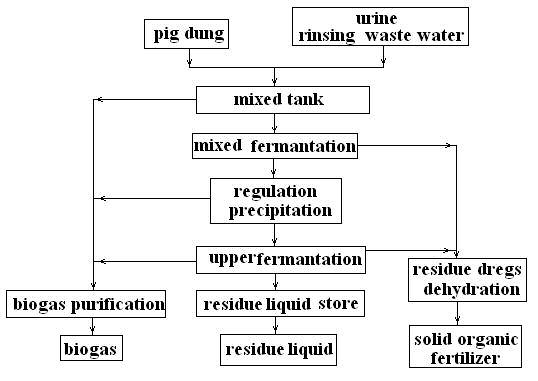
B. Biogas produced process with fermentation by feces and swage
The feces and swage of the breeding base will be mixed up at first, then, the
mixed sewage is fermentated. Mixed up the water with the acid solution produced by
straws, process a deep fermentation offering the phosphorus and nitrogen nutrition to
the acid solution in the same time. The fig.2.8 is the flow sheet of the feces and swage
fermentation.
22
EA Summary for the GEF Shanghai Agricultural and Non-point Pollution Reduction Project
Draft Version
Fig.2.8 Flow sheet of biogas produced process with fermentation by feces and
swage
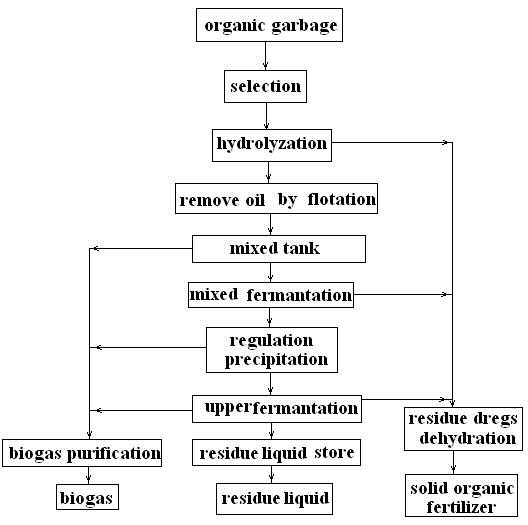
C. Biogas produced process with fermentation by organic rubbish
The living rubbish will first be pretreated, then hydrolyzed. The liquid after
rubbish hydrolysis will first be mixed up with the feces and swage from the breeding
base, then got water via all mixed up fermentation. Mixed up the water with the acid
solution produced by straws, process a deep fermentation offering the phosphorus and
nitrogen nutrition to the acid solution in the same time.
Fig.2.9 Flow sheet of biogas produced process with fermentation by organic
rubbish
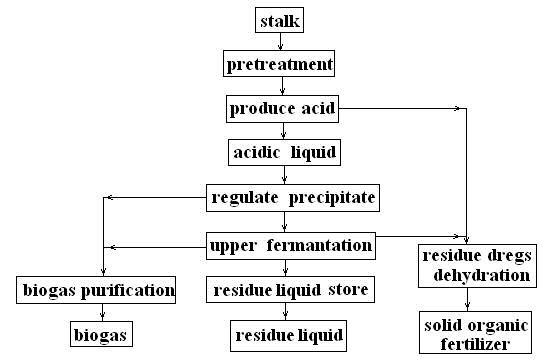
D. Biogas produced process with fermentation by stalks
This project uses the technics of Intermediate temperature internal circulation
producing acid combined with producing the second level biogas which was
developed by Tongji University biomass energy research center. This technics can
control the product acid phase via the special technic process manage, it separates the
phase of product acid basically which will process a half open fermentation from the
phase of product gas which will process a closeness high effect fermentation. This
technic not simplified the input intensity but also improved the reaction ratio of the
system.
23


EA Summary for the GEF Shanghai Agricultural and Non-point Pollution Reduction Project
Draft Version
Fig.2.10 Flow sheet of Biogas produced process with fermentation by stalks
E. Stalks gasify process
After cutting up the straws, a two-pass gasify furnance was used which forced
induce air and exit gas, also have a style like downdraft fixing hearth furnance. The
exit gas will pass to the input part of the stove. There are two obvious advantages of
the gasify stove: the first one is that the structure of the stove is simple, and it's easy
to start-up; the second one is that the high temperature of the exit gas can dioxide the
water and hydrocarbon from the raw material that can rise the hydrogen and
methane's proportion in the burn gas and improve the quality of the burn gas.
Fig.2.11 Flow sheet of stalks gasify process
F. Biomass molding process
The biomass of rice huller and chaff's compressing and molding is
implementated by the circle grinding compress and molding machine which have a
lower power cost, and the radius of the products is property.
Fig.2.12 Flow sheet of biomass molding process
2.3 Description of Wetland Sewage Treatment System
2.3.1 Description of Sub-project2-A
1
Owner
New Anting Co., Ltd.
2
Selection of Site
24





























































































































































































































































































































































































































































































































































































































































































































































































































































































































































































































































































EA Summary for the GEF Shanghai Agricultural and Non-point Pollution Reduction Project
Draft Version
River-net wetland demonstration project is located on the north-west of the
programming north suburb wetland. It contains the area surrounded by the Lianqi
river, Gujing river and Miaojing River, and occupies a total area about 667407.34 m2.
Fig.2.13 Sketch map of location to drainage network wetland demonstration
project
3
Economical Technical Specification
The main economical technical specification of sub-project 2-A is shown in table
2.4.
Table 2.4 Main Economical Technical Specification of Sub-project 2-A
No. Item Economical
Technical
Index
1
Volume of sediment dredge (m3)
100,260
2
Length of the dredging river (m)
2,577
3
River bank green space
48518m22
4
Constructed wetland
5
Total investment (RMB
)
6,307,800
25
EA Summary for the GEF Shanghai Agricultural and Non-point Pollution Reduction Project
Draft Version
4
main construction contents
The main construction content is to build a ecotype rive-way with a great ability
of self-clean ,completed ecology structure and high effect ecology function by
dredging up and repairing the three rivers located in the demonstration : Gujing
river
Lianqi river and Miaojing River. Dredging up and communicate the river,
protecting the hill slopes using vegetation and artificial wetland are also be contained
in this project.
Machine excavation will be adopted to dredge up the river way, ecological
vegetation will be planted by hand to protect and river hill slopes, the natural low-
lying pool will be used to build artificial wetland. Water plant and the grass planted in
the slopes should be confirmed according to the wetland design to avoid importing
invading species.
2.3.1 Description of Sub-project2-B
1
Owner
Jinze Town Government and Liantang Town Government
2
Selection of Site
The sites of project will be selected on Jintian village, Qianwan village and
Beiwangbang village in Liantang town, Xiezhuang village and Luotianbang village in
Jinze town. The service range and target of the project is the whole place and
tenements in this area.
3
Main Construction Contents
Base on the actual situation the main construction contents are sewage collecting
and treatment systems of the five villages. Including seven small sewage treatment
stations, among them two sewage treatment stations will be built in Beiwangbang
village and in Xiezhuang village respectively. The total sewage treatment scale is
521m3/d. The situations of the five villages in phaseI project are shown in table 2.5.
Table 2.5 The situations of the five villages in phaseI project
No. village administrative
household population
Designsewage
village
amounts
m3/d
1
Jintian Jinqian 155
918
117
2
Qianwan Jinqian 260
641
82
3
Beiwangbang
Taibei 440 1224
156
4
Xiezhuang Lianhu
300
1077
137
5
Luotianbang cinchi
105
239
47
26

EA Summary for the GEF Shanghai Agricultural and Non-point Pollution Reduction Project
Draft Version
6
Total
4099 521
4
Economical Technical Specification
The main economical technical specification of sub-project 2-B is shown in table
2.6.
Table 2.6 Main Economical Technical Specification of Sub-project 2- B
No.
Item
Economical Technical Index
1
Total investment (RMB
)
11,396,600
2
Treatment volume of the sewage
521
(m3/d)
3
Design water quality discharge
Grade I B (GB 18918-2002)
standard
5
Sewage Treatment Process
According to the practical situation of the natural village on the Qingpu District,
complex filter -active biological filter combinational disposal technical is
recommendated for the sewage treatment.
The amount of sludge in every natural village sewage treatment station is small,
and the sludge has been treated without any drugs. Considering this, it will be an
economic and reliable way to treat the sludge with the living rubbish together. The
sludge can be recycled as fertilizer in the long-term interests.
Fig.2.14 Flow chart of sewage treatment process
2.4 Total Project Investment
The project total investment is 324,691,000 RMB Yuan, converts into US dollar
49,953,000 RMB Yuan according to 1 US dollar =6.5 RMB Yuan exchange rate. The
total investment of Livestock Waste Management Technology Demonstration is
64,185,000 RMB Yuan, converts into US dollar 9,874,600 Yuan. The total investment
of wetland sewage treatment system demonstration project is 21,556,000 RMB Yuan,
converts into US dollar 3,316,300 Yuan. The total investments of the Livestock Waste
Management Technology Demonstration Component and Wetland Sewage Treatment
System are shown in Table 2.7.
27
EA Summary for the GEF Shanghai Agricultural and Non-point Pollution Reduction Project
Draft Version
Table2.7 Total Investment of the Sub-projects
Total Investment
Projects
RMB
USD
Sub-project 1-A
36,000,000
5,538,000
Sub-project 1-B
7,465,000
1,148,000
Sub-project 1-C
20,720,000
318,800
Sub-project 2-A
7,947,000
1,223,000
Sub-project 2-B
13,609,000
2,094,000
Total
85,741,000 13,190,900
28
EA Summary for the GEF Shanghai Agricultural and Non-point Pollution Reduction Project
Draft Version
3 REGION ENVIRONMENTAL GENERAL SITUATION
3.1 Physical Environment
3.1.1 Geographical Position
3.1.2 Geology and Terrain Features
3.1.5 Groundwater
3.1.6 Surface Ground Temperature
3.1.7 Natural Disaster
3.2 Water Quality
3.2.1 Surface Water Quality Zones inside Shanghai City
3.2.2 Water Quality inside Shanghai City
3.3 Ecological Environment
3.3.1 Jinze and Liantang Towns in Qingpu
3.3.2 Langxia Town in Jinshan
3.3.3 Shuxin towm and Zhongxing Town in Chongming
3.3.4 Waigang Town and Juyuan New Area in Jiading
3.4. Social and Economic Conditions
3.4.1 Population and Acres
3.4.2 Social Economy Condition
4 PROJECT ALTERNATIVES
4.1. With and Without Projects
4.1.1 With and Without the LWMTD Component
4.1.2 With and Without the Wetland Sewage Treatment System Component
4.2 Alternative Locations
29
EA Summary for the GEF Shanghai Agricultural and Non-point Pollution Reduction Project
Draft Version
4.2.1 Livestock Waste Management Technology Demonstration Project Locations
4.2.2 Wetland Sewage Treatment System Project Locations
4.3 ALTERNATIVE TECHNICAL PROCESS AND DESIGN
4.3.1 Livestock Waste Management Technology Demonstration Project
4.3.2 Wetland Sewage Treatment System Project
5 IMPACT ASSESSMENT AND MITIGATION
5.1 POLLUTION SOURCE ANALYSIS
5.1.1 Livestock Waste Management Technology Demonstration Project
5.1.2 Wetland Sewage Treatment System Project
5.2 Environmental Impacts & Mitigation Measures during Construction Phase
5.2.1 Livestock Waste Management Technology Demonstration
5.2.2 Wetland Sewage Treatment System Project
5.3 Environmental Impacts & Mitigation Measures during Operation Phase
5.3.1 Livestock Waste Management Technology Demonstration
5.3.2 Wetland Sewage Treatment System Project
5.4 Risks and Hidden Danger
6 PROJECT BENEFITS
6.1 Benefits of Sub-project 1-A
6.1.1 Social benefits
6.1.2 Environmental Benefits
6.1.3 Economic Benefit
6.2 Benefits of Sub-Project 1-B
6.2.1 Social benefits
6.2.2 Environmental Benefits
30
EA Summary for the GEF Shanghai Agricultural and Non-point Pollution Reduction Project
Draft Version
6.2.3 Economic Benefit
6.3 Benefits of Sub-Project 1-C
6.3.1 Social benefits
6.3.2 Environmental Benefits
6.3.3 Economic Benefit
6.4 Benefits of Sub-Project 2-A
6.4.1 Social benefits
6.4.2 Environmental Benefits
6.4.3 Economic Benefit
6.5 Benefits of Sub-Project 2-B
6.5.1 Social benefits
6.5.2 Environmental Benefits
6.6 Benefits of Integrated Agricultural Pollution Reduction Techniques
Demonstration
6.6.1 Mitigation of Surface Water Pollution from Livestock Wastes
6.6.2 Mitigation of Non-point Pollution Come from Use Chemical Fertilizer
6.6.3 Extension of Green Prevention and Control Technology & Mitigation of
Pesticides Pollution
6.6.4 Overall Mitigation of Non-point Environmental Pollution
6.7 Summary on Bnvironmental Benefits
7 PUBLIC CONSULTATION & INFORMATION DISCLOSURE
7.1 Information Disclosure
7.2 Public Participation
7.2.1 Public Consultation and Main Result in the Network Investigation
31
EA Summary for the GEF Shanghai Agricultural and Non-point Pollution Reduction Project
Draft Version
7.2.2 Main Results Obtained from the Questionnaires
7.2.3 Main Conclusion to the public participates
8 DESCRIPTION AND EMP ON IAPRTD PROJECT
8.1 Description of IAPRTD Project
8.1.1 Project Base and Objective
8.1.2 Implement Scope and Contents
8.1.3 Implementing Index
8.1.4 Training and Propaganda
8.1.5 Extension and Demonstration Plan
8.2 Environmental Management Plan
8.2.1 Summary of Environmental Management Plan for Demonstration Pilots A
(Langxia, Jinshan)
8.2.2 Summary of Environmental Management Plan for Demonstration Pilots B
(Zhujiajiao, Qingpu)
8.2.3 Summary of Environmental Management Plan for Demonstration Pilots C
(Changjiang Fanm, Chongming)
9 ENVIRONMENTAL MANAGEMENT PLAN
9.1 Objectives of EMP
9.2 Role of EMP
9.3 Contractual Management
9.3.1 Contractual Dispositions
9.3.2 Obligations of the Contractor
9.4 Organization for EMP Implementation
9.5 Cost Estimate for EMP
32
EA Summary for the GEF Shanghai Agricultural and Non-point Pollution Reduction Project
Draft Version
9.6 SUMMARY OF EMP
9.6.1 Summary of Environmental Management Plan for the Sub-project 1-A
9.6.2 Summary of Environmental Management Plan for the Sub-project 1-B
9.6.3 Summary of Environmental Management Plan for the Sub-project 1-C
9.6.4 Summary of Environmental Management Plan for the Sub-project 2-A
9.6.5 Summary of Environmental Management Plan for the Sub-project 2-B
10 Conclusions
33
EA Summary for the GEF Shanghai Agricultural and Non-point Pollution Reduction Project
Draft Version
34