EQUITABLE MANAGEMENT OF WATER AND
SANITATION IN PACIFIC ISLAND COUNTRIES
Leonie Crennan
Consultant*
March 2005
SOPAC Technical Report 388
* Consultant was assisted by Ilana Burness, Project Assistant
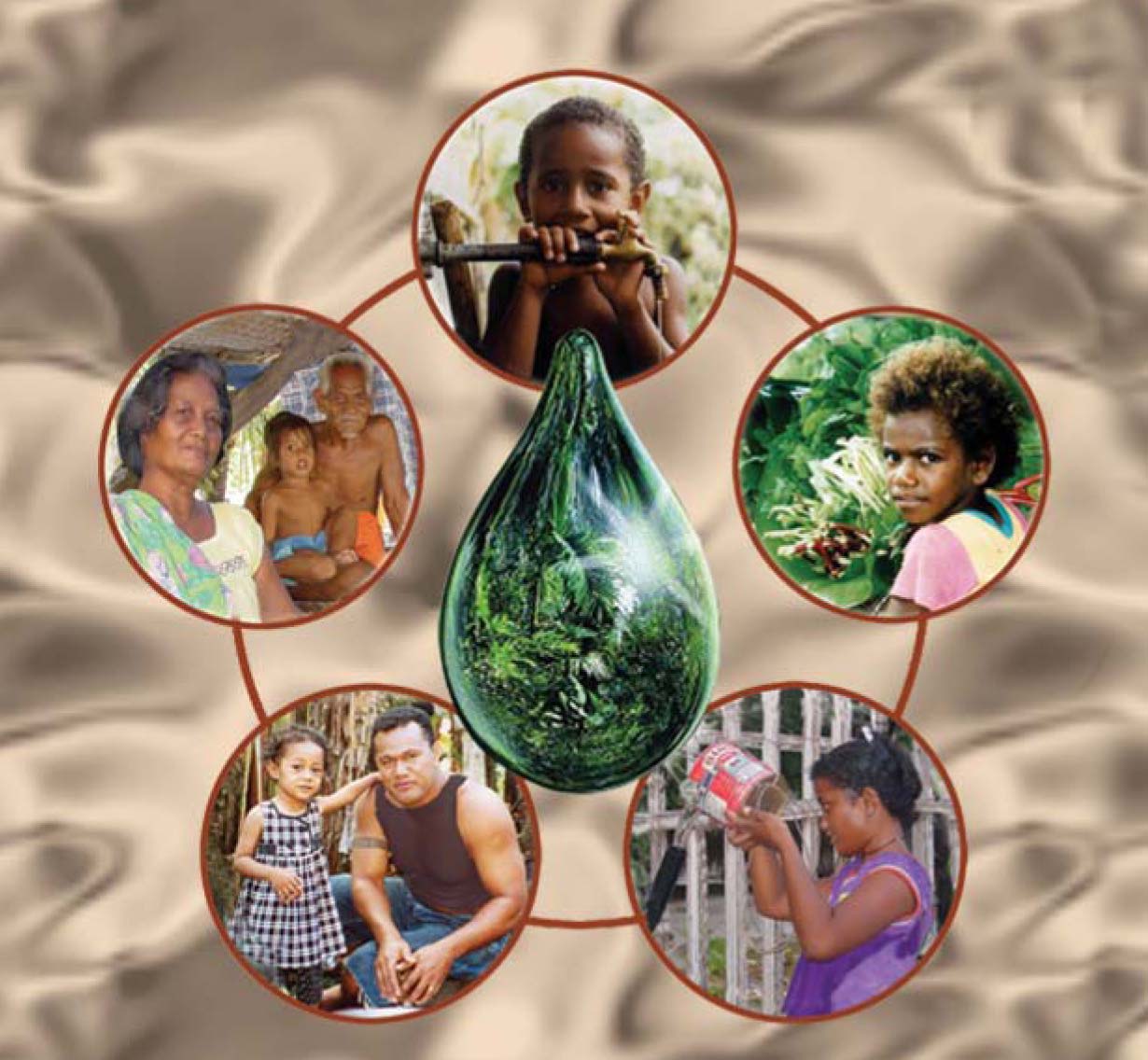
EQUITABLE MANAGEMENT OF WATER AND
SANITATION IN PACIFIC ISLAND COUNTRIES
Dr Leonie Crennan (Consultant) &
Ilana Burness (Project Assistant)
SOPAC Secretariat
March 2005 SOPAC Technical Report 388
[2]
For copies of this report contact:
The Director
SOPAC Secretariat
Private Mail Bag
GPO, Suva
Fiji Islands
Phone: (679) 338 1377
Fax: (679) 337 0040
http://www.sopac.org/
Cataloguing in Publication Data:
Crennan, Leonie
Equitable management of water and sanitation in Pacific Island Countries/Leonie Crennan & Ilana Burness. Suva :
SOPAC, 2005.
35 p. : ill.; 30 cm
ISSN : 1605-4377
1. Water & sanitation management 2. Water & sanitation Pacific Islands 3. Water & sanitation equitable management
I. Burness, Ilana
II. SOPAC Technical Report 388
III. Title
[SOPAC Technical Report 388 Crennan]
[3]
CONTENTS
EXECUTIVE SUMMARY ...............................................................................................................................................5
ACKNOWLEDGEMENTS ..............................................................................................................................................4
1. INTRODUCTION ...............................................................................................................................................7
1.1 Goals and outcomes of the research .........................................................................................................8
1.2
Intended
beneficiaries of the study.............................................................................................................9
1.3
Defining `gender' ......................................................................................................................................10
2. CHALLENGES AND QUESTIONS EXPLORED DURING THE RESEARCH .....................................................11
2.1 The diversity of PICs and method of research .........................................................................................11
2.2 The dilemma of `empowerment' ...............................................................................................................13
2.3
Flexibility and detail..................................................................................................................................16
2.4 Integration of social and technical science...............................................................................................17
2.5
Accessible assistance ..............................................................................................................................18
3. POTENTIAL CONTENT OF `GUIDELINES'........................................................................................................20
3.1 Who is respected? ...................................................................................................................................21
3.2
Who
understands? ...................................................................................................................................21
3.3
Who
decides? ..........................................................................................................................................22
3.4 Who owns the land and the water?..........................................................................................................24
3.5 Who uses WSS and for what purposes?..................................................................................................25
3.6 Who is responsible?.................................................................................................................................27
3.7 Who
contributes? .....................................................................................................................................27
3.8 Who
maintains? .......................................................................................................................................28
3.9 Who
opposes? .........................................................................................................................................30
3.10
Who
benefits? ..........................................................................................................................................31
3.11 What is community and who is excluded? ...............................................................................................32
3.12
What
is sacred? .......................................................................................................................................34
3.13 Who will still understand in 5 or 10 years? ...............................................................................................37
4. CURRENT USE OF `GUIDELINES' IN PICS ......................................................................................................37
4.1 Materials used/developed by funding agencies .......................................................................................37
4.2
Materials used/developed by non-government organizations ..................................................................39
4.3 Materials
used/developed
by government departments...........................................................................43
4.4 Materials
used/developed
by regional organizations................................................................................44
5. CASE
STUDIES .............................................................................................................................................48
5.1 Managing rural water supply in Vanuatu..................................................................................................48
5.2 Rural water supply in Tonga.....................................................................................................................53
5.3 Catchment management in Fiji.................................................................................................................61
5.4 Rainwater harvesting in Tonga.................................................................................................................66
6. CONCLUSIONS .............................................................................................................................................69
7. RECOMMENDATIONS .......................................................................................................................................71
8. BIBLIOGRAPHY 73
9. PERSONAL
COMMUNICATIONS LIST..............................................................................................................79
APPENDICES: RESPONSES TO QUESTIONNAIRE SURVEY
A Organisations'
Response
to Questionnaire Survey..................................................................................85
B 1 NGO
responses...............................................................................................................................89
2 Donors
responses............................................................................................................................99
3 Fiji
Government
departments responses.......................................................................................104
4 UN
Agencies responses ................................................................................................................105
C
List of Acronyms used in this report .......................................................................................................106
[SOPAC Technical Report 388 Crennan]
[4]
ACKNOWLEDGEMENTS
Funding for the background research for this study, and the development of the handbook
"Tapping Connections between People and Water" was provided by the [UK] Department for
International Development [DFID].
Personnel from Government departments, NGOs, regional organisations and donor agencies
shared their experiences and provided information on materials, manuals, guidelines and
checklists, which they use in their Water Supply and Sanitation or resource management
programmes. Their generous assistance is gratefully acknowledged.
Fieldworkers and community members who shared their stories and insight are also
acknowledged, especially Ms Kesaia Tabunakawai, Ms Tuna Fielakepa, Ms Haouli Vi, Mr
Lomano Hausia, Ms Mafi Katoa, Mr Lokuvalu Leha, Ms Selai Taufata, Ms Carleen Simon, Mr
Mosese Waqa, Ms Rose Kalmet, Mr Chris Ioan, Ms Annie Shem, Mr Cyril Kondang, Ms Jeanette
Bolenga, Mr Leon Prop, Ms Sukulu Rupeni, Ms Sarah Ekali, Mr Tevita Fatai, Ms Penina Namata,
Ms Jo Dorras, Ms Shirley Laban, Ms Imogen Ingram, Ms Mele Havili, Ms Leah Nimoho, Mr Aung
Kamal, Mr John La Roche and Mr Elias Moniz.
Special acknowledgements to those who contributed images to the Tapping Connections
handbook, especially The Fiji Times, Ms Wana Sivoi from Partners in Community Development
Foundation, and Mr Lepani Rabuli from Live and Learn Environmental Education.
[SOPAC Technical Report 388 Crennan]
[5]
EXECUTIVE SUMMARY
This study, conducted through SOPAC and funded by DFID, was carried out in two stages. The
initial phase involved research into current practices and materials related to community
participation in water supply and sanitation (WSS) in Pacific Island Countries (PICs). The second
phase aimed to provide recommendations, assistance or `guidelines', where necessary, to
fieldworkers who are engaged in the provision of water and sanitation to rural communities. It was
intended that these `guidelines' would contribute to equitable and sustainable protection of public
health and natural assets.
This report describes the research as it evolved and shaped the outcome. The research focused
on a review of guiding materials currently used by fieldworkers, and attempted to identify any
gaps in information, which may need attention so that communities could more effectively
manage their water resources. Questionnaires were sent to relevant organisations, and informal
discussions were held with personnel in funding agencies, government institutions, regional
organisations, non-government organisations, and with community members. This was to
ascertain the following:
· what materials/guidelines were being used;
· what kind of materials did fieldworkers feel they needed;
· what attention was being given to gender equity and poverty alleviation issues;
· what type of water supply and sanitation systems were being installed, by whom, for whom
and under what conditions; and
· whether or not these water supply and sanitation systems were being maintained.
From the initial research, it was discovered that there is substantial international and local
literature on participatory processes for general resource management, including a number of
guidelines/checklists for gender and WSS in particular. There is also a variety of technical
manuals for the construction and maintenance of toilets and water supply systems. However
there is little material, which addresses typical WSS scenarios in the small island context.
It was concluded that there appears to be a need to provide PIC fieldworkers with something
familiar which they can relate to, that identifies technical and social obstacles or opportunities,
which they are likely to encounter when designing or implementing programmes. These
guidelines would be aimed at involving all members of PIC communities in wise management of
water resources, and could complement current materials and approaches.
In considering the potential production of such a guideline, the following challenges were
encountered and discussed:
[SOPAC Technical Report 388 Crennan]
[6]
· the dispersed and diverse physical and social conditions in the 17 member countries within
the study;
· the dilemma of an external agency such as SOPAC providing guidelines which are intended
to empower disadvantaged people within communities;
· the relevance of introduced notions of gender equity and poverty reduction;
· the need to be flexible and non-prescriptive while offering relevant directions that address
specific social and technical aspects of community participation in WSS in Pacific conditions;
and
· the requirement for media that is accessible to fieldworkers who work primarily through an oral
tradition.
In response to the above challenges, and in consideration of the results of the research, it is
proposed that the guidelines be presented as a series of Questions. This is a strategic approach
aimed at working within the traditions and norms of varied cultures, while maximising the
opportunity to address inefficiencies and inequities. The rationale for each of the Questions draws
on information provided by fieldworkers across the region. The Questions can be developed into
a simple text with photos showing people from Polynesia, Melanesia and Micronesia dealing with
common water management issues.
It was also concluded that practical experiential training for fieldworkers and community members
is required to increase technical skills, and to ensure effective technology transfer, and long-term
maintenance of resources and of sanitation and water supply systems. This practical training
should be facilitated so that women, men and youth can participate, and have the authority and
confidence to implement what they have learnt.
[SOPAC Technical Report 388 Crennan]
[7]
1. INTRODUCTION
"SOPAC is mandated by 18 Pacific Island Countries (PICs) to provide technical policy and project
level advice on the sustainable development, utilization and protection of water resources in its
member countries. Of particular concern is the capacity of urban and rural water supply systems
to provide safe drinking water, and the impact of inadequate sanitation facilities on water
resources, the environment and public health. While solutions to the water and sanitation
challenges in the region clearly require technical input, long-term sustainability calls for equal and
sustained attention to the social aspects of human behaviour and relationships." (TOR, SOPAC
2003).
This project, which was conducted on a part-time basis between May 2003 and March 2004,
aimed to provide recommendations, assistance or `guidelines', where necessary, to fieldworkers
who are engaged in the provision of water and sanitation to communities in PICs. It was intended
that these `guidelines' would contribute to equitable and sustainable protection of public health
and natural resources. This is a very broad and complex area, which involves many physical and
social factors, each of which requires a particular comprehension and approach.
This report describes the research as it evolved, and provides summaries and brief discussion of
the information that was collected from personnel across the region. The research focused on
identifying the guiding materials and tools currently used by fieldworkers in water supply and
sanitation. This did not extend to an in-depth review of the success or failure of the participatory
methodologies employed in facilitating community participation. An investigation of the many
participatory methodologies available is beyond the scope of this study, and has been addressed
in other recent research (SPREP 2002a and b).
A number of case studies were chosen to illustrate a range of activities in PICs, which have
involved communities in the planning, implementation, and management of WSS. These
particular case studies were chosen partly because the author had some previous contact or
involvement with the programmes, or the fieldworkers, and was able to draw on contacts and
information gathered in the past to help review current status, process, challenges, and longer-
term impacts.
As a result of the gaps in information identified during the research, the report proposes a non-
prescriptive checklist, which could be used in the implementation of water and sanitation
programmes in PICs. Simple illustrated `guidelines' could be developed from this checklist, which
aim to complement the materials and approaches that are currently available.
[SOPAC Technical Report 388 Crennan]
[8]
1.1 Goals and outcomes of the research
The goals of the study, as previously mentioned, were to identify what materials/approaches were
being used by fieldworkers and to provide additional guidelines where needed. The rationale for
the study was based on the assumption that if `community participation' `gender equity' and
`poverty alleviation' are integrated into the planning and implementation of water supply and
sanitation (WSS) programmes, then the likelihood of effective technology transfer and
sustainability is greatly increased.
This is a practical and relatively simple approach. It is logical that protection of water resources
and public health would be enhanced if those family members who are responsible for the
provision of water, sanitation and hygiene in the home are actively involved in the planning,
design and management of water and sanitation facilities.
Conversely it could also be said that by addressing gender and poverty issues within WSS
programmes, gender equity and poverty reduction is advanced within a community. This is more
complex, and difficult to evaluate.
Much of the experience behind these concepts comes from development agencies in Europe, and
is based on many years of trial and error in Africa, Asia and Latin America. There is considerable
literature on ways and means to engage communities in effectively and equitably meeting their
basic needs (see References and Appendices). The literature has been reviewed and updated
over time as experience accumulates, or as previous approaches have not been embraced by the
target communities. Where techniques or approaches have failed to reduce the number of people
without adequate water and sanitation, further review has also been undertaken (Wijk-
Sijbesma1998, SANDEC/WSSCC 2000, Schertenleib and Heinss 2000, Foncesca and Bolt 2002,
DFID 2002, Gender and Water Alliance 2003, Khosla 2003(a), WSSCC 2003).
However, from the literature review and discussions with people working in the field there appears
to be no guidelines designed specifically for engaging PIC communities in water and sanitation
initiatives, and which also addresses gender equity and poverty alleviation.
There are some local publications, which address implementation of rural water supply systems
(Visser 2001), and others focused on aspects of sanitation, but none that incorporate all the
above criteria. Perhaps it has been too difficult and impractical to bring all these aspects together
in one accessible medium?
[SOPAC Technical Report 388 Crennan]
[9]
Handbooks have been produced which have been adapted from international literature
(Directorate of Public Health, Vanuatu 2001), and while much of the international experience and
literature is universally relevant, there are particular conditions in PICs which merit a local
approach. These conditions include:
· varied customary land tenure and resource ownership arrangements;
· small dispersed populations (even within overall larger populations such as Papua New
Guinea);
· firmly established traditions of communal structure and function;
· extended family obligations, dependencies and allegiances;
· limited government control over domestic life;
· concerns related to taboo, ceremonial status and privacy; and
· varying ideas about disease and hygiene.
It is within these local contexts that the concepts of gender equity and poverty alleviation need to
be understood and addressed if a practical, accessible field manual for the management of water
and sanitation is to be developed.
1.2 Intended beneficiaries of the study
The research, which is described in this report, could be useful for any personnel involved in the
water and sanitation sector. The target groups, who could benefit from the `guidelines' or
handbook, which is produced as an output of this study, are government and NGO personnel
working on the implementation of WSS programmes in PICs.
The fieldworkers who could potentially use the `guidelines' may sometimes be directed by the
requirements of an agency funding a particular project, but on most occasions they would be
conducting routine work within their department or organisation. They may be the sole Health
Officer on an island, or group of islands, responsible for all manner of environmental health
issues, or they may be specifically assigned to rural water supply, or acting as the Village
Sanitarian. They may be the Extension Worker from an NGO engaged in assisting householders
to install or upgrade water tanks, toilets and washhouses. They could also be a Volunteer working
on an income generation scheme, which is dependent on a sustainable supply of water, or a
Pastor improving conditions in the church compound.
[SOPAC Technical Report 388 Crennan]
[10]
It is intended that the recommendations or `guidelines' developed from this study may provide an
accessible resource to any of these fieldworkers, thus contributing to constructive practice in their
relationship with communities, and an integrated equitable approach to catchment management.
As the majority of the population in PICs utilises on-site water supply and sanitation systems, the
quality of the relationship between these fieldworkers and the community is an essential link in
the protection of public health, secure livelihood, and natural assets. Many of the issues and
principles explored would also apply to centralised urban WSS projects.
1.3 Defining `gender'
There are various terms and concepts used in this Report, and the understanding of their
meaning varies among users. As `gender' is one of the considerations of the study, some
discussion is provided here of common interpretations provided in the literature.
The English word `gender' originates from the Latin genus which means race, kind, or sort. In the
Australian Macquarie dictionary `gender' refers to socially-conditioned characteristics or typical
behaviour whereas `sex' refers to the physical characteristics, which distinguish males and
females.
More fully, `gender' refers to the specific roles and responsibilities adopted or inherited by men
and women in any society. It is related to how we are perceived by others and how we are
expected to think and act as women and men, because of the way society is organised, rather
than because of our biological differences.
From the literature, a `gender approach' implies that attitudes, roles and responsibilities of
females and males are to be taken into account. This involves recognition that both men and
women do not have the same access to, or control over resources and that benefits and impacts
may be different for both groups. The gender approach requires open-mindedness and the fullest
participation of both men and women. It highlights:
· the differences between men and womens' interests even within the same household and
how these interests are expressed;
· the conventions and hierarchies that determine women and mens' position in the family,
community and society at large, whereby women are often dominated by men;
· the differences among women and men as based on age, wealth, ethnic background and
other factors; and
[SOPAC Technical Report 388 Crennan]
[11]
· the way gender roles and relations change, as a result of social, economic and technological
trends.
What `gender' means to people in PICs is another matter. The common response in discussing
this subject with Pacific islanders, if people have heard of the English term, is that `gender' refers
to women, and `women's problems and rights'. This view is also often held by expatriate
professionals in the water and sanitation field, and is somewhat reinforced by the fact that gender
policies, in effect, commonly focus on the unrecognised needs of women and girls. This
perception needs to be addressed.
2. CHALLENGES AND QUESTIONS EXPLORED DURING THE RESEARCH
There are particular challenges or constraints in attempting to develop indicators for useful
practice in the implementation of sustainable and equitable WSS in PICs. These logistical and
social considerations are briefly described in this Section, as they were encountered during the
research process. The challenges shaped the scope of the research, and determined the
outcome of the study.
2. 1 Diversity of PICs and method of research
The overarching challenge is that this project seeks to address the requirements of seventeen
PICs with significant differences in physical conditions such as rainfall patterns, geology,
vegetation, and hydrology. Socio-economic conditions also vary greatly between and within these
countries. All these factors impact on the capacity of individual communities to achieve integrated
and equitable water resource management.
Any recommendations that are made for fieldworkers need to allow for the many differences
faced by communities in PICs, while being alert to the shared realities. The shared realities
include: the fragility of the island environment; limited land areas and human, financial and natural
resources; fundamental dependence on marine ecosystems; and vulnerability to natural hazards
such as cyclones, and the impact of climate change (UNEP 2000).
This overview of materials used in community participation in WSS has attempted to include
information from as many PICs as possible. Personnel from Micronesia, Melanesia and Polynesia
have provided information. Thorough case study is constrained by time, logistics and budget.
Therefore activities in two nearby Melanesian countries, Fiji and Vanuatu, and one Polynesian
[SOPAC Technical Report 388 Crennan]
[12]
country, Tonga, have been selected for more detailed investigation as practical demonstrations of
possible approaches and content for guidelines. It was intended that the Federated States of
Micronesia also be included in the case studies but it was not possible to organise a site visit
within the time available. Reference is made to information provided in preparatory discussions
held with government personnel from the Federated States of Micronesia. The case studies are
discussed in section 5 of the report.
A review has been undertaken of guidelines, checklists, manuals and other material used by
government departments, donor agencies and non-government organisations working with rural
communities in the Pacific. This review was initially conducted through a questionnaire sent by e-
mail and fax to all the institutions in the region that are working with communities in water,
sanitation and related resource management programmes. Although surveys are not a
particularly effective method of gaining input in the Pacific, the mail-out served to notify relevant
organisations in the member countries that the research was being conducted, and gave distant
personnel the opportunity to participate.
A small percentage of those who were contacted replied to the mail-out. Subsequent interviews
with personnel from regional and government organisations based in Suva, Fiji, Tonga and
Vanuatu have enabled a more complete picture to be established. Many fieldworkers and
community members across the region generously provided information and personal accounts
either by e-mail or, where possible, through informal discussion by phone or in person. Some
discussions lasted for many hours and covered a wide range of related topics. Other discussions
were conducted intermittently where opportunities arose, such as at workshops or in airport
terminals. The source of information in the text is identified where it is not contentious, but all
those who contributed information are listed in the Personal Communications at the back of the
report.
Refer to Appendix A for organisations included in the survey, although some did not respond to
the Questionnaire as such. Despite the vast distances and communication difficulties experienced
in the region, a great deal of information was received during the course of this research.
Unfortunately all the feedback could not be included in detail in this report. The findings from the
Questionnaire are briefly discussed at Section 4 and responses to Questionnaires are recorded in
Appendices B1-B4. Other information and ideas are referred to throughout the text. This review
has provided some indication of what is being utilised and achieved across PICs and what may
need to be built upon. The issues raised will be more relevant to some communities than to
others.
[SOPAC Technical Report 388 Crennan]
[13]
2.2 The dilemma of `empowerment'
A second challenge in approaching this research is concerned with the notion of empowerment. It
could be seen as a contradiction in terms, for a regional organisation such as SOPAC to be
involved in the development of guidelines to facilitate equitable community participation at a local
level. It could be said that the overall goal of this project is `empowerment' of the community in
relation to the effective management of their health and natural assets, and within the community,
for those who are marginalised or disadvantaged so that may have an active role in that
management. Yet empowerment suggests that someone possibly the development or funding
agency is giving power to `the oppressed' or `the powerless'.
However, if this power is understood as the ability to act for ones self, to create rather than
coerce, then perhaps this power cannot be given it can only be taken it is social power,
experienced in relation to others. Therefore the question presented itself as the research
progressed: can a regional agency effectively recommend the means for a local community to
empower itself?
There is also focus on changing power relations within the local community, particularly in relation
to gender and poverty. Once again the question arises, can this process be directed, even by
suggestion, from outside the community?
For example, the twentieth century feminist or women's rights movement arose in industrialised
countries from the agitation of local women themselves, supported by some men, and evolved
over decades in response to the strictures, reactions and socio-economic conditions of those
particular cultures. This process is by no means complete, and there are some analysts in
industrialised countries who believe that womens' wellbeing is `going backwards' in the last
decade, (including increased poverty and domestic violence), and a new solidarity and activism is
required (Summers 2003). The long struggle for equity and opportunity has had many phases,
and ongoing unexpected ramifications are being experienced in the lives of second and third
generations of women and men.
Recognition of this historical context leads to questions, such as: what is it that women in PICs
want now, and how do they want to go about achieving their goals? what do men understand
about gender issues, and what do they want for their sons and daughters in the twenty-first
century? There are many relevant documents and publications produced in the Pacific which
clearly and firmly answer these questions (Ministry of Women and Culture 1998, South Pacific
Forum Secretariat 1998b, 1998c, 2000, UNIFEM 2002, PACFAW 2003). However, as in response
[SOPAC Technical Report 388 Crennan]
[14]
to any such significant trend, personal opinions and experiences range across many points of
view, and reflect many grey areas.
In informal discussion with more than sixty women and men from PICs regarding these questions,
the response varied greatly. For example, some young Pacific islander women feel that gender
roles are just one of many aspects of persona, status, and opportunity in their community, rather
than a major determinant, and have expressed the opinion that the gender policies imported from
industrialised countries are inappropriate to PIC conditions. Others express dismay at the
possibility that the wheel would, therefore, have to be reinvented, and that women and men within
Pacific communities would be involved in lengthy struggle and negotiation repetitive of that
experienced in developed countries.
Some men in the water and sanitation sector expressed support for more active involvement of
women in water resource management but asserted that men are the ultimate decision-makers.
Several men commented that "men talk a lot but don't act" and women should be given respect
and authority for the burdens they carry. Some young women who are actively involved in
promoting gender equity in their WSS programmes admitted they would not challenge the status
quo within their own families (see case study at 5.1). Others feel that the current gender approach
is an inappropriate dilution of the previous focus on the unmet needs and rights of women and
girls.
In regional fora, men have expressed the opinion that gender policies currently being developed
and promoted in PICs are disrespectful to the culture of island countries, where women are
`highly regarded' but have defined roles. Other men have advised that the main goal should be to
inspire men to encourage and support equal opportunities for women and girls, rather than
expecting women to fight for those rights. A field worker explained that `gender' is important for
development work in PICs because the roles of women and men very often differ. Therefore he
felt that it was important to know where the different contributions of women fit into `a food or
supply chain', and then address their needs separately or together depending on the context. He
considered this to be an efficient approach in the resource-scarce environment of the region
In the history of development programmes there have been a number of stages, often
overlapping, which somewhat reflect changes in attitudes to gender issues which have occurred
within industrialised societies (Moser 1989; Wijk-Sijbesma 1998):
· the `welfare approach' which focuses on womens' reproductive roles, that is, as mothers,
wives and house managers and requires women to change their domestic behaviour so that
better hygiene, health and nutrition will be achieved;
[SOPAC Technical Report 388 Crennan]
[15]
· the `anti-poverty' and `efficiency' approach recognises that women are also economic
producers and actors in the public realm. During colonial and neo-colonial times these roles
were not recognised resulting in a loss of status and income and consequent reduced
efficiency of projects;
· the current "empowerment" approach seeks to promote the rights of women and men to make
choices in their lives and to influence change, with an understanding that women's gains will
not imply men's losses. "This approach challenges women to seek a new self-consciousness
and new positions in their countries' legal and civil codes, economies, institutions and
management systems" (Brikke 2000);
· the `gender mainstreaming' approach shifts the focus from women as a target group, to
strategic interventions which ensure men and women benefit equally (DFID 2002, Khosla
2003b).
However the donor countries have had much more time to deal with these complex issues in their
own cultures. In the recipient countries this process has been compressed into one generation or
less, and local communities receiving donor support have been required to adjust accordingly to
the changing policies (see case study 5.1). There have also been differing policies among the
various donor agencies at any one time.
In the same way that gender issues require understanding within Pacific conditions, there is a
need to comprehend the nature of poverty in the local context. Within development agencies in
Europe there is currently a focus on `the poor' with certain advocated practices aimed at poverty
alleviation. Access to safe water and basic sanitation facilities is widely considered to be critical to
poverty reduction and the improved wellbeing and livelihoods of `the poor'. However these
approaches cannot be imported to PICs without some adaptation and examination of their
relevance. For example, at the Pacific Regional Consultation on Water in Small Island countries
at Sigatoka, Fiji in 2002 some Delegates objected to the use of the term `the poor' and preferred
`disadvantaged' in the Island context. The inclusion of `the poor' in an official document, despite
these objections, could result in the document not being ratified, or not taken seriously if it is
ratified.
Disagreement is often expressed in circumspect terms at formal international Pacific gatherings,
so a mild objection should be heeded as a potentially strong statement and it reflects, in part, a
desire to articulate one's own problems, rather than have them diagnosed by outsiders. There is
also an implied recognition of the social security system within many Island communities, which is
[SOPAC Technical Report 388 Crennan]
[16]
related to extended family obligations, traditions of hospitality to visitors and strangers, differing
priorities for cash expenditure, ongoing support from the diaspora, and subsistence dependence
on fishing, home gardens and domestic animals (Pers. comm. Karawaiti 1997). There is a
strongly held belief that "no one goes hungry" in an Island community (Pers. comm. Fatai 2003).
Some communities or families may be cash poor, but asset or status rich. Even squatters in peri-
urban communities often have entitlements to land use on their `home island' and choose to
forego that security temporarily to access the perceived benefits of urban centres (Pers. comm.
Tim 1996, Narfi, McCartney, 2003). This is not denying that there is a daily preoccupation with
survival for some communities and families in PICs, but the notion and experience of `poverty'
and `the poor' has to be understood and addressed in the context of the small island environment.
2.3 Flexibility and detail
A third challenge is presented by the need for flexibility as well as detail. The nature of guidelines,
if they are detailed enough to be useful, suggest that it is possible to apply experience that has
worked in the past to a new set of circumstances and achieve more or less the same outcome.
This assumption has resulted in a substantial number of manuals, training packages, field guides
which comprehensively cover all manner of methodologies for engaging communities in the
operation and maintenance of water supply and sanitation systems.
Some of these documents are very long, up to 300 pages of small print (Brikke 2000) and provide
excellent instruction based on years of experience in the field, mainly in Africa and Asia.
However, in the attempt to prepare the fieldworker to anticipate and catalogue the myriad
complex features of a living social order, there is also the danger of becoming over prescriptive.
This could result in a loss of instinctive trust in the shifting informal web of relationships,
unpredictable circumstances and expressions of common sense and initiative that make up the
fabric of community life.
Consequently the output from this project, the `guidelines', need to be flexible and non-
prescriptive while offering direction that addresses social and technical aspects of community
participation in WSS in Pacific conditions. There is already a wealth of written information
available on the various elements of these criteria and the research has revealed that
organisations and departments in the region are using a combination of materials and tools from
a variety of sources, and/or methodologies they have developed themselves (see Appendices A
and B). In some cases there is no written record of locally-developed approaches, especially in
some of the NGOs, where experience and skills are shared among fieldworkers.
[SOPAC Technical Report 388 Crennan]
[17]
In discussion during the research, some expressed the opinion that there is no value in
developing recommendations for WSS in PICs, because each country needs its own customised
approach (Pers. comm. Whyte 2003). Others have stated that it would be helpful to be able to
draw on experience from other PICs when implementing their own WSS programmes (Pers.
comm. Ioan, Kalmet, Taleo, Vi, Leha, Fakaosi, Ganileo, Sivoi, Tangi, Santos, Rabuli, Binkoka,
Ekali, Daniel 2003).
A further reason for the recommendations not being prescriptive is that external intervention in the
domestic realm is generally unwelcome. Enforcement of regulations, laws or policies of any kind
is problematic in PICs due to small populations where many people are often related, or know
each other. In these close-knit communities it is quite possible that a person, charged with the
task of enforcing some policy within their work duties will encounter relatives to whom she/he
owes deferential respect (Pers. comm. Sivoi 2003).
It is also possible that an Environmental Health Officer is unable to discuss sanitation issues with
more than half the population of their village because of taboos which control his or her
relationship to second, third or fourth cousins (Pers. comm. Fifita 1998). In addition there is a
common reluctance to intervene in other people's business, and to share knowledge outside the
extended family, which can also permeate the workplace resulting in breakdown in the flow of
information (Pers. comm. Kamauti 1998).
There are complex taboos regarding relationship which people are unwilling to transgress for the
sake of introduced notions of equity. Challenging traditional structures, which appear to contribute
to inequitable conditions, can also have inadvertent negative effects such as loss of patriarchal
authority to protect the community's natural assets (Pers. comm. McEwan, 2003).
On the other hand, rapid change is possible within small self-regulated populations, if the right
conditions and dynamics exist. According to some fieldworkers, creating these conditions may
take years of sensitive investigation before a WSS programme is even introduced (Pers. comm.
Waqa 2003). In the fragile physical and social ecosystems of small island communities, any
traditional structures or practices, which are challenged or eroded through adaptation to `modern'
technologies or ideologies, need to be constructively replaced (Pers. comm. Santos 2003).
2.4 Integration of social and technical science
The fourth requirement is to find a way to effectively integrate social and technical science in any
`guidelines' that may be produced. As 90 per cent of the population of PICs uses on-site
[SOPAC Technical Report 388 Crennan]
[18]
sanitation systems and 80 per cent depend on household water supply, (tanks and wells
supplemented by village water schemes in villages and large scale reticulated supply in urban
areas), it makes sense to support and develop ecologically-sound decentralised systems.
Even in main urban centres such as Nuku'alofa in Tonga, and Port Vila in Vanuatu, there is no
reticulated sewerage system, and given the land tenure constraints, and cost and maintenance
requirements this is not a viable option in the foreseeable future. Therefore the local evolution of
appropriate on-site systems can provide a sustainable strategy.
For this reason it is important to include basic technical issues within the `guidelines', in addition
to the socio-economic criteria, to ensure that fieldworkers and members of the community have
practical support and training for the long-term maintenance and management of their WSS.
2.5 Accessible assistance
Having determined what information may be relevant and useful to fieldworkers across PICs, the
next challenge is to make the information accessible. Literacy is sometimes limited, particularly in
rural areas, and as one Ni-Vanuatu remarked "Islanders are basically a story telling culture"
(Pers. comm. Tari 2003). A rich oral tradition prevails and is often the primary manner in which
knowledge is transferred and community concerns are explored. Even for the literate, it is
recognised that lengthy documents and reports are not likely to be read. Consequently the offices
of government personnel often contain shelves of project material, manuals and publications that
are not used. For example, this report is not likely to be widely read because of the scope and the
complexity of information it presents.
Even in circumstances where a sanitation field manual was developed in-country by an expatriate
volunteer in collaboration with local counterparts, and then translated into the local language, a
large box of copies lay unopened, gathering dust. The reason given was that the manual was "too
wordy" (Pers. comm. Laban 2003). It was presented with explanatory diagrams and the
occasional sketch throughout the well-spaced 58 pages. The language and concepts used in the
English version were relatively complex and unfamiliar so it is possible that the local version was
quite difficult to translate. However, the lack of uptake of this format indicates a significant
challenge in conveying technical information in the written form, and especially if it is culturally
incongruent.
It is intended that the format/media chosen to present recommendations from this study will be
useful and appropriate for fieldworkers with varying skills, literacy and technical support, who are
[SOPAC Technical Report 388 Crennan]
[19]
involved in rural WSS. They might use the material as a checklist for the process of community
involvement. Potentially it could also be used as a tool with the community in implementation and
long-term management of systems. In terms of hardcopy material, which can easily be carried
into the field, simple manuals, posters, and flipcharts are possible options.
From experience, and from conversations with PIC fieldworkers it has been indicated that posters
do not achieve much, although they can be welcomed as decoration to offices and homes. Flip
charts are helpful for stimulating discussion and critical thinking and have been used extensively
by Live and Learn in their work with schools. Some fieldworkers have advised that flipcharts could
be useful in providing a step-by-step process for WSS with illustrations/photographs on one side,
and written explanation on the back "for when we have to write reports" (Pers. comm. Laban
2003).
Theatre appears to be universally popular and is being used in many donor-funded programmes
to promote discussion, support training and deliver messages. It is certainly effective as
entertainment, and usually draws crowds, but requires skilled interactive techniques to really
involve the audience and test understanding, and ongoing funding to carry it into the
communities. Whether it leads to behaviour change is difficult to monitor (Pers. comm. Dorras
2003).
Radio plays can be a powerful, relatively inexpensive, advocacy mechanism and they have been
used to support the Rural Water Supply programme in Vanuatu. `Family Blong Sarah', a
serialised drama in its 2nd year, describes a community which is going through the process of
implementing and maintaining their water supply system, as recommended by the Department of
Geology, Mines and Water Resources. The ongoing story relies on research from many
communities where typical issues have arisen, such as women on water committees, and is
apparently so engrossing that even the head of the Department is reluctant to miss an instalment
(Pers. comm. Ioan 2003) (see section 5.1 for Vanuatu case study). It is estimated that more than
half the population of Vanuatu has access to radio (and batteries) at any one time.
Practitioners such as FSP in Fiji (now known as Partners in Community Development Fiji (PCDF))
who use theatre, report that communities appear to be more convinced by the message promoted
in film because the contents and characters are deemed to be "real" (Pers. comm. Rupeni 2003).
However, if the actors in the film are recognised as locals the message may not be taken
seriously. For example in a fiction film produced by Wan Smolbag on gender, population and land
tenure issues, the audience in Port Vila laughed during the murder of a child in a land dispute
(Pers. comm. Tari 2003). However when it was shown in the provinces, where the actors were
unknown, people were enthralled by the story.
[SOPAC Technical Report 388 Crennan]
[20]
Some feel that the introduction of TV and video into PICs coincided with a loss of initiative and
productivity especially among the youth, and the inherent passivity of the media is
disempowering, so it should be avoided as a means of education or mobilisation (Pers. comm.
Waqa 2003). However it could be useful to allow for stories from communities to be shared
regionally. It requires that a functioning VCR and an energy source be made available.
In addition to developing appropriate media to convey messages and information on WSS and
hygiene, there appears to be a universal requirement for face-to-face, and preferably on-site
training, in design, construction and maintenance. This could include `train-the-trainers' for
fieldworkers, and direct training of householders and community members. Participatory
education and information exchange can contribute to the development of ecologically
sustainable and empowering strategies to conserve natural assets and enhance quality of life.
People learn by "seeing and doing". However it is important that the training is not an `overload'
and gives time for experimentation and feedback (see case studies 5.1, 5.2, 5.3).
3. POTENTIAL CONTENT OF THE `GUIDELINES'
Sections 1 and 2 of this report explore some of the dilemmas and challenges created by the
project goals. As a result of the research conducted and the issues raised, it is suggested that the
`guidelines' are presented, not as recommendations for particular actions, but as a series of
questions regarding WSS.
The fieldworker might ask these questions in order to provide direction appropriate to the social
and physical assets, needs and constraints of a particular community. This is a strategic
approach aimed at working within the traditions and norms of the culture, while maximising the
opportunity to address inefficiencies and inequities. It also offers some guidance as to the links
between cultural and technical issues, which need to be addressed in PICs, while allowing for the
significant differences in socio-economic and physical conditions, which exist across the region. It
could be described as a checklist with a storyline. Photos can show people from Polynesia,
Melanesia and Micronesia dealing with common water management issues. The use of story
telling, while it may be dismissed as merely anecdotal and `unscientific' has many advantages
including allowing important messages which may transgress taboos to be conveyed indirectly.
In this section, the reason for formulating each question is investigated and reference given to
some possible answers. The rationale for each of the questions draws on information provided
from across the region. Some of the answers overlap, as there are many inter-connected
[SOPAC Technical Report 388 Crennan]
[21]
resource issues involved. The form or media in which this approach could be presented includes
illustrated booklets and flip charts supported with simple text.
3.1 Who is respected?
To gain access to a community and ensure support for a programme, an initial step is to identify
who is respected, and who may be willing to provide leadership, or at least blessing and
endorsement.
A common figure of respect across PICs is the local religious leader. Priests, pastors, pundits,
and senior women in church groups are important allies in any WSS programme and they can
use their influence by encouraging initiative and requesting co-operation and contribution from
their congregation, by giving moral authority to the message, by leading through example, and by
supporting pilot projects within their church compounds (Pers. comm. Hausia 1997, Waqa 2003).
There are other respected identities within countries, for example: royal family, nobles and talking
chiefs in Tonga; district and village chiefs in Melanesia; town officers; men and women who have
attained certain levels of ceremonial status in Vanuatu; traditional artists such as poets, orators,
actors, musicians and dancers; and elite sportswomen and men.
It is easier to gain such influential endorsement for water-related initiatives than it is for sanitation
programmes, because of privacy and taboo concerns and general avoidance of this difficult
subject. However the skilled use of metaphor, common to much formal discourse in PICs, can
allow even this sensitive issue to be publicly presented in an inspiring manner (Pers. comm.
Hausia 1997, Leha 2003).
3.2 Who understands?
In most instances there are people within the community who have already considered the
problem and know what needs to be done. This is certainly the case if there has been an
application by the community to government departments or NGOs for assistance in
implementing WSS systems.
However there are levels of understanding beyond the perceived need for a particular service or
facility. There is local knowledge, past and present, regarding sustainable management of natural
[SOPAC Technical Report 388 Crennan]
[22]
assets and traditional practices, which can be incorporated into management of introduced
technologies.
There are also individuals who have experienced the long-term impacts of various kinds of
introduced WSS systems. Householders or farmers who have observed increasing salination in
the groundwater from over extraction, may be motivated to try water saving practices and
devices. A school principal, who understands the demands that flush toilets will place upon water
supply and the school budget, could be interested in the idea of trialing an ecological alternative.
Fisher women and men who have observed the reef die from nutrient loads, and parents who are
struggling with children suffering from chronic diarrhoea may be open to new technology, which
protects water bodies from pollution. There needs to be clear practical demonstration of cause
and effect to build on these experiences.
Each person's perspective can contribute to understanding the in-puts and out-puts of the
catchment. Coverage does not necessarily result in improved family health or protection of the
environment. Householder, teachers and schoolchildren can participate in a practical research
process, which demonstrates the nature of pollution in the village, where it is coming from, and
where it is going. This takes the onus off the fieldworker and allows members of the community,
women, men and the youth to design and implement an integrated WSS system to suit their
needs and protect their resources (see case study, section 5.2).
Effective technology transfer occurs when families and communities decide for themselves that a
practice or technology is appropriate for them, and take the necessary steps for independent
implementation.
3.3 Who decides?
In discussion conducted during the Regional Gender and Energy Workshop in Fiji, in August
2003, it was acknowledged among representatives from PICs, that women and men will consult
about domestic management, and women will control the finances, but men will usually "have the
last word" (SOPAC 2003). Taking this into account, it is essential to ensure that the input of
women is maximised to ensure that a well-informed decision is made.
Where decisions need to be made about communal facilities such as a reticulated village water
supply, there are various methods suggested to include everyone's input, including working with
men and women separately, and having a male advocate deliver the women's point of view, if
women are restricted from speaking, such as in the Nakamal (in Vanuatu) or the Maneaba (in
Kiribati). There is considerable literature on methodologies for group work, community analysis,
[SOPAC Technical Report 388 Crennan]
[23]
and decision-making such as the Participatory Learning and Action techniques (PLA) (see section
4).
With regard to the implementation of on-site WSS systems, where each household will be making
its own decision about facilities and management, house-to-house visits with each of the families
concerned, and talking with women in their homes, is an effective method of ensuring a balanced
viewpoint. While this might be time consuming, it is worth the effort to achieve sustained
technology transfer, particularly in relation to sanitation. This is one advantage of the small
populations of communities in PICs: personal dialogue with stakeholders is feasible. Building
relationship and trust with women and men from the households is essential to achieving ongoing
commitment, and openness to constructive change (Pers. comm. Robinson, Sivoi, Tangi, Nari,
2003). Fieldworkers have commented that information is most effectively conveyed when it is
"embedded on trust" where there has been an opportunity of "getting to know each other......it is
wisdom based on trust" (Pers. comm. Waqa 2003).
As reference is often made to the Bible to assert that men are the head of the family "as Christ is
the head of the Church", gaining the church's endorsement for WSS programmes can give dignity
and respect to domestic management of resources and health. It provides an opportunity for an
appeal to men and women to perform their respective duties in a co-operative and mutually-
supportive manner.
In relation to issues of hygiene and hygiene education, men and women and older children are
involved in the care of small children in many PIC families and it is important that men understand
and make decisions in this regard in the best interests of the health of their family. Therefore men
and boys should be included in hygiene promotion and discussions on beliefs and attitudes
regarding the nature of disease and disease transmission, in segregated groups where required.
Different people in the family and community make decisions regarding choice of types of toilets
and water supply. Rainwater tanks usually are the responsibility of women who are often involved
in groups to raise funding for construction of tanks, flush toilets and bath houses. Private wells are
usually the responsibility of the men. Men and boys usually dig and move pit latrines. Reticulated
village water schemes involve representation from each family and/or decision-making groups,
such as women, church, youth, and elders.
[SOPAC Technical Report 388 Crennan]
[24]
3.4 Who owns the land and the water?
As men throughout PICs commonly own land, it is ultimately their decision regarding the
installation of WSS infrastructure, and they will own any facilities that are established. Even where
women own land on some islands of Vanuatu, their male relatives can make decisions regarding
land usage and management of the natural resources (Pers. comm. Bolenga 2003). In the event
of separation or marital conflict, women are protected if they have sons, who will inherit the land,
but in some PICs, their situation is more precarious if they only have daughters (Pers. comm.
Fileakepa 2003).
There are efforts to rectify this inequity where it exists in PICs, but many men and some women
resist this change because they are concerned that their family land will pass through their
daughters to in-laws (Pers. comm. Fileakepa 2003). In the meantime women in Tonga are finding
ways to circumvent obstacles to their productivity and autonomy by leasing land as a group (see
section 5.4).
With ownership of land also comes associated rights over water, and this can result in conflicting
demands such as the export of water, which is also needed by the local community. A resident of
Fiji, Temakei Tabano, in relation to the ethics of a bottled water business, raised this issue
"People living on the outskirts of the major cities and towns are crying out for water, schools are
closed, meetings postponed, farms and farmers are affected etc. and even worse, people living
outside of the main island are using seawater for bathing. Water is being rationed and water cut-
offs for the main towns are being considered. Where are our artesian water reserves that have
been preserved for thousands if not millions of years? Unlike other renewable resources, water
should be owned by the people and managed by government agencies. The important point is
that a water business has a limited life span while people will continue to use and need water
everyday till the end of the world. Do not be blinded with money, but think long and far beyond our
present generations regarding this basic need and priceless gift" (Tebano, Small Island Voice
October 2003).
Land ownership can affect equitable access to water in various ways. For example a community
in Port Vila was prohibited from being connected to a reticulated water supply because a
neighbouring landowner requested such high compensation for the pipe to cross his land to reach
the community (Pers. comm. Chaniel 2003).
Negotiations concerning land ownership and water are not necessarily divisive. It is reported that
in the Federated States of Micronesia, communities which had long standing conflicts and
[SOPAC Technical Report 388 Crennan]
[25]
tensions over land tenure and use were brought together to solve the need for a common water
supply and sustainable management (Pers. comm. Ayin 2003).
3.5 Who uses WSS and for what purposes, and where is the demand located?
It is important to consult with all family members regarding usage so that an integrated water and
sanitation system can be appropriately designed, and sustainable livelihood can be supported. In
addition to the regular domestic uses of water, there are productive uses at the household level,
including a range of small-scale activities that enable people to grow food, earn income and save
expenditure: e.g. fruit and vegetable production, keeping livestock, making mats and other crafts,
and a range of micro enterprises.
.
In a survey conducted in Ha'apai in Tonga for a UNESCO/SOPAC groundwater pollution study, it
was demonstrated that family members use water from different sources for different purposes,
and this determines who makes decisions in regard to that resource
The water from the Tonga Water Board was preferred for convenience as it was reticulated, and it
was mainly used for flushing toilets, cleaning and watering animals, and during drought for all
needs. Rainwater was preferred for quality (purity and taste) and affordability, and is used for
drinking and cooking, hair washing, watering seedlings, and the men use it for making kava. Well
water was preferred for affordability, reliability, quality (no chlorine, not so hard, inconsistent or
salty as the Tonga Water Board supply), and having an established history of usage. The family's
ancestors built some household wells in the 19th century. Stern warnings by the local Health
Officer regarding pollution of the groundwater by septic tanks and pits could not convince the
family to close their revered well. Well water was used for washing clothes, bathing, cooking and
watering gardens and animals (Crennan 2000 ) (see case study, section 5.2).
In Kiribati there are also different uses for different types of water when the choice is available.
Well water is used for making toddy because of taste and tradition, even in Tarawa where
groundwater is seriously polluted. Men collect the toddy in the morning and evening and prepare
it for fermentation, while women use it fresh for cooking and feeding to infants.
In addition to the household uses of water, there are commercial uses such as brewing and
bottling beer, cleaning and canning fish, bottling spring water, and providing water to resorts. This
raises questions of balancing income generation against conservation and domestic uses. Men
and women may have differing views on which use should be a priority. A resident from Kosrae,
Andy George writes: "this discussion is quite timely as Kosrae State in the Federated States of
[SOPAC Technical Report 388 Crennan]
[26]
Micronesia is considering a foreign investment proposal for a water-bottling project proposed to
be established here in Kosrae. Kosrae is a small volcanic island, only 42 sq. miles in size with a
growing population. The water consumption and use at the local community level is increasing
every year. Our water resource is a gift from God for our use, not for foreign investors who are
constantly looking for opportunities to exploit our resources and make lots of money from them.
Who will benefit from foreign investment projects like this one in Kosrae in the long run? Local
resource owners may benefit a little and so might our economy, but certainly foreign investors will
be richer and much of the project income will be theirs to enjoy" (George, Small Island Voice Oct
2003).
John Maneniaru from the Solomon Islands provides an alternative view on the availability, use
and distribution of the resource "water is plentiful on some of the islands. If it is commercialised
based on the fact that water is a precious gift from God and should be accessible to all who are in
need of it, then this is acceptable. In this regard, I pray that everyone on earth has access to
water. Therefore mass distribution of water to the whole world at minimal operational cost would
be a great idea (Maneniaru, Small Island Voice Oct 2003).
While this generous view may apply on islands where water is plentiful, for those who live where
supply is limited, this generosity has to be qualified. Tetoaiti Tabokai from Kiribati comments
"Water is a shared commodity and exporting it for use by others who do not have easy access to
water sources is an honourable thing to do. If the water is sold for commercial purposes then
there should be a limit made on the amount, in other words a quota should be set so that the
locals dependent on the water are first satisfied before extra water is sold. Water used for
commercial purposes should be sourced from rivers rather than from point sources such as wells
and springs where property rights are concerned. Living as I do on a coral atoll, water is always a
problem, especially nowadays with increasing industrialisation and pollution" (Tabokai, Small
Island Voice Nov 2003).
Even where water is plentiful such as in Papua New Guinea it may not be distributed evenly
either in space or time, or equitably in terms of health and access. Not only do the various WSS
demands need to be understood and negotiated in an equitable manner, with due regard to
climatic variables, but the location of points of usage, and discharge, in relation to the resource
also requires careful consideration in order to protect the rights of all community members and to
ensure sustainable management of the catchment. In addition, location and design of facilities
should be responsive to the physical and cultural constraints of all users, including the elderly and
disabled, women and children.
[SOPAC Technical Report 388 Crennan]
[27]
3.6 Who is responsible?
It is important to ascertain who is considered responsible for the various aspects of water supply
and sanitation within a community and ensure that these traditional roles are being enhanced in
an equitable manner.
Various family members have traditional responsibility for providing access to a source of water,
collection, and related uses. As with many other factors these roles differ across PIC
communities. For example, it was reported that in areas of Vanuatu it is a man's responsibility to
ensure that his family has a reliable source of water and this is a condition for marriage. In one
instance a husband failed to establish a well as promised and this gave grounds for the wife to
return to her family. To avoid the divorce her brothers and sisters provided materials and her
husband provided labour to dig the well (Pers. comm. Nimoho 2003)
In the Federated States of Micronesia different roles apply on each of the four island States: the
men are responsible for collecting the fuel and cooking in Chuk, while the women are responsible
for cooking in Yap, Kosrae and Pohnpei and also for collecting the fuel in Yap and Kosrae.
Adherence to these traditions also depends on lifestyle and family composition (Pers. comm.
Solomon, Chrieg 2003).
3.7 Who contributes?
If WSS systems are on-site they are paid for by the household, or through small grant schemes,
often administered by NGOs, where some percentage of funding is provided, and the household
contributes the remaining money, labour, and/or food to the labourers who are funded by the
scheme. Some materials and site preparation costs are also usually the responsibility of the
household, such as guttering and facia in rainwater harvesting programmes (see case study 5.1,
5.2 and 5.4). Ongoing maintenance for on-site systems is the responsibility of the users.
With implementation of communal rural WS systems, there are similar mechanisms where the
community pays a percentage of costs, and funding from donors is allocated usually through
government departments. Once the system is constructed and operating then ongoing
maintenance is a communal responsibility and this becomes more complex in terms of covering
costs and contributing labour (see case study 5.1) (Cretney and Kalmos 2003). (Pers. comm.
Green 2003).
[SOPAC Technical Report 388 Crennan]
[28]
Often managing money is the responsibility of women in the household, although men may make
the final decision as to allocation, if there are urgently-competing demands (Pers. comm.
Solomon, Star, Fatai, 2003). Where cash is available within a community it is likely to be used to
make a church donation, as this is an immediate social requirement, before it is used to pay water
bills, or to pay for materials to fix the pump, or repair the leaking cistern. Or if water bills are paid,
then school fees may be neglected. Paying for water, or for the distribution of water, is usually low
on the list of priorities and will only be addressed if it is imminent that supply will be cut off.
There are various strategies being developed in PICs to address financing of rural water supply,
especially in partially monetised communities. For example the "identification of various forms of
value in the context of water supply and management, and hence its expression among
communities in the absence of a market price. It is hoped from this perspective to develop an
agreed framework to enable villages and implementing agencies to assess the value of improved
water supply and sanitation, and thus the impact of different technology choices, the importance
of structured systems of maintenance, and the likely input (as opposed to monetary economic
contribution) which rural communities will be prepared to contribute to developing, maintaining
and managing their water resources" (White 2003).
Willingness to contribute to maintenance for WSS systems is often affected by the means through
which the systems were implemented. A sense of ongoing responsibility appears to be directly
proportional to the degree of involvement by the household, or the community, in the planning
and construction of the system. It has been observed that "if there has been no sweat, there is no
care" (Pers. comm. Mafi, Fifita 2003). Communities, which have been provided with WSS
systems through aid programmes, with minimal contribution on their part, often expect the
implementing agency to return and undertake repairs, and ultimately to replace the system (see
case study 5.4.2).
3.8 Who maintains?
Whoever maintains the various WSS systems, in a family or community, she or he requires
technical training to ensure long-term sustainability of their water supply, secure livelihood, and
protection of their health. While there is comprehensive documentation of methods to engage
communities in planning and evaluation of resource management, appropriate training in
technical comprehension and practical skills receives less attention.
It is reported that in the mid 1980s in Tonga women community workers were trained in the
construction of rainwater storage tanks and VIP latrines. A six-week training course included
[SOPAC Technical Report 388 Crennan]
[29]
practical construction and maintenance skills, aspects of health and hygiene; financing including
costing, budget planning, record keeping and book keeping (Flemming 1987).
The Rural Water Supply programme in Vanuatu is encouraging women to join men in the
plumbing training to maintain their water systems (Pers. comm. Ioan 2003).
These programmes need to be ongoing and updated to include the most recent understanding of
the impacts of WSS systems and other village activities on public health and the environment,
and these links needs to be clearly demonstrated to those responsible for maintenance. Often,
personnel deal with water supply and sanitation from different government departments or NGOs,
and there is little communication between them. While there may be training for communities in
water supply implementation and management, or construction and maintenance of toilets, there
is rarely an integrated approach, which assists householders to understand and monitor the
impact of pollution from humans, animals, agriculture and chemicals on their water resources.
Introduction of a reticulated water supply to a village, however efficiently maintained, can result in
a decline in public health due to an increase of untreated waste water, unless both these are
addressed at the same time. Even where wastewater is contained and partially treated, for
example with a septic tank, inappropriate discharge often contaminates water bodies and
presents an invisible threat to public health.
The householder is responsible for maintenance of her/his on-site systems and therefore she
and/or he should be the focus for appropriate maintenance training. For communal systems, the
relevant village committee usually selects the person who is to receive training and support for
maintenance. Part of effective maintenance is being able to monitor WSS. It is possible to teach
women, men and children simple accessible inexpensive techniques, which enable them to
understand and observe changes in their water quality and environment which may affect their
health and livelihood (Pers. comm. Mosley 2003, Pers. comm. McEwan 2003, Sammy and
McEwan 2003).
Training in sanitation technology is planned for community members in the Sanitation Park
project, which has commenced with SOPAC in collaboration with the Fiji School of Medicine, but
this needs to be clearly linked to water supply and an integrated catchment management
approach.
In addition to on-site training in WSS for community members, householders should be included
in regional training and planning events. People who have taken responsibility for their own or
their community's WSS systems could benefit from contact with householders from other PIC
countries, in sharing information and experience. Training and fora usually only includes
[SOPAC Technical Report 388 Crennan]
[30]
government representatives. Personnel from NGOs as representatives of civil society, are
beginning to be included in these events. However representatives from CBOs such as Town
Officers and Village Womens' Committee members, can contribute first hand to a household-
centred strategy, and it would also provide recognition of their status as primary water managers.
3.9 Who opposes?
Certain measures, which may be part of a WSS programme, such as including women on water
committees, in decision-making, or in maintenance training, will inevitably cause disagreement,
and resistance from some people.
Opportunity should be allowed for objections to be aired so that they can be openly debated so
that activities are not covertly sabotaged. It has been reported by fieldworkers that initiating
personal contact and sharing concerns is the most effective means to overcome resistance, if
public discussion has failed.
Opposition may also take the form of conflicting practice. For example a man who cleans cars on
a bridge over the Tagabe River in Vanuatu is thwarting the efforts of the catchment protection
committee. People downstream are collecting water polluted with oil. It was considered unwise to
tell the man to stop cleaning cars because this activity was his means of survival. It was thought
he must be acting out of "ignorance and desperation". The catchment committee decided it
should help him find a more environmentally-friendly system or provide assistance with an
alternative livelihood, for example, through a small grants scheme. A similar conciliatory approach
was adopted in dealing with trespassers establishing gardens and growing food on the catchment
reserve (Pers. comm. Nari 2003).
When the Tagabe committee was formed they held a stakeholders meeting for the community
and the private sector. Community "leaders" were invited and therefore only men attended. It was
acknowledged that to engage women the organisers would have to specifically invite them (Pers.
comm. McEwan 2003). Their exclusion may result in resistance to any conservation schemes as
they have neither been informed of the rationale nor consulted as to their possible objections, or
their local knowledge of practices and environmental conditions.
It is reported by government fieldworkers that in the Cook Islands, that environmental education
has not changed people's behaviour. Mechanisms for prosecution and enforcement of fines also
did not act as a deterrent. In the small familiar populations enforcement is difficult for government
personnel. Once again, talking with the offending members of the community on a one to one
[SOPAC Technical Report 388 Crennan]
[31]
basis has had much more impact than the officially sanctioned strategies (Pers. comm. Tangi
2003).
Community monitoring and community pressure on individuals is suggested as an alternative to
government intervention. This requires respected and influential members of the community to
understand the problem and appeal to enlightened self-interest. Gabriel Victor Titili writes "Proper
conservation policies for water sources in the Pacific are required immediately. Logging
operations in many of the large islands, e.g. in the Melanesian group of islands, has taken away
that very rainforest that retains moisture and prevents direct evaporation of water into the
atmosphere. This is a danger to our water resources. Water is a precious commodity and it was
given for a purpose. We islanders who are so fortunate to have access to it must protect it" (Titili,
Small Island Voice Oct 2003).
Various programmes are focused on the community identifying and solving the problem internally.
Three communities in Vanuatu are involved in monitoring the impact of upstream activity on their
water resources. Each community is motivated for different reasons such as depending on clean
water for tourism, wanting to use the stream for electrification, and attempting to reduce erosion,
sedimentation and turbidity from cattle farming (Sammy and McEwan 2003). It is intended that
this process will assist communities understand what affects water quality, and how they can
better manage conflicting needs. Women, men and children are involved in these monitoring
exercises.
3.10 Who benefits?
Undertaking a WSS scheme will have varied short- and long-term impact on members of the
community, depending on the way it is implemented, by whom, for whom, for what purpose, and
in what location. These factors have been referred to in the previous questions.
In addition to considering who benefits from a water and sanitation initiative, there is also the
issue of who suffers if no action is taken? Various reports cite waste from domestic sources as
the dominant contributor to pollution in PICs (UNEP 2000). The serious threats to the
environment and consequent effect on livelihood have been identified. Similarly, studies show
that one of the most significant health costs globally is due to the impact of infectious disease.
The context of greatest importance in the spread and control of infectious disease is the
household environment, which is where the majority of susceptible people (especially small
children) spend most of their time (Khosla 2003(b)).
[SOPAC Technical Report 388 Crennan]
[32]
Diarrhoea is a common infectious condition in some PIC communities. Diarrhoea is not a disease
in itself but a debilitating symptom of diseases caused by viruses, bacteria and parasites. As
such, addressing the problem lacks the focus of a single organism disease such as AIDS or
Tuberculosis. However similar interventions are required to address the prevention of diarrhoea,
irrespective of the organism, and these interventions mainly focus on improving the household
and communal living environment. Health officials in PICs report that many children in their
communities under five years of age have diarrhoeal diseases, and it is a leading cause of death
in the population (Pers. comm. Tim 1997, Fonua 1999, Karawaiti 1999), (WHO 2000, [Fiji]
Ministry of Health 2002).
Apart from the human suffering involved, these preventable diseases have an indirect as well as
a direct impact, which can be estimated in monetary terms. Some communities do not appreciate
the direct and indirect cost (time, inconvenience, anxiety about sick children), which they have
already been `paying' because of environmental degradation. For example: having to collect fuel
to boil water because it is contaminated; tolerating skin irritations from excessively chlorinated
water; suffering from various illnesses related to inappropriate sewage and solid waste disposal;
and needing to travel greater distances in order to catch an inadequate amount of fish (see case
studies, sections 5.1, 5.2, 5.3) (Saito 1997; Saitala and Paelate 1996; Pers. comm. Fonua 1999,
Wan Smolbag 2001).
3.11 What is community and who are excluded?
Having investigated the physical constraints and resources of the location and engaged the
various established groups in the community, it is important to explore who is outside the
traditional structures, and who, therefore, may not have a voice. This is a universal concern and is
not confined to conditions in PICs.
This sensitive issue was discussed in some detail by a fieldworker at the workshop on Water,
Communication and the Community held in Suva during September 11-12th 2003. Haouli Vi
provided the following case study in her presentation and paper
"Water and Sanitation are a human right, and if one is trying to get a community involved in
understanding environmental and health issues, decision making, access and management, what
happens when certain people are excluded or looked down on because of certain characteristics?
Not everyone gets to participate even within one culture or country" (Vi 2003).
[SOPAC Technical Report 388 Crennan]
[33]
Communities in PICs are not static and migration and immigration within and outside the country
is changing the composition of towns and villages across the region.
Ms Vi examines changes taking place in Tonga "Racism and intolerance is an increasingly
important issue as the passage of time has seen a marked increase in Tonga's interaction with
other countries. However, it is still a relatively new concept. There are also growing numbers of
overseas visitors settling in Tonga for business and other opportunities. There are also high
numbers of Tongans living abroad as is the case in Samoa and other countries in the region. It is
therefore necessary that Tongans develop an accepting and inclusive attitude towards living in a
multi-cultural society. At the same time, it also applies to other cultures living in Tonga to accept
and adapt themselves to the cultures and traditions of the people of Tonga" (Vi 2003).
There are problems of intolerance, racism and prejudice, in any community, which can silence
those who are rejected and prevent their contribution to, and participation in programmes to
protect natural assets, sustainable livelihood and public health. This exclusion does not just apply
to migrants or newcomers, it can also apply to certain members of long-established communities.
"Furthermore, there appears to be increasing barriers of intolerance, whether explicit or implied,
within religious belief systems, classification by sexes such as the gay and lesbian associations,
specified age groups, and the disabled or the handicapped and such target groups on the
periphery of society" (Vi 2003).
This is not only painful and disempowering for those who are excluded; it also dilutes efforts to
conduct an integrated approach to catchment management. "There is a lack of general education
in schools and within the community concerning racism and intolerance, why it occurs and the
harmful effects it has on communities" (Vi 2003).
However significant attempts are being made to identify these complex tensions and find ways of
overcoming multiple levels of intolerance.
"In my country, and the same maybe true in the other countries of the South Pacific, there are
still many challenges and mindsets to overcome. In the lead up to an event supported by UNDP
ACT (Assisting Communities Together) when confirmation was received on the participation of
the traditional Tonga Fakaleiti Association, one of the Tongan stakeholder members, from the
German Embassy, who fully supported the idea of Multi-cultural Day from the start of the planning
stage, withdrew from participating in the subcommittee...the question was asked, `Do we tolerate
the Fakaleitis or Fa'a Fafine and the encouragement of being gay?' The theme of the multi-
cultural day was then re-emphasised by the organisers, `Human Rights Education against
[SOPAC Technical Report 388 Crennan]
[34]
Racism, Discrimination, Xenophobia, and related intolerance'. All members of society are entitled
to the right of any human being and the same opportunities are entitled to all" (Vi 2003).
Most groups who discriminate against others can justify their position according to what they
consider is `right' or `normal'. "I note with some regret that some of the main religious bodies of
Tonga such as Wesleyan, the Tongan Constitution, Tongan Chief Church, and the Free Church
of Tonga, failed to attend due to the Theme of Human Rights, and also the involvement of the
Tonga Fakaleiti Association as its activities are against their religious beliefs. Another impediment
for major Christian Churches in Tonga was the participation of the Tonga Muslim Association. At
the same time another association refused to sit in or to be present at the television panel
discussions due to the participation of the Human Rights and Tongan Democracy Movement
because they did not want to be seen making a political challenge" (Vi 2003).
However, for those who did participate in the organisation of the events, and for the wider
community who attended, or witnessed the activities through the media, the process achieved its
goals of increased appreciation of marginalised cultures and groups, and the benefits of engaging
all members of society. Ms Vi concludes, "It created an opportunity for different community groups
to work together, encouraging future interactions in the workplace and socially, which includes the
environment and public health. There were programmes for Primary and Secondary Schools in
the day with essay competitions and posters on the theme...and in the evening there were stall
exhibitions with performances by other cultures and schools and associations including the
Muslims and Fakaleiti. It was an evening of getting together and breaking down the barriers of
racism and discrimination...It was a night that brought tears to everyone, especially with the
participation of the Disabled Children's Association who won the essay competition" (Pers. comm.
Vi 2003).
3.12 What is sacred?
To ensure long-term sustainability of water resources it is important to tap into the cultural and
spiritual significance of water. This essential aspect was examined in the Water and Culture
sessions in the World Water Forum at Kyoto in 2003 and was a much needed balance to the
`Water as Commodity' approach of many of the other themes.
With the introduction of reticulated water supply systems, particularly if payment is involved,
people often feel the common resource is no longer their responsibility. People do not report
leaks beyond their own meter, and protection of the communal reserve from pollution or over-
extraction is often not a priority (White et. al. 1999). This disinterest in "the commons" does not
[SOPAC Technical Report 388 Crennan]
[35]
just relate to water resources in PICs. In some instances Government-controlled resources are
considered to be `owned' by government employees, who are seen to be simply acting in the
interests of their extended families (Pers. comm. Tim 1996).
Paying for water is seen as a contradiction of its value "as a gift from God". Reference to the
sacred nature of water in the local context is one potential way of re-inspiring a sense of universal
connectedness and responsibility for this natural asset (Crennan 1992).
Understanding the geography, geology and hydrology of a village location can be achieved by the
exploration of sacred places, the significance of certain landforms and water sources, their
traditional names and associated stories. Some of this knowledge belongs to specific families and
cannot be shared but the information that is communally available can be drawn on to inform and
support sustainable strategies in WSS (Pers. comm. Hausia, Karawaiti 1998, Ayin 2003).
For example, rather than closing private wells, which have been used by families for hundreds of
years, in order to avoid the use of groundwater polluted by conventional toilets, it is preferable to
address the source of pollution. A `dry' above-ground toilet such as the composting toilet could be
used instead of pit latrines and flush toilets. This allows households to keep their independent
access to cherished well water, and increases motivation to protect the groundwater as a family
and community asset.
As a predominantly Christian population, Pacific islanders are accustomed to many religious
references to the sanctity of water, beginning with the initiation of a newborn child through
baptism. There are also living examples of ancient significance that predate Christianity. For
example in Nuku'alofa in Tonga, the lens under the town is considered to be polluted from septics
and pit toilets and other domestic activities, and the use of household wells is strongly
discouraged. However certain wells are maintained and used for purification and cleansing
particularly in relation to healing of the eyes (Pers. comm. Vi, Fileakepa, 2002). Young men and
boys who climb down into the wells for repair and cleaning are respected and sought after for
their skills.
Understanding local taboos is especially important in regard to sanitation. This may determine
where WSS systems can be located, who can use them and when, who can talk with whom about
what subject, and who can collect samples for pathology testing, and from whom. Taboos can be
supportive in addition to being prohibitive. For example, menstruation houses in Micronesia
offered women a respite from their responsibilities, a venue to discuss community events, and a
safe place to rest (Pers. comm. Ayin 2003).
[SOPAC Technical Report 388 Crennan]
[36]
Traditions, which enshrined sustainable management of natural assets, are not far below the
surface of introduced values. A story about a spring in the Central Province of Papua New Guinea
reflects a dilemma common to many PIC communities. "About 7 km inland of my village, Pelagai,
there was once a water spring called `Nalu Golo' (literally translated as `water mountain'), at the
bottom of a small mountain ridge in what looked like a large hole. It bubbled over into an adjacent
marshland where many animals and plants lived. I passed this spring on the way to visiting some
of my family members and we would stop and carry water from the spring. There were codes of
conduct or rituals that one had to observe before taking water. One had to thank the spirit of the
land by looking up to the sky and down to the spring and ask permission to fetch water for
drinking. Several large coconut shells were always there to carry the water. Bathing or washing in
the spring water was strictly forbidden.
In 1968, a road to my home village was constructed just above the spring. The foreign company
that constructed the road pitched their camp by the spring and used it for their daily use. In 1969,
I drove past the water spring and stopped. I noted the rate of bubbles in the spring had slowed
down. I decided to keep an observation diary.
In 1974, I noted that there were no bubbles. In 1979, the big hole had almost dried up, but reeds
and grass were still growing in and around the spring. In 1984, it had completely dried up. In
1989, I noted that a fire had burnt the reeds and grass around the spring. In 1993, I noted that the
hole had become an ordinary mountain side subjected to fires during the dry season. I stopped
keeping an observation diary.
Why an observation diary? In Keakalo philosophy, land is mother, water is father, and sky is an
enclosure of spiritual beings from our ancestors, the guardians of land and water. Land and water
are not goods for sale. Land is life-bearing, while water is life-giving and both are under the sky.
All the living things including humanity are controlled by the spirit of the dead. Today I am still
wondering why the spring disappeared? I hope this tells the spring's story." (Mali Voi, Small Island
Voice, November 2003).
[SOPAC Technical Report 388 Crennan]
[37]
3.13 Who will still understand in 5 or 10 years?
Even in the most effective community-based programmes, long-term follow up and reinforcement
is necessary, particularly in relation to the introduction of new or alternative WSS technologies or
systems of management. People move on, the reason for avoiding or adopting certain practices is
forgotten, and environmental and economic circumstances change. Some kind of mechanism
needs to be built into implementation which allows for a village to be revisited every couple of
years (see case study, section 5.2).
Donor, government and non-government organisations should keep their records updated and be
aware of activities and strategies, which have been undertaken by other agencies. Connections
need to be made between water and sanitation programmes and other resource management
initiatives.
4. USE OF `GUIDELINES' IN PICS
Personnel from Government departments, NGOs, regional organisations and donor agencies
provided information on materials, manuals, guidelines and checklists, which they use in their
WSS or resource management programmes. Their generous assistance is gratefully
acknowledged. A record of responses to questionnaires is provided in Appendix B. Some of the
materials and approaches are briefly discussed in this Section. Personnel who provided input to
the research are listed in `Personal Communications'.
4.1 Materials used/developed by funding agencies
The donor organisations that responded to requests for information were AusAID, ADB, World
Bank, and NZAID. See Appendix B.1 for response from personnel at funding agencies, to the
questionnaire.
Donor agencies working in the Pacific region have in recent times developed gender and water
guidelines, which are required to be followed in their projects. These are usually generic in
content, literary in format, and some appear to be largely borrowed from development agencies in
Europe. Because of the content focus and presentation, it appears these guidelines are unlikely
to be utilised by local PIC fieldworkers outside a prescribed programme.
[SOPAC Technical Report 388 Crennan]
[38]
Their primary use is for external advisers from the donor countries who may be in need of
awareness raising and direction in regard to community equity. In regard to gender concerns,
there is often a male dominance of the water industry in the Pacific donor countries, such as
Australia, New Zealand and the US. However the attitudes, prejudices and experience of the
expatriate advisers, female or male, are the critical factors, not their sex.
The gender guidelines for water and sanitation produced by donors, at the very least, aim to avoid
contributing to inequities in communities. "WSS projects are increasingly demand-driven. Projects
have to be responsive to the articulated demands of users. If women play a minor role in
community decision making, they may well be marginalised under a demand-driven approach
unless steps are taken to include them" (AusAID 2000). This reflects an intention not to repeat the
mistakes of the past where planning and implementation of WSS were usually conducted by men,
which often resulted in gender blindness. "There are countless examples in the developing world
of failed WSS projects-piped water systems that no longer carry water, broken hand pumps and
toilets that are never used. In many cases WSS facilities have failed because not all members of
the community, and particularly women were fully involved or fully committed to the project"
(AusAID 2000).
The ADB publication, `Gender Checklist: Water Supply and Sanitation' is designed for staff and
consultants to "guide users through all stages of project/programme cycle in determining access
to resources, roles and responsibilities, constraints, and priorities according to gender in the water
supply and sanitation (WSS) sector" (ADB 2000) The booklet is pocket sized and 26 pages in
length. It could be easily carried in the field.
Even where these guidelines exist the message contained therein needs re-enforcement and
supervision to ensure staff and consultants understand what gender equity actually means in
practice, and why it is a priority.
Some international agencies are involved in an advisory role to ensure gender equity principles
are applied in practice. For example "Sustainability Planning and Monitoring in Community Water
Supply and Sanitation" is produced by the Water and Sanitation Programme (WSP), which is a
global partnership housed in the World Bank and managed by World Bank staff. The publication
summarises WSP's experiences, in addition to their operational strategy regarding gender and
poverty issues in community (Mukherjee and Wijk-Sijbesma, 2003). However it is reported by
WSP personnel that the content of the publication does not represent the official World Bank
position on these issues. A range of bilateral donors funds WSP's activities. WSP works with and
influences World Bank projects in Asia, Africa, and Latin America, and sometimes task-manages
some World Bank projects where these gender approaches are applied on large scales. Through
[SOPAC Technical Report 388 Crennan]
[39]
the partnership, WSP also influences projects funded by many other aid agencies besides the
World Bank, including AusAID. The guidelines are currently being used in World Bank and
AusAID-funded projects in Indonesia, Laos, Cambodia, Vietnam, and the Philippines and through
other donors in Africa and South Asia. However the guidelines are not as yet being used directly
in the Pacific (Pers. comm. Mukherjee 2003).
When asked how it is ensured that the World Bank and other funded projects follow the
guidelines/strategies which are summarised in "Sustainability Planning and Monitoring in
Community Water Supply and Sanitation" one of the authors responded as follows: "they have to
be built into project designs, i.e. mentioned specifically in project concept documents and project
appraisal documents, and described in Project Implementation Plans (PIP). Thereafter funds
need to be allocated in cost tables during project preparation and negotiations, for capacity
building at all levels of implementation, and project performance indicators agreed in PIPs to
monitor progress of adoption of the guidelines and their impact" (Pers. comm. Mukerjee 2003).
4.2 Materials used/developed by NGOs
Some of the material that is used by NGOs has been developed or adapted within PICs and is
based on experience in the field by local community workers (Pesto 2003). It provides valuable
insights into Island concerns and priorities (see Appendix B2 for feedback on the questionnaire
from NGO personnel).
Most of the material, which was reviewed, is focused on methodologies for community
engagement in general, rather than for WSS in particular. For example, "Participatory Learning
and Action (PLA) a trainers guide for the South Pacific" is intended for use "for any subject
matter such as natural resource management, health issues, community development, eco-
tourism, social issues, waste management, agricultural development". The manual recommends
training community members to conduct the PLA training. "This achieves sustainability through
capacity building because they have a vested interest in the community...and the best
understanding of their culture and community life...resulting in trained individuals from the
community who can continue to work with the people to develop their own projects that meet their
needs".
This PLA manual was developed in Fiji as a result of conducting PLA projects in local
communities and observing that the techniques ensured that all the voices in the community were
heard. Practitioners "recognised that women's interest, use and knowledge of the environment is
different from that of men, and women should have a voice in the community decision-making
[SOPAC Technical Report 388 Crennan]
[40]
process. In the past, development at the community level was mainly initiated by the `experts' in
development organisations. Community consultation, if any, was limited to the community leaders
who were often older men. Women in the Pacific have generally been excluded from the decision-
making process in relation to such issues as land use and natural resources" (Ecowoman 2000).
Fieldworkers from Partners in Development have used PLA methodologies in their work with
communities in such programmes as the Waibulabula (Living Waters) Project in Fiji and have
found it to be an effective tool for themselves as practitioners, and the people they are working
with (Pers. comm. Sivoi 2003). They were trained through SPACHEE in preparation for the Coral
Reef Management programme in 1999 that aimed at "empowering local communities to reverse
the decline of coral reef systems in Fiji" (Govan 1999). It is reported that staff are now taking their
experience into ongoing programmes on the outer islands, which involve coastal resource
management, and related water supply and pollution issues. Field workers emphasise the need
for conflict resolution skills in resource management programmes. Sanitation issues are
considered to be particularly challenging because of cultural barriers and it is suggested that they
are to be addressed indirectly, for example through a marine protection programme. At the same
time practical treatment models are required for demonstration, such as the artificial wetland at
the Shangri-La resort in the Waibulabula Project (Pers. comm. Robinson 2003).
The Community Environment Workshop Handbook for Women is also produced by
Ecowoman/SPACHEE, and provides clear and practical guidance for identifying and solving
resource management problems in the workshop context. Examples are given of activities to
address a wide range of issues including WSS, waste management, making money through weed
control and setting up a marine reserve (SPACHEE/Ecowoman 2000).
There is a strong emphasis on self-reliance in most of the locally-produced guidelines. A
handbook from the Community Development Initiative Foundation (CDIF) in PNG opens with the
following advice to fieldworkers in regard to their initial contact with a community "This is the first
attempt to make dialogue between you and the community as equal as possible. You have not
talked about anything that the community can strongly hold onto as far as cargo or expectations.
You have made NO PROMISES. You have only talked about helping the community to help
themselves" (Pesto 2003).
The process outlined in the CDIF handbook does not focus on needs, but rather on analysis, for
example in reference to water; "people cannot identify water as a problem. Water is not a
problem. What exactly does the community mean? Often times people say money or lack of
money is the problem. How do they think money will solve the problem. Community Development
Officers/workers must take the community through a process of getting to the real problem." Then
[SOPAC Technical Report 388 Crennan]
[41]
it is recommended that the fieldworker should leave for some time and see what the community
decides to do on their own. The community should be able to rely on the fieldworker to return
when promised but not to become reliant on their input in order to act. The handbook concludes
with a warning: "Expatriates should not go into the field. The sight of an expatriate raises
expectations to many communities in this country. It can also undermine the work of the
community development workers. The community development workers will be seen as men and
women working for the expatriate" (Pesto 2003).
Some manuals are focused on specific resources such as "Managing Local Knowledge for Plant
Conservation and Ecology", however the approach is aimed at a holistic and inclusive
understanding of the relationship between the human and natural environment and a fundamental
recognition of local skills. "Every culture has a world view. This perspective tells people what is
important and why. Part of this view is the knowledge and skills to survive in their environment
and includes skills in food gathering and preparation, fishing, weaving, carving and giving health.
Such skills are important to learn and conserve because they enable one to become capable on
the land while learning to enjoy, understand, respect and appreciate the land" (Goodwillie and
Tabunakawai 2000). All the programmes conducted by WWF in Fiji follow the PLA
methodologies. Fieldworkers report that the guidelines used by the organisation strengthen their
capacity, and that they are `enriched by a 50/50 approach' in working in partnership with
communities (Pers. comm. Namata 2003).
The Village Development Trust (VDT) in Papua New Guinea focuses on eco-forestry while also
having an integrated approach which "is the wise utilisation of forest resources including water
shed management for better rural homes and water supply and sanitation programme to
complement the Eco-home concept". The VDT hopes to develop more specific recommendations
for WSS in the near future (Pers. comm. Kamal 2003), (Waria Valley Habitat for Humanity 1998).
Water for Survival, an NGO based in New Zealand, with activities in Asia, Africa and the Pacific
utilises guidelines produced by the Voluntary Agency Support Scheme (VASS), entitled
`Participatory Appraisal Monitoring and Evaluation (PAME)'. Water for Survival is partially funded
through donations, and for every dollar raised, they receive two dollars in subsidy from VASS
which is an NZAID scheme. In order to continue to qualify for this support they were required to
comply with VASS gender policies, and in 1998 conducted training workshops for their
fieldworkers, in this regard (Pers. comm. La Roche 2003) (La Roche 1998). In 2002, further
training was conducted in monitoring and evaluation using the PAME methodology which is
considered to be "a tool for the analysis of the causes of poverty, and the sources of
subordination and oppression. This aspect of empowerment may threaten the status quo and
existing privilege, which can create fierce resistance from those advantaged by current systems"
[SOPAC Technical Report 388 Crennan]
[42]
(VASS 2000). The workshop training and course materials included collecting baseline data on
the following:
"Health
· Priority health problems according to age, gender, social group;
· Relative importance of water and sanitation related diseases;
· Local names/classifications of water and sanitation-related diseases, when they occur, who is
affected;
· Knowledge and perceptions with respect to water and sanitation-related diseases, their
causes, modes of transmission and treatments (all social groups);
· Gender roles in respect of health and hygiene;
· Existing health personnel in locality (government, non-government, formal, informal);
· Existing health education activities in locality;
· Evidence of community interest and participation in health issues; and
· Existing channels of communication which people use and trust.
Sanitation
· Location of latrines and/or customary places for defecation;
· Latrine cleaning, maintenance and emptying practices;
· Existing defecation practices of women, men girls and boys;
· Methods of disposal of children's faeces;
· Cultural beliefs and taboos related to defecation; and
· Environmental sanitation issues.
Handwashing
· Hand washing practices (where, how, why) according to age, gender, social group;
· Cleansing agents used; and
· Perceptions of clean and dirty hands" (La Roche 2002).
While it is essential to understand cultural preferences, attitudes and practices in relation to WSS,
obtaining information about these personal aspects of people's lives can take many years of
relationship, and may be perceived as an invasion of privacy and transgression of taboo
(Crennan 1995, Berry 2000).
[SOPAC Technical Report 388 Crennan]
[43]
4.3 Materials used/developed by Government Departments
The school of Public Health and Primary Care (SPHPC) is a subsidiary of the Fiji School of
Medicine. SPHPC is offering a course in Project and Participatory Management, which aims to
provide health workers with skills to undertake a participatory approach to development "by the
people, for the people unlike the old practice of, by government for you" (see Appendix B3 for
government responses to questionnaire).
In addition to teaching a number of common methodologies such as PLA, Problem Tree, and
Programme Monitoring and Evaluation, the course explores the notion of `development' from the
PIC perspective. "The greatest challenge for us as Pacific people is to attempt to define our own
development and distinguish how far we can be ourselves and where to import Western thinking"
(Fiji School of Medicine 2003).
A writer and teacher of the course considers that fieldworkers are the servants of the community
who should be listened to, and that it is "the experts who are a hindrance to the community"
(Pers. comm. Kudridrani 2003). Health issues are not seen in isolation and work conducted by
her students through the Fiji School of Medicine has included income-generation schemes such
as planning for the opening of a forest eco-park, women selling flowers to a nearby hotel, and
youth engaged with subsistence farming and waste management. The first course was
undertaken in 2002 and the students conducted nine projects in the field. At the end of the project
the communities and students had developed a community profile, an action plan and a fully-
developed project proposal.
UNDP/UNAIDS has funded a training course for personnel from twenty NGOs from Fiji and
Vanuatu, conducted through the Fiji School of Medicine. A training manual will be developed from
the course after one year of monitoring and evaluation (Pers. comm. Kudridrani 2003).
The Environmental Health Section of the Department of Health in Papua New Guinea produced a
Village Leaders Handbook, which focuses on local leaders facilitating initiatives within the village
rather than extension workers guiding activities. Among other recommendations for effective
communication and management, the guideline advocates allowing all parties to have input:
"involve important community groups in the area such as women, youth, church etc", but does not
place any particular emphasis on the contribution of women. The publication has large well-
spaced print and illustrations on most pages depicting Melanesian men, women, and children in
relevant activities (Department of Health 1988).
[SOPAC Technical Report 388 Crennan]
[44]
Materials and approaches utilised by government departments involved in rural water supply in
Vanuatu and Tonga are referred to in case studies, section 5.
4.4 Materials used/developed by Regional Organisations
Regional organisations have been involved in developing material to be used by fieldworkers in
WS in member countries. This study, conducted by SOPAC, is an exercise in that regard.
SPREP
SPREP has recently released a draft Tool Kit to support fieldworkers in the International Waters
Programme (IWP). "This toolkit is a compilation of material primarily developed for a series of four
sub-regional two-week workshops involving participants from fourteen Pacific Island Countries
held between May and August in 2003. The participating countries were Cook Islands, Federated
States of Micronesia, Fiji, Kiribati, Marshall Islands, Nauru, Niue, Palau, Papua New Guinea,
Samoa, Solomon Islands, Tonga, Tuvalu and Vanuatu.
The sub-regional workshops were entitled `Train-the-Trainer Workshop in Stakeholder
Participation, Facilitation and Social Assessment'. The objectives of the workshops were to train
participants as either trainers, or facilitators, in participatory-planning processes and activities for
community-based resource management initiatives supported by the International Waters
Programme (IWP). These processes include stakeholder participation, social analysis and
baseline assessments, participatory problem analysis, project mapping and design" (SPREP
2003).
Staff of the Project Coordination Unit and two trainers were involved in preparation and
production of training materials and resources and delivery of these workshops.
The two-week workshop was a demanding and intensive instruction in a comprehensive range of
common participatory techniques (Pers. obs. Crennan 2003). The workshop participants
practiced some of the techniques by applying the principles to the communities/locations, which
they had selected for the IWP pilot projects in their home country. Those who had not yet
selected pilot project sites used the techniques to examine the short list. Some participants have
commented that the training was much more useful than a conference where "there was only
talk". They appreciated the trainers coming to their country, (host country participant) and the
participatory nature of the workshop itself. Others have remarked that although they "learnt a lot"
the instruction may be "too much to try in Pacific communities."
[SOPAC Technical Report 388 Crennan]
[45]
The draft Tool Kit has been offered for anyone to utilise with a request that the source is
acknowledged and feedback given to the Project Coordination Unit. As the pilot projects within
the IWP are at very early stages, or yet to commence, it is difficult to evaluate how the training or
the Toolkit has contributed to experience or effectiveness in the field.
Through a rigorous preparatory process conducted over the last two years, IWP participants have
selected their focal areas and pilot study sites. Five countries have selected freshwater resources
as the focus for their pilot project: Fiji, Papua New Guinea, Samoa, Vanuatu, and the Cook
Islands. Seven countries have selected waste management as the focus for their pilot project, the
four of these countries have nominated freshwater as a secondary focus, indicating that water
pollution and possibly sanitation are likely to be addressed. The four countries with a secondary
focus on water are Tonga, Tuvalu, Kiribati and Nauru. The experiences from these pilot projects
will be thoroughly documented and should provide valuable case studies on the implementation
of community-based WSS programmes in PICs.
The IWP is also in the process of developing a Social Marketing Toolkit "which makes use of
methods from the commercial sector to promote change at an individual, community and societal
level. It uses commercial principles and processes to try and change the behaviour of target
audiences by promoting benefits and reducing the barriers to change.
The objective of this project is to produce a Social Marketing Toolkit which will assist Pacific
countries, and other development agencies in the Pacific region, to improve the effectiveness of
their environmental awareness and education activities" (Pers. comm. Menzies 2003).
Under the `Train Sea Coast' theme of the IWP, SPREP is collaborating with a number of
organisations to develop a course to train project managers and other resource managers on how
to incorporate economic considerations in their community-based environmental management
projects in PICs. The course is for graduates permanently based in the Pacific, and was
conducted at USP in Suva in February 2004. The agencies that collaborated in this exercise
were:
South Pacific Regional Environment Programme (SPREP) in Samoa, through the IWP;
University of the South Pacific (USP), through the Marine Studies Programme (MSP); and
Australian National University (ANU), Australia.
SOPAC
SOPAC's Water Sector is involved in various communication programmes such as producing the
Water Education and Awareness Kit. The kit was developed in collaboration with SPREP and it
[SOPAC Technical Report 388 Crennan]
[46]
contains a series of fact sheets with corresponding activities that deal with a wide range of water
issues e.g. water resources, water conservation and pollution, wastewater and sanitation. The kit
is suitable for different age groups and is used as a tool in schools.
SOPAC have also taken the lead role for World Water Day (WWD) activities in the Pacific region.
WWD, a UN initiative is an annual event and celebrated globally on the 22nd of March with a
different lead global agency each year and different themes. Past themes have included Water for
the 21st Century (2000), Water and Health (2001) and Water for Development (2002). SOPAC's
WWD campaign activities for the region in the past have included development and dissemination
of publication material, and regional school competitions.
In 2002, SOPAC collaborated with Live and Learn Environmental Education to include the WWD
message and other water issues in the school curricula and to conduct teacher training
workshops using the material developed for WWD 2002. This "train the trainer" was considered a
more sustainable approach. This WWD collaboration continued in 2004.
Collaboration has also been undertaken with the National Centre for Health Promotion (NCHP),
which is the Awareness section of the Ministry of Health in Fiji. SOPAC is represented on their
Environmental Health Advisory Committee, which is concerned with the promotion of Health
Awareness in rural communities. The main goal of the Committee was to improve the health
status of rural communities with regard to preventable diseases that are associated with water
and sanitation. SOPAC's main involvement was to provide support in the development of
publication material namely, posters, leaflets and fact sheets with clear messages.
In 2002, SOPAC worked with the Asian Development Bank to conduct regional consultations on
WSS as part of preparations for the World Water Forum in 2003. A Pacific Regional Action Plan
on Sustainable Water Management (Pacific RAP), evolved from the consultations, endorsed by
18 PICs, some at ministerial level, most at Head of State level, and also endorsed by Australia
and New Zealand at Head of State level (Forum Leaders Meeting, Auckland, August 2003). Effort
was made to ensure that civil society was involved in country reviews and well represented at the
regional meetings, and recognition of the essential role of NGOs and community-based
organisations was firmly endorsed in the RAP.
SOPAC supported the attendance of country fieldworkers at a recent workshop in Suva on
"Water, Communication and the Community" organised by the Australian National University
([Australian National University] Development Studies Network 2003). Facilitation of workshops
by Pacific Islanders should be encouraged, whatever the current skills of participants, as capacity
can only be gained through experience. Fieldworkers from PICs benefit from the opportunity to
[SOPAC Technical Report 388 Crennan]
[47]
actively participate in their own review, and can be offended if this process is controlled by
expatriates, however well meaning (Pers. comm. Vi 2003).
Potential outcomes from such a gathering are significantly increased if participant input is self-
determined. This requires allowing sufficient time for the workshop to be appropriately designed.
To be effective, international workshops of this kind should be conducted to maximise the input of
country participants particularly reticent contributors, in whatever mode is most comfortable for
them, and with due recognition that business is conducted in English, which is a second language
to most participants. Pre-conceived agendas, particularly those of the host organisations, should
not be allowed to dominate proceedings. These basic principles of inclusion, transparency and
facilitation apply at all levels of consultation and communication whether it be in community
gatherings, regional workshops or high-level international meetings.
Over a number of years SOPAC personnel developed a Gender Policy, which was finally
presented in an updated form to member countries at the Annual SOPAC session at Niue
(SOPAC 2003) in October 2003. After some discussion and resistance, the policy was endorsed
for implementation with provision for ongoing review. The policy was developed with support
provided by the Forum Secretariat through its Gender Adviser, and the input of other relevant
individuals and organisations such as UNIFEM and UNDP. In developing this policy SOPAC is
performing its role of facilitating the translation and implementation of regional and international
agreements from such fora as the World Summit on Sustainable Development and the Kyoto 3rd
World Water Forum (Pers. comm. White 2003).
The implementation of the Gender Policy within the SOPAC Secretariat includes establishing a
gender focal team, training of selective staff within each programme and annual reviews and
reporting to the Director, Executive Management Team and Council. Extending the principles of
the policy to in-country activities will depend upon local attitudes and responses, but at least
SOPAC is attempting to put its own house in order.
The project, which is the subject of this report, is conducted through the water sector, which is
now a component of the Community Lifelines Programme, and represents SOPAC's ongoing
commitment to facilitate sustainable water management at the household level, through to the
national and regional level.
It is intended that this project will build on and highlight the considerable experience in
community-based programmes in PICs which has been identified in the review process.
Materials, which could be developed from this project, may contribute to addressing gaps which
[SOPAC Technical Report 388 Crennan]
[48]
appear to have emerged from the project research, by focusing on the practical nexus between
technical and social science in relation to WSS in PIC communities.
There is substantial international and local literature on participatory processes for general
resource management, including a number of guidelines/checklists for gender and WSS in
particular, and a variety of technical manuals for toilets and water supply systems. However there
appears to be little material, which addresses typical WSS scenarios in the small-island context. It
appears that there is a need to provide fieldworkers with something familiar which they can relate
to, which identifies likely technical and social obstacles or opportunities which they are likely to
encounter when designing or implementing programmes aimed at sustainable water management
for all members of the PIC community.
5. CASE STUDIES
The following case studies were chosen to illustrate a range of activities in PICs, which involve
communities in the planning, implementation, and management of WSS. Due to time, logistics
and budget constraints it was only possible to examine, first hand, a few programmes by visiting
the relevant countries, and meeting with the people concerned. These particular case studies
were chosen partly because the author had some previous contact or involvement with the
programmes or the fieldworkers and was able to draw on contacts and information gathered in
the past to help review current status, process, challenges, and longer-term impacts.
There may be many other programmes in PICs, which provide similar or more useful lessons, and
any information on other examples is welcome. It is imagined that key aspects of these case
studies could be included in the recommendations or `guidelines' explored in section 3, and
presented through photographs, video, drama and experiential training.
5.1 Managing Rural Water Supply (RWS)
Aspects of a government RWS scheme in Vanuatu are summarised and a brief comparison is
made with RWS schemes in Tonga.
[SOPAC Technical Report 388 Crennan]
[49]
5.1.1 Rural Water Supply in Vanuatu
The Rural Water Supply Section (RWSS) in Department of Geology Mines and water Resources
(DGMWR) in Vanuatu is the government department responsible for delivery and sustainability of
rural water supply systems. Individuals, communities, NGOs and religious institutions are also
engaged in establishing water supply systems, which are sometimes inappropriate and/or poorly
constructed.
Government responsibility
NZAID has supported a programme of capacity building for DGMWR since 1998. The building
and upgrading of WS systems is generally funded by external donor agencies from New Zealand,
Australia, Japan and Canada. Communities contribute labour, accommodation, and food to the
building contractors and to DGMWR officers during construction. Donors are increasingly of the
view that they should only fund installation of new systems and from that point onwards the
community should take responsibility for long-term management (Cretney and Kalmos 2003).
A programme to standardise the quality of water supply systems has been established which
includes the establishment of a Rural Water Supply Officer (PRWSO) in each Province, and the
publication of a design and construction manual for infrastructure. It is the responsibility of the
PRWSO to ensure that communities are trained in the construction, maintenance and
management of their system.
WS construction manual and community development training
The step-by-step construction manual, funded by NZAID, is lengthy and detailed and contains
technical drawings, advantages, disadvantages, and costs of the following systems: direct gravity
feed: indirect gravity feed; hand pump; and rainwater catchment. There are photographs of Ni-
Vanuatu engaged in various stages of construction (Visser 2001). However much of the
information is transferred through training courses. There are six provincial plumbers who teach
maintenance skills to communities, and a community development worker who conducts Water
Supply Planning Workshops with communities who are to receive assistance from DGMWR to
establish their water supply. A 26-page manual has also been developed in Bislama to provide
guidelines for the planning workshop "Komuniti Divelopmen mo Wota Suplae Planning Workshop"
which is recently being conducted prior to construction (Rural Water Supply Section 2001). The
one-week workshop covers the following:
· role and activities of Rural Water Supply Section;
· process of request to the Department for assistance;
· what the department expects the community to contribute;
· resource and historical map of the village;
[SOPAC Technical Report 388 Crennan]
[50]
· daily calender of activities of men and women;
· skills of community in building plumbing. etc;
· roles and responsibilities of women and men in community;
· SWOT analysis of proposed water supply, including land tenure and resource tensions; and
· selection of water committee, each group from the village nominating a representative.
Water committees
There has been considerable emphasis on the need to establish water committees and include
women on these committees. This policy flowed from similar developments in Africa which were
considered to be successful, and have been promoted by WEDC, IRC and the World Bank.
The village Chief in Vanuatu communities has sometimes resisted this inclusion of women on
water committees, but personal communication by the fieldworkers has usually resulted in
agreement to trial women on the committee. When this has produced a positive outcome, the
Chief has been more convinced that it is beneficial to the community (Pers. comm. Kalmet 2003).
Sometimes women who have been nominated have declined because they feel they have too
much work to do. In some cases it has been agreed to include women because the community
feels they may not get assistance from RWSS if they do not comply with the programme criteria
(Pers. comm. Kalmet 2003). In other cases the process of the workshop has resulted in respect
for the work which women do, their essential involvement with water and sanitation issues and
their skills in domestic management, and the community has understood why women should be
represented on the committee (Pers. comm. Daniel 2003).
In some villages, despite the efforts of the fieldworkers, only men are on the water committee.
They are selected from each of the Nakamals in the village and therefore are seen to represent
all the people in the village. The prohibition on women speaking in the Nakamal is often given as
a reason for women not being selected to the water committee. In a survey conducted in 2001 by
Wan Smolbag Theatre Research Unit, (who were responsible for the WS education programme),
none of the seven villages covered in the report "have, or ever have, had women on their water
committees. The reasons given for this were:
· There would be difficulties for the men and women to work together;
· The women were too afraid to join the committee (a statement made from the male committee
members); and
· Women do not have the right to be on the committee because they are not ranked through
custom" (Wan Smolbag 2001).
Some men also commented that there was no point in women being on the water committees
because their opinion would not be listened to, and they are just as resistant as the men are to
[SOPAC Technical Report 388 Crennan]
[51]
paying their contributions to the water supply fund (Pers. comm. Dorras 2003). The Wan Smolbag
survey eventually covered fifty-nine villages over five provinces "and drew attention to the need
for communities to better understand their role in owning and maintaining their own supply, and in
understanding the health issues linked to clean water" (Cretney and Kalmos 2003). Wan Smolbag
used the research to plan a strategy to deliver appropriate messages to rural Vanuatu
communities, about gender, maintenance of WS, sanitation and related environmental issues. A
serialised radio drama, which has been running for two years, covers many of these issues in an
entertaining medium.
It was observed that "water committees had not had success in many villages due to
mismanagement of funds, and/or lack of ownership of systems by the women because they were
not part of the decision-making process".
There are villages where the water committee had ceased to function and a group of households
has taken over care of their water supply. Others only raised money when repairs were
necessary, to avoid collected fees being used for some family purpose by committee members.
As there is usually no bank to deposit the money, it is often too much of a temptation to have
spare cash kept in somebody's home. Some villages do not have a communal WS system so do
not need a water committee, for example, in the large village of Vasoro (300 people 45 families)
"the people were happy with their system of hand-dug wells and private rainwater catchments".
Some villages do not have a special water committee, but water supply is dealt with by the
committee that handles all the village's affairs (Wan Smolbag 2001).
Are water committees the only management option?
The question arises: if there is such variation in response to the requirement for a water
committee, and villages are assessed primarily on whether or not they have a well functioning
water committee, is this necessarily the only option? Should people be encouraged to utilise and
develop their own systems of management, rather than a donor- or government-driven solution?
When WS systems were installed by DGMWR, the village "was told that they should form a water
committee to collect funds to do maintenance and repairs and were also told how to maintain and
fix the tanks. But this never worked and now a cluster of households has decided to take care of
their water supply and work together to raise funds and maintain their system" (Wan Smolbag
2002).
In a further survey conducted in 2002 for DGMWR, of seven communities (other than those
surveyed by Wan Smolbag): three villages had two women on their water committee (these three
villages had community development training and their water systems installed or upgraded in
2002); one village had women on their `shadow' committee which collects fees but not in the
[SOPAC Technical Report 388 Crennan]
[52]
decision-making group (system installed in 1989); and in two villages there were no women
involved (systems installed 1989 and 1999). Women reported that it was much easier for them to
contribute if there were at least two women on the committee.
This second review was conducted to gain information for the design of a training programme to
assist the committees to achieve sustainable financial management of their WS. During the
survey women were asked what changes had occurred since the water supply had been built or
upgraded and some noted a decrease in water-borne diseases, and that time taken to collect
water each day had been significantly reduced.
It is proposed by the review team that the financial management programme be trialed over one
year using a number of "approaches which are appropriate to the differing skills levels, wealth and
circumstances of the villages". The programme aims to develop a system, which would "train
communities to run a committee, collect and accumulate fees, estimate and plan for maintenance
requirements, account for spending on water-supply maintenance, and report to the community.
The training programme must be able to be applied nationally to all communities with or receiving
a water-supply system. The training programme must proactively promote the participation of
women. The resultant training programme is to meet donor-funding requirements" (Cretney and
Kalmos 2003).
Fieldworkers' experience with community development in WS
In discussion with the hydrogeologist from DGMWR regarding the rural water supply programme,
the following observations were made: she would like to "go in early and sit with the community"
to see how they function a week or so before even starting the introductory workshop; it is better
to have a trainer come from outside the village as they will not be subject to the same constraints
as a community member, but that the trainer should not be an expatriate; she encourages village
women to speak out in the WS Community Development workshop, and challenges the Chiefs to
let women be on the water committees, but within her own family she would not question the
status quo "because of respect." Follow up and monitoring by the DGMWR is needed because
once the WS system is installed the fieldworkers do not come back and therefore they do not
really know what impact the water committees have, or what problems may occur with the WS
system.
A fieldworker from the NGO, Live and Learn, who sometimes works in the villages with the RWS
team, feels that attitudes regarding the participation of women in decision-making is changing,
and varies across the islands, due to girls receiving an education and their acquired knowledge
being accepted. Having an aid-tied requirement that women be given some authority in resource
management projects is also sometimes effective in allowing women a legitimate and welcome
[SOPAC Technical Report 388 Crennan]
[53]
opportunity to express their opinion in community meetings (Pers. comm. Shem 2003). However,
others say that women always exert their influence "behind the scenes" whether they speak
publicly or not (Pers. comm. Narfi 2003).
In discussion with the Community Development Officer (CDO), the following observations were
made: the use of the daily calender in the community development workshop allows men and the
Chief to see how much work the women do and also that they are competent at domestic
management, and therefore should be on the water committee; if this approach does not work
because of cultural constraints, the CDO points out that having a WS scheme is an introduced
service for the community and so it requires a new approach to management; therefore including
women in WS decision-making does not challenge tradition but creates a new tradition to support
a new development (Pers. comm. Daniel 2003). A recurring comment is that if women are not
involved in management of the community WS system, it will not be maintained it is seen as a
practical requirement for sustainability, not a right's issue or equity issue (Pers. comm. Dorras
2003).
In terms of capacity building for the RWS team members, the male CDO was previously a
plumber and has now become a convinced advocate for all community members, (including
women, youth and the disabled) to be actively involved in water management. In addition the
RWS hydrologist is a young woman in a male-dominated profession, who had added community
development experience to her technical skills.
It is possible that because she is a woman in a technical role this provides encouragement for
women in the village to participate. Having a man as a Community Development Officer and an
advocate for equitable representation is likely to influence other men more than the message
being promoted by a woman (Pers. comm. Kalmet, and Daniel 2003).
5.2 Rural water supply in Tonga
In a number of RWS schemes in Tonga there appears to been less emphasis on the need for a
special water committee, and more on the method for collecting money, Responsibility for
implementation is also focused more on community than on government, from the outset.
Since 1997, villages on Tongatapu, 'Eua and Va'vau, have been installing water meters at
households and establishments. The money collected is used to pay the plumber to maintain the
system, and cover material costs. Charges vary from village to village but a common charge is 3
pa'anga (approx. $US1.50) as a minimum charge for 4000 litres per month. Each 4000 litres in
[SOPAC Technical Report 388 Crennan]
[54]
excess is charged at 4 pa'anga. Some villages charge up to 8 pa'anga a month. The water
management committee is often part of the general village committee, which meets monthly. The
chairman is the Town Officer and the secretary is usually from the Womens' Commitee. The
Treasurer for the WS funds is usually also the Treasurer for the general Village Committee.
There are nine rural villages on the main island of Tongatapu with water meters. The installation
of the WS system, including meters, was initially funded with some assistance from the Japanese
Government in seven of the villages and New Zealand contributed funding in the other two
villages.
Villages have their own internal fundraising schemes for construction and are assisted in
preparing proposals for additional funding by the Rural Development Officer from the Central
Planning Department (CPD). The proposal has to be then endorsed by Cabinet. This provides
access to small grants scheme for infrastructure, although donors are increasingly emphasising
capacity building and income generation in their criteria (Pers. comm. Mafi 2003). Once the
donors have accepted the proposal, the funds are transferred directly to the Village Water bank
account and construction is the responsibility of the village committee.
As there is relatively easy access to banks in the nearby capital of Nuku'alofa, funds do not have
to be kept in the village. Some villages have accumulated a surplus of 1000 pa'anga since 2001
from the monthly fees (Pers. comm. Leha 2003).
The various donors require different percentage contributions from the village for materials, and
all require the village to provide the labour. e.g. Canada Fund 40% from the community, Australia
10%, New Zealand 10%. Japan sometimes fully funds materials. The village/water committee and
CPD personnel must supervise implementation.
The Health Officer from the Ministry of Health tests the quality of water in each village and
advises the village committees how to hygienically manage their water supply system.
After installation, the water/village committee pays the plumber to maintain the pump and the
distribution system. "If people do not pay their water bill according to the meter reading, water
committee cuts off their supply, and there is no water for that home until they clear their
outstanding account, and they have to pay a reconnection fee. There are no excuses, what we
are trying to do is to treat all homes the same, but it's up to each committee to decide whether to
give a second chance to people if this case happens" (Pers. comm. Leha 2003).
[SOPAC Technical Report 388 Crennan]
[55]
5.2.1 Participatory research and ecological sanitation in Tonga
This case study briefly summarises a process of community education, understanding and
initiative regarding groundwater pollution and water conservation in Tonga. Recent reviews of
longer-term impacts indicate the need to follow up and reinforce environmental and public health
messages over many years.
The activities involved the cooperation of a number of government departments in Tonga: the
Tonga Water Board, the Ministry of Health, the Ministry of Lands Survey and Natural Resources,
and the Central Planning Department. It also involved school staff and students, community
members, town officers, willage committees, and the support of several regional organisations
and donor agencies.
The programme began with coordination of two projects, a research study into groundwater
pollution, and a Composting Toilet (CT) trial. Subsequently, a distant community on another
island group in Tonga heard about the pollution studies and the CT trial, observed the outcomes,
and decided to raise funds and install the `dry' sanitation system on their island, in order to
conserve freshwater and protect their environment from pollution.
In a village in the Ha'apai group of islands, the groundwater had become polluted from septic
tanks, pit latrines and domestic animals (Tapealava 1996; IHP 2001). It was considered important
to research and develop an alternative toilet system that did not discharge into the lens, and did
not use precious water for flushing.
A groundwater pollution study had commenced in 1996 in Pangai-Hihifo coordinated by the South
Pacific Applied Geoscience Commission (SOPAC) and the United Nations Educational, Scientific
and Cultural Organization (UNESCO) for the International Hydrological Programme (IHP). Linked
to this pollution study, a trial of CTs was undertaken in Ha'apai from 1997 to 1999, as part of an
AusAID-funded project to institutionally develop the Tonga Water Board (Falkland 1995; Crennan
and Benke 1996; Crennan 1999). Community meetings and small gender segregated group
discussions were held to introduce the village to both projects and the issues of water pollution
and conservation.
One-to-one discussions
A `customer survey' was then undertaken with 10 per cent of the town's population (approximately
3500 people at that time). Informal discussions lasting 2-3 hours were conducted, covering issues
of water use, hygiene and sanitation practice, to better understand needs and attitudes. All
households surveyed had a toilet, and many households had both a flush toilet and a pit latrine.
[SOPAC Technical Report 388 Crennan]
[56]
Most households had access to a rainwater tank, and were connected to reticulated water, and
some also had a private well.
Volunteer participants make a financial commitment
The concept of a composting or organic toilet was introduced during the household discussion,
and photographs were shown of CTs in Kiribati, Australia and Europe. Residents were invited to
participate in the trial if it interested them. However, it would cost them 100 pa'anga (approx
US$50), in advance, to contribute toward building materials. This offer was taken up by a cross-
section of thirteen households, which varied in economic and educational circumstances.
Women, in most cases, undertook the monitoring of the domestic installations, however, all
household members were included in the feedback sessions, which were conducted at each
house over a three-year period.
Two schools also participated. The school staff volunteered because they had recently hosted a
church conference, where hundreds of visitors came from around Tonga and overseas, for a
week, and the staff had been horrified by the consumption of water and blockages in their flush
toilets. They also had experienced ongoing water loss from cisterns leaking due to mineral
deposits jamming the flushing mechanism. These continuous slow cistern leaks are common in
Pacific Island Countries, where groundwater is used for flushing toilets. The result is much wasted
water and extra loading on septic tanks, discharge areas and receiving waters.
Saving money is a powerful incentive
The school's deputy headmaster and science teacher specialised in organic farming. Although
Tongan soil is fertile, he could still see a potential use for the compost from the toilets, and
maintenance of the toilets by the children was linked to agricultural instruction (Pers. comm.
Hausia 1997). In Tonga, the community pays for reticulated water. It was reported that nearly half
the school's infrastructure budget was consumed in paying for water for the flush toilets. Herein
lies a strong motivation to use a dry system that is to save money on water bills. Once the CT
was in use, the school was delighted to report that their water bill dropped from 70 pa'anga a
month to 20 pa'anga a month (approx. US$35 to US$10). The domestic trial participants who had
flush toilets also reported savings in water bills since they had started using their CT (Crennan
1999) and some used the toilet compost on their fruit trees (Pers. comm. Marfi 2003).
Student and community participation in research
The educational process of the composting toilet trial was integrated with the UNESCO/
SOPAC/IHP-funded groundwater pollution study. The study aims were to establish evidence of
the rate and direction of groundwater flow, pollution levels in the village context, and source of
pollution. The overarching question was whether or not there is a safe distance in a village
[SOPAC Technical Report 388 Crennan]
[57]
context for the siting of wells and sanitation facilities in relation to each other. The aim was to
review the standard criteria that had been imported to the Pacific that 30 metres was a safe
distance between a water supply source such as a well, and a source of pollution such as a toilet.
That standard had been based on European soils and groundwater characteristics, and had not
been adapted to local conditions since its introduction to the Pacific in the 1960s (Dillon 1997).
The significance in linking the two projects in terms of community participation was that the
second stage of the groundwater pollution study was conducted in the school grounds, and the
children constructed the site and assisted with monitoring of the experiment. Prior to this
demonstration, the children and most of the teachers did not understand the movement of the
groundwater, or that it was capable of carrying pollutants between various sites. They were also
unaware that contaminants and nutrients from coastal septic tanks and pits could eventually leach
onto the reef, killing the coral and contaminating their seafood.
These participatory experiments demonstrated that in a densely-populated village area, where
neighbouring in-ground toilets are closely located, pollution may be widespread. Rather than
closing private wells to avoid the use of polluted water, an alternative solution is to use a `dry'
above-ground toilet such as the CT instead of the pit latrines and flush toilets. This allows
households to keep their independent access to well water, and increases motivation to protect
the groundwater as a family and community asset.
Appropriate training
In addition to providing accessible evidence of groundwater pollution from sanitation facilities, the
UNESCO/SOPAC/IHP groundwater pollution study indicated how to more fully utilise a research
process to increase community awareness (IHP 2001). Certain difficulties arose in the first phase
of the study in 1996, which provided lessons in the planning and management of a cross-cultural,
multi-disciplinary project of this nature. Problems included inaccessible monitoring techniques,
and this was addressed in the second phase by using equipment that counterparts could use in-
country, and tracers which the community could observe. As one of the counterparts remarked
`the public need to visually see the results with their own eyes and really believe the outcome of
the experiment rather than knowing it from reports and verbal discussion' (Fatai 1999).
Cross-sector support and cooperation
An amateur educational video in Tongan language was shot by the project team during the CT
trial and groundwater study. The video was produced with the assistance of CT trial participants,
the teachers and children at the Catholic school and various staff of the Tonga Water Board, the
Ministry of Health and the Ministry of Lands, Survey and Natural Resources. The involvement of
this cross-section of government departments and the community conveyed the message that
[SOPAC Technical Report 388 Crennan]
[58]
sanitation, hygiene and water conservation is a community issue that requires a partnership
solution. The process of production of the video was as important as the outcome, especially for
the community members and government personnel who helped write the script and act in
production.
Family members from the CT trial households volunteered to act in the video, particularly in the
scenes demonstrating use of water around the home, and the vulnerability of groundwater to
pollution from domestic animals, in-ground rubbish pits, and poorly-maintained wells. AusAID
personnel distributed 100 copies of the video to government department and schools in Tonga
(pers. comm. Bleakley 1999). It was not possible to show the video on local television because of
taboo issues related to sanitation.
Technology transfer on Ata'ata
As this research became known in Tonga through radio programmes and people talking, the
Town Officer from Ata'ata, an island close to the main island of Tongatapu, visited Ha'apai to
investigate on behalf of his community. The villagers funded the Town Officer's travel to Ha'apai
so that he could bring back firsthand reports of the groundwater pollution demonstration, and local
experience of the new sanitation system. The Town Officer talked to the women and men in the
trial about their positive and negative impressions of the organic toilet.
While in Ha'apai, the Town Officer met the Rural Development Officer (RDO) from the Central
Planning Department. The RDO had volunteered to assist in the monitoring of the organic toilet,
as he saw its potential for the rest of Tonga (Leha 2002). A year later, the Town Officer asked the
RDO for assistance to prepare a proposal for organic toilets for his island.
Ata'ata, which has brackish groundwater, is mainly dependent on rainwater, and also has a
limited area for people to live and plant local crops. The CT seemed appropriate to the community
because it did not consume precious water for flushing, and did not need regular relocation as is
required with the pit latrine. There would also be no leaching of pollutants onto the reef as can
occur from septics and pit latrines, and this would protect their main sources of income -- fishing
and ecotourism.
Funds from AusAID and Canada Fund were raised to cover materials and transport. From 1999
to 2001, community members constructed CTs at each house on the island, and at the school.
Although technical drawings were available from the Ha'apai trial, no-one could read them, but
the design was accurately duplicated from observation with some local modifications. JICA later
assisted the community with an additional CT for a new school house. Tourists from a resort on
the island visit the village and are invited to use the CTs, if they have the need. Although the
[SOPAC Technical Report 388 Crennan]
[59]
resort does not use CTs, the island and the village is generally promoted as an eco-tourist
attraction, because of the CTs. At a function in mid 2003 to open the new schoolhouse, many
government officials who attended from the main island became aware of the CT for the first time,
and were interested in its use in other locations (Pers. comm. Leha 2003). Often information
about developments is only passed on through first-hand observation.
Loss of continuity on Ha'apai
In 2003, five years after the CT trial on Ha'apai was completed, a visit to the participating
households revealed that only three original participants still lived at the same address, due to
migration, retirement, marriage, and death.
The organic toilets at these three households and at one of the schools were providing effective
sanitation, and protecting the local water resources and the environment at no cost to the family,
and producing a useful compost. The householders said they preferred the CT above all other
types of toilet, including flush toilets and were surprised to hear that the other CTs were not being
used properly. One of the householders had been experimenting with different types of bulking
agent over the years and had found that leaves from a particular tree decomposed more quickly
allowing the CT to produce a finer compost in a shorter period (Pers. comm. Marfi, Taufata 2003).
This kind of local innovation is the next stage of technology transfer, which will allow the CT to be
fully adapted to PIC needs and conditions.
At the other sites, the CTs were still functioning, but maintenance was inadequate. Carbon-based
bulking agent, such as leaves was rarely being added to the system. Some householders advised
that they were "too lazy to add the leaves". One woman who lived near the playing field
complained that the local football team used her CT because they thought it was "just like the pit
latrine", and so did not ask her permission first. For this reason she wanted a flush toilet so they
would show more respect (Pers. comm. Fokitalo 2003).
Two new CTs had been built at a school and at a settlement for outer island children. However,
information as to the reason for introducing CTs had not been transferred within some families,
between households, and within development agencies. Some families who had a CT were now
constructing flush toilets within a couple of meters of their well, and were not aware of the threat
to family health that this presented. In these cases, the original trial participants, the mothers of
the households, who had appreciated the importance of the CT, had died or moved overseas.
The home had been taken over by relatives who had returned from work or study on the main
island.
[SOPAC Technical Report 388 Crennan]
[60]
An NGO was promoting flush toilets, with donor assistance, apparently unaware of the costly
demands on water supply and potential pollution to groundwater. Households requesting CTs
were being discouraged. Fieldworkers from the NGO and others were reporting that the CT did
not work, without checking the circumstances (Pers. comm. Wolffe 2003). This negative report
was preventing donors, such as the EU, from accepting community requests for CTs (Pers. comm
Leha). It also offended the householders who had a well-maintained, effective CT (Pers. comm.
Marfi, Taufata 2003).
The principal and deputy principal at the Catholic church school, which had been the site of the
groundwater pollution study and their money saving CT, were succeeded by new personnel who
decided to demolish the CT. This decision was made under pressure from a church group from
the main island in preparation for a church conference, who thought the CT was too close to the
priest's quarters. This was strongly opposed by staff that had been involved in the CT trial as it
was because of the last church conference in 1996, that the school had requested a CT to
replace the flush toilets. A large new government school, built with assistance from JICA, had
attracted many of the best students, and the Catholic school is now struggling to survive (Pers.
comm. Hausia 2003). The new school had several amenities blocks with flush toilets.
The children who had participated in the groundwater pollution study had left school and some
now had children of their own. However it was considered that as the youngest adults of the
extended family, their opinions would not be considered in decisions regarding the choice and
location of WSS systems (Pers. comm. Fatai 2003).
Private sector education and involvement is required
Banks in Tonga require the inclusion of a flush toilet as a precondition for granting loans for the
construction of a new house, and this was suggested as a reason for the promotion of flush toilets
(Pers. comm. Fatai 2003). There were many new homes being constructed the village and it was
the intention of most of the local owners to rent these houses to pa'alangi, or expatriates (Pers.
comm. Leopoame 2003). However expatriates living in the village reported that they were
concerned about pollution of the groundwater and the demand on water supply, and would much
prefer to use an appropriate dry sanitation alternative (Pers. comm. Billy 2003).
On the main island of Tongatapu the senior Rural Development Officer who was involved in the
Ha'apai and Ata'ata CT projects is planning to install a CT in his new home. He hopes that this
will provide an example to the families who are building new homes and to the banks that are
funding them.
[SOPAC Technical Report 388 Crennan]
[61]
Ongoing monitoring and support is required
Given shifting populations and inevitable change of circumstance, and the disinclination to share
information, communities require follow up and regular reinforcement of messages over a
sustained period, especially regarding sensitive sanitation and hygiene issues. Donors should
also update on programme outcomes, and check with other agencies, to avoid duplication and
conflicting projects.
5.3 Catchment management in Fiji
A community-based programme, in collaboration with the private sector and government
departments, to reduce loadings of liquid and solid `waste' on the marine and freshwater
environment has been undertaken at Tikina Cuvu in Fiji since mid 2000. Tikina Cuvu was
selected for the Wai Bulabula (Living Waters) Project, which focused on wastewater treatment
using an artificial wetland, after consultation with local communities established that there was
support for the project, and financial and logistical assistance was offered by the Fijian Shangri-La
Resort. A second FSP-coordinated project, the Coral Gardens Initiative is also located at Tikina
Cuvu. Although the two projects are separate, both programmes are working together to
empower local communities to reverse the decline of coral reefs and nearshore waters, and to
increase benefits to the community, such as food and income from fish sales and tourism. The
programmes attempted to focus on all inputs and outputs "from the ridge to the reef".
From this extensive programme, FSP, now re-named Partners in Community Development
Foundation (PCDF), have gained in capacity as fieldworkers and learnt many lessons which they
are applying to their work in this programme and with other communities, which have
subsequently requested similar programmes to be conducted on their islands. On-the-job training
has been provided to fieldworkers from other countries and NGOs such as the Matuaileoo
Environment Trust Inc. (METI) from Samoa.
METI's approach to environmental management, which includes protection of freshwater
resources, is based on the following two premises:
1. "One can only rally the support of the communities on whom one depends to safeguard their
Environmental assets, if three important conditions are met:
that people's health needs, educational aspirations and livelihood security needs are
taken note of and action is taken aimed at satisfying them."
[SOPAC Technical Report 388 Crennan]
[62]
2. In addition, "it is only when a bond exists between the communities and the NGO in question
that is based on TRUST, that a meaningful dialogue can take place and an effective collaborative
action leading to the development of a spirit of self-reliance can succeed."
Personnel from METI who have trained with FSP staff and community groups at the
Waibulabula/Coral Gardens project in Fiji, plan to duplicate that programme in coastal villages in
Samoa (Pers. comm. Vermeulen 2002).
Background Conditions
In Civu district, the coastal hydrology has changed due to the construction of the Yanuca
causeway/bridge in the 1960s, with over 100 000 cubic meters of sand deposited in the channel,
resulting in severe beach erosion of the main Cuvu Bay beaches at the Shangri-La Resort.
Deforestation and hillside burning and farming also contributed to erosion and the flooding of
Cuvu Bay and reefs with muddy freshwater. Many of the cane farms are directly abutting streams
with no buffer of trees (required by law). There has been a decline in coastal coconut forests due
to demand for old trees by a coconut furniture factory, and to stray cattle killing coconut seedlings,
which has resulted in further beach erosion in many villages, in part related to poorly-constructed
seawalls and partly to the removal of coastal trees (Bowden-Kirby 2002)
Draining of freshwater wetlands and filling in of mangrove forests at the mouth of Voua and Cuvu
streams allows rainwater and nutrients to run directly onto the reefs. Further degradation of the
natural filter has been caused by Rhizopora mangroves being stripped to make traditional paint
for tapa cloth, and mangroves cut down for firewood. Nutrient run-off from piggery `wastes',
sewage, and agriculture is feeding Sargassum and other seaweeds on the reef which are
smothering the coral, and contributing to an infestation of coral-killing Crown of Thorns starfish.
The infestation is linked to ecological imbalances caused by overfishing, especially of herbivorous
fish and urchins, and nitrification of inshore waters.
The primary method of rubbish disposal in the eight villages of the district was directly into the
sea. There was an unofficial rubbish dump on Cuvu Bay from Newtown's shops and homes, with
the main Sigatoka town dump upwind of Yadua Village and likely to be causing health problems
due to dioxin released from daily burning (Bowden-Kirby 2002).
There had been severe overfishing due to population increases, and "desperation fishing" due to
widespread lay-offs subsequent to the May 2000 coup. Habitat decline had occurred as a result of
destructive fishing methods and the use of plant (duva) poison on both the reefs and in the
streams.
[SOPAC Technical Report 388 Crennan]
[63]
A number of recent climatic events had contributed to further reef degradation. Coral bleaching
had occurred due to unusually high temperatures over the past two summers, and record "tidal"
waves (in March and July 2001) had destroyed most of the remaining branching corals on the
reefs, also wiping out the initial coral transplanting and restoration experiments.
Community-based management
The Tikina Council set up the Cuvu District Environment Committee and a working party through
which the Wai Bulabula and Coral Gardens Initiative projects were coordinated. The coordinating
committee is comprised of landowners, government departments, NGOs and FSP-Fiji, and
regular meetings have been held for the past three years.
Two-day environmental awareness workshops using Participatory Learning and Action (PLA)
techniques were conducted in the eight coastal villages of Cuvu which allowed people to air their
environmental concerns and stimulated interest and wider participation of the community. The
programme is structured to function through "80% community contribution and 20% input from a
team of facilitators or guides" (Robinson 2001). The workshops were followed by four three-day
management planning workshops. State-of-the-environment books were produced for the District
and for each village.
An Environmental Management Plan was adopted by the Tikina Environment Committee and
approved on July 4th 2001, by the High Chief and Tikina Council.
Following the community consultation process, the Cuvu Bay unofficial rubbish dump was closed
and cleaned up by the community and made into a picnic area. Disposal of rubbish into the sea
ceased in all eight villages in the Tikina (district). Rubbish is now taken to the dump at Sigatoka or
it is burnt or buried in house compounds. Composting and vermiculture trials have been part of
the Wai Bulabula Project and there are plans to apply the results of the trials to the village `waste'
management. `Waste' minimisation, composting, and watershed management workshops and
activities were conducted to further reduce freshwater and coastal pollution, unwise burning, and
erosion.
Four no-fishing tabu marine protected areas (MPAs) have been established for an initial three-
year period, and other activities aimed at restoring the environment have been undertaken with
community members and in cooperation with the Shangri-La Resort.
[SOPAC Technical Report 388 Crennan]
[64]
Time and skills
A programme of this magnitude and complexity requires a long lead time. The `comprehension
period' can take at least 1-2 years before communities fully commit themselves and understand
and digest concepts. Donor agencies need to be informed how traditional systems work to enable
them to adjust their funding mechanisms to provide some support over a longer period. Often
funding periods end when communities have just begun to actively participate, which can defeat
the efforts toward sustainability.
It is important to clarify with external consultants the cost and time that will be involved in
technical assistance so that the local counterparts can ensure the budget also allows for
necessary community activities. Where possible technical assistance should be sourced locally to
reduce costs, and technical skills and activities should be transferred to community members as
soon as feasible (Pers. comm. Lucas 2002).
Although the skills of the fieldworkers have been strengthened through conducting the
programme, there has not been sufficient technical capacity to deal with all the complexities of the
experiment. For example the use of water hyacinth in the wetland at the Resort meant that
harvesting was to be undertaken very frequently due to its rapid growth in the nutrient-rich
medium. It is also not advisable to recommend this plant if the wetland was to be used in a village
to treat sewage effluent, as it is already a problematic weed. In this regard the wetland at the
Resort does not serve an effective trial for village conditions, which was one of its goals (Pers.
comm. Mosley 2003).
There was a lack of baseline data from which to evaluate the impact of the programmes, for
example, the quality of the fresh and marine water in the vicinity of the resort. It is now
understood that this kind of information needs to be gathered to substantiate and support
anecdotal observations and to promote the activities, achievements and message of the
programme.
Inclusion and conflict resolution
Women are the main fishers of the reef, in addition to their many other responsibilities, and it was
critical that they were involved in the programme from the outset. However as initial meetings
were held at the Chief's house, they did not attend, out of respect. Separate meetings were then
conducted with the women at a time and venue of their choosing.
[SOPAC Technical Report 388 Crennan]
[65]
During ongoing workshops and programmes with the community, the PCDF fieldworkers made an
effort to avoid activities which would oblige the women to have to spend time preparing food for
the workers. When a common meal did take place after training or rehabilitation with the
community, the fieldworkers, both men and women, assisted with village women with the
purchase and preparation of food.
Ongoing commitment from the community requires incentives and direct involvement. During the
project this was achieved by:
· village `clean-up' competitions;
· participation in practical marine and catchment restoration initiatives;
· training workshops to develop environmental and management skills and knowledge;
· developing a village theatre troupe to perform in schools and workshops on environmental
themes;
· participation in field trials and other project research;
· ensuring youth have an opportunity for input to decision-making through PLA and theatre
activities; and
· incorporating traditional practices such as:
o working in harmony with local protocols, (for example, the establishment of an
environmental committee through the district council with endorsement from chief and
leaders);
o building on the concept of Vanua i.e. identity of indigenous communities; and
o planting local species around or near toilets, septic tanks and drains which feed on
nutrients from `waste' thereby helping to reduce eutrophication.
Attention should be given to addressing conflicts, which are commonly experienced when
resources are communally owned. This includes anticipating potential conflicts such as disputes
over water connection and drainage, and dealing with existing conflicts such as disputed
ownership of land and fishing boundaries. Conflicts may also arise because of the processes and
projects of the project itself, and differing views as to how activities should be conducted. This
may result in fieldworkers being blamed if conflicts or difficulties occur during the project (Pers.
comm. Robinson 2003).
Partnership
It is crucial to establish a working relationship with the communities built on trust and confidence,
and to avoid creating unrealistic expectations about outcomes from the project. Creating a
community/private sector/local government partnership can be mutually beneficial, and it is
[SOPAC Technical Report 388 Crennan]
[66]
important to have the widest possible collaboration of stakeholders (Robinson 2001; Bowden-
Kirby 2002).
Ownership of the project by the community is one of the goals of the facilitating agency, in this
case PCDF. If the village takes this seriously they may object to information about the progress of
the project, or results from research being passed on without their permission. In one situation,
when a sample of coral was innocently taken from the reef rehabilitation area for exhibition in an
aquarium by one of the fieldworkers, the village members were offended that their authority over
all aspects of the programme had not been sufficiently respected. It was then required that
another fieldworker had to make amends on behalf of PCDF and offer gifts in keeping with
protocol to re-establish good relations (Pers. comm. Sivoi 2003).
More effort has to be made to involve other communities living on the watershed, such as the
Indian cane farmers (Pers. comm. Robinson 2003). This involves designing activities and training
targeted at their specific needs, and means of livelihood, in the same way that the fish tabus, and
coral planting were aimed at supporting the long-term livelihood of the coastal villagers. The cane
farmers, whose farming and clearing methods cause turbidity and sedimentation in surface
waters may be unaware of other possible techniques, or may be unmotivated to change because
they are on rented land. They require information/ assistance with alternative practices.
While the Wai Bulabula/Coral Gardens project has improved relations between the villages and
the Resort, there are still inequities, which affect the daily life of the community, especially the
women. For example, because of the demand the Resort places on the local water supply, water
to villages only flows a couple of hours a day. Consequently taps are often left on so the
householders know when the water is coming, which results in wastage if people are not at home.
Many of the village members are employed at the Resort, so there is a dependency that can only
allow for a certain level of complaint. The Resort, on the other hand pays substantial annual rent
for the use of the land so expects certain rights and privileges in return.
5.4 Rainwater harvesting in Tonga
There are a number of NGOs, which are currently engaged in installation of rainwater tanks in
Tonga. One programme at the construction stage at the time of writing, encourages a high level
of community initiative for implementation. It is assumed that this will increase the likelihood of
responsibility and maintenance in the long term, however this remains to be seen.
[SOPAC Technical Report 388 Crennan]
[67]
5.4.1 Community initiative
Langafonua a Fafine is the National Women's Council in Tonga, an NGO with wide membership
of women's groups throughout Tonga. Fieldworkers are currently supporting the construction of
fifty-two tanks in five villages on Tongatapu.
The application for a tank is made by the female head of the household but in some cases, men
join the group to support their wives or as the applicant, for example as widowers. In some
villages there may be as many as fifteen households applying for a tank, and in others there is
only one applicant. In some cases, they are motivated to apply because the reticulated village
water supply is unreliable, or of poor quality, and in other cases people wish to have a rainwater
tank for drinking, as they "don't like the taste of the chlorine", and for washing so they "don't need
to use so much Omo".
As part of the network, women form groups and register with Langafonua (5 pa'anga a year for 10
people) and indicate what aspect of domestic management or income generation they need
assistance with. Other NGOs are engaged in similar activities. The fieldworker at Langafonua
then assists the women to raise funding for their particular need. The fieldworker is a volunteer on
a minimal income, as are many of the other women who work at Langafonua.
Each tank will cost 1300 pa'anga (approx $US750). The household is required to contribute 520
pa'anga, and Canada Fund will contribute 780 pa'anga, which will cover the tank and downpipe.
In order to further assist the householders the Langafonua fieldworker has sourced 120 pa'anga
per tank from another donor, leaving the householders to pay 400 pa'anga of the required 520.
The householders will also be responsible for preparing and protecting the site, and for installing
facia and gutters, and for providing food for the labourers. Field workers from TANGO, another
umbrella NGO, will supervise the labourers and conduct a survey of the households with the
Langafonua fieldworker, and this will be supported by NZAID. For many months the householders
have been engaged in raising their 400 pa'anga contribution, assisted by Langafonua
fieldworkers.
Community fundraising
Various methods have been used for fundraising. The householders catered for a three-day
government workshop for the Finance Department, and a two week train-the-trainers course
conducted by SPREP as part of the IWP (See Section 4.4). Morning tea, lunch and afternoon tea
were provided and the profits were divided among the householders.
[SOPAC Technical Report 388 Crennan]
[68]
Some households have taken out loans from a village revolving fund. Within their village group,
women have contributed a monthly payment throughout the year, which makes them eligible to
borrow capital at 5% or 10% interest. The interest from the fund is divided among all contributors
at the end of the year, according to their contributions. For 40 pa'anga a householder could raise
their 400 pa'anga contribution in time to be part of the rainwater harvesting programme, and then
pay it off over the next 12 months.
Some households were able to raise 400 pa'anga without too much difficulty. Other more
impoverished families were assisted to reach their goal by the collective fundraising of their
group. The fund is deposited with Langafonua and installation does not begin until all the money
is raised to pay for the fifty-two tanks. This creates a communal responsibility for the programme
and individual responsibility/ownership of the tanks. Personnel from the Tonga Water Board
agreed to visit each village group and explain maintenance, monitoring and hygiene requirements
with regard to the sustainable management of their WS system.
Leasing and cultivating land
Related to these activities is an initiative to demonstrate a novel fundraising or income generating
activity for women. In April 2002, a group of Langafonua members leased eight and a half acres
(the standard bush allotment or `apie') for seven years from a man who failed to produce a
squash crop and owes money to the bank. Women are allowed to lease land in Tonga but not to
own it, so this allows them to overcome this obstacle. There are nineteen women in the group and
one man. Together they raised 2000 pa'anga as a deposit through catering activities, and over
seven years they will pay the landowner 5000 pa'anga to use the land.
The group have planted yam, and mulberry for tapa, to pay the lease, and vegetables for their
family needs and to sell for extra cash. Each group member has a patch for their family garden as
well as the collective crops. At the time of interview in September 2003, ¾ of the land was
cultivated, and the group visited the land at least once a week to weed, plant and harvest. Some
of the group are older women, retired civil servants, and it is unusual to see women working in the
bush in this way. They are sometimes assisted in the heavier work, such as tilling by men and
boys from their families, but it is their enterprise and they make all the decisions.
The group is keeping accounts of all expenditure and income so that they can use this experience
as a model for other women to undertake a similar income-generating scheme. There is unused
land owned by Tongans who live overseas, which could be cultivated in this way. Money raised
from such ventures can enable women to pay for WSS for their families.
[SOPAC Technical Report 388 Crennan]
[69]
6. CONCLUSIONS
1. A substantial body of literature, guidelines, manuals and checklists that describe and suggest
methodologies to engage communities in management of their resources in general, and water
supply and sanitation in particular, is available from international funding agencies.
Much of this material has been developed from experience in Africa, Asia and South America.
However there appears to be little material, produced by funding agencies, which addresses
typical WSS scenarios in the small-island context of the Pacific.
2. Some government organisations, regional organisations and NGOs in the Pacific region have
developed material for resource management, which is more focused on the social and
environmental conditions, which exist in small island states.
In most of the material reviewed, gender equity and poverty alleviation issues have been
included to a greater or lesser degree. Some publications give specific directions to ensure
gender and poverty issues are addressed. Other materials refer to these concerns by
advocating general practices of inclusion and sustainable income generation. The locally-
developed guidelines emphasise self-reliance and a need to develop a Pacific perspective on
the benefits and challenges of development.
Additional guidelines, which specifically address `gender equity `and' poverty alleviation in
WSS in PICs, could be useful. However to be effective they will need to be sensitive to local
understanding of these concepts, and build on traditional values and ethics.
3. In the material, which has been reviewed, the link between technical and social considerations
appears not to be specifically described for implementation of WSS in PIC conditions. Social or
technical issues in WSS have been covered in various publications and manuals, but the links
between the two are not clearly identified. It is therefore concluded that the articulation of these
connections and their practical implications could be the focus for `guidelines' from this project.
Feedback from fieldworkers indicates that there is a need to provide something familiar which
they can relate to, which identifies technical and social obstacles or opportunities which they
are likely to encounter when designing or implementing programmes aimed at sustainable
water management for all members of PIC communities. However to develop guidelines which
are locally relevant will be challenging as social and physical conditions vary significantly
across the region and within countries, and communication is primarily oral.
[SOPAC Technical Report 388 Crennan]
[70]
4. In Section 3 of this report, particular Questions, which could highlight the links between social
and technical considerations have been explored. These Questions seek to identify the
relevant stakeholders and their relationship to their resources by asking "Who?"... . The
Questions refer to a broad range of technical and socio-cultural factors, which require attention
in order to achieve equitable and sustainable catchment management on both a human and
environmental level. The Questions that have been formulated, are intended as a strategic
rather than a prescriptive approach. They aim at drawing on the abilities, which exist within
communities, to help people identify their own priorities, and develop comprehensive well-
informed solutions, which can be sustained in the long term.
5. Case studies have been briefly explored which describe various approaches to implementing
water and sanitation programmes, and illustrate the need to understand community dynamics
in order to facilitate sustainable management. The case studies indicate that effective
technology transfer occurs where people have had direct and practical experience of the
benefits of a particular water supply or sanitation system, and fully understand the negative
impact on their lives of inadequate water management. Community members also need to
have the capacity to change their poor practice and maintain any technology they are using.
The more active people are in providing themselves with water supply and sanitation systems,
the more likely they are to maintain these systems into the long term. Involvement should be
facilitated at all stages of management including design, construction, repair and funding, and
should include men, women and youth
6. The guiding questions, discussed in Section 3 of this report, require translation into an
accessible format for the use of fieldworkers in a diverse range of circumstances. Potential
media includes flipcharts, illustrated booklets, and video. Decisions as to format and
presentation can be made with the assistance of media and education specialists in PICs and
according to available budget. Literacy and numeracy capabilities of fieldworkers will need to
be taken into account.
7. Due to lack of communication within and between funding agencies, NGOs and government
organisations, water and sanitation programmes can sometimes be conducted which duplicate
or contradict past activities. Conflicting initiatives, messages and policies can have serious
negative impacts on natural assets and public health. The composition of communities
changes over time so there needs to be some mechanism for passing on the message.
[SOPAC Technical Report 388 Crennan]
[71]
7. RECOMMENDATIONS
1. A checklist, guideline or field manual could be developed for the use of fieldworkers engaged
in the implementation of rural water supply and sanitation in PICs. This guideline would aim to
ensure that water resources are managed equitably and efficiently now and in the future.
2. The guideline should provide, in a simple accessible format, a checklist, which covers such
issues as:
· where the water is coming from;
· who has the authority to inspire effective water management;
· who is using the resource;
· how is the resource being used;
· who is responsible for labour to manage the resource;
· who controls the resource;
· how are decisions made about the resource;
· who understands the needs for water, sanitation and hygiene;
· whether or not the needs of all members of the community are being fairly addressed;
· what kind of water supply and sanitation technology is suitable for the local environment
and the community's socio-economic condition;
· who needs training to maintain the resource and the technology; and
· how can the lessons of the past be transferred to present and future community
members?
It is suggested that the guideline or handbook could be entitled `Tapping Connections'.
3. The guideline is not intended to replace current effective methodologies which are used by PIC
fieldworkers to engage communities. It should be designed as an additional tool to enhance
their practice and experience. The guideline can help to ensure that men, women, and children
in the communities have the necessary skills and understanding to manage their water wisely.
Fieldworkers will be asked to provide feedback on the guideline, and suggestions on ways that
it can be improved.
4. Practical training, which illustrates the links between the technical and socio-cultural aspects of
WSS in PICs, should be made available to fieldworkers from government organisations and
NGOs, and to community members. Training should include clear visible demonstration of
cause and effect, through applied research, working models and pilot projects. This would
allow participants and the wider community to see, discuss, and understand the impact of
[SOPAC Technical Report 388 Crennan]
[72]
WSS systems on water resources, and the potential risks and benefits for the health and
livelihood and wellbeing of all community members. Training should be offered to men, women
and youth and could include the following activities:
· participation in a groundwater pollution study;
· participation in a composting toilet trial;
· participation in programmes to recycle rubbish and compost household waste for use or
sale;
· a construction and maintenance course for septic tanks, improved pit latrines, organic
toilets, artificial wetlands, wells, solar pumps, gravity-fed water systems and rainwater
tanks;
· demonstration of organic gardening techniques to save water, avoid use of artificial
fertilisers and pesticides and to provide access to niche markets;
· demonstration of hygienic and productive management of pigs and other domestic
animals; and
· fundraising activities such as revolving loans, catering for social and church events and
workshops, and production of craft, to support communal water supply systems.
5. Funding agencies, NGOs and government organisations should keep records of water and
sanitation programmes conducted in communities, and make this information easily accessible
to each other. Prior to the commencement of any initiative, records of all relevant institutions
should be checked. Inquiries should also be made to ascertain whether there are any other
resource management activities being conducted in the area. It may be possible to establish
links to achieve an integrated approach. Duplication and conflicting messages should be
avoided.
[SOPAC Technical Report 388 Crennan]
[73]
BIBLIOGRAPHY
Asian Development Bank (ADB), 2000, `Gender Checklist: Water Supply and Sanitation', Asian
Development Bank, Manila, Philippines.
Asian Development Bank (ADB), 2001, `Water for All: The Water Policy of the Asian Development Bank',
Asian Development Bank, Manila, Philippines.
Australian Agency for International Development (AusAID), 2000, `Gender Guidelines: Water Supply
and Sanitation: Supplement to the Guide to Gender and Development', Australian Agency for
International Development, Canberra, Australia.
Australian Agency for International Development (AusAID), 2000, `Guide to Gender and Development',
Australian Agency for International Development, Canberra, Australia.
[Australian National University, Research School of Social Sciences] Development Studies Network, 2003,
Water Governance and the Political Economy, Development Bulletin no. 63, Editor, Pamela Thomas.
Research School of Social Sciences, Australian National University, Canberra, Australia.
Bain-Emberson, Dr A., 1995, `Women in Development Country Briefing Paper for Kiribati', Asian
Development Bank's Office of Pacific Operations and Social Development Division, Manila, Philippines.
Berhane, D., 1994, `Water and Sanitation Committee: Position and Issues Paper Country Background',
Papua New Guinea Water board, Papua New Guinea.
Berry, G., 2000, Agricultural Sanitation: `From Waste to Resource', PhD Thesis, University of Tasmania,
Hobart, Australia.
Bolt, E. and Fonseca, C., 2001, `Keep It Working: A field manual to support community management of
rural water supplies', International Water and Sanitation Centre (IRC), Delft, The Netherlands.
Bowden-Kirby, A., 2002, The Coral Gardens Initiative, Fiji: Demonstration Phase, Project report to NZDOA
Pacific Initiative for the Environment Reporting Period June 2001-December 2001, FSP-Fiji.
Brikke, F., 2000, `Operation and Maintenance of Rural Water Supply and Sanitation Systems: A Training
Package for Managers and Planners, Operation and Maintenance Network of the Water Supply and
Sanitation Collaborative Council', International Water and Sanitation Centre (IRC), Delft, Netherlands.
Commission of the European Communities (EU), 2002, `Communication from the Commission to the
Council and European Parliament: Water Management in Developing Countries Policy and Priorities for
EU Development Cooperation', Brussels, Belgium.
Canadian International Development Agency (CIDA), 1995, `Developing Baseline Gender Indicators and
Analysis for Country Programme Planning: A Resource Guide', Asia Branch, CIDA, Quebec, Canada.
Crennan, L., 1992, `Waste in Troubled Waters: a case for alternative sewage treatment' Environmental
Studies Working Paper no 22. Centre for Environmental Studies. University of Tasmania, Hobart,
Australia.
Crennan, L., 1995, `Wet And Dry Conservancy: politics and practicalities of on-site sanitation', Thesis for
Doctor of Philosophy, University of Tasmania, Hobart, Australia.
Crennan, L., 1999, `Composting Toilet Trial Final Report', Tonga Water Board and AusAID, Tonga Water
Board Institutional Development Project, AusAID, Canberra, ACT, Australia.
Crennan, L., 2000, Integration of Technical and Social Science in Groundwater Monitoring and
Management Groundwater pollution Study on Lifuka, Tonga, Re-charge study on Bonriki, South
Tarawa, UNESCO-IHP report for IHP Humid Tropics Programme.
Crennan, L. and Benke, B., 1996, `Wastewater Disposal and Sanitation Options for Tonga', Tonga Water
Board and AusAID, Tonga Water Board Institutional Development Project, AusAID, Canberra, ACT,
Australia.
Cretney, M. and Kalmos, P., 2003, `Programme Design for Community Based Rural Water Supply
Committee and Financial Management Training, DGMWR, Vanuatu.
Danish Agency for Development Assistance (DANIDA), 2000, `Guiding Questions on Gender and Water
Supply and Sanitation', Copenhagen, Denmark.
Darwin Initiative for the Survival of Species, 2002, `Coral Reef Conservation/Waibulabula Project Fiji',
Just World Partners (formerly UKFSP) and the Foundation for the Peoples of the South Pacific (now
known as Partners in Community Development Fiji), Suva, Fiji.
[SOPAC Technical Report 388 Crennan]
[74]
[UK] Department for International Development (DFID), 1995, `Stakeholder Participation and Analysis',
Social Development Division, DFID, London, United Kingdom.
[UK] Department for International Development (DFID), 1997, `Participatory Monitoring and Evaluation
Guidelines: Experiences in the Field: St Vincent and the Grenadines', DFID, Social Development
Division, DFID, London, United Kingdom.
[UK] Department for International Development (DFID), 2001, `Addressing the Water Crisis: Healthier and
More Productive Lives for Poor People: Strategies for Achieving the International Development Targets',
Department for International Development, London, United Kingdom.
[UK] Department for International Development (DFID), 2002, `Gender Manual: A Practical Guide for
Development Policy Makers and Practitioners, Department of International Development, London,
United Kingdom.
Dillon, P., 1997, `Groundwater pollution by sanitation on tropical islands', UNESCO, International
Hydrological Programme, IHP-V, Technical Documents in Hydrology No. 6.
Ecowoman, 2000, `Participatory Learning and Action: A Trainers Guide for the Pacific',
Ecowoman/SPACHEE, Suva, Fiji.
European Commission, 1998, `Guidelines for Water Resources Development Cooperation: Towards
Sustainable Water Resources Management: A Strategic Approach', Office for Official Publications of the
European Communities, Brussels, Luxembourg.
European Union, 2002, `European Union Microprojects Samoa: 8th EDF National Indicative Programme
(NIP) Project Number 8 WSO 4 Phase II: Six Month Report, April 2002 September 2002', European
Commission Delegation for the Pacific, Suva, Fiji.
European Union, 2003, `Microprojects Programme Phase 111: 8-ACP-WSO-101 : Work Programme and
Cost Estimate Project (30 April 2003 29 April 2004): Finance: 8th EDF (European Development Fund)
Cotonou Agreement', European Commission Delegation for the Pacific, Suva, Fiji.
Espejo, N., 1993, `Action Learning: Building on Experience', International Water and Sanitation Centre
(IRC), Delft, The Netherlands.
Evans, E. and Appleton, B., 1993, `Community Management Today', Community Management Today: The
Role of Communities in the Management of Improved Water Supply Systems', International Water and
Sanitation Centre (IRC), Delft, The Netherlands.
Gender and Water Alliance (GWA), 2003 `The Gender Approach to Water Management, Lessons from
around the globe. Findings of an electronic conference series convened by GWA' Published by WEDC,
Loughborough University, Leicestershire, UK
Fatai, T., 1999, `Rate and direction of groundwater flow: UNESCO-SOPAC groundwater pollution study', in
Proceedings of Second International Colloquium, Hydrology and Water Management in the Humid
Tropics, March 2226, Panama City.
Falkland, A.C., 1995, Technical Component Progress Report, Tonga Water Board and AusAID, Tonga
Water Board Institutional Development Project, AusAID, ACT, Canberra.
Fiji Council of Social Services (FCOSS), 2002, `Fiji Council of Social Services: Annual Report 2002', Fiji
Council of Social Services, Suva, Fiji.
Fiji Council of Social Services (FCOSS), 2003, `Fiji Council of Social Services: Strategic Plan 2003-2007:
Celebrating Diversity and Enhancing Social Capital', Fiji Council of Social Services, Suva, Fiji.
Fiji Council of Social Services (FCOSS), 2003, `Volunteering Fiji: Pathways to Peoples Participation', Fiji
Council of Social Services, Suva, Fiji.
[Fiji] Ministry of Health, 1967, `Laws of Fiji: Chapter 111- Public Health', Ministry of Health, Suva, Fiji.
[Fiji] Ministry of Health, 2002,`Shaping Fiji's Healthy Islands: Strategies for Transforming National Policy into
Local Practice', Ministry of Health, Suva, Fiji.
[Fiji] Ministry of Women and Culture, 1998, `The Women's Plan of Action 1999-2008: Volume 1', Ministry for
Women and Culture, Suva, Fiji.
Fiji School of Medicine, 2003, `PH243 Project and Participatory Management, Course Book', School of
Public Health and Primary Care, Fiji School of Medicine, Tamavua, Fiji.
[SOPAC Technical Report 388 Crennan]
[75]
Fiji School of Medicine, 2003, `PH243 Project and Participatory Management Introduction and
Assignment Booklet', School of Public Health and Primary Care, Fiji School of Medicine, Tamavua, Fiji.
Flemming, S., 1987, `Basic water supply and sanitation'. Nuku'alofa, Tonga, Womens Development
Training Programme, Institute of Rural Development, University of South Pacific.
Fonseca, C. and Bolt, E., 2002, `How to Support Community Management of Water Supplies: Guidelines
for Managers', International Water and Sanitation Centre (IRC), Delft, The Netherlands.
Goodwillie, D. and Tabunakawai, K., 2000,' People and Plants Toolkit : Managing Local Knowledge for
Plant Conservation and Ecology', World Wide Fund (WWF), Suva, Fiji.
Govan, H., 1999, `Process Timetable and Workshop Contents: Community-based Management of Coral
Reefs', Foundation for the Peoples of the South Pacific-Fiji (now known as Partners in Community
Development Fiji), Suva, Fiji.
Hannan-Andersson, C., 1995, `A Gender Perspective on Water Resources Management', Swedish
International Development Cooperation Agency (SIDA), Stockholm, Sweden.
International Environmental Technology Centre (IETC), 1998, `Sourcebook of Alternative Technologies for
Freshwater Augmentation in Small Island Developing States', IETC Technical Publication Series Issue
8, United Nations Environment Programme (UNEP), Osaka, Japan.
International Federation of Red Cross and Red Crescent Societies (IFRC), 2000, `The Sphere Project:
Humanitarian Charter and Minimum Standard in Disaster Response', Oxfam Publishing, Oxford, United
Kingdom.
International Federation of Red Cross and Red Crescent Societies (IFRC), 2002, `Water and Sanitation
Mission Assistant', International Federation of Red Cross and Red Crescent Societies, Geneva,
Switzerland. (CD Rom)
Jordon, J. and Capul, R., 1986, `The Rural Water Supply and Sanitation Programme in the Solomon
Islands', Water and Sanitation for Health Project (WASH), WASH Field Report No. 139, Washington DC,
United States of America.
Jordon, J. and Capul, R., 1988, `Development of a National Policy for the Maintenance of Rural Water
Supply Systems in Solomon Islands', Water and Sanitation for Health Project (WASH), WASH Field
Report No. 234, Washington DC, United States of America.
Khosla, P., 2003(a), `Water, Equity and Money: The need for gender-responsive budgeting in water and
sanitation', for the Netherlands Council of Women (NVR), the Netherlands.
Khosla, P., 2003(b) "Tapping into sustainability: Issues and trends in gender mainstreaming in water and
sanitation' Gender and Water Alliance, IRC, Ministry of Foreign Affairs, the Netherlands
Lal, P. and Keen, M., 2001, `Economic Considerations in Community Based Project Planning and
Implementation', National Centre for Development Studies (NCDS), Australian National University,
Canberra, Australia.
La Roche, J., 1998,' Water for Survival and Gender in Development Workshop Saturday 2 October 1998'
report, Water for Survival, Auckland, New Zealand.
La Roche, J., 2002, `Water for Survival workshop on monitoring and evaluation,3 June 2002' report , Water
for Survival, Auckland, New Zealand.
Leha, L., 2002, `Community involvement in groundwater protection', in Proceedings of Pacific Regional
Consultation on Water Small Island Countries, Sigatoka, Fiji Islands, 29 July 3 August 2002,
Live and Learn Environmental Education, 2000, `Green Schools Guide', Live and Learn Environmental
Education, Suva, Fiji.
Melchior, S., 1989, `Women, Water and Sanitation or Counting Tomatoes as well as Pumps', Promotion of
the Role of Women in Water and Environmental Sanitation Services (PROWWESS), United Nations
Development Programme (UNDP), New York, United States of America.
Moser, C., 1989, Gender Planning and Development: Theory Practice and Training, Routledge London and
New York
Mukherjee, N. and Wijk-Sijbesma, V.C., 2003, `Sustainability Planning and Monitoring in Community Water
Supply and Sanitation, International Water and Sanitation Centre (IRC), Delft, The Netherlands.
[SOPAC Technical Report 388 Crennan]
[76]
Narayan, D., 1993, `Participatory Evaluation: Tools for Managing Change in Water and Sanitation', World
Bank, World Bank Technical Paper No. 207, Washington, DC, United States of America.
Nielsen, C. and Prasad, S., 2000, `Teachers' Manual: Education for Sustainability: Linking Knowledge to
Change', Live and Learn Environmental Education, Suva, Fiji.
Pacific Foundation for the Advancement of Women (PACFAW), 2003, `Resource Manual for Gender
Advocacy Training, Pacific Foundation for the Advancement of Women, Suva, Fiji.
Pacific Islands Association of NGOs (PIANGO) 2001, `Strengthening NGO Effectiveness : Strategic Plan
2001-2005', Pacific Islands Association of NGOs, Suva, Fiji.
[Papua New Guinea] Department of Health, 1998, `Village Leaders Handbook, Improving Life in your
Community' Environmental Health Section, Boroko, Papua New Guinea.
Pesto, S., 2003, `Second Edition Guide of Community Organisers Manual: Using Participatory Rural
Appraisal Tools', Community Development Initiatives Foundation (CDI), Papua New Guinea.
Public Works Department [Fiji] (PWD), 1990, `Rural Water Supply', Public Works Department, Ministry of
Works and Energy, Suva, Fiji.
Robinson, F., 2001, Promoting a Healthy Environment: A case study of the Wai Bulabula and Coral
Gardens Initiative,FSP-Fiji
Rural Water Supply Section [Vanuatu], 2001, `Rurol Wota Suplae Seksen Komuniti Divelomen mo Wota
Suplae Planning Woksop, DGMWR, Port Vila, Vanuatu.
Sally-Raschid, L., Snel, M. and Bastemeijer, T., 2001, `Serving the Water and Sanitation Sector: Resource
Centre Experiences, Developments and Future Trends', International Water and Sanitation Centre
(IRC), Delft, The Netherlands.
Saito, S., 1997, `Knowledge, Attitudes and Practices on Selected Environmental Issues for the Kiribati
Environmental Education Programme, FSP, Tarawa, Kiribati
Saitala, T. and Paelate, A., 1996. Country Report for Tuvalu, paper presented at Workshop on Appropriate
and Affordable Sanitation in Small Islands, Tarawa, Kiribati, August 1996
Sammy, E. and McEwan, R., 2003, Catchment and Communities Project, Activities Report, Department of
Geology Mines and Water Resources, Port Vila, Vanuatu
SANDEC/WSSCC, 2000, Environmental Sanitation in the 21st Century; Summary Report from Bellagio
Expert Consultation, 1-4 February; SANDEC, Duebendorf, Switzerland
Schertenleib, R. & Heinss, U., 2000. Keeping Wastewater in Sight and Mind: a new approach to
Environmental Sanitation in City Development Strategy Journal, No 2, pp 48-50
Schuringa-Wegelin, M., 1991, `On-Site Sanitation: Building on Local Practice', Occasional Paper Series 16,
International Water and Sanitation Centre (IRC), The Hague, The Netherlands.
Simasiku, A., 1992, `A Manual on Community Participation', Training Series No. 9, International Water and
Sanitation Centre (IRC), The Hague, The Netherlands.
Small Islands Voice (SIV), UNESCO, www.sivglobal.org
George, October 2003
Malevoi, November 2003
Mareniaru, October 2003
Tabokai, November 2003
Tebano, October 2003
Titili, November 2003
Smet, J. and Wijk-Sijbesma, C. (eds.), 2002, `Small Community Water Supplies: Technology, People and
Partnership', International Water and Sanitation Centre (IRC), Technical Paper Series 40, Delft, The
Netherlands.
South Pacific Action Committee for Human Ecology & Environment (SPACHEE), 2000, `Community
Environment Workshop Handbook for Women', South Pacific Action Committee for Human Ecology &
Environment and ECOWOMAN, Suva, Fiji.
South Pacific Applied Geoscience Commission (SOPAC), 2003, `SOPAC Gender Policy' (Draft), South
Pacific Applied Geoscience Commission, Suva, Fiji.
[SOPAC Technical Report 388 Crennan]
[77]
South Pacific Forum Secretariat (PIFS), 1998, `Commitments of Pacific Island Countries to Gender Equity',
South Pacific Forum Secretariat, Suva, Fiji.
South Pacific Forum Secretariat (PIFS), 2000, `Gender and Development: Good Practice from the Pacific',
South Pacific Forum Secretariat, Suva, Fiji.
South Pacific Forum Secretariat (PIFS), 1998, `Information Guide: Commitments of Pacific Island Countries
to Gender Equality', South Pacific Forum Secretariat, Suva, Fiji.
South Pacific Forum Secretariat (PIFS), 1998, Gender Through Pacific Eyes, South Pacific Forum
Secretariat, Suva, Fiji.
South Pacific Regional Environment Programme (SPREP), 2002a, A Synopsis of information relating to
Waste Management, Pollution Prevention and Improved Sanitation with a focus on Communities in the
Pacific Island Region. IWP, South Pacific Regional Environment Programme, Apia, Samoa.
South Pacific Regional Environment Programme (SPREP), 2002b, A Review of Lessons Learned and Best
Practice in Integrated Coastal Watershed Conservation and Management Initiatives in the Pacific Island
Region. IWP,South Pacific Regional Environment Programme, Apia, Samoa.
South Pacific Regional Environment Programme (SPREP), 2002c, `Community-Based Ecotourism and
Conservation in the Pacific Islands: A Toolkit for Communities', South Pacific Regional Environment
Programme, Apia, Samoa.
South Pacific Regional Environment Programme (SPREP), 2003, Draft Toolkit: Stakeholder Participation,
Facilitation and Social Assessment' International Waters Programme, South Pacific Regional
Environment Programme (SPREP), Samoa
South Pacific Tourism Organisation (SPTO), 2001, `Environmental Management Guide for Small Hotels
and Resorts', South Pacific Tourism Organisation, Suva, Fiji.
Srinivasan, L., 1993, `Tools for Community Participation: A Manual for Training Trainers in Participatory
Techniques', PROWWESS/UNDP World Bank Water and Sanitation Programme, Washington, D.C.,
United States of America.
Summers, A., 2003, `The End of Equality' published by Random House, Sydney Australia
Tapealava, B., 1996, `Groundwater pollution monitoring', unpublished, Tonga Water Board, Nukualofa,
Tongatapu, Tonga.
United Nations Development Programme (UNDP), 1990, `Workshop on Goals and Indicators for Monitoring
& Evaluation for Water Supply and Sanitation', UNDP- World Bank Water and Sanitation Programme,
Geneva, Switzerland.
United Nations Development Programme (UNDP), 1999, `Pacific Human Development Report 1999:
Creating Opportunities', United Nations Development Programme, Suva, Fiji.
United Nations Development Programme (UNDP), 2002, ` Gender Equality: Practice Notes', United Nations
Development Programme, New York, United States of America.
United Nations Environment Programme (UNEP), 2000 Overview on Land-based Pollutant Sources and
Activities affecting the Marine Environment, Coastal and Freshwater Environment in the Pacific Islands
Region, United Nations Environment Programme in co-operation with SPREP, UNEP, Regional Seas
Reports and Studies no. 174.
United Nations Educational, Scientific and Cultural Organisation (UNESCO), 2001, `Assessment of
Resources, Best Practices and Gaps in Gender, Science and Technology in the Asia Pacific Region',
United Nations Educational, Scientific and Cultural Organisation, Jakarta, Indonesia.
[UNESCO] International Hydrological Programme (IHP), 2001, `Integration of social and technical science
in groundwater monitoring and management', International Hydrological Programme Humid Tropics
Programme, IHP-V Theme 6, Technical Documents in Hydrology, No. 43, UNESCO, Paris.
Directorate of Public Health [Vanuatu], 2001, `Hand Book for Rural Sanitation & Hygiene Promotion,
Environmental Health, Health Standard and Inspection Unit, Directorate of Public Health, Ministry of
Health, Republic of Vanuatu. Assisted by UNICEF Pacific.
United Nations Development Fund for Women (UNIFEM), 2002, `Women, Men, Globalisation & Trade
Liberalisation', United Nations Development Fund for Women, Suva, Fiji.
University of the South Pacific (USP), 2002, ` Gender Policy', University of the South Pacific, Suva, Fiji.
[SOPAC Technical Report 388 Crennan]
[78]
Vi, H., 2003, `Effective Communication for Community Development' paper presented at "Water
communication and community: Practical strategies for achieving equitable and sustainable water use in
the Pacific" 11th 12th September 2003, USP, Suva, Fiji.
Visser, P.M., 2001, `Vanuatu Rural Water Supply Technical Standards manual: A Construction and Design
Standards Manual for Rural Water Supply Systems in The Republic of Vanuatu, The Department of
Geology, Mines, Water Resources, Port Vila, Vanuatu.
Voluntary Agency Support Scheme (VASS), 2000 `Participatory Appraisal Monitoring and Evaluation
(PAME)', NZODA, Wellington, New Zealand.
Wan Smolbag Theatre, 2000, `WORA HEMI LAEF: Radio Serial Village Assessment Report, Port Vila,
Vanuatu.
Wan Smolbag Theatre, 2001, `Rural Water Supply Interim Research Report: An Investigation into Rural
Water Supply Systems in rural Vanuatu', Port Vila, Vanuatu.
Waria Valley Habitat for Humanity, 1998, `Buk Bilong Pasin Na Lo Bilong Prajek', Waria Valley Habitat for
Humanity, Lae, Morobe Province, Papua New Guinea.
Water Supply and Sanitation Collaborative Council (WSSCC), 2003, `Washing the World Agenda: Kyoto a
10 Minute Briefing', Water Supply and Sanitation Collaborative Council, Geneva, Switzerland.
White, O., 2003, Financing of rural water supply, in partially monetised communities, Draft discussion
paper by resource economist, SOPAC, Fiji.
White. I., Falkland, A., Crennan, L., Jones, P., Etuati, B., Metai, E. and Metutera, T., 1999, `Issues
Traditions and Conflict in Groundwater Use and Management' UNESCO IHP Theme 6 Tech Docs in
Hydrology no. 25, UNESCO, Paris.
World Health Organization (WHO), 1992, `Guidelines for Drinking-Water Quality: Tables of Guideline
Values', World Health Organisation, Geneva, Switzerland.
World Health Organization (WHO), 1992, `Guidelines for Drinking-Water Quality', World Health
Organisation, Geneva, Switzerland.
World Health Organisation (WHO), 1997, `The PHAST Initiative: Participatory Hygiene and Sanitation
Transformation: A New Approach to Working with Communities', World Health Organization, UNDP-
World Bank Water and Sanitation Programme, Geneva, Switzerland.
World Health Organisation (WHO), 1998, `PHAST Step-by-Step Guide: A participatory approach for the
control of diarrhoeal disease', World Health Organisation, Health and Environment Documentation
Centre, Geneva, Switzerland.
World Health Organisation (WHO), 2000, `Global Water Supply and Sanitation Assessment 2000 Report',
World Health Organisation and United Nations Children Fund (UNICEF) Joint Monitoring Programme for
Water Supply and Sanitation, Geneva, Switzerland.
Women Development Centre (n.d.), `National Policy on Gender and Development: Towards Gender Equity,
Harmonious Society and a Better Future for All, Women in Development, Tonga.
Wijk-Sijbesma, C.V., 1985, `Participation of Women in Water Supply and Sanitation: Roles and Realities',
Technical Paper Series 22, International Reference Centre for Community Water Supply and Sanitation,
The Hague, The Netherlands.
Wijk-Sijbesma, C.V., 1998, `Gender in Water Resources Management, Water Supply and Sanitation',
International Water and Sanitation Centre (IRC), Delft, The Netherlands.
Wijk-Sijbesma, C.V., 2001, `The Best of Two Worlds? Methodology for Participatory Assessment of
Community Water Services', Technical Paper Series No. 38, International Water and Sanitation Centre
(IRC), Delft, The Netherlands.
World Bank, 1996, `The World Bank Participation Sourcebook', The World Bank, Washington DC, United
States of America.
Worah, S., Svendsen, D.S. and Ongleo, C., 1999 `Integrated Conservation and Development: A Trainer's
Manual', Integrated Conservation and Development Training Programme (ICDP), Asian Institute of
Technology and WWF International, Khlong Luang, Thailand.
[SOPAC Technical Report 388 Crennan]
[79]
PERSONAL COMMUNICATIONS
(by e-mail, fax, phone, and in-person through workplace interview or at regional workshops)
Abrams, Russell Regional Adviser, Environmental Health, Community Water Supply and Sanitation,
World Health Organisation (WHO), Western Pacific Regional Office, Manila, Philippines.
Ahto Lockington, Moira Communications Officer, Electric Power Corporation, Apia, Samoa.
Akaruru, David Energy Officer, Energy Division, Rarotonga, Cook Islands.
Ambikapathy, Patmalar Commissioner for Children, Appointee of Governor of Tasmania, Hobart,
Australia.
Asker, Sally Evaluation and Educational Adviser, Live and Learn Environmental Education, Suva, Fiji.
Atatagi-Coutts, Shirley Pacific Political Liaison Officer, Greenpeace (Australia-Pacific), Suva, Fiji.
Ayin, Gabriel Deputy Consul, Embassy of Federated States of Micronesia, Suva, Fiji.
Belloni, Sege Regional Economics Adviser, UNESCAP, Port Vila, Vanuatu.
Bettencourt, Sofia Senior Natural Resource Economist, World Bank Office, Sydney, Australia.
Bhushan, Anjana Technical Officer (Poverty and Gender), Division of Health Systems Development,
Western Pacific Regional Office, World Health Organisation, Manila, Phillipines.
Binoka, Danfung Impact Evaluation Specialist, Community Development and Sustainable Participation
(CDSP) Project, Ministry of Environment, Lands and Agricultural Development, Kiribati.
Billy Owner of Eco-resort, `Billy's Place' Ha'apai, Tonga.
Blainey, Janette Earth Trust/Consultant, Australia.
Bleakley, C. 1999 Project Officer, AusAID, Nukualofa, Tonga.
Bolenga, Jeannette IWP Trainer, Port Vila, Vanuatu.
Bollen, Felicity Executive Director, Pacific Islands Association of Non-Governmental Organisations
(PIANGO), Suva, Fiji.
Bond, Matthew (WS Consultant in East Timor) IDSS, Melbourne, Australia.
Bonin, Georgina Assistant Resident Representative, United Nations Development Programme- Samoa
Country Office, Apia, Samoa.
Bower, Rhonda Sanitation Officer, South Pacific Applied Geoscience Commission (SOPAC), Suva, Fiji.
Browne, Noeline Chairman, Avana Muri Marine Action Group (AMMAG), Rarotonga, Cook Islands.
Bruton, Larry Treasurer/Charter Member/Board of Directors, Rotary Club of Truk Lagoon, Chuuk,
Federated States of Micronesia.
Bryce, Donnella Programme Manager, Appropriate Technology for Community and Environment
Village First Electrification Group (APACE VFEG), Broadway, Australia
Bryce, Professor Paul Director, Appropriate Technology for Community and Environment Village First
Electrification Group (APACE VFEG), Broadway, Australia.
Bulehite, Kenneth IWP Trainer, Honiara, Solomon Islands.
Bun, Yati Foundation for People and Community Development, Papua New Guinea.
Carruthers, Pasha Research & Technical Environment Officer, Environment Service, Rarotonga, Cook
Islands.
Chaniel, John Manager, UNELCO, Port Vila, Vanuatu.
Chandra, Yogita Energy Officer Trainee, South Pacific Applied Geoscience Commission (SOPAC), Suva,
Fiji.
Chang, Gordon Deputy Executive Director, Pacific Power Association (PPA), Suva, Fiji.
Chieg, Dorothy Energy Coordinator, Office of Planning and Budget, Colonia, Federated States of
Micronesia.
[SOPAC Technical Report 388 Crennan]
[80]
Ciszewska, Patricia Development Attache, European Commission, Suva, Fiji.
Cockburn, Don Canadian Universities Services Overseas (CUSO), Canada.
Cornforth, Roger Environment Specialist Advisor, New Zealand Agency for International Development
(NZAID), Wellington, New Zealand.
Coustet, Virginie Cooperation Attache, French Embassy, Suva, Fiji.
Cram, David Director, Adventist Development and Relief Agency (ADRA), Suva, Fiji.
Daniel, Eric Community Development officer, RWS, DGMWR, Port Vila, Vanuatu.
Delai, Waisele Senior Health Inspector, Food Quality Control, Ministry of Health, Suva, Fiji.
Dravet, Daniel Communication Officer, United Nations Children's Fund (UNICEF) Pacific, Suva, Fiji.
Dorras, Jo Director, Wan Smolbag, Port Vila, Vanuatu.
Ekali, Sarah Health Environmental Safety: Environmental Specialist, Chevron Nuigini, Port Moresby,
Papua New Guinea.
Elliot, Jacqueline Environment Programme Associate, United Nations Development Programme (UNDP),
Samoa Country Office, Apia, Samoa.
Enosa-Faalago, Mutaaga Programme Associate, United Nations Development Programme (UNDP),
Samoa Country Office, Apia, Samoa.
Fairbairn, Paul Manager, Community Lifelines Programme, South Pacific Applied Geoscience
Commission (SOPAC), Suva, Fiji.
Faka'osi, Sione Co-ordinator IWP, Nuku'alofa, Tonga.
Fatai, Tevita Acting Senior Geologist, Dept of Lands Survey and Natural Resources, Nuku'alofa, Tonga.
Fernando, Ashvini Climate Change Communications Officer, Climate Change Programme, World Wide
Fund for Nature (WWF) South Pacific Programme, Suva, Fiji.
Fifita, Mosese Environmental Health Officer, Ministry of Health, Nuku'alofa, Tonga.
Fileakepa, Tuna Director, Langafonua a Fafine, Nuku'alofa, Tonga.
Fokitalo Resident of Panga-Hihifo, Ha'apai, Tonga.
Fonua, S. Director, Ha'apai District Hospital, Tonga.
Ganileo, Phylis Wan Smolbag, Port Vila, Vanuatu.
Gonelevu, Arieta Senior Scientific Officer, Department of Energy, Samabula, Suva, Fiji.
Green, Yvonne Programme Officer, Environment, AUSAID, Pacific branch, Canberra, Australia.
Hausia, Lomano Science Teacher, Catholic School, Ha'apai and Nuku'alofa, Tonga.
Havora, Helen IWP Trainer, Papua New Guinea.
Heine, Wilbur Energy Planner, Ministry of Resources and Development, Majuro, Republic of the Marshall
Islands.
Hetutu, Speedo Hetututama General Manager/Energy Adviser, Niue Government / Niue Power
Corporation, Alofi, Niue.
Homasi, Annie Contact person, Tuvalu Association of NGOs (TANGO), Funafuti, Tuvalu.
Ingram, Imogen President, Taporoporoanga Ipukarea Society Incorporated, Rarotonga, Cook Islands.
Ioan, Chris Director, Department of Geology & Mines, Port Vila, Vanuatu.
Kaiea, Bureimoa Kireua Assistant Energy Planner and Project Engineer, Ministry of Works and Energy,
Tarawa, Kiribati.
Kalmet, Rosette Hydrologist, Department of Geology and Mines, Port Vila, Vanuatu.
Kamal, Aung Executive Director, Village Development Trust, Lae, Morobe Province 411, Papua New
Guinea.
Kamauti, Ritia Assistant Director, of the Pacific Regional Agricultural Programme (PRAP) Tarawa,
Kiribati.
[SOPAC Technical Report 388 Crennan]
[81]
Kana, Frieda World Vision Pacific Development Group, Papua New Guinea.
Karawaiti, Marutaake Community Health educator, Ministry of Health, Tarawa, Kiribati.
Kere, Nelly Honiara, IWP Trainer, Solomon Islands.
Khan Hassan, Mohammed Executive Director, Fiji Council of Social Services (FCOSS), Suva, Fiji.
Kondang, Cyril Community Development Initiatives (CDI), Papua New Guinea.
Korinihona, John Deputy Director Energy, Department of Mines & Energy, Ministry of Natural
Resources, Honiara, Solomon Islands.
Koshy, Kanayathu Director, Pacific Centre for Environment and Sustainable Development, University of
the South Pacific, Suva, Fiji.
Kumal, Aung Executive Director, Village Development Trust, Lae, Papua New Guinea.
Kuridrani, Litiana Lecturer 1 Health Services Management, Fiji School of Medicine, Tamavua, Fiji.
Kyaw-Myint, T. Project Officer (Health and ECD), United Nations Children's Fund (UNICEF) Pacific,
Suva, Fiji.
Laban, Shirley Food Safety Control Officer, Environmental Health, Health Standard and Inspection Unit,
Directorate of Public Health, Ministry of Health, Port Vila, Vanuatu.
La Roche, John Director, Water for Survival, Auckland, New Zealand.
Lateef, Shireen Gender Advisor, Asian Development Bank (ADB), Manila, Phillipines.
Leha, Lokuvalu Rural Development Officer, Central Planning Department, Nuku'alofa, Tonga.
Leniston, Margaret Social Development Advisor, Regional Rights Resource Team (RRRT), United
Nations Development Programme (UNDP), Suva, Fiji.
Lehopoame Resident of Panga- Hihifo, Ha'apai, Tonga.
Ligo, Jennifer Director, Vanuatu National Council of Women, Port Vila, Vanuatu.
Liu, Fu-Tien Representative, Republic of China Embassy, Suva, Fiji.
Lomani, Elizabeth Information and Communication Technology (ICT) Technician, South Pacific Applied
Geoscience Commission (SOPAC), Suva, Fiji.
Lovai, Narua IWP Trainer, Papua New Guinea.
Lucas, Verona Director, Foundation for the Peoples of the South Pacific, Suva, Fiji.
Mafi, Ofa Project Officer, AusAID, Nuku'alofa, Tonga.
Makasiale, Kiti Latileta Principal Assistant Secretary, Ministry of Women, Suva, Fiji.
Maluso, Primrose Assistant Co-ordinator IWP, Port Vila, Vanuatu.
Marfi Resident, Pangai Hihifo, Ha'apai, Tonga.
Mario, Emma South Pacific Regional Environment Programme (SPREP), Apia, Western Samoa.
Marsh, Carolyn PMRG for Community Water Supply and Sanitation Project East Timor.
McCartney, Sarah Project Co-ordinator, Asian Development Bank, Port Vila, Vanuatu.
McDonald, Nicky First Secretary, New Zealand High Commission, Suva, Fiji.
McEwan, Richard Engineer, DGMWR, Port Vila, Vanuatu.
Means, Kath Train the Trainers Specialist, IWP Australia.
Menzies, Steve Social Marketing Adviser, IWP, SPREP, Apia, Samoa.
Mesia, Patrick IWP Trainer, Honiara, Solomon Islands.
Moceica, Arieta National Programme Officer, United Nations Development Fund for Women (UNIFEM),
Pacific Regional Office, Suva, Fiji.
Moli, Leo Principal Energy Officer, Energy Unit, Port Vila, Vanuatu.
Moniz, Elias Water and Sanitation Services, Community Water Supply and Sanitation Project, Dili, East
Timor.
[SOPAC Technical Report 388 Crennan]
[82]
Morrison, Bruce Director, Halsey St Films, Auckland, New Zealand.
Mosley, Luke Water Quality Officer, Water Unit, SOPAC, Suva, Fiji.
Mudaliar, Mitesh Water Education Officer, Live and Learn Environmental Education, Suva, Fiji.
Mukherjee, Nilanjana Senior Community Development Specialist, Water and Sanitation Programme
East Asia and the Pacific.
Nacken, Ritsu Resident Coordinator Support Analyst, United Nations Development Programme (UNDP),
Suva, Fiji.
Petersen, Linda Thematic Team Leader and Specialist, United Nations Development Programme
(UNDP) Fiji Multi Country Office, Suva, Fiji.
Namata, Penina Project Officer-Wetlands, World Wide Fund for Nature (WWF) Fiji Country Programme,
Suva, Fiji.
Narayan, Archana Field Officer, Live and Learn Environmental Education, Suva, Fiji.
Narfi, Mary Project Officer, Asian Development Bank, Port Vila, Vanuatu.
Nari, Russel Environment Unit, Port Vila, Vanuatu.
Netaf, Neil Associate Executive Director, Pacific Islands Association of NGO's (PIANGO), Suva, Fiji.
Nielsen, Christian Regional Director, Live and Learn Environmental Education, Suva, Fiji.
Nimoho, Leah Environmental Officer, and Project Co-ordinator, IWP, Port Vila, Vanuatu.
Ofa Manager, Tonga Water Board, Neiafu, Vava'u, Tonga.
Petersen, Linda Thematic Team Leader and Specialist, United Nations Development Programme
(UNDP), Suva, Fiji.
Pongi, Ilaisaane Planning Officer, University of the South Pacific, Suva, Fiji.
Prasad, Sunila Live and Learn Environmental Education, Suva, Fiji.
Prasad, Surendra Associate Professor, Physics Department, University of the South Pacific, Suva, Fiji.
Pratt, Craig Project Coordinator, Environmental Vulnerability Index (EVI) Project, South Pacific Applied
Geoscience Commission (SOPAC), Suva, Fiji.
Prop, Leon Head of Regional Delegation, International Federation of Red Cross and Red Crescent,
Suva, Fiji.
Qoro, Sivia Adi Women's Development Advisor, Secretariat of the Pacific Community (SPC), Noumea,
New Caledonia.
Rabuli, Lepani Project Manager, Live and Learn Environmental Education, Suva, Fiji.
Raga, Mick Trainer, IWP, Papua New Guinea.
Ravuvu, Asenaca Thematic Analyst, United Nations Development Programme (UNDP), Suva, Fiji.
Ribiero, Alvaro Community Water Supply and Sanitation Project, Dili, East Timor.
Roberts, Kami Actor , Wan Smolbag Theatre, Port Vila, Vanuatu.
Robinson, Floyd Project Officer, Partners in Community Development Fiji (formerly the Foundation of the
Peoples of the South Pacific), Suva, Fiji.
Rupeni, Sukulu Programme Coordinator for the Community Awareness Media Programme (CAMP),
Partners in Community Development Fiji (PCDF) (formerly the Foundation of the Peoples of the South
Pacific), Suva, Fiji.
Salusalu, Mosese Senior Health Promotion Officer, Social Marketing, National Centre for Health
Promotion, Ministry of Health, Suva, Fiji.
Santos, Gilman Community Water Supply and Sanitation Project, Dili, East Timor.
Sastry, Dr V.N.V.K Joint Director, Environment Protection Training and Research Institute, Gachi bowli,
Hyderabad, India.
Saupin, G. Marc Consultant Economist (Energy and Sustainable Development), IDT International,
Joondalup, Western Australia.
[SOPAC Technical Report 388 Crennan]
[83]
Sauturaga, Makereta Programme Manager, Department of Energy, Samabula, Suva.
Scutt, Annette Jocelynne Commissioner, Anti-Discrimination Commission, Hobart, Tasmania, Australia.
Sefana, Ofa Energy Officer, Ministry of Lands Survey and Natural Resources, Nuku'alofa, Tonga.
Seniloli, Mereseini ECOWOMAN Coordinator / PACFAW Gender Analyst, Pacific Foundation for the
Advancement of Women (PACFAW), Suva, Fiji.
Shem, Annie Live and Learn, IWP Trainer, Port Vila, Vanuatu.
Singh, Sandeep Coordinator, International Waters Programme, Department of Environment, Ministry of
Local Government, Housing, Squatter Settlement and Environment, Suva, Fiji.
Sivoi, Wana Coordinator, Natural Resources Project, Coral Gardens Initiatives and Programme
Coordinator for Natural Resources Programme, Partners in Community Development Fiji (formerly the
Foundation of the Peoples of the South Pacific), Suva, Fiji.
Solomon, Carleen Manager, Alternate Energy Division, Pohnpei Utilities Corporation, Pohnpei,
Federated States of Micronesia.
Soo, Ching Chin Environment Officer, Appropriate Technology for Community and Environment Village
First Electrification Group (APACE VFEG), Kensington, Australia.
Spratt, Rebecca Programme Administrator, Pacific Group, New Zealand Agency for International
Development (NZAID), Wellington, New Zealand.
Sriskanthan, Gaya Associate Professional Officer, World Wide Fund for Nature (WWF) South Pacific
Programme, Suva, Fiji.
Stacey, Dr Natasha South Pacific Regional Environment Programme, Apia, Samoa.
Star, Bryan Project Officer, Department of Economic Development and Environment, Government
Offices, Yaren District, Nauru.
Stocklmayer, Sue Director, Centre for Public Awareness of Sciences, Australian National University
(ANU), Suva, Fiji.
Strampelli, Enrico Technical Advisor, European Union, Delegation of the European Commission for the
Pacific, Suva, Fiji
Sullivan, Marjorie Environment Adviser, AusAID, Canberra, Australia.
Taape, Isaia Energy Planner, Department of Energy, Ministry of Works and Energy, Funafuti, Tuvalu.
Tahi, Merilyn Contact person, Vanuatu Association of NGO's (VANGO), Port Vila, Vanuatu.
Takashy, Tina Contact person, Federated States of Micronesia Association of NGOs (FANGO), Pohnpei,
Federated States of Micronesia.
Taleo, George Director, Public Health, Port Vila, Vanuatu.
Tangi, Tukatara Environment Services, Rarotonga, Cook Islands.
Taniera-Kamoa, Ueraoi Community Development and Sustainable Participation (CDSP) Project, Ministry
of Environment, Lands and Agricultural Development, Kiribati.
Tari, Morinda Actor , Wan Smolbag Theatre, Port Vila, Vanuatu.
Taufata, Selai Resident, Pangai Hihifo, Ha'apai, Tonga.
Tavo, John Principal Engineer Water, Ministry of Works and Energy, Public Works Department, Suva,
Fiji.
Tennant, Stacey AusAID, Australian High Commission, Suva, Fiji.
Thomas, Pamela Director, Development Studies Network, Australian National University (ANU),
Canberra, Australia.
Thulstrup, Hans Science Programme Specialist, United Nations Educational, Scientific and Cultural
Organisation (UNESCO), Office for the Pacific States, Apia, Samoa.
Tim, Beia Health Officer, Ministry of health, Tarawa, Kiribati.
Toganivalu, Adi Davila Project Officer, Early Childhood Development (Gender Focal Point), United
Nations International Children's and Education Fund (UNICEF) Pacific, Suva, Fiji.
[SOPAC Technical Report 388 Crennan]
[84]
Tora, Luisa Research Assistant (Social & Gender Issues), Pacific Islands Forum Secretariat (PIFS),
Suva, Fiji.
Tu, C.Y. Adan Senior Assistant to the Representative of Taiwan/Republic of China, Trade Mission of
Taiwan/Republic Of China, Suva, Fiji.
Ualesi- Kilepoa, Sili'a Energy Coordinator, Ministry of Finance, Apia, Samoa.
Vermeulen, Walter Director, Matauileoo Environment Trust Inc (METI), Apia, Samoa.
Vi, Hauoli Communication and Media Officer, National Women's Council, Nuku'alofa, Tonga.
Waqa, Mosese Research Associate, Japanese International Cooperation Agency, Suva, Fiji.
White, Owen Resource Economist, South Pacific Applied Geoscience Commission (SOPAC), Suva, Fiji.
Whyte, Jenny FSP, Port Villa, Vanuatu.
Wigglesworth, John Chief Executive Officer, Hokianga Health Enterprise Trust, Northland, New Zealand.
Wilkinson, Alister Regional Adviser on Social Development and Planning, UNESCAP, Port Vila,
Vanuatu.
Williams, Dr Esther Librarian, University of the South Pacific, Suva, Fiji.
Willis, Ruby Contact person, Nauru Island Association of NGOs (NIANGO), Nauru.
Wilson, Mauea Senior Women Development Officer, Aia Maea Ainen Kiribati (AMAK), Tarawa, Kiribati.
Wolffe, Dennis Executive Director, Tonga Community Development Trust, Nuku'alofa, Tonga.
Young, Timothy Senior Health Inspector- Pollution Control, Ministry of Health, Suva, Fiji.
[SOPAC Technical Report 388 Crennan]
APPENDIX A ORGANISATIONS' RESPONSE TO QUESTIONNAIRE SURVEY
CONTACT
COUNTRY
ORGANISATION
TYPE
GUIDELINES
QUESTIONNAIRE
PROVIDED
Abraham Baeneasia
Solomon
Solomon Islands
NGO N/a
No
response
Email: sidt@welkam.solomon.com.sb
Islands
Development Trust
Adi Davila Toganivalu
Fiji UNICEF
Pacific
UN
N/a
Questionnaire
Email: dtoganivalu@unicef.org
received
Interview
Annie Homasi
Tuvalu TANGO
NGO
N/a
No
response
Email: tango@tuvalu.tv
Arieta Moceica
Fiji UNIFEM
UN
N/a
No
response
Email: arieta@unifempacific.com
Asenaca Ravuvu
Fiji
UNDP
UN
N/a
No response
Email: asenaca.ravuvu@undp.org
Interview with
Asenaca
Aung Kumal
Papua New Village Development
NGO
Village Development Trust:
Questionnaire
Email: akumal@global.net.pg
Guinea
Trust (VDT)
Eco-homes Operations
received
Guidelines
Catherine Sparks
Canada Canadian
Universities
NGO N/a
No
response
Email: cusovila@vanuatu.com.vu
Services Overseas
(CUSO)
Chris Ioan
Vanuatu
Geology, Mines &
Govt
Komuniti Divelopmen Mo
Q/nnaire not used
Email: rws@vanuatu.gov.vu
Water Resources
Wotae Suplae Planning
Interview
Workshop (Community
Development for Water
Supply Planning workshop)
Christian Nielsen
Australia
Live & Learn
NGO N/a
Questionnaire
Email: livelearn@optusnet.com.au
Environmental &
received
Development
Education
Craig Pratt
New Zealand
South Pacific Applied
Regional Environmental
Q/nnaire not used
Email: craig@bluesquid.net
Geoscience
Management Guide For
Commission (SOPAC)
Small Hotels & Resorts
(South Pacific Tourism
Organisation)
Cyril Kondang
Papua New
Community
NGO
Second Edition Guide of
Q/nnaire not used
Email: PNGCDI11@oilsearch.com
Guinea
Development
Community Organisers
Initiatives (CDI)
Manual: Using Participatory
Foundation
Rural Appraisal Tools
Daniel Ponzi
Australia Asian
Development
Donor N/a
No
response
Email: dponzi@adb.org
Bank (ADB)
David Cram
Adventist
NGO
Capacity building for local
Q/nnaire not used
Email: dcram@adventist.org.fj
Fiji
Development & Relief
community water systems
David Syme
Agency (ADRA)
(1999/2000 report)
Email: drsyme@adra.org.au
Environmental Health
Australia
Capacity Building in Serua
& Namosi Provinces,
Republic of Fiji
David Wyler
Tonga Tonga
Community
NGO N/a
No
response
Email: d.wyler@tcdt.to
Development Trust
(TCDT)
Don Cockburn
Canada Canadian
Universities
NGO N/a
No
response
Email: Don.Cockburn@cuso.ca
Services Overseas
(CUSO)
Enrico Strampelli
Fiji
European Union (EU)
Donor
1) EU - Water management
Questionnaire
Email: Enrico.strampelli@enreu.org.fj
in developing countries
received
policy & priorities for EU
Interview
development co-operation -
(downloaded)
2) Guidelines for Water
Resources Development
Cooperation: Towards
Sustainable Water
Resources Management: A
Strategic Approach
Felicity Bollen
Fiji Pacific
Islands
NGO Strengthening NGO
No response
Email: felicity@piango.net
Association of NGO's
Effectiveness: Strategic
Interview
(PIANGO)
Plan 2001-2005
Floyd Robinson
Fiji Partners
in NGO
1) PLA Guidelines for Cuvu
Questionnaire
Email: robinson_floyd@hotmail.com
Community
Conservation Project
received
Development (PCDF)
2) Darwin Initiative for the
Interview
Survival of Species: Coral
Reef Conservation/
Waibulabula Project - Fiji
Fu-Tien Liu
Fiji Republic
of
China
Donor N/a
No
response
Email: tmroc@connect.com.fj
Embassy
`Equitable Management of Water and Sanitation in PICs. Table prepared by Project Assistant'
85
APPENDIX A ORGANISATIONS/ RESPONSE TO SURVEY
CONTACT
COUNTRY
ORGANISATION
TYPE
GUIDELINES
QUESTIONNAIRE
PROVIDED
Geoff Green
Fiji
PWD
Govt
PWD Rural Water Supply
Interview
Email: ggreen@fijiwater.gov.fj
Policy
Georgina Bonin
Samoa
UNDP Samoa
UN
Gender Equality: Practice Questionnaire
Email: mutaaga.faalogo@undp.org
d/loaded
received
Hans Thulstrup
Samoa UNESCO
UN N/a
No
response
Email: thuls@samoa.ws
Imogen Ingram
Cook Islands
Nga Mataiapo o
NGO N/a
Questionnaire
Email: 2tis@oyster.net.ck
Rangiatea
received
Jaqueline Elliot
Samoa
UNDP Samoa
UN
UNDP Gender Policy
Questionnaire
Email: c/o mutaaga.faalogo@undp.org
(downloaded)
received
Jennifer Ligo
Vanuatu Vanuatu
National NGO N/a
No
response
Email: jennyl.vncwceo@vanuatu.com.vu
Council of Women
John Tavo
Fiji Public
Works
Govt
PWD Rural Water Supply
Geoff Green (PWD)
Email: jtavo@fijiwater.gov.fj
Department (PWD)
Policy
answered
questionnaire
Interview
Jone Vakaloloma
Fiji AUSAID
(Australian
Donor
Australian Civil Society
Q/nnaire not used
Email: Jone.Vakaloloma@dfat.gov.au
High Commission)
Support Program
Guidelines
Australian Community
Assistance Scheme Fiji
John Wigglesworth
New Zealand
Hokianga Health
NGO N/a
Questionnaire
Email:
Enterprise Trust
received
john.wigglesworth@hokiangahealth.org.nz
Khalid Mohtadullah
Sweden Global
Water
Donor N/a
No
response
Email: Khalid.mohtadullah@sida.se
Partnership
Secretariat (GWP)
Kyaw-Myint
Fiji
UNICEF Pacific
UN
N/a
Questionnaire
Email: tkyawmyint@unicef.org
received
Interview
Leon Prop
Fiji International NGO
1) The Sphere Project:
Questionnaire
Email: ifrcfj00@ifrc.org
Federation of Red
Humanitarian Charter &
received
Cross & Red Crescent
Minimum Standard in
Interview
Societies (IFRC)
Disaster Response
2) IFRC Mission Assistant
(CD Rom)
Linda Petersen
Fiji
UNDP
UN
N/a
No response
Email: linda.petersen@undp.org
Interview with
Asenaca
Litiana Kuridrani
Fiji
Fiji School of
Research
1) PH243 - Project &
Q/nnaire not used
Email: l.kuridrani@fsm.ac.fj
Medicine (FSM)
Institution
Participatory Management
Interview
Introduction & Assignment
Booklet
2) PH243 - Project &
Participatory Management
Course Book (FSM)
Lorrelle Evans
Australia
Adventist
NGO
Capacity building for local
Q/nnaire not used
Email: ljevans@adra.org.au
Development & Relief
community water systems
Agency (ADRA)
(1999/2000 report)
Environmental Health
Capacity Building in Serua
& Namosi Provinces,
Republic of Fiji
Manuel Soriano
Malaysia UNDP
UN N/a
No
response
Email: Manuel.soriano@undp.org
Margaret Sete
Papua New NANGO NGO
N/a
No response
Email: kana_frieda@datec.com.pg
Guinea
Maru Talagi
Niue
Niue Association of
NGO N/a
No
response
Email: talagi_m@usp.ac.fj
NGO's (NIUANGO)
Matarita Nabong
Kiribati Te
Isibwerere NGO N/a
No
response
Email: matsy63@yahoo.com
Community Theatre
Martin Walshe
United
Department For
Donor 1)
Stakeholder
No response
Email: m-walshe@dfid.gov.uk
Kingdom
International
Participation & Analysis
Development (DFID)
2) Participatory Monitoring
& Evaluation Guidelines:
Experiences in the Field:
St Vincent & the
Grenadines
`Equitable Management of Water and Sanitation in PICs. Table prepared by Project Assistant'
86
APPENDIX A ORGANISATIONS/ RESPONSE TO SURVEY
CONTACT
COUNTRY
ORGANISATION
TYPE
GUIDELINES
QUESTIONNAIRE
PROVIDED
Merilyn Tahi
Vanuatu Vanuatu Women
NGO N/a
No
response
Email: vwnc@vanuatu.com.vu
Center
Mitesh Mudaliar
Fiji
Live & Learn
NGO N/a
Questionnaire
Email: mitesh@livelearn.org.fj
Environmental &
received
Development
Interview
Education
Mohammed Hassan Khan
Fiji
Fiji Council of Social
NGO N/a
Questionnaire
Email: fcoss@connect.com.fj
Services (FCOSS)
received
Interview
Molly Hellmuth
Netherlands Dialogue on Water & Donor N/a
No
response
Email: M.E.Hellmuth@Alterra.wag-ur.nl
Climate Secretariat
Mosese Salusalu
Fiji
National Centre for
Govt N/a
No
response
Email: mosalusalu@hotmail.com
Health Promotion (falls
Interview
under Fiji's Ministry of
Health)
Mosese Waqa
Fiji Japanese
International
Donor
1) Manual on Integrating
Questionnaire
Email: mosesewaqa@yahoo.com.au
Cooperation Agency
Women In Development
received
He has now left JICA
(JICA)
Considerations into
Interview
Development Programs
2) Recommended ADRA
community -based water
project in Fiji on as model:
Capacity building for local
community water systems
(1999/2000 report)
Mutaaga Enosa- Faalogo
Samoa
UNDP Samoa
UN
No g/lines on CP. UNDP
Questionnaire
Email: mutaaga.faalogo@undp.org
has a policy stance with
received
respect to gender equity
(focusing on many areas,
not just water/sanitation)-
The Policy document is
called, `UNDP Gender
Policy'- (downloaded)
Neil Netaf
Fiji Pacific
Islands
NGO Strengthening
NGO No response
Email: nnetaf@pcrc.org.fj
Association of NGO's
Effectiveness: Strategic
Interview
(PIANGO)
Plan 2001-2005
Nilanjana Mukherjee
East Asia
Water & Sanitation
Donor
Sustainability Planning &
Answers to q/nnaire in
Email: nmukherjee@worldbank.org
and the
Program (World Bank)
Monitoring in Community
email response
Pacific
Water Supply & Sanitation
Noeline Browne
Cook
Avana Muri Marine NGO N/a
Questionnaire
Email: noeline@cookislandsnews.com
Islands
Action Group
received
Penina Namata
Fiji
World Wide Fund for
NGO
1) People & Plants Toolkit:
Questionnaire
Email: pnamata@wwfpacific.org.fj
Nature Fiji Country
Managing Local
received
Programme (WWF
Knowledge for Plant
Interview
Fiji)
Conservation & Ecology
2) Integrated Conservation
& Development: A
Trainer's Manual
Peter Glensor
New
ANGOA NGO
N/a
No
response
Email: pglensor@xtra.co.nz
Zealand
Rebekah Seidel
Canada Canadian
Universities
NGO N/a
No
response
Email: cusopacific@vanuatu.com.vu
Services Overseas
(CUSO)
Ritsu Nacken
Fiji
UNDP
UN
Mainstreaming Gender in
Q/nnaire not used
Email: ritsu.nacken@undp.org
Water Management-
(downloaded)
Roger Cornforth
New
NZAID
Donor
Gender & Development
Questionnaire
Email: roger.cornforth@mfat.govt.nz
Zealand
Policy downloaded
received
Ruby Willis
Nauru NIANGO
NGO N/a
No
response
Email: rubyw@cenpac.net.nr
Ruiti Aretaake
Kiribati KANGO
NGO N/a
No response
Email: Finance.fsp@tskl.net.ki
Sarah Ekali
PNG
Chevron Nuigini
NGO
Tools for Community
Questionnaire
Email: SarahEkali33@hotmail.com
Participation: A Manual for
received
Training Trainers in
Participatory Techniques
Shireen Lateef
Philippines
ADB
Donor
1) ADB Gender Checklist:
Responded to
Email: slateef@adb.org
Water Supply & Sanitation
questionnaire by
(downloaded)
sending Gender
2) Water for All: The Water
Checklist: Water &
Policy of the Asian
Sanitation
Development Bank
`Equitable Management of Water and Sanitation in PICs. Table prepared by Project Assistant'
87
APPENDIX A ORGANISATIONS/ RESPONSE TO SURVEY
CONTACT
COUNTRY
ORGANISATION
TYPE
GUIDELINES PROVIDED
QUESTIONNAIRE
Shirley Atatagi-Coutts
Fiji Greenpeace
NGO
N/a
Questionnaire
Email:
received
Shirley.atatagicoutts@fj.greenpeace.org
Sofia Bettencourt
Australia
World Bank
Donor
Sustainability Planning &
Q/nnaire not used
Email: Sbettencourt@worldbank.org
Monitoring in Community
Water Supply & Sanitation
Stuart Whitehead
Thailand
World Bank
Donor
N/a
No response
Email: Swhitehead@worldbank.org
Sushila Zeitlyn
United
Department For
Donor
1) Stakeholder Participation &
No response
Email: zeitlyn@dfid.gov.uk
Kingdom
International
Analysis
Development (DFID
2) Participatory Monitoring &
Evaluation Guidelines:
Experiences in the Field: St
Vincent & the Grenadines
Tebiketi Tanielu
Kiribati
Kiribati Cultural &
NGO N/a
No
response
Email: finance.fsp@tskl.net.ki
Reading Association
Timothy Young
Fiji
Ministry of Health
Govt
Water, Sanitation & Health
Questionnaire
Email: tyoung@health.gov.fj
Electronic Library (CD rom)
received
Interview
Tina Takashy
FSM FANGO
NGO
N/a
Q/nnaire received
Email: fsmfrc@mail.fm
Vereara Maeva
Cook Islands
CIANGO
NGO N/a
No
response
Email: ciango@oyster.net.ck
Virginie Coustet
Fiji The
French
Donor
1) ILO: Government
Questionnaire
Email: coustet@ambafrance.org.fj
Embassy
Programmes in France - Equal
received
Employment Opportunities-
Interview
downloaded
2) National Programme of
Action Guidelines in France -
Ministry of Employment-
downloaded
Waisele Delai
Fiji
Ministry of Health
Govt
Laws of Fiji: Chapter 111,
Questionnaire
Email: info@health.gov.fj
Public Health Act
received
Interview
Yati Bun
PNG Foundation
for
PNG N/a
No
response
Email: yabun@datec.com.pg
People &
Community
Development
Yvonne Green
Australia
AUSAID
Donor
1) Guide to Gender &
Questionnaire
Email: yvonne_green@ausaid.gov.au
Development- downloaded
received
2) Gender Guidelines: Water
Supply & Sanitation:
Supplement to the Guide to
Gender & Development
`Equitable Management of Water and Sanitation in PICs. Table prepared by Project Assistant'
88
APPENDIX B.1 RESPONSES TO QUESTIONAIRE NGOs
Key
Q 1a - What does Community Participation mean to you as the respondent?
Q 1b - What does Community Participation mean to your organisation?
Q 1c - Does your organisation practice Community Participation?
Q 2a - When your organisation implements water supply and sanitation projects, which members of the community
are usually involved in the Community Participation process?
Q 2b - Who, in your NGO, facilitates the Community Participation process?
Q 2c - What has been the outcome of employing a Community Participation approach?
Q 2d - What has been the outcome of employing a `Community Participation' approach? Positives and negatives?
Q 2e - What do you understand by gender equity?
Q 2f - Do you think it is important to address gender issues in water and sanitation programs? If yes, why? Any other
comments on gender considerations?
Q 3a - Does your organisation have specific guidelines/manuals to follow when implementing water and sanitation
projects?
Q 3b - If so, please provide titles or description
Q 3c - Is the use of these guidelines reviewed, and by whom?
Q 3d - In which projects have the guidelines been used?
Q 3e - What was the impact on the project of using the guidelines?
Q 3f - How useful were the guidelines for fieldworkers?
Q 4a - Does your organisation work with government in your water and sanitation projects? Yes/No. If yes, please
explain your arrangement and levels of responsibility. If no, is this something you consider would be valuable?
Q 4b - Do the government personnel use any community participation guidelines?
Q 5 - Do you feel that your organisation has an appropriate level of input (say) in the implementation of water and
sanitation projects in terms of the overall management/ownership of the project?
Q 6 - Who funds the water and sanitation projects implemented by your organisation?
Q 7a - Do these donors have specific guidelines in place for community participation and water supply/sanitation
projects? Yes/No. Please explain.
Q 7b - Are these guidelines useful to you?
Q 8 - What, if any, were the major information gaps identified in the implementation of your organisation's water and
sanitation
projects?
Q 9 - What formats/media have you found to be most helpful for understanding and using guidelines (e.g. short
booklet, illustrated case studies, flip charts, video, etc)?
QUEST.
HOKIANGA HEALTH ENTERPRISE
LIVE & LEARN
VILLAGE DEVELOPMENT
TAPOROPOROANGA IPUKAREA
TRUST
ENVIRONMENTAL &
TRUST PNG
SOCIETY INC. COOK ISLANDS
(JOHN WIGGLESWORTH)
DEVELOPMENT
(AUNG KUMAL)
(IMOGEN INGRAM)
EDUCATION FIJI
(MITESH MUDALIAR)
Q 1a
Involvement of communities
Equal opportunity for all
Communities collectively
Meaningful input from the
decision making processes on issues
members of a community
making decisions & owning
community, ie. Consultation
that directly affect them. Involvement
irrespective of age, sex or
them
through explanations at meetings
of communities in implementation of
position in society, in
solutions. The devolvement of
engaging in discussion/
resources to communities to take
decision making
responsibility for solutions to issues
that affect them
1b
Same as 1a. Hokianga Health refers
Open participatory processes
Communities empowered to
Calling village meetings, explaining
to a principle called `subsidiarity' and
where everyone is given
make & own decisions that
the purpose of the mtg., obtaining
a Maori principle called `Tino
equal opportunity to engage
decide their own destiny in
response of audience &
Rangatiratanga'
in discussion,debate. Learn,
a positive way
participation of stakeholders in
listen & share ideas free from
achieving a community project
fear of predetermined
conclusion belief/judgement
Q 1c
Yes. 26 community trustees,
Yes. L & L does not however,
After some review,
Yes, have assisted a community
community owned and governed
work with communities as yet,
evaluation, VDT has
group in holding public meetings
integrated health service
all our projects governed by
decided to have a CP &
about degradation of lagoon H2O
understanding of participation
process component that will
as a consequence of land use
carry out the CP process
before any other program is
carried out- have a draft
community entry process
g/line, which will be carried
out in 2004
`Equitable Management of Water and Sanitation in PICs. Table prepared by Project Assistant' 89
APPENDIX B.1 RESPONSES TO QUESTIONAIRE NGOs
QUEST.
HOKIANGA HEALTH ENTERPRISE
LIVE & LEARN
VILLAGE DEVELOPMENT
TAPOROPOROANGA
TRUST
ENVIRONMENTAL &
TRUST PNG
IPUKAREA
(JOHN WIGGLESWORTH)
DEVELOPMENT
(AUNG KUMAL)
SOCIETY INC. COOK ISLANDS
EDUCATION FIJI
(IMOGEN INGRAM)
(MITESH MUDALIAR)
Q 2a
Communities where the responsibility
L & L is not engaging with
Community leaders, youth,
Personnel from Public Health
lies. The communities that wish to take
communities. Our activities
women, community school
Division of Ministry of Health,
on this responsibility & have the skills,
target schools
teachers, church/health
Environment Service & H2O
knowledge to do so. Where the skills
workers in community, local
Division of Ministry of Works act
do not exist, we train them
level govt. representative, reps
for govt, landowners who own H2O
from the District Administration
catchment area and land
from the provincial govt.
surrounding lagoon, residents of
district and reps of NGO's
Q 2b
Myself CEO and our water project
All staff members
Letters sent out, pass word to
Various sub-committees
coordinator, Hore Taimona (member
the community well in
comprising of 3-4 people which
of Community Development Team)
advance, after everyone is
address specific issues, eg
informed, and confirmed
community awareness, scientific
arrangements, meeting is held
project subcommittee, liaison with
so that all com members who
govt agencies
are supposed to be at meeting
are there, the focus is primarily
on leaders/resource owners &
beneficiaries
Q 2c
36 water treatment plants installed at
Quite effective, productive
Community participation
Tremendous interest generated in
each marae in our area (Hokianga). 2
process component to
community at large by our public
community water treatment plants
organise & carry out CP
mtgs & findings of our scientific
approximately 150 houses
process
subcommittee which conducted a
6 month lagoon H2O quality testing
program lead by a PHD student
researcher
Q 2d
N/a
N/a
Positive- communities make
Positives- More ownership of the
collective decision
problem, greater interest in the
Negative- lack of responsibility
solutions. Great interest in our
& ownership of project
environment & surrounds as many
of the l/owners & community are
also owner operators of boutique
accommodation units, therefore,
impact of degradation of lagoon
has a direct impact on them
Negatives- lack of funding from
outside, authorities seem to feel
that community working together
should be sufficient to fix problem.
Authorities are trying to absolve
themselves of their responsibility
to provide proper sewage
solutions for community
Q 2e
N/a
N/a
Involvement of both men &
When men & women have an
women as equal partners &
equal say & authority over matters
beneficiaries of projects
Q 2f
N/a
N/a
Yes, because men & women
I cannot see the correlation
use H2O in their activities.
Women's use of H2O more
than men, thus, more
important that women are
actively involved in H2O
/sanitation programs
Q 3a
No
Yes
Yes
No. Just work on an ad-hoc basis
in cooperation with other NGO's,
owing to lack of funds, resources
Q 3b
N/a Best
Practise
Manual,
VDT Eco-homes Operations
N/a
MOU's with the Ministry &
G/lines
other Stakeholder's
including donors
Q 3c
N/a
Yes. Board of L & L &
VDT is planning to review the
N/a
consultation with
Eco-homes g/lines so that H2O
stakeholders where
& sanitation is included as part
appropriate
of the Eco-home concept
Q 3d
N/a
All L & L projects are
The Waria Valley project are
N/a
governed by these
of Morobe Province, PNG
guidelines
Q 3e
N/a Projects
have
been
VDT- wise utilisation of forest
N/a
implemented more
resources including H2O shed
effectively
mgt for better rural homes,
H2O supply/san program to
complement the Eco-home
concept
`Equitable Management of Water and Sanitation in PICs. Table prepared by Project Assistant' 90
APPENDIX B.1 RESPONSES TO QUESTIONAIRE NGOs
QUEST.
HOKIANGA HEALTH
LIVE & LEARN
VILLAGE DEVELOPMENT
TAPOROPOROANGA IPUKAREA
ENTERPRISE TRUST
ENVIRONMENTAL
TRUST PNG
SOCIETY INC. COOK ISLANDS
(JOHN WIGGLESWORTH)
& DEVELOPMENT
(AUNG KUMAL)
(IMOGEN INGRAM)
EDUCATION FIJI
(MITESH
MUDALIAR)
Q 3f
N/a
Define the approach
VDT fieldworkers use the
N/a
which field workers
g/line to plan & utilise forest
need to adopt during
resources for eco-home
Project
construction, H2O supply/san
implementation
an integral part of VDT Eco-
home concept
Q 4a
Yes. The Ministry of Health
Yes, Rivercare
Not at the moment, would like
No. Yes, we could consider it
partnership and principle of
would not be
to work with govt on local
valuable but up till now the govt
contract for the Hokianga Pilot
successful without
level. Govt level on H2O
depts concerned are not interested in
Project. Hokianga Health was
the engagement &
supply/san program to
working in partnership & indeed
responsible for these contracts-
support of the
complement the VDT Eco-
competed successfully against us, in
Management/consultation,
Ministry of
home concept
partnership with local mayor, in the
Engineering Design- Engineering
Education. The
UNDP funded IWP
Manufacture & Installation. The
MOE gives approval
Ministry of Health was responsible
for L & L to work
for the project evaluation
with schools.
Partnership with
MOE very valuable
Q 4b
No
Not sure
Not sure, probably not
There appears to be some
developments in the current IWP
project at Takuvaine Valley but we
are unaware of their g/lines
Q 5
Yes
Yes.
Only in our project area where
We have not been given any role in
H2O supply/san is considered
implementation of H2O or sanitation
as part of the eco-homes
projects. Indeed, we have been
program
ignored & regarded as a hindrance
Q 6
Ministry of Health, Auckland
Rivercare funded by
The community
Most of our lagoon H2O quality
Savings Bank Charity Trust,
NZAID & Japanese
testing was carried out by volunteers,
Ministry of Internal Affairs, Te Puni
government
& another NGO (WWF) paid for
Kokiri & NZ Lotteries
freight costs to send samples
offshore for laboratory tests. We
have been offered a small sum
towards education but have not yet
been able to uplift the funds
Q 7a
No
No
N/a
WWF is very community oriented.
UNDP's IWP had very specific
g/lines which in our opinion were not
adhered to. For instance, IWP pilot
project funds were specifical y
earmarked for a community-based
project. Instead, the funds were
allocated to two projects, one of
which was proposed by Te Au O
Tonga Vaka Council, a local govt
unit. By definition, we believe that
this does not mean community-
based as defined by UNDP
Q 7b
N/a
N/a
N/a
The UNDP g/lines may have been
useful to us, had they been followed.
We felt that as we had backing &
involvement of landowners &
community, prior to submitting our
project proposal, our grp was truly
community-based organisan
Q 8
Very little support from local govt.,
N/a H2O quality, appropriate
Nutrients such as nitrates &
where the usual responsibility &
community based design &
phosphates are contributing to
expertise arises. Our local
engineering from forest
degradation of lagoon (resulting in
authority. Far North District Council
resources for H2O/san projects toxic algal blooms) while govt lagoon
were not interested in the project
H2O quality testing focused only on
faecal coliform counts
Q 9
N/a
Booklet, poster
Have not tried any of these
From experience in conducting
formats, would like to try all
village meetings, videos, Powerpoint
the formats above for
demonstrations, slides, illustrated
understanding, using g/lines
case studies & flip charts have all
with our targeted communities
been very useful
`Equitable Management of Water and Sanitation in PICs. Table prepared by Project Assistant' 91
APPENDIX B.1 RESPONSES TO QUESTIONAIRE NGOs
QUEST.
PCDF
GREENPEACE
CHEVRON
IFRC
LIVE & LEARN
FSM
FCOSS
WWF
(Floyd
(Shirley Atatagi-
NIUGINI
(Leon Prop)
ENVIRONMENTAL
ASSOCIATION
(Hassan
(Penina
Robinson)
Coutts)
(Sarah
EDUCATION
OF NGO'S
Khan)
Namata)
Ekali)
Australia
(Larry Bruton)
(Christian Nielsen)
Q 1a
Active
Involvement of
Community
Full
The active
Community
Being involved
50/50
participation of
community in
participating
participation
involvement of the
education &
in the entire
based,
resource
project
together in a
in all
community, eg.
awareness,
project. The
partnership,
owners
implementation
project,
aspects of
Intended beneficiaries
community
total
bottoms-up
working
design,
of the project, to be
awareness of
involvement of
& top-down
together as
planning,
involved in the
community
the community
approach,
a team, not
implementati
identification of issues,
needs, problems
from the
WWF
individually
on,
project design,
& cooperative
visualising to
listening to
monitoring,
implementation &
involvement
recording
the
follow-up
e/luation. The
bringing about
ideas,
community,
and
community
solutions
discussing
partnership
evaluation
participants should
them,
is equal
include a variety of
appraising
grps within that
them, drawing
community including
up a plan of
marginalised people.
action,
Continuous feedback
implementing
between community
them. CP must
and project teams is
also address
required in CP
the question of
process, only with
sustainability
active involvement of
for the future
the
generation-
community/beneficia-
this is
ries local o/ships &
neglected in
sustainability of a
most
project can be
development
achieved
projects.
Monasavu
Dam and
electricity
supply a
good example
of short-
sightedness of
those who
planned it
Q 1b
Sustainability,
Same as 1a
Bottoms up
As in 1a
CP is sought at the
Same as 1a
FCOSS
Partnership,
ownership of
approach,
initial/research stage
involves the
bottoms-up
project,
not top
of project. Issues
whole
approach,
working with
down,
identified after
community in
WWF are
the `existing
working as a
consultation of
their project
facilitators,
structure'
team,
beneficiaries & project
implementatio
decisions
listening to
design follows from
n. Project
made by the
employee's
these consultations,
training done
community
needs, work
extensive social
before
& for the
together as
research involved.
implementatio
community
an organn
Project design done in
n & it has
close cooperation with
maintained the
local community
philosophy of
members. Training
the director,
provided, materials
not easy to
developed to be used
bring about
as g/lines only,
the realisation
implementation is
of the ideals
done by locals & with
community
local input from
politics
beneficiaries,
circumstances in
mind. Feedback
during implementation
of project is thought at
regular intervals from
beneficiaries, other
affected grps.
Development of critical
thinking skills,
dialogue & social
mobilisation skills-
Live and Learn
philosophy
`Equitable Management of Water and Sanitation in PICs. Table prepared by Project Assistant' 92
APPENDIX B.1 RESPONSES TO QUESTIONAIRE NGOs
QUEST.
PCDF
GREENPEACE
CHEVRON
IFRC
LIVE &
FSM ASSOCIAn
FCOSS
WWF
(Floyd
(Shirley Atatagi-
NIUGINI
(Leon Prop)
LEARN
OF NGO'S
(Hassan Khan)
(Penina
Robinson)
Coutts)
(Sarah
ENVIR0N.
(Larry Bruton)
Namata)
Ekali)
ED.Aust
(Christian
Nielsen)
Q 1c
Yes Varies
with
Yes
Certainly try to
Yes Yes
Yes Yes
different
promote this,
environmental
actual level of
campaigns
participation
depends on
operational
circumstances
Q 2a
1st Phase
No comment
Yes, it is
A cross-section
The
Educators,
All
WWF to
Village
their project
of the
beneficiaries
mayors, church
communities in
date does
Headman
and they
community
such as
leaders &
Fiji stated in
not have
2nd Phase
make
should be
women,
community
the FCOSS
any projects
Training
decision,
involved, actual
elderly, men,
leaders (family
Annual Report
per se,
Workshops,
take care of
participation in
the church,
leaders)
2002. villagers,
focused on
men and
the project &
implementation
children,
donors,
water
women
not the
may depend on
teachers,
contractors &
supply/sanit
involved
organisation
the type of work
chiefs,
FCOSS
ation. Wish
3rd Phase
or
community
officials.
to have H2O
Community
circumstances
grps, other
Tension &
& sanitation
run with the
NGO's, local
division within
projects in
project
& central govt
the village-
future. In all
departments
exclusion from
projects, the
participation.
community
Solution to
is involved
exclusion-
in the CP
sufficient
process.
grants to focus
Women's
on community
active
dev processes,
involvement
streamlining
can be a
decision
problem at
making
times
mechanism
because
through good
they have
governance
many tasks
programme
to carry out
during the
day
Q 2b
Community
Public Outreach
Yes, they
The delegate in
All Live and
Focus on
FCOSS
5 project
Officer
campaigner
(NGO)
charge of the
Learn staff
groups
Executive
officers, all
assigned in
based (Sydney
facilitate but
programme &
involved in
mentioned in 2a.
Director,
facilitate
PCDF,
based), local
the decision
projects also
training work
We seek
voluntary
WWF's
everyone
grps coordinator, is within the
facilitated this
community
community
marine
working on
volunteers (Suva community.
process
matching funds
leaders at
project in
the project
based)
They decide
whether
district levels.
Kadavu &
team
what is best
matching in
Recently. A
has been
for them
terms of dol ars
filed officer
gazetted by
or in kind goods
working full-
govt.
or services
time. Reason
for his leaving
FCOSS- lack
of funds
`Equitable Management of Water and Sanitation in PICs. Table prepared by Project Assistant' 93
APPENDIX B.1 RESPONSES TO QUESTIONAIRE NGOs
QUEST.
PCDF
G/PEACE
CHEVRON
IFRC
LIVE & LEARN
FSM
FCOSS
WWF
(Floyd
(Shirley
NIUGINI
(Leon Prop)
ENVIR0N ED.
ASSOCIATION
(Hassan Khan)
(Penina
Robinson)
Atatagi-
(Sarah
Aust
OF NGO'S
Namata)
Coutts)
Ekali)
(Christian
(Larry Bruton)
Nielsen)
Q 2c
Solid
Sense of
Successful,
Where CP is high,
Relevancy of the
All members
Project training-
Communities
foundation
ownership of
people
the overall
projects, active
carried out by
now trust WWF.
laid. R/ships
the work to
participated
intervention is
involvement &
FCOSS before
WWF's marine
between the
the local
well
more successful,
high level of
project
project in
village,
people/com
sustainability of
local ownership
implementation.
Kadavu has now
Fijian resort
munities,
the project is
that results/will
Community/
been gazetted
and
empowering
more likely, higher
result in
villagers know
by government
stakehol-
them to
degree of
sustainability of
what will be
ders have
achieve
ownership,
projects
done in their
improved
results
involvement and
village, become
needed for
shared
involved before
healthy
responsibility
project
environment
implementation.
Project
implementation-
almost 100%
success rate.
Projects were
completed.
Some water &
sanitation
projects
becoming
dormant after a
few yrs due to
drying of the
water source.
Lack of finance-
not possible for
FCOSS to re-
visit the project
& do proper
evaluation on
sustainability.
Urgently request
SOPAC to
provide requests
Q 2d
N/a N/a N/a N/a
N/a
Anticipated
N/a N/a
outcome- always
the desire for a
sense of
community
ownership &
pride in a job
well done
Q 2e
N/a N/a N/a N/a
N/a
Incorporates
N/a N/a
equal
opportunity of
participation to
all community
members
regardless of
gender
Q 2f
N/a
N/a
N/a
N/a
N/a
Yes. Women I
N/a N/a
believe that
women have a
keen sense of
awareness of
sanitation needs
of their family
and community.
Family health &
community
health are a
primary concern
of most women
within most
cultures around
the world.
`Equitable Management of Water and Sanitation in PICs. Table prepared by Project Assistant' 94
APPENDIX B.1 RESPONSES TO QUESTIONAIRE NGOs
QUEST.
PCDF
GREENPEACE
CHEVRON
IFRC
LIVE &
FSM
FCOSS
WWF
(Floyd
(Shirley Atatagi-
NIUGINI
(Leon Prop)
LEARN
ASSOCIAn
(Hassan
(Penina Namata)
Robinson)
Coutts)
(Sarah
ENVIR0N.
OF NGO'S
Khan)
Ekali)
ED.Aust
(Larry Bruton)
(Christian
Nielsen)
Q 3a
Yes No
Yes
Yes
Organisational
Yes Not
on
Yes
practices, no
paper,
specific g/lines
FCOSS has
on CP,
theoretical
however, an
g/lines-
overall
`barefoot
philosophy in
manual'
mind on CP
exists
Q 3b
PLA
N/a Tools
for
IFRC H2O
N/a Individual
N/a People
and
Plants
Guidelines for
CP: A
and
projects- have
Toolkit: Managing
Cuvu
manual for
Sanitation
their own sets
Local Knowledge
Conservation
training the
Mission
of guidelines
for Plant
Project Hugo
trainers in
Statement
as required by
Conservation and
Govan
participatory
(CD rom),
donors to a
Ecology- Compiled
techniques
IFRC
specific project
by Kesaia
Handbook
Tabunakawai,
for
Diane Goodwillie
Delegates
Integrated
(h/book &
Conservation and
Cdrom),
Development: A
IFRC
Trainer's Manual-
general
Sejal Worah, Dian
policies,
Seslar Svendsen
code of
& Caroline
conduct,
Ongleo,
SPHERE
Guidelines for
project
WWF- Fiji Country
(recommend
Program Annual
ed min.
Work Plan FY
standards)
2003
Q 3c
The g/lines is
N/a Yes,
Lyra
Yes,
N/a Donor
N/a Yes.
Reviewed
a working
Srinivasan
relevant
organisations/
after 3 yrs to
document. Not
(latest
technical
clubs as
identify what were
formally
review)
departments
prescribed in
the lessens learnt
changed
at the IFRC
project
in the projects as
Geneva
agreements
WWF Fiji move
h/quarters.
from community to
Policy
community
g/lines
reviewed by
IFRC's
General
Assembly,
SPHERE
g/lines
currently
revised
globally
Q 3d
Natural
No comment
Water and
Repair and
N/a Xavier
High
FCOSS
All projects
Conservation
Sanitation
rehabilitation
School
applies CP
Projects, eg.
of rural H2O
Compost
in all
Waibulabula
supplies on
Project Facility
projects
and Coral
Vanua Levu.
Gardens
Community
Project
Participation
in non-
skilled
voluntary
labour
estimated at
32,000
hours
`Equitable Management of Water and Sanitation in PICs. Table prepared by Project Assistant' 95
APPENDIX B.1 RESPONSES TO QUESTIONAIRE NGOs
QUEST.
PCDF
G/PEACE
CHEVRON
IFRC
LIVE &
FSM ASSOCIAn
FCOSS
WWF
(Floyd
(Shirley
NIUGINI
(Leon Prop)
LEARN
OF NGO'S
(Hassan Khan)
(Penina
Robinson)
Atatagi-Coutts)
(Sarah Ekali)
ENVIR0N.
(Larry Bruton)
Namata)
ED. Aust.
(Christian
Nielsen)
Q 3e
PCDF's
No comment
People
Project
N/a
Project is still on
100% success
Enable WWF
capacity built,
participated
completed
going. Project
in project
to achieve
villagers
and shared
successfully
guidelines help with
implementation
their goals, it
actively
ideas freely
within
keeping
is easy for
engaged in
without
specifications
professional
WWF to
project,
feelings of
standards and
come up with
partnerships
rejection,
timelines
lessons learnt
built with
unaccepted in
from the
stakeholders
the community,
projects, the
been left out of
communities
project benefits
buy into the
project,
g/lines are
friendly to the
communities
Q 3f
VERY useful
No comment
VERY useful
No answer
N/a
Assist them keep
Hard to
For Penina:
better perspective
access- no
She is a
on project progress.
funding
fieldworker,
Due to the isolation
g/lines were
of the Chuuk
useful,
Islands, it is
systematic.
frequently
The approach
necessary to revise
strengthened
project g/lines in
Penina's
terms of progress
capacity as
timetables in
well. The
regards to
f/workers
importation of
were
materials, supplies
`enriched' by
& replacement
the 50/50
parts
approach of
the CP
process
Q 4a
Yes.
No Yes.
Yes, projects
Yes Yes,
sometimes
Yes. FCOSS
Yes. Most of
Government
Organisation
were carried
Govt. participation-
works with
the f/workers
provide
facilitates and
in
assistance with
Ministry of
work with
technical
guides the
consultation
identification of
Health, PWD
govt, for eg,
capacity,
project, the
with PWD
needs. Recently,
and district
Fisheries,
PCDF provide
govt and
and local
one of our projects
offices.
Fijian Affairs,
awareness
MOST
health
received matching
FCOSS
Town &
raising
importantly the
inspector-s
funds from the FSM
facilitates
Country
people who will
national govt. Other
grants from
Planning,
own the
participation-
donor
Agriculture
project, they
cooperative use of
agencies,
and Forestry.
take the lead in
government
community and
WWF write
decision
owned/operated
social dev
formal letters
making
heavy equipment
projects &
to govt.,
when needed to
programmes
requesting for
excavate or haul
their
materials &
assistance,
supplies.
few weeks
Partnership
prior to
understanding &
project
informal
commenceme
agreements are
nt. WWF pay
often beneficial to
for everything
success with CP
for the govt.
projects performed
workers from
by NGO's
their
transportation
to wages.
WWF draw
up a
TOR/MOU for
the govt.
people & govt
provide WWF
with a report
`Equitable Management of Water and Sanitation in PICs. Table prepared by Project Assistant' 96
APPENDIX B.1 RESPONSES TO QUESTIONAIRE NGOs
QUEST.
PCDF
GREENPEACE
CHEVRON
IFRC
LIVE &
FSM
FCOSS
WWF
(Floyd
(Shirley Atatagi-
NIUGINI
(Leon Prop)
LEARN
ASSOCIATION
(Hassan
(Penina
Robinson)
Coutts)
(Sarah
ENVIR0N.
OF NGO'S
Khan)
Namata)
Ekali)
ED. Aust.
(Larry Bruton)
(Christian
Nielsen)
Q 4b
Govt. use the
No comment
Yes
No answer
Not that we
I do not know
Yes, perhaps
No
PLA
are aware of
during their
guidelines
grog sessions
(PCDF)
in the villages,
shared with
us by some of
the District
Offices as
their mode of
Community
Participation
Q 5
Participatory
No comment
Yes
Yes
Yes
Yes
Yes, to some
WWF is the
approach-
extent. Expect
facilitator &
PCDF has
the
funder of all
Technical
community to
projects, thus,
Expertise-
handle this
the
PCDF lacks
part of the
communities
Participatory
project
have the
approach
because that
overall say,
creates
is what is self-
management
ownership
reliance is
of the
about,
projects
strongly of the
view that if CP
is applied
correctly, this
aspect rests
squarely on
the people not
FCOSS/any
other
organisan
Q 6
Darwin
N/a AUSAID,
it
International
Aid
Our local club,
AUSAID,
WWF funds
Initiative,
depends,
appeals, EU,
organisations,
other clubs within Canada Fund,
the projects,
Network
the
other donors
corporate
our district, sister
NZAID, other
through donor
Foundation
organisation
donors and
clubs, rotary
civil society
agencies
and funds
does it for
our
international,
organisations,
such as
from Fijian
the
membership
other NGO's
Japanese Aid
Canada
Resort-
community
outside of Rotary
Fund,
Waibulabula
and land
International
MacArthur
project
owners,
and WWF
sometimes
International
through
donor
agencies
Q 7a
G/lines
N/a Yes
IFRC
Best practice
Some do & some
Yes, the CP
Yes. The
requested in
adheres to
or policies in
do not. We are
procedures
donors state
proposal from
SPHERE
place on CP
entrusted with
FCOSS follow
that ALL
donors
standards,
accountability by
largely what
projects are
makes this
Rotary Int. as
the agency
to be owned
explicit in its
well as donors
require
by
appeals.
interacting with
communities.
Donors do
our local club
The g/lines
not generally
are specified
specify
in the criteria
further
of the
g/lines to be
proposals
followed
Q 7b
Yes
N/a
Yes
No answer
Depends on
In most
Yes, to some
Yes and no
the donor,
instances, yes
extent.
some are very
practical and
relevant,
others less
practical and
relevant
`Equitable Management of Water and Sanitation in PICs. Table prepared by Project Assistant' 97
APPENDIX B.1 RESPONSES TO QUESTIONAIRE NGOs
QUEST.
PCDF
G/PEACE
CHEVRON
IFRC
LIVE & LEARN
FSM
FCOSS
WWF
(Floyd
(Shirley
NIUGINI
(Leon Prop)
ENVIR0N.
ASSOCIATION
(Hassan
(Penina
Robinson)
Atatagi-
(Sarah Ekali)
ED. Aust.
OF NGO'S (Larry
Khan)
Namata)
Coutts)
(Christian Nielsen)
Bruton)
Q 8
Lack of
N/a People
not
Limited
No
The initial lack of
Community
Language,
technical
participating
assessment
understanding of
not having
size of the
capacity,
by not taking
data
donors from
sufficient
communities,
ongoing
care of the
available
industrialised
knowledge on
traditional vs.
evaluation,
H2O
regarding
nations in regards
the sources of
scientific
lack of
supplies, not
impact of
to logistics
H2O supply.
k/ledge,
baseline
owning the
disasters on
associated with
Project
gender-
data, greater
project,etc.
rural H2O &
implementation &
contractors
women do not
involvement
sanitation, or
completion of
have no
make
of
priority
projects on remote
technical
decisions in
communities,
needs, all
central Pacific
know-how on
the rural
Timing
potential
islands
the water
communities
Project's
sites
sources, how
because they
lifeline
surveyed
they work.
have too many
during 1st
Contractors
tasks to
stage of the
blame the
complete
programme
community
within the day,
loss of
traditional
k/ledge when
the elders
pass away
Q 9
Case
General
Video and
The
Flipcharts that are
We are currently
Every system
Flip-charts,
Studies, flip
Comment
Flip-charts
SPHERE
well researched
working on
available, eg.
coloured pens
charts,
booklets,
g/lines are
and pre-tested for
solutions to this
Flip-charts in
used usually
posters
flipcharts
introduced
relevance
dilemma
rural areas
for drawing by
during basic
due to
villagers,
training
technological
video, radio-
courses,
weaknesses,
broadcasting
using books,
these formats
of project
videos and
need to be
information on
case studies
produced in
the Fijian radio
different
stations as
languages to
well as
suit the
women's
community
programme,
illustrated
case studies,
brochures
`Equitable Management of Water and Sanitation in PICs. Table prepared by Project Assistant' 98
APPENDIX B.2 RESPONSES TO QUESTIONAIRE - DONORS
Key
Q 1 -
Does your organisation have a `Gender Specialist' or person assigned to address
`Gender
Issues'?
Q 2a -
Does your organisation have existing guidelines for facilitating `Community Participation'?
Q 2b -
Does your organisation have existing guidelines for facilitating `Gender Equity' in water
supply and sanitation projects? If yes, please provide title of documents, sections and/or
website etc.
Q 2c -
If the answer to the above is no, what is the reason?
Q 3a -
How does your organisation implement `Community Participation'?
Q 3b -
How does your organisation implement `Gender Guidelines'?
Q 4 -
What impact have the guidelines had on fieldworkers and project process?
Q 5 -
How have project beneficiaries been affected by the use of the guidelines?
Q 6 -
How often are the guidelines reviewed?
Q 7 -
Who is responsible for reviewing the guidelines?
Q 8 -
What type of process is used to review the guidelines?
Q 9 -
What have been the lessons learnt from the review process?
QUEST.
WHO
AUSAID (YVONNE
EU
NZAID
FRENCH
JICA
(ANJANA BHUSHAN)
GREEN)
(ENRICO
(ROGER
EMBASSY
(MOSESE WAQA)
STRAMPELLI)
CORNFORTH)
(VIRGINIE
COUSTET)
Q 1
Yes Yes
Yes
Yes
No
Yes
Q 2a
No specific/ generic
No Community
Yes
Yes overarching
Not really
Yes
institutional g/lines for
Development
policy framework.
facilitating Community
guidelines per se
Detailed policy likely
Participation
but not yet developed,
NZAID is only 1 year
old.
Q 2b
WHO does not yet have
Yes See
EU
Gender &
Yes
Yes. JICA uses
g/lines for facilitating gender
Guidelines
Development Policy
the Project Cycle
equity in H2O and sanitation
which applies to all
Management
projects, does have an
projects, not only H2O
(PCM) method as
institutional policy on gender
supply & sanitation. It
a management
mainstreaming, being
is on our website
tool; is based on
implemented now, gender
http://www.nzaid.govt.
the philosophy
related docs found on
nz/
that development
http://www.who.int/gender/en/
should be for
people in the
community, owned
& sustained by
them, for the
benefits of
development to be
realised, it has to
be participatory.
JICA- a partner
that community
choose to work
with in terms of
JICA's technical
cooperation to
realise
community's
particular
development
goals. Foundation
for Advanced
Studies in
International
Development
(FASID) used to
train its staff in
PCM method
Q 2c
N/a N/a
N/a
N/a
N/a
N/a
`Equitable Management of Water and Sanitation in PICs. Table prepared by Project Assistant' 99
APPENDIX B.2 RESPONSES TO QUESTIONAIRE - DONORS
QUEST.
WHO
AUSAID
EU
NZAID
FRENCH
JICA
(ANJANA
(YVONNE GREEN)
(ENRICO
(ROGER
EMBASSY
(MOSESE WAQA)
BHUSHAN)
STRAMPELLI)
CORNFORTH)
(VIRGINIE
COUSTET)
Q 3a
WHO WPRO
Through various aid delivery
Micro project
Via terms of
Community
As in 2b
recognises
forms, gender and
Approach
reference to
involvement-
importance of
Community Participation are
consultants & log
the answer is
CP in all
integrated throughout aid
frames/project
clear; the
activities
delivery
design
more people
associated with
documents.
get involved in
H2O and
NZAID projects
the project
sanitation,
required to have
from the
activity
participatory
beginning, the
supports its
project planning
better. The
member states
processes &
Embassy
to adopt
implementation.
spends less
strategies that
money &
include the
promotes self-
communities at
sufficiency in
all phases of
this way. They
project
prepare their
planning,
own projects,
design,
it's approved,
implementation
they
, operation and
implement it,
maintenance
the Embassy
undertakes a
follow-up.
Q 3b
Goal of WHO
Through various aid delivery
There is a
Gender g/lines
Comes quite
Expansion of
Gender policy
forms, gender and
gender
apply in same
naturally, there projects aimed at
contribute to
community participations are
assessment in
way as for CP.
are more &
the empowerment
better health
integrated throughout aid
the financial
Participation in
more women
of women along
for both women
delivery
proposal stage
project planning &
involved both
with full-scale
and men
implementation is
at the
adoption of gender
through health
required to have
Embassy &
mainstreaming,
research,
appropriate
own projects.
JICA began
policies and
gender integration No positive
preparing a `Manual
programmes
as specified by
discrimination
on Integrating
that give due
the GAD Policy
as such,
Women In
attention to
obligation not
Development (WID)
gender
to discriminate
Considerations into
considerations,
& to give as
Development
promote equity
much attention
Programs'.
and equality
to women
between men
projects
and women
Q 4
Impact has not
See AUSAID review,
Variable Depends
on Not much till
Provide a clear
been
document on
nature of project
now, may
sense of what is
systematically
http://www.ausaid.gov.au/pub
& success of the
change from
required in terms of
analysed/
lications
specific strategies
now on
minimum
documented
employed.
requirements.
Generally, NZAID
Helps JICA workers
has been
to have a watchful
assessed by
eye on important
OECD
matters that
Development
enhances the
Assistance
success chances of
Committee peer
its technical
reviews as having
cooperation. JICA's
a leading &
mainstreaming of
successful
gender issue
approach to both
activities has
community
enhanced the
participation &
gender
gender
mainstreaming
process in all of
JICA's areas of
influence. Areas
include Strategy &
Policy, Studies &
Research, Training,
Information
Management &
Collaboration.
`Equitable Management of Water and Sanitation in PICs. Table prepared by Project Assistant' 100
APPENDIX B.2 RESPONSES TO QUESTIONAIRE - DONORS
QUEST.
WHO
AUSAID
EU
NZAID
FRENCH
JICA
(ANJANA BHUSHAN)
(YVONNE GREEN)
(ENRICO
(ROGER
EMBASSY
(MOSESE WAQA)
STRAMPELLI)
CORNFORTH)
(VIRGINIE
COUSTET)
Q 5
Effect cannot be analysed
See
EU does not
Again project
Given the
Provide quality
as yet Gender policy in
http://www.ausaid.au.
have enough
specific. NZAID
attention & the
service delivery to
early stages
publications/
experience in
approach in water
funds they
the project
applying the
& sanitation have
deserve for
beneficiaries.
guidelines. Most
been pre-
their work,
Assists in
of their
dominantly
above all,
coalescing the
community
community focused
community
essential
based projects
& small scale
involvement in
ingredients of
are undertaken
rather than large
H2O supply &
success for each
under the micro
infrastructure.
sanitation
project.
project approach
Project reviews
have been
generally
favourable
Q 6
N/a See
No answer
Are all under
I have no idea
Gender-
http://www.ausaid.au.
preparation or
mainstreaming of
publications/
review at this time
gender into JICA's
initiatives entails
three levels of
involvement; policy-
level, program-level
& project-level.
Policy-level
evaluation- more
than three years
after programs.
Program-level
evaluation-
conducted after 3
years. Project-level
evaluation-
depends on
duration of the
projects
Q 7
WHO headquarters in
Office of Review and
Andre Liebaert,
N/a
Paris & the
Policy-level
consultation with WHO's
Evaluation, AUSAID
EU Head
Ministry of
evaluation- Ministry
Regional/Country offices,
Quarters
Women
for Foreign Affairs
under directions of World
Promotion
with input from
Health Assembly
JICA & JBIC.
Program-level
evaluation-
conducted by JICA
(office of evaluation
& post-project
monitoring).
Project-level
evaluation-
Conducted by JICA
(operational
departments &
overseas
departments &
overseas offices in
charge of evaluated
projects)
Q 8
N/a since gender policy
See
No answer
N/a
Ministry of
Evaluation process-
has not yet been reviewed
http://www.ausaid.au.
Women which
involves: Pre-
publications/
sets g/lines for
implementation
the whole
work in Japan, on-
French
site study & post-
Administration
implementation
work in Japan
`Equitable Management of Water and Sanitation in PICs. Table prepared by Project Assistant' 101
APPENDIX B.2 RESPONSES TO QUESTIONAIRE - DONORS
QUEST.
WHO
AUSAID
EU
NZAID
FRENCH EMBASSY
JICA
(ANJANA
(YVONNE
(ENRICO
(ROGER
(VIRGINIE COUSTET)
(MOSESE WAQA)
BHUSHAN)
GREEN)
STRAMPELLI)
CORNFORTH)
Q 9
N/a
See document on
No answer
N/a
I don't know
JICA- main implementing agency
http://www.ausaid.
for Japan's Overseas Development
au.publications/
Assistance (ODA) for about 40 yrs.
The 21st century is most challenging
because development issues are
becoming more severe. Evaluation
as a Management Tool- JICA refers
to evaluation results when
formulating its aid strategies &
country programs. Evaluation as a
learning tool for aid personnel-
Evaluation results serve as a
reference formulating &
implementing similar development
cooperation initiatives. Evaluation
as a means of disclosing
information to ensure accountability-
JICA shares evaluation results with
the Japanese public &
internationally to demonstrate that it
is fulfilling its responsibilities as an
ODA implementing agency. As a
whole, the overall impact of the
regularised process will win support
& understanding of the public, &
help implement more effective &
efficient cooperation.
NOTE: SOPAC requested information on use of community participation guidelines from AUSAID in September, 2002. In response,
Mr Jone Vakaloloma, Senior Programme Officer of the Development Cooperation Section, Australian High Commission, Suva, Fiji
sent: 1) Australian Civil Society Support Program Guidelines and 2) Australian Community Assistance Scheme Fiji.
`Equitable Management of Water and Sanitation in PICs. Table prepared by Project Assistant' 102
APPENDIX B.3 RESPONSES TO QUESTIONAIRE - GOVERNMENT
Key
Q 1a - What does `Community Participation' mean to you as the respondent?
Q 1b - What does `Community Participation' mean to your organisation?
Q 1c - Does your organisation practice `Community Participation'?
Q 2a - When your organisation implements water supply and sanitation projects,
which members of the community are usually involved in the `Community
Participation' process?
Q 2b - How do you make sure everyone in the community is involved? Which groups do
you focus on?
Q 2c - Who, in your organisation, facilitates the `Community Participation' process?
Q 2d - What has been the outcome of employing a `Community Participation' approach?
Positives and Negatives?
Q 2e - What do you understand by gender equity?
Q 2f - Do you think it is important to address gender issues in water and sanitation
programs? If yes, why? Any other comments on gender considerations?
Q 3a - Does your organisation have specific guidelines/manuals to follow when
implementing water and sanitation projects?
Q 3b - If so, please provide titles or description.
Q 3c - Is the use of these guidelines reviewed, and by whom?
Q 3d - In which projects have the guidelines been used?
Q 3e - What was the impact on the project of using the guidelines?
Q 3f - How useful were the guidelines for fieldworkers?
Q 4a - Does your organisation work with NGO's in your water and sanitation projects?
Yes/No. If yes, please explain your arrangement and levels of responsibility. If
no, is this something you consider would be valuable?
Q 4b - Do the NGO personnel use any community participation guidelines?
Q 5 - Who funds the water and sanitation projects implemented by your organisation?
Q 6a - Do these donors have specific guidelines in place for community participation
and water supply/sanitation projects? Yes/No. Please explain.
Q 6b - Are these guidelines useful to you?
Q 7 - What, if any, were the major information gaps identified in the implementation of
your organisation's water and sanitation projects?
Q 8 - What formats/media have you found to be most helpful for understanding and
using guidelines (e.g. short booklet, illustrated case studies, flip charts, video,
etc)?
`Equitable Management of Water and Sanitation in PICs. Table prepared by Project Assistant' 103
APPENDIX B.3 RESPONSES TO QUESTIONAIRE - GOVERNMENT
QUEST.
FIJI MINISTRY OF HEALTH
FIJI MINISTRY OF HEALTH
PUBLIC WORKS DEPARTMENT
(WAISELE DELAI)
(TIMOTHY YOUNG)
FIJI (GEOFF GREEN)
Q 1a
The contribution made by the community on a
Active involvement of a community in planning, The term is a restriction. PWD does
particular programme in H2O supply & sanitation,
discussions and implementation of a
work in the urban and rural areas. For
their involvement and contribution
development activity
the urban areas, PWD does not follow
community participation. Rural
schemes- have to get involved, eg
providing labour while PWD provide the
design of the project/scheme.
Q 1b
Contribution by the community & their participation in
Involving a community in activities to develop
Same as 1(a)
a project
themselves
Q 1c
Yes Yes
No
Q 2a
Rural community members and in villages
Depends on the type of locality- in a village,
Rural schemes- Native Lands Trust
MOH approaches chief, village elders and
Board (NLTB), villagers, Ministry of
provincial staff but in settlements, MOH involve Regional Development
a respected & influential person in that
community
Q 2b
By discussing, asking them to contribute, MOH
MOH involve as many people as they can in
Rural Water Supply- The Ministry of
inform them of the benefits & outputs by contributing
discussions & planning, make sure that
Regional Development are the ones
& participating in a project
respected & influential people are involved
who make contact with the village.
Urban- No participation
Q 2c
Those at district & implementation level, the divisional
Normally staff at district level, program officers
Rural- Divisional Water Engineer,
people
involved in direct dialogue with the community
Urban- Engineers in charge of the
projects
Q 2d
Positives- success in implementation of the project,
Positive- full participation from community
Positive- for rural schemes, a good
working r/ship between MOH and the community.
Negative- tension & no cooperation
response from people (this scheme has
Negatives- Community making extra demands when
been ongoing for over 30 years). Urban
projects fail
poor response
Q 2e
Sexual balance- it must involve both male and
Giving equal opportunity to opposite sex
Both sexes are given the same
female. Projects must be for both male and f/male in
without any discrimination
opportunities
a community
Q 2f
Some projects need the input of women which help to
Yes, gender issues should be addressed, they
Should be done automatically
enhance progress of a project
are normally affected in water and sanitation
programs
Q 3a
Yes
Yes- the WHO guidelines & existing Ministry
Yes
Policy
Q 3b
The Public Health Act, Chap. 3, The WHO G/lines for
WHO Water Quality Guidelines
PWD Rural Water Supply policy
Drinking Water Quality
document, for PWD's urban schemes,
every project has a Master Plan, too
many documents to therefore list
Q 3c
Yes, now being done by MOH and WHO
The World Health Organisation review the
Every 10 years by consultants and
Guideline every year
PWD
Q 3d
Water supply, school sanitation and village sanitation
Water Supply projects
All projects
projects
Q 3e
Improving water quality, allowing the community to
To determine the quality of water & its
If PWD did not follow guidelines, this
follow procedures, helping the community in the
safeness for consumption
would be detrimental to the projects
m/tenance of H2O supply systems
Q 3f
Helps them to gauge the quality of H2O, they use a
Very useful
Fieldworkers do not see the guidelines,
guide to improve H2O quality and helps set a
only the Master Plans, thus, cannot say
standard
whether g/lines are useful.
Q 4a
Yes. Community provide labour, proposal is made
Yes- for implementation of projects & securing
Work with the local councils (Fiji), some
through the Regional Development Ministry, funding
of funding
NGO's contact PWD and not the other
is allocated to District Officers
way round
Q 4b
They have their g/lines when donating funds for H2O
I assume they do, have not seen any format
Not quite sure
and sanitation projects
Q 5
WHO, JICA and NGO's
No constant or regular donor, we have had
Government, aid grants, for example,
assistance from Rural Development, Red
AUSAID and Japanese aid
Cross, WHO, FCOSS, and Multi-Ethnic Affairs
Q 6a
They have specific g/lines based on the project
Yes, they all require a project plan with
Yes
quotations of materials
Q 6b
Yes Yes
Not
really
Q 7
Information on H2O quality, sources of water, which
Attitudes of some community members
Lack of resources, especially,
standard to use, tests
towards development, wrong interpretation of
engineering resources, thus, PWD
information & acceptance of message
relies on consultants to do the work.
presented to community
Q 8
Video, case studies, flip charts, workshops/seminars,
Health promotion & education sessions using
Brochures, short booklets. PWD do not
literature papers
video, flip charts & printed material
really produce publication material
`Equitable Management of Water and Sanitation in PICs. Table prepared by Project Assistant' 104
APPENDIX B.4 RESPONSES TO QUESTIONAIRE UN AGENCIES
Key
Q 1 -
Does your organisation have a `Gender Specialist' or person assigned to address `Gender
Issues'?
Q 2a -
Does your organisation have existing guidelines for facilitating `Community Participation'
Q 2b -
Does your organisation have existing guidelines for facilitating `Gender Equity' in water
supply and sanitation projects? If yes, please provide title of documents, sections and/or
website etc.
Q 2c -
If the answer to the above is no, what is the reason?
Q 3a -
How does your organisation implement `Community Participation'?
Q 3b -
How does your organisation implement `Gender Guidelines'?
Q 4 -
What impact have the guidelines had on fieldworkers and project process?
Q 5 -
How have project beneficiaries been affected by the use of the guidelines?
Q 6 -
How often are the guidelines reviewed?
Q 7 -
Who is responsible for reviewing the guidelines?
Q 8 -
What type of process is used to review the guidelines?
Q 9 -
What have been the lessons learnt from the review process?
QUEST.
UNICEF PACIFIC (DR KYAW-MYINT)
UNDP SAMOA (MS MUTAAGA ENOSA-FAALOGO)
Q 1
Yes Yes
Q 2a
Not on a global level but for specific programmes at the country
No specific g/lines are applied- UNDP projects utilise the existing
level
govt networks or NGO networks; these basically follow a highly
participatory & consultative process aimed at involving community
level people in decision-making
Q 2b
The water programmes supported by UNICEF has always been
with the main objective of decreasing w/load of women having to
Yes. H/ever, there are no specific projects focussing on gender
carry H
equity in H2O supply/sanitation. UNDP has a policy stance with
2O for the family. See http://www.unicef.org/
respect to gender equity on a variety of issues. ""Making gender
equality a reality is a core commitment of UNDP. As a crosscutting
issue, gender must be addressed in everything the organization
does. Why? Because equality between women and men is just, fair
and right. It is a worthy goal in and of itself, one that lies at the
heart of human development and human rights. And because
gender inequality is an obstacle to progress, a roadblock on the
path of human development. When development is not
"engendered" it is "endangered".
http://www.undp.org/gender/index.htm
Q 2c
N/a
With regards to no projects in H2O/sanitation, UNDP has not been
requested by any of our 4 country govts to assist in this area;
because other donors have significant programmes on H2O and
sanitation.
Q 3a
UNICEF does not implement programmes by itself but supporting
Work at the community level is facilitated through the appropriate
either governments/NGO's in doing community
govt networks. Work with women & youth is channelled through the
mobilisation/participation
Ministries of women & or youth. Ownership by national stakeholders
is a priority
Q 3b
Together with other UN organisations, UNICEF is responsible for
It has been agreed between each govt and UNDP to mainstream
advocating member states of the UN family to ratify CEDAW
GID principles & g/lines into all UNDP projects funded by core
project funds. Some gender specific projects are channelled through
the `gender in development' UN theme grp. At this level,
collaborative efforts are developed between the theme grp &
appropriate ministries, NGO's
Q 4
Gender analysis is done in project development, also within
No project specifically for gender dev in the past, although there will
UNICEF, their target for employment of women in decision making
be a specific gender project in Tokelau where these g/lines will be
is 40%
referred to
Q 5
No answer
No specific impact
Q 6
Not on a regular basis
Have not been reviewed at the field level as yet
Q 7
The Representative, the Planning, Monitoring and Evaluation
Not applicable
Section and Gender focal point
Q 8
Participatory at Mid-term review, annual reviews, involving
No applicable
partners
Q 9
Still need to improve their process of review, there is a need for
No comment
capacity building of UNICEF staff to be more gender sensitive in
their programming
`Equitable Management of Water and Sanitation in PICs. Table prepared by Project Assistant' 105
[106]
APPENDIX C
LIST OF ACRONYMS USED IN THIS REPORT
ACT
Assisting Communites Together
RAP
Regional Action Plan
ADB
Asian Development Bank
RDO
Rural Development Officer
ADCP
Acoustic Doppler Current Profiler
RWSS
Rural Water Supply Section
ANU
Australian National University
SANDEC
Sanitation in Developing Countries
AusAID
Australian Agency for International
SIDA
Swedish International Development
Development
Cooperation Agency
CBO
Community-Based
Organisations
SIV
Small Island Voices
CDIF
Community Development Initiative Foundation
SOPAC
South Pacific Applied Geoscience Commission
CDO
Community Development Officer
SPHPC
School of Public Health and Primary Care
CIDA
Canadian International Development Agency
SPACHEE
South Pacific Action Committee for Human
CISO
Cook Islands Statistics Office
Ecology and Environment
CPD
Central Planning Department
SPHPC
School of Public Health and Primary Care [of
FSchM]
CT
Composting Toilet
SPREP
South Pacific Regional Environment
CUSO
Canadian Universities Services Overseas
Programme
DFID
Department for International Development (UK)
SWOT
Strengths, Weaknesses, Opportunities and
DGMWR
Department of Geology, Mines and Water
Threats
Resources (Vanuatu)
TANGO
Tongan Association of Non-Gevernment
EU
European Union
Organisations
FCOSS
Fiji Council of Social Services
ToR
Terms of Reference
FSchM
Fiji School of Medicine
TWB
Tonga Water Board
GWA
Gender and Water Alliance
UNAIDS
Joint United Nations Programme on HIV/AIDS
ICDP
Intergrated Conservation And Development
UNDP
United Nations Development Programme
Training
UNEP
United Nations Environment Programme
IETC
International Environmental Technology Centre
UNESCO
United Nations Educational Scientific and
IFRC
International Federation of Red Cross or Red
Cultural Organisation
Crescent
UNIFEM
United Nations Development Fund for Women
IHP
International Hydrological Programme (of
US
United
States
UNESCO)
USP
University of the South Pacific
IWP
International Water Programme
VDT
Village Development Trust
JICA
Japan International Co-operation Agency
VASS
Voluntary Agency Support Scheme
METI
-
Matuaileoo Environment Trust Inc
VCR
Video Cassette Recorder
MPAs
Marine Protected Areas
VIP
Ventilated Improved Pit Latrine
MSP
Marine Studies Programme
WASH
Water Sanitation Hygiene (WSSCC)
NCDS
National Centre for Devlopment Studies
WEDC
Water Engineering and Development Centre
NCHP
National Centre for Health Promotion
WHO
World Health Organisation
NGO
Non-Governmental
Organisations
WRU
Water Resources Unit (SOPAC Secretariat)
NIP
National Indictive Programme
WS
Water Sector
NZAID
New Zealand Agency for International
Development (formerly known as NZODA)
WSP
Water and Sanitation Programme
PACFAW -
Pacific Foundation for the Advancement of
WSS
Water Supply & Sanitation
Women
WSSCC
Water Supply & Sanitation Collaborative
PAME
Participatory Appraisal Monitoring and
Council
Evaluation
WWD
World Water Day
PCDF
Partners in Community Development Fiji
WWF
World Wide Fund for Nature
PCU
Project Co-ordination Unit
WWF-SPP
World Wide Fund for Nature South Pacific
PHAST
Participatory Hygiene and Sanitation
Programme
Transformation
3rd WWF
Third World Water Forum
PIANGO
Pacific Islands Association of NGOs
PIC
Pacific Island Country (s)
PIP
Project Implementation Plans
PNG
Papua New Guinea
PLA
Participatory Learning and Action
PRWSO
Pacific Rural Water Supply Officer
PWD
Public Works Dept
[SOPAC Technical Report 388 Crennan]