Document of
The World Bank
FOR OFFICIAL USE ONLY
Public Disclosure Authorized
Report No: 41212-HR
PROJECT APPRAISAL DOCUMENT
ON A
Public Disclosure Authorized
PROPOSED GRANT FROM THE
GLOBAL ENVIRONMENT FACILITY TRUST FUND
IN THE AMOUNT OF US$ 5.0 MILLION
TO
THE REPUBLIC OF CROATIA
FOR AN
Public Disclosure Authorized
AGRICULTURAL POLLUTION CONTROL PROJECT
November 13, 2007
Sustainable Development Unit
South East Europe Country Unit
Europe and Central Asia Region
Public Disclosure Authorized
This document has a restricted distribution and may be used by recipients only in the
performance of their official duties. Its contents may not otherwise be disclosed without World
Bank authorization.
CURRENCY EQUIVALENTS
(Exchange Rate Effective October 26, 2007)
Currency Unit =
Kuna (HRK)
5.438 HRK =
US$1
FISCAL YEAR
January 1
December 31
ABBREVIATIONS AND ACRONYMS
ACCP
Agricultural Acquis Cohesion Project
AE Agri-environment
BSEP
Black Sea Environmental Program
CAEI
Croatian Agricultural Extension Institute
CAP
Common Agricultural Policy
CARDS
Community Assistance for Reconstruction, Development and Stabilization
CAS Country
Assistance
Strategy
CGAP
Code of Good Agricultural Practices
DMSS
Directorate of Marketing and Structural Support (MAFWM)
CWA
Croatian Waters Authority
DPEUIC
Department for Policy, European Union and International Cooperation (MAFWM)
DRPC
Danube River Protection Convention
DWM
Directorate for Water Management
DSDRA
Department of Sustainable Development of Rural Areas (MAFWM)
EC European
Commission
EMP
Environmental Management Plan
EPDRB
Environmental Program for the Danube River Basin
EU European
Union
GEF
Global Environment Facility
GoC Government
of
Croatia
IFR Interim
Financial
Report
IPARD
Instrument for Pre-Accession Assistance for Rural Development
IT Information
Technology
MAC Maximum
Allowable
Content
MAFWM
Ministry of Agriculture, Forestry and Water Management
MEPPPC
Ministry of Environmental Protection, Physical Planning and Construction
M&E Monitoring
and
Evaluation
MoF Ministry
of
Finance
MTR Mid-Term
Review
PA Payment
Agency
PIU Project
Implementation
Unit
SAPARD
Special Accession Program for Agriculture & Rural Development
SBD Standard
Bidding
Document
Vice President:
Shigeo Katsu
Country Director:
Anand K. Seth
Sector Manager:
Juergen Voegele
Task Team Leader:
Aleksandar Nacev
CROATIA
Agricultural Pollution Control Project
CONTENTS
Page
A. STRATEGIC CONTEXT AND RATIONALE ................................................................. 1
1.
Country and sector issues.................................................................................................... 1
2.
Rationale for Bank and GEF involvement.......................................................................... 6
3.
Higher level objectives to which the project contributes.................................................... 7
B. PROJECT DESCRIPTION ................................................................................................. 7
1. Lending
instrument ............................................................................................................. 7
2.
Project development objective and key indicators.............................................................. 8
3. Project
components............................................................................................................. 9
4.
Lessons learned and reflected in the project design.......................................................... 12
5.
Alternatives considered and reasons for rejection ............................................................ 13
C. IMPLEMENTATION ........................................................................................................ 13
1.
Partnership arrangements (if applicable) .......................................................................... 13
2.
Institutional and implementation arrangements................................................................ 13
3.
Monitoring and evaluation of outcomes/results................................................................ 14
4.
Sustainability and Replicability ........................................................................................ 14
5.
Critical risks and possible controversial aspects............................................................... 15
6.
Loan/credit conditions and covenants............................................................................... 16
D. APPRAISAL SUMMARY ................................................................................................. 17
1.
Economic and financial analyses ...................................................................................... 17
2. Technical........................................................................................................................... 17
3. Fiduciary ........................................................................................................................... 18
4. Social................................................................................................................................. 19
5. Environment...................................................................................................................... 20
6. Safeguard
policies............................................................................................................. 21
7.
Policy Exceptions and Readiness...................................................................................... 22
Annex 1: Country and Sector or Program Background ......................................................... 23
Annex 2: Major Related Projects Financed by the Bank and/or other Agencies ................. 34
Annex 3: Results Framework and Monitoring ........................................................................ 36
Annex 4: Detailed Project Description...................................................................................... 43
Annex 5: Project Costs ............................................................................................................... 52
Annex 6: Implementation Arrangements ................................................................................. 53
Annex 7: Financial Management and Disbursement Arrangements..................................... 55
Annex 8: Procurement Arrangements ...................................................................................... 65
Annex 9: Economic and Financial Analysis ............................................................................. 77
Annex 10: Safeguard Policy Issues............................................................................................ 79
Annex 11: Project Preparation and Supervision ..................................................................... 82
Annex 12: Documents in the Project File ................................................................................. 83
Annex 13: Statement of Loans and Credits.............................................................................. 84
Annex 14: Country at a Glance ................................................................................................. 86
Annex 15: Incremental Cost Analysis ....................................................................................... 88
Annex 16: STAP Review ............................................................................................................ 95
Annex 17: Map IBRD 33394R1 ................................................................................................. 98
A.
STRATEGIC CONTEXT AND RATIONALE
1.
Country and sector issues
1.
In its efforts towards EU accession, the government of Croatia is actively working
towards meeting EU requirements and obligations as laid down in the acquis communautaire
(body of the laws of the European Union). With agriculture and environment making up over
half of the acquis communautaire, one of the major challenges for the Croatian government is to
create a competitive and efficient agriculture sector that is in accordance with the environmental
cross-compliance requirements. Recognizing the country's limited capacity to address EU
accession commitments in the agriculture and agri-environment sectors, Croatia recently
borrowed EUR 25 million from the World Bank in support of the EUR 41 million Agricultural
Acquis Cohesion Project (AACP), which is designed to provide the technical skills, institutional
capacity and financing needed to address constraints in these sectors. In this context, it is
important for Croatia to take measures to reduce point and non-point source of nitrate pollution
to water bodies from agricultural sources so as to support "comprehensive protection of the
environment and nature from adverse agricultural practices on EU agricultural land".
Implementation of the EU Nitrates Directive, including the development of the Code of Good
Agricultural Practices, to address nutrient management has become one of the major drivers to
the country's commitment to policy and institutional reform in the agricultural/rural sector and
towards this, the government has requested GEF support for improved nitrates management as
part of its programmatic support for rural development currently underway through the IBRD-
supported AACP.
2.
The Black Sea. The Black Sea has suffered severe environmental damage over the past
decades mainly due to coastal erosion, eutrophication, conversion of wetlands, increased nutrient
run-off from agriculture, invasion of exotic species, and inadequate resource management, all of
which have led to a decline of its biological diversity, loss of habitat and long-term ecological
changes. Black Sea Environmental Program (BSEP) studies reveal that 58 percent of the total
dissolved nitrogen and 66 percent of the total dissolved phosphorous flowing into the Black Sea
come from the Danube river basin. More than half of all nutrient loads into the Danube River
originate from agriculture, about one-fourth from private households and about 10-13 percent
from industry. In Croatia, the Danube River, as well as its tributaries, the Sava and Drava, drain
sixty percent of Croatia's territory (approximately 33,940 sq km out of a total of 56,538 sq km).
The three rivers flow southeastward, through the Pannonian plain, which comprises nearly half
of Croatia's agricultural land, an area often described as the bread basket of the country. The
fact that the entire Pannonian region drains into the Danube River and its tributaries underscores
the significant direct impact of the ongoing agricultural practices in the region on the waters of
the Danube River and the Black Sea.
3.
The ecosystems along the Drava and Sava rivers are of high ecological value and the
rivers play a critical role in preserving the natural ecological conditions of the region, including
the maintenance of its rich array of flora and fauna. Croatia is among the most biologically rich
countries in Europe, ranking second in the number of fish species, third in the estimated number
of invertebrates, fifth in the number of reptiles and seventh in the number of vascular plants and
mammals. This diversity is a key to the promotion of inland tourism. Croatia's agricultural
potential and rich biodiversity make agriculture and tourism the two strategic sectors critical for
1
the country's future rural development, a fact that has significant implications for the quality of
Croatia's water bodies.
4.
Agriculture and environment in Croatia. Agriculture is an important component of the
Croatian economy. In 2005, it accounted for 5.8 percent of GDP, 10 percent of total exports and
employment for 8.3 percent of the labor force, which is above the Central and Eastern Europe
Countries average. With approximately 170,000 registered farmers and 42 percent of the
country's total population of 4.5 million living in rural areas, the sector is, directly or indirectly,
an important source of livelihood for a significant section of the society. In 20031, however,
agriculture accounted for only 0.7 percent of Croatian investments in environmental protection
and 2.5 percent of the total operational budget for the environment.
5.
Croatia is divided into three regions: the Pannonian plain, the mountainous region and the
Mediterranean region along the Adriatic Sea. Of the total agricultural area in Croatia, the largest
portion lies in the Pannonian plain (46.3 percent), a smaller section in the Mediterranean region
(34.1 percent), and the balance in the mountainous regions of the Dinaric Alps (19.6 percent).
The Pannonian region is also the most inhabited region of Croatia (67 percent of total
population) and has the most favorable conditions for intensive agriculture production, with the
majority of livestock production and food processing industry concentrated in the region.
Nationally, livestock density, expressed as livestock units (LU) per hectare of utilized
agricultural area (UAA) is about 0.82, which close to the EU-27 average. It is estimated that
Croatian livestock produces approximately 65,000 tons of nitrogen and 33,000 tons of
phosphorous annually, most of which flow unchecked into local water bodies. The majority of
the medium- and small-scale farms do not have manure storage facilities and those facilities that
do exist on larger farms are often inadequate in terms of size or imperviousness. This, coupled
with uncontrolled application of manure and slurry, is compounding the problem of rising levels
of nitrate pollution in soil and water bodies in the Pannonian plain. This problem is not specific
to Croatia alone. The agricultural sector of most of the EU candidate countries (pre-accession)
were characterized by rudimentary or absent manure management systems; accession to the EU
mandated implementation of the Nitrates Directive whereby this issue was addressed through a
nitrates management program in accordance with the requirements of the Nitrate Directive.
6.
Intensive fertilizer application is also a significant source of nutrient pollution in Croatian
soil and waters. Although existing Croatian regulations limit the application of agricultural
inputs, notably fertilizers, their imprecise nature leads to their liberal interpretation. Moreover,
monitoring and implementation of the regulations is limited. Farmers are generally unaware of
the damage that can be caused by inappropriate nutrient management practices. Such pollution,
both point-source from manure and non-point from unsustainable agricultural practices, are of
particular concern, especially in light of the high groundwater table that characterizes the
Pannonian plain, so that during winter and early spring, groundwater often merges with surface
waters and contaminates the country's drinking water supplies.
7.
In the Danube basin area of Croatia, a study conducted in 2005, indicated that 51 percent
of the total nitrogen load to the surface waters in the basin is from agriculture. Another study
from 2003 indicated that 90 percent nitrogen load linked to anthropogenic factors comes from
1 Latest available data on government investment in environment protection.
2
agriculture and the remaining part from municipal and industrial sources. The nitrogen content of
both the Sava and Drava rivers, flowing through Croatia's most intensive agricultural area, is
considerably above the maximum allowed content (MAC). During the period 2000-2003, more
than 64 percent of the locations monitored by Croatian Waters (CW) exceeded the prescribed
nutrient content for the first water category, which includes all groundwater, as well as spring
and surface water that should be drinkable in its natural state or after disinfection. For the period
2000-2003, 82-95 percent of locations containing such water exceeded the MAC for nutrients.
These figures clearly represent potential pollution of groundwater in the future for which the data
on exceeding the MAC of nitrates exists only for the County of Varazdin.
8.
Twenty-five percent of the Croatian population is supplied by drinking water from
private wells and other non-public water supply sources, and this percentage is even higher (32
percent) in the Danube basin. The majority of these non-public water supply systems face severe
problems with nitrates and concentrations often exceed the Croatian MAC. An analysis of
Croatian Public Health Institute data revealed that, between 2000-2006, one out of every three
samples analyzed from private wells exceeded the MAC for nitrates. The situation with the large
scale public water supply was better with only 2.2 percent of water samples exceeding the MAC
for nitrates (on average during this period). The situation with local public water supply sources
(usually small village or communal springs or wells), however, was less satisfactory, as about 10
percent of these exceeded the MAC for nitrates, and in some counties N content was 30-40
percent above the MAC. Public health repercussions of nutrient, agrochemical and bacterial
groundwater pollution in an environment where access to piped household water supply is
inadequate, is widely recognized by the rural population of the Pannonian plain to be the major
threat to the wellbeing of the affected communities.
9.
Lack of knowledge of environmental impact: Operators of small commercial farms
typically do not take into account impacts to the environment, and awareness of nitrates
management in crop and livestock production is still low. Private farmers require a broader
knowledge of the economic benefits to adopt technology for improved manure and land
management to reduce nutrient loads. The Croatian government is shifting its agriculture
subsidy program toward investments in structural reform2, including grants to help private
farmers to make necessary on-farm capital investments. Hence, best practice demonstration and
increased farmer training and awareness of options for compliance must be up-scaled and spread
geographically in parallel to promote demand for these desired changes to occur.
10.
Water Management and Quality Monitoring. The MAFWM is the main government body
responsible for the protection of agricultural land from pollution and policies for integrated water
management and for the development of relevant legal regulations at the national level. These
tasks are carried out at the level of MAFWM by the Department of Water Policy and
International Projects and the Department of Water Management. The main Acts that regulate
water management are the Water Act and the Act on Financing Water Management. Pursuant to
the Water Act, the legal entity for water management was established. The tasks of Croatia
Waters (Hrvatske vode) include (i) the preparation of a draft Water Management Strategy: (ii)
draft River Basin District Management Plans (iii) a water management plan (annual investment
plan); (iv) implementation of the said plan: (v) protection from adverse effects of water, water
2 Structural measures have risen from 1% of total subsidies in 2000 to 16% in 2007.
3
use in the sense of determining the water reserves and control over their implementation,
protection of water in the sense of monitoring and determining the quality of water; and (vi)
application of measures for the prevention and reduction of water pollution, issuing of the water
rights acts and keeping water books and management of the Water Information System, income
planning and financing water management, and calculation and collection of water charges.
11.
The Ministry of Environmental Protection, Physical Planning and Construction
(MEPPPC) and the Croatian Environmental Agency (CEA) are responsible for overall policy and
information in the field of environmental protection in providing conditions for sustainable
development; protection of air, soil, water, sea, plant and animal life in the totality of their
interactions. The Environmental Protection and Energy Efficiency Fund (EPEFF) has been
established as an independent legal entity providing financing for environmental projects. The
activities of the Fund are mostly directed toward investments related to the construction of new
and rehabilitation of existing landfills. The Croatian Soils Institute (CSI) monitors the state of
agricultural soils and the degree of their pollution Both the Osijek and Zagreb Faculties of
Agriculture have departments dealing with soil and water protection and run laboratories capable
of performing soil and water tests, as does the CSI.
12.
The program of water quality monitoring in the Republic of Croatia encompasses
monitoring of water quality on 330 monitoring stations on watercourses, lakes and accumulation
lakes, 277 monitoring stations on groundwater, and 82 monitoring stations in the coastal sea
impacted by land-based pollution. The Program of Water Quality Monitoring is organized so as
to measure the water quality in parts of watercourses with significant inflows into the
watercourse and discharges of industrial and municipal wastewater, in more sensitive areas
(groundwater and surface waters that are used or are planned to be used for water supply,
mountain streams up to the settlements, watercourses in karst areas up to the settlements, waters
in national parks and nature parks), and in parts of watercourses where the water resources are
used or are planned to be used for specific purposes. The program of water quality monitoring
also contains the program on trans-boundary waters that are tested within the bilateral
cooperation with the Republic of Slovenia and Republic of Hungary and program of water
quality testing on national waters and coastal sea impacted by land-based pollution. The
programs of groundwater quality monitoring include 124 monitoring stations in the zones of
contribution of wellfields of the City of Zagreb, 84 monitoring stations on wellfields of the river
basin district of Sava, Drava and Danube, and 19 monitoring stations on the river basin district of
Istrian and Littoral Basin and Dalmatian Basin. The program is developed and supervised by
Croatian Waters.
13.
EU Accession Requirements. Croatian EU membership candidate status was confirmed
in April 2004, through European Council Decision COM (2004) 275 on European Partnership
with Croatia. The GoC is working to meet the requirements of this Decision and the EU
requirements and obligations laid down in the EU Acquis Communautaire. The recent reform of
the EU's Common Agriculture Policy (CAP) has substantially increased the weight of
environmental compliance criteria with the resulting cross-compliance requirement a key pre-
condition to qualify for EU pre-accession assistance targeting rural development (SAPARD3 and
3 Special Accession Program for Agriculture & Rural Development;
4
future IPA4 programs). In this context, an agri-environment (AE) Program is an obligatory
measure under the EU Rural Development Regulation (1257/1999) which establishes the
framework for the comprehensive protection of the environment and nature from adverse
agricultural practices on EU agricultural land. Croatia, therefore, needs to fully develop an
appropriate institutional, regulatory and enforcement framework for an EU accredited AE
program during the pre-accession period, including implementation of the EU Nitrates Directive
and the development of a Code of Good Agriculture Practices (CGAP). Negotiations of the
Agriculture and Environment Chapters of the EU Acquis are underway, reinforcing the
timeliness of the proposed project since, at present, Croatia's AE regulatory and enforcement
framework is rudimentary.
Government Strategy and Ongoing Efforts
14.
The reduction of nutrient run-off from agriculture has been accorded priority status and
represents a constituent part of the country's environmental policy. The Government of Croatia
is a member of the 1991 Environmental Program for the Danube River Basin (EPDRB) and a
party to the 1994 Danube River Protection Convention (DRPC). The MAFWM is responsible
for the transposition and implementation of the EU Nitrates Directive and putting in place EU-
compliant agri-environment policies and has established a comprehensive agricultural support
scheme for farmers that proposes (but not yet implemented) provisions for promotion of
environmentally friendly agriculture practices. Recent policy initiatives include the introduction
of new economic instruments (e.g. organic farming), and the strengthening of extension services.
Recently passed legislation include the: (i) Ordinance on the Protection of Agricultural Land
from Contamination by Harmful Substances; (ii) Ordinance on Environmental Impact
Assessment; (iii) Law on Plant Protection; (iv) Law on Agricultural Land that prescribes
measures protecting land against adverse agricultural practices and regulates application of
harmful substances to the soil; and (v) Law on Organic Agriculture. The Government is also
taking steps to institute various forms of fines, penalties and charges to deter unsustainable
agricultural practices. The enforcement of these penalties, however, is inadequate and largely
ignores the private farming sector. The process of harmonization of the national legislation with
EU acquis includes the preparation of legislation aimed at protecting water from nutrients
derived from agricultural sources.
15.
The government has also sought international support to promote environmentally
friendly agricultural practices and improve the overall performance of the agricultural sector.
The World Bank financed Agricultural Acquis Cohesion Project aims to develop sustainable
systems and capacities within the Government to enable Croatia to capture benefits in the
agricultural sector accruing from accession to the EU and to meet EU acquis requirements. EU
CARDS, PHARE and SAPARD projects are focusing on, inter alia, approximation of Croatian
4 As of January 2007 the EU's current development and pre-accession instruments, including SAPARD, ISPA,
Phare and CARDS, will be united under one instrument, the Instrument for Pre-Accession Assistance (IPA). IPA
will provide assistance in institution-building and regional development, human resources development, and rural
development. This development assistance is intended to help prepare candidate countries for implementation and
management of the EC's cohesion policy, particularly the European Regional Development, Cohesion, and Social
Funds, for implementation of the Common Agricultural Policy, and for implementation of the acquis
communautaire concerning the CAP. It will also provide financing for activities related to these actions. For more
details see Communication from the Commission to the Council and the European Parliament On the Instruments
for External Assistance under the Future Financial Perspective 2007-2013, Brussels, 29.9.2004.
5
water management legislation with the EU Water Acquis; capacity building and development of
guidelines for the implementation of the Water Framework Directive; and a Croatian soil
monitoring program.
2. Rationale for Bank and GEF involvement
16.
Croatia is committed to improving water quality and reducing nutrient pollution over its
entire territory and especially in the Danube River Basin, as agreed under the Danube River
Convention. The process of harmonization of national legislation with the EU Directives is
currently underway. Although a substantial endeavor is underway in policy, institutional and
environmental reform in the agriculture sector, as outlined above, it is necessary to intensify
these activities and ensure significant funds for the implementation of the AE Program. The
positive evolution in attitude regarding agriculture and the environment is encouraging and
creates a favorable momentum for the introduction of the proposed GEF measures that would
reduce nutrient discharge to surface and groundwater in the Pannonian plain.
17.
The Bank has a comparative advantage in helping Croatia institute such measures. It is
the main implementing agency for the Investment Fund for Nutrient Reduction in the Danube
and Black Sea Basin and currently has a portfolio of over a dozen projects in the basin at various
stages of preparation and implementation, each of which aims at reduction of nutrient pollution.
The Bank has gained considerable experience with cost-effective methods for the reduction and
management of nutrient pollution from agriculture, water quality monitoring, capacity building
and the implementation and enforcement of appropriate legislation to promote environmentally
friendly agricultural practices, all in the context of EU agriculture and environment acquis. It is
supporting several such ongoing projects in Romania, Turkey, Bulgaria, Moldova, Georgia and
Serbia. Croatia's committed efforts towards EU accession, the favorable political climate, the
recognition of the links between sustainable agriculture and the environment and government's
commitment to large scale investments in structural reform provide a window of opportunity for
the Bank and the GEF to assist the country in piloting a nutrient reduction program that will
kick-start a much larger and longer term investment in agricultural competitiveness and agri-
environment management, including nitrate reduction.
18.
GEF Eligibility. The Project's objective of reducing non-point source nutrient pollution
from agriculture to the Black Sea and Danube River is consistent with GEF Operational Program
Number 8, Waterbody Based Operational Program, which focuses "mainly on seriously
threatened water-bodies and the most important trans-boundary threats to their ecosystems." The
project targets Strategic Priority IW-3 to "Undertake Innovative Demonstration for Reducing
Contaminants (in this case Nitrates) and Addressing Water Scarcity", and contributes to SPIW-1
Catalyzing Financial Resources for Implementation of Agreed Actions as the proposed
intervention will help stimulate follow-on investments at the farm level and support institutions
in strengthening nitrates management policy, promoting mitigating action and monitoring
outcomes. Activities under the project have been designed to implement priority actions
identified in the Black Sea/Danube Strategic Partnership - Nutrient Reduction Investment Fund,
Black Sea Strategic Action Plan, Danube River Strategic Action Plan and Danube River Basin
Pollution Reduction Program supported by the GEF.
6
3. Higher level objectives to which the project contributes
19.
The GEF project is part of an overall program to assist the country develop sustainable
systems and capacities within MAFWM to ensure timely compliance with EU acquis conditions
in the rural sector. Towards this, the government is currently implementing the Agricultural
Acquis Cohesion Project at a total cost of US$48.5 million, including a substantial government
contribution of US$13.6 million. The project has been designed to address the country's strategy
on sustainable agricultural development, whose fundamental goal is: encouraging more efficient
production and marketing of agricultural products in a way that enhances the welfare of farmers
and consumers, contributing to the development of Croatia's national economy, protecting the
natural resources of the Republic of Croatia and ensuring competitiveness of Croatian agriculture
on the world market.
20.
Activities under the proposed GEF project will, in part, provide incremental support to
activities under the AACP to strengthen Croatia's capacity and readiness to absorb EU pre- and
post-accession funds. The project will also build on selected investments under the AACP that
would help strengthen Croatia's SAPARD/IPARD Payment Agency, which is already
administering EU-funded investments for rural development. GEF grants for nutrient
management would be awarded through the Payment Directorate; such GEF support would
bridge critical policy and technical gaps and jump-start a much larger program of investment in
nitrates management that will be financed primarily through planned Croatian investment in
structural reform in the agriculture sector managed through institutions and processes established
under the AACP.
21.
Also, the proposed project addresses two important objectives outlined in the Country
Assistance Strategy (CAS) for Croatia (November 24, 2004) as well as the Progress Report of
May 2007, viz. sustainable natural resource management, including protection of the
environment and assisting the country with successful EU accession, integration and
convergence. The CAS specifically points to the urgent need for rehabilitation of the
environment, prevention of pollution of rivers and drinking water sources, restoring marginal
agricultural lands and improving water management. Project interventions, including applied
research into economic fertilizer use, large-scale demonstration of manure management systems,
the introduction of software based models for crop fertility management and the strengthening of
Croatia's groundwater monitoring system, are designed to address these environmental issues,
which will have the added benefit of raising agricultural competitiveness and improving the
livelihoods of populations in the affected areas. By assisting with implementation of the EU
Nitrates Directive, the project will assist the government to comply with one of the EU's
mandatory directives for accession.
B. PROJECT DESCRIPTION
1. Lending instrument
22.
The project will be financed by a GEF grant of US$ 5.0 million.
7
2. Project development objective and key indicators
23.
The proposed GEF project objective reinforces the development objective of the IBRD
financed Agriculture Acquis Cohesion Project (AACP) that aims at "developing sustainable
systems and capacities within the MAFWM to ensure timely compliance with EU acquis
conditions in the rural sector". Towards this, AACP aims at, inter alia, (i) building capacity for
MAFWM support for sustainable, competitive agriculture in Croatia compliant with EU acquis
requirements: (ii) establishing a transparent and efficient payment system for the disbursement of
GEF-financed and subsequent government grants for structural reform in the agri-environment
sector; (iii) reorganizing and reinforcing government environmental inspection services
supporting environment regulations and (iv) providing project management. GEF funds will
provide incremental support for activities of nitrate use in the agricultural sector to assist the
country to comply with the requirements of the EU Nitrates Directive and thereby assist the
government in not only establishing a competitive agricultural sector but also assist it with
honoring its international commitments to reduce pollution of the Danube River and Black Sea.
24.
The development objective of the project is to significantly increase the use of
environmentally friendly agricultural practices by farmers in Croatia's Danube River Basin in
order to reduce nutrient discharge from agricultural sources to surface and ground water bodies.
In support of this, the project will assist the Government of Croatia to: (i) promote mitigating
measures for nutrient reduction from agricultural sources to surface and ground water bodies
(manure management); (ii) implement a national agri-environment policy (Code of Good
Agricultural Practices) and the national water protection policy, particularly concerning nitrates;
and (iii) carry out a public awareness campaign that would disseminate the benefits of project
activities with the aim towards replication at the national and regional levels.
25.
Project Global Environmental Objectives: The global environmental objective of the
project is to reduce the discharge of nutrients into waters draining into the Danube River and
Black Sea. The project will provide an opportunity for the GEF to be a catalyst for actions to
bring about the successful introduction and widespread adoption of integrated improved land and
water resource management practices. GEF support will help reduce costs and barriers to farmers
adopting improved and sustainable agricultural practices. It will also help develop mechanisms
to move from demonstration level activities to operational projects that reduce non-point nutrient
pollution to the Danube River and Black Sea.
26.
Key indicators include:
(iii)
At least 40% of the farming population in the project areas adopting preventive and
remedial measures to reduce nutrient discharges;
(iv)
At least a 10% reduction in discharge of nutrients into surface and groundwater in the
three project regions;
(v)
Increased national awareness of linkages between local actions and impact on water
nutrient load.
27.
Outcomes envisaged under the project include, inter alia, improvement in soil and water
quality, increased awareness of environmental issues in agro-industry and among farmers,
8
increased number of farmers adopting mitigation measures and an increased area of agricultural
land using resource conservation technologies.
3. Project components
28.
The proposed GEF investment is a pilot activity to be implemented in three selected
counties of Croatia: (i) Osijecko-Baranjska; (ii) Vukovarsko-Srijemska; and (iii) Varazdinska.
These counties have been selected because of their relatively high livestock density and their
concentration of medium scale livestock farms the three counties combined include an
estimated 2,000 private farms that likely fit project eligibility requirements. War-related damage
to manure storage and water monitoring infrastructure in Osijecko-Baranjska and Vukovarsko-
Srijemska Counties and the high concentration of medium-scale poultry farms in Varazdinska
County contributed to the selection of these counties.
29.
The project to be implemented over four years, at an estimated cost of US$20.0 million,
including GEF grant of US$5.0 million, associated IBRD financing through AACP (approved by
the Board of the Executive Directors of the Bank on February 16, 2006 (Report No.: 34939-
HR))_ of US$13.9 million and co-financing from grant beneficiaries of US$1.1 million, will
include the following components, which will not only improve the waters of the Danube River
and Black Sea but also assist Croatia to implement the EU Nitrates Directive 91/676/EEC
concerning the protection of waters against pollution caused by nitrates from agricultural
sources.
Component 1: Mitigating Nutrient Loads to Water Bodies from Point-Source Pollution
(Manure Management). (Total cost US$14.69 million, of which GEF US$3.36 million,
Associated IBRD financing US$10.40 million and Beneficiaries US$0.93 million)
30.
This component will assist the Government of Croatia to promote sustainable manure
management practices with the objective of reducing nutrient loads to the surface and ground
water bodies of Croatia. The following activities are envisaged under this component:
Component 1 (a): Nitrates Mitigation Investment Fund:
31.
The project will establish a US$2.66 million Nitrates Mitigation Investment Fund within
the MAFWM Payment Directorate to finance grants for 75 percent of the cost of manure storage
and management. In the counties of Osijecko-Baranjska and Vukovarsko-Srijemska, medium-
scale livestock farmers having 10-100 cows, 15-150 fattening beef cattle, 40-400 sows or 100-
1000 grower/fattening pigs will be eligible for grants for establishing on-farm, EU-compliant
manure storage facilities, including impervious platforms for solid manure with drainage sumps
and slurry pits for liquid manure. Grants will contribute to the construction of the
platforms/sumps and associated pumping and agitation equipment. In Varazdinska county, in
addition to cattle farms, poultry farms will be targeted, with flocks of 2,500-25,000 layers or
10,000-100,000 broilers per annum eligible for matching grants for manure management systems
based on impervious storage platforms and drainage sumps. Grants will also be made for off-
farm storage and innovative manure spreading equipment (e.g. soil injection) in some cases.
Initial analysis indicates that concrete structures, at an estimated cost of EUR 1350/LU, will be
the most cost-effective technology for manure storage; however, the project will support other
9
innovative EU-compliant technologies that meet Croatian construction and environmental
regulations. An IPARD-compliant Beneficiary and Public Procurement Guide, subject to Bank
approval and detailing the criteria and processes for awarding grants, together with draft manure
storage facility plans and minimum EU/Croatian construction specifications, will be developed
by project effectiveness.
Component 1 (b). Support for Water & Soil Monitoring and Impact Analysis:
32.
Under this sub-component, the project, in collaboration with the CWA and MAFWM,
will install piezometers in select sites to monitor the quality of water flowing out of livestock
farms implementing the project financed manure management sub-projects. The CWA will take
responsibility for monitoring these piezometers as part of its national groundwater monitoring
program. Soil nitrate levels will be monitored through the ongoing local administration (county
and municipal)-financed soil testing program. The project will also include systematic sampling
and testing of well water in rural areas, both as a goodwill measure for participating farmers as
well as to demonstrate the risk to rural communities from inappropriate nitrates management. A
Quality Control and Quality Assurance (QC/QA) operational manual will be developed with the
aim of ensuring that all procedures, including sampling planning, field work, sample handling,
laboratory analysis, record keeping and documentation would be coherent on all measuring
stations and monitoring programs.
Component 2: Development and Promotion Agri-Environment Measures (Total cost
US$3.96 million, of which GEF US$1.30 million, Associated IBRD financing US$2.50
million and Grant Beneficiaries US$0.16 million)
33.
This component will assist with the implementation of the Code of Good Agricultural
Practices (CGAP), currently under preparation by the MAFWM. The Code is expected to be
passed as a Governmental Ordinance by the end of 2007. The following activities under this
component will be implemented by the Croatian Agricultural Extension Institute (CAEI),
through the appointment of three nitrates management specialists to be funded by the project and
located in the three project county offices of the CAEI. A livestock/nitrates management
technical specialist will coordinate the work of the CAEI and support the PIU.
34.
Dissemination of the CGAP. The CAEI will interpret the Code in a manner that would
ensure farmer buy-in, and develop and publish a user-friendly Guideline that would help farmers
understand and implement the relevant provisions of the Code. The publication of the Guidelines
would be supplemented with brochures, messages through mass media, agricultural fairs, etc.
where farmers would be informed by project-trained CAEI staff and private advisors of the most
cost-effective on-farm technologies that need to be employed for complying with the Nitrates
Directive, with particular emphasis on manure storage and land application of manure as organic
fertilizer, based on soil nitrogen balances.
35.
CGAP Training and Demonstration (T&D) Program: The CAEI will undertake a training
and demonstration program to educate and train the livestock community (extension workers,
farmers, enterprises) in sustainable, cost-effective manure management practices. The project
will build capacity within CAEI for activities under this sub-component by using GEF funds to
recruit three technical staff, to be located in the three participating counties and trained to
10
implement the manure management program and code of good agricultural practices. This will
include: (i) technical assistance to farmers receiving nitrate mitigation grants; (ii) nutrient
management planning in the project counties to promote optimal use of organic and mineral
fertilizers in order to reduce the loss of N and P to the water bodies; and (iii) demonstration of
cover crop technology that reduces nutrient loss, protects soil from compaction and erosion,
maintains soil organic matter, enhances biodiversity and provides additional fodder and/or green
manure, which will also be demonstrated on up to 200 ha per annum in each participating
county. The project will provide some equipment for training and demonstration purposes.
Component 3: Public Awareness and Replication Strategy (Total cost US$0.74 million, of
which GEF US$0.24 million and Associated IBRD financing US$0.50 million)
36.
The CAEI will implement a project county and nationwide public information campaign
to disseminate the benefits of proposed project activities with a view to their replication with
IPARD support.
37.
Public Awareness: At the project county level, the main audience will be the direct
stakeholders of the project, including local and county officials, farmers, community groups and
NGOs. At the national level the project will concentrate on institutions and groups, including
government agencies, national environmental or professional associations, academia, NGOs, etc.
and the population at large. The aim would be to familiarize the population with the project and
its benefits and thereby raise the interest of potential future clients. The project will provide for
the organization of national and regional workshops, field days, study visits, training, publication
in international agriculture and environmental journals and other activities to promote replication
of project activities in other similar areas of Croatia as well as Black Sea riparian countries.
38.
Website: The project will assist the CAEI to develop and maintain a website containing
detailed information on project activities and programs and on technologies and land
management systems appropriate for reducing point and non-point nutrient loads from
agriculture to surface and ground water bodies.
39
Knowledge Sharing: Provision is made for government and project staff participation in
GEF International Waters Learning Exchange and Resource Network (IW-LEARN) conferences
and workshops, the Danube and Black Sea Commission meetings and related nitrates
management international experiential training seminars and workshops.
Component 4: Project Management (Total cost US$0.60 million, of which GEF US$0.10
million and Associated IBRD financing US$0.50 million)
40.
The APCP will be managed by the Project Implementation Unit (PIU) of the AACP that
has been established within the MAFWM Department for Policy, EU and International
Relations. The PIU is currently staffed with a Project Manager, a Financial Controller, a
Procurement Officer and an administration/secretarial support person who will assist with
implementation of the GEF-supported activities. The PIU will be supported by a
livestock/nitrates management technical specialist (see Component 2). The aim of the PIU
would be to mainstream project implementation functions within the MAFWM by gradually
transferring component management to responsible MAFWM departments and institutions.
11
4. Lessons learned and reflected in the project design
41.
Key lessons learned from rural environmental and agricultural operations in the region
and reflected in the proposed project include:
· the early involvement of local administrations, communities and key decision makers in
project preparation is essential in order to ensure ownership and successful project
implementation;
· testing and demonstration activities are crucial in achieving the dissemination of the
project results and the ensuring replication of the project interventions;
· adoption of mitigation measures to reduce nutrient load should yield tangible benefits for
the expected users, specifically local communities, in order to ensure adoption;
· effective monitoring and evaluation mechanisms need to be developed and applied to
measure project impact and feed lessons leant into project design;
· decentralized responsibility for financial and project management builds local ownership
and sustainability of project activities; and
· dissemination of information is critical to the widespread adoption of new technologies
and practices.
42.
The project will incorporate these experiences and build on them through a participatory
and transparent approach to project preparation and implementation.
43.
The project design particularly draws on the experience of the Poland Rural Environment
Protection Project (PREPP) which employed a similar approach to improved on-farm manure
storage as proposed under the APCP. The PREPP showed that farmers, given a balanced mix of
information, financial incentives and environmental regulation enthusiastically adopted on-farm
manure storage technology. While the financial disincentive of non-compliance was an important
driver, (as will be the case in Croatia) participating Polish farmers also understood their
responsibility for sustainable environmental management, perceived a substantial financial
benefit from improved livestock nutrient management and took pride in their well-maintained
surroundings. Compliance with on-farm food safety requirements was also an important
incentive in Poland as it expanded market and price opportunities, a situation that will soon apply
in Croatia under the forthcoming good agricultural practice legislation.
44.
The PREPP Implementation Completion Report (ICR) noted that "project design fostered
ownership at the community level by involving farmers in the project preparation"; a similar
approach has been adopted in Croatia. The ICR also found Polish farmer acceptance of a capital
contribution of 30 percent, similar to the level proposed in Croatia. Farmer's capacity to largely
meet this cost through in-kind contribution (site preparation, materials and labor) was a seen as
significant factor in farmer acceptance of the funding formulae.
45.
The PREPP ICR also emphasized that a significant part of the success of the project
could be attributed to the strong involvement of the Polish advisory services. Farm advisors
succeeded in educating a traditionally conservative Polish farming community to adopt
innovative nutrient management technology and accept responsibility for the environment risk
their farms posed. The APCP proposes to use the professional services of the CAEI in the
development of the pilot programs and to incorporate the experience gained across the entire
12
CAEI system, which, ultimately, will be responsible for advising Croatian farmers on all aspects
of good agricultural practice, as required by law, including on-farm nutrient management.
5. Alternatives considered and reasons for rejection
46.
The project preparation team considered preparing this project as a GEF-financed
component of the IBRD-supported Agriculture Acquis Cohesion Project (AACP), given the
considerable synergies between the two projects. A PDF-B Grant request was submitted to GEF
to start preparation of this project while AACP was being prepared. However, as the GEF
pipeline was frozen for a few months, including consideration of all PDF-B requests by GEF
management, the preparation of the GEF component was put on hold. It was eventually agreed
to move forward with AACP without the GEF component so as not to delay the start of
implementation of AACP-financed activities. It was recommended to prepare the GEF
component as a self-standing project at a time when funds became available and to ensure,
during preparation, that the proposed design and activities of the GEF-financed operation be
synergistic with those of the IBRD-financed AACP.
C.
IMPLEMENTATION
1. Partnership arrangements (if applicable)
2. Institutional and implementation arrangements
47.
The APCP will be implemented through existing institutions. Project management will be
undertaken by the PIU of the Agricultural Acquis Cohesion Project on a cost-shared basis. A
GEF-funded additional technical specialist, to serve as livestock/nitrates management specialist,
will be hired for the life of the project. The PIU is already accredited for World Bank
procurement and financial management procedures and has a successful track record in Bank
project implementation.
48.
The MAFWM Payment Directorate has been established to disburse all government
market and structural payments to farmers and includes an EU-accredited SAPARD Payment
Agency. Under Component 1, for the provision of grants for sustainable manure management
practices through the Payment Directorate's Nitrates Management Investment Fund, the Project
would support the appointment of two additional technical staff with responsibility for
overseeing management of the Fund, including the disbursement of the GEF sub-grants and
monitoring of their implementation. The PIU, in collaboration with the Payment Directorate will
prepare an IPARD-compliant Beneficiary and Public Procurement Guide describing procedures
for the application, selection and issuance of grants under the Fund. The two staff will be
integrated into the Payment Directorate over the life of the project to provide long-term capacity
for the management of the IPA Measure 3: Preparation to Implement Actions Designed to
Improve the Environment and the Countryside.
49.
Components 2 and 3 will be implemented by the CAEI. It is a publicly funded institute
with responsibility for extension management and delivery in Croatia. The CAEI would be
strengthened through the appointment of three nitrates management specialists, one in each
participating county, to support farmers in planning their nitrate management programs,
13
including manure storage and the application of the CGAP, including extensive field
demonstrations of CGAP technology and crop nutrient monitoring and management. As with the
Nitrates Management Fund, it is expected that these three staff will be absorbed into the CAEI
over the life of the project, forming the basis for nitrates management advisory capacity within
the institute. The project will also provide extensive training for CAEI and private extension
advisers in the EU Nitrates Directive and the practical aspects of its implementation.
3. Monitoring and evaluation of outcomes/results
50.
Project performance indicators as well as the arrangements for results monitoring are
provided in Annex 3. Project monitoring and evaluation would be the responsibility of both the
PIU and the CAEI. The PIU would annually monitor and evaluate project performance through
conducting beneficiary surveys. Project interventions will be monitored against both process as
well as environmental stress reduction indicators developed at the start of project. The results of
M&E activities will be fed back into the implementation process as improved practices. The
Payment Agency will conduct ex-post evaluation of manure storage investments and all
investments will be subject to on-the-spot control by Agriculture Inspectors, consistent with
IPARD control procedures.
51.
In order to evaluate the impact of project interventions on nutrient discharges and run off
into the Danube River and its tributaries, the project will install piezometers and lysimeters in
collaboration with CWA, which will provide funds to monitor water quality for nutrients in each
of the selected pilot areas as part of its national groundwater monitoring program. The County
and Municipal governments and farmers in the project counties will share the cost of soil testing
on beneficiary and non-beneficiary farms. The design of the monitoring plan emphasizes cost-
effectiveness and replicability in other parts of the country.
52.
A mid-term review will be carried out to assess overall progress. Lessons learned, with
recommendations for any improvements, would be used in restructuring the project, if necessary.
4. Sustainability and Replicability
53.
Sustainability: The project is being prepared at the request of the Government of Croatia
in recognition of the need to address the growing environmental threat to the waters of the Black
Sea and the global implications of this process. The Ministries of Environment and Agriculture
at the national level, as well as local government, agencies and farming communities will be
actively engaged in project implementation. The project will provide assistance for capacity
building in policy and regulatory matters, which will enable the MAFWM and Ministry of
Environment Protection, Physical Planning and Construction (MEPPPC) to establish a sound
basis for overall management of the project and continue with implementation of integrated
action plans for nutrient reduction after the completion of the project. To ensure social
sustainability, the project will emphasize the early involvement of key stakeholders in project
preparation and implementation, including policy makers, local public officials and community
leaders, farmers, their associations and civil society. Such involvement will create a sense of
ownership and contribute to social sustainability. It will also ensure continued buy-in for project
activities after the life of the project. As regards financial sustainability, the project will benefit
the farmers by promoting yield-enhancing agricultural practices that will improve agricultural
14
productivity and efficiency. Such project interventions will assist in raising farm and household
incomes and improving the standard of living in the project area. Sustainability of funding for
watershed management operations after the life of the project will be enhanced once the long-
term economic benefits of project interventions, such as nutrient management, manure
management, etc. become evident to the local and national populations and government as well
as with the incorporation of agri-environment measures in the annual budgets of the MAFWM
and by leveraging IPARD funding.
54.
Replication: The Project's activities will be developed to maximize the potential for
replication. A specific component on replication strategy has been developed under the project
whereby a public awareness and communication campaign on project activities and benefits will
be undertaken to generate interest for replication of project interventions both within and outside
Croatia and in other riparian countries. This will be achieved through national and regional
workshops, field trips, training, publication in international agriculture and environmental
journals, participation in Global Distance Learning programs and other similar activities. A
Nitrates Initiative website will be developed and maintained in accordance with IW-LEARN
guidelines. The project will also earmark funds to finance country official(s) participation in at
least two GEF International Waters conferences, travel to brief the Danube & Black Sea
Commissions, as well as for an exhibit that can be taken to different meetings to describe the
project. The project will also interact closely with the regional projects supported by UNDP and
UNEP under the Strategic Partnership Programs to allow dissemination of project results to a
larger audience, which would enhance the scope of project replicability. During implementation,
the project will also seek to benefit from the ongoing activities and lessons learned under the
regional projects so as to improve project performance.
5. Critical risks and possible controversial aspects
Risk Risk
Mitigation Measures
Rating
Delays with the accreditation of AE
S
Project will support the MAFWM with the
measures.
development of policies and procedures as
required by EU and will provide funding for
the timely testing of implementation of those
measures.
Delays in aligning national non-point
S
Project will help government to adjust and
source discharge standards with EU
adapt polices and enforcement mechanisms to
standards and associated compliance
rapidly align national standards to those of the
requirements.
EU.
Farmers demonstrate limited willingness
S
Benefits of compliance with good agricultural
to adopt improved, environmentally-
practices will be widely disseminated through
friendly agricultural practices.
Training and Demonstration Sites. Regular
social assessment; participatory approach to
project implementation; on-location advice;
advocacy of immediate and long-term benefits
of project activities; and farmer training.
15
Risk Risk
Mitigation Measures
Rating
Agro-processors and farmers do not
M
Banks are already pre-financing SAPARD
have access to credit, machinery and
investments and contractor credit is available.
inputs that would enable them to
Cost-sharing in kind by farmers will be
practice mitigation measures.
encouraged thus reducing cash contributions.
Overall Risk Rating
S
Risk Rating: H=High; S=Substantial; M=Modest; N=Negligible
55.
Possible Controversial Aspects: None.
6. Loan/credit conditions and covenants
56.
Conditions for Grant Effectiveness:
(i)
A Livestock/Nitrates Management technical specialist shall have been appointed to the
PIU under terms of reference and with qualifications satisfactory to the Bank.
(ii)
Completion of the preparation of the Project accounting software to include GEF funding
and to automatically generate IFRs.
Legal Covenants
57.
The Recipient, through the MAFWM, shall maintain, throughout Project implementation,
the PIU headed by a Project Manager and with staff, resources and under terms of reference
satisfactory to the Bank.
58.
The Payment Directorate shall be responsible for managing the Nitrates Mitigation
Investment Fund, including the disbursement of Sub-Grants pursuant to the provisions of the
Beneficiary and Public Procurement Guide. For such purposes, the Recipient shall appoint, not
later than ninety (90) days after the Effective Date, two (2) additional technical staff with
responsibility for overseeing management of the Fund.
59.
The Recipient shall maintain a financial management system acceptable to the Bank and
provide semiannual un-audited financial reports satisfactory to the Bank. The project's financial
statements, withdrawal applications, and designated accounts will be audited by independent
auditors acceptable to the Bank and on terms of reference acceptable to the Bank. The annual
audited financial statements and audit reports will be provided to the Bank within six months of
the end of each fiscal year.
60.
The Recipient, through the MAFWM and the CAEI, shall take all action required to
follow and apply at all times the provisions of the Environmental Management Plan in a timely
manner.
16
61.
The Recipient, through the MAFWM and the CAEI, shall take all action required to carry
out the Project in accordance with the requirements set forth or referred to in the Operational
Manual.
62.
The Recipient and CAEI shall provide a Progress Report covering the period of one
calendar semester throughout execution of the project no later than forty-five days after the end
of the period covered by the Report.
63.
A Mid-Term Review of the Project will be carried out by December 31, 2009.
64.
The Recipient and CAEI shall adopt and sign the final version of the AWPB in the form
approved by the Bank not later than December 31 of each fiscal year.
D. APPRAISAL SUMMARY
1. Economic and financial analyses
65.
The project will have clear benefits in addressing key elements in nutrient pollution of the
Black Sea from poor agricultural practices in the Croatian counties piloted under the project.
Besides improvements in the quality of ground and surface waters, project benefits also include:
a)
progress towards compliance with the EU Nitrates Directive and increased
absorption capacity of future EU funds for water and sanitation;
b)
sequestering carbon in the grasslands, croplands and forests;
c)
improvements in health as there will be an improvement in the drinking water,
sanitation and general hygiene of the population;
d)
additional farm income from effective use of organic waste, crop rotations, organic
products and improved livestock grazing practices and improved agricultural
productivity through better agricultural practices, low input use and better farm
management;
e)
increased capacity building of local institutions.
66.
Through improved farming practices, annual reduction of dissolved nutrients flowing into
the Black Sea is estimated at 20 kg/ha N and 2.5 kg/ha P. It is assumed that through improved
handling, half of the manure is prevented from being flushed into the river systems and hence
into the Black Sea. If after 10 years, 60 percent of the farmers in the project area adopted similar
practices, then the estimated annual reduction of pollutants flowing into the Black Sea will be
significant. Also it is reasonable to assume that through the project's public awareness
campaign, field visits and workshops, even farmers from adjoining areas may adopt the
environmentally friendly agricultural practices, thus resulting in a larger impact under the
project. More detailed assessment will be undertaken in quantifying accrued benefits during
project implementation through the monitoring and evaluation (M&E) program linked to the
project's result framework.
2.
Technical
67.
The following key technical issues have been addressed in the project design:
17
· Appropriate co-financing requirement for farm based investments: A minimum co-
financing percentage of 25 percent has been proposed after taking into account feedback
from consultations with the MAFWM, county representatives, and farmers.
· Promotion of on-farm investments: The project will help promote demand for use of EU
IPARD funds through the promotion of improved on-farm manure storage systems,
CGAP testing and demonstration activities and public awareness and training.
· National Water Quality Monitoring: The project will expand the national network of
ground and surface water testing points and support CWA with the establishment of a
national water quality monitoring and database system.
3.
Fiduciary
68.
Procurement. An assessment of the capacity of the AACP implementation team within
MAFWM to implement procurement actions for the project was carried out in July 2005. The
assessment reviewed the organizational structure for implementing the project and the interaction
between the implementing team staff responsible for the procurement and the MAFWM as a
whole. The team's procurement officer is overseen by an experienced procurement manager who
has participated in several procurement training courses and has extensive experience in different
Procurement and Selection procedures. The training of the implementing team's procurement
officer is in progress.
69.
Financial Management. The financial management arrangements of the project are
acceptable to the World Bank's financial management requirements. It was agreed at the
negotiation that, to strengthen capacity of the project financial management, the implementing
agency would complete before project effectiveness the preparation of the project accounting
software to include GEF funding and automatically generate IFRs.
70.
Audit. In 2006 MAFWM started implementation of Agricultural Acquis Cohesion Project
and the first audit report thereof has been received with some delay, however auditors provided
unqualified opinion and the report was acceptable to the Bank.
71.
Financial Management Risk Assessment. The overall financial management risk for the
project is substantial before mitigation measures; with agreed adequate mitigation measures, the
financial management residual risk is rated moderate. Details of FM are provided in Annex 7.
72.
Implementation of FM. MAFWM through PIU will maintain a financial management
both for itself and the project system acceptable to the Bank. Additionally MAFWM through
PIU will be responsible to maintain the sound accounting and financial management system for
project transactions. The project financial statements will be audited annually by auditor
acceptable to the Bank, which will prepare its report from audit. The annual audited project
financial statements and audit reports together with auditors recommendations will be provided
to the Bank within six months of the end of each fiscal year. The annual report for the project can
be combined with the ongoing AACP.
18
4. Social
73.
A rapid social assessment was undertaken during project preparation to gather
information on problems faced by farmers with nutrient pollution in the project area, their level
of knowledge and access to technologies for implementing mitigating measures as well as to
inform the farming community of the proposed project activities and gauge the level of relevance
and acceptance of these activities. A questionnaire was developed and distributed to farmers in
all three project counties. Consultative meetings were held with a broad spectrum of
stakeholders, including individual farmers; rural household members; agro-enterprisers, as well
as the enterprise for public water supply; county administration staff, including members from
the Croatian Agricultural Extension Services and Department for Agriculture and Forestry. Care
was taken to include women in the discussions. Project interventions have been designed taking
into account farmer concerns and priorities. The main findings of the social survey are
summarized below.
74.
Most farmers in the project area are owners of medium-scale farms (10-50 LU). Poultry
farmers usually have larger-scale farms (80-400 LU). In the majority of cases, owners'
immediate family members, usually three to four, work on the farms. The project area is
characterized by intensive agriculture. Corn, wheat, sunflower and soyabeans are the common
crops on arable farms while on dairy farms forage crops and clover are predominant.
75.
During consultative meetings it became clear that farmers have poor ecological
awareness of problems caused inappropriate manure storage and application. They dump
manure on bare soil and a very small percentage has concrete platforms for manure storage. A
small number of farmers have platforms but they tend to be of insufficient capacity.
76.
So far farmers have exhibited a lack of interest in implementing agricultural friendly
agricultural practices as they find application of these techniques expensive. Often they are also
unaware of the costs of implementing improved agro-technologies. However, they did express
willingness to adopt improved technologies if financial incentives were provided. They are often
hampered by a lack funds to undertake appropriate mitigating measures. Access to bank
loans/credits is a constraint. They, therefore, welcomed the provision of grants to be provided
under the proposed project.
77.
Most farmers are not familiar with EU standards regarding proper livestock manure
management as well as to "keep their lands in good agricultural condition" as mandated by EU.
They are unaware of the benefits that would accrue when compliance with EU measures is
achieved The younger generation of farmers was, however, more aware of EU norms and
familiar with the changes they need to make in animal husbandry to comply with EU legislation.
The media (T.V., newspapers, etc.) were identified as a significant means, through which
farmers received information on EU requirements in agriculture. The Croatian Agricultural
Extension Institute (CAEI) was also identified as an important source of assistance by farmers in
the project area. In all three pilot counties, farmers were in regular contact with CAEI and often
turned to them for advice.
19
78.
Generally, to most farmers, the adverse influence of unsustainable agricultural practices
on water quality was not clear. A considerable number of farmers have private wells, but few
have carried out water analyses. However, all survey respondents expressed interest in
participating in a water quality monitoring program for farmers' wells. Overall, farmers
interviewed were interested in receiving expert advice on nitrate management from experts. This
was more so among farmers that have larger holdings: 60-100 ha and are better educated. These
farmers are proactive, aware of the nexus between nutrient pollution and water quality and the
need to comply with EU agricultural norms.
79.
To ensure that the project achieves its social development outcomes as indicated in
Annex 3, the PIU will ensure full participation of beneficiaries in the implementation of the
project. The PIU will annually monitor and evaluate project progress and measure the impact of
project activities against the socio-economic baseline survey undertaken during project
preparation; results of the M&E activities will be fed back into the implementation process as
improved practices.
5. Environment
80.
The project is rated as a category "B" project. The safeguard policy, OP 4.01:
Environmental Assessment is triggered by proposed project activities. No major environmental
issues are envisaged under the project. In fact improved nutrient management under the project
will yield benefits at the local, national and regional levels through sustainable rural growth and
development: (i) at the farm level, through improved agricultural productivity and therefore
additional incomes as a result of better agricultural practices; (ii) improvements in health and
sanitation as there will be an improvement in the drinking water and general hygiene of the
villages; and (iii) increased populations of flora and fauna of local economic and social
importance through terrestrial and aquatic habitat enhancement.
81.
Environmental concerns under this project, more specifically under Component 1, may
include typical impacts on the environment related to construction, such as dust and noise due to
the construction of manure storage platforms and sumps, as well as improper disposal of
construction waste and sediment loads in waterways in case of stream crossings. Risks
associated with the operational phase include improper waste handling whereby there may be
mixing of other waste with organic waste, leakages from the manure storage facilities (if
construction is not made according to specifications), improper cleaning of the individual
manure storage tanks and large manure platforms, methane venting and odor related issues.
These risks, which are assessed to be relatively minor, will be managed by informed farmers and
contractors, MAFWM agricultural inspectors and water inspectors. Overall, the project is
expected to contribute significantly to the reduction of livestock and agriculture point and non-
point pollution of soil and water in Croatia.
82.
An Environment Management Plan (EMP) has been prepared to ensure that activities
under these components will be closely monitored. The EMP also defines the responsibilities of
the entities charged with implementing the measures detailed in the EMP. The EMP has been
discussed within Croatia and made publicly available on July 30, 2007.
20
6. Safeguard policies
Safeguard Policies Triggered by the Project
Yes
No
Environmental Assessment (OP/BP 4.01)
[ X ]
[ ]
Natural Habitats (OP/BP 4.04)
[ ]
[ X ]
Pest Management (OP 4.09)
[ ]
[ X ]
Physical Cultural Resources (OP/BP 4.11)
[ ]
[ X ]
Involuntary Resettlement (OP/BP 4.12)
[ ]
[ X ]
Indigenous Peoples (OP/BP 4.10)
[ ]
[ X ]
Forests (OP/BP 4.36)
[ ]
[ X ]
Safety of Dams (OP/BP 4.37)
[ ]
[ X ]
Projects in Disputed Areas (OP/BP 7.60)*
[ ]
[ X ]
Projects on International Waterways (OP/BP 7.50)
[ ]
[ X ]
83.
With the exception of Environmental Assessment, no other safeguard polices are
applicable under the project. Regarding Projects on International Waterways (OP/BP 7.50), the
safeguard policy does not apply as the project does not involve the use or extraction of
international waters or cause pollution to international waters. Proposed project activities do not
address or affect water supply nor target waste water treatment. The project is specifically
designed to reduce nutrient discharges to Croatia's surface and ground water bodies in the
Danube watershed with the ultimate aim of improving the quality of the Danube River and Black
Sea through the following activities: (1) improved manure management practices; (2) promotion
of environmentally friendly agricultural practices; and (3) a public awareness campaign to
disseminate the benefits of project activities. Under component 1, given that the majority of the
medium- and small-scale farms do not have manure storage facilities and those facilities that do
exist on larger farms are often inadequate in terms of size or imperviousness, the project will
provide grants to finance 75 percent of the cost of establishing adequate manure storage
structures on farmers' fields. These storage structures will be made of concrete, constructed
adjacent to the animal stables, and sized to accommodate the volume of manure generated by the
livestock on each farm, including capacity for storage for at least six months. Training will also
be provided on manure handling and application: optimum amount of, and appropriate timing
for, application of the manure on farmers' fields as organic fertilizer. The overall purpose of the
manure storage facilities is to store manure until conditions are right for agricultural lands to
fully absorb the manure nutrients in the soil. In the absence of such facilities, manure is often
either emptied directly into rivers or spread on agricultural land under inappropriate conditions,
leading to run-off or leaching of excess nutrients into surface and ground waters. The provision
of manure storage facilities where absent, the improved design of existing structures where
inadequate, and the training in manure handling and application will combine to reduce nutrient
run off to surface and ground water bodies, thereby improving the quality of water (as well as the
quality of soil) in the project area.
84.
Activities under component 2 (promotion of environmentally friendly agricultural
practices), will assist with the promotion of the Code of Good Agricultural Practices, developed
by Croatia in line with EU Nitrates Directive, through information to farmers on the most cost
* By supporting the proposed project, the Bank does not intend to prejudice the final determination of the parties' claims on the
disputed areas
21
effective on-farm technologies that need to be employed for complying with the Nitrates
Directive, with particular emphasis on fertilizer/manure storage and land application based on
soil nitrogen balances. In addition, the project will undertake a training and demonstration
program to educate and train the farmers, the livestock community, extension workers, etc. in
sustainable, cost-effective environmentally friendly agricultural measures, including: (i) nutrient
management planning in the project counties to promote optimal use of organic and mineral
fertilizers in order to reduce the flow of N and P to the water bodies; and (ii) demonstration of
cover crop technology that reduces nutrient loss, protects soil from compaction and erosion,
maintains soil organic matter, enhances biodiversity and provides additional fodder and/or green
manure. The project will provide some equipment for training and demonstration purposes.
Under component 3, the project will undertake a broad local and national public awareness
campaign to disseminate the benefits of project activities with the aim of replicating these in
similar areas within Croatia and the region. In sum, activities envisaged under the project will
focus on sustainable land management with the objective of reducing nutrient discharges to
surface and ground water in the project area; thus OP 7.50 on International Waterways in not
triggered.
85.
The project is being funded under the GEF Strategic Partnership Program for the Danube
and Black Sea Basin that aims at reducing the discharge of nutrients to these international water
bodies. A Strategic Action Plan (SAP) has been developed by the Danube River and Black Sea
Commissions, which has been signed by all riparian countries, including Croatia, to reduce
nutrient loads entering these transboundary waters. The riparian countries have agreed to
implement projects that specifically seek to reduce the discharge of nutrient loads stemming
from agricultural sources into surface and groundwater bodies within their countries. The GEF
Strategic Partnership Program has been endorsed by all riparian countries of the Danube and
Black Sea, including Croatia. The proposed project has been prepared under this Strategic
Partnership Program and is essentially a tool to implement agricultural nutrient pollution control
measures outlined in the SAP. All riparian countries are regularly kept informed of ongoing
activities/projects on agricultural pollution control through GEF progress reports as well as
Commission meetings.
7. Policy Exceptions and Readiness
86.
No policy exceptions have been requested under the project. The project is ready for
implementation.
22
Annex 1: Country and Sector or Program Background
CROATIA: Agricultural Pollution Control Project
Introduction
1.
The Republic of Croatia has a surface of 87.609 km² consisting of 56.542 km2 (64.5
percent) of continental land area and 31.067 km2 (35.5 percent) of territorial sea area. With a
total population of 4,437,460 (Census 2001), Croatia has an average population density of 78
inhabitants / km². In 2001 the rural population accounted for 44.4 percent of the total population,
while the agricultural population accounted for 5.5 percent of total and 11 percent of the rural
population. In Croatia (2004), two third of the land (63 percent) is classified as agricultural land
and forests, and 37 percent as settlements, with forests covering almost half (44 percent) of the
total land. Out of the total available agricultural land and forests, 81 percent are in use and
maintained. Croatia has a diverse agricultural resource base, with the capacity to produce most
continental crop and livestock products, plus many Mediterranean crops. Soil fertility and
climate are suitable for agriculture, and in areas such as eastern Slavonia the yield potential is
equivalent to the major agricultural areas of the EU. With 0.73 ha of agricultural land and 0.34
ha of arable land per capita, Croatia also has proportionately more farmland than the EU (0.36 ha
agricultural land per capita) and most of the other countries in eastern and central Europe.
2.
Small, private farms dominate production, owning approximately two-thirds of all
agricultural land (2.09 million ha), and 85 percent of all livestock (measured as livestock
equivalents). Production is very low by western European standards, however, due to small farm
size (average 3 ha), a high level of fragmentation and limited use of modern technology.
Marketed surplus is also low, with most production consumed on the farm. As a result of these
factors, only 15 percent of farm households relied solely on farming for their livelihoods in 2003
(2003 Census).
3.
Large, partially privatized owned agro-kombinats (AKs) and agricultural cooperatives
own the remaining 1.07 million ha. Although the AKs use more modern, capital-intensive
management systems and obtain higher levels of production, their output and productivity are
still below production levels in Western Europe. Traditionally, the AKs have also dominated
agricultural markets through their vertically and horizontally integrated processing and
marketing subsidiaries. They are also a powerful influence on agricultural policy, seeking to
preserve the high levels of protection and support they received during the socialist era. Thus,
while the AK's account for less than 20 percent of total output, they have historically dominated
agricultural sector policy and agricultural markets.
4.
The transition to a modern, market-oriented agricultural economy requires reform of both
components of this dual structure of agriculture. The competitiveness of small, private farms
must be increased through policies and programs to facilitate: farm consolidation and
enlargement, the adoption of more modern management systems and an increase in production
and marketed surplus. A parallel re-structuring of the AKs is also needed, based on full
privatization, disaggregation and more efficient management. Commodity and factor markets
also need reform. Competitive commodity markets must replace the regional processing and
marketing monopsonies created by the AKs, and the markets for land and capital need to be
strengthened.
23
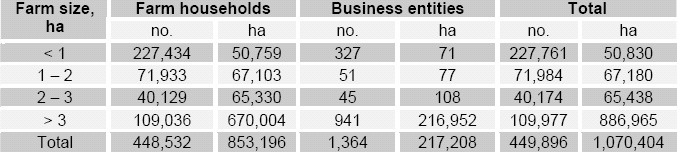
Agriculture production
5.
Agriculture, forestry and fishery sector play an important economic role in Croatia. The
total value of agricultural production increased by 17.2 percent between 2000 (HRK 10.95
billion.) and 2005 (HRK 13.18 billion), yet its share of total GDP decreased from 7.4 percent to
5.8 percent. In 2004, the 99,000 people employed in the agriculture formed 7 percent of total
employment in Croatia. Table 1 shows the average farm size in Croatia. The family sector
occupies approximately 80 percent of agricultural land, holds 82 percent of the livestock and
accounts for approximately 95 percent of the total workforce in agriculture. The majority of
family farms are fragmentized, with, on average, 4.4 land parcels per household with an average
size of 0.45 hectares.
Table 1: Farm size and number by form of ownership (Croatia 2003 Agricultural Census)
6.
In 2004, 1.09 million ha of arable land was used for grain production, about 70 percent of
the total arable area. Maize is the dominant crop, covering 58 percent of the area cropped for
grain, with wheat at 32 percent, barley at 7 percent, oats at 2.6 percent and rye and the other
grains at 0.4 percent. In recent years, wheat production has been in steady decline while the
production of maize (220,000 ha) has shown a slight increase, as has barley. Oil seed crops were
cultivated on 80,000 ha or approximately 6 percent of the total arable area with soybean
representing about 50 percent of oilseed production, which also includes sunflower and rape.
Annually, about one quarter of available arable land is uncultivated including about 20,000 ha
undergoing demining. Crop yields, which are heavily weather dependent, have been static in
recent years and are generally below EU levels. In 2004, the average yield (tons/ha) for the major
crops included wheat (4.3), maize (5.7), barley (3.3) and soybean (2.7).
7.
About 69,000 ha or 2.2 percent of total agricultural land is used for fruit production, 95
percent of which is owned by family farms, which market only a small percentage of their
production. As a result, Croatia imports in excess of 50 percent of its fruit consumption. While
most fruit production has been static or in decline in recent years, apple production, which forms
43 percent of total fruit production has risen by about 8 percent since 2000 in response to s
strong government subsidy program for orchard development.
8.
Cattle production (breeding) is the most important livestock enterprise in the Republic of
Croatia (with 40 percent share in livestock production, including milk production) and also one
of more important agriculture activities. Since independence in 1991 cattle numbers have
decreased by about 40 percent and dairy cattle by about 35 percent. While dairy cow numbers
have fallen significantly, total milk production now exceeds pre-independence levels following a
24
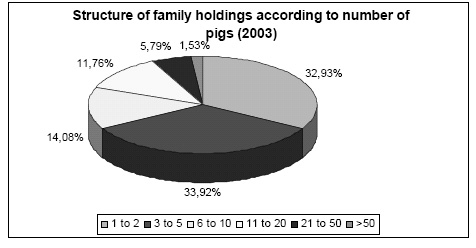
200 percent plus rise in cow productivity, which reached 4,485 liters in 2005. While dairy herds
are small, having less than 3 cows on average (in 2003 only 2 percent of farms had more than 10
cows) and cow productivity falls well short of EU norms, which exceed 6 ton per cow per
annum, there are strong indications for continued improvement in both cow productivity and
herd size in the Croatian dairy sector. About 23 percent of total milk production occurs in the 3
project counties.
9. In 20035, there were 86.269 agricultural holdings with beef cattle, of which 85,930 (99.6
percent) were family holdings and 339 (0.4 percent) were farm enterprises. The production
structure is based on small, fragmented, mixed farms with poor animal housing, hygiene and
environmental conditions, with 77 percent of the family holdings have up to 5 cattle, 18.3
percent with up to 15 cattle and 4.7 percent with 16 or more cattle. For the larger farm
enterprises, one third (32.4 percent) have up to 20 cows and two thirds (67.6 percent) keep more
than 20 cattle, of which 25.4 percent or 86 farms have more than 100 cattle.
10.
Pig production is also small scale. In 2003, there are 215,240 farm holdings having pigs
including 214,814 family holdings having 1,726,895 pigs (av. 8 pigs/farm) and 426 legal entities
having 197,777 pigs (av. 464/farm). Pig production is concentrated in 5 counties of central and
eastern Croatia, namely Osijecko-Baranjska (15 percent), Vukovarsko-Srijemska(11 percent),
Bjelovar-Bilogora (10 percent), Koprivnica-Krizevci (9 percent) and Zagreb County (9 percent)
where the pig population on private holdings averages about 12/farm. Table 2 shows the
structure of pig ownership on family farms.
Table 2: Structure of pig ownership on family farms
11.
Poultry production, predominantly for broilers and turkeys, in contrast to other forms of
livestock production, is largely through more industrial scale enterprises. While an estimated
347,000 farms hold poultry, just 0.14 percent of those farms account for 56 percent of total
poultry production and these commercial farms are heavily concentrated in Varazdinska county.
5 2003 Agriculture census
25
Institutional Setting
12.
Croatia has several governmental organizations and public authorities responsible for
protecting soil and water from adverse agricultural practices. The MAFWM is responsible for a
wide range of issues related to agriculture, rural development, fisheries, forestry, hunting and
water management. The MAFWM is the main government body responsible for the protection of
agricultural land from pollution by harmful substances and integrated water management and
related legislation. These tasks are carried out by the Department of Water Management and
Department of Water Policy and International Projects, which is, inter alia, responsible for
protecting water from pollution caused by adverse agricultural practices. Besides making
strategic planning and legislation, the MAFWM is also in charge of inspection (agricultural and
water), preparation and issuing permits for :
· Mineral fertilisers and veterinary medicines;
· Import and trade of plant protection agents;
· Water management permits for water discharge and trading with chemical substances and
preparations that might, after use, be discharged into waters;
· Concessions for water use that exceeds the scope of general water use.
13.
The Ministry of Environmental Protection, Physical Planning and Construction
(MEPPPC) is responsible for legislative development, strategic planning, permitting, monitoring
and inspection in the field of environmental protection. It is in charge of protection of air, soil,
climate change and ozone layer protection, coastal zone, sea, waste management and
environmental impact assessments. The Ministry of Environmental Protection, Physical Planning
and Construction is responsible for the overall policy of environmental protection in providing
conditions for sustainable development; protection of air, soil, water, sea, plant and animal life in
the totality of their interactions.
14.
Croatian Waters is a public company in charge of water management. The tasks of CW
are preparation of draft Water Management Strategy, draft River Basin District Management
Plans, water management plan (annual investment plan), implementation of the said plan,
protection from adverse effects of water, water use in the sense of determining the water reserves
and control over their implementation, protection of water in the sense of monitoring and
determining the quality of water, and application of measures for the prevention and reduction of
water pollution, issuing of the water rights acts and keeping water books and management of the
Water Information System, income planning and financing water management, and calculation
and collection of water charges.
15.
The Croatian Environment Agency (CEA) is in charge of collecting and processing
various data on the environment. It is also responsible for the monitoring of environmental
pollution, maintaining databases with environmental information and for providing statistics data
required for reports on the national state of the environment.
16.
The Croatian Agricultural Extension Service Institute (CAEI) is the main agricultural
advisory service in Croatia. The organisation is an independent legal entity, but has
responsibility to implement MAFWM policy. Currently the organisation employs some 180
people and has regional offices in each county. The CAEI provides technical recommendations,
26
instructions and practical examples of new technologies and management practices. It has also
been active in publishing and production of various other extension materials. CAEI services are
free to all family farms.
17.
The Croatian Soil Institute (CSI) monitors the state of agricultural soils and their degree
of their pollution and provides expert services on soil, manure and fertiliser analysis, nutrient
pollution control and integrated nutrient management. The organisation has some fifteen staff
and runs a soil testing laboratory.
18.
Both the Osijek and Zagreb Faculties of Agriculture have departments dealing with soil
and water protection and run laboratories capable of performing soil and water tests.
19.
The Environmental Protection and Energy Efficiency Fund has been established as an
independent legal entity with public authority. It is an extra-budgetary fund providing additional
financing for environmental projects. The activities of the Fund are mostly directed toward
investments related to the construction of new and rehabilitation of existing landfills.
Agriculturally Derived Nutrient Load to Croatian Waters
20.
Croatian farm level and trade statistics constrain the accurate estimation of nutrient
application in agriculture, however, available national statistics and FAO data indicate that
Croatia is one of the most intensive fertilizer users in Europe. In 2001, Croatian consumption of
nutrients deriving from fertilizers on arable land was some 25 percent more than EU-15 and
substantially higher than in other transition countries. In the period 2001-2004, Croatian average
annual fertilizer nutrients consumption per hectare of utilized agricultural area (UAA) was 58
percent higher than in EU-15 (194 vs. 123 kg nutrients). The Croatian livestock population6,
estimated at about 800,000 LU or 0.8 LU per UAA, is than 50 percent of its levels in the 1980's.
It is estimated that Croatian livestock produces some 65,000 tons of nitrogen and 33,000 tons of
P2O5 annually. Recent analysis using 2003 agricultural census data indicates a surplus of 155 kg
N/ha of UAA, well above earlier, less empirical estimates of 50,000-80,000 kg N/ha of UAA.
The recent analysis further indicates that, in Croatia, much more N (63 percent) derives from
fertilizers than from livestock, which supplies only 19 percent of all nitrogen (compared to 50
percent in the EU). In Croatia, therefore, N derived from manure is less critical than the nitrogen
load from fertilizers, emphasizing the critical importance of effective fertilizer management in
the application of GAP and reduction of nitrate pollution.
Policies for Nutrient Pollution Control
21.
Croatia's policies efforts on nutrient pollution control are focused on aligning national
legislation with that of the EU. This demanding task consumes most of the administrations' time,
energy and human resources. Regulations controlling negative environmental impact due to
nutrients derived from agriculture are at an early stage of development. EU CAP cross compliance
measures are not yet in place, however, the Government is aware of this need and has recently
amended the regulation on agricultural subsidies to require all Croatian farmers claiming direct
payments (about 100,000 farmers) to farm in accordance with "good environmental practice".
Croatia is currently preparing the Code of Good Agricultural Practice (CGAP) and the Law on
6 2003 Agricultural Census.
27
Fertilisers and Soil Amendments prescribes that the use of fertilisers should be used "in
accordance with the principles/code of good agricultural practice". The Ordinance on the
Protection of Agricultural Land from Contamination by Harmful Substances also includes some
elements of a CGAP. The Law on Agricultural Land prescribes measures for protecting land
against adverse agricultural practices, regulates the application of harmful substances to the soil
and enquires that agricultural land is well managed. The Law on Fertilisers and Soil
Amendments regulates quality, quality control, labelling, trade and inspection of livestock
manure, fertilizers and soil improvers. The Act on the Financing of Local Self-Government and
Administration Units includes a rarely used provision enabling local governments to tax the
owners of neglected agricultural land.
22.
Penalties for Water Pollution. Farmers failing to meet legal requirements in regard to
water protection from nutrients deriving from agricultural sources may be fined up to several
thousand Euros. Inspection, however, is mostly confined to enterprise farms and discovered
breaches have resulted in few prosecutions.
Government Subsides and the Environment.
23.
Croatian agricultural subsidies, for which approximately 150,000 registered farmers are
eligible, are administered by the MAFWM. In recent years, MAFWM support for the sector has
hovered around EUR 300 million, of which the majority is used for market support measures.
Additional, largely un-quantified district and municipal subsidies are also available to registered
farmers. Subsidies that directly impact on Nitrates include support for the intensification of crop
production through input subsidies and commodity price support, subsidies for expanding cattle
and pig herds and an uncapped LU/ha subsidy for maintaining livestock on pasture. Support for
organic farming for a range of commodities provide a countervailing measure, however, their
levels are modest when considered against the additional registration and production costs
associated with organic farming. Under its SAPARD program, the government has also included
a sub-measure to support on-farm manure storage; however, in the absence of any supporting
extension program, it has had little or no uptake. An indirect subsidy to the State-owned fertilizer
company (now under privatization) in the form of a reduced gas price lowers N-based fertilizer
prices on the Croatian market, amplifying the negative environment impact of crop
intensification subsidies.
Environmental requirements for manure storage
24.
At present Croatia has no agri-environmental programme or specific legislation
regulating manure management. The Act on Animal Husbandry requires management practices
to "comply with environmental legislation requirements", which it fails to specify. The 2003 Act
on Amendments of the Act on Animal Husbandry envisages fines in the range EUR 680-1,360 for
those keeping animals "against the environmental protection legislation". The 2006 Act on
Amendments of the Act on Animal Husbandry prescribes that livestock manure should be
handled "in a manner which does not threaten the environment" and that manure storage
facilities should comply with "prescribed technical and technological requirements", which are
not yet prepared, but is in progress through the CAEI and due by June 2007. The 2001 Law on
Organic Agriculture and subsequent directives and ordinances became effective in 2003, and is
inconsistent in parts, a situation that the MAFWM is currently remedying. Besides
28
aforementioned, Croatia has no comprehensive legislation for protecting water from nutrients
deriving from agricultural practices, but aims to have a Water Framework Directive 2000/60/SE
prepared by 2008.
Soil and Water Quality Monitoring
25.
Pursuant to the Law on Environmental Protection, the Croatian Environmental Agency
(CEA) is in charge of the Environment Information System (EIS). The EIS collects and
disseminates environmental information on water, soil, air, biodiversity, waste, climate change
and all other subjects relevant to environmental protection and related policies. The EIS, not yet
fully effective, is developed by MAFWM and CW.
26.
Soils testing. Croatia is developing a Croatian Soil Information System (CROSIS), which
will be aligned with the requirements of the European Information Service Centre (EISC),
however, its development remains incomplete. At present, there is no systematic national
collection of data on soil damage and the available data are incomplete and poorly organized,
preventing reliable soil damage assessments. In 2003, the Croatian Soil Institute initiated a soil
analysis project for the project counties of Osijecko-Baranjska and Vukovarsko-Srijemska
counties, which now includes 11,900 soil samples from 41,500 hectares of arable fields for
Osijecko-Baranjska County alone. The Agroecology Institute of the University of Osijek also
manages a soil testing laboratory and maintains a test database that currently includes some
10,000 results including 8,000 from the Slavonia and Baranja regions. The Agroecology Institute
staff have been developed "fertilization calculator" software package that is adapted for the
Croatian circumstances, notably for the region of Slavonia and Baranja - the most intensive
agricultural areas in Croatia.
27.
Water Testing. The program of surface and groundwater quality monitoring is the
responsibility of MAFWM and CW. The program of water quality monitoring in the Republic of
Croatia encompasses monitoring of water quality on 330 monitoring stations on watercourses,
lakes and accumulation lakes, 277 monitoring stations on groundwater, and 82 monitoring
stations in the coastal sea impacted by land-based pollution. The program of water quality
monitoring is organized so as to measure the water quality in parts of watercourses with
significant inflows into the watercourse and discharges of industrial and municipal wastewater,
in more sensitive areas (groundwater and surface waters that are used or are planned to be used
for water supply, mountain streams up to the settlements, watercourses in karst areas up to the
settlements, waters in national parks and nature parks), and in parts of watercourses where the
water resources are used or are planned to be used for specific purposes. The program of water
quality monitoring also contains the program on trans-boundary waters that are tested within the
bilateral cooperation with the Republic of Slovenia and Republic of Hungary and program of
water quality testing on national waters and coastal sea impacted by land-based pollution. The
programs of groundwater quality monitoring include 124 monitoring stations in the zones of
contribution of well fields of the City of Zagreb, 84 monitoring stations on well fields of the river
basin district of Sava, Drava and Danube, and 19 monitoring stations on the river basin district of
Istrian and Littoral Basin and Dalmatian Basin. The program is developed and implemented by
CW through Main water management laboratory of Croatian Waters and other licensed
laboratories for testing wastewater quality.
29
All legal persons discharging wastewater in accordance with water rights permits have the
obligation of testing wastewater quality. Wastewater testing is performed by authorized
laboratories, pursuant to MAFWM authorization.
28.
The Ministry of Health and Social Welfare is responsible for the Regulations on Sanitary
Quality of Drinking Water. Testing of sanitary quality of drinking water is performed by the
Croatian National Institute of Public Health and County Public Health Institutes.
The Project Area
29.
Physical, Geographic and Climatic Characteristics. All three project counties: (i)
Osijecko-Baranjska; (ii) Vukovarsko-Srijemska; and (iii) Varazdinska are located in the
Pannonian region and have comparable physical, geographical and climatic characteristic. The
Pannonian plan is Croatia's prime agricultural area producing the majority of the country's
cereals and industrial crops. All three counties have well developed agriculture, livestock and
associated food industries including vegetable oils and sugar, meat processing, dairy and
wineries.
30.
The counties experience a moderate continental climate. Mean monthly temperature in
the coldest month of the year is between -10°C and 10°C. Mean annual precipitation ranges
between 600 and 1000 mm and with the largest precipitation occurring during the growing
season. The topography is predominantly flat containing typically medium to heavy consistency
fertile alluvial soils including chernozem and eutric brown soils, Croatia's most fertile soil types,
however, these soils have, in the last hundred years of cultivation, lost 50-70 percent of soil
organic matter with the humus content falling from 4-6 percent to 1-2 percent on average. Some
60 percent of arable land soils in these regions suffer from seasonal water-logging, enhancing
soil acidity, which is the major factor limiting soil fertility and the effective utilisation of applied
nutrients (particularly phosphorus). One third of the soils have a pH value less than 5.5. Less
than 0.2 percent of the agricultural land in these three counties is under irrigation.
31.
Number and type of Farms. Family farms prevail in the project area, which also
contains all the major Croatian agro-kombinats. Private farming occupies 63 percent of the
344,000 ha of arable area, with the majority of farms having <5 ha of arable land and keeping
between 2 and 20 livestock units (LU), with medium scale farmers keeping 20-50 LU. The
Project area contains 25.6 percent of all LU in Croatia. Table 3 provides a breakdown of farm
numbers in the project area, which comprise 22 percent of total farms in Croatia. Table 4
provides the breakdown of herds in the project area reaching the proposed threshold for project
intervention. Detailed breakdowns of farm numbers by county and livestock population are
available in the project working papers.
Table 3: Number of farm households and enterprises in the project area (2003 Ag. Census)
No. of No of business
Total
households
entitites with
with UAA
UAA
Croatia
437,247
1,079
438,326
Osijek-Baranja County
38,389
206
38,595
Vukovar-Sirmium County
25,052
115
25,167
Varazdin County
32,616
36
32,652
Total
96,057
357
96,414
% of Crotaia
30 22.0
33.1
22.0
Table 4: Number of family farms and agricultural companies
with >10 cattle animals and > 50 pigs.
> 10 cattle animals
> 50 pigs
Total
Family
Agric.
Family
Agric.
Family
Agric.
farms
companies
farms companies
farms companies
Osijek-Baranja County
598
54
578
37
1,176
91
Vukovar-Sirmium County
608
19
455
13
1,063
32
Varazdin County
184
12
5
5
189
17
To
tal
1,390
85
1,038
55
2,428
140
32.
Livestock production. In Osijecko-Baranjska and Vukovarsko-Srijemska counties, cattle
and pigs account for more of 85 percent of all LU in those counties, while in Varazdinska county
poultry is predominant, accounting for 39 percent of LU (Figure 1). Detailed breakdowns of farm
numbers by county and livestock population are available in the project working papers.
Figure 1: Breakdown of livestock populations in project counties
LU composition, County of Varazdin
LU composition, County of Osijek-Baranja
LU composition, County of Vukovar-Sirmium
Sheep
Pigs
0%
26%
Pigs
Pigs
49%
39%
Bovine
45%
Bovine
Polutry
Bovine
38%
39%
30%
Sheep
Polutry
PolutrySheep
6%
5%
4%
5%
Others
Goats
Goats
Others
Goats
4%
1%
Others
1%
4%
3%
1%
No. of LU County of Varazdin
No. of LU County of Osijek-Baranja
No. of LU County of Vukovar-Sirmium
25,000
45,000
30,000
40,000
20,000
25,000
35,000
30,000
20,000
15,000
25,000
15,000
10,000
20,000
15,000
10,000
5,000
10,000
5,000
5,000
0
0
0
Polutry Bovine
Pigs
Others Goats Sheep
Bovine
Pigs
Sheep Polutry Others Goats
Pigs
Bovine Polutry Sheep Others Goats
33.
Agriculture production. Cereals dominate agriculture production, occupying about
two-third of the entire arable land, followed by oil crops in Osijecko-Baranjska; and
Vukovarsko-Srijemska counties and potatoes in Varazdinska county with forage crops the third
31
most important commodity (Figure 2). This cropping pattern involves a very narrow crop
rotation, with little use of legumes crops or pastures. A three-year crop rotation consisting of
winter wheat, maize and potatoes constitutes the most popular crop rotation practice, with a crop
rotation comprising just maize and winter wheat also common. Detailed breakdowns of cropping
patterns by county and farm size are available in project working papers.
Figure 2: Pattern of agricultural activities in the project area and Croatia
Croatia
Osijek-Baranja County
Oil crops
11%
Forage
Oil crops
crops
19%
7%
Forage crops
Vegetables
& herbs
7%
3%
Vegetables &
Sugar beet
herbs
3%
Cereals
0%
68%
Cereals
Fallow
Sugar beet
72%
3%
5%
Fal ow
Potatoes
1%
1%
Potatoes
0%
Vukovar-Sirmium County
Varazdin County
Oil crops
Oil crops
2%
22%
Forage crops
3%
Vegetables &
herbs
Forage crops
2%
5%
Sugar beet
1%
Vegetables &
Cereals
Cereals
herbs
65%
85%
Fal ow
1%
3%
Sugar beet
Potatoes
6%
4%
Fallow
1%
Potatoes
0%
34.
Nitrogen Load. In Osijecko-Baranjska; and Vukovarsko-Srijemska, manure makes
negligible contribution to N load (15-20 percent) in comparison with applied fertilisers, however,
in Varazdinska County due primarily to the intensive poultry production, fertilisers and manure
make approximately equal contribution to N load (Figure 3).
32
Figure 3: Nitrogen load on arable land by County
N load
(k g N/ha arrable land/ye ar)
300
250
200
150
Organic N
100
50
Fertilisers N
0
County of
Croatia
County of
County of
Varazdin
Vukovar-
Osjek-
Sirmium
Baranja
35.
Water Quality and Nitrates. Regional data indicate that in the period 2000-2006, some
57 percent of all analysed water samples from private (farmers') wells in Croatia did not meet
the Croatian minimum acceptable concentration (MAC) requirements for nitrates. In Osijecko-
Baranjska county 39 percent exceeded MACs, while in Varazdinska and Vukovarsko-Srijemska
counties the figure was about 46 percent, indicating the need for further testing and increased
awareness of this risk, which should be built into the project communication strategy.
33
Annex 2: Major Related Projects Financed by the Bank and/or other Agencies
CROATIA: Agricultural Pollution Control Project
1.
Recognizing the importance of reducing nutrient loads to Croatian water bodies, the
government of Croatia has sought technical and financial assistance from various international
donors in its efforts towards improving the quality of Croatia's surface and groundwater bodies.
The aim is to improve the overall performance of the agricultural sector, protect the environment
and implement measures for compliance with the EU Nitrates Directive. Several projects are
currently under implementation, including, inter alia:
IBRD Project
2.
Agricultural Acquis Cohesion Project. Financed by an IBRD loan, the project, for which
the GEF project is an extension, aims to develop sustainable systems and capacities within the
Government to enable the country to capture benefits in the agricultural sector accruing from
accession to the European Union and meet EU acquis requirements. These outcomes are
envisaged to be achieved through: (i) implementation of EU acquis in rural development; (ii)
empowerment of MAFWM management and administration; and (iii) ensuring safe food and
SPS conditions. A key activity under component (i) would include a program of investments and
technical assistance to private and public sector farmers and agro-processors in environmentally
friendly agricultural practices so as to "keep their land in good agricultural condition". The
proposed project will also help expedite Croatia's efforts with accreditation of AE measures by
the IPARD agency, at the same time ensuring that the measures are of national priority and EU-
aligned. By assisting the government of Croatia to accredit agri-environment measures under
IPARD, the project will help in leveraging substantial investment grants for nutrient mitigating
activities.
EU-Supported Programs
3.
Capacity Building and Development of Guidelines for the Implementation of the Water
Framework Directive. Supported by the EU-CARDS 2004 Program, the overall objective of the
project is to improve the water quality standards and water management in Croatia in line with
EU standards and requirements. It also strives at further institutional and administrative capacity
strengthening of the Croatian water management administration as well as relevant state
institutions, stakeholders and NGOs.
4.
Approximation of Croatian Water Management Legislation with the EU Water Acquis.
Supported under EU-CARDS 2003, the project aims at supporting MAFWM with: (a)
completing a legal, administrative and institutional assessment and identifying regulatory actions
for further approximation to the EU water acquis; (b) preparing a draft Strategy and Action Plan
for the approximation of Croatian legislation with EU water acquis as a part of the overall
National Environmental Accession Strategy developed under the CARDS 2002 project led by
MEPPPC; (c) conducting, for the identified areas, a horizontal impact assessment on Nitrates,
Drinking Water, dangerous substances and UWWTD; (d) drafting of the compliance plan for the
UWWT Directive; and (e) definition of priority areas for future activities of the SAPARD
Program - Agriculture and Rural Development Plan 2006.
34
5.
EU-LIFE Project. Within the framework this project, the EU is supporting the
development of a Croatian soil monitoring program. It aims at developing a Soil Monitoring
Program that will serve as the basis for the development of a harmonized and coherent Croatian
soil information system, compatible with the European Soil Information System EUSIS, and
will provide vital data for policy-making and international networks.
6.
Investments in Agricultural Holdings. This SAPARD-supported measure provides for
investments in the construction and/or adaptation and/or equipping of animal sheds, including
"investment in animal manure, slurry reservoirs and specialized manure", which is listed as a
(sub) measure eligible for stand-alone financing. For investments in the construction of livestock
farms, applicants must demonstrate at the end of the investment that manure is stored and
managed according to EU standards (details will be elaborated in the "Ordinance on SAPARD
program implementation"). The program requires 50 percent co-financing (in-kind contribution
does not count towards this). So far, only one round of grant distribution has been realized.
UNDP Project
7.
Danube Regional Project. The project involves all Danube Basin countries and covers
some 80 activities including analysis of agricultural policies and pilot projects on the reduction
of nutrients and other harmful substances from agricultural point sources and non-point sources.
The project has produced several policy analysis documents and organized several capacity
building events on agricultural pollution control. In 2004, it provided support in developing the
concept of Best Agricultural Practice (BAP) in the Danube River Basin countries, including
improvements in the management of livestock manure, minimizing the use of fertilizers, better
use of crop rotations and the creation of buffer zones. In 2005, the Danube Regional Project
provided a EUR 5,000 grant to the Croatian office of the Regional Environmental Centre in order
to implement a training program on best agricultural practices in the Danube river basin area of
Croatia.
35
Annex 3: Results Framework and Monitoring
CROATIA: Agricultural Pollution Control Project
Results Framework
PDO
Project Outcome Indicators
Use of Project Outcome
Information
To assist the Government of Croatia
At least 40 percent of the farming
Determine whether nutrient
to significantly increase the use of
population in the project areas
reduction technologies are effective,
environmentally friendly agricultural adopting preventive and remedial
are readily adoptable by farmers,
practices by farmers in Croatia's
measures to sustainably reduce
and whether training and advisory
Danube River Basin in order to
nutrient discharges.
systems are reaching the intended
reduce nutrient discharge from
clients.
agricultural sources to surface and
Increased national awareness of
ground water bodies.
significance and benefits of project
Determine government capacity to
actions and their impact on water
award and manage grants for
quality and overall community
implementation of environmentally
wellbeing.
friendly agricultural practices related
to manure management.
Determine whether public
information programs have achieved
adequate coverage.
GEO
Project Outcome Indicators
Use of Project Outcome
Information
The global environment objective is
At least 10% reduction in discharge
Determine whether project-
to improve the quality of the waters
of nutrients into surface and
developed interventions are
of the Danube River and Black Sea
groundwater in the three pilot
successful and being replicated on a
through reduction, over the long
project areas.
wider scale.
term, in the discharge of nutrients
(nitrogen) into Croatian water bodies
leading to the Danube River and the
Black Sea.
Intermediate Outcomes
Intermediate Outcome
Use of Intermediate
Indicators
Outcome Monitoring
Component 1. Mitigating nutrient
Annually, review progress of
loads to Water bodies from
implementation/distribution of
Manure and its by-products
grants. At mid-term, assess whether
(slurry)
beneficiary criteria are appropriate
and farmer awareness adequate.
Improved manure management
Percentage of livestock farms in
Modify packages and increase
practices adopted by households
three participating counties adopting
awareness if uptake low.
with livestock in targeted counties.
improved animal waste management
practices.
PY1 before start of manure storage
constructions install piezometers in
Water quality monitoring, analysis
Unified set of monitoring guidelines
selected farms and establish baseline
and reporting capacity of Croatian
and standards for soil and water
water/soil quality parameters.
Waters strengthened.
adopted, and monitoring program
implemented.
Afterwards, assess the change in the
level of nitrates.
36
Component 2. Development and
promotion of agri-environment
measures
EU compliant Code of Good
Promulgation of CGAP legislation.
Annually, confirm progress after
Agricultural Practice (CGAP)
implementation of project activities,
legislated.
and adjust intervention strategy, if
required.
CGAP technology successfully
At least 200 ha of pilot GAP
tested and applied.
demonstration sites in each of the
three counties.
Multi-annual applied research into
economic crop fertilizer response
successfully completed.
Percentage of cropped area in the
project counties under relevant
nutrient reduction measures.
Component 3. Public Awareness
and Replication Strategy
Rural populations aware of actions
Percentage increase of rural
Find more effective ways to reach
required to reduce nutrient loads to
population in project and non-
target groups, if necessary.
water bodies.
project areas aware of and initiating
/ implementing actions related to
Review/restructure communications
nutrient reduction.
program if monitoring program
indicates poor awareness of
environment threat and solutions.
Component 4. Project
Management
Efficient project management
PIU fully functional and operating
Mainstream project implementation
ensuring smooth implementation of
effectively to manage both AACP
functions within the MAFWM by
project activities.
and GEF activities.
gradually transferring component
management to responsible
Continued strong support from
MAFWM departments and
Project Steering Committee.
institutions.
Project progress and financial
Review implementation
reports are initiated and submitted in
arrangements, staff capacity and
a timely manner.
leadership if Monitoring system
indicates negative results.
Project audits and procurement and
financial management supervision
Failure to manage the project
mission reports uniformly good
effectively would lead to delays in
results.
implementation.
Monitoring and Evaluation system
established and operating, providing
guidance for improving project and
Nitrates management.
37
Arrangements for Results Monitoring
Institutional Arrangements
1.
The main institutions in charge of APCP M&E are the MAFWM PIU, the CAEI and
Croatian Waters. Selected indicators of the APCP M&E will feed into the planned Croatian
Waters national database on surface and groundwater pollution. The PIU will design a simple
Management Information System for M&E, reporting formats for each component, including
targeted annual performance objectives and monitoring indicators using the results monitoring
framework details as the basis. These indicators include evaluating the project's impact by
monitoring soil and water quality. Semester reports will cover progress in physical
implementation, the use of project funds and project impact. The Semester reports will be
submitted by the PIU to the Project Steering Committee and to the Bank within forty-five days of
the end of each six-month reporting period. These Semester progress reports will include an
implementation plan and work program for the next six months following the reporting period.
The format of reports will be agreed with the Bank. The expected outcomes related to changes in
behavior and awareness campaigns will be measured at baseline, mid-term and end of project
through surveys commissioned by the PIU (see below).
Data Collection
2.
Croatian Waters will be responsible for collecting and providing the data regarding water
quality and nitrate pollution. Croatian Waters will sample and test water from the 27 piezometer
sampling sites established under the project, in addition to other surface and groundwater
sampling sites that already exist in the project counties as part of the national water testing
system. Croatian Waters will provide regular summaries of test results for project installed and
national sampling sites in the project counties.
3.
In addition to the water quality indicators and progress in implementation indicators, the
PIU will commission 3 surveys (baseline, mid-term, and end-ofproject), aiming to measure the
changes in behavior in project area and the outcomes of the awareness campaign. A quick focus
group survey was already carried out during preparation, in the three project counties. This
exercise will be expanded and rolled out as new farm communities enter the project, using quasi-
randomization. In the same time, to demonstrate the impact and benefits of the APCP approach,
a control group of (similar) farm communities will be selected and the same indicators will be
collected (in the absence of the project). The impact of APCP in the project counties will be then
demonstrated using the double difference of the estimates (in time and in project vs. control
groups).
4.
Finally, since the awareness campaign will be carried out at national level, a national
representative sample will be used to measure the outcomes of the campaign.
Measurement of PDO
5.
The PDO indicators will be estimated using three different data sources: social surveys,
Nitrate pollution surveys, and GoC/EU reports.
38
a.
The behavioral change at community level will be measured through a compound index
including two elements: (i) improved waste management practices adopted by households
with livestock, and (ii) application of nutrient reduction measures under the Code of
Good Agricultural Practices. The first element is measured through a summative index
composed of the following indicators (a) separation of animal waste/ manure collection,
preventing seepage into the soil; (b) regular (monthly) removal of the manure from the
premises to an appropriate disposal spot; (c) the household's animal waste collection spot
is located at more than 40 meters from household wells. The second element is also a
summative index, which includes: (a) crops rotation, (b) use of natural fertilizers, (c) use
of chemical fertilizers and/ or pesticides under the guidance of a specialist and crop
nutrient requirement software.
b.
The reduction of the nutrients discharge into the water bodies, will be estimated, by the
PIU/CAEI, using (i) "proxy" methods, with the inputs from the annually reports of the
Statistical Office on the quantities of mineral fertilizers used in the project area, the CAEI
reports on the quantities of manure collected and used as organic fertilizer and the
contribution at nutrients retention, of the various good agricultural practices implemented
(e.g. buffer strips, nutrients management, reduced tillage etc.); and (ii) Croatian Waters
test results of samples taken from piezometers installed in selected participating farms.
c.
The strengthened institutional and regulatory capacity will be measured using GoC and
EU reports on Croatia's progress, as well as by the frequency, timely delivery, and data
completeness of the monitoring reports issued by the MAFWM PIU and Croatian Waters.
Capacity
6.
The PIU Nitrates Management Specialist will coordinate the M&E program and will
commission a M&E contract for the conduct of start-up, mid-term and end-of-project aiming to
measure the changes in behavior in project area and the outcomes of the awareness campaign.
39
r
s
te
i
bility for Data
llection
o
Wa
C
n
tia
Respons
PIU / pilot counties /
CAEI
PIU and CAEI
Croa
PIU / pilot
counties/CAEI
PIU
s
ie
d
t
u
Instruments
s
Data Collection
EI
Social surveys
CA
Sample surveys
Croatian Waters
water testing program
CAEI studies
PIU monitoring
program
rts
repo
PIU
i
d-term
n
PIU
m
PIU
Reports
letio
Frequency and
Annual
progress reports
Project
review and
comp
Annual
progress reports
MAFWM
semester progress
reports
Annual PIU
progress reports
s
ent
Data Collection and Reporting
r
em
YR4
t
25%
Satisfactory
implementation
to mee
government and
EU requi
40
r
k
ring
o
w
YR3
onito
M
frame
adopted
ring
ied
Arrangements for Results Monitoring
YR2
if
n
15% 25% 40%
2% 5% 10%
10% 15% 25%
u
monito
system
YR1
5%
10%
0%
6%
Proposed
e
0
te
Baselin
TBD
(Social
Assessment)
0
6%
Discre
monitoring
framework
for water and
soil
a
l
ating
es to
nitoring
e
asur
o
e
duction in
.
ree particip
Indicators
t 40 % of the farming
t 10% r
t
orages
pact on water nutrient
Intermediate Outcome
plemented
Project Outcome Indicators
At leas
population in the project
areas adopting preventive
and remedial m
reduce nutrient discharges
Increased national
awareness of linkages
between local actions and
im
load
At leas
discharge of nutrients into
surface and groundwater in
the three project regions
Component 1
Percentage of livestock
farms in th
counties that have anim
waste s
Unified set of m
guidelines and standards for
soil and water adopted and
im
i
bility for Data
llection
o
C
Respons
PIU / MAFWM
Directorate of
Agriculture
PIU and CAEI
PIU/Research
contractor
PIU/CAEI
PIU/CAEI
Bank Task Team
ls
ia
tr
h
Instruments
supervision
Data Collection
earc
MAFWM Annual
report
CAEI field reports
On-farm adaptive
res
CAEI field reports &
social surveys
Social surveys
Bank
reports
rt
repo
i
d-term
n
MAFWM
MAFWM
m
Reports
letio
Frequency and
Annual
PIU project
progress reports
Annual MAFWM
PIU project
progress reports
Annual MAFWM
PIU project
progress reports
Annual
PIU project
progress reports
Project
review and
comp
Six-monthly
Data Collection and Reporting
results
YR4
200 ha
published
TBD
41
YR3
200 ha
ement
YR2
ation
started
100 ha
Research
10% 20% 30%
TBD
S S S
j
ect
YR1
a
in
Impl
30 ha
contract for
3 m
crops in
each pro
county
5%
S
e
Baselin
plementa-
No
Im
tion
0
N/A Research
<5%
TBD
Satisfactory
ic crop
ted
r
oject and
t 200 ha of pilot
oject areas aware of
g effectively
n
plementing actions
Project Outcome Indicators
Component 2.
Implementation of Code of
Good Agricultural Practices
At leas
GAP demonstration sites in
each of the three counties
Multi-annual applied
research into econom
fertilizer response
successfully comple
Percentage of cropped area
in the project counties under
relevant nutrient reduction
measures
Component 3
Percentage increase of rural
population in p
non-pr
and initiating /
im
related to nutrient reduction
Component 4
PIU fully functional and
operati
i
bility for Data
llection
o
C
Respons
Bank Task Team
PIU
PIU
PIU / WB Task Team
monthly
six
i
r
es
Instruments
supervision
Data Collection
mo
Bank
reports
Project
report
M&E studies
Financial statements
Supervision missions
reports - Aide
Me
M&E
s
ion
Reports
iannual
Frequency and
m
Six-monthly
Six-monthly
Annual
reports
Audits
Se
supervi
missions
Data Collection and Reporting
YR4
42
YR3
YR2
S S S
S S S
S S S
YR1
S
S
annual
M&E
contract
awarded
S
e
Baselin
NA
NA
NA Multi-
NA
e
y
danc
and
s
ion
rml
o
r
e
itted in a
g gui
e
nt
oject
ts a
idin
v
t
s unif
o
e
por
pr
a
nagem
e
nt supervi
e
por
l r
a
nner
g,
n
c
ia
t
ed and subm
on r
erati
ssi
Project Outcome Indicators
Continued strong support for
the Steering Committee
Project progress and
finan
initia
timely m
Monitoring and Evaluation
system established and
op
for improving pr
Nitrates m
Project audits and
procurement and financial
managem
mi
good results
Annex 4: Detailed Project Description
CROATIA: Agricultural Pollution Control Project
1.
The proposed GEF project is part of an overall program of the government of Croatia to
undertake actions for EU compliance in the agricultural sector. Towards this, the government
has already borrowed US$30 million through the IBRD-financed Agricultural Acquis Cohesion
Project (AACP), which will, inter alia, (i) build capacity within MAFWM to support a
sustainable and competitive agricultural sector in Croatia compliant with EU acquis
requirements; (ii) establish a transparent and efficient payment system for the disbursement of
GEF-financed and subsequent government grants for structural reform in the agri-environment
sector; (iii) reorganize and reinforce government inspection services supporting environment
regulations; and (iv) provide project management. GEF funded activities will assist the
government in furthering its agenda for EU compliance in the agricultural sector, specifically,
implementation of the Nitrates Directive, by providing technical assistance and financing
investments for reducing nutrient loads to water bodies from agricultural sources.
2.
The proposed project is a pilot activity to be implemented in three selected counties of
Croatia: (i) Osijecko-Baranjska; (ii) Vukovarsko-Srijemska; and (iii) Varazdinska. The selection
of these counties was determined on the basis of their agricultural profile. All three counties are
characterized by intensive farming practices with growing threats of nutrient pollution to local
water bodies. The three counties combined include an estimated 2000 private farms that fit
project eligibility requirements. War-related damage to manure storage and water monitoring
infrastructure in Osijecko-Baranjska and Vukovarsko-Srijemska counties and the high
concentration of medium scale poultry farms in Varazdinska county contributed to the selection
of these counties.
3.
The project, to be implemented over four years, at an estimated cost of US$20 million
(GEF Grant US$5.0 million, AACP associated financing US$13.9 million and beneficiary
contribution US$1.1 million), will include the following components, which will not only help
improve the waters of the Danube River and Black Sea but also assist Croatia to implement the
EU Nitrates Directive.
Component 1: Mitigating Nutrient Loads to Water Bodies from Point-source Pollution
(Manure Management). (Total Cost: US$14.70 million, of which GEF US$ 3.36 million,
Associated IBRD financing US$10.40 million and Grant Beneficiaries US$0.93 million)
4.
This component will assist the government of Croatia to promote improved manure
management practices with the objective of reducing nutrient loads to the surface and ground
water bodies of Croatia. Activities under this component will also thereby assist Croatia to
implement the EU Nitrates Directive 91/676/EEC concerning the protection of waters against
pollution caused by nitrates from agricultural sources.
5.
Nitrates Mitigation Fund: The project will establish a US$2.66 million (US$3.54 million,
including beneficiary contribution) Nitrates Mitigation Investment Fund within the MAFWM
Payment Directorate to finance grants for up to 75 percent of the cost of manure storage and
43
management systems. In the counties of Osijecko-Baranjska and Vukovarsko-Srijemska,
medium scale livestock farmers having 10-100 cows, 15-150 fattening beef cattle, 40-400 sows
or 100-1000 grower/fattening pigs will be eligible for grants of up to 75 percent of the cost of
establishing on-farm, EU compliant manure storage facilities. In Varazdinska county, in addition
to cattle farmers, poultry farmers will also be targeted, with farms of 2,500 to 12,500 layers or
10,000 to 100,000 broilers per annum being eligible for matching grant assistance for storage-
based manure management systems. Grants will also be made for off-farm storage and for
manure pumping and innovative distribution equipment in some cases.
6.
Priority actions for Osijecko-Baranjska and Vukovarsko-Srijemska Counties. The
project will test a range of strategies for tackling manure management over the course of the
project. Farms with no manure storage facilities will be the primary target and will be stimulated
to construct manure storage facilities to EU standards. Farms that have some, albeit inadequate
manure storage facilities will be eligible to have those improved and/or extended. Farmers that
have found innovative, environmentally sound and cost-effective solutions to manure
management will be a particular target for the project.
7.
In developing manure storage solutions the following considerations will be taken into
account in the design:
· demonstration of a variety of possible options for manure storage;
· manure quality improvement and manure application;
· suitability for different types of farmers and livestock production systems;
· safeguarding of manure quality;
· use of available, suitable and cheapest possible materials;
· availability of the skills required in constructing and operating (including social
ones);
· effectiveness of the solution;
· requirements in terms of resources (costs), knowledge (training), permits/legislation
and possibility of safeguarding quality control in construction.
8.
Farms without manure storage facilities will be subsidized to construct manure storage
platforms/sumps to EU design standards and, in the case of platforms, connected with a liquid
manure pit so that seepage can be stored. Both the platform and associated pit and sludge sumps
will be designed to accommodate up to six months production of farmyard manure (FYM)
including allowance for any planned increment in herd size. Farms with some, though inadequate
facilities for storing FYM will be subsidized to expand the existing concrete slabs and/or for the
addition of a liquid manure pit. In a number of villages in the project area on-farm space does not
allow for the construction of an adequate manure storage facility. Their only solution would be
the construction of communal storage pits outside of the village, however, due to the complex
social infrastructure required to facilitate this process it is not advised to experiment with
communal manure storages within this project. Other farms to be excluded from the project
include:
· Small scale farmers, who are unlikely to be able to afford the necessary investments and
whose long term future in livestock farming is unlikely;
44
· Large scale farmers with plans for improvements, because they are required by municipal
legislation to construct new sheds outside the village boundaries. Conditions for their
receiving a construction permit include, inter alia, the construction of adequate manure
storage facilities and the holding of a minimum of 0.5 ha of land available for each LU;
· Other large scale farmers because they already have adequate storage facilities and where
minor, affordable adjustments are required;
· In Varazdinska county only cattle and poultry farmers will be targeted.
9.
Manure storage construction. Despite its cost, the construction of manure storage
facilities will primarily be made from concrete. The project preparation process has explored
alternatives to concrete but has not come across convincing solutions. Various metal,
fiberglass/reinforced plastic and clay materials can also be employed in constructing manure
storage. The market for various slurry tanks, basins, lagoons etc. made from this material is
emerging in the EU and notably the USA. However, these alternatives are not well known or
adopted in Croatia. Their application in EU Member States is also not widespread and concrete is
the most commonly used material for constructing manure storage. Another alternative evaluated
was the use of pre-fabricated concrete elements, however, the current price of these systems and
the level of technology (joints not strong and durable enough) in Croatia make this technology
unviable in the medium term. Manure storage pits will have a 15-20 cm GW cca gravel bedding
layer compacted to 30 MPa under the foundation slab. Waterproof and chemical resistant
concrete of strength class C30/37 will be used for constructing manure pit floors and walls. The
concrete will contain steel reinforcement of 70 kg/m3. Sealing tape will be used between upright
walls and foundation slab, construction joints and working joints. All concrete poured will be
tested, with one sample per 10M3.
10.
Priority actions for Varazdinska County. Varazdinska county has some cattle, but few
pigs and faces a severe problem with poultry (chicken) manure disposal. It is the most intensive
poultry production region in Croatia, with a poultry density of nearly 100 birds per hectare of
UAA. Poultry litter and manure are presently dumped on nearby agricultural land creating a
source of odor, infection and water pollution. The project will assist farmers to build storage
systems for poultry manure and will explore with potential investors the development of a
commercial poultry manure drying and pelleting enterprise. The project will provide technical
expertise, but not grants for commercial poultry processing. The project will also fund cattle
manure storage systems in Varazdinska county.
11.
Manure Application: The project will not support equipment for transporting and
spreading manure waste on farmer's fields.
12.
The CAEI nitrates management specialists will assist farmers to apply for grants from the
Nitrates Management Investment Fund, which will follow procedures described in the
Beneficiary and Procurement Guide. APCP procedures will parallel those applied to SAPARD
grants. Documents to be submitted by potential beneficiaries will include, inter alia, an
application form, evidence of the applicant's municipal registration, evidence of registration in
the farm registry and animal identification registry (cattle only); copies of the proposed design
and any required construction permits; 3 bids for construction of the facility; and evidence of
his/her capacity to pre-finance the investment. Grant application procedures and terms and
45
conditions for grant payments including the maintenance of construction and financial records
are described in the Beneficiary and Public Procurement Guide.
13. Payment Directorate Support: The aim of the Project would be to mainstream project
implementation functions within the MAFWM by gradually transferring component
management to responsible MAFWM departments and institutions. Towards this end, GEF
funds will be used to recruit two additional staff for the Payment Directorate with responsibility
to process grant applications for manure storage and assess their implementation. These staff will
be absorbed into the Payment Directorate by the end of the Project.
14.
Support for Water & Soil Monitoring and Impact Analysis: The project will develop and
implement water and soil monitoring program to assess the reduction of nutrient loads to surface
and ground waters from project interventions. The monitoring program to be supported by the
project will help provide incremental support to the ongoing efforts of CWA and the MAFWM's
Water of Water Policy and International Projects to align the national water monitoring program
with that of EU's guidelines. Due to the fact that: (i) there is a considerable time lag between the
implementation of nutrient management practices and measurable evidence of improvement in
the quality of waters impacted by the practices; (ii) discharge of nitrates is from several sources
(in addition to agricultural practices), such as untreated waste water from industry, household
sewage, etc. and since these cannot be cleanly separated out to measure contribution of nutrients
from each source, the project will use proxy indicators to monitor nutrient reduction loads from
implementation of the environmentally friendly agricultural practices as outlined below under
Component 2. The program will also include a systematic sample testing of well water in rural
areas, both as a goodwill measure for participating farmers as well as to demonstrate the risk to
rural communities from inappropriate nitrates management.
15.
To assess nutrient reduction from interventions under Component 1, the project will
install up to 27 piezometer sets in selected representative sites to monitor the quality of water
flowing out of livestock farms that are implementing GEF financed manure management sub-
projects. The project will finance the construction of three sets of piezometers on farms in each
of the three pilot counties. Each piezometer set will include 3 piezometers designed to sample
water at 5 m, 10 m, and 25 m depths. The project will provide data logging equipment for
piezometer monitoring and sampling. The participating farms will be selected according the
following criteria:
· type of the livestock production (bovine animals, pigs and poultry);
· variability of the soil types;
· hydrogeological characteristics of the wider area and the groundwater flow direction
towards the water recipient;
· the situation within the network of the existing state monitoring of both surface and
groundwater quality.
16.
The project will also install three sets of three lysimeters in Varazdinska county in the
vicinity of selected livestock farm to provide a measure of nitrate and other parameters leaching
through the soil. This equipment will be integrated into the CWA ground/surface water
monitoring schemes.
46
17.
The PIU will commission the preparation of a Quality Control and Quality Assurance
(QC/QA) operational manual with the aim of ensuring that all procedures starting from sampling
planning, field work, sample handling, laboratory analysis till the record keeping and
documentation would be coherent on all measuring stations and monitoring programs.
Groundwater sampled from piezometers on up to a monthly basis, will be tested for ammonium,
nitrite, nitrite, total nitrogen and total phosphorus. Newly installed piezometers will be integrated
into the program of national monitoring, and in that case the other parameters can be determined.
In samples of percolate from lysimeters leaching of nutrients should be monitored, as well as
pesticide residues.
Component 2: Development and Promotion of Agri-Environment Measures (Total Cost:
US$3.96 million, of which GEF US$1.30 million, Associated IBRD financing US$2.50
million and Grant Beneficiaries US$0.16 million)
18.
This component will strengthen the capacity of the Croatian Agriculture Extension
Institute (CAEI) to: (i) advise and train farmers on the most cost effective on-farm technologies
that need to be employed for complying with the Nitrates Directive with particular emphasis on
fertilizer/manure storage and land application based on soil nitrogen balances; and (ii) adapt the
Code of Good Agricultural Practices to the needs of the dominant farming systems in the project
counties and interpret the Code in a manner that would ensure farmer buy-in. The project will
provide information and practical training on, inter alia, nutrient remedial measures, EU
principles on project financing, measures to obtain funding support from non-Bank sources, etc.
to both beneficiaries (enterprises and farmers). Both formal and on-the-job training will be
provided to inspectors, monitors and other staff at local, regional and central levels. To manage
the GEF-funded project activities, a technical specialist will be recruited and paid through the
GEF grant funds.
19.
Dissemination of Code of Good Agriculture Practice (CGAP): As part of the EU Nitrates
Directive, this sub-component will help the MAFWM to disseminate CGAP that incorporates
internationally-tested and proven good agricultural practices that are relevant for the diverse
Croatian topographic and climatic conditions. The CAEI will interpret the Code in a manner that
would ensure farmer buy-in, and develop and publish a user-friendly Guideline that would help
farmers understand and implement the relevant provisions of the Code. The publication of the
Guidelines would be supplemented with brochures, messages through mass media, agricultural
fairs, etc. where farmers would be informed by project-trained CAEI staff and private advisers of
the most cost effective on-farm technologies that need to be employed for complying with the
Nitrates Directive, with particular emphasis on fertilizer/manure storage and land application
based on soil nitrogen balances. The project will support the purchase of one set of specialized
field injection equipment for the CAEI to demonstrate slurry based manure management under
the GAP demonstration program.
20.
Applied Research Program. While a range of appropriate CGAP technology has already
been tested and proven in the Croatian environment, Croatia has relatively little information on
economically optimum crop fertilization. The project will contract a scientific institution or
scientists to work with the CAEI on the implementation of a broad-based, multi-locational, four-
year plot trial program to develop fertilizer response curves for the three most economically
important crop types in each of the three project counties. A senior scientist will plan and
47
oversee the plot trial program, which will be implemented through the project financed CAEI
nitrate management specialists. The trials will test crop responses to a range of nitrogen,
phosphorous and potassium fertilizer applications applied individually and in various
combinations in a multi-locational randomized plot trial research program over the life of the
project.
21.
CGAP Demonstration Program: This project component will promote the adoption and
implementation of environmentally friendly agricultural practices that will reduce agricultural
nutrient pollution in arable production. The selected demonstration practices will reduce non-
point source nutrient pollution from arable land through reducing nutrient discharge into water
bodies. The project will enable the CAEI to implement a broad-based program to promote the
adoption and implementation of environmentally friendly agricultural practices that will reduce
non-point source nutrient pollution from agriculture through reducing nutrient discharge into
water bodies. GEF funds will be used to enable the CAEI to recruit three technical staff, who
will be distributed across the three participating counties and trained to implement the manure
management program. This will include: (i) technical assistance to farmers receiving nitrate
mitigation grants; (ii) nutrient management planning in the project counties to promote optimum
use of organic and mineral fertilizers in order to reduce the loss of N and P to the water bodies;
and (iii) demonstration of cover crop technology that reduces nutrient loss, protects soil from
compaction and erosion, maintains soil organic matter, enhances biodiversity and provides
additional fodder and/or green manure will also be promoted on up to 220 ha per annum in each
participating county. The project will finance the salary of the three CAEI nitrates management
staff as well as training, operating and field demonstration costs. Funding for up to 4 person
months of international technical assistance will be available to train and support the PIU and
CAEI staff in CGAP field applications.
22.
The CAEI will include gross margin budgets for each of the Good Agriculture Practices
(GAP) field demonstration activities in its annual work program and budget (AWPB). The
Project contribution to the participating GAP field demonstration farmers will be paid as a lump
sum in the amount of 70 percent of the agreed gross margin budgets in the CAEI AWPB. The
participating farmer will contribute the remaining 30 percent.
23.
Nutrient management planning will promote optimum use of organic and mineral
fertilisers in order to reduce the loss of N and P to water bodies. This measure will consist of:
· sampling and testing the nutrient status of soils and organic manures;
· calculating the nutrient balances using the appropriate software;
· offering case-to-case recommendations of optimal fertiliser rates;
· promotion of efficient techniques for spreading of organic and mineral fertilisers.
24.
Various types of cover crops should be grown to provide soil cover and prevent nutrient
losses, notably during winter. If the soil is bare there is a risk of losing nitrogen. Growing crops
in the autumn and early winter reduces the amount of nitrate in the soil and consequently the
amount that could be lost by leaching. Crops, which could be used as cover crops - alone or in
mixtures - include legumes, mustard, grasses, buckwheat, lupines, phacilia etc. Legumes grown
as winter and summer crops will add additional nitrogen through biological fixation.
48
25.
Winter cover crops should be sown in late summer/autumn in fields that would otherwise
be bare over the autumn and winter. The selected crops need to have sufficient cold tolerance to
endure the winter temperatures.
26.
Non-winter cover crops can be sown to fill a niche in crop rotations, to improve the soil
and to prepare it for a main crop. These crops also serve as green manure. Green manure
involves the soil incorporation of cover crops while green or soon after flowering.
27.
Undersowing (living mulch) was very well known and widely practised in traditional
farming. Unlike cover crops that are incorporated into the soil before planting the main crop,
undersown crops co-exist with the main crop during the growing season and continue to grow
after the crop is harvested. The most suitable crops for undersowing are cereals, although it can
be applied with some other crops.
28.
At the beginning of each project year an annual working plan on nutrient management
practices on arable fields in each project county will be developed and agreed with the PIU.
Software for calculating nutrient balances and fertilizer recommendations calibrated for
agriculture production on the Croatian Pannonian plain will be purchased and installed in the
local CAEI offices with technical support from a Croatian academic institution. The CAEI will
organize training for farmers, farm advisors and other stakeholders to discuss the results of the
trials and demonstrations. The project will provide funding for the organization of farmer field
days and the preparation of extension materials on environmentally friendly practices.
Demonstration farms for testing and demonstrating environmentally friendly practices will be
selected according to the following criteria:
· Arable and/or mixed farms with adequate soil conditions for appropriate testing and
demonstration;
· A sufficient number of relatively similar farms to expect a significant uptake of the
demonstration measures;
· Farms preferably situated in water harvesting zones;
· Farmers who have the capacity to apply and manage selected testing and demonstration
measures;
· The level of support and promotion of the demonstration program by the local
administration;
· Farms located conveniently for public access and visits.
29.
Practices for managing nutrients on arable fields that will be applied under the project are
outlined below, including crop rotation and cover crops, grass filter strips, grassed waterways,
field windbreaks, wetland restoration and riparian buffers. Detailed proposals for CGAP
measures under the APCP are contained in the project preparation reports.
30.
Riparian buffers are strips of grass, trees or shrubs established adjoining streams, ditches,
wetlands and other water bodies. Riparian buffer strips enable the filtration of nutrients and the
catching and trapping of contaminants in surface runoff from both surface and ground water
before reaching a stream.
49
31.
Crop rotation is the practice of alternating different crops in a field in planned cycles in
order to regulate nitrogen levels, prevent soil erosion, reduce fertilizer needs and improve the
overall long-term productivity of the land. The use of legumes in crop rotation can provide a
substantial amount of nitrogen to a succeeding crop.
32.
Cover crops are crops grown to provide soil cover. This technique prevents nutrient
losses, protects soil from compaction and erosion, maintains soil organic matter, widens/enriches
crop rotation, enhances biodiversity and provides additional fodder and/or green manure.
33.
Organic farming avoids or largely excludes the use of synthetically compounded
fertilizers, pesticides, growth regulators, and livestock feed additives. Organic farming systems
rely on crop rotation, crop residues, animal manures and mechanical utilization to maintain soil
productivity, to supply plant nutrients and to control weeds, insects and other pests.
34.
Soil Testing Program. The project will benefit from the soil testing services provided by
the participating counties. The soil testing program will provide nutrient recommendations for
participating farmers for most commercial crops, based on scientific research conducted in the
same area, with similar soil types, climate and growing conditions. On CGAP demonstration and
applied research sites the project will provide comprehensive routine fertility tests comprises soil
pH, organic matter, plant available nutrients (N, P, K, Mg, Ca, essential microelements), and if,
pH indicates that soil is acid, a lime requirement.
35.
Well Testing Program. In Varazdinska county 14 percent of all inhabitants rely on their
own private wells for drinking water, in Vukovarsko-Srijemska County 17 percent and in
Osijecko-Baranjska County the number is as much as 26 percent. There is growing evidence that
these wells are heavily polluted by nitrates. To increase the awareness of the impact of nitrates in
drinking water on human health and links between water pollution and the quality of
groundwater the project will implement a water quality monitoring program for farmers' wells.
The private wells testing program envisages testing of about 6 percent of all private wells in the
three pilot counties during the course of four years.
Component 3: Public Awareness and Replication Strategy (Total Cost: US$0.74 million, of
which GEF US$0.24 million and Associated IBRD financing US$0.50 million)
36.
Nitrates management Information Campaign: The CAEI will implement a project county
and nationwide public information campaign to disseminate the benefits of proposed project
activities with a view to their replication under future IPARD support. In particular, the
component will promote implementation of good agricultural practices, such as composting,
conservation tillage, crop rotation, etc. and improved rural sanitation in the project counties.
The project will provide for the organization of national and regional workshops, field trips, and
study tours where knowledge and skills on effective low-cost environmentally friendly
technologies will be shared. The project will also use the media (TV, radio, agricultural and
environmental journals) as a vehicle for disseminating the benefits of proposed activities.
Project staff would be encouraged to disseminate their experiences in APCP organized forums.
At the project county level, the main audience will be the direct stakeholders of the project,
including local and county officials, farmers, community groups and NGOs. At the national level
the project will concentrate on institutions and groups including government agencies, national
50
environmental or professional associations, academia, NGOs, etc. and the population at large.
The aim will be to familiarize the population with the project and its benefits and thereby raise
the interest of potential future clients.
37.
Website: The project will contract the establishment a website linked to those of the
MAFWM, CAEI and MEPPPC and dedicated to the management of nitrate pollution from
agricultural sources in Croatia. The site will be managed by the CAEI Information Department.
38.
Knowledge Sharing: Provision is made for government and project staff participation in
GEF International Waters Learning Exchange and Resource Network conferences and
workshops, the Danube and Black Sea Commission meetings and related nitrates management
international experiential training seminars.
Component 4: Project Management (Total Cost: US$0.60 million, of which GEF US$0.10
million and Associated IBRD financing US$0.50 million)
39.
The APCP will be managed by the Project Management Unit (PIU) of the Agricultural
Acquis Cohesion Project that has been established within the MAFWM Department for Policy,
EU and International Relations. The PIU is currently staffed with a Project Manager, Financial
Controller, a Procurement Officer and an administration/secretarial support person. The output
of the PIU would be to mainstream project implementation functions within the MAFWM by
gradually transferring component management to responsible MAFWM departments and
institutions.
51
Annex 5: Project Costs
CROATIA: Agricultural Pollution Control Project
Local
Foreign
Total
Project Cost By Component
US
US
US
$million
$million
$million
Mitigating Nutrient Loads to Water Bodies
8.48 6.14
14.61
Development and Promotion of Agri-environment
2.11 1.68 3.79
Measures
Public Awareness and Replication Strategy
0.40 0.31 0.71
Project Management
0.54 0.05 0.59
Total Baseline Cost
11.52
8.18
19.70
Physical Contingencies
0.10
0.06
0.16
Price Contingencies
0.10
0.03
0.13
Total Project Costs1
11.72 8.27
19.99
Interest during construction
0.00
0.00
0.00
Front-end Fee
0.00
0.00
0.00
Total Financing Required
3.72
1.28
5.00
1Identifiable taxes and duties are US$1.46 million and the total project cost, net of taxes, is
US$18.54 million. Therefore, the share of project cost net of taxes is 92.7%.
52
Annex 6: Implementation Arrangements
CROATIA: Agricultural Pollution Control Project
1.
The APCP will be managed by the Project Management Unit (PIU) of the Agricultural
Acquis Cohesion Project that has been established within the MAFWM Department for Policy,
EU and International Relations on a cost-shared basis. The PIU is currently staffed with a
Project Manager, Financial Controller, a Procurement Officer and an administration/secretarial
support person who will also assist with implementation of the GEF-supported activities. The
PIU is already accredited for World Bank procurement and financial management procedures
and has a successful track record in Bank project implementation. In addition, a GEF-funded
livestock/nitrates management technical specialist will be hired over the life of the project.
2.
The aim of the PIU would be to mainstream project implementation functions within the
MAFWM by gradually transferring component management to responsible MAFWM
departments and institutions. The MAFWM Payment Directorate has been established to
disburse all government market and structural payments to farmers and includes an EU
accredited SAPARD Payment Agency. Under Component 1, for the provision of grants for
sustainable manure management practices by the Payment Directorate's Nitrates Management
Fund, GEF would support the appointment of two additional technical staff with responsibility
for overseeing management of the Fund, including the disbursement of the GEF sub-grants and
monitoring of their implementation. The project, in collaboration with the Payment Directorate
will prepare an IPARD-compliant Beneficiary and Public Procurement Guide describing
procedures for the application, selection and issuance of grants under the Fund. The two staff
will be integrated into the Payment Directorate over the life of the project to provide long term
capacity for the management of the IPA Measure 3: Preparation to Implement Actions Designed
to Improve the Environment and the Countryside.
3.
The project will work closely with Croatia Waters and the MAFWM of Water Policy and
International Projects to establish systems for monitoring surface and, particularly, groundwater
pollution, including the establishment of a network of piezometers that would form part of the
national water quality monitoring system.
4.
Components 2 and 3 will be implemented by CAEI. It is a publicly-funded institute with
responsibility for extension management and delivery in Croatia, which is expected to undergo
restructuring in the near future to substantially increase stakeholder participation in its
management. The CAEI would be strengthened through the appointment of three nitrates
management specialists, one in each participating county, to support farmers in planning their
nitrate management programs, including manure storage and the application of the CGAP,
including extensive field demonstrations of CGAP technology and crop nutrient monitoring and
management. The salaries of the three additional staff would be provided by the project, and as
with the Nitrates Management Fund, it is expected that these three staff will be absorbed within
the CAEI over the life of the project, forming the basis for nitrates management advisory
capacity within the institute. The project will also provide extensive training for CAEI and
private extension advisers in the EU Nitrates Directive and the practical aspects of its
implementation.
53
5.
To implement Components 2 and 3, the PIU will develop an annual work program with
CAEI which will be submitted to the Bank each November for approval and will be finalized and
signed with CAEI by December 31 based on recommendations of the Bank. The work program
will include such details as: task to be carried out, responsibility for execution of the task, task
budget, start date, completion date, outputs, and monitoring indicators to track progress of each
task. The PIU will undertake all procurement and financial management related to the
implementation of components 2 and 3. Depending upon the scope and cost of the activities to
be carried out, the PIU will make milestone-based disbursements to CAEI or pay/reimburse
CAEI on the basis of Statement of Expenditures for each task.
6.
The Project Steering Committee (PSC), composed of representatives from the MAFWM
the Ministries of Finance and Environmental Protection, Physical Planning and Construction,
and CAEI will provide overall guidance and advice on project issues.
54
Annex 7: Financial Management and Disbursement Arrangements
CROATIA: Agricultural Pollution Control Project
1. Executive
Summary
The project financial management arrangements are based on the existing Agricultural Acquis
Cohesion Project and are acceptable to World Bank's financial management requirements. It was
agreed at the negotiation that, to strengthen capacity of the project financial management, the
implementing agency would complete before project effectiveness the preparation of the project
accounting software to include GEF funding and automatically generate IFRs.
The overall financial management risk for the project is substantial before mitigation measures,
and with adequate mitigation measures agreed, the financial management residual risk is rated
moderate.
In 2006, MAFWM started implementation of the Agricultural Acquis Cohesion Project and the
first audit report thereof has been received with some delay, however auditors provided
unqualified opinion and the report was acceptable to the Bank.
The country systems are used to extent possible and include the use of the accounting system,
internal control procedures of the MAFWM supported with project specific financial
management and accounting manual. The aim of the PIU would be to mainstream project
implementation functions within the MAFWM by gradually transferring component
management to responsible MAFWM departments and institutions.
2. Country
Issues
The Croatia Country Financial Accountability Assessment (CFAA) Report (May 2005)
concludes that the level of fiduciary risk attached to the primary elements of Croatia's public
financial management systems (legal framework; institutional capacity and practices for core
financial control processes such as budgeting, treasury and cash management, accounting,
financial reporting, internal control, internal audit, external audit, and Parliamentary oversight)
is significant. Most of the weaknesses in the public financial management (PFM) system revolve
around inefficiencies and weaknesses in the existing financial accounting and management
systems. There is also insufficient well trained staff in key public financial management
functions, such as financial control, accounting, and auditing. Since the date of the report,
Croatia is taking action to improve the public financial management system. For example, all
line ministries and extra-budgetary funds have established internal audit units, and the State
Audit Office (SAO) has been strengthened to assure its independence in practice.
Corruption has declined in Croatia since 1999, as noted in the recent European Bank for
Reconstruction and Development and World Bank study (Business Environment and Enterprise
55
Performance Survey7, 2005). The perception of corruption is also lower in Croatia compared to
other countries in the region. In 2006, the Parliament approved a new Anti-Corruption Program
2006-2008, which would focus on areas where corruption is considered to be most prevalent,
such as the judiciary, health services, local government, and public administration. The capacity
of the Office for the Prevention of Corruption and Organized Crime has been strengthened and
the proposed reforms include: adoption of ethics codes and codes of conduct for the public
sector, introduction of conflict of interest legislation, introduction of public procurement and
state aid legislation, reforms in public administration and political party financing, and direct
election of city mayors and county prefects. Implementation of these reforms will continue and
is expected to stay on course as Croatia moves towards being an EU member state. These
country level anti-corruption measures and specific project level measures on procurement and
financial management will mitigate corruption risks for the project.
In the above mentioned environment, the fiduciary risk of the project is related to the misuse of
funds. To manage this risk, the following mitigation measures have been incorporated in the
project: (a) the project will establish a tight internal control framework, including appropriate
internal oversight over the management of project funds; (b) a significant amount of procurement
will be subject to Bank's prior review. Post review of contracts from a procurement standpoint
will also be carried out; (c) financial audits will be performed by independent auditors acceptable
to the Bank on terms of reference acceptable to the Bank; (d) overall supervision, including
review of procurement and financial management activities, will be periodically undertaken by
the Bank; and (e) an appropriate complaints handling mechanism will be in place. All complaints
from bidders, observers, or other parties will be forwarded to the Government for consideration
and follow-up action.
3.
Risk Analysis
The overall financial management risk for the project is substantial before mitigation measures;
with adequate mitigation measures agreed, the financial management residual risk is rated
moderate. The table below summarizes the financial management assessment and risk ratings of
this project:
FM
Risk Elements
FM
Risk Mitigating Measures
Residual
Risk
Risk
INHERENT RISKS
Country level. Developed PFM structures S
Project will maintain financial management M
(additional information is included in
system; use of private auditors and use of
country issues in the next section).
acceptable commercial bank for Designated
Corruption risk mitigated by the project
Account. Appropriate corruption risk
specific measures.
mitigation measures are included (see below).
Entity level. Project relies on country M
M
systems and agencies. Experienced PIU has
coordinating and monitoring role..
7 Business Environment and Enterprise Performance Survey (BEEPS) is a joint initiative of the European Bank for
Reconstruction and Development and the World Bank. The survey, conducted most recently in 2005, covers 26
former socialist countries and Turkey, as well as five western comparator countries.
56
FM
Risk Elements
FM
Risk Mitigating Measures
Residual
Risk
Risk
Project level. Project is medium size but M
Implementation activities will be monitored M
includes 4 sources of funding loan, two
during Bank regular supervision missions.
grants and budgetary funds. Project relies
FM and procurement reviews will be
on country systems.
conducted regularly. Project will have
financial audit performed by independent
auditor.
OVERALL INHERENT RISK
M
M
CONTROL RISKS
Budget.
M
Budget based on procurement plan agreed M
with the Bank and subject to MAFWM and
Parliament approval together with the state
budget.
Accounting. Application of accounting S
PIU will complete adjusting of the M
policies is hindered by unstable accounting
accounting software.
system.
Internal Controls. Adequate controls over M
Project relies on the internal framework M
the use of funds. FM manual prepared for
existent in MAFWM. FM manual has been
the existing AACP project needs updating.
updated to include GEF grant funding.
Flow of Funds. Simple flow of funds, one M
Process part of regular FM supervision.
M
implementing agency.
Financial Reporting.
S
Project will start with traditional
M
Reports are produced manually from excel
disbursement. PIU will complete the
data base which can be a source of human
adjusting of the existing system to include
error. The existing accounting system of
GEF and automatically generate reports prior
MAFWM is unstable due to not completed
to the Board Presentation. Formats of
adjustment of the system in PIU.
consolidated IFRs, including also GEF
funding have been agreed.
Auditing
M
Annual project audit performed by M
independent auditors acceptable to the Bank
and review of audit reports by country FMS.
S
M
OVERALL CONTROL RISK
S
M
OVERALL FM RISK RATING
H High
S Substantial
M Moderate
L Low
4.
Strengths
The strengths that provide a basis of reliance on the project financial management system include
the current experience of MAFWM PIU in implementing AACP and fact that PIU is functional
and ready to implement the new project with similar objectives.
5.
Weaknesses and Action Plan
The specific weakness identified during the supervision of the AACP relates to not fully
completed agenda to strengthen the some areas of financial management arrangements including:
57
customization of the computer software. The implementation of the new project would require
update of the accounting and reporting system (by adding another source of funding into the
existing project accounting and reporting in order to maintain separate project records and
generate reports).
It was agreed at the negotiation that, to strengthen capacity of the project financial management,
the implementing agency would complete before project effectiveness the preparation of the
project accounting software to include GEF funding and automatically generate IFRs.
6.
Implementing Entities
The Project will be managed by the Project Implementation Unit (PIU) of the Agricultural
Acquis Cohesion Project that has been established within the MAFWM Department for Policy,
EU and International Relations. The aim of the PIU would be to mainstream project
implementation functions within the MAFWM by gradually transferring component
management to responsible MAFWM departments and institutions.
The MAFWM Payment Directorate has been established to disburse all government market and
structural payments to farmers and includes an EU accredited SAPARD Payment Agency.
Under Component 1, for the provision of grants for sustainable manure management practices
through the Payment Directorate's Nitrates Management Investment Fund, the project would
support the appointment of two additional technical staff with responsibility for overseeing
management of the fund, including the disbursement of the GEF sub-grants and monitoring of
their implementation. The project, in collaboration with the Payment Directorate will prepare an
IPARD-compliant Beneficiary and Public Procurement Guide describing procedures for the
application, selection and issuance of grants under the Fund.
CAEI will be responsible for technical implementation of Components 2 and 3. It is a publicly
funded institute with responsibility for extension management and delivery in Croatia, which is
expected to undergo restructuring in the near future to substantially increase stakeholder
participation in its management. The CAEI through its nitrates management specialist, one in
each participating county, will support farmers in planning their nitrate management programs,
including manure storage and the application of the CGAP, including extensive field
demonstrations of CGAP technology and crop nutrient monitoring and management.
7. Staffing
The project will utilize the existing staff in PIU and other implementing entities. The PIU is
currently staffed with a Project Manager, a Financial Controller, a Procurement Officer and an
administration/secretarial support person who will assist with implementation of the GEF-
supported activities. The PIU financial staff has sufficient experience in ongoing AACP project.
The associated risk with staffing is moderate.
58
8.
Budgeting and Planning
The budget for the project, including loan and grant funds and counterpart funding is prepared
within the state budget prepared and approved by the Parliament on annual basis. The project
budget is prepared in accordance with the State Budget Act and is integrated in the Ministry of
Agriculture budget. The budget is made public in the Official Gazette after Parliament approval,
normally in January of the budget year.
The risk associated with planning and budgeting is assessed as moderate.
9.
Information Systems
The MAFWM uses SQL based accounting software (KONTOORGAN) that was implemented in
April 2005. For the ongoing AACP all accounting records were supposed to be kept in the
KONTO software. However, PIU has only a local data base, which is not yet integrated with the
main software in the MAFWM and it is still under the testing phase due to problems with the
connection to the MAFWM server and accounting software. Therefore, PIU inputs the project
data in parallel into the local KONTO replica and into an excel spreadsheet. Currently the
Financial Management Reports are prepared on the basis of excel as there are still discrepancies
between excel and KONTO reports. PIU together with system vendor is in the process of
verification of the reasons for discrepancies. Taking into account the fact that project will use the
traditional disbursement (at least at the beginning of the project) it was agreed during the
negotiations that the KONTOORGAN software will be adjusted to produce automatic IFRs for
World Bank reporting purposes by the end of 2007.
The risk associated with information systems is substantial before mitigation measures due to
uncompleted computerized project accounting software and possibility of human error using
excel data base. After mitigation measures, it is rated moderate.
10.
Accounting Policies and Procedures
Accounting is done on a cash basis in accordance with the Accounting Law with the
modifications applicable to the budget funded organizations.
The project's financial statements will be prepared on a cash basis - invoices will be recognized
when received and registered in a document evidence module in the accounting system, but
expenditures will be recorded only after payment. The reports will be prepared in the borrower's
currency, in Kuna and there will have to be a monthly reconciliation between project financial
statements in Kuna and data used for Interim Un-audited Financial Statements (ex IFRs). The
DA statement and the project Balance sheet will be prepared in both currencies (Kuna and Euro).
Additional accounting policies to be applied on the project will include the following major
assumptions: cash accounting as the basis for recording transactions; reporting in Kuna
(Borrower currency); consolidated IFRs to be prepared for all components of the project; and
counterpart funds will be reflected in the financial reports.
59
The PIU has documented the project's financial management arrangements in the Operational
Manual developed under the AACP project. These describe project-specific procedures, flow of
funds, accounting policy, periodic control procedures, the agreed formats of the project's IFRs
with the deadline for their preparation, and the project' auditing arrangements. For the proposed
GEF project, the Operational Manual was updated in line with the negotiated legal agreements.
An updated financial management chapter, to include GEF financing as part of the Operational
Manual, was ready before Board presentation.
The risk associated with accounting policies and procedures is substantial before mitigation
measures due to the unstable accounting software as indicated in paragraph on information
system. After mitigation measures, it is rated moderate.
11.
Internal Controls and Internal Audit
The MAFWM has an appropriate set of procedures and internal controls, including authorization
and segregation of duties over the use of the Treasury Ledger System and the Ministry's own
accounting system.
Project Implementation Unit will operate within the existing internal control framework as per
the applicable Croatian legislation and will build upon its existing accounting policies,
procedures and internal controls. The contracts to be financed from the project sources will be
included in the procurement plan to be approved by the World Bank. The implementing
agencies will apply procurement procedures as agreed with the World Bank. The payments will
be processed only when approved by the Assistant Minister of MAFWM, following verification
that invoices were issued in accordance with the contract and accompanied by an appropriate
certified completion certificate by the assigned authorized person or other goods received note or
acknowledgement of receipt of the goods or services.
The PIU would monitor and coordinate, inter alia, the flow of funds, maintain project
accounting, manage cash flow liquidity of the project and preparation of the reports and records
for documentation of the expenditures to the World Bank.
Internal audit is a relatively new function within the Croatian financial management framework.
The 2003 Budget Act required all ministries to establish an internal audit function reporting
directly to the responsible Minister. Accordingly, the MAFWM has appointed staff to the
internal audit function that is currently being trained by the Ministry of Finance. Given the
formative stage of this function, no reliance will be placed on this unit. Consideration will be
given during the project implementation of the reliance that may be placed on this unit as well as
if and how this unit may be strengthened.
The risk associated with the internal control and internal audit is moderate.
60
12.
Reporting and Monitoring
Project management-oriented Interim Unaudited Financial Reports (IFRs) will be used for
project monitoring and supervision and the indicative formats of these have already been
discussed and agreed with the Bank.
The PIU will prepare consolidated Interim Unaudited Financial Reports (IFRs) for the entire
project, including all sources of funding (AACP loan, GEF grant and counterpart financing) and
all expenditures incurred on a semi-annual basis within 45 days as well as annual Project
Financial Statements. The format of IFRs has been agreed upon and was attached to the minutes
of the negotiations.
The basic IFRs required every six months will include:
· Sources and uses of funds by project categories
· Use of funds by project components
· Designated Account Statement
In case IFRs would be used for disbursement, IFRs will need to additionally include:
· Cash forecast for the next six months by project categories in currency of the grant
· Summary statement of expenditures by categories and in currency of the grant
· Designated Account reconciliation and a copy of the bank statement
The risk associated with reporting and monitoring is assessed as substantial before mitigation
measures due to the unfinished computer facility to generate the IFRs automatically for the
ongoing project and possibility of human error using excel spreadsheets. After mitigation
measures, it is rated moderate.
13. External
Audit
The latest Croatia CFAA (May 2005) draws attention to a number of weaknesses in the operation
of the State Audit Office (SAO). The CFAA specifically notes that, "[the SAO's] audit opinions
do not constitute positive statements of assurance concerning the true and fair nature of the
financial statements". However, the SAO is seeking to improve its capacity and the Bank will
continue to monitor the progress of the SAO and may at some future time, subject to agreeing
adequate terms of reference, seek to place reliance upon its audit work.
There is the statutory requirement for SAO to audit annually the Tax Administration. As Tax
Administration is a Government entity, an entity audit will not be required. CTA will share with
the Bank the SAO audit reports when available.
The audit of the project will be conducted by independent private auditors acceptable to the
Bank, on terms of reference acceptable to the Bank, and procured by the implementing agency.
The annual audited project financial statements will be submitted to the Bank within six months
61
of the end of each fiscal year and also at the closing of the project. The cost of the audit will be
financed from the proceeds of the loan.
The following chart identifies the audit reports that will be required to be submitted by the
project implementation agency together with the due date for submission.
Audit Report
Due Date
Project financial statements (PFS), including
Within six months of the end of each
SOEs and Designated Account. The PFSs
fiscal year and also at the closing of the
include sources and uses of funds by category,
project
by components and by financing source; SOE
statements, Statement of designated account,
notes to financial statements, and reconciliation
statement.
The risk associated with external audit is considered moderate.
14.
Funds Flow and Disbursement Arrangements
There will be a separate Designated Account for the grant. The Designated Account will be
opened by MAFWM in a commercial bank acceptable to the World Bank. Loan funds will flow
from the World Bank to the Designated Account and then from Designated Account to
contractors on the basis of the approved invoices. For the parts 2 and 3 CAEI will incur the
expenditures in accordance with the agreed Annual Work Program and Budget and pay for the
expenditures from an assigned budget line. Thereafter the MAFWM on the basis of the
documents received from CAEI (contracts, invoices, payments evidence) will make
reimbursement for these expenditures from designated account to the state treasury budget
account. There will be also possibility to use special commitments (in case of goods imported) or
direct payments methods from World Bank to contractors for larger payments as indicated in the
Disbursement Letter.
Project will use traditional disbursement methods at the beginning of the project as described in
the Disbursement Letter. During the life of the project, if PIU develops cash flow forecast and
reporting capabilities, they can move to report based disbursements. In case of moving into the
report based disbursement the withdrawal application for the advance will be supported by the
cash forecast report and Designated Account reconciliation including a copy of the bank
statement. The reconciliation (recovery process) of expenditures will be carried on semiannual
basis in line with IFRs, therefore each IFRs should be sent to the disbursement department
together with the Withdrawal Application. The recovery withdrawal applications will be
supported by full IFRs including in particular Summary Statement of Expenditures (part of IFRs)
showing types of expenditures with applied disbursement percentages and expressed in USD,
and Designated Account statement including copy of the Bank Statement. The details of the
report based disbursement will be confirmed in the new Disbursement Letter issued prior to
moving to new disbursement method.
62
Full documentation in respect of project expenditures will be kept by PIU and verified by
auditors on an annual basis.
The risk associated with flow of funds and disbursement is assessed as moderate.
Allocation of Grant Proceeds and Financing Percentage
Amount of the
Grant Allocated
Percentage of Expenditures
Category
(expressed in USD)
to be Financed
(1) Sub-Grants
2,660,000
75%
(2) Goods, services (other
2,060,000 100%
than consultants' services)
and consultants' services
and training under Parts 1,
2.A, 2.B, 2.C (i) and (ii), 3
and 4 of the Project
(3) Goods, services (other
190,000 70%
than consultants' services)
and consultants' services
and training under Part 2.C
(iii) of the Project
(4) Recurrent Costs
90,000
100%
TOTAL AMOUNT
5,000,000
Under "Recurrent Costs", the Grant will finance expenditures to finance the cost of operation
and maintenance of equipment, travel allowances of the staff of the Payment Directorate, the PIU
and CAEI under all Parts of the Project, bank charges, as well as the mileage allowances and
operation and maintenance of vehicles under Parts 2 and 3 of the Project.
15. Supervision
Plan
As part of its project supervision missions, the Bank will conduct risk-based financial
management supervisions, at appropriate intervals. During project implementation, the Bank will
supervise the project's financial management arrangements in the following ways: (a) review the
project's semi-annual financial management reports as well as the project's annual audited
financial statements and auditor's management letter and remedial actions recommended in the
auditor's Management Letters; and (b) during the Bank's on-site supervision missions, review
the following key areas (i) project accounting and internal control systems; (ii) budgeting and
financial planning arrangements; (iii) disbursement management and financial flows, including
counterpart funds, as applicable; and (iv) any incidences of corrupt practices involving project
63
resources. As required, a Bank-accredited Financial Management Specialist will assist in the
supervision process.
The first supervision is planned to verify that effectiveness condition is met.
64
Annex 8: Procurement Arrangements
CROATIA: Agricultural Pollution Control Project
A. General
Procurement for the proposed project would be carried out in accordance with the World
Bank's "Guidelines: Procurement Under IBRD Loans and IDA Credits" dated May 2004,
revised October 2006; and "Guidelines: Selection and Employment of Consultants by World
Bank Borrowers" dated May 2004, revised October 2006 and the provisions stipulated in the
Grant Agreement. The general description of various items under different expenditure
categories are detailed below. For each contract to be financed by the GEF Grant, the different
procurement methods or consultant selection methods, estimated costs, prior review
requirements, and time frame are agreed between the Recipient and the Bank project team in
the Procurement Plan. The Procurement Plan will be updated at least annually or as required to
reflect the actual project implementation needs and improvements in institutional capacity.
The Recipient, through the Project Implementation Unit (PIU) of the MAFWM, will follow the
World Bank's anti-corruption measures and will not engage services of firms and individuals
debarred by the Bank. The list of such debarred firms and individuals is located at
http://www.worldbank.otg/html/opr/procure/debarr.html
Advertising: A General Procurement Notice (GPN) listing all main procurement packages
shall be issued on-line in UNDB, dgMarket, the national gazette Narodne novine and on the
web-site of MAFWM. Specific Procurement Notices (SPN) for International Competitive
Bidding (ICB) for goods and for consultant services contracts estimated to cost US$ 200,000
and above will be advertised on-line in UNDB, dgMarket, the national gazette Narodne novine
and on the MAFWM web-site. SPN for National Competitive Bidding (NCB) for goods and
for consultant services contracts estimated to cost below US$200,000 will be published in
Narodne Novine and on MAFWM web-site. The results of contract awards for goods and
consultant services will be posted on UNDB on-line and dgMarket as required under the
Guidelines, and on the MAFWM website.
Procurement of Works: It is not envisaged that the Grant will finance works contracts, except
under the grants for manure storage and for manure pumping. Works to be financed under the
sub-grants will be procured in accordance with commercial practices described in the
Beneficiary and Public Procurement Guide approved by the Bank.
Procurement of Goods: Goods procured under this project would include: field equipment,
office furniture and equipment, laboratory equipment, etc.
ICB procedure will be followed for contracts estimated to cost US$1,000,000 million
and above. The Bank's SBD for Procurement of Goods will be used and these documents are
available on the Bank's website (www.worldbank.org).
65
For the purposes of following National Competitive Bidding procedures for goods and
services (other than consultants' services) estimated to cost less than USD 1,000,000 per
contract to be financed under the Grant, the following modifications and additions shall apply:
(i) Procedures:
The public bidding method shall apply to all contracts. Invitations
to bid shall be advertised in the Borrower's Official Gazette ( Narodne Novine ) and in
at least one widely circulated national daily newspaper or at the MAFWM's website,
allowing a minimum of thirty (30) days for the preparation and submission of bids.
(ii)
Assessment of Bidders Qualifications: When pre-qualification shall be required
for large or complex works contracts, invitations to pre-qualify for bidding shall be
advertised in the Borrower's Official Gazette (Narodne Novine) and at least one widely
circulated national daily newspaper or at the MAFWM's website for a minimum of
thirty (30) days prior to the deadline for the submission of pre-qualification
applications. Minimum experience, technical and financial requirements shall be
explicitly stated in the pre-qualification documents, which shall be determined by a
"pass/fail" method, not through the use of a merit point system. Where pre-qualification
is not used, the qualifications of the bidder who is recommended for award of contract
shall be assessed by post-qualification, applying minimum experience, technical and
financial requirements, which shall be explicitly stated in the bidding documents.
(iii) Participation of Government-owned Enterprises: Government-owned
enterprises located and operating on the Borrower's territory shall be eligible to
participate in bidding only if they can establish, to the Bank's satisfaction, that they are
legally and financially autonomous, operate under commercial laws and are not a
dependent agency of the Borrower's Government. Said enterprises shall be subject to
the same bid and performance security requirements as other bidders.
(iv) Bidding
Documents:
Project Implementing Unit acting as procuring entity shall
use the appropriate standard bidding documents for the procurement of goods, works or
services, as defined in the paragraph 1.1 of the Guidelines, which shall contain draft
contract and conditions of contract acceptable to the Bank.
(v)
Bid Submission, Opening and Evaluation
(1)
Bids shall be submitted in a single envelope containing the bidder's
qualification information, technical and price bids, which shall be opened
simultaneously at the public bid opening.
(2)
Bids shall be opened in public, immediately after the deadline for
submission of bids. The name of the bidder, the total amount of each bid and
any discounts offered shall be read aloud and recorded in the minutes of the
public bid opening.
(3)
The evaluation of bids shall be done in strict adherence to the monetarily
quantifiable criteria specified in the bidding documents and a merit point system
shall not be used.
66
(4)
Extension of bid validity shall be allowed once only for not more than
thirty (30) days. No further extensions should be granted without the prior
approval of the Bank.
(5)
Contracts shall be awarded to qualified bidders having submitted the
lowest evaluated substantially responsive bid.
(6)
No preference shall apply under National Competitive Bidding.
(vi)
Price Adjustment: Civil works contracts of long duration (e.g., more than
eighteen (18) months) shall contain an appropriate price adjustment clause.
(vii)
Rejection of All Bids
(1)
All bids shall not be rejected and new bids solicited without the Bank's
prior written concurrence.
(2)
When the number of bids received is less than two, re-bidding shall not
be carried out without the Bank's prior concurrence.
(viii) Securities:
Bid securities should not exceed 2% (two percent) of the estimated
cost of the contract; and performance securities -- not more than 10% (ten percent). No
advance payments shall be made to contractors without a suitable advance payment
security. The wording of all such securities shall be included into the bidding
documents and shall be acceptable to the Bank.
Shopping procedure will be used for goods and standard computer software and
hardware, networks and database, estimated to cost less than US$100,000. Procurement will
be carried out on the basis of comparing written quotations obtained from at least three
qualified suppliers and the Bank's sample format for Invitation to Quote will be used or the
national document agreed with and satisfactory to the Bank.
Procurement in Loans to Financial Intermediaries will be applicable to the procurement
of goods, works and services (other than consultants' services) under Sub-projects, as further
elaborated in the Beneficiary and Public Procurement Guide.
Selection of Consultants: The consultant services under the project will include contracts for
firms and individuals for various advisory services in the area of nitrates policy, agricultural
practices, M&E and social surveys, assessments, surveys, project audit, etc. For consultant
services estimated to cost less than US$200,000, the short list of consultants may comprise
only national consultants in accordance with the provisions of paragraph 2.7 of the Consultant
Guidelines. The following consultant procedures may be applicable for the project: Quality and
Cost Based Selection (QCBS); Quality Based Selection (QBS), Fixed Budget Selection (FBS),
Consultant Qualification (CQ); Least Cost Selection (LCS); Single Source Selection (SSS),
and Individual Consultants (IC). Commercial Practices will be followed to the procurement of
consultants' services under Sub-projects, as further elaborated in the Beneficiary and Public
Procurement Guide.
67
The institutions, for training, conducting seminars, and for study tours, will be selected on the
basis of analysis of the most suitable program of training offered by the institutions,
availability of services, period of training and reasonableness of cost. Individual consultants
will be contracted in accordance with IC procedures and based on comparison of CVs to
deliver the staff training under the project.
Operational Costs: Costs for field allowances and equipment operation and maintenance will
be paid out of the operating costs category of the project.
Others: The arrangements and procedures for the application, selection and issuance of grants
under Component 1(a) will be described in the IPARD-compliant Beneficiary and Public
Procurement Guide approved by the Bank.
B.
Assessment of the agency's capacity to implement procurement
Procurement activities financed from the GEF Grant will be carried out by the same Project
Implementation Unit (PIU) of the Agricultural Acquis Cohesion Project (AACP) that has been
established within the MAFWM Department for Policy, EU and International Relations. The
PIU is currently staffed with a Project Manage Financial Specialist, Procurement Officer and
an administrative/secretarial support person who will also assist with implementation of the
GEF-supported activities. The PIU will carry out the procurement of the goods and services
that will be used by CAEI.
Over the last almost two years, the PIU has already gained substantial experience in managing
the procurement activities under the PPF and the AACP, and it has adequate capacity to
manage the procurement activities under the GEF. All staff has a sound knowledge in English,
good educational background in their subject area. The Procurement Officer has attended the
one week regional procurement training course organized by the Bank in Bucharest, Romania
at the end of May 2007. In addition, she receives on-the-job training on a daily basis from the
Procurement Adviser hired to help the PIU with the procurement activities under the AACP.
The team believes that there are no major issues and risks concerning the procurement
component for implementation of the project. In order to enhance and maintain her capacity in
World Bank procurement, the Procurement Officer should continue working in close
cooperation and under the guidance of the Procurement Adviser and should attend regional
procurement training courses whenever they are offered in the region. In addition, she can
contact on a daily basis the Procurement Officer in Bank office in Zagreb for guidance and
advice on different procurement issues.
The overall project risk for procurement is average.
C.
Procurement Plan
The Recipient, at appraisal, will develop a Procurement Plan for project implementation, which
provides the basis for the procurement methods. In the procurement plan, all contracts will be
grouped in bid packages as much as feasible to encourage better competition. This plan has
been agreed between the Recipient and the Project Team on 25 October 2007 and is available
at the office of the PIU. It will also be available in the Project's database and in the Bank's
68
external website. The Procurement Plan will be updated in agreement with the Project Team
annually or as required to reflect the actual project implementation needs and improvements in
institutional capacity.
D.
Frequency of Procurement Supervision
In addition to the prior review supervision to be carried out from Bank offices, the capacity
assessment of the Project Implementation Unit has recommended that the frequency of
supervision missions to visit the field to carry out post review of procurement actions at least
once a year, but ad-hoc supervision may be carried out by the Bank on an as-needed basis. The
PIU will maintain the procurement documents in a timely and orderly manner to facilitate the
procurement review. Contracts not subject to Bank's prior review will be post reviewed by the
Bank's relevant procurement specialist. At a minimum, 1 out of 5 contracts will be randomly
selected for post review.
69
Attachment 1
I. General.
1.
Project information: Croatia: GEF Grant Agriculture Pollution Control Project
2.
Bank's approval Date of the Procurement Plan: 25 October 2007
3. Advertising:
A General Procurement Notice (GPN) listing all main procurement packages
shall be issued on-line in UNDB, dgMarket, the national gazette Narodne novine and on the web-site
of MAFWM. Specific Procurement Notices (SPN) for International Competitive Bidding (ICB) for
goods and for consultant services contracts estimated to cost US$ 200,000 and above will be
advertised on-line in UNDB, dgMarket, the national gazette Narodne novine and on MAFWM web-
site. SPN for National Competitive Bidding (NCB) for goods and for consultant services contracts
estimated to cost below US$ 200,000 will be published in Narodne Novine and on MAFWM web-site.
The results of contract awards for goods and consultant services will be posted on UNDB on-line and
dgMarket as required under the Guidelines, and on MAFWM website.
4.
Date of General Procurement Notice: Any date after negotiations
5.
Period covered by this procurement plan: Life of the project
II.
Goods and Works and non-consulting services.
6.
Procurement of Works: It is not envisaged that the Grant will finance works contracts, except
under the grants for manure storage and for manure pumping and transportation. The procurement
procedures for contracts financed from the above grants will be elaborated in an Operations Manual
acceptable to the Bank.
7.
Procurement of Goods: Goods procured under this project would include: field equipment,
office furniture and equipment, laboratory equipment, etc.
7.1
International Competitive Bidding (ICB) procedure will be followed for contracts estimated
to cost US$ 1,000,000 and above. The Bank's SBD for Procurement of Goods will be used and these
documents are available on the Bank's website (www.worldbank.org).
7.2
National Competitive Bidding (NCB) procedure will be followed for contracts estimated to
cost less than $ 1,000,000. The Bank's sample NCB documents or the national bidding documents,
satisfactory to the Bank, will be used, subject to the provisions set forth in the Annex to the Grant
Agreement.
8. Shopping procedure will be used for goods and standard computer software and hardware,
networks and database, estimated to cost less than US$ 100,000. Procurement will be carried out on
the basis of comparing written quotations obtained from at least three qualified suppliers and the
70
Bank's sample format for Invitation to Quote will be used or the national document agreed with and
satisfactory to the Bank.
9.
Prior Review Threshold: Procurement Decisions subject to Prior Review by the Bank as
stated in Appendix 1 to the Guidelines for Procurement:
Procurement Method
Prior Review Threshold
Comments
1.
ICB and DC (Goods)
All
2.
NCB (Goods)
First two irrespective of value and all
above US$ 0.5 million
3. ICB
(Non-Consultant/Technical
Services) First two and all above USD 0.1 million
10.
Reference to (if any) Project Operational/Procurement Manual: The arrangements and
procedures for the application, selection and issuance of sub-grants under Component 1(a) are
described in the IPARD-Compliant Beneficiary and Public Procurement Guide agreed with the Bank
at negotiations
11.
Procurement Packages with Methods and Time Schedule are in the table attached at the end of
this procurement plan.
III.
Selection of Consultants
12.
Prior Review Threshold: Selection decisions subject to Prior Review by Bank as stated in
Appendix 1 to the Guidelines Selection and Employment of Consultants:
Selection Method
Prior Review Threshold
Comments
1.
Competitive Methods (Firms)
All above US$ 0.1 million
2.
Single Source (Firms)
All
3. Individual Consultants
All above US$ 0.05 million
4.
Single Source and Sole Source Selection
All
13.
Short list comprising entirely of national consultants: Short list of consultants for services,
estimated to cost less than US$200,000 equivalent per contract, may comprise entirely of national
consultants in accordance with the provisions of paragraph 2.7 of the Consultant Guidelines.
14.
Training: The institutions, for training, conducting seminars, and for study tours, will be
selected on the basis of analysis of the most suitable program of training offered by the institutions,
availability of services, period of training and reasonableness of cost. Individual consultants will be
contracted in accordance with IC procedures and based on comparison of CVs to deliver the staff
training under the project.
15.
Consultancy Assignments with Selection Methods and Time Schedule are in the table attached
at the end of this procurement plan.
The Procurement Plan has been agreed between the Borrower and the Project Team on October
25, 2007 and is available at the office of the PIU. It will also be available in the Project's
71
database and in the Bank's external website. The Procurement Plan will be updated in agreement
with the Project Team annually or as required to reflect the actual project implementation needs
and improvements in institutional capacity.
72
Comments
All grant
payments
subject to
manuals
satisfactory
to the Bank
Expected
Contract
Completion
Expected
Contract
Signing
Bid
Jan-08
Jan-08
Jan-08
Jan-08
Jan-08
Jan-08
Expected
Opening
May-08
Through life
of the project
Through life
of the project
Plan
Plan
Plan
Plan
Plan
Plan
Plan
Plan
Plan
Plan Vs
Actual
Actual
Actual
Actual
Actual
Actual
Actual
Actual
Actual
Actual
Bank
Post
Post
Post
(prior/
post)
Prior
Prior
Review by
Prior (first
3 contracts)
Prior (first
3 contracts)
NCB
NCB
CP
CP
73
method
Shopping Post
Shopping Post
Shopping
Shopping
Shopping
(APCP)
Procuremen
t /Selection
2
1
1
1
1
1
1
Number of
Contracts
Multiple
Multiple
Estimated
Contract Value
85%
15%
Procurement Plan for the Croatia Agriculture Pollution Control Project
Goods
Goods
Goods
Goods
Goods
Goods
Goods
Grants
Grants
Contract (description)
Goods
Equipment, Materials and Supplies
Field Equipment
Office Furniture
Office Equipment
Computer equipment and networks
Computer software and databases
Laboratory equipment
Extension Equipment
Total goods
Sub-project Funds
Grants for Manure Storage
Grants for manure pumping
Total Sub-project Funds
a.
1
2
3
4
5
6
7
1
2
Ref.
No.
Feb-08
Feb-08
May-08
Oct-07
Jan-08
Jan-08
Feb-08
Feb-09
CV
Feb-08
Feb-08
Oct-07
Jan-08
Jan-08
Feb-08
Feb-09
Expected
May-08
Evaluation
Plan
Actual
Plan
Actual
Plan
Actual
Plan
Actual
Plan
Actual
Plan
Actual
Plan
Actual
Plan
Actual
Prior
Prior
Prior
Prior
Prior
Post
Prior (ToR)
Prior (ToR)
IC
IC
IC
IC
IC
IC
IC
IC
74
1
1
1
CS
CS
CS
CS
CS
CS
Consulting Services
International Technical
Assistance
Nitrates Policy Advisor
Good Agricultural Practice Advisor
Nitrates Monitoring Adviser
Total International Technical
Assistance
National Technical Assistance
A. National Consulting Services
Livestock/Nitrates Management
Technical Advisor
MAFWM Payment Directorate
staffing CS
CAEI Nitrrates Management Field
Advisors CS
Project M&E and Social Surveys
Project Audit
1
2
3
2
3
4
4
4
Jul-08
May 08
May-08
Mar-08
Feb-08
Through life
of the project
Through life
of the project
Jun-08
Jun-08
Through life
of the project
Through life
of the project
Through life
of the project
Plan
Actual
Plan
Actual
Plan
Actual
Plan
Plan
Plan
Plan
Plan
Plan
Plan
Plan
Actual
Actual
Actual
Actual
Actual
Actual
Actual
Prior
Post
Prior
Prior
Prior
Prior
Prior
Prior
Prior
Prior (ToR)
NCB
NCB
CQ
NBF
75
Shopping
CQ/SSS
Training
Training
Training
Training
Training
1
1
1
1
1
1
Single
Multiple
Multiple
Multiple
1
NCS
NCS
NCS
CS
CS
CS
Training
Training
Training
Training
Training
Study
Response
Testing
Total National Technical
Assistance
Total Technical Assistance
Non Consulting Services
Information & Communication
package
CGAP Field Demonstration
Farm well water testing
Total Non Consulting Services
Studies & Field Demonstrations
Laboratory Quality Control Study
Total Studies
Training
Laboratory Staff Training
CGAP Working Group Study Tour
Nitrates Management Advisors
Study Tour
Nitrate Management Advisor
Training
CAEI Training of Trainers Program
1
2
3
1
2 Crop/Fertilizer
5 Soil
1
1
2
3
4
Through life
of the project
Through life
of the project
Through life
of the project
Through life
of the project
Through life
of the project
Through life
of the project
Through life
of the project
Through life
of the project
Through life
of the project
Actual
Plan
Actual
Plan
Actual
Plan
Actual
Plan
Actual
Plan
Actual
Plan
Actual
Plan
Actual
Plan
Actual
Plan
Actual
Prior
Prior
Prior
Prior
Prior
Prior
Prior
Post
Post
Other
Other
76
Training
Training
Training
Training
Training
Training
Training
Multiple
Multiple
Multiple
Multiple
Multiple
Multiple
Multiple
$6,088,973
Training
Training
Training
Training
Training
Training
Training
Operating
Operating
Public and Private Extension Staff
Training
County Administration Capacity
Building
GEF International Waters Annual
Conference
Danube and Black Sea Commission
Meetings
Farmer Field Days
Management Staff Training
Payment Directorate Staff Training
Total Training
Operating Costs
Field allowances
Equipment operation and
maintenance
Total Operating costs
Grand Total
5
6
7
7
7
7
7
1
3
Annex 9: Economic and Financial Analysis
CROATIA: Agricultural Pollution Control Project
Financial and Economic Analysis
1. The average cost for constructing an above-ground manure storage facility is about 1,350
EUR per LU. Assuming a usage period of 30 years, the average annual depreciation cost is 45
EUR per LU. With an opportunity cost of capital of 6 percent per year, the annual opportunity
cost would be EUR 81 per LU, giving an annual financial cost of around 126 EUR per LU.
2. Under Croatian conditions (feeding regime, housing, etc.) one LU annually excretes about 85
kg of nitrogen, of which about 35 percent of this N is lost into soil/water due to improper manure
storage. The value of 1 kg of nitrogen as fertilisers is about EUR 0.51. Assuming 30 kg of
preventable nitrogen loss, the annual benefit would be about 15 EUR. The replacement of (lost)
nutrients from manure by fertilisers also bears external costs. In the case of Croatia the
environmental costs of nitrogen fertiliser production, transport and associated public investments
are estimated at EUR 0.37/kg/N. In addition, nitrogen concentration in water exceeding the MAC
is estimated to have a shadow price of EUR 1.0 per kilogram of excess nitrogen. Assuming that
about 50 percent of 30 kg of lost nitrogen under present management conditions contributes to N
levels above the MAC, this eternal cost, together with the externalities associated with N
production and distribution would results in saved external costs of 26 EUR per year..
3. Similarly to nitrogen, the prevention of P2O5 loss into water also bears an economic value
both for the farmer and for society. An average LU in Croatia annually excretes about 47 kg
P2O5. Assuming a loss of 35 percent due to improper manure storage, there is a loss of 16.5 kg
P2O5 per year, which, if purchased as fertilized at an average price of EUR 0.51 per kg of P2O5
would cost EUR 15.2/LU/year. With estimated externalities for production and distribution of
0.11 EUR per kg of P2O5 and an external cost of 15 EUR for each kg of P2O5 causing P2O5
concentration in water above the MAC, the annual value of the prevented externalities is 125
EUR per LU per year.
4. The average annual excretion of K2O per LU in Croatia is 63 kg. With an average estimated
loss of 35 percent from the manure heaps, the annual K2O load into soil/water per LU is 22 kg.
To recover this, farmers would have to invest 11 EUR in K2O fertilisers. Assuming that 50
percent of the lost K2O would raise K2O concentration in water above the MAC with an external
cost of 8.2 EUR per kg K2O and an additional external cost of 0.11 EUR for each kg of produced
and distributed K2O, the total value of K2O generated external costs are EUR 93 per LU per year.
5. By investing in this impervious manure storage systems, farmers would incur an annual
charge of EUR 126/annum, while generating a benefit of about EUR 35/LU/year (EUR 15 for N,
EUR 8 for P2O5 and EUR 11 for K2O). From the farmer's perspective, therefore, it is more cost
effective to buy these nutrients as fertiliser then through investment in a manure heap. A 75
percent subsidy from Government for manure storage construction, however, makes manure
storage cost neutral for the farmer. From the societal perspective, however, the value of the
associated environmental damage and public investments is about EUR 244/LU/year, which is
double the annual cost of the proposed measure and fully justifies public investment in manure
77
storage. It will be critical to communicate to farmers that the requirements laid down in the EU
Nitrates and other Directives protecting water bodies from an excessive load of nutrients contain
much more than a simple analysis on nutrient costs.
6. The average cost for establishing green manure / undersowing is estimated at EUR 130/ha.
Besides preventing nutrient losses, these measures have several other environmental and
agronomic benefits, including improved soil structure, increased soil microbiological activity,
etc., all generating yield benefits for subsequent crops estimated at EUR 65/ha or 50 percent of
establishment cost. The average Croatian nitrogen loss to water in the period 2001-2003 derived
from farming is estimated at 71 kg nutrients per ha of arable land. Assuming the same leaching
level in the three pilot regions and that the proposed N-reduction measures on arable land would
prevent 60 percent of N leaching, this would result in a reduction of 43 kg nutrients per ha (37 kg
/N/ha and 6kg /K2O/ha). Using the same price for these nutrients as for manure storage, the
financial value to farmers of the prevented nutrient loss is EUR 22/ha, however, the value of the
accompanying external costs is EUR 55/ha. Since the cost of the measure for the farmer is about
three times higher than the benefit (EUR 65/ha vs. EUR 22/ha = EUR 43/ha) an argument exists
for farmers to receive an agri-environment subsidy of about EUR 43/ha, which is nearly the same
as the value of the external cost for society (EUR 55/ha).
78
Annex 10: Safeguard Policy Issues
CROATIA: Agricultural Pollution Control Project
1.
The project has been designed to demonstrate a series of positive impacts on the
environment, especially related to reduction of nitrogen loads into the surface waters and
groundwater, which will help prevent deterioration of Pannonian plain water resources and
ecosystems. Furthermore, the potential public health hazards from high nitrate concentrations in
the ground waters used for drinking in local water supply systems and contamination of surface
waters used for bathing, fishing and other recreational purposes, will be reduced. The project will
finance activities aiming to significantly increase the use of environmentally friendly agricultural
practices by farmers in Varazdin, Vukovar Sirmium and Osijek Baranja counties in order to
reduce nutrient discharge from agricultural sources. These activities represent the good
agricultural practices as mandated by the EU Nitrate Directive. The project will be implemented
through four components: Mitigating Measures for Reducing Nutrient Loads to Water Bodies,
Implementation of National Agri-environment Policy, Public Awareness and Replication
Strategy, and Project Management.
Environmental Categories
2.
The Project has been classified as a category B environment project because the
anticipated environmental issues are not significant in scope and scale and can be effectively
managed through adequate up-front planning through the development of an Environmental
Management Plan. The EMP has taken into consideration all existing Croatian legislation and
has highlighted some areas for monitoring where legislation is likely to be revised during the
project period.
Potential Environmental Issues
3.
An environmental management plan (EMP) was prepared for the project, which screened
possible grant-financed investments where environmental issues can be identified up-front in the
design, construction and operation stages. Physical investments that might impact on the
environment are identified in Components 1 (Mitigating Measures for Reducing Nutrient Loads
to Water Bodies) and 2 (Implementation of National Agri-environment Policy, Public Awareness
and Replication Strategy). These investments are: a) Construction of manure management
platform/ waste collection sites, b) Implementation of the Code of Good Agricultural Practices
(CGAP), and c) Expansion of groundwater monitoring wells. The mitigation measures and
monitoring are identified for construction of manure platforms/ waste collection sites. The
CGAP, based on EU good practices; will promote environmentally friendly measures such as
tree planting as protection buffers, riparian buffers, erosion control, grazing management and
nutrient management plans. Farmers will be educated in CGAP technology and management
systems to avoid mismanagement of nitrates in agriculture and livestock production. A network
of 27 sets of piezometers8 will be established on selected farms where manure management
platforms will be constructed. These piezometers will become a part of the national network of
8 Each piezometer set will include 3 piezometer tubes to the depth of 5, 10 and 15 meters respectively.
79
water monitoring sites, contributing to needed expansion of groundwater monitoring network.
These incremental monitoring sites will be managed, sampled and tested by Croatian Waters.
4.
The standard construction works associated with the construction of waste platforms
include following activities: removal of fertile top-soil, excavation for foundation of the above
ground manure storage, concrete lining, excavation for the underground storage tank, etc.
Adverse effects that may occur during the construction phase are: dust from excavation
processes, exhaust emission and noise & vibrations from construction equipment and vehicles,
soil pollution caused by oil and grease leakage and improper waste disposal. The expected
impact is related to noise and dust, which will, however, have local short-range character and
will be temporary. The mitigation measures envisaged in the EMP will be transferred to the
construction company or other entity/person responsible for execution of such works. The
measures include, among others, fencing of the construction area, vehicle speed reduction on
earthy roads and areas, implementation of measures to reduce surface run-off and erosion on site,
limiting works on the regular daily working hours, compliance with construction work
regulations, follow the waste management system, maintenance of vehicles and construction
equipment on designated surfaces where oil and grease adsorbents are provided.
5.
The operation of the facilities will have in general a positive impact on both water and
soil quality. No negative effects are foreseen if the structures are maintained properly and used
according to standard operating practices. Due to the fact that negative impact could arise from
malpractice, training on maintenance of the facilities will be organized for individual farmers
participating in the program. Some adverse impact could be felt in close proximity to manure
storage structures only due to odor. This impact will be felt particularly during unfavorable
climate conditions (high temperatures, high air pressure, no wind). However, selection of the
appropriate location for such structures in the design phase would in most cases reduce this
impact to the minimum.
Responsibility
6.
The Ministry of Agriculture, Forestry, and Water Management as the key beneficiary of
the grant, through the Payment Directorate, will take primary responsibility for addressing the
environmental aspects of the grants, and ensuring that the Environmental Management Plan is
implemented. A person at the PIU unit will be responsible for the "safeguard compliance". The
Plan has taken into account local Croatian laws and practices related to environmental and
construction permitting. Key participants in the EMP have been clearly identified and include the
building design teams; the regional Ministry of Environment, Physical Planning and
Construction Office that issues construction permits; the construction contractor; Croatian
Waters; and the farmer as operator.
Environmental Monitoring
7.
The environmental review recommends that an up-front team comprised of
representatives of MAFWM (Payment Directorate), and designers be established to ensure that
the EMP measures related to the environment are included in the design stage of financed
investments. A special supervision or monitoring of the construction phase was not expected to
be needed as long as the contractors are provided with a copy of the EMP and its implementation
80
becomes a binding part of their contract. The compliance with EMP will be described in regular
Progress reports as requested by Project/Loan Agreement. The monitoring prescribed in the EMP
comes from the Croatian environmental legislation and, therefore, will also be supervised by the
inspection of Ministry of Environmental Protection, Physical Planning and Construction and
Croatian Waters.
Public Disclosure
8.
EMP has been published on the website of MAFWM and Vukovar-Sirmium, Osijecko-
Baranjska and Varazdinska counties' official websites. Croatian version on: http://www.mps.hr
and English version on http://www.mps.hr. It was disclosed at the Bank's Infoshop on July 30,
2007.
Other Safeguard Policies
9.
During the project preparation triggering of the Involuntary Resettlement policy, Natural
Habitats policy, Cultural Resources policy and Project on International Waterways policy were
discussed. The Involuntary Resettlement was not triggered for the reason that the investments
will not involve any land acquisition or required the displacement of persons. All investments
will be made on private land by the respective owners, which will be supported by proof of clear
land ownership. The proposed construction sites are not known at the appraisal stage, however,
cultural properties are unlikely to be found in these agricultural areas, therefore, the Bank
operation policy OP/BP 4.11 on Cultural Resources does not apply to this investment. The EMP,
however, includes provisions and actions to be taken in case of the event of any cultural property
are encountered during the civil works. Project activities will not take place in any sensitive
natural habitats; hence the Natural Habitats safeguard policy is not triggered. The Projects on
International Waterways safeguard policy is not triggered since the project involves neither the
use, nor potential pollution of the international waterways. Proposed project activities do not
address or affect water supply nor target waste water treatment. The project is specifically
designed to reduce nutrient discharges to Croatia's surface and ground water bodies in the
Danube watershed with the ultimate aim of improving the quality of the Danube River and Black
Sea. Activities under the project will focus on sustainable land management practices (improved
manure management and promotion of environmentally friendly agricultural practices) so that
there is reduced nutrient runoff from agricultural sources to local water bodies.
81
Annex 11: Project Preparation and Supervision
CROATIA: Agricultural Pollution Control Project
Planned
Actual
PCN review
09/28/06
Initial PID to PIC
Initial ISDS to PIC
Appraisal
July 31, 2007
August 3, 2007
Negotiations
September 18, 2007
October 26, 2007
Board/RVP approval
December 6, 2007
Planned date of effectiveness
January 2007
Planned date of mid-term review
December 2009
Planned closing date
July 2012
Key institutions responsible for preparation of the project:
Ministry of Agriculture, Forestry and Water Management (MAFWM)
Bank staff and consultants who worked on the project included:
Name Title
Unit
Aleksandar Nacev
Senior Agriculturist
ECSSD
Meeta Sehgal
Extended Term Consultant
ECSSD
Garry Smith
Institutional/Livestock Specialist
FAO
Natasa Vetma
Environmental Specialist
ECCU5
Helen Shahriari
Senior Social Scientist
ECSSD
Paula Lytle
Senior Social Development Specialist
ECSSD
Solvita Klapare
Operations Analyst
ECSSD
Antonia Viyachka
Procurement Officer
ECSPS
Iwona Warzecha
Financial Management Specialist
ECSPS
Claudia Pardinas Ocana
Senior Counsel
LEGEM
Sharifa Kalala
Program Assistant
ECSSD
Bank funds expended to date on project preparation:
1. Bank resources:
US$263,666.80
2. Trust funds:
US$0
3. Total:
US$263,666.80
Estimated Approval and Supervision costs:
1. Remaining costs to approval:
US$40,000
2. Estimated annual supervision cost: US$60,000
82
Annex 12: Documents in the Project File
CROATIA: Agricultural Pollution Control Project
Working Papers:
1. Agricultural Pollution Control Program for Croatia: Overall Technical Analysis (GEF Bank
Budget consultancy)
2. Feasibility Study for Manure Storage Systems under Agricultural Pollution Control Project
(GEF Bank Budget consultancy)
3. Water Quality Monitoring Program for the Agricultural Pollution Control Project (GEF Bank
Budget consultancy)
4. Environmental Management Plan for the Agricultural Pollution Control Project (Government
of Croatia)
5. Social Analysis for the Agricultural Pollution Control Project (Government of Croatia)
6. Agricultural Pollution Control Project Financial Management Manual (Government of
Croatia)
7. Operation Manual for Agricultural Pollution Control Project (Government of Croatia)
8. Beneficiary and Public Procurement Guide (Government of Croatia)
83
Annex 13: Statement of Loans and Credits
CROATIA: Agricultural Pollution Control Project
Difference between
expected and actual
Original Amount in US$ Millions
disbursements
Project ID
FY
Purpose
IBRD
IDA
SF
GEF
Cancel.
Undisb.
Orig.
Frm. Rev'd
P093767
2007
TRADE & TRANS INTEG
75.30 0.00 0.00 0.00 0.00 76.97 0.00
0.00
P095389
2006
District Heating Project
29.80 0.00 0.00 0.00 0.00 31.42 0.00
0.00
P091715 2006
AGRIC
ACQUIS
COHESION
30.14 0.00 0.00 0.00 0.00 33.05 -0.17 0.00
P086671
2006
EDUC SECTOR DEV PROGRAM (CRL) 85.00 0.00 0.00 0.00 0.00 80.45 7.19
0.00
P080258
2006
SCI & TECH
40.00
0.00 0.00 0.00 0.00 39.04 2.92 0.00
P069937
2005
SOC WELF DEVT
40.00
0.00 0.00 0.00 0.00 38.42 1.49 0.00
P076730
2005
SOC & ECON REC
45.68
0.00 0.00 0.00 0.00 40.41 6.68 0.00
P071464
2005
RENEW ENERGY RES (GEF)
0.00 0.00 0.00 5.50 0.00 4.95 0.40 0.00
P079978 2004
ENERGY
EFF
5.00 0.00 0.00 0.00 0.00 4.88 2.94 0.00
P071461
2004
ENERGY EFF (GEF)
0.00 0.00 0.00 7.00 0.00 5.54 5.15 0.00
P065416 2004
COAST CITIES POLLUT'N CONTROL
47.54 0.00 0.00 0.00 0.00 42.90 35.59
1.86
(APL #1)
P043195 2004
RIJEKA
GATEWAY
156.50 0.00 0.00 0.00 0.00 66.91 33.25 -14.63
P067149
2003
REAL PROP REG & CADASTRE
25.70 0.00 0.00 0.00 0.00 15.17 -0.29
0.00
P063546
2003
PENSION SYS INVST
27.30
0.00 0.00 0.00 0.00 13.02 13.02 0.00
P042014
2002
KARST ECOSYS CONSV (GEF) 0.00
0.00
0.00
5.07
0.00 1.16 4.34 4.06
P043444
1998
MUN ENV INFRA
36.30
0.00 0.00 0.00 0.00 12.07 10.52 5.18
Total:
644.26
0.00
0.00
17.57
0.00
506.36
123.03
- 3.53
CROATIA
STATEMENT OF IFC's
Held and Disbursed Portfolio
In Millions of US Dollars
Committed Disbursed
IFC
IFC
FY
Approval
Company
Loan Equity
Quasi
Partic.
Loan Equity
Quasi
Partic.
1998 Belisce
3.49
6.01
0.00 0.00 3.49 6.01 0.00 0.00
2002 Belisce
12.75
0.00
0.00 9.59
12.75 0.00 0.00 9.59
2006 Belje
50.99
0.00
0.00 0.00
50.99 0.00 0.00 0.00
1999 Croatia
Capital
0.00
2.37 0.00 0.00 0.00 2.04 0.00 0.00
1999 E&S
Bank
1.85
0.00
0.00 0.00 1.85 0.00 0.00 0.00
2002 E&S
Bank
20.40
0.00
0.00 0.00
20.40 0.00 0.00 0.00
2005 PBZ
95.61
0.00
0.00
0.00
95.61 0.00 0.00 0.00
2004 Schwarz
Group
49.40
0.00 0.00 0.00
49.40 0.00 0.00 0.00
2000 Viktor
Lenac
0.06
0.00 0.50 0.03 0.06 0.00 0.00 0.03
Total portfolio:
234.55
8.38
0.50
9.62
234.55
8.05
0.00
9.62
84
Approvals Pending Commitment
FY Approval
Company
Loan
Equity
Quasi
Partic.
2002 ESBank
Zagreb
II
0.01 0.00
0.00
0.00
2004
Viktor Lenac Exp
0.00
0.00
0.00
0.00
Total pending commitment:
0.01
0.00
0.00
0.00
85
Annex 14: Country at a Glance
CROATIA: Agricultural Pollution Control Project
E uro pe &
Uppe r-
P O V E R T Y a nd S O C IA L
C e nt ra l
m iddle -
D e v e lo pm e nt dia m o nd*
C ro a t ia
A s ia
inc o m e
2 0 0 5
P o pulatio n, mid-year (millio ns)
4.4
473
599
Life expectancy
GNI per capita (A tlas metho d, US$ )
8,300
4,113
5,625
GNI (A tlas metho d, US$ billio ns)
36.9
1,945
3,368
A v e ra ge a nnua l gro wt h, 19 9 9 - 0 5
P o pulatio n (%)
-0.4
0.0
0.6
GNI
Gro ss
Labo r fo rce (%)
-0.5
0.6
1.2
per
primary
M o s t re c e nt e s t im a t e ( la t e s t ye a r a v a ila ble , 19 9 9 - 0 5 )
capita
enro llment
P o verty (% o f po pulatio n belo w natio nal po verty line)
..
..
..
Urban po pulatio n (% o f to tal po pulatio n)
57
64
72
Life expectancy at birth (years)
75
69
69
Infant mo rtality (per 1,000 live births)
6
28
23
Child malnutritio n (% o f children under 5)
..
5
7
A ccess to impro ved water so urce
A ccess to an impro ved water so urce (% o f po pulatio n)
100
92
94
Literacy (% o f po pulatio n age 15+)
98
97
94
Gro ss primary enro llment (% o f scho o l-age po pulatio n)
94
104
107
Cro atia
M ale
95
105
108
Upper-middle-inco me gro up
Female
94
102
106
KE Y E C O N O M IC R A T IO S a nd LO N G - T E R M T R E N D S
19 8 5
19 9 5
2 0 0 4
2 0 0 5
E c o no m ic ra t io s *
GDP (US$ billio ns)
..
18.8
35.3
38.5
Gro ss capital fo rmatio n/GDP
..
17.6
30.9
31.3
Trade
Expo rts o f go o ds and services/GDP
..
38.6
47.4
47.1
Gro ss do mestic savings/GDP
..
6.7
21.6
22.6
Gro ss natio nal savings/GDP
..
10.8
23.6
22.6
Current acco unt balance/GDP
..
-7.5
-4.7
-3.5
Do mestic
Capital
Interest payments/GDP
..
0.5
3.1
..
savings
fo rmatio n
To tal debt/GDP
..
20.4
89.5
..
To tal debt service/expo rts
..
4.7
26.0
..
P resent value o f debt/GDP
..
..
87.0
..
P resent value o f debt/expo rts
..
..
150.6
..
Indebtedness
19 8 5 - 9 5 19 9 5 - 0 5
2 0 0 4
2 0 0 5
2 0 0 5 - 0 9
(average annual gro wth)
GDP
-5.9
3.8
3.8
4.3
3.7
Cro atia
GDP per capita
-6.0
4.2
3.8
4.2
4.1
Upper-middle-inco me gro up
Expo rts o f go o ds and services
..
6.3
5.4
4.6
4.2
S T R UC T UR E o f t he E C O N O M Y
19 8 5
19 9 5
2 0 0 4
2 0 0 5
G ro wt h o f c a pit a l a nd G D P ( %)
(% o f GDP )
40
A griculture
..
10.7
7.2
7.0
Industry
..
34.3
30.3
30.8
20
M anufacturing
..
24.3
18.4
17.0
Services
..
55.0
62.5
62.2
0
00
01
02
03
04
05
Ho useho ld final co nsumptio n expenditure
..
63.9
57.4
57.0
- 20
General go v't final co nsumptio n expenditure
..
29.4
21.0
20.4
Impo rts o f go o ds and services
..
49.5
56.7
55.8
GCF
GDP
19 8 5 - 9 5 19 9 5 - 0 5
2 0 0 4
2 0 0 5
G ro wt h o f e xpo rt s a nd im po rt s ( %)
(average annual gro wth)
A griculture
-6.7
-0.3
4.2
0.1
15
Industry
-12.6
4.0
4.3
4.8
10
M anufacturing
-12.9
4.1
4.0
4.8
Services
-3.0
4.8
4.1
4.4
5
Ho useho ld final co nsumptio n expenditure
..
3.7
3.9
3.4
0
00
01
02
03
04
05
General go v't final co nsumptio n expenditure
..
0.4
-0.3
0.8
- 5
Gro ss capital fo rmatio n
..
8.6
3.5
6.3
Export s
Import s
Impo rts o f go o ds and services
..
6.4
3.5
3.5
No te: 2005 data are preliminary estimates.
This table was pro duced fro m the Develo pment Eco no mics LDB database.
* The diamo nds sho w fo ur key indicato rs in the co untry (in bo ld) co mpared with its inco me-gro up average. If data are missing, the diamo nd will
be inco mplete.
86
Croatia
P R IC E S a nd G O V E R N M E N T F IN A N C E
19 8 5
19 9 5
2 0 0 4
2 0 0 5
Inf la t io n ( %)
D o m e s t ic pric e s
(% change)
6
Co nsumer prices
..
4.0
2.1
3.3
4
Implicit GDP deflato r
..
5.3
3.3
3.2
2
G o v e rnm e nt f ina nc e
(% o f GDP , includes current grants)
0
Current revenue
..
47.2
45.3
42.0
00
01
02
03
04
05
Current budget balance
..
2.7
3.8
1.2
GDP def lat or
CPI
Overall surplus/deficit
..
-1.3
-4.1
-3.6
T R A D E
19 8 5
19 9 5
2 0 0 4
2 0 0 5
E xpo rt a nd im po rt le v e ls ( US $ m ill.)
(US$ millio ns)
To tal expo rts (fo b)
..
4,517
8,208
8,619
20,000
Capital go o ds
..
250
449
471
Chemicals
..
392
909
936
15,000
M anufactures
..
1,806
3,824
4,016
To tal impo rts (cif)
..
7,745
16,555
16,808
10,000
Fo o d
..
771
1,190
1,556
5,000
Fuel and energy
..
860
1,987
2,046
Capital go o ds
..
1,952
5,739
5,992
0
99
00
01
02
03
04
05
Expo rt price index (2000=100)
..
67
73
..
Impo rt price index (2000=100)
..
67
73
..
Export s
Import s
Terms o f trade (2000=100)
..
99
100
..
B A LA N C E o f P A Y M E N T S
19 8 5
19 9 5
2 0 0 4
2 0 0 5
C urre nt a c c o unt ba la nc e t o G D P ( %)
(US$ millio ns)
Expo rts o f go o ds and services
..
6,972
17,828
18,479
0
Impo rts o f go o ds and services
..
9,152
20,180
20,098
99
00
01
02
03
04
05
Reso urce balance
..
-2,181
-2,353
-1,619
- 2
Net inco me
..
-29
-772
-936
- 4
Net current transfers
..
802
1,483
1,220
- 6
Current acco unt balance
..
-1,407
-1,641
-1,336
- 8
Financing items (net)
..
1,850
1,709
1,659
Changes in net reserves
..
-443
-68
-323
- 10
M e m o :
Reserves including go ld (US$ millio ns)
..
1,895
8,759
9,082
Co nversio n rate (DEC, lo cal/US$ )
..
5.2
6.0
5.9
E X T E R N A L D E B T a nd R E S O UR C E F LO WS
19 8 5
19 9 5
2 0 0 4
2 0 0 5
C o m po s it io n o f 2 0 0 4 de bt ( US $ m ill.)
(US$ millio ns)
To tal debt o utstanding and disbursed
..
3,830
31,548
..
IB RD
..
117
856
798
A: 856
G: 2,210
D: 617
IDA
..
0
0
0
E: 877
To tal debt service
..
366
5,294
..
IB RD
..
28
83
96
IDA
..
0
0
0
Co mpo sitio n o f net reso urce flo ws
Official grants
..
31
63
..
Official credito rs
..
20
13
..
P rivate credito rs
..
265
3,718
..
Fo reign direct investment (net inflo ws)
..
114
1,243
..
P o rtfo lio equity (net inflo ws)
..
5
177
..
F:
Wo rld B ank pro gram
26,988
Co mmitments
..
120
48
..
A - IBRD
E - Bilat eral
Disbursements
..
50
98
81
B - IDA
D - Ot her mult ilat eral
F - Privat e
P rincipal repayments
..
20
62
70
C - IM F
G - Short -t erm
Net flo ws
..
29
36
11
Interest payments
..
7
21
26
Net transfers
..
22
15
-15
No te: This table was pro duced fro m the Develo pment Eco no mics LDB database.
8/13/06
87
Annex 15: Incremental Cost Analysis
CROATIA: Agricultural Pollution Control Project
Project Overview
1.
The global environmental objective of the project (GEF Alternative) is to improve the
waters of the Black Sea by reducing nutrients loads flowing into the Danube River and Black
Sea. Towards this, the proposed project, to be implemented over four years, will assist the
Government of Croatia to reduce nutrient discharges into surface and ground water bodies that
flow into the Danube River through: (i) the promotion of nutrient mitigating measures to water
bodies from point source pollution (manure management); (ii) development and promotion of
agri-environment measures (Code of Good Agricultural Practices) that will improve the adoption
of environmentally-friendly agricultural practices by individual farmers; (iv) a broad public
awareness campaign to disseminate the benefits of project activities; and (iv) project
management. By significantly increasing the adoption of sustainable environmentally-friendly
agricultural practices the project will assist the Government of Croatia not only with meeting its
international obligations to improve the quality of the Danube River and Black Sea but also to
implement the EU Nitrates Directive, a mandatory requirement for EU accession. The GEF
Alternative intends to achieve project objectives at a total incremental cost of US$6.0 million.
Context and Development Goals
2.
During the past few decades, the Black Sea has suffered severe environmental damage,
mainly due to coastal erosion, eutrophication, insufficiently treated sewage, introduction of
exotic species, and inadequate resource management all of which led to a decline of its biological
diversity, loss of habitat and long-term ecological changes. There is general agreement that
eutrophication, (caused by an increase in nutrient flux down the major rivers in the late 1960s
when fertilizer and chemical use increased markedly as a result of the "Green Revolution" and
subsidization of these inputs, and poor management of animal waste), is the most serious
problems facing the Danube River and the Black Sea over the medium- to long-term. The effect
of eutrophication on the northwestern shelf of the Black Sea is generally recognized as disastrous
and is primarily related to nutrient loads carried by the Danube River.
3.
Nutrient flow from the Danube River. Black Sea Environmental Program (BSEP)
Studies revealed that 58 percent of the total nitrogen and 66 percent of the total phosphorous
flowing in dissolved form into the Black Sea come from the Danube basin. More than half of all
nutrient loads into the Danube River originate from agriculture, about one fourth from private
households and about 1013 percent from industry. The most important pathways into the
Danube basin for phosphorous are direct discharges (33 percent of the total flow, predominantly
from agriculture), erosion/runoff (31 percent, mainly agriculture) and sewage treatment plant
effluents (30 percent). Nitrogen loads come from: direct discharges (35 percent), erosion/runoff
and sewage treatment plant effluents in more or less equal shares, again agriculture being the
source for more than half the total nitrogen run-offs in many countries.
88
4.
Nutrient Flow from Croatia. Agriculture is a significant sector of the Croatian economy
accounting for 5.8 percent of GDP and about 10 percent of total exports. Agriculture is most
extensive in the Pannonian plain where livestock density is the highest in the country. It is
estimated that Croatian livestock produces approximately 65,000 tons of nitrogen and 33,000
tons of phosphorous annually, most of which flow unchecked into the local water bodies. The
majority of the medium- and small-scale farms do not have manure storage facilities and manure
is often simply piled outside the stables on bare soil. A very small percentage of farmers have
some storage facilities, but these are generally inadequate either not made from concrete, or of
insufficient capacity. This, coupled with uncontrolled application of manure and slurry, is
compounding the problem of rising levels of nitrate pollution in soil and water bodies in the
Pannonian plain, which if left unaddressed would pose serious environmental risks for the
population in the region and Croatia at large.
5.
In addition to unsustainable manure management, intensive fertilizer application has been
identified as a significant source of nutrient pollution in Croatian soil and waters. In 2001,
Croatian consumption of nutrients from fertilisers on arable land was 58 percent higher that of
the EU-15 countries. One cause exacerbating the situation is the limited knowledge and
experience of the Croatian farming community with nutrient pollution control measures.
Farmers are generally unaware of the damage that can be caused by inappropriate nutrient
management practices. Unsustainable agricultural practices: inadequate crop rotation, over use
of agricultural inputs, absence of anti-erosion measures, etc. are resulting in poor yields and
increasingly poor soil and water conditions characterized by rising levels of nutrients. Such
pollution, both point-source from manure, and non-point from unsustainable agricultural
practices, are of particular concern, especially in light of the high groundwater table that
characterizes the Pannonian plain so that during winter and early spring, groundwater often
merges with the surface waters and contaminates the country's drinking water supplies.
6.
Data from the Croatian Water Resources Management Plan indicate that agriculture
accounts for more than 90 percent of the total nitrogen pressure on Croatian water resources each
year. In the Danube basin area of Croatia, studies conducted in 2005, indicate that 51 percent of
the nitrogen load to the surface waters in the basin is from agriculture. Twenty-five percent of
the Croatian population is supplied by drinking water from private wells and other non-public
water supply sources, and this percentage is even higher (32 percent) in the Danube basin. The
majority of these non-public water supply systems face severe problems with nitrates and
concentrations often exceed the MAC. For the purposes of this project, the Croatian Public
Health Institute collected data on nitrate content in drinking water from ten Pannonian Plain
counties for the period 2000-2007. An analysis of the data revealed that during the period 2000-
2006, one out of every three samples analyzed from private wells exceeded the MAC for nitrates.
The situation with the public water supply was somewhat better since on average during this
period only 2.2 percent of water samples exceeded the MAC for nitrates. However, the situation
with local public water supply sources (usually small village or communal springs or wells) was
less satisfactory, as about 10 percent of these exceeded the MAC for nitrates, and in some
counties N content was 30-40 percent above the MAC. Public health repercussions of nutrient,
agrochemical and bacterial groundwater pollution in an environment where access to piped
household water supply is inadequate, is widely recognized by the rural population of the
Pannonian plain to be the major threat to the wellbeing of the affected communities
89
7.
Following the political and social upheaval caused by the transition to a market economy,
and the accompanying economic decline in the region, riparian countries have reduced the
overall discharge of nutrients into the Danube River and the Black Sea. Largely because of this,
and also because of the success of nutrient load reduction programs, particularly, in the upper
Danube countries, there has been partial recovery of coastal ecosystems. Nevertheless, the
overall discharge of nutrients is still higher than what it was in the 1960s. The economic
downturn in the coastal countries is temporary, and offers a window of opportunity for actions
aimed at improving the marine ecosystems and avoiding the return to the previous situation of
chronic eutrophication.
Baseline Scenario
8.
The baseline scenario includes activities that will promote Croatia's efforts towards
improving the waters of the Black Sea without the proposed new GEF support. The Government
of Croatia is committed to reducing nutrient pollution to the Danube River and Black Sea and is
a member of the Environmental Program for the Danube River Basin (EPDRB) established in
1991 to build regional cooperation in water management and initiate high priority actions that
would reduce pollution loads to the Danube. It is also a signatory to the Danube River Protection
Convention (DRPC) signed in 1994 whereby the signatories to the Convention agreed on
"conservation, improvement and the rational use of surface and groundwater in the catchment
area", to "control the hazards origination from accidents", and to "contribute to reducing the
pollution loads of the Black Sea from sources in the catchment area." Thus reduction of nutrient
run-off from agriculture has been accorded priority status and forms an integral part of the
country's environmental strategy.
9.
The government's efforts in nutrient management is also reflected in the country's
commitment to moving towards EU accession by addressing the EU Nitrate Directive and
putting in place EU-compliant agri-environment policies. Croatia's access to EU has significant
implications for the organization and management of an improved agricultural sector. Farmers
and agro-processors in Croatia are building capacity to enter and compete in EU markets and
must gain access to appropriate knowledge, skills and technologies that will create an
agricultural sector in compliance with EU requirements. Only then can the sector become
competitive in the EU. The MAFWM has established a comprehensive agricultural support
scheme for farmers. This scheme includes provisions for promotion of environmentally friendly
agriculture practices. However, as the farming community has limited experience with nutrient
pollution control, measures are needed to change behavior, provide information and cost
effective agricultural technologies and practices, as well as access to entities delivering such
services. In other words, farmers need assistance to develop and implement action plans, which,
while increasing productivity, reduce nutrient discharge to water bodies, thereby promoting
conservation and sustainable use of the country's natural resource base.
10.
The current demands on the Ministry of Environment are extremely high given the
extensiveness of the environment acquis and country commitments. Implementation of the ND
is expected to cost up to EUR850 million. Implementation of the EU ND is mandatory and
hence Croatia needs to initiate measures for implementing the EU Nitrates Directives and
develop a long term program for nutrient reduction. In the absence of a GEF program the
government would need to set aside own funds or access them from a new source with less
90
experience on these issues. Most importantly, the lack of GEF involvement in the baseline
would result in a disengagement of Croatia at the broader international level as their capacity to
continue to reach out to share experiences with other countries in light of the demanding
programs at home, would be extremely limited. The GEF Alternative would go beyond the
Baseline Scenario by allowing the project to fund and integrate activities designed to reduce non-
point source pollution from agriculture with other environment investments.
11.
Under the baseline scenario, Croatia's efforts towards improving water quality is ongoing
through a variety of funding instruments and donors, including World Bank loans, GEF grants,
and EU-funded programs. These are briefly outlined below:
12.
Agricultural Acquis Cohesion Project. The project aims to develop sustainable systems
and capacities within the Government of Croatia to enable the country to capture benefits in the
agricultural sector accruing from accession to the European Union and to meet EU acquis
requirements, including its AE measures. These outcomes are envisaged to be achieved through:
(i) implementation of EU acquis in rural development; (ii) empowerment of MAFWM
management and administration; and (iii) ensuring safe food and SPS conditions. A key activity
under component (i) would include a program of investments and technical assistance to private
and public sector farmers and agro-processors in environmentally friendly agricultural practices
so as to "keep their land in good agricultural condition". By assisting the government of Croatia
to accredit agri-environment measures under IPARD, the project will help in leveraging
substantial investment grants for nutrient mitigating activities. Estimated baseline cost: US$13.9
million
13.
Capacity Building and Development of Guidelines for the Implementation of the Water
Framework Directive. Supported by the EU-CARDS 2004 Program, the overall objective of the
project is to improve the water quality standards and water management in Croatia in line with
EU standards and requirements. It also strives at further institutional and administrative capacity
strengthening of the Croatian water management administration as well as relevant state
institutions, stakeholders and NGOs. Estimated Baseline Cost: US$1.6 million.
14.
Approximation of Croatian Water Management Legislation with the EU Water Acquis.
Supported under EU-CARDS 2003, the project aims at supporting MAFWM with: (a)
completing a legal, administrative and institutional assessment and identifying regulatory actions
for further approximation to the EU water acquis; (b) preparing a draft Strategy and Action Plan
for the approximation of Croatian legislation with EU water acquis as a part of the overall
National Environmental Accession Strategy developed under the CARDS 2002 project led by
MEPPPC; (c) conducting, for the identified areas, a horizontal impact assessment on Nitrates,
Drinking Water, dangerous substances and UWWTD; (d) drafting of the compliance plan for the
UWWT Directive; and (e) definition of priority areas for future activities of the SAPARD
Program - Agriculture and Rural Development Plan 2006. Estimated baseline cost: US$1.3
million.
15.
EU-LIFE Project. Within the framework this project, the EU is supporting the
development of a Croatian soil monitoring program. It aims at developing a Soil Monitoring
Program that will serve as the basis for the development of a harmonized and coherent Croatian
soil information system, compatible with the European Soil Information System EUSIS, and
91
will provide vital data for policy-making and international networks. Estimated Baseline Cost:
US$0.73 million.
16.
Investments in Agricultural Holdings. This SAPARD-supported measure provides for
investments in the construction and/or adaptation and/or equipping of animal sheds, including
"investment in animal manure, slurry reservoirs and specialized manure", which is listed as a
(sub) measure eligible for stand-alone financing. For investments in the construction of livestock
farms, applicants must demonstrate at the end of the investment that manure is stored and
managed according to EU standards (details will be elaborated in the "Ordinance on SAPARD
program implementation"). The program requires 50 percent co-financing (in-kind contribution
does not count towards this). So far, only one round of grant distribution has been realized.
Estimated baseline cost: US$1.3 million.
17. Danube Regional Project. The project involves all Danube Basin countries and covers some
80 activities, including analysis of agricultural policies and pilot projects on the reduction of
nutrients and other harmful substances from agricultural point sources and non-point sources.
The project has produced several policy analysis documents and organized several capacity
building events on agricultural pollution control. In 2004, it provided support in developing the
concept of Best Agricultural Practice (BAP) in the Danube River Basin countries, including
improvements in the management of livestock manure, minimizing the use of fertilizers, better
use of crop rotations and the creation of buffer zones. In 2005, the Danube Regional Project
provided a EUR 5,000 grant to the Croatian office of the Regional Environmental Centre in order
to implement a training program on best agricultural practices in the Danube area of Croatia.
Estimated baseline Cost: US$10,000
18.
Costs. Total expenditures under the baseline scenario are estimated at US$18.84 million
from the Government and other donors.
Global Environmental Objective
19. The global environmental objective of the project is to reduce discharge of nutrients into
water bodies leading to the Danube River and Black Sea through integrated land and water
management. Activities promoted under the GEF Alternative will increase significantly the use
of environmentally friendly agricultural practices and thereby reduce nutrient discharge to
surface and ground waters in Croatia.
20. Scope. The GEF Alternative would provide the means (above and beyond the Baseline
Scenario) to help Croatia address the nutrient reduction challenge. To achieve this, the project
would support: (i) Promotion of Nutrient Mitigating Measures to Water Bodies from Point
Source Pollution (Manure Management)(Total cost US$14.69 million, of which GEF US$3.36
million ) through the promotion of sustainable manure management practices, including storage,
handling and application; (ii) Development and Promotion of Agri-Environment Measures
(Total Cost US$3.96 million, of which GEF US$1.30 million) whereby the project will assist
with the implementation of the Code of Good Agricultural Practices, its dissemination among
farmers, and provide training in environmentally-friendly agricultural practices, such as
conservation tillage, optimal use of fertilizers, etc. through field demonstrations; (iii) a Public
Awareness and Replication Strategy (Total cost US$0.74 million of which GEF US$0.24
92
million ), whereby a broad public information campaign of the project's activities and benefits
will be undertaken at the local and national levels to achieve replication of project interventions
in other similar areas within Croatia as well as other Black Sea riparian countries and EU
candidate countries. The project will provide for the organization of national and regional
workshops, field trips, and study tours where knowledge and skills on effective low-cost
environmentally friendly technologies will be shared; and (iv) Project Management (Total cost
US$0.60 million, of which GEF US$0.10 million) for effective implementation of project
activities.
21.
Implementation of the GEF Alternative would go beyond the Baseline Scenario (which
would result in limited impact on water quality improvement) by allowing the project to promote
environmentally friendly agricultural practices on a national scale that will result in substantial
improvement in nutrient loads to the Danube River and Black Sea. GEF funds will provide
incremental support for nutrient control measures under the proposed project. Investments in
sustainable farm management practices in the selected project areas that will assist Croatia not
only meet the requirements of the EU Nitrate Directive but also comply with several
international conventions to improve the waters of the Danube and Black Sea. Improved farm
practices will also result in improved farm profitability. The public awareness program
envisaged under the project to demonstrate the benefits of improved environmental practices for
non-point source pollution control will help in project replication within Croatia and
internationally, thus resulting in a larger impact under the project.
Incremental Costs
22.
The difference between the cost of the Baseline Scenario US$18.8 million and the cost of
the GEF Alternative US$24.9 million is US$6.1 million, which represents the incremental cost
for achieving sustainable global environmental benefits under the proposed project.
93
Incremental Cost Matrix
Component Cost
Category
US$
Domestic Benefit
Global Benefits
(M)
1. Improved Manure
Baseline
12.4
Improved local capacity and
Reduced nutrient loads into
Management
knowledge to respond to the
the Danube River and Black
Practices
need for environmentally
Sea
sound agricultural practices
Protection of natural habitat.
Improved land-use practices
Improved water quality
Improved health and hygiene
GEF
Alternative
16.7
Incremental
4.3
2. Implementation of
Strengthened policy and
Reduced nutrient loads due to
Other Agri-
Baseline
5.4
structural framework for
water bodies draining into
Environment
agricultural practices designed
Danube river and Black Sea.
Measures, including
to reduce nutrient loads to
Code of Good
Black Sea
Agricultural Practices
Improved agricultural practices
Protection of natural habitat.
in compliance with EU
requirements resulting in
increased access to EU markets
GEF
Alternative
6.9
Incremental
1.5
3. Public Awareness
Increased potential to replicate
High potential to replicate
and Replication
Baseline
0.5
project activities in similar
project activities outside
Strategy
areas of Croatia
Croatia, in other Black Sea,
Danube river and Baltic Sea
riparian countries
GEF
Alternative
0.7
Incremental
0.2
4. Project
Increased capacity for
Management Unit
Baseline
0.5
successful project management
and implementation
GEF
Alternative
0.6
Incremental
0.1
Total Baseline
18.8
GEF
Alternative
24.9
Incremental
6.1
GEF
Grant
5.0
Co-financing
1.1
Associated
IBRD
13.9
financing
94
Annex 16: STAP Review
CROATIA: Agricultural Pollution Control Project
Scientific and technical soundness
The scientific and technical basis of the project is simple and sound. It addresses the critical
issue of reducing nutrient pollution of ground water and of catchment run-off draining to the
Danube River. Project design builds on and reflects lessons and experience in the Agricultural
Pollution Control Projects currently being undertaken in catchments draining to the Black Sea
and the Baltic Sea. The proposal focuses on interception and storage of animal waste so that it
does not reach the water table.
The challenge is attract the attention and support of a significant number of farmers. The
problem of poor management of livestock waste is compounded by inappropriate use of
chemical fertilizers. The key performance outcome of the project should be that it provides a
basis of farmer support for continuing roll-out of livestock waste management and good
agricultural practice. The combination of poor livestock waste management and inappropriate
use of chemical fertilizers is environmentally damaging and, particularly for poorer farmers,
economically inefficient. It also has significant human health implications.
The focus of the project is globally important in the context of the Danube being the source of
more than half of the dissolved nitrogen and phosphorous reaching the Black Sea. ..
The national policy level and imperative is clear in relation to the EU acquis. USD3.36 million
of the proposed GEF expenditure is for grants for 75% of the tax inclusive cost of manure
storage and management. To qualify for such a grant farmers have provide the remaining 25%
in cash.
The major challenge is to address the limited awareness of the Croatian farming community.
The proposal addresses USD 1.4 million to public awareness and development of a code of good
agricultural practice.
While the project addresses nitrate and phosphate pollution the proposal also mentions the
problems of reduced soil fertility through loss of fiber. Given that cropping agriculture includes
substantial plantings of wheat and maize there would seem to be scope for composting animal
wastes and straws to rebuild soil fiber levels and provide slower release natural fertilizer
application. The extent to which this might be practical is not clear the implication is that
livestock farming and cropping are geographically separated activities.
Global environment benefits and costs
The project addresses 3 counties on the Pannonian plain that drains into the River Danube and
thus into the Black Sea. Nutrient pollution of the Black sea has been identified as an
environmental issue of global significance. The imperatives of Croatian national compliance
with EU requirements and the reflection of lessons from other Danube nitrate/phosphate
95
reduction projects indicate that this is a priority issue. It will take some years and extension to
other areas but it is an important demonstration and commitment. It is an important step towards
delivering clear global benefits by addressing a key element in a major source of nutrient
pollution of the Black Sea. The design of the project is directly linked to the GEF supported
Strategic Action Plan for the Protection and Rehabilitation of the Black Sea" (BSSAP).
The context of GEF goals and guidelines
The proposal provides a good discussion. The project clearly addresses the objectives of the
integrated land and water multiple focal area. The measures to reduce pollution to the Black Sea
and Danube River, noted above, relate to Operational Program 8, the Waterbody-based
Operational Program. It addresses the objectives of providing a basis for achieving
sustainability, improving human and environmental health and economic outcomes and it applies
the guidelines with respect to incremental costs and the log-frame.
Regional Context
The project and the related loan program have high priority in the context of obligations under
the environment acquis as a member of the European Union. It is one of a number of urgent
measures that have current or probable funding from the EU and a range of donors. As noted
earlier the project is important in the context of the rehabilitation of the Black Sea and is linked
with the "Strategic Action Plan for the Protection and Rehabilitation of the Black Sea" (BSSAP),
formulated with the assistance of the GEF discussed above.
Replicability
The project is based on application of methodologies developed in GEF projects addressing
agricultural pollution of ground water and rivers draining to enclosed seas. In the short term the
key issue for replication is understanding and acceptance by farmers of the economic and public
health benefits of proper use and management of animal wastes and chemical fertilizers. The
project design addresses this by devoting more than one third of the proposed funding to public
awareness, promotion of good agricultural practices and replication.
Sustainability
The project is an important part of a larger context. By providing demonstrations and
contributing to public awareness, education and extension capacity it should contribute
materially to the development of a much larger national program.
Contribution to future strategies and policies
Success with this project will contribute to the broader adoption of pollution minimizing
agricultural and rural community waste management practices and to meeting Croatia's
commitments under the environmental acquis of the European Union.
96





Secondary Issues
Linkages to other programmes and action plans are well identified in annex 2 of the proposal.
Involvement of stakeholders
The public awareness, education and extension elements of the project proposal address
engagement of stakeholders as a critical issue. Stakeholder and local government commitment
and involvement are key elements in the community considerations in the uptake and routine
adoption of pollution minimizing agricultural practices.
Risk assessments
I am not familiar with the field operating situation but note that the GEF component is part of a
much larger package. The risks seem to be reasonably discussed and I concur with the
assessments
Costs
Subject to the qualification above, the amounts and relativities of funding proposed for the
various components appear reasonable.
Conclusion
This is a soundly designed and important catalytic project. The GEF grants and linked public
awareness, education and extension elements of the project tackle critical issues of agricultural
pollution of ground water and rivers in ways that are appropriate to the social, economic and
environmental context of Croatian agriculture in the catchments draining to the Danube River.
They are centrally linked to a core government priority of meeting commitments in relation to
the environmental acquis of the European Union. I recommend that it should proceed.
R A Kenchington
8 July 2007
97
Annex 17: Maps
CROATIA: Agricultural Pollution Control Project
98
wb95028
C:\DOCUME~1\wb95028\LOCALS~1\Temp\notes818E3F\PAD final.doc
11/16/2007 1:08:00 PM
99
IBRD 33394R1
CROATIA
This map was produced by
the Map Design Unit of The
SELECTED CITIES AND TOWNS
MAIN ROADS
World Bank. The boundaries,
colors, denominations and
any other information shown
COUNTY (ZUPANIJA) CAPITALS
RAILROADS
on this map do not imply, on
the part of The World Bank
NATIONAL CAPITAL
COUNTY (ZUPANIJA) BOUNDARIES
Group, any judgment on the
legal status of any territory,
RIVERS
INTERNATIONAL BOUNDARIES
o r a n y e n d o r s e m e n t o r
a c c e p t a n c e o f s u c h
boundaries.
14°E
15°E
16°E
17°E
18°E
19°E
AUSTRIA
AUSTRIA
AUSTRIA
To
T
o
Zalaegerszeg
Zalaegerszeg
Zalaegerszeg
To
T
o
MEDIMURSKA
MEDIMURSKA
MEDIMURSKA
To
To
To
Graz
Graz
Graz
Kaposvar
Kaposvar
Cakovec
Cakovec
Cakovec
Kaposvar
Va
V razdin
arazdin
razdin
HUNGAR
HUNGAR
HUNGARY
To
T
o
VARAZDINSKA
VA
V RAZDINSKA
ARAZDINSKA
KOPRIVNICKO-
KOPRIVNICKO-
KOPRIVNICKO-
Ljubljana
Ljubljana
Ljubljana
Krapina
Koprivnica
Koprivnica
Koprivnica KRIZEV
KRIZE ACKA
VA
KRIZEV CKA
Krapina
Krapina
ACKA
KRAPINSKO-
KRAPINSKO-
KRAPINSKO-
Durdevac
Durdevac
Durdevac
To
T
o
To
46°N
ZAGORSKA
ZAGORSKA
ZAGORSKA
46°N
To
T
o
To
Baja
Baja
Baja
SLOVENIA
SLOVENIA
Pecs
Pecs
Pecs
To
To
SLOVENIA
To
To
T
o
ZAGREBACKA
ZAGREBACKA
ZAGREBACKA
Bjelovar
Bjelovar
Bjelovar
Pecs
Pecs
Pecs
To
T
o
To
Ljubljana
Ljubljana
Ljubljana
ZAGREB
ZAGREB
ZAGREB
Sombor
Sombor
Virovitica
Vi
V rovitica
irovitica
Sombor
Ivanic
Ivanic
Ivanic BJELOV
BJELO ARSKO-
VA
BJELOV RSKO-
ARSKO-
ZAGREBACKA
ZAGREBACKA
ZAGREBACKA
GRAD
GRAD
GRAD
Grad
Grad
Grad
BILOGORSKA
BILOGORSKA
BILOGORSKA
VIROVITICKO-
VIROVITICKO-
OSJECKO-
OSJECKO-
VIROVITICKO-
OSJECKO-
To
T
o
To
ZAGREB
ZAGREB
ZAGREB
BARANJSKA
BARANJSKA
BARANJSKA
To
To
T
o
To
To
T
o
To
Daruvar
Daruvar
Daruvar
PODRA
PODR VSKA
AV
PODRA SKA
VSKA
Sombor
Sombor
Sombor
Trieste
Tr
T ieste
ieste
ieste
Ljubljana
Ljubljana
Ljubljana
Osijek
Osijek
Osijek
Kupa
a
Sisak
Sisak
Sisak
Nasice
Nasice
Karlovac
Karlovac
Nasice
Karlovac
Sa
POZESKO-SLA
POZESKO-SL VONSKA
AV
POZESKO-SLA ONSKA
VONSKA
a
D
va
Novska
Novska
Novska
Vukovar
Vu
V kovar
ukovar
u
Rijeka
Rijeka
Rijeka
Pozega
Po
zega
Pozega
na
IST
IS ARSKA
TA
IST RSKA
ARSKA
y
Glina
Glina
Glina
(Danube)
Vinkovci
Vi
V nkovci
Pazin
Pazin
inkovci
Pazin
SISACKO-MOSLA
SISACKO-MOSL V
A
SISACKO-MOSLA ACKA
VA
V CKA
ACKA
BRODSKO-
BRODSKO-
Slav
Slav
BRODSKO-
Slav
To
T
o
Porec
PRIMORSKO-
PRIMORSKO-
PRIMORSKO-
To
POSA
POS VSKA
AV
POSA SKA
VSKA
Brod
Brod
Brod
VUKOV
VUKO ARSKO-
VA
VUKOV RSKO-
ARSKO-
Novi Sad
Novi Sad
KARLOV
KARLO ACKA
VA
KARLOV CKA
ACKA
Novi Sad
SRIJEMSKA
SRIJEMSKA
GORANSKA
GORANSKA
SRIJEMSKA
GORANSKA
To
T
o
To
Dvor
Dvor
Dvor
To
T
o
To
To
T
o
To
To
T
o
To
Stalije
Stalije
Stalije
Bihac
Bihac
Bihac
Prijedor
Prijedor
Krk
Krk
Prijedor
Krk
Banja Luka
Banja Luka
Banja Luka
Ruma
Ruma
Ruma
45°N
Senj
Senj
Senj
45°N
To
T
o
To
Doboj
Doboj
Doboj
To
T
o
To
To
T
o
To
Pula
Doboj
Doboj
Doboj
Tu
Tuz
Tu l
z a
Otocac
Otocac
Otocac
To
T
o
To
Bihac
Bihac
Cres
Rab
LICKO-
LICKO-
LICKO-
Bihac
Jablanac
Jablanac
Jablanac
SENJSKA
SENJSKA
SENJSKA
Una
Losinj
Karlobag
Karlobag
Karlobag
Gospic
Gospic
Gospic
Udbina
Udbina
Udbina
SERBIA
Pag
Pag
Pag
Gracac
Gracac
Gracac
BOSNIA AND
BOSNIA AND
BOSNIA AND
To
T
o
To
Glamoc
Glamoc
ZADARSKA
ZADARSKA
ZADARSKA
Glamoc
HERZEGOVINA
Zadar
Zadar
Zadar
HERZEGOVINA
Pasman
Pasman
Pasman
44°N
Dugi
44°N
Knin
Knin
Knin Dinara
Dinara
Dinara
Otok
(1830 m)
(1830 m)
(1830 m)
Vodice
Vo
V dice
odice
To
T
o
To
Sibenik
Sibenik
Sibenik
Livno
Livno
SIBENSKO-
SIBENSKO-
Sinj
Sinj
SIBENSKO-
Sinj
Livno
Adriatic
KNINSKA
KNINSKA
KNINSKA
Trogir
Tr
T ogir
rogir
Split
Split
Split
To
T
o
To
Sea
Imotski
Imotski
Imotski
Mostar
Mostar
Mostar
SPLITSKO-
SPLITSKO-
SPLITSKO- Brac
Brac
ITALY
Brac
DALMA
DALM TINSKA
AT
DALMA INSKA
TINSKA
Makarska
Makarska
Makarska
To
T
o
To
Mostar
Mostar
Mostar
Hvar
Hvar
Hvar
Vi
V
Vis
i
43°N
Ploce
Metkovic
43°N
Korcula
Korcula
Korcula
Peljesac
Peljesac
Peljesac
DUBROV
DUBRO ACKO-
VA
DUBROV CKO-
ACKO-
MONTENEGRO
MONTENEGRO
MONTENEGRO
To
T
o
Mljet
Mljet
To
Mljet
Trebinje
Tr
T ebinje
NERETV
NERET ANSKA
VA
NERETV NSKA
ANSKA
rebinje
Dubrovnik
CROATIA
Gruda
To
Podgorica
0
20
40
60 Kilometers
42°N
0
20
40 Miles
14°E
15°E
16°E
17°E
18°E
19°E
JULY 2006