

INTEGRATED MANAGEMENT OF LAND BASED ACTIVITIES
IN THE SÃO FRANCISCO RIVER BASIN PROJECT
ANA/GEF/UNEP/OAS
Activity 4.2 Financial Mechanisms Assessment for the Sustainable Water
Resources Management in the Verde Grande River Sub-Basin
Executive Summary of the Final Report
FINANCIAL MECHANISMS ASSESSMENT FOR THE
SUSTAINABLE WATER RESOURCES MANAGEMENT IN THE
VERDE GRANDE RIVER SUB-BASIN
Brasília - DF
INTEGRATED MANAGEMENT OF LAND BASED ACTIVITIES
IN THE SÃO FRANCISCO RIVER BASIN PROJECT
ANA/GEF/UNEP/OAS
Activity 4.2 Financial Mechanisms Assessment for the Sustainable Water
Resources Management in the Verde Grande River Sub-Basin
Executive Summary of the Final Report
FINANCIAL MECHANISMS ASSESSMENT FOR THE
SUSTAINABLE WATER RESOURCES MANAGEMENT IN
THE VERDE GRANDE RIVER SUB-BASIN
Coordination
Devanir Garcia dos Santos
Superintendência de Conservação da Água e Solo
Agência Nacional de Águas
Consultant
Planejamento e Engenharia Agrícola Ltda.
Contract CPR/OEA no 32.849
December 2002
FINANCIAL MECHANISMS ASSESSMENT FOR THE SUSTAINABLE
WATER RESOURCES MANAGEMENT IN THE
VERDE GRANDE RIVER SUB-BASIN
EXECUTIVE SUMMARY
INTRODUCTION
The Verde Grande River Sub-basin, which has a Federal domain, has been a stage for the
water use conflicts due to a disordered expansion of the irrigation in the region. In function of
that, the Ministry of the Environment (Ministério do Meio Ambiente MMA) suspended the
concession of grants (license for water use) in the Sub-basin since 1996, consequently, the
pressure for retaking the process of grants has increased.
It has become imperative and urgent the use of water resources management politics
instruments, though for some of them, there is not an effective experience concerning its
applicability yet, as it is the case for the collection/(charge).
The public involvement is essential to accomplish the water resources management and for
the solution of the conflicts among the water users as well. It led the Agência Nacional de
Águas - ANA to edit the Resolution N° 10, 04/25/2001, which constituted a Group of
Interinstitutional Coordination to promote and implement its Plan of Water Resources
Management (Plano de Gestão de Recursos Hídricos PGRH)
The collection has been a universal concern. The World Bank has recently analyzed those
experiences in 22 countries (Dinar and Subramanian, 1997) in many sections along the years,
not only for developed countries but also for the countries in development. The conclusion
was that the countries which tried to apply it to the pure and simple advantage of the market
approaches didn't succeeded and now they have to retreat. Most countries recognize the need
to charge for the effectively used water, discarding the uniform collection.
The gross water politics has already reached a necessary maturity degree to follow apart from
the sanitation politics. For that reason, there is the thesis supported by Kelman (1997),
collection based in the disposition to pay in rationing regime, which is based on the execution
of a ritual that is similar to an auction of goods.
Some programs developed by ANA has stimulated the local community mobilization
(Pictures 1 and 2), aiming to establish a civil society control in the grants criteria for water
using and consuming, avoiding future conflicts and minimizing the existing ones.
The current study is the initial part of the Activity 4.2 Financial Mechanisms Assessment for
the Sustainable Water Resources Management in the Verde Grande River Sub-basin, part of
Component IV - Formulation of the Integrated Management of Land Based Activities in the
São Francisco River Basin Project (GEF/ANA/OAS/UNEP).
The Chapter 1 characterizes the Verde Grande River sub-basin in the physical, economical
and social aspects.
The Chapter 2 analyzes the master plan named Plan of Integrated Water Resources
Management of the Verde Grande River Sub-basin, developed by the partnership
i









































Tecnosolo/Eptisa (2000) for the Federal Government and for the States of Minas Gerais and
Bahia. It contains information about critical situations concerning the offer and also the water
demand in short, medium and long-term scenery. Projections in sceneries and quantified and
valued propositions that will subsidize the studies to evaluate the applicability of the
collection in this work are made as well.
Picture 1. Sub-basin community mobilization during expedition
visiting the springs in Glaucilândia
Picture 2. Act of public audience in Urandi BA, in the Verde Pequeno River sub-basin,
which is a Verde Grande River tributary.
ii
The Chapter 3 analyzes the water resources politics tools, water class sorting, the grants and
the collection according to the Law No 9433/97 with examples from the states of Bahia, São
Paulo, Rio Grande do Sul and Ceará that would be applicable in the context of the Sub-basin.
The Chapter 4 comprises the water uses for collection effect as for their multiples uses and it
analyzes its applicability in the Sub-basin, subsidizing the Sub-basin Committee and the
Agência Nacional de Águas Direction decision-making.
In the Chapter 5 it is presented the determination of the values to be collected by the use of
water and also, the economical analysis for the water use by the utilization of a cost
effectiveness analysis ("análise custo efetividade" ACE). In this case, the collection viability
is demonstrated, associated to the set of actions that intend to solve the already existent water
use conflict and to provide the integrated water resources management.
The Chapter 6 presents the water use collection applicability according to the results
contained in Chapter 5.
In Chapter 7 it is presented the accomplished studies conclusions and Chapter 8 contains the
recommendations, including reference terms for the achievement of recommended subsequent
services.
1. VERDE GRANDE RIVER SUB-BASIN
Located in the north portion of Minas Gerais state and to the southwest of Bahia, it includes a
surface of 31,120.50 km2, surrounding 26 municipal districts in Minas Gerais and eight in
Bahia. It has a population of 780,170 inhabitants, according to the IBGE (Brazilian
Geography and Statistics Institute) census made in 2000, what means 5,6% of the São
Francisco valley population (13,931,607 inhabitants). The cities of Montes Claros, with
289,183 inhabitants, and Janaúba, with 53,891 inhabitants, are the most populated in the Sub-
basin, containing nearly 44% of the population.
The Sub-basin, as it is shown in Figure 1, contains 87% of its area in the territory of Minas
Gerais State, including the Verde Grande River springs in the municipal district of
Glaucilândia, moving forward about 490 km in its course of 557 km in the south-north
direction till the confluence with the Verde Pequeno River, in the border of the states, which
leads it to the east-west direction when it comes across in its right edge till ending in the San
Francisco River.
With a drainage system almost totally constituted of intermittent watercourses, the area has
semi-arid climate with irregular hydrodynamic regime, occurring prolonged droughts.
However, it contains a great potential for irrigable lands, what stimulated the disordered
growth of that activity and consequently the establishment of conflicts among users, once the
demand for the water is superior to its availability.
1.1. Physiographic Characteristics
In the analysis of the water resources situation made by the partnership Tecnosolo/Eptisa, in
the extent of the Water Resources Management Plan of the Verde Grande River Basin, the
Sub-basin was divided in 31 Units of Hydrological Knowledge (UCH) with maximum area of
4,500 km2 and in 22 Units of Management (UG) composed by one or more UCH based on the
basin, sub-basin and natural interbasin selection of the main course and their tributaries and
iii
sub-basins determined by reservoirs or fluviometric stations, described in Chart 1 and
identified in Figures 2 and 3.
Paraíba
Pernambuco
Piauí
Alagoas
Sergipe
Tocantins
s
c
o
r
anci
Bahia
ã
o F
i
o S
R
Bacia do Rio São
Goiás
Francisco
r
ande
DF
e
rde G
i
o V
R
Sub-Bacia do Rio
Verde Grande
Goiás
Minas Gerais
Legenda:
Limite da Bacia do Rio São Francisco
Limite da Sub-bacia do Rio Verde Grande
Limite de Estados
Cursos d'Água
Source: FAHMA
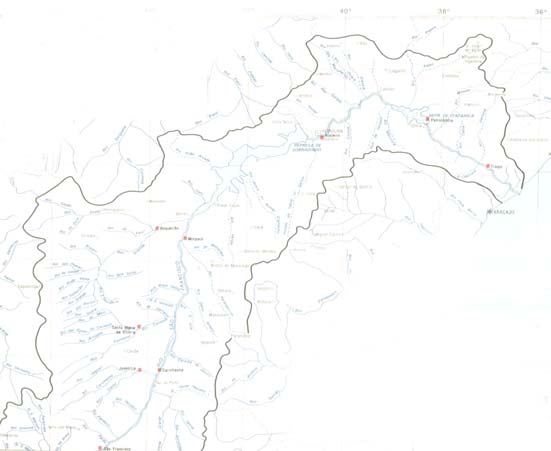
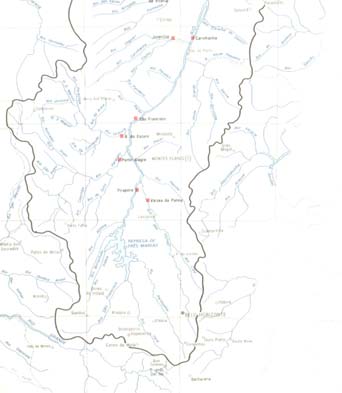
Figure 1. Verde Grande River Sub-basin Location
1.1.1. Current Situation of the Sub-basin Knowledge
In order to know the Sub-basin water offer capacity it was used: cartographic materials as
charts on a scale varying from 1:1,000,000 to 1:100,000, aerial photographs on the scales of
1:40,000 and 1:60,000, satellite images of the whole basin area on a scale of 1,100,000 and
hydrological, meteorological and hydrogeological data about the universe of stations and
wells presented in Chart 2.
Only 9 of the 14 existing stations in the hydrometric network could be used considering the
proximity among some of them.
Although it can seem to be paradoxical as for the precariousness degree of the basic network,
in detriment of the smaller size watercourses as usual, the network belonging to the DNAEE
(National Department of Water and Sewerage) at that time, presents a density above the limit
recommended by the OMM (World Meteorology Organization).
iv
Chart 1. Units of Management (UG) and Units of Hydrological Knowledge (UCH)
UG UCH
Area
Units Delimitation
CODE Nº CODE
km²
100-01
30
100-01
Verde Grande River springs till the Juramento River
660,64
100-02
28
100-02
Verde Grande River between the Juramento River and Vieira River
470,09
Verde Grande River between the Vieira River, Caititu River and
100-03 24 100-03
711,85
São Domingos River till the Capitão Enéas fluviometric station.
Verde Grande River upstream the Barreiros River till Cana-Brava
23 100-04
797,81
River
98
21
100-05
Verde Grande River between Cana-Brava and Suçuapara River
70,28
20
100-06
Verde Grande River between Suçuapara and Salobro River
210,16
15
100-07
Verde Grande River between Salobro and Quem-Quem River
435,29
14
100-08
Verde Grande River between Quem-Quem and Arapoim River
96,81
99
9
100-09
Verde Grande River between Arapoim River and Macaúbas Creek
794,59
Verde Grande River between Macaúbas Creek and Jaíba City -
100-10
8
100-10
648,86
Jaíba Colony fluviometric station
Verde Grande River between Sede de Jaíba and Gorutuba River till
100-11 4 100-11
821.75
Verde Pequeno River
Verde Grande River between Verde Pequeno River and Boca da
100-12 31 100-12
3.29
Caatinga fluviometric station
Verde Grande River downstream the Verde Pequeno River
100-13
2
100-13
1,964.26
confluence
101-01
29
101-01
Juramento River complete
354.19
102-01
27
102-01
Vieira River complete
483.64
26
103-01
Caititu River complete
589.83
97
25
104-01
São Domingos River complete
399.37
22
105-01
Cana-Brava River complete
620.95
98
19
106-01
Suçuapara River complete
925.12
18 107-01 Salobro
River
complete
507.58
108-01
16
108-01
Quem-Quem River complete
2,061.16
13
109-01
Arapoim River complete
774.27
99
10
110-01
Macaúba Creek complete
574.02
111-01
17
111-01
Gorutuba River till Bico da Pedra dam
1,620.04
111-02
12
111-02
Gorutuba between the Bico da Pedra dam and the Mosquito River
545.50
111-03
7
111-03
Gorutuba River between Mosquito and Pacuí River
700.84
111-04
5
111-04
Gorutuba River between Pacuí and Verde Grande River
2,308.31
112-01
11
112-01
Mosquito River complete
1,227.82
113-01
6
113-01
Pacuí River or Salinas complete
3,519.93
114-01
3
114-01
Verde Pequeno River till Estreito dam
1,626.10
Verde Pequeno River between the Estreito dam and Verde Grande
114-02
1
114-02
4,596.15
River
TOTAL
31,120.50
Source: Consórcio Tecnosolo/Eptisa (2000)
v
,
1
2
Urandi
31
3
4
5
6
8
7
10
9
14
13
11
12
15
18
19
16
20
17
21
22
23
25
24
26
27
28
29
30
20
Source: Consórcio Tecnosolo/Eptisa (2000)
Figure 2. Units of Hydrological Knowledge
vi
O
ISCCNA
FRO
SÃ
2/100
1
-
IO
.
1
9
3
6
R
4,26
RIO VERDE
31/100-12
PEQUENO
3,29
1/114-02
BARRAGEM DO ESTREITO
4.59
R
6,15
I
3/1
O
14-01
1
R
.6
I
2
O
6
,10
PA
6/113-01
CUÍ
3.519,93
RIO
5/111-04
7
SER
/
R
1
A B
1
RANCA
2.308,31
7
1
0
-
0
0
,
3
84
11/112-01
4
/
1
0
0
-
1
1
8
2
1
,
7
5
RIO
1.227,82
MOSQUI
1 TO
2/11
BARRAGEM BICO DA PEDRA
5
1
4
-
5
0
,
2
50
17/11
1
1
.6
-
2
0
0
1
,04
GOR
JAÍBA
UTUBA
8
/
1
0
0
-
1
0
6
4
8
,
8
6
9
/
9
9
7
9
4
,
5
9
CÓRR. MACAÚBAS
10/99
TE
14/99
574,02
CEN
96,81
RIO
CÓRR. SÃO VI
Q
RIO ARAPOIM
UEM-Q
13/99
UEM
774,27
1
5
/
9
8
4
3
5
,
2
9
16/1
2
0
.
8
0
-
6
0
1
1
,16
18/98
2
0
/
9
8
2
1
0
,
1
6
507,58
21/98
RIB. SALOBRO
CONVENÇÃO
70,28
19/98
ÇUAPARA
UCH/UG
925,12
RIO SU
23/98
Área (km²)
797,81
RIO CANA-BRAVA
CÓRR. BARREIRAS
22/98
RIO JACUÍ
2
4
/
1
0
0
-
0
3
7
1
1
,
8
5
620,95
RIO SÃO
R
I
D
O
O
C
M
A
I
I
N
T
G
IT
O
U
S
RIO VIEIRA
25/104-01
2
8
/
1
0
0
-
0
2
4
7
0
,
0
9
27/102-01
399,37
RI
483,64
O JU
26/103-01
RAM
589,83
ENTO
3
0
/
1
0
0
-
0
1
6
6
0
,
6
4
29/101-01
354,19
Figure 3. Unifilar Diagram of Management Units and Hydrological Knowledge
Source: Consórcio Tecnosolo/Eptisa (2000); elaboração: FAHMA
vii
Chart 2. Universe of the stations and wells observed in the Verde Grande River sub-
basin
Station or Wells
Density (Station/1,000 km2)
NET
Existent
Considered
In Operation
Considered
In Operation
Hydrometric 14
9
3
0.30
0.09
Meteorological 70 65 pluviometric
42 pluviometric.
2.10
1.35
5 climatologic
5 climatologic.
0.16
0.16
Hydrogeologic 1,270
1,270
Source: Stations Inventory (DNAEE, 1987), Informations from CPRM and CETEC (1995)
The Sub-basin hydrogeological data comprises informations about 1,270 tubular wells which
were inventoried in the surveys made by CETEC, COPASA-MG, CODEVASF, CERB,
CPRM and CEDEC-MG, entities that try to configure the situation of those wells at the end of
its construction. With the total of 1,270 inventoried wells, 1,175 are located in the State of
Minas Gerais and 95 in the State of Bahia.
1.1.2. Geology and Geomorphology
The largest encased Sub-basin's part belongs to an unit of relief denominated "Depressão São
Franciscana", mainly sculpted in the "Grupo Bambuí" rocks, which are mostly limestone's
and are also locally covered by Cretaceous (sandstones) or Tertiary-quaternary and
Quaternary formations. Also, there is the presence of alluvium that in association with the
morphogenetical and pedogenetics factors in the region determined the development of the
group containing plane surfaces, plateaus and mountains.
1.1.3. Climate
The Sub-basin is under the "Anticlone Subtropical do Atlântico Sul" domain, oscillating in the
SE-NW direction, causing the predominance of the winds in the north and northeast quadrants
during the summer and the northeast ones in the winter.
The annual medium precipitation is in the order of 785 mm. The highest levels reach annual
values of 1,300 mm near the river springs close to the Espinhaço mountain and they gradually
decrease towards the center and partly of its north portion, till reaching lower than 700 mm
values in a regime of unimodal precipitation. The months of November, December and
January are the rainiest ones and June, July and August the three driest ones.
The annual medium evapotranspiration is 1,651 mm, the annual medium temperature varies
from 19.6 to 26.3 ºC and the relative humidity of the air varies from 46.7 to 77.4%.
1.1.4. Irrigation Lands
The potential of suitable irrigable lands in the Sub-basin represents 70% of its area, which
means more than 2,000,000 ha. From these, 40% fits the Classes 2 and 3, and 30% the Class
4. However, until the year 2000 only approximately 1,1% of the area was irrigated, in other
words, 22,000 ha.
1.1.5. Superficial Water Resources
A Verde Grande River tributaries characteristic is its transitoriness, as displayed in Picture 3.
viii




















Picture 3. Félix River view. It's dry, what is an intermittent river characteristic,
dominant in almost all the Verde Grande River tributaries
The annual average drained volume by the natural water bodies estimated for the period of
1939/40-1993/94 is in the order of 1,253 m3, corresponding to a medium specific outflow of
40.26 mm or 39.73 m3/s. The Verde Grande River main tributaries medium flows are
indicated in the unifilar diagram in Figure 4.
For the minimum natural flows, with 7 days of duration and 10 years of recurrence (Q7, 10),
used as a parameter for the grants concession, the Sub-basin presents a minimum specific
contribution of 0.035 l/s/km2, equivalent to 1.09 m3/s, but with great space variability.
The Water Quality Index (IQA) evaluation was made in 20 sample points by CETEC (Minas
Gerais State Center of Technology, 1995). It was considered the presence or the absence of
the bacteria from the coliform group, as though as fecal Streptococcus and also the presence
of pesticides. In this last case, potentially harmful substances according to the COPAM
resolution number 010/86 and the number 36/90 from the "Ministério da Saúde", were the
base for the evaluation.
The tributary Vieira River, that receives the sanitary sewage of Montes Claros (Picture 4),
presented the worst sanitary conditions in the whole Sub-basin, pointed for the
physiochemical parameters as dissolved oxygen, biochemistry demand of oxygen and
ammonia.
It was observed that nearly 75% of the sample points (15 stations) had high concentration
levels of pesticides. Being that in the Verde Grande River downstream in the confluence with
the Vieira River was one of the most critical points.
In almost all the Sub-basin, the IQA in the watercourses assessed by CETEC varied from
Medium Quality to Good Quality, and a part of it, that includes the Vieira River and the Verde
Grande River varied from Bad Quality to Very Bad (Figure 5).
ix
O
ISCCNA
FR
3
O
9,73
SÃ
IOR
RIO VERD
4,
E
0
4
P
EQUENO
3
4
,
8
3
BARRAGEM DO ESTREITO
RIO
9
1,6
,
7
8
4
1,84
RIO PACUÍ
7
R
,
IO
4
SE
3
RRA
BRANCA
1,53
RIO MOSQU
5
ITO
,72
BARRAGEM BICO DA PEDRA
5,40
GOR
JAÍBA
UTUBA
2
4
,
5
8
0,29 23,98
CÓRR. MACAÚBAS
0,40 23,28 RI
CÓRR. SÃO VICENTE 2
O
RIO ARAPOIM ,1
Q
6
2
1
,
0
7
UEM-QUEM
CONVENÇÃO
0,34 20,51
RIB. SALOBRO
CÓRREGO OU RIO
1,14 19,23
VAZÃO MÉDIA (m /s)
3
18,32
RIO SUÇUAPARA
0,82
17,24
RIO CANA-BRAVA
CÓRR. BARREIRAS
RIO JACUÍ
RIO
0
S
,8 Ã
R 2
O
I
O
D
1
O
C
M
,8
A
3 I
I
T
N
I
G
TU
OS
2,23 11,01
RIO VIEIRA
RIO
3
J
,
5
,
6
1
1
U
4
R
AMENTO
Figure 4. Unifilar diagram of the medium flows
Source: Consórcio Tecnosolo/Eptisa (2000); elaboração: FAHMA
x





















Picture 4. Vieira River degradation in the municipal district of Montes Claros
It's important to emphasize that in the whole Sub-basin, only the cities of Montes Claros and
Francisco Sá have a sewerage collecting system.
As a general evaluation, excluding the critical points already mentioned, the appraised water
courses are suitable in the Class 2, which means a water with physical, chemical and
bacteriological quality compatible with domestic supply after domestic treatment.
1.1.6. Ground waters
The Sub-basin drains a surface that presents three aquifer systems: middle granulate, carstic-
middle fissured and middle fissured. The underground drainage is of 171.45 million m3/year
or 5.44 m3/s, representing about 14% of the superficial medium outflow (deffluvium).
The physiochemical analyses that were made verified that, in general, this water is appropriate
for domestic and livestock (cattle) uses, presenting restrictions to certain industrial activities
due to its high degree of hardness ("dureza"). Also, they are not recommended for irrigation
in soils with drainage limitation and for crops with little salt tolerance.
xi
,
G O I A S
,
RIO DE JANEIRO
Source: CETEC (1995); elaboração: Consórcio Tecnosolo/Eptisa (2000)
Figure 5. Current quality of the superficial waters
xii




















Detailed information about groundwater are presented in the Final Report of the Activity 4.7B
- Proposal of Verde Grande River Sub-basin Monitoring Network, prepared in the extent of
the project GEF São Francisco, published in September 2002.
The registering done by CPRM indicates that there are more than 4,000 wells in the Sub-
basin, typically tubulares, with high degree of utilization, what shows its importance within
the total water availability.
The groundwaters utilization's characteristics are presented in the Figure 6.
1.1.7. Land Use and Vegetal Covering
CETEC verified in 1995 the following Sub-basin occupation: 50% with pastures, 38% with
natural and secondary vegetation (Picture 5), 8% with permanent and temporary cultures and
4% with other uses. The cattle raising stands out as the economical activity with the largest
expressiveness in the Sub-basin.
Picture 5. Partial view where it is observed the native vegetation, deforested areas for
pastures, small water pound "barreiro" used for animal drinking, typical
exploitation in the whole sub-basin.
The agriculture, largest water user, is concentrated in the northeast portion of the Sub-basin,
between Janaúba and Espinosa, in Minas Gerais and, in Bahia, in the region of Malhada/Iuiu
and close to Sebastião Laranjeiras and Urandi.
1.2. Socioeconomic characteristics
The used information, obtained in the period from 1996 to 2000, comes in its majority from
IBGE, with additional data from The Statistics and Information Center of the João Pinheiro
Foundation (Minas Gerais) and from SEPLANTEC/SEI (Bahia)
.
xiii
,
G O I A S
,
RIO DE JANEIRO
Source: Consórcio Tecnosolo/Eptisa (2000)
Figure 6. Groundwaters utilization's characteristics.
xiv
1.2.1. Demography
This Sub-basin has been presenting a similar behavior to the national one in the last decades,
which consists of excessive urbanization, excluding the Bahia part that registered an
urbanization reduction from 39.02% to 33.63% in the period from 1996 to 2000.
The city of Montes Claros is the main industrial pole. In the year 2000 this municipal district
contributed with 39.34% of all the Sub-basin population1, causing a tendency for a larger
concentration in the following years.
The Sub-basin presented an annual medium population growth rate of 2.78% between 1996
and 2000, what is superior, therefore, to the Brazilian average of 1.97%. The rate in the
portion of Minas Gerais was of 3.31% while in the Bahia part a decrease of 0.09% was
verified.
The Sub-basin urbanization rate in 2000 was of 69.46%, and in the Minas Gerais region it
represented 75.56%.
The Sub-basin population is predominantly feminine, and the young population in the strip
from 0 to 19 years is of 44.85%.
The demographic density of the whole Sub-basin, registered in 2000, was 25.07
inhabitants/km2.
1.2.2. Economical Activities
The Sub-basin gross domestic product (GDP) in the year 1998 was US$ 2,142,625,970.00,
from that, the municipal districts of Minas Gerais contributed with 94.37% and the Bahia
municipal districts of with 5.63%.
When compared to the 1996 GDP (US$ 2,155,216,410.00), it is confirmed that there was an
annual average reduction of 0.29%. The GDP fall was observed among the municipal districts
of Minas Gerais, with an annual average reduction of 1.66%, while in the municipal districts
of Bahia, there was a medium growth rate of 37.12% a year. Considering only the Minas
Gerais region of the Sub-basin, using data of 1999, it shows the following composition of
GDP: industrial 51.78%; services 40.26%; and agriculture 7.78%.
In this Sub-basin, the total occupied area with agriculture sum 81,538 ha, from which 53,132
ha (65.16%) are located in Minas Gerais State, in the sub-basin, and 28,406 ha (34.84%) in
the Bahia State. The area occupied by permanent cultures is 8,043 ha, corresponding to 9.68%
of the entire cultivated area. The main agriculture products in the sub-basin produced in the
year of 1999 were banana, grape, coconut, guava, lemon, orange, papaya, mango, passion
fruit and tangerine.
The irrigation, in 1998, included an area of approximately 22,000 ha, what represents 27% of
the entire cultivated area. The investments related to public projects implemented by
CODEVASF (Companhia de Desenvolvimento dos Vales do São Francisco e do Parnaíba)
assist an area of 8,800 ha, 40% of the total. The remaining 60% are constituted by private
projects with more than 900 derivations, which are located in the main watercourses margins
or supplied by groundwater, consisting in its great majority by areas smaller than 10 ha. Only
a few have areas larger than 100 ha.
xv





















The cattle raising is mainly composed by bovines, with nearly 981,290 specimens, being led
practically for slaughter, although the bovine for milk and the swine raising, with 125,290
specimens, are expressive too. The creations of birds (gallinaceous and quails), rabbits,
equine, "muares", bubaline and sheep's, even with a smaller expression, have great
importance in the region's economical development.
The Picture 6 shows a property where the irrigated agriculture is predominant, mainly
with the banana culture and the cattle raising.
Picture 6. Predominant agricultural exploitation in the area, where the restricting factor
is the water. In the bottom, an irrigated culture of Banana is observed, with
groundwater and the predominant pasture.
According to data collected in 1998, the industrial activities linked to trade, to automotive
vehicles representation and to personal and domestic objects are leading in number of
companies. In second place comes the transformation industry and in third, other services that
include mainly the non-classified items in other business segments. The municipal district of
Montes Claros concentrates approximately 53.40% of the companies with registered
headquarters in "CNPJ". Among the industrial activities stands out the absence of fishing
segments, although the area is provided with water reservoirs derived mainly from the
irrigation projects implantation.
1.2.3. Economical Infrastructure
It is presented in the group of facilities, equipments used in the extraction, transport and
processing of raw materials, which use the workforce in the production of goods and services.
The transport infrastructure in the Sub-basin is composed by a multimodal system. It
contemplates airports, with gravel to asphalt coverings, and the Montes Claros airport is the
xvi
only one in conditions to operate commercial jet flights. Also, it is the only one served by
domestic lines of aviation. The highway network has as main access roads: BR-122, BR-135,
BR-251, MG 202, MG 308 and MG 401, which allow the access to other states of the
federation. For connection with the capital Belo Horizonte, located 417 km away from
Montes Claros, the shortest itinerary is the BR - 135, that accesses BR - 040, which one
connects this capital to Brasilia, the federal capital.
The "Centro Atlântica S. A." that crosses all of its longitudinal extension from south to north
till Janaúba operates the railroad networks.
The communication facilities are composed by several open television channels and some of
Cable TV, AM and FM radio stations, telephony, internet and written press, what puts the
region in contact with the rest of Brazil and the world.
The Sub-basin area still doesn't count with its own electric power generation. The service is
made by CEMIG (Energetic Company of Minas Gerais) in the Minas Gerais region and by
COELBA (Energetic Company of Bahia) in the Bahia area. The users concentration is in the
municipal district of Montes Claros, with 50.09% of the consumer's number and 49.13% of
the energy consumed in 2001. The industrial concentration in this city contributes to this level
of consumption.
1.2.4. Social Aspects
As far as the data of 1999 and 2000 are concerned, the system of health infrastructure is
composed by a net of 28 hospitals with 1,754 beds, 302 ambulatory units, 91 health stations,
47 health centers, 15 ambulatories of hospital unit in general, besides the medical clinics,
dentistry clinics and the medical assistance stations, all available to the Sub-basin population.
The educational infrastructure counts with 1,142 elementary school, 87 high school and 554
kindergarten establishments. As well as units of higher education as UNIMONTES, the main
university in the north of Minas Gerais and region and in the whole Sub-basin.
1.2.5. Agrarian Structure
According to the Agricultural Census of IBGE made in 1995-96, the area registered 29,211
properties. In the Minas Gerais Sub-basin part, 5.89% of the total State properties were
placed. The stratified distribution is shown in Chart 3.
Chart 3. Percentage distribution of Sub-basin's properties by stratum (size) (1995 and
1996)
ABRANGENCY
Less than 10 ha
10 to < 100 ha
100 to < 1,000 ha 1,000 hot < 10,000 >10,000 ha
ha
Sub-basin Area
45.74
42.21 10.71 1.30 0.04
Minas Gerais
34.24
49.58
15.26
0.89
0.03
Source: IBGE
1.2.6. Socioeconomic Synthesis
The Chart 4 presents a consolidated synthesis of the municipal districts that belong to the
Verde Grande River sub-basin in an economical and social view.
xvii
Chart 4. Consolidated synthesis of the municipal districts that belong to the Verde
Grande River sub-basin in an economical and social view (1991, 1996, 1998 and 2000)
Total
VARIABLE
Total MG
Total BA
Sub-basin
Resident people 2000
666,997
113,173
780,170
Resident men 2000
329,970
57,435
387,405
Resident women 2000
337,027
55,738
392,765
Resident people 10 years old or more literate 2000
441,141
62,031
503,172
Permanent private homes 2000
158,395
14,044
172,439
Permanent private homes with bathroom or toilet sanitary sewer -
general net 2000
72,577
5,454 78,031
Permanent private homes form of water supply general net 2000
130,993
8,739
139,732
Permanent private homes garbage destination - collected 2000
107,475
7,163
114,638
Hospitals 2000
24
4
28
Hospital Beds 2000
1,614
140
1,754
Clinical Units 1999
272
30
302
Enrollments Elementary school 2000
162,519
36,146
198,665
Enrollments High school 2000
41,724
2,956
44,680
Elementary school establishments 2000
667
475
1,142
High school 2000
76
11
87
Municipal elections number of electors 2000 423,865
80,360
504,225
Born babies alive - registrations in the year place of registration 1998 16,432
2,928
19,360
Marriages - registrations in the year place of registration 1998
3,510
500
4,010
Deaths - happened and registered in the year place of registration 1998
3,780 405
4,185
Judicial separations - registrations in the year - place of the action 1998
338
7
345
Companies with active CNPJ territorial unit 1998
15,034
880
15,914
Busy personnel local units 1998
62,806
2,151
64,957
Bank agencies 2000
23
3
26
Value of Municipal districts' Fund of Participation FPM 2000 (R$)
50,601,312 15,292,755 65,894,067
Value of the Rural Territorial Rate ITR 2000 (R$)
325,354
114,931
440,285
Municipal districts' total area (1) 2000 (km2) 27,940 11,367 39,307
Source: IBGE
(1) Includes territory non-included by the Sub-basin
The Sub-basin is seen as an area that exports people, even presenting a great potential of
economical growth, mainly concerning the irrigated agriculture and the availability of a
multifaceted system for carrying production to the main consuming centers in the country.
According to the "Banco do Nordeste", standing out its importance, the area was considered a
"cluster" for the agribusiness development. Thus, in the future, it can be expected that this
region might present a great development, which certainly will continue and will increase the
pressure on the limited water resources.
1.3. A River Fading Away
The Verde Grande River has always been a perennial river, source of water and food for the
local population. It has already been a great "surubim" source, which is a noble fish, even
though many of its tributaries were, in general, intermittent rivers.
The Picture 7 shows the critical river's situation. In some passages, it completely disappears.
xviii





















Picture 7. Jaíba District. The water of Verde Grande River totally disappears.
2. WATER RESOURCES MASTER PLAN FOR THE VERDE GRANDE RIVER
SUB-BASIN
The conflicts for the water use have been getting worse in the last two decades, mainly due to
the non-execution of the agreement between the great users of irrigation and the small rural
producers. This situation led the Federal Government, in partnership with the Governments of
the States of Minas Gerais and Bahia, to elaborate a master plan called Plan of Integrated
Water Resources Management of the Verde Grande River Sub-basin.
2.1. Synthesis of the Current Situation
2.1.1. Water Demand's Current Service
In the simulation using a Water Resources Management mathematical model, for a period of
55 years, it was verified that in the annual global results the total demand is 476,340,000 m3
(15.1 m3/s) and there is a deficit of 82,340,000 m3 (2.61 m3/s). The annual medium warranty
for the current demand is 82.71%, 393,980,814 m3 (12.49 m3/s). A detailed analysis, year to
year, shows very serious problems masked by the average. In the most critical year only 25%
of the demand, 119,085,000 m3 (3.78 m3/s) was assisted and in many others it is not even
60%, 285,804,000 m3 (9.06 m3/s).
This situation is a reflex of the enormous outflows' temporal and spatial irregularity in the
Sub-basin, which can alternate big floods years with catastrophic droughts years.
2.1.2. Sub-basin's Water Resources Use
The barrages for water storage and flows regularization are essential for the use of the Sub-
basin's superficial water resources, although a reasonable physical infrastructure already
exists characterized by a barrages/reservoirs set, whose locations and total volumes can be
observed in Figure 7.
xix





















Most of the reservoirs allow only regularizations of intra-annual kind. Only the Bico da Pedra
no 1 and the Estreito dams associated to the Cova da Mandioca no 9 dam dispose of year-to-
year accumulation volume, making it possible to accumulate water in humid years for using it
in years of shortage.
2.2. Increase of Water Availability
2.2.1. Sub-basin's Water Resources
There are several barrages built in the Sub-basin watercourses, as displayed in Picture 8. The
possibility of increasing the availability of superficial waters still exists with the construction
of new reservoirs, as long as all the climatological, hydrological, geological and ecological
implications are observed, once they have impacts in the environment.
Picture 8. Barrage in the Verde Grande Riverbed in Verdelândia.
The rational and monitored groundwaters exploration can be made in the medium and low
parts of the Verde Grande, Gorutuba and Verde Pequeno rivers, where the local conditions for
dams implantation are highly unfavorable, even though it has been already verified by studies
accomplished during the plan elaboration that a level close to the limit has been already
reached concerning to the groundwaters use.
A detailed study about the utilization of the Sub-basin groundwater was presented in the Sub-
project 4.7B - Proposal of a Monitoring Network in the Verde Grande River Sub-basin, part
of the activities developed in the Integrated Management of Land Based Activities in the São
Francisco River Basin Project (GEF/ANA/OAS/UNEP), from what it will be possible to
optimize the groundwater use conditions in the area.
xx
,
G O I A S
,
RIO DE JANEIRO
Source: Consórcio Tecnosolo/Eptisa (2000)
Figure 7. Location of the existent dams
xxi
2.2.1. Transpositions
This type of approach is still incipient for this Sub-basin, once there are no studies in a
particular level of details that demonstrate its economical, social and environmental viability.
Anyway, the São Francisco River transposition is predicted, through the Jaíba Project, in
order to increment 10,000 ha in each plan horizon, what completes a total of 30,000 ha in a
long term (Year 11 to 20).
2.3. Demand of Water Qualification in the Plan Horizons
2.3.1. Human and Industrial Provisioning
The predicted demands for the human provisioning for the years 2005, 2010 and 2020, based
on the year 1996, show a minimum "per capita" provisioning of 100 l/inhabitant/day for less
than 5,000 inhabitants' urban agglomerates and of 200 l/inhabitant/day for more than 100,000
inhabitants' urban agglomerates and municipal districts headquarters. In the case of the
industrial demands, considering the urban and rural populations, for a population of 1,000
inhabitants, a total demand of 48,360 hm3/year (1.53 m3/s) is predicted for 2005 and 77,638
hm3/year (2.46 m3/s) for 2020.
2.3.2. Animal Provisioning
The animal provisioning is diffuse, for that reason, a geometric growth rate of 1% a year was
adopted starting from the 1996 demands in its quantification, based on the recent animal
population evolution.
2.3.3. Water Supply for Irrigation
The irrigation sector consumes 85% of the Sub-basin's water resources total use (superficial
and groundwaters) corresponding to 398 million m³ (10.62 m3/s), counting that the amount of
irrigated area in 1975 was 4,000 ha and in 2002 was 22,000 ha, representing an order of
growth of 10 million m3/year (0.32 m3/s).
The Picture 9 shows an extensive private irrigated area with the banana culture, making use of
groundwater, at the edge of the highway that connects Montes Claros to Janaúba.
Measuring a superficial map in a proper scale, it was possible to determine that the potential
area for irrigable lands in the Class 2 - Plowing, in the Sub-basin, shown in the Figure 8, it is
in the order of 947,500 ha.
The other sectors are little significant in what refers to the water demand, especially if
compared to the irrigation demand.
2.4. Set of Alternatives Formation
2.4.1. Short Term Horizons (Year 1 to the 5)
Considering the short term, the Plan aims to service 80% of the volumetric demand for
irrigation and close to 100% for other demands through the operational rules optimization for
xxii




the current dams/reservoirs. In the most water scarce places, they will be implanted the dams
already predicted in the previous studies: Água Limpa, Suçuapara e Santa Rosa.
Picture 9. Partial view of an enterprise of banana-culture entirely
irrigated with groundwater, in more than 100 ha
2.4.2. Horizons of Medium Period (Year 6 to the 10)
Continuing the implementation of management mechanisms with intense participation of the
society and of the demands increment for human and animal provisioning, and for irrigated
areas in the Gorutuba and the Medium Verde Grande sub-basins.
2.4.3. Horizons of Long Period (Year 11 to the 20)
Has as goal the use of the water resources till the limit of its availability, assuring a
sustainable development as having conceived by the GEF São Francisco Project.
2.5. Alternatives Simulation
Through the Model of Evaluation and Management of Water Resources, the results presented
in the Chart 5 were achieved.
The implantation of new dams in the considered period will make possible the increment the
area irrigated in the Sub-basin in 1,421 ha.
xxiii
,
G O I A S
,
RIO DE JANEIRO
1
2
31
3
4
5
6
8
10
7
9
13
14
15
12
11
18
16
19
20
21
17
23
22
24
25
26
27
28
29
20
30
Fonte: Consórcio Tecnosolo/Eptisa (2000)
Figure 8. Potential of lands for irrigation sorted in the Class 2
xxiv
Chart 5. Results of the water resources simulations for the years of 2005, 2010 and
2020
Demand (m3/year) / (m3/s)
Volumetric Warranty (%)
Year
Total
Satisfied
Total Human Animal
2005
658,450,000 / 20.88
597,310,000 / 18.94
90.71
100
100
2010
705,320,000 / 22.37
678,370,000 / 21.51
96.18
90
100
2020
756,270,000 / 23.98
721,330,000 / 22.87
95.38
90
100
Source: Consortium Tecnosolo/Eptisa (2000)
2.6. Economical Evaluation and Alternatives Selection
2.6.1. Short-term horizon (Year 1 to the 5)
The enlargement of the current irrigated area is predicted for 27,923 ha, through the
improvement in the reservoirs regularization volumes, the construction of new dams (Água
Limpa, Suçuapara and Santa Rosa), the transposition works of the Pacuí's System (200 l/s) for
provisioning Montes Claros and through the transposition of the São Francisco River (Jaíba
Project), for the irrigation of 10,000 ha in the Sub-basin from the 30,000 ha predicted until the
end of the project.
2.6.2. Horizon of Medium Period (Year 6 to the 10)
An increase in the irrigated area for 40,223 ha is predicted, which 20,000 ha correspond to the
Jaíba Project's transposition and the continuation of the mentioned measures and already
specified in the item 2.4.2.
2.6.3. Horizon of Long Period (Year 11 to the 20)
Being concluded all of the necessary constructions and optimized the use of the hydric
underground resources, it is predicted that the area will be of 51,644 ha, 30,000 ha of it
derived from Jaíba Project conclusion, which transfers water from the São Francisco River to
the Verde Grande River sub-basin).
The investment predicted for the construction of the dams is US$ 450,206,000.00.
The Figure 9 introduces the set of dams to be built.
2.7. Uses of the Despised Natural Resources
Little importance has been given for the deforestation seeking the use of the wood for
domestic fuel (Picture 10) and for production of vegetable coal. However, as every
deforestation, this fact influences excessively in the water balance, reducing the infiltration of
water and increasing the soil erosion.
The "carvejamento" has been decreasing drastically in Minas Gerais, moving forward to the
neighbor state of Bahia.
xxv
,
G O I A S
,
RIO DE JANEIRO
Source: Consórcio Tecnosolo/Eptisa (2000)
Figure 9. Location of the proposed dams
xxvi





















Picture 10. Typical exploration of the native vegetation for domestic fuel,
which has not been taken into account in the regional water balance.
3. COLLECTION, GRANTS AND SORTING.
The use of the politics instruments, established in the Law 9,433/97, viewing the balance
between the offer and the demand for water, it is imperative for the sustainable development
and minimization of conflicts.
3.1. General Considerations on Water Resources Management in the Sub-basin
The area was economically depressed until the beginning of the seventies. Among the,
seventies and the eighties, there was a concentrated effort of the Minas Gerais Government in
partnership with the Union, for the creation of a necessary infrastructure to the regional
development. Among the obtained results, stand out the implantation of some irrigation
projects as Gorutuba, in 1978, bringing to the area new entrepreneurs in the irrigated
agriculture. As the local water resources are limited, the expansion of the irrigation generated
serious conflicts. The Project ANA/GEF/PNUMA/OEA proposed the elaboration of this
study, which will make possible the application of the politics instruments that will allow the
sustainable management of their water resources in a short, medium and long periods,
assuring the area development in a peaceful way.
3.2. Collection for the Water Use
The collection for the water use is a politics instrument, effective and of fundamental
importance for the balance between the offer and the demand. Preceding the institution of
collection, there are two other instruments: the grants and the sorting of the water body.
3.2.1. Objectives of the Collection for the Water Use in the Verde Grande Sub-basin
Among the several objectives possibly reached with the water use collection in the sub-basin,
the most important is to guarantee to the users the efficient use of that resource, working as an
educational element, seeking the combat to the waste and guaranteeing an acceptable pattern
of preservation of the springs. Besides, collecting part of the funds necessary to materialize
xxvii
the investments plans for the Sub-basin water resources improvement and maintenance, such
in quality as in quantity.
3.2.2. The Economical Principles for the Water Use Collection
There is an enormous difficulty to attribute prices due to the varied range of purposes for
which is used, forcing practically, the adoption of differentiated prices criteria.
Among the countless known models, in the Verde Grande River sub-basin, case if it is
adopted the model based on the "Second Best" theory, will be possible to define differentiated
prices for different warranty levels in the water supply, fundamental in the management of the
water resources of the sub-basin, allowing larger distributive efficiency and the service to a
larger number of users.
The model of the "Second Best" theory stands out by the financial balance in the water
resources' manager organism either in short, medium and long periods, without losses or
gains, avoiding distortions in the water resources use.
a) Collection for Public Prices
Above a certain consumption level, it stops being no rival and starts to cause a certain
"congestion", which will result in rationing, in the measure that a user's consumption starts to
influence in the other users' availability. That situation is observed in the Verde Grande River
Sub-basin. Occurs then, the allocation of the shortage, which has to obey an efficiency
criterion. A way to solve the sub-optimization tendency is the determination of prices to
maximize the welfare generated by the water consumption, considering the restriction in
which the marginal income would be equaled to the needs of provision financing and
expansion in the margin.
Those prices are equal to the marginal cost of provision and expansion, plus the portion
differentiated by user, that is proportional to the inverse of the elasticity of each user's
demand. Therefore, users with less elastic demand pay more than those with more elastic
demand.
b) Externality Water Collection
In this case, it is considered the factors that act negatively, such as:
· "the third part" are affected in their water demands, without burden to the users;
· the collection for effluents release in the watercourses, being the accomplished
treatment in decentralized form by the users.
Optimum prices
The generation of negative externalities results in damages that are not internalized in the
production functions and the users' consumption. Thus, the economy loses efficiency, because
the private cost won't coincide with the social cost. In the presence of negative externalities,
the level of the resource use is sub-optimum, what causes an induction at a use level above the
one that would occur if the externalities were considered.
xxviii
In the externalities absence, the marginal private cost is equaled to the social marginal cost in
the production.
In the externalities presence, the social cost should incorporate the environmental damages, in
which the damages marginal value grows as the produced amount increases, making the
consumed amount smaller. Therefore, as the externalities environmental damages are
internalized, the market itself adjusts the balance positions.
Cost-efficiency Control
In the Verde Grande River Sub-basin, the amount to be collected by externalities should
abdicate the objective of a optimum "no pollution". Instead of maximizing a function of social
benefit, a function of social cost is minimized to derive great prices of the pollution. Thus, the
objective is to minimize the society control's total costs, which is subject to a restriction in
that, the total pollution generated by all of the users, should not exceed an environmental
pattern previously established.
In this case, it is admitted that the society, when defining the environmental pattern, already
confirmed that the environmental costs above that level are extremely significant and exceed
the possible cost of control. Although such solution doesn't guarantee the largest economical
efficiency, at least it assures that the total cost of control is minimized
3.2.3. The Brazilian Experience in the Water Use Collection
In the studies accomplished by the several state governments, it is observed that the tariff
application is directly associated to the purpose for which the water is acquired by the user.
Among those studies it can be mentioned those developed in the states of Ceará, Bahia and
São Paulo.
Ceará began its collection in a symbolic way, whose value establishment had an educational
character, for in a subsequent phase, exercise it as effective management instrument.
For the effective consumed volume use by the users of gross water, were fixed the following
values initially for the collection:
· industrial uses and users - consume superior to 70 m³ - US$ 0.60/m³ (equivalent to 50% of
the value collected by the treated water supplied by the Companhia de Água e Esgoto do
Ceará - CAGECE);
· dealership of potable water supply's public service - US$ 0.01/m³ (equivalent to 1/60 of
the tariff regarding the industrial uses and users).
The beginning of the studies in the Bahia state for the water collection were in 1993 and only
in 1996 it was definitively delineated. The adopted "Second Best" methodology, took into
account such aspects as: the water availability, the program of necessary investments, the
purpose that the water resources are destined, the effective consumption according to the use
type and the user's economical condition (Chart 6).
xxix
Chart 6. Main cost parameters and the optimum prices for the use of the water in
several use modalities for hydrographical basin in the Bahia State
Reservation
Price
Total Cost Marginal Optimum Prices (US$/m3)
Basins
Price
Elasticity (1,000 US$)
Cost
Without
With
(US$/m3)
(US$/m3) Restriction Restriction
Verde-Jacaré 115,978.59
0.00072
·
Irrigation
0.00164
-0.17
1.38 0.00164
·
Human provisioning
0.63
-0.86
0.000897
0.63
Alto Grande
1,254.82
0.000478
·
Irrigation
0.0026
-0.02
0.000742 0.00115
·
Human provisioning
0.48
-0.26
0.000492
0.000501
·
Generation EE
0.00034
-0.43
0.000486
0.00034
Corrente
1,776.96
0.000478
·
Irrigation
0.00263
-0.19
0.00132 0.00263
·
Human provisioning
0.48
-0.26
0.000894
0.0339
·
Generation EE
0.000434
-0.20
0.00121
0.000434
Contas
19,448.10
0.000478
·
Irrigation
0.0024
-0.14
0.0569 0.0024
·
Human provisioning
0.48
-0.27
0.000984 0.30
·
Generation EE
0.0245
-0.17
0.00261
0.0245
Salitre
3,118.67
0.00072
·
Irrigation
0.00221
-0.74
0.0716 0.00221
·
Human provisioning
0.63
-0.82
0.00675 0.63
MD e BX Grande/M. E. do Lago
18,086.83
0.000478
·
Irrigation
0.00211
-0.88
0.000678 0.00211
·
Human provisioning
0.48
-0.26
0.48 ----
M. Dir. do SM São Francisco
10.98,96
0.000478
·
Irrigation
0.00335
-0.93
0.000673 ----
·
Human provisioning
0.48
-0.27
---- ----
MD (Medium); BX (Low) and SM (Sub-Medium)
SOURCE: Fernandez (1996 and 1997)
In the São Paulo State the adopted methodology is based on the user-payer and pollutant-
payer principle, through sharing the investments costs among several sectors users (Chart 7).
Chart 7 - Prices for the water use and potential income in basins of the São Paulo State
Catching
Consumption Eletric Power
Pollution
Income (US$
BASINS
(US$/1,000m3) (US$/1,000m3)
(US$/mWh)
(US$/tonDBO)
1,000)
Alto Tietê
7.00
31.00
4.00
320.00 145,561
Piracicaba, Capivari e Jundiaí
3.00
17.00
4.00
193.00 31,111
Baixada Santista
1.00
6.00
0.10
228.00
9.421
Estado de São Paulo
3.00
13.00
0.10
278.00 -
Source: Fipe/CNEC (1995)
The examples above mentioned show that in the Brazilian experience each State decided its
collection form. Fits to ANA ratify this procedure or to propose a methodology to standardize
the collection system, at national or at regional level (North, Northeast, Center-west,
Southeast and South).
3.3. Grant of the Wright of Use
Consist in an administrative action by which the granting public power, being it of the Federal
Government, of the States or of the Federal District, as stated in the Law 9433/97, assures to
xxx
the granted wright of water use, for certain period, in the terms and conditions expressed in
the respective action for quantitative and qualitative control of the water uses. Expired the
period, it can be renewed, however, in certain occasions it can be suspended, partial or totally,
in definitive or for certain period.
3.3.1. Uses Subjected to Grant
Are subject to grants all of the activities related to the implantation of works or services that
interfere in the regime alteration, derivation or reception of superficial and ground water,
release of sewers and use of hydroelectric potential. It does not depend on grants those
characterized as insignificant, as regarding to accumulation, derivation, reception and release.
3.3.2. Grants Criteria
In the Verde Grande River Sub-basin, becomes necessary to define grants criteria, through its
Plan of Water Resources, or the adoption of the general criteria established by the Water
Resource's National Council, while there was not that Plan approval, aiming and harmonizing
the Union Domain water resources and the ones of the Federated Units' domain, because the
water is only one, in spite of two dominialidades and the use of differentiated criteria, in each
one of them, it won't be put in risk the effectiveness of the instrument grants in the
management of the water resources.
Those criteria might not be limited only to the water bodies' catching but, also to contemplate
effluents release.
a) Water catching/derivation grants criteria
The forms of allocating, quantitatively, the water among the users, can be separated in at least
two groups: deposits of water (lakes and reservoirs) and springs of running water (rivers).
In the first group, the stocked volumes distribution among the users is sought, considering the
depletion and the elevation of the water body levels. That procedure occurs by a social
negotiation, allied to the forecasting techniques for water losses and gains (evaporation, rains
and affluences), within the negotiation horizon.
In the second group, there are at least two approaches: adoption of minimum reference flow
or simulation of historical flow series.
The minimum reference flow is that characterizing a condition of spring/water body shortage.
Starting from that critical condition, the calculations of water allocation are accomplished, so
that, when the occurrence of the shortage situation, all of the users, or those with larger
priority, maintain in operation, in a certain way, the granted uses. However, as the reference
flows used are, in fact, very reduced, and the granted ones are only a small fraction of them,
in practice occurs that, there are very larger flows along the year.
Those exceeding flows could also be granted in the Verde Grande River Sub-basin. For that it
is necessary to know their occurrence warranties and to establish an outline of rationing of the
water use.
The historical flows series' simulations come inward to what was said previously, as dealing
with the entire range (series) presented by the spring flows, allocating them, in a net of flows,
to the several users of a basin. With that procedure it is possible to obtain different
xxxi
combinations of uses and users, each one with their service warranties, without being
restricted to the use of minimum flows, what increases the possibilities for the water use in a
controlled way. This procedure is quite interesting for the Sub-basin, possessing uses for the
irrigation quite differentiated, which demands differentiated levels of warranty.
b) Alternatives for water management
Among the discussed alternatives, none of them adapts integrally to the Sub-basin condition
and the one proposed is the understanding of the Union and the involved States (Minas Gerais
and Bahia), in the sense of defining uniform grants criteria, approved by the users, which
would be practiced by ANA, SRH-BA and IGAM-MG and they could be agreed in the extent
of an Integration Agreement.
3.3.3. São Francisco River Basin Grant Situation
According to ANA data, until 01/28/2002, in the São Francisco River Basin, 2,613 users were
registered, for a granted flow of 424.11 m3/s, being the current and future flow corresponded
respectively to 418.73 m3/s and 1,169.83 m3/s. The irrigated area in 2002 was of 353,278.30
ha and the predicted was 1,039,680.09 ha.
3.3.4. Verde Grande River Sub-basin Grant Situation
In relation to the Sub-basin grants, the following situation was present in January 2002:
·
ANA: - 22 processes registrations, being 1 grant conceived for public provisioning, 3
in process analysis and the others not regularized;
·
IGAM: - 107 processes registrations of superficial water in the state domain rivers, 92
for irrigation, of which 76 are expired and the others are expiring, and
- 523 registered processes for groundwater, being 505 grants conceived, and most of
them are still within the validity period.
In a survey including 70% of the Sub-basin area, CODEVASF and Ruralminas registered 755
water catching/derivation for irrigation.
In relation to the groundwater, IGAM surveying from other several institutions primary data,
registered 3,717 wells, being 3,045 of secondary sources and 672 of the field survey.
3.4. Water Bodies Sorting
The water bodies sorting are defined by classes, according to the preponderant uses
established in the Law 9,433/97 and to the CONAMA no 20/1986 Resolution.
In the case of the Verde Grande River Sub-basin, due to its complexity and considering the
existence of countless intermittent tributaries and the lack of a Basin Committee, which can
legitimate the technical propositions, only some stretches were sorted and even so by
unilateral decision of the constituted powers, what weakens the instrument, once the users are
not committed with the established goals.
xxxii
3.4.1. The Sorting Instrument
In Brazil, the water bodies sorting in classes should be in consonance with the established
guidelines of the Water Resources Basins Plans, which establish the priorities of water bodies
uses.
3.4.2. The Sorting Competences
In the decisive process the following institutions are involved: ANA, IBAMA/MMA,
CONAMA, CNRH, CERM, Hydrographic Basins committees, the Agencies of Water, the
State Organisms of Water Resources and of Environment, the Water Users and the Civil
Society; competing to each one of those organisms, within their specificities, the control, the
monitorship and the supervision of the water bodies. An important role of the civil society is
the political pressure to induce the public organisms and the private entities to develop actions
in the sense of improving the water quality in their areas.
3.4.3. Procedures of Sorting
The procedures of sorting water bodies in classes should be elaborated in accordance with the
Water Resources Plans in all of the levels and. If they do not exist or are insufficient,
proposed and approved specific studies for the institutions of the Basin water resources'
management system should be taken as base.
The sorting process should be developed with the participation of the Users' Public Organisms
and with the active Civil Society in the basin, which will establish goals of quality for the
water bodies.
4. USES OF WATER FOR COLLECTION EFFECT
For the peculiarities and diversities of the Sub-basin appeared in the Chapter 1, the study was
developed by Unit of Hydrological Knowledge - UCH of that Sub-basin, being analyzed the
types of uses and their effects on the water resources management.
4.1. Types of Use
In the Sub-basin the predominance of the use is agricultural, followed by the domestic and
industrial provisioning, the latter very concentrated in Montes Claros.
About the dejects dilution, all population agglomerates throw their sewers directly without
treatment in the watercourses. The Montes Claros' ones are thrown in the Vieira River and the
Janaúba's, in the Gorutuba River, being these the most accentuated pollution points, followed
by the industrial dejects of Montes Claros.
The irrigation sector corresponds to 85% of the total consumption. Great part of the irrigated
area corresponds to the public projects. The private enterprises are developed along the
watercourses in areas inferior to 10 ha and, few areas superior to 100 ha, until the limit of 450
ha.
4.2. Water Uses in Brazil
a) Use of the Water in the Domestic Functions
xxxiii
In the urban and rural atmosphere, in the domestic function, the water can be considered as
water to drink, water to cook or as water for cleanliness. In that hygienic function, it was here
also associated to the water for health, showing that the availability should be observed in a
context of quantity and quality.
b) Use of the Water in the Industrial and Agro-industrial Productions
Used in industries and agribusinesses as a component of the products, water is constituted
today, in representative portion of the consumptives' uses. It is considered that in world wide,
there is 23% of the total springs catching and in Brazil, there is about 18%.
c) The Use of Water in the Foods Production
The productive feeding process, as much for agricultural environment as for the livestock's,
has important effect in the quantity of water use. It is considered that in the irrigation, world
wide, in 267 million of hectares of capable lands, occurs the consumptive use of 70% of the
water springs catching, with a total efficiency in the water use in the order of 45%. In Brazil,
that efficiency is in the order of 60% in the transport systems and distribution, being reduced
to 50% when the losses of water are included in the cultivations application.
4.3. An Overview of the Main Uses of Water in the Verde Grande River Sub-basin
The irrigation consumes 85% of the Sub-basin water, index compared to countries like India.
Great part of the irrigated area corresponds to public projects of irrigation in marginal areas
inferior to 10 ha and, few areas superior to 100 ha, until the limit of 450 ha.
· Areas irrigated with superficial waters
The water derivations inventory for irrigation, included in the study elaborated by CETEC
(item 2.3), presents a relationship of 987 uses of superficial waters for irrigation, indicating
the location, by coordinates, of such uses, besides the irrigated area in each one of them.
· Irrigated areas with groundwaters
In the entire irrigated area in the Sub-basin, about 22,000 ha, the use of the groundwater
assists approximately 18% of the total (4,007 ha).
Considering the fact that the use of the gross water is not subjected to tax collect, it doesn't
exist larger concerns with the use of technology for saving irrigation water, in other words,
with larger efficiency
4.3.1. Water Catching (derivation)
The analysis of the Sub-basin water balance was accomplished for each UCH, related to the
human, animal and industrial provisioning, and for the use in the irrigation. In the appraised
units, in total terms, seven presented high satisfaction degree, eleven medium satisfaction
degree and two of them low satisfaction degree. Being the satisfaction degree measured in
function of the total volumetric warranty, which varies in the following intervals:
xxxiv
·
Volumetric guarantee < 80%
: low satisfaction degree;
·
80% < Volumetric guarantee < 90%
: medium satisfaction degree;
·
90% < Volumetric guarantee < 100%
: high satisfaction degree.
The balance for sectors was made, dividing the Verde Grande River sub-basin in seven other
great sub-basins, whose general summary is presented in Chart 8.
Chart 8. Synthesis of the availability and demand of water by sectors in the Verde
Grande River sub-basin.
Volumes (106 m3)
Absolute
Volumetric
PROVISIONING
Demand
Satisfied
Deficit
Guarantee (%)
Human and Industrial
35.341
34.615
0.726
97.95
Animal
15.679
15.382
0.297
98.11
Irrigation
398.156
317.931
80.225
79.85
TOTAL 449.176
367.928
81.248
81.91
Source: Consórcio Tecnosolo/Eptisa (2000)
The results from the balance division in sectors shows that the total water demand of 449.18
million m3/ano (14.2 m3/s) is satisfied with a level of volumetric warranty of 81.91%,
equivalent to a deficit of 81.25 million m3/ano (2.58 m3/s).
The global results for the water balance, obtained through the simulation for a period of 55
years (data from 1939 to 1994), show that the total demand of water in the Sub-basin is of
476.45 million m3/year (15.1 m3/s). This is satisfied with a volumetric warranty of 82.71%,
equivalent to a deficit of 82.35 million m3/ano (2.61 m3/s).
The results above show that the water balances for sectors and global, can be qualified as
having a precarious satisfaction for the demands.
4.3.2. Release of Effluents
The exhaustion (collection and treatment) and the final destination of the domestic spilling
(sewage) are quite deficient in the Verde Grande River hydrographic sub-basin as a whole.
Although Montes Claros and Francisco Sá have a level of attending in the order of 78% and
80%, respectively, only 8% of the urban agglomerates are assisted by public sanitary sewers
system, while the remaining 92% are contemplated with sewages "fossas". However, 47% of
the urban population is contemplated with the system and 53% with sewages "fossas".
In relation to the industrial spilling (effluents), according to FEAM, most of the great load
industries treat or are in process of implantation of the system of liquid effluents treatment,
however, it is verified that the Vieira River, in Montes Claros, the main receiver of the
industrial liquid effluents, is extremely polluted.
4.4. How to Stimulate the Water Use Rationalization
It will be done through structuring the System of Water Resources Management in the Sub-
basin, having as main objectives the establishment of mechanisms seeking for the
administration system organization through the creation of the Basin Committee, and the
xxxv
operationalization of the defined instruments in the legislation, obeying criteria of
differentiated prices for differentiated warranty supply levels, allowing since those using
overhead irrigations for subsistence cultures till the great entrepreneurs producing for
exploitation, being that an incentive so that the grant (water use license) are requested in
agreement with the enterprise characteristics.
5. ECONOMICAL ANALYSIS OF THE WATER USE COLLECTION
The choice of the most suitable methodology to establish a value for the water is not an easy
task, as well it is not the evaluation of their results. After meticulous analysis of the available
data it was verified to be possible only the use of the cost-effectiveness analysis (ACE),
which is a technique used when there is a great number of benefits possessing no market
value.
Through this analysis it is possible to define the most efficient way to improve the decisions
taking, so that the economical dimension can be analyzed together with the other dimensions,
making possible in this manner the optimization of the water resources management.
Dealing with multiples objectives not quantifiable or quantifiable in units of difficult
expression, in monetary patterns, it was settled a mission to be implemented that it is
synthesized in order to increase the warranty of water offer for the several uses and to
maintain the surface water courses in the Verde Grande River sub-basin in a pattern of
compatible quality with the necessary uses to its sustainable development.
5.1. Determination of the Gross Water Values in the Verde Grande River Sub-basin
The most important objective in water use collection implementation is to assure to the Sub-
basin water sources users an efficient use of that resource. That collection will work as an
educational element, in a way to combat the waste and to guarantee acceptable pattern of
water preservation, never seeking for the increase in Governments collection taxes.
The opportunity cost for the users sectors was the base for the values estimative and it should
be understood as the reservation's price by the use of the water resources in the Verde Grande
River basin for each user type (derivation/catching or dejects dilution). It is the maximum
value that they would be willing to pay for the Wright to use the gross water while are not
caring about continue to produce in those conditions or seek for a less expensive alternative
solution.
In order to avoid contrary reactions on the part of the payers users and do not provoke effects
on the costs of the products that have their basic input in the water, not removing, thus, their
competitiveness in the market, the prices to be implemented in the Verde Grande River sub-
basin should take place within their users' payment capacity, preferentially below of the water
opportunity cost in the several use modalities.
The habit of the collection has to be assimilated in a gradual, continuous and participative
form, because it contradicts the ingrained habits of not paying and thinking about water as an
infinite resource, not vulnerable to the anthropism.
The collection will be applied in a democratic way and it will reach all and any user of the
water as body dilutor, independently of the pollutant concentration levels.
xxxvi
It is not payment for the Wright of pollute but for the Wright of use in agreement with the
water body patterns of class sorting.
5.1.1 Water Collection Studies in Brazil
There were studied the essential elements to the behavior of the collection in other places, and
yet values already practiced or calculated were compared with the values achieved in this
work, as shown ahead.
5.1.2. Elasticity
Practically there are not solid studies about the elasticity in the collection operations for the
water use in Brazil.
The international experience shows that the elasticity price for the water demand assumes
smaller values than one, such for the residential consumption, as for the industrial
consumption. This means that a tariff increase will have consequently a reduction lesser than
proportional in the demanded amounts.
This same experience shows that the demand elasticity price for the industrial sections -
mainly the hydro-intensives - it is not despicable.
In other words, an increase of prices should lead to a reduction in the demanded amounts of
water and of pollutant emission, through the adoption of rationalization measures in the water
use and even changes in the production technologies.
Until the present moment, the studies evaluating the collection potential with the introduction
of the use collection, adopt the hypothesis that the demand of water is totally inelastic.
5.1.3. Industrial Use and Pollution Control
The Brazilian studies on industrial pollution control do not present estimative of the
companies willing to pay as a function of the costs reduction in the industrial pollution.
This lack of information disables the analysis of the capacity of the collection instrument for
hydric pollution in reducing the loads of industrial effluents thrown in the aquifers, as well as
the costs involved in this reduction. This is not the objective of this work.
5.1.4. Other Experiences
Chart 9 shows some examples of values already practiced, relative to the main experiences in
Brazil.
xxxvii
Chart 9. Tariffs and collection for the water use in Brazil
Gross Water Collection
Water
Collection
Income per
STATE/BASIN
tariff +
average per
capita1 (R$)
Derivation
Consumption
(R$)
(R$)
sewage2
capita
R$ 2.54
São Paulo State
9,210.00
0.01 a 0.015
0.02 a 0.03
US$ 5/hab/ano
(U$S 1.41)
Paraíba do Sul
R$ 2.12
7,465.00 0.008
0.02
US$ 1.3/hab/ano
Basin
(U$S 1.18)
R$ 1.30
Ceará State
2,631.00
0.0121
0.0121
US$ 0.6/hab/ano
(U$S 0.72)
R$ 2.04
Brasil 5,740.00
(U$S1.13)
1 Values relative to 1999 (Source: IBGE).
2 Medium values used by the State Companies relatives to 2000 (Source: SNIS).
Exchange rate used US$ 1 = RS$ 1.80
Such values can be compared with other values practiced as the ones in the European Union.
Chart 10 presents the composition of the medium water cost for the country. It also shows that
the management cost is equal to 7% of the total cost.
Chart 10. Main components of the water cost in the French system
COMPONENT
Discrimination
Participation
Water Catching/derivation
and
Maintenance
55%
Sewers
Collection and treatment
31%
Water Agency
Catching/derivation tariffs
6%
Pollution tariffs
1%
FNDAE
Fundo Nacional de Fornecimento de Água
1%
TVA Aggregated
Value
Tax
6%
Source: Cadiu, A; Tien, Duc (1996)
In this country, although the effluents release collection corresponds to about three times the
collection compared to the consumption collection, the investments for the treatment reach
approximately the sextuple of the applied resources, as the quality improvement is noticed as
increment of readiness (availability).
Chart 11 gives an idea of the costs practiced in the European Union, either for dilution and for
dejects removal.
Chart 11. Collection for pollution in the European Union
Collection for Emission (1) (US$/kg)
Cost for Removal (2) (US$/kg)
PARAMETER Holland German France
Organic charge
0.06 to 2.80 removal up to 80%
0.5 to 1.4
0.6
0.1 to 1.3
DQO
Up to 4.70 removal up to 95%
35.00 to 175 removal up to 80%
Metals
24 to 675 32 to 1,580
0.4 to 92
339.00 to 669.00 removal up to 95%
Values deduced with base in: (1) Buckland; Zabel (1998) and (2) Jantzen (1992)
xxxviii
· Maranhão River
This sub-basin, study object for the own GEF São Francisco Project, was analyzed as for
some horizons for mechanisms application on the water resources management, in a way to
verify the sustainability of a Basin Agency.
This Sub-basin is quite different from the Verde Grande River sub-basin, because it is
predominantly of industrial and mining use.
The estimated tariffs by Orsini (2002) are presented in Chart 12.
Chart 12. Tariffs Estimated for Collection (R$/m3) for different uses of the water in the
Maranhão's River Sub-basin
Water Catching
Thrown Effluent
SECTOR
Dom Ind Min Agr Pec Dom Ind Min Agr Pec
Volume of Diverted Water
0.15
0.02 0.02 0.00 0.00
- - - - -
Volume of Thrown Effluent
- - - - - 0.03
0.03
0.03
0.00 0.00
Source: Orsini, C. E. (2002)
5.1.5. Adopted Basic Premises
a) Collect from whom?
The collection will be made for the following segments that make direct use of the surface or
underground water resources:
·
Services of Water and Sewers
·
Industries located out of the public distribution/collection network
·
Irrigators
·
Other (rural provisioning, leisure, recreation, aquiculture, among others).
b) What to collect?
·
Volume of derived water;
·
Volume of water consumed in the process (that is a portion of the diverted volume
and it doesn't return to the spring);
·
Releases in the water body seeking to the transport, dilution and effluents
assimilation, through the following parameters:
- DBO (Oxygen Biochemistry Demand );
- DQO (Oxygen Chemistry Demand);
- RS (Sediment Residue); and
- CI (Inorganic Load: Metals, Cyanides and Fluorides).
c) How to collect?
c1) The adoption, for the entire Sub-basin, of Basic Unitary Prices, is a good collection form
for the following parameters:
·
m3 of derived/catching water
·
m3 of consumed water from a spring (water source);
xxxix
·
kg of release of DBO (Oxygen Biochemistry Demand );
·
kg of release of DQO (Oxygen Chemistry Demand);
·
liter of release of (Sediment Residue); and
·
kg of release of CI (Inorganic Load: Metals, Cyanides, Fluorides)
c2) The Final Unitary Price for the collection, for each parameter above, it will be obtained
by the multiplication of the Basic Unitary Price by coefficients that portray the users
different conditions, among others: the type of the spring (source), the class of the river,
the purpose, the location as for the area of aquifers recharge, and the seasonality, seeking
to incorporate the regional and local peculiarities.
c3) The Final Unitary Price for each parameter, as calculated, will be smaller than a limited
superior value, called Maximum Unitary Price, to be fixed together with the table of the
Basic Unitary Price.
c4) The total collection value, for a certain user, will be the sum of each one of the values
associated to the above parameters, being superior limited again by a value calculated as
a percentage of the Medium Referential Cost of Annual Production or by a percentage
of the annual revenue.
c5) The Medium Referential Cost of Annual Production will be a standard value previously
established in the regulations, for each user type, based in the analysis of the statistical
information.
5.1.6. Values to be Collected
a) Proposal of Basic Unitary Prices and Multipliers Coefficients
It is presented in Chart 13 a suggestion of Basic Unitary Prices - PUB as starting point for
discussion with the Sub-basin committee.
Chart 13. Proposal of Basic Unitary Prices
USE
Unit
Symbol
PUB (R$)
PUB (US$)
1. Catching/derivation
m3 PUBCap 0.01 0.0029
2. Consumption
m3 PUBCons 0.02 0.0057
3.
Release
- DBO
kg of DBO
PUBDBO 0.10 0.0286
- DQO
kg of DQO
PUBDQO 0.05 0.0143
- RS
Liter
PUBRS 0.01 0.0029
- CI
kg
PUBCI 1.00 0.2857
Source: FAHMA
b) Differentiation of Final Unitary Prices and Gradual Implantation of the Collection
The table of PUB (Basic Unitary Price) would be valid for the entire Sub-basin. Each
hydrographic area, in function of its investments program, of the hydric critical conditions
and of their peculiarities, might adopt multipliers coefficients on the Basic Unitary Price in
that table and differentiate the Final Unitary Prices to be collected in agreement with their
regional interests, properly backed in a decision in level of the Sub-basin Committee, which
xl
needs to see, in this case, how it ought behave or report to the Integration Committee for the
São Francisco River Basin.
·
The multipliers coefficients (larger or smaller than 1) ought reflect the peculiarities of
each hydrographic region considering their interests.
However, facing the difficulty of immediate application of all those differentiations, it is
proposed that the former would be implemented gradually, along 10 years. In any moment
the educational character of that process can be forgotten. Therefore, in the beginning the
collection could just be based on the catching, consumption and in the releases, differing only
as for the purpose or nature of the water use.
c) Superior Limits of the Final Unitary Prices for Each Parameter
The calculated Final Unitary Prices should be superior limited seeking to avoid reaching
excessive high figures. Although the Committees have free will to establish the multipliers
coefficients in agreement with their regional or local interests, the Final Unitary Prices for
each parameter, in the Verde Grande River sub-basin, they should not be superior to the one
in Chart 14.
Chart 14. Limits of maximum unitary prices to be collected
Maximum Unitary Prices
USE
Unit
(R$)
(US$)
1. Water Catching
m3 0.05
0.0143
2. Consumption
m3 0.10
0.0286
3.
Releases
- DBO
kg of DBO
1.00
0.2857
- DQO
kg of DQO
0.50
0.1429
- RS
Liter
0.10
0.0286
- CI
kg
10.00
2.8571
Source: FAHMA
5.1.7. Demand Functions
The ideal situation is when it can make estimative of the waters used values to derive the
curves of their demands in each use, relating a value for the amount of water in that particular
use. The dominance of the water use for irrigation in that Sub-basin practically turns, in the
totality, the other uses as insignificants.
As it does not exist water market for free transaction of its use wrights, there is not how to
estimate its function demand.
5.1.8. Estimative of the Opportunity Costs for the Sector Water Users of the Sources in
the Verde Grande River Sub-basin
a) Irrigation
The current irrigated area in the Sub-basin is of 22,000 hectares, which implies in a annual
consumption of 694 million m3, corresponding to a annual continuous flow of 22 m3/s.
xli
About the water source used by the irrigated horticulture (fruit production) in that same
region, its distribution is presented in Chart 15.
Chart 15. Water source used in the irrigated horticulture (fruit production)
Area (ha)
SOURCE OF WATER
São Francisco Basin
North of Minas Gerais
Tubular Wells
5,328.8
5,181.9
Rivers and Reservoirs
12,128.2
10,777.8
TOTAL 17,457.0
15,959.7
Source: CODEVASF (1999) - Register of Horticulture (fruit production)
The water value for irrigation was estimated taken into account the value of the irrigable nude
land, value of the nude rain fed agriculture land ("sequeiro"), total irrigated area with the
water sources in the Sub-basin and the amount of total water diverted for irrigation, resulting
in U $3,6229/1,000 m3.
The opportunity cost will be larger as the grants instrument is implemented, because the user
will notice that it assures a wright that the rain fed agriculture farmer doesn't have.
b) Human Provisioning
The estimative done here presuppose the hypothetical interruption in the supply of the water,
so that the user would have to look for alternative solution to satisfy their needs.
The demands of water for provisioning in the Sub-basin are of 42.5 hm3/year, or 1.53 m3/s,
which applied to the alternative solution of catching through wells, resulted in the following
value: U $0.0343/m3.
c) Industrial Provisioning
The situation of the industrial provisioning in the Sub-basin is very similar to that of Pirapama
basin in Pernambuco, where the industries are supplied removing part of their needs of water
(about 50%) from the State Water Supply Company and the remaining through superficial or
underground direct catching.
Once more, it is remembered that the quality of the groundwaters in the Verde Grande River
sub-basin is inadequate for great part of the industrial use.
It was applied in this Sub-basin the same methodology adopted for Pirapama. According to
the elements supplied by the table of COPASA and used for the Sub-basin, besides
informations collected from the water truck tanks suppliers the value of US $0.5021/m3 was
obtained.
d) Dilution of Industrial Effluents
The opportunity cost for the water use in industrial effluents dilution is associated, in general,
to a technology of more expensive production and it has as a goal to put the pollutant agent's
concentration within the established limits by the environmental legislation.
xlii

In the Verde Grande River sub-basin the organic load is poorly estimated in the order of 6,500
kg of DBO/day, equivalent to a load in a community about 125,000 inhabitants, where only
the dairy products industry participates with about 300 kg of DBO/day. The annual load is in
the order of 2,373 tons of DBO. The great concentration is in Montes Claros. In this way a
value of US$ 0.7143 / kg DBO is resulted.
e) Dilution of Domestic Dejections
Considering a population of 843,389 inhabitants, the amount of organic load that it is spilled
directly in the body of the Verde Grande River sub-basin is about 33,736 kg of DBO/day, in
other words, 12,314 tons of DBO/year that demands enough flow for its dilution.
Located close to Montes Claros, in the city of Juramento, there is an ETE (Sewer Effluent
Treatment Plant) recently entered in operation, being responsible for the treatment of the
sewers until this moment thrown in the Juramento River (Chart 11).
The opportunity cost for dilution of domestic dejects (sewers) was in the order of US$ 0.0129
/ kg DBO
f) Summary of the Calculated Opportunity Costs
In Chart 16 the opportunity costs are synthesized and calculated for the main uses in the Sub-
basin.
Picture 11. Partial view of the Juramento treatment sewers station
xliii
Chart 16. Opportunity costs and predicted demands for the considered water uses in
the Verde Grande River sub-basin (US$ 1.00 = R$ 3.50)
USES
Opportunity Cost (U$)
Quantity
Human provisioning
0.0343(1)
1.53(4)
Industrial provisioning
0.5021(1)
0.8(4)
Irrigation 3.6229(2)
22(4)
Industrial Effluent Dilution
0.7143(3)
6,500(5)
Domestic Sewer Dilution
0.0129(3)
33,736(5)
Source: FAHMA
(1) U$/m3 (2) U$/1000 m3 (3) U$/kg DBO (4) m3/s (5) kg DBO / day
5.1.9. New Investments
The Plan for the Integrated Water Resources Management in the Verde Grande River Basin
pointed actions and necessary investments for the Sub-basin that lack of more detailed
studies. The total value adds to US$ 1,139,949,000.00.
FAHMA proposes a first phase, preparatory, which works with actions and more transparent
investments, attacking the most critical areas, such in the quantitative as in the qualitative
aspects of the water resources. It is waited, therefore, that an action as, for instance, the
improvement of the sanitary collection and treatment, results in the increase of the availability
of the water resources for other objectives or uses.
Following considerations are made on the main aspects about that first phase of investments.
a) Improvement of the Water Use Efficiency in the Irrigation
Although it is known that the predominance of modern irrigation methods exists in that Sub-
basin, the efficiency of its use can still be considered low due to serious technical support
deficiencies, thus, the data evidence for the same method and the same culture, incomes
variations superior to 100% among a producer and other.
The average cost for the irrigation method substitution is of R$ 4,000.00/ha, resulting in an
investment of R$ 4.00 million
The estimated cost for the technical support with base in the FAHMA experience, that already
executed such services in several states of the Northeast of Brazil, seeking for the
improvement of the irrigation practice efficiency, it is about R$ 3.96 million to the horizon in
the study.
b) Ciliary's Vegetation (Forest)
Taking as critical the whole extension of the Verde Grande River added to some of their
tributaries of larger vulnerability, it would result in an extension of 700 km, which
corresponds to an area of 2,800 ha to be worked in the sense of reestablishing their ciliary's
vegetations and forests.
xliv





















c) Solid Residues
The whole Sub-basin presents strong degradation signs caused by the urban solid residues
and, in some areas, also for the rural solid residues.
The predominant "lixões", garbage disposal, in the region have been direct influence in the
water springs (Picture 12).
Picture 12. Garbage predominance in the whole extension of the Vieira River,
besides the industrial dejects
d) Summary of the Actions and Investments Costs
In Chart 17 are synthesized all the values to be implemented in the emergential plan,
estimated with base in previous studies and adapted to the local conditions.
xlv
Chart 17. Estimative of investments for emergential actions and investments
Operation
Investment
Total
TYPE OF INVESTIMENT
(O&M)
(US$ 1,000)
(US$ 1,000)
(US$ 1,000)
Implantation of sanitary sewer systems
74,571
1,491 76,063
Implantation of solid residues urban systems
25,071
1,254
26,325
Water resources management
Demand studies
93
47 140
Hydrometric campaign
350
117 467
Developing and management sceneries
140
- 140
Hydrologic control system
233
- 233
Quality monitoring
70
70 140
Especial quality campaigns
117
- 117
Especial studies
140
- 140
Recuperation of recharge degraded areas
10,443
522 10,965
Ciliary's vegetation (forest)
1,920
38 1,958
Irrigation efficiency improvement
1,143
1,131 2,274
TOTAL
114.291
4.670 118.962
Source: FAHMA, COPASA, TECNOSOLO, Pirapama River Basin Committee PE, INDI, FEEMA, and IGAM
e) Cost of the Operational Structure for the Sub-basin Management
With base in other studies, mainly the one of the "Vaza Barris" basin (BA - SE) and of
Pirapama (PE), it is adapted a minimum structure so that if it could act as one basin agency to
give support to the basins Committee, that is being structured.
The Chart 18 synthesizes the calculated values.
Chart 18. Annual cost of the Verde Grande River sub-basin management operation
NATURE OF EXPENDITURE
Values (US$ 1,000)
Materials and e equipments
22.86
Personal (wages and responsibilities
124.57
Rent of property
7.15
Water resources monitoring
51.43
Laboratorial exams
42.86
Reports and divulgation
12.00
Transport and daily rates
17.31
TOTAL 278.18
Source: Estimative done with base in the experience of FAHMA, CEIVERDE and Pirapama
Basin Committee /CPRH
xlvi
f) Total Annual Cost for the Management of the Verde Grande River Sub-basin
A collection practice capable to generate the necessary resources to cover all of the
administration costs for the basin is sought. This would assure its sustainability.
The values presented in the Chart 19 are fundamental for the prices determination for the
water use that will be practiced in the Sub-basin.
Chara 19. Summary of the management annual costs for the emergency plan
development
NATURE OF THE EXPENDITURE
Value (U$1,000)
Operational Cost
178.17
Amortization of the investment and maintenance cost
19,971.40
TOTAL
20,149.57
Source: FAHMA
g) Value of Incentive
In this first implementation phase the collection mechanism in the Sub-basin is practically
impossible to do it without some subsidy.
This incentive value should be discussed thoroughly with the Committee, local authorities and
the users, which should establish the period and the gradient as it will be applied, besides the
period of its maturation to the integral value payment.
h) Rationing
The water availability, at a given moment, is insufficient to assist the need of a certain use,
what takes unavoidably to a rationing in the water use, so that its consumption is reduced
compulsory in relation to its demand in normal conditions.
Kelman & Kelman (2000) have been presenting a methodology for water allocation for
economical production in semi-arid area, as this Sub-basin. They compared rationing types.
Since the wild, that is: the one upstream can everything; the one downstream should only
accommodate, passing through the linear rationing, observing its difficult implementation,
and for the chronological, which presents a lot of rationality and simple implementation,
arriving finally in the economical, that it is an interactive process where each user declares to
the granting power its demand and its liquid benefit, being the priority access to the water
settled down in the inverse order of the benefit.
The application of this economical rationing method results in the maximum total value for
the economical benefit. However, a part of this benefit is "collectivized" due to the collection
by the water use in rationing situation, which is proportional to the assisted volume.
i) Optimum Prices for the Water Use
This is a methodology used for valorization of the collection by the water use, it is based, in
one side in the marginal cost of administration of the water resources and in the other, in the
elasticity's price for the water demand in the several modalities of the water use.
xlvii
In the appreciations here made this politics is still far away from being reached, being
necessary an incentive, in other words, allocation of government resources for the water
resources manager institution proceeds in that Sub-basin, and those values would be
constituted in a "capital seed".
Only when these politics conditions application were present, which should be established in
the institution manager's businesses plan, is that it should stipulate the optimum prices.
j) Expected Incomes
The potential incomes of this first phase, still in search of the self-sustainability, in agreement
with the calculated opportunity costs, were estimated with base in the data of the Chart 16 and
they are presented in the Chart 20.
Chart 20. Estimative of the annual operation income for the water resources
management in the Verde Grande River sub-basin in its first phase
USES
Opportunity Costs
Quantity per Year
Income (US$ 1,000)
Human provisioning
0.0343(1)
48.25(4)
1,654.29
Industrial provisioning
0.5021(1)
25.2(4)
12,667.14
Irrigation 3.6229(2)
693.8(4) 2,513.43
Industrial effluent dilution
0.7143(3)
2,372.5(5)
1,694.57
Domestic sewer dilution
0.0129(3)
12,313.6(5) 158.29
TOTAL
18,687.72
Source: FAHMA
(1) R$/m3 (2) R$/1000 m3 (3) R$/kg DBO (4) Hm3 / year (5) t DBO /year
5.2. Cost-Effectiveness Analysis
The cost-effectiveness analysis was made having in consideration:
· Definition of the objectives;
· Definition of the goals;
· Definition of options of actions;
· Identification of the impacts and
· Ideal pattern of effectiveness for the Sub-basin.
5.2.1. Definition of the Objectives
The objectives are:
a. To Assure the financial support to programs and projects of water resources to be executed
in the Verde Grande River hydrographic sub-basin;
b. To Discipline the use of the water resources among the located economical activities in the
Sub-basin;
c. To rationalize the use of the water resources through the use of technologies, processes and
procedures that take to the economy in the water use and to the minimization of the
effluents and liquid residues generation, with elimination of losses and wastes;
d. Improvement and maintenance of the water resources quality;
xlviii
e. To Join the other management instruments seeking to guide the location of potentially
waters pollutant economical activities in the Verde Grande River sub-basin, taking in view
the water availability or the quality patterns, integrating besides into plans and programs of
regional development and of environment protection.
5.2.2. Definition of the Goals
In the Verde Grande River sub-basin the water resources are used for human, animal, and
industrial provisioning, and irrigation, and the goals, seeking to assist priority these uses, were
established for three different horizons, as follows:
a. Horizon of short period (year 1 to the 5)
- Warranty of 80% satisfaction of the volumetric demand for irrigation;
- Warranty close to 100% for human, animal and industrial provisioning;
- Constructions of barrages predicted in previous plans to accumulate the necessary
volume of necessary water in a way to assist the proposed warranties;
- Beginning of the implantation of the not structuring administration mechanisms, with
the public's participation.
b. Horizons of medium period (year 6 to the 10)
- Increase of the service in irrigated areas in the sub-basins of Gorutuba and of the
Medium Verde Grande, in 2,300 ha, with 85% warranty;
- Guaranteed close to 100% for human, animal and industrial provisioning;
- Construction of low cost dams to propitiate of the necessary water volume reservation
for service to the incremental consumption predicted.
- Continuation of the implementation of the management mechanisms with the public's
intense participation.
c. Horizon of long period (year 11 to the 20)
Use of the water resources to the limit of its availability, seeking:
- Satisfaction Warranty of 90% of the volumetric demand for irrigation;
- Guarantee practically about 100% for human and animal provisioning;
- Increase of the irrigated area in 1,420 ha through construction of dams; and
- Consolidation of the water resources administration mechanisms, with the public's
strong participation, seeking to assure a sustainable development based on the social,
economical and ecological.
5.2.3. Definition of Options of Actions
The recommendations of options of actions seek serving of the proposed goals and,
consequently, the optimization of the water resources in the plan horizons, in agreement to the
established in the previous item.
The estimated costs for the predicted actions are summarized in the Chart 21.
xlix
Chart 21. Costs of the actions in the horizons of short, medium and long periods
DESCRIPTION
Value (US$ 1,000)
1. Short Period Horizon
Constructions and emergential services
114,291.0
Improvement for water use at Bico da Pedra and Juramento reservoirs
10,000.0
Construction of Água Limpa, Suçuapara and Santa Rosa dams
74,731.0
Construction of the Pacuí System -1a phase: capacity of de 200 l/s
5,760.0
Implantation of the groundwaters resources monitoring control system
9,372.5
Subtotal 1
214,154.5
2.Medium Period Horizon
Construction of Sitio Novo, Olho D'água, São Domingos and Verde Grande dams
112,560.0
Monitoring the groundwater resources
1,052.5
Subtotal 2
113,612.5
3.Long Period Horizon
Construction of Quem-Quem, Canabrava II, Carrapato, Arapoim, Vaca Brava,
Tábua, Macaúbas, São Vicente, Barreiro de Dentro, Vigário, Poção Galheiros and
Lagoa de Cima dams
262,915.0
Construction of the Pacuí System final phase: total capacity total of 600/s
5,760.0
Monitoring the groundwater resources
2,105.0
Subtotal 3
270,780.0
TOTAL
598,547.0
Source: FAHMA; Consortium Tecnosolo/Eptisa (2000)
5.2.4. Identification of the Impacts
The expected impacts with the implantation of the collection for the water use and with the
implementation of the planned actions in the Sub-basin, refer to: the costs elevation for the
several users, improvement of the water quality, reduction of the pollutant release, recreation
and leisure, visual pollution elimination, the water resource use rationalization and ordering in
the location of the economical activities.
a) Elevation of the Relative Costs for the Water Use
a1) Elevation of the costs for each user sector
· Elevation of the costs for the urban users
The introduction of the collection for the water use and for the effluents release
represents a price increment for the final water resources users. The water and sewer
bills usually paid by the population will be added by the collection for the water use
and for the pollution, besides the public companies provisioning collection and
services.
· Costs for the rural population
The impact of the collection costs elevation for the consumed water by the rural
population would be very large and the final result would be ridiculous, thus it is
proposed the non establishment of the collection for the water resources use by these
populations until the Basin Committee, regularly installed, ratify this measure or
another be established to contemplate the collection.
l
· Elevation of the costs for the irrigation water
The impact of the collection on the cost of the agricultural production in the region
will be quite significant face to the basic agricultural products low net income
margins.
To repass it to the tariffs values prices seems to be unlikely, since the agricultural
market behaves strictly inside the offer and demand laws.
The positive side would be the research intensification looking for larger water
economy, so much through more efficient irrigation methods, as of the planting of less
water demanding cultures.
· Elevation of the water costs for provisioning and effluents dilution of great
industries
The collection for the water use, as much for the public network as of deep wells,
should reach a significant percentage on the companies water catching cost. As the
water consumption has different values for the different industries, it is obvious that
the impact of the collection on the total production cost will depend on the activity
branch, where each one operates and, therefore, it will vary for industry by industry.
Probably the way will be the water economy through the implantation of
rationalization measures. It is also waited for production technological changes
seeking reduction in the demanded amounts of water and emission of pollutant.
a2) Evaluation of the payment capacity for each user's sector
· Residential Use
In the Verde Grande River sub-basin, a work accomplished by Briscoe et al. (1990)
showed that there were users willing to pay hypothetical monthly values for the
incremental water offer. However, it should be observed that the water demanded
decrease is proportionally larger for the users of low-income case in relation to the
ones of larger income.
· Industrial Use
For the industrial sector, the elasticity-price in general, is superior to the values found
for the residential user. For the industrial sector the water is "good" of intermediate
consumption. As it can adopt several conservation measures, recycling, effluents
reuse, as well as to improve the productive process, the sector is less inelastic than the
residential sector, where the water is "good" of final consumption. Each industrial
sector will answer in different way to an increase of the water prices.
· Agricultural Use
There are few studies on the water elasticity-price for the agricultural sector. Based in
the characteristics of the sector it can be inferred that its elasticity is superior to the
values found for residential use.
li
As well as the industry, the water is "good" of intermediate consumption in the
agriculture, having the alternative of being used in more efficient cultures and/or
through methods that propitiate larger water economy.
The tendency in the Verde Grande River sub-basin, is that cultures with high
aggregated value, submitted to efficient irrigation techniques, as the case of fruits
irrigated by drip and micro-sprinkler, can present smaller elasticity's, making possible
the collection.
b) Improvement of the Water Quality
The return to the desirable quality of a spring is one of the most expected impacts as a result
of the water use collection.
The proposed measures intend that, in a gradual way, the waters get better quality, until
reaching the patterns demanded for its sorting in classes, at least, in the Class 2.
Smaller treatment costs for provisioning, recomposition of the aquatic fauna, larger leisure
options, decrease of the incidence of water carried diseases. They would be some of the
expected impacts as a result of the pollution control and maintenance of the water quality in
the Verde Grande River and their tributaries.
c) Reduction of the Thrown Effluents Volume
In the domestic sector, the reduction of the consumed water volume will mean proportional
reduction in the effluents volume thrown in the sewerage system.
In the industrial sector, besides the reduction in the effluents volume thrown in the
spring/water body, the collection can force the adoption of technologies that, besides reducing
the volume, it can turn the pollutant ones less harmful to the water resources.
In the irrigated agriculture, the collection can force the adoption of methods that reduce the
volume of applied water, reducing or eliminating in consequence the drained polluted water
with pesticides residues, which reaches the springs.
d) Recreation and Leisure
When intending to sort the springs in water classes in the Verde Grande River sub-basin in the
Class 2, the expected impact in what refers to leisure is that the water can be assigned to the
primary contact recreation.
e) Improvement of the Visual Aspect
To sort or assign the water in the class two, the Verde Grande water cannot present flotation
materials (including no natural foams), oils and greases, artificial coloring, nourish substances
from rejected deposits. In the contrary, it should have pleasant color, little turbidity and few
amounts of materials in suspension (CONAMA in the Resolution 20, articles 4, 5 and 6).
Obviously that it will propitiate total change in the visual aspect of the water mirror, giving to
the landscapes possibility of pleased contemplation.
lii
f) Population Mobilization and Understanding on the Water Resources Rational Use
As the collection for the water resources use will have several reflexes that affect directly all
of the Sub-basin inhabitants, it is expected that the society in general have every chance a
larger involvement, as the objectives are being reached.
g) Ordering the Location of the Economical Activities along the Sub-basin
· Industrial Sector
The collection certainly will bring discipline in the positioning of the economical
activities in the Sub-basin context, mainly the industrial activities, it should create a
narrow relationship between the economical interest of the enterprise and the society
interests, represented by the Basin Committee. The dialogue can address the industrial
plant where it better adequate in relation to the water resources conservation and better
assist to the need of jobs generation, among others.
· Irrigated agriculture
The enlargement of new irrigated areas will depend on the availability of the water
resources and it should be reason of meticulous study, case by case, culminating with its
grants by the competent organism.
The variation on the collection value for the irrigation water use in function of the level
of warranty service can guide the location of the several irrigated enterprises.
5.2.5. Ideal Pattern of Effectiveness for the Sub-basin
As already previously mentioned, the great challenge to be won in the Verde Grande River
sub-basin is the solution for the water use conflict that appeared in the eighties.
The ideal effectiveness pattern for the actions to be implanted in the Sub-basin should be,
therefore proportional to the solution of this conflict, what implicates:
· to increase the availability of water for irrigation with several warranty levels;
· to assist the water demand for human, animal and industrial consumption, with
prominence for the provisioning of the city of Montes Claros, with close warranty of
100% and
· to revert the pollution of the superficial springs due to release of sewers and of solid
residues (garbage).
The proposed actions assist to this ideal effectiveness pattern. In the other hand, as the conflict
of the water resources uses in the Sub-basin is already established, certainly, no other option
of actions will be accepted by the society, if such a conflict were not overcome.
5.3. Result of the Analysis
The benefits for the water use collection, consequence of the reach of the established
objectives, several of them are not susceptible to be valued by concrete criteria. In this way
the subject to be answered is if the water use conflict will be solved or not.
liii
In the first case (resolved conflict), the economical agents act again, the population can have
their basic needs satisfied and it will be possible to have appropriate and sustainable
environmental patterns. In the second case (conflict no resolved), the current state stays
without development perspectives, water resources use in a random and unequal way,
continuous environment degradation, and even risks of violence occurrence that can result in
deaths.
The total cost of the actions proposed in the three planning horizons, which need to be
reviewed with more details, it is in the order of US$ 598,547,000.00.
In the short period (year 1 to the 5), the activities and constructions will demand resources in
the value of US$ 214,154,500.00. It stands out that, of this amount, more of the half
corresponds to the emergential investments, which are of great relevance to begin the water
resources management in the Sub-basin.
The programmed actions for the horizon of medium period (year 6 to the 10) should demand
estimated resources in the order of US$ 113,612,500.00. They will be applied in the
construction of storage and water distribution regularization dams and in the monitoring of the
underground springs.
In the long period horizon (year 11 to the 20) the planned actions will demand an amount of
resources of US$ 270,780,000.00. They will be destined to works that conclude the use of the
water resources to the limit of its availability.
Starting from the end of the year 20, if accomplished the goals, the following benefits are
waited:
· increase of the irrigated area in 1,420 ha;
· service for the irrigation water demand with volumetric warranty superior to 90%;
· service for the human, animal and industrial provisioning demand with warranty
practically of 100%;
· water classes sorting at least in the Class 2 according to established classification by the
CONAMA Resolution of no. 020/86.
The establishment of the water use collection in the Verde Grande River Sub-basin associated
with the set of actions that seek to solve the water conflict use already existent is viable.
The expected benefits will provide the retaking of the economical growth and the social
improvement of the area and, the activities and planned works, in agreement to the
recommended revision, are technically feasible, financially bearable, socially necessary and
desirable and viable and environment necessary.
The group of actions in the several planning horizons demonstrates the enterprise sensibility.
A relevant aspect refers to the warranty service for the water irrigation demand. In this case, it
can associate levels of service guarantee with the irrigated area. Smaller warranty level can
provide a larger irrigated area.
liv
6. RESULTS APPLICABILITY
The socioeconomic data shows the Verde Grande River Sub-basin as a poor region, inserted
in the droughts polygon ("Polígono das Secas"), whose economy is stepped in the farming,
especially in the irrigated agriculture and in the industry.
The irrigated agriculture is, from large, the water consuming larger activity, and the industry
in the other hand, contributes substantially to the waters pollution.
The available water in the environment constitutes a public patrimony, what justifies the
collection for its use and it demands the effective assumption of its domain from the public
power on the society behalf.
6.1. The Water Resources Uses Characterization
In the Verde Grande River Sub-basin several catching types, use and consumption are
observed. The available numbers still lack reliability, what turns advisable to update them as
soon as possible, through competent users register.
6.2. Collection for the Water Use in the Sub-basin
In the Verde Grande River Sub-basin, the collection for the water use/consumption should be
established obeying some premises, as follows below.
a. To Accomplish the determination in the Law 9433/97 that establishes:
The collection for the water resources use aims:
- to recognize the water as good of economical value and give to the user an indication
of its real value;
- to motivate the water use rationalization;
- obtain financial resources for the financing of the programs and interventions assured
in the water resources plans.
b. To Make collection only for "pessoas físicas" or juridical assured with grants.
It is understood, that, in function of the water shortage in the Verde Grande Sub-basin, there
must be a total and effective control on all the water used in the larger consuming activities.
c. Sectors subjected to grant and collection
The grants and the collection will incur on the following sectors:
c.1. Extraction for:
- provisioning of urban nuclei where the services are executed by dealerships
(COPASA, BASES, FUNASA AND SAE);
- catching for irrigation;
- catching for Industry.
lv
c.2. Release
- of urban nuclei effluents;
- of
industrial
effluents.
The grants and the collection should incur on superficial and underground sources of water.
6.2.1. Motivation for the Collection
There were considered as motivations for the collection application in that Sub-basin:
i) Financing, which seeks for the recovery of necessary investments to the service
installment and resources generation for the expansion of them;
ii) Economical Motivation meaning the incentive to the productive resource use. Under the
economical aspect, the collection accomplishes the rule of stimulating the productivity
of the water resources use, avoiding wastes. This will be made with larger effectiveness
as it is based on the marginal costs or by the service incremental way;
iii) Income distribution: income transfer from the more economically privileged layers to
the least privileged ones. The collection can accomplish the income distribution agent's
rule, if the adopted systematic were burdening more some economical and financially
stronger society segments.
iv) Social Equity: contribution for the environmental resource use for economical goals. As
instrument for which the user of a common environmental resource use, contributes
financially in function of that resource economical use, generating investment funds to
be used ideally in projects of interest of the entire society in the Sub-basin.
6.2.2. References for the Collection
The possible references for the collection are:
a. Capacity of the user's payment
The reference for the payment capacity, that in general is always adopted, even partially,
conditions the collection to the financial and economical impact on the payer, besides
having to consider its competitive capacity in this global world.
b. Marginal or incremental cost
The reference is the offer cost of the last unit of the product or service. It makes possible
the financing for the service expansion.
c. Opportunity cost
The reference is the water economical value for the society.
lvi
d. Market Cost
The reference is the market price freely formed for the product or service offer. Which is
still incipient in Brazil.
The energy crisis by which the country passed allowed having an idea about how that
market would be able to function, consolidating the water as an environmental commodity.
e. Average Incremental Cost
The reference is the average cost for the unit of service (for instance, m3) increased to the
offer system, in the next expansion.
From the hydraulic infrastructure it would be obtained the offer increment in m3/month of
water offer or of treatment capacity. The implantation cost would be diluted in a capital
"recovery" period, in a given discount tax, and added to the global costs of operation,
maintenance and replacement, currents or futures.
6.2.3. Embracement of the Collection
The embracement for the collection in that Sub-basin is complex, once the irrigation uses
waters diverted from the springs, as presented in the Chart 19, in amount nine times more than
those used in the domestic and industrial provisioning, and it will contribute only with about
13,5% of the total volume to be collected, being based only in the opportunity costs.
In face of that situation it is necessary a deeper analysis before its effective application,
because the values to be applied to the industry sector present as very high, which certainly
will generate serious discussions, reason why it will take ahead into account the population
negotiated criteria, adopted for the Paraíba do Sul Basin.
6.2.4. Definition for the Collection Criteria
From the analysis done until this moment, for the existent differences among the different
regions, the lack of tradition in the use of that tool and as the Paraíba do Sul Basin Committee
- CEIVAP has already approved resolution in that sense, where it tries to give the first steps
viewing its application, it is concluded to be quite careful to take advantage of the progresses
reached by CEIVAP.
As in the Basin of Paraíba do Sul, in the of Verde Grande River Sub-basin specifically, the
National Agency of Waters (ANA) and the States of Bahia and Minas Gerais, need to
intensify the process of water resources uses' regularization in this hydrographic Sub-basin
regarding their competences.
It becomes necessary, besides, to define the uses considered insignificant.
The approved criteria for CEIVAP, to be applied for the industrial sectors and for sanitation
(water supply and sanitary exhaustion) that will be analyzed for the Verde Grande River Sub-
basin are:
lvii
I.
Unitary Public Price (PPU) in the value of R$ 0.02 (two real cents) per cubic meter,
by means of the formula application that integrates the described methodology
enclosed.
II. Value of 0.4 (four tenth) for the coefficient k0, by means of the formula application
that integrates the methodology described as follow;
III. Values of Qcap, k1, k2 and k3 regarding the methodology described as follow and will
be informed for the users, subjected to the fiscalization predicted in the pertinent
legislation;
IV. Methodology and values of the Unitary Public Price and of the coefficient k0, here
referred, that will be in use for 3 (three) years starting from the effective beginning
of the collection.
The approved formula is the following:
Total monthly collection = Qcap x [ K0 + K1 + (1 K1) x (1 K2 K3) ] x PPU
Where:
Qcap corresponds to the volume of water diverted during one month (m3/month)
K0 expresses the multiplier for the unitary price for catching (inferior to 1.0 and defined
initially by CEIVAP as being equal to 0.5).
K1 expresses the consumption coefficient for the user's activity in question, in other words,
the relationship between the consumed volume and the volume diverted by the user (or the
index corresponding to the part of the volume diverted that doesn't return to the
spring/water body).
K2 expresses the percentage of the effluents volume treated in relation to the total volume of
produced effluents (or the covering index for domestic or industrial effluents treatment),
in other words, the relationship between the effluent flow treated and the gross effluent
flow.
K3 expresses the level of efficiency of DBO reduction (Oxygen Biochemistry Demand) in the
Station of Effluents Treatment.
PPU is the Unitary Public Price corresponding to the collection for the water catching, for the
consumption and for the effluents dilution, for each m3 of diverted water (considered
like R $0.02/m3)
C = Qcap x k0 x PPU + Qcap x k1 x PPU + Qcap x (1 k1 ) x (1 k2 k3 ) x PPU
_____________ _____________ _____________________________
1a Portion 2ª
Portion 3ª
Portion
Those portions refer to the collection:
1st - for the volume of water diverted in the spring (water body) - catching;
lviii
2nd - for the consumption (volume diverted that doesn't return to the water body) -
consumption; and
3rd - for the effluent spilling in the receiving body - effluents dilution (DBO).
6.2.5. Application of the Collection Criteria in the Sub-basin
One of the ways to determine the values to be collected is starting from the data considered in
the long-term horizon of (year 11 to the 20) and obtained starting from the Master Plan for the
Verde Grande River Basin Water Resources Management. This method leads to very high
values.
Once the tariff structure is resulted from the investments costs predicted for the long-term
horizon, associated to the annual water demands, the demand retraction was not considered as
a consequence of the collection.
It is possible that some stop using the water resource in certain situations. However, given the
lack of water in the basin, probably the use will move forward to other users or other sectors.
Another form is to apply the similar criteria from the Paraíba do Sul, as described in the item
6.2.4.
6.2.6. Forms and Values of Collection
a) Form of Collection
The suggested form for the water use collection should be:
i) For m3 of diverted water - for provisioning (urban nuclei)
- for irrigation
- for industry
ii) For effluents release - urban (DBO)
- industrial (RS)
Having the water as main source for the region sustentation, it is important that the impact
resulting from the collection be assimilable for their users in such a way to allow them to
continue in the productive activity.
b) Values to be Collected
b1) Human Provisioning
The populations, the demands and the investments in the plan horizons are presented in the
Chart 22.
lix
Chart 22. Collection value in function of the necessary investments to assist to the
demands of water in the urban nuclei
Population
Demand
Investments
Collection Value
HORIZON
(inhabitant)
(m3/year)
(Million US$)
(US$/1,000 m3.ano)
Short term
843,389
48,360,000
3.39
Medium term
969,015
56,420,000
32.11
36.00
Long term
1,312,744
77,660,000
20.25
TOTAL 1,312,744
77,660,000
55.75
Source: FAHMA
The collection should be growing along the planning horizons.
Considering the same criteria adopted by CEIVAP, a predicted collection of US$ 287,099.14
will be available for use and consumption in sanitation, as specifications presented as follow:
-
Consumption per capita (l/inhabitant/day)
250
-
Coefficient for the day of larger consumption
1.2
-
Number of days a year
365
-
Reduction coefficient PPU for catching
0.5
-
Coefficient for the user's consumption k2
0.2
-
Index of treatment service
0.2
-
Efficiency of organic load treatment K3 0.9
-
Number of inhabitants per home
5
-
Average adopted tariffs (water + sewer) R$/m3 1.2
-
Unitary Public Price - PPU R$ / m3 0.02
-
Flow Diverted in 1,000 m3/year - Qcap 45,263,36
-
Collection in R$/year - C san
1,004,847
b2) Catching/derivation for irrigation
The Chart 23 display the relative values, the demands and the necessary investments to assist
the areas to be irrigated, as predicted in the Master Plan of the Resources Management in the
Verde Grande River Basin.
Chart 23. Collection value in accordance with the values for irrigation investments
Surface
Demand
Investments
Collection Value
HORIZON
(ha)
(m3/year)
(Million US$)
(US$/1,000m3.year)
Short term
27,923
531,200,000
48.64
Medium term
40,223
765,200,000
89.90
9.40
Long term
51,644
982,600,000
46.60
TOTAL 51,644
982,600,000
184.14
Source: FAHMA
lx
Adopting the same criteria as those from the Paraíba do Sul Basin, an annual cost of about
US$ 4,440,320.00 is brought, which passes to captain all the predicted collection, without
however, to assist the real needs for the Verde Grande River Sub-basin.
b3) Catching for industry
The proposition is that the value to be collected by the water catching for the industry would
be equal to that collected for the urban provisioning, another words, US$ 36.00 / 1,000 m3.
The values for the collection would also grow in a gradually form, in the same proportions
suggested for the urban nuclei human provisioning.
b4) Release for urban nuclei effluents
It is proposed the collection of US$ 120.00 / t DBO
b5) Releases for industrial effluents
It is proposed the collection of US$ 10.00 / m3 RS
In applying the same criteria from CEIVAP, it is obtained an annual income for the b3, b4 and
b5 items of US$ 22,464.00. This value seems to be underestimated, reason why it should be
reviewed by occasion of its appreciation by the Sub-basin Committee.
c) Differentiation of Final Unitary Prices - Multipliers Coefficients
The values proposed in the previous sub-item, with base in the investments needs, basic
unitary prices are considered (PUB) for each use type. It was defined, also, the maximum
unitary price (PUMax), as indicated in the Chart 24.
Chart 24. Basic unitary prices and maximum unitary prices
ITEM
Unit
Symbol
PUB(US$)
PUM(US$)
1. Urban consumption
1,000 m3
PUBcon
36.00
50.00
2. Irrigation
1,000 m3
PUBirr
9.40
16.00
3. Industry
1,000 m3
PUBind
9.40
16.00
4. Urban effluents
t DBO(1)
PUBDBO
120.00
1,000.00
5. Industrial effluents
m3 RS(2)
PUBRS
10.00
100.00
Source: FAHMA
(1)DBO = Biochemical Oxygen Demand
(2)RS = Sedimentable Residues
In the Charts 25 to 27 are presented the values for the multipliers coefficients for several uses.
Chart 25. Multipliers coefficients for catching and consumption from superficial water
body.
Finality (x1)
River Class (x2)
Seasonality (x3)
(xn)
SUB-BASIN Urb. Ind. Irr. 1
2
3
4
Apr/Oct Nov/Mar others
V.
Grande 1.0 1.2
0.8 1.1 1.0 0.9 0.8 1.2
0.8
Source: FAHMA
lxi
Chart 26. Multipliers coefficients for catching and consumption of groundwater bodies
Finality (x1)
Recharge Zone (x2)
Seasonality (x3)
(xn)
SUB-BASIN
Urb.
Ind.
Irr.
A
B
C
D
others
V. Grande
0.9
1.2
1.0
1.5
1.0
1.2
0.8
Source: FAHMA
Chart 27. Multipliers coefficients for release - dilution, transport and effluents
assimilation.
Origin (y1)
Receptor Body Class (y2)
Seasonality (y3)
....(yn)
SUB-BASIN Urb. Ind. Irr. 1
2
3
4
Apr/Oct Nov/Mar ...Others
V. Grande
0.9
1.3 1.0
-
1.5
1.0
0.9
1.2
1.0
Source: FAHMA
d) Warranties of Service
One of the peculiarities of this Sub-basin is the differentiated profile of the water use for
irrigation that suggests differentiated levels of warranty. This suggests that in the fixation of
the values to be collected it is done a differentiation of the value to be paid in function of the
demanded warranty level. In the Chart 28 are presented coefficients for the different safety
levels as for the water supply.
Chart 28. Multipliers Coefficients for variation the water supply warranty levels.
Warranty Levels
Flow Variation
Warranty Levels
(%)
(%)
Multiplier Coefficient
95 0 1.000
90 73 0.635
85 37 0.450
80 28 0.330
Source: FAHMA
6.2.7. Collection impacts for the Water Use
In the human provisioning, being considered a daily consumption of 200 l/inhabitant,
therefore inferior to that considered for Paraíba do Sul, it will have an annual consumption of
73 m3/inhabitant. The annual value for the payment of this consumption would be of US$
2.63/inhabitant or US $0.22/inhabitant/month. This value seems to be perfectly absorbable by
the populations, and could cause small difficulties only in the numerous low-income families.
In collecting for the consumed water, it is expected that the producers improve the
technological level of their crops in order to take from them the maximum possible
profitability.
The impact in the irrigated agriculture would be something larger. The banana is the
predominant irrigated culture in the region. Its annual water consumption is around of 18,000
m3/ha under irrigation using micro-sprinkler system.
The increment in the water cost would be of US$ 169.20/ha/year. When being considered a
production of 1,000 boxes of 22 kg/box, normal in the area, the net income margin is around
US$ 800.00/ha and the impact in the increase of the cost would be in the strip of 20%.
lxii
In the temporary cultures the impacts will be as much larger as minor is the net income
margin or as larger is the water consumption. It is not advisable the corn, bean and sorghum
cultivation for grain production in irrigated projects. The production of seeds does not follow
this rule.
Horticulture crops as the tutored or stacked tomato, would have impact inferior to 5%, while
the industrial tomato could have their costs increased in more than 20%.
Considering the lack of water in the Verde Grande River Sub-basin, it is expected two
possible attitudes from the farmer's front to the collection for their water consumption: adapt
to a regime of maximum efficiency in the treatment with the water or to leave the activity.
Reduction in the collection is not expected because some of them do not pay as, certainly,
others will be waiting to use and to pay for this same water.
Relatively to the industries, the collection for the water use/consumption and effluents
emission generates impacts that will be proportional to the competitiveness on the market of
the industrialized products. If more competitive, occur difficulty to repass the differences to
the consumers. If little competitive, probably the consumer will end being burdened, at least
partly.
Anyway, the collection should result in simple economy of water in a first moment, for later
to provoke the improvement of the technological level of the industrial plant in such a way
that new technologies are incorporated and avoiding the waste of water.
6.2.8. Balance between Income and Costing by the Paraíba do Sul Criterion
The Chart 29 synthesizes the income expected in 20 years of project, having as a base the
criteria already approved by the National Agency of Waters. These were adopted for the
Paraíba do Sul River basin.
Chart 29. Synthesis of the estimated income (US$) for 20 years - CEIVAP criterion
General
SECTORS Year 1 Year 2 Year 3
Year 4
Year 5
Year 6
Year7
Year 8 to 20
Total
Industrial
2,246 11,232 22,464
22,464
44,928
44,928
44,928
44,928
777,254
Irrigation 222,016 444,320 888,064 1,332,096 2,220,160 3,108,224 3,996,228
4,440,320 48,621,792
Sewage
22,870 57,400 81,130
143,550
229,679
287,099
287,099
287,099
4,554,015
Total
247,132 512,952 991,658 1,498,110 2,494,767 3,440,251 4,328,255
4,772,347 75,553.636
Source: FAHMA
The Chart 30 presents the evolution of the balance between income and expense for the
Agency maintenance in the Verde Grande River Sub-basin. It is verified through the data the
possibility of its sustainability since the first year.
6.2.9. Mobilization of the Local Community
The community's involvement is an essential condition for application of the analyzed topics,
quantified and discussed in this document. The first step was already given by ANA, by the
lxiii
















States and by the Municipal districts through work in the communities' motivation for the
importance of the integrated water resources management in the Sub-basin (Picture 13).
Chart 30. Estimative Balance for the costing and income (US$) for 20 years - CEIVAP
Criteria
Year
Total
SECTOR Year 1
Year 2
Year 3
Year 4
Year 5
Year 6
Year 7
8 to 20
General
Income 247,132 512,952 991,658 1,498,110 2,494,767 3,440,251 4,328,255 4,772,347 75,553,636
Agency
141,143
197,514
259,314 278,171 278,171 278,171 278,171 278,171 5,326,878
Costing
Balance 105,989 315,438 732,344 1,219,939 2,216,596 3,162,080 4,050,084 4,494,176 70,226,758
Source: FAHMA
Picture 13. Touched and motivated community participating actively in the Verde
Grande River cleaning operation, in Jaíba
That mobilization looked for to touch and motivate the population for the preservation of the
water resources: cleaning of the river, fish introduction "peixamento", among countless other
necessary activities for the maintenance of the water resources in level of acceptable quality
for the populations.
7. CONCLUSIONS
The analyses made of the existent studies, as well as the premises and conditionings adopted
to dimension the subject of values, allowed the extraction of objective and very realistic
conclusions that will allow to guide the future steps. That would make possible the
implementation of a fair collection politics in a participative way, shared with the local
society.
lxiv
It was used a vast range of information that allowed to esteem, with certain safety, collection
values and impacts in the main use of the Sub-basin water, even considering the deficiency
caused by the lack of conclusion of the Verde Grande River Sub-basin's Master Plan. The
most precisely indications about the need of investments in structuring actions in that Sub-
basin were prejudiced.
Water Resources Quantity - Chapters 1 and 2
· The accomplished and analyzed studies allow obtaining a good vision of the Sub-basin
general situation, referring to their water resources, which, by the way, is very critical.
· The minimum specific contribution in the Sub-basin is in the order of 0.035 l/s/km2,
for 7 days of duration and 10 year-recurrence. It is big the space variability of the
minimum events, with passages presenting null incomes, even areas with specific
flows of the order of 0.2 l/s/km2, in other words, 6 times the low value mentioned
previously.
· As characteristic of this Sub-basin as a whole, and in almost all their taxpayers, the
values of the minimum flows stand back sensibly from the averages, what
demonstrates the need of storage and regularization reservoirs in the basin.
· About groundwater, its average annual drainage in the Sub-basin was calculated in
171,450,000 m3/ano (5.44 m3/s), which partly have already been used intensively, as it
assists 18% of the surface irrigated in the basin. The temporary irregularity of that
water is verified.
· The intensive use of the groundwaters turned imperative the accomplishment of
studies, such as the Sub-project 4.7B - Proposal of a Monitoring Network in the Verde
Grande River Sub-basin, developed in the extent of the GEF São Francisco Project, as
form of establishing parameters for the appropriate use of the underground waters;
· The current level of the hydrogeologic knowledge and of the interdependence with the
superficial waters, it is still incipient.
· The total volume for human and industrial provisioning is of 35.34 million m3/year
(1.12 m3/s), and the satisfied volume, in the medium year, is of 34.61 million m3/year
(1.10 m3/s). Therefore, the warranty is of 97.95%, which can be qualified as high. The
demand of water for irrigation, of 398.16 million m3/ano (12.63 m3/s), constitutes the
best indicator of the Sub-basin water resources' availability limits, by its magnitude
and for being an activity disseminated in the whole area. It responds for 88% of the
total water demand in the area.
· The intensification of the irrigation use in a disordered way, already caused the
exhaustion of the main perennial Sub-basin's watercourses, enlarging conflicts among
users.
Water availability guarantee deficits - Chapter 2
· The global volumetric warranty for irrigation is of 79.85%, therefore, low, equivalent
to a total deficit of 80.23 million m3/ano (2.54 m3/s). A high number of years were
lxv
observed with significant flaws of demand satisfaction, what puts it as an activity of
high risk.
· The volumetric warranty for the human and industrial provisioning is of 97.95%,
which can be qualified as high.
· In 18 of the 20 management units there were observed more than 10 years in which
the provisioning deficit for irrigation was superior to 20% of the annual demand and
more than five years with superior deficit of 40%. Therefore, it is the main Sub-basin
economical activity, but of high risk, which characterizes it, in the current situation, as
highly vulnerable.
· The largest deficits are located in the Gorutuba River sub-basin and in the Verde
Grande River sub-basin's medium stretch upstream the city of Jaíba.
· In the Gorutuba it is observed that the available water resources are clearly inferior to
the irrigation demands.
· In the Jaíba's Verde Grande River case, the current real satisfaction of this demand
could be superior to the observed in the simulation, if the recommended limits were
not being respected for the maintenance of a minimum flow in the analyzed river
stretch.
Water Resources Quality - Chapters 1 and 2
· There were pointed the critical points where the quality of the water in some sub-basin
passages needs attention, as the Vieira River that drains Montes Claros.
· The degradation of the water resources quality, verified in some Sub-basin
watercourses is caused by the occurrence of industrial and urban effluents, especially
in Montes Claros, and for the occurrence of pesticides concentrations above the
patterns established by the COPAM no 10/86 Normative Deliberation.
· In what it concerns to the sanitary aspects, the bacteriological contamination comes as
the main risk factor. It stands out the occurrence of mollusks transmitters of the
"esquistossomose mansônica" (schistosomiasis) in 66% of the 21 studied water bodies
in the Sub-basin, as field campaign accomplished in the period from 11 to November
19, 1991.
· The use of the surface water for the rural population provisioning constitutes a serious
risk, not only for the extension of the schistosomiasis, but also for other diseases
carried by water.
· The situation of the exhaustion and final destiny of the domestic spilling is quite
deficient in the Verde Grande River hydrographic sub-basin as a whole.
lxvi
Improvement of the water offer - Chapters 1, 2 and 3
· The demands satisfaction can be increased, being optimized the reservoirs operational
procedures.
· The available resources in all of the Sub-basin areas are enough to reach a full
warranty for the human and industrial provisioning, in the current situation. The flaws
registered in the satisfaction of the demands are related to the lack of necessary
hydraulic infrastructure for catching, adduction and water distribution, being either
from surface or underground source.
· To maintain the balance between the requested demands and the water availability,
there must act not only increasing the hydraulic infrastructure, but also optimizing the
operational rules of the existent reservoirs and acting in the demands, in the sense of
restricting the supply of water in the most critical periods, disciplining the use,
optimizing the times and planting procedures, improving the management and
appropriate use of the irrigation equipments already installed, among other actions.
· The use of the politics instruments, established in the Law 9,433/97, seeking the
equilibrium between the offer and the demand for water, is imperative for the
sustainable development and conflicts minimization.
· Although it is known that predominance of modern methods of irrigation exists in that
Sub-basin, the efficiency of its use can still be considered low, due to serious technical
support deficiencies, as the data evidence that for a same method and a same culture,
there are income variations superior to 100% between a producer and other.
Grants (Water Use License) - Chapter 6
· Revision, adequation, regularization and systemization of the already conceived grants
and compatibilization of the criteria for waters grants (license for use) of the Union
and of the State domain for this entire sub-basin, because the water is only one, in
spite of those two dominialidades existence and the use of differentiated criteria, in
each one of them, it will put in risk the effectiveness of the grants instrument in the
water resources management and it will make unfeasible the collection.
· The grants criteria to be defined ought be uniform, being themselves approved by the
users and practiced by ANA, SRH-BA and IGAM-MG. These should be agreed in the
extent of an integration agreement.
· Immediate retaking of grants process, having in consideration to be this the collection
generating fact.
· A good water resources management demands the establishment of a grant system
with differentiated warranty levels that can be verify by the observation of the
differentiated irrigator profile in the Sub-basin, among which there were found since
those that use irrigation systems for subsistence cultures to great entrepreneurs that
produce for export.
lxvii
· The strengthen of the grants mechanism will be the base for the water use collection
implementation in the Sub-basin, since the availability of water resources is quite
limited when compared to the demands already identified. These two instruments
complement themselves, without one the other practically turns inexecutable.
· It will be necessary to create incentives so that the users request grants in the amount
and in the warranty levels adequate to their needs. Without that incentive there will be
a natural tendency in requesting grants with larger level of possible warranty, with
damages to the water resource allocation.
Accomplishing the collection - Chapters 3, 4 and 5
· Among the countless known models, in the case of the Verde Grande River sub-basin,
the adoption of a model based on the Second Best theory, will make possible the
definition of differentiated prices for different warranty levels in the water supply,
which is fundamental for the water resources management in the Sub-basin, allowing
larger distributive efficiency and the service to a larger number of users.
· The implementation of the water use collection in the Sub-basin will strengthen
greatly the application of the grants instrument, since the availability of the water
resources is quite limited when compared to the already identified demands. The
establishment of the collection for the water use in the Verde Grande River sub-basin
associated to a set of actions seeking to solve the use conflict already existent it is
viable.
· The establishment of the collection for the water use in the Verde Grande River sub-
basin associated to a set of actions seeking to solve the use conflict already existent it
is viable.
· The collection for the water use, if applied in the Sub-basin obeying criteria of
differentiated prices for differentiated levels of warranty supply, besides
accomplishing all the objectives presented in the chapter 3, will be a great incentive
for the grants requesting in agreement with the characteristics of the enterprises,
because acting like this the users will be minimizing their costs.
· It will be very difficult, or even impossible to establish the value of the collection
based in the opportunity cost, because this practice could elevate the costs to
benchmarks superior than the ones established by the users sectors payment capacity.
· It is imperative the immediate implementation of this management instrument in
support to the retaking of the equilibrium between the offer and the demand for the
water resources in the Sub-basin.
· The choice of the most suitable methodology to establish a value for the water did not
show as an easy task, as well as it is not the assessment of their results. After
meticulous analysis of the available data, it was verified to be possible only the use of
the cost-effectiveness (ACE) analysis that is a used technique when a great number of
benefits that don't possess market value exists.
lxviii
· The opportunity cost for the sectors users, which was the base of the values estimative
to be collected, should be understood, for each user type, as reservation's price for the
water resources use in the Verde Grande River sub-basin (derivation or dejects
spilling). It is the maximum value that they would be willing to pay for the wright of
the gross water use and still stay indifferent between continuing to produce in those
conditions or to look for a less expensive alternative solution.
· The habit of the collection has to be assimilated in a gradual, continuous and
participative form, because it contradicts the ingrained habit of not paying, and think
about water as an infinite resource and not vulnerable to the antropic action.
· The collection for the water use as of industrial effluents diluting should be applied to
all of the companies practicing that use. Those with dilute concentration levels above
the maximum established levels by the legislation might be punished with fines and
prohibitions.
· This collection should be applied in a democratic way and to reach all and any user of
the water as body dilutor, independently of the pollutant concentration levels.
· To emphasize every moment that the practice for the water use as dejects dilutor does
not mean pay for the wright of polluting, but yet for the wright of use the water body
resilience capacity.
· Solid studies practically do not exist in the elasticity subject in the collection
operations for the water use in Brazil. These types of studies should be stimulated
through thesis, technical-scientific works and other means that democratizes this
knowledge.
· The international experience shows that the elasticity price of the water demand
assumes values smaller than one, as much for the residential consumption, as for the
industrial consumption. This means that a tariff increase will have for consequence a
reduction less than proportional in the demanded amounts, what needs to be
considered in the entire decisive process of this sub-basin water resources
management as well as for the collectors.
· The establishment of a price for the water use should drive it to a reduction in the
demanded amounts and in the emission of pollutant through the adoption of
rationalization measures in the water use and even changes in the production
technologies.
· The actions proposed in this work assist to the ideal pattern of effectiveness, as the
conflict of water resources uses in the Sub-basin is already established, certainly, no
other option of actions will be accepted by the society, if they don't take to the solution
of those conflicts.
Required estimated investments at the level of the available information still incomplete
Chapters 4 and 5
· There were made estimative of how much would cost the agency implantation and
operation, as well as of some emergential actions, but the gross of the investments was
lxix
extracted from the Master Plan still incomplete. Therefore, with numbers still
deficient, but which allows having an idea of the magnitude of the problem to be
faced.
· In the short period (year 1 to the 5), the activities and works will demand resources in
the value of US$ 214,154,500.00, of which more of the half corresponds to the
emergential investments, which are of great relevance to begin the water resources
management in the Sub-basin.
· The programmed actions for a horizon of medium period (year 6 to 10) should
demand estimated resources in the order of US$ 113,612,500.00, which will be
applied in the construction of storage and regularization dams for the water
distribution and for the underground sources (springs) monitoring.
· In the horizon of long period (year 11 to 20) the planned actions will demand an
amount of resources of US$ 270,780,000.00 and will be destined to works that
conclude the water resources use, up to the limit of its availability.
Starting from the end of the year 20, if accomplished the goals, it will have the following
benefits:
·
increase of the irrigated area in 1,420 ha;
·
service for the irrigation water demand with volumetric warranty superior to
90%;
·
service for the human, animal and industrial provisioning demand, with
warranty practically of 100%;
·
water bodies class sorting at least in the Class 2 according to established
classification by the CONAMA nº 020/86 Resolution.
Expected benefits for the collection application - Chapters 2 and 5
· The expected benefits will provide the retaking of the economical growth, the social
improvement in the region and the execution of the activities and planned works and
in agreement with the made revision. The collection for the water use is technically
feasible, financially bearable, socially necessary, desirable and environmentally
viable.
· The service warranty for the irrigation water demand will associate their service levels
with the irrigated area. Smaller warranty level can provide a larger irrigated area.
Impacts on the users - Chapters 4 and 5
· In the human provisioning, considering a daily consumption of 200 l/inhabitant, we
will have an annual consumption of 73 m3/inhabitant the annual value for this
consumption payment would be in the order of US$ 2.63/inhabitant or US $0.22/
inhabitant/month. This value seems to be perfectly absorbed for the populations, it
could cause small difficulties only in the numerous low-income families.
· The impact in the irrigated agriculture would be something larger. The banana is the
predominant irrigated culture in the region, its annual water consumption is around
18,000 m3 under micro-sprinkler irrigation system. The increment in the water cost
lxx
would be of US$ 169.20/ha/year. Considering a production of 1,000 boxes of 22
kg/box, normal in the area, the net income would be around US$ 800.00/ha and the
impact in the cost increase would situate in the strip of 20%.
· The establishment of a collection system for the water use will do with that the
producers improve the technological level in their farms to take the maximum from
them.
· In the temporary cultures the impacts will be so much larger as minor is the net
income margin or as greater is the water consumption. It is not advised the cultivation
of corn, bean, sorghum, etc. for grain production, in irrigated projects. The production
of seeds of those crops does not fit this rule.
· Horticulture as the tutored tomato, would have an impact inferior to 5%, while the
industrial tomato could have their costs increased in more than 20%.
· Given the lack of water in the Verde Grande River sub-basin, it is expected two
possible attitudes from the producer's front to the collection for their water
consumption: to adapt to a maximum efficiency regime in the treatment with the water
or to leave the activity. Reduction in the collection is not expected by the fact that
some will not be able to pay because certainly, others will be waiting to use and pay
for the same water.
· Relatively to the industries, the collection for the water use/consumption and effluents
emission generates impacts that will be proportional to the competitiveness of the
industrialized products market. If more competitive, difficulty for transfer its prices to
the consumers will happen. If little competitive, probably, the consumer will be
burdened, at least partly.
· The collection will result in simple water economy in a first moment, for later to
provoke the improvement in the industrial plant technological level in such a way that
new technologies are incorporated and avoiding the water waste.
Generated Values - Chapters 5 and 6
· The application of the opportunity cost estimated values generates very high numbers,
that are shown unreal and that would drive away the collection process users, being
more than 10 times superior to that established for the Paraíba do Sul Basin.
· The Agency for the Verde Grande River Sub-basin is shown viable, capable of, after
the fifth year of operation up to the twentieth, to collect about US$ 70 million and to
spend about of US$ 4.2 million for its maintenance, remaining almost US$ 66 million
for investments, if applied the same criteria used for the Rio Paraíba do Sul Basin.
· The maintenance of the Verde Grande River Sub-basin Agency (item 5.19.e), has a
cost of U$ 278,180.00/year, superior, in about 30% of the estimated value for the
Maranhão River Agency (item 5.1.4), in the Sub-project 3.1. Subsides for the
Implementation of the Water Resources Management Instruments in the Maranhão
River Pilot Basin, in Minas Gerais, therefore, keeping with the differences,
peculiarities and complexities that have each one of those São Francisco River sub-
basins.
lxxi
· The values to be adopted in the collection, should be ruled with the applied ones in the
Paraíba do Sul Basin, which were shown feasible for the Verde Grande River Sub-
basin. An excellent starting point, with a public unitary price of R$ 0,02/m3 or $US$
0.0057/m3.
8. RECOMMENDATIONS
The collection study for the water use in the Verde Grande River hydrographic sub-basin
demonstrated the need of the immediate implementation of this management instrument in
support to the retaking of the equilibrium between the offer and the demand for the water
resources in the Sub-basin. It also evidenced the need for the grants process retaking, having
in consideration to be this collection generating fact.
Once concluded the studies, they bring some recommendations, which ones if entirely
observed by the water resources managers organisms in the Sub-basin, will make possible the
definition of a safe and efficient way for the water use collection application.
The grants for the water use wrights, in spite of being a discretionary action of the public
power, holder of the public good (water), in practice it is configured as an action that if
appropriately democratized becomes more efficient, avoiding so administrative and juridical
questioning, which make the instrument use difficult and reduce its effectiveness.
In this way, it is recommended to the Sub-basin manager organisms that a technical group
should be formed with representatives of ANA, IGAM-MG and SRH-BA. They should
propose the fundamental technical criteria that might guide the grants retaking process
in the Sub-basin. These criteria should be capable to answer questions such as: in UCH`s
where the water offer is insufficient to assist the demand in its totality, which users will be
entitled to the use? Which uses should be prioritized? How to act when there is rationing
need?
These criteria, after have been analyzed by the Sub-basin manager organisms, under the
point of view of its pertinence, efficiency and effectiveness should be presented to the
Verde Grande River Hydrographic Basin Committee, which will take charge in defining,
from this set, which ones will be used in the revision, adaptation and ratification of the grants
already conceded, as well as the grants process retaking and will guide entirely the water
resources management process.
Such procedure will give larger credibility to the managements tools implementation, once the
users themselves will participate in those criteria definition and will unify the implementation
process, making possible that all the manager organisms, from the Union and the involved
States, use the same criteria in the grant concession, avoiding this way serious damages to the
water resource allocation.
Beside this action, it is not recommendable to outsource it, once these criteria will have to be
pointed in the debates established by the manager organisms technicians, which is
fundamental to their harmony; other actions need to be implemented, for which it is presented
below, the reference terms and costs assessment, in way to facilitate its adoption.
In the Chart 31 a summary of the proposed recommendations is presented.
lxxii
Chart 31. Summary of the proposed recommendations
RECOMMENDATION Objective
Period
Responsible
Value
Institution of the grants concession Users management control of the Indeterminate ANA,
IGAM-MG,
for the wright of water use in the water resources as a whole
SRH-BA, Basin
Verde Grande River sub-basin
Committee
Conclusion of the Integrated To conclude the planning of use 6 (six) months
GEF São Francisco GEF São Francisco:
Management Plan of the Verde and conservation of the Sub-basin
and ANA
US$ 200,961.00
Grande River Hydrographic Sub- water resources and to allow the
Others:
Basin Water Resources
immediate application of the
US$ 22,329.00
instruments established in the Law
Total:
9.433/97
US$ 223,290.00
Register elaboration of Water Users To define the procedures for the 6 (six) months
GEF São Francisco GEF São Francisco:
lx
x
of the Verde Grande River sub-basin accomplishment of a water users
and ANA
US$ 38,475.00
iii
register of the Verde Grande River
Others:
Hydrographic Sub-Basin for
US$ 4,275.00
planning ends and administration of
Total:
the water resources
US$ 42,750.00
Assessment of the Verde Grande To look for the valorization of the 4 (four) months
GEF São Francisco GEF São Francisco:
River hydrographic sub-basin users water as a public good, considering
and ANA
US$ 59,850.00
will to pay
that it does not have market prices
Others:
in the Verde Grande River sub-
US$ 6,650.00
basin, with the use of the
Total:
"contingent" valorization method
US$ 66,500.00
(MVC)
Source: FAHMA
lxxiii
8.1. Reference terms for conclusion of the Plan for the Integrated Water Resources
Management in the Verde Grande River Hydrographic Sub-basin
Presentation
The present document was elaborated seeking to guide the necessary procedures to the
elaboration finishing for the Plan of the Integrated Water Resources Management in the Verde
Grande River Hydrographic Sub-basin.
Antecedents
The State of Minas Gerais did not integrate the accorded counterpart resources, disabling the
execution of the most important study stage, which is the elaboration of the water resources use
planning and, the definition of the necessary actions to the quality improvement and water
resources offer's enlargement. This effort results only in the elaboration of a diagnosis of the
Sub-basin water resources situation.
Justificative
The high number of conflicts among irrigators existent today in the Verde Grande River
hydrographical sub-basin and the current environmental problems of the water resources
exhaustion, due to the disordered use, which transformed most of the perennial tributaries of
the Verde Grande River in intermittent watercourses. Thus they are unable to sustain the fauna
and the aquatic flora appropriately and face the crescent irrigation water demand, and for that
they are claiming for the immediate application of the established instruments present in the
Law 9,433/97.
Actions to be developed
a) Definition of the Goals and Strategies
To determine the goals and the strategies of the Plan, incorporating the set of actions that will
contribute to its effective reach, seeking to minimize the main problems related to the water
resources and to optimize its multiple use.
b) Proposition of Programs, Projects and of Emergential Measures
To propose, in an orderly way, the set of actions to be implemented in the Sub-basin, in the
Plan horizons. For that, the obtained results and the gathered information should be
consolidated in the diagnosis phase, transforming them in programs proposal, projects and
emergential measures, with estimative costs, implementation horizon, execution period and
institutional responsibilities attribution for its implantation. These programs, projects and
emergential measures, should contribute to the reach of goals and established strategies.
Those actions can be subdivided in:
· actions directly related to the water resources use (construction of dams, channels, water
adductions, etc.);
lxxiv
· actions that seek the knowledge improvement of the water availability and demands or of
the physical, biotic and socioeconomic aspects affecting or being affected by the water
resources;
· actions that seek the creation of areas subjected to the use restriction, viewing the protection
of the water resources;
· actions destined to facilitate the implantation and the attendance of the Plan;
a) Guidelines for the Implementation of the Management Instruments for the Water
Resources in the basin
To propose necessary guidelines to the implementation of the management instruments in the
Sub-basin, as established in the Law Federal no. 9,433/97, in the Sections II to VI.
The guidelines should be defined starting from the results of the activities developed in the
diagnosis, and they should be directed to the implementation of the management instruments in
the Sub-basin.
d) Social Mobilization for participation in the Water Resources Management System
The social participation should be stimulated in the process of Plan structuring, involving the
society in the elaboration discussions of the Water Resources' Integrated Management Plan for
the Verde Grande River Sub-basin.
Final Report
Corresponds to the Water Resources' Integrated Management Plan for the Verde Grande River
Sub-basin, consubstantiating all of the accomplished works.
Periods
The works will be executed in a maximum period of six months, starting from the Order of
Service emission date.
Budget
The works of elaboration of the Water Resources' Integrated Management Plan for the Verde
Grande River Sub-basin are estimated in US$ 223,290.00 (two hundred and twenty three
thousand and two hundred and ninety dollars).
8.2. Reference Terms for Water Users Register Elaboration in the Sub-basin of Verde
Grande River
Objective
To define the procedures for the accomplishment of water users register in the Verde Grande
River Sub-basin for planning means and waters resources management.
lxxv
Antecedents
The Verde Grande River Sub-basin located in the north portion of Minas Gerais and in the
Southwest of the Bahia State, includes an area of 31,120.50 km2, of which 13% belongs to
Minas and about 87% to Bahia. It includes totally or partially 26 Minas' Municipal Districts
and eight from Bahia, with a population of 780,170 inhabitants.
Watercourses of Union domain, as the Verde Grande and Verde Pequeno rivers, and of Minas
Gerais States and Bahia's domain, constitute it. Its drainage system is constituted in almost
totality by intermittent and ephemeral watercourses, with the situation aggravating in many of
them, in function of the intensification of consumptive water use in the area.
That picture of reduced water availability is worsened by the technological base implanted in
the area for appropriation and use of the water in the agriculture, still prevailing irrigation
methods little compatible with the situation of reduced water availability in the basin.
The constant conflicts for the water use and the verification that the technical criteria and
procedures used in the concession of grants for that basin needed to be reviewed, took MMA to
decide for the irrigation grants' suspension in the whole basin in December of 1996, through
the governmental decree no. 396, expecting to retake the process, starting from the definition of
those criteria.
Justification
The efforts of the management system structuring in the basin, which have been implemented
by ANA, together with the Minas Gerais and Bahia's Water Resources organisms managers,
the local institutions and the Sub-basin society foresee the retaking of the grants process with
appropriate technical bases to the regional specificities.
In that context, user's register constitutes an important tool, as it supplies an updated picture of
the uses and users of the water, as much for the load and nature of the enterprises, as for the
adduced volume and use of technologies. The accomplishment of a general register of the water
users should constitute an activity integrated to the studies of the grants process regularization
for the wright of water use in the basin.
Definition of the surveyed areas
The field surveys should use as basic unit of work the 31 Units of Hydrological Control - UCH,
defined in the Water Resources Master Plan for this Sub-basin. The study of the water
availability was accomplished with base in those units of analysis, which represent stretches of
the different watercourses. Therefore, the identification of the demand use for each one of those
units allows the water balance achievement.
Guidelines for the register elaboration
Considering the assessment water users' existent registers in relation to the covering degree,
detailing level and date of accomplishment, the accomplishment of a registering including all of
the Sub-basin superficial water receptions is proposed. The registering will be made in the
register route along the watercourses.
lxxvi
Period of execution
For the collection, analysis and consolidation of the information in a database, is considered a
period of six months, starting from the service order.
Budget
The register execution of the Sub-basin water use and users were estimated in US$ 42,750.00
(forty two thousand seven hundred and fifty dollars)
8.3. Reference Terms for the water users' will to pay assessment in the Verde Grande
River Sub-basin
Objective
With the contingent valorization method (MVC) use, a better value for the water as a public
good is sought, considering that there are no market prices in the Verde Grande River Sub-
basin region for it. In the absence of market signs, this method intends to reveal the users'
preferences and with that capture their willing to pay for the water use. This is a parameter of
fundamental importance as an ordered collection implementation for the water use in the Sub-
basin is sought.
Antecedents
The water in the last times has always been sought as an abundant and inexhaustible resource,
what caused its intensive and disordered use, without concerns with the rationalization.
The Verde Grande River Sub-basin situation is not different, the region existent enormous
potential of capable soils to irrigation use and its natural vocation for this activity, which
received in the last times several government incentives, had provoked the expansion of the
water use in the irrigation turning it into an extremely scarce resource, unable to assist the
demand.
The growth of the irrigation activity, in the Sub-basin, has been accompanying a series of
environmental damages. These damages had not been appropriately appraised until the moment
and, are the sources of a series of social costs worsening even more the damages caused by the
water resource shortage.
Justification
The application of economical instruments in the Sub-basin, requests an appropriate knowledge
of the value that the local population gives to the water resource. From that knowledge, the real
economical value of the water and the extension of the social costs associated to its shortage
can be assessed.
Through the application of the contingent assessment method (MVC) will be possible to assess,
with certain safety, the willing to pay for the water resource, important parameter to be used in
the collection implementation for the use of water, since it signs clearly the users' preferences
and the limits from which, they would look for other alternatives of substitution of the good or
even forms of obtaining it.
lxxvii
In spite of the complementary character of the application of the valorization methodology, its
use is justified, in the collection implementation time, because confers larger safety to the
economical instrument application, avoiding this way the escape of incomes caused by the
users' preference changes, occurred by the exaggerated elevation of the prices.
Procedures to be observed
We presented below a sequence of procedures to be observed in the application of the method:
1) Definition of the survey and the questionnaire
a) Valorization object - to determine which environmental resource should be valued and which
part of the economical value is under measuring.
b) The valorization measure - to decide which will be the valorization form between the two
basic variations: willing to pay (DAP) or willing to receive (DAA).
c) The elicitation form - to define the form of the value elicitation.
d) The Instrument (or vehicle) of Payment - to define the instrument (or vehicle) of payment or
compensation to be used for accomplish the DAP or DAA measures.
e) The interview form - to define how will be the questionnaire application.
f) The level of information - to define clearly what content of information should be rendered in
the questionnaire in order to transfer, realistically, the magnitude of the alterations of the
environmental resource availability into valorization.
g) The initial bidding - in the case of the referendum method, or even for the others as payment
and auction, to determine an interval of monetary values that it varies from the maximum to
the minimum of DAA or DAP.
h) The focal surveys - to establish these demand extreme points of maximum and minimum,
through the use of small surveys of open elicitation, accomplished in some focal groups
representing a portion of the universe to be questioned.
i) The drawing of the sample - to define a sample with base in standard statistical procedures to
guarantee its representativeness.
2) Calculation and estimation
a) Pilot Survey and Final Survey - to proceed to a pilot survey before the final survey, in order
to test the developed questionnaire.
b) Calculation of the Monetary Measure - the experiments based on the dhicotomic choice, the
average or medium they should be obtained by the calculation of the expected value of the
dependent variable (DAP or DAA).
c) Aggregation of Results - starting from the average (or medium) of DAP or DAA, the
economical value should be estimated with base in the average and in the affected
population for the availability alteration.
Assessment
The assessment of acceptability of the estimative of DAP or DAA will concentrate in the
theoretical and methodological subjects of MVC. These subjects can be divided in the
categories reliability, validity and bias.
The validity should have been observed basing as the obtained results in MVC indicates the
"true" value of the good under investigation. The reliability should analyze the consistence of
those estimatives. In the cases where the MVC reaches solid estimatives, but subjected to the
presence of bias, the results should be judged no valid.
lxxviii
b) Reliability
The reliability will be associated to the degree in that the variance of the DAP answers can be
attributed to the random mistake, thus these samples should be more randomized as possible to
achieve a larger reliability degree.
c) Validity
At least three types of validity tests should be used: from the content, from the credit and from
the constructor.
Periods
The Sub-basin water users' will to pay period of assessment works is four months, starting
from the emission of the service order.
Budget
The Sub-basin water users' will to pay assessment works have an execution cost estimated in
US$ 66,500.00 (sixty six thousand and five hundred dollars).
lxxix