Project Executive Summary
Request for Medium-sized Project Approval

Project
Executive Summary Request
for Medium-sized Project Approval
IA/ExA
Project ID: GF/1010-05- Country:
Brazil Project
Title: Integrated Water Resources Management
of the São Francisco River
Basin and Its Coastal Zone GEF
IA/ExA:
UNEP Other
project executing
agency(ies):
GS/OAS – ANA Duration:
24 Months GEF
Focal Area: International Waters
GEF
Strategic objectives:
IW–SO-2 /SP-2 and -3
GEF
Operational
Program:
Operational Program #10 PIF
Approval Date: N/A –re-pipelined and approved PPG
Approval Date: N/A Estimated
Starting
Date:
March 2008
IA/ExA
Fee: 10% Expected
Agency Expected
Project Grant
Closing Date: February 2010 Expected
Submission
Date
of Terminal
Evaluation/Project:
June 2010 Completion
Report: June 2010
|
Financing Plan ($) |
||
|
|
PPG |
Project* |
|
GEF Total |
|
1,000,000 |
|
Co-financing |
(provide details in Section b: Co-financing) |
|
GEF IA(In kind) |
|
|
|
Government (In kind) |
|
1,795,000 |
|
CHESF |
|
2,940,000 |
|
Others/OAS (In kind) |
|
50,000 |
|
Others |
|
|
|
Co-financing Total |
|
4,785,000 |
|
Total |
|
5,785,000 |
|
Financing for Associated Activities If Any: |
||
** For multi-focal projects, indicate agreed split between focal area allocations
|
fOR jOINT PARTNERSHIP** |
||
|
GEF Project/Component ($) |
||
|
(Fee) |
||
|
(Agency Name) |
(Share) |
(Fee) |
|
(Agency Name) |
(Share) |
(Fee) |
|
Milestones |
Dates |
|
Pif Approval |
|
|
PPG Approval |
|
|
MSP Effectiveness |
|
|
MSP Start |
March 2008 |
|
MSP Closing |
February 2010 |
|
TE/PC Report* |
June 2010 |
|
Approved on behalf of the (Enter accountable GEF Agency). This proposal has been prepared in accordance with GEF policies and procedures and meets the standards of the GEF Project Review Criteria for a Medium-sized Project.
|
|
|
IA/ExA Coordinator: Shafqat Kakakhel Deputy Executive Director Officer-in-Charge Division of GEF Coordination United Nations Environment Programme P.O. Box 30552 Nairobi 00100, Kenya
|
Project Contact Person: I. Vanderbeck, Task Manager |
|
Tel. : +1-202-458-3772 |
|
Project Summary
Project
rationale, objectives, outcomes/outputs, and activities.
Background
The São Francisco River system (river, estuary and coastal areas) is typical of many of the most vital and important river systems in the world, in terms of its size and complexity, and the serious problems of estuarine degradation, point- and nonpoint-sourced pollution, and multiple use conflicts faced by this system. An integrated approach to the planning and management of the São Francisco River, its coastal zone, and its river basin, as well as the implementation of strategic remedial actions to protect the marine environment from land-based sources of pollution, therefore, provides an important, ongoing case study that fits into the GEF approach to International Waters, by including cross-sectoral activities, and integrating ecological and development needs.
The proposed project is designed to support an integrated approach to the planning and management of the São Francisco River Basin and its coastal zone. It will not only promote the principles of Integrated Water Resources Management (IWRM) within Brazil but will generate significant environmental benefits to the region as a whole, with potential global benefits through the demonstration of integrated approaches to freshwater basin and coastal zone management in a typical tropical system.
Testing the effectivity of artificial floods, created by releases of impounded water from reservoirs, on the coastal zone and estuary provides a basis for evaluating this practice as a means of rehabilitating ecosystems downstream of the dams. Such releases deliver not only sediment to the estuary but nutrients needed for fish spawning, improving morphological and environmental conditions of the river bed and coastal lagoons. This innovative approach is potentially replicable in similar environments elsewhere, hence generating an impact beyond the São Francisco River Basin.
Project rationale and objective: (See section 6 below for more info)
The Strategic Action Program (SAP)1 and associated Basin Plan2 provide the rationale for this proposed MSP. These documents, developed in part with the support of the GEF,3 identified priority actions to, inter alia: (i) incorporate environmental considerations into development policies, plans and programs by fostering an integrated management approach for the basin, its natural resources and coastal zone; (ii) promote the establishment of a Basin Agency as the operational mechanism for regulating water resources and ensuring economic sustainability of water resource development; (iii) implement programs, projects and actions to prevent environmental degradation through sustainable economic development utilizing the instruments of the National Policy for Water Resources (NPWR)4; and, (iv) facilitate the operationalization of the integrated system for the management of water resources in the São Francisco River Basin and its coastal zone (SIGRHI) adjacent to the South West Atlantic Large Marine Ecosystem (LME)—Components I and II of the SAP. See Annex 1 for additional information about the SAP. This proposal builds on this foundation by supporting the implementation of activities designed to address these priority actions.
Consequently, building on this previous work, the objective of the proposed MSP is to promote an integrated approach to the planning and management of the São Francisco River, its coastal zone, and its river basin, as well as to implement strategic remedial actions to protect the marine environment from land-based sources of pollution, and integrating ecological management and economic development activities, based upon the comprehensive coastal studies to be undertaken in the context of this proposed MSP.
In the longer term, these actions support and facilitate the achievement of the development goal of integrated environmental management and economic and human development which will be catalyzed by this proposed MSP.
Project outcomes/outputs:
The proposed outcomes of this MSP include the following:
Improved river basin and coastal zone management through the application of the principles of integrated water resources and coastal zone management (ICARM);
An operational management structure for the São Francisco River Basin—the Basin Agency—implementing the financial mechanisms for water rights and water charges recommended under federal law 9433/97;
Financially sustainable programs and actions recommended in the SAP and Basin Plan for the São Francisco Basin and its coastal zone;
Enhanced inter-institutional participation in the joint management of the São Francisco River Basin and its coastal zone, with improved public and stakeholder participation through “hands on” involvement of communities in remedial measures with a primary focus on the coastal zone; and,
Through documented and disseminated experiences, the potential for replication engendered.
The outputs of the proposed MSP activities will include:
Environmental analyses of the Basin and its coastal zone documented through scientific and technical articles and presentations;
Specific integrated water resources and coastal zone strategies for the São Francisco River Basin and its coastal zone documented and disseminated through various media, including print materials, the internet, and international symposia;
An operational Basin Agency supporting the Basin Committee for the São Francisco Hydrographic Basin (CBHSF);
A portfolio of investments required to implement the program of integrated river system and coastal zone management.
Planned activities to achieve outcomes
Four activities are proposed to achieve the foregoing outcomes; namely,
Conduct of a comprehensive analysis of the scientific and technical aspects of integrated river basin and coastal zone planning within a regulated river system and its management, including the testing of artificial floods;
Establishment of a Basin Agency for the São Francisco River Basin as the operational arm of the Basin Committee, including the evaluation of financial mechanisms to support of the Basin Agency’s operations and application of a comprehensive system of multi-stakeholder involvement, with due representation of coastal zone actors, fully incorporated into the Basin Committee;
Formulation of a portfolio investments for water resource management, and the identification of mechanisms and sources of financing to support the implementation of priority investments;
Dissemination of the experiences achieved in the process of integrated and inter-sectoral water resources planning and management in the São Francisco River Basin and its coastal zone, focusing on the specific, integrated management strategies applied to the São Francisco River Basin and its coastal zone.
assumptions, risks, and Key indicators
This proposed project, which implements recommendations set forth in the SAP, is designed to be highly instrumental in empowering the Brazilian Water Law. The Strategic Action Program (SAP) provided the framework within which the Brazilian National Basin Agency (ANA) and the São Francisco Basin Committee developed the Basin Plan, which is necessary for the full implementation and operationalization of the instruments of the National Policy on Water Resources in the São Francisco Basin and its coastal zone. Given this intimate linkage, it is assumed that there is sufficient basis and commitment for the implementation of this project.
At the same time, the SAP strengthened and consolidated the (then) recently-created Basin Committee by providing its first comprehensive agenda for the integrated, sustainable, and participative management of the Basin, and its environmental revitalization, in accordance with the provisions of the Brazilian Water Law. Furthermore, the process of SAP formulation and validation, based on the mobilization of the principal Basin stakeholders and the compatibilization of proposed investments within the Federal and State Pluri-annual Action Plans (PPA), culminated in an agreed and consolidated agenda for interventions within the São Francisco River Basin with an unprecedented integrated approach to Basin management and a strong social and institutional commitment for its full implementation. It is assumed that this commitment will continue.
The implementation of this proposed project coincides with the placement of the São Francisco River Basin at the top of the governmental agenda. The São Francisco River Basin is the pilot basin for the full implementation of the instruments of the National Policy on Water Resources (NPWR). It is assumed that this support will continue and that the experiences in the São Francisco River Basin will be replicated in the other hydrographic basins of Brasil.
During the SAP formulation, the level of public participation was exceptionally high. This level of participation provided stakeholders with a sense of ownership of the project. The extent and degree of community and stakeholder participation in the SAP formulation forged strong linkages between the project and the local and national communities. Hence, it is assumed that those same stakeholders, involved in the formulation of the SAP, will continue to promote integrated water resources management under the leadership of the Basin Committee and Basin Agency through application of the financial resources allocated under the PPAs and generated through the Basin Agency.
The SAP has been adopted by the Basin Committee. The Government, through its water agency (ANA), the Basin Committee, and its multiple stakeholders are the real “owners” of the proposed project; hence, there is a high probability of long-term sustainability and a low risk inherent in the implementation of this project.
Major impact indicators applicable to this project include the following:
an efficiently operating Basin Committee with sound inter-ministerial support and cooperation and an operational Basin Agency as the executive arm of the Basin Committee;
strengthened national capacities for the conduct of integrated water resources and coastal zone management;
agreed principles for the management of competing uses and resolution of inter-sectoral conflicts within a highly regulated river basin and its coastal zone; and,
conduct of sustainable economic activities and continued access to water within local communities in the São Francisco River Basin and its coastal zone.
Country Ownership
Country Eligibility
Brazil is eligible for financing by the GEF pursuant to paragraph 9b of the Instrument.
Country Drivenness
Current situation
The São Francisco River Basin covers an area of about 639,220 km2 from its headwaters in the State of Minas Gerais to its outlet to the South West Atlantic Large Marine Ecosystem (LME). The River drains areas of the States of Goias, Bahia, Pernambuco, Alagoas, Sergipe, and Federal District. Along its 2,865-km length, the São Francisco River crosses a diverse region, both in terms of climate and physical characterization, as well as in terms of environmental and social diversity. The São Francisco River Basin (SFRB) has great social and economic importance to this diverse region, providing water for a range of uses, including water supply, hydropower generation, cattle-raising, agro-industrial production, fisheries production, and tourism. This intensive economic activity is exerting increased pressures on both the natural and water resources that not only affect the estuary by altering flooding cycles, but also impact the near-shore marine environment by modifying the nutrient and sediment content of the river water. This, in turn, affects marine fauna, and the sediment and turbidity dynamics of the estuary and the LME into which it discharges.
The São Francisco River system (comprised of the river, estuary and coastal areas) is typical of many of the most vital and important river systems in the world, in terms of its size and complexity, the serious problems of estuarine degradation, point- and nonpoint-sourced pollution, and multiple use conflicts faced by this system. An integrated approach to the planning and management of the São Francisco River, its coastal zone, and its river basin, as well as the implementation of strategic remedial actions to protect the marine environment from land-based sources of pollution, therefore, provides an important, ongoing case study that fits into the GEF approach to International Waters, including cross-sectoral activities, integrating ecological and development needs, and applying a holistic analysis of the carrying capacity of the water environment.
Project linkage to national priorities, action plans and programmes.
During 1997, the Federal Government of Brazil promulgated Law 9433/97, creating a National Policy on Water Resources (NPWR), and establishing the framework for the implementation of “basin committees” as legislative fora to regulate water rights and water charges which would be implemented through “basin agencies.” In July 2000, Law 9984/00 created the National Water Agency (ANA) charged with implementing Law 9433/97; however, the Secretariat for Water Resources (SRH) retained responsibility for formulating water resources policy under this Law. Subsequently, the Committee for the São Francisco River Basin (CBH-SF) was established by Presidential decree on June 5, 2001. The GEF São Francisco River Basin project actively supported the creation of the CBH-SF, which currently reflects the anxieties, concerns, and expectations of 503 municipalities in seven states, with a population of approximately 13.3 million people.
With the support of the GEF, the Government of Brazil initiated a process to develop a Strategic Action Program (SAP) for this Basin.5 Building on the SAP, in accordance with the federal water law, a Basin Plan was developed to guide interventions within the watersheds under the jurisdiction of the Basin Committee.6 This Plan sets forth a strategy for the holistic and integrated management of the Basin and its coastal zone, and develops an implementation program for achieving the integrated management and economic and human development of the Basin. See Annex 1 for detailed information.
In parallel with these efforts, the National Water Agency (ANA) is putting into place the administrative and management mechanisms necessary to implement the priority recommendations set forth in the SAP. Through the Basin Committee for the São Francisco River Basin, it is envisaged that the basis for the issuance of water rights and implementation of water use payment systems will be operationalized by the proposed Basin Agency to be established with the support of this project.
Activities in the Brazilian Coastal Zone are regulated by Federal Law No. 7661/88, and implemented through the National Coastal Management Programme, the principle objectives of which are the sustainable use of natural resources in the Coastal Zone, and the preservation, conservation and rehabilitation of ecosystems in the Coastal Zone to promote sustainable development. In the course of the SAP formulation, for the first time ever, investigations of the hydrodynamic, sediment and erosional processes as well as of the nutrient loads and existing ichthyofauna in the lower São Francisco River Basin and its coastal zone were conducted. Although the results were limited due to the short length of the time available for the conduct of the research, these investigations provided a preliminary picture of the actual situation and related problems. The root causes, however, need to be further understood. To this end, mitigation measures and alternatives for ensuring minimum ecological flows to maintain the equilibrium of the environmental dynamics at the São Francisco River mouth is an important element which needs urgent attention, as noted in the SAP and recommended by the Basin Committee.
PROGRAM AND POLICY CONFORMITY
Fit To GEF focal area strategic objectives and Operational Program
The São Francisco River system (comprised of the river, estuary and coastal areas) is typical of many of the most vital and important river systems in the world, in terms of its size and complexity, and the serious problems of estuarine degradation, point- and nonpoint-sourced pollution, and multiple use conflicts faced by this system. An integrated approach to the planning and management of the São Francisco River, its coastal zone, and its river basin, as well as the implementation of strategic remedial actions to protect the marine environment from land-based sources of pollution, therefore, provides an important, ongoing case study that fits into the GEF approach to International Waters. It includes cross-sectoral activities, integration of ecological and development needs, and application of a holistic analysis of the carrying capacity of the water environment. As such the proposed project will continue to serve as a demonstration project for the implementation of the Global Programme of Action for the Protection of the Marine Environment from Land-based Activities (GPA) in Latin America hence contribute to GEF-IW Strategic Priority 2.
This proposal is wholly consistent with the WSSD mandate and the GEF-IW Strategic Objective 2 seeking to catalyze financial resources for implementing stress reduction measures and policy/legal/institutional reforms within the São Francisco River Basin, as well as GEF-IW Strategic Priority 3 which supports the demonstration of innovative approaches to Integrated Water Resources Management (IWRM) through balancing competing uses. Indeed, in this highly regulated basin, testing the effectiveness of artificial floods from reservoirs on the estuary and coastal zone is highly innovative and has high potential for replicability in similar basins worldwide.
Sustainability (including financial sustainability)
This project will continue to be highly instrumental in empowering the Brazilian Water Law. Indeed, the TDA and SAP provided the framework for ANA and the São Francisco Basin Committee to develop the Basin Plan necessary for the full implementation and operationalization of the instruments of the National Policy on Water Resources in the São Francisco River Basin and its coastal zone. At the same time, the SAP strengthened and consolidated the recently-created Basin Committee by providing its first comprehensive agenda for the integrated, sustainable, and participative management of the Basin and its environmental revitalization, in accordance with the provisions of the Brazilian Water Law. Furthermore, the process of SAP formulation and validation, based on the mobilization of the major basin stakeholders and the compatibilization of proposed strategic actions with the Federal and State Pluriannual Action Plans (PPAs) related to the basin and its coastal zone, culminated in an agreed and consolidated common agenda, with associated budgetary allocations. This unprecedented integrated approach for the management of the São Francisco River Basin underlies the strong social and institutional commitment for its full implementation.
The implementation of this proposed project is consistent with the continued placement of the São Francisco River Basin at the top of the governmental agenda. The São Francisco River Basin is being used as a pilot basin for the full implementation of the instruments of the National Policy on Water Resources (NPWR). To this end, the TDA and SAP were adopted by the Basin Committee.
A hallmark of the SAP formulation process was its exceptionally high level of public participation. This level of participation provided stakeholders with a sense of ownership for the project. The extent and degree of community and stakeholder participation in the SAP formulation project indeed forged strong linkages between the project and the local and national communities. Several seminars were organized with local, national and international participation. Presentations on the project were given in Brazil and overseas. Consequently, the Government through its National Water Agency, ANA, the Basin Committee, and its multiple stakeholders are the real “owners” of the proposed project leading to a high likelihood of long-term sustainability.
Beyond the resources currently allocated by the Federal and State governments, the creation of a fully equipped and operational Basin Agency collecting revenues from water charges, as proposed herein, will be a key element for the long-term sustainability of the São Francisco River Basin. The strong stakeholder commitment identified during the SAP formulation is indicative of the public support for the continuing allocation of public funds to this Basin through the Federal and State PPAs. Similarly, the formulation of a prioritized investment portfolio, as proposed herein, will seek to attract sufficient additional funding to meet the full cost of implementing the SAP, beyond that level able to be provided through the PPAs.
Replicability
The experience of the São Francisco River Basin project in empowering the water law and creating a Basin Committee, and the related experience in creating a Basin Agency, developing a water charging system, involving basin stakeholders in the decision making process as well as in planning and managing the land and water resources of the Basin, as proposed herein, can be used and adapted to other targeted basins within Brazil and elsewhere. Indeed, it is the stated purpose of the Government of Brazil to utilize this program as a model for future development of basin management programs in the other hydrographic basins of the country. The Basin Committee and its associated Basin Agency, to be created under the auspices of this project, will be key instruments in transferring their experiences both within and without the region through cooperation agreements. The results of the Project will be disseminated through governmental institutions, nongovernmental organizations, universities and other stakeholder entities participating in the activities. The experiences gained from this project, including all meaningful “lessons learned,” will be disseminated in the first instance through an international symposium to be held under the auspices of this project, and through the multi-media dissemination channels provided by ANA and other agencies and organizations.
The implementation of the Integrated System for the Management of Water Resources in the São Francisco River Basin and Its Coastal Zone (SIGRHI), as defined in the Strategic Action Program—including mechanisms for the control and reduction of contamination and pollution, operation of a management system for multiple use allocations of water resources, and control and mitigation of erosion and land degradation—will support the full implementation of the National Policy on Water Resources in the São Francisco River Basin and provide global benefit by reducing contaminant flows into the South West Atlantic Large Marine Ecosystem and the Brazil Current, preventing the degradation of the marine environment. Such an information, communication, and decision support system, to be implemented during this project, will constitute an important mechanism for disseminating and transferring experiences and designing best management practices (BMPs) for integrated water resources management. In addition, the information and communications elements of the SIGRHI will assist in the replication of the institutional arrangements, sustainable practices, technologies and methodologies developed under the auspices of this project.
The project will also continue to serve as a demonstration project for the implementation of the Global Programme of Action for the Protection of the Marine Environment from Land-based Activities (GPA) in Latin America. It will identify specific integrated water resources and coastal zone management strategies and serve as a test case for implementing the UNEP Integrated Coastal Area and River Basin Management (ICARM) conceptual framework and planning guidelines. The experience generated through this proposed project will be disseminated and replicated through the UNEP GPA and ICARM networks. In addition, lessons learned will be disseminated through the IW:LEARN network, to which the project website will continue to be linked, and through participation in the biennial knowledge and information sharing efforts convened by the GEF.
Stakeholder Involvement
The SAP formulation phase was characterized by a high level of public participation and involvement. A series of workshops and face-to-face consultations enabled the multidisciplinary project team to collect the stakeholders’ thoughts, ideas, and perceptions on water-related issues in the Basin and its coastal zone for inclusion in the SAP. These initial findings were presented to the stakeholders as the basis for a dialogue on the main water-related issues, their root causes, and identification of the causal chain linking. These presentations moved through a series of iterations to integrate stakeholders’ perceptions and knowledge into the TDA, and, then, into the SAP, which, in turn, provided the stakeholders with scientific data and analytical results to assist them in refining their discussions. As the TDA and SAP were drafted, stakeholders were asked to prepare and submit proposals for demonstration projects and related studies to form part of the SAP. This MSP proposal actions selected priority projects identified in the SAP.
The MSP also intends to use the SAP-developed plan for public participation to establish a dialogue among stakeholders and institutions with economic and social interests in the São Francisco River Basin and its associated coastal zone. The purpose of this is to promote exchange of information and experiences to guarantee effectiveness and environmental sustainability in the implementation of the interventions. It also serves as a foundation for the proposed implementation of the Basin Agency as the executive arm of the Basin Committee.
The Organization of American States (OAS), together with the national executing agency (the National Water Agency, ANA), will also sign, on behalf of the project, Memoranda of Understanding with the federal, state, municipal agencies, and non-governmental organizations, to formalize stakeholder involvement. These organizations, in turn, will sign letters of agreement and established other legal-administrative instruments with collaborating institutions and beneficiary organizations for the implementation of specific strategic actions. Transference of the responsibility for establishing such relationships between institutions, organizations, and communities to the local institutions will allow for more effective “ownership” of the project implementation process and empower the participating stakeholders in the management of the water resources of the São Francisco River Basin. The creation and operationalization of the Basin Agency will enhance this ownership and provide a mechanism whereby the proposed interventions can be financed and sustained.
Monitoring and Evaluation
The project will follow the standard UNEP procedures for Project Monitoring and Evaluation (administrative, technical and financial) which include quarterly and half-yearly progress reports; quarterly and annual statements of expenditures, including co-financing and counter-part contributions; a mid-term review (MTR); and a final evaluation. The MTR will be performed within the next quarter after project execution had reached the mid-term; that is, between the 13th and the 15th months of project execution, regardless the level of execution and disbursement. The final evaluation will take place once all funds have been disbursed and all activities completed.
Overall, the Project Monitoring and Evaluation activities will track progress in project implementation and, if necessary, identify corrective measures and/or changes in the project design in order to achieve more effectively and timely the stated project objective.
The Project will prepare a detailed Monitoring and Evaluation Plan based on the outline presented in Annex 2, supported by an M&E system based on the Logical Framework (Annex 3). This Plan will be formulated by the Project Management Unit assigned by ANA, as the national executing agency, led by the Project Manager recruited by the GS/OAS, as the international executing agency, in close consultation with UNEP. The Plan will be approved by the Steering Committee. The M&E system will make use of the SIGMA software developed by ANA in support of the previous GEF-IW São Francisco and Upper Paraguay River Basin-Pantanal projects. This software will permit evaluation of the fulfillment of the project milestones, and final outcomes and outputs. The indicators will be useful tools for monitoring, and considered as a continuous evaluation process of Project advancement and achievements.
The e-based M&E system developed under this proposed project will continue to be used by the São Francisco River Basin Committee and its Basin Agency following conclusion of the GEF supported project thereby allowing monitoring of the basin committee’s activities hence further strengthening it as well as its Basin Agency. The e-based M&E system software will ensure a feedback process for decision makers. In particular, the M&E system will enable the provision of an “early-alert” of the need for project modification (adaptive management) and the rapid design of corrective measures.
Monitoring and evaluation of the effectiveness of the Basin Plan and progress in achieving the objectives of the SAP will be assessed from a baseline condition to be established during this project, and tracked using Process and Stress-reduction Indicators identified and quantified during the MSP. These latter Indicators are likely to include:
Process Indicators
Initial implementation of the Decision Support System – SIGRHI;
Adoption of specific integrated and coastal zone strategies for the São Francisco River Basin and its coastal zone;
Creation and put-into-operation of the Basin Agency; and
Establishment and application of standards, criteria and guidelines for water quality and water quantity monitoring.
Stress-reduction Indicators
Stress-reduction Indicators will measure the impact and results of Artificial Floods. These indicators and their parameters, physical, biological, chemical, and operational will be developed as the first task of the M&E Plan, during the first month of project execution.
Financing
Incremental cost reasoning
The Government of Brazil and the riparian state and municipal governmental units have committed significant resources to the management of the São Francisco River Basin. These investments are assumed to provide national benefits, which form the baseline condition in the Basin. As noted in the SAP, however, these allocations alone, as reflected in the Federal and State PPAs, are insufficient to fully implement the priority actions for the management of the São Francisco River and its coastal zone, as identified in the SAP and adopted in the Basin Plan. Consequently, additional resources are required. In this regard, the funds requested from the GEF under this proposal are intended to catalyze further investments by donors and stakeholders within and outside of the Basin. Without GEF participation, these additional investments would be extremely unlikely to materialize.
Under the alternative scenario, the Government of Brazil, the riparian state and municipal governmental units, and other participating parties defined herein, have committed substantial new funding to this project, both in the form of direct national appropriations for projects in Minas Gerais and those associated with the proposed inter-basin transfer scheme as well as the Hydroelectric Company for the São Francisco (CHESF). These governmental and nongovernmental entities have proposed counterpart contributions that represent a substantial percentage of the total funds required. Notwithstanding, these funds, in large part, are contingent upon the incremental financing requested from the GEF, and build upon the foundation of investment thus created. In this regard, the incremental investment by the GEF will catalyze an investment of USD 2.94M in cash co-financing from CHESF alone; these funds are to be provided in support of the GEF-financed effort with the GEF participation providing a validation of the need for, and application of, these additional funds. Incremental GEF financing will promote consideration of issues of global environmental concern, within a strategic, sustainable development framework, focused on the coastal zone and South West Atlantic LME. These incremental contributions also will support the implementation of recommended strategic actions set forth in the SAP and embodied in the Basin Plan for the São Francisco River Basin, a critical element of which is the creation and operationalization of the Basin Agency as the executive arm of the Basin Committee. Replication of the Basin Committee-Basin Agency structure based upon the experienced gained in the São Francisco River Basin in the other hydrographic basins of Brasil, and dissemination of the experiences and knowledge gained to other countries and river basins and coastal zones will form an important incremental element of this MSP.
The project costs are set forth in the budget tables below.
a) project costs
* This item is an aggregate cost of project management; breakdown of this aggregate amount is
presented in the table b) below.
b) Project management Budget/cost
Component |
Estimatedp/m |
GEF($) |
Other sources ($) |
Project total ($) |
Locally recruited personnel*
|
24 p/m @ USD 4,000
|
96,000
|
50,000
700,000
|
96,000
50,000
700,000 |
Internationally recruited consultants* |
N/A |
|
|
|
Office facilities, equipment, vehicles and communications |
|
|
10,000 |
10,000 |
|
Travel |
|
160,000 |
160,000 |
|
|
Overall support from EA (OAS) |
|
50,000 |
50,000 |
|
|
Total |
96,000 |
970,000** |
1,066,000 |
** The EA will contribute USD 50,000 as in kind support to the Technical Unit, backstopping the project.
c) Consultants working for technical assistance components:
Component |
Estimated staff months |
GEF($) |
Other sources ($) |
Project total ($) |
Personnel |
|
|
|
|
Local consultants *** |
33 months in total |
132,000 |
731,640 |
863,640 |
International consultants |
|
|
|
|
Total |
|
132,000 |
731,640 |
863,640 |
*** All consultants are strictly local.
d) Co-financing Sources7 (expand the table line items as necessary)
Co-financing Sources |
||||
Name of co-financier (source) |
Classification |
Type |
Amount ($) |
Status* |
Government of Brazil |
|
In-kind |
1,605,000 |
Confirmed – See Annex 4 |
CHESF |
|
In cash |
2,940,000 |
Confirmed - See Annex 6 |
ANA |
|
In -kind |
190,000 |
Confirmed – see Annex 7 |
OAS |
Executing Agency |
In-kind |
50,000 |
Confirmed – See Annex 8 |
Sub-total co-financing |
4,785,000 |
|
||
* Reflect the status of discussion with co-financiers. If there are any letters with expressions of interest or commitment, please attach them.
e) DETAILED FINANCING TABLE.
|
Amount US $ |
||||
|
|
GEF |
Country |
Agencies |
Total |
|
|
|
|
|
|
|
Activity 1 - Coastal Analysis |
330,000 |
3,082,040 |
|
3,412,040 |
|
A feasibility study re artificial flood |
|
1,000,000 |
|
1,000,000 |
|
A compendium of improved information on the coastal area |
|
1,040,000 |
|
1,040,000 |
|
Ecological discharge model |
330,000 |
200,000 |
|
530,000 |
|
Calibrated artificial flood models |
|
300,000 |
|
300,000 |
|
Tested artificial flood and related operation plan |
|
300,000 |
|
300,000 |
|
A documented framework for the regularization |
|
242,040 |
|
242,040 |
|
Activity 2 - Basin Agency |
150,000 |
149,640 |
|
299,640 |
|
An inventory of water users |
40,000 |
29,640 |
|
69,640 |
|
A documented framework for water supply and demand |
50,000 |
50,000 |
|
100,000 |
|
Documented water charging system |
50,000 |
50,000 |
|
100,000 |
|
Agreed institutional arrangements for the Basin Agency |
10,000 |
20,000 |
|
30,000 |
|
Activity 3 - Investment portfolio |
224,000 |
334,040 |
|
558,040 |
|
A inventory of prioritized actions |
24,000 |
|
|
24,000 |
|
A financing strategy |
50,000 |
100,000 |
|
150,000 |
|
A compendium of sources of potential funding |
50,000 |
34,040 |
|
84,040 |
|
A portfolio of investments including pre-feasibility studies |
100,000 |
200,000 |
|
300,000 |
|
Activity 4 - Dissemination and replication |
170,000 |
249,280 |
|
419,280 |
|
An operational integrated inter-sectoral system |
10,000 |
100,000 |
|
110,000 |
|
A fully operational decision support system |
50,000 |
70,000 |
|
120,000 |
|
An international symposium |
100,000 |
50,000 |
|
150,000 |
|
Maintenance of the National Basin Agency website and dissemination of information in a variety of languages |
10,000 |
29,280 |
|
39,280 |
|
Project Management |
|
|
|
|
|
Coordination |
96,000 |
920,000 |
50,000 |
1,066,000 |
|
M&E |
30,000 |
|
|
30,000 |
|
TOTAL |
1,000,000 |
4,735,000 |
50,000 |
5,785,000 |
|
Duration of project (in months) |
||||
|
Activities |
6 |
12 |
18 |
24 |
|
1. A comprehensive coastal zone analysis for integrated planning and management of the São Francisco River Basin and its coastal zone. |
|
|
|
|
|
|
|
|
|
|
|
|
|
|
|
|
|
2. Establishment of the institutional arrangements for a |
|
|
|
|
|
fully operational Basin Agency. |
|
|
|
|
|
3. Formulation of investments portfolio and identification of mechanisms and sources of financing for priority investments for the São Francisco River Basin and its Coastal Zone. |
|
|
|
|
|
|
|
|
|
|
|
4. Replication and dissemination of integrated, participative resource planning and management systems.
|
|
|
|
|
|
|
|
|
|
|
|
|
|
|
|
|
|
|
|
|
|
|
Institutional Coordination and Support
Core Commitments and Linkages
Project linkage to Implementing Agency program(s):
The 2002 World Summit on Sustainable Development (WSSD) emphasized water as a limiting resource for sustainable development, affecting not only the human populations and their economic activities but also the natural resource base underlying these economic activities and sustaining human life. For this reason, the Summit specifically called upon participants, in paragraph 26 of the Plan of Implementation, to develop integrated water resource management plans at the national and regional levels. To facilitate the preparation of such strategies, plans and programs, the Summit called upon governments and international agencies to support the development of integrated water resources management plans as a matter of urgency. Consequently, the GEF identified issues of water scarcity and competing use of water resources, especially those resulting from climatic fluctuations, as the strategic priority for International Waters. This proposal is wholly consistent with the WSSD mandate and the GEF-IW priorities, seeking to catalyze financial resources for implementing stress reduction measures and policy/legal/institutional reforms within the São Francisco River Basin.
These proposed actions are consistent with the UNEP programme of work that provides the framework for GEF project interventions and which is built on four main pillars:
Environmental assessment, analysis and research;
Development and demonstration of tools and methodologies for improving environmental management;
Strengthening the enabling environment so that countries can more effectively implement commitments made as Parties to various environmental conventions; and
Management of transboundary ecosystems, with the development of the GEF portfolio building on the experience gained through previous transboundary water projects that involved the formulation of Transboundary Diagnostic Analyses and Strategic Action Programs for a variety of freshwater basins and Large Marine Ecosystems (LMEs). Specific areas of intervention will include integrated land and water resources management in selected mega-basins in Latin America.
Further, the proposed actions are specifically in line with the principals of UNEP’s Environmentally Sound Management of Inland Waters (EMINWA) integrated watershed management planning process and will continue to serve as a demonstration project for the implementation of the Global Programme of Action for the Protection of the Marine Environment from Land-based Activities (GPA) in Latin America.
UNEP has extensive experience as a GEF Implementing Agency for International Waters projects in the Latin America and Caribbean Region, including those in the Amazon River Basin, the la Plata River Basin, the São Francisco and Upper Paraguay River basins in Brasil, the San Juan River Basin in Costa Rica and Nicaragua, and the Bermejo River Basin in Bolivia and Argentina, having demonstrated considerable experience in watershed management.
This proposal continues the partnership with the GS/OAS in catalyzing an holistic approach to watershed management in Latin America and the Caribbean by developing the obvious synergy between the GEF-IW projects and the EMINWA approach.
Consultation, Coordination and Collaboration between IAs, and IAs and ExAs, if appropriate.
c) Project Implementation Arrangement
All the proposed activities will be driven by a Project Steering Committee composed of representatives of ANA/MMA, as national Executing Agency; UNEP, as Implementing Agency of the GEF; GS/OAS, as the international Executing Organization and CHESF as main co-financier. Other GEF Implementing Agencies, as well as the President of the São Francisco River Basin Committee, will be informed of, and may participate in, meetings of the Steering Committee in an ex officio capacity.
The Steering Committee, at its first meeting to be convened at the earliest possible moment following project approval by the GEF and UNEP, will be chaired by the National Water Agency (ANA) of Brazil, who will nominate, in consultation with UNEP and the GS/OAS, amongst its staff a National Director in support of the Project. The Technical Coordinator for the project, to be contracted by the project will also be confirmed at this inaugural meeting of the Steering Committee. The Steering Committee also will agree on administrative and reporting procedures consistent with UNEP standards. The Steering Committee will determine a proposed concept of execution for the program of work outlined herein. This program of work will be elaborated by ANA, in consultation with UNEP and OAS, within two weeks after the Inaugural Steering Committee meeting and in any case prior to the implementation inauguration of project Components. Finally, the Steering Committee, at its inaugural meeting, shall conduct any other such business as may be required to initiate project Components, and set a date for the second meeting of the Steering Committee.
Subsequent meetings of the Steering Committee shall be scheduled by the Steering Committee but shall be at least every six months during the project period. The activities of the Steering Committee will be supported by the ANA, with funds provided by GEF through its Implementing Agency. UNEP and GS/OAS will support project execution.
Activities will be based upon preparatory work and Terms of Reference agreed with and approved by ANA, and UNEP. ANA will coordinate field activities, as directed by the Steering Committee. The main Coordination activities will be directed from Brasilia, Brazil. All project activities will be conducted within the Basin by the various stakeholders under the auspices of the Basin Committee and subsequent Basin Agency.
ANA, as the institution responsible for the implementation of the National Water Resources Policy established by Law No. 9433, will be responsible for the basin wide cooperation and coordination of development activities related to water resources management in the Basin. With this background, ANA is the agency responsible for executing the project at the country level.
GS/OAS, due its partnership with UNEP in similar projects within the region, will act as Executing Organization and manager of the funds provided to the project by UNEP on behalf of GEF, consistent with UNEP financial reporting requirements.
The GS/OAS in consultation with UNEP will assign, from its core staff, as its institutional contribution to the project, an OAS staff to be responsible for undertaking in a timely fashion, all administrative measures that will permit ANA to promptly execute project activities. The designated OAS staff (International Coordinator/Project Manager) will liaise with UNEP (Division of the Global Environment Facility Coordination) on all technical, financial, and administrative regarding the project.
UNEP, as the GEF Implementing Agency of this project, will be responsible for overall project supervision to ensure consistency with GEF and UNEP policies and procedures, and will provide guidance on linkages with related UNEP- and GEF-funded activities as well as technical guidance on specific issues. UNEP also have the responsibility for regular liaison with the GS/OAS on substantive and administrative matters; assisting ANA; and participating in meetings and workshops as appropriate. The UNEP/GEF Division will provide assistance and advice to the GS/OAS in project management (e.g. revisions of work plans and budgets) and policy guidance in relation to GEF procedures, requirements and schedules.
The GS/OAS will be responsible for timely production of financial and progress reports to UNEP supported by ANA.
All project activities will be managed at the country level on a day-to-day basis by Project Coordination Unit composed of the Technical Coordinator supported by the proposed project (see above) and counterpart staff of the ANA.
The UNEP/GEF Division will be responsible for clearance and transmission of financial and progress reports on the relevant portions of the project to the Global Environment Facility Secretariat. UNEP/GEF retains responsibility for review and approval of all substantive and technical reports and products produced in accordance with the schedule of work.
DETAILS on PROJECT DESIGN
Project Objective and Rationale
The Strategic Action Program (SAP)8 and associated Basin Plan9 provide the rationale for this proposed MSP. These documents, developed in part with the support of the GEF,10 identified priority actions to, inter alia: (i) incorporate environmental considerations into development policies, plans and programs by fostering an integrated management approach for the basin, its natural resources and coastal zone; (ii) promote the establishment of a Basin Agency as the operational mechanism for regulating water resources and ensuring economic sustainability of water resource development; (iii) implement programs, projects and actions to prevent environmental degradation through sustainable economic development utilizing the instruments of the National Policy for Water Resources (NPWR)11; and, (iv) facilitate the operationalization of the integrated system for the management of water resources in the São Francisco River Basin and its coastal zone (SIGRHI) adjacent to the South West Atlantic Large Marine Ecosystem (LME)—Components I and II of the SAP. See Annex 1 for additional information about the SAP. This proposal builds on this foundation by supporting the implementation of activities designed to address these priority actions.
Thus, building on this previous work, the objective of the proposed MSP is to promote an integrated approach to the planning and management of the São Francisco River, its coastal zone, and its river basin, as well as to implement strategic remedial actions to protect the marine environment from land-based sources of pollution, and integrating ecological management and economic development activities, based upon the comprehensive coastal studies to be undertaken in the context of this proposed MSP.
In the longer term, these actions support and facilitate the achievement of the development goal of integrated environmental management and economic and human development which will be catalyzed by this proposed MSP.
Expected project outcomes, with underlying assumptions and context
The formulation of an agreed SAP for the São Francisco River Basin and its coastal zone represents an important and essential milestone in the implementation of federal Law 9433/97. Not only does this action constitute a successful case study to be replicated in each of the other major hydrographic basins in Brazil, but it also contributes to the Lessons Learned through the GEF-IW project portfolio, providing specific guidance for other countries and river basin organizations seeking to manage multiple use, land and water resources draining to the coast. The MSP activities will build on this momentum to address common problems that currently affect, and are likely to affect in future, the drainage basin draining to and influencing the near-shore marine environment of the South West Atlantic Large Marine Ecosystem.
The overall outcome of the activities set forth in this medium-sized project will contribute to: (1) an improved understanding of the river basin and its coastal zone through targeted environmental analyses; (2) an effective organizational structure for the São Francisco River Basin—in the form of a Basin Agency—to implement mechanisms for assigning water rights and levying water charges, as recommend under federal law 9433/97; (3) programs to ensure the financial sustainability of actions recommended under the SAP and in the Basin Plan for the São Francisco River Basin and its coastal zone; (4) improved inter-institutional participation in the joint planning and management of the São Francisco River Basin and its coastal zone based upon public and stakeholder participation with the “hands on” involvement of communities in the remedial measures; and, (5) engendered replication through documented and disseminated experiences.
The activities proposed to be funded in part through the financial support of a MSP by the GEF are in the amount of US $ 1,000,000. Additional support will be provided by the National Water Agency of Brazil (ANA), the Brazilian Hydro-Electrical Company for the São Francisco Basin (CHESF), and corresponding state and municipal level organizations in the amount of US $4,785,000.
The proposed project will focus on:
Conduct of a comprehensive analysis of the scientific and technical aspects of integrated river basin and coastal zone planning within a regulated river system and its management, including the testing of artificial floods;
Establishment of a Basin Agency for the São Francisco River Basin as the operational arm of the Basin Committee, including the evaluation of financial mechanisms to support of the Basin Agency’s operations and application of a comprehensive system of multi-stakeholder involvement, with due representation of coastal zone actors, fully incorporated into the Basin Committee;
Formulation of a portfolio investments for water resource management, and the identification of mechanisms and sources of financing to support the implementation of priority investments;
Dissemination of the experiences achieved in the process of integrated and inter-sectoral water resources planning and management in the São Francisco River Basin and its coastal zone, focusing on the specific, integrated management strategies applied to the São Francisco River Basin and its coastal zone.
These four elements will continue the process of public involvement that has been the hallmark of the GEF-IW SAP formulation process within the Basin, and create an enabling environment for investments in sustainable economic and environmental activities. These elements form the basis for the MSP activities as set forth below.
Activities and financial inputs needed to enable changes
Activity 1. A comprehensive coastal zone analysis.
The objective of this Activity is to develop and consolidate the knowledge and experience base on the São Francisco River estuary and coastal zone. This Activity recognizes the unique role of the São Francisco estuary as identified in the SAP and confirmed through the activities of the Global International Waters Assessment (GIWA) and Global Program of Action for the Protection of the Marine Environment from Land-based Activities (GPA). The GPA is designed to be a source of conceptual and practical guidance to assist States in taking action, individually or jointly within their respective policies, priorities and resources, which will lead to the prevention, reduction, control and/or elimination of degradation of the marine environment, as well as to its recovery from the impacts of land-based activities. This Activity continues the Latin American demonstration project under the GPA. Based on the recommendations of the SAP and the Basin Committee, GEF participation in this Activity will catalyze and provide the context for research projects being implemented by CHESF, the Hydroelectric Company of the São Francisco. See Annex 5 for further detailed information on the CHESF project. The actions implemented through this project will: (1) quantify changes in the morphology, sedimentology, oceanography and ichthyofauna observed at the São Francisco River mouth, and in the coastal zone and on the continental shelf, (2) define the minimum discharge requirements at the São Francisco River mouth necessary to sustain the estuarine ecosystems according to the various water regime changes, and (3) identify the advantage and disadvantages of implementing regularization in the lower São Francisco. This Activity also will field test the viability of artificial floods to improve morphological and environmental conditions in river beds and coastal lagoons including definition of the related operations plan. Beyond this analysis of the hydrodynamic behaviour of the estuary and coastal zone and feasibility of creating artificial floods from reservoirs, this activity will review geohydrological investigations of the relationship between the Barreiras Aquifer and the São Francisco River with an emphasis on providing guidance on conjunctive use.
The outcome of the present activity will support an integrated approach in the planning and management of the SFRB and its coastal zone. Integrated sustainable management and development of the basin will generate significant environmental benefits to the region and potential global benefits through demonstration of integrated approaches to freshwater basin and coastal zone management.
The anticipated output of this Activity will be a comprehensive analysis of the coastal zone, and provide the basis for refining the integrated planning and management program for the São Francisco River Basin and its coastal zone. Specific outputs will include, inter alia:
A feasibility study prior to the demonstration of an artificial flood within the Lower São Francisco River Basin and estuary—fully co-financed;
A compendium of improved information on the river and delta morphology, total sediment discharge at the river mouth and in the coastal zone, coastal erosion as well as an inventory of aquatic ecosystems, ichthyofauna and water quality—fully co-financed;
Ecological discharge model to define minimum ecological flows in the Lower São Francisco River Basin (to be financed with the assistance of the GEF);
Calibrated artificial flood models including a fully documented technical, economical and socio-environmental framework—fully co-financed;
Tested artificial flood and related operation plan; —fully co-financed
A documented framework for the regularization of the lower São Francisco—fully co-financed.
The cost of this Activity is US$ 3,912,040. GEF: US$ 330,000, CHESF: US$ 2,940,000 and co-financing from the country and ANA in the amount of US$ 642,040.
Activity 2. Creation of a fully operational Basin Agency
The objective of this Activity is to facilitate the creation and initial operations of the Basin Agency for the São Francisco River Basin, as the executive arm of the Basin Committee. This Activity seeks to implement the provisions of federal law 9433/97, as recommended in the SAP. Until such time as the Basin Agency is operational, the Basin Committee lacks an executive arm through which to: receive payments of water charges, develop plans, and implement programs within the Basin. The creation of the Basin Committee, with GEF support, was the first step toward creating a more efficient management mechanism for the São Francisco River Basin and its coastal zone; however, this discussion and policy setting forum lacks the institutional capacity to implement its decisions. Consequently, the formation of the executing arm of the Committee, the Basin Agency, as the principal action under this Activity, is critical to the development and implementation of the principals of IWRM in the São Francisco River Basin. The outcome of this Activity will be a fully established and functioning Basin Authority, comprised of the existing Basin Committee (legislative element) and proposed Basin Agency (executive element). Anticipated outputs include, inter alia:
An inventory of water users and associated geo-referenced data;
A documented framework for water supply and demand including flood control and flow regulation information;
Documented water charging system; and
Agreed institutional arrangements for a fully operational Basin Agency;
The cost of this Activity is US$299,640 GEF: US$150,000; co-financing from the country and states in the amount of US$ 149,640.
Activity 3. Formulation of an investments portfolio and identification of mechanisms and sources of financing for priority investments in the São Francisco River Basin and its Coastal Zone.
As noted within the SAP, the portfolio of investments, explicitly recognized within the strategic program and embodied within the federal and state year 2008 through 2011 budget process, documented in the respective Fiscal Plans of Action (PPAs), must be prioritized, detailed and prepared for implementation. Hence, the objective of this Activity will be to provide the sustainable financial basis for SAP implementation, including the formulation of a basis for soliciting additional funding to support the full implementation of the SAP from both internal nontraditional and external funding sources. The actions envisioned under this Activity will prioritize interventions identified in the SAP and Basin Plan, develop a financing strategy, and identify sources of potential funding from Governmental and external sources. This activity will also look at mechanisms to secure financial assistance and will prepare an investment portfolio including pre-feasibility studies for prioritized actions for the sustainable development of the São Francisco River Basin and its coastal zone. The outcome of this Activity will the full and sustainable implementation of the strategic interventions identified in the SAP and elaborated in the Basin Plan. Anticipated outputs include, inter alia:
A inventory of prioritized actions;
A financing strategy, including nontraditional stakeholder contributions, innovative financial mechanisms including an evaluation of the “Payment for Ecological Services” concept, and continued presence of traditional funding through the PPAs and related governmental financial mechanisms;
A compendium of sources of potential funding and documented protocols for accessing such funding; and
A portfolio of investments including pre-feasibility studies.
The cost of this Activity is US$558,040. GEF: US$ 224,000; co-financing from the country in the amount of US$334,040.
Activity 4. Replication and dissemination of integrated, participative resource planning and management systems.
The objective of this Activity will be to apply the lessons learned and knowledge gained from the implementation of the São Francisco River Basin Committee and Basin Agency administrative structure to other hydrographic basins in Brasil, and to disseminate this knowledge throughout the LAC region and elsewhere.
As acknowledged during the formulation of the TDA and SAP, institutional articulation and broad based participation by basin stakeholders are essential elements for integrated water resources planning and management. The innovative São Francisco River Committee is composed of 60 members with the following representation: 40% water users, 33% public institutions, and 27% civil society with the pro-rated State representation. During the SAP formulation, a total of 66 public events were held, involving 6,600 people (including 26 indigenous people representatives) from all over the Basin, with a predominant participation by the civil society representatives (53%), followed by water users (28%), and the representative of public institutions (19%). The process of creation of the Basin Committee, with its broad stakeholder mobilization and capacity to discuss problems and ways to address them, proved to be a powerful mechanism to ensure inter-ministerial coordination, providing at the same time a broad platform for the various stakeholders to participate in the decision making process for the sustainable development of the Basin. However, such an inter-institutional and participatory mechanism constitutes only a first step, and the implementation of the Basin Agency as proposed under Activity 3, will complete this process. The combined Basin Committee-Basin Agency (legislative-executive) structure will form the primary mechanism for informing, disseminating and engendering replicability of this structure in other hydrographic basins. At the national level, the dissemination of the São Francisco River Basin experience will be done mainly through ANA.
Based upon this experience, this Activity will support actions to replicate the basin committee-water agency model, involving all stakeholders that have interest and responsibility for the development of the Basin and adjacent coastal areas, in the other hydrographic basins in Brazil, linking the large number of on-going programs and activities ran by the federal, state and municipal government entities. Promoting articulation amongst programs and stakeholders will ensure the convergence of efforts and maximize transparent sustainable development efforts in these basins, ensuring synergy and avoiding overlaps. This activity thus will promote not only the sound and integrated management of the São Francisco River basin and its Coastal Zone using joint management principles developed within Brazil and by the international community, but extend this experience throughout Brazil. Through an international symposium to be convened under this Activity, these experiences will be disseminated globally by ANA, the OAS, and UNEP. Included in this Activity, are actions necessary to operationalization the decision support system for the Basin and its coastal zone, to be hosted by the Basin Agency. Anticipated outputs include, inter alia:
An operational integrated inter-sectoral system promoting articulation amongst sectors and stakeholders through a well-structured Basin Committee capable of being replicated in other hydrographic basins in Brasil;
A fully operational decision support system, the SIGRHI or Integrated System for the Management of Water Resources in the São Francisco River Basin and Its Coastal Zone;
An international symposium to disseminate the experiences and knowledge gained from the São Francisco River Basin projects;
Ongoing maintenance of the National Water Agency website and dissemination of information in a variety of languages (e.g., English and Portuguese).
The cost of this Activity is US$ 419,280. GEF: US$ 170,000; co-financing from the country in the amount of US$ 249,280
Project Management covers both Coordination costs and M&E costs. Its breakdown is as follows.
Coordination costs:
The total cost of the coordination is US$ 566,000 with GEF: US$ 96,000; co-financing from the country in the amount of US$ 420,000 and from the OAS in the amount of US$ 50,000 (in kind).
M&E costs.
The total cost is US$ 30,000.
Total project costs are as follows.
The total cost of the project is US$ 5,785,000 with GEF: US$ 1,000,000; co-financing from the country in the amount of US$ 4,735,000 and with US$ 50,000 (in kind) from the OAS.
LIST of Annexes
Annex1: Summary SAP
Annex 2: M&E framework
Annex 3: Logframe matrix
Annex 4: Endorsement letter from Brazil
Annex 5: CHESF contribution
Annex 6: Co-financiers confirmation letter
Annex 7: ANA in kind co-financing endorsement letter
Annex 8: OAS in kind co-financing endorsement letter
Annex 9: Budget in UNEP Format
Annex 1
Strategic Action Programme for the Integrated Management of the São Francisco River Basin and its Coastal Zone.
The Strategic Action Program for the Integrated Management of the São Francisco River Basin and its Coastal Zone – SAP- was the first program for the São Francisco Basin to encompass the entire area, including the coastal zone, using an integrated approach to water resources management.
The SAP encompasses two major components, focusing mainly on the strengthening of institutions and public participation, sustainable water-resources development, and environmental protection, along with the concept of social inclusion targeted at the population of the Basin.
These two components are: (1) Implementation of the Integrated Water Resources Management System for the Basin and its coastal zone-SIRGHI, and (2) Sustainable Use of Water Resources and rehabilitation of the Basin and of its Coastal Zone.
The first component encompasses priority strategic actions such as: strengthening of institutional articulation; implementation of the Integrated Basin Management System institutional and technical instruments, training and public participation mechanisms; and social mobilization and environmental education.
The second component covers the following strategic actions: promotion of multiple water use; water, soil and biodiversity conservation; access to environmental sanitation and mitigation and adaptation measures in case of floods and droughts; and protection and sustainable use of groundwater.
The SAP has been further broken down into a number of activities related to each strategic action with these having been identified by a diverse array of stakeholders, including the federal government, states, municipalities, private institutions and NGOs, among others12. As a result of the broad coordination and consultation process, the actions are also clearly linked to the components of the Multi-Year Action Plans (PPAs) prepared by the federal government and the states directly involved in the Basin and its coastal zone, thus ensuring coherence with national planning and further implementation of the National Water Policy principles and instruments in the Basin.
Defining the institutional framework needed to generate, sustain, and support the commitment to the actions indicated, and assessing the necessary financial, technical, and human resource requirements for implementing the program, hence the SAP provides stakeholders in the Basin and its coastal zone, the Basin Committee, and other interested parties with a ready reference document that defines strategic actions and guidelines for integrated overall management of water resources and revitalization of the Basin. Moreover, it orients studies and provides details for the formulation of projects and interventions so as to enable their evaluation within the framework of the Basin Plan. In this manner, the SAP contributes to the consolidation of actions performed by the Basin Committee, providing it with a work agenda for the early years of its operation.
Annex 2
São Francisco Monitoring & Evaluation framework
São Francisco MSP will be approaching M&E as the systematic and deliberate set-up of an integrated structure, processes and tools to support project management for continuous improvement of decision-making. The project will use the following management processes:
1. Project Planning process: the development of a formal, approved document used to guide execution and control
2. Risk Management Process: systematic identification, analysis and response to project risk. This process feeds into the Monitoring and Control process
3. Monitoring and Control Process: capture, analysis and report on project
performance as compared to plan to manage change into the work plan
4. Review Process: identification of project’s best practices and lessons learned which feed back into the planning process
5. Internal Evaluation Process: measurement and further identification of expected
project results (outputs, outcomes, impact) indicators, involving the definition of
appropriate standards.
6. Independent Evaluation Process: external analysis/assessment of the success of a project. Ideally, external evaluation takes place after the impact of a project has had a chance to be realized.
Overall, Monitoring and Evaluation (M&E) as an integral part of Project Management will seek to provide the means to monitor and evaluate progress and performance in all components of the Project, and achievement of its goals. The above processes will be clustered in two components: (1) Monitoring of progress; and (2) Evaluation of performance and achievement. While both components may use the same set of performance/achievement indicators, each use a different set of tools and processes. The Monitoring is characterized by a more frequent set of activities, providing for timely reviews and quick assessments. Often, decision-making lies on the Execution Coordinating Unit. The Evaluation, on the other hand, is performed at a predetermined number of times, and decision-making corresponds to the highest level, the Steering Committee of the Project.
Responsibilities for monitoring and evaluation are assigned to the various participating institutions –the National Executing Agency, the Brazilian National Basin Agency (ANA,) in coordination with other participating national institutions, such as the Hydro-Electrical Company for the São Francisco Basin (CHESF;) the GEF Implementing Agency, UNEP; and the International Executing Agency, GS/OAS; and different Project officers, according to their management functions and responsibilities. M&E is guided by the principles of accountability and transparency. These principles apply to both, institutions and individuals.
Monitoring and evaluating project execution requires a systematic collection and analysis of data, comparison with baseline data, and consideration of needed changes in the plan of operations, resources assignments, and the timetable. Graph #1 represents an outline of the major activities, tools and means to undertake the monitoring and evaluation of the Project.
For purposes of achievement, learning, measurement and accountability, São Francisco will follow the internal UNEP-GEF Monitoring and Evaluation approach and procedures as described below.
Graph #1. Major activities, tools and means
|
M&E PLAN COMPONENT/ ACTIVITY |
FREQUENCY |
|
SUPPORTING TOOLS |
REPORTS/ OUTPUTS |
|||
|
UNEP M&E procedures and formats IMIS system |
GS/OAS MIS (Oracle) |
ANA’s Project Management System (PMS) |
Quarterly & Half-yearly Operational Report |
Quarterly & Final Expenditure Statement |
|||
|
Monitoring |
|
|
|
|
|
|
|
|
Preparation of the Project Plan of Operations (PoP), Work-plans and Time-tables, and budgets |
PoP: at the beginning of the Project Work-plans & Time-tables: Quarterly |
X |
X |
X |
|
|
|
|
Preparation of Risk factor table |
Risk Table at the beginning of the project with quarterly updates |
X |
X |
X |
X |
|
|
|
Preparation of the IW indicator table |
Indicator Table at the beginning of the project with yearly updates |
X |
|
|
X |
|
|
|
Preparation of Progress Reports including risk analysis |
Quarterly |
|
|
|
X |
X |
|
|
Preparation of Expenditure Statements (including co-financing) |
Quarterly |
X
|
X |
X |
X |
X |
|
|
Preparation of counterpart contribution reports |
Quarterly |
X |
X |
X |
|
X |
|
|
On-site supervision of Projects activities |
Monthly/half-yearly |
X |
X |
X |
X |
|
|
|
Meetings of the Basin Committee and Inter-ministry Committee |
TBD |
|
|
|
|
|
|
|
Public Participation Workshops |
TBD |
|
|
|
|
|
|
|
DDS/OAS Supervision Missions |
Quarterly/half yearly |
X |
X |
X |
|
|
|
|
Evaluation |
|
|
|
|
|
|
|
|
Meetings of the SC |
Twice a year |
X |
X |
X |
|
|
|
|
Mid-Term Review (MTR) |
Once (1st quarter after mid-term) |
X |
X |
X |
|
|
|
|
Final Evaluation (FE) |
Once (upon completion) |
X |
X |
X |
|
|
|
|
Project Implementation Review (PIR) to the GEF – and Annual Self Evaluation Reports to UNEP |
Once a year |
X |
X |
X |
X |
X |
|
Performance and Achievement Indicators measure progress in the execution of Project activities, and include procurement and production of goods and services, works and infrastructure, and use of resources –human and monetary resources. They also include specific measurable goals, as established by the set-forth outputs of the Project and milestones identified in the PoP and associated Time-table/Gantt. These indicators are then used to monitor the progress of Project execution, and assess the achievement of its goals and specific outputs. They are also used to evaluate performance. These indicators are found in the Log Frame, Annex 3.
Process Indicators are used to measure the effectiveness of the Basin Plan and the SAP and likelihood that these instruments achieve the environmental and global benefits sought. They measure progress in the institutional and policy reforms necessary to implement programmed actions –as proposed in the SAP, for addressing the issues identified in the TDA. While environmental-status indicators and stress-reduction indicators may not be measured during the life-time of the project, and until after a considerably long time has passed after actions have been taken, Process Indicators allow for assessing the likelihood of undertaking the proposed actions and achieve the sought outcomes. Nevertheless, given the nature of the actions included in this project, specifically those related to the implementation of Artificial Floods, Stress-reduction Indicators will be identified and a baseline developed as to monitor and assess their impact on the functions of the coastal and marine ecosystems of the South Atlantic.
Unlike Performance and Achievement Indicators, Process and Stress-reduction Indicators will be established during the execution of the MSP as part of the Project activities and outputs. Nevertheless, in order to provide some guidance to the Project Management Team, below, Table #1 includes some preliminarily established indicators, along with parameters to be measured, their baseline values and means of verification. It is worth to note that the collection of the indicators and parameters selected do not require additional financial support, and data-collection and analysis systems are already available in ANA and partner institutions.
Table #1 summarizes the process and stress reduction indicators applicable to the project. Table #2, below, provides the responsibility assignment for all M&E tasks.
Table #1. Process and Stress-reduction Indicators
|
Indicator/ Description |
Parameters measured |
Baseline value |
Means of Verification |
|
Development Objective: Recovery of ecosystem functions of the South Atlantic Coastal and Marine Zone |
|
|
|
|
Sediment loads at the river mouth during low or high tides Water quality assessment (physical, chemical and biological) in the estuary and coastal zone including a socio-economic impact. Space and time variability of the bio-ecological dynamics of native species of the river, estuary and marchlands, and interaction with the marginal lagoons |
Sediment quantity at the river mouth and evolution of the river banks Population density of the existing species and number of identified species Number of new job positions created and fishermen’s income evolution |
Socio-economic and environment investigations done |
Space and time variation of transported sediment Fish stock quantification and occurrence of invasive species Analysis of information and statistics provided by the fishermen’s association |
|
Purpose of the project: To continue building the enabling environment for the implementation of the Strategic Action Program and associated Basin Plan in order to promote sustainable development in São Francisco basin and its coastal zone. Outcomes: Improved River Basin and Coastal Zone environmental analysis; Sustainable Financing plan for the Basin; Improved inter-sectoral coordination and joint management of the Basin and Its Coastal Zone; and Improved organizational structure for the implementation of the Basin Plan
|
Number of agreements and thematic and geographic coverage |
To be established by the Project
|
To be identified based on existing monitoring and evaluation instruments/systems available in the Country |
|
Creation of a Basin Agency and implementation of the management instruments established under the Water law 9433/97 Involvement of the local institutions responsible for water resource management in the Basin
|
Concession emitted and implemented payment collection system
Consistency among the precepts of the Law 9 433/97 and effective application in the São Francisco River Basin |
Socio-economic studies and investment plan for the basin |
Number of emitted concessions and of cases of implemented payment collection Redistribution of social costs Relationship registered users/emitted concessions/implemented collections |
Table #2. Responsibility Assignments
|
M&E COMPONENT/ ACTIVITY |
RESPONSIBILITY ASSIGNMENT |
MEANS OF ASSESSMENT/ MONITORING DATA SOURCE |
|
|
INSTITUTION/ AGENCY |
PROJECT/ AGENCY OFFICER |
||
|
Monitoring |
|
|
|
|
Preparation of the Project Plan of Operations (PoP), Work-plans and Time-tables, budgets Risk and IW indicator tables |
PROJECT MANAGEMENT UNIT/ ANA In consultation and with approval of UNEP-OAS |
PROJECT MANAGER
OAS Project manager and UNEP Task Manager |
PROJECT DOCUMENT RESOLUTIONS OF THE STEERING COMMITTEE MEETINGS |
|
Preparation of Progress Reports |
PROJECT MANAGEMENT UNIT/ ANA In consultation and with approval of UNEP-OAS |
PROJECT MANAGER
OAS Project Manager and UNEP Task Manager |
Management Project Unit’s reports |
|
Preparation of Expenditure Statements (including co-financing) |
OAS |
OAS Project Manager |
OAS MIS (Oracle) |
|
Preparation of counterpart contribution reports |
PROJECT MANAGEMENT UNIT/ ANA
OAS UNEP |
PROJECT MANAGER (IN COORDINATION WITH PARTICIPATING NATIONAL INSTITUTIONS) OAS Project Manager UNEP Task Manager |
ANA’s Project Management System (PMS)
OAS MIS (Oracle) UNEP IMIS system |
|
On-site supervision of Project Activities |
PROJECT MANAGEMENT UNIT |
PROJECT MANAGER (IN COORDINATION WITH ANA’S PERSONNEL) |
On-site data collection |
|
Meetings of the Basin Committee and Inter-ministry Committee |
BASIN COMMITTEE Project Manager/ANA as Secretariat of the Inter-ministry Committees |
BASIN COMMITTEE OFFICERS PROJECT MANAGER |
Minutes of the Meetings and documents of the Committees |
|
Public Participation Workshops |
PROJECT MANAGEMENT UNIT ANA |
PROJECT MANAGER ANA’S OFFICERS |
Minutes of the Meetings |
|
DDS/OAS Supervision Missions |
OAS |
OAS Project Manager |
On-site data collection Mission reports |
|
UNEP-OAS supervision missions |
UNEP-OAS |
OAS Project Manager and UNEP Task Manager |
On-site data collection Mission reports |
|
Evaluation |
|
|
|
|
Meetings of the SC |
PROJECT MANAGEMENT UNIT (acting as Secretariat of the Committee) |
PROJECT MANAGER OAS Project Manager and UNEP Task Manager |
Minutes of the meetings of the SC |
|
Mid-Term Review (MTR) |
UNEP in consultation with OAS, ANA, the project Management Unit, and participating institutions and stakeholders |
Independent consultant |
On-site data collection Consultant report |
|
Final Evaluation (FE) |
UNEP in consultation with GS/OAS, ANA, the project Management Unit, and participating institutions and stakeholders |
Independent consultant |
On-site data collection Consultant report |
|
Project Implementation Review (PIR) to the GEF and SER to UNEP |
UNEP with the assistance of OAS, ANA, and project Management Unit |
UNEP Task Manager |
On-site data collection PIR and SER reports |
Log Frame Matrix Annex 3
MEDIUM-SIZED PROJECT (MSP)
SÃO FRANCISCO
LOGICAL FRAMEWORK OF THE PROJECT
|
OBJECTIVES |
KEY INDICATORS
|
MEANS OF VERIFICATION |
ASSUMPTIONS / RISKS |
|
Development Objective: Advancement in the Integrated environmental management and economic and human development |
Reduction of past environmental liability (“environment passives”) vis a vis water resources.
Indication of decreasing environmental costs
Dynamics of marginal lagoons and their productivity.
Increased erosion and sedimentation process of river banks and bed.
Registered changes in river bed geomorphology. |
Reports with frequency/periodicity in the flooding of marginal lagoons and its impacts
A geo-referenced geodesic network
Use of sediment transport models for the river, its mouth and adjacent costal zone |
Leadership and political commitment from ANA and other federal and state government agencies.
Effective public and stakeholder participation in decision-making is assured.
Comprehensive negotiating process is conducted to overcome conflicts between local, regional, and inter-state interests in the management of the Basin water resources, seeking consensus for joint strategies.
Sources of funding are earmarked to ensure the execution of the Basin Plans and most pressing priorities.
|
|
Project Objective:
To promote an integrated approach to the planning and management of the São Francisco River, its coastal zone, and its river basin, as well as to implement strategic remedial actions to protect the marine environment from land-based sources of pollution, integrating ecological and development and based on comprehensive coastal studies undertaken in this proposed MSP.
Outcomes:
|
Manifestation of social willingness by the users in the adoption of water resources management instruments.
Price definition for the different water uses, its socio-economic impacts and analysis of market prices versus user’s willingness to pay.
Identification of potential partners which can fund the implementation of the SAP and the Basin Plan, and the establishment of a governmental policy towards the Basin
Documented and disseminated experience |
Effective implementation of the Committee’s decisions and implementation of the actions established under the SAP and Basin Plan
Creation of a Basin Agency
Report on the ICARM Brazilian experience in the São Francisco basin
Synposium proceeding, technical papers and articles, multi-media transmission records
|
SFRB remains on the top governmental agenda for implementing the National Water Resources Policy in Brazil.
Counterpart commitments are met.
|
|
Results by Activities
|
|
|
|
|
Activity 1. Preparing a comprehensive analysis of the coastal zone issues in support of the integrated river basin and coastal zone planning and management, including testing of artificial flood. |
•Ecological discharge models; •Calibrated artificial flood models; •Tests of artificial flood; and •Framework for the regularization of the lower São Francisco |
Water level hourly oscillations measured at of the river mouth and measured impacts of the erosion on the margins of the river
Analysis of the reduction in flooding of marginal lagoons, effects on the river bed and sediment loads as a consequence of regulation of the river. |
The Government of Brazil, ANA and the basin constituency supports an integrated approach to drainage basin and coastal zone management as per the water law prerogatives.
CHESF maintains their interest and technical and financial support to the project activities.
|
|
Activity 2: Establishing a Basin Agency for the implementation of a water-use regulatory system, including: (i) water rights concessions; (ii) water charges; and (iii) compensation mechanisms to municipalities.
|
•Water users inventoried; •Framework for water supply and demand including flood control and flow regulation information; •Water charging system; and •Institutional arrangements for a fully operational Basin Agency agreed |
Adoption by the users of the management instruments as established in the Water Law
Reports re number of local water resources management institutions using management instruments and involved in the Basin Agency |
SFRB remains on the top governmental agenda for implementing the National Water Resources Policy in Brazil.
ANA and state water resources management bodies support the establishment of mechanisms and tools for water resources management in the interim period, until a system of water-use charges has been instituted.
Negotiation and articulation with federal and state authorities, as well as water users, is successfully conducted.
|
|
Activity 3. Formulating an investment portfolio for the Basin Plan, including setting priorities for investment and identifying funding sources.
|
•Inventory of prioritized actions •Portfolio of investments including pre-feasibility studies |
SAP and Basin Plan implemented actions.
Number of financing institutions involved in the financing of the different basin actions |
The competent Brazilian bodies give priority to mobilizing financial resources, nationally and through international cooperation.
Commitment and support from national and international agencies.
|
|
Activity 4. Replication and dissemination of integrated, participative resource planning and management systems |
• Basin Committee with inter-sectoral participation • Specific integrated and coastal zone strategies for the São Francisco River Basin and its coastal zone •Institutional mapping system •Fully operational decision support system • Engendered SF experience dissemination and replication within Brazil and elsewhere
|
Number of local institutions actively participating in the Basin Committee and Basin Agency
Changes in the institutional organization of the Basin regarding water resource management
Adoption of specific integrated and coastal zone strategies for the São Francisco River Basin and its coastal zone
Participation of the various basin institutions in the concession system.
Definition of the charging parameters and implementation of the charging system.
Development and use of monitoring system for institutions involved in the charging system.
Records of shared experience within Brazil and elsewhere (Internet hits, scientific papers, symposium reports, Committee’s meeting minutes,…)
Participation in Experience sharing symposium |
Articulation between programs of federal, state, and municipal bodies, basin committees, and other participants in the system is established on a regular basis.
CHESF maintains their interest and technical and financial support to the project activities.
|
Annex 4
ENDORSEMENT LETTER FROM BRAZIL
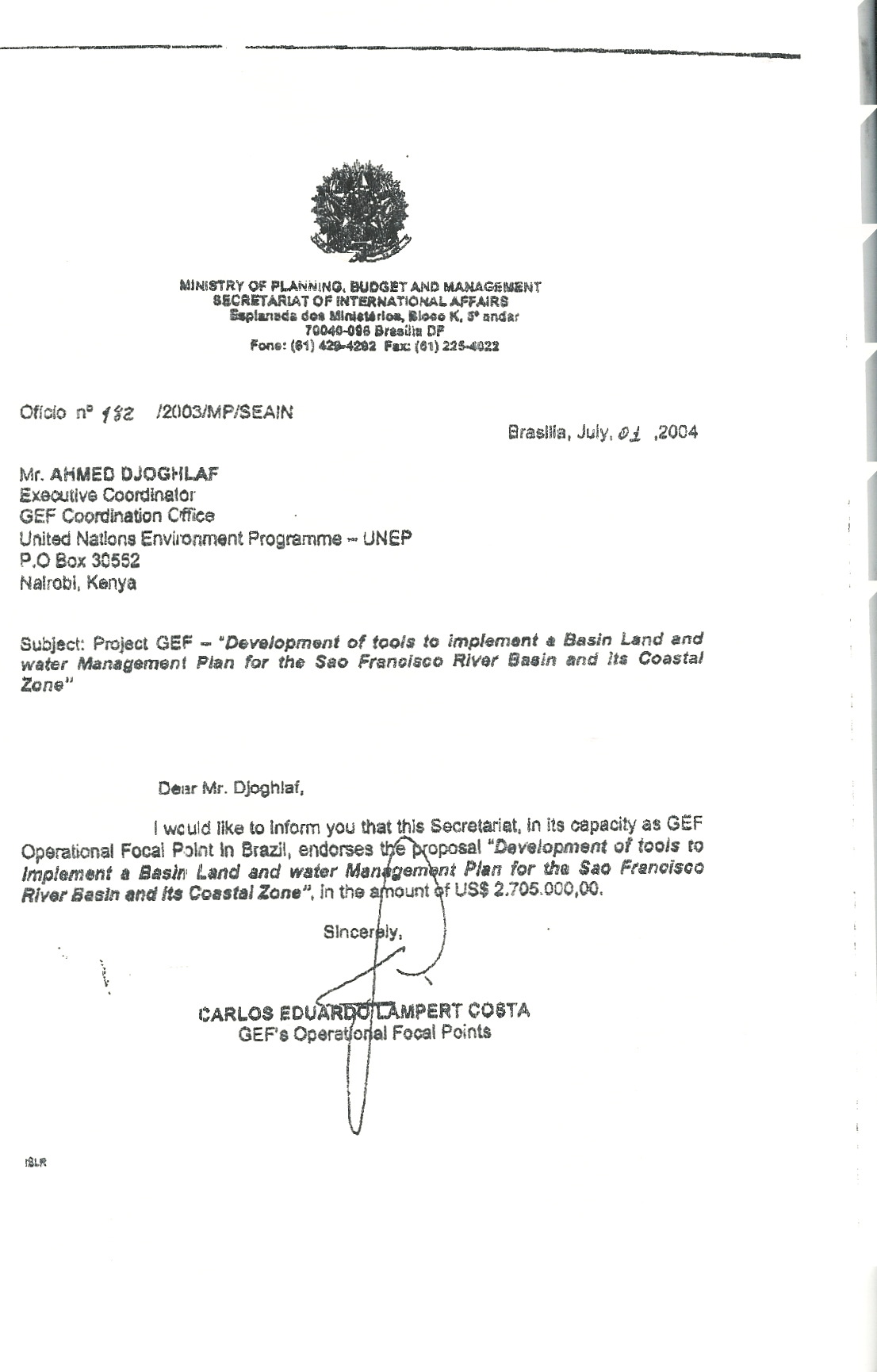
Annex 5
ANALYSES OF PHYSICAL AND ANTHROPOLOGICAL CHANGES OBSERVED IN LOWER SÃO FRANCISCO RIVER, ITS MOUTH AND COASTAL ZONE
Companhia Hidroelectrica do São Francisco - CHESF contribution
Activities and Products |
Period Months |
US$
|
|
1.1. To determine the total sediment discharge in the mouth and coastal zone as well as its relation with delta geomorphology and environmental control |
18
|
1,000,000 |
|
|
|
|
|
|
|
|
|
|
|
|
|
|
|
|
|
|
|
|
|
|
|
|
|
|
|
|
|
|
|
|
|
|
1.2. To carry out an inventory of Sub-medium and Lower São Francisco aquatic ecosystems and to monitor ichthyofauna, fisheries biology and statistics and aquatic macrophyte, limnological and water quality controls. |
18
|
540,000 |
|
1.2.1. Inventory of Sub-medium São Francisco aquatic ecosystems |
|
|
|
|
|
|
|
|
|
|
|
|
|
|
|
|
|
|
|
|
|
|
|
|
1.2.2. Ichthyofauna monitoring, fisheries biology and statistics |
|
|
|
|
|
|
|
|
|
|
|
|
|
|
|
|
|
|
|
|
|
|
|
|
|
|
|
1.2.3. Aquatic macrophyte monitoring and control |
|
|
|
|
|
|
|
|
|
|
|
|
|
|
|
1.2.4. Limnological and water quality monitoring |
|
|
|
|
|
|
|
|
|
|
|
|
|
|
|
|
|
|
|
|
|
|
|
|
Action 2. TO DETERMINE THE INFLUENCE OF SÃO FRANCISCO RIVER DISCHARGES AND ITS DISPERSION OVER THE CONTINENTAL PLATFORM ON COASTAL SYSTEM CHANGES Activities and Products |
Period Months |
US$
|
|
2.1. To define the minimum ecological discharge to be kept in São Francisco mouth in face of water regime changes |
12 |
200,000 |
|
|
|
|
|
|
|
2.2. Assessment of the need and viability to execute artificial floods to improve morphological and environmental conditions in riverbed. |
18
|
1,000,000 |
|
|
|
|
Technical, economic and socio-environmental study |
|
|
|
|
|
|
|
|
|
|
|
|
|
|
|
|
|
|
|
|
|
|
|
|
|
|
|
|
|
|
|
|
|
|
|
|
|
|
|
|
|
|
Artificial Flood Project, which must encompass every procedure to implement an artificial flood event, with determined discharges, duration, period and rationale as well as: |
|
|
|
|
|
|
|
|
|
|
|
|
|
|
|
|
|
|
|
|
|
Flood Monitoring Plan, which must keep track of every situation before, during and after the flood (natural or artificial). The plan must describe procedures, include survey forms, detailed timetable and budget, list of organizations involved, equipment and materials.
|
|
|
|
2.3. Identification of advantages and disadvantages to implement re-regularization dams in Lower São Francisco |
18 |
200,000 |
|
|
|
|
|
|
|
|
|
|
|
|
|
|
|
|
|
|
|
|
|
|
|
|
Co-financing endorsement letter Annex 6
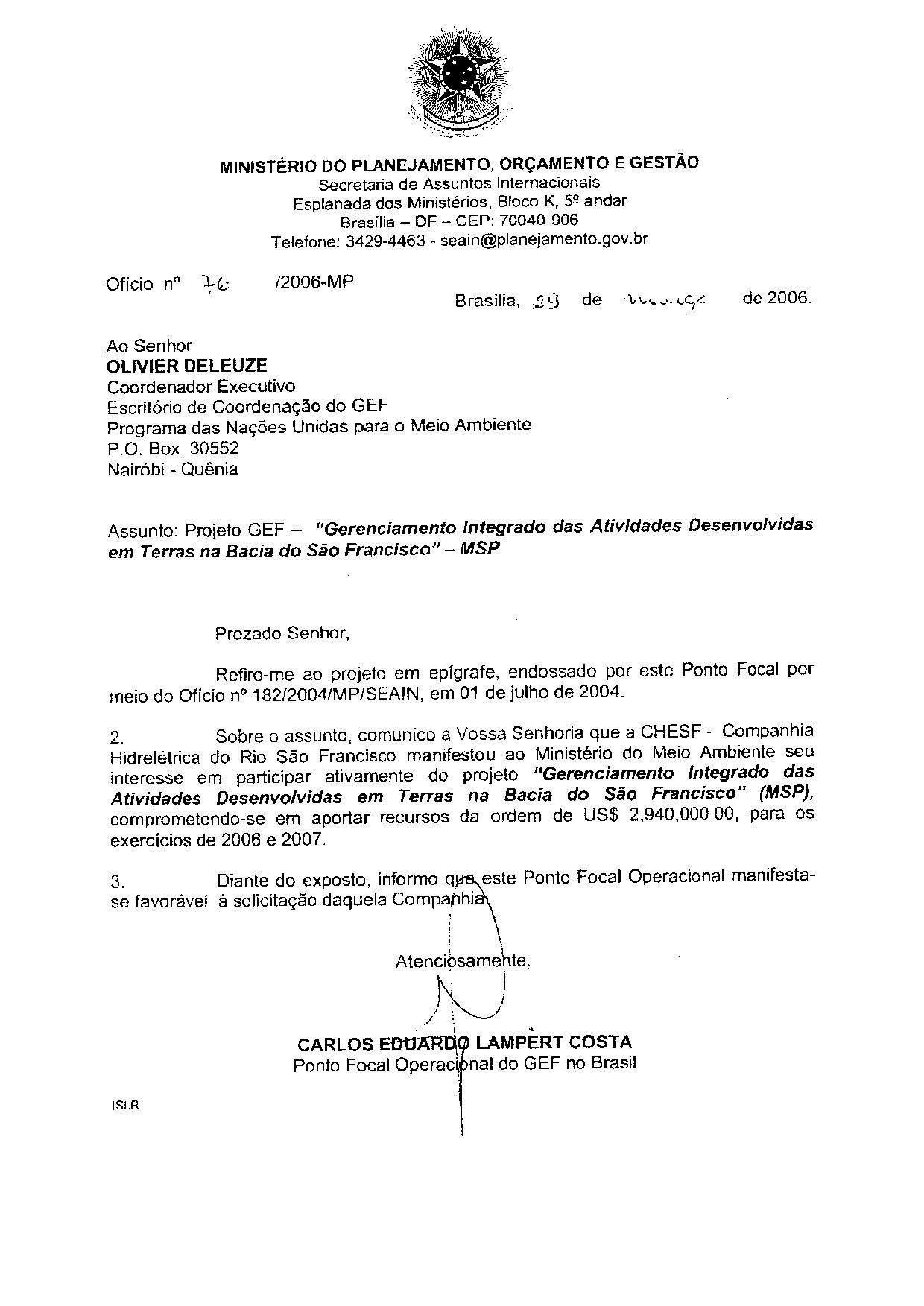
Rough translation:
Date: Brasilia 29 March 2006
From: Brasilia GEF Focal Point to UNEP/GEF
Re: São Francisco MSP
I am referring to the above mentioned project and the endorsement letter of the Brazilian focal point dated 01 July 2004.
I wish to let you know that CHESF, the Electrical Company of the São Francisco River informed the Ministry of Environment of its interest in participating actively in the São Francisco MSP and is committed to bring resources in the order of USD 2,940,000 for FY 2006-2007.
On the basis of the above, please not that the Brazilian Operational Focal Point is strongly supporting the offer from CHESF.
Regards.
Carlos Lampert
Brasilian GEF Operational Focal Point
ANA in kind co-financing endorsement letter Annex 7
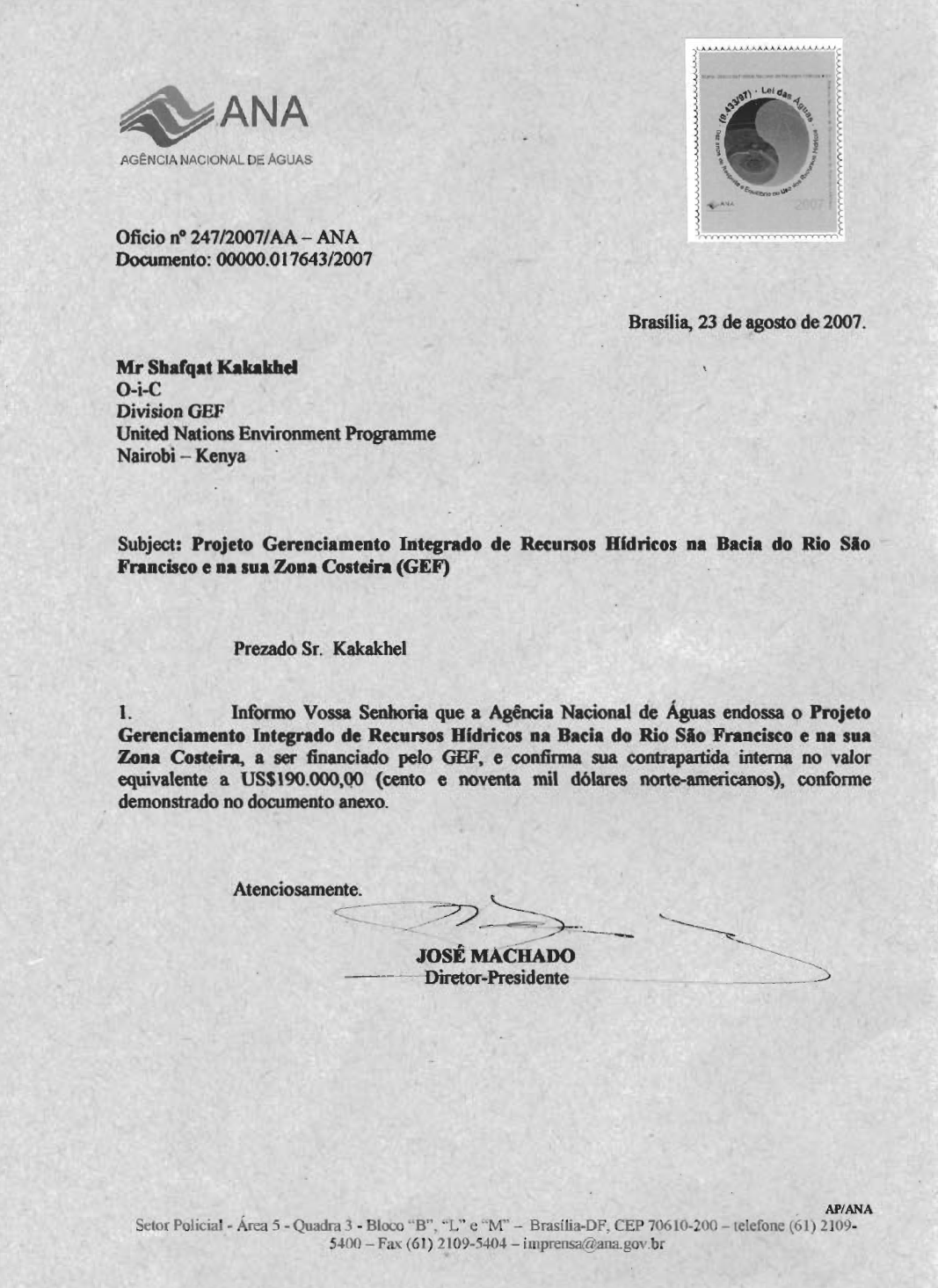
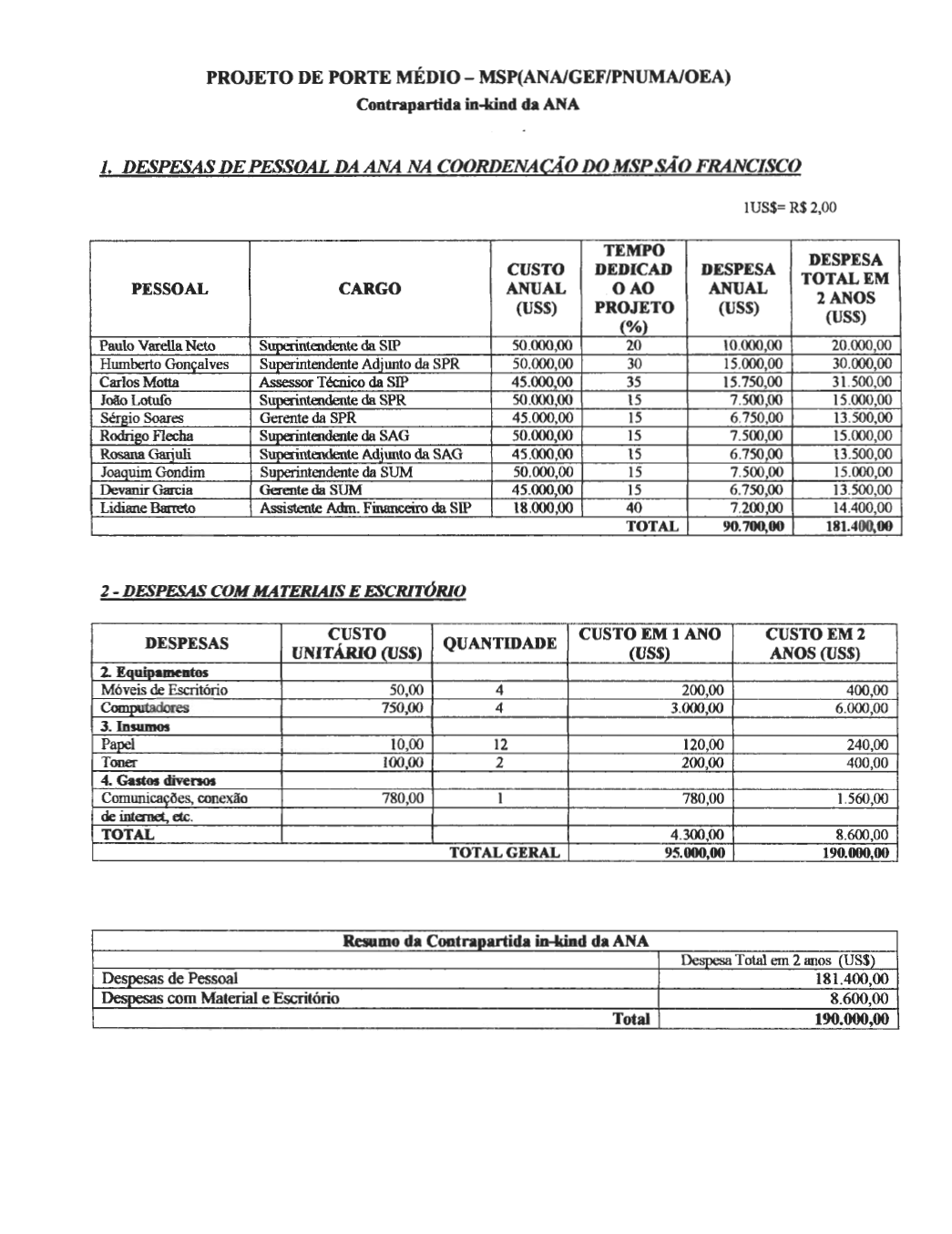
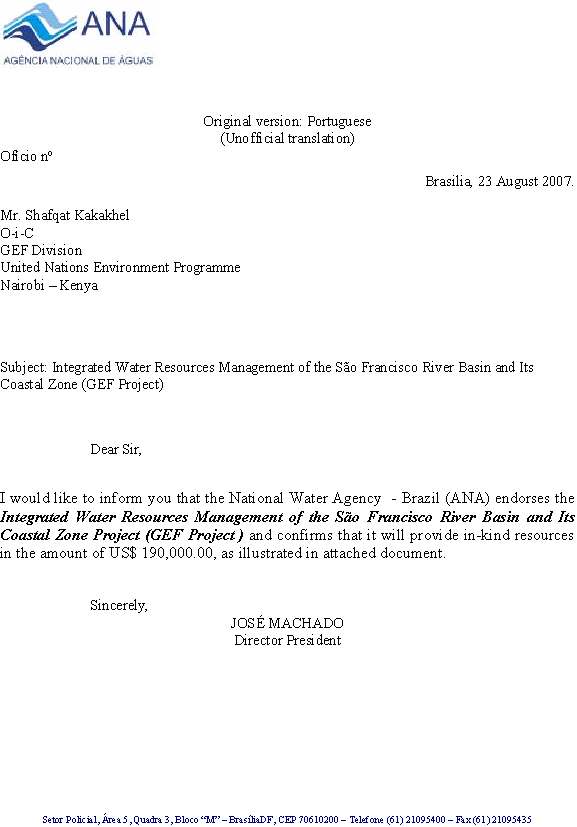
OAS in kind co-financing endorsement letter Annex 8
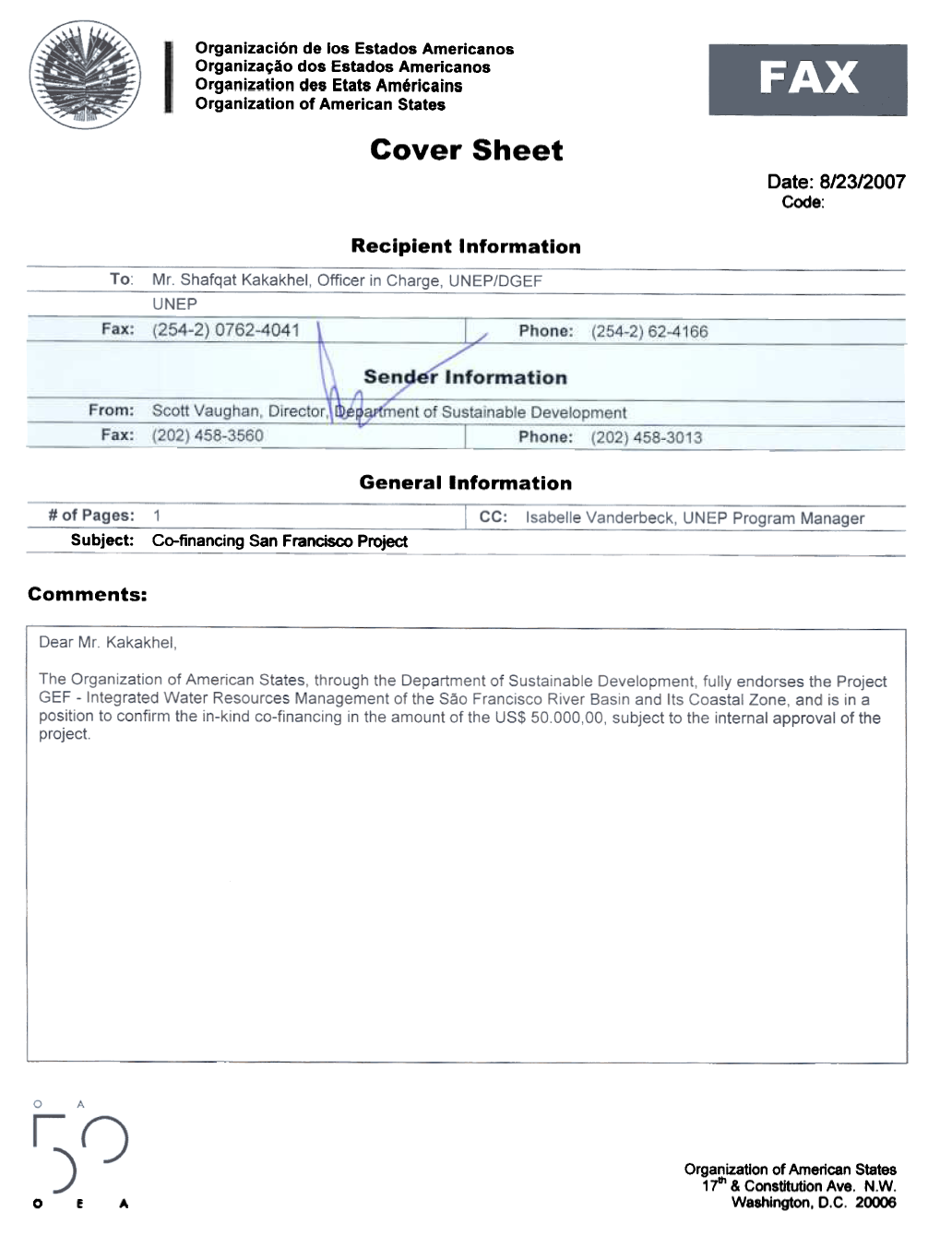
Annex 9: Budget in UNEP Format
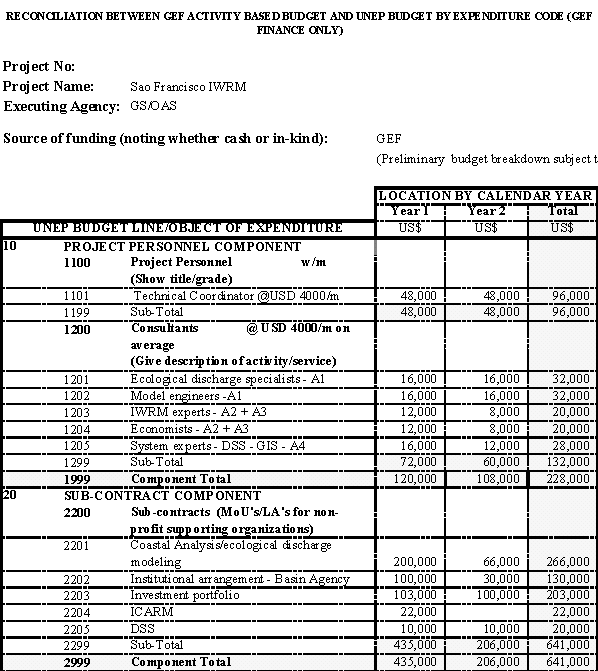
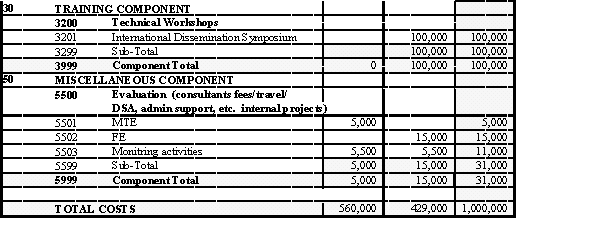
1 ANA/GEF/UNEP/OAS (2004) Strategic Action Program for the Integrated Management of the Sao Francisco River Basin and its Coastal Zone – SAP – Executive Summary. www.ana.gov.br/gefsf/.
2 ANA (2005) Plano Decenal de Recursos Hidricos da Bacia Hidrografica do Sao Francisco (PBHSF) (2004-2013), Agencia Nacional de Aguas. www.ana.gov.br/prhbsf/index.htm.
3 The SAP or policy document completed in December 2005, served as the basis for the Basin Plan formulation, a requirement under the Brazilian water law9433/97. The Basin Plan operationalises the SAP and was completed in December 2005.
4 The instruments of the NPWR are: (i) development of water resources master plans; (ii) establishing classes of water bodies according to preponderant uses; (iii) implementing water rights concessions; (iv) implementing water charge systems; (v) establishing compensation mechanisms to municipalities; and, (vi) developing a water resources information system.
5 ANA/GEF/UNEP/OAS, Integrated Management of Land-Based Activities in the Sao Francisco River Basin: Strategic Action Program for the Integrated Management of the Sao Francisco River Basin and Its Coastal Zone—SAP, Final Report, August 2004, 336 pp. ISBN 85-98276-02-2.
6 The Basin Plan for the Sao Francisco River Basin includes the priority actions set forth in the SAP as well as investments required to ensure the rational and sustainable development of the land and water resources of the Sao Francisco River Basin and its coastal zone. These investments include investments necessary to develop both the land and water resources of the basin in a sustainable manner, as well as investments necessary to protect water quality and ensure the public health and welfare—these latter investments including the capital costs of sewerage and solid waste management facilities.
8 ANA/GEF/UNEP/OAS (2004) Strategic Action Program for the Integrated Management of the Sao Francisco River Basin and its Coastal Zone – SAP – Executive Summary. www.ana.gov.br/gefsf/.
9 ANA (2005) Plano Decenal de Recursos Hidricos da Bacia Hidrografica do Sao Francisco (PBHSF) (2004-2013), Agencia Nacional de Aguas. www.ana.gov.br/prhbsf/index.htm.
10 The SAP or policy document completed in December 2005, served as the basis for the Basin Plan formulation, a requirement under the Brazilian water law9433/97. The Basin Plan operationalises the SAP and was completed in December 2005.
11 The instruments of the NPWR are: (i) development of water resources master plans; (ii) establishing classes of water bodies according to preponderant uses; (iii) implementing water rights concessions; (iv) implementing water charge systems; (v) establishing compensation mechanisms to municipalities; and, (vi) developing a water resources information system.
12 Apart from the 210 events carried out during the execution of the DAB and SAP activities, seven additional meetings were held specifically for the purposes of SAP preparation, thus providing opportunities for wide-ranging discussion of its objectives, consistency, completeness and methodologies, and of its intermediate and final outputs. In total, 13,000 stakeholders were involved in the formulation and validation process of the DAB-SAP.
January 30, 2007