E1288
v 5
Public Disclosure Authorized
Environmental Impact Statement
(EIS)
for
Manila Third Sewerage Project
Public Disclosure Authorized
Volume 5: Bio Solids Management Strategy
February 11, 2005
(Revised Draft)
Public Disclosure Authorized
Public Disclosure Authorized
Manila Water Company, Inc.
Manila, Philippines

Manila Water Company, Inc.
Biosolids Management Strategy
Options Study
Report
August 2004
Contents
Executive Summary
1
Technical Acronyms and Abbreviations
4
1.
Introduction
6
1.1 General
6
1.2 Project Objectives
6
1.3 Definition of Terms
6
2.
Available Information
8
2.1 Data Sources
8
2.2 Required Data from Additional Testing and Monitoring
8
2.3 Assumptions
9
3.
MWCI Operations
10
3.1 MWCI Service Area
10
3.2 Existing Facilities Related to Biosolids Generation and
Management
10
3.3 Certifications and Licenses
10
3.4 On Going and Planned Projects
10
3.5 Key Issues in Establishing the MWCI Biosolids Strategy
10
4.
Biosolids Quantity and Quality
10
4.1 General
10
4.2 Dried Sludge from Magallanes WWTP
10
4.3 Liquid Sludge from Operating WWTPs
10
4.4 Dewatered Sludge from MSSP Facilities
10
4.5 Sludge from MTSP Facilities
10
4.6 Liquid Sludge Generation from MSSP WWTPs
10
4.7 Septage
10
4.8 Filter Cakes from Proposed Septage Treatment Plants
10
4.9 Summary of the Expected Biosolids Quantity
10
4.10 Biosolids Quality
10
5.
Planning Considerations
10
5.1 General
10
5.2 Review of Local Guidelines on Biosolids Management
10
71/10229/21017
Biosolids Management Strategy
2
Options Study
5.3 Review of International Guidelines on Biosolids Management
10
5.4 Review of US EPA Guidelines on Land Application of Domestic
Septage
10
5.5 Global Trends
10
5.6 Carbon Credit Opportunities
10
5.7 Transport Alternatives
10
5.8 Planning Issues
10
5.9 Social Issues
10
6.
Biosolids Reuse and Disposal Assessment
10
6.1 Potential Reuse
10
6.2 Disposal Options
10
6.3 Short-listing of Options
10
7.
Biosolids Treatment Unit Processes
10
7.1 Introduction
10
7.2 Technology Options Overview
10
7.3 MWCI Technology Requirements
10
7.4 Short-listed Technologies
10
8.
Enhancement of Existing Operations
10
8.1 Magallanes WWTP
10
8.2 Valle Verde Homes WWTP
10
8.3 Existing Karangalan Village WWTP
10
8.4 Diego Sillang WWTP Infrastructure
10
8.5 Lahar Application Practices
10
9.
Proposed Strategy
10
9.1 Short-term (Current to 2005)
10
9.2 Medium-term (2005 to 2010)
10
9.3 Long-term (2010 onwards)
10
10. Risk Assessment
10
10.1 General 10
10.2 Project Risk Assessment
10
10.3 Discussion of the High and Extreme Risks
10
11. Preliminary Costing of Preferred Options
10
11.1 Basis of Cost Estimates
10
11.2 Short Term (Current to 2005)
10
71/10229/21017
Biosolids Management Strategy
3
Options Study
11.3 Medium Term (2005 to 2010)
10
11.4 Long Term (2010 onwards)
10
12. Conclusions and Recommendations
10
12.1 Conclusions
10
12.2 Recommendations
10
13. References
10
Table Index
Table 1
MWCI Concession Area Forecasted Population1
10
Table 2
MWCI Sewerage Service Coverage Targets (% of
total population in area)1
10
Table 3
MWCI Sanitation Service Coverage Targets (% of
total population in area)1
10
Table 4
Existing Communal Septic Tanks
10
Table 5
Septic Tank Desludging Data (Number of individual
tanks serviced)1
10
Table 6
On Going and Planned Wastewater Projects under
the MSSP (Bio-contact Activated Sludge Process)
10
Table 7
On Going and Planned Wastewater Projects under
the MTSP
10
Table 8
Estimated Biosolids Generation Rate for Existing
WWTPs*
10
Table 9
Biosolids Generation from MSSP Projects
10
Table 10
Biosolids Generation of Wastewater Projects under
the MTSP
10
Table 11
Biosolids Generation Rates of MSSP WWTPs
10
Table 12
STP Solids Generation Growth Rate in m3/day
10
Table 13
Summary of Biosolids Generation in Terms of
Source
10
Table 14
Summary of Biosolids Generation in Terms of
Biosolids Type
10
Table 15
List of Controlled Contaminants
10
Table 16
Typical Properties and Composition of Various
Sludge Types*
10
Table 17
Typical Septage Constituent Concentrations and
Unit Loading Factors*
10
Table 18
Metro Manila Septage Characteristics
10
71/10229/21017
Biosolids Management Strategy
4
Options Study
Table 19
Maximum Average Concentration of Heavy Metals
for Land Application (mg/kg)
10
Table 20
Allowed Annual Loading Rates (kg/ha/yr)
10
Table 21
Comparison of US EPA Guidelines with MWCI
Practices
10
Table 22
Comparison of Annual Greenhouse Gas Emissions
for Management Options*
10
Table 23
Potential Biosolids Reuse Market Sectors
10
Table 24
Short-listed Biosolids Market Options
10
Table 25
Sludge Treatment Overview
10
Table 26
Qualitative Measures of Consequence or Impact of
Any Single Incident
10
Table 27
Qualitative Measures of Likelihood
10
Table 28
Qualitative Risk Analysis Matrix
10
Table 29
Qualitative Risk Assessment Identified Risks
10
Table 30
Classification Requirements for Biosolids Reuse
10
Table 31
Comparison of Various Composting Methods
10
Table 32
Short-term Storage Characterisations for Various
Sludge Types
10
Appendices
A
Environmental Management Bureau Classification of Domestic
Sludge and Septage
B
Review of International Guidelines on Biosolids Management
C
Processing Technology Review
71/10229/21017
Biosolids Management Strategy
5
Options Study
Executive Summary
GHD was commissioned by Manila Water Company, Inc. (MWCI) to undertake the planning and
development of a robust and sustainable Biosolids Management Strategy to deliver efficient solutions
and enhance MWCI's reputation as a company with strong environmental values.
MWCI operates a number of wastewater treatment and septage collection facilities that currently
generate a significant volume of biosolids requiring treatment and disposal/reuse. Biosolids are the
organic sludge produced from physical and biological treatment of wastewater and include treated
septage, secondary sludge, and processed/stabilized sludge.
Significant increases in the rate of biosolids generation are anticipated (from 95 m3/day to around 400
m3/day of dry solids), in line with a number of wastewater treatment plants and septage collection
initiatives currently underway. This increased biosolids generation (to around 180 dry tonnes/day) will
result in significant increases in operational costs for MWCI, unless the current management practices
are improved and streamlined, particularly the transport and disposal/reuse options.
The objectives of this project are to:
?? Develop a long-term Biosolids Management Strategy to provide a cost effective and environmentally
sustainable solution for MWCI's anticipated increase in septage and wastewater sludge generation.
?? Within this strategy, investigate measures to improve the efficiency and operability of the current
biosolids management systems particularly:
Reducing the current operational costs of the system.
Identifying low capital cost improvement options with short payback periods (less than 3 years).
Reducing health and safety risks to operational staff.
?? Ensure that the septage treatment process selected for the Manila Third Sewerage Project (MTSP),
Pasig River Rehabilitation Commission (PRRC) projects and other wastewater treatment plants is
compatible with the downstream biosolids processing, reuse and final disposal options selected under
the strategy.
?? Ensure that environmental performance in biosolids management promotes a positive corporate
image for MWCI at an appropriate cost.
The study concludes the following:
?? Biosolids produced from MWCI plants are unstabilised. The use of biosolids should be restricted and
applied to land adapting internationally recognised practices.
?? Current vi able markets include the rehabilitation of the lahar fields, and in extensive agriculture in
Pampanga, Tarlac, and other nearby provinces.
?? In the short term, management of the application of biosolids in these markets needs to be improved
for health and safety reasons, and to avoid potential environmental harm in the long term. This
should include reviewing current practice of distributing dried sludge to third parties.
?? The production of higher quality biosolids will create alternative markets. These markets are likely to
be closer to Manila and transportation costs will be lower. Having a range of viable markets will
reduce risks for MWCI in case the current options are restricted.
71/10229/21017
Biosolids Management Strategy
1
Options Study
?? Pilot scale evaluation of alternative stabilisation technologies will provide MWCI with an
understanding of the technology and minimise the risks of a full-scale operation.
?? Storm events have the potential to limit the ability to continuously apply biosolids to land. Sufficient
biosolids storage facilities are required to balance the production rates with practical application rates.
?? A landfill disposal option would play a significant role in contingency planning. This is a risk
management option to protect against a potential disruption of operations due to climactic conditions
and other unforseen circumstances.
Based on the outcomes of this study, the following strategy is proposed:
Short-term (Current to 2005)
?? Biosolids markets
Lahar application needs to be fully investigated. Lahar application dependent on surface and
ground water monitoring, adsorptive capacity of lahar, and computed agronomic rates for
application.
Extensive Agriculture. Improvements to the current practice of septage application on agricultural
sites in accordance with the guidance of the US EPA Part 503 rule (Biosolids to be injected below
the surface, or incorporated within 6 hours of application to the land).
Other markets. Commence discussions with fertiliser retailers to identify potentially higher value
markets and other market opportunities for biosolids products. Assess interest with relevant
parties in preparing a feasibility study for a landfill bioreactor.
Transport/Management. Improvements to the septage haulage practices as identified in this
report. Formalize waste exchange agreements with Manila Fertilizer, farmers, etc. Commence
development of a tracking system to ensure that biosolids despatched are handled and
transported correctly with all appropriate checks and balances confirmed and documented.
Commence preparation of educational material and stakeholder consultation processes and
identify key stakeholders.
Disposal. As a contingency plan, suitable disposal site(s) need to be identified. These sites will
need to accept biosolids that are unsuitable/unable to be reused.
?? Technology
Stabilisation. No stabilisation required provided biosolids are applied to extensive agriculture and
land rehabilitation (lahar) in accordance with acceptable practices.
Dewatering. Dewatering progressively implemented to minimise haulage costs.
Medium-term (2005 2010)
?? Biosolids markets
Lahar application optimised and sustainable. The recommendations of the Environmental Risk
Assessment being conducted by EDCOP for the lahar application of biosolids are adopted and
implemented. Possible collaboration with other agencies (Department of Agriculture) to achieve
this goal.
Extensive Agriculture. Reuse practices monitored for compliance with local and appropriate
requirements.
71/10229/21017
Biosolids Management Strategy
2
Options Study
Other markets. Test the market acceptance and economics (cost/revenue) of alternative biosolids
products in pilot trial quantities.
Transport/Management. Tracking, handling and identification system fully implemented. Promote
and seek expressions of interest from third parties to undertake biosolids management contracts
with MWCI. Review international guidelines for advancements in biosolids management
approaches. Distribution of educational material and continue stakeholder consultation processes.
Disposal. Agreement with relevant regulatory bodies on the use of disposal sites.
?? Technology
Stabilisation. Plan and implement a pilot scale trial (~5m3/d) on an alternative stabilisation
process (eg. vermiculture) at one of the WWTPs. If stabilisation is required as a contingency plan
on full-scale plants, lime processes can be adopted.
Dewatering. Optimisation of dewatering processes to minimise haulage costs.
Long-term (2010 onwards)
?? Biosolids markets
Lahar application. Volume of product used in this market is reduced as markets closer to Manila
are developed.
Intensive agriculture and landscaping. Higher quality biosolids product (vermicast/compost or
equivalent) is used extensively in these markets.
Transport/Management. Paperless tracking systems investigated and adopted. Engagement with
local regulatory bodies to ensure development of guidelines is viable and aligns with MWCI
practice. Distribution of educational material and continue stakeholder consultation processes in
intensive agricultural and landscaping markets. Third parties undertake biosolids management
contracts for MWCI on a competitive basis.
?? Technology
Stabilisation. Lime facilities decommissioned, or kept as a back up (if installed). Vermiculture,
composting or other alternative process is adopted to generate high quality biosolids product
suitable for intensive agriculture and landscaping markets.
Dewatering. Review technology advances in dewatering (electro dewatering, microwave etc.) to
further minimise haulage costs. Drying beds likely to be phased out due to increased concerns
over odour issues.
71/10229/21017
Biosolids Management Strategy
3
Options Study
Technical Acronyms and Abbreviations
Abbreviations and acronyms used in the report are as follows:
ALI
Ayala Land, Inc.
AS
Activated sludge
ASP
Active sludge pasteurisation
ATAD
Autoheated thermophilic aerobic digestion
BNR
Biological nutrient removal
BOD
Biological oxygen demand
CAS
Conventional activated sludge
CST
Communal septic tank
DAF
Dissolved air flotation
DAF+F or DAFF
Dissolved air flotation and filtration
DENR
Department of Environment and Natural Resources
ds or DS
Dry solids
EDCOP
Engineering Development Corporation
ep or EP
Equivalent population
FPA
Fertilizers and Pesticides Authority
HCB
Hexachlorobenzene
IDEA
Intermittently decanted extended aeration
LGU
Local Government Unit
MSSP
Manila Second Sewerage Project
MTSP
Manila Third Sewerage Project
MWCI
Manila Water Company, Inc.
MWSS
Manila Waterworks and Sewerage System
NJS
Nippon Jogesuido Sekkei Co., Ltd.
NSO
National Statistics Office
OFS
Oil from sludge
PRRC
Pasig River Rehabilitation Commission
SKM
Sinclair Knight Merz Phils.
71/10229/21017
Biosolids Management Strategy
4
Options Study
SRA
Sugar Regulatory Administration
SS
Suspended solids
STP
Septage treatment plant
TS
Total solids
VSS
Volatile suspended solids
WAS
Waste activated sludge
wt
Tonnes (wet)
WWTP
Wastewater treatment plant
71/10229/21017
Biosolids Management Strategy
5
Options Study
1.
Introduction
1.1
General
GHD was commissioned by Manila Water Company, Inc. (MWCI) to undertake the planning and
development of a robust and sustainable Biosolids Management Strategy to deliver efficient solutions
and enhance MWCI's reputation as a company with strong environmental values.
MWCI operates a number of wastewater treatment and septage collection facilities that currently
generate a significant volume of biosolids requiring treatment and disposal/reuse. Biosolids are the
organic sludge produced from physical and biological treatment of wastewater and include treated
septage, secondary sludge, and processed/stabilized sludge.
Significant increases in the rate of biosolids generation are anticipated in line with a number of
wastewater treatment plants and septage collection initiatives currently underway. This increased
biosolids generation will result in significant increases in operational costs for MWCI, unless the current
management practices are improved and streamlined, particularly the transport and disposal/reuse
options. Effective planning and the preparation and implementation of a Biosolids Management Strategy
is the first and most important step in developing an efficient and cost effective sanitation program.
1.2
Project Objectives
The project aims to:
?? Develop a long-term Biosolids Management Strategy to provide a cost effective and environmentally
sustainable solution for MWCI's anticipated increase in septage and wastewater sludge generation.
?? Within this strategy, investigate measures to improve the efficiency and operability of the current
biosolids management systems particularly:
Reducing the current operational costs of the system.
Identifying low capital cost improvement options with short payback periods (less than 3 years).
Reducing health and safety risks to operational staff.
?? Ensure that the septage treatment process selected for the Manila Third Sewerage Project (MTSP),
Pasig River Rehabilitation Commission (PRRC) projects and other wastewater treatment plants is
compatible with the downstream biosolids processing, reuse and final disposal options selected under
the strategy.
?? Ensure that environmental performance in biosolids management promotes a positive corporate
image for MWCI at an appropriate cost.
1.3
Definition of Terms
Biosolids are the organic solids produced by wastewater treatment processes due to the conversion of
liquid organic matter into biological mass. Biosolids and sewage sludge have been used
interchangeably, however preference for using biosolids in developed countries is prevalent due to the
reuse potential for the solids. The term biosolids does not include untreated raw wastewater, industrial
sludges that cannot be used beneficially without further processing, or the product produced from the
71/10229/21017
Biosolids Management Strategy
6
Options Study
high temperature incineration of sewage sludge. It should also be noted that other solid waste materials
are not classified as biosolids e.g., animal manures, food processing or abattoir wastes.
Domestic wastewater treatment plants produce solid materials as by-products of the treatment process.
These are typically:
?? Screenings - materials trapped by screens that filter the raw sewage as it enters the plants.
?? Grit - sand and grit trapped in tanks that treat the raw sewage.
?? Primary sludge - material that is settled from the raw sewage as it passes through primary settling
tanks.
?? Secondary sludge - solid material separated from sewage after it has undergone biological
treatment termed humus for the trickling filter process and waste activated sludge (WAS) for the
activated sludge or BNR processes.
?? Tertiary sludge - solid material separated from effluent following tertiary treatment, typically filtration
or dissolved air flotation.
Solids collected from screens and grit collection facilities are not included in this report as they are
primarily inorganic in nature and not biological solids. However, handling and disposal for these
materials should comply with environmental regulations, and occupational safety and health regulations.
As a minimum screenings are to be dripped dried and bagged whilst grit should be washed and classified
prior to on site storage. Screenings and grit can then be collected by the municipal solid waste
contractor and disposed to an approved landfill facility.
71/10229/21017
Biosolids Management Strategy
7
Options Study
2.
Available Information
2.1
Data Sources
Information cited in this report has been provided or sourced from MWCI and includes:
?? Operational data.
?? Planning data.
?? Listing of current and proposed projects.
?? Environmental licensing status.
Information on international regulatory requirements and best practice guidelines has been sourced
directly via the Internet.
Parallel projects on biosolids management, i.e. lahar application, septage treatment plant design, etc.,
are currently being undertaken by other consultants and these projects are targeted for completion prior
to finalisation of this study. The information from these projects has been incorporated into this report to
ensure the overall strategy is consistent and complete. The project details are as follows:
?? The Pasig River Rehabilitation Commission (PRRC) Feasibility Study for the Treatment, Handling and
Disposal of Sludge prepared by Sinclair Knight Merz Phils. (SKM).
?? The Metropolitan Waterworks and Sewerage System (MWSS) Water Supply and Sewerage Master
Plan of Metro Manila prepared by Nippon Jogesuido Sekkei Co., Ltd. (NJS)
?? The Manila Third Sewerage Project (MTSP) Feasibility Study and Detailed Design undertaken by
NJS.
?? The lahar application Environmental Assessment being undertaken by Engineering Development
Corporation (EDCOP).
GHD also visited several MWCI WWTP and septage holding tanks to provide additional operational
information and identify potential improvement opportunities. Sites visited include:
?? Magallanes WWTP.
?? Pabahay Village WWTP.
?? Diego Silang WWTP (currently under rehabilitation with a temporary septage holding tank added into
the infrastructure).
?? Valle Verde WWTP.
?? Karangalan Village WWTP.
?? West Ave. (Philam) septage holding tank (a WWTP is currently being constructed in the site).
?? Lahar fields in Concepcion, Tarlac and San Fernando, Pampanga.
2.2
Required Data from Additional Testing and Monitoring
Testing data on sludge and septage samples for the following are recommended for confirming biosolids
quality and monitoring purposes:
?? Heavy metals (arsenic, cadmium, chromium, copper, nickel, lead, selenium, zinc, mercury).
71/10229/21017
Biosolids Management Strategy
8
Options Study
?? Organochlorine pesticides (Aldrin, BHC (alpha, beta, delta), DDD, DDE, DDT, DDT total, dieldrin,
heptachlor, heptachlor epoxide, hexachlorobenzene (HCB), lindane (BHC-gamma), chlordane (cis),
chlordane (trans), total chlordane).
2.3
Assumptions
The following were assumed in establishing the MWCI biosolids management strategy:
?? Population growth in the service area is as per National Statistics Office (NSO) assumed growth rates
and forecasted population.
?? Connectivity rates for population in the service area is as per MWCI rates rebasing data.
?? Given the domestic nature of biosolids produced within the MWCI service area and lack of information
on biosolids characteristics, heavy metal, organochlorine, and other organic and inorganic
contaminant concentration levels would be within the limits set by international standards. Additional
testing and monitoring are required to confirm this assumption (particularly for copper, mercury and
cadmium).
?? Agronomic rates for potential land application reuse options would be within the limits provided by
international guidelines. Confirmation of this assumption needs to be undertaken for each identified
area for biosolids application.
71/10229/21017
Biosolids Management Strategy
9
Options Study
3.
MWCI Operations
3.1
MWCI Service Area
The Manila Waterworks and Sewerage System (MWSS) was privatised in 1997 with MWCI assuming
control over the eastern concession area. The privatisation involved a 25-year concession agreement for
both water supply and sewerage services.
The east concession covers approximately 1,400 square kilometers in area. The MWCI service area
includes, in part or in whole, 24 cities and municipalities in Metro Manila and the nearby Rizal province,
including:
?? Mandaluyong
?? Binangonan
?? Marikina
?? Cainta
?? Pasig
?? Cardona
?? Pateros
?? Jala-Jala
?? San Juan
?? Morong
?? Taguig
?? Pililia
?? Makati
?? Rodriguez
?? Parts of Quezon City
?? San Mateo
?? Parts of Manila
?? Tanay
?? Angono
?? Taytay
?? Antipolo
?? Teresa
?? Baras
?? Montalban
3.1.1
Population Forecast
From MWCI provided information based on the NSO population growth rates and data, forecasted
population levels in the concession area are given in Table 1.
Table 1
MWCI Concession Area Forecasted Population1
Location
2004
2006
2011
2016
2021
Mandaluyong
280,000
281,000
283,000
285,000
287,000
Makati2
411,000
424,000
457,000
492,000
530,000
Marikina
418,000
436,000
471,000
507,000
530,000
Quezon City3
835,000
852,000
874,000
955,000
959,000
Pasig
536,000
557,000
596,000
624,000
642,000
71/10229/21017
Biosolids Management Strategy
10
Options Study
Location
2004
2006
2011
2016
2021
Pateros
57,400
57,400
56,000
58,100
56,000
San Juan
112,000
108,000
97,800
94,300
82,900
Taguig
539,000
587,000
712,000
846,000
992,000
Angono
83,100
88,700
103,000
130,000
149,000
Antipolo
604,000
693,000
986,000
1,250,000
1,690,000
Baras
26,200
27,300
30,000
38,100
43,600
Binangonan
200,000
208,000
227,000
316,000
354,000
Cainta
299,000
337,000
454,000
499,000
503,000
Cardona
40,300
41,200
42,900
45,600
45,600
Jala-jala
24,600
25,500
27,500
31,900
33,000
Morong
43,500
44,200
45,400
53,100
54,200
Pililia
47,700
49,300
52,800
63,600
67,000
Rodriguez
123,000
142,000
181,000
207,000
231,000
San Mateo
149,000
158,000
181,000
222,000
241,000
Tanay
85,000
89,300
100,000
109,000
117,000
Taytay
215,000
227,000
255,000
359,000
414,000
Teresa
31,500
32,600
35,200
45,100
49,600
Manila4
128,000
124,100
113,000
110,000
97,500
Total
5,290,000
5,590,000
6,380,000
7,340,000
8,160,000
1Using the National Statistics Office growth rates for the specified area as estimated by MWCI.
2MWCI coverage in Makati City is 87% of the total land area and population is based on this percentage of total population.
3MWCI coverage in Quezon City is 41% of the total land area and population is based on this percentage of total population.
4MWCI coverage in Manila is 13% of the total land area and population is based on this percentage of total population.
3.1.2
Sanitation and Sewer Services
MWCI has separate target coverage for sanitation, i.e. maintenance of individual septic tanks through
periodic desludging, and sewerage, i.e. provision of communal septic tanks and wastewater treatment
plants. Table 2 and Table 3 provide the target connectivity rates for proposed MWCI infrastructure.
71/10229/21017
Biosolids Management Strategy
11
Options Study
Table 2
MWCI Sewerage Service Coverage Targets (% of total population in area)1
Location
2001
2006
2011
2016
2021
Mandaluyong
0.5
4
10
15
Makati
22
40
38
28
23
Quezon City
13
20
16
17
Pasig
9
10
12
14
San Juan
18
41
Taguig
5
25
26
20
1 From MWCI rates rebasing data.
Note: Blank cells indicate no specified target for the area. Other cities and municipalities within the MWCI concession are not
planned for connection to a sewer system.
Table 3
MWCI Sanitation Service Coverage Targets (% of total population in area)1
Location
2001
2006
2011
2016
2021
Mandaluyong
99.5
96
90
85
Makati
60
62
72
77
Marikina
0
100
100
100
100
Quezon City
3.2
87
80
84
83
Pasig
1.2
91
90
88
86
Pateros
100
100
100
100
San Juan
100
100
82
59
Taguig
95
75
74
80
Angono
0
100
100
100
100
Antipolo
0.5
100
100
100
100
Baras
0.5
0
0
100
100
Binangonan
0
0
100
100
Cainta
0.2
100
100
100
100
Cardona
0
0
100
100
Jala-jala
0.2
0
0
100
100
Morong
0.7
0
0
100
100
Pililia
0
0
100
100
71/10229/21017
Biosolids Management Strategy
12
Options Study
Location
2001
2006
2011
2016
2021
Rodriguez
100
100
100
100
San Mateo
0.7
100
100
100
100
Tanay
0
0
100
100
Taytay
0
100
100
100
100
Teresa
0
0
100
100
Manila
100
100
100
100
1 From MWCI rates rebasing data.
Note: Blank cells indicate no specified target for the area.
Population within the service area not connected to the MWCI full sewerage infrastructure or provided
with sanitation services are expected to have:
?? Individual septic tanks collecting wastewater and providing minimal treatment prior to discharge to
receiving bodies of water without the periodic desludging services; or
?? Direct discharge of wastewater to receiving bodies of water especially for illegal settlers residing on
riverbanks.
It was estimated that the number of individual septic tanks in Metro Manila would be over one million
(based on 1996 data referenced from the SKM Septage Feasibility Study report). However, actual count
of individual septic tanks and unconnected population were not sighted during the course of this study.
3.2
Existing Facilities Related to Biosolids Generation and Management
3.2.1
Wastewater Treatment Plants
Among the current facilities being operated by MWCI, only the Magallanes WWTP produces digested
and dried sludge. Primary sludge and wasted activated sludge is currently being conveyed to two
anaerobic digesters for stabilisation prior to dewatering in drying beds. These are bagged and stored
under covered areas within the WWTP site.
MWCI trucks the dried sludge in 25 kg sacks to Porac, Pampanga and Nueva Ecija for distribution to
farmers. The farmers use these as soil conditioner for agricultural lands. No information on application
practices was available during the study. Average disposal rate to Porac and Nueva Ecija is 350 and
500 bags respectively per 3 months. MWCI has direct operational control only on the trucking of the
sludge to the site.
According to the WWTP operators, dried sludge is also being collected by various entities for land
application. However, there are no formal agreements with any of the entities for the hauling and reuse
of the dried sludge. Third party collector of Magallanes dried sludge includes:
?? Manila Fertilizer. It is understood that the sludge is being mixed with fertilizer products and sold.
Manila Fertilizer sludge collection is on a seasonal basis.
?? Farmers from Tarlac province haul dried sludge for application to agricultural lands.
71/10229/21017
Biosolids Management Strategy
13
Options Study
?? Makati City and other nearby local government units (LGUs). It is assumed that the sludge is used for
urban amenities, i.e. landscaping purposes.
?? Ayala Land, Inc. (ALI) land development projects. Assumed to reuse the sludge for landscaping.
MWCI provided copies of certificates issued by the Fertilizers and Pesticides Authority (FPA) accrediting
MWCI as a fertilizer manufacturer and distributor. It is uncertain if any soil and groundwater monitoring is
being undertaken within the application sites of the dried sludge.
An observation during the Magallanes WWTP visit was the uncertainty in the anaerobic digester
condition and the level of stabilisation being achieved. There is a potential that the dried sludge maybe
poorly stabilised (if not fully dried) and unsuitable for direct land application, i.e. vector attraction maybe
significant after the sludge has been applied and re-wetted via rainfall or irrigation. Therefore it is
necessary to review the distribution of dried sludge to third parties as MWCI may be exposed to liabilities
arising from this practice.
There are 3 other WWTPs operating within the MWCI concession area. These are the:
?? Pabahay Village WWTP based on a bio-contact activated sludge process with a capacity of 600 m3/d.
Excess liquid sludge produced from the plant is currently being pumped out and trucked to the Diego
Silang septage holding tank prior to disposal to lahar fields in Pampanga.
?? Valle Verde WWTP based on a bio-contact activated sludge process with a capacity of 115 m3/d.
Excess liquid sludge produced from the plant is currently being pumped out on an infrequent basis
and trucked to the Diego Silang septage holding tank prior to disposal to lahar fields in Pampanga.
?? Karangalan Village WWTP based on a bio-contact activated sludge process with a capacity of
484 m3/d. Excess liquid sludge produced from the plant is currently being pumped out on an
infrequent basis and trucked to the West Avenue septage holding tank prior to disposal to lahar fields
in Pampanga.
Information from operators of the Valle Verde and Karangalan WWTPs indicates very little sludge is
currently produced from the plants. Potential causes for this are discussed in Section 8.
3.2.2
Communal Septic Tanks
MWCI has implemented several communal septic tank (CST) facilities to help improve the Pasig River
conditions (Refer to section 5.8 for details). Septage from CSTs is collected by MWCI and conveyed to
one of the septage holding facilities. CST pump out is being done by MWCI on a routine basis of once
every five years. Ten of these CSTs are programmed for conversion as wastewater treatment plants in
the future. Current operational CSTs and capacities are shown in Table 4.
Table 4
Existing Communal Septic Tanks
Location
Tank Capacity (m3)
Violeta St., Roxas District, QC
113
Umbel St., Roxas District, QC
53
Gumamela St., Roxas District, QC
114
Gumamela St., Roxas District, QC
121
71/10229/21017
Biosolids Management Strategy
14
Options Study
Location
Tank Capacity (m3)
Waling Waling St., Roxas District, QC
192
Waling Waling St., Roxas District, QC
153
Everlasting St., Roxas District, QC
230
Azucena St., Roxas District, QC
191
Azucena St., Roxas District, QC
90
Azucena St., Roxas District, QC
70
Champaca St., Roxas District, QC
143
Camia St., Roxas District, QC
84
Everlasting St., Roxas District, QC
79
Alley nr. Rimas St., Project 2, QC
338
J. Zobel St., Project 4, QC
252
near Sangchio St., Kamuning, QC
410
Matiwasay St., U.P. Village, QC
829
Mapagmahal St., U.P. Village, QC
432
3.2.3
Septage Management
Areas within the concession not connected to sewerage are assumed to have individual septic tanks as
required by the National Plumbing Code of the Philippines. Normal design practices in the Philippines
assume a minimum of 24-hour detention period for septic tanks with a per capita water consumption of
150-200 liters per day. Wastewater generation is usually taken as 90% of the water consumption rate.
Various studies on Metro Manila sanitation requirements indicate a 6-year period between septage pump
outs for individual septic tanks is ideal and this is programmed for implementation by MWCI.
Septage Collection
Vacuum desludging trucks collect septage from individual and communal septic tanks. MWCI currently
has 7 units of 10 cubic meter capacity vacuum trucks undertaking the septage collection. Historical data
on septic tanks desludged is presented in Table 5.
Table 5
Septic Tank Desludging Data (Number of individual tanks serviced)1
Location
1997
1998
1999
2000
2001
2002
2003
Waiver
Mandaluyong
11
11
9
21
160
1,966
277
Makati
3
11
11
11
58
940
1,449
1
Marikina
19
78
83
119
440
709
2,216
445
Quezon City
17
111
117
136
369
1,974
6,183
1,385
71/10229/21017
Biosolids Management Strategy
15
Options Study
Location
1997
1998
1999
2000
2001
2002
2003
Waiver
Pasig
2
14
16
30
426
420
1,482
347
Pateros
3
1
452
3
0
San Juan
2
11
11
12
8
15
17
0
Taguig
136
244
0
Antipolo
6
6
7
4
8
213
0
Cainta
3
3
3
13
3
1,544
195
San Mateo
7
7
10
1
4
10
0
Manila
3
9
9
7
21
58
2,451
113
Montalban
4
8
8
4
6
36
43
Total
50
269
282
351
1368
4915
17821
2763
1 From MWCI provided monitoring data.
Note: Waiver column indicates the cumulative number of households from the start of the privatisation of the water service who
opted not to avail of the free desludging services offered by MWCI. Blank spaces means no desludging services were offered
in the area for the given year. Areas not included in the table were not included in the septage management program of MWCI
for the years listed.
Each truck collects an average of 3 septic tanks per trip. Septage collection and transport to the septage
holding facilities is under direct management of MWCI.
Septage Holding Facilities
Currently, septage collected within the MWCI service area is conveyed to either one of two septage-
holding facilities. Locations and capacities of the holding tanks are:
?? Philam, West Ave., West Triangle, Quezon City with a tank volume of 250 m3. A WWTP is being
constructed on the site and this is expected to be commissioned in mid 2004.
?? Diego Silang WWTP site with an estimated tank volume of 200 m3. We were unable to confirm the
tank volume from as -built drawings of the facility. The existing WWTP is currently not operating.
However, there is a plan to rehabilitate the plant and once operational, this is expected to treat on
average 2,700 m3/d of wastewater. MWCI currently anticipates commissioning of the rehabilitated
WWTP by middle of 2005.
Septage Transport and Disposal to Pampanga and Tarlac
Private hauling contractors collect and transport the septage from the Philam and Diego Silang holding
tanks to Pampanga and Tarlac. Each truck makes 1 to 2 round trips per day with truck capacities
ranging from 16 to 25 m3.
A site visit to the Philam septage holding facility was conducted on 23 March 2004 and it was observed
that:
?? Transport vehicles are water or fuel tankers converted to serve as septage transport vehicles.
71/10229/21017
Biosolids Management Strategy
16
Options Study
?? Drain valves were not secured and have a significant potential for accidental discharge due to
inadvertent opening of valves or leakage.
Although GHD was not able to observe private contractors collecting septage from the Diego Silang
facility, MWCI informed that the Philam and Diego Silang contractors are the same, i.e. contractors for
Philam also collects the sludge from Diego Silang. Therefore, the observations for the Philam site may
be applicable to the Diego Silang operations.
GHD requested for confirmation from the DENR-EMB on the requirements for the transport, handling,
and management of septage and domestic wastewater sludges. It was confirmed that septage and
domestic wastewater sludge are not substances under the jurisdiction of RA 6969. A copy of the DENR-
EMB correspondence is presented in Appendix A.
MWCI is currently disposing wet septage to lahar fields in Tarlac and Pampanga as land rehabilitation
and broad acre agriculture reuse options. Lahar is the term given to pyroclastic flows caused by the
Mt. Pinatubo eruption in 1991. The lahar application is being done in collaboration with the Sugar
Regulatory Administration (SRA) and is on a trial basis to assess the effect of liquid septage application
on the growth and yield of sugarcane. Lahar depths on the Tarlac application area are reportedly from 5
to 15 meters and the fields were not previously used for agricultural purposes, i.e. prior to the Mt.
Pinatubo eruption. The San Fernando, Pampanga application area was agricultural land prior to the
lahar deposit and lahar depths were estimated to be between 1.5 to 5.0 meters.
It is understood that the majority of the lahar fields being applied with septage are owned or leased by
the septage-hauling contractor. Application rate is in the order of 200 m3 of septage per hectare over a
2-month period during the early part of the planting season. This gives an average septage application
of 20 mm over the 2-month period. Septage is applied via:
?? Hoses and allowed to flow through furrows between planted sugarcane.
?? Direct spray application using transportable tanks on areas not yet planted with sugarcane.
According to the septage haulers, the farmers would turn the soil over upon completion of the septage
application for areas yet to be planted with sugarcane, however this was not observed during the site
visit. Areas already planted with sugarcane however were observed to have dried septage solids on the
ground surface.
Allocation of septage is programmed on a rotation basis as trucks come in. However, in most instances
other farmers not currently being supplied with septage, specially the barangay captains and those with
land along the access route to the application area, request that the haulers apply septage to their land
as well. The septage hauling contractors are not charging any fees to farmers who request the septage.
Application of liquid septage to lahar carries with it certain risks because of the adsorption capacity of
lahar and its erosion characteristics. There are some concerns in terms of potential nutrient leaching to
the groundwater due to the perceived low adsorption capacity of lahar. Contaminant transport via
surface runoff is also a concern due to the perceived high erodability of lahar.
The lahar application environmental assessment being undertaken by EDCOP needs to consider the
following items:
?? Lahar adsorption rates for nutrients from the septage to provide information on potential nutrient
transport to surface and ground water resources.
?? Erosion potential for lahar to provide a check on septage transport with surface runoff.
71/10229/21017
Biosolids Management Strategy
17
Options Study
?? Agronomic rates, i.e. maximum allowable septage application rates on lahar considering soil
characteristics, irrigation practices, and plant uptake, to provide an upper limit on the septage applied
per square meter of lahar area.
?? An assessment of topsoil or binder addition (sourced from nearby regions) to lahar-laden areas to
prevent potential runoff of septage due to erosion. Optimisation of the biosolids/binder/lahar mix.
?? A comparison of the unstabilised septage, dewatered septage (20% w/w) and lime stabilised
dewatered septage (comprising 0.5 kg lime added per kg dry solids) to determine any benefits and
disadvantages in achieving the above goals. Note that lime could also contribute to groundwater
contamination.
Further details on these items are provided in Section 6.1.3.
This assessment should take into consideration the carbon/nitrogen ratio (C/N). Literature (Walmsley &
Dougherty, 1995) suggests that the C/N ratio could be manipulated to reduce the rate of mineralisation
and hence nitrogen movement and pH reduction. The authors successfully applied biosolids to a
sandy/silty soil (which had a low nutrient level and low cation exchange capacity) using woodchips to
increase the C/N ratio.
Associated Costs for the Current Septage Management System
According to MWCI information, the following are the costs for the current septage management system:
?? Cost of hauling and disposal to Pampanga per cu. m.
Php 330.00
(Average from Philam and Diego Silang holding tanks)
?? Labor cost for septage collection per shift (2 shifts)
Php 1,363.00
Note that the maintenance cost for collection vehicles is already included in the overall OPEX of MWCI.
Maintenance is done in-house at the MWCI motorpool and this includes vehicles for the water and
wastewater operations of the company. Labor costs for the Diego Silang holding tank is not separate
from the Diego Silang WWTP OPEX and as such is not considered as a separate expense.
MWCI collects fees for septage collection services in the amount of Php 803.00 and Php 5,000.00 per
truckload for residential and commercial areas. Residential charges are applicable only for services
provided when requested by the resident. Regular septic tank maintenance is provided for free for
residents by MWCI.
3.3
Certifications and Licenses
The Fertilizer and Pesticides Authority (FPA) have approved MWCI domestic liquid sludge application on
sugarcane and other similar crops, and domestic dried sludge application for corn and similar crops.
Additionally, the FPA also licensed MWCI to operate as "Manufacturer-Distributor" of fertilizers. It is
assumed that the fertilizers manufactured by MWCI would be the residuals from WWTP operations and
septage collection practices.
3.4
On Going and Planned Projects
MWCI is currently undertaking significant expansion works for sewerage and sanitation as required by
their concession agreement with the government. They are currently constructing or planning a number
of WWTP and communal septic tanks to achieve the level of service as contained in their rates rebasing
71/10229/21017
Biosolids Management Strategy
18
Options Study
data. Sanitation coverage is also programmed for expansion during the concession period. These
projects are being undertaken as part of the Manila Second Sewerage Project (MSSP) and the MTSP.
General descriptions of the projects are presented in Section 5.8.
Table 6
On Going and Planned Wastewater Projects under the MSSP
(Bio-contact Activated Sludge Process)
Location
Capacity
Expected
(m3/day)
Commissioning
Philam Village, West Ave., QC
2,069
July 2004
Kalayaan Ave. near Kamias Rd., QC
4,414
July 2004
Pag-asa BLISS, QC
785
July 2004
Sikatuna BLISS, QC
609
July 2004
Belarmino St., Project 4, QC
1,640
October 2004
Visayas Ave. near Fisheries St., Project 6, QC
400
December 2004
U.P. Campus, Diliman, QC
7,027
July 2004
Karangalan Village1, Pasig City
861
October 2004
Karangalan Village1, Pasig City
792
October 2004
Karangalan Village1, Pasig City
961
October 2004
Karangalan Village1, Pasig City
945
October 2004
Karangalan Village1, Pasig City
435
October 2004
Karangalan Village1, Pasig City
318
October 2004
Karangalan Village1, Pasig City
357
December 2004
Karangalan Village1, Pasig City
742
October 2004
Karangalan Village1, Pasig City
588
October 2004
Mandaluyong MRH, Mandaluyong City
287
July 2004
Guadalupe BLISS, Makati City
851
October 2004
A. Luna St., Project 4, QC
1,800
December 2004
Palosapis St., Project 2, QC
2,500
December 2004
Heroes Hill, QC
2,000
December 2004
Balara, QC
250
December 2004
Lakeview Manors, Taguig
513
December 2004
Maharlika MRH, Taguig
470
July 2004
Centennial Village, Taguig
1,277
July 2004
71/10229/21017
Biosolids Management Strategy
19
Options Study
Location
Capacity
Expected
(m3/day)
Commissioning
Fortville, Taguig
1,142
December 2004
Bagong Lipunan, Taguig
1,359
December 2004
1 Individual capacity sourced from the Environmental Compliance Certificate (ECC) listing 9 separate projects with a total
capacity of 6,000 m3/day. Other documents from MWCI show capacity for the Karangalan WWTPs to be 7,463 m3/day.
Table 7
On Going and Planned Wastewater Projects under the MTSP
Type of Project
Location
Capacity
Sequencing Batch Reactor
Road 5, Project 6, QC (upgrade of CST)
3,537 m3/day
Sequencing Batch Reactor
Anonas St., QC (upgrade of CST)
1,858 m3/day
Sequencing Batch Reactor
Option 2 covering 3 barangays in QC (upgrade
11,477 m3/day
of CST)
Sequencing Batch Reactor
Camp Atienza, QC serving villages near the
5,339 m3/day
camp including Blue Ridge, St. Ignatius, Libis and
Cinco Hermanos
Sequencing Batch Reactor
Taguig serving 4 communities in Bicutan
3,766 m3/day
Oxidation Ditch
Manggahan serving 7 communities
8,964 m3/day
Sequencing Batch Reactor
Capitolyo, Pasig City
3,946 m3/day
Sequencing Batch Reactor
Ilaya, Mandaluyong City
1,059 m3/day
Sequencing Batch Reactor
Poblacion, Pasig City
659 m3/day
Oxidation Ditch
Labasan and Taguig
Oxidation Ditch
Tapayan and Taytay
375,000 m3
Oxidation Ditch
Hagonoy and Taguig
Aside from the above wastewater projects, sludge and septage management projects proposed within
the east concession area includes the following:
?? 600 m3/day Septage Treatment Plant (STP) under the PRRC programs to be located in Pinugay,
Antipolo.
?? 586 m3/day STP under the MTSP to be located in Payatas, QC.
?? 815 m3/day STP under the MTSP to be located in FTI Complex, Taguig.
A brief description of the STP projects is presented in Section 5.8.
71/10229/21017
Biosolids Management Strategy
20
Options Study
3.5
Key Issues in Establishing the MWCI Biosolids Strategy
The key factors in the establishment of the MWCI biosolids strategy will be economics and environmental
protection. Issues that would need to be addressed by the biosolids strategy include:
?? The current transport and hauling of septage to Pampanga entails significant operating costs,
primarily due to the excessive amount of liquid in the septage being transported. There is an
opportunity to minimise hauling costs if excess liquid is removed prior to disposal thereby reducing
the volume of septage required for transport.
?? The initiation and/or formalization of any agreements with waste exchange partners, i.e. Manila
Fertilizer, Makati City LGU, etc. The agreements should include liability issues in terms of the proper
handling, application to land, and disposal of biosolids produced from MWCI infrastructure. This will
reduce operating requirements from MWCI and at the same time ensure potential liabilities due to
waste partner operations are not passed on to MWCI.
?? Maximise reuse potential for biosolids. Global focus on biosolids management is geared towards
minimising disposal. Economics play a part in identifying the potential options for managing biosolids
including capital expenditures for proposed equipment, operations and maintenance costs, and
potential reuse revenues and/or disposal costs.
?? Recommend standards for biosolids management. This will allow the adoption of stricter
performance requirements for biosolids treatment to reflect international trends. Using more stringent
standards will also ensure long-term compliance with any regulation that may be enacted by the
Philippine government.
?? Identify and implement improvement opportunities in the operation of the facilities. This might include
occupational health and safety issues, risk management, compliance issues and the like.
71/10229/21017
Biosolids Management Strategy
21
Options Study
4.
Biosolids Quantity and Quality
4.1
General
Ultimately, MWCI sanitation services and sewer infrastructure will generate biosolids from the following
sources:
?? Magallanes WWTP producing dried sludge using drying beds.
?? MSSP facilities producing liquid sludge and dewatered sludge using filter presses.
?? MTSP facilities producing liquid sludge and dewatered sludge using filter presses.
?? PRRC STP producing dewatered and stabilised cakes using a combination of screw press and lime
stabilisation.
?? MTSP STPs (2 no.) producing dewatered cakes using screw presses.
From discussions with design consultants of the proposed facilities (i.e. MSSP communal septic tanks,
MSSP WWTPs, and MTSP WWTPs) and existing bio-contact activated sludge WWTPs, septage and
liquid sludge produced from these facilities will be treated in one of the proposed STPs within the MWCI
service area. All septage pumped out from individual septic tanks will also be conveyed to the STPs
prior to ultimate disposal.
4.2
Dried Sludge from Magallanes WWTP
The Magallanes WWTP historical data shows biosolids generation of approximately 400 kg per day of
dry solids. This is significantly less than the expected generation rates based on the design capacity of
the plant.
Based on design parameters for the proposed MSSP WWTPs, the expected dry solids generation at the
Magallanes WWTP would be approximately 1,500 to 2,000 kg per day (4 to 7 m3 per day assuming 30-
40% dry solids).
Based on independent calculations for similar plants (capacity and process) as Magallanes and using the
influent and effluent BOD5, suspended solids, and dissolved solids data provided by MWCI for
Magallanes, the dry solids generation is expected to be between 3,000 to 6,000 kg per day (10 to 20 m3
per day assuming 40% dry solids). These values were estimated from sludge ages of 10 to 40 days and
an HRT of 4.3 hours as advised by MWCI. This is significantly higher than the observed generation rates
and the equivalent MSSP rates.
The MSSP values and GHD calculations indicate that solids capture may be an issue at the Magallanes
WWTP. Poor solids capture is the most likely explanation for the lower sludge generation being
observed. It is recommended that a more detailed review of the Magallanes WWTP operation be
undertaken to ascertain the discrepancy between expected and actual solids generation rates.
4.3
Liquid Sludge from Operating WWTPs
In addition to Magallanes, MWCI currently operates three other WWTPs. As discussed in Section 3.2.1,
these plants produce liquid sludge that is transferred to the Philam and Diego Silang septage holding
tanks.
71/10229/21017
Biosolids Management Strategy
22
Options Study
Design parameters for the existing WWTPs were not sighted during the study (except for the plant
capacities). However, an estimate of the biosolids generation rates has been made based on similar
process and plant capacities for on-going WWTP projects under the MSSP as designed by JFE. JFE
provided information on the expected liquid sludge volume generation for their plants as shown in
Section 4.6. The following table presents the expected generation rates from the existing WWTPs.
Table 8
Estimated Biosolids Generation Rate for Existing WWTPs*
Location
Dry Solids
Transport Volume
(kg/day)
(m3/day)
Pabahay Village
8
1
Valle Verde
1.5
0.15
Karangalan Village
7
0.4
Total
16.5
1.55
*Estimates based on JFE provided dry solids generation rates for on-going WWTP projects.
4.4
Dewatered Sludge from MSSP Facilities
Information from the MSSP contractor (Chemitreat) involved with the following projects indicated that
sludge from these facilities would be dewatered on site via belt filter press. The MSSP design biosolids
generation rates, assuming 25% solids content in the filter cakes, are presented in Table 9.
Table 9
Biosolids Generation from MSSP Projects
Location
Dry Solids
Transport Volume
(kg/day)
(m3/day)
U.P. Campus, Diliman, QC
365
1.5
Lakeview Manors, Taguig
20
0.08
Maharlika MRH, Taguig
18
0.07
Centennial Village, Taguig
50
0.2
Fortville, Taguig
43
0.17
Bagong Lipunan, Taguig
52
0.21
TOTAL
550
2.2
Note: WWTP contractor provided generation rate in terms of kg dry solids per day. GHD converted this data to
a transport volume requirement assuming 25% dry solids content and a sludge density of 1,000 kg/m3.
4.5
Sludge from MTSP Facilities
There are 12 WWTPs proposed to be built under the MTSP. According to data provided by NJS (the
MTSP consultant), secondary treated sludge from the WWTPs will be thickened to 2.5% prior to
dewatering. Dewatered sludge is estimated to have 25% dry solids content and the total generation rate
71/10229/21017
Biosolids Management Strategy
23
Options Study
is expected to be around 32,100 kg/d dry solids (equivalent to 157 m3/d). Digestion processes are
currently not proposed for the new facilities. A summary of the projected sludge generation rates is given
in Table 10.
Table 10
Biosolids Generation of Wastewater Projects under the MTSP
Location
Thickening
Dewatering
Dry Solids
Transport
(kg/day)
Volume (m3/day)
Road 5, Project 6, QC
2.5%
25%
420
1.68
Anonas St., QC
2.5%
25%
221
0.88
Option 2 3 barangays in QC
2.5%
25%
1,611
6.44
Camp Atienza, QC
2.5%
25%
2,011
8.05
Taguig
2.5%
25%
1,156
4.62
Manggahan
2.5%
25%
1,466
5.86
Capitolyo, Pasig City
2.5%
None
470
18.8
Ilaya, Mandaluyong City
2.5%
None
195
7.80
Poblacion, Pasig City
2.5%
None
129
5.17
Labasan and Taguig
2.5%
25%
10,825
43.3
Tapayan and Taytay
2.5%
25%
6,252
25.0
Hagonoy and Taguig
2.5%
25%
7,329
29.3
Total
32,085
157
Commissioning and operation schedules for the new WWTPs are programmed for first quarter of 2008.
It is uncertain if the NJS scope for MTSP includes identifying potential reuse or disposal options for the
dewatered sludge. However, initial information indicates that NJS has assumed that all dewatered
sludge will be transported to Pampanga for lahar application.
4.6
Liquid Sludge Generation from MSSP WWTPs
MWCI is implementing and/or proposing wastewater projects in accordance with the upgrading of
sewerage services the company provides under the MSSP. Table 11 presents the expected biosolids
generation rates from these WWTPs. Liquid sludge generation rates are from information provided by
the project consultants (JFE) through MWCI. JFE also advised that the sludge would have 0.8% solids
and this is used to estimate the corresponding mass of dry solids produced from the WWTPs.
Table 11
Biosolids Generation Rates of MSSP WWTPs
Location
Transport Volume (m3/day) as per
Dry Solids
JFE Information
(kg/day)
Philam Village
3.4
27
71/10229/21017
Biosolids Management Strategy
24
Options Study
Location
Transport Volume (m3/day) as per
Dry Solids
JFE Information
(kg/day)
Kalayaan
11.2
90
Pag-asa Bliss
1.2
10
Sikatuna Bliss
1.0
8
Belarmino St.
2.7
22
Fisheries St.
1.4
11
Karangalan Village
15.5
124
Karangalan Village
3.5
28
Karangalan Village
1.1
8.8
Karangalan Village
21.3
170
Karangalan Village
1.0
8
Karangalan Village
0.8
6
Karangalan Village
1.2
10
Karangalan Village
16.2
130
Karangalan Village
13.1
105
Mandaluyong MRH
2.9
23
Guadalupe Bliss
4.9
39
A. Luna
17.4
139
Palosapis
25.8
206
Heroes Hill
13.5
108
Balara
0.4
3
Total
159
1,280
Excess sludge is temporarily stored on site in sludge holding tanks. It is assumed that the excess sludge
will eventually be collected and transferred to the existing central septage holding facilities in Philam or
Diego Silang. Eventually, it is programmed that liquid sludge will be transported to one of the three STPs
proposed in the MWCI concession area.
4.7
Septage
All septage, including those generated from individual and communal septic tanks, will be transported to
one of the proposed STPs to be operated by MWCI. Given that this study is focused on biosolids
management, (i.e. end product of the STPs), a detailed discussion of septage generation and transport
71/10229/21017
Biosolids Management Strategy
25
Options Study
requirements has not been presented. However, optimisation measures for the transport of septage for
inclusion in the short-term strategy are discussed in Section 8.
4.8
Filter Cakes from Proposed Septage Treatment Plants
According to information provided from MWCI consultants engaged on the STP design, the following
filter cake volumes are expected.
?? PRRC STP in Pinugay, Antipolo will produce 90 m3/day of stabilised sludge at ultimate design
capacity. The filter cake generation is based on the proposed lime stabilisation of septage. The
PRRC report indicates about 90,000 kg/day of dry solids to be produced from the plant. Plant
commissioning is expected to be mid-2006.
?? MTSP STP in Payatas, QC will produce 74 m3/day of dewatered sludge at 30% solids at the ultimate
design capacity. Using the data provided by NJS and assuming a sludge density of 1,000 kg/m3, the
expected biosolids generation is 22,200 kg/day. Commissioning is programmed for 2008.
?? MTSP STP in FTI Complex, Taguig will produce 103 m3/day of dewatered sludge at 30% solids at the
ultimate design capacity. Using the data provided by NJS and assuming sludge density of 1,000
kg/m3, expected biosolids generation is 31,000 kg/day. Commissioning is programmed for 2008.
A brief description of the STP projects is presented in Section 5.8. According to NJS, the ultimate STP
capacities will be realised by year 2015 and the expected growth rate is as follows:
Table 12
STP Solids Generation Growth Rate in m3/day
Project
2008
2009
2010
2011
2012
2013
2014
2015
NJS Estimates
59%
62%
66%
73%
80%
86%
90%
100%
Liquid Septage Transport Volumes
Payatas STP
346
363
387
428
469
504
527
586
Taguig STP
481
505
538
595
652
701
733
815
PRRC STP
354
372
396
438
480
516
540
600
Septage Cake Transport Volumes
Payatas STP
44
46
49
54
59
64
67
74
Taguig STP
61
64
68
75
82
89
93
103
PRRC STP
53
56
59
66
72
77
81
90
Total
158
166
176
195
213
230
241
267
4.9
Summary of the Expected Biosolids Quantity
The generation rates estimated for the various biosolids generating facilities are shown in Table 13.
Ultimately around 400 m3/day (180 dry tonnes/day) of biosolids will be required to be reused/disposed as
shown in Table 14.
71/10229/21017
Biosolids Management Strategy
26
Options Study
Table 13
Summary of Biosolids Generation in Terms of Source
Source
Dry Solids
Transport
Type of Biosolids
Remarks
(kg/d)
Volume (m3/d)
Magallanes WWTP
1,500 to 2,000
4 to 7
Stabilised and Dried Sludge
Anaerobic digester and sludge drying beds.
Pabahay Village WWTP
8
1
Liquid Sludge
Sludge holding tanks on-site. To septage tanks.
Valle Verde WWTP
1.5
0.15
Liquid Sludge
Sludge holding tanks on-site. To septage tanks.
Karangalan Village WWTP
7
0.4
Liquid Sludge
Sludge holding tanks on-site. To septage tanks.
MSSP WWTPs (Chemitreat)
550
2.2
Wet Sludge
Plate filter pressed on site. No stabilisation.
MTSP WWTPs
31,300
125
Wet Sludge
Plate filter pressed on site. No stabilisation.
MTSP WWTPs
794
32
Liquid Sludge
Thickening only.
MSSP WWTPs (JFE)
1,276
160
Liquid Sludge
Holding tanks prior to transport to STP.
PRRC STP
90,000
90
Stabilised
Screw press and lime stabilisation.
Payatas STP
22,200
74
Wet Septage
Limited to dewatering of septage.
Taguig STP
31,000
103
Wet Septage
Limited to dewatering of septage.
71/10229/21017
Biosolids Management Strategy
27
Options Study
Table 14
Summary of Biosolids Generation in Terms of Biosolids Type
Type of Biosolids
Transport Volume (m3/day)
Liquid Sludge
194
Wet Sludge
127
Wet Septage
177
Stabilised Biosolids
90
Dried Sludge
4 to 7
Total
400
Note: Liquid sludge will be treated in one of the programmed STP facilities and therefore transport to disposal for this type of
biosolids is assumed to be included in the wet septage and stabilised biosolids volumes.
4.10
Biosolids Quality
Information available on the biosolids quality being produced is currently limited to:
?? A laboratory result for the Magallanes WWTP sludge conducted in November 1997.
?? Organic fertilizer sample analysis conducted in September 2001.
?? Foliar fertilizer sample analysis conducted in May 2002.
4.10.1
Key Parameters
Biosolids quality has an impact on the suitability of a reuse or disposal option. Most of the industry-
accepted guidelines characterises biosolids in terms of the following.
?? Contaminant level (heavy metals, pesticides etc.)
?? Stability (pathogens, odour potential etc.)
?? Nutrient Content (Nitrogen, phosphorus)
Contamination grade refers to the characterisation of a biosolids batch according to the concentration of
the potentially toxic elements contained in the batch. International regulatory bodies monitor and control
the concentrations of these elements that are mostly heavy metals. A list of the controlled contaminants
from the USEPA is provided in Table 15.
Table 15
List of Controlled Contaminants
Arsenic
Mercury
Cadmium
Molybdenum
Chromium
Nickel
Copper
Selenium
Lead
Zinc
71/10229/21017
Biosolids Management Strategy
28
Options Study
Biosolids stability/ stabilisation grade refers to the quality of sludge according to the pathogen activity
contained, its potential for vector attraction, and potential to generate foul odours. Pathogens are
microorganisms such as bacteria and viruses, Helminths (worms), and protozoan parasites such as
Giardia, Entamaeta and Cryptosporidium, which can cause disease in humans and animals. The type
and level of treatment determines the stabilisation grade.
The contamination and pathogen levels in biosolids are characteristics regarded to have the most
significant effect in human and animal health. These then become the most critical consideration in
identifying the appropriate reuse or disposal mode for biosolids.
Nutrient content is important when considering the application of biosolids in agricultural lands. The
suitability of biosolids and the sustainable loading rate are best determined by considering the type of
crop and the quality of the soil. Loading of nitrogen in excess of the crop requirements can lead to the
contamination of groundwater.
4.10.2
Expected Biosolids Quality
Given the minimal available information on actual biosolids quality, typical literature values for different
types of biosolids are presented in Table 16 and values for septage are presented in Table 17. Septage
characteristics for Metro Manila from previous GHD projects on septage management are presented in
Table 18 (Note: The accuracy and reliability of this data may be questionable due to our current
understanding on the poor quality of biosolids analysis performed by local laboratories).
4.10.3
Potential Impacts of Biosolids Quality on Downstream Processes
It is expected that the absence of industrial wastewater entering the MWCI wastewater plants will result
in relatively low levels of heavy metals and organochlorine pesticides in the biosolids.
71/10229/21017
Biosolids Management Strategy
29
Options Study
Table 16
Typical Properties and Composition of Various Sludge Types*
Item
Untreated Primary Sludge
Digested Primary Sludge
Activated Sludge
Range
Typical
Range
Typical
Total dry solids (TS), %
2 to 8
5.0
6 to 12
10
0.83 to 1.16
Volatile solids, % of TS
60 to 80
65
30 to 60
40
59 to 88
Grease and fats, % of TS
?? Ether soluble
6 to 30
-
5 to 20
18
-
?? Ether extract
7 to 35
-
-
-
5 to 12
Protein, % of TS
20 to 30
25
15 to 20
18
32 to 41
Nitrogen, % of TS
1.5 to 4.0
2.5
1.6 to 6.0
3
2.4 to 5.0
Phosphorus, % of TS
0.8 to 2.8
1.6
1.5 to 4.0
2.5
2.8 to 11.0
Potash, % of TS
0 to 1.0
0.4
0 to 3
1
0.5 to 0.7
Cellulose, % of TS
8 to 15
10
8 to 15
10
-
Iron (not as sulphide)
2 to 4
2.5
3 to 8
4
-
Silica, % of TS
15 to 20
-
10 to 20
-
-
pH
5 to 8
6.0
6.5 to 7.5
7
6.5 to 8.0
Alkalinity, mg/L as CaCO3
500 to 1,500
600
2,500 to 3,500
3,000
580 to 1,100
Organic acids, mg/L as HAc
200 to 2,000
500
100 to 600
200
1,100 to 1,700
Energy content, Btu/lb
10,000 to 12,500
11,000
4,000 to 6,000
5,000
8,000 to 10,000
* from Metcalf and Eddy, 1991
71/10229/21017
Biosolids Management Strategy
30
Options Study
Table 17
Typical Septage Constituent Concentrations and Unit Loading Factors*
Constituent
Concentrations, mg/L
Unit Loading, kg/capita ? d
Range
Typical
Range
Typical
BOD5
2,000 to 30,000
6,000
0.02 to 0.07
0.04
TS
4,000 to 100,000
40,000
SS
2,000 to 100,000
15,000
0.04 to 0.20
0.1
VSS
1,200 to 14,000
7,000
TKN
100 to 1,600
700
NH3
100 to 800
400
TP
50 to 800
250
Grease
5,000 to 10,000
8,000
* from Metcalf and Eddy, 1991
Table 18
Metro Manila Septage Characteristics
Parameter
Unit1
Actual Lab Results
pH
7
BOD
mg/L
4,338
COD
mg/L
23,250
Suspended Solids
mg/L
52,500
Total Solids
mg/L
37,419
Oil and Grease
mg/L
1,493
Ammonia Nitrogen
mg/L
134
Zinc
mg/L
218
Copper
mg/L
29
Lead
mg/L
1.99
Nickel
mg/L
3.1
Cadmium
mg/L
0.26
Silver
mg/L
0.10
Mercury
mg/L
4.24
TVS/TS
%
60
1 Although the contaminants were expressed in mg/L, typically contaminants are expressed in mg/kg. There is considerable
uncertainty regarding the accuracy of these results.
71/10229/21017
Biosolids Management Strategy
31
Options Study
5.
Planning Considerations
5.1
General
In developing a biosolids management strategy, planning is required to consider the following:
?? Compliance with existing local regulatory standards;
?? Identification of relevant international guidelines and standards;
?? The potential for new and emerging technologies;
?? International trends in biosolids management; and
?? The overall long-term operations of MWCI (ensuring upstream processes are aligned to the identified
reuse and disposal options).
The following section looks at how regulations, trends in biosolids management and planned projects
may affect the overall biosolids management strategy.
5.2
Review of Local Guidelines on Biosolids Management
Biosolids management in the Philippines is largely unregulated as there is no specific law governing
biosolids reuse and disposal. Clarifications with the Department of Environment and Natural Resources
(DENR) shows that biosolids does not fall under RA 6969 and therefore not required to have permits for
managing the biosolids.
DENR may potentially review this issue given the recent signing of the Clean Water Act. Given this
potential for change, international guidelines may be used as a basis for predicting the likely future
legislation in the Philippines.
5.3
Review of International Guidelines on Biosolids Management
A review of the various international guidelines concerning the treatment and reuse of sludge has been
conducted as planning criteria for the development of the management strategy. The review involved
guidelines set by:
?? US Environmental Protection Agency;
?? Australian State Environmental Protection Agencies;
?? European Economic Community Council; and
?? Canadian Ministry of Environment.
An overview of these guidelines is presented in Appendix B.
The guidelines set out a number of classes of biosolids, based on the levels of metal and organic
chemical contaminants and on the treatment processes that have been used to stabilise the biosolids to
reduce pathogen levels (microorganisms), vector (rodent) attractants and odour.
In general, all guidelines have the following objectives:
?? Encourage beneficial use of biosolids of acceptable quality, where safe and practicable, and to
establish requirements for disposal;
71/10229/21017
Biosolids Management Strategy
32
Options Study
?? Ensure that the statutory requirements of regulatory authorities are adequately specified;
?? Set contaminant acceptance limits and stabilisation requirements which give adequate protection to
the environment, human health and animal health, and agricultural products, whilst providing realistic
and practical avenues for the utilisation or disposal of biosolids products; and
?? Ensure that monitoring, reporting and auditing systems are adequate in terms of acceptable risks.
Each of these regulatory bodies has identified and set the maximum concentration of heavy metals in
sludge that may be permitted for land application. These limits help define sludge classifications and the
corresponding permissible reuse options. Table 19 summarises the limits set by the guidelines
reviewed.
Table 19
Maximum Average Concentration of Heavy Metals for Land Application (mg/kg)
Element
United
Australia
European Union
Canada
States
Grade A
Grade B
Arsenic
41
20
20
-
35
Cadmium
39
3
11
20 to 40
4
Copper
1,500
200
750
1,000 to 1,750
380
Lead
300
200
300
750 to 1,200
220
Mercury
17
1
9
16 to 25
1.4
Nickel
420
60
145
300 to 400
80
Zinc
2,800
250
1,400
2,500 to 4,000
840
In addition to sludge quality, these guidelines also present acceptable loading rates for heavy metals
particularly for agricultural applications. Table 20 summarises the annual loading rates for some of the
controlled heavy metals. Due to the high propensity of Australian soils to acidity, loading rates are
generally lower than for other countries. This may also become an issue for lahar as there is a
probability that lahar would have acidic characteristics as well. There is a need to confirm lahar acidity
through the EDCOP study or additional testing. This may then confirm that Australian standards might
be the most applicable for lahar field application.
Table 20
Allowed Annual Loading Rates (kg/ha/yr)
Element
United
Australia
European
Canada
States
Union
Arsenic
2.00
0.70
-
1.40
Cadmium
1.90
0.15
0.15
0.27
Copper
75.00
12.00
12.00
13.60
Lead
15.00
15.00
15.00
9.0
Mercury
0.85
0.10
0.10
0.09
71/10229/21017
Biosolids Management Strategy
33
Options Study
Element
United
Australia
European
Canada
States
Union
Nickel
21.00
3.00
3.00
3.56
Zinc
140.00
30.00
30.00
33.00
In addition to metal limits, sustainable biosolids application rates are also influenced by the nutrient
content of the biosolids and the capacity of the applied land to utilise the nutrients. The soil
characteristics will also influence this nutrient uptake capacity, and in the case of agricultural
applications, the capacity will also be influenced by the type of crop (eg. Sugar cane). As the current
application sites consist of lahar which is significantly different to the soil types considered in international
guidelines, the issue of nutrient uptake capacity warrants special attention.
Most international guidelines also characterise biosolids according to pathogen content and stabilisation
grade (vector attraction, odour potential). Combined with the metal levels, these characteristics enable
biosolids to be categorised into various grades using a matrix approach. As a general rule, the highest
grade biosolids require little or no restrictions in terms of handling and application. At the other end of
the spectrum, the guidelines identify biosolids that are unable to be reused. The most common grades of
biosolids can be applied to land providing annual and cumulative pollutant loading rates are not
exceeded, and the soil can be sustainably managed.
The guidelines set out sampling and testing requirements for classifying biosolids products and, where
appropriate, requirements for monitoring the environment where the biosolids are placed to determine
and verify its compliance with environmental criteria.
The scope of these guidelines is limited to the land application and disposal of biosolids derived from
wastewater treatment systems. It establishes the obligations of the producers, re-processors, appliers
and users of biosolids products. It also provides a framework for the classification of biosolids products,
based on their quality, and sets requirements for application procedures for biosolids products of different
qualities.
Either the Australian or the US EPA guidelines could be used as a reference approach in terms of what
the DENR may likely propose at some stage in the future.
Refer to Appendix BAppendix A for further details on the international guidelines.
5.4
Review of US EPA Guidelines on Land Application of Domestic Septage
A review of the US EPA guidelines governing the land application of domestic septage was also
conducted as part of this study. This guideline is only relevant for the land application of domestic
septage on non-contact areas, i.e. sites not frequently visited or used by the public including agricultural
land, forests, and reclamation sites.
Domestic septage is defined in Title 40 of the Code of Federal Regulations (CFR), Part 503 as the liquid
or solids materials removed from a septic tank cesspool, portable toilet, type III marine sanitation device,
or a similar system that receives only domestic septage (household, non-commercial, non-industrial
sewage). Domestic septage contains mostly water, sewage, inorganic materials like grit, and organic
fecal matter. Small amounts of polluting substances caused by normal to household activities can also
be present.
71/10229/21017
Biosolids Management Strategy
34
Options Study
Pathogen and vector attraction reduction is a key requirement under this guideline. Other requirements
for land applications includes:
?? Utilisation of land where domestic septage was applied shall be restricted crop harvesting and animal
grazing
?? Land owner shall ensure that site access will be restricted;
?? Application rate of domestic septage is largely dictated by the nitrogen requirements of the crop being
cultivated; and
?? Application practices shall strictly comply with relevant requirements.
The requirements of the guidelines for land application on non-public contact sites are summarised in
Table 21. Also provided in the table is a comparison with MWCI's existing lahar application of septage.
Table 21
Comparison of US EPA Guidelines with MWCI Practices
Description
US EPA Requirements
MWCI Existing Lahar
Application
Typical
360 m3 per hectare per year
200 m3 / hectare / year
application rate
(38,500 gal per acre per year)
over a 2-month period
Records keeping
Records of the following information shall be
Records are believed to be
maintained for a minimum period of 5 years:
inadequate.
?? Application site location
?? Time and date of application
?? Applied area
?? Amount of septage applied
?? Crop grown on the land
?? Certification that the required pathogen and
vector reduction requirements were carried
out prior to application
Vector attraction
When pathogen reduction Option 1 is used,
?? Dried septage observed
reduction
septage must meet any of the following
deposited on the ground just
options:
prior to new application.
Option 1: Injection (must meet both
?? We did not observe turning of
requirements)
the lahar for incorporating the
?? Septage shall be injected below land
septage into the soil.
surface
?? No significant amount of septage shall
remain on surface within 1 hour after
injection
Option 2: Incorporation
?? Septage shall be incorporated into the
surface plow layer within 6 hours after
application
When pathogen reduction Option 2 is used, pH Not applicable. Current practice
adjustment will also serve as the vector
is for untreated septage to be
reduction measure.
disposed to land.
71/10229/21017
Biosolids Management Strategy
35
Options Study
Description
US EPA Requirements
MWCI Existing Lahar
Application
Pathogen
Option 1: No Treatment
?? The 10-month harvest cycle
reduction
?? Crops grown above the ground but touch
for sugarcane is greater than
the soil shall not be harvested within
the 30 day harvest restriction
14 mos after application
for "animal feeds and food
crops that do not touch the
?? Crops grown below ground surface shall
ground". However,
not be harvested within 38 mos after
measures to ensure that that
application
the residual crop parts will
?? Animal feed and food crops that do not
not consumed by animals or
touch the ground shall not be harvested
humans should be included
within 30 days after application
the management plan for
?? Turf to be placed on land with high potential
biosolids application.
for public exposure shall not be harvested
within a year after application
?? Although the application site
is located in a remote area,
?? Animals shall not be allowed to graze on
risk of human contact is still
the land until after 30 day from application
present without proper
?? Public access shall be restricted for
measures to deliberately
30 days after application
restrict public access on site.
Restriction to site shall
include posting with no
trespassing signs, and
simple fencing to prevent any
inadvertent entry by people
residing close to the
application site
Option 2: pH of septage raised to 12 or higher
Not applicable. Current practice
for at least 30 mins prior to
is for untreated septage to be
application
disposed to land.
?? Crops grown above the ground but touch
the soil shall not be harvested within
14 mos after application
?? Crops grown below ground surface shall
not be harvested within 20 mos after
application when the septage remained on
land surface for at least 4 mos prior to
incorporation into the soil
?? Crops grown below ground surface shall
not be harvested within 38 mos after
application when the septage remained on
land surface for less than 4 mos prior to
incorporation into the soil
?? Animal feed and food crops that do not
touch the ground shall not be harvested
within 30 days after application
?? Turf to be placed on land with high potential
for public exposure shall not be harvested
within a year after application
?? No animal grazing restriction
?? No site access restriction
71/10229/21017
Biosolids Management Strategy
36
Options Study
5.5
Global Trends
The trend in most countries is to limit the landfill disposal of biosolids and to focus more on greater
beneficial reuse. Global advancements tend to dictate local trends in acceptable biosolids management
practices. For instance, the ban on ocean dumping as a disposal option in most countries has driven
local authorities to implement the same in 2001. It is therefore necessary for MWCI to consider global
trends as part of the biosolids management strategy. Whilst landfilling of biosolids is still considered an
acceptable approach in some countries, the general outlook for this option is poor. Although this option
requires less stringent biosolids quality requirements, this practice is not without regulatory risk.
Landfilling does not consider the reuse value of biosolids and the economic benefits that can be attained
by choosing other reuse options.
Globally, the reuse of biosolids for agricultural purposes is becoming the most viable market for the
beneficial reuse of biosolids.
5.6
Carbon Credit Opportunities
5.6.1
General
The Kyoto Protocol is an international agreement between approximately 180 countries to reduce the
emission of greenhouse gases. Greenhouse gases of concern in biosolids management include:
?? Carbon dioxide (CO2).
?? Methane (CH4).
?? Nitrous oxide (N2O).
Greenhouse gases contribute to the retention of a certain portion of solar energy to warm the earth's
surface and lower atmosphere, analogous to a garden greenhouse. However, an over abundance of
greenhouse gases in the atmosphere increases the amount of solar energy retained within the
atmosphere and this results in an increase in global temperatures, i.e. global warming and greenhouse
effect.
The primary factor in the increased greenhouse effect is the increasing combustion of fossil fuels and
land clearing. Fossil fuels release CO2 to the atmosphere, i.e. source of carbon dioxide, while land
clearing decrease the capacity of plants to use carbon dioxide for metabolism, i.e. sink for CO2.
5.6.2
Biosolids Greenhouse Gas Emissions
Biosolids have the potential to produce both CO2 and CH4 during the biodegradation process. CO2
emissions are largely unavoidable whilst CH4 reduction would entail significant costs. However,
replacing power consumption from fossil fuel sources would be the most significant greenhouse gas
credit that might be attained for biosolids management.
A brief assessment of the potential management strategies for biosolids would point to potential
significant credits, i.e. reduction sources and increase sinks, from:
?? Reduction in fossil fuel burning due to more efficient transport of biosolids.
?? Replacement of fossil fuel based power consumption to bioenergy.
?? Increase in carbon sink due to reforestation/silviculture reuse option.
71/10229/21017
Biosolids Management Strategy
37
Options Study
Anaerobic decomposition of unstabilised biosolids with no methane capture is likely to result in large
greenhouse gas emissions. These conditions may exist at the Magallanes WWTP.
Based on previous GHD studies on biosolids management, greenhouse gas emissions can vary
significantly depending on the treatment and reuse option selected. In general, the higher the energy
requirement for the process, the higher the resulting greenhouse gas emissions. Table 22 presents the
results from a recent options study on a Queensland plant.
Table 22
Comparison of Annual Greenhouse Gas Emissions for Management Options*
Option
Description
tCO2-e
Basis
1
Transport to bioreactor landfill
108
1.079 kg CO2 -e per kWh
53.1kg CO2/GJ for large natural gas
2
Thermal Drying - Conventional
7,588
users
3
Thermal Drying - Cyclonic
7,736
1.079 kg CO2 -e per kWh
Alkaline Stabilisation -
4
Proprietary
5,158
1.079 kg CO2 -e per kWh
5
Alkaline Stabilisation - Generic
1,118
1.079 kg CO2 -e per kWh
6
Lagoon/HR Drying Bed
155
1.079 kg CO2 -e per kWh
From a Queensland wastewater treatment plant with the emission factor for electricity purchased/used/delivered of 1.079 kg CO2-
e/kWh. Emissions are as CO2.
5.6.3
MWCI Biosolids Management and Greenhouse Gases
The programmed wastewater projects under the MSSP and MSSP programs are not expected to
generate significant amount of greenhouse gas emissions nor carbon credits based on the current
design description provided.
The minimal treatment design requirements for the planned STP projects under the MTSP would also
indicate minimal greenhouse gas emissions. However, the STP project under the PRRC program is
expected to contribute more greenhouse gases than the MTSP STPs due to the lime stabilisation
treatment process being proposed.
Overall the MWCI programmed projects for sewerage and sanitation is expected not to contribute
significant greenhouse gas emissions nor create opportunities for carbon credits.
5.7
Transport Alternatives
5.7.1
Existing Practice
It is understood that MWCI does not have direct management control of the transport and disposal of
biosolids, i.e. a portion of the dried sludge from Magallanes and liquid septage. Biosolids are either
given to third party for reuse as soil conditioner or contracted for disposal to private contractors.
Septage transport to reuse and disposal areas is currently undertaken by fuel trucks converted to
septage haulers with capacities ranging from 16 to 25 m3. Transport operations are currently contracted
out to private individuals and this includes the disposal to lahar fields in Pampanga.
71/10229/21017
Biosolids Management Strategy
38
Options Study
There is an inherent risk in the current trucking of septage to Pampanga as mentioned in Section 3.2.3.
Drain valves on the trucks are unsecured and this might lead to accidental opening of the valves.
Another issue of concern is the lack of emergency procedures should spillages occur. Given that the
transport operation is currently being contracted out to third parties, it is uncertain if emergency
procedures are in place for accidental spillage of biosolids along roadways. The type of biosolids being
transported, i.e. liquid septage, increases the consequences and impacts of any accidental spillage that
may happen during transport.
It is understood that MWCI has direct management control for the vacuum trucks collecting septage from
septic tanks up to the Philam and Diego Silang septage storage tanks. Ideally the transport risks should
be borne by the appropriately licensed contractors. However, as it is undertaken as part of MWCI
operations, it is impossible to transfer full liability to the contractors. There is a need to closely monitor
the private contractor activities to safeguard MWCI from potentially bad publicity from accidental septage
spills. This also applies to the dried sludge being removed from the Magallanes WWTP.
5.7.2
Pipeline Transport to Reuse Site
It has been suggested by the World Bank to evaluate the potential for pipeline transport of biosolids to
reuse/disposal sites. The idea is the reduction of transport costs and minimisation of risks arising from
trucking operations.
The programmed projects for biosolids management points to a significant portion of the sludge as being
dewatered and this would preclude pipeline transport of biosolids in the long-term. There is an
opportunity to build the infrastructure for septage transport via pipelines to potential reuse/disposal sites
for the current system. However, the proposed programme for the PRRC STP commissioning of mid-
2006 would point to a very short period for this option to be feasible. The associated costs for the
pipeline transport infrastructure are expected to be significant. Therefore, pipeline transport is not
recommended for implementation as part of the biosolids management strategy.
5.8
Planning Issues
5.8.1
PRRC Projects
Key Objectives
The PRRC is undertaking the Pasig River Environmental Management and Rehabilitation Sector
Development Program that aims to improve the Pasig River water quality and promote urban renewal
and redevelopment along the riverbanks. The program covers the institutional, regulatory, technical and
financial aspects of environmental management. Part of the program involves sanitation projects aimed
at introducing regular septic tank maintenance and providing the necessary septage management
treatment and disposal infrastructures. SKM is the lead consultant for the projects.
Impacts on Biosolids Generation
The PRRC feasibility study for the treatment, handling, and disposal of septage indicates:
?? Average sludge production in Metro Manila is 32 liters per capita per year.
?? Regular desludging for septic tanks is programmed to happen once every six years.
?? The proposed septage treatment plant (STP) will be located in Pinugay, Antipolo.
71/10229/21017
Biosolids Management Strategy
39
Options Study
?? Screenings and grit from the STP will be disposed to landfill.
?? Septage will be dewatered and lime stabilised.
?? Filtrate will be treated on site based on biological treatment processes, i.e. activated sludge.
The proposed septage management system under the PRRC would provide regular septic tank
maintenance and therefore increase biosolids volume from the increasing service population.
Implementation Schedule for Proposed Projects
The STP project has been advertised on a "design and construct" scheme by the MWSS. The STP
commissioning is programmed for mid-2006. However, there is some uncertainty with the project
meeting the programmed commissioning date as per previous MWSS projects.
Effects of Proposed Projects on Downstream Biosolids Management Infrastructure and Disposal
The increase in septage volume collected will put pressure on MWCI to provide additional equipment and
infrastructure to address the increase. Additional vacuum trucks for collecting septage, manpower,
additional contractors for disposal of septage cake, increased biosolids volume for disposal, etc., will also
entail additional risks and requirements from MWCI.
The selection of lime stabilisation for the septage cake increases the cake volume and costs significantly.
The PRRC report shows the lime stabilised cake volume (90 m3/d) is expected to be more than twice the
volume produced by drying (38 m3/d). The PRRC report limited the comparison between these two
options because:
?? Composting would require green waste that is not readily available in Metro Manila.
?? Vermiculture is still in its development stages and commercial viability would need to be confirmed.
Although there is an increase in volume of septage cake produced, this would have a wider range of
reuse options available because of the anticipated stabilisation levels achieved. Biosolids generation
rates for the project is presented in Section 3.4. Therefore, the increased transport requirements for the
lime stabilised septage cake maybe offset by the potentially broader usage of the higher quality biosolids
located at shorter distances to the STP site. A study of the economics for implementing the lime
stabilisation should be conducted to confirm cost implications of the larger transport volume required vis
a vis the potential shorter transport distances due to the higher quality biosolids being produced. This
study might also feed into adopting the option of providing lime stabilisation to other STP projects, i.e.
MSSP STPs.
5.8.2
MSSP Projects
Key Objectives
The MSSP is intended to help the government improve the quality of sanitation services in Metro Manila
and enable the MWSS to:
?? Radically expand its septage management program and establish the conditions needed for medium-
term low-cost improvement of sewerage services in Metro Manila.
?? To reduce pollution in Metro Manila waterways and in Manila Bay, thereby reducing the health
hazards associated with human exposure to excreta.
71/10229/21017
Biosolids Management Strategy
40
Options Study
Impacts on Biosolids Generation
The MSSP aims to provide communities with decentralized sanitation facilities through on-site treatment.
This includes communal septic tanks and WWTPs as detailed in Section 3.4. Biosolids produced by the
facilities would be dewatered and liquid sludge with generation rates as estimated in Section 4.4 and 4.6.
No sludge stabilisation is proposed for the facilities. CSTs are programmed for upgrading to full
treatment systems in the near future and biosolids generation are incorporated into the WWTP
estimates. Project consultants have assumed that liquid sludge will be managed and co-treated with
septage, i.e. to STPs, while dewatered sludge will be applied to lahar fields.
Implementation Schedule for Proposed Projects
It is expected that all the proposed WWTP projects will be commissioned prior to the end of 2004.
Effects of Proposed Projects on Downstream Biosolids Management Infrastructure and Disposal
Liquid sludge transport volumes from the WWTPs and CSTs to the STPs would be significantly larger
than the transport volume requirement for dewatered sludge from the STPs to the re-use/disposal site.
Dewatering will increase the solids content from around 40 g/L to at least 20% w/w dry solids, leading to
a five-fold reduction in volume.
The biosolids produced from these projects are unlikely to achieve Grade A stabilisation classification. If
the approach adopted by international guidelines is followed, the use of these biosolids should be
restricted to minimise environmental and health and safety risks. If additional stabilisation is
implemented, a wider range of alternative re-use options could be safely pursued.
5.8.3
MTSP Projects
Key Objectives
The key project objectives are to assist the Metropolitan Waterworks and Sewerage System (MWSS) to:
?? Reduce the pollution of Metro Manila waterways;
?? Reduce the health hazards associated with human exposure to sewerage in Metro Manila; and
?? Implement a 'decentralized' approach to sewerage and sanitation management in Metro Manila,
mainly in the east zone, by expanding the MWSS septage management program and low cost
sanitation facilities, in addition to a limited expansion of sewerage services.
Impacts on Biosolids Generation
A number of wastewater treatment facilities are programmed for the project. The proposed WWTPs will
produce both liquid sludge and dewatered sludge without any stabilisation. Liquid sludge is proposed to
be managed and co-treated with septage, (i.e. dewatered at the STP). The designers have assumed
that dewatered sludge will be disposed to lahar fields without any additional treatment.
Implementation Schedule for Proposed Projects
It is programmed that all the MTSP projects, including WWTPs and STPs, would be commissioned by
first quarter of 2008.
Effects of Proposed Projects on Downstream Biosolids Management Infrastructure and Disposal
The effects discussed for the MSSP projects discussed in Section 5.8.2 would also be applicable to the
MTSP projects.
71/10229/21017
Biosolids Management Strategy
41
Options Study
5.8.4
MWCI Concession Requirements
MWCI is required to increase the sewerage and sanitation services coverage within the concession area
as detailed in Table 2 and Table 3. This increase leads to a corresponding increase in the quantity of
biosolids that needs to be managed, and disposed. However, the management system needs to match
the targeted sewerage and sanitation services growth, i.e. expected increase in biosolids generation in a
timely manner, and at the same time comply with potential biosolids management regulations that may
be proposed/enacted in the Philippines.
It is understood that MWCI will operate the proposed STPs. The Pinugay STP project has been
advertised for pre-qualification on a "design and build" delivery scheme with commissioning programmed
for mid-2006. MTSP STPs is expected to be commissioned by 1Q 2008. Operations personnel for the
STPs would require proper process knowledge of the plants to ensure optimal performance is met.
Routine monitoring of septage cake quality would be required to check process performance and satisfy
regulatory requirements (if applicable at the time).
MWCI have indicated a preference to minimise direct management control of the biosolids transport and
reuse/disposal operations. The transport and reuse/disposal of biosolids can potentially be contracted
out to private parties (as it is in Australia and elsewhere), however MWCI needs to confirm the following:
?? Contractors have applicable licences for the transport and reuse/disposal of biosolids.
?? Emergency procedures are in place for accidental spillage of biosolids during transport.
?? Reuse/disposal practices are complying with guidelines set by MWCI internally and Philippine laws.
Formal agreements should be in place to include liability and compliance issues for the entire biosolids
management system. This will safeguard MWCI interests and image should any untoward incidents
happen in biosolids management practices.
5.9
Social Issues
The current MWCI biosolids management practices indicate a level of acceptance by end users of the
biosolids and regulatory agencies, i.e. lahar field owners, farmers, Sugar Regulatory Agency, Fertilizers
and Pesticides Authority, etc. However, there is still a need to ensure that any management strategy
adopted by MWCI will be socially and politically acceptable over the whole spectrum of stakeholders.
As part of the implementation of the biosolids management strategy, it is recommended that consultation
with relevant stakeholders be undertaken. This will ensure stakeholders gain commitment to the
strategy and issues raised by each party are addressed during the implementation phase. A more
generic education campaign on biosolids reuse is also worth considering. Possible topics may include:
?? Biosolids characteristics.
?? Biosolids handling practices.
?? Health and safety.
?? Benefits of biosolids to the community.
?? Environmental aspects.
Adopting this approach is considered worthwhile as it will more likely lead to social acceptance of the
biosolids strategy and minimise the likelihood of negative publicity.
71/10229/21017
Biosolids Management Strategy
42
Options Study
6.
Biosolids Reuse and Disposal Assessment
6.1
Potential Reuse
In developing a biosolids management strategy, it is key that the specific requirements of target markets
are considered. The preferred reuse and disposal option will largely impact the type of biosolids
processing technologies, their cost-effectiveness, the quantity of additives used, and the quality of the
biosolids suitable for the market's purpose.
A breakdown of potential market sectors and their composition is provided in Table 23.
Table 23
Potential Biosolids Reuse Market Sectors
Market Sector
Composition
Extensive Agriculture
Livestock & pasture production, broad acre farming (cropping),
plantation forestry (silviculture)
Intensive Agriculture
Nurseries (wholesale production), fruit & orchard growing, market
gardening, turf grass growing, viticulture
Land Rehabilitation
Land/mine-site reclamation, rehabilitation, landfill rehabilitation,
erosion stabilisation
Landscaping
Landscaping, domestic horticulture, local & state government uses,
retail nurseries, sportsground renovation
Energy Recovery
Gasification, pyrolysis, ethanol, incineration, anaerobic digestion,
bioreactor landfills
Bioremediation
Contaminated sites & soils
6.1.1
Extensive Agriculture
The application of biosolids for extensive agricultural purposes is considered the most proven market
sector for the beneficial reuse of biosolids in Australia, Europe and the USA. This practice presents a
large opportunity for biosolids reuse when carried out in accordance with acceptable environmental
management guidelines. This market sector is seasonal and sensitive to severe climatic conditions (eg.
floods, drought). If managed well, it is projected that given the scale of agricultural industry, demand for
biosolids could exceed the supply.
As a general rule in the application of biosolids, greater risk of human contact will require higher biosolids
classification. Hence, key considerations in applying biosolids in crop production will include:
?? Provision of additional barriers between biosolids and food chain (non direct food crops);
?? Provision of additional barriers between biosolids and human or animal contact (soil incorporation);
and
71/10229/21017
Biosolids Management Strategy
43
Options Study
?? Enhancement of the long-term sustainability by using low application rates and a low frequency of
reapplication.
MWCI has already engaged a number of farming sectors for the agricultural application of biosolids
including wet and dried sludge, and wet septage. Permits are in place for the application of biosolids in
the production of sugarcane, corn and other similar crops. If it is decided that a more aggressive
development and implementation of biosolids application in this market sector will be pursued, it is
recommended that following measures be considered during planning.
?? Application of biosolids to land used for non-direct food crops.
?? Application of biosolids at rates lower than the recommended guidelines, as far as possible.
?? Incorporation of biosolids into soil, following application (if unstabilised). Direct injection may be
required for liquid biosolids.
Education and consultation of farmers and other interest groups is also key to avoid misconceptions
associated with proposed biosolids land application schemes.
6.1.2
Intensive Agriculture
Given the greater risk of uncontrolled human contact, this market requires a relatively high quality of
biosolids. The cost of maintaining this market and educating end-users would also be typically higher
compared to extensive agriculture. This market is also sensitive to the impact of climate and season.
6.1.3
Land Rehabilitation
MWCI is currently practicing application of biosolids in the lahar fields of Pampanga as a land
rehabilitation exercise. The sustainability and viability of land rehabilitation at Pampanga as a biosolids
management practice is largely dependent on the size and quality of land to be rehabilitated.
MWCI is currently investigating the environmental impacts of biosolids application in the lahar fields as
part of a separate project. It is recommended that the following items/issues be considered in assessing
the appropriateness of the practice.
?? Records of application details, i.e. volume applied, date, location, application practice, etc., are
currently not being maintained. This monitoring data is an important aspect of sustainable land
rehabilitation practices to ensure that over application does not occur for the area in question.
?? Lahar is perceived to be a poorly structured soil and prone to erosion. This could lead to potential
release of the applied biosolids. The stability and erodability of lahar needs to be reviewed, and
necessary measures to improve soil structure and stability identified. Such measures may include
addition of topsoil or application of other binding materials.
?? Lahar is sandy and drains quickly, i.e. it does not retain water very well. Given this, there is a risk that
a portion of the applied liquid septage may drain past the root zone and carry the nutrients and
pollutants to the groundwater. During wet season, the poorly structured, well-drained lahar may
permit leaching of contaminants, which were originally retained in the root zone, down to the
groundwater.
?? The absorption capacity of lahar is unknown. Since this parameter is typically associated with the
clay content of the soil, lahar may well be very poor in this aspect. Low absorption will allow
phosphorus and heavy metals to be mobile in the groundwater. Absorption capacity may be even
71/10229/21017
Biosolids Management Strategy
44
Options Study
further reduced if the soil is acidic, which is a possibility for lahar. Literature (Controlled-Release
Fertilizer for Lahar Affected and Coarse Textured Agricultural Soils, Clarita P. Aganon et. al.) shows
lahar deposits are strongly to slightly acidic in nature (pH 4.35-6.7).
?? Biosolids application should only be done to fields that is being prepared for planting. This will allow
turning of the soil to mix the sludge cake into the soil structure. Sugarcane planting usually occurs
only during crushing season, which is typically about 6 months per year. Application to sugarcane
fields can only be carried out for a maximum period of 6 months between planting seasons.
Otherwise, farmers might be unable or unwilling to turn the soil to and mix the liquid septage within
the prescribed 6-hour period. Application to furrows between crops without turning is not an
acceptable practice.
Should the reservations listed above be confirmed, the cost of applying biosolids/septage to lahar fields
in a sustainable manner maybe considerably higher than the current practices.
6.1.4
Landscaping
Similar to intensive agriculture, use of biosolids for landscaping and domestic use requires high quality of
biosolids due to the potential uncontrolled human contact expected from this usage. The actual market
size for this market has not been determined as part of this study. It is likely that distribution of biosolids
into this market sector would require the involvement of established market players.
6.1.5
Energy Recovery
There are several approaches available to recover energy from biosolids. The two dominant methods of
generating excess bioenergy are anaerobic digestion and bioreactor landfills. Like most small anaerobic
digester operations, other methods are available (eg. gasification, incineration, etc.) that generate
bioenergy. However the energy content of the biomass is typically consumed in-situ to reduce external
energy requirements.
Anaerobic digestion is not a market but a treatment technology, as digested biosolids will still require
placement in downstream market/s.
Bioreactor landfills are an extension of leachate recirculation landfills, using enhanced microbial
processes to stabilise the readily and moderately decomposable organic waste constituents within a
comparatively short timeframe. However, the main driver for biogas generation would be organic content
of municipal waste disposed to the landfill.
6.1.6
Bioremediation
Bioremediation is the branch of biotechnology that uses biological processes to overcome environmental
problems. Recent concern over the environmental impact of recalcitrant, toxic organic compounds
(e.g. pesticides and oil-derived products) has led to increased interest in methods of removing them from
contaminated sites. One possible treatment is bioremediation, which utilises soil microorganisms and
theoretically leaves behind no toxic end products.
The actual market size for this market has not been determined as part of this study.
71/10229/21017
Biosolids Management Strategy
45
Options Study
6.2
Disposal Options
It is important for MWCI to establish a biosolids disposal option as a contingency plan. Biosolids
disposal options available include landfill and surface land disposal. As discussed previously, ocean
disposal and incineration are understood to be prohibited under current legislation.
MWCI has little direct control on the daily fluctuations in biosolids quality (particularly metal levels). If
spikes in metal limits are identified which cannot be blended to an acceptable level, there is a need to
have a viable disposal option.
6.3
Short-listing of Options
Based on the preliminary market assessment undertaken, the following short-listed reuse options are
presented in Table 24.
Table 24
Short-listed Biosolids Market Options
Priority
Market Sector
Composition
High
Extensive Agriculture
Livestock & pasture production, broad acre farming
(cropping), plantation forestry (silviculture)
Land Rehabilitation
Land reclamation, rehabilitation (Lahar fields),
landfill rehabilitation, erosion stabilisation
Low
Landscaping
Landscaping, domestic horticulture, LGU uses,
retail nurseries, sportsground renovation
Intensive Agriculture
Nurseries (wholesale production), fruit & orchard
growing, market gardening
Options given a high priority are understood to have a relatively large market size and have limited
requirements in terms of biosolids quality. These options are considered appropriate in the short to
medium term.
Whilst the total market size for the lower priority options has not been identified, it is believed these
markets are more fragmented and require a higher quality product. It is more likely that the total
transport distances required to reach these markets is less. In the medium term, it is recommended to
test high quality biosolids in these markets. In the long term, these markets can then become a viable
and sustainable reuse option for MWCI.
71/10229/21017
Biosolids Management Strategy
46
Options Study
7.
Biosolids Treatment Unit Processes
7.1
Introduction
Prior to the reuse or disposal of sludge derived from wastewater treatment, further processing may still
be necessary to meet reuse and disposal standards and to allow for a cost-effective management of
biosolids. Key considerations in sludge treatment usually involve volume reduction, pathogen reduction
and reduction of vector attraction.
Primary objectives for sludge treatment typically include:
?? Reduce water content.
?? Stabilise sludge.
?? Reduce pathogens.
An introduction into the key biosolids treatment processes is presented in the following section.
7.1.1
Sludge Thickening
Following wastewater treatment, the generated sludge normally contains about 92 to 99% water.
Thickening of wet sludge is carried out to concentrate the solid content thereby reducing sludge volume.
For most mechanical thickening processes, addition of polyelectrolyte has become a usual practice in
order to achieve coagulation and flocculation, which accelerates the thickening. Available sludge
thickening processes include:
?? Gravity thickening;
?? Dissolved air flotation;
?? Centrifugation;
?? Gravity belt thickening;
?? Rotary drum or rotary screen thickening; and
?? Rotary screw thickening.
Among these processes, gravity thickening, dissolved air flotation and gravity belt thickening are most
commonly used.
7.1.2
Dewatering
Dewatering is a purely physical process that reduces the water content of sludge. No stabilisation or
pathogen reduction is achieved during dewatering. Handling and transportation of dewatered sludge is
easier since the volume has been considerably reduced.
Dewatering may be achieved on any of the following facilities/equipment.
?? Sand drying beds;
?? Drying pans;
?? Lagoons;
?? Belt filter press;
71/10229/21017
Biosolids Management Strategy
47
Options Study
?? Centrifuge;
?? Rotary screw press and
?? Filter press.
Solid loading rates on sand drying beds are largely dependent on weather conditions, sludge
characteristics and selection of sand. Dewatering on drying beds is most compatible with anaerobically
digested sludge. Typical solid loading rates of 2.5%-3.5% total solids anaerobically digested sludge will
vary between 20 to 40 kg/mČ. Sand drying beds are known to produce well-dried materials with 40 to
60% dry solids.
Belt filter presses and centrifuges have similar dewatering capacities. Stabilised digested sludge are
usually dewatered to reach 20 to 25% dry solids content. Biological nutrient removal and extended
aeration plant waste activated sludge (WAS) are more difficult to dewater and typically attains only about
11 to 15% dry solids content.
Prior to mechanical dewatering, polyelectrolytes can be also added as a sludge conditioner to enhance
the dewatering process through coagulation. Polymer consumption for centrifuges is typically slightly
higher than for belt filter presses.
7.1.3
Stabilisation and Disinfection
Sludge stabilisation is performed to reduce its pathogen content, minimise vector attraction, and reduce
or eliminate the potential for putrefaction. Various stabilisation process or technologies available include:
?? Anaerobic digestion.
?? Aerobic digestion.
?? Autoheated thermophilic aerobic digestion.
?? Lagoon stabilisation.
?? Lime stabilisation.
?? RDP Envessel Pasteurisation.
?? N-VIROTM soil.
?? Composting.
?? On-site stock pile.
?? Thermal Hydrolysis Process.
?? Active sludge pasteurisation.
?? Incineration.
?? Vermiculture.
7.2
Technology Options Overview
Depending on the quality of raw sludge and the target quality of the treated sludge, a system may require
one or several treatment processes. A number of commercially available and developing treatment
technologies are presented in the following table. They have been compared in terms of ability to
achieve each of the primary objectives (stabilisation, pathogens, dewatering).
71/10229/21017
Biosolids Management Strategy
48
Options Study
Table 25
Sludge Treatment Overview
Process
Vector
Pathogen
Dewatering
attraction/odour
Reduction
reduction
Anaerobic digestion
??
?
X
Aerobic digestion
??
X
X
Autothermal thermophilic aerobic digestion
??
??
X
ATAD
Lime stabilisation:
- custom processes
?
?
X
- N-VIROTM Soil
?
??
X
- RDP Envessel pasteurisation
??
X
Composting
??
??
X
Vermiculture
?
?
?
Incineration
??
??
??
Oil from sludge technology OFS
??
??
??
Thermal drying
??
??
??
Cyclonic Thermal Drying
??
??
??
Active Sludge Pasteurisation ASP
?
??
??
Sludge lagoon
?
?
X
Storage of dewatered sludge
X
X
X
Filter presses
N/A
N/A
??
Bioreactor Landfill
?
?
N/A
Drying beds
?
?
??
?? = Good ? = Medium X = Poor N/A = Not achieved by the process
A brief outline of the above processes are summarised in Appendix CAppendix C.
7.3
MWCI Technology Requirements
To establish a short-list of suitable technologies, due consideration of MWCI's requirements and
objectives is required. As discussed in Section 3.5, the key drivers of economics and environmental
protection need to be considered. Given the local cost of labour, preference should therefore be given to
options having a lower capital and energy cost.
71/10229/21017
Biosolids Management Strategy
49
Options Study
7.4
Short-listed Technologies
During the biosolids strategy workshop (27 May 2004), a number of these technologies were eliminated
based on capital cost, system complexity and regulatory requirements. Technologies suitable in the local
context include the following:
?? Anaerobic digestion.
?? Aerobic digestion.
?? Lime stabilisation.
?? Vermiculture.
?? Composting.
?? Dewatering (filter presses, drying beds etc.).
?? Bioreactor landfill.
These technologies are discussed further in the section below.
7.4.1
Anaerobic digestion
MWCI has experience with this technology at the Magallanes WWTP, although as previously discussed
there are concerns over the current performance of this system. On larger units, a key benefit of this
technology is the ability to collect methane and provide a means of energy recovery.
A key issue with this technology is the potential for nutrient release from the biosolids (particularly
phosphorus). In many international WWTPs where the trend is towards nutrient removal from the
wastewater, anaerobic digestion is seen to conflict with this goal.
In terms of international guidelines, biosolids produced from a well-operated anaerobic digester are
unlikely to be suitable for unrestricted use (i.e. a bagged product sold for domestic purposes) without
further processing. Biosolids from this process are however suited to restricted reuse applications (such
as lahar rehabilitation and managed agricultural applications).
7.4.2
Aerobic digestion
This is discussed in detail in Appendix C. Similarly for anaerobic digestion, biosolids from this process
are unlikely to be suitable for unrestricted use (i.e. a bagged product sold for domestic purposes) without
further processing. Biosolids from this process are however suited to restricted reuse applications (such
as lahar rehabilitation and managed agricultural applications).
7.4.3
Lime stabilisation
The designs of some proposed STPs have the flexibility to include lime stabilisation technology in the
future if required. The key issues regarding lime stabilisation are as follows.
?? High chemical cost (although the lime to sludge ratio varies, the volume of sludge typically increases
by 40% to 100%).
?? Potential health and safety concerns with lime handling and storage.
?? Proven technology.
?? STPs can incorporate the technology simply.
71/10229/21017
Biosolids Management Strategy
50
Options Study
?? Ability to produce a highly stabilised product that may be suitable for unrestricted reuse.
Further details can be found in Appendix C. It is considered that lime stabilisation can be used in the
medium term (if stabilisation is required). As it has a high operating cost, in the longer term alternative
forms of stabilisation should be pursued.
7.4.4
Vermiculture/Composting
Vermiculture is not defined as a treatment process in most international guidelines.
Key issues regarding vermiculture and composting are as follows.
?? Relatively low capital cost.
?? Higher land requirements that more intensive processes.
?? Higher unskilled labour requirements than high technology processes.
?? Environmentally friendly.
?? Low energy requirements.
?? Final product has suitable characteristics for unrestricted reuse.
Further details can be found in Appendix C. There would be considerable risks in adopting a full scale
system given the limited local understanding of the technology. To manage these risks, it is proposed
that a pilot scale assessment of a vermiculture/composting (or other alternative) system be undertaken in
the medium term.
7.4.5
Dewatering (filter presses, drying beds etc.)
Currently, programmed MWCI projects include the following treatment processes.
?? Drying beds at the Magallanes WWTP.
?? Filter presses for sludge in a number of WWTPs.
?? Dewatering for septage for the Payatas and Taguig STP. Type of dewatering process is still to be
confirmed.
?? Dewatering and lime stabilisation for the Pinugay STP.
Further details can be found in Appendix C. The final choice of dewatering equipment type is usually
specified as part of the detailed design of each facility and will be strongly influenced by site constraints.
7.4.6
Bioreactor Landfill
Bioreactor landfill is an extension of leachate recirculation landfill that achieves waste decomposition and
stabilisation within a comparatively shorter timeframe. Biosolids are a minor component of the total
waste feed, which mainly comprises municipal garbage. Methane capture from the landfill enables
energy recovery via electricity production. A suitable site would be required and the viability of this
option would depend on a parallel effort by local authorities responsible for municipal waste.
71/10229/21017
Biosolids Management Strategy
51
Options Study
8.
Enhancement of Existing Operations
8.1
Magallanes WWTP
Observations during the site inspection on the facility indicate potential improvement opportunities on the
following items.
8.1.1
Sewer System Optimisation
The Magallanes WWTP is advised to have a peak instantaneous capacity of 460 L/s (40 ML/day) based
on operation of the influent pump station. There are indications that storage within the reticulation
system is providing attenuation of the peak flows entering the plant, which operational profiles indicate
may well be considerably higher than the pump capacity (continuous, extended pump operation).
It is suspected that the system storage within the reticulation may be generating a number of issues
including:
?? Accidental overflows/discharges at times of peak storage and/or flows.
?? Inadequate scouring velocities in flooded sections of the reticulation allowing solids deposition within
the sewer pipes that may seed the sewage and enhance biological activity in the pipes.
?? The flooded flow regime may be limiting natural reaeration of sewage in the pipes and turbulence at
the manholes.
?? The combination of prolonged system detention periods, increased biological activity and reduced
aeration is believed to be contributing to the septicity of the wastewater observed at the inlet of
Magallanes, and generation of H2S in the reticulation.
Optimisation of the system may potentially be provided by a controlled flow storage facility that would
permit normal flow regime in the reticulation system, minimise potential overflow events, control septicity,
and permit the WWTP to operate up to the rated peak capacity of 40 ML/d. Initially, confirmation of the
extent of system storage being utilised and actual hydraulic and biological conditions in the pipes should
be obtained to confirm the suspected issues.
8.1.2
Anaerobic Sludge Digesters
The condition of the existing anaerobic digesters in Magallanes is uncertain. Although a gas
management system was originally installed on both digesters, these have been disconnected at some
stage. Corrosion of the associated gas management equipment was observed with indications that the
corrosion originated from the inside of the digesters.
The digesters are intended to be anaerobic and therefore sealed from the atmosphere to prevent the
introduction of oxygen. Currently, this is not possible and oxygen is entering and is expected to be
contributing to a very aggressive environment, along with the H2S released by the sludge. As the
digesters have been in this condition for many years, the internal condition may well be very poor. This
may relate to the wall strengthening activities undertaken during the recent rehabilitation of the digesters.
In addition, grit removal facilities have only recently been provided for the plant and it is therefore likely
that the volume of the digesters is affected by grit build up introduced from the primary sedimentation
tanks. MWCI also advised that there was a previous incident where an explosion occurred in one of the
71/10229/21017
Biosolids Management Strategy
52
Options Study
digesters. The proportions of the tanks (relatively wide compared to the height) is noted as unusual for
digesters and could contribute to difficulty mixing the sludge.
It is therefore necessary to undertake an inspection of at least one of the digesters to assess the internal
condition of the tank and determine whether the most appropriate course is to rehabilitate the existing
digesters (and remove the likely grit build-up) or construct new digesters. This may help address
concerns on the sludge stabilisation levels achieved by the plant.
It is noted that there are significant health and safety issues regarding anaerobic digesters, primarily due
to the risk of explosion.
8.2
Valle Verde Homes WWTP
Visual inspection indicated that the wastewater entering the plant has low turbidity. The WWTP treats
septic tank effluent from communal septic tanks within the vicinity of Valle Verde Homes, and includes a
lift station upstream of the plant and an outfall pipe. According to the operator, the WWTP has 3 aeration
sections, each with separate submerged aerators. The WWTP has a single chamber where both
aeration and settling operations are performed. A baffle separates the chamber near the outlet to
provide an area for chlorination. No baffles or any other partitions separate the aeration sections.
Drawings of the tank confirm this general description of the WWTP.
Aeration is continuously carried out with the aerators operating one at a time in an alternate cycle, i.e.
each aerator is programmed to run for an hour and be idle for 2 hours. The WWTP operator further
stated that based on his understanding, the treatment process is modification of the activated sludge
system in the bioreactor. It is based on axial growth interval microbial aeration technique. We were not
informed of any decant mechanism installed in the system. At the time of the visit, the operator advised
that the WWTP has not been desludged for approximately 5 years. Recent information from MWCI
advised that desludging of the WWTP was conducted on January 2004 but no specific data was provided
regarding this activity. Effluent has consistently passed the DENR/ LLDA standards.
There are concerns with the WWTP design. It is our opinion that the absence of distinct aeration zones,
i.e. with partitions, may not allow proper settlement of the sludge even with the turning off of the other
aerators. Turbulence associated with the operating aerator may lift the sludge and/or hamper the settling
process in the adjacent sections. There is a potential that settling is occurring at the chlorine contact
section due to the baffle but this is also uncertain.
Even with the perceived shortcomings of the WWTP design, we observed that the effluent sampled at
the outfall catch basin was remarkable with only a minimal amount of suspended solids. This together
with the influent characteristics observed and low sludge generation being advised for the WWTP may
point to a very weak raw sewage coming into the plant.
The March 2004 laboratory results for the effluent also shows values that are not typical for wastewater.
The lab results show a BOD value of 1 mg/L while total suspended solids (TSS) is at 62 mg/L. Typical
ratios for the BOD and TSS would be normally at 1:1 to 1.2. BOD to COD ratio is also out of the typical
range, i.e. 1:2. The BOD to COD ratio for the effluent sample is 1:62.
There is a need to review the Valle Verde Homes WWTP further to ascertain the process operations of
the plant and determine the performance levels being achieved by the treatment.
71/10229/21017
Biosolids Management Strategy
53
Options Study
8.3
Existing Karangalan Village WWTP
The existing Karangalan WWTP is pilot facility constructed prior to the privatisation and was designed to
treat sewage from 10 to 15 houses within the area. A larger version of the facility is now being
constructed to accommodate wastes from more households. The WWTP process is based on the bio-
contact module system.
An influent sample taken during the site visit from the inlet structure of the Karangalan WWTP indicates
low turbidity wastewater is entering the plant. Interviews with the plant operators indicate that the pump
suction may be collecting wastewater on the upper portion of the sump only, i.e. supernatant only with
solids being retained in the sump. This may explain the apparently low solids concentration of the raw
wastewater and the resulting low sludge generation rates in the WWTPs.
A review of the lift station design may be required to fully address this issue.
8.4
Diego Sillang WWTP Infrastructure
The Diego Silang WWTP was implemented by the Bases Conversion and Development Authority prior to
MWCI gaining operational control in 1997. The facility is currently not operating with upgrading and
rehabilitation works programmed for implementation prior to commissioning of the plant.
There are a number of reservations on the infrastructure as currently constructed including:
?? Inflow channel design has the potential to allow wastewater flows to the walkway.
?? Proper flow split to the aeration tanks for each module is uncertain.
?? Proper flow split for sludge recycling is uncertain for each module.
?? Side aeration installed for each aeration tank and sludge digester. Type of diffuser for the aeration
system was not confirmed. Inefficient oxygen transfer is expected for this installation.
?? Aeration drop pipes are severely corroded.
?? Filter press seems to be undersized for the expected sludge generation from the plant.
?? Installed bunds do not conform to international standards. Bund wall is generally too close to the
tanks and this has the potential to push liquids over the wall. Typical wall distance from the tank
should be a minimum 1:2 ratio with the tank height.
?? Installed drainpipe for the bunded areas will not allow installation of valves for operation as normally
closed.
?? Location of diesel storage tank may be a risk issue in terms of its proximity to the outer fence of the
plant.
?? Noise attenuation measures for the standby generator set maybe inadequate. Installed louvered
doors were observed to allow noise from the outside to permeate into the generator room.
?? Oily wastewater management seems to be inadequate.
?? Septage screening is composed of a perforated plate on top of a steel channel. Screenings removal
seems to be onerous to the operator and is perceived to be an occupational health issue.
71/10229/21017
Biosolids Management Strategy
54
Options Study
?? Septage holding tank seems to generate a lot of odour and this may become an issue.
?? Availability of statutory permits or approvals was not advised during the study. According to MWCI,
DENR/ LLDA approvals are not required for septage holding tanks.
8.5
Lahar Application Practices
The septage application practices to lahar fields may not currently be optimal. The US EPA
recommends that liquid septage should be injected to the soil subsurface or if overland application is
practiced, turning of the soil is required to incorporate the septage into the soil. At this stage, MWCI may
want to initiate discussions with the private contractors for the lahar application to ensure that liquid
septage application to land complies with the intent of these international guidelines.
However, the overall feasibility and sustainability of lahar application practice is yet to be confirmed by
investigating the concerns raised in Sections 3.2.3 and 6.1.3. The physical properties of lahar,
particularly its erodability and absorption capacity, are the most critical parameter that will determine the
sustainability of this practice. Once the necessary improvement measures are identified and its
associated costs evaluated, MWCI will be able to determine if this is acceptable an option.
71/10229/21017
Biosolids Management Strategy
55
Options Study
9.
Proposed Strategy
As discussed in the biosolids workshop (27 May 2004), an effective strategy would have the following
features.
?? A market driven approach (identify the market first, then select the most appropriate technology).
?? A range of markets available to ensure flexibility of supply/demand.
?? Can be incorporated, as much as possible, into planned MWCI projects.
?? In the long term, a higher quality/value biosolids product should be pursued to minimise
risks/liabilities.
?? The use of pilot scale trials to test emerging technologies will minimise risks and ensure that MWCI
can make necessary shifts in strategy in a timely and informed manner.
?? Avoid significant capital investment on technologies that may not be suitable in the long term.
?? Flexibility will enable future technology advances to be incorporated.
Based on the outcomes of the study, a logical sequence of strategic measures over the short, medium
and long term can be developed. This sequence of measures forms the basis of a proposed strategy
and is presented below.
9.1
Short-term (Current to 2005)
9.1.1
Biosolids markets
?? Lahar application fully investigated. Lahar application dependent on surface and ground water
monitoring, adsorptive capacity and erosion stability of lahar, computed agronomic rates for
application, and timing of application with the crop production cycle and consideration of storage.
?? Extensive Agriculture. Improvements to the current practice of septage application on agricultural
sites in accordance with the guidance of the USEPA Part 503 rule (Biosolids to be injected below the
surface, or incorporated within 6 hours of application to the land)
?? Other markets. Commence discussions with fertiliser retailers to identify potentially higher value
markets and other market opportunities for biosolids products. Assess interest with relevant parties in
preparing a feasibility study for a landfill bioreactor.
?? Transport/Management. Improvements to the septage haulage practices as identified in this report.
Formalize waste exchange agreements with Manila Fertilizer, farmers,etc. Commence development
of a tracking system to ensure that biosolids despatched are handled and transported correctly with
all appropriate checks and balances confirmed and documented. Commence preparation of
educational material and stakeholder consultation processes and identify key stakeholders.
?? Disposal. As a contingency plan, suitable disposal site(s) need to be identified. These sites will need
to accept biosolids that are unsuitable/unable to be re-used.
71/10229/21017
Biosolids Management Strategy
56
Options Study
9.1.2
Technology
?? Stabilisation. No stabilisation required provided biosolids are applied to extensive agriculture and
land rehabilitation (lahar) in accordance with acceptable practices (i.e. sustainable land application
rates and in accordance with the guidance of the USEPA Part 503 rule).
?? Dewatering. Dewatering progressively implemented to minimise haulage costs.
9.2
Medium-term (2005 to 2010)
9.2.1
Biosolids markets
?? Lahar application optimised and sustainable. The recommendations of the Environmental Impact
Assessment for the lahar application of biosolids are adopted and implemented. Possible
collaboration with other agencies (Department of Agriculture) to achieve this goal.
?? Extensive Agriculture. Reuse practices monitored for compliance with local and appropriate
requirements.
?? Other markets. Test the market acceptance and economics (cost/revenue) of alternative biosolids
products in pilot trial quantities.
?? Transport/Management. Tracking, handling and identification system fully implemented. Promote
and seek expressions of interest from third parties to undertake biosolids management contracts with
MWCI. Review international guidelines for advancements in biosolids management approaches.
Distribution of educational material and continue stakeholder consultation processes.
?? Disposal. Agreement with relevant regulatory bodies on the use of disposal sites.
9.2.2
Technology
?? Stabilisation. Plan and implement a pilot scale trial (~5m3/d) on an alternative stabilisation process
(eg. vermiculture) at one of the WWTPs. If stabilisation is required as a contingency plan on full-scale
plants, lime processes can be adopted.
?? Dewatering. Optimisation of dewatering processes to minimise haulage costs.
9.3
Long-term (2010 onwards)
9.3.1
Biosolids markets
?? Lahar application. Volume of product used in this market is reduced as markets closer to Manila are
developed.
?? Intensive agriculture and landscaping. Higher quality biosolids product (vermicast/compost or
equivalent) is used extensively in these markets.
?? Transport/Management. Paperless tracking systems investigated and adopted. Engagement with
local regulatory bodies to ensure development of guidelines is viable and aligns with MWCI practice.
Distribution of educational material and continue stakeholder consultation processes in intensive
agricultural and landscaping markets. Third parties undertake biosolids management contracts for
MWCI on a competitive basis.
71/10229/21017
Biosolids Management Strategy
57
Options Study
9.3.2
Technology
?? Stabilisation. Lime facilities decommissioned, or kept as a back-up (if installed). Vermiculture,
composting or other alternative process is adopted to generate high quality biosolids product suitable
for intensive agriculture and landscaping markets.
?? Dewatering. Review technology advances in dewatering (electro dewatering, microwave etc.) to
further minimise haulage costs. Drying beds likely to be phased out due to increased concerns over
odour issues.
71/10229/21017
Biosolids Management Strategy
58
Options Study
10. Risk Assessment
10.1
General
This section provides an overview of the qualitative risk analysis for the Biosolids Management Strategy
Options Study. Time constraints for the project workshop did not allow a thorough discussion of the risk
management aspect for the preferred biosolids management options. However, it was agreed that GHD
would undertake an assessment of potential risks for the project in accordance with previous experience
in biosolids management.
GHD identified potential risks associated with biosolids management and presented this as part of the
project workshop. MWCI requested for additional aspects to be considered and included for evaluating
the potential risk factors for the proposed strategy.
The following provides an overview of the risk identification and assessment process applied to the
project. It should be noted that these are just the initial steps in implementing a full risk management
system for the biosolids operations of MWCI. Further effort is necessary to thoroughly identify risks and
evaluate the impacts on the implementation and operational phase of the project, and establishing an
action plan to minimise and/or mitigate the risks involved.
10.1.1
Definition of Risk
Risk is the chance of something happening that will have an impact upon the project objectives. It is
measured in terms of consequences and likelihood. The identification, assessment and management of
risk is an essential element in maximising the possible project outcomes including:
?? Project performance (including time, quality and cost issues);
?? Financial performance including profit, revenue return, project budget etc; and
?? Enjoyment for participants from all activities and business opportunities.
10.1.2
Identification of Risk
Risk identification involves examining all sources of potential risk from the perspective of both internal
and external stakeholders. Risk assessments may concentrate on one or more possible areas of impact,
and it is essential that the individuals conducting this phase are knowledgeable about the activity, policy,
or process being undertaken. Methods of identifying risk include:
?? Site activity audits/physical inspections;
?? Surveying staff opinions, questionnaires and workshops;
?? Reviewing historical records of similar project success/issues;
?? Conducting work breakdown analysis; and
?? Brainstorming.
10.1.3
Risk Analysis
The level of risk is usually defined as a combination of likelihood and consequence. When the levels of
risk or likely outcomes do not justify a detailed numerical analysis, qualitative methods are used. This
71/10229/21017
Biosolids Management Strategy
59
Options Study
qualitative method is of greater merit if the determination of risk is shared across a range of people from
varying backgrounds and interests. This is usually conducted in a workshop environment. A ranking
system is often used, and this can be best obtained by use of a skilled facilitator. The outcome of this
phase is a list of prioritised risks for further action.
Risk analyses are not always directed to a negative outcome. They can identify and assist in the priority
assignment of opportunities.
The current ranking was undertaken by GHD in accordance with previous experience in biosolids
management projects. As the biosolids management practices adopted are implemented and evolve,
MWCI will need to update the risks identified and re-assess the ranking.
10.1.4
Qualitative Risk Assessment
There are a number of techniques that can be used to identify and rank or prioritise risks. For the
purposes of this study, a qualitative risk assessment was undertaken based on the procedures outlined
in Australian Standard AS/NZS 4360:1999. The process requires that risks are identified and then a
qualitative assessment of their consequence or impact and their likelihood of occurring is undertaken
using the ranking system shown in Table 26 and Table 27.
Table 26
Qualitative Measures of Consequence or Impact of Any Single Incident
Level
Descriptor
Detailed Description
1
Insignificant
No injuries, no financial loss, no time effect or no loss of quality
2
Minor
First aid only, low financial loss, time effect in hours or minor quality
impact
3
Moderate
Medical treatment required, moderate financial loss, time effect in
days or defective work requires replacement
4
Major
Serious injuries, major financial loss, time effect in weeks or
defective work requires redesign
5
Extreme
Death or multiple injuries, huge financial loss, time effect in months,
significant rework or possible abandonment of project
Table 27
Qualitative Measures of Likelihood
Level
Descriptor
Detailed Description
A
Almost Certain
Is expected to happen during the project
B
Likely
Will probably occur some time during the project
C
Possible
Might occur at some time during the project
D
Unlikely
Could occur at some time during the project
E
Rare
May only occur under exceptional circumstances
71/10229/21017
Biosolids Management Strategy
60
Options Study
From this identified risks are classified into one of four risk categories (extreme, high, moderate or low)
using the risk analysis matrix shown in Table 28.
Table 28
Qualitative Risk Analysis Matrix
Consequence
1
2
3
4
5
Likelihood
A
HIGH
HIGH
EXTREME
EXTREME
EXTREME
B
MODERATE
HIGH
HIGH
EXTREME
EXTREME
C
LOW
MODERATE
HIGH
EXTREME
EXTREME
D
LOW
LOW
MODERATE
HIGH
EXTREME
E
LOW
LOW
MODERATE
HIGH
HIGH
Following the classification of identified risk into one of the four risk categories, the risk management
approach should be selected for each risk category. For this project the following initial risk treatment
was adopted:
?? Low and moderate risks are most cost effectively managed by routine procedures and can be dealt
with by project staff as and when required. These risks should be reviewed prior to the start of each
new phase of the project (preliminary design, detailed design, construction implementation,
operations) to ensure that the standard procedures are adequate for managing the risk.
?? High and extreme risks require more specific management. Each risk should be identified separately
and a specific action plan adopted to manage that risk based on the risk treatment philosophy
deemed most cost effective.
10.2
Project Risk Assessment
Table 29 presents the qualitative assessment for identified risks during the implementation for the
biosolids strategy.
Table 29
Qualitative Risk Assessment Identified Risks
Risk
Consequence
Likelihood
Category
Land Contamination potential for pollutants to
be introduced to the soil at levels that may be
3
C
HIGH
deemed envi ronmentally unacceptable
Surface and Ground Water Contamination
potential for pollutants to be introduced to
3
C
HIGH
water bodies at levels that may be deemed
environmentally unacceptable
Odour Generation generation of malodorous
1
B
MODERATE
compounds at levels that may cause nuisance
Noise Generation generation of noise levels
1
B
MODERATE
that may cause nuisance
71/10229/21017
Biosolids Management Strategy
61
Options Study
Risk
Consequence
Likelihood
Category
Dust Generation generation of air borne
1
D
LOW
particulates that may cause nuisance
Visual Amenity amendment of the aesthetic
1
B
MODERATE
quality
Process Reliability and Sustainability
3
C
HIGH
Operability complexity of operations that may
4
D
HIGH
need increased operator skills
Traffic Impacts potential cause of traffic
2
D
LOW
movement slowdown during normal operation
Occupational Safety and Health potential for
human and vector contact with unstabilised
3
C
HIGH
biosolids
Accidental Spillage of Biosolids accidental
opening of drain valves, tipping over of trucks,
3
D
MODERATE
etc.
Climate storm and flood events preventing
application to land and constraints on trucking
3
B
HIGH
operations
Regulatory Risks changes in legislation,
additional conditions in environmental
3
B
HIGH
approvals, etc.
The above table is based on the identified risks and does not include the impact of any risk minimisation
methods.
From the above table, there are seven (7) items that need specific management systems and action plan
to manage the risk.
10.3
Discussion of the High and Extreme Risks
10.3.1
Land Contamination
The uncertainty in biosolids quality being reused for soil conditioning and land application creates a
possibility for land contamination to occur. Potential consequences include:
?? Imposition of fines by the DENR or at worst a "Cease and Desist Order" thereby stopping land
application.
?? Requirements for site remediation.
?? Medical treatment for human and livestock that come into contact with the soil.
?? Bad publicity for MWCI.
The study has raised this as an issue as part of the proposed strategy for biosolids management.
Mitigating measures should be in place including proper application techniques and required barriers
71/10229/21017
Biosolids Management Strategy
62
Options Study
against contact. However, there is still some potential that the proposed management strategy would not
be followed strictly and this may cause the risk potential being mentioned.
10.3.2
Surface and Ground Water Contamination
The uncertainty in lahar soil structure stability and adsorption capacity indicates a potential for
contaminant transport to both surface and ground water resources as discussed in Section 3.2.3.
Contaminant transport to water resources may lead to the following:
?? Imposition of fines by the DENR or at worst a "Cease and Desist Order" thereby stopping lahar and/or
land application.
?? Requirements for site remediation.
?? Medical treatment for people who ingest contaminated water.
?? Bad publicity for MWCI.
Best practice for lahar and land application has been considered in the study and recommendations on
mitigating measures are expected to result from the EDCOP study. The biosolids management strategy
should incorporate the recommended measures for these issues as an initial risk management
opportunity.
10.3.3
Process Reliability and Sustainability
The varying quality and quantity of septage and biosolids will require facilities to be designed with due
consideration for reliability (including sufficient allowance for storage) over the range of operating
conditions expected during the design period. This is specially true for the septage and wastewater
treatment plants programmed for the MWCI concession area. Another issue associated with reliability is
the provision of sufficient redundancy for critical equipment to allow for standby capacity in times of
emergency, i.e. power failure and peak flow events.
The sustainability, i.e. applicability and appropriateness for the foreseeable future, of the selected
management strategy is also a risk aspect for the selected processes and practices.
Consequences for inadequate reliability may include:
?? Non-compliance with DENR regulations on WWTP effluent quality.
?? Overflow/bypass of untreated wastewater through the WWTP.
?? Lower quality biosolids, i.e. unstabilised sludge and septage, which might be distributed/reused in an
inappropriate manner (Refer to Sections 10.3.1 and 10.3.2 for associated issues).
?? Lower quality biosolids that might need to be disposed to landfill rather than reused.
?? Imposition of fines by the DENR.
?? Requirements for a re-assessment and amendment of the biosolids management strategy proposed
due to more stringent local and international requirements.
It is assumed that this issue has been taken into account in the design of the facilities, i.e. statistical
analysis of loading patterns (flow and contaminant concentration), provision of standby capacity for
critical equipment, sufficient storage facilities, etc. The biosolids management strategy options study has
taken the question of sustainability into account and initial risk management opportunities are already
71/10229/21017
Biosolids Management Strategy
63
Options Study
incorporated. However, there is a need to review this aspect of the management strategy to ensure that
the implemented procedures would continue to abide by international guidelines.
10.3.4
Operability
The complexity of the treatment processes and practices recommended for biosolids managements
should be assessed against the skill level of MWCI operators. This will allow MWCI to identify any
training and/or skill improvement requirements for the operators to ensure that performance efficiencies
are optimised and potential risks for downstream processes are minimised.
10.3.5
Occupational Safety and Health
The collection and handling of biosolids including associated products, i.e. screenings and grit, would
have potential risks in terms of human contact with pathogenic organisms, i.e. health issues from
diseases. These issues may be a result of inadequate protection from sprays and/or immersion in liquid
septage due to existing on site conditions, i.e. absence of working platforms.
There are also some safety issues with MWCI personnel scavenging through the collected septage.
Anecdotal evidence of MWSS septage management operations suggests instances of people searching
for valuables in the septage without the necessary protection, and worse swimming in wastewater
process tanks.
Standard operating procedures including appropriate safety practices should be established and
implementation monitored strictly to minimise these risks.
10.3.6
Climate
Storm events have the potential to disrupt the transport operations and recommended land application
reuse options for biosolids. The selected land application sites are accessed through roads that
historically have experienced periodic flooding. This may potentially delay biosolids transport out of
Metro Manila to the reuse/disposal site. Flooding within Metro Manila also has the potential to limit
septage collection and transport to the septage holding tanks or programmed STPs. Again, this has the
potential to delay biosolids transport.
Storm events also have the potential to limit the ability to continuously apply biosolids to land. Sufficient
biosolids storage facilities are required to balance the production rates with practical application rates.
As part of the workshop discussions, it was suggested that a landfill disposal option would play a
significant role in contingency planning. This is a risk management option to protect against a potential
disruption of operations due to climactic conditions and other unforseen circumstances.
10.3.7
Regulatory Risks
It is expected that the DENR will eventually establish rules and regulations for biosolids management in
the future. This has been considered in terms of establishing the proposed MWCI biosolids management
strategy. The recommended options have the potential to comply with foreseen regulatory amendments
in the country. Sustainability assessment for the management practices was based on existing
international guidelines and global trends for biosolids management. Therefore, best available and
appropriate practices were part of the options study for the MWCI biosolids management.
71/10229/21017
Biosolids Management Strategy
64
Options Study
However, advancements in technology plus other tighter regulations over the longer term may still impact
on the proposed management strategy in terms of:
?? Increased biosolids quality requirements for reuse options proposed.
?? Imposition of a total ban on landfill disposal for biosolids.
?? Re-assessment and/or amendment of proposed treatment processes and reuse options adopted for
biosolids management.
There is a need to continually assess new legislation on biosolids management, both locally and
internationally, to ensure the appropriateness and applicability of the practices adopted in the future.
71/10229/21017
Biosolids Management Strategy
65
Options Study
11. Preliminary Costing of Preferred Options
11.1
Basis of Cost Estimates
The cost estimates presented in this section have been developed for the purposes of comparing
options. The scope and quality of the works has not been fully defined. A functional design is
recommended for budget setting purposes.
These estimates are typically developed based on cost curves, budget quotes for some equipment items,
extrapolation of recent similar project pricing and GHD experience.
The accuracy of the estimates is not expected to be better than approximately ± 40% for the items
described in this report.
Other allowances made include:
?? Engineering -15%
?? Contingency -20%
?? Contractors Overheads and Profit -25%
11.2
Short Term (Current to 2005)
No capital investment is proposed during this period.
11.3
Medium Term (2005 to 2010)
11.3.1
Facilities and operational changes to lahar application
The requirements will be heavily dependent on the outcomes of the Environmental Impact Assessment
currently being undertaken. For example, a blending facility using imported material may be required to
improve the lahar application site to ensure the operation is environmentally sustainable.
Capital and operating costs are not available for this task at this stage.
11.3.2
Vermiculture Trial
Capital Costs
A ballpark capital cost for a 5m3/day vermiculture facility will be in the order of Php 18.5M. This includes
the processing beds and associated equipment.
The trial facility will be optimised, and local knowledge on the capacity per unit area of equipment will be
developed. This will then enable the costing of full-scale units to be refined.
Operating Costs
Estimated operating costs are Php 15,000 per day, including electricity, diesel and, labor (10 staff). It
has been assumed that any additional materials (i.e. greenwaste) are freely available.
71/10229/21017
Biosolids Management Strategy
66
Options Study
11.3.3
Lime stabilisation
As an example, if the Payatas STP were to incorporate a lime stabilisation facility, the following capital
and operating costs would be required.
Assumptions: 22 tonne dry solids/day dewatered to 20% dry solids.
Capital Cost
A ballpark capital cost for a facility using generic technology to handle the specified quantity of biosolids
is Php 95M, excluding the cost of associated buildings and facilities (roads, fencing, security, odour
control, workshop and storage). These are expected to increase the total project cost by 30-70%.
Operating Cost
Operating costs will include lime, labour, maintenance, electricity and product testing. For this example,
annual operating costs are estimated to be around Php 28M.
11.4
Long Term (2010 onwards)
The scope and costs associated with the long-term capital projects will depend on the outcomes of the
medium term projects. Costs for these projects would be best evaluated at a later date when the
outcomes of medium term projects are fully evaluated.
71/10229/21017
Biosolids Management Strategy
67
Options Study
12. Conclusions and Recommendations
12.1
Conclusions
?? Ultimately around 400 m3/day (around 180 dry tonnes/day) of biosolids will be required to be
reused/disposed. This is after dewatering processes have been fully implemented.
?? Biosolids produced from MWCI plants are unstabilised. The use of biosolids should be restricted and
applied to land using internationally recognised practices.
?? Current viable markets are for the rehabilitation of the lahar fields and in extensive agriculture at
Pampanga
?? In the short term, management of the application of biosolids in these markets needs to be improved
to avoid potential environmental harm in the long term. Further, it is necessary to review the
distribution of dried sludge to third parties as MWCI may be exposed to liabilities arising from
inappropriate application methods practiced by third parties.
?? The production of higher quality biosolids will create alternative markets. These markets are likely to
be closer to Manila and transportation costs will be lower. Having a range of viable markets will
reduce risks for MWCI in case the current options are restricted.
?? Pilot scale evaluation of alternative stabilisation technologies will provide MWCI with an
understanding of the technology and minimise the risks of any subsequent full-scale operation.
12.2
Recommendations
Based on the outcomes of this study, the following recommendations are made:
?? The proposed biosolids management strategy (Refer Section 9) be adopted and the short, medium
and long term activities identified be undertaken.
?? A more detailed review of the Magallanes WWTP operation be undertaken to ascertain the
discrepancy between expected and actual solids generation rates.
?? The lahar application environmental assessment being undertaken by EDCOP needs to consider the
following items:
Lahar adsorption rates for nutrients from the septage to provide information on potential nutrient
transport to surface and ground water resources.
Erosion potential for lahar to provide a check on septage transport with surface runoff.
Agronomic rates, i.e. maximum allowable septage application rates on lahar considering soil
characteristics, irrigation practices, and plant uptake, to provide an upper limit on the septage
applied per square meter of lahar area.
An assessment of topsoil or binder addition (sourced from nearby regions) to lahar laden areas to
prevent potential runoff of septage due to erosion. Optimisation of the biosolids/binder/lahar mix.
A comparison of the unstabilised septage, dewatered septage (20% w/w) and lime stabilised
dewatered septage (comprising 0.5 kg lime added per kg dry solids) to determine any benefits and
disadvantages in achieving the above goals.
71/10229/21017
Biosolids Management Strategy
68
Options Study
13. References
GHD, Biosolids 2040 - A Long Term Strategy for the Management of Perth's Wastewater Sludge and
Biosolids, Water Corporation Western Australia, 1997.
Sinclair Knight Merz Inc. Consulting Engineers, Feasibility Study of Treatment, Handling and Disposal of
Septage for the PREMRSDP Project Implementation, 2002.
Nippon Jogesuido Sekkei Co., Ltd and Tohmatsu & Co., Study on Water Supply and Sewerage Master
Plan of Metro Manila - Final Report Volume III, 1996.
Ministry of Environment Canada, Guidelines for the Utilization Of Biosolids and Other Wastes on
Agricultural Land, 1996.
NSW EPA, Environmental Guidelines - Use and Disposal of Biosolids Products, NSW Environment
Protection Authority, 1997.
South Australia EPA, South Australian Biosolids Guidelines for the Safe Handling, Reuse or Disposal of
Biosolids, Updated 1997.
US EPA, A Guide for Land Appliers on the Requirements of the Federal Standards for the Use or
Disposal of Sewage Sludge 40 CFR Part 503, EPA Office of Enforcement and Compliance Assurance
1994.
Metcalf and Eddy, Wastewater Engineering 3rd Edition, McGraw-Hill Book Co., 1991.
Walmsley NA and Dougherty AP), Desludging of large facultative ponds with controlled sludge disposal
to land, Unpublished technical paper, 1995.
71/10229/21017
Biosolids Management Strategy
69
Options Study
Appendix A
Environmental Management Bureau
Classification of Domestic Sludge and
Septage
71/10229/21017
Biosolids Management Strategy
Options Study
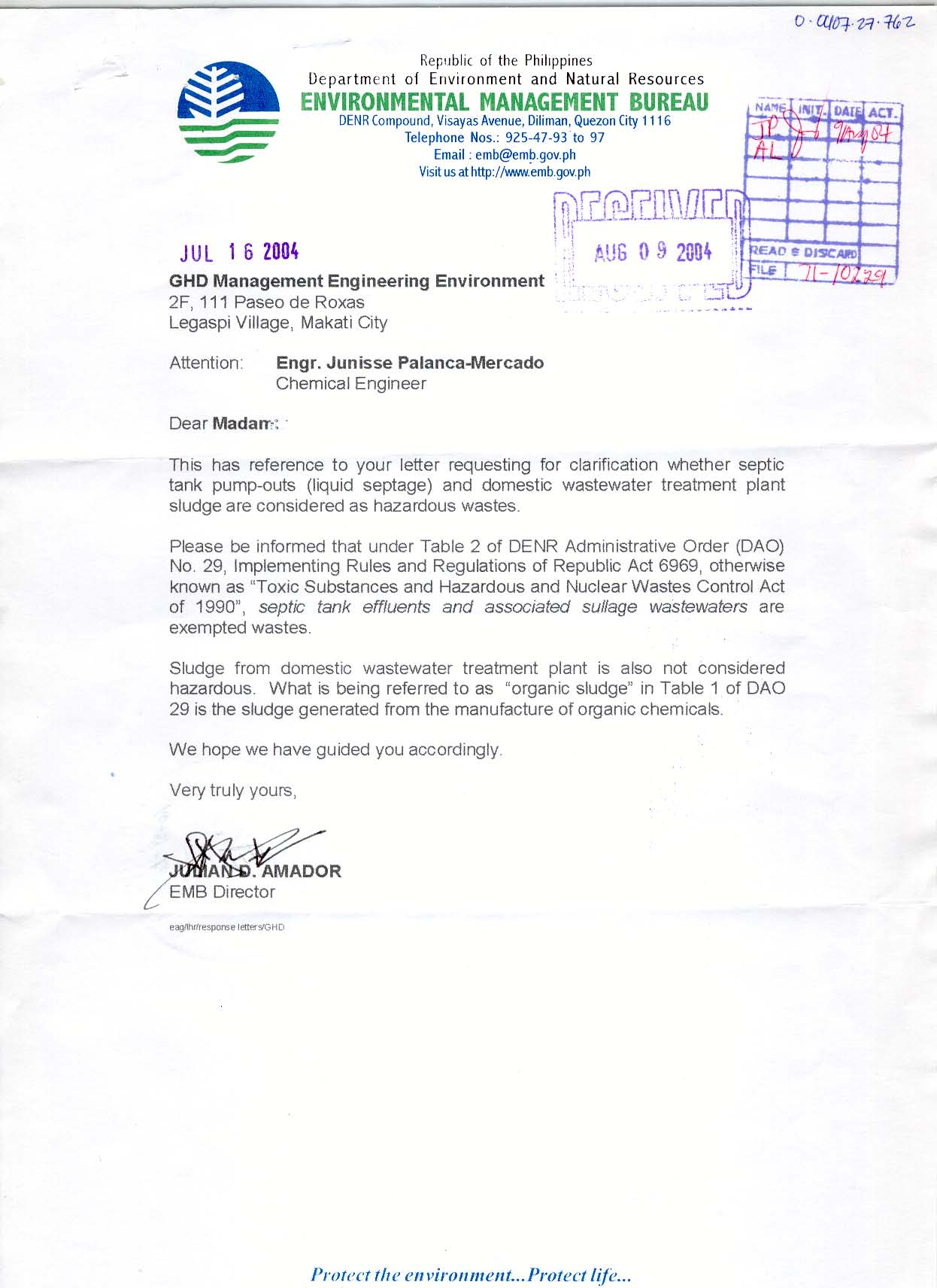
Appendix B
Review of International Guidelines on
Biosolids Management
71/10229/21017
Biosolids Management Strategy
Options Study
Review of International Guidelines on Biosolids Management
US EPA Guidelines
Title 40 of the Code of Federal Regulations (CFR), Part 503 regulates the reuse or disposal of "sewage
sludge" (biosolids) in the United States. Restrictions are imposed on the use of biosolids depending on
the level of pollutant concentration, and the quality of pathogen and vector attractiveness reduction
undertaken prior to disposal or reuse.
US EPA classifies biosolids as either Exceptional Quality (EQ) or Non-Exceptional Quality (Non-EQ).
Sludge classified as EQ is considered comparable to standard fertilizer products and its use in land
applications are not restricted by this rule. On the other hand, the EPA imposes restrictions on the
application of Non-EQ sludge to protect human health and the environment from the increased levels of
pathogen and/or pollutants compared to EQ sludge.
EQ biosolids are those that:
?? Meet the specified instantaneous and monthly pollutant concentration limits.
?? Has undergone one of the pathogen reduction alternatives specified by the US EPA to meet Class A
requirements (eg. composting, heat drying, irradiation, heat treatment, etc.).
?? Has undergone one of the options specified by the US EPA to reduce vector attraction.
Sludge that exceeds any or all of the requirements that define EQ biosolids is classified as Non-EQ.
Column 2 of Table 19 provides the maximum concentration limits for heavy metals set by the US EPA to
be classified as EQ. Other heavy metals regulated by Part 503 include Chromium, Molybdenum and
Selenium.
Part 503 also categorises sludge between Class A and Class B based on the treatment conducted to
reduce pathogens. To be classified as Class A, the treated biosolids should have:
?? Fecal coliform densities of less than 1,000 most probable number (MPN) per gram of dry solid
sample.
?? Salmonella bacteria of less than 3 MPN per 4 grams of dry solids.
Some of the restrictions and management practices for the application of Non-EQ biosolids are as
follows.
?? Non-EQ biosolids shall not be applied to the land if it is likely to adversely affect threatened or
endangered species or their designated critical habitat unless the applier can demonstrate that
applicable management practices are met to avoid negative impacts.
?? Approval should be sought prior to the application of bulk non-EQ sewage sludge to flooded, frozen,
or snow-covered lands. The land applier should ensure that proper runoff control measures are in
place to prevent sewage sludge from entering any bodies of water.
?? Application of Non-EQ sludge shall not be permitted within 10 m from any water body or courses.
?? Non-EQ sewage sludge shall be applied at a rate that is equal to or less than the agronomic rate for
the site. Agronomic rate is the optimum sewage sludge application rate that provides the amount of
nitrogen needed by the crop or vegetation whilst minimising nitrogen infiltration below the root zone.
71/10229/21017
Biosolids Management Strategy
Options Study
Sludge application rate that exceeds the agronomic rate could result in nitrate contamination of the
groundwater.
Australian EPA Guidelines
The Australian EPA grades biosolids according to the stabilisation it has undergone, and the level of
heavy metal and chemical contamination.
Stabilisation grading is based on the extent of treatment conducted to reduce pathogens and vector
attraction, and control odours. Biosolids classified as Stabilisation Grade A are considered to have
sufficiently low biological activity to have negligible risk of transmitting pathogens and is deemed suitable
for uncontrolled human contact. After dewatering, Grade A biosolids have undergone any of the
following:
?? Ageing for not less than 3 years by air drying in a lagoon or by stockpiling at the treatment plant.
?? Windrow composting that attained temperature of 55șC or more for at least 15 days.
?? Lime stabilisation that achieved pH level of 12 and temperature of 52șC, and less than 50% solid
content during the initial 12 hours of treatment.
?? Pasteurisation at temperature of 70șC for at least 60 minutes that attained dry solid content of 75 and
90% for digested and undigested sludge respectively.
After these treatments, a 50-gram sample of produced biosolids should contain:
?? Less than 1 salmonella.
?? Less than 1 helminth ovum.
?? Less than 1 PFU total virus.
?? Less than 1 cyst or oocyst of Cryptosporidium and Giardia.
Stabilisation Grade B sludge are those that have been stockpiled for at least 1 year if digested and
3 years if undigested. Due to the limited stabilisation treatment conducted, materials under this
classification are suitable for use where there will be minimal risk of uncontrolled human contact.
Approval from EPA shall be secured prior to any land application of Grade B sludge.
Contamination grading is based on the concentration of potentially harmful heavy metals or organic
chemicals contained in the sludge. The intent of grading according to this aspect is to avoid the
application of biosolid that risk excessive uptake of metals by crops or animals or human ingestion. The
maximum permissible concentrations of metals for each grade category are provided in Columns 3 and 4
of Table 19. Samples that exceed the limits provided are classified as Grade C.
Land application of Contamination Grade A biosolids are deemed suitable for uncontrolled human
contact. However, its application in irrigated and commercial food crop production is still subject to EPA
approval. Grade B biosolids on the other hand are suitable soil replacement where food crops will not be
grown. Use of Grade C biosolids will only be permitted when blended or composted with other materials
to dilute its contamination concentration.
71/10229/21017
Biosolids Management Strategy
Options Study
Table 30
Classification Requirements for Biosolids Reuse
Classification
Minimum Grade Requirement
Permitted Use
Use Requiring EPA
without prior EPA
Approval
Stabilisation
Contamination Approval
Unrestricted
A
A
?? home garden
?? irrigated and
Urban Use
?? urban landscaping
commercial
agriculture
?? non-irrigated
agriculture
?? forestry
?? site rehabilitation
Landscaping
A
B
?? urban landscaping
?? agriculture
?? forestry
?? site rehabilitation
Landscaping
B
B
?? urban landscaping
?? agriculture
?? forestry
?? site rehabilitation
Approved Use
B
C
?? agriculture
?? forestry
?? site rehabilitation
EPA imposes a general restriction for all reuse classifications. Biosolids shall not be applied to the
following site conditions.
?? Surface water or shallow groundwater level.
?? Poor drainage (waterlogged soil).
?? Rocky ground.
?? Sloping land.
?? High nutrient levels.
For the approved use classification, EPA imposes further restrictions in the land application of biosolids,
which include:
?? Biosolids are unlikely to be approved for application to any irrigated land that is or is likely in the future
to be used for food production for animals or humans.
?? Biosolids shall not be applied to soil that has a pH of less than 5.5 (ratio 1:2.5 soil / 0.01M CaCl2).
?? Biosolids shall not be applied to land with a slope in excess of 5% without approval of the EPA.
?? The following buffer widths are recommended minima. Approval from the EPA will be required for
lesser distances.
Watercourse
- 100 metres
Farm Drives
- 5 metres
71/10229/21017
Biosolids Management Strategy
Options Study
Property Boundaries and Public Roads - 50 metres
Dwellings on adjoining properties
- 100 metres
European Economic Community Council Directives
The European Union adopted directives that govern the use and application of sewage sludge on
agricultural lands of its member states. Known as the Council Directive 86/278/EEC, this legislature
provides the minimum requirements from which the member states can draw up more stringent
provisions for individual implementation. Some of the key requirements provided by this directive are as
follows.
?? Any use of biosolids in agriculture practices shall only be permitted if regulated by the respective
member state.
?? The maximum concentration of heavy metals in the sludge set by the EEC is provided in Column 5 of
Table 19.
?? Member states shall prohibit the use of sludge with one or more heavy metals exceeding the limits
specified.
?? Prior to application in agriculture, sludge shall be treated in manner acceptable to the member state.
?? Member states shall prohibit the use of sludge on:
grassland or food crops if it is to be grazed or harvested within a minimum of three (3) weeks;
soils in which fruit and vegetable crops are growing, with the exception of fruit trees; and
ground intended for the cultivation of fruits and crops that are normally in direct contact with the
soil and normally eaten raw, for a period of 10 months preceding harvest.
?? Where the soil pH is below 6, permissible concentration of heavy may be revised to account for the
increased mobility and availability to the crop.
Canadian Ministry of Environment Guidelines
Canadian Ministry of Environment (MOE) requires that prior to application of biosolids, the sludge and
the receiving lands be subject to its approval prior to application. The MOE has set the maximum
permissible heavy metal contents of the sludge as provided in Column 6 of Table 19.
MOE has identified aerobic and anaerobic digestion as the appropriate processes to stabilise sewage
biosolids. These treatments are intended to minimize the odour potential and reduce the number of
pathogenic organisms and other potentially harmful constituents to an acceptable level.
The characteristics of the receiving soils are likewise monitored by MOE. Application of biosolids to
agricultural lands are restricted as follows.
?? Biosolids shall not be applied within 10 meters from any watercourse or body of water.
?? The groundwater table should be at least 0.9 meters away from the surface of application.
?? Sewage and other biosolids may be applied to soils greater than 1.5 metres deep. Shallow soils
(1.5 m or less over bedrock) will be evaluated on a case-by-case basis.
?? The minimum separation distance from a residential area shall be 450 meters and from an individual
residence 90 meters.
71/10229/21017
Biosolids Management Strategy
Options Study
?? The application site should be at least 15 meters from a drilled well that is greater than 15 meters
deep or 90 meters for all other wells.
?? Biosolids shall not be applied to soil with slope greater than 9% or 6 to 9% for moderate to slow
permeability soils.
71/10229/21017
Biosolids Management Strategy
Options Study
Appendix C
Processing Technology Review
71/10229/21017
Biosolids Management Strategy
Options Study
Applicable Biosolids Process Treatment and Technology Options
Anaerobic Digestion
Anaerobic digestion is the biological degradation of organic substances in the absence of free oxygen
producing methane, carbon dioxide and water in the temperature range of typically 30 to 38șC.
Destruction of volatile solids typically ranges between 30 and 60% depending on the age of the raw
sludge, volatile solids content, total solids content, toxic effects and operating conditions. The digestion
period varies between 30 to 60 days in most configurations.
Biogas is generated during anaerobic digestion. It is usually comprised of about 60 to 70% methane,
which can be used to fire the sludge heater or boiler.
Anaerobic digestion is a common and well-understood stabilisation technology, which requires low
energy input to operate, and, at the same time, produces biogas as fuel. However on the downside,
anaerobic digestion process has the potential to produce offensive odours and release phosphorus from
the sludge.
Sludge treated using this process is typically suitable for application in restricted agricultural uses. Non-
agricultural uses include landscaping areas with restricted public access, forestry and land rehabilitation.
To enable a more extensive agricultural land spreading, anaerobically digested sludge would have to
undergo further treatment for pathogen reduction. This can be achieved via composting, lime addition,
heating and drying or long term storage.
Aerobic Thermophilic Pre-treatment (or dual digestion)
The aerobic thermophilic pre-treatment digestion process was developed as an add-on process to
conventional anaerobic digestion to improve reduction of volatile solids and pathogens, and result in a
more stable product. The process takes place in insulated well-mixed tanks, with air or oxygen injection
to maintain aerobic conditions. The mean digestion time is 18 to 24 hours and the sludge is maintained
at a temperature between 55? and 65?C.
By definition, this process is only a pre-treatment step to anaerobic digestion; hence no final product is
derived. The process improves several functions and parameters of a typical anaerobic digestion
including pathogen and weed seed reduction, dewatering, hydraulic retention times in digesters, and
generation of methane during digestion. Provision of foam suppression and odour control systems are
key in adopting this process.
Aerobic Digestion
Aerobic digestion is the biological degradation of organic substances by mechanical surface aerators or
other aeration system resulting to the production of carbon dioxide, ammonia and water. The volatile
solid destruction under this process varies from 30 to 50% depending on the age of the raw sludge,
volatile solids content, total solids content, toxic effects and operating conditions.
Typical retention times for various sludges are as follows
?? Waste activated sludge:
- 10-15 days
?? Activated sludge without primary settling:
- 12-18 days
?? Primary plus waste activated or trickling filter sludge:
- 15-20 days
71/10229/21017
Biosolids Management Strategy
Options Study
Supernatant from aerobic digestion has relatively low BOD, SS and ammonia content but the sludge will
still require additional treatment for pathogen reduction. Aerobic digestion is also considered to have a
lower capital cost and is simpler to operate than anaerobic digestion. However, the energy required
during operation is significantly greater. The digested sludge can be more difficult to dewater.
Sludge produced from aerobic digestion is generally suitable for restricted agricultural uses except for
food crops directly consumed by humans. Its non-agricultural uses include landscaping areas with
restricted public access, forestry and land rehabilitation.
Autothermal Thermophilic Aerobic Digestion (ATAD)
ATAD is an aerobic stabilisation process that operates at thermophilic temperatures, i.e. 55 to 70?C. At
these temperatures, biosolids stabilisation and disinfection are achieved within a residence time that
ranges from five to six days.
Key consideration in the process design is the level of volatile solids contained in the feed sludge.
Thickening of the feed solids is required to maintain the heat balance for the system.
Volatile solid reduction achieved by the process typically ranges from 38% and 50%. Important factors
that influence the quality of treatment attained include:
?? temperature control;
?? hydraulic retention time;
?? prevention of short-circuiting;
?? odour production and control; and
?? foam control.
The sludge is transferred into cooling/storage tanks after digestion. If the tanks are designed
appropriately and sufficient time is allowed for cooling, further thickening of 6 to 9% ds will still be
achieved at this stage.
The destruction of volatile solids achieved in the process reduces the volume of sludge to be disposed.
After dewatering, digested sludge is usually applied on agricultural and forestry lands through bulk
spreading. The product's potential for liquid biosolid spreading purges the need for dewatering albeit
possible high costs for transportation and handling to the final site of use. The process reduces
pathogenic viruses, bacteria, viable helminth ova, and other parasites to below detectable levels.
The risks related to the treatment technology are considered minimal or manageable. Principally the
risks include breakdown of equipment, odour generation, excessive foaming, insufficient volatile solids
breakdown and capacity. The process does not achieve nitrification and the digested sludge has
generally low dewatering quality. Unlike anaerobic digestion, ATAD requires a high level of control and
operational skill.
Lime Stabilisation
Lime stabilisation is the process of mixing lime into dewatered sludge. Lime solutions that maybe used
in this purpose include quick lime, CaO or hydrated lime or Ca(OH)2. The addition of lime in the sludge
increases the pH level thereby destroying the microorganisms in the sludge.
The conventional lime treatment uses a pug mill or other similar device to mix the hydrated lime or
quicklime with the dewatered sludge prior to being discharged in storage bins. Release of odours due to
71/10229/21017
Biosolids Management Strategy
Options Study
the stripping of ammonia and the poor mixing of lime into the sludge are the common concerns in using
this process. Selection of a suitable mixing device and the enclosure of the lime-dosing unit with odour
scrubbing are therefore recommended.
RDP Envessel pasteurisation and N-VIROTM Soil process are proprietary processes developed based on
lime stabilisation. These processes are capable of achieving higher levels of stabilisation and pathogen
reduction of the sludge compared to the conventional approach. Non-proprietary processes may also
achieve similar stabilisation and pathogen reduction capabilities given sufficient process (temperature
and time) control.
The lime to sludge ratio is dependent on the type of process the sludge was wasted from, the organic
composition, the solids concentration and the required sludge quality base on the intended reuse or
disposal. It was however observed that to meet similar stabilisation qualities, activated sludge from an
extended aeration or BNR process will require addition of more lime compared to primary sludge.
Use of this process increases the biosolids' suitability for application in acidic soils due to the increased
liming value. However, the process increases the quantity of solids to be disposed of between 40% and
100%, therefore resulting in additional transportation and land spreading cost. The process also has the
potential for odour risk.
Vermiculture
Vermiculture is the process by which organic material is fed to a variety of worm species with the
purpose of converting the organic material into increased worm biomass and vermicast. Vermicast is the
excreta from worms and is used as a plant growth medium and soil conditioner that has a wide range of
applications including broad acre farming, turf farming, horticulture, viticulture and seedling propagation.
Vermiculture is not yet defined as a treatment process in most international sludge reuse and disposal
guidelines. However given the biological basis of the process, it has the capacity to achieve a reliable
level of pathogen reduction. Except for some dilution from the addition of clean organics and some
minor absorption in the worm biomass, the total quantity of heavy metals in the sludge will be
unchanged. But given the relatively low application rates of vermicast, the impact of heavy metal on soil
should be inconsiderable.
Composting
Composting is the biological decomposition of organic material to produce a stable material suitable as a
soil conditioner. Both raw and anaerobically digested sludge can be composted. However, raw primary
sludge has a high potential for odour risk.
Principal factors to achieve successful composting include:
?? maintain moisture content between 40% and 60%;
?? maintain composting temperature between 50șC and 60șC;
?? keep pH of sludge to be composted between 6 and 9;
?? maintain the carbon - nitrogen ratio between 20 to 35:1 by weight;
?? provide adequate aeration; and
?? sufficient and correct amendments and bulking material.
71/10229/21017
Biosolids Management Strategy
Options Study
The amount of amendment material required is controlled be the water content of the sludge. The final
composted product will have a biosolids content ranging between 5 to 30% by dry weight.
Composting can be achieved through various methods. A brief outline for each is provided below and a
comparative summary in Table 31.
?? Windrow
This method is carried out by piling the sludge mixture into long rows (windrows) and mechanically
turning and mixing it at specific intervals for about 18 weeks or until composting is complete.
?? Aerated Static Pile
This method involves piling of the sludge and bulking agent mixture over a network of pipes on a
hardstand area. Air is then drawn through the pile and exhausted through a compost filter for odour
control. The pile may be covered with a layer of matured compost to further prevent odour release.
This process takes about 8 to 10 weeks to complete.
?? In-Vessel enclosed System
Composting by this method takes place inside an enclosed reactor, in which process parameters can
be closely controlled and odour release minimised. This results in a shorter composting time and a
more consistent product quality in relation to pathogen reduction.
Table 31
Comparison of Various Composting Methods
Method
Advantages
Disadvantages
Windrow
?? low capital cost
?? large area required
?? low operation and
?? possible odour problems
maintenance cost
?? difficult to achieve required
temperatures
?? potential for poor mixing
?? long composting period
Aerated Static Pile
?? enhanced odour control
?? capital cost of aeration
system
?? good temperature
maintenance
?? moderate operating and
maintenance costs
?? shorter composting period
In-vessel
?? small area required
?? high capital, operating and
maintenance cost
?? high degree of process
control
?? applicable to large scale
operation only
?? very good temperature and
odour control
The quality of compost derived is dependent on the quality of initial sludge and process conditions
particularly temperature and composting period.
Given the concerns regarding possible regrowth of pathogens in compost, there are reservations in
treating sewage sludge by composting. Strict handling requirements are necessary to avoid such
71/10229/21017
Biosolids Management Strategy
Options Study
occurrences. Likewise, the amount of sludge to be treated will require a proportional amount of
amendment and bulking materials hence, may not be cost efficient for large volumes of sludge.
Thermal Drying
Thermal drying process involves raising the temperature of gas from sludge and air to about 450șC in a
combustion chamber and then allowing it pass through a heat exchanger to heat the drying drums.
Dewatered sludge mixed with under and oversized pellet products are introduced into the heated drum
for drying. Odorous gases generated during drying are returned to the combustion chamber and burned
off.
The main products of thermal drying are sludge granules or pellets that have a moisture content of less
than 10% (w/w). Depending on the target classification of the final product, the temperate and solid
contents of produced granules may range from 70 to 80șC and 75 to 90% (w/w) respectively. These
granules are predominantly used as commercial soil conditioners. The nutrient values of these granules
are dependent on the quality of input sludge.
Thermal drying is a proven and widely accepted technology for treatment of biosolids. Already available
are a number of proprietary units that offer specialised systems for this process. Some of the key
advantages of adopting thermal drying include:
?? Containment of odour and dusts during treatment;
?? Produces highly marketable product with high soil conditioning value;
?? Capacity to considerably reduce sludge volume thus minimising costs associated with handling;
?? Requires a small footprint compared to land intensive sludge handling techniques being a relatively
compact process; and
?? Suitable source of fuel (similar calorific value to brown coal).
On the other hand, the perceived disadvantages of this process includes:
?? Requires high capital and operational costs (note that the burner has to be fired using an external
energy source); and
?? Includes potential risk for the product to self-ignite.
Thermal Cyclonic Drying
Thermal cyclonic drying is a patented technology of The Global Resource Recovery Organisation
marketed under the brand name Tempest. Similar to the conventional thermal drying process, this
technology uses cyclone hoppers to improve drying of solids achieved through:
?? Higher airflows resulting in higher evaporation rates and moisture loss;
?? Reduction of particle size due to impingement to the cyclone resulting to an increase
in the surface area; and
?? Enhanced solids separation.
Preheated biosolids are fed into the primary cyclone at a controlled rate. The required solids content are
usually achieved in a secondary cyclone in series. After heating, the resulting dry material is then
discharged from the bottom of the secondary cyclone whilst high moisture air is released from the top
and passes through a scrubber to remove particulates and water-soluble compounds. Further emission
treatments may still be added depending on the requirements.
71/10229/21017
Biosolids Management Strategy
Options Study
Depending on the drying temperature and final solids content, a relatively high level stabilisation is likely
to be achieved through this process. Reuse options for the resulting biosolid products include
agricultural land application, land rehabilitation, bioremediation or landscaping, applied in bulk or
supplied to market in bags.
The process requires lower energy costs compared to the conventional drying systems. It also has a
smaller footprint, hence lower land requirements.
Incineration/Energy Recovery Plant
Incineration is defined as the complete thermal destruction of materials to its inert composition in the
presence of oxygen (Brunner, 1980). Its application to sewage sludge produces over 90% weight
reduction of the input material. Carbon dioxide is the primary gas derived from the incineration process.
The key purpose of sewage sludge incineration is to:
?? dry the sludge cake;
?? destroy the volatile contents by heating up to 760?C to 980?C;
?? produce a sterile residue or ash; and
?? produce flue gas with zero visible emissions.
Sewage sludge has a volatile component, a fixed carbon component and contains organics that are
usually non-combustible. Dewatering of sludge (usually untreated) prior to incineration is a critical step
for the combustion process and results in lower fuel requirement for the incineration. Sludge is usually
dewatered to 15 to 35% dry solids content.
With solids at about 30% of the sludge feed, autogenous combustion will take place, i.e. the sludge will
burn without the need for supplemental fuel. The addition of combustible material to the dewatered
sludge is sometimes practiced to increase its heat value relative to its moisture content.
Processing of sludge to obtain high solids content usually requires thermal conditioning of the sludge.
The benefit of thermal conditioning is reflected in the quality of sludge generated. As opposed when
polymer, ash, ferric salt or lime is added, the resulting sludge cake contains no additional inert solids that
negatively affect the incineration process or the flue gas it produces.
There are two types of incinerators available in the market: the multiple hearths and the fluidised bed.
Fluidised bed is generally considered a better technology than the multiple hearths system.
Incineration produces an inert and sterile ash that has potential for land application, road surfacing, as
concrete aggregate, among others. The technology is relatively compact and requires a small footprint
compared to land intensive sludge handling techniques. A number of equipment is available with
emission guarantees that will meet stringent air pollution restrictions.
The process can readily take place at the location of sludge generation thereby minimising the need for
additional transportation and handing. Waste heat from the process, which ranges from 420?C to 760?C,
can be made available to produce steam for other unit processes on the sewage treatment plant.
Incineration requires high capital and operating expenses. Social acceptability is also a consideration as
the process is largely perceived as a contributor to air pollution.
71/10229/21017
Biosolids Management Strategy
Options Study
Oil from Sludge (OFS) Technology
OFS technology is a patented thermochemical or pyrolytic process that converts the organic content of
sludge to end products with energy content and to oil with properties similar to diesel fuel. This is
achieved by heating of pre-dried sludge with approximately 5% moisture content in a reactor vessel in
the absence of oxygen (pyrolysis) to about 450?C, at which point, approximately 40 to 50% (w/w) of the
sludge is vaporised. These vapours are then contacted with the residue from the sludge (char) causing
the conversion of the organic molecules to aliphatic hydrocarbons, which are the principal components of
crude oil.
The process operates at relatively low temperatures (650 to 700?C) and at atmospheric pressure. Gas
products of a pyrolytic reaction include methane (CH4) and carbon monoxide (CO).
The process produces oil, char, non-condensable gas and reaction water. These latter products are
burned in a hot gas generator (similar to a fluidised bed incinerator), which produces most if not all the
energy for sludge drying and reactor heating. Likewise, the oil derived from the process is suitable for
combustion in engines and the char from the reactor has similar properties to high value commercial
activated carbons used for the adsorption of heavy metals.
OFS achieves satisfactory levels of sludge stabilisation, pathogen reduction and dewatering. The ability
of the system to be its own energy source to perform sludge drying is an apparent advantage. However,
considerable capital and operating costs are still required to establish the system. The overall emissions
are lower than conventional incinerators. However, the technology can still be perceived as a contributor
to air pollution, which may result to poor public acceptance.
Gasification
Gasification is a process similar to the OFS technology. Waste Gas Technology (WGT) UK Ltd. is
developing the process primarily based on EU legislation. The main difference between these processes
is that the gases generated in gasification are not converted to liquid hydrocarbons. The process
produces char by-product and gas with low calorific value that ranges from 5 to 7 MJ/m3. Such gas is not
easily utilised in conventional burners designed for natural gases, which has calorific value of 37 MJ/m3.
The low energy content is caused by the mixing of the product and by -product (i.e. flue gas) streams.
The calorific value and composition of resulting gas product is dependent on the characteristics of the
waste feed material and the reactor operating conditions, particularly temperature, gas residence time
and solid retention time. Gases produced in the bioreactor under these conditions include methane,
hydrogen, higher hydrocarbons, carbon monoxide and carbon dioxide.
The process achieves a relatively high level of stabilisation suitable for land application. Its emission rate
is comparatively lower than the conventional high temperature incineration. Given that this technology is
still developing, its suitability is yet to be proven on a commercial scale. High capital and operational
costs are also expected in adopting the process.
Active Sludge Pasteurisation (ASP) Process
Active Sludge Pasteurisation (ASP) Process is a proprietary process that negates the need to stabilise
the biosolids. This process achieves pasteurisation while enriching the sludge with nutrients N and P.
Pasteurisation is achieved through the addition of anhydrous ammonia (NH3). This raises the sludge
temperature to 60șC and the pH to 12. NH3 also reacts with the organic matter, which inturn consumes
part of the ammonia.
71/10229/21017
Biosolids Management Strategy
Options Study
Phosphoric acid (H3PO4) is then added to neutralise the mixture thereby reducing the pH to 7 and raising
the temperature to 70șC. The non-chemically bound ammonia is evaporated and reused in succeeding
treatments. Dry warm air is blown over a thin layer of final product to dry the sludge. The sludge is then
separated from the moist air in a cyclone separator to produce the final pelletised or granular product,
which has moisture content of about 15% (w/w).
The heat generated during the process goes into a heat exchanger and is used as an energy source for
the overall process. This eliminates the need to provide an external energy source.
ASP reduces the volume of the sludge considerably and produces highly marketable agricultural product.
Its nutrients N and P are bound into the organic matter as chelates, which make it readily available for
plants.
ASP infrastructure is intended to have a modular design, allowing it to be customised for various sludge
production rates. The process is relatively compact with a small footprint compared to land intensive
sludge handling techniques. Capital and operating costs for this process are considered to be relatively
high.
Solar or Agitated Air Drying of Dewatered Biosolids
Agitated Air Drying is a batch process that involves rapid drying of sludge. Biosolids are placed on
drying areas (typically windrows) and are subjected to intermittent mechanical agitation that enhances
the drying rate.
The process can be broken up into the following stages:
?? Pre-blending of un-processed biosolids with processed biosolids and/or other inert material to obtain
a relatively consistent initial blend.
?? Intermittent mechanical agitation often using a specialised windrow turning machine. Continuous
creation of a new wet surface area to the atmosphere allows evaporation of moisture to take place.
?? Determination of final product quality, which may result in:
Back-blending of the processed product into the initial pre-blending phase, and/or
Beneficial use of the processed product into a range of markets.
The process primarily aims for the rapid production of a higher solids product (up to 75%TS) without
necessarily achieving high quality stabilisation in the short term.
Stockpiling of dewatered sludge for extended periods is still a necessity to achieve stabilisation. Hence,
the quality of the resulting biosolid product becomes largely dependent on climatic variations. Depending
on the level of stabilisation achieved, reuse options can include agricultural land application, land
rehabilitation, bioremediation or landscaping.
The process is relatively simple to operate with low energy and capital costs. It however requires
sufficient land area with adequate buffer zones to allow drying and stockpiling of sludge. Depending on
the sludge type and pre-treatment processes, potential odour issues can become a concern particularly
after windrow turning. Costs for transporting and handling of the product to the final reuse location are
also key considerations in this option.
71/10229/21017
Biosolids Management Strategy
Options Study
Sludge Lagoons
Sludge lagoons are combined sludge storage and treatment method. The lagoons are relatively shallow
earth basins about 1.0 to 3.5 m deep into which sludge is deposited. Solids are allowed to settle to the
bottom of the lagoon where it accumulates and compacts. Natural anaerobic digestion takes place while
the sludge is contained in the lagoon.
As the solids settle, some of the water that surfaces is evaporated whilst excess supernatant is decanted
and returned to the treatment plant. The lagoon can be drained or the supernatant pumped out for re-
treatment. The sludge can be left to air dry after which it will require removal from the lagoon and
stockpiled until it is reused. It is often necessary to turn a pile of semi-dried sludge over when it has
dried down to a depth of about 600 to 700 mm using a bulldozer or bobcat.
Sludge lagoons seldom produce significant odour problems whilst it is still full and covered with a layer of
water. Objectionable odours usually occur when the lagoons are emptied and the sludge dried out.
Storing of digested sludge in lagoons achieves both storage and disinfection functions. Lagoons for this
purpose are usually deeper at 3.0 to 5.0 m. If the lagoons are not loaded too heavily, i.e. less than
0.1 kg VSS/m2d, the growth of algae will maintain an aerobic surface, which will oxidise rising odours.
Surface aerators can also used to create the aerobic surface.
Sludge lagoon is mainly an alternative to the digestion process. Whilst the sludge may be stored in the
lagoons indefinitely, it should not be regarded as a disposal strategy but rather just an interim step prior
to disposal or reuse.
The level of stabilisation will be determined by the length of time the sludge is kept in the lagoon and its
final dry solids content. Depending on its solids content, the treated biosolids maybe used in land
application through bulk application or injection.
Sludge lagoons generally have low capital and operational costs. It requires simple and straightforward
operations. Key considerations for developing sludge lagoons will include land requirement, odour
management and determination of retention times.
Short-term Storage of Dewatered Sludge
Depending on the sludge pre-treatment process, considerations and characteristics for adopting sludge
storage may vary as follow.
Table 32
Short-term Storage Characterisations for Various Sludge Types
Type
Description
Anaerobically Stabilised
?? Well-stabilised sludge is typically dewatered to a solid content of 18 to
Sludge
25% dry solids.
?? Mechanical stockpiling can be accomplished easily.
?? Lime can be used to cover the outside layer of the pile to further
stabilisation and limit odours.
?? Subsequent decomposition takes place to produce a non-offensive
product. Long-term storage is usually practiced.
71/10229/21017
Biosolids Management Strategy
Options Study
Type
Description
Waste Activated Sludge
?? Depending on sludge age, WAS is typically dewatered to a solid
(WAS)
content of 11 to 15% dry solids.
?? Poor slumping characteristics limit the stockpiling height.
?? Limited stabilisation tends to produce foul odour and promotes vector
attraction.
?? Long-term stockpiling of dewatered WAS is not advised as the outside
layer dries whilst the inside is still wet. Increased odour is also
expected, as the inside of the pile turns anaerobic.
Aerobically Stabilised
?? Aerobically stabilised WAS is typically dewatered to a solid content of
WAS
15 to 20% dry solids.
?? Stockpiling is relatively easier compared to raw dewatered WAS.
?? Long term storage of poorly or partially digested sludge can lead to
anaerobic decomposition and greater odour production.
Stabilisation is largely dependent on the treatment process and storage period. Under this process,
biosolids dewatered to greater than 10% w/w dry solids and stockpiled for at least three years can
achieve a high level of stabilisation.
Although stockpiling is a relatively inexpensive and simple process, its potential as a long-term and final
step in the sludge treatment process is limited. This is usually regarded as a penultimate step in a
disposal or reuse strategy. Considerable land requirement for this process is also a key consideration.
Bioreactor Landfill
Bioreactor landfills are extension of leachate recirculation landfills that achieve waste decomposition and
stabilisation within a comparatively shorter timeframe. This is achieved through the addition of liquid and
air, and varying of some or all of the process variables, such as leachate recirculation rate and moisture
content, pH, temperature, nutrient addition and pre-disposal conditioning (eg. shredding), to enhance
microbial processes.
Unlike the traditional landfills that simply recirculate leachate for liquid management, a bioreactor
involves injection of leachate to stimulate the natural biodegradation process. To supplement leachate,
the process also needs other liquids such as stormwater, wastewater, and wastewater treatment plant
sludges in a controlled manner. Bioreactor technology relies on maintaining the moisture content at an
optimal rate of about 35 to 65%.
The accelerated decomposition and stabilisation of waste reduces possible long-term environmental
risks and landfill operating and post-closure costs. The process also results in a significant increase in
the production of landfill gas particularly methane and carbon dioxide that can be captured for energy
conversion. Bioreactor landfill process recovers airspace volume of about 15 to 30%, allowing a longer
operating life of the landfills.
Development of an engineered bioreactor landfill system will require higher initial capital costs, and a
more thorough monitoring and control system during operations. Key considerations in planning include
expected increase in gas emission and odours, physical instability of the waste mass due to higher
moisture content and density, land and groundwater protection measures, and landfill fires.
71/10229/21017
Biosolids Management Strategy
Options Study
GHD
2/F, 111 Paseo de Roxas, Legaspi Village
Makati City, Metro Manila
T: +63 2 812 5129 F: +63 2 812 5172 E: mnlmail@ghd.com.au
© GHD Pty Ltd 2004
This document is and shall remain the property of GHD Pty Ltd. The document may only be used for the
purposes for which it was commissioned and in accordance with the Terms of Engagement for the
commission. Unauthorised use of this document in any form whatsoever is prohibited.
Document Status
Reviewer
Approved for Issue
Rev
Author
No.
Name
Signature
Name
Signature
Date
0
A Latorre
R van Oorschot
D McIntyre
13 Aug 2004
1
A Latorre
R van Oorschot
D McIntyre
71/10229/21017
Biosolids Management Strategy
Options Study