E1288
v 3
Environmental Impact Statement
Public Disclosure Authorized
(EIS)
for
Manila Third Sewerage Project
Public Disclosure Authorized
Volume 3: Annex on Public Consultations
February 11, 2005
(Revised Draft)
Public Disclosure Authorized
Public Disclosure Authorized
Manila Water Company, Inc.
Manila, Philippines
ENVIRONMENTAL ASSESSMENT
Public Consultation
TABLE OF CONTENTS
PUBLIC CONSULTATION .............................................................................................. 4
I. PROJECT BACKGROUND .......................................................................................... 4
a. Taguig Sewerage System ........................................................................................ 4
b. Riverbanks Sewage Treatment Plants..................................................................... 4
c. Sanitation for Low-Income Communities.............................................................. 5
d. QC-Marikina Sewerage System............................................................................. 5
e. Quezon City Sanitation Upgrading ........................................................................ 5
3. Technical Assistance.............................................................................................. 5
II. CONSULTATION WITH LOCAL GOVERNMENT UNITS/AGENCIES................. 5
III. PUBLIC CONSULTATION ........................................................................................ 6
A. Representation................................................................................................................ 6
B. Tools............................................................................................................................... 8
Surveys........................................................................................................................ 8
Focus Group Discussions............................................................................................ 8
Public Consultations ................................................................................................... 9
C. General Proceedings of Meetings .................................................................................. 9
IV. GENERAL ISSUES/CONCERNS AND RESOLUTIONS....................................... 10
V. ISSUES AND CONCERNS Component-Specific ................................................... 13
VI. CONCLUSION........................................................................................................... 16
1
Manila Third Sewerage Project (MTSP)
ENVIRONMENTAL ASSESSMENT
Public Consultation
LIST OF TABLES
Table 1 Schedule and Venues of the Second Level Consultations ............................... 7
Table 2 Summary of General Issues and Corresponding Resolutions....................... 10
Table 3 Summary of Issues and Corresponding Resolutions per Component.......... 13
2
Manila Third Sewerage Project (MTSP)
LIST OF ANNEXES
Annex 1 Endorsements of Local Government Units for MTSP
Annex 2 - EIA Process flowchart
Annex 3 Scoping
Section 3.1 Scoping with DENR
Section 3.2 Scoping with World Bank
Section 3.3 First Level Consultation/Scoping Workshop for MTSP
Annex 4 Focused Group Discussion
Annex 5 Public Consultations Transcripts and Attendance and Invitations
Annex 6. Copies of Presentation Materials
ENVIRONMENTAL ASSESSMENT
Public Consultation
PUBLIC CONSULTATION
This annex forms part of the environmental documents in support of the proposed Manila Third
Sewerage Project (MTSP). The attached details the process and results of the public consultation
conducted for the MTSP.
I. PROJECT BACKGROUND
In 1980, the World Bank in cooperation with the Asian Development Bank, supported the
Metropolitan Waterworks and Sewerage System (MWSS) and financed the Manila Sewerage and
Sanitation Project. However, project components were not completed and others failed to attain
the desired impacts. Not until 1996 did the World Bank resume its assistance to the MWSS for
the improvement of the general environmental conditions in Metro Manila. The US$57 million
Manila Second Sewerage Project (MSSP) was finalized in June 1996.
The MSSP implementation started in 1997 which coincided with the privatization of the MWSS.
The MWSS privatization led to the operation of two concessionaires: Manila Water Company
Inc. (MWCI) in the east zone and the Maynilad Water Services Inc (MWSI) in the west zone.
Under the terms of the Concession Agreements, the concessionaires took over the implementation
of the MSSP. The MSSP is due for completion by June 2005.
As a continuation to the MSSP, MWSS and MWCI proposed the Manila Third Sewerage Project
(MTSP) for World Bank funding. The MTSP, which consists of three components, has the
ultimate objective of improving sewerage and sanitation conditions in the East Zone concession
area.
The MTSP, estimated to cost $86 million, will benefit 3.3 million population in the East Zone. It
will have the following components:
1. Septage Management
This project is essential in providing sanitation services in the whole East Concession Area
Two (2) Septage Treatment Plants (SpTPs) will be constructed: one in the North to serve
Quezon City, Marikina and San Juan; and one in the South to serve Mandaluyong, Pasig,
Makati, Pateros, Taguig and most of the towns in the Rizal province.
2. Sewage Management
a. Taguig Sewerage System
This project is in line with the flood control project of the Department of Public Works and
Highways (DPWH) covering Taguig. The DPWH will construct four (4) drainage/flood
retention ponds in Taguig, adjacent to the Laguna de Bay. The proposed sewerage project
will involve the construction of off-line primary treatment plants while using the retention
ponds as secondary clarifier prior to discharge to Laguna de Bay.
b. Riverbanks Sewage Treatment Plants
This project will involve the construction of at least three (3) underground STPs along the
riverbanks of Pasig River, located in Makati, Mandaluyong, and Pasig. Sewage will be
4
Manila Third Sewerage Project (MTSP)
ENVIRONMENTAL ASSESSMENT
Public Consultation
intercepted and collected from existing drainage lines in these areas for treatment before
discharge to Pasig River.
c. Sanitation for Low-Income Communities
This project will involve the construction of STPs to treat combined sewage-drainage flows
from low-income communities in the concession area, particularly in Taguig and Manggahan
East Bank, which have inadequate sanitation facilities.
d. QC-Marikina Sewerage System
This project will utilize the space available along the Marikina River in front of the Industrial
Valley Complex (IVC). A main drainage collector pipe which collects combined sewage and
drainage from communities in Quezon City and Marikina is located in the site. The project
will involve the construction of an STP which will treat the sewage before discharge to the
Marikina River.
e. Quezon City Sanitation Upgrading
This project will involve the upgrade of existing Communal Septic Tanks (CSTs) to STPs in
Quezon City, as well as installation of new separate sewerage system to serve East and West
Kamias. Seven (7) of these existing CSTs will be upgraded into a full wastewater treatment
plant by either converting them into a pumping station and joining them into an STP, or
transferring the current flow to existing STPs. This will ensure compliance with
environmental standards of effluent for wastewater.
3. Technical Assistance
Considered as a pilot project for making use of the combined storm-sewage system, MTSP
will have to be monitored and studied closely. This component would finance the information
campaign on proper liquid waste disposal and environment preservation, consultant services
during implementation of the project, and the preparation of follow-up programs on sewerage
and sanitation, with emphasis on low-cost sanitation systems.
II. CONSULTATION WITH LOCAL GOVERNMENT UNITS/AGENCIES
During the development phase of the project, the Project Development team, consisting of
representatives from MWSS and MWCI, presented to the local government units (LGUs) to be
directly affected by MTSP the concepts and approaches which are proposed for implementation.
The LGUs and agencies involved agreed with the project objectives and suggested inclusion of
possible projects on sewerage and sanitation. These suggestions will be considered when
additional projects are proposed for MTSP. The matrix below shows the sequence of
consultations from conception of the MTSP.
5
Manila Third Sewerage Project (MTSP)
ENVIRONMENTAL ASSESSMENT
Public Consultation
Matrix 1
2002
2003
2004
Project
Conceptualization
Approval
Prepare EIS for
of EIS
MTSP
Project presentation
LGU endorses the
to LGU (Mayor,
Councilors)
MTSP
Project presentation
MMDA endorses
to MMDA
the MTSP
Project presentation
Council endorses
to RDC
the MTSP
Conducts FGD with DENR
Representatives
Conducts FGD with LGU
Representatives
Invites Stakeholders for
Public Consultation
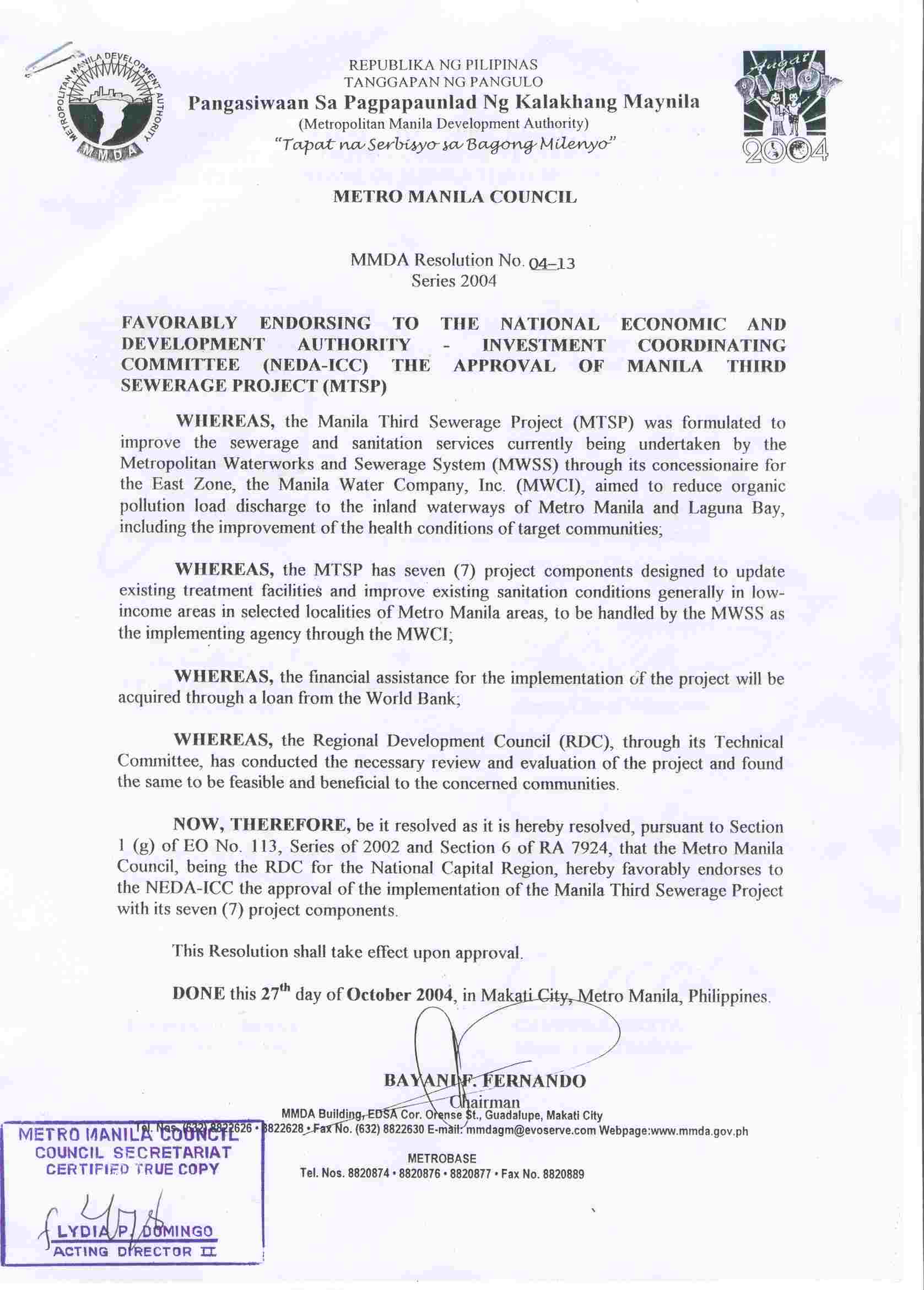
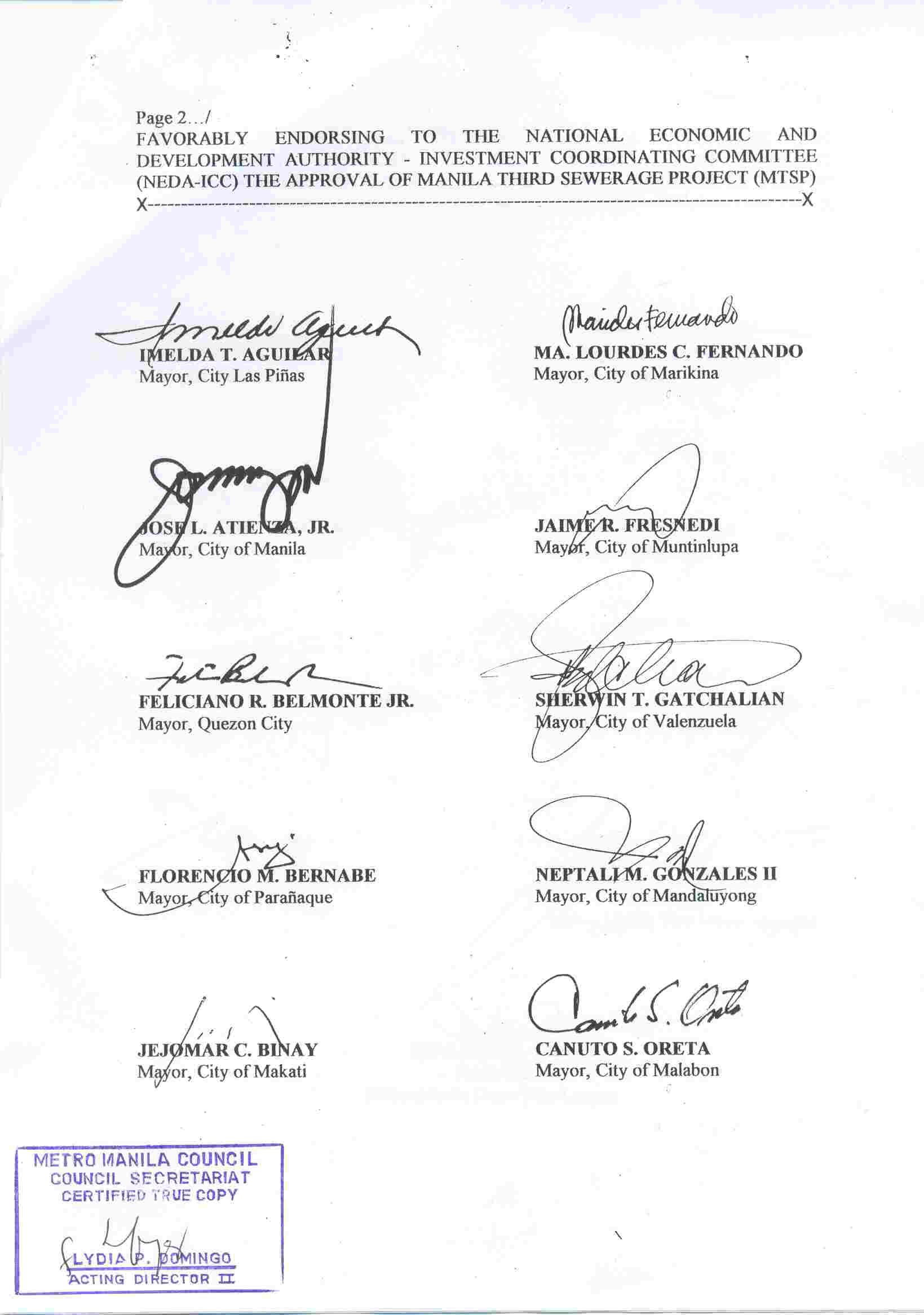
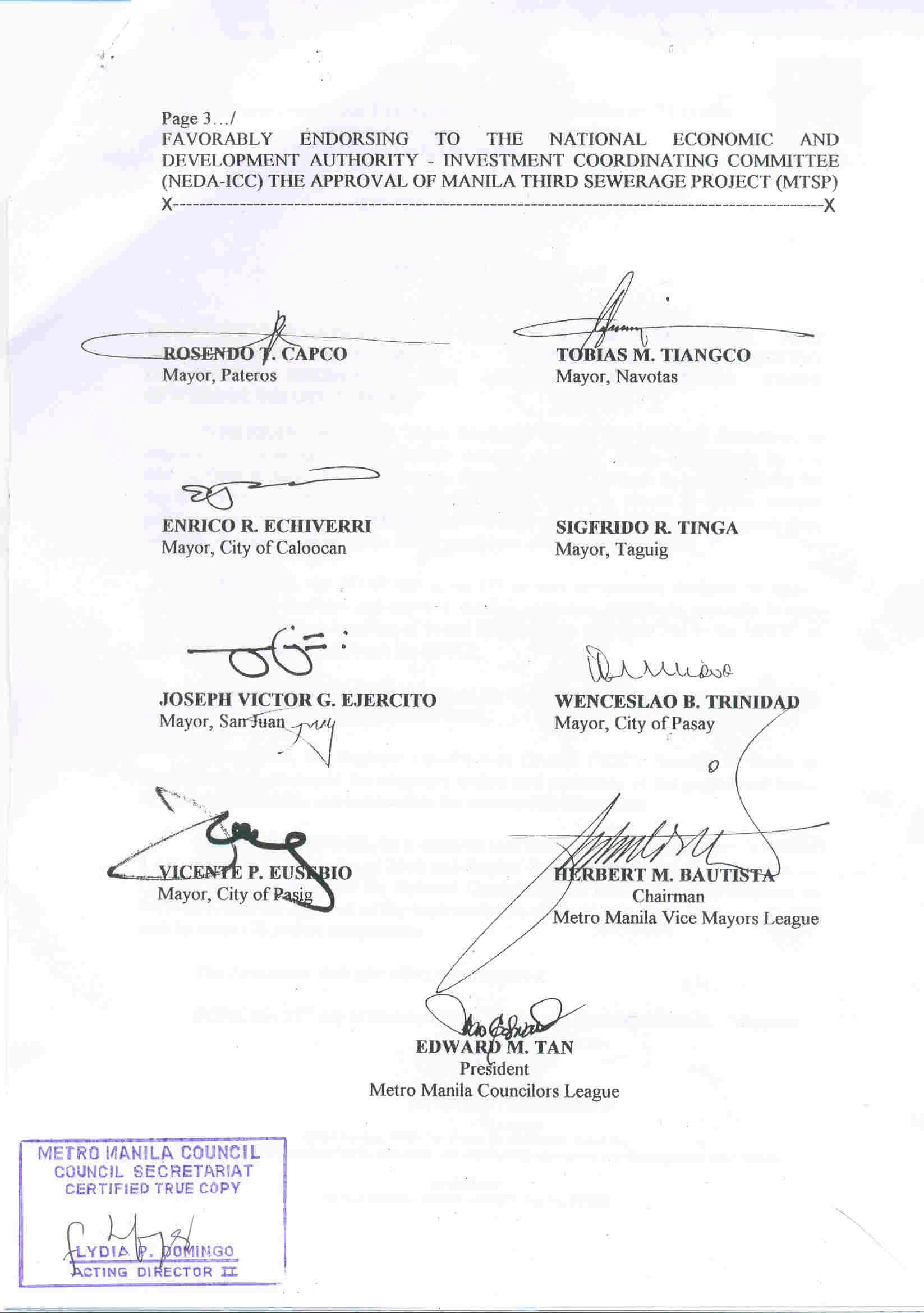
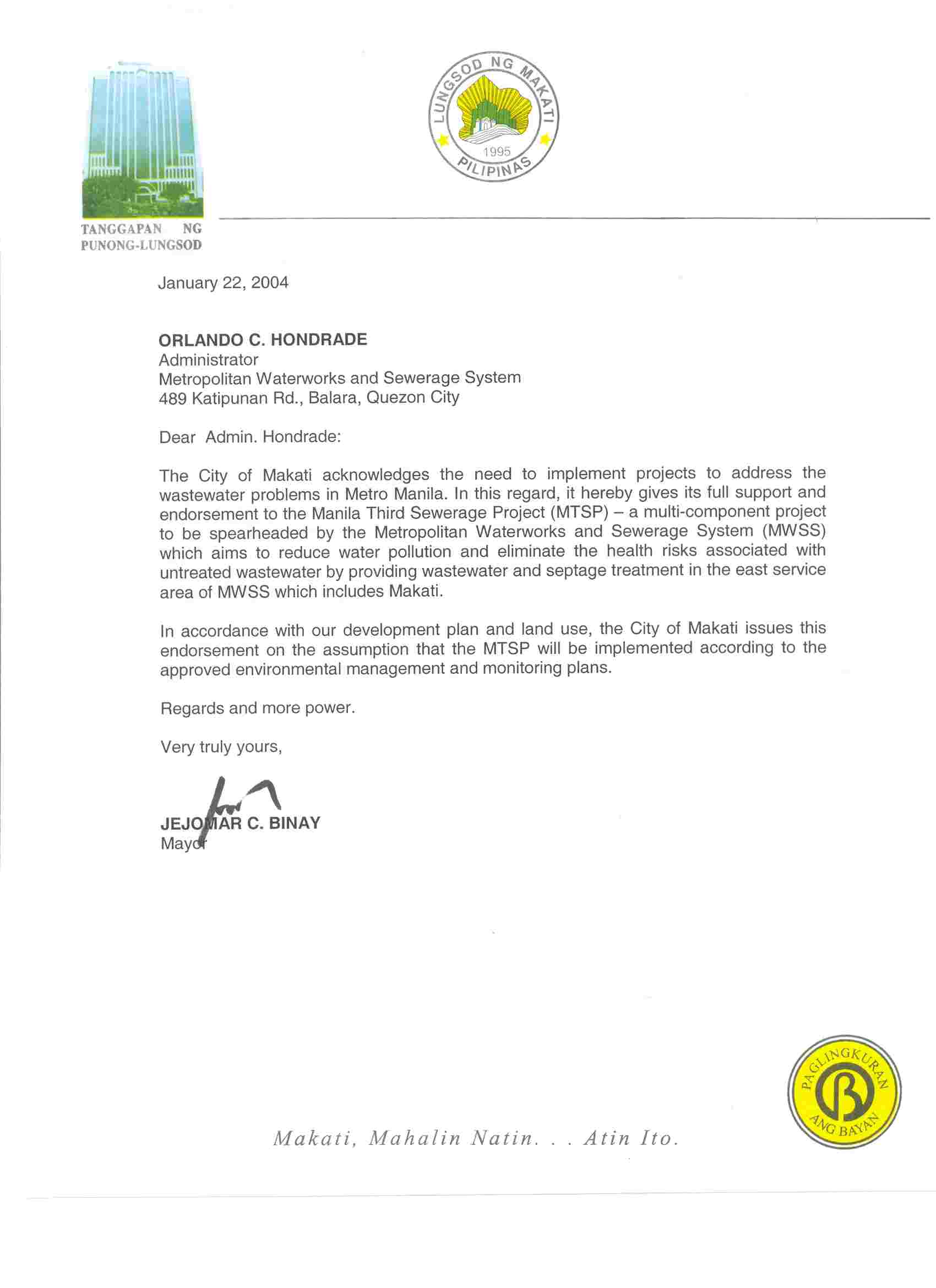
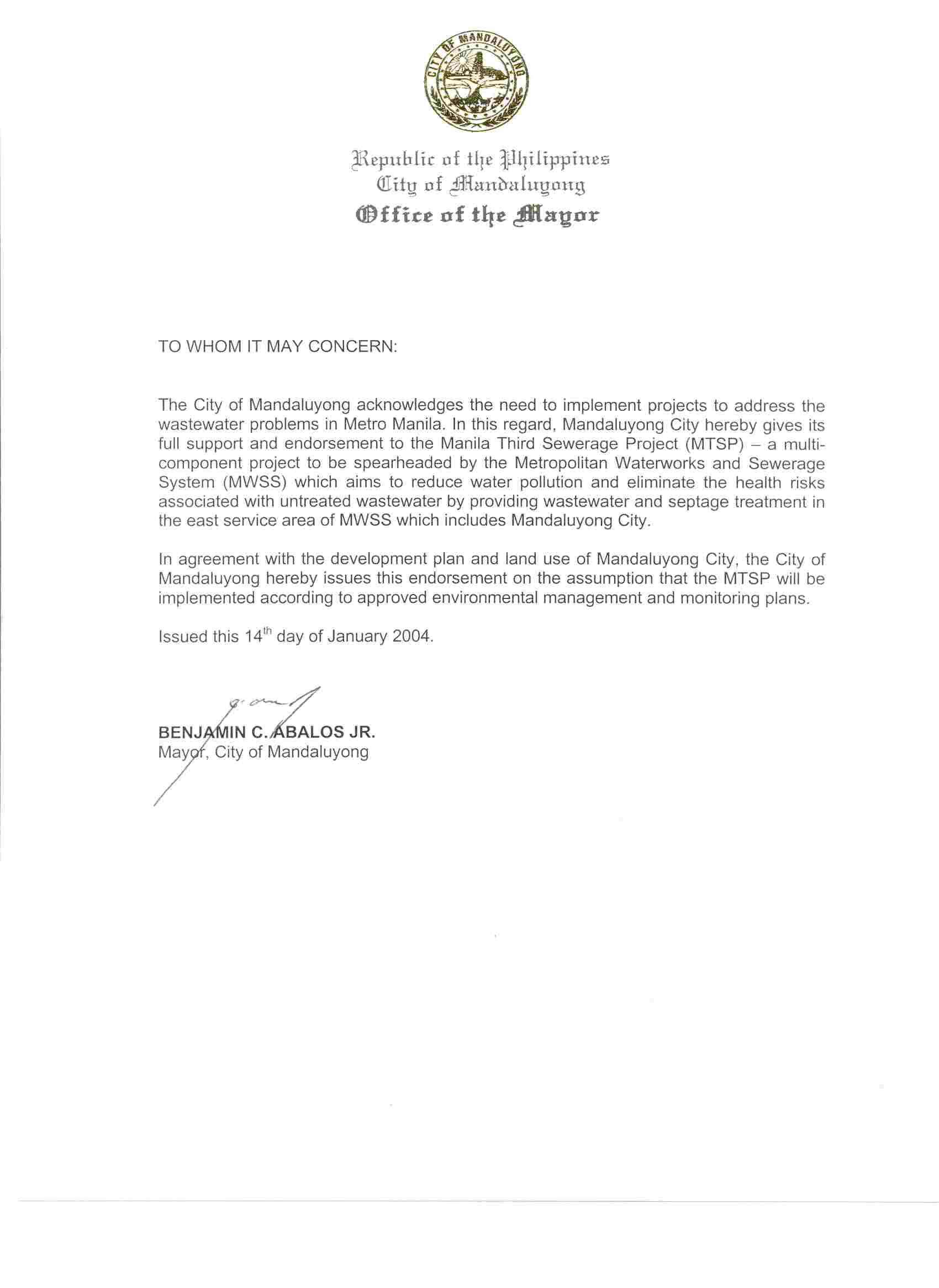
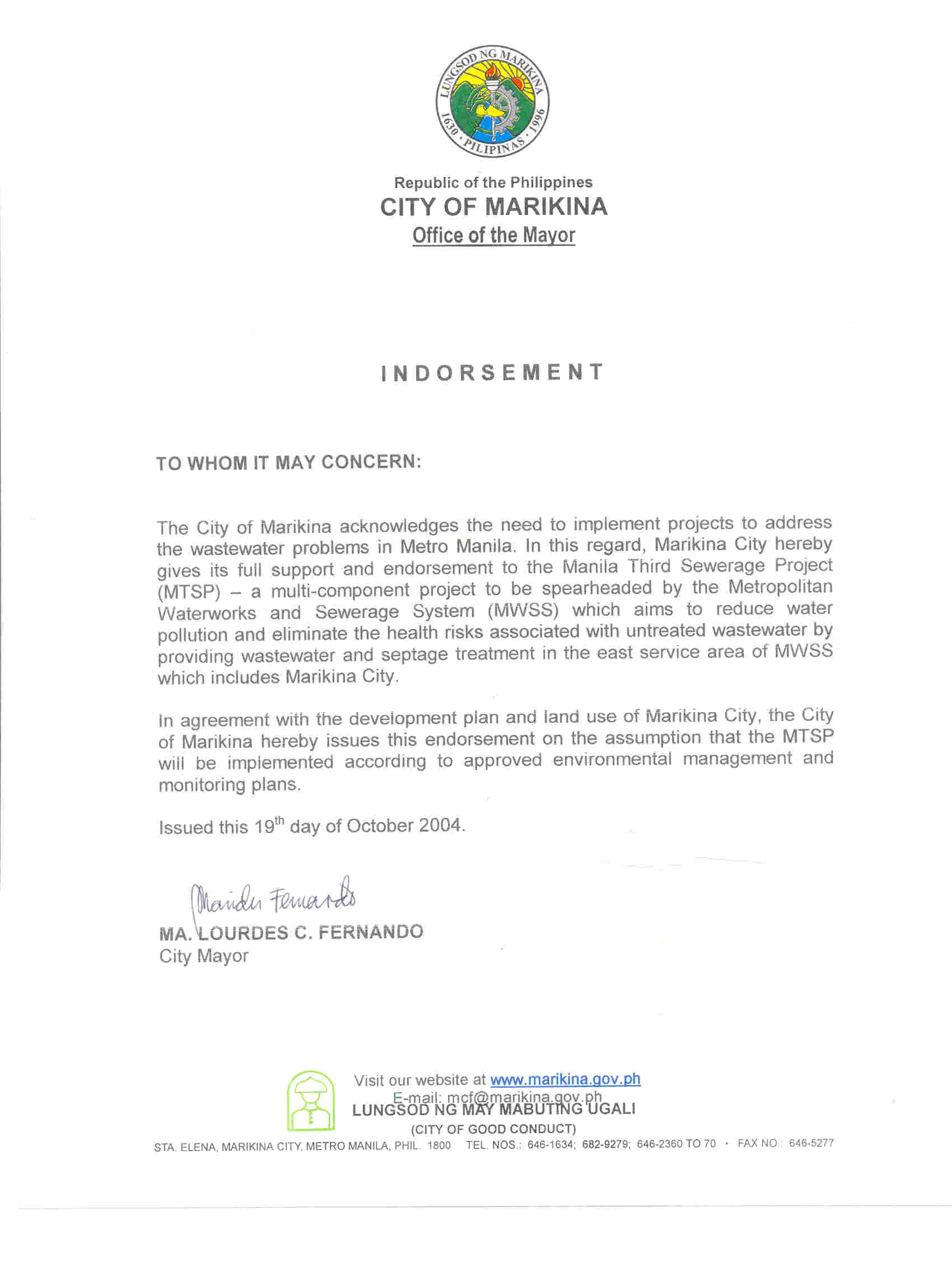
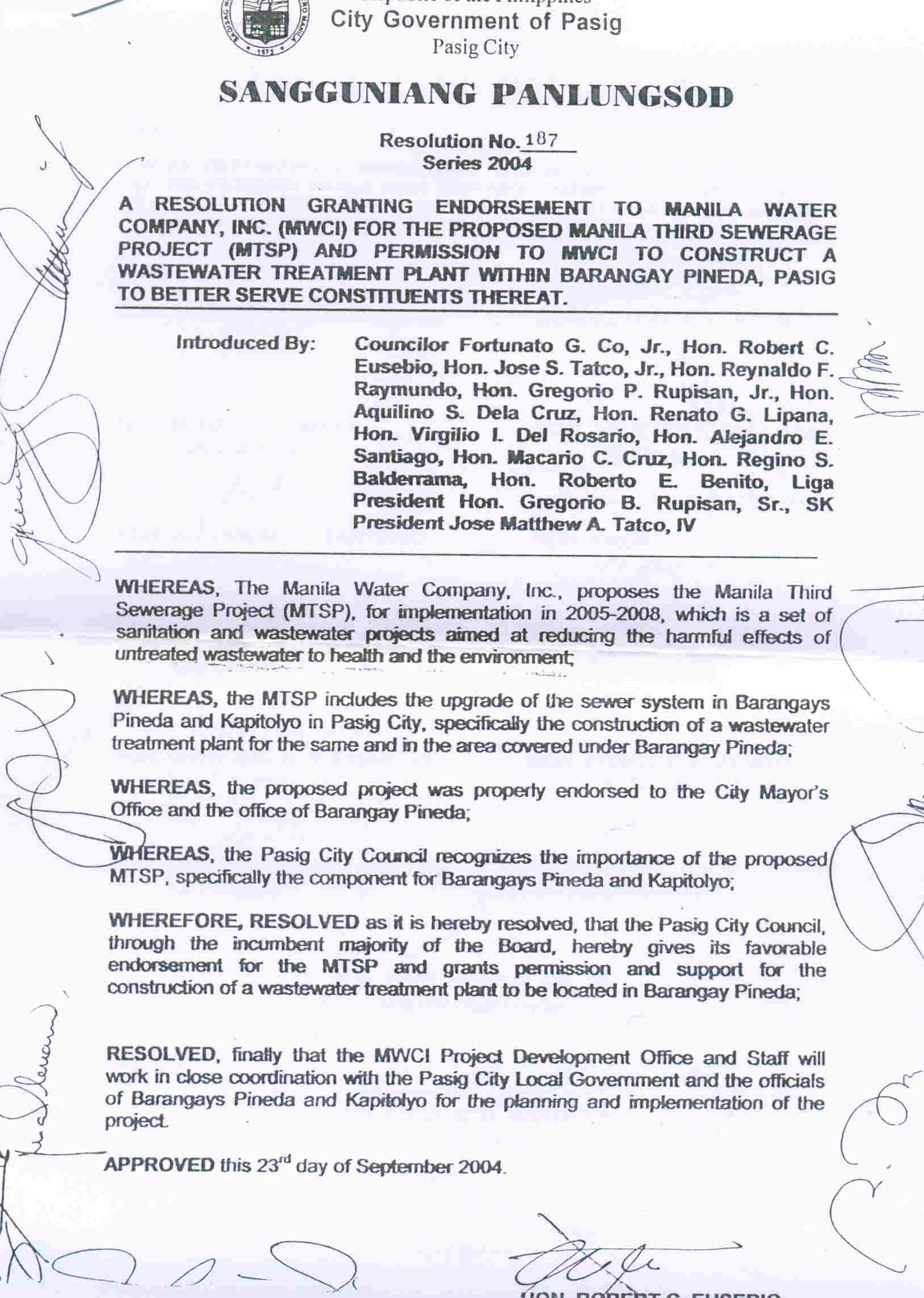
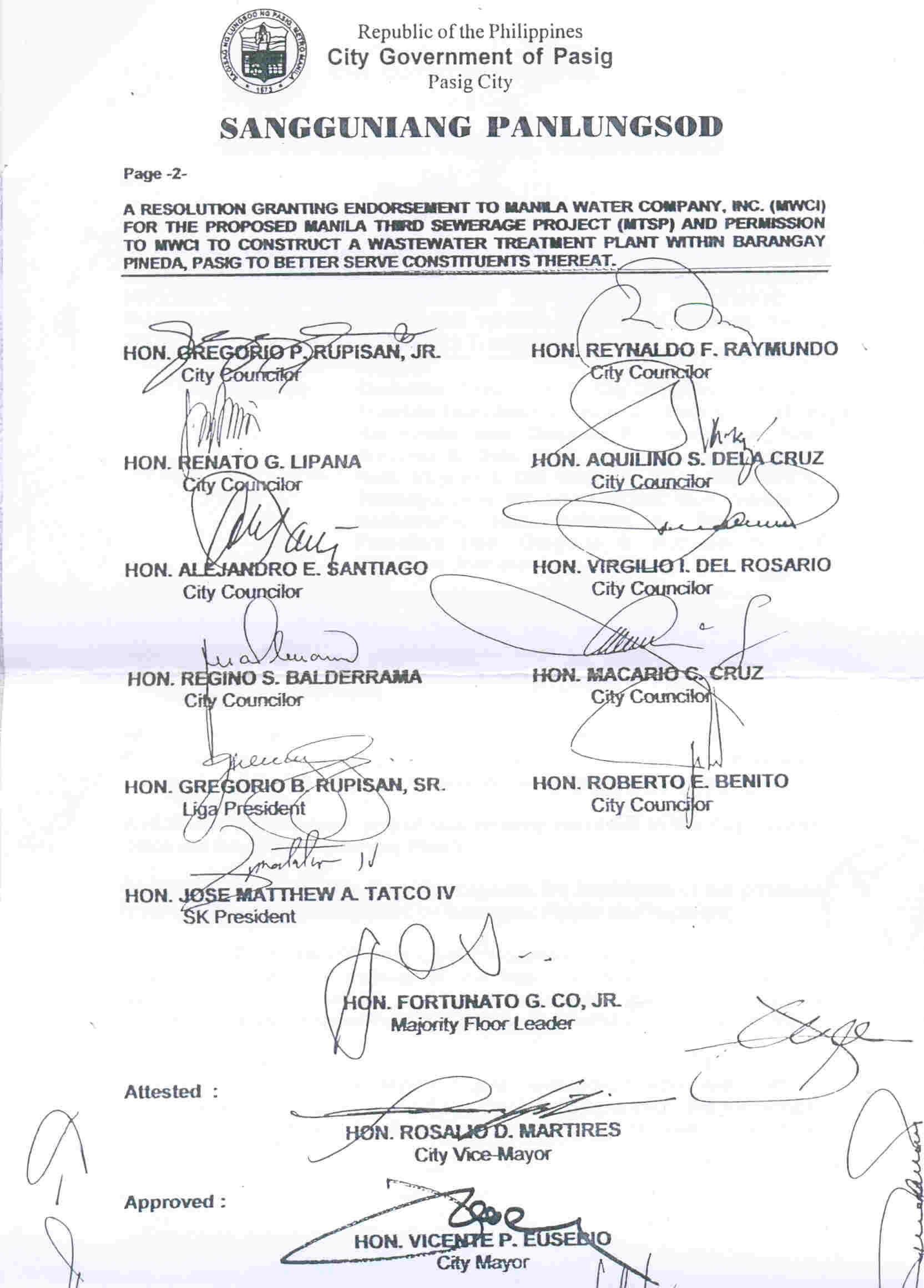
Annex 1 shows the endorsements of the different LGUs for MTSP.
III. PUBLIC CONSULTATION
Table 1 shows the sequence of consultations conducted. These, along with the complete details,
are separately presented in Annexes 2-4.
A. Representation
The project is classified under Category B: Projects that are not categorized as Environmentally
Critical Projects (ECPs), but which may cause negative environmental impacts because they are
located in Environmentally Critical Areas (ECAs) (PD 1586, AO No. 42, DENR AO No. 30
Series of 2003). The MTSP sewage management component has an estimated service population
of 992,396. The people were informed and consulted about the project through surveys, focused
group discussions and/or public consultations.
A First Level Consultation (Scoping Workshop) was held in November 2003 at the Bahay ng
Alumni at the University of the Philippines in UP Diliman. This consultation meeting was
attended by Barangay officials from the MTSP-affected communities. The MTSP was presented
by MWCI and issues and concerns on the project components were discussed. Annex 3 presents
the attendance and minutes of the scoping workshop.
6
Manila Third Sewerage Project (MTSP)
ENVIRONMENTAL ASSESSMENT
Public Consultation
The table below summarizes the schedule of Second Level Consultations.
Table 1
Schedule and Venues of the Second Level Consultations
COMPONENT
LOCATION
DATE
TIME
BARANGAY/COMMU
Nature of
ATTENDEES
NITY INVITED
Consultation
1 Taguig
Sewer Brgy. Hall
June 15 9-
Residents of Brgy.
To orient the
35 out of 48
System
Signal Vill.,
`04
11.30
Signal,W.Bicutan,Pi
community of
attended
Taguig
nagsama
the MTSP
Ph1,Ph2A&B,
Project
AFP/PNP Ph2
2 Taguig
Sewer Villa Salud
June 16 1-4pm Residents of Brgy. To orient the
35 out of 48
System
Resort,
`04
Wawa, Calzada,
community of
attended
Taguig
Tipas Ibayo
the MTSP
Project
3 QC-Marikina Brgy. Hall
June 17 8-12nn Residents of Blue To orient the
23 out of 40
Sewerage
Blue Ridge
`04
Ridge A & B and St. community of
attended
System
A, QC
Ignacius Subd.
the MTSP
Project
4 Riverbanks HQ of special June 18 9.30-
Residents of
To orient the
58 out of 65
Sewage
Brgy force,
`04
11.30
Barangay Capitolyo community of
attended
Treatment
Pasig
and Pineda
the MTSP
Plant
Project
5 Riverbanks Brgy.
June 18 2-4pm Residents
of
To orient the
65 out of 73
Sewage
Poblacion
`04
Barangay Poblacion
community of
attended
Treatment
Sports Com.,
Makati, Ilaya,
the MTSP
Plant
Makati
Barangka Itaas,
Project
Ibaba Mandaluyong
6 QC-Marikina Brgy. Health
June 19 9.30-
Residents of Brgy To orient the
34 out of 50
Sewerage
Center of
`04
12nn
Industrial Valley, community of
attended
System
IVC,
Olandes, Cinco
the MTSP
Marikina
Hermanos, Monte Project
Alta Subd
7 Sanitation
for Fish port
June 19 2-4pm Residents
of
To orient the
48 out of 55
Low Income
Training
`04
Anakpawis, Exodus, community of
attended
Communities
Center,
Dimagta/Sumagta,
the MTSP
Taytay
Genesis, Brgy San
Project
Juan, PCFI, Kabisig,
San Francisco
8 Upgrade
of Yakap Day
June 21 9.30-
Residents of East To orient the
74 out of 85
existing
Care Center,
`04
12nn
and West Kamias, community of
attended
Sewer system QC
QC
the MTSP
Project
9 Upgrade
of Barangay
June 21 1.30-4 Residents
of
South To orient the
35 out of 60
existing
Hall of
`2004
Triangle, Sacred
community of
attended
Sewer system Laging
Heart and Laging
the MTSP
Handa, QC
Handa
Project
10 Upgrade
of Covered
June 22 1.30-4 Residents
of
Brgys. To orient the
88 out of
existing
Court of
`04
Quirino 2A, 2B, 2C, community of
100 attended
Sewer system Brgy. Quirino
3A, 3B, and Duyan
the MTSP
2A, QC
Duyan
Project
11 Upgrade
of Barangay
June 23 10-
Residents of Brgy
To orient the
53 out of 65
existing
Hall of
`04
11.30
Central, Old
community of
attended
Sewer system Central
Capitolyo and UP
the MTSP
7
Manila Third Sewerage Project (MTSP)
ENVIRONMENTAL ASSESSMENT
Public Consultation
Village Project
12 Upgrade
of Covered
June 23 2-4pm Residents
of
To orient the
24 out of 45
existing
Court of
`04
Barangay Project 6
community of
attended
Sewer system Barangay
the MTSP
Project 6
Project
13 North
Chapel in La
February 1:00-
Residents of La Mar To orient the
68 out of
Septage
Mar Village,
9, 2005
2:00
Village, Riza
community
102 attended
Treatment
Kambal
pm
Village, Brgy.
with the
Plant
Road, Bgy.
Captain and
septage
Gitnang
councilmen,
treatment plant
Bayan II, San
Mayor's
to be
Mateo
representative,
constructed in
World Bank, DENR the area
RevCom
B. Tools
Surveys
Statistical studies focused on the identified project location of each component, as the primary
impact area. The Metropolitan Manila including Taytay and Cainta in Rizal were included in
data gathering and considered as the secondary impact area. The period of the study was from
November 1728, 2003.
Interviews were conducted to community residents and other stakeholders on public perception
on the Project. Questions consist of the following:
· Basic information on the social status of the respondent
· Knowledge about the project
- effects
- environmental benefits
· Acceptability of the project
- charging
- acceptability
- economic impact
- social impact
The results of the survey gathered were used to establish public perception on the project. Reason
for project refusal was taken into consideration to subsequently improve the presentation for
public consultations.
Focus Group Discussions
The Bank's review of the FS in February 2004 recommended the expansion of the MTSP
coverage to keep certain levels of efficiency in the project components. This expansion resulted
in the addition of fourteen (14) barangays in the service coverage and thereby necessitated the
inclusion of these barangays in the consultative process. In addition to the new barangays, there
was also a need to consult barangay representatives that were not able to participate in the
scoping workshop held last November 2003.
8
Manila Third Sewerage Project (MTSP)
ENVIRONMENTAL ASSESSMENT
Public Consultation
Courtesy visits to barangay offices were done from April 12 to 14, 2004. The visits aimed to meet
barangay officials, to inform them of the proposed project, and to ask for a formal discussion with
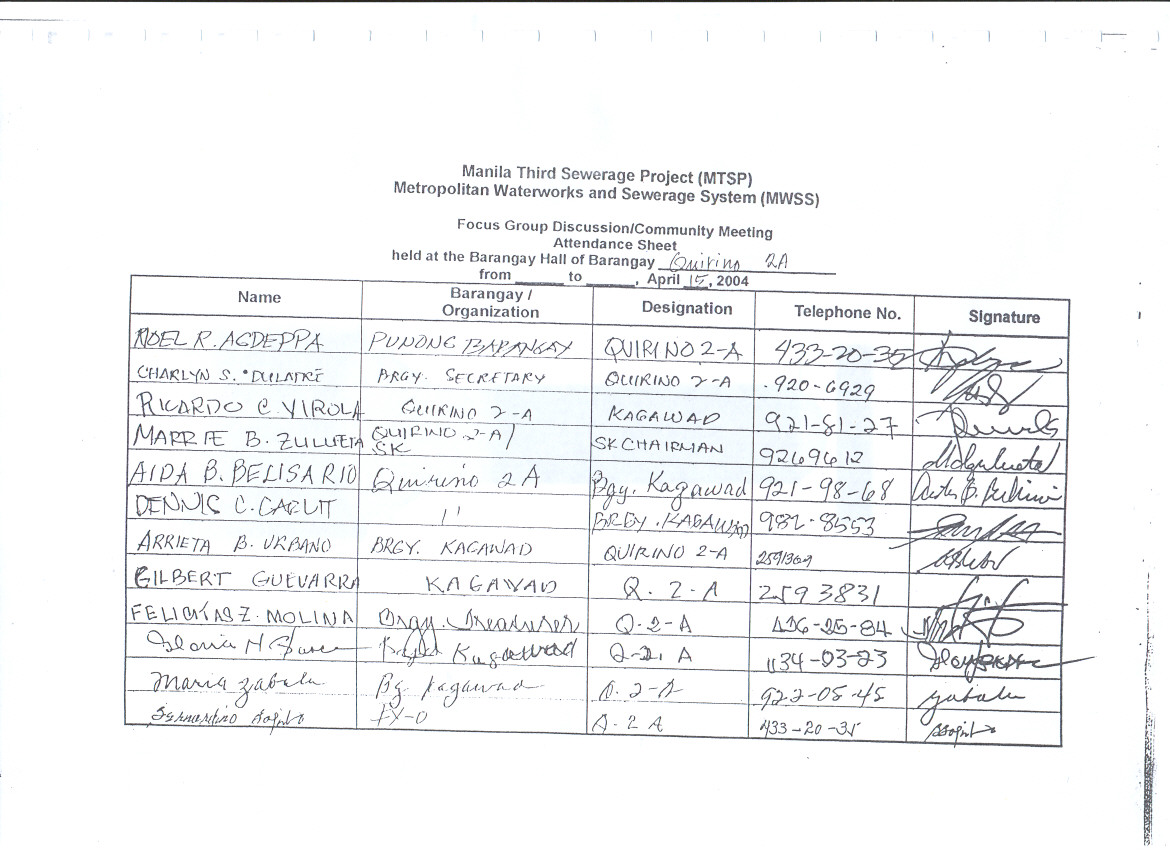
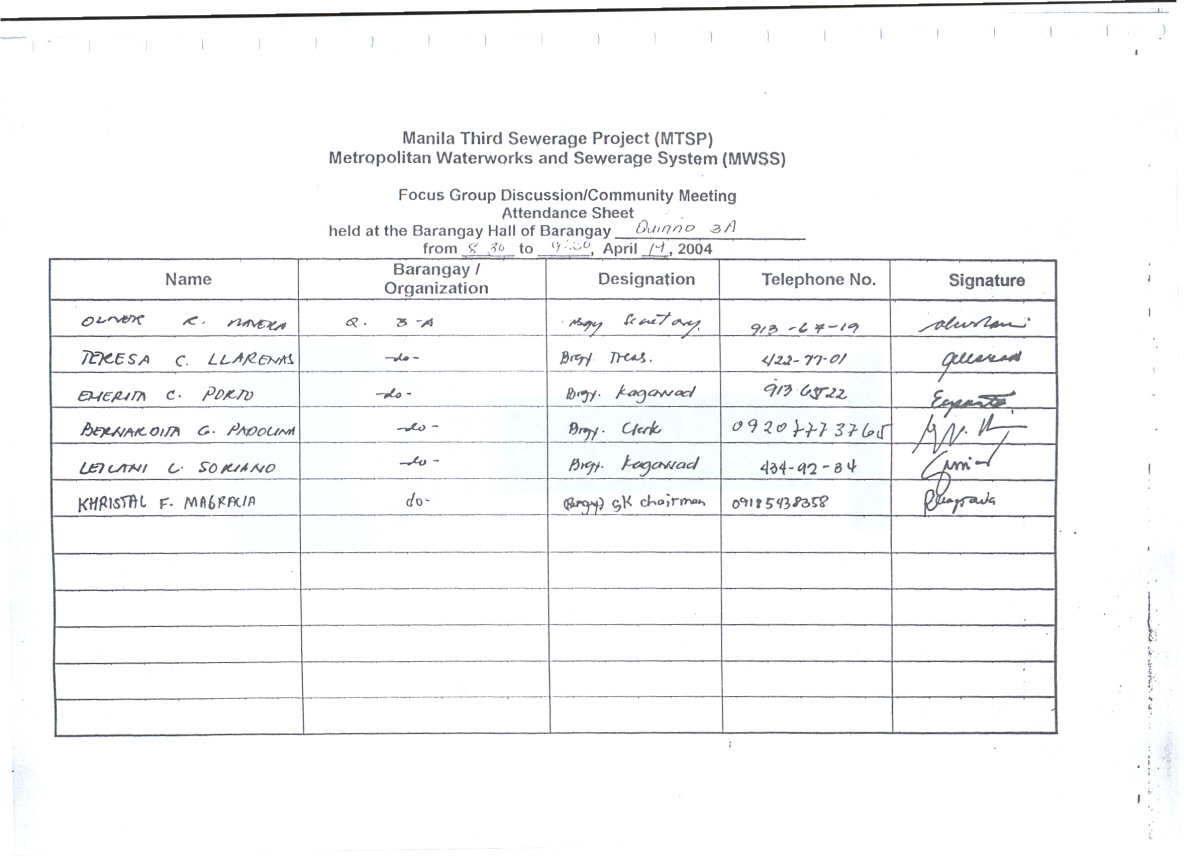
the barangay council to present the project. Proof of consultations with the additional
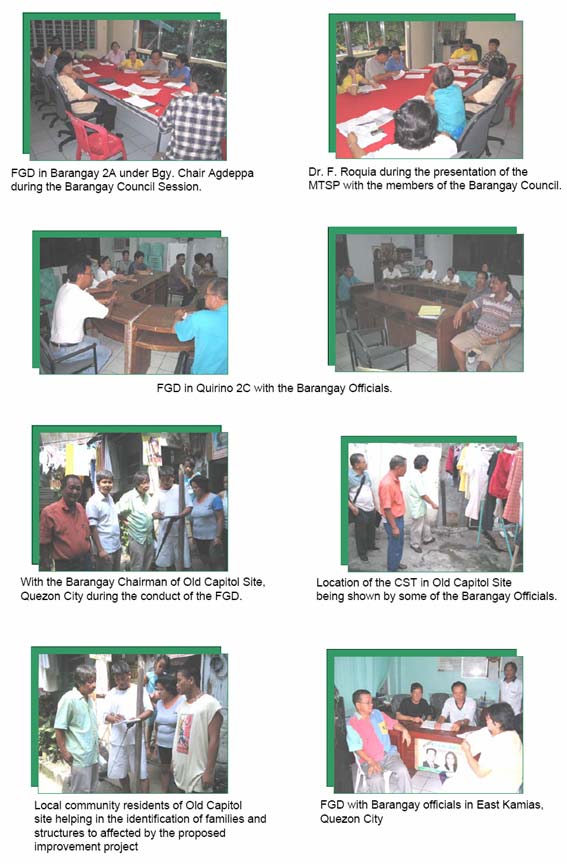
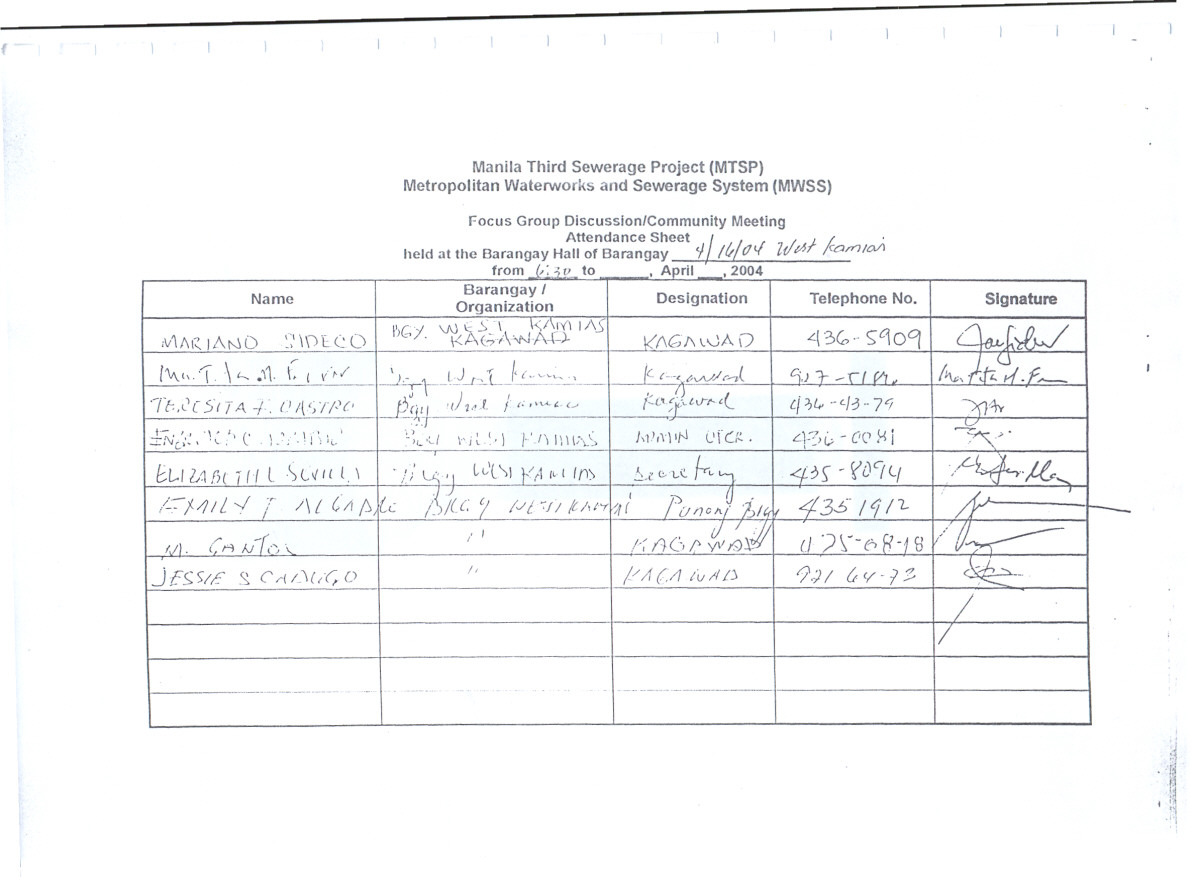
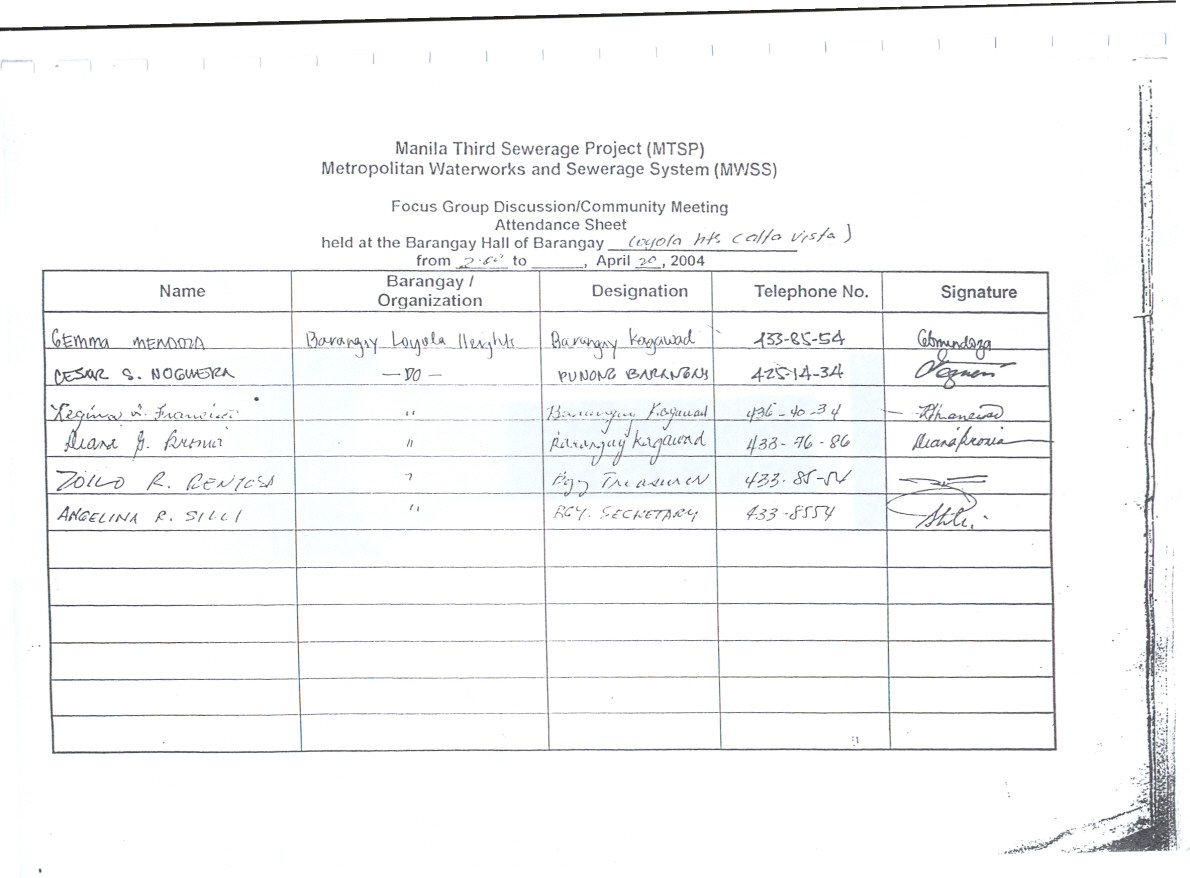
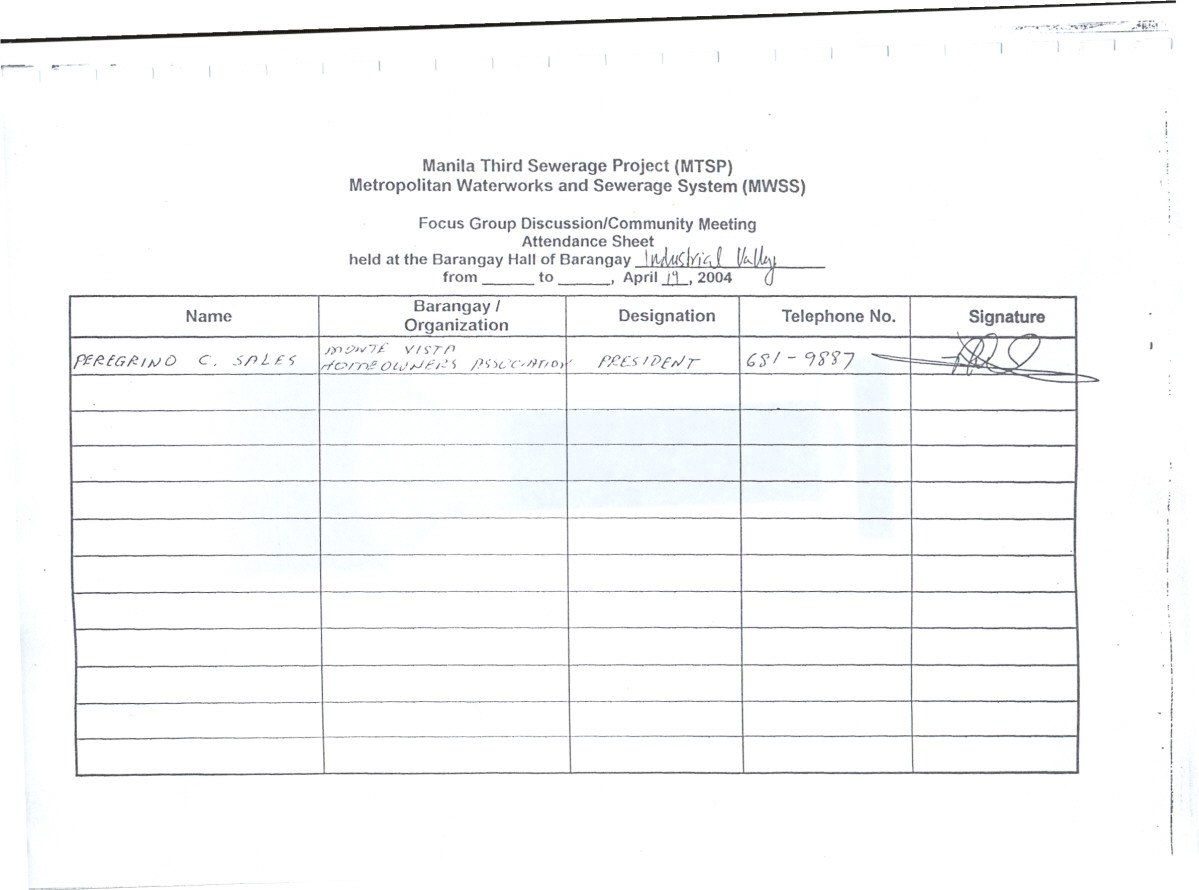
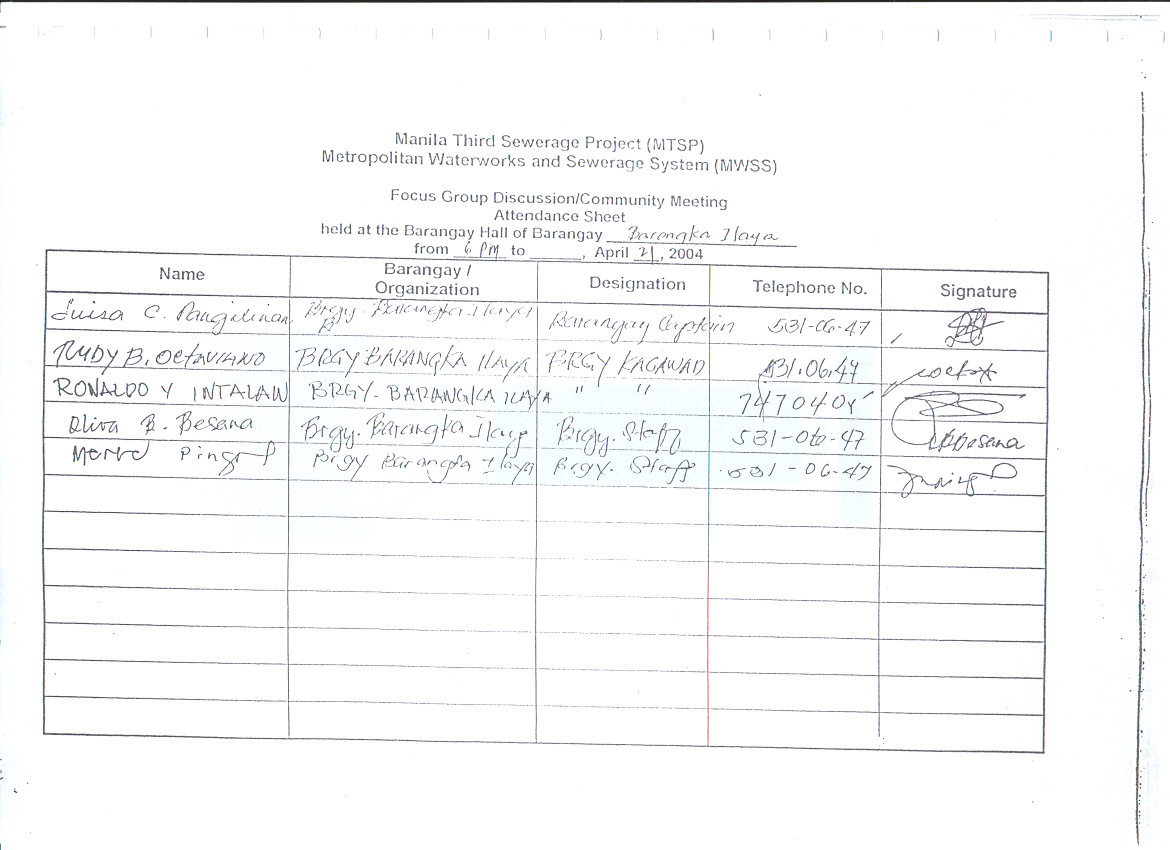
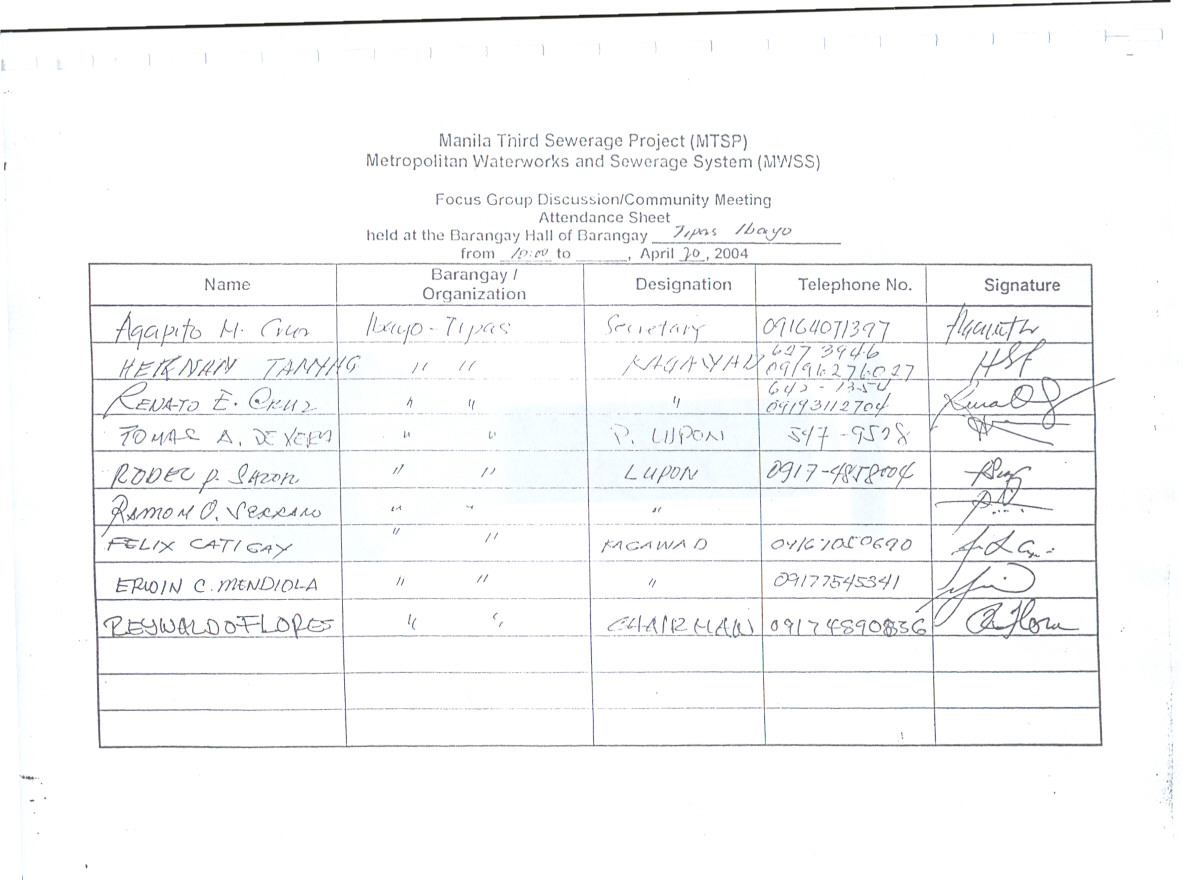
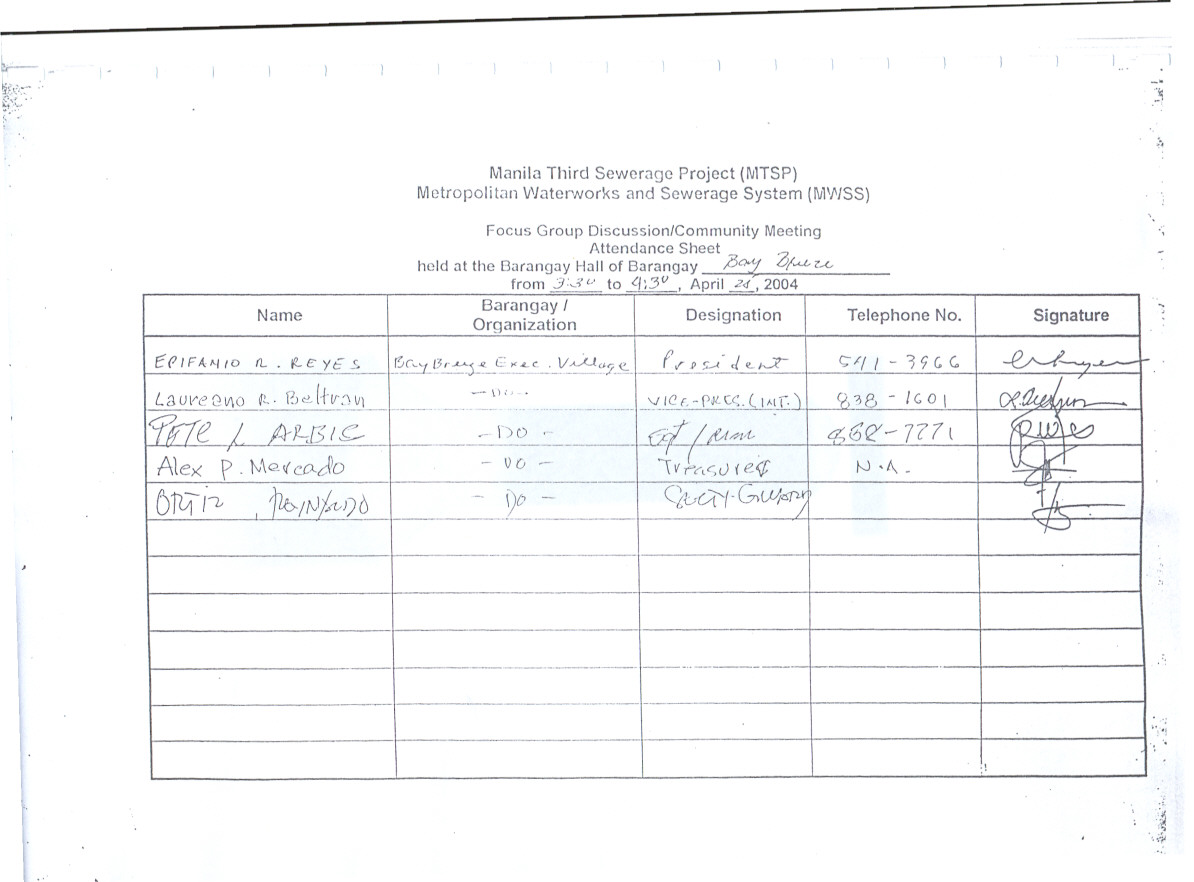
communities is shown in the attendance sheet and photographs attached as Annex 4
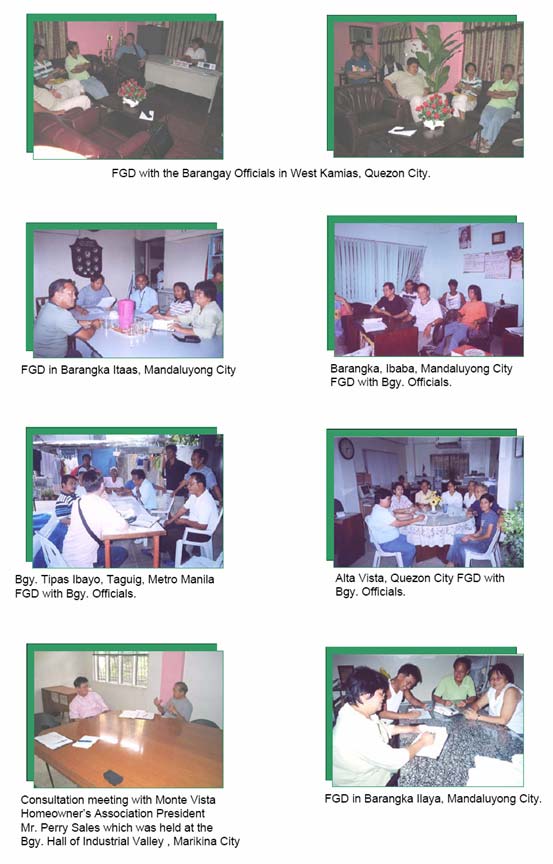
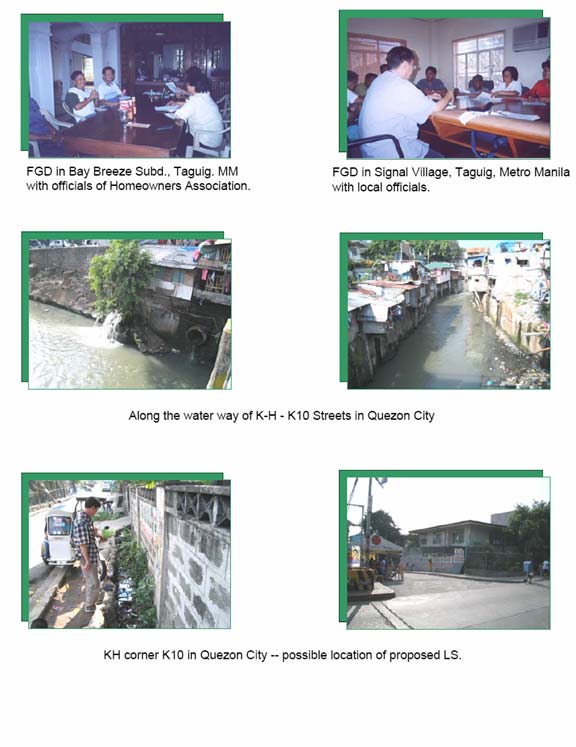
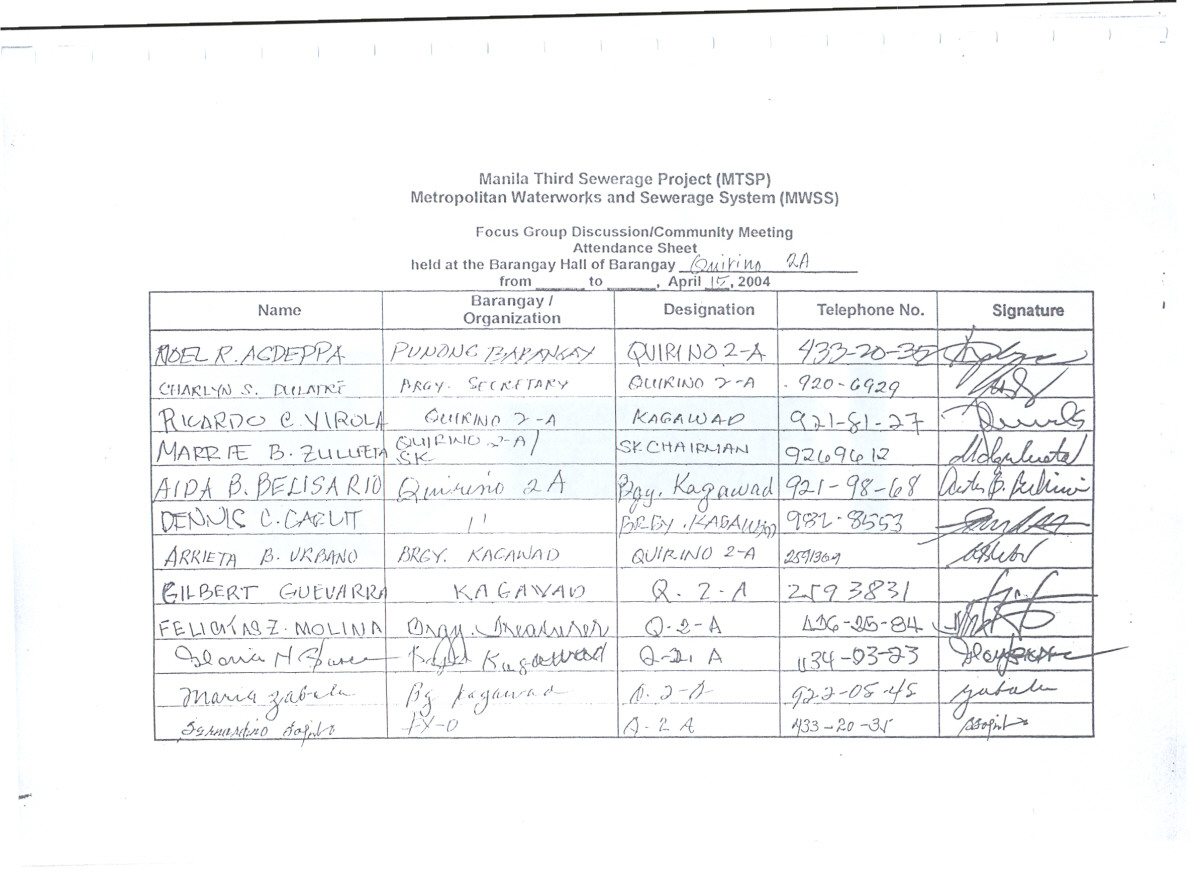
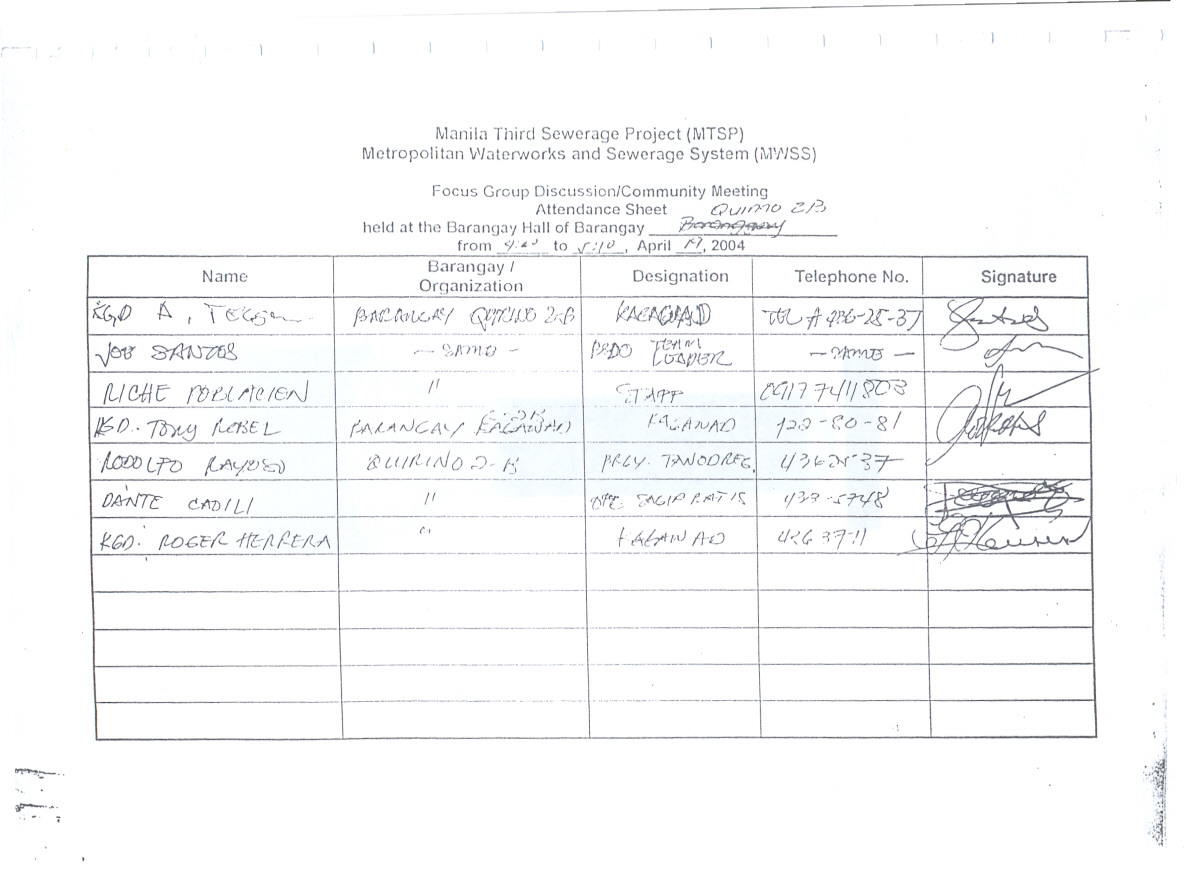
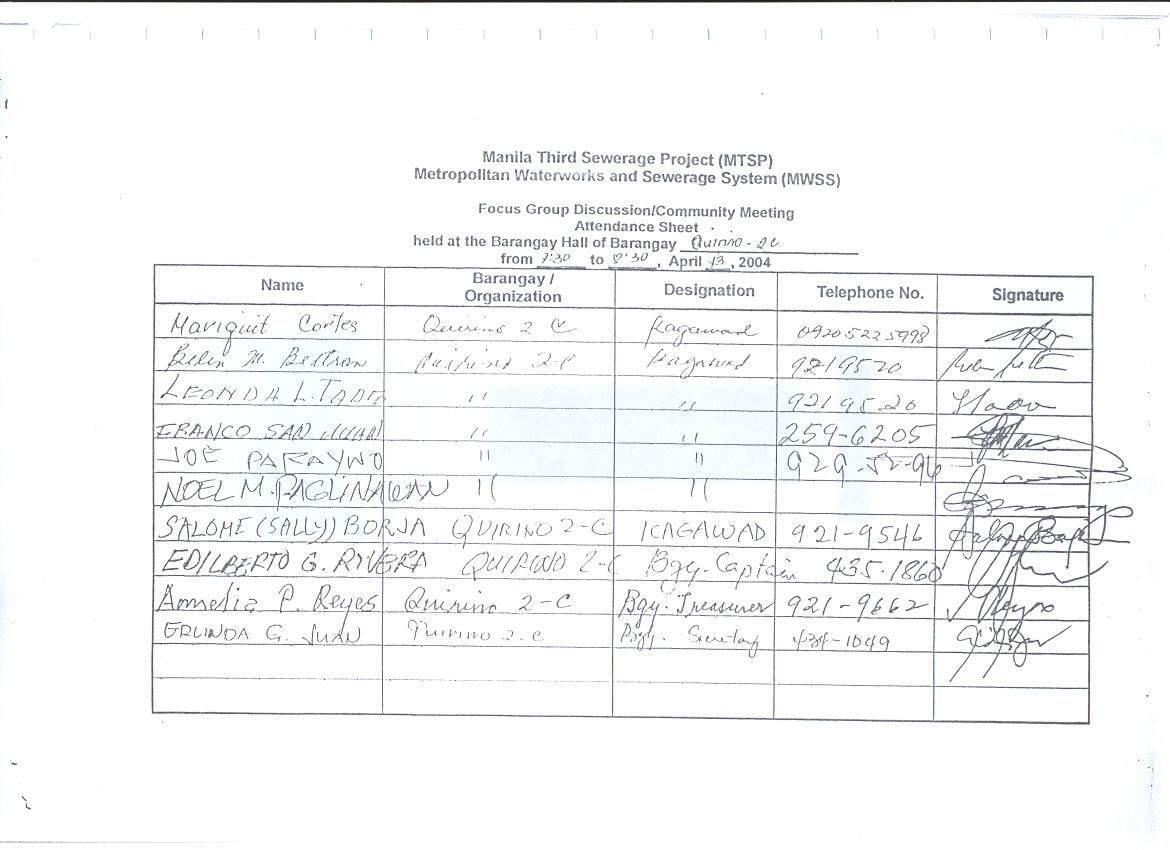
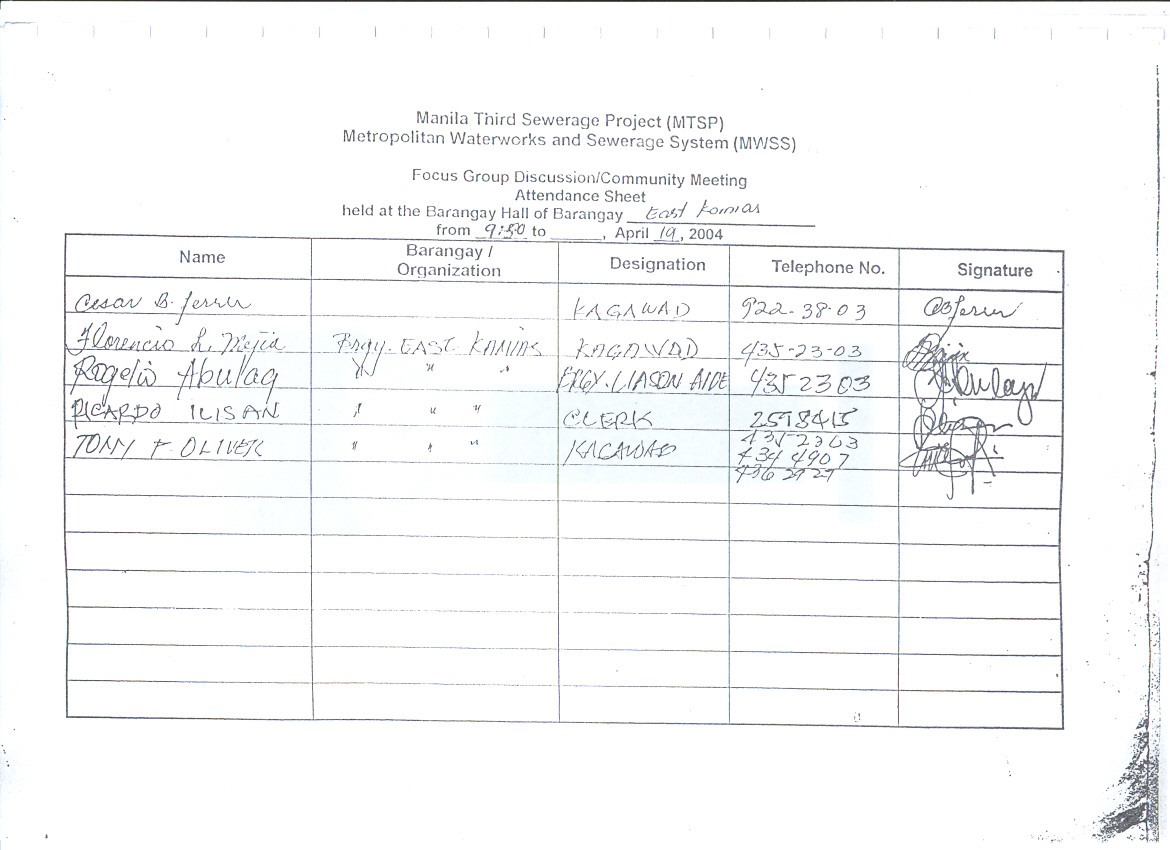
The Focus Group Discussions (FGDs) with barangay officials were conducted from April 15 to
26, 2004 at the barangay offices. The discussions of the meeting included an overview of the
situation of sewerage systems in the area and the presentation of the MTSP and its components.
Group discussion ensued after the presentation where queries, issues and concerns in relation to
the sewerage system, proposals and recommendations for the improvement of the sewerage
system were gathered. Proofs of FGDs with various barangay officials are shown in the
attendance sheets and photographs shown in Annex 4
Public Consultations
In accordance with the Bank's requirement, Second Level Consultations were held from June 15-
23,2004 and on February 9, 2005. Thirteen (13) public consultations were conducted among the
concerned barangays and communities. Table 1 shows the schedule and venues of the
consultations.
The consultations were participated by barangay/community officials and residents as well as
representatives from government and non-government organizations (NGO). On hand to facilitate
the consultations were representatives of the consultants. Representatives from MWSS and
MWCI also participated in the consultations while a representative from the Environmental
Monitoring Bureau (EMB) of the DENR observed the proceedings. The general proceedings of
the consultations are listed below.
C. General Proceedings of Meetings
The meetings generally proceeded as follows:
I.
Introduction of participants
II.
Presentation of the Philippine EIS System
III.
Presentation of the MTSP including background of present sanitation conditions
IV.
Presentation of Project Plans
V.
Presentation of the highlights and results of the EA
VI.
Open Forum
The Philippine EIS System and the MTSP concept were previously presented during the first
level consultations. However, these presentations were purposely repeated in the program for the
benefit of new participants and those who were not able to participate during the first level
consultations.
The project details refer to the proposed plans and layouts of specific project component in
relation to the concerned communities. This includes the location and size of the proposed
development, nature of construction, and coverage area.
After the project plans were explained, the consultants presented the highlights of the EA study as
follows:
9
Manila Third Sewerage Project (MTSP)
ENVIRONMENTAL ASSESSMENT
Public Consultation
· baseline environmental conditions with emphasis to water and wastewater quality and the
survey results regarding the perception of the communities about the proposed project;
· major environmental impacts (adverse and beneficial) and proposed mitigations; and
· the Environmental Management Plan
The EA presentation was followed by an open forum where the concerned community was
allowed to voice out their queries, issues and opinions. Responses to their queries were addressed
by the MWCI.
Presentations of the Project Highlights and the results of the EA for the different MTSP project
components are shown in Annexes 5 and 6.
IV. GENERAL ISSUES/CONCERNS AND RESOLUTIONS
Results of the perception surveys conducted in November 2003 and April 2004 indicated a low
project awareness of about 32%. The public consultations, which included the presentation of the
key project activities and the results of the EIA greatly increased the community's knowledge
regarding sanitation, sewerage treatment, environmental impacts and project benefits.
The consultations also validated and updated the results of the EA. One of the major issues raised
during the meetings was regarding sewerage fees. The communities felt that the present
sewerage tariff equivalent to 50% of the basic water charge is excessive. This issue was even
emphasized by communities that are covered by existing sewerage systems. They felt that the
sewerage fees they are paying are not commensurate with the services they are receiving.
Overall, the response of the communities regarding the project is favorable. They realize the
benefits the project would offer to their health and to the environment. Continuing dialogues with
the stakeholders are encouraged so that they are promptly informed of the project developments.
This approach will promote transparency and sincerity on the part of the proponent.
Table 2 summarizes the general issues and the corresponding responses/resolutions during the
consultations.
Table 2 Summary of General Issues and Corresponding Resolutions
Issues / Concerns
Responses / Recommendations/Resolutions
Sewer charges
Charging for Sewer Charges (50% of the
The sewer charge is intended to cover the
Water Charge)
maintenance, operation and manpower cost of
the sewage/septage treatment plants. It was a
scheme/policy that was adopted by MWSS and
carried over by the concessionaires as written in
the respective Concession Agreements.
MWSS/MWCI will review and consider
changing the charging scheme in the 2008 Rate
Rebasing.
Charging for Environmental Charge (10% of
At the time of MWSS privatization, the
10
Manila Third Sewerage Project (MTSP)
ENVIRONMENTAL ASSESSMENT
Public Consultation
Issues / Concerns
Responses / Recommendations/Resolutions
the Water Charge)
Environmental Charge was part of the bid
assumptions and is included in the overall tariff
composition.
Services to be provided by MWCI if not
A major component of the MTSP involves the
covered by sewerage projects under MTSP
construction of septage treatment plants and the
procurement of vacuum tankers to expand the
provision of sanitation services which will be
extended to the whole East Zone.
Mandatory sewer connection
Under the Sanitation Code and the recently
enacted Clean Water Act, households are
required to connect to the sewerage system if
the system is available.
Construction phase
Traffic during construction
Truck trips will be properly scheduled (during
non-peak hours) in coordination with concerned
officials
Health and safety
Contractors Construction Program will be
implemented and will include health and safety
procedures.
Operation and Maintenance
Foul odor from STP
STP will be underground and equipped with
carbon filter system to eliminate foul odor
during operations. It will be monitored by
MWCI representatives to prevent any untoward
incident
Flooding due to poor drainage system
Part of the project includes
improvement/rehabilitation of drainage system
which would reduce sewage overflows in the
area
Use of Individual Septic Tanks (ISTs)
MWCI emphasized that with the combined
sewerage system, the residents will continue to
use their ISTs as primary treatment. MWCI
provides free desludging of ISTs if scheduled.
Noise from STP
STPs will be equipped with sound proofing
materials
Daily monitoring will be conducted to ensure
that all mitigations are in place
Smoke emissions from STP
Back-up generator sets may produce emissions
but this will be maintained properly to
minimize emissions.
Disposal of sludge
Thickened sludge will be collected by vacuum
trucks and will be transferred to a Septage
Treatment Plant for dewatering. The sludge can
11
Manila Third Sewerage Project (MTSP)
ENVIRONMENTAL ASSESSMENT
Public Consultation
Issues / Concerns
Responses / Recommendations/Resolutions
be used as soil conditioner
Treated water
This will conform to DENR Standards and can
be used for watering plants, or for other non-
potable uses.
Project Benefits
Health benefits
Reduce risk of direct contact with untreated
sewage
Environmental benefits
Reduce pollution loading to water bodies
Re-use of water
Water coming from the treatment plant can be
used to water plants and for flushing of toilets.
Soil conditioner
Thickened sludge will be collected by vacuum
trucks and will be transferred to a Septage
Treatment Plant for dewatering. The sludge can
be used as soil conditioner
12
Manila Third Sewerage Project (MTSP)
ENVIRONMENTAL ASSESSMENT
Public Consultation
V. ISSUES AND CONCERNS Component-Specific
Table 3 summarizes the components' major issues and the corresponding responses/resolutions
during the consultations.
Table 3
Summary of Issues and Corresponding Resolutions per Component
Issues / Concerns
Responses / Recommendations/Resolutions
Taguig Sewerage System
Charging for Sewer Charges (50% of the
The sewer charge is intended to cover the
Water Charge)
maintenance, operation and manpower costs of
the sewage/septage treatment plants. It was a
scheme/policy that was adopted by MWSS and
carried over by the concessionaires as written in
the respective Concession Agreements.
MWSS/MWCI will review the charging scheme
in the 2008 Rate Rebasing.
Charging for Environmental Charge (10% of
At the time of MWSS privatization, the
the Water Charge)
Environmental Charge was part of the bid
assumptions and is included in the overall tariff
composition.
Coverage of Taguig Sewer System
Other contiguous areas will be considered in
later phases
Drainage-sewer combination
Separate sewer systems are capital intensive
and will result to higher water rates. Laying of
separate sewers will also cause significant
inconvenience to the public.
Closure of gates from fishermen
The issue with the fishermen is already resolved
by DPWH which will construct a wharf outside
the dike.
Flooding due to poor drainage system
Using the drainage as sewerlines would work to
the advantage of the communities since MWCI
will maintain the lines to ensure the flow of
wastewater to the treatment plant
Riverbanks Sewage Treatment Plants
Charging for Sewer Charges (50% of the
Sewer fees cover the maintenance, operation
Water Charge)
and manpower cost of the treatment plant. It
was imposed during MWSS time
Charging for Environmental Charge (10% of
At the time of MWSS privatization, the
the Water Charge)
Environmental Charge was part of the bid
assumptions and is included in the overall tariff
composition.
Foul odor from STP
The treatment plant will be equipped with a
carbon filter system to eliminate foul odor
during operation. It will be monitored by
MWCI representatives to prevent any untoward
incident
13
Manila Third Sewerage Project (MTSP)
ENVIRONMENTAL ASSESSMENT
Public Consultation
Issues / Concerns
Responses / Recommendations/Resolutions
Noise from STP
STPs will be equipped with sound proofing
materials
Daily monitoring will be conducted to ensure
that all mitigations are in place
Quezon City-Marikina Sewerage System
Charging for Sewer Charges (50% of the
Sewer fees cover the maintenance, operation
Water Charge)
and manpower cost of the treatment plant. It
was imposed during MWSS time
Charging for Environmental Charge (10% of
At the time of MWSS privatization, the
the Water Charge)
Environmental Charge was part of the bid
assumptions and is included in the overall tariff
composition.
Direct benefits from having a treatment plant
In addition to the general environmental
benefits, the effluent water could be used for
fire prevention and watering the plants. The
solid waste could be used as soil conditioner
Foul odor from STP
The treatment plant will be equipped with a
carbon filter system to eliminate foul odor
during operation. It will be monitored by
MWCI representatives to prevent any untoward
incident
Quezon City Sanitation Upgrading
Foul odor from STP
The treatment plant will be equipped with a
carbon filter system to eliminate foul odor
during operation. It will be monitored by
MWCI representatives to prevent any untoward
incident
Clogged sewer lines
We have a Pollution Control Officer and a
Territory Business Manager assigned in your
area to cater to your water and wastewater
services. We also have a hotline 1627 for
emergencies
Noise from STP
STP is equipped with sound proofing materials
and pumps/aerators will be powered by
electricity which produce minimal noise;
Daily monitoring will be conducted to ensure
that all mitigations are in place
Note: Residents under this component are not concerned with the sewer charges since they are
already paying the 50% sewer fee.
Sanitation for Low Income Communities
Charging for Sewer Charges (50% of the
Sewer fees cover the maintenance, operation
Water Charge)
and manpower costs of the treatment plant. It
was imposed during MWSS time
Charging for Environmental Charge (10% of
At the time of MWSS privatization, the
the Water Charge)
Environmental Charge was part of the bid
14
Manila Third Sewerage Project (MTSP)
ENVIRONMENTAL ASSESSMENT
Public Consultation
Issues / Concerns
Responses / Recommendations/Resolutions
assumptions and is included in the overall tariff
composition.
Foul odor from STP
The treatment plant will be equipped with a
carbon filter system to eliminate foul odor
during operation. It will be monitored by
MWCI representatives to prevent any untoward
incident
Noise from STP
STPs will be equipped with sound proofing
materials
Daily monitoring will be conducted to ensure
that all mitigations are in place
15
Manila Third Sewerage Project (MTSP)
ENVIRONMENTAL ASSESSMENT
Public Consultation
VI. CONCLUSION
The proposed project for the improvement of the sewerage system in the areas is acceptable to
most people. They signified their willingness to support the MTSP. The support is concretized by
the results of the information dissemination, barangay consultations and continuous presentation
of the Project to the community residents regarding the nature, objectives and outputs of MTSP.
The most outstanding issue during the consultation with the stakeholders is the 50% sewerage
charge. The stakeholders pointed out that it would be an additional financial burden to
households. A program of continuing information and education campaign is necessary to
increase public awareness on the benefits of sewerage and sanitation and the correlation between
wastewater treatment/sanitation, public health and the environment.
16
Manila Third Sewerage Project (MTSP)
Annex 1
Endorsements of Local
Government Units (LGUs)
Annex 2
EIA Process Flowchart
Annex 3
Scoping
SCOPING
Scoping, which is required under the Philippine Environmental Impact Assessment (EIA)
System, is the first and most critical step in the EIS process where most of the key issues
and concerns are identified, discussed, clarified and agreed upon by the involved parties
(such as the proponent, EIA preparer, EMB, DENR Regional Office, Local Government
Units, government agencies and stakeholders). Scoping is part of the process of
assessing social acceptability of the project and the EIA review process. It helps the
proponent in handling social acceptability and provides a focus for the review process
through the agreed scope.
World Bank Scoping
The region to be covered by the Regional Environmental Assessment (REA) consists of
the MWCI east concession areas of the National Capital Region consisting of Quezon
City, Makati, Pasig, Marikina, Mandaluyong, and Taguig, plus the Municipality of
Taytay and Cainta, Rizal Provinces.
The methodology in the conduct of the REA will follow the WB Category A guidelines.
The scope of the REA will include:
· Policy, legal and administrative framework;
· Baseline conditions;
· Description of development plan and associated projects;
· Inventory of other plans and projects;
· Cumulative impact assessment
· Analysis of alternatives;
· Recommendations toward optimal regional investment plan; and
· Environmental management strategy.
Environmental Management Bureau (EMB) Scoping
A scoping meeting with the Environmental Management Bureau (EMB)-National Capital
Region (NCR) was held on 28 October 2003 for the processing of the Environmental
Compliance Certificates (ECCs) for the proposed priority projects.
The scoping with the EMB-CO was held on 19 December 2003 at the EMB Central
Office and was attended by the representatives of the MWCI (Proponent), the EMB, the
EIA Review Committee (EIARC), and MWCI consultants.
The meeting commenced with the introduction of the participants, thereafter, the
proponent presented the project brief. After the project presentation, clarifications were
raised by the EIARC regarding the project. The clarifications and the corresponding
responses are shown in the following table.
First Level Consultation/Scoping Workshop
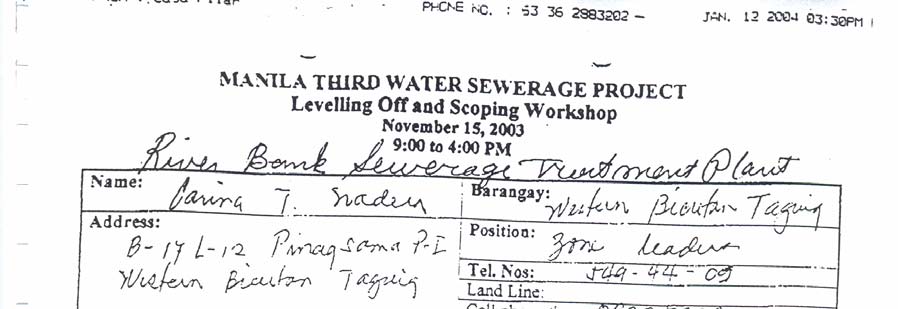
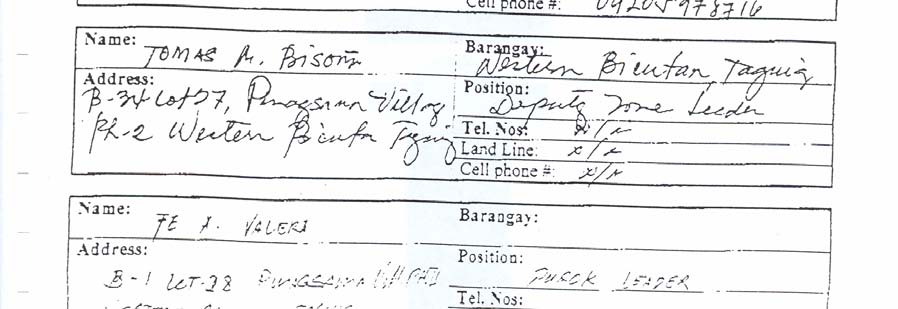
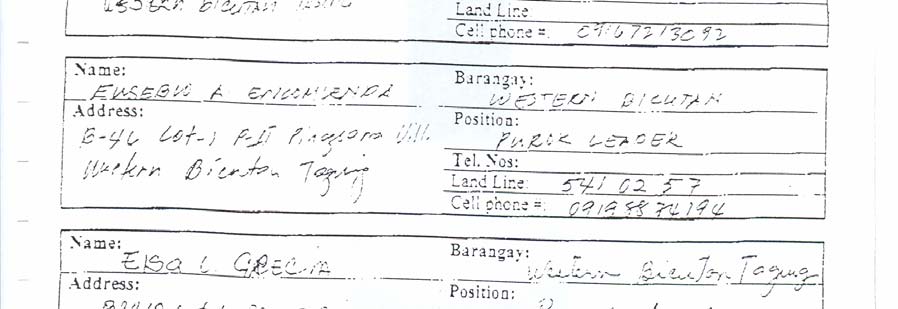
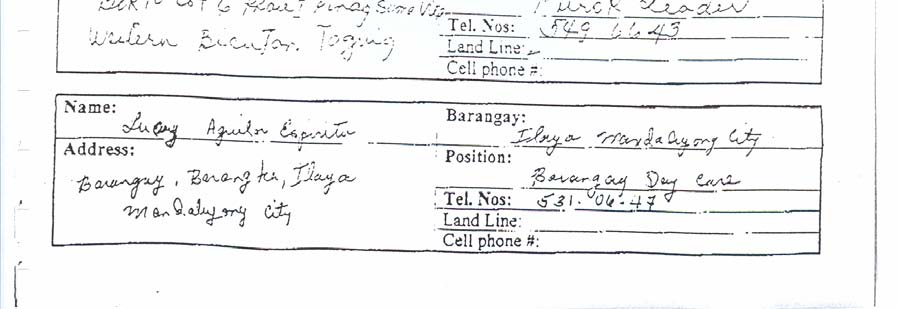
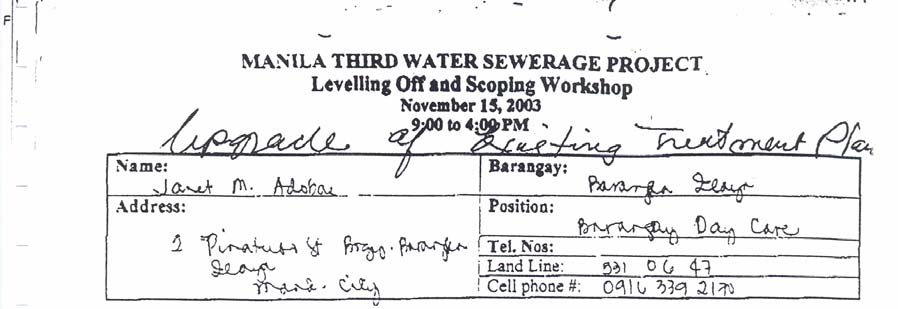
A first level consultation/scoping workshop was conducted by MWCI consultants on
November 15, 2003 at the Bahay ng Alumni at the University of the Philippines in
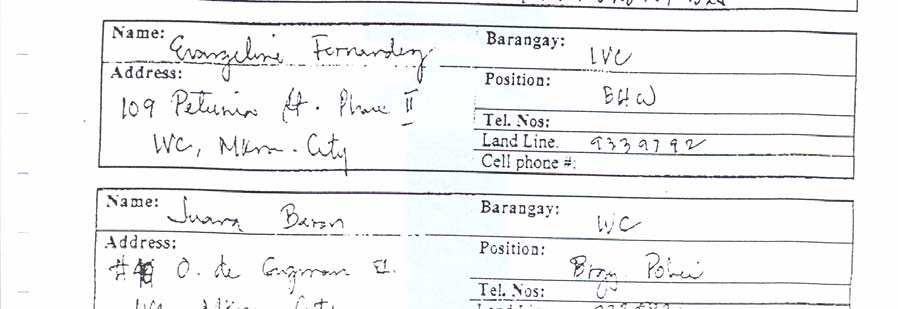
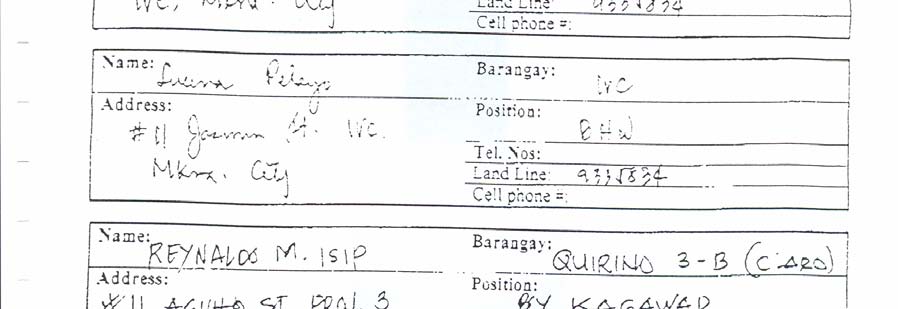
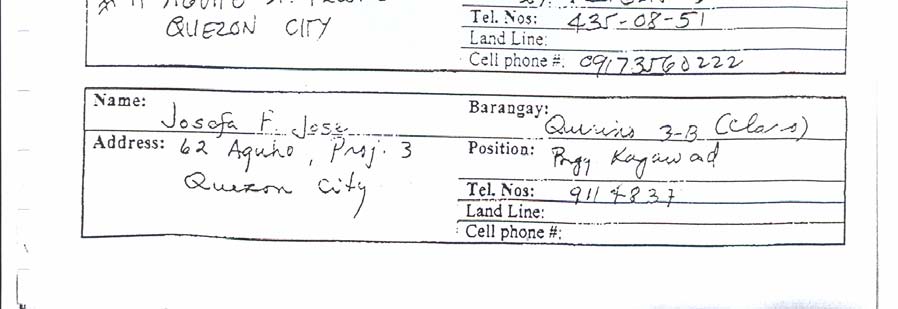
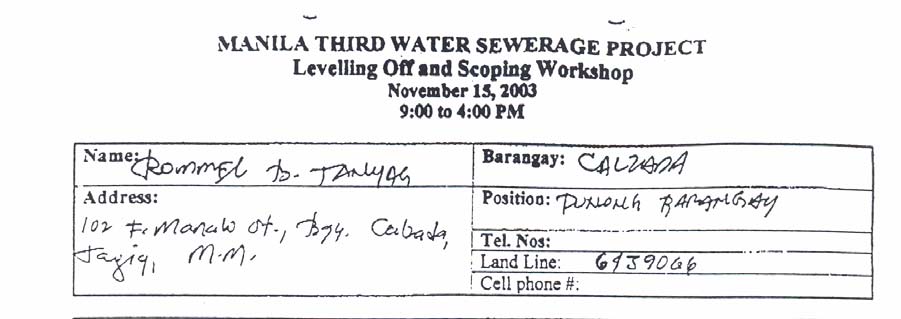
Diliman. The meeting was attended by officials of MTSP-affected Barangays (see
attendance sheets below).
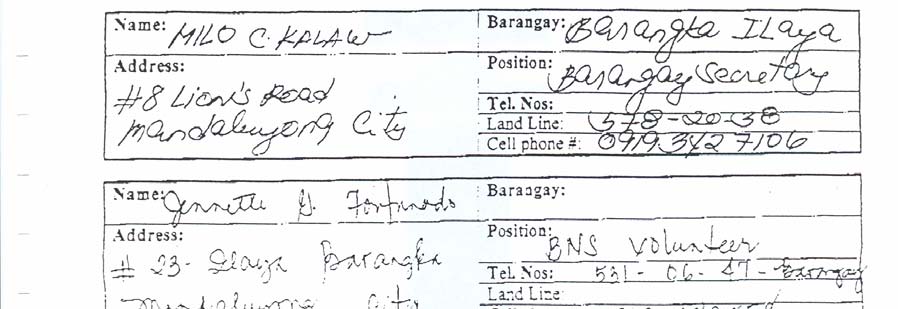
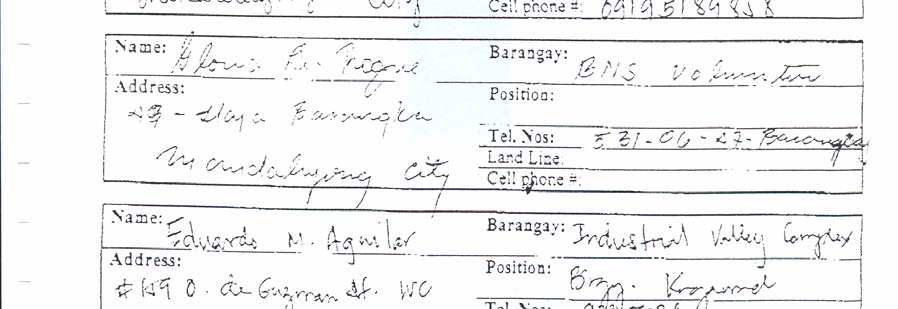
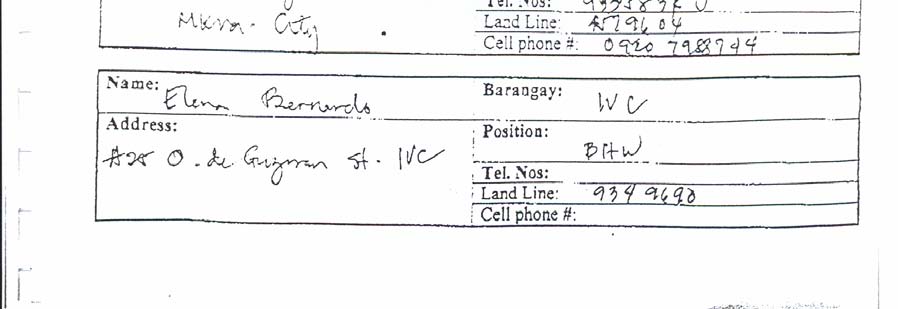
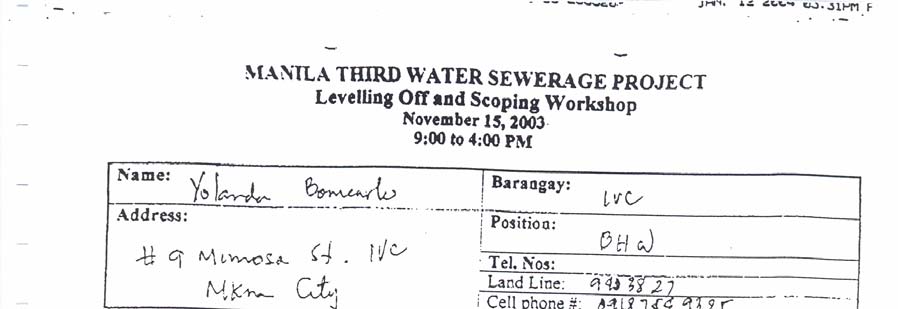
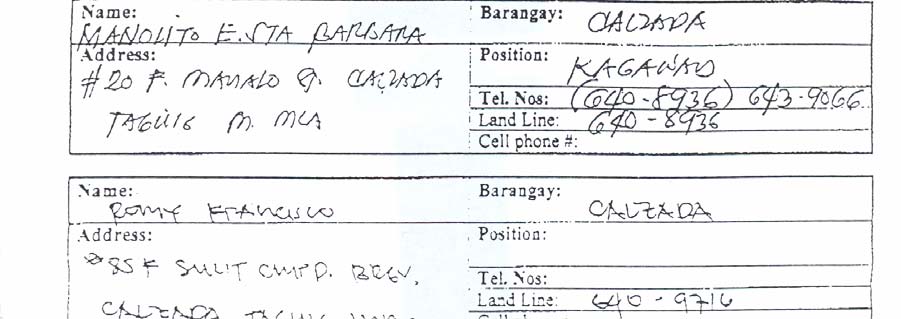
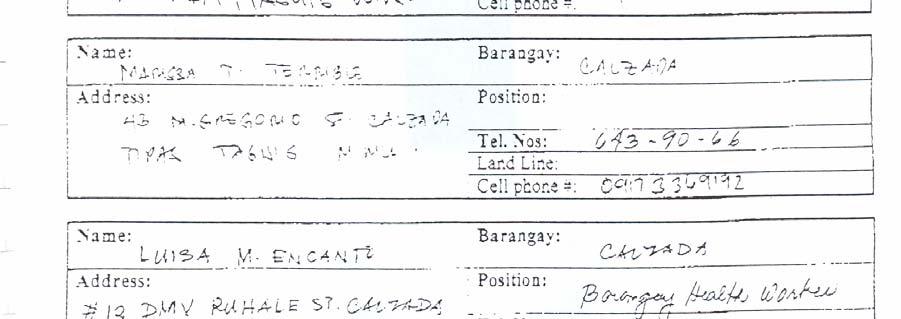
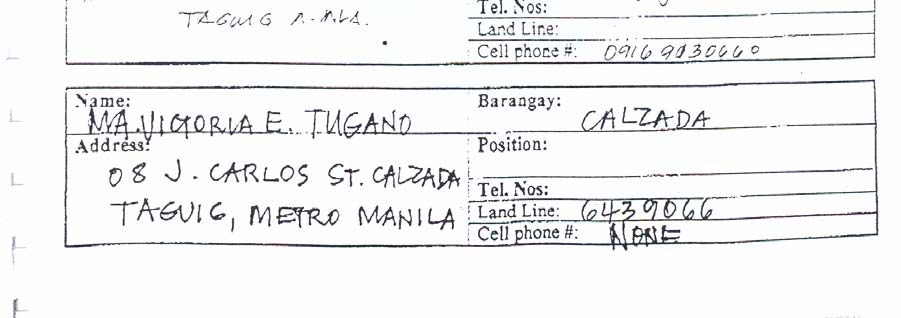
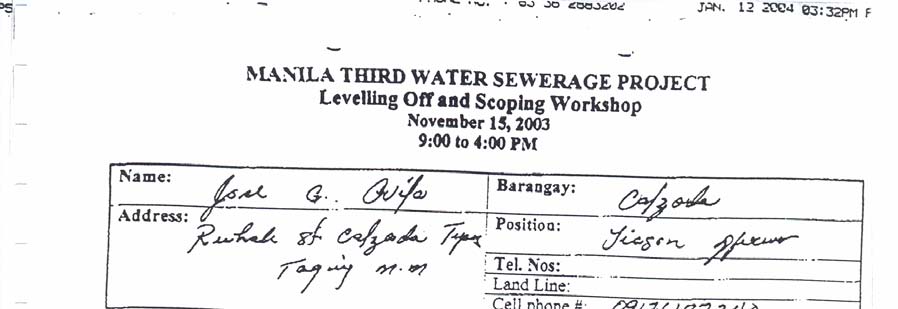
A summary of the issues raised during the scoping workshops is listed in the table below.
Summary of Clarification Table
Clarification
Response
Computation given in the project description
Discharges during the wet season were
indicated only discharges during the dry
considered in the Feasibility Study (FS) and
weather flow. What will happen during the wet will be presented in the EIA.
season? Will this be included in the study?
The use of the regulation ponds for the Taguig
The ponds will have to remain empty during
Sewerage System will be limited during the dry the wet season so they can function as
season.
balancing ponds during periods of high storm
runoff. This is in accordance with the Metro
Manila Flood Control Project of the
Department of Public Works and Highways.
Possibility of separating sewer and stormwater. Separation of sewer and stormwater would
require additional space and would entail huge
capital costs.
On septage treatment, what will happen to the
Initial tests have been conducted by MWCI for
sludge? The EIARC would be in a dilemma to dried sludge to be used for agricultural
issue Environmental Compliance Certificate
purposes. Septage disposal experiments on
(ECC) if the disposal is not included in the
lahar areas are being conducted with promising
EIA.
results. The lahar septage disposal will be
conducted as a separate study which will be
submitted to EMB.
Will there be any resettlement involved with
None, treatment plants will be constructed in
other components?
open space either as above- or below-ground
structures.1
1 The revised Feasibility Study on February 2004 indicated possible relocation of three households at Road 5, Project 6,
Quezon City as well as 11 households in the San Mateo site for the north septage treatment plant.
Summary of Issues and Concerns from the Scoping Workshops
MTSP
Environmental
Issues / Concerns
Suggested / Recommendations
Proposed Activities
Component
Aspect
Riverbanks
Socio-economic Greater project
Action planning must involve
Public consultations
Sewage Treatment
participation of barangay
barangay.
Plants
constituents
Educational program,
Educate the people on proper
Information, Education and
Sanitation for
cleanliness, health,
sewage disposal
Communication Program
Low-Income
unemployment
Prioritize residents in the hiring
Communities
of workers during the project
implementation.
Upgrade of
Give full information of
Full information of the MTSP and Public consultations
Existing Sanitation
the advantages of MTSP
the results of the environmental
System
assessment will be presented to
the communities.
Cooperation from all
Adherence to the vision of the
Coordination with
agencies involved in the
project
concerned agencies
project
Biophysical
Air and water pollution
Strict implementation of the
Environmental monitoring
environmental laws.
program
Clogging of drainage
Rehabilitation of drainage.
Included in the MWCI
causes flooding
services; quick response
through area managers
Unpleasant odor during the STPs should have odor control
Environmental monitoring
STP operation
device.
program
MTSP
Environmental
Issues / Concerns
Suggested / Recommendations
Proposed Activities
Component
Aspect
Presence of informal
Proper construction of septic
Coordination with
settlers along creeks cause
tanks.
concerned agencies to
severe polluted due to
ensure proper construction
rampant disposal of waste.
of septic tanks;
Installation of a sewer line along
Included in the MWCI
the banks that will collect sewage services; quick response
from the households along creeks. through area managers
Infrastructure
Some of the barangays are
Construct communal septic tanks To be considered in future
composed of middle-class, Government should provide
MWCI projects;
low-income families or
housing projects for informal
Coordination/consultation
depressed population.
settlers.
with concerned government
Middle class homes have
Government subsidy for the
agencies
septic tanks, while those
payment of sewer fees.
houses along the creek
flush their waste directly to
the creek, thus, polluting
the environment.
Sewer lines do not
Rehabilitation of sewer lines
Included in the MWCI
function. Sewer comes out There must be full
services; quick response
of the manholes.
implementation of the Building
through area managers
Code. There must be structural
plan and scope of work that will
protect the properties of the
barangay.
Households with their own septic
tanks must not be made to pay
sewerage fees.
MTSP
Environmental
Issues / Concerns
Suggested / Recommendations
Proposed Activities
Component
Aspect
Some projects of other
Strict adherence of contractors to Monitoring of project
government agencies /
the conditions in implementing
activities
private organization, after
the project.
completion of construction
works do not restore the
site.
Graft and corruption
Barangay should not accept any
Transparency with
gift or bribe with regards to the
concerned communities
Project.
Annex 4
Focus Group Discussion
(FGD)
Summary of Issues and Recommendations Raised during the FGDs
ISSUES AND CONCERNS
RECOMMENDATIONS
Sewerage System
Absence of sewer lines or no functional sewer
Prioritize the construction of sewer
lines; only drainage canal available but also
lines along the street.
used as sewer line
Overflowing of wastewater from septic tanks
Regular desludging of septic tanks
Clogged sewer lines; sewage comes out of the
Rehabilitation or upgrade of sewer
manhole; backflows were observed in some
lines
sewer lines.
Strict implementation of sanitation and
Some households direct wastewater to the river;
building code; sanitation inspection
sewer lines used as toilets and septic tanks in
needed.
blighted areas.
Households along the creek must be
connected to the sewer lines.
Lack of complete knowledge about sewerage
condition; indiscriminate dumping of garbage in
Information, education and
drainage system.
communication program on proper
sanitation and waste management
Project Implementation
Some projects take considerable time to
Projects should be completed on time
complete; there are instances that construction
to avoid prolonged inconvenience
sites are not properly restored.
Contractors should fully adhere to
project conditions; strict monitoring
should be performed to ensure that
projects are done according to plans.
Lack or absence of coordination among
Government and private entities should
government agencies (DPWH, MMDA) and
sit together and discuss project plans.
private utility providers (MWCI, Meralco,
PLDT)
Traffic re-routing during construction
Traffic disturbance during
of sewer lines; mobilization of
roadworks/excavations.
community or barangay residents as
traffic control officers
Sewerage Charge
High sewerage fees
Affordable sewerage fees and
commendable services.
Payment of sewerage fees but without
corresponding improvement of sewerage services Transparency in computation of
ISSUES AND CONCERNS
RECOMMENDATIONS
sewerage
fees
Information on cost-benefit feature of
the project
Households with their own septic tanks
must not be made to pay Sewerage
Fees
Justification of increased sewerage
fees; consultation with affected
communities before any additional or
new sewerage fee is implemented.
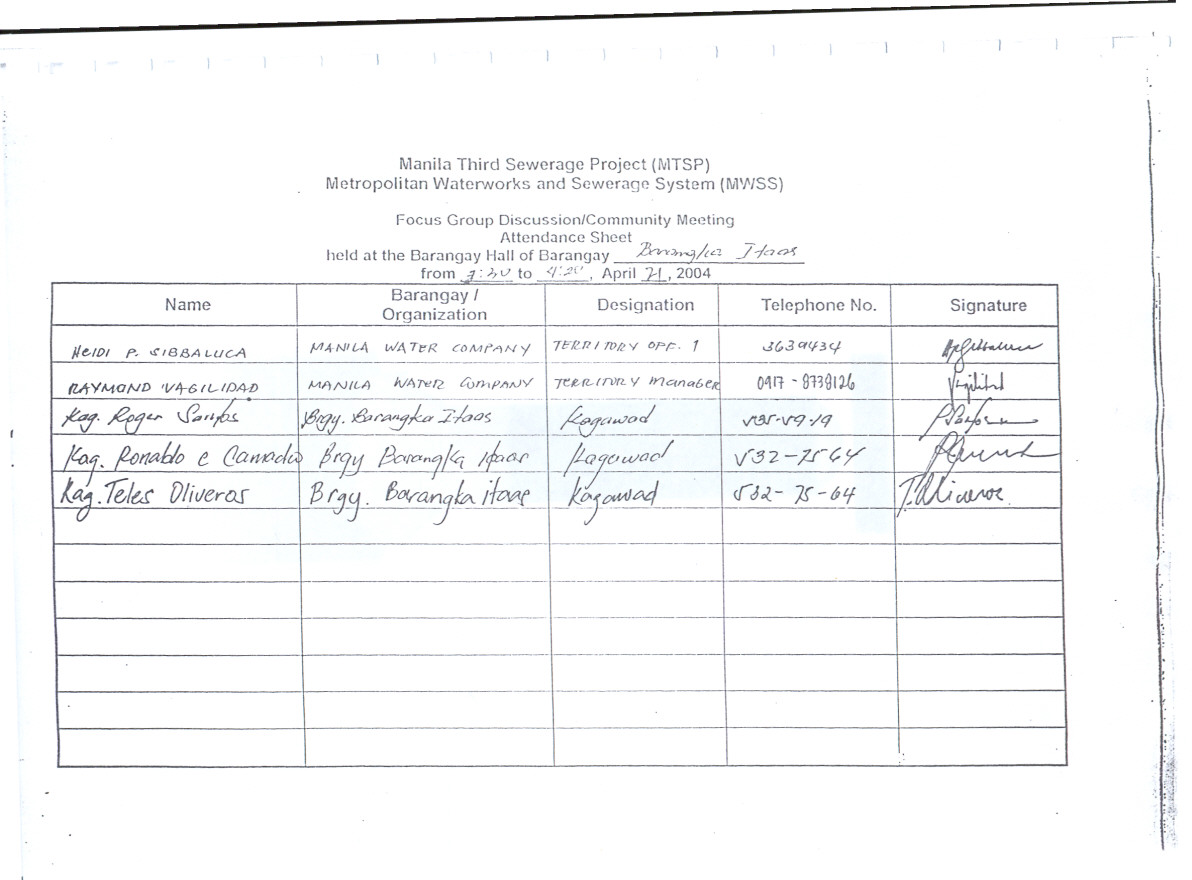
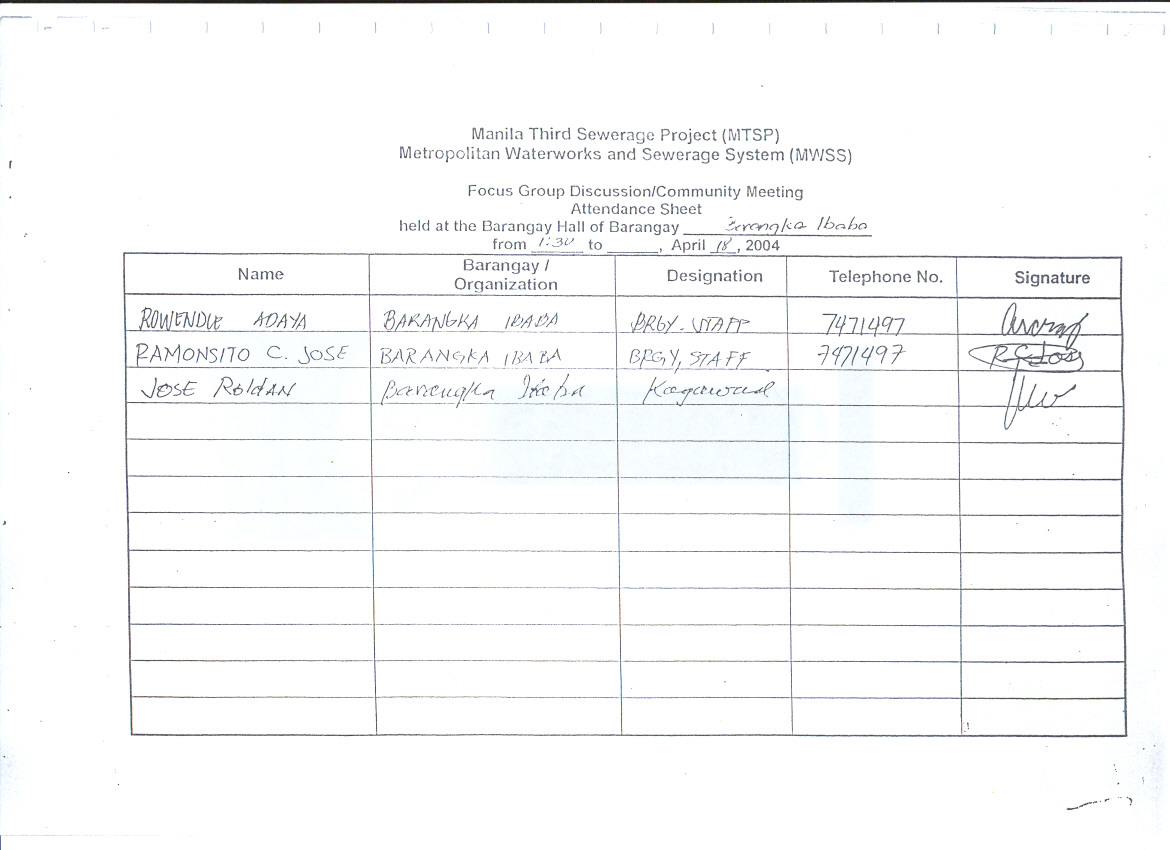
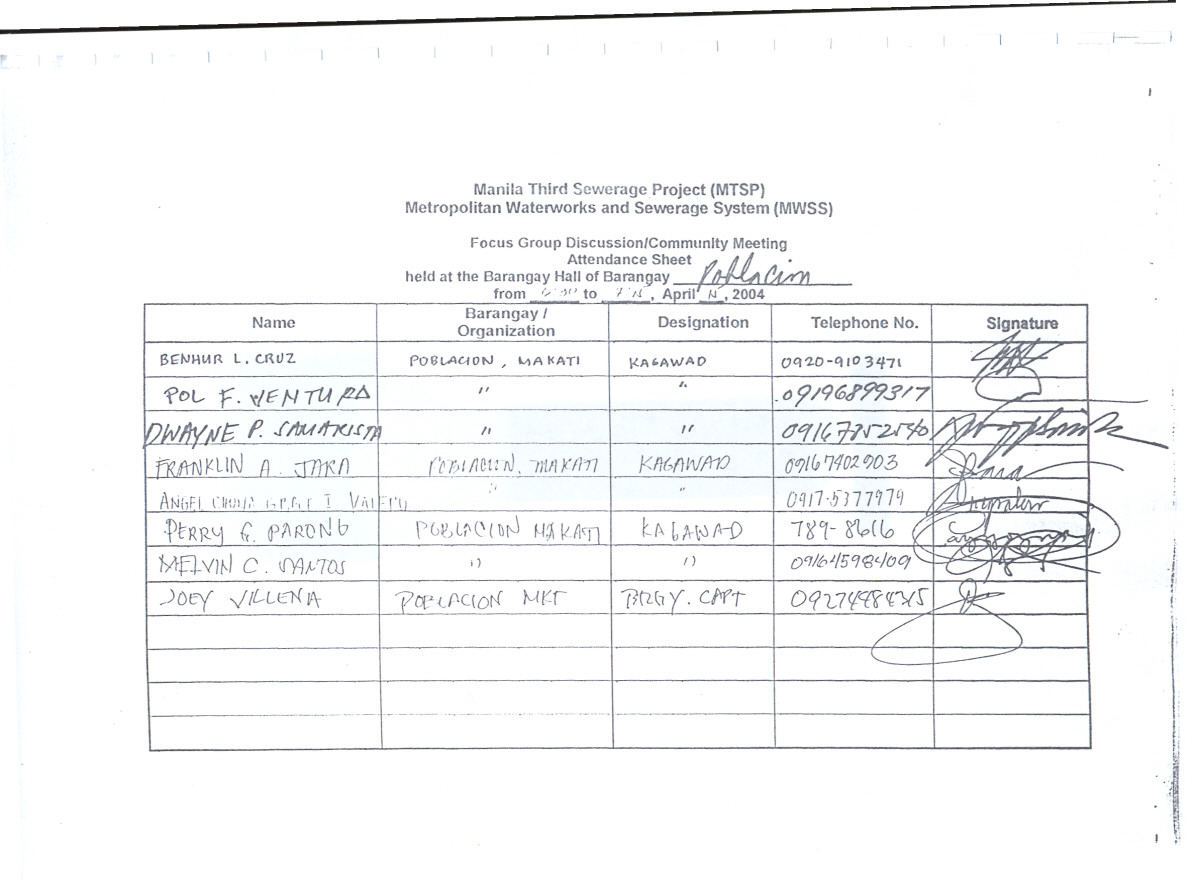
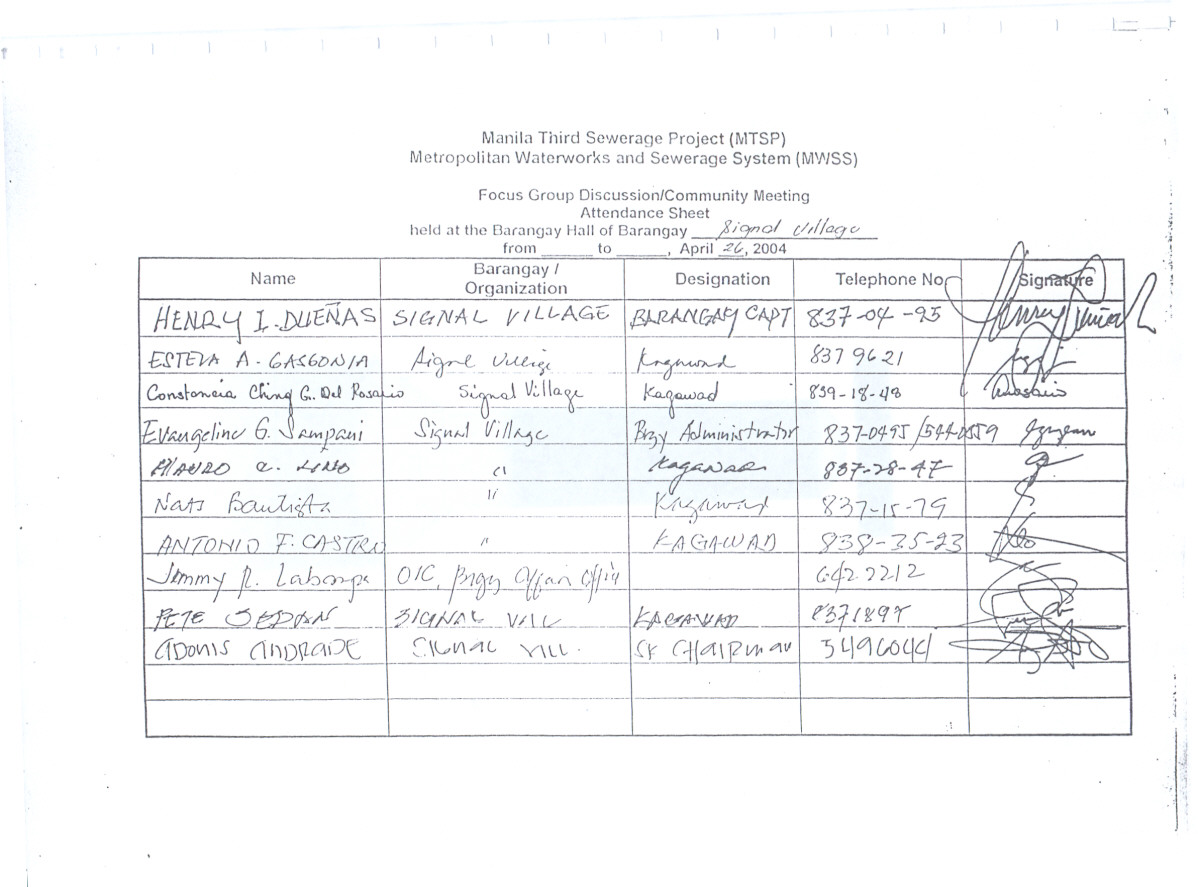
Annex 5
Public Consultations
Barangay Signal Village
Public Consultation Meeting with
Barangay Officials and Residents of Barangay Signal Village
and Western Bicutan including Pinagsama Phase 1,
Pinagsama Phase 2-A and 2-B and AFP/PNP Phase 2
held on June 15 2004 from 9-11:30 AM at the Covered Court of
Barangay Signal, Taguig City, Metro Manila
MANILA THIRD SEWERAGE PROJECT
Transcription of the Public Consultation Meeting with
Barangay Officials and Residents of Barangay Signal Village
and Western Bicutan including Pinagsama Phase 1,
Pinagsama Phase 2-A and 2-B and AFP/PNP Phase 2
held on June 15 2004 from 9-11:30 AM at the Covered Court of
Barangay Signal, Taguig City, Metro Manila
The consultation workshop aims to present to stakeholders the existing sewerage and
sanitation conditions to arrive on a concensus at early stages of the project to avoid
conflicts which can harm the implementation and success of the project. With these
regard, it lead to the transparency of public and private actions, as these actions are
monitored by the different stakeholders. It also built trust between the project
proponent and the civil society, which lead to long-term collaborative relationship.
Mr. Soncuya, a consultant of EDCOP-LTI, introduced the participants from EDCOP-LTI
and Manila Water Company Inc. (MWCI), explained the purpose of the public
consultation and the environmental impact assessment (EIA) process. This public
consultation, as part of the validation process of the EIA, aims to clarify issues and gather
opinions, suggestions and recommendations of stakeholders on the proposed Manila
Third Sewerage Project. Mr. Velasco, Senior Project Development Officer of MWCI
presented the background and proposed project. Mr. Suelto, another consultant of
EDCOP-LTI presented the results of the environmental impact study. After the two
presentations, an open forum ensued. The following are the highlights of this public
consultation.
Attendance:
Manila Water Company Inc.
Eva Matibag
Manager - Proj Development Office Waste Water
Christoper Calamiong Senior Project Development Officer
Lynn Almario
Senior Project Development Officer
Beth Bagaipo
Senior Project Development Officer
EDCOP-LTI
Rolando Soncuya
Sociologist
Anacleto Suelto
Environmental Specialist
Joy Tamayo
Public Consultation Coordinator
Wilva Lin Deocades
Facilitator
Participants
77 out of 93 invitees attended the scoping session
Note: Attendance sheets of participants with their signatures are attached to this report.
Mr. Soncuya : Magandang umaga po sa inyong lahat, ito ho ang consultants ng Manila
Water tungkol ho dito sa Sewerage Project. Ipapakilala ko ang mga kasamahan
ko ho, si Engr. Anacleto Suelto sa EDCOP-LTI din. Si Joy Tamayo, kasama din
ho namin. Iyon hong sa Manila Water, si Eva Matibag, Manager ng PDO
wastewater; si Christopher Calamiong, Senior Project Development Officer; si
Lynn Almario, Senior Project Development Officer at saka si Beth Bagaipo,
Senior Project Development Officer. Bago ho tayo magsimula, puwede po ba
mag-request kantahin po natin ang national anthem. Kung puwede tayo tumayo
lahat...
Joy Tamayo: Magandang umaga po sa inyong lahat, nagpapasalamat po kami dahil
nakarating po kayo ngayong umaga. Ok ah.... Lupang Hinirang, puwedeng ilagay
ang ating kamay sa ating dibdib... (pag-awit ng Lupang Hinirang)
Mr. Soncuya: Puwede ho mag-request ng welcome remarks galing sa City of Taguig,
kung sino ho man, Barangay official, kung sino man.
Joy Tamayo : Andito ho kanina si Kagawad Lino, mas may dating kung si Kagawad
Lino ang magsasalita to welcome you people ... (palakpakan)
Kagawad Lino: Magandang umaga po sainyong lahat, sa ating mga panauhin at sa mga
nagsisidalo ngayon. Ito po siguro ay isang pagkakataon para makita natin ang
mga improvements na dapat gawin sa isang kalidad na community, at nandito po
ang ating mga panauhin upang ipaliwanag sa atin ang mga bagay-bagay, and of
course, gusto nilang malaman ang ating opinion tungkol sa kanilang project, kasi
kung ang project ay labag sa ating kalooban, hindi magiging maganda. So,
ipapaliwanag po nila sa ating lahat ang tungkol dito. Sana ay maging
makabuluhan at mabunga ang ating partisipasyon ngayong umaga. Welcome to
you people.
Mr. Soncuya: Salamat po, ang sisimulan ko ho, kung bakit ho tayo nagmimiting ngayon
dito, ano ho ba talaga ang purpose. Ito hong consultation na ito ay bale validation
ho ng Environmental Impact Assessment. Meron ho tayong project dito, Manila
Third Sewerage Project, may mga components ho ito na ipe-present ng
representatives ng Manila Water. Pero bakit ho ba tayo nandito? Ah... natapos
na ho iyong Environmental Impact Statement, ito ho `yong pinag-aralan ang
aspeto ng biological, physical at social, kung ano ho ang epekto, kung mayroon
man, sa ating kapaligiran. So, yun hong resulta nito ang ipe-present ho ng
representative ng consultants sa Lichel Technologies. Pagkatapos ng presentation,
may open forum tayo, gusto ho naming malaman, base doon sa resulta ng pag-
aaral at sa presentation ng project kung ano ho ang maidadagdag ninyo sa pag-
aaral, para ito hong dokumentong ito, ito hong isa-submit namin sa DENR para sa
application ho ng ECC, ang ECC po ay Environmental Compliance Certificate.
Ah, sa ngayon ho, ang purpose ho `non, noong nag-conduct po ng meeting ho
doon sa U.P. noong November 9, 2003 at tapos ay mayroon hong ginanap na
focused group discussions, tapos ho mayroong ginawang surveys. Ito ho din ipe-
present sainyo para malaman kung ano ho ang opinyon ninyo dito. Ang susunod
po ay iyong project presentation na gagawin ng Manila Water.
Eva Matibag: Magandang good morning po sainyong lahat. Ako po si Eva Matibag,
taga Manila Water, pero `wag ninyo po akong puputaktihin ng tanong tungkol sa
tubig, iba po ang pag-uusapan natin ngayon, tungkol naman sa waste water. Sino
po sa inyo ang naka-attend ng scoping session na kinonduct naming noong
November sa U.P? Naku, walang naka-attend! Ay kayo po, ayan buti naman at
mayroon naman palang nakarating noon na nandito ngayon. So, ang marami po
wala noon. Ipe-present po naming ang project. Ang Manila Water po kasi
marami nang ginagawa sa water side ano po, pero ang di alam ng marami, meron
din po kaming ginagawa sa maduming tubig, iyong tubig matapos nating gamitin,
iyon po iyong tinatawag na waste water. Mayroon din po kaming mga
responsibilidad para ayusin iyong sanitation, saka tinatawag na waste water
services namin sa inyo. Sa kasalukuyan po, mayroon kaming ginagawang
proyekto, ang lead agency po actually ay ang MWSS tapos kami po ang mag-
iimplement ng proyekto. Karamihan po, iyong ginagawa naming proyekto ngayon
ay funded ng World Bank. Ngayon, ito pong proyekto na ito patapos na, `yung
financing po ng World Bank hanggang ngayong Disyembre na lang. So lahat po
ng pinu put-up naming planta, `yon pong tinatawag na wastewater treatment
plants, ah patapos na po `yon ngayong December. At binigyan po kami ng
oportunidad ng World Bank na maka-avail ng isa pang set ng financing para dito
sa tinatawag na Manila Third Sewerage Project. So, bago po ibigay nila sa amin
`yung loan, kailangan ho kaming dumaan sa proseso ng requirement of the
government of the Philippines saka requirement po ng World Bank. Isa pong
requirement, `yong pagko-conduct ng feasibility studies kung saan aalamin ang
technical o financial, kung tamang gawin ang proyekto considering ang technical
at financial na aspeto. At kailangan din po naming I-conduct `yong ganitong
consultations para malaman kung ano iyong impact ng proyekto sa magiging
beneficiaries nito. So meron na nga pong ginawa ang consultants po namin, ang
EDCOP saka Lichel para gawin itong consultations at makabuo ng Environmental
Impact Assessment para makakuha ng permit sa Department of Environment and
Natural Resources (DENR) pagdating ng panahon na dapat ng I-implement `yong
project. So, meron na po silang ginawang maliliit na meetings kung saan mga
grupo ng tao mula sa komunidad, inexplain nila `yong project at kinuha kung ano
`yong opinyon ng tao ukol sa project. Mamaya ho, puwede ninyong idagdag
kung ano man, ano pang ire-raise na issue o opinyon tungkol sa project matapos
kong mai-present kung ano ngang binabalak ng MWSS at Manila Water sa
inyong community, ito po ang tinatawag na Manila Third Sewerage Project. Una
po, alam nyo po ba kung ano `yong wastewater? Iyan po ang dumi ng tao na
pumupunta sa poso negro, o kaya, kung walang poso negro, didiretso po sa ano,
sa drainage o kaya sa creek. Bibigay po ako ng background tungkol sa kondisyon
ng sanitation sa Maynila, at saka ano na pong mga facilities mayroon ang MWSS
at ang Manila Water tungkol dito sa sewerage. At dito, ang mga
pinagkakaabalahan naming ngayon, ikukuwento ko po at iyong mga component
nitong Manila Third Sewerage Project.
Ito na po ang picture ng kung ano nga ang sewage o wastewater (presentation
done in Microsoft Power Point). Matapos ho nating gamitin ang tubig, magiging
wastewater po iyon, 60 to 70 % ng tubig na ginagamit natin nagiging tinatawag na
wastewater po. Iyon `yong pumupunta sa poso negro, kung masuwerte, sa isang
wastewater plant o dumideretso sa kabal o sa creek. Ngayon, ah, mapanganib po
sa kalusugan itong tinatawag na wastewater, dahil isipin ninyo naman po ang
dumi, kapag nahawakan ninyo or di sinasadya thru iba't ibang kontak, mapunta sa
sistema ng katawan, puwede po itong magdulot ng sakit. So nagkakasakit po
gawa ng wastewater `di lang ang tao, pati na iyong environment nasisira din.
Kapag tinatapon lang at `di inaaalis `yong mga harmful na microorganisms.
Ito po ang normal na hitsura ng isang normal na septic tank ano po, dalawang
compartments po siya, ang mangyayari po sa septic tanks, nagkakaroon ng
sedimentation, nahihiwalay ang solid at liquid part, so ang nababawas lang po
discharge sa creek at rivers, solids lang. Pero `yong mga harmful na
microorganisms at pollutants nandoon pa rin sa likidong dumadaloy sa septic
tanks at lumalabas. Ito po dapat ang ideal na situwasyon sa anumang
developments ng community, o ng industrial, commercial o subdivision type na
development. Dapat po may ganito, lahat ng dumi ng tao kokolektahin ng linya
mula sa bahay-bahay o establisyemento, pupunta sa linya at `yong pupunta sa
tinatawag na wastewater treatment plant, kung saan ang dumi dadaan nga sa mga
proseso. So pagkalabas sa treatment plant, puwede na siyang ilabas sa ating mga
rivers ng walang masamang epekto o kaya po, `yong nagamot o nalinis na tubig,
puwede pong gamitin muli ng komunidad para sa pagdidilig, paglilinis ng kotse,
basta `wag lang, di pa po puwedeng inumin, pero malinis na siya, di na siya
nakaka- pollute.
Ganito po ang hitsura ng Metro Manila ngayon, napaka-familiar sa atin ito. Isang
malaking cause ng traffic po `yong walang nagpaplano tungkol sa pag e-excavate
ng mga linya ng telepono o drainage, ah, short term lang po `yong plano hindi
long term kaya parati tayong nagkakagulo pagdating sa excavations. Tapos, ito
po, `yon pong nasa kanan na litrato, pictures po yan ng communities along the
Pasig River. So mapapansin n'yo po ito, itong malaking parang kanal sa litrato,
iyan po ang Pasig River, ganyan na po kadumi ang Pasig River. Para na talaga
s'yang kanal, kung saan pumupunta ang dumi ng Metro Manila, mapa-solid waste
or liquid waste. Ito po ang ordinaryong hitsura ng congested na communities
kung saan halo-halo na, basta paglabas mo ng bahay, ayan ang makikita mo, ang
tubo ng tubig, `yong drainage, `yong wastewater, lahat na po `yan napupunta sa
kanal. Ganyan na po kasama ang hitsura ng ating urban sectors sa Kamaynilaan.
Ito po ay based po sa recent statistics ng National Statistics Office (NSO). Ang
meron lang pong access sa papunta sa sewer lines, papunta sa wastewater
treatment plant, wala pa pong limang porsiyento (5%) ng population ng Metro
Manila, tapos ang karamihan ` yong 85% ng population, gumagamit ng individual
septic tank. `Di ba po nabanggit ko ang individual septic tanks, wala naman
siyang malaking reductions in pollution na nagagawa, ano lang siya, solids lang
nare-reduce niya. So, kaya po ganoon na `yong hitsura ng Pasig River at
Marikina River na apektado na rin, dahil 60% to 70% ng pumapasok na pollution
dito sa ating dalawang major rivers, ay ah, dalawang major bodies of water, mula
po sa untreated na domestic waste water or wastewater na galing sa maduming
likido na galing sa tao. Ito po `yong sistemang mayroon tayo sa Metro Manila
ngayon ano po. Iyon pong dalawang sistema, `yong Central Manila Sewerage
System, at saka po `yung Dagat-dagatan Sewerage System. Yan ang mine-
maintain ng kabilang concessionaire, `yung Maynilad concessionaire. Tapos
`yong Manila Water po, inaalagaan po namin `yong Magallanes po, sa loob ng
Magallanes Village, mayroon pong isang napakalaki na wastewater treatment
plant, at saka `yong waste ng bahagi ng Makati, pumupunta po `don , tapos tini-
treat po doon, bago I-release `don sa treat at ultimately sa Manila Bay po
pumupunta `yong treated na effluent. Ito po `yong dalawang project na
pinagkaka-abalahan ng MWSS at Manila Water ngayon, pagdating sa sewerage at
saka sanitation services. Isa po dito `yong World Bank na assisted na Manila
Second Sewerage Project kung saan magtatayo kami ng twenty seven (27) pa na
katulad ng nasa Magallanes. Maliliit nga lang po at saka underground iyong
mailalagay natin para magamit ng community `yong ibabaw ng planta for parking
o park, `yon po `yung paggagamitan. Merin din po kaming ADB assisted naman
na projects. Kasi naman po, maraming porsiyento ng population gumagamit pa
ng individual septic tanks, eh para po mapanatili `yung effective na pagre-reduce
ng solids ng septic tanks, dapat po na ini-empty o pinapasipsip ang septic tanks
kada limang (5) taon. So, may programa po kami na bibili ng maraming tankers,
at magtatayo ng planta, kung saan dadalhin `yung laman ng tankers at doon po ito
iti-treat. Sa lahat po ng pinaka-objective ang pabawasan `yong pollution sa ating
mga water bodies at saka I-improve `yung ah effect sa health ng mga tao. So, ito
po, `yung nasa mapa, `yung mga pin heads, ito po `yung location ng gagawin
nating 27 na Waste Water Treatment Plant. Nado-doble po `yung capacity natin in
terms of treatment pagka natapos na itong mga plantang ito ngayong Disyembre.
Ito po ay perspective ng gagawin naming thru ADB assistance, `yung Pasig River
Rahabilitation Project. Ayan po, mayroong mga facilites na magre-receive ng
galing sa septic tanks tapos iko-compress po ` yun. So, paglabas po ng planta,
dalawang by-products: `yung solids, maaaring gamitin as soil conditioner, saka `
yung liquid na puwedeng gamitin ng katulad ng nasabi ko kanina. So, bukod po
sa pagre-reduce ng pollution, `yun pong Manila Third Sewergae Project ah
gagawin namin with your cooperation sa 2005. Ang tina-target po namin, `yung
lahat ng component ng project, maimplement natin ng three-year period, from
2005 to 2008. Mayroon po siyang anim na component. Ang isa pong component
nito ay ah ifo-focus dito sa inyong barangay, ang isa pong component nito ang
Taguig Sewer System, nabalitaan nyo na ba iyong ginagawang mga ponds? Ah
Laguna Lake Shore Dike Project ng DPWH, kung saan iyon pong naka-align sa
C-6 . Mayroon pong ginagawang C-6 project ang DPWH, mayroon po silang
gagawing apat na regulation ponds na sa Hagonoy, sa Labasan, Taguig saka
Tapayan, doon po gagawin iyong mga ponds, so ang binabalak po namin, di ba
magiging taga-kolekta po ng floodwater iyong mga pond, ang balak po namin
bago siya I-release sa Laguna Bay, iti-treat po muna naming yon nako-collect na
combined waste water saka flood water, iyon po iyong isang component ng
Manila Third. Isa rin pong component nito, makikipagtulungan kami sa mga
Munisipyo tsaka sa Pasig River Rehabilitation Commission para makapagtayo ng
ilang planta sa, along the Pasig River Bank. Isa rin pong components nito mako-
concentrate naman sa Quezon City kung saan meron na kaming malalaking
communal septic tanks, ia-upgrade po namin `yon, gagawin na namin talagang
planta. Isa pa po `yong Quezon City-Marikina Sewerage System kung saan sa
mga komunidad, iyong mga dito sa area sa Quezon City tsaka `yong Olandes sa
Marikina, kukuhanin po naming `yong combined na wastewater tsaka storm
water, at gagawa din po kami ng planta. Tapos, isa rin pong malaking proyekto
`yong pagtatayo ng septage treatment plant, iyon pong pagdadalhan ng mga laman
ng poso negro kung saan iti-treat `yong mga laman ng pozo negro, gagawa po
kami ng ganyan tsaka isa sa north, isa sa south. Tapos ang, ito pong magiging
subject ngayon, itong wastewater `to mula sa Pinagsama, sa part ng Signal, tsaka
sa Pinagkaisahan, AFP Village, sa PNP Village, ah kukunin po naming `yung...
gagamitin po naming `yung drainage, pinag-aaralan po naming ngayon, isa pong
option gagamitin naming `yong existing drainage system kasi dito po naman
lumalabas ultimately `yong mga laman ng inyong septic tank, so gagamitin po
namin `yon, tapos iyong laman idi-direct po namin sa isang planta na gagawin.
Ang pangalawa pong option na iniisip naming ay maggagawa ng mga linya na
hiwalay na kukuha `nung dumi mula sa inyong bahay, na pagka-flush n'yo po
diretso na sa linya. Tapos pupunta na doon sa gagawing wastewater treatment
plant.
Papakita ko lang po `yong picture ng ano, isang option po doon ah maggawa kami
ng separate wastewater treatment plant o `yung community, iko-connect po namin
siya sa isang pond, kasi malapit lang po mga eh sa isang pond ng project ng
DPWH. Ito pong lahat ng ito, `yong mga project namin na ginagawa, ito pong
mga kulay pula `yong gagawing Manila Third Sewerage Project. Sabi ko po,
`tong area n'yo dito puwede po naming I-connect sa isang pond or gagawa ng
isang kahiwalay na wastewater treatment plant. Ah, ito po ang location ng mga
ponds, `eto, eto, tsaka `eto pong apat na ito. Pero malamang dito po kayo ma-
connect sa Taguig pond or gagawa po kami ng isang planta malapit sa Pinagsama
Creek `don po sa may isang basketball court, siguro po si Boy mamaya ang
maide-detalye `yung lokasyon, `yung gagawin naming waste water treatment
plant.
Ito nga po `yong gagawin naming dalawang approaches ano po, puwede kaming
maggawa ng separate na linya o gamitan ng drainage para mai-collect `yong
waste papunta sa planta. Ito pong hitsura ng mga nangyayari ngayon, lahat na
lang ng wastewater natin ganyan ultimately pumupunta sa Marikina River, o sa
Pasig River, or sa Taguig River, or sa Laguna Lake ultimately. Ngayon, ito po
`yong mga problemang kakaharapin namin at gusto naming I-raise sainyo ah...
gusto po naming malaman `yung opinyon n'yo at `yung inyong saloobin tungkol
sa buong proyekto specifically dito sa mga issue na ito. Kasi po isang
requirement namin para makapagpagawa ng planta, para ma-implement `yong
project ay kailangan ng lupa na pagtatayuan ng waste water treatment plant `don
po sa location na iniiisip po naming malapit sa Pinagsama Creek. Kailangan po
namin ah... kailangan po naming magkaroon ng agreement with the local
government para magamit `yung lupa, puwede naman sa ilalim ho kami magtayo
para `yung ibabaw magamit pa rin ng community. Tapos, `yong cost po nito para
ma-improve `yung sanitation ng community, `yung capital cost po sa amin po
`yon sa MWSS at sa Manila Water. Pero `pag nag-operate `yung planta,
magkakaroon po ng additional na charges na maipapasok sa tubig. Ah sa
kasalukuyan po, iyong mga areas na tinatawag naming sewered, kung saan may
mga sewer lines at wastewater treatment plant, mayroon po kaming tinatawag na
sewer charge na 50% po ng basic charge sa tubig, pero ito pong papasukin po
naming project, kinakausap po naming `yung regulatory office ng MWSS para
ayusin, yung charging dahil sa amin pong experience, `di nga siya encouraging sa
pagi-implement ng project. So, pinag-uusapan po ngayon ang maaaring gawin
para maiba `yung structure ng charging pagdating sa ganitong proyekto. Dahil sa
amin pong palagay malaki talaga `yung 50% sa sewer charge. Tapos aalamin din
po ngayon, sa EDCOP, meron din po silang initial results noong environmental
tsaka social impact ng projects. So, hinihingi po namin ngayon na measures para
I-minimize `yung mga masasamang environmental at social impact ng proyekto.
So, sa summary, malaki po talaga iyong summage pagdating sa waste water, kasi
po habang dumadami iyong kino-consume natin na tubig, dumadami `yong pino-
produce natin na waste water na sa kahuli-hulihan pumupunta lang sa
environment. Eh di pa po natin nare-realize na dapat I-prioritize natin ang
ganitong project, so malaki pong challenge pagdating sa pagbabalik, pagpapa-
alam sa mga tao na ito ang magiging problema at kailangan na nating kumilos
bago pa lumaki ang problema. So, kasama po `don sa Manila Third, magkakaroon
po kami ng information & education campaign para patuloy na maintindihan ng
mga mamamayan `yung pangangalaga sa environment at `yung pagi-improve ng
sanitation ng communities at ng mga sarili nila at kung ano-anong mga proyekto
ang maaari para lang ma-improve talaga ang ating environment in relation to
wastewater. So, `yun lang po kung mayroon kayong katanungan or mamaya na
lang daw po, si, may sasabihin po si Doy.
Mr. Soncuya: Iyong mga tanong nyo po tandaan n'yo lang, pagkatapos ho ng
presentation ng results ng Environmental Impact Assessment ah... mag-o open
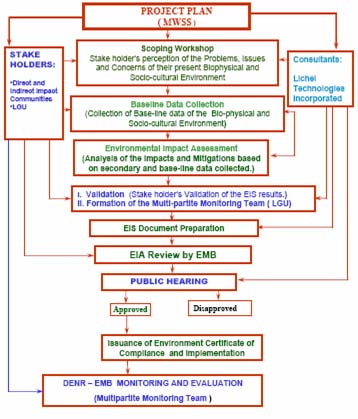
forum ho tayo. Ii-state ko lang ho kung ano `yong proseso ng EIA ano ho (shows
flowchart of the EIA process). So, ah ito po no, bale ang project ay Manila
Third Sewerage Project, so project plan bale MWSS at saka Manila Water. Pagka-
pasok ho dito, ano ho ba `yong scoping workshop? Eto ho natapos na ho lahat ito
no, andito na ho ngayon tayo. So, `yong scoping workshop ano ba `to? Eto ho,
pumupunta ho don sa mga residente na maapektuhan at kinakausap ho `yong mga
tao, at tinatanong kung ano ho `yong mga nakikita nila sa una... `yong mga
nakikita nila sa una na puwedeng lumabas na problema. So, bale ho sa una,
sinasabi ng mga residente na maaring magkaroon ng problema, yon ho, doon ho
pino-focus ho iyong study. So, ito ho `yung sinasabi ho namin na tayo biological,
physical at saka social, so tatlong components po ito. Palagay ho natin sa
physical, baka `yun ho ba yang project na `yan, magdadala ba ng baha `yan? So,
example po ng physical yan. Iyon hong biological ho, ito ho ba may epekto sa
mga ibon? Sa mga puno? Iyong social, ano naman ang epekto sa tao? So, base ho
doon sa scoping workshop, nabibigyan na ho ng paunang hint `yung study team
para malaman kung saan ngayon ipo-focus ito. So, eto ngayong scoping
workshop, pagkatapos ho `non pupunta nga yon sa communities ho to. Bale
dalawa ho ang pinag-uusapan dito, `yung primary data, ito ho `yung data na
kinukuha ho sainyo mismo kamukha ho sa social, mayroon pong focused group
discussions, tapos mayroon hong sinasabi natin na survey na pumupunta ho doon
sa mga household at tinatanong ho `yung mga pamilya. Ito ho `yong mga primary
data na nakukuha doon sa communites. `Yung secondary data naman, `yun `yong
mga dokumento o mga inpormasyon na nakuha na `nong mga previous studies, at
kamukha ho nang kung ano na `yung nakuhang dokumento't inpormasyon na
nakuha na noong mga previous studies, at saka `yung kamukha `nong kung ano
`yung population, binabasehan ho naming `yan `don sa 2000 population ng
National Census Office, tapos pino-project na lang namin ho yan. So, bale ito
baseline data collection. Ito ho'yung pagkukuha ng mga data tungkol ho sa
project. At pagkatapos ho nito, `eto ho `yung tinatawag na environmental impact
assessment. Ito ho ang ina-analyze ho naming kung ano ho ang epekto, mabuti o
masama na puwedeng panggalingan `don mula sa project, ah so bale ang example
nito eh baka kapag ilagay `yung sewerage system, baka humina o bumagal `yung
labas ng tubig galing sa ulan. So, kung ano, kung meron man hong lalabas, do ko
ho sinasabing meron, kasi ipi-present pa ho ng kasamahan namin yan eh. Kung
merong ganong epekto, ano ho ngayon ang dapat gawin para hindi mangyari
`yong ganong problema. So, `yun ho ang analysis, tapos makatapos na ho ang
analysis n'yan, babalik ho naman kami dito sa mga lugar na pinagkuhanan
naming nang data na naapektuhan ng project at bina-vaidate ho namin `yung
resulta ho ng pag-aaral namin dito. So andito ho `yung mga sasabihin ho n'yo
mamaya, `yung mga opinyon ninyo ay isasama pa rin ho namin `dun sa
Environmental Impact Assessment documentation namin na isa-submit ho namin
sa Environmental Management Bureau (EMB) ng DENR. Kung inaakala ho ng
EMB na kailangan ho, o kontrobersyal ho `yung project at kinakailangan ho mag-
conduct ng public hearing, ise-set ho ng public hearing para `yun ho
papatakbuhin na ho ng DENR `yun, para malaman talaga kung makakasama o
makakabuti `yung project. Kung hindi man ah sinet sa opinyon ng DENR-EMB
na hindi masyadong makaka-apekto, kokonti lang ang maapektuhan, hindi na ho
sini-set itong public hearing. So, pagkatapos ho ng review ng EMB, dadalawa
lang ho ang pupuntahan ho n'yan, approved or disapproved. So pag na-approve
ho `yan, diyan ho `yung lalabas na ang tinatawag na ECC. `Yung ECC ay
Environmental Compliance Certificate. Ito ho ang nagtatakda ng mga kondisyon
na dapat sundin po ng project proponent na kung ano ang dapat gawin o hindi
dapat gawin, nakalagay ho diyan. Minsan ho umaabot ng mga limampung (50)
kondisyones ang inilalagay ng EMB. At bukod ho doon, meron pang... kung
kakailanganin sa opinyon ng DENR, kakailanganin hong mag set-up po sila ng
Multi-partite Monitoring Team, nagsi set-up po sila. Ito `yung team na kasama ho
`yung mga barangay officials, kasama ho `yung mga residente na binubuo ng
team para tingnan na sinusunod ng project proponent `yung mga kondisyon na
nailagay sa ECC. Iyon ho `yung proseso `don. Ah, may mga proyekto na ino-
obliga ho din ng DENR na `yung mag set-up ng fund para mag-finance ho ng
monitoring at evaluation. Bukod ho `don, mayroon hong kakailanganin ang
DENR, nagpapa set-up po din sa proponent ng Environmental Guarantee Fund
(EGF). `Yung EGF hong ito, ito ho `yung pondo na nilalagay ho sa bangko para
magamit ho ng project kung mayroong masamang epekto na `don sa mga
communities. `Yun kung sino man ang maperhuwisyo `don, eh doon nga iyon
kukunin na nakalaan na exclusively `don sa project na ito. So bale ganito ho ang
EIA Process. So, ang susunod hong magpe-present ay `yun hong resulta na nang
EIA. Samalat ho.
Engr Suelto: Magandang umaga po sainyong lahat, ako pala si Boy Suelto, sa EDCOP-
LTI. Kami po ay `yung inatasan ng MWSS saka MWCI na mag-conduct ng
Environmental Impact Assessmnt para sa Manila Third Sewerage Project.
Katibayan po ng sinabi ng kaibigang Dodoy kanina `don sa proseso natin,
nagkameron po kami ng workshop nooong November po sa U.P at ah... base po
`don sa nakuha naming initial na mga opinyon at mga kuro-kuro ng mga
nagsidalo, `dun po namin binase `yung pag-aaral namin. Ito po `yung plano po na
ginawa ng technical consultants ng MWCI, na `eto na po `yung nasasakupan po
ng sewerage project na gagawin po (shows map of the coverage area). Ah eto
po `yung C-5, `yung nandito po sa baba, dito po `yung AFP-PNP Village, nandito
po `yung Pinagsama Phase 1, 2A at 2B at saka `yung Brgy. Signal, part lang po
ng Signal Village. Kung mapapansin n'yo po, hindi natin mako-cover `yung lahat
ng area. Kasi po parang `yung direkyon ng sewer nung maduming tubig ay iko-
concentrate lang po sa parang isang basin, na iipunin po ito sa pamamagitan ng
existing na mga drainage lines at dadalhin po sa isang open space na lugar. Dito
po, proposed lang po ito. Dito po ito sa Signal Village, sa may Ipil-ipil St., may
bakanteng lupa po `ron sa may malapit katabi ng basketball court, covered
basketball court. Ito po `yung basketball court, so ito pong mga consultants
namin, tinitingnan nila kung ano `yong kalagayan `nung ah paligid ng proposed
site po ng treatment plant.
Ito po, may mga konteng mga halaman, mga ipil-ipil na kinuha nila habang
nagso-survey. So, bukod po pala doon sa ano, sa sinabi kanina ng taga-MWCI na
proposed wastewater treatment plant para sa komunidad po, isa po doon sa
Septage Treatment Plant na gagawin po ng MWCI ay ilalagay sa loob po ng FTI.
Ito po ay `yung tinatawag nating septage treatment plant ay mangongolect nang
dumi... yung mga vacuum trucks dadalhin ho `yung mga dumi dito po sa
Southern area, `yung galing sa mga poso negro natin, kokolektahin ng mga
vacuum trucks, dadalhin po ito sa planta para I-treat bago ho ma-release `yung
malinis na tubig at saka `yung dumi upang gawing soil conditioner.
So, ito `yung site sa loob ng FTI, malapit po ito, katabi po itong existing
wastewater treatment plant nila. So, `yun hong pinuntahan po namin, `yung likod
po nito ay sakop po din ng Brgy. Signal Village. So, ito po `yung outlet po ng
treatment plant. Pinuntahan po namin `yan at kumuha po kami ng sample ng
tubig na lumalabas po dito. Mamaya, ipapakita po namin ho sa inyo `yung resulta
n'yan para malaman n'yo `yung quality, kalidad ho ng tubig na lumalabas. Ito po
noong November 15, bago po kami mag-umpisa ng survey, nagkameron nga po
kami ng workshop sa U.P., pini-present din po ng MWCI dito `yung proyekto
tapos noong Abril ho, pumasyal ho kami dito upang makipag-sangguni sa council
ng Signal Village. Nagkameron po kami ng focused group discussions. Dito po,
hiningi namin ang opinyon ng mga representative ng barangay at ipapakita ko rin
sainyo mamaya `yung resulta. So ung isa pang pag-aaral namin, hindi lang kami
nagko-concentrate po sa tubig, pinag-aaralan din namin `yung hangin sa paligid,
katulad po dito, nag sampling po kami ng hangin dito sa Barangay Outpost sa
may Pinagsama. Ito po, sa may Western Bicutan po. So, ito po, kumuha kami ng
mga sample ng mga tubig, at `yung mga ibang characteristics po nila, pinag-
aralan po namin mismo `don sa site at `yung iba pong mga samples, pinadala
namin sa laboratoryo para sa ibang analysis.
Ito po `yung resulta ng analysis po nang sinampulan naming tubig. Dito po `yung
kanina, nakita n'yo `yung litrato dyan sa nilalabasan ng tubig sa may FTI. `Dun
ho lumalabas sa Signal Village `yon, sa baba ho `non. Kung mapapansin po
ninyo, ang pinaka-mahalagang tinitingnan po namin pagdating sa mga wastewater
treatment plant ay `yong tinatawag nating BOD. Ito po ay `yung `biochemical
oxygen demand', ito po `yung sukat nito, halimbawa `yung isang bagay na
mabubulok, bago po siya mabulok kailangan niya ng oxygen para ma-decompose
po siya. Ngayon, `yung level po ng BOD pagka habang tumataas po `yon, ibig
sabihin mataas din po ang polusyon dahil maraming kailangan na oxygen para
mabulok ang mga, bagay. Sa DENR po, ang acceptability po ng Class C ng BOD
ay dapat nasa 7 hanggang 10. Isang sinampulan po namin dito sa baba po ng FTI,
ang lumalabas po na BOD ay 149, so mahigit ah 15 times above the acceptable
levels ang nakukuha nating quality ng tubig. Bukod po dito, mayroon din po
tayong ibang parameters katulad ng mga heavy metals, wala naman po kaming
nakitang mataas na levels, nasa standard pa rin ho naman `yung mga metals sa
DENR, hindi rin po... lumampas din po sa maximum na 2, ang nakuha natin ay
10. Tapos pagdating po dito sa `coliform' po, siguro narinig nyo na po ang
`coliform', familiar ho kayo ang coliform po, ito `yung bacteria sa dumi. Ang
acceptable pong level ay nasa 5,000 ah... Most Probable Number per 100 ml.
Ang nakuha po naming resulta sa laboratoryo ay lumalampas po sa 160,000, so
napakalayo po sa standard na sini-set ng DENR po yan. Gayon din po `yung
creek sa tabi po ng Signal na balak din pong pagtayuan ng treatment plant. Ito po
`yung nakuha naming sa BOD ano po... mataas din po, 221 at `yung dito po sa
Pinagsama Village, dito po sa may bandang yun pong nasa baba, may tulay po
doon, malapit na sa dulo eh, nakukuha ho namin ay 512, so lalong mas mataas ho
sa standard na sini-set ng DENR ho. At pati rin dito sa oil and grease, 38 po, 4.3,
saka ito pong `total coliform' ganon din pong lumabas; more than 160,000 ang
level ng mikrobyo `dun po sa tubig na sinampulan po naming. So, nung nakipag-
discussion po kami sa mga opisyal ng Barangay Signal po dito po noong Abril,
`eto po `yung lumabas na mga issues na nilahad `samin ng mga opisyal ano ho.
Unang-una nga po, sinabi nila na dito po sa lugar nila medyo may kakulangan po
`yung sewerage line, bukod po ron, ung ibang line, dahil nga po walang sewerage
line, `yung ibang dumi, talagang dumidiretso na sa mga sapa kaya nagiging
marumi nga `yong mga sapa dito, tapos `yong meron silang mga issue tungkol sa
mga factory na nagdi-discharge daw ng ... ng kanilang waste dito sa kanila ding
village ano ho kasama rin `yung mga lumang sewerage tapos `yung meron pa daw
`yong mabahong amoy silang nanggagaling sa FTI, tapos `yung ibang sewerage
line nga, dahil wala nga tayong ibang waste water treatment plant ay dumidiretso
lang sa creek. So, `yun sa mga rekomendasyon po nila, ito po siguro ah... kaya
isa po sa dahilan kaya kung bakit nakikipag-konsulta po kami sainyo siguro para
madagdagan ang kaalaman n'yo po tungkol dito sa magiging proyekto ng MWCI.
So, kung tungkol naman po don sa mga issue sa mga illegal siguro na nagtatapon
ng dumi, rekomendasyon po nila na mag-mobilize po ng tao, taposirehabilitate
po `yung mga drainage lines, tapos habang iinspeksyunin po sinabi po sa amin
`yun, bago po siyempre, kailangan po magkameron ng inspeksyon doon sa
proposed site dito po sa may Signal Village. At saka kung maaari po sigurong I-
redirect po `yung mga dumi na nanggagaling sa FTI.
Ito po `yung mga importante po, mayroon pong mga minor na impact po siguro
hindi naman masyadong magiging importante, ang idi-discuss ko po ay `yung
talagang pinaka major impacts po. `Pag sinabi po kasi naming minor, meron ho
siyang konti pero hindi naman nakaka-apekto, katulad po halimbawa sa hangin,
hindi naman ho magpo-produce ng alikabok ano habang nag-ooperate `yung
planta pero habang ginagawa posibleng magkameron ng alikabok dahil sa mga
paghuhukay ano, so Idi-discuss ko `yung mga importanteng epekto ng proyekto
no. Ito po dalawang... hinati po namin `yung epekto ng proyekto sa dalawang
stage. Habang ginagawa po `yung proyekto, o `yung construction period, at saka
po `yung operation period, kapag nag-ooperate na po `yung planta, ito po ang mga
mahahalagang epekto po na maaring mangyari habang ginagawa `yung planta.
Unang-una po siyempre hindi po natin maiaalis na `yong open space doon, gaya
ng sinabi ng taga-MWCI ay mako-convert po sa treatment plant. So, talaga pong
di natin maiiwasan `yan, kaya nakikipag-coordinate po ang MWCI sainyo upang
mapag-usapan po ang tungkol sa bagay na ito. `Yung paghuhukay ho siguro
familiar naman kayo, kahit ang proyekto ng MWSS o PLDT. Pag may hukay
siyempre may konting disturbance `yan ... medyo inconvenient sa inyo no? Ano
ho bang maaaring maging solusyon na maaaring gawin ng MWCI. Siguro, hindi
naman `yung paghuhukay na gagawin, hindi naman ho sabay-sabay eto no,
gagawin ito `in stages' para hindi masyadong malaki `yung disturbance na
nangyayari doon sa community. So, natural, makikipag-coordinate o makikipag-
sangguni po ang MWCI or `yung contractor ang aatasan nilang maghukay sa mga
kinauukulang opisyal po ng barangay. Tapos kung meron po kasing... kung saka-
sakaling mayroon pong kailangang pansamantalang isar ang kalsada habang
hinuhukay po siguro kailangan lang po siguro natin ng `re-routing' ng trapiko.
Ah... siguro po pagka may construction kahit papaano po mayroon pong ingay
`yan na mapo-produce, so para naman hindi masyadong maka-istorbo sa
komunidad, ili-limit lang po siguro ng proponent `yung construction pagka sa
umaga, kasi sa gabi alam naman natin na nagpapahinga ang mga tao. `Yung para
po sa konstraksyon, siyempre ah meron tayong construction waste na mapo-
produce diyan, aatasan po ng MWCI ang kontraktor na siguraduhin na `yung mga
kalat ay iipunin sa isang lugar, `yung ah... maglalagay sila ng mga kaukulang
basurahan, ah `agarang pagsasa-ayos eh `yong mga hinukay `pag natapos na
talaga, kailangan ibalik nila sa dating anyo or pagagandahin pa nila lalo,
paglalagay ng mga temporary toilets para doon sa mga manggagawa nila, kasi
siyempre pagdudumi din sila habang nasa konstraksyon ano. Ito po `yung mga
importanteng `impact' habang nag-ooperate po `yung planta.
`Yung planta po siyempre magkokolekta po siya ng waste water, may solid part
po iyan, eh ang tawag po nila dyan ay `sludge' o `bio solids' para `yung iba kasi
habang tumatagal parang nagiging `fertilizer' sila nagiging `bio solids'. Pero,
makakapag-produce po sila ng approximately, mga 6 cu.m. kada isang araw ng
solids. So, ano pong mangyayari `don no? `Yung sludge na `yan, regular po na
aalisin ng vacuum truck po yan, dadalhin po `yan sa kaukulang tapunan, ah... so
kaya hindi po magtatagal yung solid part po `don palaging kokolektahin ng mga
traps nila ano ho, `yun ano ito... siyempre alam naman natin na tubig po ito, baka
sakaling may ma-generate pong amoy po `yan, `yung teknolohiya naman po nila
ay may sapat na mga `safeguards' para mai-minimize o ma-eliminate po ang
amoy ano po, gagamit sila ng mga `bio filter', gagamit sila ng mga bentilasyon.
Tapos' `yong mga istraktura nila kung ito ay _______ talagang selyado `yan ano
ho, para ring ordinaryong malaking septic tank, siguro naman `yung mga septic
natin wala naman kayong naaamoy sa ganyan ano. `Yung pagdaan ng vacuum
truck no, ah... dahil mga anim (6) na kubiko metro lang naman ng siguro ang ma-
gegenerate niya sa isang araw, `pag malamang ano... `yung truck na gagamitin
kasi nila mga mula 5 hanggang 12 cu.m. So, ang lalabas niyan araw-araw, kung
kukunin mong dumi siguro isang biyahe lang ng trak, minsan lang pupunta `yon
sa isang araw para kunin lang `yung dumi. Tapos, bukod nga diyan sa wastong
pagdating o pag-sasa oras ng pagdating ng trak, siyempre iko-coordinate po nila,
ng MWCI, ng kontraktor, `yung oras po ng pagkuha nila ng dumi. Ito po `yung
sinabi po kanina, ng taga-MWCI na once na mag-operate, siyempre mayroon po
tayong corresponding na `sewerage charges' na ipapatong po sa mga beneficiaries
ano. So, na-explain naman sainyo ng taga-MWCI na sa ngayon po ay masusi
nilang pinag-aaralan ang magiging pinakamagandang paraan para maminimize
`yung mataas na maaring ipataw sa mga beneficiaries. So, siguro isa `ron sa
makakatulong ay `yung ma-realize ng komunidad na siyempre kailangan din
naman nating pag-ukulan `yung sa sanitasyon, siguro `yung malawak at masusing
kampanya para ma-educate po ang lahat ng mga residente sa magiging benepisyo
po ng proyektong ito. Ito po `yong ano ho... `yung parang pinaka-benefit po ng
project na unang-una po dahil malinis na `yung sewerage natin, magiging malinis
na `yung kapaligiran natin. Iyong tubig na lalabas sa planta po ay magiging
malinis, ah... ito po ay magiging sang-ayon sa mga standards na iaano ng DENR,
sabi nila I-release ito sa sapa o ultimately pupunta rin ito sa Laguna de Bay.'Yung
kalusugan po ng mamamayan, ng beneficiary, siyempre po mababawasan siguro
`yung sakit na dulot ng maruming tubig, kasi di lang naman...may posibilidad din
po halimbawa sa nakikita rin namin sa mga creek po ninyo na medyo marumi na,
mayroon po tayong mga langaw, mga lamok na maaring makapag-presuade po ng
mga dumi na ito sa mga tao po no, na siyang nagiging sanhi ng pagkakasakit. So,
kung ma-miminimize o mababawasan po natin ang pagkakasakit, eh ito po ay
parang magiging katipiran narin sa gastusin na ating... ah pinag-uukulan natin
siya ng pera, lalo na sa mga sakit na dulot ng mga maruruming tubig. So, kanina
po binanggit po namin `yung impact ano, `eto po ni-rerequire po ng DENR na
mag-submit po ang proponent ng tinatawag nilang Environmental Management
Plan. Dito po sa Environmental Management Plan, lahat po ng mga epekto na
masama ay gagawan po ng iba't ibang programa upang ma-minimize po o
mabawasan kung hindi man, maalis ang masamang epekto no. Unang-una po,
`yung during construction, kung sino man `yong kontraktor na maatasang
gumawa ng proyekto ah... ire-required po sila siguro ng MWCI na mag submit po
ng isang `construction contractor's program'. Dito po sa programa sa mga may
contractor's po, nandito po `yung mga programa sa paglalagay ng mga wastong
markers, `yung pagtatapon ng mga _____ sa mga kaukulang mga tapunan,
halimbawa kapag medyo maalikabok yung construction site kailangan diligin para
ma-supress `yong dusts. Ah gagawin rin po ng contractor po ` yan, pati po `yung
waste na mage-generate nila `don sa kampo, `don sa construction site tapos din po
sigurong mga alituntunin ang MWCI na dapat nilang sundin. `Yung mga makina
po ah pangangalagaan, hangga't maari, siguro kasi meron po siguro diyang mga
makina na malakas magbuga ng masasamang usok, siguro ire-require po nila na
dapat man lang na `yung mga makinang gagamitin habang nasa construction ay
nasa kondisyon para `di naman mag-emit ng masamang usok ano. `Yung
pagsusuot ng mga safety equipment ng mga workers ay ire-require din po ng...
masasakupan din dito sa contractor's program.
Ito po `yung septage management plan na kailangan din pong I-implement ng
MWCI para ma-manage po `yung mapo-produce na septage ano. Iyon pong
collection vehicles po nila, siguro kung may mapapansin po kayong mga bago
nilang truck ngayon, medyo high-tech na po ngayon, `yung mga kulay puti na
talagang vacuum trucks. Kung iko-compare ninyo sa mga ordinaryong mga
nangongolekta ng septage ay up-to-date naman po `yung kanilang mga kagamitan
po no. Saka mayroon po tayong alituntunin, `yung R.A. 6969, `yung `transfer
permit po', hindi naman po tayo basta-basta puwedeng mag transfer ng dumi,
dapat po ito ay ipaalam sa DENR, ah para mabigyan ng permiso. `Yung
`accidental spill' po pagka natatapon kailangan sigurong linisin kaagad ng malinis
na tubig at I-disinfect `yung spill kung mangyayari ito no. `Yung pagtsi-tsek ng
collection vehicles periodically saka `yung pagsusuot din po ng protective devices
para doon sa mga taong mangongolekta ng septage. Meron din pong ano...kung
minsan meron pong mga aksidente na puwedeng mangyari, kailangan po ay handa
rin sila. So, magde-devise din po sila ng `contingency plan' na sasagot po sa
maaaring mangyari habang nag-ooperate po ang planta, katulad po ng `injury',
sumunod po `falling debris' actually `yung nahuhulog during construction, at saka
po `yung exposure ng mga manggagawa sa mga mikrobyo. So, mayroon pong
kaukulang response na gagawin ang proponent para kung mangyayari man po
itong mga aksidenteng ito ay mabibigyan po nang agad na lunas. Abandonment
plan po, siguro hindi naman po maaring... sa matagal-tagal pa na panahon kung
saka-sakaling ma-abandon po itong project, iyong structure, gagawa po o magsa-
submit din po ang MWCI at ipe-present na rin po sainyo kung ano ang gagawin
nila sa planta kung saka-sakaling ito ay iaabandona nila. Saka iyong tuloy-tuloy
na konsultasyon at information communication, gagawin din po ng MWCI para
maging activate naman po ang komunidad na mabibigyan ng benepisyo. `Dun po
sa ano, eto po sa nabanggit po kanina `yung mga impact no, one way po para
maging involve po `yung community at saka masigurado na lahat ng solusyon sa
mga impact ay nasa lugar, maari pong magtayo ng isang environmental
monitoring plan no, dito po sa construction base, habang ginagawa po itong mga
planta, maari pong I-monitor `yung air, `yung noise, saka`yung water quality.
Ganoon din po sa operation phase na imo-monitor po `yong sludge at saka `yung
lumalabas na liquid, at saka health monitoring ng mga taong nasa paligid po para
masigurado po natin na walang epekto `yung operasyon ng planta. So, `yung
monitoring team po na gagawin para mag-conduct po ng pagmomo-monitor ay
maaaring manggaling po sa DENR, dito po sa representatives po ng Manila
Water, kayo po mga community, barangay representative community po or maari
din pong imbitahin ang taga Department of Health (DOH) dahil sila po ang lead
agency pagdating sa sanitasyon po eh. So para naman mag-function `yung
monitoring team, kailangan pong may pondo `yan so magsi-setup din po ang
proponent ng environmetal monitoring fund . Ito po `yung pondo na gagamitin ng
team para ma-monitor `yung proyekto . So nabanggit na po kanina ng kasama ko
po na bukod sa environmental monitoring fund, maari din pong mag set-up ng
environmental guarantee fund, ito po `yong pondo na gagamitin ng proyekto `pag
may nangyari na aksidente. So, naka set aside na po `yang pondo na `yan, kung
ire-require po ng DENR na maglagay ng environmental guarantee fund ay magsi-
set-up ang ano... Dito na ho matatapos ang aking presentation. Salamat ho.
(palakpakan)
Mr. Soncuya :
Bago ho tayo mag-umpisa ng open forum, puwede hong humingi
ng additional information? More or less gaano ho ba kalaki `yong in terms of
square meters `yung planta para magkaroon ho tayo ng ideya.
Engr. Suelto :
Hindi ako sure no, ah... pero `don sa nakita kong plano na
isinabmit sa akin, `yung tentative ano nila, maaring umabot ng between 700 to
1,000 sq.m. `yung planta, nasa ganong ano, pero `yun nga maaari itong maging
underground so pinag-aaralan po nila kung ano ang pinakamagandang structure,
kung ito ay above ground o below ground. Pero bukod po sa mga planta, magsi-
setup din po sila ng maliliit na sampling stations kasi po, katulad po ng mga
duming nanggagaling sa Pinagsama, kailangan pong bombahin po `yan, parang
stage, so from one parking station hanggang sa makarating po sa planta. So may
maliliit na parking stations po silang ise-setup, maaring mga siguro 5x5 or 3x3
meters lang ito no, pero malalim ito para maipon `yung tubig para maibomba sa
susunod na istasyon hanggang sa makarating doon sa planta.
Mr. Soncuya :
Gusto lang ho naming I-acknowledge `yung presence ni Barangay
Chairman Henry Dueñas, maraming salamat ho.... (palakpakan) Ah, meron ho
kayong ah...bago ho tayo mag-open forum uunahan na ho naming kayo na
magpasalamat ho dahil binigyan n'yo ho kami ng opportunity para mag-conduct
ho ng public consultation ditt, at saka maraming salamat din ho sa paggamit ng
lugar........ (palakpakan)
Barangay Capt. Dueñas:
Ganon din po sa amin, kami din po ay nagpapasalamt
sainyo, sa magandang inpormasyon tungkol ito sa napakaganda at napakalaking
project para sa Taguig, iyon lang po.
Mr. Soncuya :
Maraming salamat ho, ah... simulan na ho natin ang open forum
ah kung `yun `don ho sa presentation nung Manila Third Sewerage Project at saka
mismo `don sa Environmental Impact Asssessment or kung anuman ang gusto
ninyong itanong ay puwede na ho tayong magsimula. Baka mayroon ho kayong
tanong.
Roger Estuer (community resident)
:
Ako ho si Roger Estuer po, ang zone
leader ng Zone II, maganda po ang project ng Manila Water, ang gusto lang po
naming malaman kasi `yang project na `yan ah... gagawin pa lang. Itong
ginagawa ngayon ay para sa patubig na nang aming komunidad, ngayon kailan po
kami ba magkakaroon ng tubig katulad ng Manila Water?
Eva Matibag :
Sayang ano po, hindi naming naisama `yung aming territory
business manager, si Taggy de Castro, siguro po familiar kayo kay Taggy ano po,
nasa main office po kasi siya kaya `di siya makakarating ngayon pero naka-
programa po `yung mga projects niya dito sa Taguig. For expansion po kasi itong
Taguig tsaka Rizal area. Iyong pong particulars ng kung... `exact dates' kung
kalian, eh hindi po namin kabisado `yung exact date.
Roger Estuer (community resident) :
Naitanong ko lang po `yon, maganda nga po
itong ating project at ah... ayon naman sa aking pakiramdam ay napakaganda,
kung ito ay maitutuloy sana po matuloy sa madaling panahon.
Mr. Solucio (community resident) :
Ako naman po si Mr. Solucio, zone leader
ng Sulyahan at ang pagkakaalam ko yata ay ang isa ninyong naging treatment
plant ay doon sa pinakita kanina sa covered court, ah... proposed. Ngayon ang
gusto ko sanang maitanong, ito ba kailangan maghukay ng daluyan sa mga
kalsada papunta doon sa treatment plant. Kasi karamihan ngayon na mga sewer
sa bahay-bahay ay puro pozo negro di ba, eh papaano kaya ipinaliwanag n'yo
kanina eh mayroong ding aakyat na vaccuum truck, alin po kaya ang talagang
magiging dapat na gamitin sa ganoong paraan?
Eva Matibag :
Tama po kayo po sir no', puwede pa ring kuhanin `yung laman ng
septic tank ng vacuum truck at tapos `yung lalabas na likido na lalabas sa pozo
negro, idi-direkta pa rin `don sa linya na ilalatag, pero ang isa-suggest po namin,
ang binabalak po naming gawin kapag maglalatag na kami ng sewer lines na
mangongolekta ng dumi mula sa bahay-bahay, ipapa-abandon na po naming
`yung mga pozo negro na gamit ng mga tao. Kung `yun naman pong nabanggit
naming isang option kanina na gagamitin naming `yung drainage system eh pagka
po ganoong sistema nandoon pa rin po `yung septic tank, pagaganahin pa rin po
natin. So lilinawin ko lang po `yung presentation kanina, wala po tayo actually na
talagang sewer lines o sewer system sa komunidad dito sa Taguig, at ang
karamihan sa Kamaynilaan. Ang meron lang po talaga `yung mga septic tank,
siguro po ang mga pinapa tungkol nong mga tao `pag binanggit nila `yung sewer
system `dun sa mga maliliit na meeting, siguro po `yung tinatawag na drainage...
drainage system saka mga pozo negro.
Gloria dela Peña (community resident)
:
Ako po si Gloria dela Peña, Asst.
Zone leader. Eh... halimbawa po magpakolekta po kami ng mga waste namin,
magkano naman ho kaya ang kailangan naming gastusin para sa pagpapakolekta?
Eva Matibag :
Sa ngayon po di ba naka-septic pa po kayo, no po. Mayroon po
kaming programa na libreng pasipsip pagka nandoon po kayo sa schedule, pero
kapag wala po kayo sa schedule `pag tumawag lang kayo sa hotline naming, tapos
nag-request, kailangan pong magbayad ng mga P800 plus para ma-empty, para
masipsip `yung laman ng pozo negro. So, yun po `yung sistema ngayon, pero...
Opo, mas mahal po sa Malabanan, mga 2 plus `ata po 3plus, `yan po `yung
sistema ngayon, pero `pag ginawa na po natin `yung proyekto kung saan
magkakaroon na po tayo ng waste water treatment plant, ang magkakaroon lang
po... meron lang ng kaunting karagdagan sa halaga ng tubig. So, `yon po `yung
sinasabi namin kanina na sewer charges na 50% ng basic charge na pinag-uusapan
po namin sa regulatory office kung ano `yong karapat-dapat lang na singilin gawa
ng additional na serbisyo. So, kung meron po kayong mga request ng
`desludging', puwede po kayong tumawag sa hotline naming sa 1-627.
Mr. Soncuya :
Dadagdagan ko ho `yung tanong ano ho? Saan ho malalaman
`yung schedule, papaano po naming malalaman `yung lugar naming naka-
schedule ho?
Eva Matibag :
`Yun pong territory business manager po dito, si Taggy de Castro
katulong po siya sa nag-I schedule, kung aling area ang seserbisyuhan ng
pagpapasipsip ng pozo negro. Tapos pagka tumawag po kayo sa 1-627, ibibigay
po sa amin `yung inyong pangalan, address at telepono at babalikan po namin
kayo kung kailan `yung schedule.
Lorna Corachea (community resident)
:
Good morning po sainyong lahat,
ako po si Mrs. Lorna Corachea, zone leader po sa Pag-asa Zone 1C.
Napakaganda po ng proyekto na ito no, ifever na matuloy, hopefully matuloy.
Ah, itatanong ko kung ano ang period of time nang paggawa nito, gaano siya
katagal, and then, di ba sabi ninyo finance nito'y World Bank, so habang
ginagawa ho ito, ibig sabihin ang magpi-finance World Bank, so sinasabi ninyo
`yung babayaran naming later na lang pag nag-ooperate na po. So, `don narin
worth ng bayad, so ang ma-suggest, siguro maganda `yung sinasabi mo na hindi
na kailangan hakut-hakutin pa ng mga vacuum trucks, siguro mas maganda na
`yung sinasabi ninyo I-abandon na `yung mga ano... tapos `don na mismo
gagawa ng mga small na dadaluyan ng mga... pero I'm sure kaya n'yo naman
gawin siguro `yan dahil mga may malaki kayong budget, so mas maganda siguro,
ako, mas prefer ako na hindi na hakut-hakutin kundi `yung talagang I-abandon na
yung mga septic tank, dun na mismo mag-flow `yung mga dumi sa mismong
maliliit na tubo na ilalagay ninyo, na hopefully mangyayari, at saka sana, ay kaya
nga ho nandito sila kasi project, biruin mo World Bank `yung magpi-finance so
ibig sabihin nila kayang-kaya nila for as long na susuportahan namin. So,
itatanong ko lang ma'am, mas prefer ako `don sa mga tubo na iano na lang no,
ang tanong ko ano `yung period of time na matatapos n'yo tong project na `to.
Thank you very much.
Eva Matibag :
Salamat po ma'am ha... para kang engineer ma'am po ha. Medyo
ganon nga po `yung iniisip naming idea, maglagay nga po ng sewer lines na
tinatawag para nga I-kolect `yung mga dumi na galing sa bahay-bahay. Tapos,
habang nag-uusap usap po tayo dito, tuloy naman `yung proseso para mapa-
aprubahan namin `yung funding from The World Bank. So, hopefully po by the
end of 2005, magkaroon na po ng funding, so that by 2006 maimplement na po
`yung project. So, kapag nasimulan na `yon ng 2006, pagka.... within 2006,
matatapos po `yung proyekto... kapag nasimulan ng maaga sa 2006.
Mr. Soncuya :
`Don po sa likod, baka mayroong magtatanong.
Community Resident :
Ah, ako ulit ha... napakaganda `yung sinabi ni Sir, ang ano
ko lang baka naman kagaya `yung sinasabi ng NAWASA. Sabi sa amin, P12
yata or P10 pesos per cubic, `yung nagsingilan na, may SERA, may ganire, may
ganire, tapos ngayon at that certain amount, naniningil na nang 28, 21 centavo,
ay! P21, I think pesos per cubic. So, sana ipaliwanag n'yo sana kung magkano!
Hindi `yung sasabihin n'yo dose (P12), tapos `pag tiningnan mo `yung bill mo,
you will find out na hindi dose (P12), eh ang daming dekorasyon, ang daming
ano-ano, tapos biktima din kami ng additional, na may SERA, may ganire, may
VAT, I-include n'yo. Kasi, I have talked to... `yung prinayvetized na NAWASA
no', ang kanila eh I think mga 35 or 25. Sa 25 na iyan, wala ka nang iintindihan,
sila pa ang mangongolekta sainyo. Itong sa amin ganon din, at tapos mayroon
pang, kapag tumaas pa ang bill mo, mas tataas pa ang ano mo... Sana sa project na
ito, I-straight natin ang salita, hindi `yung "ganyan lang kaliit yan" tapos
darating, "kasi mayroong changes dahil tumaas ang dolyar, kailangan tumaas
kami". So `ika nga `straight' ang ating `dealings', kasi kami dito puro kami
mahirap, we want to know actually how much at saka `yung talagang sigurado na,
hindi `yung marami pang rekwisitos rekwisitos. Isa pa, I want to find out also
kung alin sa Signal Village, anong sona ang kasali na sa project. Eh kami,
nandito kami mga Zone 4, kamukat-mukat mo nito di pala kami kasali. At kung
hindi kami kasali ngayon, kailan kami maisasali? Kasi it's a nice project, andon
kami, we buy the idea that it's a nice project. Ngayon, kung kami'y di kasali,
kailan naman kami maisasali? Yun lang po, maraming salamat.
Eva Matibag :
Ah, yun po, tama po kayo ma'am, at kaya nga po kami nandito
ngayon para transparent ang lahat, gusto po naming malaman ninyo bago kami
magsimula at humataw dito sa project. Ah... kung mapapansin n'yo po bawat
pagtataas ng tubig ng Manila Water tsaka ng Maynilad, mayroon po parating
inilalabas sa pahayagan. Isa po, mayroon pa pong mga imbitasyon para sa mga
public hearing para makuha ho `yung mga opinyon sa tuwing may magkakaroon
ng increase sa tubig. So ganon din po ang mangyayari sa project na ito, so bago
po talagang magsimula, babalik po kami sa inyo para sabihin kung itutuloy na ang
proyekto, ganito ang charges na mangyayari. Ganito na ang napag-usapan namin
sa regulatory office na I-implement na mga patakaran. At `don po sa tinatanong ni
ma'am na kung kalian masasakop, kanina po mayroong ipinakitang mapa. `Yun
po `yung initially masasakop ng proyekto pero ah, hindi pa po naming masabi
kung kailian mae-expand `yung project kasi limited lang po `yung budget na na-
allocate muna ng World Bank para sa proyektong ito. So, sa simula, inaral po kasi
naming `yung mga drainage system sa lugar at ang pinaka typical, kumbaga
technically na lagyan ay ito pong naka-delineate sa pulang linya. Later on po,
maari naming dagdagan ito kapag makita naming okey `yung drainage system.
`yun lang po ang di ko sure, `yung technical na limitasyon.
Engr. Suelto :
Kung madaragdag ko lang po no, kung mapapansin n'yo, parang
kasi, ito po kasi `yung binigay ng consultant nila na ah kinompeyr ko po sa ano
`no, sa mga street lot, ito yatang nasa itaas na `to, itong pula, itong boundary na
ito, ito yata `yung 8th Street. So more or less ` yan ang boundary niya sa taas `no,
tapos itong nasa ibaba ito C-5, `yan C-5.
Eva Matibag :
Kung hindi man kayo kasama dito sa proyektong ito, maaring pong
covered kayo ng Taguig ponds, kung saan pupunta `yung mga waste water sa
Taguig pond, sa Labasan, sa Tapayan, at saka Hagonoy na pond.
Community resident
:
Patanong ulit ha, hindi kami kasama d'yan sa
project, d'yan sa mga daloy-daloy, but can we avail of the use of vacuum trucks.
Puwede naman ah... salamat, kasi mura mura `yan kaysa sa Malabanan.
Eva Matibag :
`Yun pong ginagawa naming programa na libreng pasipsip `pag
nasa schedule eh pang buong area po ng Manila Water, so marami pong magbe-
benefit dito sa project.
Luz de Leon (community resident) :
Good morning po, ako po si Luz de Leon,
zone leader ng Zone 5 po, ah itatanong ko lang po, napakaganda po ng proyect na
ito, kaya lang po ang baha po ba ay mai-eliminate din po? Kasi iyong lugar `dun
sa sona namin is pataas bago pababa, `yung nakita po naming imburnal `don na
nanggagaling ng FTI, ` yun po `yung tubig na bumabaha `don sa sona namin
pagka malakas na malakas ang ulan. Gusto ko lang itanong kung `yun po ba ay
ma-eliminate din, `yung sobrang lakas ng bulusok ng tubig pagka mayroon na
tayong treatment plant doon sa FTI?
Eva Matibag :
Iyon pong issue na ni-raise n'yo ma'am, ` yun pong napag-usapan
na namin with World Bank at saka malaking isyung nire-raise ng tao ay `yung
pagbabaha. Ah maari pong makatulong `yung project kung ang gagamitin naming
option ay gagamitin namin `yung drainage system, kasi `pag `yon po ang ginamit
namin ah... kasabay `non kailangan naming I-improve `yung drainage system.
Pero kung ang pipiliin po naming option eh maglagay ng separate na sewer lines,
hiwalay sa drainage system, kailangan makikipagtulungan po kami sainyo at sa
local government para maisa-ayos naman `yung drainage system para `yung
lalabas naman sa planta, `yun ang ibabalik sa planta.
Mr. Soncuya :
Ah... meron pa pong tanong, d'yan sa likod baka meron pong
gustong magtanong. Wala na ho bang gustong magtanong. So, naintindihan na po
nating lahat ito?
Eva Matibag :
Baka meron pa po kayong mga suggestions o opinyon na dapat
naming malaman para maiayos po namin kung ano mga ang dapat na I-consider
para ma-minimize `yung mga impacts nitong proyekto.
Mr. Soncuya :
`Yun hong mga... may nagsabi po diyan hong mga sona ho nila
hindi pa included sa ah... initial plan ano ho, puwede ho ba at the side na gusto
ho nilang makasama parang magsulat sila ng address ninyo na gusto nilang I-
include `yung lugar nila sa.. or maka 4th ah, fourth page na'to.
Eva Matibag :
Huwag po kayong mag-alala, ito pong meeting na ito, naka-record
po lahat, may minutes, may ...naka-record po `yung mga pinag-uusapan at
personally ko pong narinig na gusto ninyong isama `yung inyong zone `don sa
project. Ah katulad po ng nasabi ko kanina, gusto ho naming lakihan `yung
covered area ng proyekto. Nali-limit lang ho kami sa ngayon ng mga technical na
konsiderasyon. So kapag nalunasan naming `yung mga technical na
konsiderasyon, idadagdag po namin `yung inyong lugar.
Community resident :
Mangyari po kasi, itong proposed site ay sa Signal Village,
nandoon sa GHQ. GHQ po ang 8th street na sinasabi po ninyo. Ngayon mayroon
po tayong pinaka main plant po ba? Dito sa FTI? Kung halimbawa from GHQ
dito na lang idaan sa main street ditto... papunta dito sa amin, para sa ganoon
magkaroon din kami ng linya dito sa amin, sa aming nasasakupan. Kasi
napakalayo `non eh, GHQ. Eh ito Zone 2 palang ito, dadaanan ninyo ang Zone 1,
Zone 2, Zone 5, Zone 3, Zone 4, Zone 6, palabas na po roon sa FTI. Kasi ang FTI,
sa gawi namin diyan `yung FTI eh.
Eva Matibag :
I-evaluate po namin kung technically pupwede nga po `yung sina-
suggest n'yo po or kung ah... sa ngayon , kasama na po kayo `don sa mga
covered area papunta `dun, `nung sa mga ponds na ginagawa ng DPWH.
Community resident :
Palagay ko siguro dapat I-expand `nyong konti `yun eh.
Kasi katulad po... sa Zone 1 nga `yan pero dahil ang hangganan natin ay 8th
street, at papunta rito sa Engineer's St , actually ang bahay ko hindi sakop `yan,
sa kabila ako ng 8th street, eh sa banda roon sa kabila, kaya sa palagay ko dapat I-
expand ng konti `yan eh.
Eva Matibag :
Noted, eh malaking note po `yung inyong comment na I-expand.
Community resident :
Ma'am, itatanong ko lang po, `yun po bang proposed site,
`don po babagsak `yung tubig?
Eva Matibag :
`Dun po papupuntahin `yung dumi ng inyong waste water at iti-
treat, ang binabalak po naming ay underground para magamit pa `yung ibabaw.
Community resident :
So, ibig sabihin malapit po kami diyan eh baka puwede ng
idaan `yung area namin, `yung Pag-asa Zone 1C, baka puwede ng isali kami kasi
di kami kasali di ho ba, at saka itanong ko pa, gaano ba...is this a lifetime project,
kasi iwawala natin ang ating mga pozo negro, ito ba'y panghabangbuhay na
proyekto talaga?
Eva Matibag :
Ipapaliwanag ko po muna `yung sitwasyon sa FTI. Ang FTI po
mayroon pong mga sewer lines, wala na po silang septic tanks `yung bawat
building `don kundi meron silang sewer lines, doon dumidiretso `yung dumi,
tapos pumupunta sa in___ tank , mayroon po sila ngayong in____ tank , tapos
katabi po ng in____ tank, doon po naming balak maggawa ng Septage Treatment
Plant. So, `yun pong Septage Treatment Plant, lahat po o 50% ng mga makukuha
mula po sa mga pozo negro sa aming mga concession area, doon po dadalhin.
Doon po dadalhin ang laman ng mga trucks at iti-treat. So, in terms of coverage
area, malaki po. Malaki po `yung maseserbisyuhan ng planta, kaya lang ibang
sistema, hindi po dumadaloy sa linya `yung dumi kundi ita-truck papasok doon sa
planta.
Community resident :
Ah, yan ba `yung kokolektahin mula sa Pasig,
Mandaluyong at saka sa Marikina, kasama iyong... ilan kaya naman dito sa
Taguig naman ang maseserbiyuhan?
Eva Matibag :
Tuloy-tuloy po `yung programa namin na libreng pasipsip lalo na
kapag dumating `yung mga marami naming mga tankers na binibili, saka tatlo po
kasi `yong gagawin naming Septage Treatment Plant yung magti-treat ng mga
laman ng mga pozo negro. Isang pina-proposed sa FTI, isa sa may Quezon City,
tapos isa ang kini-construct na somewhere in Antipolo. So, `yun pong tatlong
lugar na `yon `yung pagdadalhan ng septage. Katulad ng nasabi namin, lahat po
ay dadaan sa proseso para maging malinis at `yung by-products po puwede pang
gamitin, puwedeng maging soil conditioner o fertilizer tapos `yung tubig puwede
pong ire-use for landscape irrigation or kung anumang nanaising paggamitan
`nung... ng lugar na malapit sa pagtatayuan namin ng mga planta.
Community Resident :
Ako ay isa sa mga konsehal dito, para mapag-aralan
ninyong mabuti. Ang area lang po ng Signal Village, 164 hectares, kaya sinabi ko
ito para mai-plot ninyo sa inyong kuwan... sa inyong trabaho, 164 hectares ang
Signal Village lang.
Eva Matibag :
Ok sir, huwag po kayong mag-alala, naka-mapa po `yung buong
area natin. `Yun nga lang pong mga technical na konsiderasyon `yung maglilipat
dun sa initial na coverage noong aming proyekto.
Community Resident :
Magandang umaga po sainyo, Purok leader po ng
Pinagsama, itatanong ko lang po `dun sa sinasabi ninyong proyekto na tatamaan
ho ang katabi ng covered court sa Phase 1. `Yun pong lugar na `yan eh tinatawag
na Public Market. Anyway, meron tayong another usage, `yung gagawing
treatment plant din na sinasabi ninyo po na underground, `yun bang upper place
na `yon ay may gagawin o may pakikinabangan po ba? Nabanggit n'yo po na
magiging puwedeng parking space. Puwede bang malaman kung ano pang ......
Eva Matibag :
Mas makakamura po actually kung ang gagawin naming ay above
ground, pero dahil nga po gusto naming mapakinabangan `yung ibabaw kaya ang
ginagamit underground na. Ah, sa mga susunod na araw, makikipag-coordinate na
po kami sa local government para ayusin `yung mga plano tungkol sa lokasyon ng
planta.
Mr. Soncuya :
Meron pa ho? Last two questions ...
Community Resident :
Kailangan magtanong po `yung nandoon sa likod ko po.
Pinatatanong, sabi ko may bayad yan. `Di ba `pag umandar may bayad yan ? Sabi
ko may bayad, so malinaw may bayad. Ngayon ang tinatanong naman nila,
kagaya na yan ng NAWASA may metro? So, by the house or by the family o
proposed yon or what? Kasi `yon ang basis kung magkano. Kasi `yung isang
bahay ko ako lang mag-isa, eh di dapat piso lang. Eh `yung kapitbahay ko labing-
dalawa sila, beinte pesos sila, so `yun ang gusto nilang malaman.
Eva Matibag :
Ah, ano naman po, di ba nasabi ko na ma'am naman kanina na
habang gumagamit kayo ng tubig, dumarami din `yung pino-produce na waste
water. So `yung existing po na sistema ng charging ngayon sa mga areas, sa mga
local na may sewer system, eh meron pong kung mapapansin n'yo ah `yung taripa
ng tubig naming may mga naka-itemized ano po? So basic charge, SERA or
CDA, ah magdadagdag po kami ng 50% ng sewer charge `don po sa mga areas na
meron kaming sistema ngayon. Pero nare-realize po naming at nahihirapan nga
po kaming mag-implement ng radyet gawa `nung malaking intercept ng sewer
charge. Kaya ngayon, pinag-aralan po naming sabay-sabay nitong pag-a apply
nitong financing, pag-a apply ng technical tsaka social accessibility ng radyet.
Kasabay po naming inaaral kung ano `yung dapat na charging pagdating sa
ganitong project. So, depende po sa konsumo. Kasama po `yan sa policy na
pinag-aaralan kung paano, kung paano maa-account `yung total amount ng waste
water na mapo-produce.
Mr. Soncuya :
Baka naman ho'yung other source of water n'yo nas mahal, so
baka hindi rin kayo makamura `dun. Kasi ah...baka poso... meron pa hong isang
katanungan? Ah dalawa po pala ito.
Community resident :
Taga-Pinagsama po ako, isang Purok leader, karampatan
lang pong tanong `don sa paglalagay ng treatment water sa area ng maraming
bahay. Ito po ba ay hindi makaka-apekto? Ah kaparis po `don sa nakikita ko na
mayroon ho silang water treatment na `pag napadaan ka, magkakaroon ka po ng
amoy na nalalanghap. Ito po bay ay hindi nakaka-apekto?
Eva Matibag :
Iyon pong sinasabi n'yo sir, isang risk na maaring mangyari kapag
hindi maganda `yong pagka-design ng planta, o `pag magkakaroon ng
malfunction doon sa planta, pero pag dinesign po namin `yung planta, maglalagay
po kami ng odor control facility para hindi maamoy.
Community resident :
So, itatanong ko lang po kung ano... lahat po ba ng bahay
`yung may koneksyon o kaya `yung walang koneksyon obligado bang magbayad
sa ano... halimbawa `yung mga maliliit na squatter. Kumbaga marami po sa
kanila eh walang septic tank, naobserbahan naman `yan, eh pano sila? `Pano
`yung dumi nila na kami ang maapektuhan? `Yung halimbawa kahit `yung
malaking bahay `yung septic tank nila inano lang sa drum, `pano `yun puwede
silang ano rin?
Eva Matibag :
Sa Pinagsama to ma'am? Sa ibang lugar? Meron din ho sa
Pinagsama. Meron po nga kasing nakikitang mga ganong sitwasyon ano po. Ah
wala po s'ya dito sa component, sa regional component ng Manila Third. Pero
ang susunod po naming gagawing proyekto, `yung pagta-target `don sa mga areas
na walang septic tank o dumidiretso, mga flying saucer. So, sa totoo lang, pinag-
iisipan pa lang `yung proyekto na para `don sa mga areas na nabanggit ni ma'am.
Tapos `yun pong tinatanong n'yo kung required na kumolekt pagka nandyan na
iyong sistema, ah basta po may connect na kayo sa tubig at nandyan naman po
`yung sistema, ire-require po namin na kumolekta.
Mr. Soncuya :
Salamat ho, ah mayroon pong mga natitirang katanungan pero
baka may iba ho sainyo na medyo gusto nang umuwi, baka magluluto. So, kung
wala na hong katanungan, ah... in behalf ho doon sa team ho namin tsaka ho sa
Manila Water, ay nagpapasalamat po kami at naka-attend po kayo at binigyan
n'yo ho kami ng pagkakataon para mag-explain `don sa project. Ah,
makakarating din ho `yung mga request n'yo na I-expand ho `yung coverage
noong project para ma-include po ang Zone 4, Zone 5 saka pa po `yung iba na
hindi included. Maraming salamat ho.
(palakpakan)
Project coverage Many of the participants are questioning the coverage of the proposed
project. They realized that this is a good project and wanted their own zones especially
in Signal Village to be included in the coverage of the project. MWCI replied that the
project coverage is limited because of financial and technical constraints. The topology
of the area with its rolling hills will be costly at this stage if all the areas cited by
participants will be included. This will involve a series of pumping stations that will
pump the wastewater to the proposed sewerage treatment plant. Other areas in Taguig
City may be covered by the Taguig, Labasan or Hagonoy facilities. Other areas not
covered by this project will be considered in the future plans of the company.
Alternative routes to the STP. MWCI has two options to connect the households to the
STP. The first option is to lay down its own independent sewerage line, which will
connect all households in the coverage area. In this option, residents will be encouraged
to abandon their septic tanks because the STP will process the wastewater more
efficiently. The second option is to use the existing drainage system and intercept and
treat the wastewater in the proposed STP. In this instance, residents are encouraged to
still maintain their individual septic tanks. In this area, there is only the drainage system,
which will be utilized by the proposed project. Some residents are in favor of the option
of abandoning their septic tanks. It was pointed out that this would entail huge financial
resources to undertake a separate sewer line.
Septage Treatment plant The septage treatment plant to cover Taguig will be located in
the Food Terminal Inc, which will treat the sludge, vacuumed from individual septic
tanks. Another proposed plant will be located in Quezon City. There is an on-going
construction in Antipolo to build a septage treatment plant. The by-products of these
spetage treatment plants will be used as soil conditioner for the lahar areas in Pampanga
and Tarlac and the water possibly for irrigation.
Flooding -- The issue of flooding in some places will be mitigated because if the
company choose the option to use the existing drainage system, part of the project will
involve the improvement or rehabilitation of the existing drainage system. If the other
option is chosen, the company will coordinate with the local government to improve the
existing drainage system.
Basis of payment Payment of sewerage fees will be based on a certain percentage of the
basic water charge. In the sewered areas of MWCI, the prevailing sewerage fee is fifty
percent of the basic water charge. Presently, the company is still studying what
percentage will be charge to the beneficiaries. One of the aims of this consultation is to
elicit reactions and suggestions from stakeholders of the proposed project including the
charging of sewerage fees.
Two sources of water The basis of sewerage fees is on the actual water consumption. If
a household has two sources of water (deep well), sewerage fee will be based on the basic
water charge levied by MWCI.
Transparency in computation It was suggested that transparency should be exercised in
the computation of the sewerage fees. This public consultation is part of the transparency
process. It was explained that before any charge may be levied on the residents, public
hearings will be conducted after due notice to the public, by MWSS as the regulatory
body in charge of water supply and sanitation. In the monthly statement of account, the
breakdown of the various charges is enumerated in that document.
Houses without septic plants Houses without septic tanks are not included in the project
but will be studied and may be included in the next project. If the sewerage system is in
place already, MWCI will require the houses without septic tanks to connect to the
system and will be charge correspondingly.
Use of Septic tanks MWCI emphasized that the residents will still use their septic tanks.
The project involves the construction of interceptors and pumping stations to further treat
the waste water that are being produced from the individual septic tanks. As part of their
service, MWCI is conducting for free, desludging of individual septic tanks, provide that
it is properly scheduled. Otherwise, the desludging will cost around 800 pesos, way
below the charge of private contractors of around 2,500 pesos.
Source of fund The fund will come from a loan by MWSS from World Bank. MWSS
will then pass on the loan to MWCI. The total loan amount is more than 100 million
dollars. MWCI will be responsible for the payment of the loan that will finance the
Manila third Sewerage Project.
Time frame The loan is expected to be approved by World Bank around 2005 provided
all the necessary certificates, permits and other documents are in order. The project will
be implemented from early 2006 up to 2008.
Location of the treatment plant A treatment plant is cheaper above ground but the
proposed treatment plant will be located in an open space near existing basketball court in
Signal Village owned by the National Housing Authority so that the above area may be
used for other purposes. The needed area is between 700 to 1000 square meters. A
barangay official asked if the area might be used as a public market after plant has been
constructed. The use of the area should be coordinated with the local officials of Taguig.
Odor Bad odor is one of the risks in water treatment plants if the designed is flawed or
malfunctioned. In the proposed project, odor control facilities will be used to prevent bad
odor from escaping from the plant and go to the nearby communities.
The participants expressed support for the project and requested that MWCI expand the
project coverage to cover their other areas. The Barangay Chairman pledged his support
and will assist in traffic management and other problems that may arise from project
construction and operation.
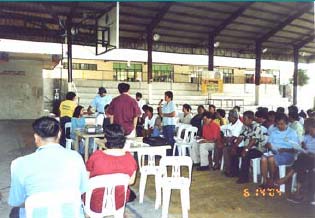
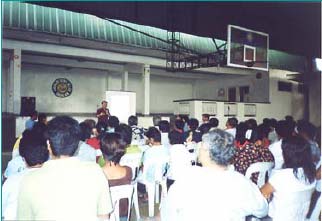
PICTURES TAKEN DURING THE MEETING
Minutes of the Public Consultation Meeting with
Barangay Officials and Residents of Barangays Signal Village
and Western Bicutan including Pinagsama Phase 1,
Pinagsama Phase 2-A and 2-B and AFP/PNP Phase 2
held on June 15 2004 from 9-11:30 AM at the Covered Court of
Barangay Signal, Taguig City, Metro Manila
Project coverage Many of the participants are questioning the coverage of the proposed project.
They realized that this is a good project and wanted their own zones especially in Signal Village
to be included in the coverage of the project. MWCI replied that the project coverage is limited
because of financial and technical constraints. The topology of the area with its rolling hills will
be costly at this stage if all the areas cited by participants will be included. This will involve a
series of pumping stations that will pump the wastewater to the proposed sewerage treatment
plant. Other areas in Taguig City may be covered by the Taguig, Labasan or Hagonoy facilities.
Other areas not covered by this project will be considered in the future plans of the company.
Alternative routes to the STP. MWCI has two options to connect the households to the STP.
The first option is to lay down its own independent sewerage line, which will connect all
households in the coverage area. In this option, residents will be encouraged to abandon their
septic tanks because the STP will process the wastewater more efficiently. The second option is
to use the existing drainage system and intercept and treat the wastewater in the proposed STP.
In this instance, residents are encouraged to still maintain their individual septic tanks. In this
area, there is only the drainage system, which will be utilized by the proposed project. Some
residents are in favor of the option of abandoning their septic tanks. It was pointed out that this
would entail huge financial resources to undertake a separate sewer line.
Septage Treatment plant The septage treatment plant to cover Taguig will be located in the Food
Terminal Inc, which will treat the sludge, vacuumed from individual septic tanks. Another
proposed plant will be located in Quezon City. There is an on-going construction in Antipolo to
build a septage treatment plant. The by-products of these spetage treatment plants will be used as
soil conditioner for the lahar areas in Pampanga and Tarlac and the water possibly for irrigation.
Flooding -- The issue of flooding in some places will be mitigated because if the company choose
the option to use the existing drainage system, part of the project will involve the improvement or
rehabilitation of the existing drainage system. If the other option is chosen, the company will
coordinate with the local government to improve the existing drainage system.
Basis of payment Payment of sewerage fees will be based on a certain percentage of the basic
water charge. In the sewered areas of MWCI, the prevailing sewerage fee is fifty percent of the
basic water charge. Presently, the company is still studying what percentage will be charge to the
beneficiaries. One of the aims of this consultation is to elicit reactions and suggestions from
stakeholders of the proposed project including the charging of sewerage fees.
Two sources of water The basis of sewerage fees is on the actual water consumption. If a
household has two sources of water (deep well), sewerage fee will be based on the basic water
charge levied by MWCI.
Transparency in computation It was suggested that transparency should be exercised in the
computation of the sewerage fees. This public consultation is part of the transparency process. It
was explained that before any charge may be levied on the residents, public hearings will be
conducted after due notice to the public, by MWSS as the regulatory body in charge of water
supply and sanitation. In the monthly statement of account, the breakdown of the various charges
is enumerated in that document.
Houses without septic plants Houses without septic tanks are not included in the project but will
be studied and may be included in the next project. If the sewerage system is in place already,
MWCI will require the houses without septic tanks to connect to the system and will be charge
correspondingly.
Use of Septic tanks MWCI emphasized that the residents will still use their septic tanks. The
project involves the construction of interceptors and pumping stations to further treat the waste
water that are being produced from the individual septic tanks. As part of their service, MWCI is
conducting for free, desludging of individual septic tanks, provide that it is properly scheduled.
Otherwise, the desludging will cost around 800 pesos, way below the charge of private
contractors of around 2,500 pesos.
Source of fund The fund will come from a loan by MWSS from World Bank. MWSS will then
pass on the loan to MWCI. The total loan amount is more than 100 million dollars. MWCI will
be responsible for the payment of the loan that will finance the Manila third Sewerage Project.
Time frame The loan is expected to be approved by World Bank around 2005 provided all the
necessary certificates, permits and other documents are in order. The project will be implemented
from early 2006 up to 2008.
Location of the treatment plant A treatment plant is cheaper above ground but the proposed
treatment plant will be located in an open space near existing basketball court in Signal Village
owned by the National Housing Authority so that the above area may be used for other purposes.
The needed area is between 700 to 1000 square meters. A barangay official asked if the area
might be used as a public market after plant has been constructed. The use of the area should be
coordinated with the local officials of Taguig.
Odor Bad odor is one of the risks in water treatment plants if the designed is flawed or
malfunctioned. In the proposed project, odor control facilities will be used to prevent bad odor
from escaping from the plant and go to the nearby communities.
The participants expressed support for the project and requested that MWCI expand the project
coverage to cover their other areas. The Barangay Chairman pledged his support and will assist
in traffic management and other problems that may arise from project construction and operation.
Barangay Hall Blue Ridge B, Quezon City
Public Consultation Meeting with
Barangay Officials and Residents of Barangay St. Ignatius,
held on June 17, 2004 from 9:30 to 12 NN at the
Barangay Hall Blue Ridge B, Quezon City, Metro Manila
MANILA THIRD SEWERAGE PROJECT
Minutes of the Public Consultation Meeting with
Barangay Officials and Residents of Barangay St. Ignatius,
Blue Ridge A and B held on June 17, 2004 from 9:30 to 12 NN at the
Barangay Hall Blue Ridge B, Quezon City, Metro Manila
The consultation workshop aims to present to stakeholders the existing sewerage
and sanitation conditions to arrive on a concensus at early stages of the project to
avoid conflicts which can harm the implementation and success of the project. With
these regard, it lead to the transparency of public and private actions, as these
actions are monitored by the different stakeholders. It also built trust between the
project proponent and the civil society, which lead to long-term collaborative
relationship.
Mr. Soncuya, a consultant of EDCOP-LTI, introduced the participants from EDCOP-LTI
and Manila Water Company Inc. (MWCI), explained the purpose of the public
consultation and the environmental impact assessment (EIA) process. This public
consultation, as part of the validation process of the EIA, aims to clarify issues and gather
opinions, suggestions and recommendations of stakeholders on the proposed Manila
Third Sewerage Project. Mr. Velasco, Senior Project Development Officer of MWCI
presented the background and proposed project. Mr. Suelto, another consultant of
EDCOP-LTI presented the results of the environmental impact study. After the two
presentations, an open forum ensued. The following are the highlights of this public
consultation.
Attendees:
Manila Water Company, Inc.
Christopher Calamiong
Senior Project Development Officer
Ben
Velasco
Senior
Project Development Officer
EDCOP-LTI
Rolando
Soncuya
Sociologist
Anacleto
Suelto Environmental
Specialist
Joy Tamayo
Public Consultation Coordinator
Wilvalin
Deocadis
Facilitator
Jinelyn Marie Guazon
Representative EMB-DENR
Participants
23 out of 38 invitees attended the scoping session
Mr. Soncuya :
Magandang umaga po sainyong lahat, nandito ho kami... Ako ho
si Dodoy Soncuya, ah consultant ho ng EDCOP at Lichel Technologies na gumagawa ho
ng Environmental Impact Statement ho tungkol ho sa project ng Manila Waters na ang
pangalan ho ay Manila Third Sewerage Project. Ah gusto ko pong ipakilala sainyo ang
aking mga kasama: si Mr. Anacleto Suelto ng LTI, si Bing sa LTI ho; galing sa Manila
Waters, si Topet Calamiong ho, si Nelson Peñales, at si Ben Velasco. Ah meron din tayo
ditong representative from EMB, Environmental Management Bureau ng DENR, Jinelyn
Guazon. Ah, uunahan ko na ho, maraming salamat kay Kapitan Clemente ah para
binigyan ho kami ng pagkakataon na maglunsad dito. Ah, I-explain ko lang ho yung
proseso ng Environmental Impact Assessment ano... Yun hong Environmental Impact
Assessment ay ito po yung ipinadadala sa EMB ng DENR ayon sa Department
Administrative Order (DAO) 96-37. Narito ho yung proseso para ho magkaroon ho ng
sapat na pag-aaral para sa lahat ng pino-proposed na project, at mabigyang pansin yung
biological, physical at saka social impacts po ng isang proposed project. Ah eto hong
konsultasyon na ito ay pangatlo sa labing-isang konsultasyon na ginagawa namin sa East
Zone na sakop ng Manila Waters. At dito po sa parte ng Taguig, Quezon City, Marikina,
iyong tatlong iyon. So natapos na po kami sa Signal Village. Tapos kahapon, kinonsulta
po namin yung mga tao sa don sa Lake, don po sa ginagawang site sa Laguna de Bay na
kasama po ang mga barangay ng Tipas Ibayo, Calzada, Wawa, Hagonoy. So bale ito ay
mayroon ho kasing pino-proposed ang Manila Waters na ang lahat na tubig na
nanggaling dito ho sa parte nyo ho simula St. Ignatius, Blueridge A tsaka dito sa B, tsaka
ho yung parte ng Marikina, Olandes, Sinco Hermanos, Alta Vista, eto hong matataas na
to ay gagawa po ng sewage treatment plant na located po dito sa bago po Camp Atienza.
At kung yun sa Riverbanks po, ito po yung halos sa boundary ng Marikina at saka
Quezon City. Kung mapapansin nyo po at magagawi po kayo doon, ito yung natambakan
ho na portion, nandoon po yung mga kawayan. So lahat po ng tubig po dito, na
nanggaling sa household ay dadalhin po doon, at iti-treat po yung tubig, bago ilabas sa
Marikina River. Ah yun pong sludge na mage-generate ho diyan, mayroon hong pino-
proposed na septage treatment plant sa dalawang lugar ho. Iyon hong isa ay nasa Taguig,
sa FTI, proposal po nila. Tapos yung isa po sa may Batasan (Payatas) para po to cover
itong Quezon City. Pagkatapos pong I-treat po yon, mayroon hong component itong
project na to para dalhin yung treated sludge para gamitin na soil conditioner sa lahar
areas, sa Pampanga, so ito ho yung parang sistema ng projects. So, lumalabas ho niyan,
ito ho ay isang bahagi ng... yung ng component ng Manila Third Sewerage Project.
Sisimulan ko lang po sa EIS, ang project proponent po dito ay Manila Waters, ang
panggagalingan po ng funding ay loans to World Bank, so yun hong ah... lalabas na
borrower ay yung MWSS na isang government-owned corporation na siya pong
humaharap sa World Bank para makakuha ho tapos papasok po sa Manila Waters, yun ho
ang panggagalingan ng funding na to. So ang proposal nga po, ang presentation po
namin ay una ay I-explain ko nga ho; yung susunod sa akin magpi-present ho ng study;
yung pangatlo hong component ho nito, ipi-present ho namin yung resulta ng
environmental impact study.
So ang unang proseso po niyan base sa project description, pumupunta ho sa
communities, nagko-conduct po ng scoping workshops, focused group discussions at
among don sa mga stakeholders, yung maapektuhan para magkaroon ho ng direksyon o
focus dun sa kung ano ang mapapag-aralan. So bale, ayon ho don sa initial consultation
ho namin, medyo meron na po kami ng probable effects, probable positive or negative
effects ho. At yung effects don ho pino-focus yung study. So pagkatapos ho ng initial
consultations ho diyan sa scoping worskshops, pumupunta na ho ngayon sa baseline data
collection. Dito nga ho binanggit ko na ho yung tatlong components: biological, physical
at social. Ano ho ba ang epekto ng pino-proposed na project na ito sa biological?
Makakasira ho ba ng halaman ito, nakakasira ho ba ng lupa to? Naaapektuhan ho ba ang
mga hayop? Iyong sa pisikal naman, ito ho ba ay magdudulot ng trapik? Sa sosyal
naman, ano naman ang epekto nito, ito ba'y makakaapekto sa tao? Mayroon bang
matatanggal na mga bahay? Madi-dislocate ba mga kababayan natin, so ganoon ho ang
pag-aaral. So pagkatapos ho ng data collection, pumupunta na ho sa analysis. Ano ho ba
ang talagang impacts nito? So pagkatapos ho non nandito na ho tayo sa stage ng
validation, bumabalik po kami doon sa mga communities na mga naapektuhan at pini-
present po namin yung mga data collected at saka yung impact assessment. So andito ho
kami sa stage na ito para maibahagi kung ano yung resulta. So pagkatapos po namin na
matapos itong consultation na ito, ay ipa-finalize po namin ang report at isa-submit po
namin sa EMB, sa Environmental Management Bureau. So, kung sa opinyon ng EMB ay
kontrobersyal ang project o malaki ang maapektuhan nito, ay magko-conduct ho ng
public hearing. Sila ho ang magko-conduct ng public hearings para malaman ho talaga
kung papaano mare-resolve kung mayroon hong mga isyung hindi napagkasunduan.
Tapos ho non ay didisisyunan na ho ng DENR kung approved o hindi approved ang
project. At kung approved naman po, ito na iyong ini-isyuhan ng ECC (Environmental
Compliance Certificate). So ito po bale ang proseso, andito ho tayo sa validation, so
nandito ho tayo sa proseso para malaman ng Manila Waters kung tuloy o hindi tuloy
yung project. So, ang susunod hong magpe-present ho ay yung representative ng Manila
Waters para ho I-explain sainyo yung project.
Ben Velasco : Magandang umaga po, ako po Ben Velasco, taga Manila Waters po, sa
Wastewater Department, under Project Development Section. Ah ipi-present ko ho
sainyo yung Manila Third Sewerage Project. So this is not just a project para dito sa
komunidad ninyo, marami din ho kaming komunidad na seserbiyuhan dito ho sa Metro
Manila. So, ito po yung papakita ko sainyo, kumbaga bibigyan ko ng background kung
saan nanggagaling yung wastewater natin, tapos yun nga, yung kasalukuyang status natin
dito sa Metro Manila, at ano iyong situation natin ngayon in regards with wastewater.
So, yung existing facilities, di ba alam natin na naging private na ho ang MWSS at ang
naging concession naman po dito ay yung Manila Water. Meron din po kaming na-take
over na facilities dito sa Quezon City at sa Makati po. Ito po bale ay another World Bank
funded na kasunod ng Manila Second Sewerage Project, kasi ito pong pino-proposed
namin sainyo eh Manila Third, eh meron ho kaming on-going na Manila Second, at
ipapakita ko rin sainyo yung mga project components ho non. And of course, ang pakay
po namin ngayong araw na ito ay yung Manila Third Sewerage Project components po
namin, state po namin and the issue that we have encountered and probably you might
bring up issues regarding the project...
Question: Sabi mo yung first and the second project, this will be the third eh, san ang
first?
Ben Velasco : Yung first project po? Ang first po ay yung sa Tondo areas. Tondo is
actually hawak po ng MWSS before. Iyong second po actually ang rehabilitation ho ng
mga facilities na natake-over ng MWSS noong panahon ho nila. So, yung first sewerage
project ay doon po sa Manila side, kasi may existing pong sewerage system doon sa
Manila side, doon po yung una nila, tapos iyon pong 2nd and 3rd ipaliliwanag ko po
sainyo...
Question : Ano po yung article few weeks ago sa U.P., is that not one of your project?
Ben Velasco : Ito po yung under sa Manila Second Sewergae Project, tapos ito yung on-
going project, matatapos na po yung sa U.P. To continue po no, bigyan ko rin ng
description, yung wastewater po usually ito yong ginagamit natin in any domestic activity
na gumagamit ng tubig especially po yung paggamit ng kubeta. So kung mapapansin nyo
po no, ano ba ang meron ang mga untreated wastewater natin? Ang nangyayari po kasi,
meron tayong sinusunod na batas dito sa Metro Manila, dito sa bansa natin, pati na rin sa
ibang bansa na mayroong environmental standards, meron pong tuntunin ang mga
wastewater dito na dapat ganito lang kadami, kung hindi, kung mag-exceed yan, pollutant
na siya, mas hazardous na siya and what kung maging risk na siya sa growth ng marine
life? Now, hindi lang ito sa water body na tinatapunan natin ng wastewater, pati rin sa
komunidad natin. Una, baka maging cause ito ng any water-borne diseases, and if we
expand sa mga ganitong klaseng dumi ay maaring magdulot ng sakit, ng mga diarrhea,
mga typhoid fever, ganyan ho. So ano bang alam nating technical na paggamit natin ng
treatment sa wastewater? Di ba yon pong pozo negro, alam ko ho halos lahat ng bahay
dito sa Blueridge at St. Ignatius, naka-septic tank po. Ngayon, ito pong septic tank, 89%
ng dito ay nakatira ay gumagamit ng septic tank. Now ang nangyayari po kasi, meron
nga pong treatment, pero ang treatment po talaga nito sa wastewater is within 25 to 40%,
so what happens to the rest of it? Still, nandoon pa rin ang dumi. Kung mapapansin
ninyo, yung lumalabas na tubig sa pozo negro ninyo, chances are meron pa ring untreated
no. So para maging safe itong septic tank natin, at mai-maintain nga yong 25 to 40%
nong pag-treat ng tubig, kailangan sinisipsip yan every 6 or 7 years. Pero ano nga pong
magandang sistema ang dapat nating sundan? Ito yung sewerage system talaga which is
a wastewater treatment plant. Ideal po ito kasi, kung mapapansin ninyo, ang pinaka base
nito, ang mga bahay po na nakakonekta po sa isang tubo, na didiretso na po yung dumi
ninyo sa isang treatment plant bago itapon po natin sa mga rivers natin, sa Manila Bay or
sa mga creeks. Ang nangyayari po nito sa kasalukuyan, actually noong panahon bago
ang Manila Second Sewerage Project, 5% or less than 5% dito sa Metro Manila ang
mayroong ganitong sistema. Ang majority po niyan ay nandoon sa Makati, sa Makati
Business District.
Ito tingnan ninyo nga ho ang kalagayan natin sa Metro Manila. Isa po, nagkulang po na
magkaroon ng mga plano pagdating dito sa wastewater, hindi po nagplano masyado ang
Metro Manila dito. Kung mapapansin ninyo po, dito sa may Pasig River, merong
kababayan nating nakatira doon at ang mga iba ay nagdi-diretso ng dumi sa ating mga
ilog. Tapos, kung mapapansin ninyo rin, medyo may kasikipan na rin dito sa dami ng
tao. So, kung maraming tao, maraming mage-generate na pollution. And what, meron
din na `no proper sanitation facilities' ang iba doon na masasabi natin na kahit pozo
negro na mismo ay wala ito. So, didiretso na lang silang maglalabas ng dumi nila sa mga
ilog natin. Ito ho yung 85% which are using septic tanks. Tapos, itong sewerage nasa 3
to 5%. Napapansin ninyo po, na medyo mas malaki pa ho ang di ho gumagamit ng
anumang facilities para mag-treat ng wastewater. Now, may study po ang World Bank,
na 70% ng pollution load sa Pasig River ay sa domestic waste. Yun pong industrial
waste hindi po ganoon kadami ngayon. Well, for one reason naman, mas marami po
kasing residential ang nagko-contribute sa pollution dito sa river natin. Ito napansin ninyo
po sa mapa, ito po yung tinatanong ni Kap na first project naming, nang MWSS, yung
Manila Central Sewerage System. Ang problema ho dito, hawak po yan ng Maynilad,
hindi po namin hawak yon sa kasalukuyan, pero dito po yan sa area na ito. Tapos, noon
pong na privatized, nadagdagan po ng isang sistema, iyong Dagat-dagatan System. Dito
naman kasi iyon sa Manila side. Ang nakuha po namin sa Manila Water eh yung
Magallanes ho na wastewater treatment plant. Dito po yun... nase-service po namin dito
ang Forbes, Dasmariñas, Magallanes Village saka dito po sa commercial area sa Makati.
Tapos meron ho kaming mga communal septic tanks dito sa may Proj.4, Proj. 6. Ngayon,
ito ho, itong Manila Second Sewerage Project, ito ho kasing project na ito, under World
Bank, mag e-end na ho ang aming loan diyan this year. And base on our studies, we need
to provide more wastewater services sa tao kaya nagbanggit na rin kami sa World Bank
ng Manila Third Sewerage Project. And now, yan na po... on-going na po yung
consultation sa tao. Tapos, dumoble naman yung aming negotiations sa World Bank para
don sa pera. Now, meron po kaming isang project na ginagawa, iyong Pasig River
Rehabilitation Project. Dati po kasi, under ito sa Malacañang, sa Office of the President,
nung nailipat sa office ng MWSS, this will put a septage treatment plant. Ano po yung
septage treatment plant? Medyo iba ho ito sa wasterwater treatment plant. Kasi po ito,
lahat ng nasisipsip namin sa mga pozo negro ng bawat bahay, dito po namin dadalhin for
treatment. So, makakakuha din po kami ng 36 na vacuum tankers na pansipsip,
additional ho, kasi ang existing lang ho namin ngayon mga pito, meron nga hong
dumating this year ho na pito ulit. Pero sa dami po ng aming sine-serbisan, medyo
kailangan pa namin nitong mga trucks na ito. Now, ito ho no, yung Manila Second
Sewerage Project ho namin, meron ho kami diyang tinatawag na package sewer treatment
plants, at medyo po kanina isa po doon, yung nasa U.P. Ang ginawa kasi namin sa UP,
ang UP po kasi mayroon silang existing na linya ng sewer, ang problema ho hindi ho nila
natayo yung treatment plant. So, ang proposal ho namin sa UP, kami na lang ang
gagamit ng system, iti-take over namin yung mga linya, kami na rin ang gagawa ng mga
treatment plant. So, kung nung huling Friday po nakapag-inaugurate po kami ng
treatment plants sa U.P, expected din ho namin siyang tumakbo within a year. Sa UP
meron po kaming 28 na treatment plant na nakakalat doon sa buong Metro Manila. Ang
sini-serve po namin diyan ay yung mga government housing projects tulad po ng BLISS,
alam ko yung sa tabi ng Pasig River yung Mandaluyong Bliss, sa likod ng SM City yung
Pag-asa Bliss, and there's also maliliit na subdivision na nakakalat din ho. Ang capacity
ho nito, lahat lahat, pagka kinombayn ho namin, it will be 37,000 cu/m a day and will
serve around 250 to 280,000 people. Ito hong sa Pasig River, meron ho kasing
kasalukuyan, sa may Antipolo, na tatayuan namin ng planta. And base on our design
para sa treatment plant, ganito ho magiging hitsura niya. So, lahat po nung facilities
namin na sumisipsip ng pozo negro, didiretso na ho ng Antipolo para doon na ho iti-treat
yung mga tubig din. Now, for Manila Third, ah base on Manila First and Manila Second,
the same objective is to reduce pollution loading to our major rivers and waterways
specially Pasig River and Marikina River. And base on this, nagko-conduct po under ng
Manila Third, yung sewerage and sanitation projects. Ang sewerage po, yun nga
paggawa ng mga treatment plants. Tapos meron po kaming sanitation projects, yung
sanitation po, meron po kaming mga komunidad, nakikita ko ho dito, wala man hong
gaanong facilities, lalagyan po namin ng communal septic tanks. So, it is a sanitation
project. So, this is under World Bank loan na will be available hopefully by the end of
next year. And for that time, ah yung construction po namin will reach until 2008
hopefully. So ito ho yun no, yung isa ho naming system is Taguig, meron ho kami sa
Taguig na malapit sa may Laguna Lake na area, ginagawa din po ng DPWH na parang
retention ponds para ho di bahain yung mga tao doon. Nilalagyan nila ng parang dike
para ma-strain yung flood. Pero sa amin namang proposal, meron naman pong available
doon, might as well I-treat na rin namin yung tubig pagka magkaroon ng tapunan,
magdala man ng tubig sa Laguna Lake, at least malinis-linis naman yung tubig. Yung
pangalawa ho naming component na dito pupunta, ano pong sites to? Meron ho sa
Makati, meron sa Pasig, meron sa Mandaluyong. All wastewater facilities should be
adjacent to Pasig River. So, iko-connect nga lahat ng mga drainage and wastewater ng
mga taong nakatira malapit sa Pasig River. Bago ho sila magtapon ng tubig ho diyan, iti-
treat muna natin. Nandito ho yung Quezon City and Marikina Wastewater Treatment
Plants, dito po kayo nakabahagi. Ang nakita po kasi namin dito, yung lupa sa tabi ng
Camp Atienza diyan sa baybayin ng Marikina River. And we are eyeing po yung mga
residents adjacent dito sa Marikina River, which is kayo po sa Blueridge, dito po sa St.
Ignatius, sa Industrial Valley, dito po sa may Sitio Olandes, kasama din po sila sa mga
seserbisyuhan namin. Tapos, ito pong sanitation prelude to middle income communities,
meron po kaming nakita dito sa Pasig. Ang marami po kasi dito yung sa Manggahan
floodway. Kung mapapansin nyo rin po kung mapadaan kayo, marami din pong
kabahayan na doon nakatayo sa may floodway. So, balak po naming lagyan sila ng
communal treatment para sa kanila. And aside po doon sa Pasig River na Septage
Treatment Plant po namin, nagpadagdag po kami don sa component po namin ng
dalawang treatment plant para sa Septage. Ang site po natin ay dito sa Antipolo po no,
medyo don po siya sa west side. Ang gusto po naming lagyan ng serbisyo para mas
efficient po kami, sa may Quezon City po sa bandang Payatas. Meron din po kami sa
South, sa may bandang Taguig. So, ang pinaka-konsepto po naming gawin para for
Manila Third is to combine na yung for treatment na pong combined storm at saka sewer.
So, ang mangyayari po dito, ito po yung components po namin no, kasama din po kayo
dito. Ang pinaka-ideya po naming dito eh, iintercept po namin lahat ng mga dumi ng
drainage papunta sa Marikina River, papunta sa treatment plant, tapos doon na ho ito iti-
treat. So, nandiyan pa rin yung mga septic tanks ninyo pero all the wastewater, didiretso
na po don sa treatment plants. Tapos meron din ho kaming treatment plants sa Quezon
City, tulad ng nabanggit natin ano ho, mga na-take over namin. Yung iba po doon, ina-
update na naming para sa treatment plant. Ito pong binabanggit ko mga ho, yong
treatment of septage sa mga STPs, isa pong site naming sa FTI, ay masi-serve nga po
diyan sa Makati, nandiyan po sa mga may Taguig areas. Malamang po yung seserban
nyong area eh mahahati po dito sa Antipolo saka dito sa Quezon City. So, ito po no,
yung ise-serve po naming mga communities dito sa Manila Third Sewerage Project, ah
may mga floodway, yung Pinagsama Village dito sa may Taguig po yan no. Tapos yung
Anak Pawis, Exodus, dito po yan sa may Pasig po.
Question: Will all of them be connected to the Camp Atienza plant?
Ben Velasco: Hindi po, meron pong separate, kasama po dito sa Camp Atienza area na
treatment plant Blueridge A & B. Mamaya po, ipapakita ko sainyo...
Question : Are we assuming that a plant will be located in Camp Atienza?
Ben Velasco : Ay hindi po sir sa Camp Atienza. Sa may tabi po sa may Marikina side
po.
Question : Sa tabi ng ilog?
Ben Velasco : So, ito po for example yung kalsada no, papunta tayo ng riverbanks, ditto
sa right side... side ng river.
Question : Magkano sabi ninyo inuutang ninyo sa World Bank?
Ben Velasco : Well, base ho dun, kasi nong nag-present... nung ginawa namin yung
detailed engineering designs, pumasok po ang World Bank to say na " uy, total naman
maglalagay kayo ng facilities diyan, might as well dagdagan ninyo na yung inyong
coverage." So, ang initial po naming loan ay $650 M loan, pero base don sa kanilang
proposal sa mga gagawin naming iba, pina-expand po nila, naging mga over $100M pa
po yung mga nakikita nating gastos doon...
Question: How many years to pay yan?
Ben Velasco : Ah so far ho dito, di ko masyadong kabisado, pero sir it's about ten (10) to
fifteen (15) years, 20 years to date...
Question : At what interest, graduated ba o fix?
Bem Velasco : Eh hindi ko po kabisado...
Comment/ Question : Kasi ang feeling namin, itong Manila Third Sewerage Project,
parang your just letting us know that the government intends to borrow this much, which
will be chanelled through you that you say will benefit us. But later on that will be
charged also to us. I'm pretty sure naman kasama yan sa aming biling.
Ben Velasco : Actually po yes, kaya idi-discuss ko sainyo yan mamaya.
Comment/ Question: That's the bottomline eh (giggles). So we just want to know how
many barangays are affected ng work na sinasabi ninyo kanina...
Ben Velasco : Mamaya po nalang idi-discuss ko po....
Comment/ Question : I'm sure you're also going to discuss the timetable.
Ben Velasco : Yes, we are eyeing nga po, its really going to be between 2005, 2006 to
2008...
Question : So it will take two years to finish it?
Ben Velasco : For the whole component, so base po dito sa Quezon City/ Marikina
Treatment, baka almost a year lang or less than two years yung construction. So ito
nalang yung idi-discuss ko muna. Ang nagiging issue po namin sa pagko-conceptualize
ng Manila Third, yun hong availability ho ng lupa. Ang nangyari po kasi dahil congested
na dito sa Metro Manila, its hard to for us to find yung tamang lugar para ho lagyan ng
treatment facilities. Marami ho diyan, pero maliit-liit lang ho na parcel. Ang nangyari
po, with the help din po ng local government, may mga na-eye din po kami na lupa na
puwede naming gamitin for treatment plant. And aside po doon, yung cost po para
magtayo. Of course you are concerned with the cost po namin. Ang nangyari po kasi, we
decided to confine sewer flow, well in a way to minimize the cost. But for us din naman
ho para di ma-burden sa tao kung maglalagay kami ng sewer lines to all connecting to the
houses. It will cost everybody a lot. So, we tried in our way to minimize whatever cost
we'll have for Manila Third Sewerage Project. And in environmental impact, positively
we'll be helding our waterways, and sana, our communities not to be exposed sa
wastewater. And probably, the environmental impact na negative as nabanggit dito,
siguro yung baka may mga natamaan pa kami diyan sa mga residente who are staying
probably doon sa land sa side ng Marikina river. And another po yung sa social impacts,
your concerns. Ah there may be concerns, technically or kung anuman, financially ang
maibanggit ninyo sa amin.
So, dito po kasi no, sa Manila Third, and the other previous projects namin, we wanted to
go to the communities and expressed to them that gagawin namin itong facilities na ito.
Ifever the plant, hindi ho pumasa yon sa national laws and standards ng DENR, kami po
ang mananagot. Yan ho ang aming proposed sa tao. Kami ho ang hahabulin ng DENR,
kami rin ang hahabulin ng MMDA, lahat po ng mga pozo negro nyo riyan, remember
yung mga linya po riyan o sewer lines po, magkakaroon ng bara o magkaproblema, o
kailangan linisin, kami na pong lahat bahala diyan. Ang ano lang po namin lang kasi,
under po sa sanitation laws ng MWSS, everybody who is connected to a sewer facility
will be paying for a sewer charge. So ang meron po kami diyan, galing don sa MWSS,
namana po namin is paying the 50% sewer charge from your basic charge of your water
consumption. That will enter for all cost of maintenance po ng facility, which is mostly
kuryente, the manpower, the equipment that we'll be needing. So, dun po papasok yung
50%. But in truth, ah actually hindi po mako-cover ng 50% yung cost ng buong
combinations; but we are forced as Manila Water and probably Maynilad, kaya kailangan
po naming magtayo ng ganitong facility. But, meron ho kaming targets. Pagka nanalo
po ang private dun sa MWSS, mayroon pong susundin na schedule na kailangan ang
compliance namin. Eh kasi po, in terms of water, we're very much complying. But now,
we are on our way to comply with wastewater with sewerage. So ngayon, naka-tie po
kami dun sa MWSS, na kailangan din ho naming makagawa ng mga services na ito for
our concessionary.
So, ito po na water pollutant due to this water, madalas po nangyayri yung mga cases ng
diarrhea, mga water contaminations, nagkakasakit... If you heard about the situation in
Tondo in Manila, yung nagkaroon ng outbreak ng ano... We are trying to avoid that for
the communities, sana naman kapag nagawa naming tong proyekto na ito eh mabawas-
bawasan yung mga ganitong sitwasyon sa atin...
Question : What outbreak you are referring to?
Ben Velasco : Yung tungkol sa Tondo about few months ago. Tolerant maybe, hundred
people yata got affected. This is in Tondo area, this is under Maynilad. Nagkaroon ng
contamination, I think dun sa water supply. So, meron pong naapektuhan na isang
barangay dito po. So we ask naman, yun nga ho to give them the initiative regarding this
Manila Third. We wanted to address din naman na hindi ito mangyayari. And Manila
Third will help us to expand the sanitation condition. As I mentioned, yung mga
concerns and target namin with MWSS. Kasi ho, base ho dun sa mga rulings namin,
pagka di kami sumunod sa mga concession targets namin eh baka hindi ho kami...
katulad ng Maynilad, they are having problems with MWSS. Luckily and fortunately,
hindi naman ho kami nagkakaroon ng ganitong problema with MWSS. And ito po,
education and policy issues is again a challenge. This is one of them because hindi
naman lahat-lahat ng kababayan natin ay naiintindihan ang importansya ng paglilinis ho
ng dumi ng tubig natin. Kasi naman po ano, gusto rin nating magawa din, napansin po
natin ang Pasig, napabayaan po natin yan for about 50 years. Ayan po ang nangyari
ngayon. Ang problema po natin, kapag pinabayaan po natin yan, baka po mas mahirap
buhayin o kaya hindi na ho natin malinis yung mga waterways natin. Might as well
address the concerns as soon as we can. Kung meron po tayong tanong ho sana...
mamaya magkakaroon po tayo ng maganda-gandang discussion ho sana about it. Kung
meron ho kayong concerns...
Question : Wala ba kayong projects aside from this one na iha-harness ninyo ang salt
water ng sea, para ma-convert into potable water para there is enough water for Metro
Manila. Kasi, there was a move during the early stage ng time of Senator Honasan,
meron yatang foreign funding wanted to use that system, pero because of the lobbying na
sistema ng ano natin, hindi natuloy ito.
Ben Velasco : Well, in terms of water supply, ah ina-eye po namin actually ay salt water,
kasi medyo malaki po ang sea. Pero, meron po kaming initially ginagawang study to take
water from Laguna Lake to treat people dito sa may Rizal area. Sa kasalukuyan po diyan,
meron po diyan sa Rizal area na nangangailangan po ng tubig. And so far, meron tayong
binibigyan, nanggaling pa rin sa supply natin sa Metro Manila. Might as well, kami ho,
gumagawa ho kami ng study baka yong Laguna Lake can supply to the Rizal areas...
Question: So, if the what your treating coming from us, so you're trying to divide it into
something that could turn over into a fertilizer, the other pwede ring I-recycle back to the
people.
Ben Velasco: Maam, ito po kunwari no, if for example dito po sa planta po dito sa
Quezon City, we have two products ho iyon na nage-generate. One po is the treated
water, isa po yung sludge, yung natanggal po nating dumi. But yung treated water wag
po nating inumin. So, sa amin, sinunsundan lang namin yung DENR Effluent Standards.
But there is a different standards po for drinking water. So, ang suggestion po namin sa
mga ginawa po naming treatment like po sa UP, ang proposal po ng UP sa amin is to treat
back the water, then the treated water back to the lagoon. Di ba may lagoon sa gitna.
Dati po kasi, yung effluent ng septic tank, pumupunta sa lagoon eh, siguro yung mga
taga-UP doon nagsasabi na mabaho dun sa gitna. Talaga dahil galing pozo negro yon.
Ngayon, ang gusto ng UP, yung treated water namin dalhin na sa lagoon. So, at least
malinis na don. Sa amin lang po, ang proposal namin sa ibang residents is they can use it
for irrigation, sa mga sunog, etc.
Question : Yung sinsabi mong sa lagoon, kasi meron kami dito. What can we get from
it?
Ben Velasco: Exposure to untreated wastewater. Exposure to it... there may be chances
kung mahina yung immune system, baka ho magkasakit kayo like mga cholera, typhoid
fever. Yes, these are waterborne diseases.
Question : Yes, meron ho kasi kaming open canal ano ho that comes from Area A and
goes down here, goes down sa lagoon. Tapos, may pipe kami na papalabas. Sir, whose
jurisdiction is that?
Ben Velasco : Well, ang mangyayari po, hindi naman sa hindi safe, but we are avoiding
these cases. Ang balak po kasi namin is to maintain your area dito rin po sa loob...
Question : But what I'm trying to say, who do we turn to? Who will going to provide
the pipe going out?
Ben Velasco : Pipe closure po... and I'm not sure po when it comes to private
subdivisions. Kasi don po sa mga open areas, its really DPWH.
Question : Manila Water na kasi cover ang mga roads natin sa government, so part of that
Manila Water also, concern din nyo yon....
Ben Velasco : Well actually po, sa amin po at present we are not handling drainage, this
is just part po sa aming pino-propose project in the future, which is the Manila Third to
combine. So, eventually kami na rin po ang magme-maintain rin po niyan, with your
help po sana na pagdating dito sa loob...
Comment : Kasi wastewater din yan eh... actually ang problema ngayon eh...
Ben Velasco : Yun po kasi, napansin ninyo kasi na its not really na-disflow kasi dry
season. So majority po ng flow diyan ang level ng tubig is tag-ulan. But in the case like
in the Tondo area, mayroon talaga doong mga creek na pang wastewater nila, hindi
pantubig-ulan. So medyo concentrated ang kanilang waste.
Question : Saan dinadala yung sludge?
Ben Velasco : Yung sludge naman sir, at present what we're doing now, dinadala naming
sa lahar, sa Pampanga and Tarlac, and ah may mga on-going studies kami diyan
regarding sugar-cane planting. Now, pagdating po sa planta, if in case may latak po tayo,
ang mangyayari mag ge-generate po yan ng parang lupa , soil. So in the case in
Magallanes, may mga homeowners po diyan na nakikihakot, whether ornamental plants
or they are planting. So with that they get, but malaki yung production namin so minsan
nagbibigay din kami sa mga provinces sa North for their agricultural use. So, at least
kami we provide for them. So, kung humingi man sila, binibigay namin.
Question : Manila Water... what is in there, in this project that you are interested?
Ben Velasco : Well, sa amin naman po no, ang pakay po namin ngayon is to inform you,
there will be a project. Like kung meron kayong concern, like for example yung mga
ganitong concerns ninyo...
Comment: No, but I'm talking of either when the system will be established, will you be
collecting...? Or...
Ben Velasco : Yun po, yung nabanggit ko nga pong 50% sewer charge.
Question: So, why should it be... so it means if your water bill is something like P800 a
month... Kasi kung sewer line to a sewer line, that will be different di ba dahil hindi mo
na kailangan ng pozo negro eh. Pero lahat kami may pozo negro kami and we will be
debit P100 more, average di ba mga P300 ang bill natin or more or less...
Comment: Have you notice the bill, meron kasi silang tsina-charge sa atin na septic tank
collection, others do not know that... pero is I think its I% that's why they are doing
services every ten years to collect. Actually, they tell us free pero sa totoo lang we have
been paying for that a long long time ago.
Comment: How much?
Comment : I think 1% of the collectible...
Comment: Yah, but they are saying they are going to charge us 50%...
Comment: Another pa yan , another pa yan, and that's no joke di ba...
Comment: Itong paglilinis nila ng pozo negro, lets say every 8 years they do that, they
have been charging us 1%, others do not know that yet... So, it has been... parang
Meralco yan eh na katakot-takot na makikita. So ito naman, they want to put up a
treatment plant, a big one, so we are going to pay. Dapat they should give us a factor,
how much more or less are we going to pay? Is it gradual every 5 years. Kasi, it is a loan,
maski 100M yan nakapasa sa atin yan. Yan ang tanong ko kanina, ilang barangay ang
involved diyan. Kasi ang iniisip ko kung 100M lang naman ang kukunin nila, they might
as well also produce not only for treatment but harness more water for us para di tayo
nagkaka-problema. They're killing two birds at the same time, pero...
Comment: But, what I'm concerned about ma'am is, if we don't have any sewage line,
why should we pay a sewage fee? Wala namang sewage line eh...
Comment: Hindi, ang ano kasi nila sir, eventually mapupuno yung ating mga pozo
negro, inaalis nila yon but they have to also...
Ben Velasco : Clarifications lang ma'am actually 10% po yun, hindi 1%...
Comment: Ah, 10%.. Oh my golly 10% pa pala. Oh I should be aware of that...
Ben Velasco : Actually, meron ho kasi kaming representative na kasamahan ni Nelson
that are scheduling works, ginagawa po dito po. Kasi po ang under kay Nelson Peñales is
Cubao area. So, on-going po meron kaming ginagawang iba, so if you want a schedule,
probably you can request to...Maganda po sana kasi kung maibibigay ninyo...
Comment/ Question: So, hijo, kaya you are holding this workshop for us, since you are
going to be a partner of MWSS dahi itsa-channel sainyo yon, you're just letting us know
na 50% of our... humihingi din kayo ng tulong sa community na bayaran pa?
Ben Velasco : Actually, ang mangyayari po kasi, you will be paying po to Manila
Water. Ang magiging cost sa mga residents will be the sewer charge, that's it.
Comment: Can we have a fixed rate or give us a sample para bago naman ma-release
yung loan, may idea na kami before the hearing... bracket man lang, for example like
500, bago mag-hearing man lang, alam natin. Kasi ilang years na bubunutin namin yan,
kaya kung wala na kami, at least yung mga children namin, grandchildren namin, at least
alam nila. Kaya nga sinabi ko 100M, dollars yon no, kung treatment lang naman, and
disposition is to convert it into fertilizer, sabi ko you might as well look for ways and
means na mag-produce din ng clean water for us out of that 100M, kasi at least parating
ninyo sa gobyerno, kasi ila-lobby yan, eh kung puro sa dumi lang at maging fertilizer,
tapos nagkaka-problema kami ni Kapitan, walang tubig, tinatawagan kami na walang
tubig, hindi balance yung inuutang ninyo. Kung uutang man kayo, lubus-lubusin na
ninyo...
Ben Velasco: Actually po ma'am, this law is under the wastewater department, pagdating
sa water supply, we have another department doing it. So, hindi talaga ho papasok dito sa
...
Comment: Pero siyempre coordination... This company is supplying the water and
maintaining and servicing, you might as well do that also. Hindi ninyo naman puwedeng
ipasa lang sa iba kasi may kontrata kayo with the government eh. And since it's a mass of
loan, gusto naman naming kumpleto yung serbisyo dahil we want to know how much
yung ipapasa sa amin...
Comment: Actually, isa pang puwede ninyong gawing project dito sa amin, kasi very
hilly ang mga lugar namin eh specially dito sa Blueridge, is how the water can reach to
the top, mga high levels of the community...
Ben Velasco: Sayang umalis na si Nelson...
Comment: Kaya umalis na yon, kasi alam niya maraming problema. Walang tubig ano
eh na higher, kahit St. Ignatius.
Comment: Alam ninyo bakit nangyayari, you know our pipes are so... you cannot put
pressure on the pipe, parang saasabog eh. The only way is to change the pipe which I
think is what they are doing little by little.
Comment: Napansin ko yung line ng ano...nung nagpagawa kami ng bahay dun sa min.
Yung pipe ng water, halos katabi lang ng pipe ng sewerage. Yun ang cholera! Nako-
contaminate.
Comment/ Question: Hindi mo sinagot yung question niya kanina, ano ang direct benefit
naming dito sa Blueridge since meron kang diniscuss kanina, aside from the general
environmental benefits for everybody. Kami dito sa Blueridge and St. Ignatius, what is
the direct benefit that we will get?
Comment: Bakit kami magbabayad ng 400 a month or 500 a month, eh at the ring na
may increase with the water charges, maybe pagkatapos niyan eh baka P2,000 na isang
buwan ang tubig natin eh di ba? Dati dati P80 lang ako sa MWSS, ba ngayon eh P900,
P1,000 ay eh baka pagdating ng 2005 niyan eh baka P2,000 na; P1,000 babayaran ko sa
sewer na wala namang sewer line di ba...
Ben Velasco : Well, para lang po maano ko yung concern nyo po... I can see your point
that there will be a directed fee but there will be a direct benefit for the community. Kasi
anuman ang dini-discharge nating wastewater, Manila Water is assuring na pagdating sa
river, may masusundan na yang standards eh. At present, we assure you hindi pasok sa
standards yung nadi-discharge. Well, that's one question, but the benefit for the
environment...
Question: Is everybody will be charged for that ano... I mean, not just our barangays
here but yung lahat ng sineserbis ng MWSS?
Ben Velasco : Yun pong lahat ng sineserbis po nitong facilities, yan po yung usual
naming ano...
Question : Does that also include Manila?
Ben Velasco : Manila meron na po sila. Actually meron na silang existing na sewerage
system. Well, yun pong ginagawa naming mga project sa mga base, once nasa planning
and operation na, we will charge the 50%. Magallanes Commercial Business District,
they are paying the 50% because they already have the facilities. Kayo ho, dahil walang
facility dito, di kayo nagbabayad.
Comment: Pero ilan lang naman kami sabi mo, Blueridge A & B, St. Ignatius...
Ben Velasco : St. Ignatius, yung mga riverbanks po naming projects, yung sa Pasig, yung
Taguig areas. All of these will fall under the Manila Third...
Question : Statistically how many houses, may one million?
Ben Velasco: Wala naman po siguro...
Question: Yun bang White Plains is part of that project?
Ben Velasco: I think portion lang.
Question: Ang gusto kasi naming makita, yung medyo concrete na project, meron ba
kayong plano na ayusin tong mga linyang to, at itong linyang ito eh dire-diretso sa...
Ben Velasco : Ngayon ho kasi ginagawa pa lang yung contingency. But if you want to
see, we could show it to you pagka nagawa na po.
Question: Ilan bang percentage toxicity yung effluent?
Ben Velasco: Hindi naman ho siya talagang toxic.
Question: But ano nga ang percentage?
Ben Velasco: Well, depende po yun kung ano ang coliform that causes the sickness,
yung coliform po talaga galing sa tubig na nasa dumi ng tao.
Mr. Soncuya: Yun hong results, ipi-present ho namin sainyo. Ito po yung in terms of
BOD, saka yung coliforms na kinuhanan ho ng water samples ho dito, kasama ho dun sa
presentation on sludge...
Comment: No, but I think 50% of your water charge is too much for us to bear. Malabo
iyon, mataas yon masyado. Unang-una ang aming discharge, di bale yung mga planta
diyan na walang water treatment plant, na dini-discharge lang nila yung mga waste or
yung mga squatter along the river. Pagka-flush nila tuloy-tuloy sa river yung kanilang
waste no. Meron kami ditong poso negro at ita-tap ninyo lang yung aming exit pipe
diyan sa planta nyo, and you expect to charge us 50% percent of our water bill, I think
that's excessive. Why? This is a basic responsibility of government, so this is excessive
additional taxation ang mangyayari ron eh, lahat ng tao gagamit ng tubig eh di ba?
Engr. Suelto : Kaya nga po, ito nga po iyong pinaka main purpose nga ng discussion
natin is to come up with the issues you'll bring out. Ito naman ho is really documented
and this will be submitted to MWCI as consultants, kami yon. So, kailangan pag-aralan
namin kung paano namin ma-address yung issues. So, ito po yung purpose po nito. So
let's say, they'll charge 50% , ayaw ninyong pumayag, so dapat alamin din po namin
yon.
Comment: Yung charge ninyo sa amin, for that kind of a facility, hindi ko lang mai- 1+1
equals two eh, hindi eh. Parang ganon eh...
Comment: At saka di ba dapat, DENR ang mas concerned dito, baka naman puwede
yung ibang cost eh sa kanila ipasa hindi sa amin.
Ben Velasco: Based on our existing facilities, the 15% collection namin sa mga
customers namin, does not even come close to what we pay for our operation and
expense ng mga facilities.
Comment: Kaya nga mamaya magbigay kayo ng sample supposed to be, ano ang ini-
expect namin sa 100M na inuutang ninyo...
Ben Velasco: Ang sinasabi ko ma'am eh yung ano, like a treatment plant needs
electricity, it needs equipment, it needs maintenance. So, monthly meron po kaming mga
operating costs and monthly of course we get bills from the community na may 50%.
The 50% itself compare nyo po yung total po non plus yung expenses for the facilities,
kulang pa po yung nage-generate na 50%.
Question: How much are you expecting sa aming area na ito na cost to operate?
Ben Velasco: Well, nasa study din po namin.
Question: May projected studies, ipi-present ba rin yan.
Ben Velasco : We'll try to get hold of that copy para sa atin. Pero, I'm just speaking in
base ho doon sa existing facilities ho namin. Dito po sa amin, parang ganoon po talaga
eh, it's a rate passed on by MWSS to us eh. Wala rin kaming maaano don eh. So, because
of your concerns, we can raise it up naman again to MWSS.
Question: Hindi ba puwedeng grant ang kunin mo instead of a loan?
Ben Velasco: Hindi ma'am actually, loan man yan or grant, its still a 50% charge to the
people.
Question : Ito bang ibang water treatment plant, is it income generating?
Ben Velasco: Dapat lang po.
Comment: ... that you can convert wastewater into potable water? Yun ang pagkaka-
alam namin no...
Ben Velasco : Ang sa amin nga po, yun nga yung effluent ng treatment plant, imbes na
gawing... not for drinking water but if the community that is being served by the
treatment plant wants water for irrigation, they could get from there. If they want
biosolids, then...
Question: Do we have a secondary pipe system for that?
Ben Velasco : Opo, or if not ang ginagawa po namin existingly, meron kami sa mga
communities na malaking tank where nandoon na po yung water na puwedeng gamitin.
Question: Kagaya for example yung bang other effluent na nadi-discharge, nakakamatay
ba ng isda yon?
Ben Velasco : Di po... ah yung ngayon po? Opo.
Question: Hindi, yung effluent galing pozo negro, hindi yung direktang waste galing sa
mga planta planta diyan, iyon ang nakakamatay or if you desludge your waste directly
into the river. Pero kung dumadaan sa pozo negro at lumalabas siya sa Pasig River,
nakakamatay ba ng isda?
Ben Velasco : Ganito po yan no, merong component ang wastewater na tinatawag nating
biochemical oxygen demand which is the BOD.
Comment: ... bacteria yan, pag lumalabas hindi na toxic? The toxic barres the chemicals
which comes from the plants ... but not the effluents
Ben Velasco : ...hindi lang naman po, meron din po sa atin, kasi kung malakas ang
biochemical oxygen demand ng effluent ninyo, this is the one restricting kasi the oxygen
sa mga ano eh. Sila, kumbaga yung mga dumi na yon, nangangailangan sila ng oxygen .
Now if kung yung dumi na ito malaki yung concentration niya, to the point malaki gusto
niya ng malaking oxygen, aagawan niya ng oxygen ang marine life.
Comment: Alam mo, my question is very very simple, yun bang effluent nakakamatay
ba ng isda?
Ben Velasco: Yes. Quantification yan...
Question: Nakakamatay? Ba't diyan sa pond naming diretso ang effluent, natatamaan ang
isda. But ang tinatanong ko saiyo ang percentage ng toxicity ng effluent, hindi ninyo
masagot eh...
Ben Velasco : Depende ho kasi yan sa effluent standards ng septic tanks nyo eh.
Question : So yung dumi niya, iba sa percentage ng dumi ko?
Ben Velasco : Probably, probably...
Question/ Comment: Ang major focus ninyo is to put a treatment plant to accommodate
the barangays to these areas. Lahat ng dumi na lumalabas papunta doon sa
pinakamalaking pozo negro para doon iti-treat. Parang isang major pozo negro ang
gagawin ninyo, tama? So, kung yung mga nalinis namin sa pozo negro namin, may dumi
pang lumalabas, nililinis pa ninyo ng konti, pati yung lumabas iyon ang iti-treat ninyo.
So, iyon ang pinaka main line ninyo. And the issues we're talking around is that idea, or
the project that you're supposed to do, if the cost which we're bringing up in putting...
First, you've mentioned that there's a loan; and then secondary that there is a 50% that
you'll going to add to us. So, that's one issue that we're putting up, trying to raise no.
Secondly, ano ba ang specific na project na gagawin ninyo, yun lang bang
pinakamalaking pozo negro na ilalagay ninyo sa diyan labas, or you'll also put up or
trying to maintain the line that will go to your pozo negro?
Ben Velasco: Initially wala pa po kaming ganon...
Comment: Wala pang ganon, so baka half-baked yang ating proyekto na yan. For a 100
M dollar project. Dollars ha, were talking about dollars, eh parang napakamahal naman
nun...
Ben Velasco: Eh, hindi nga lang naman po kasi to. Actually, pag tiningnan ninyo... Ang
cost naman po for the Quezon City Marikina Plant is not the $100M, kasi malaki po yung
component ng project namin sa Taguig. Taguig, halos it covers the whole area of our
project...
Question : So your talking of the Manila First, Manila Second, Manila Third...
Ben Velasco : No, Manila Third. Manila Third is six (6) components. Six (6)
components po yun, and one of the components is just this project.
Comment: Kaya nga siguro you will give us details... kailangan detailed kung yung
anong benefit sa amin. Tapos yung 100M, will there be a secondary pipe and you're
going to produce... Kasi dapat talaga detalyado, because you cannot just accept 50%
payment na not knowing where it is going...
Comment: Are you going to upgrade our pipe, kasi ang dami namin ngayong pipe na
wasak. Kaya ang nangyayari, yung mga wastewater bumubulusok, lumalabas sa kalye.
Lumalabas sa kalye yan, di ba?
Comment/Question: Ako, sa tingin ko parang nangyari, this consultation right now, what
you have presented us are the issues about the water that's coming out from the houses.
Ang punta namin dito, akala namin you're going to present to us something a more
technical detail on specifically na you're going to provide... your planning to provide
based on a 100M dollar funding, your going to provide a line. I mean the cost of that line
going to the main set-up, ano yung gagawin ninyo, anong output non, anong input non,
anong benefit? Right now it is going around the bush, nakikita... Well, alam naming
yung effluent problem, alam naming yung pollutant problems, nakikita naming araw-
araw yan, nakikita naming yang butas na yan. We're still on that issue right now based on
your presentation. And what we are trying to find out right now is where are we going?
What are your plans right now? Are you going to present us plans or you just want to
hear us?
Ben Velasco : Well, ang purpose po naming dito is to hear your other concerns, for us to
address din naman your concerns sa office po naming. And at the same time din kasi no,
yung gusto kasi ninyong detailed plan kung ganyan, technically, we cannot provide you
that right now eh...
Question/Comment: Dapat talaga may details eh. Besides, will connection to the
sewage facility be cumpolsory or if I don't want to connect to the system, then will I be
charged or what?
Ben Velasco : Ay hindi, ang mangyayari po kasi diyan, once your covered area is
concerned, may isa po diyan na hindi di pupuwede, lahat po diyan is...
Comment/ Question: Yah, if you want to do that, you do it. But its another story that
there will be 50% charge to us, iba yon di ba?
Comment : You said that you just collecting the water for the farms,etc. Why don't you
put in your study also that daycares. You know, there's nothing free in this world
anymore. You mean you're going to give that water there libre ay kung kami nagbabayad
ng tubig, magbabayad pa kami sa sewage sa susunod...
Ben Velasco : As I mentioned nga po sa Magallanes, the homeowners there po are
getting the biosolids...
Question/Comments: I was facing my attendance here, when they invited me to come
over. I was basing it on your press release last Friday, yung press release ninyo sa UP. I
think probably kayo yung nagpa-press release sa UP, kung ano yung ginagawa ninyo sa
UP ngayon, yung nag-inaugurate kayo ng wastewater treatment. Anong benefit ng water
na gagawin don, saan pupunta based on this X number of years that will be operational.
Are we going to see that in your presentation now?
Ben Velasco: No, not yet. Probably there will be a time na once we have finalized our
designs, saka na lang po kami magtatawag sainyo...
Question : Yan bang loan na yan nandiyan na?
Ben Velasco : Proposal pa lang po...
Question : Then what is the main purpose of this..?
Ben Velasco : We want to hear you...
Comment: Well in short, you want to borrow, and then Juan dela Cruz to pay for the
loan, yung ang mangyayari don eh...
Comment: They want to have our opinion so that they can finalize their plans and
afterwards they can arrange for the loan...
Comment : Yes, but what they are going to do is they'll be getting the loan and they will
let us pay for that loan... I suppose this is only one of the consultations, there will be
similar ones...
Comment: Let me point out also no, this project is very laudable, maganda yung
ginagawa ninyo. And very important and timely, lets put that in record also. Ako,
personally, maganda yung nakikita ko na dapat magkaroon ng ganyan. But the manner of
presenting it or the manner of giving us the information, medyo hindi namin makita yung
pinakamagandang proyekto. Saka yung planning it and how to implement it...
Ben Velasco : Kasi, we understand no. If you seek kasi the specific details of your
project itself, baka may lumabas pang mga concerns diyan di ba? Yet, wala pa po kami
doon, I apologize po if ever were still on that stage of the planning, pero we really cannot
give you what you want, yung details pa...
Comment : Maganda nga if you do case study of what you did in UP so that we can
actually see na ganyan ang ginagawa no. Wala kaming nakikitang case study eh..
Ben Velasco : Wala pa...
Comment: Dapat prepared kayo when your going to do this consultation. Wag ninyo
kaming basta konsu-consultation lang basta. Its unfair for us and unfair for the time of
the people coming here who attend the consultation. We have to start on time...
Comment: Ako naman hijo, if you want a project as big as that, mag-isip din kayo di
lang yung pag-dispose ng wastewater but also to produce clean and drinking water as
well as for industrial use for us. Kasi malaki yung loan eh, you should have at least two
laudable projects hindi lang yung dini-dispose ninyo yung wastewater namin then
makikinabang yung ibang lugar. Eh yan your also having complaints na wala tayong
clean water, we don't have enough 24 hours. So, ang iniisip na natin yung pag-dispose ng
marumi, pero yung to provide drinking and clean which let even give that, ilang years na
silang...
Comment: In other words, yung basic muna ang inaasikaso ninyo before something like
this na napaka-complex na. Like yung mga pipes ninyo na ang liliit, sira na, chop-chop
na, walang tubig...
Comment: For every input there's supposed to be... well in fairness to Manila Water, in
Blueridge B at least we have had good service since about 5 years ago, 6 years ago and
specially with this augmentation of the pumping station here in Blueridge A.
Comment: Kami rin naman sa St. Ignatius din ok naman, ang ina-advise lang natin is
there is not really 24 hours service. There is water but not 24 hours. Ang ini-air ko lang
sainyo is we're satisified but not very happy, you know what I mean. So, if you borrow
money, shoot two birds, provide 24 hours service plus disposing, why not? Then, I-lower
naman ninyo yung factor ng pagtsa-charge ninyo sa amin, bakit hindi we will support
you, kasi magaganda naman yung project. Pero yung bibiglain ninyo kami, wala naman
kaming clean water then we'll start paying another 50%, nakakasama ng loob...
Ben Velasco : All of these naman eh documented so ok lang po...
Comment: Like alam namin yung mga pipes naming supposedly nung araw pa pinalitan,
di pa napapalitan. Kung sana yung mga yon nagawa na, then we are ready to face
another...
Engr. Suelto : Actually ma'am, yung isang consultant nila na isang Japanese firm, came
up with a feasibility study. So, dun sa feasibility study nila, they're using several options.
Ang unang option which is I think economical, kung anuman yung nandito, kung
magagamit, gamitin na. So ano ang nandito... itong areang ito, dahil wala tayong
separate sewerage system, so they have to make use muna the combined system na
tinatawag. So the storm and the wastewater goes into one drainage, yun ang iti-treat nila.
Pero, meron din silang... tinitingnan na rin nila yung mga options to put up a separate
sewerage system. So, alam naman nating pag may sariling sewerage, may additional cost.
One thing po, kung kasi magtatayo din naman sila ng planta, siguro naman hindi rin sila
magtatayo ng planta kung alam nilang na yung dadaluyan ng tubig papunta sa planta ay
hindi rin maganda. So, kasama din sa options yon. So, during the start siguro, doon sa
actual implementation, hindi naman agad sinabing magtatayo ng planta, they still have to
look at the lines. Titingnan nila kung okey pa yung lines, so if they have to upgrade, then
Ia-upgrade nila yon. So, there are many options doon sa feasibility study...
Comment/ Question : Your project po sir, marami pong barangay ang covered, bakit
hindi natin isali para less ang impact sa amin.
Ben Velasco : Kasi po this consultation is just for the project here. Pero meron po
kaming separate consultation with the other areas.
Comment : So bakit, the more the merrier para less ang cost...
Engr. Suelto : Ang objective naman ng MWCI... Ako personally dahil consultant lang
naman ako, is to talaga to cover the entire area, kaya lang we have to start from
somewhere lang, by phases, di pupuwedeng kaagad. Anyways tama yung ano... pero all
taken po yung concerns ninyo kaya nga nandito kami, consultations, para makuha namin.
Like for example ano ho kung titingnan ninyo, meron tayong treatment plant, ito yung
treatment plant, so ito yung location niya, may area siya, ito yung capacity its about
10,000 cu/m per day for year 2025 pero ang project implementation niyan is I think sa
feasibility, kinonsider na nila yung up to year 2025. Yan yung magiging capacity pero the
project will start around year 2007 or 2008. Ang plano kasi nila up to year 2025. So sa
for structure, meron silang interceptive sewer, parang linya yan eh, it's a drainage that
will be put along the Pasig River to connect down. So its about 710 meters, meron silang
mga lift stations. Eto pong pini-present namin, isang option lang po ito na sa tingin ng
consultation is at this point the most economical, kasi kung lets say yung isang option nga
tatayo kayo ng sewer lines baka hindi maging pabor sa MWCI yung pagbabayad nila ng
... I'm not an economist, pero ang nakikita ko lang yung their talking about yung hindi
ba feasible ngayon kung gagawin kaagad yung option na yon. So, ito na yung lumalabas
na most probably, na para naman sa MWCI, na kung ito ang gagawin, kikita sila, I mean
hindi naman sila kikita ng malaki, pero yung di naman sila malulugi, parang ganoon. So,
marami pong options diyan na sinasabi, yung upgrading, tapos yun ngang separate sewer
system.
Question : Yun bang let say for example yung Greenhills area na yan, Valle Verde area,
hindi yan kasama diyan? Ang ibig kong sabihin sa year 2008 ba, I may be paying P500
more, one half of my water bill, but only our subdivision. Bakit ganon, bakit lang kami.
Dahil akala ko kasi, itong consultation na ito dahil gagawa kayo ng sewer treatment plant
just outside the subdivision, parang nagpapaalam kayo sa amin, na maglalagay kayo at
assuring us that it will be not harmful to the environment, etc, etc. Pero bakit naman
kami, ilelevel ninyo ng ganoon, Olandes, Blueridge, ang konti eh. Kasi ibig sabihin yung
mga sa Valle Verde na yan, yung sa year 2005, yun pa rin ang water bill nila? Dapat
itataas ng 50%... Why should we pay? Sila ba wala ba silang pozo negro na nagdi-
discharge ng effluent? Meron din... so ganoon din... Bakit tayo mape-penalize?
Engr Suelto : Ah ano po no, base don sa study ng feasibility kaya ho na-determine yung
area, may statement na isi-simplify mo lang, yung slope ng line parang sa basic, nasa
isang basic po yun eh...
Comment: Oo, alam ko yun eh, it is ideal... this location is ideal for you... nasa
mababang lugar... pero iba yung ile-level ninyo kami, yun ang akin eh...
Comment: Parang naano ko yung point niya no. For example gusto kang umutang no,
ang gusto naming I-cover up mo na lahat. Tapos ito, mayroon ka ditong lalabasan... may
lalabasan dito... at least isang loan lang. Lahat naman nagko-contribute, ang ginagawa
ninyo piece by piece 100M, another piece 100M, napakataas na noon, that's too much...
Comment : Pagka natapos ito.. itong nakalista dito... that will be levied that amount Eh
ikaw ba kung ganyan ang ginawa sa area mo papayag ka? Hindi siguro...
Mr. Soncuya : Ah clarification lang po no, yun hong sinasabi ninyong levy, kung
makikita ninyo dito... yun hong included sa Manila Third. Yan po isang component lang
ho yan eh. Yun hong sinasabi namin Taguig Sewer Plants doon bale apat, yung
Manggahan, tapos yung Quezon City yung Quirino 2A, 2B, 2C, 3A, 3B, East Kamias,
West Kamias, Laging Handa, South Triangle, Sacred Heart. So, ang dami hong
makokoberan ng Manila Third Sewerage Project.
Comment : Di babanatan nyo na to. Pagkatapos niyan ang aking bill tataas, papaano
yung bill ng bahay doon sa Valle Verde, hindi siya tataas. Kasi hindi siya covered eh...
Engr. Suelto: Actually ho, isa po sa mga study namin, kasi alam naman namin na... na-
anticipate naman namin na eto yung talagang-major issue ano ho. So, isa naman sa mga
recommendations namin, yung sa paggawa namin ng ano... one of our recommendations,
kasi hindi naman por que kayo lang naman ang malalagyan ng sewers kayo lang ang
magbabayad kasi kahit na sinabi ng taga-MWCI, siguro downstream area yun
makikinabang din yung mga residente. So, one of our recommendations is to... sa mga
downstream communities, to shoulder some of the expenses. Isa sa recommendations
namin yan kasi yung itatapong... yung iti-treat na tubig, saan mapupunta yan eh di doon
sa ibang lugar, so dapat kahit papaano mayroon din silang share. Yun ang mga
recommendations namin.
Question/ Comment: Sir, excuse me, sa totoo lang may mga improvements na rin sa
aming barangay ano. But two years ago when we approach you problem na wala kaming
tubig. Ganito po ang naging problema, everytime kasi after our constituents are
complaining, "bakit po Kagawad o Barangay Captain wala kaming tubig, ganoon ganoon,
tapos tinapat ho kami ng MWCI, "ma'am pasensiya na po kayo, sa totoo lang wala
kaming pera ngayon, naka-ano ang aming mga loans... naipit kami so maraming basted
pipes na hindi namin alam, so one at a time lang kami makakapag-ano, kulang ang aming
resources..." Kaya ako kinakabahan ako, baka ito mapatong na naman, kumusta na ba
ang mga kondisyon ng inyong mga loans ninyo ngayon?
Ben Velasco : Ok pa naman ho, kaya nga paunti-unti lang kami hindi namin sinasaid...
Comment: Yan, iyan ang problem nila, tapos uutang na naman uli, yun ang ikinakaba ko
eh...
Question/ Comment : Alam mo mas believeable ito eh, that you have a program
according to your coverage, do it step by step but in your billing you charge everybody,
hindi iyong eto lang ipapatong mo sa amin lahat yan di ba?
Christopher Calamiong : Ayaw po namin sa inyo magbigay ng promise, pero naka-log
din po kami sa Congress, pati sa senate na I-fix na po yung price sa lahat. Hindi pa po
kami nagpa-promise kasi kami rin po namomroblema din po kami sa pag-present ng
projects. Kayo po katulad nyo, mako-cover kayo na area 50% tapos yung kapitbahay
ninyo hindi pa nacovered, wala silang 50%, eh talagang magmumukha kayong lugi dahil
pare-parehas naman kayong nagdudumi...
Comment : We realize that we have to contribute in the environment po natin no, pero
yung charge naman na 50% of your water bill, masyadong excessive naman yun...
Comment: Mayroon lang akong sasabihin no, one time mayroong nag-suggest no, yung
fire hydrant, kung may sunog. Minsan in fact walang tubig di ba? So pag naubusan pa ng
tubig, maghihintay pa ng magrarasyon, so we're talking about kung papaano yung fire
hydrant, and we found out that you direct a dedicated line from the reservoir. Is that true?
Kasi gusto naming magkaroon ng fire hydrant dito sa subdivision, paano?
Ben Velasco : Well, its under Nelson Peales jurisdiction di ba ho?
Comment: Well, binigay sa akin ni Nelson its about a 100,000 to tap your...
Comment: Pasensiya ka na hijo ha, as a taxpayer we keep on paying, we want also to
know what we're taking. I thought your boss ninyo will not mind, want to know kung
ilang porsiyento na ang napapalitan ninyong mga pipes within this area para at least
maiabot naman namin sa mga tao, mainform naman namin sila...
Mr. Soncuya : Basically, yun pong very important point po na lumabas dito e yung issue
po ng pagbabayad. So bale po ang first concern eh ano ba ang direktang benepisyo na
justified yung increase ng 50%. Pero may correction po ako, 50% ho ng basic rate, kasi
kung titingnan ninyo don sa resibo ninyo may basic water rate, tapos may currency, may
adjustment, yun pong sinasabing 50% ay base po doon sa basic water rate...
Christopher Calamiong : So not the total... kunwari P800 ho ang water bill ninyo, ciguro
yung pinaka 50% non yung water charge lang.
Ben Velasco : That's why we want nga rin to show the bracket so at least makita ninyo
yung actual amount na makita ninyo yung rate...
Question: And your foreign currency rate is based on your loans, mga standing loans
ninyo na pinapasa ninyo sa mga customers ninyo?
Christopher Calamiong : Sa fluctuation po ng dollars...
Comment : Kaya nga, oo, kaya nga nagse-share pa kami doon. Kaya nga ang gusto
naman ng community, maganda naman yung sinabi ninyo na your going to bring it to
Congress, na magkaroon na tayo ng fixed rate, hindi every two years taas sila ng taas no,
taas taas ng loan, eh mabigat yon sa bulsa.
Christopher Calamiong : Yun din po, don din po kami nahihirapan on our side, don kami
nahihirapan na ipasok sa community yung 50% charge kaya inaayos din namin yon...
Mr. Soncuya : Yung sa drainage system dito, kanino ba talagang jurisdiction, is it
DPWH? Is it MMDA? Is it you?
Ben Velasco : At present hindi ho sa amin yan, and I guess it's not with DPWH kasi nasa
loob ng subdivision.
Question : Then why you conduct projects with wastewater?
Ben Velasco : Yun nga ho, base on our mga options na susundan combined treatment po
yung lumalabas na mas efficient naming gawin for treatment eh, which is kasama na
yung storm...
Mr. Soncuya : Yan ho, kasi ho mayroon ho tayong Clean Water Act, na napasa ho nung
this year. Na yung responsibilities ho ng nagde-develop ng tubig na Manila Water eh
siya ring may responsibility pag-dispose.
Comment: Like sa amin sa kuryente, sa NAPOCOR, if we purchase generator worth to
100M, ang magbabayad is the consumers of the Philippines, pero itong generator na ito
dadalhin halimbawa ito sa Negros, pero ang magbabayad from Tawi-tawi to Batanes...
Christopher Calamiong : Yan din po yung inaayos naming ngayon kasi we are regulated
ng MWSS. Di po kami makakakilos ng ganoon na mas mapapagaan yung mga
sineserbisyuhan namin kasi regulated po kami ng MWSS and thereby the government.
So before we act on it, dapat ma-approve muna ng government para at least mapagaan
kasi kami rin po ang naiipit eh. Gusto naming I-implement pero hindi ho natatanggap ng
community dahil sa charge po.
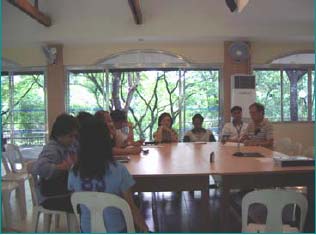
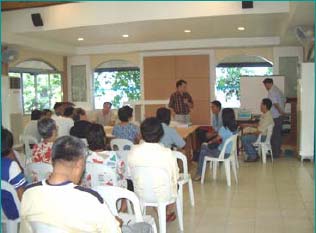
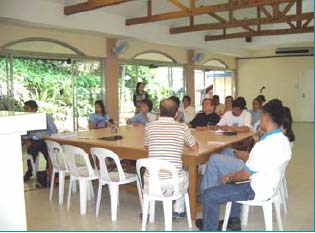
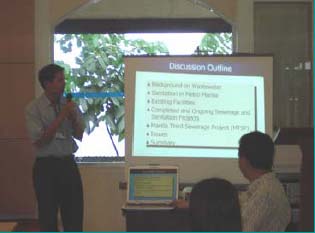
PICTURES TAKEN DURING THE MEETING
Attendance:
Manila Water Company Inc.
Christopher Calamiong Senior Project Development Officer
Ben Velasco
Senior Project Development Officer
EDCOP-LTI
Rolando Soncuya
Sociologist
Anacleto Suelto
Environmental Specialist
Joy
Tamayo
Public
Consultation
Coordinator
Wilva Lin Deocades
Facilitator
Ginelyn Mary Guanzon
Representative EMB, DENR
Note: Attendance sheets of participants with their signatures are attached to this report.
Location of STP The proposed STP will not be located at the left side of the FVR Loop coming
from Marikina, along the river banks before reaching Camp Atienza. (Sitio Olandes)
Loan Initial amount is 60 plus million dollars but World Bank suggested expanding the project
coverage. The amount increased to more than 100 million dollars. The terms of the loans on the
maturity and interest rate are still under negotiations. A participant pointed out that the loan will
be contracted by MWCI but ultimately the customers of the company will shoulder the payment
of the loan in terms of increase in monthly payments.
It was pointed out that the amount of the loan should be used also to produce potable water
because in these three barangays, the water supply is not for 24 hours. The high portions of their
areas have minimal water supply. In addition, the pipes are very old and rusty and if MWCI will
increase the pressure, the pipes might burst. If this combination is undertaken, their children and
grandchildren will also benefit from the project. It was pointed out that the total amount will be
used for a sewerage project and that amount is the total amount for the six project components. It
was suggested that the by-products of the plant namely water and soil conditioner be sold to
partly defray the water charge of 50%.
Time frame The loan is expected to be approved by World Bank around 2005 provided all the
necessary certificates, permits and other documents are in order. The whole project will be
implemented from early 2006 up to 2008. This particular component in QuezonCity - Marikina
STP will take around one year.
Desalination -- Any project to harness salt water into domestic water? Desalination is an
expensive process. MWCI is studying alternative sources of fresh water in Rizal to supply
additional water to its customers.
BY-products of STP --STP will produce sludge and water. The sludge will be further treated into
soil conditioner. The water may be used for irrigation, for fighting fires or for cleaning the streets
but is not recommended for domestic use. This is being done in UP where wastewater is being
used for irrigation.
Sludge After further treatment in the septage treatment plants, the solids will be delivered to the
lahar areas in Pampanga and Tarlac were MWCI together with the Sugar Regulatory Authority
are conducting tests for sugar cane. Presently, the company is giving the soil conditioner
produced in the Magallanes STP for free to anyone interested in the by-product.
Risks -- A person exposed to untreated wastewater has a higher probability of getting sick to
water borne diseases because of the presence of pathogens. It terms of aquatic life, high BOD
demand means that the dissolved oxygen in the water is being used in the decomposition process
of organic matter. Hence, aquatic life can literally be suffocated if the water system is highly
polluted.
Jurisdiction -- The roads of the subdivisions were already turned over to the government, who has
the responsibility of the maintenance of the drainage canals? MWCI is not sure but drainage
outside of subdivisions is either the jurisdiction of DPWH and the local government. MWCI has
jurisdiction over the sewerage system. A participant pointed out that the local government is
responsible for the drainage system.
Environmental charge All the households have septic tanks. MWCI has been collecting an
environmental charge of 10% for environmental projects such as desludging. Why are the
residents informed only now that MWCI is desludging tanks for free but has been charging the
residents long time ago. MWCI has been providing free desludging and is continuously giving
information of services available to its customers. A participant opined that the residents would
not mind paying additional water charges as long as they receive better services and continuos
water supply.
Basis of sewer fees -- Why pay additional 50% of basic charge if the residents have no separate
sewer line? In the feasibility study, the consultant considered the laying down of a separate
sewerage system and the usage of the existing drainage system and connect it into the STP.
Based on the costs, the second option is more economical and will result in a lower monthly cost
to the residents than the separate sewerage line.
Specific benefits -- In addition to the general environmental benefits what specific benefits will
the residents get from the project? The quality of water in the waterways will improve in terms of
lower BOD and coliform. In terms of health benefits, it could mean health care savings for
medicines and medical consultations that would have been spend by families to address water
borne diseases.
Government assistance -- Sanitation is a basic responsibility of government, why charge the
residents? Fifty percent of the basic water charge is excessive. Can other government agencies
contribute something to lower the charges? One of the purposes of this public consultation is to
get reactions, suggestions and recommendations. MWCI will study your recommendation on the
possibility of having some kind of government assistance.
The sewer charges are being levied on areas serviced by the sewerage systems of MWCI.
Presently, these areas are not being charged. However, once, the STP is in place, the residents
will be charged for sewerage fees. Why would the residents pay if residents in other areas
without sewer lines were not made to pay? MWCI should also look for the possibility of
charging all its customers for sewer fees.
Details of project -- The technical aspects of project will be finalized in the detailed engineering
stage. In this public consultation, the project concept is presented. MWCI is not still ready to
answer details about the project.
Fire hydrant The water supply department is the one responsible for this project. The barangay
chairman of Blue Ridge B has coordinated will Ben Penales, territory business manager of
MWCI and the cost is around 100,000.
The participants lauded the aims of the project. However, they expressed reservations on the
additional charges that will be levied on them once the project is operational. They also
requested additional detailed information including the financial analysis of the project.
Villa Salud Bangay Lower Bicutan,
Taguig City
Transcription of Public Consultation
Barangay officials and Residence of Barangays Hagonoy, Wawa,
Calzada, and Tipas Ibayo held on June 16, 2004 from 1-4 PM at
Villa salud Bangay Lower Bicutan, Taguig City, Metro Manila
MANILA THIRD WATER SEWERAGE PROJECT
Transcription of Public Consultation
Barangay officials and Residence of Barangays Hagonoy, Wawa,
Calzada, and Tipas Ibayo held on June 16, 2004 from 1-4 PM at
Villa salud Bangay Lower Bicutan, Taguig City, Metro Manila
The consultation workshop aims to present to stakeholders the existing sewerage
and sanitation conditions to arrive on a concensus at early stages of the project to
avoid conflicts which can harm the implementation and success of the project. With
these regard, it lead to the transparency of public and private actions, as these
actions are monitored by the different stakeholders. It also built trust between the
project proponent and the civil society, which lead to long-term collaborative
relationship.
Mr. Soncuya, a consultant of EDCOP-LTI, introduced the participants from EDCOP-LTI
and Manila Water Company Inc. (MWCI), explained the purpose of the public
consultation and the environmental impact assessment (EIA) process. This public
consultation, as part of the validation process of the EIA, aims to clarify issues and gather
opinions, suggestions and recommendations of stakeholders on the proposed Manila
Third Sewerage Project. Mr. Velasco, Senior Project Development Officer of MWCI
presented the background and proposed project. Mr. Suelto, another consultant of
EDCOP-LTI presented the results of the environmental impact study. After the two
presentations, an open forum ensued. The following are the highlights of this public
consultation.
Attendance:
Manila water Company Inc.
Lala
Fabella
Manager
Waste
Water
Department
Christopher
Calamiong Senior Project Development Officer
Erik
Elarmo
Senior
Project
Development
Officer
EDCOP-LTI
Rachel
A.
Vasquez
Project
Director
Rolando
Soncuya
Sociologist
Anacleto
Suelto Environmental
Specialist
Wilva
Lin
Deocades
Facilitator
Allen
Villanueva
Representative
DENR-EMB
Becky De Vera
Rerpesentative MWSS
Participants
35 out of 48 invitees attended the scoping session
Mr. Soncuya: Magandang hapon po sa inyong lahat. nais ko pong ipakilala sa inyo ah
magsimula po tayo sa manager ng Waste Water Department na si Lala Fabella, at ang
kasama niya na si Topet Callano at saka si Eric Melan. mayroon din representative ang
taga MWSS dito si Benny Rivera. At mayroon din po dito na representative ng
Environmental Management Bureau ng DENR si Allen Villanueva. So ah basi po don sa
ating agenda ah kanina po nagtatanong po ako kong sino po ang magbibigay ng welcome
remarks so, kinausap ko po si barangay Chairman Rolando Olazo ng Hagonoy at
mayroon pong tinuturo kasi dito na ini-rekomenda nya so, ah bigyan po nating ng
palakpakan si secretary Agapito Cruz ng Ibayo Tipas. (palakpakan)
Agapito Cruz: Di ko alam na kilalala ako ni Chairman Olazo sir. Ano po bang gagawin ko,
welcome address? Sige sa aking mga kababayan lalo na sa kagalang-galang na pinono ng
Hagonoy. Yung aming Chairman kasi nasa DPWH pa siguro ng propotesta, hindi po
may pinuntahan lang po doon para sa aming DPWH forecast. Sa kaugnay na sinasagawa
ngayon na public consultation kong saan mahalaga na maintindihan nating mamamayan,
kanina pa naming pinagusapan, ano ang posibling epekto ng Manila Third Sewerage
Plant. Kong saan na binabanggit ang ilang bahagi ng bayan ng Tipas o ng katipasan ay
gawing flood retention pond, sa madaling salita iponan ng tubig baha. Sa atin di na
kinakailangan mag ipon eh, kasi taon-taon kapag matinidi ang buhos ng ulan kahit
walang flood retention ponds lagi tayong binabaha. Actually umaabot sa tatlong buwan
an ating baha, mahal na mahal nga tayo ng tubig baha ayaw tayong tigilan.
Gayon pa man siguro mahalaga rin na makita natin kong ano ang kabutihan ang mga
advantage at kong ano ang epekto na itatayo ng Manila Third Sewerage Plant sa bayan ng
Taguig. Kaya po ang lahat ng ating kababayan na narito ngayon ay ating pong ini we-
welcome at kong maaari pag isipan po nating kong ano ba ang epektong idudolot ng
nabanggit na proyektong ng Manila Water. Kaya po sa lahat inaasahan ko ang inyong
aktibong paglahok, partisipasyon at masiglang talakayan at sana po yung ating gagawin
natin pagtalakay ngayon ay mag bunga ng mabuti at higit sa lahat at pakinabangan ng
mamamayan ng Taguig. Welcome po sa inyong lahat.
Mr. Soncuya: Maraming salamat po. eh a-outline ko lang po ang kong papano ang proseso
ngayong hapon. Una ho ay pre-present ko ang EIA process yung Environmental Impact
Assessment, pangalawa e pre-present po ng Manila Water yung project, pangatlo po ay
pre-present po ng kasamahan kong si Boy yung ah resulta ng Environmental Impact.
Sisimunlan ko na po, ah yung project ay pangalan eh Manila Third Sewerage Project, ah
ito po ay project ng MWSS at nang Manila waters. So, ah itong tungkol sa sewerage
system na explain sa inyo mamaya. So ang e-explain ko lang po ay ang proseso ng EIA
ano. So, lahat ho kasi, ah kumuha ng data at pumupunta ho muna sa mga communities na
ma-aapektuhan at nag -coconduct po ng scoping workshop, focus group discussion ng
mga stakeholders para maalaman ngayon ang direction na ang eifofocus nong study.
Ang eksakto nito, kunyari sa scoping session ay meron na e-voice out na nong mga ibang
residente na baka merong amoy, so ang gagawin po ng study ay pino-focus ho doon
kong ano ang iniisp ng mga residente na probable effects nito sa community so ito yung
proseso. Ang kinukoha nyan ay tatlo, biological, physical at social. So, biological may
epekto ba ito sa isda, sa physical merom po bang ah itong infrastructure nato, anong
epekto kunyari sa pagbaha at sa social kong ano ang impact sa tao.
So covered ho yung tatlong major component na yun. So, pagkatapos po na makakuha
ng mga direction basi po doon sa mga scoping workshop at saka focus group discussions,
kumukuha po ng baseline data collection. Ang lumalabas dito ay dalawang klase ho to
no, yung primary data yung sinasabi na gene-generate nong study ibig sabihin dyan eh
kong sa social ang pagkuha po nito ay interviews, ah pwede pong household surveys,
pweding focus group discussions with informants. So, kumukuha po ng data dito
kasama po ang biological and physical. Pagkatapos ho na makakuha ng data pumupunta
ho dito at ina-analyze ho yan. Ano po bang epekto, positive or negative doon sa tatlong
major components. So, kamukha ho nyan ang isang probable results nyan during
construction, maingay ho so ano ngayon ang ilalagay ho dyan yung mga impacts, yung
problable na epekto at sa saka anon ba ang dapat gawin para kong hindi man wala itong
mga masasamang epekto ito, ma-minimize. So, ito ho yung, pagkatapos ho magawa
lahat ito bumabalik ho ulit sa community. Ito po yung purpose ngayon ng consultations
naming ngayon sa inyo. Humaharap po kami rito para e-present po yung tatlong steps or
activities at pini-present ko sa inyo for validation. At nandito po kami ah, ipi-present ho
ni, ng kasama ko ho yung mga resulta noong magkukuha po naming ng data at saka ng
mga impacts dito. So pagkatapos po nito doon po naming epe-prepare yung final report
na esa-submit naming sa EMB Environmental Management Bureau, so e-rereviewhin
nila yan at kong sa akala ng EMB yung project ay medyo malaki masamang epekto or
controversial ang project ay sila ang nagtatakda ng final public hearing na talagang dito
tinatalakay yung mga serious effects ng project kong tutoloy. So pagkatapos ho noon
dalawa po ang pweding gawin ng EMB either approved or disapproved. Kong
disapproved ay compormi na sa proponent kong re-apply or approved e-isyohan muna ng
Environmental Certificate of Compliance, ito ho yung ECC. Ito ho yung kailangang
dokumento para masimunlan po yung project.
So, tapos, ah basi, yung ECC ho, ilalagay ho doon ang mga conditions na dapat gawin ng
project proponent para doon sa various stages ng development ho nila, so naglalabas din
doon meron din silang tinatawag na multi-partite monitoring team yung MMT na
compose yung ah kasama doon ang mga residente doon at mga barangay officials na mag
momonitor na yung conditions ng ECC ay sinusunod ng project component. So
maglalahad din po ng monitoring fund na para tumustos ho yun doon sa monitoring team
at saka kong kakailanganin po magpuput-up po yung project proponent pag inatasan po
ng EMB ng Environment Guarantee Fund ngayon po ang pundo na kong meron pong ma
accidente or masamang nangyari na galing po doon sa project, yun po yung ah
magagamit para ma compensate or e-ayos ho yung masamang epekto nong project. So in
summary ganito po yung proseso. So andito po tayo sa validation. Ah yun ho ah kong
meron pong tanong pwede po muna nating bigyan ng pagkakataon yung presentation
nong ah project plus yung resulta ng EIS bago tayo mag tanong. maraming salamat po.
Christopher:
Good afternoon po ako po si Topet representative po ng Manila Water.
Ah siguro isipin ninyo pag sinabing manila water, tubig lang. So, ngayon, ah medyo na
parang nakakalimutan din natin na yung ginamit nating tubig eh may epekto din sa atin.
So kailangan dapat din natin na pangangalagaan ang ating kalikasan. Ah, kamusta
naman po ang tubig nyo dito? ang supply ok naman po, buti na naman po wala tayong
problema doon. So ngayon kami po sa department namin ang waste water department
kami po ang mangangalaga ng tubig na nagamit na, so di lang po porkit nagamit na natin
ay kakalimuntan natin yujng napanggamitan natin basta nagamit natin ok na, hayaan mo
na. Pero dapat ngayon maging ano tayo aware kong ano ang nangyayari sa tubig na
ginagamit natin. Ito pong project naming at covered ng Manila Third Sewerage Project,
ito po ang tawag sa project namin na marami po itong components. Ah, ito lang po ang
magiging outline n gaming discussion. First is yung background ng waste water ito po
yung ginagamit natin na tubig after effects, second is sanitation dito sa metro manila
kong ano na po ang nangyayari, and pangatlo yung mga existing na facilities na mayroon
na tayo dito sa metro manila and third is yung mga nagawa na naming na project at ang
mga nangyayari ngayon na project na ginagawa namin para doon sa other projects namin.
Then yung panglima is the Manila Third Sewerage Project, itong project na to. Ede-
discuss din po natin na yung issues na na kinabibilangan natin din yung summary nong
mismong presentation natin.
Waste water, pag sinabi po na waste water ito pon yung nagamit na tubig. Katulad po ng
nakalagay sa example natin ito po yung pinag-ligoan natin, pinag flush ng toilet, pinag
hugasan ng plato, yung pinag labahan. So pag dumaloy na po yun sa ating ah system
lumabas na po ibig sabihin iyon po ay waste water na. Ito po ay, malalaman po natin na
ang untreated waste water ay nagiging sanhi po ng sakit sa atin. Di lang po natin alam na
yung mga sakit na nakukuha natin ay sanhi din po ng waste water. Which is hindi po
natin alam, dahil sympre mga lamok na mamahay dyan sa atin din ang bagsak noon. So,
ito ngayon ay nagiging, masamang, nagkakaroon ng masamang epekto sa ating
environment. Sympre di natin masyadong napapansin yun, pero unti-unti lalong
napapasama ang environment natin, dahil din sa atin sa sarili natin.
Next is ito po yung sample ng septic tank, siguro kalimitan sa atin sa mga bahay natin, eh
ang bahay natin ay may septic tank na. So, ito po yung proseso, pagpasok po ng flush na
tubig sa unang chamber po is yung mga dumi ay nag se -settle lang po sa baba, iniipon
niya po yun , then yung tubig na somosobra is ah dumadaloy na po sa kabila hanging mag
settle, magkaroon ulit ng settling tapos paglabas po tubig na po na sinasabi na malinis na,
treated na. Pero hindi ho ibig sabihin na pag lumabas na sa septic tank ay malinis na po
yun, na harmful pa rin po yun wala na po yung mga solids pero yung mga lumalabas na
tubig doon ay medyo nakaka epekto pa rin po sa ating environment. Next... Ito po yun
sa isa sa mga ahhh sanitation na nangyayari sa atin yung mga ibang area natin na may
sanitation ay ganito po ang nangyayari. Nang-gagaling po siya sa may mga bahay, mga
residente sa mga commercial centers, ah mayroon po silang mga pipelines ahh ito lang po
ang masasabi ko, magkaiba po ang drainage at saka sewerline. Ang drainage po is yung
mga rain water yung mga tubig ulan doon po dumadaloy, ang sewerage line doon po
dumadaloy yung mga galing septic tank yung madudumi po, pero kalimitan po dito sa
metro manila is drainage line din po ang pinag dugtongan ng septic tanks natin kaya
medyo malaking deperensiya. So yung mga ideal na sanitation is yung mga katulad sa
makati, ah para ipalaalam ko po sa inyo, yung makati yung central business district, yung
mga building doon ay konektado po siya sa isang sewer line na papunta po sa magallanes
treatment plant.
Ang Manila Water po meron po Magallanes Treatment plant na tipo pong parang ganito
siya, nadadaloy po siya sa isang linya, mayroon po siyang parang area na paglalagayan
ng tubig, dito po tini-treat yung dumi na tubig after that ilalabas na po niya sa isang sa
may likod po eh naglalabas na po siya ng malinaw na tubig. Hindi po siyang pweding
inomin pero pwede na po siyang pang dilig basta wala lang po siyang contact pero
malinis na po yun na nag aano na po yun sa DENR na pwede na pong pang diling ng
halaman, pag linis ng mga ano nang mga lupa basta po pwede na syang panglinis. Ok, ito
na po ang conditions natin sa Metro manila ah medyo nagkakaroon na tayo ng problema
dahil nangayayari ngayon sa mga syudad is wala tayong plano, lack of planning. Naging
polluted na yung water waste natin katulad nalang po kong titingnan po natin yung ilog
Pasig ah Taguig river medyo madumi na ho. doon po kasi napupupunta ang ating dumi
yung mga drainage system natin papunta sa Pasig kaya ganito po ng nangyayari. Ang
sanitation condition po dito ngayon dito sa Metro Manila is kalimitan po sa ating ah
covered po ng septic tanks. Yung pong sinasabi ko kanina septic tanks lang po ang
kalamitan sa atin. And yung sewerage system na covered is only 3% so maliit lang siya.
Ito po yung sinasabi ko na covered na area ng Sanitation natin, kong titinganan niyo,
kong papansinin niyo po eh medyo po maliliit lang po yung area. Kami po dito sa Manila
Water ah unti unti po naming kino-cover yung area para atleast magkaroon po nang
magandang kalalabasan ang ating Environmental Assessment. Meron po sa Manila
Central Sewage System sa Dagat-dagatan. Ito po yung covered ng Maynilad Water yung
sa kabila po yun. Yun pong sinasabi ko kanina yung sa Magallanes yung mga communal
septic tanks na maliliit sa Quezon City. Ito po ngayon ang on-going projects ng Manila
Water, meron po sa Manila Second Sewerage Project, World Bank po ang nag fu-fund sa
amin. Then yung Pasig River Rehabilitation which is yung 36 vacuum tanks, ito po yung
ala malabanan na nagsisipsip. Naka pag order na po kami para umikot po sa aming
concession area para sipsipin po yung mga septic tanks ninyo. Ito po yung Second
Sewerage na sabi ko bago naging Manila Third bali second muna meron po kaming
maliliit na project na nagkalat po sa boung concession area namin . Meron po tayong 28
na waste water treatment plants na ang iba gawa na yung iba ginagawa pa lang, pero ito
po yung Manila Second Sewerage Projects. Sa, meron din po tayo sa Pasig River
Rehabilitation project yung septage treatment plant, ito po yung ang septage treatment
plant ito po yung pinaglalagyan nong mga dumi na nasipsip ng mga tanks natin. Yung
sinabi ko na disludging tanks umiikot sa boung concession area ng Manila Water dito po
natin ilalagay yung mga dumi. Di po kagaya ng sa malabanan na pagsinipsip, kunyari
nasiraan sila doon din nila itatapon sa may drainage di ba, so bale wala din epekto. Kami
po dito sa manila water pag ka sipsip po we make sure na sa itataponan namin eh ma-
tretreat pa rin siya. So ang magiging end results po ng septage treatment plants is isa siya
sa magiging soil conditioner na pweding gawin sa halaman na pataba at saka yung po
yung pwedeng gawin na lalabas sa septage treatment plant. Ok sa Manila Third
Sewerage Project eto po yung pinaka target namin is to reduce pollution loading to rivers
kasi kalimitan nga po katulad ng sinasabi ko, yung lahat po ng dumi natin ay napupunta
lang sa river, pansinin po natin e lahat ng rivers natin ay madudumi na. So next is yung
meron po kaming mga sewerage and sanitation projects na nang yayari ngayon katulad
po ng MTSP eto po yung ginagawa namin na kilos para at least ma minimize po yung
problema natin. Eto po yung mga components ng Manila Third, Taguig Sewerage
System eto po yun, etong apat na dike lalagyan po namin ng treatment plant so magiging
double purpose po yung ano natin yung ponds natin........kasama po natin yung pag pigil
natin ng baha then lalagyan lang po natin ng isang maliit na planta para lahat ng dumi na
lumalabas doon sa laguna lake is e-treat po namin yung po yung Taguig
Sewerage System tapos yung sa River banks naman po ganon din po... pili lang po sa
area ng river papunta sa Pasig river etetreat din po namin. So sunod po yung upgrade of
existing sewer line sa Camp Atienza po magtatayo din po kami then Sanitation for Low
Income at Septage Treatment plant kagaya po nong nabanggit ko.. ok eto po yung
activities namin pagdating don sa construction ng waste water treatment plant...eto po
yung treatment of combined flows...pinagsama na po yung isang linya di ba sabi ko
hiwalay ang linya natin isa po sa drainage isa po sa sewerline ang ginagawa po namin.
Meron pong isang ano isang systema na pagsasamahin na po yung linya na magkasama
na po yung drainage and sewerline so ganon po ang gagawin namin sa Taguig system.
Imbes na mag hukay po kami sa buong Taguig na para gawan po ng sewer line e yung
mga drainage system nalang natin ang gawin nating linya. A magkakaroon po ng konting
rehabilitation pero at least meron napo tayong existing lines na maglalagay papunta po sa
mismong ponds natin at saka yung pangalawa yung upgrade of communal septic tanks
for proper treatment. So siguro po yung mga communal septic tank eto po yung Quezon
City part pero mas concern tayo dito po sa Taguig area. At ito pa po ang mga activities
nandyan yung collection of septage from household septic tank so ito po ah pag dating
ng mga 36 vacuums tankers namin mas mapaigi pa namin ang pag didislugde. So kong
kayo po ay na sa concession area namin pwede kayong tumawag sa hotline namin na
1627 para mag pa disludge. Ito po ay may minimal fee pero pag nakasama kayo sa
schedule namin sa disludging. Halimbawa kasi po per barangay po ang ginagawa namin.
So kapag na schedule po yung barangay ninyo ng pasipsip ah libre ho yun pag schedule.
Pero pag emergency po halimbawa po pag tumawag kayo sa amin mayroon pong
minimal fee kayong babayaran kapag hindi po kayo schedule.
Ito po yung sanitation for low to middle communities. Ito po yung ginagawa naming
project ngayon sa mga maliliit na barangay na medyo maliliit ang kanialng kinikata.
Kinakailangan din po namin ang activity na magkakaroon po silang sanitation. Hindi
porket maliit lang ang kinikita nila pababayaan na lang natin sila ng ganoon. So meron
din project ang manila water para doon sa sanitation ngmaliit na barangay.
Ito po yung nabanggit na septage treatment plant, na dalawa ang ginawa namin. Ito po
yung sa north area sa may banding Quezon City at meron din po doon sa South dito po sa
may FTI area. Ok, ito po yung mga issues na na-encounter namin dito sa MTSP yung
tungkol sa land, syempre ho sa ngayon mahirap ang maghanap ng lupa na pag tatayuan
ng ano. So kami po nakikipag-coordinate sa mga LGU's at sa mga barangay saka sa
Mayors para atleast mahanapan kami ng area na mapaglalagayan na lupa ng planta.
Then, ang pangalawa ay yung cost. Meron din tayong maliit na babayaran para doon sa
services na ginagawa doon sa sanitation. Then, pangatlo ang Environmental Impact
Assessment so kailangan na ipa-ano sa mga tao ipataggap sa mga tao na mayroong
nangyayari na unti-unti sa ating environment na di natin alam. So kailangan maging
aware tayo tungkol doon sa part nayon. Kaya nandito po kami para bigyan kayo ng isang
workshop atleast magawa kayong aware doon sa pagkakakroon doon sa environment
natin. Then next is yung social impacts, syempre yung pagtanggap doon sa planta kasi
hindi kagaya natin paggamit natin ng tubig hindi na natin alam o walan na tayong
pakialam. So atleast dito ginagawa namin kayung aware doon sa areang yun. ok.
Summary, ito po yung water pollution due to the wastewater is one of the city present
problems. So, hindi po ng LGU's natin hindi masyadong mapag tutuunan ng pansin
pagdating natin sa water pollution. Mapapabayaan na po natin yun. So kailangan din
natin maging aware doon sa mga nangyayari sa paggamit natin ng tubig. Then, second
the on-going initiative are insufficient to the wastewater problem, so ang ginagawa nating
solution yung pa unti-utin lang hindi lang pang kalahatan. Kaya kami dito sa manila
water ginagawan namin ng paraan na masakop yung boung concession area namin para
ma-resolve ang pollution sa nangyayari dito sa ating concession area. Then, pangatlo
MTSP will help expand the provision of sanitation of sewerage services. So, MTSP
malaki po ang coverage area namin so, ito pong sinasabi ko pong naka lista, meron po
tayong sa Taguig, meron po tayo sa Quezon city. So lahat po ng area of concerns ay
ginagawan po natin ng paraan. Pang-apat is education and policy issues who make us
challege. Katulad po nito ah unti-unti po namin pinopulong yung mga barangay para
atleast maging aware tayo sa environment natin at paggamit ng mga tubig natin, yun po
lang. Kung magtatanong po ah siguro po pagkatapos namin lahat saka tayo mag
Question and Answer. Salamat po.
Mr. Soncuya: Maraming salamat po, ang susunod po na mag-present ay si geologist Suelto.
Epe-present po niya yung specific na mga results ng study natin. So heto po siya.
Anacleto Suelto:
Magandang hapon po sa inyong lahat ako po si Boy Suelto, kinatawan po
ng EDCOP-LTI. Kami po ang inatasan ng MWSS at MWCI upang mag conduct po ng
Enviromental Impact Assessment ng MTSP. Ito po yung proyekto namin, ito pong pag-
aaral namin ay nagsimula pa po ng Nobyembre noong isang taon. Siguro po ang nag
explain na kasama ko yung sa EIA system mayroon po siyang binggit na workshop at
saka ng FGD noong April po yata. Pumasyal po kami dito sa Tipas Ibayo, yung
kasamahan po namin na si Dr. Roquia o si Jojie para magtanong kung ano yung mga
issues na maari naming talakayain sa aming pag-aaral. Bukod doon noong November,
meron po bang naka-attend dito noong Nobyembre ng workshop na ginanap sa Quezon
city, meron po ba. Kasi po noong Nobyembre nag held po kami ng workshop. Ito po
yung lahat ng barangay na nasasakupan po nitong project ay inimbitahan po namin upang
dumalo sa ganitong workshop para makunan ng mga opinon at issues. So pag katapos po
ng scoping at yung mga consultation o initial consultation po namin sa inyo dito po kami
nag umpisa ng aming pag-aaral o ang tinatawag naming baseline study o eco profiling.
Pinuntahan po namin lahat ng mga project nga mga projects ng MTSP at dito po katulad
nito ito ang Taguig flood retention pond, ito yung Taguig river na sa tabi yata ng pond.
Nasa kaliwa yung pond so kinunan din nsmi yung construction ng DPWH sa labasan. Di
lang po yan ng sampling po kami nagpunta kami sa Laguna Bay at nag kuha po kami ng
samples sa sediment sa lawa, tapos po sa water bodies natin kinunan namin ng samples
ng tubig para pag-aralan. Yan po, ito po yung sa Hagonoy. So ito po, ang pinagusapan
natin dito ay ang wastewater po. Dito sa area ng Taguig sewerage system ng MTSP
kumuha po kami ng samples ito po yung makikita ninyong berde, kumuha po kami ng
isang sample dito po sa may sapa bago pumasok sa ng lawa at saka doon mismo sa may
lawa. So mayroon dyan sa Hagonoy, meron po sa Taguig, meron po sa labasan, at meron
po sa tapayan.
Siguro po bago tayo mag patuloy e-explain ko lang po para klaro po sa inyo yung
explaination po kanina ng aking kasama natin sa MWCI. Yun pong ito po ang Taguig
ito pong Taguig Sewerage System po siguro po ilan sa inyo aware, na ang plano po kasi
ng MWCI ang DPWH po ay gumawa ng pong mga retention ang tawag po ay flood
retention ponds. Ang concept po ng MWCI ay yung flood retention pond po kapag tag-
araw, kapag tag-araw alam naman natin po na pag tag-araw mahina ang ulan. So
karamihan na lumalabas dito sa mga water waste ay karamihan galing sa mga domestic
wastewater. So ang koncepto po nila kapag tag-araw po at hindi naman malaki ang tubig
sa halip na dumiretso po yung wastewater sa lawa eh cupture po nila ito, eh bubumbahin
po nila ito bago dumating sa flood gate. Dadalhin muna po dito sa retention pond at dito
nila e-tetreat yung po yung konsepto po doon. So ang ibig sabihin nila yung structure po
flood retention ponds ito po ay sa DPWH ang gagawin lang po nga MWCI ay parang
makikigamit lang po siya dito sa mga flood retention pond tuwing summer. Kasi po
kapag tag-ulan alam naman natin na gagamitin ng DPWH ito for flood protection pero
kapag summer kasi mahina po yung tubig, binubuksan po yan so sa halip na buksan po
yan para bago lumabas po yung tubig na marumi ma e-treat muna doon sa planta. So
parang ganoon po yung concept ng taguig sewerage project po ng MWCI.
Kasama po doon sa pag-aaral namin, meron po bang nakatangap po ba sa inyo ng
survey? may pumunta po ba sa mga bahay ninyo tungkol dito sa project na ito. Meron po
bang nakapag ano, meron kasi kaming pinapunta mga surveyor na ng tanong po tungkol
po sa social status po. Marami pong tanong na iyon ah siguro po sa boung project po
kumuha po kami ng isang daan at sampung respondents pare interviehin po. So, ang
pinaka tanong naimn, isa sa tanong namin yung kong aware kayo sa project ng MWCI.
Yung lumabas po doon sa one hundred ten ang lumalabas po ay almost kalahati 51% po
ang may kaalaman kahit papano meron narinig na nila ang project at yung almost kalahati
48% ay hindi pa. So, meron po kaming isang tanong kong sang ayon po ba kayo sa
project? ito po ay random hindi po ito lahat random survey lang po ito. Doon po sa
lumabas sa aming survey ah more or less almost 80% po yung sumasang-ayon doon sa
proyekto ng MTSP ng MWCI. Ano po ba yung mga dahilan kong sumasang-ayon po
sila, ito po yung halos na dahilan, bawas sa pollution, well, magkakaroon po ng sewerage
systems, makaka tulong po sa kalusugan at saka overall po sa barangay mabibigayan ng
benipesyo. Doon naman po sa di sumasang-ayon ang karamihang pong sagot nila ay
tungkol sa dagdag na gastosin. Marami pa po kaming tinanong pero iton po yung pinaka
importanting tanong na pwede naming present sa inyo ngayon.
Doon po kanina, nabanggit ko po na nag water sampling po kami ano kasi ang primary
purpose po nitong mga retention ponds po ay e-treat po ang mga tubig po na marumi,
specifically po yung Biological Oxygen Demand. Dito po yung BOD pag anmg isang
bagay po ay nabubulok ito po ay nangangailangan ng oxygen para ma decompose po
siya. So pag ka malaki ang BOD ng isang tubig ibig sabihin malaking ang kailangan para
mabulok yung mga decomposable na bagay so, nababawasan yung oxygen ng tubig doon
sa study namin halimbawa dito sa Hagonoy creek ang BOD dito sa taas along the
channel pa, wala pa sa lake ay lumalabas na 82 mg/l ito po ay mataas compare po sa
standard na binigay ng DENR which is maximum is 10 mg/l. Dito po sa lake sa lawa na
29 medyo mas mataas pa rin sa 10 na seni-set ng DENR. Pag dating po dito sa Taguig
river ang BOD po na lumalabas sa analysis ay 227 mg/l almost 20 times mas mataas sa
standard ng DENR 87, dito din sa labasan medyo lumalabas pa rin po sa standard ng
DENR. Suma total ho talagang masasabi natin na polluted na ang river natin pati na ho
yung lake na medyo mataas taas na rin ho humahabol na rin 87 na po. So bukod doon
ang isang tinitingan nong wastewater treatment plant ay para bawasan ang total coliform.
Siguro po aware naman kayo coliform, yung naririnig nyo po sa TV ang pag ka diarrhea,
yan yung number one cause normally yung sa coliforms. So ang standard ng DENR ay
nilalagay sa 5,000. Ang lumabas sa study namin umaabot sila sa mahigit 160,000 ang
analysis. Merong 500 ito sa lake na ito pero normally ang sa lake medyo mas mababa
kasi medyo dilluted nayan eh kasi na sa labas na sila. Pero ang nasa creek natin katulad
dito sa Hagonoy 160,000, Taguig river ganoon din, ganoon din sa labasan at sa Tapayan
160,000 most probable number per milli-liters. So yung po ang lumabas sa study naming
sa water quality. Doon po pala nong pumunta po kami sa Tipas nakipag Focus Group
Discussion po kami, ito po yung lumabas na issues and concerns na binigay po sa amin
ng mga barangay councils ano po. Ito po yung issue wala nga po silang functional sewer
lines saka wala yung ibang lugar wala talagang sewer lines so meron po silang nilagay na
recommendations. Ito po yung formation dissemination katulad po nitong ginagawa
naming na consultation, ah mobilization of man-power for the construction of the
sewerage lines. ah ang pag kakaintindi ko po doon sa meeting na binasa ko po yung
minutes ito po yung kong sakasakali magkakameron ng malakihang project yung MWCI
kong magtatayo po sila ng sewerline ay maging bahagi po sila ng construction yung mga
barangay citizens po. Affordable sewerage fees and commendable services at saka yung
time frame nong project. Siguro na explain na rin po sa inyo kanina na yung project po
ay 2005 yung financing so kong, mabibigayan ng pondo ng World Bank ang MWCI mga
2006 to 2008 yata yung time table para sa boung project hind lang itong Taguig
Sewerage.
Punta po tayo dito sa tinatawag na Impact Assessment. Dito po sa impact assessment
hinati po namin sa dalawang stage yung project, habang ginagawa po yung project at pag
nag o-operate na po ang project. So habang ginagawa yung project sa aming pag-aaral
siguro masasabi nating na wala naming sigurong epekto habang ginagawa yung
construction. Kasi unang-una nandyan na ho yung flood retention ponds na ginawa po ng
DPWH. Ang gagawin lang po nang MWCI ay maglalagay lang po ng bumba para kunin
yung tubig na mangagaling dito sa mga river o sa mga channels para lang dalhin dito sa
mga retention ponds. So lumalabas sa pag-aaral naming na wala namang magiging
epekto habang ginagawa ang project. Yan po ang mga retention ponds na gamit sa flood
control ay nagawa na ng DPWH. Ang lalagay lang po dyan ay ang mga pumps para mag
irate aeration pond po ang lalabasan non at maglalagay lang sila ng maliit na parte para
ilagay lang yung control panel. So pag dating naman dito, habang kong sakali nag
operate na po ito ang treatment plant nila o sewerage pond, ang nakita naming na maaring
epekto ay yung perception ng ibang tao yung amoy. Sa tingin namin di naman siguro
magiging significant yung amoy. Unang-una yung amoy sa retention ponds kasi ito lang
po yung tubig na nanggaling sa mismo sa creek so, ang amoy nito di na rin naiiba sa
doon mismo sa creek. Ang ginagawa rin kasi naming habang tenitreat siya ay ini -aerate
lang para mabawasan yung BOD at saka yung total coliform kasama din po pala sa
proseso meron din silang gawin na di-infection para bumaba yung coliform bago nila
ibalik sa Laguna Lake. Ito po yung pangalawang issue na maaring maka apekto sa
mamamayan dito po. Kasi gaya ng sinabi ko po yung paggamit ng retention ponds ay
tuwing tag-araw lang po. Kasi pag dating nag tag-ulan ang gagamit na po yan kasi ang
unang gamit po ng mga retention ponds ay para flood. Parang makikigamit lang po ang
MWCI tuwing tag-araw siguro sabihin nating kalahating taon pagka di masyadong
umuulan para ma treat yung karamihan na lumalabas na wastewater. So ang mangyayari
nyan kong mag-operate sila tuwing tag-araw ang magiging epekto nyan ay isara nila ang
flood gate kasi kong hindi, di nila ma e-cupture yung tubig at di nila ma treat. So, yung
po ang nakikita naming magiging epekto. Unang-una sa tingin ko po dito yata sa apat na
ponds ninyo ang pinaka-malaking river po na ay sa Taguig. Ang pakakaintindi namin ay
parang itong Taguig river ay dinadaanan nang mga fisher folks ano. So, ang mangyayari
po nyan dahil masisiran po habang nag-ooperate po ang MWCI kong maisara yan
mawalan po sila ng access. Yung po ang magiging epekto mostly sa fisher folks. So,
kasi pag tag-ulan naman po alam naman natin kasi ang concept po na nakikita po ng
MWCI kasi ang control po ng estraktura ay naging responsibilidad ng DPWH kasi sa
kanila naman po yung structure. So anytime during sa tag-araw may biglang makameron
po ng flush flood so kailangan talaga po mag give-way yung sewerage treatment para
gamitin uli yung ponds ng DPWH. So yun lang po, pagdating sa solution so alam natin
na kong masara mawawalan ng access, di ko lang po alam, ang nabasa po naming doon
sa EIA ng DPWH para mitigate po yung problema. Ang access ng fishermen ay balak
nila magtayo yata nong parang wharf dito yata sa may lawa para magkaroon ng station
yung mangingisda kasi baka makukulong sila kong di sila maglalagay ng temporary
wharf. So, ang solution lang naming dito kailangan malawakan at masusing kompanya
para mailahad sa kanila ang mga benipesyo ng proyekto. So ano ang maging benipesyo
nito.
Purpose ng Sewerage pond treatment pond ay para mababa yung BOD at total coliform
levels. So, sympre kong alam natin na kapag malinis-linis na ah malinis na ang tubig ay
ikalilinis din nito ng tubig na papunta din sa lake. So, mas malinis na tubig sa lawa ay
makipag-ibayo sa ecolohiya to the enhancement to the environment lalong lalo na doon
sa lake na nagbibigay din naman ng kabuhayan sa mga nakikinabang. Yung po kong e-
sumarized po natin yun po ang pinaka beneficial na maibibigay ng project na ito. Bukod
po doon meron din pong Health benefits po ito dahil malinis na ang tubig na yung ma
tetreat ng waste water. Kahit papano o ito ay maka dagdag din sa kagaganda din ng
kalusugan. Finally po dahil ah doon po sa EIA para mabawasan kong ano mang epekto
ang maidudolot ng proyekto kong ere-require po ng EMB po ito kong may masamang
epekto ang proyektong ito sa mamamayan o sa palibot po at meron pong itatayo po ang
proponent ito po yung Environmental Guarantee Fund. So ito lang po ang aming
presentasyon sa araw na ito. Maraming salamat po. (palakpakan)
Mr. Soncuya:
Maraming salamat ho. ah pwede na po nating simulan ang open
forum alam ko po na medyo meron kayong mga tanong dyan. Kong sino po ang may
tanong pwede po bang lumapit dito sa mic na to. Pwede po tanong, suggestion, comments
ah kong ano man po ang iniisip nyo, pwede na pong magsimula.
Community Resident:
Magandang hapon. Ah tatanong ko lang kong magkaroon
na nang sariling sewer ang manila water di na kayo magtatapon sa Laguna lake kasi ang
programa niyo is year 2015. Pagdating ng 2015 marami ng tao dito sa Metro Manila di
na makakayanan ang pagtatapon ng wastewater sa Laguna Lake. So, pagkagawa na po
ba yun sa year 2015 sariling ninyong sewer din a kayo magtatapon sa laguna Lake. Kasi
sa pagkaalam ko meron na kayong sariling ano. Pangsamantala lang pala itong gagawin
niyo sa retention pond ng DPWH hindi pala panghabang panahon.
Christopher :
Parang ganoon na rin po ang mangyayari kasi po itong ginagawa
namin ngayon eh kung toto-osin ay maliit na project lang. Kasi nakikisakay lang po tayo
sa project ng DPWH. Pero itong sinasasabi, yung pinaka solution namin so malaki po
yung coverage niya pero maliit lang po ang pondo. Pero habang tumatagal syempre
dumadami po kayo ah magkaroon din po, na fo-forsee na po namin na magtatayo rin po
kami nang sariling naming treatment plant.
Community Resident: Ah kasi sa ngayon ang Tipas River gagawin ninyo munang pang
samantalang sewer system ninyo. Yung wastewater sa mga household doon pupunta sa
Tipas river tapos ete-treat ninyo papuntang ano kasi ang Manila Water is kasi nag
babayad po kami ng tubig tapos magbabayad din kami ng sewer di ba, kong ilang litro
ang ginamit naming yun din ang itatapon namin. So ngayon pang gumagana na yung
sewer ninyo gaano madadagdag yung sa binabayad naming sa tubig.
Christopher: Ang ano po natin, halimbawa gumagamit tayo ng tubig. Ang napupunta
po sa wastewater po namin is 70% po nong nagagamit nating tubig. So ang magiging
charging scheme namin dito po sa mga nagiging, na cocover po ng sewered area,
halimbawa po nagawa napo yun maco-cover na po kayo ng sewered area namin.
Magkakaroon po tayo ng 50% charge sa water charge po nila.
Community Resident:
Tataas po talaga ang babayaran.
Christopher: Meron po kasi po ito po ay isang serbersyo rin na dinadagdag bukod po sa
water service, meron din po tayong sewerage charge.
Community Resident: Dapat naman talaga kasi para sa magandang serbesyo. So ang
Tipas river pang samantala lang pong gagamitin. Hindi pala habang panahon. Yun lang
po. salamat
Community Resident: Tanong ko po tungkol po doon dahil pag-isahin na ang sewer at
yung drainage. Papano naman po sa amin na wala naman kaming drainage. Wala
kaming drainage kaya ang aming area eh bale mga tubig na nang gagagaling sa mga
households ay naroroon lahat sa kalye. Yun ang problema namin, wala pa kaming
drainage papano namin magagamit yung sewer.
Christopher: Di naman po namin pweding pabayaan na po naming ang mga walang
drainage na mag tapon na rin sa canal o ano sa esteryo. Syempre kami po sa Manila
Water ere-rehabilitate din po namin kasama po ang DPWH ere-rehabilitate po namin ang
drainage line ninyo. Kasi yun po ang area of concern namin eh yun narin po yung pang
catch namin ng maruruming tubig papunta po dito sa dike. So together with DPWH e-
rehabilitate po naming yung mga may problemang area po. Di po pweding pababayaan
po yung area ng ganon lang. Unti-unti lang po yun ha kasi di pu-pwede bubutasin namin
ng sabaysabay kasi mag tra-traffic ho kayo. Siguro strategically bawat area ere-
rehabilitate din namin yun.
Mr. Soncuya:
Matanong ko lang ho ano po ang area sa inyo at saka ano ...
Community Resident: Natividad, barangay Ibayo Tipas. Ah pwede po bang sabihin
muna natin yung pangalan natin. Sige po.
Felix Catigay: Ako po si Felix Catigay ng barangay Ibayo Tipas. Susunod ko lang po
doon sa ilang statement nag mga kasama ko. Kasi nanatiling fairy tales sa amin yung
mga ganyang proyekto, kasi alam namin na maganda eh talaga naman na napaganda ng
mga ipinapangko. Pero nananatiling fairy tale dahil unang una sa dinami-dami na
pinapangako ng ating mga local governments pati yung mga ahensiya, minimal po yung
natatanggap naming binipesyo. Halimbawa sa 100% na pinagako ninyong maganda
parang ang binipesyo lang namin eh yung nalaman namin na may pag-asa. Pero yung
katuparan nong mga proyekto ay nananatiling vague pa kasi unang-una paano
mapapakinabangan yung retention pond doon sa Labasan River kong saan malapit kami
dahil sa Ibayo Tipas, kong yun namang tina-target ninyo magiging e-filter ninyo ang mga
dumi di makakarating doon. Dahil unang-una barado ang mga ilog namin doon pa lang
makikita na doon ang mga dumi na doon na na-decompose dina talaga nakakarating doon
so kong siguro mas maganda na maluwang yung rivers namin talagang mapakinabangan.
Pangalawa yung sinasabi na mga drainage system, meron talagang naka programa na
drainage system, di naman sinabing wala eh meron kaya lang palpak. Ibig sabihin di na
pakikinabangan, napupundohan ng maraming pundo, nasasayang, di namin
napapakinabangan ng husto. So dalawang problema barado yung mga ilog namin di
napapakinabangan ng husto. Pangalawa di maganda yung papagawa ng mga canal,
although mayroong programa pero di maganda ang pagkakayari kaya hindi
napakinabangan mabuti. So sa tingin namin siguro isama, suggestion namin di lang
katanongan isama, ilagay na plata porma pasama ang pagpalinis ng mga ilog namin kung
saan doon talaga magsisimula ng ano eh yung pinakaparte ng programa kasi magpagawa
ka kaya nang tulay doon sa wala namang tatawiran ang tao hindi ba. Magpapagawa ka
ba ng treatment plant kung di naman makakarating doon ang mga basura na ete-treat mo.
So yun ang problema namin sa barangay Ibayo. Siguro ... unang-una kami yata yung
catch basin doon na pag umulan nandoon yung tubig pag nag-summer nandoon pa rin
yung tubig. So walang access yung tubig na nandoon sa basin namin papunta po doon sa
tinatawag ninyong retention ponds. Na isa rin sa mga binigay sa amin noong deliberation
pa tungkol dito sa dike, yung mga sagot sa baha namin yun. Na pag umuulan wala ng
baha sa amin. Ang katanongan po namin paano po yung mga tubig na naipon sa amin na
di naman lumalabas kung summer so nandoon pa rin sa amin yung baha. Hanggang
ngayon hindi pa rin sinasagot sa amin yung katanungan nayun na nagsabi bigyan natin ng
magandang pansin ang ilog ninyo para kung maipon yung tubig sa ilog ninyo pagdating
nang panahon kahit mababa na yung tubig sa may lawa aagus ng kusa. Hanggang
ngayon wala parin katuparan dahil barado pa rin ang ilog namin at naglaan na ng
programa palpak pa rin yung nakaraan ng project ng DPWH na pag huhukay ng ilang
creek sa amin na talagang nawaldas lang ang pera. So ang suggestion namin isama talaga
sa plata porma hindi lang yung talagang programa ninyo na magkaroon lang ng retention
pond kundi ilagay doon sa mga provision na ipa hukay yung mga ilog na talagang
kasama doon sa programa. Hindi na para bang isang parte lang na saka na natin gagawin
yan matapos muna yung pond tapusin muna yung mga pond na yan yung mga treatment
plant bago natin ayusin ang mga ilog. Ang suggestion namin na gawin talagang fifty-
fifty. Isa pa pag-ayos ang ilog namin kasabay sa pag-ayos ng treatment plant. Salamat
po.
Christopher: Maraming salamat po sa magandang suggestion. Na follow-up na po yung
suggestion. Kasi po kami sir hindi naman po pwede kami magtatayo diyan na hindi
naman po mapakinabangan. Siguro po nandito rin po ang Manila Water private company
po kami na kumikilos din para sa e-kagaganda ng, meron din po kaming social
responsibility regarding po that. Siguro po ang maganda din po is yung magkaroon tayo
ng tuloy-tuloy na edukasyon sa mga tao rin. Hindi rin po pweding e-asa sa gobyerno.
Magbubuo po tayo as one para po maalagaan natin yung mga estero natin hindi lang po
ang government natin ang kikilos, hindi lang po ang private company ang kikilos, hindi
lang po ang community, samasama po tayo na magtutulongan. Kasi hindi naman po
pweding isa lang ang gagalaw. Kami as a private company handa po kaming tumulong
sa inyo with regard to that matter sa pag pa clear po nang mga estero. Pero at the same
time yung pag edukasyon sa mga tao na, kasi ang mentalidad natin ano eh tapon dito
tapon doon syempre pupunta din doon. Babara pa rin kahit anong hukay ng gobyerno na
ipagawa natin, nagtatapon parin tayo wala rin mangyayari. So siguro as a whole kikilos
tayo at yung proper education tuloy tuloy na edukasyon para sa kommunidad kasama din
po doon sa suggestion ninyo, maganda po yun. Pero hwag po kayong magalala kami po
as a private company na regulated ng government ay kikilos din po hindi rin po nami
pweding pabayaan kayo na pagkatapos ng project ay tapos na charge kayo, mayaman na
kami, hindi naman pweding ganon. Meron po din tayong social responsibility. Salamat
po.
Omar Estacio: Omar Estacio ng barangay Ibayo Tipas. Nabanggit po ninyo na mag o-
operation po kayo sa panahon ng tag-araw, at habang ng operation kayo sarado yung
flood gate. Paano po yung mga mangingisda na mawawalan ng access, mawalan na po
sila ng hanap buhay, meron po ba kayong inihanda na livelihood program para sa mga
mangingisda na mawalan ng trabaho.
Mr. Soncuya: Gusto ko lang po malaman, doon po sa tatlo na proposed retention ponds
dito sa Taguig. Ano yung river na napapasukan ho nang mangingisda.
Community Resident: Labasan at saka Tipas river ah isa lang po yun. Maraming
mangingisda po doon sa amin, may pumapasok din sa Taguig so dalawa yun. Yung
Hagony di pinapasokan.
Mr. Soncuya: Yung po kasing project po kasi nila ay nakiki-ride on po sa project ng
DPWH ano, pero ang isang epekto nito yung sinasabi nila na yung magdating ng tag-init
ay isasara yun dahilan sa para makuha po yung wastewater para e-treat. pero ang
pagkaalam ko doon ay meron tinatayo, kasama doon sa project ng DPWH yung
fishermen wharf dito sa dalawang ito. Tapos yung fishermen's wharf ho connected po ng
access roads ng DPWH papunta po doon sa mga lugar. Ang masasagot ko doon kung
ano ho yung pweding gawin ho nang mangingisda during rainy season baka ho pwede din
gawin ng manginigsda. Dahil nandoon naman po yung mga facilities.
Omar:
Talagang panahon ng mga mangingisda sa tag-araw kasi sarado na yung
flood gates. Maglalakad siya at bubuhatin yung bangka papunta doon sa kabila.
Mr. Soncuya: Aware po kami doon, pero yung pag tag-ulan po ba, ano ho ba ang
ginagawa ninyo pag nandoon na po ang mga retention ponds.
Omar:
Typically yung aming mga mangingisda doon mismo doon pa rin sa ilog
pumapasok galing lawa. Wala pa yung retention ponds.
Felix:
Bale po sir ang existing dyan, ang experience ng aming mga mangingisda
tag-ulan man o tag-araw ang kanilang mga bangka nandoon sa kanilang likod bahay o di
kaya nasa gilid ng ilog. Pag baha na sa loob na ng bahay mismo. Ngayon pag sila ay
lalabas ng dagat ang access nila yung mismo ang Tipas Labasan River. Ngayon may
nakatayo na Taguig pumping station at sabi nyo nga na may posibildad o talagang
sasaradohan yung pumping station na yan sa panahon ng tag-araw para ma treat or
mahuli yung wastewater. Ang tinatanong nang kasama namin rito ay wala bang ibang
alternative na gagawin ang Manila Water gayon din ang DPWH para matiyak na ang mga
manginigsda may mapoponduhan ng kanilang mga bangka sakaling sarado yung gates ng
pumping stations. Kasi iba na ang situwasyon ngayon eh may isasara na kasi ngayon,
dati kasi wala tuloy-tuloy lang yung aming mangingisda. Kasi malaking porsento parin
ng aming mamamayan siguro nasa 20% pa rin umaasa sa lawa. Kaya kung
masasaraduhan yun magkakaroon ng malaking problema ang aming barangay dahil
karamihan ng aming mangingisda ay walang dadaanan ang kanilang bangka.
Mr. Soncuya: Clarifcation lang ho ano, natapus na ho ba yung inyong flood gates ng
dike. Dahil sa pagkaalam ko po dyan, dahil involve din ako dyan sa dike. Yung ho ang
closure ng dike ang magdi-decide ho kung kailan ang bukas o kailan sarado DPWH. Ang
sinasabi po ng DPWH pag dating po nag tag-ulan para hindi po papasokin ang bayanan
ng Taguig isinasarado ho yung flood gates. Kaya during rainy season ho ang ibig sabihin
ho dyan yun hong mga bangka na nangingigsda sa lawa ay hindi mismo makakapundo sa
mga bahay nila. Tama ho ba yun. So ang sinasabi ko ho na kung ano po yung situwasyon
ng tag-ulan yun ang magiging situwasyon ngayon sa tag-init. So yun hong pinuponduan
ho ng mga bangka nila during tag-ulan doon sa
wharf ay doon na rin po mapupundo yung mga bangka nila during dry season. Kasi sa
pagkaalam ko din basi doon sa konsultasyon namin sa dike ginawan ng DPWH ng access road
mula doon sa network system papunta doon sa wharf. Para may access yung mangingisda pag
baba, yun ng mga motor at saka pag baba ng produkto at saka pag kuha po ng supplies so na-
address ng DPWH po yan may mga wharf ho.
Christopher: Siguro magandang rin pong isipin natin yung magiging magandang epekto sa lake
natin. Kasi po habang di tayon nagtatapon ng maduduming tubig na galing sa ating na e-flush
out natin sa Laguna Lake eh lalo po na magiging healthy yung Laguna mismo mas dadami ang
huli natin. Yun lang po siguro ang pinaka magandang maiisip natin na paraan.
Omar:
Ano po yung sa labas lawa, paano yung dike, kasi nasa labas sila ng dike
eh. Saan talaga yung exact location ng retention pond..... ah dito po.
Mr. Soncuya: Yung konsultasyon natin ngayon nag bigay po kami ng inbitasyon kay Engineer
Delos Reyes ng DPWH yung nangangasiwa ho dito para eka nga kung meron ho kasing tanong
na hindi po related doon mismo sa project ng Manila Water ay medyo makasagot para
makabigay ng paliwanag sa inyo pero may prior commitment ho. Yun ho sa Taguig dito po sa
side na ito, ito po yung Taguig river ito po yung retention pond dito ho. So dito ho yung so kong
naka face ho kayo sa dike nasa left side. So basically ito yung retention pond ng DPWH na eco-
convert bago ng dike. Meron pa pong tanong, comments, suggestions.
Ito suggestion ko lang po sa mga barangay officials, mga local officials nanarito ngayon. Dapat
ngayon simulan na natin ang paglinis ng ating mga ilog, ng mga kalye, ng mga drainage kasi pag
dating ng tag-ulan pupunta lahat yan sa ilog sa sinasabi sa treatment ng Manila Water. Pag
marami bang waste treatment na inaano niyo madagdagan ang gastosin ninyo sa pag tetreat ninyo
ng tubig. Syempre pag marami kayong teni-treat mas maramin kayong seni-segreggate na solids
mas magastos sa amin na mga Bumibili ng tubig kasi habang mas marami kayong tini-treat mas
magastos. Dapat sa simula pa lang malinis na agad yung mga drainage, at saka yung ilog na
huwag ng magtapon ng basura ang mga tao. Sa inyo sir sa Manila Water mas magastos siguro
pag marami kayong ete-treat.
Christopher: Siguro po on your part di po maapektuhan yung charging pero sa amin po medyo
magkakaroon po kami ng problema. Kasi po yung mga solid na tinatapon eh magkakaroon po ng
karagdagang gastos at baka ho may possibility na masira po yung planta pagka basura basura
yung ano ho. Atleast hangat maari ewasan po natin magtatapon ng mga plastic ng mga basura sa
mismong drainage system natin kasi doon po yan dederetso sa planta. Siguro yung awareness
lang po.
Community Resident: Kasi problema talaga sa Pilipino yun eh. Ang Pilipino naman pwede
naman sumunod eh. Nang pumunta po ako sa Olongapo hinuhuli ang mga traffic violator doon,
sumusunod sila. Kong pupunta sila sa Palawan sa Baguio di sila nagtatapon ng basura sa kalye o
sa ilog. Bakit dito sa Metro Manila di natin kayang gawin yun na mahuhuli na talaga,
napagsabihan natin yung mga tao na huwag kayong magtapon ng basura, mag kalat sa kalye, sa
drainage o sa ilog. Bakit hindi natin gawin dito sa atin yun sa bayan ng Taguig. Ito po sa mga
local officials natin na naririto. Dapat simulan niyo na tapos na ang election pwede na ninyong
simulan.
Mr. Soncuya: Mayroon lang po akong ekwekwento nag conduct po kami ng ganitong
konsultasyon kahapon po doon sa Signal. Mayroon pong tanong doon kong ang sewerage charge
ninyo ay basi doon sa consumo ng tubig, eh mayroon naman akong sariling source ng tubig na di
naman naka konekta, deep well ako, papano ninyo ako sisingilin. Ayon kasi ang pagbabasihan
eh yung paggamit ng tubig eh. So di siya daw masisingil pero nagtatapon din, ano ang tawag
doon systems lost.
Baka ho yung ibang lugar dyan ay nahahalata ko ay halos lahat ng nagtatanong ay taga Tipas
Ibayo. Siguro ho ah si Chairman ah sino ba ito ah Flores yung, so ikaw po yung mayari ng Tipas
bakery ah partly. Baka sa ibang barangay naman po may ibang tanong.
Felix:
Sana sa taga DPWH po ito eh, na sana pag gumawa po ng drainage mayroong
standard na sinusunod wala na dapat yung gagawing drainage, barabara na lang ang paggawa
wala sa sukat, wala sa level dapat ipasunod nyo na yung sisasabi ninyong rehabilitation. pag-
renihab yung isang drainage dapat ay nasa standard ng DPWH. Yung level, yung lapad, yung
taas. Kasi pang karaniwan sa Tipas ang drainage naming walang semento yung ilalim yun ang
problema doon. Kaya wala talaga sa standard ang drainage namin sa Ibayo Tipas. Dapat meron
talagang guidelines yung DPWH na ano bang susundin na standard. eh wala palang taga DPWH
pala dito. Suggestion ko lang po yan sa inyo.
Mr. Soncuya: makakarating po yun sa DPWH.
Omar:
Siguro po once and for all ma influence ninyo ay magkakaroon din ma-
enpluhensyahan doon sa magiging yung future project nyo kasi tapos na ang election ibig sabihin
magiipon ng pundo. Mga ilang taon pa lang magsisimula naman yung mga infrastructure project
mainly yung mga drainage systems, etc. Baka pwede po maka inpluhensiya na kayo doon sa mga,
total inalalakad nyo na ang pagkakaroon ng isang sewerage system, ma- enpluhensyahan na
ninyo ang local government namin particular dito sa amin kasi nasa Taguig kami na maki-ayon
na sa standard ninyo. Para bawas gastos plus bawas, yung disiplina ba na pagkatapos kasi gawin
ang isang proyekto na maganda yung sunod na proyekto babasagin naman yung kalye. So ang
ganda ng unang proyekto kasi may sumunod na proyekto nawawalan ng saysay yung una so ang
palagi natin dinadahilan sa tao kapag may proyekto na hindi natin magawa walang pundo. Pero
napakarami ng pagkakataon na mayroon isang magandang project na nasira dahil doon sa hindi
pagkakaroon ng koordinasyon. Kagaya ngayon na nabanggit namin na nagawa na yung kalye sa
amin yun pala mayroong bagong ilalagay na tubo sa ilalim sinira naman yung kalya. So ang
apel naming uli bukod doon sa pagkaroon ng magandang beurokrasya sa paggawa ng proyekto na
mag coordinate total may future project naman pala kayo na inilalakad ngayon baka pweding
makipagusap sa munisipyo na may future plan kami, baka may project na kayong susunod dito
para more or less nararanasan na namin yung gustong nyong mangyari sa amin. Kahit di pa yung
proyekto nyoeh meron na nakalinya doon sa direction ng pagkakaroon ng treatment plant na yung
wastewater naming ay mapupunta sa isang magandang canal. Hindi yung gagawa ngayon tapos
meron naman pala kayong gagawin ulit, babasagin nyo nanaman di ba sayang yung pera di ba, eh
wala na tayong madadahilan na walang pera kaya hindi natin magawa yun.
Christopher: Siguro po ah maipagyayabang namin sa inyo na maganda po yung samahan namin
ng Taguig government ng manila water. Kasi po ah ang Taguig government po eh kaakibat po
namin yan kapag gumagawa po kami ng major projects patungkol po sa patubig. Ngayon po
meron po kaming project tungkol po sa sanitation eh hindi po kami natatakot na iiwan kami ng
Taguig government kasi po sila po ang nagiging arm namin pag dumating po dito sa mga
ganitong projects. Kaya hwag kayong mag-alala ah nagtratrabaho po kami regarding doon. Sa
DPWH hanggang ngayon nakikipag-usap po pa rin kami para sa pagtuloy po ng project na ito.
Mr. Soncuya: Ah ako naman po ang magtatanong, baka pwede nyo ma explain kong papano po
yung aling mandate ng Manila Waters at saka ng DPWH in terms doon sa drainage. Ano ba
yung responsibility ninyo, sewerage.
Christopher: Sa Quezon City part meron kaming, ang covered namin is yung sewerline kasi
meron silang existing sewerlines doon. So, ngayon lang nangyari na ang drainage system ng
isang syudad ay gagamitin din naming. Hindi katulad sa Makati na hiwalay ang drainage
rainwater hiwalay ang sewer line. So ngayon major project namin nakikipag-usap kami sa taga
DPWH para mas maisaayos ang drainage system sa Taguig. Kasi doon din daan ang inyong
waste water products so kailangan talagang maisaayos yung mga linya ninyo at the same time
masosolve din natin yung pagbabaha. Kasi maisaayos na natin yung drainage system. So
ngayon nga tuloy pa rin yung usapan ng DPWH at ng Manila Water ukol doon sa ganitong
malaking proyekto.
Mr. Soncuya: So, meron papo bang tanog, comments, suggestions, and kwento.
Community Resident: Kailan ba ito sisimulan
Christopher: Hopefully itong 2004 hanggang 2005 e-panay dakdakan muna at saka
documentations. Kasama narin po doon yung mga MOA signing, approval ng mga local
governments hanggang 2005 po yan. Ang funding naman po ay darating itong 2005 din so
siguro sai-kakatuparan natin yan 2006, early 2006 or late 2005. Nag fund na ito ay galing sa
World Bank kaya wala po tayong problema sa funding.
Omar:
Narinig ko kasi yung funding at sinabi mo sa World Bank. Ano ba ito e-
chacharge bilang utang ng mamamayang Filipino or grant.
Christopher: Ito po ay, ah ito ay utang ng isang private company, kami po ang umutang pero
through the, ah ang ginamit po naming pangalan is MWSS kasi po sila ang base value sa World
bank. So hinarap naming ang MWSS na mangutang sila para ipautang sa amin para makagawa
ng ganitong kalalaking projects. Hindi po, kami pa rin po ang magbabayad. Manila Water pa rin
an magbabayad ng utang ng, ginawa natin.
Community Resident: Ok yun para malinaw.
Mr. Soncuya: Maglalast two-question po tayo, kagaya po ng sa basketball ho. Baka meron
naman dito banda na magtatanong.
Omar:
Bali isa sa mga nagiging mentalidad ng aming mga kababayan dito yun nga yung
masamang experience pagdadating ang baha. Kaya habang pinag-uusapan namin dito eh yung
mga proyekto naroon na kaagad na pumapasok sa isipan na panibagong problema natin yan.
Lalo na kapag dumarating yung gagawing iponan ng tubig baha yung Labasan river. Kami lagi
yung na aapektuhan, kaya para ang magiging dating ay baka magkakaroon ng negative na dating
doon sa mga mamamayan kung hindi natin e-educate ng malinaw. Kasi iponan tayo ng tubig
baha, taon-taon binabaha na tayo gagawin pa tayong iponan. Yun lang po ang ilang ano maaring
makuha natin feedback doon sa mga mamamayan.
Mr. Soncuya: Explain ko ho ito no, palagay na ho natin na andito ho yung dike so pag dating ng
tag-ulan sinasarado ho yung dike dyan para hindi ho umatras yung tubig na galing sa lawa
paupnta ho doon sa mga barangay ho natin. Pero ang tanong ho doon saan ngayon pupunta ang
mga run-off water, yung tubig ulan so hindi rin siya makakalabas kasi andoon na rin yung dike
nandoon na rin po yung flood gate. So ito po yung ginagawa nilang retention pond impounding
pond ho to na yung mga ulan na galing upstream ito ho yung pupunta ho doon at yun pong
bubumbahin ng DPWH palabas kasi mas mataas na ho yung level ng tubig sa lake eh. So ito po
yung sinasabi nilang pond na iponan ng tubig na nanggaling sa ulan tapos ilalabas ho ngayon yan
yun ho yun. yun ho ang eriride-on ng manila water para doon naman nila itatayo, kasi
pagtagtuyot naman di walang ulan ang papasok lang po doon sa sa river system ay yung galing
sa bahay yung domestic waste water. So yun na yung isasarado ninyo at doon iiponin ibubumba
ulit pagkatapos ho ng treatment.
Community Resident: Kanina pa po ako gusting magtanong pero wala pa akong clue dahil ako ay
nahuli ano. maganda ho yung binuksan ninyo pero ang tanong ho alam ninyo hwag kayong
magagalit ano ho. Ang maintenance ng ating pamahalaan ay walang kasing palpak sa nakikita
namin sa edad ko, kong sakasakali na masira yung pambumba na palabas gano katagal bago ulit-
ulit na makapag ano kung halimbawa kung sagad na sagad na ang ulan. Meron po bang reserba
na isa, o dalawa o tatlo.
Mr. Soncuya : Ang project po ng Manila Water para linisin ang yung tubig na nang-gagaling sa
mgas bahay. So kaya ho nabanggit yung retention pond ng DPWH ito lang ho ang gagamitin ng
Manila Water pag-dating po ng tag-tuyot so yun hong usapin ng kong pumalpak yung bumba ng
DPWH ay siguro ho ay di na sakop ng project proponent dahil ang Manila Water nag bibigay
lang ho na tubig at naglilinis ho ng sewerage. Siguro ho ang dapat natin e-address dyan ay yung
DPWH na sa kanila yung project na yan. Yun hong project office na yan ay nasa upper Bicutan.
Kaya pasensya na kayo kong hindi namin masagot ho yun dahilan hindi ho kasama sa project
namin yan.
Community Resident: Kasi ho kaya ko naitanong yun dito po sa barangay nanasasakupan ng
bayan ng Taguig kung meron po pinakamatigas ang ulo dito po sa bayan ng Taguig.
Binabantayan na ang basura talagang di maaring isisingit ng isisingit yung gusto nila. Ang
kinakatuwiran na nagbabayad naman dawa sila ng buwis ano. Eh yan lumulosot dito sa tabing
dagat doon sa sinasabi ninyong iponan siguradong sigurado doon maiipon, pag maipon
siguradong sigurado din na masisira yang mga makinang yan. Ang kinatatakot namin ng mga
Taguig kung masira ng isang linggo o dalawang linggo palagay ko po lubog na kami rito. Sa
dami ng basura iipitin yan kaya kong hindi magkakaroon ng disiplina ang bayan ng Taguig, yan
po ang number one na problema namin dito.
Allen Villanueva:
Taga EMB DENR po ako no. Siguro esa-suggest ko na lang po para
malinaw ho sa lahat kasi parang nag o-overlap yung project nong MWSS at ng DPWH. Siguro
dapat kung magkarron pa namam kayo ng consultation di ba. Ilahad ninyo sa kanila kung ano
yung limits o limitation ng project ninyo. Nag pinaka madali naka matrix eh at saka ano yung
responsibility ng DPWH para malinaw atleast alam ng tao kung sino ang may responsibilidad at
hanggang saan ba. Kasi narinig ko sila dahil ang gagamitin ninyo during dry season ano naman
yung responsibility ninyo pagginagamit ninyo syempre meron kayong limits din baka my
Memorandum of Agreements between DPWH. So siguro ipakita nyo rin yun sa mga tao para
atleast malaman nila.
Christopher: Note taken po yun kasi po sa ngayon nagkakaroon po kami ng MOA, nag susulat
pa po kami kung ano pa po ah tulad po ng sinabi nyo yung limitation ng bawat company sa pag
control ng dike kong ano kung hanggang san po ang sa amin at hanggang san po ang sa kanila.
Hwag po kayong mag-alala dahil di pa po natatapos yung MOA sakasalukuyan pa po na sinusulat
namin kong ano po ang magiging agreement between DPWH and Manila Water. Thank you po.
Mr. Soncuya: So sa susunod na consultation namin naka matrix na yun para mas malinaw.
Salamat po doon sa suggestion.
Community Resident:
Di ho mangyari ho kasi sa sinabi kasi medyo natatakot yung mga
tao kasi nga yung pagtatanong namin baka pag dating sa susunod at nandyan na ang problema,
problema to ng DPWH eh problema po nito tapos magtuturonan wala na kaming
mapagsasabihan. Kasi ang tinatakot lang na ang tubig ganyan, kasi ang nangyari sa manggahan
bago nag ganyan pinangangalagaan ang tubig ng maynila hwag bahain ang malacañang, hwag
bahain ang manila. yung isa o dalawang oras na pagbaha ng maynila dalwang buwan na sa amin
yun sa Tipas sa Ibayo kami ang pinakamababa kasi eh. Ngayon pag tag-ulan at ganito man at
yung na nga sasabihin na iponan ng tubig kami na nga ang pinakamababa kapag iyon ay umapaw
saan ba ang punta noon kundi sa amni rin kami rin yung mapiperwesyo doon, kulong ng kulong
na kasi kami eh wla na kasi kaming ah, ang pinakamababa lugar namin sa Ibayo. Kaya ang
kinatatakot lang tapos doon pa yung iponan ng tubig o ano man eh baka mamaya yung naipon na
tubig di naman kasi bubuksan ang ano eh nakasara na yun. Kasi ang gagawin bubuksan sa
manggahan sasarado sa Napindan sa amin. Bubuksan sa manggahan sasara naman kaya ang
tubig ipon sa amin.
Christopher: Ang pag kakaalam ko lang po sa retention pond is inclose area yun doon po
mapupunta yun. Hindi po ibig sabihin na iponan eh yung area ninyo iponan talaga meron po
tayong isang covered area na may wall siya na doon pupunta yung tubig na sinasabi na iponan.
Hindi po yung sinasabi na pag iponan yung Tipas, yung Tipas ang iponan talaga. Meron po
syang pond na inclose, inclose po siya na may wall kung makikita niyo po sa picture meron po
siyang wall at doon po iiponin yung tubig at e-papump out palabas. Yun po yung pinakasilbi ng
retention ponds. Hindi po yung mismong Tipas ang iponan yung po ang pagkakalabas sa DPWH
Project.
Mr. Soncuya: Sir, ang pinaka maganda yan siguroyung sa mga susunod na consultation natin
ilagay talaga natin kung ano talaga yung retention ponds. Oh baka kasi iniisip nila na yun nga
ang boung Tipas eh hindi eh na mayroon talagang structure na talagang kino-construct ang
DPWH eh.
Omar: Para sa both parties kasi more or less palagi kami nandoon sa may ano sa may pumping
station at saka ito yung isa sa mga pinuponto namin argumento kanina kayat sinasabi ko yung
mga baradong ilog, yung mga baradong canal. Huwag munang matapos ang mga taga Tipas yun
sa tinatawag nilang retention ponds. Dahil unang-una ang retention pond natinatawag ay parte na
ng ilog yun na parang dini-vert yung ilog. Pero doon sa argumento namin na dahil barado yung
ilog minimal yung pumupuntang tubig doon. Dahil nga barado ang ilog sa atin eh. Hindi
umaagos na papunta doon sa sinasabi natin na palagi sa labasan river. So more or less itong
retention pond na ito parang natural na estado ng lugar natin pag umulan man o hindi ganoon pa
rin. Nabago lang siguro yung ideology natin Na takot don sa sinabing magkakaroon ng iponan
ng tubig pero mas pinalalim yun. So yung retention pond o yung ilog dati na mas mababaw
hinukay yun ng medyo na malalim na malalim na medyo kung mapapasyal kayo so more or less
di talaga nabawasan ng volume ng lupa kaya nagkaroon tayo ng isang mangkok na malalim doon
yung retention pond. So siguro sa kalalaman yung isang ... doon sa isang argumento na parang
hindi naman boung volume ng tubig naka pag tag-ulan mapupunta doon at maiipon, hindi kasi
ang sabi ko barado yung mga ilong natin at saka barado yung mga arteries. Kaya minimal p arin
yung estado natin kung baha yun, yung level, ganoo pa rin yung magiging level kung maiiponan
tayo ng tubig. Saka yun siguro isa naming pinag-diinan na maging makakatotohanan na kung
maging retention pony un ang pina ka apel namin gawing epektibo siya s pamamagitan nong
wastewater namin papunta doon. Kasi yung wastewater namin hindi pa pupunta doon eh. naiipon
lang doon sa may ilog na mismo ngayon na tayo, kung umulan ng kunti mayroon tubig pero sa
natural na anon g ilog dapat nag floflow yun ng malakas dahil ilog yun eh at malalim dapat yun
pero sa estado yun sa ngayon wala kaya epekto ng pagkakaroon ng retention pond sa sa amin
minimal pa kong magkakaroon man ng direction yung gagawing flood gate na yun ng DPWH.
Hindi pa kayong makikinabang ng husto kasi barado pa yung mga ilog namin, hindi pa
mapupunta doon ang tubig. yun lang po.
Community Resident: In fairness po doon sa taga DPWH, effective talaga yung dike nayon. Kasi
mayroon kaming pala isadaan sa Cambaba. Inahati lang ng dike, panaho pa ito ni Macapagal,
effective talaga ang dike maganda pa sa baha sa kabila dito sa side namin walang baha. Kaya ang
masasabi ko lang ito pinag-aralan talaga ng DPWH, na huwag kayong matakot na iyon ay palpak,
matagal na pinag-aralan yun. Doon sa lugar namin, ako taga Taguig dito ako lumaki sa Taguig.
Nagkaroon na kaim ng kunting pala-isdaan sa Cambaba, effective na effective talaga yung dike,
yung wala silang pumping station doon pero pag ano lang isasara nila ang patubig ng
mangingisda walang flood gate na malaki doon. Simpling lupa at dike lang, 48 kilometers
nagging effective gaano po kaya dito sa atin na pinag-aralan na, sementado pa, matigas yung
ilalim kaya hwag kayong matakot sa baha ngayon. Pagnatapos yan ah 100 percent siguro o 99
percent ang Taguig hindi na babahain rin. Maski hindi gumagamit ng pumping station eh,
natural flow ang ulan dito sa Taguig dito sa labas ang dike aagus yan papuntang Manila bay.
Kasi ma mataas yung elevation natin sa Manila bay kaya kahit hindi na gumagamit ng pumping
station nay an hindi tayo babahain. Ynu ang pah kakaalam ko dito sa situwasyon natin sa
Taguig. Yun lang po at maraming slalamat.
Rachel A. Vasquez: Ito hindi tanong, additional information lang siguro para sa lahat. Ah,
kong mag ka problema po tayo sa DPWH or sa MWSS na project later during operation kung
tumakbo a yung project. May avenue parin kayong mga taga barangay na pweding gawin kasi if
the Environmental Compliance Certificate o yung tinatawag na ECC makukuha. Ang EMB will
require the monitoring team and yung isang member ng monitoring team will be sigurodong
DPWH, siguroradong MWCI and a representative sa inyo sa mga tao. So kung may mga
problema na magkaroon during the operation pwede ninyong ma-air sa representative na, sa
inyong representative na pipiliin din ninyo. Kayo rin ang pipili sa gagawing representative ninyo
sa lahat ng mga issues ninyo, lahat ng mga concerns ninyo pwede ninyong ma- raise diyan sa
monitoring team.
Community Resident: So pagkagawa na yung project na sinasabi niyo, syempre yung finish
product ninyo eh yung malinis na tubig. Eh yung waste product ninyo paano yun.
Christopher: Magandang tanong yan, ang maipon pong dumi na magiging by product po yung
solids po, siguro pakunti meron tayong makukuha na solids. Yun po ay ginagawang soil
conditioners. Ah, ito po ay nililipat gamit ang mga trucks namin, ang mga disludging trucks na
sipsipin yung mga dumi naipon at itatanker po siya papunta sa sinabing planta na septage
treatment plant. Doon po ilalagay yung mga dumi naiipon namin, so yung by-rpduct na yung
solids na naka segreggate din at yung liquid na ano malinis po yun. Pwede na pong pagbuhayan
ng isda. Ganoon ka linis yun.
Community Resident:
Pag napuno na yung septic tank na ilalagay na ng ibang mga bad
materials saan iimbak yun, kapag puno na.
Christopher: Doon po sa planta.
Community Resident:
Sa septric tank na sinasabi ninyo Kasi sa Nasco may waste filter
doon, yung mga waste producdt noo may mga lason. Ka[ag napuno na doon nilalagay sa drum.
Yung mga natirang waste product may nag-tanin na guardiya doon ng gulay mga kangkong,
kinain yun na ospital. Yun ang inaano ko baka maimbak doo sa ano at kumalat yun. maka
epekto yun sa community yun. Siguraduhin niyo lang para walang problema.
Christopher: Sa ngayon, nagkakaroon po kami ng study sa lahar area. Isa pa pong project
proponent namin yun. Nahahabol po namin sa lahar soil yung mismong naipon namin na by-
product yung mga sludge para e-condition yung lupa. Ito po ay binabantayan ng SRH Sugar
Regulatory para atleast matingnan kung talagang epektibo po yun. Ah sa ngayon naman po
maganda naman yung feedback nila with regards doon sa ano na-approve na tayo ng Fertilizer
and Pesticides Association na approve na tayo kaya. Pero, at saka walang access sa mga tao,
doon angmay access lang doon ang personnel ng Manila water ang kumukuha lang yun kaya
hindi pweding kakalat ho yun. Dahil binabantayan din po tayo ng DENR at saka LLDA with
regars to that. Kaya hindi po pweding kumalat yun. Salamat po.
Boy Suelto: Additional information lang po sa sinabi yung na-acucumulate na solid doon sa
mga retention ponds. Doon sa pag-aaral ng consultant ng MWCI ang sa calculation nila sa kada
isang taon magkakaroon ng one-inch na accummulation sa mga retention ponds. So lalabas
siguro sa sampung taon mga ten inches, so hindi magiging malaki yung effect ng sedimentation
sa retention. So kung sakasakaliing tumaas siya medyo makaka-abala sa operation, siguro natural
lang na gagawin ng MWCI na e-disludge nila, linisin ulit para magamit pa ulit yung structure.
Christopher: Oo nga pala yung mga solids eh papunta muna sa septic tank ang sinasabi natin.
So bawat bahay may septic tank na yung mag tra-travel po yung mga nakalusot lang. So kunting-
kunti lang po ang makakarating sa mismong pump natin. Kaya kayo po gusto ko sanang maging
aware kayo na taga Taguig na nagpapa disludge po kami, nagpapa-sipsip po kami ng septic tanks
ng libre kung schedule. Halimbawa na may lumapit sa inyong barangay officials kasi kami thru
barangays nakikipag-usap po kami sa mga kapitan o kapitana para sa schedule ng disludging.
Doon po kayo mag-avail ng libre, pero halimbawa nag bara na, tumawag po kayo sa amin
mayroon po tayong minimal fee na 900 to 1000 plus ganoon lang po kaliit hindi po katulad sa
Malabanan na umaabot po ng 2,500. Kaya sa amin na po kayo magpa-disludge. Sigurado po na
malinis po yung septic tanks ninyo, itatapon po namin sa siguradong place hindi po yung katulad
sa malabanan, di po natin alam kung saan nila tinatapon. Kasi regulated kami ng DENR, yun
lang po.
Mr. Soncuya: Advertisement yun ah. kadagdagan lang po no, doon sa sinasabi ninyong dry
season. Bigyan ko po kayo ng idea, yung isang pamilya on an average gumagamit ho ng one
cubic meter ng tubig a day. So base doon sa computation ng Manila Water 70 percent ho noon
0.7 cubic meter yun ho ang mapupunta doon, ah napupunta sa tinatapon. So yun po para
mabgiyan ko kayo ng idea kung gaano kadami yung tubig na pupunta sa retention pond during
summer, araw-araw ho ang number of household doon ho sa nasasakop sa inyo times 0.7 cubic
meter, ganoon ho yun. So more or less manageable, hindi yun babaha. So para magkaroon ng
idea kung gaano karami yung ano. Nag sinasabi nga ng Tipas Ibayo yung 0.7 nila siguro 0.2 lang
ang nakakarating doon kasi naiimbak sa kanila ang 0.5, so more or less ganoon yung
computation.
So meron pa pong huling katanungan. So kung wala nang katanungan.
Nagpapasalamat po kami sa inyong lahat na dumalo dito. Nabigyan kami ng pakakataon para
ipaliwanag yung project lalo na sa only barangay chairman na umatend dito sa si barangay
Chairman Ulaza. Maraming salamat sa inyo.
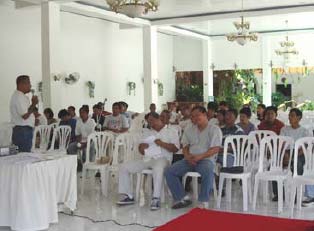
PICTURES TAKEN DURING THE MEETING
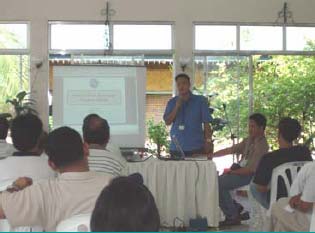
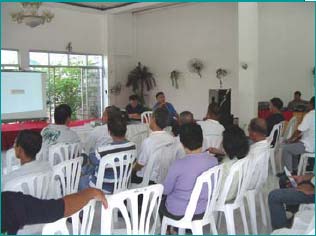
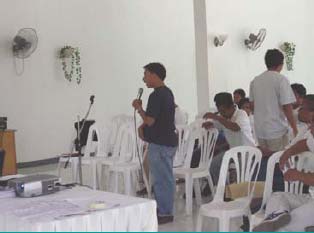
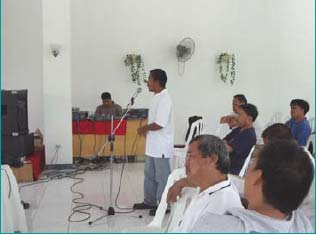
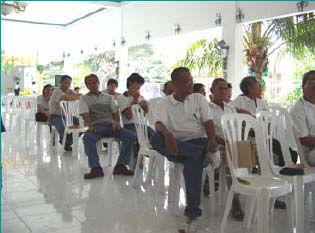
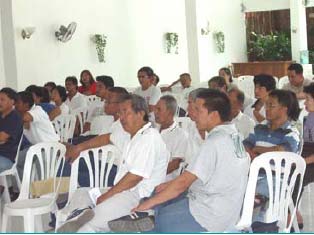
Blue Ridge A and B
Public Consultation Meeting with
Barangay Officials and Residents of Barangay St. Ignatius,
held on June 17, 2004 from 9:30 to 12 NN at the
Barangay Hall Blue Ridge B, Quezon City, Metro Manila
MANILA THIRD SEWERAGE PROJECT
Minutes of the Public Consultation Meeting with
Barangay Officials and Residents of Barangays Hagonoy, Wawa,
Calzada and Tipas Ibayo held on June 16 2004 from 1-4 PM at
Villa Salud Barangay Lower Bicutan, Taguig City, Metro Manila
Mr. Soncuya, a consultant of EDCOP-LTI, introduced the participants from EDCOP-LTI and
Manila Water Company Inc., (MWCI), explained the purpose of the public consultation and the
environmental impact assessment (EIA) process. This public consultation, as part of the
validation process of the EIA, aims to clarify issues and gather opinions, suggestions and
recommendations of stakeholders on the proposed Manila Third Sewerage Project. Mr.
Calamiong, senior project development officer of Wastewater Department of MWCI presented
the proposed project. Mr. Suelto, another consultant of EDCOP-LTI presented the results of the
environmental impact study. After the two presentations, an open forum ensued. The following
are the highlights of this public consultation.
Attendance:
Manila Water Company Inc.
Ma. Fiorella Fabella
Manager Waste Water Department
Christoper Calamiong
Senior Project Development Officer
Erick Elarmo
Senior Project Development Officer
EDCOP-LTI
Rachel Vasquez
Project Director
Rolando Soncuya
Sociologist
Anacleto Suelto
Environmental Specialist
Wilva Lin Deocades
Facilitator
Allen Villanueva
Representative EMB, DENR
Becky De Vera
Representative MWSS
Note: Attendance sheets of participants with their signatures are attached to this report.
Retention pond During rainy season, the floodgates will be closed to prevent the lake water in
inundating the coastal barangays of Taguig. The retention ponds are walled and dug areas within the
DPWH areas that will collect the surface run off water from the protected areas of the dike. Pumping
stations will then pump out the water to the lake. During dry season, the project will use the retention
ponds of DPWH to collect the domestic wastewater and treat it before pumping out the water to the lake.
It was pointed out by a participant that the dike has been thoroughly studied by DPWH and should afford
adequate protection against floods.
Duration on the use of retention ponds The retention ponds will be used temporarily up to 2015 wherein
the construction of an independent sewerage line and treatment plant may become feasible because of the
development in the area.
Cost Around seventy percent of household water consumption is generated as wastewater. If the area is
covered by the sewer system, the charge will be 50% of the basic water charge because it is an additional
service provided by MWCI. .
It was suggested that barangay officials and residents should start cleaning their waterways because the
volume of waste might affect the charges that they may be made to pay. It was pointed out by MWCI that
the charges would be based on a certain percentage of their water consumption and not on the volume of
pollution in their wastewater. However, more pollution in the wastewater will lead into higher operational
cost to the company and the solid waste in the waterways might adversely affect the operations of the
treatment plant.
Combined drainage and sewer system Barangay Tipas has a non-functioning drainage system. What is
the basis of the sewer charge? MWCI will rehabilitate these areas together with DPWH. It is suggested to
clean the Labasan River and rehabilitate the drainage system so that their wastewater may reach the
treatment plant because their area is the catch basin of the general area. There were many projects
implemented in their area but the implementation was not properly done resulting in the perennial problem
of flooding.
MWCI has a social responsibility to their communities. It is not the sole responsibility of the government
to pursue improvement in sanitation. It is important to educate the residents in proper sanitation practices
and take care of the water system. Hence the residents, government and MWCI should work together to
ensure that proper sanitation practices are observed to produce a healthier environment.
Suggestions regarding drainage system In drainage construction, standards should be set and
implemented including pipe size, levels, width and depth. If MWCI will rehabilitate the drainage system,
it should follow the standards set by DPWH. It was also suggested that this project be coordinated with
the city officials of Taguig. MWCI is closely coordinating with these officials and they have been very
supportive in the past and express their support in the proposed project.
Effects on Tipas Ibayo This barangay is situated in the lowest part of the lake coast. During dry season,
the barangay is still flooded. What will be the effect of the project? The proposed project includes the
rehabilitation of the drainage system. It is expected that the rehabilitation will greatly improve the
perennial flooding because the surface run-off water will be able to flow to the retention ponds along the
dike.
Effects of fisherfolk If the floodgates are closed during dry season, how will the fisherfolk dock their
boats especially in Labasan River? Based on the plans of DPWH on the construction of the dike, during
the rainy season the floodgates of the Hagonoy, Taguig and Labasan Rivers will be closed to prevent the
water from the lake in inundating the coastal barangays of Taguig.
DPWH will construct two structures to address the issue of accessibility of the fisherfolk. First, wharves
will be constructed to allow the docking of boats of the fisherfolk. Second, access roads will be
constructed from the existing road network to the wharves. These access roads will allow the fisherfolk to
bring their supplies, equipment and harvests to places where they want to go.
During the dry season, the same facilities and roads will still be available to the fisherfolk. Hence, the
construction of water treatment plants in the retention ponds of the dike project will not impede the
fisherfolk in using the structures during the dry season. The implementation of the project will lessen the
pollution going into the lake and will probably result in more fish catches because of more favorable
environmental conditions in the lake.
Effects on seasonal farmers There will be no negative effects on the seasonal farmers planting crops
during dry season along the lake bed when the water level recedes because the project will just ride on the
dike project of DPWH. It might benefit the farmers because the wastewater coming from the treatment
plant may be used for irrigation.
Reliability of Pumps of DPWH The project proponent is on water supply and sanitation. The project
will just ride on the dike project of DPWH. MWCI is not the proper party to answer this question. Inquires
may be made with the office of DPWH located in Upper Bicutan for details of the dike project.
Participation of Residents -- As stakeholders, the residents will be represented in the multipartite
monitoring team. This monitoring team will ensure that the project proponent will strictly follow the
conditions contained in the ECC. It is also an avenue to ventilate issues and concerns of the affected
residents and ensure that the interests of the residents are adequately protected.
Responsibilities of DPWH and MWCI The representative of EMB suggested that a matrix of
responsibilities be made available to delineate the responsibilities of DPWH and MWCI. This will enable
the residents to pinpoint responsibilities if ever adverse effects are produced by the project. Presently,
there is an on-going negotiation with DPWH to precisely identify the individual responsibilities. MWCI is
responsible for sewer lines. This is the first project that will combine the sewer and drain system. MWCI
will rehabilitate the existing drainage in the covered areas in Taguig.
By-products The treatment plants will produce sludge estimated at one inch per year and will be further
treated in the proposed treatment facility in FTI. The water produced may be used for irrigation. The
solids produced in FTI will be used as a soil conditioner in the lahar areas of Pampanga and Tarlac in
coordination with the Sugar Regulatory Authority.
Source of fund The fund will come from a loan by MWSS from World Bank. MWSS will then pass on
the loan to MWCI. MWCI will be the one responsible for the payment of the loan. The Filipino people
will not shoulder any amount for its payment.
Time frame The loan is expected to be approved by World Bank around 2005 provided all the necessary
certificates, permits and other documents are in order. The project will be implemented from early 2006
up to 2008.
The residents in the Taguig communities expressed support for the project because it will improve the
sanitary conditions in their areas. The participants suggested for close cooperation with municipal and
barangay officials in the construction phase.
Prepared by:
__
_____________
Rolando Soncuya
Sociologist
EDCOP-LTI-ISSI
Barangay Pineda, Pasig City
Public Consultation Meeting with the
Barangay Officials and Residents of Barangays Capitolyo and Pineda
held on June 18 2004 from 9:30-11:30 AM at the Headquarters of Special
Barangay Force, Barangay Pineda, Pasig City, Metro Manila
MANILA THIRD SEWERAGE PROJECT
Minutes of the Public Consultation Meeting with the
Barangay Officials and Residents of Barangays Capitolyo and Pineda
held on June 18 2004 from 9:30-11:30 AM at the Headquarters of Special Barangay Force,
Barangay Pineda, Pasig City, Metro Manila
Mr. Soncuya, a consultant of EDCOP-LTI, introduced the participants from EDCOP-LTI and
Manila Water Company Inc., (MWCI), explained the purpose of the public consultation and the
environmental impact assessment (EIA) process. This public consultation, as part of the
validation process of the EIA, aims to clarify issues and to gather opinions, suggestions and
recommendations of stakeholders on the proposed Manila Third Sewerage Project. Ms.
Calamiong, senior project development officer of Waste Water Department of MWCI presented
the proposed project. Mr. Suelto, another consultant of EDCOP-LTI presented the results of the
environmental impact study. After the two presentations, an open forum ensued. The following
are the highlights of this public consultation.
Attendance:
Manila Water Company Inc.
Christopher Calamiong
Senior Project Development Officer
Ben Velasco
Senior Project Development Officer
Sterling Reyes
Territory Business Manager
EDCOP-LTI
Rolando Soncuya
Sociologist
Anacleto
Suelto
Environmental
Specialist
Evelyn Nolasco
Public Consultation Coordinator
Wilva Lin Deocades
Facilitator
Allen Villanueva
Representative EMB, DENR
Note: Attendance sheets of participants with their signatures are attached to this report.
Charges Our monthly statement of account can be broken down as follows; Basic water charge, CERA,
foreign currency adjustment, environment and sewer charge and meter service charge. The total of these
items is then subject to VAT of 10%. The sewer charge will be 50% of the basic water charge. The sewer
rate is regulated by MWSS.
Monitoring team A representative of the community will be part of the monitoring team. One of the
responsibilities of the monitoring team is to inform the residents about the project through proper signage
and prepare a list of dos and donts during construction and operation phases. The monitoring team will
also ensure that terms and conditions set in the environmental certificate of compliance will followed
religiously by the project proponent.
Additional services -- It was pointed out that MWCI is offering free desludging of individual septic tanks
as part of its mandate to provide sanitation services and is one of the services under the environmental fee
being charged monthly. To be free, the desludging should be scheduled otherwise the household will be
charge a fee of around 800 pesos compared to some private contractors of 2,500 pesos. On the day of the
desludging, households should remove the covers of their septic tanks to facilitate extraction.
Disposal of sludge The sludge generated by the proposed STP will be vacuumed and will be processed
in the proposed septage plant that will be located at FTI complex. The processed waste will then be
applied in the lahar areas in Pampanga and Tarlac. There are negotiations with the Sugar Regulatory
Authority (SRA), to use the soil conditioner in sugar plantations.
Time frame The loan is expected to be approved by World Bank around 2005 provided all the necessary
certificates, permits and other documents are in order. The project will be implemented from early 2006
up to 2008. Construction time in this component is expected to last a year.
Location -- The treatment plant will be located in the open basketball court. The plant is below ground
and after construction the community can resume using the area as a basketball court. During construction,
the place will be dug up and that is the time that the community will suffer inconvenience in terms of its
non-availability to the community.
.
The residents and barangay officials expressed support of the project. They are ready to assist the project
proponent in the construction and implementation stages.
Note: All other questions and suggestions are related to water supply issues such as alleged overcharging,
meter disconnection, wrong meter reading, low water pressure.
Prepared by:
__
_____________
Rolando Soncuya
Sociologist
EDCOP-LTI-ISSI
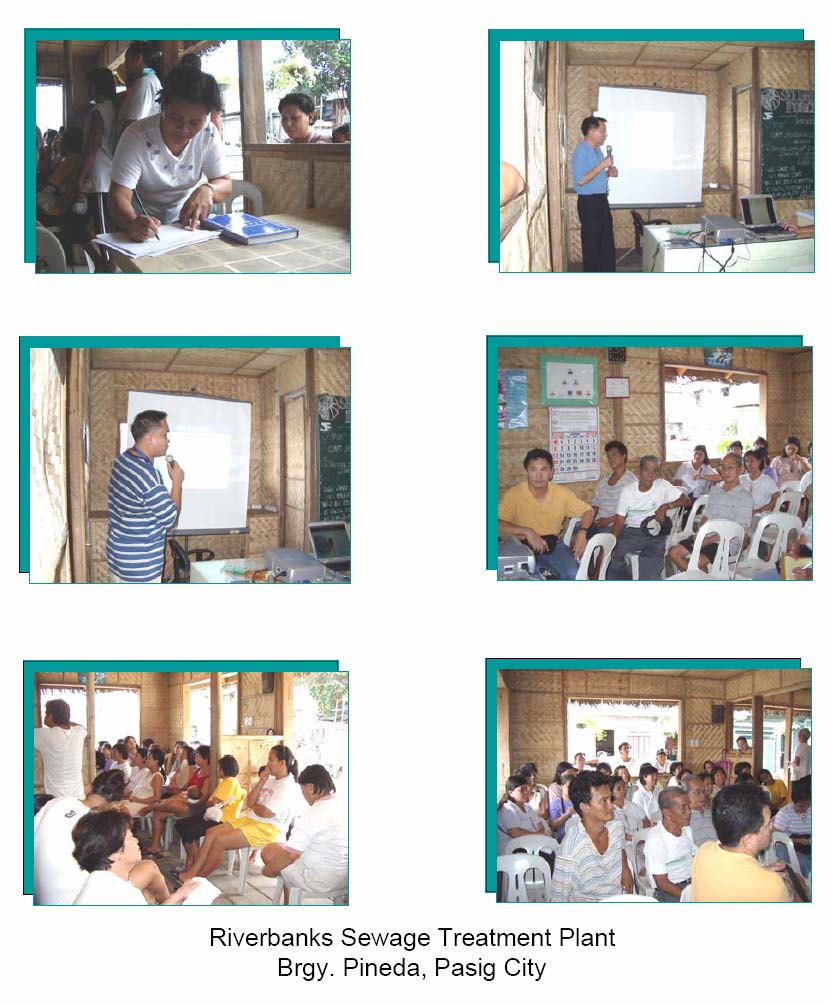
Sports Complex, Barangay Poblacion
Public Consultation Meeting with the
with the Barangay Officials and Residents of Barangay
Poblacion, Makati City and Barangays Ilaya, Barangka Itaas, Barangka Ibaba,
Mandaluyong City held on June 18 2004 from 2-4 PM at the
Sports Complex, Barangay Poblacion, Makati City, Metro Manila
MANILA THIRD SEWERAGE PROJECT
Minutes of the Public Consultation Meeting
with the Barangay Officials and Residents of Barangay
Poblacion, Makati City and Barangays Ilaya, Barangka Itaas, Barangka Ibaba, Mandaluyong City
held on June 18 2004 from 2-4 PM at the
Sports Complex, Barangay Poblacion, Makati City, Metro Manila
Mr. Soncuya, a consultant of EDCOP-LTI, introduced the participants from EDCOP-LTI and Manila
Water Company Inc., (MWCI), explained the purpose of the public consultation and the environmental
impact assessment (EIA) process. This public consultation, as part of the validation process of the EIA,
aims to clarify issues and gather opinions, suggestions and recommendations of stakeholders on the
proposed Manila Third Sewerage Project. Me. Calamoing senior project development officer of PDO
Waste Water of MWCI presented the proposed project. Mr. Suelto, another consultant of EDCOP-LTI
presented the results of the environmental impact study. After the two presentations, an open forum
ensued. The following are the highlights of this public consultation.
Attendance:
Manila Water Company Inc.
Christopher Calamiong
Senior Project Development Officer
Ben Velasco
Senior Project Development Officer
EDCOP-LTI
Rolando Soncuya
Sociologist
Anacleto
Suelto
Environmental
Specialist
Evelyn Nolasco
Public Consultation Coordinator
Wilva Lin Deocades
Facilitator
Allen Villanueva
Representative EMB, DENR
Note: Attendance sheets of participants with their signatures are attached to this report.
Charges Our monthly statement of account can be broken down as follows; Basic water charge, CERA,
foreign currency adjustment, environment and sewer charge and meter service charge. The total of these
items is then subject to VAT of 10%. The sewer charge will be based on water consumption. Currently it
is 50% of the basic water charge.
It was correctly pointed out that owners of illegal water connections would not be charge because they are
illegal. However, MWCI is coordinating with local officials to pinpoint these illegal connections. It was
also emphasized that illegal connection is the major cause of water contamination.
A participant said that customers of MWCI would surely complain about the additional sewer fees
because it would be an additional financial burden to the families. Some families still do not have clean
water supply. MWCI pointed out that their water is potable. The major cause of contaminated water
supply is the illegal tapping from their pipes. During low pressure in their pipes, contaminated water
enters into their lines. Hence, if there were illegal connections in your upstream, you would probably
have contaminated water. In this respect, we would like ask for the residents' cooperation in identifying
these illegal connections. Confidentiality will be strictly maintained.
Traffic The proposed site will be located at a vacant lot along the Pasig River. There are two types of
trucks, the ten and five cubic meter capacities. If the roads are narrow, the lower capacity trucks will be
used. During construction and operations, MWCI will coordinate with local officials to minimize traffic.
The contractor may be prohibited to deliver construction materials during peak traffic hours. Presently,
MWCI is coordinating with MMDA if their activities will cause traffic in the area. The plant will provide
parking space to accommodate trucks during desludging.
Safety The construction in Barangay Ilaya will be done roughly for a year. MWCI will ensure that their
contractors will implement safety measures especially in construction sites. Proper signage and
roadblocks will be installed to prevent persons in entering the construction site. The monitoring team will
address problems arising during construction stage including possible bad odor.
Restoration of street diggings MWCI pays excavation permits to the local government units. The fees
include street restoration. After the diggings, the LGUs have the responsibility of street restoration.
Value added tax All charges in the monthly statements are subject to VAT. The rate is constant, about
ten percent, if the sewer charge will be included, the rate remains the same but the amount will increase
because the base of the VAT will include the sewer fees.
Bad odor Bad odor is one of the risks in water treatment plants if the designed is flawed or
malfunctioned. In the proposed project, odor control facilities usually carbon filters will be used to
prevent bad odor from escaping from the plant and go to the nearby communities. The plant is located
below ground and this will help in reducing the risk of bad odor from escaping into the nearby
communities.
Eviction The proposed project will not cause any eviction because the proposed site will be located in an
open area near the flagpole in the riverpark. The informal dwellers living under the Guadalupe Bridge
will not be affected by the project.
The project will intercept the wastewater from existing drainage and collect them before they discharge to
the Pasig River. The structures along the creek including the school in Lions Road will not be
demolished. These will not be affected by the project construction. Many of the structures directly
discharge their wastewater into the creek.
Health benefits The EMB representative suggested that the project show the health benefits in terms of
saved medical costs so that the residents will appreciate the health benefits from the project.
Fire hydrant The request for a fire hydrant can be channeled through Raymond or Daisy Cabrerra,
MWCI territory business managers in your respective areas.
The participants expressed support for the project because it will improve their sanitary conditions and
drainage system. Some participants had reservation on the additional sewer charges considering the tight
economic conditions.
Prepared by:
__
_____________
Rolando Soncuya
Sociologist
EDCOP-LTI-ISSI
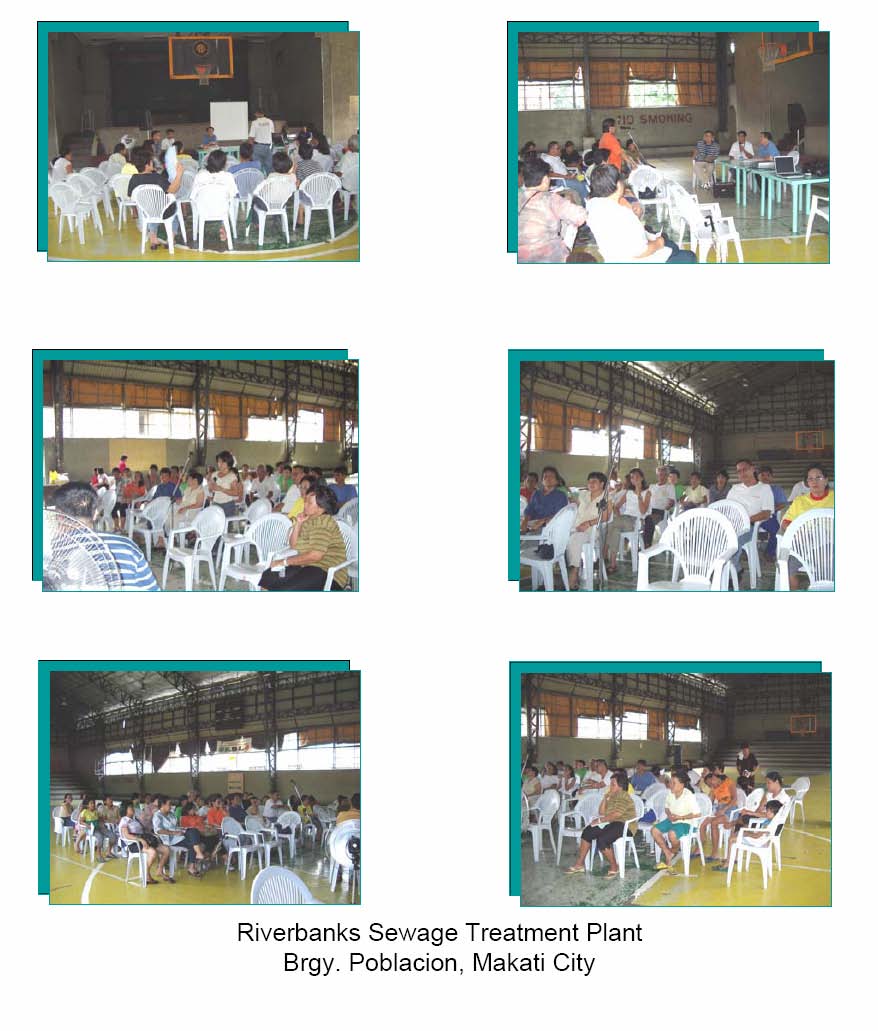
Barangay Health Center of Barangay IVC
Marikina City
Public Consultation Meeting with Barangay Officials and Residents of Barangay
Industrial Valley Complex (IVC) including Olandes, Cinco Hermanos, Industrial
Valley Subdivision and Monte Alta Subdivision. Marikina City on June 19 2004
from 9:30-12NN at the Barangay Health Center of Barangay IVC Marikina City,
Metro Manila
MANILA THIRD SEWERAGE PROJECT
Minutes of the Public Consultation Meeting with Barangay Officials and Residents of Barangay Industrial
Valley Complex (IVC) including Olandes, Cinco Hermanos, Industrial Valley Subdivision and Monte
Alta Subdivision. Marikina City on June 19 2004 from 9:30-12NN at the Barangay Health Center of
Barangay IVC Marikina City, Metro Manila
Mr. Soncuya, a consultant of EDCOP-LTI, introduced the participants from EDCOP-LTI and Manila
Water Company Inc., (MWCI), explained the purpose of the public consultation and the environmental
impact assessment (EIA) process. This public consultation, as part of the validation process of the EIA,
aims to clarify issues and gather opinions, suggestions and recommendations of stakeholders on the
proposed Manila Third Sewerage Project. Mr. Suelto, another consultant of EDCOP-LTI presented the
proposed project and results of the environmental impact study. After the two presentations, an open
forum ensued. The following are the highlights of this public consultation.
Attendance:
EDCOP-LTI
Rolando Soncuya
Sociologist
Anacleto
Suelto
Environmental
Specialist
Joy
Tamayo
Public
Consultation
Coordinator
Wilva Lin Deocades
Facilitator
Christopher Moster
Manila Water Company Inc.
Note: Attendance sheets of participants with their signatures are attached to this report.
Charges Our monthly statement of account can be broken down as follows; Basic water charge, CERA,
foreign currency adjustment, environment and sewer charge and meter service charge. The total of these
items is then subject to VAT of 10%. In sewered areas of MWCI, the sewer charge is 50% of the basic
charge but is not enough to cover their operation expenses. The rate is regulated by MWSS. Hence, their
water supply is partly subsidizing the wastewater component. In past consultations, some participants
expressed their sentiments that the sewer fees are quite high.
MWCI is continuous studying the rate of sewer fees. As part of the consultations, MWCI is open for your
suggestions on sewer fees. Some possible solutions are partial government subsidy because government is
mandated to provide its citizenry basic social services that include sanitation. Second, is the possible sale
of the two by-products of the plants namely soil conditioner and water. Third is the partial subsidy of its
water supply in favor of its sanitation function. It was suggested that the environment sewer charge
collected over the years be used for this project. It was pointed out that part of the environment charge is
the free desludging of septic tanks.
Mandate --The mandate of MWCI is water supply and sewerage system. This may simple if there is a
separate sewer line. However, in this project, the drainage system will be used also as a combined
drainage and sewer system. The drainage system is partly the responsibility of DPWH, the city and the
barangay.
Affected Households There is no affected houses because the project will use the existing drainage
system and proposed STP site has no houses.
Rainy season During strong rains, the drainage system will by-pass the STP. Ordinarily, the dirtiest
flows occur during the start of the rainy season because it will carry the polluted and stagnant wastewater.
Hence in cases where the STP is by-passed because of strong rains, the water quality is not that polluted.
If the rains subside, the STP will operate again.
Additional services -- It was pointed out that MWCI is offering free desludging of individual septic tanks
as part of its mandate and is one of the services under the environmental fee being charged monthly. To
be free, the desludging should be scheduled otherwise the household will be charge a fee of around 800
pesos compared to some private contractors of 2,500 pesos. On the day of the desludging, households
should remove the covers of their septic tanks to facilitate extraction. It is encouraged to desludge your
septic tanks every six years. In narrow streets, the company has long hoses to reach houses located in
these areas. It is suggested that MWCI conduct an information campaign for this additional service.
Hospital wastewater The project covers this water basin which included some hospitals. Hospitals
should have their own sewerage treatment plants. If the hospital has no STP, MWCI may disconnect the
said hospital because they generate a different kind of wastewater.
Source of fund The fund will come from a loan by MWSS from World Bank. MWSS will then pass on
the loan to MWC because it is a private company. The total loan amount is 62 million dollars but
increased more than 100 million dollars because of additional components. The loan will be paid by
MWCI.
Time frame The loan is expected to be approved by World Bank around 2005 provided all the necessary
certificates, permits and other documents are in order. The project will be implemented from early 2006
up to 2008.
Employment MWCI will bid out the various components of the project. The winning bidders will be the
responsible for construction. Residents will be given priority in employment. The project may be divided
into construction phase and operation phase. The manpower requirement will definitely be larger in the
construction phase where residents will be given priority in employment. We are not sure of the staffing
requirements during operation phase. The company has a corporate responsibility especially to their
concession area.
Flow of wastewater -- The water coming out of the septic tanks will flow into the existing drainage system
covering 132 hectares. In the map presented, the small arrows show the direction of the drainage flow
originating from the highest points and eventually going to the Marikina River. In areas lower than the
STP, pumping stations will be installed to pump the wastewater to the STP. It was pointed out that the
water coming from the toilet facilities would first go to the septic tanks for initial treatment. The excess
wastewater will then go to the drainage system because there is no separate sewerage system. The project
will intercept the wastewater from existing drains and treat the water in the STP. This is the additional
service being offered by MWCI and is the basis for the charging of sewer fees.
Classification of water The classification mentioned as class C based on DENR standards is applicable
in bodies of water for fishing, recreation and irrigation. The other classification is potable water which
should be zero in coliform. MWCI guarantees the quality of water. The standard of DOH is 95 but the
company average 97. Contaminated water is a result of illegal connections because the connections to the
main line are improperly connected. When there is negative pressure, dirty water will enter into the
improperly connected illegal connections.
Septic tanks should have at least two compartments. The first compartment will settle the solids and the
second will further settle the suspended solids in the water. The wastewater will then flow out of the
septic tank. If there is bad odor, it is an indication that the septic tank is not functioning properly and
desludging is suggested. In the newly enacted Clean Water Act, three compartments are now required for
new houses.
Operation of STP Desludging will be done every day but sufficient parking is provided because of space
availability. Odor will be controlled technically. Noise will be minimal because of the site is far from
houses and only electric motors for water pumps will be used. If there are complaints, the monitoring
team will investigate the complaints and will be addressed accordingly. The nearest example of a STP is
in Karangalan Village in Cainta Rizal. Some participants are requesting for a visit to the site.
The president of MonteAlta homeowners Association and barangay officials lauded the goals of the
project and expressed support for the project.
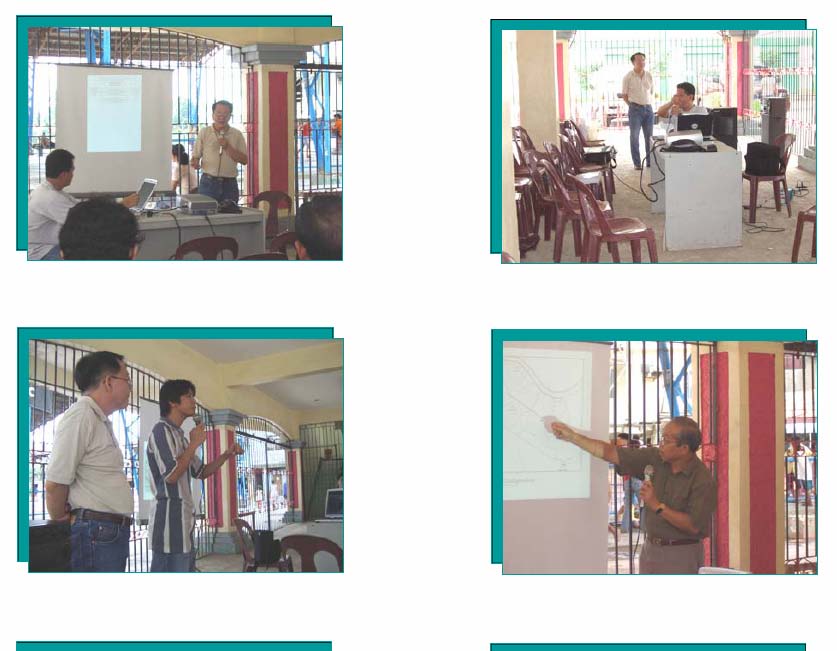
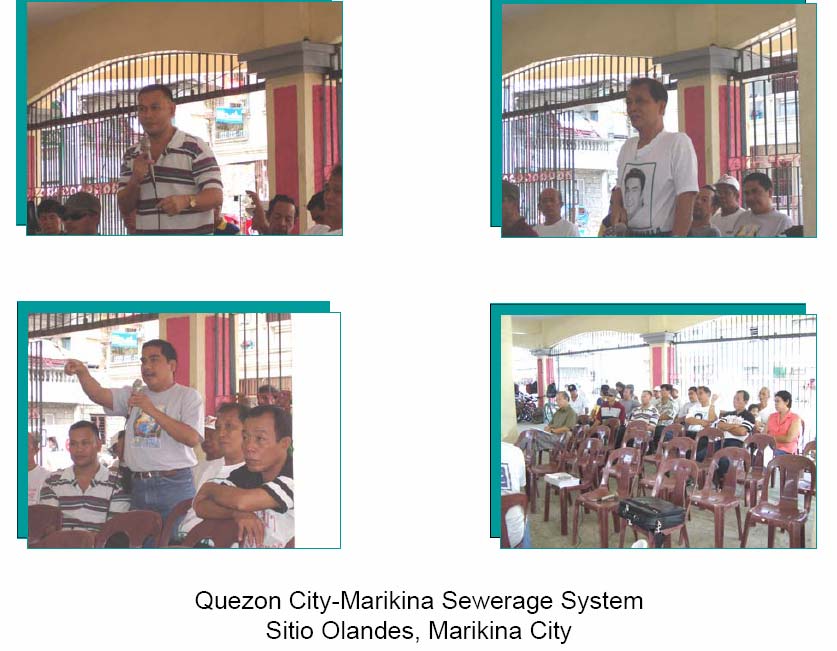
Fishport Training Center, Barangay San
Juan Taytay, Rizal
Public Consultation Meeting with
Barangay Officials and Residents of Pawis, Exodus, Diimagta/Sumagta, Genesis,
Barangay San Juan, Taytay, Rizal and PCFCI, Kabisig and San Francisco, Cainta,
Rizal held on June 19 2004 from 2-4 PM at the Fishport Training Center, Barangay
San Juan Taytay, Rizal
MANILA THIRD SEWERAGE PROJECT
Minutes of the Public Consultation Meeting with
Barangay Officials and Residents of Pawis, Exodus, Diimagta/Sumagta, Genesis, Barangay San Juan,
Taytay, Rizal and PCFCI, Kabisig and San Francisco, Cainta, Rizal held on June 19 2004 from 2-4 PM at
the Fishport Training Center, Barangay San Juan Taytay, Rizal
Mr. Soncuya, a consultant of EDCOP-LTI, introduced the participants from EDCOP-LTI, explained the
purpose of the public consultation and the environmental impact assessment (EIA) process. This public
consultation, as part of the validation process of the EIA, aims to clarify issues and gather opinions,
suggestions and recommendations of stakeholders on the proposed Manila Third Sewerage Project. He
also presented the proposed project. Mr. Suelto, another consultant of EDCOP-LTI presented the results of
the environmental impact study. After the two presentations, an open forum ensued. The following are
the highlights of this public consultation.
Attendance:
EDCOP-LTI
Rolando Soncuya
Sociologist
Anacleto
Suelto
Environmental
Specialist
Joy
Tamayo
Public
Consultation
Coordinator
Wilva Lin Deocades
Facilitator
Note: Attendance sheets of participants with their signatures are attached to this report.
Disposal of sludge The sludge generated by the proposed STP will be vacuumed and will be processed
in the proposed septage plant that will be constructed in Food Terminal Inc. (FTI). The processed waste
will then be applied in the lahar areas in Pampanga and Tarlac. There are negotiations with the Sugar
Regulatory Authority (SRA), to use the soil conditioner in sugar plantations. Initial results are promising
to increase the yield of sugar.
Coverage The proposed project will cover the seven housing areas mentioned earlier. It will involve the
rehabilitation and laying down of new drainage systems (around 7 kilometers) in some areas in East
Manggahan. During construction, some areas will experience disruptions in terms of noise generation and
inconvenience in access. However, this is necessary to ensure that there is an efficient flow of wastewater
from the households to the proposed STP. The project will not construct any structure for flood
protection. It is purely a sanitation project and is not part of any housing development project. MWCI is
a private company mandated to implement sanitation projects.
There is no need to individually apply to be included in the coverage of the project. MWCI will construct
the needed infrastructure and if the project is in operation, MWCI will start charging the sewer fees that
will be included in the monthly statement of account. Households without individual water connections
will also benefit from the project because it will cover the areas mentioned irrespective of the presence or
absence of individual water connections.
Charges Our monthly statement of account can be broken down as follows; Basic water charge, CERA,
foreign currency adjustment, environment and sewer charge and meter service charge. The total of these
items is then subject to VAT of 10%. In sewered areas of MWCI, the sewer charge is 50% of the basic
charge but is not enough to cover their operation expenses. The sewer rate is regulated by MWSS.
Hence, their water supply is partly subsidizing the wastewater component. In past consultations, some
participants expressed their sentiments that the sewer fees are quite high.
To give an idea on cost of sewer fees, an average household consumes around 30 cubic meters a month.
Based on that consumption, the residents can already compute the sewer fees. Some participants pointed
out that they consume half of the average consumption.
Additional services -- It was pointed out that MWCI is offering free desludging of individual septic tanks
as part of its mandate and is one of the services under the environmental fee being charged monthly. To
be free, the desludging should be scheduled otherwise the household will be charge a fee of around 800
pesos compared to some private contractors of 2,500 pesos. On the day of the desludging, households
should remove the covers of their septic tanks to facilitate extraction.
Periodic desludging Septic tanks should be desludged at least every 6 years to maintain its efficiency,
otherwise, solids will be discharged to the drainage system. During rainy season, the water coming from
these septic tanks will contaminate surface ran-off water. These have serious health complications.
Affected households It was pointed out by some residents that some structures are infringing on the
creek where the proposed line will pass. What will happen to the houses and residents? World Bank, the
project funder, is very strict on resettlement issues. There is a World Bank policy directive 4.30 that will
guide a borrower in addressing resettlement issues. The guiding principle is to improve the conditions of
the resettled families. If this cannot be done, the minimum requirement is to at least restore the conditions
to their pre-resettlement. MWCI is considering compensation or resettlement after exhausting technical
solutions to the displacement issue.
It might be possible that between today and project implementation, informal squatters will construct their
houses in the project alignment like in the lakeshore dike project. Hence, in the project implementation,
problems on resettlement may arise and delay project implementation. Presently there are some houses in
the creek where the proposed pipeline will pass especially in Exodus and Samagta. Houses where the
inceptors will be constructed may also be adversely affected by the project. There are some houses
already constructed in the opposite side of the creek.
Sources of environmental funds Both environmental monitoring and guarantee funds will be the
responsibility of the project proponent, MWCI. The monitoring fund will take care of the expenses
incurred by the monitoring team. The guarantee fund is an escrow account and will take care of any
accidents or claims for damages directly attributed to the project. These two funds may be required by
EMB-DENR as conditions in the ECC of the project.
Source of fund The fund will come from a loan by MWSS from World Bank. MWSS will then pass on
the loan to MWCI. The total loan amount is more than 100 million dollars.
Time frame The loan is expected to be approved by World Bank around 2005 provided all the necessary
certificates, permits and other documents are in order. The project will be implemented from early 2006
up to 2008. Construction time in this component is expected to last a year.
STP location The plant will be located in an open lot in Genesis near the slaughterhouse. The plant will
occupy around 2,500 sqms including open spaces and parking lot. It will lower the BOD and coliform in
the wastewater. Bad odor is one of the risks in water treatment plants if the designed is flawed or
malfunctioned. In the proposed project, odor control facilities will be used to prevent bad odor from
escaping from the plant and go to the nearby communities.
Tapayan sewer treatment plant Ms. Chat Zapanta Cruz, the head of Urban Poor Affairs Office of Taytay,
Rizal pointed out that the Tapayan area where DPWH is constructing the pumping station is free of
informal dwellers. The structures inside the site are barracks of construction workers of the contractor.
DPWH has been able to secure the area and has successfully prevented informal dwellers from invading
the construction site.
Additional information campaign It was pointed out that further coordination should be conducted with
the local government officials to inform the residents about the benefits of the project. Cooperation
among residents will increase if they are properly informed about the project. Additional consultations
should be conducted before actual project implementation.
Other discussions centered on water supply especially on connection fee of 6,000, igiban bayan, individual
metering, bulk meter. Residents are requesting MWCI to conduct a seminar and/or workshop to clarify
issues on water supply.
The residents in the low-income communities expressed support for the project because it will improve the
sanitary conditions in their areas. Some residents expressed concerns on the fate of the houses along the
creek. The participants suggested for close cooperation with municipal and barangay officials in the
construction phase.
Prepared by:
__
_____________
Rolando Soncuya
Sociologist
EDCOP-LTI-ISSI
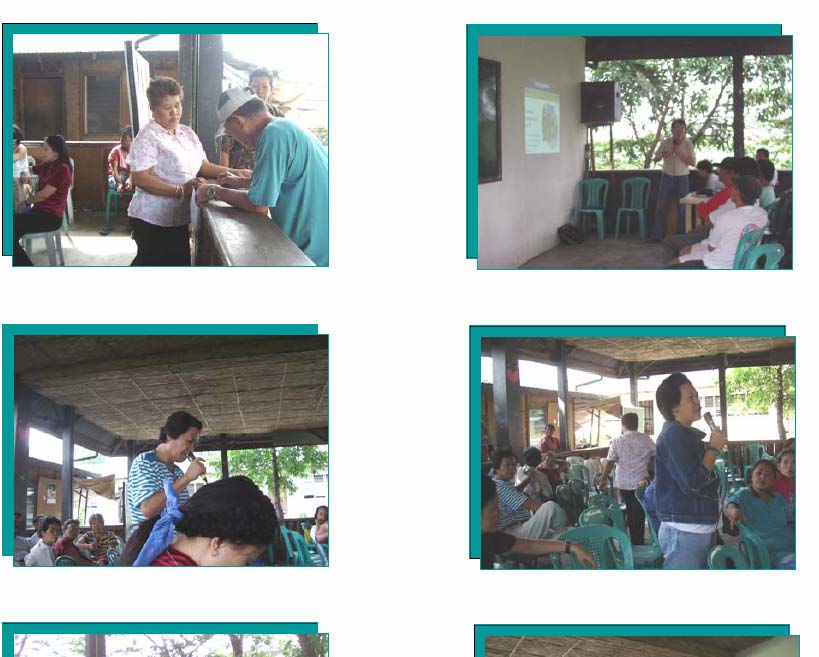
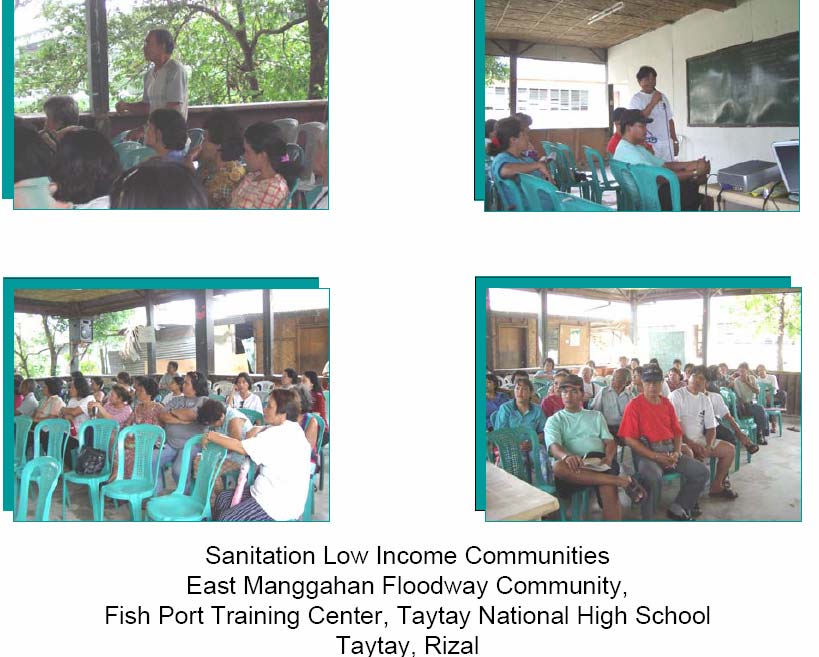
Yakap Day Care Center, East Kamias, Quezon
City
Public Consultation Meeting
with the Barangay Officials and Residents of East and West Kamias, Quezon City
held on June 21 2004 from 0-12 NN at the Yakap Day Care Center, East Kamias,
Quezon City
MANILA THIRD SEWERAGE PROJECT
Minutes of the Public Consultation Meeting
with the Barangay Officials and Residents of East and West Kamias, Quezon City held on June 21
2004 from 0-12 NN at the Yakap Day Care Center, East Kamias, Quezon City
Mr. Soncuya, a consultant of EDCOP-LTI, introduced the participants from MWCI and EDCOP-LTI,
explained the purpose of the public consultation and the environmental impact assessment (EIA) process.
This public consultation, as part of the validation process of the EIA, aims to gather the opinions,
suggestions and recommendations of stakeholders on the proposed Manila Third Sewerage Project. Ms.
Almario and Bagaipo SPDOs of MWCI presented the background on wastewater management and the
proposed project. Mr. Suelto, another consultant of EDCOP-LTI presented the results of the
environmental impact study. After the two presentations, an open forum ensued. The following are the
highlights of this public consultation.
Attendance:
MWCI
Lynn Almario
Senior Project Development Officer
Beth Bagaipo
Senior Project Development Officer
Jun Facun
Territory Business Manager
EDCOP-LTI
Rolando Soncuya
Sociologist
Anacleto
Suelto
Environmental
Specialist
Evelyn Nolasco
Public Consultation Coordinator
Wilva Lin Deocades
Facilitator
Note: Attendance sheets of participants with their signatures are attached to this report.
Coverage Why is Q-Mart not included in the coverage? There are technical and financial considerations
in the determination of the coverage of the project. In this case, the topography may have influenced the
planners in excluding the said area. The issue of availability of land is also a consideration. Presently,
MWCI have been able to tap NHA properties for the STP and pumping stations. The East and West
Kamias were considered because this is part of a loop from Project 3 to the regional STP that will be
located in East Avenue. The project entails the laying of new sewer pipes in these areas and a pumping
station that will pump the wastewater to the next station.
MWCI plans to cover the whole area with sewerage systems. However, the company has to prioritize
areas for development. Maybe the said area will be included in the next phase.
Basis of payment Payment of sewerage fees will be based on a certain percentage of the basic water
charge. In the sewered areas of MWCI, the prevailing sewerage fee is fifty percent of the basic water
charge. Presently, the company is still studying what percentage will be charge to the beneficiaries. One
of the aims of this consultation is to elicit reactions and suggestions from stakeholders of the proposed
project including the charging of sewerage fees.
Responsibility of MWCI MWCI is responsible for sewer lines from their system to the property lines of
the households. Lines inside the properties are the responsibilities of the households. MWCI will tap the
existing pipes from the households and connect these pipes to the new sewer line. The company is aware
that many of the existing septic tanks are at the back of the houses. This is one of the problems in
desludging the tanks.
Source of fund The fund will come from a loan by MWSS from World Bank. MWSS will then pass on
the loan to MWCI. The total loan amount is more than 100 million dollars. MWCI will be responsible for
the payment of the loan that will finance the Manila third Sewerage Project.
Coordination A barangay official of West Kamias explained that there are proposed infrastructure
projects in their barangay. She suggested that MWCI coordinate with City Hall to minimize disturbances
in street diggings. MWCI explained that one of the requirements is an excavation permit, which is given
by City Hall specifically with the Engineering Department. The permits include the cost of restoration of
the streets after the project. MWCI assured the barangay officials that they would closely coordinate with
them at the start of the project especially on traffic rerouting.
Water billing There was a case brought to the barangay that overcharge a resident more that 10%. The
TBM of the area admitted the mistake and the bill was adjusted to reflect the true amount.
The participants expressed support for the project. In addition, they wanted to expand the coverage to
include Q-Mart because it is major contributor of pollution to the nearby creek.
Note: Other queries were related to water supply and monthly billings.
Prepared by:
__
_____________
Rolando Soncuya
Sociologist
EDCOP-LTI-ISSI
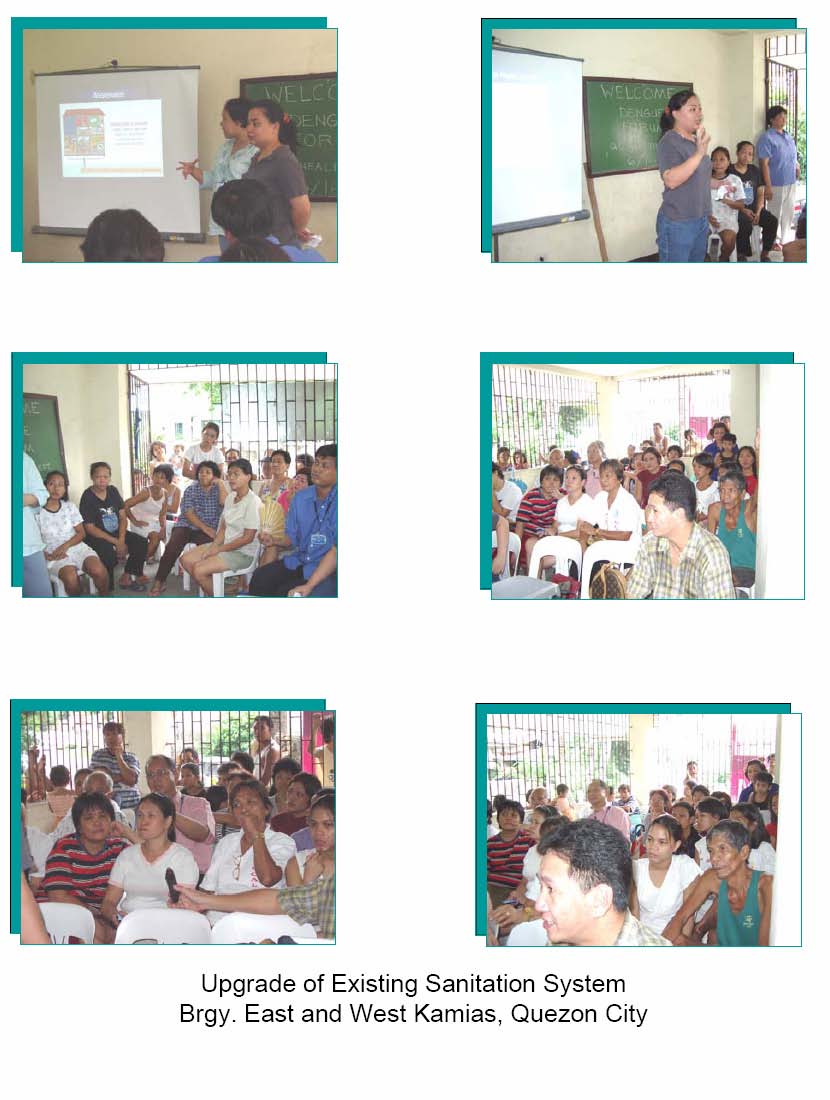
Barangay Hall of Laging Handa, Quezon City
Public Consultation Meeting
with the Barangay Officials and Residents of South Triangle, Sacred heart and
Laging Handa held on June 21 2004 from 1:30-4 PM at the Barangay Hall of
Laging Handa, Quezon City
MANILA THIRD SEWERAGE PROJECT
Minutes of the Public Consultation Meeting
with the Barangay Officials and Residents of South Triangle, Sacred heart and Laging Handa held
on June 21 2004 from 1:30-4 PM at the Barangay Hall of Laging Handa, Quezon City
Mr. Soncuya, a consultant of EDCOP-LTI, introduced the participants from MWCI and EDCOP-LTI,
explained the purpose of the public consultation and the environmental impact assessment (EIA) process.
This public consultation, as part of the validation process of the EIA, aims to gather the opinions,
suggestions and recommendations of stakeholders on the proposed Manila Third Sewerage Project. Ms.
Almario and Bagaipo SPDOs of MWCI presented the background on wastewater management and the
proposed project. Mr. Suelto, another consultant of EDCOP-LTI presented the results of the
environmental impact study. After the two presentations, an open forum ensued. The following are the
highlights of this public consultation.
Attendance:
MWCI
Lynn Almario
Senior Project Development Officer
Beth Bagaipo
Senior Project Development Officer
EDCOP-LTI
Rolando Soncuya
Sociologist
Anacleto
Suelto
Environmental
Specialist
Evelyn Nolasco
Public Consultation Coordinator
Wilva Lin Deocades
Facilitator
Note: Attendance sheets of participants with their signatures are attached to this report.
Standards of water The standards used in the study is the DENR standards for bodies of water based on
DAO 34. This is adopted from the international standards used in other countries. Class C water means
that the maximum BOD is 10 mgs and the coliform is below 5,000 most probable number per 10 ml. The
aim of the Pasig River project is at least to conform to class C water.
It was pointed out that in the presentation of the water analysis in Sct. Santiago, the BOD and coliform are
above the DENR standards. This is the reason of the project. The project aims to conform to class C
standards of DENR. In existing STP of MWCI, the BOD and coliform being produced are in the range of
7 and 1,000 respectively. The DENR is monitoring the quality of wastewater being produced by the STP.
It was suggested that a law should be enacted to periodically desludge individual septic tanks because
poor maintained tanks are the main cause of pollution in the waterways. Presently there is no low
mandating periodic desludging.
Project concept The project will pump the wastewater after being treated in the CST at Sct. Santiago to
the STP located in the basketball court in Heroes Hills. The STP is far from houses and it is required that
a buffer area be establish to further protect the houses from any adverse effects that the STP may cause.
Time frame The loan is expected to be approved by World Bank around 2005 provided all the necessary
certificates, permits and other documents are in order. The project will be implemented from early 2006
up to 2008.
Coverage the project will cover the whole of South triangle and portions of Laging Handa and Sacred
Heart. The company's vacuum trucks will regularly service areas not covered by this project. The project
includes the purchase of additional vacuum trucks. Desludging is free for MWCI customers. If private
contractors are used for desludging, MWCI can not reimburse the customers their expenses. In emergency
cases of desludging where a customer is not scheduled, MWCI will charge a fee of 800 pesos.
Septage Treatment plant The septage treatment plant to cover Quezon City will be located in Payatas,
which will treat the sludge, vacuumed from individual septic tanks and regional STP. Another proposed
plant will be located in Food Terminal Inc. There is an on-going construction in Antipolo to build a
septage treatment plant. The by-products of these septage treatment plants will be used as soil conditioner
for the lahar areas in Pampanga and Tarlac and the water for irrigation. Interested parties may get the soil
conditioner for free provided it is pick up in the Magallanes treatment plant.
Soil conditioner --It is classified as soil conditioner because it lacks the minimum quantity of nitrogen,
phosphorus and potassium set by the Fertilizer and Pesticide Authority (FDA). A participant is requesting
for an analysis of the chemical profile of the soil conditioner.
Coordination It was suggested in the future to notify City Hall about any meeting for the project and
contact the barangay officials who will in turn mobilize other officials and residents. This can also be
done during the implementation of the project so that barangay officials may assist in traffic management.
Sewerage charge Presently the communities covered by this project are already being charged monthly
sewerage fees. There will be no additional payment for the proposed treatment plant. Presently, MWCI is
reviewing the rate of water charge they will charge to their customers. MWSS, the regulatory body for
water periodically reviews the water charges and decides on petitions for increase in water charges after
prior notification and public hearings.
Water by-product the water generated by the STP is not potable. However, this can be used for other
purposes such as for irrigation and fighting fires in the nearby areas.
It is a very good project but the coverage is limited. They are looking forward to being covered in Manila
Fourth Sewerage Project. They are requesting for additional information materials so they can inform
other residents in their barangays.
Prepared by:
__
_____________
Rolando Soncuya
Sociologist
EDCOP-LTI-ISSI
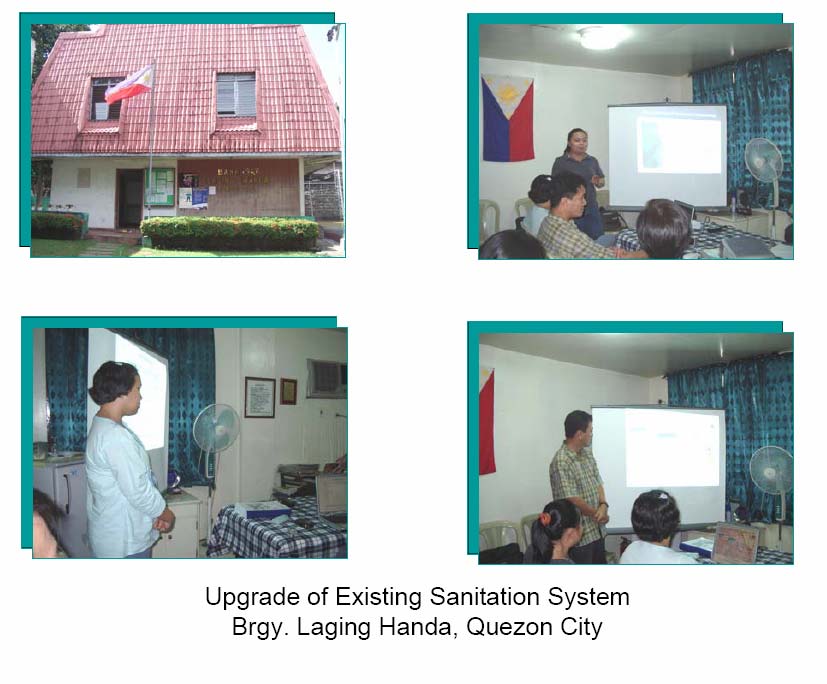
Covered Court of Barangay Quirino 2-A
Quezon City, Metro Manila
Public Consultation Meeting
with the Barangay Officials and Residents of Barangays
Quirino 2-A, 2-B, 2-C, 3-A, 3-B, and Duyan-Duyan held on June 22 2004 from
1:30-4 PM at the Covered Court of Barangay Quirino 2-A Quezon City, Metro
Manila
MANILA THIRD SEWERAGE PROJECT
Minutes of the Public Consultation Meeting
with the Barangay Officials and Residents of Barangays
Quirino 2-A, 2-B, 2-C, 3-A, 3-B, and Duyan-Duyan held on June 22 2004 from 1:30-4 PM at the
Covered Court of Barangay Quirino 2-A Quezon City, Metro Manila
Mr. Soncuya, a consultant of EDCOP-LTI, introduced the participants from EDCOP-LTI and Manila
Water Company Inc., (MWCI), explained the purpose of the public consultation and the environmental
impact assessment (EIA) process. This public consultation, as part of the validation process of the EIA,
aims to clarify issues and gather opinions, suggestions and recommendations of stakeholders on the
proposed Manila Third Sewerage Project. Ms. Matibag Manager PDO Waste Water of MWCI presented
the proposed project. Mr. Suelto, another consultant of EDCOP-LTI presented the results of the
environmental impact study. After the two presentations, an open forum ensued. The following are the
highlights of this public consultation.
Attendance:
Manila Water Company Inc.
Eva Matibag
Manager PDO Waste Water
Christopher Calamoing
Senior Project Development Officer
Lynn Almario
Senior Project Development Officer
EDCOP-LTI
Rolando Soncuya
Sociologist
Anacleto
Suelto
Environmental
Specialist
Evelyn Nolasco
Public Consultation Coordinator
Wilva Lin Deocades
Facilitator
Ginelyn Mary Guanzon
Representative EMB, DENR
Note: Attendance sheets of participants with their signatures are attached to this report.
Sewerage charge Presently the communities covered by this project are already being charged monthly
sewerage fees. There will be no additional payment for the proposed treatment plant. This is also the case
in certain parts of Makati and other parts of Quezon City. Presently, MWCI is reviewing the rate of water
charge they will charge to their customers. MWSS, the regulatory body for water periodically reviews the
water charges and decides on petitions for increase in water charges after prior notification and public
hearings.
All households located in the coverage area will be billed a monthly sewer charge even if these
households do not want to connect to the system. This is provided in the Sanitation Code, wherein
households should connect to the sewerage system if the system is available.
Coordination with other agencies during construction phase MWCI will investigate the diggings in
Agoho Street and its status. It is better to for companies like MWCI, telephone and other utilities to lay
pipes or lines at the same time. However, their projects depend on the available financial resources. All
street diggings should have permits and there is an interagency group that coordinates the various street
diggings. Another problem MWCI is encountering is the absence of "as built plan" of the various
companies involved in street diggings. To safeguard accidental hits on the various utilities, there is a
provision in the contract of the contractor to restore any accidental hit. MWCI gives priority on busted
sewer pipes because of the disturbances that this may cause to the residents. Sewer pipes are PVC brown
pipes.
Displacement of families The project intends to intercept the wastewater before or after the Rimas CST
and pump the wastewater to the regional treatment plant located in East Avenue. This was the plan to
avoid the displacement of families already occupying the area around the Rimas CST. There will be no
displacement of families in Rimas CST because of the project.
Dirty water If there are cases of dirty water in a general area the usual reason is illegal connection.
MWCI will investigate the area and will keep the residents informed. MWCI gives highest priority on the
issue of dirty water supply. It was pointed out that the supplier of mineral water is making brisk business
because the water in the area in undrinkable.
There is an adverse claimant (Pacundo) on the land where the Rimas CST is located. Around 5 meters
were occupied. It was reported to MWSS and they investigated. However, there is no action taken.
MWCI is aware of the claim and it was also reported in the feasibility study that part of a dormitory is
occupying a portion of the CST. It was clarified that the lot is owned either by NHA or the LGU and
actions have been taken to address the issue.
Total Construction A participant (engineer) pointed out that the sewer lines are in very poor conditions
because of age, new development and the contours of their areas. He proposes that instead of
rehabilitation, the project should change all the sewer lines because they are being charge sewer fees. It
was clarified that the elevation of pipes is one of the considerations in the laying of pipes. This is being
done to minimize operation costs. The are also dilapidated portions of the sewer line that may need new
pipes.
There is an agreement with NAWASA that houses within 60 meters of the CST are free of charge. Why
are they being billed for sewer fees now? MWCI is not aware of this agreement. It was requested that if
there is a written agreement, MWCI is requesting a copy. MWCI inherited the sewer lines from MWSS
and is not aware of this agreement.
Customer service --A participant reported to MWCI about a sewer problem but the one answering the
phone did not know how to answer. She was reported to her superior and the problem was addressed.
There was a recurrence of the problem and was again reported. The office claimed that the problem was
under the jurisdiction of DPWH. MWCI will immediately investigate this matter.
Institutional coordination The Sanitation Code gives the responsibility to the Department of Health to
implement the Code. However, DOH does not have the personnel to implement it. MWCI has no power
to arrest anyone who discharges his or her wastewater directly to the creek. With the passage of the new
Clean Water Act, the implementing rules and regulations will specify the institutional relationships with
different government agencies. MWCI will provide updates on the IRR of the new law.
The participants expressed support for the project. Some requested more information and coordination
with the local officials.
Prepared by:
__
_____________
Rolando Soncuya
Sociologist
EDCOP-LTI-ISSI
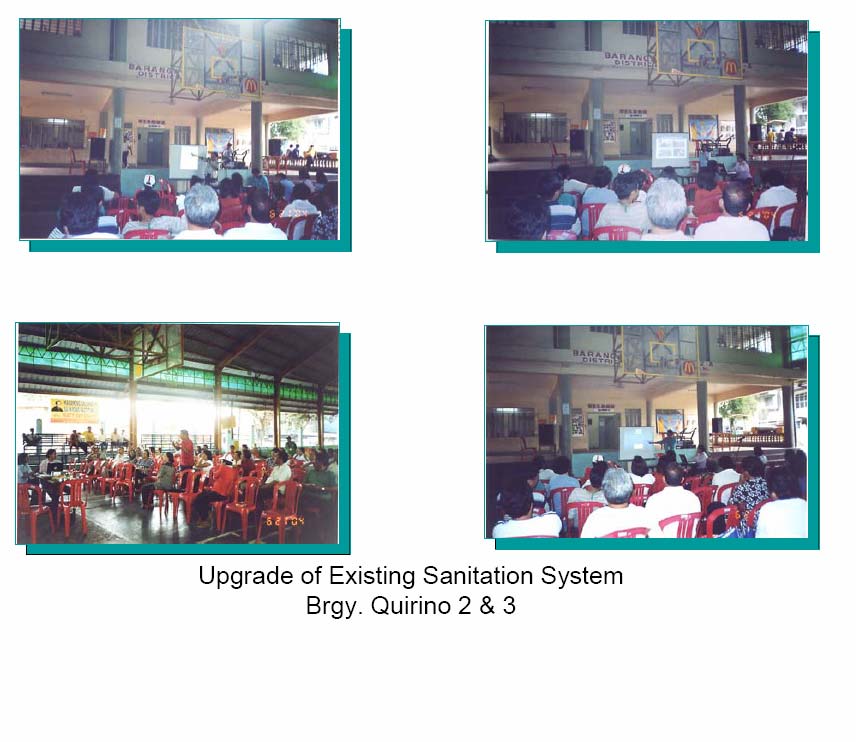
Barangay Hall of Barangay Central, Quezon
City
Public Consultation Meeting
with the Barangay Officials and Residents of Barangay Central, Old Capitolyo and
UP Village held on June 23 2004 from 10-11:30 AM at the Barangay Hall of
Barangay Central, Quezon City, Metro Manila
MANILA THIRD SEWERAGE PROJECT
Minutes of the Public Consultation Meeting
with the Barangay Officials and Residents of Barangay Central, Old Capitolyo and UP Village held
on June 23 2004 from 10-11:30 AM at the Barangay Hall of Barangay Central, Quezon City, Metro
Manila
Mr. Soncuya, a consultant of EDCOP-LTI, introduced the participants from EDCOP-LTI and Manila
Water Company Inc., (MWCI), explained the purpose of the public consultation and the environmental
impact assessment (EIA) process. This public consultation, as part of the validation process of the EIA,
aims to clarify issues and gather opinions, suggestions and recommendations of stakeholders on the
proposed Manila Third Sewerage Project. Ms. Matibag manager, PDO Waste Water of MWCI presented
the proposed project. Mr. Suelto, another consultant of EDCOP-LTI presented the results of the
environmental impact study. After the two presentations, an open forum ensued. The following are the
highlights of this public consultation.
Attendance:
Manila Water Company Inc.
Eva Matibag Manager
Project Development Office Waste Water
Beth Bagaipo
Senior Project Development Officer
EDCOP-LTI
Rolando Soncuya
Sociologist
Anacleto
Suelto
Environmental
Specialist
Evelyn Nolasco
Public Consultation Coordinator
Wilva Lin Deocades
Facilitator
Maya Villaluz
Representative World Bank
Note: Attendance sheets of participants with their signatures are attached to this report.
Eviction The proposed site has informal dwellers and is the site of the day care center. What are the
complications? The project design was made to minimize if not to totally avoid eviction and resettlement
issues. If there will be displacement, the project will either relocate or compensate the displaced families.
This is a World Bank assisted project, WB has strict policies on resettlement. The basic principle is to
improve the conditions of the relocated families. The minimum is to at lease restore their conditions
before their relocation.
It was explained that the communal septic tank would be abandoned in favor of a pumping station that
will be located in Maginhawa Street precisely to avoid displacement of informal dwellers around the
communal septic tank. The residents were thankful that they would not be displaced by the project.
The STP will be located at the vacant lot converted into a mini-park beside the Central Bank owned by the
National Housing Authority. Previous evictions done in the past in this area is not in connection to the
proposed project. A participant was evicted from this area August of 2003. It was pointed out that the
existing communal septic tank located in East Avenue has tall trees above the communal septic tank. This
area will be converted into a STP. Hence, the place were the participant was evict is different from the
proposed site of the STP.
Sewer charges The sewer charge is presently based on 50% of basic water charge. However, your areas
are already being charged the sewer fees, so there is no increase in your monthly water payment. Water
charges are regulated by MWSS and MWCI has already requested a review of the present charges.
Coverage The project aims to intercept the wastewater before entering the communal septic tank and
pump the wastewater to the STP in East Avenue. The project aims to cover the areas shown in the map
and in no way exclude areas that are presently covered by the communal septic tank located in Matiwasay
Street. The proposed pump station will be located in Maginhawa St.
Odor Bad odor is one of the risks in water treatment plants if the designed is flawed or malfunctioned.
In the proposed project, odor control facilities will be used to prevent bad odor from escaping from the
plant and go to the nearby communities.
Hospital wastewater -- The STP is near some hospitals. However, MWCI has presently no capacity to
process wastewater from these hospitals. Hospitals are required by law to have their own wastewater
treatment plants. The proposed STP will not process any wastewater from these hospitals. MWCI will
consult DENR regarding the hospital wastewater.
Barangay officials will support the project and will participate in cleanliness campaign and traffic
enforcement. There are three barangays involved in the project and they assured MWCI their full support.
Residents around the Matiwasay CST thanked MWCI for considering their houses in the design of the
project.
Prepared by:
__
_____________
Rolando Soncuya
Sociologist
EDCOP-LTI-ISSI
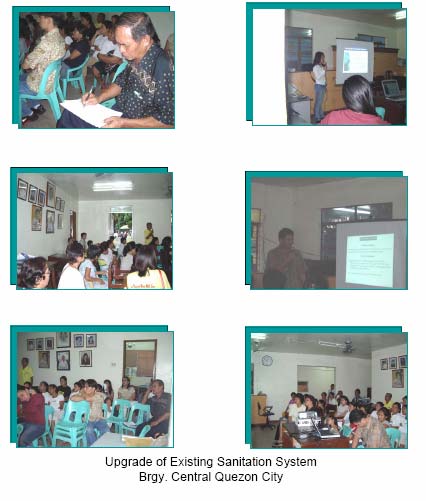
Barangay Covered Court, Barangay Project
6, Quezon City
Public Consultation Meeting
with the Barangay Officials and Residents of Barangay
Project 6 held on June 23 from 2-4 PM at the
Barangay Covered Court, Barangay Project 6, Quezon City, Metro
Manila
MANILA THIRD SEWERAGE PROJECT
Minutes of the Public Consultation Meeting
with the Barangay Officials and Residents of Barangay
Project 6 held on June 23 from 2-4 PM at the
Barangay Covered Court, Barangay Project 6, Quezon City, Metro Manila
Mr. Soncuya, a consultant of EDCOP-LTI, introduced the participants from EDCOP-LTI and
Manila Water Company Inc., (MWCI), explained the purpose of the public consultation and the
environmental impact assessment (EIA) process. This public consultation, as part of the
validation process of the EIA, aims to clarify issues and gather opinions, suggestions and
recommendations of stakeholders on the proposed Manila Third Sewerage Project. Ms. Beth
Bagaipo senior project development officer of PDO Waste Water of MWCI presented the
proposed project. Mr. Suelto, another consultant of EDCOP-LTI presented the results of the
environmental impact study. After the two presentations, an open forum ensued. The following
are the highlights of this public consultation.
Attendance:
Manila Water Company Inc.
Beth Bagaipo
Senior Project Development Officer
Benjie ???
Territory Business Manager
EDCOP-LTI
Rolando Soncuya
Sociologist
Anacleto
Suelto
Environmental
Specialist
Evelyn Nolasco
Public Consultation Coordinator
Wilva Lin Deocades
Facilitator
Note: Attendance sheets of participants with their signatures are attached to this report.
Construction stage The construction time for the proposed facility will be approximately one
year. Usually, the contractor will rent a place nearby for the temporary quartering of their
construction workers. MWCI discourages the construction of workers' barrack if the
construction site is near populated areas because of possible adverse effects on the nearby
communities. MWCI has this kind of STP in Valle Verde and Makati Pabahay.
In Project 1 (Roxas District) the vicinity of the communal septic tank was invaded by informal
dwellers. As a response to this threat in other communal septic tanks, MWSS assigned some
personnel to temporarily build their shelters in the vicinities of these other communal septic tanks
and guard these areas against unlawful intruders. Presently, MWCI is negotiating with MWSS
regarding these structures which are part of the project. The personnel of MWSS assigned to
these areas are aware of the project and are just awaiting instructions from MWSS.
Location There are two types of sewerage treatment plants, below ground and above ground.
The proposed treatment plant will be located on the present location of the communal septic plant
located in Road 5.. The plant is below ground and after construction only the control panel will
be visible to the community. During construction, the place will be dug up and that is the time
that the community might suffer inconvenience in terms restricted access, noise and possible bad
odor. However, mitigating measures as mentioned in the EIS will be put in place to address these
effects.
Areas not included in this phase will be considered in other projects of the company. It was
pointed out that the plant has a maximum capacity and if the plant will service other areas,
existing customers may suffer deterioration in the quality of service.
A participant pointed out that the existing septic tank is higher in than his house and alleged that
he is not being serviced by the communal septic tank. MWCII will investigate immediately and
if his house is not being serviced, a corresponding adjustment will be made on his monthly
billing.
Sewerage charge Presently the communities covered by this project are already being charged
monthly sewerage fees. There will be no additional payment for the proposed treatment plant.
However, MWSS periodically reviews the water charges and decides if the requests for increase
in water charges are meritorious or not after prior notification and public hearings.
Increase in water charges after improvement in the water supply system may be attributed in the
increase use of water. If the residents have noticed, the water rates increased last January but
were lowered only last week. These decisions come from MWSS.
All households located in the coverage area will be billed a monthly sewer charge even if these
households do not want to connect to the system. This is provided in the sanitation law, wherein
households should connect to the sewerage system if the system is available.
Free Desludging -- As part of their service, MWCI is conducting for free, desludging of
individual septic tanks, provide that it is properly scheduled. Otherwise, the desludging will cost
around 800 pesos, way below the charge of private contractors of around 2,500 pesos.
MWCI has problems in accessing some septic tanks because of their locations. Some septic tanks
are in the back of houses or the top are used for kitchens or dining rooms of some houses. In
these cases, MWCI let the customers sign waivers that the company will not be liable for any
damages in connection with the desludging activities.
Smoke emission The STP will be run by electric motors. The process will involve aeration,
settling of solids and disinfection to kill the pathogens. There will be no smoke emissions
generated by the project in its ordinary operations. However, if there are power outages, it is
possible that smoke emission will be generated if stand by power generators will be used.
Odor Bad odor is one of the risks in water treatment plants if the designed is flawed or
malfunctioned. In the proposed project, odor control facilities will be used to prevent bad odor
from escaping from the plant and go to the nearby communities. In addition, the STP is located
below ground and this will prevent bad odor from going into nearby houses.
Water by-product the water generated by the STP is not potable. However, this can be used for
other purposes such as for irrigation and fighting fires in the nearby areas.
Equipment -- MWCI has the latest equipment for sewerage system. They have the CCTV which
enable them to see the clogged lines. They have the sewer jetter and mini jetters, which
declogged sewer lines. Drainage systems are the responsibility of the City Engineer's Office
while MWCI is responsible for the sewer lines. To determine if the line is a sewer or drainage
line, the sewer line has manhole covers with the letter S. MWCI are replacing the sewerage
covers into hinge type because removable covers are being stolen.
Responsibility of MWCI MWCI is responsible for sewer lines from their system to the property
lines of the households. Lines inside the properties are the responsibilities of the households.
The rigid machine is being used to declogged these lines. Usually, residents who have upgraded
their houses cover the cleanouts in their sewer lines. MWCI may assist clogged lines inside their
properties provided that the cleanouts are identified.
After the open forum, the participants expressed their support for the project because it will
improve the environmental conditions of their communities.
Note: other clarifications and questions were related to water supply.
Prepared by:
__
_____________
Rolando Soncuya
Sociologist
EDCOP-LTI-ISSI
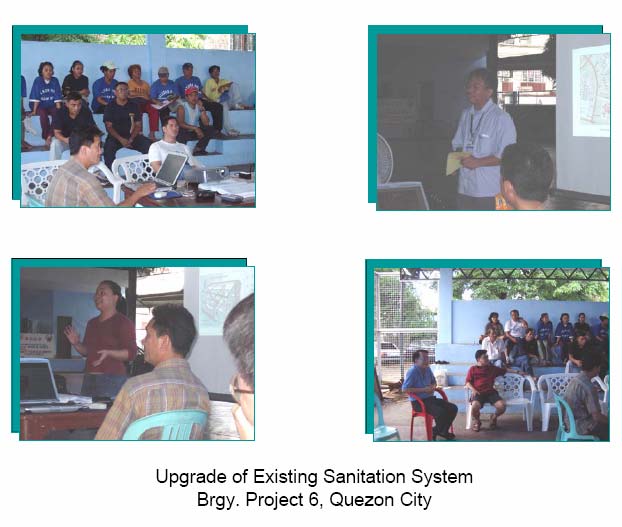
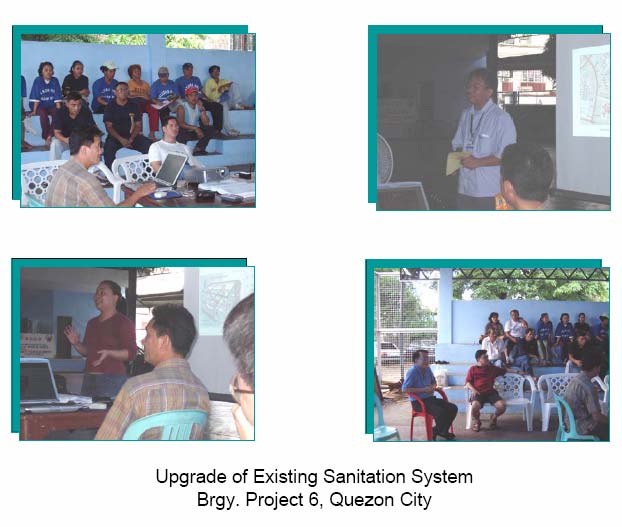
Public Consultation
February 9, 2005
La Mar Village, San Mateo, Rizal
Eva: Magandang araw po, ngayon pa lang po ay nagpapasalamat na kami sa inyong pagdating dito
sa napakahalagang miting na ito dahil sa ngayong hapong ito ilalahad po ng Manila Water ang
programa namin para sa San Mateo on the water and wastewater side. So, bilang panimula, tayo
po muna'y magdasal sa pangunguna ni Jojo de Guzman.
Jojo: Magsitayo po tayo at sandali po tayong manahimik. Damhin natin ang presensya ng ating
Panginoon. Sa ngalan ng Ama, ng Anak, ng Espiritu Santo, Amen. O, Amang makapangyarihan
sa lahat, na may gawa ng langit at lupa. Panginoon maraming salamat po sa hapong ito. Sana nawa
kami ay linawin nyo sa banal na lugar na ito para mapag-usapan po ang mga ilalahad na plano ng
ating tinatawag na kumpanya na Manila Water. Nawa ay maunawaan po naming lahat ang kanilang
isasaad. Nawa po Ama, gabayan mo po kami sa aming tatalakayin, mga plano pong ito sa
pagtitipon. Sana nawa po'y kayo ang magsilbing gabay at mamagitan sa bawat isa. At kami po'y
huminhingi at nananalig sa aming Inang Birheng Maria, at gabayan ng Espiritu Santo,
magpakailanman, magpasawalang hanggan, Amen. Sa ngalan ng Ama, ng Anak at ng Espiritu
Santo, Amen:
Eva: Atin namang pong I-exercise ang ating mga vocal chords, kakanta po tayo ng Lupang Hinirang
to be led by Ellen Artista.
Ellen: Me kodigo po ako, kasi po ang kanta panahon pa ni Mc Arthur. Umawit po tayong lahat.
(Kanta ng Lupang Hinirang)
Eva: Si ma'am pala pwedeng sumali sa Star in a Million.
So, amin pong ina-acknowledge ang presence ng mga special na people, mga presidente po
at representative ng Mayor's Office at presidente ng Riza subdivision si Mr. Reynaldo Torato.
Nandito na po ba ang Presidente ng Riza Village 1 and 2? Wala pa? At ang ating pong host sa
hapong ito, salamat sa inyo pong pagpayag na dito po ganapin ang pagpupulong na ito, kay Mr.
Santiago Ramos. Maraming pong salamat. At amin din pong pinapasalamatan ang presensya ni
Kapitan Ben Buenviaje.
Kami naman po mga taga-Manila Water, basta ang mga representatives po ng Water at
saka Wastewater side, nandito po ang mga katulong namin sa proyekto, nandito ang taga NHA, me
mga taga bangko, me Environmental Expert. Bilang panimula po ilalahad po ni Romy David, sya po
ang Manager ng Manila Water ng San Mateo. Sa kanya po natin pwedeng sabihin and ating mga
hinaing sa water. Ito na po si Romy David.
Romy: Salamat Eva. Magandang hapon kay Secretary, Kapitan at Presidente ng Homeowners.
Magandang hapon po sa inyong lahat. Magbibgay lang po ako ng Updates sa tubig ng San Mateo.
Kung ano man ang nagawa since nag start ang Manila Water noong 1997 at kung ano na ang
ginagawa ngayon at kung ano pa ang gagawin namin.
Yung water supply... Tubig Para sa Barangay at saka yung sewerage and sanitation, ide
discuss nila mamaya, yung kasama natin ng taga Sewerage. Yung update ko ng water supply,
yung water supply natin nanggagaling sa anim na river na strategically located sa San Mateo. Sa
labing-lima ang barangay ng San Mateo. Yung sinasabi dito 15 barangay ng San Mateo kaya lang
ang naseserbisyuhan sa ngayion ay eleven lang. So ito po ang data na per barangay. Yung mga
nakita nyo, yung mga barangay na sakop ng Sto Niño, so wala pa tong tubig dito. So ang supply po
natin nanggagaling sa anim na deepwells ang production po non ay is about 670, 6 million liters per
day po yon. Plus yung nanggagaling sa Marikina yung tinatawag na surface water about 5 million
liters per day. Sumusupply sa buong San Mateo. Yung limang deepwells, Sta Mria, yung Sta Ana,
Public Market ito po ang nagsusupply sa Guitnang Bayan. Sa ngayon hindi pa po nakakarating dito
kasi wala pa tayong lines pero mamaya po ide discuss natin kung kailan. So yung anim na
deepwells plus yung surface water na nanggagaling sa Marikina yun ang nagsu supply sa atin.
Noong 1997 po bago mag start ang Manila Water, ito ang itsura nya. Yung green po 24-
hours yon, yung yellow 13-23, yung red 0-12 hours yung water availability po. Kung mapapansin po
ninyo halos red noong nag-start. At the end of 2004 ito na po and itsura nya. Hindi po sya 24-
hours, kaya lang hindi po sya deepwell fed, surface water sya galing Marikina. Kung mapapansin
nyo yung malapit sa Marikina yon lang ang 24 hours natin. The rest from red naging yellow na tayo
13 to 23 hrs. From 1997 to 2002 about 11 kilometers na yung line natin sa buong San Mateo. at the
same time nakapag construct na tayo ng dalawang deepwells dito, yung Nursery at sa Dulong
Bayan. 38 million ang investment ng Manila Water sa buong San Mateo. Ito naman po ang medyo
ambisyosong target namin sa 2005. 17 kilometers pa ang ilalagay, ibig sabihin pag natapos, ang
mga deepwells, mawawala na. Puro surface water na lang. Ang pipelaying natin mangagaling sa
Bayan-Bayanan ikokonekta natin sa 600 diameter mainline from Bayan-Bayanan up to... actually,
hindi lang San mateo baka makaabot pa sa Montalban. Initially, ang target po natin is Wawa Dam,
kaya lang medyo matatagalan pa kaya nagkaroon ng panibagong proposal. Anyway, kung matuloy
ang Wawa Dam magagamit din naman natin. Ito yong mga na-complete na natin yung Tubig Para
sa Barangay, ang beneficiary po 1,900, yan po ang update sa tubig. Ngayon po ibibigay ko ulit kay
Eva para sa Sanitation.
Eva: Mamaya po ay mag Q and A portion po tayo. Ngayon naman po pakinggan po natin si Cherie
Rivera para I-discuss ang wastewater.
Cherie: Magandang hapon po. Kanina po pinag-usapan po ang tungkol sa water supply. Kung
napansin po ninyo ang Manila Water ay hindi lang po binibigyang pansin ang tubig kundi yong
mangyayari sa lalabas na dumi. Ina-address din po ng Manila Water ang sanitation. Kung titingnan
po nation ang Santitation condition ng Metro Manila, marami pong problema tungkol sa sanidad
dahil unang-una walang pagpa plano ng sewer system o yong mga daanan ng mga dumi galing sa
ating mga bahay. Diretso ang tapon sa ating mga ilog, kaya mayroon tayong mga polluted na mga
ilog. Isa pa pong problema yong congested o masisikip na daanan kaya nahihirapan ang ating
gobyerno maglatag ng mga kanal para sa mga dumi galing sa ating mga bahay. At walang pagpa
plano ng mga sanitation facilities. Me mga lugar po sa Metro Manila na kung saan diretso po ang
dumi or individual septic tank sa kanal. Kung titingnan po natin, ito po ang mga ginagamit ng mga
sanitation latrine, yong mga butas lang po na pinag-iimbakan ng dumi. Meron din pong over-hang
latrine. Lalo na po yong bahay na nakatayo sa ibabaw ng ilog. Ibig sabihin paglabas diretso na
lang. Meron namang 3% na sewerage. Ibig sabihin po me magandang pagpaplano sa mga
sewerage o daluyan ng dumi kagaya po sa lugar sa Makati sa me Magallanes Village po, Makati
Central Business District na kung saan meron silang centralized sewage treatment plant. Kung
saan ang nanggagaling sa mga bahay at septic tank ay dumadaloy po don at nalilinis po. Yon po
ang pinaka idea na sistema. Malaki po ang magagastos sa paggawa ng Sewage Treatment Plant at
paglalatag ng linya. Kung titingnan po natin karamihan po sa Metro Manila ang ginagamit ay septic
tank na pinag-iimbakan ng dumi. Dito naman po, meron po tayong tinatawag na Manila Third
Sewerage Project kung saan nagbigay ng assistance ang World Bank para tukuyin o I-address ang
ating problema sa sanidad. Hindi lang po ang tungkol sa tubig dahil po kadalasan yung tubig po
ang iniuna dahil yon po ang pangangailangan ng lahat ng tao. Pero kung titingnan po nation
kailangan din po nating I-address akung ano ang nangyayari sa dumi, ano ang gagawin natin sa
dumi. Sa project pong ito mababawasan ang polusyon ng ating ilog o waterways at ating Manila
Bay. Ito ang mangyayari sa 2005 o 10 years. At meron po itong combination ng sewer/drainage
projects at meron din pong septic tank desludging. Kung saan karamihan po ng bahay natin ay may
poso negro. Kung pamilyar po kayo sa operation po ng Manila Water na sinisipsip ang laman ng
septic tanks dadalhin sa isang lugar para I-treat para maiwasan natin ang polusyon. Ito po ang
pino propose sa San Mateo kung saan gagawa tayo ng septage treatment plant. Dito po dadalhin
yung mga galing sa poso negro dadalhin po ng mga trucks na gaya nito. Kung nakakita na po kayo
ng ganitong trucks ng Manila Water dadalhin po sa treatment plant. Lalagyan ng mga facilities,
treatment, mga tangke para I treat kaya bago umabot sa mga ilog na treat na ang mga dumi. Para
po ito ma retain ang kagandahan ng mga ilog natin at ma-improve ang ating ilog sa Metro Manila.
Yong septage treatment plant na gagawin dito sa San Mateo, ito po ang pino propose sa San Mateo
na kung saan itatayo sa Kalakaan yata ang tawag dito. Ngayon po bilang parte don sa tinatawag
na Environmental Impact Septage Treatment na pinapatupad ng Department of Environment and
Natural Resources ay kinakailangan daw po nga gaya nitong konsultasyon sa mga tao lalo na yong
mga apektadong probinsya. Yong prosesong yon meron po tayong representante ng DENR dito
para ma identify kung ano ang posibleng environmental impact nong project ng sa gayon sa
konsultasyon malaman natin kung ano ang pwede nating gawin para maiwasan natin ang posibleng
negatibong impact. Na identify po namin ang mga negatibong impact, inihiwalay po namin ang
Negative Impact during construction at pag nag ooperate na po. Simulan po natin sa construction
phase, merong po kaming na identify na air polusyon siyempre po pag nagko-construct sa area me
nabubulabog na lupa, magke clearing po sa area. Ang prino propose po ng Manila Water ay
magkakaron po ng Clearing sa lugar lalo na po doon sa open. Maganda naman doon sa area ay
may perimeter fence na. So maiiwasan yong talagang open sya at mabubulabog at makaapekto sa
katabing kabahayan. Pangalawang pong impact ay yung sa ingay o noise pollution. Pag ganito
pong construction ay I expect na natin ang ingay. Ay proposal po ng Manila Water ay ang
construction ay gagawin during day time hours ng hindi naman makabulabong sa ating pagtulog.
Kaya lang po me isang problema kapag nagko-construct na at specially pag magbubuhos na ng
semento me mga pagkakataon na hindi po nating maaring pahintuin ang mixer sa pag deliver dahil
titigas na po ang semento kaya me pagkakataon po na ma e extend ang time nya minsan po
hanggang 10:00. Sa ganito pong pagkakataon po hihingi po ng permiso sa inyo sa pamamagitan
ng ating kapitan. Upang po sa ganitong panahon ay maabisuhan po kayo na me magbubuhos ng
semento kaya maari pong mag extend ng construction ng project. Ito naman pong water pollution,
ito po ay tungkol sa creek na pinakadaanan ng ating dumi. Yong din po ay magiging natural na
drainage ng ating wastewater galing doon sa ating septage treatment plant dahil yan ay papunta na
rin sa Marikina River. Pagka panahon po ng malakas na ulan me posibilidad po na magkaroon ng
erosion, landfalls o ang posibilidad ng pagbulabog ng tubig pupunta po ang lupa sa tubig. Para po
maiwasan yon magkakaroon ng drainage kanal doon mismo mula sa construction site.
Magkakaroon din po ng temporary trenches o mga hukay para po sa tambakan ng mga
construction materials na posibleng ma erode kagayan ng mga buhangin pamunta sa mga daluyan
ng tubig. Meron din pong Ini expect na magegenarate na construction materials at me posibilidad
na me maaaring ma recycle na pwede pang magamit o pwedeng ibenta sa mga junk shops. Isa pa
po yung sa vegetation. Mapuno po yung lugar, maraming tanim sa loob ng property na tatamaan.
As much as possible ang gagawin po ay iiwasan ang mga puno na yon. Kasi po maganda po yong
may puno para may panangga, kasi pay may puno maganda ang hangin. May mga puno pong
maaapektuhan hindi po nating sinasabing walang maaapektuhan, yung maaapektuhan kung kayang
mai full-out tanggalin itanim at itabi gagawin po. Bago po tanggalan ng puno hihingi po ng permiso
sa DENR, barangay kung kailangan talagang putulin kung hindi kayang mai full-out o itabi. Sa
water pollution po pag nag operate na po yong project, kapag hindi po hindi po nag operate ng
maayos ang planta maaari din pong magresulta ng water pollution sa atin. So hindi po papasa o
hindi magko comply sa standard ng DENR. Ang gagawin po nyan me mga controlled parameters
po na minomotor po regularly kagaya po ng ginagawa sa Magallanes Sewage Treatment. Yong
Magallanes Treatment Plant napakaganda po ng pagkaka operate nyan at na momonitor po
regularly ang mga parameters para po hindi babagsak sa DENR. Yong tubig na nati treat po doon
since yon po ay nilalagyan ng chemicals, me pinapatakbo po ng kuryente yan, gumagastos po ang
Manila Water para maging malinis ang tubig na yan. Ang ginagawa po nila dinodonate po ang tubig
sa MMDA para po pandilig sa mga halaman along EDSA. Meron pa pong isang impact tungkol po
sa pahuhugas ng mga tankers, yon pong nakita ninyong picture kanina ng mga trucks, yong
pinaghugasan pwede pong ipasok pa doon sa treatment plant, kaya hindi papasok sa drainage
canal. Merong air and noise emission dahil po may mga truck tayo na dadaan sa Kambal Road at
saka papasok ng kalye. Magkakaroong ng posibleng degradation, doon sa perimeter me mga puno.
Yong mga tankers ay iiensure ng Manila Water na mapapasa standard ng Clean Air Act. Pasado
yong kanilang binubuga at hindi makakapollute sa mga dinadaan nila. Itatapon ang malinis na
tubig pero may mage genarate na sludge, yung mga solids. Ginagamit po itong soil conditioner sa
ibang lugar para panaba sa lupa. Yong services ng MWSS, Manila Water at Maynilad ay hindi pa
sapat ang treatment plant gaya ng sa Makati, ay 8% lang. Kailangang itaas ang ating edukasyon
tungkol sa pollution sa ating kapaligiran. May mga tanong po?
Eva: Kung mayroon po kayong mga tanong, oras na po para makilala kayo at sabihin ang inyong
mga katanungan.
Jojo de Guzman: Saan po kayo unang nakapag project ng ganito?
Eva: Sa buong area ng Manila Water, tatlong planta ang gagawin. Para sa North dito po ang
gagawin namin. Para sa South meron din sa may Taguig area, meron din gagawin sa Antipolo.
Ano pa po?
Resident 1: Ito po ba ay proyekto ng gobyerno o ng pribadong sekto? Malaking impact ang project
na ito, ano po ba ang advantage?
Eva: Ito po ay project ng Manila Water. Ang Manila Water po ay private na, pero po kami ay ahente
ng MWSS, may permiso po ng developer ng La Mar Village. At binisita po nya ang aming isang
planta. At wala naman po syang nakitang makakasama.
Resident 2: Ang project nyo ba ay hindi makakadagdag sa problema namin dito sa La Mar, gaya ng
air pollution, gaya ng poultry?
Eva: Yong planta po ay sisiguraduhin namin na may mga pasilidad para icontrol kung sakali man
may problema sa amoy. Yung mga truck naman ay special mga vacuum sealed na walang
problema sa amoy di tulad ng Malabanan. Talagang world class ang truck namin. Yong mga usok
sa truck ay sisisguraduhin namin na magko-comply sa Clean Air Act.
Resident 3: Yong ilalagay nyo bang planta, yong bayan lang ba namin ang magtatapon dyan?
Eva: Ang buong San Mateo at ang mga karatig bayan. Yong ibang bayan naman doon sa Central
at South STP.
Resident 4: Papano po magpasipsip ng septic tank?
Eva: Mayron kaming dalawang serbisyo sa pagsipsip ng poso negro. May mga kinakausap kami
sa barangay at office ni Mayor kung paano ischedule yong pasipsip. Pag nasa schedule libre po
iyon. Pag wala sa schedule may bayad po pero maliit lang na amount na P800 kumpara sa
Malabanan ng naniningil ng P2,500 hanggang P3,000.
Resident 5: Ano po ba ang presyo ninyo ng tubig?
Romy David: Ang average nasa nine to ten pesos per cubic meter. Kaya lang parang kuryente na
tumataas ang rate kapag tumataas din ang consumption.
Resident 6: Ang akala po namin ang ipapaliwanag po ninyo ay tubig para sa La Mar Village.
Eva: Maglalatag po kami ng linya sa Kambal Road sa last quarter ng year 2005. Magkakaroon na
kayo ng tubig sa year 2006. Ito po namang project ng Wastewater huwag kayong mag-alala
mayroon kaming sina submit na Environmental Management Plan sa DENR at sa aming mga
nagpapautang.
Resident 7: Dati po dito ay agricultural pero ngayon ay residential na. Bakit dito nyo gustong
magtayo ng planta? Dapat malayo sa kabayanan.
Eva: Na realize po namin iyan. Nakita po namin na feasible itong area. Maglalagay po kami buffer
para I protect ang planta at ang komunidad. Yon naman pong papasok sa planta ay mayron ng
partial treatment ng poso negro. Mayron pa ba kayong katanungan?
Malou Borromeo: Bago po ang lahat Kung Hei Fat Choi! Ang miting pong ito ay hindi tungkol sa
supply ng tubig. Kaya po sila nandito dahil ito po ang lugar na napili nilang pagdadausan nitong
planta. Personally nagpunta po ako sa isang existing na planta ng Manila Water through the
courtesy of Ronald Muana. I saw the plant na maayos po sya sa amoy at ingay.
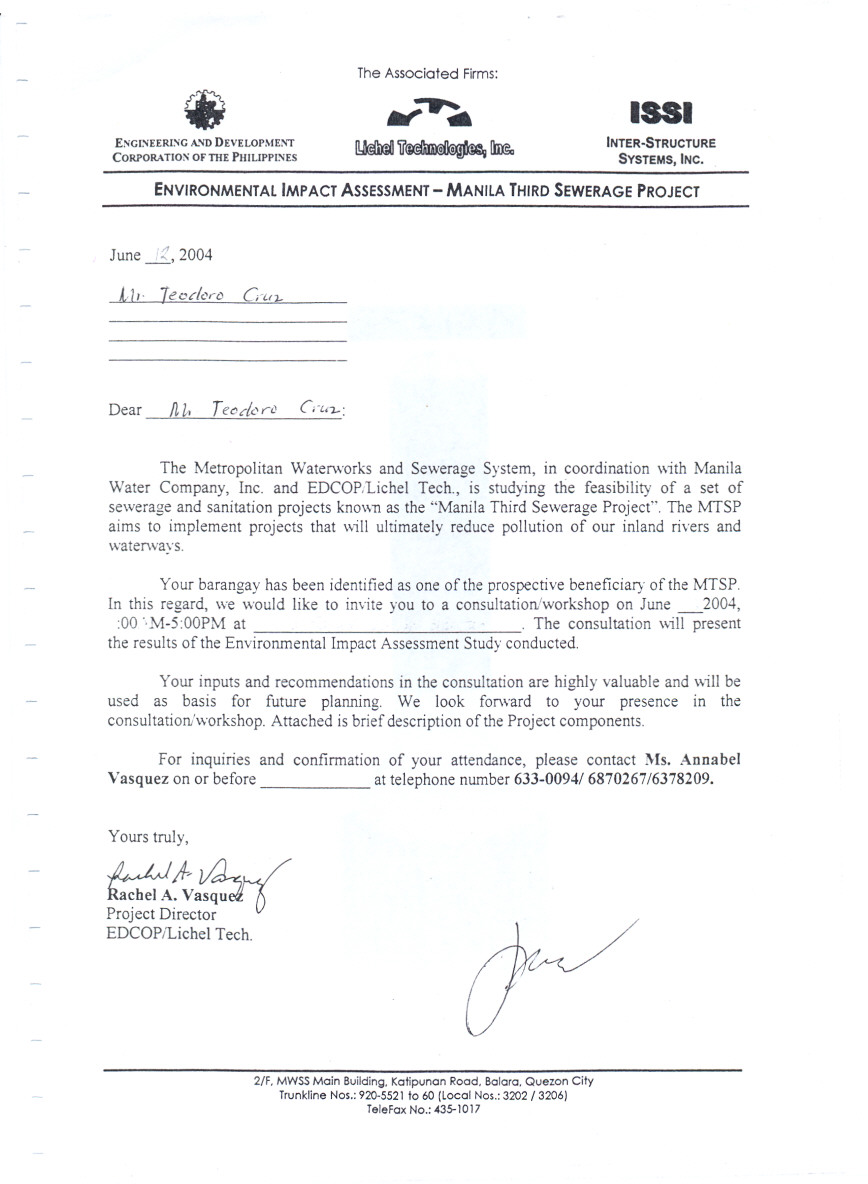
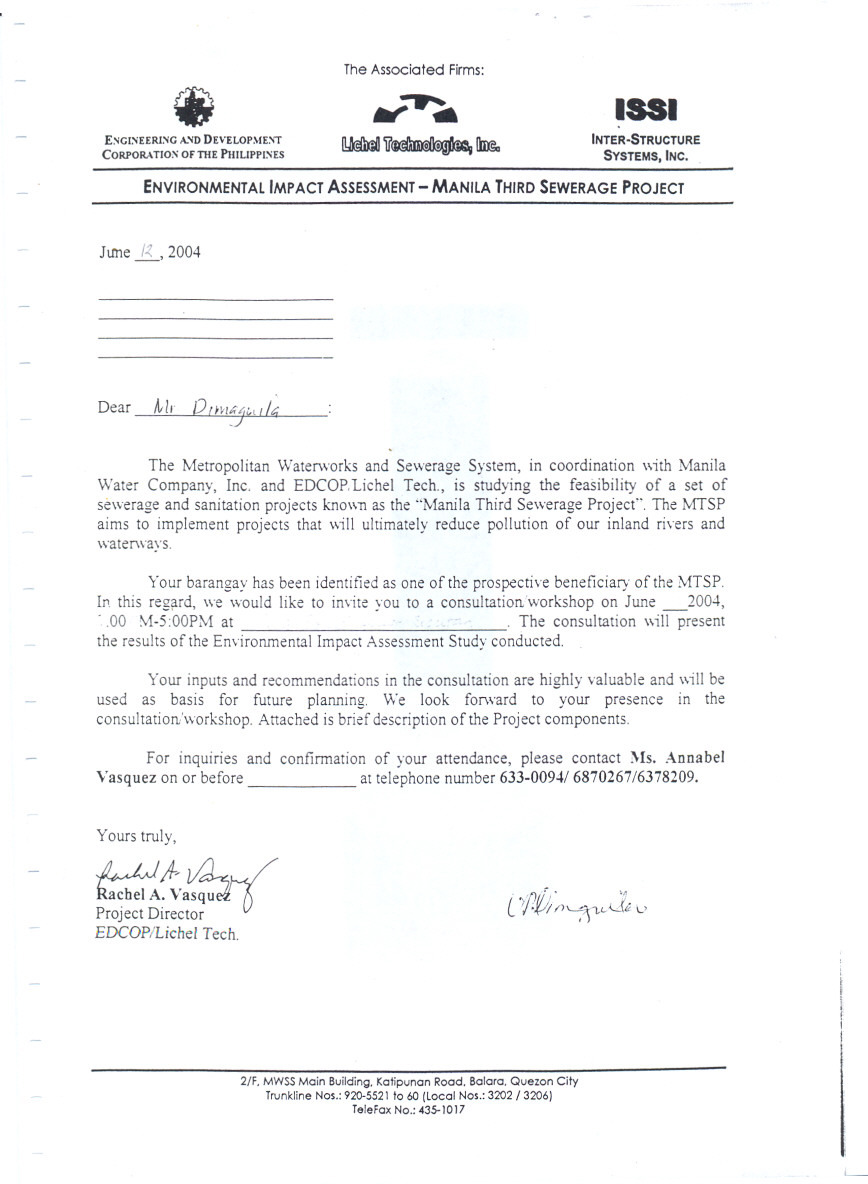
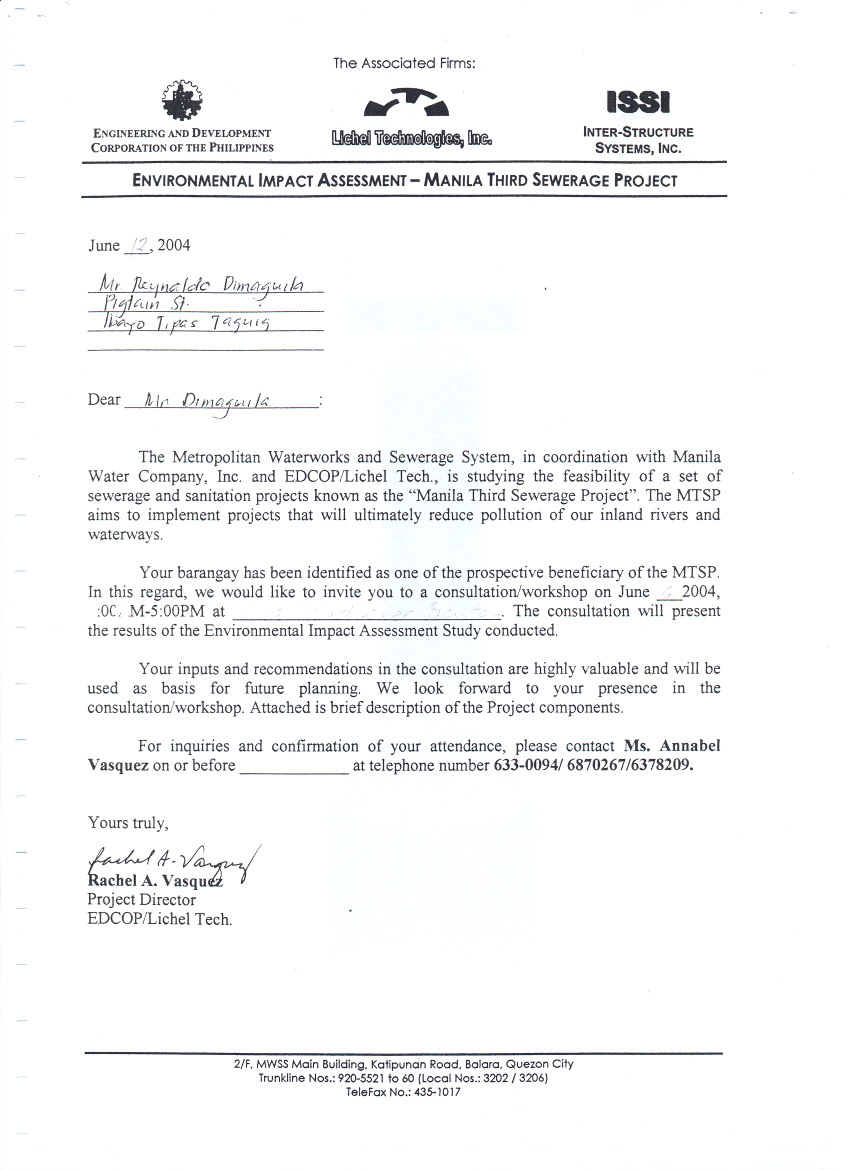
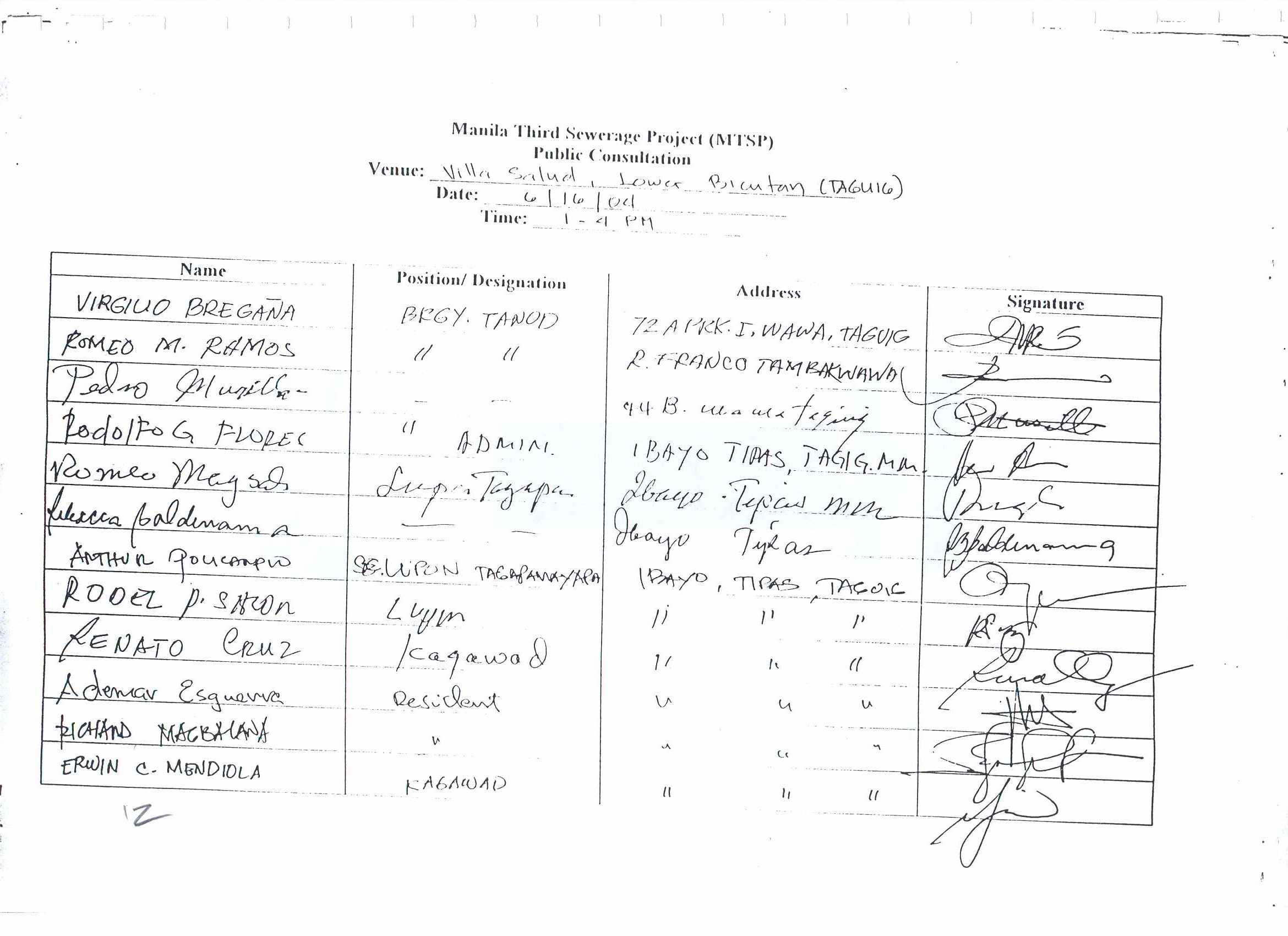
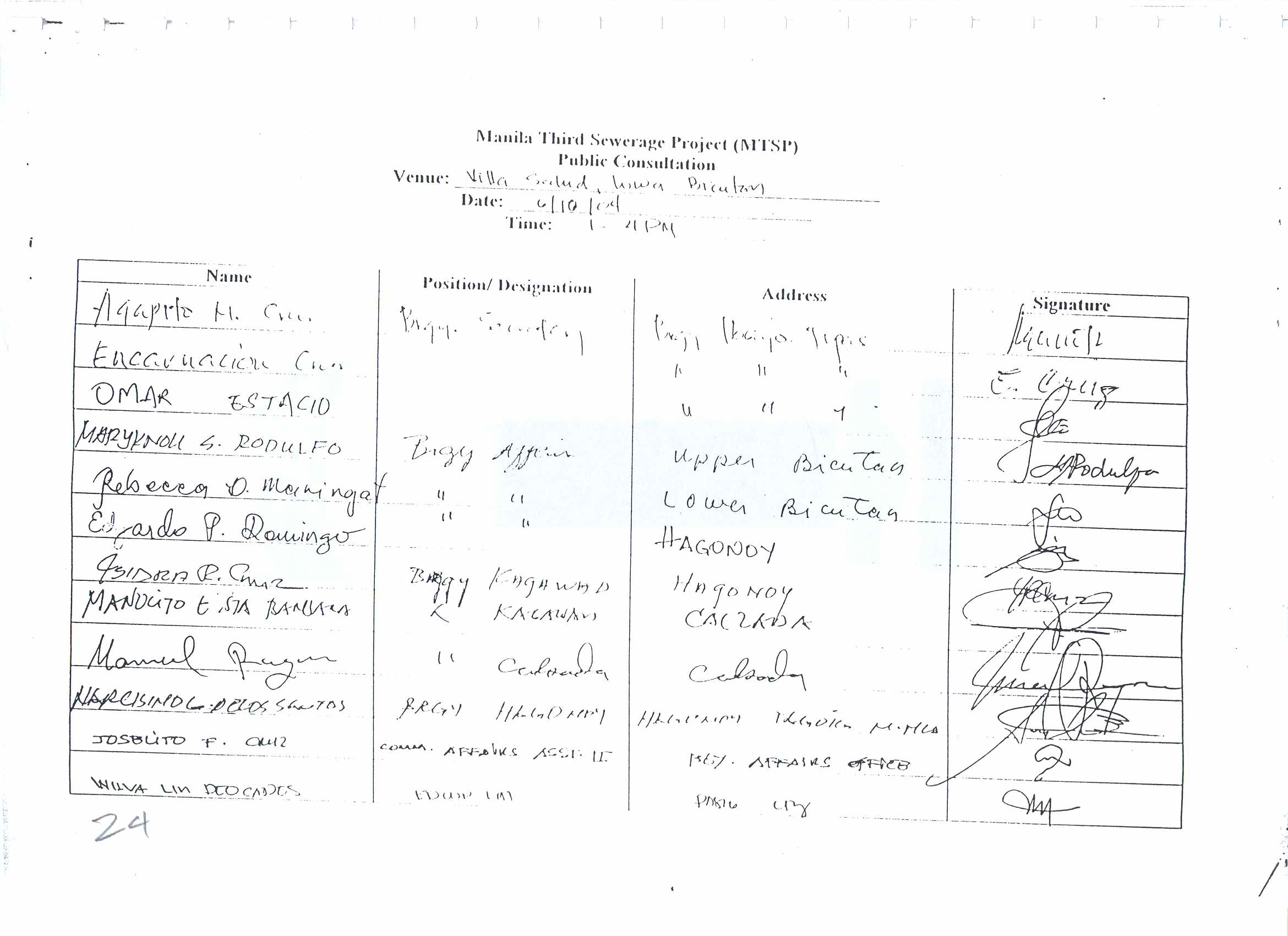
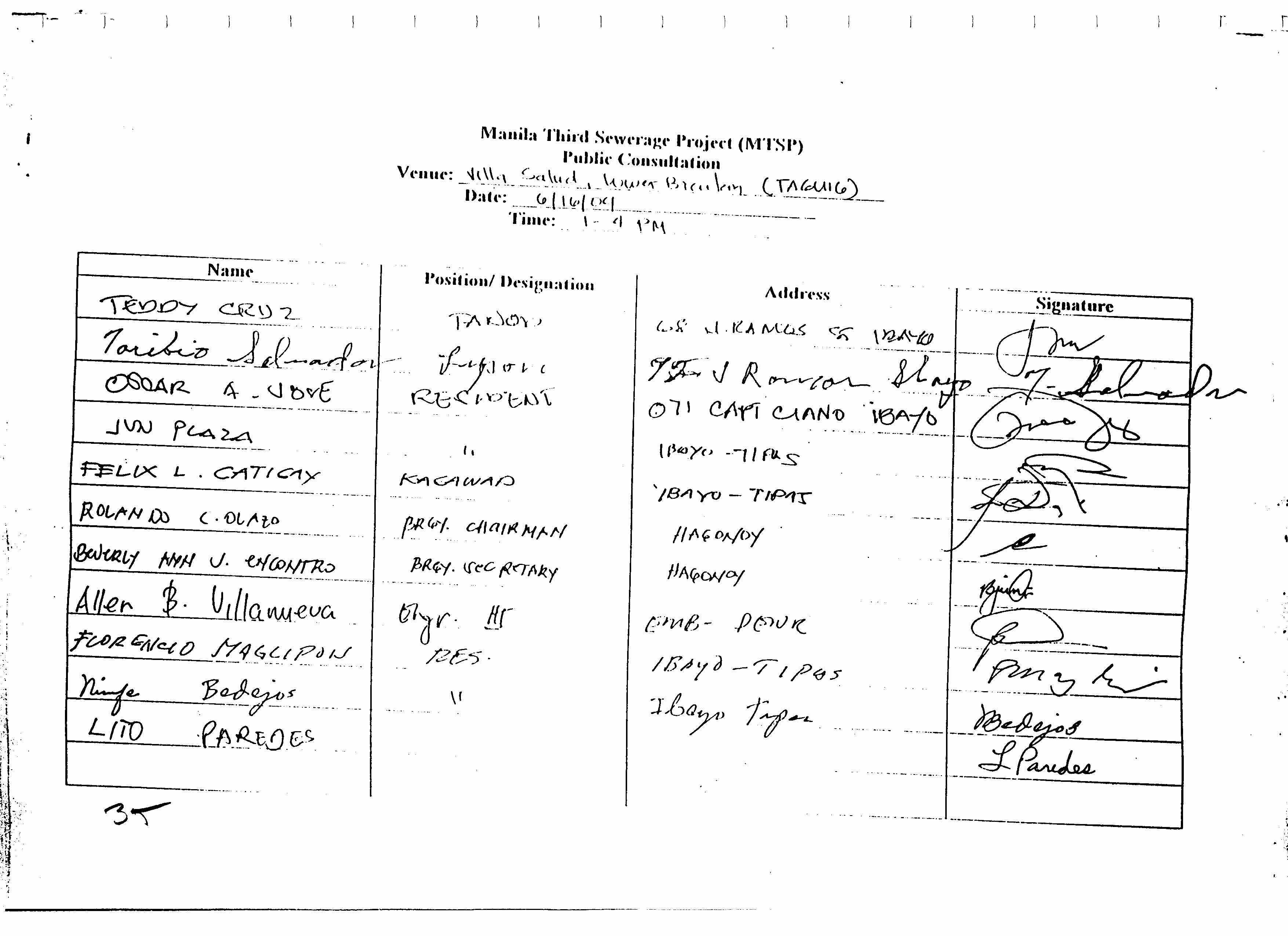
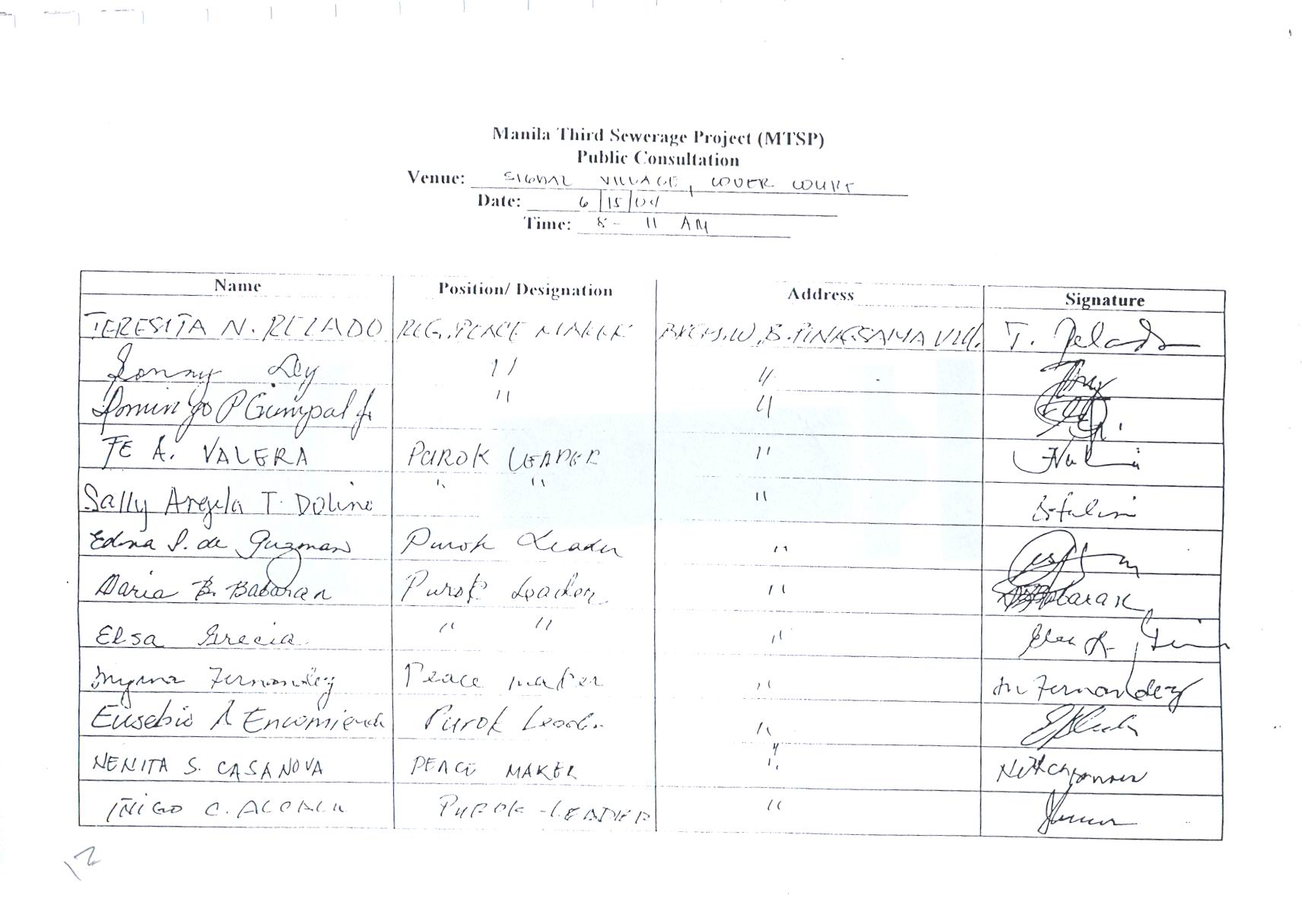
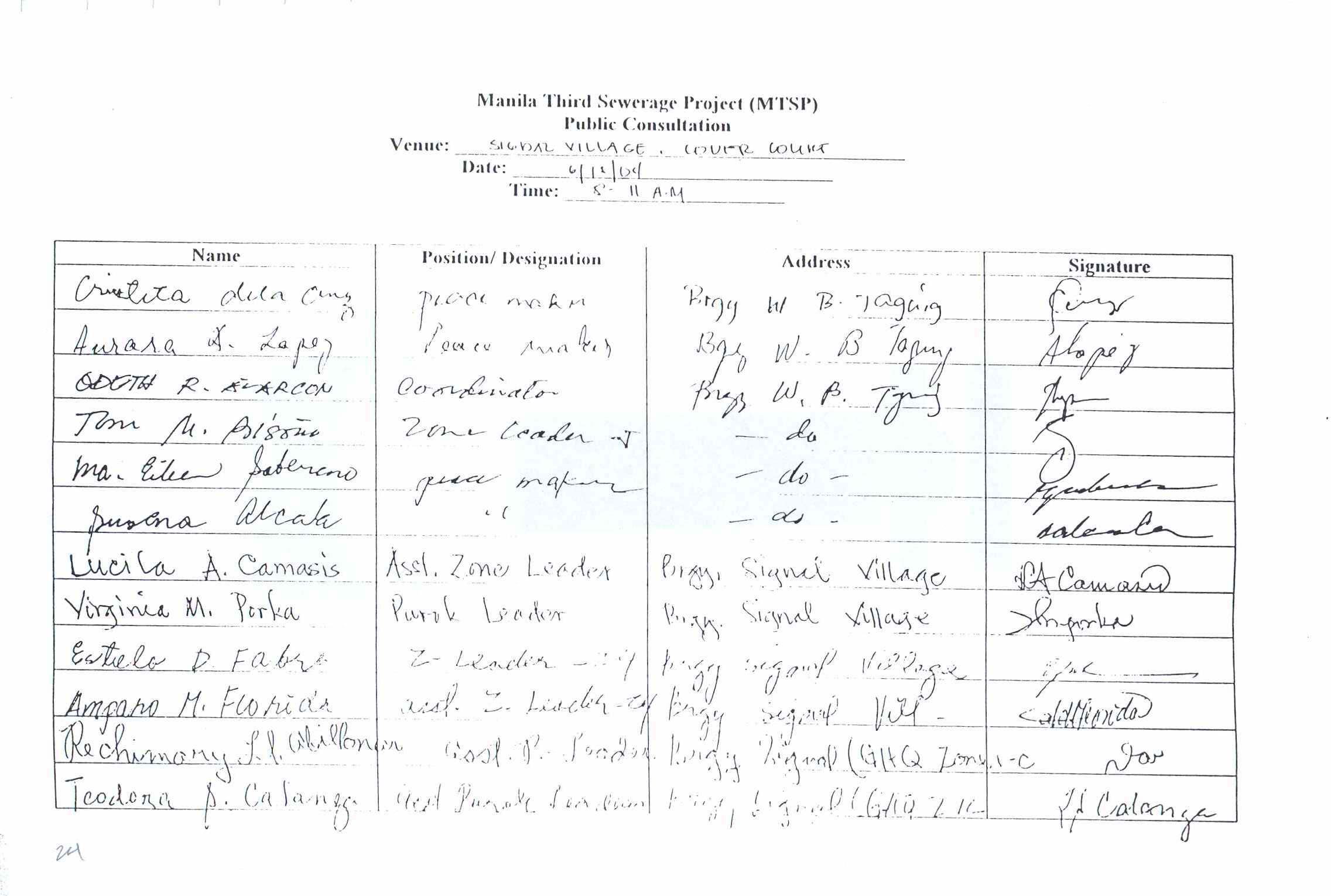
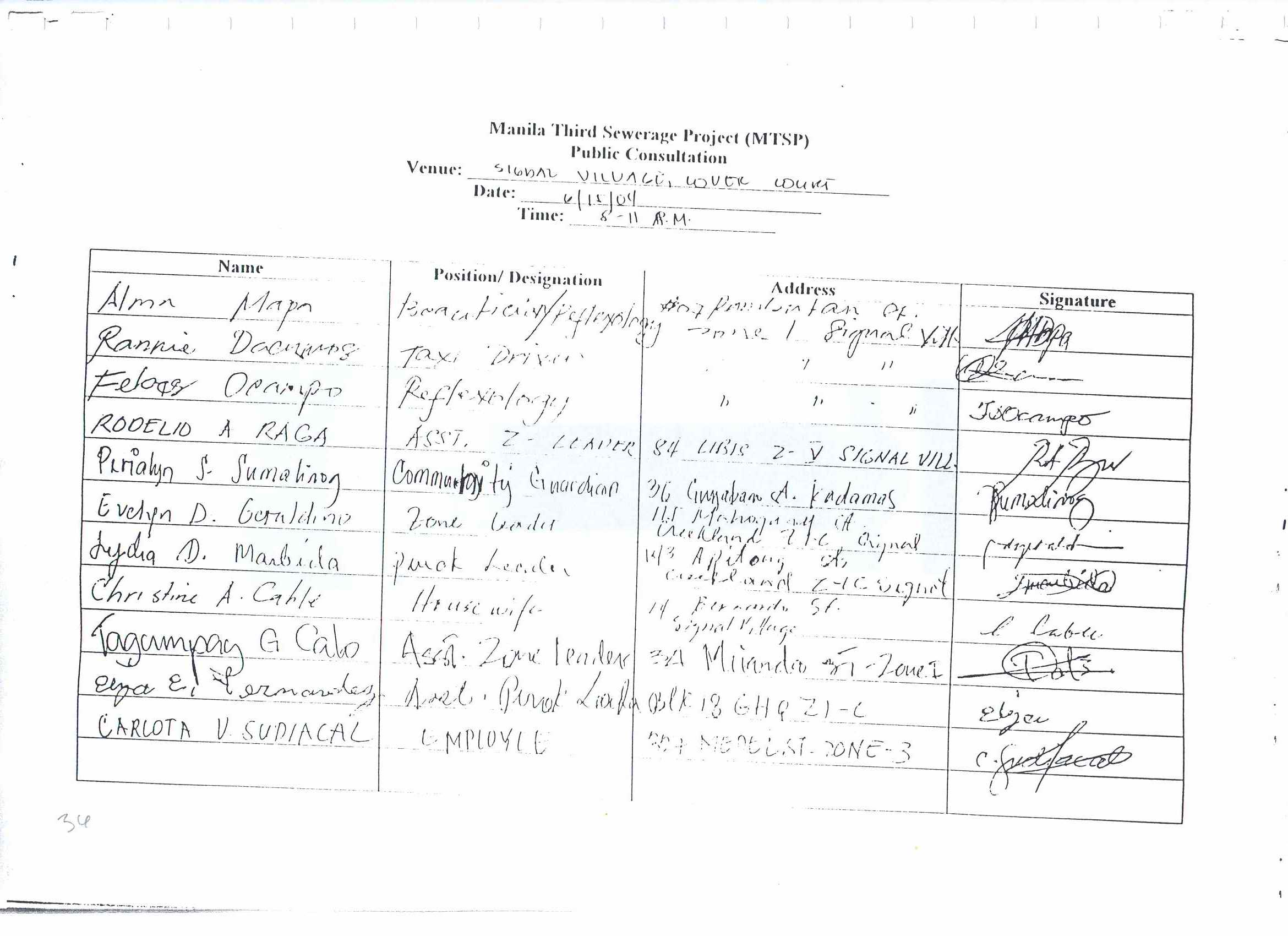
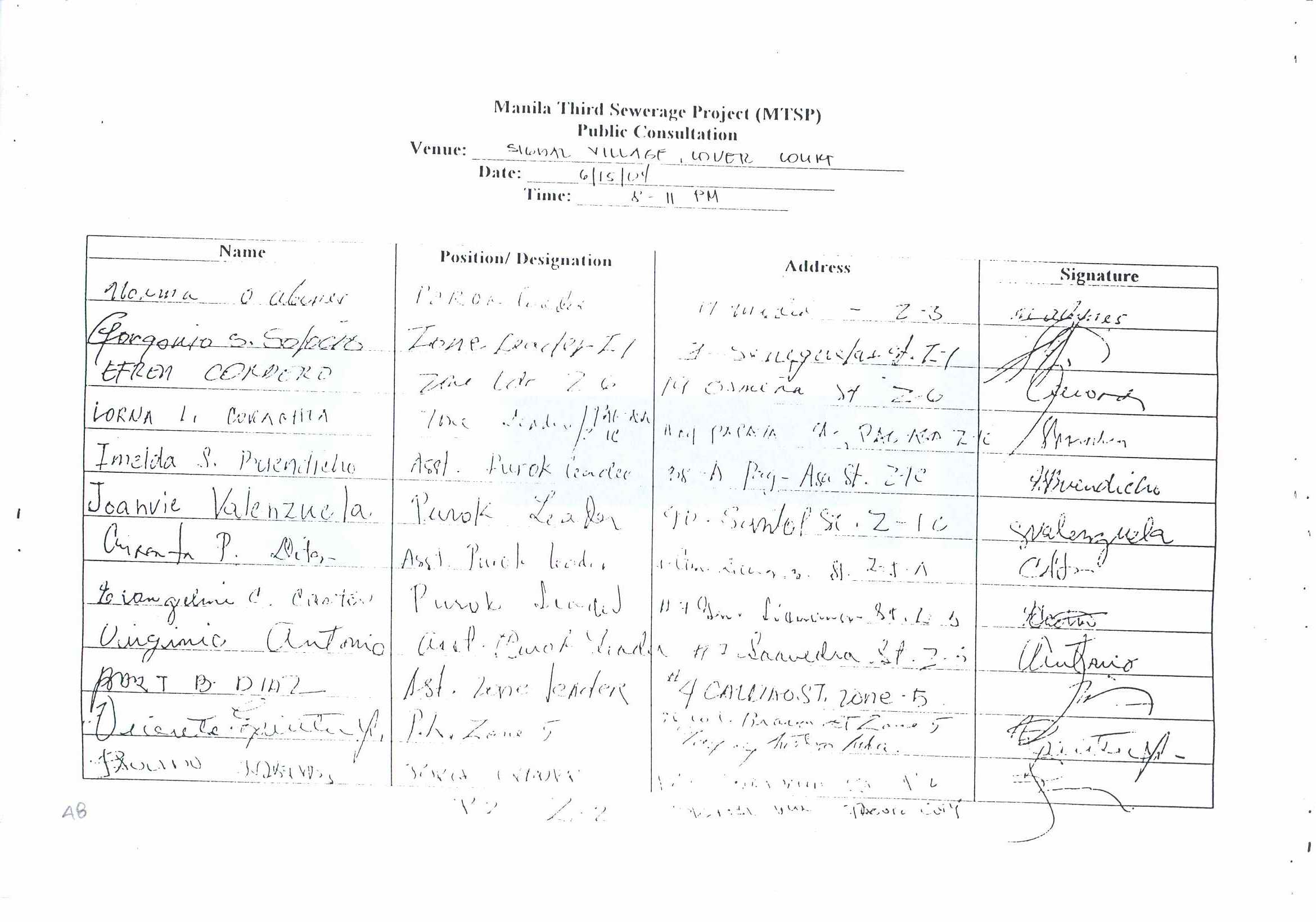
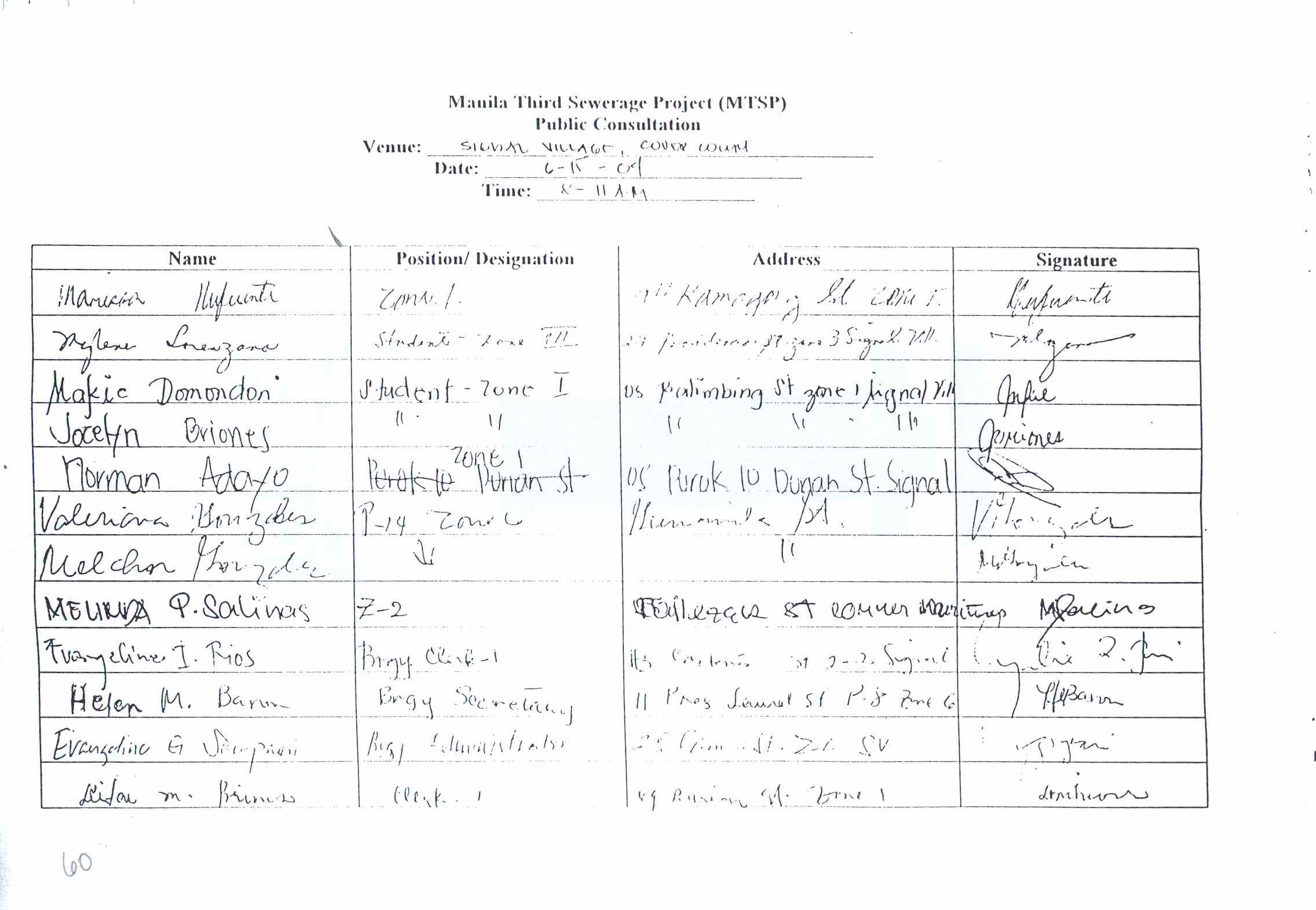
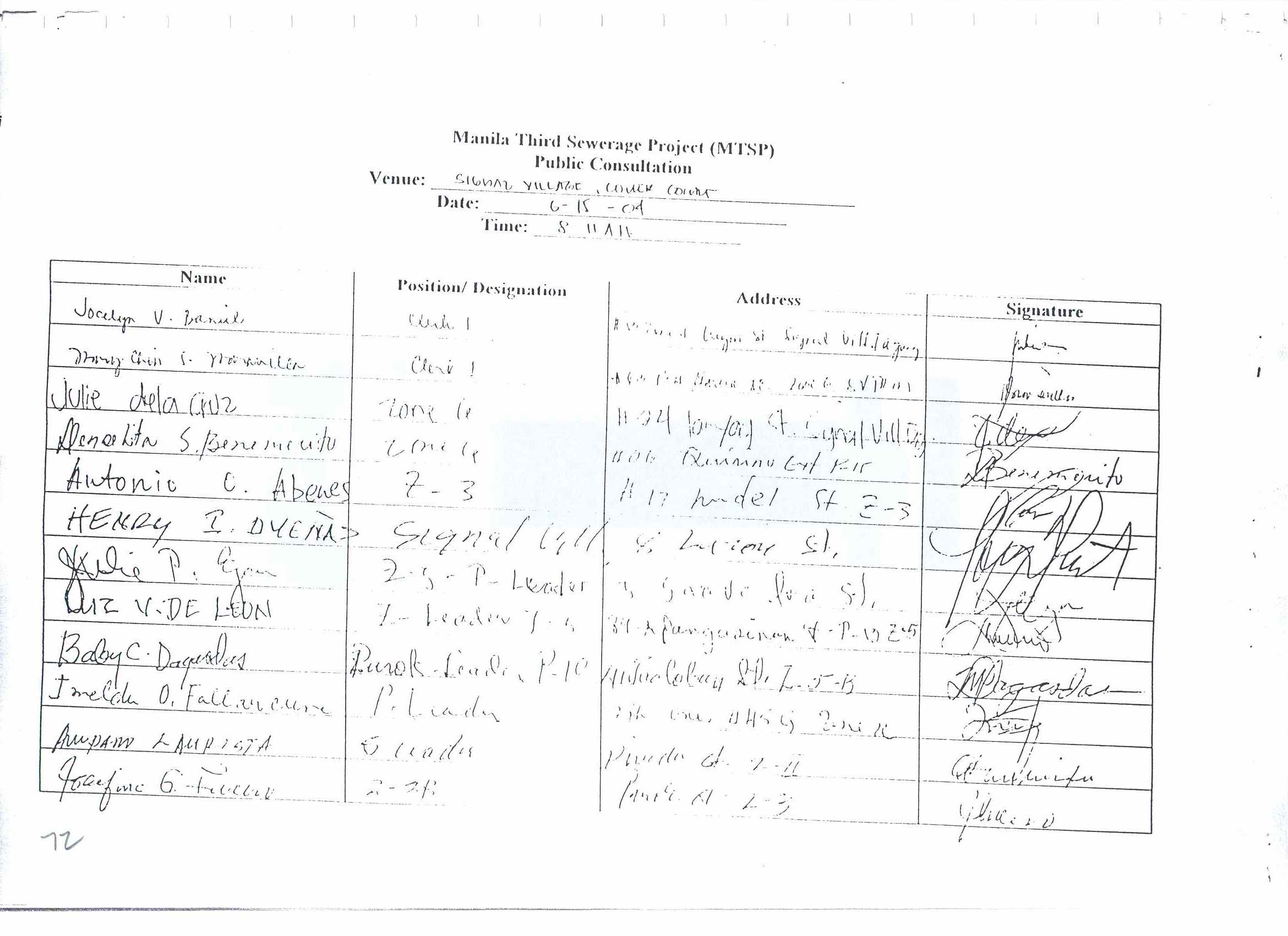
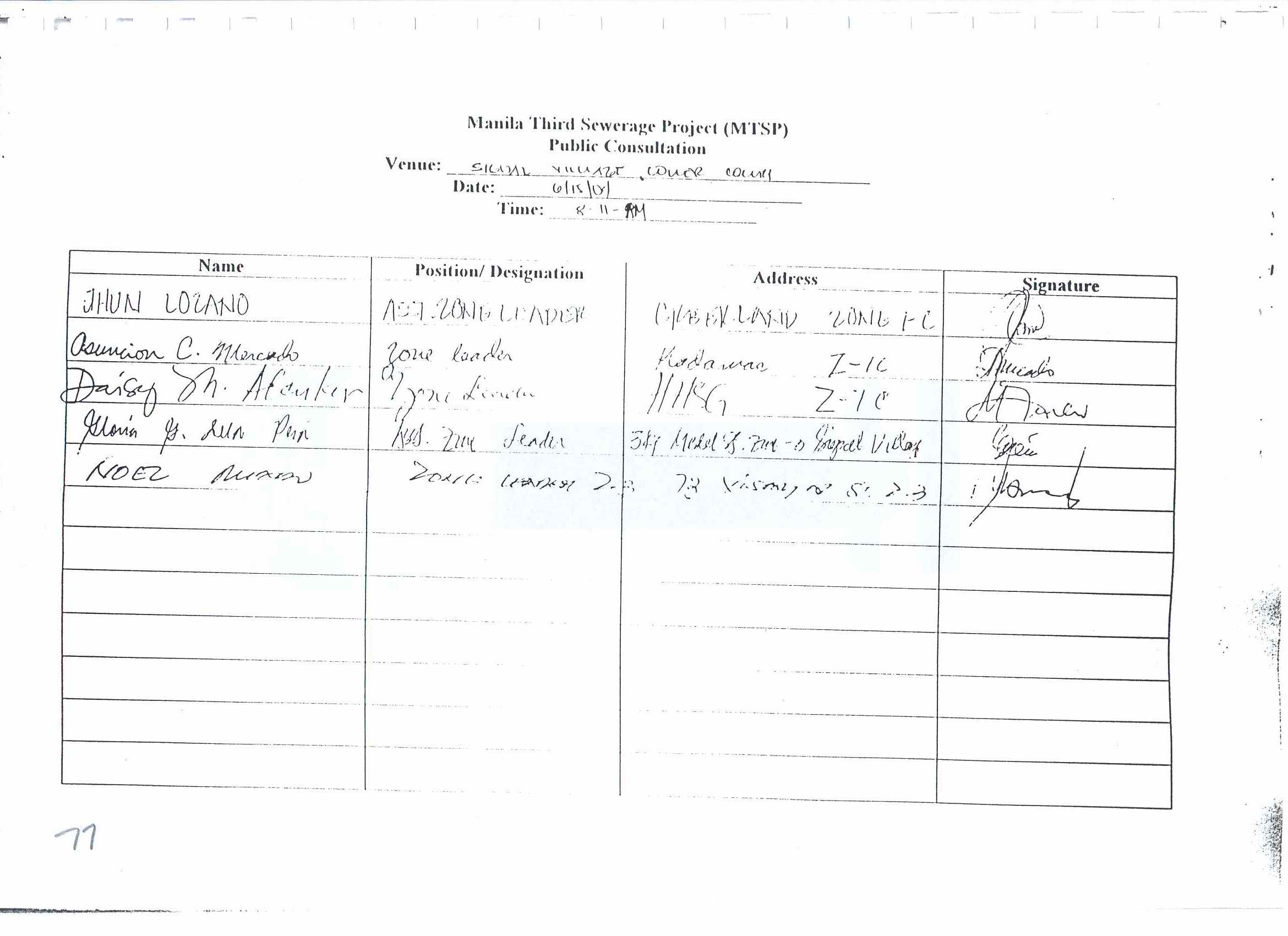
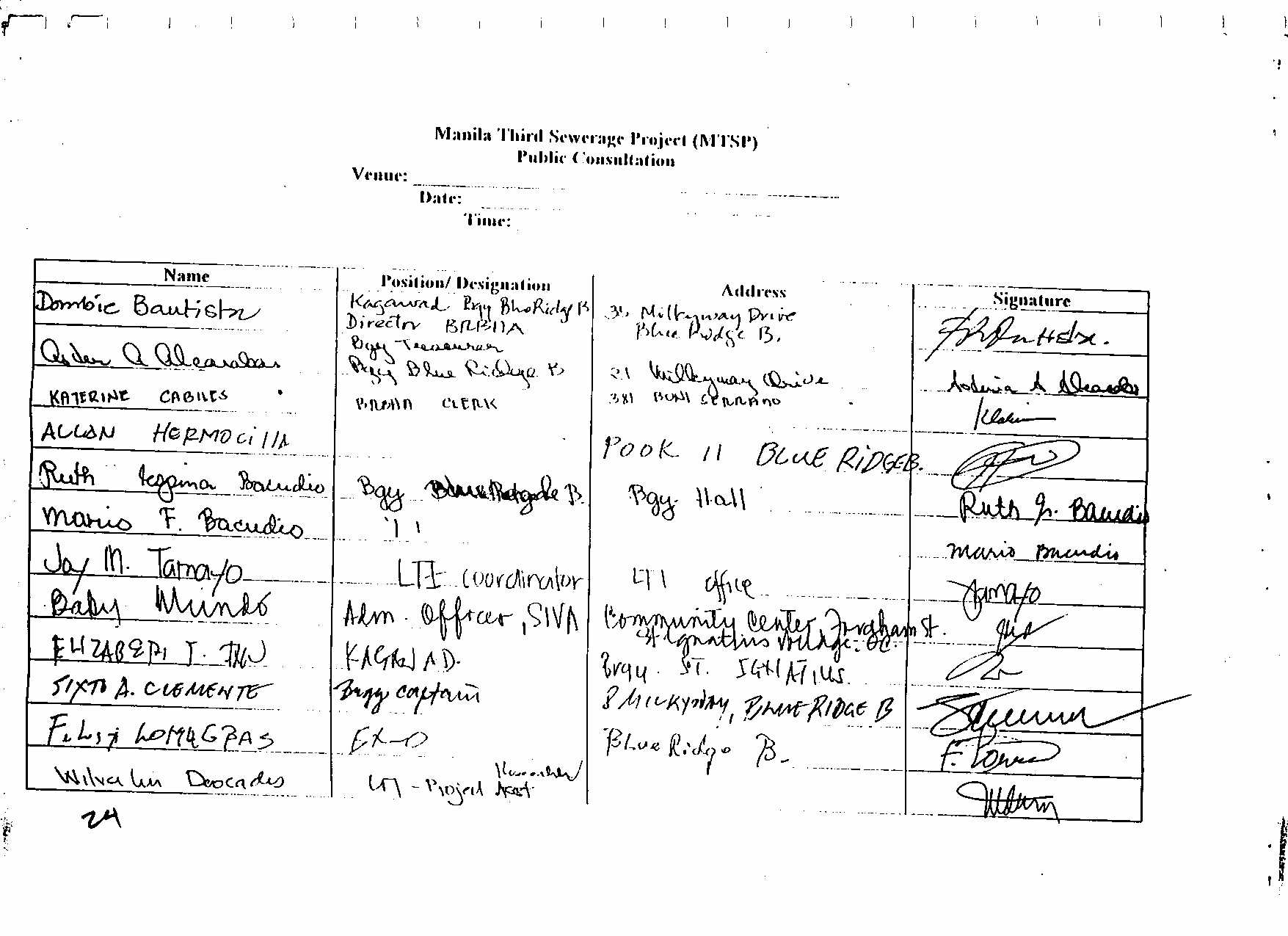
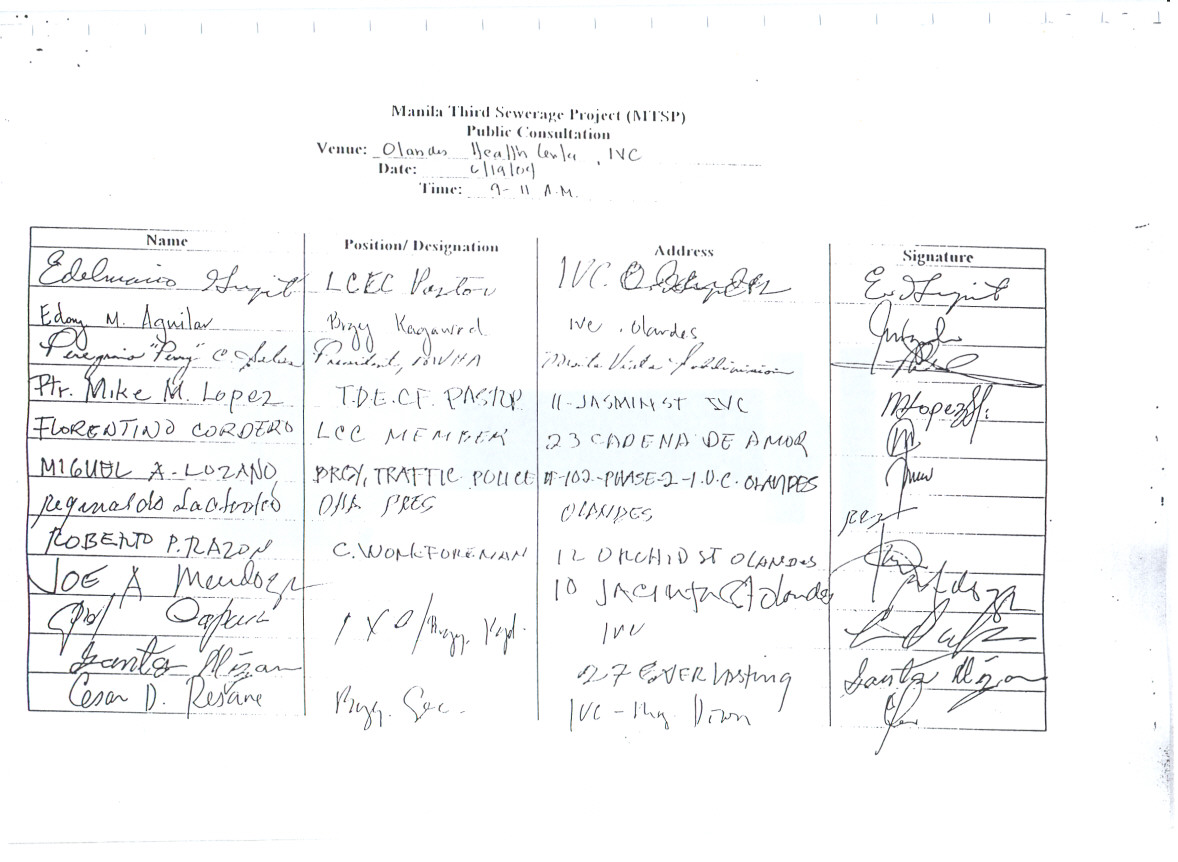
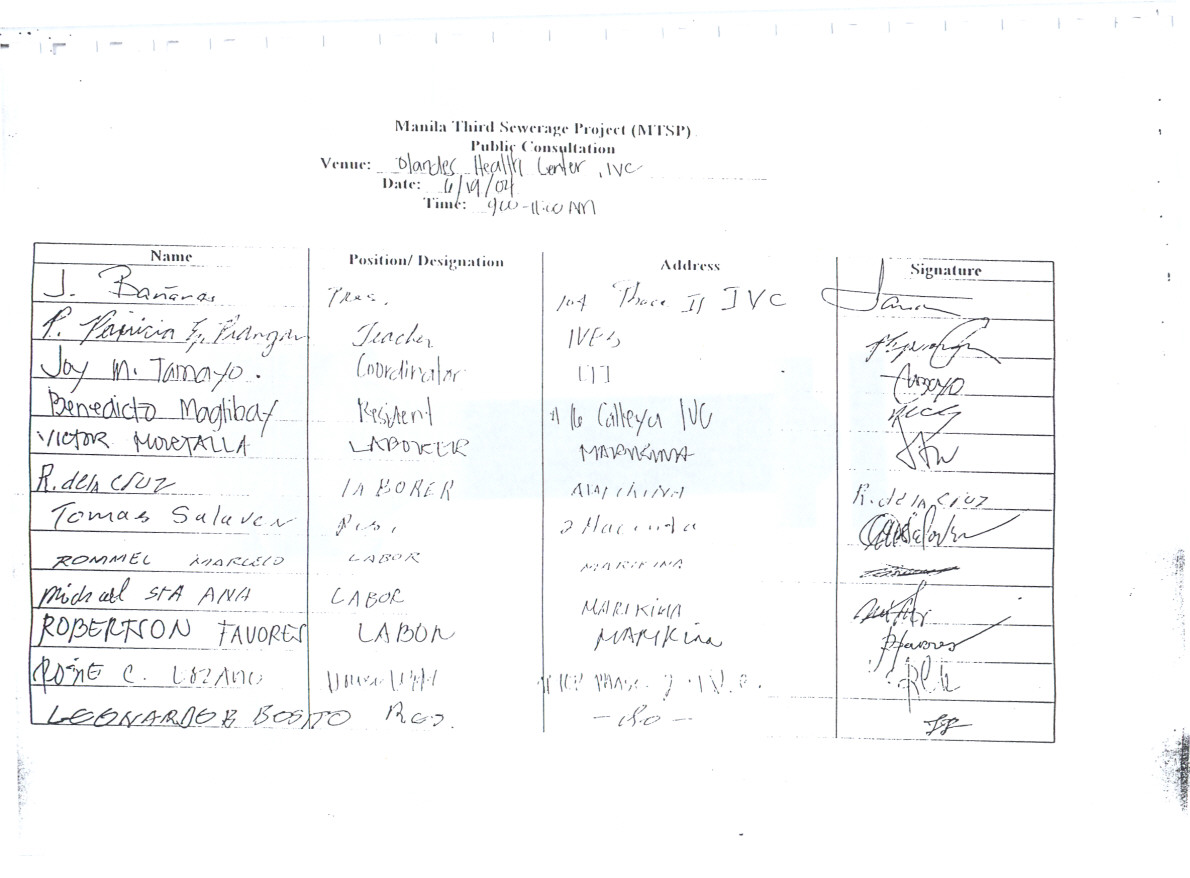
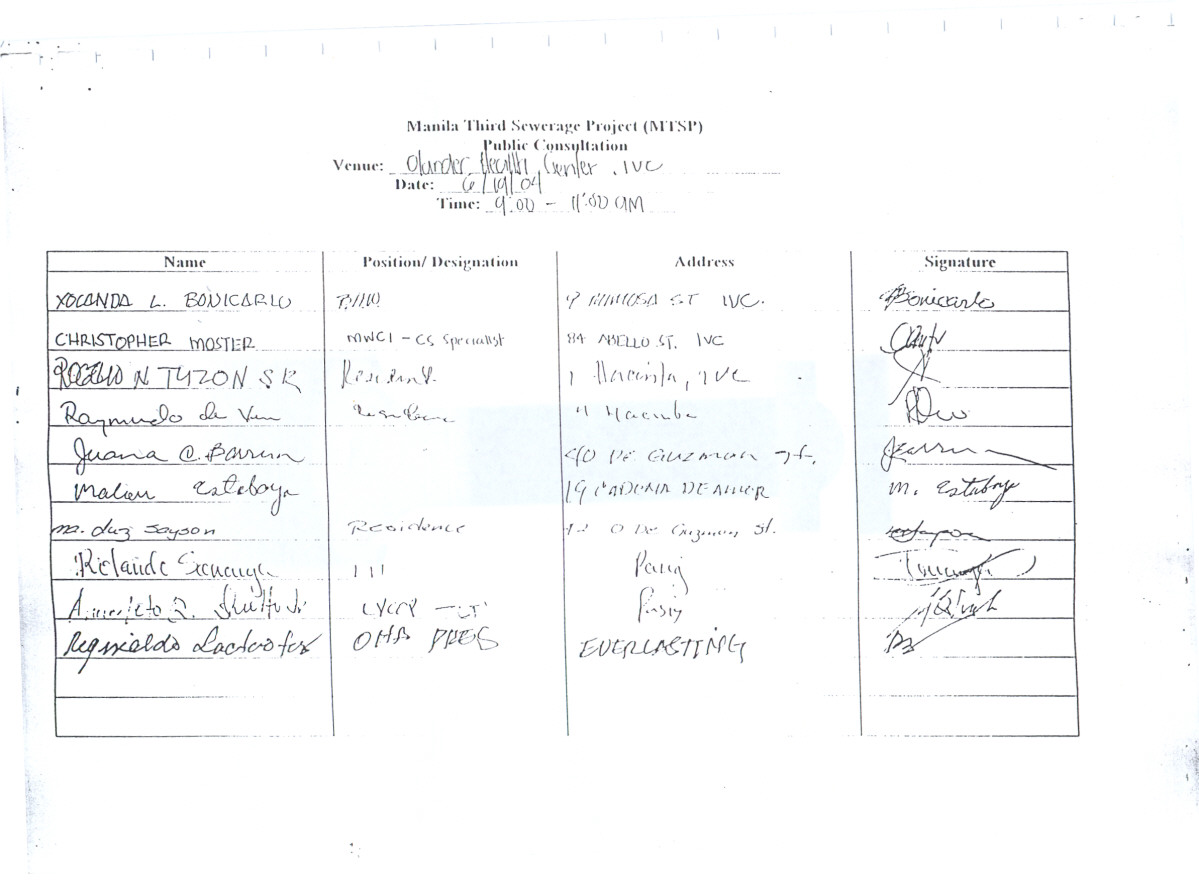
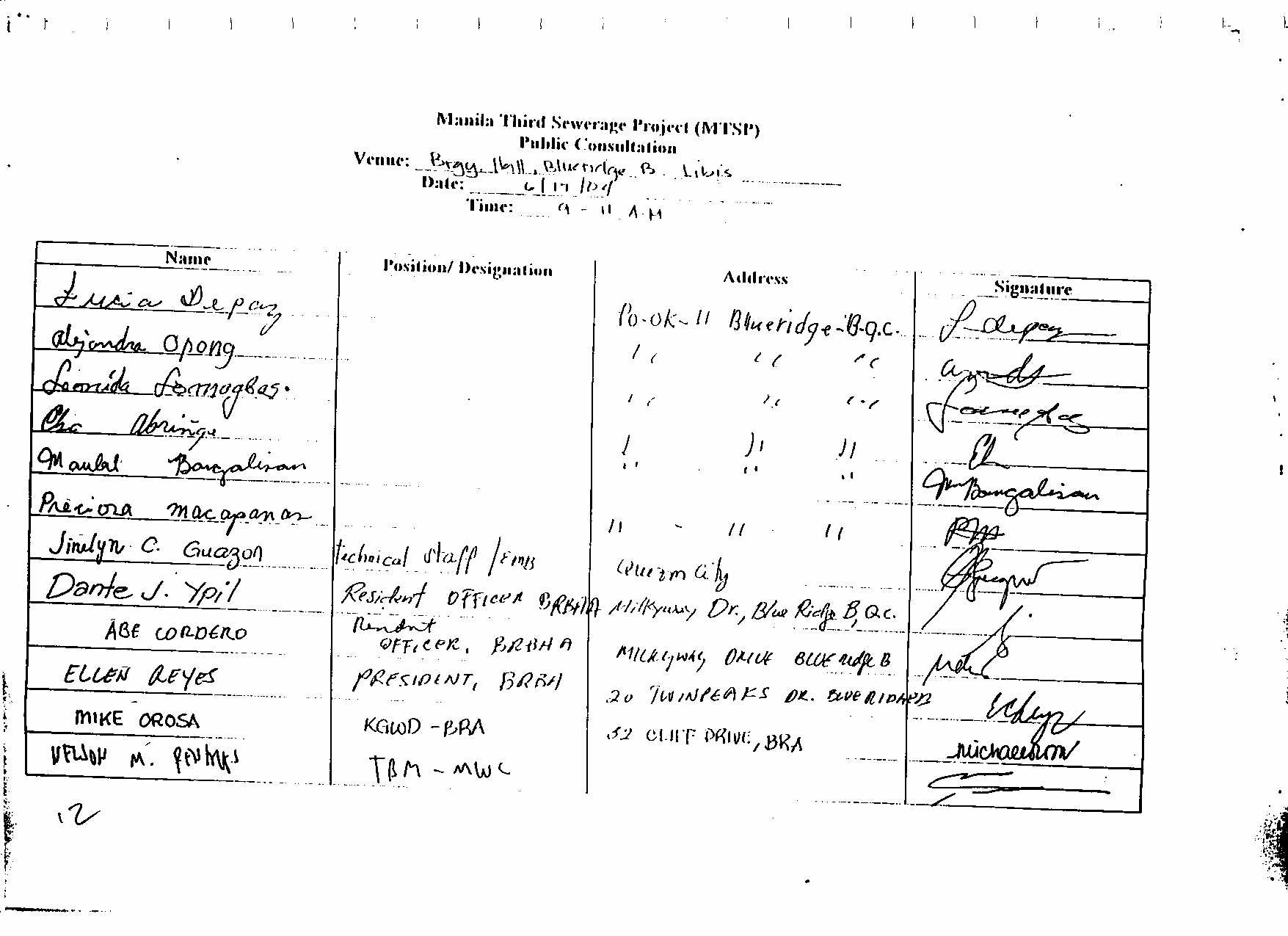
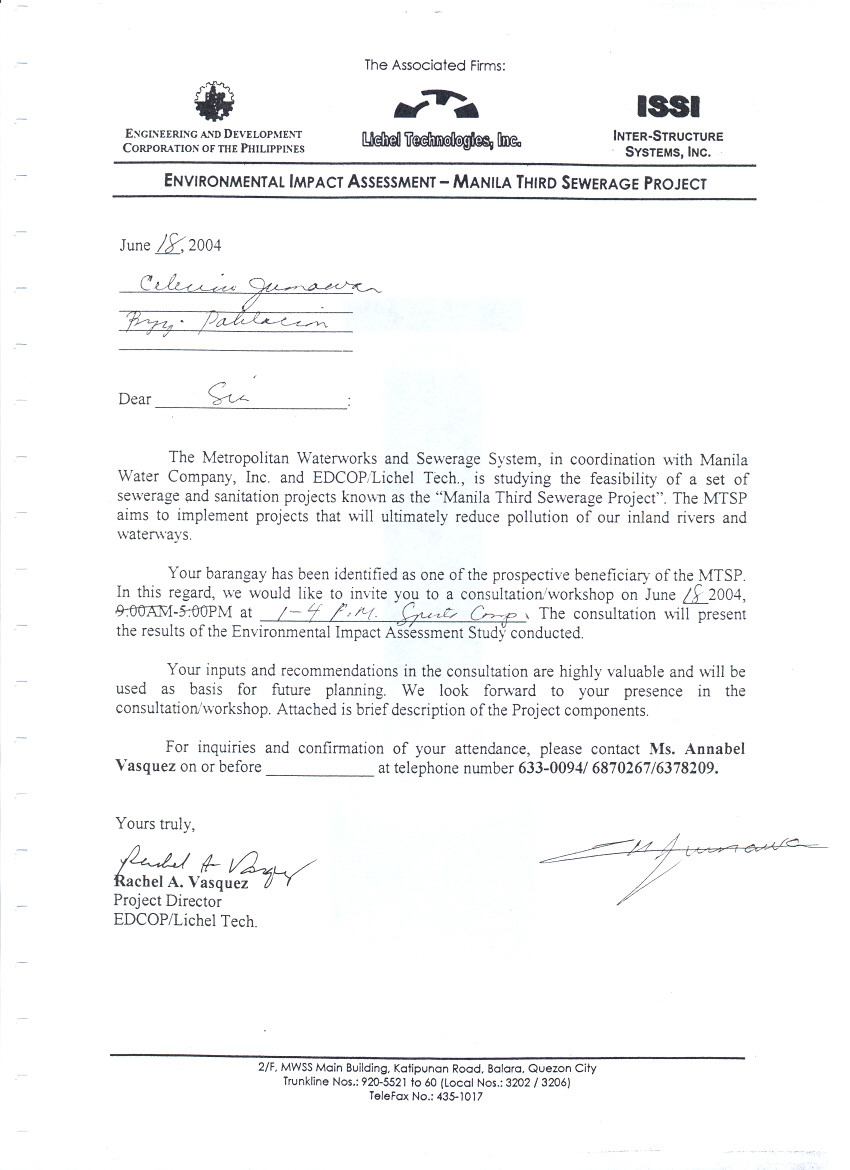
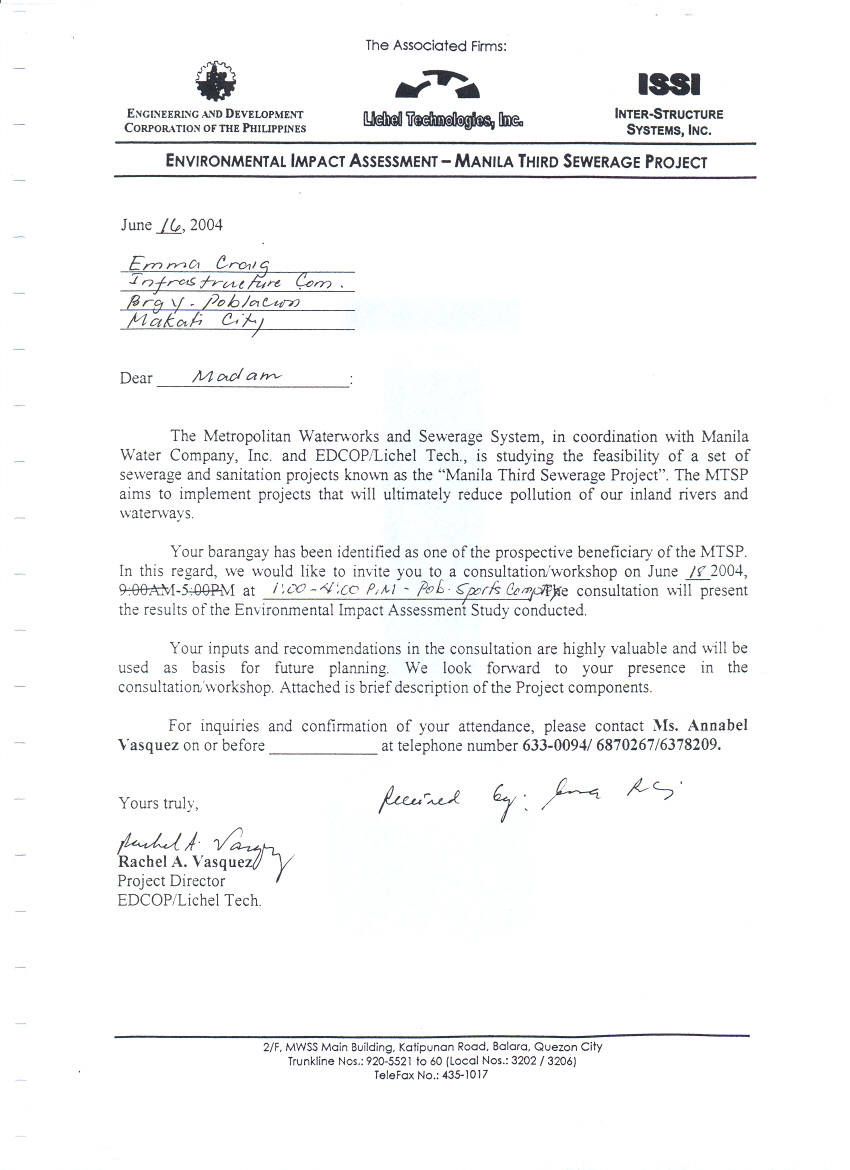
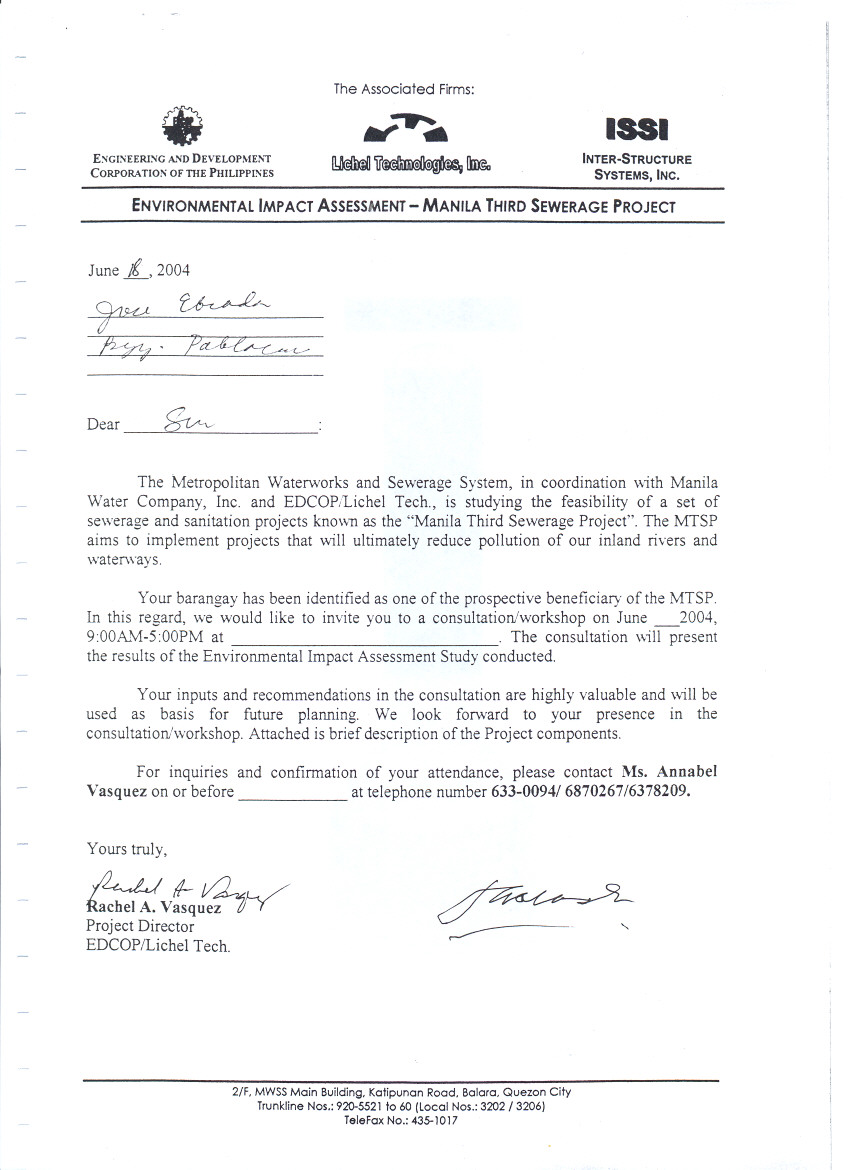
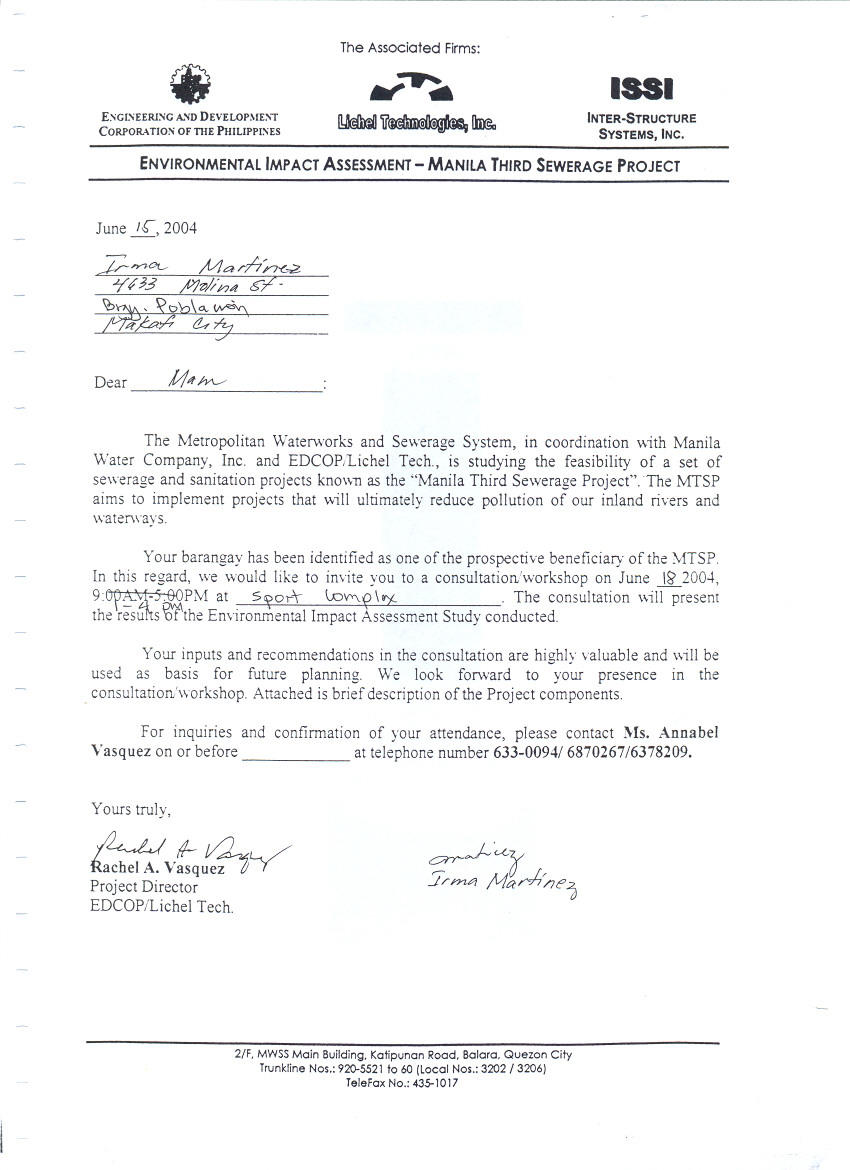
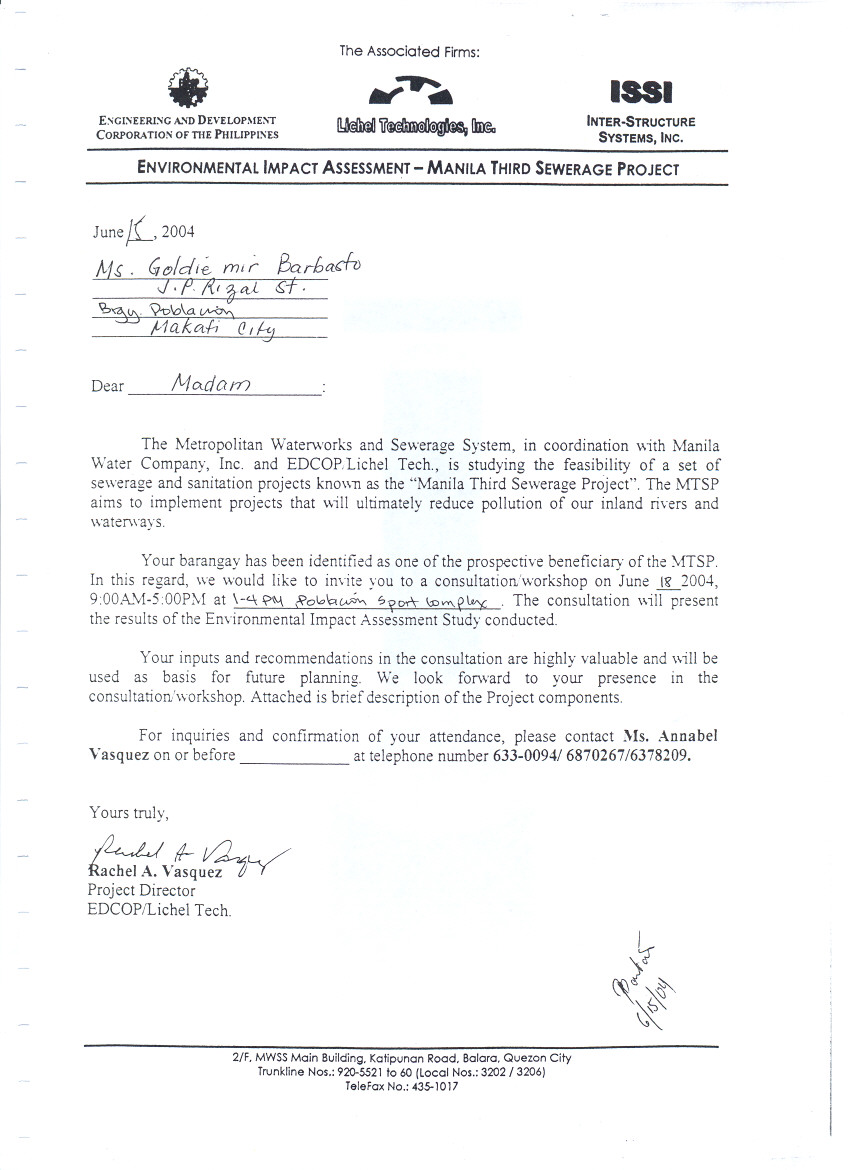
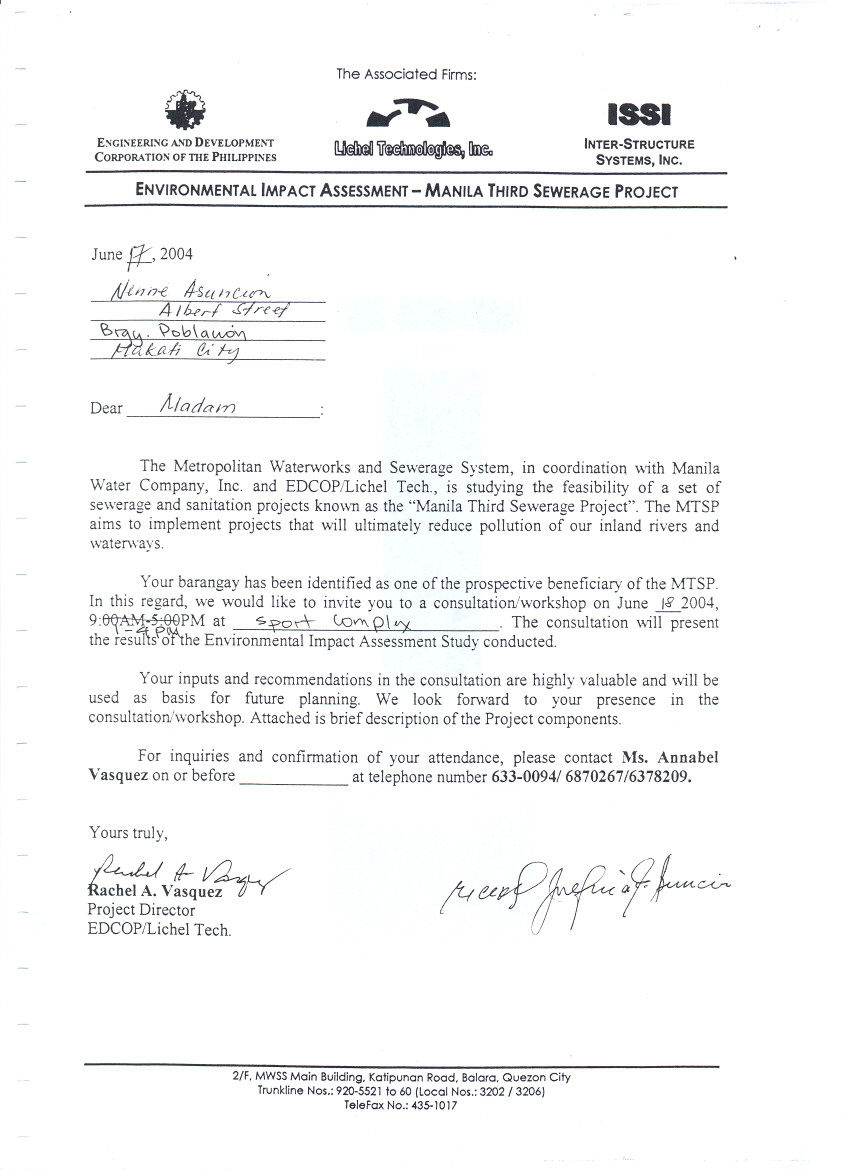
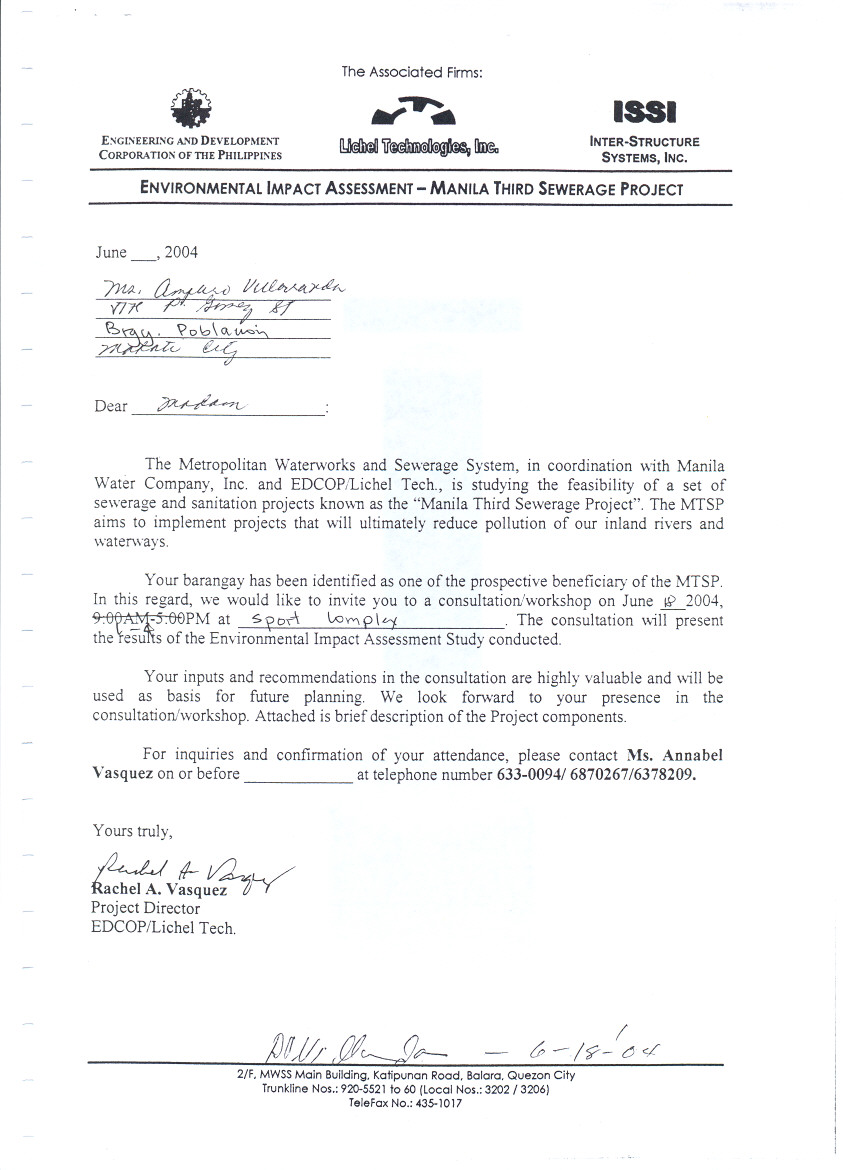
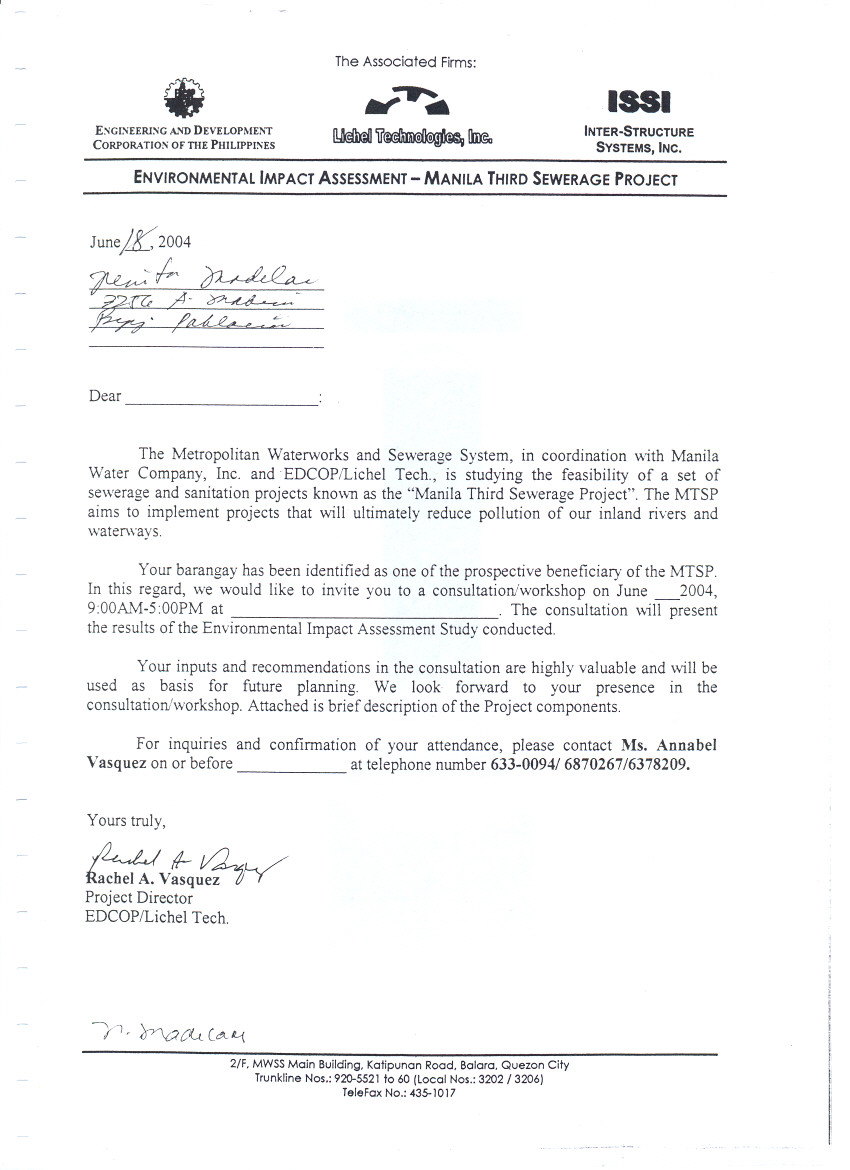
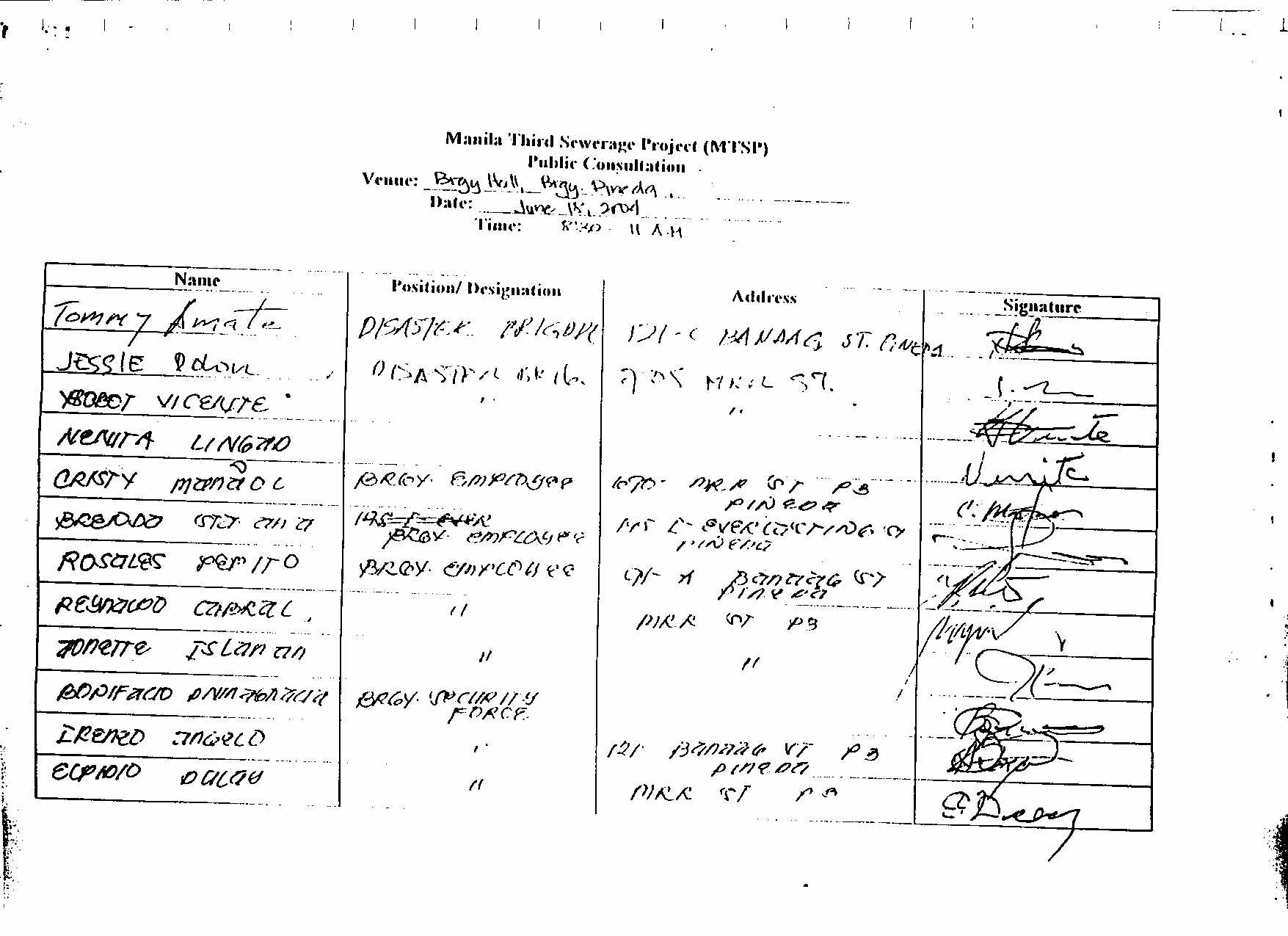
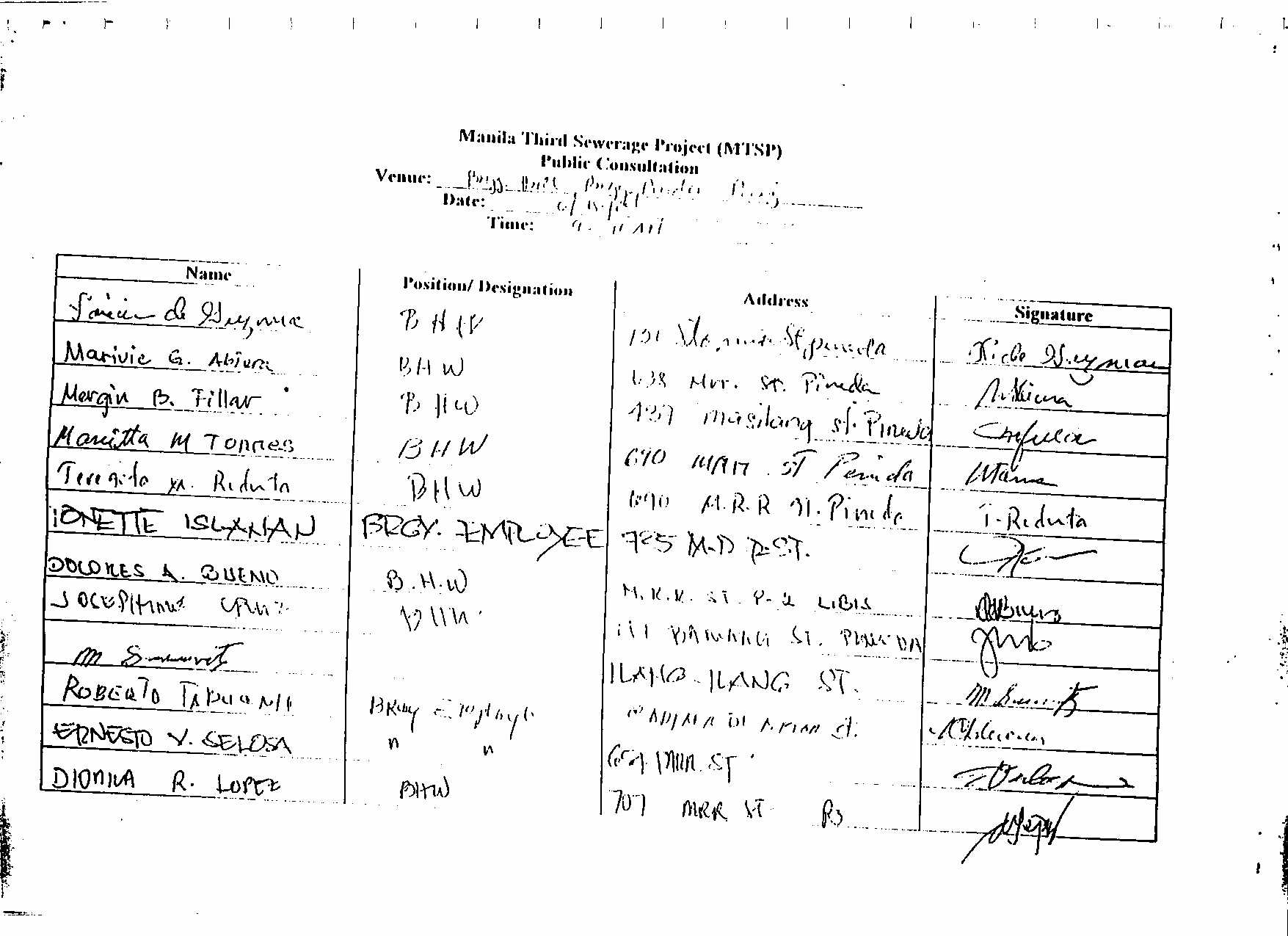
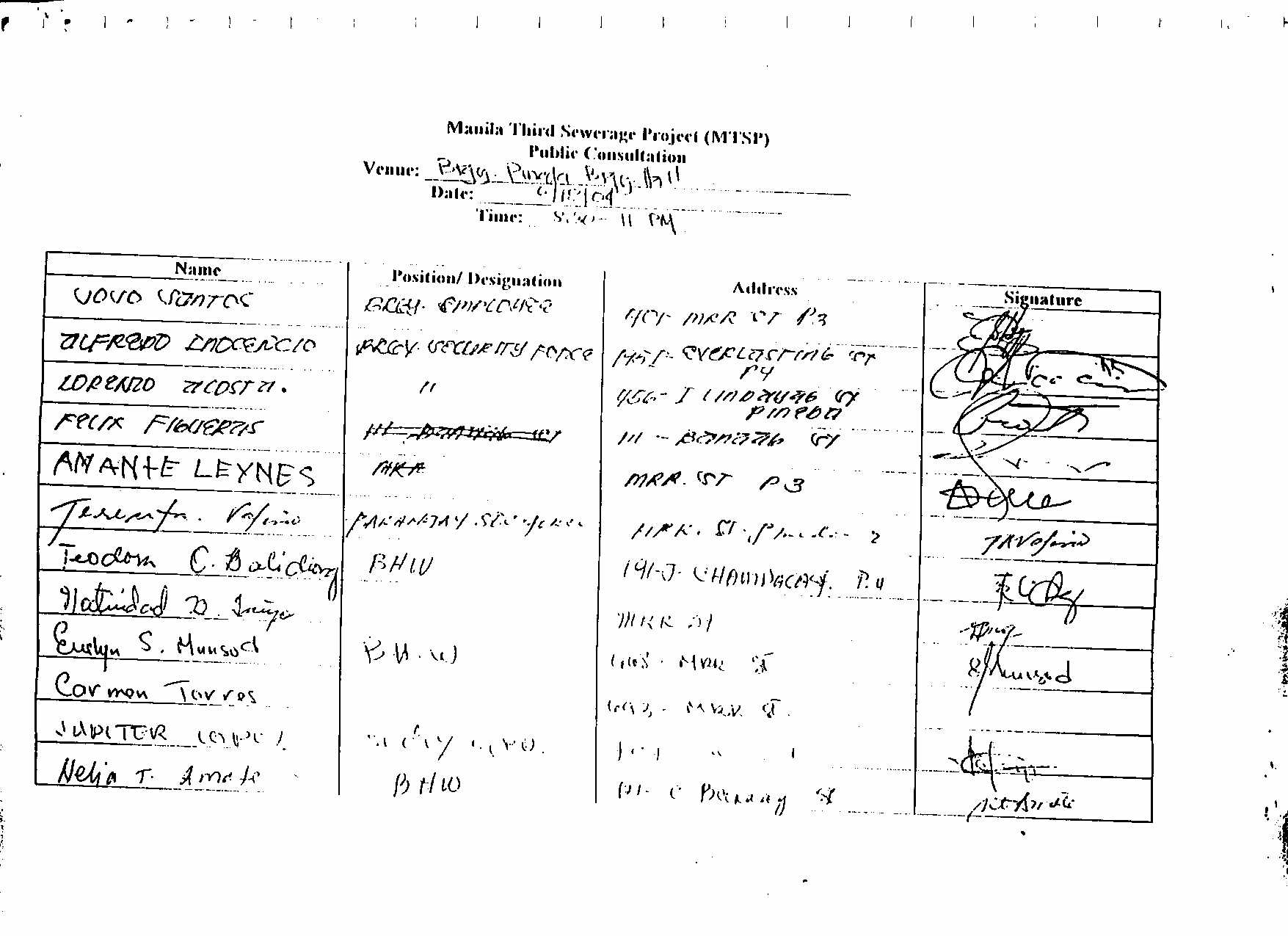
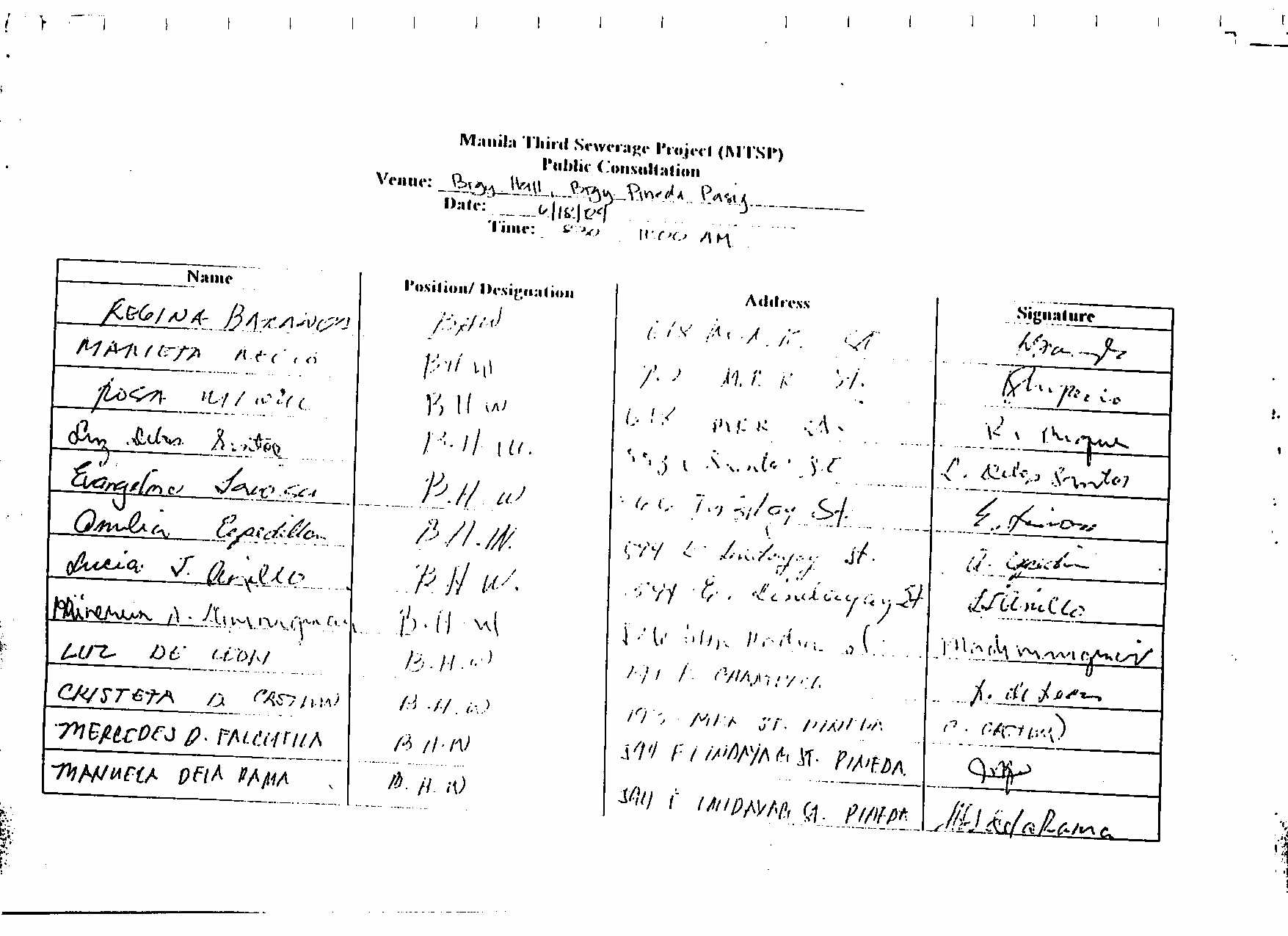
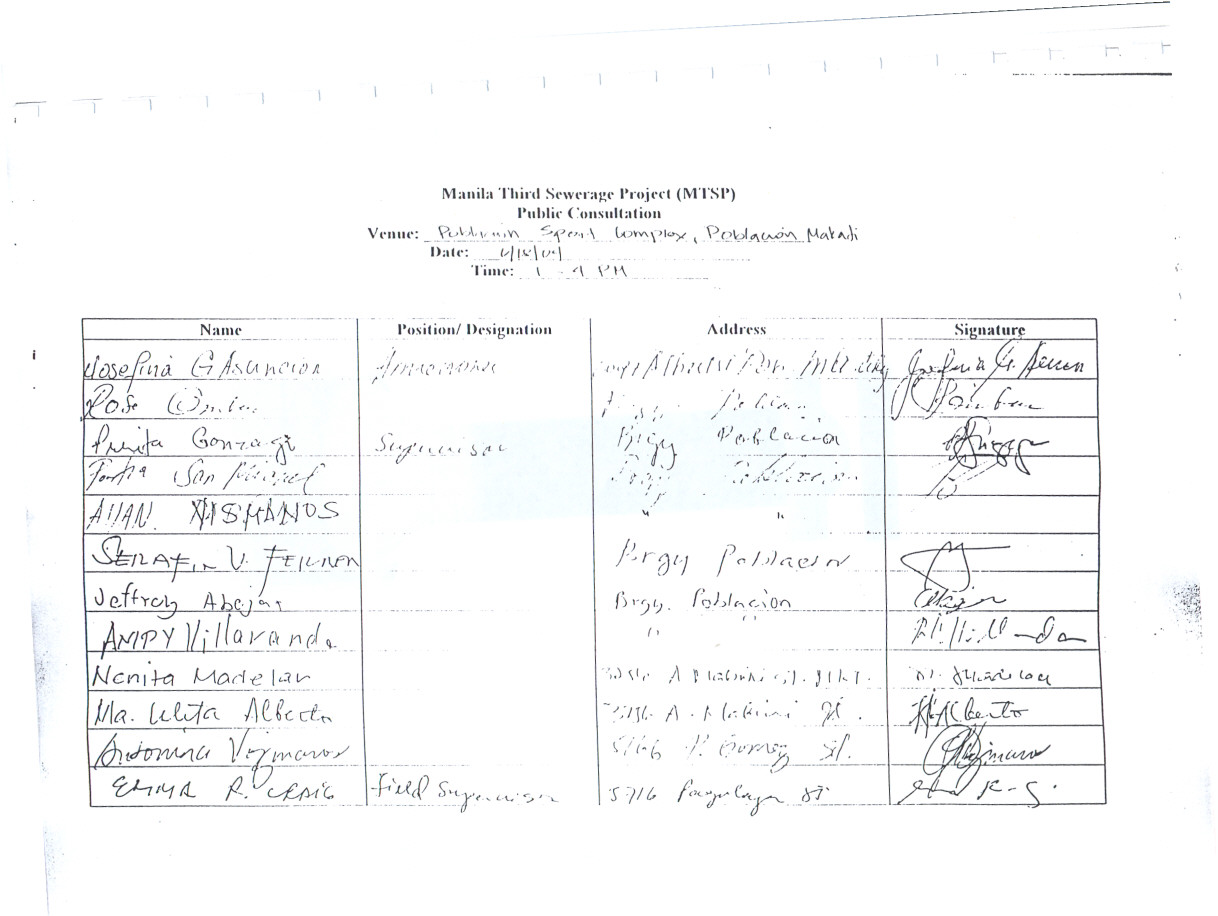
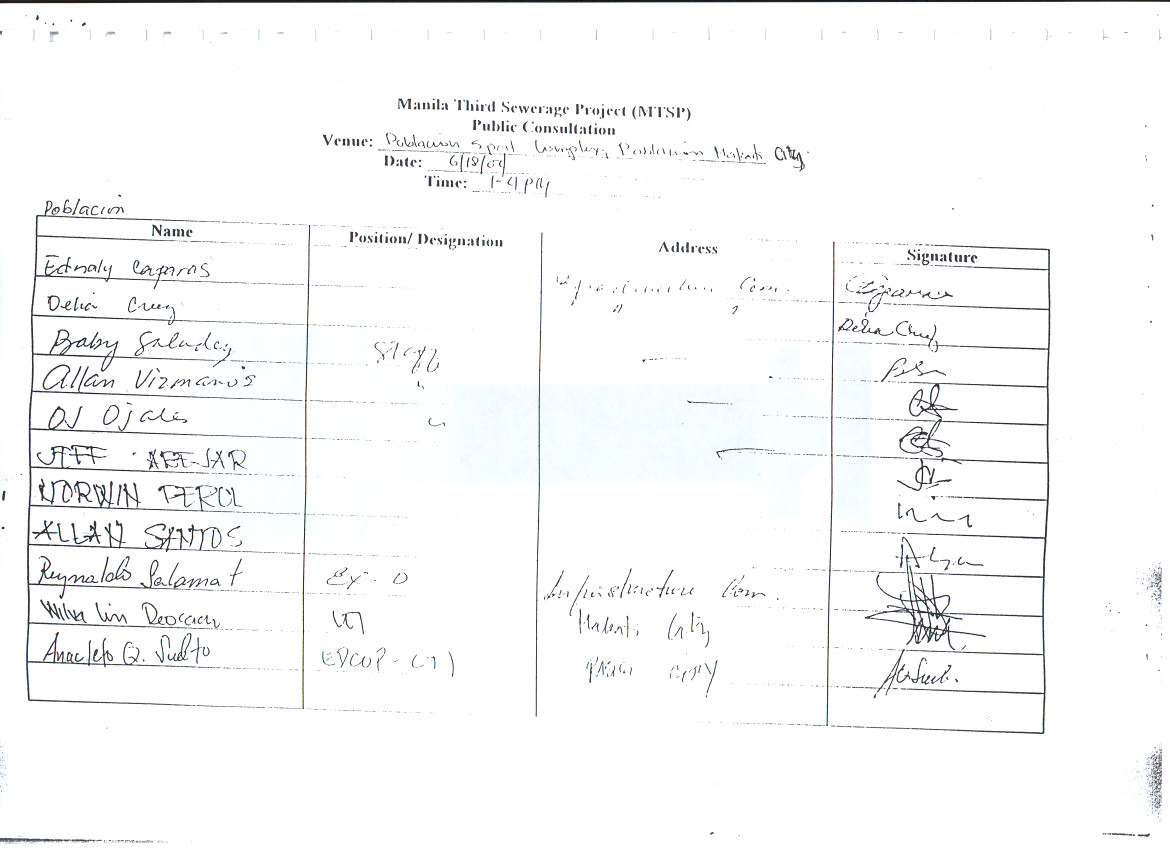
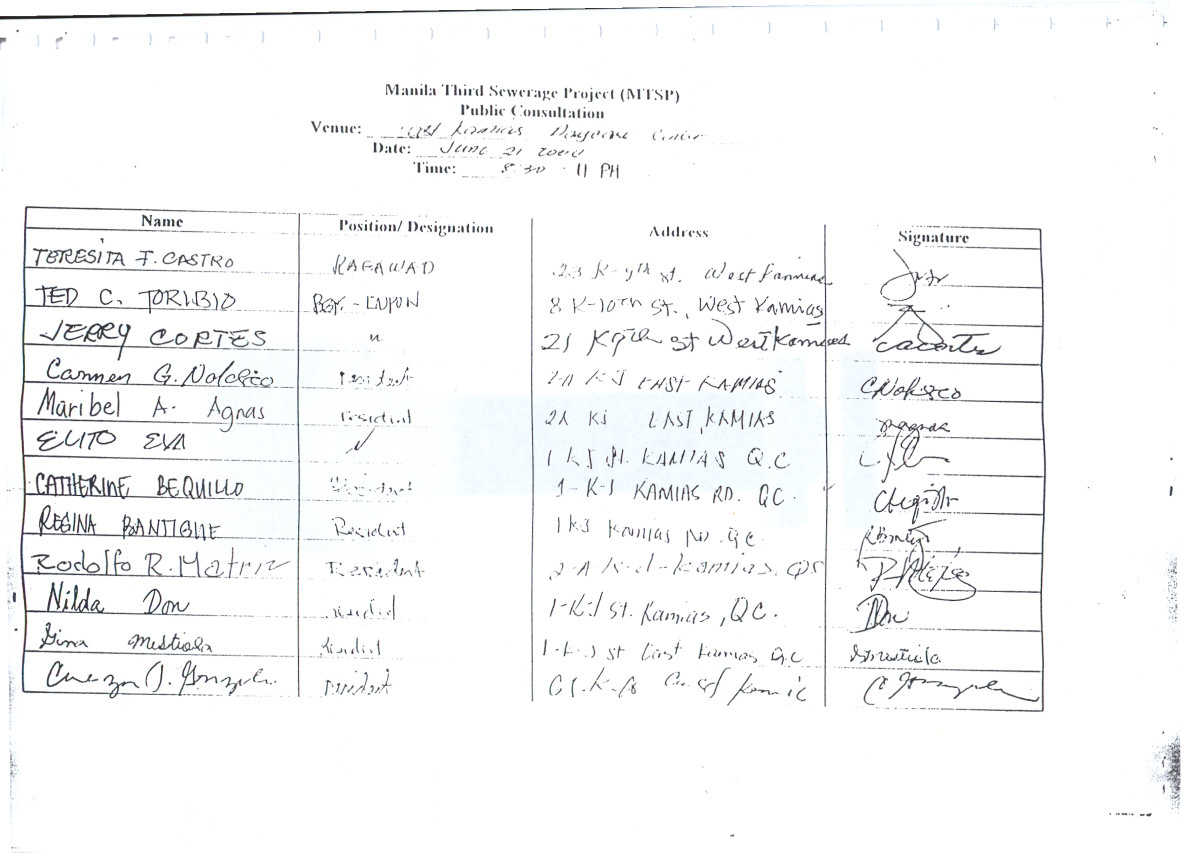
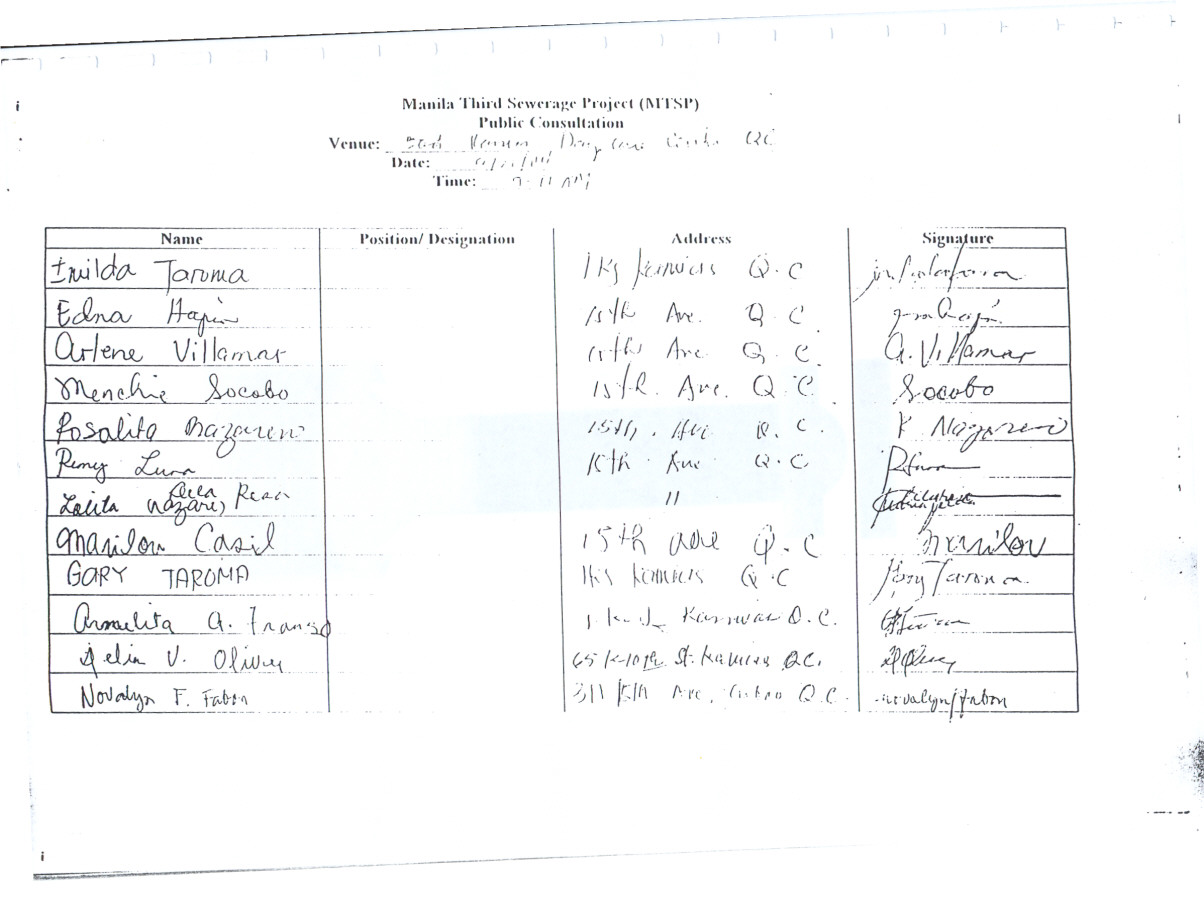
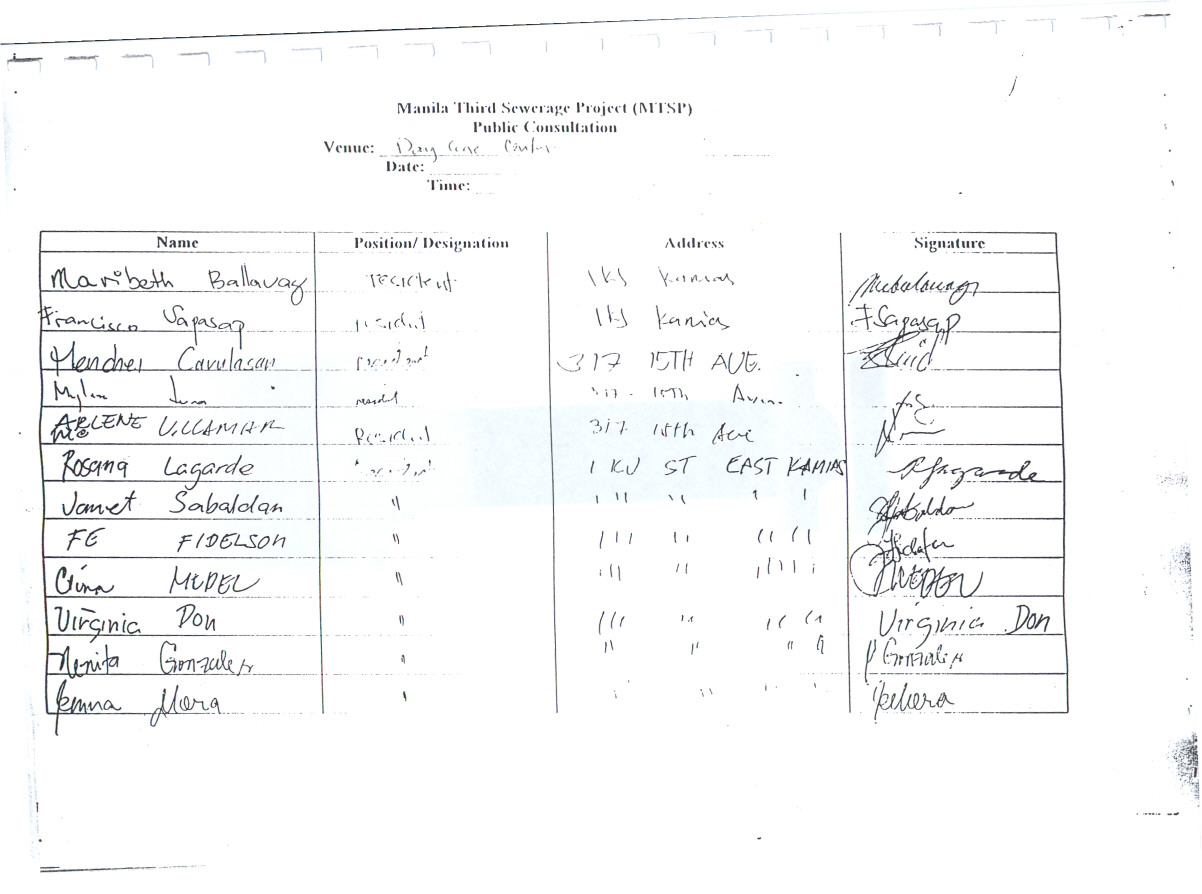
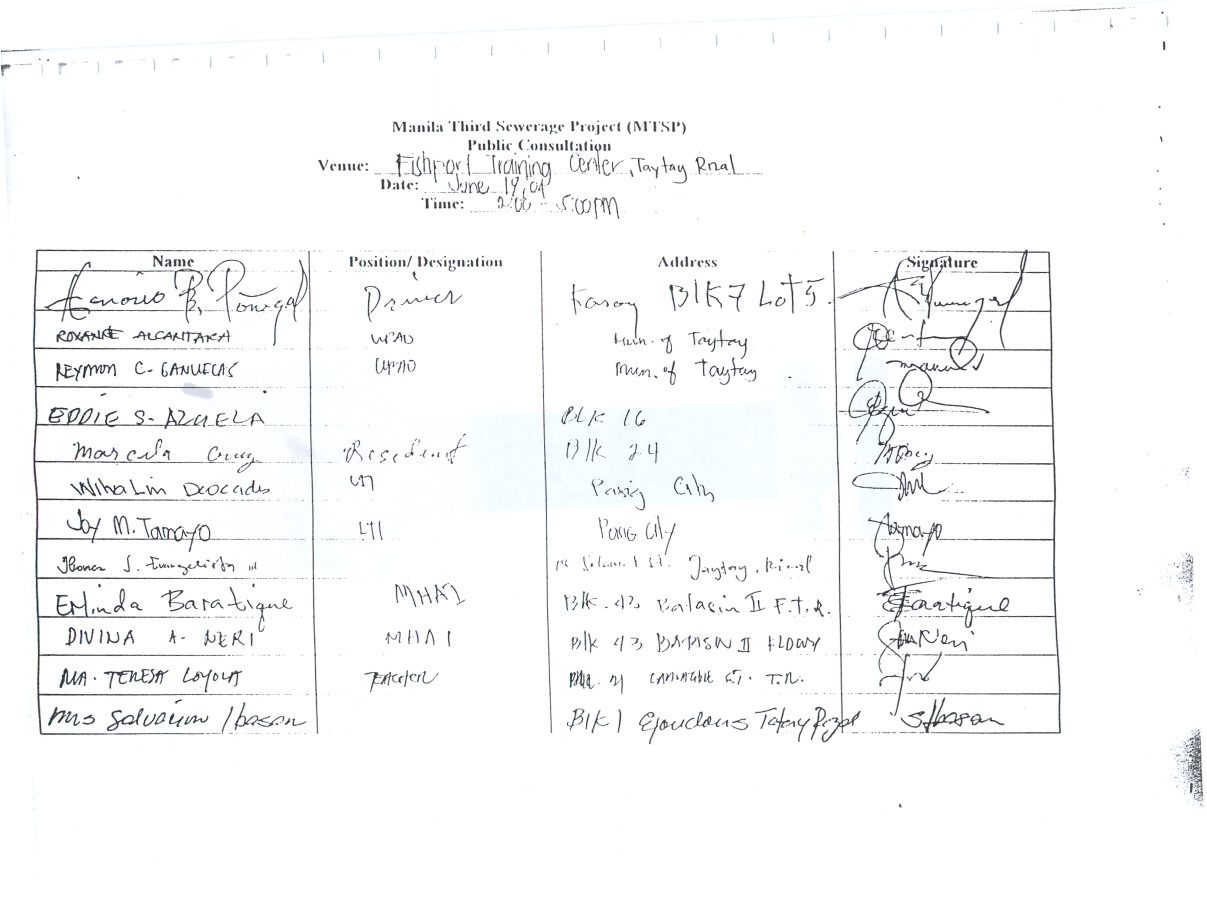
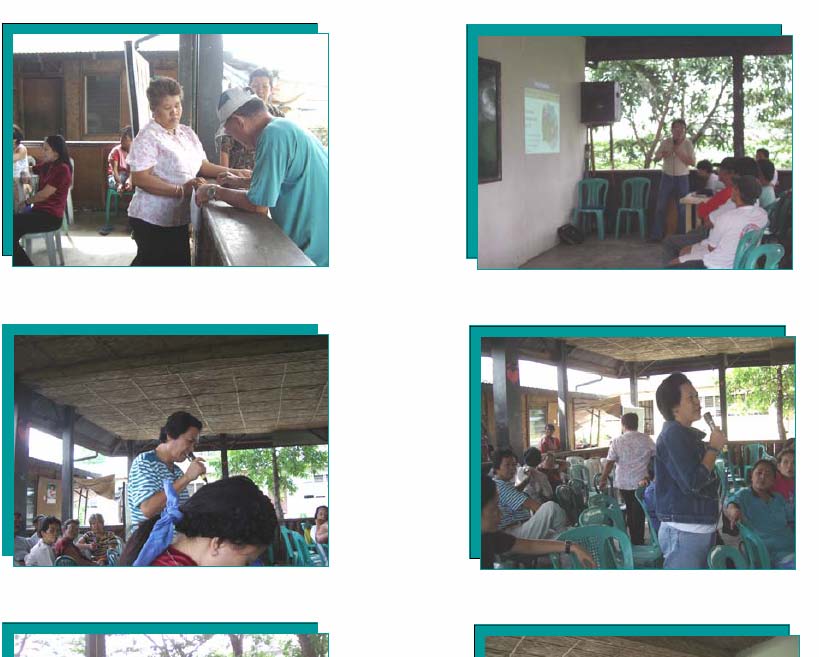
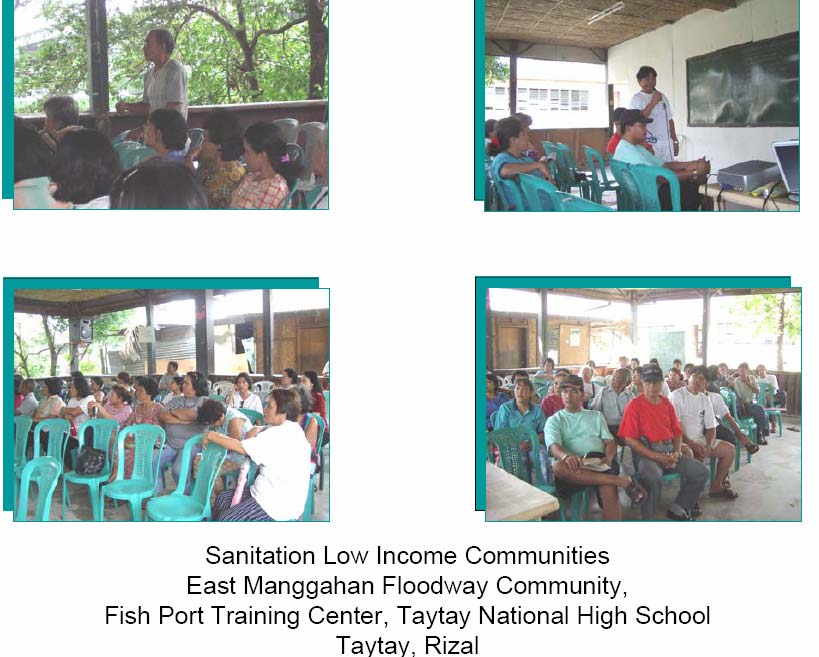
Barangay Covered Court, Barangay Project
6, Quezon City
Public Consultation Meeting
with the Barangay Officials and Residents of Barangay
Project 6 held on June 23 from 2-4 PM at the
Barangay Covered Court, Barangay Project 6, Quezon City, Metro
Manila
MANILA THIRD SEWERAGE PROJECT
Minutes of the Public Consultation Meeting
with the Barangay Officials and Residents of Barangay
Project 6 held on June 23 from 2-4 PM at the
Barangay Covered Court, Barangay Project 6, Quezon City, Metro Manila
Mr. Soncuya, a consultant of EDCOP-LTI, introduced the participants from EDCOP-LTI and
Manila Water Company Inc., (MWCI), explained the purpose of the public consultation and the
environmental impact assessment (EIA) process. This public consultation, as part of the
validation process of the EIA, aims to clarify issues and gather opinions, suggestions and
recommendations of stakeholders on the proposed Manila Third Sewerage Project. Ms. Beth
Bagaipo senior project development officer of PDO Waste Water of MWCI presented the
proposed project. Mr. Suelto, another consultant of EDCOP-LTI presented the results of the
environmental impact study. After the two presentations, an open forum ensued. The following
are the highlights of this public consultation.
Attendance:
Manila Water Company Inc.
Beth Bagaipo
Senior Project Development Officer
Benjie ???
Territory Business Manager
EDCOP-LTI
Rolando Soncuya
Sociologist
Anacleto
Suelto
Environmental
Specialist
Evelyn Nolasco
Public Consultation Coordinator
Wilva Lin Deocades
Facilitator
Note: Attendance sheets of participants with their signatures are attached to this report.
Construction stage The construction time for the proposed facility will be approximately one
year. Usually, the contractor will rent a place nearby for the temporary quartering of their
construction workers. MWCI discourages the construction of workers' barrack if the
construction site is near populated areas because of possible adverse effects on the nearby
communities. MWCI has this kind of STP in Valle Verde and Makati Pabahay.
In Project 1 (Roxas District) the vicinity of the communal septic tank was invaded by informal
dwellers. As a response to this threat in other communal septic tanks, MWSS assigned some
personnel to temporarily build their shelters in the vicinities of these other communal septic tanks
and guard these areas against unlawful intruders. Presently, MWCI is negotiating with MWSS
regarding these structures which are part of the project. The personnel of MWSS assigned to
these areas are aware of the project and are just awaiting instructions from MWSS.
Location There are two types of sewerage treatment plants, below ground and above ground.
The proposed treatment plant will be located on the present location of the communal septic plant
located in Road 5.. The plant is below ground and after construction only the control panel will
be visible to the community. During construction, the place will be dug up and that is the time
that the community might suffer inconvenience in terms restricted access, noise and possible bad
odor. However, mitigating measures as mentioned in the EIS will be put in place to address these
effects.
Areas not included in this phase will be considered in other projects of the company. It was
pointed out that the plant has a maximum capacity and if the plant will service other areas,
existing customers may suffer deterioration in the quality of service.
A participant pointed out that the existing septic tank is higher in than his house and alleged that
he is not being serviced by the communal septic tank. MWCII will investigate immediately and
if his house is not being serviced, a corresponding adjustment will be made on his monthly
billing.
Sewerage charge Presently the communities covered by this project are already being charged
monthly sewerage fees. There will be no additional payment for the proposed treatment plant.
However, MWSS periodically reviews the water charges and decides if the requests for increase
in water charges are meritorious or not after prior notification and public hearings.
Increase in water charges after improvement in the water supply system may be attributed in the
increase use of water. If the residents have noticed, the water rates increased last January but
were lowered only last week. These decisions come from MWSS.
All households located in the coverage area will be billed a monthly sewer charge even if these
households do not want to connect to the system. This is provided in the sanitation law, wherein
households should connect to the sewerage system if the system is available.
Free Desludging -- As part of their service, MWCI is conducting for free, desludging of
individual septic tanks, provide that it is properly scheduled. Otherwise, the desludging will cost
around 800 pesos, way below the charge of private contractors of around 2,500 pesos.
MWCI has problems in accessing some septic tanks because of their locations. Some septic tanks
are in the back of houses or the top are used for kitchens or dining rooms of some houses. In
these cases, MWCI let the customers sign waivers that the company will not be liable for any
damages in connection with the desludging activities.
Smoke emission The STP will be run by electric motors. The process will involve aeration,
settling of solids and disinfection to kill the pathogens. There will be no smoke emissions
generated by the project in its ordinary operations. However, if there are power outages, it is
possible that smoke emission will be generated if stand by power generators will be used.
Odor Bad odor is one of the risks in water treatment plants if the designed is flawed or
malfunctioned. In the proposed project, odor control facilities will be used to prevent bad odor
from escaping from the plant and go to the nearby communities. In addition, the STP is located
below ground and this will prevent bad odor from going into nearby houses.
Water by-product the water generated by the STP is not potable. However, this can be used for
other purposes such as for irrigation and fighting fires in the nearby areas.
Equipment -- MWCI has the latest equipment for sewerage system. They have the CCTV which
enable them to see the clogged lines. They have the sewer jetter and mini jetters, which
declogged sewer lines. Drainage systems are the responsibility of the City Engineer's Office
while MWCI is responsible for the sewer lines. To determine if the line is a sewer or drainage
line, the sewer line has manhole covers with the letter S. MWCI are replacing the sewerage
covers into hinge type because removable covers are being stolen.
Responsibility of MWCI MWCI is responsible for sewer lines from their system to the property
lines of the households. Lines inside the properties are the responsibilities of the households.
The rigid machine is being used to declogged these lines. Usually, residents who have upgraded
their houses cover the cleanouts in their sewer lines. MWCI may assist clogged lines inside their
properties provided that the cleanouts are identified.
After the open forum, the participants expressed their support for the project because it will
improve the environmental conditions of their communities.
Note: other clarifications and questions were related to water supply.
Prepared by:
__
_____________
Rolando Soncuya
Sociologist
EDCOP-LTI-ISSI
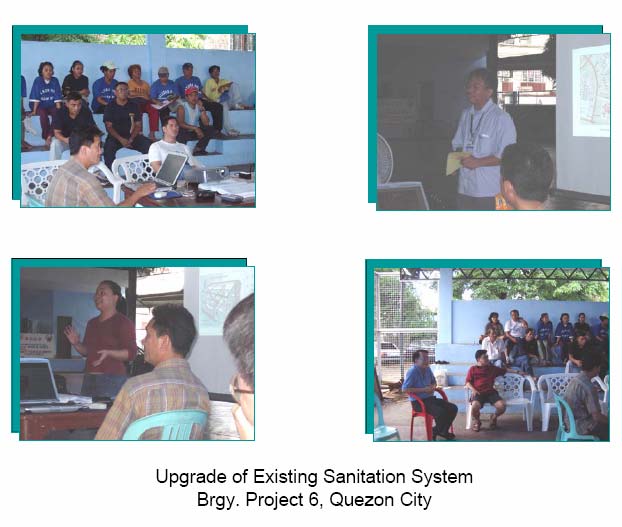
Yakap Day Care Center, East Kamias, Quezon
City
Public Consultation Meeting
with the Barangay Officials and Residents of East and West Kamias, Quezon City
held on June 21 2004 from 0-12 NN at the Yakap Day Care Center, East Kamias,
Quezon City
MANILA THIRD SEWERAGE PROJECT
Minutes of the Public Consultation Meeting
with the Barangay Officials and Residents of East and West Kamias, Quezon City held on June 21
2004 from 0-12 NN at the Yakap Day Care Center, East Kamias, Quezon City
Mr. Soncuya, a consultant of EDCOP-LTI, introduced the participants from MWCI and EDCOP-LTI,
explained the purpose of the public consultation and the environmental impact assessment (EIA) process.
This public consultation, as part of the validation process of the EIA, aims to gather the opinions,
suggestions and recommendations of stakeholders on the proposed Manila Third Sewerage Project. Ms.
Almario and Bagaipo SPDOs of MWCI presented the background on wastewater management and the
proposed project. Mr. Suelto, another consultant of EDCOP-LTI presented the results of the
environmental impact study. After the two presentations, an open forum ensued. The following are the
highlights of this public consultation.
Attendance:
MWCI
Lynn Almario
Senior Project Development Officer
Beth Bagaipo
Senior Project Development Officer
Jun Facun
Territory Business Manager
EDCOP-LTI
Rolando Soncuya
Sociologist
Anacleto
Suelto
Environmental
Specialist
Evelyn Nolasco
Public Consultation Coordinator
Wilva Lin Deocades
Facilitator
Note: Attendance sheets of participants with their signatures are attached to this report.
Coverage Why is Q-Mart not included in the coverage? There are technical and financial considerations
in the determination of the coverage of the project. In this case, the topography may have influenced the
planners in excluding the said area. The issue of availability of land is also a consideration. Presently,
MWCI have been able to tap NHA properties for the STP and pumping stations. The East and West
Kamias were considered because this is part of a loop from Project 3 to the regional STP that will be
located in East Avenue. The project entails the laying of new sewer pipes in these areas and a pumping
station that will pump the wastewater to the next station.
MWCI plans to cover the whole area with sewerage systems. However, the company has to prioritize
areas for development. Maybe the said area will be included in the next phase.
Basis of payment Payment of sewerage fees will be based on a certain percentage of the basic water
charge. In the sewered areas of MWCI, the prevailing sewerage fee is fifty percent of the basic water
charge. Presently, the company is still studying what percentage will be charge to the beneficiaries. One
of the aims of this consultation is to elicit reactions and suggestions from stakeholders of the proposed
project including the charging of sewerage fees.
Responsibility of MWCI MWCI is responsible for sewer lines from their system to the property lines of
the households. Lines inside the properties are the responsibilities of the households. MWCI will tap the
existing pipes from the households and connect these pipes to the new sewer line. The company is aware
that many of the existing septic tanks are at the back of the houses. This is one of the problems in
desludging the tanks.
Source of fund The fund will come from a loan by MWSS from World Bank. MWSS will then pass on
the loan to MWCI. The total loan amount is more than 100 million dollars. MWCI will be responsible for
the payment of the loan that will finance the Manila third Sewerage Project.
Coordination A barangay official of West Kamias explained that there are proposed infrastructure
projects in their barangay. She suggested that MWCI coordinate with City Hall to minimize disturbances
in street diggings. MWCI explained that one of the requirements is an excavation permit, which is given
by City Hall specifically with the Engineering Department. The permits include the cost of restoration of
the streets after the project. MWCI assured the barangay officials that they would closely coordinate with
them at the start of the project especially on traffic rerouting.
Water billing There was a case brought to the barangay that overcharge a resident more that 10%. The
TBM of the area admitted the mistake and the bill was adjusted to reflect the true amount.
The participants expressed support for the project. In addition, they wanted to expand the coverage to
include Q-Mart because it is major contributor of pollution to the nearby creek.
Note: Other queries were related to water supply and monthly billings.
Prepared by:
__
_____________
Rolando Soncuya
Sociologist
EDCOP-LTI-ISSI
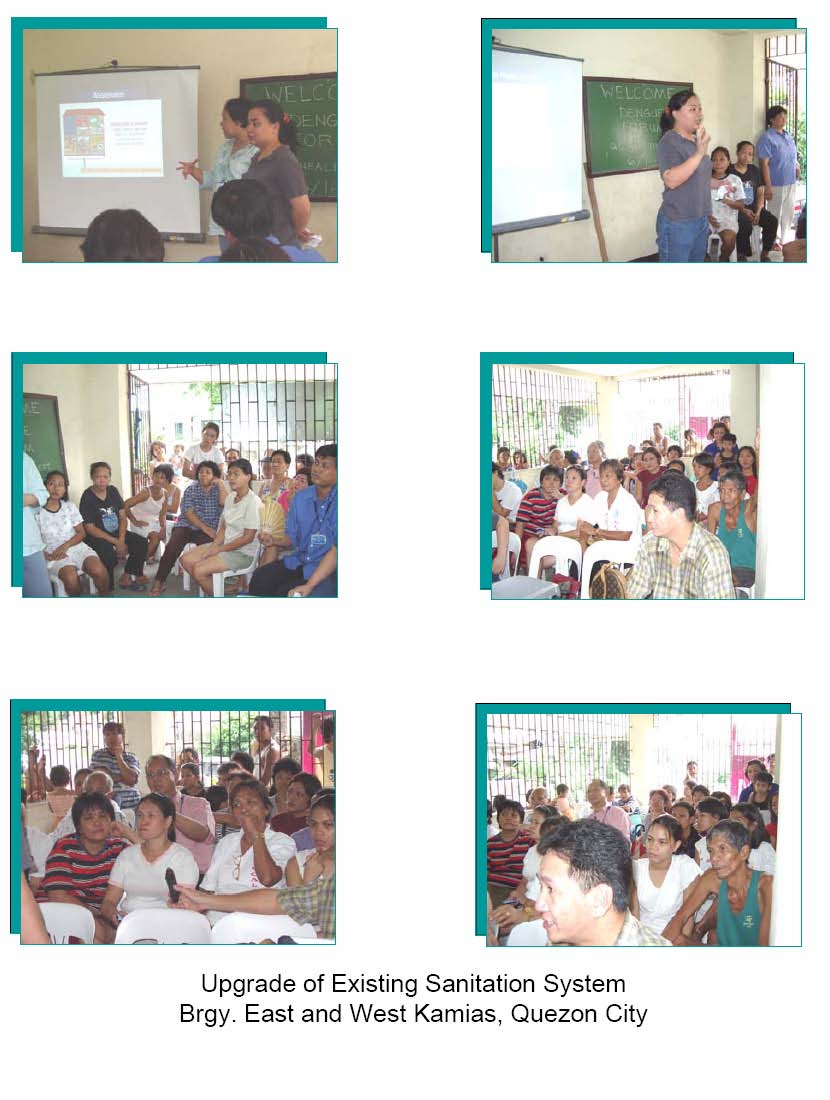
Barangay Hall of Laging Handa, Quezon City
Public Consultation Meeting
with the Barangay Officials and Residents of South Triangle, Sacred heart and
Laging Handa held on June 21 2004 from 1:30-4 PM at the Barangay Hall of
Laging Handa, Quezon City
MANILA THIRD SEWERAGE PROJECT
Minutes of the Public Consultation Meeting
with the Barangay Officials and Residents of South Triangle, Sacred heart and Laging Handa held
on June 21 2004 from 1:30-4 PM at the Barangay Hall of Laging Handa, Quezon City
Mr. Soncuya, a consultant of EDCOP-LTI, introduced the participants from MWCI and EDCOP-LTI,
explained the purpose of the public consultation and the environmental impact assessment (EIA) process.
This public consultation, as part of the validation process of the EIA, aims to gather the opinions,
suggestions and recommendations of stakeholders on the proposed Manila Third Sewerage Project. Ms.
Almario and Bagaipo SPDOs of MWCI presented the background on wastewater management and the
proposed project. Mr. Suelto, another consultant of EDCOP-LTI presented the results of the
environmental impact study. After the two presentations, an open forum ensued. The following are the
highlights of this public consultation.
Attendance:
MWCI
Lynn Almario
Senior Project Development Officer
Beth Bagaipo
Senior Project Development Officer
EDCOP-LTI
Rolando Soncuya
Sociologist
Anacleto
Suelto
Environmental
Specialist
Evelyn Nolasco
Public Consultation Coordinator
Wilva Lin Deocades
Facilitator
Note: Attendance sheets of participants with their signatures are attached to this report.
Standards of water The standards used in the study is the DENR standards for bodies of water based on
DAO 34. This is adopted from the international standards used in other countries. Class C water means
that the maximum BOD is 10 mgs and the coliform is below 5,000 most probable number per 10 ml. The
aim of the Pasig River project is at least to conform to class C water.
It was pointed out that in the presentation of the water analysis in Sct. Santiago, the BOD and coliform are
above the DENR standards. This is the reason of the project. The project aims to conform to class C
standards of DENR. In existing STP of MWCI, the BOD and coliform being produced are in the range of
7 and 1,000 respectively. The DENR is monitoring the quality of wastewater being produced by the STP.
It was suggested that a law should be enacted to periodically desludge individual septic tanks because
poor maintained tanks are the main cause of pollution in the waterways. Presently there is no low
mandating periodic desludging.
Project concept The project will pump the wastewater after being treated in the CST at Sct. Santiago to
the STP located in the basketball court in Heroes Hills. The STP is far from houses and it is required that
a buffer area be establish to further protect the houses from any adverse effects that the STP may cause.
Time frame The loan is expected to be approved by World Bank around 2005 provided all the necessary
certificates, permits and other documents are in order. The project will be implemented from early 2006
up to 2008.
Coverage the project will cover the whole of South triangle and portions of Laging Handa and Sacred
Heart. The company's vacuum trucks will regularly service areas not covered by this project. The project
includes the purchase of additional vacuum trucks. Desludging is free for MWCI customers. If private
contractors are used for desludging, MWCI can not reimburse the customers their expenses. In emergency
cases of desludging where a customer is not scheduled, MWCI will charge a fee of 800 pesos.
Septage Treatment plant The septage treatment plant to cover Quezon City will be located in Payatas,
which will treat the sludge, vacuumed from individual septic tanks and regional STP. Another proposed
plant will be located in Food Terminal Inc. There is an on-going construction in Antipolo to build a
septage treatment plant. The by-products of these septage treatment plants will be used as soil conditioner
for the lahar areas in Pampanga and Tarlac and the water for irrigation. Interested parties may get the soil
conditioner for free provided it is pick up in the Magallanes treatment plant.
Soil conditioner --It is classified as soil conditioner because it lacks the minimum quantity of nitrogen,
phosphorus and potassium set by the Fertilizer and Pesticide Authority (FDA). A participant is requesting
for an analysis of the chemical profile of the soil conditioner.
Coordination It was suggested in the future to notify City Hall about any meeting for the project and
contact the barangay officials who will in turn mobilize other officials and residents. This can also be
done during the implementation of the project so that barangay officials may assist in traffic management.
Sewerage charge Presently the communities covered by this project are already being charged monthly
sewerage fees. There will be no additional payment for the proposed treatment plant. Presently, MWCI is
reviewing the rate of water charge they will charge to their customers. MWSS, the regulatory body for
water periodically reviews the water charges and decides on petitions for increase in water charges after
prior notification and public hearings.
Water by-product the water generated by the STP is not potable. However, this can be used for other
purposes such as for irrigation and fighting fires in the nearby areas.
It is a very good project but the coverage is limited. They are looking forward to being covered in Manila
Fourth Sewerage Project. They are requesting for additional information materials so they can inform
other residents in their barangays.
Prepared by:
__
_____________
Rolando Soncuya
Sociologist
EDCOP-LTI-ISSI
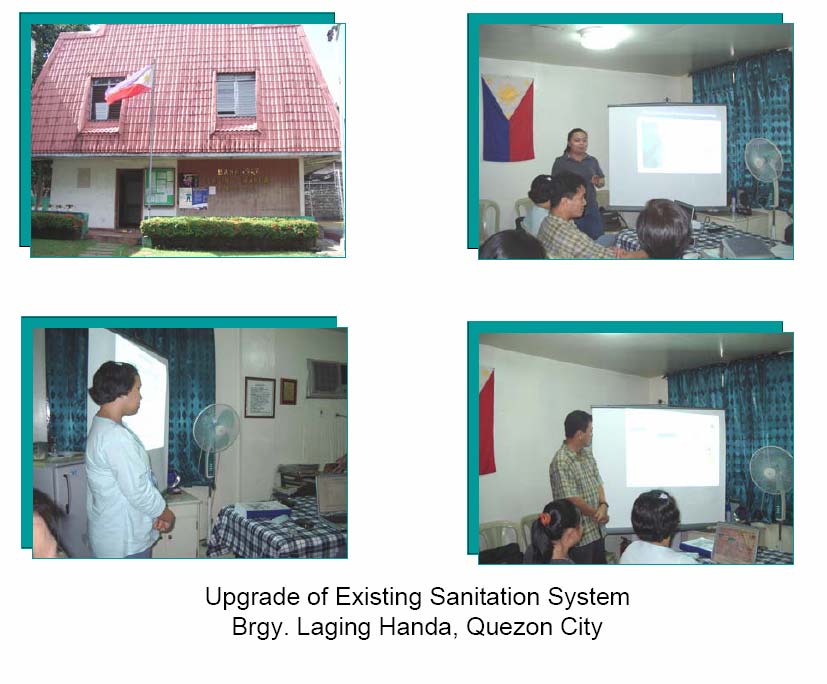
Covered Court of Barangay Quirino 2-A
Quezon City, Metro Manila
Public Consultation Meeting
with the Barangay Officials and Residents of Barangays
Quirino 2-A, 2-B, 2-C, 3-A, 3-B, and Duyan-Duyan held on June 22 2004 from
1:30-4 PM at the Covered Court of Barangay Quirino 2-A Quezon City, Metro
Manila
MANILA THIRD SEWERAGE PROJECT
Minutes of the Public Consultation Meeting
with the Barangay Officials and Residents of Barangays
Quirino 2-A, 2-B, 2-C, 3-A, 3-B, and Duyan-Duyan held on June 22 2004 from 1:30-4 PM at the
Covered Court of Barangay Quirino 2-A Quezon City, Metro Manila
Mr. Soncuya, a consultant of EDCOP-LTI, introduced the participants from EDCOP-LTI and Manila
Water Company Inc., (MWCI), explained the purpose of the public consultation and the environmental
impact assessment (EIA) process. This public consultation, as part of the validation process of the EIA,
aims to clarify issues and gather opinions, suggestions and recommendations of stakeholders on the
proposed Manila Third Sewerage Project. Ms. Matibag Manager PDO Waste Water of MWCI presented
the proposed project. Mr. Suelto, another consultant of EDCOP-LTI presented the results of the
environmental impact study. After the two presentations, an open forum ensued. The following are the
highlights of this public consultation.
Attendance:
Manila Water Company Inc.
Eva Matibag
Manager PDO Waste Water
Christopher Calamoing
Senior Project Development Officer
Lynn Almario
Senior Project Development Officer
EDCOP-LTI
Rolando Soncuya
Sociologist
Anacleto
Suelto
Environmental
Specialist
Evelyn Nolasco
Public Consultation Coordinator
Wilva Lin Deocades
Facilitator
Ginelyn Mary Guanzon
Representative EMB, DENR
Note: Attendance sheets of participants with their signatures are attached to this report.
Sewerage charge Presently the communities covered by this project are already being charged monthly
sewerage fees. There will be no additional payment for the proposed treatment plant. This is also the case
in certain parts of Makati and other parts of Quezon City. Presently, MWCI is reviewing the rate of water
charge they will charge to their customers. MWSS, the regulatory body for water periodically reviews the
water charges and decides on petitions for increase in water charges after prior notification and public
hearings.
All households located in the coverage area will be billed a monthly sewer charge even if these
households do not want to connect to the system. This is provided in the Sanitation Code, wherein
households should connect to the sewerage system if the system is available.
Coordination with other agencies during construction phase MWCI will investigate the diggings in
Agoho Street and its status. It is better to for companies like MWCI, telephone and other utilities to lay
pipes or lines at the same time. However, their projects depend on the available financial resources. All
street diggings should have permits and there is an interagency group that coordinates the various street
diggings. Another problem MWCI is encountering is the absence of "as built plan" of the various
companies involved in street diggings. To safeguard accidental hits on the various utilities, there is a
provision in the contract of the contractor to restore any accidental hit. MWCI gives priority on busted
sewer pipes because of the disturbances that this may cause to the residents. Sewer pipes are PVC brown
pipes.
Displacement of families The project intends to intercept the wastewater before or after the Rimas CST
and pump the wastewater to the regional treatment plant located in East Avenue. This was the plan to
avoid the displacement of families already occupying the area around the Rimas CST. There will be no
displacement of families in Rimas CST because of the project.
Dirty water If there are cases of dirty water in a general area the usual reason is illegal connection.
MWCI will investigate the area and will keep the residents informed. MWCI gives highest priority on the
issue of dirty water supply. It was pointed out that the supplier of mineral water is making brisk business
because the water in the area in undrinkable.
There is an adverse claimant (Pacundo) on the land where the Rimas CST is located. Around 5 meters
were occupied. It was reported to MWSS and they investigated. However, there is no action taken.
MWCI is aware of the claim and it was also reported in the feasibility study that part of a dormitory is
occupying a portion of the CST. It was clarified that the lot is owned either by NHA or the LGU and
actions have been taken to address the issue.
Total Construction A participant (engineer) pointed out that the sewer lines are in very poor conditions
because of age, new development and the contours of their areas. He proposes that instead of
rehabilitation, the project should change all the sewer lines because they are being charge sewer fees. It
was clarified that the elevation of pipes is one of the considerations in the laying of pipes. This is being
done to minimize operation costs. The are also dilapidated portions of the sewer line that may need new
pipes.
There is an agreement with NAWASA that houses within 60 meters of the CST are free of charge. Why
are they being billed for sewer fees now? MWCI is not aware of this agreement. It was requested that if
there is a written agreement, MWCI is requesting a copy. MWCI inherited the sewer lines from MWSS
and is not aware of this agreement.
Customer service --A participant reported to MWCI about a sewer problem but the one answering the
phone did not know how to answer. She was reported to her superior and the problem was addressed.
There was a recurrence of the problem and was again reported. The office claimed that the problem was
under the jurisdiction of DPWH. MWCI will immediately investigate this matter.
Institutional coordination The Sanitation Code gives the responsibility to the Department of Health to
implement the Code. However, DOH does not have the personnel to implement it. MWCI has no power
to arrest anyone who discharges his or her wastewater directly to the creek. With the passage of the new
Clean Water Act, the implementing rules and regulations will specify the institutional relationships with
different government agencies. MWCI will provide updates on the IRR of the new law.
The participants expressed support for the project. Some requested more information and coordination
with the local officials.
Prepared by:
__
_____________
Rolando Soncuya
Sociologist
EDCOP-LTI-ISSI
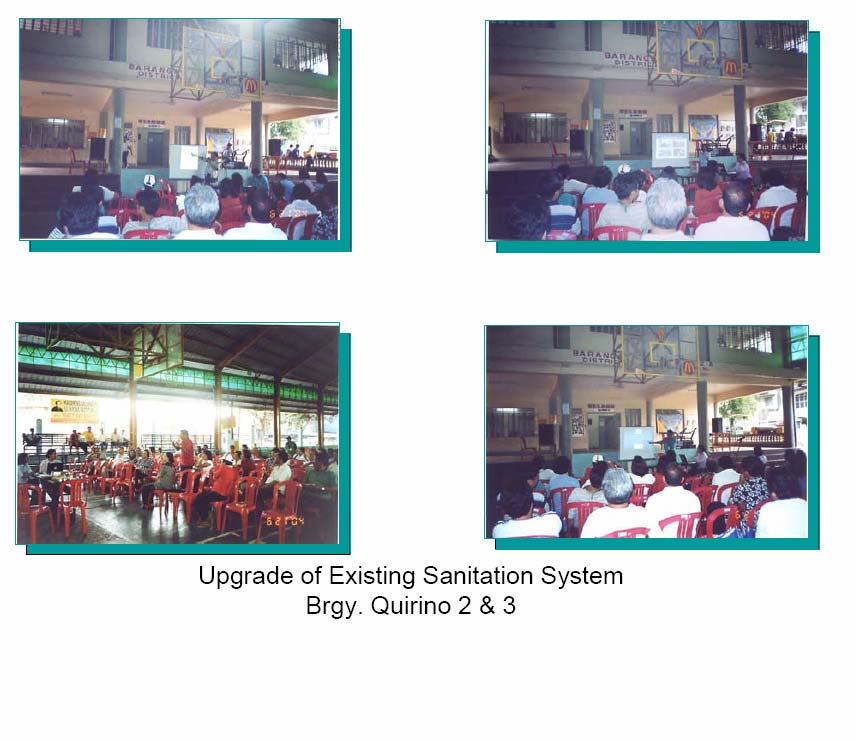
Barangay Hall of Barangay Central, Quezon
City
Public Consultation Meeting
with the Barangay Officials and Residents of Barangay Central, Old Capitolyo and
UP Village held on June 23 2004 from 10-11:30 AM at the Barangay Hall of
Barangay Central, Quezon City, Metro Manila
MANILA THIRD SEWERAGE PROJECT
Minutes of the Public Consultation Meeting
with the Barangay Officials and Residents of Barangay Central, Old Capitolyo and UP Village held
on June 23 2004 from 10-11:30 AM at the Barangay Hall of Barangay Central, Quezon City, Metro
Manila
Mr. Soncuya, a consultant of EDCOP-LTI, introduced the participants from EDCOP-LTI and Manila
Water Company Inc., (MWCI), explained the purpose of the public consultation and the environmental
impact assessment (EIA) process. This public consultation, as part of the validation process of the EIA,
aims to clarify issues and gather opinions, suggestions and recommendations of stakeholders on the
proposed Manila Third Sewerage Project. Ms. Matibag manager, PDO Waste Water of MWCI presented
the proposed project. Mr. Suelto, another consultant of EDCOP-LTI presented the results of the
environmental impact study. After the two presentations, an open forum ensued. The following are the
highlights of this public consultation.
Attendance:
Manila Water Company Inc.
Eva Matibag Manager
Project Development Office Waste Water
Beth Bagaipo
Senior Project Development Officer
EDCOP-LTI
Rolando Soncuya
Sociologist
Anacleto
Suelto
Environmental
Specialist
Evelyn Nolasco
Public Consultation Coordinator
Wilva Lin Deocades
Facilitator
Maya Villaluz
Representative World Bank
Note: Attendance sheets of participants with their signatures are attached to this report.
Eviction The proposed site has informal dwellers and is the site of the day care center. What are the
complications? The project design was made to minimize if not to totally avoid eviction and resettlement
issues. If there will be displacement, the project will either relocate or compensate the displaced families.
This is a World Bank assisted project, WB has strict policies on resettlement. The basic principle is to
improve the conditions of the relocated families. The minimum is to at lease restore their conditions
before their relocation.
It was explained that the communal septic tank would be abandoned in favor of a pumping station that
will be located in Maginhawa Street precisely to avoid displacement of informal dwellers around the
communal septic tank. The residents were thankful that they would not be displaced by the project.
The STP will be located at the vacant lot converted into a mini-park beside the Central Bank owned by the
National Housing Authority. Previous evictions done in the past in this area is not in connection to the
proposed project. A participant was evicted from this area August of 2003. It was pointed out that the
existing communal septic tank located in East Avenue has tall trees above the communal septic tank. This
area will be converted into a STP. Hence, the place were the participant was evict is different from the
proposed site of the STP.
Sewer charges The sewer charge is presently based on 50% of basic water charge. However, your areas
are already being charged the sewer fees, so there is no increase in your monthly water payment. Water
charges are regulated by MWSS and MWCI has already requested a review of the present charges.
Coverage The project aims to intercept the wastewater before entering the communal septic tank and
pump the wastewater to the STP in East Avenue. The project aims to cover the areas shown in the map
and in no way exclude areas that are presently covered by the communal septic tank located in Matiwasay
Street. The proposed pump station will be located in Maginhawa St.
Odor Bad odor is one of the risks in water treatment plants if the designed is flawed or malfunctioned.
In the proposed project, odor control facilities will be used to prevent bad odor from escaping from the
plant and go to the nearby communities.
Hospital wastewater -- The STP is near some hospitals. However, MWCI has presently no capacity to
process wastewater from these hospitals. Hospitals are required by law to have their own wastewater
treatment plants. The proposed STP will not process any wastewater from these hospitals. MWCI will
consult DENR regarding the hospital wastewater.
Barangay officials will support the project and will participate in cleanliness campaign and traffic
enforcement. There are three barangays involved in the project and they assured MWCI their full support.
Residents around the Matiwasay CST thanked MWCI for considering their houses in the design of the
project.
Prepared by:
__
_____________
Rolando Soncuya
Sociologist
EDCOP-LTI-ISSI
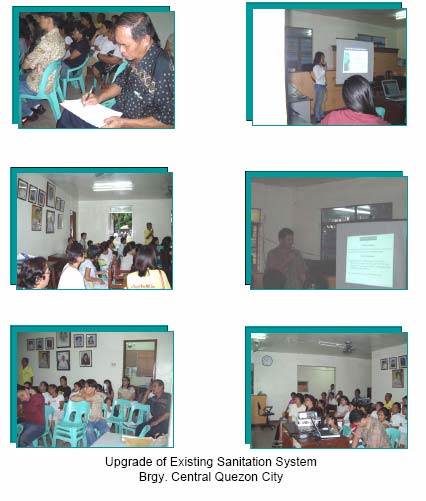
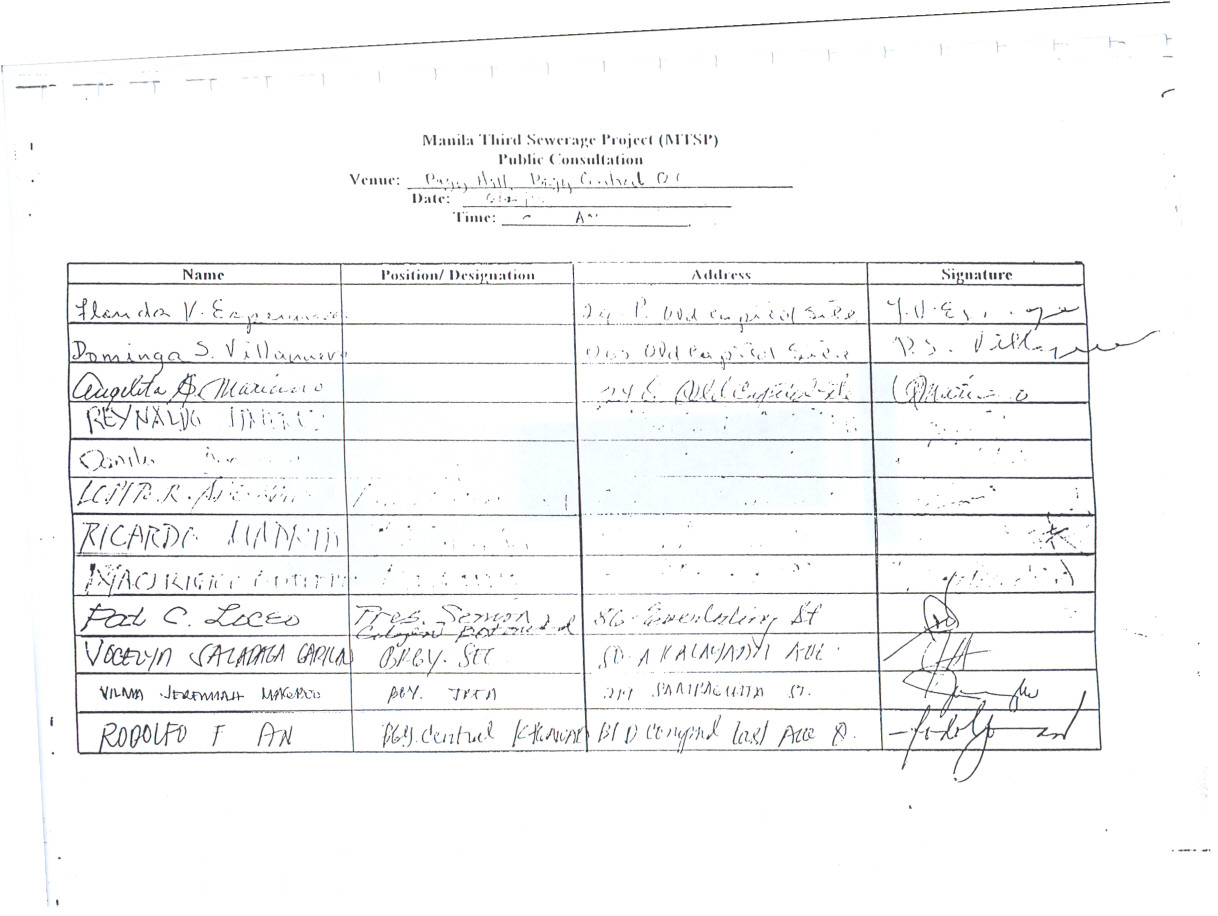
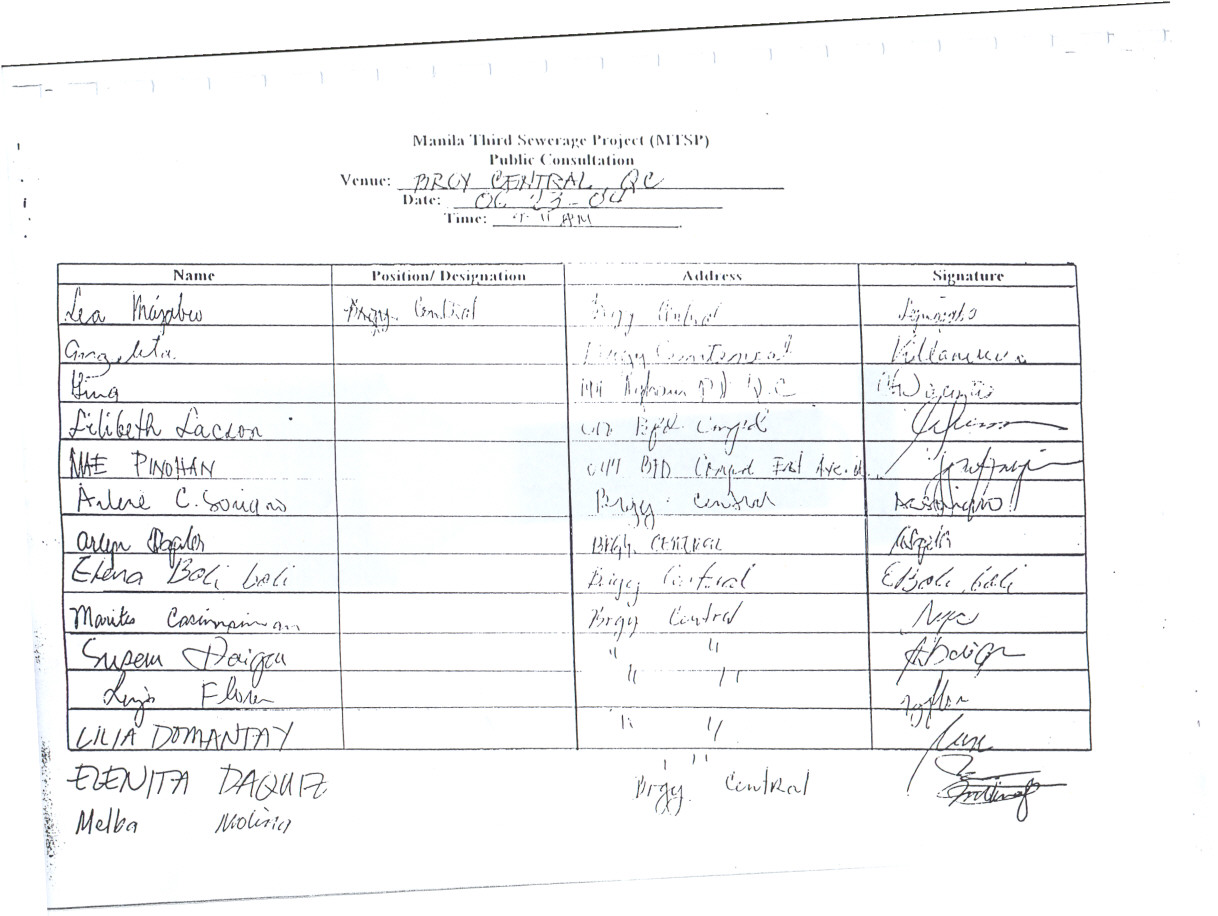
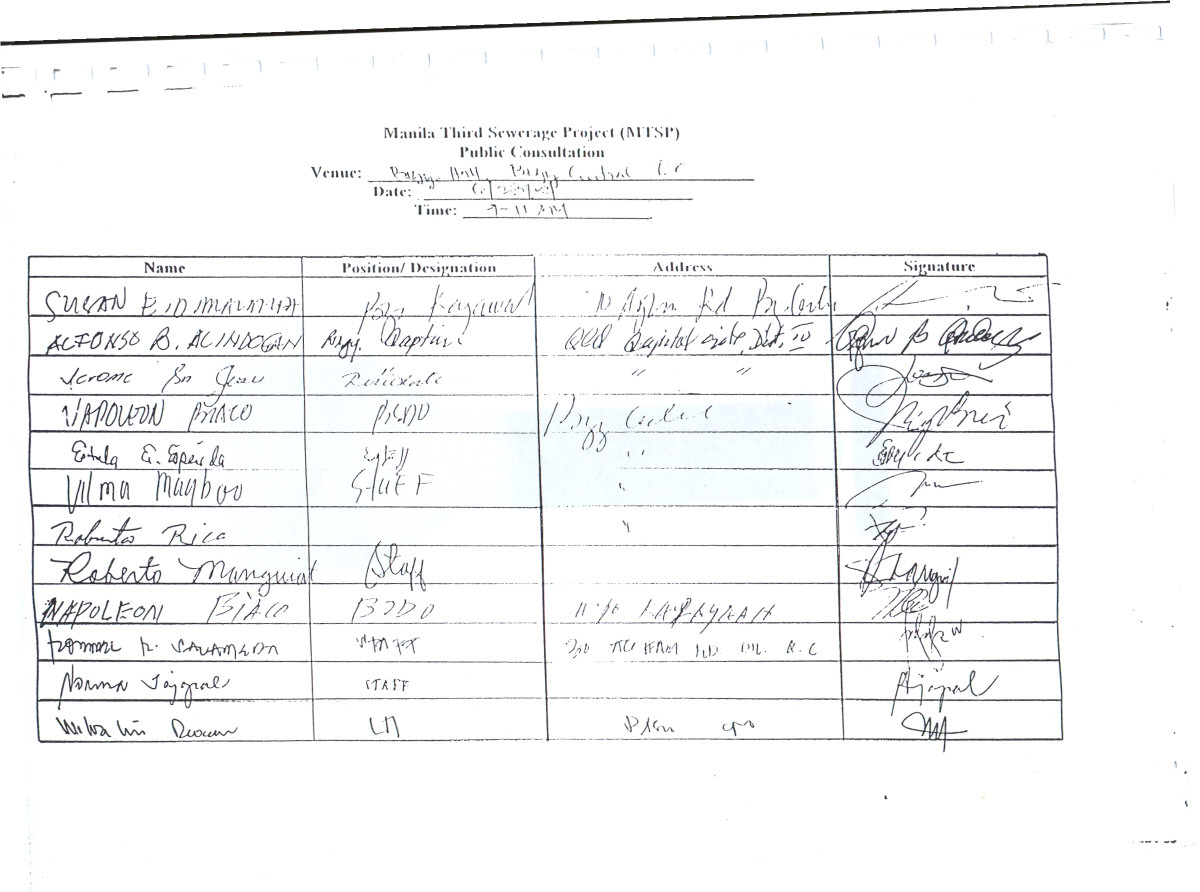
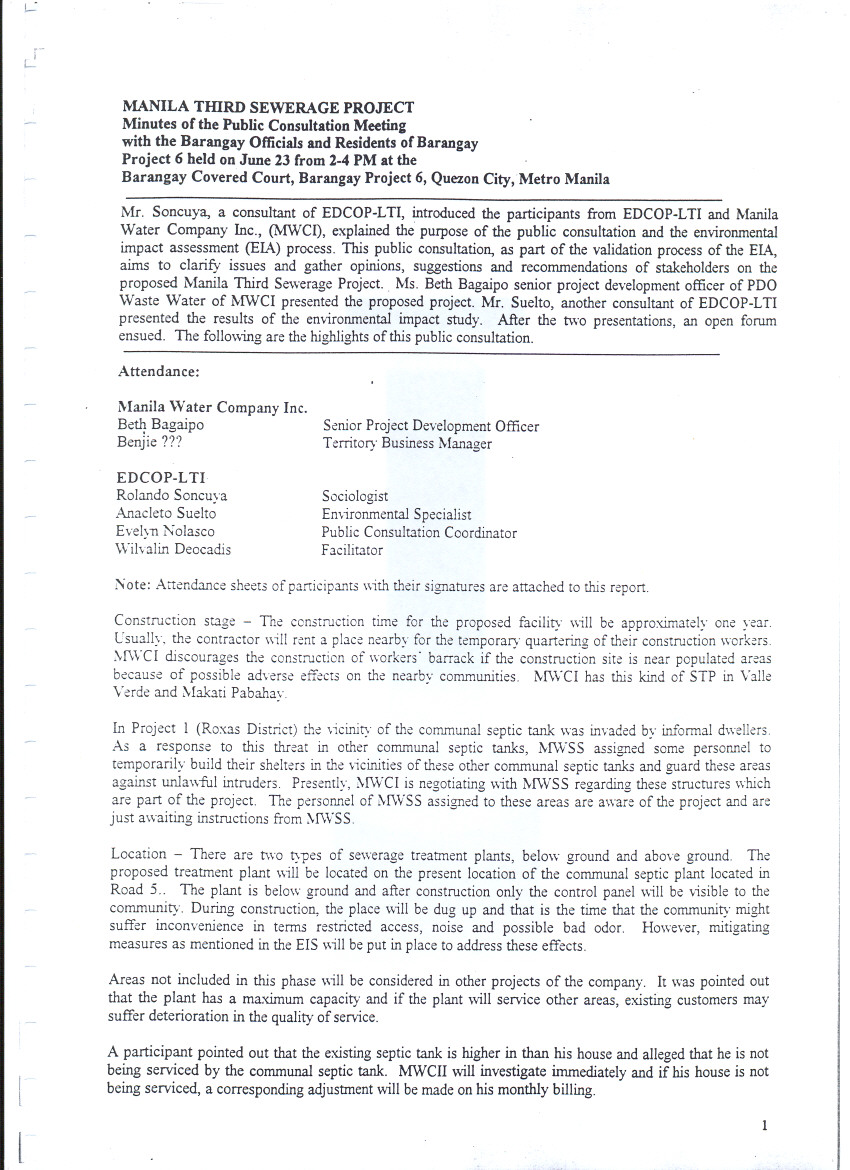
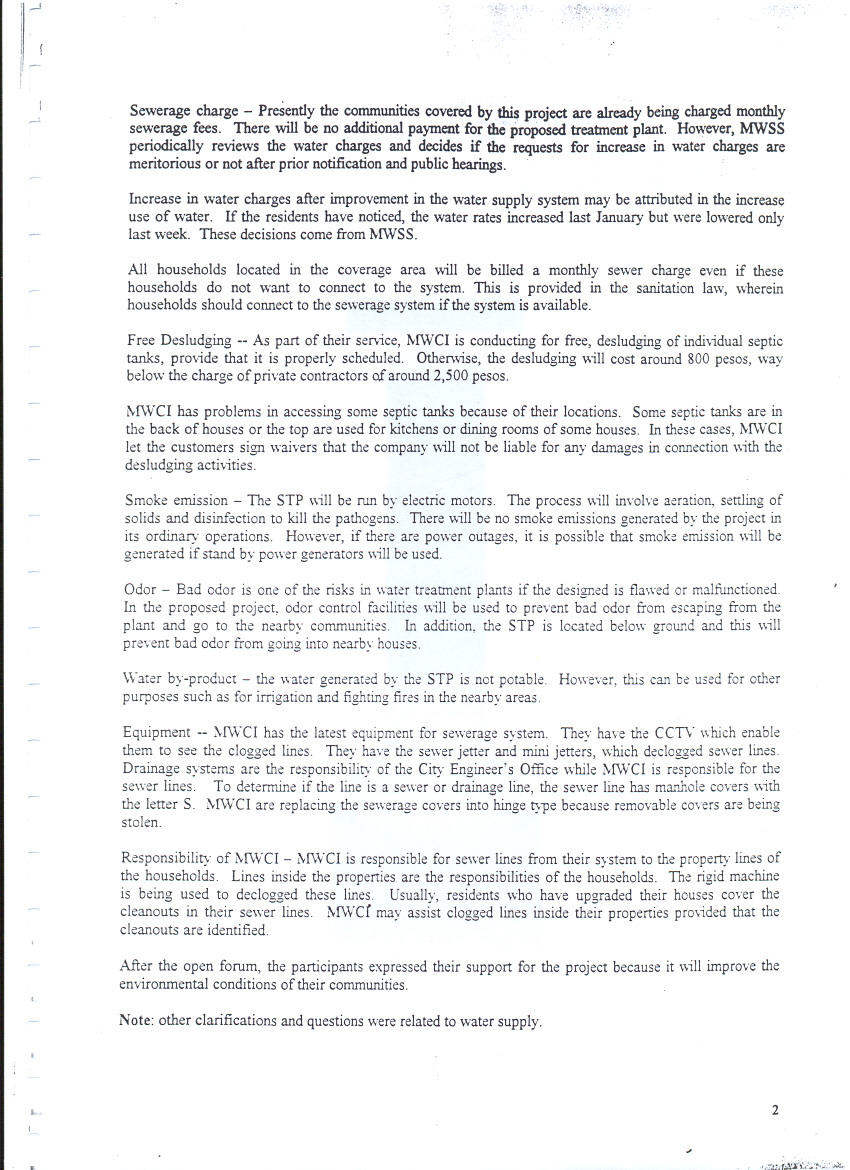
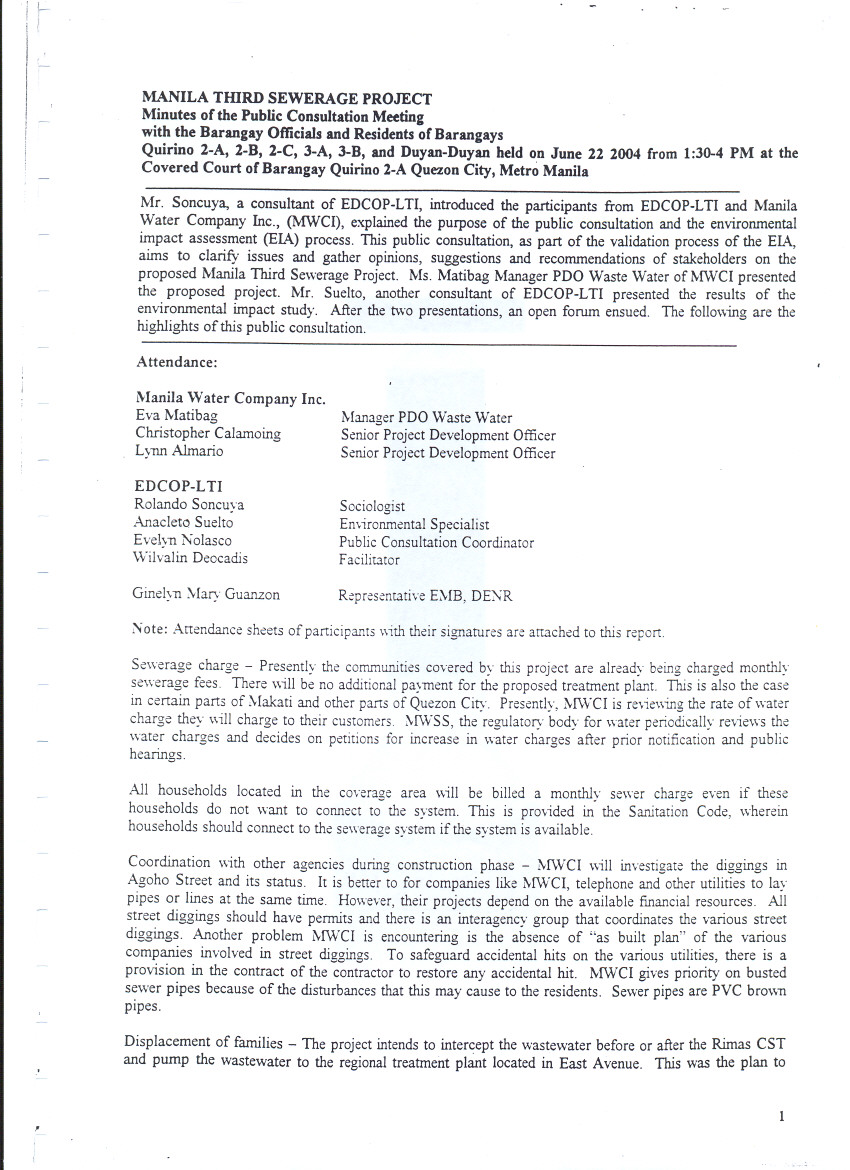
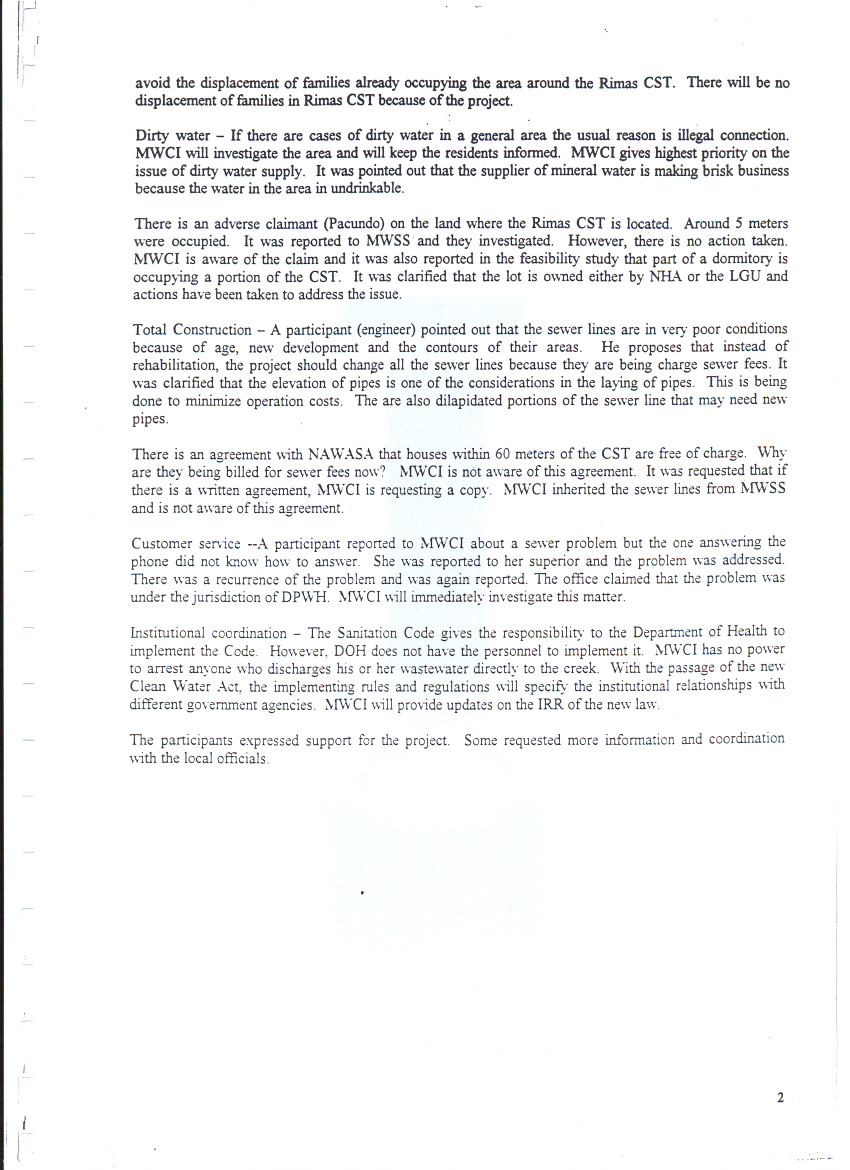
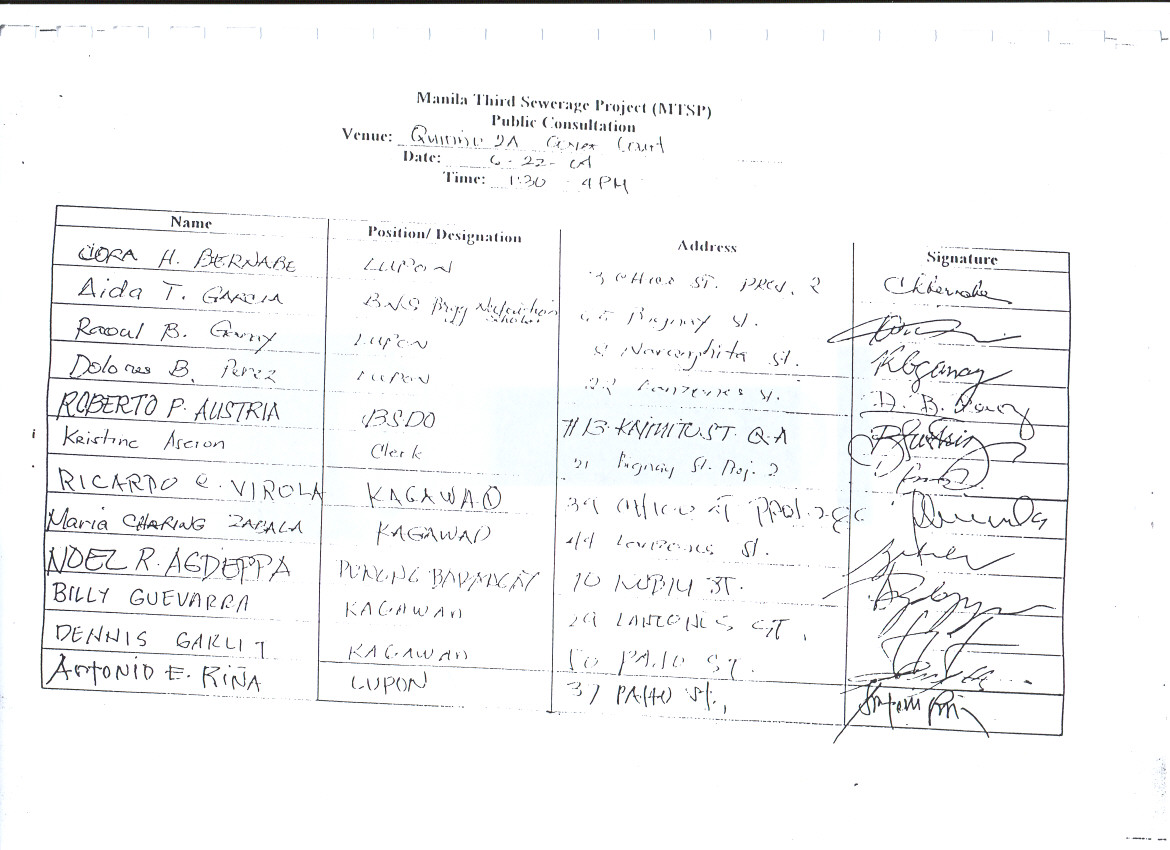
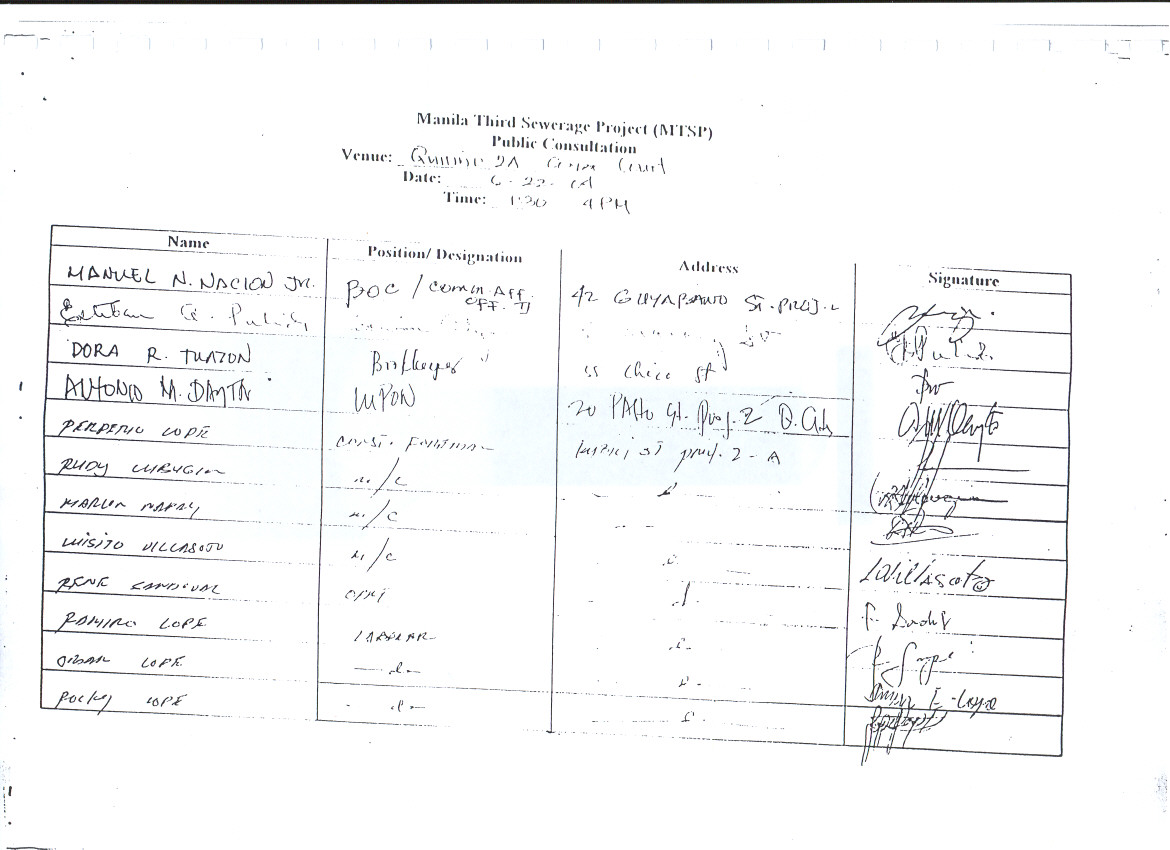
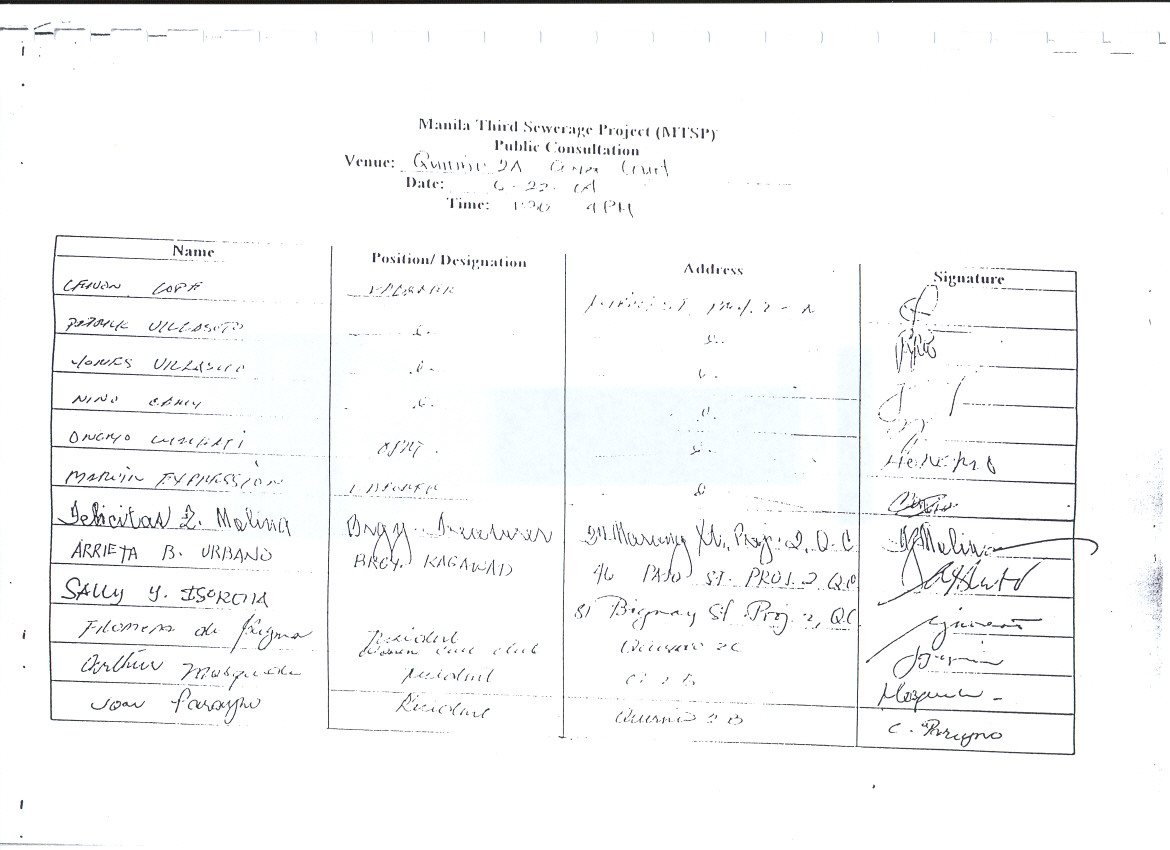
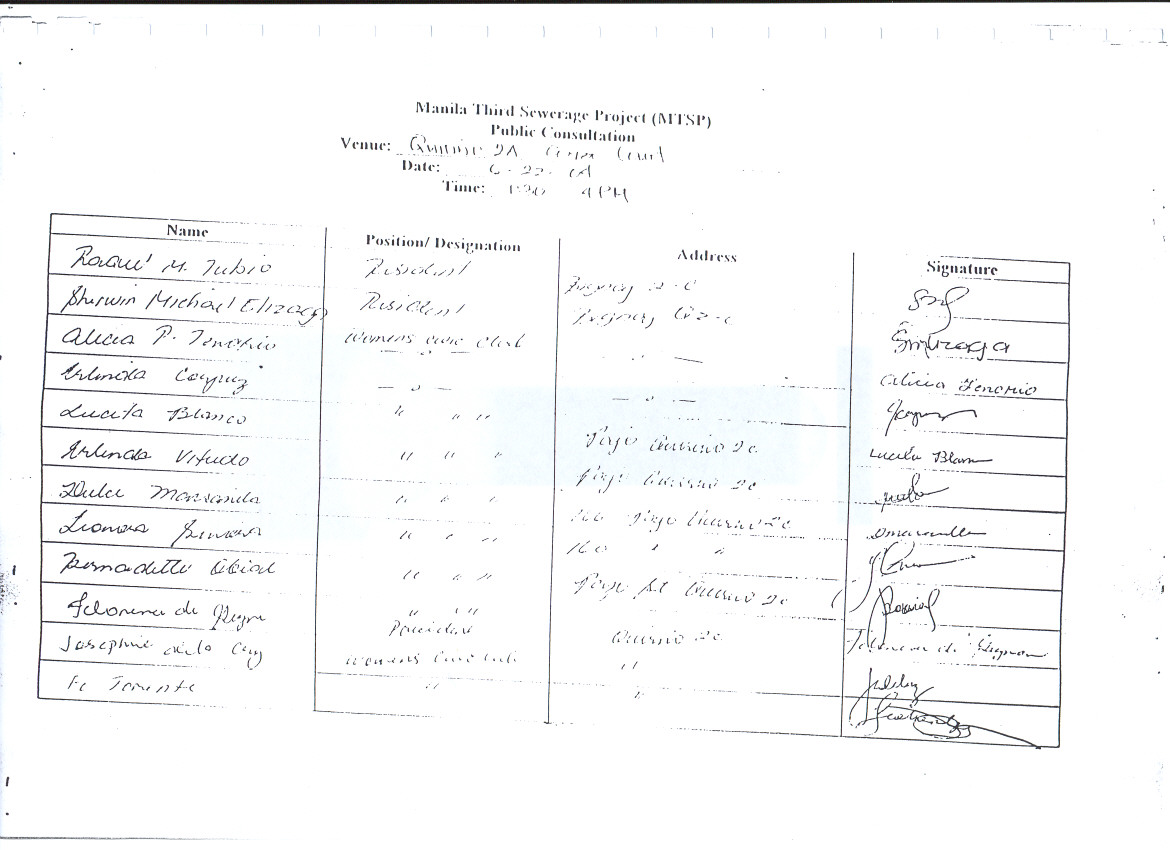
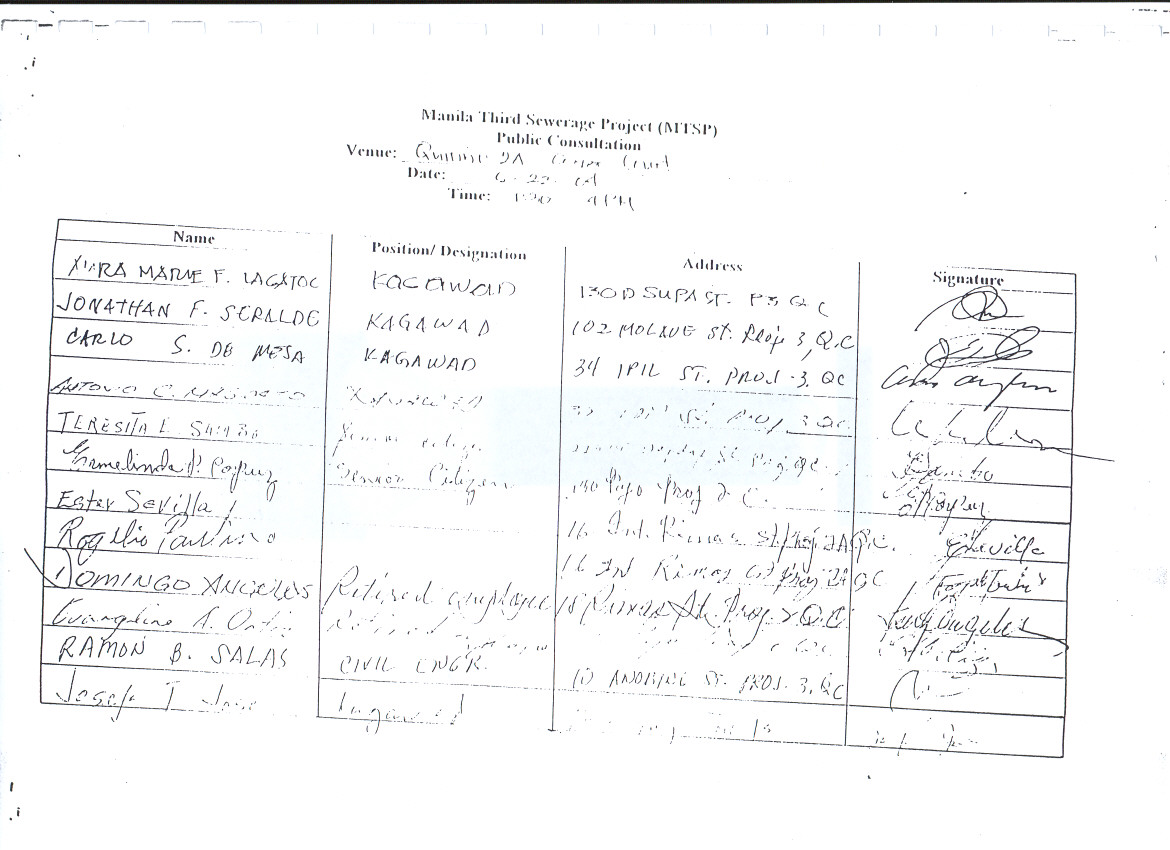
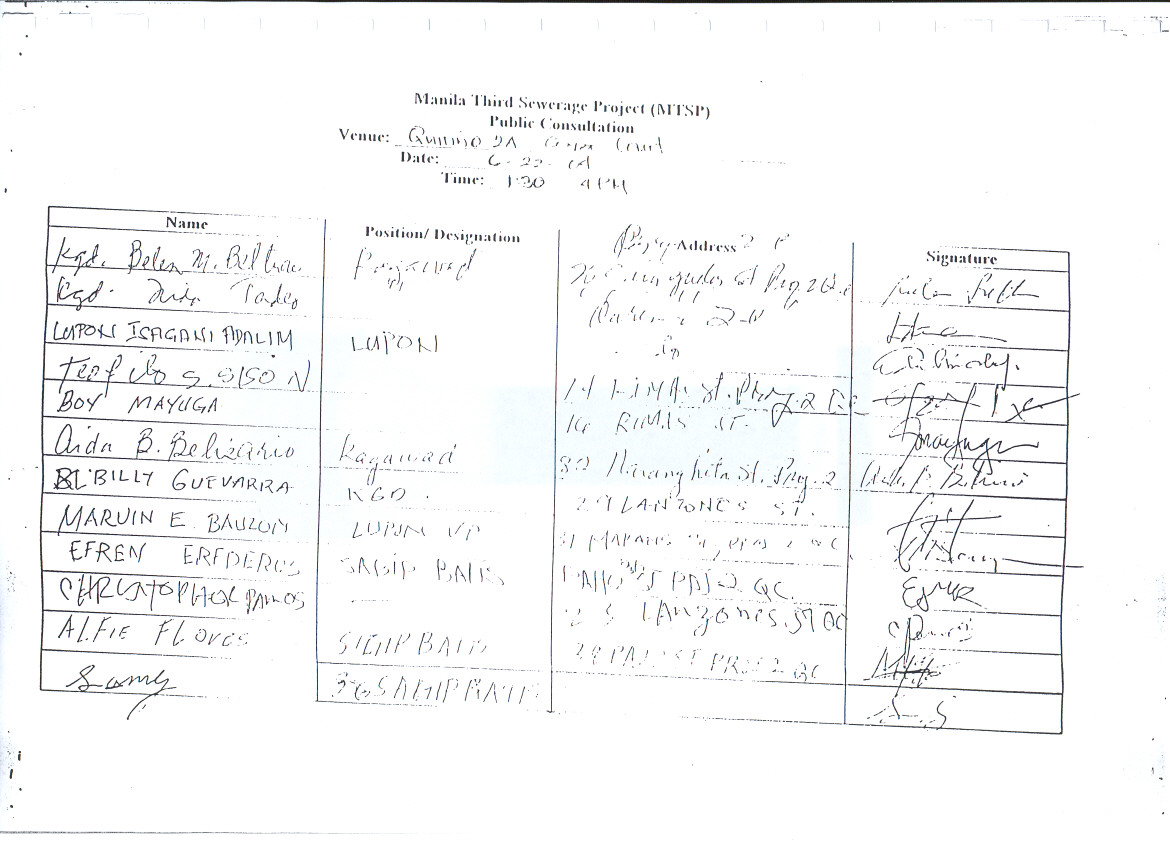
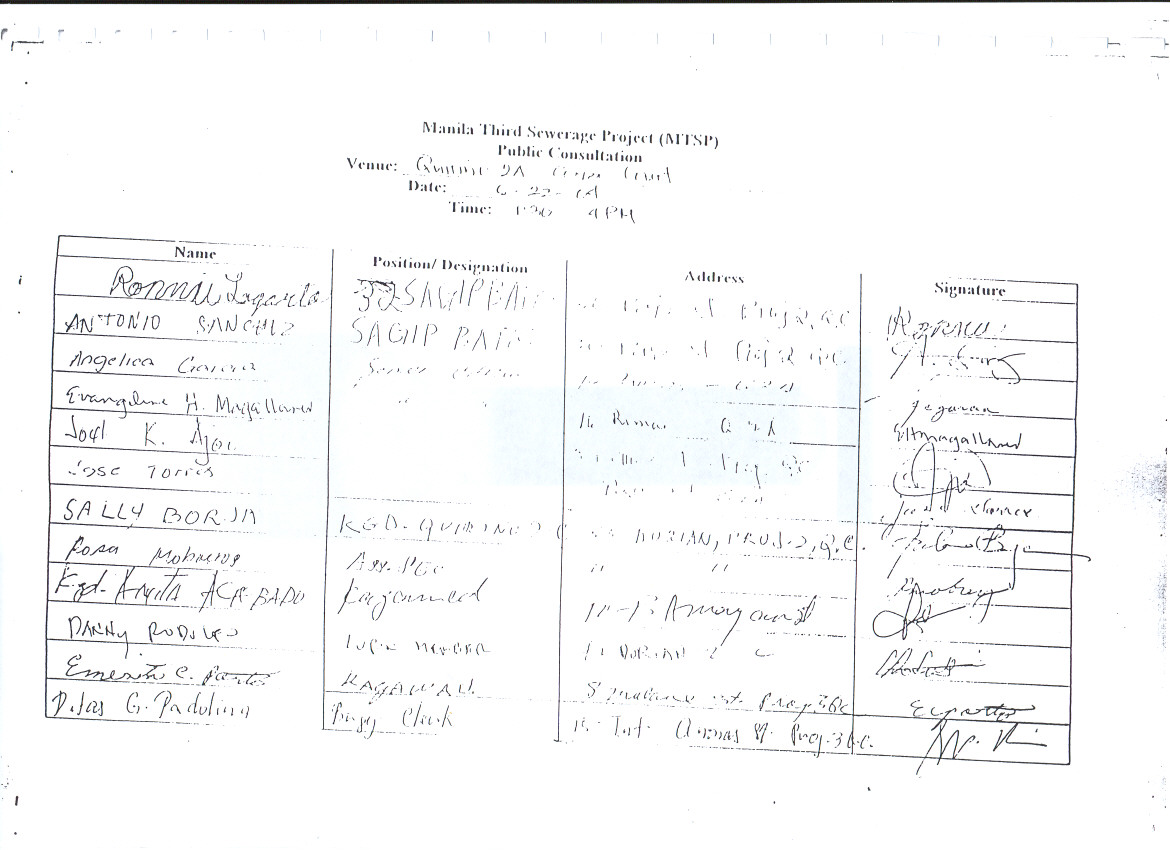
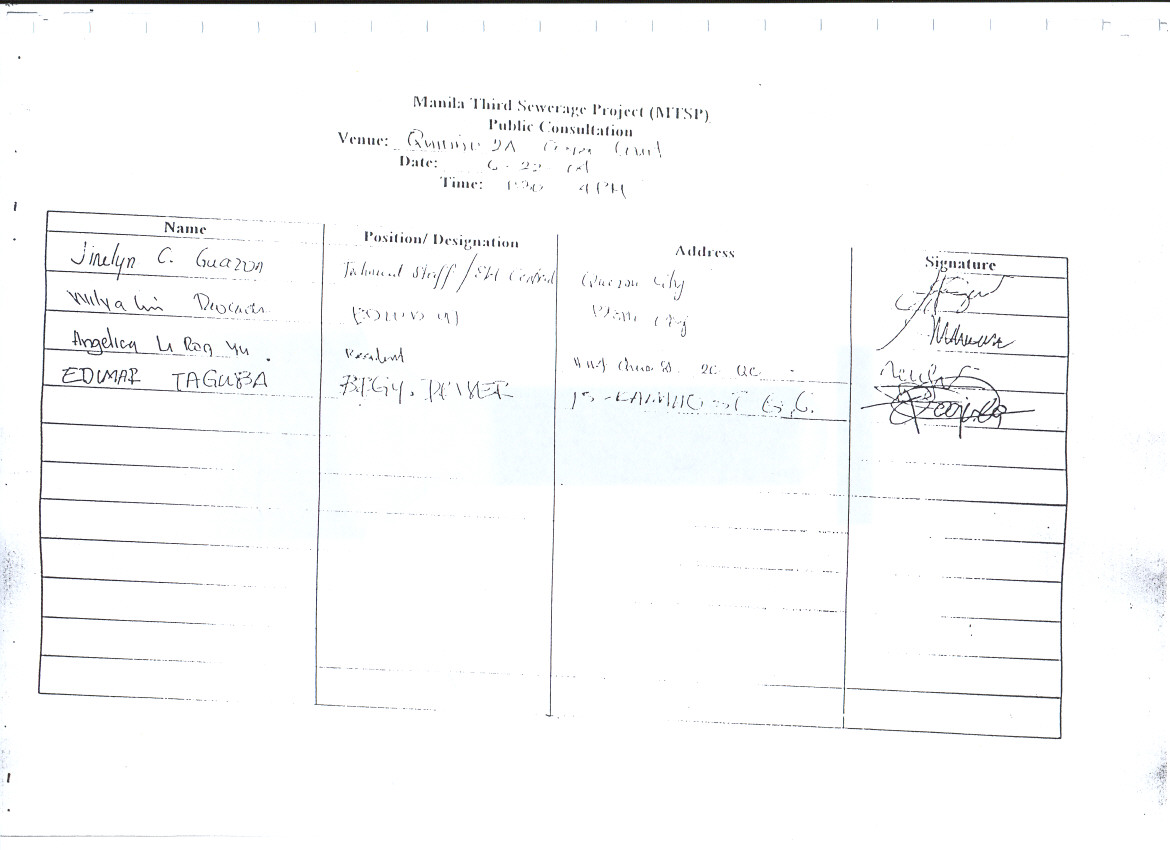
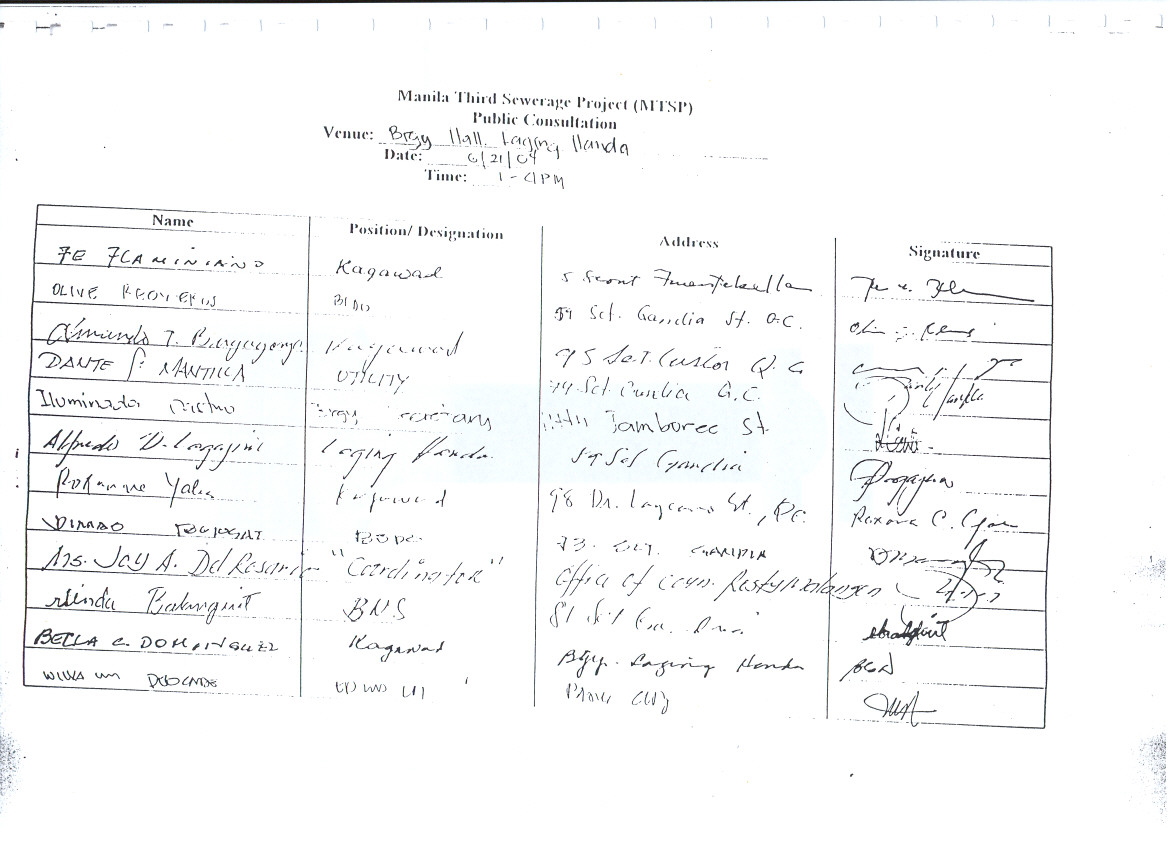
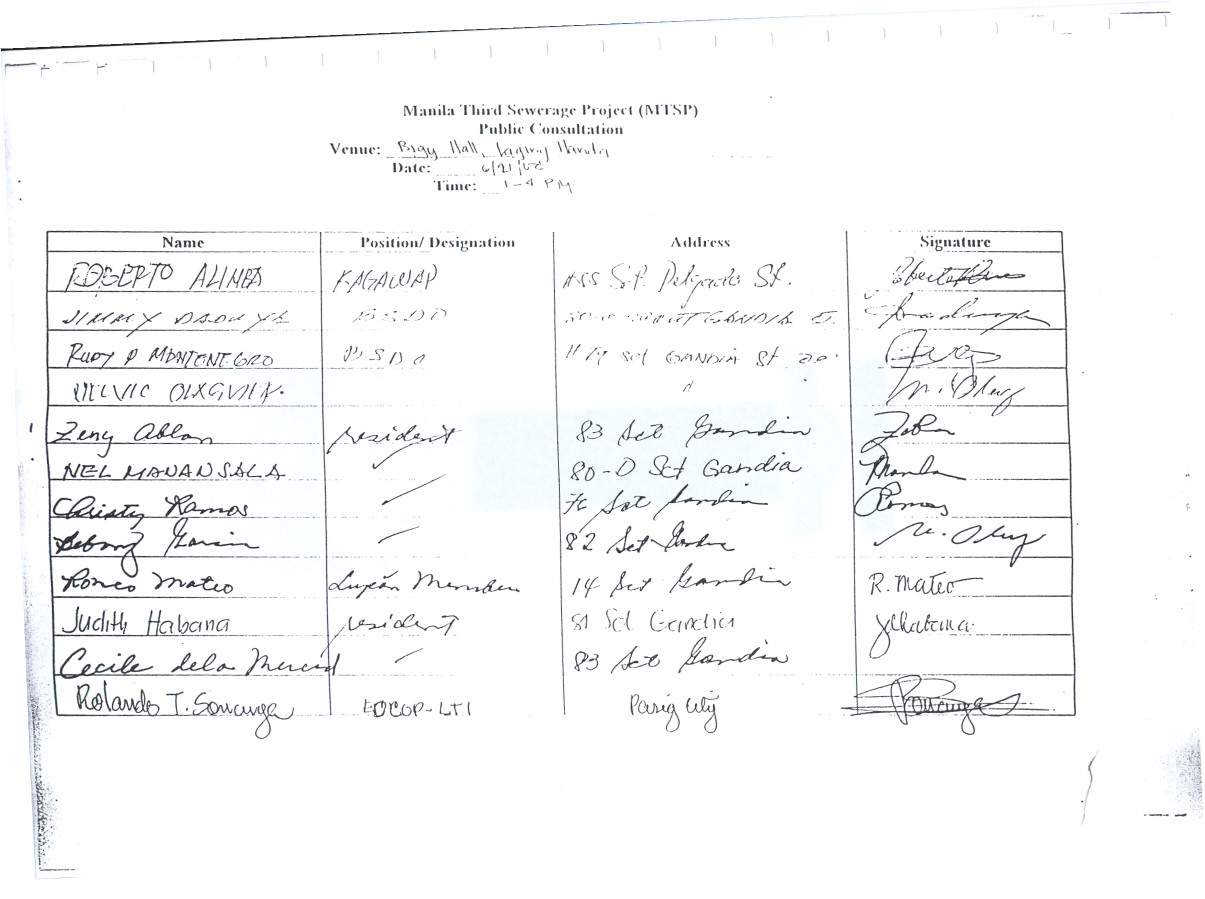
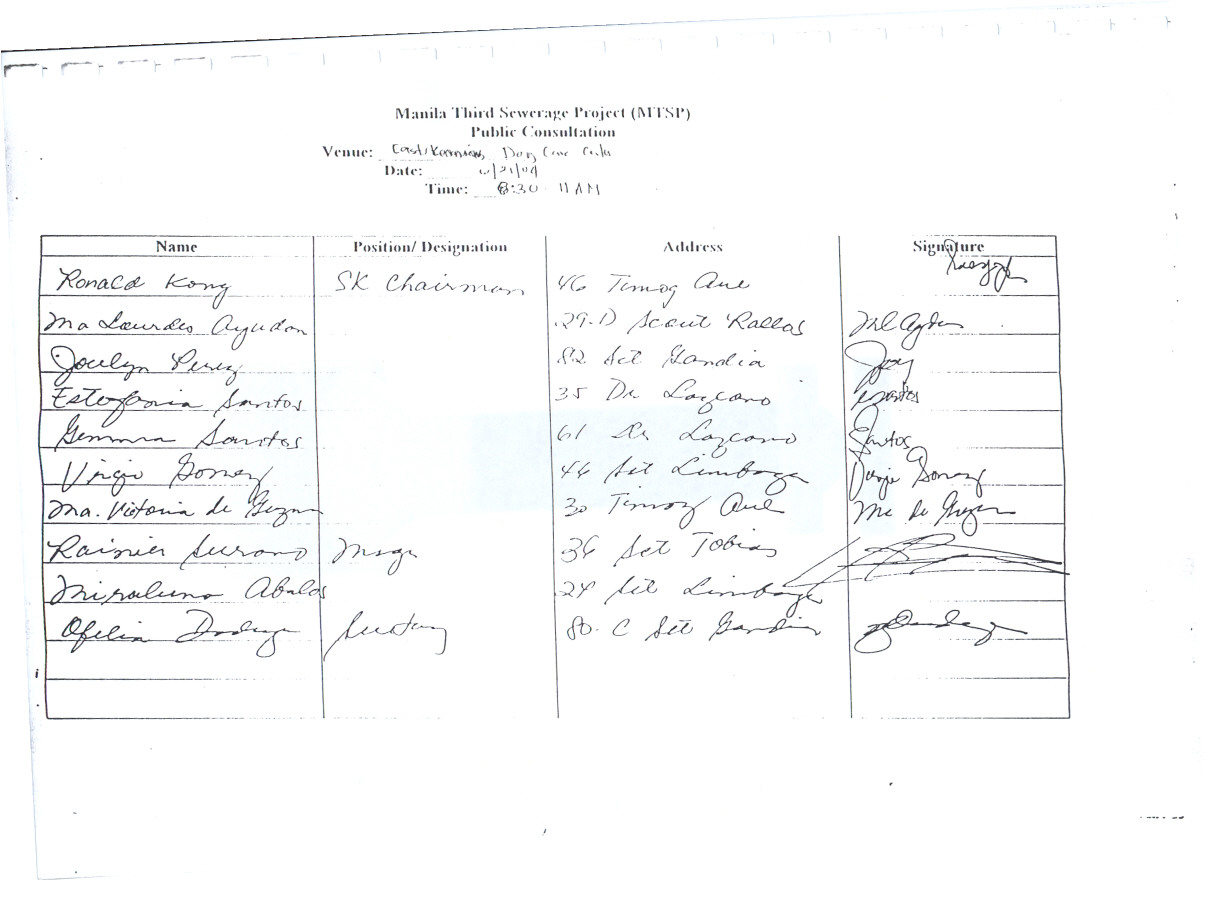
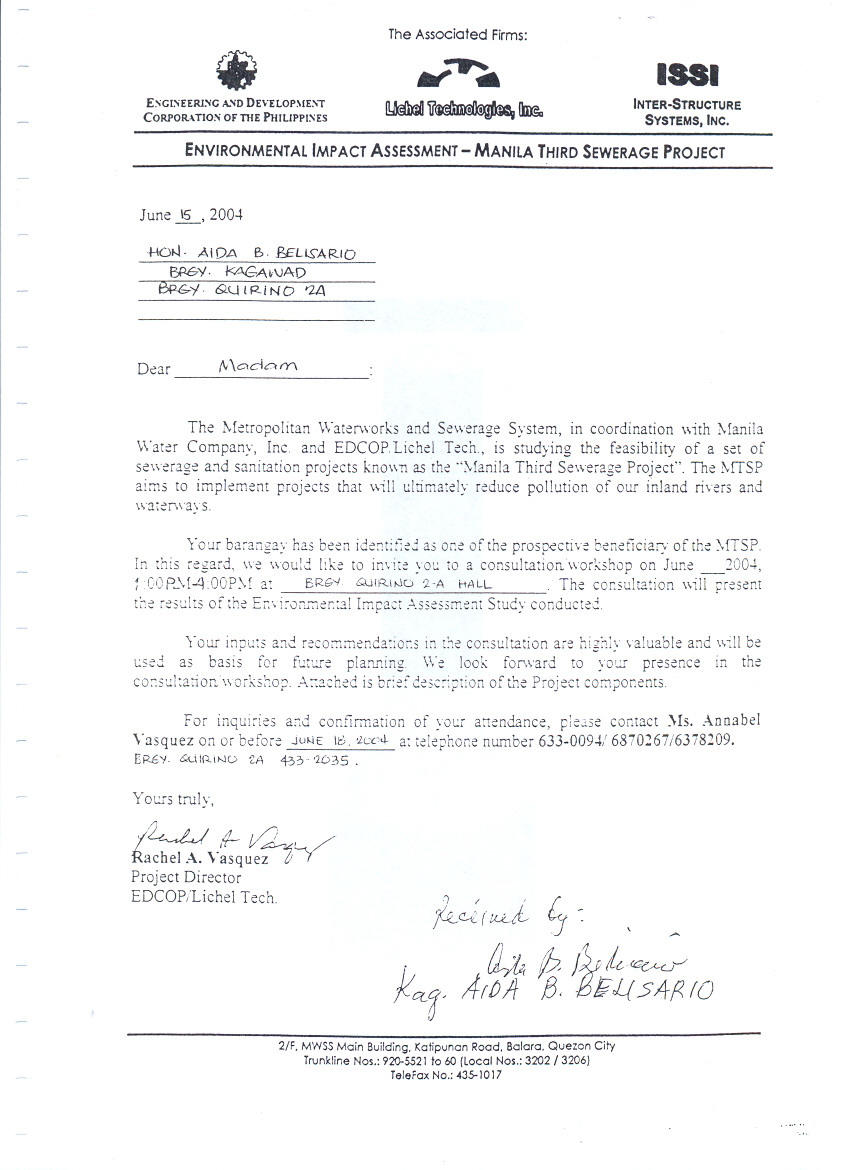

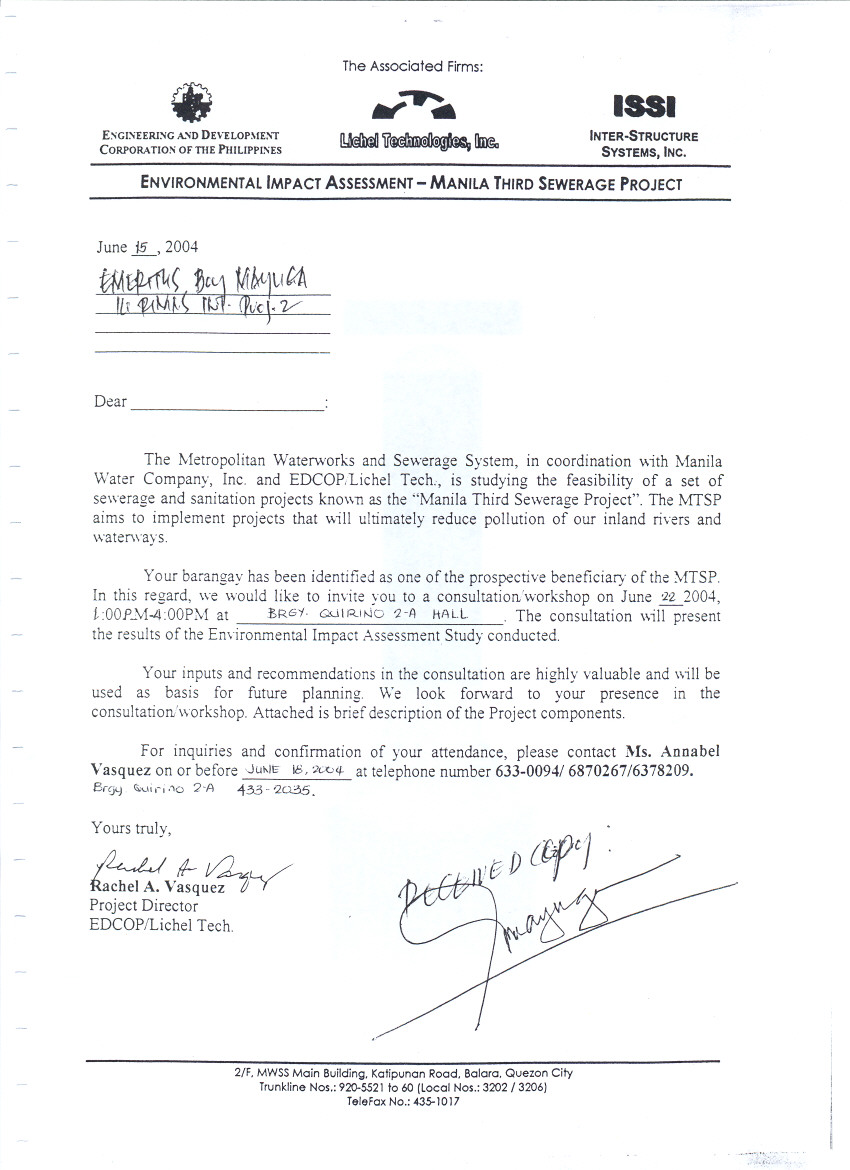
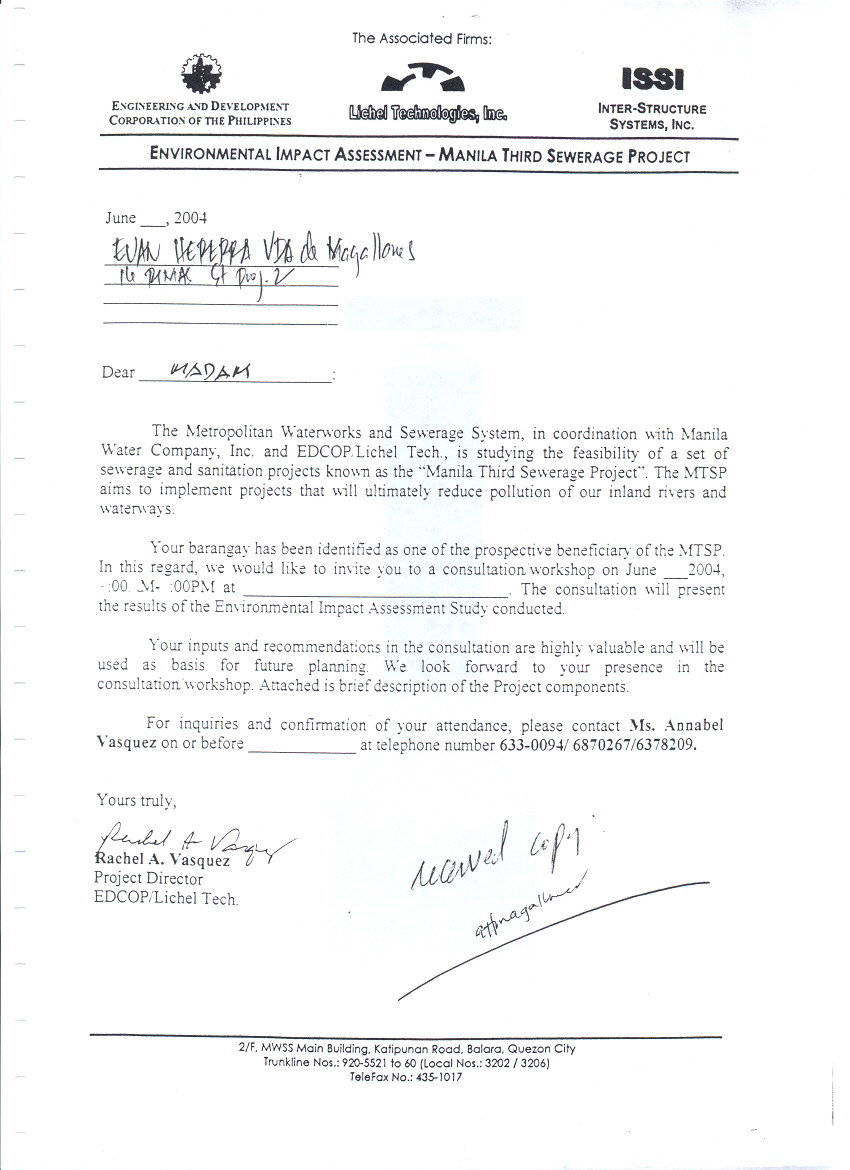
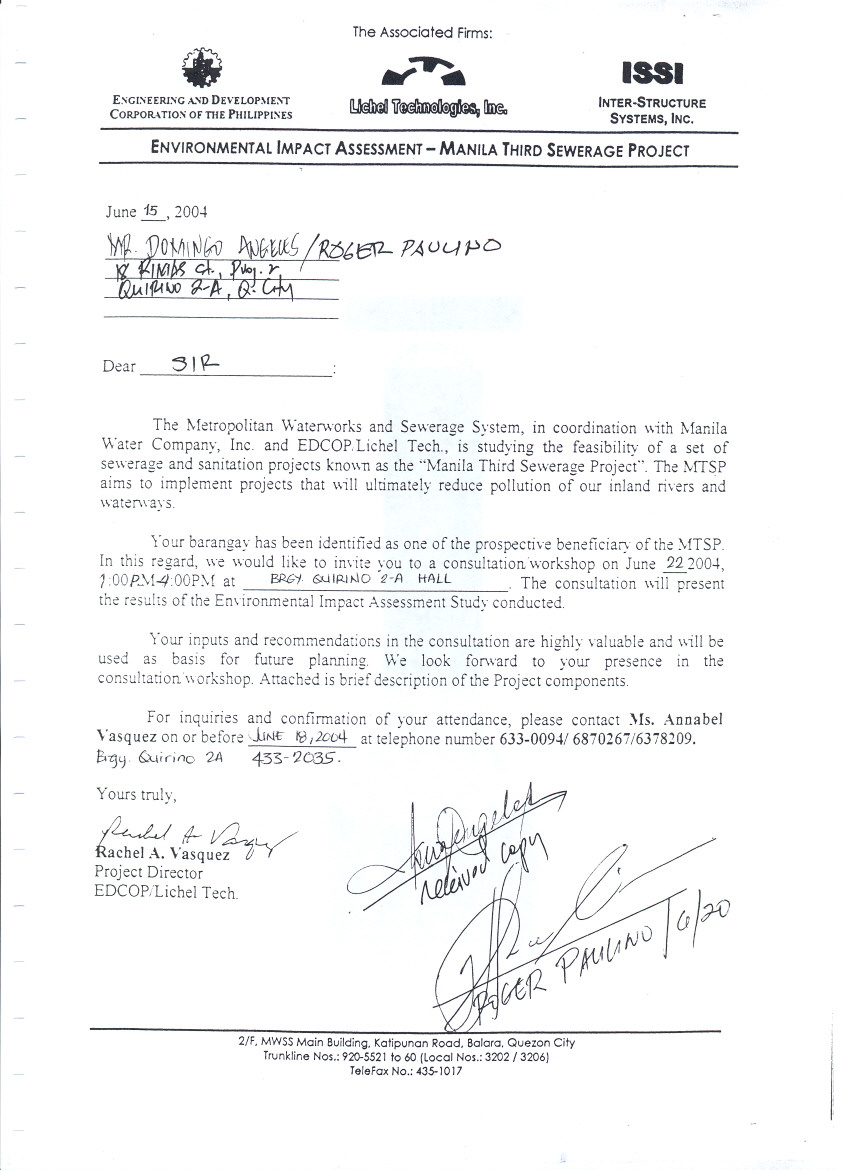
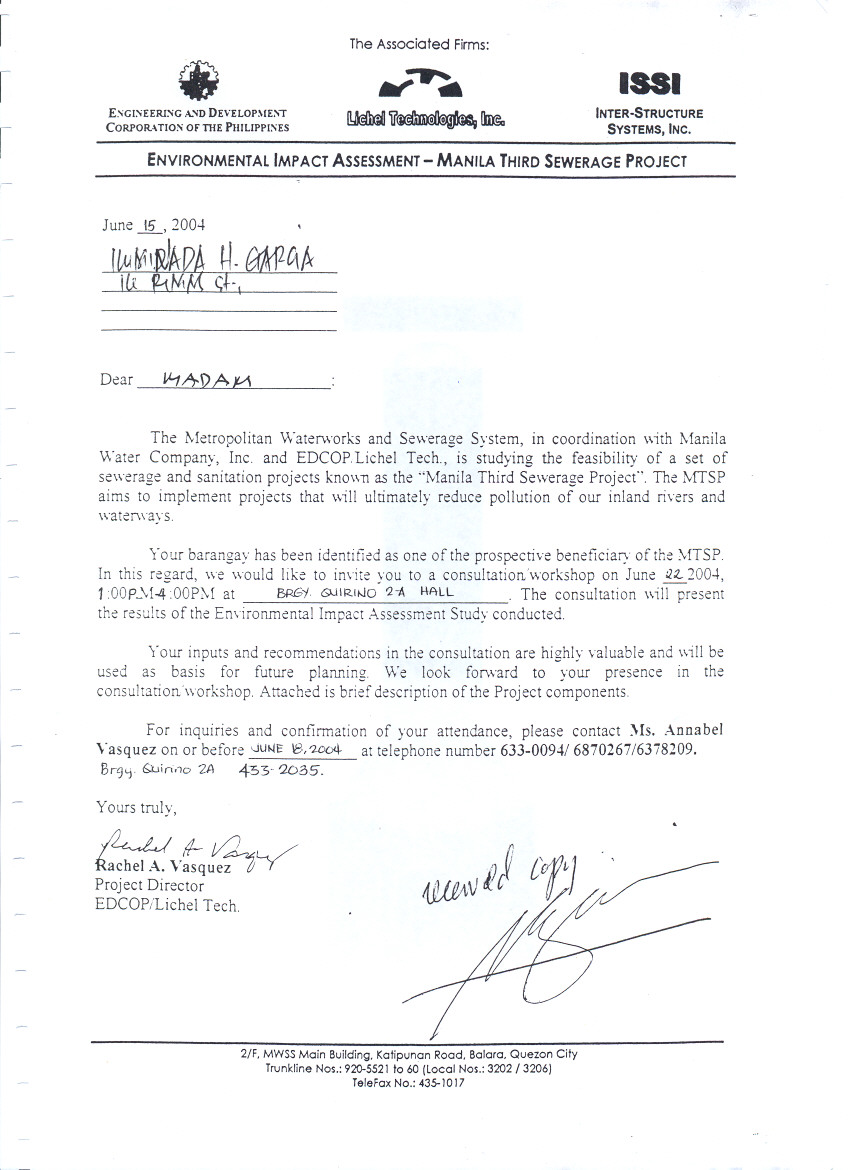
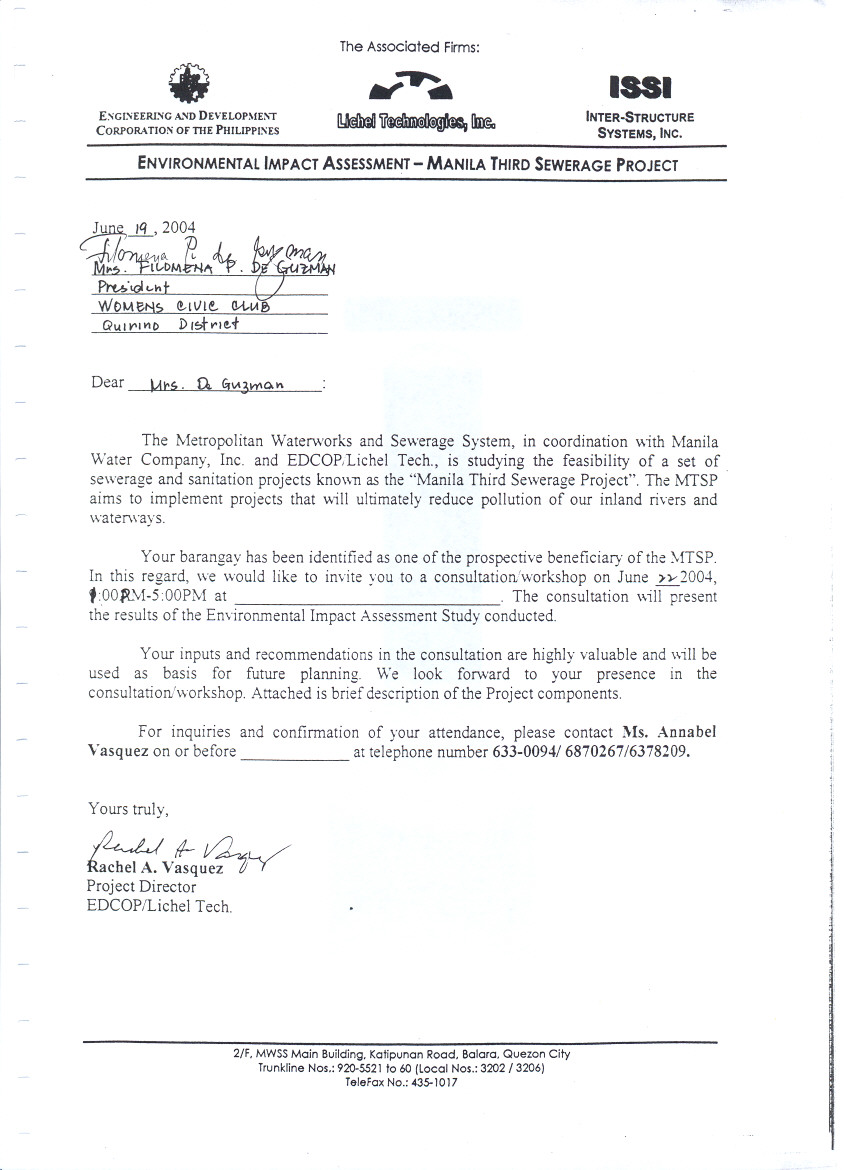
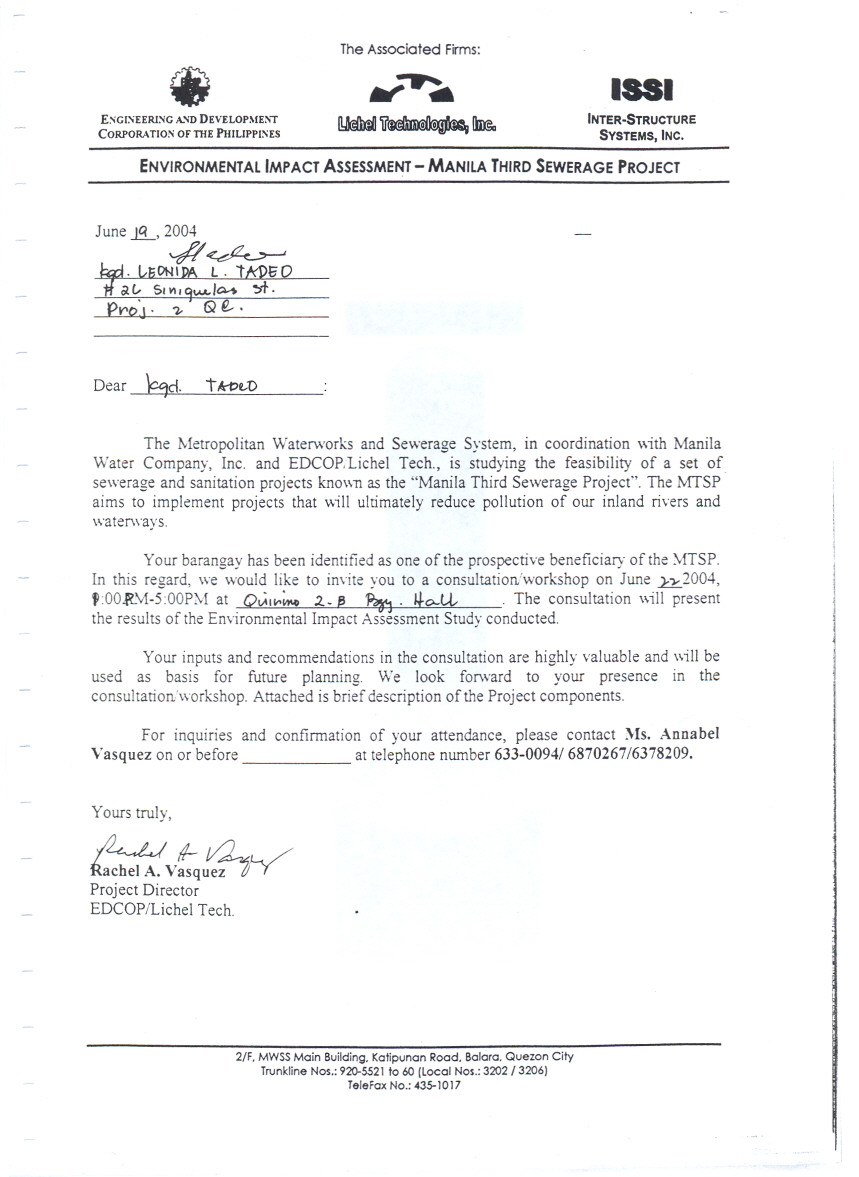
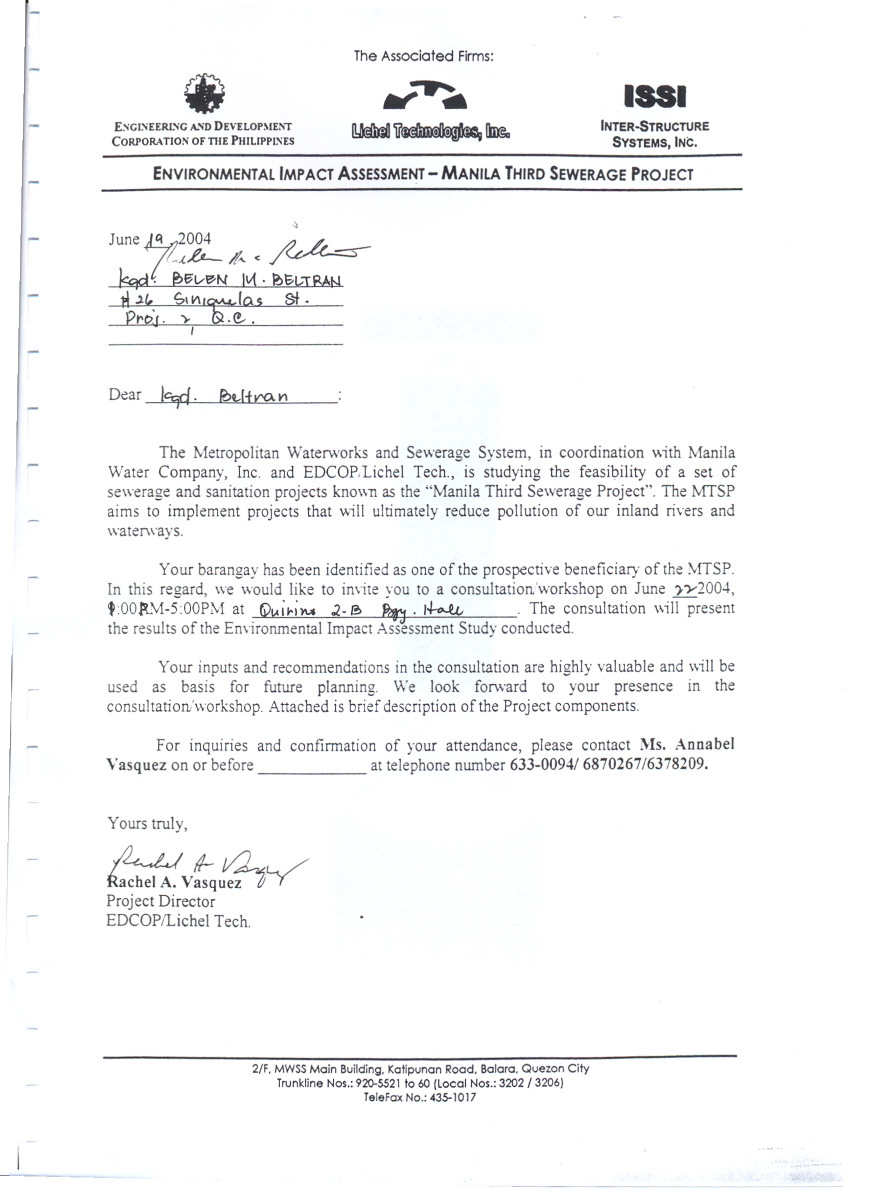
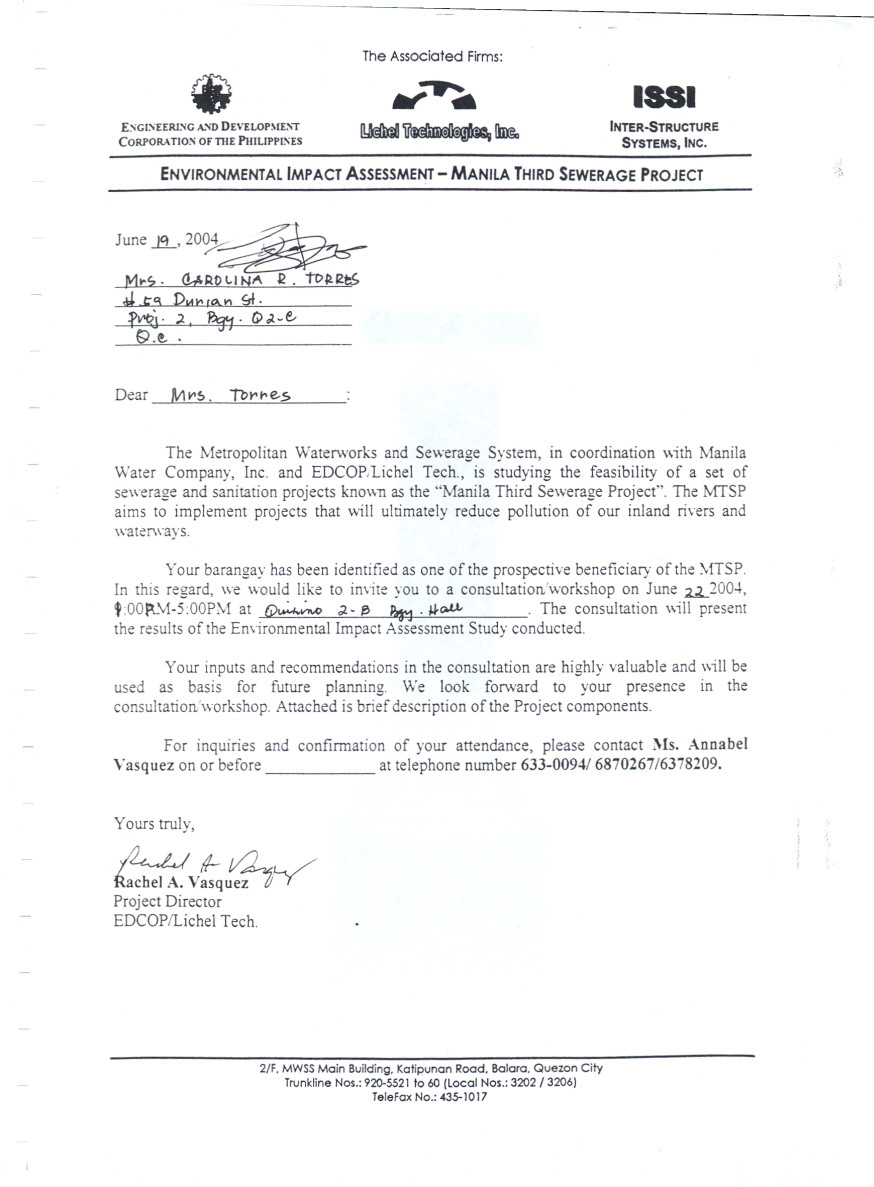
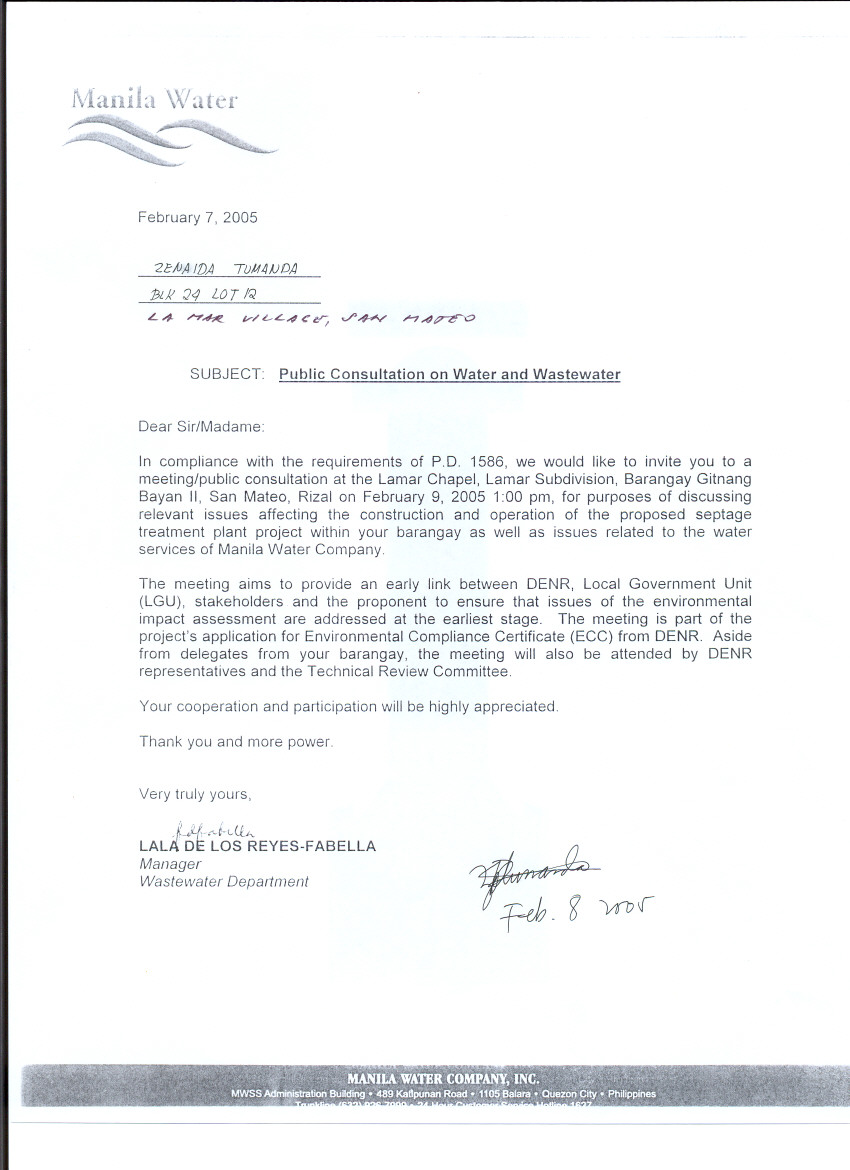
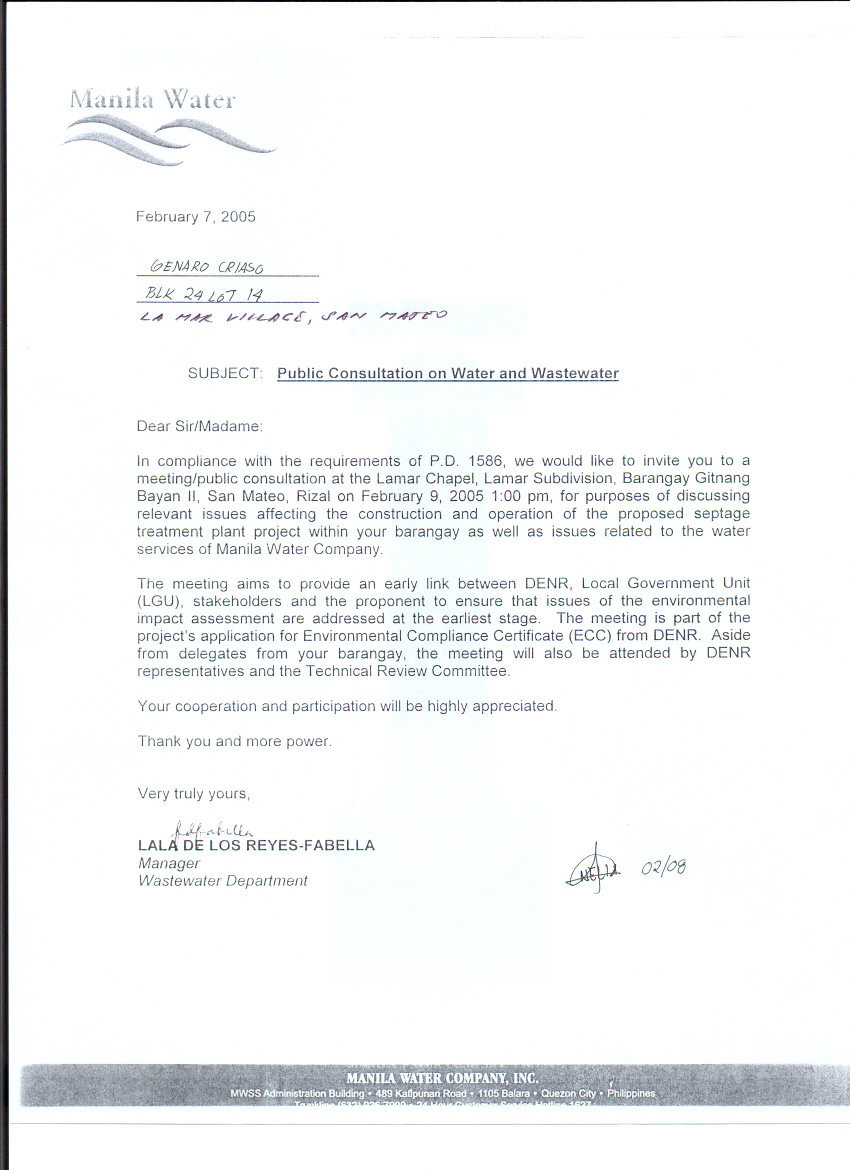
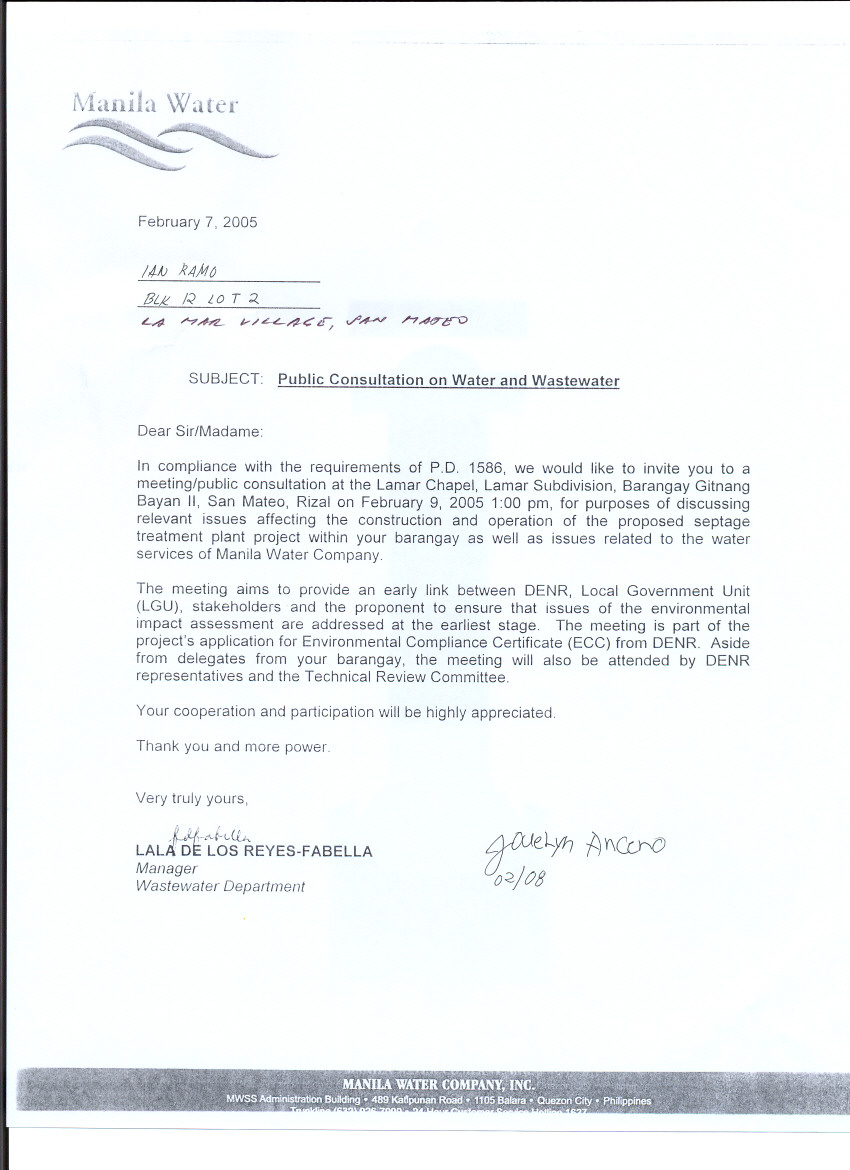
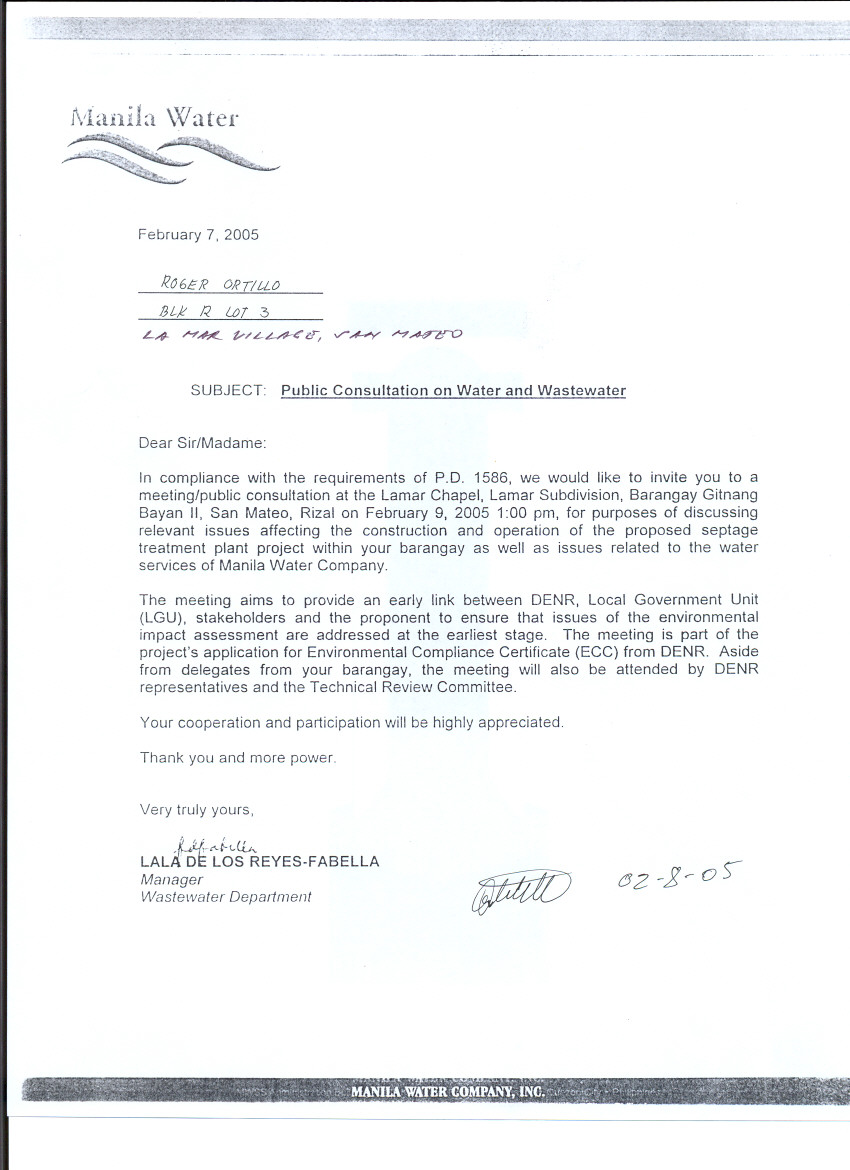
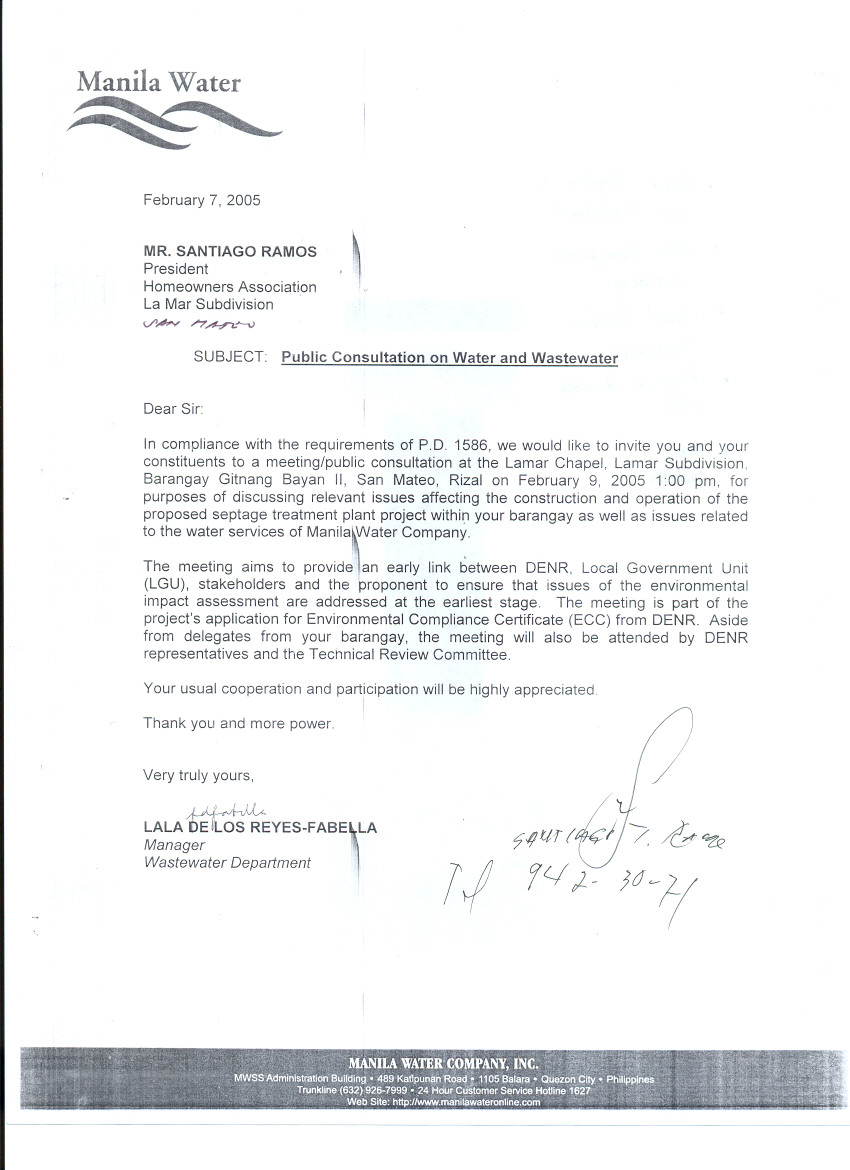
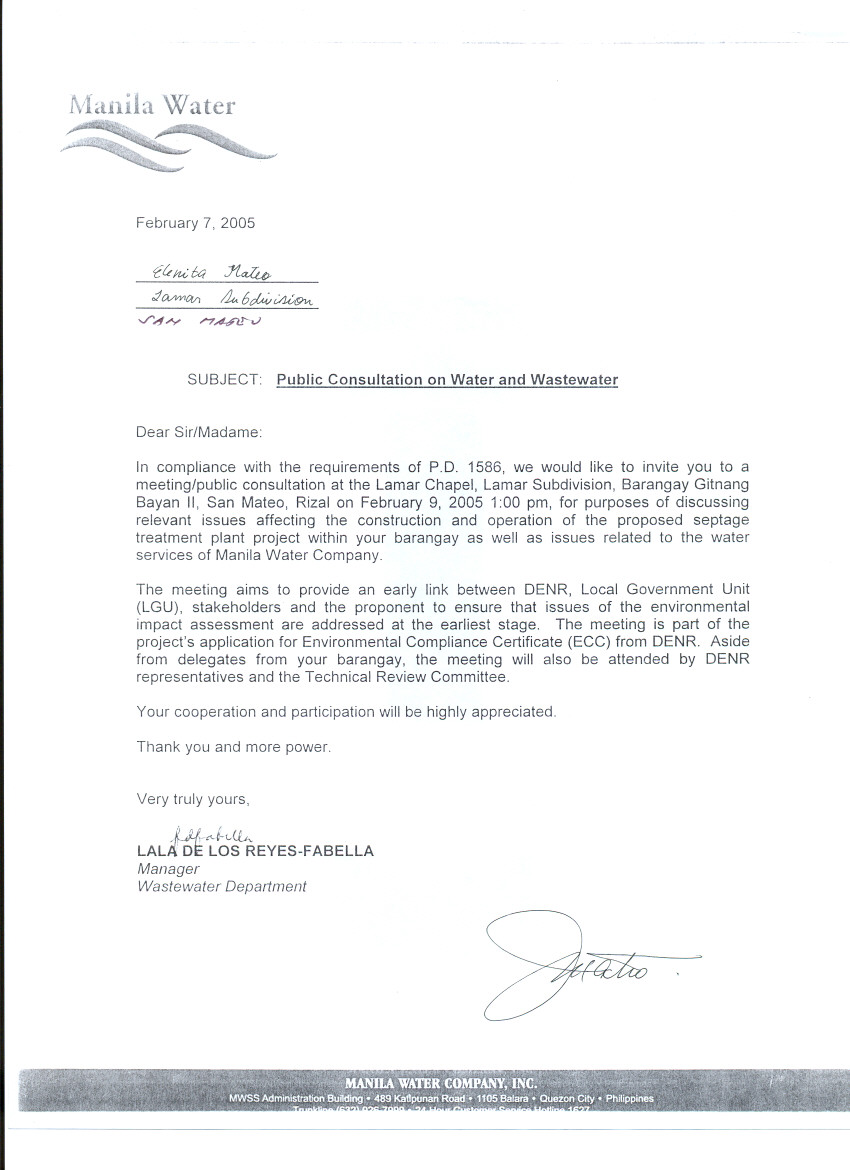
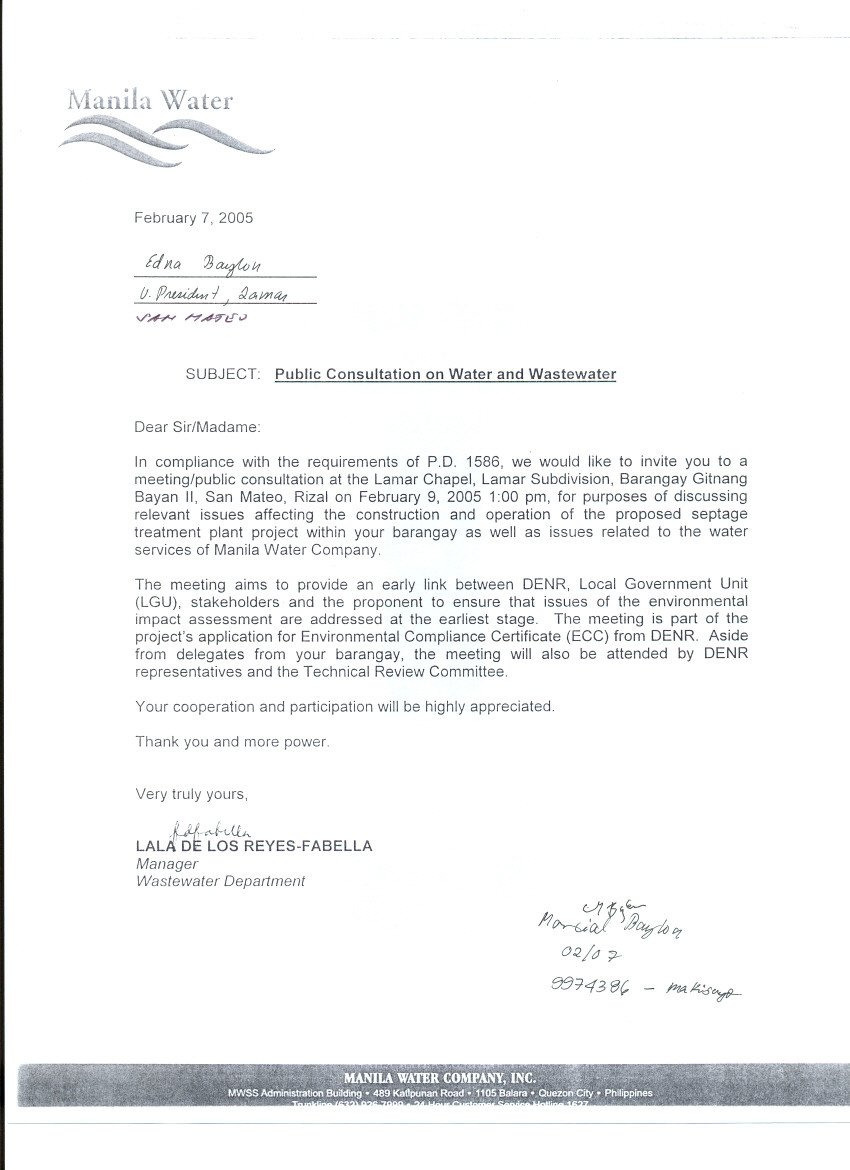
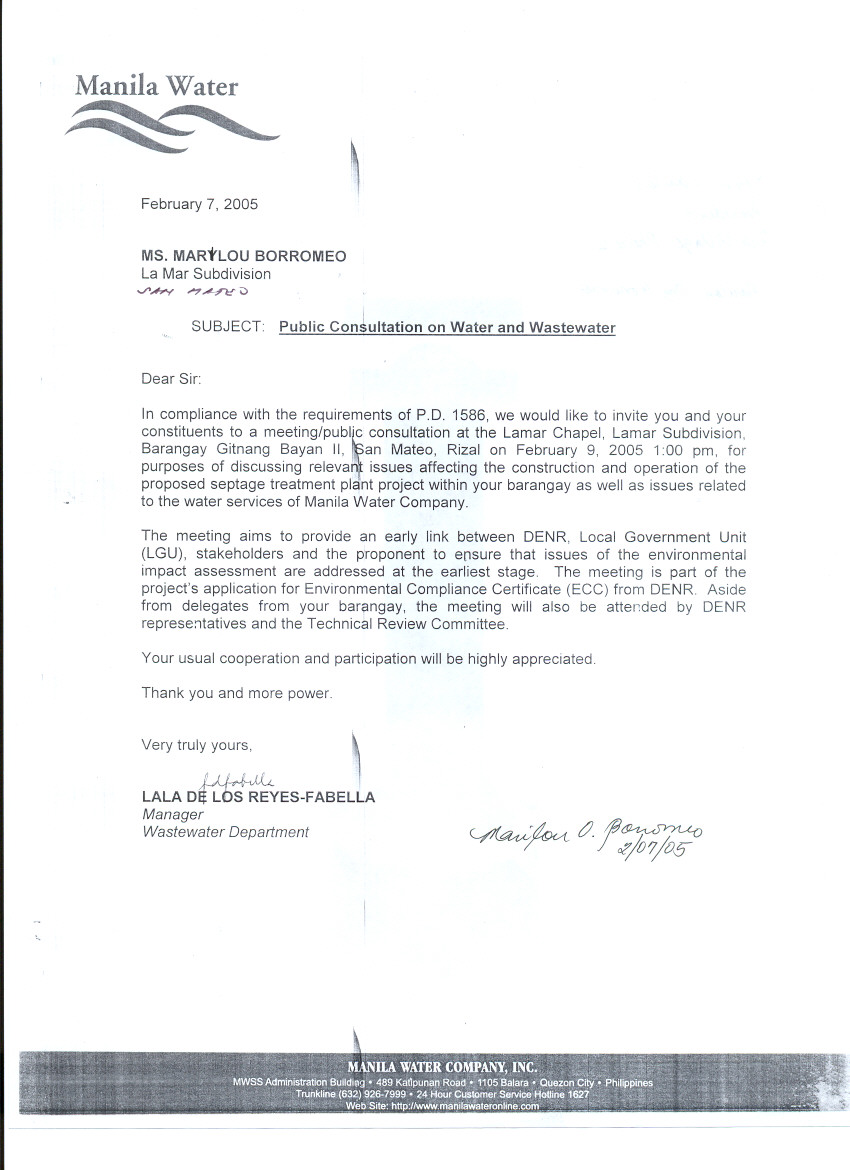

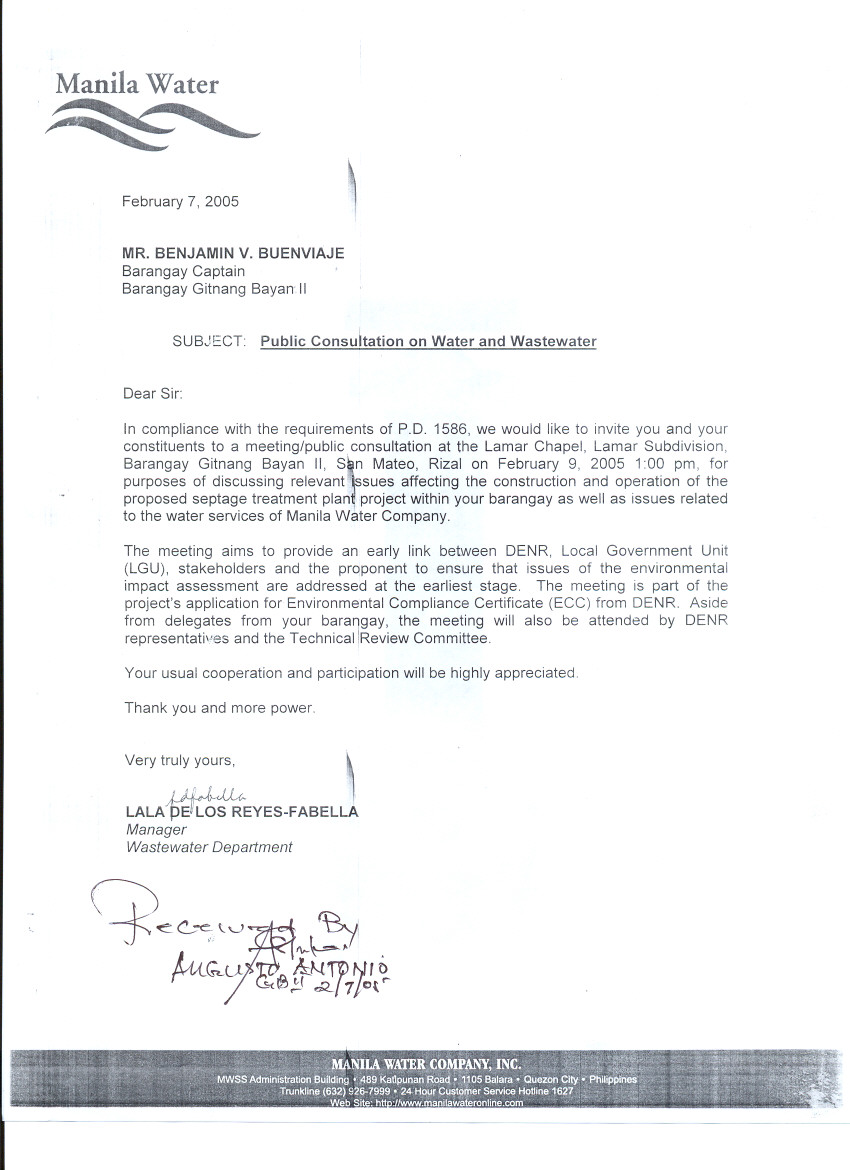
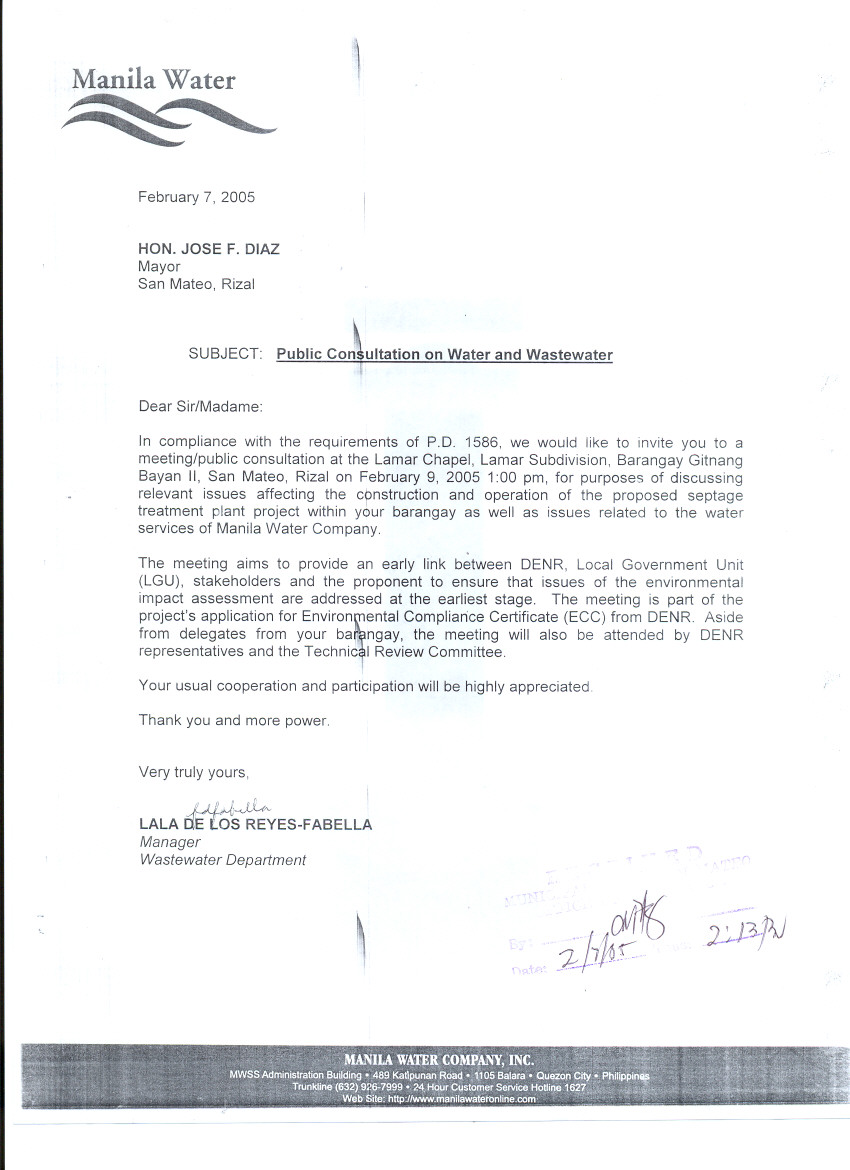
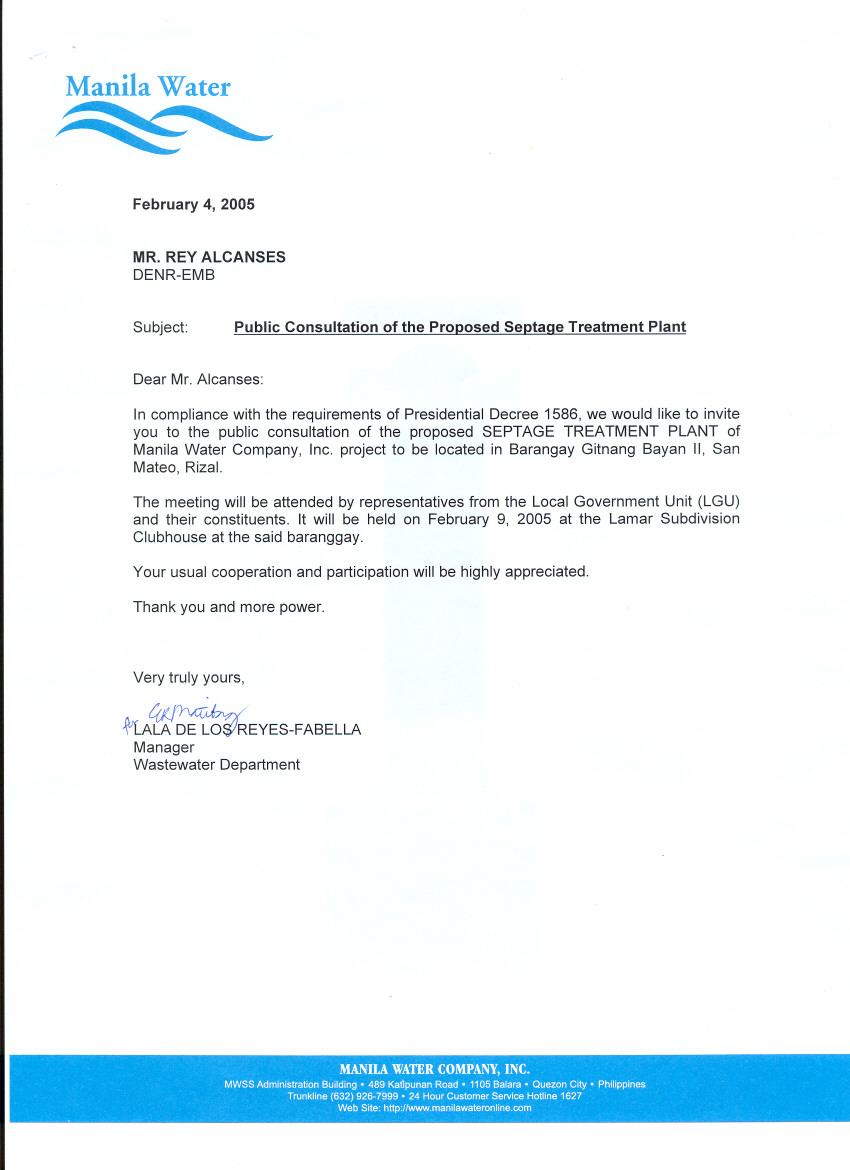
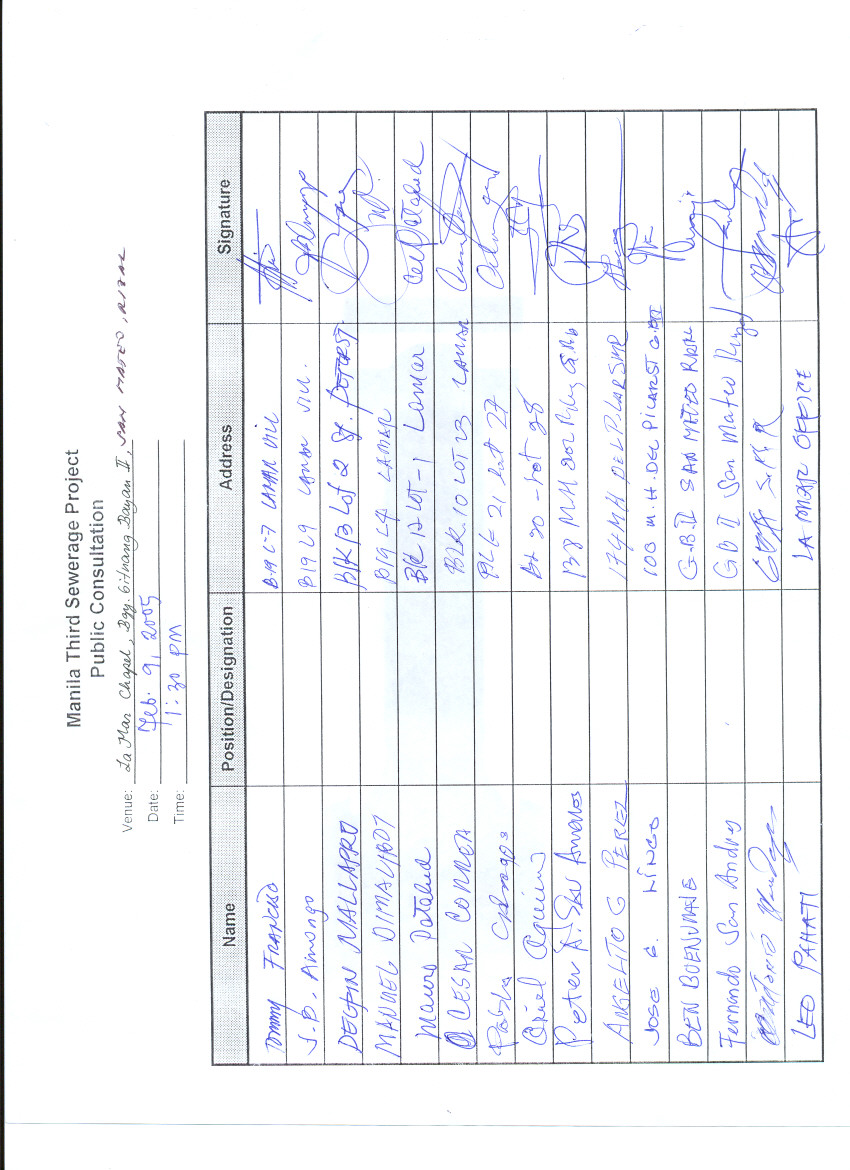
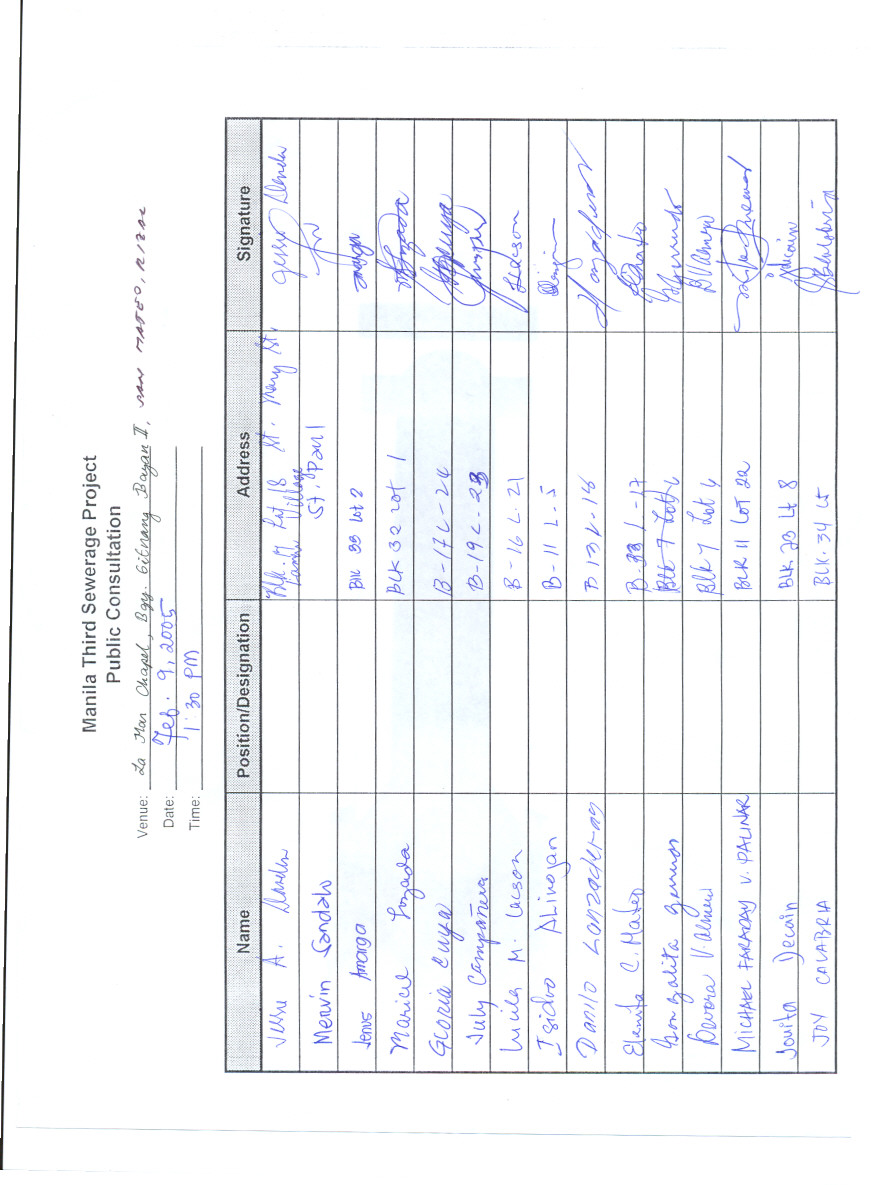
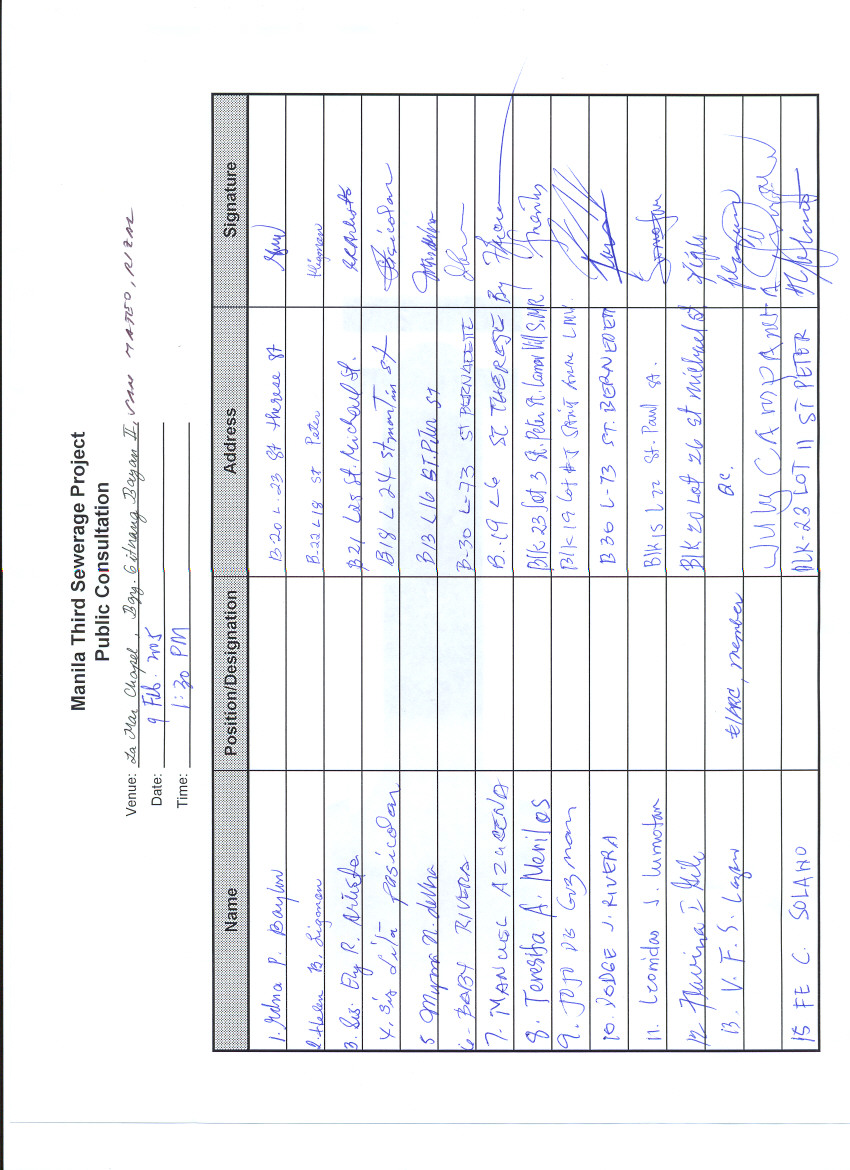
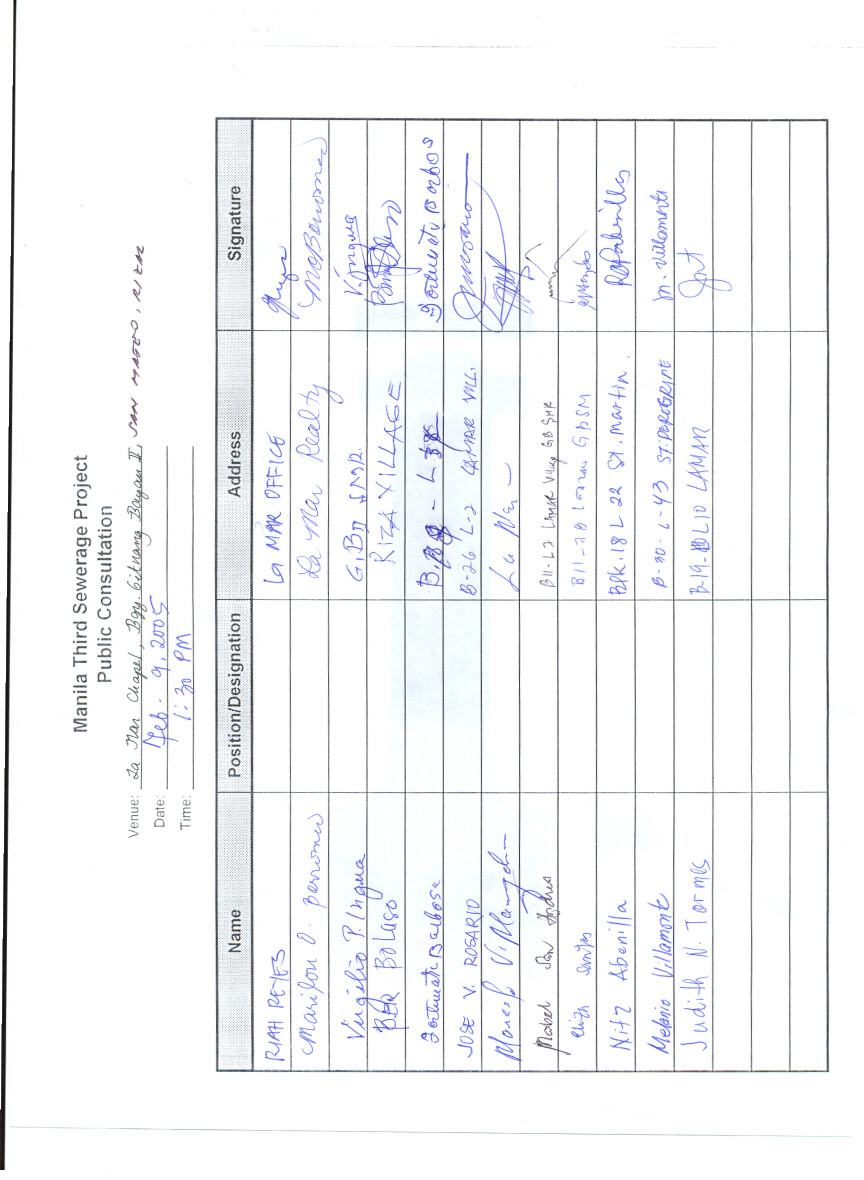
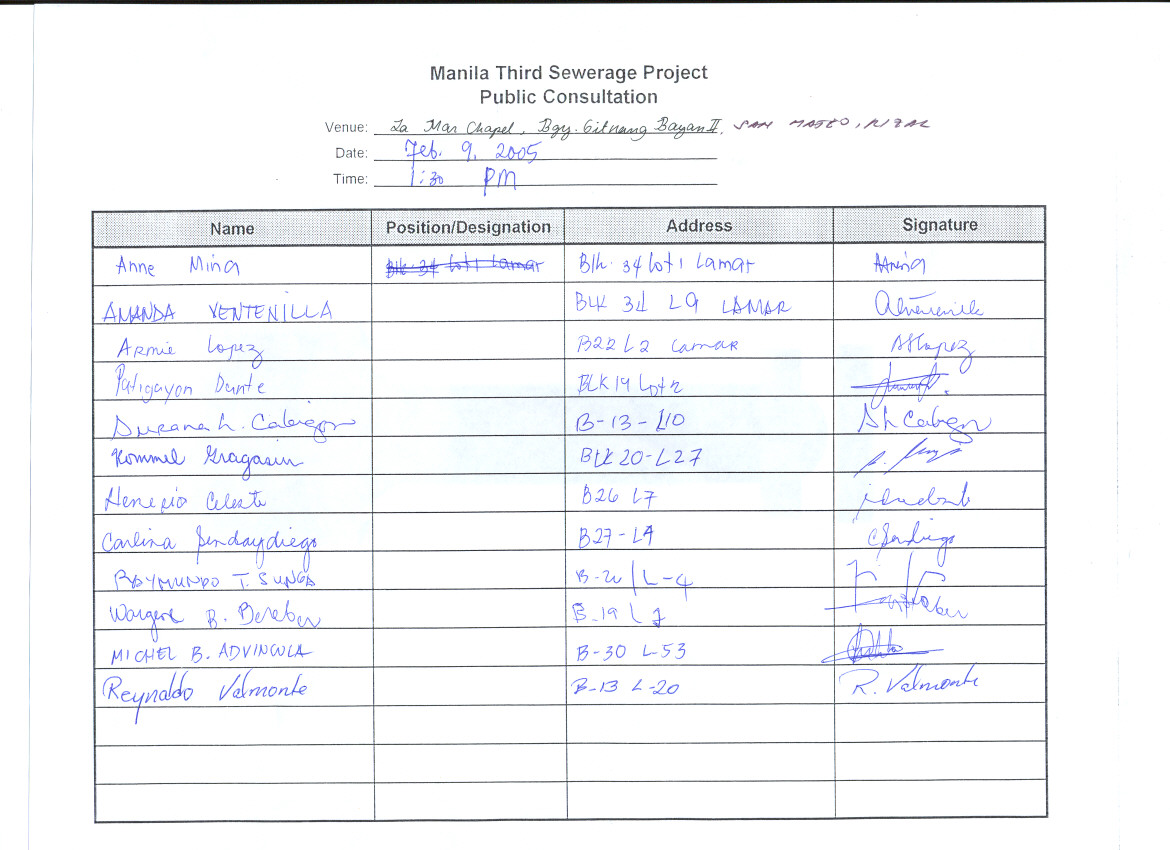
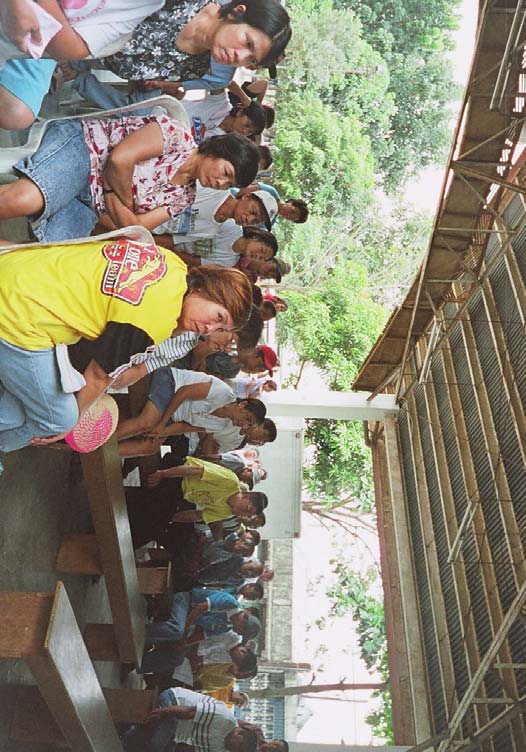
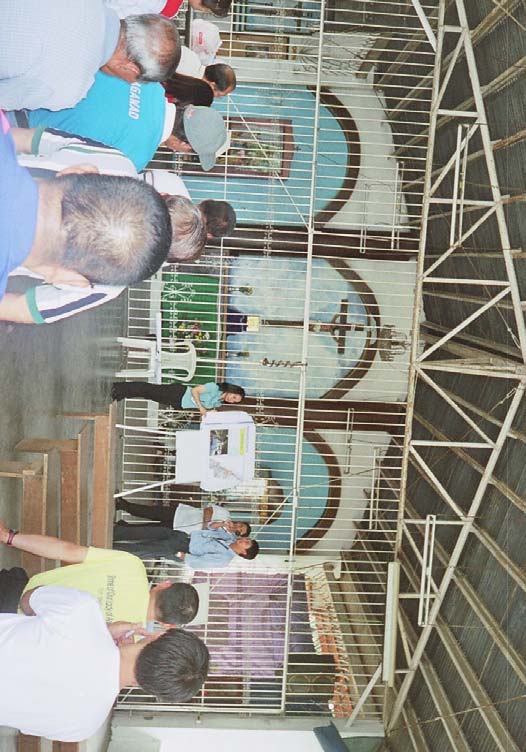
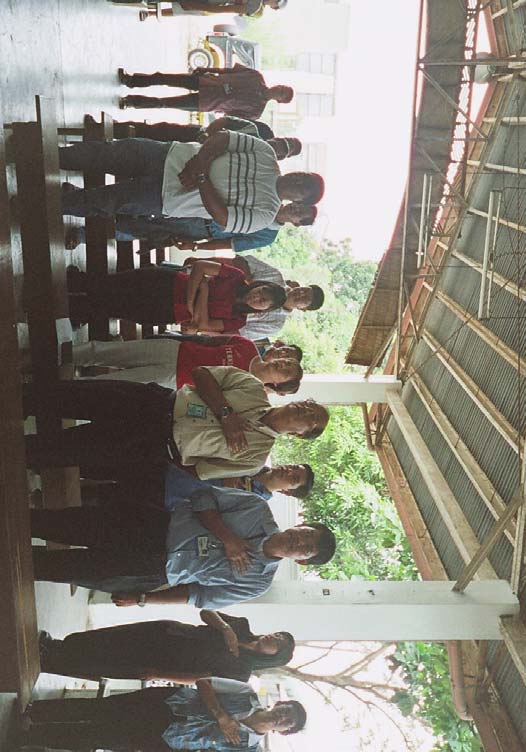
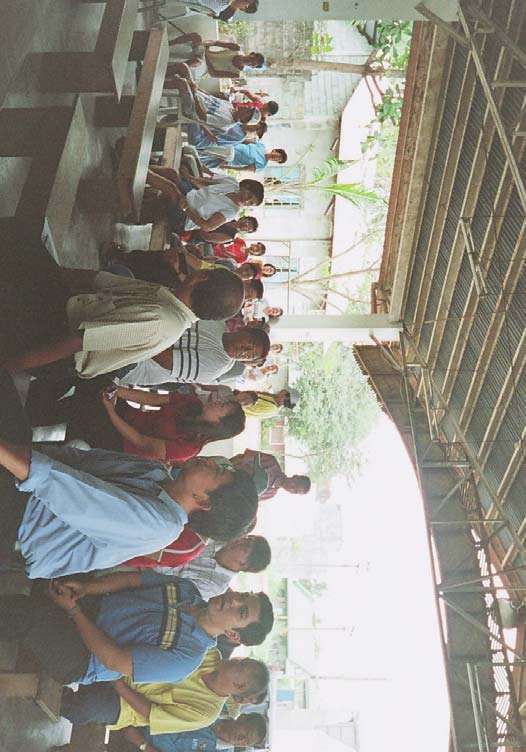
Annex 6
Copies of Presentation
Materials
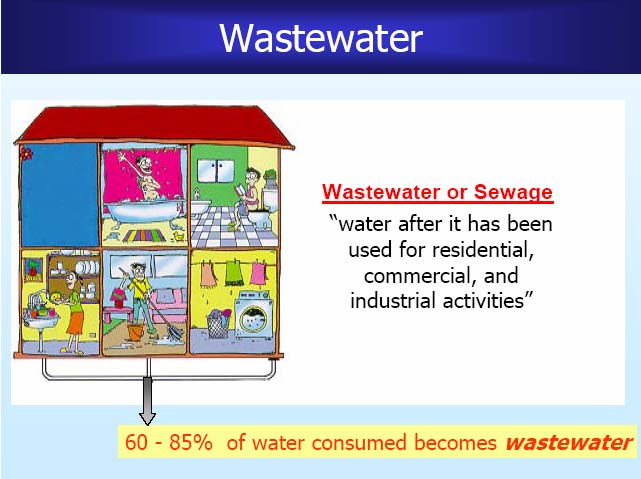
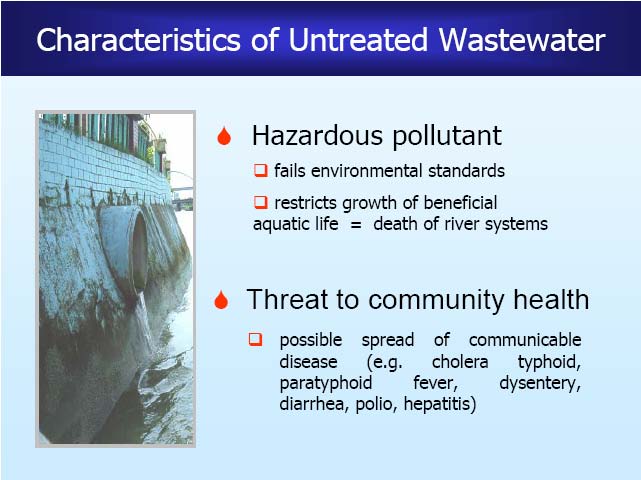
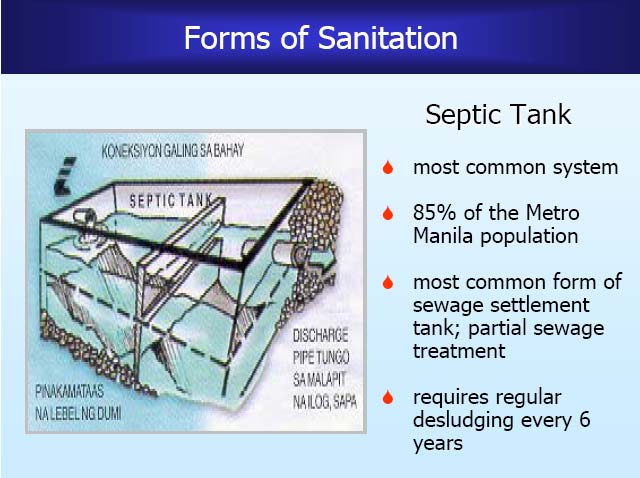
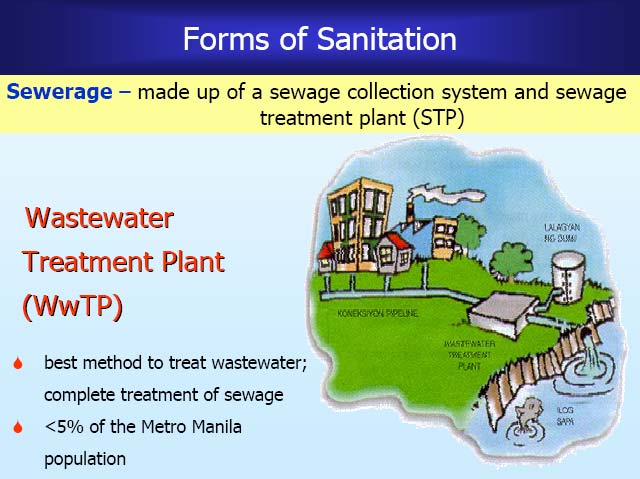
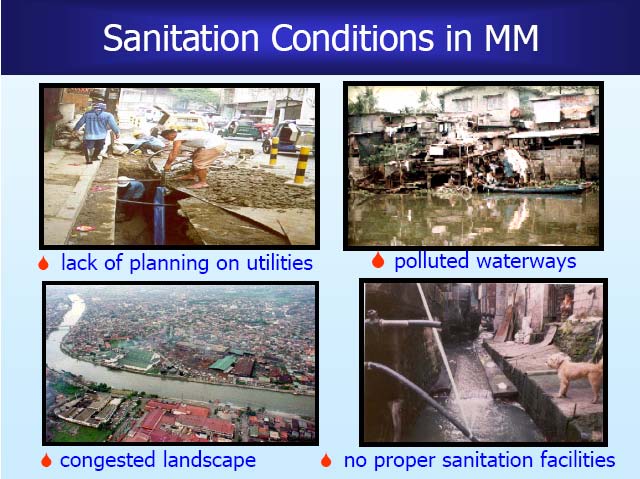
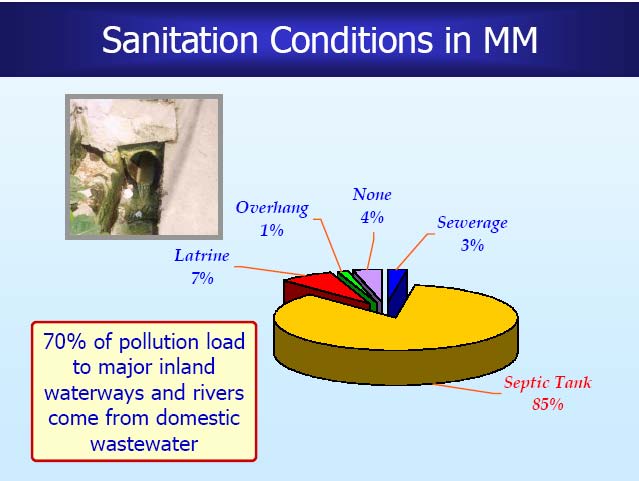
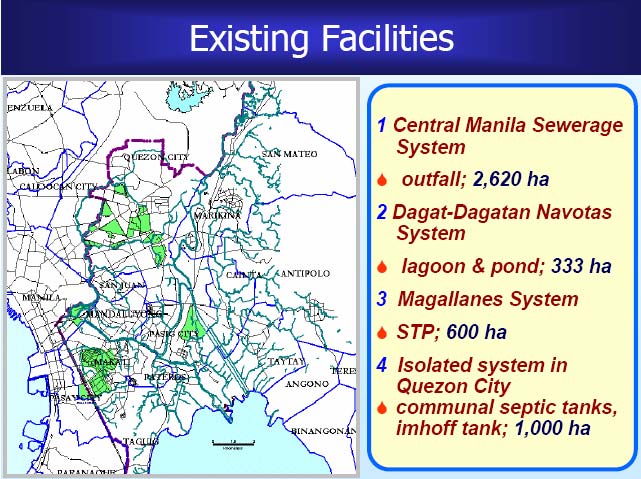
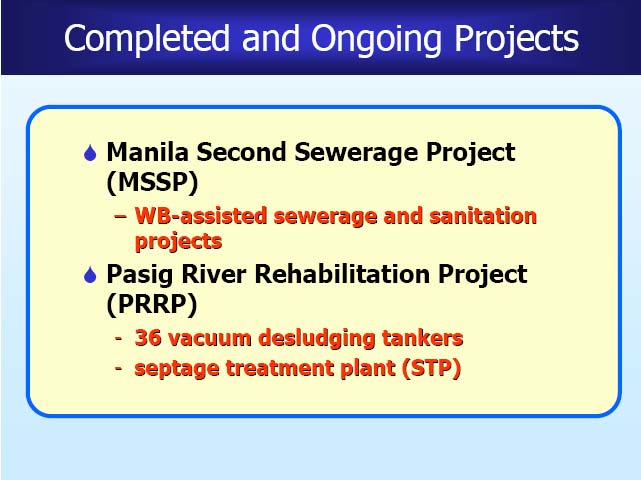
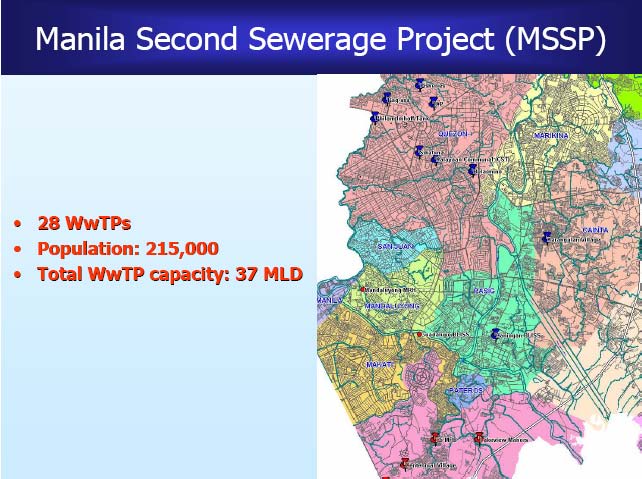
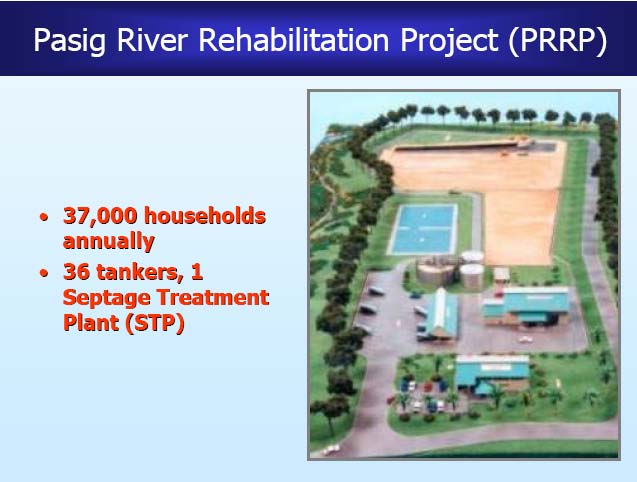
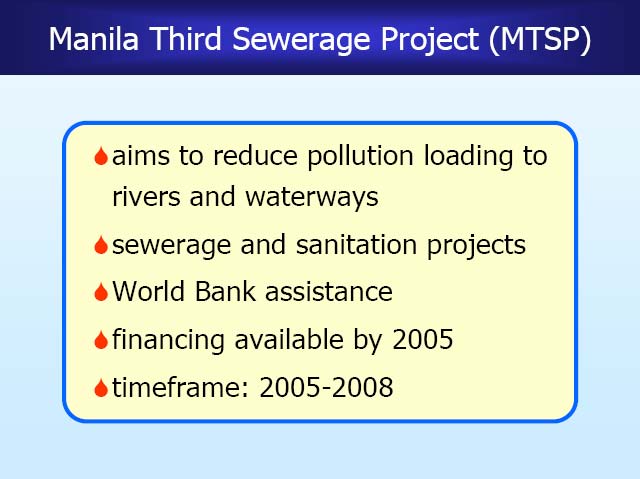
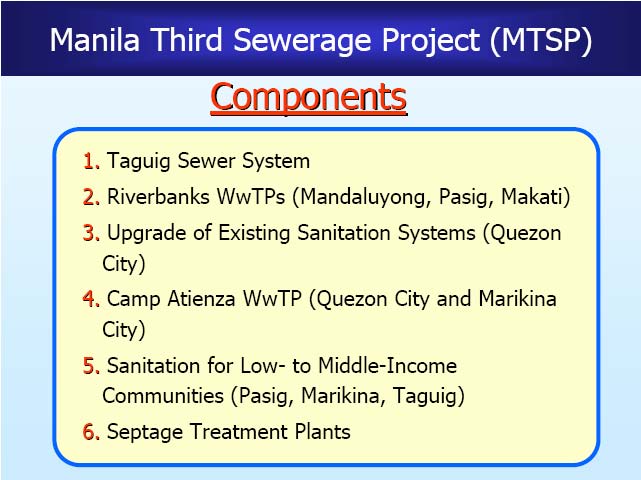
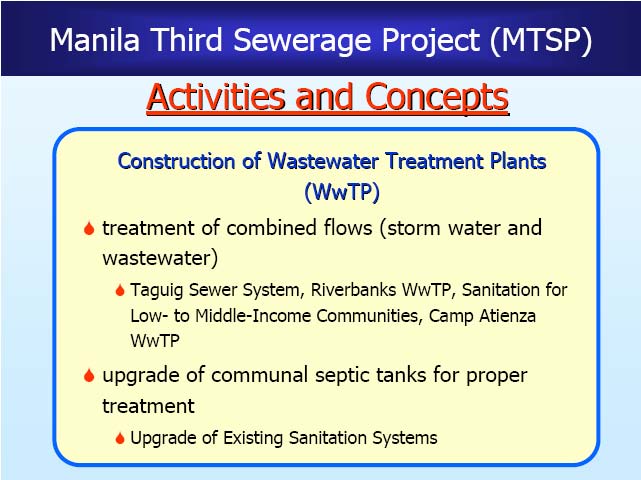
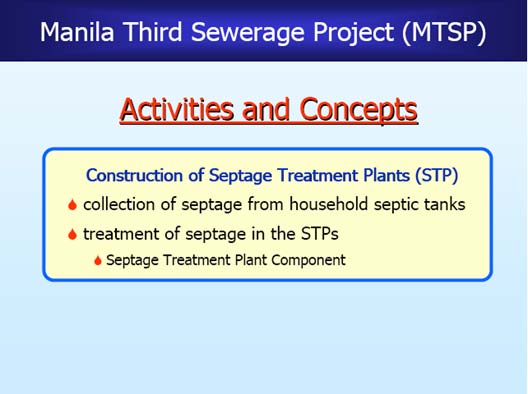
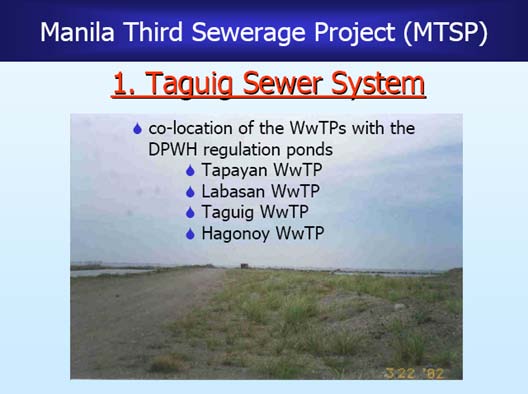
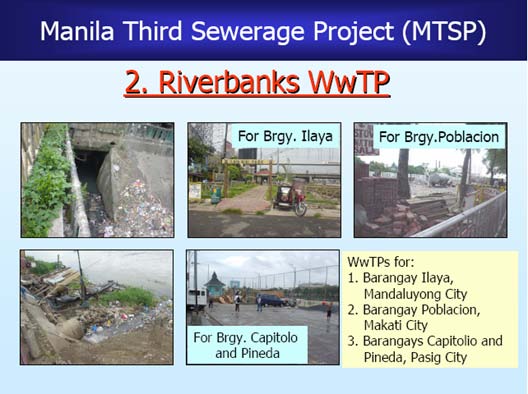
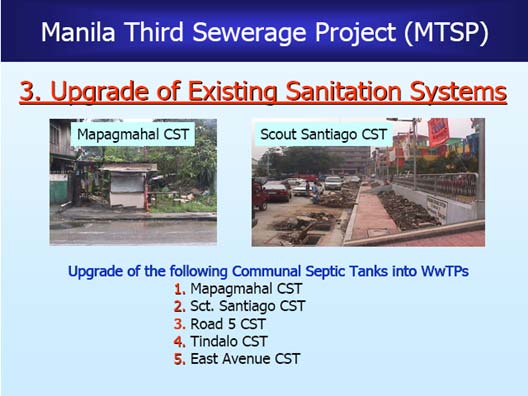
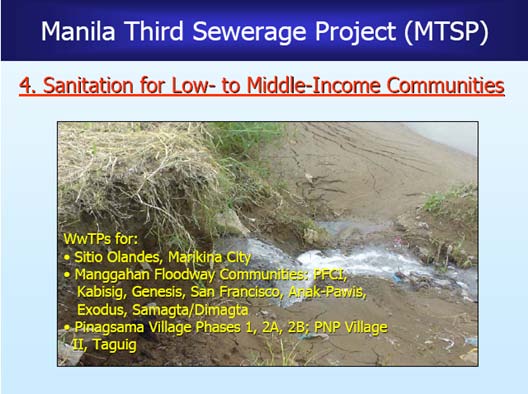
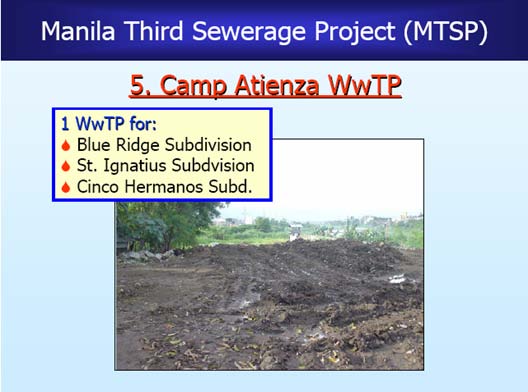
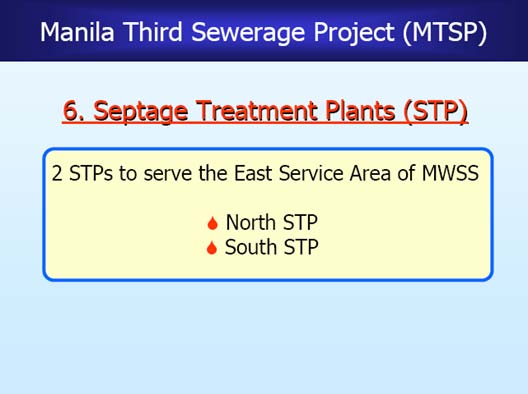
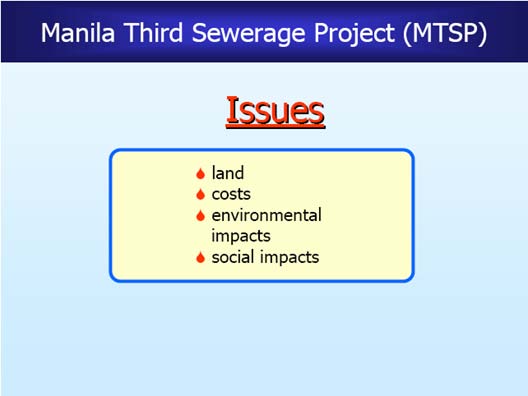
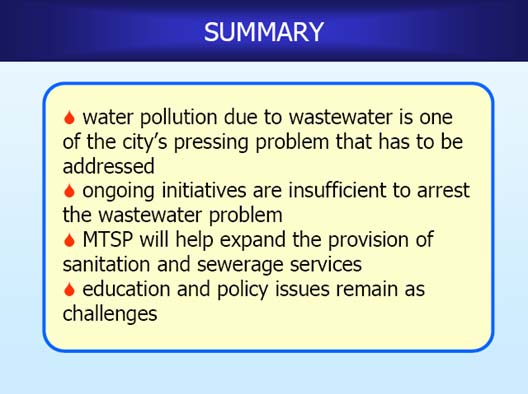







San Mateo Profile
SAN MATEO , RIZAL
Updates and Development
Land Area
50.4 sq. km
Number of Barangays
15
Population
152,681
4
February 3, 2005
Outline
Profile of San Mateo, Rizal
Project Updates
Project Updates
Water Supply
"Tubig Para Sa Barangay"
WATER SUPPLY
Sewerage and Sanitation
2
5
The Municipality of San Mateo, Rizal
Estimated
Estimated
No. of HH
Barangay
No. of WSC
% HH Served
Population
Households
Served
Banaba
14,874
2,479
1,305
1,600
64%
Ampid I
22,125
3,686
1,132
1,870
51%
Ampid II
3,097
516
271
296
57%
Municipality of San Mateo, Rizal
Sta Ana
9,410
1,568
675
740
47%
Guitnang Bayan I
16,970
2,828
517
647
23%
Guitnang Bayan II
9,840
1,640
358
392
24%
PROFILE
Dulong Bayan I
5,254
876
341
373
43%
Dulong Bayan II
5,815
969
320
350
36%
Malanday
12,985
2,164
150
163
8%
Guinayang
5,985
998
132
165
17%
Maly
11,862
1,977
149
164
8%
Gulod Malaya
5562
795
Pintong Bukawe
1957
280
Silangan
18,808
2,687
3
6
TOTAL
152,681
25,447
5,350
6,760
27%
1
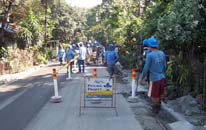
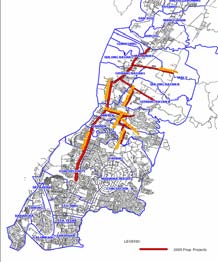
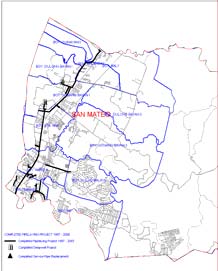

Source of Water Supply
Pipelaying Projects
Operating Production
PROPOSED (2005)
Deepwells
Location
Hours
(mld)
· Sta. Maria
Sta Maria Subd, Ampid I
17
0.48
Total length of pipes
17.0 km
· Sta. Ana
Salvador St. Sta Ana
6
0.45
Total Investment
P 175 M
· Public Market
M. H. Del Pilar Guitnang Bayan II
24
1.62
· Nursery
Nursery Cmpd Guitnang Bayan I
17
1.47
Monterock Cmpd Dulong Bayan
· Monterock
8
1.00
I
· Maly
Cecilia St. Maly
18
0.86
SURFACE WATER
24
4.77
7
10
TOTAL
10.65
Water Availability
"Tubig Para Sa Barangay"
1997
2004
No. of
Number of
Beneficiaries
Projects
(Households)
COMPLETED
10
1,100
PROPOSED
4
450
8
11
24 hours
13-23 hours
0-12 hours
Pipelaying Projects
Completed (1997-2004)
Total length of pipes
11.41 km
Total Investment
P 31 M
Project Updates
Deepwell
2
Total Investment
P 7 M
SEWERAGE & SANITATION
9
12
2
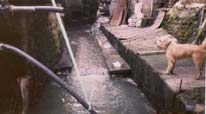
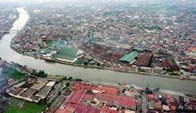
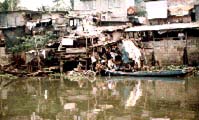
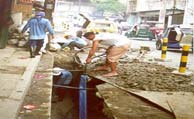


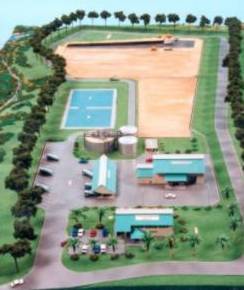
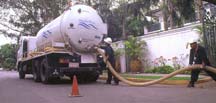
Sanitation Conditions in Metro Manila
Manila Third Sewerage Project (MTSP)
Aims to reduce pollution loading to rivers and
waterways
World Bank assistance
Implementation: 2005-2010
Sewerage and sanitation projects
lack of planning utilities
Polluted waterways
Combined sewage-drainage projects
Septic tank desludging trucks and septage treatment plants
congested landscape
No proper sanitation facilities13
16
Sanitation Conditions in Metro Manila
Manila Third Sewerage Project (MTSP)
SUB-COMPONENTS
None
Septage Treatment Plants
Overhang
4%
Barangay Gitnang Bayan II in San Mateo, Rizal
1%
Sewerage
FTI Complex, Taguig
Latrine
3%
7%
Sanitation for Low to Middle-Income Communities (East
Bank, Marikina, Taguig)
Taguig Sewerage System
70% of pollution load to
major inland waterways
Upgrade of Existing Sanitation System (Quezon City)
and rivers due largely to
Septic Tank
absence of household
QC-Marikina Sewer System
85%
septic tank maintenance
Riverbanks WwTPs (Mandaluyong, Pasig, Makati)
14
17
San Mateo Septage Treatment Plant
Around 30,000 households
Manila Third Sewerage Project
to be served annually
30 tankers,
(MTSP)
1 Septage Treatment Plant
15
18
3

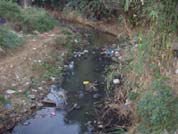
Construction Phase
Impacts
Mitigating Mea
Mitigating Measure
ures
Construction Waste
Environmental Impacts
Generation of construction
Collection and recycling of
debris and other solid
construction materials.
wastes
To be offered to junk shops as
scrap material
& Mitigating Measures
Vegetation Clearing
Clearing of vegetation
The design of the project shall
minimize cutting of trees.
Appropriate permits from the DENR
/ LGU shall be secured for affected
trees.
19
22
Construction Phase
Operation Phase
Impacts
Mitigating Measures
Impacts
Mitigating Mea
Mitigating Measure
ures
Air Pollution
Water Pollution
Generation of dust
Water sprinkling of the area should
Non-compliance of
The SpTP should comply with the
be done to reduce the occurrence
wastewater discharge
Effluent Standards of DENR for Class
of airborne dust.
C waters. Regular monitoring and
Construction area should be
maintenance of the SpTP will be
provided with perimeter fence.
done.
Noise Pollution
Washing of tankers
A tanker washing facility shall be
included in the project plans.
Noise pollution from the
Noise generating construction work
Wastewater from the washing
operation of construction
will be scheduled during daytime
operations shall be channeled
equipment
hours.
into the SpTP
20
23
Construction Phase
Operation Phase
Impacts
Mitigating Measures
Impacts
Mitigating Mea
Mitigating Measure
ures
Water Pollution
Air and Noise Pollution
Erosion and surface soil runoff
Temporary drainage canals should
increasing turbidity of the
be constructed to block flow of silt
Noise and air emissions
Buffer zones will be part of the lay-
receiving body of water
into the drainage system.
from the movement of
out of the SpTP and silencers will be
tankers and the operation
installed in the SpTP
Temporary barriers and trenches
of the SpTP
shall be constructed around the
Tankers should be required to pass
mounds of materials to abate
the smoke emission test, in
spread of spoils through surface
accordance with the Philippine
runoff
Clean Air Act.
21
24
4

Operation Phase
Impacts
Mitigating Measures
Sludge Generation
Thank You!
Sludge generation due to
Proper handling will be ensured for
the operation of the SpTP
the removal and transportation of
sludge.
Treated sludge can be used as soil
conditioner of agricultural lands in
the vicinity.
25
MTSP Requirements
endorsements from LGUs
social and financial acceptability
endorsement from the Regional Development
Council (RDC)
NEDA ICC approval
World Bank approval
SUMMARY
Water pollution due to wastewater is a pressing
problem that has to be addressed
Ongoing activities are insufficient to arrest the
wastewater problem
MTSP will help expand the provision of sanitation
and sewerage services
Education and policy issues remain as
challenges
5