E1288
v 2
Public Disclosure Authorized
Environmental Impact Statement
(EIS)
for
Manila Third Sewerage Project
Public Disclosure Authorized
Volume 2: EMP Summary
February 11, 2005
(Revised Draft)
Public Disclosure Authorized
Public Disclosure Authorized
Manila Water Company, Inc.
Manila, Philippines
MTSP Environmental Management Plan
February 10, 2005
Contents
1 Introduction........................................................................................................................2
1.1 Scope
and
Objectives.................................................................................................2
1.2 project
description......................................................................................................2
1.2.1 Background ........................................................................................................2
1.2.2 Project
description .............................................................................................3
2
Environmental Mitigation/Enhancement Plan...................................................................6
2.1.1 General...............................................................................................................6
2.1.2
Summary of Main Findings ...............................................................................7
3
Environmental Monitoring Plan .................................................................................. 3-21
3.1 General................................................................................................................. 3-21
3.2 Internal
Monitoring.............................................................................................. 3-21
3.3 External
Monitoring............................................................................................. 3-21
4 Institutional
Arrangements........................................................................................... 4-21
4.1 General................................................................................................................. 4-21
4.2 Reporting.............................................................................................................. 4-22
4.3 Implementation
Capacity ..................................................................................... 4-22
List of Tables
Table 1 MTSP Environmental Mitigation/Enhancement Plan (EMiP) ..................................8
Table 2 MTSP Environmental Monitoring Plan...................................................................23
List of Annexes
Annex 1
Overview of the Eastern Concession Area
Annex 2
MTSP Service Coverage
Annex 3
Sampling points for the MTSP Components
MTSP Environmental Management Plan
February 10, 2005
MWCI/LBP, Manila, the Philippines
Page 1
1 INTRODUCTION
1.1 SCOPE AND OBJECTIVES
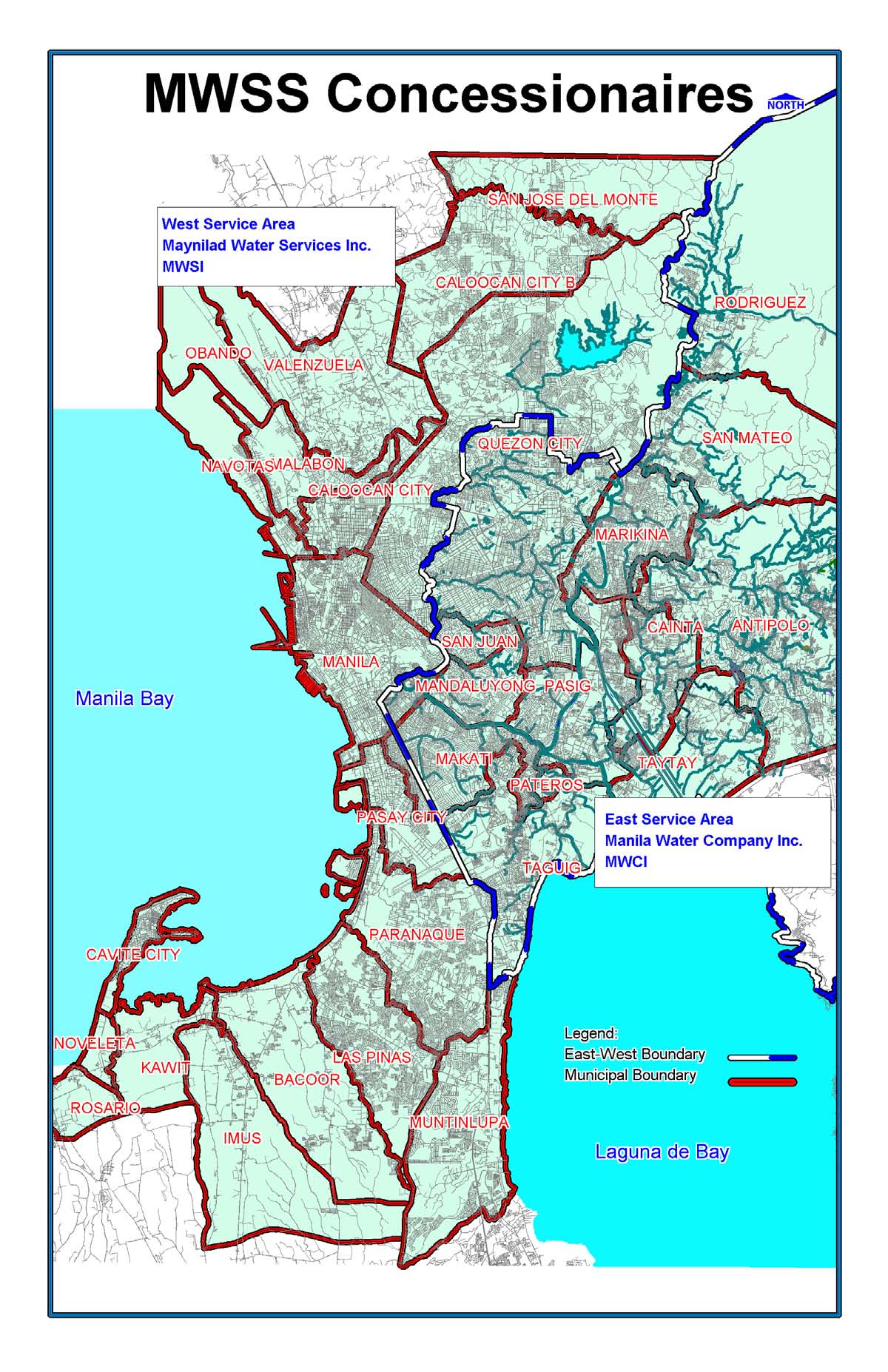
As an agent/contractor of the Metropolitan Waterworks and Sewerage System (MWSS), the
Manila Water Company, Inc. (MWCI) is given the responsibility of providing water and
sewerage services in the East concession area. The East concession area is composed of parts
of Quezon City and Manila, Marikina, Makati, Mandaluyong, Pasig, Pateros, Taguig and the
Rizal Provinces (see Annex 1).
In recognition of the growing need for sewerage and sanitation services and the water
pollution attributed to untreated domestic wastewater, MWCI will implement the Manila
Third Sewerage Project (MTSP). A follow-up to the Manila Second Sewerage Project
(MSSP), MTSP has the objectives of reducing the water-borne pollution in Laguna Bay and
Manila Bay, reducing the health hazards associated with human exposure to sewage, and
piloting approaches for sewage management in Metro Manila. The MTSP includes projects
for septage management and sewage management, as well as a technical assistance
component.
The implementation of the MTSP components will create impacts on the environment, which
include both positive and negative impacts. In order to mitigate the likely negative impacts,
an Environmental Management Plan (EMP) was devised, which outlines feasible and cost-
effective measures for preventing or reducing significant negative impacts.
The EMP complies with the environmental and social safeguard requirements and procedures
of the Philippines, as described by the Department of Environment and Natural Resources
(DENR) Administrative Order No. 2003-30 (DAO 2003-30), and with the relevant World
Bank Safeguards Guidelines.
The EMP comprises the following components:
- A Environmental Mitigation Plan (Chapter 2)
- A Environmental Monitoring Plan (Chapter 3)
- Organizational and Institutional arrangements (Chapter 4).
The EMP is distinguished between the pre-construction phase, construction phase, and
operation/maintenance phase. Moreover, specific emphasis has been given to sludge and
septage management, a core component of the MTSP. Accordingly, specific mitigation and
monitoring measures have been elaborated in separate tables with the EMP.
1.2 PROJECT DESCRIPTION
1.2.1 Background
Composed of 14 cities and 3 municipalities, Metro Manila is the center of commerce,
science, technology and political governance in the Philippines. Over the years, the
metropolis has experienced a high influx of rural migration and population growth causing a
multitude of problems, including wastewater management and water pollution.
MTSP Environmental Management Plan
February 10, 2005
MWCI/LBP, Manila, the Philippines
Page 2
Recent statistics point to domestic wastewater as the main contributor (70%) to the pollution
loading into the Pasig and Marikina Rivers, the two main rivers in the metropolis, and the
Laguna Lake. Due to this pollution, there is insufficient oxygen within the waterways to
support aquatic life. Fecal coliform levels exceed the standards of the Department of
Environment and Natural Resources (DENR) by several orders of magnitude most of the
year. In terms of health impact, the 2003 Philippine Environment Monitor states that 31% of
all illness in 2003 is water related, accounting to nearly 5 million of the reported illnesses.
Moreover, it is estimated that 17 billion pesos is lost annually in the Philippine economy due
to degradation of the marine environment.
The national and local governments develop and implement programs to address these issues.
However, bureaucracy and politics often make it difficult to successfully implement
programs as they are conceived.
1.2.2 Project description
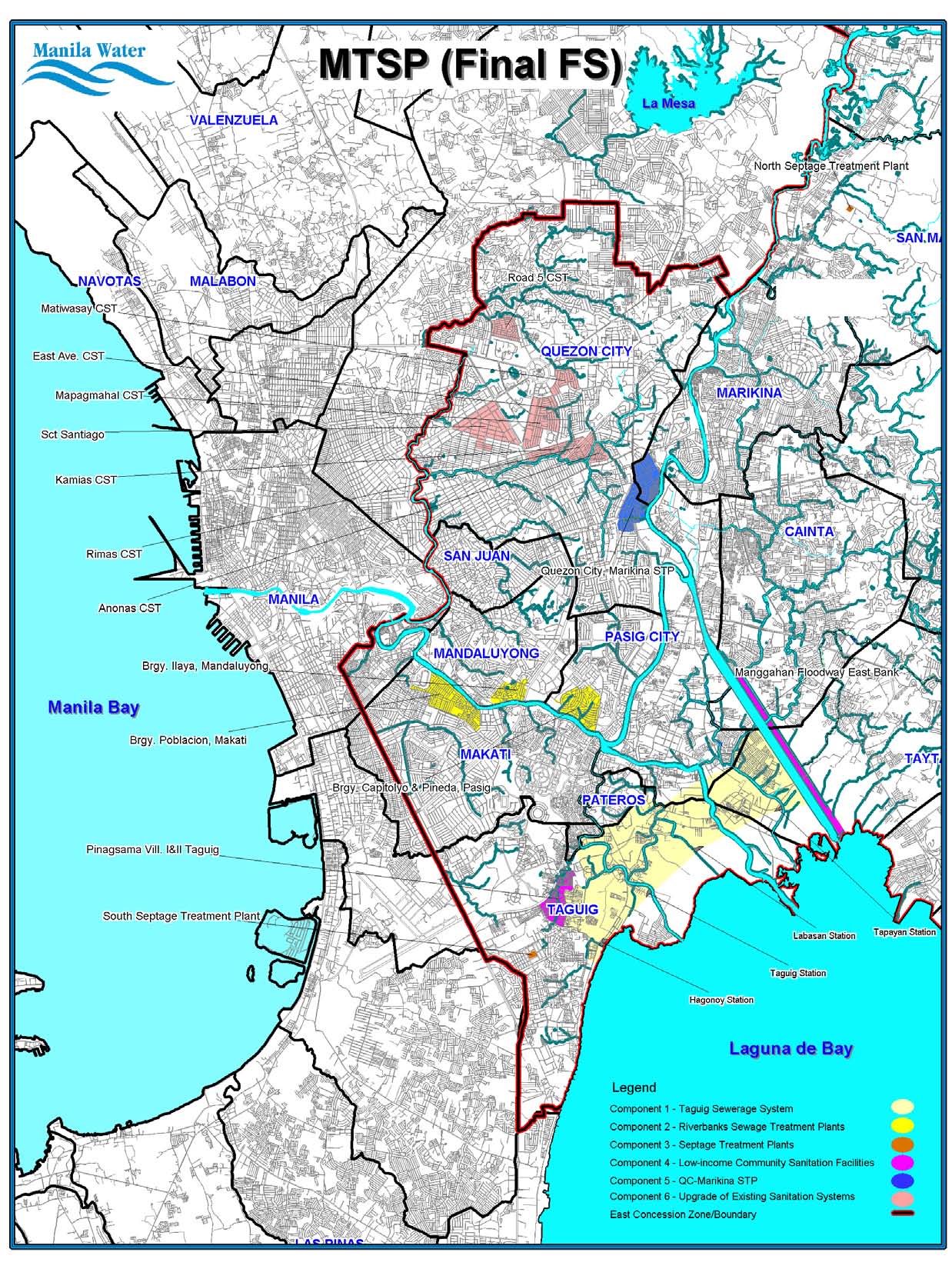
The MTSP is estimated to cost US$ 86M and will benefit approximately 367,000 families in
many cities in the East Zone (Annex 2). With an implementation period of 5 years from 2005
to 2010, MTSP will improve sewer coverage from less than 8% in 2004 to an estimated 30%
by 2010 in the East Zone.
The components of the MTSP were identified by MWCI in consideration of environmental
and socio-economic impacts, technical constraints, and limits set by the Concession
Agreement between MWSS and MWCI. Upon identification of the individual sub-project
location by MWCI in coordination with the MWSS, a Feasibility Study (FS) was conducted
to determine viability and optimize efficiency of the MTSP components in terms of costs,
coverage and beneficial impacts.
Component 1: Septage Management
Septic tanks provide the most common form of sanitation throughout Metro Manila. Around
85% of the households in the metropolis were reported to have such tanks in the 2000
Government Census. It is currently estimated that there are 544,000 households using
individual septic tanks (ISTs), which is roughly equivalent to a population of 2.5 million.
The objective of this component is to collect and treat septage in the more westerly parts of
the East Concession Zone, specifically those areas within the National Capital Region (NCR).
Two (2) Septage Treatment Plants (SpTP) will be constructed: the North and South SpTP.
The South SpTP will be located within the FTI mixed-use industrial complex in Taguig and
will have a treatment capacity of 814 m3/day. The South SpTP will primarily serve the cities
of Mandaluyong, Pasig, Makati, and Taguig. The North SpTP was initially proposed to be
located in the vicinity of the Payatas Solid Waste Dump Site in Quezon City. However, due
to difficulties in acquiring land, an alternative site was identified in Barangay Gitnang Bayan
II in San Mateo, Rizal. The South SpTP in San Mateo will primarily serve the cities of
Quezon, Marikina and San Juan and will have a capacity of 586 m3/day.
Vacuum desludging tankers will also be procured under this component.
MTSP Environmental Management Plan
February 10, 2005
MWCI/LBP, Manila, the Philippines
Page 3
Component 2: Sewage Management
The sub-components include:
·
Taguig Sewerage System
The DPWH, with the assistance of JICA, is undertaking the Major Flood Control
Project-West of Manggahan Project, which involves the construction of a lakeshore
dike and four (4) drainage/flood retention ponds. The drainage/flood retention ponds
will catch the flows from the rivers of Hagonoy, Taguig, Labasan and Tapayan to
mitigate the inundation caused by heavy rains and the overflowing of Laguna Lake to
the municipalities of Taytay, Pateros, Taguig and the city of Pasig. These ponds will
be used during the rainy season as balancing ponds for periods of high storm runoff.
Upon completion in 2006, this system will be turned over by the DPWH to the
Metropolitan Manila Development Authority (MMDA) for operation and
maintenance.
MWCI will construct off-line (off-site) primary wastewater treatment facilities in the
vicinity of each of the ponds. The ponds will then be used for secondary treatment or
polishing. Complete wastewater treatment sufficient to allow compliance to
regulatory standards on effluent quality will be rendered by this component. This
scheme will be implemented during the dry season when the ponds can be used to
retain primary treated wastewater and effect secondary treatment. The operational
arrangements for the use of the ponds for flood control and for sewerage will be
discussed with and agreed upon by the MWSS/MWCI and MMDA.
This sub-component will benefit a total area of around 2,400 ha. and an approximate
population of 200,000.
·
Riverbanks Sewage Treatment Plants
Once renowned for its pristine waters and aquatic resources, the Pasig River is now
one of the world's most polluted river system and is considered to be biologically
dead. A move to restore Pasig River to Class C water quality is currently being
undertaken by the Philippine government. This MTSP component was conceptualized
to pilot a new approach for sewage management, which will abate pollution from
discharge of untreated domestic wastewater to the Pasig River.
Three (3) sewage treatment plants (STPs), to be located in and to cover portions of the
cities of Pasig (Barangay Capitolyo), Mandaluyong (Barangay Ilaya) and Makati
(Barangay Poblacion), will be constructed to serve around 32,000 people residing in
the area of the catchments. Due to limitations on land, each STP will be constructed
beneath existing local recreation areas currently occupied by basketball courts and
sitting-out areas alongside the riverbank.
·
Sanitation for Low-income Communities
This sub-component will involve the construction of two STPs serving the areas of
Pinagsama, Taguig and East Bank, Taytay (along the Manggahan Floodway). The
MTSP Environmental Management Plan
February 10, 2005
MWCI/LBP, Manila, the Philippines
Page 4
STPs will discharge to the Pinagsama Creek and a local canal, respectively. These
STPs will serve low-income communities with poor or non-existent sanitation
facilities. The sub-component will include the upgrade of the existing drainage system
and the construction of an interceptor sewer and pumping stations as required in each
catchment. The population to be served by the STPs would be about 86,000.
·
Quezon City - Marikina Sewerage System
This sub-component will include the construction of an underground STP in a
municipal easement on the banks of the Marikina River. Construction of an
interceptor sewer and pumping stations and upgrading of the existing drainage
network will also be included. The service area will include some residential
barangays and subdivisions in Quezon City and Marikina City. The STPs will
discharge to the Marikina River. Population to be served is estimated at 36,000.
·
Quezon City Sanitation Upgrading :
This sub-component will include the upgrading of about two existing communal
septic tanks in Quezon City to modern STPs. The component will involve the
construction of trunk sewers and pumping stations to neighboring catchments to
increase the catchments served at each of these sites. The sub-component will include
the rehabilitation, upgrading and limited replacement of existing separate sewerage
network in these areas, and connection of other areas to existing STPs financed under
MSSP. The STPs will discharge to local canals. Population to be served would be
about 42,000.
Component 3: Technical Assistance
This component will enhance the proposed project investments through support for
consulting services during implementation, a public information campaign on the
environmental benefits of sewerage and sanitation, and preparation of follow-on programs for
sewage and sanitation improvements in the East Concession Area.
MTSP Environmental Management Plan
February 10, 2005
MWCI/LBP, Manila, the Philippines
Page 5
2 ENVIRONMENTAL MITIGATION/ENHANCEMENT PLAN
2.1.1 General
The mitigation/enhancement plans provide detailed activities aimed at eliminating, reducing
or controlling the adverse environmental impacts of the proposed project. These plans consist
of ecological, scientific or engineering options that the project proponent may consider as
courses of action to take before, during, and after project implementation. The table below
shows an Environmental Management Plan (EMP) applicable to the sewage and septage
management components of MTSP.
The EMP is based on and complementary to the following MTSP Environmental and Social
Safeguard Documents, prepared by the MWCI:
- A Environmental Impact Statement (EIS), dated February 10, 2005. The EIS
provides an extensive overview of baseline conditions, assessment of impacts, and
includes the present Environmental Management Plan (EMP) detailing measures to
mitigate and monitor the project. Special attention was given to sludge management
and disposal (e.g. the lahar study, see below). The EIS includes a detailed Annex on
the conducted consultations with all stakeholders for all project components and sites.
- A Regional Environmental Assessment (REA), dated February 10, 2005. Initially,
with the MWSS as the main borrower, responsible for wastewater management in the
whole metro Manila region, it was agreed to prepare a Regional Environmental
Assessment (REA) to strengthen overall wastewater management in the Metro Manila
area. As a result of the change from MWSS to LBP as the borrower, the REA became
a complimentary strategic document to the project, rather then a document describing
formal strategic commitments of the borrower. The REA forms a principal
background document for the preparation of a GEF funded Manila Bay Coastal
Management Strategy, addressing regional pollution reduction in the Metro Manila
area. The project is a joint initiative by principal Governmental agencies (e.g. DENR,
MWSS/MWSI/MWCI, LLDA, LBP, PPRC).
- A "EA for Sludge/Septage-use as soil conditioner for Sugar Cane growth in lahar-
laden areas" (referred to as Lahar study), dated February 10, 2005 (2 Volumes). The
special study was launched partly as a reply to experiences in the MSSP. The findings
and recommendations of the report have been incorporated into the EIS and EMP for
the MTSP.
- A "Biosolids Management Strategy" dated August 2004 prepared by consultants
hired by MWCI to assess the quantity and quality of all biosolids to be generated from
MWCI's current and future treatment plants, including the plants proposed under
MTSP. The Report details management strategies to deal with the biosolids
generation from short-term to long-term.
- A Environmental and Social Assessment Framework (ESAF), dated February 10,
2005. The ESAF describes the safeguard policies and procedures (environment
assessment, resettlement, land acquisition) to be applied for future compliance work
for all possible additional project activities.
MTSP Environmental Management Plan
February 10, 2005
MWCI/LBP, Manila, the Philippines
Page 6
2.1.2 Summary of Main Findings
The MTSP will bring overall positive environmental impacts which include reduction of
health risks from exposure to wastewater and polluted surface waters. Moreover, the further
implementation of wastewater charges will strengthen the basis for a sustainable framework
for the funding of environmental protection.
All adverse environmental and social impacts can be mitigated and all environmental risks
are within acceptable limits. Most of the adverse environmental impacts are regular
construction impacts which can be properly mitigated. Furthermore, the Environmental and
Social Framework (ESAF) provides for future guidance on unforeseen environmental and
social impacts.
The detailed MTSP environmental mitigation/enhancement matrix is given in Table 1. The
principal issues and risks addressed in the EMP are:
- Land acquisition and Resettlement. Land will need to be acquired for the
construction of two septage treatment plants in Taguig (1,000.m2) and San Mateo
(1,500 M2), and a total of 12 households will have to be resettled (1 family in Road 5,
Quezon City and 11 families in San Mateo). For all sites a RAP has been produced
and compensation and relocation procedures will be applied as specified in the MTSP
Resettlement Policy Framework.
- Disposal of Septage and sludge: Disposal of septage and sludge in lahar areas will
improve soil condition and bring positive benefits for the participating farmers.
Disposal has been piloted in the area for a period of 12 months using 120 tons/ha of
sludge, which has increased production of sugarcane by 28 %. No adverse impacts are
foreseen through the application of proper selection criteria (based on US-EPA
standards) for site selection for disposal sites and application procedures. However,
considering the lack of long-term experience with sludge/septage disposal in the lahar
areas, an extensive monitoring program has been defined in the EMP.
- Linkage with DPWH project: The MTSP is linked with an ongoing construction of 4
flood retention ponds by the Department of Public Works and Highways (DPWH). A
JICA financed project, this project obtained DENR clearance in 1986. A "due
diligence" assessment was conducted with respect to the applied social and
environmental safeguards, in particular to the land acquisition process. The assessment
shows that:
1) Families whose TCT or land title are issued on/or before 1975 were
compensated by DPWH in accordance with the Bureau of Internal Revenue
(BIR) zonal value
2) Informal settlers have opted for the monetary compensation package, rather than
the allocated relocation area in Baras, Rizal.
3) Families with land titles issued after 1975 have filed legal cases which are still
being litigated
MTSP Environmental Management Plan
February 10, 2005
MWCI/LBP, Manila, the Philippines
Page 7
Table 1 MTSP Environmental Mitigation/Enhancement Plan (EMiP)
EMiP - Pre-construction Phase
Components Potential
Socio-Environmental
Proposed Mitigation Measures
Institutional
Cost
Timing
Impacts
Responsibilities
Estimates
(PhP)
All
Construction activities delayed
Obtain all the required permits, approvals and licenses Wastewater Project P5000/site
Before any
components
because required permits are not
prior to mobilizing any construction activities
Delivery Team of
construction
obtained
MWCI (site
activity
managers)
All
Use of land for sewage facilities may
MWCI to negotiate and legally secure all property
Project Development P18,000 per
Before
components
result to loss of shelter and/or
required (via instruments such as long term lease,
Section of the MWCI family
World Bank
livelihood.
sale agreement, usufruct agreement etc.), and
Wastewater
relocated
Safeguard
prepare and implement a site-specific Resettlement
Department
meeting
San Mateo: 11 families occupying 1.5
Action Plan (RAP), in accordance with the company's
hectare land
MTPS Resettlement Policy Framework (RPF)
Road 5, Quezon City: 1 family
Taguig
Improper application and/or
Due diligence assessment on land acquisition
MWCI, with support 0 Before
implementation of international
procedures and practices.
from the World
World Bank
accepted safeguard standards.
Bank.
safeguard
meeting.
MTSP Environmental Management Plan
February 10, 2005
MWCI/LBP, Manila, the Philippines
Page 8
EMiP - Construction Phase
Components Potential Environmental Impacts
Proposed Mitigation Measures
Institutional
Cost
Timing
Responsibilities Estimates
All
Contamination of local soils and surface,
Contaminated materials
Wastewater
0 During
components
ground or marine waters through spillage 1) Define
what
constitutes
contaminated
Project Delivery
construction
of contaminated materials, wastewater
material and inform work force.
Team of MWCI
leakage, stockpile soils runoff or erosion
2) Immediately notify Site Management of
(site managers)
and solid and water waste incurred in the
spills that may contaminate soils.
construction.
3) Contain contaminated material until
removal in a way that prevents
contamination of surrounding soils and
waters.
4) Remove contaminated material from the
Site and dispose of in an appropriate
manner.
Wastewater leakage and solid and water
waste
1) Immediate repair of the source of the
leakage
2) Proper disposal or re-use of the solid and
water waste incurred.
Stockpile soils runoff
1) Ensure stockpiles of soil/sand are covered
or appropriate erosion control measures in
place.
2) Utilization of stormwater drainage to settle
out silts before stormwater exits the site
MTSP Environmental Management Plan
February 10, 2005
MWCI/LBP, Manila, the Philippines
Page 9
Components Potential Environmental Impacts
Proposed Mitigation Measures
Institutional
Cost
Timing
Responsibilities Estimates
All
Noise pollution
1) Ensure appropriate silencers are used on
Wastewater
As appropriate
At
components
all mechanical equipment.
Project Delivery
for the specific
commencement
2) Restrict the use of noisy equipment such
Team of MWCI
project site
of construction
as jack hammers or pile drivers to the local (site managers)
activities
hours of commercial activity, and not on
weekends where possible
3) Ensure that all equipment is well
maintained to minimize noise generation
4) Install noise barriers as a final resort
All
Traffic
1) Maximize construction activity during low
Wastewater
0 At
components
traffic and low commerce periods.
Project Delivery
commencement
2) Provide temporary restoration of the
Team of MWCI
of construction
pavement or utilize plate covers as soon
(site managers),
activities
as possible after major activities, to allow
LGUs or MMDA,
quick use of the carriageway
as deemed
3) Post signs in alternative routes where
appropriate
available
4) Advertise dates of disturbance of streets or
throughfares in advance
5) Inform and coordinate with local officials
and LGUs as appropriate
All
Air pollution (Dust)
1) Minimize size of material stockpiles by
Wastewater
As appropriate
At
components
proper site and material needs planning
Project Delivery
for the specific
commencement
2) Wet dusty stockpiles that are essential on- Team of MWCI
project site
of construction
site
(site managers)
activities
3) Wet all site access roads to minimize dust
formation
4) Ensure that all loads are covered in trucks
hauling materials, etc. to and from the site
MTSP Environmental Management Plan
February 10, 2005
MWCI/LBP, Manila, the Philippines
Page 10
Components Potential Environmental Impacts
Proposed Mitigation Measures
Institutional
Cost
Timing
Responsibilities Estimates
All
Unnecessary damage to vegetation
1) Ensure that critical vegetation is identified Wastewater
As appropriate
At
components
and marked out and protected to prevent
Project Delivery
for the specific
commencement
accidental damage
Team of MWCI
project site
of construction
2) Any special trees that have to be removed (site managers)
activities
should be boled out and replanted
elsewhere in advance of infrastructure
construction
MTSP Environmental Management Plan
February 10, 2005
MWCI/LBP, Manila, the Philippines
Page 11
EMiP - Operation and Maintenance Phase
Component Potential Environmental Impacts
Proposed Mitigation Measures
Institutional
Cost
Timing
Responsibilities
Estimates
All
Pollution of receiving waters due to
All plant operators will be trained on the plant
PCO, Plant
See Training Prior to
components
incidents/emergencies resulting from
operations, environmental management program and
Manager (MWCI)
Budget
commencement
lack of awareness of plant operators
site-based management plans prior to assignment and
of site
on appropriate procedures and
on a regular basis thereafter.
operations and
environmental responsibilities.
throughout
To ensure that any incidents or emergencies are
operations
reported and acted upon within an acceptable
timeframe, an emergency and incident logbook will be
maintained. This log book will include:
·
details of any equipment malfunctions or shut-downs
that may affect the effluent quality or impact on the
environment,
·
details of occasions when an incident or emergency
result in the release of contaminants not in
accordance with the license, and
details of reporting including who the incident or
emergency was reported to and the actions taken
Maintain records of environmental monitoring and any
environmental reports for a period of at least 5 years.
Prepare and maintain a database containing all
monitoring data and site issues, such as a complaints
database.
All
Excessive noise generation during
1) Ensure appropriate silencers are used on all
Wastewater Project As
Throughout
components
operation
mechanical equipment such as blowers.
Delivery Team,
appropriate operations
2) Conduct regular maintenance on equipment to
PCO, Plant
for the
minimize noise generation
Manager (MWCI)
specific
3) Install sound proof rooms around noise-generating
project site
equipment such as aeration blowers especially
when complaints continue
MTSP Environmental Management Plan
February 10, 2005
MWCI/LBP, Manila, the Philippines
Page 12
Component Potential Environmental Impacts
Proposed Mitigation Measures
Institutional
Cost
Timing
Responsibilities
Estimates
All
Excessive odor emissions within the 1) Ensure that the treatment plant is being operated
PCO, Plant
As
Throughout
components
vicinity of the STP
correctly, such as adequate aeration being
Manager (MWCI)
appropriate operations
provided.
for the
2) Ensure that the site is clean of any sludge/septage
specific
spillage
project site
3) Ensure that the treatment plant is not overloaded
4) If odor complaints continue, enclose the most
odorous parts of the plant such as the inlet works
and sludge handling facilities.
5) If complaints are still being received, install a gas
scrubbing system on the gases from the enclosed
areas, such as activated carbon or compost beds.
All
Pollution of receiving waters due to
1) Set high plant performance targets
PCO, Plant
As
Throughout
components
compliance failure of effluent quality
2) Maintain all equipment at the sewage treatment
Manager (MWCI)
appropriate operations
plant in accordance with manufacturer's
for the
specifications.
specific
project site
All
Emission of odors, presence of flies,
1) Sludge to be removed from the site as soon as
PCO, Plant
As
Throughout
components
water pollution etc. at the plant due to
practicable to the disposal areas
Manager (MWCI)
appropriate operations
improper management of
2) Access to any temporary septage/sludge stockpile
for the
septage/sludge
area will be restricted, and appropriate fences and
specific
signs will be maintained to prevent public access.
project site
3) Maintain stormwater diversion drains around the
septage/sludge disposal area (and any sludge
drying beds) to prevent runoff and contact with
surface waters.
All
Health impacts on site workers
1) Regular training of staff on the health risks of
PCO, Plant
P50,000 /
Throughout
components
septage, sewage and any chemicals used on site, Manager (MWCI)
site
operations
and the need for appropriate health protection
2) Provide better safety equipment as required, such
as disinfectant dispensers in all washrooms,
masks for chemical handling, etc.
MTSP Environmental Management Plan
February 10, 2005
MWCI/LBP, Manila, the Philippines
Page 13
Component Potential Environmental Impacts
Proposed Mitigation Measures
Institutional
Cost
Timing
Responsibilities
Estimates
All
Safety hazard to public
Ensure that site is fully fenced and all access points
PCO, Plant
As
Throughout
components
are locked when site is not attended.
Manager (MWCI)
appropriate operations
for the
specific
project site
EMiP: Septage/Sludge Management
Potential Socio-
Proposed Mitigation Measures
Institutional
Cost
Timing
Environmental Impacts
Responsibilities
Estimates
Possible contamination of
Select and manage the sites for septage/sludge disposal in
Wastewater Department of
0
Prior to application of
surface or ground waters, and
accordance with the following specific criteria:
MWCI
any septage/ sludge
direct and indirect health risks.
and throughout
1) Unstabilized sludge/septage may not be applied in areas
operations
frequented by the public, unless the sludge/septage was
properly treated by lime stabilization.
2) Stabilized septage/sludge can be left on the surface of
the soil, unless applied to soil without any vegetative
cover in which case it must be incorporated into the soil
within 8 hours of application.
3) Septage/sludge shall not be applied to land covered with
rainwater runoff flows or inundated with floodwater at any
time. At such times, the septage/sludge must either be
stored at the STP/SPTP, applied to higher land
elsewhere in the disposal area or stored at an identified
area for later application.
4) Areas used for pasture may not be grazed for 30 days
following application of any septage/sludge.
5) Vegetation or crops for animal feeding may not be
harvested for 30 days following application of septage.
6) Vegetables and fruits which are consumed raw, or
tobacco, shall not be grown on land to which unstabilized
septage/sludge have been applied.
7) The application rate of septage/sludge shall be limited to
the lesser of (a) 400 kilos of nitrogen to each hectare in
MTSP Environmental Management Plan
February 10, 2005
MWCI/LBP, Manila, the Philippines
Page 14
Potential Socio-
Proposed Mitigation Measures
Institutional
Cost
Timing
Environmental Impacts
Responsibilities
Estimates
any 12 month period, or (b) the nitrogen agronomic
uptake requirements of the crop.
8) Sludge/septage may not be land applied within (a) 50
meters of any Class A water body, (b) 10 meters for
other classes of water, (c) 10 meters of any shallow non-
potable water supply wells, and (d) 30 meters for any
potable water supply well. No buffer is required around
irrigation waters that are located entirely on the land
application site.
9) At the time of septage/sludge application, a minimum of
600 millimeters of unsaturated soil above the ground
water table must be present.
10) Unstabilized septage/sludge applied during rain events
must be immediately incorporated into the soil, rather
than waiting up to 8 hours.
11) The slope of the land application area may not be more
than eight percent.
12) Land used for septage/sludge application may not
contain any hole or channel (such as subsurface
fractures, solution cavities, sink holes, or excavated core
holes) which would al ow the septage/sludge to
contaminate the groundwater, unless the septage/sludge
is not applied within a 30 meter distance from such
geologic formations or features.
13) Septage/sludge may not be applied within 30 meters of
any dwelling located outside the property boundary. A 10
meter buffer applies to any dwellings located within the
individual landholding or within the property boundary or
any drainage ditches.
14) Site selection must account for any archeological
artifacts
Monitoring of Water Quality:
P100,000/yr
15) Select suitable existing water wells in the location of the
MTSP Environmental Management Plan
February 10, 2005
MWCI/LBP, Manila, the Philippines
Page 15
Potential Socio-
Proposed Mitigation Measures
Institutional
Cost
Timing
Environmental Impacts
Responsibilities
Estimates
proposed disposal area that can be used for groundwater
quality monitoring. Wells should be suitably sealed form
surface water inflow or other sources of contamination.
This applies to both the extensive agricultural lands and
the lahar areas.
16) The wells must source their groundwater from the same
hydrogeological formation as the groundwater under the
proposed disposal area. Select one well located
hydrogeologically upstream of the disposal area and two
wel s downstream of the main disposal areas.
17) If wells cannot be located that satisfy the
hydrogeological, location and operational requirements,
then purpose-built sampling wells must be installed.
These should be equipped with a sealed collar and
lockable caps to prevent tampering. They must be slotted
to the same depth as the groundwater resource most
likely to be used locally as a water supply resource either
now or in the future.
No disposal area for
Septage/sludge shall only be applied during the fallow or
Hauling contractors,
P50,000/yr
Prior to application of
inappropriate periods of the
planting seasons when the septage/sludge can be
Wastewater Department of
any septage/sludge
cropping cycle
incorporated into the soil within 8 hours, if unstabilized.
MWCI
and throughout
Septage/sludge will have to applied to lahar soils without
operations
crops or stored in an appropriate stockpile area.
-
The stockpile area/s must be protected against the entry
of stormwater runoff by constructing bunds around
upslope perimeter of the stockpile area.
-
The area must not be flood-prone
-
The area must have all weather access roads
-
The site should have a separate stockpiling for small
quantity of stabilized sludge. This stabilized
sludge/septage shall be applied as a temporary cover
material to the main stockpile which will contain a mixture
of stabilized and unstabilized septage/sludge. This
stabilized layer will limit odor emissions and also
MTSP Environmental Management Plan
February 10, 2005
MWCI/LBP, Manila, the Philippines
Page 16
Potential Socio-
Proposed Mitigation Measures
Institutional
Cost
Timing
Environmental Impacts
Responsibilities
Estimates
pathogen washoff and erosion.
-
If the stockpile is going to be remain in place for more
than 30 days, it should be covered with a 300 millimeter
thick layer of soil to limit water infiltration, odor migration
and also rodent access.
-
Areas with existing vegetative cover are preferred as this
reduces the likelihood of runoff and provides an uptake
pathway for the nitrogen and other nutrients
Health risks for workers involved 1) Undertake proper training and education of truck drivers,
Hauling contractors,
P50,000/yr
Prior to application of
in septage/sludge handling,
operators of applicator equipment and other personnel
Wastewater Department of
any septage/sludge
transport, and disposal
involved in septage/sludge handling, transport and
MWCI
and throughout
disposal on the potential health issues
operations
2) Use of suitable PPE, such as gloves, coveralls and masks
Health risks for farm workers
Undertake proper training and education on the potential
Local farmers/landholders,
P50,000/yr
Prior to application of
health issues
Hauling contractors,
any septage/sludge
Wastewater Department of
and throughout
MWCI
operations
Complaints from surrounding
1) Preference to be given to remote locations
Local farmers/landholders,
P50,000/yr
Prior to application of
residents due to lack of
2) Preference to be given to disposal sites closest to major
Hauling contractors,
any septage/sludge
awareness on the proposed
and/or sealed roads to minimize haulage disturbances,
Wastewater Department of
and throughout
activities, possible health
such as dust and noise, to rural communities located along MWCI
operations
impacts, dust and other
haulage routes
inconveniences.
3) Provide public notices to inform/update residents of the
period of septage/sludge disposal, and the management
procedures and interventions proposed.
Spillage of septage/sludge in the 1) As much as possible, haul only dewatered or dried
Hauling contractors,
0
Prior to application of
event of vehicle accidents
septage/sludge
Wastewater Department of
any septage/sludge
2) Implement a scheme of contacting and then diverting
MWCI
and throughout
empty return vehicles to collect and re-haul any spillages
operations
resulting from a vehicle accident. For wet spillage on
roads, implement methods to absorb spilled material like
use of saw dust. Make this a part of the private hauling
company's contract.
Excess septage/sludge
1) Review and update the site allocation program for the
Wastewater Department of
0
Prior to application of
stockpiles awaiting disposal
septage/sludge applications
MWCI, Landholders/farmers,
any septage/sludge
MTSP Environmental Management Plan
February 10, 2005
MWCI/LBP, Manila, the Philippines
Page 17
Potential Socio-
Proposed Mitigation Measures
Institutional
Cost
Timing
Environmental Impacts
Responsibilities
Estimates
2) Focus on maximizing applications to the extensive
Hauling contractors
and throughout
agricultural areas such as the sugar cane farms in fallow
operations
periods and/or during the planting season
3) Prepare the receiving area in the lahar areas (for use
during the sugar cane growing season or protracted wet
weather )well ahead of the cessation of the planting
season
Septage/sludge application
1) Keep comprehensive records of septage/sludge
Wastewater Department of
Contingency Prior to application of
resulting in surface or ground
application details and data such as:
MWCI, Hauling contractors only
any septage/sludge
water pollution or soil
-
Location of application, including the area involved
and throughout
contamination as determined
-
Date of application
operations
by the monitoring program
- Amount
applied
-
Source of septage/sludge
-
Crop status/part of planting cycle at time of
application
-
Time of incorporation into the soil
-
Weather at time of application
As necessary
2) Maintain records of environmental monitoring and any
environmental reports for a period of at least 5 years.
3) Prepare and maintain a database of monitoring data
results.
4) Increase the intensity and extent of monitoring to confirm
the apparent elevation of results
5) Delineate the size of the area with contaminated
surface/ground water or soil
6) Review septage/sludge application rates
7) Accelerate the covering of septage/sludge with soil
8) Use flatter areas for septage/sludge application
9) Increase the testing required on the septage/sludge for
the pollutants exceeding the adopted water quality
criteria. For example, if the pollutant of concern is lead,
then increase the lead testing frequency to better
determine the lead source and manage the pollutant at
source.
10) Incorporate runoff collection impoundments below the
MTSP Environmental Management Plan
February 10, 2005
MWCI/LBP, Manila, the Philippines
Page 18
Potential Socio-
Proposed Mitigation Measures
Institutional
Cost
Timing
Environmental Impacts
Responsibilities
Estimates
application areas to trap any septage/sludge in the runoff
11) Increase the separation distance requirements between
application areas and surface water systems
Septage/sludge applications
1) Increase the intensity and extent of monitoring to confirm Wastewater Department of
Contingency As necessary
resulting in crop contamination
the apparent increase in results
MWCI, Hauling contractors, only
as determined by the monitoring 2) Delineate the size of the area with contaminated crops
Landholders/farmers
program
3) Review the sludge application rates for the crop, and
decrease as appropriate based on the monitoring
program results and parameters of concern.
4) Determine if the pollutant can be isolated, removed or
reduced in the septage/sludge
5) Determine the source of the contaminated
septage/sludge and only apply to the fallow lahar areas
until the contaminants can be reduced to suitable levels
Excessive odor migrating offsite 1) Increase the depth of incorporation of the septage/sludge Wastewater Department of
0 As
necessary
into the soil profile
MWCI, Hauling contractors,
2) Incorporate the septage/sludge into the soil more quickly landholders/farmers
Negative impact on community
1) Determine the nature of the health impact
Wastewater Department of
Contingency As necessary
health
2) Conduct a qualitative epidemiological study to determine MWCI
only
if the septage/sludge application is the actual source of
the morbidity
3) Determine the exposure pathway involved and apply
appropriate interventions to intercept this pathway
4) Ensure that public access is being limited as required
5) Consider only using stabilized septage/sludge in this
area
Negative health impacts on site 1) Determine the nature of the health impact
Wastewater Department of
Contingency As necessary
workers
2) Conduct a qualitative epidemiological study to determine MWCI, Hauling contractors, only
if the septage/sludge application is the actual source of
landholders/farmers
the morbidity
3) Determine the exposure pathway involved and apply
appropriate interventions to intercept this pathway
4) Improve training for staff to better understand the health
risks of septage/sludge, and the need for appropriate
health protection
MTSP Environmental Management Plan
February 10, 2005
MWCI/LBP, Manila, the Philippines
Page 19
Potential Socio-
Proposed Mitigation Measures
Institutional
Cost
Timing
Environmental Impacts
Responsibilities
Estimates
5) Provide better safety equipment as required, such as
PPE upgrades
6) Consider only using stabilized septage/sludge in this
area
Excessive vermin reported
1) Increase the depth of incorporation into the soil profile
Wastewater Department of
Contingency As necessary
2) Incorporate the septage/sludge into the soil more quickly MWCI, Hauling contractors, only
3) Only apply the stabilized sludge in the area if vermin
landholders/farmers
complaints continue
Damage to truck access/exit
1) Cooperate with local government on road maintenance
MWCI Contingency
As necessary
roads
program
only
2) Seek alternative access roads designed to handle loaded
trucks
3) Seek alternate disposal areas if alternate access roads
cannot be located
4) Reduce vehicle weight as a last resort
MTSP Environmental Management Plan
February 10, 2005
MWCI/LBP, Manila, the Philippines
Page 20
3 ENVIRONMENTAL MONITORING PLAN
3.1 GENERAL
An integral part of environmental protection is the continuous monitoring of the conditions of
the receiving environment to determine if any undesirable changes are occurring as a result of
the project. Since the effects on living receptors are received mainly through the surface
water, air, and surrounding soil, environmental monitoring principally requires quantitative
measurements of the amount of pollutants present in these environmental media.
This Environmental Monitoring Plan (EMoP) details the environmental monitoring to be
done for the MTSP Project Components (
Table 2).
3.2 INTERNAL MONITORING
To ensure that the proper implementation of the EMiP and EMoP is being observed during
the pre-construction, construction and operation of each project, MWC's site managers,
wastewater project development team, plant managers and Pollution Control Officer (PCO)
of each site will be responsible for the implementation.
3.3 EXTERNAL MONITORING
An external auditor will be hired to serve as a third party monitoring unit during the project
implementation. The auditor will check MWCI's compliance with the EMiP and EMoP.
During the operations of the treatment plants, monitoring agencies such as the MWSS-
Regulatory Office, DENR, and LLDA will monitor the effluent quality in terms of
compliance with DENR standards.
4 INSTITUTIONAL ARRANGEMENTS
4.1 GENERAL
The Environmental Compliance Certificate (ECC) to be issued by the DENR is under the
name of MWCI. As such, compliance with all the ECC guidelines and conditions, including
compliance with the EMP and EMoP shall be the responsibility of MWCI. All reports to be
submitted to the DENR related to MTSP shall be prepared and directly forwarded by MWCI
to DENR.
The Land Bank of the Philippines (LBP), as the borrower of the loan from the World Bank,
shall be responsible for monitoring the compliance of MWCI with environmental reports and
requirements of DENR and World Bank. LBP will have an environmental unit responsible
for monitoring the compliance of MWCI with the reportorial requirements under the EMiP
and EMoP.
MTSP Environmental Management Plan
February 10, 2005
MWCI/LBP, Manila, the Philippines
Page 4-21
4.2 REPORTING
Reports to be submitted in relation to the MTSP components include:
a. Pollution Control Officer's Report contains details on maintenance
activities, results of all analyses, average flow, power consumption, water
consumption, generator usage. The PCO Report is to be submitted to the
DENR or the LLDA.
b. Report to the MWSS-Regulatory Office monthly report from the MWCI
Central Laboratory on water and wastewater quality analyses based on all
parameters
c. Quarterly compliance report to the ECC to be submitted to the DENR-EMB and
the World Bank
As part of the monitoring/impact assessment to be done at the end of the project, the
proponents will evaluate the effectiveness and implementation of the EMP. The evaluation
will be attached to the final report on the project and lessons learned will be incorporated into
the EA process for future projects, as appropriate.
4.3 IMPLEMENTATION CAPACITY
The MWCI and the LBP have sufficient capacity to implement and monitor the safeguard
framework, and no specific strengthening of LBPs capacity is considered necessary at this
time.
However, as the MTSP is part of the overall strategic plan to improve sewerage and
sanitation in Metro Manila, additional support for the main stakeholders (e.g.
DENR/PEMSEA, MWSS/MWCI/MWSI, LLDA, PPRC) to continue developing and
applying appropriate planning tools (such as the REA) is recommended. The REA forms a
principal background document for the preparation of a GEF funded Manila Bay Coastal
Management Strategy, addressing regional pollution reduction in the Metro Manila area. The
project is a joint initiative by principal Governmental agencies (e.g. DENR,
MWSS/MWSI/MWCI, LLDA, LBP, PPRC).
MTSP Environmental Management Plan
February 10, 2005
MWCI/LBP, Manila, the Philippines
Page 4-22
Table 2 MTSP Environmental Monitoring Plan
EMoP - Construction Phase
Component Parameters to be Location Measurements
(1) Frequency
Responsibility Cost
Monitored
Estimates
Al project
Turbidity of
Downstream of al Visual only
Every major rain event
Wastewater Project 0
sites
stormwater runoff
construction sites
Delivery Team of
MWCI (site
managers)
Al project
Suspended Solids Downstream of al Filtration in DAO 34/35 Every major rain event, but only if the
Wastewater Project P1,500 /
sites
in stormwater
construction sites
visual monitoring for turbidity
Delivery Team of
site per
runoff
consistently indicates that excessive
MWCI (site
event
suspended solids are washed off from managers)
the site, or if complaints continue after
implementing all the actions listed in
the EMP
Al project
Noise Site
boundaries
dB(A), C scale, Slow
At times of main noise emission, but
Wastewater Project P5,000 /
sites
adjacent to
response
only if complaints continue after
Delivery Team of
site per
complainant's
implementing all the actions listed in
MWCI (site
event
house, etc.
the EMP
managers)
Al project
Dust (TSP)
Site boundaries
DENR Specification
At times of main noise emission, but
Wastewater Project P2,000 /
sites
adjacent to
only if complaints continue after
Delivery Team of
site per
complainant's
implementing all the actions listed in
MWCI (site
event
house, etc.
the EMP
managers)
Taguig
Proper
Records of payment
Regular weekly checks
Wastewater Project 0
ponds
compensation and
(Accounting and
Delivery Team of
system
resettlement
administration)
MWCI (site
San Mateo
procedures applied
managers)
SpTP and
Consultations with land
Rd. 5 STP
owns and affected
people.
MTSP Environmental Management Plan
February 10, 2005
MWCI/LBP, Manila, the Philippines
Page 23
Component Parameters to be Location Measurements
(1) Frequency
Responsibility Cost
Monitored
Estimates
Al project
Local employment Administration.
Records of contracts
Regular weekly checks.
Wastewater Project 0
sites
(DENR Guidelines)
with local contract staff
Delivery Team of
(both MWCI and sub-
MWCI (site
contractors)
managers)
MTSP Environmental Management Plan
February 10, 2005
MWCI/LBP, Manila, the Philippines
Page 24
EMoP - Operation Phase
Component Parameters to be Location Measurements
/ Frequency Responsibility
Cost
Monitored
Methodology (1)
Estimates
Al project
DO, pH,
Effluent stream
DAO 34/35
Monthly
Pollution Control Officer P1,000 / site
sites
temperature, Free
(PCO) of MWCI
per event
Chlorine
Al project
BOD, SS, Total
Effluent stream
DAO 34/35
Monthly
Pollution Control Officer P11,500 /
sites
and Faecal
(PCO) of MWCI
site per
coliforms, O&G
event
Al project
Heavy Metals
Effluent stream
DAO 34/35
Quarterly, but if elevated
Pollution Control Officer P5,000 / site
sites
Scan
levels are detected then
(PCO) of MWCI
per event
more frequent tests will be
required.
Al project
Heavy Metals
Septage/Sludge
DAO 34/35
Semi-annual
Pollution Control Officer P7,500 / site
sites
Scan
stream
(PCO) of MWCI
per event
Al project
Total N, Total P
Septage/Sludge
DAO 34/35
Quarterly
Pollution Control Officer P5,000 / site
sites
and K
stream
(PCO) of MWCI
per event
SPTP sites
Faecal Coliforms
Septage, post lime Standard Methods
Quarterly
Pollution Control Officer P4,000 / site
stabilisation
(PCO) of MWCI
per event
Al project
Local employment Administration
Records of contracts with
Regular site visits.
Wastewater Project
0
sites
(DENR Guidelines)
local contract staff (both
Delivery Team of MWCI
MWCI and sub-contractors)
(site managers)
MTSP Environmental Management Plan
February 10, 2005
MWCI/LBP, Manila, the Philippines
Page 25
EMoP - Septage/Sludge Management
Location
Parameters to be Monitored
Measurements (1) Frequency
Responsibility
Cost
(2)
Estimates
Downstream of
Turbidity of stormwater runoff
Visual only
Every major rain event
Wastewater
0
selected disposal
Department of
and stockpile sites
MWCI
Downstream of
Suspended Solids in stormwater
Filtration
Every major rain event, but only if
Wastewater
P1,500 / site
selected disposal
runoff
the visual monitoring for turbidity
Department of
per event
and stockpile sites
consistently indicates that
MWCI
excessive suspended solids are
washed off from the site, or if
complaints continue after
implementing all the actions listed
in the EMP
MTSP Environmental Management Plan
February 10, 2005
MWCI/LBP, Manila, the Philippines
Page 26
Location
Parameters to be Monitored
Measurements (1) Frequency
Responsibility
Cost
(2)
Estimates
Soil at selected
Analyze two samples from each soil Standard soil scientific Annual, but starting at least one
Wastewater
P50,000/site/yr
disposal and control profile type: one within the
methods acceptable
year after the first septage/sludge
Department of
sites
septage/sludge disposal areas and
to the Department of
application
MWCI
a control site remote from the
Agriculture
disposal area for the following
parameters:
·
Textural analysis
·
PH
·
Sodium Adsorption Ratio (1:5
soil/water mix)
·
Calcium/Magnesium Ratio (1:5
soil/water mix)
·
Exchangeable Cations
·
Total Cations
·
Specific Conductance or electrical
conductivity
·
Total Manganese
·
Total Nitrogen
·
Phosphorus (extractable)
·
Potassium (available)
·
Potassium (extractable)
·
Total Calcium (exchangeable)
·
Total Chloride
·
Total Magnesium (exchangeable)
·
Total Sodium (exchangeable)
·
Heavy Metals scan
Crops at selected
Analyse two plant tissues: one
Standard agronomic
Annual, but starting at least one
Wastewater
P7,500 / site/yr
disposal and control within the septage/sludge disposal
methods acceptable
year after the first septage/sludge
Department of
sites
areas and a control site remote from to the Department of
application
MWCI
the disposal area for presence of
Agriculture and DENR
pathogens
MTSP Environmental Management Plan
February 10, 2005
MWCI/LBP, Manila, the Philippines
Page 27
Location
Parameters to be Monitored
Measurements (1) Frequency
Responsibility
Cost
(2)
Estimates
Groundwater from
1) Select two sampling wells
DAO 34/35
Quarterly, but if elevated levels are Wastewater
P25,000 / site
upstream and
downstream of the disposal
detected then more frequent tests
Department of
per event
downstream of
and/or stockpile areas in each
will be required. Sampling
MWCI
selected disposal
soil profile
frequency will be adjusted based
and stockpile sites
2) Select one sampling wel s
on monitoring results.
upstream of the disposal and/or
stockpile areas to act as a
control
Test samples for the fol owing water
quality characteristics:
·
Total nitrogen (as N)
·
Nitrate nitrogen (as N)
·
Nitrite nitrogen (as N)
·
Total Kjeldahl nitrogen (as N)
·
Ammonia nitrogen (as N)
·
Total phosphorus (as P)
·
Chloride
·
Electrical conductivity or total
dissolved solids
·
PH
·
Total coliforms (cfu)
·
Faecal coliforms
·
Heavy Metals
MTSP Environmental Management Plan
February 10, 2005
MWCI/LBP, Manila, the Philippines
Page 28
Location
Parameters to be Monitored
Measurements (1) Frequency
Responsibility
Cost
(2)
Estimates
Surface water from Select one sampling location
DAO 34/35
Quarterly, but if elevated levels are Wastewater
P25,000 / site
upstream and
downstream of the disposal and/or
detected then more frequent tests
Department of
per event
downstream of
stockpile areas in each soil profile
will be required. Sampling
MWCI
selected disposal
Select one sampling location
frequency will be adjusted based
and stockpile sites
upstream of the disposal and/or
on monitoring results
stockpile areas to act as a control
Test samples for the ff. water quality
characteristics:
-
Total nitrogen (as N)
-
Nitrate nitrogen (as N)
-
Nitrite nitrogen (as N)
-
Total Kjeldahl nitrogen (as
N)
-
Ammonia nitrogen (as N)
- Total
phosphorus
(as
P)
- Chloride
- Electrical
conductivity
or
total dissolved solids
- PH
- BOD
- SS
- DO
- Total
coliforms
(cfu)
- Faecal
coliforms
- Heavy
Metals
(1) The methodology for testing is per the relevant specifications listed/described in the DENR Administrative Orders 34/35. If the relevant methodology is not
specified therein, then the relevant methodology from the latest revision of "Standard methods for the Examination of Water and Wastewater" by the USA
Water Environment Federation will be adopted.
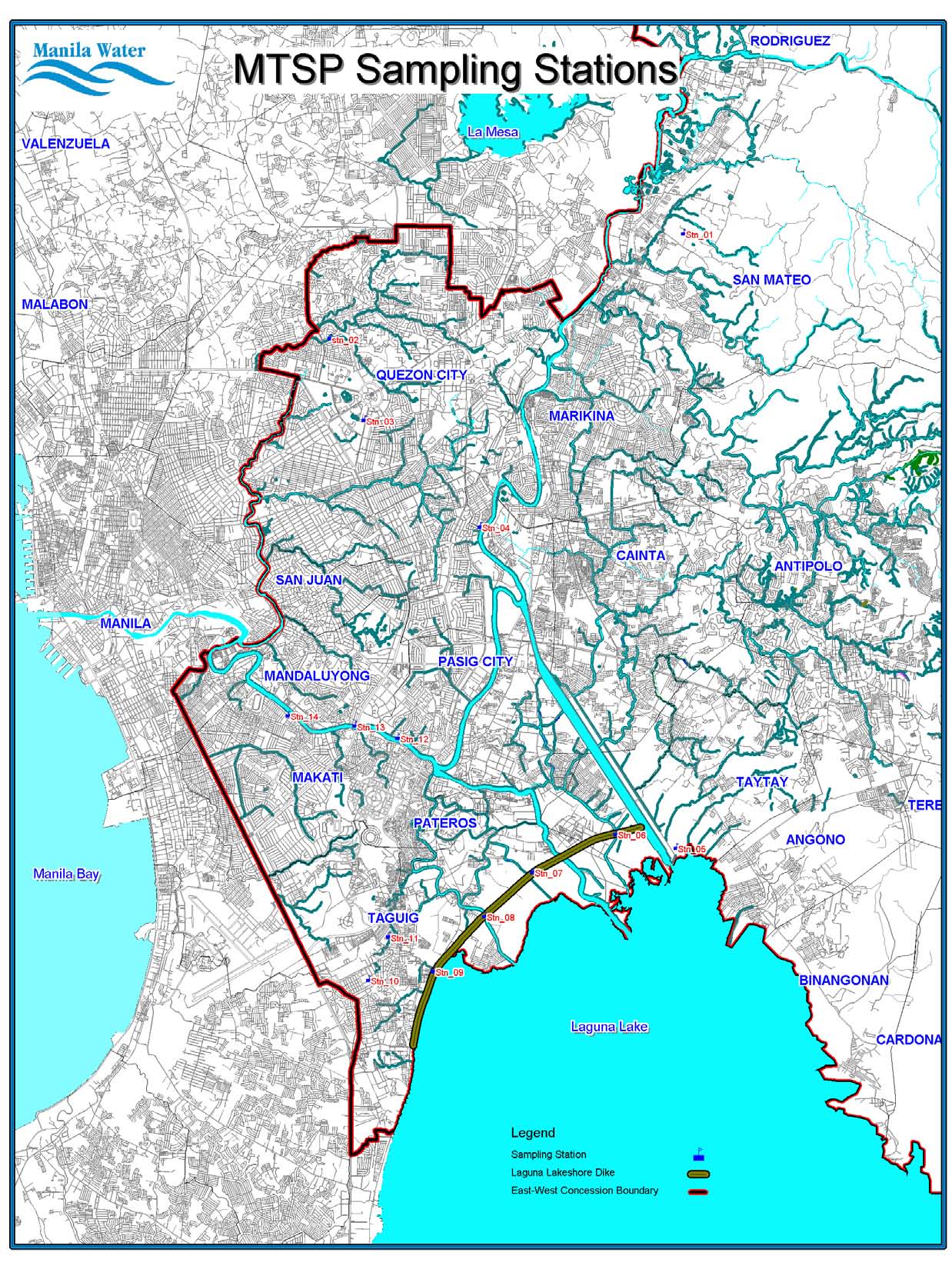
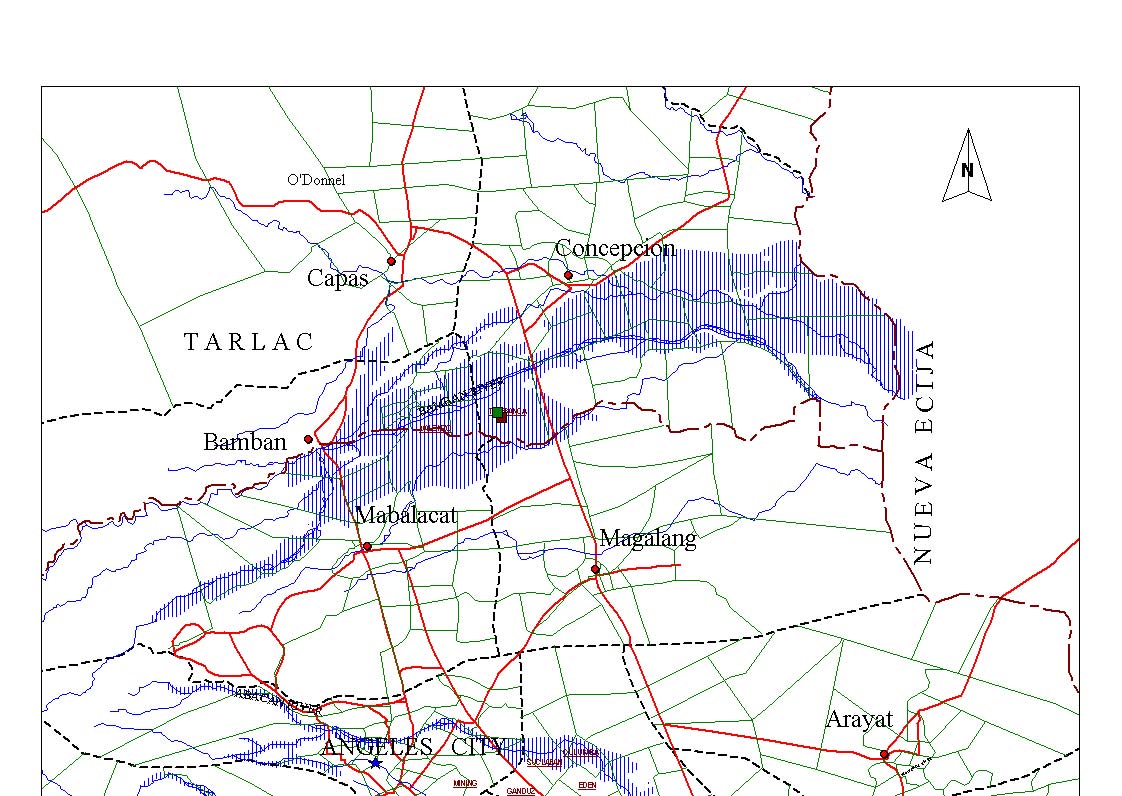
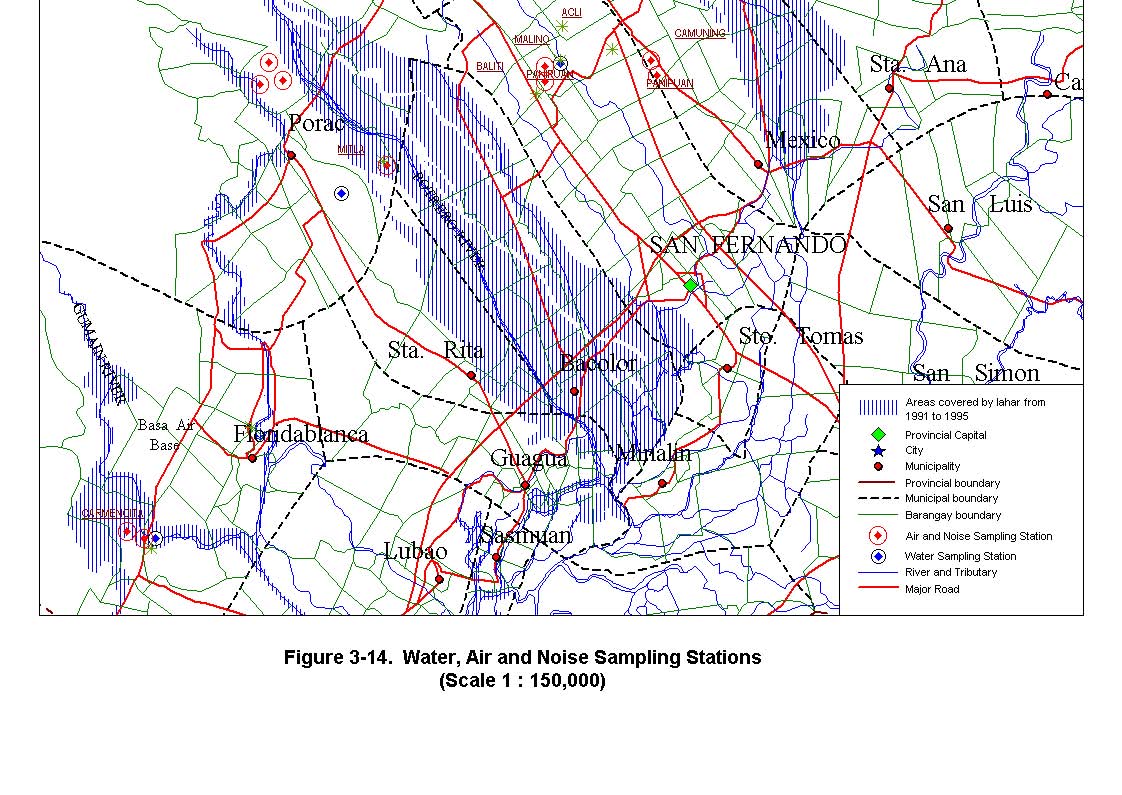
The attached Annex 3 shows the identified sampling points for the MTSP Components.
MTSP Environmental Management Plan
February 10, 2005
MWCI/LBP, Manila, the Philippines
Page 29
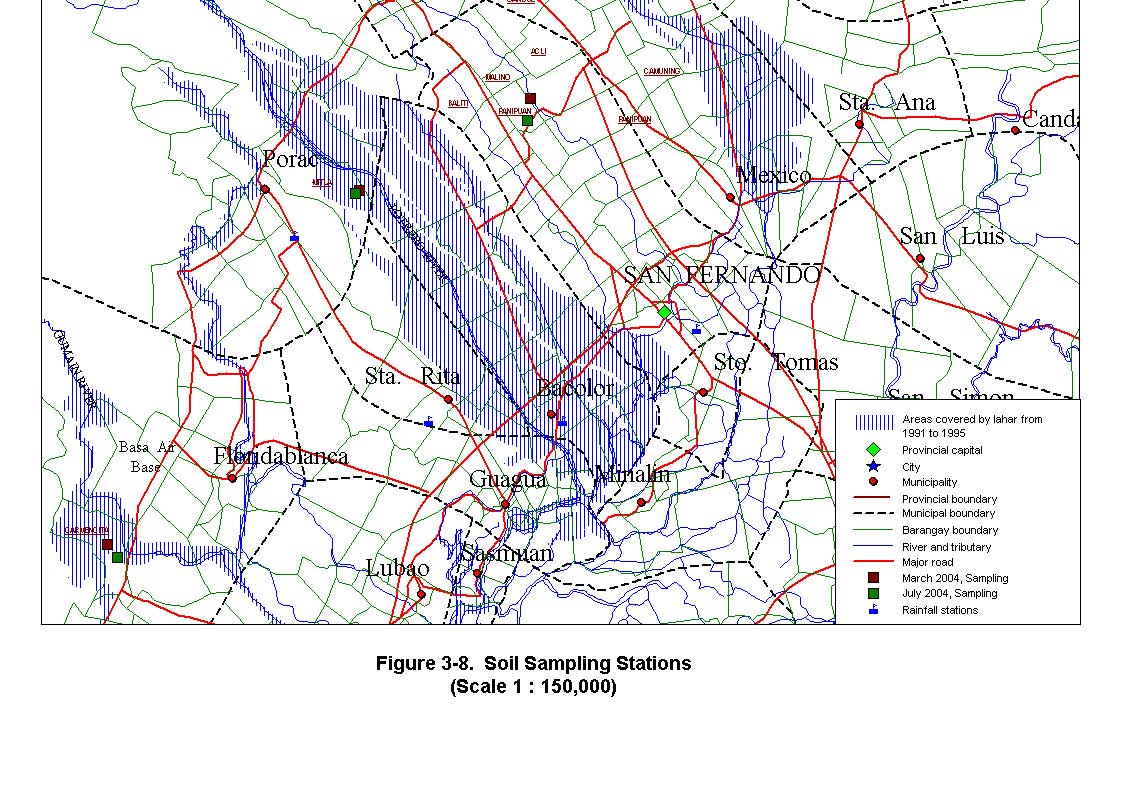
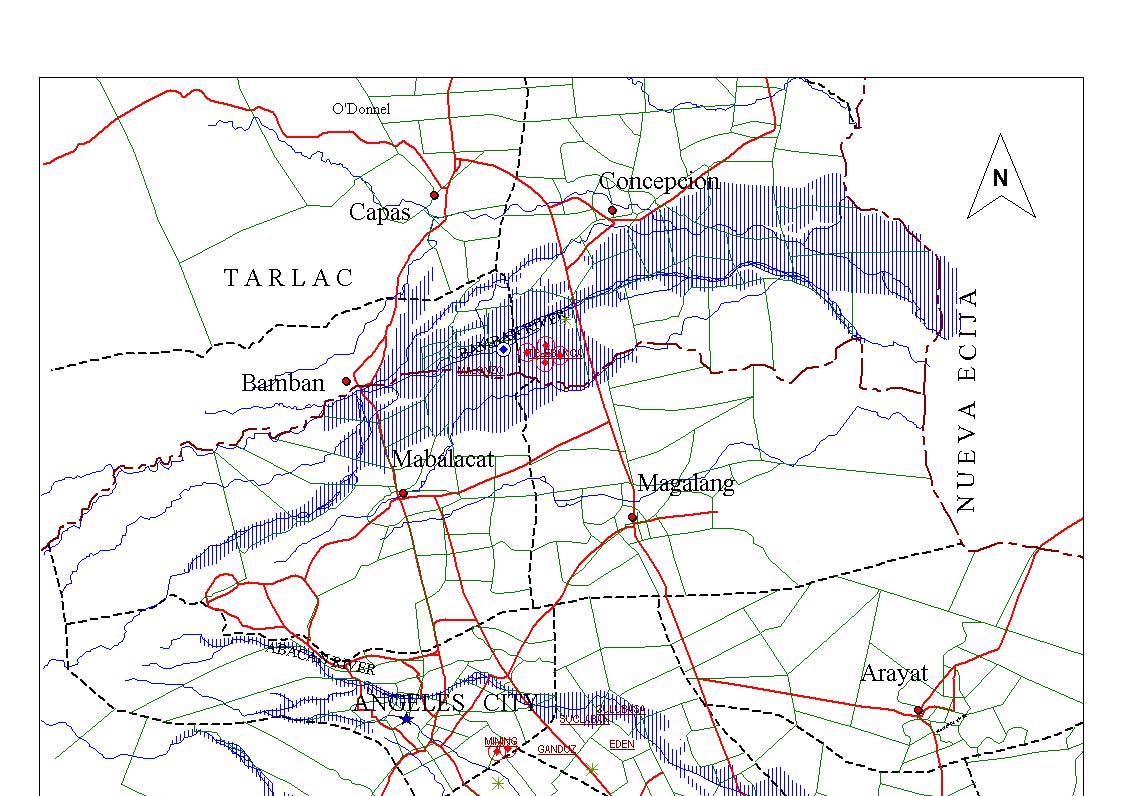
ANNEX 3 - Soil Sampling Stations
Septage/Sludge Application in Identified Lahar-Affected Areas in Pampanga and Tarlac Provinces
LStn:01
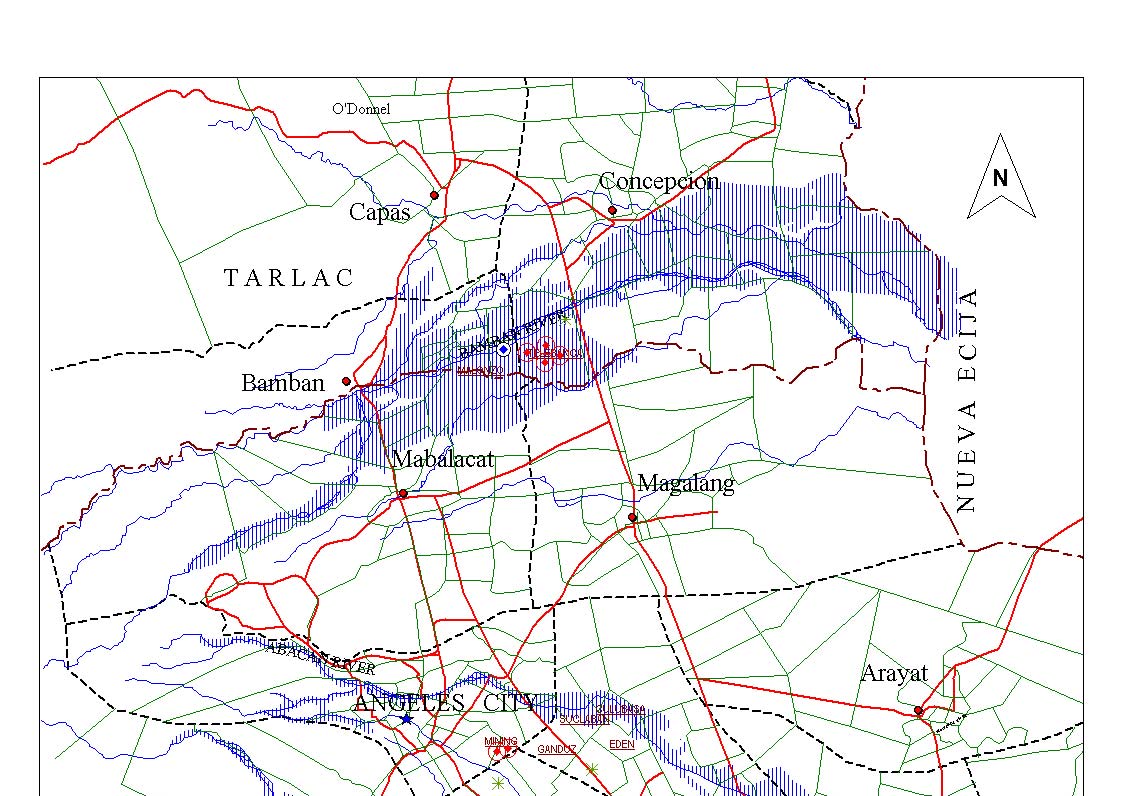
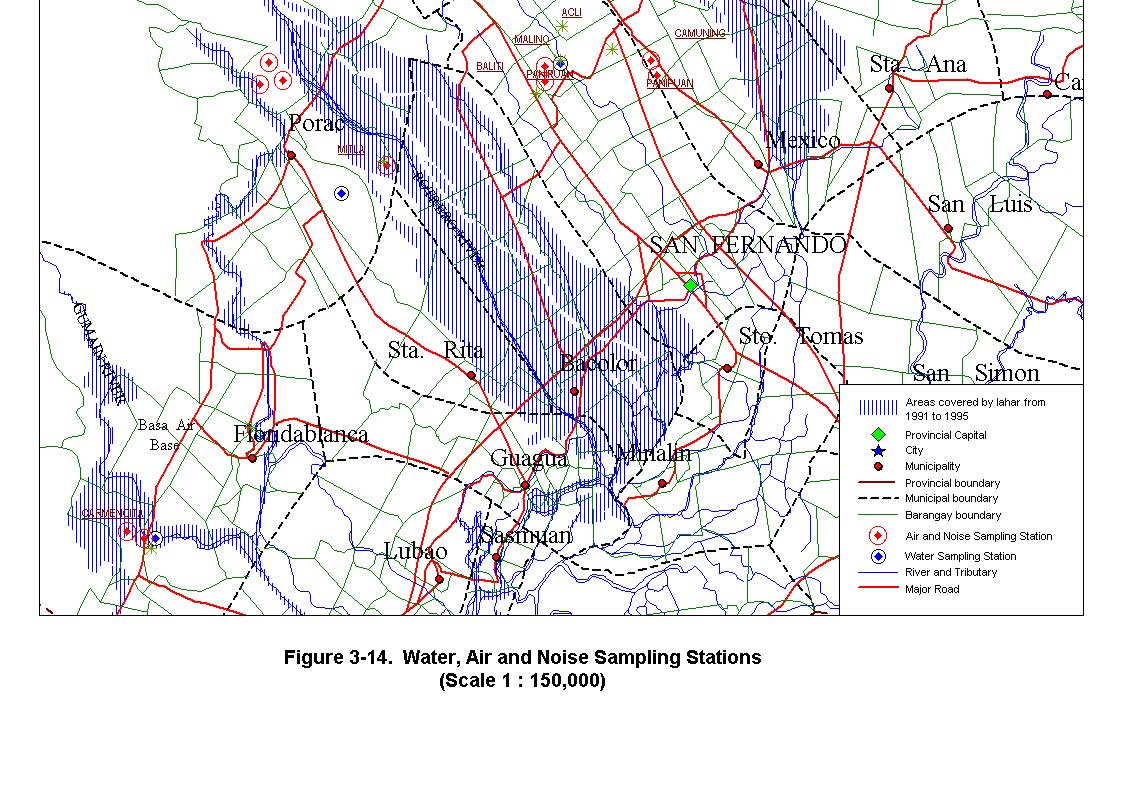
Annex 3 - Monitoring Sampling Points for Water, Air, and Noise
Septage/Sludge Application in Identified Lahar-Affected Areas in Pampanga and Tarlac Provinces
LStn:01
Document Outline
- EMP Annexes.pdf
- Annex 1 Overview of the Eastern Concession Area.jpg
- Annex 2 MTSP Service Coverage.jpg
- Annex 3 MTSP_sampling.jpg
- Annex 3 Soil Sampling for lahar.pdf
- Annex 3 Water, Air, and Noise Sampling Point for Lahar.pdf