




The Global Forum on Oceans,
Coasts, and Islands
Report of Activities, 2005-2008
GEF/MSP: Fostering a Global Dialogue on
Oceans, Coasts, and SIDS, and on
Freshwater-Coastal-Marine Interlinkages
www.globaloceans.org
June 2008
Vietnam
R O Korea
Indonesia
Portugal
CANADA
Flemish Government,
Belgium
Contents
I. INTRODUCTION ............................................................................1
1. The Importance of Oceans, Coasts, and Small Island
Developing States ........................................................................1
2. Brief History of the Global Forum ..............................................2
3. Goals and Objectives of the Global Forum................................5
4. Perspectives on the Global Forum ..............................................5
5. Purpose of this Report ................................................................6
II.
GLOBAL FORUM ACTIVITIES 2001-2008....................................7
GEF/MSP: Fostering a Global Dialogue on Oceans, Coasts,
and SIDS, and on Freshwater-Coastal-Marine Interlinkages
1. Advancing the Global Oceans Agenda ......................................7
2. Promoting Integrated Oceans Governance ............................11
3. Facilitating Consensus-Building on International Issues ......14
4. Work with Small Island Developing States (SIDS) ..................16
5. Long-term Capacity Building in Ocean and ............................17
Coastal Management
6. Linking the Management of Freshwater and Oceans
and Coasts ..................................................................................21
7. Policy Analyses, Publications, and Information Services ........23
8. Outreach to the Public ..............................................................24
III.
FUTURE DIRECTIONS: GLOBAL FORUM STRATEGIC ............27
PLANNING TO 2016
IV.
GLOBAL FORUM ORGANIZATION AND ..................................31
CONTACT INFORMATION
Working Group Leaders and Members ..........................................33
Steering Committee, Global Forum on Oceans, ..........................41
Coasts, and Islands
Agenda for 2005-2007
The Global For
The Global Forum on
um on Oceans, Coasts, and Islands
Oceans, Coasts, and Islands
The Global Forum on
I. Introduction
Oceans, Coasts, and
Islands
1. The Importance of Oceans, Coasts,
and Small Island Developing States
Oceans, seas, islands and coastal
Oceans, coasts, and islands represent an integral aspect
of global sustainable development. The oceans--com-
areas form an integrated and
prising 72% of the Earth's surface--provide essential life-
support functions without which life on earth would not
essential component of the Earth's
be possible and support a wide array of activities with sig-
nificant benefits to humankind. Coastal areas are the
ecosystem and are critical for global
home of 50% of the world's population. Forty-four of the
world's nations are small island developing states (SIDS),
food security and for sustaining
which are especially dependent on oceans. Oceans,
economic prosperity and the
coasts, and islands support a wide array of uses with
significant economic and social value. Marine trans-
well-being of many national
portation accounts for 90% of international trade.
Exploitation of coastal and offshore mineral resources
economies, particularly in
provides 25 to 30% of the world's energy supplies and
continues to expand, especially in deeper waters.
developing countries.
Fisheries are important socially and economically, pro-
viding direct and indirect livelihood for 400 million peo-
ple. Marine aquaculture represents a rapidly growing
industry and globally accounts for 30% of the world's
-- 2002 World Summit on Sustainable Development
fish consumption. The travel and tourism industry is the
fastest growing sector of the global economy, especially
Plan of Implementation, Paragraph 30
with regard to coastal and marine areas. Furthermore,
oceans perform functions that are vital to life on earth.
The oceans modulate short- and long-term climate. On
I.
the other hand, they also generate hazards such as
storms, earthquakes, and tsunamis.
The multitude of ocean activities is placing increasing
pressure on the integrity of coastal and marine ecosys-
tems and many oceanic, coastal, and island resources are
threatened through overexploitation. Seventy-five per-
cent of global fisheries are either fully utilized or over uti-
lized. Seventy percent of 126 marine mammal species are
threatened. Fifty percent of the world's mangroves have
been lost and important seagrass habitats are rapidly
being destroyed. Twelve billion tons of ballast water con-
taining at any one time around 10,000 marine species
are shipped around the globe each year, spreading alien
and invasive species. Over the past decade, the frequen-
cy of recorded harmful algal blooms resulting in mass
mortality and morbidity of marine organisms has
increased significantly. Food security for a growing
human population drives the intensification of agricul-
tural production and results in the increased application
of fertilizers, pesticides, and herbicides, resulting in the
1
The Global Forum on Oceans, Coasts, and Islands
degradation of coastal ecosystems. Various reports have
2. Brief History of the Global Forum
highlighted that oceans, coasts, and islands are experienc-
The Global Forum was first mobilized in 2001 to help the
ing severe degradation due to overfishing at sea, over-
world's governments place issues related to oceans, coasts,
development along the coasts, and increasing pollution
and SIDS on the agenda of the 2002 World Summit on
from cities and fields. This situation is reaching a crisis
Sustainable Development (WSSD) in Johannesburg,
state and in many places may lead to significant declines
South Africa (the ten-year review of progress achieved (or
of ocean wildlife and to the irreversible collapse of ocean
lack thereof) in the implementation of the outcomes of
ecosystems.
the 1992 Earth Summit in Rio de Janeiro), and was later
These problems are exacerbated by the effects of climate
formalized at the 2002 World Summit.
change. The 2007 report of the Intergovernmental Panel
In the preparatory process for the WSSD, it became evi-
on Climate Change (IPCC) notes that climate change will
dent that ocean issues were not on the World Summit
have profound effects on ocean ecosystems and coastal
agenda. Hence, the Global Forum was mobilized to hold
populations around the world, especially among the
the first Global Conference on Oceans, Coasts, and
poorest peoples. It is expected that developing nations in
Islands (in December 2001 at UNESCO, Paris) to lay the
Africa (which accounts for less than three percent of glob-
groundwork for the inclusion of an oceans perspective at
al carbon emissions) and in Asia would be most affected
the WSSD by calling attention to the economic and social
and the developed wealthy nations far from the equator
importance of oceans, coasts, and small island developing
least affected. Asia will be particularly vulnerable to the
States and the serious problems besetting these areas.
effects of climate change, especially in major population
These efforts were successful in assisting governments in
centers at low elevations such as Mumbai, Shanghai,
putting oceans on the WSSD agenda. At the World
Jakarta, Tokyo, and Dhaka. The impacts of climate change
Summit on Sustainable Development in September 2002,
on developing nations, especially SIDS, will be significant;
Government delegates agreed on an action plan for
the implications of these effects range from changes in
oceans, coasts, and islands, with specific targets and
ocean chemistry and forecasted sea level rise to impacts
timetables for action, to address the problems and threats
on ecosystems and human health. The need to address
to sustainable development noted above. The ocean tar-
these issues in the oceans community is a vital first step
gets and timetables found in the Johannesburg Plan of
in combating potentially severe effects of climate change
Implementation (see Box 1) represent an important
focusing especially on the developing world and SIDS.
advance because there is now a global consensus reached
The pressing issues affecting oceans, coasts, and SIDS call
at the highest political levels that there is an urgent need
for the mobilization of a broad coalition of interests from
to take specific actions to achieve the sustainable develop-
developed and developing countries and including all the
ment of oceans, coasts, and of small island developing
relevant actors: governments, UN agencies and other
States.
international organizations, nongovernmental organiza-
The Global Forum is a response to perceived needs for fos-
tions, the private sector, and scientific groups. No one can
tering cross-sectoral dialogue on ocean issues among gov-
solve these problems alone. A coming together of all parts
ernments, NGOs, international organizations, and the
of the international community is urgently needed.
2
The Global Forum on Oceans, Coasts, and Islands
BOX 1.
WSSD Ocean Targets and Timetables*
Integrated ocean and coastal management
Protection from marine pollution and mar-
Encourage the application of the ecosystem
itime safety
approach by 2010 for the sustainable development
Advance implementation of the Global Programme
of the oceans, particularly in the management of
of Action for the Protection of the Marine
fisheries and the conservation of biodiversity
Environment from Land-based Activities in the
Establish an effective, transparent and regular inter-
period 2002-2006 with a view to achieve substan-
agency coordination mechanism on ocean and
tial progress by 2006
coastal issues within the United Nations system
Enhance maritime safety and protection of the
Promote integrated coastal and ocean management
marine environment:
at the national level and encourage and assist coun-
a) Ratify, accede to and implement IMO instru-
tries in developing ocean policies and mechanisms
ments
on integrated coastal management
b) Accelerate the development of measures to
Assist developing countries in coordinating policies
address invasive species in ballast waters
and programs at the regional and sub-regional levels
Science and observation
aimed at conservation and sustainable management
Improve scientific understanding and assessment
of fishery resources and implement integrated
of the marine environment
coastal area management plans, including through
the development of infrastructure
Establish a regular process under the United
Fisheries
Nations for global reporting and assessment of
the state of the marine environment, including
Implement the FAO International Plan of Action to
socioeconomic aspects, by 2004
Prevent, Deter and Eliminate Illegal, Unreported,
Small island developing States
and Unregulated Fishing by 2004
Follow-up on the implementation of the results
Implement the FAO International Plan of Action for
of the Mauritius 2005 review of the Barbados
the Management of Fishing Capacity by 2005
Programme of Action
Maintain or restore depleted fish stocks to levels that
Water Resources Management
can produce their maximum sustainable yield on an
urgent basis and where possible no later than 2015
Development of integrated water resources
management (IWRM) plans by 2005
Eliminate subsidies that contribute to illegal, unre-
ported, and unregulated fishing and to overcapacity
Conservation of biodiversity
*United Nations. 2002. Johannesburg Plan of
Implementation of the World Summit on Sustainable
To achieve by 2010 a significant reduction of the
current rate of biodiversity loss at the global, region-
al and national level as a contribution to poverty
alleviation and to the benefit of all life on earth
Develop and facilitate the use of diverse approaches
and tools, including the ecosystem approach, the
elimination of destructive fishing practices, the
establishment of marine protected areas consistent
with international law and based on scientific infor-
mation, including representative networks by 2012
3
The Global Forum on Oceans, Coasts, and Islands
BOX 2.
Major Ocean and Coastal Needs
Addressed by the Global Forum
Promotion of cross-sectoral dialogue on ocean and
coastal issues. Existing fora related to oceans are large-
ly sectoral in nature. The Global Forum addresses
oceans, coasts, and islands issues in a cross-sectoral and
comprehensive manner, examining the interrelation-
ship among issues, as emphasized in both the Law of
the Sea, the 1992 Earth Summit, and the 2002 World
Summit on Sustainable Development.
Promotion of dialogue among governments, NGOs,
international organizations, the private sector, and sci-
entific groups building consensus on how to address
private and scientific sectors; constant advocacy for oceans
international ocean issues. Existing fora are either inter-
at the highest political levels; and the imperative of taking
governmental or dominated by private sector, NGO
an ecosystem-based and integrated approach to oceans
interests, or scientific groups. The Global Forum pro-
governance at national, regional, and global levels, includ-
vides a mechanism where participants from nongovern-
ing treating the water system--from freshwater, to coasts,
mental organizations, governments, intergovernmental
to oceans--as the interlinked system that it is. See Box 2.
and international organizations, the private sector, and
Since 2001, the Global Forum has brought together ocean
scientific groups can interact together, share informa-
leaders from governments, non-governmental organiza-
tion, draw lessons from existing practice, consider
tions, international and intergovernmental organizations,
emerging issues, and engage in dialogue in relatively
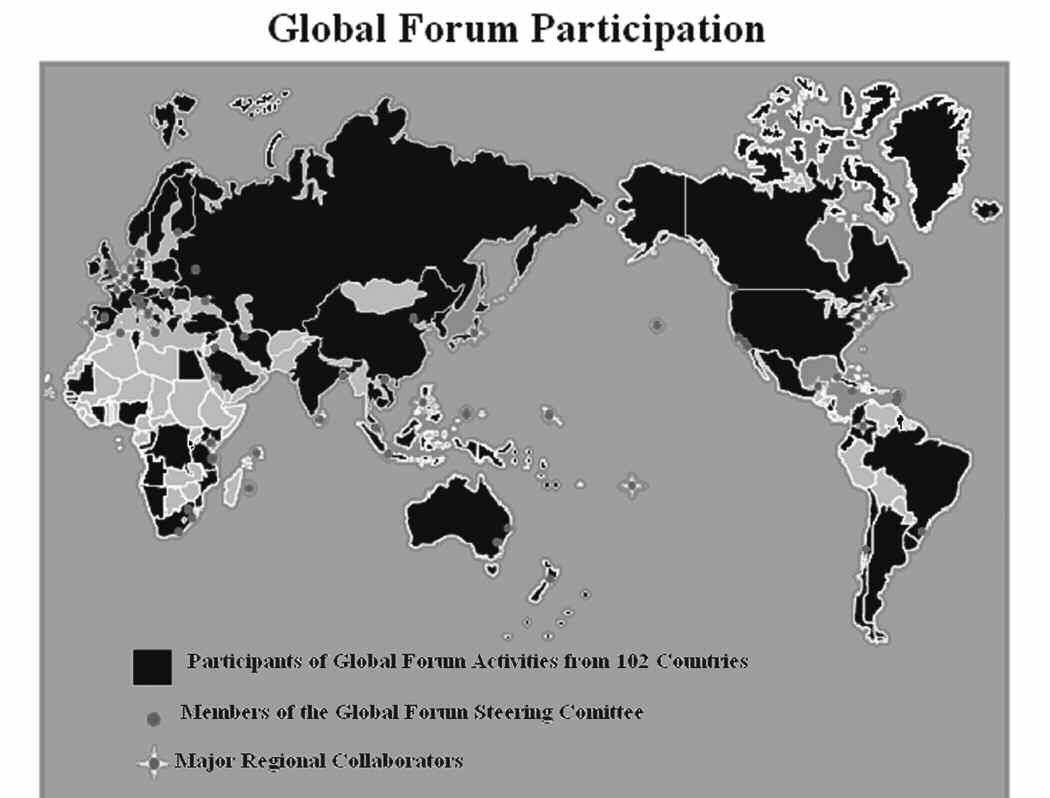
the private sector, and scientific associations from 105
equal numbers and on equal terms on potential solu-
countries (Figure 1 is a map showing Global Forum partic-
tions to problems.
ipants, Steering Committee members and collaborators);
Oceans advocacy at the highest political levels. Ocean,
organized four Global Conferences (in 2001, 2003, and
coastal, and island issues can become lost amongst
2006 at UNESCO in Paris, and 2008 in Hanoi, Vietnam);
complex international agendas. Members of the Global
organized the Ocean Policy Summit in Lisbon in 2005 doc-
Forum serve as advocates for inclusion of oceans,
umenting experiences with integrated oceans governance
coasts, and islands issues in important global and
in over 20 countries and 4 regions around the world; pre-
regional negotiations on sustainable development.
pared analyses on the implementation of the WSSD ocean
targets, on ocean issues in island states for the 2005
Linking freshwater and ocean concerns. Discussions of
Mauritius International Meeting on Small Island
freshwater management and oceans management typi-
Developing States, and on capacity development needs in
cally take place separately in different fora. The Global
ocean and coastal management in eight world regions;
Forum aims to bridge these separate yet intrinsically
and provided a series of Internet information services,
linked issues.
including periodic newsletters. The work of the Global
Forum is directed by a Steering Committee of more than
80 members, and run by a small Secretariat, the
International Coastal and Ocean Organization, an interna-
tional NGO accredited to the UN Economic and Social
Council (discussed in section IV of this report).
4
The Global Forum on Oceans, Coasts, and Islands
3. Goals and Objectives of the Global
· Foster a mutually-supportive global network of ocean
Forum
policy leaders with the capacity to implement inte-
grated oceans management;
The major goals of the Global Forum
· Raise the international profile of oceans, coasts, and
are to:
SIDS in relevant global, regional, and sub-regional
fora;
· Advance the global oceans agenda by:
· Mobilize public awareness on global issues related to
1) promoting the implementation of international
oceans, coasts, and islands, and promote information
agreements related to oceans, coasts, and small
sharing and dissemination.
island developing States (SIDS), especially the goals
emanating from the 2002 WSSD;
4. Perspectives on the Global Forum
2) analyzing emerging issues such as addressing cli-
Noted actors in the marine policy field have underscored
mate change effects andimproving the governance
the importance of the availability of an informal process
regime for ocean areas beyond national jurisdiction;
that can bring together all relevant perspectives to
and
advance the global oceans agenda. For example:
3) promoting international consensus-building on
unresolved ocean issues;
The Global Forum was born at Johannesburg to address the
interdependent issues of oceans, coasts, and islands. Since its
· Work as a catalyst to mobilize knowledge, resources,
inception we have witnessed a remarkable change in the atti-
and organizational action to advance the global
tude and engagement of the international community. The
oceans agenda and to promote integrated oceans
Global Forum had spurred and focused the attention of policy
management;
makers in a very short time and the impact of the Forum was
June 2008
5
The Global Forum on Oceans, Coasts, and Islands
soon felt at the very centre of multilateral diplomacy and
decision making i.e. the General Assembly of the United
BOX 3. Sources of Global Forum
Nations and its Subsidiary bodies.
Support, 2005-2008
-- Awni Behnam, President, International
Initial Partners
Ocean Institute, June 13, 2006
Global Environment Facility
Intergovernmental Oceanographic Commission
In my experience every formal, multi-lateral negotiating
UNEP Global Programme of Action for the Protection of the Marine
Environment from Land-based Activities
process needs an informal process which feeds into it, and
U.S. National Oceanic and Atmospheric Administration
where ideas can be taken forward in a less formal way.
Department of Fisheries and Oceans, Canada
That seems to me to be perhaps the key role for the Global
Pacific Islands Applied Geoscience Commission (SOPAC)
Forum as the years go by.
IOC Sub-Commission for the Caribbean and Adjacent Regions (IOCARIBE)
Partnerships in Environmental Management for the Seas of East Asia (PEMSEA)
-- John Richardson, European Commission,
New Partnership for Africa's Development/Coastal and Marine Coordination
June 17, 2006, New York
Unit (NEPAD/COSMAR)
Centro de Ecología, Pesquerías y Oceanografía del Golfo de Mexico, Mexico
(EPOMEX)
The Global Forum assists, encourages, and facilitates ongo-
Secretaría de Medio Ambiente y Recursos Naturales (SEMARNAT), Mexico
Consejo Consultivo del Agua (CCA), Mexico
ing discussions on very important and sensitive ocean
GEF International Waters Learning, Exchange and Resource Network Program
issues, so that eventually we will achieve better manage-
(IW:LEARN)
ment for the ocean. In this process, the Global Forum plays
The Nippon Foundation, Japan
a very important role because it is a Forum where various
Portuguese Committee for Intergovernmental Oceanographic Commission
The Nature Conservancy
stakeholders can discuss issues and exchange views without
Gerard J. Mangone Center for Marine Policy, University of Delaware
being bound by some formalities. It's an open discussion
International Coastal and Ocean Organization
that facilitates and helps everyone. The Global Forum serves
NAUSICAA Centre National de la Mer, France
as an excellent platform at which you can have industry,
World Ocean Network
civil society, and member States exchanging views in a very
Additional Partners/Support Generated by the GEF/MSP
informal atmosphere. This provides for a comprehensive
Coastal Services Center (NOAA CSC)
approach, a cross-sectoral approach, and this is a new trend.
Flemish Government and Flemish Minister for Economy, Enterprise, Science,
The Global Forum should strengthen this approach.
Innovation and Foreign Trade, Belgium
General Directorate for Nature Protection, Ministry for the Environment and
--Vladimir Golitsyn, former Director,
Territory, Italy
UN-DOALOS, June 17, 2006, New York
Global Water Partnership
International Ocean Institute
International Union for the Conservation of Nature
5. Purpose of this Report
Associação Industrial Portuguesa
Banco Espiritu Santo
This report provides an overview of the activities of the
Fundação Calouste Gulbenkian
Global Forum since its inception in 2001 focusing on
Fundação Oriente
accomplishments under the Global Environment
Le Centre de Decouverte du Monde Marin, Nice, France
Luso-American Development Foundation (FLAD)
Facility project on Fostering a Global Dialogue on Oceans,
Ministry of Foreign Affairs and National Parks Board, Singapore
Coasts, and Small Island Developing States (SIDS), and on
Ministry of Foreign Affairs, Portugal
Freshwater-Coastal-Marine Interlinkages (GEF/MSP)
Ministry of Land, Transportation and Maritime Affairs, Republic of Korea
(September 2005-July 2008). This is a Medium-sized
Ministry of Marine Affairs and Fisheries, Indonesia
Project funded by the Global Environment Facility (GEF)
Ocean Policy Research Foundation, Japan
with the UN Environment Programme as the
Oceanário de Lisboa
Port Authority of Lisbon
Implementing Agency, the Intergovernmental
Pusan National University, Korea
Oceanographic Commission as the Executing Agency,
Secretary of State for Maritime Affairs, Portugal
and the International Coastal and Ocean Organization
United Nations Educational, Scientific and Cultural Organization (UNESCO)
(the Global Forum Secretariat) as the Co-Executing
Vietnam Institute of Fisheries Economics and Planning, Ministry of Agriculture
and Rural Development, Vietnam
Agency. Collaborating partners providing financial
World Bank
and/or in-kind support for this GEF/MSP project, as well
World Ocean Observatory
as additional funding support received generated by the
GEF/MSP project are listed in Box 3.
The support of the organizations noted above is acknowledged with sincere thanks.
6
The Global Forum on Oceans, Coasts, and Islands
The project aims to foster a global South-to-South and
declines during this period and was threatened. Similarly,
South-to-North dialogue on oceans through the Global
poverty continued unabated in coastal communities in the
Forum on Oceans, Coasts, and Islands, focusing especially
developing world. The conference noted that ICM pro-
on the implementation of the WSSD targets and timetables
grams must fully incorporate poverty reduction goals and
related to oceans, coasts, and SIDS.
address issues of public health in coastal areas (e.g., 90% of
This report also includes activities of the Global Forum
sewage in the developing world is untreated posing serious
related to strategic planning to advance the global oceans
health risks).
agenda.
Box 4. 2001 Conference Reports
II. GLOBAL FORUM
The outcomes of the 2001 conference were reported in
ACTIVITIES 2001-2008
four volumes:
· Co-Chairs' Report, Ensuring the Sustainable
1. Advancing the Global Oceans
Development of Oceans and Coasts: A Call to
Action
Agenda
http://globaloceans.org/globalconferences/2001/pdf/Co
2001-2005:
chairsReport.pdf
· Concluding Statement by the Conference Co-Chairs
Global Conference on Oceans and Coasts at
Rio+10: Toward the 2002 World Summit on
http://globaloceans.org/globalconferences/2001/pdf/Cl
Sustainable Development, Johannesburg
osingStatement.pdf
December 3-7, 2001, UNESCO, Paris
· Ministerial Perspectives on Oceans and Coasts at
Rio+10
The Global Forum organized the first global conference on
http://globaloceans.org/globalconferences/2001/pdf/Mi
oceans and coasts with a focus on Oceans and Coasts at
nisterialPerspectives.pdf
Rio+10: Toward the 2002 World Summit on Sustainable
Development, Johannesburg (at UNESCO headquarters in
· Reports of the Conference Working Groups
Paris on December 3-7, 2001). Convened nearly ten years
http://globaloceans.org/globalconferences/2001/pdf/Re
after the 1992 United Nations Conference on Environment
portoftheWorkingGroups.pdf
and Development (UNCED) in Rio de Janeiro, the Global
Conference assessed the status of oceans and coasts and
progress achieved over the previous decade, identifying
continuing and new challenges, and laying the ground-
work for the inclusion of an oceans agenda at the 2002
World Summit on Sustainable Development (WSSD).
The 2001 conference involved 424 participants from 61
countries, with leading experts from governments, United
Nations agencies and other intergovernmental organiza-
tions, nongovernmental organizations, and the private
sector.
The conference found that significant progress had indeed
been made in ocean and coastal management (ICM) since
the 1992 Earth Summit, especially in terms of: the adop-
tion and implementation of a number of major interna-
tional ocean agreements; new funding initiatives in ocean
and coastal management; many new initiatives in ICM by
governments at national and local levels; and significant
progress in the development of knowledge, data, and
information systems on oceans and coasts. However, the
"on-the-ground" condition of marine resources (including
fisheries, marine mammals, coral reefs) experienced
7

The Global Forum on Oceans, Coasts, and Islands
The conference noted that "we are in a critical situation of
Sustainable Development on Oceans, Coasts, and Small Island
declining trends that requires immediate actions by
Developing States, held on December 10-14, 2003 at
nations and by governing bodies worldwide.......It is
UNESCO, Paris to spur rapid initial implementation of the
essential that we link economic development, social wel-
WSSD oceans commitments. The Conference involved
fare, and resource conservation in order to achieve sustain-
223 participants from 48 countries, representing intergov-
ability of oceans and coasts." The conference issued an
ernmental organizations, government organizations, aca-
urgent Call to Action to decisionmakers in the WSSD
demic and research institutions, non-government organi-
process to develop a detailed action plan for the sustain-
zations, and private sector organizations and individuals.
able development of the world's oceans and coasts.
The conference reviewed what had been done to date in
The 2001 conference is perceived as having been catalytic
implementing the WSSD commitments and to catalyze
in placing ocean, coastal, and island issues on the WSSD
action on WSSD implementation through collaboration
agenda which resulted in the adoption of an extensive set
among governments,
of global targets and timetables related to oceans, coasts,
international organiza-
and small island states (See Box 1), as the following com-
tions, non-governmental
ments suggest:
organizations, and the
private sector. The con-
The persistent efforts of all interested groups, beginning with
ference focused attention
the Global Conference on Oceans and Coasts at Rio+10, per-
on early successful efforts
suaded the preparatory meetings for the Johannesburg
to put into effect several
Conference that not only was UNCLOS not the end of the
of the WSSD goals with
road, but also that many of the commitments of the UNCED
the intent of adaptation
at Rio remained unfulfilled.
and replication. The con-
ference report reviewed
UN Secretary General's report on
in some detail progress
Oceans and the Law of the Sea
achieved (or lack thereof)
(March 3, 2003, A/58/65, p.7):
on each of the WSSD
ocean goals up to May 2004 (the publication date for the
The Global Conference in 2001 was one of the most informa-
report) pointing out areas of good early success as well as
tive and important international events and really shaped
areas where little action had taken place.
what happened at the World Summit on Sustainable
The conference was useful in spurring the process of WSSD
Development in a positive way. The Conference was very valu-
implementation. This meeting proved especially impor-
able in placing ocean, coastal, and SIDS issues on the global
tant because the UN Commission on Sustainable
agenda, and it produced so much important information that
Development is not scheduled to examine progress on the
the international community kept using the information gener-
oceans and coasts targets of the WSSD until 2014.
ated for a least a year.
--Phil Burgess, former Co-Chair,
Box 5. 2003 Conference Report
UN Open-ended Informal Consultative
Process on Oceans and the Law of the Sea,
Mobilizing for Implementation
June 13, 2006, New York City
of the Commitments Made at
the 2002 World Summit on
Global Conference on Oceans, Coasts, and
Sustainable Development on
Islands: Mobilizing for Implementation of
Oceans, Coasts, and Small
the Commitments Made at the 2002 World
Island Developing States, Co-
Summit on Sustainable Development on
Chairs' Report of the 2003
Oceans, Coasts, and Small Island Developing
Global Conference on Oceans,
States
Coasts, and Islands, UNESCO,
December 10-14, 2003, UNESCO, Paris, France
Paris, November 12-14, 2003,
Following the WSSD, the Global Forum organized the sec-
and Subsequent Developments
ond international conference, the Global Conference on
(May 2004), (http://globaloceans.org/globalconfer-
Oceans, Coasts, and Islands: Mobilizing for Implementation of
ences/2003/pdf/2004WSSDImplementationReport.pdf).
the Commitments Made at the 2002 World Summit on
8

The Global Forum on Oceans, Coasts, and Islands
2005-2008 (GEF/MSP):
versity, integrated water resources management, and UN
coherence, one must conclude that some very tangible
Third Global Conference on Oceans, Coasts,
progress is being made, often with specific efforts under-
and Islands: Moving the Global Oceans
way in a growing number of countries.
Agenda Forward
January 23-28, 2006, UNESCO, Paris, France
In other areas such as fisheries and global marine assess-
ment, the progress has been slower, but especially in fish-
The Third Global Conference on Oceans, Coasts, and Islands:
eries, the groundwork seems to have been established for
Moving the Global Oceans Agenda Forward, organized by the
enhanced progress in the next phase. On small island
Global Forum on Oceans, Coasts, and Islands, was held on
developing states and oceans, while the 2005 Mauritius
January 23-28, 2006 at UNESCO headquarters in Paris,
International Strategy has been adopted, its implementa-
France. The Conference included 403 participants from 78
tion is in doubt if financial resources and institutional
countries, with 38 ministers and high level government
capacity are not enhanced. As the custodians of large areas
representatives in attendance. The Conference brought
of the world's oceans, SIDS need assistance and collabora-
together key national level officials, regional organizations,
tion from the international community to enhance their
UN agencies, donors, industry, non-governmental organi-
capacity to delimit, manage, and enforce these areas. The
zations, and scientists to assess progress achieved and
least progress appears to be taking place in meeting the
obstacles faced in the implementation of international tar-
MDGs. In this regard, it is imperative that, increasingly,
gets on oceans, coasts, and small island developing states
ocean and coastal management programs address poverty
(SIDS), especially those related to the 2002 World Summit
reduction as central goals. It is imperative, as well, that the
on Sustainable Development (WSSD), the Millennium
welfare of coastal populations--their health, food security,
Development Goals (MDGs), and other related agree-
quality of life, and the benefits they derive from the coastal
ments.
and marine resources they own be periodically measured
The conference and the ensuing report, Meeting Global
to assess the extent to which any of the MDG and WSSD
Commitments on Oceans, Coasts, Freshwater, and Small Island
goals are making the needed difference on the ground.
States: How Well Are We Doing? reviewed the available infor-
With regard to the next phase of further evolution in
mation and provided a bottom line of progress achieved so
implementation of the WSSD and MDG goals, it is impor-
far--a "report card"-- on each of the WSSD and MDG
tant, as well, to establish for each WSSD/MDG goal inter-
ocean-related goals. The report underlined the difficulties
mediate and readily measurable targets and timetables at
involved in assessing progress, especially the lack of evalu-
the national level, as some countries such as the United
ation frameworks, including indicators; the fact that no
Kingdom have done. The issue of coordinating the local
one institution has been charged with collecting, on a peri-
implementation of various international mandates should
odic basis, national and international data on the entire
also be addressed. With the WSSD and MDG mandates,
range of issues related to oceans, especially regarding the
nations are being asked to implement a variety of pro-
cross-cutting goals (e.g., ecosystem management and inte-
grams related to the ocean, coastal, and freshwater envi-
grated ocean and coastal management); the lack of regular
ronments-- integrated coastal and ocean management,
collection and assessment of information on the social and
ecosystem-management, integrated water resources man-
economic well-being of coastal communities; and the
agement, GPA and control of land-based activities, biodi-
absence of linkage among the WSSD/MDG goals which are
versity protection and networks of marine protected areas.
related to one another.
On the-ground, these efforts, address similar issues and
Generally, participants at the Global Conference agreed
cover, to some extent, similar areas. As further implemen-
that progress toward implementation of the global oceans
tation of these efforts gets underway, it will be important
targets has been slow, but that there are many promising
to assist nations in rationalizing and bringing synergy
developments. In some areas, such as integrated coastal
among these efforts.
and ocean management, GPA, protection of marine biodi-
9
The Global Forum on Oceans, Coasts, and Islands
Box 6. 2006 Global Conference Reports
Ministry of Agriculture and Rural Development (MARD)
- Fisheries, and with leadership roles by a number of
The outcomes of the
organizations, was held from April 7-11, 2008 in Hanoi,
conference are reported in
Vietnam. The 4th Global Conference on Oceans, Coasts,
two volumes:
and Islands brought together 439 ocean and coastal lead-
ers from 62 countries, representing all sectors, including
1) Meeting the Commit-
governments, intergovernmental and international
ments on Oceans, Coasts,
organizations, non-governmental organizations, the
and Small Island Devel-
business community, ocean donors, and scientific insti-
oping States Made at the
tutions. The conference assessed essential issues in the
2002 World Summit on
governance of the world's oceans, with a focus on mov-
Sustainable Development:
ing toward an ecosystem-based and integrated approach
How Well Are We Doing? Co-
to oceans governance at national, regional, and global
Chairs' Report Volume 1,
levels. For the first time, a concerted effort was made to
presents a summary of avail-
bring oceans policy together with climate change issues,
able information on progress
http://www.globalo-
which, as indicated in the 2007 report of the
made (or lack thereof) and
ceans.org/globalconfer-
Intergovernmental Panel on Climate Change will have
obstacles faced in the imple-
ences/2006/pdf/WSSDRep
ort_100406d.pdf
profound effects on ecosystems and coastal populations
mentation of the ocean,
around the world, especially among the poorest people
coasts, and SIDS targets of
on Earth and in small island developing States.
the WSSD and MDG, and
other related agreements.
The conference focused especially on assessing the
progress that has been achieved (or lack thereof) on the
2) Reports from the Third
global oceans targets established by the world's political
Global Conference on
leaders at the 2002 World Summit on Sustainable
Oceans, Coasts, and Islands:
Development: Achieving ecosystem-based and integrated
Moving the Global Oceans
ocean and coastal management by 2010, reducing
Agenda Forward, Co-Chairs'
marine biodiversity loss by 2010, establishing networks
Report Volume 2, provides
of marine protected areas by 2012, and restoring fishery
the highlights of the Global
stocks by 2015, among others.
Conference and summaries
of discussions related to the
attainment of major WSSD
and MDG ocean goals.
http://www.global
oceans.org/globalconfer-
The two-volume conference
ences/2006/pdf/ParisConf
report were presented dur-
erenceReportsFINAL.pdf
ing the 7th Meeting of the
United Nations Open-ended Informal Consultative
Process on Oceans and the Law of the Sea in June 2006.
Fourth Global Conference on Oceans, Coasts, and
Islands: Advancing Ecosystem Management and
Integrated Coastal and Ocean Management by
2010 in the Context of Climate Change
April 7-11, 2008, Hanoi, Vietnam
The Fourth Global Conference on Oceans, Coasts, and
Islands: Advancing Ecosystem Management and
The conference underlined that ocean and coastal man-
Integrated Coastal and Ocean Management by 2010 in
agers are at the front line of climate changes. The climate
the Context of Climate Change, organized by the Global
issues that ocean and coastal leaders around the world
Forum on Oceans, Coasts, and Islands and by the
will need to face will ineradicably change the nature of
Government of Vietnam, with the leadership of the
ocean and coastal management, introducing increased
10
The Global Forum on Oceans, Coasts, and Islands
uncertainty, the need to incorporate climate change plan-
2. Promoting Integrated Oceans
ning into all existing management processes, the need to
Governance
develop and apply new tools related to vulnerability
assessment, and the need to make difficult choices in
While most coastal nations of the world already have a
what in many cases will be "no win" situations, involving
variety of sectoral policies in place to manage different
adverse impacts to vulnerable ecosystems and communi-
uses of the ocean (such as shipping, fishing, and oil and
ties. Conference participants underlined that we must
gas development), it has only been in the last decade that
begin this process now, including altering coastal devel-
coastal nations have undertaken concerted efforts to artic-
opment that is already in the pipeline--we don't have the
ulate and implement an integrated vision for the gover-
luxury of waiting 10 years before we consider the impli-
nance of ocean areas in their 200-mile Exclusive Economic
cations and before we act.
Zones (EEZs)--to harmonize existing uses and laws, to fos-
ter sustainable development of ocean areas, to protect bio-
An extensive preparatory process involving twelve multi-
diversity and vulnerable resources and ecosystems, and to
national Working Groups (involving 254 ocean experts
coordinate the actions of the many government agencies
from 68 countries representing all sectors and regions of
that are typically involved in oceans affairs.
the world) was mobilized to prepare analyses and specific
policy recommendations to the 4th Global Conference in
This is a very encouraging development, responding, as it
Hanoi, Vietnam, April 7-11, 2008. The Policy Briefs pre-
does, to the reality of serious conflicts of use in most
pared by each Working Group are available on the
national ocean zones and to the prescriptions articulated
YouTube Channel noted below.
in both the Law of the Sea and in the 1992 Earth Summit
(given the interrelationship among uses and processes in
Coverage of the Global Conference is available at the fol-
the coast and ocean, ocean and coastal governance must
lowing sites:
be "integrated in content and precautionary and anticipa-
· The Global Forum, the World Ocean Network and the
tory in ambit").
World Ocean Observatory have created a special
As they develop integrated and ecosystem-based national
GOC2008 website and YouTube channel designed
ocean policies, national authorities are often plowing
specifically to inform audiences across the world about
new ground, in terms of the principles that apply in EEZs:
the context and work of the Global Forum using rich
management approaches: means of ensuring interagency
media.
and intergovernmental coordination; approaches to
GOC2008 Website:
regional marine planning and governance; means of sus-
http://www.thew2o.net/goc2008/index.html
tainable financing. It is thus useful for national authori-
ties from various countries to come together to compare
GOC2008 YouTube Channel:
approaches, draw lessons from existing practice and
http://www.youtube.com/globaloceans2008
assess their possible suitability in other contexts, and
begin to develop international guidance on emerging best
These sites enable viewers to:
practices in the development and implementation of
· Explore the proceedings of the Conference and each
national and regional ocean policies, and to encourage
major ocean issue being addressed
further dissemination of ecosystem-based integrated
approaches to oceans.
· View the reports, recommendations, and Policy Briefs of
the Global Forum's 12 Working Groups, which have
2001-2005:
been mobilized to provide recommendations on priori-
ty next steps that the international community should
In 2001, the Global Forum assessed progress achieved on
take on major ocean issues
oceans, coasts, and SIDS since the 1992 Earth Summit,
focusing especially on the implementation of the pre-
· Watch ocean and coastal experts from various sectors
scriptions contained in Chapter 17 (the oceans, coasts,
around the globe in brief interviews addressing major
and SIDS chapter of Agenda 21) which emphasize inte-
ocean topics and issues.
grated management of oceans and coasts. At the Global
The International Institute for Sustainable Development
Conference on Oceans and Coasts at Rio+10: Toward the 2002
Reporting Services (IISDRS) provided daily coverage of
World Summit on Sustainable Development, Johannesburg,
Conference proceedings. This report is available at
December 3-7, 2001, UNESCO, Paris, working group dis-
http://www.iisd.ca/download/pdf/sd/ymbvol68num4e.pdf.
cussions emphasized the need to build capacity for inte-
grated coastal and ocean management in order for actual
11
The Global Forum on Oceans, Coasts, and Islands
implementation to take place. In the 2002 Johannesburg
Book on Integrated Ocean Policy
World Summit on Sustainable Development, integrated
A book on Integrated Regional and National Ocean Policies:
ocean and coastal management was featured prominent-
Comparative Practices and Future Prospects, resulting from
ly as was the allied concept of ecosystem-based manage-
the work reported at TOPS 2005: The Ocean Policy
ment (see wording in Box 1.
Summit will be published by the United Nations
Following the WSSD, the Global Forum has carried out a
University Press. The book, which brings together the
number of activities to help achieve the WSSD targets of
experiences of 18 countries and 4 regions in integrated
achieving integrated ocean and coastal management
ocean policy, includes 23 chapters authored by 53
and ecosystem-based management.
authors (see Box 7).
2005-2008 (GEF/MSP):
TOPS 2005: The Ocean Policy Summit
October 10-14, 2005, Lisbon, Portugal
As part of the GEF-MSP, and with the support of the
Nippon Foundation and other partners, the Global
Forum organized the TOPS 2005: The Ocean Policy
Summit International Conference on Integrated Ocean
Policy: National and Regional Experiences, Prospects, and
Emerging Practices held on October 10-14, 2005, in
Lisbon, Portugal, to present and analyze the experiences
of 20+ nations and 4 regions of the world that have
taken concrete steps toward cross-cutting and integrated
policy (cross-national study undertaken by the Nippon
Foundation Research Task Force on National Ocean
Policies). The conference also presented other work on
In bringing together key national level officials, regional
integrated national and regional ocean policies, such as
organizations, UN agencies, scholars specializing in national
work undertaken by the Asia-Pacific Economic
ocean policy, donors, nongovernmental organizations, and
Cooperation (APEC), the UNEP Regional Seas
industry to examine the growing experience around the
Programme, Large Marine Ecosystems supported by the
world with the formulation and implementation of integrat-
Global Environment Facility; and other regional experi-
ed ocean policies at national and regional levels, the Global
ences. The conference drew lessons from the compara-
Forum was able to produce important work from which we
tive analyses and began to develop international guid-
were able to draw lessons and suggest emerging best prac-
ance on best practices.
tices for the development of the national ocean policy of
Mexico.
The conference brought together 218 participants from
governments, regional organizations, UN agencies, aca-
-- Antonio Diaz de Leon, Director-General,
demia, non-governmental organizations, donor agen-
Environmental, Regional Integration and
cies, and industry representatives, representing 53
Sectoral Policy, Environment and Natural
countries.
Resources Ministry (SEMARNAT), Mexico
Through conference working groups, international guid-
ance on emerging best practices in the development and
The work that the Global Forum completed on comparative
implementation of national/regional ocean policies was
national and regional ocean policies, funded by the Nippon
drawn from the experiences reported, and subsequently
Foundation and the Global Environment Facility as part-
featured during a one-day Ocean Strategy Workshop for
ners, was very useful in our effort in Japan in drafting and
decision makers on ocean policy development and
achieving enactment of the Japanese Basic Ocean Law.
implementation, with a special emphasis on decision
-- Hiroshi Terashima, Executive Director,
makers from small island developing States, developing
Ocean Policy Research Foundation, Japan
countries, and countries with economies in transition.
12
The Global Forum on Oceans, Coasts, and Islands
BOX 7. Book on
Chapter 9. Towards an Integrated Policy for the
Ocean in Portugal
INTEGRATED NATIONAL
Mario Ruivo, Intersectorial Oceanographic Commission,
AND REGIONAL OCEAN POLICIES:
Ministry of Science, Technology and Higher Education; Tiago
COMPARATIVE PRACTICES AND
Pitta e Cunha, Cabinet of the Commissioner for Fisheries
FUTURE PROSPECTS
and Maritime Affairs, European Commission; Francisca
Menezes-Ferreira, Intersectorial Oceanographic Commission
Biliana Cicin-Sain, David VanderZwaag, and
and Ministry of Science, Technology and Higher Education,
Miriam C. Balgos, Editors
Portugal
Contents
Chapter 10. Norway's Marine Policy: Towards
Foreword
Comprehensive Oceans Management
INTRODUCTION
Alf Hakon Hoel, University of Tromso, and Terje Lobach,
Chapter 1. Introduction
Fisheries Directorate, Norway
Biliana Cicin-Sain, Gerard J. Mangone Center for Marine
Chapter 11. The Marine Policy of the Russian
Policy, University of Delaware; David VanderZwaag,
Federation: Its Formation and Realization
Dalhousie Law School, Dalhousie University, Canada; and
Yuriy M. Kolochkov and Yuriy Mikhaylichenko, Ministry of
Miriam C. Balgos, University of Delaware
Economic Development and Trade; Valentin P. Sinetsky and
Chapter 2. International Agreements Providing
Genrikh K. Voitolovsky, Council for Study of Productive
Guidance for National and Regional Ocean Policies
Forces, Russian Federation
Jon M. Van Dyke, University of Hawaii School of Law
Chapter 12. Brazil's National Ocean Policy
NATIONAL OCEAN POLICIES
Milton Asmus and Guilherme G. Vieira, Fundação
Universidade do Rio Grande, Brazil; Etiene Marroni,
Chapter 3. Australia's National Oceans Policy
Independent Consultant, Brazil
Donna Petrachenko and Ben Addison, Marine Division,
Chapter 13. Jamaica's Oceans and Coastal Policy
Department of the Environment and Heritage, Australia
Laleta Davis-Mattis, National Environmental and Planning
Chapter 4. Canada's National Ocean Policy
Agency, Jamaica
Camille Mageau and Sue Farlinger, Department of Fisheries
Chapter 14. Development of National Ocean Policy
and Oceans, Canada; David VanderZwaag, Dalhousie Law
in Japan
School, Dalhousie University, Canada
Hiroshi Terashima, Institute for Ocean Policy, Ocean Policy
Chapter 5. Toward a National Ocean Policy in
Research Foundation, Japan, and Moritaka Hayashi, Waseda
New Zealand
University School of Law, Japan
Prue Taylor, Department of Planning, University of Auckland,
Chapter 15. Development of a National Oceans
New Zealand
Policy in Mexico
Chapter 6. China's Ocean Policy Framework
Porfirio Alvarez Torres, Antonio Díaz de León Corral, Sofia
Haiqing Li, Department of International Cooperation,
Cortina, Mariela Ibáñez, Gaelle Brachet, Gustavo Pérez
State Oceanic Administration, China, and Jiao Yongke,
Chirinos, Juan Carlos Aguilar, Roberto Rosado, and Fausto
China Institute for Marine Affairs, China
Efrén Burgoa, SEMARNAT, Mexico; Evelia Rivera Arriaga,
Chapter 7. Strategy for Marine Environment
Centro EPOMEX, Mexico; Isaac Azuz, CETYS-Universidad,
Conservation and Development: United Kingdom
Campus Ensenada, Mexico; and Patricia Muñoz, National
Polytechnic Institute (IPN), Mexico
Hance D. Smith, Iwan Ball, Rhoda C. Ballinger, and Tim
Stojanovic, Cardiff University
Chapter 16. The Philippine National Marine Policy:
An Ongoing Evolution Toward Integrated Coastal
Chapter 8. Towards Integrated Ocean and Coastal
and Ocean Management
Policy in the United States
Jay Batongbacal, Philippine Center for Marine Affairs, Inc.,
Biliana Cicin-Sain, Gerard J. Mangone Center for Marine
and Robert Jara, Department of Environment and Natural
Policy, University of Delaware
Resources, Philippines
13
The Global Forum on Oceans, Coasts, and Islands
Discussions on national and regional perspectives on inte-
Chapter 17. National Marine Policy: A Vietnam
grated ocean and coastal management were held at the
Case Study
2008 4th Global Oceans Conference in Hanoi, Vietnam.
Nguyen Chu Hoi, Institute of Fisheries Economics and
Planning, Ministry of Agriculture and Rural Development,
3. Facilitating Consensus-Building on
Vietnam; Hoang Ngoc Giao, Law School, Vietnam
International Issues
National University
2005-2008 (GEF/MSP)
REGIONAL OCEAN POLICIES
As noted in the discussion above, a major emphasis of the
Chapter 18. The Commission's Green Paper
Global Forum has been, and continues to be, collaborating
"Towards a Future Oceans and Seas"
with governments and other international actors in pro-
John Richardson, Maritime Policy Task Force, European
moting effective implementation of international ocean
Commission
goals.
Chapter 19. Pacific Islands Regional Ocean Policy:
In addition to this major emphasis, the Global Forum is
Towards Implementation
concerned with anticipation of important issues that will
Mary Power, Pacific Islands Applied Geoscience
be facing the international oceans community and/or will
Commission (SOPAC), Fiji
be the subject of important UN negotiations in the next
Chapter 20. Toward Integrated Ocean Policy at the
decade. The intent here is to contribute--through policy
National and Regional Levels in Africa
analyses and multistakeholder policy dialogues-- to clarify-
Indumathie Hewawasam, World Bank, and Bernice
ing the issues, developing options, laying out various
McLean, Endangered Wildlife Trust, South Africa
perspectives, and identifying possible avenues for consen-
sus-building among disparate interests.
Chapter 21. The Sustainable Development Strategy
for the Seas of East Asia: Policy Implications at
One such issue is the problem of governance of marine
Local, National and Regional Levels
areas beyond national jurisdiction. Almost two thirds of
the world's oceans are found more than 200 miles from the
Stella Regina Bernad and Chua Thia-Eng, Partnerships in
coast of any nation, and therefore, in principle beyond the
Environmental Management for the Seas of East Asia
limits of national jurisdiction. While in the past the ocean's
COMPARATIVE ANALYSIS AND COMMENTARY
capacity to resist or recover from human impacts was
Chapter 22. Comparative Analysis of National and
thought to be limitless, it is becoming increasingly appar-
Regional Ocean Policies: Lessons Learned and
ent that humans are impacting all aspects of the ocean sys-
Implications for International Guidance
tem. Key issues in areas beyond national jurisdiction
Stella Regina Bernad and Chua Thia-Eng, Partnerships in
include illegal, unreported and unregulated (IUU) fishing,
Environmental Management for the Seas of East Asia
overfishing, destructive fishing practices, extraction of
marine genetic resources, pollution (including ocean acid-
COMPARATIVE ANALYSIS AND COMMENTARY
ification) and climate change, among others. To date there
Chapter 23. Comparative Analysis of National and
is no consensus on the various legal and policy issues sur-
Regional Ocean Policies: Lessons Learned and
rounding marine areas beyond national jurisdiction, and
Implications for International Guidance
there are many different options being elaborated and dis-
Biliana Cicin-Sain, Gerard J. Mangone Center for Marine
cussed about how these issues should be resolved. This
Policy, University of Delaware; David VanderZwaag,
issue will no doubt be the subject of intense UN negotia-
Dalhousie Law School, Dalhousie University, Canada; and
tions in the next decade.
Miriam C. Balgos, University of Delaware
Prior to the 2006 Global Conference, the Global Forum
References
organized a Working Group on Improving Governance of
About the Authors
Marine Areas Beyond National Jurisdiction to facilitate
multi-stakeholder dialogue prior to, at the Global
Conference itself, and beyond, and to provide input to
other fora addressing these issues. The Working Group
approached the issue of governance of areas beyond
national jurisdiction broadly and through an expert panel
and two multi-stakeholder dialogue sessions, addressed
issues relating both to the high seas (defined in part VII of
the United Nations Convention on the Law of the Sea) and
14
Agenda for 2005-2007 The Global Forum on Oceans, Coasts, and Islands
the deep seabed, or the "Area" as defined by Part XI of the
Strategic Planning Workshop on Global Ocean
Convention. The Working Group includes about 70 mem-
Issues in Marine Areas Beyond National
bers (from both developed and developing nations), and
Jurisdiction in the Context of Climate Change
from a broad range of sectors including national govern-
January 23-25, 2008, Nice, France
ments, academia, UN agencies, intergovernmental organ-
izations, non-governmental organizations, and industry.
The Global Forum on Oceans, Coasts, and Islands and
According to a number of representatives from govern-
partners convened the Strategic Planning Workshop on
ments, UN agencies, and nongovernmental organiza-
Global Ocean Issues in Marine Areas Beyond National
tions, the work of the Global Forum's Working Group was
Jurisdiction in the Context of Climate Change on January
very useful in laying the groundwork for the subsequent
23-25, 2008, in Nice, France, with the gracious hosting of
UN Ad Hoc Open-ended Informal Working Group to
Nice officials and nongovernmental organizations as a
study issues relating to the conservation and sustainable
key step in an informal process to bring together major
use of marine biological diversity beyond areas of nation-
relevant interests to facilitate open and constructive
al jurisdiction which took place in February 2006.
multi-stakeholder dialogue to inform and support the
Participants noted that the informal nature of the policy
more formal processes that have been or may be estab-
dialogues that took place at the January 2006 Global
lished by the United Nations General Assembly or other
Conference and the informal interchange of perspectives
fora regarding such issues. The Workshop brought togeth-
which took place both before and during the Third Global
er 45 experts from governments (developed and develop-
Conference very much facilitated the cooperative nature
ing countries), NGOs, international organizations, sci-
of the discussions at the UN February meeting by provid-
ence, and industry groups (submarine cables, fishing,
ing a venue for the sharing of perspectives among govern-
marine transportation), all participating in their personal
ments (both developed and developing), UN and other
capacity in these informal discussions and following the
international agencies, NGOs, and industry without the
Chatham House rule.
pressure of formal institutional positions.
The Workshop participants considered strategic perspec-
tives for the next 5-10 years; clarified some issues; laid out
The work of the Global Forum's Working Group on Improving
various perspectives; developed options; and identified
Governance of Marine Areas Beyond National Jurisdiction
possible avenues for consensus-building among disparate
was very useful in laying the groundwork for the subsequent
interests. It should be stressed that not all the participants
UN Informal Working Group that took place in February
agreed with all points considered; nevertheless the
2006. The informal interchange of perspectives that took
Workshop discussions were most successful in charting
place both before and during the 2006 Global Conference
some options for advancing this important issue in the
very much facilitated the cooperative nature of the discussions
next decade.
at the UN February meeting by providing a neutral and infor-
This was the first of a series of three workshops which the
mal venue for the sharing of perspectives among governments
Global Forum will convene in 2008 on this issue. The sec-
(both developed and developing), UN and other international
ond was held during the 4th Global Conference on
agencies, NGOs, and industry, in a candid and direct manner.
Oceans, Coasts, and Islands in Hanoi, Vietnam, April 5,
-- Lorraine Ridgeway, Director-General,
2008 and the third will be held in Singapore on
International Coordination and Policy
November 3-5, 2008.
Analysis, Department of Fisheries and
The Workshop was organized by the Global Forum on
Oceans, Canada, and Co-Chair, UN Open-
Oceans, Coasts, and Islands; the Gerard J. Mangone
ended Informal Consultative Process on
Center for Marine Policy at the University of Delaware;
Oceans and the Law of the Sea,
NAUSICAA, Centre National de la Mer, Boulogne-sur-Mer,
June 17, 2006, New York
France; the World Ocean Network; and Le Centre de
Decouverte du Monde Marin, Nice, with principal sup-
port from the Nippon Foundation, Japan, and with addi-
tional funding support by Canada's Department of
Fisheries and Oceans, and UNESCO.
15
The Global Forum on Oceans, Coasts, and Islands
4. Work with Small Island Developing
The Reports include:
States (SIDS)
Voluntary Partnership Initiatives from the 2002 World
2001-2005:
Summit on Sustainable Development and Small Island
Developing States Toward Mauritius 2005 Paper Series No.
While typically small in land size, small island developing
2003-1
States (SIDS) can be characterized as large ocean states due
to establishment of 200-mile Exclusive Economic Zones
Iniciativas de Asociación Voluntarias Derivadas de la
(EEZs), resulting in these small islands being custodians of
Cumbre Mundial 2002 sobre el Desarrollo Sostenible y los
much of the world's ocean space. An issue of major con-
Pequeños Estados Insulares en Desarrollo Toward
cern to SIDS is the threat of climate change and the associ-
Mauritius 2005 Paper Series No. 2004-1
ated sea level rise predictions. The significant vulnerability
Global Multilateral Environmental Agreements and
of the natural environment, economy, and social structure
Small Island Developing States Toward Mauritius 2005
of SIDS has been well established. Even though similar
Paper Series No. 2004-2
problems are present in most developing countries,
Small Islands, Large Ocean States: A Review of Ocean
because of the inherent characteristics of SIDS, they are felt
and Coastal Management in Small Island Developing
more acutely by these countries.
States since the 1994 Barbados Programme of Action for
While most SIDS are keenly aware of the importance of the
the Sustainable Development of Small Island Developing
marine environment and its resources to their sustainable
States (SIDS) Toward Mauritius 2005 Paper Series No.
development and economic stability, many SIDS nations
2005-1
lack specific institutions or administrative processes to
Island Bellwether: Climate Change and Energy Policy
implement cross-cutting approaches to planning and man-
Strategy for Small Island Developing States Toward
agement of oceans and coasts. Among the 44 SIDS nations,
Mauritius 2005 Paper Series No. 2005-2
no SIDS has delimited its Exclusive Economic Zone, only
The Global Forum also devoted a conference panel and dis-
eight SIDS (20%) have dedicated coastal management
cussion groups on SIDS during the 2nd Global Conference
institutions; and only three (7%) have enacted coastal leg-
in Paris in November 2003 in preparation for the Mauritius
islation.
International Meeting. At the Meeting, a side event was
The Global Forum has worked with the Alliance of Small
also organized by the Global Forum focusing on SIDS
Island States (AOSIS) since 2001 when SIDS states and
ocean and coastal management issues highlighted in the
ocean interests became particularly active in advancing the
policy analyses reports.
SIDS, oceans, and coasts agenda at the World Summit on
Sustainable Development. The Global Forum participated
in and provided analytical input to the 2005 Mauritius
2005-2008 (GEF/MSP):
International Meeting to review the 1994 Barbados
Working Group on SIDS on the Implementation
Programme of Action for the Sustainable Development of
of the Mauritius International Strategy
Small Island Developing States, and has worked with SIDS
representatives in assessing and responding to capacity
A Working Group composed of SIDS ocean experts from
development needs in ocean and coastal management.
the Pacific, Caribbean, and AIMS (Indian Ocean, Atlantic,
Mediterranean, and South China Sea) has been formed to
work with AOSIS, UNDESA, and others on the rapid imple-
2001-2005 (GEF/MSP):
mentation of the decisions made at the Mauritius
Global Forum Towards Mauritius
International Meeting, and to address issues related to
2005 Paper Series
capacity development in SIDS.
The Global Forum contributed to the oceans agenda at the
The Working Group met in Lisbon, Portugal, during the
2005 Mauritius International Meeting to review the 1994
TOPS 2005 The Ocean Policy Summit, to discuss the imple-
Barbados Programme of Action for the Sustainable
mentation of ocean and coastal issues specified within the
Development of Small Island Developing States by prepar-
Mauritius Implementation Strategy and the Barbados
ing a series of policy analyses on ocean and coastal man-
Programme of Action and to examine the issues of capaci-
agement issues in SIDS. The reports of the policy analyses
ty building. Panels and dialogue sessions on SIDS issues
were presented at the Mauritius International Meeting.
were featured at the 2006 Third Global Conference on
This work was sponsored by the UNEP/GPA.
Oceans, Coasts, and Islands, with experts from the three
SIDS regions deliberating on how to go forward in the
development of implementation strategies for the
16
The Global Forum on Oceans, Coasts, and Islands
Mauritius International Strategy. A major obstacle empha-
Atlantic, Indian Ocean, Mediterranean, and the South
sized at the Global Conference was insufficient institution-
China Sea (AIMS) SIDS Rapid Assessment: Policy
al support for systematic follow-up to the Mauritius
Analysis on Strategies for Implementation of Ocean and
Strategy--including the absence of a mechanism for assess-
Coastal Management Priorities
ing implementation at national and regional levels; the
Nirmal Jivan Shah, Nature Seychelles, Peter Edwards
need to integrate the Mauritius Strategy into the work pro-
(Jamaica), LaVerne Walker (St. Lucia), Lindsey Williams
grams of the UN agencies; establishing indicators for
(US) (2006)
implementation success; and strengthening the capacity of
AOSIS to assess progress on implementation and to elimi-
nate obstacles to implementation.
Small Island Developing States (SIDS) Oceans
Strategy Workshop
Thank you to the Global Forum for capturing the issues that
April 4, 2008, Hanoi, Vietnam
are facing small island developing States. These issues were
well covered in both in the Third Global Conference and in the
A workshop was convened on April 4, 2008 in Hanoi,
reports coming out of the conference.
Vietnam, to continue discussion on furthering the imple-
mentation of the Mauritius Strategy. The workshop provid-
-- Ambassador Enele Sopoaga, former UN
ed a venue for SIDS government officials and regional lead-
Permanent Representative of Tuvalu to the
ers to discuss and consider information, approaches, and
United Nations and Vice-Chair, Alliance of
tools for addressing ocean governance and achieving sus-
Small Island States, January 27, 2006, Paris
tainable development of oceans and resources including
the implementation of
Regional Assessments on Capacity Building
the Pacific Islands
in 4 SIDS Regions
Regional Ocean Policy
Under the framework of the Global Forum GEF-MSP on
and other SIDS regional
Fostering a Global Dialogue on Oceans, Coasts, and SIDS, and
initiatives at the nation-
on Freshwater-Coastal-Marine Interlinkages, the Global Forum
al level, specifically look-
has organized four regional capacity assessments on the
ing at potential appro-
specific steps that can be taken to rapidly implement the
priate institutional struc-
Mauritius Strategy (2005) in four SIDS regions: Caribbean;
tures and processes for
Pacific Islands; Indian Ocean, and Atlantic SIDS, with lead-
integrated ocean and
ership from regional SIDS experts, as follows:
coastal management in the SIDS regional context, and in
Implementing the Pacific Islands Regional Oceans
the context of global climate change. The workshop also
Policy: A Rapid Assessment on the Status of Ocean and
addressed the salient problem of formally delimiting the
Coastal Management in the Pacific Islands Region with
Exclusive Economic Zone (EEZ) and continental shelf
Recommendations for Immediate Priority Actions
boundaries in SIDS nations as a prerequisite for effective
EEZ management by establishing the legal boundaries for
Cristelle Pratt and Mary Power, Pacific Islands Applied
management interventions.
Geoscience Commission (SOPAC), and Alf Simpson,
Independent Consultant (2006)
5. Long-term Capacity Building in
Strategies for Implementing Coastal and Ocean
Ocean and Coastal Management
Management in the Wider Caribbean Region
Integrated management of the coast and the marine environ-
Peter Edwards (Jamaica), University of Delaware, and
ment is altogether an essential aspect of improving the social
Franklin McDonald, United Nations Environment
and economic conditions of communities which are mostly
Programme/Caribbean Environment Programme, (2007)
established in such coastal zones-- hence the need for vigilance
(in draft)
on the part of all those involved in development to ensure better
Implementation Strategy for Advancing Ocean and
management of the marine and coastal environment, a revenue
Coastal Management in the Atlantic SIDS
source that must be managed in an ecologically rational way.
Marina Pereira Silva, Independent Consultant (Cape
-- Honorable Thierno Lo, Minister for the
Verde), and Isabel Torres de Noronha, Community of
Environment and Protection of Nature,
Portuguese-Speaking Nations (CPLP) Oceans Strategy
Senegal, January 25, 2006, Paris
Advisor, (2006)
17
The Global Forum on Oceans, Coasts, and Islands
2001-2005:
context-specificity and complexity, are clear. Similarly, sufficient
resources (both skills and money) need to be set aside as it is a
Capacity building for the governance of ocean and coastal
long process, institutional and societal. Only within this under-
areas has been an important priority focus area of the
standing and framework will sufficient capacity be built and
Global Forum since its formation in 2001. Capacity devel-
lead to efficient and effective ocean governance. This will involve
opment is essential for achieving integrated management
risk and demand courage and requires that government, private
of the oceans, especially in developing countries, SIDS, and
organizations, local civil society organizations, international
countries with economies in transition.
non-governmental organizations, and donors take responsibility
Participants at the 1st and 2nd Global Conferences in 2001
for addressing their contributions to capacity building.
and 2003 made key recommendation on capacity develop-
ment:
Ali Mohammed and James Kamula,
New Partnership for Africa's Development
1) Carry out capacity building that would support the
(NEPAD) Coastal and Marine Coordination
involvement of both the national and sub-national levels
Unit (COSMAR) Secretariat, from
of government in the development and implementation of
Draft assessment, June 15, 2007
integrated coastal management programs;
2) Increase the capacity of local governments and commu-
The Global Forum has organized eight regional capacity
nity-based groups to manage coastal and marine areas with
assessments related to ocean and coastal management to
appropriate scientific inputs and participatory processes;
examine:
and
1. Gaps and problems in capacity and determine their rel-
3) Promote the formulation of policies for the manage-
ative importance to current and future ocean gover-
ment of EEZs as a new frontier to maximize the economic
nance initiatives, including national and regional inte-
return from ocean resources, in particular through the
grated policy development
development of common vision for sustainable develop-
2. The presence (or absence) of university formal programs
ment across all ocean.
related to ocean and coastal management in countries in
The Global Forum GEF/MSP has addressed these priority
the region, as well as needs for enhancing these
areas especially in SIDS, developing countries, and coun-
3. The presence (or absence) of informal programs of
tries with economies in transition, as noted below.
ocean and coastal management targeted to decision-
makers in countries in the region, as well as the needs
2005-2008 (GEF/MSP):
for enhancing such programs
Assessment of Capacity-building Needs for
4. Approaches to institutionalizing "Extension" services
the Development and Implementation of
at the community/local level for problem-solving and
Ecosystem-based National and Regional
community education regarding ocean and coastal
Ocean Policies Among Developing Countries
resources
and Regions
5. Strategic solutions to the identified gaps and needs
Capacity building in light of national ocean policy development
through the development of an implementation strat-
and improved ocean governance involves capacity development
egy for capacity building in the regions, including
at three levels: Individual, institutional, and societal level.
funding sources
Individually there is a need to develop ocean policy expertise
The following assessments have been carried out:
through human resource development programs. Institutional
capacity development involves providing support from internal
-- Four rapid assessments on the specific steps that can be
and external sources to advance the design, implementation,
taken to rapidly implement the Mauritius Strategy
and evaluation of ocean legislation, including the development
(2005) in four SIDS regions including assessing the
of implementation strategies such as intergovernmental and
associated capacity development needs (see discussion
cross-sectoral coordination mechanisms and conduct of targeted
and report titles in the section on SIDS);
research and development projects. At the societal level, capaci-
-- A capacity assessment on ocean and coastal manage-
ty building involves the development of public awareness and
ment by the Community of Portuguese-Speaking
empowerment to be able to take part in decision-making in
Nations (CPLP) (8 nations) (see details in Box 8);
ocean governance.
Ultimately, to be successful, the good practice principles of
capacity building need to be followed which, in spite of their
18
The Global Forum on Oceans, Coasts, and Islands
Assessment of Needs in Capacity Development for
Box 8. South-to-South Cooperation on
Ocean and Coastal Management in the Community of
Capacity Development among 8 Portuguese
Portuguese-Speaking Nations
Speaking Nations
Community of Portuguese-speaking Nations (CPLP)
(2006)
The Community of Portuguese-Speaking Countries
(CPLP) organized the first-ever workshop on The Seas
-- Regional capacity assessments on integrated ocean
of the Community of Portuguese-Speaking Countries
and coastal management in Africa, East Asia, and
during the Global Forum's The Ocean Policy Summit
Latin America.
(October 10-14, 2005), to identify the common needs of
Assessment of East Asia's Capacity Building in Oceans
its member states--Angola, Brazil, Cape Verde, Guinea-
and Coastal Governance PEMSEA, UNESCO-IOC, and
Bissau, Mozambique, Portugal, São Tomé and Príncipe,
the Global Forum on Oceans, Coasts, and Islands,
and East Timor-- in the development of national ocean
(2007)
policies as a major strategy for strengthening their
Assessment of Africa's Capacity Building Needs for the
national economies as well as their external relations.
Development and Implementation of Ecosystem-based
The total area of the Exclusive Economic Zones of the
Ocean Governance
member States of the CPLP is approximately 10 million
Ali Mohammed and James Kamula, New Partnership for
sq. km, and for centuries the histories of these countries
Africa's Development (NEPAD) Coastal and Marine
have been closely related to the oceans, rendering their
Coordination Unit (COSMAR) Secretariat
oceans as a major cultural and socio-economic asset.
(in draft)
The workshop The Seas of the CPLP, which took place on
Capacity Assessment in Ocean and Coastal
October 10, 2005, constituted a historic meeting where
Management in Latin America
high level representatives of the CPLP Member States dis-
Secretariat of Environment and Natural Resources
cussed, for the first time, the sustainable management of
(SEMARNAT), Mexico, and Patricia Muñoz, National
oceans; prioritized common major issues on oceans man-
Polytechnic Institute (IPN), Mexico (Assessment under-
agement; and identified avenues for cross-national col-
way)
laboration to address these issues. The participants drew
The Global Forum Working Group on Capacity
up an action plan for enhanced cooperation among
Development has been mobilized and produced a Policy
member states, including the holding of a high-level offi-
Brief on Capacity Development for the 4th Global
cials workshop for raising awareness on oceans manage-
Oceans Conference. The Policy Brief makes a number of
ment.
recommendations for next steps for the Global Forum to
The Government of Brazil subsequently hosted a
consider, including promoting the development of
Ministerial-level workshop for the CPLP, held in
ocean leaders in partnership with global/regional organ-
Brasilia on May 24-26, 2006, which resulted in a
izations, i.e. AOSIS, WIO, GEF/ASLME, WIOMSA, CTI,
Framework of Cooperation on the Environment
facilitating a high-level multi-donor (public and private)
among CPLP Member States. The framework represents
multi-partner conference on capacity development, and
a renewal of the commitments made by the Community
enhancing education in marine affairs/policy for the
of Portuguese-Speaking Countries to multilateral envi-
next generation of ocean leaders (through regional con-
ronmental agreements, particularly the Johannesburg
sortia of universities).
Plan of Implementation and the Millennium
Development Goals. In addition, the CPLP Framework of
Cooperation on the Environment gives priority to the
implementation of existing institutional arrangements
already in place, particularly in respect to the Bali
Strategic Plan for Technology Support and Capacity
Building, the UNEP Global Programme of Action for the
Protection of the Marine Environment from Land-based
Activities, and the GEF International Waters Program.
The workshop participants agreed that a fruitful cooper-
ation among CPLP nations could be achieved in the areas
noted below with different countries taking responsibili-
ty for serving as the lead on the issue:
19
The Global Forum on Oceans, Coasts, and Islands
Oceans Strategy Workshop for SIDS
TOPS 2005 The Ocean Policy Summit
October 14, 2005
The Global Forum organized the Oceans Strategy Work-
shop, which was attended by 60 participants, including 22
SIDS participants and 21 lecturers and resource persons.
The workshop covered the areas of integrated ocean gover-
nance, with a focus on upstream (land-based sources) and
downstream governance (continental shelf and Exclusive
Economic Zone governance), and the importance of link-
ing initiatives at both ends of the governance spectrum.
The workshop aimed to increase awareness among partici-
· Biodiversity
pants on Exclusive Economic Zone and continental shelf
· Combating desertification and Mitigation of the
delimitation and management; multilateral environmental
Effects of Drought
agreements negotiations; and implementation of the
· Ecotourism
Global Programme of Action for the Protection of the
Marine Environment from Land-Based Activities, and to
· Environmental Education
provide an opportunity for discussion of issues and oppor-
· Ocean and Coastal Management
tunities related to the workshop topics
· Waste Management
Collaborative Activities with IW:LEARN in
· Integrated Water Resources Management
Enhancing Replication of Project Outcomes through
· Climate Change and Renewable Energies.
GEF IW projects
The Framework will be implemented in various ways,
The Global Forum and the UNDP/UNEP/WB-GEF
including through:
International Waters Learning, Exchange, and Resource
· Exchange of information;
Network Program (IW:LEARN) are collaborating in a num-
ber of capacity development activities: 1) supporting the
· Professional enhancement, through training courses,
work of the Oceans Training Partnership (UNEP/GPA,
student exchange and academic programs;
UNDOALOS, UNDP/GEF, International Ocean Institute,
· Strengthening environmental management programs;
IW:LEARN, UNESCO-IHE, Global Forum) especially in
· Implementation of joint projects in each of the the-
implementing a framework for the electronic posting of
matic areas included in this Framework;
existing courses administered by the various partners; 2)
· Exchange of technicians, consultants and researchers;
Internet dissemination of best practices and lessons
learned from the Global Forum GEF/MSP, other Global
· Organization of seminars, symposia and conferences;
Forum initiatives, and GEF International Water projects.
and
· Provision of equipment and other necessary materials
for the accomplishment of specific projects.
Implementation of the Framework is already underway
with a specific two-year agreement with funding between
Brazil and Cape Verde to provide support for Cape Verde in
capacity building, training, methodologies, and publica-
tions related to integrated management of coastal shores
and to oil spill prevention.
20
The Global Forum on Oceans, Coasts, and Islands
6. Linking the Management of
Meeting of the UNEP Global Programme of Action for the
Freshwater and Oceans and Coasts
Protection of the Marine Environment from Land-based
Activities (IGR-2), especially in the preparation of IGR-2
All the Millennium Development Goals reducing poverty,
partnerships.
hunger, diseases, and environmental degradation depend on
Working Group on Linking Management of Freshwater
water for their achievement. That in turn calls for Integrated
and Oceans
Water Resources Management, and because water is an inte-
The Global Forum organized a Freshwater to Oceans
gral system, we must marry Chapter 18 of Agenda 21 on
Working Group to focus especially on the implementation
freshwater resources, to Chapter 17 of Agenda 21 on oceans
of the UNEP Global Programme of Action for the
and coasts, and similarly, we must bring together the water
Protection of the Marine Environment from Land-based
and oceans communities. The Global Forum is well poised to
Activities and on best practices in linking watersheds to
bring these two communities together.
oceans. The Task Force is composed of experts in both
-- Dr. Torkil Jønch-Clausen, King Hassan II
watershed management and in integrated coastal and
Prize Awardee, 2006 World Water Forum,
ocean management from various organizations and
Mexico City, October 17, 2006, Beijing
regions. The activities of the Global Forum and of the
Freshwater to Oceans Working Group to foster dialogue
2005-2008 (GEF/MSP):
with the global water community and to work on the IGR-
Due to interrelated natural processes, what happens
2 are summarized in Box 9.
upstream affects the downstream environment and vice-
The Global Forum also developed a new partnership with
versa. In order to preserve overall system integrity, it is
UNEP/GPA and other partners that was featured at the
imperative to link management measures regarding
IGR-2 in Beijing in October 2006. The partnership, entitled
oceans and coasts to the improved management of river
Advancing the WSSD Targets on Ecosystem Management
basins and watersheds to insure that development activi-
and on Integrated Coastal Management through the
ties upstream are planned and implemented with full
GPA: Global Reporting and Case Studies, will involve the
knowledge of the potential impacts to the ecosystems and
preparation of a global report on the status and trends in
economic activities and livelihoods in the coastal and
the implementation of policy initiatives in ecosystem
marine areas. The costs of inaction are high. It is known
management, and integrated coastal and ocean manage-
from river rehabilitation practices that the costs of ignor-
ment, based on collaboration with national authorities
ing upstream-downstream management linkages have
(on a voluntary basis), national experts, regional organiza-
been enormous--the costs of rehabilitation are much
tions, UN organizations, and other expert entities. This
higher than the costs of prevention.
report will be featured at the 2008 4th Global Conference
However, it is difficult, in practice, to connect the manage-
on Oceans, Coasts, and Islands in Vietnam (discussed later
ment of freshwater, with the management of coasts and
in this report). The conference will bring together experts
oceans since decisions about these areas generally take
from around the world to explicitly focus on the progress
place in different institutions and by different actors.
being achieved and obstacles faced in the implementation
There has also generally been little systematic contact
of ecosystem management and integrated coastal and
between the technical and policy communities in freshwa-
ocean management. Following the Global Conference, the
ter and oceans.
report will be revised to incorporate additional data and
information gleaned from case studies presented at the
One of the goals of the GEF/MSP project was to foster dia-
conference, and will be issued in final form in early 2010,
logue, and eventually partnerships, with global water insti-
as a summary report on the fulfilment of the JPOI 2010
tutions, such as the Global Water Partnership, the World
goal of achieving ecosystem management and integrated
Water Council, the Swedish International Water Institute,
coastal and ocean management.
others. In the period 2005-2007, the Global Forum thus
spent considerable effort to insert an oceans aspect in
important global water gatherings (such as the World
Water Forum and the Stockholm World Water Week) as
well as to bring freshwater perspectives into oceans fora
such as the 2006 global oceans conference. In related
action, the Global Forum worked with UNEP/GPA in the
preparations for the Second Intergovernmental Review
21
The Global Forum on Oceans, Coasts, and Islands
Box 9. Activities of the Global Forum and of the
The Global Forum also collaborated with the Stakeholder
Working Group on Freshwater and Oceans to
Forum on a GPA Event at the World Water Week on
Connect Freshwater and Ocean Management
Developing Solutions to Protect the Marine Environment
Processes
from Land-based Activities: Stakeholder Consultation,
August 22, 2006, Stockholm. In preparation for IGR-2,
this side event brought together stakeholders from
The Working Group organized the International
around the world to discuss issues threatening the marine
Workshop on Freshwater-Coastal-Marine Management
environment. Participants were given the opportunity to
Interlinkages, held on January 10-11, 2006 in Mexico
comment on the draft Beijing Declaration on furthering
City, sponsored by the GEF/MSP Fostering a Global
the implementation of the Global Programme of Action
Dialogue on Oceans, Coasts, and SIDS, and on Freshwater-
for the Protection of the Marine Environment from Land-
Coastal-Marine Interlinkages in collaboration with IOC, the
based Activities produced during the IGR-2.
Consejo Consultivo del Agua, Mexico, SEMARNAT,
Mexico, Centro EPOMEX, the Global Forum, UNEP
The Global Forum participated in the 11th Global Water
Global Programme of Action for the Protection of the
Partnership Consulting Partners Meeting and 10th
Marine Environment from Land-based Activities (GPA)
Anniversary Celebration held on August 18-20, 2006 in
and other collaborating organizations. Thirty-nine (39)
Stockholm, Sweden, and in the 2006 World Water Week
experts from 29 countries participated in the workshop.
also in Stockholm, August 20-26, 2006, where several
potential collaborators were identified in an effort to pro-
The Working Group organized a panel session and stake-
mote the development of a collaborative relationship
holder dialogue sessions on linking freshwater-to-oceans
between the Global Forum and water-related institutions.
initiatives at the Third Global Conference on Oceans,
Coasts, and Islands, held in UNESCO, Paris, France,
In particular, collaboration was established with the
January 23-28, 2006, and made preparations for the sec-
Danish Hydraulic Institute Water and Environment
ond Intergovernmental Review of the UNEP-GPA (IGR-2)
Group and the UNEP Collaborating Centre on Water
held on October 16-20, 2006, in Beijing, People's Republic
and Environment (UCC-Water), focusing on: 1) Work on
of China.
the GWP IWRM Tool Box to strengthen the integrated
ocean and coastal management tools available for both
A session on Management Link for Freshwater and
IWRM and integrated ocean and coastal management
Coasts--Progress in Local Actions organized by the
(ICM) users; 2) Plan the conduct of a series of case studies
UNEP/GPA, the National Oceanic and Atmospheric
on freshwater to oceans linkages in several regions of the
Administration, and the Global Forum was held at the 4th
world; 3) Conduct demonstrations on the use of the
World Water Forum in Mexico City on March 18, 2006,
enhanced IWRM tool box in the several forthcoming
which aimed to promote integrated watershed and coastal
freshwater and ocean workshops/meetings; 4)
management through the UNEP-GPA framework, partner-
Collaborate in the planning of the content of freshwater
ships and other approaches.
to oceans activities at forthcoming global water and glob-
Another session on Strengthening Cross-cutting Schemes
al oceans events, including the World Water Forum, and
Toward the Integrated Management of Rivers and
the Global Conference on Oceans, Coasts, and Islands.
Coasts organized by SEMARNAT General Directorship for
Environmental Policy, Regional and Sectoral Integration,
The Working Group on Freshwater to Oceans produced a
and the Global Environmental Facility (GEF), was held at
Policy Brief on Linking the Management of Freshwater,
the 4th World Water Forum on March 18, 2006, which
Oceans, and Coasts. The Policy Brief was used as the basis
promoted crosscutting interventions along the watershed
for discussions during the 4th Global Conference, which
to protect coastal areas from land-based sources of pollu-
led to the identification of five goals for the Working
tion, and highlighted the need for integrated watershed
Group to: (1) Identify and recognize the costs and impli-
and coastal management.
cations of failure to link IWRM and ICM; (2) Challenge
Together with the Stakeholder Forum, the Global Forum
participants to identify ways to better link IWRM and
produced a set of newsletters, GPA Outreach, related to
ICM that can be suitable for governments, donors, plan-
UNEP-GPA and IGR-2 during the Stockholm World Water
ners, and key stakeholders; (3) Identify success stories; (4)
Week (August 2006). The newsletters featured a number
Provide input to the Global Forum related to recommen-
of partnerships that were presented during Partnerships
dations and next steps; and (5) Identify post-Hanoi activ-
Day at IGR-2.
ities, including input to the marine section at the 5th
World Water Forum. The Global Forum is undertaking
22
The Global Forum on Oceans, Coasts, and Islands
preparations for participation in the 5th World Water
16. Policy Brief on Developing a Strategy for Public
Forum to be held in Istanbul in 2009.
Education/Outreach (2008)
17. Meeting the Commitments on Oceans, Coasts,
7. Policy Analyses, Publications, and
and Small Island Developing States Made at the 2002
Information Services
World Summit on Sustainable Development: How Well
The Global Forum produces a broad variety of policy
Are We Doing? Co-chairs' Report Volume 1 (2006)
analyses, publications, and information services, including
18. Reports from the Third Global Conference on Oceans,
an electronic newsletter and other online information,
Coasts, and Islands: Moving the Global Oceans Agenda
with the goal of providing relevant and timely information
Forward, Co-Chairs' Report
about integrated ocean policy to the global oceans com-
Volume 2 (2006)
munity, with a particular emphasis on decision-makers.
19. Small Islands, Large Ocean States: A Review
See Box 10 for a list of publications.
of Ocean and Coastal Management in Small Island
Developing States since the 1994 Barbados Programme of
Box 10. Publications and Internet Services by the
Action for the Sustainable Development of Small Island
Global Forum on Oceans, Coasts, and Islands
Developing States (SIDS) (2005)
1. Integrated National and Regional Ocean Policies:
20. Island Bellwether: Climate Change and Energy Policy
Comparative Practices and Future Prospects UNU Press
Strategy for Small Island Developing States (2005)
(forthcoming in 2008)
21. Mobilizing for Implementation of the Commitments
2. Report to the Ninth Meeting of the Conference of
Made at the 2002 World Summit on Sustainable
the Parties of the Convention on Biological Diversity, 19-
Development on Oceans, Coasts, and Small Island
30 May 2008, Bonn, Germany (2008)
Developing States
3. Submission of the Global Forum on Oceans, Coasts,
Co-Chairs' Report of the 2003 Global Conference on
and Islands to the UN Ad Hoc Open-Ended Informal
Oceans, Coasts, and Islands, UNESCO, Paris, November 12-
Working Group to study issues relating to the conserva-
14, 2003 and Subsequent Developments (May 2004)
tion and sustainable use of marine biological diversity
22. Global Multilateral Environmental Agreements and
beyond areas of national jurisdiction, New York, 28 April
Small Island Developing States (2004)
- 2 May 2008 (2008)
23. Voluntary Partnership Initiatives from the 2002
4. 4th Global Conference on Oceans, Coasts, and Islands:
World Summit on Sustainable Development and Small
Conference Overview and Earth Negotiations Bulletin
Island Developing States (2003) (also in Spanish)
Summary Report (2008)
24. A Guide to Oceans, Coasts and Islands at the World
5. Policy Brief on Climate, Oceans, and Security (2008)
Summit on Sustainable Development: Integrated
6. Policy Brief on Achieving EBM and ICM by 2010 and
Management from Hilltops to Oceans (2002)
Progress Indicators (2008)
25. Ensuring the Sustainable Development of Oceans and
7. Policy Brief on Large Marine Ecosystems (2008)
Coasts: A Call to Action. Co-Chairs' Report, the Global
8. Policy Brief on Marine Biodiversity and Networks of
Conference on Oceans and Coasts at Rio+10, Paris,
Marine Protected Areas (2008)
UNESCO, December 3-7, 2001 (2001)
9. Policy Brief on Fisheries and Aquaculture (2008)
26. Ministerial Perspectives on Oceans and Coasts at
Rio+10 (2001)
10. Policy Brief on SIDS and Implementation of the
Mauritius Strategy (2008)
27. Reports of the Conference Working Groups, The
Global Conference on Oceans and Coasts at Rio+10, Paris,
11. Policy Brief on Freshwater and Oceans (2008)
UNESCO, December 3-7, 2001 (2001)
12. Policy Brief on the Governance of Marine Ecosystems
28. Internet services: www.globaloceans.org provides a
and Uses in Areas Beyond the Limits of National
variety of information services on global, regional, and
Jurisdiction (2008)
national developments related to oceans, coasts, and
13. Policy Brief on Maritime Transportation (2008)
islands
14. Policy Brief on Capacity Development (2008)
28. Global Forum Newsletter, an electronic newsletter, is pub-
15. Policy Brief on Compliance and Enforcement (2008)
lished periodically (available on www.globaloceans.org)
23
The Global Forum on Oceans, Coasts, and Islands
8. Outreach to the Public
5. Side Event at World Water Week: "Developing
2001-2008:
Solutions to Protect the Marine Environment from
Land-Based Activities: Stakeholder Consultation,"
The Global Forum has organized ocean events especially
(Co-organized with the Stakeholder Forum for a
aimed at decisionmakers and is collaborating with the
Sustainable Future), Stockholm, August 22, 2006
World Ocean Network in the creation and dissemination
of information on global oceans issues to the public.
6. Side Event at the 7th Meeting of the United Nations
Ocean Events
Open-ended Informal Consultative Process on Oceans
and the Law of the Sea (ICP-7): "Meeting the
The Global Forum hosts side events at nearly all relevant
Commitments on Oceans, Coasts, and Small Island
international conferences and meetings that focus on the
Developing States Made at the 2002 World Summit on
global agenda on oceans, coasts, and SIDS. See Box 11 for
Sustainable Development: How Well Are We Doing?,"
a list of events.
New York, June 13, 2006
Box 11. Side Events Organized by the Global
7. Session at the 4th World Water Forum on
Forum on Oceans, Coasts, and Islands during
"Management Link for Freshwater and Coasts Progress
Major Ocean Meetings
in Local Actions" (Organized by the UNEP/GPA, NOAA,
1. Side Event at 9th Meeting of UN Open-ended Informal
SEMARNAT and the Global Forum), Mexico City,
Consultative Process on Oceans and the Law of the Sea
March 18, 2006
(ICP-9): "Advancing Ecosystem Management and
8. Side Event at the 2nd Meeting of the
Integrated Coastal and Ocean Management in the
Intergovernmental Review of the UNEP-GPA:" Advancing
Context of Climate Change: Special Focus on Maritime
the Oceans, Coasts, Small Island Developing States (SIDS),
Security and Safety" (Co-organized with the Permanent
and Freshwater/Oceans Agenda in the Next Decade:
Mission of the Seychelles to the UN), New York,
Key Issues and Opportunities," Beijing, October 19, 2006
June 23, 2008
9. Side Event at the Mauritius International Meeting on
2. Side Event at the 16th Meeting of the UN Commission
SIDS: "Mobilizing for Further Implementation of Ocean
on Sustainable Development: "Sea Level Rise, Climate
and Coastal Management in SIDS," January 11, 2005
Change and its impacts on Food Security in SIDS:
10. Side Event at the 3rd World Water Forum,
Challenges and Opportunities" (Co-organized with the
March 16-23, 2003
Sea Level Rise Foundation) New York, May 12, 2008
11. Side Event at the 20th Anniversary of the Law of the
3. Side Event at the UN Ad Hoc Open-Ended Informal
Sea, 2002
Working Group to study issues relating to the conserva-
tion and sustainable use of marine biological diversity
beyond areas of national jurisdiction: "Governance of
Marine Ecosystems and Uses in Areas Beyond National
Jurisdiction in the Context of Climate Change: Prospects
and Challenges" (Co-sponsored with the Permanent
Mission of South Africa to the United Nations),
New York, April 29, 2008
4. Side Event at the 8th Meeting of the United Nations
Open-ended Informal Consultative Process on Oceans and
the Law of the Sea (ICP-8): "Meeting the WSSD Goals of
Achieving Ecosystem Management and Integrated Coastal
and Ocean Management by 2010 (at National and
Regional Levels and in Areas beyond National Jurisdiction)
Taking into Account Climate Change: Challenges,
Progress, Political Will," New York, June 26, 2007
24
The Global Forum on Oceans, Coasts, and Islands
25
The Global Forum on Oceans, Coasts, and Islands
Outreach to the Public Through Museums and
The Global Forum Working Group on Public Education
Aquaria
and Outreach, organized in 2007, has developed a Policy
Brief, which was presented and discussed at the 4th Global
The Global Forum recognizes the importance of increasing
Oceans Conference in Hanoi, Vietnam.
public awareness of the global agenda on oceans, coasts,
and island to advance the global oceans agenda. Since
Directory of Non-Governmental Organizations
2002, the Global Forum has enjoyed a close collaboration
Involved in Oceans, Coasts, and SIDS
with NAUSICAA (Centre National de la Mer, France), also
This directory provides concise information on about 500
the organizer of World Ocean Network (WON) (the net-
non-governmental organizations (NGOs) around the
work of museums, aquaria, and ocean learning centers
world that are involved in furthering the agenda of the
around the world). With WON and NAUSICAA and World Summit on Sustainable Development regarding
with funding from the GEF/MSP, the Global Forum has
oceans, coasts, and small island developing States. The
prepared and disseminated a package of public informa-
Directory is web-based to make it widely accessible and for
tion materials highlighting global oceans issues and
ease in updating existing NGO information and adding
demonstrating how individual citizens can make a differ-
new organizations. It is located at the Global Forum on
ence in achieving sustainable development of oceans.
Oceans, Coasts, and Islands website:
The WON and NAUSICAA have developed a long-range
www.globaloceans.org.
plan (to 2015) with a framework for public information
activities in support of Global Forum goals and objectives
(see figure on opposite page).
Safeguarding the potential of the world's ocean is an immense
collective and individual challenge for all citizens of the Blue
Planet. The oceans sustain livelihoods of all inhabitants of the
Earth. It is only natural that all citizens, and not only decision-
makers, should be involved in stewardship and governance of
the oceans. The role of the general public is two-fold: To partic-
ipate actively in policy- making and to adapt their everyday
behaviour towards a sustainable way of life. Without a strong
public awareness of human connectedness with the marine envi-
ronment and a strong sense of common maritime identity, no
policy will succeed.
The role that aquaria, science centres, natural science museums,
and zoos can play makes them an important asset. Visited by
more than 200 million people every year, our institutions are sit-
uated at a crossroads where several worlds converge: The world
of politics, scientists and professionals, the world of mass media,
and general public institutions. We are ideally placed to explain
the complexities of maritime issues, inform the public about sus-
tainable policies, make new laws more easily accepted, involve
people in their implementation, and find out what the general
public really thinks and needs.
- Philippe Vallette, General Manager,
NAUSICAA (Centre National de la Mer,
France), and Co-Chair, World Ocean
Network, June 24, 2007, New York
26
The Global Forum on Oceans, Coasts, and Islands
III. FUTURE DIRECTIONS:
· Recommendations on 3-5 specific priority action steps
GLOBAL FORUM STRATEGIC
for implementation by national and international
decisionmakers to advance the issue in the next phase
PLANNING TO 2016
The following policy briefs are available at www.globalo-
2005-2008:
ceans.org/globalconferences/2008/:
In late 2006, the Global Forum began a strategic planning
1.
Ecosystem Management and Integrated Coastal and
effort in collaboration with governments, United Nations
Ocean Management and Indicators for Progress
agencies, NGOs, industry, and scientific groups, to
2.
Large Marine Ecosystems
advance the global oceans agenda over the ten-year peri-
3.
Marine Biodiversity and Networks of Marine
od to 2016. Twelve Multinational Expert Working Groups,
Protected Areas
involving 254 experts from 72 countries, have been
organized on the following three major themes based on
4.
Linking the Management of Freshwater, Oceans,
the WSSD targets on oceans, coasts, and SIDS, also consid-
and Coasts
ering a number of overarching, cross-cutting issues, as
5.
Fisheries and Aquaculture--Sustainability and
shown in the chart below.
Governance
The Working Groups have prepared a set of Policy
6.
Maritime Transport
Analyses addressing:
7.
Governance of Marine Ecosystems and Uses in
· The major problems/obstacles that affect the issue area
Areas Beyond National Jurisdiction
and ways of overcoming these
8.
Climate, Oceans, and Security
· How the global ocean goal/target under consideration
9.
Small Island Developing States (SIDS) and
can be assessed and progress (or lack thereof) measured;
Implementation of the Mauritius Strategy
the extent to which intermediate and readily measura-
ble targets and timetables might be set as implementa-
10. Compliance and Enforcement
tion benchmarks; and the relationship of the ocean
11. Capacity Building
goal/target to other global ocean goals/targets
12. Public Education and Outreach
· Strategic opportunities for advancing the global goal/tar-
get in the next decade, by whom, and in what fora
Global Forum Working Groups Matrix
Theme 1: Achieving Ecosystem
Theme 2: Climate, Oceans, and Security
Theme 3: Governance of Marine
Management and Integrated
Ecosystems and Uses in Areas
a. Coordinating Group on
Coastal and Ocean Management
Beyond National Jurisdiction
Theme 2: Cross-Cutting Issues
by 2010
· Vulnerable Communities
a. Coordinating Group on
a. Coordinating Group on
--Adaptation
Theme 3: Cross-Cutting Issues
Theme 1: Cross-Cutting Issues
--Environmental Refugees
· Overall Governance Issues
b. Large Marine Ecosystems
--Public Health
· Ecosystems and Uses
c. Marine Biodiversity and MPAs
· Vulnerable Ecosystems
--Marine Biodiversity
d. Freshwater, Oceans, and Coasts
--Natural Disasters
--Fisheries
e. Fisheries and Aquaculture
--Sea Level Rise
--Bioprospecting
f. Maritime Transportation
--Ocean Acidification
--Deep Seabed Mining
--Ocean Warming
--Tourism
b. SIDS and the Mauritius Strategy
--Maritime Transportation
Overarching, Cross-Cutting Issues
a. Capacity Development
b. Indicators for Progress
c. Compliance and Enforcement
d. Public Education/Outreach/Media
27
The Global Forum on Oceans, Coasts, and Islands
Global Forum Activities Planned for
World Ocean Conference
2008-2012
May 11-15, 2009, Manado, Indonesia
Organizations with an interest in advancing the global
At the 2009 World Ocean Conference, high-level political
oceans agenda are invited to collaborate with the Global
leaders and other eminent persons will focus on the
Forum in the further development and implementation of
specific actions and initiatives that should be taken by the
the strategic plan to advance the global oceans agenda and
international community to address the policy recommen-
associated activities.
dations developed at the 4th Global Conference on Oceans,
The Global Environment Facility (GEF) has committed
Coasts, and Islands in Hanoi. This conference is being
support as core funding to support this work. Co-financing
organized by the Indonesian Ministry of Marine Affairs and
has been invited from a wide range of collaborators from
Fisheries and the Government of North Sulawesi, in collab-
UN agencies, national governments, nongovernmental
oration with the Global Forum on Oceans, Coasts, and
organizations, foundations, research centers, and aquaria
Islands, and other international partners.
and museums.
Bringing together the high-level leaders around the world in an
Major Activities to Be Undertaken:
informal way, in the Global Conferences and in the Ministerial
Roundtable, has been very useful in broadening the debate to
· STRATEGIC PLANNING TO ADVANCE THE
include the perspectives of developing nations, developed
GLOBAL OCEANS AGENDA:
nations, intergovernmental organizations, non-governmental
organizations, industry, and civil society, and has helped to
Work by Global Forum Secretariat and 12 Multinational
inspire Indonesia to take a leading role in global ocean affairs
Working Groups to implement the policy recommenda-
by convening the World Ocean Conference in 2009 which will
tions made at the Hanoi Global Oceans Conference and
be organized in coordination with the Global Forum.
by the Working Groups to advance the global oceans
agenda to 2016
-- Indroyono Soesilo, Chair, Agency for Marine
and Fisheries Research, Ministry of Marine
· CO-ORGANIZATION OF THE INDONESIA
Affairs and Fisheries, Indonesia
WORLD OCEAN CONFERENCE, MANADO,
INDONESIA, MAY 2009 (May 11-15, 2009)
Governance of Marine Areas Beyond
National Jurisdiction
· SPECIAL ANALYSES IN THREE MAJOR AREAS:
As a follow-up on the recommendations emanating from
1. Extent of implementation of Ecosystem-Based
the discussion of the Working Group on Governance of
Management (EBM) and Integrated Coastal Management
Marine Areas Beyond National Jurisdiction at the 2006
(ICM), including freshwater aspects, at national and
Global Conference, the following activities have been
regional levels, in partnership with national and regional
organized:
collaborators.
2. Improving governance of marine areas beyond national
Assemblage of Existing Information on Governance of
jurisdiction
Marine Areas Beyond National Jurisdiction
3. Planning and financing for adaptation to climate change
August 2007-January 2008
in developing countries, especially SIDS
Strategic Planning Workshop on Global Oceans Issues in
· PLANNING AND SEED FUNDING FOR 2010
Marine Areas beyond National Jurisdiction in the
GLOBAL OCEANS CONFERENCE
Context of Climate Change
January 23-25, 2008, Nice, France
· OCEAN/CLIMATE STRATEGY/VISION/LEADER-
SHIP TRAINING FOR HIGH-LEVEL DECISION-
Policy Analyses and Workshop on Governance of Areas
MAKERS FROM AROUND THE WORLD (FOCUS
Beyond National Jurisdiction: Ecosystems and Uses
ON PERMANENT OCEAN OFFICIALS IN-COUN-
Policy Analyses: January-March 2008
TRY AND PERMANENT REPRESENTATIVES TO
Workshop: April 5, 2008, Hanoi, Vietnam (in conjunction
THE UN)
with the 4th Global Conference)
· PUBLIC EDUCATION AND OUTREACH ON ALL
Policy Analyses and Workshop on Governance of Areas
OF THE ABOVE
Beyond National Jurisdiction: Management Issues and
Policy Options
28
The Global Forum on Oceans, Coasts, and Islands
Policy Analyses: May-October 2008
sion highlighted the importance of developing a more
Workshop: November 3-5, 2008, Singapore
integrated approach in addressing ocean and climate
change issues.
Ministerial, Donors, and Industry
Roundtables
Ocean Donors Roundtable
The engagement of high-level policy officials, industry,
1) TOPS 2005 The Ocean Policy Summit
and donors will be essential in developing the planning
October 10-14, 2005, Lisbon, Portugal
strategy to advance the global oceans agenda by 2016.
2) Third Global Conference on Oceans, Coasts,
To prepare for this process of engaging these important
and Islands
actors, the Global Forum has organized three Roundtables
January 23-28, 2006, UNESCO, Paris, France
to encourage the engagement of high-level officials, fund-
ing agencies, and the private sector in addressing global
The Global Forum organized the Ocean Donors
oceans, coastal, and SIDS issues.
Roundtable to bring together public and private donors on
oceans to: 1) share information on existing funding pro-
Ministerial Roundtables
grams on oceans, 2) consider global needs for funding for
3rd Global Conference on Oceans, Coasts, and Islands
ocean conservation and management efforts, 3) discuss
January 23-28, 2006, UNESCO, Paris, France
alternatives for filling gaps in global oceans funding, 4)
possibly devise approaches for public-private funding for
Two High-Level Informal Ministerial Roundtable sessions
global ocean priorities.
at the Global Conference brought together 19 high-level
government representatives to share their perspectives on
The first meeting of the Ocean Donors Roundtable was held
the global oceans agenda in separate informal sessions. The
on October 10, 2005 in Lisbon, Portugal, as a parallel event
Informal Roundtables aimed to foster the development, in
of TOPS 2005 The Ocean Policy Summit. The meeting
the long-run, of a High-Level Government Leaders Oceans
involved a dialogue between 17 public and private donors.
Roundtable, that could meet periodically to further the
The group highlighted that country requirements have to
development of strategic and cross-cutting approaches to
be articulated through specific requests to donors and that
enhancing oceans governance at global, regional, and
resources need to be available for implementation. The
national levels. Participating ministers and high-level gov-
group also identified some emerging conclusions on this
ernment officials agreed that there is general consensus on
issue, including that oceans are a priority and that this mes-
the global agenda for the sustainable development of
sage needs to be communicated to policy makers and fund-
ocean and coastal areas and small island developing States.
ing agencies. Roundtable participants noted that a strategy
They underlined the importance and need for a strong
is needed to engage the media, public, and think tanks, and
global leadership to ensure the coordination and successful
underscored the need to link funding with other initiatives
implementation of the agenda's programs and actions.
addressing poverty, economic growth, and business promo-
tion. In the ensuing discussion, participants discussed the
The ministers strongly supported the informal scope of the
need for: developing countries to seek donors' assistance
Ministerial Roundtables as a rare and exceptional opportuni-
and place oceans on their development agenda; private
ty for ministers and high-level government officials from
partnerships to become the foundation for funding large-
developed as well as developing states to actually discuss and
scale projects; project proposals that meet local and govern-
interact with each other on major oceans issues without the
ment priorities; clarity on how to prioritize oceans-related
pressure of making official declarations or statements.
funding; and an examination of the criteria applied in help-
4th Global Conference on Oceans, Coasts,
ing protect marine resources, especially in SIDS.
and Islands
The Oceans Donors Roundtable held a meeting on January
April 7-11, 2008, Hanoi, Vietnam
23, 2006, UNESCO, Paris. Among a number of topics dis-
The Informal Roundtable Discussion at the 4th Global
cussed to address the scaling up of funding for ocean issues,
Conference provided an opportunity for high-level repre-
the Group discussed a possible on-going role for such a
sentatives to discuss oceans, climate, and biodiversity
group and its possible comparative advantage as the only
issues, including a Post-Bali update. Twenty-nine partici-
meeting of donors, from both the public and private sector,
pants attended the discussion and emphasized the impor-
directed at oceans, coasts and SIDS. It was recognized that
tance of bringing climate change into the oceans agenda,
although donor agencies may have innovative approaches
and vice versa, as well as discussed funding opportunities
to financing, they are not agenda setters, but responsive to
for climate change adaptation and mitigation. The discus-
the global agenda which has been set and to which govern-
29
The Global Forum on Oceans, Coasts, and Islands
ments are committed (e.g., Millennium Development
a useful means for bringing together the private sector and
Goals, WSSD Plan of Implementation), and that donors
global ocean stakeholders to build relationships
should bear this agenda in mind.
and understanding. Through the Roundtable, participants
hoped to generate dialogue on issues such as globalization
At the 2008 4th Global Oceans Conference in Hanoi, a
and technology changes, science and best practices, and
review of the results of the Working Groups showed that
linking policy and practice.
many emphasized the need for long-term capacity develop-
ment as the basis for forward movement in the topic area.
In addition to building relationships among sectors
The Capacity Development Policy Brief recommended the
and between the private sector and oceans stakeholders,
holding of a Donors Conference on Capacity Development
participants suggested a potential framework for moving
to develop a public/private strategy on long-term capacity
forward. Participants thought it might be helpful to focus
development in ocean and coastal management.
on a particular theme in each future meeting (e.g. certifica-
tion, NGO partnerships) so as to direct the dialogue and
In the next phase, the Global Forum will work to organize
outcomes to targeted areas identified by participants.
the Donors Conference on Capacity Development to
Participants felt the Roundtable would be a useful means
develop future joint strategies, especially around the issue
for documenting and sharing best practices in sustainable
of ocean leadership awareness and vision among high-
development of the oceans. The Roundtable could also be
level decision-makers.
a vehicle for engaging business and industry on ocean
Business and Industry Leaders Roundtable
issues by going to business and industry meetings to `mar-
ket' the issues identified by the group.
1) TOPS 2005 The Ocean Policy Summit
October 10-14, 2005, Lisbon, Portugal
The Roundtable organized a panel on Ocean Industries
2) Third Global Conference on Oceans, Coasts,
during the 2006 Global Conference, which focused on the
and Islands
importance of industry responsibility of sustainable prac-
tices. In addition, the necessity of building cross-sectoral
January 23-28, 2006, UNESCO, Paris, France
partnerships among business and ocean leaders is of
The Global Forum organized the Business and Industry
utmost importance. The panel highlighted several indus-
Leaders Roundtable to bring together key leaders from
tries which have implemented sustainable practices and
ocean industries around the world. The Roundtable is
which focus on the protection of biodiversity in the
expected to address: 1) the contribution of each major
oceans. Industries are working on protecting the oceans
ocean industry to the global economy, 2) the trends and
from pollution and improving industry standards as well
challenges each major ocean industry will be facing in the
as working with environmental organizations to achieve
next decade, 3) in particular, the environmental and social
sustainability goals. Higher quality standards for a variety
challenges each ocean industry will be facing, 4) approach-
of products and environmental standards among corpora-
es to addressing the emerging environmental and social
tions is a consensus of many industries. The panel called
challenges ocean industries will be facing, and 5) the pos-
for multiple stakeholder interaction where protection of
sible involvement of industry interests in the implementa-
the oceans is concerned including further industry educa-
tion of the global oceans agenda and in the work of the
tion. The value of ocean industries is high and further sus-
Global Forum on Oceans, Coasts, and Islands.
tainability measures are recommended.
At the first meeting of the Business and Industry Leaders
The Business and Industry Leaders Roundtable held a
Roundtable held at TOPS 2005 The Ocean Policy Summit
meeting on January 24, 2006 at UNESCO in Paris in con-
on October 12, 2005 in Lisbon, Portugal, representatives
junction with the 2006 Global Conference.
from the range of ocean and coastal business and indus-
The Roundtable Meeting, following the panel session high-
tries present shared their perspectives on the existing and
lighted sustainable development practices of various
potential contribution of the private sector to the sustain-
industries, and emphasized the value of ocean industries
able development of oceans and coasts. The primary pur-
globally, regionally, nationally, and discussed the desirabil-
pose of the Roundtable is to support the sustainable devel-
ity of producing a report on the contribution of ocean
opment of the oceans through the role of the private sec-
industries to the global economy.
tor. Business and industry representatives at the
Roundtable were clear that they were concerned about
In 2007, the Global Forum focused on encouraging the
their responsibility to shareholders, to customers, to stake-
participation of industry leaders in various sectors in spe-
holders, and their responsibility as employers and and
cific Working Groups charged with examining particular
resources. The participants agreed that the Roundtable was
WSSD goals or emerging issues, as part of the process of
30
The Global Forum on Oceans, Coasts, and Islands
developing a strategic plan for advancing the global oceans
3. The Secretariat of the Global Forum on
agenda to 2016.
Oceans, Coasts, and Islands
The next step, once the strategic oceans planning effort has
The Secretariat of the Global Forum is the International
been further elaborated and refined, will be to consult with
Coastal and Ocean Organization (ICO), an international
business and industry stakeholders on their perspectives on
nongovernmental organization accredited to the United
the issues raised by the strategic planning efforts and to
Nations roster for the UN Commission on Sustainable
reflect the opportunities and constraints that the industries
Development since 1993, and granted Special Consultative
will be facing in the next decade. This will involve a sys-
Status with the Economic and Social Council of the United
tematic effort to canvass and assess the perspectives of busi-
Nations in July 2006. ICO is registered as a non-profit and
ness and industry leaders and to involve them in the dia-
tax-exempt organization (501 (c) (3) in the State of
logue on advancing the global oceans agenda.
Massachusetts, USA. ICO has been the Secretariat of the
Global Forum since 2004.
IV. GLOBAL FORUM ORGANIZATION ICO is governed by an international Board of Directors,
AND CONTACT INFORMATION
noted by a double asterisk in the List of Steering
Committee members in the Appendix. All members of the
The Global Forum on Oceans, Coasts, and Islands is gov-
ICO Board of Directors are also members of the Steering
erned by the following:
Committee of the Global Forum. The ICO Board of
1. Three Co-Chairs:
Directors provides operational guidance for ICO as the
Secretariat of the Global Forum.
Co-Chairs, Global Forum on Oceans, Coasts,
and Islands:
ICO is hosted at the Gerard J. Mangone Center for Marine
Policy, University of Delaware, USA. Center researchers,
Dr. Biliana Cicin-Sain, Head of Global Forum Secretariat
together with partners around the world, coordinate the
Director, Gerard J. Mangone Center for Marine Policy
analytical functions of the Global Forum on Oceans,
University of Delaware, Newark, DE 19716 USA
Coasts, and Islands, the preparation of policy analyses on
Tel: 1-302-831-8086;
the implementation of global oceans agreements, and the
Fax: 1-302-831-3668
conduct of the Global Forum's global conferences, publica-
Email: bcs@udel.edu
tions, and educational activities.
Dr. Patricio Bernal, Executive Secretary
See the Global Forum organizational structure on opposite
Intergovernmental Oceanographic Commission/UNESCO
page.
1, rue Miollis Cedex 15
Paris, France
Contact Information
Tel: 33-1-45-68-39-83
For additional information on the Global Forum on
Email: p.bernal@unesco.org
Oceans, Coasts, and Islands or to become engaged in
Dr. Veerle Vandeweerd
Global Forum activities, please contact the Global Forum
Director, Environment & Energy Group
Secretariat.
Bureau for Development Policy
United Nations Development Programme
Global Forum Secretariat
304 East 45th Street, 9th Floor
International Coastal and Ocean Organization
New York, NY 10017 , U.S.A.
c/o Gerard J. Mangone Center for Marine Policy,
Tel: +1 (212) 906-5020
University of Delaware
Email: veerle.vandeweerd@undp.org
Newark, Delaware 19716, USA
Telephone: 1-302-831-8086;
2. The Steering Committee of the Global
Fax: 1-302-831-3668
Forum on Oceans, Coasts, and Islands
Internet: http://www.globaloceans.org
The Steering Committee is comprised of 90 ocean leaders
Contact:
from the governmental, intergovernmental, and non-
governmental sectors from all regions of the world (please
Dr. Biliana Cicin-Sain, Global Forum Co-Chair and
see list on page 40).
Head of Secretariat (bcs@udel.edu)
The Steering Committee provides policy guidance for the
Dr. Miriam Balgos, Global Forum Program Coordinator
current and future activities of the Global Forum
(mbalgos@udel.edu)
31
The Global Forum on Oceans, Coasts, and Islands
32
WORKING GROUP LEADERS AND MEMBERS
Global Forum on Oceans, Coasts, and
Maritime Affairs, Republic of Korea
Islands--Strategic Oceans Planning to 2016
Bill Eichbaum, Managing Director and Vice President of the
The Global forum on Oceans, Coasts, and Islands has under-
Marine Portfolio, World Wildlife Fund
taken a strategic planning effort for the period 2006-2016 to
Indroyono Soesilo and Tonny Wagey, Ministry of Marine
Affairs and Fisheries, Indonesia
develop policy recommendations for specific next steps need-
Christopher Tompkins, Independent Consultant, UK, for-
ed to advance the global oceans agenda aimed at govern-
merly DEFRA
ments, UN agencies, NGOs, industry, and scientific groups.
Robert Corell, Arctic Climate Impact Assessment
To this effect, Working Groups have been organized around
Paul Epstein, Associate Director, Center for Health and the
13 major topic areas related to the global oceans commit-
Global Environment, Harvard University Medical School
ments made at the 2002 World Summit on Sustainable
Margaret Davidson, NOAA
Development and to emerging issues facing the global oceans
Magdalena A.K. Muir, Arctic Institute of North America
community.
Kateryna M. Wowk, University of Delaware and NOAA
The Working Groups have been organized and coordinated
David VanderZwaag, Dalhousie University, IUCN Specialist
by the Global Forum Secretariat, under the direction of Dr.
Group on Ocean Law and Governance
Biliana Cicin-Sain, Co-Chair and Head of Secretariat, Global
Edward Miles, School of Marine Affairs, University of
Forum on Oceans, Coasts, and Islands, and involving the fol-
Washington
lowing staff from the Gerard J. Mangone Center for Marine
David Zilkoski, Director, National Geodetic Survey,
Policy, University of Delaware: Miriam Balgos, Kateryna
NOAA/NOS
Wowk, Caitlin Snyder, Shelby Hockenberry, and Kathleen
WORKING GROUP MEMBERS:
McCole.
Ellina Levina, OECD
Leonard Nurse, University of West Indies, Cave Hill
Campus, Barbados and former Permanent Secretary
(Environment), Ministry of Physical Development and
Environment, Barbados
Ambassador Gunnar Palsson, Iceland
Eduard Sarukhanian, Director, World-Weather-Watch-
Applications, World Meteorological Organization
WORKING GROUP ON CLIMATE, OCEANS,
Ken Sherman, NOAA-NMFS
AND SECURITY
Ambassador Enele Sopoaga, Permanent Secretary (CEO) for
Foreign Affairs and Labour, Tuvalu
WORKING GROUP LEADERS:
Vu Thanh Ca, Institute of Hydrography and Meteorology,
Gunnar Kullenberg, Independent Consultant, and former
Vietnam
Executive Secretary of the Intergovernmental
Clive Wilkinson, Global Coral Reef Monitoring Network
Oceanographic Commission of UNESCO
Janot-Reine Mendler de Suarez, Global Environment
Facility/IW-LEARN
Ambassador Tuiloma Neroni Slade, Former Permanent
Representative of Samoa to the United Nations, former
Chair of AOSIS, and former Judge for the International
Criminal Court
Ik Kyo Chung, Pusan National University and Gi- Jun Han
and Jai Young Lee, Ministry of Land, Transport, and
33

The Global Forum on Oceans, Coasts, and Islands
Philippe Vallette, World Ocean Network, NAUSICAA,
France
Christopher Corbin, Caribbean Environment Programme,
UNEP
Margaret Davidson, Zac Hart, and Ginger Hinchcliff, NOAA
Coastal Services Center
WORKING GROUP MEMBERS:
WORKING GROUP ON ECOSYSTEM-BASED
MANAGEMENT AND INTEGRATED COASTAL
Fernando Almuna, Chile
AND OCEAN MANAGEMENT AND INDICATORS
Milton Asmus, International Representative, Brazilian
FOR PROGRESS
Agency for Coastal Management
Dan Basta, NOAA National Marine Sanctuaries Program
WORKING GROUP LEADERS:
Dominique Benzaken, Marine Division of the Department of
Steven Murawski and Jack Dunnigan, NOAA
the Environment, Water, Heritage and the Arts, Australia
Nguyen Chu Hoi, Deputy Administrator, Vietnam
Fatima Dia Toure, Senegal
Association for Seas and Islands, Vietnam
Rudolf Dorah, Solomon Islands
Al Duda and Peter Bjornsen, Global Environment Facility
Kristina Gjerde, IUCN
Gi-Jun Han, Ministry of Land, Transportation and Maritime
Vladimir Golitsyn, Moscow State University
Affairs, Republic of Korea
Lynne Hale, The Nature Conservancy
Camille Mageau/Jake Rice, Department of Fisheries and
Marea Hatziolos, World Bank
Oceans, Canada
Andrew Hudson, UNDP
Antonio Diaz de Leon and Porfirio Alvarez, Environmental,
Pablo Huidobro, GEF Gulf of Mexico LME
Regional Integration and Sectoral Policy, Environment and
Timothy Kasten, UNEP, DEPI, Nairobi
Natural Resources Ministry (SEMARNAT), Mexico
Carl Lundin, IUCN
Ellik Adler, UNEP Regional Seas Programme
Vladimir Mamaev, UNDP, Europe and the CIS
David Johnson, OSPAR
Yuriy Mikhaylichenko, Ministry of Economic Development
Khulood Tubaishat, The Regional Organization for the
and Trade of the Russian Federation
Conservation of the Environment of the Red Sea and Gulf of
Tony Ribbink, CEO, Sustainable Seas Trust, South Africa
Aden (PERSGA)
John Richardson, Maritime Policy Task Force, European
David Freestone, World Bank
Commission
Magnus Ngoile, Marine and Coastal Environment
Alan Simcock, Independent Consultant, UK, former Co-
Management Project (MACEMP), Tanzania
Chair, UNICPOLOS
Ali Mohammad, Permanent Secretary, Ministry of State for
Indroyono Soesilo, Agency for Marine and Fisheries
Special Programmes, Kenya
Research, Ministry of Marine Affairs and Fisheries,
Tonny Wagey, Ministry of Marine Affairs and
Indonesia
Fisheries, Indonesia
Kristian Teleki, International Coral Reef Action Network,
Indumathie Hewawasam, Independent Consultant, formerly
Switzerland
The World Bank
Hiroshi Terashima, Institute for Ocean Policy, Ocean Policy
Mick O'Toole, Benguela Current Large Marine Ecosystem
Research Foundation, Japan
Programme
Isabelle Van der Beck, GEF International Waters Projects in
Qinhua Fang, Environmental Science Research Centre of
Latin America, UNEP
Xiamen University, China
David VanderZwaag, Dalhousie University, IUCN Specialist
Julian Barbiere and Stefano Belfiore, IOC, UNESCO
Group on Ocean Law and Governance
Dixon Waruinge, UNEP Regional Seas Programme
34

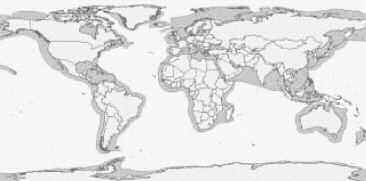
The Global Forum on Oceans, Coasts, and Islands
Clive Wilkinson, Global Coral Reef Monitoring Network
Michael O'Toole, Benguela Current Large Marine Ecosystem
Yihang Jiang, GEF Yellow Sea LME
Programme
Ignatius KV Kauvee, University of Namibia
Ned Cyr, NOAA Fisheries
Qisheng Tang, Yellow Sea Fisheries Research Institute
Robin Mahon, Caribbean Large Marine Ecosystem Project
Rodolfo Serra, Instituto de Fomento Pesquero, Chile
Shannon Dionne, Office of International Affairs, NOAA
Thomas Laughlin, Office of International Affairs, NOAA
Yihang Jiang, Project Manager, Yellow Sea Project (YSLME)
WORKING GROUP ON LARGE MARINE
ECOSYSTEMS
WORKING GROUP LEADERS:
Ken Sherman, NOAA
WORKING GROUP MEMBERS:
Alex Lascaratos, GEF/PDF-B Project Manager
WORKING GROUP ON SMALL ISLAND
DEVELOPING STATES (SIDS) AND
Andrew Cooke, UNEP-GEF Canary Current LME
IMPLEMENTATION OF THE MAURITIUS
Anthony Ribbink, Sustainable Seas Trust
STRATEGY
Antonio Diaz de Leon Corral, Secretaría de Medio Ambiente
y Recursos Naturales
WORKING GROUP LEADERS:
Carl Lundin, IUCN
Chidi Ibe, GCLME
Rolph Payet, Advisor to the President, Seychelles
Dann Sklarew, GEF IW:LEARN
Ambassador Tuiloma Neroni Slade, Former Permanent
David Vousden, Agulhas and Somali Current Large Marine
Representative of Samoa to the United Nations, former
Ecosystems Project
Chair of AOSIS, and former Judge, International Criminal
Court
Gennady Matishov, Murmansk Marine Biological Institute
Hon. Ronny Jumeau, UN Ambassador for Seychelles
Georgy Volovik, UNDP-GEF Black Sea Ecosystem Recovery
Project
Cristelle Pratt, Pacific Islands Applied Geoscience
Commission (SOPAC)
Gotthilf Hempel, Independent Consultant
Tim Adams, Secretariat of the Pacific Community (SPC)
Hector Soldi, Instituto del Mar del Peru
Ambassador Angus Friday, Chairman, Alliance of Small
Hein Rune Skjoldal, Institute of Marine Research, Norway
Island States (AOSIS), Permanent Representative of Grenada
Hyung Tack Huh, Yellow Sea LME and KORDI
to the United Nations
Igor Belkin, University of Rhode Island
LaVerne Walker, Coastal Zone Unit, Ministry of Physical
James Oliver, Marine Programme, IUCN
Development, Environment and Housing, St. Lucia
Jan Thulin, ICES and HELCOM
Garfield Barnwell, Caribbean Community and Common
Janot Mendler de Suarez, GEF IW:LEARN
Market (CARICOM)
Julian Barbiere, UNESCO
Dianne Quarless, UNDESA SIDS Unit
Khulood Tubaishat, Regional Organization for the
Vincent Sweeney, UNEP/Integrating Watershed and Coastal
Conservation of the Environment of Red Sea and Gulf of
Areas Management Project, Caribbean
Aden (PERSGA)
Ambassador Jagdish Koonjul, Mauritius, former Chair,
Marie-Christine Aquarone, NOAA
Alliance of Small Island States (AOSIS)
35
The Global Forum on Oceans, Coasts, and Islands
WORKING GROUP MEMBERS:
Alfred Duda, Global Environment Facility
Fazal Ibrahim Ali, University Consortium of Small Island
States
Christopher Corbin, UNEP Caribbean Environment
Programme, Regional Coordinating Unit
Laleta Davis-Mattis, Jamaica National Heritage Trust
WORKING GROUP ON FISHERIES AND
Annick de Marffy, Independent Consultant, former Director,
AQUACULTURE SUSTAINABILITY AND
UN-DOALOS
GOVERNANCE
Arthur Webb, Pacific Islands Applied Geoscience
Commission (SOPAC)
WORKING GROUP LEADERS:
Rudolf Dorah, Constitutional Reform Congress of Solomon
Rebecca Lent, National Marine Fisheries Service, NOAA
Islands
Chris Tompkins, Independent Consultant, formerly
Arthur Gray, Representative of the Organisation of American
DEFRA, UK
States (OAS) to Haiti
Ali Mohamed, Permanent Secretary, Ministry of State for
John Low, Adviser to the Minister of Marine Resources for
Special Programmes, Kenya
the Cook Islands
Le Thanh Luu, Research Institute for Aquaculture No. 1,
Franklin McDonald, UNEP Caribbean Environment
Vietnam
Programme
David Balton, U.S. Department of State
Marina N'Deye Pereira Silva, Independent Consultant,
Jean-Francois Pulvenis de Seligny, FAO
Portugal (Cape Verde)
Kieran Kelleher, World Bank
Nguyen Hong Thao, FrontierCommittee, Ministry of
Mick O'Toole, Benguela Current Large Marine Ecosystem
Foreign Affairs, Vietnam
Programme
James Hardcastle, TNC Australia
John Connelly and Stetson Tinkham, National Fisheries
Alf Simpson, Independent Consultant, Pacific Islands
Institute, International Coalition of Fishing Organizations
Asterio Takesy, Director, Secretariat for the Pacific Regional
Barbara Hanchard, GEF UNDP Oceanic Fisheries
Environment Programme
Management Project
Cesar Toro, IOCARIBE
Dirk Troost, formerly Coasts and Small Islands, UNESCO
WORKING GROUP MEMBERS:
David VanderZwaag, Dalhousie University, IUCN Specialist
Arthur Bogason, World Forum of Fish Harvesters and Fish
Group on Ocean Law and Governance
Workers, Iceland
Jon Van Dyke, University of Hawaii Law School
Nguyen Chu Hoi, Deputy Administrator, Vietnam
Fathimath Ghina, Intergovernmental Oceanographic
Administration for Seas and Islands, Vietnam
Commission, UNESCO
Anthony Cox, Organisation for Economic Cooperation and
Raj Mohabeer, Indian Ocean Commission
Development (OECD)
Gerald Miles, The Nature Conservancy
Simon Cripps, Chief Executive, Dorset Wildlife Trust, UK
Nelson Andrade, Caribbean Environment Programme, UNEP
Anamarija Frankic, University of Massachusetts Boston
Dominique Benzaken, Pacific Regional Environment
Julius Francis, Western Indian Ocean Marine Science
Programme (SPREP)
Association (WIOMSA)
Mary Seet-Cheng, Ambassador of Singapore to the Republic
Matthew Gianni, Deep Sea Conservation Coalition,
of Panama
The Netherlands
Edna Chia, Permanent Mission of Singapore to the United
Stephen Hall, WorldFish Center (ICLARM)
Nations
Dawn Martin, SeaWeb
Natasha Turnquest, Ministry of Foreign Affairs, Bahamas
Rebecca Metzner, FAO
36


The Global Forum on Oceans, Coasts, and Islands
Magnus Ngoile, Marine and Coastal Environment
WORKING GROUP MEMBERS:
Management Project (MACEMP), Tanzania
Julian Barbiere, IOC, UNESCO
Pietro Parravano, Institute for Fisheries Resources, World
Stefano Belfiore, IOC, UNESCO
Fisheries Forum
Chu Tien Vinh, National Directorate of Aquatic Resource
Daniel Pauly, Fisheries Centre, University of British
Protection and Conservation, MARD, Vietnam
Columbia
Chris Tompkins, Independent Consultant
James R. McGoodwin, Professor of Anthropology, University
of Colorado
Russell Reichelt, CRC Reef Research Centre, Australia
Gorazd Ruseski, Kelly Moore, Steven Purvis and Anne
Nik Sekhran, United Nations Development Programme
Frenette, Department of Fisheries and Oceans, Canada
Nick Davidson, Ramsar Convention
Jorge Chocair Santibañez, Undersecretary of State for
Julius Francis, WIOMSA Secretariat
Fisheries, Chile
Gregor Hodgson, Reef Check
Kenneth Sherman, LME Program
Noah Idechong, Palau Conservation Society
Robin Mahon, University of West Indies
Carl Lundin, IUCN
Sebastian Matthews, International Collective in Support
Arthur Paterson, NOAA IPO
of Fishworkers
Evelia Rivera-Arriaga, EPOMEX, Mexico
Rudolf Dorah, Constitutional Reform Congress,
Nirmal Jivan Shah, Nature Seychelles
Solomon Islands
Marjo Vierros, UNU-IAS
Joe Terry, NOAA
Renee Sauve/Jennifer Mooney, Department of Fisheries
Yihang Jiang, GEF Yellow Sea LME Project
and Oceans, Canada
Juan Luis Suárez de Vivero, Department of Human
Geography, University of Seville
Paul Holthus, Independent Consultant
Peter Redmond, Wal-Mart
WORKING GROUP ON LINKING THE
MANAGEMENT OF FRESHWATER, OCEANS,
AND COASTS
WORKING GROUP LEADERS:
WORKING GROUP ON MARINE BIODIVERSITY
AND NETWORKS OF MARINE PROTECTED
Torkil Jönch-Clausen, DHI Water, Denmark, and Global
AREAS
Water Partnership
Clement Lewsey, NOAA/National Ocean
WORKING GROUP LEADERS:
Service/International Program Office
Jihyun Lee, Convention on Biological Diversity
Antonio Diaz de Leon/Porfirio Alvarez, Ministry of
Sue Wells, Independent Consultant
Environment and Natural Resources, SEMARNAT, Mexico
Dan Laffoley, World Commission on Protected Areas-
Alfred Duda, Global Environment Facility
Marine, IUCN
Andrew Hudson, United Nations Development Programme
Dan Basta, Marine Sanctuaries Program, NOAA
Felix Dodds, Stakeholder Forum for a Sustainable Future
Do Van Khuong, Research Institute of Marine Fisheries
Tom Laughlin, Office of International Affairs, NOAA
James Hardcastle, The Nature Conservancy
WORKING GROUP MEMBERS:
Marea Hatziolos, World Bank
Nicole Glineur, Global Environment Facility
Margarita Astralaga, IUCN-Spain
37
The Global Forum on Oceans, Coasts, and Islands
Isaac Azuz-Adeath, Cetys University, Mexico
WORKING GROUP MEMBERS:
Julian Barbiere, Intergovernmental Oceanographic
Frida Armas-Pfirter, Austral University, Argentina
Commission of UNESCO
Miriam Balgos, Global Forum on Oceans, Coasts, and
Stefano Belfiore, Intergovernmental Oceanographic
Islands
Commission of UNESCO
Awni Behnam, International Ocean Institute
Richard Delaney, Center for Coastal Studies, Provincetown,
Thia-Eng Chua, Partnerships in Environmental
Massachusetts, USA
Management in the Seas of East Asia (PEMSEA)
Niels Ipsen, UNEP Collaborating Centre on Water and the
Biliana Cicin-Sain, Global Forum on Oceans, Coasts, and
Environment, Denmark
Islands
Magnus Johannesson, Secretary-General, Ministry for the
Bruno Corréard, Independent Consultant and Responsible
Environment, Iceland
Fishing Alliance
Elizabeth McLanahan/Jennifer Winston, Office of
John Dolan, Ocean Policy Research Foundation, Japan
International Affairs, NOAA
David Freestone, World Bank
Gonzalo Cid and Jonathan Justi, NOAA/National Ocean
Service/International Program Office
Anne Frenette, Department of Fisheries and Oceans, Canada
Vincent Sweeney, Caribbean Environmental Health Institute
Serge Garcia, formerly with Food and Agriculture
Organization (FAO)
Ivan Zavadsky, Global Environment Facility Danube-Black
Sea Regional Programme
Valentina Germani, UN Division for Ocean Affairs and the
Law of the Sea (UNDOALOS)
Kathryn Mengerink/Jessica Troell, Environmental Law
Institute
Matthew Gianni, Deep Sea Conservation Coalition
Patricia Muñoz, National Polytechnic Institute, Mexico
Kristina Gjerde, The World Conservation Union (IUCN)
Nguyen Ngoc Huan, National Program on Comprehensive
Lyle Glowka, Convention on Biological Diversity (CBD)
Marine Environment and Resource Survey, Vietnam
Vladimir Golitsyn, Professor of International Law Moscow
Steven Olsen, Coastal Resources Center, University of
State University of International Relations (MGIMO-
Rhode Island
University)
Evelia Rivera-Arriaga, Centro Epomex- Universidad
Barbara Hanchard, Pacific Islands Forum Fisheries Agency
Autónoma de Campeche, Mexico
Arlo Hemphill, Great Wilderness
Ken Sherman, NOAA-NMFS
Paul Holthus, formerly with Marine Aquarium Council
Elie Jarmache, Prime Minister's Office, France
Sam Johnston, Institute of Advanced Studies, United
Nations University (UNU-IAS)
Kim Juniper, University of Victoria Lee Kimball, formerly
with The World Conservation Union (IUCN)
WORKING GROUP ON GOVERNANCE OF
Gunnar Kullenberg, Independent Consultant, former
MARINE AREAS BEYOND NATIONAL
Executive Director, International Ocean Institute
JURISDICTION
Jihyun Lee, CBD Secretariat
Rebecca Lent, NOAA Fisheries International Office
WORKING GROUP LEADERS:
Eric Mathur, Synthetic Genomics, Inc.
Salvatore Arico, Programme Specialist for Biodiversity,
Jennifer Mooney, Department of Fisheries and Oceans,
Division of Ecological and Earth Sciences, UNESCO
Canada
Sivu Maqungo, Minister-Counsellor, Permanent Mission of
Akari Nakajima, Ocean Policy Research Foundation, Japan
South Africa to the United Nations
Daniel Owen, Fenners Chambers, United Kingdom
Rosemary Rayfuse, University of New South Wales
John Richardson, European Commission
38
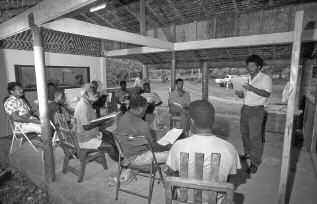
The Global Forum on Oceans, Coasts, and Islands
Lori Ridgeway, Department of Fisheries and Oceans, Canada
Julien Rochette, High Seas Governance, IDDRI
Karen Sack, Greenpeace International
Charlotte Salpin, UN Division for Ocean Affairs and the Law
of the Sea (UNDOALOS)
Renée Sauvé, Department of Fisheries and Oceans, Canada
Tullio Scovazzi, University of Milano-Bicocca
Norma Taylor Roberts, Ministry of Foreign Affairs, Jamaica
WORKING GROUP ON CAPACITY
Hiroshi Terashima, Ocean Policy Research Foundation,
DEVELOPMENT
Japan
WORKING GROUP LEADER:
Chris Tompkins, Department for Environment, Food, and
Rural Affairs, UK
Indumathie Hewawasam, Independent Consultant,
formerly The World Bank
Philippe Vallette, NAUSICAA, France
Monica Verbeek, Seas at Risk
WORKING GROUP MEMBERS:
Marjo Vierros, United Nations University Institute for
Fazal Ibrahim Ali, Universities Consortium Coordinator,
Advanced Studies
University of the West Indies
Margarita Astralaga, IUCN-Spain
Robert Bechtloff, UNEP/GPA
Awni Behnam, International Ocean Institute
Charles A. Buchanan, Administrator Luso-American
Development Foundation, Portugal
WORKING GROUP ON COMPLIANCE AND
Chua Thia-Eng, PEMSEA
ENFORCEMENT
Margaret Davidson, U.S. National Oceanic and Atmospheric
WORKING GROUP LEADERS:
Administration Coastal Services Center
Carl Bruch, Environmental Law Institute (ELI)
Ehrlich Desa, Capacity Building Section, UNESCO
Paul Nemitz, Maritime Policy Task Force, European
Ambassador Luís Fonseca, Comunidade dos Países de
Commission
Lingua Portuguesa (CPLP)
Fuensanta Candela-Castillo, Maritime Policy Task Force,
Anamarija Frankic, University of Massachusetts Boston
European Commission
Julius Francis, Western Indian Ocean Marine Science
Biliana Cicin-Sain, Global Forum on Oceans, Coasts, and
Association, Tanzania
Islands
Guillermo Garcia Montero, Acuario Nacional, Comité
Oceanografico Nacional, Cuba
WORKING GROUP MEMBERS
Ampai Harakunarak, Thailand Environment Institute
Daniela Chitu, Maritime Policy Task Force, European
Alice Hicuburundi, UN DOALOS
Commission
Gunnar Kullenberg, Independent Consultant and former
Kathryn Mengerink, Environmental Law Institute (ELI)
Director, Intergovernmental Oceanographic Commission
(IOC)
Mai Trong Nhuan, Ha Noi National University, Vietnam
Robin Mahon, Caribbean LME Programme
Jan Mees, Flanders Marine Institute, Belgium
Ali Mohamed, Permanent Secretary, Ministry of State for
Special Programmes, Kenya
Magnus Ngoile, Marine and Costal Environment
Management Project, Tanzania
39
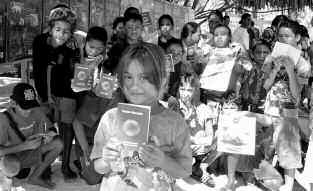
Agenda for 2005-2007 The Global Forum on Oceans, Coasts, and Islands
Program, Brazil
Ignatius KV Kauvee,
University of Namibia
WORKING GROUP ON PUBLIC
EDUCATION/OUTREACH/MEDIA
WORKING GROUP LEADERS:
Michael O'Toole, Benguela Current LME
Philippe Vallette and Manuel Cira, World Ocean Network,
Marina N'Deye, Portugal
NAUSICAA, France
Isabel Noronha, Portugal
Ram Boojh, UNESCO, India
Victoria Radchenko, International Ocean Institute, Ukraine
Peter Neill, World Ocean Observatory
Evelia Rivera-Arriaga, Centro de Ecologia, Pesquerias y
David Helvarg, President, Blue Frontier Campaign (author,
Oceanographia del Golfo de Mexico, (EPOMEX), Mexico
50 Ways to Save the Ocean)
Mario Ruivo, Portuguese Committee for Intergovernmental
Felix Dodds, Stakeholder Forum for a Sustainable Future, UK
Oceanographic Commission (IOC)
Janot-Reine Mendler de Suarez, Global Environment
Dann Sklarew, GEF IW:LEARN
Facility/IW-LEARN
Cesar Toro, IOCARIBE
Lauren Salm, PERSGA, and Working Group Youth
Grant Trebble, African Marine and Coastal Resource Over-
Representative
exploitation Prevention Strategy (AMCROPS), South Africa
WORKING GROUP MEMBERS:
LaVerne Walker, Coastal Zone Unit, St. Lucia
Dixon Waruinge, UNEP Regional Seas
John Nightingale, Vancouver Aquarium
Khulood Tubaishat, Regional Organization for the
Leonard Neyman, Sweden
Conservation of the Environment of the Red Sea and Gulf of
Sylvia Earle, D O E R Marine
Aden (PERSGA)
Matt Gianni, Deep Sea Conservation Coalition
Nedal M. Al Ouran, Al-Balqa Applied University, Jordan,
Ernesto Julio Godelman, Center for Development and
and Advisor to PERSGA
Sustainable Fisheries, Argentina
Ademilson Zamboni, Integrated Coastal Zone Management
Vu Van Trieu and Bui Thi Thu Hien, IUCN Vietnam
Camille Mageau, Department of Fisheries and Oceans,
Canada
Franklin McDonald, UNEP Caribbean
Magnus Ngoile, Marine and Costal Environment
Management Project, Tanzania
Pham Van Ninh, Vietnam Academy of Science and
Technology, Vietnam
Chris Tompkins, Independent Consultant, UK,
formerly DEFRA
Katherine Warner, Country Group Head, Cambodia,
Lao PDR, and Viet Nam, IUCN
Sue Williams, UNESCO Public Affairs
40
Steering Committee, Global Forum on Oceans, Coasts, and Islands
CO-CHAIRS
Jan Mees, Director, Flanders Marine
Tiago Pitta e Cunha, Member,
Matthew Gianni, Political Advisor,
Institute, Belgium
Cabinet of Fisheries and Maritime
Deep Sea Conservation Coalition,
Biliana Cicin-Sain,** Director, Gerard
Commissioner, European Commission
Netherlands
J. Mangone Center for Marine Policy,
Guillermo Garcia Montero, President,
University of Delaware (also Head of
National Aquarium, Havana, Cuba
Mary Power, Director, Resource
Vladimir Golitsyn, Professor of
Secretariat, Global Forum)
Magnus Ngoile,** Team Leader, Marine
Mobilization Office, World
International Law, Moscow State
Meteorological Association
University of International Relations
Patricio A. Bernal,** Executive-
and Coastal Environmental Management
Secretary, Intergovernmental
Project (MACEMP), Ministry of Natural
Cristelle Pratt, Director, South Pacific
Lynne Hale, Director, Marine Strategy,
Oceanographic Commission, UNESCO,
Resources and Tourism
Applied Geoscience Commission
The Nature Conservancy
Paris, France
Rolph Payet, Advisor to the President,
(SOPAC), Fiji
Art Hanson, former Ministerial Ocean
Veerle Vandeweerd,** Director,
Seychelles
Diane Quarless, Chief, Small Island
Ambassador, Department of Fisheries
Environment and Energy Group, United
Lori Ridgeway, Director-General,
Developing States Unit, UNDESA
and Oceans, Canada, member of the
Nations Development Programme
International Coordination and Policy
John Richardson, Head, Maritime
Canadian Foundation for Innovation
(UNDP)
Analysis, Department of Fisheries and
Policy Task Force, European
(CFI)
Oceans, Canada, and Camille Mageau,
Commission
Gregor Hodgson, Director, Reef Check
GOVERNMENTAL
Director, Marine Ecosystems
Anne Rogers, United Nations
Paul Holthus, Executive Director,
Conservation Branch, Department of
David Balton, Deputy Assistant
Department of Economic and Social
World Ocean Council
Fisheries and Oceans, Canada
Secretary for Oceans and Fisheries,
Affairs (UNDESA)
Gunnar Kullenberg, Independent
Bureau of Oceans, U.S. Department
Mario Ruivo, Intersectoral
Eduard Sarukhanian, Director, World-
Consultant and former Executive
of State
Oceanographic Commission, Ministry of
Weather-Watch-Applications, World
Secretary, Intergovernmental
Science, Technology, and Higher
Phil Burgess, Director, Cetacean Policy
Meteorological Organization (WMO),
Oceanographic Commission (IOC)
Education, Portugal
and Recovery, Department of the
Switzerland
Dan Laffoley, World Commission on
Environment and Water Resources,
Indroyono Soesilo and Gabriel
Dann Sklarew, Director and Chief
Protected Areas-Marine, IUCN
Australia
Wagey, Agency for Marine and Fisheries
Technical Advisor, GEF, IW:LEARN
Carl Lundin, Head, IUCN Marine
Research, Department of Marine Affairs
Nguyen Chu Hoi, Deputy
Asterio Takesy, Director, Secretariat for
Programme
and Fisheries, Indonesia
Administrator, Vietnam Administration
the Pacific Regional Environment
Dawn Martin, President, Sea Web, USA
for Seas and Islands, Vietnam
Ambassador Enele S. Sopoaga, Tuvalu,
Programme
Former Vice-Chair, Alliance of Small
Gerald Miles, The Nature Conservancy,
Torkil J. Clausen, Managing Director,
Khulood Tubaishat, Advisor, The
Island Developing States (AOSIS)
Pacific Region, Brisbane, Australia
DHI Water Policy and Senior Adviser,
Regional Organization for the
Iouri Oliounine, Executive Director,
Global Water Partnership
Conservation of the Environment of the
INTERGOVERNMENTAL AND INTERNATIONAL
International Ocean Institute, Malta
Aldo Cosentino, Director-General,
O
Red Sea and Gulf of Aden (PERSGA)
RGANIZATIONS
Pietro Parravano, President, Institute
Directorate for Nature Protection, Sea
Marjo Vierros, Visiting Professor,
for Fisheries Resources, World Fisheries
Protection, Ministry for Environment
Salvatore Arico, Programme Specialist,
Institute of Advanced Studies, United
Forum
and Protection of the Territory, Italy
Ecological Sciences, UNESCO
Nations University, Vancouver
Sian Pullen, Independent Consultant,
Margaret Davidson, Director, Coastal
Julian Barbiere and Stefano Belfiore,
Eugenio Yunis, Chief, Sustainable
New Zealand, and former Head of
Services Center, National Oceanic and
Intergovernmental Oceanographic
Development of Tourism World Tourism
European and Middle East Marine
Atmospheric Administration (NOAA),
Commission, France
Organization
Program, WWF International, UK
USA
Chua Thia-Eng,** Partnership in
A.H. Zakri, Director, Institute of
Victoria Radchenko, Director,
Antonio Diaz de Leon, Director-
Environmental Management for the Seas
Advanced Studies, United Nations
International Ocean Institute, Ukraine
General, Environmental, Regional
of East Asia (PEMSEA),
University, Yokohama
Integration and Sectoral Policy,
IMO/UNDP/GEF, Philippines
Tony Ribbink, Director, Sustainable
Environment and Natural Resources
Anjan Datta, Global Programme for the
NONGOVERNMENTAL (INCLUDING INDUSTRY,
Seas Trust
Ministry (SEMARNAT), Mexico
Protection of the Marine Environment
EDUCATIONAL INSTITUTIONS, AND FOUNDATIONS)
Evelia Rivera-Arriaga, Centro de
Ambassador Angus Friday, Chair,
from Land-Based Activities, The Hague
Ecologia, Pesquerias y Oceanographia
Milton Asmus, International
Alliance of Small Island States (AOSIS),
Ahmed Djoghlaf, Executive Secretary,
del Golfo de Mexico (EPOMEX), Mexico
Representative, Brazilian Agency for
Permanent Representative of Grenada to
Convention on Biological Diversity
Coastal Management
Nirmal Jivan Shah, Chief Executive,
the United Nations
Al Duda, Senior Advisor, International
Nature Seychelles
Awni Behnam, President, International
Gi-Jun Han, Ministry of Maritime
Waters, Global Environment Facility
Ocean Institute, Malta
Alan Simcock, former Executive
Affairs and Fisheries, Republic of Korea
(GEF)
Director, OSPAR, and former Co-Chair,
Charles A. Buchanan, Administrator
Elie Jarmache, Chargé de Mission,
Marea E. Hatziolos, Senior Coastal and
UN Informal Consultative Process on
Luso-American Development
Secrétariat Général de la Mer, France
Marine Specialist, Environment
Ocean Affairs and Law of the Sea
Foundation, Portugal
Magnus Johannesson, Secretary-
Department, The World Bank
Nancy Targett, Dean, University of
Simon Cripps, Chief Executive, Dorset
General, Ministry for the Environment,
Indumathie Hewawasam,**
Delaware College of Marine and Earth
Wildlife Trust, UK
Iceland
Consultant to The World Bank
Studies
Richard Delaney,** Executive Director,
Ambassador Jagdish Koonjul,
Andrew Hudson, Principal Technical
Kristian Teleki, International Coral Reef
Center for Coastal Studies,
Mauritius, former Chair, Alliance of
Advisor, International Waters,
Action Network, Switzerland
Provincetown, Massachusetts, USA
Small Island States (AOSIS)
UNDP/GEF
Hiroshi Terashima, Executive Director,
Annick de Marffy, former Director of
Gerhard Kuska, Associate Director and
David Johnson, Executive Secretary,
Institute for Ocean Policy, Ocean Policy
Division of Ocean Affairs and Law of the
Director of Ocean and Coastal Policy,
OSPAR Convention, London
Research Foundation, Japan
Sea (UNDOALOS), United Nations
White House Council on Environmental
Vladimir Mamaev, GEF Regional
Chris Tompkins, Independent
International Consultant
Quality, USA
Technical Advisor, UNDP, Europe and
Consultant and formerly DEFRA, UK
Sylvia Earle, Chair, Deep Ocean
Tom Laughlin, Deputy Director,
the CIS, Slovak Republic
Grant Trebble, African Marine and
Exploration and Research (DOER), and
International Affairs Office, National
Franklin McDonald, Adviser, UNEP
Coastal Resource Over-exploitation
Explorer-in-Residence, National
Oceanic and Atmospheric
Caribbean Environment Programme
Prevention Strategy (AMCROPS),
Geographic Society
Administration (NOAA), USA
(UNEP/CEP), and former Director,
South Africa
Charles Ehler, Consultant to UNESCO
Haiqing Li, Deputy Director-General,
National Environmental Policy Agency,
Philippe Vallette** and Manuel Cira,
Julius Francis, Executive Secretary,
State Oceanic Administration (SOA),
Jamaica
NAUSICAA, France, and the World
Western Indian Ocean Marine Science
China
Vaclav Mikulka, Director, UN Division
Ocean Network
Association, Tanzania
John Low, Adviser to the Minister of
for Ocean Affairs and the Law of the Sea
David VanderZwaag, IUCN Specialist
Serge Garcia, Independent Consultant,
Marine Resources for the Cook Islands
Ali Mohamed, Permanent Secretary,
Group on Ocean Law and Governance
and Former Director, Marine Fisheries
Rejoice Mabudafhasi, Deputy Minister
Ministry of State for Special
Trust
Resources Division, Food and
of Environmental Affairs and Tourism,
Programmes, Kenya
Agriculture Organization (FAO)
* Please note: Members of the Steering
South Africa
Satya Nandan, Secretary-General,
Committee participate in their individual
capacities.
International Seabed Authority, Jamaica
** International Coastal and Ocean
Organization Board Member
41
Global Forum on Oceans,
Coasts, and Islands
c/o Gerard J. Mangone Center for Marine Policy
301 Robinson Hall, University of Delaware
Newark, Delaware 19716 USA
Telephone: +1-302-831-8086
Fax: +1-302-831-3668
www.globaloceans.org