Submission of the Global Forum on Oceans, Coasts,
and Islands to the UN Ad Hoc Open-Ended Informal
Working Group to study issues relating to the conservation
and sustainable use of marine biological diversity beyond
areas of national jurisdiction
New York, 28 April 2 May 2008
Global Oceans Conference
GOC 2008
This publication provides a summary of:
Principal support for the Global Forum's work on
Other collaborating organizations include: Centro EPOMEX,
Governance of Marine Areas Beyond National Jurisdiction
Mexico; Consejo Consultivo del Agua, Mexico; Global Water
1. Strategic Planning Workshop on Global
comes from the Nippon Foundation, Japan, with contributions
Partnership; IOC Sub-Commission for the Caribbean and
Ocean Issues in Marine Areas Beyond
from the Government of Singapore, Department of Fisheries
Adjacent Regions; Luso-American Development Foundation;
National Jurisdiction in the Context of
and Oceans, Canada, UNESCO, Gerard J. Mangone Center fro
The Nature Conservancy; The World Bank; New Partnership
Marine Policy, University of Delaware, World Ocean Network,
for Africa's Development; Nippon Foundation; Partnerships in
Climate Change, Nice, France, January
NAUSICAA, and the Le Centre de Decouverte du Monde
Environmental Management for the Seas of East Asia;
23-25, 2008
Marin, Nice, France.
Portuguese Committee for IOC; Secretariat of Environment
2. Co-Chairs' Report of the Global Forum on
and Natural Resources, Mexico; Pacific Islands Applied
Principal support for the Global Forum generally comes
Oceans, Coasts, and Islands Working Group
Geoscience Commission; UNESCO; Government of Vietnam;
from the Global Environment Facility (GEF); GEF IW:LEARN;
on Governance of Marine Ecosystems and
International Coastal and Ocean Organization; Flemish
Intergovernmental Oceanographic Commission (IOC),
Uses in Areas Beyond National Jurisdiction
Government of Belgium; Ministry of Land, Transportation and
UNESCO; Gerard J. Mangone Center for Marine Policy,
at the 4th Global Conference on Oceans,
Maritime Affairs, Korea; Ministry of Marine Affairs and
University of Delaware; United Nations Environment
Coasts, and Islands
Fisheries, Indonesia; Lighthouse Foundation; USAID; United
Programme; U.S. National Oceanic and Atmospheric
Nations Development Programme; World Bank; IUCN
3. Highlights of the 4th Global Conference on
Administration; Department of Fisheries and Oceans,
Vietnam; World Ocean Observatory; Ocean Policy Research
Oceans, Coasts, and Islands, Hanoi,
Canada; and World Ocean Network.
Foundation, Japan; and International Ocean Institute.
Vietnam, April 7-11, 2008
Submission of the
Global Forum on Oceans, Coasts, and Islands
to the UN Ad Hoc Open-Ended Informal
Working Group to study issues relating to
the conservation and sustainable use of
marine biological diversity beyond areas
of national jurisdiction
Prepared by
Biliana Cicin-Sain, Sivu Maqungo,
Salvatore Arico, and Miriam Balgos
April 2008
Table of Contents
1.
Foreword ............................................................iii
2. Strategic Planning Workshop on Global Ocean
Issues in Marine Areas Beyond National Jurisdiction
in the Context of Climate Change, Nice, France,
January 23-25, 2008 ............................................1
3. Co-Chairs' Report of the Global Forum on Oceans,
Coasts, and Islands Working Group on Governance
of Marine Ecosystems and Uses in Areas Beyond
National Jurisdiction at the 4th Global Conference
on Oceans, Coasts, and Islands ..........................11
4. Highlights of the 4th Global Conference on Oceans,
Coasts, and Islands, Hanoi, Vietnam, April 7-11,
2008....................................................................17
5. About the Global Forum ......................................19
ii
Foreword
The Global Forum on Oceans, Coasts, and Islands has, since 2005, been engaged in an informal
process to bring together major relevant interests to facilitate open and constructive multi-stake-
holder policy dialogue to inform and support the formal processes that have been or may be
established by the United Nations General Assembly regarding governance of marine areas beyond
national jurisdiction. The general intent is to work to clarify the issues, lay out various perspectives,
discuss options, and identify possible avenues for consensus-building among disparate interests.
This volume brings together the outcomes of several major meetings relevant to the issues under
discussion by the UN Ad Hoc Open-Ended Informal Working Group to study issues relating to the
conservation and sustainable use of marine biological diversity beyond areas of national jurisdiction:
· Co-Chairs' Report from the Strategic Planning Workshop on Global Oceans Issues in
Marine Areas Beyond National Jurisdiction in the Context of Climate Change, held on
January 23-25, 2008, in Nice, France
· Co-Chairs' Report of the Global Forum Working Group on Governance of Marine
Ecosystems and Uses in Areas Beyond National Jurisdiction, reporting on the
discussions held during the 4th Global Conference on Oceans, Coasts, and Islands:
Advancing Ecosystem Management and Integrated Coastal and Ocean Management in
the Context of Climate Change, April 7-11, 2008, Hanoi, Vietnam
· Overview of the 4th Global Conference on Oceans, Coasts, and Islands: Advancing
Ecosystem Management and Integrated Coastal and Ocean Management in the
Context of Climate Change, April 7-11, 2008, Hanoi, Vietnam
Readers are kindly informed that the next Global Forum workshop on these issues, Policy Analyses
and Multistakeholder Policy Dialogues on Governance of Areas Beyond National Jurisdiction:
Management Issues and Policy Options, will be held in late Fall 2008 in Singapore, kindly hosted by
the Ministry of Foreign Affairs, Government of Singapore. This meeting will examine further the
applicable principles, management approaches, capacity building requirements, options for benefit
sharing, and interface with intellectual property rights obligations under international law.
Readers are kindly invited to join in these efforts as well as to provide comments and suggestions
on this work.
Biliana Cicin-Sain (Global Forum), Sivu Maqungo (Permanent Mission of South Africa to the United
Nations), Salvatore Arico (UNESCO), Miriam Balgos (Global Forum)
iii
iv
Report from the
Strategic Planning Workshop on Global Ocean Issues
in Marine Areas Beyond National Jurisdiction in
the Context of Climate Change
Nice, France, January 23-25, 2008
Prepared by Workshop Co-Chairs
Biliana Cicin-Sain,
Global Forum on Oceans, Coasts, and Islands
and
David Freestone, World Bank
1
Overview
Marine areas beyond national jurisdiction--which
include more than 60% of the world's oceans--repre-
sent the last and largest global commons on Earth.
These areas are highly rich in biological diversity which plays a
crucial role in the functioning of marine ecosystems. Scientific
evidence is beginning to demonstrate that loss in biodiversity
could well lead to significant declines in ecosystem function,
and may well threaten the life support systems of the oceans.
The impacts of climate change, such as ocean warming and
ocean acidification, are likely to produce significant adverse
impacts which are not yet fully understood.
more formal processes that have been or may be established by
These areas, just as areas within national jurisdiction, also host
the United Nations General Assembly or other fora regarding
a wide variety of important human activities which provide sig-
such issues. The Workshop brought together 45 experts from
nificant benefits to global, regional, and national economies.
governments (developed and developing countries), NGOs,
Examples include the maritime transportation industry which
international organizations, science, and industry groups (sub-
carries 90% of the world's goods, the submarine cable industry
marine cables, fishing, marine transportation), all participating
which provides for the vital links that sustain communication
in their personal capacity in these informal discussions and fol-
among all peoples on earth, the oil and gas industry which pro-
lowing the Chatham House rule (See Annex 1 for a list of par-
vides essential energy resources, the fishing industry which
ticipants). The Workshop participants considered strategic per-
contributes to food security and is a source of livelihood for 400
spectives for the next 5-10 years; clarified some issues; laid out
million fishers around the world, and the biotechnology indus-
various perspectives; developed options; and identified possible
try which utilizes the oceans' biodiversity for a wide array of
avenues for consensus-building among disparate interests.
important products from cancer drugs to cleaners to beauty
This Report aims to reflect the richness and diversity of views
supplies.
expressed at the Workshop. It is not a consensus document. It
The question of governance in areas beyond national jurisdic-
should be stressed that not all the participants agreed with all
tion (ABNJ) is a major issue which countries will need to
points set out here; nevertheless the Workshop discussions
address over the next decade. While there has been substantial
were most successful in charting some options for advancing
progress in recent years in achieving integrated governance of
this important issue in the next decade.
oceans in areas under national jurisdiction and in regional seas
This was the first of a series of three workshops which the
areas, governance of ABNJ remains largely sectorally-based,
Global Forum will convene in 2008 on this issue. The second
fragmented, and inadequate. This means that it is difficult to
was held during the 4th Global Conference on Oceans, Coasts,
address inter-connected issues (such as the impacts of human
and Islands in Hanoi, Vietnam, April 5, 2008 and the third will
uses on the environment, multiple-use conflicts among users,
be held in Singapore on November 12-14, 2008.
and responses to climate change effects) through an integrated
and ecosystem-based approach. There are, moreover, signifi-
The Workshop was organized by the Global Forum on Oceans,
cant differences of opinion among stakeholders regarding what
Coasts, and Islands; the Gerard J. Mangone Center for Marine
actions need to be taken to improve governance in ABNJ, espe-
Policy at the University of Delaware; NAUSICAA, Centre
cially regarding the question of distribution of benefits from the
National de la Mer, Boulogne-sur-Mer, France; the World
uses of biodiversity in these ocean areas.
Ocean Network; and Le Centre de Decouverte du Monde
Marin, Nice, with principal support from the Nippon
The Global Forum on Oceans, Coasts, and Islands and partners
Foundation, Japan, and with additional funding support by
convened the Strategic Planning Workshop on Global Ocean
Canada's Department of Fisheries and Oceans, and UNESCO.
Issues in Marine Areas Beyond National Jurisdiction in the Context
of Climate Change on January 23-25, 2008, in Nice, France,
Background
with the gracious hosting of Nice officials and nongovernmen-
tal organizations as a key step in an informal process to bring
Since 2001, the Global Forum on Oceans, Coasts, and Islands
together major relevant interests to facilitate open and con-
has brought together ocean leaders from governments, UN
structive multi-stakeholder dialogue to inform and support the
agencies, NGOs, the private sector, and science groups from
2
close to 100 countries to advance the global oceans agenda, par-
disturbances of the oceans from climate change, as well as the
ticularly the implementation of the ocean targets from the
associated feedbacks from climate changes that are expected to
World Summit on Sustainable Development and addressing
exacerbate the forces that are leading to increases in biodiversi-
new challenges such as climate change and governance of
ty loss in the oceans. A Census of Marine Life participant
marine areas beyond national jurisdiction. The Global Forum
emphasized the importance of marine biodiversity for ecosystem
Working Group on Governance of Areas Beyond National
function. Deep-sea ecosystems provide goods (including bio-
Jurisdiction was organized in late 2005 to consider the issues
mass, bioactive molecules, oil, gas, minerals) and services (cli-
related to moving toward integrated ecosystem-based gover-
mate regulation, nutrient regeneration and supply to the photic
nance in areas beyond national jurisdiction, to contribute to the
zone, food); they also have a profound role in global biogeo-
discussions of the 3rd Global Conference on Oceans, Coasts,
chemical and ecological processes that is essential for the sus-
and Islands (held at UNESCO in Paris in January 2006), and to
tainable functioning of the biosphere and for human wellbeing.
provide input into the discussions of the 2006 UN Ad Hoc
The reduction of biodiversity may be associated with exponen-
Open-ended Informal Working Group to Study Issues relating
tial reductions of ecosystem functions: 20-25% species loss can
to the Conservation and Sustainable Use of Marine Biological
cause a reduction of 50-80% of ecosystem functions. The
Diversity beyond Areas of National Jurisdiction (New York,
Census of Marine Life results thus suggest that the conservation
February 2006). Members of the Global Forum Working
of deep-sea biodiversity can be crucial for the sustainability of
Group are noted in Annex 2.
the functions of the largest ecosystem of the biosphere.
Major Points Raised at the
3. Current Situation: Sectoral management of different uses
Nice Workshop
by different global and regional institutions.
Workshop discussants spent most of the time discussing: I. The
Participants reviewed the current management situation of
nature of the issues in marine areas beyond national jurisdic-
marine areas beyond national jurisdiction, noting that a variety
tion; II. The management of various marine activities in areas
of existing uses--such as submarine cables, fisheries, shipping,
beyond national jurisdiction; III. The policy and legal issues
marine scientific research, oil and gas development, and dump-
that are raised; and IV. Issues related to the science/policy inter-
ing of wastes and other matter--are managed separately under
face, climate change effects. The special issues raised by marine
different sectoral regimes by different regional and global insti-
genetic resources were also discussed.
tutions, with few, if any, connections among them, in most
cases. There is also no mechanism for an area-wide environ-
I. The Nature of the Issues in Marine Areas
mental review process of the effects of one use on other uses
beyond National Jurisdiction
and on the environment.
Participants also underlined that the economic and social val-
1. A sense of urgency
ues and perspectives on future problems/opportunities by var-
Participants recognized that there is a need to accelerate the
ious ocean industries have not been well documented and
implementation of ecosystem-based integrated management in
aggregated, and that a study on these questions would be very
areas beyond national jurisdiction. However, they recognized
useful.
as well that the issues are thorny, that there are significant dif-
4. Emerging uses are not yet adequately managed and there
ferences on some of these issues among developed/developing
are important legal/policy gaps.
countries, industry, and environmental NGOs, as well as uncer-
Participants considered emerging uses of areas beyond nation-
tainty. Formal changes to the regime governing areas beyond
al jurisdiction such as: bio-prospecting for marine genetic
national jurisdiction may take time to sort out (for example, the
resources, carbon storage and sequestration; iron fertilization;
Law of the Sea discussions spanned the period 1967 to 1994,
mariculture facilities; floating energy facilities. The view was
with the actual negotiations taking place over a nine year peri-
expressed that, apart from seabed mineral exploration and
od (1973-1982). However, there is much that can and should
be done in the near and medium term.
exploitation (managed by the International Seabed Authority),
there are inadequate management frameworks and environ-
2. Three forcing functions
mental review processes for such uses in ABNJ, and that if
such activities are to go forward, appropriate regulatory policy
Participants identified three forcing functions that catalyze the
and legal frameworks would need to be articulated.
need for improved governance: 1) the effects of uses on marine
biodiversity and the marine environment; 2) effects of uses on
one another (multiple use conflicts); and 3) the effects of the
3
II. The Policy and Legal Issues that are Raised
· Application of a transparent, science-driven approach to
sustainable use of the oceans
5. What is needed in moving toward ecosystem-based
· Precautionary approach
integrated management in areas beyond
· Integrated ecosystem approach
national jurisdiction?
· Integrated management for multiple uses
Participants underscored that there is much experience in how
· Responsibility of States for actions of nationals, e.g.,
to move toward ecosystem-based integrated management at
breaches of international law
national levels and at regional levels and that much can be
learned from examining these experiences. Ecosystem-based
While such principles are well accepted internationally, some
integrated ocean and coastal management is well rooted in
participants considered that it may be useful to review these
international instruments adopted at various fora, starting with
principles and to consider the promotion of a UNGA resolution
Agenda 21 at the 1992 UN Conference on Environment and
to set out these established principles and to confirm their
Development (UNCED) and continuing with the Plan of
applicability to areas beyond national jurisdiction.
Implementation of the 2002 World Summit on Sustainable
In respect to the specific issue of marine genetic resources in
Development (WSSD) and related instruments. At the nation-
ABNJ, however, there were significant different views among
al level, about 40 nations (incorporating about three-quarters of
participants on the principles and institutions that were appli-
the world's Exclusive Economic Zones) have moved toward
cable. These ranged from the application of the principle of
integrated ecosystem-based management by establishing
"common heritage of mankind," to that of "freedom of the
national ocean policies. At the regional trans-boundary level,
seas." Some proposed the designation of marine areas beyond
the application of ecosystem-based and integrated management
national jurisdiction as "areas of common concern."
has taken place, to varying degrees, in the 16 Large Marine
Ecosystems supported by the Global Environment Facility and
There was also discussion about the usefulness of examining
in the 18 Regional Seas Programmes.
modes of benefit sharing which has been developed in other
areas, such as marine scientific research, ocean mining (under
In general, some commonalities in moving toward ecosystem-
the International Seabed Authority), the Convention on
based and integrated management at both national and region-
Biological Diversity, and the collection of material and docu-
al levels are:
mentation of case studies on as wide a range of experiences as
1. Enunciation and application of governing principles
possible, so as to inform future debates on the management of
2. Development of capacity for area-based assessment, plan-
marine genetic resources in ABNJ.
ning, and ultimately decision-making
7. Capacity for area-based assessment, planning, ultimately
3. Development of institutional capacity for addressing
decision-making
interactions among uses and their effects on biodiversity
and the environment
Capacity for area-based assessment and planning in areas
beyond national jurisdiction is, at present, quite limited. There
4. Development of capacity for enforcement
are some informal efforts at assessment, such as the Census of
5. Funding to support the management interventions.
Marine Life. The "Assessment of Assessments" - the preparato-
ry stage of a regular process for global reporting and assessment
6. Principles. There are already well-accepted established
of the state of the marine environment - may ultimately provide
principles of modern ocean governance (rooted in the
adequate area-based information. There is, however, little
Law of the Sea, Agenda 21 and the WSSD POI and other
capacity to assess and respond, in particular, to the effects of cli-
related instruments) which apply to marine areas beyond
mate change.
national jurisdiction. However, there are some important
gaps and differences of opinion in some areas.
8. Institutional capacity for addressing interactions among
Participants noted that there are major international law princi-
uses and their combined/cumulative effects on biodiversity
ples that are well accepted that apply to marine areas beyond
and the environment
national jurisdiction. These would include the following:
This area is especially ill-developed in relation to areas beyond
· Conditional freedom of activity on high seas
national jurisdiction. There is a need to develop more sophis-
· Obligation to protect and preserve the marine
ticated mechanisms for addressing interactions among uses and
environment
their effects on biodiversity and the environment, as well as
their combined and cumulative impacts. Some participants
4
underscored the need for the establishment of a cross-sectoral
10. There is no readily available funding for management of
environmental review process. It was recognized that this is an
marine areas beyond national jurisdiction
issue that is on the agenda for the UN Ad Hoc Working Group.
Participants discussed the fact that there is no readily available
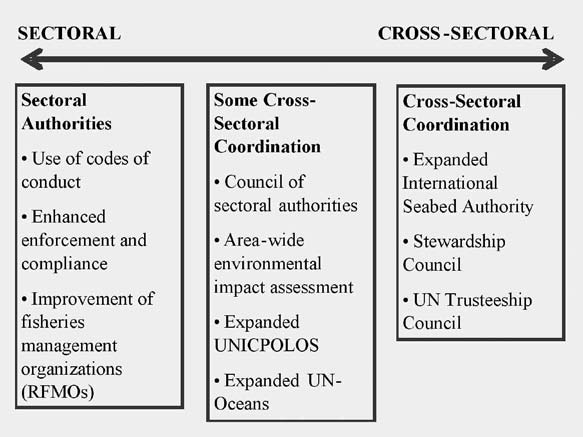
Figure 1 below shows a variety of options that various partici-
funding to support management of marine areas beyond
pants proposed for enhancing cross-sectoral institutional
national jurisdiction. In the future, alternative funding
capacity. The options range from "least action" on the left side
arrangements might be found, for example, by changes to the
of the continuum to "most action" on the right side of the con-
Global Environment Facility to allow for funding of manage-
tinuum. For example, on the "least action" side, the options
ment of these areas of common concern, or the establishment
include the strengthening of existing sectoral authorities and
of special trust funds for these areas.
use of codes of conduct. In the middle of the continuum are
options such as introducing some form of cross-sectoral coor-
11. Options for moving forward to improve the international
dination, for example a regular meeting (or council) of the sec-
legal and policy framework
toral authorities, or area-wide environmental review. Existing
Participants discussed a wide range of possibilities for improv-
institutional frameworks such as UNICPOLOS or UN-Oceans
ing the legal and policy framework to achieve ecosystem-based
might possibly be adapted to play such a role. On the "most
integrated governance of marine areas beyond national jurisdic-
action" end of the continuum, options include, for example,
tion. These are noted below. There was no attempt to evaluate
expansion of the mandate of the International Seabed Authority
the desirability and pros and cons of each option--this ques-
(toward a multiple use mandate), establishment of a
tion awaits further study.
Stewardship Council to govern areas beyond national jurisdic-
tion, and use of the UN Trusteeship Council.
Options
· Enhanced implementation of existing international
Figure 1. Continuum of Institutional Capacity
instruments and their scope of application
· Voluntary codes of conduct
· More effective implementation, strengthening of, or
extending, mandates of existing institutions such as
Regional Fisheries Management Organizations (RFMOs)
and Regional Seas Programmes (RSPs)
· Forming new regional institutions as required
· A new Global Programme of Action on biodiversity in
areas beyond national jurisdiction
· A new implementing agreement to United Nations
Convention on the Law of the Sea (UNCLOS) in relation
to activities in marine areas beyond national jurisdiction;
· An amendment to UNCLOS
· A Protocol to the Convention on Biological Diversity
(CBD)
The major intent of these discussions was to conceptually iden-
· Other possible approaches to be determined
tify the wide range of options available to improve governance
Reservations were raised as to the practicality and/or feasibility
of marine areas beyond national jurisdiction. It should be
of some of these options.
stressed that time did not permit a detailed evaluation of each
or combinations of these options--such evaluation would be
12. Stakeholder involvement
dependent on future studies and analyses.
With various industries and NGOs present, participants had the
opportunity to compare and contrast different modes of stake-
9. Enforcement capacity is limited to single sector uses
holder involvement in different fora (United Nations
Regarding enforcement capacity, there is potential enforcement
Convention on the Law of the Sea, Food and Agriculture
capacity related to single sectors (such as, for example, ship-
Organization, International Maritime Organization).
ping or fishing) but far less or no enforcement capacity related
to area-wide cross-sectoral issues.
5
Participants took the view that there is a need to develop a good
discuss how to improve the integration of their data
process for stakeholder involvement in the process of moving
with ocean science data
forward toward more integrated governance of marine areas
· Together with representatives from the science
beyond national jurisdiction--e.g., in identifying the issues; in
community (e.g., Census of Marine Life), develop a
discussions of the needs and perspectives of various stakehold-
marine policy-science roundtable that could support the
ers; in identifying and assessing options, etc.
institutionalization of continued data collection on areas
beyond national jurisdiction
III. Issues Related to the Science/Policy Interface,
· Ensure that knowledge needs and science-policy
Climate Change Effects, and Special Issues
interface, including access to integrated analysis, are
Raised by Marine Genetic Resources
developed to support any new arrangements for marine
areas beyond national jurisdiction
13. Knowledge Needs and Science/Policy Interface
Participants discussed the fact that the development of an effec-
14. Climate Change Issues
tive framework for the governance of marine areas beyond
Participants discussed climate change issues, focusing especial-
national jurisdiction needs to be based on the best available,
ly on uncertainties surrounding climate change and the appar-
robust, peer-reviewed science and ongoing ocean monitoring
ent lack of preparedness in addressing the policy implications
efforts. The following needs were regarded as particularly
of the effects of ocean changes on climatology and of changes
important:
in the oceans due to climate change, e.g., ocean warming, ocean
· Maintain and strengthen continuous monitoring and
acidification, changes in ocean currents, changes in polar
observation of the oceans
regions, etc. Participants underscored the need for adaptable
· Increase understanding of deep sea ecosystems and
and responsive governance mechanisms and management
biodiversity
measures in place to maintain, or restore, the resilience of ocean
ecosystems to adapt to the impacts of climate change. Major
· Improve effectiveness and coherence of science-policy
points discussed are noted below:
interface
· Address information gaps on the relationship between
· Integrate industry experience into the knowledge base
climate change and the oceans, especially the understand-
· Ensure consideration of robust, sound, peer-reviewed
ing of the impacts of climate change on the oceans
science during the policy-making process
(and vice versa)
Participants discussed some options for moving forward on
· Develop mitigation measures for reducing the impacts of
these issues. These included the following:
climate change on the oceans
· Develop a statement stressing the importance of ongoing
· Increase political awareness of the role of oceans in
and continued scientific research in marine areas beyond
climate change at the global, regional, and national levels
national jurisdiction
and raise the visibility of the concerns
· Develop a statement on the need to internalize the
· Establish an integrated, scientific assessment of the
ecosystem services provided by the oceans to the econo-
potential and cumulative impacts of all human activities
my through, for example, an ecological economics model
impacting the oceans, e.g. fishing, pollution, seabed
· Continue support for the Census of Marine Life, the
mining and impacts of climate change
Assessment of Assessments and similar approaches to
· Generate scientifically-robust and sound information on
data collection, banking and sharing of information
the relationship between climate change and the oceans
· Improve knowledge of deep sea ecosystems, uses,
(and vice versa) for planning and management purposes
threats and impacts
· Maintain and expand open ocean observations, including
· Develop capacity for integrated data and analysis
oceanographic processes and weather observations to cat-
· Carry out a study of socio-economic values of ocean
alogue changes, including occurrences of extreme weath-
industries and contributions to the global economy,
er events related to climate change
and of industry perspectives on future opportunities/-
· Seek UNGA support for a high-level scientific panel to
constraints
develop a Report on the relationship between oceans and
· Include industry knowledge to ensure a whole-system
climate change
approach, e.g. initiate a dialogue with industry, including
· Develop mitigation and adaptation measures to address
fisheries, submarine cables, biotech, and shipping, to
the impacts of climate change on ocean ecosystems,
6
including the biogeochemical cycles
(carbon, oxygen, and nutrients)
· Assess technical feasibility and encourage/conduct
environmental impact analysis of the emerging uses of
the deep ocean: CO2 sequestration, carbon storage, ocean
fertilization, and other mitigation measures
· Trace the distribution and range expansion of organisms
transmitting diseases, invasive species, red tides and other
harmful algal blooms and the potential impact on global
ocean health, human health, and ecosystem services
· Enhance/Increase efforts to maintain or restore the
productivity, biodiversity, and resilience of ocean ecosys-
tems in view of their increasing overall vulnerability to
the impacts of climate change and their importance in
Suggested actions included the following:
providing for ecosystem balance, ecosystem services
A viable subset of total marine genetic resources in marine areas
and food security
beyond national jurisdiction should be surveyed, catalogued,
Participants also outlined possible next steps to address the
mapped, protected and sustainably managed under an effective
climate/oceans issues:
and collaborative governance regime so as to meet development
· Observations should continue, providing the basis for
and environmental needs of present and future generations.
understanding the parameters of climate change and
Some participants underscored the fact that conservation, man-
cause and effect (for example, sea temperature changes,
agement, and sustainable use of living marine resources in areas
current flow patterns, marine food webs, and distribution
beyond national jurisdiction is needed to contribute to the
of plankton, pelagic fish and other pelagic megafauna)
achievement of the Millennium Development Goals.
· Initiate a dialogue to further collaboration and strengthen
partnerships between the oceans community, the IPCC
Participants identified a variety of options for considering the
and the WMO
special issues involved in the management of marine genetic
· Collaborate and coordinate with all fora dealing with
resources, however there was not time for a detailed evaluation
climate change, including UNFCCC and IFC, to ensure
of the practicability and/or feasibility of each:
ocean issues are on the agenda at the 2009 climate
· Identify: a) potential benefits from research and commer-
change negotiations
cialization of marine genetic resources in areas beyond
· Produce and maintain a database on existing and
national jurisdiction; b) options for benefit sharing,
emerging mitigation and adaptation strategies addressing
including learning from case studies on best practices; c)
the impacts of climate change
modalities for promoting equitable use
· Conduct an analysis of implications of climate change
· Promote continued and focused marine scientific research
on global ocean health and ecosystem services
· Identify means of data banking, knowledge management
and sharing: the biotech industry should provide infor-
15. Special Issues Related to Marine Genetic Resources
mation on where the samples of organisms identified to
Participants discussed a possible future vision related to these
be of medicinal, industrial, other value, have been collect-
important ocean resources. It was emphasized that this issue is
ed, for management and conservation purposes
complex involving several different legal frameworks and
· Involve the biotech industry in the planning process
engendering significant debate. It was recognized that there is a
· Facilitate government-to-government discussions, espe-
lack of understanding of the extent, nature, location and vul-
cially between developed and developing nations
nerability of marine genetic resources (MGRs) due to their
· Identify and assess management options, which are
diversity, and that there are complex issues concerned with
potentially applicable in addressing the threats to marine
ABNJ including controversial legal and policy issues. It was
genetic resources, including codes of conduct, permits
noted that there are also accessible MGRs in areas within
and environmental impact assessment, area-based man-
national jurisdiction that are not being fully exploited. There
agement, and ecosystem-based management, for adoption
was recognition that, given the nature of these issues, ongoing
across sectors and regions
debate and dialogue is crucial.
7
Participants
Workshop Co-Chairs:
Biliana Cicin-Sain, Co-Chair and Head of Secretariat, Global
Forum on Oceans, Coasts, and Islands, and University of
Delaware (Project Director)
David Freestone, Senior Adviser, Legal Vice Presidency, World
Bank (also Editor, International Journal of Marine and Coastal
Law)
Facilitators:
Salvatore Arico, UNESCO Ecological Sciences and Global
Forum Expert Working Group on Governance of Marine
· Conduct economic analysis; analysis of comparative
Areas Beyond National Jurisdiction Co-Chair
advantage
Miriam Balgos, Global Forum on Oceans, Coasts, and Islands
· Form partnerships and formal agreements of collabora-
(Project Coordinator)
tion, including MOUs
Marjo Vierros, United Nations UniversityInstitute of
IV. Next Steps in the Global Forum's Work on
Advanced Studies
Improving Governance of Marine Areas Beyond
Rapporteurs:
National Jurisdiction
Caitlin Snyder, Global Forum on Oceans, Coasts, and Islands
Participants discussed and identified the following next steps in
Kateryna Wowk, Global Forum on Oceans, Coasts, and
the Global Forum's informal process to support the formal
Islands
processes that have been established or will be established by
Jordan Diamond, Boalt Hall School of Law, University of
the United Nations to consider the issues of governing marine
California, Berkeley
areas beyond national jurisdiction. Again lack of time prevent-
ed a detailed evaluation of each of these options:
Participants from Governments:
· Provide an overview of the governance issues and options
Lori Ridgeway, Department of Fisheries and Oceans, Canada,
in marine areas beyond national jurisdiction (analyze
and Co-Chair of the UN Open-ended Informal Consultative
costs/benefits of options, and their administrative and
Process on Oceans and the Law of the Sea, Department of
political feasibility)
Fisheries and Oceans, Canada
· Solicit multi-stakeholder perspectives on the issues
Jennifer Mooney, Department of Fisheries and Oceans,
· Provide an overview of the range of modes of benefit
Canada
sharing
Fuensanta Candela Castillo, Acting Head of Unit
· Initiate an ongoing process to facilitate dialogue among
International Policy and Law of the Sea, European
the key stakeholders, including developed and develop-
Commission
ing countries, on the more contentious issues in the gov-
Daniela Chitu, Maritime Affairs Coordinator, European
ernance of marine areas beyond national jurisdiction
Commission
· Act globally to raise awareness about issues of lack of
Mary Seet-Cheng, Ambassador of Singapore to Panama
jurisdiction over one half of the planet's surface in
view of its importance for the future of humankind.
Christian Estrosi, President, Departement des Alpes
Maritimes, and Minister of Overseas Territories, France
Annex 1
Sivu Maqungo, Minister Counsellor, Legal Expert on Oceans
and Law of the Sea, Permanent Mission of South Africa to the
Strategic Planning Workshop on Global Ocean Issues in
United Nations
Marine Areas Beyond National Jurisdiction in the Context
of Climate Change
Jean-Louis Bissuel, Director of Maritime Affairs, Principality
of Monaco
Nice, France, January 23-25, 2008
8
Anne Medecin, Chef de Division, Direction des Affaires
Dong-Sung Kim, Korean Ocean Research and Development
Internationales, Principality of Monaco
Institute, Korea
Patrick Van Klaveren, Ministre Conseiller, Délégué Permanent
Gunnar Kullenberg, Independent Consultant, former Executive
auprès des organismes internationaux à caractère scientifique,
Secretary, Intergovernmental Oceanographic Commission, UNESCO
environnemental et humanitaire, Principality of Monaco
Marjo Vierros, United Nations UniversityInstitute of Advanced
Studies, Yokohama, former Programme Officer for marine biodiver-
Norma Taylor Roberts, Director, International Organizations
sity, Convention on Biological Diversity
Department, Ministry of Foreign Affairs, Jamaica, Former
Coordinator for G-77
Miriam Balgos, Global Forum and University of Delaware (Project
Coordinator)
Porfirio Alvarez-Torres, Director for Regional Integration,
Annick de Marffy, International consultant and former Director,
Ministry of Environment and Natural Resources, SEMARNAT
UNDOALOS
Participants from Intergovernmental
Philippe Vallette, World Ocean Network and NAUSICAA, France
Organizations
Matt Gianni, Deep Sea Conservation Coalition
Vladimir Golitsyn, Professor, Moscow State University of
Gabriele Goettsche-Wanli, Principal Ocean Affairs and the Law of
International Relations, former Director, UN Division for Ocean
the Sea Officer, UN Division for Ocean Affairs and the Law of the
Affairs and the Law of the Sea
Sea
Roberto Danovaro, Census of Marine Life, Italy
Jean-François Pulvenis de Séligny-Maurel, Director, Fisheries and
Aquaculture Economics and Policy Division, Food and Agriculture
Alain Piquemal, Director of the Law of the Sea and Marine
Organization
Activities Centre (CERDAME), University of Nice
David Freestone, Senior Adviser, Legal Vice Presidency, World Bank
Participants from Foundations
(also Editor, International Journal of Marine and Coastal Law)
Patricio Bernal, Executive Secretary, Intergovernmental
Jens Ambsdorf, Lighthouse Foundation, Germany
Oceanographic Commission, UNESCO
Philippe Mondielli, Scientific Director, Fondation Prince
Salvatore Arico, Programme Specialist, UNESCO Ecological
Albert II De Monaco
Sciences (Global Forum Expert Working Group Co-Chair)
Jihyun Lee, Environmental Affairs Officer for Marine and Coastal
Annex 2
Biodiversity, Secretariat of the Convention on Biological Diversity
Francois Bailet, UN Division of Ocean Affairs and Law of the Sea
Members Global Forum Expert Working Group
on Governance of Marine Areas Beyond National
Participants from Industry
Jurisdiction
Stetson Tinkham, International Coalition of Fishing Organizations
Erik Ranheim, Manager, Research and Project Section, INTER-
Co-Chairs
TANKO
Salvatore Arico, Programme Specialist for Biodiversity,
Mick Green, Chairman, International Cable Protection Committee
Division of Ecological and Earth Sciences, UNESCO
(ICPC)
Sivu Maqungo, Minister-Counsellor, Permanent Mission of
Douglas R. Burnett, International Cable Law Advisor, International
South Africa to the United Nations
Cable Protection Committee (ICPC)
Working Group Members
Participants from Academia/NGOs
Frida Armas-Pfirter, Austral University, Argentina
Biliana Cicin-Sain, Global Forum on Oceans, Coasts, and Islands,
and Director, Gerard J. Mangone Center for Marine Policy,
Miriam Balgos, Global Forum on Oceans, Coasts, and Islands
University of Delaware (Project Director)
Awni Behnam, International Ocean Institute
Richard Chemla, Le Centre de Decouverte du Monde Marin, Nice
Thia-Eng Chua, Partnerships in Environmental Management
Kristina Gjerde, High Seas Policy Advisor, IUCN
in the Seas of East Asia (PEMSEA)
Lucien Chabason, Institute for Sustainable Development and
Biliana Cicin-Sain, Global Forum on Oceans, Coasts,
International Relations (IDDRI), Paris
and Islands
9
Bruno Corréard, Independent Consultant and Responsible
Tullio Scovazzi, University of Milano-Bicocca
Fishing Alliance
Norma Taylor Roberts, Ministry of Foreign Affairs, Jamaica
John Dolan, Ocean Policy Research Foundation, Japan
Hiroshi Terashima, Ocean Policy Research Foundation, Japan
David Freestone, World Bank
Chris Tompkins, Department for Environment, Food, and
Anne Frenette, Department of Fisheries and Oceans, Canada
Rural Affairs, UK
Serge Garcia, formerly with Food and Agriculture
Philippe Vallette, NAUSICAA, France
Organization (FAO)
Monica Verbeek, Seas at Risk
Valentina Germani, UN Division for Ocean Affairs and the
Marjo Vierros, United Nations University Institute for
Law of the Sea (UNDOALOS)
Advanced Studies
Matthew Gianni, Deep Sea Conservation Coalition
Kristina Gjerde, The World Conservation Union (IUCN)
Annex 3
Lyle Glowka, Convention on Biological Diversity (CBD)
Vladimir Golitsyn, Professor of International Law Moscow
Strategic Planning Workshop on Global Ocean
State University of International Relations (MGIMO-
Issues in Marine Areas Beyond National
University)
Jurisdiction in the Context of Climate Change
Barbara Hanchard, Pacific Islands Forum Fisheries Agency
Nice, France, January 23-25, 2008
Arlo Hemphill, Great Wilderness
Key Sources of Information
Paul Holthus, formerly with Marine Aquarium Council
Workshop Program and Participants:
Elie Jarmache, Prime Minister's Office, France
http://www.globaloceans.org/highseas/pdf/NiceWorkshopProgr
Sam Johnston, Institute of Advanced Studies, United Nations
am-ListOfParticipants.pdf
University (UNU-IAS)
Kim Juniper, University of Victoria
Workshop Briefing Volume on Key Information Sources:
http://www.globaloceans.org/highseas/pdf/NiceWorkshopBriefi
Lee Kimball, formerly with The World Conservation Union
ngVolume.pdf
(IUCN)
Gunnar Kullenberg, Independent Consultant, former
Executive Director, International Ocean Institute
Jihyun Lee, CBD Secretariat
Rebecca Lent, NOAA Fisheries International Office
Eric Mathur, Synthetic Genomics, Inc.
Jennifer Mooney, Department of Fisheries and Oceans,
Canada
Akari Nakajima, Ocean Policy Research Foundation, Japan
Daniel Owen, Fenners Chambers, United Kingdom
Rosemary Rayfuse, University of New South Wales
John Richardson, European Commission
Lori Ridgeway, Department of Fisheries and Oceans, Canada
Julien Rochette, High Seas Governance, IDDRI
Karen Sack, Greenpeace International
Charlotte Salpin, UN Division for Ocean Affairs and the Law
of the Sea (UNDOALOS)
Renée Sauvé, Department of Fisheries and Oceans, Canada
10
CO-CHAIRS' REPORT OF THE
GLOBAL FORUM ON OCEANS, COASTS, AND ISLANDS
Working Group on
Governance of Marine Ecosystems and
Uses in Areas Beyond the Lmits of
National Jurisdiction
at the 4th Global Conference
on Oceans, Coasts, and Islands
April 7-11, 2008, Hanoi, Vietnam
Salvatore Arico, UNESCO,
and Sivu Maqungo, Permanent Mission of
South Africa to the United Nations
11
I. Background and Objectives
The Working Group, in conformity with the spirit of the Global
Forum, is not a negotiating setting but rather an informal
The Global Forum on Oceans, Coasts, and Islands Working
forum, at which scholars, expert practitioners and actors from
Group on Governance of Marine Ecosystems and Uses in Areas
various sectors of society gather in order to exchange informa-
Beyond the Limits of National Jurisdiction had the opportunity
tion, views and collectively make progress towards the identifi-
to meet throughout the 4th Global Conference on Oceans,
cation of possible approaches and solutions to solving problems
Coasts, and Islands.
and tackling issues of common interest.
Pre-conference meetings were held with the members of the
The Working Group on Governance of Marine Ecosystems and
Working Group in the form of two conference calls in
Uses in Areas Beyond the Limits of National Jurisdiction gath-
December 2007 and March 2008. A Strategic Planning
ered at the 4th Global Conference on Oceans, Coasts, and
Workshop on Global Oceans Issues in Marine Areas Beyond
Islands with the goal to assist with the process of collecting rel-
National Jurisdiction in the Context of Climate Change took
evant information that may provide a valuable contribution to
place in Nice, France in January 2008 under the co-sponsorship
the second meeting of the United Nations General Assembly Ad
of the Global Forum and the Nippon Foundation. A pre-
Hoc Open-ended Informal Working Group to study issues relat-
Conference workshop was organized on April 5, followed by
ing to the conservation and sustainable use of marine biologi-
another pre-Conference session on April 6. During the
cal diversity beyond areas of national jurisdiction (New York,
Conference, a Concurrent Discussion Session was held on April
28 April 2 May 2008).
9 and a Plenary Panel on Thursday 10.
More specifically, the objectives of the work of the Working
The Working Group consists of fifty plus members. Many of
Group at the Hanoi Conference were:
these participated actively in the Working Group both prior to
· to hold focused discussions on a continuum of coherent
and at the Hanoi Conference. Moreover, the Working Group
policy options from sectoral solutions to cross-sectoral
benefited from inputs from many non-members of the Working
global solutions; and
Group at the Nice Workshop and during the Hanoi Conference.
· to discuss next steps needed for developing and applying
In Hanoi, the Working Group benefited from a number of
a set of evaluative criteria to examine each option in the
expert presentations, spanning from governance-related issues
continuum (e.g. to what extent would the conservation
to the contribution of oceans to the life-support system, includ-
and sustainable use goals be achieved, responses to cli-
ing climate change issues, information on access and benefit-
mate change be effective, ocean uses be allowed, the insti-
sharing, the application of the ecosystem approach, issues relat-
tutional and administrative feasibility of individual meas-
ed to flag states, and marine genetic resources. Moreover, par-
ures, their political feasibility, etc.).
ticipants in the various Working Group sessions were encour-
aged to present information and views beyond the official pre-
The Working Group focused its work on the main theme of the
sentations at Hanoi, and indeed a number of individuals pre-
4th Global Conference on Oceans, Coasts, and Islands, namely
sented information and views that greatly contributed to and
"Advancing Ecosystem Management and Integrated Coastal
informed the discussions by the Working Group.
and Ocean Management in the Context of Climate Change."
We trust that the process of participating in the presentations,
This document provides a summary of the Co-chairs under-
discussions, and deliberations of the Working Group was both
standing of the various information and views exchanged and
participatory and representative of the aspirations and views of
of the outcomes of the work by members and non-members of
all individuals involved. Because of the Working Group's open-
the Working Group on issues related to marine areas beyond
ended and multistakeholder nature, we believe that its views
national jurisdiction, in preparation for the second meeting of
reflect the palette of issues and perspectives related to gover-
the United Nations General Assembly Ad Hoc Open-ended
nance of marine ecosystems and uses in areas beyond the lim-
Informal Working Group to study issues relating to the conser-
its of national jurisdiction currently being discussed at the
vation and sustainable use of marine biological diversity
international level.
beyond areas of national jurisdiction.
The Working Group discussions were characterized by a sense
II. Summary of Main Outcomes of the
of urgency as well as by the realization that these issues are
Working Group's Activities
complex, often interrelated and cannot therefore be tackled in
a simplistic manner. It is therefore important to be realistic and
In order to facilitate their possible consideration by the United
build on solutions that can work for each of these issues, while
Nations General Assembly Ad Hoc Open-ended Informal
also maintaining a holistic and long-term perspective.
Working Group to study issues relating to the conservation and
12
chemical conditions and changes in biodiversity and ecosystem
structure and functioning. Moreover, there are further possible
irreversible changes resulting in a new climate equilibrium,
namely those affecting ocean circulation such as in the case of
the North Atlantic circulation and in the case of El Niño events.
These altered conditions directly impact on biodiversity, nega-
tively affect fishing productivity, impact on the hydrological
cycle, water availability, food productivity, energy security and
health. There is uncertainty as to the impact of new uses of the
oceans such as carbon sequestration and ocean fertilization and
how they may affect the ocean equilibrium and its resilience as
a system and therefore its vulnerability. Marine areas beyond
national jurisdiction contribute carbon regulation and other
important services, the values of which should be taken into
account when making decisions related to these areas.
sustainable use of marine biological diversity beyond areas of
national jurisdiction at its second meeting, the summary of the
Solutions: There are ways for addressing the human impacts
main outcomes of our work is structured consistently with the
on oceans, including in marine areas beyond national jurisdic-
agenda of the United Nations General Assembly Ad Hoc Open-
tion. Scientific research and ensuing increased knowledge is a
ended Informal Working Group. For clarity of presentation, the
key approach to addressing the sense of urgency surrounding
outcomes of the Working Group discussions are organized
the combined impacts of existing traditional with new ocean
according to statements, their underlying rationale and solutions.
uses by humans. International scientific cooperation and sys-
tematic observations and forecasting on the role of the oceans
a) The environmental impacts of anthropogenic activities on
in mitigating climate change and in assessing the impacts of cli-
marine biological diversity beyond areas of national jurisdic-
mate change and other manifestations of global change on the
tion
oceans and their biodiversity will remain key tools for organiz-
ing international action aimed at increasing our knowledge of
Statement: There is a need for urgency to achieve effective
human impacts in marine areas beyond national jurisdiction,
ocean management within and across areas beyond national
due to the remoteness, vastness and the technological and
jurisdiction, as well as in areas within national jurisdiction and
financial difficulties related to the exploration of these areas.
continuously throughout the two, in view of strong evidence of
Examples of regional bodies dealing with integrated science
threats to our life-supporting system and security due to extra
(ecosystem, biodiversity and climate science) are the
vulnerabilities of ecosystems caused by climate change and the
International Council for the Exploration of the Sea (ICES) and
spillovers into broader ecosystem functions from current uses
the North Pacific Marine Science Organization (PICES), and
of resources in these areas. In this context, there is a need to
these should be replicated. Moreover, there is a need to trans-
ensure mechanisms to cooperate for generating the knowledge
late relevant scientific knowledge into language that is accessi-
needed for adequate management of marine areas beyond
ble by those who are required to make informed decisions and,
national jurisdiction.
more generally, for information-based decision-making. In
Rationale: Recent scientific findings demonstrating this sense
turn, scientists must also take into account policy demands and
of urgency include work by the Intergovernmental Panel on
requirements. There is a need to capitalize upon the beneficial
Climate Change (IPCC) on the risks posed by climate change
contribution of scientific assessments to policy-making in rela-
in terms of disrupting the structure and functionality of ocean
tion to marine areas beyond national jurisdiction. Such inte-
systems. Moreover, there is evidence that the combined impacts
grated scientific assessments would encompass both natural
of climate change, pollution, overexploitation of living
and social sciences and should be linked with policy frame-
resources, destructive fishing practices, introduction of alien
works and processes, for example through the model of an
species and harmful effects of the exploration and exploitation
intergovernmental panel. The `Assessment of Assessments', the
of non-living resources imply that the major ocean systems are
preparatory stage of which aims towards the establishment of a
affected by environmental impacts arising from traditional uses
regular process for global reporting and assessment of the state
of the oceans. These impacts manifest themselves, inter alia,
of the marine environment, including socio-economic aspects,
through changes in sea-surface temperatures due to heat-ener-
is scheduled for completion in 2009, and the results of which
gy increase, increased frequency and intensity of extreme
will be presented to the to the United Nations General
weather patterns, eutrophication due to the alteration of geo-
Assembly. These results will provide the basis on which the
13
memoranda of understanding to achieve better institutional
cooperation when the respective responsibilities they have been
mandated to carry out are closely related. In this context, there
is value in continuing to rely on agencies whose mandates are
specific to a given sector or issue or set of issues. UN-Oceans
could be requested to play a more enhanced and effective role
in promoting such coherence with regard to the activities of the
UN system relating to marine areas beyond national jurisdic-
tion. It would be useful for UN-Oceans to undertake and main-
tain a comprehensive inventory of programmes and activities
carried out by individual agencies, for example, an inventory of
international science programmes related to marine areas
beyond national jurisdiction. These inventories of activities
should be made widely accessible so as to ensure a clearer
General Assembly will decide on the next steps towards the
overview of current efforts being undertaken in relation to
establishment of a regular process and will also assess the feasi-
issues related to marine areas beyond national jurisdiction.
bility of an intergovernmental panel for the oceans.
While there is a need to ensure an institutional continuum,
there also is a need to develop a platform for coordinating
b) Coordination and cooperation among States as well as rel-
action at an operational level, at different scales. A concrete step
evant intergovernmental organizations and bodies for the
in this direction could be to develop a Global Programme of
conservation and management of marine biological diversity
Action for marine areas beyond national jurisdiction. The pro-
beyond areas of national jurisdiction
posed Global Programme of Action would put in place the
Statement: There is a need for coordination and cooperation
global policy framework and include actions at the global and
nationally, regionally and globally, both at the intergovernmen-
regional levels and would also address the relationship between
tal as well as the governmental levels, in order to achieve inte-
activities taking place within Exclusive Economic Zones with
grated outcomes, if marine areas beyond national jurisdiction
those beyond areas of national jurisdiction. The proposed
are to be managed sustainably for the benefit of current and
Global Programme of Action would assist in the implementa-
future generations of the international community.
tion stage of the United Nations Convention on the Law of the
Sea (UNCLOS) and other related instruments and act as a cat-
Rationale: Efforts towards international coordination of
alyst to spur actions in various directions and at various levels,
actions undertaken by individual governments through inter-
while ensuring visibility of issues related to marine areas
governmental organizations should be optimized and expand-
beyond national jurisdiction and transparency and also provid-
ed. Equally, institutional coordination should be ensured at the
ing a basis for reviewing progress. The Global Programme of
national level. There are precedents of effective cooperation
Action should be anchored to an existing institution, namely
both at the regional and global levels, but there is a need to
the United Nations General Assembly, and could rely, as appro-
build on these. Moreover, the issue of coordination also con-
priate, on regional operational or study units such as the Large
cerns the scientific community, in that it is important that the
Marine Ecosystems.
latter continues organizing and coordinating its activities so as
to continue developing the knowledge needed for making deci-
c) The role of area-based management tools
sions on the sustainable management of marine areas beyond
Statement: There is a need to adopt management measures to
national jurisdiction.
the specific nature, needs and opportunities presented by given
Solution: Governments should pursue efforts aimed at ensur-
ocean spaces in given time frames, through a holistic approach.
ing better institutional coherence at the national level. At the
Area-based management measures are important tools for
regional and global levels, progress towards cooperation and
implementing the ecosystem approach in marine areas beyond
better institutional coherence has been made through mecha-
national jurisdiction, for the mutual benefits of all concerned
nisms such as UN-Oceans, which was set-up with the objective
stakeholders.
to ensure better cooperation between the secretariats of the
Rationale: The problems of the oceans tend to be interlinked
member agencies and, therefore, assist in improving institu-
and should be considered as a whole. Area-based management,
tional coherence and effectiveness. There is a need for these
which integrates sectoral approaches, can be used as an opera-
mechanisms to perform more effectively. To this end, intergov-
tional framework for achieving a balance between conservation
ernmental organizations should be encouraged to enter into
14
Hoc Open-ended Informal Working Group to study, inter alia,
issues relating to the conservation and sustainable use of
marine biological diversity beyond areas of national jurisdiction
that are intended to facilitate the exchange of information and
the provision of advice and recommendations to the General
Assembly. In particular, the United Nations General Assembly
Ad Hoc Open-ended Informal Working Group should be insti-
tutionalized as a regular mechanism that provides the forum to
pursue discussions and make recommendations on issues relat-
ed to marine biodiversity in areas beyond national jurisdiction,
including the equitable and efficient utilization as well as the
conservation of on marine genetic resources. Access and bene-
fit-sharing, as well as capacity-building, should also be an
important element of these discussions, and appropriate mod-
els of trusts that would operate on the basis of users' rights
and sustainable use of marine areas beyond national jurisdic-
should be identified.
tion. Area-based management measures are part of a system of
management measures and tools that implicate underlying
e) Whether there is a governance or regulatory gap and, if
advice, conservation approaches, collaboration and coopera-
so, how it should be addressed
tion, and monitoring and evaluation. Area-based management
approaches should also be used to link marine areas beyond
Statement: UNCLOS provides the legal framework for address-
national jurisdiction with areas within national jurisdiction.
ing any possible governance, regulatory or implementation gap
related to marine areas beyond national jurisdiction. In this
Solution: There is a sense of urgency for moving towards area-
context, there is a need to ensure a package of measures aimed
based management in marine areas beyond national jurisdic-
at implementing integration, while also promoting sectoral
tion, and there are a number of possible tools and approaches
approaches, in relation to marine areas beyond national juris-
that could be used already. To meet this urgency, there is a need
diction. These measures should be seen as distributed along a
to encourage ongoing scientific work in this area at the interna-
continuum, each involving a greater level of formality/degree of
tional level, including ecologically and biologically significant
institutionalization.
areas, biogeographic information, mapping and modeling, envi-
ronmental impact assessments and appropriate planning
Rationale: Efforts towards integration of sectoral approaches and
approaches and tools.
actions undertaken by individual governments have been hap-
pening for a long while and should be further capitalized upon.
d) Genetic resources beyond areas of national jurisdiction
Integration between sectoral policies should be based on strong
foundations, namely clear sectoral policies and responsibilities,
Statement: Marine genetic resources are currently the subject
by which each sector operating in marine areas beyond national
of discussions in relation to access and the potential for their
jurisdiction would take into account their respective impacts on
applications such as pharmaceuticals and industrial processes,
other sectors. The geographic dimension of integration is also an
as well as with regard to the sharing of the benefits arising from
important element to be considered, due to the diversity of situ-
their utilization. Their legal status is also being discussed.
ations within a given region and between regions. An ecosystem
These discussions should continue in an appropriate forum.
approach to marine areas beyond national jurisdiction should
Rationale: Various dimensions of the issue of marine genetic
ultimately be pursued, which would encourage trade-offs
resources in areas beyond national jurisdiction (scientific, tech-
between sectors and the achievement of common objectives.
nical, technological, economic, socio-economic, environmental,
Such common objectives would be: strengthening the sustain-
policy and legal) still need to be further informed and debated
ability and viability of sectors operating in marine areas beyond
in an open and transparent manner, in order to consider all rel-
national jurisdiction; maintaining the ecological integrity neces-
evant views and options available to address this emerging issue.
sary to ensure proper ecosystem functioning; and maximizing
opportunities for synergies among sectors.
Solution: It is important to retain and make better use of exist-
ing institutions such as the United Nations Informal
Solutions: In this context, appropriate regulatory measures are
Consultative Process on Oceans and the Law of the Sea
seen as necessary so as to provide a clear framework for guid-
(UNICPOLOS) and the United Nations General Assembly Ad
ing the operations of the various stakeholders involved, pro-
moting the exchange of information, encouraging cooperation,
15
ensuring public transparency and adapting such operations on
face and water column. Governance gaps are complemented by
the basis of their impacts and the results achieved. Such regula-
gaps in implementation. In this regard, there are opportunities
tory measures would apply both within and across sectors.
for action now, based on existing legal frameworks, namely the
With regard to sectoral measures, each sector operating in areas
UNCLOS, for which implementing measures should be identi-
beyond national jurisdiction should be subject to: an assess-
fied so as to fill implementation gaps related to marine areas
ment of whether or not sectoral obligations are clearly identi-
beyond national jurisdiction. There may be governance or reg-
fied; whether an assessment of the activities of that given sec-
ulatory and implementation gaps in relation to marine genetic
tor, including an environmental impact assessment, has been
resources as well; a fast-track approach in dealing with this
conducted and the related effects on the marine environment
issue may be to assess how existing instruments could be used
are regularly monitored (whether these activities have impacts,
to deal with these resources, while the identification of long-
if they are optimized and how they could be adapted with
term implementing measures may also be needed.
regard to activities by other sectors); an assessment of that
given sector's compliance with the obligations to which it is
III. Next Steps
subject; and how to improve access to available knowledge and
It is our intention to bring this Co-chairs report to the attention
promote capacity-building within that particular sector. There
of Member States participating in the second meeting of the
is no shortage of obligations with regard to the proper imple-
United Nations General Assembly Ad Hoc Open-ended
mentation of flag state responsibilities, but tools available for
Informal Working Group to study issues relating to the conser-
assessing the implementation of flag state responsibilities with
vation and sustainable use of marine biological diversity
regard to specific sectors are unevenly available. For example,
beyond areas of national jurisdiction (New York, 28 April 2
in the case of commercial shipping some tools are available,
May 2008). The Co-chairs shall ensure the dissemination of
while in the case of the fishery sector tools for assessing com-
this report so that States can use it as they see fit to address
pliance with international obligations are generally lacking. In
issues related to marine areas beyond national jurisdiction.
turn, sectoral policies can and should be further harmonized
through appropriate approaches such as the ecosystem
Salvatore Arico and Sivu Maqungo
approach, integrated ocean management and tools such as area-
based management. This can be achieved through reforming
Working Group Co-Chairs
sectoral management, especially in relation to ecosystems, as a
foundation to cooperate on ecosystem-based management
approaches. Moreover, institutional cooperation would need to
be guaranteed, both at the national level as well as in terms of
the operations of the various intergovernmental agencies
involved with issues related to marine areas beyond national
jurisdiction, so as to achieve a better integration of sectoral
policies. Cooperation and coordination in the actions pursued
at the level of individual regions should also be pursued. There
is a need for capacity-building, both sectorally as well as in rela-
tion to cross-sectoral integration. Other important elements
that cut across the hereby proposed nested approach to ensur-
ing integration are integrated assessments and science, and
education and public awareness. Capacity-building, integrated
assessments and science, and education and public awareness
are essential to ensuring a continuum of appropriate policy
measures for regulating both sectoral and cross-sectoral solu-
tions to dealing with issues related to marine areas beyond
national jurisdiction. Initial regulatory measures for marine
areas beyond national jurisdiction could be based on relevant
existing legal and policy instruments. Indeed, there are a num-
ber of existing principles derived from current international law
that can be considered for governing of marine areas beyond
national jurisdiction. These include the principles that apply to
the seabed, the ocean floor and its sub-soil and to the water sur-
16
Conference Overview
4th Global Conference on Oceans, Coasts, and Islands:
Advancing Ecosystem Management and Integrated Coastal and
Ocean Management in the Context of Climate Change
April 7-11, 2008, Hanoi, Vietnam
Biliana Cicin-Sain and Miriam Balgos
17
Conference Overview
An extensive preparatory process involving twelve multination-
al Working Groups (involving 254 ocean experts from 68 coun-
4th Global Conference on Oceans, Coasts, and Islands:
tries representing all sectors and regions of the world) was
Advancing Ecosystem Management and Integrated Coastal
mobilized to prepare analyses and specific policy recommenda-
and Ocean Management in the Context of Climate Change,
tions to the 4th Global Conference in Hanoi, Vietnam, April 7-
April 7-11, 2008, Hanoi, Vietnam
11, 2008. The Policy Briefs prepared by each Working Group
are available on the YouTube Channel noted below.
The 4th Global Conference on Oceans, Coasts, and Islands
brought together 436 ocean and coastal leaders from 71 coun-
Coverage of the Global Conference is available at the following
tries, representing all sectors, including governments, intergov-
sites:
ernmental and international organizations, non-governmental
· The Global Forum, the World Ocean Network and the
organizations, the business community, ocean donors, and sci-
World Ocean Observatory have created a special
entific institutions. The conference assessed essential issues in
GOC2008 website and YouTube channel designed specifi-
the governance of the world's oceans, with a focus on moving
cally to inform audiences across the world about the con-
toward an ecosystem-based and integrated approach to oceans
text and work of the Global Forum using rich media.
governance at national, regional, and global levels. For the first
GOC2008 Website:
time, a concerted effort was made to bring oceans policy togeth-
http://www.thew2o.net/goc2008/index.html
er with climate change, which, as indicated in the 2007 report
of the Intergovernmental Panel on Climate Change will have
GOC2008 YouTube Channel:
profound effects on ecosystems and coastal populations around
http://www.youtube.com/globaloceans2008
the world, especially among the poorest people on Earth and in
These sites enable viewers to:
small island developing States.
· Explore the proceedings of the Conference and each
The conference focused especially on assessing the progress
major ocean issue being addressed
that has been achieved (or lack thereof) on the global oceans
· View the reports, recommendations, and Policy Briefs of
targets established by the world's political leaders at the 2002
the Global Forum's 12 Working Groups, which have
World Summit on Sustainable Development: Achieving ecosys-
been mobilized to provide recommendations on priority
tem-based and integrated ocean and coastal management by
next steps that the international community should
2010, reducing marine biodiversity loss by 2010, establishing
take on major ocean issues
networks of marine protected areas by 2012, and restoring fish-
· Watch ocean and coastal experts from various sectors
ery stocks by 2015, among others.
around the globe in brief interviews addressing major
The conference underlined that ocean and coastal managers are
ocean topics and issues.
at the front line of climate changes. The climate issues that
· The International Institute for Sustainable Development
ocean and coastal leaders around the world will need to face
Reporting Services (IISDRS) provided daily coverage of
will ineradicably change the nature of ocean and coastal man-
Conference proceedings. As the publisher of the Earth
agement, introducing increased uncertainty, the need to incor-
Negotiations Bulletin, IISDRS is recognized for its issue
porate climate change planning into all existing management
expertise in the field of international environment and
processes, the need to develop and apply new tools related to
sustainable development policy.
vulnerability assessment, and the need to make difficult choic-
The Earth Negotiations Bulletin Summary Report of the
es in what in many cases will be "no win" situations, involving
Global Oceans Conference follows this introduction.
adverse impacts to vulnerable ecosystems and communities.
Conference participants underlined that we must begin this
process now, including altering coastal development that is
already in the pipeline--we don't have the luxury of waiting 10
years before we consider the implications and before we act.
18


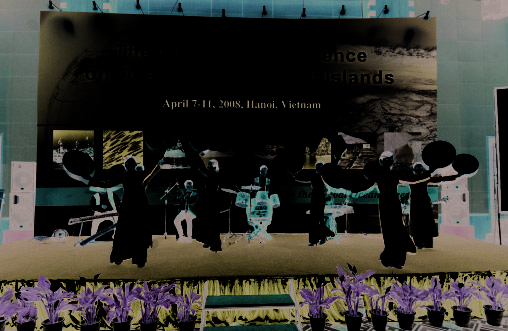
4th Global Conference on Oceans, Coasts and Islands Bulletin
A summary report of the Fourth Global Conference on Oceans, Coasts, and Islands
Published by the International Institute for Sustainable Development (IISD)
ONLINE AT HTTP://WWW.IISD.CA/YMB/SDOH4/
VOLUME 68, NO. 4, SUNDAY, 13 APRIL 2008
FOURTH GLOBAL CONFERENCE ON
OCEANS, COASTS, AND ISLANDS:
ADVANCING ECOSYSTEM MANAGEMENT
AND INTEGRATED COASTAL AND OCEAN
MANAGEMENT BY 2010 IN THE CONTEXT
OF CLIMATE CHANGE:
8-11 APRIL 2008
The Fourth Global Conference on Oceans, Coasts, and
Islands, "Advancing Ecosystem Management and Integrated
Coastal and Ocean Management by 2010 in the Context of
Climate Change" (Fourth Global Conference) hosted by the
Government of Viet Nam, Ministry of Agriculture and Rural
Development, took place in Hanoi, Viet Nam, from 8-11 April
Vietnamese cultural presentation during the opening session
2008.
Outcomes from the Fourth Global Conference include: a
The Fourth Global Conference was organized by the Global
Co-Chairs' report containing a summary of the proceedings
Forum on Oceans, Coasts, and Islands, which was created by an from the various panel sessions, discussion sessions and
informal World Summit on Sustainable Development (WSSD)
roundtables; summaries of the policy briefs presented; and
coordinating group in Johannesburg, South Africa, in 2002.
recommendations. These outcomes will be presented at the ninth
Comprised of individuals from governments, intergovernmental
session of the UN Informal Consultative Process on Oceans
organizations and non-governmental organizations (NGOs),
and Law of the Sea in New York, US, scheduled to take place
the Global Forum serves as a platform for cross-sectoral
from 23-27 June 2008. The specific recommendations will be
information sharing and dialogue on issues affecting oceans,
considered at the World Ocean Conference in Manado, North
coasts and islands, with the goal of achieving sustainable
Sulawesi, Indonesia, from 11-15 May 2009, organized by the
development in these areas.
Government of Indonesia in collaboration with the Global
The event brought together over 430 participants from 71
Forum on Oceans, Coasts, and Islands, and other international
countries representing governments, UN and other international
partners.
agencies, NGOs, industry, oceans donors, organized science
groups, and networks of museums and aquaria. The Fourth
Global Conference provided a review of progress, or lack
IN THIS ISSUE
thereof, in attaining the goals adopted by the world's political
leaders at the 2002 WSSD relating to oceans management and
A Brief History of the Global Forum and International
conservation in the context of climate change.
Oceans and Coasts Policy and Management . . . . . . . . . . .2
During the Conference, participants heard presentations by
high-level officials and engaged in topical panels and discussion
Report of the Conference . . . . . . . . . . . . . . . . . . . . . . . . . .3
sessions on three major themes, namely: achieving ecosystem
Opening Session . . . . . . . . . . . . . . . . . . . . . . . . . . . . .3
management and integrated coastal and ocean management
Plenary Panels . . . . . . . . . . . . . . . . . . . . . . . . . . . . . .4
by 2010; climate, oceans, and security: addressing impacts in
Conference Reports . . . . . . . . . . . . . . . . . . . . . . . . . .9
Closing Ceremony . . . . . . . . . . . . . . . . . . . . . . . . . .12
vulnerable ecosystems and in vulnerable coastal communities,
especially in Small Island Developing States (SIDS); and the
Upcoming Meetings . . . . . . . . . . . . . . . . . . . . . . . . . . . . .12
governance of marine ecosystems and uses in areas beyond the
limits of national jurisdiction.
Glossary . . . . . . . . . . . . . . . . . . . . . . . . . . . . . . . . . . . . . . .15
The 4th Global Conference on Oceans, Coasts and Islands Bulletin is a publication of the International Institute for Sustainable Development (IISD) <info@iisd.ca>,
publishers of the Earth Negotiations Bulletin © <enb@iisd.org>. This issue was written and edited by Alice Bisiaux, Kelly Levin and James Van Alstine. The Digital
Editor is Markus Staas. The Editor is Leonie Gordon <leonie@iisd.org>. The Director of IISD Reporting Services is Langston James "Kimo" Goree VI <kimo@iisd.org>.
Funding for coverage of this meeting has been provided by the College of Marine and Earth Studies, University of Delaware. IISD can be contacted at 161 Portage Avenue
East, 6th Floor, Winnipeg, Manitoba R3B 0Y4, Canada; tel: +1-204-958-7700; fax: +1-204-958-7710. The opinions expressed in the Bulletin are those of the authors and
do not necessarily reflect the views of IISD. Excerpts from the Bulletin may be used in other publications with appropriate academic citation. Electronic versions of the
Bulletin are sent to e-mail distribution lists (in HTML and PDF formats) and can be found on the Linkages WWW-server at <http://www.iisd.ca/>. For information on the
Bulletin, including requests to provide reporting services, contact the Director of IISD Reporting Services at <kimo@iisd.org>, +1-646-536-7556 or 300 East 56th St.,
11A, New York, NY 10022, USA.


2
4th Global Conference on Oceans, Coasts and Islands Bulletin, Vol. 68 No. 4, Sunday, 13 April 2008
Throughout the Conference, participants actively engaged in
WSSD: The WSSD convened from 26 August to 4 September
the plenary and discussion sessions. While there was a sense of
2002, in Johannesburg, South Africa. The outcomes of the
urgency, most shared a positive outlook given the opportunities
Summit included the adoption of the Johannesburg Plan of
for information sharing, collaboration, and networking in and
Implementation, which contains a number of goals and targets
outside the meeting rooms.
related to oceans management, including: encouraging the
application of the ecosystem approach by 2010 for the sustainable
A BRIEF HISTORY OF THE GLOBAL FORUM AND
development of the oceans; promote integrated coastal and
INTERNATIONAL OCEANS AND COASTS POLICY
ocean management at the national level and encourage and
AND MANAGEMENT
assist countries in developing ocean policies and mechanisms
The UN Conference on Environment and Development
on integrated coastal management; protecting the marine
(UNCED), held in Rio de Janeiro, Brazil in 1992, was the
environment from land-based activities; achieving a significant
first major international gathering to address issues related to
reduction of the current rate of biodiversity loss by 2010;
sustainable development at the global level. UNCED participants
developing and facilitating the use of diverse approaches and
adopted Agenda 21, a plan for achieving sustainable development
tools, including the ecosystem approach; eliminating destructive
in the 21st century, and the Rio Principles, which define the rights fishing practices; establishing marine protected areas (MPAs)
of people to development, and their responsibilities to safeguard
consistent with international law and based on scientific
the common environment. Chapter 17 of Agenda 21 calls for
information, including representative networks by 2012;
new and integrated approaches to the sustainable development
eliminating subsidies that contribute to illegal, unreported, and
of oceans and coasts, and the Rio Principles introduce the
unregulated (IUU) fishing and to overcapacity; and maintaining
precautionary principle as a component of new approaches to
or restoring depleted fish stocks to levels that can produce their
oceans-related agreements.
maximum sustainable yield on an urgent basis and where possible
POST-UNCED AGREEMENTS AND ACTIVITIES: Since
no later than 2015.
UNCED significant progress has been made in the development
THE SECOND GLOBAL CONFERENCE: The Second
of legislation, agreements and programmes of action at the
Global Conference on Oceans, Coasts, and Islands: Mobilizing
international level. The UN Convention on the Law of the Sea
for Implementation of the Commitments Made at the 2002
entered into force in 1994, and provides an overall framework
WSSD on Oceans, Coasts and SIDS, took place from 12-14
for other oceans-related agreements. The UN Environment
November 2003, at the UN Educational, Scientific and Cultural
Programme's (UNEP) Global Programme of Action for the
Organization (UNESCO) in Paris, France. The Conference was
Protection of the Marine Environment from Land-based Activities organized by the Global Forum and spurred the process of initial
(GPA), the Convention on Biological Diversity's (CBD) Jakarta
implementation of the WSSD commitments.
Mandate on the Conservation and Sustainable Use of Marine and
THE INTERNATIONAL MEETING TO REVIEW THE
Coastal Biological Diversity and the UN Agreement on Straddling IMPLEMENTATION OF THE PROGRAMME OF ACTION
and Highly Migratory Fish Stocks (UN Fish Stocks Agreement)
FOR SIDS: The International Meeting convened from 10-14
were all adopted in 1995. UNEP's Regional Seas Programme,
January 2005, in Port Louis, Mauritius. Delegates adopted the
launched in 1974 in the wake of the 1972 UN Conference on the
Mauritius Declaration and the Mauritius Strategy for the Further
Human Environment held in Stockholm, continued after UNCED
Implementation of the Programme of Action on the Sustainable
to guide the process of regional cooperation, while the 1994
Development of SIDS.
Barbados Programme of Action for the Sustainable Development
THE OCEAN POLICY SUMMIT: The Ocean Policy
of SIDS has contributed to an overall strengthening of issues
Summit International Conference on Integrated Ocean Policy:
related to SIDS on the political agenda.
National and Regional Experiences, Prospects, and Emerging
Numerous efforts in capacity building and integrated coastal
Practices, was organized by the Global Forum and was held
management (ICM) have also been undertaken at national
in Lisbon, Portugal, from 10-14 October 2005. The Summit
and local levels, including the creation of policy frameworks
considered advances made in achieving the WSSD targets and
and the establishment of protected areas and conservation
the Millennium Development Goals (MDGs) related to integrated
projects. Investments by the private sector in partnership with
oceans governance at national and regional levels. Participants
governments, advances in technology and scientific research, and
addressed how national and regional ocean policies may be
NGO efforts to raise public awareness have all contributed to the
enhanced and further expanded.
evolution of sustainable development and management of coastal
THE THIRD GLOBAL CONFERENCE: The Third Global
and marine areas.
Conference on Oceans, Coasts, and Islands, which took as its
THE FIRST GLOBAL CONFERENCE: The First Global
theme "Moving the Global Oceans Agenda Forward," was held
Conference on Oceans and Coasts at Rio+10: Toward the 2002
in Paris, France from 24-27 January 2006. The meeting sought to
WSSD took place from 3-7 December 2001 in Paris, France.
accelerate progress in achieving international ocean policy targets,
Participants assessed the status of oceans and coasts and progress
especially those related to the WSSD and the MDGs. Participants
achieved over the last decade, identified continuing and new
also examined two major emerging ocean policy issues: high seas
challenges, examined options for concerted action on cross-
governance; and the wide-ranging effects of climate change on
sectoral issues and laid the groundwork for the inclusion of an
oceans and coastal environments.
oceans perspective and SIDS issues in the WSSD agenda.



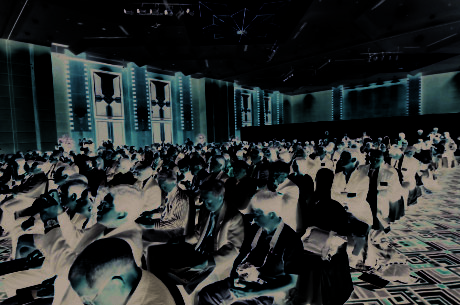

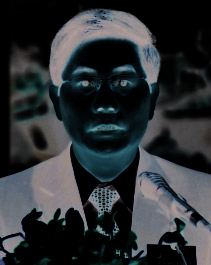
3
4th Global Conference on Oceans, Coasts and Islands Bulletin, Vol. 68 No. 4, Sunday, 13 April 2008
FIRST INFORMAL WORKING GROUP ON MARINE
BIODIVERSITY: The Ad Hoc Open-ended Informal Working
Group of the UN General Assembly (UNGA) to study issues
relating to the conservation and sustainable use of marine
biological diversity beyond areas of national jurisdiction,
convened from 13-17 February 2006, at UN headquarters in New
York, US. Participants agreed on the need for short-term measures
to address IUU fishing and destructive fishing practices as the
most urgent threats to marine biodiversity, as well as institutional
coordination. Many delegates also agreed that there should be an
ongoing process to advance discussions on sharing the benefits
from marine genetic resources, avoiding the adverse impacts of
marine scientific research on marine biodiversity, and facilitating
the establishment of high seas MPAs.
ICP-8: The eighth meeting of the UN Open-ended Informal
Participants during the opening session
Consultative Process on Oceans and the Law of the Sea (ICP-8)
towards a more coherent and integrated ecosystem and oceans
convened from 25-29 June 2007 in New York, US. The meeting
management regime outside of national jurisdiction. She stressed
organized its discussions around the topic of marine genetic
the need for political courage, international responsibility, and
resources, as recommended by the UNGA in resolution 61/222
the mobilization of resources and knowledge to introduce climate
(Oceans and the law of the sea). Delegates did not agree on
change planning into oceans and coastal management processes.
Claudia McMurray, US Assistant
key language referring to the relevant legal regime for marine
Cao Duc Phat, Minister of
Secretary of State, Oceans,
Agriculture and Rural Development,
Environment and Science.
genetic resources in areas beyond national jurisdiction. While no
consensus text on elements was agreed, the Co-Chairs developed
Viet Nam, and Co-Chair, Fourth
a draft text of elements to be suggested to the UNGA, drawing
Global Conference, highlighted the
on panel discussions and the draft elements and recommendations benefits of collaboration and noted
within the Co-Chairs' Report of ICP-8 to the UNGA, including an the opportunity for Vietnamese
explanation of the divergence of views.
organizations to share their research
and challenges in managing coastal
REPORT OF THE CONFERENCE
and ocean resources in the context
The Fourth Global Conference on Oceans, Coasts, and
of climate change.
Islands (Fourth Global Conference) was preceded by a series of
Monique Barbut, Chief Executive
meetings that took place from 3-7 April, as well as by a high-
Officer, Global Environment
Cao Duc Phat, Minister
level roundtable discussion for ministers and high-level and
Facility (GEF), outlined the GEF's
of Agriculture and Rural
Development, Viet Nam,
eminent participants that was held on 7 April. The Fourth Global
activities in promoting action and
and Co-Chair, Fourth Global
Conference commenced on Tuesday, 8 April 2008, with opening
collaboration among countries to
Conference
statements. Participants engaged in plenary policy sessions on
protect coastal populations and ecosystems and stated that the
Tuesday, Wednesday and Thursday and in concurrent discussion
GEF is committed to delivering on the Conference's agenda.
sessions on Tuesday and Wednesday. On Thursday afternoon,
Veerle Vandeweerd, Director, Environment and Energy Group,
conference reports were presented in plenary, followed by a
UN Development Programme (UNDP), and Co-Chair, Global
closing ceremony. A field trip to Halong Bay was organized for
Forum on Oceans, Coasts, and Islands, applauded Viet Nam's
Friday. This report is structured by agenda item and summarizes
leadership in coastal affairs and called for revisiting traditional
the various plenary presentations and discussions, as well as the
paradigms and redefining how stakeholders collaborate. She
discussion sessions as reported in plenary.
highlighted the co-benefits of addressing climate change for
reducing poverty and advancing sustainable development.
OPENING SESSION
Ibrahim Thiaw, Director, Division of Environmental Policy
On Tuesday 8 April, Le Van
Implementation, UN Environment Programme (UNEP), and
Minh, Director General, International
Co-Chair, Fourth Global Conference, outlined UNEP's work
Cooperation Department, Ministry of
on marine ecosystem conservation and identified the need for
Agriculture and Rural Development,
policies that integrate diverse ocean uses, tools to measure
Viet Nam, chaired the opening
cumulative impacts on ocean integrity, and management plans
session and welcomed participants to
that incorporate new scientific information.
the meeting.
Javier Armando Valladares, Chairman, Intergovernmental
Biliana Cicin-Sain, Co-Chair and
Oceanographic Commission (IOC), UN Educational, Scientific
Head of Secretariat, Global Forum
Le Van Minh, Director
and Cultural Organization (UNESCO), underlined that the Global
on Oceans, Coasts, and Islands and
General, International
Forum acts as a catalyst for action and provides a platform for
Co-Chair, Fourth Global Conference, Cooperation Department,
Ministry of Agriculture and
dialogue among stakeholders. He noted the upcoming celebration
encouraged participants to work
Rural Development, Viet Nam




4
4th Global Conference on Oceans, Coasts and Islands Bulletin, Vol. 68 No. 4, Sunday, 13 April 2008
of the IOC's 50th anniversary in 2010, which will outline the
Seychelles. The Co-Chairs outlined the session and emphasized
achievements of the Commission and emphasize the need for a
SIDS' challenges in the context of climate change. Payet
better understanding of the oceans.
encouraged political leadership and the development of regional
Deputy Prime Minister Pham Gia Khiem, Minister of Foreign
initiatives such as the Micronesia Challenge, the Caribbean
Affairs, Viet Nam, highlighted the crucial role played by marine
Challenge and the Coral Triangle Initiative.
and coastal communities in the Vietnamese economy. He outlined
In a video keynote address, James Alix Michel, President
national marine environmental and conservation efforts, including of Seychelles, said the global community takes the oceans'
the application of integrated coastal management (ICM), the
resources for granted with little heed to the wellbeing of the
development of marine research, and the establishment of marine
planet. He called for: a change in the policies of the world's
protected area (MPA) networks.
economic powers; adequate resources to reverse climate change
Monique Barbut noted pressing threats to marine ecosystems,
and ecological damage; improved deployment of technologies
including: the trend of over-fishing of valuable species; nitrogen
and financing for mitigation and adaptation; and strengthened
pollution; and the depletion of natural
institutions. He underscored the need for clear leadership from
resources in coastal regions. She
developed nations, and called upon conference participants
outlined recent GEF activities related
to implement at least one component of oceans conservation
to marine and coastal ecosystems,
strategy. He concluded by noting that warning signs are already
and explained that GEF reform
among us, and urged commitment to restore the "planet's
has lead to a more programmatic
harmony."
approach. She mentioned the Coral
Rolph Payet introduced a policy brief on SIDS and the
Triangle Initiative and the Pacific
Mauritius Strategy. He identified food security as a new emerging
Alliance for Sustainability as
priority and delineated four policy issues, including: adaptation to
illustrations of the GEF's present and
climate change and the role of ICM; sustainable natural resources
future commitment to the sustainable
management and ecosystem-based approaches to marine and
development of the oceans.
Monique Barbut, Chief
coastal management, including fisheries; delineation of the
Freddy Numberi, Minister of
Executive Officer, GEF
extended continental shelf; and capacity building for coastal and
Marine Affairs and Fisheries, Indonesia, discussed the importance marine management. He suggested that financial mechanisms,
of political mobilization to achieve effective governance
review mechanisms, capacity development, and SIDS' leadership
to address ecosystem management and climate change. He
are needed to address emerging challenges.
highlighted the threat of climate change to Small Island
Noah Idechong, Congressman, House of Delegates, Palau,
Developing States (SIDS) and marine resources, and stressed
described domestic actions to address climate change impacts,
the need for decisive action to build on the Bali Roadmap. He
including coral recovery efforts. He highlighted new challenges,
outlined Indonesian government initiatives, such as the Coral
such as the sense of anxiety within communities and competing
Triangle Initiative and the World Ocean Conference in May 2009.
priorities for local funding. He identified opportunities for
Global Forum Co-Chair Cicin-Sain highlighted the
new partnerships locally and internationally, underscored the
independence of the Global Forum, which periodically issues
urgency that SIDS' communities are experiencing and urged the
report cards on progress in achieving its goals. She stressed the
international community to act.
need for increased effort and political
Amb. Angus Friday, Grenada, Alliance of Small Island States
support to address climate change
(AOSIS) Chair, underlined the need for SIDS not to be bound by
challenges and emerging issues of
the future they fear, but by a new, shared vision. He said climate
high seas governance within the next
change should be addressed with "the mindset of winners," and
decade, and underscored the extensive
that the bounty of the oceans should be harnessed. He called
preparatory process for the Fourth
for mainstreaming adaptation into economic policies, including
Global Conference, which included
promoting green tourism and education, and safeguarding genetic
12 working groups, as well as one in
resources beyond national jurisdiction. Noting the vulnerability
development, comprised of 254 experts
of SIDS in terms of financial services, he stated that they need to
from 68 countries. She highlighted that
become involved in carbon trading.
all the working groups had prepared
Amb. Jagdish Koonjul, Mauritius, Former AOSIS Chair,
Biliana Cicin-Sain,
policy briefs with recommendations
outlined emerging challenges, such as food security, faced by
Co-Chair and Head of
Secretariat, Global Forum to national and international decision
SIDS since the adoption of the 2005 Mauritius Strategy for
on Oceans, Coasts, and
makers on next steps to advance each
further implementation of the Barbados Programme of Action.
Islands and Co-Chair,
Fourth Global Conference major ocean issue.
He stated that the impacts of climate change on islands should
be addressed urgently to avoid social unrest and noted that the
PLENARY PANELS
mobilization that existed post-Mauritius has lost its strength.
OCEANS, CLIMATE, AND SIDS: This panel was held on
He raised concern regarding the ability of SIDS to comply
Tuesday morning and co-chaired by Nguyen Hong Thao, Vice-
with their technical and legal obligations under the UN
Chair of the National Border Committee, Ministry of Foreign
Convention on the Law of the Sea (UNCLOS) related to the
Affairs, Viet Nam, and Rolph Payet, Advisor to the President of




5
4th Global Conference on Oceans, Coasts and Islands Bulletin, Vol. 68 No. 4, Sunday, 13 April 2008
continental shelf delimitations and suggested that the AOSIS
of China's rapidly growing marine economy and climate change,
should be strengthened to act as the oversight mechanism on
and noted the laws, institutions and programmes established to
implementation of the Mauritius
manage these threats.
Strategy.
Patrick Van Klaveren, Head of International and Mediterranean
Amb. Tuiloma Neroni Slade, Samoa,
Environment Service, Monaco, outlined his country's actions
First AOSIS Chair, highlighted the role
for marine conservation, highlighting the creation of the Pelagos
of thresholds and non-linear behavior
Sanctuary for Mediterranean Marine Mammals and of MPAs
of climate change in community and
under the Agreement on the Conservation of Cetaceans of the
ecosystem disruption. He argued that,
Black Sea, Mediterranean Sea and Contiguous Atlantic Area.
while mitigation is crucial, adaptation
Teresita Castillo, Undersecretary, Department of Environment
efforts are also needed, especially
and Natural Resources, Philippines, presented on the effects
in SIDS. He identified the need to
of climate change on biodiversity and concomitant impacts on
consider equity and fairness, and stated
tourism. She identified stressors, such as beach erosion, increased
that retreat to higher ground is not an
Amb. Tuiloma Neroni
sea levels and damage from sea surges and storms, and coral
Slade, Samoa, First AOSIS
option for island communities. He said Chair
bleaching.
adaptation strategies, including policies and technology transfer,
Rudolf Noronha, Director, Department of Environmental
for small countries require unique considerations. He concluded
Quality, Ministry of Environment, Brazil, discussed ICM in the
by noting the interlinkages among multilateral environmental
context of adaptation to climate change in Brazil. He outlined a
agreements and called upon political leaders to avert dangerous
macrodiagnostic initiative on the Brazilian coastal zone, which
climate change.
includes data on its geomorphology, ports, population dynamics,
In the ensuing discussion, participants highlighted the need
potential flooding risk and social risk mapping.
to focus SIDS' capacity building at the community level, the
Arumugam Senthilvel, Additional Director, Ministry of
opportunity to harness energy from the sea, and the need to
Environment and Forests, India, discussed the challenges and
learn from innovative technological examples such as those
opportunities for ICM zones in India. He noted the economic
from Singapore. Participants also discussed strengthening SIDS'
development impacts on coastal zones, outlined the legal
institutional activities and the UN Trust Fund to facilitate the
framework and objectives of ICM in India, and highlighted
preparation of submissions to the Commission on the Limits of
opportunities for capacity building with World Bank assistance.
the Continental Shelf for Developing States.
Francisca Delgado, General Director, National Institute for
ECOSYSTEM MANAGEMENT AND INTEGRATED
Fisheries Research, Angola, highlighted the importance of
OCEAN AND COASTAL MANAGEMENT BY 2010:
fisheries to the Angolan economy, and discussed the national legal
CHALLENGES TO DECISION-MAKERS: This panel took
and institutional framework for ecosystem-based management of
place on Tuesday afternoon and was co-chaired by: Alfred
fisheries. She noted the biological and social issues relating to
Duda, Senior Advisor, International Waters, GEF; Ibrahim
fisheries, as well as management measures, research actions and
Thiaw, UNEP; Andrew Hudson, Principal Technical Advisor,
ways forward to improve existing legislation.
International Waters, UNDP-GEF; and Nguyen Chu Hoi,
Veerle Vandeweerd discussed adaptation needs for coastal
Director, Institute of Fisheries Economics and Planning, Viet
zones. She identified major challenges, including the lack of
Nam.
an adaptation methodology and scant resources. She called for
Chua Thia-Eng, Chair, East Asian Seas Partnership Council,
mainstreaming adaptation, building
outlined efforts carried out by the Partnerships in Environmental
climate resilience and financing.
Management for the Seas of East Asia to achieve sustainable
She suggested that adaptation is an
coastal and ocean development in the seas of East Asia over the
opportunity to address sustainable
next ten years, including by: consolidating the foundation of
development needs.
ICM; scaling-up ICM programmes along the coastline; enhancing
Torkil Jonch-Clausen, Danish
the policy, legal, financial and human resources for local
Hydraulic Institute and Global Water
implementation; and institutionalizing a regional coordinating
Partnership, called for communication
mechanism to implement ICM.
between the freshwater and coastal/
Noting the threats faced by large marine ecosystems (LMEs),
marine communities and presented the
including increasing temperatures and declining fish stocks,
solution of integrated coastal area and
panel Co-Chair Duda called for adaptive management. He
river management. He identified the
Veerle Vandeweerd,
described GEF financing for coasts, marine and SIDS' projects in
Director, UNDP
need for joint action on concepts and
international waters and stressed support for more cross-sectoral
Environment and Energy
guidelines, best practices, political and
Group, and Co-Chair,
focal area programmes for recovery and sustainable use of LMEs.
Global Forum on Oceans,
administrative support, pilot projects,
Zhang Hongsheng, Vice Administrator, State Oceanic
Coasts, and Islands
and capacity building.
Administration, China, discussed China's approach to integrated
Julian Barbiere, IOC/UNESCO, described the "Assessment
ecosystem-based ocean and coastal management in the context
of Assessments," the UN Global Assessment of the State of the
of climate change. He highlighted the ocean and coastal impacts
Marine Environment's (GMA) first phase. He explained that the


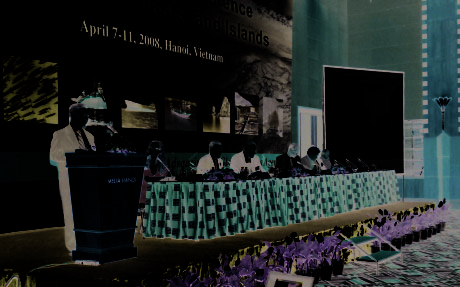
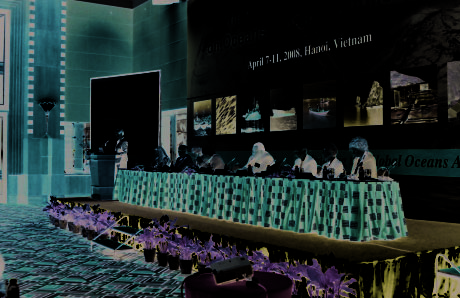
6
4th Global Conference on Oceans, Coasts and Islands Bulletin, Vol. 68 No. 4, Sunday, 13 April 2008
Plenary panel on "Ecosystem management and integrated ocean and
Plenary panel on "Fisheries and aquaculture; sustainability and
coastal management by 2010"
governance"
Assessment of Assessments will contain a regional overview of
transparency; emphasis on equity and openness to new
assessments, establish best practices, and develop a framework
countries; adoption of UN Fish Stocks Agreement principles;
and options for the GMA.
and performance assessments. He highlighted a Chatham House
Jose Matheickal, Chief Technical Advisor, Global Ballast
report entitled "Recommended Best Practices for RFMOs."
Water Management Programme, International Maritime
Lori Ridgeway, Director-General, International Policy and
Organization, recommended: appropriately managing marine
Integration, Department of Fisheries and Oceans, Canada,
biosecurity threats; including biosecurity as one of the Global
outlined the challenges facing tuna stocks, such as: weak
Forum's ongoing themes; including marine biosecurity issues
conservation and management measures; IUU fishing; access and
in GEF/LME programmes; and promoting the ratification and
allocation issues; by-catch; institutionalized over-fishing; and
implementation of existing international agreements, such as the
data collection and sharing. She called for accelerated progress
2004 Ballast Water Convention, dealing with this issue.
and suggested that failure to conserve tuna would translate to a
FISHERIES AND AQUACULTURE: SUSTAINABILITY
credibility loss for the fisheries governance system.
AND GOVERNANCE: This panel was held on Wednesday
Moritaka Hayashi, Ocean Policy Research Foundation, Japan,
morning and co-chaired by: Rebecca Lent, Director, Office
and former Assistant Director-General, UN Food and Agriculture
of International Affairs, US National Oceanic Atmospheric
Organization (FAO), welcomed the increasing link between
Administration (NOAA); Nguyen Chu Hoi; and Le Thanh Luu,
RFMOs and global institutions, such as the UN General Assembly
Director of Research Institute for Aquaculture, Viet Nam.
(UNGA) and the FAO's Committee on Fisheries. He stressed the
Lent introduced the four main themes addressed by the
need for more effective management of RFMOs with periodic
fisheries and governance working group, namely: regional
reviews of their performance.
fisheries management organization (RFMO) reform; illegal,
In the ensuing discussion moderated by Rebecca Metzner,
unreported and unregulated (IUU) fishing; overcapacity in
FAO, participants addressed the costs of management and
fishing; and sustainable aquaculture. She highlighted the impacts
enforcement, the need for improving the science-policy interface
of climate change on fisheries, particularly on small-scale fishing, within RFMOs, and the replicability of RFMOs' success stories.
and stressed the need for more flexible measures.
One participant stressed the need for RFMOs to collaborate with
Panel Co-Chair Nguyen Chu Hoi outlined the main fisheries
regional economic organizations.
management challenges in Viet Nam, including: an unmanaged
HALTING LOSS OF BIODIVERSITY AND
number of fishing boats; overexploitation in coastal waters;
ESTABLISHING REPRESENTATIVE NETWORKS OF
and increasing numbers of fishermen. He suggested solutions
MARINE PROTECTED AREAS: This panel was held on
such as creating a community-based management system,
Wednesday morning and co-chaired by Jihyun Lee, Convention
applying responsible fishing techniques, and developing marine
on Biological Diversity (CBD) Secretariat, and Do Van Khuong,
conservation parks.
Director of Research Institute of Marine Fisheries, Viet Nam.
Kilus Nguvauva, Deputy-Minister, Ministry of Fisheries
Panel Co-Chair Lee introduced the working group's policy
and Marine Resources, Namibia, discussed access agreements
brief on halting marine biodiversity loss and establishing
between developing countries and distant and neighboring
representative networks of MPAs. She said the working group
nations, and the private sector. While he noted that the
was not confident that the 2002 World Summit on Sustainable
agreements can be valuable, he raised concerns regarding equity,
Development (WSSD) biodiversity goals will be met by 2010 and
the environment, competition with local fisheries, food security
highlighted the need to represent biodiversity in market terms in
and trade. He encouraged creating a platform for discussion and
order to receive government attention.
identifying best practices.
Sue Wells, Independent Consultant, discussed progress towards
Chris Tompkins, Independent Consultant, UK, called for
the 2002 WSSD biodiversity and MPA goals. She highlighted
several RFMO reforms, including: modernization of mandates;
marine biodiversity indicators for meeting the 2010 goal, noted
cooperation among RFMOs and with other regional bodies;
challenges in achieving the 2012 MPA target, and underscored


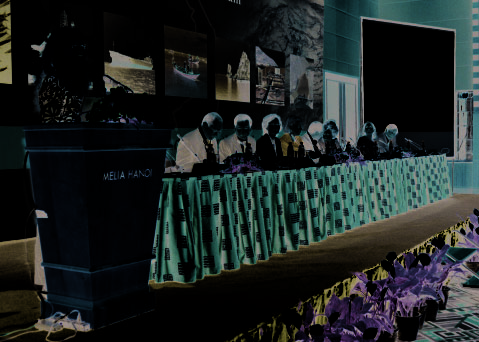

7
4th Global Conference on Oceans, Coasts and Islands Bulletin, Vol. 68 No. 4, Sunday, 13 April 2008
GEF project that seeks to reverse environmental degradation
trends in the South China Sea and the Gulf of Thailand. He
highlighted the development of a system of fisheries refugia in
the region.
Julius Francis, Executive Secretary, Western Indian Ocean
Marine Science Association, Tanzania, discussed a certification
programme for MPA professionals in the Western Indian Ocean
region. He highlighted the growing number of MPAs in the
region, the lack of training schemes and the programme's three
tiers of certification.
The ensuing discussion focused on sustaining the participation
of local communities in MPA management and financing MPA
enforcement.
OCEANS AND CLIMATE: This plenary panel took place on
Plenary Panel 4: Halting loss of biodiversity and establishing
representative networks of MPAs
Wednesday afternoon and was co-chaired by Gunnar Kullenberg,
the difficulty of gathering data for the working group policy brief. former Executive Secretary, IOC/UNESCO, and Vu Thanh Ca,
She called on participants to explore the possibility of a creating
Vietnam Institute of Meteorology and Hydrology.
a Friends of the Jakarta Mandate Group and to advance the
Panel Co-Chair Kullenberg discussed the working group's
marine biodiversity agenda forward through the CBD and IUCN
policy brief on oceans, climate change and security. He
processes.
highlighted the prospect for harnessing the ocean's energy, and
Nicole Glineur, Biodiversity Program Manager, GEF,
noted that climate impacts are transpiring at higher rates than
discussed the GEF's activities on coastal and marine ecosystem
expected. He argued that we have the financial means, but lack
conservation. She outlined funding avenues, such as through the
the capacity, to contend with climate impacts to oceans, as well as
biodiversity, international waters and climate change focal areas,
ocean impacts to the climate.
as well as the GEF Small Grants Programme and the Public-
Pamela Rubinoff, Coastal Resources Center, University
Private Partnership Initiative. She highlighted the opportunity for
of Rhode Island, discussed a US Agency for International
ecosystem services payments and, given limited resources, the
Development publication,
need for pooling funding sources together.
"Adapting to Climate Variability
Payet described the Global Island Partnership, which strives to
and Change," and efforts to tailor
bridge the gaps between the global agenda, national leaders and
lessons to coastal systems. She
communities. He suggested that leadership at the highest level
identified the need for: long-term
is needed to protect biodiversity and called for the reversal of
and place-based approaches;
biodiversity loss.
the use of local and traditional
James Hardcastle, Senior Conservation Finance and Policy
knowledge; outcome-based
Advisor, Asia-Pacific, The Nature Conservancy, described the
and adaptive adaptation; and a
Micronesia Challenge, which was issued in 2005 by the President
transition to long-term political
of Palau to Micronesian nations to effectively conserve 30% of
choices.
near-shore marine resources and 20% of forest resources by 2020.
Kenneth Sherman, GEF LME
Pamela Rubinoff, Coastal
He outlined lessons learned from the Challenge, including the
Resources Center, University of
Programme and NOAA, described
Rhode Island
need to build on existing conservation programmes and for the
a five module strategy, based on
full involvement of communities.
lessons learned from LME case studies, to provide science-based
Marea Hatziolos, Senior Coastal and Marine Specialist,
information for the monitoring, assessment and management
Environment Department, World Bank, presented on means of
of LMEs. He recommended the adoption of a system of
increasing the effectiveness of MPAs and coral reef conservation,
capping catches and prioritizing important species to establish a
noting that most areas contain coral reefs. She explained how
precautionary regime based on the level of warming detected in
remote sensing and scientific research on coral disease can help
each LME.
improve the design of MPAs.
Paul Epstein, Center for Health and the Global Environment,
Nguyen Giang Thu, Project Director of Livelihoods and
Harvard Medical School, gave examples of the consequences of
MPAs, Viet Nam, reported on MPA development in Viet Nam.
global warming on public health. Noting that oceans nourish and
She highlighted: the challenges facing MPA policy, legal
regulate the climate, he called for a transition to clean energy
and institutional frameworks; the need for ICM and MPA
sources that would serve adaptation to and mitigation of climate
co-development; cross-cutting issues for effective management;
change.
and the impact of MPAs on sustainable livelihoods.
Nguyen Huu Ninh, Chairman, Center for Environment
Vo Si Tuan, Former Senior Expert, GEF, Institute of
Research, Education and Development, Vietnam National
Oceanography, Viet Nam, UNEP/GEF South China Sea Project,
University, Coordinator, Indochina Global Change Network,
discussed the collaborative network and outcomes from a UNEP/
presented on climate variability and hazards with a focus on Viet




8
4th Global Conference on Oceans, Coasts and Islands Bulletin, Vol. 68 No. 4, Sunday, 13 April 2008
Nam. He noted the impacts of climate change on livelihoods
Sivu Maqungo, South Africa, described the working
and national economic development, and highlighted the
group's policy brief on governance of marine areas beyond
consequences of disasters in Viet Nam.
national jurisdiction. He said that the group's brief addresses:
Willett Kempton, College of Marine and Earth Studies,
environmental impacts on marine biodiversity beyond areas of
University of Delaware, discussed the essential role of marine
national jurisdiction; coordination and cooperation among states
renewable power in mitigating climate change and reducing
and intergovernmental organizations; the role of area-based
ocean acidification. Using a case study from the US Northeast
management tools; genetic resources beyond areas of national
to demonstrate the potential of offshore wind energy, he
jurisdiction; and governance gaps.
recommended focusing on large-scale marine renewables, such
Salvatore Arico, UNESCO, discussed the policy brief findings
as offshore wind, ocean currents and ocean thermal energy
in more detail. He highlighted the role of information-based
conversion.
decision making, and suggested that area-based management tools
In the ensuing discussion, participants debated the costs
could facilitate implementation of the ecosystem approach. He
of marine renewable energy, strategies to balance mitigation
identified the need for: institutional and programmatic coherence;
measures, and why coastal marine ecosystems warm more quickly a package of measures to address governance gaps; and
than the global marine average.
recommendations on genetic resources beyond areas of national
GOVERNANCE OF MARINE AREAS BEYOND
jurisdiction.
NATIONAL JURISDICTION: This plenary panel took place
Laurent Stefanini, Ambassador for the Environment, Ministry
on Thursday morning and was co-chaired by Gabriele Goettsche-
of Foreign and European Affairs, France, described a strategic
Wanli, UN Division for Ocean Affairs and the Law of the Sea
plan to be developed within France, which will address transport,
(DOALOS); Mary Seet-Cheng, Singapore's Ambassador to the
economic development, coastal planning, marine resources and
Republic of Panama and to Cuba; and Ngoc Giao Hoang, Faculty
biodiversity. He stated that the plan will first be applied to areas
of Law, Vietnam National University.
under national jurisdiction but, given France's role in ocean
Panel Co-Chair Goettsche-Wanli highlighted the lack of
policies, he suggested that it would have greater reach. He called
knowledge and technical challenges impeding the governance
for better coordination among UN organizations, and identified
of marine areas beyond national
the importance of scientific expertise on marine biodiversity,
jurisdiction. She noted the
which, he said, should be included under the International
contention of the existing legal
Mechanism of Scientific Expertise on Biodiversity framework
regime and stressed the need
and could put pressure on the policymaking process.
for cooperation. She highlighted
David Freestone, World Bank, stressed that there is no
that these issues will be further
comprehensive governance framework for marine areas
discussed in the Second Meeting
beyond national jurisdiction even though they comprise 50%
of the Ad Hoc Open-ended
of the Earth's surface. He noted governance gaps, including
Informal Working Group to study
poor implementation, uncoordinated rule-making and weak
issues relating to the conservation
enforcement; stressed the need for ecosystem-based integrated
and sustainable use of marine
management; and suggested solutions such as establishing a
biological diversity beyond areas
coordinating mechanism and expanding the mandate of existing
Co-chair Gabriele Goettsche-
of national jurisdiction (Ad Hoc
arrangements.
Wanli, UNDOALOS
Open-ended Informal Working
Maqungo discussed developing country perspectives on
Group) established under the UNGA.
governance of marine areas beyond national jurisdiction. He
Panel Co-Chair Seet-Cheng discussed issues related to
outlined the key issues, namely
the governance of marine areas beyond national jurisdiction,
clarification of the legal regime,
including the need to: address knowledge gaps; provide continuity
the existence of regulatory gaps,
with previous governance activities; and raise the profile on the
and access and benefit-sharing
political agenda.
of marine genetic resources. He
Panel Co-Chair Ngoc
stressed the importance of the
Giao Hoang noted how
UNCLOS's principle of equity
Viet Nam can learn
and noted that activity in the Area
from addressing this
(the seabed and subsoil beyond
topic, and identified
national jurisdiction) must be
the need to develop
guided by the principle of the
cooperation within Asia
common heritage of mankind.
on governance of marine
Marie Fuensanta Candela
areas beyond national
Sivu Maqungo, South Africa
Castillo, European Commission,
Panel Co-Chair Ngoc Giao Hoang, Faculty of
jurisdiction.
Law, Vietnam National University
said the EU position on the governance of marine areas beyond
national jurisdiction is a work in progress. She said the EU
is committed to the concept of an UNCLOS implementation




9
4th Global Conference on Oceans, Coasts and Islands Bulletin, Vol. 68 No. 4, Sunday, 13 April 2008
agreement as a long-term objective, and is ready to consider
dialogue to examine options related to access and benefit-sharing,
but has difficulty accepting the common heritage of mankind
status of marine genetic resources in the Area.
Ridgeway presented on opportunities for enhancing integrated
governance of marine areas beyond national jurisdiction, stressing
that "integration starts at home." She outlined the different
kinds of integration that should be taken into account, including
horizontal, vertical, and spatial, and noted the new concept of
mainstreaming integration within other issue areas, such as
climate change.
David Johnson, Convention for the Protection of the Marine
Environment of the North-East Atlantic (OSPAR) Commission,
presented a regional perspective on the enhancement of integrated
governance of marine areas beyond national jurisdiction. He
described the Charlie Gibbs Fracture Zone, which, he explained,
Plenary panel on "Overarching cross-cutting issues"
is a possible test case for the creation of a MPA.
institutional indicators. He added that this work will be followed
In the ensuring discussion, which was moderated by Johannes
by a review of on-the-ground results, supporting a shift from
Nieuwenhuis, Marine Policy Coordinator, Ministry of Agriculture, "outputs to outcomes."
Nature and Food Quality, the Netherlands, one non-governmental
Carl Bruch, Environmental Law Institute, presented the policy
organization representative said some scientific advice is already
brief of the compliance and enforcement working group. He said
available and should be taken as basis for action. Participants
the costs of noncompliance can be substantial in the short- and
addressed the ways in which pilot projects and science can inform long-term and that a range of tools is needed. He noted challenges
the international debate on high seas governance.
such as lack of capacity and political will, outlined options
OVERARCHING CROSS-CUTTING ISSUES: This
including increasing public participation and the use of market-
plenary panel took place on Thursday morning and was
based approaches, and stressed the need to develop an agenda for
co-chaired by Anna Tengberg, UNDP, Bangkok; Nicole Glineur,
improving compliance and enforcement.
GEF Secretariat; and Le Ngoc Hung, Head of the Department
Philippe Vallette, French National Sea Experience Centre
of Management Sociology, Ho Chi Minh National Politics and
(NAUSICAÄ) and World Ocean Network, presented on the
Administration Academy, Viet Nam.
long-term media strategy to advance the global oceans agenda.
Koos Neefjes, UNDP, discussed the "One UN Initiative" in
He stressed the importance of bringing media attention to
Viet Nam. He described the extent to which climate change and
traditional knowledge, cultural heritage, and the impacts of
marine and coastal issues are
climate variability on the oceans and the oceans on the climate.
incorporated into the Initiative.
He outlined ongoing work, including the establishment of
He identified the need for: a
World Ocean Day and the World Ocean Network educational
focus on core mandates of, as
programmes.
well as increased coherency
Takashi Ito, The Nippon Foundation, described the capacity
among, UN organizations;
building initiatives of The Nippon Foundation in the field of
overcoming implementation
global ocean governance, highlighting the organization of the
obstacles; leadership; efficiency; International Ocean Governance Network.
and managing performance
In the ensuing discussion, participants debated outreach
expectations.
and awareness-raising activities in Viet Nam. Sinyo Harry
Indumathie Hewawasam,
Sarundajang, Governor of North Sulawesi Province, Indonesia,
World Bank Consultant,
extended an invitation to participants to attend the World Ocean
highlighted the need and
Conference in May 2009, to be held in Manado, Indonesia.
priorities for capacity
Koos Neefjes, UNDP
development. She called for:
CONFERENCE REPORTS
partnerships with private foundations; a global forum to enhance
On Tuesday and Wednesday afternoon, 21 concurrent
technical skills; mainstreaming coastal and oceans agendas into
discussion sessions took place. These discussion sessions aimed
national economic planning; a high-level multi-donor conference
to provide participants with an opportunity to discuss 13 themes
on capacity development; and support of regional institutions in
in an informal setting and to formulate recommendations. On
the most vulnerable countries.
Thursday afternoon, participants heard reports from all but three
Ralph Cantral, National Ocean Service, NOAA, discussed
of these sessions in a plenary moderated by Julian Barbiere,
progress markers, designed to gauge success in achieving coastal
IOC/UNESCO. Coverage of the discussion groups is grouped
and ocean goals. He noted that the development of progress
according to the 13 themes and limited to the plenary summary
markers will have a short-term focus on identifying process and
reports presented by each group's rapporteur in plenary on
Thursday.



10
4th Global Conference on Oceans, Coasts and Islands Bulletin, Vol. 68 No. 4, Sunday, 13 April 2008
OCEANS, CLIMATE, AND SIDS: On Tuesday, this topic
funded LME projects and underscored the insufficient focus and
was addressed in a discussion session entitled, "Advancing the
means for support of professional training in the various regions.
Implementation of the SIDS Mauritius Strategy." On Thursday,
He indicated an interest to build on the existing LME assessment
Rolph Payet presented a summary of this discussion. He noted
management framework.
that SIDS have led the oceans agenda and identified adaptation
FISHERIES AND AQUACULTURE: SUSTAINABILITY
to climate change as the most pressing issue for SIDS. He
AND GOVERNANCE: This topic was addressed on Wednesday
welcomed the support to the Sea-level Rise Initiative and the
in two discussion sessions entitled, "Controlling Fishing
GEF ecosystem-based management (EBM) initiatives. Payet
Overcapacity" and "Doing Aquaculture Right." On Thursday,
stressed the need to address genetic resources issues in time for
Chris Tompkins presented a summary of these discussions. He
SIDS to take advantage of the economic opportunity they may
outlined eight central themes, namely: the need for market-
present and to build the capacity of SIDS to enable them to make
based mechanisms; coordination and integration of governance
extended continental shelf submissions. He said SIDS should
approaches; inseparability of fisheries and oceans management;
be fully involved in the high seas discussions and called for the
integration of aquaculture into the overall fisheries framework;
establishment of a robust mechanism to implement the Mauritius
capacity development; the challenge of IUU fishing; the
Strategy.
imperative of stakeholder engagement; and the impacts of
ECOSYSTEM MANAGEMENT AND INTEGRATED
climate change. He noted four recommendations from the
COASTAL AND OCEAN MANAGEMENT: This topic was
fishing overcapacity discussion session, including the need
first addressed in a discussion session on Tuesday entitled,
to investigate perverse government incentives and to support
"Building Networks of Local Officials for Integrated Coastal and
scientific management of capacity. Tompkins outlined five main
Ocean Governance"; "Progress makers"; and "Integrated Coastal
policy recommendations from the aquaculture discussion session,
and Ocean Policies: National Perspectives-1." On Wednesday,
including the need for certification and sustainability standards,
the topic was again addressed in a discussion session entitled,
and support for the development and implementation of better
"Integrated Coastal and Ocean Policies: Regional Perspectives-2"; practices by resource users.
"Mainstreaming Coastal and Marine Issues into National Planning
HALTING LOSS OF BIODIVERSITY AND
and Budgetary Processes"; and "Enhancing UN Coherence:
ESTABLISHING REPRESENTATIVE NETWORKS OF
Global Regional Assessment of Marine Environments,
MPAs: This topic was addressed on Wednesday, in the discussion
UN-Oceans, and One UN Pilot Programme." On Thursday, Ned
session entitled, "Next Steps in Assessing Progress in Halting
Cyr, Chief, Marine Ecosystems Division, NOAA, presented a
Biodiversity Loss by 2010." On Thursday, Jihyun Lee presented a
summary of these discussions.
summary of this discussion. She said progress towards the WSSD
Noting that ICM implementation guidelines are well
targets is not positive, and feared that the 2010 biodiversity and
established, Cyr underlined that EBM implementation guidelines
2012 MPA targets would not be met. Noting that the working
are less well codified. He said EBM and ICM are not conflicting
group was "searching for hope," she highlighted that: the CBD
but complementary and consistent. Cyr noted progress in
provides an overall framework for implementation; numerous
implementation at various levels, but stressed the need to better
high-level commitments exist; management interventions are
communicate the benefits of EBM to policy makers. He also
largely known and understood; and some populations and
called for: maintaining collaboration on ICM and EBM at the
ecosystems are showing signs of recovery. Lee identified barriers
international level; emphasizing capacity building of and support
and constraints towards achieving the WSSD targets, which
to developing States; and establishing a systematic process to
include: poor marketing of the value of marine biodiversity;
track progress on ICM and EBM implementation by 2010 using
lack of political interest and commitment; limited capacity and
common indicators.
financial resources; lack of baseline data and information on
LMEs: This topic was addressed on Tuesday in a discussion
trends; ineffective reporting mechanisms; and fragmented efforts
session entitled, "Experiences in the Practical Implementation
by regional and international organizations. To overcome these
of Country-Driven GEF LME
barriers she recommended: renewing country commitments to
Programmes." On Thursday,
the Jakarta Mandates; establishing an effective reporting and
Kenneth Sherman presented a
monitoring framework; and promoting the value of marine
summary of this discussion. He
biodiversity.
identified the possible policy
OCEANS, CLIMATE AND SECURITY: This topic
change within the GEF towards
was addressed in the discussion session on "Dealing with
a national allocation of funds as
Changes in Oceans: Ocean Warming, Ocean Acidification,
a potentially perverse incentive
Changes in Polar Regions," which took place on Tuesday, as
that would discourage countries
well as in the discussion sessions on "Practical Solutions to
from working together to
Climate Change Adaptation" and "Mitigation Measures to
address cross-cutting issues and
Climate Change Impacts: Encouraging Alternative Sources
could be detrimental to EBM
of Energy: Wind, Waves, Tides, Currents, oceans thermal
implementation. He recognized
Kenneth Sherman, GEF LME
energy conservation," which took place on Wednesday. On
the success of a number of GEF-
Programme and NOAA
Thursday, Gunnar Kullenberg presented a summary of these




11
4th Global Conference on Oceans, Coasts and Islands Bulletin, Vol. 68 No. 4, Sunday, 13 April 2008
recommended freshwater and coastal management communities
take steps to overcome the present lack of coordination and
communicate the seriousness of the issue, including the cost
of inaction, and need for integrated freshwater and costal
management. He called for increased attention to non-point
sources of pollution and noted the role that demonstration projects
can play in developing and testing integrated river and freshwater
tools and good practices. He highlighted lack of capacity and
funding, particularly in developing countries.
CAPACITY BUILDING: This topic was addressed on
Panelists in the session on "Governance of marine areas beyond
Tuesday in a discussion session entitled, "Capacity Development
national jurisdiction"
discussions. He noted that oceans are necessary to fulfill basic
Among the Community of Portuguese-Speaking Nations," as
human needs, which are threatened by climate change impacts
well as on Wednesday in a discussion session entitled "Capacity
having global consequences. He called for comprehensive
Building." On Thursday, Indumathie Hewawasam presented a
integration of adaptation, planning and mitigation activities.
summary of these discussions
Noting the existence of the necessary tools, Kullenberg urged
and noted that capacity had
capacity building and implementation. He identified the need
been emphasized in every
for observational research, especially with regard to ocean
discussion session. She
acidification and climate impacts to the food chain. On climate
identified barriers to capacity
change, he highlighted equity concerns and the vulnerability of
building, including: political
polar regions, and stated that marine mitigation options need to be will; leadership; institutional
evaluated and that "no regrets" options should be embraced.
weakness; high turn-over of
GOVERNANCE OF MARINE AREAS BEYOND
technical staff; the "brain
NATIONAL JURISDICTION: This topic was addressed
drain"; lack of transparency;
on Wednesday in the discussion session on "Uses of
need for empowered citizenry;
Marine Ecosystems in Areas Beyond National Jurisdiction
and communication between
(Bioprospecting, Fisheries, Deep Seabed Mining, Maritime
public and private entities.
Transportation, Communication Cables: Opportunities for
She said the Global Forum
Enhancing the Management Frameworks)." On Thursday,
can aid in forging alliances
Salvatore Arico presented a summary of this discussion. He
among those in the private
Indumathie Hewawasam, World Bank
Consultant
underscored the sense of urgency and complexity of the topic,
sector, public sector, global
and reported that the group was successful in achieving a
institutions and regional institutions. She also suggested it can
balance between a realistic vision and a long-term perspective.
promote technical skills in emerging issue areas. In conclusion,
He discussed the working
she called for a conference of donors to discuss financing
group's policy brief on
and leveraging funds, as well as collaboration, efficiency and
governance of marine areas
effectiveness.
beyond national jurisdiction,
PUBLIC EDUCATION: This topic was addressed on
which is organized according
Wednesday in a discussion session entitled, "Public Education
to findings, rationale and
and Outreach." On Thursday, Manuel Cira, NAUSICAÄ,
solutions. He said the
World Ocean Network Coordinator, presented a summary
brief identifies a need for
of this discussion. He called for training and resources for
integrated science and calls
the mobilization of oceans ambassadors and announced the
for cooperation among
creation of a world ocean leadership academy, which aims to
States and international
train educators and media. He highlighted the upcoming World
organizations, as well
Ocean Day, to be celebrated on 8 June 2008, and called for the
as among scientists. He
official UN designation of that day by 2012, which will mark the
highlighted the value of area-
twentieth anniversary of the Rio Summit, where the World Ocean
based management tools, and
Day was first proposed. He urged the maintenance of the Fourth
called on the Ad Hoc Open-
Salvatore Arico, UNESCO
Global Conference's momentum.
ended Informal Working Group to provide recommendations with
COMPLIANCE AND ENFORCEMENT: This topic
regard to marine genetic resources. Concerning regulatory gaps,
was addressed on Wednesday in a discussion session entitled
he said a range of options would be necessary.
"Compliance and Enforcement." No presentation was made to
FRESHWATER TO OCEANS: This topic was addressed on
plenary.
Wednesday in the discussion session on "Freshwater-to-Oceans
MARINE TRANSPORTATION: This topic was addressed
and Preparations for the Fifth World Water Forum." On Thursday, on Tuesday in a discussion session entitled "maritime
Torkil Jonch-Clausen presented a summary of this discussion. He
transportation." No presentation was made to plenary.




12
4th Global Conference on Oceans, Coasts and Islands Bulletin, Vol. 68 No. 4, Sunday, 13 April 2008
INDICATORS FOR PROGRESS: This topic was addressed
and overall objectives for the Global Forum; means to enhance
on Tuesday in a discussion session entitled, "Progress markers."
efficiency; lobbying methods; communication, education, and
No presentation was made to plenary.
outreach needs; and alliances with other actors.
Andrew Hudson, Principal Technical Advisor, International
CLOSING CEREMONY
Waters, UNDP-GEF, spoke on behalf of Global Forum Co-Chair
This plenary session took place on Thursday afternoon and was Vandeweerd. He said the Global Forum was the principal
moderated by Janot-Reine Mendler de Suarez, Deputy Director,
mechanism for high-level policy dialogue on sustainability
GEF International Waters Learning Exchange and Resource
challenges that face oceans, coasts and islands. He noted the
Network (IW:LEARN).
Forum's role in reviewing progress and identifying strategies to
Global Forum Co-Chair
address ongoing and emerging challenges. He highlighted insights
Cicin-Sain outlined the strategic
from the Conference's policy briefs, including: the additional
planning process that preceded
complexity climate change brings to the sustainable management
the Conference and noted that
of oceans and coasts; the continuation and expansion of impacts
the working groups will continue
from human activities; the urgent issues facing SIDS, which can
on an indefinite basis. She
serve as models for demonstrating good progress; the need to
highlighted strong media interest,
enhance public participation and strengthen governance; and the
outlined the Conference outcomes,
major gaps in public understanding.
and reflected upon next steps
Noting that the oceans and freshwater communities share the
moving towards the World Ocean
same commitments to sustainable development, Jonch-Clausen
Conference in 2009 and the Fifth
urged participants to "decrease their salinity" and invited them to
Global Conference in 2010.
Rejoice Mabudafhasi, Deputy
attend the Fifth World Water Forum in 2009.
Rejoice Mabudafhasi, Deputy
Minister of Environmental
Peter Neill, Director, World Ocean Observatory, explained
Minister of Environmental Affairs Affairs and Tourism, South Africa
that the conference had been covered by the World Ocean
and Tourism, South Africa, applauded the sense of urgency
Network and the World Ocean Observatory, with funding from
present at the Conference and
the Lighthouse Foundation (http://www.thew2o.net/goc2008/). He
called for increased partnership
highlighted that interviews from a number of eminent participants
between professionals in
are available on U Tube.
developed and developing
Lori Ridgeway underlined the power of positive thinking
countries. She stressed the need
and, noting the inspirational examples presented during the
to raise the profile of the oceans
Conference, she urged participants to convey a message of hope.
and coasts within climate change
She stressed the urgency for change and for the creation of a
negotiations.
"win-win" agenda.
Nguyen Viet Thang, Minister
Reine Mendler de Suarez closed the Conference at 4:45 pm.
of Agriculture and Rural
Development, Viet Nam, stated
UPCOMING MEETINGS
that the conference was "fruitful,"
as it forged collaboration and
GLOBAL MARINE RENEWABLE ENERGY
played an important role in Viet
CONFERENCE: This conference will take place from
Nguyen Viet Thang, Minister
of Agriculture and Rural
Nam, helping the nation further
17-18 April 2008 in New York, US, convening international
Development, Viet Nam
recognize the importance of
and US-based leaders and innovators to exchange the latest
protecting oceans, coasts and islands. He wished the participants
information on marine renewable energy. For more information,
success and expressed his hopes for them to retain memories of
contact: fax: +1-410-423-2193; e-mail: cs@energetics.com;
Viet Nam.
internet: http://www.globalmarinerenewable.com
Ibrahim Thiaw reflected on the Conference's high-level
SECOND AD HOC OPEN-ENDED INFORMAL
participation, dynamism, diversity
WORKING GROUP TO STUDY ISSUES RELATING TO
and rich presentations. He called
THE CONSERVATION AND SUSTAINABLE USE OF
for moving beyond "preaching to
MARINE BIOLOGICAL DIVERSITY BEYOND AREAS
the converts," and urged outreach
OF NATIONAL JURISDICTION: The second meeting of this
to other communities, such as
working group will take place from 28 April to 2 May 2008,
those involved in freshwater and
in New York, US, in accordance with UN General Assembly
development issues. He noted
resolution 62/215 adopted on 22 December 2007. For more
the need to consider land-locked
information, contact: Director, UN Division for Ocean Affairs
countries, for more champions to
and the Law of the Sea (DOALOS); tel: +1-212-963-3962;
defend the world's oceans, and
fax: +1-212-963-5847; e-mail: doalos@un.org; internet:
for key figures who can convey
Ibrahim Thiaw, Director, UNEP
http://www.un.org/Depts/los/biodiversityworkinggroup/
Division of Environmental Policy
messages. He asked participants
biodiversityworkinggroup.htm
Implementation, and Co-Chair,
to consider: a long-term vision
Fourth Global Conference


13
4th Global Conference on Oceans, Coasts and Islands Bulletin, Vol. 68 No. 4, Sunday, 13 April 2008
INTERNATIONAL GLOBAL ENVIRONMENT
12TH SESSION OF THE INDIAN OCEAN TUNA
FACILITY (GEF) WORKSHOP ON EVALUATING
COMMISSION (IOTC): This session of the Commission will
CLIMATE CHANGE AND DEVELOPMENT: RESULTS,
take place from 7-11 June 2008, in Muscat, Oman. Among the
METHODS AND CAPACITIES: This workshop will take
issues to be considered is the future relationship between the
place from 10-13 May 2008, in Alexandria, Egypt, organized by
IOTC and UN Food and Agriculture Organization (FAO). For
the GEF Evaluation Office, with a view to sharing experiences in
more information, contact: IOTC Secretariat; tel: +248-225-494;
evaluating projects and programmes aimed at the nexus between
fax: +248-224-364; e-mail: iotc.secretary@iotc.org; internet:
climate change and development. For more information, contact:
http://www.iotc.org/English/meetings/comm/comcurrent.php
Secretariat of the International Workshop, Evaluation Office of
18TH MEETING OF STATES PARTIES TO THE UN
the Global Environment Facility; tel: +1 202 458 8537; e-mail:
CONVENTION ON THE LAW OF THE SEA: This meeting
IntWorkshop@TheGEF.org; internet: http://www.esdevaluation.
will take place from 13-20 June 2008, at UN headquarters
org
in New York, US. For more information, contact: Secretary
INTERGOVERNMENTAL MEETING ON THE
of the Meeting of States Parties; tel: +1-212-963-3972;
MANAGEMENT OF HIGH SEAS BOTTOM FISHERIES
fax: +1-212-963-5847; e-mail: doalos@un.org; internet:
IN THE NORTH WESTERN PACIFIC OCEAN: The second
http://www.un.org/Depts/los/meeting_states_parties/
meeting of this new Regional Fisheries Management Organization eighteenthmeetingstatesparties.htm
(RFMO) will take place from 14-16 May 2008, in Vladivostock,
FAO TECHNICAL CONSULTATION ON ILLEGAL,
Russia. The scientific working group meeting will take place from UNREPORTED AND UNREGULATED (IUU) FISHING:
12-13 May 2008. For more information, contact: Miho Wazawa;
The Technical Consultation to draft a legally binding instrument
tel: +81-3-3502-8111 (ext 6747); fax: +81-3-3502-0571; e-mail:
on port State measures to prevent, deter and eliminate IUU
miho_wazawa@mm.maff.go.jp; internet: http://www.fpir.noaa.
fishing is scheduled to take place from 23-27 June 2008 in Rome,
gov/IFD/ifd_nwpbottomtrawl.html
Italy. For more information, contact: David Doulman, FAO;
CBD COP-9: This conference is organized by the
tel: +39-6-570-56752; fax: +39-6-570-56500; e-mail: david.
Convention on Biological Diversity (CBD) Secretariat and will
doulman@fao.org; internet: http://www.fao.org/fi/NEMS/events/
be held from 19-30 May 2008, in Bonn, Germany. For more
detail_event.asp?event_id=36383
information, contact: CBD Secretariat; tel: +1-514-288-2220; fax:
60TH ANNUAL MEETING OF THE INTERNATIONAL
+1-514-288-6588; e-mail: secretariat@cbd.int; internet: http://
WHALING COMMISSION (IWC): This meeting of the
www.cbd.int/doc/meeting.aspx?mtg=COP-09
Commission will be held from 23-27 June 2008, in Santiago,
FORUM FISHERIES COMMITTEE MINISTERIAL
Chile. Associated meetings of the Scientific Committee
MEETING: This meeting will take place from 19-20 May
and Commission sub-groups are scheduled for 1-22 June
2008, in Palau, following the 67th official session of the
2008. For more information, contact: IWC Secretariat; tel:
Forum Fisheries Committee from 12-16 May 2008. For more
+44-1223-233-971; fax: +44-1223-232-876; e-mail: secretariat@
information, contact: Jean-Paul Gaudechoux; tel: +687-262-000
iwcoffice.org; internet: http://www.iwcoffice.org/meetings/
or +687-260-169; fax: +687-263-818; e-mail: jeanpaulg@spc.int;
meeting2008.htm
internet: http://home.spc.int/coastfish/meetings.htm
NINTH MEETING OF THE UNITED NATIONS OPEN-
59TH TUNA CONFERENCE: This conference will take
ENDED INFORMAL CONSULTATIVE PROCESS ON
place on 19-22 May 2008, in Lake Arrowhead, California, US.
OCEANS AND THE LAW OF THE SEA: This meeting is
It will consider progress in research on various marine species,
scheduled for 23-27 June 2008, at UN headquarters in New York,
including tuna. For more information, contact: Anne Allen;
US. The meeting will focus on "Maritime security and safety."
tel: +1-858-546-7128; fax: +1-858-546-5656; e-mail: info@
For more information, contact: Secretary of the Consultative
tunaconference.org; internet: http://www.tunaconference.org/
Process; tel: +1-212-963-3969; fax: +1-212-963-5847;
Home.htm
e-mail: doalos@un.org; internet: http://www.un.org/Depts/los/
28TH SESSIONS OF THE UNFCCC SUBSIDIARY
consultative_process/consultative_process.htm
BODIES: The 28th sessions of the Subsidiary Bodies of the UN
ELEVENTH INTERNATIONAL CORAL REEF
Framework Convention on Climate Change (UNFCCC) the
SYMPOSIUM: This symposium will be organized under the
Subsidiary Body for Implementation (SBI) and the Subsidiary
theme "Reefs for the Future" and will take place from 7-11 July
Body for Scientific and Technological Advice (SBSTA) are
2008, in Fort Lauderdale, Florida, US. This meeting will focus
scheduled to take place from 2-13 June 2008, in Bonn, Germany.
on key concepts of coral reefs, including reef structure and
In addition, the second meeting of the Ad Hoc Working Group
function, pattern and process, ecosystem-based management,
on Long-Term Cooperative Action, a new body established at
and human interactions. For more information, contact: Nancy
COP 13 in Bali, is expected to be held alongside the SBI and
Copen; tel: +1-301-634-7010; e-mail: ncopen@faseb.org;
SBSTA. The resumed fifth session of the Ad Hoc Working Group
internet: http://www.nova.edu/ncri/11icrs/
on Further Commitments for Annex I Parties under the Kyoto
INTERNATIONAL SYMPOSIUM ON COPING WITH
Protocol will also be held at the same time. For more information, GLOBAL CHANGE IN MARINE SOCIAL-ECOLOGICAL
contact: UNFCCC Secretariat; tel: +49-228-815-1000; fax:
SYSTEMS: This symposium will take place from 8-11 July
+49-228-815-1999; e-mail: secretariat@unfccc.int; internet: http://
2008, in Rome, Italy. For more information, contact: Kevern
unfccc.int/meetings/unfccc_calendar/items/2655.php?year=2008
Cochrane, FAO Senior Fisheries Officer; tel: +39-6-570-56109;


14
4th Global Conference on Oceans, Coasts and Islands Bulletin, Vol. 68 No. 4, Sunday, 13 April 2008
fax: +39-6-570-53020; e-mail: kevern.cochrane@fao.org; internet:
15TH ANNUAL MEETING OF THE COMMISSION
http://www.fao.org/fi/NEMS/events/detail_event.asp?event_
FOR THE CONSERVATION OF SOUTHERN BLUEFIN
id=36388
TUNA (CCSBT) COMMISSION: This session of the CCSBT,
ASIA-PACIFIC FISHERY COMMISSION (APFIC)
also incorporating the Extended Commission, will take place
CONSULTATIVE FORUM MEETING: This meeting
from 14-17 October 2008, in Auckland, New Zealand. For more
on "Adapting to emerging challenges - promoting effective
information, contact: Executive Secretary; tel: +61-2-6282-8396;
arrangements for managing fisheries and aquaculture in the
fax: +61-2-6282-8407; email: nhermes@cccsbt.org; internet:
Asia-Pacific Region" will take place from 6-9 August 2008, in
http://www.ccsbt.org/docs/meeting.html
Manado, Indonesia. The Consultative Forum Meeting provides
10TH MEETING OF THE CONFERENCE OF THE
an opportunity to agree on actions needed to adapt to the
CONTRACTING PARTIES: THE RAMSAR CONVENTION
emerging challenges facing fisheries and aquaculture in the
ON WETLANDS: The 10th meeting of the Conference of
region. For more information, contact: Secretary APFIC
the Parties to the Ramsar Convention will take place from 28
Secretary; tel: +66-2-697-4149; fax: +66-2-697-445; e-mail:
October-4 November 2008, in Changwon, Republic of Korea. For
simon.fungesmith@fao.org; internet: http://www.apfic.org/
more information, contact: Ramsar Convention Secretariat; tel:
RCFM2008/RCFM_home.html
+41 22 999 0170; fax: +41 22 999 0169; e-mail: ramsar@ramsar.
ASIA-PACIFIC FISHERY COMMISSION: The 30th
org; internet: http://www.ramsar.org/index_cop10_e.htm
session of the Fishery Commission will take place from 11-13
27TH MEETING OF THE COMMISSION FOR THE
August 2008, in Manado, Indonesia. This by invitation only
CONSERVATION OF ANTARCTIC MARINE LIVING
formal session will deliberate on a range of current and emerging
RESOURCES (CCAMLR): The regular meeting of the
fisheries issues relevant to the Asia-Pacific Region. For more
Commission will take place from 27 October to 7 November
information, contact: Secretary APFIC; tel: +66-2-697-4149; fax:
2008, at CCAMLR Headquarters in Hobart, Australia. For more
+66-2-697-445; e-mail: simon.fungesmith@fao.org; internet:
information, contact: CCAMLR Secretariat; tel: +61-3-6210-
www.apfic.org and http://www.fao.org/fishery/nems/36390/en
1111; fax: +61-3-6224-8744; email: ccamlr@ccamlr.org; internet:
29TH SESSION OF THE INTERGOVERNMENTAL
http://www.ccamlr.org/pu/e/sched-of-mtgs.htm
PANEL ON CLIMATE CHANGE (IPCC 29): IPCC 29 will
ANNUAL MEETING OF THE NORTH EAST ATLANTIC
take place in Geneva, Switzerland, during the first week of
FISHERIES COMMISSION (NEAFC): The contracting
September 2008, during which the IPCC's 20th anniversary
parties of the NEAFC will meet for their annual meeting from
will be celebrated. For more information, contact: IPCC
10-14 November 2008, in London, UK. For more information,
Secretariat; tel: +41-22-730-8208; fax: +41-22-7 30-8025/13;
contact: NEAFC Secretariat; tel: +44-20-7631-0016; fax:
e-mail: IPCC-Sec@wmo.int; internet: http://www.ipcc.ch/
+44-20-7636-9225; email: info@neafc.org; internet: http://www.
NORTHWEST ATLANTIC FISHERIES
neafc.org/
ORGANIZATION (NAFO): The annual meeting of the
ANNUAL MEETING OF THE NORTH PACIFIC
Northwest Atlantic Fisheries Organization will take place from
ANADROMOUS FISH COMMISSION (NPAFC): This
22-26 September 2008, in Vigo, Spain. For more information,
meeting will take place from 17-21 November 2008, in Seattle,
contact: Barbara Marshall; tel: +1-902-468-5590; fax:
Washington, USA. The objective of the meeting is to promote the
+1-902-468-5538; e-mail: info@nafo.int; internet: http://www.
conservation of anadromous fish stocks in its region, including
nafo.int/about/frames/activities.html
various kinds of salmon. For more information, contact: Wakako
63RD SESSION OF THE UN GENERAL ASSEMBLY: The Morris; tel: +1-604-775-5550; fax: +1-604-775-5577; e-mail:
63rd session of the UN General Assembly is scheduled to hold
secretariat@npafc.org; internet: http://www.npafc.org/new/
Informal Consultations on the draft resolutions on "Oceans and
events_annual.html
the Law of the Sea," tentatively scheduled from 29 September
16TH SPECIAL SESSION OF THE INTERNATIONAL
to 3 October 2008, and 17-21 November, and on sustainable
COMMISSION FOR THE CONSERVATION OF ATLANTIC
fisheries, including the UN Fish Stocks Agreement and UN
TUNAS (ICCAT): The Special Session is scheduled to take place
Convention on the Law of the Sea, tentatively scheduled on 17-19 from 17-24 November 2008, at a venue yet to be determined.
September and 10-14 November 2008. For more information,
For more information, contact: Pilar Pallarés, ICCAT; tel:
contact: Director, UNDOALOS; tel: +1-212-963-3962; fax:
+34-91-416-5600; fax: +34-91-415-2612; e-mail: info@iccat.int;
+1-212-963-5847; e-mail: doalos@un.org; internet: http://www.
internet: http://www.iccat.int/
un.org/Depts/los/reference_files/calendar_of_meetings.htm
NPAFC INTERNATIONAL SYMPOSIUM ON THE
ANNUAL MEETINGS OF THE SOUTH EAST
BERING-ALEUTIAN SALMON INTERNATIONAL
ATLANTIC FISHERIES ORGANIZATION (SEAFO): The
SURVEYS (BASIS): This Symposium is scheduled for
4th annual meeting of the Scientific Committee of SEAFO will
23-25 November 2008, in Seattle, Washington, US, and is
take place from 2-3 October 2008, followed by the 5th annual
conceptualized under the theme of "Climate Change, Production
meeting of the Commission on 6-9 October 2008, in Windhoek,
Trends, and Carrying Capacity of Pacific Salmon in the Bering
Namibia. For more information, contact: Executive Secretary; tel:
Sea and Adjacent Waters." For more information, contact:
+264-64-220-387; fax: +264-64-220-389; e-mail: info@seafo.org; NFAPC Secretariat; tel: +1-604-775-5550; fax: +1-604-775-5577;
internet: http://www.seafo.org
e-mail: secretariat@npafc.org; internet: http://www.npafc.org/
new/index.html



15
4th Global Conference on Oceans, Coasts and Islands Bulletin, Vol. 68 No. 4, Sunday, 13 April 2008
CMS COP-9: The ninth Conference of the Parties to the
Convention on Migratory Species (CMS) is organized by
GLOSSARY
the CMS Secretariat and will take place from 1-5 December
2008, in Rome, Italy. For more information, contact: tel:
AOSIS
Alliance of Small Island States
+49-228-815-2401/02; fax: +49-228-815-2449; e-mail:
APFIC
Asia-Pacific Fishery Commission
secretariat@cms.int; internet: http://www.cms.int/news/events.htm
CBD
Convention on Biological Diversity
UNFCCC COP-14 AND KYOTO PROTOCOL COP/
CCAMLR
Commission for the Conservation of Antarctic
MOP 4: UNFCCC COP-14 and Kyoto Protocol COP/MOP 4 are
Marine Living Resources
scheduled to take place from 1-12 December 2008 in Poznan,
DOALOS
Division for Ocean Affairs and the Law of the
Poland. These meetings will coincide with the 29th meetings
Sea
of the UNFCCC's subsidiary bodies. For more information,
EBM
ecosystem-based management
contact: UNFCCC Secretariat; tel: +49-228-815-1000; fax:
FAO
UN Food and Agriculture Organization
+49-228-815-1999; e-mail: secretariat@unfccc.int; Internet:
GEF
Global Environment Facility
http://unfccc.int/meetings/unfccc_calendar/items/2655.
GPA
Global Programme of Action for the Protection
php?year=2008
of the Marine Environment from Land-based
WESTERN AND CENTRAL PACIFIC FISHERIES
Activities
COMMISSION SESSION: The 5th regular session of the
ICCAT
International Commission for the Conservation
Commission is provisionally set to take place from 8-12
of Atlantic Tunas
December 2008, in Busan, Republic of Korea. The meetings of
ICM
integrated coastal management
its Northern, Scientific, Technical and Compliance Committees
ICP
Informal Consultative Process on Oceans and
will take place prior to the session. For more information, contact:
the Law of the Sea
Lucille Martinez; tel: +691-320-1992 or +691-320-1993; fax:
IOC
Intergovernmental Oceanographic Commission
+691-320-1108; e-mail: wcpfc@mail.fm; internet: http://www.
IOTC
Indian Ocean Tuna Commission
wcpfc.int/
IUU
illegal, unreported and unregulated
WORLD OCEAN CONFERENCE: This conference will
IW:LEARN International Waters Learning Exchange and
take place from 11-15 May 2009, in Manado, North Sulawesi,
Resource Network
Indonesia, organized by the Government of Indonesia, Global
IWC
International Whaling Commission
Forum on Oceans, Coasts and Islands, and other partners. The
LME
large marine ecosystems
conference will focus high-level attention on issues of ecosystem-
MDGs
Millennium Development Goals
based integrated oceans management in the context of climate
MPA
marine protected area
change, focusing especially on the policy recommendations
NAUSICAÄ French National Sea Experience Centre
emanating from the 2008 Global Conference. For more
information, contact: WOC'09 Secretariat; tel: +62 431 861 152;
NEAFC
North East Atlantic Fisheries Commission
fax: +62 431 861 394; e-mail: info@woc2009.org; internet:
NGO
non-governmental organization
http://www.woc2009.org/
NOAA
US National Oceanic Atmospheric
FIFTH GLOBAL CONFERENCE ON OCEANS, COASTS
Administration
AND ISLANDS: The Fifth Global Conference on Oceans, Coasts
NPAFC
North Pacific Anadromous Fish Commission
and Islands will be held at a date to be determined in 2010, in a
OSPAR
Convention for the Protection of the Marine
venue to be determined. For more information, contact: Miriam
Environment of the North-East Atlantic
Balgos, University of Delaware; tel: +1-302-831-8086; fax:
PEMSEA
Partnerships in Environmental Management for
+1-302-831-3668; e-mail: mbalgos@udel.edu; internet: http://
the Seas of East Asia
www.globaloceans.org/globalconferences/2008/index.html
RFMO
regional fisheries management organization
SBI
Subsidiary Body for Implementation
SBSTA
Subsidiary Body for Scientific and
Technological Advice
SEAFO
South East Atlantic Fisheries Organization
SIDS
Small Island Developing States
UNCED
United Nations Conference on Environment and
Development
UNCLOS
UN Convention on the Law of the Sea
UNDP
UN Development Programme
UNEP
UN Environment Programme
UNESCO
UN Educational, Scientific and Cultural
Organization
UNGA
UN General Assembly
WSSD
World Summit on Sustainable Development
Vietnamese dancers entertained delegates
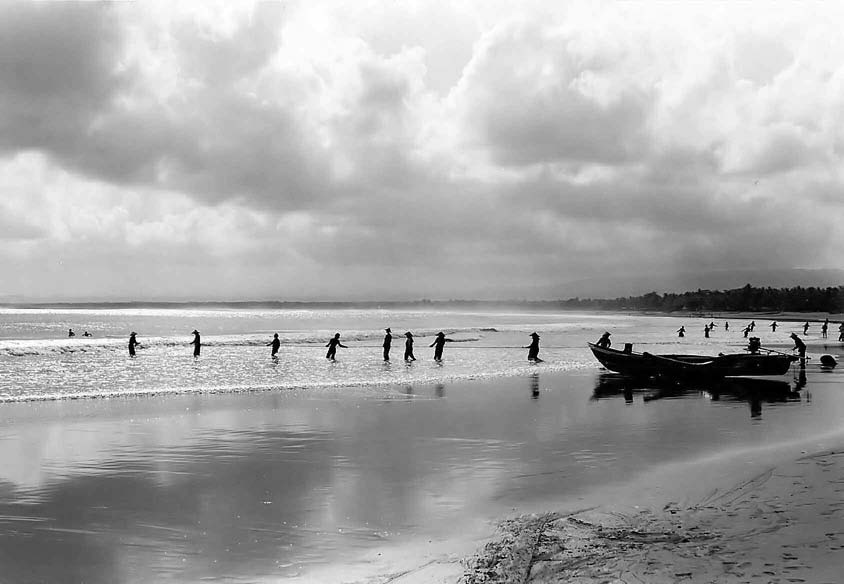
About the Global Forum
The Global Forum is comprised of ocean leaders from govern-
ments, non-governmental organizations, international and
intergovernmental organizations, the private sector, and scien-
tific associations with the purpose of advancing the global
oceans agenda. "Advancing the global oceans agenda" is meant
as: 1) promoting the implementation of international agree-
ments related to oceans, coasts, and small island developing
States (SIDS), especially the goals emanating from the 2002
WSSD; 2) analyzing new emerging issues such as improving the
governance regime for ocean areas beyond national jurisdic-
tion; and 3) promoting international consensus-building on
unresolved ocean issues.
The Global Forum was first mobilized in 2001 to help the
world's governments highlight issues related to oceans, coasts,
and SIDS on the agenda of the 2002 World Summit on
Sustainable Development, and was later formalized at the
WSSD in Johannesburg. The Global Forum is a response to per-
ceived needs for fostering cross-sectoral dialogue on ocean
issues among governments, NGOs, international organizations,
and the private and scientific sectors; constant advocacy for
oceans at the highest political levels; and the imperative of tak-
ing an ecosystem-based and integrated approach to oceans gov-
ernance at national, regional, and global levels, including treat-
ing the water system--from freshwater, to coasts, to oceans--
as the interlinked system that it is.
Since 2001, the Global Forum has involved ocean experts rep-
resenting all sectors from 93 countries; organized four Global
Conferences (in 2001, 2003, and 2006 at UNESCO in Paris,
and in Hanoi, Vietnam in 2008); organized the Ocean Policy
Summit in Lisbon in 2005 documenting experiences with inte-
grated oceans governance in over 20 countries and 4 regions
around the world; prepared a number of reports on the imple-
mentation of the WSSD ocean targets, reports on ocean issues
in island states for the 2005 Mauritius International Meeting,
and reports on capacity development needs on ocean and
coastal management in 8 world regions; and provided a series
of Internet information services, including periodic newsletters.
For information about the Global Forum, please see the
Global Forum Website at http://www.globaloceans.org."
19
Steering Committee, Global Forum on Oceans, Coasts, and Islands
CO-CHAIRS
Guillermo Garcia Montero, President,
Mary Power, Director, Resource
Vladimir Golitsyn, Professor of
National Aquarium, Havana, Cuba
Mobilization Office, World Meteorological
International Law, Moscow State
Biliana Cicin-Sain, Director, Gerard J.
Magnus Ngoile, Team Leader, Marine
Association
University of International Relations
Mangone Center for Marine Policy,
and Coastal Environmental Management
Cristelle Pratt, Director, South Pacific
Lynne Hale, Director, Marine Strategy,
University of Delaware (also Head of
Project (MACEMP), Ministry of Natural
Applied Geoscience Commission
The Nature Conservancy
Secretariat, Global Forum)
Resources and Tourism
(SOPAC), Fiji
Art Hanson, former Ministerial Ocean
Patricio A. Bernal, Executive-Secretary,
Rolph Payet, Advisor to the President,
Diane Quarless, Chief, Small Island
Ambassador, Department of Fisheries and
Intergovernmental Oceanographic
Seychelles
Developing States Unit, UNDESA
Oceans, Canada, member of the Canadian
Commission, UNESCO, Paris, France
Lori Ridgeway, Director-General,
John Richardson, Head, Maritime Policy
Foundation for Innovation (CFI)
Veerle Vandeweerd, Director,
International Coordination and Policy
Task Force, European Commission
Gregor Hodgson, Director, Reef Check
Environment and Energy Group, United
Analysis, Department of Fisheries and
Nations Development Programme
Anne Rogers, United Nations
Paul Holthus, Executive Director, World
Oceans, Canada, and Camille Mageau,
(UNDP)
Department of Economic and Social
Ocean Council
Director, Marine Ecosystems Conservation
Affairs (UNDESA)
Gunnar Kullenberg, Independent
GOVERNMENTAL
Branch, Department of Fisheries and
Eduard Sarukhanian, Director, World-
Consultant and former Executive
Oceans, Canada
Weather-Watch-Applications, World
Secretary, Intergovernmental
David Balton, Deputy Assistant Secretary
Mario Ruivo, Intersectoral
Meteorological Organization (WMO),
Oceanographic Commission (IOC)
for Oceans and Fisheries, Bureau of
Oceanographic Commission, Ministry
Switzerland
Oceans, U.S. Department
Dan Laffoley, World Commission on
of Science, Technology, and Higher
of State
Dann Sklarew, Director and Chief
Protected Areas-Marine, IUCN
Education, Portugal
Technical Advisor, GEF, IW:LEARN
Phil Burgess, Director, Cetacean Policy
Carl Lundin, Head, IUCN Marine
Indroyono Soesilo, Chairman, Agency
and Recovery, Department of the
Asterio Takesy, Director, Secretariat for
Programme
for Marine and Fisheries Research,
Environment and Water Resources,
the Pacific Regional Environment
Department of Marine Affairs and
Dawn Martin, President, Sea Web, USA
Australia
Programme
Fisheries, Indonesia
Gerald Miles, The Nature Conservancy,
Nguyen Chu Hoi, Director, Institute
Khulood Tubaishat, Advisor,
Ambassador Enele S. Sopoaga, Tuvalu,
Pacific Region, Brisbane, Australia
of Fisheries Economics and Planning,
The Regional Organization for the
Former Vice-Chair, Alliance of Small
Iouri Oliounine, Executive Director,
Ministry of Agriculture and Rural
Conservation of the Environment of the
Island Developing States (AOSIS)
International Ocean Institute, Malta
Development, Vietnam
Red Sea and Gulf of Aden (PERSGA)
Pietro Parravano, President, Institute for
Torkil J. Clausen, Managing Director,
INTERGOVERNMENTAL
Chika Ukwe, Industrial Development
Fisheries Resources, World Fisheries
DHI Water Policy and Senior Adviser,
Officer (International Waters), United
Salvatore Arico, Programme Specialist,
Forum
Global Water Partnership
Nations Industrial Development
Ecological Sciences, UNESCO
Organization (UNIDO)
Sian Pullen, Independent Consultant,
Aldo Cosentino, Director-General,
Julian Barbiere and Stefano Belfiore,
New Zealand, and former Head of
Directorate for Nature Protection, Sea
Marjo Vierros, Visiting Professor,
Intergovernmental Oceanographic
European and Middle East Marine
Protection, Ministry for Environment and
Institute of Advanced Studies, United
Commission, France
Program, WWF International, UK
Protection of the Territory, Italy
Nations University, Vancouver
Chua Thia-Eng, Partnership in
Victoria Radchenko, Director,
Margaret Davidson, Director, Coastal
Eugenio Yunis, Chief, Sustainable
Environmental Management for the Seas
International Ocean Institute, Ukraine
Services Center, National Oceanic and
Development of Tourism World Tourism
of East Asia (PEMSEA), IMO/UNDP/GEF,
Tony Ribbink, Director, Sustainable
Atmospheric Administration (NOAA),
Organization
Philippines
Seas Trust
USA
A.H. Zakri, Director, Institute of
Anjan Datta, Global Programme for the
Evelia Rivera-Arriaga, Centro de
Antonio Diaz de Leon, Director-General,
Advanced Studies, United Nations
Protection of the Marine Environment
Ecologia, Pesquerias y Oceanographia del
Environmental, Regional Integration and
University, Yokohama
from Land-Based Activities, The Hague
Golfo de Mexico (EPOMEX), Mexico
Sectoral Policy, Environment and Natural
N
Resources Ministry (SEMARNAT), Mexico
Ahmed Djoghlaf, Executive Secretary,
ONGOVERNMENTAL
Nirmal Jivan Shah, Chief Executive,
Convention on Biological Diversity
Nature Seychelles
Ambassador Angus Friday, Chair,
Milton Asmus, International
Alliance of Small Island States (AOSIS),
Al Duda, Senior Advisor, International
Representative, Brazilian Agency for
Alan Simcock, former Executive
Permanent Representative of Grenada to
Waters, Global Environment Facility
Coastal Management
Director, OSPAR, and former Co-Chair,
the United Nations
(GEF)
UN Informal Consultative Process on
Awni Behnam, President, International
Ocean Affairs and Law of the Sea
Gi-Jun Han, Ministry of Maritime Affairs
Marea E. Hatziolos, Senior Coastal and
Ocean Institute, Malta
and Fisheries, Republic of Korea
Marine Specialist, Environment
Nancy Targett, Dean, University of
Charles A. Buchanan, Administrator
Department, The World Bank
Delaware College of Marine and Earth
Elie Jarmache, Chargé de Mission,
Luso-American Development Foundation,
Studies
Secrétariat Général de la Mer, France
Indumathie Hewawasam, Consultant to
Portugal
The World Bank
Kristian Teleki, International Coral Reef
Magnus Johannesson, Secretary-General,
Simon Cripps, Director, Global Marine
Action Network, Switzerland
Ministry for the Environment, Iceland
Andrew Hudson, Principal Technical
Programme, World Wide Fund For
Advisor, International Waters, UNDP/GEF
Hiroshi Terashima, Executive Director,
Ambassador Jagdish Koonjul,
Nature (WWF) International
Institute for Ocean Policy, Ocean Policy
Mauritius, former Chair, Alliance of Small
David Johnson, Executive Secretary,
Richard Delaney, Executive Director,
Research Foundation, Japan
Island States (AOSIS)
OSPAR Convention, London
Center for Coastal Studies, Provincetown,
Chris Tompkins, Independent
Gerhard Kuska, Associate Director
Vladimir Mamaev, GEF Regional
Massachusetts, USA
Consultant and formerly DEFRA, UK
and Director of Ocean and Coastal Policy,
Technical Advisor, UNDP, Europe and the
Annick de Marffy, former Director of
White House Council on Environmental
CIS, Slovak Republic
Division of Ocean Affairs and Law of the
Grant Trebble, African Marine and
Quality, USA
Franklin McDonald, Adviser, UNEP
Sea (UNDOALOS), United Nations
Coastal Resource Over-exploitation
Prevention Strategy (AMCROPS), South
Tom Laughlin, Deputy Director,
Caribbean Environment Programme
International Consultant
Africa
International Affairs Office, National
(UNEP/CEP), and former Director,
Sylvia Earle, Chair, Deep Ocean
Oceanic and Atmospheric Administration
National Environmental Policy Agency,
Exploration and Research (DOER), and
Philippe Vallette and Manuel Cira,
(NOAA), USA
Jamaica
Explorer-in-Residence, National
NAUSICAA, France, and the World
Ocean Network
Haiqing Li, Deputy Director-General,
Vaclav Mikulka, Director, UN Division
Geographic Society
State Oceanic Administration (SOA),
for Ocean Affairs and the Law of the Sea
Charles Ehler, Consultant to UNESCO
David VanderZwaag, IUCN Specialist
China
Ali Mohamed, Coordinator, Coastal and
Group on Ocean Law and Governance
Julius Francis, Executive Secretary,
Trust
John Low, Adviser to the Minister of
Marine Secretariat, New Partnership for
Western Indian Ocean Marine Science
Marine Resources for the Cook Islands
Africa's Development (NEPAD), Kenya
Association, Tanzania
* Please note: Members of the Steering
Rejoice Mabudafhasi, Deputy Minister
Satya Nandan, Secretary-General,
Serge Garcia, Independent Consultant,
Committee participate in their individual
of Environmental Affairs and Tourism,
International Seabed Authority, Jamaica
and Former Director, Marine Fisheries
capacities.
South Africa
Tiago Pitta e Cunha, Member, Cabinet
Resources Division, Food and Agriculture
Jan Mees, Director, Flanders Marine
of Fisheries and Maritime Commissioner,
Organization (FAO)
Institute, Belgium
European Commission
Matthew Gianni, Political Advisor, Deep
Sea Conservation Coalition, Netherlands
20


Global Forum on Oceans,
Coasts, and Islands
Gerard J. Mangone Center for
Marine Policy
301 Robinson Hall, University of Delaware
Newark, Delaware 19716 USA
Telephone: +1-302-831-8086
Fax: +1-302-831-3668
www.globaloceans.org
See coverage of 2008 Global Oceans Conference at:
World Ocean Observatory
http://www.thew2o.net/goc2008/goc2008.htm
Global Oceans Conference 2008 YouTube Channel
http://www.thew2o.net/goc2008/goc2008.htm
International Institute for Sustainable Development
Reporting Services (IISD-RS)
http://www.iisd.ca/ymb/sdoh4/