SIS
Y
TITUTIONAL FRAMEWORK ANAL
3.0 LEGAL AND INS
3
The designations employed and the presentation of the material in this document do not imply the expression of any
IMPRINT
opinion whatsoever on the part of UNEP/MAP concerning the legal status of any State, Territory, city or area, or of its
authorities, or concerning the delimitation of their frontiers or boundaries.
This TDA was prepared within the GEF Project "Determination of priority actions for the further elaboration and
implementation of the Strategic Action Programme for the Mediterranean Sea", under the coordination of Mr Ante
Baric, PhD, Project Manager.
Responsibility for the concept and the preparation of this document was entrusted to MED POL (Mr Fouad
Abousamra, PhD, MED POL Programme Officer).
© 2005 United Nations Environment Programme / Mediterranean Action Plan (UNEP/MAP), P.O. Box 18019, GRAthens
This publication may be reproduced in whole or in part and in any form for educational or non-profit purposes with-
out special permission from the copyright holder, provided acknowledgement of the source is made. UNEP/MAP
would appreciate receiving a copy of any publication that uses this publication as a source.
This publication cannot be used for resale or for any other commercial purpose whatsoever without permission in
writing from UNEP/MAP.
ISBN: 92 807 2578 5
Job Nr.: MAP/0676/AT
For bibliographic purposes this publication may be cited as:
UNEP/MAP/MED POL: Transboundary Diagnostic Analysis (TDA) for the Mediterranean Sea, UNEP/MAP, Athens, 2005.
*
Graphic Design & Infographics: /fad.hatz@november
Table of Contents
Table of Contents
-10
List of Tables
-7
List of Figures
-6
Acronyms & Abbreviations
-4
FOREWORD
0
i. EXECUTIVE SUMMARY
i
i.1 TDA Content and Process
i
i.2 Mediterranean Sea Environmental Status and its Major Transboundary Issues
iii
i.3 Environmental Quality Objectives
xiv
i.4 Priority Actions and Interventions for NAPs / SAP
xiv
able of Contents
T
INTRODUCTION
1
1.0 THE MEDITERRANEAN REGION
3
1.1 Environmental Characteristics
4
1.1.1 Geographic setting and climate
4
1.1.2 The hydrological system
6
1.1.3 Biological diversity
9
1.1.4 Natural resources
11
1.2 Socio-economic Aspects
11
1.2.1 Demography and human settlements
11
1.2.2 Industrial activity and trade
13
1.2.3 Agriculture and Fisheries
13
1.2.4 Tourism
14
2.0 MAJOR ENVIRONMENTAL CONCERNS
17
2.1 Decline of Biodiversity
17
2.1.1 Transboundary elements
18
2.1.2 Environmental impacts
18
2.1.3 Socio-economic impacts
19
2.1.4 Causal Chain Analysis
19
-10
»
»
2.1.5 Supporting data
19
2.1.5.1 Exploitation of living marine resources
21
2.1.5.2 Degradation and conversion of critical habitats
21
2.1.5.3 Pollution
26
2.1.5.4 Introduction and invasion of alien species
39
2.1.5.5 Destruction of habitats by fishing pressure
41
2.2 Decline in Fisheries
41
2.2.1 Transboundary aspects
42
2.2.2 Environmental impacts
43
2.2.3 Socio-economic impacts
43
2.2.4 Causal Chain Analysis
44
2.2.5 Supporting data
46
2.2.5.1 State of the resources
46
2.2.5.2 Interactions of fishing with non-commercial resources
47
2.2.5.3 Eutrophication
47
2.2.5.4 Interaction of mariculture with fisheries
47
2.2.5.5 Overall characteristics of the Mediterranean fishing sector
49
2.3 Decline of Seawater Quality
51
2.3.1 Transboundary elements
51
2.3.2 Transboundary source-receptor relationships in PAHs deposition
52
2.3.3 Environmental impacts
53
2.3.4 Socio-economic impacts
53
2.3.5 Causal Chain Analysis
54
2.3.6 Supporting data
56
2.3.6.1 Eutrophication
56
able of Contents
T
2.3.6.2 Heavy metals
62
2.3.6.3 Persistent toxic substances (PTSs)
71
2.3.6.4 Pollution Hot Spots
80
2.4 Human Health Risks
82
2.4.1 Transboundary elements
82
2.4.2 Environmental impacts
83
2.4.3 Socio-economic impacts
83
2.4.4 Causal Chain Analysis
83
2.4.5 Supporting data
85
2.4.5.1 Chemical contamination
85
2.4.5.2 Microbiological pollution
93
3.0 LEGAL AND INSTITUTIONAL FRAMEWORK ANALYSIS
101
3.1 Major problems identified with legal and institutional frameworks in the Mediterranean
101
3.1.1 Major problems identified with legal arrangements
for addressing transboundary environemental issues
101
3.1.1.1 Issues at the national level
102
3.1.1.2 Issues at the regional level
102
3.1.2 Major problems identified with institutional arrangements and capacity
for addressing transboundary environmental issues
103
3.2 Existing Legal and Policy Frameworks in the Mediterranean
103
3.2.1 The Barcelona System
103
-9
»
»
3.2.2 Regional Protocol and Policy Instruments related to the Barcelona Convention
105
3.2.2.1 Pollution
105
3.2.2.2 Conservation of Biodiversity
111
3.2.2.3 Fisheries
115
4.0 STAKEHOLDER ANALYSIS
121
4.1 Mediterranean Stakeholders
121
4.2 MAP Civil Society Partners
122
4.3 Suggestions for Improving Cooperation with MAP Civil Society Partners
122
5.0 ENVIRONMENTAL QUALITY OBJECTIVES (EQOs)
125
5.1 Objective 1: Reduce the Impacts of LBS on Mediterranean Marine Environment
and Human Health
125
5.1.1 The Strategic Action Programme to address pollution from LBS
125
5.2 Objective 2: Sustainable Productivity from Fisheries
127
5.2.1 Code of Conduct for Responsible Fisheries
128
5.2.2 Objectives of the Code
128
5.2.3 Relationship with other International Instruments
128
5.2.4 Implementation, monitoring and updating
129
5.2.5 Special requirements of developing countries
129
5.2.6 General principles
129
able of Contents
T
5.2.7 Fisheries management
131
5.2.8 Fishing operations
133
5.2.9 Aquaculture development
136
5.2.10 Integration of fisheries into coastal area management
137
5.2.11 Post-harvest practices and trade
138
5.2.12 Fisheries Research
139
5.3 Objective 3: Conserve the Marine Biodiversity and Ecosystem
139
5.3.1 SAP BIO objectives and targets
139
5.3.2 SAP BIO Portfolio
152
6.0 REFERENCES & SELECTED BIBLIOGRAPHY
155
Annex I
Contributors to the TDA
165
Annex II
Threatened Species in the Mediterranean
168
Annex III
List of Regional Pollution Hot Spots
181
Annex IV
List of Regional Pollution Sensitive Areas
186
Annex V
Signatories to the Barcelona Convention and its Protocols
188
Annex VI
National Action Plans for the Conservation of Biodiversity
190
-8
List of Tables
Table i.1
Transboundary sites at risk related to Mediterranean marine biodiversity
vi
Table i.2
Marine and coastal sites of particular interest identified by country,
with relevant actions listed
vii
Table i.3
Locations where sensitive ecosystems are threatened by eutrophication
ix
Table i.4
The 20 urban centres discharging the most BOD
xi
Table i.5
Some of the main sources of TPBs to the Mediterranean
xii
Table i.6
Locations where major industrial waste problems exist
xiii
Table i.7
Targets categorized according to Environmental Quality Objective
xv
Table i.8
Areas and activities for priority interventions
xvi
Table 1.1
Variation of species according to depth zones
10
ables
Table 2.1
Serious eutrophication incidents in the Mediterranean
28
List of T
Table 2.2
Algal species reported to cause algal blooms in Mediterranean Waters
29
Table 2.3
Differences in mean density (S.D.), mean biomass and mean individual fish weight
for seagrass fish bed assemblages in marine reserves and in areas open to fishing
41
Table 2.4
Age structures of Diplodus annularis taken from a protected area (Medias Islands)
and a non-protected area (Port da la Selva)
41
Table 2.5
Percentage contribution to the total biomass by different trophic groupings
in Mediterranean rocky zones, protected (Meded islands) and non-protected (Tossa)
41
Table 2.6
Some shared stocks and fisheries in the Mediterranean
50
Table 2.7
Documented rivers for dissolved nutrients
60
Table 2.8
Sector-based emissions of NOx in the Mediterranean region (kton N/yr)
61
Table 2.9
Atmospheric versus riverine inputs of Pb and Zn to the Mediterranean (tonnes/yr)
69
Table 2.10
Concentrations (in ng/g ww) of organochlorinated compounds in samples
of fish tissues collected in the NW Mediterranean
71
Table 2.11
PTS inputs (in kg/yr) of the Rhone and Seine Rivers into the sea
75
Table 2.12
Estimated distribution of TBTs in the Mediterranean Sea
77
Table 2.13
Intakes of persistent toxic substances and corresponding safety thresholds
85
Table 2.14
Pathogens and indicator organisms commonly found in raw sewage
95
Table 2.15
Cities (> 50,000 and < 900,000 inh.) without WWTP in the Mediterranean
98
Table 2.16
Bacteriological water quality in some Mediterranean rivers
99
Table 5.1
SAP Urban environment EQOs
125
Table 5.2
SAP Industrial development EQO's
126
Table 5.3
SAP Biodiversity EQOs
140
-7
List of Figures
Figure i.1
Flow Diagram for the TDA Process
ii
Figure i.2
Transboundary Sites at Risk related to Mediterranean Marine Biodiversity
vi
Figure i.3
Areas where Marine Protected Areas have been recommended within National Action Plans
viii
Figure i.4
Mediterranean Areas where Eutrophication Phenomena have been reported
viii
Figure i.5
Pollution Hot Spots in the Mediterranean Sea
x
Figure i.6
Ecosystems associated with Highest Pollutant-load Hot Spots
xi
Figure i.7
Location of Major Industries contributing TPBs to the Mediterranean Sea
xii
Figure i.8
Sources of Solid Waste to the Marine Environment
xiii
Figure 1.1
Mediterranean countries and their different watershed limits
3
Figure 1.2
Major Sub-basins of the Mediterranean Sea
6
Figure 1.3
Hydrologic boundary of the Mediterranean basin
7
Figure 1.4
A scheme of Mediterranean Sea circulation
8
Figure 1.5
Seascape Biodiversity Patterns in Benthic Invertebrates
10
Figure 1.6
Mediterranean Riparian Countries' Population in Cities over 10,000 Inhabitants
Population Retrospective and Projection from 1970 to 2025
12
List of Figures
Figure 2.1.1
Causal Chain Analysis
20
Figure 2.1
SPAMI in the Mediterranean
24
Figure 2.2
Sanctuaries for Cetaceans in the Mediterranean
25
Figure 2.3
Areal mapping of trophic conditions of the Adriatic Sea
27
Figure 2.4
Logarithmic values of total mercury mass fraction in Mullus barbatus
by year at station GOKSU in Turkish coastal waters
30
Figure 2.5
Logarithmic values total mercury mass fraction in Mullus barbatus respectively
by year at stations ISRTMH2 and HMF2 in Israeli coastal waters
30
Figure 2.6
Multi-boxplot (arranged from west to east), the HgT concentrations
in red mullet, Mullus barbatus
31
Figure 2.7
PCBs in Audouin's gull eggs
32
Figure 2.8
PCBs in Audouin's gull eggs in the Mediterranean
32
Figure 2.9
DDTs in Audouin's gull eggs
32
Figure 2.10
Medians of Cd concentrations in Mytilus galloprovincialis
34
Figure 2.11
Sources of marine solid waste in each Mediterranean country
38
Figure 2.12
Number of non-native plants in the Mediterranean Sea
40
Figure 2.13
Total marine catches in MT in the Mediterranean
42
Figure 2.14
Fish and fisheries exports in mil US$ from the Mediterranean
43
Figure 2.15
Fish and Fisheries imports in mil US$ to the Mediterranean
43
Figure 2.2.1
Causal Chain Analysis
45
Figure 2.16
Total landings in MT of marine catches by Mediterranean and Black Sea countries
46
-6
»
»
Figure 2.17
Fish and molluscs aquaculture production and value
of the Mediterranean countries for the years 1984 to 1998
48
Figure 2.18
Deposition of B[a]P to the Mediterranean Sea
53
Figure 2.3.1
Causal Chain Analysis
55
Figure 2.19
Satellite image illustrating average chlorophyll variations
in surface water of the Mediterranean Sea, winter 197985
56
Figure 2.20
Phosphorus load into the Mediterranean Sea from agriculture,
domestic / industrial activities and aquaculture
57
Figure 2.21
Nitrogen load into the Mediterranean Sea from agriculture,
domestic / industrial activities and aquaculture
57
Figure 2.22
Consumption of fertilizers in Mediterranean countries 19701990 in 10,000 t
58
Figure 2.23
Average of Mediterranean regional shares in emissions of lead (Pb),
Cadmium (Cd), Zinc (Zn) and Copper (Cu)
63
Figure 2.24
HgT concentrations in Mytilus galloprovincialis in the Mediterranean
64
Figure 2.25
Levels of total mercury in Mytilus galloprovincialis from Hot Spots
64
Figure 2.26
Cd in Mullus barbatus sorted by zones and arranged from west to east
65
Figure 2.27
Levels of Cadmium in Mytilus galloprovincialis from Hot Spots
66
Figure 2.28
Cu medians in Mytilus galloprovincialis
67
Figure 2.29
Histograms of Pb medians for Mytilus galloprovincialis
68
Figure 2.30
PCBs and DDTs in sediment (ng/g d.w.)
72
Figure 2.31
Major routes of maritime traffic
78
Figure 2.32
Emergence of Pollution Hot Spots and Pollution Sensitive Areas
81
Figure 2.4.1
Causal Chain Analysis
84
Figure 2.33
Total mercury content of sardines caught in the Strait of Gibraltar
and in different regions of the Mediterranean Sea
86
List of Figures
Figure 2.34
PCBs in selected marine species with nutrition values in the Mediterranean
86
Figure 2.35
DDT in selected species with nutrition values in the Mediterranean
90
Figure 2.36
Percentage of foodborne disease outbreaks caused by fish and shellfish
in Italy, Spain and France 199398
93
Figure 2.37
Notified cases of food borne disease outbreaks in Spain, Italy, Greece and France 199398
93
Figure 2.38
Coastal cities (with over 10,000 inhabitants) with wastewater treatment facilities
in the Mediterranean
96
Figure 2.39
Type of wastewater treatment in Mediterranean coastal cities
96
Figure 2.40
Water discharged by Mediterranean coastal cities
96
Figure 2.41
Potential for microbiological pollution reduction following expansion
of waste treatment in the Mediterranean
97
Figure 2.42
Changes in the quality of bathing water on the Marseille coast
since the beginning of the 1980s
99
Figure 5.1
Breakdown of investment needed according to the 7 categories of action
153
-5
Acronyms & Abbreviations
AB
Algal Bloom
ACCOBAMS
Agreement for the Conservation of Small Cetaceans of the Black Sea, Mediterranean Sea
and Contiguous Atlantic Area
ADRIAMED
Scientific Cooperation to support Responsible Fisheries in the Adriatic Sea
BAT
Best Available Technology
BEP
Best Environmental Practices
BOD
Biolochemical Oxygen Demand
BSEP
Black Sea Environment Programme
BSP
Baltic Sea Programme
CBD
Convention on Biological Diversity
CD
Compact Disc
CFP
Common Fisheries Policy
CITES
Convention on International Trade in Endangered Species of Wild Fauna and Flora
cm/s
centimeters per second
COD
Chemical Oxygen Demand
COFI
Committee on Fisheries
CPUE
Catch per Unit Effort
CZ
Coastal Zone
Acronyms & Abbreviations
DL
Daily Limit
dw
dry weight
EBRD
European Bank for Reconstruction and Development
EC
European Commission
EEA
European Environment Agency
EIA
Environmental Impact Assessment
EIN
Environmental Information Networking
EQO
Environmental Quality Objective
ER
Emergency Response
EU
European Union
EUCC
European Union for Coastal Conservation
EU SCOOP
European Union Scientific Cooperation
EU WFD
European Union Water Framework Directive
FAO
Food and Agricultural Organization, UN
g
gram
GDP
Gross Domestic Product
GEF
Global Environment Facility
GESAMP
Joint Group of Experts on the Scientific Aspects of Marine Pollution
GFCM
General Fisheries Commission for the Mediterranean
-4
GIS
Geographical Information System
»
GNP
Gross National Product
HAB
Harmful algal bloom
HDI
Human Development Index
IAEA
International Atomic Energy Agency
IARC
International Agency for Research on Cancer
ICCAT
International Commission for the Conservation of Atlantic Tunas
ICES
International Council for the Exploration of the Seas, UN
ICZM
Integrated Coastal Zone Management
IMO
International Maritime Organization
IOC
Intergovernmental Oceanographic Commission
IPPC
Integrated Pollution Prevention and Control
IRPTC
International Register of Potentially Toxic Chemicals
ITCAMP
Integrated Coastal Area Planning and Management
kg
kilograms
km
kilometer
l
liter
LBS
Land-Based Sources
LRTAP
Long Range Transboundary Air Pollution
LEARN
Learning Exchange and Resource Network
m
meter
MAP
Mediterranean Action Plan
MARPOL
International Convention for the Prevention of Pollution from Ships
MEA
Multilateral Environmental Agreement
Acronyms & Abbreviations
MED POL
Mediterranean Pollution Action Program
METAP
Mediterranean Environmental Technical Assistance Program
MG
Mytilus galloprovincialis (mussel)
mm
millimeter
MPPI
Major Perceived Problems and Issues
MT
metric ton
NAP
National Action Plan
NATO
North Atlantic Treaty Organization
NEAP
National Environmental Action Plan
NEC
National Emissions Ceilings
NGO
Non-Governmental Organization
NSA
National Shellfish Association
OECD
Organisation for Economic Co-operation and Development
OSPAR
Convention for the Protection of the Marine Environment of the North East Atlantic
PAH
Polycyclic Aromatic Hydrocarbons
PCDD
Polychlorinated dioxins
PCDF
Polychlorinated Drans
PCU
Programme Coordination Unit
PDF
Project Development Facility
pg
Picogram
-3
PIC (Convention)
Prior Informed Consent
PIP
Priority Investment Portfolio
»
PPP
Purchasing Power Parity
ppt
parts per thousand
PSSA
Particularly Sensitive Sea Area
PTIW
Pretreatment of Industrial Wastes
PTS
Persistent Toxic Substances
QA
Quality Assurance
QC
Quality Control
RA
Regional Action
REMPEC
Regional Marine Pollution Emergency Response Center for the Mediterranean Sea
RFO
Regional Fisheries Organization
SAC
Scientific Advisory Committee
SAP
Strategic Action Programme
SAP BIO
Strategic Action Programme for Biodiversity in the Mediterranean Region
SAP MED
Strategic Action Programme to Address Pollution from Land-Based Activities
SC
Steering Committee
SEA
Strategic Environmental Assessment
SME
Small and Medium Enterprise
SPA
Specially Protected Areas
SPAMI
Specially Protected Areas of Mediterranean Importance
TDA
Transboundary Diagnostic Analysis
TDI
Total Daily Intake
TEQ
Toxicity Equivalent Quotient
Acronyms & Abbreviations
THC
Total Hydrocarbon Concentration
TOR
Terms of Reference
TPB
Toxic, Persistent, and Bioaccumulative substances
TSS
Total Suspended Solids
UN
United Nations
UNCED
United Nations Conference on Environment and Development
UNECE
United Nations Economic Commission for Europe
UNECE/EMEP
United Nations Economic Commission for Europe / Co-operative programme for monitoring
and evaluation of long range transmission of air pollutants in Europe
UNDP
United Nations Development Programme
UNEP
United Nations Environment Programme
UNESCO
United Nations Education, Science and Culture Organization
UNIDO
United Nations Industrial Development Organization
UNOPS
United Nations Office for Project Services
WB
World Bank
WHO
World Health Organization
WMO
World Meteorological Organization
WSSD
World Summit on Sustainable Development
WTO
World Trade Organization
ww
wet weight
WWTP
Wastewater Treatment Plant
-2
WWW
World Wide Web
SIS (TDA) FOR THE MEDITERRANEAN SEA
Y
TIC ANAL
Y DIAGNOS
TRANSBOUNDAR
-1
FOREWORD
The Mediterranean region has witnessed sub-
lution. In particular, the first Transboundary Diagnostic
stantial progress during the last few years in the fight
Analysis (TDA, 1997) was an innovative and original
against land-based pollution. The Protocol on land-
piece of work for the region that, by coupling pollution
based pollution sources (LBS) to the Barcelona
data with an analysis of root causes and possible pol-
Convention, in force since June 1983, has managed to
lution control measures, indicated for the first time a
promote awareness and shared participation on the
concrete road map for the reduction and elimination of
issue of pollution from land, and the MED POL
pollution. With the support of GEF, the Mediterranean
Programme has supported capacity building pro-
countries worked in a new and more effective direction
grammes and has helped the gathering of large
and, as a result, they are soon to adopt solid and polit-
amounts of information and data on sources, levels
ically supported National Action Plans for the reduc-
and effects of marine pollution. However, it was only at
tion of pollution. Considering the progress made, the
the end of the nineties that the Mediterranean, on the
developments at the regional and international levels
long wave of the Rio Summit and the adoption of the
and the need to update and complete the existing data
UNEP Global Programme of Action (GPA) to address
and information, a second TDA has been prepared to be
FOREWORD
pollution from land-based activities, started moving
used once again as the basis for prioritizing and imple-
towards concrete action for pollution reduction. The
menting action. Furthermore, the present TDA achieved
signature of an amended LBS Protocol (1996) and the
an additional step compared with the 1997 TDA, that is
adoption of a Strategic Action Programme (SAP MED)
the use of the Environmental Quality Objectives adopt-
to address pollution from land-based activities (1997)
ed in the SAP MED, the recently adopted SAP for biodi-
can be considered the turning points since they offered
versity (SAP BIO) and the Code of conduct for fisheries.
to Mediterranean countries effective instruments and a
This has led to the identification of specific targets,
concrete road map to achieve gradual reduction and
deadlines and specific interventions and actions to be
elimination of land-based pollution by the year 2025.
adopted by the countries in the framework of their
The shift from assessment to control of pollution was
National Action Plans (NAPs) and the SAP MED. The
supported by several factors, the most important of
present TDA therefore represents once again a refer-
them being the interest and the concrete backing of the
ence point for all Mediterranean countries and the
Global Environment Facility (GEF). GEF believed in the
basis for action for the years to come.
political and technical potential of the region and has
supported a number of fundamental steps that have
Francesco Saverio Civili
now created a very promising momentum in the fight
MED POL Programme Coordinator
against land-based pollution in the Mediterranean. The
process of preparing and adopting the SAP MED was in
fact substantially supported by GEF by offering the
methodology and the experience gained in other
regions and by transferring them in the Mediterranean.
Through GEF, the Mediterranean countries in fact man-
aged to identify the marine pollution hot spots --the
basis for achieving pollution reduction-- and prepared
0
for the first time an assessment of transboundary pol-
SIS (TDA) FOR THE MEDITERRANEAN SEA
Y
TIC ANAL
Y DIAGNOS
TRANSBOUNDAR
i.
EXECUTIVE SUMMARY
i.1 TDA Content and Process
of interest to the Global Environment Facility's (GEF)
The purpose of conducting a Transboundary
International Waters (IW) focal area.
Diagnostic Analysis (TDA) is to scale the relative
The Mediterranean Sea environment is affected
importance of sources and causes, both immediate
by activities in heavily industrialized, developed coun-
and root, of transboundary `waters' problems, and to
tries in the northwest sector of the Sea, as well as by less
identify potential preventive and remedial actions.
industrialized activities in the southern and eastern
The TDA provides the technical basis for refinement
parts of the Sea. The GEF-eligible countries in the region
of both the National Action Plans (NAPs) and the
include Albania, Algeria, Bosnia & Herzegovina, Croatia,
Strategic Action Programme (SAP) in the area of
Egypt, Lebanon, Libya, Morocco, Slovenia, Syria,
international waters of the GEF.
Tunisia, and Turkey. Serbia & Montenegro was not par-
Y
This TDA, was elaborated on the basis of the
ticipated in the Project. Other countries participating in
previous TDA adopted in 1997, as well as extensive
these GEF activities include the non-eligible countries
information gathered since that time. The 1997 TDA
of Cyprus, France, Greece, Israel, Italy, Malta, Monaco
was based on more than three years of activities.
and Spain. Together, these countries account for much
Numerous meetings and workshops were held to pro-
of the coastline of the Mediterranean Sea. The chal-
i. EXECUTIVE SUMMAR
vide inputs to the TDA, various studies were carried out
lenges to conducting a successful GEF/IW project in a
and reports were commissioned to support the TDA.
region having such disparate mixes of development are
The 1997 TDA also benefited from information made
great. Problems associated with industrial countries
available by the Mediterranean Action Plan (MAP)
(e.g., organochlorines, hydrocarbons, PCBs, etc.) are
Secretariat through its business as usual activities.
mixed with environmental problems associated more
This TDA serves as an update of the 1997 TDA
often with developing countries (agricultural dis-
and was prepared during the implementation of the
charges, solid waste disposal, sewage treatment).
full GEF Project. To complete this update, a set of
Thus, the activities resulting from this GEF intervention
reports were prepared. An "Assessment of the Trans-
will be mixed and varied.
boundary Pollution Issues in the Mediterranean" was
The first step (Figure i.1) in the TDA process is to
drafted and then discussed at the regional experts'
identify the major perceived problems and issues
meeting (a list of participants is provided in Annex I)
(MPPIs). This step was performed through a participato-
where the major perceived issues were identified.
ry process. These MPPIs then were the basis for the
Based on the outcomes of this meeting, an updated
analysis phase, during which time the MPPIs were inves-
draft of the TDA was prepared, circulated for com-
tigated for validity. Do data support the MPPI as a prior-
ments and finalized.
ity concern? What data are necessary to evaluate the
The TDA provides the expert opinion on the
MPPI? What do the Stakeholders think about the impor-
state of the environment and priority problems. It
tance of the MPPI? What are the causes of the MPPI
terminates in a list of actions that are recommended
(causal chain analysis)? What are the environmental
for consideration. This list of recommendations must
impacts of the MPPI? What are the socio-economic
be considered in the context of national priorities
impacts of the MPPI? The analysis phase ends with a de
and regional priorities. In addition, the list of recom-
facto ranking of the relative importance of the various
mendations is not exhaustive. Rather, the list is
MPPIs. This importance is based on the perspective of the
i
designed to address the major transboundary issues
GEF/IW, as the TDA is a product of the GEF/IW process.
SIS (TDA) FOR THE MEDITERRANEAN SEA
Y
These steps lead to investigation of the
have finite and defined duration, and be associated
TIC ANAL
Quantitative Understanding of the Environment, which
with definable and measurable indicators.
is the TDA. This quantitative understanding by nature
What steps are necessary to achieve the EQOs,
Y DIAGNOS
has uncertainties: the data are not perfect, they are too
given the present condition of the environment?
infrequent, they are too sparsely located around the
Some EQOs may need no additional steps, except
region, the analytical methods are imperfect, etc.
perhaps routine implementation. Other EQOs may
However, the TDA is based on expert judgment of the
require vast changes in environmental practices and
TRANSBOUNDAR
best available data. The TDA then is followed by agree-
conditions to achieve them. To move towards the
ment of overarching regional Quality Objectives: if the
EQOs, targets are set: targets are time-constrained
TDA gives the present status of the environment, what is
and quantifiable in their impact. The targets give the
the common vision of the desired status? What environ-
initial movements towards the EQOs, but they are
mental goals are desirable for the Mediterranean Sea?
mainly Status Indicators. The activities or interven-
These are the Environmental Quality Objectives (EQOs).
tions that lead to the achievement of the targets are
After the MPPIs are ranked and the EQOs agreed,
the main output of the TDA: they represent experts'
the root causes are then examined using a causal chain
opinions about how to achieve the EQOs best given
analysis. The causal chain analysis reviews the immedi-
the existing conditions (environmental, institution-
ate causes of the MPPIs, as well as the root causes con-
al, capacity, state of knowledge, etc.). This section,
tributing to creation of those MPPIs. The root causes
therefore, summarizes the results of this process.
normally are the target of interventions; such interven-
The TDA focuses on the major Transboundary
tions at the root cause level generally provide more sus-
issues. Transboundary is the regional context for the
tainable and effective results.
TDA, and separates national issues from issues eligi-
The root causes and the MPPIs generally
ble for incremental assistance from GEF to achieve
"drive" the next step in the process: selection of spe-
global benefits. Transboundary can be defined from
cific targets and actions to move towards achieve-
several perspectives. It can be an environmental
ii
ment of the EQOs. These targets must be realizable,
issue that originates in one country, but affects other
countries (river discharge is an example). It can be
i.2 Mediterranean Sea Environmental Status
an environmental issue that comes from many coun-
and its Major Transboundary Issues
tries (air pollution, Transboundary rivers). In some
The identification of the major perceived
cases, Transboundary has been defined as a problem
issues is the first step in the TDA process and it con-
common to several target countries even though they
stitutes the justification for the subsequent in-depth
may not have common sources; however, this is not a
analyses. The significance of the perceived issues and
general definition.
problems should be substantiated on environmental,
Borrowing from methodology commonly used
economic, social, and cultural grounds. The following
in the European Union and other regions, the TDA
list of major perceived problems and issues was final-
process identified three Environmental Quality
ized to include four existing problems / issues:
Objectives (EQOs), which represent the regional per-
· MPPI 1: Decline of Biodiversity
spective of major goals for the Mediterranean envi-
· MPPI 2: Decline in Fisheries
ronment. The use of EQOs helps to refine the TDA
· MPPI 3: Decline of Seawater Quality
process by achieving consensus on the desired status
· MPPI 4: Human Health Risks
of the Mediterranean Sea. Within each EQO (which is
These perceived1 problems and issues form the
a broad policy-oriented statement), several specific
basis for the subsequent analysis, in which each of
targets were identified. Each target generally had a
these problems and issues is addressed from a status
timeline associated with it, as well as a specific level
perspective: what do we know about each problem /
of improvement / status. Thus, the targets illustrate
issue? What data support the quantification of the
the logic chain for eventual achievement of the EQO.
extent of the problem / issue? Do the data support
Finally, specific interventions or actions were identi-
these as real problems and issues, or just as percep-
fied to permit realization of each of the targets,
tions? This analysis took place on a scientific level,
Y
within the time frame designated. For the purposes of
including biological, oceanographic, physical, social,
this TDA, the time frames were limited to the first five
and other perspectives on the problem. This is in effect
or ten year periods, with some targets achieved prior
the "status" assessment. Next came the Causal Chain
to that time.
Analysis, where the major perceived problems and
In summary, this TDA follows the general GEF
issues were analyzed to determine the primary, sec-
i. EXECUTIVE SUMMAR
TDA Guidelines for International Waters projects.
ondary and root causes for these problems / issues.
However, an additional step was achieved, that is,
Identification of root causes is important, because
use of Environmental Quality Objectives, in order to
these tend to be more systemic and fundamental con-
facilitate consensus on the desired state of the
tributors to environmental degradation. Interventions
Mediterranean Sea after the next pentade or decade.
and actions directed at the root causes tend to be more
The EQOs naturally led to identification of specific
sustainable and effective than interventions directed
targets to be met within the desired time frame, and
at primary or secondary causes. However, because the
from there identification of specific interventions
linkages between root causes and solution of the per-
and actions that can be considered in the framework
ceived problems are often not clear to policymakers,
of the NAPs and SAP.
interventions commonly are directed at primary or sec-
The TDA is comprised of several sections:
ondary causes. This TDA attempts to make the linkages
· The first Section is the Executive Summary.
between root causes and perceived problems more
· Section 1 is the Introduction.
clear, to encourage sustainable interventions at this
· Section 2 is the technical basis of the TDA,
level. Fortunately, root causes are common to a num-
addressing the MPPIs.
ber of different perceived problems and issues, so
· Section 3 is the Legal and Institutional
addressing a few root causes may have positive effects
Framework Analysis.
on several problems and issues.
· Section 4 is the Stakeholder Analysis.
Finally, the analysis recognizes that society
· Section 5 covers the Environmental Quality
commonly acts within a number of nearly independ-
Objectives.
1 "Perceived" is used to include issues which may not
Section 1 summarizes much knowledge of the
have been identified or proved to be major problems as
Mediterranean's natural and socio-economic
yet due to data gaps or lack of analysis or which are
regimes. Environmental characteristics are identi-
expected to lead to major problems in the future under
iii
fied, and socio-economic aspects addressed.
prevailing conditions.
ent sectors (agriculture, industry, transport, etc.),
nearshore fisheries, particularly for arti-
which are poorly coordinated and often have con-
sanal fisheries; loss of tourism and its
flicting interests and associated policies. Within
documented economic benefits; and loss
these sectors, various Stakeholders have interests in
of cultural heritage.
the Mediterranean Environment, both affecting and
b. Analysis: Particularly heavily impacted are
being affected by that environment. Sectors and
seagrass habitats (including Posidonia
their Stakeholders work in an uncoordinated and
meadows and eelgrass meadows, inter
sometimes conflicting fashion, but they typically
alia) that have been affected by eutroph-
affect the Mediterranean environment in similar
ication, bottom trawling, dredging, and
ways. Loss of habitat, for instance, may be caused by
other human activities. These are high
activities of various sectors (transport, farming,
ecological service habitats. Additional
industry), and by various types of Stakeholders (gov-
habitats include biogenic constructions by
ernmental policy-makers, ranchers grazing animals,
both vegetal and animal coral builders,
small farmers). A major concern of this TDA, there-
and comprises also some very sensitive
fore, has been to identify common root causes and
deep-water coralline habitats, though
link them with improvements to perceived problems
these effects are less well known. Coastal
and issues. A Stakeholders analysis has been com-
wetlands, including lagoons and estuaries,
pleted, and is summarized in this TDA.
are adversely affected by pollution, land
The result of the analysis is a prioritization of
reclamation, mismanagement of the
the MPPIs for later regional intervention, supported
phreatic basins (aquifers), and river diver-
by GEF. In order to avoid long lists of unfocused inter-
sion / loss of flow. Invasion by alien
ventions, the TDA should identify concrete priorities
species is an ongoing process, and forms
for action, and justify their status as a transbound-
part of the basis for the Mediterranean's
ary concern.
high biodiversity. Although introduction of
SIS (TDA) FOR THE MEDITERRANEAN SEA
The TDA analysis of the major perceived prob-
alien species by humans is a priority prob-
Y
lems and issues can be summarized as follows:
lem to be addressed, preventing invasion
1. Decline in biodiversity: strongly trans-
by new species by natural means is not.
TIC ANAL
boundary.
Primary causes of decline in biodiversity
a. Brief statement of the problem: Some crit-
include excess supply of nutrients, bottom
Y DIAGNOS
ical habitats are severely threatened by a
fishing, by-catch, degradation and un-
variety of human activities. Major threats
controlled human presence of breeding
to the biodiversity of the area include pol-
and / or nursery areas for marine pul-
lution (sewage, oil, nutrients), invasive
monata and fish, pollution, solid waste
TRANSBOUNDAR
species, introduced species, land recla-
disposal, competing land uses including
mation, river damming and flow modifica-
land reclamation, alteration of river flows
tion, over-fishing, by-catch, and adverse
and constituents, and introduction of
effects of fishing gear and uses on marine
alien species. Root causes for this MPPI
habitats (e.g., bottom trawling), solid
include poor stakeholder awareness and
waste disposal at sea, uncontrolled tourist
participation, inadequate control over
presence in ecologically sensitive areas as
fishing effort and gear employed, insuffi-
well as inadequate public and stakehold-
cient scientific knowledge and monitoring
ers awareness, and inadequate or non-
of the biodiversity in the region and relat-
existent legislation and available enforce-
ed processes, as well as inadequate imple-
ment means. Ecological effects include
mentation of treaties and international
disruption of biocenosis; dramatic change
agreements, lack of investment in waste-
in community structure; disruption of key
water treatment, and poor solid waste dis-
ecotones, some of which are globally valu-
posal practices.
able; and adverse impacts on endangered
c. Priority Areas for GEF Intervention:
species. Socio-economic impacts of
i. One target for reversing decline in biodi-
decline in biodiversity include loss of high
versity is preservation of key Mediterra-
iv
value ecological services; reduction in
nean biotopes such as seagrass and other
marine vegetation beds (Posidonia, eel-
ed in Table i.3. GEF's role could be
grass, and others listed in the Red Book),
directed at reducing nutrient and BOD
coralligenous, sea mounts, wetlands,
discharges, to reduce the eutrophica-
marine caves, etc., and creating condi-
tion of the Sea.
tions for their enhancement. The priority
2. Decline in fisheries: strongly transboundary.
areas for this activity are encountered
a. Brief statement of the problem: Various
throughout the region, and their proper
threats to fisheries include pollution, over-
mapping is a priority still in need of com-
fishing, loss of habitat, excessive bycatch,
pletion.
deleterious fishing gear, lack of enforment
ii. A second target for GEF intervention is
of laws and agreements in the high seas,
addressing other important sites at
and sophisticated methods to find and
risk that are important for marine
catch fish. Concern has arisen that there is
biodiversity. These are elements of
an underlying problem of long-term deple-
biodiversity that, due to their abun-
tion in Mediterranean marine catches. In
dance, special importance, or endan-
fact, most of the Mediterranean fishery
gered status, require special atten-
resources, be they demersal, small pelagic
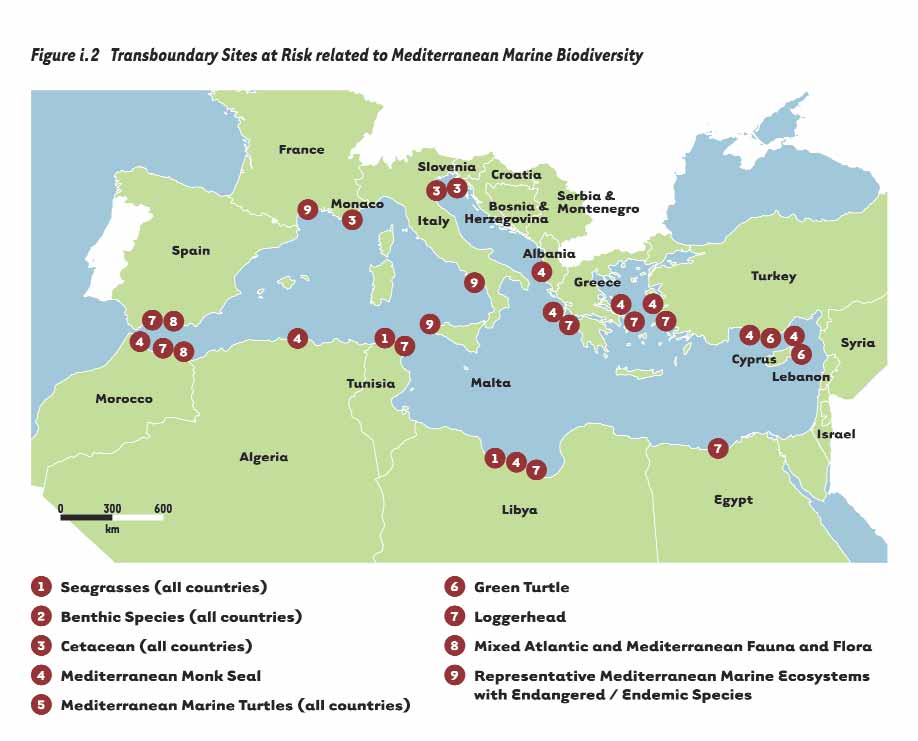
tion. Figure i.2 shows the locations of
or highly migratory species, have long been
the areas where the resources require
considered overexploited. The issue is
attention, according to the list of
transboundary because many fish are
Table i.1.
either migratory or represent shared
iii. A third target for GEF intervention is
stocks. Overall, the fisheries are overseen
expanding the number of protected
by the General Fisheries Commission for the
Y
areas in the Mediterranean Sea, and to
Mediterranean (GFCM).
facilitate the management and a
b. Analysis: Fish catch information shows
well-established networking for exist-
some remarkable constancy on time peri-
ing ones. Regional mechanisms for
ods of decades, and even more so in years,
Protected Areas exist (e.g., SPAMI).
fluctuating only by a factor of two or less in
i. EXECUTIVE SUMMAR
However, most of these are in the
total catch. However, the number of fishing
northwest Mediterranean Sea. Some
vessels has increased markedly during this
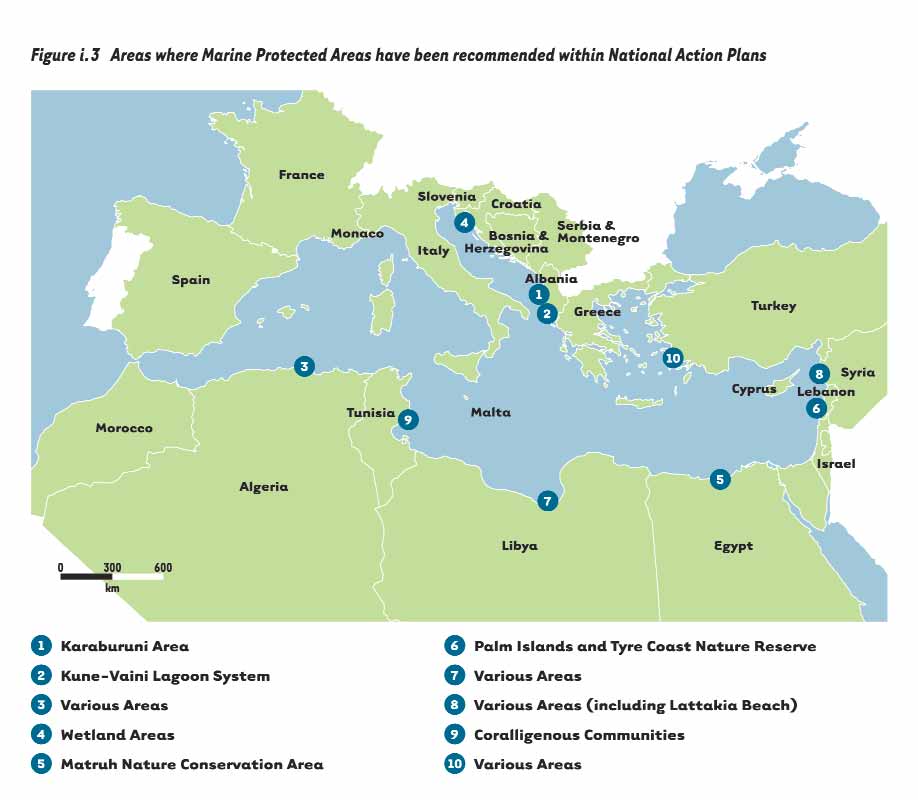
main priority areas of particular inter-
time, increasing in some countries by a
est are listed in Table i.2 and some are
factor or three or four. Composition of the
shown in Figure i.3.
catch has also changed with time, though
iv. A fourth GEF target area is to reduce
not as dramatically as in some areas such
eutrophication of coastal waters. To
as the Yellow Sea. The most targeted
address this, sewerage and wastewater
species already show signs of intensive
treatment plants, a primary source of
exploitation. Catch-per-unit effort (CPUE)
excess nutrients, must be expanded in
and other measurements and biological
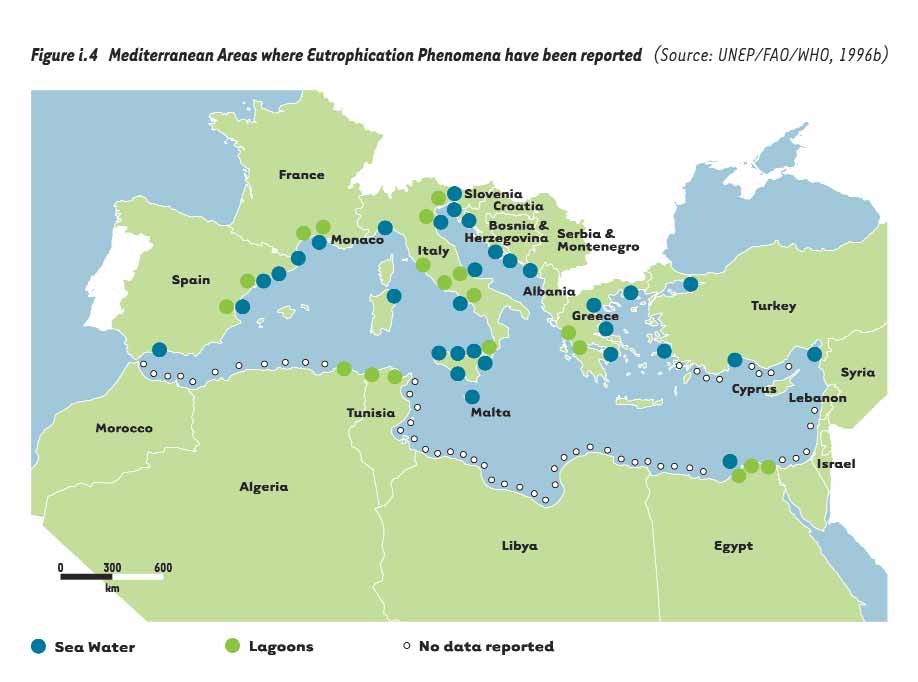
coverage. The map of areas where
indicators such as reduction of individual
eutrophication has been reported to
fish sizes led the GFCM to conclude that
exist is shown in Figure i.4. Note, unfor-
most of the commercial fish stocks are
tunately, that the southern and east-
considered fully or over-exploited. Major
ern Mediterranean countries have not
causes of decline in fisheries include pollu-
reported on eutrophication, though
tion (especially eutrophication leading to
satellite images show that if it happens
loss of suitable benthic habitat), loss of
there, it is local. Eutrophication is a
habitat, overfishing, antiquated (not
common problem, but a local problem,
habitat friendly) fishing methods (primari-
though its effects are widespread and
ly in southern countries), overly sophisti-
transboundary. The primary areas
cated and hence efficient fishing methods
where wastewater treatment plants are
(in some countries). Root causes include
required to avoid damage to sensitive
inadequate stakeholder awareness and
v
habitats (see Section 2.3.6.4) are list-
involvement; lack of enforcement and
SIS (TDA) FOR THE MEDITERRANEAN SEA
Y
TIC ANAL
Table i.1 Transboundary Sites at Risk related to Mediterranean Marine Biodiversity
Y DIAGNOS
Species / site of interest
Countries concerned
Seagrasses
All countries (mentioned in NAPs of Tunisia, Libya)
Benthic species including coralligenous communities
All countries
Sea mounts and canyons
All countries
Cetaceans
All countries
TRANSBOUNDAR
Ligurian Sea: France, Italy, Monaco
Alboran Sea: Spain, Morocco
Northern Adriatic: Italy, Slovenia, Croatia
Ionian Sea: Albania, Italy, Greece
Aegean Sea: Greece, Turkey
Mediterranean Monk seal
Western: Morocco, Algeria, Tunis
Ionian: Albania, Greece
Aegean: Greece, Turkey
Eastern: Turkey, Cyprus, Syria, Libya
Mediterranean marine turtles
All countries
Green turtle
Eastern: Greece, Cyprus, Lebanon, Syria, Turkey
Loggerhead
Ionian: Italy, Albania, Greece
Southern: Tunisia, Libya, Egypt
Aegean: Greece, Turkey
Eastern: Cyprus, Lebanon, Syria, Turkey
Alboran: Spain, Morocco
Elasmobranches
Alboran: Spain, Morocco
Southern: Algeria, Tunisia, Libya, Malta, Italy
Fish breeding and nursery areas
All countries
Mediterranean shearwater
Spain-Morocco, Algeria
Mixed Atlantic and Mediterranean fauna and flora
Alboran Sea: Morocco, Spain
Representative Mediterranean marine ecosystems
Bonifacio Straight (and western tip of Sicily)
with endangered / endemic species
France, Italy
vi
Table i.2 Marine and Coastal Sites of Particular Interest identified by Country, with Relevant Actions listed
Country
Sites and / or type of action
Albania
· Rehabilitation of the Kune-Vaini lagoon system
· Proclamation of the Marine National Park of Karaburuni Area
Algeria
· Selection of marine sites to be protected: Habibas Islands, Rachgoun island,
PNEK marine area, Taza-Cavallo-Kabyles shoal, Gouraya, Chenoua-Tipaza,
Plain Island, Collo peninsula, Cape Garde, Aguellis Islands, Tigzirt marine area
· Conservation of the Al Kala wetlands
Bosnia & Herzegovina
· Identification of processes in the Neum karst coastal area
· Management of the sensitive area of the Mali-Ston Bay
· Biodiversity protection of the lower Neretva with the Hutovo Blato wetland
and of the delta of the Neretva River as a unique eco-system
Croatia
· Transboundary management plan for the Lower Neretva Valley
including Malostonski Bay
· Management plans for national parks and nature parks (Kornati-Telascica,
Velebit-Paklenica, Biokovo, Krka, Vransko jezero, Brijuni, Mljet)
· Management plan and protection of Cres-Losinj Archipelago with surrounding sea
· Protection and management of rivers: Mirna (including Motovun forest);
Cetina (including Pasko field); Zrmanja
· Protection of sand and muddy shores in NW part of Ravni Kotari
· Protection of Sandy Beaches Saplunara and Blace on the Mljet Island
· Protection of Konavle area
· Fisheries management at Jabuka Pit (Fossa di Pomo)
Cyprus
· Adoption and implementation of the provisions of the EU Habitat and Bird
Directives and completion of the NATURA 2000 network (38 proposed sites)
and incorporation of proposed sites in town and country planning legislation,
local plans and countryside policy
Egypt
· Combating eutrophication in the coastal lakes of the Nile Delta
· Development and management of the Matruh Nature Conservation Sector (MNCZ)
Y
Greece
· 121 sites out of 238, included in the Greek National list of the Natura 2000 net-
work, host marine and coastal habitats and habitats of important species.
Efforts are being made to set up and manage the Natura 2000 sites,
ensuring the appropriate short, medium and long term funding mechanism
· Seven Ramsar sites on the Montreux list
Lebanon
· National Action Plan for the conservation of the Tyre Coast Nature Reserve
Libya
· Bays and coastal lagoons: Ain El-Gazalah Bay, Bumbah Bay, Ain Ziana lagoon,
i. EXECUTIVE SUMMAR
Farwa lagoon
· Wadis: Wadi Al-Hamsah, Wadi Al-khabtah, Wadi Ka'am, Tawrurgha spring and
salt marshes
Malta
· Xlendi Bay Munxar / SW Gozo
· Dwejra bay and Qawra San Lawrenz / W Gozo; mouth of Wied Ghasri N. Gozo
· Reqqa Point N. Gozo; Xwejni N. Gozo
· Ramla Bay and San Blas Bay NE Gozo
· Mgarr ix-xini SE Gozo
· Cominotto, Ras l-Irqieqa SW Comino
· Ras Il-Qammieh N/NW Malta
· Cirkewwa NW Malta
· Ahrax Point NW Malta
· Sikka l-Bajda NW Malta
· St. Pauls Island and Mistra Bay N Malta
· Qawra Point N Malta
· Merkanti Reef Northern coast of Malta
· Off Lazzarett (Marsamxett Harbour)
· Zonqor Reef (off Zonqor Point) East Malta
· Sikka tal-Munxar (off St. Thomas Bay) E. Malta
· Delimara Peninsula SE Malta
· Wied Iz-zurrieq S Malta
· Ghar Lapsi; Migra Ferha SW Malta
· Ras Il-Wahx SW Malta
· Hamrija Bank S Malta
· Filfla, an islet in SW Malta
Slovenia
· Shared management (with Croatia) of the Dragonja River
· Debeli Rtic natural monument (marine and coastal)
· Sv. Nikolaj salt-marsh (coastal salt-marsh)
· Skocjanski Zatok nature reserve (coastal lagoon)
· Posidonia oceanica meadow (marine)
· Strunjan nature reserve (marine and coastal)
· Stjuza natural monument (coastal lagoon)
· Rt Madona natural monument (marine)
· Secovlje salt-works landscape park (salinas) Ramsar site from 1993
Tunisia
· Remedial measures for the impact of dams on the Ichkeul Ramsar site
vii
SIS (TDA) FOR THE MEDITERRANEAN SEA
Y
TIC ANAL
Y DIAGNOS
TRANSBOUNDAR
viii
Table i.3 Locations where Sensitive Ecosystems are threatened by Eutrophication
Designation / location
Country
Priority
Kuna-Vain lagoons
Albania
High
Gulf of Ghazaouet, Gulf of Arzew-Motaganem, Bay of Algiers,
Algeria
High
Bay of Annaba, Gulf of Skikda, Bay of Bejaia, Bay of Zemmouri
Beirout, Tripoli, Jounieh, Saida, Sour
Lebanon
High
Anchor Bay
Malta
High
Tanger Bay, Smir Bay, Mouloya Estuary, Martil Beach, Sfiha Beach
Morocco
High
Ghar El Melh
Tunisia
High
Adana, Izmir Bay, Icel, Mersin-Kazanli, Hatay-Samandag, Aydin
Turkey
High
monitoring; insufficient alternatives to
Therefore, this MPPI is not as high a priority
fisheries employment; and lack of regula-
for GEF intervention, though institutional
tion in some countries. Environmental
strengthening might improve existing man-
impacts of decline in fisheries include
agement practices. Addressing other MPPIs
imbalance in some ecosystems due to loss
(decline in biodiversity, decline in seawater
of top predators; other environmental
quality) will per force contribute to
impacts are related to fisheries impacts
improvement of fisheries.
such as destruction of bottom habitat
3. Decline of seawater quality: strongly trans-
(seagrass beds) by bottom trawling and
boundary.
Y
excessive bycatch including endangered
a. Brief statement of the problem: Increasing
species (such as turtles, scarce bird and
trends in eutrophication and its related
elasmobranch species, etc.). Socio-eco-
oxygen deficiency and bloom of nuisance
nomic impacts of declining fisheries
species (e.g., jellies such as Noctiluca);
include loss of income and employment;
presence of hot spots of pollution leading
i. EXECUTIVE SUMMAR
loss of cultural practices; possible decline
to decline in biodiversity, fisheries, dis-
in food security.
eases or loss of health in marine organ-
c. Priority areas for GEF interventions: In gen-
isms, and overall water quality; human
eral, the need for GEF interventions in fish-
health problems from consuming fish and
eries is only weakly motivated. A regional
shellfish or contacting polluted waters;
fisheries commission already exists, and
loss of endangered species; and overall
some sub-regional fisheries commissions
imbalance of some ecotones (e.g., sea-
also exist. There is no overarching evidence
grass meadows) all result from decline in
that existing commissions are not func-
seawater and sediment quality. Although
tioning well, but they are not enough by
many of these effects are local in extent,
themselves to cope with the underlying
they have transboundary consequences.
environmental problems affecting the fish-
Important transboundary consequences
eries stocks in the Region. There are no dra-
arise due to ocean currents transporting
matic declines in important commercial
pollutants throughout the Sea; migration
fisheries, although as a multispecific fish-
and transport of various life stages of
eries there is some evidence for decline in
marine organisms (e.g., dinoflagellate
commercial catches during the recent
cysts) to other parts of the Sea from pol-
decades. GFCM indicates that most of the
luted areas; marine transport through
commercial fish stocks are fully-to-over-
shipping; and transport through the
exploited. Big pelagic fisheries also have
atmosphere.
experienced some decline. Twelve national
b. Analysis: Budgets for heavy metals,
action plans listed priority fisheries related
organochlorines, hydrocarbons, nutrients,
actions, most of which were to minimize the
pesticides, and other pollutants entering
ix
effects of overfishing on the environment.
the Mediterranean Sea from land, from

the atmosphere, and from sea (shipping),
c. Possible Interventions by GEF: There are
have been developed during the PDF-
several areas where intervention by GEF
phase of the project. At the same time,
may be able to assist in improving the sea-
limited but available data and observa-
water quality of the Mediterranean Sea.
tions on declining health of marine popu-
i. Reduce nutrient and BOD loading to the
lations (ecotoxicology) linked to various
sea from sewage: this intervention is
pollutants point to ecosystem effects
addressed as part of MPPI 1. In addition,
from declining seawater quality.
those cities identified in Table i.4 above
Increases in frequency, intensity, dura-
could benefit perhaps from both sewer-
tion, and spatial extent of eutrophication
age and treatment, and / or improved
have raised alarms about pollution. This
industrial processes prior to discharge
study has identified a series of land-
of wastewater to sewers and / or the
based pollution hot spots around the
Sea. Similar process improvements
Mediterranean (Figure i.5) (Annex III),
would be required for atmospheric dis-
including 125 for all countries (France was
charge, since atmospheric discharge is a
not included), and 92 for GEF-eligible
major pathway for certain pollutants,
countries. These hot spots were identified
including excess nutrients, to the Sea.
geographically, and classified as to cause
The goal would be to reduce the dis-
of the hot spot (industry, sewage, agricul-
charge of excess BOD and nutrients to
ture, etc.). In addition to these hot spots,
the coastal and offshore waters.
ecosystems have been identified that are
ii. Reduce discharge of toxic materials to
associated with the hot spots with the
the Sea: The point sources of pollution
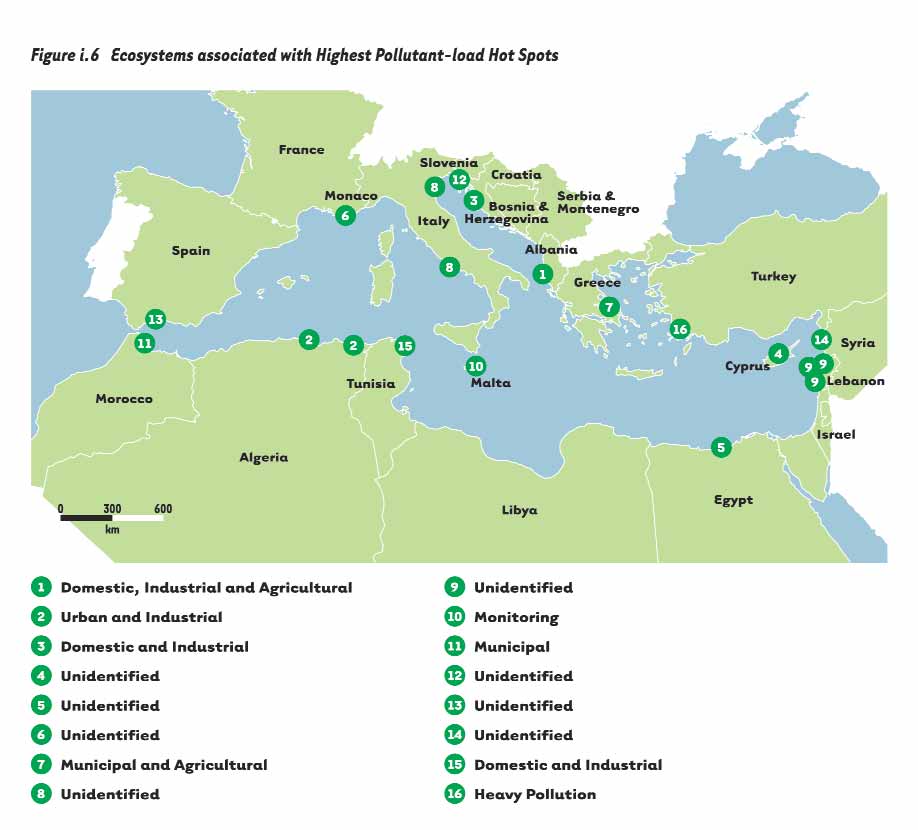
highest pollutant loads (Figure i.6). Sixty-
identified above bring toxic heavy
two ecosystems associated with the high-
metals, toxic organochlorines, toxic
SIS (TDA) FOR THE MEDITERRANEAN SEA
est pollutant-load hot spots have been
hydrocarbons, and other toxins to the
Y
identified, of which forty-five are in GEF-
Sea either directly through discharge
eligible countries. Table i.4 shows the 20
to the Sea, or indirectly through
TIC ANAL
cities in the Mediterranean with the most
atmospheric transport to the Sea. Of
BOD discharges to the Sea from industrial
concern are toxic, persistent, and
Y DIAGNOS
sources.
bioaccumulative (TPBs) contaminants;
TRANSBOUNDAR
x
Y
i. EXECUTIVE SUMMAR
Table i.4 The 20 Urban Centres discharging the most BOD
Country
Urban centre
BOD5 disch. (kt/yr)
Algeria
Algiers*
58.87
Greece
Athens*
58.00
Italy
Naples
44.4
Egypt
Alexandria
43.6
Spain
Barcelona (+San Adrian del Besos)
41.2
Algeria
Oran*
28.06
Turkey
Izmir
26.3
Algeria
Skikda*
19.94
Israel
Tel-Aviv (Shafdan)*
19.75
Algeria
Bejaia*
19.73
Libya
Tripoli*
16.06
Turkey
Mersin*
14.3
Turkey
Antalya*
13.29
Italy
Palermo
13.0
France
Marseilles
12.0
Spain
Malaga
11.5
Lebanon
Greater Beirut area*
10.18
Tunisia
Tunis Centre
8.3
Italy
Bari-Barletta
7.7
Italy
Piombino
7.5
* Updated information since 2002
xi
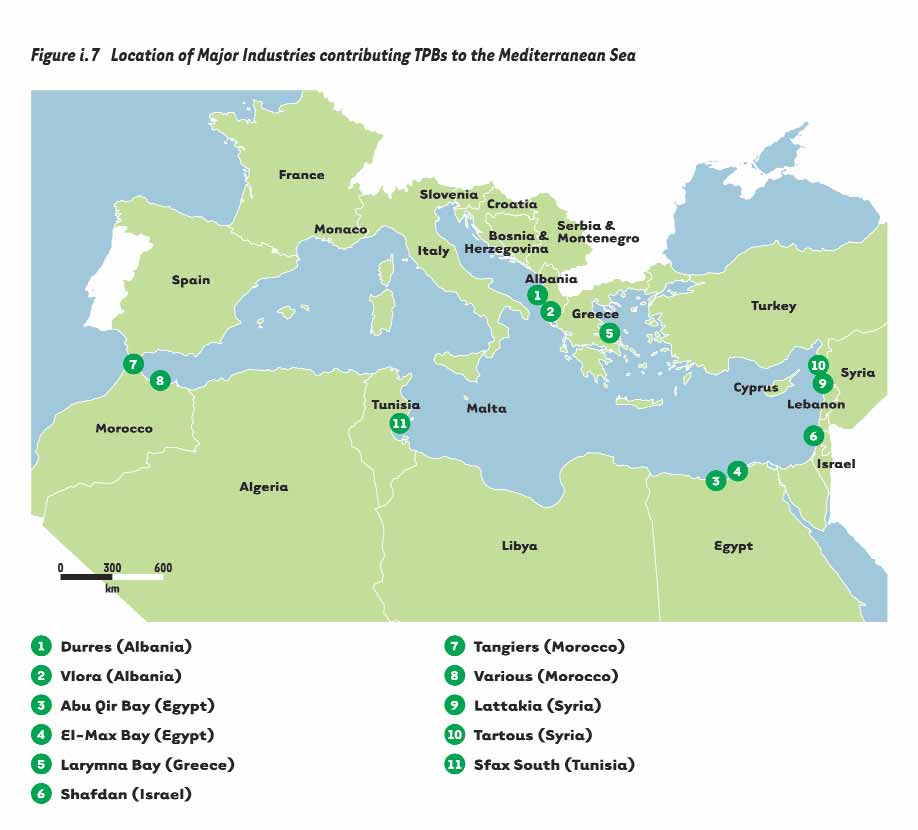
Figure i.7 shows the locations of the
locations, and also in general due to
major industrial sources of TPBs listed
dumping at sea by ships and pleasure
in Table i.5.
craft. Figure i.8 shows the Mediterra-
iii. Urban and other solid waste: urban solid
nean-wide partitioning of sources of
waste is dumped at sea in some coun-
solid wastes that make it to the Sea.
tries, leading directly to deterioration
Figure 2.11 in the main text breaks this
of water quality. Solid waste has been
distribution out, country-by-country.
identified as a major issue at certain
Interestingly, none of the countries
SIS (TDA) FOR THE MEDITERRANEAN SEA
Y
TIC ANAL
Y DIAGNOS
TRANSBOUNDAR
Table i.5 Some of the Main Sources of TPBs to the Mediterranean (Source: UNEP/WHO, 1999)
TPB (kg/yr)
Hg
Cd
Pb
Cr
Cu
Zn
Ni
Others (t/yr)
Abu Qir Bay (Egypt)
31+
193+
362+
2,669+
3,394+
859
1,906 (oil)
Tartous (Syria)*
140
10
50
310
540
200 (oil)
Lattakia (Syria)*
130
20
50
130
640
2.480
91 (oil)
El-Mex Bay (Egypt)
1,278
1,562
530
25,430
46,524
1,319 (oil)
Shafdan (Israel)*
80
270
2,510
8,330
19,610
67,130
3,850
Sfax South (Tunisia)
3,456
17,000
Larymna Bay (Greece)
313,170
Tangiers (Morocco)*
20
490
60
720
440
1,800
270
* Updated information since 2002
xii
Y
identified solid waste as a major priori-
bial and viral pollution. In addition, the
ty in their National Action Plans.
response of the ecosystem to stress may
Plastics are identified as the dominant
induce toxicity that may affect humans,
source of marine litter, making up some
such as toxic dinoflagellates that arise from
i. EXECUTIVE SUMMAR
75% of the litter on the sea surface and
eutrophic conditions in some instances.
seabed. Major areas where industrial
Primary pathways for human health risks
waste has been identified as a problem
include ingestion of water or seafood prod-
are in the attached Table i.6.
ucts, contact with contaminated seawater
4. Human health risks: weakly transboundary.
(or in some cases, beaches), and perhaps
a. Brief statement of the problem: Pollutants
contact with contaminated sea food (for
that degrade the ecosystem also present
marine products workers). Those at risk
risks to human health, including not only
include marine products workers, recre-
heavy metals, organochlorines, pesticides,
ational beach users, swimmers, divers, and
hydrocarbons, and the like, but also micro-
consumers of marine food products.
Table i.6 Selected Locations where Major Industrial Waste Problems exist
Designation / location
Country
Wastes
Durres
Albania
Hexavalent chromium salts
Vlora
Albania
Mercury
Skikda and Annaba in the east, Algiers-Oued Smar
Algeria
Various
and Rouiba-Reghaia in the centre, Oran-Arzew
in the west, and on the other the industrial complexes
of Ghazaouet, Mostaganem, Béjaia and Jijel
Abu Qir Bay
Egypt
Various: industrial discharges
Various
Lebanon
Various
Various
Morocco
Mining wastes
xiii
b. Analysis: Though incomplete data are
these targets. What policies are required? What leg-
available on this topic, there is ample
islative acts? What investments? What capacity
evidence that human health risks are
building? What infrastructure? These specific steps
possible through the pathways described
are identified in this TDA as activities or interven-
above. There are no ecosystem health
tions. The steps form the "workplan" to achieve the
risks arising from the Human health risks
targets within the agreed time frame. The progression
(though the two are related). There are
from EQOs, to targets, to concrete activities is a logic
serious socio-economic impacts, how-
chain that leads to consensus on complex environ-
ever, such as loss of tourist revenue, loss
mental issues.
of sales of marine products (such as
The three EQOs developed for the Mediterra-
when bivalves are contaminated and the
nean Sea are listed below, along with the MPPIs with
industry is shut down), and loss of cul-
which they are associated:
tural use of the marine resources.
1. Reduce the impacts of LBS on Mediterranean
c. Possible GEF interventions: Since human
Marine Environment and Human Health:
health is not directly a topic for interven-
addresses MPPIs 3 and 4, and to a lesser
tion by GEF/IW, no areas of interventions
extent MPPIs 1 and 2.
can be proposed here. However, some of
2. Sustainable Productivity from Fisheries:
the interventions arising from other
addresses MPPI 2.
MPPIs may improve the health situation,
3. Conserve the Marine Biodiversity and Eco-
including sewerage and treatment of dis-
system: Addresses MPPI 1.
charges, and reduction of nutrient inputs
Each of these EQOs had targets defined as a
leading to decreased eutrophication.
means of achieving these EQOs. The targets associat-
ed with the EQOs were identified as follows in Table i.7.
i.3 Environmental Quality Objectives
SIS (TDA) FOR THE MEDITERRANEAN SEA
Environmental Quality Objectives (EQOs) are
i.4 Priority Actions and Interventions
Y
a means to develop broad Stakeholder agreement on
for NAPs/SAP
the major environmental objectives of the region.
Following the identification of environmental
TIC ANAL
They are useful for communication of the desired
quality objectives and their associated targets, specif-
state of a particular environment or component of
ic interventions / actions were identified to achieve
Y DIAGNOS
the environment. They represent consensus views of
first the targets, and ultimately, the EQOs. These prior-
environmental priorities, or visions of what the envi-
ity actions and interventions can be categorized within
ronment should look like in the future. Often, EQOs
one or more of the following major groupings:
are simple restatements of existing consensus views.
· Policy actions
TRANSBOUNDAR
EQOs can be regional or national.
· Legislative / regulatory reform
EQOs commonly have specific targets identi-
· Institutional strengthening
fied with them. The targets are quantitative state-
· Capacity building
ments of progress towards achieving a particular EQO,
· Baseline investments
and generally have associated timelines or mile-
· Incremental investments
stones. The targets generally are focused on relatively
· Scientific investigation
short-term goals (for instance, 5 years), which are
· Data management
achievable on time frames that governments can
· Information and awareness actions
understand. If the timelines are too long, governments
The priority areas and actions, listed by EQO,
may tend not to act, but rather leave the solution to
are given in Table i.8. More detailed activities and
the next administration. The targets must also be real-
interventions listed by EQO are found in Section 5.
izable: they must be achievable at a reasonable pace
and cost. If the targets are too ambitious, they may be
ignored. Better to have an achievable, modest target,
than an aggressive, unreachable target.
Once EQOs and targets are identified; it is rel-
atively straightforward to identify specific or con-
xiv
crete steps required in the next few years to achieve
Table i.7 Targets Categorized according to Environmental Quality Objective
Environmental Quality Objectives
Targets
I. Reduce the impacts of LBS
1. By 2005 dispose of sewage from cities of more than 100,000 people
on Mediterranean Marine
in conformity with LBS. By 2025, dispose all sewages in conformity
Environment and Human Health
with LBS.
2. By 2005, create a solid waste management system in all cities of
more than 100,000 people. By 2025, create solid waste management
for all urban agglomerations.
3. By 2005, conform to air quality standards for all cities of more than
100,000 people. By 2025, all cities to conform to air quality standards.
4. By 2005, reduce inputs, collect, and dispose of all PCBs otherwise
entering the marine environment. By 2010, phase out all inputs of POPs.
5. By 2010, achieve 50% reduction in TPB by Industry. By 2025, industrial
point source discharges and emissions conform with LBS and standards.
Other targets for heavy metals, organohalogen compounds,
and radioactive materials:
· By 2005, collect and dispose of all obsolete chemicals
in an environmentally safe manner.
· By 2005, collect and dispose of 50% of lubrication oils
in an environmentally safe manner.
· By 2010, reduce industrial nutrient input by 50%.
· By 2010, 20% reduction of generation of hazardous wastes, of which
half are safely disposed.By 2025, all hazardous wastes disposed in
safe manner.
Y
· By 2010, achieve 20% reduction of generation of batteries, and
dispose of 50% of batteries in an environmentally safe manner.
By 2025, dispose of ALL batteries in an environmentally safe manner.
· By 2025, reduce inputs of agricultural nutrients.
II. Sustainable Productivity
1. Implement the Code of conduct for fishing.
from Fisheries
2. Assessment, control and elaboration of strategies to prevent impact
i. EXECUTIVE SUMMAR
of fisheries on biodiversity.
3. Promote the adequate monitoring and survey of the effectiveness
of marine and coastal protected areas.
4. Assist countries to protect marine and coastal sites of particular
interest.
5. Declare and develop of new Coastal and Marine Protected Areas
including in the high seas.
6. Assist countries in the development of existing marine and coastal
protected areas.
7. Control and mitigate the introduction and spread of alien
and invasive species.
8. Control and regulation of aquaculture practices.
9. Promote public participation, within an integrated management scheme.
10. Preserve traditional knowledge of stakeholders.
11. Coordinate and develop common tools to implement National
Action Plans (NAPs) related to fisheries.
III. Conserve the Marine
1. Improve the management of Marine and Coastal Protected Areas.
Biodiversity and Ecosystem
2. Enhance the protection of endangered species and habitats.
3. Reinforce relevant national legislation.
4. Foster the improvement of knowledge of marine and coastal biodiversity.
xv
Table i.8 Areas and Actions for Priority Intervention
Major Concerns
Priority Actions
Where to intervene
Decline of
Implementation of SAP BIO
All Mediterranean countries
Biodiversity
Rehabilitation of coastal Solid Waste landfills
Eastern, Southern Mediterranean countries
Reduction of 50%of industrial BOD by 2010
All Mediterranean countries
Reduction of riverine inputs of nutrients
Adriatic region
Follow up investment of 12 preinvestment
12 GEF eligible countries:
studies for Hot Spots in GEF eligible countries
Algeria, Morocco, Tunisia, Libya, Egypt,
Syria, Lebanon, Turkey, Albania, Croatia,
Slovenia, Bosnia & Herzegovina
Conservation of habitats
Rehabilitation of wetlands
(refer to countries reports in SAP/BIO)
Implementation of ICZM in locality where
Demonstration projects have been
achieved (amount of localties in brackets):
Turkey (1), Lebanon (1), Syria (1),
Spain (2), Italy (4), Greece (5),
Morocco (1), Algeria (1), Tunisia (1),
Malta (1), Egypt (1), Israel(1)
Control of inputs of alien species
Management of ballast water
in all Mediterranean Countries
Decline in
Implementation of FAO Code of conduct
Eastern Mediterranean, Adriatic
Fisheries
and southern Mediterranean
Control of inputs of alien species
Management of ballast water
in all Mediterranean Countries
Implementation of EC related Directives
EU Mediterranean countries
Implementation of SAP BIO
All Mediterranean countries
SIS (TDA) FOR THE MEDITERRANEAN SEA
Decline of
Reduction of 50% of industrial BOD
All Mediterranean countries
Y
seawater quality
Implementation of SAP/NAP list
All Mediterranean countries
of priority actions for POPs
TIC ANAL
Implementation of SAP/NAP list
All Mediterranean countries
of priority actions for industrial releases
Eastern Mediterranean countries, Syria,
Lebanon, Turkey, Israel, Egypt
Y DIAGNOS
Implementation of regional plan
Obsolete chemicals in Southern, Eastern
for reduction of 20% hazardous waste
and former Yugoslavia Mediterranean
countries
Treatment of urban wastewater
Refer to table on cities without WWTP.
Section 2.4
TRANSBOUNDAR
Follow up investment of 12 preinvestment
12 GEF eligible countries:
studies for Hot Spots in GEF eligible countries
Algeria, Morocco, Tunisia, Libya, Egypt,
Syria, Lebanon, Turkey, Albania, Croatia,
Slovenia, Bosnia & Herzegovina
Management of PCBs and stock
Management of PCBs waste and disposal
of Obsolete chemical
of Obsolete chemicals in Southern,
Eastern and former Yugoslavia
Mediterranean countries
xvi
Y
i. EXECUTIVE SUMMAR
xvii
SIS (TDA) FOR THE MEDITERRANEAN SEA
Y
TIC ANAL
Y DIAGNOS
TRANSBOUNDAR
34
INTRODUCTION
The purpose of the Transboundary Diagnostic
composition and / or stress of the ecosystem of the
Analysis for the Mediterranean Sea (TDA MED) is to
Mediterranean, and b) analysis of trend of levels of
address the transboundary concerns of the Mediterra-
bioaccumulation of chemical contaminants in the
nean Sea and as such contribute directly to the achieve-
ecosystem elements which are considered as indirect
ment of the water body-based operational Programme
indicators of impact on the ecosystem.
of the GEF Operational Strategy.
The comparative, logical and thematic analy-
SIS
According to GEF guidance, the purpose of con-
sis of major concerns, their impacts, the policy
Y
ducting a Transboundary Diagnostic Analysis (TDA) is to
options and the EQOs enabled the regional experts to
scale the relative importance of sources and causes,
identify environmental areas of priority actions
both immediate and root, of transboundary `waters'
together with the priority interventions that should be
problems, and to identify potential preventive and
considered in the time frame from the present up to
remedial actions.
the year 2025.
This TDA, which was elaborated on the basis of
The Legal and Institutional Framework and
the previous TDA prepared in 1997 as well as extensive
Stakeholder analyses are based upon the Barcelona
TITUTIONAL FRAMEWORK ANAL
INTRODUCTION
information gathered since that time, summarizes
Convention system including the Strategic Action
existing information available from the region. In order
Programme to address Pollution from Land-Based
to reflect the convenient and reliable regional vision on
Activities (SAP MED), Strategic Action Programme for
the transboundary issues in the Mediterranean, a
the Conservation of Biological Diversity (SAP BIO) in the
3.0 LEGAL AND INS
regional experts' meeting including scientists, repre-
Mediterranean Region, MAP partners' analysis report,
sentatives of industry and non-governmental organi-
FAO code of conduct related to fisheries, and other
zations (NGOs) (Annex I), reviewed the draft report of
Multilateral Environmental Agreements (MEAs).
the support data entitled "Assessment of the Trans-
This TDA achieved an additional step compared
boundary Pollution Issues in the Mediterranean" and
with the 1997 TDA --that is, use of Environmental
identified the major perceived issues to be considered
Quality Objectives adopted in the SAP MED, SAP BIO and
in the present document. Based on the outcomes of
Code of conduct for fisheries which led to specific tar-
this meeting, an updated draft of the TDA was pre-
gets to be met within a desired time frame, and specif-
pared, circulated for comments and finalized.
ic interventions and actions that can be considered in
The methodology of the Mediterranean TDA
the framework of the National Action Plans (NAPs).
consists of the following steps:
This analysis shows that the Mediterranean
· Identification of Major Perceived Problems
Countries have initiated and taken effective measures
and Issues, including status and gaps;
during the last 25 years to protect the marine environ-
· Elaboration of Causal Chain Analysis for
ment and human health in the coastal Mediterranean
perceived problems;
region. Even though gaps and barriers still exist, the
· Legal and Institutional Framework Analysis;
support information collected showing trends high-
· Stakeholder Analysis; and
lights and reflects this reality.
· Environmental Quality Objectives (EQOs).
This TDA is considered an important milestone
The evaluation of impacts of transboundary
and benchmark in the long-term effort of these coun-
pollution on the marine ecosystem is based on two
tries consolidated by the active participation of NGOs to
1
types of scientific findings: a) indicators of change of
implement the policy options adopted by the region.
SIS (TDA) FOR THE MEDITERRANEAN SEA
Y
TIC ANAL
Y DIAGNOS
TRANSBOUNDAR
2
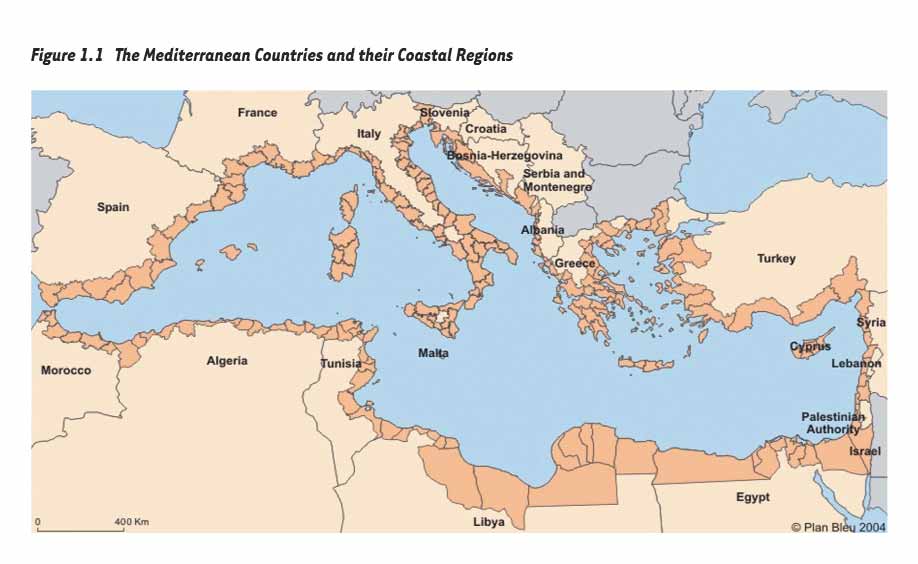
1.0
THE MEDITERRANEAN REGION
This section describes the Mediterranean Sea
tem, biological diversity and natural resources. Arrays
and its coastal zone by reviewing its natural character-
of Mediterranean socio-economic aspects are also
istics and main socio-economic aspects. By doing so, it
considered here including demography and human set-
sets the framework into which information from follow-
tlements, industrial activity and trade, agriculture and
ing sections on the main environmental pressures and
fisheries and tourism.
policy options addressing those falls.
The geographic boundaries of the project are
Flanked by mountain ranges to the north, east
defined broadly as all Mediterranean countries and
and southwest and desert or arid zones from Tunisia to
their coastal regions (see Figure 1.1 below). Within this
Syria, the Mediterranean coastal fringe harbours cul-
framework the GEF-eligible countries include Albania,
tures looking inward, towards the sea. This common
Algeria, Bosnia & Herzegovina, Croatia, Egypt,
sea, or Mare Nostrum of the Roman age, is also a net-
Lebanon, Libya, Morocco, Slovenia, Syria, Tunisia, and
work of shared interests, from trade and investment,
Turkey. In addition, other participating countries
through safeguarding the environment to ensuring sus-
include Cyprus, France, Greece, Israel, Italy, Malta,
tainable development of regional resources for contin-
Monaco and Spain.2 From a practical standpoint, this
ued stability and prosperity.
The review of the Mediterranean setting high-
2 Although Serbia & Montenegro has not participated in
1.0 THE MEDITERRANEAN REGION
lights the geographic factors that give rise to a unique
this GEF project, some data from this country are
Mediterranean context. It focuses on the geographic
incorporated in this report as this is included in the
setting and climate, the hydrological and dynamic sys-
Mediterranean area.
3
definition of the geographic scope is at once too limit-
shores of southwest Greece within the Hellenic Trench,
ing, and secondly, too broad. The limitation comes
along which several other small basins exceed 4,000 m
from the importance of atmospheric deposition to con-
depth. The shallowest part of the Mediterranean Sea is
taminants deposited in the Sea, which come from
the northern Adriatic, the depth of which does not
places more distant than the coastal areas and water-
exceed 50 m. The estimated, average depth of the
sheds. The excessive breadth comes from the fact that
Mediterranean Sea is around 1,500 m.
the major activities being addressed are weighted
Morphologically, Corsica, Sardinia and the
towards the water body, and include the water body
Balearic islands are the most significant islands of the
and coastal areas. In much of the Mediterranean Sea
western Mediterranean basin. Sicily and Malta are
area, particularly for most GEF-eligible countries
located in the central part. Cyprus, Crete and Rhodes
(Egypt is an exception), coastal mountains limit the
are the biggest islands in the eastern part of the Medi-
watershed to close proximity to the Sea; in these cases,
terranean Sea, where the 700 or more islands and
the watershed boundary is ideal.
islets of the Aegean archipelago form the most striking
morphological feature.
1.1 Environmental Characteristics
Along the coastal areas, rocky shores --both
1.1.1 Geographic setting and climate
hard and soft-- predominate, with cliffs over 150 m high
The Mediterranean Sea occupies an area of
occurring in Spain and Croatia. These are only occa-
about 2.5 million km2, is about 3,800 km wide from
sionally interrupted by sandy beaches of limited
East to West and has a maximum north-south distance
length, associated with relatively narrow valleys cut-
of 900 km between France and Algeria.
ting through the mountains or with small coastal plains
The Mediterranean Sea is the remnant of an older
surrounded landwards by mountainous areas.
ocean, tens to hundreds of millions of years old and sev-
The few big rivers flowing into the Sea affect the
eral times wider, named `Tethys'. According to plate tec-
Mediterranean's morphology. The biggest in length is
tonics theory, the Tethys Ocean began to be consumed by
the Nile in Egypt, the catchment basin of which extends
SIS (TDA) FOR THE MEDITERRANEAN SEA
the converging Euroasiatic and African continental
several thousands of kilometres into the northeastern
Y
plates some 5070 million years ago, concurrently with
part of the African continent. The Nile river deposits,
the opening of the Atlantic Ocean. This process is still
formed before the construction of the Aswan dam, cre-
TIC ANAL
active, especially in the eastern part along the Hellenic
ate a very impressive onshore delta plain on the coastal
Trench, where the eastern Mediterranean crust is sub-
area of northeastern Egypt and a huge submarine allu-
Y DIAGNOS
merging beneath the Aegean microplate, while it has
vial cone in front of its mouth in the Levantine Sea.
only recently ceased along the Tyrrhenian Arc. Thus the
Together with the submarine cone or the Rhone River,
eastern part of the Mediterranean Sea is more active in
these two alluvial cones constitute some of the most
terms of plate tectonics and is characterized by more
striking morphological features of the Mediterranean
TRANSBOUNDAR
complex morphology than is the western part.
basin. The Rhone itself rises in the central Alps in
The Mediterranean Sea is an enclosed sea con-
Switzerland and flows through Lake Geneva and south-
nected to the Atlantic by the strait of Gibraltar, a 15
eastern France to the Gulf of the Lion in the western
km wide and 290 m deep sill and to the Black Sea by the
Mediterranean Sea. The third most important river
Strait of Canakkale (Dardanelles), having a maximum
flowing out into the Mediterranean Sea is the river Po in
width of only 7 km and an average depth of 55 m. The
northern Italy. The Po drains the southern flanks of the
connection of the southeastern with the Red Sea
Alps and the northern part of the Apennine mountain
occurs through the Suez Canal. The Mediterranean is
range through the Po plain to the northern Adriatic Sea.
divided into two main basins, the western and the
The fourth most important river flowing into the Medi-
eastern, separated by the Sicilian Channel that is
terranean Sea is the Ebro river in Spain. The large river
about 150 km wide, reaching a maximum depth of 400
catchments have delivered sediment to the coast as
m. In contrast to the flat, 2,700 m deep basin of the
erosion of the mountains has taken place, thus creat-
western Mediterranean (west of Sardinia and Corsica),
ing new coastal habitats which include the large sedi-
the Tyrrhenian, Ionian, Levantine and the Aegean seas
mentary coastal plains, which in micro-tidal areas in
are characterised by alternating deep depressions and
the Mediterranean region have grown to form large
morphological highs, submarine valleys and steep
deltaic systems such as the Ebro Delta in Spain, the Po
slopes. The greatest depth of the entire Mediterranean
Delta in Italy or the coastal plain of Albania, to men-
4
Sea, 4,982 m, is found in a narrow basin located off the
tion a few.
The Mediterranean climate is subjected to both
occur in the winter; especially in the Gulf of the Lion
subtropical and mid-latitude weather systems. It is
(with about 27 gales per year), the Aegean Sea and the
characterised by a windy, mild, wet winter and a rela-
Sardinian Channel (with, on average 12 and 10, respec-
tively calm, hot dry summer; the transition periods
tively).
AprilMay and SeptemberOctober being too short to
Air temperature differences between winter and
appear as well defined seasons. The seasonal features
summer are generally limited to about 15°C. Neverthe-
are associated directly with the motion and develop-
less, local meteorological and geographic factors can
ment of the great pressure systems: the permanent
result in extreme temperatures. The highest air tem-
Azores anticyclones, the great continental anti-
peratures are recorded near the coasts of Libya and
cyclone of Eurasia, the low pressure over the north
Egypt between March and June, when they may reach as
African desert and the tropical Atlantic. The winter
much as 50°C. High temperatures occur regularly at a
months are characterised by low-pressure centres over
number of places in the Mediterranean area, such as
the Tyrrhenian, east Ionian and Aegean seas and high
the lee side of the Corsican mountains, the northern
pressure over the land. In summer, the pressure pattern
coasts of Sicily, Crete and Cyprus. High air tempera-
is dominated by competition between a ridge of high
tures can also occur in Spain when tropical continental
pressure from the Azores and low pressure over the
air spreads north from Africa. Lowest temperatures are
Middle East originating from the south Asian monsoon-
reached during winter on the northeastern coast of the
al low, creating a dominantly east-west pressure gra-
Aegean Sea and the North Adriatic.
dient across the Mediterranean Sea. Most depressions
Mean annual precipitation shows a north to
(about 70 percent) occurring in the Mediterranean area
south gradient, with precipitation decreasing towards
are formed in the Gulf of Genoa although North Africa,
the south. Mountains are naturally the dominant fac-
south of the Atlas Mountains, is an important source in
tor in precipitation patterns. High precipitation val-
spring. Around one tenth enter from the Atlantic, main-
ues of 1,5002,000 mm and more are found in the
ly through the Strait of Gibraltar or the Garonne-
Alpine and Pyrenean headwater regions of the Po, the
Carcassonne gap. In the central and eastern Mediterra-
Rhone and the Ebro rivers and they are very abundant
nean the formation of new depressions can occur in the
in the Alpine mountain belt bordering the Dalmatian
northern Ionian Sea, the southern Aegean and in the
coast, from the Istrian peninsula down to Albania.
region of Cyprus; but this is rare and limited to the win-
This makes these countries the most humid countries
1.0 THE MEDITERRANEAN REGION
ter months.
of the Mediterranean area.
The orographic effects of the continental mass-
Low summer and high winter rainfall is one of
es surrounding the Mediterranean basin are crucial for
the major features of the Mediterranean climate. This
the vertical motion of air masses and give rise to
contrast is more and more pronounced from north to
regional and local winds. Several persistent regional
south and from west to east. Precipitation mainly falls
wind systems are present, the strongest of them being
during winter and autumn whereas summer season
the Mistral and the Etesian winds. The Mistral is an
precipitation is less than 10 percent of the annual
intense, cold, dry, northwesterly wind blowing mainly
total. High precipitation during autumn is typical for
during winter down the Rhone valley between the
the coasts of Spain, France, Italy, Croatia, Serbia &
Pyrenees and the Alps. It reaches the Gulf of the Lion
Montenegro, Albania and Greece. Further east, such as
and spreads over a wide area of the western Mediterra-
in Turkey and in Lebanon, autumn precipitation is
nean region. The Etesian winds (or Meltems in Turkish)
much less important. By far most of the rainfall occurs
are the dominant winds in the eastern Mediterranean.
here in winter.
They are northerly winds, strongest in late summer or
In certain regions, precipitation especially in
early autumn, which are funnelled onto the Aegean Sea
autumn can occur in the form of heavy downpours,
through the gap between the mountains of the Balkans
causing flash floods in the rivers of these regions. The
and Anatolia. Other important wind systems are the
prevalent zones for flash floods are the Côte d'Azur,
Bora, a strong but infrequent winter wind flowing over
East Pyrenees, Cevennes and Corsica in France, the
the Adriatic; the westerly Vendaval, flowing through
northwestern areas of Italy and Catalonia and
the Strait of Gibraltar into the Alboran Sea between
Valencia in Spain.
Spain and Morocco; and the Sirocco or Khamsin, a
One result of the seasonal rainfall and high
warm southerly wind from the desert areas of Africa
evaporation is that water shortages are endemic. The
5
and Arabia. Gales over the Mediterranean basin mainly
problem is particularly striking in the southern parts of
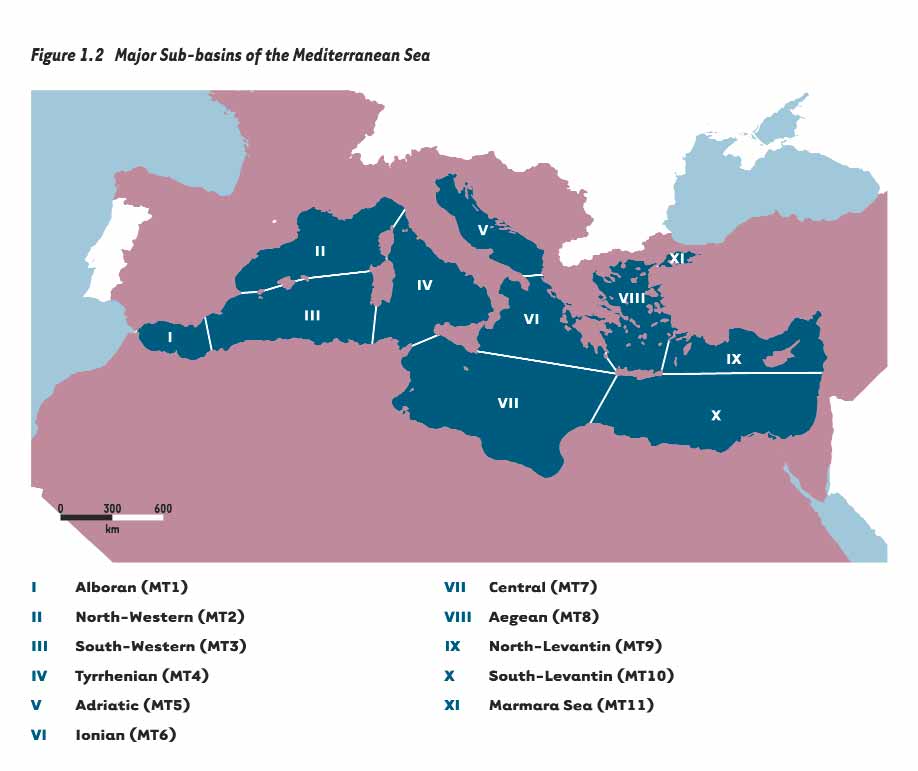
the Mediterranean in contrast to seasonal shortages in
5 percent of its original flow. New irrigation schemes
the north (corresponding to the dry months). The dry
and the Peace Canal bringing Nile water to the Sinai will
season in some southern countries exceeds six months,
further reduce the Nile inputs to practically zero.
meaning that water shortage is a permanent handicap
In terms of overall river water discharge into the
for sociological and economic development.
Mediterranean basin, the reduction witnessed over the
past 40 years is estimated to be between 30 and 40 per-
1.1.2 The hydrological system
cent. Major Mediterranean rivers other than the Nile
All major rivers flowing into the Mediterranean
have seen a reduction in the quantities discharged,
have lost much of their waters to agriculture over the
such as the Rhone and Ebro, while further reductions
past 40 years. Freshwater inflow into the Mediterranean
are expected to take place in other Mediterranean
is therefore low while irrigated farmland in Mediterra-
regions in the future. In the case of the Ebro River in
nean basin countries has increased between 1960 and
Spain, a total of 128 reservoirs extracting water have
1999 from approximately 20 mil hectares to 38 mil
led to a decrease in water discharge of about 29 per-
hectares. Freshwater recharge is higher in the northern
cent (Ibanez et al., 1996). Zahar and Albergel (1999)
Mediterranean where the Rhone, the Po and the Ebro,
reported that the closure of the Sidi Salem Dam in
the three most important Mediterranean rivers in terms
Tunisia led to a reduction of the mean annual discharge
of discharge, are found. Roughly one-third of the Medi-
of the Medjerdah River by 65 percent due to diversion
terranean's continental water flows into the northern
for irrigation and evaporative losses. The most affect-
and central Adriatic Sea wedged between Italy and the
ed sub-basins of the Mediterranean are probably the
eastern Adriatic coast. By contrast, the Nile, with a
south Levantin, Alboran, southwest Aegean, central
catchment area by far greater than any other Mediter-
and north Levantin (Figure 1.2).
ranean river, covering 3,350 km2, discharges minor
Low river inflow into the Mediterranean is also
quantities of water into the sea. In fact, as a result of
explained by the fact that most of the rivers tend to be
the High Aswan Dam, the Nile now discharges less than
small, owing to the dry climate and mountainous coast
SIS (TDA) FOR THE MEDITERRANEAN SEA
Y
TIC ANAL
Y DIAGNOS
TRANSBOUNDAR
6
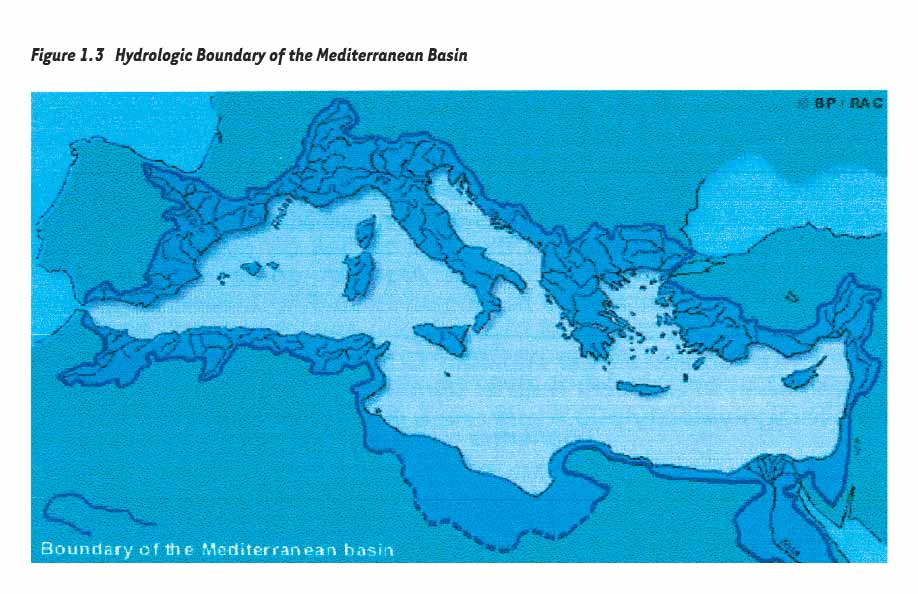
relief of the basin. In the northern part of basin steep
and southern Mediterranean coast with semi-arid and
relief reduces the area of catchment basin, which are
arid conditions and limited precipitation and runoff and
on average less than 10,000 km2 for the Mediterranean
limited surface watercourses and discharge points. The
as a whole (Figure 1.3). In the southern part, hot and
karstic coastal aquifers discharge directly into the sea
dry climate is in favour, with few exceptions, of the
without previous intervention of rivers or lakes and the
formation of small coastal rivers with relative short
functions as flows and storage in karst are directly relat-
distance between the headwaters and the river
ed to the quantitative status, represented by the dis-
mouths. Seasonal flood events, typical of Mediterra-
charge flows and the water budgets. The karstic aquifer
nean rivers, have also been affected by damming
discharges include also substantial submarine dis-
works. Often, most of the water discharge in the region
charges with large submarine karstic freshwater springs
occurs during short floods. Floods are associated with
with flows as high as 50 m3/sec that are recharged on
maximum river flow due to pronounced rainfall, which
land. The coastal seepage and submarine discharges are
generally occurs between February and May in the
critical to the water balance and seawater quality in the
Mediterranean. In the large and medium-sized river
marine sub-basins and support wetlands and brackish
basins situated in north and central Europe, wide-
water habitats with biodiversity and fishery nursery areas
ranging and continuous precipitation is commonly the
in the coastal zones. The coastal aquifers are threatened
main factor in flood generation, often also in associa-
by over-exploitation and consequent seawater intrusion
tion with snow melt. Intense rainfall falling on small
and water and land salinization, thereby adding to the
catchments is the main cause of floods in the Mediter-
deficit in recharge of the Mediterranean.
ranean area. However, the building of dams, as in the
This deficit in water recharge of the Mediterra-
case of the Ebro, has smoothened seasonality of the
nean is offset by Atlantic water entering the basin
river's hydrography.
through the straits of Gibraltar. In general, Atlantic sur-
Coastal aquifers provide another source of fresh-
face waters come in and the Mediterranean deep waters
water discharge to the Mediterranean. The seepage from
go out to the Atlantic Ocean. Estimates for the turnover
the coastal aquifers, estimated at 13 billion m3/yr in the
period for water entering through Gibraltar range from
UNEP / Blue Plan study (http://www.planbleu.org/),
about 80 to 200 years.
accounts for about one quarter of the total freshwater
As is discussed in more detail above, the Medi-
inflow into the Mediterranean. The seepage inflows are
terranean Sea is composed of two nearly equal size
1.0 THE MEDITERRANEAN REGION
prevalent on the eastern coast of the Adriatic, dominat-
basins: the western and eastern Mediterranean. The
ed by its karstic aquifer systems, as well as the eastern
Mediterranean circulation is forced by water exchange
7
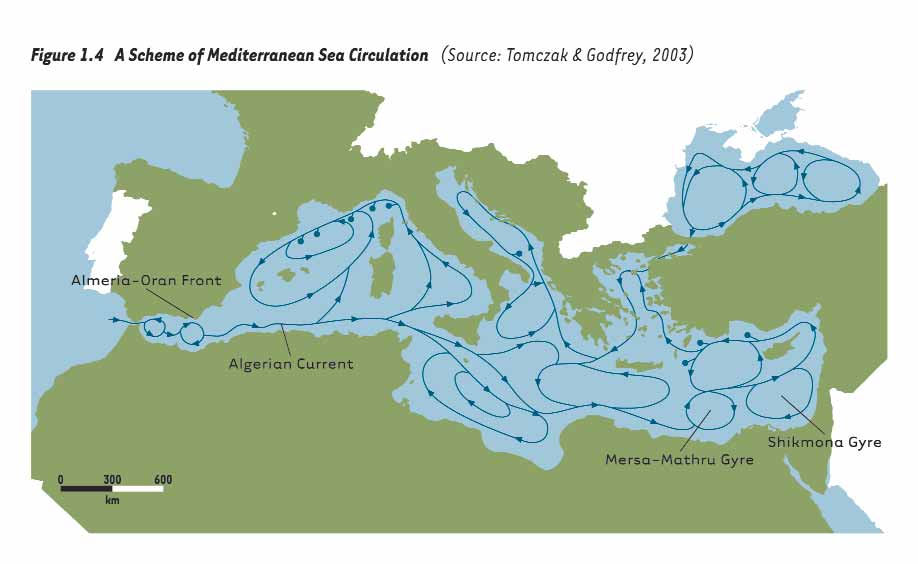
through the various straits, by wind stress, and by
The surface circulation of the western Medi-
buoyancy flux at the surface due to freshwater and
terranean is quite steady during the four seasons,
heat fluxes (Robinson et al., 2001). Maximum depths in
although it gets more intensified during the winter
the two subdivisions are about 3,400 m in the west and
(Tziperman & Malanotte-Rizolli, 1991).
about 4,200 m in the east. A sill between Sicily and
In the eastern Mediterranean basin, due to
Tunisia has a depth of about 400 m. The second con-
complex bathymetry, the circulation is dominated by
nection between the western and eastern basins, the
eddies, some large and quasi stationary as indicated in
narrow Strait of Messina between Sicily and mainland
Figure 1.4. The seasonal signal of the eastern Mediter-
Italy, has a sill depth of only 120 m. This strait has lit-
ranean upper circulation is stronger than that of the
tle significance for the general circulation; however it
western basin, due to stronger variability in the forcing
is famous for its strong tidal currents reaching 23 m/s
by the wind and heat fluxes at the surface. In all sea-
in magnitude (Tomczak & Godfrey, 2003).
sons except winter the flow of the Atlantic Water from
The flow through the Gibraltar Strait is mainly
the Sicilian Straits forms a meander that extends from
driven by the density difference between the water
about 15°E to 20°E. This dynamic feature may be relat-
masses on either side of the strait. Inflow velocities in
ed to the interaction of the eastward flow with the
excess of 1 m/s in combination with a rapidly shoaling
topographic or planetary b effects. Its disappearance
bottom in a constricted passage result in a situation
in the winter may be related to the change in the wind
where normal ocean dynamics give way to hydraulic
curl in the Ionian Sea during this season (Tziperman &
control of the flow. The inflowing Atlantic water initial-
Malanotte-Rizolli, 1991).
ly continues eastward as a free jet and breaks into one
Outside the Algerian Current the Atlantic rela-
or two large eddies of 150 km diameter before the
tively colder waters continue submerged under a shal-
Coriolis force deflects it and the flow carries on along
low surface layer of high salinity and can be followed
the African coast (Figure 1.4). The change from the
as a salinity minimum at 2030 m depth.
Spanish to the Algerian coast occurs in a narrow current
Because the Mediterranean Sea is a concen-
SIS (TDA) FOR THE MEDITERRANEAN SEA
associated with a front, known as the Almeria-Oran
tration basin, the Atlantic water is converted into
Y
Front, which separates the relatively fresh Atlantic
denser water that eventually leaves the sea over the
water from the salty Mediterranean water (Tomczak &
sill of the Strait of Gibraltar. This conversion process
TIC ANAL
Godfrey, 2003). The Atlantic inflow then continues as
involves deep vertical convection during winter. It
the Algerian Current, a narrow jet less than 30 km wide.
does not act uniformly in the entire basin but occurs
Y DIAGNOS
The Algerian Current has an average velocity of 0.4 m/s
in three small regions affected by cold winter winds.
and a maximum velocity of 0.8 m/s.
Deep vertical convection that occurs in the western
TRANSBOUNDAR
8
basin forms the Mediterranean Deep Water. Cold win-
regularly discovered and described. Biomass in the
ter winds affecting the region between Rhodes and
Mediterranean is low, however.
Cyprus and on the northern and central Adriatic Sea
The Mediterranean coastal ecosystems and
are responsible for the formation of Levantine
wetlands provide critical habitat for both flora and
Intermediate Water (LIW). The dense water mass from
fauna species:
the Adriatic Sea does not maintain its identity very
· Circa 150 wetland sites have been recognized
long. It turns eastward and enters the Levantine Basin
as being of international importance;
where it encounters water freshly formed in the region
· Extensive sand dunes are located around the
between Rhodes and Cyprus. The two sources mix, and
Mediterranean;
together they form the LIW, which is typically identifi-
· Thousands of islands are used by marine and
able as a salinity maximum underneath the Atlantic
migrating birds, and
Water salinity minimum.
· The region is reputed to have 13,000 endemic
Thus, the large-scale circulation of the Mediter-
plants.
ranean Sea is composed of sub-basin scale and meso-
The most typical and well-known assemblage of
scale gyres interconnected and bounded by currents
communities is represented by the sea-grass Posidonia
and jets with strong seasonal and inter-annual vari-
oceanica ecosystem that develops as extended mead-
ability. This circulation pattern, combined with shelf
ows in the infra-littoral zone (to a depth of 2540 m) in
relief of the Mediterranean makes it possible for large
the whole Mediterranean basin.
currents to influence coastal water flow. The conse-
There are some other important coastal
quence of this hydrographic regime from an environ-
ecosystems like the calcareous algal rims formed by
mental point of view is that transportation of material
Lithophyllum lichenoides in the medio-littoral zone;
and possibly pollution is enhanced.
the sea caves which support several rare and endemic
Clearly the picture that emerges of circulation
species (e.g., sponges and red coral) which are also
in the Mediterranean Sea is one where water mixes both
found in the bathyal zone where the light condition is
vertically and laterally. Thus, contaminants introduced
similar; and the coralligenous communities (circalit-
in one area (by wind, discharge at sea, or coastal dis-
toral zone) which constitute the most spectacular
charges by rivers or pipes) will be mixed relatively rap-
underwater scenery in the Mediterranean Sea. On land
idly by the strong currents. Overall, the Mediterranean
among others the coastal wetlands and sandy beaches
1.0 THE MEDITERRANEAN REGION
Sea is thought to mix completely once every 200 to 300
are worth mentioning.
years. This so-called residence time is one indicator of
The distribution of species throughout the
how long contaminants may accumulate in the basin
Mediterranean Sea is not homogeneous: it is greater in
before mixing sufficiently and leaving the basin.
the western than in the eastern part, as shown for ben-
Moreover, in the last 40 years, there has been a
thic invertebrates (Figure 1.5). In addition, the distri-
slight but noticeable increase of deep waters tempera-
bution of Mediterranean fauna and flora varies with
ture and salinity (+0.12°C in temperature; +0.05 per-
depth as shown in Table 1.1. This diversity is observed
cent in salinity). It is probably too early to give an
also at the community (biocoenosis) level. Compared
explanation but the possibility of a steady increase
with the Atlantic, the Mediterranean marine communi-
could be suggested by another observed increase of
ties are rich in species with smaller individuals having
unusual occurrences in marine life that could be used as
a shorter life cycle.
indicators of changing Mediterranean Sea conditions.
Fish
1.1.3 Biological diversity
More than 600 fish species have been recorded,
The Mediterranean's unique mixture of subtropi-
including 81 cartilaginous fish such as sharks
cal and temperate elements has contributed to species
and 532 bony fish. The distribution of fish
diversity that has few equals in the world. The Mediter-
species is not homogeneous, however, as there
ranean, accounting for only 1.5 percent of the earth's
are double the number of species in the west-
surface, hosts approximately 7 percent of the known
ern basin than in the eastern (EEA, 2002).
world marine fauna and 18 percent of the world marine
flora, of which 28 percent are endemic to the Mediterra-
Reptiles
nean Sea (Fredj. et al., 1992). A total of 10,000 to 12,000
Three turtle species have been identified in the
9
marine species have been recorded and new species are
Mediterranean: the leatherback (Dermochelys
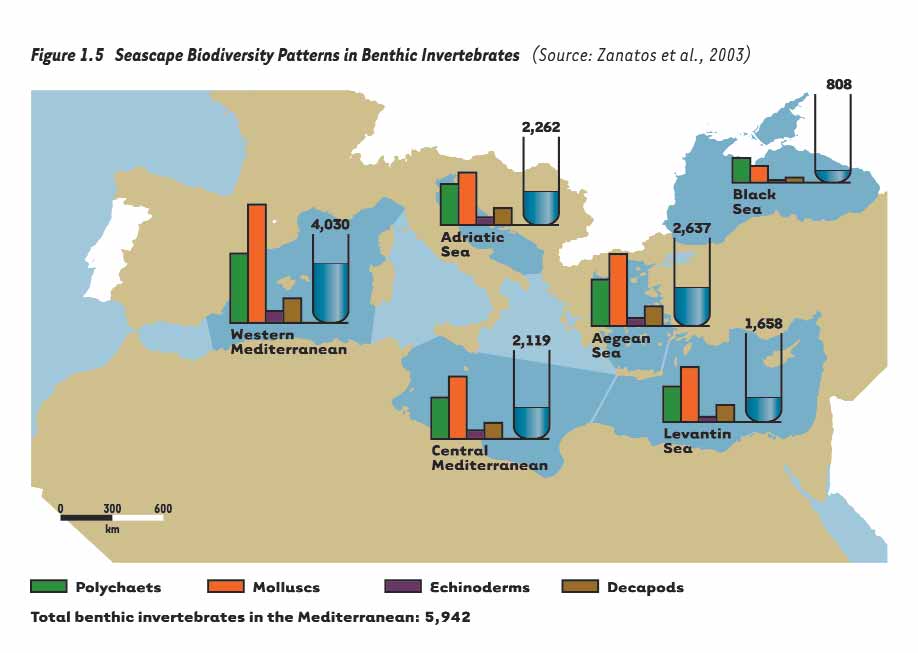
SIS (TDA) FOR THE MEDITERRANEAN SEA
Table 1.1 Variation of Species according to Depth Zones (Source: Fredj et al., 1992)
Y
Zones
Depth (m)
Species (%)
TIC ANAL
Infralittoral zone
050
63
Circalittoral zone
51100
44
Y DIAGNOS
Bathyal zone
101150
37
Bathyal zone
151200
31
Bathyal zone
201300
25
Bathyal zone
301500
18
TRANSBOUNDAR
Bathyal zone
5011,000
9
Abyssal zone
1,0012,000
3
coriacea), the green (Chelonia mydas) and the
Mammals
loggerhead turtle (Caretta caretta). Because
Twenty-two species of whales have been
these turtle populations appear to be geneti-
sighted in the Mediterranean, but only 12 of
cally isolated from turtle populations in the
these species occur regularly. The other 10 are
Atlantic Ocean, the unnaturally high mortality
probably not true inhabitants. Nineteen of the
rates resulting from fishing cannot be counter-
cetaceans and seals are listed in Annex II (List
balanced by immigration (EEA, 2002).
of endangered or threatened marine species in
the Mediterranean) of the Barcelona Protocol
Birds
concerning Specially Protected Areas and
There are 33 breeding colonial waterbird
Biological Diversity (EEA, 2002).
species along the Mediterranean coastline.
Wetland loss and habitat degradation are
Threatened Species
recognised as serious threats for 9 of these
Eighty-nine marine and freshwater species (not
10
species, however (EEA, 2002).
including birds) have been identified as threat-
ened under the Protocol concerning Specially
Finally, it should be pointed out that because
Protected Areas and Biological Diversity in the
of both climate and historical / archaeological signif-
Mediterranean Sea and then revised in the Berne
icance, the Mediterranean continues to be the great-
Convention on the Conservation of European
est tourist destination in the entire world. Conversely,
wildlife and Natural Habitats. Among the most
tourism is the greatest consumer / user of the Medi-
endangered are the Mediterranean monk seal
terranean coast and the number of tourists continues
(Monachus monachus), with a total population
increasing. Such a growth will mean an increasing
not exceeding 500 specimens, dolphin species
demand for coastal space as well as such necessities
(Delphinus delphis, Tursiops truncatus, Stenella
as electric power and water. Furthermore, the impact
coeruleoalba), sperm whales (Physeter macro-
on certain habitats (particularly sandy beaches and
cephalus) and freshwater and marine turtles
dunes) will increase.
(Chelonia mydas, Trionyx triunguis, Caretta
caretta). Annex II contains a list of threatened
1.2 Socio-economic Aspects
species in the Mediterranean, the reasons for
1.2.1 Demography and human settlements
their being threatened and actions being taken
During the past decades, population has grown
to protect them.
dramatically in the Mediterranean littoral countries.
According to the Blue Plan (http://www.planbleu.org/
1.1.4 Natural resources
indexa.htm), total population grew from 285 to 427
The Mediterranean coastal fringe is a high eco-
million from 1970 to 2000. Recent Blue Plan estimates
nomic value zone, generating income in terms of
predict a population of 523.5 million in all of the Medi-
tourism, agriculture, industry and fisheries. The region is
terranean countries by 2025, indicating a slowing of
also characterized by a great gap dividing the rich North
growth in the coming years. Growth will be very uneven,
from the South, GDP per capita of Mediterranean EU
however, with the EU Mediterranean countries having
countries being twelve times higher that of their North
virtually no population growth and the southern rim
African counter parts. The region on the whole faces
countries having growth of 2 to 3 percent per year
growing problems of water scarcity and degradation of
(Figure 1.6). The southern rim of the Mediterranean
land resources, as a result of anthropogenic activity.
now contains more than 50 percent of the total popu-
Fisheries, another vital resource for the Mediterranean is
lation and this percentage is expected to grow to 75
1.0 THE MEDITERRANEAN REGION
also driven by over exploitation and unsustainable prac-
percent by 2025. These projected demographic changes
tices, adding to resource constraints imposed by man on
in the region will have significant effects on the Medi-
the future of Mediterranean resources.
terranean environment, as demand for natural
Although alluvial and coastal plains are few
resources will dramatically increase in the south.
and not extensive (the Nile Delta being far the largest)
Population densities are much greater in
most coastal plains have demographic and economic
coastal than in non-coastal areas, especially in the
importance ranging from agriculture to industry /
southern parts of the Mediterranean. In 2000, the
commerce to recreation to historical / archaeological
combined Mediterranean coastal population was
significance. Most areas still contain partly to little-
greater than 150 million. The coastal population in the
modified natural ecosystems of irreplaceable value.
North is expected to remain relatively stable, whereas
Because of their ecological fragility, related to the
the coastal population in the South is projected to
land-use transition and their economic importance,
increase by approximately 30 million people in 25
these coastal lowlands are particularly vulnerable to
years. Currently there are great disparities in coastal
climatic changes that can affect hydrology, sea-level
population densities among the riparian states, with
rise and ecosystems. Anthropogenic activities can also
more than 1,000/km2 in the Nile Delta and less than
affect these areas because of pollution and sediments
20/km2 along coastal Libya.
flows from upstream catchments.
According to the Blue Plan, the urbanisation
Other resources of the Mediterranean include
process is expected to continue in the Mediterranean
fossil fuels and raw materials. Libya, Algeria and Egypt
and it is estimated that by the year 2025 approximate-
are considered moderate-sized petroleum producers;
ly 75 percent of the population will be urban. The eco-
Morocco is the world's third-largest producer of phos-
nomic and environmental burden on cities, therefore,
phates, Albania the third largest producer of chrome
will increase substantially. This urban growth will occur
11
and Spain the second largest producer of mercury.
primarily in the southern and eastern countries, how-
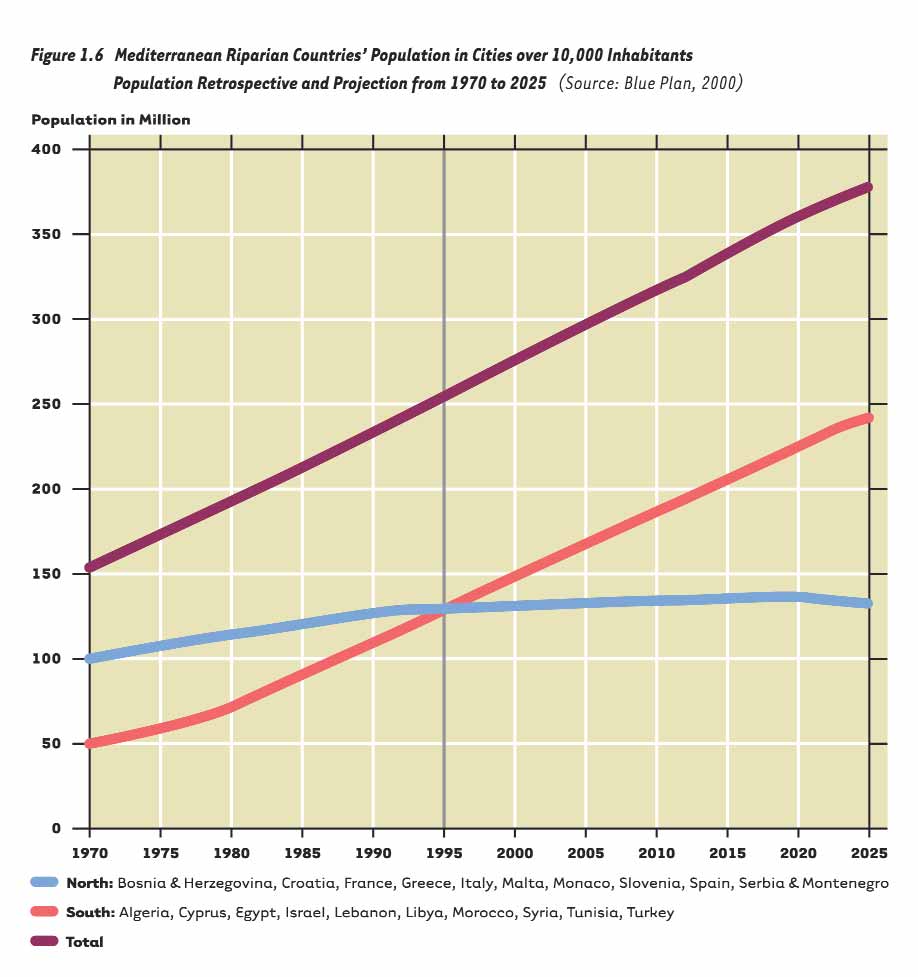
SIS (TDA) FOR THE MEDITERRANEAN SEA
Y
TIC ANAL
Y DIAGNOS
TRANSBOUNDAR
ever. In all of the Mediterranean countries, the urban
ancies are expected to continue. Age composition is
population will grow from 274.5 million in 2000 to 379
expected to differ in northern and southern countries in
million in 2025. Of these 104.5 million new urban
the future. As a result of higher population growth in
dwellers, more than 98 million will be in the South and
southern countries in the coming years, population
East (http://www.planbleu.org/indexa.htm).
structures will be younger in the South. With this shift will
The wide variation in political and economic sys-
come increasing problems concerning education and
tems as well as historic differences have led to great dis-
job-creation in southern countries.
crepancies in the level of development among Mediter-
Human activities pose several threats to the
ranean countries. The highly developed industrial coun-
structure and functions of natural ecosystems, to the
tries in the North (France, Italy and Spain) and countries
quality and availability of natural resources (i.e.,
on the way to becoming industrialised (Greece, Serbia &
forests, soil and water) and on the natural and man-
Montenegro and Turkey) stand in stark contrast to the
made landscape. In particular, coastal areas are fac-
countries in the South. There is a great gap dividing the
ing significant pressures mainly through the over-con-
rich North from the South, with GDP per capita of Medi-
centration of population and economic activities in
terranean EU countries at levels twelve times higher than
these areas. As the coastal population grows and
those of their North African counterparts. As population
urbanises, pressures on the Mediterranean resources
12
continues to grow in the South, developmental discrep-
will continue to increase.
1.2.2 Industrial activity and trade
Algeria, Syria, Egypt and Libya. The current
According to the EEA report on the state and
status does not give any sign of change in the
pressure of the marine and coastal Mediterranean
short term for the export trends, in spite of
environment (EEA, 1999b), the Mediterranean basin
some exceptions like Egypt, which shows a cer-
has never been a major mining region and thus was not
tain diversification with some increase in the
involved in the period of industrial development based
production and export of manufactured goods
on coal and iron. Its heavy metal cycling has been
(textiles, shoes, etc.);
largely affected by the mercury, copper, zinc and lead
· The second group is less specialised in export-
deposits present in the Pyrictic streap of the Iberian
ing goods even in a situation of comparative
Peninsula, however. The region is better endowed in oil
disadvantage with other countries. Thus, their
and natural gas (Algeria, Egypt, Libya, Syria and
exports are more diversified. This is the case
Italy), leading to the establishment of many refineries
for countries like Tunisia, Morocco, Turkey,
all around the Mediterranean basin.
Croatia, Serbia & Montenegro, Cyprus and
Taking into consideration the world's sixteen
Malta. All these countries export manufac-
most important raw materials, the Mediterranean
tured goods such as clothes, textiles and
countries' production (in decreasing order) of mer-
leather, but each one has more specific pro-
cury, phosphates (Tunisia and Jordan), chromite
ductions (chemicals, oils and lubricants in
(Turkey), lead, salt, bauxite (Bosnia & Herzegovina,
Tunisia; chemicals and fertilisers in Morocco;
Croatia, France, Greece, Slovenia, Serbia & Monte-
textile fibres, wool, cotton, paper, cement in
negro) and zinc (Spain and Morocco) is higher than
Croatia, Turkey and Serbia & Montenegro);
the world average. Submarine mining in the Mediter-
· The third group is more diversified and thus
ranean comprises mainly drilling for oil and gas and
much less specialised. It mainly comprises the
dredging of gravel and sand, but this particular type
EU Member States. As mentioned earlier, they
of activity can be considered to be at a relatively
account for the largest part of the petrochemi-
early stage of development.
cal industry in the Mediterranean. Located fully
Steel manufacturing, another symbol of indus-
in the Mediterranean basin, Italian industry is
trial development and military power, is concentrated
certainly the largest, with basic manufactured
in the North (Italy, France, Spain, Turkey and Greece)
goods, machines, transport equipments, etc.
1.0 THE MEDITERRANEAN REGION
with a few producers in the south (Egypt, Algeria and
In terms of the environmental impacts of
Tunisia).
industrial activities in the Mediterranean marine
Generally, to date, the gap in industrial devel-
environment, industry, besides occupying land area,
opment between the northern and southeastern sides
may also use the territory to dispose of solid wastes,
of the basin remains considerable. In terms of added
for example in the form of landfills. This is particular-
value, within the Mediterranean basin proper Italy,
ly true of mining since it often involves the dumping of
France and Spain together are predominant with 87
mine tailings and ore slurry on land, into rivers or to
percent more than the rest of the Mediterranean
the sea directly. It may also include the ash from
countries.
processes such as steel making.
Apart from the chemical / petrochemical and
metallurgy sectors, the other main industrial sectors
1.2.3 Agriculture and Fisheries
include: waste treatment plants, paper, paints, plas-
Scarcity of irrigation water, already experi-
tics, dyeing and printing and tanneries.
enced in the arid and semi-arid countries of the Medi-
terranean is expected to become an ever more press-
Distribution of industrial activities:
ing concern for Mediterranean agriculture in the near
Production activities occurring all over the Medi-
future. In most of those countries with an erratic rain-
terranean basin can be differentiated by the different
fall pattern, many of the available sources of water,
export specialisation for each country. In that respect,
which can be used for economic activities, have
we can easily distinguish three groups of countries:
already been developed or are currently in the process
· The first group is highly specialised in some
of development. For example, of the 12 southern and
export products, while the rest of the com-
eastern Mediterranean countries, the Blue Plan esti-
modities are being imported. This is the typical
mates that eight are now using annually more than 50
13
situation for oil producing countries such as
percent of their renewable water sources; two of them
(the Palestinian territories and Libya) are already
Tourism growth is not equally distributed
using more than their renewable water sources. By the
among Mediterranean countries. The significance of
year 2025 the Blue Plan estimates that eight of the 12
tourism development in Mediterranean member
countries may be consuming more than the total of
states of the EU is higher in comparison to the rest of
their renewable water sources. About 70 percent of
the Union. France, Spain, Italy and Greece remain by
Mediterranean water is used for agriculture.
far the most popular destinations for international
Recent intensification of agricultural tech-
tourism. Although the traditional countries in the
niques in the Mediterranean has reinforced the long-
North today monopolize 4/5 of international tourism,
term trend of desertification occurring in the region.
a certain degree of disenchantment with overurban-
The Mediterranean soils are an example of extreme
ized coasts is likely to benefit the wilder hinterland
degradation resulting from centuries of human use.
and the as yet virgin coasts of southern countries.
Once ubiquitous forests were lost to grazing and animal
There is no doubt that this could act as a potential
husbandry, agriculture, forest cutting for timber and
rebalancing factor between the two banks of the
were thus slowly changed irreversibly over the course of
Mediterranean.
thousands of years. Habitat conversion begun in the
Tourism is regarded as a prevailing economic
Middle East at least 9,000 years ago, resulting gradual-
sector for the Mediterranean region. More than six
ly in a loss of tree cover, drying up of streams, increas-
million people are employed directly or indirectly in
ing local temperatures and erosion. Today about half of
the tourism industry with forecasts showing an
Mediterranean lands are subject to the risk of erosion.
increase of two million by 2010. Also, tourism is cur-
This long-term trend has been accentuated by modern
rently the first foreign currency source for the Medi-
agricultural methods of monocultural intensive culti-
terranean countries and its direct and indirect con-
vation, intensive tilling and excess watering.
tribution to Gross National Product can reach 29 per-
The Mediterranean has highly prized demersal
cent (Cyprus) or 35 percent (Malta).
fish, crustaceans and molluscs. Although there are
Such a growth will mean an increasing
SIS (TDA) FOR THE MEDITERRANEAN SEA
difficulties in obtaining accurate fishing statistics,
demand for coastal space as well as such commodi-
Y
changes in biodiversity among the dominant Medi-
ties as electric power and water. Furthermore, the
terranean fish species appear to result from a combi-
impact on certain habitats (particularly sandy
TIC ANAL
nation of overexploitation of fisheries resources and
beaches and dunes) will also increase. However, the
coastal pollution (Caddy, 1993). Technological im-
economic importance of tourism for the Mediterra-
Y DIAGNOS
provements in the fishing fleet and increased fishing
nean is such that no riparian countries can do with-
capabilities ultimately resulted in a decline in the
out this sector.
catch rate per boat (Caddy, 1993). By the 1970s, a
substantial proportion of the less productive south-
TRANSBOUNDAR
ern shelves were being harvested, including by dis-
tant-water trawlers, resulting in the harvesting of
demersal resources at close to maximum sustainable
yield.
1.2.4 Tourism
The Mediterranean Basin is considered to be
the most important tourism destination globally,
attracting a third of the world's tourists. Domestic
tourism has great significance for the region; of the
450 million visitors, 100 million stay on the Mediter-
ranean coast of their host country, considerably
increasing human concentration. This figure is likely
to double if not triple by 2025, entailing the risk of
overload-based depreciation of the tourist capital
represented by this activity which is seen as vital to
most countries in the region as a source of hard cur-
rency and an essential development factor for south-
14
ern countries.
1.0 THE MEDITERRANEAN REGION
15
SIS (TDA) FOR THE MEDITERRANEAN SEA
Y
TIC ANAL
Y DIAGNOS
TRANSBOUNDAR
16
2.0
MAJOR ENVIRONMENTAL CONCERNS
One of the primary steps to be taken in a
as well as cause decline of biodiversity. In spite of these
Transboundary Diagnostic Analysis is the identification
overlaps, the four MPPIs are addressed below.
of major perceived problems and issues (MPPIs), also
known as major environmental concerns. These MPPIs
2.1 Decline of Biodiversity
represent the dominant issues of concern to the stake-
This section surveys the sensitivity and changes
holders involved in the TDA. MPPIs are supposed to
in biodiversity and coastal ecosystems as a response to
reflect concerns and issues, but sometimes can be pri-
man-induced changes and pollution in the Mediterra-
mary causes or root causes. In addition, MPPIs may
nean. There is a perception that biodiversity has
sometimes be environmental effects arising from some
decreased in the Mediterranean Sea, although this
basis problem. The MPPIs find their use in cogently
topic is hotly debated. From a species perspective,
expressing the major issues faced by stakeholders.
there is no evidence of the loss of a single species in the
AL CONCERNS
Although they may lack a full scientific basis,
Mediterranean Sea, whereas invasionary species con-
the MPPIs provide a stepping stone for further, in-
tribute to add to the species list in the Sea, largely due
depth analysis of their scientific underpinnings. If the
to the Lessesspian migration through the Suez Canal. A
MPPIs are supported by available scientific inquiry,
visible loss of a flagship species has been the drastic
then they may lead logically to the identification of
reduction in the occurrence of dolphins (Tursiops trun-
Environmental Quality Objectives (EQOs). Once the
catus) off the coast of the North-West Adriatic, which
2.0 MAJOR ENVIRONMENT
EQOs and their related concrete targets are identified
is probably due to the changes in organoleptic charac-
and adopted, the EQOs then lead logically to interven-
teristics (colour, odour and taste) and the loss of
tions for the future, to help achieve the targets within
transparency caused by eutrophy. Once common even
the adopted timeframe.
in the waters close to the shore, presently they can only
The MPPIs for the Mediterranean Sea TDA were
be encountered (although sometimes in large num-
developed through the years, as part of meetings held
bers) over 1020 miles from the coast. From a habitat
in support of the Mediterranean Action Plan. This TDA
perspective, there is no doubt that there is loss of bio-
identifies four priority MPPIs:
diversity. Contraction of seagrass meadows (e.g.,
· Decline of biodiversity
Posidonia and eelgrass meadows) has been document-
· Decline in fisheries
ed, and valuable coastal landforms have been lost due
· Decline in seawater quality
to development, reclamation, and other similar activi-
· Human health risks
ties. From a genetic perspective, there are inadequate
Human health risks are an overarching issue, with
data to make a judgment on the loss of genetic biodi-
some items overlapping with the other MPPIs. In this sec-
versity. Therefore, the greatest argument for loss of
tion, the TDA addresses the environmental issues that
biodiversity would seem to rely on the loss and / or
contribute to human health risk. Clear overlap can be seen
alteration of valuable habitats.
in that Toxic Algal Blooms, an indicator of both decline in
Diversity of marine life in the Mediterranean is
biodiversity and decline in seawater quality, can lead to
high and is also largely confined within this basin mak-
human health risks (e.g., Paralytic Shellfish Poisoning,
ing for a relatively high rate of endemism on a global
Diarrheic Shellfish Poisoning, etc.). Similarly, decline in
level. Out of the total of 10,000 to 12,000 marine
seawater quality arising from introduction of organochlo-
species registered for the Mediterranean Sea, 2030
17
rine pollutants could also adversely affect human health,
percent are assessed to be endemic, representing two
to three percent of world seas' species richness. This
with considerable economic as well as ecological value
genetic richness arising largely from the Mediterranean
is being eroded. Coastal wetlands have mainly been
position between two major oceans, the Atlantic and
subjected to conversion to other uses leading to large
the Indo Pacific, and the intermixing of their species is
losses in size and environmental degradation. Coastal
under increasing pressure from man-induced impacts.
wetlands are also adversely affected by aquifer mis-
This intermixing has led to what are known as invasion-
management, pollution, land reclamation and diver-
ary species, primarily through the Suez Canal since its
sions and loss of river flows.
opening in 1869; however, from this perspective, many
Pressures exerted on Mediterranean biodiversi-
species are invasionary as this migration into the
ty and coastal ecosystems can be put in the following
Mediterranean Seas has been ongoing since the basin
categories:
filled following the latest glaciation.
· Overexploitation of living marine resources;
Although no species are known to have disap-
· Conversion and degradation of critical habi-
peared from the Mediterranean as a result of human
tats;
activity, the status of some species is of great concern.
· Introduction of alien species;
A list of 89 marine and freshwater species (not includ-
· Pollution in the form of excess nutrients; toxic
ing birds) has been established under the Protocol con-
waste, including oil; solid waste and litter;
cerning Specially Protected Areas and Biological
and
Diversity in the Mediterranean Sea and then revised in
· Use of non-selective fishery gears.
the Berne Convention on the Conservation of European
Wildlife and Natural Habitats. A "red book" published
2.1.1 Transboundary elements
in 1990 identifies a variety of species at risk in the
Transboundary elements of the degradation of
Mediterranean.
coastal habitats and decline of biodiversity arise
Among the species most endangered and
because of combinations of the following factors:
threatened by extinction are the Mediterranean monk
· Marine living resources are often migratory;
SIS (TDA) FOR THE MEDITERRANEAN SEA
seal (Monachus monachus), with a total population not
· Coastal habitats provide nursery and feeding
Y
exceeding 500 specimens, dolphin species (Delphinus
grounds for migratory species;
delphis, Tursiops truncatus, Stenella coeruleoalba),
· Degradation of coastal habitats contributes
TIC ANAL
sperm whales (Physeter macrocephalus), and freshwa-
to overall decline of regional and global bio-
ter and marine turtles (Chelonia mydas, Trionyx triun-
diversity;
Y DIAGNOS
guis, Caretta caretta).
· Sustainability of marine and coastal habitats
High competition for land use on the coastal
depends on the integrity of the interlinked
fringe is forcing critical habitats to decline. Tourism,
ecosystems that support trophic levels in the
urban development, agricultural, fisheries and indus-
food chain; and
TRANSBOUNDAR
trial expansion are some of the pressures faced by
· Ecosystems are inherently transboundary in
both marine and terrestrial coastal habitats.
nature.
The preservation of critical habitats, seagrass
Thus, modification of habitats in some coastal
belts and coralligenous communities for instance, is
areas may have basin-wide impacts due to their impor-
critical for biodiversity. They serve as nursery grounds
tance as nurseries. Eutrophication in key areas may
for many fish, molluscs, crustaceans, as well as habi-
have transboundary impacts by serving as a "source"
tats throughout species' life span. Nonetheless, their
for nuisance species (jellyfish, toxic algae and their
status is declining as a result of pollution from munic-
cysts) that may spread in basin-wide currents into
ipal and industrial waste as well as fishing distur-
adjacent parts of the Mediterranean. What may appear
bance, and in some cases, such as that of Posidonia
to be merely a local action (eutrophication) may in
meadows, they are known to have disappeared com-
fact have transboundary consequences.
pletely in certain areas. Besides Posidonia meadows,
the most critically threatened marine habitats are
2.1.2 Environmental impacts
Lithophyllum lichenoides rims and the Coralligenous
Casual chain analysis is used to determine the
communities. Some eelgrass beds (Zostera marina)
environmental impacts of the MPPIs. Figure 2.1.1 is
are also at risk.
the casual chain for Decline in Biodiversity. As the fig-
Similar concerns arise on wetlands whose
ure indicates, the environmental impacts are many
18
capacity to provide a host of environmental services
and varied.
· Disruption of important biocenoses;
· Reduction of critical fish habitats and decline
· Change in structure of marine communities
in fisheries population with subsequent in-
· Reduction of fin- and shell-fisheries;
come decline from fisheries;
· Decline in function and quality of critical
· Changes in the employment with a shift away
seabed habitats, particularly nearshore;
from fisheries;
· Ripple effects through food web as primary
· Loss of aesthetic value;
producers on up decline;
· Loss of income from the tourism industry;
· Loss of unique global biodiversity resources
· Loss of cultural heritage.
(e.g., seagrass meadows, coralline habitat);
· Possible loss of forage, nesting, and / or rest-
2.1.4 Causal Chain Analysis
ing areas for migratory species such as birds
The causes of decline in biodiversity are indi-
(cranes, birds of prey, etc.) and marine mam-
cated in the Causal Chain Analysis (CCA) in Figure
mals (e.g., dolphins) and reptiles (including
2.1.1. Generally, the causal chain identifies primary
the three endangered turtle species); and
causes, and ultimately addresses root causes (the
· Possible loss of unique wetlands habitats
level at which sustainable interventions are normally
along critical semi-tropical zones.
encouraged).
The primary causes of decline in biodiversity are:
2.1.3 Socio economic impacts
· Excess supply of nutrients;
The degradation of biodiversity and coastal
· Overexploitation of living marine resources;
ecosystems leads to a host of adverse socio-econom-
· Threat to non-target species taken in by-
ic impacts linked to the tourism and fisheries sectors.
catches;
Increasing pollution of the land and marine coastal
· Threat to the fisheries' target populations due
fringe, where most of the biodiversity is found, leads
to over-fishing and large kills of juveniles;
AL CONCERNS
to the degradation of interdependent breeding habi-
· Competing land uses and intense river and
tats of marine organisms. For example, a reduction in
aquifer management: degradation and con-
seagrass cover can reduce fish spawning, leading to
version of critical habitats;
reduction in artisanal catches that may be a signifi-
· Pollution;
cant component of local economies. Some of the most
· Introduction of alien or cultured species;
important impacts are mentioned below:
· Solid waste disposal in sea.
2.0 MAJOR ENVIRONMENT
· Loss of high value ecological services linked
Important root causes include:
to loss and degradation of coastal wetlands.
· Low awareness of farmers and other stake-
An evaluation of the economic value of wet-
holders;
lands reveals that these habitats provide the over-
· Lack of control of fishing effort and gear;
whelming share of ecological services, compared to
· Lack of investment in wastewater treatment;
inland ecosystems.
· Inadequate ship ballast water control;
The report prepared by Costanza (1997) in the
· Insufficient solid waste management Best
framework of the European Demonstration Programme
Available Practice;
on the Assessment of the socio-economic costs and
· Inadequate implementation of international
benefits of Integrated Coastal Zone Management is of
Conventions and Agreements.
relevance here as it focuses mainly on Mediterranean
type of ecosystems.
2.1.5 Supporting data
According to Costanza (1997), wetlands pro-
The section below surveys the main concerns on
duce nearly 75 percent of the ecosystem services, while
Mediterranean biodiversity by looking at threats fac-
inland ecosystems provide the remaining 25 percent.
ing living marine resources and critical habitats. It
Estuaries, areas of the continental shelf and tidal
also presents supporting data on causes of concern
marshes are included as wetlands in the report.
focusing on eutrophication, chemical contaminants,
Although the above estimate refers to Europe
oil pollution, introduction and invasion of alien
rather than the Mediterranean, it is a relevant indication
species and solid waste and litter. The supporting data
of the order of magnitude of economic value of wetlands.
come from dozens of studies performed under the
Additional socio-economic impacts arise out
Mediterranean Action Plan, and the general literature.
19
of a combination of the following:
Special studies on marine turtles, jellyfish blooms,
SIS (TDA) FOR THE MEDITERRANEAN SEA
Y
TIC ANAL
Y DIAGNOS
TRANSBOUNDAR
20
land-based and airborne pollution, eutrophication,
tegrity of this basic habitat found pri-
marine organic pollutants, and many national reports
marily in coastal areas is of high pri-
contribute to this summary section.
ority, not least because seagrasses
support high levels of marine produc-
2.1.5.1 Exploitation of
tivity. In fact some seagrass meadows
living marine resources
qualify as critical habitats and their
The fact that fishing grounds usually are quite
status is viewed as a major biological
close to the coast where the highest biodiversity is
indicator of the state of the water
located results in strong impacts of fishing activities
quality.
on biodiversity. The two major threats that stem from
Posidonia oceanica meadows,
fishing are direct damage to biodiversity and damage
whose loss is irreversible on a human
to essential habitats.
life timescale, are a red flag for con-
The widespread use of small mesh fishing gear
servation efforts in the Mediterra-
as well as excessive fishing of commercial species are
nean. In the last 50 years, there has
the foremost means by which biodiversity is damaged.
been a major regression of Posidonia
Although no data seem to indicate that any fishery
oceanica meadows all around the
resource is under threat of collapse, it is widely
Mediterranean basin mainly due to
acknowledged that overfishing has taken place in the
human-induced changes to the
Mediterranean for a long time. Red coral (Corallium
coastal zone.
rubrum) in the western Mediterranean for instance is
As far as damage to habitats is
heavily over-exploited, as are also some edible bivalve
concerned, there is a need to protect
species such as Lithophaga lithophaga.
seagrass beds (Phanerogams such as
Moreover, the negative impact of overex-
Posidonia sp., Zoostera spp. and
AL CONCERNS
ploitation of marine resources is also felt on many
Cymodocea sp.), ham mussel beds,
non-target fishery populations. High conservation
deep water white corals and hard
priority species such as marine turtles, the Mediterra-
bottom biocenosis in coastal areas,
nean monk seal, and marine mammals fall prey to by-
irrespective of depth, from the
catch due to lack of selective fishing gear.
effects of trawling, dredging and
As far as by-catch of protected species is
similar activities. Often rigged with
2.0 MAJOR ENVIRONMENT
concerned, conservation of the few remaining monk
chains or other rock-hopper devices,
seals is of major importance. Protection of turtles
these fishing devices have been iden-
and seabirds from longlining may in some cases be of
tified as a main cause of both the
special concern. Cetacean by-catch will be of less
decline of shallow seagrass meadows
importance following the recent ban of driftnets,
and deterioration of communities
although action at the international level would be
living on rocky bottom surfaces.
beneficial to extend the protection to all Mediterra-
Posidonia oceanica seagrass mead-
nean fisheries. However, the interaction between
ows for instance are in regression
cetaceans and fishing activities beyond the by-catch
partly as a result of mooring of boats
phenomenon is a problem of growing concern that
and trawling connected to fishing
deserves careful consideration. In addition, over-
activities.
fishing reduces the food base on which sea mammals
The impact of dredge fishing for
on higher levels of the food chain depend on for their
bivalves must also be controlled
survival.
since it may reduce the capacity of
soft bottoms to maintain diversity in
2.1.5.2 Degradation and conversion
benthos.
of critical habitats
Besides seagrass habitats, coral-
a. Seagrass meadows
ligenous communities are also high
and coralligenous habitats
conservation priority marine organ-
Threats to seagrass meadows, a
isms. Plants and animals, many of
typical type of habitat in the Mediter-
which are unique to the Mediterra-
21
ranean, are well recorded. The in-
nean, thrive around these spectacular
formations. Man-induced pressures
a rich and diversified flora and fauna
linked to collection of red coral, an-
have been subjected to landfilling,
choring of boats on coral grounds and
drainage and conversion to agricul-
trawling are subjecting coralligenous
ture, urban settings and other uses.
habitats to decline and degradation.
The effect of the loss and degrada-
High-impact harvesting techniques
tion of wetlands has been identified
such as the St Andrews' cross for red
as a serious threat to nine out of the
coral (Corallium rubrum) or the ex-
33 breeding colonial water bird
ploitation of European date mussel
species found along the Mediterra-
(Lithophaga lithophaga) and com-
nean coastline.
mon piddock (Pholas dactylus) by
Yet data on the actual state of
destroying the rocks inhabited by
Mediterranean wetlands are lacking.
these bivalves have long been forbid-
In 1995, within the framework of the
den, but there are indications that
European MedWet 1 project, an analy-
the prohibition is not well enforced.
sis of the existing wetland inventories
Furthermore, there are warning sig-
in the Mediterranean was published.
nals that the illegal use of explosives
The study showed that detailed in-
and poisoning is still taking place.
ventories had been completed for
Critical coastal habitats are par-
only five of the 22 countries reviewed
ticularly damaged around big cities.
and that for the majority there were
Coastal structures related to expan-
lists only of some of the most impor-
sion of human settlement inevitably
tant wetlands. Generally, there has
affect ecological processes and lead
been little standardization of the
to a definite elimination of breeding
data collected and the results
SIS (TDA) FOR THE MEDITERRANEAN SEA
areas, to destruction of habitats and
between countries are therefore diffi-
Y
to loss of biotopes. Sea defence
cult to compare.
measures, land reclamation, industri-
In connection with wetlands,
TIC ANAL
al and harbour installations, dredging
lagoons represent another important
or extraction of sediments, disposal of
and specific habitat for a number of
Y DIAGNOS
wastes and dredged material, recre-
species. They make up approximately
ational activities, military activities
40 percent of the non-rocky Mediter-
and aquaculture operations all tend
ranean shoreline. In Mediterranean
to concentrate around big cities.
Europe as a whole, they account for
TRANSBOUNDAR
Consequently, the shrinkage of critical
some 850,000 hectares. As wetlands,
habitats such as Posidonia meadows
many of them have been strongly
has been particularly strong around
impacted by human development
large industrial harbours like Athens,
since numerous commercial activities
Naples, Genoa, Marseille, Barcelona,
depend on them.
Algiers and the Gulf of Gabès.
Intensified river watershed man-
agement through dams also has a
b. Wetlands and lagoons
great impact on coastal wetlands
Although engineering works
and aquifers that feed off their flows.
clearly cause decline of wetlands and
The Aswan High Dam illustrates
biodiversity, lack of data prevents us
clearly the downstream impacts of a
from quantifying the magnitude of
change in the upstream uses of a
this man-induced impact. Wetlands
river. A reduction of silt load carried
are lost to a variety of man-induced
to the Nile Delta as a result of the
changes in the land use of coastal
dam has led to increased erosion of
areas. Lagoons, marshes, lakes, tem-
the deltaic coast affecting the sand
porary pools, river estuaries, chan-
bars in front of Manzalla and Burullus
22
nels and coastal forests that shelter
lagoons that now face the risk of
opening to the Sea. Consequently,
ground karstic aquifer systems them-
the deltaic lagoons harbouring great
selves form habitats for unique and
concentrations of species are threat-
threatened karst biodiversity and
ened by seawater invasion and dis-
degradation of this habitat is a
turbance of the delicate ecological
threat to biodiversity.
balance. As a result of changes in
The drying up of coastal wet-
water mass movement, water level,
lands and coastal development
salinity and temperature attributed
result in the fragmentation of habi-
to reduced silt deposit, the lagoon
tats. Once a habitat becomes frag-
may become unsuitable for breeding
mented as a result of coastal devel-
and spawning purposes in the future.
opment, ecosystem processes are
Coastal wetlands are also ad-
disrupted. This type of man-induced
versely affected by aquifer misman-
impact damages biodiversity by
agement, thereby threatening the
inducing inbreeding, which reduces
biodiversity dependent on them. The
the gene flow and therefore genetic
threats to wetlands from aquifer mis-
variability.
management are twofold. First, over-
To better understand the nega-
use of aquifers can result in the dry-
tive consequences of inbreeding on
ing up of wetlands dependent upon
fitness and growth rates, levels of
them. The seepage from the coastal
genetic diversity have been studied
aquifers, estimated to be 13 billion
in transplants in a common location.
m3/yr in the UNEP/Blue Plan (http://
Shoots collected in populations with
www.planbleu.org/), accounts for
higher genetic polymorphism showed
AL CONCERNS
about one quarter of the total fresh-
higher survival and growth rates,
water inflow into the Mediterranean.
suggesting that when genetic vari-
Second, wetlands are degraded by
ability of donor populations is high,
the saline intrusion that occurs when
fitness is also high.
coastal aquifers are over-exploited
Habitat fragmentation and the
and from the pollutants introduced
associated risk of inbreeding is a
2.0 MAJOR ENVIRONMENT
into the aquifers. The coastal seep-
particularly serious problem when it
age and submarine discharges are
affects critical habitats such as the
critical to the water balance and
Posidonia meadows. Populations of
seawater quality in the marine sub-
Posidonia oceanica, for instance,
basins and support wetlands and
are being sampled along the coasts
brackish water habitats with biodi-
of the entire Mediterranean basin
versity and fishery nursery areas in
and analysed with the help of DNA
the coastal zones. The karstic aqui-
microsatellite markers. First results
fers in particular are vulnerable to
obtained along a latitudinal gradi-
saline intrusion and surface pollu-
ent in the Thyrrenian Sea suggested
tion, especially in the open karst sys-
that overall genetic variability is low.
tems exposed to human-induced
Recent results, referring to more
groundwater pollution. The seepage
than 500 individual shoots sampled
freshwater discharges from karstic
in several populations within the
coastal aquifers dominating large
Western Mediterranean Basin con-
sections of the southern Mediterra-
firmed low levels of genetic variabil-
nean and the eastern Adriatic coasts
ity. Low genetic variability was found
are vulnerable to and transport agri-
particularly within the North Adriatic
cultural-based nutrients, chemical
where a population was reported to
and other pollutants into the sea,
be completely uniclonal.
thereby degrading critical wetland
Recreational activity may inter-
23
habitats. Additionally, the under-
fere with the natural functioning of
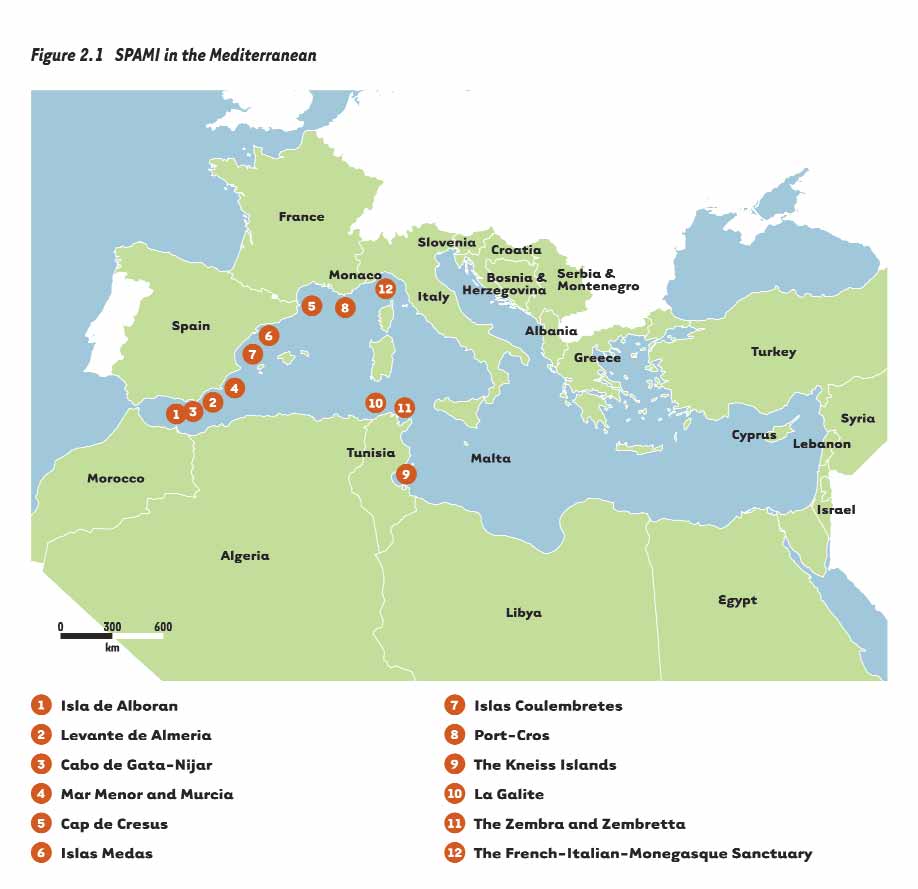
the coastal zone as a habitat.
additional example, the development
Through recurrent disturbance, spe-
of tourist resorts on sandy beaches
cific areas may become unsuitable
has frequently resulted in the restric-
for the breeding, resting or feeding of
tion of space available for the repro-
marine organisms. Disturbances dur-
duction of sea turtles, including
ing critical periods of this kind can
those under strict protection status
reduce the viability of the animal
(green and loggerhead turtles, for
population concerned by lowering
instance).
reproductive success and by increas-
The Mediterranean countries, in
ing mortality. Since coastal tourism
the framework of the implementation
is highly developed in the Mediterra-
of the Specially Protected Area and
nean, the main tourist season and its
Biodiversity Protocol, have identified
different activities probably have a
a list of Specially Protected Areas of
significant impact on species using
Mediterranean Importance (SPAMI,
sand beaches or rocky shores. En-
Figure 2.1) having special biodiversi-
dangered Mediterranean animals like
ty concerns. At a subregional level,
turtles or the monk seal or marine
France, Italy and Monaco (Accord
mammals are subject to anthro-
RAMOGE) set up a sanctuary for the
pogenic disturbance from the noise
protection of Cetaceans as shown in
generated by speedboats. As an
Figure 2.2.
SIS (TDA) FOR THE MEDITERRANEAN SEA
Y
TIC ANAL
Y DIAGNOS
TRANSBOUNDAR
24
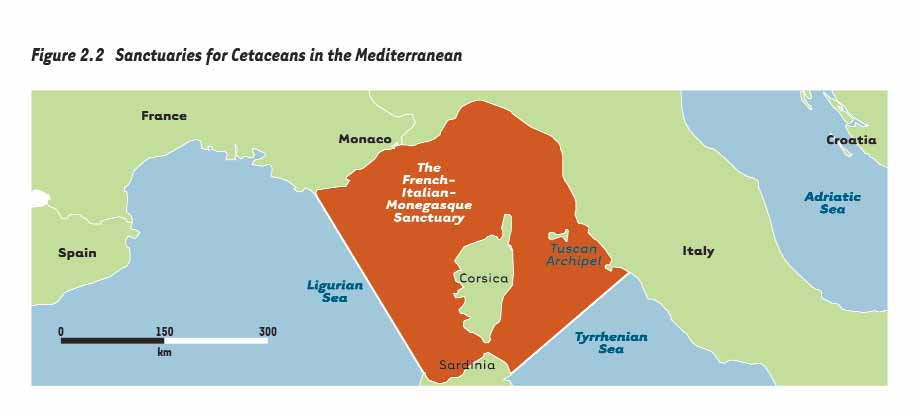
Case Study
The Thau Lagoon, France: The need for sustainable shellfish farming (Source: Deslous-Paoli, 1993)
The Thau Lagoon is one case study of particular interest. Almost all the typical human activities associated
with lagoons are encountered here. Its natural productivity sustains commercial shellfish farming (an estimated
standing stock of 35,000 tonnes with an annual production of 15,000 tonnes per year) and fish farming (40 tonnes
per year), as well as commercial and recreational fishing of both fish and shells.
AL CONCERNS
This shallow (< 10 m) ecosystem is sensitive to numerous inputs, both natural and anthropogenic, as well as
climatic variation. At the turn of the century, when agriculture was not an important factor in the region, morphol-
ogy and bathymetry were the sole determinants of nutrients' state in the lagoon. The first oyster farms appeared
between 1911 and 1915. Since 1945, the increase in shell farming (700 commercial concessions) and additional
human activities on the lagoon's shore led to a significant enrichment of the bottom sediments by the 1960s despite
good management of the river Herault. This enrichment probably caused the strong anoxia of the 1970s that dras-
2.0 MAJOR ENVIRONMENT
tically affected shellfish farming and fishing in the lagoon. More enlightened development since the early 1970s and
a lagoonal cleanup programme initiated in 1974 have slowly had a positive effect on the lagoon in spite of the simul-
taneous expansion of shellfish farming in the region. Today, the lagoon still contains high levels of silt originating
from both deep water (where organic matter accumulated) and from shellfish farming which together fertilize the
sediments and favours Zostera and macrophyte growth. This in turn probably reduces eutrophication.
The hydrodynamics of the lagoon depend on the prevalent winds, but water circulation can be strongly
retarded by the shellfish farming structures that are a common feature of the area. However, water circulation
between these structures (e.g., oyster tables, partitioning corridors) is of major importance for the balanced oper-
ation of this ecosystem. If filter feeders take up more particulate matters than they release (biodeposition), then
regeneration processes result in the export of large quantities of organic matter to partitioning corridors. This
localized enrichment can create the highest levels of phytoplanktonic productivity observed in the lagoon and the
resulting production partly sustains shellfish farming needs. However, shellfish farming needs could not be sus-
tained throughout the year without some additional exogenous source of nutrient supply. Because of this, the cir-
culation of the lagoon as a whole plays a role in shellfish production. These exchanges occur continually except
during the summer. During this season, shellfish farming needs are so important that they result in the depletion
of phytoplankton inside the farming structures themselves, despite supply from outside. It is therefore also impor-
tant to quantify the standing stock of dissolved organic matter and identify its role in initiating localized regener-
ated primary production.
Further studies will focus on the assessment of marine waters nearby in order to better understand the link-
ages between the lagoon and its neighbouring ecosystems, as well as evaluating the downstream socio-economic
consequences of possible ecological degradation of the lagoonal system.
25
2.1.5.3 Pollution
Cystoseira spp., Dictyota spp., and
a. Nutrient enrichment
Halymenia spp., for instance, are
and eutrophication
seen to decline in the Mediterranean
Eutrophic waters or waters where
and are replaced by short-lived nui-
there is abundant food (nutrients) are
sance algal species.
a major environmental concern partic-
Among the most serious conse-
ularly for areas close to big cities,
quences of eutrophication for biodi-
industrial agglomerations and river
versity are algal blooms or red tides.
deltas. Joint UNEP/FAO/WHO reviews
These red tides caused by several
(1996b) have identified nutrient dis-
species of microscopic plant-like cells
charge and eutrophication as a serious
or phytoplankton that produce potent
source of environmental degradation
chemical toxins result in fish kills and
for Mediterranean ecosystems due to
contamination of shellfish. Red tide
the common practice of untreated or
populations well below the fish kill
partially treated urban sewage dis-
level pose a serious problem for public
charge and leaching from fertilised
health through shellfish contamina-
agricultural areas. This referenced
tion. Bivalve shellfish, especially oys-
source provides more detail on much
ters, clams and coquinas can accu-
of the material presented below.
mulate so many toxins that they
However, the 1996 UNEP/FAO/WHO
become toxic to humans. Fish exposed
review indicated that eutrophication is
to lower (sublethal) concentrations
primarily a problem of coastal waters.
are also vulnerable to red tides, as
The overall input of nitrogen to the Me-
they may accumulate toxins in their
diterranean Sea (about 1.5 to 4.5 mil-
body. Current research suggests that
SIS (TDA) FOR THE MEDITERRANEAN SEA
lion tonnes per year), and of phospho-
such bioaccumulation in fish eaten by
Y
rous (about 0.1 to 0.4 million tonnes
dolphins may be responsible for high
per year), are quite low compared to
mortality rates among dolphins.
TIC ANAL
other seas, such as the adjacent Black
For marine animal and plant com-
Sea. These inputs result in supply of
munities, oxygen depletion that some-
Y DIAGNOS
about 1.5 g/m2 of Nitrogen on a basin-
times accompanies eutrophication
average, and about 0.15 g/m2 of
may be fatal. Eutrophication triggers
Phosphorus. These values are low com-
two biological processes that bring
pared to many coastal seas but com-
about an increase in the demand for
TRANSBOUNDAR
parable to open areas such as the
oxygen. First, the growth of algal pop-
North Atlantic Ocean. Section 2.3.6.2
ulations means less light permeates
of this document discusses in greater
bottom layers. Second, when algal
detail the causes of eutrophication in
blooms die out, their carbon is export-
the Mediterranean and its effect on
ed to the bottom where decay process-
seawater qaulity.
es strip oxygen from the water. Taken
The transboundary aspects of
together, these changes reduce oxygen
eutrophication relate primarily to its
levels, which in turn make aquatic life
effects on biodiversity. An excess of
impossible in extreme cases. In the
nutrients in the water gives rise to a
Mediterranean, many instances of fish
complex chain of reactions that dis-
and shellfish kills have been recorded,
rupt aquatic ecosystems. Under eu-
as these species are the first to be
trophication, long-living (and slow-
affected by oxygen limitation (see
growing) plants that are important
Table 2.1 and Figure 2.3).
for biodiversity (and support diversi-
Eutrophication has already led to
fied fauna) do less well and are out-
the disappearance of species in dis-
competed by fast growing oppor-
turbed areas of the Mediterranean.
26
tunistic species. Macrophytes such as
Benthic communities are among the
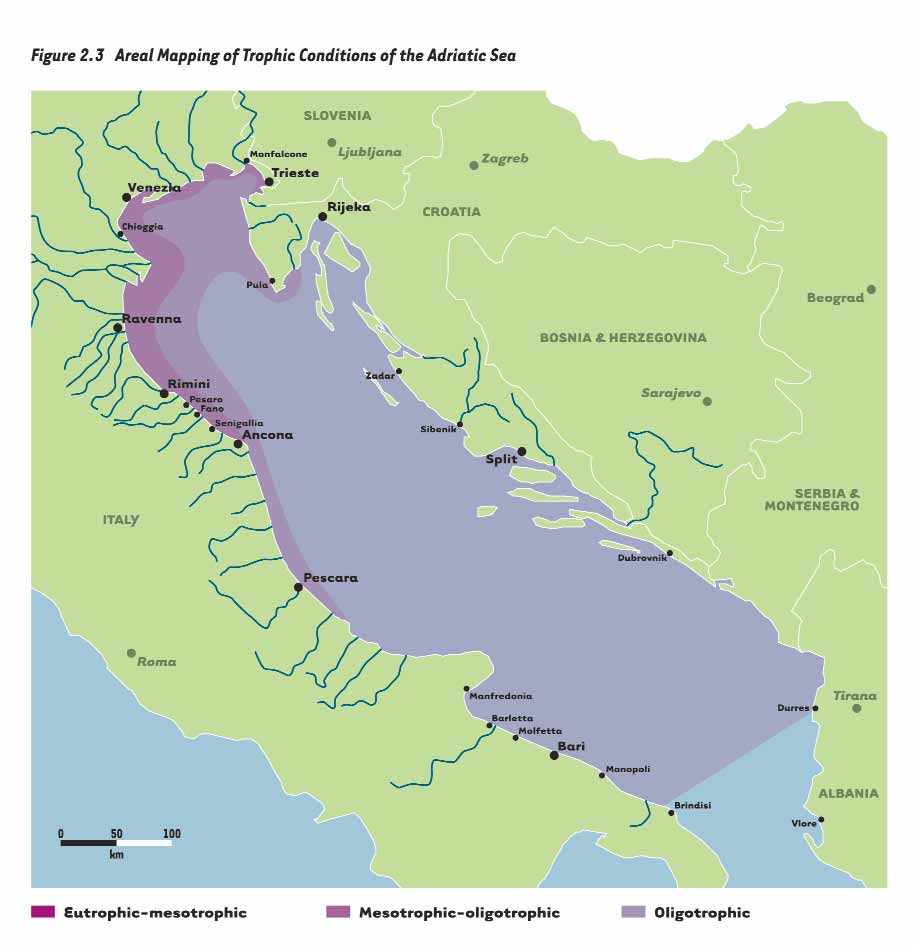
first to disappear under heavy stress
while a small number of polychaetes
conditions. Their bioturbating activi-
species account for 7090 percent of
ties are of considerable importance
the total abundance. The same
for the benthic ecosystem and hence
applies to the western Mediterranean
their loss is a liability to the ecosys-
communities, where increasing dis-
tem as a whole. In undisturbed areas
turbance also leads to reduction in
in the eastern Mediterranean, benthic
species richness.
communities present high species
When organic enrichment and / or
diversity consisting of polychaetes
balance effects exceed the potential
(5065 percent), molluscs (1525
for remineralisation by benthic organ-
percent), crustaceans (1020 per-
isms, anoxic zones are created and
cent), echinoderms (58 percent),
bacterial mats cover the seabed.
and miscellaneous taxa. By contrast,
Although this type of ecosystem
in areas ranging from heavily dis-
change is in general reversible, there
turbed (e.g., sewage outfall vicinity)
could be severe and long-lasting con-
to polluted (e.g., urbanized bay),
sequences when the affected seabed
echinoderms, crustaceans and mis-
is a critical habitat like the meadows
cellaneous taxa largely disappear,
of the seagrass Posidonia oceanica.
AL CONCERNS
2.0 MAJOR ENVIRONMENT
27
Table 2.1 Serious Eutrophication Incidents in the Mediterranean (Source: UNEP/FAO/WHO, 1996b)
Countries
Hypoxia /
Algal Blooms (AB)
Dominant species
Cell number
Anoxia
and other effects
*
(cells/l)
Croatia
Northern Adriatic
Yes
AB, red tides, fish and
7, 12, 15, 28, 31,
--
bottom fauna mortality
34, 41, 42, 53
Egypt
Costal waters
Yes
AB, water discoloration,
17
--
and ports
HS
Lagoons in
Yes
AB, water discoloration,
--
--
the Nile Delta
HS
Greece
Saronikos Gulf
Yes
AB, water discoloration,
7, 11, 16, 32, 34,
3x1056x107
fish mortality
46, 55
Gulf of Thermaikos
Yes
AB, water discoloration,
1, 3, 8, 10, 12, 14,
17.5x10⁷
fish mortality
15, 16, 39, 41, 42
Other Aegean Gulfs
No
AB, water discoloration
5, 6, 11, 20, 28, 33
12x106107
and bays
France
Western Zone
Yes
AB, dystrophy
24, 30, 34, 35, 42, 54
--
Eastern Zone
Yes
AB, DSP, PSP, dystrophy
24, 30, 34, 35, 42, 54
--
Italy
Tyrrhenian Sea,
Yes
AB, PSF, fish mortality,
33
6x10⁶
Lagoons
mucus
Gulf of Naples
?
AB
2, 9, 15, 48
3.5112x10⁶
Sardinia
Yes
AB, fish and
13, 14
--
molluscs mortality
Sicily
Yes
AB, DSP, fish mortality
23, 24, 49
--
Ionian Sea
?
AB
52
--
Southern and
Yes
AB, putrefaction,
34, 37, 52
--
Central Adriatic
bottom fauna mortality,
dystrophy
SIS (TDA) FOR THE MEDITERRANEAN SEA
Y
Emilia-Romana
Yes
AB, DSP, PSP, dystrophy,
4, 11, 15, 16, 18, 24,
1230x106
fish and bottom fauna
25, 26, 27, 28, 34, 36,
mortality, mucilage,
41, 44, 45, 46, 52, 53
TIC ANAL
water discoloration,
poor transparency, smell
Gulf of Venice
Yes
AB, HS, hypertrophy
4, 9, 13, 14, 15, Ulva
36x106
Y DIAGNOS
Gulf of Trieste
Yes
AB, bottom fauna,
28, 38, 40, 46, 53
57x106
mortality
Malta
--
No
AB, poor transparency
--
--
Slovenia
--
Yes
AB, poor transparency,
--
--
benthos mass mortality,
TRANSBOUNDAR
mucilage, hypertrophy
Spain
Alboran Sea
--
AB, PSP, toxins
33, 53
> 3x10³
East Coast
--
AB, PSP, toxins
4, 16, 17, 21, 33
7.2x10⁶
and Balearics
2.8x10⁷
Lagoons, Bays,
Yes
AB, dystrophy
52, Ulva
102x106
Estuaries
Tunisia
Lagoon of Ichkeul
Yes
AB
--
--
Turkey
Western Coasts
Yes
AB, bottom fauna
17, 28, 29
--
mortality, PSP
AB: Algal Blooms
DSP: Diarrhoic Shellfish Poisoning
PSP: Paralytic Shellfish Poisoning
*
The numbers of the dominant species refer to Table 2.2.
b. Chemical contaminants
concentrations of chemical contami-
As our understanding of effects of
nants. The important point about such
toxic substances improves, the notion
toxic substances even at low levels is
of `stress' has emerged. Stress helps to
that they still give rise to biochemical
explain why fitness and growth of ani-
reactions that put pressure on living
28
mals and plants will suffer even at low
resources. Amongst the results of pro-
Table 2.2 Algal Species reported to cause
Case Study
Algal Blooms in Mediterranean Waters
Eutrophication:
(Source: UNEP, 1999)
The case of the North Adriatic Sea
The serious deterioration that has
*
Algal Species
occurred in the northern area of the Adriatic for
a. Microalgae
more than twenty years is attributable to the
Diatoms
nutrient input in amounts that exceed the basin's
1
Cerataulina bergoni
natural assimilative capacity. The Po River, carry-
2
Chaetoceros sp.
ing some 100,000 tonnes/year of inorganic nitro-
3
Chaetoceros Socialis
gen and some 6,000 tonnes/year of inorganic
4
Chaetoceros Simplex
phosphorus, contributes most of the total nutrient
5
Cyclotella sp.
6
Cyclotella subtilis
load of the northern Adriatic basin. The next largest
7
Leptocylindrus ssp.
of the rivers flowing into the northern Adriatic, the
8
Leptocylindrus minimus
Adige, contributes about 14,000 tonnes/year of
9
Leptocylindrus danicus
total nitrogen and 1,200 tonnes/year of total
10
Nitzschia closterium
11
Nitzschia delicatissima
phosphorus, although its mean nutrient concen-
12
Nitzschia seriata
trations are lower than those of the Po. The total
13
Rhizosolenia firma
nitrogen and total phosphorus discharged into the
14
Rhizosolenia Fragilissima
northern Adriatic from Italy alone amounts to
15
Skeletonema costatum
16
Thalassiosira sp.
some 270,000 and 24,000 tonnes/year, respective-
Dinoflagellates
ly. To these must be added the inputs from Istria,
17
Alexandrium minutum
estimated at 12,600 and 600 tonnes/years of total
18
Alexandrium tamarensis
nitrogen and total phosphorus, respectively.
19
Amphidimium curvatum
Eutrophication phenomena, with a distri-
20
Cachonina niei
bution and persistence much greater than in any
21
Chattonella subsalsa
other part of the Mediterranean, have occurred
AL CONCERNS
22
Dinophysis acuminata
23
Dinophysis ssp.
and continue to occur in the coastal waters of
24
Dinophysis sacculus
Emilia-Romagna to the south of the Po Delta. The
25
Glenodinium foliaceum
first cases reported date back to 1969. These were
26
Glenodinium lenticula
27
Glenodinium quadridens
followed by a relatively long period in which the
28
Gonyaulax sp.
phenomenon was not observed until it returned in
29
Gonyaulax spinifera
1975, when an immense bloom of flagellates
30
Gonyaulax polyedra
caused widespread anoxia in the bottom waters,
31
Gymnodinium sp.
2.0 MAJOR ENVIRONMENT
32
Gymnodinium aureolum
accompanied by bottom fauna kills and the
33
Gymnodinium adriaticum
beaching of large quantities of bottom fish (7,000
34
Gymnodinium breve
tonnes in the Municipality of Cesenatico alone).
35
Gymnodinium catenatum
Subsequent events succeeded one after another
36
Katodinium rotundatum
37
Peridimium depressum
in the summer of almost all the following years.
38
Peridimium ovum
The recurrent anoxia in the bottom waters
39
Prorocentrum dentatum
caused profound modifications in the benthic
40
Prorocentrum lima
ecosystem; there were considerable reductions in
41
Prorocentrum micans
42
Prorocentrum minutum
the original populations of the least mobile bot-
43
Prorocentrum scutellum
tom organisms (molluscs, crustaceans and poly-
44
Prorocentrum triestinum
chaetes) most sensitive to oxygen deficiency.
45
Protogonyaulax tamarensis
Repetition of these dystrophies has led to the dis-
46
Scrippsiella trochoidea
appearance of about fifteen species of mollusc
Coccolithophores
and three species of crustacean.
47
Coccolithus pelagicus
48
Emiliania huxlei
Considering that the eutrophication phe-
nomena are no longer occasional events, but are
Other flagellates
induced by structural deficiencies on land, there is
49
Chlamydomonadacae
50
Cryptomonas sp.
a need to eliminate such deficiencies, which are
51
Cyanobacteria
mostly linked to tourism, agriculture, animal hus-
52
microflagellates
bandry and municipal sewerage. There is ample
53
Noctiluca miliaris
scientific evidence of the increased spread and
54
Noctiluca scintillans
55
Pyramimonas sp.
intensity of eutrophication in several areas of the
56
Spirulina jenneri
Mediterranean endangering the natural equilibri-
b. Macroalgae
um of the basin. The status of the Adriatic is in
57
Ulva sp.
fact only a mirror of a situation more and more
* The numbers of the algal species refer to Table 2.1.
worrying for the entire Mediterranean.
29
longed stress is the suppression of the
and 2.3.6.3 below discuss in greater
immune system, which therefore in-
detail the sources of persistent toxic
creases sensitivity to infection. Natural
substances and heavy metals in the Me-
factors, such as temperature extremes
diterranean and their effects on seawa-
and fluctuations of salinity, or anthro-
ter quality. The section below discusses
pogenic activities, can aggravate
the levels of chemical contaminants in
stress. Although new techniques meas-
biodiversity and their potential effects.
uring the total response of organisms
Due to the lack of data on stress
to all possible factors now exist, none
evaluation of species vis à vis chemical
of them can give an accurate estimate
contaminants, it is seen that the level
of the level of acute or the sublethal
of concentration of the contaminants
toxicity of the contaminant. Therefore
and / or its upward trends could be
there is a real need for sensitive in situ
considered as a potential indicator of
bioassays to measure sediment toxici-
adverse impacts of contaminants on
ty using organisms that normally live in
the animal species (see, for example,
sediments.
Figures 2.4 and 2.5).
Numerous reports address the con-
The following multi-boxplot, ar-
tamination of the waters of the Medi-
ranged from west to east, illustrates
terranean Sea. Additional data and
the influence of natural and anthropo-
discussion of the status of pollution in
genic activities on total mercury con-
the Mediterranean Sea may be obtained
centrations in red mullet, M. barbatus
from this publication. Sections 2.3.6.2
(Figure 2.6).
SIS (TDA) FOR THE MEDITERRANEAN SEA
Y
TIC ANAL
Y DIAGNOS
TRANSBOUNDAR
30
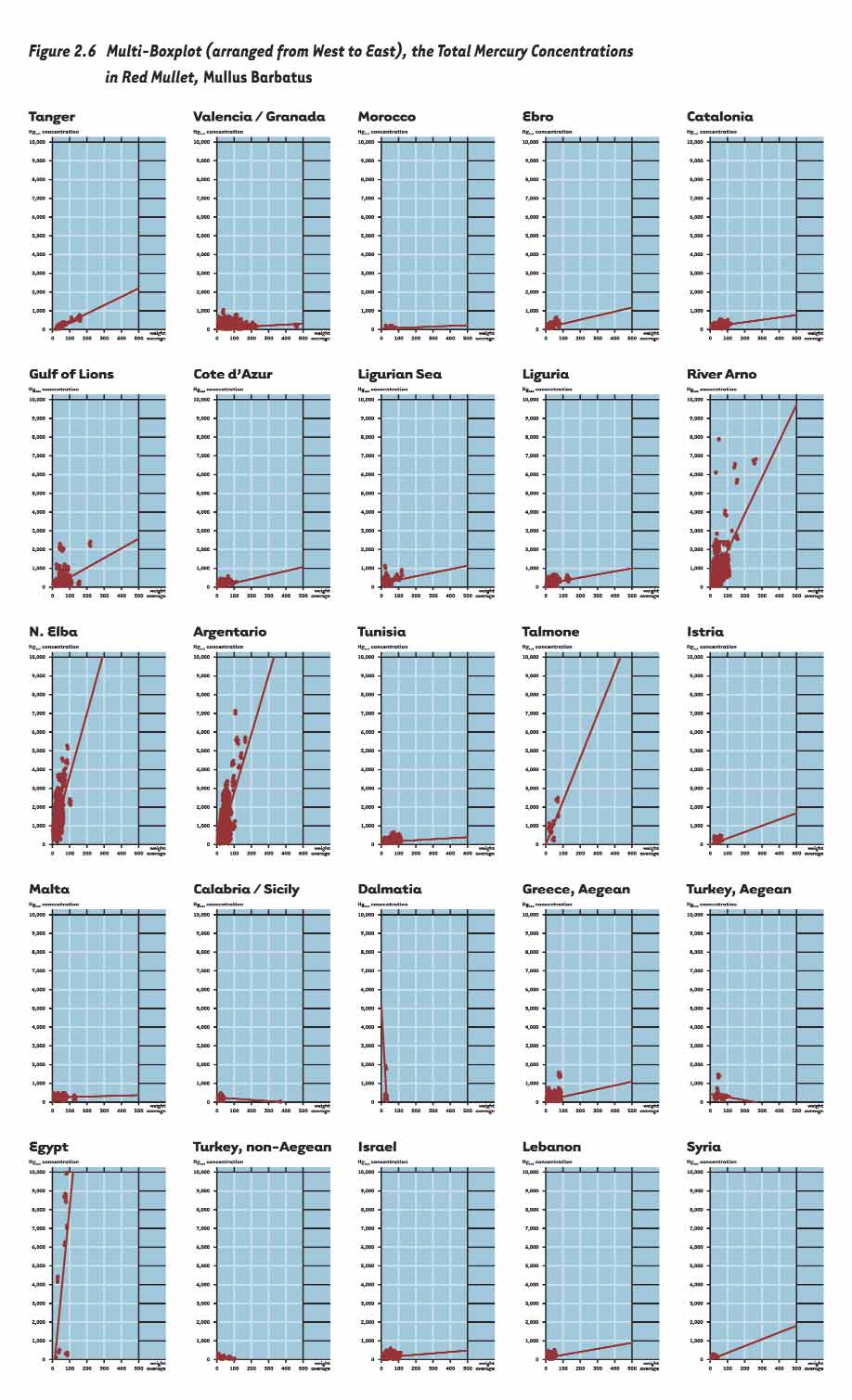
AL CONCERNS
2.0 MAJOR ENVIRONMENT
31
Other studies have examined, for
instance, levels of organochlorines in
gull's eggs (Figures 2.7 through 2.9).
This is one approach to ecotoxicology.
Among the most promising new
ways of assessing biological damage to
marine organisms are biomarkers.
Since their first adoption by Mediterra-
nean Member States France and Italy at
the end of the 1980s, biomarkers have
been increasingly used as tools for
assessing sublethal effects on marine
organisms in the region. In 19941995,
a series of international coastal moni-
toring programs started (BIOMAR
19941998, MED POL 1995now, BEEP
20002003) involving the measure-
ment of a range of biomarkers in
bivalves (mussels) and benthic fish
(Mullus barbatus, Serranus cabrilla
and Dicentrachus labrax) in Mediterra-
nean areas exhibiting significant pollu-
tion gradients (e.g., harbours, urban
and industrial waste outfalls, etc.) in
SIS (TDA) FOR THE MEDITERRANEAN SEA
comparison with cleaner areas (e.g.,
Y
Corsica and Sardinia). Following the
same strategy, a monitoring network
TIC ANAL
(REMER) was recently initiated in
Morocco.
Y DIAGNOS
A type of biomarker known as lyso-
somal alterations has indicated that
marine animals are under stress from
PAHs and PCBs pollution in various
TRANSBOUNDAR
parts of the basin. Mussels along the
Spanish coast (Porte et al., 2001), the
Adriatic Sea (Petrovic et al., 2001),
and Venice Lagoon (Lowe and Fossato,
2000) are among other areas where
pollution damages to marine life have
been detected. DNA damage in mol-
luscs inhabiting contaminated areas
has been reported in the Orbetello
Lagoon (Frenzilli et al., 2001).
In the case of marine mammals,
several hypotheses have attempted to
link disease outbreaks to environmen-
tal degradation. Frequently, immuno-
repression is the link identified
between pollution and disease. High
levels of organochlorines have been
32
noted in dolphins that died in several
mass mortality incidents. Aguilar and
site, near the port of Faro (Portugal),
Borrell (1994) compared PCB levels in
were examined in 1996 for imposex with
striped dolphins Stenella coeruleoalba
positive results (Gibbs et al., 1997).
that died during the Mediterranean
Imposex was also found in the species
mobillivirus epizootic in 1990 with
Hinia reticulata in Portuguese coastal
biopsies taken from live dolphins in
waters and on the south part of the
198789. The authors suggest that
Tagus River (Pessoa et al., 1997). Also,
PCBs left the blubber during mobilisa-
in Portugal, oyster shell anomalies in
tion of fat reserves and large quanti-
Crassostrea angulata were found in the
ties reached the liver shortly before
Sado and Tagus estuaries (Phelps and
the epizootic. This may have increased
Page, 1997).
the dolphins' susceptibility to the
A wide variety of compounds (e.g.,
morbillivirus.
DDT, PCBs, nonylphenols and phtha-
High concentrations of butyltin
lates considered here) have been
residues have been found in harbour
associated with potential reproductive
porpoise from bottlenose dolphins in
anomalies in fish, and there has been a
the Mediterranean (Kannan and Falan-
growing awareness of the need to
dysz, 1997). Organotin compounds
detect and assess the adverse effects.
(bis(tri-n-butyltin)oxide) have been
Recently, new evidence based on mon-
shown to exhibit immunorepressive and
itoring hormone and vitellogenin levels
endocrine modulating activities in
together with gonad histology indi-
rodents (Vos et al., 1984). In particu-
cates that in the central Mediterra-
lar, long-term exposure reduced re-
nean male swordfish (Xiphias gladius)
AL CONCERNS
sistance to infectious diseases (Vos et
are undergoing sex inversion (14 %)
al., 1990).
(Fossi et al., 2001). There is no evi-
Bacteria that under certain condi-
dence, however, of reproduction im-
tions become virulent caused a severe
pairment. The effect on other large pe-
sponge disease epidemic in the begin-
lagic predators or on marine mammals
ning of the 1990s in the Mediterranean.
is unknown.
2.0 MAJOR ENVIRONMENT
Several studies indicate disruption
Despite the difficulty in directly
of normal endocrine function in the
attributing population responses to
Mediterranean area. A series of field
pollutants, there are some indications
investigations with marine inverte-
that coastal fish assemblages respond
brates suggests that tributyl- and tri-
to the impact caused by sewage dis-
phenyltin compounds can induce
charge on mussel fisheries in South-
imposex. The monitoring of a gastro-
east Italy. However, the link between
pod (Bolinus brandaris) along the
these epizootics and chemical pollu-
Catalan coast (NW Mediterranean)
tion still remains an open issue. More
showed that imposex was a widespread
data are required at the population,
phenomenon (Solé et al., 1998). Impo-
community and ecosystem level to
sex has also been described in the gas-
assess the health of the Mediterra-
tropod Nucella lapillus collected in the
nean. While in their infancy, biomark-
Galicia coast (Ruiz et al., 1998), in the
ers could help in that direction and to
whelks Stramonita haemastoma and
obtain answers as to whether these
Hexaplex trunculus in Israel (Rilov et
diseases are unpredictable episodic
al., 2000) and Italy (Terlizzi et al.,
events or symptoms of ecosystem de-
1998), and in Malta (Axiak et al.,
gradation.
2000). Four neogastropod species (He-
Among chemical contaminants,
xaplex trunculus, Ocenebra erinacea,
copper is highly toxic for marine life
Ocinebrina aciculata and Nassarius
and is a source of concern in the Medi-
33
reticulatus) collected in a TBT-polluted
terranean. The ionic component of
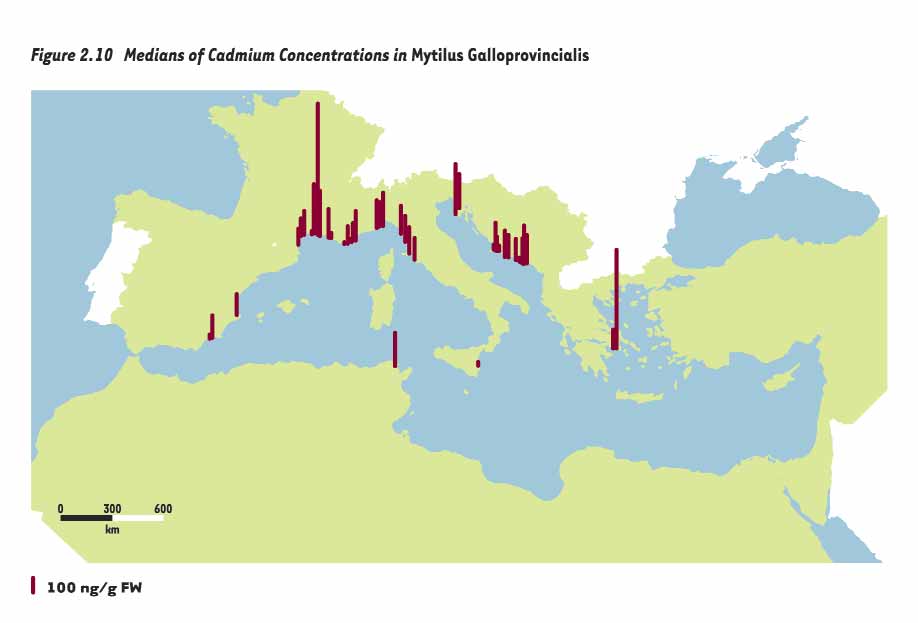
total dissolved copper in seawater has
Regarding the sources of data for
been shown, through experimental
chemical contaminants, there is a
studies, to have a deleterious effect
marked difficulty in obtaining compa-
on some phytoplankton and bacterial
rable data on surface sediments
species at levels of 0.10.2 µg/l. In the
though these are the ultimate sink for
wild, this toxic effect is somewhat mit-
most contaminants. By contrast, signi-
igated by the metal being bound to
ficant intercalibration of data on con-
natural ligand (soluble organic car-
tamination levels in marine species has
bon). In the Mediterranean, an impor-
been made through MED POL efforts.
tant source of copper is fungicide used
Pesticide residues carried through
in vineyards and copper-based anti-
rivers or deposited by air in the sea
fouling paints. Although rather high
cause damage to invertebrates and
concentrations may be observed in
young fishes. The thinning of the egg-
"hot spot" areas, the mean value of
shells of seabirds is also a symptom of
concentration in marine organisms
organochlorines on marine organisms.
remains well below the maximum per-
DDT, Aldrin and Dieldrin have signifi-
missible limit (20 µg/g).
cant effects on invertebrates. They can
Great risks to Mediterranean eco-
increase mortality rate in fish eggs and
systems also stem from the effect of
cause premature pupping in seals.
cadmium (Figure 2.10) on top preda-
They may also affect species compo-
tors and from lead on predators of
sition in phytoplankton community.
shellfish. High values of cadmium con-
Phytoplankton photosynthesis has
centrations in the surface sediments
also been affected by thiazines.
may be found in polluted lagoons and
Data on the bioaccumulation of
SIS (TDA) FOR THE MEDITERRANEAN SEA
other so called "hot spot" areas. Mean
chemical contaminants in Audouin's
Y
concentrations of inorganic lead in
gull eggs (Figures 2.7, 2.8 and 2.9)
marine organisms are high in the vicin-
show that the concentration of PCBs
TIC ANAL
ity of industrialised coastal areas in
and DDT in the Mediterranean is 23
the Mediterranean.
fold higher than its concentration in
Y DIAGNOS
TRANSBOUNDAR
34
the gull eggs taken from the North
As regards the impact from anti-
Atlantic and the Arctic. This is a rel-
biotics use for mariculture purposes,
evant indicator of the transboundary
there is a significant lack of data.
transport of chemical contaminants
Although oxytetracycline is the most
throughout the Mediterranean.
commonly used antibiotic in sea-
Chemicals used in mariculture, in
bream and seabass cage culture,
particular organophosphate ectopar-
there are no reports on its effect on
asites, are toxic to invertebrates and
the Mediterranean.
larvae of crustaceans (Egidius and
Moster, 1987). Unintended effects of
c. Oil pollution
pesticides on non-target species may
The effects of oil pollution can be
also occur as suggested by evidence on
far reaching and pose a threat to the
crab kills in oyster farms in the north-
health of ecosystems. Offshore marine
western United States (WDF/WDOE,
life as well as coastal ecosystems,
1985).
marine birds that feed at sea, and mar-
Pigments and vitamins used in
iculture are all exposed to risk from oil
mariculture can lead to altered growth
spillages mainly from offshore oil
rates of certain phytoplankton, thus
extraction and oil transport. Although
leading to interrupted aquatic ecosys-
little information is available on oil
tems. Biotin has been shown to stimu-
spillage effects on Mediterranean bio-
late growth of certain phytoplankton
diversity, worldwide information sug-
species and is implicated in the toxi-
gests the type of threat oil pollution
city of the dinoflagellate Cymno-
represents for biodiversity.
AL CONCERNS
dinium aureoles (Gowen and Bradbury,
1987). Vitamin B12 has been shown to
Effects on marine animals
be one of the growth-promoting fac-
Marine mammals bioaccumulate
tors of the alga Chrysochromulina
hydrocarbons in their bodies, which
polylepis and the dinoflagellate Hete-
leads to long-term sublethal effects
rosigma alashivo (Graneli et al., 1993;
or even death. Larger cetaceans such
2.0 MAJOR ENVIRONMENT
Honjo, 1993).
as dolphins are more likely to suffer by
Transfer of resistance to non-tar-
ingestion of contaminated food rather
get species is also a source of concern
than by direct contact with oiled water
related to the use of antibiotics in
as they can swim away from pollution.
mariculture. Indiscriminate use of
However, a school of dolphins was ob-
drugs to control or prevent fish dis-
served swimming into oil slicks in
eases in coastal fish farms has result-
Genoa (Italy) suggesting that larger
ed in some native aquatic microbial
mammals may not necessarily avoid
communities developing antibiotic
oil slick contamination. Such contact
resistance (GESAMP, 1991) and the
would endanger dolphins' health
possibility of transfer of resistance to
through oil entering blowholes. In
human pathogen has also raised con-
addition, inhalation of toxic com-
cern, (Dixon, 1991). The development
pounds can inflame lung membrane
of resistant bacterial population in
rendering dolphins susceptible to con-
the sediment has been documented.
gestion and pulmonary infection.
For example, up to 100 percent of oxy-
As for smaller mammals such as
tetracycline-resistant bacteria have
seals, risks from oiling can include
been recorded from marine sediments
death. Following exposure to oil slicks,
near fish farms after medication and
a reduction in thermoinsulation has
resistance persisted for more than 13
been reported to occur for as long as
months afterwards (Torsvik et al.,
two months after the incident (Deere-
35
1988; Samuelsen et al., 1992).
Jones, 1996), reducing the animal's
capability to regulate body tempera-
The impact of oil on the estuarine
ture. Nervous system impairment and
flora is heavy. The saltmarsh plants are
eye, lung and nasal irritation have also
affected mainly in flowering season,
been recorded as a result of oiling,
reducing also seed production and
sometimes resulting in acute respira-
seed germination (Deere-Jones, 1996).
tory illness (Hall et al., 1993).
Moreover, oiling rapidly kills some
Oil slicks will have fatal conse-
types of plants, such as shallow-rooted
quences for any fish eggs and larvae
plants. The changes in plant cover may
located under the spill. Shellfish are at
also modify the sedimentation and
risk from bioaccumulation of hydrocar-
erosion dynamics of the entire estuar-
bons that leads to reduction in feeding
ine area. Finally, oil spills and hydro-
efficiency and growth reduction. Cru-
carbon sedimentation affect the eel-
staceans exposed to hydrocarbons
grass beds, which are important breed-
show increased mortality. This is linked
ing, nursery and feeding habitats for a
to diminished ability to assimilate food
number of fish and birds. Walker and
as well as suffering a decrease in the
McComb (1992) report that the Zostera
respiration rate (Overton et al., 1994).
bed recovery may take some 80120
years.
Effects on coastal
The impacts on shellfish and crus-
flora and fauna
tacean in a high-energy estuarine
When an oil slick reaches the
environment concern the alteration of
shoreline, it smothers coastal habitats
the ecological structure of the com-
and resources and exerts a toxic effect.
munity, passing through the elimina-
Areas with low water mass movement,
tion of the main herbivore species and
SIS (TDA) FOR THE MEDITERRANEAN SEA
such as biodiversity-rich estuaries, will
the subsequent seaweed growth. The
Y
be at higher risk from oil slicks due to
re-colonization of rock-associated
low `self-cleaning' ability.
species (i.e., barnacles) is also inhib-
TIC ANAL
The immediate effect of oil spill on
ited. These ecological changes appear
estuarine environment is the massive
to be persistent, as shown in the case
Y DIAGNOS
mortality of intertidal fauna (limpets,
of the Torrey Canyon spill, where more
razor shells, finfish, red macroalgae),
than 10 years after the spill the com-
which has been recorded in the case of
munity biodiversity was reduced
the Sea Empress spill. The long-term
(Clark, 2001). In low energy environ-
TRANSBOUNDAR
effects concern the incorporation of oil
ments, filter-feeder organisms, such
into sediments, for most of 90 percent
as bivalve molluscs, dominate the
of un-recovered hydrocarbons (Murphy
shellfish community. An oil spill may
et al., 1988), facilitated also by the ad-
cause heavy juveniles and adults'
sorption of oil to the suspended parti-
shellfish mortality, reducing the re-
cles in the water column. These particles
covery capability of the environment,
may settle rapidly in a high-deposition
due also to the high persistence of the
area, become buried under more than 5
buried hydrocarbons. In the long-
cm of sediments, where the anoxic con-
term, sublethal effects and biodiversi-
ditions slow the biodegradation process
ty reduction may be recorded (Levings
(Deere-Jones, 1996). Burns et al. (1994)
et al., 1994; Deere-Jones, 1996). The
report that hydrocarbons incorporated
NSA (National Shellfish Association)
into sediments may persist at least for a
(1976) and Jackson et al. (1981) re-
period of 20 years. Moreover, this condi-
ported that the active breeding popu-
tion may facilitate re-oiling events
lations of crabs and oysters are more
caused by the oil leaching from sedi-
sensitive to hydrocarbons, because of
ments (Clark, 2001), as shown after the
the depletion of energy reserves during
36
Amoco Cadiz spill.
breeding time.
The impact of oil spills on estuar-
major reservoir of long-term impacts
ine finfish populations is the same as
(Vander Meulen et al., 1979).
the effects that have been discussed
The long-term impacts on fauna
earlier. In particular, PAHs are per-
and flora recorded for estuarine envi-
sistent and tend also to bioaccumu-
ronments are the same for bay environ-
late through the food chain, causing
ments. Dauvin (1982) reported that
skin ulceration, tissue disorders and
after the Amoco Cadiz spill in the Bay of
liver cancers in bottom-dwelling fish
Morleaux, ecological damage was ob-
(Philips et al., 1992; Stegeman et al.,
served, with the reduction of bowser
1991).
and grazer species, favouring a high
The immediate impact on wildlife
growth of opportunistic species and an
in a bay environment is similar to im-
increase of detritivoure species. Long-
pacts on the estuarine environments,
term effects may be observed after 5
resulting in high mortality of intertidal
years, with reduced biodiversity of the
and subtidal species. Deere-Jones
nematode community in subtidal sedi-
(1996) reported that, in Carmarthen
ments (Boucher, 1984).
Bay, high mortality of razor shells,
A report on hydrocarbon pollution
echinoderms and marine worms was
for the Mediterranean Sea was fin-
recorded, followed by heavy necrosis
ished in1988, wherein it was estimated
and mortality for tellins, soft clams
that approximately 716,000 tonnes of
and mussels. At the same time, mor-
hydrocarbons enter the Sea each year
tality of over-wintering populations of
due to normal activity (absent a major
bird species was observed.
oil spill). No more recent data or esti-
AL CONCERNS
The long-term impacts on bay
mates appear to be available for the
environments are linked with the depo-
Sea. Major sources of hydrocarbon
sition and inclusion of hydrocarbons in
pollution are shipping, port and har-
the deep sediments, likewise observed
bour operations, ballast water, and
for estuaries. Moreover, the higher sed-
marine discharges from shore (out-
imentation rate, the richness of partic-
falls and rivers).
2.0 MAJOR ENVIRONMENT
ulate matter (with high organic carbon
content) in the water column and the
d. Solid waste and litter
predominance of low-energy environ-
Pollution caused by discharge of
ment increase the potential for hydro-
solid waste and litter into the sea
carbon retention. Chasse et al. (1978)
(especially plastic packaging) is a sig-
and Holme (1978) conducted studies in
nificant cause of degradation of both
the Marleux and in Lannion Bay, report-
the land and marine coastal fringe in
ing that after the Amoco Cadiz spill,
the Mediterranean. Non-biodegrad-
rocks around the bay were oiled, in
able plastic and tar balls build up on
some cases through the intertidal zone,
beaches and the whole of the Mediter-
and the beach sediments were appar-
ranean coast.
ently clean, but oil was found at 1015
However, the degree of awareness
cm depth in the sand. One month after
and response varies according to the
the Amoco Cadiz spill, the Total Hydro-
source of litter. The proximity of the
carbon Concentration (THC) recorded
land and the control of litter exercised
in inshore interstitial waters and sedi-
from the land, together with concerns
ments was 16 ppm, versus the 0.05 ppm
regarding visual pollution, mean that
of THC measured in offshore waters.
this waste receives the greatest
Sandy beaches may contain 7.5 kg of
attention, as it is harmful for beaches,
buried stranded oil per square meter,
ports and coastal zones. Litter man-
mostly in the form of chocolate mousse
agement in relation to merchant
37
(Deere-Jones, 1996), representing the
ships, pleasure craft and marinas is
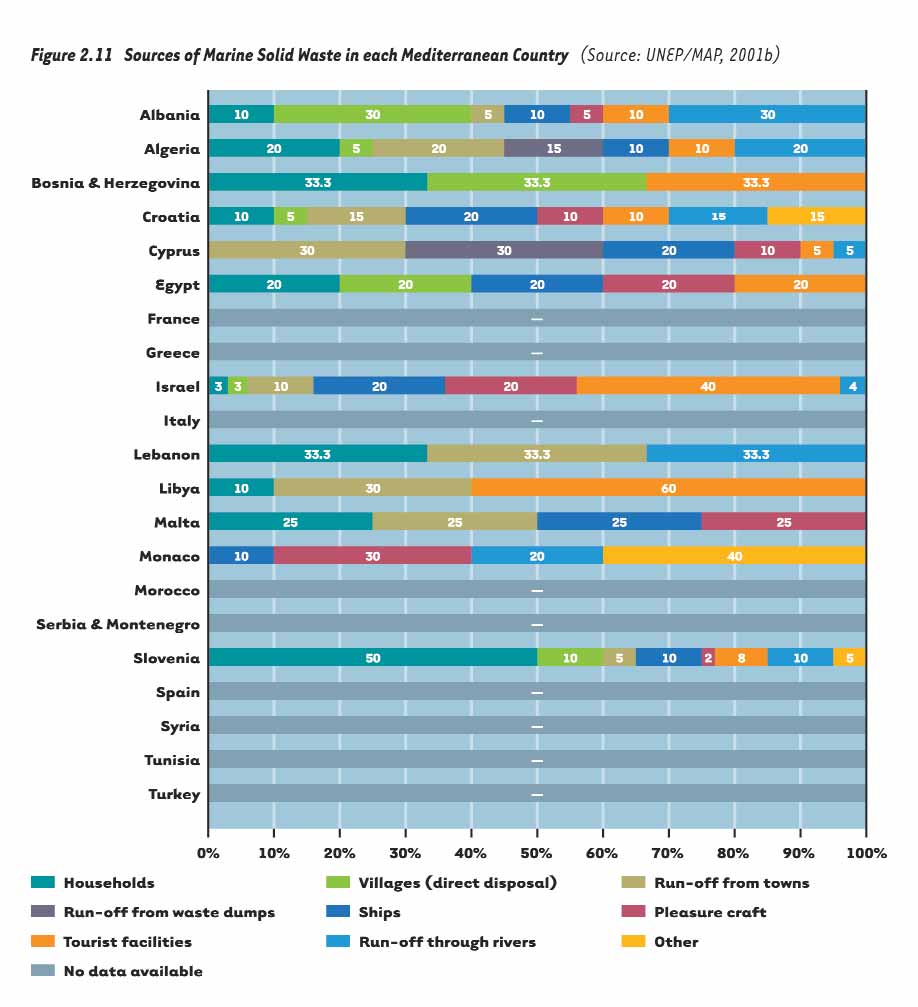
not neglected. The necessary facilities
into the marine environment. In the
and units are often placed under the
Mediterranean, plastic alone accounts
responsibility of port authorities and
for 75 percent of the waste on the sea
managers of marinas. By contrast,
surface and the seabed.
management of marine litter, particu-
The main source of marine waste
larly that on the seabed, is virtually
in the Mediterranean is direct disposal
ignored by the majority of the coun-
by households (see Figure i.8), fol-
tries consulted and only four of them
lowed by the impact of tourist facili-
include it in their policies. In Monaco,
ties and run-off from waste dumps
this issue is dealt with at the sectoral
(waste from land sources). This means
rather than the specific level.
that, in fact, the majority of marine
Studies show that around 30 to 40
waste comes from coastal areas.
million tonnes of municipal solid waste
The sources of marine waste vary
of coastal origin are generated annual-
from one country to another and Figure
ly. The random siting of waste dumps
2.11 shows the sources and origin of
encourages the transfer of solid wastes
waste per country.
SIS (TDA) FOR THE MEDITERRANEAN SEA
Y
TIC ANAL
Y DIAGNOS
TRANSBOUNDAR
38
2.1.5.4 Introduction and invasion
Among the Lessepsian migrants, fishes have
of alien species
always received great attention. Their expansion is
The introduction and invasion of new organisms
continuous without any sign of decline, especially in
in the form of exotic species or highly cultivated strains
the Eastern Mediterranean. As said before, although it
of endemic species nearly always poses a risk to the
must be assumed that the colonisers compete with
ecosystem involved. It is estimated that about 500
some of the native species, there is no evidence of a
Indo-Pacific species have entered the Mediterranean
drastic change in abundance of any of the Mediterra-
since the construction of the Suez Canal in 1869, to
nean commercial fishes that could be attributed to a
which more than 50 exotic species passing through the
new competitor. However, there are observations indi-
Gibraltar Strait have to be added. The Suez migration
cating changes in abundance of species among the
has been given the term Lessepsian, in honor of the
migrants.
French designer and constructor of the Suez Canal.
Mollusca is one of the leading taxa of Lessepsian
Mediterranean ports are key sites in the intro-
migrants with more than a hundred species presently
duction of alien species in the region. Indeed, many
settled in the Mediterranean. One of the most striking
cases of spectacular "invasion" of alien species have
examples can be seen in the gastropod Rhinoclavis
been observed in the vicinity of the ports and the major
Kochi, initially reported from Haifa Bay in 1963 and now
ecological change is affecting the port areas. Exotic
collected in large numbers not only along the Israeli
species are usually transported in the ships' ballast
coasts, but also along the coasts of southern Turkey and
water or cling to the surface of submerged hulls.
Cyprus.
Some of the most spectacular examples of ship-
Within the Decapoda and Stomatopoda species,
borne alien species in ports are:
another example of strong settlement and diffusion is
· The benthic gene algae Codium fragile, intro-
given by the portunid crab Callinectes sapidus, a west-
duced from the Atlantic during the second
ern Atlantic species commercially fished along the
AL CONCERNS
half of the 20th century, actually dominate
coasts of North America and which was first recorded in
elements of the marine vegetation in many
the Bay of Biscay (1901) and then probably introduced
Mediterranean ports (West and East basin).
with ballast waters into the Mediterranean Sea. It has
· The marine Angiosperm Halophila stipulacea,
proved to be a successful coloniser and became of local
introduced from the Red Sea after the opening
economic importance in the Mediterranean.
of the Suez Canal, is actually a common ele-
Generally speaking, 80 percent of the intro-
2.0 MAJOR ENVIRONMENT
ment of the marine vegetation in the ports of
duced species have no visible effect on the indigenous
eastern Mediterranean.
communities. On the other hand, a minority of intro-
· The dinoflagellates Alexandrium spp. (and
duced species do have an impact on the indigenous
other related genera), introduced from the
communities. According to Boudouresque and Ribera
Indo-Pacific Ocean after the opening of the
(1994), the biotopes most affected by marine species
Suez Canal, are actually common elements of
(other than Lessepsian migrants) in the Mediterranean
the plankton flora in the ports of the Mediter-
are the lagoons and ports. Equilibrium with native
ranean and the Adriatic.
species often becomes established in due course, but
Of the 61 well-established macrophyte species
sometimes not without changes at the community level
in the Mediterranean, one worth mentioning is the
due to shifting in ecological niches.
Chlorophycea Caulerpa taxifolia, distributed in tropical
Such changes in the composition of Mediterra-
seas and recorded for the first time in the northwestern
nean marine ecosystems due to introduced species
Mediterranean in 1984. Its spreading patterns and
have been described in:
high-density fronts have been well documented in the
· Haifa Bay, with the massive penetration of
Mediterranean. Besides C. taxifolia, its con generic C.
four Indo-Pacific species;
racemosa, probably a Lessepsian species introduced in
· Izmir Bay and Thessaloniki Gulf where the bi-
the 1930s, is now expanding in the eastern Mediterra-
valve Scapharca demiri became dominant;
nean and more recently in the northwestern Mediterra-
· The western coast of the Middle Adriatic Sea
nean and the Adriatic. The distribution of both species
with the massive development of Scapharca
and their impact on the marine ecosystem were thor-
inaequivalvis and Rapana venosa;
oughly discussed by experts from the MAP countries.
· Since the beginning of the 90s, in the north-
39
(UNEP, 1999).
western Mediterranean and the Adriatic with
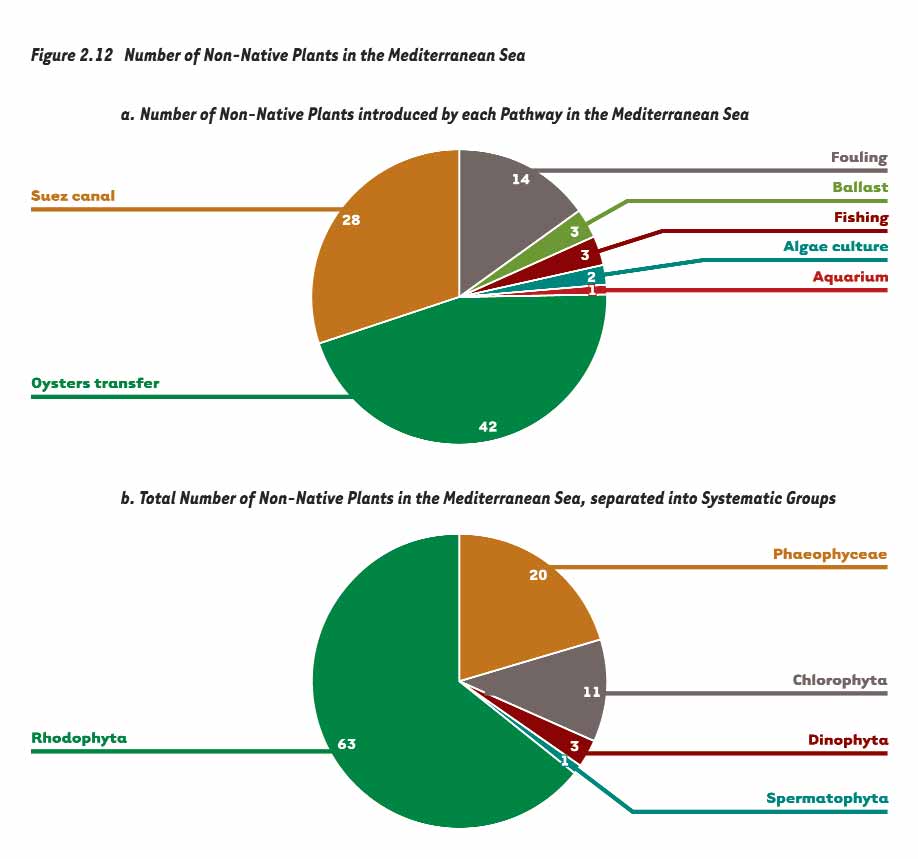
the rapid development of Caulerpa taxifolia
At least eight species can be assigned to the
rejoined nowadays by the northern expansion
category of invasive organisms in the Mediterranean.
of Caulerpa racemosa.
They play a conspicuous role in the recipient ecosys-
Is the Mediterranean Sea a hot spot of non-
tems, becoming the dominant species and / or taking
native marine plants?
the place of keystone species: Acrothamnion preissii in
A comparison of the number of exotic marine
western Italy, Aaparagopsis armata in the northwestern
plants among different geographical areas shows that
basin, Lophocladia lallemandii in the Balearic islands,
the Mediterranean Sea possesses the highest number
Womersleyelly setacea in western Italy, Sargassum
with 98 species, followed by the European Atlantic coast
muticum in Thau Lagoon, Stypopodium schimperi in the
with 49 species. Other zones have a lower number of
eastern Mediterranean, Caulerpa racemosa in various
indigenous species: 26 on the Australian coast, 20 on the
localities in the Mediterranean, Caulerpa taxifolia along
North American Atlantic coast, 20 on the New Zealand
the French and Italian Riviera and additional specie
coast, and 19 on the North American Pacific coast.
Halophila stipulacea in the eastern Mediterranean.
Therefore, in comparative terms, the Mediterra-
Caulerpa racemosa and Caulerpa taxifolia are
nean is an exceptional nucleus for non-native species
the two species currently colonizing the coasts of the
because it is subject to greater pressure from the vec-
Mediterranean. By the year 2000, Caulerpa taxifolia
tors of introduction or because it accepts potential
had colonized 131 km2 of bottom areas in 103 locali-
alien immigrants more easily. Figure 2.12 shows the
ties along 191 km of coastline in six countries and was
number of non-native plants introduced by each path-
actively expanding. Caulerpa invasion appears to be
way in the Mediterranean Sea and the total number of
successful when seagrass meadows are already expe-
non-native plants by group.
riencing a decline.
SIS (TDA) FOR THE MEDITERRANEAN SEA
Y
TIC ANAL
Y DIAGNOS
TRANSBOUNDAR
40
Posidonia oceanica decline in the Mediterra-
fished areas compared to the protected areas (Table
nean is a known problem, recognized by the scientific
2.3). The density and biomass are also lower in fished
community well before the introduction of Caulerpa
seagrass beds.
spp. There are various causes leading to the decline of
Similar impacts of fishing on habitat are shown
this important ecosystem endemic of the Mediterra-
also in rocky zones in protected areas and fishing areas
nean Sea, directly or indirectly related to the increas-
(Macpferson, 2000). Table 2.4 indicates that fishing
ing of anthropogenic pressure that the coastal zone
modifies the age structure of many species, whereas
has been experiencing such as wastewater discharge,
Table 2.5 shows the modification of the general struc-
bottom trawling and anchoring. These general human
ture of the community.
pressures played a leading role in lowering competitive
ability of native seagrasses, permitting the invader to
2.2 Decline in Fisheries
dominate in the environment.
According to the FAO, a temporary slump in
1980s' Mediterranean fish landings gave way to
2.1.5.5 Destruction of habitats
recovery and, in the 1990s, fish production increased
by fishing pressure
by more than 30 percent (Figure 2.13). However,
Fishing is one of the major activities that con-
recovery in catch masks the underlying problem of
tribute to the destruction of habitat in the Mediterra-
long-term depletion in Mediterranean marine
nean Sea. Data from Marseille (France), Ischia (Italy)
catches. In fact, most of the Mediterranean fishery
and a French marine protected area (Port-Cros, Cor-
resources, be they demersal, small pelagic or highly
sica) show that the most obvious effect on habitat is
migratory species, have long been considered over-
the decrease in the mean weight of individuals in
exploited.
AL CONCERNS
Table 2.3 Differences in Mean Density (S.D.), Mean Biomass and Mean Individual Fish Weight
for Seagrass Fish Bed Assemblages in Marine Reserves and in Areas open to Fishing
Marine reserves
Fished areas
Mean density (ind. 100m2)
20.01
(2,051)
14.84
(11.08)
2.0 MAJOR ENVIRONMENT
Mean biomass (g/100m-2)
331.08
(330.60)
180.71
(147.99)
Mean individual fish weight
17.58
(3.11)
11.87
(3.83)
Table 2.4 Age Structures of Diplodus Annularis taken from a Protected Area (Medias Islands)
and a Non-Protected Area (Port da la Selva)
Age
1
2
3
4
5
6
Protected
40 %
24 %
10 %
10 %
10 %
5 %
Non-protected
70 %
24 %
5 %
0 %
0 %
0 %
Table 2.5 Percentage Contribution to the Total Biomass by Different Trophic Groupings
in Mediterranean Rocky Zones, Protected (Meded islands) and Non-Protected (Tossa)
Trophic Herbivores
Mesocarnivores
Microcarnivores
Omnivores
Ichtyophagous
groups
(HER)
(PE)
(PI)
(OMN)
(ICT)
Protected
3 %
24 %
10 %
20 %
40 %
Non-protected
14 %
60 %
9 %
10 %
2 %
41
total including those employed in related sectors is
even greater. Fisheries have clearly high social and eco-
nomic importance in the region and any further decline
of Mediterranean fisheries would therefore have serious
consequences for the basin.
This section surveys the status of main fish
stocks in the Mediterranean, the overall characteris-
tics and main pressures arising from fishery activities,
as well as the international dimension of fisheries in
the context of conservation of the Mediterranean en-
vironment.
2.2.1 Transboundary aspects
Fisheries issues are transboundary both because
of the presence of highly migratory stocks (such as
tuna) and extensive shared stocks. The fragmentation
Besides decline of target species, some of which
of the Mediterranean area by so many Exclusive
are becoming rarer, fishing interacts with the environ-
Economic Zones (EEZ) bordering each other virtually
ment in a number of adverse ways. High numbers of by-
assures that many stocks are transboundary and / or
catches of non-target migratory or wide-ranging
shared. Fisheries issues have strong transboundary
species are a major cause of decline of fish populations.
environmental aspects as well as socio-economic
Discard rates as high as 60 percent are regular practice,
aspects. Fish play important roles in the ecotones of the
reflecting the pronounced role fishing plays in the
Mediterranean Sea, in both coastal and pelagic areas.
decline of Mediterranean fishery resources. Moreover,
Loss of fish from these ecotones has, and will continue,
SIS (TDA) FOR THE MEDITERRANEAN SEA
lack of selective fishing gear means that species of high
to change the ecological balance in these ecotones,
Y
conservation status may be included in the by-catch
changing their very nature. In addition, fisheries activ-
making fishing responsible for loss of biodiversity.
ities themselves cause mortality for endangered species
TIC ANAL
Cetaceans seen to be in competition and being killed by
(such as sea turtles and some dolphins), destroy bot-
fishermen add more complexity to the issue of fishing as
tom habitat due to dredging (such as seagrass beds and
Y DIAGNOS
a cause of decline in Mediterranean fishery resources.
possible coralline hard bottoms), and have ecological-
Decline in fisheries also occurs locally as a
ly-harmful bycatch.
result of eutrophication incidents. While fishery pro-
The extent of international waters in the Medi-
duction is positively influenced by moderate levels of
terranean makes it inevitable and essential to address
TRANSBOUNDAR
nutrient inputs, a risk of fish-kill arises at excessive lev-
fisheries on an international level, at least in the field of
els of eutrophication. Red tides and lack of oxygen both
highly migratory stocks. This task is complex in the Me-
linked to high nutrient input are two ways in which eu-
diterranean as there is a high number of riparian states
trophication may lead to a decline in fishery resources.
at varying stages of development in the management of
Shellfish poisoning in Spain in 1993, for instance,
fisheries. Future progress in terms of fisheries manage-
caused by red tides, was responsible for a drastic drop
ment, however, will be based on the ability to build a
in mussel production from 247,000 MT in 1986 to 90,000
multilateral dimension into national practices.
MT in 1993.
Although fishing in international waters is the
Depletion of Mediterranean marine resources
exception rather than the rule in the Mediterranean,
has serious socio-economic repercussions due to the
the perception of shared stocks and fisheries has been
traditional importance played by the fishing sector in
advancing rapidly. This is due both to clearer scientific
the basin. As economic opportunities become worse due
opinions and to the development of new fisheries
to overexploitation of stocks, fishermen have to give up
extending their operative ranges outside national
their trade. In 2000, 8,000 Italian fishermen, represent-
waters. The number of shared fisheries has increased in
ing about 16 percent of the country's labour employed in
several areas like the Alboran Sea, the Gulf of Lions, the
fishing, lost their jobs. The Mediterranean Member
Northern Tyrrhenian Sea, the Adriatic Sea, the Ionian
States as a whole generated more than 600,000 jobs
Sea, the Aegean Sea, the Sicily Strait and the Gulf of
42
directly related to fishing in the late 1990s, while the
Gabes. In addition to the highly migratory species, that
can be found in the whole Mediterranean basin, a min-
imum list of shared stocks has been agreed both within
the General Fisheries Commission for the Mediterra-
nean (GFCM) framework and FAO subregional programs.
The list might be expanded in the future. A sample of
shared fishery resources is shown in Table 2.4. However,
the number of shared fisheries identified already at
this stage justifies common action to be taken for
those stocks at the international level.
2.2.2 Environmental impacts
Fishing activites affect the environment direct-
ly through their effects on target species as well as indi-
rectly through their effects on the marine ecosystem.
Among the indirect environmental impacts of fishing on
the ecosystem the following ones can be identified:
· Alteration and destruction of benthic habitat,
such as seagrass beds and hard-bottom
coralline areas;
· Effects on non-target populations due to by-
catch, discarding, ghost-fishing, etc.
· Effects on other non-commercial and often
endangered species incidentally captured in
AL CONCERNS
the fishing process (such as sea turtles, dol-
phins and others);
· Effects on the food web of the marine ecosys-
tem by the harvesting of top predators. Lack
of top predators will alter the food chain and
cause unanticipated imbalances in the food
2.0 MAJOR ENVIRONMENT
web.
2.2.3 Socio-economic impacts
The future of the Mediterranean fishery sector
is far from certain. Current pressure on stocks and re-
stricted access to third party waters make any increase
for fish and fish products shown through total export
in production highly unlikely in many Mediterranean
and import volumes for the period 19852000. An im-
countries. Moreover, Mediterranean EU Member states
portant source of demand for fish is the tourism indus-
have had to comply with additional fishing capacity re-
try in the Mediterranean.
strictions instituted under the European Community
Moreover, the expanding size of total catches
Multiannual Guidance Programmes in the mid-1980s.
indicates that the sector is one of growing economic and
In terms of volume of landings, the Mediterra-
social importance. Figure 2.13 shows total landings of
nean accounts for a modest five percent of total world
marine fish in the Mediterranean over the past four
landings. However, the economic value of the landings
decades. As can be seen, apart from a slow down in the
is much higher. This is explained by the fact that most
1980s partly due to a collapse of anchovy stocks, marine
of the catches landed in the Mediterranean are for
fish catches have been growing continuously. In 2000
human consumption, even catches of small fish, which
total marine fish catches were recorded at 1.3 milion MT.
generate higher value.
The socio-economic impacts of the decline of
The total export value of the fishery sector has
fisheries in the Mediterranean could therefore be sum-
also been increasing from 1985 to today. The vitality of
marized as follows:
the sector is based, as shown in Figures 2.14 and 2.15,
· Unsustainable practices threaten high value
43
on expanding international as well as domestic demand
Mediterranean fisheries;
· Future growth potential of Mediterranean
technological, some socio-economic, and some legal /
fisheries sector made uncertain by current
regulatory. In general, a legal / regulatory framework
overfishing;
exists in the Mediterranean Sea to help govern the fish-
· Loss of fisheries a liability to the Mediterra-
eries activities. The General Fisheries Commission for the
nean tourism industry;
Mediterranean (GFCM), a regional fisheries body, was
· Loss of employment linked to decline of fish-
established in 1952, and strengthened several times fol-
eries;
lowing that time (1963, 1976, and 1997). It provides a
· Decline of rural fishery-based economies;
regional framework for addressing fisheries issues,
· Loss of food stability may cause social unrest
including marine conservation. In addition, FAO has sev-
in some areas;
eral sub-regional bodies focusing on fisheries resource
· Structural decline of fisheries causes unem-
management. The fisheries in the Northern Mediterra-
ployment and occupational dislocation.
nean are subject to additional fishing capacity restric-
tions instituted under the European Community Multi-
2.2.4 Causal Chain Analysis
annual Guidance Programmes in the mid-1980s.
The Causal Chain Analysis (CCA, Figure 2.2.1)
Primary causes for decline in fisheries include:
summarizes the major causes of Decline in Fisheries.
· Excessive fisheries effort in some areas of the
These causes are linked to a variety of factors, some
Mediterranean;
Case Study
The status of the French fishing industry:
Vulnerable to foreign competition and exchange rate volatility (Source: FAO, 2003)
The relative stable level of landings in recent years masks the growing economic difficulties facing the
French fishing fleet. One set of problems is linked to the growing scarcity of resources. Apart from its direct effect
SIS (TDA) FOR THE MEDITERRANEAN SEA
on fishery yields, this scarcity has led both national and European Union authorities to impose strict measures in
Y
order to monitor and restrict catches, notably by adopting quotas according to species, zone and country and
through programmes to modify fishing capacity.
TIC ANAL
Other problems are linked to the globalization of trade, which facilitates access of low-priced products to
the French market. Another problem is monetary deregulation within Europe, which in 1993 and again in 1994 led to
marked falls in producer prices (-16 percent at constant franc-denominated prices between 1992 and 1994) and
Y DIAGNOS
cast many fleet operators into severe financial straits. Consequently, many vessels have had to increase their effort
(number of days at sea) in order to make up in part for the resulting fall in turnover by increasing landings.
In 1993, the number of people directly employed covered barely 0.3 percent of the active population.
However, political and economic decision makers are becoming increasingly aware of the essential economic role
TRANSBOUNDAR
that fisheries and related activities play in certain regions.
Case Study
The Italian fishing sector: Distribution leads the way to restructuring sector (Source: FAO, 2003)
Current pressure on stocks and restricted access to third party waters make any increase in Italian fishery
production highly unlikely. Only a few sectors (tuna fishing in particular and exploitation of new species such as
deep-sea species) offer some avenues for expansion. As regards fishing activities themselves, the retirement of
vessels, whether voluntary or from a shutdown of activities, should be offset by increased productivity and greater
fishing effort by the most modern and efficient parts of the fleet. Apart from this, the structure of the fleet itself
should change little. After the extensive renewal and heavy investments of the late 1980s, the current difficulties of
many operators are not likely to encourage further investment. The main changes should concern the structure and
functioning of the sector under the combined pressure of market liberalization and greater large-scale distribution.
Fisheries-related activities seriously influence the economy of coastal communities, employing more than
44,500 people in fisheries, 6,000 in aquaculture, 7,900 in the processing industry and 12,460 for distribution and
sales. Some regions are more involved in certain activities, such as Sicily, where marine fisheries employ more than
a quarter of all Italian fishermen; about 4,500 people work in lagoon management and related fisheries.
44
· Use of harmful fishing practices, including
Root causes for decline in fisheries include:
non-selective catch techniques and use of
· Ineffective stakeholder awareness in some
bottom trawls that lead to excessive by-catch,
parts of the Mediterranean area;
as well as the development of more efficient
· Inadequate stakeholder involvement in envi-
technologies (ships and fish-finding gear)
ronmental issues in some parts of the Medi-
that could possibly lead to over-exploitation if
terranean;
not carefully monitored and controlled;
· Insufficient enforcement of some regional and
· Loss of shallow-water habitats for some life
national legislation;
stages of critical fisheries; and
· Insufficient budget for environmental improve-
· Adverse water quality from rivers, coastal
ments, including sewage treatment, source
aquifers, sewage discharges, dredging, and
control, agricultural control, etc.
non-point source discharges.
AL CONCERNS
2.0 MAJOR ENVIRONMENT
45
2.2.5 Supporting data
paint an extremely negative picture.
2.2.5.1 State of the resources
Catch statistics on demersal and small pelagics
Most of Mediterranean fishery resources
species have shown a negative trend in the 1990s for
whether they are demersal, small pelagic or highly
the most important species or groups of species. The
migratory species, have long been considered overex-
decline in demersal fish catches overall for the 1990s
ploited. Figure 2.13 above shows the total marine
exhibited a slight positive trend starting from 1998 as
catches for the past several decades. Although giving
shown in Figure 2.16. Although the catch trend is posi-
the overall impression of stability in fisheries resources,
tive, its quality, both in terms of species and size com-
a close look reveals changes in the composition of the
position, has declined (ref. to chapter 2.3). Long life-
fisheries, in the underlying structure of the fisheries, of
span species and bigger size specimens have practical-
the pressure on fisheries, etc.
ly disappeared from demersal catches in several areas
With regard to highly migratory species, the
and fisheries. Daily catch rates per vessel have fallen
eastern bluefin tuna stock has been assessed in the
dramatically when compared to catch rates of some
past by the International Commission for the Conser-
decades ago despite the fact that power and efficien-
vation of Atlantic Tunas (ICCAT), which has indicated
cy of fishing vessels have increased in recent times.
heavy over exploitation. Although the thoroughness of
The current evaluations of demersal, small and
these evaluations is arguable due to considerable
large pelagic fisheries, carried out within the GFCM and
uncertainties resulting from the lack of data, there is
ICCAT frameworks, confirm this picture of overexploita-
little doubt that the stock is overexploited. The level of
tion of several resources and highlight the need to
bluefin tuna being caught and put in cages in the
reduce the mortality on juveniles as well as the overall
Mediterranean area for rearing purposes and often
fishing effort by about 1530 percent for those fish-
outside a framework of regulated and reported catch-
eries focused on overexploited stocks.
es, is also a source of concern. This fishing activity is
Despite the recognized overexploitation of sev-
believed to increase the pressure on the stocks.
eral resources, there are few scientifically reported
SIS (TDA) FOR THE MEDITERRANEAN SEA
Similar considerations on over-exploitation
cases of stocks at risk of collapse. Anchovy in the
Y
apply to swordfish in the Mediterranean where there is
Northern Spanish coast, black spot bream in the Alboran
evidence of an exploitation pattern, which results in
Sea and hake in the Gulf of Lions are among those doc-
TIC ANAL
large quantities of juveniles and recruits of the year
umented cases, however. This long-term resilience of
present in the catches. Major efforts in data collection
Mediterranean fisheries, without so far detected dra-
Y DIAGNOS
are required to get a clear picture of the status of the
matic collapses of target resources, except for anchovy
key stocks, although indications based on current data
in the mid-1980s, is usually explained by the fact that
some proportions of adult stocks have most probably
remained consistently unavailable to small mesh trawl-
TRANSBOUNDAR
ing. This feature of Mediterranean fisheries, as deter-
mined by fishing practices, has led to the creation of
enclaves within the normal range of distribution of sev-
eral species that allows a proportion of the stock to sur-
vive to maturity, thus preventing the collapse of the
population. However, the situation has changed rapidly
in the last decade, with the increasing efficiency of
fishing methods both in terms of vessel engine power,
the size of gear and vessel characteristics, and above
all, the development of fixed gear fisheries targeting
spawners of several long-lived species in areas that
have not been able to be trawled effectively until
recently. Furthermore, widespread illegal trawl fisheries
in coastal areas have reduced the refuge effect, result-
ing from the poor enforcement of the current regulation
limiting the use of towed gears at depths greater than
50 meters or at a distance from the coast greater than 3
46
miles if depth is less than 50 meters.
2.2.5.2 Interactions of fishing
Areas most prone to the negative impact of
with non-commercial resources
eutrophication on fisheries are semi-enclosed basins,
Mediterranean fishing grounds are usually
estuaries and lagoons where an excessive level of nutri-
found quite close to the coast where the highest biodi-
ents is likely to remain undispersed. In these areas, such
versity is located. There is an increasing awareness and
as the Northern Adriatic, one may expect that further
concern about fishing impact both on habitats and non-
increase in nutrients will lead to a decline in fisheries
commercial resources.
production with damaging repercussions for the local
Apart from legal obligations concerning environ-
economy.
mental protection, there is a clear interest to ensure the
Although eutrophication in the Mediterranean
conservation of the target species, but also of species
Sea is not the priority cause of decline in environmen-
belonging to the same ecosystem or associated with or
tal quality that it is in the adjacent Black Sea, eutroph-
dependent upon the target species. This approach is
ication is a wide-spread local problem that appears to
basic to preserve the biodiversity and integrity of marine
be increasing, and that has transboundary impacts
ecosystems and hence, the production of essential fish
through loss of habitat for shared and migratory fish
habitats for the sake of the fisheries sector too.
resources.
The main threats to marine resources posed by
fisheries in the Mediterranean can be divided into two
2.2.5.4 Interaction of mariculture
major groups: damages to biodiversity and damages to
with fisheries
habitats.
Mariculture is a relatively new source of pressure
To the first group belongs the widespread use of
on the marine environment and fisheries. The boom in
small mesh size fishing gears as well as excessive fishing
regional aquaculture production from 78,180 tonnes in
of commercial species. As for other resources, sustain-
1984 to 248,460 tonnes in 1996 (Figure 2.17) has pro-
able use by curtailing catches is bound to have a posi-
duced a number of additional environmental concerns.
AL CONCERNS
tive impact on the environment.
The overall impact of mariculture on the Mediterranean
Nowadays many non-target species are under
Sea environment is so far limited compared to other
threat, such as sea-mammals, birds, reptiles and non-
pollution sources; however, in view of the probable ex-
commercial stocks. High by-catch and discard rates are
pansion of these activities their impacts are included in
the main sources of threat for these populations. Due
this report. This is an area of possible future threat if
both to the low selectivity of small mesh size trawl gear
not regulated adequately at this early stage.
2.0 MAJOR ENVIRONMENT
and to mismatching between legal mesh size and mini-
Mariculture is in direct competition with other
mum landing size by-catch rates as high as 60 percent
uses of coastal areas, including fisheries' breeding
are known to occur. Given also that about half of dis-
grounds. Mariculture is concentrated in the coastal zone
carded species constitute edible biomass with commer-
and therefore particular attention must be paid to site
cial value, the inefficiency of current fishing practice is
selection in order to ensure that local ecosystems can
large. Estimates computed in the Aegean and the Greek
absorb impacts without harmful lasting effects. The
Ionian Seas pointed out that bottom trawl discards
effects of introducing aquaculture activities in a marine
range between 13,000 to 22,000 tonnes annually, which
or brackish environment vary according to an area being
is about 12 percent of the total landings.
closed, semi-closed or open. The effects of phosphorus
and nitrogen released from aquaculture in the form of
2.2.5.3 Eutrophication
animal excreta or uneaten feed are estimated to be rel-
While on a moderate scale eutrophication can
atively small compared to total discharges from agricul-
sustain more marine life in the Mediterranean, on an
ture, urban and industrial sources. However, discharge
excess level it will lead to decline and degradation of
from intensive mariculture often represents a localized,
living resources. Episodes of anoxia in the Northern
point source pollution form whose impact on oligotroph-
Adriatic and elsewhere (see Table 2.1), have led to
ic waters could be significant. The consequences for
localized fish kills showing that oxygen depletion due to
fisheries could include eutrophication and resulting
high nutrient inputs can be devastating for local fish-
depletion of oxygen levels which if severe, could lead to
eries. That is the case of the coastal areas of Emilia
fish kills in the vicinity of aquaculture stations.
Romagna in Italy, where repeated toxic poisoning by
Use of antibiotics by aquaculture may affect the
dinoflagellates have led to bans in the harvesting and
fitness of fish populations by stimulating antibiotic
47
sale of mussels (Mytilus galloprovincialis).
resistance in microbial communities. GESAMP (1991)
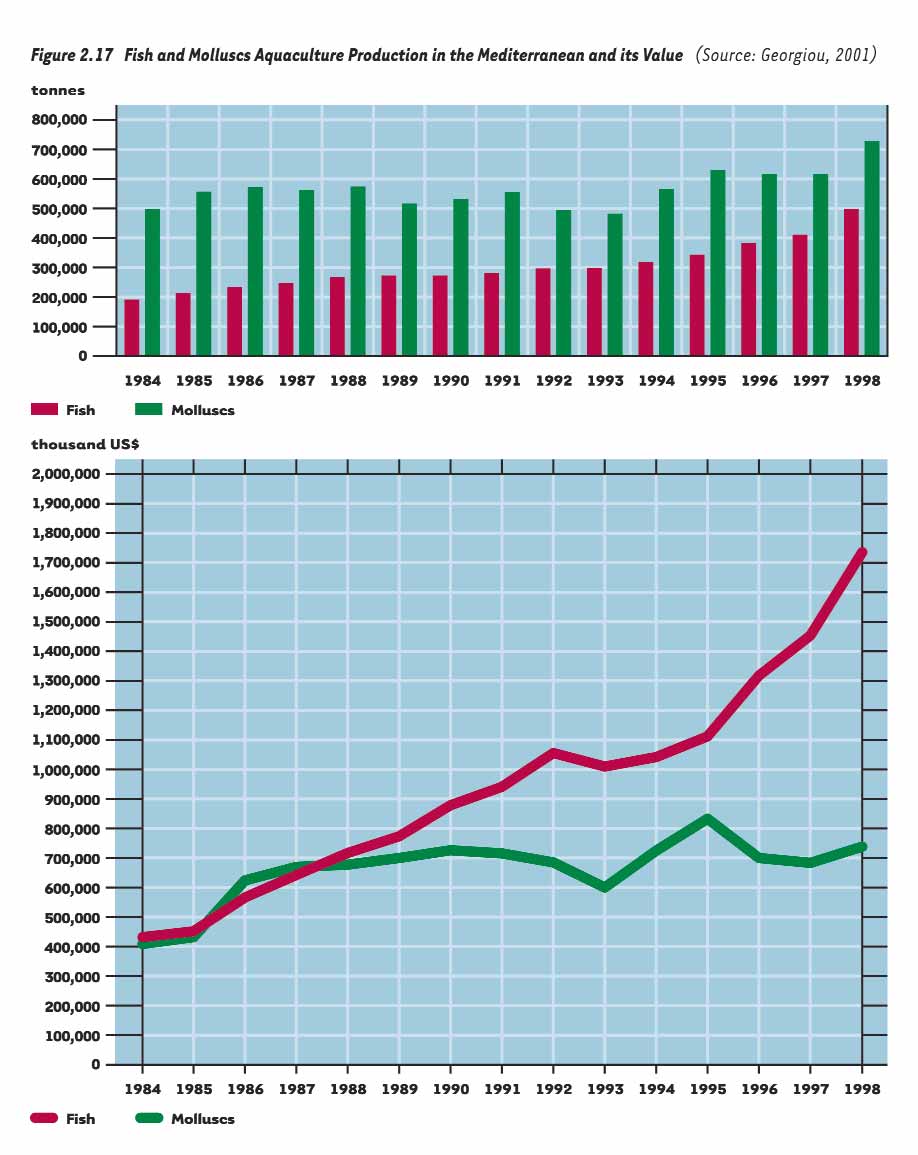
SIS (TDA) FOR THE MEDITERRANEAN SEA
Y
TIC ANAL
Y DIAGNOS
TRANSBOUNDAR
identified indiscriminate use of drugs as a source of
ments result in the release into the surrounding waters
concern in the prevention of fish diseases. Bacteria
of significant quantities of toxic material liable to
found near fish farms have been reported showing total
affect crustaceans particularly in their larval stages.
resistance to oxytetracycline, the most commonly used
For instance the use of carbaryl pesticides to eliminate
antibiotic in mariculture (Torsvik et al., 1988; Samuelsen
burrowing shrimp from oyster beds in the northwestern
et al., 1992).
United States results in the unintended mortality of
Toxicological effects of non-target species may
Dungeness crab, a commercially exploited species.
be associated also with the use of chemicals. Among the
The environmental effects of pigments and vita-
pesticides that may have toxicological effects on the
mins are poorly known. Biotin has been shown to simu-
surrounding invertebrate fauna are the organophos-
late growth of certain phytoplankton species and is
48
phate ectoparasites. Organophosphate bath treat-
implicated in the toxicity of the dinoflage Mate Cymno-
dinium aureoles. Vitamin B12 has been shown to be one
times, and ATP content by 4 to 28 times. No azoic zone
of the growth-promoting factors of the alga Chryso-
was encountered in any of the stations, but the macro-
chromulina polylepis and the dinoflagellate, Hetero-
faunal community was affected at distances of up to
sigma alashivo.
25 m from the edge of the cages. At the coarse sedi-
The development of resistant bacteria popula-
ment sites, abundance and biomass increased by more
tion in the sediment has been documented. For exam-
than 10 times and at all sites diversity indicated that
ple, up to 100 % of oxytetracycline-resistant bacteria
the affected ecotone extended a distance of 25 m from
have been recorded from marine sediments near fish
the cages (UNEP/MAP/MED POL, 2004a).
farms after medication and resistance persisted for
In the eastern Mediterranean, Environmental
more than 13 months (UNEP/MAP/MED POL, 2004a).
Impact Studies (EIS) on three fish cage farms in Cyprus,
Further, the risk of introducing new organisms
situated at depths of 25 to 30 meters, have shown that
and alien (exotic) species into the sea increases with
the areas below the cages displayed a gradient of biot-
the expansion of mariculture. As breeding and biotech-
ic enrichment being reflected in changes of macrofau-
nological techniques are increasingly used to produce
na diversity and abundance.
varieties for mariculture purposes, there is a serious
potential of escape of cultured stocks into the open
2.2.5.5 Overall characteristics
sea. This presents unforeseen risks to the health and
of the Mediterranean fishing sector
survival of wild stocks as shown by the case of the Asian
One of the consequences of the competition for
clam (Tapes semidecussatus). Production of this clam
the resources at a global level, but which has also made
increased rapidly in the North Adriatic in the period
itself felt in the Mediterranean area, has been the
19851996. Owing to its rapid growth and resistance to
over-capitalisation of the fishing fleets which has lead
anoxic conditions, this species undermined the autoch-
to much greater capacities than the resource's poten-
thonous species (Tapes decussates) so much that it
tial. Data provided by the FAO suggest that there was
AL CONCERNS
could also be fished in other coastal areas.
almost a 20 percent increase in the number of vessels in
The kuruma shrimp (Penaeus japonicus) that
the Mediterranean in the period 19801992. Although
was introduced to the Mediterranean provides a simi-
data for some Mediterranean Member States is missing,
lar example due to its rapid growing in aquaculture.
the evidence suggests that fishing effort has been
Presently, owing to its presence in natural stocks, and
intensifying in the basin.
because it entered through the Suez Canal, it can be
Most Mediterranean fishing vessels are arti-
2.0 MAJOR ENVIRONMENT
considered a Mediterranean species.
sanal in terms of scale. More than 80 percent of the
Benthic enrichment is another aspect of the
vessels are smaller than 12 m in length, and therefore
impact of mariculture on marine ecosystems. The gen-
catches are quite low compared to other regional seas.
eral picture emerging from the existing studies indi-
A specificity of the Mediterranean regional fisheries is
cates that the impact from intensive culture is on the
the relatively high importance of sport or leisure fishing
seabed and that the most widely known effect is benth-
activity that represents as much as 10 percent of total
ic enrichment beneath the sea farms. The existing stud-
fisheries production.
ies for the Mediterranean, although small in number,
In terms of fishing gear, the number of trawlers is
have covered different Mediterranean areas.
increasing dramatically in the Southern Mediterranean.
A seasonal survey combining sediment geo-
Algeria and Morocco, for instance, experienced an
chemistry and macrofauna was carried out in three fish
increase of 137 percent and 170 percent, respectively, in
farms in Greece, situated at a depth of 2030 m, in
the number of fishing trawls in the period 19801992. In
areas having different types of substratum and with
the Northern Mediterranean, trawlers increased in
varying intensity of water currents. The results of this
France (+22.3 percent) and Greece (+10.2 percent) for
study indicated that the impacts of fish farming on the
the same period, but decreased in Spain and Italy. In
benthos in the Mediterranean could vary considerably
terms of composition, multi-purpose vessels account for
depending on the specific characteristics of the farm-
22 percent, trawlers at 16 percent, followed by gill-net-
ing site. At the sampling stations under and near the
ters at 13 percent, seiners at 7 percent, long-liners at 3
cages, redox potential was found to decrease but
percent, and reap setters at 1 percent. The remaining 39
reached negative values only at the silt bottom site.
percent are other fishing vessels including dredgers, lift
The organic Carbon and Nitrogen contents of the sedi-
netters, vessels using pumps for fishing, platforms for
49
ment near the cages were found to increase by 1.5 to 5
mollusc culture, and recreational fishing vessels.
Table 2.6 Some Shared Stocks and Fisheries in the Mediterranean
Common name (scientific name)
Areas
Countries sharing the resource
Albacore (Thunnus alalunga)
All Mediterranean
Several countries
Anchovy (Engraulis encrasicholus)
Adriatic
Albania, Croatia, Serbia & Montenegro,
Italy, Slovenia
Gulf of Lions
Spain, France
Aegean Sea
Greece, Turkey
Blackspot seabream
Alboran Sea
Spain, Morocco
(Pagellus bogaraveo)
Bluefin Tuna (Thunnus thynnus)
All Mediterranean
Several countries
Blue whiting
Adriatic
Albania, Croatia, Serbia & Montenegro,
(Micromesistous poutassou)
Italy, Slovenia
Common Pandora (Pagellus erythrius) Tyrrhenian, Corsican
France, Italy
and Sardinian Seas
Adriatic
Albania, Croatia, Serbia & Montenegro,
Italy, Slovenia
Common spiny lobster
Tyrrhenian Corsican
France, Italy
(Palinurus elephas)
and Sardinian seas
Deepwater rose shrimp
Adriatic
Albania, Croatia, Serbia & Montenegro,
(Parapenaeus longirostris)
Italy, Slovenia
Strait of Sicily
Italy, Libya, Malta, Tunisia
Dolphinfish (Coryphaena spp.)
All Mediterranean
Several Countries
Eel (Anguilla anguilla)
All Mediterranean
Several Countries
European hake
Adriatic
Albania, Croatia, Serbia & Montenegro,
(Merluccius merluccius)
Italy, Slovenia
Aegean Sea
Greece, Turkey
Gulf of Lions
Spain, France
Strait of Sicily
Italy, Libya, Malta, Tunisia
Tyrrhenian, Corsican
France, Italy
SIS (TDA) FOR THE MEDITERRANEAN SEA
Y
and Sardinian Seas
Flounder (Platicthys flesus italicus)
Adriatic
Croatia, Italy, Slovenia
Great scallop (Pectin jacobeus)
Adriatic
Croatia, Italy, Slovenia
TIC ANAL
Large pelagic elasmobranches
All Mediterranean
Several Countries
(Isurus oxyrinchus, Lamna nasus,
Prionace glauca)
Y DIAGNOS
Norway Lobster (Nephrops nervegicus) Adriatic
Albania, Croatia, Serbia & Montenegro,
Italy, Slovenia
Strait of Sicily
Italy, Libya, Malta, Tunisia
Tyrrhenian, Corsican
France, Italy
and Sardinian Seas
Red mullet (Mullus barbatus)
Adriatic
Albania, Croatia, Serbia & Montenegro,
TRANSBOUNDAR
Italy, Slovenia
Red mullet (Mullus surmuletus)
Tyrrhenian, Corsican
France, Italy
and Sardinian Seas
Red shrimps (Aristeus antennatus,
Alboran Sea
Morocco, Spain
Aristeomorpha foliacea)
Ionian Sea
Greece, Italy
Strait of Sicily
Italy, Libya, Malta, Tunisia
Tyrrhenian, Corsican
France, Italy
and Sardinian Seas
Sardine (Sardina pilchardus)
Adriatic
Albania, Croatia, Serbia & Montenegro,
Italy, Slovenia
Gulf of Lions
Spain, France
Aegean Sea
Greece, Turkey
Sparids, several species
Tyrrhenian, Corsican
France and Italy
and Sardinian Seas
Sprat (Sprattus sprattus)
Adriatic
Albania, Croatia, Serbia & Montenegro,
Italy, Slovenia
Sturgeons (Acipenser spp.,
Adriatic
Albania, Croatia, Serbia & Montenegro,
Huso huso)
Italy, Slovenia
Ionian Sea
Greece, Italy
Aegean Sea
Greece, Turkey
Swordfish (Xiphias gladius)
All Mediterranean
Several Countries
50
2.3 Decline of Seawater Quality
ports over the last decades calls for safer and cleaner
The introduction of high levels of persistent
shipping operations to mitigate environmental costs.
toxic chemicals, nutrients as well as pathogenic micro-
As far as urban pollution is concerned, lack of
organisms into the Mediterranean is a major source of
sewage infrastructure is still the greatest problem.
national, regional and international concern. The
Virtually 60 percent of urban wastes, including micro-
resulting decline in seawater quality is manifested as
biological, nutrient and chemical contaminants, are
increasing incidences of eutrophication accompanied
discharged untreated into the sea, according to 1999
with reduced transparency and frequent algal blooms,
information.
high concentrations of heavy metals and persistent
toxic substances (PTS) in the seawaters as well as high
2.3.1 Transboundary elements
microbiological contaminant loads.
Pollutants often travel great distances through
This section sets out to identify substances that
air, sea currents and rivers before their effects can be
are particularly important in terms of transboundary
traced. The objective of this section is to highlight trans-
pollution impacts in the Mediterranean. Nitrogen and
boundary movement of pollutants relevant to Mediter-
phosphorus compounds, heavy metals (mercury, cad-
ranean seawater quality concerns. Persistent toxic sub-
mium, arsenic, copper / zinc, lead), persistent pesti-
stances dispersed by atmospheric circulation patterns,
cides, polychlorinated biphenyls (PCBs) and oil-relat-
transboundary transport of PAHs, as well as Mediterra-
ed polycyclic aromatic hydrocarbons (PAHs) are the
nean seawater exchange and evidence of long-range
focus of this survey. In addition, concentration data
biological pollution impacts on sea birds will be the main
are provided where available and an assessment of
focus areas.
major pathways of transport of the substance into the
sea is attempted.
a. Long-range transport of PTS
Decline in seawater quality in the Mediterranean
via the atmosphere
AL CONCERNS
is often a localized phenomenon. Mediterranean coasts
Differential heating between the
are dotted by pollution hot spots, usually located in
land of North Africa (almost bare soil),
semi-enclosed bays close to big cities, harbours and
the Mediterranean waters and the land
industrial areas. Eutrophication affecting the ecologi-
of South Europe produces a typical Me-
cal balance of the marine food web and resulting in ani-
diterranean atmospheric flow with a
mal kills is mainly a coastal problem while the open sea
strong northerly flow. This northerly flow
2.0 MAJOR ENVIRONMENT
remains relatively healthy.
is pronounced during the warm period of
In addition there are stark differences in seawa-
the year.
ter quality concerns between the North and South Medi-
A particularly well identified and
terranean. Population growth, still occurring in the
significant pattern of atmospheric cir-
southern Mediterranean, is a major force that will in-
culation in the Eastern basin is the con-
crease urban and industrial pollution problems of the
sistent flow directed from South and
region in the future. Southern countries may also be ex-
Eastern Europe towards the North
posed to imports and consumption of persistent pesti-
African Coast and the Middle East which
cides, which have become obsolete in the north but
results in the transport of polluted air
whose remaining stockpiles are a source of concern.
masses from Europe towards North
On the other hand, stockpiles of PCBs-contain-
Africa and the Middle East. The time
ing equipment are mainly found in the North as PCBs
scales for such transport processes are
production is linked to economic development.
approximately 24 days. The air quality
Decontamination of materials and oils containing PCBs,
in urban areas of Southeastern Europe,
therefore, is a burden affecting mostly the northern Me-
North Africa and the Middle East is
diterranean. The Northwestern Mediterranean is also
affected significantly by the long-range
potentially a hotspot for anti-fouling paint pollution
transport patterns described because
released in the process of ship maintenance.
the time scales are still within the life
Oil shipping operations continue to be the main
span of most air pollutants. By implica-
source of PAHs causing significant decline in seawater
tion, seawater may also be affected in
quality in the Mediterranean. The sweeping and ongo-
Southeastern Europe from atmospheric
51
ing increase in freight passing through Mediterranean
deposition of PTSs.
b. Mediterranean seawater exchanges
tants as well as fresh water and sedi-
The Mediterranean Sea is a semi-
ment inputs from the rivers draining half
enclosed basin having interactions with
of Europe and some parts of Asia. More-
the adjacent Atlantic Ocean and Black
over, during recent years, the number of
Sea through the Gibraltar and Turkish
tankers as well as the amount of haz-
straits, so that seawater exchanges may
ardous materials transported across the
play a role in the transboundary trans-
Sea and through the Turkish Straits has
port of PTS.
increased (from 4,248 in 1996 to 6,093
The Eastern Atlantic has a perma-
in 2000), and this will continue as the
nent exchange of waters with the Medi-
amount of oil production from the Cas-
terranean Sea through the Strait of
pian region increases.
Gibraltar. This exchange results from the
Taking into account these particular
evaporation of the Mediterranean
hydrogeographical conditions, a major
waters, which become more dense than
question has been raised concerning the
those of the North Atlantic, and gener-
significance of these water exchanges in
ate an inflow of fresher and lighter
the transboundary transport of pollu-
Atlantic upper waters into the Mediter-
tants.
ranean and an outflow of more saline
and denser deep Mediterranean water to
c. Biological indicators of
the Atlantic (Hopkins, 1999). Despite its
long-range transport of PTS
initially very high density, the Mediter-
in seabirds within
ranean water outflow does not reach the
the Mediterranean basin
bottom of the North Atlantic because it
Levels of total DDT in seabirds (ref.
entrains a substantial volume of the
to chapter 2.1) in the Mediterranean
SIS (TDA) FOR THE MEDITERRANEAN SEA
overlying Atlantic waters while still in
have been reported to be significantly
Y
the Gulf of Cadiz. Thus, the resultant
higher than those of North Atlantic and
mixed Mediterranean waters become
Arctic birds, indicating a regional / local
TIC ANAL
neutrally buoyant at depths between
pollutant source.
900 and 1,200 m and finally reach the
Median PCB levels are also signifi-
Y DIAGNOS
open North-central Atlantic, in the form
cantly higher in the eggs of Mediterra-
of water lenses (eddies).
nean seabirds than elsewhere; only the
On the other hand, the Black Sea is
Herring Gull (Larus argentatus) in the
connected with the Mediterranean
North Atlantic reached higher levels,
TRANSBOUNDAR
through the Sea of Marmara where there
similar to those found in Audouin's Gull
is a surface outflow of less saline waters
(Larus audouinii) eggs from Capraia
from the Black Sea and an inflow of den-
Island in the Tuscan archipelago (Italy)
ser Mediterranean waters, which results
(Leonzio et al., 1989). However, when
in the formation of a permanent halo-
considering the DDT / PCBs ratios, the
cline / pycnocline at depths of 100150
Mediterranean shows an intermediate
m in the Black Sea. The annual volume of
position between the heavily industri-
the outflow (658 km3/y) from the Black
alised North Atlantic and the pristine
Sea is nearly twice that of the salty water
Arctic, where DDTs are the predominant
import (337 km3/y) via the Bosphorus
chlorinated pollutants.
undercurrent, but this counterflow sys-
tem is balanced at the Dardanelles exit
2.3.2 Transboundary source-receptor
(1,331 km3/y upper flow; 1,010 km3/y
relationships in PAH deposition
underflow).
An evaluation of transboundary transport of
The Black Sea has significant pollu-
PAHs between countries of the region has been carried
tion levels. The Black Sea has a very
out for 1998 on the basis of the "source-receptor"
large catchment area, receiving extra-
approach. Calculations have been performed for B[a]P
52
ordinary amounts of nutrients, pollu-
as the most representative component of this class of
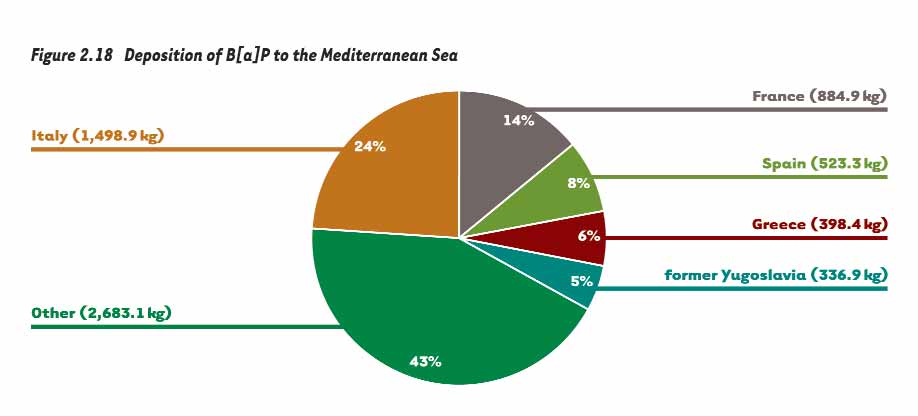
compounds. A summary of the contributions of deposi-
2.3.4 Socio-economic impacts
tions of B[a]P to the Mediterranean Sea is shown in
· Fish kills and toxin-contaminated shellfish
Figure 2.18. It is shown that most depositions are derived
linked to eutrophication reduce fisheries' base;
from Italy (1,499 kg, 24 %), France (885 kg, 14 %) and
· Loss of income in the fisheries sector;
Spain (523 kg, 8 %).
· Unemployment rise induced by the decline in
fisheries;
2.3.3 Environmental impacts
· Loss of aesthetic value linked to eutrophica-
· Eutrophication incidences in coastal waters
tion events;
AL CONCERNS
resulting in algal blooms, red tides, water
· Loss of tourism;
discoloration, putrefication, fish mortality,
· Loss of employment and income related to
dystrophy, mollusc mortality, bottom fauna
tourism;
mortality, poor transparency;
· Loss of cultural heritage.
· Adverse impact on water quality from presence
The most important cases of eutrophication are
of mercury implicated in inhibition of growth
found along the northern and western coasts of the
2.0 MAJOR ENVIRONMENT
and harmful effects on fitness of marine
Adriatic Sea. Starting in the 1970s, eutrophication
plants and animals;
phenomena such as algal blooms and the production of
· Degradation of seawater quality from pres-
mucilage have given rise to great concern, particularly
ence of cadmium linked to growth retardation
in the northern Adriatic, because of their new consider-
of marine organisms, decrease in invertebrate
able frequency, intensity and geographical extension.
survival rates, decalcification of marine ani-
The decline of seawater quality in the northern
mals and seabird skeletons;
Adriatic compounded problems in tourism develop-
· Seawater quality decline from presence of
ment, a vital economic activity for the region. Broadly
zinc / copper in seawater associated to risks
speaking, in the region two types of tourism dominated
of reproductive capacity impairment for sea
until the early 1990s: (a) a hotel based, mass type of
organisms;
tourism attracting mainly national tourists and visi-
· Environmental degradation of seawaters by
tors, and (b) a type of tourism based on private hous-
presence of lead implicated in central nervous
es, flats for rent and camping sites attracting foreign
system disorders, motor abnormalities and
tourists. However, trends in tourist behaviour charac-
blindness of marine organisms;
terized by a reduction in the average length of holidays
· Disruption of seawater ecological quality by
and greater attention to the quality of the natural
the presence of chlorinated hydrocarbons
environment, services offered and value for money as
associated to high bioaccumulation with
well as the emergence on the market of new seaside
potentially lethal effects for marine mammals
holiday resorts, the impact of large tour operators and
and seabirds;
air transport on tourist flow patterns, affect tourism
· Degradation of waters by increased microbio-
development in the northern Adriatic Sea and have led
53
logical content.
to a restructuring process in major upper-Adriatic
resorts aiming to combat three major issues: (a) envi-
no pathologies in the resident populations attributable
ronmental degradation and overcrowding, (b) the need
to PSP intoxication have ever been encountered.
to improve the quality of existing services, and (c) the
Considering that the eutrophication phenomena
need to diversify services and resources offered.
are no longer occasional events, but are induced by
During the late 1980s, early 1990s, this already
structural deficiencies on land, there is a need to elim-
complex picture was further complicated by the issues
inate such deficiencies, which are mostly linked to agri-
of eutrophication which first started gaining impor-
culture, animal husbandry and municipal sewerage.
tance in the Italian Seas in the mid-1970s. This form of
During the 1980s, important laws, decrees and norms
pollution is caused by the large inflow of freshwater to
were approved at the European Community and the
the basin from the catchment area of the northern
national levels mostly addressing the reduction of
Adriatic Sea, a great part of which is Italian territory. On
phosphorus in the detergents produced, bringing the
a national scale, coastal and inland waters receive
limit down to 1 percent. As a result, it has been possible
about 48,000 tonnes/year of phosphorus and 660,000
to quantify a decrease of 10,000 t/year in the input of
tonnes/year of nitrogen. The most critical situation is
phosphorus to the sea. In contrast, no important reduc-
encountered south of the Po river delta near Ravenna in
tion of nitrogen in the sea has been monitored in spite
a marine area for about 100 km, where the polluting
of a 1991 Community norm in that direction. This is
effects of Po's waters are serious, especially during
mostly due to the difficulty of applying the norm (e.g.,
summer months. Furthermore, the widespread appear-
lack of economic incentives) and the lack of controls.
ance of phenomena of mucilage (mucillagine), associ-
The major socio-economic impacts of decline in
ated with cloudy sea or marine snow in many parts of
seawater quality therefore can be summarized as:
the upper Adriatic coastal waters in the summers of
· Reduced fish production due to fish kills and
1988 and 1989, resulted in the significant reduction of
toxin-contaminated shellfish linked to eutro-
the number of tourists to the area on the order of 2030
phication, leading to loss of income;
percent, which has been reversed since that time. Also
· Rise in unemployment caused by the decline in
SIS (TDA) FOR THE MEDITERRANEAN SEA
the figure of total night stays for the province of Rimini
fisheries;
Y
declined from 17.777 thousands (1988) to 11.724 thou-
· Possible increase in social instability due to
sands (1989) and has not fully recovered since, possibly
loss of livelihoods;
TIC ANAL
indicating a trend for shorter length of stay. In fact,
· Loss of aesthetic value linked to eutrophica-
eutrophication and mucilage worsened a situation that
tion events;
Y DIAGNOS
was already becoming critical since many northern
· Loss of employment and income related to tou-
Adriatic resorts were entering the maturity stage.
rism, especially in the sports-fishing industry;
However, the extent to which eutrophication was a
· Loss of cultural heritage.
result of transboundary pollution and the degree to
TRANSBOUNDAR
which tourism development in the region was affected
2.3.5 Causal Chain Analysis
by transboundary pollution or by the dominant trends in
Figure 2.3.1 presents a causal chain analysis
the tourism market cannot by fully appraised and needs
(CCA) for decline in seawater quality, indicating the pri-
further investigation (Zanetto and Soriani, 1996).
mary and root causes of decline in sea water quality, as
Further, the recurrent phenomena of eutrophi-
well as the socio-economic and environmental impacts
cation and the general deterioration of water quality in
arising from the decline in quality.
the northwestern Adriatic have had serious negative
The CCA depicts the primary causes for decline
repercussions on fisheries. With regard to fishing and
in seawater quality as:
mollusc farming in particular, considerable damage has
· Inadequate sewage treatment in large por-
been done by the dinoflagellate of the genus Dinophysis,
tions of the Mediterranean Sea (only 40 % of
which produces (DSP) toxins. The occurrence of these
the sewage is treated to acceptable levels);
flagellates, which have become more plentiful during the
· Lack of best practices in agriculture use of
last decade, has led to temporary and prolonged bans on
fertilizers and pesticides / insecticides;
the harvesting and sale of mussels (Mytilus galloprovin-
· Inadequate controls on atmospheric emis-
cialis) farmed in the coastal and lagoon areas of Emilia-
sions of heavy metals and persistent organic
Romagna. Further, Alexandrium tamarensis, a dinofla-
pollutants from European industrial sources;
gellate capable of producing (PSP) toxins, has been
· Inadequate source controls and discharge
54
observed in the waters of the northern Adriatic, although
control for industries along the sea;
· Increases in shipping traffic across the Medi-
· Lack of public awareness of environmental
terranean with consequent increase in acci-
matters in some portions of the Sea;
dental and purposeful discharge of harmful
· Low priority accorded environmental protec-
pollutants.
tion in some regions of the Mediterranean;
The CCA identifies the root causes of decline in
· Insufficient institutional and human capacity
seawater quality as:
for monitoring and enforcement in some
· Inadequate stakeholder participation in gov-
countries of the Sea;
ernance of the commons;
· Lack of budget.
AL CONCERNS
2.0 MAJOR ENVIRONMENT
55
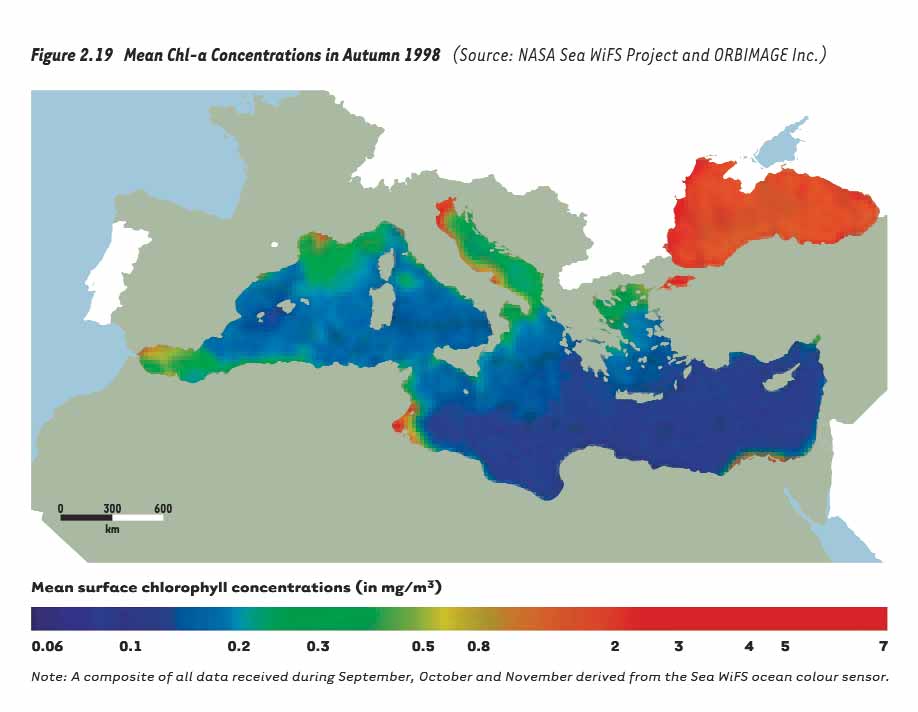
2.3.6 Supporting data
cation is rapid consumption of oxygen in the bottom
2.3.6.1 Eutrophication
layers. Put simply, the factors that combine to set off
Eutrophication in waters or waters where one
the process of eutrophication may be grouped in two
can find abundant food (nutrients) is no longer an oc-
categories: those that affect the dispersion of nutri-
casional occurrence but a chronic problem in the Medi-
ents in the water, such as water movement, or the oxy-
terranean. From 1965 to 1995 nutrient levels in the Wes-
gen cycle near the bottom layer of the sea, such as light
tern Mediterranean have increased annually, with the
permeability.
highest concentrations found close to river deltas and
Eutrophication is used in the context of ecolog-
estuaries or near large urban agglomerations, as shown
ical quality of waters to refer to a decline in ecological
on the satellite image illustrating chlorophyll concen-
water quality. The visible effects of deterioration in
tration in surface waters of the Mediterranean Sea in
water quality caused by eutrophication are algal
Figure 2.19.
blooms or red tides, algal scum, enhanced benthic
As can be seen in Figure 2.19, the problem of
algal growth and, at times, a massive growth of sub-
eutrophication, severe though it may be locally, is lim-
merged and floating macrophytes. Occasionally, these
ited to specific coastal and adjacent offshore areas.
manifestations are accompanied by cycles of visible
Northern shores are most affected, but South and
bacterial blooms and fungal growth leading to oxygen
Southeast Mediterranean countries are not excluded
depletion in bottom waters and fish kill. A table of
from the affected area. Rather, data on Mediterranean
eutrophication effects recorded in different coastal
eutrophication should be read with caution since rela-
areas of the Mediterranean is provided in Table 2.12.
tively lower incidences reported in the South may be
As an example, recurrent lack of oxygen or
linked to less active monitoring networks.
anoxia in the bottom waters of the Northern Adriatic
The mechanism of eutrophication is complex
basin caused profound modifications in the benthic
and depends on additional factors other than high
ecosystem. There were considerable reductions in the
nutrient input. The main effect of eutrophication is
original populations of the least mobile bottom organ-
SIS (TDA) FOR THE MEDITERRANEAN SEA
changes in the food web leading to increases in phyto-
isms (molluscs, crustaceans, and polychaetes) most
Y
plankton biomass. The main consequence of eutrophi-
sensitive to oxygen deficiency. Repetition of these dys-
TIC ANAL
Y DIAGNOS
TRANSBOUNDAR
56
trophies has led to the disappearance of about fifteen
Although it is difficult to determine to
species of mollusc and three species of crustaceans.
what extent each anthropogenic factor
The effects of eutrophication on Mediterranean biodi-
is the cause of eutrophication, an
versity are discussed in more detail in section 2.1.5.3.a
attempt to do so has been made by EEA
of this document.
(1999a) and the results are shown in
During eutrophication, the ratio of nitrogen to
Figure 2.20 and Figure 2.21.
phosphorus compounds, which is basic to the develop-
ment of aquatic life, changes. In some cases, one of
Agriculture
the two nutrients will be bound to aquatic life and will
Run-off water and eroded soil of
not be available for further algal growth. This element
agricultural areas are among the main
is then called the limiting factor. Understanding which
causes of eutrophication in the basin.
element is the limiting factor is important in order to
This non-point form of pollution con-
control algal growth.
cerns basins draining into the Mediter-
According to Krom et al. (1991) primary produc-
ranean covering a total area of about
tion in the eastern Mediterranean (data from the Levan-
1.9 million km2 not counting the upper
tine basin) is limited by phosphorus. On the other hand,
Nile basin, and include 24 countries
recent data from the eastern basin seems to suggest
(UNEP, 1997). As the Mediterranean
that nitrogen is the limiting factor in offshore waters. In
basin is receiving waters from the Black
surface waters of the Ligurian sea, Bethoux et al. (1992)
Sea, there is also a remarkable effect
report values indicating a slight tendency for nitrogen to
of the Black Sea on the Eastern Me-
be the limiting factor. Other authors (Marchetti, 1985)
diterranean, mainly the Aegean Sea.
show phosphorus limitation in the Adriatic Sea, an area
often subjected to eutrophication events, while Min-
AL CONCERNS
gazzini et al. (1992) suggest that phosphorus is the lim-
iting factor in the coastal waters off Emilia-Romagna.
Overall, the degree of phosphorus limitation
increases from west to east across the entire basin.
However, a more precise estimate on nutrient limitation
is not possible based on the restricted number of local
2.0 MAJOR ENVIRONMENT
measurements. That is partly because seasonal factors
change the situation at different times of the year.
Furthermore, when evaluating eutrophication
effects, it should be remembered that reliable figures
are still rare because of the inherent difficulties of
measuring anthropogenic eutrophication under condi-
tions of high natural variability. Moreover, the few phy-
toplankton time series available for the Mediterranean
are mostly land-based and thus monitor only near-
shore waters, with the exception of some rare time
series like the one in the Corso-Ligurian Sea (offshore
from Villefranche). Given current limits of knowledge,
it is impossible to predict the appearance of eutrophi-
cation effects and how harmful they may be.
a. Origins of eutrophication
Human activity has contributed
dramatically to nutrient enrichment in
the Mediterranean. Agriculture, fol-
lowed by domestic and urban activities,
are the two main sources of high nutri-
57
ent loads that trigger eutrophication.
Through the mechanisms of leach-
Increasing intensification of agri-
ing and sediment transport, phospho-
cultural practices taking place in the
rus, nitrogen and organic carbon in
Mediterranean basin contributes to
soils are carried into ground waters,
high amounts of nutrients in run-off
wetlands, rivers and lakes and finally
and transported sediments. Particu-
reach the sea. A further issue is ammo-
larly on the southern coast, the pres-
nia (NH ) emissions released in con-
sure to use more fertilizer in the
3
nection with the production and
catchment basin and along the
spreading of animal manure. The issue
coastal zones is very strong. Moreover,
of ammonia (NH ) pollution stemming
an increasing area of arable land is
3
from agriculture has attracted more
lost to urbanization and other infra-
attention in environmental political
structures. In the countries on the
debate in recent years. As a result,
Northern and Western coasts, special-
steps have been taken to remedy the
ized monocultures achieve good yields
poor state of data on ammonia emis-
and induce a gradual abandonment of
sions in the framework of the United
marginal land. Therefore, increases of
Nations Economic Commission for
land under irrigation are observed in
Europe (UN/ECE) to combat acidifica-
the North and West. In the South and
tion and eutrophication and ground-
East, demographic pressure constant-
level ozone, as well as the EU Directive
ly increases and cultivated surfaces
on national emissions ceilings (NEC
continue to expand at the expense of
Directive). The only reliable data
forests and grazing land.
available concern EU Mediterranean
Figure 2.22 shows the increase in
countries and suggest a decline in
fertilizer consumption used in agricul-
SIS (TDA) FOR THE MEDITERRANEAN SEA
total NH emissions for the period
tural lands in all Mediterranean coun-
Y
3
19901994. Agriculture is the main
tries in the 1960s and 1980s. Although
source of ammonia emissions accord-
in terms of total quantities applied the
TIC ANAL
ing to Tarasson et al. (2000).
northwestern countries lead the re-
Y DIAGNOS
TRANSBOUNDAR
58
cord, in terms of quantity of fertilizer
cases such as the Seine and the Escault
per hectare some southeast Mediter-
or the Ebro delta, oxygen levels are very
ranean countries are catching up with
low or even zero.
the North.
The impacts of urban areas on
In addition, run-off waters cause
eutrophication are less clear cut, part-
a remarkable transport of sediments,
ly because other sources of nutrients
mostly in regions with a higher degree
also make a major contribution to
of soil erosion. Besides the large river
trophic dysfunctions, and also because
basins of the Rhone and the Po, a ten-
the pace of development of an algal
tative ranking of the risk of soil erosion
bloom is slower than that of a bacteri-
and nutrient losses (UNEP/MAP, 1997)
ological bloom (oxygen consumption).
lists the first six drainage regions dis-
The state of information on dis-
charging the largest amount of nutri-
charge of urban sewage outfalls is far
ents into the sea in peninsular Italy,
from complete. Within the framework
Sicily, Sardinia, Greece and Spain.
of the MED POL Programme, informa-
Inadequate management prac-
tion gathered through different proj-
tices can increase the amount of pol-
ects such as "The Survey on Land-
lutants transferred to the sea and can
Based Sources of Pollution" (UNEP/
decrease productivity of soil and eco-
WHO, 1996b), and the "Identification
nomic efficiency of agriculture. The
of Priority Pollution Hot Spots in the
control of phosphorus is closely con-
Mediterranean" (UNEP/WHO, 1999)
nected to run-off and erosion phe-
cover a significant portion of coastal
nomena. In fact, this nutrient is often
cities. The data reveal that despite
AL CONCERNS
associated with the sediment and run-
substantial improvement in some
off losses directly linked to erosion.
countries, about 33 percent of the pop-
Intensive agriculture systems deter-
ulation is not yet served by municipal
mine the risk of nitrogen pollution in
sewage treatment. A fuller discussion
surface and ground waters. Such risks
of the state of municipal sewage treat-
increase in irrigated crops.
ment is given in the section on microbi-
2.0 MAJOR ENVIRONMENT
ological pollution.
Municipal
The difficulty in collecting data
A major consequence of urban
through different programmes, how-
waste discharge into the sea is eutro-
ever, has resulted in fragmented infor-
phication of waters. Urban sources of
mation with findings of little practical
pollution are potentially important as
use. In order to improve the situation,
they tend to be characterized by geo-
a particular activity related to the
graphical concentration in catchment
state of wastewater treatment plants
basins or the coastal environment. A
in the Mediterranean has commenced.
concentrated source is particularly
harmful where it is liable to give rise to
b. Assessment of major pathways
rapid effects before being dispersed by
of nutrients
the processes of dilution and dispersion.
Discharges via rivers
For example, the impact of urban
About 80 rivers contributing sig-
areas in terms of the deoxygenization
nificantly to pollution inputs to the
of rivers rapidly became very evident.
Mediterranean Sea have been identi-
Organic material and molecules that
fied. The nutrient levels found in Medi-
are potential consumers of oxygen
terranean rivers are about four times
(particularly ammonium) when re-
lower than those in western European
leased into the sea cause degradation
rivers. In all documented cases, ni-
of the marine environment by decrea-
trate levels are increasing, although
59
sing seawater oxygen levels. In extreme
the trend for ammonia is variable de-
pending on the method of sewage col-
ranges are enormous, over an order of
lection and treatment carried out.
magnitude for nitrate and more for
Phosphate concentrations may in-
ammonium and phosphate.
crease dramatically, as seen in Greece,
The available data on the average
or steadily, as found in France, or
nutrient concentrations in the Medi-
decrease when phosphate restriction
terranean rivers are presented in Table
measures are imposed (phosphate ban
2.7. More than 30 rivers are document-
on detergents as in Italy). Although
ed for nitrate with average values.
some local coastal eutrophication
Elevated concentrations among
events do occur (as in the northern
the rivers listed in Table 2.7 are found
Adriatic), the main body of the Medi-
in the intensely cultivated river basins
terranean as a whole was not seriously
of Italy, Spain, and / or Greece, such as
damaged with eutrophication over the
the Arno, Po, Ebro and / or Pinios rivers
last decade. Depending on the river
Also the Nile River has one of the high-
size and location, the concentration
est average nitrate concentrations,
Table 2.7 Documented Rivers for Dissolved Nutrients
Rivers
Qact km3/yr
N-NO -g/l
N-NO -mg/l
N-NH +mg/l
N
mg/l
P-PO -3
P
mg/l
3
2
4
tot
2
tot
Adige
7.29
1.25
--
0.111
--
0.03
0.1126
Akheloos
5.67
0.60
--
0.035
--
0.02
0.0151
Aliakmon
1.168
0.395
--
0.05
--
0.10
0.0168
Argens
0.38
0.74
0.02
0.09
0.5
0.11
0.22
Arno
2.10
0.912
--
0.042
--
0.500
0.01
SIS (TDA) FOR THE MEDITERRANEAN SEA
Aude
1.31
1.42
0.03
0.09
1.2
0.09
0.49
Y
Axios
4.90
1.584
--
0.0658
--
0.48
0.48
Besos
0.130
1.9
0.3
31
--
--
12.7
TIC ANAL
Buyuk-Menderes
4.70
1.44
--
--
--
0.55
--
Ceyhan
7.10
--
--
--
--
--
8.68
Ebro
9.24
2.3
--
0.1672
--
0.029
0.243
Y DIAGNOS
Evros
6.80
1.9
--
0.05
--
0.36
--
Fluvia
0.36
--
--
0.054
--
--
0.35
Gediz
1.87
1.65
--
0.05
--
0.19
--
Goksu
2.50
--
--
--
--
--
8.87
Herault
0.92
0.61
0.012
0.06
--
0.045
0.22
TRANSBOUNDAR
Kishon
0.063
--
--
--
--
--
20
Krka
1.61
0.45
0.001
0.031
--
0.029
--
Llobregat
0.466
1.9
0.5
3.2
--
1.2
1.53
Metauro
0.43
1.366
--
0.0
--
0.005
0.119
Neretva
11.01
0.269
--
0.029
--
--
0.050
Nestos
1.03
1.24
--
0.071
--
--
0.127
Nile
6.00
3.00
--
--
--
--
--
Orb
0.86
0.67
0.045
0.44
0.9
0.14
0.45
Pinios
0.672
2.323
--
0.167
--
--
0.2431
Po
48.90
2.03
--
0.21
--
0.084
0.2393
Rhone
48.07
1.48
0.033
0.124
0.80
0.101
0.14
Semani
3.02
0.24
--
--
--
--
0.002
Seyhan
7.20
0.59
--
0.31
0.27
0.01
--
Shkumbini
1.94
0.73
--
--
--
--
0.01
Strymon
2.59
1.236
--
0.053
--
0.11
0.125
Tavignano
0.06
0.34
0.045
(0.003)
--
(0.005)
--
Ter
0.84
--
--
1.2
--
--
2.15
Tet
0.40
1.8
0.18
1.5
2.7
0.47
0.8
Tevere
7.38
1.37
--
1.04
--
0.26
0.355
Var
1.57
0.18
0.003
0.031
1.5
0.006
0.13
60
although this value has been derived
waters. Coastal aquifers (e.g., karstic
from only a few published values and it
or unconfined sedimentary aquifers)
is not clear whether this value really is
are vulnerable to surface-induced
representative for this river.
pollution and provide transport of
Ranking the Mediterranean rivers
agricultural nutrients critical to
in Table 2.7 according to their average
eutrophication of enclosed coastal
phosphorous concentrations does
areas into the sea. Although data on
therefore not exactly follow the rank-
levels of nutrients are not known, they
ing of nitrate pollution. Highest P val-
are believed to be significant, espe-
ues are typical for the rivers suffering
cially given that the seepage from
from organic pollution due to urban
coastal aquifers accounts for about
wastewater inputs such as the Besos
one quarter of the total freshwater
and Llobregat in Spain, the Axios in
inflow into the Mediterranean.
Greece, the Tet in France and / or the
Arno in Italy. Lowest phosphorous con-
Airborne deposition of nutrients
centrations are also found in the rivers
The atmosphere carries significant
with low nitrate concentrations (e.g.,
quantities of nitrogen, mainly in the
the Krka and Neretva rivers) indicating
form of nitrogen oxide (NO). Via a num-
that these rivers are probably the clos-
ber of different atmospheric reactions,
est to a pristine state.
some nitrogen oxides are removed from
The lowest nitrate concentrations
the atmosphere through wet and dry
of clearly less than 1 mg N/l are typi-
deposition processes. The effect on the
cal for rivers where agriculture may be
marine ecosystem is eutrophication
AL CONCERNS
less intense in the catchments, and /
through nitrogen fertilization.
or accompanied by crops that do not
Emissions of nitrogen oxides arise
require much fertiliser (such as the
mainly from anthropogenic combustion
Var, Tavignano and Herault rivers in
sources. In this context, road transport
France). Also the rivers of Croatia
and other mobile sources (sea and air
seem to have rather low nitrate values
transport) are increasingly important
2.0 MAJOR ENVIRONMENT
that may at least partly also be a
sources of pollution compared to sta-
dilution effect. Nitrogen inputs may
tionary sources (industrial combus-
be more diluted due to the often-high
tion). According to Tarasson (2000),
drainage intensities in these rivers.
mobile sources account for 63 % of NOx
Seepage from coastal aquifers
emissions in the Mediterranean basin; a
and submarine groundwater dis-
breakdown of NO emissions into sec-
x
charges serve as other pathways of
tors in the Mediterranean region is given
nutrients into Mediterranean coastal
in Table 2.8.
Table 2.8 Sector-Based Emissions of NO in the Mediterranean Region (kton N yr-1) (Source: Tarrason et al., 2000)
x
Energy Non-
Com-
Pro-
Road Other
Waste
Agriculture
Other
pro-
industrial bustion duction
transport
mobile treat-
duction
com-
in manu-
process
sources
ment
bustion
facturing
France
134
103
135
16
728
397
16
--
3.8
Croatia
14
3.8
8.6
1.6
29
15
0.04
--
--
Italy
186
79
156
11
748
286
18
1
1
Slovenia
15
3.1
3.1
--
36
0.5
--
--
--
Turkey
173
192
173
11
361
--
--
--
--
Cyprus
6.2
1.2
2
--
11
--
--
0.9
--
Serbia &
40
1.6
4.4
--
--
--
--
--
--
Montenegro
Total
569
384
482
40
1,912
698
34
1.9
4.8
61
Emission data for countries of the
Phosphorus is deposited through
northern Mediterranean is inventoried
the atmosphere to a much lesser extent
by the UNEC/EMEP database, but this
than nitrogen. That is because a large
does not include emissions from coun-
fraction of this total P input originates
tries on the Southern and Eastern coast.
from crystal material transported from
Emission data for these countries was
North Africa and is insoluble. Berga-
obtained from different sources.
metti et al. (1992) estimated soluble
Mediterranean emissions did not
input as 30 percent of total inorganic P
change significantly between 1980 and
input to the Western Mediterranean
1999, but the relative contribution of
Sea. Measurements of atmospheric P
the Mediterranean region to total
cover the entire basin. Guerzoni et al.
European emissions has increased in
(1999) reviewing these concluded that
the last 20 years, particularly for NH
the atmospheric input of inorganic P is
3
(27 % in 1980 to 36 % in 1999). The
40 mg P m-2yr-1 in the Western Mediter-
increase in the share of the Mediterra-
ranean and 20 mg P m-2yr-1 in the
nean region in the emissions of both
Eastern basin.
nitrogen species is due to decrease in
these emissions in Europe. Based on
c. Building information capacity
EMEP projections, NO and ammonia
on eutrophication
2
emissions in the Mediterranean region
Over the last 30 years, MED POL has
are expected to account for 17 % and
played a considerable part in improving
34 % of European emissions, respec-
information available on trends of
tively, in the year 2010.
nutrient enrichment in the Mediterra-
The negative impacts of nitrogen
nean. During the first phase (1975
SIS (TDA) FOR THE MEDITERRANEAN SEA
oxide are likely to remain a source of
1981), MED POL contributed towards
Y
concern in the future as the underlying
upgrading the technical facilities of
cause of the problem, road transport,
many Mediterranean research centres
TIC ANAL
continues to expand. Despite improve-
and laboratories involved with the pro-
ments brought by catalytic treatment
gramme. The MED POL phase II (1982
Y DIAGNOS
of car exhausts, emissions have in-
1996) was characterized by the devel-
creased as a result of increase in dis-
opment of national monitoring projects
tances travelled as well as growth in
in the Mediterranean region. MED POL
the number of vehicles.
has now entered the third phase shift-
TRANSBOUNDAR
Emissions of NO in the Mediterra-
ing the emphasis from pollution
nean are uneven. France, Italy and
assessment to pollution control. A
Spain emit most of the NO in the
database was organized during the
x
region. These three countries account-
MED POL phase II and nutrient values
ed for 78 % of NO emissions in the
are available for a number of Mediter-
x
basin in 1999. However, emissions from
ranean countries.
South and Eastern countries of the
Mediterranean are likely to increase
2.3.6.2 Heavy metals
rapidly in the future following increas-
The presence of heavy metals in the sea is of
es in car ownership linked to increased
great concern as most heavy metals are toxic to
living standards. Data reveal that the
plants and animals. The levels found in and effects of
relative contribution of central and
heavy metals on Mediterranean biodiversity are dis-
eastern Mediterranean countries have
cussed in greater detail in section 2.1.5.3.b above.
increased by approximately 10 percent
The toxicity depends on the degree of concentration
in the last 20 years. This increase is due
and in fact many metals play a key role in different
to doubling of NO emissions (from
life processes and are released in great volumes in
x
6,800 in 1980 to 12,900 tones NO in
natural ways. However, man's share of heavy metal
x
62
1995) in Turkey.
pollution in the Mediterranean grew sharply by 300
percent between 1950 and 1990 and this trend has
not uniform. The decrease in reported emission values
only lately been reversed.
in Western Mediterranean countries (Spain, France and
Metal-containing particulate matters are
Italy) is more pronounced compared to countries
emitted from different kinds of industries and subject
located in the Central Mediterranean. Unfortunately,
to long-range transport via air or rivers before their
such long-term emission data are not available for the
effects are recognized in the ecosystem. Six metals
Eastern Mediterranean basin.
were chosen for their transboundary impacts (mercury,
cadmium, arsenic, zinc, copper and lead). By far the
a. Origins of heavy metals
biggest source region for four of these is the Northwest
and concentration data
basin, accounting for about half the total emissions of
Mercury
lead, cadmium, zinc and copper. Figure 2.23 below
The major toxic action of mercury
shows the variations in heavy metal discharges by var-
is the inhibition of enzymatic process-
ious regions of the Mediterranean.
es, which can affect the reproduction
and the nervous system of birds and
mammals. In fish, the effects of mer-
cury also include a decreased sense of
smell, damage to gills and blindness.
High concentrations of mercury lead
to reduced growth of plants. One im-
portant hazardous effect of mercury
in the aquatic environment is that it
biomagnifies in the food chain.
Mercury comes from rocks (mainly
AL CONCERNS
as sulphide ores), degassing (of ele-
mental mercury) from the Earth's crust
and oceans, volcanoes, chlor-alkali
plants, the petrochemical industry and
sewage outfalls.
· Levels
2.0 MAJOR ENVIRONMENT
The levels of total mercury (HgT)
in the Mediterranean marine envi-
The last decade saw a pronounced decrease of
ronment seem to be decreasing in
emissions of lead by the Mediterranean countries
many areas, mainly due to the fact
(19901999). Emissions have decreased from 14,300
that analytical procedures have
tonnes in 1990 to 5,900 tonnes in 1999. Mercury and
improved and more attention has
cadmium emissions also decreased in the same time
been paid to the problem of sam-
period, but not as much as lead. Mercury emissions
ple contamination. Earlier results
decreased from 102 tonnes/yr to 70 tonnes/yr in 1999
indicated high values, with con-
(31 percent) and Cd emissions decreased from 114
centrations in seawater in the so-
tonnes/yr in 1990 to 82 tonnes/yr in 1999 (27 percent).
called `open' sea areas reaching
The decrease observed in these three metals can also
140ng/l, and in coastal areas,
be seen in other anthropogenic elements like Ni, As,
520ng/l. However, more recent
etc. However, emissions data for the other elements
data indicate that open-sea con-
are too fragmentary to derive percentages. Metal
centrations are only a few nano-
emissions have decreased not only in the Mediterra-
grams per litre, and those in
nean region, but also in most parts of Europe since the
coastal areas affected by pollution
1980s. As a result, for all three elements the share of
sources do not exceed 50ng/l. That
Mediterranean emissions in total emissions in Europe is
is, in general, mercury levels in
gradually increasing because the decrease in the
seawater are no higher, on aver-
region is not as fast as in other parts of Europe. Even in
age, than elsewhere (UNEP/FAO,
63
the Mediterranean region the decrease in emissions is
1996c).
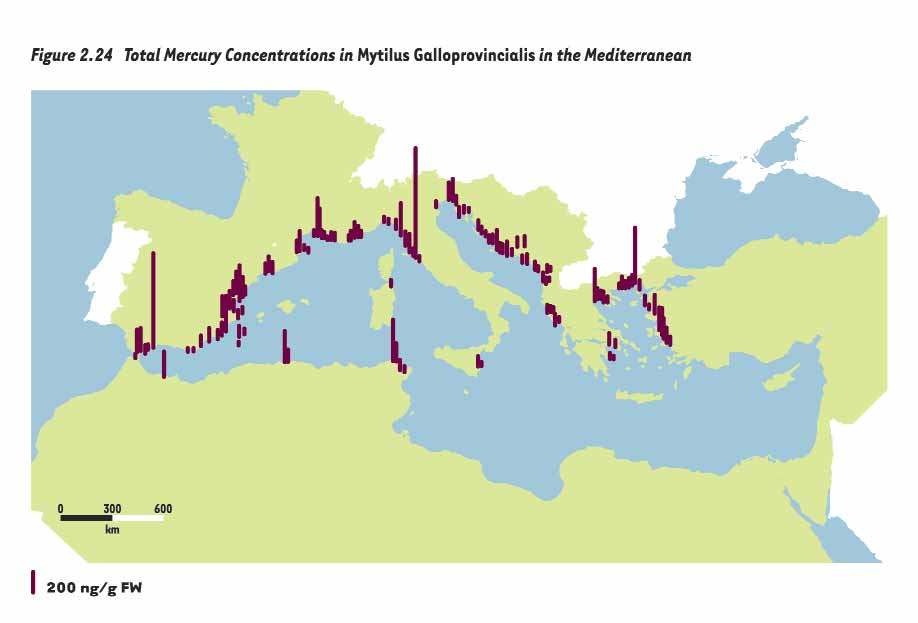
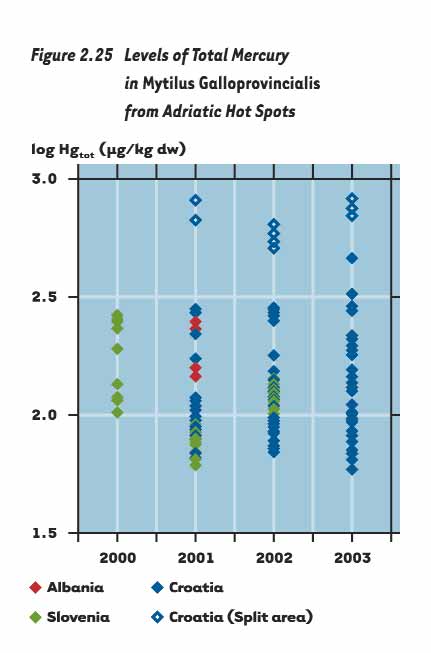
Recent raw data from MED POL
from a chlor-alkali plant. MED POL
Phase III on levels of total mercu-
historical data indicate the fol-
SIS (TDA) FOR THE MEDITERRANEAN SEA
ry, HgT, from Albanian, Croatian
lowing conclusions. There are two
Y
and Slovenian hot spots (Figure
populations of Tuna exhibiting
2.25) show pronounced land-
`low' and `high' concentrations of
TIC ANAL
based impacts in the Split area
HgT. The Atlantic population dis-
plays low levels of HgT, whereas
Y DIAGNOS
the levels are high for the Medi-
terranean population. This is the
pronounced impact of Hg mines
existing in the Mediterranean and
TRANSBOUNDAR
local impacts of hot spots. HgT in
sardines from the northwest coast
of the Mediterranean is 34 times
higher than in sardines from Gib-
raltar. HgT distribution from west
to east Mediterranean illustrates
the Mt Amiata Hg anomaly.
· Loads
In general, human emissions
are substantially less than natural
ones; ratios of 1:4 up to 1:30 have
been derived, admittedly from
very rough raw data (UNEP/FAO,
1996c).
On the basis of published data
and modelling results, in UNEP/
WHO (1998) the following data on
64
mercury loads are presented:
· the pollution of the Mediter-
cessing; electroplating; solders; bat-
ranean Sea by mercury and its
teries; production of alloys, pigments
compounds is brought about
and PCBs, and; sewage sludges.
mainly via the atmosphere
· Levels
and riverine run-off;
The levels in seawater cover a
· the total input from anthro-
wide range of values: open sea
pogenic sources through the
0.0040.06 mg/l (recent and prob-
atmosphere is 1040 tonnes
ably more reliable data); coastal
per year. The contribution of
sea < 0.0020.90mg/l, with a ten-
riverine run-off varies within
dency for high values to be related
the range of 50200 tonnes
to sources (estuaries, coastal mi-
per year (mainly in particulate
ning) (UNEP 1996a). Levels of Cad-
form);
mium in Mullus Barbatus depend on
· a portion of riverine run-off of
the LBS activities in different Medi-
mercury (about 1040 tonnes
terranean sub-basins (Figure 2.26).
per year) and the bulk of
atmospheric deposition come
to the Mediterranean Sea as
soluble mercury compounds
which can be assimilated by
the marine biota and thus
would affect the marine life.
· Impact
AL CONCERNS
Special attention should be
paid to coastal zones where higher
concentrations of mercury are ob-
served due to riverine run-off, in-
tensive sedimentation and atmo-
spheric deposition. In addition
2.0 MAJOR ENVIRONMENT
these zones are characterized by
enhanced biological productivity.
The Western Mediterranean, the
Tyrrhenian and Adriatic Seas are
believed to be the most vulnerable
regions (UNEP/WMO, 1998).
Cadmium
Critical effects of cadmium con-
tamination on plants are a decrease
in productivity, reduced rates of pho-
tosynthesis and transpiration, and
altered enzymatic activities. In sea-
waters, cadmium levels greater than
7 mg/l can initiate toxic effects for
animals, including growth retarda-
tion and decreased survival of inver-
tebrates, and kidney damage and
decalcification of the skeleton for
higher marine animals and seabirds.
Cadmium comes from copper
65
refining (as a by-product); lead pro-
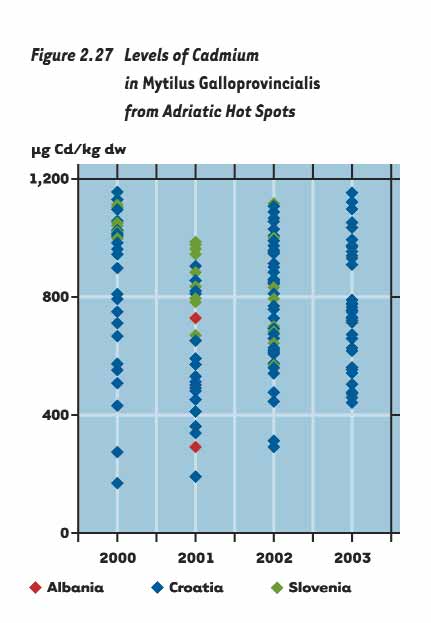
Recent raw data of MED POL
mg/l. In estuaries and rivers the
Phase III on total cadmium (Cd)
values are much more variable:
from the Albanian, Croatian and
1.53.75 mg/l in the Rhone delta
Slovenian hot spots (Figure 2.27)
(UNEP/FAO, 1996c).
showed that the background con-
Although arsenic itself is insol-
centration levels for the Mediterra-
uble, many of its compounds are
nean in Mytilus galloprovincialis
soluble in water, leading to aver-
during 20002003 were significant-
age seawater concentrations of
ly higher than those found from
2.03.0 µg/l (UNEP/FAO, 1996c).
MED POL historical data of two
· Loads
decades (50150 µg Cd/kg dw).
There is no accurate information
This is most probably a strong indi-
available as to the amounts of
cation of local impacts of land-
arsenic reaching the Mediterranean
based contamination from hot spot
Sea through domestic and industri-
sites in the Adriatic region.
al effluents (UNEP/FAO, 1996c).
· Impact
Marine organisms, especially
invertebrates, are able to con-
centrate arsenic from seawater
to high levels. Most of the arsenic
is in the organic form in marine
organisms, which is much less
toxic than the trivalent inorganic
compounds (UNEP 1996d).
SIS (TDA) FOR THE MEDITERRANEAN SEA
Y
Copper / Zinc
Zinc and copper constitute a haz-
TIC ANAL
ard to aquatic life in polluted waters
where other much more hazardous met-
Y DIAGNOS
als like lead, mercury and cadmium are
also present because its toxicity with
the other metals is additive. It has been
reported that sublethal concentrations
TRANSBOUNDAR
of Zn impair the reproduction of salmon
and some marine invertebrates.
Copper comes from mining; alloys;
metal plating; electricals; catalysts;
jewellery; algicides, and; wood preser-
Arsenic
vatives.
Arsenic is a by-product or waste of
Zinc comes from smelting; alloys;
non-ferrous metal processing (copper,
steel-making; metal-plating and gal-
zinc, lead, gold and cobalt), of fossil-
vanizing; paints and dyes; batteries;
fuel burning and the processing of
organic chemical production; oil refin-
phosphate rock and bauxite (for alu-
ing; fertilisers; paper pulp, and; vis-
minium).
cose rayon production. A ratio of 2.5:1
· Levels
for industrial: domestic discharge has
The levels of total dissolved ar-
been calculated.
senic in seawater, in the western
· Levels
Mediterranean below the photic
The levels of copper in seawater
zone (since arsenic is metabolized
cover a wide range of values: open
66
by phytoplankton), are 1.31.4
sea 0.040.70 mg/l (recent and
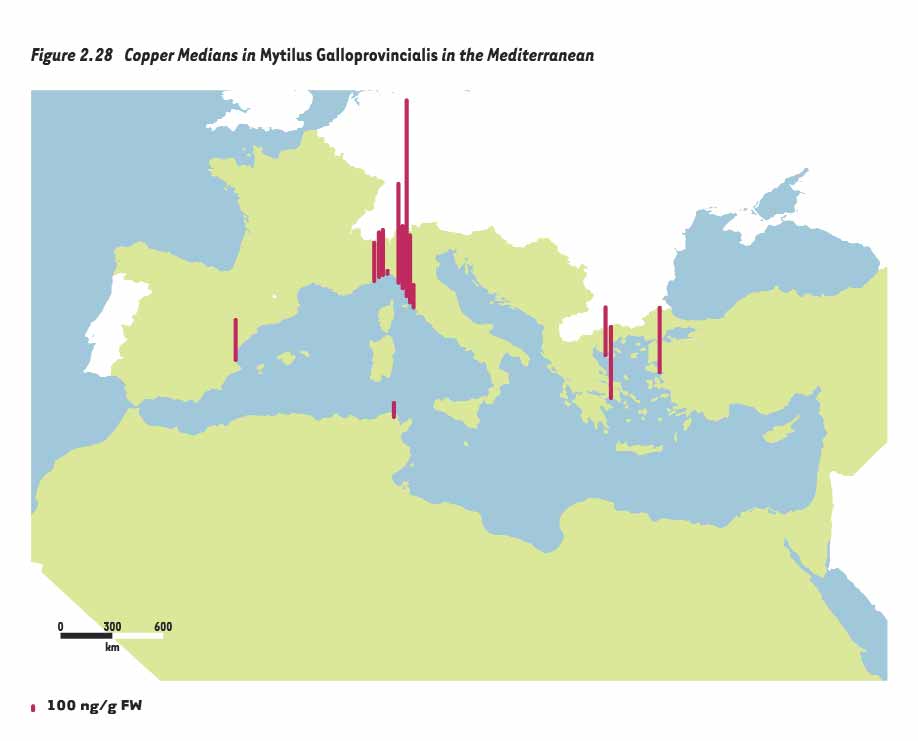
probably more reliable data);
information provided by Scoullos
coastal sea < 0.0150 mg/l, with a
and Constantianos (1996). In this
tendency for high values to be re-
study it is highlighted that zinc
lated to sources (Nile discharge,
and copper loads entering the Me-
coastal mining) (UNEP/FAO,
diterranean are significant and
1996c). Levels of Cu in Mytilus gal-
are considerably higher than
loprovincialis are shown in Figure
those reported in the past, as a
2.28.
result of the inclusion of marine
The levels of zinc in seawater
(via Gibraltar and Dardanelles)
cover a wide range of values:
and atmospheric inputs, which
open sea 0.240.56 mg/l; coastal
were not taken into account in
sea 0.20210 mg/l. A wide range
previous assessments.
of 0.01648 mg/l for a variety of
It is clear that although both
Mediterranean waters has been
the marine and atmospheric
reported (UNEP/FAO, 1996c).
inputs into the Eastern Mediterra-
· Loads
nean were assessed indirectly,
The amounts of copper dis-
they are of the same order of mag-
charged into the Mediterranean
nitude. This has been confirmed in
Sea through domestic and indus-
the Northwest Mediterranean. The
trial effluents have been estimat-
atmospheric inputs are also con-
ed at 2.3 and 6.0 tonnes x 103 per
siderably higher than the riverine
annum, respectively (UNEP/WHO,
and direct discharges, and thus
1996a).
could have a strong effect on con-
AL CONCERNS
Zinc and copper loads are
centrations in offshore waters and
specifically assessed based on
even in deep-sea sediments.
2.0 MAJOR ENVIRONMENT
67
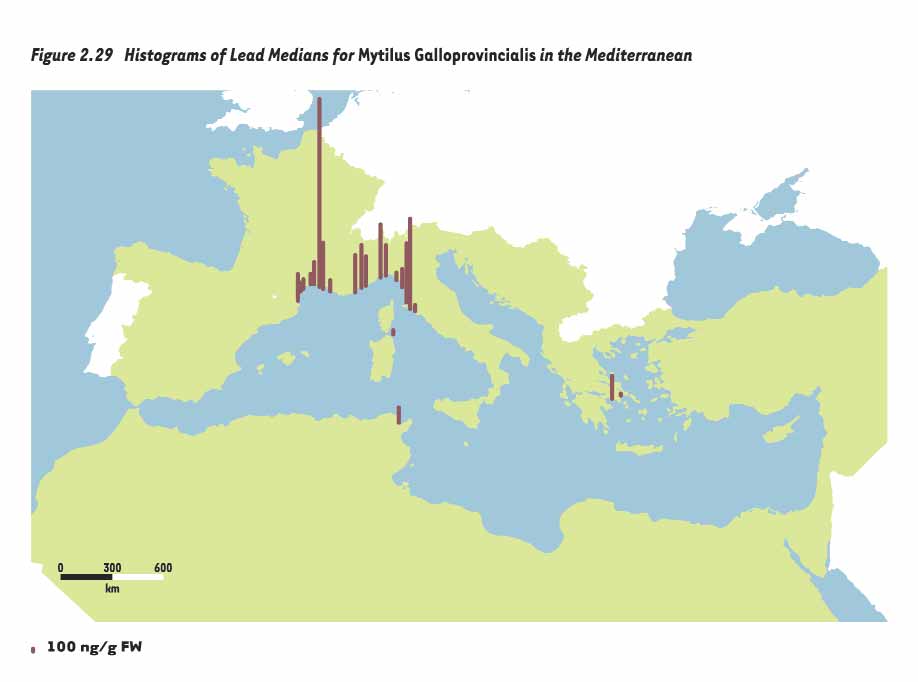
Lead
sea 0.01620.5 mg/l, with a ten-
Effects of lead on plants are lim-
dency for high values to be related
ited to areas where relatively high
to sources (lead tetraethyl pro-
concentrations of lead are found,
duction and estuaries) (UNEP/FAO,
like areas near mines or smelters. For
1996c). Lead is bioaccumulated in
animals, the signs of lead poisoning
Mytilus galloprovincialis with high-
are central nervous system disor-
er levels in the western Mediterra-
ders, high excitivity, motor abnor-
nean (Figure 2.29).
malities and blindness. In fish, lead
· Loads
accumulates primarily in gills, liver,
The amounts of lead discharged
kidney and bones, causing blacken-
into the Mediterranean Sea through
ing of the tail, damage to the spine
domestic and industrial effluents
and reducing larvae survival.
have been estimated at 200 and
· Sources
1,400 t/yr, respectively. These fig-
Lead comes from: mining;
ures apply to discharges from the
smelting; steel-making; produc-
coastal zone and do not include
tion of alloys; batteries; pigments;
river inputs (UNEP/WHO, 1996).
combustion of leaded (by lead
tetraethyl) petrol. A ratio of 7:1
b. Assessment of major pathways
for industrial: domestic discharge
of heavy metals
has been calculated (UNEP/WHO,
Discharges via rivers
1996b).
Atmospheric deposition, includ-
· Levels
ing rainwater loads, is overwhelming-
The levels in seawater cover a
ly the largest source of metals in the
SIS (TDA) FOR THE MEDITERRANEAN SEA
wide range of values: open sea
Mediterranean. Riverine inputs are
Y
0.0180.14 mg/l (recent and prob-
lower by comparison to atmospheric
ably more reliable data); coastal
deposition as shown in Table 2.9.
TIC ANAL
Y DIAGNOS
TRANSBOUNDAR
68
Table 2.9 Atmospheric versus Riverine Inputs of Lead and Zinc to the Mediterranean (tonnes/yr)
(Source: Guerzoni et al., 1999)
Lead
Zinc
River input
Atmospheric input
%
River input
Atmospheric input
%
WMED
2,200
2,800
56
9,200
31,700
78
EMED
2,650
3,700
58
15,500
28,000
64
Total
4,850
6,500
57
24,700
59,700
71
Transport of heavy metals in Medi-
of this information is restricted. As we
terranean rivers is the second largest
have seen above, by far most of the
factor in the redistribution of these
heavy metal transport occurs in the
contaminants from land to the sea. For
particulate phase, and a spatial and
the most part, heavy metals under
temporal inter-comparison of data
normal water acidity conditions do not
requires a sampling strategy that is
dissolve in water and once discharged
representative for the total suspended
attach to a particle and either sink to
sediment transport. This is almost im-
the bottom or remain suspended for
possible with the sampling frequency
some time. This particulate phase is
normally applied by national monitor-
what monitoring is focused on and
ing agencies. Including one high-turbid
therefore pollution is indicated by par-
sample or not in a data set may com-
AL CONCERNS
ticulate metal content to one gram of
pletely change the resulting averages.
suspended sediments (µg/g).
On the other hand, one has also to
The following focuses on a review
point out that the contamination
of 17 Mediterranean rivers based on
problem is still a major problem for the
data with different reference periods.
analysis of heavy metals. National
Studies on heavy metals in general
monitoring agencies usually charge
2.0 MAJOR ENVIRONMENT
face an important difficulty in distin-
public laboratories for the analytics,
guishing the human input from the
doing routinely a great number of
natural background. However, Medi-
samples of different origins. In fact,
terranean rivers are affected by man-
the analysis of drinking or surface
induced heavy metal pollutants, espe-
water may be followed by the analysis
cially mercury, cadmium and lead.
of wastewater or sewage sludge in the
The Po and Rhone rivers, for
same place with the same instrument,
instance, show elevated concentra-
which can lead to a great deal of
tions for all of the heavy metals
invalid data and misinterpretation of
reviewed here (Cd; Cr; Cu; Hg; Zn --Po;
the environmental process.
Ni; Pb --Rhone), especially for Po.
For these reasons, we refer in this
An assessment of the average
study mainly to studies that were con-
metal contents and loads in Mediterra-
ducted by independent research insti-
nean rivers is more difficult for heavy
tutions, applying ultra-clean tech-
metals than for other pollutants, such
niques for the analytics.
as nutrients, because it can hardly rely
The loads of lead and cadmium for
on the data regularly collected by
coastal city treatment plants are as
national monitoring programs. Two
low as one percent of the loads carried
reasons are responsible for that. On the
through atmospheric contamination.
one hand, many monitoring programs
Zinc discharges of wastewater plants
only measure total metals without fil-
are an exceptional case where cities'
69
tering the sample, although the utility
share of pollution is relatively more
significant than for other elements,
countries located around the Mediter-
although still less than 25 percent of
ranean Sea contribute to observed
atmospheric contamination.
deposition levels. Approximately 65 %
of Pb deposited to the basin can be
Atmospheric deposition
accounted for by the emissions in the
It should be noted that for metals,
Mediterranean countries and the
rainwater data is very scarce probably
remaining 35 % is from emissions in
because of the difficulties involved in
non-Mediterranean countries in
the analysis of the extremely low levels.
Europe. Among these countries
The existing data on metal composition
Bulgaria, which contributes 5 % to
of rainwater and wet deposition fluxes
total atmospheric Pb input to the Me-
of metals are confined to Northwestern
diterranean, Romania, which accounts
Mediterranean. Unfortunately, very few
for 3 % of total Pb deposition and
data on the metal concentrations in
Ukraine, which accounts for 5 %, are
rainwater exist for the rest of the
the most important ones. It should be
Mediterranean Sea. This is a serious
noted that contribution of these coun-
drawback for a basin-wide assessment
tries to Pb input to the Mediterranean
of wet deposition fluxes of metals.
are higher than contributions of many
There is a relatively even pattern
Mediterranean countries.
of deposition of Cd, Cu, Pb, Zn and Hg
Spain, Italy and France account
between the West and East Mediterra-
for 63 % of total Cd deposition to the
nean. Pb concentrations show in-
Mediterranean. Most of the Cd de-
creased values close to coastal
posited to the Mediterranean is emit-
waters because of road traffic emis-
ted in the Mediterranean region. Non-
SIS (TDA) FOR THE MEDITERRANEAN SEA
sions. Roads are very close to the
Mediterranean European countries
Y
coast in the Mediterranean region and
account only for approximately 10 %
coastal sites are therefore impacted
of Cd deposition in the entire basin.
TIC ANAL
from Pb emissions.
The contribution of countries out-
Not all of the metal load deposit-
side the Mediterranean basin to Hg
Y DIAGNOS
ed will be available for use by marine
deposition in the Mediterranean Sea is
organisms, however. Although the
significant. These countries account
exact degree of metal solubility
for approximately 40 % of Hg deposited
remains an open question, according
to the Mediterranean Sea. The remain-
TRANSBOUNDAR
to Guerzoni et al. (1999), approxi-
ing 60 % of deposited Hg is emitted
mately 4982 % of Cu, 6876 % of Zn,
from Mediterranean countries. Spain,
2165 % of Pb and 7592 % of Cd
Italy and France account for 56 % of Hg
deposited to the Mediterranean Sea
deposition, with the remaining 44 % of
are in soluble form and can be readi-
annual Hg deposition contributed by
ly utilised by organisms.
the other 16 countries.
As regards basin-wide deposition
This discussion shows that more
of metals, the only information on
than half of the annual metal deposi-
quantitative source-receptor rela-
tion in the Mediterranean region is
tionship comes from EMEP modelling
due to emissions from Mediterranean
exercises.
countries. Among the Mediterranean
Based on the modelling results,
countries, France, Spain and Italy are
the main contributors to Pb deposition
the highest contributors. Greece,
in the Mediterranean Sea are Spain,
Turkey, Serbia and Montenegro make
France, Italy and Greece. These four
up the second group. The remaining
countries account for approximately
Mediterranean countries do not con-
70 % of Pb deposited in the whole
tribute to metal deposition signifi-
70
basin. Both European countries and
cantly. However, it should be noted
that the model study from which the
icant part of the biosphere is uncont-
data are obtained does not provide
aminated by them. The two main cat-
information on different regions in
egories of the organochlorines meas-
the Mediterranean basin. This group-
ured in the MED POL programme are
ing of countries may change in differ-
chlorinated pesticides and polychlo-
ent sub-regions depending on the
rinated biphenyls (PCBs).
proximity of that particular area to
The most widely distributed group
emissions.
of chlorinated pesticides is that of the
Countries outside the Mediterra-
DDT family. Apart from DDT, its
nean region also contribute to metal
metabolites (DDE and DDD) are also
deposition to the Mediterranean Sea.
widely observed in the marine environ-
Among these, Bulgaria, Romania and
ment and may sometimes have a
Ukraine appear to be the most
greater environmental impact.
important.
Starting in the 1940s, these com-
pounds were produced and utilised in
2.3.6.3 Persistent toxic substances (PTSs)
vast quantities all over the world as
This section discusses the sources of PTSs in the
insecticides. Subsequently in the
Mediterranean and their effects on seawater quality.
1950s and 1960s there was an alarming
The levels of PTSs found in biodiversity are discussed in
decrease in bird and marine mammal
Section 2.1.5.3.b above.
populations. This fact, in combination
with evidence from laboratory experi-
a. Chlorinated pesticides
ments indicating toxic effects on
Chlorinated hydrocarbons sources
organisms exposed to organochlorines
AL CONCERNS
and concentration levels
led many countries in the northern
Organochlorines are a group of
hemisphere to ban or strictly regulate
organic compounds containing chlo-
the use of such compounds in the
rine. They are by far the most impor-
1970s. Most Mediterranean countries
tant group of persistent organic pol-
reported to DAO that in 1985 no chlori-
lutants (POPs), since they are char-
nated pesticides were used for agricul-
2.0 MAJOR ENVIRONMENT
acterized by high resistance to pho-
tural purposes, with the exception of
tolytic, biological or chemical degra-
gamma-HCH (Lindane), which is con-
dation. This fact, in combination with
sidered one of the least persistent
their low water and high lipid solubil-
organochlorines and is still used.
ity, leads to their accumulation in
According to GESAMP (1990), the
fatty tissues of marine organisms.
major route of entry of organochlo-
They are widespread in the environ-
rines into the marine environment is
ment and it is unlikely that any signif-
through the atmosphere.
Table 2.10 Concentrations (in ng/g ww) of Organochlorinated Compounds in Samples of Fish Tissues
collected in the NW Mediterranean
Fish species
Habitat
DDTs (DDT+D)
HCB
PCBs (7)
References
Mullus sp.
Coastal
4.416.8
1.66.7
8.720.3
--
Dicentratchus sp.
--
2.64.0
0.60.8
4.46.2
--
Lepidorombus sp.
Mesopelagic
0.8±0.2
--
2.1±0.3
--
Physics sp.
--
0.4±0.1
--
1.0±0.2
--
Lepidion sp.
Deep sea
6.07.1
0.140.17
8.39.4
Porte et al., 2001
Coryphaenoides sp.
--
1.94.3
0.250.67
2.54.6
--
Bathypterois sp.
--
5.010.2
0.120.25
6.010.0
--
Mora moro
--
7.412.6
--
9.0
Solé et al., 1998
71
Among specific uses of DDT still in
practice is its production as input to
Dicofol as well as application to flori-
culture and plant cultures (UNEP/GEF,
2002).
· Levels / Loads
Concentrations of dissolved
DDTs in water samples collected
in 1993 in the Western Mediterra-
nean (0.84.3 pg L-1) were one
order of magnitude higher than in
the corresponding particulate
phase (0.160.98 pg L-1). Suspen-
ded particulate matter at the
Ebro and Rhone River mouths
exhibited a surface enrichment
indicating a certain riverine input
to sea. However, about 80 per-
cent of the input consisted of
DDE, indicating a large preva-
lence of weathered residues
(Dachs et al., 1997). Concentra-
tions were slightly higher in the
continental shelf waters than in
SIS (TDA) FOR THE MEDITERRANEAN SEA
the open sea surface. A vertical
Y
gradient was also observed in the
Straits of Sicily and Gibraltar,
TIC ANAL
which has implications in the
exchanges of pollutants with the
Y DIAGNOS
adjacent seas.
Concentrations of dissolved
DDT metabolites 2,4'-DDT, 4,4'-
DDD and 4,4'-DDE were detected
TRANSBOUNDAR
in significant amounts in estuar-
ine water samples of Axios,
Loudias and Aliakmon rivers as
well as of Thermaikos Gulf during
1992 and 1993 (531 ng/l) (Alba-
nis et al. 1994; Albanis et al.,
1995a). Similar concentrations
(129 ng/l) were also detected in
estuaries of Louros and Arachthos
rivers as well as in marine wet-
lands of Amvrakikos Gulf in North-
west Greece during the period
from March 1992 to February 1993
(Albanis et al. 1995a; Albanis et
al., 1995b).
Figure 2.30 shows data on PCBs
and DDT in sediments according
72
to published literature.
Hexachlorobenzene (HCB)
ranged from 0.06 to 0.12 ng/l,
HCB is predominantly an industrial
whereas values one order of mag-
product, although its sources (as a
nitude lower were found in the
marine contaminant) are still not pre-
Western basin. Higher concentra-
cisely known (UNEP/MAP, 1996a). It is
tions were observed near terrestri-
mainly used as a fumigant and a fungi-
al run-off and river inputs.
cide in grain storage. HCB was also
Particulate matter had higher con-
used in some countries in the produc-
centration than the seawater dis-
tion of fireworks and to manufacture
solved phase (Jeftic et al., 1989).
synthetic rubber. Nowadays these uses
Concentrations of dissolved a-
are banned in most countries. HCB is
HCH, b-HCH and lindane were
also formed as a by-product, impurity
detected in significant amounts in
or residue in some industrial processes.
estuarine water samples of Axios,
For example it is generated as by-prod-
Loudias and Aliakmon rivers as well
uct during the manufacturing of chlori-
as of Thermaikos Gulf during 1992
nated solvents, it is found as impurity
and 1993 (130 ng/l) (Albanis et
in some pesticides, and it is formed
al. 1994). Similar concentrations
during the incineration of municipal
(211 ng/l,) were also detected in
and hazardous wastes. HCB emissions
estuaries of Louros and Arachthos
also take place during coating applica-
rivers as well as in marine wetlands
tion and curing processes in metal sur-
of Amvrakikos Gulf in Northwest
faces, during the production of sili-
Greece during the period from
cone-based products, during the man-
March 1992 to February 1993
AL CONCERNS
ufacturing of hydrochloric acid, etc.
(Albanis et al., 1995a; Albanis et
· Levels / Loads
al. 1995b).
Western Mediterranean coastal
waters exhibited concentrations of
Dieldrin, Aldrin and Endrin
dissolved HCB in the range of
The main uses of Aldrin are to con-
0.94.3 pg/l, with higher values
trol insects on cotton, corn and citrus
2.0 MAJOR ENVIRONMENT
offshore the Rhone River (10 pg/l)
crops, as a wood preservative and for
(Grimalt et al., 1988; Burns et al.,
termite control. In EU countries, its uses
1987). The concentrations in the
are very restricted (for some of them
dissolved and particulate phases
written authorisation is required) and
found at the bays of the Ebro delta,
some of them are banned (i.e., plant
were in the range of 1.04.1 and
protection use is banned since 1995).
1231 pg/l, respectively (Grimalt,
Dieldrin is easily derived from
et al. 1988).
Aldrin. Dieldrin is used to control soil
plagues and for the treatment of seeds.
Hexachlorohexanes
Several countries of the region have
HCHs are a mixture of isomers of
adopted measures to ban this com-
which one (gamma-HCH, lindane) is an
pound including Israel, Portugal, Turkey
insecticide. The atmosphere is the main
and the European Union.
pathway (99 percent of total input) in
Endrin is not included in the PIC
the global distribution of HCHs, but
Convention, so there are few data
they are highly soluble in water so they
available. The main uses of Endrin are
may be washed out of the atmosphere
as a pesticide on cotton, rice, sugar
by rain and accumulate in aquatic
cane and corn, but at present its use is
biota (UNEP/MAP, 1996a).
banned or restricted in most of the
· Levels
countries. In the Mediterranean region,
Lindane levels off shore in the
Algeria, Cyprus, Israel and Greece have
73
Eastern Mediterranean basin
banned all uses, while France, Italy,
Portugal and Spain allow very limited
time allowed for this ambitious project
applications.
was too short for any in-depth study of
· Levels / Loads
each and all pollution sources in the
Several studies have been car-
Mediterranean. For this reason and by
ried out in the mouth of some
the fact that the results were pooled for
rivers (see section 4.2.7) but no
each of the eleven UNEP Mediterranean
data are available for seawater.
regions, the project did not fulfil the
requirements of its first objective, to
b. Assessment of major pathways
provide the basis for national manage-
of PTSs
ment and control plans.
Discharges via rivers
Due to the difficulties and the
High pesticide concentrations
uncertainties involved in the complex
have been found in some specific
computations and extrapolations car-
studies and are believed to occur in
ried out, the results could not be bet-
many small rivers that are affected by
ter than rough estimates reliable
intensive agriculture. The type of pes-
within an error margin of one order of
ticides may vary from one river to
magnitude. Some of these results were
another and from one country to
proved, at a later stage, to be even
another. However, most rivers are not
worse. Only a comparative assessment
adequately monitored for PTS in order
of the regional contributions to the
to assess loads, even though they are
pollution load could be made. The re-
very important.
sults showed that the heaviest loads
During MED POL Phase I (1975
are discharged into the northwestern
1980), it was attempted through the
basin with one-third of the total pol-
SIS (TDA) FOR THE MEDITERRANEAN SEA
project MED X to estimate the quantity
lution load. The Adriatic Sea receives
Y
and nature of riverine inputs in the
about one-quarter of the total load.
region. The project met with consider-
Moderate pollution loads are encoun-
TIC ANAL
able difficulties. Country responses
tered in the Tyrrhenian and the Aegean
were geographically almost restricted
Seas, as they receive each about 10 %
Y DIAGNOS
to the Northern Mediterranean. Sam-
of the total load. The other Mediterra-
pling frequency, sample pre-treatment,
nean Sea areas each account for no
analytical methods and reporting for-
more than 5 % of the total.
mats varied widely. Some pollutants
More recently, accurate estimates
TRANSBOUNDAR
were rarely analysed (metals, specific
have been obtained for some French
organics, organochlorines). Field mea-
rivers using linear regression and aver-
surements of domestic sewage and
age weighted flow models. A survey
industrial wastewater were very limited.
was carried out during 199495 at the
No field measurements on agricultural
lower course of the Rhone River, far
run-off were available. Among 68 rivers
from the any marine influence. An
registered, only 30 were adequately
important conclusion was that the
monitored except for PTS.
large supply of fresh water (> 70 %)
In view of the limitations and diffi-
and consequently of dissolved species,
culties encountered, assessments of
corresponds to the medium-low flow
the pollution loads from land-based
regimes, whereas the contribution of
source (LBS) categories have been car-
large flows (> 5000 m3/s) represents
ried out, largely, by indirect computa-
less than 10 % of the total input. On
tions and extrapolations. They have
the contrary, these regimes contribute
been worked out taking into account
with about 80 % of the total input of
demographic statistics, the GNP of the
suspended particles. All pollutants,
countries, industrial production and
and notably PTS attached to the parti-
74
manpower, and agricultural data. The
cles, are carried to the sea in such
episodic events. A preliminary survey
c. PCBs
has also been recently conducted in
PCBs have been produced indus-
the Seine River, only for dissolved PTS.
trially since 1929 and were manufac-
The calculation included dieldrin,
tured in many industrial countries,
aldrin, endosulfan, heptachlor, HCB,
including some on the Mediterranean.
a-HCH, c-HCH, pp'-DDE and PCBs
They are complex mixtures of biphenyl
(seven congeners) as reported in
compounds with different degrees of
Table 2.11. The load of Lindane was
chlorination. 209 homologues and
consistent with the use of this com-
isomers exist. In the past they were
pound in the preceding years (1,500
used as dielectric fluids in transform-
tonnes/yr) but the DDE is reflecting
ers and capacitors and in hydraulic
the leaching of the existing environ-
and heat transfer fluids, but now
mental stock.
there are restrictions in their use. The
Similar calculations performed in
elimination of old electric appliances
the Ebro River in the 1980s gave inputs
remains an important source of envi-
one order of magnitude lower, consis-
ronmental pollution by these com-
tent with the difference in water flows
pounds. Combustion of PCBs can lead
(dieldrin and aldrin, 1 kg/yr; DDTs, 8
to the formation of toxic chlorinated
kg/yr; chlordane, 2 kg/yr; PCBs, 1225
furans and dioxins.
kg/yr; HCB about 30 kg/yr; and endo-
PCBs, as other organohalogens,
sulfan, 1.5 kg/yr) (Cid et al., 1990). An
enter the sea by and large through
input of 157 kg/yr of PCBs ( 7 congs)
atmospheric deposition accounting
has been reported in 1999 for the
for 80 percent of loads (UNEP/MAP,
AL CONCERNS
Guadalquivir (OSPAR, 2001). A study
1996a) and through rivers for the
carried out in 1993 in Turkey to assess
remaining part.
the riverine pollutant loads to the
· Levels / Loads
Black Sea has provided figures in the
PCB concentrations in the
order of 11 tonnes of aldrin, 31 tonnes
northwestern Mediterranean were
of dieldrin, 180 tonnes of endrin and
comparable to those of other
2.0 MAJOR ENVIRONMENT
500 tonnes of DDT per year, with the
regional seas, such as the North
Sakarya river being the most important
Sea, the Pacific, Indian and
source. Considering the other data, it
Antarctic oceans according to
is possible that these figures are large-
1990 reports (Tolosa, 1996).
ly overestimated. In fact, the determi-
Even though PCBs exhibit high
nation of river inputs requires not only
particle / dissolved concentra-
reliable analytical data, but also an
tion ratios, the low levels of sus-
optimisation of the sampling strategy
pended particles in Mediterra-
and statistical evaluation of data
nean waters (0.41 mg/l) make
(modelling), due to the large variabil-
the dissolved phase of the open
ity of hydrologic regimes of the
sea the dominant reservoir of
Mediterranean rivers.
PCBs. In vertical profiles meas-
Table 2.11 PTS Inputs (in kg/yr) of the Rhone and Seine Rivers into the Sea
River
Dieldrin
Aldrin
DDTs
PCBs
HCB
A-HCH
C-HCH
( 7 congs)
Rhone (199495)*
Dissolved
230
14
124
360
Particulate
33
51
304
157
23
21
Seine (2000)
Dissolved
13
6.3
6.3
6.5
79
85
* Qualité des Eaux du Rhône, Évolution 19691995, July 1999, Agence de l'Eau Rhône-Méditerranée-Corse.
75
ured in the Gulf of Lions in
first step was to estimate the number
198283, PCBs recovered from
of ships longer than 25 metres. The
the particulate fractions of sur-
sea traffic of ships that met the
face samples ranged from 3265
requirements was considered. On one
percent, whereas in deep waters
hand, it was accorded that roughly
with lower suspended particle
20 % of merchant marine sail across
loads, the fraction was from
the Mediterranean Sea; this repre-
1119 percent (Burns and Ville-
sents some 17,000 ships. On the
neuve, 1987).
other hand, it is supposed that more
Finally, a large water sampling
than 4,000 ships smaller than 500
was carried out in 199394 in the
tonnes but longer than 25 metres
Western Mediterranean, includ-
also circulate in this area. Thus the
ing the straits of Sicily and Gib-
number of ships considered in this
raltar (Dachs et al., 1997). Con-
study amounts to a total of 21,000.
centrations of dissolved PCBs
The average surface in touch with the
were almost one order of magni-
water that has been considered for
tude higher than in the corre-
each unit is about 700 m2, so the sur-
sponding particulate phase.
face susceptive of discharging is
Suspended particulate matter at
14,700,000 m2.
the Ebro mouth exhibited higher
It must be remarked that the dis-
concentrations than at the
charge rate considered for the esti-
Rhone River mouth. A spatial
mation of losses of TBTs into the sea, it
gradient was also observed from
has been chosen upward, bearing in
the continental shelf (3.526.6
mind that the leaching rate given in
SIS (TDA) FOR THE MEDITERRANEAN SEA
pg/l) towards the open sea
the IMO regulations is the maximum
Y
(1.76.6 pg/l). A relatively im-
value. So, having considered the for-
portant enrichment (8.4 pg/l)
mer rate, as well as the total surface
TIC ANAL
was found in open sea stations
of ships we obtain the following
located in higher productivity
approximate release rate: 588 kg/day.
Y DIAGNOS
frontal zones.
This results in an approximate annual
release of 214 tonnes of TBT from
d. TBTs
commercial shipping.
The main source of TBTs in the
According to previous discus-
TRANSBOUNDAR
region is through their release from
sions, the hot spots for TBT release in
antifouling paint in ships. In January
the Mediterranean are associated with
2003, however, the new IMO Conven-
the major commercial harbours in the
tion banning the use of TBT com-
Region. We can stretch further the
pounds in ship paints entered into
previous calculations and deduce
force, changing the situation. As far
where the Mediterranean areas, par-
as the present is concerned, there are
ticularly around harbours, where larg-
no available data about the annual
er inputs are in fact located.
amount of TBT released to the Medi-
Following the MED POL practice,
terranean Sea. An effort has been
the Mediterranean Sea has been
made in this report to estimate the
divided into different areas because
releases of TBTs to the Mediterranean
of the difficulty of estimating the
Sea due to maritime activities.
exact percentage discharged in the
The total discharges of TBT may
main harbours. Then, an estimation of
be estimated on the basis of leaching
the sea traffic in each zone for ships
rates. The IMO has recommended a
larger than 25 m and with a metallic
maximum leaching rate of 4
boat hull has been done; the results
76
mg/cm2/day at 25°C. Therefore, the
are shown in Table 2.12.
Table 2.12 Estimated Distribution of TBTs in the Mediterranean Sea
Zone
Countries
Sea traffic /
(main harbours)
Annual TBT release
North / West
Spain (Marbella, Alacant, Valencia, Balearic Islands,
26 % / 56 tonnes
Barcelona), Monaco, France (Marseille, Nice, Toulon),
Italy (Genoa, La Spezia, Livorno)
Centre / North
France (Corsica), Italy (Cagliari, Catania, Palermo,
28 % / 60 tonnes
Civitavecchia, Napoli, Venice, Trieste), Slovenia, Croatia,
Serbia & Montenegro, Albania
North / Oriental
Greece (Piraeus, Iraklion), Turkey (Istanbul, Izmir,
16 % / 34 tonnes
Anatolian Peninsula)
South / East
Syria, Israel (Haifa), Lebanon (Beirut), Cyprus
13 % / 28 tonnes
(Famagusta, Limassol), Egypt (Port Said, Alexandria)
South / Central
Libya (Banghazi, Marsa al Burayqah, Tripoli, El Brega),
3 % / 6 tonnes
Malta (La Valletta), Tunisia (oriental coast)
South / West
Tunisia (Tunis), Algeria (Alger), Morocco (Ceuta,
14 % / 30 tonnes
Melilla, Algeciras)
e. Polycyclic aromatic
the last ten years (EEA, 2002). There
hydrocarbons (PAHs)
are no figures or estimates available
Origins and major pathways
regarding the amount of petroleum
of PAHs
hydrocarbons carried directly through
Sea transportation appears to be
land run-off into the Mediterranean.
one of the main sources of PAHs pol-
Lipiatou et al. (1997) estimated that
AL CONCERNS
lution into the Mediterranean. It has
the total PAH riverine inputs amount
been estimated that about 220,000
to about 5.3 to 33 tonnes per year
vessels of more than 100 tonnes each,
from the Rhone river and 1.3 tonnes
cross the Mediterranean each year
from the Ebro river. The difference in
and about 250,000 tonnes of petrole-
these riverine fluxes is due to differ-
um hydrocarbons are discharged due
ences in the annual water discharges
2.0 MAJOR ENVIRONMENT
to shipping operations such as debal-
and upstream land use.
lasting, tank-washing, dry-docking,
An additional source of PAHs is the
fuel and bilge oil, etc.
result of the sewage sludge manage-
ment strategies. The three major
Accidental pollution
sludge producer countries, France,
Between 1987 and the end of 1996
Italy and Spain generate an annual
an estimated amount of 22,000
load of 2.9 tonnes of PAHs. Of those,
tonnes of oil entered the Mediterra-
some 1.2 tonnes are spread in the fields
nean Sea as the result of shipping
due to the use of sludge in agricultural
incidents. This figure was derived by
applications, and an additional 1.2
REMPEC from reports on all spill inci-
tonnes per year are input in the soil via
dents in the Mediterranean region
landfilling, while some 180 kg/yr are
that are regularly received from its
returned to the atmosphere mainly
National Focal Points and from Lloyd's
through sludge incineration in France.
Casualty Reporting Service. On an
An additional 220 kg/yr are dumped
annual basis there are about 60 mar-
into the Mediterranean through sludge
itime accidents in the Mediterranean
dumping in Spain.
of which 15 involve ships causing oil
As regards atmospheric inputs,
and chemical spills.
Lipiatou et al. (1997) reported a total
The land-based discharges are
PAH input ranging from 35 to 70 tonnes
both industrial and urban. These oil
per year with a mean value of 47.5
77
discharges seem to be constant since
tonnes (wet / dry mean ratio of ~23).
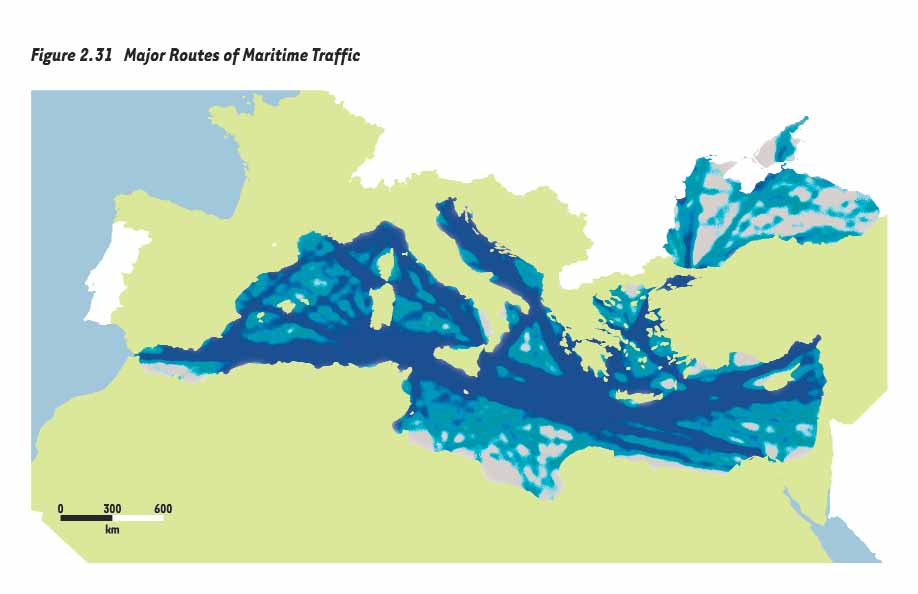
Accidental pollution is usually
fuel that is classified as a "persistent"
related to oil tanker major casualties,
and consequently dangerous pollu-
such as foundering, grounding, fire
tant. In fact heavy fuel used to feed
and explosion, collision at sea with
most of the high-powered so-called
another vessel, contact in a port with
"diesel" marine engines is not differ-
a quay, a pier or a bridge. These cargo
ent from the heavy fuel carried in the
oil spills, often involving large quan-
cargo tanks of the ill-fated ERIKA.
tities of hydrocarbons, attract the
Therefore, a spillage from the bunkers
attention of the public through their
of a very large and relatively fast ship
wide coverage by the media, showing
such as the most recent post-Panamax
terrific pictures of blackened beaches
container cargo vessel of 7,000 to
and of dead or dying oily birds, otters
8,000 TEU with a propulsive engine in
or seals.
the range of 80,000 bhp, may cause
It should be reminded here that oil
more serious damages to the marine
accidental pollution may also be gen-
environment than the total shipment
erated by similar casualties involving
of gasoline or even naphtha of a
any other type of ship whose bunker
20,000 dwt product tanker. The total
tanks and / or luboil ones happen to be
bunker capacity of such a vessel is in
fractured and release their contents in
the range of 11,000 tonnes of which
the sea. The volume leaked in most of
nearly 90 percent is heavy fuel.
these oil bunker spill cases is normally
Out of a world total of 8,395 regis-
much smaller than the one spilled from
tered events, 1,246 have taken place in
one of several cargo tank(s) of a dam-
a geographical area covering the Me-
aged oil tanker, but the quantity of
diterranean and Black Seas as well as
SIS (TDA) FOR THE MEDITERRANEAN SEA
pollutant entering the sea is only one
the Suez Canal. The corresponding per-
Y
of the factors to be taken into consid-
centage of the world total (14.8) is
eration to evaluate the seriousness of
only exceeded by the Northwestern
TIC ANAL
a given pollution event for the marine
European area --21 percent-- and the
and coastal environment. Bunkers are
wide Far East and Australia area: 18.4
Y DIAGNOS
at present mainly composed of heavy
percent.
TRANSBOUNDAR
78
From the same major casualties
Routine operation pollution
statistical analysis it appears that,
Over and above accidental oil
among the "Fire / explosion" events
spills, the Mediterranean receives high
recorded all over the world during the
amounts of operational oil pollution.
period, 21.7 percent took place in the
Due to limited regular aerial surveil-
Mediterranean / Black seas area. The
lance in the region compared to other
corresponding percentage for "Foun-
"Special Areas" such as the Baltic Sea
dered vessel" events was 16.9 per-
and the Northwest European waters,
cent, and the one for "Collisions" was
and the resulting lack of regional sta-
16.3. Thus, the frequency of the above
tistics on pollution arising from rou-
casualty categories that are more
tine ship operations, estimating oper-
likely to provoke cargo and bunker
ational oil pollution in the Mediterra-
spills was higher for the considered
nean has been incomplete. A recent
area than the world average. The
study by the EU (EC, 2001), using re-
especially high percentage of "Fire
connaissance carried out over the
and explosions" in the Mediterranean
entire Mediterranean region through
Basin should probably be related to
the analysis of ERS-1 and SAR images
the importance of oil and chemical
presents the following data for the
tanker trades in this area, as the ships
year 1999.
of these types are particularly ex-
A considerable number of the
posed to this category of casualty.
detected oil spills (38.5 percent) dur-
Such a global and regional Marine ca-
ing the year 1999, were considered to
sualty analysis has not been repeated
represent without doubt spilling in
AL CONCERNS
for a more recent period; however,
action. The total area of the 1,638
when the yearly number of major
detected spills was estimated to be
casualties at the world level happily
17,141 km2. An estimated 13,858
has been on the decrease, there is no
metric tones of spilled oil was esti-
indication that neither their geo-
mated from the satellite images. This
graphical distribution nor their typol-
amount, considered by many re-
2.0 MAJOR ENVIRONMENT
ogy has been much modified during
searchers to be a conservative esti-
the last decade.
mate, is already four times greater
Obviously, detailed knowledge of
than the average amount of oil spilled
the distribution by cargo categories
in the region due to shipping acci-
volumes and geographical routes of
dents (REMPEC, 1998).
the merchant ships' traffic flows and
Taking into account the volumes
marine casualties is required to ascer-
of oily wastes received daily in the
tain the environmental risks generat-
Mediterranean port facilities and the
ed by Maritime Transport activities in
number of ships operating in the
ports, coastal areas and open sea in a
region, it appears clear that dumping
given marine area. This requirement is
in sea of oily wastes remains the
not well addressed in the present
favourite option of the ship Masters
state of collection and dissemination
in the Mediterranean. There are many
of sea-borne trade statistics, as it will
reasons for such behaviour:
be explained hereafter.
· Waste oil receiving facilities are
In general, the direct ecological
absent in many Mediterranean
impact is mainly on birds and marine
ports;
mammals, less so on fish and inverte-
· The access to the receiving fa-
brates. From the economic point of
cilities is usually time consuming;
view, the most directly affected activ-
· The Mediterranean Port States
ities are fishing, fish farming and
are not able to identify small oil
79
tourism.
spillage;
· Even if an oil spillage is identi-
primarily to protect the environment,
fied, a cost-benefit analysis
but rather for a tactical discretion
between the money paid as
purpose.
penalty and the loss of time for
The major source of petroleum
oily waste disposal in the port
hydrocarbon pollution in the marine
is in favour of the dumping in
environment results mainly from dis-
the sea.
charge of oily water and residues
Most operational pollution causes
resulting from the washing and debal-
are common to all types of merchant
lasting at sea of the cargo tanks.
ships (and to many non-merchant
Similar problems exist for chemical
ones). Some are related to propulsion
tankers carrying hazardous sub-
plants: oily water and wastes collect-
stances. The operational discharge of
ed in machinery space bilge tanks,
oil comprises also effluents of oily
nitrogen acid and other pollutants in
bilge water and residues from the
machinery exhaust fumes; others to
machinery space of all ships.
the crew and passengers: garbage and
According the IMO MARPOL Con-
sewage; others to the ship's mainte-
vention, the Mediterranean Sea has
nance and operation: cleaning of
been designated as a "Special Area"
tanks and piping before repairs, anti-
and harmful discharge of hydrocar-
fouling organotin paints, unwanted
bons is not permitted. Nevertheless,
aquatic organism and pathogens fund
the problem of operational oil pollu-
in ships' ballast water and sediment
tion persists.
discharges.
The estimated volume of oily
However, some well-publicised
wastes from tanker operations (espe-
SIS (TDA) FOR THE MEDITERRANEAN SEA
pollution causes are specific to the
cially deballasting) reaches 450,000
Y
operation of a certain ship type /
metric tonnes. Discharges of "oily
cargo category combination. The most
bilge waters, sludge and used luboils
TIC ANAL
infamous is the operational discharge
from ships" are supposed to represent
of oil and / or oily wastes at sea as the
a further 60,000 metric tonnes (UNEP/
Y DIAGNOS
consequence of the washing of cargo-
MAP, 1997).
tanks of an oil tanker after unloading
a shipment of crude or petroleum
2.3.6.4 Pollution Hot Spots
products and before loading the next
The MED POL report on priority pollution hot
TRANSBOUNDAR
one or undertaking a maintenance or
spots and pollution sensitive areas developed in 1997
repair operation. The same kind of
includes the list of pollution hot spots and sensitive
problem exists for tank cleaning in
areas not only in GEF-eligible countries, but in all Medi-
chemical and LPG tankers which has to
terranean countries. In 2002 a revised list of pollution
be carried-out each time a cargo
hot spots and sensitive areas was developed taking into
change occurs in a given tank or group
consideration the potential transboundary effect of
of tanks.
those hot spots, if any. For the selection of pollution hot
Fishing and pleasure craft are also
spots for pre-investment studies, the aim was to pre-
sources of operational pollution and
pare a list of such hot spots taking fully into account the
the latter are particularly numerous
transboundary potential effect of pollution according
along the Northern shores of the
to established and agreed criteria. The updated list of
Mediterranean Sea. A possible, but
pollution hot spots and pollution sensitive areas is
practically not documented, pollution
shown in Annexes III and IV. These hot spots are shown
source derives from warship opera-
on Figure 2.32, together with pollution sensitive areas.
tions in the Mediterranean Sea. In
fact, the NATO navies units are well
Definition of Pollution Hot Spots
equipped and their crews well trained
· Point sources on the coast of the Me-
80
to avoid operational pollution, not
diterranean Sea which potentially
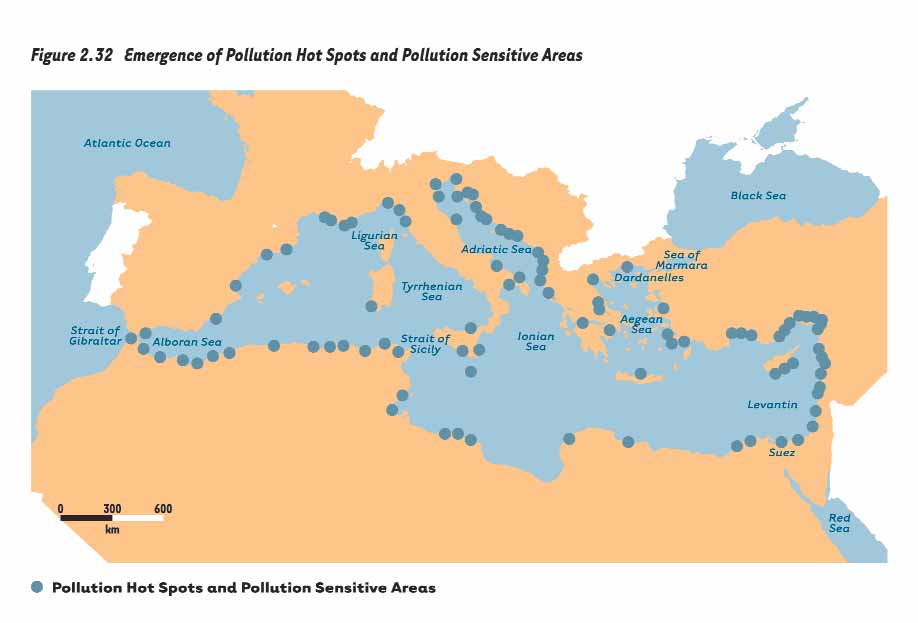
affect human health, ecosystems,
Pollution Sensitive Areas
AL CONCERNS
biodiversity, sustainability or econ-
in the Mediterranean Countries
omy in a significant manner. They are
Pollution sensitive areas of the
the main points where high levels of
Mediterranean basin are of great
pollution loads originating from
importance because of their potential
domestic or industrial sources are
capacity to become, if not protected,
being discharged;
future pollution hot spots. If such a
2.0 MAJOR ENVIRONMENT
· Defined coastal areas where the
development takes place, sensitive
coastal marine environment is sub-
areas will require huge investments for
ject to pollution from one or more
their rehabilitation, instead of very
points or diffused sources on the
moderate ones for their actual pro-
coast of the Mediterranean that
tection.
potentially affect human health in a
In the document on the "Identifi-
significant manner, ecosystems, bio-
cation of Priority Pollution Hot Spots
diversity, sustainability or economy.
and Sensitive Area in the Mediterra-
nean Sea" (UNEP/WHO, 1999), sensi-
Pollution Hot Spots Indicators
tive areas are defined:
(primary)
"Estuaries and coastal waters of
· BOD, COD;
natural or socioeconomic value are
· nutrients (phosphorus, nitrogen);
considered sensitive areas if they are
· total suspended solids;
at higher risk to suffer negative
· oil (petroleum hydrocarbons);
impacts from human activities.
· heavy metals;
Natural characteristics may deter-
· persistent organic pollutants;
mine the vulnerability of a coastal
· radioactive substances (whenever
system, for example a bay with low
applicable);
flushing rates is more sensitive to pol-
· litter;
lution impacts than one, which is well
· microorganisms (faecal coliforms,
flushed. Human activities determine
81
E. coli).
the level of risk; hence planned devel-
opment may increase the risk of envi-
about 3 million tonnes and shellfish at more than 12,000
ronmental degradation. Both vulnera-
tonnes annually. Health risks that may stem from con-
bility and risk contribute to the sensi-
sumption of contaminated fish / shellfish or ingestion
tivity of a particular area or system in
of contaminated water while bathing are therefore
the context of this assessment".
important public health concerns that extend beyond
It has to be clarified that sensitive
the boundaries of the basin.
areas are not protected areas of great
Although there has been significant progress
ecological value. Sensitive areas are
in combating health-threatening pollution in the Me-
aquatic environments already pollut-
diterranean, the quality of recreational and shellfish
ed, which will become hot spots if no
waters still gives rise to concerns. A wide disparity
action is taken. Their "sensitivity"
exists between regions in data available on the extent
refers to their imminent environmen-
of damage to human health resulting from waterborne
tal degradation.
contaminants. The lack of data makes it difficult to
Annex IV exhibits the list of pollu-
accurately assess the overall situation at present.
tion sensitive areas per Mediterranean
However, existing evidence suggests that there is a
country together with the type of pol-
basis for justification of action on an international
lution and the proposed actions to be
level to mitigate adverse health outcomes arising
considered to prevent the develop-
from marine pollution.
ment of the area into a Hot Spot.
2.4.1 Transboundary elements
2.4 Human Health Risks
The human health aspects related to the Medi-
Environmental degradation of the Mediterra-
terranean Sea have transboundary aspects to them.
nean ultimately affects the health of humans who rely
Although, as for pollution, much of the input is local
on it for fishing, for food supply, and for recreation.
and therefore more or less identifiable, the transport of
SIS (TDA) FOR THE MEDITERRANEAN SEA
This section surveys the risks to human health tied to
the pollutants may achieve transboundary character.
Y
microbiological and chemical contamination of the
For instance, currents may move pollutants from
waters, the main routes by which the pollution affects
place-to-place. Migratory fish (such as tuna and
TIC ANAL
human health, and the state of information currently
swordfish) may bioaccumulate contaminants and then
available. Although GEF actions are addressed primari-
translate human health risks to other parts of their
Y DIAGNOS
ly at ecosystem effects, the stakeholders involved in
range. Fish products are distributed from country-to-
preparing the TDA felt that human health risks were a
country in and out of the Mediterranean, so any exports
major priority in the region. Hence its inclusion as one
may affect other countries. Finally, vacation-goers
the MPPIs. The human health risks discussed here are
may take disease back to their countries from illnesses
TRANSBOUNDAR
linked to the social-economic impacts of the third
caught while swimming in the Mediterranean (hepatitis
MPPI: decline in water quality. However, in this section
A being one example).
they are described in more detail, with specific linkages
In summary, the major transboundary elements
to the contaminant issues raised in the previous sec-
of the Human Health issue are:
tion (2.3).
· Export trade of contaminated seafood dif-
The damage marine pollution might inflict on
fuses health concerns both throughout and
human health is a highly sensitive topic since the sea
beyond the Mediterranean basin;
plays a major socio-economic role in all Mediterranean
· Demand for seafood linked to foreign travel to
states. Apart from the approximately 130 million inhab-
the Mediterranean exposes tourists to health
itants living permanently along the coastline and inter-
risks from contaminated seafood;
acting frequently with the water, another over 100 addi-
· Risks of adverse health impacts from bathing
tional million tourists visit the area annually. During the
in contaminated seawater, including dis-
summer months, the sea constitutes the main recre-
eases such as gastroenteritis, ear, skin and
ational amenity for local and tourist populations alike
eye infections, and viral diseases like hepati-
and tourism is a significant economic lifeline for many
tis A and cholera; and
areas. Seafood harvested from the Mediterranean is an
· Superficial or deep mucoses from contact
important part of the diet in the region with consump-
with contaminated beach sand while vaca-
82
tion of finfish (imported and homegrown) estimated at
tioning in Mediterranean coastal zones.
2.4.2 Environmental impacts
infections linked to travel in the Mediterranean give
There are no known environmental impacts
grounds for such concerns. Stille et al. (1972) esti-
arising from human health issues, other than perhaps
mated that as many as 19 percent of infectious hepa-
introduction of pathogens from the Mediterranean to
titis cases occurring in Frankfurt were attributable to
other areas of the Mediterranean due to consumption
consumption of contaminated oysters and mussels in
or other human or animal exposure to pathogens from
the Mediterranean by German tourists.
the Mediterranean. There has been no documentation
· Particular seafood consumer groups exposed
of such instances, however, to merit this as a great
to risks of adverse health outcomes, person-
environmental concern.
al distress in addition to high healthcare
costs.
2.4.3 Socio-economic impacts
Another group of socio-economic concerns
Major socio-economic impacts arise from spe-
arises from public health risks and associated health
cific problems related to human exposure to viral or
care costs for particularly exposed population groups.
pathogenic agents, such as:
Occupational exposure of individuals employed in the
· Transmission of viral, bacterial and other
fisheries sector is much higher for substances such as
infections from polluted waters to man with
methylmercury and PCBs. The effects of these persist-
short-term adverse health impacts;
ent toxic substances would cause individual distress
· Public health risks of methylmercury poison-
and represent an economic cost to society in terms of
ing linked to high seafood consumption with
increased health care expenses.
long-term impacts;
· Occupational hazards posed by marine pol-
· Public health risks from toxic effects of PCB
lution pose public health and social welfare
and dioxin linked to high seafood consump-
issues.
tion with long-term impacts;
Moreover, in case toxicity of certain seafoods
AL CONCERNS
· Public health risks from cumulative unknown
rises further, the whole fisheries sector would be sub-
effects of chemical contaminants as well as
ject to adverse large-scale repercussions. The conse-
their combined unknown action on humans in
quences of potential decline in demand due to health
the long run;
concerns on seafood consumption, loss of employ-
· Public health risks from consumption of
ment and regional decline in some areas would have
toxin-contaminated fish and shellfish
multiple adverse socio-economic consequences.
2.0 MAJOR ENVIRONMENT
Any increase in health risks from marine pollu-
tion can have adverse economic consequences, mainly
2.4.4 Causal Chain Analysis
for the tourism, recreation and fisheries sectors in the
The causal chain analysis for this issue is essen-
Mediterranean.
tially the same as for the third MPPI: decline in seawa-
· Loss of income from tourism related to
ter quality. In order for risk to human health to occur,
health concerns associated with travel in the
two criteria must be satisfied. First, there must be a
Mediterranean.
toxicity associated with the contaminants of concern.
Concern about actual as well as potential
Second, there must be some exposure pathway.
health effects could make the basin less attractive as
Without toxicity there is no risk. Without pathway for
a tourist destination. The nature of tourism character-
exposure, there is no risk.
ized by prolonged exposure to waters and long bathing
Hence, the causal chain analysis for this human
season exacerbates risks of exposure to marine pollu-
health factor can be summarized by the mechanisms
tion. Another concern arises from overcrowded beach
that generate toxicity. This is the same mechanistic
conditions known to facilitate transmission of infec-
framework as that generating decline in seawater
tious diseases.
quality. Second, there must be a mechanism leading to
· Seafood causes significant rise in health care
exposure. The exposure pathways are:
expenditure among tourists to the Mediterra-
· Ingestion of seafood
nean.
· Ingestion of water while swimming
In terms of infections linked to consumption of
· Contact with contaminated seafood products
contaminated seafood, adverse effects on tourism in
(e.g., methyl mercury and the like)
the region are also conceivable. Large numbers of spo-
· Contact with seawater contaminated with
83
radic cases, particularly among tourists, of various
pathogens or viral agents
The causal chain analysis in Figure 2.4.1 basi-
exposure to various socio-economic impacts (but not
cally mirrors the exposure pathway. It also links the
environmental impacts).
SIS (TDA) FOR THE MEDITERRANEAN SEA
Y
TIC ANAL
Y DIAGNOS
TRANSBOUNDAR
84
2.4.5 Supporting data
or taste, and the earliest symptoms of
2.4.5.1 Chemical contamination
accumulation in the human body are
a. Intake of persistent
not, as a rule, specific for chemical
toxic substances (PTSs)
poisoning and therefore hard to detect.
and associated health risks
The presence of such pollutants can
In spite of the wide distribution of
only be determined through relatively
PTS in the Mediterranean, data on the
sophisticated clinical and biochemical
human health effects in the region
tests, which, however, may reveal a
show remarkable paucity. Since diet,
health problem well into its develop-
including seafood consumption, ac-
ment stage.
counts to up to 95 percent of human
From a variety of toxic chemical
exposure to PTS, however, the pres-
substances in the Mediterranean,
ence of PTS in various foodstuffs pro-
among the most serious effects for
vides an initial estimate and relevant
human health are linked to methyl-
indicator of the risks to human health
mercury, a synthetic toxic compound of
from pollution of the sea by PTS. Based
the naturally occurring mercury. Eating
on a recent study (UNEP/GEF, 2002), a
relatively high amounts of seafood may
selection of PTS and their related
expose consumers to wide-ranging
effects on human health are present-
health risks due to methylmercury poi-
ed here as particularly relevant to this
soning. Disturbed sensory motor and
analysis.
cognitive functions, acute fatigue, and
Whereas bacterial or viral pollution
mild learning difficulties in infants
produces relatively short-term effects,
borne to infected mothers are among
AL CONCERNS
some chemical pollutants are known to
the possible health consequences of
cause long-term effects. Local popu-
methylmercury poisoning.
lations are more susceptible to health
Diet is the main route of exposure
damage from chemical contaminants,
to methylmercury as to other PTS,
due to chronic exposure (as contrasted
accounting for up to 90 percent of
to a one-time exposure of a tourist).
exposure. As can be seen in Table 2.14,
2.0 MAJOR ENVIRONMENT
Moreover, in contrast to microbiologi-
the risks to public health from methyl-
cal pollution, individuals are more like-
mercury poisoning affect particular
ly to be exposed to chemical contami-
groups but are not significant for the
nation unknowingly and for prolonged
general public whose intake is below
time periods. Relatively high levels of
the Tolerable Daily Intake (TDI). A
chemical pollutants in seafood may
study by MED POL in early 1980s, cov-
have no noticeable effect on its smell
ering Italy, Croatia and Greece, by
Table 2.13 Intakes of Persistent Toxic Substances and Corresponding Safety Thresholds
PTS
TDI xg/kg/day
Organisation
Food intake (mean / adults)
Source
HCHs
0.3 µg
WHO
5.3 ng (1.8 %)
Italy
Chlordane
0.5 µg
WHO
--
--
Dioxins (I-TEQ)
1 pg
WHO
1 pg (100 %)
Italy
--
--
1.03 pg (103 %)
France
--
--
3.5 pg (350 %)
Spain (Catalonia)
PCB-DL (I-TEQ)
1.3 pg
WHO
2.5 pg (192 %)
EU
PCB (Aroclor 1260 Eq)
0.02 µg
WHO
36.8 ng (180 %)
Italy
PAHs (BaP Eq)
14 ng
DVS 10-4 RIVM
5 ng (36 %)
France
Hg
0.7 µg
WHO
0.25 µg (36 %)
France
Me Hg
0.47 µg
WHO
0.34 µg (72 %)
France
TDI: tolerable daily intake
85
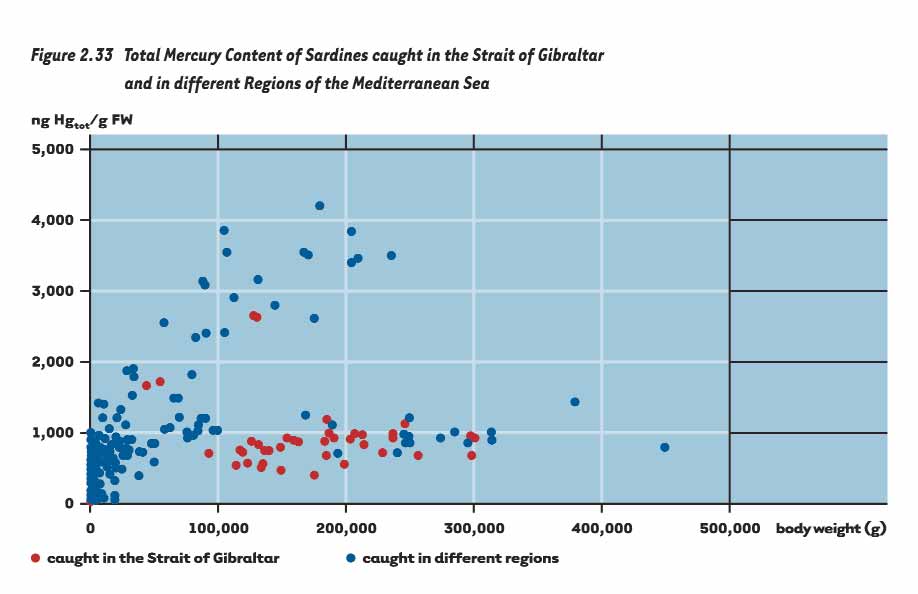
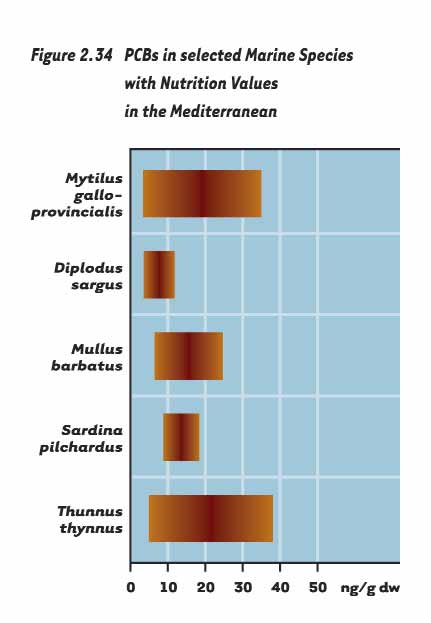
contrast, showed that individuals who
These population groups (infants,
consume high quantities of seafood,
fish consumers) may exceed TDIs (34
such as fishermen and their families
times as reported by AFSSA). For
SIS (TDA) FOR THE MEDITERRANEAN SEA
are susceptible to health risks from
instance, infants exposed through
Y
methylmercury poisoning. Young chil-
lactation in Serbia and Montenegro
dren are also a high-risk group for
showed intakes of 1.75 ng the daily
TIC ANAL
methylmercury poisoning.
tolerable intake of PCBs (Vukavic et
Infants and fish consumers are
al., 1997).
Y DIAGNOS
also high-risk groups due to weakening
of the immune capacity and a wide
range of other adverse health effects
caused by PCB and dioxin intake from
TRANSBOUNDAR
seafood. PCBs induce various enzymes
in the liver and can produce changes in
the immune system, behavioural alter-
ations, impaired reproduction, liver,
stomach, and thyroid gland injuries.
Some PCBs can mimic or block the
action of hormones from the thyroid
and other endocrine glands. Few stud-
ies of workers indicate that PCBs were
associated with certain kinds of cancer
in humans, such as cancer of the liver
and biliary tract. Both EPA and IARC
have determined that PCBs are proba-
bly carcinogenic to humans. However,
the most commonly reported health
effects in people exposed to large
amounts of PCBs are skin conditions
86
such as acne and rashes.
For dioxin-like PCBs (DL-PCBs)
Toxicological effects reported
expressed as Total Equivalent (TEQ),
for PCDDs and PCDFs refer to the
the food exposure is twice the WHO
2,3,7,8-substituted compounds. A
(1998) TDI for dioxins and DL-PCBs.
variety of effects have been re-
For total PCBs the dietary intake
ported in animal studies following
based on Italian TDIs study is about
exposure to these compounds
two times the TDI recently revised by
(WHO, 1998). The most extensive
the WHO and given in Aroclor equiva-
data set is available for 2,3,7,8-
lent. This observation is well correlat-
TCDD; less information is available
ed with the over-exposure found for
for the other congeners. Among
DL-PCBs. Thus, the new TDI of PCBs
the most sensitive endpoints of
revised by the WHO appeared to be
2,3,7,8-TCDD are endometriosis,
pertinent for risk-assessment of total
neurobehavioral, developmental
PCBs. The EU SCOOP report indicated
and reproductive effects, and
that fish and fish products contribu-
immunotoxic effects.
ted to 70 % of the food exposure of
The lowest doses giving rise to
DL-PCBs.
statistically significant effects in
the most sensitive endpoints fol-
b. Intake of persistent
lowing exposure have resulted in
toxic substances (PTSs)
body burdens (3 to 73 ng of TCDD/
and associated health risks:
kg) in the exposed animals that
Other PTS of concern
overlap, at the lower end, the
in the region
range of body burdens expressed
AL CONCERNS
· Polychlorinated dioxins
as TEQ that are found in the gen-
and furans (PCDD/Fs)
eral population in industrialised
PCDD/PCDFs occur as trace con-
countries exposed to background
taminants in a variety of industrial
levels of PCDDs and PCDFs.
and thermal processes. As a conse-
Of the many non-cancer effects
quence, dioxins from so-called pri-
evaluated in exposed adult popu-
2.0 MAJOR ENVIRONMENT
mary sources can be transferred to
lations (e.g., herbicide producers
other matrices and enter the en-
and subjects exposed in incidents
vironment. Such secondary sources
like Seveso, Italy), many were
are sewage sludge / biosludge,
transient effects disappearing
compost, or contaminated areas.
after the end of exposure. The only
More than 90 % of human expo-
effect that correlates consistently
sure to PCDDs and PCDFs is esti-
with high exposure of humans to
mated to occur through the diet,
TCDD was chloracne. A few condi-
with food from animal origin,
tions appear to be in excess
including seafood, being the pre-
among the exposed cohorts when
dominant source. The daily intake
compared to unexposed reference
of PCDDs and PCDFs from food has
groups including alterations in
been estimated to be 210 pg I-TE
metabolic parameters, as well as
per person in Spain (Domingo et al.
mortality from cardiovascular and
1998) and 97 per person in France.
non-malignant liver disease.
For Italy, a daily intake of 45 pg I-
PCDDs and PCDFs have been
TE per person has been calculated
classified as substances for which
considering the only contributions
there is evidence of endocrine dis-
from food of animal origin (a daily
ruption in an intact organism
intake of about 60 pg I-TE may be
(COM, 1999). 2,3,7,8-TCDD has
assumed when contributions from
been shown to be carcinogenic in
87
the other foodstuffs are added).
several species of laboratory ani-
mals at multiple sites. In humans,
of the PAHs are genotoxic or prob-
the epidemiological evidence from
ably genotoxic. The only com-
the most highly exposed cohorts
pounds for which negative results
studied produces the strongest
were found in all assays were
evidence of increased risks for all
anthracene, fluorene, and naph-
cancers combined, along with less
thalene. Owing to inconsistent re-
strong evidence of increased risks
sults, phenanthrene and pyrene
for cancers of particular sites. IARC
could not be reliably classified for
concluded that 2,3,7,8-TCDD is
genotoxicity. PAHs have generally
carcinogenic to humans (Group 1).
been reported to have immuno-
Other polychlorinated dibenzodi-
suppressive effects.
oxins and dibenzofurans are not
Because of the complex profile
classifiable as to their carcino-
of PAHs in the environment and in
genicity to humans.
workplaces, human exposure to
· Polycyclic aromatic
pure, individual PAHs has been
hydrocarbons (PAHs)
limited to scientific experiments
Sources of general population
with volunteers, except in the case
exposure to PAHs include contam-
of naphthalene that is used as a
inated food and seafood in par-
moth-repellent for clothing. After
ticular. The calculated total daily
dermal application, anthracene,
intake of PAHs from food has been
fluoranthene, phenanthrene and
estimated to be 3 µg/day (1.4
benzo[a]pyrene induced specific
µg/day carcinogenic PAHs) per
skin reactions, which were classi-
person in Italy (Lodovici et al.,
fied as neoplasic proliferations.
SIS (TDA) FOR THE MEDITERRANEAN SEA
1995).
· Alkylphenols
Y
The acute toxicity of PAHs
Exposure to alkylphenols occurs
appears to be moderate-to-low
mainly from food including sea-
TIC ANAL
(EHC). Short-term studies showed
food. The dietary daily intake of al-
adverse haematological effects.
kylphenols has been estimated to
Y DIAGNOS
Systemic effects caused by long-
be 80 µg/day per person in Italy in
term treatment with PAHs have
1995 (Ferrara et al. 2001). The
been described only rarely because
acute oral toxicity of alkylphenols
the end-point of most studies has
is usually low. Long-term oral ex-
TRANSBOUNDAR
been carcinogenicity.
posure causes an increase in liver
Significant toxic effects are
and kidney weight without signifi-
manifested at doses at which car-
cant histopathological alterations.
cinogenic responses are also trig-
Alkylphenols are not genotoxic.
gered. In studies of adverse effects
Nonyl-phenol and 4-tert-octyl-
on the skin after dermal appli-
phenol have been classified as sub-
cation, non- or weakly carcino-
stances for which "there is evi-
genic PAHs were inactive, whereas
dence of endocrine disruption in an
carcinogenic compounds caused
intact organism" (COM 1999) be-
hyperkeratosis. Benz[a]anthra-
cause of their estrogenic activity.
cene, benzo[a]pyrene, dibenz-
· Aldrin, Dieldrin, Endrin
[ah]anthracene, and naphthalene
and Heptachlor
are embryotoxic to mice and rats.
Exposure to these pesticides
Benzo[a]pyrene also has terato-
mostly happens from eating con-
genic and reproductive effects.
taminated foods, including sea-
PAHs have also been studied
food. Human breast milk may be a
extensively in assays for genotoxi-
major route of exposure for nurs-
88
city and cell transformation; most
ing infants. The total daily intake
of aldrin and dieldrin from food
found to be completely absent in
has been estimated to be 0.5
the composite diet.
µg/day (aldrin + dieldrin) per per-
At high levels of exposure,
son in Spain in 1990-91 (Urieta et
aldrin, dieldrin and endrin mainly
al. 1996); in one study in Egypt in
affect the central nervous system
1995 (Zeinab et al. 1998) aldrin
(EHC). Ingesting moderate levels
and dieldrin were found to be
of aldrin or dieldrin over a long
completely absent in the compos-
period may also cause convulsions
ite diet. In the same studies, the
as a consequence of their bioaccu-
daily intake of endrin, heptachlor
mulation. The effects of exposure
and heptachlor epoxide were
to low levels of aldrin or dieldrin
Case Study
PCB contamination after the conflicts in Former Yugoslavia
The long conflict between the different nations of the Former Republic of Yugoslavia in the 1990s and
NATO's Kosovo intervention in spring 1999, had not only dramatic humanitarian consequences, but also detrimen-
tal effects on the environment. The burning or damaging of industrial and military targets resulted in the release
of a large number of hazardous chemical substances, including PTS. It was estimated, for example, that more than
1,000 electro-transformer stations, containing PCB oil, were damaged during the war.
The karst area of the coast of Croatia was of particular concern for groundwater pollution. A large number
of transformer stations were damaged in Delnice, Zadar, Sibenik, Split and Dubrovnik. In a study performed in
1996, significant levels of PCBs were found in soils from Sibenik (exceeding 2,000 mg/kg dw), Zadar and Dubrovnik
AL CONCERNS
areas. Daily PCB and DDT intakes were studied among fishermen and their families who consume fish from the
coast of Zadar in significant quantities. It was found that many of them (especially those assumed to consume
fish caught from the Marina and Vruljica stations, in the Zadar area) ingested more than the acceptable daily PCB
intake of 1 µg/kg/day (Picer and Picer, 1998).
The cities of Pancevo, Novi Sad, Belgrade, Kragujevac, etc., in Serbia, were also severely attacked during
NATO's intervention, causing numerous industrial accidents. For example, after the heavy bombardment of
Kragujevac, 2,500 kg of PCB-based oil from the transformers of the automobile industry ZASTAVA were spilled. High
2.0 MAJOR ENVIRONMENT
levels of PCBs and PCDD/Fs were found in samples taken around the transformers of the power plant (7074 g/kg of
PCBs and 10,200 ng ITEQ/kg of PCDD/F). Underground water reservoirs were found to contain 0.7 mg/L of PCBs, but
there were no traces in drinking water in this locality. On the other hand, sediments from the Lepenica river (close
to the factory) contained high levels of PCBs (2.4 mg/kg), and the content in water was 18.7 ng/L. The factory is still
storing 56 tonnes of waste oil containing PCBs.
The oil refineries of Pancevo and Novi Sad were also destroyed and around 150,000 tonnes of crude oil and
oil products were burnt or leaked. Average contents of total PAHs in soils of the Novi Sad region were of 5.5 mg/kg
two years after the aggression (2001), a value that is above the lowest risk level and could affect the safety of the
crops grown in the area. Residues of DDTs were also found in all soil samples in levels that exceeded the Maximum
Tolerable Concentration, according to the Official Register of the Republic of Serbia (11/1990), although this area
was already heavily polluted before bombing (Vojinovic-Miloradov et al., 2002).
Water quality of the Sava and the Danube rivers was also assessed right after the accidents by monitoring
the PCB levels in freshwater fish. The concentrations of PCBs in fish tissues from the Sava river were in the range of
8177 µg/kg ww, and from the Danube 2196 µg/kg ww, which is well below the maximum residue limit for PCB in
fish (3 mg/kg). However, PCB have a long half-life in the environment, and it can be expected that concentrations
in fish will rise due to bioaccumulation.
In order to collect and analyse the consequences for the environment and human settlements of the mil-
itary actions in the Balkans region, the joint UNEP/UNCHS Balkans Task Force (BTF) was established in early May
1999. The BTF studied the impact of the conflict on the environmental situation in three countries: Serbia and
Montenegro, FYR of Macedonia and Albania, and identified the main environmental concerns. More recently, the
European Commission has recognised these problems and approved the research proposal APOPSBAL, to be devel-
oped in 12 institutions of Croatia (3), Slovenia, Bosnia & Herzegovina, Kosovo, Serbia & Montenegro (3), Austria,
Czech Republic and Greece. These investigations will provide more precise data about the pollution, especially by
PCBs, of the war-damaged area in Serbia and Montenegro.
89
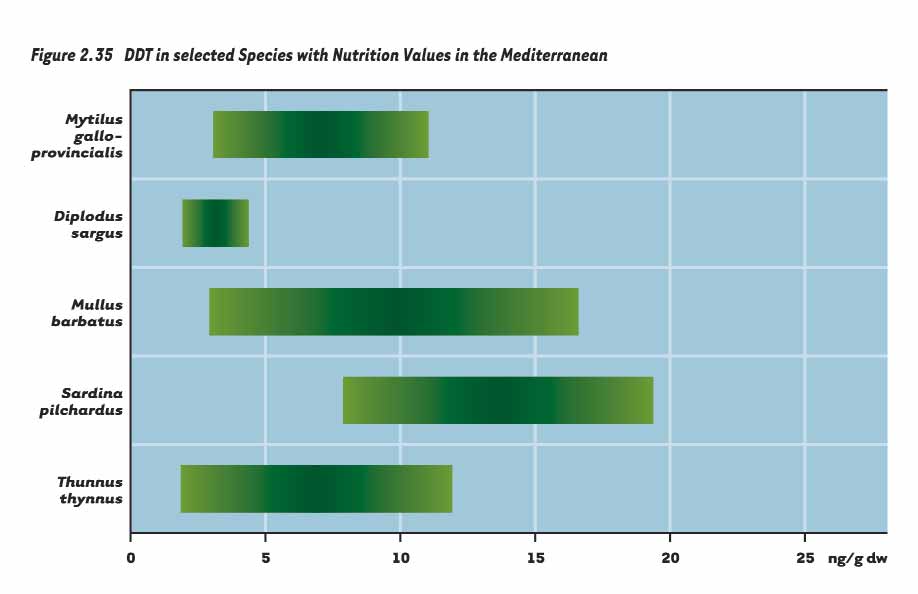
over a long time are not known.
some areas of concern have been iden-
Some workers exposed to these
tified, which include estuaries (e.g.,
insecticides had reversible nervous
Seine, Rhone, Ebro, Po and Nile),
system effects with excitation
coastal enclosures (e.g., Izmit Bay,
leading to convulsions. Studies in
Venice Lagoon, etc.), coastal areas
animals indicated that these com-
(e.g., Northwest Mediterranean and
pounds may be immunotoxic. The
Northern Adriatic), inland waters (e.g.,
International Agency for Research
Po, Ebro, Seine, Kupa and Lepenica
on Cancer (IARC) determined that
rivers), and dumpsites (e.g., Durres,
aldrin, dieldrin and endrin are not
Skopje, Alger, Mustaganem, etc.).
classifiable as to their carcino-
Apart from areas of intense local con-
genicity to humans.
tamination, compounds of regional
Heptachlor and heptachlor
concern are PCBs, DDT, HCH, PAHs, HCB
epoxide are moderately toxic to
and TBTs. Other compounds, e.g.,
humans and animals and can
phthalates, alkylphenols and PBDE/
damage the nervous system (EHC).
PBBs, are suspected to be ubiquitous
There are some human data on
but data are lacking.
brief exposures to high levels. A
Few spatial and long-term tempo-
few reports showed that people
ral trends monitoring of fish, mussels
who accidentally swallowed pesti-
and seabird eggs have been carried out
cides containing heptachlor, or
in the Northern Mediterranean. A gen-
who spilled pesticides on their
eral decline of DDTs has been reported
clothes became dizzy, confused or
for marine biota along the Mediterra-
had convulsions. IARC has classi-
nean coast of France and Italy, and
SIS (TDA) FOR THE MEDITERRANEAN SEA
fied heptachlor as possibly car-
from the Adriatic Sea between the
Y
cinogenic to humans.
1970s and 1990s, which is consistent
A substantial amount of informa-
with the regulatory restrictions on pro-
TIC ANAL
tion exists on the distribution of PTS in
duction and use of this compound.
the different environmental compart-
PCBs, in general, do not exhibit such a
Y DIAGNOS
ments of the region. In consequence,
clear trend.
TRANSBOUNDAR
90
Despite the extensive information
the continuation of existing
existing on PTS levels and trends, data
time trend series. Regional sur-
are often missing for some compart-
veys of emerging PTS and com-
ments, particularly, atmosphere,
pounds actually on the market
ground and drinking waters, sewage
or those difficult to analyse
sludges and soils, and storages
(e.g., PCDD/F) should be par-
(industrial products, pesticides).
ticularly envisaged.
Moreover, significant geographical
· Analysis of food to evaluate the
data gaps occur particularly in the
general exposure of the popula-
South and Southeastern Mediterra-
tion and to detect abnormal in-
nean basin.
creases due to different cases of
Apparently, data obtained are
contamination. Monitoring de-
mainly the result of research projects
sign should allow to assess any
rather than the existence of monitor-
correlation of PTS body-burden
ing networks. When data exist, partic-
with factors as age and gender
ularly in governmental agencies or
groups, dietary habits, occupa-
institutions, they are not easily avail-
tion and education. In this con-
able and, in many occasions, data
text, total diet studies taking
series are discontinued and have not
into account regional habits are
been quality assessed. Most of the
of primary interest.
data for chlorinated pesticides, for
· Analysis of human tissues
example, were obtained in the 1980s
(blood, milk) for human body
and levels usually show an extremely
burdens estimation and risk
AL CONCERNS
large span of concentrations, which
evaluation. Human tissues are
may reflect more the result of analyt-
also exposure sources for
ical inconsistencies than real differ-
developing organisms. Although
ences of levels of pollution.
this kind of assessment poses a
Available data on PTS levels in
series of technical and ethical
human tissues show a substantial
problems, monitoring of human
2.0 MAJOR ENVIRONMENT
paucity which appears even more
tissues provides the best infor-
striking if compared to the amount of
mation on human exposure to
data available for environmental
PTS. The data obtained should
matrices: biota and food. A represen-
allow the validation of exposure
tative study of a general healthy pop-
models.
ulation living in a wide geographic
· Domestic and regional monitor-
area has never been conducted in any
ing efforts should continue to
country of the region. Most countries
study multi-media transport
in the region lack population indica-
across air, rivers, seas, and soil,
tors on the impact that environmental
and the resultant environmental
contamination has on human health.
and human concentration levels.
A major step towards the filling of
· According to the regional ex-
the existing data gaps in the Region
perts, future-monitoring strate-
will be the activation of monitoring
gies should address the following:
programs at three levels:
· Intensive monitoring of tempo-
· Analysis of abiotic samples or
ral trends in appropriate abiotic
sentinel species to identify hot
and biotic media at a few key
spots and transport pathways.
locations, and occasionally over
Monitoring activities should be
wider areas, and continuation
established in the correspon-
of existing time trend series
ding countries to fill the geo-
that have proven to be useful
91
graphical data gaps and ensure
and informative.
· Standardised sampling and
logic data in the Mediterranean region
analytical methods in order to
are as follows:
compare results in the studies
· There is a lack of toxicological
carried out in different coun-
and ecotoxicological data for
tries must be implemented.
many PTS in the region. This
Monitoring programs should
holds not only for new classes of
include improved quality assur-
PTS (e.g., alkylphenols, PBDEs,
ance / quality control proto-
phthalates, PAHs,) but also for
cols, possibly linked to other
those that have been under
international programs, and
focus for many years. Special
contain reporting procedures
attention should be paid to
and analysis of data.
chronic toxicity studies and to
· Monitoring strategies need to be
the incorporation of biomarkers /
adequate to the technical and
bioassays in environmental qua-
economical possibilities of the
lity indices.
different countries. Regional
· There is a need for a uniform
accredited laboratories may
approach and framework for
assist contracted monitoring
evaluation and monitoring of
institutions in the development
receiving waters in the region.
of quality assurance systems. In
Water Quality Indices should be
any case, a regional network of
improved (various types of in-
national intercalibrated labo-
dices have been developed which
ratories contributing to regional
need to be evaluated and inte-
monitoring could better improve
grated). Multidisciplinary ap-
SIS (TDA) FOR THE MEDITERRANEAN SEA
data quality and fill data gaps.
proaches should be applied, es-
Y
The achievement of these goals
pecially for estuaries and deltas.
requires national / regional strate-
· Specific research to quantify
TIC ANAL
gies, which should provide the basic
the role of PTS on the impacts
support for an adequate environmen-
observed on endangered species
Y DIAGNOS
tal management of PTS.
and ecosystems is considered
urgent for setting the pro-
c. Regional data availability
grammes for maintaining the
and gaps on ecotoxicology
biovidersity of the Region.
TRANSBOUNDAR
For humans, the lack of solid data
· Sediment exposure (reservoirs)
on food PTS intakes strongly limits the
and effects to aquatic biota are
risk-assessment. There is an urgent
important to be assessed by the
need for extensive food exposure
particular hydrogeographical
study, taking as example the best
characteristics of the region. In
studies performed in some countries
this respect, mesocosm studies
(market basket and TDS), and the
(validation of biological para-
areas more heavily contaminated.
meters and biomarkers) should
Moreover, epidemiological population
be encouraged.
survey must take into account not only
· Modelling is a complementary
the morbidity data but also more sub-
tool for risk assessment and is
tle effects such as parameters linked
barely applied in the region.
to reproduction (histological and
Monitoring and modelling will
functional aspects) and neurologic
require much attention in par-
functions, especially in young children
ticular for improving the esti-
(brain development, behaviour, etc.).
mates of the fate and effects of
According to UNEP 2002 the main
emissions and pools of existing
92
gaps in currently available ecotoxico-
PTS. A task of particular impor-
tance will be the improvement of
Humans are exposed to marine
communication between exist-
pollutants mainly through the con-
ing chemical and toxicological
sumption of fish and other seafood,
information for PTS and ecosys-
the ingestion of seawater while swim-
tem and trophic web models.
ming or bathing, and direct contact
The experience in recent decades in
with sand or seawater. The contribution
the European Union and the UN/ECE has
of each of the two routes of transmis-
demonstrated the advantages of an
sion is an open issue. However, when
integrated science-based approach,
looking at foodborne disease out-
linking population, activities, emis-
breaks data suggest that consumption
sions, transport and effects in a coher-
of shellfish and fish continued to be a
ent international co-operative risk
significant cause of short-term health
assessment framework. Such an
risk in the 1990s in the Mediterranean
approach is cost effective in making
(Figures 2.36 and 2.37).
better use of available scientific and
technical resources and in helping pol-
2.4.5.2 Microbiological pollution
icy makers to design effective environ-
a. Health risks from
mental policy.
microbiological pollution
Microorganisms present in the
Mediterranean coasts are known to
give rise to two sorts of health prob-
lems: those that affect the gastroin-
testinal tract and those that affect
AL CONCERNS
other parts of the body. Gastrointest-
inal infections are spread mainly in
areas that receive untreated sewage
loads (Cabelli, 1983). Infections can
be broadly grouped into three cate-
gories according to whether the cause
2.0 MAJOR ENVIRONMENT
is a bacterium or a virus or a variety of
protozoan and metazoan parasites
such as Amoebic dysentery.
WHO reports for the Northern
Mediterranean indicate that salmo-
nella, the principal type of foodborne
93
disease in the northern basin, was sig-
shellfish and the temperature of the
nificantly linked to consumption of
water, but it can be more than 60 days.
fish and shellfish for the period
Storing contaminated varies according
19931998. Figure 2.36 shows that fish
to the microbiological quality, shell-
and shellfish accounted for 10 percent
fish, whether fresh or frozen, does not
of notified salmonella-related cases
greatly reduce its viral content.
in France, Spain and Italy in the period
Shellfish quality standards vary
199398. Based on conservative esti-
widely throughout the Mediterranean
mates fish and shellfish consumption
region. Production is largely concen-
therefore gave rise to approximately
trated in three states, Italy, France
5,000 cases of disease annually within
and Spain which somewhat reduces the
that period. Moreover, this figure is
difficulty of risk control. These states
suspected by national authorities to
have legislation that makes shellfish
conceal biases due to underreporting
depuration mandatory prior to mar-
linked to regional interests.
keting. Decontamination techniques,
In addition to bacterial infection
based on the immersion of bivalves for
shellfish is the main transmission
24 to 72 hours in good quality seawater
channel for enteric viruses. Numerous
or seawater that has been disinfected,
epidemics have been described,
give good bacteriological results when
caused mainly by the gastro-enteritis
they are properly applied. On the other
and hepatitis viruses found in all sorts
hand however, a considerable amount
of shellfish, generally eaten raw or
of shellfish all over the Mediterranean
insufficiently cooked. The shellfish
is still not subject to strict depuration
concerned comes either from un-
procedures or proper control of stor-
SIS (TDA) FOR THE MEDITERRANEAN SEA
healthy breeding areas or areas which
age after harvest (WHO/UNEP, 1995b).
Y
are normally unpolluted but which
Moreover, from a virological point of
have been temporarily polluted, or
view, these techniques are not wholly
TIC ANAL
else the shellfish itself has been
satisfactory since the shellfish still
insufficiently depurated.
sometimes contains viruses after
Y DIAGNOS
The main viruses implicated in
decontamination, particularly when
recent epidemics of viral aetiology
the shellfish is heavily contaminated.
transmitted by molluscs are the gas-
The third type of disease causing
tro-enteritis viruses (Norwalk virus
microorganisms is a variety of proto-
TRANSBOUNDAR
and the "small round viruses") and the
zoan and metazoan parasites such as
hepatitis A virus.
Amoebic dysentery, giardiasis, ascari-
The transmission of enteric virus-
asis etc. The pathogenic microorgan-
es via molluscs is easy to understand
isms present in the Mediterranean raw
when one looks at their eating habits;
sewage are given in Table 2.18.
shellfish filter up to 20 litres per hour
In so far as ingestion of water dur-
of water which means that they accu-
ing swimming or bathing is relatively
mulate pathogenic micro-organisms
limited, the diseases mentioned
present in seawater.
above are more likely to be contracted
The potential of shellfish to carry
through the consumption of raw or
viral disease is magnified many-fold
partially cooked shellfish.
by the ability of viruses to survive a
Raw fish and mussels are possible
long time in the shellfish. Viral dis-
sources of infection for a number of
eases reported apart from hepatitis A
pathogenic bacteria biocaccumulated
include enteroviruses (coxsackie
in the flesh. Microorganisms endemic
viruses A and B, echoviruses, reovirus-
to seawater, such as Vibrio para-
es and adenoviruses). The length of
haemolyticus, Clostridium pergringens,
94
time these viruses survive in immersed
Hepatitis A virus and Norwalk viruses
Table 2.14 Pathogens and Indicator Organisms commonly found in Raw Sewage (Source: Bartram and Rees, 2000)
Pathogen or indicator
Disease or role
Number per litre
Bacteria
Campylobacter spp.
Gastro-enteritis
37,000
Clostridium perfringens
Indicator organism
6x1058x105
E. coli
Indicator organism
107x108
Salmonella spp.
Gastro-enteritis
2080,000
Shigella
Bacillary dysentery
1010,000
Viruses
Polioviruses
Indicator
1,800 5,000,000
Rotaviruses
Diarrhoea, vomiting
4,000 850,000
Parasitic protozoa
Cryptosporidium parvum oocysts
Diarrhoea
1390
Entamoeba histolytica
Amoebic dysentery
4
Giardia lamblia cysts
Diarrhoea
125200,000
Helminths
Scaris spp.
Ascariasis
5110
Ancyloistoma spp.
Anaemia
6190
Trichuris spp.
Diarrhoea
1040
have been associated with epidemics
fungi species causes more or less
worldwide (WHO/UNEP, 1995b).
deep mucoses depending on the loca-
AL CONCERNS
Cholera is one of the main diseases
tion of the pathogen within the host.
associated with the consumption of
sewage-contaminated shellfish and a
b. Origins of the problem
major epidemic occurred in Italy in
Microbiological pollution of
1973 causing 277 cases and 24 deaths
coastal waters and of shellfish is
(WHO/UNEP, 1995b). Between October
according to experts a major problem
2.0 MAJOR ENVIRONMENT
and December 1994, a total of 12
of the Mediterranean. Pathogenic and
indigenous cases of cholera were reg-
other microorganisms enter the marine
istered in the southern Italian region of
environment through untreated or
Puglia.
partially treated municipal waste-
Apart from diseases that affect
water. Although pathogenic contami-
the gastrointestinal tract, a number of
nation from city wastewater is the
disorders affect the eye, ear, upper
most serious dimension of city pollu-
respiratory tract and other areas in
tion for seawater, it is also the least
connection to bathing in contaminat-
well known. Except for specific studies
ed waters. Microorganisms such as
pathogenic contamination of waste-
Staphylococcus aureus, Pseudomonas
water is only monitored for faecal, col-
aeruginosa, Clostridium welchii and
iform and streptococci content.
Candida albicans particularly affect
Faecal contamination, indicating
individuals with skin lesion or ruptured
contamination by animal and human
ear or nose membrane.
excreta is one of the most direct ways
The most common infection cause
to assess the hygienic quality of water.
due to contact with contaminated
One way to detect faecal contamina-
sand is Candida albicans. It has been
tion is to investigate Biological oxygen
isolated in the south of France, Israel
demand (BOD) of the water. Micro-
and Greece. Infection is highest where
biological organisms use oxygen in the
crowded beach conditions exist.
process of oxidation of the polluting
95
Candida as well as a number of other
matter so a test on oxygen require-
ments, referred to as BOD , can yield
5
estimates of faecal concentration. As
shown by Figure 2.40, a mere 18 cities
contribute half of urban waste con-
taining BOD in the Mediterranean, and
five account for one quarter of this
waste. These cities are Alexandria,
Naples, Izmir, Barcelona and Beyrouth.
Fortunately, significant sewage and
sanitation programmes are under way
in several of the cities, although it is
clearly urgent to extend these efforts
to others.
Wastewater discharge into the sea
is the most common manner of final
wastewater disposition in coastal
urban and industrial zones. Lack of
treatment even on a basic scale is
therefore the biggest cause of pollu-
tion in terms of BOD . Currently it is
5
estimated that half of untreated pol-
lution in terms of BOD originates from
5
direct discharges. Less than one-third
of BOD pollution comes from the dis-
SIS (TDA) FOR THE MEDITERRANEAN SEA
charges of treatment plants and the
Y
remainder from storm water during
periods of rain.
TIC ANAL
Figure 2.38 shows the percentage
of coastal cities (with over 10,000
Y DIAGNOS
inhabitants) with wastewater treat-
ment, while Figure 2.39 shows the type
of treatment encountered in coastal
areas in the Mediterranean (UNEP/
TRANSBOUNDAR
MAP/WHO, 2004). BOD values are
tion) while a lesser reduction (20 per-
greatly reduced only at the secondary
cent) is also achieved through primary
treatment level (7090 percent reduc-
treatment (Figure 2.41).
96
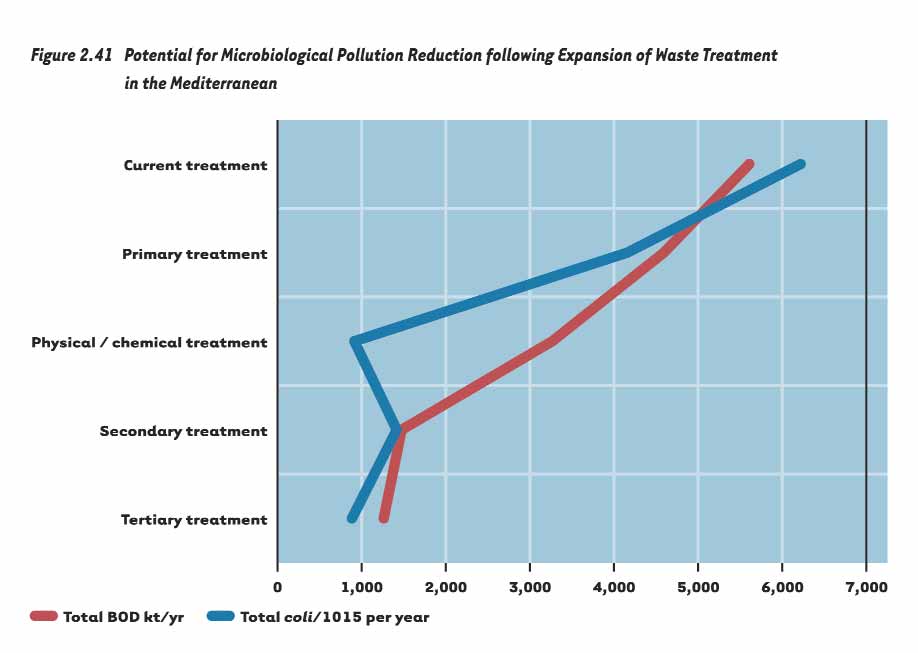
AL CONCERNS
c. Cross regional differences
are constructed. Egypt is in third
in waste treatment
place, with an evident problem of an
in the Mediterranean
insufficient number of treatment
This estimate conceals high vari-
plants and a major problem posed by
ability between countries, however. As
the city of Alexandria. France is the
large differences in the sanitation
country which discharges the least
2.0 MAJOR ENVIRONMENT
systems as well as total effluent vol-
untreated waste water only because
umes differ largely among countries,
the replies supplied do not mention
but also partly due to the quality of
this type of discharge, but only the
the information. This estimate should
size of the treatment plants. However,
be treated as an indicative statement
in contrast with Spain, the treatment
in need of further qualification.
plants are all constructed, with one
Based on recent regional assess-
exception, which is a positive point. It
ment of municipal wastewater treat-
is nevertheless almost evident that
ment data (UNEP/MAP/MED POL,
certain direct discharges persist in
2004), Italy is by far the country with
reality, even if only through the erro-
the highest volume discharged
neous connection of domestic waste-
(almost 40 percent of the total).
waters to storm water systems. Bad
Further, the data provided shows that
connections exist everywhere, but
many cities do not have treatment
they are all the more significant where
plants and that their systems dis-
the connection rate is high.
charge wastewater directly into the
In a recent regional assessment of
sea. This situation weighs heavily in
municipal wastewater treatment
the assessment. Spain comes in sec-
plants in the region (UNEP/MAP/WHO,
ond place, as many treatment plants
2004), an updated list of cities with
have been planned, with their size
> 50,000 inhs. and < 900,000 inhs. to
being given in the survey, so that the
(total population of 4,239,110) was
97
situation should improve once they
developed and shown in Table 2.19.
The overall wastewater system
average efficiency levels. Countries
efficiency in the Mediterranean is
with primary treatment plants only
mediocre (42 percent). Two countries
expectably show the lowest rates of
have no wastewater treatment plants
wastewater treatment efficiency. By
(Albania and Syrian Arab Republic)
contrast, countries with secondary and
and several others eliminate as low as
tertiary treatment facilities show high
10 percent of BOD and that at most
performances approaching 90 percent,
5
(Croatia, Lebanon, Morocco, Slovenia,
which is 23 percent higher than the
Turkey and Egypt). It is clear that an
average.
effort is required to install treatment
The higher the coastal population
plants where they do not exist and to
and the lower the level of treatment,
supplement primary treatment sys-
the higher will be load of waste treat-
tems by secondary and more refined
ment plants. High population countries
techniques.
with inadequate secondary and terti-
Where wastewater treatment
ary treatment plants, as Greece for
plants do exist, individual countries'
instance, will show high levels of treat-
performance varies widely from the
ment plant loads compared to others
such as France and Spain where similar
population pressure exists but is met
Table 2.15 Cities (> 50,000 and < 900,000 inhs.)
with better provision of secondary and
without WWTP in the Mediterranean
tertiary wastewater treatment facili-
ties. Naturally other countries such as
Country
City
Population
Turkey with lower population levels will
(in 1,000)
show correspondingly lower loads of
Albania
Vlora
130.00
SIS (TDA) FOR THE MEDITERRANEAN SEA
treatment plant loads, despite relative
Y
Albania
Durres
140.00
lack of secondary and tertiary treat-
Algeria
Arzew
66.19
ment.
TIC ANAL
Algeria
Taher
72.50
Algeria
El Milia
75.60
A vivid illustration of the large
Algeria
Jijel
124.94
potential to redress coastal pollution
Y DIAGNOS
Algeria
Mostaganem
141.31
by treating urban wastewater is provid-
Algeria
Skikda
166.76
ed in the example of the city of
Algeria
Oran
831.34
Marseille. Bathing water quality around
Croatia
Sibenik
67.20
the large port city in the northeast
TRANSBOUNDAR
Croatia
Zadar
80.30
coast of France improved dramatically
Greece
Elefsina
120.00
within 20 years due to action taken to
Lebanon
Batroun
51.00
combat urban wastewater pollution. As
Lebanon
Jubayl (Jbail, Byblos)
66.00
can be seen in Figure 2.42, in the early
Lebanon
Sour (Sur or Tyre)
181.00
Lebanon
Jounieh
200.00
to mid 1980s the percentage of water
Lebanon
Saida / Ghaziye (Sidon)
205.00
that classified as good quality repre-
Lebanon
Tripoli (Tarabalus)
353.00
sented only about 16 percent. By con-
Libya
Al Garabulli
80.00
trast twenty years later the entire
Morocco
Fnideq
52.47
coastal area of Marseille qualified as
Spain
Ceuta
73.20
good quality water.
Spain
Algeciras
100.60
Linking all inhabitants to waste-
Syria
Jableh
58.60
water treatment systems would have
Syria
Tartous
107.00
great impacts in decreasing patho-
Syria
Lattakia
387.73
genic pollution loads in the Mediterra-
Turkey
Dortyol
53.60
Turkey
Silifke
64.83
nean. A glimpse at how large the size
Turkey
Canakkale
75.81
of benefit that would follow from pro-
Turkey
Kiziltepe
113.14
viding various levels of treatment is
98
shown in Figure 2.42.
water drainage systems. Unfortuna-
tely as all waters are often drained in
the same system, urban wastewaters
may overflood in rainy periods when
drainage capacity is saturated.
d. Assessment of major pathways
of microbiological pollution
· Discharge through rivers
Rivers may add a considerable
amount of microbiological pollu-
tion mainly from upstream waste-
water discharges. Animal feedlots
and domestic wastewater often
contain great numbers of bacteria
and viruses that are pathogenic for
humans and aquatic organisms.
An overview of 13 Mediterra-
nean rivers (Table 2.17) mainly in
Greece and Italy in the late 1980s
provides a ranking of rivers in
terms of microbiological pollution
content (Agence de l' Eau Rhône --
AL CONCERNS
Méditerranée). According to it,
Urban stormwater is another way
the most polluted rivers are the Po
in which coastal waters adjacent to
and Tiber rivers in Italy and the
cities may become polluted. Despite
Ebro river in Spain. According to
being considered as unpolluted or only
more recent data however, bacte-
slightly polluted it may become a sig-
rial pollution has been declining
2.0 MAJOR ENVIRONMENT
nificant source of pollution, especial-
with best results observed in the
ly where wastewaters infiltrate storm
Rhone River.
Table 2.16 Bacteriological Water Quality in some Mediterranean Rivers
(Source: "Agence de l'Eau Rhône -- Méditerranée -- Corse: http://www.rdbrmc.com/)
Rivers
Country
Coli-
Coli-
Strepto-
Period
Sample
faecal total
faecal
nb
(n/100 ml)
(n/100 ml)
(n/100 ml)
mean
min
max
mean
min
max
mean
min
max
Rhone
France
2,100
30
11,700
515
1
6,000
8892
52
Akheloos
Greece
133
0
4,600
301
0
4,600
32
0
266
8492
71
Aliakmon
Greece
3,520
0
240,000
12,423
6 1,000,000
765
0
24500
8292
103104
Axios
Greece
5,320
240
46,000
10,740
450
46,000
1,892
0
11,000
8389
51
Nestos
Greece
1,696
0
11,000
3,106
23
24,000
905
0
8,000
8292
55
Pinios
Greece
1,159
0
11,000
2,677
0
37,000
78
0
700
8291
7291
Strymon
Greece
14,830
43 1,000,000
20,395
110 1,000,000
2,883
0
30,000
8292
116117
Adige
Italy
2,335
0
36,300
14,007
200
90,200
409
0
4,200
8792
74
Arno
Italy
2,752
50
9,180
7,355
200
24,000
393
20
2,300
8892
42
Metauro
Italy
5,549
10
36,000
6,146
30
100,000
783
0
9,180
8492
5558
Po
Italy
26,636 1,000
330,000
57,203 1,000 1,000,000
10,133
700
302,000
8292
113
Tevere
Italy
188,454 4,300 2,000,000
284,024 7,500 4,000,000
8991
1718
Ebro
Spain
11,790
7
456,000
106,756
38
810,000
138
0
2,500
8792
6975
99
SIS (TDA) FOR THE MEDITERRANEAN SEA
Y
TIC ANAL
Y DIAGNOS
TRANSBOUNDAR
100
3.0
LEGAL AND INSTITUTIONAL
FRAMEWORK ANALYSIS
Transboundary issues require cooperation
Many of the countries of the South and East do not have
among states to define policies, targets and actions at
currently the means to enforce compliance with envi-
the appropriate levels for assessment, control, preven-
ronmental provisions. Below, the major issues associ-
tion and / or mitigation of sources and impacts.
ated with the national legal and institutional frame-
Transboundary environmental problems and their
works are briefly outlined.
associated impacts must therefore be addressed on
At the regional level, great strides have been
multiple levels: regional, sub-regional, as well as
made with the adoption and then revision of the
SIS
Y
national. Due to the nature of transboundary issues,
Barcelona Convention and its protocols. While all of the
the relevant cooperation requires regional and nation-
amended protocols are not yet in effect, this conven-
al integrative structures and capacities.
tion is considered to be by far the most significant
Addressing transboundary issues requires ade-
regional policy concerning the transboundary environ-
quate and appropriate international and national legal
mental problems in the Mediterranean. The Barcelona
and institutional arrangements. The international legal
Convention is described in greater detail in Section 3.2,
/ institutional framework must provide the legal basis
in addition to other relevant subregional, regional and
TITUTIONAL FRAMEWORK ANAL
for cooperation among interested / affected countries
global legal and policy instruments.
and define the procedures to be applied and their insti-
tutional aspects. In addition, the role of the said inter-
3.1 Major problems identified
national framework is to promote / require the adoption
with legal and institutional frameworks
of relevant national legal and institutional arrange-
in the Mediterranean
3.0 LEGAL AND INS
ments, and to provide support, assistance and training
During the past decades, significant laws and
when needed and requested.
policies have been adopted at the national, regional and
The national legal and institutional transbound-
global levels that directly or indirectly address the
ary related framework is supposed to comply with the
transboundary environmental concerns in the Mediter-
transboundary international framework. The nature of
ranean region. The most important of these regional and
transboundary issues requires coordination and integra-
global laws and policies related to the Mediterranean
tion of relevant activities at both regional and national
MPPIs are discussed in Section 3.2.2 below. The existing
levels, as well as between the two levels. Of utmost
legal and institutional frameworks have flaws, however,
importance is also the participation in transboundary
which hamper efforts to address these transboundary
activities of interested / affected stakeholders.
concerns. General observations on areas that require
The following sections review relevant legal,
improvement are discussed below. Activities under the
institutional and policy frameworks for transboundary
SAP should seek to address these existing problems.
environmental protection in the Mediterranean. It is
generally viewed that the national legal provisions for
3.1.1 Major problems identified with
addressing the priority issues identified in this docu-
legal arrangements for addressing
ment are adequate, with some exceptions. Although
transboundary environemental issues
transboundary cooperation is not explicitly provided
The following legal and institutional issues have
for in national legislation, it is implicit in the texts. The
been identified at the regional and national levels that
main problem, however, lies with the institutional
could hinder effective action to address transboundary
101
capacity to enforce the legislation and regulations.
environmental concerns in the Mediterranean region.
3.1.1.1 Issues at the national level
issues. The lack of integrative capacity and
The following issues at the national level are
poor implementation of ICZM as a framework
considered to be of major importance in the Mediter-
for addressing transboundary issues is pres-
ranean region:
ent in many cases. Monitoring of these causes
· Absence of appropriate national transbound-
and impacts and their assessment is not con-
ary-related institutional arrangements. In
sistent, efficient or adequate, and the reme-
many cases in the region and to a varying
dial programmes are not integrated within the
degree, the institutional arrangements and
necessary larger context, resulting in absence
management in CZ, consequently regarding
of control of causative factors and failure of
also the transboundary issues, are dispersed,
remedial measures.
fragmented and not CZ specific. The responsi-
bility for transboundary issues is unclear or
3.1.1.2 Issues at the regional level
shared by various authorities. Sectoral, often
The following are major issues related
non-integrated CZ related decisions, result in
addressing transboundary environmental concerns at
transboundary impacts; the relevant remedial
the regional level:
initiatives are either not implemented in a
· Absence of or insufficient transboundary
timely fashion or have poor results, or result in
provisions within relevant regional or global
failure. The final consequence is pollution,
legal documents. Many of the global and
misuse of resources, overexploitation, loss of
regional legal documents are not sufficient-
habitats and decline in biodiversity. Since one
ly transboundary specific or precise, leaving
single national institution / agency cannot
room for arbitrary interpretations, providing
address alone those issues, the need of a
escape clauses, lacking provisions regarding
National high level Coordinative Body and of a
the enforcement mechanism, lacking clear
Lead Agency is evident. In most cases in the
targets and deadlines. There is a need for a
SIS (TDA) FOR THE MEDITERRANEAN SEA
countries of the region there are no trans-
more specific, clear and integrated regional
Y
boundary related specific arrangements of
transboundary legal framework.
this kind.
· Need to better define and strengthen the
TIC ANAL
· Absence of legal / institutional arrangements
role and involvement of international insti-
securing participation of the interested /
tutions coordinating transboundary-relat-
Y DIAGNOS
affected general public, NGOs, scientific com-
ed initiatives. The absence or weak imple-
munity and stakeholders in transboundary ini-
mentation of the coordinating and inte-
tiatives in parts of the Southern and Eastern
grating role of relevant international agen-
Mediterranean. In many cases, the interested
cies, absence of assistance when needed
TRANSBOUNDAR
groups are neither properly, fully nor timely
and requested, and of providing resource
informed, educated on transboundary related
commitments for transboundary initiatives
issues, nor are there provisions for: securing
and remedial actions in developing coun-
such participation, the right of requesting
tries involved --calls for legal identification
information, and raising issues at national and
of the relevant regional body to take the
international level. Public hearings, if any, are
role of lead agency. This role should be, and
not fully informative and / or not transparent.
up to a certain level has been already,
Consequently, public support for initiatives
assigned to MAP in the case of the Mediter-
addressing transboundary issues is weak or
ranean region.
nonexistent.
· Absence of provisions in regional trans-
· Absence of legal provisions for monitoring,
boundary related documents for compulsory
securing compliance and enforcement of
application of successful procedures and
transboundary related regulations and obliga-
tools such as EIA and SEA in the transbound-
tions. In most cases, and in particular related
ary context, and of ICZM as a basic prerequi-
to non-ECE member states, there are no such
site and tool securing the larger integrated
provisions.
and proactive approach. This issue is relat-
· Insufficient institutional / human capacity of
ed both to the national and international
102
authorities responsible for transboundary
levels.
3.1.2 Major problems identified with
of ministries and agencies have sub-national or local
institutional arrangements
branches with delegated authority important for
and capacity for addressing
Coastal Management and transboundary issues. The
transboundary environmental issues
"local" level units might have considerable authori-
The existing institutional arrangements rele-
ty, such as urban planning, issuing building permits,
vant to addressing transboundary environmental
inspection, monitoring, control, etc.
issues differ among the littoral countries due to their
The existing institutional arrangements estab-
differences in the degree of development, length of
lish a large number of administrative and decision-
coastline, level of development and urbanization of the
making entities responsible and or authorized for
coast, wealth and ways of exploitation of resources,
transboundary issues. Under such conditions, without
political system, form and manner of governance,
adequate integration it is not possible to avoid over-
among others. Other factors must also be taken into
lapping and / or conflicting decisions, which are nei-
consideration, such as historic, national, cultural, reli-
ther environmentally sound nor meet the requirements
gious and other aspects.
of sustainable development and in many cases have
Despite the differences mentioned above, there
serious transboundary impacts. That is why the imple-
is a general scheme of institutional arrangement rele-
mentation of ICZM procedures and tools relevant for
vant to ICZM and transboundary environmental issues
transboundary issues has to be considered as a pre-
in the Mediterranean. That scheme can be defined as
requisite for successfully addressing transboundary
multi-level and multisectorial, frequently with specific
environmental issues in a timely and cost-efficient
SIS
Y
arrangements within individual sectors and in a certain
manner, and has to be secured through appropriate
number of cases with specific arrangements of inter-
institutional and legal arrangements.
sectorial integration. It could generally be said that:
· from the point of view of policy structure
3.2 Existing Legal and Policy Frameworks
variables, there is a wide array ranging from
in the Mediterranean
strong administrative control to pronounced,
The following sections outline the most impor-
but not exclusive, rights of private interest
tant of the many subregionals, regional and global
TITUTIONAL FRAMEWORK ANAL
groups;
laws and policies that address the priority environ-
· administrative variables range from prevail-
mental concerns in the Mediterranean region identi-
ingly sectorial planning to, often insuffi-
fied in this document. The most significant of these,
ciently developed, broad functional respon-
the Barcelona Convention along with its protocols, is
sibilities;
described in Section 3.2.1. Additional legal and policy
3.0 LEGAL AND INS
· policy orientation is increasingly turning
instruments relevant to the issues of seawater quality,
from the sectoral towards the integrated
biodiversity and fisheries in the Mediterranean are
approach within the concept of sustainable
discussed in the sections following.
development.
The sectorial governance arrangement fol-
3.2.1 The Barcelona System
lows, more or less, the standard sectorial classifica-
The Convention for the Protection of the Marine
tion, which is, as a rule, more diversified in developed
Environment and the Coastal Region of the Mediterra-
countries. Due to various reasons, in many countries
nean (as amended in 1995), or the Barcelona
the sectoral activities most relevant for transbound-
Convention, is the most important regional policy con-
ary issues are organized in larger sectorial units, such
cerning the transboundary environmental problems in
as fisheries and aquaculture within the ministry of
the Mediterranean. Under the United Nations
agriculture, land-use planning and / or environmen-
Convention on the Law of the Sea (Montego Bay, 1982;
tal protection within the ministry of building, tourism
hereinafter UNCLOS) "States have the obligation to
within the ministry of industry, ministry of economy,
protect and preserve the marine environment" (Art.
or even within the ministry of interior, or maritime
192) taking measures "necessary to protect and pre-
transport within the ministry of transports, commu-
serve rare or fragile ecosystems as well as the habitat
nications and maritime affairs.
of depleted, threatened or endangered species and
Functions important for transboundary issues
other forms of marine life" (Art. 194, para. 5).
are sometimes located in "non-standard" adminis-
The Barcelona Convention on the Protection of
103
trative bodies and agencies. A considerable number
the Mediterranean Sea against Pollution (the original
convention which entered into force on 12 February
· the Protocol Concerning Co-operation in
1978) is a notable instance of such cooperation.
Combating Pollution of the Mediterranean Sea
Concluded under the auspices of UNEP, the Convention
by Oil and Other Harmful Substances in Cases of
involved a considerable degree of legal imagination,
Emergency (Barcelona, 16 February 1976; in
such as opening up membership to regional groupings
force since 12 February 1978), which is intend-
sharing the objectives of the Convention, albeit not
ed to be replaced by the Protocol Concerning
necessarily wholly contained within the Mediterranean
Co-operation in Preventing Pollution from
basin. In fact, the European Community is a Contracting
Ships and, in Cases of Emergency, Combating
Party to the Convention and its protocols, together with
Pollution of the Mediterranean Sea, signed in
seven States, which are today members of the
Valletta on 25 January 2002, hereinafter "the
Community (Cyprus, France, Greece, Italy, Malta,
Emergency Protocol" (not yet in force);
Slovenia and Spain) and provides a significant contri-
· the Protocol for the Protection of the Mediter-
bution to the functioning of the Barcelona system.
ranean Sea against Pollution from Land-Based
Since 1994, several components of the
Sources (Athens, 17 May 1980; in force since 17
Barcelona system have undergone important
June 1983), which, as amended in Syracuse on
changes. The objective of the revision was to mod-
7 March 1996, changes its name to the
ernise the Convention to bring it into line with the
Protocol for the Protection of the Mediterra-
principles of the Rio Declaration, the philosophy of
nean Sea against Pollution from Land-Based
the new Convention on the Law of the Sea and the
Sources and Activities, hereinafter "the LBS
progress achieved in international environmental law
Protocol" (the amendments are not yet in
in order to make it an instrument of sustainable
force);
development. The revised Convention also aimed to
· the Protocol concerning Mediterranean
progress from an essentially proclamatory form of law
Specially Protected Areas (Geneva, 1 April
to a much more prescriptive law setting out obliga-
1982; in force since 23 March 1986), which has
SIS (TDA) FOR THE MEDITERRANEAN SEA
tions. The scope of its protocols was extended and
been replaced by the Protocol Concerning
Y
new protocols were adopted either to replace the
Specially Protected Areas and Biological
existing ones or to cover new fields of co-operation.
Diversity in the Mediterranean, signed in
TIC ANAL
In addition, in order to ensure the effectiveness of the
Barcelona on 10 June 1995, hereinafter "the
new provisions, the need for new capacities as well as
SPA and Biodiversity Protocol" (in force since
Y DIAGNOS
public participation and access to information
12 December 1999);
including the adoption of a reporting procedure were
· the Protocol Concerning Pollution Resulting
part of the revision process.
from Exploration and Exploitation of the
The structure of the present Barcelona legal sys-
Continental Shelf, the Seabed and its
TRANSBOUNDAR
tem includes the following instruments (see Annex V):
Subsoil, signed in Madrid on 14 October
· the Convention which, as amended in Barce-
1994, hereinafter "the Offshore Protocol"
lona on 10 June 1995, changes its name to the
(not yet in force); and
Convention for the Protection of the Marine
· the Protocol on the Prevention of Pollution of
Environment and the Coastal Region of the
the Mediterranean Sea by Transboundary
Mediterranean, hereinafter "the Convention"
Movements of Hazardous Wastes and their
entered into force on 9 July 2004;
Disposal, signed in Izmir on 1 October 1996,
· the Protocol for the Prevention of the Pollu-
hereinafter "the Hazardous Wastes Protocol"
tion of the Mediterranean Sea by Dumping
(not yet in force).
from Ships and Aircraft (Barcelona, 16
The recent updating of the Barcelona legal
February 1976; in force since 12 February
framework shows that the Parties consider it to be a
1978), which, as amended in Barcelona on 10
dynamic system capable of being subject to re-
June 1995, changes its name to the Protocol
examination and improvement, if appropriate.
for the Prevention and Elimination of Pollu-
It is a disappointment to note that the
tion of the Mediterranean Sea by Dumping
amendments to the two protocols adopted in 1995
from Ships and Aircraft or Incineration at
and 1996 have not yet entered into force. But this is
Sea, hereinafter "the Dumping Protocol" (the
not necessarily due to a lack of political will by the
104
amendments are not yet in force);
States called upon to become Parties to the updated
instruments. In fact it is rather the great number of
run-off and disposal under the
amendments involving considerable technicality in
seabed with access from land.
their final provisions, as well as the high threshold of
The Protocol, as amended in
acceptance necessary for their entry into force that
1996, takes into account the
have been a factor of delay.
objectives laid down in the
Global Programme of Action for
3.2.2 Regional Protocols
the Protection of the Marine
and Policy Instruments
Environment from Land-based
This section surveys the policy responses adopt-
Activities, adopted in Washing-
ed to address the MPPIs identified in the Mediterranean.
ton on 3 November 1995 by a
The first type of concern generally referred to as pollu-
UNEP intergovernmental con-
tion here, spans diverse activities causing pollution
ference.
including land-based activities, marine transport and
seabed exploitation. The second type of concern relates
· The Emergency Protocol
to the conservation of biodiversity. The third type of
The 2002 Emergency Protocol,
environmental concern is linked to the sustainable
which is intended to replace the
exploitation of fishery resources in the Mediterranean.
1976 Protocol, is the latest
Policy responses on a regional, global and EU level are
entry into the Barcelona legal
presented for each type of the three above concerns,
system. The new Emergency
SIS
Y
while some subregional approaches are also considered.
Protocol aims at introducing the
provisions necessary to imple-
3.2.2.1 Pollution
ment the Regional Strategy on
Regional Agreements and
Prevention of Marine Pollution
Policy Instruments related to
of the Marine Environment by
the Barcelona Convention
Ships, adopted by the Parties in
The major regional agreement
1997.
TITUTIONAL FRAMEWORK ANAL
related to pollution control in the
While it can hardly be denied
Mediterranean is the Barcelona Con-
that pollution from ships is a
vention and its association Proto-
typical area where global regu-
cols. In this section, these and other
lation is most appropriate as
policy instruments relating to land
provided within UNCLOS, it
3.0 LEGAL AND INS
and sea-based pollution are dis-
should also be added that, for
cussed. Additionally, the similarities
certain aspects of the matter,
and differences of the EU WFD and the
regional co-operation also has
SAP MED, the two most important
a role to play. For instance, it is
regional action plans for addressing
evident that prompt and effec-
land-based sources of pollution, are
tive action in taking emergency
outlined.
measures to fight against pollu-
tion arising from maritime acci-
Protocols:
dents needs to be organized at
· The Land-Based Sources (LBS)
the national, sub-regional and
Protocol is a regional policy
regional levels.
response, applying to dis-
But the Emergency Protocol is
charges originating from land-
not limited (as the former in-
based point and diffuse sources
strument was) to dealing with
and activities in the Mediterra-
emergency situations. It also
nean. Such discharges reach
covers the aspect of the preven-
the sea through coastal dispos-
tion of pollution from ships with
als, rivers, outfalls, canals or
the purpose of striking a fair
other watercourses, including
balance between action at the
105
ground water flow, or through
global and action at the region-
al level. The Emergency Protocol
conformity with generally
acknowledges in the preamble
accepted international rules
the role of IMO, which is general-
and standards and the global
ly considered the competent
mandate of the International
international organization in the
Maritime Organization, the
field and the importance of co-
Parties shall individually, bilat-
operating in promoting the
erally or multilaterally take the
adoption and the development
necessary steps to assess the
of international rules and stan-
environmental risks of the rec-
dards on pollution from ships
ognized routes used in maritime
within the framework of IMO.
traffic and shall take the appro-
This is a clear reference to the
priate measures aimed at
various conventions which are
reducing the risks of accidents
already in force at the global
or the environmental conse-
level, such as the International
quences thereof".
Convention for the Prevention of
The Emergency Protocol also
Pollution from Ships as Amended
acknowledges "the contribution
by the Protocol (London, 1973
of the European Community to
1978; the so-called MARPOL) or
the implementation of interna-
the International Convention on
tional standards as regards mar-
Oil Pollution Preparedness,
itime safety and the prevention
Response and Co-operation
of pollution from ships". In fact,
(London, 1990) and the more
the Community has enacted a
recent instruments which are ex-
number of legal instruments
SIS (TDA) FOR THE MEDITERRANEAN SEA
pected to enter into force in the
relating to the control and pre-
Y
future, such as the International
vention of marine pollution from
Convention on the Control of
ships that apply in addition to
TIC ANAL
Harmful Anti-fouling Systems on
rules adopted under the aegis of
Ships (London, 2001). It is also a
IMO. The most recent ones are
Y DIAGNOS
reference to the competences
Directive 2001/106 of 19 Decem-
that IMO already exercises as
ber 2001 concerning the en-
regards the safety of shipping
forcement, in respect of shipping
(such as decisions on traffic se-
using Community ports and sail-
TRANSBOUNDAR
paration schemes, ships' report-
ing in the waters under the juris-
ing systems, areas to be avoid-
diction of Member States, of
ed, etc.). All such instruments
international standards for ship
and competences are in no way
safety, pollution prevention and
prejudiced by the Emergency
shipboard living and working
Protocol.
conditions (port State control);
The Emergency Protocol also
Directive 2002/6 of 18 February
recognizes that regional co-
2002 on reporting formalities for
operation is important in pro-
ships arriving in and / or depart-
moting the effective implemen-
ing from ports of the Member
tation of international regula-
States of the Community; and
tions in this field. A notable
Regulation 417/2002 of 18
instance of such a spirit of har-
February 2002 on the accelerat-
monization of the global and
ed phasing-in of double hull or
regional levels of regulation and
equivalent design requirements
action is Art. 15, dealing with
for single hull oil tankers. Other
the environmental risk of mar-
Community legislation is in the
106
itime traffic. It provides that "in
process of elaboration. The
European Commission, the insti-
the Parties involved, co-ordi-
tution of the Community man-
nate the activity of the facilities
dated to negotiate treaties,
put into operation by these
played an active role during the
Parties. The issue of port recep-
negotiations for the Emergency
tion facilities, which has consid-
Protocol.
erable economic implications, is
The "added value" brought by
already the subject of provisions
the new Protocol may be found
set forth in the MARPOL and a
in several of its provisions. It
recent European Community
covers not only ships but also
directive. Under the Emergency
places where shipping accidents
Protocol, Parties shall ensure
can occur, such as ports and off-
that such facilities are available
shore installations. The defini-
and are used efficiently without
tion of the "related interests" of
causing undue delay to ships.
a coastal State has been en-
The lessons arising from the
larged to include also "the cul-
Erika accident are particularly
tural, aesthetic, scientific and
evident in the provision accord-
educational value of the area"
ing to which the Parties shall
and "the conservation of biolog-
define strategies concerning
SIS
Y
ical diversity and the sustain-
reception in places of refuge,
able use of marine and coastal
including ports, of ships in dis-
biological resources". A detailed
tress presenting a threat to the
provision on reimbursement of
marine environment.
the costs of assistance has been
Finally, the Emergency Protocol
elaborated.
does not affect the right of
The Emergency Protocol sets
Parties to adopt stricter domes-
TITUTIONAL FRAMEWORK ANAL
forth some obligations directed
tic measures or other measures
to the masters of every ship
in conformity with international
sailing in the territorial sea of
law in the matters covered by
the Parties (including ships fly-
the Protocol. This provision may
ing a foreign flag), namely to
apply also to rules adopted by
3.0 LEGAL AND INS
report incidents and the pres-
the European Community and
ence, characteristics and extent
binding on its member States.
of spillages of oil or hazardous
and noxious substances; to pro-
· The Offshore Protocol
vide the proper authorities, in
The Offshore Protocol relates to
the case of a pollution accident
pollution resulting from explo-
and at their request, with
ration and exploitation of the
detailed information about the
continental shelf and the seabed
ship and its cargo and to co-
and its subsoil. All activities in
operate with these authorities.
the Offshore Protocol area,
The obligations in question,
including the erection of instal-
which have a reasonable pur-
lations on site, are subject to the
pose and do not overburden
prior written authorization of the
ships, do not conflict with the
competent authority of a party.
right of innocent passage pro-
Before granting authorization,
vided for in the UNCLOS.
the authority must be satisfied
Where the Parties cannot agree
that the installation has been
on the organization of an opera-
constructed according to inter-
tion to combat pollution, REM-
national standards and practice
107
PEC may, with the approval of all
and that the operator has the
technical competence and fi-
cal materials). On the contrary,
nancial capacity to carry out the
the previous text of the Protocol
activities. Authorization shall be
was based on the idea that
refused if there are indications
dumping was in principle per-
that the proposed activities are
mitted, with the exception of the
likely to cause significant
prohibited matters listed in
adverse effects on the environ-
Annex I (the so-called black list)
ment that could not be avoided
and the matters listed in Annex II
by compliance with specific
(the so-called grey list) which
technical conditions. This obli-
required a prior special permit.
gation can be seen as an appli-
The logic of the previous text is
cation of the precautionary prin-
thus fully reversed in order to
ciple. Special restrictions or con-
ensure better protection of the
ditions may be established for
environment.
the granting of authorizations
On the world level, the 1996
for activities in specially pro-
Protocol to the 1972 Convention
tected areas.
on the Prevention of Marine
Pollution by Wastes and Other
· The Dumping Protocol
Matter introduces a similar
The Dumping Protocol applies to
reversal of the logic followed in
any deliberate disposal of
the parent convention. It is also
wastes or other matter from
based on the assumption that
ships or aircraft, with the excep-
the Parties shall prohibit the
tion of wastes or other matters
dumping of any wastes or other
SIS (TDA) FOR THE MEDITERRANEAN SEA
deriving from the normal opera-
matter with the exception of
Y
tions of vessels or aircraft and
those listed in an annex. In the
their equipment (which fall
2000 report of the Secretary-
TIC ANAL
under the label of pollution from
General of the United Nations on
ships). The Protocol, as amend-
oceans and the law of the sea,
Y DIAGNOS
ed in 1995, presents two major
the 1996 Protocol was seen as a
changes with respect to the pre-
"milestone in the international
vious text.
regulations on the prevention of
First, the Protocol applies also to
marine pollution by dumping of
TRANSBOUNDAR
incineration at sea, which is pro-
wastes" and "a major change of
hibited (Art. 7). It is defined as
approach to the question of how
"the deliberate combustion of
to regulate the use of the sea as
wastes or other matter in the
a depository for waste materi-
maritime waters of the Mediter-
als" (United Nations General
ranean Sea, with the aim of ther-
Assembly document A/55/61 of
mal destruction and does not
20 March 2000, para. 159). The
include activities incidental to
same could be said of the Medi-
the normal operations of ships
terranean Dumping Protocol.
and aircraft".
Second, the Protocol is based on
Policy Instruments:
the idea that the dumping of
· The MED POL Strategic Action
wastes or other matter is in prin-
Programme to Address
ciple prohibited, with the excep-
Pollution from Land-Based
tion of five categories of mat-
Activities (SAP MED)
ters specifically listed (such as
For the implementation of the
dredged materials, fish waste,
LBS Protocol to the Barcelona
108
inert uncontaminated geologi-
Convention, the Strategic Action
Programme (SAP MED) was
piece of legislation. The SAP MED
established. The SAP MED is an
and the WFD are similar in their
action-oriented MAP/MED POL
approach so that it may be con-
initiative identifying priority
sidered that in implementing
target categories of substances
their obligations under the WFD
and activities to be eliminated
the EU-Mediterranean countries
or controlled by the Mediterra-
would in effect be fulfilling their
nean countries. The timetabled
general obligations under the
schedule for the implementation
SAP MED.
of specific control measures and
The Water Framework Directive
interventions extends over 25
adopts a combined approach,
years.
including both measures involv-
The key land based activities
ing controls that concentrate on
addressed in the SAP MED are
what is achievable at source
linked to the urban environment,
through the application of tech-
(particularly municipal waste-
nology, as well as measures
water treatment and disposal,
involving controls that deal with
urban solid waste disposal and
the needs of the receiving envi-
activities contributing to air
ronment in the form of quality
SIS
Y
pollution from mobile sources)
objectives.
and to industrial activities, tar-
Both the SAP MED and the WFD, in
geting those responsible for the
its "Strategy against pollution of
release of toxic persistent and
water", establish a list of priority
bioaccumulative (TPB) sub-
substances for which water qual-
stances into the marine environ-
ity standards and emission con-
ment, giving special attention to
trols must be applied. Of these
TITUTIONAL FRAMEWORK ANAL
persistent organic pollutants
priority substances, certain will
(POPs).
be subject to cessation or phas-
Also addressed are the release of
ing out of discharges, emissions
harmful concentrations of nutri-
and losses within an appropriate
ents into the marine environ-
timetable. In general these in-
3.0 LEGAL AND INS
ment, the storage, transporta-
clude toxic, persistent and bio
tion and disposal of radioactive
accumulative substances, sub-
and hazardous wastes and activ-
ject to phasing out at the latest
ities that contribute to the
around 2025(SAP)2027(WFD).
destruction of the coastline and
For the remaining priority sub-
coastal habitats.
stances the SAP has predeter-
mined percentage reductions to
Additional Regional Agreements
be achieved within a specified
and Policy Instruments
time schedule. The Water
· EU Water Framework
Framework Directive on the other
Directive (WFD)
hand has as a requirement the
On the EU level, the legal instru-
achievement of "good status" of
ment provided to safeguard the
waters, involving both good eco-
ecological status of waters from
logical status and good chemical
land-based point and diffused
status. As already mentioned
sources is the Water Framework
good ecological status is defined
Directive (2000/60/EC) (WFD)
in terms of the quality of the bio-
designed to integrate a number
logical community, the hydro-
of earlier directives tackling
logical characteristics and the
109
water pollution into a single
chemical characteristics that
would be expected to exist in
for an international legally bind-
conditions of minimal human
ing instrument for implementing
impact. Good chemical status is
international action on certain
defined in terms of compliance
persistent organic pollutants in
with all the quality standards
Johannesburg (December 2000).
established for chemical sub-
The objective of this Convention
stances at European level. Good
is to protect human health and
ecological status as defined in
the environment from persistent
the WFD is a requirement that the
organic pollutants. The selected
SAP does not tackle with directly.
list of POPs is of direct relevance
As regards good chemical status
to the UNEP assessment of PTSs.
the specific requirements will be
The Convention was opened for
dealt with in greater detail in the
ratification signatures on 23 May
forthcoming sections of the
2001 in the Intergovernmental
analysis.
Conference held in Stockholm.
The protocol will enter into force
International Conventions
as soon as it is ratified by 50
and Policy Instruments
countries (23 ratifications regis-
The following multilateral environ-
tered in October 2002, none from
mental agreements (MEAs) interact
the Region).
with the existing regional and interna-
tional agreements aiming to combat
· The Basel Convention strictly
pollution in the Mediterranean. The fol-
regulates the transboundary
lowing are particularly relevant to
movements of hazardous wastes
SIS (TDA) FOR THE MEDITERRANEAN SEA
reducing pollution from PTS:
and provides obligations to its
Y
Parties to ensure that such
· International Convention for
wastes are managed and dis-
TIC ANAL
the Prevention of Pollution
posed of in an environmentally
from Ships, 1973, as modified
sound manner when moved
Y DIAGNOS
by the Protocol of 1978,
across national boundaries.
(MARPOL 73/78)
The so-called Ban Amendment to
The MARPOL Convention is a
the Basel Convention bans the
combination of two treaties
export of hazardous wastes for
TRANSBOUNDAR
adopted in 1973 and 1978. It
final disposal and recycling from
covers all technical aspects of
Annex VII countries (Basel Con-
pollution from ships, except the
vention Parties that are members
disposal of waste into the sea by
of the EU, OECD, Liechtenstein)
dumping, and applies to ships of
to non-Annex VII countries (all
all types. The Convention has five
other Parties to the Convention).
annexes covering oil, chemicals,
The Basel Convention on the Con-
sewage, garbage, and harmful
trol of Transboundary Move-
substances carried in packages,
ments of Hazardous Wastes and
portable tanks, freight contain-
their Disposal was adopted in
ers, etc.
1989 and entered into force on 5
May 1992.
· Stockholm Convention on
Most countries of the Region
Persistent Organic Pollutants
comply with the Basel conven-
(POPs)
tion although some of the south-
The convention was adopted at
ern countries lack the appropri-
the meeting of the intergovern-
ated management structures to
110
mental negotiating committee
implement the convention.
· The Rotterdam Convention
The Prior Informed Consent (PIC)
on the Prior Informed
is an important component of
Consent Procedure
the Code of Conduct. Under the
for Certain Hazardous
Rotterdam convention on PIC,
Chemicals and Pesticides
"pesticides that are banned or
in International Trade
severely restricted for reasons of
The Rotterdam Convention on
health or the environment are
the Prior Informed Consent (PIC)
subject to the Prior Informed
Procedure for Certain Hazardous
Consent procedure. No pesticide
Chemicals and Pesticides in
in these categories should be
International Trade was adopted
exported to an importing coun-
at a Conference of Plenipoten-
try participating in the PIC pro-
tiaries in Rotterdam on 10 Sep-
cedure contrary to that coun-
tember 1998. The Convention
try's decision."
enables the world to monitor and
Implementation of the PIC
control the trade in very danger-
Convention is carried out jointly
ous substances and according to
by FAO and the International
the Convention, export of a
Register of Potentially Toxic
chemical can only take place
Chemicals (UNEP/IRPTC) and
SIS
Y
with the prior informed consent
includes almost all countries of
of the importing party. The
the region. Pesticides under
Convention covers a list of five
national review for PIC (FAO,
industrial chemicals and 22 pes-
1990) are: Aldrin, Chlordane,
ticides, including aldrin, chlor-
Heptachlor, DDT, Dieldrin and
dane, DDT, dieldrin, heptachlor,
HCHs (mixed isomers).
HCB and PCBs.
TITUTIONAL FRAMEWORK ANAL
3.2.2.2 Conservation of Biodiversity
· International Code of conduct
Protocols and Policy Instruments
on the distribution and
Associated with the Convention
use of pesticides
of Barcelona:
This Code of Conduct, adopted
· The Specially Protected Areas
3.0 LEGAL AND INS
by FAO and its member coun-
and Biodiversity Protocol
tries in 1985, recognises that:
According to Agenda 21, States,
"In the absence of an effective
acting individually, bilaterally,
pesticide registration process
regionally or multilaterally and
and of a governmental infra-
within the framework of IMO and
structure for controlling the
other relevant international
availability of pesticides, some
organizations, should assess the
countries importing pesticides
need for additional measures to
must heavily rely on the pesti-
address degradation of the
cide industry to promote the
marine environment. This should
safe and proper distribution
be done, inter alia, by taking
and use of pesticides. In these
action to ensure respect of areas
circumstances foreign manu-
that are specially designated,
facturers, exporters and im-
consistent with international
porters, as well as local formu-
law, in order to protect and pre-
lators, distributors, repackers,
serve rare or fragile ecosystems.
advisers and users, must accept
Agenda 21 stresses the impor-
a share of the responsibility for
tance of protecting and restoring
safety and efficiency in distri-
endangered marine species, as
111
bution and use."
well as preserving habitats and
other ecologically sensitive
components of biological diver-
areas, both on the high seas
sity in the Mediterranean; con-
(para. 17.46, e, f) and in the
tain ecosystems specific to the
zones under national jurisdiction
Mediterranean area or the habi-
(para. 17.75, e, f). In particular,
tats of endangered species; are
"States should identify marine
of special interest at the scien-
ecosystems exhibiting high levels
tific, aesthetic, cultural or edu-
of biodiversity and productivity
cational levels". The procedures
and other critical habitat areas
for the establishment and listing
and provide necessary limita-
of SPAMIs are specified in detail
tions on use in these areas,
in the Protocol. For instance, as
through, inter alia, designation
regards the areas located partly
of protected areas" (para.
or wholly on the high seas, two or
17.86).
more neighbouring Parties con-
The 1995 SPA and Biodiversity
cerned" must make the proposal
Protocol which implements the
and the decision to include the
objectives of Agenda 21, extends
area in the SPAMI List is taken by
the geographical application of
consensus by the Contracting
the previous 1976 Protocol to all
Parties during their periodic
Mediterranean waters irrespec-
meetings.
tive of their legal condition, as
Once the areas are included in
well as to the seabed, its subsoil
the SPAMI List, all the Parties
and to the terrestrial coastal
agree "to recognize the particu-
areas designated by each party,
lar importance of these areas for
SIS (TDA) FOR THE MEDITERRANEAN SEA
including wetlands.
the Mediterranean" and --this is
Y
In view of the lack of exclusive
also important-- "to comply with
economic zones across the Medi-
the measures applicable to the
TIC ANAL
terranean the new protocol in-
SPAMIs and not to authorize nor
cludes two very elaborate dis-
undertake any activities that
Y DIAGNOS
claimer provisions (Art. 2, paras.
might be contrary to the objec-
2 and 3) that have a simple aim.
tives for which the SPAMIs were
On the one hand, the establish-
established".
ment of intergovernmental co-
With respect to the relationship
TRANSBOUNDAR
operation in the field of the
with third countries, the Parties
marine environment cannot pre-
shall "invite States that are not
judice all the legal questions
Parties to the Protocol and
that are of a different nature. On
international organizations to
the other hand though, the very
co-operate in the implementa-
existence of such legal questions
tion" of the Protocol. They also
should not jeopardize or delay
"undertake to adopt appropri-
the adoption of measures neces-
ate measures, consistent with
sary for the preservation of the
international law, to ensure that
ecological balance of the Medi-
no one engages in any activity
terranean basin.
contrary to the principles and
The SPA and Biodiversity Protocol
purposes" of the Protocol. This
provides for the establishment of
provision aims at facing the
a List of specially protected
potential problems arising from
areas of Mediterranean interest
the fact that treaties, including
(the SPAMI List). The SPAMI List
the SPA and Biodiversity Proto-
may include sites that "are of
col, can produce rights and obli-
112
importance for conserving the
gations only among Parties.
The new Protocol is completed by
under development establishes a
three annexes, which were adopt-
measurable framework of actions
ed in 1996 in Monaco. They are the
for the implementation of the
Common criteria for the choice of
1995 SPA Protocol.
protected marine and coastal
The SAP BIO assesses the status
areas that could be included in
of marine and coastal biodiversi-
the SPAMI List (Annex I), the List
ty, evaluates the main problems
of endangered or threatened
affecting biodiversity and identi-
species (Annex II) and the List of
fies concrete remedial actions at
species whose exploitation is reg-
national and regional level.
ulated (Annex III).
The basic objective of this Stra-
Important tasks for the imple-
tegic Action Programme is to be
mentation of the Protocol, such
used within the context of the
as assisting the Parties in estab-
SPA/BIO Protocol to (i) improve
lishing and managing specially
the management of existing and
protected areas, conducting pro-
favour the creation of new Marine
grammes of technical and scien-
and Coastal Protected Areas;
tific research, preparing manage-
(ii) favour the implementation of
ment plans for protected areas
SAP BIO NAPs and Priority
SIS
Y
and species, formulating recom-
Actions; (iii) enhance the pro-
mendations and guidelines and
tection of endangered species
common criteria, are entrusted
and habitats; (iv) contribute to
with the Regional Activity Centre
the reinforcement of relevant
for Specially Protected Areas,
national legislation and national
located in Tunis.
and international capacity build-
It was a remarkable achievement
ing; (v) foster the improving of
TITUTIONAL FRAMEWORK ANAL
for the XIIth Meeting of the
knowledge of marine and coastal
Contracting Parties (Monaco,
biodiversity and (vi)contribute to
2001) when the first twelve
fund raising efforts.
SPAMIs were inscribed in the List.
The Rio Principles adopted by the
They were the island of Alboran,
United Nations Conference on
3.0 LEGAL AND INS
the sea bottom of the Levante de
environment and Development,
Almeria, the cape of Gata-Nijar,
UNCED Rio 1992, should be con-
Mar Menor and the oriental coast
sidered as the basic ones taken
of Murcia, the cape of Cresus, the
into account by SAO/BIO. In line
Medas islands, the Coulembretes
with the WSSD targets, the SAP
islands (all proposed by Spain),
BIO's operational targets in-
Port-Cros (proposed by France),
clude: (i) to contribute to
the Kneiss islands, La Galite,
achieving the WSSD targets con-
Zembra and Zembretta (all pro-
cerning establishing by 2004 a
posed by Tunisia) and the French-
regular process under the United
Italian-Monegasque Sanctuary
Nations for global reporting and
(jointly proposed by the three
assessment of the state of the
States concerned). The last SPAMI
marine environment, including
covers also areas of high seas.
socio-economic aspects, both
current and foreseeable building
· The Strategic Action Programme
on existing regional assess-
for Biodiversity in the
ments; (ii) to contribute to
Mediterranean Region (SAP BIO)
achieving the WSSD targets con-
The Strategic Action Plan for
cerning the establishing of
113
Biodiversity (SAP BIO) currently
marine protected areas consis-
tent with international law and
The Bern Convention is being
based on scientific information,
implemented in all the European
representative networks, by 2012
countries, and the EU birds and
and time area closures for the
habitats directives are imple-
protection of nursery grounds
mented in the EU countries.
and periods, proper coastal land
use; (iii) to contribute to achiev-
· Action plan for the
ing the WSSD targets concerning
conservation of cetaceans
the achievement by 2010 of a
in the Mediterranean Sea
significant reduction in the cur-
rent state of loss of biological
· Action plan for the
diversity.
management of the
In addition SAP BIO targets
Mediterranean monk seal
include improving the scientific
(Monachus monachus)
understanding and assessment of
marine and coastal ecosystems;
· Action plan for the
to strengthen cooperation and
conservation of Mediterranean
coordination among global ob-
marine turtles
serving systems and research
programmes for integrated global
· Action plan for the
observations, taking into account
conservation of marine
the need for building capacity
vegetation in the
and sharing of data from ground
Mediterranean Sea
based observations, satellite re-
SIS (TDA) FOR THE MEDITERRANEAN SEA
mote sensing and other sources
EU Community Legislation
Y
among all countries. In terms of
on Biodiversity
building public support for the
The legislation on specially pro-
TIC ANAL
conservation of biodiversity, SAP
tected areas of the Mediterranean
BIO includes public awareness
States that are members of the
Y DIAGNOS
and public participation among
European Community must conform
the areas where further invest-
with EC Council Directive No. 92/43 of
ment should be made.
21 May 1992 on the conservation of
natural habitats and wild fauna and
TRANSBOUNDAR
Other regional Agreements
flora. The directive was enacted having
and Policy Instruments:
regard, inter alia, to the fact that `the
· The Convention on the
preservation, protection and improve-
Conservation of Migratory
ment of the quality of the environment,
Species of Wild Animals
including the conservation of natural
(Bonn Convention) (1979).
habitats and of wild fauna and flora,
are an essential objective of general
· A special Agreement for the Con-
interest pursued by the Community as
servation of Small Cetaceans of
stated in Article 130r of the Treaty'
the Black Sea, Mediterranean
establishing the EC (Rome, 25 March
Sea and Contiguous Atlantic
1957 and subsequently amended).
area (ACCOBAMS) was made in
The directive aims to achieve con-
1996 under the Bonn Convention.
servation of natural habitats and
species of wild fauna and flora. Its
· The Convention on the
geographical scope includes the inter-
Conservation of European
nal waters and the territorial sea along
Wildlife and Natural Habitats
the coasts for the four EC Mediterra-
114
(Bern Convention) (1979)
nean countries.
The Directive sets up a coherent
3.2.2.3 Fisheries
ecological network of special areas of
Regional and Subregional Policies
conservation under the title `Natura
· FAO General Fisheries
2000'. This network is composed of sites
Commission for the
hosting the natural habitat types of
Mediterranean (GFCM)
Community interest listed in Annex I,
and FAO ADRIAMED
and habitats of the species listed in
and COPEMED Projects
Annex II (species of wild fauna and flora
On a regional level the FAO
of Community interest) whose conser-
General Fisheries Commission for
vation requires the designation of spe-
the Mediterranean (GFCM), in
cial areas of conservation. However,
force since 1952, is a regional
under Art 4, para 1, for aquatic species
body aimed at establishing man-
that range over wide areas, such sites
agement measures for fishery
will be proposed only where there is a
resources. More specifically it
clearly identifiable area representing
aims to promote the develop-
the physical and biological factors
ment, conservation and manage-
essential to their life and reproduction.
ment of living marine resources
occurring in the Mediterranean,
International Conventions
the Black Sea and connecting
SIS
Y
· Global Convention on the
waters, both in areas under
Protection of Biological Diversity
national jurisdiction and on the
The Convention on Biological
high seas. In order to achieve its
Diversity negotiated under the
foal, the GFCM, can, by a two
auspices of the United Nations
thirds majority, adopt recom-
and in force since 1993, enlists
mendation on the measures for
among its parties all Mediterra-
the conservation and rational
TITUTIONAL FRAMEWORK ANAL
nean littoral states. As the Stra-
management of living marine
tegic Action Plan for conserva-
resources. These measures may
tion of Biodiversity (SAP BIO) has
regulate fishing methods and
taken into account the Jakarta
gear, prescribe the minimum size
Mandate, where principles of the
of species of fish, establish open
3.0 LEGAL AND INS
CBD relating to marine and
and close fishing seasons and
coastal biodiversity were con-
areas and determine the amount
sidered, it is expected that its
of total catch and fishing effort
implementation will enhance
as well as their allocation among
synergies with the CBD.
member states. Member states
must give effect to these recom-
· Convention on International
mendations, unless they object to
Trade in Endangered Species
doing so, within 120 days from the
of Wild Fauna and Flora (CITES)
date of notification.
CITES is an international agree-
It was not until 1995 that the
ment between Governments. Its
GFCM formulated binding recom-
aim is to ensure that interna-
mendations. It adopted ICCAT
tional trade in specimens of wild
management measures regard-
animals and plants does not
ing the taking and landing of
threaten their survival.
bluefin tuna Thunnus thynnus
(Resolution No. 95/1). This reso-
· RAMSAR Convention on
lution specifies, for instance,
Wetlands of International
inter alia, the size of vessels and
Importance especially
the time of the year for which
115
as Waterfowl Habitat (1971)
fishing are allowed.
Three other binding recommen-
networks to facilitate coordina-
dations were adopted in 1997.
tion to support fisheries man-
They concern the type of driftnet
agement in the Mediterranean.
(Resolution No 97.1) on vessels
COPEMED area covers the
flying the flag of a GFCM Con-
Western and Central sub-regions
tracting party, the banning of
of the Mediterranean. Morocco,
purse seine fishing for bluefin
Algeria, Tunisia, Libya, Malta,
tuna during August, as well as
Italy, France and Spain have
the use of helicopters and planes
adhered to the Project. The proj-
in support of fishing operations
ect began at the end of 1996.
in the month of June (Resolution
With an initial duration of 5
No 97/3). Furthermore, the GFCM
years, the project has been
calls upon states which are not
extended up to 2004.
members of the GFCM, but whose
vessels engage in fishing activi-
· International Commission for the
ties in the region, to become
Conservation of Atlantic Tunas
members of the GFCM or other-
(ICCAT) of the Convention for the
wise cooperate in implementing
Conservation of Atlantic Tunas,
the recommendations made by
in force since 1969, is designed
the Commission. It also urges the
to ensure the sustainable ex-
member states to report to the
ploitation of Atlantic tuna and
Commission on any fishing activ-
tuna-like species not only in the
ities by vessels flying the flag of
Atlantic ocean but in adjacent
non member states which under-
seas and therefore in the Medi-
SIS (TDA) FOR THE MEDITERRANEAN SEA
mine the effectiveness of GFCM
terranean too. Among the Con-
Y
recommendations (Resolution
tracting Parties to the Con-
No 97/2).
vention for the Conservation of
TIC ANAL
The establishment of the GFCM
Atlantic Tunas are France, Mo-
Scientific Advisory Committee
rocco, Libya, Croatia, Tunisia and
Y DIAGNOS
(SAC) in 1999 represented a sig-
the EU. On the basis of scientific
nificant step in coordinating sci-
research ICCAT can make recom-
entific efforts on fisheries and
mendations aiming at ensuring
resources with a view to support-
the maximum sustainable catch.
TRANSBOUNDAR
ing policy-making. Prior to the
These recommendations, if not
creation of the SAC despite the
objected to by a majority of Par-
availability of scientific research
ties, are binding on all Parties,
and knowledge of a considerable
except those that register formal
level in the basin, its integration
objections.
into policy making for fishery
resources was weakened by the
EU Common Fisheries Policy
lack of an overarching scientific
The Community has exclusive com-
forum.
petence in international relations in the
Other FAO projects on a subre-
domain of fisheries. It is empowered to
gional level in the Mediterranean
undertake international commitments
include ADRIAMED, fostering sci-
towards third countries or international
entific cooperation to promote
organisations in matters relating to
responsible fisheries in the
fisheries. The European Commission, on
Adriatic. FAO COPEMED, another
behalf to the Community, negotiates
Mediterranean Project focuses
fisheries agreements with third coun-
on advice, technical support and
tries and participates in various region-
116
establishment of cooperation
al fisheries organisations (RFOs).
At the Earth Summit in Rio in 1992,
the regular review of 2002. Among oth-
States agreed to ensure rational and
ers a plan to ensure the sustainability
sustainable fishing. The Community
of fisheries in the Mediterranean was
accordingly was involved in the draft-
adopted in October 2002. The measures
ing of the United Nations Food and
foreseen in the Action Plan include: a
Agriculture Organisation code of con-
concerted approach to declaring fish-
duct for responsible fishing. It has also
eries protection zones, the use of fish-
participated in the United Nations
ing effort as the main instrument in
Conference on the Conservation of
fisheries management, improving fish-
Straddling Fish Stocks and Highly
ing techniques so as to reduce the
Migratory Fish Stocks --stocks that are
adverse impact on stocks and the
found both in international waters and
marine ecosystem and promoting
exclusive economic zones.
international co-operation.
The common fisheries policy (CFP),
in operation since 1983, is the Euro-
Global Policy Framework
pean Union's instrument for the man-
· FAO Code of Conduct
agement of fisheries and aquaculture.
for Responsible Fisheries
It was created to manage a common
This Code adopted in 1995, sets
resource and to meet the obligation set
out principles and international
SIS
Y
in the original Community Treaties.
standards of behaviour for re-
The CFP has to take into account
sponsible practices with a view to
the biological, economic and social
ensuring the effective conserva-
dimension of fishing. It can be divided
tion, management and develop-
into four main areas dealing with con-
ment of living aquatic resources,
servation of fish stocks, structures
with due respect for the ecosys-
(such as vessels, port facilities and
tem and biodiversity.
TITUTIONAL FRAMEWORK ANAL
fish processing plants), the common
The Code is global in scope and is
organisation of the market and an
directed toward members and
external fisheries policy which includes
non-members of FAO, fishing
fishing agreements with non-Commu-
entities, subregional, regional
nity members and negotiations in
and global organizations, whether
3.0 LEGAL AND INS
international organisations.
governmental or non-governmen-
The first CFP review in 1992 showed
tal and all persons concerned with
that if there are too many vessels for
the conservation of fishery
the available resources, technical
resources and management and
measures and control alone cannot
development of fisheries, such as
prevent overfishing. The amount of
fishers, those engaged in process-
fishing has to be regulated too. In
ing and marketing of fish and fish-
order to make the common fisheries
ery products and other users of
policy more effective the link between
the aquatic environment in rela-
its component parts was reinforced.
tion to fisheries.
Control measures were also developed
While the Code is voluntary, cer-
to ensure that rules are respected
tain parts of it are based on rele-
throughout the industry. New tech-
vant rules of international law,
nologies are being used to transmit
including those reflected in the
data to the authorities and to monitor
United Nations Convention on the
larger vessels through satellite track-
Law of the Sea of 10 December
ing systems.
1982. The Code also contains
The Common Fisheries Policy of the
provisions that may be or have
EU recently underwent extensive
already been given binding effect
117
changes launched on the occasion of
by means of other obligatory
legal instruments amongst the
Parties, such as the Agreement to
Promote Compliance with Inter-
national Conservation and
Management Measures by Fishing
Vessels on the High Seas, 1993,
which, according to FAO Con-
ference resolution 15/93, para-
graph 3, forms an integral part of
the Code.
One of the basic principles on
which the Code is established is
the obligation of states and
users of living aquatic resources
should conserve aquatic ecosys-
tems. According to the Code, the
right to fish carries with it the
obligation to do so in a responsi-
ble manner so as to ensure ef-
fective conservation and man-
agement of the living aquatic
resources. The Code also articu-
lates that fisheries management
should promote the mainte-
SIS (TDA) FOR THE MEDITERRANEAN SEA
nance of the quality, diversity
Y
and availability of fishery re-
sources in sufficient quantities
TIC ANAL
for present and future genera-
tions in the context of food
Y DIAGNOS
security, poverty alleviation and
sustainable development. In
addition, management meas-
ures, according to the Code,
TRANSBOUNDAR
should not only ensure the con-
servation of target species but
also of species belonging to the
same ecosystem or associated
with or dependent upon the tar-
get species. Moreover, States,
according to the Code, should
prevent overfishing and excess
fishing capacity and should
implement management meas-
ures to ensure that fishing effort
is commensurate with the pro-
ductive capacity of the fishery
resources and their sustainable
utilization. States should take
measures to rehabilitate popu-
lations as far as possible and
118
when appropriate.
SIS
Y
TITUTIONAL FRAMEWORK ANAL
3.0 LEGAL AND INS
119
SIS (TDA) FOR THE MEDITERRANEAN SEA
Y
TIC ANAL
Y DIAGNOS
TRANSBOUNDAR
120
4.0
STAKEHOLDER ANALYSIS
The following sections briefly discuss the role of
NGOs
stakeholders in the Mediterranean environment and,
NGOs provide an energizing, critical and
more specifically, in MAP activities.
demanding vision that adds to the qual-
ity of the regional debate on the envi-
4.1 Mediterranean Stakeholders
ronment and sustainable development.
In the Mediterranean, the pursuit of participa-
They broaden its audience, taking these
tory structures of environmental governance is often
concerns out to the public upon whom
an uphill struggle. This is largely because the concept
effective environmental protection
of delinking economic growth from environmental
depends.
damage still exerts only a limited influence on the
Recent years have witnessed a prolifera-
SIS
Y
policies of many partners in the Mediterranean.
tion of NGOs with specific concerns as well
Economic efficiency continues to prevail over sus-
as pan-Mediterranean NGO networks. In
tainable development in most Mediterranean coun-
itself, this growth reflects the rising
tries, while current international trends associated
grassroots concern for the Mediterranean
AKEHOLDER ANAL
T
with globalisation and technological progress only
environment. NGOs are key partners for
intensify the pressure towards this end.
other stakeholders because of their spe-
4.0 S
Despite these difficulties, the Mediterranean
cialist knowledge and their outreach
region has embarked upon a number of local, national
potential. They have also proved compe-
and regional initiatives involving civil society through
tent at highlighting examples of good
its multitude of stakeholder groupings aiming to shape
practice.
the governance of environmental resources.
A number of public constituents, such as those
Business actors
discussed below, are included as stakeholders of the
Business actors are obvious key players
Mediterranean environment. These stakeholders have
in the drive to tie commerce to conserva-
varying degrees of involvement in environmental deci-
tion concerns. It is crucial to mobilize
sionmaking in different regions of the Mediterranean,
them for long-term sustainable develop-
as is discussed in more detail in Section 4.3. Each one
ment in the region, as all activities and
of them has the potential to play a unique role in the
initiatives depend on the autonomous
region's environmental debate.
decisions of economic actors and gov-
ernments. While some groups are well
Local authorities
organized with a history of participating
Local authorities are set to play an
in public affairs, the prevalence of SMEs
increasingly important role as Mediter-
and the strong presence of multination-
ranean countries are following the glob-
als make networking harder.
al trend for decentralized power and
Raising awareness among entrepreneurs
increased privatization. They facilitate
about the need to integrate environ-
positive changes while benefiting from
mental concerns into business develop-
any visible improvement to the environ-
ment is vital, however, to halting
121
ment.
economies from expanding without due
regard for the environmental repercus-
to action. This cooperation with civil society actors
sions of economic growth.
has been formalized with the development of a list
MAP Partners. The list of MAP Partners serves to iden-
Other socio-economic actors
tify the most appropriate partner for participation in
Other socio-economic actors included
its activities, recognize the relevance of the partner
as stakeholders in the Mediterranean are
to MAP's objectives and programmes, and to allow the
those who have a financial stake in the
partners to get to know each other better through
protection of the environment or whose
contacting one another.
economic activities affect the Mediter-
MAP has embarked upon a regular revision of
ranean environment. Often these are one
the list of NGOs, research institutes and business
and the same. This category includes
partners that form its link to civil society. When the
fishermen, tourists and those engaged in
list is revised every two years, the partners are ranked
the tourism industry, farmers, etc.
according to a set of established criteria that were
adopted in the Twelfth Ordinary Meeting of the Con-
Universities and research institutes
tracting Parties to the Barcelona Convention(Monaco,
Universities and research institutes have
November 2001). The most recent version of the
a strong ability to influence other parties
Directory of MAP Partners published in November 2003
due to the knowledge-based character of
lists 70 official MAP Partners.
their intervention. Moreover, their rec-
ommendations in natural, social and
4.3 Suggestions for Improving Cooperation
economic issues play a key part in the
with MAP Civil Society Partners
shaping of the debate on environmental
In October 1997, the MAP Secretariat called for
protection.
action to enhance the participation of civil society
partners when it was realized that more than 80 per-
SIS (TDA) FOR THE MEDITERRANEAN SEA
Intergovernmental institutions
cent of its NGO partners were from the Northern part of
Y
Several intergovernmental institutions
the Mediterranean, and that those from the Southern
and agencies, particularly of the UN and
and Eastern parts did not participate sufficiently in
TIC ANAL
the EU families, play an effective role in
MAP activities. In response to these concerns, a report
participating in and stimulating dialogue
was prepared on "MAP cooperation with its partners in
Y DIAGNOS
and partnerships or providing finance
civil society" (UNEP, 2001) based on MAP documents
and technical assistance to projects
and interviews with NGOs. Much of the following infor-
involving the public.
mation is taken from this report.
It is recognized that the differing levels of par-
TRANSBOUNDAR
Religious groups and churches
ticipation between the Northern and the Southern and
Traditionally religious groups and church-
Eastern civil society partners results largely from two
es have participated only rarely in public
factors: supervised freedom of association in some
dialogues on issues related to environ-
countries and lack of resources and capacity of NGOs.
mental problems, such as land-based
Civil society in the Southern and Eastern regions
sources. Many of them are becoming
of the Mediterranean is far from homogeneous. While
increasingly active, however, and are
there is supervised freedom of association in certain
keen to participate in a dialogue on sus-
countries, still in others there is greater freedom. The
tainable development issues related to
components of civil society in its broadest sense (asso-
moral and ethical values.
ciations, NGOs, socio-economic actors, local authori-
ties) hardly can be considered to constitute real col-
4.2 MAP Civil Society Partners
lective forces capable of influencing development and
Since its launch in 1976, MAP has endeavoured
the future of their societies in the Southern and Eastern
to include the various stakeholders listed in Section
parts of the Mediterranean.
4.1 in its activities. Recognizing the potential pivotal
A second problem is that many of these civil
role of wider Mediterranean society in the area's
society organizations in the region lack adequate
future rehabilitation, MAP has established concrete
financial resources to fully participate as partners. The
122
partnerships with civil society actors as a prerequisite
difficulty in mobilizing financial resources is among the
major obstacles to full participation. Rare are the NGOs
from the South and East that have found solid and
independent sources of financing; most of them con-
tinue to depend on foreign sources.
To address the abovementioned and other hin-
drances to full participation by MAP Partners, a set of
recommendations was developed. These include:
1. Reducing differences in levels of development
· Taking into account the specific character-
istics of partners from the South and East
· Strengthening assistance to partners in the
South and East
· Improving the capacities of partners in the
South and East
2. Improving MAP's operational tools
· Improving current partnership tools
· Strengthening MAP as a focal point for
partnership
3. Promoting concerted action by the partners
· Further defining the role of the partners
· Promoting partnership networks
· Including new partners
SIS
Y
It was concluded that efforts needed to be
made by both MAP and its partners in the North to
enhance the cooperation of partners in the Southern
and Eastern sections of the Mediterranean.
AKEHOLDER ANAL
T
4.0 S
123
SIS (TDA) FOR THE MEDITERRANEAN SEA
Y
TIC ANAL
Y DIAGNOS
TRANSBOUNDAR
124
5.0
ENVIRONMENTAL QUALITY OBJECTIVES
(EQOs)
In order to facilitate and organize the identi-
3. Conserve the Marine Biodiversity and Eco-
fication of interventions to address the MPPI, this
system: Addresses MPPI 1.
TDA has used the tool of Environmental Quality
Objectives.
5.1 Objective 1: Reduce the Impacts
In this section, we address the major EQOs for
of LBS on Mediterranean Marine
the Mediterranean Sea, Provide specific targets for
Environment and Human Health
making progress towards those EQOs, and then rec-
Targets and needed activities at regional and
ommend specific regional and national activities to
national level are identified by the SAP MED, structured
achieve those targets. The EQOs address the specific
in two areas (urban and industrial) and a number of
MPPIs and root causes.
categories within each area as highlighted within the
There are three overarching EQOs, listed below
following tables.
with their primary linkage to the MPPIs.
1. Reduce the impacts of LBS on Mediterra-
5.1.1 The Strategic Action Programme
nean Marine Environment and Human
to address pollution from LBS
AL QUALITY OBJECTIVES (EQOs)
Health: addresses MPPIs 3 and 4, and to a
a. Urban environment:
lesser extent MPPIs 1 and 2.
(i) Municipal sewage;
2. Sustainable Productivity from Fisheries:
(ii) Urban solid waste; and
addresses MPPI 2.
(iii) Air Pollution
5.0 ENVIRONMENT
Table 5.1 SAP Urban Environment EQOs
Issue
Targets 2005
Targets 2025
Regional Activities
National Activities
Municipal
dispose sewage
dispose all sewage
· update guidelines
· update national regulations
sewage
from cities
in conformity
· develop programmes
· develop national plans and
> 100,000
with LBS Protocol
for sharing and
programmes for the
in conformity
exchanging technical
environmentally sound
with LBS Protocol
information and
management of sewage
advice for sewage
· connection to sewer
treatment
· outfalls siting
· promote research
· tertiary treatment
programmes
· good housekeeping
· reissue of treated
wastewater
· separate collections
· reuse of sludge
· prohibit discharge of sludge
into seawater
Urban
solid waste
solid waste
· guidelines for SWM
· national plans for reduction
solid waste
management
management for
· develop reduction
and recycling
system in cities
all urban
of recycling
· national SWM systems
> 100,000
agglomerations
for cities > 100,000
Air
cities > 100,000
cities ambient
· formulate and
· promote traffic management
pollution
ambient air
air quality
adopt air quality
· lead free petrol
quality
conform to
objectives
· inspection of vehicles
conform to
standards
· use of national gas
standards
· public transport
125
b. Industrial development:
(ii) Other Heavy metals (Zn, Cu, Cr);
(i) Toxic, Persistent and Liable to Bio-
(iii) Organohalogen compounds;
accumulate substances (TPBs):
(iv) Radioactive substances;
Persistent Organic Pollutants
(v) Nutrients and suspended solids;
(POPs); Heavy metals (Hg, Cd, Pb)
and
and Organometallic compounds;
(vi) Hazardous waste.
Table 5.2 SAP Industrial Development EQOs
Issue
Targets Targets Targets
Regional
Activities
National
Activities
2005
2010
2025
Industrial
--
50%
point
· guidelines for WWT
· inventory of point sources
pollution
reduction
sources
· EQO for point sources
· national regulations
of TPB
discharge
· information
· priority to SME
and
programme
· environmental management
emissions
· research programme
conformity
· guidelines for BEP, BAT
with LBS
· environmental
Protocol and
management
standards
TPB / POPs
50%
phase out
--
· provide technical
· inventory of POPs and PAHs
reduce
inputs
information
· phase out use of pesticides
of inputs
of POPs
· guidelines for
· safe disposal of PCBs
collect and
BEP and BAT
and pesticides
dispose
· emission values for
· reduce emissions of HCB,
all PCBs
point source
dioxins, furans
discharges for PAH
--
25%
phase out
--
· apply BEP & BAT
reduction inputs
of PAH
of PAH
inputs
SIS (TDA) FOR THE MEDITERRANEAN SEA
Y
· Heavy
85%
50%
phase out
--
· apply BAT & BEP
metals
reduction
reduction
discharges
· national programmes
(Hg, Cd,
emissions
· adopt emissions of 0.5 g Hg/t
TIC ANAL
Pb)
of chlorine or 5 g Hg/t
depending on process
2 g Hg total releases
and losses
Y DIAGNOS
· Organo
phase out
50%
phase out
· guidelines for
· inventory of organometallic
Hg, Pb,
organo Hg
reduction of organo Pb,
BAT & BEP
· phase out the use of
Sn
discharges
organo Sn
· EQO and standards
organotin as antifouling
compounds
and cooling systems
· apply BAT & BEP and
TRANSBOUNDAR
environmental management
· Zinc,
--
reduce
eliminate
· guidelines for
· adopt 1 mg/l of zinc 0.5 mg/l
copper,
discharges
discharges
BAT & BEP
of copper releases into
chromium
· EQO and standards
the sea
· apply BAT, BEP and
environmental management
Organo-
--
reduce
eliminate
· guidelines for
· apply BAT, BEP and
halogen
discharges
discharges
BAT & BEP
environmental management
compounds
· EQO and standards
· adopt 1 kg/t of pulp
· Halo-
of AOX release
genated
· inventory of pesticides
Aromatic
· adopt national programmes
hydro-
for reduction
carbons
· reduce uses of chlorinated
· Halo-
solvent
genated
· reduce and control use
aliphatic
of 2.4D and 2.5T and
hydro-
chlorophenols
carbons
· participate in regional
· Chlorinated
and international related
phenolic
programmes
compounds
· Organo-
halogen
pesticides
»
126
Issue
Targets Targets Targets
Regional
Activities
National
Activities
2005
2010
2025
Radioactive --
--
eliminate
· information system
· environmental management
substances
inputs
of radioactive waste
· apply BAT, BEP
to reduce input
· reporting
Nutrients
and
suspended
solids
· Urban and
--
50%
all waste
· guidelines for
· reduce discharge
industrial
reduction
disposed
BAT & BEP
· environmental management
waste
form
according to · EQO and standards
of waste water
water
industry
LBS protocol
· apply tertiary treatment
· good housekeeping
· reuse of treated waste water
· environmental management
of sludges
· Agriculture
--
--
reduce Â
· guidelines for
· assess fertilizers
inputs
rational use of
· assess quantities of ma...
fertilizers and losses
· rational use of fertilizers
of nutrients
· good agriculture practices
· participate to FAO
· participate to FAO related
related programmes
programmes
· implementation of
convention on desertification
· Atmo-
--
--
--
--
--
spheric
emissions
Hazardous
--
20%
dispose
· prepare Mediterranean · national strategy for
wastes
reduction of in safe
strategy for
the management of
generation
environ-
management of
hazardous wastes
of hazardous mental
hazardous wastes
· national plans for
waste
sound
· adopt common
management of
50% safely
manner
antipollution measures
hazardous wastes
AL QUALITY OBJECTIVES (EQOs)
disposed
· environmental sound
disposal of hazardous wastes
· ratify hazardous wastes
protocol
· Obsolete
collect and
--
--
· programmes for
· training programmes
chemicals
dispose in
information exchange
for recycling, collection
a safe
treatment, disposal
5.0 ENVIRONMENT
environ-
· inventories
mental
manager
· Luboil
50%
--
--
· adopt standards
· inventories
collect and
for PCB content
· pilot programmes
dispose in
(50 mg/kg)
for recycling, collection
a safe
treatment, disposal
environ-
mental
manner
· Batteries
--
20%
dispose all
--
· nation inventories
reduction of batteries in
· pilot programmes
generation
an environ-
for recycling, collection
50% mental
treatment,
disposal
disposed in
manner
· special programmes
an environ-
for public and military sectors
mental
manner
c. Physical alterations and destruction
5.2 Objective 2:
of habitats.
Sustainable Productivity
from Fisheries
In most of the countries, sea fisheries have
not been sustainably developed; disturbing effects
have been noticed in many areas. This being so, there
127
has recently been a general recognition of the need
to lighten the pressure of fishing on the resource by
and institutional framework required for the
reducing the effort and improving the quality of fish-
exercise of responsible fisheries and in the
ing gear and its use in terms of time and place.
formulation and implementation of appro-
Fishing practises themselves should also be
priate measures; d. provide guidance which
improved by developing fishing that is as rational as
may be used where appropriate in the formu-
possible.
lation and implementation of international
So far, the failure of traditional management
agreements and other legal instruments,
measures (quotas, restrictions on size controlling the
both binding and voluntary;
effort, period closure...) to halt the over-exploiting of
· facilitate and promote technical, financial
stocks and degrading of habitats must be recognised.
and other cooperation in conservation of fish-
The principle of the Code of Conduct for respon-
eries resources and fisheries management and
sible Fishing, is accepted by the Mediterranean coun-
development;
tries. But strengthening this Code requires real political
· promote the contribution of fisheries to food
will. Practical indicators and measures must still be
security and food quality, giving priority to
elaborated and put into effect. For the purpose of this
the nutritional needs of local communities;
TDA, the Code of Conduct is considered as the EQOs for
· promote protection of living aquatic re-
fisheries issue in the Mediterranean. Selected chapters
sources and their environments and coastal
of Code are enumerated hereafter.
areas;
· promote the trade of fish and fishery products
5.2.1 Code of Conduct
in conformity with relevant international rules
for Responsible Fisheries
and avoid the use of measures that constitute
· Article 2: Objectives of the Code
hidden barriers to such trade;
· Article 3: Relationship with other international
· promote research on fisheries as well as on
instruments
associated ecosystems and relevant envi-
SIS (TDA) FOR THE MEDITERRANEAN SEA
· Article 4: Implementation monitoring and up-
ronmental factors; and
Y
dating
· provide standards of conduct for all persons
· Article 5: Special requirements of developing
involved in the fisheries sector.
TIC ANAL
countries
· Article 6: General principles
5.2.3 Relationship with other
Y DIAGNOS
· Article 7: Fisheries management
International Instruments
· Article 8: Fishing operations
The Code is to be interpreted and applied in con-
· Article 9: Aquaculture development
formity with the relevant rules of international law, as
· Article 10: Integration of fisheries into coastal
reflected in the United Nations Convention on the Law of
TRANSBOUNDAR
area management
the Sea, 1982. Nothing in this Code prejudices the
· Article 11: Post-harvest practices and trade
rights, jurisdiction and duties of States under interna-
· Article 12: Fisheries research
tional law as reflected in the Convention.
The Code is also to be interpreted and applied:
5.2.2 Objectives of the Code
· in a manner consistent with the relevant pro-
The objectives of the Code are to:
visions of the Agreement for the Implemen-
· establish principles, in accordance with the
tation of the Provisions of the United Nations
relevant rules of international law, for res-
Convention on the Law of the Sea of 10
ponsible fishing and fisheries activities, tak-
December 1982 Relating to the Conservation
ing into account all their relevant biological,
and Management of Straddling Fish Stocks
technological, economic, social, environ-
and Highly Migratory Fish Stocks;
mental and commercial aspects; b. establish
· in accordance with other applicable rules of
principles and criteria for the elaboration and
international law, including the respective
implementation of national policies for res-
obligations of States pursuant to internation-
ponsible conservation of fisheries resources
al agreements to which they are party; and
and fisheries management and development;
· in the light of the 1992 Declaration of
· serve as an instrument of reference to help
Cancun, the 1992 Rio Declaration on Environ-
128
States to establish or to improve the legal
ment and Development, and Agenda 21
adopted by the United Nations Conference on
the adoption of measures to address the needs of
Environment and Development (UNCED), in
developing countries, especially in the areas of finan-
particular Chapter 17 of Agenda 21, and other
cial and technical assistance, technology transfer,
relevant declarations and international
training and scientific cooperation and in enhancing
instruments.
their ability to develop their own fisheries as well as to
participate in high seas fisheries, including access to
5.2.4 Implementation, monitoring
such fisheries.
and updating
All members and non-members of FAO, fishing
5.2.6 General principles
entities and relevant subregional, regional and global
States and users of living aquatic resources
organizations, whether governmental or non-govern-
should conserve aquatic ecosystems. The right to fish
mental, and all persons concerned with the conserva-
carries with it the obligation to do so in a responsible
tion, management and utilization of fisheries resources
manner so as to ensure effective conservation and
and trade in fish and fishery products should collabo-
management of the living aquatic resources.
rate in the fulfilment and implementation of the objec-
Fisheries management should promote the
tives and principles contained in this Code.
maintenance of the quality, diversity and availabili-
FAO, in accordance with its role within the
ty of fishery resources in sufficient quantities for
United Nations system, will monitor the application
present and future generations in the context of food
and implementation of the Code and its effects on
security, poverty alleviation and sustainable devel-
fisheries and the Secretariat will report accordingly to
opment. Management measures should not only
the Committee on Fisheries (COFI). All States, whether
ensure the conservation of target species but also of
members or non-members of FAO, as well as relevant
species belonging to the same ecosystem or associ-
international organizations, whether governmental or
ated with or dependent upon the target species.
non-governmental should actively cooperate with
States should prevent overfishing and excess
FAO in this work.
fishing capacity and should implement management
FAO, through its competent bodies, may
measures to ensure that fishing effort is commensu-
AL QUALITY OBJECTIVES (EQOs)
revise the Code, taking into account developments in
rate with the productive capacity of the fishery
fisheries as well as reports to COFI on the implemen-
resources and their sustainable utilization. States
tation of the Code.
should take measures to rehabilitate populations as
States and international organizations, whether
far as possible and when appropriate.
5.0 ENVIRONMENT
governmental or non-governmental, should promote
Conservation and management decisions for
the understanding of the Code among those involved in
fisheries should be based on the best scientific evi-
fisheries, including, where practicable, by the introduc-
dence available, also taking into account traditional
tion of schemes which would promote voluntary accept-
knowledge of the resources and their habitat, as well
ance of the Code and its effective application.
as relevant environmental, economic and social fac-
tors. States should assign priority to undertake
5.2.5 Special requirements
research and data collection in order to improve sci-
of developing countries
entific and technical knowledge of fisheries including
The capacity of developing countries to
their interaction with the ecosystem. In recognizing
implement the recommendations of this Code should
the transboundary nature of many aquatic ecosys-
be duly taken into account.
tems, States should encourage bilateral and multilat-
In order to achieve the objectives of this Code
eral cooperation in research, as appropriate.
and to support its effective implementation, countries,
States and subregional and regional fisheries
relevant international organizations, whether govern-
management organizations should apply a precau-
mental or non-governmental, and financial institu-
tionary approach widely to conservation, management
tions should give full recognition to the special circum-
and exploitation of living aquatic resources in order to
stances and requirements of developing countries,
protect them and preserve the aquatic environment,
including in particular the least developed among
taking account of the best scientific evidence avail-
them, and small island developing countries. States,
able. The absence of adequate scientific information
relevant intergovernmental and non-governmental
should not be used as a reason for postponing or fail-
129
organizations and financial institutions should work for
ing to take measures to conserve target species, asso-
ciated or dependent species and non-target species
their obligations concerning the collection and provi-
and their environment.
sion of data relating to their fishing activities.
Selective and environmentally safe fishing gear
States should, within their respective compe-
and practices should be further developed and applied,
tences and in accordance with international law,
to the extent practicable, in order to maintain biodi-
cooperate at subregional, regional and global levels
versity and to conserve the population structure and
through fisheries management organizations, other
aquatic ecosystems and protect fish quality. Where
international agreements or other arrangements to
proper selective and environmentally safe fishing gear
promote conservation and management, ensure
and practices exist, they should be recognized and
responsible fishing and ensure effective conservation
accorded a priority in establishing conservation and
and protection of living aquatic resources through-
management measures for fisheries. States and users
out their range of distribution, taking into account
of aquatic ecosystems should minimize waste, catch of
the need for compatible measures in areas within and
non-target species, both fish and non-fish species,
beyond national jurisdiction.
and impacts on associated or dependent species.
States should, to the extent permitted by
The harvesting, handling, processing and distri-
national laws and regulations, ensure that decision-
bution of fish and fishery products should be carried
making processes are transparent and achieve timely
out in a manner that will maintain the nutritional
solutions to urgent matters. States, in accordance with
value, quality and safety of the products, reduce waste
appropriate procedures, should facilitate consultation
and minimize negative impacts on the environment.
and the effective participation of industry, fishwork-
All critical fisheries habitats in marine and
ers, environmental and other interested organizations
fresh water ecosystems, such as wetlands, mangroves,
in decision making with respect to the development of
reefs, lagoons, nursery and spawning areas, should be
laws and policies related to fisheries management,
protected and rehabilitated as far as possible and
development, international lending and aid.
where necessary. Particular effort should be made to
International trade in fish and fishery products
SIS (TDA) FOR THE MEDITERRANEAN SEA
protect such habitats from destruction, degradation,
should be conducted in accordance with the princi-
Y
pollution and other significant impacts resulting from
ples, rights and obligations established in the World
human activities that threaten the health and viabili-
Trade Organization (WTO) Agreement and other rele-
TIC ANAL
ty of the fishery resources.
vant international agreements. States should ensure
States should ensure that their fisheries inter-
that their policies, programmes and practices related
Y DIAGNOS
ests, including the need for conservation of the
to trade in fish and fishery products do not result in
resources, are taken into account in the multiple uses
obstacles to this trade, environmental degradation or
of the coastal zone and are integrated into coastal
negative social, including nutritional, impacts.
area management, planning and development.
States should cooperate in order to prevent
TRANSBOUNDAR
Within their respective competences and in
disputes. All disputes relating to fishing activities and
accordance with international law, including within the
practices should be resolved in a timely, peaceful and
framework of subregional or regional fisheries conser-
cooperative manner, in accordance with applicable
vation and management organizations or arrange-
international agreements or as may otherwise be
ments, States should ensure compliance with and
agreed between the parties. Pending settlement of a
enforcement of conservation and management meas-
dispute, the States concerned should make every effort
ures and establish effective mechanisms, as appropri-
to enter into provisional arrangements of a practical
ate, to monitor and control the activities of fishing
nature that should be without prejudice to the final
vessels and fishing support vessels.
outcome of any dispute settlement procedure.
States authorizing fishing and fishing support
States, recognizing the paramount importance
vessels to fly their flags should exercise effective con-
to fishers and fishfarmers of understanding the con-
trol over those vessels so as to ensure the proper appli-
servation and management of the fishery resources on
cation of this Code. They should ensure that the activ-
which they depend, should promote awareness of
ities of such vessels do not undermine the effectiveness
responsible fisheries through education and training.
of conservation and management measures taken in
They should ensure that fishers and fishfarmers are
accordance with international law and adopted at the
involved in the policyormulation and implementation
national, subregional, regional or global levels. States
process, also with a view to facilitating the implemen-
130
should also ensure that vessels flying their flags fulfil
tation of the Code.
States should ensure that fishing facilities
· biodiversity of aquatic habitats
and equipment as well as all fisheries activities allow
and ecosystems is conserved and
for safe, healthy and fair working and living condi-
endangered species are protected;
tions and meet internationally agreed standards
· depleted stocks are allowed to
adopted by relevant international organizations.
recover or, where appropriate, are
Recognizing the important contributions of
actively restored;
artisanal and small-scale fisheries to employment,
· adverse environmental impacts on
income and food security, States should appropriate-
the resources from human activities
ly protect the rights of fishers and fishworkers, partic-
are assessed and, where appropri-
ularly those engaged in subsistence, small-scale and
ate, corrected; and
artisanal fisheries, to a secure and just livelihood, as
· pollution, waste, discards, catch by
well as preferential access, where appropriate, to tra-
lost or abandoned gear, catch of
ditional fishing grounds and resources in the waters
non-target species, both fish and
under their national jurisdiction.
non-fish species, and impacts on
States should consider aquaculture, including
associated or dependent species
culture-based fisheries, as a means to promote diver-
are minimized, through measures
sification of income and diet. In so doing, States
including, to the extent practica-
should ensure that resources are used responsibly and
ble, the development and use of
adverse impacts on the environment and on local
selective, environmentally safe and
communities are minimized.
cost-effective fishing gear and
techniques.
5.2.7 Fisheries management
States should assess the impacts of
Management objectives
environmental factors on target stocks
Recognizing that long-term sus-
and species belonging to the same
tainable use of fisheries resources is
ecosystem or associated with or depen-
the overriding objective of conserva-
dent upon the target stocks, and assess
AL QUALITY OBJECTIVES (EQOs)
tion and management, States and
the relationship among the populations
subregional or regional fisheries man-
in the ecosystem.
agement organizations and arrange-
ments should, inter alia, adopt appro-
Management framework and procedures
5.0 ENVIRONMENT
priate measures, based on the best
To be effective, fisheries manage-
scientific evidence available, which
ment should be concerned with the
are designed to maintain or restore
whole stock unit over its entire area of
stocks at levels capable of producing
distribution and take into account
maximum sustainable yield, as quali-
previously agreed management meas-
fied by relevant environmental and
ures established and applied in the
economic factors, including the spe-
same region, all removals and the bio-
cial requirements of developing coun-
logical unity and other biological char-
tries.
acteristics of the stock. The best sci-
Such measures should provide inter
entific evidence available should be
alia that:
used to determine, inter alia, the area
· excess fishing capacity is avoided
of distribution of the resource and the
and exploitation of the stocks
area through which it migrates during
remains economically viable;
its life cycle.
· the economic conditions under
States seeking to take any action
which fishing industries operate
through a non-fishery organization
promote responsible fisheries;
which may affect the conservation and
· the interests of fishers, including
management measures taken by a
those engaged in subsistence,
competent subregional or regional
small-scale and artisanal fisheries,
fisheries management organization or
131
are taken into account;
arrangement should consult with the
latter, in advance to the extent practi-
organizations or arrangements in an
cable, and take its views into account.
internationally agreed format and pro-
vide them in a timely manner to the
Data gathering and
organization or arrangement. In cases of
management advice
stocks which occur in the jurisdiction of
When considering the adoption of
more than one State and for which there
conservation and management meas-
is no such organization or arrangement,
ures, the best scientific evidence avail-
the States concerned should agree on a
able should be taken into account in
mechanism for cooperation to compile
order to evaluate the current state of
and exchange such data.
the fishery resources and the possible
Subregional or regional fisheries
impact of the proposed measures on
management organizations or arrange-
the resources.
ments should compile data and make
Research in support of fishery conser-
them available, in a manner consistent
vation and management should be pro-
with any applicable confidentiality
moted, including research on the re-
requirements, in a timely manner and in
sources and on the effects of climatic,
an agreed format to all members of
environmental and socio-economic fac-
these organizations and other interest-
tors. The results of such research should
ed parties in accordance with agreed
be disseminated to interested parties.
procedures.
Studies should be promoted which
provide an understanding of the costs,
Precautionary approach
benefits and effects of alternative man-
States should apply the precaution-
agement options designed to rationalize
ary approach widely to conservation,
SIS (TDA) FOR THE MEDITERRANEAN SEA
fishing, in particular, options relating to
management and exploitation of living
Y
excess fishing capacity and excessive
aquatic resources in order to protect
levels of fishing effort.
them and preserve the aquatic environ-
TIC ANAL
States should ensure that timely,
ment. The absence of adequate scien-
complete and reliable statistics on
tific information should not be used as
Y DIAGNOS
catch and fishing effort are collected
a reason for postponing or failing to
and maintained in accordance with
take conservation and management
applicable international standards and
measures.
practices and in sufficient detail to
If a natural phenomenon has a sig-
TRANSBOUNDAR
allow sound statistical analysis. Such
nificant adverse impact on the status of
data should be updated regularly and
living aquatic resources, States should
verified through an appropriate sys-
adopt conservation and management
tem. States should compile and dis-
measures on an emergency basis to
seminate such data in a manner con-
ensure that fishing activity does not
sistent with any applicable confiden-
exacerbate such adverse impact. States
tiality requirements.
should also adopt such measures on an
In order to ensure sustainable man-
emergency basis where fishing activity
agement of fisheries and to enable
presents a serious threat to the sus-
social and economic objectives to be
tainability of such resources. Measures
achieved, sufficient knowledge of
taken on an emergency basis should be
social, economic and institutional fac-
temporary and should be based on the
tors should be developed through data
best scientific evidence available.
gathering, analysis and research.
States should compile fishery-relat-
Management measures
ed and other supporting scientific data
States should ensure that the level
relating to fish stocks covered by subre-
of fishing permitted is commensurate
132
gional or regional fisheries management
with the state of fisheries resources.
When deciding on the use, conserva-
States should maintain, in accor-
tion and management of fisheries
dance with recognized international
resources, due recognition should be
standards and practices, statistical
given, as appropriate, in accordance with
data, updated at regular intervals, on all
national laws and regulations, to the tra-
fishing operations allowed by them.
ditional practices, needs and interests of
States should, in accordance with
indigenous people and local fishing com-
international law, within the framework
munities which are highly dependent on
of subregional or regional fisheries
fishery resources for their livelihood.
management organizations or arrange-
In the evaluation of alternative con-
ments, cooperate to establish systems
servation and management measures,
for monitoring, control, surveillance
their cost-effectiveness and social
and enforcement of applicable meas-
impact should be considered.
ures with respect to fishing operations
The efficacy of conservation and man-
and related activities in waters outside
agement measures and their possible
their national jurisdiction.
interactions should be kept under con-
States should ensure that health and
tinuous review. Such measures should, as
safety standards are adopted for every-
appropriate, be revised or abolished in
one employed in fishing operations.
the light of new information.
Such standards should be not less than
States should take appropriate
the minimum requirements of relevant
measures to minimize waste, discards,
international agreements on conditions
catch by lost or abandoned gear, catch
of work and service.
of non-target species, both fish and
States should make arrangements
non-fish species, and negative impacts
individually, together with other States
on associated or dependent species, in
or with the appropriate international
particular endangered species. Where
organization to integrate fishing oper-
AL QUALITY OBJECTIVES (EQOs)
appropriate, such measures may include
ations into maritime search and rescue
technical measures related to fish size,
systems.
mesh size or gear, discards, closed sea-
States should enhance through edu-
sons and areas and zones reserved for
cation and training programmes the
5.0 ENVIRONMENT
selected fisheries, particularly artisanal
education and skills of fishers and,
fisheries. Such measures should be
where appropriate, their professional
applied, where appropriate, to protect
qualifications. Such programmes should
juveniles and spawners. States and sub-
take into account agreed international
regional or regional fisheries manage-
standards and guidelines.
ment organizations and arrangements
States should, as appropriate, main-
should promote, to the extent practica-
tain records of fishers which should,
ble, the development and use of selec-
whenever possible, contain information
tive, environmentally safe and cost
on their service and qualifications,
effective gear and techniques.
including certificates of competency, in
accordance with their national laws.
5.2.8 Fishing operations
States should ensure that measures
Duties of all States
applicable in respect of masters and
States should ensure that only fish-
other officers charged with an offence
ing operations allowed by them are
relating to the operation of fishing ves-
conducted within waters under their
sels should include provisions which may
jurisdiction and that these operations
permit, inter alia, refusal, withdrawal
are carried out in a responsible manner.
or suspension of authorizations to serve
States should maintain a record,
as masters or officers of a fishing vessel.
updated at regular intervals, on all
States, with the assistance of rele-
133
authorizations to fish issued by them.
vant international organizations, should
endeavour to ensure through education
Fishing activities
and training that all those engaged in
States should ensure that fishing is
fishing operations be given information
conducted with due regard to the safety
on the most important provisions of this
of human life and the International Mari-
Code, as well as provisions of relevant
time Organization International Regu-
international conventions and applica-
lations for Preventing Collisions at Sea, as
ble environmental and other standards
well as International Maritime Organ-
that are essential to ensure responsible
ization requirements relating to the or-
fishing operations.
ganization of marine traffic, protection of
In the event of an accident to a fish-
the marine environment and the preven-
ing vessel or persons on board a fishing
tion of damage to or loss of fishing gear.
vessel, the flag State of the fishing ves-
States should prohibit dynamiting,
sel concerned should provide details of
poisoning and other comparable de-
the accident to the State of any foreign
structive fishing practices.
national on board the vessel involved in
States should make every effort to
the accident. Such information should
ensure that documentation with regard
also, where practicable, be communi-
to fishing operations, retained catch of
cated to the International Maritime
fish and non-fish species and, as
Organization.
regards discards, the information re-
quired for stock assessment as decided
Port State duties
by relevant management bodies, is col-
Port States should take, through
lected and forwarded systematically to
procedures established in their nation-
those bodies. States should, as far as
al legislation, in accordance with inter-
possible, establish programmes, such
SIS (TDA) FOR THE MEDITERRANEAN SEA
national law, including applicable
as observer and inspection schemes, in
Y
international agreements or arrange-
order to promote compliance with
ments, such measures as are necessary
applicable measures.
TIC ANAL
to achieve and to assist other States in
Research on the environmental and
achieving the objectives of this Code,
social impacts of fishing gear and, in
Y DIAGNOS
and should make known to other States
particular, on the impact of such gear on
details of regulations and measures
biodiversity and coastal fishing commu-
they have established for this purpose.
nities should be promoted.
When taking such measures a port
TRANSBOUNDAR
State should not discriminate in form
Fishing gear selectivity
or in fact against the vessels of any
International cooperation should be
other State.
encouraged with respect to research
Port States should provide such
programmes for fishing gear selectivi-
assistance to flag States as is appropri-
ty, and fishing methods and strategies,
ate, in accordance with the national
dissemination of the results of such
laws of the port State and international
research programmes and the transfer
law, when a fishing vessel is voluntarily
of technology.
in a port or at an offshore terminal of
the port State and the flag State of the
Protection of the aquatic environment
vessel requests the port State for assis-
States should introduce and enforce
tance in respect of non-compliance with
laws and regulations based on the Inter-
subregional, regional or global conser-
national Convention for the Prevention
vation and management measures or
of Pollution from Ships, 1973, as modi-
with internationally agreed minimum
fied by the Protocol of 1978 relating
standards for the prevention of pollu-
thereto (MARPOL 73/78).
tion and for safety, health and condi-
Owners, charterers and managers of
134
tions of work on board fishing vessels.
fishing vessels should ensure that their
vessels are fitted with appropriate
States and owners, charterers and
equipment as required by MARPOL 73/78
managers of fishing vessels as well as
and should consider fitting a shipboard
fishers should follow international
compactor or incinerator to relevant
guidelines for the disposal of CFCs,
classes of vessels in order to treat
HCFCs and Halons.
garbage and other shipboard wastes
generated during the vessel's normal
Harbours and landing places
service.
for fishing vessels
Owners, charterers and managers of
States should establish an institu-
fishing vessels should minimize the tak-
tional framework for the selection or
ing aboard of potential garbage through
improvement of sites for harbours for
proper provisioning practices.
fishing vessels that allows for consulta-
The crew of fishing vessels should be
tion among the authorities responsible
conversant with proper shipboard pro-
for coastal area management.
cedures in order to ensure discharges
do not exceed the levels set by MARPOL
Abandonment of structures
73/78. Such procedures should, as a
and other materials
minimum, include the disposal of oily
States should ensure that the stan-
waste and the handling and storage of
dards and guidelines for the removal of
shipboard garbage.
redundant offshore structures issued by
the International Maritime Organization
Protection of the atmosphere
are followed. States should also ensure
States should adopt relevant stan-
that the competent fisheries authori-
dards and guidelines that would include
ties are consulted prior to decisions
provisions for the reduction of dangerous
being made on the abandonment of
substances in exhaust gas emissions.
structures and other materials by the
AL QUALITY OBJECTIVES (EQOs)
Owners, charterers and managers of
relevant authorities.
fishing vessels should ensure that their
vessels are fitted with equipment to
Artificial reefs and
reduce emissions of ozone depleting
fish aggregation devices
5.0 ENVIRONMENT
substances. The responsible crewmem-
States, where appropriate, should
bers of fishing vessels should be conver-
develop policies for increasing stock
sant with the proper running and main-
populations and enhancing fishing
tenance of machinery on board.
opportunities through the use of artifi-
Competent authorities should make
cial structures, placed with due regard to
provision for the phasing out of the use
the safety of navigation, on or above the
of chlorofluorocarbons (CFCs) and
seabed or at the surface. Research into
transitional substances such as hydro-
the use of such structures, including the
chlorofluorocarbons (HCFCs) in the re-
impacts on living marine resources and
frigeration systems of fishing vessels
the environment, should be promoted.
and should ensure that the shipbuilding
States should ensure that, when
industry and those engaged in the fish-
selecting the materials to be used in
ing industry are informed of and comply
the creation of artificial reefs as well as
with such provisions.
when selecting the geographical loca-
Owners or managers of fishing vessels
tion of such artificial reefs, the provi-
should take appropriate action to refit
sions of relevant international conven-
existing vessels with alternative refriger-
tions concerning the environment and
ants to CFCs and HCFCs and alternatives
safety of navigation are observed.
to Halons in fire fighting installations.
States should, within the framework
Such alternatives should be used in
of coastal area management plans,
135
specifications for all new fishing vessels.
establish management systems for
artificial reefs and fish aggregation
social consequences resulting from
devices. Such management systems
water extraction, land use, discharge of
should require approval for the con-
effluents, use of drugs and chemicals,
struction and deployment of such reefs
and other aquaculture activities.
and devices and should take into
account the interests of fishers, includ-
Responsible development of
ing artisanal and subsistence fishers.
aquaculture including culture-based
States should ensure that the
fisheries within transboundary
authorities responsible for maintaining
aquatic ecosystems
cartographic records and charts for the
States should protect transboundary
purpose of navigation, as well as rele-
aquatic ecosystems by supporting re-
vant environmental authorities, are
sponsible aquaculture practices within
informed prior to the placement or
their national jurisdiction and by coop-
removal of artificial reefs or fish aggre-
eration in the promotion of sustainable
gation devices.
aquaculture practices.
States should, with due respect to
5.2.9 Aquaculture development
their neighbouring States, and in accor-
Responsible development
dance with international law, ensure
of aquaculture, including
responsible choice of species, siting
culture-based fisheries, in areas
and management of aquaculture activ-
under national jurisdiction
ities which could affect transboundary
States should establish, maintain
aquatic ecosystems.
and develop an appropriate legal and
States should consult with their neigh-
administrative framework that facili-
bouring States, as appropriate, before
SIS (TDA) FOR THE MEDITERRANEAN SEA
tates the development of responsible
introducing non-indigenous species into
Y
aquaculture.
transboundary aquatic ecosystems.
States should promote responsible
States should establish appropriate
TIC ANAL
development and management of aqua-
mechanisms, such as databases and
culture, including an advance evaluation
information networks to collect, share
Y DIAGNOS
of the effects of aquaculture develop-
and disseminate data related to their
ment on genetic diversity and ecosystem
aquaculture activities to facilitate co-
integrity, based on the best available
operation on planning for aquaculture
scientific information.
development at the national, subregion-
TRANSBOUNDAR
States should produce and regularly
al, regional and global level.
update aquaculture development strate-
States should cooperate in the devel-
gies and plans, as required, to ensure
opment of appropriate mechanisms,
that aquaculture development is ecolog-
when required, to monitor the impacts
ically sustainable and to allow the
of inputs used in aquaculture.
rational use of resources shared by aqua-
culture and other activities.
Use of aquatic genetic resources
States should ensure that the liveli-
for the purposes of aquaculture
hoods of local communities, and their
including culture-based fisheries
access to fishing grounds, are not neg-
atively affected by aquaculture devel-
Responsible aquaculture at
opments.
the production level 9.4.1 States
States should establish effective
should promote responsible
procedures specific to aquaculture to
aquaculture practices in support
undertake appropriate environmental
of rural communities, producer
assessment and monitoring with the
organizations and fish farmers.
aim of minimizing adverse ecological
States should promote active par-
136
changes and related economic and
ticipation of fishfarmers and their
communities in the development of
States should develop, as appropri-
responsible aquaculture management
ate, institutional and legal frameworks
practices.
in order to determine the possible uses
States should promote efforts that
of coastal resources and to govern
improve selection and use of appropri-
access to them taking into account the
ate feeds, feed additives and fertilizers,
rights of coastal fishing communities
including manures.
and their customary practices to the
States should promote effective farm
extent compatible with sustainable
and fish health management practices
development.
favouring hygienic measures and vac-
States should facilitate the adop-
cines. Safe, effective and minimal use of
tion of fisheries practices that avoid
therapeutants, hormones and drugs,
conflict among fisheries resources
antibiotics and other disease control
users and between them and other
chemicals should be ensured.
users of the coastal area.
States should regulate the use of
States should promote the estab-
chemical inputs in aquaculture which
lishment of procedures and mecha-
are hazardous to human health and the
nisms at the appropriate administra-
environment.
tive level to settle conflicts that arise
States should require that the dis-
within the fisheries sector and between
posal of wastes such as offal, sludge,
fisheries resource users and other
dead or diseased fish, excess veteri-
users of the coastal area.
nary drugs and other hazardous chemi-
cal inputs does not constitute a hazard
Policy measures
to human health and the environment.
States should promote the creation
States should ensure the food safety
of public awareness of the need for
of aquaculture products and promote
the protection and management of
AL QUALITY OBJECTIVES (EQOs)
efforts which maintain product quality
coastal resources and the participa-
and improve their value through partic-
tion in the management process by
ular care before and during harvesting
those affected.
and on-site processing and in storage
In order to assist decision-making
5.0 ENVIRONMENT
and transport of the products.
on the allocation and use of coastal
resources, States should promote the
5.2.10 Integration of fisheries
assessment of their respective value
into coastal area management
taking into account economic, social
Institutional framework
and cultural factors.
States should ensure that an appro-
In setting policies for the manage-
priate policy, legal and institutional
ment of coastal areas, States should
framework is adopted to achieve the
take due account of the risks and
sustainable and integrated use of the
uncertainties involved.
resources, taking into account the
States, in accordance with their ca-
fragility of coastal ecosystems and the
pacities, should establish or promote
finite nature of their natural resources
the establishment of systems to moni-
and the needs of coastal communities.
tor the coastal environment as part of
In view of the multiple uses of the
the coastal management process using
coastal area, States should ensure
physical, chemical, biological, eco-
that representatives of the fisheries
nomic and social parameters.
sector and fishing communities are
States should promote multi-disci-
consulted in the decision-making
plinary research in support of coastal
processes and involved in other activi-
area management, in particular on its
ties related to coastal area manage-
environmental, biological, economic,
137
ment planning and development.
social, legal and institutional aspects.
Regional cooperation
ties are considered in the development
States with neighbouring coastal
of related laws, regulations and poli-
areas should cooperate with one
cies without creating any market dis-
another to facilitate the sustainable
tortions.
use of coastal resources and the con-
servation of the environment.
Responsible international trade
In the case of activities that may
The provisions of this Code should be
have an adverse transboundary envi-
interpreted and applied in accordance
ronmental effect on coastal areas,
with the principles, rights and obliga-
States should:
tions established in the World Trade
· provide timely information and, if
Organization (WTO) Agreement.
possible, prior notification to po-
International trade in fish and fish-
tentially affected States; and
ery products should not compromise
· consult with those States as early
the sustainable development of fish-
as possible.
eries and responsible utilization of
States should cooperate at the sub-
living aquatic resources.
regional and regional level in order to
States should ensure that measures
improve coastal area management.
affecting international trade in fish
and fishery products are transparent,
Implementation
based, when applicable, on scientific
States should establish mechanisms
evidence, and are in accordance with
for cooperation and coordination
internationally agreed rules.
among national authorities involved in
Fish trade measures adopted by
planning, development, conservation
States to protect human or animal life
SIS (TDA) FOR THE MEDITERRANEAN SEA
and management of coastal areas.
or health, the interests of consumers or
Y
States should ensure that the
the environment, should not be dis-
authority or authorities representing
criminatory and should be in accor-
TIC ANAL
the fisheries sector in the coastal
dance with internationally agreed
management process have the appro-
trade rules, in particular the principles,
Y DIAGNOS
priate technical capacities and finan-
rights and obligations established in
cial resources.
the Agreement on the Application of
Sanitary and Phytosanitary Measures
5.2.11 Post-harvest practices and trade
and the Agreement on Technical
TRANSBOUNDAR
Responsible fish utilization
Barriers to Trade of the WTO.
States should adopt appropriate
States should further liberalize
measures to ensure the right of con-
trade in fish and fishery products and
sumers to safe, wholesome and unadul-
eliminate barriers and distortions to
terated fish and fishery products.
trade such as duties, quotas and non-
States should establish and maintain
tariff barriers in accordance with the
effective national safety and quality
principles, rights and obligations of the
assurance systems to protect consumer
WTO Agreement.
health and prevent commercial fraud.
States should not directly or indi-
States should ensure that interna-
rectly create unnecessary or hidden
tional and domestic trade in fish and
barriers to trade that limit the con-
fishery products accords with sound
sumer's freedom of choice of supplier
conservation and management prac-
or that restrict market access.
tices through improving the identifi-
States, aid agencies, multilateral
cation of the origin of fish and fishery
development banks and other relevant
products traded.
international organizations should
States should ensure that environ-
ensure that their policies and practices
138
mental effects of post- harvest activi-
related to the promotion of interna-
tional fish trade and export production
Relevant technical and financial international
do not result in environmental degra-
organizations should, upon request, support States in
dation or adversely impact the nutri-
their research efforts, devoting special attention to
tional rights and needs of people for
developing countries, in particular the least devel-
whom fish is critical to their health and
oped among them.
well being and for whom other compa-
rable sources of food are not readily
5.3 Objective 3: Conserve the
available or affordable.
Marine Biodiversity and Ecosystem
5.3.1 SAP Bio objectives and targets
Laws and regulations relating
This section is derived from the SAP BIO. The
to fish trade
SAP BIO is a comprehensive document that should be
States, in accordance with their
reviewed for more detail of the attached items.
national laws, should facilitate appro-
priate consultation with and of indus-
Objectives of the SAP BIO
try as well as environmental and con-
· Improve the management of Marine
sumer groups in the development and
and Coastal Protected areas;
implement at participation ion of laws
· Enhance the protection of endan-
and regulations related to trade in fish
gered species and habitats;
and fishery products.
· Reinforcement of relevant national
legislation;
5.2.12 Fisheries Research
· Forster the improving knowledge of
States, as appropriate in cooperation with
marine and coastal biodiversity.
relevant international organizations, should encour-
age research to ensure optimum utilization of fishery
Interventions
resources and stimulate the research required to
Implementation of the Strategic
support national policies related to fish as food.
Action Programme for Mediterranean
AL QUALITY OBJECTIVES (EQOs)
States should conduct research into, and
Biodiversity (SAP BIO) including Invest-
monitor, human food supplies from aquatic sources
ment Portfolio.
and the environment from which they are taken and
ensure that there is no adverse health impact on con-
5.0 ENVIRONMENT
sumers. The results of such research should be made
publicly available.
States should ensure that the economic,
social, marketing and institutional aspects of fish-
eries are adequately researched and that compara-
ble data are generated for ongoing monitoring,
analysis and policy formulation.
States should carry out studies on the selec-
tivity of fishing gear, the environmental impact of
fishing gear on target species and on the behaviour of
target and non-target species in relation to such
fishing gear as an aid for management decisions and
with a view to minimizing non-utilized catches as well
as safeguarding the biodiversity of ecosystems and
the aquatic habitat.
States should ensure that before the com-
mercial introduction of new types of gear, a scientif-
ic evaluation of their impact on the fisheries and
ecosystems where they will be used should be under-
taken. The effects of such gear introductions should
139
be monitored.
Table 5.3 SAP BIO EQOs
I. Inventorying, Mapping and Monitoring of Mediterranean Coastal and Marine Biodiversity
General objective
"Contribute to achieving the WSSD targets concerning establishing by 2004 a regular process under the United
Nations for global reporting and assessment of the state of the marine environment, including socio-economic
aspects, both current and foreseeable, building on existing regional assessments." (Extract from Paragraph 34b,
Plan of Implementation of the World Summit on Sustainable Development Johannesburg, September 2002)
Specific targets
GIS-based mapping of sensitive habitats by 2008 (relevant objective/s: 1a)
Mediterranean Checklists of species by 2006 (1b,d)
Standard monitoring protocols for socio-economic impacts, global trade, endangered species, effectiveness of
protected areas by 2004 (2a; 3a; 4a; 5a)
SAP BIO indicators by 2006 (6 a,b,c,d,e)
Activity Objective
Specific
Action
Time
Imp.
(Priority Actions)
Framework
Make a complete
Description and GIS-based
Increase availability of GIS technology
MT
B
and integrated
mapping of the spatial distribution Enhance national capabilities and support
inventory
of the sensitive habitats
national and sub-national programmes
(by sub-region)
to map sensitive habitats
of Mediterranean
Undertake international Mediterranean
coastal, wetland,
campaigns with oceanographic boats of
and marine
cartography of sensitive habitats
sensitive
Facilitate exchange of and access
habitats
to maps by scientists and managers
Complete checklist of species
Form regional workgroups of specialists
MT
B
associated with each sensitive
by taxon and / or habitat
habitat
Set up regional programmes to make
such checklists by sub-region
and / or country (cf. Target d below)
Long-term routine monitoring
Convene thematic workshops by types
ST
A
programmes, in order to define
of habitat, to elaborate standardised
temporal variability of abundance,
regional monitoring programmes
biomass and other assemblage
Support monitoring programmes at
variables within sensitive habitats
national level, to be implemented by
SIS (TDA) FOR THE MEDITERRANEAN SEA
Y
national workgroups in selected sites
by types of habitat (at undisturbed sites,
e.g., marine and coastal protected areas)
TIC ANAL
Elaborate national checklists for
Form national workgroups of specialists
ST
A
marine and coastal species for
by taxon and / or habitat (assisted by
all the Mediterranean countries
regional workgroups when necessary)
Set up national programmes
to undertake national checklists
Y DIAGNOS
Establish of
Implement a monitoring system
Establish standard adequate monitoring
ST
A
a monitoring
for endangered species
techniques and methods of endangered
system of
at regional level
and threatened species
endangered and
Determine sampling protocols (spatial
threatened
and temporal allocation of sampling,
TRANSBOUNDAR
species
number of samples, etc.)
Implement standard monitoring protocols
Establish and update the health
List specific threats affecting
MT
B
and risk status of endangered
each endangered species
populations
Model population dynamics in order
to forecast different scenarios concerning
each species
Revise periodically the conservation status
of each species
Promote the
Implement sound scientifically-
Define planned objectives of existing
ST
A
adequate
based monitoring programmes on
protected areas to be monitored taking
monitoring and
the effectiveness of marine and
into account the methodology of the
survey of the
coastal protected areas
Aphrodite project, already ongoing
effectiveness
on several MPAs
of marine and
Elaborate a regional monitoring booklet
coastal
defining sampling and experimental
protected areas
principles, as well as standardised sampling
protocols established to acquire useful,
comparable data
Implement standardised sampling
programmes in selected protected areas
spanning a representative set at regional
level (taking into account the methodology
of the Aphrodite project)
Undertake a comparative analysis of
protected areas results at regional level
»
140
Activity Objective
Specific
Action
Time
Imp.
(Priority Actions)
Framework
Improve methods of management
Evaluate, at regional level, effectiveness
ST
A
planning, implementation
of management measures in relation
and monitoring
to planned objectives
Analysis of the applicability of new
management measures
Refine management measures
Identify,
Elaborate a regional strategy on
Convene a regional workshop
ST
A
develop, and
SAP BIO indicators
on SAP BIO indicators
validate
Form a working group in charge of
adequate
elaborating and validating a set
biological and
of SAP BIO indicators
socio-economic
Elaborate a list of useful
Define objectives of the set of indicators
ST
A
indicators
SAP BIO indicators
to be used
to assess
Elaborate a catalogue of indicators
the ecological
(taking into account the indicators proposed
health of
by other international institutions)
sensitive habitats
Specify the methodological constraints
and species, and
linked to each indicator
to evaluate the
Select useful indicators
effectiveness of
Existing and new data collected
Evaluate the availability of existing data
ST
B
management
to construct selected
Elaborate standardised protocols
measures
SAP BIO indicators
to collect new data
Decide periodicity and implementation
calendar of selected indicators
Undertake sampling programmes to collect
new data where necessary
Construct SAP BIO indicator set
Gather regional data
MT
B
starting from the collected data
Construct indicators
Publish the results at regional level
Validate selected
Establish the states of
MT
B
SAP BIO indicators
SAP BIO implementation
Evaluate the usefulness, accuracy and
precision of selected indicators
Possibly, refine list of SAP BIO indicators
LT: Long Term
MT: Medium Term
ST: Short Term
AL QUALITY OBJECTIVES (EQOs)
A:
High level. Immeditate applicability
B:
Medium level
C: Low level, logistic / economic, institutional conditions are not met
II. Conservation of Sensitive Habitats, Species and Sites
5.0 ENVIRONMENT
General objective
Contribute to achieving the WSSD targets concerning the establishing of Marine Protected Areas consistent with
international law and based on scientific information, representative networks, by 2012, and time / area closures
for the protection of nursery grounds and periods, proper coastal land use (Extract from Paragraph 31c Plan of
Implementation" of the World Summit on Sustainable Development -- 4 September 2002, Johannesburg)
Specific targets
Effective protection of endangered species by 2012 (relevant objectives 7a, b; 8d)
Increase (50%) by 2012 the surface area covered by MPAs (10 a, b, c, f)
Attain the protection of 20 % of the coast as marine fishery reserves by 2012 (10 e)
Set up a representative Mediterranean network of marine and coastal protected areas by 2012 (11 a, b)
Activity Objective
Specific
Action
Time
Imp.
(Priority Actions)
Framework
Update,
Fill in existing gaps in national
Ensure that measures adopted within
MT
A
coordinate and
legislation about the protection
the framework of regional conventions,
enforce
of such habitats, species
arrangements or organizations to which
legislation to
and areas
countries are party are incorporated
conserve
in national legislations
biodiversity
Clarify at national level competencies
regarding the management
of littoral areas
Ensure the completion,
Assess the general level of compliance
LT
C
enforcement and implementation
with current legislation in the region
of existing and updated legislation
Develop guidelines on root cause
analysis of non-compliance that would
help to identify the real problems
in various non-compliance scenarios
Set up of a specific national police body,
for the protection of biodiversity
in coastal areas (any other police task
being excluded)
»
141
Activity Objective
Specific
Action
Time
Imp.
(Priority Actions)
Framework
Develop actions
Coordinate the implementation
Organize subregional workshops
ST
A
to conserve
of National Action Plans (NAPs)
Prepare common guidelines,
threatened and
for threatened and endangered
documents to assist countries
endangered
species elaborated within
in the implementation of the NAPs
(coastal and
the SAP BIO Project
During the implementation phase
marine)
assure the flow of information
Mediterranean
among the NAPs
species
Refine NAPs to protect threatened
and endangered species
Increase knowledge
(cf. priority #4.a,4.b)
--
--
on these species
Establish a monitoring system
(cf. priority #4)
--
--
for these species
Harmonise, update, implement
(cf. priority #7)
--
--
and enforce adequate legislation
Habitats on which selected
(cf. priority #10, target d)
--
--
species depend protected
Protect marine
Develop and coordinate
Campaign of collection of data using
--
--
and coastal
protection actions for priority
the Standard Entry Data Form
sites of
sites and areas identified
in identified site
particular
by National Reports
Prepare detailed Action Plans to protect
interest identified
sites
Coordinate protection actions
at regional level (cf. Priority #11,
Target b below)
Declare
Identify of new areas deserving
Identify key sites important for harbouring
ST
A
and develop
protection measures in the south
representative, well-conserved marine
new coastal
and eastern Mediterranean
and coastal habitats (links with cf.
and marine
priority # 1) further to their identification
protected areas
as priority sites by National Reports
including in
(cf. priority # 9)
the high seas
Fill in the SDF for each identified area
Set up of new protected marine
Countries declare new M&CPA
MT
C
and coastal areas in the south
Provide the new M&CPA with all
and eastern Mediterranean
the necessary tools to assure
SIS (TDA) FOR THE MEDITERRANEAN SEA
Y
their functioning
Establish of a sub-regional network of
south and eastern Mediterranean
representative habitats
TIC ANAL
(cf. Target 11.b below)
Increase the number of C&MPAs
Define habitat features of selected
LT
C
or reserves to conserve sensitive,
endangered species
highly endangered species
Define the minimum area needed to fully
Y DIAGNOS
protect highly endangered species
Select areas to protect these species
Prepare detailed Action Plans for these
areas (declaration of MPA or implementation
of other measures of protection)
Identify and protect of new areas
Identify key sites important for harbouring
MT
C
TRANSBOUNDAR
offshore (including the high seas)
representative, deep marine habitats
deserving protection measures
and / or important pelagic ecosystem
(links with cf. priority # 1)
The involved countries declare and set up
offshore protected areas
Develop existing
Enhance the management of
Dedicate resources to funding the
MT
B
Marine and
existing Protected Areas
management of existing Protected Areas
Coastal
Convene workshops of C&MPA managers to
Protected Areas
harmonise and improve management issues
Integrate specific protection measures into
large-scale networks (cf. Target b below)
Establish and support protected
Integrate specific protection measures
MT
B
area networks
at particular locations into wider
management plans, as well as into
large-scale networks of Coastal and
Marine Protected Areas
Coordination and harmonisation between
management plans and structures of
particular existing Protected Areas
Undertake specific research, monitoring
and assessment under a networking scheme
(cf. priority #5)
LT: Long Term
MT: Medium Term
ST: Short Term
A:
High level. Immeditate applicability
B:
Medium level
C: Low level, logistic / economic, institutional conditions are not met
142
III. Assessing and Mitigating the Impact of Threats on Biodiversity
General objective
Contribute to achieving the WSSD targets concerning significant reduction by 2010in the current rate of loss of
biological diversity (Extract from Paragraph 42 Plan of Implementation of the World Summit on Sustainable
Development -- 4 September 2003, Johannesburg)
Specific targets
Updated assessment of the potential impact of threats on Mediterranean marine and coastal biodiversity by 2008
(12a, b; 13a)
Maintain or restore fishery stocks to levels that can produce the maximum sustainable yield with the aim of
achieving these goals for depleted stocks on an urgent basis and where possible not later than 201520 (21 a, b, c,
d, e, f ,g, h, i)
Urgently develop and implement national and plans of action, to put into effect the FAO international plans of
action, in particular the international plan of action for the management of fishing capacity by 2005 and the
international plan of action to prevent, deter and eliminate illegal, unreported and unregulated fishing by 2004
(relevant objective/s: 21f). Establish effective monitoring, reporting and enforcement, and control of fishing
vessels, including by flag states, to further the international plan of action to prevent, deter and eliminate ille-
gal, unreported and unregulated fishing20 (21a, c, e, f, h, i)
Control and regulate the urban development of coastal area, land use planning and aquaculture practices within
a wider management plan by 2010 (16a; 17a; 20a, b, c)
Legal regulation of recreational activities by 2008 (18 b)
Reinforce control and mitigation of the introduction and spread of alien species by 2006 (15 a, b, c)
Activity Objective
Specific
Action
Time
Imp.
(Priority Actions)
Framework
Monitor of
Implement monitoring systems
Establish monitoring protocols and
ST
A
global trade
for consequences of global trade
standards, in order to evaluate
and economic
and economic policies
the effects of international trade
policies and
on Mediterranean biodiversity
trends from a
Implement standard monitoring
Mediterranean protocols
perspective,
Propose recommendations at regional
to analyse their
level to undertake specific actions to
scope and
counter trade effects on biodiversity
probable effects
and sustainable development
on biodiversity
Coordinate monitoring and action plans
at regional and international level
(e.g., UNCTAD/UNDP, ICTSD, etc.)
AL QUALITY OBJECTIVES (EQOs)
Establish
Implement monitoring systems
Establish monitoring protocols and
ST
A
a regional
for socio-economic impacts
standards, in order to evaluate
monitoring
of changes in biodiversity
the socio-economic effects of changes
programme in
biodiversity
following up the
Implement standard monitoring
socio-economic protocols
impact of
5.0 ENVIRONMENT
changes in
biodiversity
Assess
Inventory and monitor of
Geographical identification of priority
ST
A
the potential
biodiversity elements and / or
areas likely to be threatened
impact of
areas likely to be impacted
by climate change and rise in sea level
climate change
by climate change
Establish a monitoring network
and rise in
to describe long-term change
sea level on
Acquire the necessary knowledge
Ascertain the relationship between
MT
B
Mediterranean
to model and forecast likely
the Mediterranean Sea and
coastal and
effects of climate change
the global ocean atmosphere and
marine
its response to local forcing
biodiversity
Monitoring long-term variability of the
thermo-haline circulation, biogeochemical
content and transport in the whole
Mediterranean Sea
Quantify and accurately model regional
hydrological cycles (evaporation,
precipitation, river run-off, groundwater)
Fill in geographical gaps on key processes
in the Mediterranean Sea
Assess
Inventory of biodiversity
Geographical identification of priority
MT
B
the potential
elements and / or areas likely to
areas likely to be affected by threats
impact of
be impacted by threats
on biodiversity
threats on
on biodiversity
Establish a monitoring network
Mediterranean
to describe long-term change
coastal and
marine
biodiversity
»
143
Activity Objective
Specific
Action
Time
Imp.
(Priority Actions)
Framework
Mitigate
Improve research and control on
Improve monitoring of international
ST
A
the direct
the impact of harvesting
trade, focusing especially on species
impact of
wild species
not included in CITES
international
Update CITES lists with Mediterranean
trade in
threatened and endangered species
endangered
not yet included
species
Set up a specific national police body,
LT
C
for the protection of biodiversity
(cf. priority # 7b)
Adopt market and awareness
Create an eco-label to certify that
ST
B
measures targeting stakeholders
wildlife products have been legally
in the chain of catching and
harvested and exported
trade in alien species
Make consumers and potential purchasers
(from harvesters to consumers)
sensitive to international wildlife-trade
issues, through adequate awareness
measures
Control
Develop appropriate institutional
Regional project to reduce transfer
ST
B
and mitigate
measures to fight against
of aliens via aquaculture and aquaria
the introduction
particular sources of alien species
practices (cf. Priority #20)
and spread
Regional project to reduce transfer
of alien and
of alien species via ships' ballast water
invasive species
and sediments and hull fouling
Regional project to reduce transfer
of alien species via plastic debris
Regional project to reduce transfer
of alien species via fishing practices
Implement a regional coordination
Elaborate and adopt at regional level
ST
B
network to mitigate introduction
guidelines intended to assist the relevant
and spread of alien species
national authorities
Coordinate the actions taken by
SIS (TDA) FOR THE MEDITERRANEAN SEA
Y
neighbouring states to prevent and control
the introduction of non-indigenous species
Support cooperation at international level
TIC ANAL
Fill in existing gaps in knowledge
Carry out research work, data collection,
ST
B
about alien species
monitoring, etc. aimed at improving
the available knowledge
Y DIAGNOS
Coordinate the actions that are necessary
for the regular provision of supplementary
information for the national
and Mediterranean-wide reference
lists of non-indigenous species
Support information exchange and
TRANSBOUNDAR
concerted action at regional level
Encourage the implementation of
scientifically-backed regionally-harmonised
measures of prevention and control
Control
Insert urban development
Carry out evaluations of destination sites'
MT
C
and mitigate
of coastal areas into wider
carrying capacity and take the necessary
coastal
integrated management plans
steps to ensure that the offer is limited
urbanization
to the carrying capacities thus defined
and construction
Strengthen or establish legislative tools,
of coastal
regulations and property management
infrastructure
to control tourist urbanisation and protect
sensitive species, habitats and sites
In particular, control the proliferation
of marinas and sport harbours
Prohibit the construction of artificial beaches
Implement programmes enabling
the rehabilitation of mature destination
areas favouring the environment
Implement mechanisms enabling
(whenever possible) a financial contribution
from the tourist sector for protecting
and managing natural and cultural sites
»
144
Activity Objective
Specific
Action
Time
Imp.
(Priority Actions)
Framework
Control
Promote the integration of land
Carry out evaluations of carrying
MT
C
the effect
used planning into wider
capacity of the littoral zone concerning l
and mitigate
integrated management plans
and use, and take the necessary steps
of changes
that the offer is limited to the carrying
in land use
capacities thus defined
Define (at national and sub-regional level)
interference, incompatibility and synergy
between different land uses
in the littoral zone
Undertake the zoning of littoral areas
at sub-national level
Define and promote adequate,
environmentally-friendly agricultural
practices
Define and promote adequate,
environmentally-friendly water management
practices
Define and promote adequate,
environmentally-friendly reforestation
practices
Regulate and control mining activities
under an integrated management scheme
Promote
Increase sustainable tourism,
Promote eco-labelling and other quality
LT
B
eco- and soft
including non-consumptive and
environmental procedures
tourism,
eco-tourism taking into account
(e.g., certification, charters, etc.)
control and
the spirit of the International
at regional level
mitigate
Year of Eco-tourism 2002,
Support private eco-tourism initiatives
impact of
the United Nations Year for
Awareness programmes among tour
recreational
Cultural Heritage in 2002,
operators, tourist businesses (travels,
activities
the World Eco-tourism Summit 2002 hotels, sport facilities, etc.)
and its Quebec Declaration,
and public sector administrations on
and the Global Code of Ethics
the benefits of environmentally-friendly
for Tourism as adopted by
tourist practices
AL QUALITY OBJECTIVES (EQOs)
the World Tourism Organization
Avoid ghetto-like, high-standing tourist
(taken from paragraph 41,
facilities unconnected with local conditions
"Plan of Implementation" of
Promote respect for local architecture
the World Summit on
and the historical heritage
Sustainable Development,
Facilitate the exchange of tourists and
4 September 2002, Johannesburg)
local populations and cultures
Minimize waste production, and energy
5.0 ENVIRONMENT
and water consumption by tourist facilities
Promote the use of public transport
Develop all means that may lead to spreading
the tourist season over the entire year
Develop international, regional cooperation
Control and mitigate the impact
Make an analysis and collect information
MT
C
of recreational activities
on the most significant environmental
on coastal and marine
impacts of recreational activities
Mediterranean biodiversity
and tourism
Geographical identification of priority areas
likely to be affected by recreational activities
Regulation and enforcement of recreational
practices, in particular of high-impacting
activities (e.g., 4x4, diving, motor navigation,
hunting, recreational fishing,
sea-watching, etc.)
Management and regulation of access and
use of beaches by the public as well as
their use by professionals, in accordance
with environmental factors
Study and promote the use of eco-taxes for
the general public visiting protected areas,
as well as other economic and financial tools
to protect biodiversity
Develop the alternative use of coastal and
marine areas, based on the utilization
of natural landscapes
MT
C
»
145
Activity Objective
Specific
Action
Time
Imp.
(Priority Actions)
Framework
Assess and
Assess and prevent the impact
Establish a regional programme to
MT
C
elaborate of
of desalination techniques
quantify and characterize
strategies to
the environmental impact of coastal
prevent the
desalination plants
environmental
Define and evaluate technical measures
impact of
to minimize the impact of the desalination
sources of
process (e.g., construction of pipelines for
pollution
disposal of reject flow, ameliorate
desalination technology, etc.)
Promote clean-energy desalination plants
(e.g., solar); avoid desalination projects
to mask environmentally-unfriendly
energy projects (e.g., power plants,
incinerators of toxic waste, etc.)
Insert the planning of new desalination
plants into wider integrated water and
coastal management plans
Control the proliferation of
Establish a regional programme
LT
C
floating plastic objects and debris
to quantify plastic proliferation
in the Mediterranean
Geographical identification of priority
areas likely to be affected by
the proliferation of plastic debris in the sea
Support international agreements
about the dumping of plastics in the sea
Enhance recuperation and recycling
of plastics
Promote the research and application
of technology to produce photo- and
bio-degradable plastics
Promote and support
beach-cleaning initiatives
Establish awareness campaigns
(oriented to users and the general public)
about the use and waste of plastic debris
in the sea
SIS (TDA) FOR THE MEDITERRANEAN SEA
Y
Achieve non-pollutant marine
Enhance and support activities under
LT
C
transport and navigation
international agreements on
techniques;
environmental impacts of maritime
TIC ANAL
pay special attention to noise
casualty, concerning pollution from ships
and hydrocarbon pollution
Enhance and support activities and
regulations under international agreements
on the environmental impacts of oil spills
Y DIAGNOS
Undertake a Regional Programme
to minimize the impact of noise from ships
and military engines, as well as other
sources of noise pollution
(mineral production, pingers, ringers, etc.)
Regulations for ballast water management
to prevent the transfer of harmful
TRANSBOUNDAR
aquatic organisms
Support the International Maritime
Organization (IMO) convention prohibiting
the use of harmful organisms anti-fouling
paints used on ships; establish
a mechanism to prevent the potential
future use of other harmful substances
in anti-fouling systems
Support the declaration of PSSA
(Particularly Sensitive Sea Areas,
as defined by the IMO)
Integrate of aquaculture
Carry out evaluations of carrying capacity
LT
B
practices into wider integrated
of the littoral zone concerning
management plans
aquaculture, and take the necessary steps
to ensure that the offer is limited to
the carrying capacities thus defined
Define (by country, and at sub-national
level) interference, incompatibility
and synergy between aquaculture projects
and plans, and other uses of the littoral zone
Undertake the zoning of littoral areas
at sub-national level
Identify zones suitable for aquaculture
Adapt aquaculture technology to be used
in a case-by-case approach,
taking into account zoning
»
146
Activity Objective
Specific
Action
Time
Imp.
(Priority Actions)
Framework
Develop research and measures
Standard environmental impact
ST
B
to minimise the impacts
assessment procedures convened
of aquaculture practices
Regulate of the use of pingers
on the marine and coastal
Regional programme to reduce
environment
the invasion of alien species
from aquaculture
Regional programme to minimise
pollution caused by organic matter
and nutrient enrichment
from aquaculture farms
Regional programme to minimise
the impact of wild seed to stock
fish farms (e.g., red tuna)
Regional programme to minimise
genetic pollution
Regional programme to minimise
chemical pollution; disinfectants,
anti-foulants, flesh colorants
and medicines (including vaccines)
Adopt measures to avoid
Prohibit in all the Mediterranean
ST
A
the impacts of aquariology
countries the use of potentially invasive
on the marine and coastal
species (e.g., caulerpas) in open
environment
or semi-open aquarium systems
Improve fishing statistics
Identify the main problems and gaps
ST
C
in getting accurate fishing statistics
Propose mechanisms to improve fishing
statistics at regional level
In particular, design, implement and
evaluate data collecting systems
at national level
Establish a network of institutions
AL QUALITY OBJECTIVES (EQOs)
responsible for acquiring statistics
at national level
Mediterranean strategy for the
Assess the status of vulnerable fish
ST
A
conservation and sustainable
and invertebrate populations subject
management of vulnerable fish
to commercial fisheries
and invertebrates, including
Determine adaptive and precautionary
5.0 ENVIRONMENT
sustainable related fisheries
management schemes for the preservation
of vulnerable populations
Assess the suitability of a complete ban
on the exploitation of certain particularly
vulnerable species at regional level
Assess (and eventually implement)
the inclusion of species listed in
the annexes of the SPA Protocol in
the appropriate CITES lists
Develop selected case studies for
different vulnerable species / groups
carried out in different parts of
the Mediterranean in order to draw up
guidelines on vulnerable species
management and conservation valid
for the region
Improve inter- and intra-specific
Carry out research on effects of by-catch,
MT
A
selectivity of gear and fishing
discard and ghost-fishing on threatened
practices, addressing particularly
and endangered species
the problems of by-catch,
Enhance research on fishing technology,
discard, and ghost-fishing
fishing strategies and possible gear
modifications to avoid by-catch, discards
and ghost-fishing
Favour new consumption habits and
technology to process unavoidably
by-catched, under-consumed species
»
147
Activity Objective
Specific
Action
Time
Imp.
(Priority Actions)
Framework
Mediterranean strategy to reduce
Geographical identification of
ST
A
fishing-related mortality
priority areas with significant impacts
of marine mammals, turtles
on cetaceans, monk seals, sea turtles
and sea birds
and sea birds
Detailed analysis of the threat, and
its significance with respect to the viability
of impacted populations, based on
the above and other complementary
information obtained at the national level
Develop Mediterranean-specific approaches
to counter the negative effects of fishing
on vulnerable groups
Assess the potential relevance of existing
technical improvements
Assess the applicability of spatial
and temporal restrictions on impacting gear
Assess the possible implementation
of no-take zones or areas with severe
fishing restrictions
Assess the reliance of sea birds on discard
from fishing fleets in the region
Establish an adaptive methodology based
on pilot studies affecting different groups /
species and implemented in selected sites
around the Mediterranean
Mediterranean strategy to reduce
Geographical identification of priority
ST
A
the impact of trawling and other
areas with a verified high impact
towed gear on critical habitats
of towed gear
Identify shortcomings in legislation,
and develop drafts for suitable improve
by current deep-water fishing practices,
including likely short-term developments,
on deep sea ecosystems in the region
Assess the effectiveness of artificial reefs
SIS (TDA) FOR THE MEDITERRANEAN SEA
Y
to prevent illegal trawling
Assess the effectiveness of new prevention
measures (cf. target h below)
TIC ANAL
Mediterranean strategy
Geographical identification of priority
ST
A
to eliminate particularly
areas with a significant occurrence of:
harmful fishing practices
Identify of problems associated with
the eradication of these practices
Y DIAGNOS
Geographical identification of priority
areas with high levels of drift-net fishing
Ascertain the real level of damage
inflicted on vulnerable species caught
as by-catch in legal drift-nets
Identify problems associated with
TRANSBOUNDAR
the eradication of legal drift-nets
Adopting measures leading either
to the total banning of legal driftnets,
depending on their effects on vulnerable
species, or to possible remedies
Promote regional policy initiatives
at GFCM level, including binding decisions
regarding harmful fishing practices
Develop and refine "traditional"
Organize working groups (coordinated
ST
A
control measures
with FAO and other regional institutions)
to develop and refine measures acting
on "inputs" (e.g., closed areas,
closed seasons, limits on fishing time,
number of vessels authorized in the fishery,
characteristics of the fishing gear
and equipment used, etc.)
Organize working groups (coordinated with
FAO and other regional institutions)
to develop and refine measures acting
on "outputs" (e.g., weight of catch or quota,
minimum size of fish-mesh size, species,
sex or sexual maturity of fish that may be
legally harvested, etc.)
Support the implementation
of refined management measures
»
148
Activity Objective
Specific
Action
Time
Imp.
(Priority Actions)
Framework
Develop new management
Organize working groups
ST
A
techniques
(coordinated with FAO and other
regional institutions) to develop and
refine new management techniques
(e.g., marine protected areas,
artificial reefs, temporal closures
--by season, area, etc.-- market tools,
remote location and positioning
of fishing ships, etc.)
Support the implementation
of refined management measures
Increase the number of marine
Calculate total surface per country
LT
C
fishery reserves to manage
to be protected to reach
fishery stocks to attain
the 20% threshold
the protection of 20%
Decide location, habitats included,
of the coast
size and number of marine fishery
reserves based on participative schemes,
taking stakeholders' needs
and experience into account
Involve stakeholders in planning, managing,
monitoring and exploitation issues;
support their participation in
the whole protection process
Undertake socio-economic and
biological planning and monitoring
of adopted measures
Define adaptive / flexible mechanisms
to manage such areas
Coordinate management issues
at regional level (cf. Target 11.b below)
Control recreational
Identify the main problems and gaps
MT
B
fishing activities
in getting accurate recreational
fishing statistics
Propose mechanisms to improve
recreational fishing statistics
at regional level
In particular, design, implement and
AL QUALITY OBJECTIVES (EQOs)
evaluate data collecting systems
at national level
Establish a network of institutions
responsible for acquiring statistics
at national level
Regulate and enforce recreational fishing
LT: Long Term
MT: Medium Term
5.0 ENVIRONMENT
ST: Short Term
A:
High level. Immeditate applicability
B:
Medium level
C: Low level, logistic / economic, institutional conditions are not met
IV. Developing Research to complete Knowledge and fill in Gaps on Biodiversity
General objective
Improve the scientific understanding and assessment of marine and coastal ecosystems (From paragraph 34 of
"Plan of Implementation" of the World Summit on Sustainable development Johannesburg, September 2002)
Specific targets
Launch research programmes before 2006 in order to fill in identified gaps (22a, b)
Increase more than 50 the number of PHD taxonomists in the Mediterranean region by 2010 (23 a, b, c)
Activity Objective
Specific
Action
Time
Imp.
(Priority Actions)
Framework
Improve and
Convene a workshop (under
Identify potential organisers
ST
A
coordinate
the UNEP MAP coordination)
Identify potential participants
biodiversity
to identify gaps in knowledge
Agree about objectives
research
of Mediterranean coastal and
of the workshop
marine biodiversity
Organisation of a workshop to identify
(at genetic, species and
gaps in knowledge of Mediterranean
communities / ecosystems level)
coastal and marine biodiversity
Create and fund research
Set up a network of excellence of
ST
B
programmes at regional level,
national institutes of research on
aiming at filling in gaps and
the issues identified through
completing knowledge of
a workshop (cf. priority # 22 a)
coastal and marine biodiversity,
Elaborate research programme
as well as transfer knowledge
on the issues identified through
between countries
a workshop (cf. priority # 22 a)
»
149
Activity Objective
Specific
Action
Time
Imp.
(Priority Actions)
Framework
Improve
Implement training programmes
Promote and co-ordinate MSc
MT
B
taxonomic
for modern taxonomists covering
and PhD programmes
expertise
all groups, in order to increase
Encourage the establishment of
in the region
the number of specialists
bilateral and / or multinational
grants programmes
Organise the exchange of students
and specialists
Gather and circulate taxonomic
Systematise exhaustive and well
ST
A
bibliographic information
classified bibliographic information
Organise Internet-based
information-exchange platforms
Creation of sub-regional
Set up sub-regional biodiversity centres
ST
C
biodiversity centres to store of
Recruit permanent staff for these centres
representative collections
of Mediterranean biodiversity,
coupling published work,
Internet-available descriptions
and pictures of both preserved
and live specimens, publication
of genetic sequences identifying
the species, etc.
LT: Long Term
MT: Medium Term
ST: Short Term
A:
High level. Immeditate applicability
B:
Medium level
C: Low level, logistic / economic, institutional conditions are not met
V. Capacity Building: Coordination and Technical Support
Objective:
Strengthen cooperation and coordination among global observing systems and research programmes for integrat-
ed global observations, taking into account the need for building capacity and sharing of data from ground-
based observations, satellite remote sensing and other sources among all countries (23a, b; 24 a, b)
(taken from paragraph 119a, "Plan of Implementation" of the World Summit on Sustainable Development --
SIS (TDA) FOR THE MEDITERRANEAN SEA
Y
4 September 2002, Johannesburg)
Activity Objective
Specific
Action
Time
Imp.
(Priority Actions)
Framework
TIC ANAL
Achieve
The available clearing-house
Organize the organisms and
ST
A
"clearing-house" mechanisms (nationals, CBD,
institutions involved
mechanism
SPA/RAC, etc.) reinforced and
(determining roles
marine and
developed within the framework
and responsibilities)
Y DIAGNOS
to focus on
of UNEP MAP
Establish networking systems and
coastal exchange
protocols
conservation
Recruit permanent staff covering
activities
diverse skills and knowledge, to ensure
completion of the clearing-house
mechanism
TRANSBOUNDAR
Devote funds to organize
the needed infrastructure
Co-ordinate the different conventions
and related initiatives (e.g., CBD, GPA)
Provide start-up assistance to countries
to develop participation in clearing-house
mechanism
Ensure permanent updating of
Promote the use of clearing-house
MT
A
the Mediterranean clearing-house
mechanism at the regional level
mechanism
Establish funding strategies in
the medium- and long-term
Establish a quality-control,
evaluation system
Coordination
Coordinate the implementation
Organize subregional workshops on NAPs
ST
A
and development of NAPs elaborated within
dealing with common issues
of common tools
the SAP BIO Project
During the implementation phase assure
to implement
(regarding the NAPs on
the flow of information among the NAPs
National Action
threatened and endangered
When and if necessary refine NAPs
Plans (NAPs)
species cf. priority # 8)
Establish procedures in the framework of
the clearing-house mechanism to coordinate
the implementation of NAPs
(cf. Priority #24, Target a above)
LT: Long Term
MT: Medium Term
ST: Short Term
A:
High level. Immeditate applicability
B:
Medium level
C: Low level, logistic / economic, institutional conditions are not met
150
VI. Information and Participation
Objective:
Increased public participation in conservation initiatives
Activity Objective
Specific
Action
Time
Imp.
(Priority Actions)
Framework
Facilitate
Enhance capacity building
Provide the clearing house mechanism
ST
B
the access to
to ensure free access
(cf. Priority # 24) with capability
information
to Mediterranean
to ensure access to information
for managers
environmental information
Coordinate national, regional and
and decision-
international agencies aiming
makers,
at providing and promoting the free
as well as
access to environmental information
stakeholders
(e.g., INFOTERRA)
and the
Update and encourage right
Harmonise national legislations on
ST
B
general public
of access to environmental
access to environmental information
information
Encourage public authorities of countries
to provide public access to
the environmental information
Promote public
Promote public participation
Encourage countries public authorities
MT
C
participation,
of countries to facilitate public
within an
participation in environmental
integrated
decision-making processes with
management
significant environmental implications
scheme
Build up adequate mechanisms to
facilitate participation by NGOs and
the general public in environmental
decision-making processes
Implement effective training programmes
of public officials to improve their
understanding of their responsibilities
in granting the public access to information
and facilitating public participation
in environmental decision-making
Update and harmonise national legislation
concerning public participation
in environmental decision-making
Coordinate regional initiatives regarding
public participation with other comparable
national, regional and international
AL QUALITY OBJECTIVES (EQOs)
initiatives and Conventions
Preserve the
Preserve, as heritage,
Form a working group specifically
MT
B
traditional
traditional knowledge about
addressing this issue at regional level,
knowledge of
marine and coastal elements
trying to recuperate, compile and
stakeholders
publish traditional knowledge
Promote national and regional
legislation to preserve
5.0 ENVIRONMENT
traditional knowledge
Involve local communities
in management actions for
the conservation of Mediterranean
biodiversity
Coordinate regional actions with other
regional and international, related
initiatives (e.g., UNEP, CBD, WIPO, WRI, etc.)
LT: Long Term
MT: Medium Term
ST: Short Term
A:
High level. Immeditate applicability
B:
Medium level
C: Low level, logistic / economic, institutional conditions are not met
VII. Awareness Raising
Objective:
Increase awareness raising on marine and coastal biodiversity conservation
Activity Objective
Specific
Action
Time
Imp.
(Priority Actions)
Framework
Develop
International cooperation and
Coordinate regional action with
ST
C
international
coordination on educational
other subregional, regional, and
collaboration
and awareness programmes
international, related activities
in order to
Coordinate awareness actions
enhance
at regional level (e.g., through
regional
the UNEP/MAP clearing-house
public
mechanism) (cf. Priority # 24)
awareness
»
151
Activity Objective
Specific
Action
Time
Imp.
(Priority Actions)
Framework
Organise
Raise awareness on key themes
Undertake studies to identify needs
MT
B
coordinated
and gaps in public knowledge concerning
Mediterranean-
threats to biodiversity, in particular:
level campaigns
responsible tourism; trade in rare species;
focusing on
illegal or irresponsible fishing
specific regional
Produce material (leaflets, brochures,
biodiversity
posters, CDs, TV documentaries, etc.)
issues for
circulation
(addressed
Produce educational material to be used
both to
in the framework of formal education
specific
Organize and / or encourage regional
stakeholders
and sub-regional international,
and to the
more-or-less specialized, youth
general public)
work-camps dealing with environmental
issues (e.g., restoring disturbed habitats,
mapping sensitive habitats, collecting
socio-economic information, compiling
traditional knowledge, extracting invasive
species, measuring pollution,
informing tourists, etc.)
Encourage national and sub-national
governments about the importance
of education issues to conserve biodiversity
and support national NGOs in this field
Involve scientific institutions and researchers
in awareness actions and initiatives
Organise general public, itinerant exhibitions,
conferences and dissemination seminars
Main issues discussed in SAP/BIO
Produce brochures and posters in relevant
ST
A
brought to the attention of
languages on SAP/BIO themes
a wide public, including
including threats; species and sites;
decision-makers, NGOs,
international cooperation
scientists and researchers,
Produce a regional electronic newsletter
tourist operators, fishing industry
about SAP BIO and biodiversity
conservation issues
Convene a regional workshop to educate
SIS (TDA) FOR THE MEDITERRANEAN SEA
managers and other stakeholders,
Y
to promote critical, adaptive and
flexible management approaches
LT: Long Term
TIC ANAL
MT: Medium Term
ST: Short Term
A:
High level. Immeditate applicability
B:
Medium level
Y DIAGNOS
C: Low level, logistic / economic, institutional conditions are not met
5.3.2 SAP BIO Portfolio
a) National Action Plans for specific priority
TRANSBOUNDAR
This section presents:
issues (NAPs), as prepared by national teams
· Summary information and assessment of all
b) National Priority Actions, other than those
actions needing investments, per three
included in NAPs (ONPAs), identified by the
basic categories and per countries.
National Reports,
· The investment strategy.
c) Regional Actions (RAs), as identified by
· Approaches to funding strategies at regional
the regional process of SAP BIO elabora-
and national levels.
tion. Information presented in this chapter
For the purpose, all priority actions are
is a synthesis of the respective more exten-
grouped in three categories:
sive documents:
Number of Actions and Total of Investment needed (per Category)
Category
Number of Actions
Investments estimated (US$)
a) National Action Plans
57
38,795,000
b) Other National Priority Actions
168
57,848,000
c) Regional Priority Actions
30
40,055,000
Grand Total
255
136,698,000
152
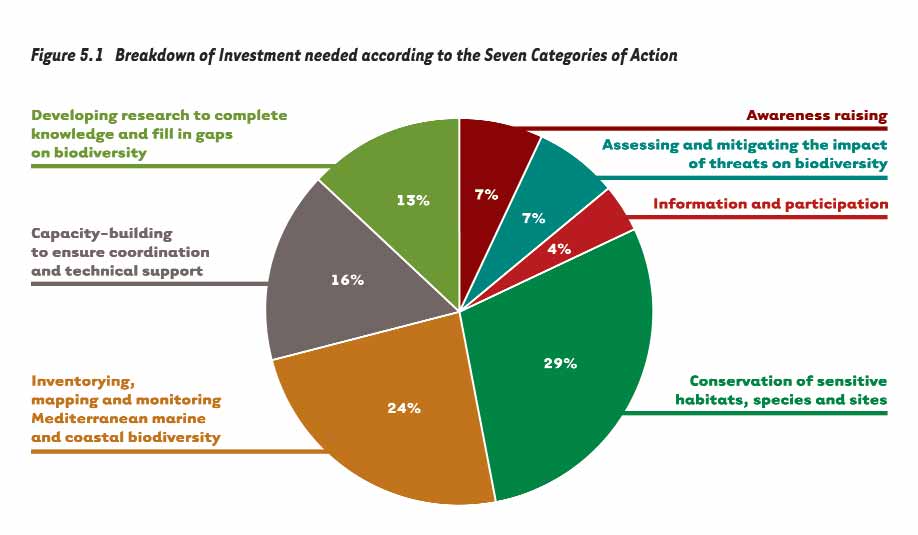
· "Extensive SAP BIO Investment Portfolio",
presenting all individual investments per
category and country in tabular form,
· "Summary of National Action Plans", and
· "Breakdown of costings for Regional
Actions".
Lists of National Action Plans for the Con-
AL QUALITY OBJECTIVES (EQOs)
servation of Biodiversity and Regional Biodiversity
Priority Actions are given in Annex VI.
5.0 ENVIRONMENT
153
SIS (TDA) FOR THE MEDITERRANEAN SEA
Y
TIC ANAL
Y DIAGNOS
TRANSBOUNDAR
154
6.0
REFERENCES &
SELECTED BIBLIOGRAPHY
In addition to the works referred to in the text
crispus and its prey in wetlands of Amvrakikos Gulf,
the following list includes a number of selected back-
N.W. Greece. Chemosphere, 31: 43414347.
ground readings that were relevant to the prepara-
Alzieu C., Sanjuan J., Deltreil J.P. and Borel M.
tion of this report.
(1986). Tin contamination in Arcachon Bay: Effects on
Abad E., Caixach J., Rivera J., Gustems L.,
oyster shell anomalies. Mar. Pollut. Bull., 17 (11):
Massague G. and Puig O. (2002). Surveillance pro-
494498.
gramme on dioxin levels in ambient air sites in
Axiak V., Vella A.J., Agius D., Bonnici P., Cassar
Catalonia (Spain). Chemosphere, 49: 697702.
G., Casson R., Chircop P., Micallef D., Mintoff B. and
Abbot B.C. and Traughen D.M. (1969). Biolo-
Sammut M. (2000). Evaluation of environmental levels
gical and oceanographic effects of oil spillage in the
and biological impact of TBT in Malta (central
Santa Barbara Channel Following the 1969 blow-out.
Mediterranean). Sci. Total Environ., 258 (12): 8997.
Six monthly report. Mar. Pollut. Bull., 16: 611.
Bacci E. and Gaggi C. (1989). Organotins com-
Abd-Allah A.M., Ali H.A. and El Sebae A. (1998).
pounds in harbours and marina waters from the
Levels of chlorinated hydrocarbons in a teleost fish and
Northern Tyrrhenian sea. Mar. Pollut. Bull., 20: 290292.
a bivalve from the Egyptian Mediterranean coast and
Bartram J. and Rees G. (2000). Monitoring
Nile estuary. Z. Lebensm.-Unters. Forsch., A, 206: 2528.
bathing waters. A practical guide to the design and
Abou-Arab A.A.K. and Abou-Donia M.A.
implementation of assessments and monitoring pro-
(2001). Pesticide residues in some Egyptian species
grammes. E & FN SPON, London and New York.
6.0 REFERENCES & SELECTED BIBLIOGRAPHY
and medicinal plants as affected by processing. Food
Bergametti et al. (1992). Source, transport and
Chem., 72: 439445.
deposition of atmospheric phosphorus over the north-
Aguilar A. and Borrell A. (1994). Abnormally
western Mediterranean. J. Atmos. Chem., 14: 501513.
high polychlorinated biphenyl levels in striped dolphins
Bethoux J.P., Morin P., Madec C. and Gentilli B.
(Stenella coeruleoalba) affected by the 19901992
(1992). Phosphorus and nitrogen behaviour in the Me-
Mediterranean epizootic. Sci. Total Environ., 154:
diterranean Sea. Deep Sea Res., 39: 16411654.
237247.
Bethoux J.P., Gentili B., Tailliez D. (1998).
Ahel M. and Tepic N. (2000). Distribution of
Warming and freshwater budget change in the Medi-
polycyclic aromatic hydrocarbons in a municipal solid
terranean since the 1940s, their possible relation to
waste landfill and underlying soil. Bull. Environ.
the greenhouse effect. Geophysical Res. Let., 25:
Contam. Toxicol., 63: 236243.
10231026.
Albanis T.A., Danis T.G. and Kourgia M.K.
Boucher G.S. (1984). Modifications des charac-
(1994). Transportation of pesticides in estuaries of the
téristiques physicochimiques et biologiques d'un sable
Axios, Loudias and Aliakmon rivers (Thermaikos Gulf),
sublittoral Polluté par hydorcarbures. Marine Environ-
Greece. Sci. Total Environ., 156: 1122.
mental Research, 12 (1): 123.
Albanis T.A., Danis T.G. and Hela D.G. (1995a).
Boudouresque C.F., Ribera M.A. (1994). Les
Transportation of pesticides in estuaries of Louros and
introductions d'espèces végétales et animales en milieu
Arachthos rivers (Amvrakikos Gulf, N.W. Greece). Sci.
marin -- Conséquences écologiques et économiques et
Total Environ., 171: 8593.
problèmes législatifs. First International Workshop on
Albanis T.A., Hela D.G. and Hatzilakos D.
Caulerpa taxifolia (eds.: Boudouresque C.F., Meinez A.
155
(1995b). Organochlorine residues in eggs of Pelecanus
et Gravez V.). GIS-Posidonie: 29102.
Burns K. and Villeneuve J.P. (1987). Chlorinated
Dachs J., Bayona J.M. and Albaigés J. (1997).
hydrocarbons in the open Mediterranean ecosystem
Spatial distribution, vertical profiles and budget of
and implications for mass balance calculations. Mar.
organochlorine compounds in W. Mediterranean
Chem., 20: 337359.
seawater. Mar. Chem., 57: 313324.
Burns K.A. et al. (1994). The Galeta oil spill II.
Danavaro R., Fabiano M. and Vincx M. (1995).
Unexpected persistence of oil trapped in mangrove
Meiofauna response to the Agip Abrouzzo oil spill in
sediments. Estuarine, coastal and shelf science, 38:
subtidal sediments of the Ligurian Sea. Mar. Pollut.
349364.
Bull., 30 (2): 133145.
Caddy J.F. (1993). Towards a comparative eval-
Dauvin J.C. (1982). Impact of Amoco Cadiz oil
uation of human impacts on fishery ecosystems of en-
spill on the muddy fine sand Abra Alba and Melinna
closed and semi enclosed seas. Rev. Fish Sci., 1 (1):
Palmata community from the Bay of Morlaix. Estuarine,
5795.
Coastal and Shelf Science, 14: 517531.
Caricchia A.M., Chiavarini S., Cremisini C.,
Deere-Jones T. (1996). Lost treasure; The long-
Fantini M. and Morabito R. (1992). Monitoring of
term environmental impacts of the sea empress oil
organotins in the La Spezia Gulf. II. Results of the 1990
spill. Friends of the Earth Ltd., May 1996.
sampling campaigns and concluding remarks. Sci.
Deslous-Paoli J.M., Mazouni N., Souchu P.,
Total Environ., 121: 133144.
Landrein S., Pichot. P. and Juge C. (1993). Oyster farm-
Chasse C. et al. (1978). Ecological impact on
ing impact on the environment of a Mediterranean
and near shores by the Amoco Cadiz oil spill. Mar.
lagoon (Thau). Preliminary results of the Oxythau pro-
Pollut. Bull., 9 (11): 298301.
gram. Bivalve Filter-Feeders in Estuarine and Coastal
Cid J.F., Risebrough R.W., DeLappe B.W., Marino
Ecosystem Processes (ed.: Dame R.F.). NATO ASI series,
M.G. and Albaigés J. (1990). Estimated inputs of
33: 519520.
organochlorines from the River Ebro into the North-
Diez S., Abalos M. and Bayona J.M. (2002).
western Mediterranean. Mar. Pollut. Bull., 21: 518523.
Organotin contamination in sediments from the
SIS (TDA) FOR THE MEDITERRANEAN SEA
Clark R.B. (2001). Marine pollution. 5th edition.
Western Mediterranean enclosures following 10 years of
Y
Clarendon Press, Oxford: 237 pp.
TBT regulation. Water Research, 36(4): 905918.
COM (1999). Commission of the European
Dixon B.A. (1991) Antibiotic resistance of bacte-
TIC ANAL
Communities. Communication from the Commission of
rial fish pathogens. Fish and Crustaceans. Larviculture
the European Communities to the Council and the
Symp. Special Public. Eur. Aquacult. Soc., no. 15: 419.
Y DIAGNOS
European Parliament, Brussels, 17.12.1999: 706.
Domingo J.L., Schuhmacher M., Granero S.,
COM (2002). Commission of the European
Llobet J.M. (1998). PCDDS and PCDFs in food samples
Communities. Proposal for a "Directive of the European
from Catalonia, Spain. An assessment of dietary
Parliament and of the Council concerning the quality of
intake. Chemosphere, 38: 35173528.
TRANSBOUNDAR
bathing water". Brussels, 24.10.2002: 581: 9.
Edman L.M., Sofiev M., Subbotin S., Dedkova I.,
Constandinides G. (1993). Costs and benefits of
Afinogenova O., Cheshikina T., Pavlovskaya L. and
measures for the reduction of degradation of the envi-
Sardine A. (1994). Assessment of airborne pollution of
ronment from land based sources of pollution in
the Mediterranean Sea by sulfur and nitrogen com-
coastal areas. Case study of the island of Rhodes.
pounds and heavy metals in 1991. MAP Technical
Costanza R., d'Arge R., de Groot R., Farber S.,
Reports Series, #85.
Grasso M., Hannon B., Limburg K., Naeem S., O'Neill
Efstratiou M.A., Mavridou A., Richardson S.C.
R.V., Paruelo J., Raskin R.G., Sutton P., van den Belt M.
and Papadakis J.A. (1998). Correlation of bacterial
(1997). The value of the world's ecosystem services and
indicator organisms with Salmonella spp., Staphylo-
natural capital. Nature, 387: 253260.
coccus aureus and Candida albicans. Letters in Applied
Council Directive 79/923 EEC of 30 October
Microbiology, 26: 342346.
1979. On the quality required of shellfish waters.
Egidius E. and Master B. (1987) Effects of
Official Journal of the European Communities, L 281,
Neguvon and Nuvan treatment on crabs (Cancer pagu-
10.11.1979: 4752.
rus, C. maenas) lobster (Homarus gamarus) and the
Council Directive 91/492/EEC of the 15th July
blue mussel (Mytilus edulis). Aquaculture, 60: 165168.
1991. Laying down the health of conditions for the pro-
Elmgren R., Hanson S., Larson U., Sundelin B.
duction and the placing on the market of live bivalves
and Boehm P.D. (1983). The Tesis oil spill: Acute and
156
molluscs. Official Journal, L 268, 24.9.1991: 114.
long-term impact on the Benthos. Mar. Biol., 73: 5163.
Environmental Health Criteria (EHC). Mono-
(2002). Distribution of human viral contamination in
graphs. The corresponding information can be found
shellfish from different growing areas in Greece, Spain,
at: http://www.inchem.org/pages/ehc.html.
Sweden and the UK. Appl. Environm. Microbiol., 68:
EC (1976). European Commission. Council
59905998.
Directive of 8th December 1975 concerning the quality
Fossi M.C., Casini S., Ancora S., Moscatelli A.
of bathing waters (76/160/EC). Official Journal of the
and Ausili A. (2001). Do endocrine disrupting chemi-
European Communities, no. L 31: 14.
cals threaten Mediterranean swordfish? Mar. Environ.
EC (1995). European Commission. Europe envi-
Res., 52: 477483.
ronment. Statistical compendium for the Debris
Fredj G., Bellan-Santini D., Menardi M. (1992).
assessment. The European Commission, Brussels.
Etat des connaissances sur la faune marine méditer-
EC (1999). European Commission. Marine
ranéenne. Bull. Inst. Oc. Monaco, 9: 133145.
Exhaust Emissions Quantification Study / Mediterra-
Frenzilli G., Nigro M., Scarcelli V., Gorbi S. and
nean Sea. European Commission, DG XI. Report no.
Regoli F. (2001). DNA integrity and total oxyradical
99/EE/7044. December 1999.
scavenging capacity in the Mediterranean mussel,
EC (2000). European Commission. An assess-
Mytilus galloprovincialis: A field study in a highly eu-
ment of the socio-economic costs and benefits of inte-
trophicated coastal lagoon. Aquat. Toxicol., 53: 1932.
grated coastal zone management. Final report. EU
Georgiou L.G. (2001). The suitability of the sea-
Demonstration Programme on Integrated Management
weed Padina pavonica as a die for the mass production
in Coastal Zones, 19971999.
of the rotifers as food for the nutrition of the gilthead
EC (2001). European Commission. On the
seabream larvae. MSc thesis, University of Malta.
Monitoring of Illicit Vessel Discharges. A Reconnais-
Gibbs P.E., Bebianno M.J. and Coelho M.R.
sance Study in the Mediterranean Sea. European Com-
(1997). Evidence of the differential sensitivity of neo-
mission, DG-XI. EUR 19906 EN, 2001.
gastropods to tributyltin (TBT) pollution, with notes on
EC (2002). European Commission. Communic-
a species (Columbella rustica) lacking the imposex
ation from the Commission to the Council and the
response. Environ. Technol., 18: 12191224.
European Parliament laying down a Community Action
Gilfillan E. and Page D. (1996). Nature knows
Plan for the conservation and sustainable exploitation
best after oil spills. New Scientist, 13.1.1996.
of fisheries resources in the Mediterranean Sea under
Giovanelli G. et al. (1988). Evidence of Anionic-
the Common Fisheries Policy, October 2002. COM
Surfactant Enrichment in Marine aerosol. Mar. Pollut.
(2002).
Bull., 19 (6): 274277.
6.0 REFERENCES & SELECTED BIBLIOGRAPHY
EEA (1999a). European Environment Agency.
GIS-Posidonie (2001). Fourth International
Environment in the European Union at the turn of the
Workshop on Caulerpa taxifolia (eds.: Gravez V.,
century. Environmental assessment series, no. 2.
Ruitton S., Boudouresque C.F., Le Direach L., Meinesz
EEA (1999b). European Environment Agency.
A., Scabbia G., Verlaque M.). Lerici, Italy: 406 pp.
State and pressures of the marine and coastal Mediter-
Gitschlag G.R. and Herczeg B.A. (1994). Sea
ranean environment. Environmental assessment series,
turtle observations at explosive removals of energy
no. 5.
structures. Mar. Fish. Rev., 56 (2): 18.
EEA (2002). European Environment Agency. The
Gowen R.J. and Bradbury N.B. (1987). The eco-
Mediterreanean Sea / Blue oxygen-rich, nutrient-poor
logical impact of salmon farming in coastal waters:
waters in Europe's Biodiversity / Biogeographical
Annual Review. Oceanogr. Mar. Biol. Annu. Rev., 25:
Regions and Seas.
563575.
FAO (2003). Fishery country profiles, (browsed
Graneli E., Paasche E. and Maestrini S.V.
on 18.9.2003) at: http://www.fao.org/fi/fcp/fcp.asp.
(1993). Three years after the Chrysochromulina
Ferrara F., Funari E., De Felip E., Donati G.,
polylepis, bloom in Scandinavian waters in 1988: Some
Traina M. Elsa, Mantovani A. (2001). Alkylphenolic
conclusions of recent research and monitoring. Toxic
compounds in edible molluscs of the Adriatic Sea
Phytoplankton Blooms in the sea (eds.: Smayda T.J.
(Italy). Env. Sci. Technol., 35: 31093112.
and Shimizu). Elsevier, The Netherlands. Vol. 3: 2332.
Formiga-Cruz M.G., Tofino-Quesada S., Bofill-
Gray J.S. (1992). Eutrophication in the sea.
Mas D.N., Lees K., Henshilwood A.K., Allard A., Conden-
Marine eutrophication and population dynamics.
Hansson C., Hernroth B.E., Vantarakis A., Tsibouxi A.,
(eds.: Colombo G., Ferrari I., Cerccherelli K.V. and Rossi
157
Papapetropoulou M, Furones M.D. and Girones R.
R.). Olsen & Olsen Fredenborg: 394 pp.
Grimalt J., Gomez J.I., Llop R. and Albaiges J.
Hope-Jones P., Monna, J.-Y., Cadbury, C.J. and
(1988). Water phase distribution of hexachlorobenzene
Stowe T.J. (1978). Birds oiled during the Amoco Cadiz
in a deltaic environment (Ebro Delta Western Mediter-
Incident -- An interim report. Mar. Pollut. Bull., 9 (11):
ranean). Chemosphere, 17: 18931903.
307310.
GESAMP (1990). Joint Group of Experts on the
Hopkins J.P. (1999). The thermohaline forcing
Scientific Aspects of Marine Pollution. The State of the
of the Gibraltar exchange. J. Marine Systems, 20: 131.
Marine Environment. Pergamon. UNEP Regional Seas.
Ibanez C., Prat N. and Canicio A. (1996).
Rep. Stud. GESAMP, no.115: 111 pp.
Changes in the hydrology and sediment transport pro-
GESAMP (1991). Joint Group of Experts on the
duced by large dams on the lower Ebro River and its
Scientific Aspects of Marine Pollution. (IMO/FAO/
estuary. Regulated Rivers: Research & Management,
UNESCO-IOC/WMO/WHO/IAEA/UN/UNEP) Report. Re-
12: 5162.
ducing environmental impacts of coastal aquaculture.
IFREMER. Réseau National d'Observation de la
Rep. Stud. GESAMP, no. 47: 35 pp.
Qualité du Milieu Marin (RNO). Website: http://
GESAMP (1993). Joint Group of Experts on the
www.ifremer.fr
Scientific Aspects of Marine Pollution. Impact of oil
Ignatiades L.P. Vounatsou and Karydis M.
and related chemicals on the marine environment.
(1992). A possible method for evaluating oligotrophy
International Marine Organisation, London. Rep. Stud.
and eutrophication based on nutrient concentration
GESAMP, no. 50: 180+ix pp.
scales. Mar. Pollut. Bull., 24: 238243.
GESAMP (2001a). Joint Group of Experts on the
Isoard F. (1997). Mediterranean Europe and the
Scientific Aspects of Marine Pollution. UNEP/FAO/UN/
North Africa, Middle East and Eastern Countries.
UNESCO-IOC/WHO/WMO/IAEA/IMO) A Sea of troubles.
Proceedings of the offshore Mediterranean conference
Rep. Stud. GESAMP, no. 70: 35 pp.
1997, March 1921. Ravenna, Italy.
GESAMP (2001b). Joint Group of Experts on the
Jackson L., Bidleman T. and Vernberg W. (1981).
Scientific Aspects of Marine Pollution. Protecting the
Influence of reproductive activity on toxicity of petro-
SIS (TDA) FOR THE MEDITERRANEAN SEA
oceans from land-based activities -- Land-based
leum hydrocarbons to ghost crabs. Mar. Pollut. Bull.,
Y
sources and activities affecting the quality and uses of
12: 6365.
the marine, coastal and associated freshwater envi-
Jeftic L. et al. (1990). State of the marine envi-
TIC ANAL
ronment. Rep. Stud. GESAMP, no. 71.
ronment in the Mediterranean Region. UNEP Regional
Guerzoni S., Chester R., Dulac F., Herut B., Loye-
seas reports and studies, #132.
Y DIAGNOS
Pilot M.D., Measures C., Migon C., Molinaroli E., Moulin
Kannan K., Corsolini S., Focardi S., Tanabe S.
C., Rossini P., Saydam C., Soudine A. and Ziveri P.
and Tatsukawa R. (1996). Accumulation pattern of
(1999). The role of atmospheric deposition in the bio-
butyltin compounds in dolphin, tuna, and shark col-
geochemistry of the Mediterranean Sea. Progress in
lected from Italian coastal waters. Archives of Environ-
TRANSBOUNDAR
Oceanography, 44: 147190.
mental Contamination and Toxicology, 31 (1): 1923.
Hall A.J. et al (1993). The impact of the 1993
Kannan K. and Falandysz J. (1997) Butyltin
Braer oil spill on grey seals in Shetland. Sea Mammal
residues in sediment, fish, fish-eating birds, harbour
Research Unit, NERC, Cambridge.
porpoise and human tissues from the Polish coast of
Hansen D.J., Mahony J.D., Berry W.J., Benyi S.J.,
the Baltic Sea. Mar. Pollut. Bull., 34 (3): 203207.
Corbin J.M., Pratt S.D., Di Toro D.M. and Abel M.B.
Kay D., Fleisher J.M., Salmon R.L., Wyer M.D.,
(1996). Chronic effects of cadmium in sediments on
Godfree A.F., Zelenauch-Jacquotte Z. and Shore R.
colonization by benthic marine organisms: An evalua-
(1994). Predicting likelihood of gastroenteritis from
tion of the role of interstitial cadmium and acid
sea bathing; Results from a randomized exposure.
volatile sulfide in biological availability. Environ-
Lancet, 344 (8927): 905909.
mental Toxicology & Chemistry, 15: 21262137.
Krom M.D., Kress N., Brenner S. and Gordon L.I.
Honjo T. (1993). Overview on bloom dynamics
(1991). Phosphorus limitation of primary productivity
and physiological ecology of Heterosigma akashivo. In
in the eastern Mediterranean Sea. Limnol. oceanogr.,
toxic Phytoplankton Blooms in the sea (eds.: Smayda T.J.
36: 424432.
and Shimizu). Elsevier, The Netherlands. Vol. 3: 3342.
Leonzio C., Lambertini M., Massi A., Focardi S.
Holme N.A. (1978). Notes on the condition in
and Fossi C. (1989). An assessment of pollutants in eggs
September 1978 of some intertidal sands polluted by
of Audouin's Gull (Larus audouinii), a rare species of the
158
Amoco Cadiz oil. Mar. Pollut. Bull., 9 (11): 302.
Mediterranean Sea. Sci. Total Environ., 78: 1322.
Levings S., Garrity C., Stephen D. and Burns K.A.
using Molluscs and fish as sentinel organisms. Archives
(1994). The Galeta oil spill III. Chronic reoiling, long-
of Environmental Contamination and Toxicology, 32
term toxicity of hydrocarbon residues and effects on
(2): 198203.
epibiota in the Mangrove fringe. Estuarine, coastal and
Murphy P.P., Bates T.S. et al. (1988). The trans-
shelf science, 38: 365395.
port and fate of particulate hydrocarbons in an urban
Lipiatou E., Tolosa I., Simo R., Bouloubassi I.,
fjord-like estuary. Estuary, coastal and shelf science,
Dachs J., Sicre M.A., Raoux C., Marti S., Bayona J.M.,
27: 461482.
Grimalt J.O., Saliot A. and Albaiges J. (1997). Mass
NAS (1997). National Academy of Science.
budget and dynamics of PAH in the Western Mediter-
Contaminated Sediments in Ports and Waterways:
ranean Sea. Deep-Sea Res., 44: 881905.
Cleanup Strategies and Technologies. USA National
Lodovici M., Dolara P., Casalini C., Ciappellano
Academy Press, Washington DC.
S. and Testolin G. (1995). Polycyclic aromatic hydro-
NSA (1976). National Shellfish Association. Oil
carbon contamination in the Italian diet. Food
bioassays with the American oyster: Grassostrea vir-
Additives and Contaminants, 12: 703713.
ginica. Proc. NSA, 65: 3842.
Loglio G. et al. (1989). Detergents as a condi-
OSPAR (2001). Discharges, Waste Handling and
tion of pollution from coastal marine aerosols. Mar.
Air Emissions from Offshore Installations for
Pollut. Bull., vol. 20 (3): 115119.
19981999. OSPAR Commission, London.
Lowe D.M. and Fossato V.U. (2000). The influ-
Overton E.B., Sharp W.D. and Roberts P. (1994).
ence of environmental contaminants on lysosomal
Chapter 5: Toxicity of Petroleum. Basic environmental
activity in the digestive cells of mussels (Mytilus gallo-
toxicology (eds.: Cockerham and Shane).
provincialis) from the Venice Lagoon. Aquat. Toxicol.,
Papadakis J.A., Mavridou A., Richardson S.C.,
48: 7585.
Lambiri M. and Marcelou U. (1997). Bather related
Macpferson E. (2000). Fishing effects on troph-
microbial and yeast populations in sand and seawater.
ic structure of rocky littoral fish assemblages. Fishing
Water Research, 31 (4): 799804.
down the Mediterranean food webs? CIESM Workshop
Pergent G. and Pergent-Martini C. (1999).
Series, 12.
Mercury fluxes in Posidonia oceanica meadows.
Manos A. (1991). An international programme
Environmental Pollution, 106: 3337.
for the protection of a semi-enclosed-sea / the Medi-
Pessoa M.F. and Oliveira J.S. (1997). Imposex on
terranean Action Plan. Mar. Pollut. Bull., 23: 489496.
Portuguese neogastropods: Preliminary results. J.
Marchetti R. (1985). Ingadini sul problema del-
Recherche Océanographique, 22: 6771.
6.0 REFERENCES & SELECTED BIBLIOGRAPHY
l'eutrofizzazione delle acque costiere dell'Emilia
Petrovic S., Ozretic B., Krajnovic M. and Bobinac
Romagna. Ed. Regione Emilia Romagna. Assessorato
D. (2001). Lysosomal membrane stability and metal-
Ambiente e difesa del Suolo, Bologna: 1308.
lothioneins in digestive gland of mussels (Mytilus gal-
Michel P. and Averty B. (1999). Contamination
loprovincialis L.) as biomarkers in a field study. Mar.
of French coastal waters by organotin compounds. Mar.
Pollut. Bull., 42: 13731378.
Pollut. Bull., 38: 268275.
Phelps H.L. and Page D.S. (1997). Tributyltin
Michel P., Averty B., Andral B., Chiffoleau J.F.
biomonitoring in Portuguese estuaries with the
and Galgani F. (2001). Tributyltin along the Coasts of
Portuguese oyster (Crassostrea angulata). Environ.
Corsica (Western Mediterranean): A Persistent
Technol., 18: 12691276.
Problem. Mar. Pollut. Bull., 42 (1): 11281132.
Philips D.J.H. et al. (1992). Trace metals,
Millot C. (1991). Mesoscale and seasonal vari-
organochlorines and hydrocarbons in Philip Bay:
abilities of the circulation in the western Mediterra-
Victoria -- A historical review. Mar. Pollut. Bull., 25:
nean. Dynamics Atmosphere and Oceans, no. 15:
200217.
179214.
Picer M. and Picer N. (1998). I. War damage and
Mingazzini M., Rinaldi A., Montanari G. (1992).
jeopardized water in karst region of Croatia. Research
Multi level nutrient enrichment bioassays on North
of PCBs level on ground of war damaged E.T.S. in karstic
Adriatic coastal waters. Marine coastal eutrophication
region of Croatia (in Croatian language). Croatian
(eds.: Vollenweider R.A., Marchetti R. and Viviani R.).
Water Management, 7: 1015.
Proc. Inter. conference, Bologna: 2124.
Poem group (1992). General circulation in the
Morcillo Y., Borghi V. and Porte C. (1977). Survey
eastern Mediterranean. Earth Science Review, 32:
159
of organotin compounds in the western Mediterranean
285309.
Polo F., Figueras M.J., Inza I., Sala J., Fleisher J.,
Stegeman J.J. et al. (1991). Greenpeace oil
Mand Guarro J. (1998). Relationship between presence
briefing, 5: Cytochrome P-450: Monooxygenase sys-
of Salmonella and indicators of faecal pollution in
tems in aquatic species: Carcinogen metabolism and
aquatic habitats. FEMS Microbiol. Lett., 15 (160):
biomarkers for carcinogen and pollutant exposure.
253256.
Environmental Health Perspectives: 101109.
Porte C., Solé M., Borghi V., Martinez M.,
Stille W. , Kunkel B. and Nerger K. (1992).
Chamorro J., Torreblanca A., Ortiz M., Orbea A., Soto M.
Austern-hepatitis. Dt. Med. Zeitschr., 97: 145.
and Cajaraville M.P. (2001). Chemical, biochemical and
Swan J.M., Neff J.M. and Young P.C. (1994).
cellular responses in the digestive gland of the mussel
Environmental implications of offshore oil and gas
Mytilus galloprovincialis from the Spanish Mediterra-
development in Australia: 3122.
nean coast. Biomarkers, 6: 335350.
Tarasson et al. (2000). Transboundary acidifi-
Pruss A., (1998). A review of epidemiological
cation and eutrophication in Europe (eds.: Tarasson L.,
studies from exposure to recreational water. Inter-
Schaug J.). EMEP Report, January 2000.
national Journal of Epidemiology, 27: 19.
Terlizzi A., Geraci S. and Minganti V. (1998).
REMPEC (1996). Regional Marine Pollution
Tributyltin (TBT) Pollution in the Coastal Waters of
Emergency Response Centre for the Mediterranean
Italy as Indicated by Imposex in Hexaplex trunculus
Sea. Regional Information System. Part C, Section 4.
(Gastropoda, Muricidae). Mar. Pollut. Bull., 36:
List of alerts and accidents in the Mediterranean.
749752.
March 1996.
Tolosa I., Readman J.W., Blaevoet A., Ghilini S.,
REMPEC (1998). Regional Marine Pollution
Bartocci J. and Horvat M. (1996). Contamination of
Emergency Response Centre for the Mediterranean Sea.
Mediterranean (Côte d'Azur) coastal waters by organ-
REMPEC, Regional Information System, March 1998.
otins and Irgarol-1051 used in antifouling paints. Mar.
Rilov G., Gasith A., Evans S.M. and Benayahu Y.
Pollut. Bull., 32: 335341.
(2000). Unregulated use of TBT-based antifouling
Tomczak M. and Godfrey J. (2003). Regional
SIS (TDA) FOR THE MEDITERRANEAN SEA
paints in Israel (eastern Mediterranean): High contam-
Oceanography: An Introduction (2nd ed). Daya
Y
ination and imposex levels in two species of marine
Publishing House, Delhi: 390 pp
gastropods. Mar. Ecol. Prog. Ser., 192: 229238.
Torsvik V., Soerheim R. and Goksoer J. (1988)
TIC ANAL
Robinson A., Leslie W.G., Theocharis A. and
Antibiotic Resistance of bacteria from fish farm sedi-
Lascaratos A. (2001). Mediterranean Sea Circulation.
ments. Copenhagen, Denmark-ICES (TR Oil Services,
Y DIAGNOS
Ocean Currents. Indira Ed. Academic Press: 119.
1998: Website product list): 9 pp.
Ruiz J.M., Quintela M. and Barreiro R. (1998).
Tselentis B.S., Maroulakou M., Lascourreges J.F.,
Ubiquitous imposex and organotin bioaccumulation in
Szpunar J., Smith V., Sakellariadou F. and Donard O.F.X.
gastropods Nucella lapillus from Galicia (NW Spain).
(1999). Organotins in Sediments and Biological Tissues
TRANSBOUNDAR
Mar. Ecol. Progr. Series, 164: 237244.
from Greek Coastal Areas: Preliminary Results. Mar.
Samuelson O.B, Torsvik V. and Ervik A. (1992).
Pollut. Bull., 38 (2): 146152.
Long range changes in oxytetracycline concentration in
Turner P.K., Adger W.N., Crooks S., Loreizoni I.
bacterial resistance towards oxytetracycline in a fish
and Leboux L. (2001). Sustainable coastal resources
farm sediment after medication. Sci. Total Environ.,
management: Principles and practice. Water
114: 2536.
Resources and Coastal Management (eds.: Turner
Scoullos M., Constantianos V. (1996). Assess-
R.K., Bateman I.J.), Pergamon: 275286.
ment of the state of pollution of the Mediterranean sea
Tziperman E. and Malanotte-Rizolli P. (1991).
by zinc, copper and their compounds. MAP Technical
The climatological seasonal circulation of the Mediter-
Reports Series (UNEP, Athens, 1996), #105.
ranean Sea. Journal of Marine Research, 49: 411434.
Solé M., Morcillo Y. and Porte C. (1998).
Ulfic K., Guarro J., Cano J., Gene J., Vidal P. and
Imposex in the commercial snail Bolinus brandaris in
Figueras M.J. (1997). General assessment of the occur-
the northwestern Mediterranean. Environ. Pollut., 99
rence of keratinolytic fungi in river and marine beach
(2): 241246.
sediments of Catalonian waters (Spain). Water, Air and
Stefanou P., Tsirtsis G. and Karydis M. (2000).
Soil Pollution, 94: 34, 275288.
Nutrient scaling for assessing eutrophication: The
UNEP (1995). Common measures for the control
development of a simulated normal distribution.
of pollution adopted by the Contracting Parties to the
160
Ecological Applications, 10: 303309.
Convention for the Protection of the Mediterranean Sea
against Pollution. MAP Technical Reports Series (UNEP,
UNEP/MAP (1991b). Assessment of the state of
Athens), #95: 69 pp.
pollution of the Mediterranean sea by persistent synthetic
UNEP (1998a). Strategic Action Programme to
material which may float, sink or remain in suspension.
Address Pollution from Land-Based Activities. MAP
MAP Technical Reports Series (UNEP, Athens), #56.
Technical Reports Series (UNEP, Athens), #119: 178 pp.
UNEP/MAP (1991c). Proceedings of the FAO/
UNEP (1998b). MED POL Phase III. Programme for
UNEP/IAEA consultation meeting on the accumulation
the Assessment and Control of Pollution in the Mediter-
and transformation of chemical contaminants by biot-
ranean Region (19962005). MAP Technical Reports
ic and abiotic processes in the marine environment.
Series (UNEP, Athens), #120: 120 pp.
MAP Technical reports Series (UNEP, Athens), #59.
UNEP (1999). Proceedings of the Workshop on In-
UNEP/MAP (1992a). Regional changes in cli-
vasive Caulerpa Species in the Mediterranean. Heraklion,
mate in the Mediterranean basin due to global green-
Crete, Greece (1820 March 1998). MAP Technical Reports
house gas warming. MAP Technical Reports Series (UNEP,
Series (UNEP, Athens), #125: 317 pp. English and French.
Athens), #66.
UNEP/FAO (1996a). Final reports of research
UNEP/MAP (1992b). Organohalogen compounds
projects on effects (Research Area III) Pollution effects
in the marine environment: A review. MAP Technical
on marine communities. MAP Technical Reports Series
Reports Series (UNEP, Athens), #70.
(UNEP, Athens), #97: 141 pp.
UNEP/MAP (1993). Final reports on research
UNEP/FAO (1996b). Final reports on research
projects dealing with the effects of pollutants on marine
projects dealing with biological effects (Research Area
communities and organisms. MAP Technical Reports
III). MAP Technical Reports Series (UNEP, Athens), #103:
Series (UNEP, Athens), #73.
128 pp.
UNEP/MAP (1994a). Final reports on research
UNEP/FAO (1996c). Final reports on research
projects dealing with eutrophication problems. MAP
projects dealing with eutrophication and heavy metal
Technical Reports Series (UNEP, Athens), #78.
accumulation. MAP Technical Reports Series (UNEP,
UNEP/MAP (1994b). Technical report on the
Athens), #104: 156 pp.
state of Cetaceans in the Mediterranean. MAP Technical
UNEP/FAO/WHO (1996a). Assessment of the
Reports Series (UNEP, Athens), #82.
state of pollution of the Mediterranean Sea by zinc,
UNEP/MAP (1994c). Une contribution de l'é-
copper and their compounds. MAP Technical Reports
cologie à la prospective des régions côtières de la
Series (UNEP, Athens), #105: 288 pp.
Méditerranée. MAP Technical Reports Series (UNEP,
UNEP/FAO/WHO (1996b). Assessment of the
Athens), #91.
6.0 REFERENCES & SELECTED BIBLIOGRAPHY
state of eutrophication in the Mediterranean Sea. MAP
UNEP/MAP (1996a). State of the marine and
Technical Reports Series (UNEP, Athens), #106: 456 pp.
coastal environment in the Mediterranean region. MAP
UNEP/GEF (2002). Regionally based Assessment
Technical Reports Series (UNEP, Athens), #100: 178 pp.
of persistent toxic substances, Region IV Mediterranean.
UNEP/MAP (1996b). Assessment of the state of
UNEP/IOC (1996). Final reports of research proj-
pollution of the Mediterranean Sea by anionic detergents.
ects on transport and dispersion (Research Area II)
MAP Technical Reports Series (UNEP, Athens), #110.
Modelling of eutrophication and algal blooms in the
UNEP/MAP (1996c). Guidelines for treatment of
Thermaikos Gulf (Greece) and along the Emilia
effluents prior to discharge into the Mediterranean Sea.
Romagna Coast (Italy). MAP Technical Reports Series
MAP Technical Reports Series (UNEP, Athens), #111.
(UNEP, Athens), #113: 118 pp.
UNEP/MAP (1997). Transboundary Diagnostic
UNEP/MAP (1988). Eutrophication in the Medi-
Analysis for the Mediterranean Sea. UNEP(OCA)/MED
terranean Sea: Receiving capacity and monitoring of
IG. 11/Inf. 7: 222 pp.
long-term effects. MAP Technical Reports Series (UNEP,
UNEP/MAP (2001a). Atmospheric Transport and
Athens), #21.
Deposition of Pollutants into the Mediterranean Sea:
UNEP/MAP (1990). Final reports on research
Final Reports on Research Projects. MAP Technical
projects dealing with eutrophication and plankton
Reports Series (UNEP, Athens), #133.
blooms. MAP Technical Reports Series (UNEP,
UNEP/MAP (2001b). Litter management in
Athens), #37.
coastal zones of the Mediterranean Basin: Analysis of
UNEP/MAP (1991a). Jellyfish blooms in the Me-
the questionnaire and proposals for guidelines.
diterranean. MAP Technical Reports Series (UNEP,
Meeting of the MED POL National Coordinators. Venice,
161
Athens), #47.
2831.5.2001. UNEP(DEC)/MED WG. 183/Inf. 4.
UNEP/MAP (2001c). Operational Document for
UNEP/WHO (1999). Identification of Priority
the Implementation of the Strategic Action Programme
Hot Spots and Sensitive Areas in the Mediterranean.
to Address Pollution of the Mediterranean Sea from Land-
MAP Technical Reports Series (UNEP, Athens), #124.
Based Activities (SAP). Meeting of the MED POL National
UNEP/WMO (1997). The Input of Anthropogenic
Coordinators. Venice, 2831.5.2001. UNEP(DEC)/MED
Airborne Nitrogen to the Mediterranean Sea through its
WG. 183/6.
Watershed. MAP Technical Reports Series (UNEP,
UNEP/MAP (2002). Revision of pollution hot
Athens), #118: 95 pp.
spots in the Mediterranean. Country Reports.
UNEP/WMO (1998). Atmospheric Input of
UNEP/MAP (2003). The Declaration of the
Mercury to the Mediterranean Sea. MAP Technical
Ministers Responsible for the Environment of the Con-
Reports Series (UNEP, Athens), #122: 78 pp.
tracting Parties to the Barcelona Convention concerning
UNEP(DEC)/MED/GEF/198/3 (2002). Report
the protection of the Mediterranean Sea against pollu-
submitted to the First Meeting of the ad-hoc Technical
tion from ships. MAP National focal Points Meeting.
Committee to select pollution hot spots for the prepa-
Athens, 1518.9.2003. UNEP(DEC)/MED WG. 228/15.
ration of pre-investment studies within the GEF Project.
UNEP/MAP/MED POL (2003). Sea Water Desali-
Athens, 2829.1.2002.
nation in the Mediterranean: Assessment and Guidelines.
Urieta I., Jalon M. and Eguileor I. (1996). Food
MAP Technical Reports Series (UNEP, Athens), #139.
surveillance in the Basque Country (Spain). II. Esti-
UNEP/MAP/MED POL (2004). Mariculture in the
mation of the dietary intake of organochlorine pesti-
Mediterranean. MAP Technical Reports Series (UNEP,
cides, heavy metals, arsenic, aflatoxin M-1, iron and
Athens), #140.
zinc through the Total Diet Study, 199091. Food
UNEP/MAP/MED POL/WHO (2004). Municipal
Additives and Contaminants, 13: 2952.
wastewater treatment plants in Mediterranean coastal
Vander Meulen J.H. et al. (1979). Sediment pene-
cities (II). MAP Technical Reports Series (UNEP,
tration of Amoco Cadiz oil, potential for future release
Athens), #157.
and toxicity. Mar. Pollut. Bull., vol. 10 (8): 222227.
SIS (TDA) FOR THE MEDITERRANEAN SEA
UNEP/MAP/REMPEC (1996). An overview of
Vantarakis A. and Papapetropoulou M. (1998).
Y
maritime transport in the Mediterranean. September
Detection of enteroviruses and adenoviruses in coastal
1996.
waters of S.W. Greece by nested polymerase chain reac-
TIC ANAL
UNEP/MAP/WHO (2001). Remedial Actions for
tion. Water Research, 32, 8: 23652372.
Pollution Mitigation and Rehabilitation in Cases of
Velverton J.T., Richmond D.R., Hicks W., Sanders
Y DIAGNOS
Non-compliance with Established Criteria. MAP
K., and Fletcher E.R. (1975). The relationship between
Technical Reports Series (UNEP, Athens), #132.
fish size and their response to underwater blast. Topical
UNEP/MAP/WMO (2001). Atmospheric Input of
report, DNA3677T. Defence Nuclear Agency. Department
Persistent Organic Pollutants to the Mediterranean Sea.
of Defence, Washington, D.C.
TRANSBOUNDAR
MAP Technical Reports Series (UNEP, Athens), #130.
Vojinovic-Miloradov M., Adamov J., Sekulic P.,
UNEP/MCSD/Blue Plan (1999). Report of the
Buzarov D. and Jovetic S. (2002). Levels of POPs in
Workshop on Tourism and Sustainable Development in
Serbia & Montenegro -- Case study. Paper presented at
the Mediterranean. Antalya, Turkey (1719.9.1998).
the 1st UNEP Regional Workshop on Assessment of PTS
MAP Technical Reports Series (UNEP, Athens), #126.
sources and concentrations in the environment.
UNEP/MED POL/WHO (2000). Municipal Waste-
Athens, Greece (46.2.2002).
water Treatment Plants in Mediterranean Coastal Cities.
Vos J.G., de Klerk A., Kraine E.I., Kruizinga W.,
MAP Technical Reports Series (UNEP, Athens), #128.
Van Ommen B. and Rozing J. (1984). Toxicity of bis (tri-
UNEP/WHO (1995). Assessment of the State of
n-butyltin) oxide in the rat. II. Suppression of thymus-
Pollution in the Mediterranean Sea by Carcinogenic,
dependent immune responses and of parameters of
Mutagenic and Teratogenic Substances. MAP Technical
nonspecific resistance after short-term exposure.
Reports Series (UNEP, Athens), #92: 238 pp.
Toxicol. Appl. Pharmacol., 75: 387408
UNEP/WHO (1996a). Assessment of the state of
Vos J.G., de Klerk A., Krajnc E.I., Van Loveren V.
microbiological pollution of the Mediterranean Sea.
and Rozing J. (1990). Immunotoxicity of bis (tri-n-
MAP Technical Reports Series (UNEP, Athens), #108.
butyltin) oxide in the rat: Effects on thymus-depend-
UNEP/WHO (1996b). Survey of pollutants from
ent immunity and on nonspecific resistance following
land-based sources in the Mediterranean. MAP
long-term exposure in young versus aged rats. Toxicol.
162
Technical Reports Series (UNEP, Athens), #109: 188 pp.
Appl. Pharmacol., 105: 144155
Vukavic T., Vojinovic-Miloradov M., Pavkov S.
Sustainable Development of the Mediterranean and
and Nikolic D. (1997). Exposure of newborns to pesti-
Black Sea Environment. Thessaloniki, 2831.5.2003
cide residues and PCBs in colustrum during UN Security
(http://www.iasonnet.gr/program/program.html).
Council sanctions for Serbia & Montenegro. Prenat.
Zeinab S.A., Brunn H., Paetzold R. and Hussein L.
Neonat. Med., 2: 356359.
(1998). Nutrients and chemical residues in an Egyptian
Walker D.I. and Mccomb A.J. (1992). Seagrass
total mixed diet. Food Chemistry, 63: 535541.
degradation in Australian coastal waters. Mar. Pollut.
Bull., 25: 191195.
Wania F. and Mackay D. (1996). Tracking the
distribution of persistent organic pollutants. Environ.
Sci. Technol., 30: 390A396A.
WDF/WDOE (1985). Washington Department of
Fisheries / Washington Department of Ecology. Use of the
insecticide Sevin to control ghost and mud shrimp in oys-
ter beds of Willapa bay and Grays Harbour. Final Environ-
mental Impact Statement. Olympia, Washington, USA.
Wheeler D. (1990). The real risks of bathing in
water contaminated by sewage. Environmental Health,
98, 10: 285287.
WHO (1989). Microbiological quality control in
coastal recreational and shellfish areas in the Mediter-
ranean. Document ICP/CEH 083/6 (WHO Regional Office
for Europe, Copenhagen).
WHO (1991). Health impact of human exposure
to fresh and saline waters. Report on WHO Working
Group. Rimini, 1990. Document UCP/RUD 153 (WHO
Regional Office for Europe, Copenhagen).
WHO (1998). Guidelines for safe recreational-
water environments. Geneva, 1998.
WHO/FAO/UNEP (1989). Mediterranean health-
6.0 REFERENCES & SELECTED BIBLIOGRAPHY
related environmental quality criteria. Document
EUR/ICP/CEH 059: 37 pp.
WHO/UNEP (1995a): Health risks from marine
pollution in the Mediterranean. Part I. Implications for
policy makers.
WHO/UNEP (1995b). Health risks from marine
pollution in the Mediterranean, Part II. Review of haz-
ards and health risks.
Zahar Y. and Albergel J. (1999). Hydrodyna-
mique fluviale de l'oued Medjerdah à l'aval du barrage
Sidi Salem. Evolution récente. Paper presented at
Hydrological and Geochemical Processes in Large River
Basins. Manaus Conference, Brazil (1519.11.1999).
Zanetto G. and Soriani S. (1996). Tourism and
Environmental Degradation: The Northern Adriatic Sea.
Sustainable Tourism / European Experiences (eds.:
Prestley G.K., Edwards J.A. and Coccossis H.). CAB Inter-
national, Guilford.
Zenetos A., Todorova V. and Alexandrov A.
(2003). Marine biodiversity changes in zoobenthos in
163
the Mediterranean Sea. Invited talk in: Conference on
SIS (TDA) FOR THE MEDITERRANEAN SEA
Y
TIC ANAL
Y DIAGNOS
TRANSBOUNDAR
164
Annex I
Contributors to Report
The concept of TDA was elaborated in an
nean", was presented and discussed. The document
expert meeting held in Athens 2930 January 2003,
was prepared by Mr. J. Albaiges.
where a background document "Assessment of the
The list of experts who attended the meeting
Transboundary Pollution Issues in the Mediterra-
is as follows:
Mr. Albaiges, Joan
Mr. Ben Sari, Driss
Department of Environmental Chemistry
LAPR-EMI
CID-CSIC
Post:
1, Rue Amir Sidi Mohamed
Post:
Jordi Girona Salgado, 1826
Souissi
08034 Barcelona
Rabat
Spain
Morocco
Tel.:
(+34) 93 4006152
Tel.:
(+212) 37 752249
Fax:
(+34) 93 2045904
Fax:
(+212) 37 752249
E-mail:
albqam@cid.csic.es
E-mail:
sibensari@iam.net.ma
Mr. Baric, Ante
Mr. Civili, Francesco Saverio
Annex I Contributors to Report
GEF Project Manager
MED POL Coordinator
Post:
c/o Coordinating Unit for the
Post:
c/o Coordinating Unit for the
Mediterranean Action Plan
Mediterranean Action Plan
48 Vassileos Konstantinou Avenue
48 Vassileos Konstantinou Avenue
11635 Athens
11635 Athens
Greece
Greece
Tel.:
(+30) 210 7273102
Tel.:
(+30) 210 7273106
Fax:
(+30) 210 7253196/7
Fax:
(+30) 210 7253196/7
E-mail:
abaric@unepmap.gr
E-mail:
fscivili@unepmap.gr
Mr. Benoit, Guillaume
Mr. Friaa, Jafaar
Director, BP/RAC
METAP
Blue Plan / Regional Activity Centre
Middle East and North Africa Region
Post:
15, Avenue Beethoven
Post:
1818 H. Street
Sophia Antipolis
N.W. 20433
06560 Valbonne
Washington D.C.
France
USA
Tel.:
(+33) 4 92387130/33
Tel.:
(+1) 202 4737315
Fax:
(+33) 4 92387131
Fax:
(+1) 202 4771374
E-mail:
gbenoit@planbleu.org
E-mail:
sarif@worldbank.org
165
Mr. Gabrielides, Gabriel
Mr. Malester, Ilan
Director, Department of Fisheries
Coordinator, Land-Based Sources
Ministry of Agriculture, Natural Resources
Marine and Coastal Environment Division
and Environment
Ministry of the Environment
Post:
13 Aeolou Street
Post:
3 Khayatt Street
Nicosia
P.O. Box 33583
Cyprus
31333 Haifa
Tel.:
(+357) 22 807867
Israel
Fax:
(+357) 22 775955
Tel.:
(+972) 2 6553745/6
E-mail:
ggabriel@cytanet.com.cy
Fax:
(+972) 2 6553752
E-mail:
ilanm@sviva.gov.il
Mr. Kamizoulis, George
Mr. Mamaev, Vladimir
WHO/EURO Scientist
Senior Programme Officer,
World Health Organization
International Waters / GEF Facility
Post:
c/o Coordinating Unit for the
Post:
c/o UNEP
Mediterranean Action Plan
UNEP/GEF Coordination Office
48 Vassileos Konstantinou Avenue
P.O. Box 30552
11635 Athens
Nairobi
Greece
Kenya
Tel.:
(+30) 210 7273105
Tel.:
(+254) 2 624607
Fax:
(+30) 210 7253196/7
Fax:
(+254) 2 623557
E-mail:
whomed@hol.gr
E-mail:
Vladimir.Mamaev@unep.org
Mr. Lakkis, Sami
Mr. Rais, Chedly
Annex I Contributors to Report
Director, Laboratory of Oceanography
Scientific Director, SPA/RAC
and Marine Ecology
Specially Protected Areas /
Lebanese University
Regional Activity Centre
Post:
P.O. Box 138
Post:
B.P. 337
Byblos
1080 Tunis cedex
Lebanon
Tunisia
Tel.:
(+961) 9 540580
Tel.:
(+216) 71 783034
Fax:
(+961) 9 540580
Fax:
(+216) 71 797349
E-mail:
slakkis@inco.com.lb
E-mail:
car-asp@rac-spa.org.tn
Mr. Laubier, Lucien
Ms. Rautalahti-Miettinen, Elina
Université de la Méditerranée (Aix Marseille II)
Coordinator, Northern Hemisphere
UMS2196 Centre d'Océanologie de Marseille (COM)
Global International Waters Assessment (GIWA)
Post:
Station Marine d'Endoume
UNEP/GIWA Coordination Office
Marseille
Post:
University of Kalmar
France
39182 Kalmar
Tel.:
(+33) 491041601
Sweden
E-mail:
laubier@com.univ-mrs.fr
Tel.:
(+90) 324 5213434
Fax:
(+90) 324 5212327
E-mail:
Elina.Rautalahti@giwa.net
166
Mr. Romana, Louis Axel
Mr. Uslu, Orhan
Centre IFREMER de Toulon-La-Seyne
Department of Environmental Engineering
Département Polluants Chimiques
Faculty of Engineering
Post:
B.P. 330
Dokuz Eylul University
83507 La Seyne sur Mer
Post:
Kaynaklar Kampusu
France
Buca 35160
Tel.:
(+33) 4 94304902
Izmir
Turkey
Fax:
(+33) 4 94065529
Fax:
(+90) 2324 534279
E-mail:
Axel.Romana@ifremer.fr
E-mail:
orhan.uslu@deu.edu.tr
Mr. Scoullos, Michael
President, MIO/ECSDE
Mediterranean Information Office
for the Environment, Culture
and Sustainable Development
Post:
28 Tripodon Street
10558 Athens
Greece
Tel.:
(+30) 210 3247267
Fax:
(+30) 210 3225240
E-mail:
mio-ee-env@ath.forthnet.gr
Mr. Skourtos, Michalis S.
Annex I Contributors to Report
Department of Environmental Studies
University of Aegean
Post:
Alkaiou 1
81100 Mytilini
Greece
Tel.:
(+30) 251 36252, 36271, 36222
Fax:
(+30) 251 36252
E-mail:
mskour@env.aegean.gr
Mr. Trumbic, Ivica
Director, PAP/RAC
Priority Actions Programme /
Regional Activity Centre
Post:
Kraj Sv. Ivana 11
21000 Split
Croatia
Tel.:
(+385) 21 343499
Fax:
(+385) 21 591171
E-mail:
ivica.trumbic@ppa.tel.hr
167
Annex II
Threatened Species in the Mediterranean
Ecology, Distribution, Status, Threats and Current Protection
Species
Ecology / Distribution
Status / Threats
Protection
Magnoliophyta
Posidonia oceanica
Posidonia meadow is a pole
Deeply in regression,
Protected by law in
of biodiversity for the
pollution, lowering of
several Mediterranean
Mediterranean; it also
water transparency,
countries. Listed in
plays an important role
mooring of boats, trawling, Appendix I to the Bern
in controlling sedimentary
explosives illgally used for
Convention (limited to
flows (stability of the
fishing. At a human time
the Mediterranean).
coastline). Endemic to the
scale, the destruction of
Mediterranean, present
Posidonia oceanica
along most of the coastline
meadows is irreversible.
(except for Israel).
Zostera marina
Rare and very localized in the
It regressed considerably
Protected by law in
Mediterranean. It plays an
in the Atlantic and in the
Catalonia (Spain) and
important role in some
Mediterranean.
in Côte d'Azur
Mediterranean coastal
Disappeared from sites
(France). Listed in
lagoons.
where it was abundant.
Appendix I to the
Bern Convention
(Mediterranean only).
Zostera noltii
It plays an important
Its rarity and localization
Protected by law in
ecological role in some
makes it vulnerable to
France and Spain.
Mediterranean lagoons.
habitat loss or
Rare and very localized in the
degradation.
Mediterranean, where it is
Annex II Threatened Species in the Mediterranean
found mainly in coastal
lagoons.
Chlorophyta
Caulerpa ollivieri
Endemic to the Mediterranean
Sites are extremely
Listed in Appendix I
(France, Lybia, Spain, Turkey).
isolated, usually of less
to the Bern Convention
than one hectare. Two of
(limited to the
the three French sites
Mediterranean).
have indeed already
disappeared.
Phaeophyta
Cystoseira amentacea
Infralittoral Endemic to the
Highly sensitive to
Listed in Appendix I
Mediterranean. Species with
pollution, the species has
to the Bern Convention
three varieties: amentacea
receded considerably
(limited to the
(eastern Mediterranean),
close to all large urban
Mediterranean).
spicata (Adriatic) and
areas. It is appreciated
stricta (western
by several micro-
Mediterranean).
herbivores, making it
liable to overgrazing.
Cystoseira mediterranea
Infralittoral Endemic to the
Status and threats are the
Listed in Appendix I
Mediterranean. Species
same as for Cystoseira
to the Bern Convention
replacing Cystoseira amentacea amentacea; however
(limited to the
(phenomenon of vicariousness) Cystoseira mediterranea
Mediterranean).
in certain regions of the
is rarer and more localized
western Mediterranean.
than Cystoseira amentacea.
»
168
Species
Ecology / Distribution
Status / Threats
Protection
Phaeophyta
Cystoseira sedoides
Distribution restricted to the
Its limited area of
Listed in Appendix I
coasts of Algeria (from around distribution and the rarity
to the Bern Convention
Algiers to El Kala), Tunisia and
of sites make Cystoseira
(limited to the
the extreme south of Italy
sedoides a threatened
Mediterranean).
(island of Pantelleria).
species. Probably sensitive
to pollution and overgrazing.
Cystoseira spinosa
Endemic to the Mediterranean, The species seems to have
Listed in Appendix I
with a subspecies in the
formed until the sixties
to the Bern Convention
Adriatic, Cystoseira spinosa
large forests, which have
(limited to the
adriatica.
now disappeared almost
Mediterranean).
everywhere, leaving at
best, isolated individuals.
Suggested causes for the
rarification of Cystoseira
spinosa include pollution,
uprooting by nets and
trawlers and also
overgrazing by sea urchins.
Cystoseira zosteroides
Found in deep water at the
The species has become
Listed in Appendix I
bottom of the infralittoral
rare in many sites where it
to the Bern Convention
level and mainly in the
was once abundant.
(limited to the
circalittoral level (down to
Threats: increase in water
Mediterranean).
depths of 100 m) on hard
turbidity, increase in
substrates, mainly in sectors
sedimentation and
with unidirectional currents.
overgrazing by sea urchin.
Endemic to the Mediterranean.
Laminaria rodriguezii
Lives at great depths (60 to
The threat is the reduction
Listed in Appendix I
150 m) and requires cold and
of water transparency,
to the Bern Convention
very clear water, swept by
resulting from
(limited to the
seabed currents. Endemic to
eutrophization and / or
Mediterranean).
the western Mediterranean.
increased turbidity.
Highly localized sites.
Rhodophyta
Goniolithon byssoides
Annex II Threatened Species in the Mediterranean
Endemic to the Mediterranean. Rare species, its cushions
Listed in Appendix I
Highly localized sites
are vulnerable to trampling to the Bern Convention
(Corsica, Sicily, Algeria,
(fishermen on foot, sea
(limited to the
Adriatic).
bathing) and to pollution
Mediterranean).
(hydrocarbon film on the
surface of the sea).
Lithophyllum lichenoides
In a few sites, it builds up small Threats mainly concern the Listed in Appendix I
mounds (better known as
mounds through surface
to the Bern Convention
"pavements"), up to 2 m wide, pollution (hydrocarbons?)
(limited to the
in formations unique to the
and trampling. The building Mediterranean).
Mediterranean.
up of a mound takes about
a thousand years; its
destruction is therefore
irreversible at a human level.
Ptilophora mediterranea
Endemic to a limited area of
The threat is mainly from
Listed in Appendix I
the Mediterranean (between
reduction of water
to the Bern Convention
mainland Greece and Crete).
transparency, either from
(limited to the
eutrophization and / or
Mediterranean).
turbidity.
Schimmelmannia
Algae of a rare beauty.
The very rare sites of
Listed in Appendix I
schousboei
Species with highly localized
Schimmelmannia
to the Bern Convention
sites (Southern Italy
schousboei are susceptible (limited to the
and Libya).
of destruction by coastal
Mediterranean).
development.
»
169
Species
Ecology / Distribution
Status / Threats
Protection
Porifera
Asbestopluma hypogea
Small Cladorhizidae sponge
Since it constitutes a
Listed in Appendix II
species able to catch and feed zoological curiosity
to the Bern Convention
on small preys (Crustacea).
(carnivorous sponge),
(limited to the
Known only in one underwater
it may be feared that its
Mediterranean).
cave (France).
single site may be visited
by divers who may
involuntarily cause
damage or gather it to
try and raise it in aquaria
or as a curiosity.
Aplysina cavernicola
Endemic to the Mediterranean. Relatively rare species.
Listed in Appendix II
Reports especially from the
It is dependent on
to the Bern Convention
Marseille region (France),
special biotope
(limited to the
from Cap Corse and from
(underwater caves).
Mediterranean).
the North Adriatic.
Axinella cannabina
Beautiful large ramified
As for the other Axinella
--
sponge, yellow in colour.
species, the growth is
Lives between the sea level
very slow making the
and 50 m depth, mainly on
species unsustainable on
muddy bottoms at the
bottoms where trawling
circalittoral level.
is regular.
Endemic to the Mediterranean
lives mainly in the southern
Mediterranean.
Axinella polypoides
Large ramified sponge, living
Relatively rare.
Listed in Appendix II
on rocky bottoms between
Susceptible of being
to the Bern Convention
30 and 100 m depth.
collected by scuba-divers
(limited to the
Its distribution range include
for decoration purposes.
Mediterranean).
the Mediterranean and
the Atlantic (Senegal and
Mauritania).
Geodia cydonium
Lives on sandy and muddy
Its slow growth makes the --
bottoms, in particular coarse
species vulnerable
sand bottoms, between
to trawling.
20 and 25 m depth.
Ircinia foetida
Large massive sponge,
--
--
reaching 5080 cm in diameter.
Living in deep waters,
below 4550 m. Present in the
Annex II Threatened Species in the Mediterranean
Mediterranean and
the near Atlantic.
Ircinia pipette
Encrusting species living is
Rare species.
--
semi-dark caves. Endemic
to the Mediterranean.
Petrobiona massiliana
It is a living fossil. Lives in
The species is rare and
Listed in Appendix I
dark zones of underground
is only known in a limited
to the Bern Convention
caves, between the surface
number of underwater
(limited to the
and a depth of 30 m.
caverns. The increasing
Mediterranean).
Endemic to the Mediterranean, frequentation of these
known in some sites the
caverns by underwater
Western Basin and
divers and the fact
in the Adriatic.
that it is a zoological
curiosity are additional
threats.
Tethya sp. plur.
Small round species, mainly
Rare species.
--
living in sciaphilous
infralittoral biotopes.
Cnidaria
Astroides calycularis
Spectacular species due to
The Mediterranean range
Listed in Appendix II
its bright orange colour, living
of the species is reducing.
to the Bern Convention
in sciaphilous biotopes
Its aesthetic value makes
(limited to the
between 2 and 70 m depth.
it susceptible of being
Mediterranean).
Its distribution in the
collected by scuba-divers
Mediterranean is restricted
for decorative purposes.
to the southern part of
the western basin.
»
170
Species
Ecology / Distribution
Status / Threats
Protection
Cnidaria
Errina aspera
Nearly endemic to the
Rare species, the threat
Listed in Appendix II
Mediterranean. Only two sites
comes from the very
to the Bern Convention
are known, the Straits of
limited area of
(limited to the
Gibraltar and their environs
distribution.
Mediterranean).
(Atlantic coast) and the
Straits of Messina (Italy).
Gerardia savaglia
Lives on secondary hard
Sometimes caught up and
Listed in Appendix II
substrates, often the dead
brought up to the surface
to the Bern Convention
trunk of another gorgon,
in fishing nets.
(limited to the
towards depths of
Also harvested by divers
Mediterranean).
(25) 4050 m. Mediterranean
for decoration. The species
and near Atlantic.
has probably never been
very abundant, but today
it seems to be
increasingly rare.
Echinodermata
Asterina pancerii
Small starfish dependent on
It now seems to be in
Listed in Appendix II
deep Posidonia oceanica
decline. The threat comes
to the Bern Convention
meadows. Endemic to the
from trawling in Posidonia
(limited to the
Mediterranean.
oceanica meadows.
Mediterranean).
Reported from France, Italy,
Greece, Libya and Spain.
Centrostephanus
Very rare in the northwestern
Rare species, the threat is
Protected in France
longispinus
Mediterranean, a little more
from collection by divers
(1992). Listed in
common in the eastern
for decoration.
Appendix II to the
Mediterranean.
Bern Convention
(limited to the
Mediterranean).
Ophidiaster ophidianus
Known in the southwestern
Rare species, the threat
Listed in Appendix II
Mediterranean (from Morocco
comes from its collection
to the Bern Convention
to Sicily and to the southern
by divers.
(limited to the
Italian mainland) and in the
Mediterranean).
Adriatic, is rarer in the
northwestern and eastern
Mediterranean.
Bryozoa
Hornera lichenoides
Colony-forming species on
Colonies are susceptible
--
Annex II Threatened Species in the Mediterranean
muddy coastal sites.
to be damaged by trawling.
Found in Northern Atlantic
and in North-Western
Mediterranean.
Mollusca
Charonia lampas lampas
It is the largest gastropod
The shell is very
The species is
from the Mediterranean sea
appreciated in decoration; included in
and reaches up to 30 cm
trawling and decoration
"Livre rouge des
in length. It feeds mainly upon
are the main origin of
espèces menacées
large echinoderms.
threat. Its populations
en France. Tome 2"
have been strongly
(Beaufort & Lacaze,
diminished over the last
1987). Listed in
years; the species almost
Appendix II to the
disappeared in some
Bern Convention
polluted coastal zones
(limited to the
of the NW Mediterranean
Mediterranean).
and Tyrrhenian sea.
Charonia tritonis
Gasteropoda species, which
The isolated populations
The nominal
variegata
was recorded exclusively in
of the eastern basin of
subspecies, Charonia
the eastern basin (Russo
the Mediterranean may
tritonis tritonis
et al., 1990). According to
be consider as vulnerable
is included in the
these authors, the sill between and will probably
IUCN invertebrate
Sicily and Tunisia is the only
soon move into the
red data book.
geographical area where the
"endangered" category.
Listed in Appendix II
distribution of both
Decoration and collection
to the Bern Convention
Mediterranean species of
are the main origin
(limited to the
triton may overlap.
of threat.
Mediterranean).
»
171
Species
Ecology / Distribution
Status / Threats
Protection
Mollusca
Dendropoma petraeum
Endemic species of the
The main threat are
Listed in Appendix II
Mediterranean, where it is
the surface pollution,
to the Bern Convention
only present in the warmest
trampling and the
(limited to the
areas (north Africa, eastern
development of the
Mediterranean).
Mediterranean, southeast
littoral. The destruction
Spain, Sicily and Malta).
of these biogenic
The bioconstructions built by
constructions is irreversible
this Gasteropoda species are
on a human scale.
very important from different
points of view: they can be
considered as modulators of
geomorphological processes
in the coast line, as indicator
of the recent sea level changes,
as biological engineers that
creates new habitats on the
narrow intertidal fringe.
Erosaria spurca
In the Mediterranean its
The species of this family
Listed in Appendix II
number has been strongly
are among the most
to the Bern Convention
diminished during the
appreciated by shell
(limited to the
last decade.
collectors all over the
Mediterranean).
world. Collection is the
main origin of threat.
Gibbula nivosa
Endemic species of Malta.
Due its very restricted
This species is
Lives in shallow water
geographical range,
protected by law
(010 m), in bottoms with
Gibbula nivosa must be
in Malta. Listed in
algae or marine phanerogames
considered as vulnerable,
Appendix II to the
(Cymodocea nodosa and
becoming endangered by
Bern Convention
Posidonia oceanica).
the human pressure
(limited to the
It presents nocturnal habits.
(development of the
Mediterranean).
littoral) over the few bays
where it is present.
Another origin of threat
are the shell collectors.
Lithophaga lithophaga
Rock-boring bivalve drilling
It is becoming rare in
Protected by law in
tunnels in calcareus
many areas because of its
Italy and France.
substrata where it lives.
high market value.
Listed in Appendix II
Because its peculiar mode of
The harvesting of this
to the Bern Convention
life, its capture implies the
species is highly
(limited to the
destruction of the entire
destructive, by using
Mediterranean).
habitat. The species ranges
underwater pneumatic
from Portugal to Morocco,
drills (and explosives in
in western Atlantic and the
some places), causing
Annex II Threatened Species in the Mediterranean
entire Mediterranean.
considerable damage to
the infra-littoral hard
substrata biocenosis
as a whole.
Luria lurida
This species ranges
Its populations are under
Listed in Appendix II
throughout Mediterranean
a pressure by shell
to the Bern Convention
and west African coast.
collectors. Its populations
(limited to the
It lives mainly in shallow
have been strongly
Mediterranean).
water (020 m) and more
diminished during the
rarely deeper.
last decade. It may be
considered vulnerable.
Collection is the origin
of threat.
Mitra zonata
It lives semi-buried in detritic
This species is rare in its
Listed in Appendix II
bottoms mixed with sand and
whole area of distribution
to the Bern Convention
mud between 10 and 60 m.
and it must be considered
(limited to the
It ranges from the western
as vulnerable. The main
Mediterranean).
Mediterranean to west African
origin of threat are
coast. It has been recently
collection and trawling.
recorded from Algarve
(south of Portugal), Azores
and Madeira. In the
Mediterranean it is most
common in the Adriatic sea.
It has been also found in Sicily,
Sardinia, Tyrrhenian and
Alboran sea. Some isolated
records exist from France.
It has not been recorded
in the eastern basin.
»
172
Species
Ecology / Distribution
Status / Threats
Protection
Mollusca
Patella ferruginea
At the present times
It is the Mediterranean
Listed in Appendix II
Patella ferruginea is limited
species most seriously
to the Bern Convention
to some areas of the
threatened with rapid
(limited to the
south-western part of the
disappearance.
Mediterranean).
Mediterranean. Its most
Its numbers have fallen
viable populations are
drastically in a few years,
located in some areas of
at least in some places
north African coast, from
such as Corse, Sardinia
Morocco to Tunisia.
and southern Spain.
Relict populations are
Its reproductive potential
present in Corse, Sardinia
and dispersal abilities are
and south Spain. It lives in
very low. It is possible that
the upper mid-littoral fringe
its numbers are below the
over vertical rocky surfaces.
critical threshold in some
areas. The main threats are
the human consumption and
its use as bait for amateur
fishing, but also the littoral
development.
Patella nigra
It is basically a west African
No evidence of danger
Listed in Appendix II
species that reaches the
exists, considering the
to the Bern Convention
Alboran sea as the northern
whole area of distribution
(limited to the
limits of its area of
and the Mediterranean
Mediterranean).
distribution. It is common in
populations seem to be
the upper sublittoral level
stable up to date.
(05 m in depth) of rocky
The need to protect it is
shores from Morocco south
related to its resemblance
to Angola. The only European
to Patella ferruginea, which
populations are located
would make it illusory to
in south Spain (coasts of
protect only one of the
Cadiz and Malaga).
two species. Populations
of both species overlap
in the Mediterranean.
Pholas dactylus
It is a burrowing species,
In the Mediterranean it is
Listed in Appendix II
boring into compacted sand
a common species in some
to the Bern Convention
and mud, limestone and
places, but becoming
(limited to the
schists, from the mid-littoral
scarce and vulnerable in
Mediterranean).
down to a few meters deep.
most part of its area of
Annex II Threatened Species in the Mediterranean
It ranges from the British
distribution, due to the
Isles south to Morocco and
increase of exploitation
the entire Mediterranean,
for human consumption.
including Black Sea.
Its harvesting causes a
considerable damage,
because implies the
destruction of the entire
habitat.
Pinna nobilis
Endemic species from the
Its populations have been
Fan shell is protected
Mediterranean, where is
continuously decimated
by law in Croatia
widespread all around.
during the last decades
and France.
It is the largest Mollusc
along with the decline
Listed in Appendix II
species of the Mediterranean
of Posidonia oceanica
to the Bern Convention
and one of the largest of
meadows and with the
(limited to the
the world. Reaches up
development of the littoral. Mediterranean).
to 80 cm in length.
It is highly appreciated as
souvenir by tourists and
has been overfished by
local people and divers.
The breakage by boat
anchors and trawling is
another origin of threat.
Pinna nobilis have
disappeared in wide areas,
but is still common in a few
unaltered zones.
»
173
Species
Ecology / Distribution
Status / Threats
Protection
Mollusca
Pinna rudis
In the Mediterranean it is only
Rare and vulnerable
Listed in Appendix II
present in the warmest area
in the Mediterranean.
to the Bern Convention
of the western basin. It lives
Pinna rudis is very
(limited to the
mainly in fissures and crevices
appreciated by
Mediterranean)
of rocky substrates, between
shell collectors.
(as Pinna pernula).
5 and 30 m deep.
Ranella olearia
In the Mediterranean it is
Very appreciated by
Listed in Appendix II
common in the Alboran sea
shell collectors.
to the Bern Convention
and scarce in other areas.
The main threats are
(limited to the
trawling, collection
Mediterranean).
and decoration.
Schilderia achatidea
In the Mediterranean it is
Its restricted area of
Listed in Appendix II
mainly restricted to the
distribution in the
to the Bern Convention
Alboran sea. Some isolated
Mediterranean and its
(limited to the
records exist in other areas
high value for shell
Mediterranean).
of the western Mediterranean.
collectors make it a
It lives in detritic bottoms
very vulnerable species.
with mud (from 50 to
Collection, decoration
100 m deep).
and trawling are the
main threats.
Tonna galea
In the Mediterranean it is only
Becoming rare because
Listed in Appendix II
relatively frequent in the
this shell is very
to the Bern Convention
Adriatic and Maltese and
appreciated for
(limited to the
Greek coasts. It can be found
decorative purposes.
Mediterranean).
semi-buried in sandy or
Therefore, decoration
muddy bottoms
and trawling are the
between 20 and 80 m.
main threats.
Zonaria pyrum
In the Mediterranean it is
The species is very rare
Listed in Appendix II
more frequent in southern
and has to be considered
to the Bern Convention
Greek islands and in some
as vulnerable. The shell
(limited to the
localities from north Africa.
collectors constitute
Mediterranean).
the main threat.
Crustacea
Ocypode cursor
Lives on sandy beaches in
Threats come from the
Listed in Appendix II
the eastern part of the
use of its habitat
to the Bern Convention
Mediterranean. Known as
by tourists.
(limited to the
predator of newly hatched
Mediterranean).
Annex II Threatened Species in the Mediterranean
sea turtles.
Pachylasma giganteum
Small species living on hard
Rare species, the threat
Listed in Appendix II
substrate in relatively deep
being related to its
to the Bern Convention
sites. Endemic to the
restricted range.
(limited to the
Mediterranean. Species known
Mediterranean).
in Sicily (Straits of Messina,
Italy).
Pisces
Acipenser naccarii
Known in Adriatic. Lives on
Rare species with
--
sandy and muddy bottom not
restricted range.
exceeding a depth of 40 m.
Heads upriver in spring to
spawn and returns to the sea
after laying.
Acipenser sturio
Present in the Black Sea and
The species has become
Its exploitation
along the northern coasts
rare in the Mediterranean,
is forbidden in
of the Mediterranean.
main threats being
some countries.
fisheries and habitat
Listed in Appendix II
degradation.
to the Bern Convention
(limited to the
Mediterranean).
Aphanius fasciatus
Small species living mainly in
The species is rare,
Listed in Appendix II
coastal lagoons of the eastern
the main threat being
to the Bern Convention
Mediterranean and the eastern the degradation of
(limited to the
part of the western basin
its habitat.
Mediterranean).
(Corsica, Sardinia, mainland
Italy, Eastern Algeria, Tunisia).
»
174
Species
Ecology / Distribution
Status / Threats
Protection
Pisces
Aphanius iberus
Endemic to the Mediterranean: The threat comes from its
Listed in Appendix II
south and southwest of Spain
rarity, its extremely
to the Bern Convention
and west of Algeria. Lives in
restricted geographical
(limited to the
fresh and brackish waters and
area and the reduction
Mediterranean).
feed on small invertebrates.
of its habitat.
Carcharodon carcharias
Present throughout the basin,
Rare throughout the region. Listed in Appendix II
including the Adriatic and
It has been incidentally
to the Bern Convention
Aegean Seas.
caught in semi-industrial
(limited to the
fisheries. Mediterranean).
IUCN status is:
vulnerable la lbcd+2cd.
Cetorhinus maximus
Reported from the entire
There are presently no
--
Mediterranean except for
directed fisheries for this
the waters adjacent
species in the
to Libya, Egypt and
Mediterranean, although
the Levantine basin.
it was occasionally
captured in the past,
particularly off
southern France.
Accidental captures are
reported in pelagic
driftnets and longlines
as well as in bottom
gillnets and purse seines.
IUCN status is:
vulnerable la lad+ 2d.
Hippocampus
Lives at the infracoastal level
The species has probably
Listed in Appendix II
hippocampus
in alga populations on hard
never been very common
to the Bern Convention
substrates and in marine
but has now become
(limited to the
Magnoliophyte meadows.
genuinely rare. Its simi-
Mediterranean).
larity with Hippocampus
ramulosus makes it
necessary to associate
them in the protection.
Hippocampus
Lives at the infracoastal level,
Once very common, it has
Listed in Appendix II
ramulosus
in rock alga populations and
become less so and in
to the Bern Convention
especially in Posidonia
places rare, especially in
(limited to the
Annex II Threatened Species in the Mediterranean
oceanica meadows; the
northwestern
Mediterranean).
can penetrate coastal
Mediterranean.
lagoons.
The threat comes from
the regression of its
biotope and trawling
in meadows.
Huso huso
Lives in the sea at depths
Vulnerable because
Listed in Appendix II
between 70 and 180m,
of its rarity.
to the Bern Convention
penetrates fresh water
(limited to the
(rivers) to reproduce.
Mediterranean).
Lives mainly in the Black Sea
and the Caspian Sea.
Rare in the Mediterranean,
where it is known for the
Aegean and Adriatic seas.
Lethenteron zanandreai
Fresh water lamprey species
Rare and vulnerable.
Listed in Appendix II
endemic to Po basin.
to the Bern Convention
(limited to the
Mediterranean).
Mobula mobular
Found in pelagic waters
High mortality rates are
--
throughout the Mediterranean, reported from accidental
including the Aegean Sea and
catches in pelagic driftnets.
the eastern basin.
It is also accidentally
Rare in the Adriatic.
captured in longlines,
purse seines and trawls.
»
175
Species
Ecology / Distribution
Status / Threats
Protection
Pisces
Pomatoschistus
Small species living in fresh
Rare and vulnerable.
Listed in Appendix II
canestrini
and brackish waters.
to the Bern Convention
Reported in Dalmatia (Croatia)
(limited to the
and in the Venice lagoon (Italy).
Mediterranean).
Pomatoschistus
Small species living in
Rare and very
Listed in Appendix II
tortonesei
brackish lagoons in shallow
localized species.
to the Bern Convention
water. Present in Sicily
(limited to the
(Marsala) and in the extreme
Mediterranean).
west of Libya (Farwah).
Valencia hispanica
Lives in fresh and brackish
Rare species with very
--
waters. Endemic to eastern
restricted range.
part of Spain and
French Catalonia.
Reptiles
Caretta caretta
Found throughout the
Mediterranean population
Protected in several
Mediterranean, nesting
is diminishing.
Mediterranean
reported on sandy beaches
Main threats are
countries.
along the coast of the
incidental catches in
Listed in Appendix II
eastern basin.
fishing gears and
to the Bern Convention,
loss of nesting sites.
Appendices II and IV
of the Habitat
Directive, on the list
of protected species
(class A) of the
Algiers Convention,
in Appendix I of
the Washington
Convention and
in Appendix II of the
Bonn Convention.
Chelonia mydas
In the Mediterranean it
The main threat to the
Protected in several
occurs mainly in the eastern
Mediterranean population
Mediterranean
part. Nesting in a limited
comes from the loss of
countries.
number of sites mainly in
nesting sites due to
Listed in Appendix II
Cyprus and Turkey.
development of the
to the Bern Convention,
Genetic studies found
coastal area. Catches in
Appendix IV of the
evidence of the isolation
fisheries, either incidental
Habitat Directive,
of the Mediterranean
or deliberate and pollution
on the list of
Annex II Threatened Species in the Mediterranean
population from a
are additional threats.
protected species
reproductive point
(class A) of the
of view (deme).
Algiers Convention,
in Appendix I of
the Washington
Convention and
in Appendix I and II
of the Bonn
Convention.
Dermochelys coriacea
Large species, regularly
Catches in fishing gears
Protected in several
occurring although rare in
are reported.
Mediterranean
the Mediterranean.
countries.
Its nesting in the
Concerning inter-
Mediterranean is
national treaties, same
questionable.
as Chelonia mydas.
Eretmochelys imbricata
Occurring only occasionally
Catches in fishing gears
Protected in a few
in the Mediterranean.
are reported.
Mediterranean
countries.
Concerning inter-
national treaties, same
as Chelonia mydas.
Lepidochelys kempii
Its occurrence in the
Catches in fishing gears
Protected in a few
Mediterranean is exceptional.
are reported.
Mediterranean
countries.
Concerning inter-
national treaties, same
as Chelonia mydas.
»
176
Species
Ecology / Distribution
Status / Threats
Protection
Reptiles
Trionyx triunguis
Lives in Nile basin and coastal
The species has died out
Listed in Appendix II
hydrographic networks of the
in Egypt. It is on the edge
to the Bern Convention
eastern Mediterranean
of extinction in Israel and
(limited to the
(from Israel to Turkey).
Syria. Main threats are
Mediterranean).
Trionyx triunguis is essentially
(i) habitat loss or
a freshwater turtle, but it
degradation due to
also frequents coastal
human development,
saltwater lagoons and even
(ii) pollution,
seems to use the sea
(iii) incidental catches,
environment for its
(iv) deliberate killing
dispersion from one
by fishermen,
estuary to another.
(v) collisions with boats.
Mammalia
Balaenoptera
Very rare in the western
There have been some
The species is listed
acutorostrata
Mediterranean, where the
cases of accidental
in Appendix III of the
species is an occasional
capture in driftnets
Bern Convention,
visitor from the North Atlantic. in the Mediterranean.
in Appendix I and
Specimens were sighted or
IUCN status:
Appendix II of
stranded off Spain, France
Lower risk:
the Washington
(continental and Corsica),
near threatened.
Convention and
Italy (Ligurian and Tyrrhenian
in Annex IV of the
coasts, Sicilian Channel),
EU Habitats
Algeria and Tunisia.
Directive.
Balaenoptera borealis
Extremely rare in the
No viable population of
The species is listed
Mediterranean, where this
this species exists in
in Appendix III of the
species is vagrant from
the Mediterranean.
Bern Convention,
the North Atlantic.
IUCN status:
in Appendices I and II
Endangered / A1abd.
of the Washington
Convention and
in Annex IV of the
EU Habitats
Directive.
Balaenoptera physalus
The second largest cetacean,
Recent genetic evidence
The species is listed
reaching 27 m (southern
supports the hypothesis
in Appendix II of the
hemisphere) and 75 t.
that fin whales in the
Bern Convention,
In the Mediterranean,
Mediterranean are a
in Appendices I and II
reliable length measurements
resident population,
of the Washington
are considerably smaller
reproductively isolated
Convention and
(< 22 m) Abundant in the
from the Atlantic.
in Annex IV of the
western and central (Ionian
IUCN status:
EU Habitats
Annex II Threatened Species in the Mediterranean
Sea) Mediterranean,
Endangered / A1abd.
Directive.
rare in the eastern region.
Delphinus delphis
Once common everywhere in
The causes of this species'
The species is listed
the Mediterranean, it is now
sharp decline in the region
in Appendix II of the
rare throughout the region
are unknown.
Bern Convention,
except than in the Alboran
The Mediterranean
in Appendix II
Sea and in the coastal waters
population(s) should be
(limited to western
of western Greece (Ionian Sea). considered endangered
Mediterranean,
Small communities may also
and is regarded as a
North and Baltic Seas,
persist in yet unexplored
conservation priority by
Black Sea and eastern
areas of the eastern and
the IUCN 19961998
tropical Pacific
southern portions of
Action Plan for the
populations) of the
the Mediterranean.
Conservation of Cetaceans. Bonn
Convention,
Common dolphins are
in Appendix II of
accidentally caught in
the Washington
fishing gear and their
Convention and
tissue contaminant levels
in Annex IV of the
are often very high.
EU Habitats Directive.
Eubalaena glacialis
The species is exceptional in
There is no viable northern The species is listed
the Mediterranean, certainly
right whale population in
in Appendix II of the
reflecting its status of near
the Mediterranean.
Bern Convention,
extinction in the eastern
The northern right whale
in Appendix I of the
North Atlantic.
is the most endangered of Bonn Convention,
the large whale species.
in Appendices I and II
IUCN status is:
of the Washington
Endangered / C1, D1.
Convention and
in Annex IV of the
EU Habitats Directive.
»
177
Species
Ecology / Distribution
Status / Threats
Protection
Mammalia
Globicephala melas
Common in the region of
Pilot whales are known to
The species is listed
Gibraltar and in the deepest
occur in pelagic driftnet
in Appendix II of the
portions of the Alboran Sea,
bycatch even in mass
Bern Convention,
Balearic waters and waters
captures. Some individuals in Appendix II
west of Sardinia, pilot whales
have been affected by
(limited to North
become rare in the Tyrrhenian
hydrocarbon spills.
and Baltic Seas
Sea and are virtually absent
populations) of the
from the Adriatic Sea and
Bonn Convention,
the eastern basin.
in Appendix II
of the Washington
Convention and
in Annex IV of the
EU Habitats
Directive.
Grampus griseus
A common Mediterranean
There have been some
The species is listed
odontocete, particularly
instances of accidental
in Appendix II of the
frequent in waters over steep
capture in fishing and
Bern Convention,
continental slopes
some individuals have
in Appendix II
throughout the basin.
been affected by
(limited to North
hydrocarbon spills.
and Baltic Seas
IUCN status is:
populations) of the
Data deficient.
Bonn Convention,
in Appendix II
of the Washington
Convention and
in Annex IV of the
EU Habitats
Directive.
Kogia simus
Its known occurrence in
No viable population in
The species is listed
the Mediterranean is
the Mediterranean.
in Appendix III of the
limited to the stranding
Bern Convention,
of one specimen in
in Appendix II
central Italy.
of the Washington
Convention and
in Annex IV of the
EU Habitats
Directive.
Megaptera novaeangliae
Extremely rare in the
No viable population of
The species is listed
Mediterranean (limited to
humpback whales in
in Appendix II of the
the northwestern basin).
the Mediterranean, where
Bern Convention,
Annex II Threatened Species in the Mediterranean
the specimens observed
in Appendix I of
were certainly vagrants
the Bonn Convention,
from a now very reduced
in Appendices I and II
eastern North Atlantic
of the Washington
population. Convention
and
IUCN status is:
in Annex IV of the
vulnerable / A1ad.
EU Habitats
Directive.
Mesoplodon densirostris
Only one certain occurrence
No viable population of
The species is listed
of the species in
Blainville's beaked whales
in Appendix III of the
the Mediterranean.
in the Mediterranean.
Bern Convention,
IUCN status is:
in Appendix II
Data deficient.
of the Washington
Convention and
in Annex IV of the
EU Habitats
Directive.
Monachus monachus
The overall population,
The monk seal is today
The species is listed
estimated to 300 to 500
exceedingly rare in the
in Appendix II of the
specimens, is divided in a few
Mediterranean and among
Bern Convention,
scattered groups mainly
its most endangered
in Appendices I and II
located along the coasts
vertebrates.
of the Bonn
of Greece, Turkey and,
IUCN status is:
Convention,
to a lesser extent,
Critically endangered / C2a. in Appendices I and II
North Africa in the
of the Washington
Mediterranean and in the
Convention and
Madeira archipelago
in Annex IV of the
and Cap blanc in
EU Habitats
the Atlantic.
Directive.
»
178
Species
Ecology / Distribution
Status / Threats
Protection
Mammalia
Orcinus orca
Uncommon in the
No viable population of
Listed in Appendix II
Mediterranean, where it is
killer whales in the
of the Bern Convention,
considered an occasional
Mediterranean.
in Appendix II
visitor from the North Atlantic.
The species is known to
(limited to eastern
have been accidentally
North Atlantic
captured in fishing gear.
and eastern North
IUCN status is:
Pacific populations)
Lower risk:
of the Bonn
conservation dependant.
Convention,
in Appendix II
of the Washington
Convention and
in Annex IV of the
EU Habitats
Directive.
Phocoena phocoena
Despite its regular occurrence
The presence of the
The species is listed
in the Black Sea (Phocoena
harbour porpoise in the
in Appendix II of the
phocoena relicta) and
Mediterranean is highly
Bern Convention,
in the eastern North Atlantic
questionable.
in Appendix II
(Phocoena phocoena
IUCN status is:
(limited to North
phocoena), this species is
Vulnerable / A1cd.
and Baltic Seas,
virtually absent from
western North Atlantic
the Mediterranean.
and Black Sea
populations)
of the Bonn
Convention,
in Appendix II
of the Washington
Convention and
in Annexes II and IV
of the EU Habitats
Directive.
Physeter macrocephalus
Found throughout the
Considered common in
The species is listed
Mediterranean in deep waters,
the Mediterranean in the
in Appendix III of the
particularly where the
older literature,
Bern Convention,
continental shelves slope
sperm whales are
in Appendices I and II
is steepest. Although the
currently infrequent.
of the Washington
species appears to be more
Convention and
frequent in the western basin
in Annex IV of the
and in the Ionian Sea,
EU Habitats
Annex II Threatened Species in the Mediterranean
it is present in the eastern
Directive.
basin as well.
Pseudorca crassidens
Quite rare in the
No viable population in
The species is listed
Mediterranean, as a vagrant
the Mediterranean.
in Appendix II of the
from the North Atlantic.
Bern Convention,
in Appendix II
of the Washington
Convention and
in Annex IV of the
EU Habitats
Directive.
Stenella coeruleoalba
Today the commonest
High mortality rates are
Listed in Appendix II
pelagic cetacean in
reported for this species
of the Bern Convention,
the Mediterranean,
from accidental takes
in Appendix II
the striped dolphin is
in driftnets, considered
(limited to western
found throughout the
unsustainable.
Mediterranean and
region in deep waters.
Mediterranean striped
eastern tropical
dolphins were affected
Pacific populations)
by a severe outbreak of
of the Bonn
morbillivirus epizootic
Convention,
in 199091, possibly
in Appendix II
linked to high levels of
of the Washington
contamination by PCBs
Convention and
and other organochlorine
in Annex IV of the
compounds. EU
Habitats
IUCN status is:
Directive.
Lower risk:
conservation dependant.
»
179
Species
Ecology / Distribution
Status / Threats
Protection
Mammalia
Steno bredanensis
Rare in the Mediterranean Sea, No viable population in
The species is listed
where it is considered
the Mediterranean.
in Appendix II of the
a vagrant from
IUCN status is:
Bern Convention,
the North Atlantic.
Data deficient.
in Appendix II
of the Washington
Convention and
in Annex IV of the
EU Habitats
Directive.
Tursiops truncatus
The commonest coastal
This species' coastal
The species is listed
marine mammal
habits expose it
in Appendix II of the
in the Mediterranean.
to extremely high levels
Bern Convention,
of contamination
in Appendix II
from organochlorine
(limited to western
compounds and trace
Mediterranean,
elements (Anon., 1992)
Black Sea and
and make bottlenose
North and Baltic Seas)
dolphins particularly
of the Bonn
vulnerable to human
Convention,
encroachment on the
in Appendix II
coastal environment.
of the Washington
IUCN status is:
Convention and
Data deficient.
in Annexes II and IV
of the EU Habitats
Directive.
Ziphius cavirostris
Found throughout the
Known to occur in
The species is listed
Mediterranean Sea,
the driftnet bycatch.
in Appendix II of the
in deep pelagic waters,
Contaminant levels
Bern Convention,
particularly where
in their tissues appear
in Appendix II
the continental slope
to be relatively low.
of the Washington
is steepest.
IUCN status is:
Convention and
Data deficient.
in Annex IV of
the EU Habitats
Directive.
Annex II Threatened Species in the Mediterranean
180
Annex III
List of Regional Pollution Hot Spots
with Potential Risk of Transboundary Effect
Albania
Pollution Hot Spot
Type
Durres
Domestic waste
Durres
Industrial waste
Vlore
Industrial solid waste
Algeria
Pollution Hot Spot
Type
Alger
Urban and industrial waste
Annaba
Urban and industrial waste
Oran
Urban and industrial waste
Skikda
Urban and industrial waste
llution Hot Spots
Bejaia
Urban and industrial waste
o
Mostaganem
Urban and industrial waste
Ghazaouet
Urban and industrial waste
Bosnia & Herzegovina
Annex III List of Regional P
Pollution Hot Spot
Type
City of Konjic
Domestic, industrial and solid waste
City of Mostar
Domestic and industrial waste
Alumina factory, Mostar
Industrial waste
City of Bileca
Domestic and industrial waste
City of Neum
Domestic waste
Croatia
Pollution Hot Spot
Type
Rijeka
Domestic and industrial waste
Kastela Bay
Domestic and industrial waste
Dubrovnik
Domestic waste
Split
Industrial and domestic waste
Sibenik
Domestic and industrial waste
Pula
Domestic and industrial waste
Oil Refineries, Mlaka and Urinj
Industrial waste
Neretva River
Domestic and industrial waste
Ston
Domestic and industrial waste
Zadar
Industrial and domestic waste
181
Cyprus
Pollution Hot Spot
Type
ETKO
Winery and Distillery
SODAP
Domestic waste
LOEL
Domestic waste
KEO
Domestic waste
KEO B
Brewery
Dhekelia Desalination Plant
Brine
Egypt
Pollution Hot Spot
Type
Lake Manzala
Domestic and industrial waste
El-Mex Bay
Domestic and industrial waste
Alexandria
Domestic waste
Abu Qir Bay
Industrial waste
Port Said
Domestic and industrial waste
llution Hot Spots
o
Greece
Pollution Hot Spot
Type
Thermaikos gulf
Municipal and industrial waste
Inner Saronic gulf
Municipal and industrial waste
Annex III List of Regional P
Patraikos gulf
Municipal and industrial waste
Pagasitikos gulf
Municipal and industrial waste
Gulf of Heraklion
Municipal and industrial waste
Elefsis bay
Municipal and industrial waste
North-Western Saronic gulf
Municipal and industrial waste
Nea Karvali bay
Industrial waste
Israel
Pollution Hot Spot
Type
Haifa Bay
Mixed (industrial discharges; river discharges)
Shafdan (Tel-Aviv region), Yalmachim outfall
Activated sludge from sewage treatment
plant discharged 5 km out at sea
Akko
Municipal discharge
Nahariya
Municipal discharge
Ashdod
Industrial discharge
Naaman
Municipal discharge
182
Italy
Pollution Hot Spot
Type
Genova
Port, mixed
La Spezia
Port, mixed
Livorno
Port, industry
Rosignano Solvay
Cl-NaOH, ethelene
Golfo di Napoli
Port, refinery, domestic waste
Milazzo
Port, refinery, domestic waste
Gela
Port, refinery, domestic waste
Augusta-Melilli
Port, refinery, domestic waste
Taranto
Port, refinery, domestic waste
Brindisi
Port, refinery, domestic waste
Bari-Berletta
Domestic waste
Manfredonia
Port, industry, domestic waste
Ancona-Falc.
Port, refinery
Ravenna
Port, refinery
Porto Marghera (VE)
Port, industry, domestic waste
Lebanon
Pollution Hot Spot
Type
llution Hot Spots
o
Greater Beirut
Municipal, industrial and agricultural waste
Saida (Sidon) Gazieh
Municipal, industrial and agricultural waste
Tripoli
Municipal and agricultural waste
Jbail (Byblos)
Municipal and agricultural waste
Sour (Tyr)
Municipal and agricultural waste
Batroun-Selaata
Municipal, industrial and agricultural waste
Annex III List of Regional P
Libya
Pollution Hot Spot
Type
Abo-Kammash
Chemical waste
Zawia City
Municipal and industrial waste
Janzour City
Municipal and industrial waste
Tripoli City
Municipal waste
Misratah City
Municipal and industrial waste
Ras-Lanouf
Petroleum fertilizer
Benghazi
Municipal waste
Tobruk
Municipal waste
Malta
Pollution Hot Spot
Type
Wied Ghammieq
Mixed
Cumnija
Mixed
Ras il-Hobz
Mixed
183
Monaco
Pollution Hot Spot
Type
--
--
Morocco
Pollution Hot Spot
Type
Tanger
Domestic and industrial waste
Tetouan
Domestic and industrial waste
Al Hoceima
Domestic and industrial waste
Nador
Domestic and industrial waste
Slovenia
Pollution Hot Spot
Type
River Rizana
Domestic and industrial waste
llution Hot Spots
Izola
Domestic and industrial waste
o
Piran
Domestic waste
Badasevica
Domestic and industrial waste
Dragonja
Domestic and agricultural waste
Annex III List of Regional P
Spain
Pollution Hot Spot
Type
Barcelona
Mixed
Tarragona
Mixed
Valencia
Mixed
Cartagena
Mixed
Algeciras
Mixed
Syria
Pollution Hot Spot
Type
Banias
Municipal and industrial waste
Lattakia
Municipal and industrial waste
Tartous
Municipal and industrial waste
Jableh
Municipal and industrial waste
184
Tunisia
Pollution Hot Spot
Type
Gabès
Domestic and industrial waste (fertilisers, phosphates)
Sfax Sud
Domestic and industrial waste (fertilisers, phosphates)
Lac Sud de Tunis
Domestic and industrial waste (oil, textiles)
Lac de Bizerte
Domestic and industrial waste (metal-working, oil, cement)
Turkey
Pollution Hot Spot
Type
Mersin
Mixed
Erdemli
Mixed
Silifke
Domestic waste
Tarsus
Domestic waste
Antalya
Domestic waste
Alanya
Domestic waste
Side
Domestic waste
Manavgat
Domestic waste
Adana
Mixed
Ceyhan
Domestic waste
llution Hot Spots
o
Antakya
Domestic waste
Iskenderun
Domestic waste
Dortyol
Domestic waste
Kirikhan
Domestic waste
Bodrum
Domestic waste
Marmaris
Domestic waste
Datca
Domestic waste
Annex III List of Regional P
Foca
Domestic waste
Cesme-Alacati
Domestic waste
185
Annex IV
List of Regional Pollution Sensitive Areas (2002)
The Table below exhibits the list of pollution
the type and the proposed actions to be considered to
sensitive area per Mediterranean country together with
prevent the development of it into Hot Spot.
Country
Revised Sensitive Areas
Origin of Pollution
Remedial Action
Albania
Kuna-Vain lagoons
Domestic, industrial
WWTP and construction of a sewerage
system with establishment of
proper management
Karavasta lagoon
Domestic
Establishment of proper management
with appropriate monitoring program
Narta lagoon
Agriculture runoff,
Dredging of outlet channel and
water extraction
establishment of proper management
with appropriate monitoring programme
Algeria
Gulf of Ghazaouet
Urban, industrial
WWTP: Construction
PTIW: Implementation
Gulf of Arzew-
Urban, industrial
WWTP: Construction
Mostaganem
PTIW: Implementation
Bay of Algiers
Urban, industrial
WWTP: Construction
PTIW: Implementation
ollution Sensitive Areas
Bay of Annaba
Urban, industrial
WWTP: Reorganization
PTIW: Implementation
Gulf of Skikda
Urban, industrial
WWTP: Reorganization, Expansion
PTIW: Implementation
Bay of Béjaia
Urban, industrial
WWTP: Construction
PTIW: Implementation
Bay of Zemmouri
Urban, industrial
WWTP: Construction
PTIW: Implementation
Croatia
Krka estuary
Domestic, industrial
Needs action to improve status
Annex IV List of Regional P
Malostonski Bay
Domestic, industrial
Require regular monitoring
Limski channel
Industrial
Require regular monitoring
Cyprus
Liopetri and
Needs action to improve
Ay. Napa bay
the environmental status
Vassilikos bay
Needs action to improve
the environmental status
Egypt
Lake Bardaweel
Monitoring
France
Greece
Amvrakikos gulf
Municipal, agricultural
To be identified
Lagoon of Mesologgi
Municipal
To be identified
Italy
Vado Ligure
Action needed on the near power station
Secche della Meloria
Avoid damping of materials
from harbour, increasing efficiency
of WWTP in the area near by
Pesaro Cervia
Increasing efficiency of WWTP in
the area near by; WWTP on the Po river
basin to avoid high content
of Nutrients and organic compound
Venice and its lagoons
Delocalization of Industrial District
of Porto Marghera; Adequate WWTP
for all areas; Soil remediation
around Venice lagoon
Grado, Marano,
Soil Remediation of all area,
Torviscosa, etc.
Delocalization of Caffaro implant
Naples Gulf
WWTP for all area
»
186
Country
Revised Sensitive Areas
Origin of Pollution
Remedial Action
Lebanon
Jbail (Byblos)
Municipal, agricultural
Sour (Tyr)
Municipal, agricultural
Malta
Anchor Bay
Construction of Sewage
Construction of Sewage Treatment Plant
Treatment Plant
Marsamxett Harbour
Better monitoring and
Better monitoring and control
control of maritime-
of maritime-related activities
related activities
Marsaxlokk Bay
Better monitoring and
Better monitoring and control
control of maritime-
of maritime-related activities
related activities
Morocco
Tanger bay
Municipal
To be identified
Smir Bay
Municipal
To be identified
Moulouya estuary
Municipal
To be identified
Slovenia
Koper Bay
Piran Bay
Spain
Albufera de Valencia
Control of agricultural development
Mar Menor
Control of discharges
and tourism development
Albufera de Mallorca
Control of tourism
and agricultural development
Aiguamolls de l'Emporda
Control of tourism development
Delta del Llobregat
Monitoring of urban
and industrial development
Lagunas de la Mata
Monitoring of tourism development
y Torrevieja
Delta del Ebro
Monitoring of land reclamation
Cabo de Gata
Regular monitoring
Syria
Umit Tiur
Protection from urban development,
prohibition of excavation of sand,
designation as public beach
ollution Sensitive Areas
Arwad island
Management plan for organizing tourism
activities, removal of illegal buildings
Wadi Qandeel
Rehabilitation plan, prohibition /
control of illegal fishing,
preservation of submarine life
Lattakia beach
Characterization as specially protected
(southeast)
area suitable for passive recreation only
(bathing, sightseeing boat tours)
Rasl Fassouri
Management plan for tourism activities,
restoration of surrounding environment
Annex IV List of Regional P
Tunisia
Ghar El Melh
Domestic, industrial
(Network + WWTP)
(various) tertiary
pretreatment
Estuaire de
Domestic
To be identified
Oued Miliane
Canal de rejet
Domestic
To be identified
Choutrana
Turkey
Adana,
Heavy pollution load
To be identified
Seyhan River Mouth,
discharged into
Ceyhan River Mouth
the Mediterranean Sea
Izmir Bay,
Heavy pollution load
To be identified
Bakirçay River Mouth,
discharged into
Gediz River Mouth,
the Aegean Sea
Küçük Menderes
River Mouth
Içel,
Heavy pollution load
To be identified
Göksu River Mouth,
discharged into
Lamas River Mouth,
the Mediterranean Sea
Tarsus River Mouth
Mersin-Kazanli
Marine pollution,
To be identified
coastal erosion and
breeding dunes for
Chelonia mydas and
Caretta caretta
Hatay-Samandag
Transboundary marine
To be identified
pollution, especially
solid waste,
endangered species
Aydin,
Heavy pollution load
Büyük River Mouth,
discharged into
Mugla,
the Aegean Sea
Dalaman Stream Mouth
187
Annex V
Status of Signatures and Ratifications to the
Barcelona Convention and its Protocols (14.09.2004)
BARCELONA
DUMPING
EMERGENCY
NEW EMERGENCY
CONVENTION1
PROTOCOL2
PROTOCOL3
PROTOCOL4
Contracting
Signature
Ratification
Acceptance
Signature
Ratification
Acceptance
Signature
Ratification
Signature
Ratification
Parties
of
of
Amendments
Amendments
Albania
--
30.05.90 AC
26.07.01
--
30.05.90 AC
26.07.01
--
30.05.90 AC
--
--
Algeria
--
16.02.81 AC
09.06.04
--
16.03.81 AC
--
--
16.03.81 AC
25.01.02
--
Bosnia &
--
01.03.92 SUC
--
--
01.03.92 SUC
--
--
01.03.92 SUC
--
--
Herzegovina
Croatia
--
08.10.91 SUC
03.05.99
--
08.10.91 SUC
03.05.99
--
08.10.91 SUC
25.01.02
01.10.03
Cyprus
16.02.76
19.11.79
15.10.01
16.02.76
19.11.79
18.07.03
16.02.76
19.11.79
25.01.02
--
European
13.09.76
16.03.78 AP
12.11.99
13.09.76
16.03.78 AP
12.11.99
13.09.76
12.08.81 AP
25.01.02
25.06.04
Community
Egypt
16.02.76
24.08.78 AP
11.02.00
16.02.76
24.08.78 AP
11.02.00
16.02.76
24.08.78 AC
--
--
France
16.02.76
11.03.78 AP
16.04.01
16.02.76
11.03.78 AP
16.04.01
16.02.76
11.03.78 AP
25.01.02
02.07.03
Greece
16.02.76
03.01.79
10.03.03
11.02.77
03.01.79
--
16.02.76
03.01.79
25.01.02
--
Israel
16.02.76
03.03.78
--
16.02.76
01.03.84
--
16.02.76
03.03.78
22.01.03
--
Italy
16.02.76
03.02.79
07.09.99
16.02.76
03.02.79
07.09.99
16.02.76
03.02.79
25.01.02
--
Lebanon
16.02.76
08.11.77 AC
--
16.02.76
08.11.77 AC
--
16.02.76
08.11.77 AC
--
--
Libya
31.01.77
31.01.79
--
31.01.77
31.01.79
--
31.01.77
31.01.79
25.01.02
--
Malta
16.02.76
30.12.77
28.10.99
16.02.76
30.12.77
28.10.99
16.02.76
30.12.77
25.01.02
18.02.03
Monaco
16.02.76
20.09.77
11.04.97
16.02.76
20.09.77
11.04.97
16.02.76
20.09.77
25.01.02
03.04.02
Morocco
16.02.76
15.01.80
--
16.02.76
15.01.80
05.12.97
16.02.76
15.01.80
25.01.02
--
Serbia &
--
16.07.02
--
--
16.07.02
--
--
16.07.02
--
--
Montenegro
Slovenia
--
15.03.94 AC
08.01.03
--
15.03.94 AC
08.01.03
--
15.03.94 AC
25.01.02
16.02.04
Spain
16.02.76
17.12.76
17.02.99
16.02.76
17.12.76
17.02.99
16.02.76
17.12.76
25.01.02
--
Syria
--
26.12.78 AC
10.10.03
--
26.12.78 AC
--
--
26.12.78 AC
25.01.02
--
Tunisia
25.05.76
30.07.77
01.06.98
25.05.76
30.07.77
01.06.98
25.05.76
30.07.77
25.01.02
--
Turkey
16.02.76
06.04.81
18.09.02
16.02.76
06.04.81
18.09.02
16.02.76
06.04.81
--
04.06.03
Annex V Status of Signatures and Ratifications to the Barcelona Convention and its Protocols
AC Accession
1 The Convention
2 The Protocol
3 The Protocol
4 The Protocol
AP Approval
for the Protection
for the Prevention
concerning Co-operation
concerning Co-operation
SUC Succession
of the Mediterranean Sea
of Pollution
in Combating Pollution
in Preventing Pollution
against Pollution
of the Mediterranean Sea
of the Mediterranean Sea
from Ships and,
(Barcelona Convention)
by Dumping
by Oil and other
in cases of Emergency,
from Ships and Aircraft
Harmful Substances
Combating Pollution
Adopted (Barcelona):
(Dumping Protocol)
in cases of Emergency
of the Mediterranean Sea
16.02.1976
(Emergency Protocol)
(New Emergency Protocol)
Entry into force*:
Adopted (Barcelona):
12.02.1978
16.02.1976
Adopted (Barcelona):
Adopted (Malta):
Entry into force*:
16.02.1976
25.01.2002
12.02.1978
Entry into force*:
Entry into force*:
12.02.1978
17.03.2004
* The amendments
to the Barcelona
Convention,
adopted in 1995,
have come
into force
on 09.07.2004.
188
LBS
SPA
SPA & BIODIVERSITY
OFFSHORE
HAZARDOUS WASTES
PROTOCOL5
PROTOCOL6
PROTOCOL7
PROTOCOL8
PROTOCOL9
Signature
Ratification
Acceptance
Signature
Ratification
Signature
Ratification
Signature
Ratification
Signature
Ratification
of
Amendments
--
30.05.90 AC
26.07.01
--
30.05.90 AC
10.06.95
26.07.01
--
26.07.01
--
26.07.01
--
02.05.83 AC
--
--
16.05.85 AC
10.06.95
--
--
--
01.10.96
--
--
22.10.94 SUC
--
--
22.10.94 SUC
--
--
--
--
--
--
--
12.06.92 SUC
--
--
12.06.92 SUC
10.06.95
12.04.02
14.10.94
--
--
--
17.05.80
28.06.88
12.10.01
--
28.06.88 AC
10.06.95
15.10.01
14.10.94
15.10.01
--
--
17.05.80
07.10.83 AP
12.11.99
30.03.83
30.06.84 AP
10.06.95
12.11.99
--
--
--
--
--
18.05.83 AC
--
16.02.83
08.07.83
10.06.95
11.02.00
--
--
01.10.96
--
17.05.80
13.07.82 AP
16.04.01
03.04.82
02.09.86 AP
10.06.95
16.04.01
--
--
--
--
17.05.80
26.01.87
10.03.03
03.04.82
26.01.87
10.06.95
--
14.10.94
--
01.10.96
--
17.05.80
21.02.91
--
03.04.82
28.10.87
10.06.95
--
14.10.94
--
--
--
17.05.80
04.07.85
07.09.99
03.04.82
04.07.85
10.06.95
07.09.99
14.10.94
--
01.10.96
--
17.05.80
27.12.94
--
--
27.12.94 AC
--
--
--
--
--
--
17.05.80
06.06.89 AP
--
--
06.06.89 AC
10.06.95
--
--
--
01.10.96
--
17.05.80
02.03.89
28.10.99
03.04.82
11.01.88
10.06.95
28.10.99
14.10.94
--
01.10.96
28.10.99
17.05.80
12.01.83
26.11.96
03.04.82
29.05.89
10.06.95
03.06.97
14.10.94
--
01.10.96
--
17.05.80
09.02.87
02.10.96
02.04.83
22.06.90
10.06.95
--
--
01.07.99
20.03.97
01.07.99
--
16.07.02
--
--
16.07.02
--
--
--
--
--
--
--
16.09.93 AC
08.01.03
--
16.09.93 AC
--
08.01.03
10.10.95
--
--
--
17.05.80
06.06.84
17.02.99
03.04.82
22.12.87
10.06.95
23.12.98
14.10.94
--
01.10.96
--
--
01.12.93 AC
--
--
11.09.92 AC
--
10.10.03
20.09.95
--
--
--
17.05.80
29.10.81
01.06.98
03.04.82
26.05.83
10.06.95
01.06.98
14.10.94
01.06.98
01.10.96
01.06.98
--
21.02.83 AC
18.05.02
--
06.11.86 AC
10.06.95
18.09.02
--
--
01.10.96
03.04.04
Annex V Status of Signatures and Ratifications to the Barcelona Convention and its Protocols
5 The Protocol
6 The Protocol
7 The Protocol
8 The Protocol
9 The Protocol
for the Protection
concerning Mediterranean
concerning
for the Protection
on the Prevention
of the Mediterranean Sea
Specially Protected Areas
Specially Protected Areas
of the Mediterranean Sea
of Pollution
against Pollution
(SPA Protocol)
and Biological Diversity
against Pollution resulting
of the Mediterranean Sea
from Land-based Sources
in the Mediterranean
from Exploration
by Transboundary
(LBS Protocol)
Adopted (Geneva):
(SPA & Biodiversity
and Exploitation
Movements
03.04.1982
Protocol)
of the Continental Shelf
of Hazardous Wastes
Adopted (Athens):
Entry into force*:
and the Seabed
and their Disposal
17.05.1980
23.03.1986
Adopted (Barcelona):
and its Subsoil
(Hazardous Wastes
Entry into force*:
10.06.1995
(Offshore Protocol)
Protocol)
17.06.1983
Entry into force*:
12.12.1999
Adopted (Madrid):
Adopted (Izmir):
14.10.1994
01.10.1996
Entry into force*:
Entry into force*:
--
--
189
Annex VI
Overview of National and Regional Activities
for the Conservation of Biodiversity
National Action Plans for the Conservation of Biodiversity per Country: Titles and Costing (US$)
Country
Title
Costing (US$)
Albania
1. Action Plan for the proclamation of the Marine National Park
of Karaburuni area
638,000
2. Action Plan for the rehabilitation of the Kune-Vain lagoon system
745,000
3. Action Plan for the Dalmatian pelican in Albania
893,000
4. Action Plan for building and exploitation of artificial reefs
for the fisheries along the Albanian coast
908,000
Algeria
1. Action Plan for setting up a network for monitoring
of Posidonia oceanica meadows
49,000
2. Action Plan for setting up a programme to the collect of data
on the Monk seal
69,000
3. Action Plan for reducing fishing activity pressure on coastal area
biodiversity hot spots
181,000
4. Action Plan for inventorying and setting up marine
and coastal protected areas in Algeria
1,254,000
Bosnia &
1. Action Plan for the identification and preservation of endangered marine,
Herzegovina
freshwater and terrestrial habitats and plant communities
in the Mediterranean zone of Bosnia & Herzegovina
275,000
2. Action Plan for the sustainable development of the marine and
adjacent waters of Bosnia & Herzegovina: cross border co-operation issue
160,000
Croatia
1. Action Plan for a network of Mediterranean wetlands in Croatia:
Management and restoration
400,000
2. Action Plan to combat negative Impact of hunting, poaching
and commercial collecting on coastal zone biodiversity,
including introduction of new game species on islands
300,000
3. Action Plan for mapping, assessment and protection
of submerged karstic phenomena
120,000
4. Action Plan on biodiversity conservation as a part
of integral coastal zone management planning
1,025,000
Egypt
1. Bio-resources assessment of Mediterranean coastal waters of Egypt,
Annex VI Overview of National and Regional Activities for the Conservation of Biodiversity
development of Mediterranean Bio-Diversity Database,
and public awareness for bio-conservation
2,753.000
2. Development and maintenance of the Matruh Nature
Conservation Sector (MNCZ)
1,701,000
3. Bedouin operated bio-diversity conservation and restoration programme
2,855,000
Israel
1. Action Plan for the conservation of marine and coastal birds in Israel
127,000
2. Action Plan for the conservation of fish along the Israeli coast
of Mediterranean
420,000
Lebanon
1. Action Plan for organising awareness campaigns
for the Lebanese coastal communities and the public sector
534,000
2. Action Plan for updating of legislation and development of guidelines
for marine and coastal conservation
180,000
3. Action Plan for determining the physical parameters
of the Lebanese marine environment
2,750,000
4. Action Plan for establishing conservation strategies for coastal habitats
1,040,000
5. Action Plan for developing monitoring strategies
for coastal and marine biodiversity;
416,000
6. Action Plan for Palm Islands & Tyre Coast Nature Reserves
412,000
»
190
Country
Title
Costing (US$)
Libya
1. Action Plan for the conservation of marine and coastal birds in Libya
420,000
2. Action Plan on proposed new marine and coastal protected areas
and national parks
320,000
3. Action Plan for the conservation of marine turtles
and their habitats in Libya
133,000
Malta
1. Action Plans for the conservation of cetaceans in Maltese waters
901,000
2. Action Plan for estimating the sustainability of grouper fishing in Malta
797,000
3. Action Plan for the conservation of sharks, rays and skate
in the Maltese Islands
260,000
4. Action Plan for the micro-cartography, mapping and surveillance
of the Posidonia oceanica meadows in the Maltese Islands
86,000
Morocco
1. Action plan for mapping Morocco's Mediterranean coast
103,000
2. Action Plan for a research programme on Morocco's
Mediterranean biodiversity
225,000
3. Action Plan for elaborating programmes and projects
on education and awareness, and elaborating a guide
to Morocco's endangered species and ecosystems
510,000
4. Action Plan for improving the national legislation
12,000
5. Action Plan for making best use of the Mediterranean marine biodiversity
10,000
Slovenia
1. Action Plan on Habitat cartography supported by the Geographic
Information System with special emphasis on seagrass meadows
155,000
2. Action Plan for biological invasions and possible effects on biodiversity
30,000
3. Action Plan on the impact of alien populations used
in mariculture on genome of wild populations of same species
33,000
4. Action Plan on Slovene commercial fishery by-catch
48,000
5. Action Plan for Sensitive ecosystems:
Posidonia oceanica meadow ecological conditions, cartography
and monitoring based on the GIS Posidonie methodology
79,000
Syria
1. Action Plan for the conservation of sea turtles along the Syrian coast
1,550,000
2. Action Plan for marine and coastal protected areas
2,575,000
3. Action Plan on invasive species and their impacts on marine biodiversity
1,125,000
4. Action Plan for determination of physical parameters
of national marine waters
1,750,000
Tunisia
1. Action Plan for the impact of fishing activity on littoral biodiversity
615,000
2. Action Plan for a pilot monitoring of Posidonia meadows
440,000
3. Action Plan for Protecting coralligenous communities
450,000
4. Action Plan for the co-ordination and training
on legal and institutional aspects
280,000
Annex VI Overview of National and Regional Activities for the Conservation of Biodiversity
5. Action Plan for studying invasive species
200,000
6. Action Plan on awareness raising and education on biodiversity
430,000
7. Action Plan for establishing Centre for the protection of sea turtles
400,000
Turkey
1. Conservation of marine turtles in Turkey
2,450,000
2. Creation of marine protected areas along the Turkish coasts
375,000
3. Reducing the negative impacts of detrimental fishing practices
(trawl, purse seine, spear fishing, use of explosives)
on sensitive ecosystems and on vulnerable species
183,000
4. Conservation of cetacean species in the Turkish water
of the Aegean and Mediterranean Sea
645,000
191
Regional Biodiversity Priority Actions
Biodiversity Priority Actions
Estimated
Issue
Investment
Category
(US$)
*
Make a complete and integrated inventory (by sub-regions)
of Mediterranean coastal, wetland, and marine sensitive habitats
1,150,000 H
I
Establish a monitoring system of endangered and threatened species
(180, 000)
30,000 H
150,000 M
I
Promote the adequate monitoring and survey of the effectiveness
of marine and coastal protected areas
(50,000)
40,000 H
10,000 M
I
Identify, develop, and validate adequate biological
and socio-economic indicators to assess the ecological health
of sensitive habitats and species, and to evaluate the effectiveness
of management measures
115,000 M
I
Update, coordinate and enforce legislation to conserve biodiversity
20,000 H
I
Develop actions to conserve threatened and endangered (coastal and marine)
Mediterranean species, as identified by National Reports
110,000 H
I
Assist countries to protect marine and coastal sites
of particular interest
1,000,000 H
II
Declare and develop of new Coastal and Marine Protected Areas
including in the high seas
(16,300,000)
15,000,000 H
1,300,000 M
II
Assist countries in the development of existing marine
and coastal protected areas
(5,500,000)
5,000,000 H
500,000 L
II
Monitor global trade and economic policies and trends
from a Mediterranean perspective, to analyse their scope
and probable effects on biodiversity
35,000 M
II
Establish a monitoring regional programme following up
the socio-economic impact of changes in biodiversity
10,000 M
II
Assess the potential impact of climate change and rise in sea level
on Mediterranean coastal and marine biodiversity
40,000 L
III
Assess the potential impact of threats on Mediterranean
coastal and marine biodiversity
115,000 L
III
Mitigate the direct impact of international trade in endangered species
510,000 M
III
Annex VI Overview of National and Regional Activities for the Conservation of Biodiversity
Control and mitigate the introduction and spread of alien
and invasive species
6,000,000 H
III
Control and mitigate coastal urbanization and construction
of coastal infrastructure
50,000 L
III
Control and mitigate the effect of changes in land use
100,000 L
III
Promote eco- and soft tourism, control and mitigate impact of
recreational activities
3,100,000 M
III
Assess and elaborate of strategies to prevent
the environmental impact of sources of pollution
(125,000)**
75,000 M
50,000 L
III
Control and regulation of aquaculture practices
75,000 M
III
Assessment, control and elaboration of strategies to prevent
impact of fisheries on biodiversity
(1,370,000)**
370.000 H
1,000,000 L
III
Improve and coordinate biodiversity research
100,000 H
IV
Improve taxonomic expertise in the region
1,280,000 H
V
»
192
Biodiversity Priority Actions
Estimated
Issue
Investment
Category
(US$)
*
Achieve "clearing-house" mechanism to focus
on marine and coastal conservation activities
400,000 H
VI
Coordinate and develop common tools to implement
National Action Plans (NAPs)
50,000 H
VI
Facilitate access to information for managers and decision-makers,
as well as stakeholders and the general public
20,000 H
VI
Promote public participation, within an integrated management scheme
700,000 H
VI
Preserve traditional knowledge of stakeholders
100,000 H
VI
Develop international collaboration in order to enhance
regional public awareness
100,000 H
VI
Organise coordinated Mediterranean-level campaigns
focusing on specific regional biodiversity issues
(addressed both to specific stakeholders and to the general public)
(1,250,000)
250,000 H
1,000,000 L
VI
Total
40,055,000
H
High, first priority rank
M
Medium, second priority rank
L
Low, third priority rank
* Issue Categories:
I
Inventorying, mapping and monitoring Mediterranean coastal and marine biodiversity
II Conservation of sensitive habitats, species and sites
III Assessing and mitigating the impact of threats to biodiversity
IV Developing research to complete knowledge and fill gaps in biodiversity
V Capacity-building to ensure coordination and technical support
VI Information and participation, and awareness raising
** Support for other programmes
Regional Biodiversity Priority Actions: Structure of Investment needed per Priority Ranking
Priority Rank
Respective Totals (US$)
% of Grand Total
High priority
31,720,000
79.3
Medium priority
5,980,000
14.9
Low priority
2,355,000
5.8
Total
40,055,000
100.0
Annex VI Overview of National and Regional Activities for the Conservation of Biodiversity
Regional Activities to support National and other Actions in the Preparatory Phase
Activity
Costing Estimate (US$)
1. Assistance to countries for further refining of costings
60,000
2. Preparation of the operational strategy for funding
and implementation of SAP/BIO at national and regional levels
(strategy, preparation of funding requests,
contacts with donors and partners, etc.)
75,000
3. Information, co-ordination, capacity building workshops
60,000
4. Launching Conference (preparatory activities,
preparation of national and regional reference documents,
resource persons, participants expenses)
75,000
5. Co-ordination costs
25,000
Total
295,000
193
National Biodiversity Action Plans (Totals per Countries)
Country
Number of NAPs
Estimated Investment (US$)
Albania
4
4,184,000
Algeria
4
1,553,000
Bosnia & Herzegovina
2
435,000
Croatia
4
1,845,000
Egypt
3
7,309,000
Israel
2
547,000
Lebanon
6
5,332,000
Libya
3
873,000
Malta
4
2,044,000
Morocco
5
860,000
Slovenia
5
345,000
Syria
4
7,000,000
Tunisia
7
2,815,000
Turkey
4
3,653,000
Total
57
38,795,000
Other National Priority Actions (Totals per Countries)
Country
Number of ONPAs
Estimated Investment (US$)
Albania
22
7,290,000
Algeria
6
748,000
Bosnia & Herzegovina
11
4,520,000
Croatia
29
7,590,000
Cyprus
9
3,100,000
Egypt
1
2,500,000
Greece
27
20,505,000
Israel
3
460,000
Italy
(5)
--
Libya
5
1,200,000
Malta
17
4,540,000
Annex VI Overview of National and Regional Activities for the Conservation of Biodiversity
Slovenia
13
375,000
Syria
(13)
--
Turkey
25
3,705,000
Total
168
57,848,000
194
Investment and Implementation Strategy
local level, private partnership and/or sponsorship,
In order to define a realistic and fact-based
economic instruments and mechanisms, fund-rais-
investment strategy, the summary of investment data
ing, and other national or issue specific sources, if
presented in the previous sub-chapter should be con-
any. Providing proper approaches are applied, and if
sidered from various points of view, in particular con-
classic unattractive, outdated forms and mecha-
cerning: a) the present level of actions programmes
nisms are abandoned, large national funds might be
elaboration, b) readiness for implementation, exclud-
secured in almost all countries.
ing funding aspects, and c) the rank of priority.
Among potential external sources to be
Due to funding aspects, capacity for imple-
analysed, the following might be mentioned:
mentation, and from an operational point of view,
a) sub-regional or multi- or bilateral co-
implementation of SAP BIO needs to be phased, at
operation (N/S or N/E type, not excluding
regional and national level. After the adoption of SAP
the S/S type),
BIO, a short-term preparatory phase is needed, to
b) international funding programmes, pend-
allow the preparation of inputs for launching and
ing eligibility: GEF, UNDP, WB, METAP, etc.
implementing the regional and national SAP BIO
c) international foundations, private part-
components.
nerships, sponsorships, grants, etc.
This preparatory phase should consist of:
d) various EU sources, pending eligibility
· immediate contacts and preliminary agree-
e) other international funds, if appropriate.
ments with partners and donors,
Previous experience related to the imple-
· refining of national investment portfolios,
menting of similar large international programmes
· defining of funding and implementation
indicates as realistic the formulation of an outline
strategies,
for a large SAP BIO Umbrella Project, where as com-
· provision of assistance to countries to meet
ponents are envisaged:
the needed prerequisites, and
a) regional component including: (i) regional
· harmonization of all respective activities.
actions to be implemented at regional
In all cases provision of permanent sources for
level, (ii) regional actions to be imple-
implementation, such as market instruments for SAP
mented in the countries themselves, and
BIO and private sponsorship should be considered.
(iii) assistance to countries,
In principle, the potential national sources to
b) the countries' related components, com-
be looked for are: budgets and funds at national and
posed of the set of national programmes.
Facts relevant to the SAP BIO Investment Strategy
Category
Number Total
Costing
Costing: Programme Implementability
Priority
Annex VI Overview of National and Regional Activities for the Conservation of Biodiversity
of Actions
(US$)
justified
Elaboration
Pending Funding
Rank
1. NAPs
57
38,800,000
Yes
Satisfactory
Implementable
H
2. RPAs
30
40,000,000
Yes
Satisfactory
Implementable
H/M/L
(RPAs/H)
(31,700,000)
H
RPAs/M
(6,000,000)
Yes
Satisfactory
Not yet
M
implementable
RPAs/L
(2,300,000)
Yes
Satisfactory
Not yet
L
implementable
3. ONPAs
168
57,800,000
Rough
Not yet
Most not yet
--
estimates
elaborated
implementable
H: High, first priority rank
M: Medium, second priority rank
L: Low, third priority rank
195
Annex VI Overview of National and Regional Activities for the Conservation of Biodiversity
196