United Nations Environment Programme
Mediterranean Action Plan
Regional Activity Centre For Specially Protected Areas
STRATEGIC ACTION PROGRAMME FOR THE
CONSERVATION OF BIOLOGICAL DIVERSITY
(SAP BIO)
IN THE MEDITERRANEAN REGION
United Nations Environment Programme
Mediterranean Action Plan
Regional Activity Centre For Specially Protected Areas
STRATEGIC ACTION PROGRAMME FOR THE
CONSERVATION OF BIOLOGICAL DIVERSITY
(SAP BIO)
IN THE MEDITERRANEAN REGION
Note : The designations employed and the presentation of the material in this document
do not imply the expression of any opinion whatsoever on the part of UNEP concerning
the legal status of any State, Territory, city or area, or of its authorities, or concerning
the delimitation of their frontiers or boundaries.
STRATEGIC ACTION PROGRAMME FOR THE
CONSERVATION OF BIOLOGICAL DIVERSITY
(SAP BIO)
IN THE MEDITERRANEAN REGION
DRAFT STRATEGIC ACTION PLAN FOR THE CONSERVATION OF BIOLOGICAL
DIVERSITY (SAP BIO) IN THE MEDITERRANEAN REGION
CONTENTS
PREFACE
1
OBJECTIVE OF THE SAP BIO
2
PRINCIPLES AND OPERATIONAL APPROACHES
2
I. MEDITERRANEAN MARINE AND COASTAL BIODIVERSITY: Status, Threats
and Trends
I.1 ANALYSIS AND EVALUATION AT NATIONAL LEVEL
5
1.1. Introduction
5
1.2 Threats adversely affecting the state of the marine and coastal 6
biodiversity
1.3 Priority actions
6
I.2 ANALYSIS AND ASSESSMENT AT REGIONAL LEVEL
8
2.1. The principal problems concerning marine and coastal biodiversity
8
2.2. Main threats affecting Mediterranean marine and coastal biodiversity
8
2.2.1 Pollution
8
2.2.2 Impact of exploitation of natural resources
12
2.2.3 Uncontrolled expanding urbanization and construction of 15
infrastructure
2.2.4 Invasive species
16
2.2.5 International trade in endangered species
16
2.2.6 Global warming, sea level rise, and ultraviolet radiation
17
2.2.7 Changes in land use
17
2.2.8 Uncontrolled recreational activities
18
2.2.9 Scarcity of fresh water
18
2.2.10 Inappropriate aquacultural practices
19
2.3. Gaps regarding Mediterranean coastal and marine biodiversity
19
2.3.1 Genetic diversity
20
2.3.2 Species diversity
20
2.3.3 Communities and habitats
21
2.3.4 Other problems affecting knowledge of Mediterranean 22
biodiversity
2.3.5 Improving knowledge
22
2.4. Management of Mediterranean marine and coastal biodiversity
23
2.4.1 Main premises concerning management of Mediterranean
23
biodiversity
2.4.2 Administrative responsibilities
23
2.4.3 The role of civic society
24
2.4.4 International level intervention
24
2.4.5 Management of coastal and wetland biodiversity
24
2.4.6 The management of Mediterranean commercial fishing
26
2.4.7 Special issue: marine protected areas
27
II. PRIORITIES AND ACTIONS
31
1. INTRODUCTION
31
2. DEFINITION OF PRIORITIES
31
2.1 Inventorying, mapping and monitoring Mediterranean coastal and 32
marine biodiversity
2.2 Conservation of sensitive habitats, species and sites
33
2.3 Assessing and mitigating the impact of threats on biodiversity
35
2.4 Developing research to complete knowledge and fill in gaps on 37
biodiversity
2.5 Capacity-building to ensure coordination and technical support
38
2.6 Information and participation
38
2.7 Awareness-raising
39
3. IDENTIFICATION AND CATEGORIZATION OF TARGETS, OBJECTIVES 40
AND SPECIFIC ACTIONS
3.1 Definition of objective characteristics
40
3.2 Actions, objectives and targets
41
4. IMPROVING GOVERNANCE OF THE SUSTAINABLE USE AND 61
CONSERVATION OF BIODIVERSITY
4.1 Promoting governmental and political practices compatible with the 61
protection of biodiversity
4.2 Developing integrated management strategies, being aware of the 61
importance of land/sea interactions, and of suitable management of
territory
4.3 Introducing the environment into the socio-economic issues for 62
management strategies
4.4 Promoting transboundary initiatives
62
4.5 Promoting solidarity
62
4.6 Improving and supporting activities and programmes of international 62
conventions and initiatives
III. COORDINATION AND SYNERGY BETWEEN RELEVANT ORGANISATIONS 61
1. INTRODUCTION
61
2. SYNERGY AND COOPERATION
63
IV. INVESTMENT PORTFOLIO
65
1. INTRODUCTION
65
2. ASSESSMENT OF INPUTS
65
3. RESULTS OBTAINED
65
4. THE INVESTMENT AND IMPLEMENTATION STRATEGY
71
V. PROVISIONS FOR FOLLOW-UP
74
1. STRATEGY FOR FOLLOW UP
74
2. PROVISIONS FOR FOLLOW UP
74
2.1 Follow-up activities at national level
74
2.2 Follow-up activities at regional level
76
3. RESPONSIBILITY FOR THE REGIONAL SAP BIO OPERATIONAL 77
PROGRAMME
2. TENTATIVE TIMETABLE
77
VI BIBLIOGRAPHICAL REMARKS
81
ANNEX I LIST OF THE MAIN DOCUMENTS/OUTPUTS ELABORATED WITHIN 82
THE SAP BIO PROJECT
ANNEX II PEOPLE DIRECTLY INVOLVED IN THE SAP BIO PROJECT
84
ANNEX III MARINE AND COASTAL SITES OF PARTICULAR INTEREST AND 89
RELEVANT ACTIONS SPECIFICALLY CITED BY SEVERAL COUNTRIES
WITHIN THEIR NATIONAL REPORTS
ANNEX IV: PARTNER ORGANISATIONS
91
Appendix I BACKGROUND INFORMATION
i
1. HISTORICAL REVIEW
i
2. INSTITUTIONAL ARRANGEMENTS FOR SAP BIO
i
3. THE ELABORATION PROCEDURE
iii
4. THE CONCEPTUAL CONTEXT
vi
5. POLICIES AND STRATEGIES: APPROACHES AND OPTIONS
viii
1
PREFACE
About 150 million people, one third of the population of the Mediterranean coastal states, live
in the coastal regions and islands. Economic activities in the coastal areas are constantly
expanding. In addition, the Mediterranean region is the destination of about 200 m. tourists
per year. A permanently increasing pollution has already resulted in disruption of or highly
negative impacts on fragile ecosystems, impacts on quality of life of resident populations and
loss of habitats and species. The resulting impacts on the Mediterranean coastal and marine
biodiversity might be considered as dramatic. Present and future trends concerning adverse
global phenomena, climate change in particular, are expected to worsen the situation.
The Mediterranean Sea covers only 0.7% of the world's oceans. Its continental-cradled
position makes this "Inland Sea" a unique reservoir of European waters, connecting Europe
to Asia and Africa in a biodiversity melting pot. It hosts 7.5% of the world's marine animal
taxa and 18% of the world's marine flora and is possibly one of the richest seas for
biodiversity in the world. The Mediterranean Sea may be considered as a hot spot of marine
species diversity. The Mediterranean marine fauna and vegetation have evolved over
millions of years in a unique mixture of temperate and subtropical elements, with a large
proportion (28%) of endemic species. The uniqueness of Mediterranean biota comes from a
combination of historical, morphological, chemical and biotic characteristics.
Also the biodiversity of the Mediterranean coastal ecosystems and wetlands is considered to
be significant, because of the many sensitive habitats it includes for both flora and fauna
species:
- Approximately 150 wetland sites have been recognised as of International
Importance,
- Extensive sand dunes can be found all around the Mediterranean,
- There are thousands of islands very important for marine and migrating birds
- The region is reputed to have 13,000 endemic plants.
The rich variety of life in the waters and coastal zone of the Mediterranean Sea faces a bleak
future due to growing human exploitation of nature and natural resources; the heaviest
pressure connected to human activity is now to a great extent concentrated along the coast.
The sea and the coast can be considered among the most threatened sites in the
Mediterranean region.
Moreover the knowledge of Mediterranean biodiversity cannot be considered satisfactory,
being neither complete nor systematic. Gaps in knowledge on Mediterranean biodiversity are
evident at individual/population (genetic diversity), species and community/habitat level.
When the problems of biodiversity loss are defined in terms of their immediate causes, the
response is to take defensive and often confrontational action, such as enacting laws, closing
access to resources and declaring additional protected areas. Such responses are
necessary in times of uncontrolled over-exploitation. They are seldom really suitable for
changing the social and economic causes of the threats to biological diversity. When
problems are defined in terms of their root causes a more constructive response can be
stimulated, one that seeks cooperative effort to address the social and economic foundations
of resource depletion. Conserving biological diversity needs to address both proximate and
ultimate causes.
The complex threats to biological diversity call for a wide range of responses across a wide
spectrum of public and private sectors, the implementation of national and regional actions
and the participation and involvement of all the countries, stakeholders and users.
The answer to this wide and complex need is the elaboration of the present Strategic Action
Plan for the conservation of marine and coastal biodiversity in the Mediterranean, achieved
starting from the needs identified by countries, the available results and outputs so far
2
attained and with the participation and contribution of the widest number of actors. The
elaboration process of SAP BIO consisted in an assessment at national and regional level of
Mediterranean coastal and marine biodiversity, based on existing inventories and databases.
OBJECTIVE OF THE STRATEGIC ACTION PLAN FOR THE CONSERVATION OF
MARINE AND COASTAL BIODIVERSITY IN THE MEDITERRANEAN (SAP BIO)
The principal objective of SAP BIO is establishing a logical base for implementing the 1995
SPA Protocol, that is providing Contracting Parties to the Barcelona Conventions,
international and national organisations, NGOs, donors and all other actors involved in the
protection and management of the Mediterranean natural environment, with principles,
measures and concrete and coordinated actions at national, transboundary and regional
level for the conservation of the Mediterranean marine and coastal biodiversity, within the
framework of sustainable use and through the implementation of the 1995 SPA Protocol.
(i)
The basic objective of this Strategic Action Plan is to be used within the context of
the SPA Protocol to:
(ii)
foster the improving of knowledge of marine and coastal biodiversity
(iii)
improve the management of existing, and favour the creation of new, Marine and
Coastal Protected Areas
(iv)
enhance the protection of endangered species and habitats
(v)
contribute to the reinforcement of relevant national legislation and national and
international capacity building
(vi)
contribute to fund-raising efforts.
PRINCIPLES AND OPERATIONAL APPROACHES
The Rio principles, adopted by the United Nations Conference on the Environment and
Development - UNCED, Rio 1992, should be considered as the basic ones to be taken into
account for SAP BIO. Particularly relevant might be those related to:
(i) environmental protection as an integral part of the development process (pr. 4), (ii) poverty
eradication (pr. 5), (iii) needs of developing countries (pr. 6), (iv) global partnership for
conservation, protection and restoration of the earth's ecosystem (pr. 7), (v) capacity-
building (pr. 9), (vi) participation (pr. 10), (vii) effective environmental legislation (pr. 11), (viii)
precautionary approach (pr 15), and (ix) use of economic instruments and application of the
"polluter pays" principle (pr.16). Each of these principles was applied, as appropriate, when
formulating the respective approaches, policies and measures.
In addition, SAP BIO has been devised taking into account the targets formulated by the
Johannesburg World Summit (September, 2002) and the following approaches:
- the participatory approach
- the holistic and ecosystem approaches
- the consistency principle
- the management and conservation principle
- the preventive, precautionary and anticipatory principle
- the responsible fisheries principle (FAO)
- the "no adverse effect" principle
- the "prevention better than last minute cure" principle
- the common but differentiated responsibility principle
- the principle of assistance, cooperation and partnership, in particular at regional
level, not excluding potential bilateral and multilateral initiatives.
I. MEDITERRANEAN MARINE AND COASTAL BIODIVERSITY:
STATUS, THREATS AND TRENDS
5
I. MEDITERRANEAN MARINE AND COASTAL BIODIVERSITY:
Status, Threats and Trends
I. 1 ANALYSIS AND EVALUATION AT NATIONAL LEVEL
1.1. Introduction
The information presented below is based on an in-depth analysis carried out in 19
Mediterranean countries, following common guidelines, by national expert teams aiming at:
· identifying problems affecting biodiversity and their proximate/ultimate causes
· assessing their relative importance
· identifying national conservation priorities
· identifying remedial action.
The findings of the expert teams were further refined by national consultation processes
carried out with different modalities and approaches that took into account the specific nature
of each country (national rules, legislation, awareness and geographical extension). A
detailed synthesis of the analysis carried out at national level appears in a separate
document1.
Overall, the rich biodiversity of the Mediterranean has not been studied enough; inventories
are scarce, scientific research on it is very limited and uncoordinated (due to financial and
administrative constraints) and public awareness of its functions and values should be
increased. This combination of factors perhaps represents one of the key challenges in
conserving the biodiversity of the region.
The availability of reliable data as well as the status of biodiversity differ between countries.
Nevertheless there are several similarities and common situations as regards the species
and habitats deserving particular care.
306 species belonging to Marine and terrestrial Mammals, Birds, Reptiles, Fishes,
Crustaceans, Molluscs, Cnidarians, Sponges, Algae, sea Grasses and terrestrial flora and
fauna appear on the list of threatened species. Notably in the list there are: the monk seal
Monachus monachus, the sea turtles Caretta caretta and Chelonia mydas, the limpet Patella
ferruginea, the sea grass Posidonia oceanica and the like.
Wetlands, steppes, river basins, rocky islands, sandy beaches, sand dunes, caves and
underwater grottos, coralligenous assemblages, maërl beds, sea grass meadows, Cystoseira
communities, vermetid reefs, marine lakes, underground water, vertical cliffs/islands, cliffs
and wadis are among the most common habitats/assemblages deserving protection.
The main gaps to bridge in order to enhance knowledge of coastal and marine biodiversity
and to better protect marine and coastal areas are:
Lack of basic knowledge of both physical and biological data and of spatial and
temporal variation of marine and coastal systems, including statistical information
concerning fisheries
Lack of adequate legislation and/or of its enforcement and overlap between the
different subjects involved in the process of nature conservation
Lack of awareness at both public and governmental level
Lack of management of protected and coastal areas
Lack of funding for research and research facilities and specialists on species and on
environmental issues.
1 "Draft Synthesis of National Reports elaborated within the SAP BIO Project" UNEP(DEC)/MED
WG. 227/.4. Rev.1.
6
1.2 Threats adversely affecting the state of marine and coastal biodiversity
From a country-by-country analysis, 149 specific threats affecting marine and coastal
biodiversity have been identified. The following eight classes of threat can be derived. They
are presented without ranking:
Uncontrolled coastal development and coastal tourism include a series of
seventeen problems quite widespread in all the Mediterranean countries. Most of
these problems deal with coastal urbanization and increased tourism and also with
aquaculture activities and coastal erosion. Tourism is also highlighted as a problem
because of the excessive frequentation of Marine Protected Areas.
Fishing on sensitive ecosystems. Fishing on Posidonia beds, on the coralligenous,
on maërl beds, in small bays and caves; illegal fishing (extraction of date mussels,
collection of commercial algae, offshore fishing by foreign vessels, poaching, use of
explosives, etc.); incidental capture; over-fishing and lack of data and monitoring are
the main problems identified by countries.
Invasion by non-indigenous species. The consequent deformation of the natural
dynamics and biodiversity, ballast water, out-competing of natural communities and
tropicalization are the main emerging issues in this field.
Damming. The main negative effects are: changes in food web structure, reduced
freshwater supply to the estuaries, increasing salinity at river delta.
Pollution, which includes a variety of problems, from eutrophication, light pollution
and industrial/urban pollution to underwater pipeline deployment and harmful
agriculture practices.
Global phenomena, like desertification, soil erosion, sea level rise and the increase
in salinity and water temperature.
Trade in endangered or threatened species. Several endangered or threatened
species populations are decreasing because of the takings for commercial purposes
(sponges, sharks, turtles, sea horses, shells, etc.).
1.3 Priority actions
The priority actions identified at national level can be divided into four main groups, as
follows:
Research, conservation, increase of awareness and reinforcement of
legislation to protect populations of species or small groups of species
Priorities are the monk seal, cetaceans, marine turtles, birds and sea grasses. A minor
group of actions, aimed at safeguarding the coralligenous assemblage, the date shell,
some shark species, sponge populations and marine vegetation can be assigned to this
group as well.
Research, monitoring, mapping and increasing awareness of the value of
wetlands
Most of the suggested actions deal with the management of lagoons, the production of
inventories and maps, lagoon restoration, increasing public awareness and creating a
7
computerized Wetland Information and Monitoring System (WIMS) for use by all relevant
parties, especially for planners.
Assessment, monitoring, conservation strategies, awareness campaign,
legislation and mitigation projects for maintaining biodiversity
Many countries highlighted the lack of knowledge concerning biodiversity and proposed
actions to fill this gap. These actions aim at doing studies to evaluate the biodiversity
situation in the country, mapping sensitive habitats, establishing conservation strategies
for coastal habitats, developing monitoring strategies for marine and coastal biodiversity
and reducing the negative effects on coastal and marine biodiversity. The need for
actions aiming at monitoring, reducing impact and controlling alien species is stressed in
several Reports.
Other actions deal with the need to develop and/or update and/or implement legislation
on marine and coastal conservation and to increase awareness and capacity-building at
national level on issues connected with biodiversity and nature conservation.
Several actions aimed at establishing new protected areas and reinforcing those already
existing are proposed. Finally actions aimed at promoting eco-tourism and others at
building and carrying out research in artificial reefs are proposed.
Study on anthropogenic impacts and control of pollution
Three groups of actions are proposed, dealing respectively with pollution, human activity
along the coast and fishing and hunting. All are aimed at carrying out research or
developing guidelines or actions to prevent pollution from domestic sewage, agriculture,
industry, boat (waste water) or at regulating human activities such as fishing, hunting and
coastal construction and tourism.
8
I.2 ANALYSIS AND ASSESSMENT AT REGIONAL LEVEL
2.1. THE PRINCIPAL PROBLEMS CONCERNING MARINE AND COASTAL
BIODIVERSITY
The main issues of primary importance within the marine and coastal biodiversity context are
listed below:
· Simplification of coastal and marine community (pelagic, planktonic, benthic)
· Dwindling population of sensitive species
· Decline of endangered species
· Decreasing population of fishery target species
· Habitat destruction, fragmentation, erosion or disturbance
· Deformation of natural dynamics of biodiversity
· Biological
invasion.
In addition, other issues of a general nature and with indirect impact were identified:
· gaps in knowledge, (scientific, technical, management)
· inadequacy of several existing systems for the governance of biodiversity
conservation, in particular:
weakness in institutional and human capacity for implementing,
monitoring, assessing and updating
insufficient participation, involvement of the general public and
stakeholders
lack of incentives
gaps and conflicts in legislation
· inadequate level of public and authority awareness.
2.2. MAIN THREATS AFFECTING MEDITERRANEAN MARINE AND COASTAL
BIODIVERSITY
2.2.1 Pollution
Status
Pollution of marine and coastal areas is a recurrently cited problem threatening biodiversity.
Most of the effects of pollution for Mediterranean biodiversity are treated in the "Strategic
Action Plan to Address Pollution from Land-based Activities (SAP MED)", implemented by
UNEP MAP/MEDPOL2. The TDA MED and SAP MED identified 103 hot spots and 51
sensitive areas of regional importance in the Mediterranean basin.
Types of pollution can be categorized as (1) organic, (2) microbiological, (3) chemical, and
(4) radioactive (including thermal effluents). The causes of pollution can be identified as:
Urban pollution: untreated sewage discharge (via rivers or outfalls), solid waste
disposal (dumping)
Industrial effluent: persistent organic pollutants, heavy metals, organometallic
compounds, organohalogen compounds, radioactive substances, nutrients, and
hazardous waste (such as lubricating oil or obsolete batteries)
2 This Project aims at "improving the quality of the marine environment through the prevention of
pollution, and by reduction and, as far as possible, elimination of pollutant inputs, whether chronic or
accidental; and to develop and implement national programmes of action for the protection of the
marine environment from land-based sources".
9
Agriculture: run-off of pesticides, fertilizers, metals, pathogens, salts, trace elements,
etc.
Aquaculture3
Navigation and sea traffic (including the effects of ballast waters, cleaning tanks, and
oil spills due to accidents)
Thermal pollution due to power stations
Light
pollution
Noise
pollution
Desalination of seawater
Other (plastic debris, mucilaginous aggregates...).
Pollution of the coastal zone and its wetlands by solid and liquid domestic and industrial by-
products is reported as a major problem by many Mediterranean countries, as the lack of
appropriate treatment facilities is very common. In particular, chemical and petrochemical
industries concentrated around major coastal cities are a major source of pollution4. To this is
now added agricultural pollution from run-off containing high concentrations of fertilisers,
pesticides and other agrochemicals. Their combined impact on the health of habitats and on
particular species is often quite high. It should be noted, however, that this is not an
irreversible effect, and that after the removal of the sources of pollution biodiversity can be
re-established to a considerable degree.
The three last sources of marine pollution are relatively new, and will be treated separately in
the following sections.
· Noise pollution
Undersea noise pollution comes from a variety of sources including large ships, underwater
exploration and mining, and sonar systems. As examples:
Supertankers cruise the oceans creating a sound pulse of 190 decibels or more at
or below the 500Hz range; smaller boats such as tugs and ferries typically create a
sound wave of 160-170 decibels
Modern military sonar systems generate extremely loud, low-frequency sounds
that can travel for hundreds of miles
So called "pingers" are devices that emit a shrill sound to scare away marine
mammals (and other species) from fishing boats and aquaculture installations.
The "white noise" generated by these human activities can block communication attempts
between cetaceans or limit it to a very small area, or are so loud that they can cause physical
pain to animals exposed to the sound.
· Desalination of sea water
Some National Reports (e.g. Spain) face the possibility that desalination has become
important as a source of fresh water for human consumption and industrial and agricultural
use. This process is likely to affect marine littoral species and communities through the
combined effect of discharging hypersaline water (typically containing 70-80 g l-1 of salt), and
the products used during the desalination process (products to wash and treat membranes
and filters, flocculants, coagulants). However, the environmental impact of such discharge is
not known yet, and several studies are being done at present.
· Other threats to Mediterranean marine biodiversity
3 Issues of aquaculture practices will be treated below, due to their combined, complex potential
effects on biodiversity.
4 A typical case are the cities of Algiers, Oran and Annaba in Algeria, or Cartagena in Spain.
10
National Reports also cite as threats to marine species and communities the following:
Floating plastic objects and debris, mainly affecting sea turtles and marine mammals.
Mucilaginous aggregates can sporadically appear in coastal waters5. The appearance
of these benthic aggregates shows a seasonal pattern, becoming noticeable in the
field as small, yellowish tufts in early spring that go on, until the end of summer
forming, under favourable environmental conditions, extensive patches at the seabed,
causing local episodes of anoxia and hindering the feeding mechanism of filtering
species. Depending on the topographical features of the rocky bottom and local
hydrodynamic conditions, benthic mucilaginous aggregates may develop in a wide
depth range growing on various algal communities, Posidonia oceanica meadows,
gorgonians and other benthic organisms. The relationship between the appearance of
these aggregates and episodes of eutrophication or organic pollution remains
unclear.
With regard to the spatial dimension of pollution problems, it should be emphasised that the
distribution of different types of pollution in the Mediterranean is far for being homogeneous.
It is very related, among others, to the level of development as well as to geographical and
climatologic factors existing in the different riparian countries. Several examples:
The level of eutrophication decreases from NW to SE. Eutrophication hotspots are related to
high nutrient loads from rivers and/or urban and industrial effluents, mainly in specific coastal
and adjacent offshore areas. Eutrophication frequently creates problems in enclosed coastal
bays within the Mediterranean.
5 This phenomenon is caused by the secretion of exo-polysaccharides by filamentous, fast-growing
multi-cellular diatoms, together with free-living brown algae, etc., which, in their turn, aggregate small
pelagic particles (micro-organisms, phytoplankton, faecal dejections, organic and mineral particles).
11
Industry hot-spots are concentrated mainly in the north-west, generated by heavy industry
complexes and big commercial harbours.
Oil pollution is linked to the main shipping routes as well as to loading and unloading
terminals for those products.
Oil tanker routes in the Mediterranean
Source: UNEP/MAP/REMPEC
12
Problems
The main general consequence of these threats for marine biodiversity are, namely:
Occurrence of eutrophication events, producing hypoxia/anoxia of water and
sediments, algal blooms and, eventually, red tides
Decreased species richness of benthic assemblages, due to the selection of a few
opportunistic species
Reduced density and biomass of benthic species
Shifts in the relative importance of the different trophic guilds, and in the size of
benthic organisms
Alteration (and even destruction) of seagrass beds, through direct and indirect effects
Accumulation of persistent substances (heavy metals, organic pollutants) in marine
organisms, producing deformations in larval, juvenile and adult individuals of marine
species, and causing an increase in mortality.
Several National Reports underline the effects of marine pollution on specially sensitive and
endangered Mediterranean species, such as sponges, sea turtles, and cetaceans.
2.2.2 Impact of exploitation of natural resources
2.2.2.1 Marine fishing
Status
Negative impacts of inappropriate fishing activities on marine biodiversity are recorded in
most of the Mediterranean countries, although the countries have approached this question
differently.
As regards geographical distribution, sea fishing and aquaculture activities extend over areas
that cover territorial waters, adjacent waters and the high seas6.
The most usual types of fishing in the Mediterranean are traditional fishing (with reference to
the techniques used), trawling, seine, long-line and drift-net fishing. There are many fishing
fleets (compared to the available resources), estimated at 140,000 units. Fishery is
essentially coastal; fishing on the high seas (done outside the countries' territorial waters)
targets a more restricted number of resources, particularly straddling stocks (made up of
species whose biological cycle develops equally well in territorial waters and out at sea: fish,
crustaceans, cephalopods and elasmobranchs) and pelagic fishes described as major
migratory organisms, particularly tunas and swordfish.
The important socio-economic implications of fishery activity makes tacking this issue
particularly delicate.
The impacts of fishing activity are felt by both benthic and pelagic species and are of various
kinds:
- Direct over-exploitation of commercial species,
- Indirect ecosystem effects of fishing
6 The Exclusive Economic Zone (EEZ) as defined by the Convention on Maritime Law, which can
extend as far as up to 200 miles off the coasts, has not yet been declared by the Mediterranean
states; certain states, however, have extended their national jurisdiction beyond 12 miles (width of the
territorial waters) as is the case for Malta (in 1978) and Algeria (1994), whilst in 1997 Spain claimed a
protected fishing zone. Although most of the Mediterranean comes under the high seas system, it
remains equally true that the present legal situation will not necessarily last ad infinitum.
13
Problems
· Direct effects of over-fishing on the target species
A feature of Mediterranean fisheries is their high level of exploitation, that often places the
resources in a state of over-exploitation, and in the best of cases optimum exploitation,
particularly in the three European countries which alone are responsible for 60% of fisheries
production (Spain, France and Italy). Pressure on resources is exacerbated by the ever-
growing demand for sea products, the Mediterranean hardly supplying one-third of the
demand from the countries bordering on it; this ever-increasing pressure is accompanied in
several fishing areas by the strong effects of other impact factors (see below), giving rise to
situations that are critical for vulnerable habitats.
Concerning marine species that are threatened by fishing, those most cited are the
cartilaginous fishes, particularly sharks (e.g. Mustelus mustelus, Scylliorhinus stellaris and
Squalus blainvillei) and rays, some sponges (Hypospongia communis, Spongia spp. etc.),
red coral (Corallium rubrum) and some crustacean species (such as Homarus gammarus,
Palinurus elephas). Many fish species are overexploited (Anguilla anguilla, Epinephelus
marginatus, Sciaena umbra, Thunnus thynnus, Xiphas gladius, etc.). Some of them, such as
the Mediterranean bluefin tuna, have probably reached a maximum level of exploitation.
Special attention should be paid to the effects of harvesting wild populations of bluefin tuna
(Thunnus thynnus) to be fattened in cage farming facilities. Actually this is not a true
aquaculture practice, since the life cycle of this species is not closed in reared conditions.
The enormous increase in this practice in the Mediterranean region7 is greatly contributing to
the collapse of stocks. Small species caught to feed tuna (e.g. mackerel) are also likely to be
over-exploited.
Other species identified as threatened are also directly exploited by professional or pseudo-
professional (i.e. illegal but lucrative) extractive activity, such as some species of mollusc
(e.g. Charonia lampas or Lithophaga lithophaga), some species of big decapod crustacean
(such as Scyllarides arctus), and of course fishes,.
Above and beyond the generalised effects of an over-great fishing effort, several fishing gear
have particularly harmful effects: "tonailles", `long line' palangres and drift-nets, especially
used for tuna and swordfish fishing, as well as fine-mesh fixed nets staked out for over-long
periods (often at night) and seines, particularly the sliding seine for tuna fishing and dragged
beach seines.
· Indirect effects of fishing
Among these effects, one can cite those affecting populations of both target and non-
commercial species, such as:
effect on populations (either commercial or not), due to by-catching, discarding,
ghost fishing, etc.
effect on other non-commercial (often endangered) species (chondrichthyans, sea
turtles, sea birds, marine mammals...), incidentally captured in the fishing engines
(and sometimes deliberately killed when trapped in passive, static gear)
increased fishing on target, less valuable resources at lower trophic levels, due to
decreases in the abundance of valuable species high in the food chain.
Other more complex effects of fishing activities are:
7 Production of tuna has risen from 173 tonnes in 1997 to 3 682 tonnes in 2000, the Murcia Region
(SE Spain) being the most important producer of this species.
14
cascading effects on the trophic structure of the marine ecosystem by the
harvesting of top predators, either pelagic (tuna, etc.) or demersal (groupers, sea
bass, etc.) species
habitat disturbance or destruction (with special emphasis on particular habitats,
such as Posidonia oceanica meadows and maërl beds).
Concerning the last point, the effects differ from one gear to the next, the most harmful being
(1) active gear, particularly trawls, often used illegally at shallow depths, causing the
destruction of vast stretches of Posidonia meadows and coralligenous bottoms, (2) dragnets
for catching shellfish, (3) explosives and chemical substances that intoxicate fish, and also,
though perhaps having a more local effect, (4) the gathering of algae (used for cosmetic and
pharmaceutical purposes). Other equally illegal fisheries cause the destruction of bottoms,
such as the exploiting of the date shell (Lithophaga lithophaga).
The problem of fishing affecting marine biodiversity is likely to increase due to recent
improvements in fishing and navigation technology. This situation is leading to the risk that
the fishing effort is maintained despite the eventual reduction of the fishing fleet.
2.2.2.2 The case of uncontrolled recreational fishing activities
Status
The increase of coastal tourism in the Mediterranean region is accompanied by an enormous
increment in recreational sport fishing, associated to gear such as angling, handline,
spearing, longline, rod-and-reel, etc.
Problems
Angling and handline fishing threaten juveniles of most littoral, demersal fishes,
because they are practiced on nursery areas (shallow rocky bottoms, seagrass beds)
Spear fishing is one of the most noxious activities on littoral bottoms for endangered
species such as groupers (Epinephelus spp) and brown meagre (Sciaena umbra), as
demonstrated by the huge differences in their abundance and mean size between
Mediterranean areas protected and non-protected from this kind of fishing
Regarding rod-and-reel, and longline fisheries, these are likely to heavily affect
populations of swordfish and blue shark, while significantly affecting other species of
commercial interest, such as jacks (Carangidae), tunas (Thunnidae) and dolphin fish
(Coryphaenidae)
A real problem of interference with professional fishery exists, since sport fishers
usually market their catches illegally. We can also include in this group the pseudo-
professional fishing, i.e. sport fishers utilizing professional gear such as traps or
fishing nets, or targeting taxonomic groups that are forbidden to non-professionals
(such as sponges, cnidarians, molluscs, echinoderms and crustaceans)
A major problem with recreational fishing is the absolute lack of rigorous control of
composition, abundance and size of catch; some studies have revealed that the
biomass caught by sport fisheries is of the same order of magnitude as coastal
artisanal fisheries.
2.2.2.3 The case of wetland natural resources
Status
Wetland resources are useful for the populations living around them for food, fibres and
biomass. In some cases, though, the over exploitation of these resources leads to their
collapse.
15
Problems
The following main problems can be listed:
Fishing in coastal lakes and lagoons, where the use of finer nets and other methods
can lead to the dramatic decrease of catch
Excessive hunting of wetland and coastal birds can lead to their populations,
dwindling markedly often beyond recovery levels
Overgrazing of coastal areas can also result in the complete disappearance of
vegetation and subsequent erosion of the topsoil
Uncontrolled and excessive sand extraction from beaches and river beds for use in
construction is a major problem in many countries, as it leads to the destruction of
habitats, to erosion and to irreparable structural damage of natural formations
Filling wetlands to obtain building or farm areas.
2.2.3 Uncontrolled expanding urbanization and construction of infrastructure
Status
Large parts of the coastal zone are now being rapidly converted from a natural state to an
urbanised one, through urban expansion, construction of economic/recreational and other
facilities, and technical infrastructure, such as harbours8, airports9 and road networks10.
Problems
The result is the total destruction of valuable habitats, or at best their fragmentation. It
must be noted that most of the constructed and planned infrastructure is devoted to
supplying facilities requested by the tourist industry. But, by doing so, it degrades the
very resource on which it relies: the beauty and attraction of a pristine natural
environment. In addition, unplanned distribution of land uses generates further
problems of conflict with tourist activities
In the marine environment, these infrastructures cause the modification of
sedimentary coastal dynamics, and the subsequent destruction of large extensions of
valuable marine coastal habitats, such as Posidonia oceanica meadows and maërl
beds. (i) Special mention should be made of the extraction of marine sand to build
artificial beaches; the deleterious effects of both types of action for sensitive marine
ecosystems have been repeatedly demonstrated in the Mediterranean littoral. (ii) A
special case of the physical alteration of the sea bottom is the effect of installing
pipelines and sewage discharge outfalls (as well as the effects of urban and industrial
effluent, discussed below).
2.2.4 Invasive species
Status
These have been either introduced directly by people (accidentally or on purpose), or they
have been allowed passage by human actions (such as the opening of the Suez Canal, in
the case of Lessepsian migrants). The algal species Caulerpa taxifolia is most popularised,
although approximately 400 more alien species are already present. Frequently cited
sources of exotic species are introduction by aquaculture (bait, aquariums, commercial
species11, planktonic organisms from imported live shellfish), and accidentally by ships
(fouling, ballast waters). Plastic debris floating in the sea has been proposed as an important
source of colonisation of alien species. In recent years such introduction of alien species has
8 Required both for the intensification of fishing activities and for nautical tourism.
9 Many of the airports in the Mediterranean are constructed within wetlands, such as the ones in
Corfu, Larnaca, Marseilles, Thessaloniki, Tunis.
10 Very often built too close to the shoreline, as in some parts of Cyprus and the Malta islands.
11 Such as Crassostrea gigas in France, and Ruditapes philippinarum in Italy.
16
been favoured by the rise in temperature in the region (see below). Also, some fishing
practices (e.g. trawls) are helping spread exotic algal species such as C. taxifolia and C.
racemosa (the latter species has experienced a spectacular spread during recent years).
Problems
Potential effects of invasive species are:
Competition or predation, and subsequent replacement of native species (e.g.
replacement of Penaeus kerathurus by Parapenaeus monoceros in the Gulf of
Gabès, the second species being of much less commercial value; spread of
Caulerpa taxifolia on autochthonous benthic habitats and consequently uniformity
of sea bottom)
Hybridising with native species
Introduction of pathogens
Loss of habitats.
All these effects are likely to result in the loss of autochthonous marine and coastal
biodiversity.
2.2.5 International trade in endangered species
Status
Although many Mediterranean countries are Parties to CITES, the international trade in
endangered species is widespread in several Mediterranean countries; such is the case of
turtles, sea horses, used as `souvenirs' in many countries, or even, in one-off cases, sent to
the Far East because of their pretended beneficial properties in some traditional medicines.
On the other hand, the inclusion of Mediterranean species in the international aquaria market
has not been detected, and, in any case, is unproven.
Problems
Global trade and economic policies have a profound impact on resource use, national
development and income, and ultimately on biodiversity.
Particularly important is the direct impact of this illegal traffic on the decline of
endangered species
Another effect of international trade is the risk that allochthonous, invasive species
will spread more widely (see below).
2.2.6 Global warming, sea level rise, and ultraviolet radiation
Status
Global warming is acknowledged to affect Mediterranean biodiversity. As was convincingly
documented by the International Panel on Climate Change (IPCC), it is due to anthropogenic
reasons mainly to atmospheric pollution by `greenhouse gases'.
And as a consequence of ozone depletion (which is not related to climate change), UV-B
radiation is increasing.
Problems
Although it is just becoming visible in the region12, the rise in sea level will certainly
have a major impact, especially on coastal wetlands
Temperature increase will affect coastal vegetation (vegetation belts on the northern
coasts shifting northward, on southern coasts will be affected by increased aridity);
rainfall pattern will be affected, soil humidity will decrease, water scarcity in some
areas will increase
12 A good indicator is the dramatic increase of the days when St. Mark's Square in Venice floods.
17
Another event related to climate change is the "tropicalisation" of southern marine
waters (and the subsequent appearance of exotic species13). Examples of this are the
recent observation of Atlantic fish species in south-western Mediterranean coastal
waters, or the increasing spread of Lessepsian migrants in the Adriatic Sea (such as
Epinephelus coloides).This phenomenon also constitutes a risk for the species
situated close to the upper limit of their optimal thermal habitat14. This is more evident
in the marine environment, but also in the coastal and wetland one. The need for
adequate physical and biological monitoring of this trend has become evident.
There is little data that predicts effects on marine systems due to the increasing of
UV-B radiation. It has been suggested that there will be reduced productivity of
phytoplankton in surface waters, which includes the open ocean15. There is also
concern about impacts on diatoms on sand and mud flats. More research is needed
before reliable predictions can be made of the effects on marine biodiversity.
2.2.7 Changes in land use
Status
Generally speaking, Mediterranean countries have undergone drastic land use changes,
from natural to bio-cultural landscapes (linked to traditional activities), and from there to
urban environments. More recently, changes in agricultural use (namely from dry to irrigated
practices) cause even greater threats for Mediterranean biodiversity. This phenomenon is
associated with:
· intensive, generally harmful agricultural practices (green houses, use of biocides,
organohalogen compounds, fertilizers, etc.)
· manipulation of water regime for irrigation (by damming, construction of
canalisations, inter-connection of river basins, etc.)
· drainage, and even exhaustion of ground waters
· other activities: mining
· in some sites, reversion of this trend by reforesting wide areas of degraded
landscapes, in some cases using autochthonous species, but not always with
adequate planting techniques.
Problems
The main threats for coastal biodiversity of this phenomenon come from the following:
Desertification (including soil erosion and increase in soil salinity)
Destruction and fragmentation of sensitive coastal habitats (coastal cordilleras,
wetlands, deltas, coastal plains, etc.) due to uncontrolled ploughing up, coastal
erosion, fire, urbanization, construction of transport infrastructure, etc.
Beach erosion, as well as erosion of sandy spits dividing lagoons from the sea, is a common
problem. To a large extent it is due to the straightening of rivers and torrents, thus increasing
the speed of their flow and their impact on coastal currents, and the construction of dams,
which retain silt and other materials necessary for the structural integrity of natural coastal
elements. In many countries, excessive sand and pebble extraction from both beaches and
river beds (especially torrents and oueds) plays an additional negative role.
13 See, for example, the recently published "CIESM Atlas of Exotic Species"
(http://www.ciesm.org/atlas/).
14 As an example, these temperature changes are likely to be the proximate cause of the mass
mortality of benthic invertebrates that occurred in the summer of 1999 in the north-western
Mediterranean.
15 See http://gesamp.imo.org/no62/index.htm.
18
For its part, marine biodiversity suffers from these threats due to land use changes, such as:
Changes in the sedimentary imbalance, due to shifts in the hydrological regime. Two
scenarios are possible: (i) increase in the frequency and intensity of flash floods,
producing catastrophic episodes of turbidity (leading to hyper-sedimentation), and (ii)
reduction in the sedimentary deposits (leading to erosion)
Variation in the inputs of nutrients to coastal areas, which are likely to: (i) affect the
volume of fishing catches, (ii) produce eutrophication episodes, etc.
Probable arrival in the sea of chemical substances that form the compounds used in
agriculture.
A further example of the strength of land-sea interaction is the influence of flash floods
(whose intensity depends on the degree of desertification) on coastal water quality, and
subsequent effects on benthic assemblages, such as Posidonia oceanica meadows, this
process being exacerbated by the presence of coastal works near the "oued" mouth.
2.2.8 Uncontrolled recreational activities (excluding fishing)
Status
About 200 m. tourists per year visit the Mediterranean region, producing incredible and often
uncontrolled development of recreational activities, mainly in coastal areas and shallow
water, in particular during the summer.
Problems
Over-frequentation by tourists of natural, well-conserved sites constitutes a real problem in
some localities, by their action of trampling, noise, lights at night, etc., or more specific
issues, such as disturbing turtle nests due to beach use or driving 4x4 vehicles on coastal
plains. In the marine environment, the main problems are the trampling of midlittoral and
shallow infralittoral bottoms, and over-frequentation by divers, causing erosion of sensitive
ecosystems, such as the coralligenous, or the modification of fish behaviour due to feeding
practices. In recent years, the ever-growing success of sea-watching activities is becoming a
potential source of impact for whale and other cetacean populations16.
2.2.9 Scarcity of fresh water
Status
Population growth results in an increasing demand for fresh water. This is exacerbated by
tourist consumption, which is usually much higher than the corresponding levels for local
inhabitants.
Problems
Fresh water is necessary for biodiversity, particularly for wetland-related habitats and
species. Wetlands in turn, when their functions are intact, play a major role in the water cycle
and their degradation contributes to a water shortage, thus establishing a classic vicious
circle. The problem is compounded by the pollution of freshwater sources through
wastewater and agricultural run-off. Moreover the scarcity of fresh water will probably
increase in some areas due to global change.
2.2.10 Inappropriate aquaculture practices
16 See the "Guidelines for commercial cetacean-watching activities in the ACCOBAMS area" (available
at http://www.accobams.mc/).
19
Status
Aquaculture production in the Mediterranean has undergone a drastic increase in recent
years17. The impacts of inappropriate aquaculture can come from several sources:
o Waste of food non-consumed by fish (estimated as 10-30% of total, depending on
the feeding method)
o Products of fish metabolism (faeces, pseudo-faeces, and excretions)
o Chemical treatments used to avoid the accumulation of fouling organisms on nets
o Chemical products to treat fish diseases and parasites.
Problems
The effects of fish farms in the sea can be multiple:
Nutrient enrichment of the water column surrounding the aquaculture installation,
causing the increase of primary production, and also the attraction of pelagic,
shoaling fish species under and near fish farms
Degradation of the bottom surrounding the farms, and, specially, increase in the
proportion of fine fractions of sediments, deeply altering soft bottom and seagrass
communities
Chemical pollution and bio-accumulation of anti-fouling and pharmacological products
"Genetic pollution" of wild populations with individuals of reared species escaping
from the cages (although no studies have been done on this particular subject)
Visual degradation of coastal landscapes
In some cases, socio-economic effects derived from lack of management studies
Invasion of natural zones by alien species (see above).
Special attention should be paid to the growing tuna fattening activity in the Mediterranean.
Besides its effect on the wild population of Tuna (see above), this activity causes degradation
of sensitive habitats (Posidonia meadows, etc.) and nutrient enrichment of the sea water.
2.3. GAPS REGARDING MEDITERRANEAN COASTAL AND MARINE
BIODIVERSITY
In practically all the countries surrounding the Mediterranean there exist scientists, teachers,
higher degree courses and publications in the area of biodiversity. Yet the knowledge of
biodiversity cannot be considered satisfactory, it being neither complete nor systematic. This
is the result of many factors, but especially the lack of consistent policies in relation to
biodiversity, with clear objectives and agreed methods, and the allocation of sufficient funds
for biodiversity-related research.
Gaps in knowledge of Mediterranean biodiversity can be observed at the
individual/population (genetic diversity), species and community/habitat level.
2.3.1 Genetic diversity18
17 The regional aquaculture production increased from 78,180 tonnes in 1984 to 248,460 tonnes in
1996.
18 The importance of knowing the genetic diversity of marine organisms comes from the fact that
populations with higher genetic diversity are more likely to have some individuals that can withstand
environmental change and thereby pass on their genes to the next generation. On an evolutionary
time scale (over many generations), genetic diversity is higher in species that characterise unstable,
stressed environments compared with counterparts from more stable environments. However, on an
ecological time scale (few generations), stress reduces genetic diversity. Therefore, information and
understanding of the genetic diversity of Mediterranean species is of great importance for achieving a
20
Knowledge about the genetic diversity of Mediterranean species is still scarce and
fragmented, since very few laboratories undertake genetic studies on a small number of
species (regarding marine species, these studies concern mainly algae, seagrasses,
sponges, cnidarians, polychetes, molluscs, crustaceans, echinoderms, fishes, and marine
mammals). In addition, the technical capabilities (both material and in terms of human skills)
for performing such work are concentrated in a few northern countries.
2.3.2 Species diversity
Knowledge about the presence, distribution, abundance, and conservation status of
Mediterranean marine and coastal species is unevenly distributed between taxa and regions.
In general, all Mediterranean states have species lists, but they are mostly incomplete. In
fact, the completeness of species lists is rather an indication of the effort devoted to studying
each part of the Mediterranean, since the main problem identified by the National Reports
and other documents at this level is the lack (and even the decreasing number) of taxonomy
specialists in most of the plant and animal groups (see below).
Gaps exist concerning the taxonomic knowledge of Mediterranean marine and coastal
species, from the likely existence of unknown, new species to, especially, the regional
inventorying of known species, and the ascertaining of their distribution, habitat
requirements, abundance and states of conservation. This is particularly true for coastal
zones, while in wetlands the situation has improved in recent years19. This is even truer in
the case of the less conspicuous organisms (fungi, bacteria, protozoa, planktonic species,
etc.).
Another issue needing to be addressed from the taxonomic point of view is the current
spread of invasive, alien species.
The real problem is that "purely" taxonomic expertise is rapidly declining in many countries,
and, furthermore, that the availability of experts in the taxonomy of most of the groups is
strongly concentrated in a few countries (mostly situated in the northern part of the
Mediterranean). In addition, most of the work done in this domain has been lost due to its
being poorly circulated in the normal scientific circuits.
2.3.2.1 Threatened species
There have been various attempts to establish lists of endangered species in the
Mediterranean, which have met with various degrees of criticism. Annex II and III to the
Protocol concerning Specially Protected Areas and Biological Diversity in the Mediterranean,
adopted in November 1996, provide respectively a list of endangered or threatened species
and a list of species whose exploitation should be regulated, which are of general
acceptance20.
It should be noted here that knowledge of the very important freshwater fish in the region is
very limited, although they merit much greater attention.
Analogously, the National Reports, as summarized in Chapter 3, jointly give an indication of
those marine and coastal Mediterranean species considered as threatened at national level;
correct management of biodiversity, especially if we consider the rapid, recent faunal and vegetation
shifts occurring after climatic changes and invasions.
19 Mainly through the work of BirdLife International, the MedWet Initiative and Wetlands International.
20 Complete list is available at http://www.rac-spa.org.tn/
21
the list includes 306 species including algae, seagrasses, terrestrial flora, sponges,
cnidarians, molluscs, echinoderms, crustaceans, fishes, reptiles, birds, mammals and some
terrestrial invertebrates.
2.3.3 Communities and habitats
The Mediterranean Sea is relatively well known with respect to the definition and main
characteristics of the different types of habitats. Important coastal habitats are:
o Sand dunes, highly fragile ecosystems, with a considerable degree of floristic
endemism
o Coastal
wetlands, particularly lagoons and river deltas
o
Rocky
coasts, both from the floristic point of view, and as nesting sites for marine
birds
o Small islands, due to their importance for marine birds and those on migration.
Some of the Mediterranean marine benthic communities are among the most diverse
marine habitats in the planet, such as:
o Seagrass meadows (Posidonia oceanica, Cymodocea nodosa, Zostera marina)
o Midlittoral bioconstructions (Lithophyllum byssoides rim, vermetid platforms)
o Bioconstructions
of
Cladocora caespitose
o Coralligenous community
o Marine
caves
o Maërl and rhodolithes beds
o Deep bottoms ("white corals", seamounts, submarine canyons).
Nevertheless, important gaps still exist in the description of those communities, in terms of:
o Complete checklist of species forming each community, and their ecological
features (such as relative abundance, environmental requirements, trophic
relationships, etc.),
o Spatial and temporal "normal" variability of abundance, biomass and other
assemblage variables, at different scales (from metre to thousands of kilometres,
and from days to decades)
o Description and GIS-based mapping of their geographical distribution
o Ascertaining of the ecological factors determining their spatial and temporal
dynamics on each scale.
This is even truer in the case of under-sampled benthic communities, such as those
inhabiting deeper bottoms.
2.3.4 Other problems affecting knowledge of Mediterranean biodiversity
The National Reports frequently cite the following issues as essential for improving current
knowledge about Mediterranean biodiversity:
- Need for raising public awareness and participation
- International cooperation
- Gaps in legislation and conflicting laws.
2.3.5 Improving knowledge
An analysis of all the sources available confirms that the knowledge of Mediterranean
biodiversity is not sufficient to provide a solid base for a long-term conservation and
enhancement action plan. It is clear that efforts to complete it must be included as a priority
measure in the SAP BIO. This of course will not be sufficient and parallel funding will be
required from other national and international sources.
22
On the other hand, obtaining the knowledge required is a process that requires considerable
human and financial resources, and will consume a lot of time. The degradation, however, of
many habitats and species is proceeding at a rapid pace in many sensitive areas, and
measures to stop and reverse it cannot wait. The challenge, therefore, of the SAP BIO is to
find a balance between both medium- and long-term knowledge building activities, and short-
and medium-term conservation actions.
Two main measures are recurrently emphasized by the National Reports, these being
essential parts of a regional strategy:
· Enhance research efforts to further improve our knowledge
· Need to constitute regional and national monitoring programmes on
biodiversity.
23
2.4. MANAGEMENT OF MEDITERRANEAN MARINE AND COASTAL
BIODIVERSITY
From an analysis at national level, a series of issues emerged concerning the management
of Mediterranean coastal and marine biodiversity at international, national, and local level of
intervention.
2.4.1 Main premises concerning the management of Mediterranean biodiversity
2.4.1.1 Need for integrated management of the coastal zone21
Most of the threats suffered by marine organisms and communities in the Mediterranean Sea
come from the effects of human activities taking place on land, such as agriculture, industry,
urbanization, tourism or river regulation. As examples of the extent of this inter-dependence,
consider the strong relationship between run-off of Mediterranean rivers (e.g. Ebro, Rhône)
and fish landings.
This is a central issue if we consider that about 145 million people live in the Mediterranean-
border regions (i.e. 34% of the whole population inhabiting bordering countries, estimated at
427 million people in 2000), and that the whole of the Mediterranean countries constitutes
the most touristic region in the world, being at present the destination for nearly 200 million
international visitors22. Moreover, the latest projected demographic figures estimated for the
Blue Plan put the population of all Mediterranean countries at 523.5 million by 2025. The
effects of economic activities developed on land in the Mediterranean regions constitute a
dramatic pressure for the preservation of marine biodiversity. Therefore, any initiative aiming
at preserving Mediterranean biodiversity has to consider managing land-based activities as
well, given the magnitude, importance and strength of land-sea interaction. This is to say,
principles of integrated management are to be applied, especially in the case of littoral areas.
2.4.1.2 The socio-economic aspects of bio-conservation and introduction of supporting
economic instruments
There is growing evidence of the need for a much deeper understanding of the socio-
economic aspects of bio-conservation, but so far little has been achieved in that respect.
Only sporadic attempts are being or have been made in concerning the identification and
application of economic instruments to support biodiversity conservation. This might be
understandable, due that the wider context of introduction of economic instruments for
environment protection and the sustainable development of coastal and marine areas in the
region is so far at an initial stage.
2.4.2 Administrative responsibility
21 - UNEP, 1995. Guidelines for Integrated Management of Coastal and Marine Areas - with Special
Reference to the Mediterranean Basin, UNEP Regional Seas Reports and Studies No. 161, Split,
Croatia.
- UNEP/MAP, 1999. Formulation and implementation of CAMP projects: Operational Manual, MAP-
PAP/RAC, Athens - Split
- UNEP/MAP/PAP-RAC, 1999. Conceptual Framework and Planning Guidelines for Integrated Coastal
Area and River basin Management, PAP/RAC, Split
22 See "The Blue Plan - Environment and Development in the Mediterranean Region"
(http://www.planbleu.org/)
24
Unclear jurisdictions and overlapping responsibilities between public services are often
recognised as a serious problem by the National Reports. This seems to be even more clear
in the case of the management of marine ecosystems.
In the case of coastal zones and wetlands, responsibility usually lies with the central
ministries (usually of the Environment or Agriculture), although ministries of Irrigation,
planning authorities, ministries of Transport, Maritime Navigation, Defence, and Public
Works, are often involved. Rarely, special bodies have been established for this task, with
various degrees of autonomy23. At local level, the government is often represented by the
Forestry Services, while in certain cases more specialised conservation and management
bodies have been established for favoured sites.
In the case of marine ecosystems, often the main division (and even antagonism) is
between environmental and fisheries marine administrations. Moreover, other competencies
in sectors directly affecting marine areas (e.g. tourism, agriculture, water, industry, energy,
transport and navigation, commerce, town planning and land management, public works,
military defence, etc.) are usually widely distributed between different, uncoordinated
administrations. In general, this is perceived as a major difficulty for the correct management
of marine and coastal biodiversity.
2.4.3 The role of civil society
In all Mediterranean states, the role of non-governmental organisations (NGOs), which
represent civil society, is growing. Initially, there was a degree of reluctance from the
governments to accept them. Lately, however, it has been demonstrated that their activities
are useful both directly in pinpointing and sometimes stopping destructive projects or
activities, and indirectly in their ability to mobilise local societies in favour of biodiversity
conservation and sustainable use. That is why they are becoming a noticeable and worthy
stakeholder in issues of biodiversity and must be taken seriously into account at both the
practical and the strategic level.
2.4.4 International level intervention
2.4.4.1 Role and contribution of international agreements
The Mediterranean states have a high degree of participation in international conventions
concerned with biodiversity. All of them participate in the Barcelona Convention and the
Convention on Wetlands, and many of them in the Convention on Biological Diversity, as well
as the Bern and Bonn Conventions, and CITES. However, their degree of substantial
involvement in the work of these conventions is not equal; for a few states this participation
remains a matter of form and must take a more active turn.
It should be noted here that participation in such agreements implies a number of
responsibilities. In some agreements, these responsibilities are legally binding, while in
others they have a moral dimension. In both cases, peer pressure among participating
countries is a strong motivation for positive action that should not be ignored.
2.4.4.2 Bilateral efforts of collaboration
The more affluent countries of the north of the Mediterranean basin maintain bilateral co-
operation agreements with those of the south and east. Such agreements often include both
financial and technical aid for the conservation of biodiversity. They provide very valuable
(albeit limited) resources. There is a need, however, to have these resources increased
23 Such as the Conservatoire du littoral in France and the Agence pour la protection et l'aménagement
du littoral (APAL) in Tunisia.
25
considerably in the coming years, so that they become commensurate with the need and to
have them targeted on capacity-building in the developing countries of the region.
It is necessary that recipient countries request funding for biodiversity-related projects and
not only for development-oriented ones.
2.4.4.3 Transboundary initiatives
The growing understanding of the advantages of joint management for shared natural
resources is a hopeful sign. This is particularly significant in the case of shared water
systems, where transboundary collaboration is very much required and can lead to increased
efficiency and wider public awareness.
In this context, there are in the Mediterranean many joint initiatives and good examples of
bilateral collaboration for the conservation of transboundary zones (rivers, wetlands,
sensitive marine areas)
2.4.5 Management of coastal and wetland biodiversity
2.4.5.1 National level intervention
In recent years, a number of Mediterranean states have developed policies for the
conservation and wise management of the coastal areas and of wetlands, led by pioneering
work in France and Tunisia, while others (such as Greece) have similar policies in
preparation. It is clear, however, that significantly more work needs to be done by decision-
makers at the policy level. The most difficult part, however, is the harmonisation of positive
policies on biodiversity and the conservation and sustainable use of sensitive areas, with
other sectorial ones, which directly or indirectly lead to the destruction of coastal and
wetland habitats and consequently to the decrease of biodiversity.
Following on policies, the corresponding legislation relative to coastal and wetland
biodiversity is often weak or out of date, and needs modernisation and alignment. Often,
however, the problem is not the lack of appropriate legislation, but its low degree of
implementation and enforcement. This is very evident in the increase of illegal construction
along the Mediterranean coasts, in spite of legislation that strictly forbids it. Thus,
implementation of existing laws and regulations is a key issue for the maintenance of
biodiversity in the region.
2.4.5.2 Local level intervention
· Designation of protected sites
As the knowledge of biodiversity in the Mediterranean basin is far from complete24, few sites
as yet have been designated for legal protection. In the case of wetlands, for example,
although there are approximately 150 Ramsar Sites in the region, this number could be
easily doubled applying the Convention on Wetlands criteria. The situation will be greatly
improved by the implementation of the European Union Habitat Directive and of the Natura
2000 network. Already applied in EC member states and those that are candidates for
accession, it should be extended to all the Mediterranean, with EC assistance. In this
context, the SPAMI List (Specially Protected Areas of Mediterranean Importance) of the SPA
Protocol has particular weight.
· Management of sensitive sites
The many pressures on and often conflicting uses of the coastal areas and wetlands require
organised intervention for the allocation of resources and the conservation of the natural and
24 Few Mediterranean states for example have a national wetlands inventory and it is expected that
through the MedWet Initiative a regional wetlands inventory can be established by 2010.
26
cultural heritage. In many countries, it is considered through experience that this is best done
through integrated coastal management (ICAM) plans, prepared by multi-disciplinary teams
in close contact with local realities and conditions. Already appropriate methodology has
been developed and considerable experience gained in the preparation of such management
plans25. An international collaboration effort to review management planning of sensitive
coastal areas in the Mediterranean in a view to streamlining their implementation would be
most useful. Additional work must be done on adapting the more general coastal plans to
specific sites.
As in the case of legislation, the key issue remains the implementation of management
plans. For especially significant areas this is best done through dedicated multi-disciplinary
bodies, located in or very near the area to be managed. Such bodies can play a key role in
mediating disputes in the use of scarce resources, avoiding conflicts of activity, identifying
and conserving the natural and cultural wealth of each area, and thus contributing effectively
to the maintenance of biodiversity. To do this well they must develop close links with the local
populations and the organisations that represent them. Unfortunately, very few protected
areas in the region have the benefit of such structures.
· Local participation
Time and again, it has been demonstrated that the conservation of biodiversity cannot be
maintained without the support of the people living in or around sensitive areas. Yet their
traditional relationship with nature has been often broken by modern developments and their
participation in conservation efforts is far from common. To gain social support it is
necessary to convince people of the value of coastal zones and wetlands to them and of the
need to use their resources in a sustainable manner. This is best done through the
management bodies, the local government organisations (municipalities and communities)
and the NGOs. All three have a role to play in increasing public awareness and in creating a
sense of pride for the natural and cultural heritage of each particular area. Therefore, raising
of public awareness at local level might be considered as a regional priority, and concerted
activities to be implemented by MAP/RAC-SPA to be recommended.
2.4.6 The management of Mediterranean commercial fishing
In most of the countries, sea fisheries have not been sustainably developed; disturbing
results have been noted in several areas. That being so, fairly recently a general recognition
has been noticed of the need to lighten fishing pressure on resources by reducing the effort
and making a qualitative improvement in gear and its use as regards time and place, as well
as fishing practices, by developing fishing as rationally as is possible.
Generally speaking, the general failure up to now of traditional management measures
(quotas, size limitation, control of effort, temporal closures, etc.) to stop over-exploitation of
stocks and habitat degradation has to be acknowledged.
Main problems linked to the management of fishery resources are:
Multi-specific character of Mediterranean fisheries
Frequent, seasonal shifts of gear used by fishing units
Difficulty of correctly enforcing existing regulations, leading to frequent occurrence of
illegal fishing practices (e.g. trawling over seagrass beds, catching undersized
individuals, etc.)
In some cases, lack of adequate legislation to manage fisheries
Technological problems, linked to the design of currently used fishing gear, in most
cases causing their very low selectivity
The above-mentioned problem of by-catch and discard
25 Mainly through the Coastal Area Management Programme (CAMP) of the Mediterranean Action
Plan , managed by PAP/RAC since 1989. For coastal wetlands similar work has been done through
the MedWet1 and 2 and MedWetCoast projects since 1992.
27
In many countries, difficulty of maintaining adequate statistics on fishing catches, due
to the occurrence of multiple, uncontrolled landing points
Lack of awareness among fishermen about the importance of conserving marine
biodiversity
Lack of prospects of the fishing economic sector undergoing integrated, coordinated
management, due principally to the low level of organisation of professional
brotherhoods far from the local scale, and, linked to this, the rigid and hierarchical
structure of these professional associations.
Other problems are identifiable:
Rapid disappearance of traditional knowledge by fishermen about the biology of
target species, spatial distribution of key habitats, or how to use old, relict fishing gear
or systems
Lack of long term series of landings at a number of Mediterranean sites (this data
would allow "normal" variability of exploited populations to be quantified)
Difficulties faced by scientists to build reliable biological and economic dynamic
models, due to (1) the lack of appropriate basic knowledge26, (2) the uncertainty
linked to the nature of forecasting and predictive models themselves, and (3) the
intrinsic uncertainty of ecosystem dynamics
Important shortcomings in the mechanisms for coordinating the different
stakeholders27 within integrated management schemes (considering co-management,
but also co-responsibility28) within an ecosystem approach29.
The principles of the FAO's recently adopted Code of Conduct for responsible fishing are
accepted by the Mediterranean countries, but enforcing the Code requires both a real
political will and practical measures and indicators that are often still to be elaborated and
implemented.
2.4.7 Special issue: marine protected areas
There are 152 Marine and Coastal Protected Areas in the Mediterranean under the SPA
Protocol, 52 of which cover marine areas. Among the signatories to the Protocol, only Italy
has specific legislation for establishing marine protected areas. Most of the other countries
have adopted legislative texts permitting the establishment of such areas, without detailed
rules concerning regulation and management. The implementation of NATURA 2000 and the
Bern Convention in coastal and marine areas will help to strengthen protection and
management. In order to develop a spirit of marine and coastal environment protection in the
Mediterranean region, the SPA Protocol defined a new concept, that of "Specially Protected
Area of Mediterranean Importance" (SPAMI), and provided for drawing up a "SPAMI List".
The Contracting Parties to the Barcelona Convention, at their last Meeting (Monaco, 14-17
November 2001) approved the inclusion of the first twelve protected areas on the list30.
SPAMIs declared in the Mediterranean sea
26 These gaps have to be considered within the framework of the general lack of knowledge about the
biology and ecology of most Mediterranean marine species, either commercial or not, as described
above.
27 Including the different, often competing, fishing sectors (artisanal vs. "industrial"), as well as other
users of the marine coastal area (tourism, aquaculture, etc.), and NGOs, all of them being informed by
scientists.
28 See http://www.co-management.org/
29 See http://www.biodiv.org/programmes/cross-cutting/ecosystem/
30 The Isla de Alboran (Spain), the sea bottom of the Levante de Almeria (Spain), Cabo de Gata
Nijar (Spain), Mar Menor and the eastern coast of Murcia (Spain), Cap de Creus (Spain), the Medes
Islands (Spain), the Columbretes Islands (Spain), Port-Cros (France), the Kneiss Islands (Tunisia), La
Galite (Tunisia), Zembra and Zembretta (Tunisia), the French-Italian-Monacan Sanctuary.
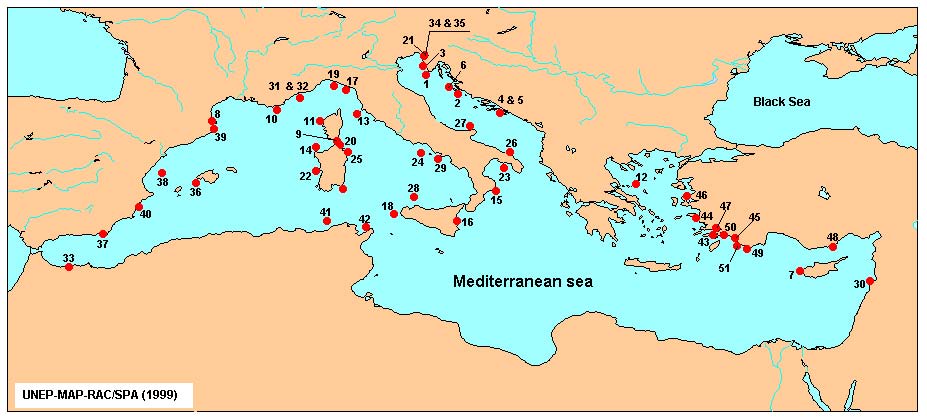
28
Thus, almost all Mediterranean countries intend to use Marine Protected Areas (MPAs) as a
tool for conserving and managing marine coastal resources, although the degree of
achievement and development is uneven between countries. At present, several countries
(Albania, Algeria, Bosnia and Herzegovina, Syria, Malta) have not yet got functioning MPAs,
although they have planned or ongoing marine protection projects.
In most cases, management of MPAs in Mediterranean countries is a matter for the
state, with no or poor participation by the local and regional administrations. Sub-national
and/or local authorities have competency in the management of marine zones in Bosnia and
Herzegovina, France, Italy and Spain.
Distribution of MPAs in the Mediterranean before SAP BIO Project started
The geographical distribution of Marine Protected Areas around the Mediterranean clearly lacks balance.
2.4.7.1
Problems
affecting
the
conservation of marine biodiversity through the use of MPAs
A series of problems have been recurrently identified by the National Reports, although,
obviously, the importance of magnitude of each problem differs between the countries
bordering on the Mediterranean Sea:
29
Insufficient legal system, lack of adequate legislation
Confusion of competency, or fragmentation of responsibility (leading to problems of
implementation of the existing laws)
Lack of coordination between administrations, competencies overlap
Interference with other human activities occurring in the coastal zone, mainly tourism
Low or no participation of stakeholders and other agents in the decision-making
process
Poor effort to improve public awareness on marine conservation issues
Lack of effective enforcement measures in some cases
Lack of effective scientific monitoring
Lack of sufficient economic resources to achieve the protection measures, so that a
number of MPAs receive only nominal management and protection ("paper MPAs")
Problems of mismanagement and deterioration caused by the limited experience of
the people administrating the MPAs
Lack of effective conservation measures to protect particular species (monk seal, sea
turtles, cetaceans, etc.) and/or communities (e.g. seagrass meadows)
Need to set up a network of MPAs, and therefore define of goals, mechanisms and
management organization for such a network
Need for integrated coastal zone planning and management.
Other identifiable general problems that affect the selection, installation, management and
evaluation of Mediterranean MPAs are the following:
Need to clearly establish the specific goals of each MPA
Lack of scientific basis for the selection (location, habitats included, depth range, etc.)
and design (size, shape, number, proportion of total surface protected, etc.) of MPAs
Need for appropriate monitoring and evaluation of the effectiveness of MPAs, based
on sound sampling designs (e.g. BACIP, beyond-BACI...)
Lack of empirical evidence for potentially complex effects of MPAs, e.g. spillover,
indirect effect on ecosystems ("cascade" effects), effects on larval replenishment of
commercially and/or ecologically important species, genetic effects, socio-economic
results, etc.
Need to ascertain the relationship of MPAs with other management tools.
31
II. PRIORITIES AND ACTIONS
1. INTRODUCTION31
The general aim of the SAP BIO is to promote concrete and practical actions, which in turn
emerge from general priorities aiming at:
reducing the causes, modification of conditions (stress reduction), prevention or
mitigation of impacts, that are adverse for biodiversity conservation
promoting bio-conservation-friendly sector policies, procedures and techniques, in
particular related to fisheries, tourism, agriculture and forestry
identifying gaps, uncertainties and trends in scientific knowledge
strengthening, updating or improving the relevant legal frameworks
training and improving capacity-building
integrating SAP BIO actions within the broader regional and national context of decision-
making
establishing and/or strengthening inter-agency and other international cooperation
implementing comprehensive joint actions of relevant MAP centres and programmes
concerning wider aspects of biodiversity conservation
promoting and implementing participatory actions, programmes and campaigns;
information and raising of public awareness concerning biodiversity conservation.
To monitor the actions to be carried out as part of the implementation of SAP BIO, indicators
should be developed with a view to assessing the achievements and the efficiency of SAP BIO.
The indicators should not only concentrate on biological and ecological aspects but also cover
socio-economic factors, resolution of use-conflicts, standard of living, etc.
2. DEFINITION OF PRIORITIES
The identification of priorities has been based to a large extent on assessment at national level).
To these have been added certain priorities that became apparent from the regional
assessment.
The priority actions presented in this chapter were identified according to the following criteria:
1) They are necessary, relevant, significant and/or pertinent (as identified in previous
chapters)
2) They are rationally achievable, being realistic from a financial point of view
3) Equity and sustainability of adopted measures are ensured
4) Legal implications do not conflict with existing international and/or national legislation
5) They include a sufficient level of flexibility in their implementation
31 In the present chapter the following procedure has been adopted:
1) To list the priorities emerging from the previous chapters
To categorize and arrange the above priorities, so that a series of general issues emerges
To translate such priorities into targets and objectives, i.e. achievable measures that can be easily converted into quantitative
and/or readily recognisable results (targets and deadline were measured taking into account the objectives of the « World
Summit on Sustainable Development (WSSD) », Plan of implementation - Johannesburg, September 2002.)
To develop each objective as a series of actions to be undertaken in order to attain the objectives
To identify the actors in charge of applying such actions
To define the spatial scale at which those targets and subsequent actions have to be applied, distinguishing, in general, the
objectives to be achieved at regional level from those to be achieved at national level
To define the temporal scale on which those objectives and targets have to be attained, drawing a distinction between short,
medium and long-term objectives
To decide about the level of applicability, i.e. how easy (in practical terms) it is to implement each target, regardless of the level
of urgency.
32
6) They receive a sufficient level of acceptability at regional and national level
7) Biological and socio-economic consequences of their implementation are reasonably
predictable (considering the precautionary principle).
The priorities emerging from the previous chapters can be placed into the following 7
categories:
I. Inventorying, mapping and monitoring Mediterranean coastal and marine biodiversity
II. Conservation of sensitive habitats, species and sites
III. Assessing and mitigating the impact of threats to biodiversity
IV. Developing research to complete knowledge and filling in gaps on biodiversity
V. Capacity-building to ensure coordination and technical support
VI. Information and participation
VII. Awareness raising.
Thus, within each general issue a series of priority actions can be identified, as developed in the
following sections.
2.1
Inventorying, mapping and monitoring Mediterranean coastal and marine
biodiversity
2.1.1 Undertake a complete and integrated inventory (by sub-region) of sensitive
Mediterranean coastal, wetland, and marine habitats
A complete and integrated inventory of Mediterranean habitats would be of great use, since it would
identify the most critical sites for biodiversity. Such an inventory should consist in a mapping of their
spatial distribution (based on the use of innovative information and mapping technology, but treated in a
user-friendly manner, so that it is easily accessible to both policy-makers and management staff), as well
as compiling a complete checklist of species associated with each habitat. In addition, long-term
monitoring programmes should be established in order to define the temporal variability of abundance,
biomass, and other assemblage variables within sensitive habitats.
The following ecosystems merit priority attention. In the case of coastal and wetland
ecosystems:
o Sand dunes, highly fragile ecosystems, with a considerable degree of floristic
endemism
o Coastal wetlands, particularly lagoons and river deltas.
o Rocky coasts, both from the floristic point of view, and as nesting sites for marine
birds
o Small islands, due to their importance for marine birds and those on migration.
Regarding marine ecosystems, previous chapters have identified the following as deserving
special attention:
o Seagrass meadows (Posidonia oceanica, Cymodocea nodosa, Zostera marina32)
o Midlittoral bioconstructions (Lithophyllum byssoides rim, vermetid platforms)
o Bioconstructions of Cladocora caespitosa
o Coralligenous community
o Marine caves, as shallow enclaves of bathyal communities (even truer in the case of
descending caves, where cold water is permanently trapped)
o Maërl and rhodolithes beds
o Deep bottoms ("white corals", seamounts, submarine canyons).
32 Although identified by the species determining the "facies" (or seascape habitat formers), it is probably
more appropriate to consider the protection of these species in the context of the ecosystem they favour.
33
2.1.2 Establish systems to monitor the trends of the main threats to Mediterranean
biodiversity and the ecological and socio-economic impacts of changes in
biodiversity
Continuous monitoring of the main known threats hanging over the Mediterranean biodiversity is
necessary to assess the efficiency of the conservation measures and for the timely adaptation
of relevant policies. Considering that preserving biodiversity has as its ultimate goal to attain
the sustainable development of Mediterranean populations, it is crucial to adequately follow up
the consequences (negative and/or positive) of changes in biodiversity for the people directly
affected by them, given the interaction between economic development, society and the
environment.
It is generally agreed that the suitable monitoring of protected areas is an essential step in the
adaptive management procedure, in which specific managing measures results from a
participatory, community-based process. After the crucial choice of appropriate indicators (see
point below), it is important to correctly design field sampling programmes that distinguish
between "normal" spatial and temporal variability and the actual effectiveness of protection
measures. In addition, management methods and strategies themselves need to be improved.
2.1.3 Identify, develop, and validate adequate biological and socio-economic indicators
The use of adequate indicators constitutes a critical step for monitoring whether proposed
measures attain their planned objectives. Considerable work is being done to identify, develop
and make adequate such economic, social, institutional and environmental indicators, which
have to be incorporated in the framework of SAP BIO.
2.2 Conservation of sensitive habitats, species and sites
2.2.1 Harmonise, update, coordinate and enforce legislation to conserve biodiversity
Main legal problems/priorities at the regional level are: (i) lack of adequate legislation covering
some sectors, (ii) differences in environmental legislation between countries; (iii) conflicts of
competency between sector administrations; and (iv) lack of adequate enforcement of the
existing legislation.
2.2.2 Develop actions to conserve threatened and endangered (coastal and marine)
Mediterranean species
Many marine and coastal species need particular action for their conservation at regional level,
although these actions sometimes differ among countries.
For all these species, giving priority to these included in Annex II and III of the SPA Protocol, the
following general actions would be necessary:
o Preparation of National Action Plans for the conservation and/or management of
specific species or groups of species
o Increasing of knowledge, establishing a monitoring system
o Completion, enforcement and implementation of appropriate legislation
o Protection of the habitats on which the species depend
o Launching of public awareness campaigns.
2.2.3 Protect marine and coastal sites of particular interest
Some National Reports specifically cited particular coastal and marine sites as particularly
interesting for intended conservation action on a local scale because they have threatened
34
and/or important marine biological features (biodiversity hot spots). The list of these important
priority areas is reported, country by country, in Annex III.
2.2.4 Declaration and development of new coastal and marine protected areas
particularly in the south and eastern Mediterranean and offshore, including the
high sea
Protected areas, if properly managed and enforced, are very important for the conservation of
biodiversity. At present, scientists generally agree on the usefulness and effectiveness of
establishing protected areas for the protection of pristine ecosystems, the conservation of
sensitive, highly endangered species, and/or to manage fishery stocks in a sustainable way. It
must be stressed that at Mediterranean level a very small proportion of the total coast receives
protection. In this way, single reserves need to be large (or, alternatively, they have to be
numerous) to accommodate bio-physical patterns of larval dispersal and recruitment. Some
authors have suggested that total reserve size needs to be as large as at least 20% of total
habitat maybe 50% or more to hedge against the uncertainties of over-exploitation. The
current number, size and siting of protected areas falls far short of comprehensive or even
adequate conservation objectives. This is even truer in the case of the south and eastern
Mediterranean region.
The setting up of protected areas offshore (including the high seas) to protect pelagic
ecosystem and sensitive species and important and partially unknown benthic areas such as
the "white coral community", seamounts and submarine canyons should be a priority. The
SPAMI List can constitute an important tool to help in the creation of MPAs offshore in
international waters.
2.2.5 Strengthening existing Marine and Coastal Protected Areas
Existing Marine and Coastal Protected Areas need to be enhanced, in terms of (i) devoting
sufficient resources to funding the management of current Protected Areas; (ii) improving
methods of management planning, implementation and monitoring of Marine and Coastal
protected areas; and (iii) integrating specific protection measures at particular locations within
wider management plans, as well as into large-scale networks of Coastal and Marine Protected
Areas (see section below).
2.2.6 Towards the functioning of protected area networks
Further benefits can be obtained from networking existing and future protected areas at regional
level. Although on a local scale Marine Protected Areas can be effective conservation tools, on
a regional scale MPAs can only be effective if they are substantially representative of all
habitats, also taking into account the biological and ecological particularities of protected
species and habitats. An additional benefit of such a network is that it acts as a buffer against
the vagaries of environmental variability and provides significantly greater protection for marine
communities than a single reserve.
35
2.3 Assessing and mitigating the impact of threats on biodiversity
2.3.1 Assess the potential impact of global warming and rise in sea level on
Mediterranean coastal and marine biodiversity
At present, climate change is considered scientifically proven and its effects have started
becoming visible at regional level. What remains to be estimated is the degree of change and its
rate, so that sea level rise, temperature increase and associated extreme climatic phenomena
(such as drought, storms and flooding), as well as changes in the distribution and quality of
ecosystems, can be predicted with reasonable accuracy, and corresponding measures taken to
alleviate negative impacts on coastal zones and wetlands.
Obviously this cannot be achieved at regional level alone, but would require participation in the
global climate change scientific and political forums. In the Mediterranean, an entity -possibly
within the UNEP/MAP structure- must be designated to represent the region, co-ordinate efforts
and spread information. As a first step, research on the impact of climate change in the region
must be encouraged and systematised.
2.3.2 Assess the potential impact of threats to Mediterranean coastal and marine
biodiversity
Chapters 3 and 4 have described the major threats to the conservation of marine and coastal biodiversity.
These threats include:
o Pollution
o Fisheries and other resource exploitation
o Introduction and spread of invasive species
o Uncontrolled recreational activities
o Changes in land use
o Effects of water management schemes.
Considerable efforts should be made to assess the potential impacts of these threats on
biodiversity, in order to fully understand and forecast their effects, so that sufficient efforts can
be made to mitigate them.
2.3.3 Mitigate the direct impact of the international trade in endangered species
Because the trade in wild animals and plants crosses borders between countries, the effort to
regulate and mitigate it requires international cooperation to safeguard certain species from
over-exploitation. Therefore, as a first step, international agreements have to be supported and
receive further attention. Other measures to take involve (i) improving monitoring of international
trade, focusing especially on species not included in CITES, (ii) improving research on and
control of the impact of introduced alien species (linked to priorities about invasive species
below), for instance through supporting the wildlife trade monitoring network33, or (iii) adopting
market and awareness measures targeting all stakeholders (from harvesters to consumers) in
the chain of catching and trade in endangered species, in order to prevent trade from both
regulatory "supply control" approaches and incentive- and consumer-based "demand-driven"
approaches and economics.
2.3.4 Control and mitigate the introduction and spread of non-indigenous species
Within the framework of implementing the Mediterranean Action Plan concerning species
introduction and invasive species, priority at regional level should be given to:
33 http://www.traffic.org/
36
o coordinating and supporting the compiling and regular updating of Mediterranean-wide
lists of non-indigenous species34, including information on their ecology, biology and
habitats. Lists should distinguish between species that are harmful to human health,
invasive or both, and provide information on such a classification
o elaborating and adopting at regional level guidelines intended to assist the relevant
national authorities
o coordinating the actions taken by neighbouring states to prevent and control the
introduction of non-indigenous species
o supporting cooperation at international level.
Considering the lack of data and knowledge necessary for risk assessment and the
implementation of preventive and control actions, priority at national level should be given to:
o encouraging all necessary actions (e.g. research work, data collection, monitoring, etc.)
aimed at improving the available knowledge
o coordinating the actions that are necessary for the regular provision of supplementary
information for the national and Mediterranean-wide reference lists of non-indigenous
species
o supporting the sharing of information and concerted action at regional level
o encouraging the implementation of scientifically-backed regionally-harmonised
measures of prevention and control.
2.3.5 Control and mitigate the effects of changes in land use (including coastal
urbanization and construction of infrastructure)
Changes in land use have been identified as a major threat to biodiversity. Measures have to be
adopted to control these sources of impact within the framework of a proper Integrated Coastal
Area Management.
2.3.6 Promote eco- and soft tourism, control and mitigate impact of recreational
activities
Well-planned and managed ecotourism35 has proved to be one of the most effective tools for
long-term conservation of biodiversity when the right circumstances (such as market feasibility,
management capacity at local level, and clear and monitored links between ecotourism
development and conservation) are present36.
On the other hand, the impact of recreational activities (trampling, noise, lights, eroding, or
disturbing animals and plants) has to be mitigated through the adoption of adequate measures
(either enforcing, regulating or dissuading people from such practices).
2.3.7 Assessment and elaboration of strategies to prevent the environmental impact of
sources of pollution
Prevention and mitigation of land-based sources of pollution are already dealt with within the
"Strategic Action Plan to Address Pollution from Land-based Activities (SAP MED)",
34 The lists of exotic species being compiled within the framework of CIESM and any other recognised
publication could be used as reference and a source of information.
35 According to the Quebec Declaration on Ecotourism, ecotourism "embraces the principles of
sustainable tourism... and the following principles which distinguish it from the wider concept of
sustainable tourism: (i) contributes actively to the conservation of natural and cultural heritage; (ii)
includes local and indigenous communities in its planning, development and operation, contributing to
their well-being; (iii) interprets the natural and cultural heritage of the destination to visitors; and (iv) lends
itself better to independent travellers, as well as to organized tours for small size groups".
36 http://www.uneptie.org/pc/tourism/ecotourism/
37
implemented by UNEP MAP/MEDPOL. Therefore, within the framework of SAP BIO, particular
attention should be paid to those sources of pollution not covered by the SAP MED, such as
aquaculture, marine transport and navigation, desalination, or the proliferation of floating plastic
objects and debris.
2.3.8 Special focus on the control and regulation of inappropriate aquaculture practices
Aquaculture is a strongly emerging activity, which in turn may originate a series of complex
adverse effects on the environment (several types of pollution, visual degradation, local socio-
economic changes, invasion of alien species, etc.). Within the framework of SAP BIO, adequate
measures have to be adopted in order to regulate, mitigate and control such threats.
2.3.9 Assess, control and elaborate strategies to prevent the negative impact of
fisheries on biodiversity
Inappropriate fishing activities are likely to erode marine biodiversity all over the Mediterranean
basin. Identifiable targets aiming at preventing this impact deal with (i) improving fishing
statistics, (ii) improving gear selectivity, (iii) minimising habitat damage, (iv) limiting harmful
fishing practices, (v) developing "traditional" control measures, (vi) developing "new"
management techniques, (vii) controlling recreational fishing, (viii) prosecuting illegal fishing,
and (ix) preserving traditional Mediterranean fishing knowledge.
2.4 Developing research to complete knowledge and fill in gaps on biodiversity
2.4.1 Improve and coordinate biodiversity research
Knowledge of biodiversity is a prerequisite for its conservation. Such knowledge in the region is
neither complete nor systematic. It is imperative, therefore, to:
o Make known and available the existing research results, thus creating a first level of
synergy
o Identify the most critical `missing links', or knowledge gaps
o Promote scientific and applied research on the missing issues, and assist in securing
the necessary funding
o Ensure that the research results reach those who have responsibility for policy-
making on marine, coastal and wetland biodiversity and on management of sensitive
areas.
2.4.2 Improve taxonomic expertise in the region, through the constitution of PEET37
Particular emphasis should be laid on the development of knowledge about genetic diversity,
and the training of experts in marine and coastal biodiversity. A proposed system to improve
knowledge and expertise on biodiversity is through the constitution of PEET to face particular
research projects38.
37 Partnership for Enhancing Expertise on Taxonomy.
38 A PEET combines a traditional morphological specialist and a molecular systematist.
38
2.5
Capacity-building to ensure coordination and technical support
2.5.1 Achieve a `clearing-house' mechanism to focus on marine and coastal
conservation activities
A `clearing house', or central information centre on all aspects of Mediterranean biodiversity,
should be considered, as it could become the focus for marine and coastal conservation
activities in the region, and could become a catalyst of joint initiative and exchange. This could
be established within the framework of UNEP/MAP, but not necessarily managed by it. It might
be a central point, or a looser network, well structured, coordinated and linked to the clearing
house mechanism of the CBD.
2.5.2 Coordination and development of common tools for implementing National
Action Plans (NAPs)
The National Action Plans (NAPs) on specific biodiversity issues39 have numerous areas of
common interest, whether in terms of geographical area or in terms of species, habitat, or threat
to biodiversity. The coordination and development of common tools during the implementation
of NAPs should be assured. Countries and regional institutions should make every effort to
cooperate in the effective implementation of these NAPs.
2.6 Information and participation
2.6.1 Facilitate access to information for managers and decision-makers, as well as
stakeholders and the general public
It is necessary to improve the availability of existing data, information and knowledge on
biodiversity as a basis for (i) identifying and filling in the most critical information gaps, notably
through the promotion of the relevant scientific and applied research; (ii) ensuring that research
results reach those who are responsible for, or whose decisions impact upon, biodiversity; and
especially, (iii) facilitating the participation of citizens within an integrated management
scheme40.
2.6.2 Promote public participation, within an integrated management scheme
As another key issue, public participation is crucial if proper environmental management is to be
achieved.
2.6.3 Preserve traditional knowledge
The traditional knowledge of stakeholders who use natural resources (e.g. fishermen,
shepherds, farmers, etc.) about marine and coastal elements (species and communities) of
Mediterranean biodiversity should be preserved, not only because it constitutes an essential
part of the cultural heritage for future generations, but because of its usefulness as empirical
evidence of often neglected ecological processes important for the conservation of biodiversity.
A number of regional and international initiatives deal with this issue throughout the world
(promoted by UNEP, IUCN, CBD, WIPO, WRI, etc.).
39 See: Draft summary of the NAPs elaborated within the SAP BIO Project (UNEP(DEC)/MED WG.227/5).
40 See http://www.unep.org/unep/access.htm
39
2.7 Awareness-raising
2.7.1 Develop international collaboration to enhance regional public awareness
The SAP BIO Project and related initiatives are the ideal framework for developing such
recognition and promoting specific activities to enhance public awareness. The circulation of
information and increased public awareness is dependent on local social cultures and
languages. Yet international collaboration can help develop appropriate methods and tools, also
making use of social, cultural and political affiliations (such as those connecting EC member
states, Maghreb and Mashraq states, francophone countries and countries in the Balkans).
Most countries have listed awareness-raising as a priority to accompany one or other of their
conservation objectives.
2.7.2 Organise coordinated Mediterranean-level campaigns focusing on specific
regional biodiversity issues
One of the mechanisms to promote regional public awareness is the organisation of campaigns
aiming at making the general public aware of specific issues such as global warming, eco-
tourism, or the trade in endangered species.
40
3. IDENTIFICATION AND CATEGORIZATION OF TARGETS, OBJECTIVES AND
SPECIFIC ACTIONS
3.1 Definition of objective characteristics
In the following section, a Table summarises priority actions, relevant targets, objectives, and
specific actions identified within the framework of the SAP BIO. The priority actions are
presented in this table without being ranked.
For each category, specific targets were identified, also taking into account the WSSD41
objectives and deadlines.
For each target relevant concrete objectives are indicated.
For each objective specific actions and the following characteristics are defined:
Scale level: It refers to the spatial scale on which each target is applicable,
distinguishing between
o regional (R): concerning the whole Mediterranean region
o sub-regional (S-R): concerning a particular part of the Mediterranean
region (e.g. North Africa, south-eastern Mediterranean, western
Mediterranean, etc.)
o national (N): concerning each participating country
o sub-National (S-N): concerning particular regions within a country (e.g.
Sicily, Andalusia, Crete, etc.).
One objective can be achieved at several scale levels.
Actors : This refers to the kind of institution and organism capable of undertaking the
proposed actions to reach defined targets
TF (Time frame): Temporal deadline, distinguishing:
o ST (short term): before 2006
o MT (medium term): before 2010
o LT (long term): after 2010
Imp.
(Implementability): Ease (in practical terms) of implementing each objective,
regardless of the level of urgency:
o A (high-level, immediate applicability)
o B
(medium-level)
o C (low-level, logistic/economic/institutional conditions are not met).
41 World Summit on Sustainable Development, " Plan of Implementation " - Johannesburg, September 2002.
41
3.2 Actions, objectives and targets
CATEGORY
TARGET
General objective
I. INVENTORYING, MAPPING AND MONITORING OF "Contribute to achieving the WSSD targets concerning establishing by 2004 a regular process under the United Nations for global
MEDITERRANEAN COASTAL AND MARINE
reporting and assessment of the state of the marine environment, including socio-economic aspects, both current and foreseeable,
BIODIVERSITY
building on existing regional assessments42"
Specific targets
GIS-based mapping of sensitive habitats by 2008 (relevant objective/s: 1a)
Mediterranean Checklists of species by 2006 (1b,d)
Standard monitoring protocols for socio-economic impacts, global trade, endangered species, effectiveness of protected areas by
2004 (2a; 3a; 4a; 5a)
SAP BIO indicators by 2006 (6 a,b,c,d,e)
Activity
Objective
Scale
Specific action
Actor
TF
Imp.
(Priority actions)
level
1) Make a complete and integrated a) Description and GIS-based mapping of
R / N
Increase availability of GIS technology
Regional and
MT B
inventory (by sub-region) of
the spatial distribution of the sensitive
Enhance national capabilities and support national multi-lateral
Mediterranean coastal, wetland, and
habitats:
and sub-national programmes to map sensitive institutions;
marine sensitive habitats
habitats
universities and
Undertake international Mediterranean campaigns research
with oceanographic boats of cartography of sensitive institutions
habitats
Facilitate exchange of and access to maps by
scientists and managers
b) Complete
checklist
of species associated
R / N
Form regional workgroups of specialists by taxon Regional and
MT B
with each sensitive habitat
and/or habitat
multi-lateral
Set up regional programmes to make such checklists institutions;
by sub-region and/or country (cf. Target d below)
universities and
research
institutions
42 Extract from Paragraph 34b, Plan of Implementation of the World Summit on Sustainable Development Johannesburg, September 2002.
42
Activity
Objectives
Scale
Specific action
Actors
TF
Imp.
(Priority actions)
level
c) Long-term
routine
monitoring R / N
Convene thematic workshops by types of habitat, to Regional and
ST A
programmes, in order to define temporal
elaborate standardised regional monitoring
multi-lateral
variability of abundance, biomass and
programmes
institutions;
other assemblage variables within
Support monitoring programmes at national level, to universities and
sensitive habitats
be implemented by national workgroups in selected research
sites by types of habitat (at undisturbed sites, e.g. institutions
marine and coastal protected areas)
d) Elaborate national checklists for marine
N
Form
national
workgroups
of specialists by taxon Universities and ST A
and coastal species for all the
and/or habitat (assisted by regional workgroups national and
Mediterranean countries
when necessary)
international
Set up national programmes to undertake national research
checklists
institutions
2) Establish of a monitoring system of a)
Implement a monitoring system for
R / N
Establish standard adequate monitoring techniques Regional and ST A
endangered and threatened species
endangered species at regional level
and methods, in order to:
sub-regional
o determine accurately geographical
organisations;
distribution
national research
o
estimate population size and structure
institutions
o
estimate population dynamics
o
determine habitat requirements
of endangered and threatened species
Determine sampling protocols (spatial and temporal
allocation of sampling, number of samples, etc.)
Implement standard monitoring protocols
b)
Establish and update the health and
R
List specific threats affecting each endangered Regional and MT B
risk status of endangered populations
species
sub-regional
Model population dynamics in order to forecast organisations;
different scenarios concerning each species
national research
Revise periodically the conservation status of each institutions
species
3) Promote the adequate monitoring a) Implement sound scientifically-based R / N
Define planned objectives of existing protected areas ST
A
and survey of the effectiveness of
monitoring programmes on the
to be monitored taking into account the methodology
marine and coastal protected areas
effectiveness of marine and coastal
of the Afrodite43 project, already ongoing on several
protected areas
MPAs
Elaborate a regional monitoring booklet defining
sampling and experimental principles, as well as
standardised sampling protocols established to
acquire useful, comparable data
Implement standardised sampling programmes in
selected protected areas spanning a representative
set at regional level (taking into account the
methodology of the Afrodite project)
Undertake a comparative analysis of protected areas
results at regional level
43 Project for monitoring Marine Protected Areas in several European countries
43
Activity
Objectives
Scale
Specific action
Actors
TF
Imp.
(Priority actions)
level
b) Improve methods of management
R
Evaluate, at regional level, effectiveness of Regional and ST A
planning, implementation and monitoring
management measures in relation to planned sub-regional
objectives
organisations;
Analysis of the applicability of new management competent
measures
national
Refine management measures
authorities and
managers of
M&CPA
4) Identify, develop, and validate a)
Elaborate a regional strategy on SAP BIO
R
Convene a regional workshop on SAP BIO indicators Regional
ST A
adequate biological and socio-
indicators
Form a working group in charge of elaborating and organisations
economic indicators to assess the
validating a set of SAP BIO indicators
ecological health of sensitive b)
Elaborate a list of useful SAP BIO
R
Define objectives of the set of indicators to be used
Regional
ST A
habitats and species, and to
indicators
Elaborate a catalogue of indicators (taking into organisations
evaluate the effectiveness of
account the indicators proposed by other
management measures
international institutions)
Specify the methodological constraints linked to
each indicator
Select useful indicators
c) Existing and new data collected to R / N
Evaluate the availability of existing data
Regional and ST B
construct selected SAP BIO indicators
Elaborate standardised protocols to collect new data sub-regional
Decide periodicity and implementation calendar of organisations;
selected indicators
competent
Undertake sampling programmes to collect new data national
where necessary
authorities and
research
institutions
d) Construct SAP BIO indicator set starting
R
Gather
regional
data
Regional
MT B
from the collected data
Construct
indicators
organisations
Publish the results at regional level
e) Validate selected SAP BIO indicators
R
Establish the states of SAP BIO implementation
Regional
MT B
Evaluate the usefulness, accuracy and precision of organisations
selected indicators
Possibly, refine list of SAP BIO indicators
44
Category
TARGET
General objective
II. CONSERVATION OF SENSITIVE HABITATS, SPECIES AND SITES
Contribute to achieving the WSSD targets concerning the establishing of Marine Protected Areas consistent
with international law and based on scientific information, representative networks, by 2012, and time/area
closures for the protection of nursery grounds and periods, proper coastal land use44
Specific targets
Effective protection of endangered species by 2012 (relevant objectives 7a, b; 8d)
Increase (50%) by 2012 the surface area covered by MPAs (10 a, b, c, f)
Attain the protection of 20 % of the coast as marine fishery reserves by 2012 (10 e)
Set up a representative Mediterranean network of marine and coastal protected areas by 2012 (11 a,
b)
Activity
Objective
Scale
Specific action
Actor
TF
Imp.
(Priority actions)
level
5) Update, coordinate and enforce a)
Fill in existing gaps in national legislation
R / N
Ensure that measures adopted within the framework Regional
MT A
legislation to conserve biodiversity
about the protection of such habitats,
of regional conventions, arrangements or
competent
species and areas
organizations to which countries are party are organisations (as
incorporated in national legislations
coordinator/s)
Clarify at national level competencies regarding the national
management of littoral areas
competent
authorities and
bodies
b) Ensure the completion, enforcement and
R / N
Assess the general level of compliance with current Regional
LT C
implementation of existing and updated
legislation in the region
competent
legislation
Develop guidelines on root cause analysis of non- organisations (as
compliance that would help to identify the real coordinator/s)
problems in various non-compliance scenarios
national
Set up of a specific national police body, for the competent
protection of biodiversity in coastal areas (any other authorities and
police task being excluded)
bodies
6) Develop actions to conserve a)
Coordinate the implementation of R / SR /
Organize subregional workshops
Regional
ST A
threatened and endangered (coastal
National Action Plans (NAPs) for
N
Prepare common guidelines, documents to assist competent
and marine) Mediterranean species
threatened and endangered species
countries in the implementation of the NAPs
organisations;
elaborated within the SAP BIO Project
During the implementation phase assure the flow of national
information among the NAPs
authorities
Refine NAPs to protect threatened and endangered involved in the
species
implementation
of NAPs
b)
Increase knowledge on these R / N
(cf. priority #4.a,4.b)
species
c)
Establish a monitoring system for
R / N
(cf. priority #4)
these species
44 Extract from Paragraph 31c Plan of Implementation" of the World Summit on Sustainable Development - 4 September 2002, Johannesburg.
45
d)
Harmonise, update, implement and
R / N
(cf. priority #7)
enforce adequate legislation
Activity
Objectives
Scale
Specific action
Actor
TF
Imp.
(Priority actions)
level
e)
Habitats on which selected R / N
(cf. priority #10, target d)
protected species depend
7) Protect marine and coastal sites of b)
Develop and coordinate protection
R / N
Campaign of collection of data using the Standard Regional
particular interest (see Annex 3)
actions for priority sites and areas
Entry Data Form in identified site
organisations;
identified by National Reports
Prepare detailed Action Plans to protect identified national
sites
competent
Coordinate protection actions at regional level (cf. authorities
Priority #11, Target b below)
8) Declare and develop new coastal a) Identify of new areas deserving
S-R / N
Identify key sites important for harbouring National
ST A
and marine protected areas including
protection measures in the south and
representative, well-conserved marine and coastal authorities;
in the high seas
eastern Mediterranean
habitats (links with cf.priority # 1) further to their national research
identification as priority sites by National Reports (cf. institutes
priority # 9)
Fill in the SDF for each identified area
b) Set up of new protected marine and S-R / N
Countries declare new M&CPA
National
MT C
coastal areas in the south and eastern
Provide the new M&CPA with all the necessary tools authorities;
Mediterranean
to assure their functioning
support by
Establish of a sub-regional network of south and regional
eastern Mediterranean representative habitats (cf. organisations;
Target 11.b below)
involve the local
population
c) Increase the number of C&MPAs or R / N
Define habitat features of selected endangered Regional
LT C
reserves to conserve sensitive, highly
species
organisations;
endangered species
Define the minimum area needed to fully protect national
highly endangered species
authorities and
Select areas to protect these species
research
Prepare detailed Action Plans for these areas institutes; local
(declaration of MPA or implementation of other population
measures of protection)
d) Identify and protect of new areas R / N
Identify key sites important for harbouring Regional
MT C
offshore (including the high seas)
representative, deep marine habitats and or organisations;
deserving protection measures
important pelagic ecosystem (links with cf. priority # research
1)
institutes and
The involved countries declare and set up offshore universities;
protected areas
national
authorities
9) Develop existing Marine and Coastal a) Enhance the management of existing R / N
Dedicate resources to funding the management of Regional
MT
B
Protected Areas
Protected Areas
existing Protected Areas
organisations;
Convene workshops of C&MPA managers to national
harmonise and improve management issues
authorities;
Integrate specific protection measures into large-scale C&MPA
networks (cf. Target b below)
managers
46
Activity
Objectives
Scale
Specific action
Actor
TF
Imp.
(Priority actions)
level
b) Establish and support protected area R / N
Integrate specific protection measures at particular Regional
MT
B
networks
locations into wider management plans, as well as organisations;
into large-scale networks of Coastal and Marine national
Protected Areas
authorities;
Coordination and harmonisation between
C&MPA
management plans and structures of particular managers
existing Protected Areas
Undertake specific research, monitoring and
assessment under a networking scheme (cf. priority
#5)
CATEGORY
TARGET
General objective
III. ASSESSING AND MITIGATING Contribute to achieving the WSSD targets concerning significant reduction by 2010 in the current rate of loss of biological diversity45;
THE IMPACT OF THREATS ON
BIODIVERSITY
Specific targets
Updated assessment of the potential impact of threats on Mediterranean marine and coastal biodiversity by 2008 (12a, b; 13a)
Maintain or restore fishery stocks to levels that can produce the maximum sustainable yield with the aim of achieving these goals for depleted
stocks on an urgent basis and where possible not later than 201520 (21 a, b, c, d, e, f ,g, h, i)
Urgently develop and implement national plans of action, to put into effect the FAO international plans of action, in particular the international
plan of action for the management of fishing capacity by 2005 and the international plan of action to prevent, deter and eliminate illegal, unreported and
unregulated fishing by 2004 (relevant objective/s: 21f). Establish effective monitoring, reporting and enforcement, and control of fishing vessels,
including by flag states, to further the international plan of action to prevent, deter and eliminate illegal, unreported and unregulated fishing20 (21a, c,
e, f, h, i)
Control and regulate the urban development of coastal area, land use planning and aquaculture practices within a wider management plan by
2010 (16a; 17a; 20a, b, c)
Legal regulation of recreational activities by 2008 (18 b)
Reinforce control and mitigation of the introduction and spread of alien species by 2006 (15 a, b, c)
Activity
Objective
Scale
Specific action
Actor
TF
Imp.
(Priority actions)
level
10)
Monitor of global trade and a) Implement
R / S-R
Establish monitoring protocols and standards, in International,
ST A
economic policies and trends from a
monitoring systems for consequences of
order to evaluate the effects of international trade on regional and sub-
Mediterranean perspective, to
global trade and economic policies
Mediterranean biodiversity
regional
analyse their scope and probable
Implement standard monitoring protocols
organisations
effects on biodiversity
Propose recommendations at regional level to
undertake specific actions to counter trade effects on
biodiversity and sustainable development
Coordinate monitoring and action plans at regional
and international level (e.g. UNCTAD/UNDP, ICTSD,
etc.)
11) Establish a regional monitoring a) Implement monitoring systems for socio-
R / N
Establish monitoring protocols and standards, in Relevant
ST
A
45 Extract from Paragraph 42 Plan of Implementation of the World Summit on Sustainable Development - 4 September 2003 Johannesburg.
47
programme following up the socio-
economic impacts of changes in
order to evaluate the socio-economic effects of International,
economic impact of changes in
biodiversity
changes in biodiversity
regional and sub-
biodiversity
Implement standard monitoring protocols
regional
organisations
12) Assess the potential impact of a) Inventory and monitor of biodiversity
R
Geographical identification of priority areas likely to Regional
ST A
climate change and rise in sea level
elements and/or areas likely to be
be threatened by climate change and rise in sea organisations;
on Mediterranean coastal and
impacted by climate change
level
research
marine biodiversity
Establish a monitoring network to describe long-term institutes
change
Activity
Objective
Scale
Specific action
Actor
TF
Imp.
(Priority actions)
level
b) Acquire the necessary knowledge to
R
Ascertain the relationship between the
Research
MT B
model and forecast likely effects of
Mediterranean Sea and the global oceanatmosphere institutes
climate change
and its response to local forcing
Monitoring long-term variability of the thermo-haline
circulation, biogeochemical content and transport in
the whole Mediterranean Sea
Quantify and accurately model regional hydrological
cycles (evaporation, precipitation, river run-off,
groundwater)
Fill in geographical gaps on key processes in the
Mediterranean Sea
13) Assess the potential impact of a) Inventory of biodiversity elements and/or
R
Geographical identification of priority areas likely to Regional
MT B
threats on Mediterranean coastal
areas likely to be impacted by each of the
be affected by threats on biodiversity
organisations;
and marine biodiversity
following threats on biodiversity:
Establish a monitoring network to describe long-term research
o Pollution
change
institutes
o Fisheries and other resource
exploitation
o Introduction and spread of non-
indigenous species
o
Uncontrolled recreation at activities
o
Changes in land use
o Effects of water management
schemes
14) Mitigate the direct impact of a)
Improve research and control on the R / N
Improve monitoring of international trade, focusing Regional
ST
A
international trade in endangered
impact of harvesting wild species
especially on species not included in CITES
organisations;
species
Update CITES lists with Mediterranean threatened national
and endangered species not yet included
authorities
Set up a specific national police body, for the
protection of biodiversity (cf. priority # 7b)
1LT
1 C
b) Adopt market and awareness measures
R / N
Create an eco-label to certify that wildlife products Regional
ST B
targeting stakeholders in the chain of
have been legally harvested and exported
organisations;
catching and trade in alien species (from
Make consumers and potential purchasers sensitive national
harvesters to consumers)
to international wildlife-trade issues, through authorities
adequate awareness measures
48
Activity
Objective
Scale
Specific action
Actor
TF
Imp.
(Priority actions)
level
15) Control and mitigate the introduction a)
Develop appropriate institutional R
Regional project to reduce transfer of aliens via Regional
ST B
and spread of alien and invasive
measures to fight against particular
aquaculture and aquaria practices (cf. Priority #20)
organisations
species
sources of alien species
Regional project to reduce transfer of alien species
via ships' ballast water and sediments and hull
fouling
Regional project to reduce transfer of alien species
via plastic debris
Regional project to reduce transfer of alien species
via fishing practices
b) Implement a regional coordination R / N
Elaborate and adopt at regional level guidelines Regional
ST B
network to mitigate introduction and
intended to assist the relevant national authorities
organisations
spread of alien species
Coordinate the actions taken by neighbouring states
to prevent and control the introduction of non-
indigenous species
Support cooperation at international level
c) Fill in existing gaps in knowledge about
R / N
Carry out research work, data collection, monitoring, Regional
ST B
alien species
etc. aimed at improving the available knowledge
organisations
Coordinate the actions that are necessary for the (coordinating and
regular provision of supplementary information for supporting);
the national and Mediterranean-wide reference lists research
of non-indigenous species
institutes
Support
information
exchange and concerted action
at regional level
Encourage the implementation of scientifically-
backed regionally-harmonised measures of
prevention and control
16)
Control and mitigate coastal
a)
Insert urban development of coastal S-N / N /
Carry
out
evaluations
of
destination sites' carrying National and
MT C
urbanization and construction of
areas into wider integrated management
R
capacity and take the necessary steps to ensure that local authorities;
coastal infrastructure
plans
the offer is limited to the carrying capacities thus regional
defined
organisations
Strengthen or establish legislative tools, regulations (coordination)
and property management to control tourist
urbanisation and protect sensitive species, habitats
and sites
In particular, control the proliferation of marinas and
sport harbours
Prohibit the construction of artificial beaches
Implement programmes enabling the rehabilitation of
mature destination areas favouring the environment
Implement mechanisms enabling (whenever
possible) a financial contribution from the tourist
sector for protecting and managing natural and
cultural sites
49
Activity
Objective
Scale
Specific action
Actor
TF
Imp.
(Priority actions)
level
17) Control and mitigate the effect of a) Promote the integration of land used R / N
Carry out evaluations of carrying capacity of the National and
MT C
changes in land use
planning into wider integrated
littoral zone concerning land use, and take the local authorities;
management plans.
necessary steps that the offer is limited to the regional
carrying capacities thus defined
organisations
Define (at national and sub-regional level) (coordination)
interference, incompatibility and synergy between
different land uses in the littoral zone
Undertake the zoning of littoral areas at sub-national
level
Define and promote adequate, environmentally-
friendly agri-cultural practices
Define and promote adequate, environmentally-
friendly water management practices
Define and promote adequate, environmentally-
friendly reforestation practices
Regulate and control mining activities under an
integrated management scheme
18) Promote eco- and soft tourism, a) Increase sustainable tourism, including non-
R / N
Promote eco-labelling and other quality
National
LT B
control and mitigate impact of consumptive and eco-tourism taking into
environmental procedures (e.g. certification,
authorities;
recreational activities
account the spirit of the International Year of
charters, etc.) at regional level
competent
Eco-tourism 2002, the United Nations Year
Support private eco-tourism initiatives
national bodies
for Cultural Heritage in 2002, the World Eco-
Awareness programmes among tour operators, and
tourism Summit 2002 and its Quebec
tourist businesses (travels, hotels, sport facilities, organisations;
Declaration, and the Global Code of Ethics
etc.) and public sector administrations on the regional
for Tourism as adopted by the World Tourism
benefits of environmentally-friendly tourist practices
organisations
Organization46
Avoid ghetto-like, high-standing tourist facilities (support and
unconnected with local conditions
coordination)
Promote respect for local architecture and the
historical heritage
Facilitate the exchange of tourists and local
populations and cultures
Minimize waste production, and energy and water
consumption by tourist facilities
Promote the use of public transport
Develop all means that may lead to spreading the
tourist season over the entire year
Develop international, regional cooperation
46 From Paragraph 41 Plan of Implementation of the World Summit on Sustainable Development - 4 September 2002 Johannesburg.
50
Activity
Objective
Scale
Specific action
Actor
TF
Imp.
(Priority actions)
level
b)
Control and mitigate the impact of
R / N
Make an analysis and collect information on the National
MT C
recreational activities on coastal and
most significant environmental impacts of
authorities;
marine Mediterranean biodiversity
recreational activities and tourism
competent
Geographical identification of priority areas likely to national bodies
be affected by recreational activities
and
Regulation and enforcement of recreational organisations;
practices, in particular of high-impacting activities regional
(e.g. 4x4, diving, motor navigation, hunting, organisations
recreational fishing, sea-watching, etc.)
(support and
Management and regulation of access and use of coordination)
beaches by the public as well as their use by
professionals, in accordance with environmental
factors
Study and promote the use of eco-taxes for the
general public visiting protected areas, as well as
other economic and financial tools to protect
biodiversity
Develop the alternative use of coastal and marine
areas, based on the utilization of natural landscapes
19) Assess and elaborate of strategies a) Assess and prevent the impact of R / N
Establish a regional programme to quantify and Regional
MT C
to prevent the environmental impact
desalination techniques
characterize the environmental impact of coastal organisations;
of sources of pollution
desalination plants
national
Define and evaluate technical measures to minimize authorities;
the impact of the desalination process (e.g. research
construction of pipelines for disposal of reject flow, institutes
ameliorate desalination technology, etc.)
Promote clean-energy desalination plants (e.g.
solar); avoid desalination projects to mask
environmentally-unfriendly energy projects (e.g.
power plants, incinerators of toxic waste, etc.)
Insert the planning of new desalination plants into
wider integrated water and coastal management
plans
51
b) Control the proliferation of floating plastic
R / N
Establish a regional programme to quantify plastic Regional
LT C
objects and debris
proliferation in the Mediterranean
organisations;
Geographical identification of priority areas likely to national
be affected by the proliferation of plastic debris in the authorities;
sea
research
Support international agreements about the dumping institutes
of plastics in the sea
Enhance recuperation and recycling of plastics
Promote the research and application of technology
to produce photo- and bio-degradable plastics
Promote and support beach-cleaning initiatives
Establish awareness campaigns (oriented to users
and the general public) about the use and waste of
plastic debris in the sea
c) Achieve non-pollutant marine transport
R
Enhance and support activities under international Regional
LT C
and navigation techniques; pay special
agreements on environmental impacts of maritime organisations;
attention to noise and hydrocarbon
casualty, concerning pollution from ships:
international
pollution
o oil
pollution
organisations;
o chemical
pollution
national
o harmful substances carried by sea in authorities;
packaged form
o garbage
o sewage
o air
pollution
o dumping
of
waste
Enhance and support activities and regulations
under international agreements on the environmental
impacts of oil spills
Undertake a Regional Programme to minimize the
impact of noise from ships and military engines, as
well as other sources of noise pollution (mineral
production, pingers, ringers, etc.)
Regulations for ballast water management to prevent
the transfer of harmful aquatic organisms
Support the International Maritime Organization
(IMO) convention prohibiting the use of harmful
organisms anti-fouling paints used on ships;
establish a mechanism to prevent the potential future
use of other harmful substances in anti-fouling
systems
Support the declaration of PSSA Particularly
Sensitive Sea Areas (as defined by the IMO)
52
20) Control and regulation of aquaculture a) Integrate of aquaculture practices into R / N /
Carry out evaluations of carrying capacity of the National and
LT B
practices
wider integrated management plans
S-N
littoral zone concerning aquaculture, and take the local authorities;
necessary steps to ensure that the offer is limited to regional
the carrying capacities thus defined
organisations
Define (by country, and at sub-national level) (coordination)
interference, incompatibility and synergy between
aquaculture projects and plans, and other uses of
the littoral zone
Undertake the zoning of littoral areas at sub-national
level
Identify zones suitable for aquaculture
Adapt aquaculture technology to be used in a case-
by-case approach, taking into account zoning
b)
Develop research and measures to R / N
Standard environmental impact assessment
Regional
ST B
minimise the impacts of aquaculture
procedures convened 2
organisations
practices on the marine and coastal
Regulate of the use of pingers2
environment
2 National
Regional programme to reduce the invasion of alien authorities
species from aquaculture
Regional programme to minimise pollution caused
by organic matter and nutrient enrichment from
aquaculture farms
Regional programme to minimise the impact of wild
seed to stock fish farms (e.g. red tuna)
Regional programme to minimise genetic pollution
Regional programme to minimise chemical pollution
disinfectants, anti-foulants, flesh colorants and
medicines (including vaccines)
c) Adopt measures to avoid the impacts of
R
Prohibit in all the Mediterranean countries the use of regional
ST A
aquariology on the marine and coastal
potentially invasive species (e.g. caulerpas) in open organisations;
environment
or semi-open aquarium systems
national
authorities
21) Assessment, control and
a) Improve fishing statistics
R / N
Identify the main problems and gaps in getting regional
ST C
elaboration of strategies to prevent
accurate fishing statistics
competent
impact of fisheries on biodiversity
Propose mechanisms to improve fishing statistics at organisations;
regional level
national
In particular, design, implement and evaluate data authorities and
collecting systems at national level
research
Establish a network of institutions responsible for institutes
acquiring statistics at national level
53
b)
Mediterranean strategy for the R
Assess the status of vulnerable fish and invertebrate regional
ST A
conservation and sustainable
populations subject to commercial fisheries
competent
management of vulnerable fish and
Determine adaptive and precautionary management organisations;
invertebrates, including sustainable
schemes for the preservation of vulnerable national research
related fisheries
populations
institutes
Assess the suitability of a complete ban on the
exploitation of certain particularly vulnerable species
at regional level
Assess (and eventually implement) the inclusion of
species listed in the annexes of the SPA Protocol in
the appropriate CITES lists
Develope selected case studies for different
vulnerable species/groups carried out in different
parts of the Mediterranean in order to draw up
guidelines on vulnerable species management and
conservation valid for the region
c) Improve inter- and intra-specific R
Carry out research on effects of by-catch, discard national
MT A
selectivity of gear and fishing practices,
and ghost-fishing on threatened and endangered authorities and
addressing particularly the problems of
species
research
by-catch, discard, and ghost-fishing
Enhance research on fishing technology, fishing institutes;
strategies and possible gear modifications to avoid regional
by-catch, discards and ghost-fishing
competent
Favour new consumption habits and technology to organisations
process unavoidably by-catched, under-consumed (coordination)
species
d) Mediterranean strategy to reduce fishing-
R
Geographical identification of priority areas with regional
ST A
related mortality of marine mammals,
significant impacts on cetaceans, monk seals, sea competent
turtles and sea birds
turtles and sea birds
organisations;
Detailed analysis of the threat, and its significance national research
with respect to the viability of impacted populations, institutes;
based on the above and other complementary fishermen's
information obtained at the national level
associations
Develop
Mediterranean-specific approaches to
counter the negative effects of fishing on vulnerable
groups
Assess the potential relevance of existing technical
improvements
Assess the applicability of spatial and temporal
restrictions on impacting gear
Assess the possible implementation of no-take
zones or areas with severe fishing restrictions
Assess the reliance of sea birds on discard from
fishing fleets in the region
Establish an adaptive methodology based on pilot
studies affecting different groups/species and
implemented in selected sites around the
Mediterranean
54
e) Mediterranean strategy to reduce the
R
Geographical identification of priority areas with a Regional
ST A
impact of trawling and other towed gear
verified high impact of towed gear
competent
on critical habitats
Identify shortcomings in legislation, and develop organisations;
drafts for suitable improvement
national research
Ascertain the real level of threat posed by current institutes;
deep-water fishing practices, including likely short- fishermen's
term developments, on deep sea ecosystems in the associations
region
Assess the effectiveness of artificial reefs to prevent
illegal trawling
Assess the effectiveness of new prevention
measures (cf. target h below)
f) Mediterranean strategy to eliminate
R
Geographical identification of priority areas with a Regional
ST A
particularly harmful fishing practices
significant occurrence of:
competent
o dynamite
fishing
organisations;
o poison
fishing
national research
o
sea date extraction
institutes;
o
coral fishing using the Saint Andrew fishermen's
Cross
associations
Identify of problems associated with the eradication
of these practices
Geographical identification of priority areas with high
levels of drift-net fishing
Ascertain the real level of damage inflicted on
vulnerable species caught as by-catch in legal drift-
nets
Identify problems associated with the eradication of
legal drift-nets
Adopting measures leading either to the total
banning of legal driftnets, depending on their effects
on vulnerable species, or to possible remedies
Promote regional policy initiatives at GFCM level,
including binding decisions regarding harmful fishing
practices
g) Develop and refine "traditional" control
R
Organize working groups (coordinated with FAO and Regional
ST A
measures
other regional institutions) to develop and refine competent
measures acting on `inputs' (e.g. closed areas, organisations;
closed seasons, limits on fishing time, number of national research
vessels authorized in the fishery, characteristics of institutes;
the fishing gear and equipment used, etc.)
fishermen's
Organize working groups (coordinated with FAO and associations
other regional institutions) to develop and refine
measures acting on `outputs' (e.g. weight of catch or
quota, minimum size of fishmesh size, species, sex
or sexual maturity of fish that may be legally
harvested, etc.)
Support the implementation of refined management
measures
55
h) Develop new management techniques
R
Organize working groups (coordinated with FAO and Regional
ST A
other regional institutions) to develop and refine new competent
management techniques (e.g. marine protected organisations;
areas, artificial reefs, temporal closures by season, national research
area, etc., market tools, remote location and institutes;
positioning of fishing ships, etc.)
fishermen's
Support the implementation of refined management associations
measures
i) Increase the number of marine fishery
R / N
Calculate total surface per country to be protected to Regional
LT C
reserves to manage fishery stocks to
reach the 20% threshold
competent
attain the protection of 20% of the coast
Decide location, habitats included, size and number organisations;
of marine fishery reserves based on participative national and
schemes, taking stakeholders' needs and
local authorities;
experience into account
stakeholders and
Involve stakeholders in planning, managing, users; local
monitoring and exploitation issues; support their population
participation in the whole protection process
Undertake socio-economic and biological planning
and monitoring of adopted measures
Define adaptive / flexible mechanisms to manage
such areas
Coordinate management issues at regional level (cf.
Target 11.b below)
j)
Control recreational fishing activities
R / N
Identify the main problems and gaps in getting Regional
MT B
accurate recreational fishing statistics
competent
Propose mechanisms to improve recreational fishing organisations;
statistics at regional level
national
In particular, design, implement and evaluate data authorities
collecting systems at national level
Establish a network of institutions responsible for
acquiring statistics at national level
Regulate recreational fishing and enforce it
56
CATEGORY
TARGET
General objective
IV. DEVELOPING RESEARCH TO Improve the scientific understanding and assessment of marine and coastal ecosystems 47
COMPLETE KNOWLEDGE AND
FILL IN GAPS ON BIODIVERSITY
Specific targets
Launch research programmes before 2006 in order to fill in identified gaps (22a, b)
Increase by more than 50 the number of PhD taxonomists in the Mediterranean region by 2010 (23 a, b, c)
Activity
Objective
Scale
Specific action
Actors
TF
Imp.
(Priority actions)
level
22) Improve and coordinate a) Convene a workshop (under UNEP MAP
R
Identify potential organisers
Regional
ST A
research on biodiversity
coordination) to identify gaps in
Identify potential participants
organisations
knowledge of Mediterranean coastal and
Agree about objectives of the workshop
marine biodiversity (at genetic, species
Organise of a workshop to identify gaps in
and community/ecosystem level)
knowledge of Mediterranean coastal and marine
biodiversity
b) Create and fund research programmes at
R / N
Set up a network of excellence of national institutes Regional
ST B
regional level, aiming at filling in gaps
of research on the issues identified through a organisations;
and completing knowledge of coastal and
workshop (cf. priority # 22 a)
national research
marine biodiversity, as well as transfering
Elaborate a research programme on the issues institutes
knowledge between countries
identified through a workshop (cf. priority # 22 a)
23)
Improve taxonomic expertise in a) Implement training programmes for R / N / S-
Promote and coordinate MSc and PhD programmes Universities and MT B
the region
modern taxonomists covering all groups,
N
Encourage the establishment of bilateral and/or research
in order to increase the number of
multinational grants programmes
institutions
specialists
Organise the exchange of students and specialists
(laboratories with
expertise in
selected groups)
b) Gather and circulate taxonomic R
Systematise exhaustive and well classified Regional and ST A
bibliographic information
bibliographic information
multi-lateral
Organise Internet-based information-exchange
institutions;
platforms
universities and
research
institutions
c) Creation of sub-regional biodiversity R / S-R
Set up sub-regional biodiversity centres
Regional and ST C
centres to store representative collections
Recruit permanent staff for these centres
multi-lateral
of Mediterranean biodiversity, coupling
institutions;
published work, Internet-available
universities and
descriptions and pictures of both
research
preserved and live specimens,
institutions
publication of genetic sequences
identifying the species, etc.
47 From paragraph 34 of " Plan of Implementation " of the World Summit on Sustainable development Johannesburg, September 2002
57
CATEGORY
TARGET
V. CAPACITY BUILDING
Strengthen cooperation and coordination among global observing systems and research programmes for integrated global observation, taking into account
COORDINATION AND TECHNICAL the need for building capacity and sharing of data from ground-based observations, satellite remote sensing and other sources between all countries48(23a,
SUPPORT
b; 24 a, b)
Activity
Objective
Scale
Specific action
Actor
TF
Imp.
(Priority actions)
level
24) Achieve `clearing-house' a)
The available clearing-house R
Organize the organisms and institutions involved National
ST A
mechanism to focus on marine and
mechanisms (national, CBD, RAC/SPA,
(determining roles and responsibilities)
agencies
coastal conservation activities
etc.) reinforced and developed within the
Establish networking systems and exchange responsible for
framework of UNEP MAP
protocols:
biodiversity
o Internet-based
issues; national
o printed
publications
focal points for
o organisation
of
workshops
CHM; regional
Recruit permanent staff covering diverse skills and institutions; multi-
knowledge, to ensure completion of the clearing- lateral
house mechanism
institutions; local
Devote funds to organizing the needed infrastructure governments;
Coordinate the different conventions and related universities and
initiatives (e.g. CBD, GPA)
research
Provide start-up assistance to countries to develop institutions;
participation in the clearing-house mechanism
NGOs
b) Ensure permanent updating of the
R
Promote the use of clearing-house mechanism at
MT A
Mediterranean clearing-house
regional level
mechanism
Establish funding strategies in the medium- and
long-term
Establish a quality-control evaluation system:
o
define objectives to be evaluated
o
define evaluation criteria
o
establish monitoring mechanisms
o build capacity to respond to identified
problems and gaps
25)
Coordinate and develop of a)
Coordinate the implementation of
R
Organize subregional workshops on NAPs dealing Regional
ST A
common tools to implement National
NAPs elaborated within the SAP BIO
with common issues
organisations;
Action Plans (NAPs)
Project (regarding the NAPs on
During the implementation phase assure the flow of national
threatened and endangered species cf.
information among the NAPs
authorities
priority # 8)
When and if necessary refine NAPs
involved in the
Establish procedures in the framework of the implementation
clearing-house mechanism to coordinate the of NAPs
implementation of NAPs (cf. Priority #24, Target a
above)
48 From Paragraph 119a Plan of Implementation of the World Summit on Sustainable Development - 4 September 2002, Johannesburg.
58
Activity
Objective
Scale
Specific action
Actor
TF
Imp.
(Priority actions)
level
b)
Common tools for implementing
R
Prepare common guidelines, documents,
Regional
ST A
NAPs developed
standardised methods of planning, management, organisations
monitoring to assist countries in implementing the
NAPs
Concerning this issue see also the following Priorities and objectives: 1a; 22 b; 23 a, c - directly dealing with capacity building
8a; 11b; 15b; 23b; 28a - directly dealing with coordination and technical support
CATEGORY
TARGET
VI. INFORMATION AND PARTICIPATION
Increased public participation in conservation initiatives
Activity
Objective
Scale
Specific action
Actor
TF
Imp.
(Priority actions)
level
26) Facilitate the access to information a)
Enhance capacity building to ensure
R
Provide the clearing house mechanism (cf. Priority # Regional
ST B
for managers and decision-makers,
free access to Mediterranean
24) with capability to ensure access to information
organisations;
as well as stakeholders and the
environmental information
Coordinate national, regional and international national
general public
agencies aiming at providing and promoting the free authorities and
access to environmental information49
agencies
b)
Update and encourage right of R / N
Harmonise national legislations on access to Regional
ST B
access to environmental information
environmental information
organisations;
Encourage public authorities of countries to provide national
public access to the environmental information
authorities
27) Promote public participation, within a)
Promote public participation
R / N
Encourage countries public authorities of countries Regional
MT C
an integrated management scheme
to facilitate public participation in environmental organisations;
decision-making processes with significant
national
environmental implications
authorities
Build up adequate mechanisms to facilitate
participation by NGOs and the general public in
environmental decision-making processes
Implement effective training programmes of public
officials to improve their understanding of their
responsibilities in granting the public access to
information and facilitating public participation in
environmental decision-making
Update and harmonise national legislation
concerning public participation in environmental
decision-making
Coordinate regional initiatives regarding public
participation with other comparable national, regional
and international initiatives and Conventions 50
49 e.g. INFOTERRA
50 e.g. PPC, REC, Åarhus Convention
59
28) Preserve the traditional knowledge a)
Preserve, as heritage, traditional R / N
Form a working group specifically addressing this Regional
MT B
of stakeholders
knowledge about marine and coastal
issue at regional level, trying to recuperate, compile organisations;
elements
and publish traditional knowledge
international
Promote national and regional legislation to preserve organisations;
traditional knowledge
national and
Involve local communities in management actions for local
the conservation of Mediterranean biodiversity
authorities;
Coordinate
regional
actions with other regional and local
international, related initiatives (e.g. UNEP, CBD, communities
WIPO, WRI, etc.)
ISSUE
TARGET
VII. AWARENESS RAISING
Increase awareness raising on marine and coastal biodiversity conservation
Activity
Objective
Scale
Specific action
Actor
TF
Imp.
(Priority actions)
level
29) Develop international collaboration a)
International cooperation and R
Coordinate regional action with other subregional, Regional,
ST C
in order to enhance regional public
coordination on educational and
regional, and international, related activities
subregional and
awareness
awareness programmes
Coordinate awareness actions at regional level (e.g. international
through the UNEP MAP clearing-house mechanism) organisations
(cf. Priority # 24)
30) Organise
coordinated a) Raise awareness on key themes
R / S-R /
Undertake studies to identify needs and gaps in Regional,
MT B
Mediterranean-level campaigns
N / S-N
public knowledge concerning threats to biodiversity, subregional,
focusing on specific regional
in particular: responsible tourism; trade in rare national
biodiversity issues (addressed both
species; illegal or irresponsible fishing
competent
to specific stakeholders and to the
Produce material (leaflets, brochures, posters, CDs, organisations;
general public)
TV documentaries, etc.) for circulation
mass media;
Produce educational material to be used in the scientific
framework of formal education
institutions;
Organize and/or encourage regional and sub- experts in
regional international, more-or-less specialized, communications
youth work-camps dealing with environmental issues
(e.g. restoring disturbed habitats, mapping sensitive
habitats, collecting socio-economic information,
compiling traditional knowledge, extracting invasive
species, measuring pollution, informing tourists, etc.)
Encourage national and sub-national governments
about the importance of education issues to
conserve biodiversity and support national NGOs in
this field
Involve scientific institutions and researchers in
awareness actions and initiatives
Organise general public, itinerant exhibitions,
conferences and dissemination seminars
60
b) Main issues discussed in SAP/BIO
R
Produce brochures and posters in relevant Regional
ST A
brought to the attention of a wide public,
languages on SAP/BIO themes including threats; organisations
including decision-makers, NGOs,
species and sites; international cooperation
scientists and researchers, tourist
Produce a regional electronic newsletter about SAP
operators, fishing industry
BIO and biodiversity conservation issues
Convene a regional workshop to educate managers
and other stakeholders, to promote critical, adaptive
and flexible management approaches
61
4. IMPROVING GOVERNANCE OF THE SUSTAINABLE USE AND
CONSERVATION OF BIODIVERSITY
The development of adequate conservation policies at regional level needs more than having
identified the targets, objectives and concrete actions described above. They have to be
promoted within a general framework, considering the following issues:
4.1
Promoting governmental and political practices compatible with the
protection of biodiversity
Protecting biodiversity cannot be separated from promoting policies and governance
practices that can achieve the purposes of sustainable development. Important issues
concerning governance and solidarity at regional level that have an important influence on
the environment are51:
o Respect for human rights, the rule of law, democracy, combating corruption
o Promote sustainable and integrated management, and ensure adequate
financing of sustainable development activities
o Eradicate poverty and the widening income gap between the countries of the
north and south of the region, and eventually between rich and poor sectors of
the society within each country (including issues emerging from immigration
trends and "new" poverty)
o Address any adverse impact of trade liberalization and globalisation in the
Mediterranean region and transform it into a region that shares mutual
benefits
o Attain food and water security
o Enhance human health
o Peace as a fundamental value: eradicate conflicts, social exclusion and the
violation of human rights and of fundamental freedoms, by removing the root
causes of these problems
o Invest in education, science and technology; promote access of all people to
general education; enhance sharing of scientific knowledge and promote the
efficient transfer of traditional and new cleaner and appropriate technology
o Encourage public participation, access to environmental and other information
relevant to sustainable development; especially, emphasise the role of women
as essential actors for sustainable development
o Protect the cultural heritage
4.2 Developing integrated management strategies, being aware of the importance
of land/sea interactions, and of adequate management of territory
The complexity of the ecological and economic processes occurring in the coastal zone
requires the implementation of Integrated Coastal Area Management (ICAM) schemes. ICAM
is defined as "a process of achieving goals and objectives of sustainable development in
coastal areas, within the constraints of physical, social and economic conditions, and within
the constraints of legal, financial and administrative systems and institutions"52. This strategy
51 See the outcome of the Mediterranean Multi-Stakeholder Consultation Meeting "Contribution to a
Mediterranean Strategy for the Johannesburg World Summit for Sustainable Development", held at
Monaco on November 13th 2001, organised by MIO/ECSDE, with the support of the Principality of
Monaco, MAP/UNEP and the Commission of the EU, and used as input to the 12th Ordinary Meeting
of the Contracting Parties for the Protection of the Mediterranean against Pollution (http://www.mio-
ecsde.org/Monaco_01/outcome-PrepCom2.pdf).
52 See further information about ICAM on the website of PAP/RAC (http://www.pap-
thecoastcentre.org/about.html)
62
aims to promote a collaborative approach to planning and management of the coastal zone,
within a philosophy of governance by partnership with civil society53.
4.3 Introducing the environment into the socio-economic issues for management
strategies
Environmental management has as its main purpose conserving biodiversity whilst allowing
the sustainability of economic activity. Economic strategies (further to using market-based
instruments) aim at internalising environmental costs within wider management schemes, in
order to balance the costs and benefits of human activities to attain the objectives of
sustainable development, by including indirect, ecological benefits and services of
biodiversity in economic analyses and modelling, under environmental economics
schemes54.
4.4 Promoting transboundary initiatives
The joint management of shared natural resources between Mediterranean countries is a
crucial concern, given that most of the management landscape units (e.g. river basins,
offshore zones, etc.) are trans-national. Moreover, a number of issues transcend the regional
framework and must be dealt with at trans-regional or international level. Such issues are, for
example, key resource exploitation, possible nuclear accidents, especially from ageing
reactors, and trans-regional atmospheric and marine pollution.
4.5 Promoting solidarity
Active representation of the Mediterranean region in the ongoing debate about a global
governance system for the environment is of great importance along with greater
coordination and synergy between relevant organisations. If such an effective system is
established in the years to come, it will be mainly through it that biodiversity conservation will
be promoted at the level of trade and economic policy.
4.6
Improving and supporting activities and programmes of international
conventions and initiatives
As underlined in Chapter 4 of the present document, the Mediterranean states have a high
degree of participation in international conventions concerned with biodiversity, but their
degree of substantial involvement in the work of these conventions is not equal; for a few
states this participation remains a matter of form and must take a more active turn. It should
be noted here that participation in such agreements brings a number of responsibilities. In
some agreements, these responsibilities are legally binding, while in others they have a
moral dimension. In both cases, peer pressure among participating countries is a strong
motivation for positive action that should not be ignored.
53 See also: http://europa.eu.int/comm/environment/iczm/
54 See, for instance, the following websites:
http://europa.eu.int/comm/environment/enveco/
http://www.unep.org/unep/products/eeu/eeupub.htm
http://www.worldbank.org/environmentaleconomics
http://www.iied.org/enveco/
63
III. COORDINATION AND SYNERGY BETWEEN
RELEVANT ORGANISATIONS
1. INTRODUCTION
In the Mediterranean, a vast number of organisations exist that have a degree of
involvement in biodiversity. These include government services, intergovernmental
organisations, local, national and international NGOs, academic institutions and research
centres and many others. Their contribution to the further refinement and implementation of
the Strategic Action Plan for Biodiversity may by:
contributing to producing the knowledge essential for biodiversity comprehension,
including applied research, inventories, mapping of habitats and species distribution,
long-term population studies, etc.
contributing to actually carrying out biodiversity conservation activities both at policy
level and in the field.
2. SYNERGY AND COOPERATION
Cooperation and coordination between the organisations concerned by the SAP BIO should
be assured at three levels:
- Coordination at national level
- Collaboration and coordination of the initiatives of intergovernmental organisations
- Coordination among NGOs whose activities cover the whole Mediterranean basin, or
at least a large part of it.
Three different categories of organisation can be identified:
·
Organisations/project members of the Advisory Committee already involved in the SAP
BIO Project. The main areas to which these organisations/projects might be able to
contribute significantly appear in Annex IV (Table 1).
· Other potential partners. Organisations and projects identified as other potential
partners in the implementation of SAP BIO are listed Annex IV (Table 2)55.
· Other MAP components . So far, RAC/SPA's cooperation with other MAP
components, within the wider context of the RAC/SPA mandate, relates to a number of
issues, interlinked or requiring integration. There are evident opportunities and needs for
further strengthening cooperation, such as Synergy between RAC/SPA and other RACs
and MAP Projects56
Organising a Mediterranean Conference to launch the implementation of the SAP BIO, with
the participation all the potential partner organisations, should be the first step in cooperation
55 The list should not be considered as definitive, but as an open call to partnership, to which some organisations
might respond and others not, and which could be added to in the future
56 Following the basic SAP/BIO strategies, this is related in particular to:
MED POL: further cooperation on pollution monitoring and abatement, the harmonised implementation of
SAP MED and SAP/BIO and exchange of respective experience, trends, global change
PAP/RAC: integration of SAP/BIO actions and/or joint activities within ICAM, IWRM and IRBM, selected
actions within CAMP projects, socio-economic aspects of SAP/BIO
BP: systemic prospective sustainability analysis, trends analysis, sustainability indicators for
bioconservation.
ERS/RAC: use remote sensing to assess the monitoring of Mediterranean marine and coastal biodiversity
REMPEC: Mitigation of shipping-related impacts on marine biodiversity
64
and promoting synergy between international organisations for implementing the SAP BIO.
The preparation and signing of Memoranda of Collaboration between the partner
organisations should be the main output of this Conference.
65
IV. INVESTMENT PORTFOLIO
1. INTRODUCTION
This chapter presents:
- summary information and assessment of all actions needing investments, per three basic
categories and per countries
- the investment strategy
- approaches to funding strategies at regional and national levels.
For the purpose, all priority actions are grouped in three categories:
a) National Action Plans for specific priority issues (NAPs), as prepared by national teams
b) National Priority Actions, other than those included in NAPs (ONPAs), identified by the
National Reports,
c) Regional Actions (RAs), as identified by the regional process of SAP/BIO elaboration.
Information presented in this chapter is a synthesis of the respective more extensive documents:
- "Extensive SAP/BIO Investment Portfolio", presenting all individual investments per category
and country in tabular form,
- "Summary of National Action Plans", and
- "Breakdown of costings for Regional Actions".
2. ASSESSMENT OF INPUTS
For a correct use of the investment related data, some differences in the level of elaboration of
inputs have to be taken into account.
National Action Plans: almost all are well elaborated, with defined programmes, time scale and
funding strategy, and with costings justified by breakdowns. A quality check of all NAPs was
made.
Regional Actions: the respective Investment Portfolio was prepared by RAC-SPA assisted by
international experts, on the basis of: previous experience of RAC/SPA; inputs from National
Reports; and Regional Assessment and Identification of Priorities, taking also into account the
relevant international obligations. Costings are justified by breakdown calculations.
Other National Priority Actions: for national priority actions other than those included in NAPs, in
most cases no programme and timing elements were defined, and the costings in most cases is
a rough estimate. Therefore, the respective totals should be used as indicative only. For these
actions, prior implementation, further refining of National Investment Portfolios is needed.
3. RESULTS OBTAINED
The analysis included 19 SAP BIO National Reports, 58 NAPs and the set of Regional Actions.
The summary data obtained appears below in the Tables:
Table 1: Number of actions and total of investments needed, per category
Table 2: Regional Actions, estimated investment, issue category and rank of priority, with
breakdown of investment per rank of priority for each action
Table 2a: Regional actions: structure of needed investment per priority ranking
Table 2b: Regional activities to support national actions in the preparatory phase
Table 3: National Action Plans, total per country,
Table 3a: National Action Plans per country - title and costing
Table 4: Other National Priority Actions (other than those included in NAPs), per country
66
The priority ranking of regional actions shown in Tables 2 and 2a was made by applying criteria
defined in chapter 5.
Table 1
Number of actions and total of investment needed, per category
____________________________________________________________________________
Category
No. of actions
Investments estimated, US $
____________________________________________________________________________
1. National Action Plans
58
38,981,000
2. Other National Priority Actions 168
57,848,000
3. Regional Priority Actions
30
40,055,000
____________________________________________________________________________
Grand Total 256
136,884,000
____________________________________________________________________________
Table 2
Regional Actions, estimated investment, issue category and rank of
priority, with breakdown for each action per rank of priority (*)
____________________________________________________________________________
Regional Priority Action
Estimated
Issue
Investment category
(US$)
(**)
1) Make a complete and integrated inventory (by sub-regions) of
1,150,000 H
I
Mediterranean coastal, wetland, and marine sensitive habitats
2) Establish a monitoring system of endangered and threatened species
(180, 000)
I
30,000 H,
150,000 M
3) Promote the adequate monitoring and survey of the effectiveness of
50,000
I
marine and coastal protected areas
40,000H
10,000 M
4) Identify, develop, and validate adequate biological and socio-economic
115,000 M
I
indicators to assess the ecological health of sensitive habitats and species,
and to evaluate the effectiveness of management measures
5) Update, coordinate and enforce legislation to conserve biodiversity
20,000 H
I
6) Develop actions to conserve threatened and endangered (coastal and
110,000 H I
marine) Mediterranean species, as identified by National Reports
7) Assist countries to protect marine and coastal sites of particular interest
1,000,000 H
II
(see Annex 3)
8) Declare and develop of new Coastal and Marine Protected Areas
(16,300,000)
II
including in the high seas
15,000,000 H
1,300,000 M
9) Assist countries in the development of existing marine and coastal
(5,500,000)
II
protected areas
5,000,000 H
500,000 L
10) Monitor global trade and economic policies and trends from a
35,000 M
II
Mediterranean perspective, to analyse their scope and probable effects on
biodiversity
11) Establish a monitoring regional programme following up the socio-
10,000 M
II
economic impact of changes in biodiversity
12) Assess the potential impact of climate change and rise in sea level on
40,000 L
III
Mediterranean coastal and marine biodiversity
13) Assess the potential impact of threats on Mediterranean coastal and
115,000 L
III
marine biodiversity
14) Mitigate the direct impact of international trade in endangered species
510,000 M
III
15) Control and mitigate the introduction and spread of alien and invasive
6,000,000 H
III
species
67
Regional Priority Action
Estimated
Issue
Investment category
(US$)
(**)
16) Control and mitigate coastal urbanization and construction of coastal
50,000 L
III
infrastructure
17) Control and mitigate the effect of changes in land use
100,000 L
III
18) Promote eco- and soft tourism, control and mitigate impact of
3,100,000 M
III
recreational activities
19) Assess and elaborate of strategies to prevent the environmental impact
III
of sources of pollution
(125,00057)
75,000 M
50,000 L
20) Control and regulation of aquaculture practices
75,00058 M III
21) Assessment, control and elaboration of strategies to prevent impact of
III
fisheries on biodiversity
(1,370,00059
) 370.000 H
1,000,000 L
22) Improve and coordinate biodiversity research
100,000 H
IV
23) Improve taxonomic expertise in the region
1,280,000 H
V
24) Achieve `clearing-house' mechanism to focus on marine and coastal
400,000 H
VI
conservation activities
25) Coordinate and develop common tools to implement National Action
50,000 H
VI
Plans (NAPs)
26) Facilitate access to information for managers and decision-makers, as 20,000 H
VI
well as stakeholders and the general public
27) Promote public participation, within an integrated management scheme 700,000 H
VI
28) Preserve traditional knowledge of stakeholders
100,000 H
VI
29) Develop international collaboration in order to enhance regional public
100,000 H
VI
awareness
30) Organise coordinated Mediterranean-level campaigns focusing on
(1,250,000)
VI
specific regional biodiversity issues (addressed both to specific
250,000 H
stakeholders and to the general public)
1,000,000 L
Total
40,055,000
(*) H = high, first priority rank; M = medium, second priority rank; L = low, third priority rank
(**) Issue categories as defined in Chapter 5:
I. Inventorying, mapping and monitoring Mediterranean coastal and marine biodiversity
II. Conservation of sensitive habitats, species and sites
III. Assessing and mitigating the impact of threats to biodiversity
IV. Developing research to complete knowledge and fill gaps in biodiversity
V. Capacity-building to ensure coordination and technical support
VI. Information and participation
VII. Awareness raising.
Table 2a: Regional Priority Actions: structure of investment needed per priority ranking
____________________________________________________________________________
Priority rank
Respective totals, US$
% of Grand Total
____________________________________________________________________________
High
priority
31,720,000
79,3
Medium
priority
5,980,000
14,9
Low
priority
2,355,000
5,8
____________________________________________________________________________
Total
40,055,000
100,0
____________________________________________________________________________
Table 2b: Regional activities to support national and other actions in the preparatory
phase
57 Support for other programmes.
58 Support for other programmes.
59 Support for other programmes.
68
___________________________________________________________________________
Activity Costing
estimate,
US$
____________________________________________________________________________
1. Assistance to countries for further refining of costings
60,000
2. Preparation of the operational strategy for funding and
75,000
implementation of SAP/BIO at national and regional levels
(strategy, preparation of funding requests, contacts with
donors and partners, etc.)
3. Information, co-ordination, capacity building workshops
60,000
4. Launching Conference (preparatory activities, preparation of national 75,000
and regional reference documents, resource persons, participants
expenses)
5.
Co-ordination
costs 25,000
___________________________________________________________________________
Total:
295,000
___________________________________________________________________________
Table 3:
National Action Plans, totals per countries
____________________________________________________________________________
Country
No. of NAPs
Estimated investment, US $
____________________________________________________________________________
1.
Albania
4 4,184,000
2.
Algeria
4 1,553,000
3. Bosnia and Herzegovina
2
435,000
4.
Croatia
4 1,845,000
5.
Egypt
3 7,309,000
6. Israel
2
547,000
7.
Lebanon
6 5,332,000
8.
Libya 3
873,000
9.
Malta 4 2,044,000
10.
Morocco
6
1,046,000
11.
Slovenia
5
345,000
12.
Syria 4 7,000,000
13.
Tunisia
7 2,815,000
14.
Turkey
4 3,653,000
____________________________________________________________________________
Grand Total
58
38,981,000
____________________________________________________________________________
69
Table 3a
National Action Plans per country: title and costing
Albania
1. Action Plan for the proclamation of the Marine National Park of Karaburuni area
638, 000
2. Action Plan for the rehabilitation of the Kune-Vain lagoon system
745,000
3. Action Plan for the Dalmatian pelican in Albania
893,000
4 Action Plan for building and exploitation of artificial reefs for the fisheries along 1,908,000
the Albanian coast.
Algeria
1. Action Plan for setting up a network for monitoring of Posidonia oceanica 49,000
meadows
2. Action Plan for setting up a programme to the collect of data on the
69,000
Monk seal
3. Action Plan for reducing fishing activity pressure on coastal area
181,000
biodiversity hot spots
4. Action Plan for inventorying and setting up marine and coastal protected
1,254,000
areas in Algeria
Bosnia and Herzegovina
1. Action Plan for the identification and preservation of endangered marine,
275,000
freshwater and terrestrial habitats and plant communities in the Mediterranean
zone of Bosnia and Herzegovina
2. Action Plan for the sustainable development of the marine and adjacent
160,000
waters of Bosnia and Herzegovina: cross border co-operation issue.
Croatia
1. Action Plan for a network of Mediterranean wetlands in Croatia management
400,000
and restoration;
2. Action Plan to combat negative Impact of hunting, poaching and commercial
300,000
collecting on coastal zone biodiversity, including introduction of new game
species on islands;
3. Action Plan for mapping, assessment and protection of submerged karstic
120,000
phenomena;
4. Action Plan on biodiversity conservation as a part of integral coastal zone
1,025,000
management planning.
Egypt
1. Bio-resources assessment of Mediterranean coastal waters of Egypt, development
2,753.000
of Mediterranean Bio-Diversity Database, and public awareness for bio-
conservation
2. Development and maintenance of the Matruh Nature Conservation Sector (MNCZ) 1,701,000
3. Bedouin operated bio-diversity conservation and restoration programme
2,855.000
Israel
1. Action Plan for the conservation of marine and coastal birds in Israel
127,000
2. Action Plan for the conservation of fish along the Israeli coast of Mediterranean
420.000
Lebanon
1. Action Plan for organising awareness campaigns for the Lebanese
534.000
coastal communities and the public sector;
2. Action Plan for updating of legislation and development of guidelines
180,000
for marine and coastal conservation;
3. Action Plan for determining the physical parameters of the Lebanese
2,750,000
marine environment;
4. Action Plan for establishing conservation strategies for coastal habitats
1,040,000
5. Action Plan for developing monitoring strategies for coastal and marine
416,000
biodiversity;
6. Action Plan for Palm Islands & Tyre Coast Nature Reserves.
412,000
Libya
1. Action Plan for the conservation of marine and coastal birds in Libya
420,000
2. Action Plan on proposed new marine and coastal protected areas and
320,000
70
national parks
3. Action Plan for the conservation of marine turtles and their habitats in Libya
133.000
Malta
1. Action Plans for the conservation of cetaceans in Maltese waters
901,000
2. Action Plan for estimating the sustainability of grouper fishing in Malta
797,000
3. Action Plan for the conservation of sharks, rays and skate in the Maltese Islands
260.000
4. Action Plan for the micro-cartography, mapping and surveillance of the Posidonia
86,000
oceanica meadows in the Maltese Islands.
Morocco
1. Action plan for mapping Morocco's Mediterranean coast
103,000
2. Action Plan for a research programme on Morocco's Mediterranean 225,000
biodiversity
3. Action Plan for elaborating programmes and projects on education
510,000
and awareness, and elaborating a guide to Morocco's endangered species and
ecosystems
4. Action Plan for improving the national legislation
12,000
5. Action Plan for making best use of the Mediterranean marine biodiversity
10,000
6- Action for protecting species threatened by traditional fisheries 186,000
Slovenia
1. Action Plan on Habitat cartography supported by the Geographic Information
155,000
System with special emphasis on seagrass meadows
2. Action Plan for biological invasions and possible effects on biodiversity
30,000
3. Action Plan on the impact of alien populations used in mariculture on genome
33,000
of wild populations of same species
4. Action Plan on Slovene commercial fishery by-catch
48,000
5. Action Plan for Sensitive ecosystems Posidonia oceanica meadow
79,000
(ecological conditions, cartography and monitoring based on the GIS Posidonie
methodology)
Syria:
1. Action Plan for the conservation of sea turtles along the Syrian coast
1,550,000
2. Action Plan for marine and coastal protected areas
2,575,000
3. Action Plan on invasive species and their impacts on marine biodiversity
1,125,000
4. Action Plan for determination of physical parameters of national marine waters
1,750,000
Tunisia
1. Action Plan for the impact of fishing activity on littoral biodiversity
615,000
2. Action Plan for a pilot monitoring of Posidonia meadows;
440,000
3. Action Plan for Protecting coralligenous communities;
450,000
4. Action Plan for the co-ordination and training on legal and institutional aspects
280,000
5. Action Plan for studying invasive species
200,000
6. Action Plan on awareness raising and education on biodiversity
430,000
7. Action Plan for establishing Centre for the protection of sea turtles
400,000
Turkey
1. Conservation of marine turtles in Turkey
2,450,000
2. Creation of marine protected areas along the Turkish coasts
375,000
3. Reducing the negative impacts of detrimental fishing practices (trawl, purse
183,000
seine, spear fishing, use of explosives) on sensitive ecosystems and on
vulnerable species;
4. Conservation of cetacean species in the Turkish water of the Aegean and
645,000
Mediterranean Sea
71
Table 4
Other National Priority Actions, per country
____________________________________________________________________________
Country
No. of ONPAs:
Estimated Investment/country, US $
Totals
____________________________________________________________________________
1.
Albania
22
7,290,000
2. Algeria
6
748,000
3. Bosnia and Herzegovina
11
4,520,000
4.
Croatia
29
7,590,000
5. Cyprus
9
3,100,000
6. Egypt
1
2,500,000
7. Greece
27
20,505,000
8. Israel
3
460,000
9. Italy
(5)
-------
10.
Libya
5
1,200,000
11.
Malta 17
4,540,000
12.
Slovenia
13
375,000
13. Spain
(12)
-------
14. Syria
(13)
-------
15.
Turkey
25
3,705,000
____________________________________________________________________________
Grand Total
168
57,848,000
____________________________________________________________________________
4. INVESTMENT AND IMPLEMENTATION STRATEGY
In order to define a realistic and fact-based investment strategy, the summary of investment
data presented in the previous sub-chapter should be considered from various points of view, in
particular concerning: a) the present level of actions programmes elaboration, b) readiness for
implementation, excluding funding aspects, and c) the rank of priority as defined in Ch. II.
An interpretation of the above facts for three categories and actions to support the preparatory
phase of action is presented in Table 5.
Table 5
Facts relevant to the SAP/BIO investment strategy
____________________________________________________________________________
Category No. of Total costing, Costing, Programme
Implementability Priority
actions Mil. $
justified elaboration
pending funding rank (*)
______________________________________________________________________
1. NAPs
58
39.0
Yes Satisfactory Implementable H
2. RPAs
30
40.0
Yes Satisfactory
H/M/L
(RPAs/H
(31.7)
Yes Satisfactory Implementable
H
RPAs/M
(6.0)
Yes Satisfactory Not yet implementable M
RPAs/L
(2.3)
Yes Satisfactory Not yet implementable L)
3. ONPAs 168
57.8
Rough Not yet
Most not yet To be
estimates elaborated
implementable defined
by
countries
____________________________________________________________________________
(*) H = high, first priority rank; M = medium, second priority rank; L = low, third priority rank.
Due to funding aspects, capacity for implementation, and from an operational point of view,
implementation of SAP/BIO needs to be phased, at regional and national level. After the
adoption of SAP/BIO, a short-term preparatory phase is needed, to allow the preparation of
inputs for launching and implementing the regional and national SAP/BIO components..
72
This preparatory phase should consist of:
- immediate contacts and preliminary agreements with partners and donors,
- refining of national investment portfolios,
- defining of funding and implementation strategies,
- provision of assistance to countries to meet the needed prerequisites, and
- harmonisation of all respective activities.
National proposals for the implementation of national actions and an outline for a large SAP/BIO
umbrella implementation project should be the major outputs of this phase.
The preparatory phase should be funded by a short-term low-costed project (such as the PDF
grants). An estimate of the funds needed is anticipated in point 3 Table 2.b in this chapter. All
the outputs of the preparatory phase will be presented to donors, interested partners and
national representatives at a SAP/BIO Launching Conference.
It is evident that in principle, priority in implementation should be given to National Action Plans
and those Regional Priority Actions ranked in Table 5 as H (first grade priority).
In addition, a number of national priority actions, other than those included in NAPs, might be
easily implementable due to the modest funds needed, prospects of quickly achieving tangible
results, and the necessary prerequisites being easily attainable. In these cases, national funding
and implementation strategies might include such actions also in the first implementation phase,
taking into account donors requirements and criteria.
The amounts of funds needed by each country for implementing NAPs and other national
priority actions, as presented in Tables 3 and 4 above, indicate that for a number of participating
countries, only partial co-funding or a predominantly external funding on a grant basis, eligibility
pending, might be a realistic strategy. The same holds good for Regional Priority Actions, where
the funds needed cannot be secured from current regional sources.
Therefore, funding strategies have to consider as indispensable the possibility of attracting
international funding, as well as national funding by national funds and donors or sponsors. For
NAPs and other national priority actions, in addition to external support, a certain level of
national funds and counterpart contributions has to be secured.
For synergy and cost-effectiveness, a comprehensive, well structured system of co-operation
and/or shared implementation has to be designed, to include competent and authorised
international partners and/or donors, and sub-regional, multi, or bi-lateral co-operation between
countries, if appropriate.
The refining of National Investment Portfolios should include: a) a more detailed breakdown of
the funds needed for each action, b) reduced fragmentation of national actions, c) definition of
time scale, and d) analysis of "implementability" of each action.
As one of the guiding principles for formulating national funding strategies, co-funding and cost
sharing should be envisaged, except in cases of eligibility for and realistic expectations of
grants. National funds should be used primarily to induce catalytic effects, as well as for:
a) Implementing urgent actions that require modest funds, and
b) for preparatory activities related to medium- and long-term action.
In all cases provision of permanent sources for implementation, such as market instruments for
SAP/BIO and private sponsorship should be considered.
In principle, the potential national sources to be looked for are: budgets and funds at national
and local level, private partnership and/or sponsorship, economic instruments and mechanisms,
fund-raising, and other national or issue specific sources, if any. Providing proper approaches
73
are applied, and if classic unattractive, outdated forms and mechanisms are abandoned, large
national funds might be secured in almost all countries.
Among potential external sources to be analysed, the following might be mentioned:
a) sub-regional or multi- or bilateral co-operation (N/S or N/E type, not excluding the S/S type),
b) international funding programmes, pending eligibility: GEF, UNDP, WB, METAP, etc.
c) international foundations, private partnerships, sponsorships, grants, etc.
d) various EU sources, pending eligibility
e) other international funds, if appropriate.
As one of the essential elements for definition of funding strategies, the time scale attributed to
an action or to a group of actions should be considered. In principle, short-term actions are to
be funded from immediately available funds; in practice these are primarily national. Medium-
and long-term actions, given eligibility, are usually oriented towards international support. With
the exemption of eligibility for grants, national contributions (in cash in most cases, in cash and
kind in some cases), has to be envisaged.
The phasing of the implementation programme should respect the implementability assessment
made in chapter II : a) a short-term period of 2 years, b) mid-term period of 4 years and c) the
long term period afterwards. Pending specific requirements of the implementation project(s),
the phasing might be adapted accordingly. At present, taking into account all the relevant facts,
an overall 15-years implementation period might seem realistic. By the end of the mid-term
phase, implementation programmes will need to be updated.
Previous experience related to the implementing of similar large international programmes
indicates as realistic the formulation of an outline for a large SAP/BIO Umbrella Project, where
as components are envisaged:
a) regional component including: (i) regional actions to be implemented at regional level,
(ii) regional actions to be implemented in the countries themselves, and (iii) assistance to
countries,
b) the countries' related components, composed of the set of national programmes.
The institutional and other aspects of such a concept will have to be elaborated taking into
account the results of contacts made with potential funding agencies and institutions, as well as
the national proposals for implementation.
Furthermore, thematic criteria considered as priorities by international funds, should be taken
into account when designing the Outline for the Umbrella project, such as:
a) management of living resources, b) protection and conservation of marine and coastal
biodiversity, c) impacts of pollution on biodiversity, and d) transboundary aspects and cases of
biodiversity protection.
Implementation programmes, including their funding and implementation strategies, phasing
and operational details should be elaborated at regional level and by each country in the form of
Operational SAP/BIO Implementation Programmes, to be finalised on the basis of the results of
the Launching Conference.
For timely, successful implementation of the national actions listed above, regional guidance,
co-ordination and assistance is essential. Therefore, appropriate specific actions have been
envisaged and appear in the list of Regional Priority Actions, presented in Tables 2. and 2b.
above.
V. PROVISIONS FOR FOLLOW-UP
74
1. STRATEGY FOR FOLLOW-UP
Most of the elements concerning funding and implementation, essential for the follow-up
strategy, were elaborated in the preceding chapter. The priorities and ranking of priority level
were elaborated in Chapter II. Also, all relevant regional and national aspects, and the MAP's
institutional frameworks have to be taken into account.
In this regard, the essential elements of the strategy for follow-up are:
- appropriate institutional arrangements and implementation capacity have to be provided ,
- a short-term preparatory phase is needed,
- a realistic time horizon for implementating SAP/BIO might be estimated at 15 years,
- the implementation process should be structured in phases,
- a number of prerequisites for implementation have to be satisfactorily met during the
preparatory phase, in particular:
- further refining of National Investment Portfolios with a view of implementation needs,
- establishing of a comprehensive system of co-operation, looking for synergies,
- provision of external support, both for the regional and national plans, and
- formulation of national and regional funding and implementation strategies,
- support and assistance to national actions during the preparatory phase has to be defined and
implemented,
- Operational SAP/BIO Implementation Programmes have to be prepared at regional level and
for each country, as well as an Outline for an Umbrella SAP/BIO Implementation Project, and
- a Launching Conference should be prepared and organised.
The activities implemented and the number of documents prepared so far allow for follow-up
actions to start immediately after SAP/BIO and completion of the preparatory phase compilted;
some of them may even start earlier.
2. PROVISIONS FOR FOLLOW UP
The nature and complexity of SAP/BIO imply a concerted and harmonised implementation of
follow up activities at regional, national and local levels, based on mutual interdependence and
interactions. Actions and prerequisites at local level, varying on a case-by-case basis, will be
defined within the national programmes.
The major prerequisites for follow-up appear in the respective at the end of this chapter.
2.1. Follow-up activities at national level
Follow-up activities at national level include:
- establishing institutional arrangements,
- implementing actions pertaining to the preparatory phase, and
- national activities at the Launching Conference.
2.1.1. Establishing SAP/BIO national institutional arrangements. The institutional arrangements
used to elaborate SAP/BIO have been shown in practice to be efficient, professional and
capable of implementing the present phase of the Project. These arrangements include: the
National Focal Points for RAC/SPA, National SAP/BIO Correspondents, National SAP/BIO
Steering or Advisory Bodies, and national institutions, scientists and professionals as
appropriate. The respective mandates and terms of reference were geared to the preparation of
SAP/BIO (with the NFPs and the National Correspondents also having a regional role).
Probably the same arrangements that were adapted to the implementation phase might be
considered. In this regard, in addition, the responsibility for progress monitoring, evaluation and
reporting has to be defined. Although it might be assumed that the arrangements will continue in
their present structure, it is understood that each country might apply its own specific
approaches. During the preparatory phase, one initial meeting of the Advisory/Steering
Committee will be needed.
75
2.1.2. Implementing the preparatory phase . In accordance with the follow-up strategy, the
following actions have to be implemented:
- Refining National Investment Portfolios.
The refining of National Investment Portfolios is an essential prerequisite for further follow-up
activities, to be done immediately. Bearing in mind the complexity of this activity, regional
cooperation and assistance is essential and has to be envisaged as appropriate. The tasks to
be implemented are presented in chapter IV:
- reducing fragmentation by grouping similar actions into larger thematic units,
- defining a time scale for each action and for grouping them together,
- a more precise calculation of the funds needed for each action,
- ranking of actions, according to their significance and the expected benefits
- analysing "implementability" i. e. of prerequisites to be met: necessary preparatory
activities, technical design, funding availability.
- Identifying opportunities and needs for cooperation, support, and/or sponsorship.
Here a number of opportunities have to be analysed:
a) various forms of co-operation and support within the national context,
b) co-operation at regional or sub-regional level within MAP and/or within a joint
MAP/other bodies and agencies context,
c) direct co-operation with and support from other international agencies, organisations
or intergovernmental bodies, and
d) opportunities for bilateral or multilateral co-operation among countries.
Actions to be undertaken according to the analysis made are related to: contacts with
potential partners, and/or donors, and/or sponsors (identified by the analysis); upon
confirmation, drafting the modalities and terms for co-operation and support.
- Elaborating national funding and implementation strategies, including:
- elaboration of the funding strategy, taking into account identified partners and donors:
identifying national and external funding sources, defining the strategy and
identifying of actions aiming at provision of funds, and
- elaboration of the implementation strategy: phasing, taking into account the results of all
preceding steps, identifying actions to be implemented and prerequisites needed.
One of the basic objectives of the funding strategy should be a gradual increase in the
sustainability of the SAP/BIO national programme, by introducing economic instruments
where applicable in national conditions, as well as by securing other regular, permanent
funding sources.
- Formulating National SAP/BIO Operational Programmes
Once the preceding activities have been implemented, National Operational Programmes
should be prepared. Such Programmes should define: actions, phasing, responsibilities,
funding, basic prerequisites, deadlines, and provisions for progress monitoring, evaluation and
reporting. Finally, provisions for implementation at local, area, or site level have to be identified
and included.
2.1.3. Presenting national outputs at the Launching Conference
The national strategies and operational programmes produced during the preparatory phase
have to be presented, and discussed with partners and sponsors, in order to create the
conditions for agreements and for the implementation phase to start.
The preparation and implementation of national follow-up activities will be guided, harmonised /
coordinated and assisted by RAC/SPA-MAP. To this end the Centres capacity should be
strengthened, as appropriate.
2.2. Follow-up activities at regional level
Follow-up activities at regional level include:
76
- those related to the provision of assistance, support, coordination and harmonisation of
national follow-up activities, and
- those related to the prerequisites for implementation at regional level.
2.2.1. Establishing regional institutional arrangements.
As at national level, the regional arrangements for preparing the SAP/BIO have been shown in
practice to be capable and efficient. Therefore the present arrangements will be adapted to the
suit needs of the implementation phase. This is related to:
a) a certain extension of the present mandate of the Advisory Committee and National
Correspondents (since the new arrangements have to be established by a step-by-step
approach), and the formulating of respective Terms of Reference to meet the
requirements of the implementation phase
b) inclusion of partners/donors/sponsors, still to be identified and upon agreements,
c) establishing regional system for progress monitoring, evaluation and reporting,
including all respective national systems
d) the inclusion of other MAP components, pending their involvement in SAP/BIO.
2.2.2. Analysis of RAC/SPA's capacity for implementing SAP BIO and measures to strengthen it
.
The preparatory phase, and implementation in particular, will require the intensive involvement
of RAC/SPA. Additional actions to be implemented concern:
a) coordination, assistance and support for countries
b) actions related to the establishing and functioning of a comprehensive, rational and
efficient system of co-operation, partnership and participation
c) the establishing and functioning of the SAP/BIO monitoring, evaluation and reporting
system.
Therefore, an analysis should be made of the present capacity of the Centre with regard to new
requirements and needs, and appropriate measures identified, proposed and adopted.
2.2.3. Formulating and implementing the preparatory phase.
A short-term, low-cost preparatory phase should be formulated, agreed upon and implemented,
its major activities concerning:
-
the provision of support for national preparatory activities, including
guidance, coordination and harmonisation
-
contacts and agreements with partners and potential donors, defining and
establishing international cooperation and participation, looking for synergies,
-
the Formulation of regional funding and implementation strategies, in
particular related to the phasing of implementing of high priority regional activities
-
preparing an outline for a large SAP/BIO implementation project
-
formulation of the Regional SAP/BIO Operational Programme60.
2.2.4. Organising the Launching Conference.
The objectives of the Conference are to:
-
inform on results of SAP/BIO and raise attention and awareness
-
present the results of the preparatory phase, to attract partners and
donors, establish partnership and sponsorship
60 Such a Programme, with a long-term horizon, that integrates the relevant elements of the respective National
Programmes, should include:
-
the regional funding strategy, including identification of potential sources and partners,
and measures to increase the sustainability of national programmes
-
international co-operation and harmonisation, inter-sectoral actions
-
actions to be implemented with the participation of other MAP components
-
strategy and actions for implementing the participative approach at regional level
-
an operational plan of actions, including phasing, workplan, timetable and budget
-
measures and actions related to co-ordination, harmonisation and management, as well
as to progress monitoring, evaluation and reporting, and the necessary institutional
arrangements.
77
-
ensure media coverage and high-level national support.
The Conference will be organised after the completion of the preparatory phase to present all
the relevant outputs and create the conditions for implementing SAP/BIO. Its main output will be
defining and establishing international co-operation and participation, looking for synergies and
partnership. Potential partners for implementing SAP/BIO are: (i) scientifically or professionally
competent and/or internationally trustworthy agencies, intergovernmental bodies and other
international organisations listed in Chapter III, (ii) international funding programmes, in
particular GEF and relevant EU programmes, and potential donors, and (iii) stakeholders,
including regional NGOs and other interested or concerned representatives of the international,
regional or sub-regional community.
3. Responsibility for the Regional SAP/BIO Operational Programme.
MAP is generally responsible for coordinating the implementation of the SAP/BIO. In addition,
pending agreement, partial or full responsibility for individual actions might be attributed to
partners. This should be considered in particular concerning sectoral issues relevant for
biodiversity conservation and protection (such as agriculture, forestry, fisheries and aquaculture,
tourism, ICAM and IWRM, global trends and socio-economic issues). Finally, some actions
needing attention at regional level might be implemented independently by other partners,
within cooperation at international level.
4. Tentative timetable
A tentative framework timetable for implementing milestone follow-up activities, upon adoption
of SAP/BIO, appears in Table 1.
Table 1
Provisions for follow-up - Tentative/framework time-table
____________________________________________________________________________
Milestone
activities:
Tentative
deadline
____________________________________________________________________________
1. Formulation of the project document for the Preparatory Phase
End January 2004
and its adoption
2.
Implementation
of
the
Preparatory
Phase
February--October
2004
3. Launching Conference
October 2004
____________________________________________________________________________
The detailed operational timetable will have to be elaborated in the project document for the
Preparatory Phase.
78
Table 2:
PROVISIONS FOR FOLLOW-UP: NATIONAL LEVEL
____________________________________________________________________________________________________________________________
Activity:
Objective
Output
____________________________________________________________________________________________________________________________
1. Establishing national
To create the institutional prerequisites for implementation, by adapting current Established institutional
institutional arrangements
SAP/BIO national arrangements to the requirements of the implementation phase arrangements
2. Implementing national activities
within the preparatory phase
2.1 Refining National Investment
To create a basis funding-related activities, by: refining the original National
Refined Investment
Portfolios
Investment Portfolio, defining time scale and ranking priorities, and
Portfolios
identifying the prerequisites to be met for the implementation of each action
.
2.2. Identifying opportunities for To prepare the basis for contacts with potential partners for cooperation,
Co-operation, partnership and
cooperation, support, and
financial support and/or sponsorship, by: analysing opportunities; identifying
support modalities identified
partnership
potential
partners,
donors
and/or
sponsors; contacting them; and defining roles
and
modalities
for
partnership
and
support.
2.3 Elaborating national funding To prepare national funding strategies, by defining national funding sources
National funding strategies.
and implementation strategies
and external support. To define implementation strategies by: analysing the
National implementation
implementability
of
national
actions;
their ranking and grouping; and phasing
strategies
the
implementation
process.
2.4. Formulating National SAP/BIO
To establish a planning and operational basis for implementing
National SAP/BIO Operational
Operational Programmes
by preparing comprehensive Operational Programmes (including Programmes
funding and implementation strategies) to be used as basic instruments
for
implementation
3. Presenting of Operational Prog-
To provide for an operational and formal basis for final agreements with
Results of the Launching
rammes at the Launching
partners and sponsors, and for inclusion of national within the
Conference. Agreements
Conference
large
umbrella
SAP/BIO
implementation project, by presenting the
reached.
Operational
Programmes
at
the
Launching
Conference.
________________________________________________________________________________________________________
_
79
Table 3:
PROVISIONS FOR FOLLOW-UP: REGIONAL LEVEL
____________________________________________________________________________________________________________________________
Activity
Objective
Output
____________________________________________________________________________________________________________________________
1. Establishing regional institutional To adapt the present regional SAP/BIO arrangements to the needs of the
TORs for Nat. Correspondents,
and
for
arrangements implementation
phase
the
Advisory/Steering
Committee.
The system functions
2. Analysing/strengthening of RAC/SPA To ensure RAC/SPA's capacity to implement SAP/BIO by an analysis and
Immediate
and
subsequent
measures
capacity for SAP/BIO implementation to implement the of measures needed.
approved and provided for
3. Implementing regional activities
To provide a programmatic and institutional framework, including funding Project for the preparatory phase.
within the preparatory phase:
of the preparatory phase, and to implement the envisaged activities, as follows: Project approved
3.1 Provision of support for national
To identify, prepare and implement regional assistance and support for national Regional programme of actions to
teams and institutions
activities envisaged in
the
preparatory
phase
support
national
activities
formulated and
implemented
3.2. Establishing international To define and agree on modalities of international cooperation, participation
Documents on co-operation,
participation
cooperation/participation
and support, after contacting partners and donors.
and support
3.3. Formulating the regional
To formulate a funding strategy for implementation, on the basis of contacts
The regional SAP/BIO funding
strategy
funding strategy
with partners and donors
3.4. Preparing the Outline
To prepare an outline for a large umbrella SAP/BIO implementation project,
Outline for the SAP/BIO Umbrella
Project
for the SAP/BIO Umbrella Project to include the set of national programmes and the regional component
3.5 Formulating the SAP/BIO
To prepare the Operational Programme for implementing of SAP/BIO
Operational SAP/ BIO Programme
Operational Programme
as the basic operational document for the implementation phase
80
4. Organising the Launching
To prepare and organise the Launching Conference, to: present SAP/BIO, the
Reference documents; Conference
Conference
regional
and
national Operational Programmes and the Outline for the SAP/BIO outputs; Conference Report
Umbrella Project; discuss implementation and support with donors and
partners; agree on co-operation and support; and finalise prerequisites for
implementation
_____________________________________________________________________________________________________________________________
___
81
.
VI BIBLIOGRAPHICAL REMARKS
The analysis and assessment at regional level was based primarily on the outcomes of the
in-depth analysis made at national level (as summarized in Chapter III.1 of this document),
and on regional-analysis reports and other documents issued by RAC/SPA concerning
marine and coastal biodiversity. Also, other reports produced within the framework of other
UNEP organisms, such as PAP/RAC (http://www.pap-thecoastcentre.org/), were used.
Other sources used have been the following:
· National Reports on wetlands in a standard format, submitted by member states on the
occasion of the Eighth Conference of the Contracting Parties (COP8) of the Convention on
Wetlands (Valencia, November 2002)
· MedWet bibliography and experience
· Different documents from international organisms on the conservation and management
of marine and coastal biodiversity, such as:
o European Environment Agency (http://eea.eu.int/)
o European Environmental Bureau (http://www.eeb.org/)
o European Union (http://europa.eu.int/comm/environment/nature/)
o FAO
(http://www.fao.org/)
o International Commission for the Scientific Exploration of the Mediterranean Sea
(http://www.ciesm.org/)
o The Blue Plan (http://www.planbleu.org/)
o The Joint Group of Experts on the Scientific Aspects of Marine Environmental
Protection (http://gesamp.imo.org/)
o The MAB programme (http://www.unesco.org/mab/)
o UN Environment Programme (http://www.grida.no/)
o Ramsar Convention (http://www.ramsar.org/)
o MedWet
(http://www.medwet.gr/)
Deliverables of European projects and electronic conferences on biodiversity, such as:
o BIOASSESS
(http://www.gencat.es/mediamb/bioassess/)
o BIOMARE
(http://www.biomareweb.org/)
o BIOPLATFORM
(http://www.bioplatform.info/)
o ECOMARE
(http://www.ctv.es/USERS/goni/)
o MARBENA
(http://www.vliz.be/marbena/).
In addition, a diverse bibliography (scientific journals, reports, books...) about
Mediterranean coastal and marine biodiversity has been used where pertinent.
It should be noted here that an exceptional consensus exists between these sources as to
the main issues that affect coastal zones and their wetlands, as well as marine habitats in the
Mediterranean.
Annex I
page 82
ANNEX I
LIST OF THE MAIN DOCUMENTS/OUTPUTS ELABORATED WITHIN
THE SAP BIO PROJECT
National Reports (prepared by countries)
18 National Reports (Albania, Algeria, Bosnia and Herzegovina, Croatia, Cyprus, Egypt,
Greece, Israel, Lebanon, Libya, Malta, Morocco, Slovenia, Syria, Spain, Italy, Tunisia and
Turkey) and a Contribution from Monaco.
National Action Plans (identified and elaborated by countries)
[58] National Action Plans
Regional documents
- Effects of fishing practices in the Mediterranean Sea: impact on marine sensitive habitats
and species and technical solutions and recommendations
- Legal analysis of the measures envisaged by the states bordering on the Mediterranean
to minimize the impact of fishing activities on threatened marine ecosystems and non-
target species
- Report on the introduction in the Mediterranean of marine and brackish water species for
the purposes of aquaculture
- Regional strategy to reduce the impact of fishing activities on sensitive habitats and
species
- State of knowledge about marine and coastal biodiversity in the Mediterranean Sea
- White coral community, canyon and seamount faunas of the deep Mediterranean Sea
- The coralligenous community
- Guidelines for the elaboration of National Action Plans for the control of fishing practices
and gear harmful to threatened species and habitats
- General guidelines for elaborating Action Plans for the conservation of marine and
coastal birds.
- Impact of tourism on marine and coastal Mediterranean biodiversity, in particular on
sensitive species and habitats and on protected areas
- The role of coastal Mediterranean wetlands (coastal lagoons, estuaries) in the
conservation of coastal biodiversity61.
61 This document was prepared jointly with MEDWET.
Annex I
page 83
Main other Documents
- Preparation of a strategic Action Plan for the conservation of biological diversity in the
Mediterranean region
- Detailed outline for preparing the SAP BIO document
- Guidelines for preparing National Reports.
- General guidelines for preparing National Action Plans
- Rapport of the Workshop on development of National Action Plans concerning the impact
of fishery on marine biodiversity.
Annex II
page 84
ANNEX II
PEOPLE DIRECTLY INVOLVED IN THE SAP BIO PROJECT
National Correspondents
Country
National Correspondents
National Lead Agency
Albania
Mr Zamir DEDEJ
National Environment Agency Nature
Protection Directorate
Algeria
Ms
Nadia
CHENOUF
Ministère de l'Aménagement du
Territoire et de l'Environnement
Bosnia &
Mr Ivan BUNTIC,
Cantonal Ministry of Civil Engineering,
Herzegovina
Physical Planning & Environment
Protection
Croatia
Ms Sandra TROSELJ
Ministry of Environment Protection and
Mr Gordana PAVOKOVIC
Physical Planning
Cyprus Ms
Myroula
Miistry of Agriculture, Natural Resources
HADJICHROSTOPHOROU,
and Environment Department of
Fisheries and Marine Research
Egypt
Mr Mustapha FOUDA
Nature Conservation Sector
European
Mr Alessandro CURATOLO,
European Commission
Commission,
France Mr
Xavier
GUERIN
Ministère de l'Aménagement du
Mr Tahar OU RABAH
Territoire et de l'Environnement
Greece
Ms Stavroula SPYROPOULOU,
Ministry of Environment, Physical
Planning and Public Work
Israel
Mr
Eliezer
FRANKENBERG
Israel Nature & Parks Protection
Authority
Italy
Ms Carla BARBERA
Ministry for the Environment
Mr Giulio RELINI
Univ. of Genoa
Lebanon
Ms Lamia CHAMAS
Ministry of Environment
Ms Lara SAMAHA
Libya
Mr Taher AMER,
Environmental General Authority
Malta
Mr Alfred BALDACCHINO
Environment Protection Department
Mrs Carmen MIFSUD
Morocco
Mr El Hassan DOUMI
Ministère
de
l'Aménagement
du
Territoire de l'Urbanisme, de l'Habitat et
de l'Environnement
Monaco
Mrs Marie Christine VAN
Division du Patrimoine Naturel C/o
KLAVEREN,
Coopération Internationale
Slovenia
Mr Robert TURK
Institute of the Republic of Slovenia for
nature Protection
Spain
Mr Javier PANTOJA TRIGUEROS, Ministry of Environment
Syria
Mr Akram Issa DARWISH
Ministry of State for Environment
Mr Odhaina JUNDI
Tunisia
Mr Habib BEN MOUSSA
Agence Nationale pour la Protection de
l'Environnement
Turkey
Mrs Ozlem Ebru KAMILOGLOU
Ministry of Environment
Mr Hakan BAYKAL
Annex II
page 85
Advisory Committee
Organisation Members
ADRIAMED
Mr Fabio MASSA
Mr Piero MANNINI
ACCOBAMS
Mrs Marie Christine VAN
KLAVEREN
ALECSO
Mr Abdallah BA ISSA
Council of Europe
Mrs Françoise BAUER
COPEMED
Mr Rafael ROBLES
European Topic Centre Mr Carlos ROMAO
on Nature Protection &
Biodiversity
FAO
Mr Michel LAMBOEUF
Mr Pere OLIVER
Mr Jordi LLEONART
IUCN
Mr Francis PARAKATIL
Mr Andres ALCANTARA
Mrs Imène MELIANE
MedWet
Mr Spyros KOUVELIS
Mr Thymio PAPAYANNIS
WWF
Mr Paolo GUGLIELMI
UNEP MAP
Mr Ante BARIC - GEF Coordinator
RAC/SPA
Mr Mohamed Adel HENTATI - Director
Mr Chedly RAIS - Scientific Director
Mr Giovanni TORCHIA - Expert Marine Biologist
Mr Daniel CEBRIAN - Expert Marine Biologist
Ms Lobna BEN NAKHLA - Assistant to the Project
Mrs Néziha BEN MOUSSA - Secretary
International Consultants
Mr Fabio BADALAMENTI
Mr Enrique BALLESTEROS
Mr Mohamed BEL HADJ ALI
Mr Ferdinando BOERO
Mr Charles François BOUDOURESQUE
Mr Abdelhafidh CHALABI
Mr José Antonio Garcia CHARTON
Mr Andreas DEMETROPOULOS
Mr Peter HISLAIRE
Mr Pere OLIVER
Mr Thymio PAPAYANNIS
Mr Arsen PAVASOVIC
Mr Giulio RELINI
Mr Joe SULTANA
Mr John WALMESLEY
Mr Helmut ZIBROWIUS
Ms Narin PANARITI
Annex II
page 86
International Organisations
BRL Ingenierie
FAO
NAUTILUS s.c.a.r.l
SHORELINE s.c.a.r.l
National Consultants and Organisations62
ALBANIA
Consultants
Mr Ferdinand BEGO
Mr Roland KRISTO
Mr Zamir DEDEJ
Mr Taulent BINO
Mr Spartak SINOJMERI
ALGERIA
Consultants
Mr. Abdelhafidh CHALABI
Mr Samir GRIMES
Mr Rachid SEMROUD
Mr Ammar BELKACEMI
Mrs Sélima BOUMAZA
Mr Zitouni BOUTIBA
Mr Houcine BOUZID
BOSNIA & HERZEGOVINA
Consultants
Mr Ivan BUNTIC
Mr Augustin MASTROVIC
Mr Branko VUCIJAK
Mr Nenad JASPRIKA
Mr Branko GLAMUZINA
CROATIA
Consultants
Mrs Jasminka RADOVIC
Mr Donat PETRICIOLI
Ms Jelena KRALJ
Mr Stejpan Jukic PELADIC
CYPRUS
Consultants
Mrs Andreas DEMETROPOULOS
EGYPT
Consultants
Mr Moustapha SALEH
Mr Youssef HALIM
62 Only the National consultants and organisations contracted by RAC/SPA are listed
Annex II
page 87
GREECE
Organisation
EKBY
ISRAEL
Consultants
Mr Menachem GOREN
Mr Eyal SHY
LEBANON
Consultants
Mr Manal NADER
Mrs Salma TALHOUK
Mr Ghassan MINA
Mr Gaby KHALAF
Mr Sami AOUN
Mr Hani OSTA
Mrs Mary Abboud Abi SAAB
Mrs Mireille Augé ATTALLAH
Organisations
ECODIT
LIBYA
Consultants
Mr Abdelmula HAMZA
Mr Hassan HOWEDGE
Mr Khaled ETAYEB
Organisations
EGA
MALTA
Consultants
Mr Alfred BALDACCHINO
Mrs Carmen MIFSUD
Mr Patrick SCHEMBRI
Mr Titian SCHEMBRI
Mr Edwin LANFRANCO
Mr Joseph BORG
Mr Giuseppe NOTARBARTOLO DI SCIARA63
Mr Renauld DUPUY DE LA GRANDE RIVE64
Mr. Selim REVEIL65
MOROCCO
Consultants
Mr Mohamed MINEOUI
63 Consultant from Italy.
64 Consultant from France.
65 Consultant from Tunisia.
Annex II
page 88
SLOVENIA
Consultants
Mr Robert TURK
Mr Bojan MARCETA
Mr Tihomir MAKOVIC
Organisation
Marine Biology Station
SPAIN
Ministry of the Environment
SYRIA
Ministry of the Environment of Syria
TUNISIA
Organisations
Institut National Agronomique de Tunisie (INAT)
Institut National des Sciences et Technologies de la Mer
TURKEY
Consultants
Mr Yakup KASKA
Mr Ali Cemal GUCU
Mr Bayram OZTURK
Mr Nuri BASUSTA
Mr Berin DURAL
Mr Can BIZEL
Mr Can BILGIN
Annex III
page 89
ANNEX III: MARINE AND COASTAL SITES OF PARTICULAR INTEREST AND RELEVANT
ACTIONS SPECIFICALLY CITED BY SEVERALCOUNTRIES WITHIN THEIR NATIONAL
REPORTS
Country
Sites and type of action
Albania
Rehabilitation
of
the
Kune-Vaini lagoon system
Proclamation of the Marine National Park of Karaburuni Area
Algeria
Selection of marine sites to be protected: Habibas Islands, Rachgoun island, PNEK
marine area, Taza-Cavallo- Kabyles shoal, Gouraya, Chenoua-Tipaza, Plain Island,
Collo peninsula, Cape Garde, Aguellis Islands, Tigzirt marine area,
Conservation of the Al Kala wetlands.
Bosnia and
Identification of processes in the Neum karst coastal area
Herzegovina
Management of the sensitive area of the Mali-Ston Bay
Biodiversity protection of the lower Neretva with the Hutovo Blato wetland and of the
delta of the Neretva River as a unique eco-system
Croatia
Transboundary management plan for the Lower Neretva Valley including Malostonski
Bay
Management plans for national parks and nature parks (Kornati-Telascica Velebit-Paklenica,
Biokovo, Krka, Vransko jezero, Brijuni, Mljet)
Management plan and protection of Cres-Losinj Archipelago with surrounding sea
Protection and management of rivers: Mirna (including Motovun forest); Cetina
(including Pasko field); Zrmanja
Biodiversity protection in the area of Nature Park Vransko Jezero
Protection of sand and muddy shores in NW part of Ravni Kotari
Protection of Sandy Beaches Saplunara and Blace on the Mljet Island
Protection of Konavle area
Fisheries management at Jabuka Pit (Fossa di Pomo)
Cyprus
Adoption and implementation of the provisions of the EU Habitat and Bird Directives
and completion of the NATURA 2000 network (38 proposed sites) and incorporation of
proposed sites in town and country planning legislation, local plans and countryside
policy.
Egypt
Combating eutrophication in the coastal lakes of the Nile Delta
Development and management of the Matruh Nature Conservation Sector (MNCZ)
Greece
121 sites out of 238, included in the Greek National list of the Natura 2000 network,
host marine and coastal habitats and habitats of important species. Efforts are being
made to set up and manage the Natura 2000 sites, ensuring the appropriate short,
medium and long term funding mechanism
Seven Ramsar sites on the Montreux list
Lebanon
National Action Plan for the conservation of the Tyre Coast Nature Reserve
Libya
Bays and coastal lagoons: Ain El-Gazalah Bay, Bumbah Bay, Ain Ziana lagoon, Farwa
lagoon
Wadis: Wadi Al-Hamsah, Wadi Al-khabtah, Wadi Ka'am, Tawrurgha spring and salt
marshes
Malta
Xlendi Bay Munxar- SW Gozo
Dwejra bay and Qawra San Lawrenz - W Gozo; mouth of Wied Ghasri N. Gozo
Reqqa Point N. Gozo; Xwejni N. Gozo
Ramla Bay and San Blas Bay NE Gozo
Mgarr ix-xini SE Gozo
Cominotto;Ras
l-Irqieqa SW Comino
Ras Il-Qammieh N-NW Malta
Cirkewwa NW Malta
Ahrax Point NW Malta
Sikka l-Bajda NW Malta
St. Pauls Island and Mistra Bay N Malta
Qawra Point N Malta
Merkanti Reef Northern coast of Malta
Off Lazzarett (Marsamxett Harbour)
Zonqor Reef (off Zonqor Point) East Malta
Sikka tal-Munxar (off St. Thomas Bay) E. Malta
Delimara Peninsula SE Malta
Wied Iz-zurrieq S Malta
Ghar Lapsi; Migra Ferha SW Malta
Ras Il-Wahx SW Malta
Hamrija Bank S Malta
Filfla , an islet in SW Malta
Slovenia
Shared management (with Croatia) of the Dragonja River
Debeli
Rtic natural monument (marine and coastal)
Annex III
page 90
Country
Sites and type of action
- Sv. Nikolaj salt-marsh (coastal salt-marsh)
- Skocjanski Zatok nature reserve (coastal lagoon)
-
Posidonia oceanica meadow (marine)
- Strunjan nature reserve (marine and coastal)
- Stjuza natural monument (coastal lagoon)
- Rt Madona natural monument (marine)
-
Secovlje salt-works landscape park (salinas) Ramsar site from 1993
Tunisia
Remedial measures for the impact of dams on the Ichkeul Ramsar site
Annex IV
page 91
ANNEX IV
Table 1 - Partner organisations that are members of the Advisory Committee
Governmental organisations
Areas of potential contribution
Agreement on the Conservation
of Cetaceans of the Black Sea,
All issues related to the conservation of all
the Mediterranean Sea and the
Mediterranean cetaceans.
Contiguous Atlantic Area -
ACCOBAMS
- Collaboration between coastal countries in the
. AdriaMed FAO Project
Adriatic Sea on issues related to fishery
management, planning and implementation
- Strengthening of technical coordination between
the national fishery research institutes and
administrations in the coastal countries of the
Adriatic
Enhancement of Arab state cooperation in the
Arab League Educational,
Mediterranean on the conservation of biological
Cultural and Scientific
diversity and the sustainable use of biological
Organisation - ALECSO
resources
- Development of public awareness
- Publication of technical documents on
Mediterranean biodiversity
Bern Convention
- Organisation of workshops and technical
assistance
- Adoption of resolutions and recommendations
Collaboration between coastal countries in the
CopeMed FAO Project
western part of the Mediterranean on issues
related to fishery management planning and
implementation
- Providing decision-makers with information
regarding sound and effective policies to
European Environment
protect the environment and support
Agency/European Topic Centre sustainable development, including the
on Nature Protection of
production of biodiversity relevant indicators.
Biodiversity
- Contributing to data collection and
harmonisation, including on designated areas
Assessing and reducing the impact of fishing
FAO
activities on target and non-target species and on
sensitive habitats
- Close collaboration on wetland issues
- Classification of wetlands and harmonisation of
inventorying activities.
The MedWet Initiative
- Management planning of sensitive wetland and
coastal areas
- Training in biodiversity conservation
Annex IV
page 92
Non Governmental
Areas of potential contribution
Organisations
- Promoting environmental considerations
for integrated water resource
management
- Strategic level guidance and support for
Biodiversity conservation, including
specific action plans under the Barcelona
Convention
- Improving the functioning of Protected
areas systems
-
Improving the conservation and
sustainable use of the resources in the
high seas
- Providing technical support and promoting
linkages between the implementation of
the conventions (CBD, CITES, CMS, ...)
- Ensuring global best practices are
transferred to the Mediterranean region
- Providing regional networking through
over 150 NGO and State members and
IUCN
promoting North-South links between
Centre for Mediterranean
Mediterranean countries
Cooperation
- Promoting the conservation of islands'
West/Central Asia and North
biodiversity
Africa (WESCANA) Programme
- Providing technical assistance to the
Barcelona Convention and the Contracting
Parties to assess the conservation status
of Mediterranean species at regional level
(e.g. Red Lists)
- Assessing the effect of global warming on
marine biodiversity
- Building the capacity of decision- makers
and management staff to face
conservation challenges
- Assessing and updating legislation to
support the conservation of Mediterranean
biodiversity
- Promoting the ecosystem approach for the
integrated management of natural
resources in the Mediterranean region
Annex IV
page 93
Non Governmental
Areas of potential contribution
Organisations
- Public awareness campaigning
- Training of decision-makers and
policy/ management staff
- Mobilising of national and local NGOs for
biodiversity conservation
- Identifying of gaps in the present protected
areas' network
- Monitoring marine and coastal natural features
WWF MedPO
throughout the whole Mediterranean basin
- Proposing biodiversity conservation and
management actions at national and regional
level
- Research, conservation, increasing awareness
and promoting legislation to protect
populations of species or small group of
species
Table 2 - Other potential partners within the implementation of SAP BIO
Potential partners for SAP BIO
with information on type of organisation and task
UNESCO
- World Heritage Centre
- International Oceanography Commission
- Man and Biosphere Programme
BirdLife International and its Mediterranean Partners network
- Network of national NGOs
- Conservation of birds, their habitats and global biodiversity
MEDCOAST
- Network of various organisations particularly universities.
- Aims to contribute to coastal and marine conservation in the Mediterranean and
the Black Sea
MEDMARAVIS
- Network of marine biologists, ornithologists and conservationists interested in
Mediterranean biodiversity
- Research and conservation of island and coastal ecosystems in the
Mediterranean, particularly marine avifauna
MIO-ECSDE (Mediterranean Information Office for Environment and Sustainable
Development)
- Federation of Mediterranean NGOs
- The protection of the natural environment and of the cultural heritage of the
Mediterranean region
Station biologique de la Tour du Valat
- French non-profit research and conservation foundation (Fondation Sansouire)
- To stop and reverse the loss and degradation of Mediterranean wetlands
Wetlands International
- Network with governmental and NGO members
- To sustain and restore wetlands, their recourses and biodiversity
Annex IV
94
APPENDIX I
BACKGROUND INFORMATION66
1. HISTORICAL REVIEW
The Mediterranean Action Plan (MAP) was established in 1975, as the first Regional Seas
Programme of UNEP, with the Convention on the Protection of the Mediterranean Sea
Against Pollution (the Barcelona Convention) as its legal basis. 20 Mediterranean coastal
states and the European Community (Union - later on) joined MAP as Contracting Parties to
the Convention. Among MAP Regional Activity Centres, gradually established and
developed, the Regional Activity Centre for Specially Protected Areas (RAC-SPA), located in
Tunis, was established in 1981. In the initial phase of MAP, 4 Protocols related to the
Convention were adopted, among them the Protocol on Specially Protected Areas (the SPA
Protocol), adopted in 1981 and coming into force in 1982. This Protocol represented the legal
basis and programmatic framework for the activities of the RAC-SPA. After 20 years of
implementation, the Barcelona Convention was revised in 1995, including, among other
things, a new article on Conservation of Biological Diversity, thus applying the provisions of
the Convention on Biological Diversity (CBD). Consequently, the SPA Protocol was revised
in 1995 as the "Protocol Concerning Specially Protected Areas and Biological Diversity in the
Mediterranean (SPA Protocol)", entering into force in 1999 and including provisions for
biodiversity protection and conservation in the Mediterranean region.
Applying the provisions of the revised Convention and SPA Protocol, in 1997 the project
proposal for a "Strategic Action Programme to Address Pollution from Land-Based Sources
in the Mediterranean Region", prepared under a GEF PDF-B Grant, was adopted by the
Contracting Parties. As a follow-up, the Project proposal was submitted to GEF and
approved by its Council in April 2000. The approved Project includes the "Preparation of a
Strategic Action Plan for Biodiversity in the Mediterranean Region (SAP BIO)", to be
implemented within the MAP framework, with RAC-SPA as the Lead Agency.
The preparatory activities for the implementation of SAP BIO consisted of: preparation of an
Outline and of a set of specific Guidelines and instructions; preparatory meetings and
training; and, establishment of the necessary institutional arrangements. These activities
were implemented in the year 2000 and at the beginning of 2001, and the Project started to
be implementation in early 2001. By September 2002 almost all the National Reports and
NAPs had been prepared by national counterparts, allowing for the drafting of the final
Project Strategic Document and its subsequent revisions. A list of all Project outputs appears
in Annex I to this document.
2. INSTITUTIONAL ARRANGEMENTS FOR THE ELABORATION OF SAP BIO
The implementation of such a large multi- and inter-disciplinary project, covering a regional
sea and its coastal areas, including 19 countries, to be implemented within a relatively short
implementation period, requires a complex and comprehensive set of institutional
arrangements. Therefore, in addition to the standard institutional arrangements of the MAP
and RAC/SPA, and of the respective national counterparts, specific arrangements had to be
looked for, agreed upon and established.
Overall guidance and responsibility for the Project came under the MAP Coordinating Unit in
Athens as the standard role for all MAP activities and programmes.
66 This section is not considered as integral part of SAP BIO
Annex IV
95
The RAC/SPA had the operational responsibility within its regular mandate, and in the role of
the Project Lead Agency.
In addition to the standard role and responsibilities of National Focal Points (NFPs), in this
case of NFPs for SPA, a network of National SAP BIO Correspondents was established,
each Correspondent being nominated by the respective NFP. Their role was to coordinate
the national consultation process and to stimulate and coordinate the national inputs to SAP
BIO. Moreover, through the Network of National Correspondents, they were directly involved
in the process of discussion/evaluating/amending the draft SAP BIO Document.
Furthermore, an Advisory Committee was established to act as an advisory body to RAC-
SPA. Members of the Committee were representatives from international and regional bodies
with technical and scientific expertise in issues concerning marine and coastal biodiversity in
the Mediterranean. In addition to its advisory function, the Committee ensured coordination
with the respective international organisations and assisted in the preparation of the
inventory of activities and outputs relevant for SAP BIO.
In a number of countries, specific national SAP BIO bodies were set up, to assist and guide
National Correspondents.
Finally, a number of international consultants were involved in assisting RAC/SPA, while at
national level a great number of national authorities, institutions and institutes, scientists and
experts participated in the preparation of the respective national documents.
Summary figures concerning the number of actors involved, per category, are given in
Table1.
Table 1.
Actors involved in SAP BIO, categories and number
Actors Number
of
actors/members
SAP/BIO Advisory Committee
11
RAC-SPA National Focal Points
21
National SAP/BIO Correspondents67 21
National SAP/BIO Committees or bodies
14
National authorities, institutions
10
Individual national professionals, scientists
61
International organisations and bodies68 3
International consultants
18
Other consultants69 19
A comprehensive list of: (i) members of the Advisory Committee, (ii) National
Correspondents, (iii) national institutions and organisations, (iv) national experts, (v)
international consultants and organisations involved, appears in Annex II to this Document.
A schematic diagram of SAP BIO institutional arrangements is presented in Figure 1, below.
67 Some National Focal Points also acted as National Correspondents.
68 In addition to the organisations represented in the Advisory Committee.
69 Mainly scientists and experts in charge of revising and translating documents and other outputs.
Annex IV
96
Figure 1 - SAP BIO institutional arrangement
Annex IV
97
3. THE ELABORATION PROCEDURE
The procedure for implementing the Project was designed and implemented respecting the
provisions of the SAP/BIO project document, as well as the standard project management
procedure, applied as appropriate for SAP/BIO. The main phases and activities of project
implementation were as follows:
I. Preparatory activities: a) preparation of reference documents (SAP/BIO Outline, Terms of
Reference for the National Correspondents and for the Advisory Committee, guidelines,
instructions), b) formulation and establishment of institutional arrangements, c) consultative
activities and exchange of information, d) initial training, and e) meeting the logistical and
technical prerequisites (identification of experts/consultants/actors, nominations, terms of
reference, contracting).
II. Activities at national level: (a) establishing a team of national consultants, (b) setting up
national committees (c) preparation of the draft National Reports, d) assistance provided to
national teams, e) national consultation processes f) preparation of NAPs, g) coordinative
and consultative activities at national level, h) finalisation of National Reports and NAPs.
III. Activities at regional level: (i) elaboration of regional documents on specific biodiversity
issues by international bodies (e.g. FAO) or by international consultants, (ii) meetings at
regional and subregional level, (iii) contacts with and involvement of regional bodies,
competent, interested and/or involved in biological diversity issues in the region.
IV. Reviewing, assessing and summarising national documents: a) setting up a team of
consultants, b) preparatory meeting, c) review of national documents, d) preparation of the
draft extensive SAP/BIO report, assembling all national information and Investment
Portfolios, e) presentation and revision of the extensive report (Advisory Committee, MAP,
GEF) providing instructions for the preparation of the final SAP BIO Document.
V. Drafting the final SAP BIO Document: a) Setting up a drafting team, b) preparatory
meeting, c) quality control of NAPs, preparation of a NAPs Investment Portfolio, d)
preparation of the first draft of the SAP BIO Document, e) presentation of the draft Document
and instructions for its revision (Advisory Committee, RAC/SPA NFPs) [to be implemented
according to the dates of respective meetings.]
VI. Preparation and adoption of the final SAP BIO Document: a) preparation of the final
version of the SAP BIO Document, including provisions for follow-up, b) presentation of the
document to the next Ordinary Meeting of the Contracting Parties (OMCPs) to the Barcelona
Convention, and to GEF, with the respective recommendations of the NFP Meeting, c)
adoption of the Document by the OMCPs and GEF, amending it, if so
recommended/requested, as appropriate, and d) preparation of the final document including
recommendations made by the OMCPs, and its dissemination [to be implemented till the end
of 2003].
VII. Follow-up activities: Implementation of follow-up activities, by RAC/SPA and MAP, and
by SAP BIO national counterparts, as envisaged by the provisions for follow-up and in
accordance with the recommendations made the OMCPs and GEF.
The main phases, activities and outputs of Project implementation are presented graphically
in Figure 2 .
Annex IV
98
Figure 2 - Implementation of the SAP BIO Project: phases, activities and outputs
In addition to the extensive and complex in-house activities, the implementation of the project
implied a number of meetings, at national and regional level. A review of the major meetings
held appears in Table 2.
Annex IV
99
Table 2 - Review of major meetings held during the Project implementation
Type of meeting
Number of
meetings held
Advisory Committee meeting
4
Meetings of National Correspondents
2
Teams of international consultants
5
Missions to assist countries
14
National workshops
14
Ad-hoc international workshops /meetings
1
Meeting of National Steering Committees
More than 25
Meeting of national consultants
More than 100
Finally, it should be emphasised that the project was implemented, and the national and
regional documents prepared, respecting the international conventions relevant for SAP BIO,
and taking into account the relevant international and national documents and strategies.
The national SAP BIO strategies and measures, as well as the resulting regional ones, were
formulated and selected taking into account the standard selection criteria, and applying the
consensually adopted scientific and professional approaches and methods.
4. THE CONCEPTUAL CONTEXT
The conceptual context of SAP/BIO is conditioned by: (i) the present scientific, social and
ethical understanding of biodiversity and bioconservation, (ii) the concept of sustainable
development, (iii) international conventions and documents relevant to biodiversity and its
conservation, and (iv) the relevant scientific criteria, principles, and available knowledge and
information.
The SAP BIO Project document defined the objective of the Project as follows:
"The principal need is to identify and carry out measures to conserve Mediterranean coastal
and marine biodiversity, within a framework of sustainable use, through implementation of
the SPA Protocol. To this end, a Strategic Action Plan (SAP BIO) is needed for adoption by
the Contracting Parties to the Barcelona Convention. "
This objective locates the broader SAP/BIO framework within the concept and principles of
sustainability, and within the context of the Barcelona Convention and its SPA Protocol. In
addition, the Project Document presupposes the use of available scientific data and
information, application of scientific methods and criteria, respect for the relevant
international conventions, cooperation with other qualified bodies, participation as
appropriate, etc.
Consequently, the following documents have to be considered as essential for the SAP BIO
conceptual framework:
(i)
the UNCED Rio 1992 Declaration and the Rio Principles
(ii)
the Jakarta Mandate: In Jakarta, in 1997, the first Meeting of Experts on Marine
and Coastal Biological Diversity within the CBD was held
(iii)
the Agenda 21, in particular ch. 15 "Conservation of Biological Diversity"; also
chapters related to: integration of the environment and development into the
decision-making process; protection of oceans and seas and rational use of their
living resources; protection and supply of freshwater resources; strengthening the
Annex IV
100
role of NGOs; education/public awareness/and training; international cooperation;
capacity-building in developing countries
(iv)
the FAO Code of Conduct for Responsible Fisheries, 1995; the Mediterranean
consultation on Article 9 in relation to responsible aquaculture; as well as its
Article 10, concerning integration of fisheries into coastal area management
(v)
the MED Agenda 21 (Tunis,1994), and in particular ch. XV "Conservation of
Biological Diversity",
(vi)
the Mediterranean Action Plan Phase II
(vii)
the Mediterranean Declaration for the Johannesburg Summit, adopted in 2001 by
the Contracting Parties, calling inter alia for: "... actions at all levels, ... in order ...
to sustain the precious biodiversity of the region ... "
(viii)
the plan of implementation adopted at the Johannesburg Earth Summit.
In addition, all international conventions and documents relevant for biodiversity were taken
into account, following the present national practices and obligations, as well as those of
MAP-UNEP.
Bearing in mind the present and future role of the European Union in the Mediterranean
region and the on-going Euro-Mediterranean cooperation, the EC Directives relevant to SAP
BIO, concerning environmental protection, resource management, integrated coastal
management, and nature conservation, were taken into consideration, in particular those on
conservation of natural habitats and wild fauna and flora, and on the conservation of wild
birds.
In addition, guidelines, recommendations and measures proposed and information provided
by a number of international fora, as well as documents of a lower legal level were used,
applied or taken into consideration, as appropriate.
Furthermore, the national teams involved in the project also respected and applied other
international and national documents and strategies, according to the national conditions,
commitments and relevant national programmes and initiatives.
Finally, the fact that SAP/BIO was targeted at the Contracting Parties to the Barcelona
Convention defined this Convention, and in particular its Article 10 "Conservation of
Biological Diversity"70, and the revised Protocol on SPA, as the MAP and Mediterranean
specific elements of the conceptual approach. In addition, the document "Priority Fields of
Activities for the environment and development in the Mediterranean basin (1996-2005)",
adopted on the same occasion, identified as one of the priority fields "Conservation of
Nature, Landscape and Sites". The respective provisions of this chapter, related to
threatened species, sites of natural and cultural value, wetlands, inspection mechanisms,
land use tools, and regional action plans should be also considered as intrinsic parts of the
conceptual approach.
Due to the multinational and multidisciplinary nature of the Project and its Mediterranean and
MAP context, some specific operational approaches were applied:
- flexibility, in particular related to specific national contexts, sovereign rights of the
Contracting
Parties, and the applicability and acceptance of solutions and measures proposed,
- mobilisation and involvement of the relevant sectors of the society, and
- cooperation with parallel programmes and initiatives, looking for synergy.
70 Article 10: "The Contracting Parties shall, individually or jointly, take all appropriate measures to protect and
preserve biological diversity, rare or fragile ecosystems, as well as species of wild fauna and flora which are rare,
depleted, threatened or endangered, and their habitats, in the area to which this Convention applies."
Annex IV
101
Concerning the geographical coverage of SAP BIO, it should be noted that its landward
coverage respects the provisions of Article 1 of the revised Barcelona Convention. This
Article states that "the application of the Convention may be extended to coastal areas, as
defined by each Contracting Party within its own territory". In the case of SAP/BIO, this
means that the notion of landward boundaries was applied in a flexible way, as defined by
each country.
Speaking about synergies, in addition to opportunities for and benefits from further
cooperation and joint initiatives with international organisations and bodies, opportunities for
enhancing cooperation and joint action, as well as for new initiatives within the MAP
institutional framework, were taken into account.
5. POLICIES AND STRATEGIES: APPROACHES AND OPTIONS
A number of facts were determinant when approaching the formulation and selection of
SAP/BIO policies and strategies. The essential inputs for the definition of national SAP BIO
strategies were provided by regional documents and guidelines prepared specifically for the
SAP BIO (A full list of them appears in Annex I), and discussed with national correspondents.
The strategies at regional level were formulated on the basis of: (i) national SAP/BIO inputs,
(ii) the regional assessment presented in chapter 5, (iii) regional policies/strategies and
documents already adopted, (iv) international legal documents, and the first of all, (v) the
relevant scientific and professional criteria.
In addition, the strategy selection criteria applied were as follows: significance of actions,
equity, legal implications, financial implications, implementability, sustainability of expected
results, flexibility and acceptability, predictability, reversibility, and socio-economic
implications.