SOPAC
A N N U A L R E P O R T S U M M A R Y
2006
P a c i f i c I s l a n d s A p p l i e d G e o s c i e n c e C o m m i s s i o n
DISCLAIMER
The mention of products, technologies, companies does not imply recommendation or endorsement by SOPAC,
neither does it imply that these are necessarily the best available for the purpose.
Published by the Pacific Islands Applied Geoscience Commission (SOPAC)
September 2007
SOPAC Secretariat
Private Mail Bag
GPO Suva
Fiji Islands
website: www.sopac.org
email: director@sopac.org
Member Countries: American Samoa (Associate), Australia, Cook Islands, Federated States of Micronesia, Fiji Islands,
French Polynesia (Associate), Guam, Kiribati, Marshall Islands, Nauru, New Caledonia (Associate), New Zealand,
Niue, Palau, Papua New Guinea, Samoa, Solomon Islands, Tokelau (Associate), Tonga, Tuvalu, Vanuatu
Contents
Director's Foreword
04
Introduction
06
Key Work Programme -- Ocean & Islands
07
Key Work Programme -- Community Lifelines
17
Key Work Programme -- Community Risk
31
Appendix 1 -- Summary Report of 2006 Donor Support
38
Appendix 2 -- Reports and Publications Update
39
Appendix 3 -- Secretariat Staff List
42
Appendix 4 -- List of Acronyms
45
Director's Foreword
Cristelle Pratt
This annual report summary provides a we programme and deliver the services
snapshot of key actions that the SOPAC into our member countries through our
Secretariat accomplished in the reporting three technical programmes of Ocean
period September 2005 to September and Islands; Community Lifelines and
2006, as well as providing a synopsis of the Community Risk.
issues and opportunities within the areas of
our technical competence that we believe With respect to the key priorities identifi ed
need to be considered and addressed.
by the Pacifi c Plan, under its Kalibobo
Roadmap, SOPAC has and continues to
I mentioned in my annual report to the 35th concentrate on supporting a number of key
Session of our Governing Council held in initiatives that fall fi rmly within its remit. For
Honiara, Solomon Islands that our focus in example, the implementation of the Pacifi c
the immediate and medium term must be on Islands Energy Policy and related Strategic
implementation as we support our member Action Plan and the Pacifi c Disaster Risk
countries to meet the various commitments Reduction and Disaster Management
that they have made at international and Framework comprise a large proportion
regional levels. The Mauritius Strategy for of our work programme and both regional
the Further Implementation of the Barbados policies have been expressed by our
Programme of Action for the Sustainable political leaders as requiring immediate
Development of Small island Developing attention.
States, the Pacifi c Plan and the SOPAC
Strategic Plan 2005 2009 continue to I am sure that few will disagree that energy
provide the strategic guidance in how security and disaster risk management
"We continue to recognise the need to link the use of science and management to
protect natural resources together with a sound policy framework that reaches from
the regional level right down to the local level to ensure those most in need benefi t
from our scientifi c and technical work." SOPAC Director, Cristelle Pratt
4


are key development issues for all of the Partnership Network, established in
countries and territories in our region. They February 2006, and the ever strengthening
are imperatives for sustainable development
Pacifi c Water Partnership that continues to
and absolutely critical if we are to address implement the Pacifi c Regional Action Plan
the challenge of economic development on Sustainable Water Management and
and growth. In addition there are important other key regional policies related to water
security as well as governance dimensions and sanitation.
that need to be considered as we address
these challenges.
I am extremely fortunate to be at the helm
of an organisation made up of extremely
Without the partnerships that we have skilled and dedicated professionals who
developed, as well as the new and exciting understand their important roles and
partnerships that we continue to form, responsibilities to our member countries.
with a multitude of national, regional and Over the past twelve months we have
international organisations and agencies strived to work at all levels to ensure that
we would not be in a position to celebrate we are and that we continue to support
the momentum at which SOPAC is actions and initiatives for which we can
delivering and achieving results. Again I demonstrate a comparative technical
am pleased to present fl agship examples of advantage and that serve our membership
our genuine commitment to the principles to work toward achieving the development
of partnerships as facilitator of the Pacifi c outcomes that they aspire to.
Regional Disaster Risk Management
September 2007
5
Introduction
To develop natural resources, principally non-living resources, in a
sustainable manner and to strengthen the resilience of Pacifi c peoples.
SOPAC in 2006
KEY WORK PROGRAMMES
Since it's inception in 1972, SOPAC has expanded considerably to
become a leading regional organisation in the provision of technical
support to Pacifi c member countries to help them achieve and maintain
their economic and social potential.
SOPAC is committed to sustainable development through capacity
building and works to reduce poverty and strengthen resilience in the
Pacifi c by supporting the development of natural resources, in particular
non-living resources. SOPAC work investigates natural systems and the
Ocean and Islands
management of vulnerability through applied environmental geosciences,
appropriate technologies, knowledge management, technical and policy
To improve technical knowledge of ocean
advice, human resource development and advocacy of important Pacifi c
and island ecosystems for the sustainable
issues.
management of natural resources.
SOPAC provides support, guidance and advice to member countries in
three programme areas: Ocean and Islands; Community Lifelines; and
Community Risk.
The Ocean and Islands Programme is committed to improving technical
knowledge of ocean and island ecosystems for the sustainable
management of natural resources through: resource use solutions;
monitoring physical and chemical change in ecosystems; and natural
resources governance.
The Community Lifelines Programme aims to improve and strengthen
Community Lifelines
community access to energy, water and sanitation, information and
communication technologies through: resource assessment, development
Improved community access to energy,
and management; asset management; and governance and advocacy.
water and sanitation, and information and
communication technologies for sustainable
The Community Risk Programme aims to build safer communities through
livelihoods.
improved disaster risk management practices by strengthening resilience
to disasters; mitigating the effects of hazards; and mainstreaming disaster
risk management.
Programme areas are supported by Corporate Services that provide an
information technology unit, publication and library services, and offers
technical and fi eld assistance.
Currently the SOPAC member countries are: Australia, Cook Islands,
Federated States of Micronesia, Fiji Islands, Guam, Kiribati, Marshall
Islands, Nauru, New Zealand, Niue, Palau, Papua New Guinea, Samoa,
Community Risk
Solomon Islands, Tonga, Tuvalu and Vanuatu. American Samoa, French
Polynesia, New Caledonia and Tokelau are associate members.
To improve disaster risk management practices
to build safer and more resilient communities.
Who funds SOPAC?
SOPAC is funded by member country contributions and supported by the
following donors: the Asian Development Bank (ADB), Australia (including
the Australian Centre for International Agricultural Research (ACIAR),
the Australian Marine Science and Technology Limited (AMSAT), the
Australian Volunteers International (AVI) and Emergency Management
of Australia (EMA)), the Centre for Agricultural and Rural Cooperation
(CTA), the Commonwealth Secretariat, Denmark, the European Union,
Fiji Islands, France, Japan (including the Japan Water Forum), New
Zealand, Offi ce of US Foreign Disaster Assistance, Taiwan/ROC, United
Kingdom and various UN agencies (inclusive of the Global Environment
Facility and the World Bank).
6
6
Oceans & Islands
p r o g r a m m e
Background
the neighboring countries of Tokelau and
American Samoa.
SOPAC, through the Ocean and Islands Technical reports outlining the status of
Programme (OIP), is committed to working with
maritime boundaries data for Tuvalu, Niue
governments, organisations and communities in
and Cook Islands were completed and
the Pacifi c to ensure sustainable and better living
validated by Geoscience Australia after the
through improved resource assessment and
34th Annual Session. A sub-regional technical
management of ocean and island resources.
training workshop on the use of PIRMBIS
and fi eld survey methods was conducted for
the Federated States of Micronesia, Kiribati,
Summary of Key Activities
Marshall Islands and Palau in May 2006.
A similar workshop was also planned for
Resource Use Solutions
Vanuatu, Solomon Islands and Papua New
Guinea.
Updating and maintenance of the Pacifi c
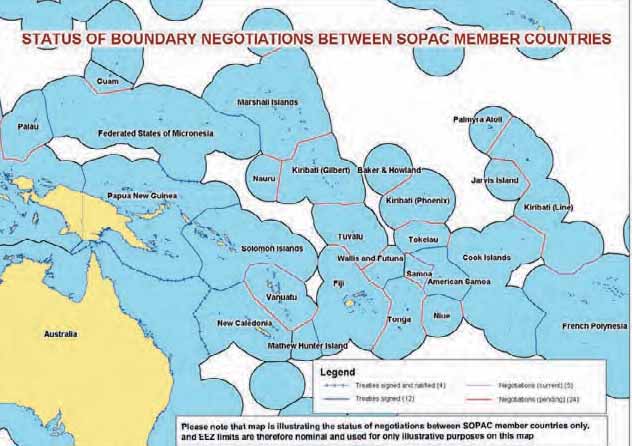
The recent agreement between Marshall
Islands Regional Maritime Boundary
Islands and Palau on their respective maritime
Information System (PIRMBIS) continued.
boundaries is a positive step forwards in
PIRMBIS contains baseline information
helping countries secure greater maritime
from maps, and satellite imagery, as well as
wealth.
the computed critical base points, and the
extrapolated notional maritime boundaries
Analysis and reporting on geophysical
for Tokelau, American Samoa, Fiji, Vanuatu,
surveys (2005) of major rivers on Viti Levu: the
Republic of the Marshall Islands, Federated
Rewa, Navua and the Sigatoka Rivers. The
States of Micronesia, Palau, Tuvalu,
processed data, GIS, map and information
Kiribati, Cook Islands, Niue and Nauru. The
products were provided to the responsible
archipelagic straight baselines (ASBs) have
authority enabling assessment of impacts of
been validated for Fiji and Vanuatu. Existing
dredging and sedimentation for each river,
treaties have also been incorporated into
with recommendations for future planning and
PIRMBIS, and median lines computed for
management decisions.
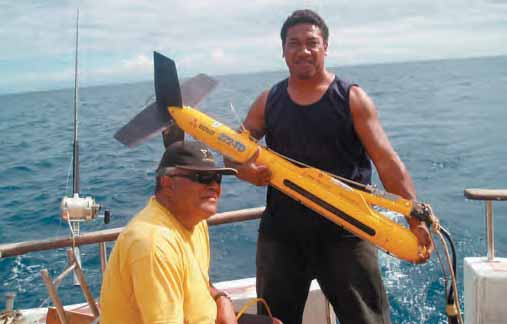
Deploying sidescan
sonar, for mapping
seabed, Nabouwalu,
Fiji.
"We can use SOPAC to help us improve the lives of our citizens." Deputy Prime Minister of
the Solomon Islands, Mr Job Dudley Tausinga
7
Ocean & Islands
p r o g r a m m e
The Benefi t-Cost Analysis (BCA) of aggregate
within Papua New Guinea, Solomon Islands,
mining on Majuro Atoll, Marshall Islands
Samoa, Vanuatu and Kiribati was provided
was completed and a stakeholder workshop
by the Aggregates Adviser under the EDF
convened in Majuro to discuss the fi ndings
Project, Reducing Vulnerability of Pacifi c ACP
and recommendations.
States.
Transcription of data (re-mastering and A major capacity building initiative has
transcribing of tapes) from the SOPAC
commenced with the Fiji Hydrographic Unit in
Petroleum Databank at Geoscience Australia
multibeam mapping for generating new charts
continued and is nearing completion. After
for navigation in the Yasawa Islands. This
the quality checking of the remastered 3590
previously uncharted region is now the focus
tapes, the original 9-tracks will be destroyed.
of increased tourism and vessel traffi c and the
Additionally, all maps and reports held in the
development of baseline bathymetric data is
databank are being digitised. It is anticipated
crucial to navigation and the characterisation
that the full digital and hard copy collection will
of potential benthic habitats which in turn
be returned to SOPAC by the end of the year.
underpins information needs for sustainable
All country information will be made available
resource management.
to countries on CD and also held at SOPAC in
the Ocean Information System.
Monitoring Physical and Chemical
Under a co-operative agreement between Change in Ecosystems
SOPAC and KIGAM, a programme of
fi eldwork on the island of Savai'i in Samoa,
lagoon resource assessment and coastal
An MOU was signed with the Bureau of
morphology mapping was completed and the
Meteorology Australia to continue SOPAC's
report fi nalised and made available.
engagement with the South Pacifi c Sea
Level and Climate Monitoring Project for
A workshop on the assessment, use and
Phase IV of the project. BoMET replaced
management of marine aggregates in the
AMSAT as project manager. Geodetic and
Pacifi c was held in Suva in February 2006. This
cGPS surveys as well as maintenance
was in collaboration with the Circum-Pacifi c
and calibration of SEAFRAME sites were
Council for Energy and Mineral Resources
completed for all benefi ciary States. Phase
and with funding from the Government of
IV will run until December 2009. A SOPAC-
Taiwan. Support for aggregate investigations
based regional Communications and
SOPAC Project offi cer, Andrick Lal setting up a GPS base station, Majuro.
Pacifi c States have opportunity to secure
nautical miles is critical to securing exclusive ocean development
of potentially rich non-living resources, such as oil, gas, gold and
potential maritime wealth
silver, as well as living organisms that live on and beneath the
seabed," Ms Pratt said.
Pacifi c States have an opportunity to secure potential greater
ocean wealth that may include gold, silver, oil and gas.
Submissions to claim an extended continental shelf must be based
Assessments conducted by SOPAC have identifi
ed strong upon sound technical data and meet requirements prescribed
grounds for some Pacifi c countries to extend sovereignty over
within Article 76 of the United Nations Convention on the Law of
their continental shelves.
the Sea 1982 (UNCLOS), to secure an extended Continental Shelf
beyond the 200 nautical mile exclusive economic zone.
SOPAC Director Cristelle Pratt said securing greater maritime
sovereignty can provide increased revenue for Pacifi c States and
"Considerable political, legal and technical efforts will be needed
deliver signifi cant economic and social benefi ts from access to
and SOPAC will work closely with Pacifi c Governments and various
ocean resources that occur on the seabed and within the subsoil.
development partners including AusAID, Geoscience Australia,
"These Pacifi c Island Countries recognise that determining Ireland, Japan, France, UN agencies, the Commonwealth
the boundaries of their Exclusive Economic Zone beyond 200 Secretariat, and Pacifi c Regional Organisations," Ms Pratt said.
8
Oceans & Islands
p r o g r a m m e
·
Fiji: Yasawa Islands region, New Kinoya
Outfall Laucala Bay.
·
Federated States of Micronesia:
Pohnpei State Kolonia, Sokehs,
Matanim and Rokiti harbours.
·
Papua New Guinea: Lae Harbour and
environs, Sissano, Madang.
·
Republic of Marshall Islands: Majuro
atoll and environs.
Implementation of the PI-GOOS Work Plan
for 2006-2007 continued, and a review
and update of the 2001 Strategic Plan was
undertaken. The PI-GOOS Coordinator was
active in developing partnerships throughout
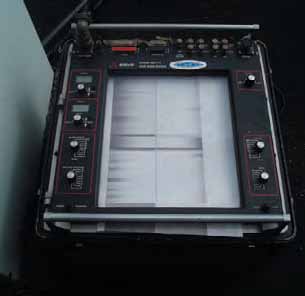
Sidescan sonar paper
the Pacifi
c region and internationally to
recorder.
further promote and develop the regional
alliance. Activities included re-activation of
Coordination Adviser was recruited and a
the PI-GOOS Advisory Committee to provide
regional communications strategy would
guidance for the development of data products
be developed to improve dissemination of
that were requested by member countries,
products from climate-related projects at
regional, national and sub-national levels.
such as ENSO indices for the tropical western
This component of the Project captures
Pacifi
c by the Vanuatu Meteorological
the regional need for appropriate and
Service.
scientifi
cally sound information delivery
at a regional and national level and was
Key PI-GOOS activities included the promotion
designed to enhance understanding of
and further development of the SEREAD
climate change science and build national
ocean science education initiative for primary
capacity for adaptation responses.
and secondary schools throughout Fiji. The
initiative is having a real impact in helping to
Major bathymetric surveys were under-
raise student and community awareness of
taken during this reporting period, mainly to
important ocean resources. A more formal
provide information to improve navigation
strategy is expected to be introduced into
safety. This information would also assist
the curriculum throughout the Pacifi c region
decision making for other resource use
between 2006 and 2009.
solutions such as mitigating effects of
coastal erosion, sedimentation and
PI-GOOS was instrumental in raising
geological hazards. This important work
community awareness of ocean issues.
will enable governments to better protect
Activities included a media campaign on
local communities from natural threats.
Major multibeam bathymetric surveys
World Ocean Day (June 8) and through the
undertaken included:
initiation of a PI-GOOS website. An ocean data
server, designed to increase access to ocean
·
Cook Islands: Avatiu, Avarua and Avana
information held at SOPAC, was secured in
harbours (Rarotonga) and Arutanga
late 2006 thanks to generous support from the
harbour
on
Aitutaki
Atoll.
International Pacifi c Research Centre (IPRC)
in Hawaii.
"SOPAC has proved its merits. SOPAC can never satisfy every country's needs but with
technical and fi nancial support, they have been very useful and help us with the impact
of scientifi c progress. Without SOPAC we would not know so much about some things
regarding our natural resources, including water, natural disasters and our main priority
area of ocean and islands." Dr Sione Nailasikau Halatuituia, Deputy Secretary Ministry of
Lands, Tonga
9























































































Ocean & Islands
p r o g r a m m e
Ocean Governance
Continued involvement with the CROP
Marine Sector Working Group, in particular
Work on assisting with maritime boundary
-with further implementation of the Pacifi c
delimitation continued along with PIRMBIS
Regional Oceans Policy and Framework for
development and associated training.
Integrated Strategic Action (PIROP-ISA).
SOPAC sourced funding through the Global
SOPAC conducted a joint SOPAC-ComSec
Oceans Forum/GEF to facilitate activities in
regional workshop on maritime boundaries
relation to development or national ocean
negotiations, with participation of legal,
policies and/or "mainstreaming" the PIROP-
policy and technical professionals from Cook
ISA in development planning at the national
Islands, Federated States of Micronesia, Fiji,
level.
Kiribati, Republic of Marshall Islands, Niue,
Palau, Papua New Guinea, Samoa, Solomon
A Senior Governance Adviser Natural
Islands, Tonga, Tuvalu and Vanuatu.
Resources, was recruited to SOPAC in
March 2006 to provide guidance on important
Commissioned the services of the National
economic issues to help member countries
Oceanographic Centre (NOC) in the United
make more informed decisions about natural
Kingdom to undertake desktop assessments
resource management.
for a number of Pacifi c coastal states to further
determine potential to claim extensions of
The OIP Manager provided support to
continental shelves beyond 200 nautical miles.
countries during the annual session of the
A high-level meeting with relevant countries
UN Informal Consultative Process on the Law
would be held to discuss study fi ndings and
of the Sea (UNICPOLOS) in New York and
possible funding and future SOPAC support
also briefed NY PIC Missions on a range of
for the submissions phase.
regional initiatives.
· Support was provided to the Fiji Government Issues and Opportunities
for a desktop assessment being undertaken
with the assistance of the Commonwealth Resource Use Solutions
Secretariat.
1) SOPAC Petroleum Databank and related
·
SOPAC work in the area of extended continental
databases -- The SOPAC Petroleum Databank is
shelf is in conjunction with the Commonwealth
currently housed at Geoscience Australia (GA) in
Secretariat, UNEP-GRID ARENDAL (Norway)
Canberra. Much of the data covering the seabed
and Geoscience Australia.
areas of Fiji, Tonga, Vanuatu and the Solomon
1960000
1965000
1970000
1975000
1980000
1985000
1990000
1995000
2000000
LEGEND
100
Bathymetric contours in metres, shown at 50 m intervals
Colour Banding
Bathymetry
Metres
0
200
400
600
800
1000
1200
3875000
3875000
1400
1600
1800
2000
NOTES
Observed soundings have been reduced to LAT tidal datum using observed
tidal elevations for Suva and Lautoka (National Tidal Facility Australia, 2002).
Date of Survey
03/05 to 01/07/03
Acquisition system
Reson SeaBat 8160 multibeam echosounder
Collection software
Navisoft 2.2.1
00
00
Processing software
Navisoft 2.2.2
Data presentation
Surfer 8.05
Survey vessel
R.V. Turagalevu
38700
38700
Backdrop Landsat image taken on 13/10/1999
LOCATION
00
00
398
0
000
4
9
3
000
K28
L28
5000
5000
00
386
386
39
K29
L29
M29
N2
N2 9
9
O29
00
00
386
M30
N30
0
000
2
8
3
1850000
1900000
1950000
2000000
GEODETIC INFORMATION
Fiji Map Grid (FMG)
Projection
Transverse Mercator
Datum
Fiji Geodetic Datum, 1986
Spheroid
WGS72
860000
860000
3
3
Longitude
178° 45' 00'' E
Latitude
-17° 00' 00'' S
Scale Factor
0.9998548
False Easting
2 000 000
False Northing
4 000 000
Horizontal positioning
DGPS
000
000
80°
3880
3880
75°
SCALE
70°
65°
Scale 1 : 50 000
75000
875000
3
38
60°
55°
0
1
2
3
4
5
00
000
Kilometres
50°
NOT FOR NAVIGATION
A0 Original
3870
38700
45°
0
40°
0
5000
35°
PROJECT TITLE
65000
38
386
30°
Bathymetry map of
385500
385500
0
00
25°
20°
PACIFIC ISLANDS APPLIED GEOSCIENCE COMMISSION
38600
386000
15°
Private Mail Bag, GPO, Suva, Fiji Islands
www.sopac.org
10°
Southeast Viti Levu,
5000
5000
5°
385
385
0°
0km
5km
10km
0km
5km
10km
1960000 1965000 1970000 1975000 1980000 1985000 1990000 1995000 2000000
Slope angle
INSET
1960000 1965000 1970000 1975000 1980000 1985000 1990000 1995000 2000000
SOPAC/EU Project:
incorporating recently
(degrees)
Three-dimensional perspective image looking north.
Reducing Vulnerability of Pacific ACP States
INSET
Two times vertical exaggeration
INSET
Gradient slope angle generated from 75m gridded multibeam bathymetry.
Shaded relief map.
DRAWING TITLE
Red indicates higher slope angle. Blue indicates near horizontal seafloor.
Sun illumination angle from the northwest
SUVA,FIJI
CHART O29
acquired multibeam
BATHYMETRY
REPRINT COPY FOR PEER REVIEW
Comments to Jens Kruger, SOPAC, jkruger@sopac.org
1960000
1965000
1970000
1975000
1980000
1985000
1990000
1995000
Drawn by: Jens Kruger and Salesh Kumar. Report Reference: ER00XX
data.
10
Oceans & Islands
p r o g r a m m e
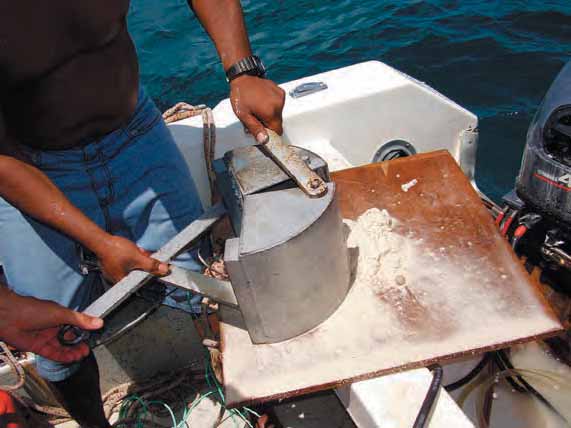
Sediment sampling
using a VanderVeen
grab.
Islands was gathered in the 1980s under SOPAC
OIP also holds access to a number of discrete
auspices by a tripartite programme involving databases and databanks including:
USA, Australia and New Zealand and under
individual Oil Exploration Licenses by petroleum · PIRMBIS Pacifi c Islands Regional Maritime
exploration companies. The SOPAC Petroleum
Boundaries Information System.
Data Bank (P-DB) is a critical information source
· The Marine Scientifi c Research Database
for countries and potential petroleum exploration
which includes about twenty years of
company partners.
marine mineral research, conducted under
the auspices of the joint MMAJ-SOPAC
In order to avoid loss of data through
programme.
deterioration of original tapes, data within the · Data acquired under the EDF8/9 Project
P-DB is being transcribed on to more robust
Reducing Vulnerability of Pacifi
c ACP
media. Approximately 1500 seismic tapes was
States.
being remastered and 200 reports and 300 maps
· Data acquired under programme activities in
scanned and digitised and made available on
most SOPAC member countries, including
DVD's with an overview of petroleum prospects
holdings related to the Sea Level and Climate
in the region. This would make storage and
Monitoring Project (SPSLCMP).
management easier as well as making it cheaper
for interested companies/persons/organisations Effective data management is essential to gain
to obtain the data. As GA now faces space maximum benefi ts and provide member country
constraints, all material, including the remastered
access but requires strengthening of technical
dataset, will be housed at SOPAC and copied to and human resources within OIP and the
host countries.
Secretariat.
Current high oil prices have meant renewed 2) Capacity Development -- Capacity building
recent interest in oil and gas exploration is an imperative of SOPAC's work programmes
both regionally and globally with consequent and is enhancing skill sets and delivering
increased demand for access to the SOPAC opportunities for greater regional development.
Petroleum Data Bank. As this trend is expected Important capacity building initiatives include
to continue, housing the databank at SOPAC, formal courses in geoscience such as the
and managing requests for information, will have
Certifi cate in Earth Science and Marine Geology
resource implications for the OIP.
[CESMG]; regular guest lecture commitments
11
1
Ocean & Islands
p r o g r a m m e
at USP (e.g. Coastal Vulnerability and Processes);
SOPAC is to continue to provide relevant, quality
participation in technical workshops and meetings;
results and ongoing support to member countries,
trainee attachments at the Secretariat for specifi c targeted capacity development and skills transfer
work programme activities such as university would be necessary through:
post-graduate, co-supervision; development of
GIS, remote sensing interpretation and database · professional attachments at the SOPAC
development); and in-country activities such as the
Secretariat;
SPSLCMP-coordinated IPCC regional outreach · on-the-job training on specifi c activities across
programme.
the work programmes either at the Secretariat
or in-country; and
A submission to the Commonwealth Secretariat · national, regional and sub-regional workshops.
seeking continued CFTC support for resources
to enable the delivery of a new CESMG course
cycle, prompted CFTC to suggest that serious Monitoring Physical and Chemical
consideration be given to move the CESMG to
USP under its Islands and Oceans Faculty. In Change in Ecosystems
preliminary discussions between USP, ComSec
and SOPAC, USP expressed a willingness to 1) Sea-Level and Climate Monitoring
accept the move. However, details and funding SPSLCMP Phase IV -- The South Pacifi c Sea
requirements still remain unclear and further Level and Climate Monitoring Project (SPSLCMP)
discussions are required.
is part of an Australian initiative to support the
long-term monitoring of sea-level variability and
Capacity building is essential to ensure rise in the Pacifi c. After completing its 15th year at
sustainability of programme interventions. The the end of 2005, the project now represents one of
lack of national technical capacity and capability is
the longest efforts at monitoring regional climate
perhaps the single greatest challenge to countries and ocean data in the region and is a valuable and
striving to achieve sustainable development. If growing dataset.
"SOPAC can show us the way to go with strategic plans and is very good at applied work
and at producing good data." Scientifi c Technical Adviser, New Caledonia, Dr Yves Lafoy
12
Oceans & Islands
p r o g r a m m e
SOPAC became engaged in the implementation international audience as SOPAC will partner
of the third phase SPSLCMP III. This involved with the Circum-Pacifi c Council for Energy and
providing assistance in carrying out CGPS and Mineral Resources, SPC and the Government of
geodetic surveys and maintaining SEAFRAME New Caledonia to host GeoHAB 2007 (May 2007).
sites in countries in conjunction with the National
Held biennially, GeoHab is a major international
Tidal Facility (NTF) and Geoscience Australia. conference on marine habitat mapping. Under
SOPAC will continue this engagement in Phase the EDF Programme, high-resolution bathymetric
IV (2006-10), which is managed by the Bureau charts of key target locations in thirteen nations
of Meteorology, Australia (BoMA). Given the were reviewed and completed.
age of existing equipment as well as the need to
integrate some stations within the regional and Much of this work, including technical staffi ng,
Australian Tsunami Warning Network, it is likely is funded under the EU EDF 8/9 Reducing
that upgrades of existing stations will occur in the
Vulnerability of Pacifi c ACP States Project, which
later stage of Phase IV. Additionally, Phase IV will
will cease in 2007. This capacity will need to be
increasingly concentrate on data products and retained in the programme if we are to continue
information dissemination at all levels in country. to deliver these valuable services to the region.
A Regional Communications and Coordination
Adviser is being recruited to SOPAC for this 3) Tsunami Monitoring and Early Warning
purpose.
Systems -- There has been signifi cant global
activity on establishing and maintaining adequate
Although support for these activities is ensured for
tsunami monitoring and warning capabilities since
the coming years, further consideration will need the December 2004 tsunami in the Indian Ocean.
to be given to the role of SOPAC and members in
Given the active plate margins, which several
this important initiative as the project evolves.
member states straddle, as demonstrated by
recent quakes offshore of Tonga, Vanuatu and
2) Bathymetric Mapping and Modelling Fiji, the need for reliable monitoring systems
Capabilities -- SOPAC has a unique regional to effectively monitor tsunami has long been
capacity with its single and multi-beam swath recognised as essential for the Pacifi c region.
mapping and seismic systems. Potential areas of
application include detailed mapping of harbours There are a number of regional and global
and nearshore shipping lanes, correction of statements and initiatives triggered by the Indian
hydrographic charts for maritime transport Ocean tsunami, the most regionally signifi cant
safety; seabed mapping and seismic surveys being that of Australia to establish/upgrade
for identifi cation of offshore aggregates and for tsunami warning systems for the Pacifi c and
continental shelf delimitation; mapping to support
Indian oceans. Australia will establish a physical
habitat characterisation for "ecosystem based" network of monitoring gauges around the region
management (EBM); hydro-dynamic modelling of
over coming years. The establishment and
lagoons and nearshore for fi sheries, aquaculture maintenance of a monitoring network will likely to
and marine protected areas; and identifi cation of be linked to the existing SPSLCMP network.
submarine geo-hazards and tsunami modelling.
The tsunami threat faced by PICs is a complex
The ability to provide products such as maps mix of tsunami from local, regional and distant
and models, which can be integrated with other sources whose effects are highly dependent
ecosystem data and used by a range of users on variations in seafl oor shape between the
for planning and management purposes, has source and the affected area. This makes design
enormous value and potential. For example, of an effective warning system problematic.
many hydrographic charts for nearshore waters Geoscience Australia, with AusAID funding, will
are inaccurate and pose a danger for shipping. work with SOPAC to undertake a comprehensive
SOPAC may potentially become a regional risk assessment for the region, including the
hydrographic centre for the updating of such development of tsunami risk assessment tools.
charts.
Response and warning mechanisms need to
In 2007, SOPAC will have an opportunity to be developed in parallel to achieve a workable
showcase this work to the region and also an end-to-end warning and response system. This
"SOPAC is helping the Marshall Islands in many ways. They have assisted with our
understanding of our environment and take leadership in ways forward as we progress
with environmental and development issues. SOPAC has also done lots of work in capacity
building training. Embassy of the Republic of Marshall Islands, Ambassador H.E. Mr Mack
Kaminaga
13
Ocean & Islands
p r o g r a m m e
activity will complement the proposed work of changes in regional and international nearshore
SOPAC's CRP and BoMA under the National settings, has resulted in human activities
Capacity Assessment: Tsunami and Multi-hazard
delivering approximately the same amount of
Warnings Project.
nitrogen to nearshore marine systems as that
delivered naturally through environmental cyclic
4) Coastal Vulnerability Assessment & processes. This effectively doubles the amount
Monitoring -- Shoreline processes, coastal of nitrogen in coastal waters and since nitrogen is
vulnerability and especially the issue of erosion generally the limiting nutrient in marine systems,
is of concern in many PICs, particularly the excess nitrogen causes ecological change on an
atolls. The coastal processes component under unimaginable scale. Tropical coral reef systems
the EU-funded Reducing Vulnerability Project are especially intolerant of sustained change in
has produced analysis of historical shoreline nutrient regimes and permanent damage from
position trends (dating back as far as 60 years) nutrient enrichment has occurred in many of the
in Kiribati, Tuvalu and Solomon Islands; and regions urban reef environments (e.g. Fiji's coral
has held information and capacity building coast, Queensland's Great Barrier Reef's inner
workshops pertaining to this work in all three reef and Tarawa Atoll).
countries. Longer-term training attachments and
postgraduate supervision in this sector has also Addressing issues pertaining to the chemical
been undertaken.
components of the nearshore marine ecosystem
is vital to maintaining our nearshore ecosystems
Increasingly, within the region shoreline erosion in a viable, resilient and sustainable manner.
is locally equated with climate change stress and
There is a current lack of baseline information
the coastal processes component has developed
or monitoring of water quality change to track
monitoring products to address the regional need
reef response. Given the vulnerability of fragile
for climate stress related monitoring of shoreline reef systems to nutrient enrichment and the
environments. Additional benefi t of this work is the
importance of these systems to the viability of
development of clear vulnerability assessments PIC communities and economics, monitoring and
and the relationship between poor coastal zone understanding chemical change in the marine
practises and erosion. An additional related task environment is of critical importance.
area has been the assessment and development
of monitoring systems in low-lying nations where At present SOPAC is not involved in any major
salinity incursion in swamp taro cultivation pits is chemical monitoring activities or analysis of
perceived as a problem.
coastal systems with respect to ecological
5) Eutrophication -- Eutrophication (nutrient maintenance. This is generally a core function
enrichment through catchment development of regional geoscience organisations, (e.g.
and change) is the major driver of change and Geoscience Australia, who lead in coastal
environmental issue disturbance in nearshore biogeochemical cycling and monitoring, recognise
marine environments and nitrogen is the that this is not simply a "biological" issue but
major limiting nutrient in marine systems. The a specialist discipline more closely related to
myriad of more recent catchment development Geoscience). The synergies with OIP's existing
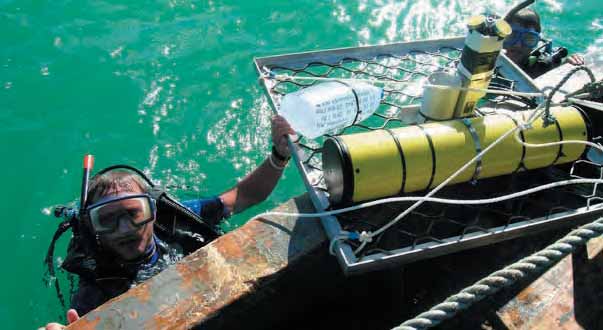
Current meter
deployment and fl ow
measurement to
calibrate hydrodynamic
model, Fanga'uta
Lagoon, Tonga.
14
Oceans & Islands
p r o g r a m m e
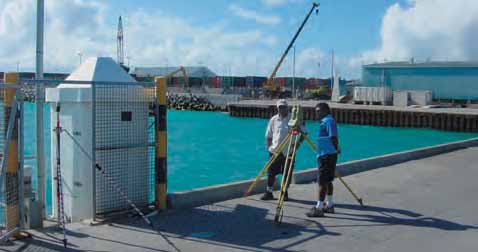
Precision levelling
monitoring survey in
Betio, Kiribati as part
of the South Pacifi c
Sea Level & Climate
Monitoring Project.
marine survey and hydrodynamic modelling of United Nations consultations on Oceans and
work are obvious and currently no other Pacifi c Law of the Sea. PIROP is invaluable as a unifi ed
regional organisation is taking the lead on this regional approach to ocean management and
important issue.
governance. As individual CROP organisations
have reached the limit of their abilities to drive
this forward without detracting from existing work
Ocean Governance
programmes, further progress is only likely if
signifi cant new resources are committed.
1) PIROP-ISA Pacifi c Regional Ocean Policy
and u want one dicFramework for Integrated For the PIROP-ISA to progress, the region must
Strategic Action (PIROP-ISA) -- is a broad-
devote specifi c resources and establish a Pacifi c
scale regional integration and planning process Islands Regional Ocean Policy offi ce, with at
that is a signifi cant step towards developing least one full-time staff member, in an existing
regional approaches to ocean governance and regional organisation. The initial primary function
resource management over the entire Pacifi c of this offi ce would be to assist the MSWG and
region. The process was guided by the Marine other specialised agencies in working together
Sector Working Group of the Council of Regional
to assist participating countries and territories in
Organisations of the Pacifi c (CROP). SOPAC is developing support for their own domestic ocean
currently a co-chair of this group and hosted its policies.
latest meeting. Like all broad-scale integrative
processes, it is diffi cult for any one organisation This would include developing proposals for the
to maintain an overview of PIROP and its implementation of the PIROP-ISA to concentrate
implementation so involvement of the MSWG on harnessing resources to develop and
remains critical to delivering outcomes that will implement national ocean policies; establishing
make a sustainable difference.
channels of communication to assist both the
CROP Marine Sector Working Group and national
The importance of PIROP is clear when discussed
UN delegations involved in the informal Oceans
at the international level, particularly in the context
working group.
"SOPAC is a tremendous help for us with technical assistance for maritime boundaries.
They have also helped with coastal management and erosion. We are happy with SOPAC
because whenever we have a request small or big, SOPAC responds and helps us fi nd a
way to help ourselves." Embassy of the Federated States of Micronesia, Deputy Chief of
Mission, Mr Gabriel Ayin
15
1
Ocean & Islands
p r o g r a m m e
2) Maritime Boundary Delimitation and assessments of activities such as the commercial
Extended Continental Shelf Claims -- The Lagoon Aggregate Dredging Company in
Pacifi c Islands Regional Maritime Information Kiribati. In addition, analysis is planned as part
System (PIRMBIS) now contains the computed of the SOPAC-wide EDF Reducing Vulnerability
critical basepoints, and the extrapolated notional Project.
maritime boundaries for Tokelau, American
Samoa, Fiji, Vanuatu, Marshall Islands, Federated
Programme Resources -- The availability of
States of Micronesia, Palau, Tuvalu, Kiribati, programme resources, both in terms of staffi ng
Cook Islands, Niue and Nauru. Existing treaties and fi eld equipment for the effective delivery of
have also been incorporated into PIRMBIS.
the programme's work plan remains a critical
issue. To ensure delivery of an effective fi eld
SOPAC has also commissioned the services of programme, ongoing maintenance and upgrade
the National Oceanographic Centre (NOC) in of specialised fi eld equipment is critical.
the UK to undertake desktop assessments for
Palau, Federated States of Micronesia, Solomon The existing GPS survey equipment is twelve
Islands, Vanuatu, Kiribati and Tuvalu.
years old and as maintenance is no longer
offered by Trimble Geosystems, they will need
The role of SOPAC and the way forward will to be replaced. With new technology emerging
be clarifi ed at the senior government level after there are GPS units now capable of carrying
desktop studies are completed. A high-level out multi-purpose tasks such as geodetic and
meeting with relevant countries will be held to topographic surveys, facilitating digital terrain
discuss the fi ndings, funding and SOPAC support
models, integration of RTK GPS surveys with
for the submissions phase.
other GPS surveys (Differential and Static) and
ground-truthing of satellite imagery with better
SOPAC is currently in discussions with Ireland accuracy. These units will improve accuracy
and Norway for both legal (Ireland) and funding levels for the maritime boundaries project as
(Norway) support for the submission phase. well as other GIS applications across all SOPAC
Ireland recently brokered a joint Extended Shelf programmes.
submission with France, Spain and Portugal, as
the fi rst joint submission to the Commission.
Regarding personnel, the following areas are
needing advisers and project offi cers to assist
3) Resource Economics -- OIP is currently in programme delivery coordination of marine
embarking upon a series of economic analyses scientifi c research (particularly in the development
to improve the governance of ocean and island and maintenance of databases); and coastal
resources. Studies are intended to contribute to processes and aggregates (currently funded
more strategic and community-focused use of under EDF 9). A geological technician is sought
resources by providing information to government
urgently to understudy the incumbent reaching
and community stakeholders on the impact of retirement age.
using resources in different ways.
Additional funding has secured the PI-GOOS
The economic analyses currently underway position for an additional three years and through
include cost-benefi
t analysis of interventions SPSLCMP to secure a senior adviser Climate
such as Maritime Boundary Delimitation, Communications and to support the salaries of
alternative options for aggregate extraction and the Project Offi cer Surveying and the Electronics
economic valuations of resources and feasibility Technician.
"Our association with SOPAC goes back 35 years. They are a very positive resource
and have done a lot of work for us and have expanded from mineral resources
monitoring and assessing to economic analysis. This has been very useful for us
and now SOPAC is playing a huge role in assisting us with better management of our
water supply. We have more community driven programs which SOPAC is responding
to with their three programme areas. SOPAC is part of a whole community process
of development and not just technical anymore." Secretary, Cook Islands' Ministry of
Works, Mr Atatoa Herman
16


Community Lifelines
p
r
o
g
r
a
m
m
e
Background
Two regional proposals were submitted to
the EU-Water Facility 1st call for proposals
SOPAC, through the Community Lifelines
on behalf of the Pacifi c ACP States. The
Programme (CLP) is committed to working with
Pacifi c Hydrology Cycle Observing System
offi cials, government and industry representatives
(HYCOS) Project will run over three years
to raise Pacifi c living standards by enhancing
(2006-2009) and be implemented by SOPAC
community access to sustainable energy,
with in-country counterparts at the National
freshwater, IT and communications.
Hydrological Services, in collaboration with
WMO, UNESCO and the Fiji Meteorological
Service.
Summary of Key Activities
Core activities include fl ood forecasting; water
resources assessment in major rivers; water
Resource Assessment, Development
resources databases; drought forecasting;
and Management
and groundwater and water quality monitoring
and assessment.
In partnership with UNESCO and WMO and A second project to support the development of
with NZAID funding, SOPAC organised the
national IWRM and Water Use Effi ciency plans
third and fi nal course under the Hydrological
through the establishment of a regional IWRM
Training Programme for hydrological
Resource Centre and support of in-country
technicians from the Pacifi
c region. Four
national consultations was unsuccessful in the
training workshops over three years assisted
1st Call. However, it was considered suitable
39 technicians from 13 Pacifi c Island countries
for funding and subsequently added to the
and one from the Maldives. The Programme
Water Facility's reserve list. The proposal has
was established as a precursor to the Pacifi c
been resubmitted for the 2nd Call, with results
HYCOS Project to better enable hydrological
expected in December 2006.
technicians to support NHS directors in project
implementation.
As a pilot project on behalf of the United
Nations University, SOPAC supported the
development of a Post-Graduate Diploma in
Integrated Water Resources Management
(IWRM) offered by the University of the South
Pacifi c (USP) in Distance and Flexible Mode.
The course will run on a part-time basis for
approximately eighteen months and be
coordinated through the UN Water Virtual
Learning Centre (WVLC), newly established
at USP. Ten fully-funded scholarships or study
positions are available for suitably-qualifi ed
post-graduate students from the 12 member
countries of the USP region.
SOPAC is working closely with USP to
facilitate the IWRM Course by providing case
studies as part of the course material for the
Pacifi c region.
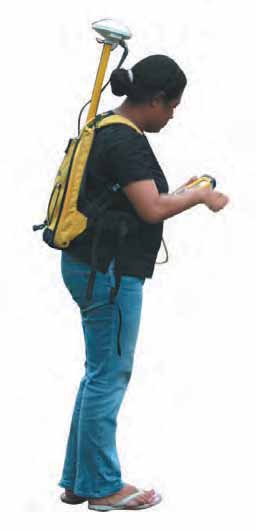
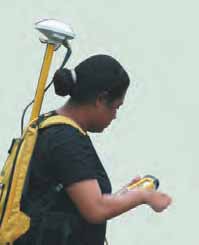
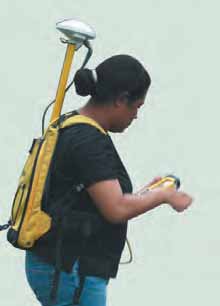
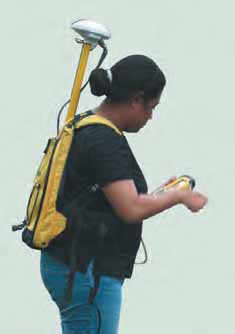
Capturing ground
"SOPAC is helping Niue in a lot of areas and I hope this continues, especially with water
control points.
and energy. SOPAC assistance is improving the lives of people in Niue. They are helping
with assessment and policy. SOPAC has come a long way (in 35 years), expanding, more
responsibilities in the region and this is a good thing. We are sharing experiences throughout
the region, and SOPAC is creating opportunities for this. We have similar but different
problems." Mr Deve C.K. Talagi, Director of Works, Niue Public Works Department
17
Community Lifelines
p
r
o
g
r
a
m
m
e
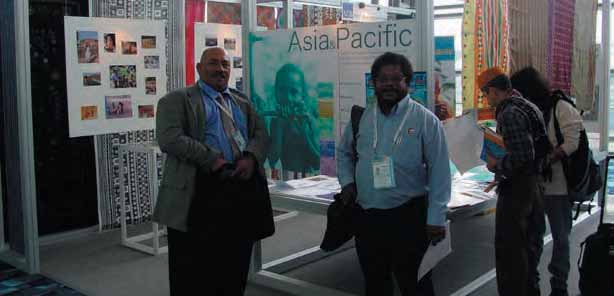
Patrick Amini
and Moefaauo
Titimaea at the
4th World Water
Forum, Mexico.
SOPAC, WHO and IAS/USP secured funding
featured were other activities undertaken in the
from NZAID for 2006-2009. Funding will
context of UNESCO-IHP in the Pacifi c through
support a Regional Water Quality Monitoring
the Pacifi c Partnership Initiative on Sustainable
Programme aimed at creating a sustainable
Water Management.
national capacity for maintaining safe quality
drinking water, surface, ground and coastal
The World Summit on Sustainable Development
waters. The Programme will be piloted in fi ve
(WSSD) in Johannesburg in 2002 called for all
countries and a selection process is now being
countries to produce integrated water resources
fi nalised.
management (IWRM) and water effi
ciency
plans by 2005. An update on progress of IWRM
SOPAC supported UNESCO's Pacifi c Hydrology
implementation was sought by the Global Water
for the Environment, Life and Policy (HELP)
Partnership (GWP) and based on questionnaire
Symposium which focused on devising ways
responses, a summary report was presented at
HELP can contribute to strengthening catchment
the 4th World Water Forum.
area management practices. Pacifi c participants
developed a draft framework for action, "HELP The Japan Water Forum (JWF) approached
in the context of the Pacifi c Regional Action
SOPAC to assist in drafting and fi
nalising
Plan on Sustainable Water Management".
the Pacifi c sub-regional part of the Regional
Position Paper for Asia and the Pacifi c. This
The Symposium also examined ways in which
was presented at the 4th World Water Forum,
Pacifi c Island agencies and communities can
16-22 March 2006 in Mexico.
better manage land usage and reduce impact
on river and coastal areas. This is the basis of
In response to a request by regional diplomatic
Integrated Catchment Management and a focus
missions at CSD12, the Global Environmental
of the UNESCO HELP Programme along with
Facility (GEF), through UNDP, signed a
a demonstration of the HELP Basin Project. PDF-A agreement with SOPAC in November
SOPAC provided technical and fi nancial support
2004 to develop an innovative programme
to build the capacity of Pacifi c Island countries
on Sustainable Integrated Water Resources
in the management of freshwater resources.
Management (IWRM) in Pacifi c Island Countries
(PICs). Based on the endorsement of 10 PICs,
The Pacifi c Hydrology for the Environment, Life
the GEF approved entry into the GEF pipeline
and Policy (HELP) Symposium (7-11 November
of this proposal and approved the request for
2005) marked the fi rst formal HELP event to
fi nancial resources to further develop the project
take place in the Pacifi c region. The Symposium
and the PDF-B phase in the coming two years.
was jointly hosted by the New Zealand crown
The full-sized project is to be implemented by
research institute Landcare Research and the
UNDP and UNEP and executed by SOPAC
UNESCO Apia Offi ce.
through the Pacifi c Partnership in the period
2007-2012. The project will support PICs in the
Outcomes of the Symposium were featured
implementation of the Pacifi c Regional Action
at the 13th Southeast Asia and the Pacifi c
Plan on Sustainable Water Management that
IHP Regional Steering Committee meeting in
aims to improve the assessment and monitoring
Bali, Indonesia, 21-25 November 2005. Also
of water resources; reduce water pollution;
18
Community Lifelines
ty
nity Li
nes
p
r
o
g
r
a
m
m
e
Biofuels in the Pacifi c: Colonial Heritage Saves into a local car run for three years on various coconut oil blends,
found no long-term engine deterioration and one can now even
the Future?
smell coconut fumes along the main road in Majuro.
The steadily increasing world market price for fossil fuels has
In Vanuatu, there are two retailers refi ning coconut oil to either a
aroused signifi cant interest in the development of local sources
mix with 20 per cent kerosene or with 50 per cent diesel. Despite
of energy in the Pacifi c Islands. Key experiences in Vanuatu, the reduced prices supported by government, the uptake is still
Samoa, Papua New Guinea, Solomon Islands and Fiji indicate
limited, but nonetheless growing. In September, a similar blend
that there is a special case for the economic viability of biofuel in
was launched by Solomon Tropical Products in Honiara at the
the Pacifi c.
2006 National Trade Show after testing their product in local
vehicles.
Over the last 20 years, the price of coconut oil on the world
market has consistently decreased, and after a period of relatively
In Samoa, SOPAC has assisted with the use of coconut oil as a
low diesel prices. The last fi ve years have seen diesel prices
fuel in power generation, with EPC, the power utility in Samoa. In
progressively increase. Only recently, imported diesel in the Vanuatu, the power utility UNELCO embarked on `industrialising'
Pacifi c has become more expensive than the net value of exported
the production of fuel-grade coconut oil and are using it in their
coconut oil, suddenly making coconut oil a serious commodity
generators in a blend of 10 per cent that is supporting the local
option for internal use as biofuel.
industry and decreasing emissions.
At the global level, ambitious targets set by countries to achieve
a signifi cant reduction in fossil fuel usage has caused an In PNG, many local suppliers of fuel have started to blend fi ltered
increase in world market prices for vegetable oil and sugar, as
coconut oil with diesel, including Unitech in Lae, who have been
well as a tempering effect on crude oil prices. At the same time,
successfully trialing biofuel blends in engines as part of their
environmental concerns that are driving the biofuel industry in the
mechanical engineering research. Another supplier, PNG SD, is
European Union are causing environmental problems through using mining proceeds to attempt to make power generation in
wide-scale deforestation for palm plantations in Malaysia and remote communities commercially viable.
Indonesia.
Many technical options exist to utilise biofuel. The big question
In the Pacifi c, the call for the use of locally produced biofuels
however, is where we will get the raw materials to produce biofuels.
has been based mainly on the desire to reduce dependence on
At the global level, International Energy Agency scenarios suggest
imported fossil fuels. However, research conducted by the Pacifi c
that biofuel can only contribute to about 20 per cent of transport
Islands Applied Geoscience Commission (SOPAC) about the fuel consumption in 2030 due to problems with arable land
impact of biofuel on government fi nances, found that as coconut
availability and food market competition; however, in the Pacifi c,
oil and sugar are important export products, using them to replace
assuming signifi cant government support for major replanting and
imports will also cause a decrease in total export revenue. In
industry restructuring, SOPAC estimates that the current regional
addition, if duties and excises are waived so as to promote the
potential in 2010 for biofuel (ethanol and biodiesel), is about 30
use of biofuel, the total impact on Government fi nances might be
per cent of all transport fuels.
negative.
As there is no country in the world that has a biofuel industry
In Fiji, the relatively small size of the sugar industry makes without the backing of government policies and incentives, there
it diffi cult for Fiji to be competitive with ethanol on the world is a very important role for national legislators in the region to
market. However, the cost levels appear to be close to serving
ensure the adoption of standards and provide tangible support.
Fiji's domestic market with a petrol substitute. The World Bank
will investigate this further in 2007 in partnership with the Fiji
The Pacifi c biofuel advantage is in no small part due to our
Sugar Corporation. Although costs to produce biodiesel based
natural resources. Our colonial heritage of dedicated coconut tree
on coconut oil are still quite high, another cheaper option is the
plantations gives us the edge to make biofuel a real economic
use of waste vegetable oil as raw material, which can make it
and environmental alternative. Although we will not be able to
competitive with regular diesel.
replace all fossil fuels in the near future, biofuels provide part
of the solution and should therefore be pursued vigorously by
In other Pacifi c countries, Tobolar Copra Mill in the Marshall governments in partnership with the private sector. Biofuels will
Islands is retailing a 50/50 fi ltered coconut oil and diesel blend
then decrease our dependence on fossil fuels and build greater
below the price of regular diesel. Recently, a SOPAC inspection
confi dence in our own Pacifi c assets.
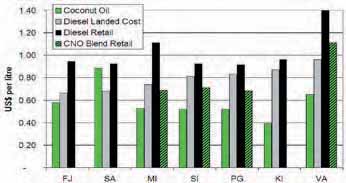
Selected regional prices, sorted by landed cost of diesel, of a) coconut oil net revenue, b) landed cost of diesel (excluding taxes),
c) diesel retail prices and d) retail prices for fi ltered coconut oil blends with diesel as of August 2006. SA, FJ, KI have no biofuel
retail.
19
9
Community Lifelines
p
r
o
g
r
a
m
m
e
improve access to technologies; strengthen
UNDP requested SOPAC assistance with
institutional agreements; and leverage
further investigation into the applicability and
additional fi
nancial resources to support
technical feasibility of copra oil as a fuel for
IWRM.
power generation and transportation within
the Pacifi c. Similar requests were received
As crude oil prices increased over the past
from Vanuatu, Fiji and the Marshall Islands.
12 months, regional biofuel energy options
have become increasingly important. As a
The Fiji Resilience Building Project
consequence, there has been an increase in
(Preparatory Assistance Project Proposal
interest in evaluating the viability of alternative
Development of a National Biofuels
fuel options, especially locally-produced
Programme to Prevent Signifi cant Loss of
biofuels. SOPAC has continued to monitor
Rural Employment in Fiji) funded through the
progress and distribute research fi
ndings
UN GEF PDF-A, has assisted the Government
and relevant international development
of Fiji in defi ning, formulating and fi nalising a
information.
comprehensive strategy. The strategy aims to
evaluate the feasibility of a national biofuels
Many Pacifi c countries are developing remote
programme to transform the sugar cane
island capabilities to produce fuel with varying
for sugar industry into a renewable energy
degrees of success. SOPAC continues to
industry; helping to reduce dependence on
provide important technical support for many
petroleum imports; provide employment; and
of these pilot projects.
protect freshwater and other environmental
resources. The PDF-B application under the
· A feasibility study for the Samoan Electric
GEF was not accepted by UNDP as there are
Power Corporation (EPC) on the viability of
no operational programmes allocated for the
using coconut oil on the island of Savai'i.
increase of biofuels.
· A national biofuels workshop in Tarawa
in April 2006 with all major stakeholders, However, UNDP did provide the Fiji
which delivered a strategic action plan
Government an additional US$50,000 for
that called for an expansion of trials by
initial in-country activities to promote the
the Kiribati copra milling company using a
establishment of a biofuel industry. SOPAC
blend of fi ltered coconut oil with diesel.
continues to assist with the implementation of
· An evaluation of the SPC-installed biofuel
the Fiji biofuels initiative.
projects on Taveuni and Vanua Balavu in
Fiji.
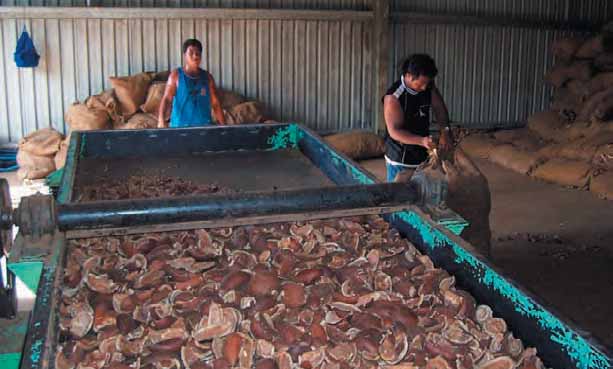
Workers of the Kiribati
Copra Mill unloading
copra for coconut oil
production.
20
Community Lifelines
ty
nity Li
nes
p
r
o
g
r
a
m
m
e
The PDF-A phase of the project for the
constraints and emerging energy challenges
Promotion of Environmentally Sustainable
in the land transport sector in participating
Transportation in the Pacifi
c Islands
countries Fiji, Samoa and Vanuatu. A Medium
(PESTRAN) was successfully completed
Size Project (MSP) brief has been developed
after national consultation workshops and
for submission to GEF-4. With the newly-
the compilation of country reports highlighted
introduced Resource Allocation Framework
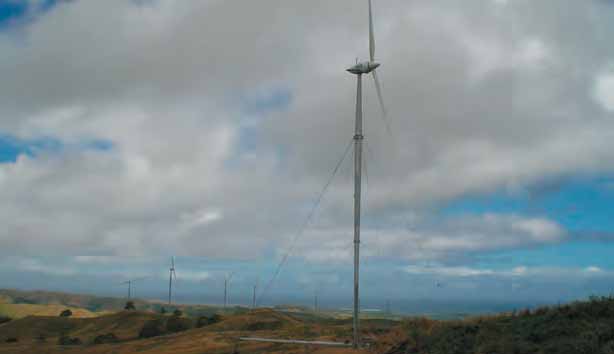
Fiji Electricity Authority
(FEA) 10-MW wind
farm at Sigatoka, Fiji.
Space technology helping local communities
"Using this technology means that everyone is now seeing
the same thing and speaks the same language, which avoids
The annual regional Geographic Information Systems/Remote
misunderstandings and misinterpretation of data material.
Sensing (GIS&RS) Conference aims to provide international Visualisation is also critical to better planning and can be used
technology experts, local government and private sector offi cials
in a range of areas including the tackling of coastal erosion,
with an opportunity to fi nd technology solutions to problems deforestation, improved farming and more effi cient electricity
such as water shortages, coastal erosion, natural disasters and
consumption," Mr Forstreuter said.
environmental degradation.
SOPAC is providing countries in the Pacifi c with high-resolution
Since the fi rst GIS&RS Conference in 1999, the event has national satellite images, which are being used extensively by
supported RS technology that provides companies, and governments and local companies. This support is part of the
governments with detailed satellite images of land and sea areas
joint EU/SOPAC Project: Reducing Vulnerabilities in Pacifi c ACP
to help better manage resources such as coastlines and forests.
States.
It also involves GIS digital maps, easily updated electronically,
that can assist governments more effectively supply services
such as water, telecommunications and electricity.
The conference enables participants to upgrade their skills and
refi ne methods to suit local needs which include the identifi cation
of potential fl ood zones, understanding cyclone behaviour, forest
maps to better protect forests and shallow water bathymetry
(water depth) to assess potential for fi shing and dredging.
Participants are also introduced to the different software available,
some of which may be free and open and greatly benefi t small
regional organisations that are normally set back by the lack of
fi nances to start up their GIS setups.
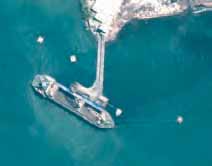
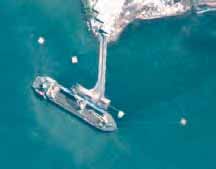
Details on pan-sharpened QuickBird images (60 cm spatial
SOPAC remote sensing expert Wolf Forstreuter said the resolution). The image above was recorded from Lae through
important thing about satellite technology is that it provides the SOPAC-EU Project. Not only details of the ship crane during
clear and unambiguous imagery data that can help people more
the unloading process are visible, but also the lines with which
effectively plan before starting a project in cities, coastal towns,
the vessel is fi xed on the wharf.
settlements and villages.
21
Community Lifelines
p
r
o
g
r
a
m
m
e
(RAF) of GEF-4, new endorsement letters
have been requested from the participating
country GEF focal points. The endorsement
will also provide direction as to the future of
the project either at sub-regional or national
level. The project is expected to commence
in 2007.
The 20-kW demonstration wind turbine
installed within the Fiji Department of Mineral
Resources compound adjacent to the SOPAC
Secretariat in Nabua, as part of the Wind
Energy Education Programme, continues to
be monitored by SOPAC. As originally agreed,
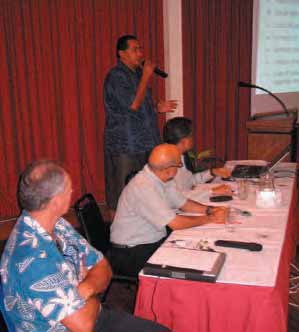
Mr Rupeni Mario
ownership of the turbine had been transferred
presents at the
to the University of the South Pacifi c (USP). A
Renewable Energy
regional workshop on wind energy was held
for Poverty Reduction
in November 2005 marking the completion of
(REP-PoR)
project activities. It called for greater sharing
consultation meeting in
of information on resource assessment
Suva, 2006.
results and continued capacity building in the
Pacifi c wind energy sector. SOPAC and USP
Other activities in 2006 to support regional
are continuing discussions with the Danish
experience and information sharing included:
Government for the continuation of wind
energy support.
· Coordination of the regional workshop in
November 2005 for the joint presentation
In partnership with UNDP, and with funding
to PICs of the Renewable Energy Project
from PIEPSAP and NZAID, SOPAC has
for Poverty Reduction (REP-PoR) and
acquired four wind monitoring towers,
the Pacifi c Renewable Energy Training
anemometers and data logger equipment.
Initiative (PRETI) projects.
Two monitoring stations will be erected on
· Convening of a sub-regional workshop on
Upolu (Samoa), one on Rarotonga (Cook
solar PV in Tonga, May 2006, as part of
Islands) and one in Funafuti (Tuvalu). The wind
the SURE Project.
monitoring installations will be commissioned
· Promoted ICT applications using GIS and
in the second half of 2006, for a minimum of
Remote Sensing tools through publications,
two years. These will provide important data
like the regional GIS and Remote Sensing
to assess potential wind energy resources.
Newsletter; via the online discussion list
GIS-PacNet; and the important regional
In Mangaia (Cook Islands), two 20-kW Vergnet
GIS&RS User's Conference in Fiji.
wind turbines were installed in 2004 as part of
· GIS/RS training activities were conducted
SPC's PREFACE Project. SOPAC has since
in Papua New Guinea, Fiji (3), Kiribati,
assisted the Cook Islands' Government with
Tuvalu (2) and Palau as part of SOPAC/
identifying why anticipated diesel savings did
EU Project activities. Training courses
not occur. This has resulted in the development
supported the establishment of new
of a funding proposal for a system upgrade
GIS&RS units and the enhancement of
and submission to the original project donors,
existing ones. Although hardware and
Australia and France.
software are affordable, the transfer of
know-how continues to present a major
Encouraging results were obtained through
challenge.
data from initial wave energy monitoring,
including site-specifi c data in Fiji and the Cook
Islands. Recent progress includes information
Asset Management
sharing with Société de Recherche du Pacifi que
(SRP) in New Caledonia towards building a
SOPAC and the Pacifi c Water Association
demonstration plant. Further development
(PWA) secured funding from NZAID for
of regional wave energy resources will be
the Pacifi
c Water Demand Management
dependent on the availability of commercially-
Programme. This was developed in response
proven technology.
to actions identifi
ed under Theme IV
22
Community Lifelines
mm ityy Life
p
r
o
g
r
a
m
m
e
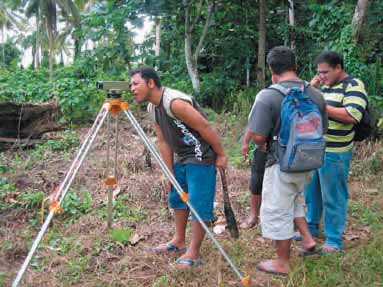
Technicians
attending the Pacifi c
Hydrological Training
Programme carrying
out fi eld survey on
Moturiki, Fiji.
(Technology) in the Pacifi c Regional Action
the Pacifi c by increasing access to accurate
Plan on Sustainable Water Management and
climate information. The level of success of the
aims to improve capacity for water demand
ICU in achieving objectives has recently been
management in urban water utilities. The
assessed through a survey questionnaire and
programme is designed to work through
results were presented at the 11th Meeting of
local team leaders within each participating
Regional Meteorological Services Directors
utility. Funding will be used to purchase
in July, in Noumea. The ICU was endorsed
both "hardware" such as water meters, leak
by NMS Directors and climate research
detection equipment or bulk water-saving
institutions who acknowledged it as a valuable
devices for incentive or rebate schemes,
tool contributing to meeting regional climate
as well as "software" that includes training,
forecasting information needs. A joint proposal
community education materials and technical
will be submitted to NZAID for a three-year
expertise.
continuation of the programme.
A training course for wastewater management
SOPAC, supported by UNESCO, provided
was jointly developed by UNEP's Global
assistance in water resources monitoring on
Programme for Action for the Protection of the
Aitutaki in partnership with the Department of
Marine Environment from Land-based Sources
Water Works in Rarotonga. Equipment was
of Pollution (GPA/UNEP) with the UNESCO-
purchased and a programme mapped out with
IHE Institute for Water Education. The course
the Aitutaki water supply manager to continue
addressed one of the guiding principles of the
collection, analysis and interpretation of
Pacifi c Wastewater Policy and Framework for
groundwater monitoring data to help offi cials
Action and was implemented in the Pacifi c
make informed community-focused decisions
region in 2005-2006 by a SOPAC partnership
for the management of local water resources.
with USP-IAS, IOI, SPREP, UNESCO-IHE,
GPA/UNEP and UN/DOALOS. A training
The Pacifi c Resource Centre on Water and
needs assessment for the Pacifi c region was
Climate was established at SOPAC and funded
conducted and three sub-regional wastewater
by the ADB. The Centre aims to improve water
courses were organised in Fiji, Guam and
resource management to cope with increasing
Papua New Guinea.
variability of the world's climate, by providing
policymakers and water resource managers
SOPAC implemented the Pacifi
c Island
with access to important information generated
Climate Update (ICU) in partnership with
by climatologists and meteorologists. The
SPREP and NIWA and supported by NZAID.
Centre established a Pacifi c Water and Climate
The Update aims to enhance planning
Focal Group to promote implementation of the
processes in climate-sensitive sectors in
Pacifi c Hydrological Cycle Observing System
23
3
Community Lifelines
p
r
o
g
r
a
m
m
e
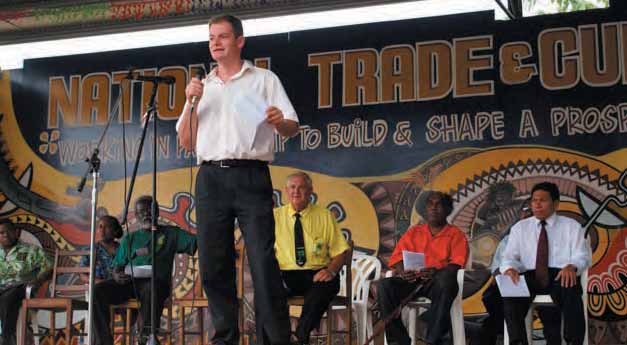
Mr Jan Cloin
promotes the use
of locally-produced
biofuels such as
coconut oil during
the Solomon Islands
Trade and Culture
Show in Honiara.
(HYCOS) Project and disseminate relevant
was implemented. Final assessment of viable
information on water and climate. Information
sites to host GeoCMS was completed in 2003
access is essential to enabling offi cials to
and work started at SOPAC and in Tonga and
make decisions to better protect communities
Fiji on GeoCMS content. Niue, Cook Islands
vulnerable to climate change.
and the Federated States of Micronesia are
currently being reviewed and assessed for
SOPAC is working with SPREP and NIWA
installations.
as part of a joint initiative funded by the New
Zealand Ministry of Environment, to rescue,
Technical assistance was provided to PICs and
preserve and digitise historic observations
Fiji-based missions with ICT-related issues
from Small Island Developing States. The
(ISP strengthening; LAN/WAN deployment;
"Historical Climate Data in Pacifi
c Island
equipment selection, and deployment).
Countries" programme is scheduled for three
Also provided was technical assistance and
years, based on funding availability.
support to utilities in GIS and Remote Sensing,
including the provision of information and the
As a fundamental component of the SOPAC/
procurement of data and satellite imagery.
EU project, the deployment of the Geospatial
SOPAC acquired high-resolution satellite
Content Management Server (GeoCMS) and
imagery for the following countries: Kiribati,
its map servers continued with the installation
Papua New Guinea, Cook Islands, Tuvalu, Fiji,
of the Nauru GeoCMS. This system was
and Marshall Islands.
also used as the Government website for e-
government applications. The map server
SOPAC continued to gather detailed baseline
was implemented with the help of UNESCO
ICT information to assess the status of ICT
in securing resources for a government IT
development in member states. SOPAC has
department.
conducted ICT assessments for Niue and
Cook Islands with Palau and Nauru scheduled
Vanuatu has had its GeoCMS re-implemented
for later in the year. Technical support was
with the acquisition of a direct Internet link
also provided to Tuvalu in the design and
and the re-structuring of internet links within
implementation of the Government wide-area
the Ministry of Lands. A wide-area network
network (GovNET) to deliver fast, reliable and
was set up between the various departments
secure fi bre-based network linking ministries
in town. GeoCMS hardware was delivered to
and departments.
Solomon Islands and installation and training
"Our MapServer training workshops encourage participants to contribute
data to the MapServer, as a central information centre for use by
stakeholders and members of the public, including school students doing
projects, who would not otherwise have access to these maps." SOPAC
Adviser Litea Buikoto
24
Community Lifelines
ty Life es
p
r
o
g
r
a
m
m
e
The application of GIS and Remote Sensing
(GIS/RS); capacity building; and Free and
as a tool for asset management within the
Open Source Software.
Tuvalu Power Utility has generated the
development of a tailored GIS system that
Demand Side Management (DSM) activities
could be replicated in other utilities within the
continued with FEA and EPC with FEA
region. This support also linked the Ocean
completing the implementation of a pilot DSM
and Islands Programme's coastal change
project which included the establishment
work and fl ood history work conducted by the
of a DSM revolving fund. A regional DSM
Community Risk Programme.
workshop for power utility engineers was
convened in August 2006, in conjunction
SOPAC has established an extensive Pacifi c-
with the 15th PPA Annual Conference and
wide network of contacts and a wealth of local
the 3rd Engineers' Workshop. The Workshop
knowledge as a result of years of sustained
contributed to further promotion of DSM in the
involvement in ICT. SOPAC expertise
region. A DSM Best Practice Guidebook on
includes cross-sectoral applications of ICT
CD-ROM, including international case studies
in networking; Internet provision support;
relevant to the region was produced during
policy development; databases; Geographic
the workshop. Copies are available from the
Information Systems and Remote Sensing
SOPAC Community Lifelines Programme.
Partnerships protecting the Pacifi c's lifeblood
The threat of natural disasters such as cyclones, drought and
tsunami make people even more vulnerable as their sanitation
As people in the Pacifi c prepare themselves for another cyclone
and water supplies are often already inadequate," WHO
Environmental Engineer Steven Iddings said.
season, tsunami expert Noud Leenders from SOPAC, told Fiji
Gold FM listeners that they needed to be prepared with an
The WSP is an improved risk assessment and management
emergency kit that includes drinking water.
tool designed to ensure the delivery of safe drinking water. The
programme aims to minimise contamination of water sources,
Countries in the Pacifi c are extremely vulnerable to natural prevent or remove contamination during treatment and prevent
disasters, which can devastate lives and homes and cripple
contamination during storage and distribution. The initiative is
already fragile essential services, especially water supplies.
also part of an important response to the regionallyendorsed
Water Quality and Health Framework for Action and the UN's
Access to safe drinking water is critical to saving and enhancing
2005-2015 International `Water for Life' Decade.
lives in a region that has more than 37 and a half million
kilometres of ocean and resources that need to be used and
Pilot programmes to establish WSPs commenced in mid 2005
managed in a sustainable manner.
in four countries (Vanuatu, Tonga, Cook Islands and Palau),
chosen specifi cally as they refl ect the differing environmental
Although there are many cultural and geographical differences
and governance systems in the Pacifi c and will enable lessons
in the Pacifi c, there are also signifi cant shared challenges, learned and materials developed to be replicated in other Pacifi c
including isolation and scarce resources, that make working in
countries with similar geographical and technical systems.
partnership and sharing experiences, especially about water
management, critical to improving the lives of people in the
In-country planning workshops have enabled key stakeholders
region.
to interact, often for the fi rst time, including offi cials from health
and environment ministries, private sector water suppliers and
"Water is the lifeblood of the Pacifi c and although thousands of
NGOs. Workshops have also raised the profi le of water issues
Pacifi c Islanders are surrounded by water, which laps on the
and are helping urban authorities improve delivery systems and
doorsteps of many atoll homes, it is the groundwater resources
empowering rural communities.
that are a matter of life or death," SOPAC water specialist
Davendra Nath said.
"We hope the WSP approach not only benefi ts people in urban
areas, but also those in rural communities as people develop
SOPAC is working in partnership with the World Health more control and understanding of their own water system and
Organisation (WHO) and AusAID, to improve the health of the importance of safe drinking water. Learning how to better
people in the Pacifi c by strengthening their national capacity to
protect wells from pollution and managing rainwater tanks will
maintain safe water supply systems.
help ensure water supply is more consistent, accessible and
safe," Mr Iddings said.
An AusAID contribution of $500,000 over two years to fund
the Pacifi c Water Safety Plan Programme, is enabling SOPAC
Partnerships are critical to the success of these water safety
water experts and WHO health specialists to work closely with
plans. At the strategic level, SOPAC is partnering with the global
local communities and offi cials to develop Water Safety Plans
health expert, WHO. At the regional level, countries share
(WSP) that protect their most important asset water.
experiences and materials. At the national level, government
offi cials, the private sector and NGOs share responsibility for
"Many atoll countries have extremely vulnerable groundwater
water delivery and at the local level, communities work together
reserves which are increasingly threatened by growing to better protect men, women and children from the threat of
demands from population increase, urbanisation and tourism.
contaminated and unreliable water supplies.
25
5
Community Lifelines
p
r
o
g
r
a
m
m
e
Governance and Advocacy
Management received support from ADB to
produce quarterly newsletters and develop
a partnership website. A Water Action
The Japan Water Forum supported Pacifi c
Matrix Database to monitor implementation
efforts to draft and fi nalise the Oceania sub-
of the Pacifi
c Regional Action Plan on
regional part of a Regional Position Paper for
Sustainable Water Management by all partner
Asia and the Pacifi c that was presented at
organisations was established as a core
the 4th World Water Forum. One of the main
function of the Unit.
outcomes of included the creation of the "Asia-
Pacifi c Water Forum" (APWF). The Forum will
SOPAC and Live and Learn Environmental
provide an important new platform to gain
Education (LLEE) organised the 2006 Pacifi c
political support for water management in
World Water Day campaign on "Water &
the Asia-Pacifi c region with SOPAC to be the
Culture" under the overarching motto "Plan
primary Oceania focal point.
for Water, Plan for Life, and Water for Life".
Awareness materials comprising posters,
Policy work under the EUfunded Programme
photo packs, stickers and water and
for Water Governance has been undertaken
culture bags were produced and distributed
in Fiji, Solomon Islands and Kiribati. In Fiji, the
throughout the Pacifi c region. Special events
National Water Committee developed a draft
were organised in Apia and Suva to mark
National Water Policy which was approved by
World Water Day.
Cabinet for consultation before fi nal approval
in 2006. A scoping visit was organised for
SOPAC contributed to the reformulation of the
representatives from Solomon Island's water
Framework on Climate Change and upgraded
sector to Apia, on invitation from Samoa's
the Climate Change Matrix of activities into a
Minister for Natural Resources, Environment
user-friendly database.
and Meteorology to allow Solomon Island
water stakeholders to engage with, and learn
Technical assistance was provided to PICs
from water sector reform in Samoa. In Kiribati,
through the Pacifi c Islands Energy Policy and
the Programme for Water Governance saw
Strategic Action Planning (PIEPSAP) Project
implementation of actions identifi ed in the
with the development of national energy
National Water Sector Road Map.
policies, including the review of national
regulations and legislation, where requested.
The Coordination Unit of the Pacifi
c
During the period the PIEPSAP Project also
Partnership Initiative on Sustainable Water
published its fi rst Annual Report.
World Water Day
SOPAC WASH Offi cer Kamal Khatri said the Pacifi c World Water
workers to think more about how they use water and the need to
Day campaigns aim to highlight challenges facing countries in
save water for future generations," Mr Khatri said.
the region as global water use increases at more than twice the
rate of population growth and more people than ever before are
World Water Day emerged from the United Nations Conference
suffering due to water scarcity.
on Environment and Development (UNCED) in 1992 and the
importance of water continues to be recognised, with the UN
"Although countries in the Pacifi c have different lifestyles and
General Assembly proclaiming the years 2005 to 2015 as the
diverse cultures, many people in the region share the daily International Water for Life Decade.
challenge of securing an adequate supply of clean, safe
freshwater. The theme challenges us to look at our current "Celebrating World Water Day is an important activity to help
water resources in the Pacifi c in terms of usage, access, increase community awareness of national and global water
supply, demand, quality and responsibility of managing water
and sanitation issues. If the region is to achieve the water and
resources.
sanitation Millennium Development Goal of halving by 2015 the
number of people without access to safe drinking water and
"We encourage everyone, including housewives, school adequate sanitation, we must increase local action in conserving
children, factory workers, business people and government
water," Mr Khatri said.
"Map access is vital to building stronger communities as government offi cials can use maps
in key development areas that include better town planning and the enhanced provision of
essential services such as water and electricity." SOPAC ICT Specialist Franck Martin.
26
Community Lifelines
mm ity Lif nes
p
r
o
g
r
a
m
m
e
(REM2007) and the Pacifi c Energy Ministers'
Meeting (PEMM2007). SOPAC coordinated
reporting on the progress of the implementation
of the Pacifi c Islands Energy Policy (PIEP) as
detailed in the Pacifi c Islands Energy Strategic
Action Plan (PIESAP).
Continued to contribute to the CROP ICT
Working Group where the primary focus has
been on better coordination of CROP ICT
activities and the development of an action plan
for the March Forum ICT Ministers Meeting
mentioned earlier. SOPAC also continued to
play an active role in advocating ICT in the
region through PICISOC (Pacifi c Chapter of
the Internet Society) and support to PacInet
conference.
SOPAC signed an MOU with PICISOC, SPC
and USP for the management of the Pacifi c
Islands node of the International Open
Source Network, initiated by the Asia Pacifi c
Development Internet Programme (APDIP).
World Water Day
SOPAC has been promoting the use of Free and
awareness materials.
Open Source Software (FOSS) in the Pacifi c
for several years. Benefi ts for countries include
being compliant with intellectual property
protection, capacity building and development
Coordinated and contributed to the preparation
of local service industry.
of an important regional energy position paper
for submission to the CSD 14 where the
The establishment of the Pacifi c Energy and
thematic cluster for CSD14 & 15 (2006-2007)
Gender Network (PEG) in 2003 encouraged
was "Energy for Sustainable Development,
greater interest and support in promoting
Industrial Development, Air Pollution/
awareness of energy and gender issues. At the
Atmosphere, and Climate Change".
Regional Strategic Planning and Awareness
Raising Workshop during 5 9 December 2005,
Commenced planning and coordination for a
Nadi, Fiji Islands, energy offi cials adopted the
Regional Energy Meeting and Energy Ministers'
PEG Strategic Action Plan (PEGSAP) 2006
Meeting.
2008 as a mechanism for mainstreaming
gender into the energy sector. Offi cials further
Contributed to the development and
agreed to a Terms of Reference for PEG and
implementation of the region's Digital Strategy.
recommended that the SOPAC Secretariat
SOPAC also presented a position paper to
continue to host the PEG Network.
the March 2006 Forum ICT Ministers Meeting
in Wellington, New Zealand. The meeting Funding support to PEG activities has
produced the Wellington Declaration to
originated from a range of sources including
recognise the important regional role of ICT and
ENERGIA (Netherlands), the Technical Centre
adopted a step-ladder approach to enhance
for Agriculture and Rural Cooperation (CTA)
ICT development.
(Netherlands) and SOPAC (in-kind). Energy
and Gender Training Modules in the Pacifi c
As Chair of the CROP-Energy Working Group
context were developed along with posters,
(EWG), SOPAC provided secretarial support
fl yers, a video programme (20 minutes), radio
to the EWG in preparing meeting agendas and
spots, energy and gender articles in the Pacifi c
records and hosting meetings. Meetings allow
Energy Newsletter (PEN), PEG website and
members the opportunity to provide updates
a contact database; and a Pacifi c Energy and
on regional energy initiatives. During 2006
Gender Annotated Bibliography.
briefi ng papers and the regional submission to
the CSD14 were prepared, along with planning
Through the UNDESA-funded Pacifi c DSM
for a regional Energy Offi
cials' Meeting
Project for power utilities, a revision and update
27
7
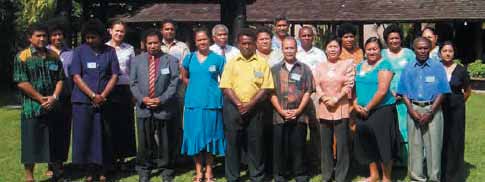
Community Lifelines
p
r
o
g
r
a
m
m
e
Regional Strategic
Planning and
Awareness Raising
Workshop -- Pacifi c
Energy and Gender
Network (PEG), Nadi,
Fiji.
of possible DSM activities in four utilities was 2) Opportunities in Water & Sanitation -- The
prepared (American Samoa, Fiji, Samoa and past three years have seen unprecedented
Tuvalu). Implementation of demonstration growth for regional water sector support. This
projects has only been successfully completed
has been guided largely by a number of strategic
with the Fiji Electricity Authority. Lessons documents developed in conjunction with SOPAC
learnt and implementation constraints have over a number of years through a broad series of
been attributed to many factors, including coordinated and comprehensive consultations.
limited human resource capacity in the utilities
These include:
and access to energy effi ciency equipment/
· The Pacifi c Wastewater Policy and associated
appliances.
Pacifi
c Wastewater Framework for Action
(2001);
Issues and Opportunities
· The Pacifi
c Regional Action Plan on
Sustainable Water Management (RAP)
completed in 2002; and
1) Global and regional drivers -- Globally, the · The Drinking Water Quality and Health
Commission on Sustainable Development (CSD)
Framework for Action developed in 2005 to
process has provided signifi cant opportunities
complement the Pacifi c RAP.
for engagement with the international community
on energy and related issues. The thematic Key documents, along with the Pacifi c Partnership
focus for CSD14 & 15 is "Energy for Sustainable on Sustainable Water Management, has enabled
Development, Industrial Development, Air a more coordinated and strategic approach to
pollution/Atmosphere and Climate Change". An water sector activities. This coordinated approach
issues paper was prepared through the CROP-
has already proved successful in implementing
EWG for the CSD Secretariat together with a projects or providing technical assistance to PICs.
detailed briefi ng paper for PIC NY Missions.
The SOPAC Secretariat is the Coordination Unit
for the Pacifi c Partnership on Sustainable Water
Although the Pacifi c Plan adequately addresses Management.
the ICT and energy sectors (Section IV) under
regional priorities for immediate implementation, 3) Pacifi c Energy Partnership Initiative -- The
it fails to accord water and sanitation equal Pacifi c Islands Energy Policy and Strategic Action
importance. As the Pacifi c Plan is a "living Planning (PIEPSAP) Project was developed
document", SOPAC should also work to ensure through the Energy Type II Partnership
water and sanitation receive recognition as Initiative, "Pacifi c Islands Energy for Sustainable
important regional priorities critical to sustainable
Development (PIESD)" in cooperation with the
development.
"European Union Energy Initiative (EUEI)".
"Although many countries in the Pacifi c have unique cultural, language and political
structures, many share similar economic and resource challenges, including energy needs
and restrictions. "We need real answers to Pacifi c energy security problems, so working
together to share information is absolutely critical for Pacifi c Island countries. Coming
together at a senior offi cial and ministerial level will provide an invaluable opportunity to
forge smart energy solutions. "Reducing poverty, improving health and education services,
and providing a stable energy supply for Pacifi c communities will support sustainable
development, which is intrinsically linked to energy issues."
SOPAC Director, Cristelle Pratt
28
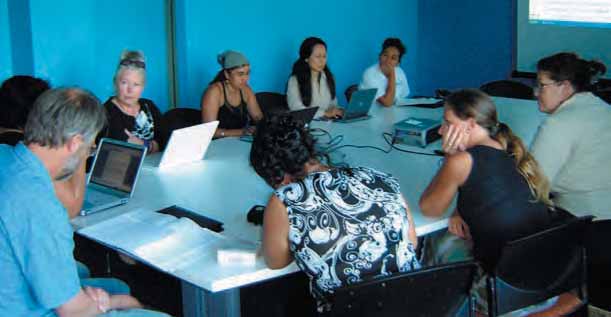
Community Lifelines
nity L
nes
p
r
o
g
r
a
m
m
e
PIEPSAP is a three-year project with a US$1.8m 5) Regional Energy (Offi cials) Meeting and
budget and a staff of three. The Project has Energy Ministers' Meeting -- Convening a
made a signifi cant contribution to PICs in helping Regional Energy Offi cials' Meeting and an Energy
them develop energy policies and strategic Ministers' Meeting in advance of CSD15 in 2007,
action plans along with supporting other energy to help the region develop a strategic position was
sector initiatives such as wind energy resource considered imperative. With the outlook of future
assessment, biofuel and energy and gender. A fuel prices looking grim, and the very real and
second phase of the project to contribute towards
signifi cant pressures on Pacifi c island economies
ensuring sustainability of current activities as of the price hikes of the past couple of years,
well as providing opportunities to develop new the convening of a Regional Energy Offi cials'
initiatives needs to be considered. A mid-term and Regional Energy Ministers' meetings should
review of the PIEPSAP Project was scheduled for
consolidate a Pacifi
c position, and mobilise
28 August 2006 to help determine the future of resources needed to ensure a sustainable and
the Project.
secure energy future for Pacifi c communities.
4) Regional Biofuel Activities -- The Secretariat
6) Digital Strategy, Wellington Declaration and
contributed to activities associated with the UNDP
Pacifi c Internet Resource Centre -- Since the
Fiji Resilience Building Project, and noted adoption of the Wellington Declaration by ICT
similar requests for assistance from other Pacifi c Ministers in March, the fi rst-year ICT development
island countries. This was seen as a priority for focus was on assessment of country readiness;
the immediate future.
development of policy; and establishment of web
presence and e-mail capacity for government
The feasibility study carried out in 2005 on the ministries and departments.
use of coconut oil in power generation by EPC
Samoa resulted in a request by UNDP-Samoa Over the past few years, CROP agencies have
and EPC for the SOPAC-led CocoGen Team to been working with a variety of web technologies
continue the work on an investment proposal for a
and are implementing various aspects of e-
coconut fuel production facility. The facility would government within the region. These experienced
be a part of the proposed new power generation agencies are now considering an approach to help
plant in the island of Savai'i.
certain member countries achieve `Wellington
Declaration' goals with respect to the Digital
In partnership with the University of the South Strategy.
Pacifi c, the PIEPSAP Project has funded a MSc
student research project on the most appropriate The Forum Secretariat is looking at establishing a
production of biodiesel. Results are expected to Pacifi c Internet Resource Centre (PIRC), involving
be available by the end of 2006.
various stakeholders, who would contribute to
Women in Technology
Workshop during
PACINET 2006.
"SOPAC has done some very useful work in the region. They ensure tangible outcomes that
provide incremental improvements to the lifestyles of communities in the Pacifi c." PNG High
Commissioner, H.E. Mr Peter Eafeare
29
9
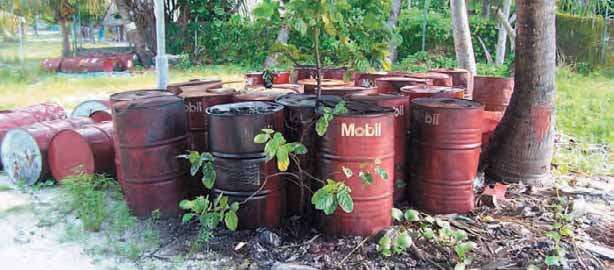
Community Lifelines
p
r
o
g
r
a
m
m
e
advising CROP and countries on appropriate
Provision of additional dedicated servers
policies and activities and further development of
and a backup power system for improved
ICT in the Pacifi c Islands. Currently, ICT is tackled
data security and continuity of activities
by either industry via PITA or users via PICISOC.
within SOPAC. As the work programme
Governments do not yet have a utility to advise
of the Secretariat expands so does the
them independently. The role of the PIRC could
requirements for adequate and secure
fi ll this void.
storage for digital data. SOPAC currently
also acts as a repository for certain regional
Through long-standing promotion of ICT and
databases and as a backup for certain
Internet in the region, SOPAC has an important
national data collections. Adequate capacity
role to play in the PIRC and should be actively
and security are critical issues. Although data
involved in the creation and possibly the running
security and access are vitally important for
of the Centre for the benefi t of Pacifi c Island
operations at the Secretariat, SOPAC suffers
countries.
signifi cant downtime on an annual basis due
to intermittent power cuts and a generally
Programme Resources
unreliable FEA supply. These power cuts are
detrimental to electronic equipment and data
holdings and a reliable back-up power system
The following areas are considered critical to
to maintain critical infrastructure is essential
CLP service delivery:
and has been since 2000.
Provision of adequate staff resources, Development of capacity in the use of
particularly in the area of ICT outreach,
ARC-GIS, and ArcView within SOPAC is
GIS and Remote Sensing. Current ICT
considered necessary to address the needs
outreach activities, though limited in nature
of the Northern Pacifi c member countries
are generating signifi cant interest, as is the
who through their association with the United
installation of, and training in, the use of map
States, have from the outset been users of
servers within ACP member States under
ESRI products. However within SOPAC,
the Reducing Vulnerabilities of Pacifi c ACP
MapInfo remains the standard software
States Project funded under EDF 8/9. The
platform for GIS applications and for the
full potential of the use of Geo-CMS, GIS
majority of member countries. Hence, this has
and its demonstrated use by utilities for asset
been a focal area for the provision of training
management, mapping temporal change
especially within the EDF8/9 Project activities
and information management are only just
as well as for other areas of intervention within
beginning to be realised. This raises the issue
SOPAC programmes.
of the sustainability of interventions beyond
current project timeframes.
Waste oil drums at
power house plant,
Tarawa, Kiribati.
"More needs to be done with available resources to tackle energy problems, especially
rising fuel costs. The fi rst step we need to take is to do more with the energy we are already
using. Biofuels also can make an important contribution to energy security and supply but
they must be economically viable and environmentally sustainable. Oils from coconuts for
example, and ethanol from sugar cane and starchy crops like cassava can help replace up
to 30 percent of our fossil fuel usage in the region." SOPAC Energy Adviser, Jan Cloin
30
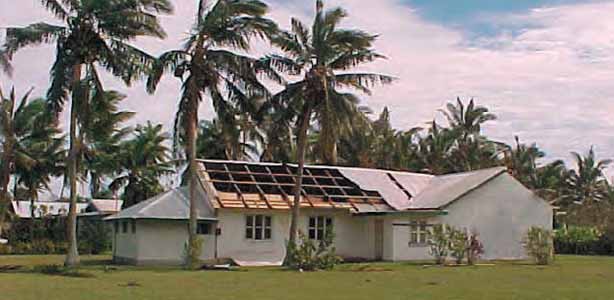
Community Risk
p r o g r a m m e
Background
Summary of Key Activities
SOPAC, through the Community Risk Programme
(CRP), is committed to working with offi cials and Strengthening Resilience to
communities around the Pacifi c to strengthen Disasters
the ability of countries to protect people as much
as possible from the impact of natural and man-
Project managed component one of the Asian
made disasters.
Development Bank (ADB) Cook Islands
Disaster Management and Mitigation Project
Following the decision by Council in Apia to
over nine months. This included technical,
approve the `Pacifi c Regional Framework for
institutional and training support and has
Action for Building Safer and more Resilient
signifi cantly boosted the ability of the Cook
Nations and Communities to Disaster 2005-
Islands to protect local communities from
2015', and endorsement by Pacifi c Leaders in
the impact of natural disasters. New disaster
Papua New Guinea in October 2005, the CRP
risk management arrangements have been
has focussed much of its attention on assisting
approved and the national emergency
member countries develop national action plans
coordination offi
ce has been restructured
consistent with the framework.
and now located within the Department of the
Prime Minister. Training for increased outer-
A major part of the process was to facilitate a
island awareness of the new arrangements
partnership meeting in Suva in February 2006
has also taken place.
at which it was decided to establish a Pacifi c
Regional Disaster Risk Management Partnership
Reviewed Marshall Islands' national disaster
Network. This network currently consists of about
management arrangements.
30 members who have committed to working
together to assist Pacifi
c Island Countries Facilitated preparation of a Cyclone Response
develop and implement disaster risk reduction
Plan for Niue.
and disaster management national action
plans that will support the Pacifi c Plan strategy
Participated in bilateral discussions and
(Kalibobo Roadmap) and national ownership of
provided technical support to national disaster
the regional framework for action.
management projects in Samoa, Tonga and
Solomon Islands.
Impact on the SDA
church in Matavera
Village, Rarotonga,
of Cyclone Meena
that struck the Cook
Islands on 6 February,
affecting most of the
northern part of the
island, including the
main town of Avarua.
31
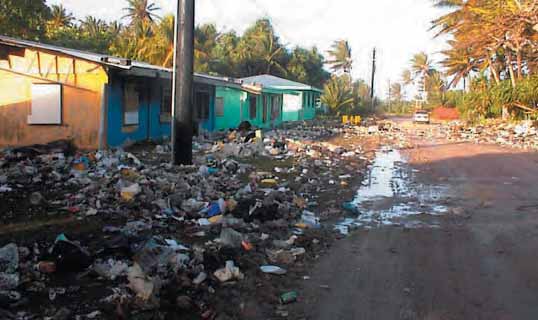
Community Risk
p r o g r a m m e
Continued to strengthen emergency Supported the Pacifi c Wave Exercise 2006;
communications in member countries through
managed by team members of the IGC/PTWS.
a partnership with Emergency Management
The region-wide tsunami exercise targeted
Australia. This resulted in repairs to EMWIN
early warning communication systems and
systems in Fiji, Tonga and Solomon Islands
involved SOPAC members Fiji, Cook Islands,
and the completion of the installation of radio
Niue, Papua New Guinea, Samoa, Solomon
equipment in Vanuatu.
Islands and Tonga.
Provided technical support to the development
Mitigating the Effects of Hazards
of a joint Australian Bureau of Meteorology /
Emergency Management Australia proposal to
Developed a participants guide for EVI
conduct early warning capacity assessments
training.
in Fiji and Tuvalu.
Commenced the development of a regional
Provided support to Fiji to develop a funding
information database on hazards in conjunction
proposal to strengthen national disaster
with UNDP, UNOCHA and the IFRC.
management arrangements.
Provided support to the development of
Strengthened the capacity of the fi re services
regional early warning and regional risk
in Fiji, Samoa, Tonga and Vanuatu by
assessment projects which will commence
providing technical support and resources
in 2007 and aims to address early warning
through partnership with the Australasian Fire
requirement for all Pacifi c countries.
Authorities Council.
Collaborated with the hazard and risk
Facilitated a planning meeting in partnership
components of the EU Project on Reducing
with the Fiji National Fire Authority to develop a
Vulnerability in Pacifi c ACP States to ensure
strategic plan for the newly-established Pacifi c
effective synergies.
Islands Fire Service Association (PIFSA).
Built an extensive database from baseline
Provided training support to eight TAF/OFDA
data for use in a comprehensive hazard and
regional and national training courses, further
vulnerability analysis in Lae, Papua New
enhancing skills and awareness of disaster
Guinea.
response.
Worked with the Pacifi c Disaster Center, Fiji,
Provided technical support and participated
Vanuatu and Papua New Guinea to develop a
as exercise reviewers to the development and
Tsunami Awareness Kit.
conduct of a national emergency operational
exercise in Vanuatu.
Debris left after sea
surge, Republic of
Marshall Islands.
32
Community Risk
p r o g r a m m e
Tsunami workshop to boost community safety
Saving lives and protecting communities in the Pacifi c through
better warning services and communication was the focus for
regional offi cials who participated in the North Pacifi c Tsunami
Awareness Training Workshop in Guam in August.
Risk assessment specialists from SOPAC worked in partnership
with the US National Oceanic and Atmospheric Administration
(NOAA) and the International Tsunami Information Centre (ITIC)
to deliver an important awareness and education workshop.
"Unfortunately, the greater Pacifi c region is vulnerable to tsunami
North Pacifi c Tsunami Awareness Conference, Guam.
so boosting awareness and helping to educate people about how
to respond is absolutely critical to saving lives and protecting
"Enhancing the ability of offi cials to quickly and effectively relay
local communities," SOPAC Risk Assessment Specialist, Mr the warning is a matter of life and death. People throughout the
Michael Bonte said.
region must also be educated about how to respond to a tsunami
their lives may depend on it," Mr Bonte said.
The four-day workshop provided offi cials with a better historical
understanding of tsunami in the Pacifi c and Indian oceans From 1901 to 2001, more than 100 tsunami claimed lives
and discussed communication technology and dissemination around the Pacifi c Ocean, nine of which caused widespread
techniques.
destruction.
Tongan offi cials to tackle disaster threats
The one-week training jointly coordinated by the NDMO and the
Tonga Red Cross Society, provided offi cials with an introduction
More than twenty local offi cials received vital training in disaster
to disaster risk management concepts and skills to conduct initial
management techniques to boost Tonga's response to the damage assessments.
ongoing threat of natural disasters, including earthquakes,
tsunami and cyclones.
"Enhancing the effectiveness of offi cials in a disaster can save
lives and the ability to effectively assess will greatly assist in the
Disaster management specialists from SOPAC and The Asia recovery of a community," Ms Hawley said.
Foundation (TAF) worked with Tongan National Disaster
Management Offi ce (NDMO) Director, Maliu Takai, to deliver The course, funded by USAID and implemented by TAF in
training in Nuku'alofa in August.
partnership with SOPAC, enabled participation from key
agencies: police, fi re, environment, health, education, defence
"Tonga, like many of the Pacifi c Island countries, is vulnerable
and the Red Cross, as well as representatives from the Prime
to a number of severe natural hazards so disaster management
Minster's Offi ce and the Ministry of Works.
training is crucial to saving lives and protecting local communities,"
TAF's Programme Director for the USAID Offi ce of US Foreign
In May, this year, an earthquake of magnitude 7.8 rocked
Disaster Assistance, Pacifi c Disaster Risk Management Training
parts of Tonga prompting some fears of a tsunami and another
Programme, Ms Kathryn Hawley said.
earthquake in August off the coast of Nuku'alofa registered 6.1.
Pacifi c top cops to tackle disaster threats
The workshop was part of a two-week programme, jointly funded
by SOPAC and the Pacifi c Regional Policing Initiative, which
The ability of regional police to protect lives has been boosted
aimed to raise police awareness about their role in assisting
through critical disaster management training that has broadened
communities prepare and respond to disasters such as cyclones
the role of police in the Pacifi c in tackling natural disasters.
and tsunamis.
As part of the Police Leadership Development Programme, "The primary role of police is to protect life and property but it
disaster risk management specialists from SOPAC and The Asia
is often diffi cult to remove a person from a disaster prone area.
Foundation, delivered comprehensive training in Suva in August
This training will help police to educate the community about the
to more than 15 senior police offi cers from around the region.
danger of disasters and improve coordination of key agencies
in responding to disaster threats," Suva Central Police Station
"Unfortunately, many countries in the Pacifi c are vulnerable to
Superintendent Ram Chetty said.
natural disasters and police are usually the only organisation
available around the clock to respond. The ability of the police
"Disaster risk management training broadens the understanding
to help the community will be greatly enhanced by disaster of police in the region on the need to strengthen community
preparedness and risk reduction activities," SOPAC Community
preparedness and risk reduction and is educating offi cers from
Risk Programme Manager, Mr Alan Mearns said.
across the Pacifi c, including Vanuatu, Samoa, Papua New
Guinea, Kiribati, the Federated States of Micronesia and the
Cook Islands," Mr Mearns said.
33
3
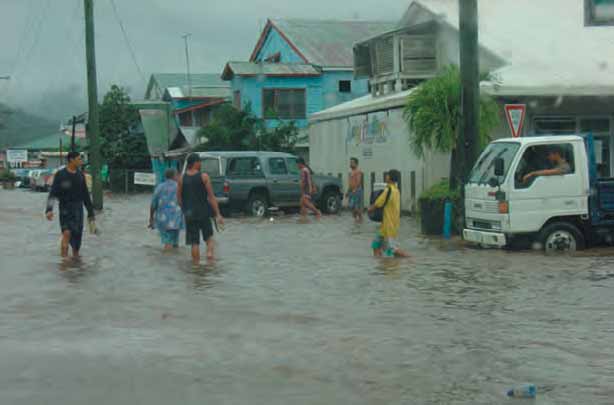
Community Risk
p r o g r a m m e
The Kit has been introduced to a wide range Mainstreaming Disaster Risk
of stakeholders in Fiji and made available to
member country NDMOs.
Management
Worked with PIEPSAP to conduct a disaster Completed fi nal editing and publication of the
response and mitigation plans gap analysis
Pacifi c Regional Framework for Action.
for public utilities.
Facilitated the establishment of the Pacifi c
Facilitated a Tsunami Awareness Conference
Regional Disaster Risk Management
in Guam in partnership with the National
Partnership Network.
Weather Service of NOAA and the ITIC. The
workshop targeted emergency managers Provided support to Vanuatu to develop
and weather offi cers from the North Pacifi c
the region's fi rst disaster risk management
US Affi liated Pacifi c Island Countries and
national action plan.
Territories. SOPAC provided disaster
specialists, project offi
cers and fi
nancial Worked with TAF/OFDA to develop a CHARM
support for national emergency managers
training manual.
from Palau, Republic of Marshall Islands, and
Federated States of Micronesia and for state
Collaborated with the Pacifi
c Regional
emergency managers from Yap, Pohnpei,
Policing Initiative to develop a disaster risk
Chuuk and Kosrae.
management unit for the Police Leadership
Development Programme.
Flooding in Apia,
Samoa.
"The vulnerability of the entire Pacifi c region to natural disasters has seen national
governments working closely together with regional organisations, such as SOPAC, to
develop critical disaster risk reduction and disaster management plans." Community Risk
Programme Manager, Alan Mearns
34
Community Risk
p r o g r a m m e
Collaborated with the United Nations member countries for short-term attachments
Volunteer Programme to bring UNVs to the to the CRP. These attachments are expected to
region to strengthen disaster risk reduction in commence in 2007 for a period of 2 to 4 weeks
Fiji, Tonga and Vanuatu.
to allow participants the opportunity to build
relationships with CRP staff and to broaden their
Developed a CHARM training manual for understanding of national and regional issues.
Kiribati. This manual is now being used on the
Strengthening Decentralized Governance in 5) Pacifi
c Disaster Risk Management
Kiribati Project and translation into the local Partnership Network -- In response to Council's
language is being fi nalised.
call to address the priority implementation of the
Pacifi c Regional Framework for Action, SOPAC
Issues and Opportunities
facilitated a planning meeting in February 2006.
The meeting established a regional disaster
risk management partnership network with
1) Pacifi c Regional Framework for Action for the Secretariat as partnership facilitator. Thirty
Building Safer and more Resilient Nations founding members committed to working in a
and Communities to Disasters 2005 2015 --
more coordinated manner to assist countries
Following the approval by Council this document
was subsequently endorsed by Pacifi c Islands develop and implement national action plans in
Forum Leaders at the 36th Pacifi c Leaders Forum
accordance with the Pacifi c Regional Framework
meeting held in Papua New Guinea in October for Action.
2005. The priority for the Community Risk
Programme is to now assist member countries 6) Developing and Implementing National
to develop and implement national action plans Action Plans -- Under regional partnership
consistent with this framework in support of the network arrangements, Vanuatu is the fi
rst
mainstreaming of disaster risk reduction and country to benefi t from this new initiative with
disaster management.
PIFS, SPREP, UNDP and WB working with the
Secretariat. The development of these plans
2) Strategy for an all-hazards early warning is being carried out in a number of stages
system -- The CRP has contributed to a joint commencing with a visit by the regional advocacy
Australian Bureau of Meteorology/Emergency team led by Dr Langi Kavaliku to gain necessary
Management Australia and Geoscience Australia
political support. Members of the partnership
proposal through the AusAID Pacifi c Governance
network are providing support for national
Support Programme. Funds will be used to consultations and technical assistance to national
conduct a regional risk assessment as well as task forces that will develop plans.
capacity assessments for tsunami and multi-
hazard warnings in member countries.
7) Developing and distributing a regional DRM
information database -- A joint partnership
3) Collaborative partnership with USP to between SOPAC, UNDP, UNOCHA and IFRC is
develop accredited disaster risk management
developing a comprehensive disaster database.
training courses in the region -- Discussions The database will include disaster risk reduction
have taken place and are continuing between the
and disaster management guidelines; past
CRP and USP.
disasters; current hazards, current plans and
initiatives; outreach examples; research; and
4) Attachment of NDMO staff to the other related issues. The database will be housed
Community Risk Programme -- Preliminary at SOPAC and available online as well as on CD
discussions have taken place with a number of and DVD for all member countries.
"For Vanuatu, SOPAC has been there a long time. Evidence of SOPAC is there for all three
programme areas and we are happy with the services of SOPAC. The CRP is working with
our NDMO and people expect to see us move forward. The action plan is the best point of
entry for our development plan and we are happy for SOPAC to venture into other areas.
This plan is a platform for harmonising other sectors and we want to do the same with other
sectors, water, lifelines and oceans and islands. SOPAC supports good governance of small
island nations." Director Vanuatu National Disaster Management Offi ce, Mr Job Esau
35
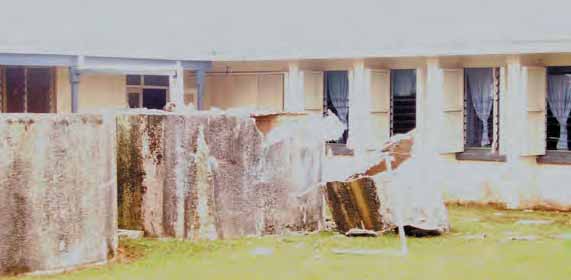
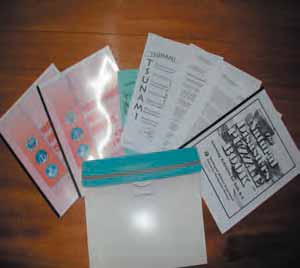
Community Risk
p r o g r a m m e
Earthquake damage in
Ha'apai, Tonga.
8) Tsunami and multi-hazard early warning Programme Resources
project -- It is anticipated that the joint Australian
Bureau of Meteorology and Emergency A critical issue for the CRP, and one highlighted
Management Australia project for capacity by the 2005 PMEG, is the current workload,
assessment and building of tsunami and multi-
staffi ng and budget arrangements. The recent
hazard warnings in member countries will appointment and transition of a new manager and
commence implementation with Fiji and Tuvalu the recent departure of the Disaster Mitigation
as pilot countries. Recent regional tsunami alerts Adviser meant that the programme needed to
and the Pacifi c Wave exercise have reinforced restructure at a time when it was also taking on
the urgent need to address the issue of early the role of facilitating the regional partnership
warnings systems.
network. This provided an opportunity for the new
manager to refocus programme priorities and
9) ACP/EU Disaster Facility -- The Secretariat recruit appropriate technical and professional
has recently submitted a proposal for funding staff to ensure programme momentum continued
through the ACP/EU Disaster Facility. This global to address the challenge of mainstreaming
initiative is supporting six ACP sub-regions. disaster risk reduction and disaster management
Funding is expected in early 2007 and will provide through the partnership initiative.
the necessary support to effectively coordinate
the development of disaster risk reduction and
disaster management national action plans in
member countries.
These plans will contribute to operationalising
the Pacifi c Plan, in particular the key initiatives of
the Kalibobo Roadmap. This aims to strengthen
policies and plans for the mitigation and
management of natural disasters; assist with the
implementation of the Pacifi c Regional Framework
for Action for Building Safer and more Resilient
Nations and Communities to Disasters; and
consolidate national priorities being implemented
Tsunami Awareness
through the use of the remaining EDF9 `B'
Kit -- an information
Envelope funds, under the national indicative
resource for the Pacifi c
programmes of Pacifi c ACP States.
Islands.
36

Monitoring & Evaluation
o f p r o g r a m m e s
TAG-STAR-PMEG a suite of tools unique to
"STAR is about applied science solutions in
the Pacifi c and how we can take these right
SOPAC
down to the village level to improve people's
lives. All scientists are here because they are
In offi cial language the Pacifi c Islands Applied Geoscience committed to helping communities throughout
Commission (SOPAC) comprises:
the Pacifi c region better use their environmental
1) a Governing Council of member country representatives;
resources." Chair of STAR, Victoria University
2) a Secretariat; and
Associate Professor in Geology, John Collen
3) a technical advisory group (TAG for short).
In 1997, and in rhetoric the Fiji Minister of Lands and Mineral
a gathering of scientists to talk about their pet projects; but the
Resources, Ratu Timoci Vesikula, at the opening of the SOPAC
Chairs of STAR have been noting the increasing trend towards
26th Session in Nadi described SOPAC as a tool "we sharpen, oil
the application of the sciences to the problems of the Pacifi c
and keep in good condition."
and it is clear that STAR has matured into its role of mobilising
excellent and multi-disciplinary science and bringing it to bear
"In fact, SOPAC is a set of tools, one of which is STAR," Dr Keith
on the SOPAC agenda; completely vindicating the premise
Crook, then Chair of STAR elaborated further.
upon which it was established. The major concern expressed at
TAG's decreased role was that the Secretariat, in its restructure
STAR was the brainchild of the 3rd arm of SOPAC, TAG, which has
of 2000/2001, had strategised itself into losing an independent
the institutionalised "responsibility to provide advice requested
body of scientifi c counsellors who would without prejudice `judge'
by Council on the technical, scientifi c, training, research and
the science practised by the Secretariat and that this was a
other relevant aspects of the work of the Commission."
disservice to the Commission's member states.
It was in the tendering of this "technical, scientifi c, training and
To regain that independent group of scientifi c counsellors, the
research" advice by TAG to the Governing Council that gave
Governing Council approved the Secretariat's submission in 2003
rise to the formulation of STAR, the Science, Technology and
for the establishment of Programme Monitoring and Evaluation
Resources Network, as a mechanism to "focus attention upon
Groups (PMEG) for each branch of the burgeoning SOPAC
signifi cant scientifi c problems of the region." Established fi rst as
Work Programme. Beginning in 2005, three PMEG's one each
a working group with a bent to the deeper study of the geological
for the work programmes reported on in this document, began
and geophysical aspects of deepsea minerals (including work in carrying out a "transparent and independent" evaluation
hydrocarbons); STAR has evolved into the geoscientifi c network
of outputs and whether these outputs over time contributed to a
that it is today demonstrating that the study of the earth (and
programme meeting its goals.
its oceanic realm) involves a broad sweep of sciences. It also
includes physical and chemical oceanography, meteorology, Thus between STAR and TAG, and now PMEG, the Governing
marine biology, ecology, and aspects of earth-related social Council has access to an independent body of highly-qualifi ed
sciences such as urban geography; to name a few.
people well versed on SOPAC's work, at virtually zero cost. The
SOPAC Governing Council has many times acknowledged that
In the aftermath of a major restructuring of the way the Secretariat
this was a unique circumstance whereby science and policy
would execute Commission business in the 21st Century, the
met and found common ground to advance the Commission
TAG decreased in its role and the STAR increased, probably
members' interests.
because its structure was less formal. STAR is fi rst and foremost
"SOPAC Council has an invaluable resource in the many
experienced and respected international scientists who attend
the STAR and SOPAC meetings and form the Techical Advisory
"Very impressed that SOPAC have asked
Group (TAG)," said Professor John Collen of the Victoria
for this as not many people invite this
University of Wellington; current Chair of STAR.
kind of transparency and management
accountability. This is a self-imposed review
by SOPAC, they did not need to do this. It
The sharp and well-oiled tools of SOPAC: TAG and STAR have
takes lots of guts. SOPAC want to show
been weighed on the balances and re-accorded the confi dence
they operate in a transparent manner, they
of the Commission's Governing Council and Secretariat to
listened to our review and implemented lots
provide the guidance necessary in the proper acquittal of its
of our recommendations from last year."
programmes of work.
PMEG-OIP Chair, Gary Greene
Participants at the
35th Session of
SOPAC, Honiara,
Solomon Islands.
37
7
a.
Activities; Promotion
c Regional Disaster
ater Day
c Island States.
.
States.
States.
olunteers International.
orld W
raining Courses, Fiji and Samo
ACP
ACP
T
T
onga.
c
c
Australian V
, foreshore.
raining Programme.
T
orkshop; W
ater Governance.
for aggregates.
vatiu Harbour
ulnerability of Pacifi
ulnerability of Pacifi
c Sea Level and Climate Monitoring Project SPSLCMP
A
Project.
Aggregates W
Adaptation to Climate Change.
, sanitation and hygiene activities.
Activities.
c Program for W
c Energy and Gender Network (PEG).
arious activities funded.
arious activities funded.
ater Engineer position
orld Disaster Day activities, ISDR Information Guide.
orkshop on EIA
Activity
Reducing V
V
Reducing V
V
PIEPSAP
Regional Hydrological
Demand Side Management Project.
Fiji Government Grant.
Regional
of water
Pacifi
Emergency Communications for Member Countries; Support for
Disaster Reduction Conference, Kobe; 12th Pacifi
Meeting.
W
Resource Economist.
Development of Emergency Disaster Response Capabilities, Kobe
Conference on Disaster Reduction.
Fiji Resilience Project (Energy); CocoGen Project.
South Pacifi
III.
PI-GOOS Coordinator and activities.
Pacifi
Sustainable water management in Pacifi
4WWF
Support for Maritime Boundaries
W
Support to member states ICT/GIS Development.
Disaster Management Project
Equitable management of groundwater
W
CHARM,
Mapping of
169,442
58,298
227,740
Corporate Services
7,500
731,192
707,656
446,809
225,736
146,366
150,000
144,561
108,643
10,000
37,947
37,947
2,678,463
Community Risk
8,000
5,000
744,646
848,936
607,941
628,203
435,137
318,877
132,536
164,440
120,250
105,000
60,000
50,000
50,000
1,701,574
5,980,540
REPORT OF 2006 DONOR SUPPORT
Y
Community Lifelines
964,719
500,000
207,602
48,061
1
13,600
95,641
73,940
46,339
12,039
31,663
43,702
1,300,681
3,350,583
Ocean & Islands
Appendix 1: SUMMAR
otal
8,000
7,500
5,000
628,203
581,503
468,877
325,027
180,597
164,440
144,561
120,250
1
13,600
108,643
105,000
95,641
73,940
60,000
50,000
50,000
46,339
10,000
12,039
37,947
31,663
81,649
3,902,889
2,417,051
1,854,043
1,041,279
Grand T
12,512,383
T
A
AMSA
Agricultural Research
T
echnology
ADB
Australia
T
echnical Cooperation COMSEC
AF-OFDA
Annual Grant
I
Management
V
A
Annual Grant
Agriculture and Rural Cooperation CT
Australian Centre for International
(ROC)
ater Forum
States/T
orld Bank
Source of funds
European Union EDF 8
Australia
European Union EDF 9
New Zealand
Government of Denmark/EU
New Zealand Special Grant
UNDESA
Fiji
T
aiwan
European Union EU
Emergency
Australia
United Kingdom (ODI)
United
UNOPS/UNDP
Australian Marine Science &
UNESCO-IOC
Centre for
Global Environment Fund GEF
Japan W
Commonwealth Fund for
UN-ISDR
Asian Development Bank -
W
ACIAR
T
otal Donor Support
Bilateral Support
Federated States of Micronesia
Kiribati Bilateral
Cook Islands Bilateral
T
otal Bilateral Support
38
on
ies)
iti
V
Action
nds.
e
a
Disa
nds
w
an
O
ba
es are
Fiji
a
tem
, Fiji Islands.
er
riki
a
ew
s.)
c Islands Countries)
c Is
Framework for
Framework
n S
Fra
Mo
of
.
a B
Project. (Report
Appendices are
Appen
pers
A
oya
il
t : Fu
s
e
Con
ct : Future Directions.
Conference (WMTC),
20
t
rc
T
no
o
st
ve
g
rch 2006)
d Commun
d
ro
ent
he Pacifi
Ro
er
ct
P
olo
M
Ma
m
a
n the Pac
no
i
0
g
ns
echnology Conference (WMTC),
T
Aitutaki, Cook Islands.
orld Maritime
ng report, Samoa.
c, Republic of Kiribati. CONFIDENTIAL.
, mining history and phosphate resources of Banaba, western
, Fiji Islands. RESTRICTED.
REPORTS
Y
c Islands Regional Maritime Boundaries Project : Future Directions.
c Islands Regional Maritime Boundaries Information System [PIRMBIS]
ater resources management in
echnical Instructions Manual. RESTRICTED.
T
Multibeam survey of new Kinoya sewer outfall, Laucala Bay
RESTRICTED.
W
Report on groundwater investigations on Caqalai and Moturiki islands, V
Levu, Fiji, 19-30 June 2006.
CocoGen debriefi
The geology
equatorial Pacifi
Preliminary Report on Multibeam survey of new Kinoya Sewer Outfall,
Laucala Bay
Literature and data review Suva Harbour Rokobili Project. (Report
accompanies data package for commercial interests.
restricted to Fiji Government & Rokobili Project developers.)
Pacifi
(Paper prepared for the W
Queen Elizabeth II Conference, London, 6-10 March 2006)
Disaster Risk Reduction and Disaster Management
2005-2015. Building the Resilience of Nations and Communities to Disasters.
(An Investment for Sustainable Development in the Pacifi
Pacifi
TE (as at 30 September 2006)
394
395
396
PRELIMINAR
142
144
145
MISCELLANEOUS REPORTS
606
610
613
614
fected
Atoll,
TIONS UPDA
ava'u af
and Arutanga, Aitutaki,
anua Balavu, Fiji
Rarotonga
, Final Report. Consultants
aveuni and V
vana,
T
and A
Appendix 2: REPORTS & PUBLICA
onga. RESTRICTED.
T
varua
aka,
TIONS
vatiu, A
September 2005.
th
Thirty-fourth Session, hosted by the Government of the Samoa
surveys A
REPORTS
TE PUBLICA
ropical Cyclone W
c Islands Regional Maritime Boundaries Information System (PIRMBIS)
c Islands Regional Maritime Boundaries Information System (PIRMBIS)
AC Coastal Protection Feasibility Study
c Islands Regional Maritime Boundaries Information System (PIRMBIS)
T
uvalu Maritime Boundaries Project. CONFIDENTIAL.
T
Preliminary Report on an assessment carried out in areas of V
by
Pacifi
Niue Maritime Boundaries Project. CONFIDENTIAL.
Pacifi
Cook Islands Maritime Boundaries Project. CONFIDENTIAL.
Economic assessment of the true costs of aggregate mining in Majuro
Republic of the Marshall Islands.
Harbour
Cook Islands Preliminary Data Release. RESTRICTED.
SOP
Report (GHD Pty Ltd). RESTRICTED.
Pacifi
An evaluation of the biofuel projects in
Islands.
CocoGen Feasibility study into the use of coconut oil fuel in EPC Power
Generation.
Apia, Samoa, 24-30
CORPORA
Proceedings of the
in
Annual Report Summary 2005.
TECHNICAL
340
377
378
383
385
390
391
392
393
39
AC) (29 pages)
August 2004.
Advisory Report: Stakeholder
AC) (31 pages)
AC) (24 pages)
, BOM)/SOP
AC)
anuatu. May 2004. (Australian
,
NTF
echnical
T)/SOP
T
T
Assessment in Honiara and Ghizo
AMSA
, BOM)/SOP
,
AMSA
Atoll.
,
BOM, NTF)/SOP
,
NTF
T
T
AMSA
AMSA
ferential Levelling V
ferential Levelling Kiribati. June 2004. (Australia
ferential Levelling Cook Islands.
ferential Levelling Samoa. September 2004. (Australian
Aggregates Source
echnical Report Coastal change analysis using multi-temporal
c Sea Level & Climate Monitoring Project (Phase III) Survey
c Sea Level & Climate Monitoring Project (Phase III) Survey
c Sea Level & Climate Monitoring Project (Phase III) Survey
c Sea Level & Climate Monitoring Project (Phase III) Survey
T
estern Province.
Cyclones
Erosion
ALU
ropical
sunami
olcanos
TUV
image comparisons, Funafuti
Solomon Islands Country Mission and
Consultations and
Island, W
South Pacifi
Report Precise Dif
Government (AusAID,
South Pacifi
Report Precise Dif
Government (AusAID, BOM, NTF
South Pacifi
Report Precise Dif
(Australian Government (AusAID,
South Pacifi
Report Precise Dif
Government (AusAID,
TE ... continued
54
57
Fact Sheets
1 T
2 Earthquakes
3 T
4 Landslides
5 V
6 Floods
7 Coastal
JOINT CONTRIBUTIONS REPORTS
183
184
185
186
TIONS UPDA
AR Session is
AR Session
TS & PUBLICA
wareness Raising
A
REPOR
echnology and Resources
echnology and Resources
c Island Countries).
T
ersion. (23rd ST
T
AC Session).
Advisory Note Coastal
anuatu, as a potential aggregates source.
AC 35th Session (20-28 September), Honiara,
echnical
T
Analysis of coastal change and erosion
Abaiang.
c Energy and Gender Network (PEG), (5-9 December 2005,
illage,
AR) Session 2006. Pre-Session V
AR) Session 2006. Post-Session version. (23rd ST
orkshop, 9-10 February 2006. (Mainstreaming Disaster Risk
echnical Report on geological and geo-technical assessment of
T
echnical Report
T
TU Country Mission and
TU
TU Country Mission Report 28 June 12 July 2005.
TU Country Mission Report 24 November 4 December 2005.
TI
orkshop Pacifi
anoa International Hotel, Nadi, Fiji).
AC PROJECT REPORTS
ANUA
ANUA
ANUA
ANUA
ebunginako V
Proceedings of the Regional Strategic Planning and
W
T
Proceedings of the Partnership in Developing a Regional Implementation
Strategy W
Reduction and Disaster Management in Pacifi
Abstracts of papers presented at the Science,
Network (ST
held in conjunction with the SOP
Solomon Islands).
Abstracts of papers presented at the Science,
Network (ST
was held in conjunction with the 35th SOP
V
management and aggregates assessment in selected parts of southwestern
Efate Island. 3-17 October 2004.
V
the Quoin Hill volcanic rocks, Efate, V
V
V
KIRIBA
T
615
619
621a
621b
EU-SOP
47
48
51
52
53
40
ork Plan
c Islands Energy Policies
ce Report.
erm Review Meeting held on 28
ater Management 5 issues
Mid-T
Assistance to the Energy Division W
Project) and has never been listed in this document. In the
echnical
T
ce Report.
Action Plan (PIEPSAP
News bulletin) 8 issues
ater Section news) 1 issue
anuatu National Consultation Back to Offi
Assistance to the Cook Islands Government in the Review of the National
Energy Policy and
Proposal.
Federated States of Micronesia, Republic of the Marshall Islands & Republic of
Palau Back-to-Offi
V
Quarterly Progress Report 2nd Quarter 2006.
Summary Record of the PIEPSAP
August 2006 in Nadi, Fiji.
This series of reports was created in 2005 in association with the Pacifi
and Strategic
Annual Report Summary reporting period for 2005, 33 project reports were released online.
TE ... continued
c Energy News (PEN) 2 issues
AC NewsUpdate 2 issues
s News (W
c Partnership Initiative on Sustainable W
T'
A
44
45
46
47
48
Other newsletters
Mission Reports 15 issues
GIS & Remote Sensing Newsletter 1 issue
Pacifi
SOP
Snapshots (CRP
W
Pacifi
TIONS UPDA
Annual
orkshop,
Act and Rural
TS & PUBLICA
orkshop, 21-26
onga. Inception Report.
T
REPOR
Action Plan (PIEPSAP)
cation Policy W
orkshop, 28 November 2 December
cation Policy -- Second W
.
Action Plan.
TION REPORTS
Alotau (Milne Bay Province), Papua New Guinea.
Framework.
ork Plan 2006.
2006.
cation
c Islands Energy Policy and Strategic
Project Reports
National Renewable Energy Policy Framework
September 2005.
Quarterly Progress Report, 3rd Quarter 2005. October 2005.
National Energy Policy and Rural Electrifi
August 2005,
National Energy Policy Consultation W
2005, Honiara, Solomon Islands.
Niue National Energy Policy
Niue National Energy
National Energy Policy Framework -- Solomon Islands.
Annual W
Pacifi
Report 2005.
National Energy Policy and Rural Electrifi
5-7 April
Request for Quotation Review of Solomon Islands Electricity
Electrifi
RESTRICTED CIRCULA
PIEPSAP
33
34
35
36
37
38
39
40
41
42
43
41
CONTRACT END
February 2007
September 2008
December 2006
July 2007
December 2007
January 2009
September 2007
March 2009
July 2007
October 2006
January 2008
July 2007
October 2006
October 2008
August 2007
December 2006
December 2006
December 2006
October 2005
December 2006
September 2009
October 2008
February 2006
December 2007
December 2007
ART
CONTRACT ST
February 2004
September 2005
January 2004
July 2006
May 2006
January 2006
September 2004
March 2006
July 2004
October 2003
January 2005
July 2004
October 2003
October 2006
August 2004
January 2004
January 2004
January 2004
October 2003
July 2004
September 2006
October 2006
February 2003
January 2006
January 2006
AC
TE JOINED SOP
DA
May 2000
May 2004
April 1989
July 2006
May 2002
January 2006
September 2004
March 2006
May 1988
October 2003
January 1993
July 2004
October 2003
October 2005
August 2001
April 1980
June 1989
October 1986
May 2004
July 2004
January 1998
October 2005
February 2003
January 1999
September 1993
OF ORGIN
Y
TE
COUNTR
ORA
New Zealand
Fiji
Fiji
Australia
Fiji
Australia
United Kingdom
Australia
Australia
Fiji
Fiji
United Kingdom
Fiji
Canada
Fiji
Fiji
Fiji
Fiji
Fiji
Kiribati
New Zealand
T
onga
United Kingdom
Germany
France
AFF LIST (as at September 2006)
LIFELINES PROGRAMME
T ST
DIRECT
ARIA
OCEAN & ISLANDS PROGRAMME
COMMUNITY
f
oung
ebb
oodruf
Appendix 3: SECRET
aradi
T
awake
Y
Artack
acant
acant
acant
acant
acant
acant
olf Forstreuter
NAME
Cristelle Pratt
Bhaskar Rao
Litia W
Shane Fairlie
Aarti Naidu
Mary Power
Jens Kruger
Paula Holland
Robert Smith
Akuila
V
V
Simon
V
Arthur W
Frances Dobui
Allison W
V
Andrick Lal
Sekove Motuiwaca
Peni Musunamasi
Setareki Ratu
Emily
V
Naomi Biribo-Atauea
Paul Fairbairn
Siaosi Sovaleni
Stephen Booth
V
W
Franck Martin
raining
raining
T
T
AC/EU Project
Specialist
T
echnical (Marine)
T
echnical (Surveying)
T
echnical (Geoscience)
T
echnical (Electronics)
T
echnical (Mechanics)
Adviser
Aggregates
Assistant Ocean & Islands
Assistant
T
echnical (Electronics)
Aggregates & Coastal Process
cer 1
cer 2
cer 3
cer 4
cer 5
cer 6 Maritime Boundaries
cer 7 Geoscience
Assistant SOP
Adviser Physical Oceanography
Adviser Resource Economist
Adviser Marine Geophysics
Adviser
Adviser Geoscience
Adviser Marine Geoscience
Adviser EU-GIS and Remote Sensing
Adviser EU-ICT
Attachment
ater Resource Specialist
POSITION
Director
Deputy Director
Executive
Communications
Project
Manager Ocean & Islands
Senior
Senior
Senior
Senior
Senior
Senior
Adviser
PI-GOOS Coordinator
Adviser
Programme
Resource Economist
Project Offi
Project Offi
Project Offi
Project Offi
Project Offi
Project Offi
Project Offi
EU
Manager Community Lifelines
Adviser ICT/CLP
W
Resources Specialist
Senior
Senior
42
December 2009
September 2007
November 2006
August 2007
March 2008
April 2008
July 2008
May 2009
June 2008
December 2006
February 2007
May 2007
June 2007
September 2007
January 2009
August 2007
December 2007
June 2007
March 2009
August 2007
January 2007
February 2007
December 2006
December 2007
May 2008
August 2007
July 2007
November 2006
May 2008
May 2008
April 2007
August 2007
January 2006
September 2004
November 2003
August 2004
March 2006
April 2005
July 2006
May 2006
June 2006
January 2004
February 2006
May 2006
June 2006
September 2004
January 2006
August 2006
February 2006
June 2006
March 2006
August 2006
January 2006
February 2006
June 2003
June 2006
August 2006
August 2004
July 2004
November 2003
August 2006
August 2006
April 2006
August 2006
April 2000
February 2000
November 2003
August 2004
March 2006
October 1998
November 1998
May 2006
March 2005
March 1992
February 2005
May 2003
June 2006
January 2002
January 2006
August 2005
February 2004
June 2004
October 2003
June 2005
January 2006
February 2004
June 2000
June 2003
February 2001
August 2004
April 2003
November 2003
September 2004
August 2006
April 2005
August 2006
Netherlands
Fiji
Netherlands
Germany
Norway
Fiji
Fiji
Fiji
Fiji
Fiji
Fiji
Fiji
Kiribati
Fiji
Fiji
Fiji
Fiji
Solomon Islands
Fiji
Fiji
Fiji
Fiji
Australia
Germany
USA
T
onga
Fiji
Netherlands
Cook Islands
Fiji
Fiji
Germany
... continued
RISK PROGRAMME
AFF LIST
COMMUNITY
ST
T
angi
uen
Y
T
okalauvere
acant
ogita Bhikabhai
acant
acant
ilisi
acant
ukatara
acant
Marc Overmars
Anare Matakiviti
V
Jan Cloin
Gerhard Zieroth
Mathias Kleppen
Rupeni Mario
Rhonda Bower
Pooja Pal
T
asleem Hasan
Graeme Frost
Kamal Khatri
Alena Lawedrau
Koin Etuati
Y
Davendra Nath
Sanjeshni Naidu
Elizabeth Lomani-Whippy
Joy Papao
Arieta Navatoga
Linda
Komal Raman
V
V
V
Alan Mearns
Michael Bonte
V
Kathryn Hawley
Netatua Prescott
Litea Biukoto
Noud Leenders
T
Emele Matawaqa
V
Asenaca Rokamanalagi
Jutta May
cer
ater & Sanitation
cer
ater Quality
Project)
Adviser
Project
cer
ater Resources
ater Quality Monitoring Capacity
Network and Security
ASH Offi
ater Sanitation
ater Safety Plans
ater Partnerships
ater Sector
cer I W
cer II W
Adviser
Assessment
, CLP
cer W
1
Energy
ater
Assistant
ater Resources,Supply & Sanitation
Assistant Community Lifelines
raining Support
Assistant Community Risk
cer 8 ICT
cer 9 W
cer 10 W
cer 1
cer 12 PIEPSAP
cer 13 W
cer 14 W
cer 15 GIS & Remote Sensing
cer 16 GIS/RS & ICT
cer 17 W
Attachment W
ater
T
Materials Development Specialist
Associate Expert
Analyst Specialist
Associate Expert
ater Engineer
Manager W
Adviser Energy(PIEPSAP
Adviser W
UN
Project Manager PIESAP
W
Adviser Energy
Regional Project Development Offi
Programme
Programme Offi
Project Offi
Project Offi
Project Offi
Project Offi
Project Offi
Project Offi
Project Offi
Project Offi
Project Offi
Project Offi
T
emporary
Project W
Assistant Project Offi
Assistant Project Offi
EU Intern Fiji
Manager Community Risk
Risk
Disaster Mitigation
Programme Director PDRMP
Adviser Sustainable Development
Adviser Hazards
UN
T
AF/OFDA
T
AF/OFDA
Research and Planning Offi
Programme
Content Manager Disaster Risk Management Database
43
CONTRACT END
September 2009
September 2009
May 2009
August 2008
May 2009
July 2007
December 2008
December 2007
August 2007
December 2006
December 2006
December 2006
March 2007
September 2007
December 2006
March 2006
June 2007
December 2006
August 2007
February 2007
December 2006
August 2007
December 2006
ART
CONTRACT ST
September 2006
September 2006
May 2006
August 2005
May 2006
July 2004
January 2006
January 2006
August 2006
January 2004
January 2004
January 2004
March 2004
September 2004
January 2006
March 2005
June 2006
January 2005
August 2006
February 2006
January 2006
August 2006
January 2006
AC
TE JOINED SOP
DA
March 1998
November 1985
May 2006
Jannuary 2004
July 1987
July 2001
May 2000
September 2004
May 2006
February 1987
July 1988
September 1987
April 2001
September 2004
June 1999
August 2002
December 2005
September 2002
December 2000
February 2003
June 1998
December 2000
March 1996
OF ORGIN
Y
VICES
uvalu
... continued
COUNTR
Fiji
Fiji
Fiji
T
Fiji
Australia
Fiji
Fiji
Fiji
Fiji
Fiji
Fiji
Fiji
Fiji
Fiji
Fiji
Fiji
Fiji
Fiji
Fiji
Fiji
Fiji
Fiji
TE SER
CORPORA
AFF LIST
ST
ulawalu
T
emo
aione
acant
vinash Prasad
NAME
Mohinish Kumar
Mereseini (Lala) Bukarau
Lucia Kafoa
Sakaio Manoa
Laisa Baravilala-Baoa
Karen Datta
James Ram
Subha Ram
Arishma Lal
Unaisi Bainiloga
Enele Gaunavou
Salestino Niu Daurewa
Reuben V
Dorene Naidu
V
A
Emi Nofaga
Asinate Nawamea
Cama
Ajay Chand
Elenoa Rokodi
Nand Kumar
Ajay Chand
Are W
Arts
AC/EU Project
raining
cer
T
cer
eb Developer
cer I
cer II
cer III Publications/Library
T
echnical Editor
T
echnicial
cer
ravel Offi
T
Assistant SOP
Assistant
cer 18 Publish./Graphic
cer 19 Library
cer 20 W
cer 21 ICT
cer
Adviser
Assistant/Cleaner
ce
atchman/Cleaner
POSITION
Manager Corporate Services
Senior
Accountant
Adviser ICT/CS
Conference &
Administration Offi
Finance Services Offi
Administrative
Administrative
Receptionist/Clerk
Driver/Clerk
Offi
Project Offi
Project Offi
Project Offi
Project Offi
Assistant Finance Offi
Assistant Finance Offi
Security Offi
W
Assistant Project Offi
Carpenter
Assistant Carpenter
Gardner
44
arning and Mitigation
T
sunami W
c
Administration
ce
T
echnologies
Network
Atmospheric Research (New Zealand)
Atmospheric
, Mining and Minerals
ater and
c Research Center
orking Group (of the CROP)
Organisation
Action for the Protection of the Marine Environment from Land-based
Australia
T
sunami Information Centre
ater Resources Management
Applied Science
Network/Wide Area
ater Partnership
ater Forum
c] Islands Climate Update (NZAID)
Geoscience
Global Environmental Facility
GeoSpatial Content Management Server
Global Plan for
Global Positioning System
Global W
Hydrology for the Environment, Life and Policy
Hydrology Cycle Observing System
Institute of
Intergovernmental Coordination Group for the Pacifi
Information and Communication
[Pacifi
International Federation of the Red Cross and Red Crescent Societies
International Hydrological Programme (of UNESCO)
International Ocean Institute
Intergovernmental Panel on Climate Change
International Pacifi
Internet Service Provider
International
Integrated W
Japan W
Korea Institute of Geology
Local Area
Live and Learn Environment Education
Medium Size Project
Marine Sector W
National Disaster Management Offi
Non-Government
National Hydrological Services
National Institute for W
National Meteorological Services
(US) National Oceanic and
National Oceanographic Centre (UK)
Activities
System
AN
ACRONYMS
A
A
GA
GEF
GeoCMS
GP
GPS
GWP
HELP
HYCOS
IAS (USP)
ICG/PTWS
ICT
ICU
IFRC
IHP
IOI
IPCC
IPRC
ISP
ITIC
IWRM
JWF
KIGAM
LAN/W
LLEE
MSP
MSWG
NDMO
NGO
NHS
NIW
NMS
NOAA
NOC
Appendix 4: LIST OF
Agricultural Research
T
echnology Limited
c
T
echnical Cooperation
Australia
eather Information Network
Australia
Management
ulnerability Index
ater Forum
Analysis
Authority
olunteers International
Management
c Development Internet Programme
c W
Agency for International Development
Agricultural and Rural Cooperation
Union
orking Group
t-Cost
cate of Earth Science and Marine Geology
Electricity
Australian Centre for International
Asian Development Bank
African, Caribbean, Pacifi
Australian Marine Science and
Asia-Pacifi
Asia-Pacifi
Archipelagic Straight Baselines
Australian
Australian V
Benefi
Bureau of Meteorology
Bureau of Meteorology
Certifi
Commonwealth Fund for
Comprehensive Hazards and Risk Management
Community Lifelines Programme
Community Risk Programme
Commission on Sustainable Development
Centre for
Disaster Risk Management
Disaster Risk Reduction
Demand Side Management
Ecosystem-Based
European Development Fund
Emergency
Emergency Managers W
El Niño Southern Oscillation
Electric Power Corporation (Samoa)
Environmental Systems Research Institute, Inc.
European
European Union Energy Initiative
Environmental V
Energy W
Fiji
Free and Open-Source Software
T
A
VI
ACIAR
ADB
ACP
AMSA
APDIP
APWF
ASB
AusAID
A
BCA
BOM
BoMA
CESMG
CFTC
CHARM
CLP
CRP
CSD
CT
DRM
DRR
DSM
EBM
EDF
EMA
EMWIN
ENSO
EPC
ESRI
EU
EUEI
EVI
EWG
FEA
FOSS
45
Argo
of Argo
n
ater
at
ent
or
e
ep
h
tit
st
s
th
an
on
fairs
fa
fairs and the
tio
Af
Af
a
Associated with the Deployment of
c and Cultural Organisation Institute for W
c Ocean
fairs/Division for Ocean
que
Af
c
Acoustic Measuring Equipment
Applied Geoscience Commission
c
c Community
c Environment Programme
Group
ce of Legal
ce for the Coordination of Humanitarian
olunteers
Agency for International Development
c Sea Level and Climate Monitoring Project
oats in the South Pacifi
T
echnology and Resources Network
Foundation
Advisory
c Educational Resources and Experience
ater Forum
Kingdom
irtual Learning Centre
Bank
ling fl
Asia
anuatu power utility
ater Sanitation and Hygiene
orld
orld Health Organisation
orld Meteorological Organisation
ater Safety Plan
orld Summit on Sustainable Development
ater V
orld W
Sea Level Fine Resolution
Scientifi
profi
Secretariat for the Pacifi
Secretariat of the Pacifi
Secretariat of the Pacifi
South Pacifi
Société de Recherche du Pacifi
Science,
Sustainable Use of Renewable Energy
The
T
echnical
United
United Nations Conference on Environment and Development
United Nations Development Programme
United Nations Offi
Law of the Sea
V
United Nations Environment Programme
United Nations Educational Scientifi
UN Informal Consultative Process on the Law of the Sea
United Nations Offi
United Nations V
United States
University of the South Pacifi
W
W
W
W
W
W
W
W
Education
AC
AR
... continued
ASH
SEAFRAME
SEREAD
SOP
SPC
SPREP
SPSLCMP
SRP
ST
SURE
T
AF
T
AG
UK
UNCED
UNDP
UNDOALOS
UNELCO
UNEP
UNESCO-IHE
UNICPOLOS
UNOCHA
UNV
USAID
USP
W
WB
WHO
WMO
WSP
WSSD
WVLC
WWF
ACRONYMS
Action
LIST OF
c Islands
AC)
ransportation in the Pacifi
T
Action Planning Project
Association
Action Plan
Assistance
Association
raining Initiative
T
Meeting
Meeting
Framework
cials'
aiwan)
Agency for International Development
T
elecommunications
Association
Association
Kinematic
ater
Allocation
oltaic
Sensing
ork
Islands
Power
V
W
ime
Y
AC Petroleum Databank
c Energy and Gender Network
c Energy Ministers'
c Island Country
c Chapter of the Internet Society
c Islands Energy Policy
c Islands Energy Policy and Strategic
c Islands Energy Strategic
c Islands Energy for Sustainable Development
c Islands Forum Secretariat
c Islands Fire Service
c Island Global Ocean Observing System
c Internet Resource Centre
c Islands Regional Maritime Boundaries Information System
c Islands Regional Ocean Policy
c Regional Ocean Policy and Framework for Integrated Strategic
c
c
c Rural Renewable Energy France-Australia Common Endeavour Project
c Renewable Energy
c
ce of US Foreign Disaster
New
New Zealand
Offi
Ocean and Islands Programme
SOP
Pacifi
Pacifi
Promotion of Environmentally Sustainable
Pacifi
Pacifi
Pacifi
Pacifi
Pacifi
Pacifi
Pacifi
Pacifi
Pacifi
Pacifi
Pacifi
Pacifi
Pacifi
Pacifi
Programme Monitoring and Evaluation Group (of SOP
Papua New Guinea
Pacifi
Pacifi
Pacifi
Photo
Pacifi
Resource
Regional Energy Offi
Regional Energy Programme for Poverty Reduction
Republic of China (T
Remote
Real-T
ACE
A
A
A
TK
NY
NZAID
OFDA
OIP
P-DB
PEG
PEMM
PESTRAN
PIC
PICISOC
PIEP
PIEPSAP
PIESAP
PIESD
PIFS
PIFSA
PI-GOOS
PIRC
PIRMBIS
PIROP
PIROP-ISA
PIT
PMEG
PNG
PP
PREF
PRETI
PV
PW
RAF
REM
REP-PoR
ROC
RS
R
46
47
48