



























































A N N U A L R E P O R T S U M M A R Y
2004
S o u t h P a c i f i c A p p l i e d G e o s c i e n c e C o m m i s s i o n
1


SOPAC Members
DISCLAIMER
The mention of products,
Published by the South
SOPAC Secretariat
technologies, companies does
Pacific Applied Geoscience
Private Mail Bag
not imply recommendation or
Commission (SOPAC)
GPO Suva
endorsement by SOPAC, neither
Fiji Islands
does it imply that these are
July 2005
website: www.sopac.org
necessarily the best available for
email: director@sopac.org
the purpose.
2




Contents
DIRECTOR'S FOREWORD
04
INTRODUCTION
06
KEY WORK PROGRAMME -- OCEAN & ISLANDS
07
KEY WORK PROGRAMME -- COMMUNITY LIFELINES
11
KEY WORK PROGRAMME -- COMMUNITY RISK
15
SOPAC-EU PROJECT
19
APPENDIX 1 -- SUMMARY OF 2004 FUNDING
21
APPENDIX 2 -- UPDATE OF REPORTS AND PUBLICATIONS
22
APPENDIX 3 -- SECRETARIAT STAFF LIST
27
APPENDIX 4 -- LIST OF ACRONYMS
29
3

Director's
Foreword
My assumption of the Director's Chair in early February of this year
was on the wings of the Pacifi c Islands Regional Ocean Forum
(PIROF), which was chaired by my predecessor Alf Simpson and
which saw the development of a Pacifi c Islands Regional Ocean Framework
for Integrated Strategic Action (PIROF-ISA) of our ocean priorities and
issues. I can confi dently say that I have inherited from Alf Simpson, a
robust and healthy Secretariat, along with a strong strategic approach to
our role in the regional agenda. Our commitment and engagement in the
PIROF during the time of changeover is testament to this.
As our development partners are an imperative for effective work
programme implementation and delivery, I believe that it is pertinent for
me fi rstly to acknowledge and thank them for the level of support that
SOPAC continued to enjoy in 2004; and especially to applaud those that
have embraced the strategic programme approach and have agreed to
providing support in one or across our three technical work programme
Cristelle Pratt
areas.
SOPAC Director
We have emerged from a phase of change and transition initiated in 2001,
into a well considered, strategic programme environment. This current
state is particularly exciting if we remain mindful of our responsibilities to
our membership that have an interest in what we can give them.
At the regional level, in terms of SOPAC programme delivery, there is
a real need to continually monitor the bigger framework in which we
operate. It is likely that the Pacifi c Plan will, and should, provide that
overall framework for the programming of our regional priorities. Therefore
acknowledging and exploiting synergies with other CROP organisations
as well as non-government organisations remains important. As well, we
must encourage and advocate future regional programming initiatives
to be more integrated and collaborative, multi-disciplinary in nature and
implemented by multiple agencies.
In 2004 SOPAC has provided technical advisory support to Pacifi c Island
countries through a number of important global initiatives, which have
implications for us all. They include the 12th Meeting of the Commission on
Sustainable Development, which considered water and sanitation [clearly
a priority for our region] and, all of the preparatory meetings for the
Barbados + 10 review process and the 2nd World Conference for Disaster
Risk Reduction. Technical support to Pacifi c Delegations for these initiatives
will continue until early 2005.
At policy level, 2004 saw the development of a new corporate planning
document SOPAC Strategic Plan 2005-2009, following completion of
4

an independent review of the 2002-2004 Corporate Plan. The new
strategic plan will ensure that we remain strategic and responsive to
addressing the needs and priorities of the membership.
At the service delivery level against the work programme, we rely on
recruiting and retaining a cadre of appropriately qualifi ed personnel
who are held accountable through the performance management
system, which is well established within the Secretariat. Organisational
delivery being intricately linked to the approved work programme, it is
imperative that the performance management system for staff closely
links to the outputs that they are contracted and expected to deliver
against. Aside from monitoring and evaluating day-to-day operational
performance, the regular meetings of the Executive Management
Team have also focused on discussing matters of a strategic nature
such as programme sustainability through identifying and securing
strategic partnerships and support.
In 2004, the SOPAC Governing Council also approved the
establishment of a programme evaluation and monitoring mechanism
through which an independent scrutiny of the technical output of
work programme delivery would be ensured. This mechanism (to
begin operations in 2005) is to provide the SOPAC membership
with independent verifi cation of the quality of the science and its
application in the Secretariat's work programme delivery. These
independent report cards will provide the membership and our
development partners with a level of confi dence and comfort in the
technical soundness of work programme output.
This report summary highlights achievements under the three key
technical work programmes namely, Ocean and Islands, Community
Lifelines and Community Risk. As the Technical Secretariat of SOPAC,
the delivery against the technical work programme remains our key
focus.
I am pleased to present the 2004 Annual Report Summary. With
the longer-term timeline of our new strategic planning document
to cover fi ve years instead of three, I am confi dent our focus on
work programme delivery would be sharpened and our yearly
output enhanced. The consistently high level of output during this,
my fi rst year as Director, has to be attributed to the dedication and
professionalism of the staff of the Secretariat and I publicly put on
record my gratitude for this.
December 2004
5


Introduction
KEY WORK PROGRAMMES
What does SOPAC do ?
SOPAC's work focuses on providing assistance to its
member countries in three key programme areas: Ocean
and Islands, Community Lifelines and Community Risk.
Ocean and Islands Programme is an integrated programme
focused on research, development and management of
non-living resources in ocean and island systems addressing
issues relating to seabed resources, energy, maritime
Ocean and Islands
boundary delimitation and monitoring of ocean processes.
Community Lifelines Programme is a diversified programme
To improve scientific knowledge of ocean
that strengthens national capacities in energy, water and
and island ecosystems for the sustainable
sanitation, information and communications.
management of natural resources
Community Risk Programme is a comprehensive programme
aimed at reduction of community vulnerability through
improved hazard assessment and risk management.
These three key programme areas are supported by
Corporate Services. To effectively provide these support
services, SOPAC maintains an information technology
unit, provides publication and library services, and offers
technical and field services for specific project work.
Community Lifelines
Who benefits from SOPAC ?
Member countries are Australia, Cook Islands, Federated
To improve communities' access to energy,
States of Micronesia, Fiji Islands, Guam, Kiribati, Marshall
water and sanitation, and information
Islands, Nauru, New Zealand, Niue, Palau, Papua New
and communication technologies for
Guinea, Samoa, Solomon Islands, Tonga, Tuvalu and
Vanuatu. American Samoa, French Polynesia and New
sustainable livelihoods
Caledonia are associate members. Any island member
country can request assistance from SOPAC.
Benefits accrue to island member countries directly
through the provision of basic geological knowledge and
indirectly, through improvements in land and ocean use,
leading to improved health through water and sanitation
provision, wealth generation through the development of
mineral resources, hazard and disaster management and
sustainable development by taking into account the geo-
Community Risk
environmental impacts of development.
Who pays for SOPAC ?
To improve hazard assessment and risk
management practices to build safer
SOPAC is funded by member-country contributions and
supported by the following: Australia, the Commonwealth
communities
Secretariat, Denmark, the European Union, Fiji Islands,
France, Ireland, Japan, New Zealand, Office of US Foreign
Disaster Assistance, Taiwan/ROC, the United Kingdom,
and certain UN agencies. Where donors have provided
assistance for specific activities in the Work Programme,
either at the regional or country level, this is acknowledged
in the Annual Report Summary.
6
Ocean & Islands
The Ocean and Islands Programme undertakes Pohnpei Environmental Protection Agency with followup
work within three component areas: Resource Use
consultations on the use of data collected planned for late
Solution, Monitoring Physical and Chemical Change
2004.
of Ecosystems, and Ocean Governance. The following
narrative provides highlights of activities undertaken
Two multi-beam bathymetric mapping surveys of Samoa
which seek to contribute to the ultimate goal of improved (Northern and Eastern Savai'i) and Tonga (Tongatapu
scientific knowledge of ocean and islands ecosystems for and Niua'fou) for Island Systems Management were
the sustainable management of natural resources.
completed and results are anticipated to be delivered
under the SOPAC-EU EDF8 project.
Resource Use Solutions
With regard to capacity building activities, the third year
Under Resource Use Solutions, which seeks to provide
of the current cycle of the Certificate in Earth Science
appropriate technologies, field-based scientific
and Marine Geology (CESMG) was completed, with fifteen
assessments, mapping and surveying to address critical
students from nine countries successfully completing
issues of development, unsustainable exploitation of
two courses in Hydrology and Hydrogeology and Earth
marine and mineral resources, land degradation, coastal
erosion, declining water quality particularly within the
coastal zone, and habitat degradation, the following suite
of activities were undertaken during the year:
Two surveys were undertaken within the Stage II Phase
2 programme of the Japan-SOPAC Cooperative Deep-sea
Minerals Programme in the Exclusive Economic Zone's
(EEZ) of Niue and Kiribati, respectively. The surveys
utilised the Japanese Deep Sea Research Vessel Hakurei
Maru No 2, and planning is underway for cruises in Fiji's
and Federated States of Micronesia's EEZs for the final
phase of the programme over the period 2004-2005.
Considerable progress has been made towards the
consolidation of the Pacific Islands Regional Maritime
Boundaries Project during 2004 with the information
system (PIRMBIS) now fully operational, with
maintenance and data-entry well underway. Adaptation
of the University of Melbourne programme MarZone to
incorporate archipelagic baselines was completed under
contract by the University of Melbourne enabling data
entry from national maps and survey information to be
translated utilising MarZone and entered into PIRMBIS.
As part of efforts to develop in-country capacity, two
workshops for survey personnel from Fiji, Samoa, Tuvalu,
and Niue; and Papua New Guinea, Tonga, Solomon
Islands, Vanuatu and Marshall Islands, respectively, were
held on PIRMBIS and the use of the translation tool
MarZone utilising in-country survey and map data.
Electronic and hardcopy products comprising
integration of datasets into GIS, maps and reports with
recommendations, which are the result of mapping and
geophysical surveys carried out in the Federated States
of Micronesia, and the Marshall Islands were finalised
and in-country consultations held with a number of
stakeholders in order to raise awareness of data uses
amongst as broad a group of officials as possible. In
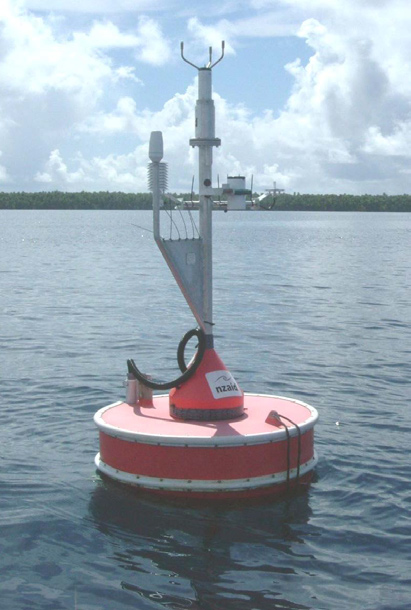
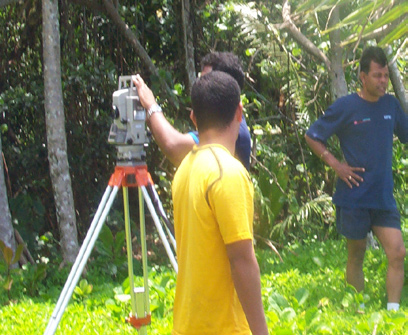
addition, assessment was undertaken of potential quarry Monitoring buoy, Manihiki Lagoon. Part of initiatives to monitor
sites for Pohnpei, Federated States of Micronesia for
physical oceanographic parametres in the lagoon to determine
impacts on pearl fisheries.
7
Ocean & Islands
Sciences in Development Projects, Hazards thereby
A major highlight for the year was the commissioning
fulfilling all academic requirements to be granted a
and deployment of monitoring buoys in the Penryhn
Certificate in Earth Science and Marine Geology.
and Manihiki Lagoons in the Cook Islands and the
continuous, uninterrupted collection of long-term,
The completion of these courses marks the end of the
sustained ocean and meteorological data (salinity,
final year in the current 3-year cycle of the CESMG course wind, temperature, pH, chlorophyll, dissolved oxygen,
that has, since its inception in 1977, seen over 110 Pacific UV radiation) in real-time that completed 12 months
Island nationals graduate with technical qualifications in
of measurements at the end of November 2004. The
geology and earth science. Besides the CESMG, on-the-
project represents a practical and local example of
job training of Pacific Island nationals either in the field or coastal GOOS and enables near-real time data to be
at the Secretariat remains an inherent, important element made available to both the Cook Island Government and
of all technical activities of the Secretariat. Discussions
the pearl farmers on the atolls for management of pearl
have commenced with donors for the funding for a
fisheries. Data is transmitted daily via satellite phone to
further cycle for CESMG.
SOPAC and processed information made available to the
farmers and Government: data is additionally available
on the SOPAC website.
The deployment of monitoring buoys within the Penrhyn
and Manihiki atolls is but one of the various government
and regional technical interventions in support of the
black pearl industry in the Cook Islands. How the results
of such studies are made use of within country and
how effectively do they contribute to their intended
outcomes? In search of answers, SOPAC undertook a
cost-benefit analysis of technical studies undertaken
on Manihiki atoll in support of the pearl industry (see
feature story on page 10).
SOPAC developed a Terms of Reference for, and
undertook a Call for Tenders for an assessment survey of
port areas, Avatiu Harbour and adjacent coastal areas of
Rarotonga, Cook Islands to provide development options
to Government in terms of reducing vulnerability from
flooding, storm surge and related events. In support of
the study SOPAC completed a detailed multibeam study
CESMG students undertaking fieldwork.
of the harbour environs and the region offshore to a
depth of 300m for Rarotonga. This study is financed
under AusAID bilateral funds.
Monitoring Physical and Chemical
SOPAC continued to assist with the implementation
of the third phase of the South Pacific Sea Level and
Change in Ecosystems
Climate Monitoring Project (SPSLCMP III) assisting in the
field survey components, including the installation and
The component Monitoring Physical and Chemical Change maintenance of continuous global positioning systems,
in Ecosystems seeks to establish long-term, systems for
under the geodetic component of the project. The
the routine monitoring and observation of physical and
maintenance and calibration of the sea-level recorder
chemical parameters, to provide timely and accessible
network and databases (SEAFRAME sites) were also
information for an improved understanding of the
carried out. Training in precise leveling and Differential
ecosystems of our ocean and islands thereby enabling
GPS were provided in Nauru, Vanuatu, Kiribati, Cook
more prudent management of their resources.
Islands, and Samoa.
Early in the year, and following the Pacific Island Regional
SOPAC made field visits to all of the twelve countries
Ocean Forum (PIROF), an I-GOOS Forum was convened
participating in the project and wherever possible
that detailed progress with regard to ocean observing
transferred survey skills to national counterparts during
systems at the global and regional levels.
field missions. The Regional Data Archive for the
8
Ocean & Islands
SPSLCMP III continued to be maintained and updated.
Discussions commenced toward the latter part of the year
on the development of a possible fourth phase for the
project.
Ocean Governance
The Ocean Governance component seeks to contribute
to the establishment of an integrated framework that
ensures sound stewardship and management of ocean
environments at the local, national and regional levels
through assisting island member countries meet their
obligations under relevant international and regional
conventions and agreements such as the United Nations
Convention on the Law of the Sea, as well as supporting
the development and implementation of appropriate
policy, planning and regulatory frameworks at national
and regional levels.
Considerable progress was made towards the
completion of a Marine Scientific Research (MSR) Cruise
Coordination Database and assistance provided where
requested to facilitate permissions with respect to MSR
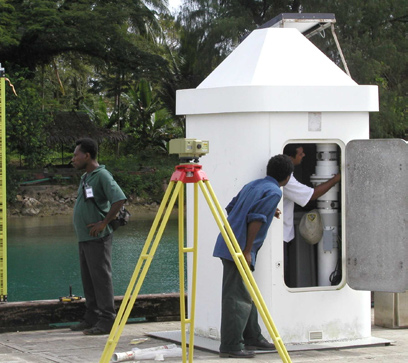
Maintenance and Calibration Sea Frame Station, Manus Island,
activities within member country EEZs. Testing of the
Papua New Guinea.
database commenced with input of Fiji cruise data.
SOPAC actively contributed to the organisation of,
and participated in, the Pacific Islands Regional
Ocean Forum (PIROF), held in February 2004 in
Suva and subsequently with the CROP Marine
Sector Working Group in finalising a draft Pacific
Island Regional Ocean Policy Integrated
Strategic Action Plan, (PIROP-ISA) the mechanism
to implement the Pacific Islands Regional Ocean
Policy.
The integrated policy action framework for PIROP
will, in the years to come, guide SOPAC and other
CROP agency activities in the oceans sector,
in particular supporting the development and
implementation of ocean policies at the national
level.
SOPAC coordinated an AOSIS workshop in May
2004 which provided avenues for dissemination
of the policy and the draft ISA to other SIDS
members and the Ocean Policy and ISA have
been integrated into the revision of the Ocean &
Islands Programme. Work on the draft PIROP-
ISA has been noted by the Pacific Leaders at the
35th Pacific Islands Forum Meeting in Apia and
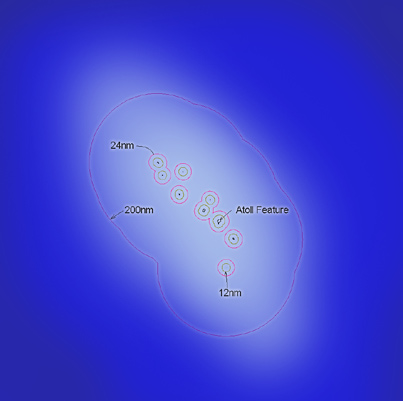
The Marzone tool has been modified for use in the Pacific to determine
finalisation of the draft ISA is aimed for tabling at
relevant maritime boundaries based on UNCLOS guidelines.
the upcoming BPoA+10 meeting in Mauritius.
9























WHAT'S IT WORTH ?
Counting the costs and benefi ts of projects implemented to assist the black pearl
industry in the Cook Islands
slands In November 2000 the black pearl
The Cook Islands Government and
industry in Manihiki Lagoon in the
supporting organisations have invested
Northern Cook Islands was severely
considerable resources in the projects
affected by an oyster disease, which,
in Manihiki. But will the projects reap
along with low international pearl prices, economic benefits greater than their
caused a steep decline in pearl export
costs? Farmers can potentially use the
revenue, from NZ$18.4 million in 2000 to project outputs to make their farming
Ocean & I NZ$2.8 million in 2003.
practices more sustainable, and thereby
gain significant economic returns.
Overstocking and poor handling of
pearl oysters, combined with adverse
In 2004 a study was undertaken at
environmental conditions, were found
SOPAC to evaluate whether the projects
to be the major causes of the Manihiki
implemented in Manihiki are worthwhile
disease outbreak in 2000. Scientific
investments for the Cook Islands. The
research and experience in other pearl
study concludes that if the projects are
farming countries suggest that more
supported by the implementation and
sustainable farming practices and lagoon
enforcement of the draft pearl farming
management would have prevented the
management plan, which regulates oyster
disease and subsequent decline in the
stocking densities and farming practices,
quality and quantity of pearl production.
the Net Present Value of the projects
is approximately NZ$39.8 million. The
The Cook Islands Ministry of Marine
projects also have additional indirect,
Resources, with the assistance of SOPAC
secondary and non-monetary benefits.
and other organisations, has implemented In this future scenario, pearl revenue
various projects in Manihiki, which aim
declines and the projects fail to reap
to achieve sustainable development of
their large potential economic benefits.
the black pearl industry and avoid future
Under these assumptions, the projects
disease outbreaks. These projects involve will have a negative Net Present Value
diverse activities, including: monitoring
of approximately NZ$2.4 million. Many of
the physical and chemical parameters
the indirect, secondary and non-monetary
in the lagoon; mapping the lagoon
benefits will also be lost.
bathymetry and pearl farms; building
local capacity in pearl farming and lagoon If the management plan is not
management skills; monitoring pearl
implemented and enforced, however,
oyster health and stocks, and drawing up incentives remain for resource users
a lagoon management plan and code of
to stock the lagoon at unsustainable
practice. The SOPAC Ocean and Islands
oyster densities and employ poor farming
Programme has assisted with monitoring, practices.
mapping and capacity building.
On the basis of these findings the
study strongly recommends that the
draft Manihiki pearl farming lagoon
management plan be implemented as
soon as possible, to guarantee that the
projects effectively reap their substantial
potential economic rewards for the Cook
Islands. Without an enforced system
of rules and regulations, incentives for
individual farmers to overexploit the
lagoon will lead to reduced profits for
all, repeated disease outbreaks and
could eventually cause the demise of the
Photograph: Berni Aquilina.
Manihiki pearl industry.
10
Community Lifelines
The overall goal of the Community Lifelines
Programme (CLP) is to "Improve community access
to energy, water and sanitation, and information and
communication technologies for sustainable livelihoods".
This is carried out through its three programme
components:
· Resource Assessment, Development and
Management;
· Asset Management; and
· Advocacy and Governance within Community Lifelines.
In addition the CLP continued to work on the effective
integration of the three very distinct utility focused
sectors of energy, water, and information and
communication technologies.
Within the CLP, adopted regional policies and guidelines
continued to be pivotal in guiding the work of the
programme both within the region and in addressing
global agendas, for example, the multi-year programme
of work of the Commission of Sustainable Development
(CSD) that focuses on water, sanitation and human
settlements in 2004-2005; the Water for Life Decade
(2005-2015); and Energy for Sustainable Development,
industrial development, air-pollution/atmosphere and
climate change in 2006-2007.
Resource Assessment,
Development and Management
The quantification of the region's resources remains a
critical component in the planning process of the future
sustainable development and management of these
resources. Recently considerable progress was made
in the evaluation of specific resources and also in the
provision of training. This, more specifically, included the
first phase of national biomass resource assessments in
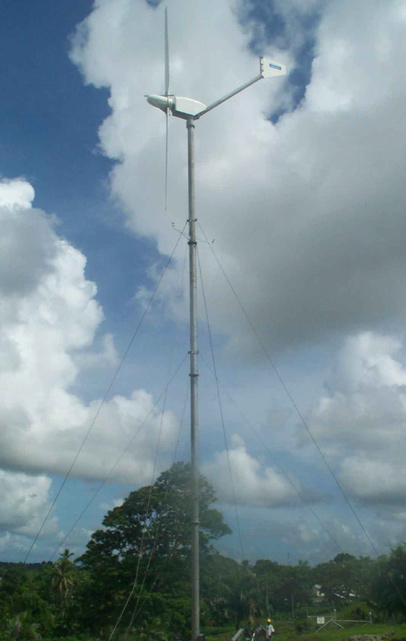
Demonstration 20-kW wind turbine installed as part of
six countries and the development of a second phase; the the development of a wind energy education programme
installation and commissioning of a 20-kW wind turbine
with the University of the South Pacific. The wind turbine
inside the Fiji Mineral Resources Department compound
was funded jointly by UNEP and the French Government.
within reach of SOPAC, along with the development of
training modules to support a post-graduate wind energy
education course being offered at USP. Site-specific wave
renewable energy for the region initiated and funded
energy monitoring in Fiji and the Cook Islands through
through ESCAP.
the deployment of submerged data loggers to confirm
earlier (1987) wave energy measurements, were also
The first year of a three-year hydrological training
undertaken.
programme was commenced as part of the Pacific Water
Type 2 Partnership Initiative and funded by NZAID along
Activities in renewable energy included the convening
with the continued publication of the Islands Climate
of a pilot training workshop on solar PV project
Update through NIWA. A funding proposal for the
development, contributing to a wind energy workshop
second and third years is currently being finalised with
at USP, and providing input and contributing to the
NZAID. Further work is underway on the preparation of
overall development of a training needs assessment on
other funding proposals for subsequent support to these
11
Community Lifelines
two activities along with new proposals in water quality
training and database updating following the appointment
and wastewater management as part of implementing
of a Water Quality Officer as a shared position with the
priority components of the Pacific Regional Action Plan
University of the South Pacific Institute of Applied
on Sustainable Water Management. Also of note was
Sciences [USP-IAS].
the re-commenced regional programme on water quality
World Water Day activities this year were promoted
through the provision of assistance for the development
of teacher training materials; and water education
and awareness in schools was addressed through the
development of a board game called "Forceful Flows" to
teach about events related to water and disasters.
A significant level of activity within the CLP can be
attributed to the strengthening of human resources
through capacity building a particular area being in
the use of GIS and Remote Sensing tools to detect and
monitor land cover change and the security of water
catchments; to undertake biodiversity measurements,
topography (slope) analyses, forest function/soil analyses,
and human impact analyses. In addition the programme
continued to promote the use of ICT applications and
tools like GIS and Remote Sensing, through publication of
the regional GIS and Remote Sensing Newsletter and via
the electronic media.
Asset Management
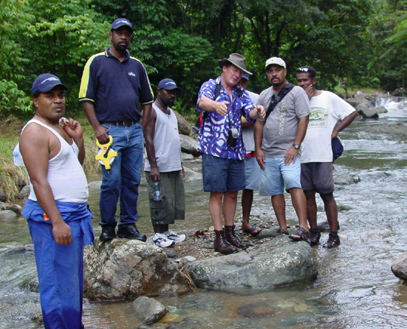
Pacific Islands students receiving instruction in the evaluation and
selection of a suitable site for establishing hydrological gauging
site. This work is part of a three-year training and capacity The appointment of the Water Quality Officer in June
building programme in surface and ground water and will assist 2004 allowed the CLP to re-commence its programme on
with ensuring better water resource management.
water asset management including in-country training in
Niue and capacity building in water utility laboratories.
This also involved the collection of water quality data and
management of the database, the editing for publishing
of a water quality guidebook, and the development of
water quality project proposals for funding.
A collaborative undertaking between the World Health
Organisation (WHO), NZAID, Fiji Ministry of Health, Fiji
School of Medicine (FSchM) and SOPAC developed and
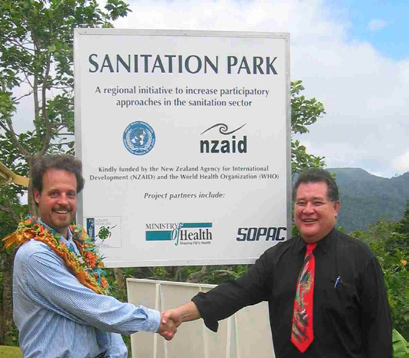
implemented the establishment of a "Sanitation Park
Project" with full community involvement. The Sanitation
Park contains various models of toilets and wastewater
treatment systems, and is aimed at assisting local
communities in implementing appropriate human waste
disposal technologies. Its location at the FSchM Tamavua
Campus is to ensure that the various technologies
demonstrated in the Sanitation Park may be replicated
in the region through the training of the region's health
workers. Three communities namely Keiyasi (Sigatoka),
Balevuto (Ba) and Nadelei (Tavua) were selected through
pre-project surveys as locations for community training.
Training included composting toilet construction in May
2004 for district health workers and community members
Official Opening of the Sanitation Park in the Fiji School of Medicine,
Tamavua, Fiji on 18th November 2004. The Sanitation Park comprises a
and also 3 community workshops under the "Healthy
variety of dry working models of sanitation facilities considered appropriate
Islands Initiative" in the three selected communities.
for island communities and will be utilised as an educational tool for
community members to medical students.
Funding was provided by WHO and NZAID.
12
Community Lifelines
Advocacy and Governance
within Community Lifelines
During the period, the CLP also participated, and was
involved, in the following key activities:
· Participation in the sub-regional review of the 3rd
World Water Forum and consultations regarding
appropriate input from the region with respect to
preparations for the 4th World Water Forum;
· Continued implementation of priority activities within
the themes of the Pacific Regional Action Plan on
Sustainable Water Management (RAP);
· Continued to implement the Pacific Islands Energy
Policy (PIEP), along with coordinating its review,
and assisting in the development of National Energy
Policies;
· Contributed to the development of the Pacific Islands
Energy Policy and Strategic Action Planning Project
(PIEPSAP);
· Continued to implement the Pacific Islands
Information and Communication Technologies
Policy and Strategic Plan (PIIPP) that sets out a
framework of guiding principles and policies and
recommended activities for future policy development
and co-operation by the Pacific Island Countries;
· Continued to facilitate in the Energy and Water Pacific
Partnership Initiatives, including the preparation and
circulation of a six-monthly newsletter for each of the
sectors to keep stakeholders and partners informed of
progress and developments;
· Participated in, and contributed to, the Energy,
Information and Communication Technology, and
Water and Sanitation CROP Working Groups and
coordinate the Pacific Energy and Gender Network
(PEG);
· Establishment of an Ad-Hoc Working Group on
Water and Sanitation within the context of the Water
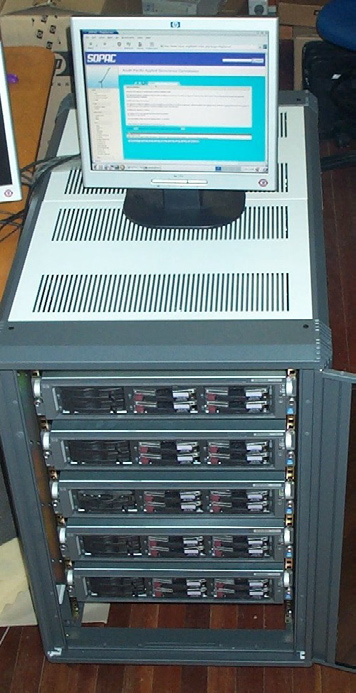
Example of a typical "Map Server" configuration used to establish
Partnership Initiative;
National Information Centres within PICs. The Map Servers are
set up at SOPAC prior to shipping and is sufficient to run the
ICT functions of the national government of a small island state.
· Participated through PacInet in the preparatory
process for the World Summit on Information Systems
(WSIS) to seek and provide opportunities for the
· Chaired the Round Table Meeting on Climate Change,
development of partnerships, to ensure SOPAC
Sea Level Rise, Climate Variability and Extreme
remains current with respect to developments in
Weather Events during the 2003/2004 period and
the information and communication technologies
contributed to the preparation, documentation and
field while ensuring that the profile of the Pacific is
presentations for the 4th Round Table Meeting on
maintained; and
Climate Change, Sea Level Rise, Climate Variability
and Extreme Weather Events.
13





















PACIFIC ISLANDS ENERGY
A Preliminary Menu of Options for
POLICY AND STRATEGIC
Possible PIEPSAP Interventions
ines ACTION PLAN
f
el
Type of intervention:
PIEPSAP offers assistance to
Li PIEPSAP aims to improve the capacity of
Pacifi c Island Countries (PICs) to develop
Policy Development
Develop, fi nalize and adopt a national
y
energy policy, a national electrifi cation
practical national energy policies, and the
policy, a rural electrifi cation policy, etc.
strategic action plans to implement the
policies toward achieving "available, reliable,
Energy Plans
Develop strategies, energy sector
affordable, and environmentally sound
action plans and energy chapters of
national development strategies
energy for the sustainable development
for all Pacifi c islanders." The operational
Cross-Sector Integration
Design and implement energy
objective of PIEPSAP is to link energy policy
strategies cutting across key economic
sectors (agriculture, transport,
Communit and planning with concrete action measured
industry, tourism, health, education,
in investment and implementation of work
etc.)
programmes.
Model Legislation
Revise power utility charters, develop
and update energy legislation,
Historically, the PIEPSAP Project is
model legislation for energy service
an outcome of the World Summit on
companies (ESCOs), develop legislative
Sustainable Development that was held in
authority and responsibilities for
Johannesburg in 2000 where two initiatives
national energy agencies, etc.
were launched: The PICs regional energy
Institutional Development
Develop more appropriate institutional
sector umbrella initiative, Pacifi c Islands
structures within the public service
Energy for Sustainable Development (PIESD)
with clear powers and responsibilities
and the European Union Energy Initiative
for the energy department.
for Poverty Eradication for Sustainable
Tariff Studies
Establish sustainable tariffs and
Development (EUEI). In 2003 the Danish
analyze implications of tariffs on low-
Government agreed to fund the PIEPSAP
income consumers, utility's income.
Project under the EU Energy Initiative.
Model Regulations
Develop appropriate regulatory
frameworks and enabling
To meet present and future energy needs,
environments for commercialized or
countries require energy policies that are
privatized electric power utilities and
in line with overall development goals,
energy suppliers.
contribute to economic growth, and
Financial Incentives
Design and evaluate tax incentives
account for the principles of environmental
to promote energy effi ciency and
sustainability and social justice. Experiences
renewable energies, develop transition
in SOPAC's cooperation with PICs have
models for biofuel introduction.
shown that for policy to become effective
Model Agreements
Develop Power Purchase and
and sustainable it must be linked to practical
Concession Agreements for
implementation plans, human resource
independent power production.
development and in particular to budgets
Guidelines
Develop practical guidelines for
and fi nancing.
environmentally sound operation of
energy systems; lending guidelines
PIEPSAP wants to focus on these linkages
and purchasing models for energy
and assist PICs not only in developing sound
equipment, etc.
energy policies but also help to ensure that
Case Studies
Execute case studies based on
stated policy objectives are followed up by
issues such as national ownership of
allocation of adequate human and fi nancial
petroleum storage; import restrictions
resources.
on energy intensive equipment, fuel
quality management and supply cost
to remote outer islands.
The complex task of energy policy
development and energy planning is best
Subsidy Studies
Determine the actual cost and
addressed by a menu of options that
subsidies for rural electrifi cation
depending on location and technology.
acknowledges the specifi c situation in each
PIC while maintaining and intensifying
Investment Plans and
Access sources for energy sector
cooperation and exchange of information at
Partnerships
investments and concessionary
fi nance, establish partnerships, and
a regional level.
develop project pipelines.
14

Community Risk
The Community Risk Programme (CRP) provides a Crescent Societies (IFRC) formed the Pacifi c Emergency
range of capacity building support to SOPAC member
Management Training Advisory Group (PEMTAG), a
countries through its three programme components:
group dedicated to better coordinating their disaster
management training efforts in the region. The PEMTAG
1. Strengthening Resilience to Disasters;
Secretariat has now been established at SOPAC and
2. Mitigating the Effects of Hazards; and
the fi rst Pacifi c scholarships for graduate certifi cates in
3. Mainstreaming Disaster Risk Management.
Disaster Management offered by Swinburne University
of Technology in Australia were made available to the
The following narrative provides highlights of activities
National Disaster Management Offi ces (NDMO) in Tonga
undertaken during 2004, which have been supporting the and Vanuatu. Further scholarship support is planned for
successful delivery of the programme outputs.
Fiji, Niue and Tuvalu.
Strengthening Resilience to Disasters
The process of strengthening the National Disaster
Management Planning Arrangements, including the role
The need to continue the process of strengthening
of the NDMO, continued with the active support and
community resilience was once again highlighted by a
contribution of both Emergency Management Australia
number of disasters that impacted the region during the
and the New Zealand Ministry of Civil Defence and
past 12 months. The major one being Tropical Cyclone
Heta, which caused severe damage to a number of
islands of Polynesia and in particular the island of Niue
which bore the brunt of its category 5 force in early
January. These disasters highlight the extreme levels
of vulnerability of the Pacifi c Small Island Developing
States (SIDS) as well as the fragile status of the national
disaster management arrangements.
The apparent increase in the regularity of extreme
weather-related hazards in the region has reinforced
the urgent need for improved early warning systems,
increased levels of public awareness, and the
development of improved national preparedness response
and recovery capacities.
The support of existing partnerships and the
establishment of a number of new alliances have allowed
the programme to continue to provide cost-effective
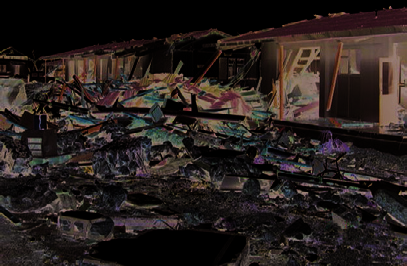
Niue hospital destroyed for the second time.
solutions that assist the national capacity building process
of our member countries particularly in the key areas of
institutional strengthening and training.
Of particular signifi cance was the signing of a
memorandum of understanding with The Asia Foundation
(TAF)/Offi ce of US Foreign Disaster Assistance
(OFDA). This is a regional organisation/programme
with its headquarters in San Francisco and its Pacifi c
offi ce recently co-located within the Community
Risk Programme. TAF/OFDA is one of the leading
organisations in the region responsible for developing,
adapting and delivering disaster risk management
training to strengthen national capacity.
TAF/OFDA works closely with other organisations such
as Emergency Management Australia (EMA) and more
recently TAF/OFDA and SOPAC along with the UN Offi ce
for the Coordination of Humanitarian Affairs (OCHA)
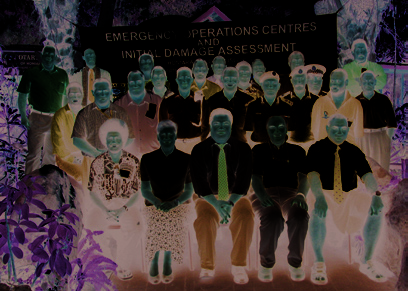
Participants at the TAF/OFDA training courses held in Honiara
and the International Federation of Red Cross and Red
in September.
15
Community Risk
Emergency Management. Reviews were conducted
the NDMO and outer islands; and the capacity of the
in Fiji, Vanuatu, Tuvalu and Niue and strategic action
National Emergency Operations Centre (EOC) in Niue has
plans agreed by governments for improvements to be
been strengthened.
made. The New Zealand Ministry of Civil Defence and
Emergency Management is also preparing a regional
As in previous years the CRP worked in partnership
guideline to assist national disaster management
with the International Strategy for Disaster Reduction
planning in member countries.
(ISDR) Secretariat in Geneva to actively support public
awareness programmes and this year provided funds to
The partnership with the Australasian Fire Authorities
Vanuatu.
Council has allowed assessments to be conducted of
the emergency preparedness capabilities in Papua New
Mitigating the Effects of Hazards
Guinea, Vanuatu and Samoa and long-term institutional
support plans are now in place for fire services in Fiji and
The successful completion of the Environmental
Tonga.
Vulnerability Index (EVI) Project has been the main
achievement for 2004 with the results to be presented
Emergency communication equipment was provided by
to global meetings in Mauritius and Kobe in early 2005.
EMA to Vanuatu and Tuvalu to improve the links between
This Pacific regional initiative began in 1998 in response
to a global call in the 1994 Barbados Programme of
Action (BPoA) for the sustainable development of Small
Island Developing States (SIDS) for the development
of a composite vulnerability index that addressed both
ecological and economic concerns.
The EVI captures environmental vulnerability of SIDS
as outlined in the BPoA and emphasises their ecological
fragility. The panel of experts that independently
reviewed the Environmental Vulnerability Index
(Think Tank II, 4-6 October 2004) stated that the
EVI is sufficiently well developed to begin national
implementation. The experts also suggested that
countries should be classified into the following relative
vulnerability categories extremely vulnerable, highly
vulnerable, vulnerable, at risk, and resilient. It is
recommended that developing countries in the first two
categories extremely and highly vulnerable are likely
to require special assistance to manage their vulnerability
and build resilience.
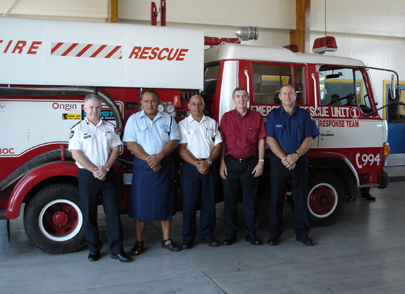
MFESB/SOPAC team review the progress of the Samoa Fire
Service.
In taking the first step towards national implementation,
the EVI was presented to a Pacific EVI Capacity
Strengthening Workshop (18-20 October 2004).
Participants were exposed to the EVI, its concept,
mechanics and how scores are generated. The
knowledge gained through the workshop will enable
country representatives to provide their countries with
detailed explanations on the need for environmental
management information, the conceptual mechanics and
overall benefits of the EVI and its application. In the long
term the EVI is expected to help countries prioritise and
direct actions in managing vulnerability, and towards
sustainability. The launch of the global EVI at the
Mauritius International Meeting the 10-year review of
the BPoA in January 2005 will see the completion of this
Pacific project.
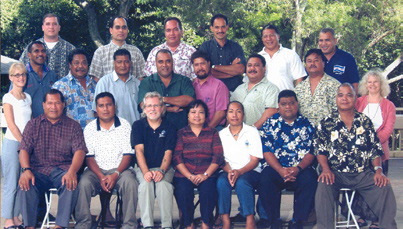
Regional NDMOs attend a leadership development programme
at the East West Centre in October.
16
Community Risk
be introduced through CHARM workshops in member
countries. Through its partnership with the Pacific
Disaster Center the CRP is also developing a whole-of-
government integrated risk reduction framework, which
will greatly assist national development planning in
member countries.
To support the mainstreaming of disaster risk
management, a new disaster risk management training
module was developed and this will be included as a
component of the TAF/OFDA Introduction to Disaster
Management Course.
Under the provisions of the MOU that exists between
SOPAC, the East-West Center and the Pacific Disaster
Center, a Leadership Seminar was conducted for Pacific
Island Disaster Managers in Honolulu. This exposed a
number of the regional NDMOs to a range of leadership
and managerial skills as well as introducing them to new
risk reduction tools and technologies that will assist their
national disaster risk management planning.
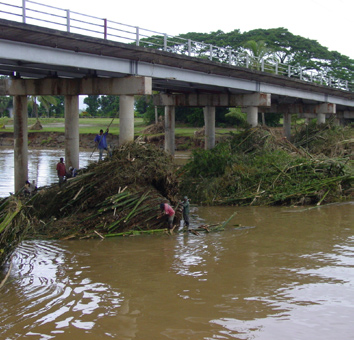
Debris brought by flash floods in Navua, Fiji.
Following the impact of cyclone Heta on Niue in
January 2004 a SOPAC team conducted a post-disaster
assessment and, in partnership with the Pacific Disaster
Center (PDC), developed a visualisation model that
replicated the effects of the wave action during the
disaster. The lessons learned from this can assist the
Niue recovery planning process.
Mainstreaming Disaster Risk
Management
In recognition of its contribution to strengthening
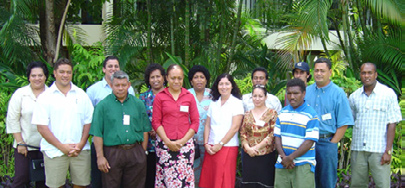
Participants at the EVI regional workshop.
disaster risk management capacity building in the region,
SOPAC was awarded a Certificate of Merit at the United
Nations Sasakawa Awards held in Geneva in October.
The CRP High-Level Advocacy Team led by Dr Langi
Kavaliku continued to meet with national government
representatives to promote the adoption of a whole-
of-government approach to disaster risk management
and during 2004 visited the Cook Islands. The team
has also been actively involved in the review of the
regional initiatives in support of the implementation of
the 1994 Yokohama Strategy and Plan of Action and
the preparations for the Second World Conference on
Disaster Reduction to be held in Kobe, Japan in January
2005.
To assist with the implementation of the Comprehensive
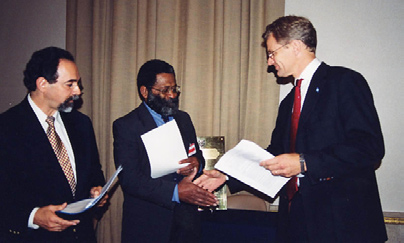
Atu Kaloumaira, SOPAC's Disaster Mitigation Adviser, receiving
Hazard And Risk Management (CHARM), a national
the Sasakawa Award on behalf of the SOPAC in Geneva during
implementation manual is being developed, which will
the World Disaster Reduction Day in October.
17





















TSUNAMI RISK
Pacifi c prepares for the second world
AWARENESS IN PACIFIC
conference on disaster reduction
y Risk ISLAND COUNTRIES
SOPAC is mandated by the Pacifi c Forum Leaders to take the
lead, amongst CROP agencies, on issues relating to disaster
Tsunamis can have a major impact
management or as it is now more generally referred to as disaster
on Pacifi c Island Countries. Tsunami
risk reduction. SOPAC is also the regional representative on the
events in Papua New Guinea (1998,
United Nations International Strategy for Disaster Reduction (ISDR)
Aitape, magnitude 7.1, 2,200 deaths)
Taskforce. As part of fulfi lling both these roles, the Community Risk
and Vanuatu (1999, Port Vila,
Programme (CRP) coordinated the regional contributions towards
magnitude 7.3, 5 deaths) demonstrate
the preparations for the Second World Conference on Disaster
Communit
Reduction to be held in Kobe, Japan from 18 to 22 January 2005. The
the potential for life loss and
activities that the CRP coordinated included regional and international
destruction by these hazards.
initiatives, which were made possible through the fi nancial support of
both Australia and New Zealand.
To increase the awareness and
understanding of the potential risks
The World Conference in
from tsunamis, SOPAC in partnership
Kobe has been described as a
with UNESCO/Intergovernmental
milestone event to increase the
Oceanographic Commission and its
international profi le of disaster
International Tsunami Information
risk reduction and to promote
Center (UNESCO/IOC-ITIC) conducted
its integration into development
planning and practice. Our
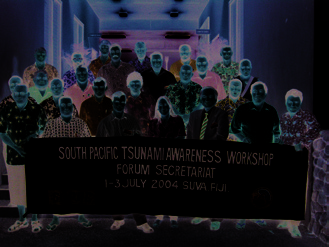
a South Pacifi c Tsunami Awareness
objective in coordinating the
Workshop in Suva, Fiji in July. The
Pacifi c preparations for Kobe is
workshop brought together technical
to ensure that not only in Kobe
experts and regional disaster managers
is there international visibility of
from American Samoa, Cook Islands,
the unique level of vulnerability
Fiji, Papua New Guinea, Solomon
of the Pacifi c Small Island
Islands, Tonga and Vanuatu.
Developing States (SIDS), but
also to ensure that this reality
Follow-up presentation and discussions
is appropriately refl ected in
also took place during the STAR
the Kobe outcomes document.
Fulfi lling this objective will then
session at the SOPAC Council Meeting
provide a platform for action in
in Fiji in September. A number of
the years ahead.
activities have been identifi ed to
increase the awareness of the Tsunami
Since January 2004 the CRP has coordinated the following regional
hazard in the region including the
activities and consultations to assist the Pacifi c preparations for Kobe:
development of a Tsunami Information
Kit to assist with the strengthening of
1. Conducted a country-based review of the initiatives that
national public awareness programmes.
supported the implementation of the 1994 Yokohama Strategy
and Plan of Action and identifi ed the lessons learned through
broad stakeholder consultations;
2. Coordinated the attendance of Pacifi c delegations to the First and
Second ISDR Preparatory Committee Meetings in Geneva; and
3. Facilitated a regional stakeholders workshop and developed a
Draft Pacifi c Regional Position Paper for the Kobe Conference
The outcomes of these activities are:
· An increased global awareness of the particular needs of the
Pacifi c SIDS,
· An agreed separate regional session at Kobe for SIDS which the
Pacifi c has agreed to take the lead on together with AOSIS States
and the ISDR Secretariat; and
· The development of a draft framework for a Regional Action Plan
for Disaster Risk Reduction 2005-2015 which will be taken to the
12th Pacifi c Regional Disaster Managers Meeting in Papua New
Guinea in June 2005.
18
SOPAC-EU Project
Reducing Vulnerability of Pacific
water resources can be improved by controlling
land use practices through improved development
ACP States
planning within clearly designated source protection
T
zones. Greater resilience to pollution impacts may be
he highlights of the SOPAC/EU Project activities
anticipated, improving the safety and adequacy of the
during the past year display intrinsic linkages within
critical public water supply sources available to the
all three of SOPAC's Programme areas. The highlights
principal centres of population.
were:
Ocean & Islands Programme
The major activities and tasks of the SOPAC/EU Project
that matrix within the OIP are primarily encompassed
within the Project's Key Result Area 1: Sustainable
development of coastal zones, in particular through
identifying alternative sources of aggregates. These
activities link with OIP's component Resource Use
Solutions.
· Marine swath mapping surveys provide data and
information not accessible to SOPAC members and
partners before. This information is vital to coastal
development planning and sustainable management
of coastal zones and its resources. Tonga and
Samoa are the two additional countries that have
been completed, and Tuvalu is currently underway.
The combined cost of these three operations was
approximately F$250,000 for provision of the survey
Mr Donn Tolia (right), SOPAC National Representative for Solomon
vessel charter services alone.
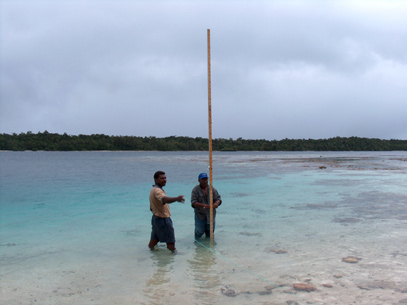
Islands, assisting the EDF8 Project team with beach profiling at Chea
village, Marovo Lagoon, New Georgia.
· Associated offshore and onshore aggregate surveys
were initiated in Fiji, Tonga, Samoa, Solomon Islands
· MapServers have been successfully installed in five
and Vanuatu. Identifying marine aggregate resources
countries (Tonga, Fiji, Kiribati, Vanuatu and Papua
that represent economically viable alternatives to
New Guinea), representing deployment of computer
deplete beach sand or environmentally-damaging
hardware totalling some F$120,000 in value. A
dredging.
significant number of complementary GIS training
courses are underway to build in-country capacity to
Community Lifelines Programme
fully utilise these tools.
The major activities and tasks of the SOPAC/EU Project
Community Risk Programme
that matrix within the CLP are primarily encompassed
within two of the Project's key result areas, namely Key
The major activities and tasks of the SOPAC/EU Project
Result Area 2: Improved planning practices installed for
that matrix with the CRP are primarily encompassed
safe and adequate water supplies and sanitation systems
within the Project's Key Result 3: Implement
and Key Result Area 4: ISM infrastructure established and comprehensive hazard and risk management tools within
in use in each country. Both of these result areas with all
the framework of an Integrated Holistic Approach for
three of the CLP components, Resource Assessment,
Sustainable Development (Island Systems Management).
Development & Management; Asset Management; and
This result area links with CRP's component Mitigating
Community Lifelines Governance & Advocacy.
the Effects of Hazards.
· With respect to risks to yield and raw water quality,
· The project risk assessment team was in Niue at the
reconnaissance investigations were undertaken at
end April 2004 to assess the wave and wind impact
groundwater wellfields supplying public water supplies
of TC Heta on the built environment and document
in Tonga (Nuku'alofa), Solomon Islands (Honiara and
eyewitness accounts of this extreme cyclonic
Gizo), and Vanuatu (Port Vila Tagabe catchment). In
event. The outcomes of the assessment are being
all cases it is apparent that the security of vulnerable
incorporated into a 3-D numerical model of the wave
19
SOPAC-EU Project
impacts on the devastated capital of Alofi . The model
· A second round of national multi-stakeholder
will assist in reducing future vulnerability by helping
consultations was completed in all eight EDF8
to identify the most hazardous onshore zones at
countries and country work plans endorsed.
greatest risk from such extreme tropical cyclones and
Additional, well-attended meetings involving detailed
therefore provide advice on safer locations to rebuild.
consultations with provincial- and community-level
stakeholders, were also separately completed in the
· The model can be a useful planning tool to assess
Navua River and Sigatoka River catchments in Fiji.
potential hazards and risk of proposed development
sites to tropical cyclones, thus address the reduction
· Numerous in-country training courses to build local
of vulnerability of PICs to this type of extreme event.
capacity in RS/GIS and Mapserver applications
were completed in Fiji, Kiribati, Vanuatu, Solomon
Islands and Papua New Guinea; and IKONOS satellite
Cross-cutting issues
imagery for Project in-country target areas were
purchased, or are on order, for Kiribati, Solomon
Islands and Niue.
A number of major activities and tasks completed within
the multi-disciplinary regional objectives and remit of the
· In-country interns were successfully identifi ed and
SOPAC/EU Project are clearly cross-cutting with respect
appointed within six of the EDF8 nations, along with a
to all three of SOPAC's Programme Areas. These issues
SOPAC Project Intern.
are most easily encompassed under the Project's Key
Result Area 5: Strengthening the Capacity of Pacifi c ACP
Further information on the SOPAC-EU Project and details
States. All Project specialists, advisers and support staff
of in-country work programmes and selected Project
positions are involved to a greater or lesser extent in the
study sites can be obtained from the Secretariat, or by
provision of these services. The following were primary
accessing the SOPAC-EU Project Website: http://map.
activities in 2004:
sopac.org/tiki/tiki-index.php
EUROPEAN UNION EXTENDS PACIFIC COVERAGE
OF VULNERABILITY REDUCTION PROJECT
The SOPAC-based regional project funded by the
Cook Islands, Federated States of Micronesia,
European Union, to reduce the vulnerability of
Republic of the Marshall Islands, Nauru, Niue
Pacifi c Island countries to natural hazards, was
and Palau (under EDF9) joining the eight original
-EU Project
extended in 2004 to another six Pacifi c Island
recipients of the scheme under EDF8 Fiji,
AC
countries.
Kiribati, Papua New Guinea, Samoa, Solomon
Islands, Tonga, Tuvalu and Vanuatu.
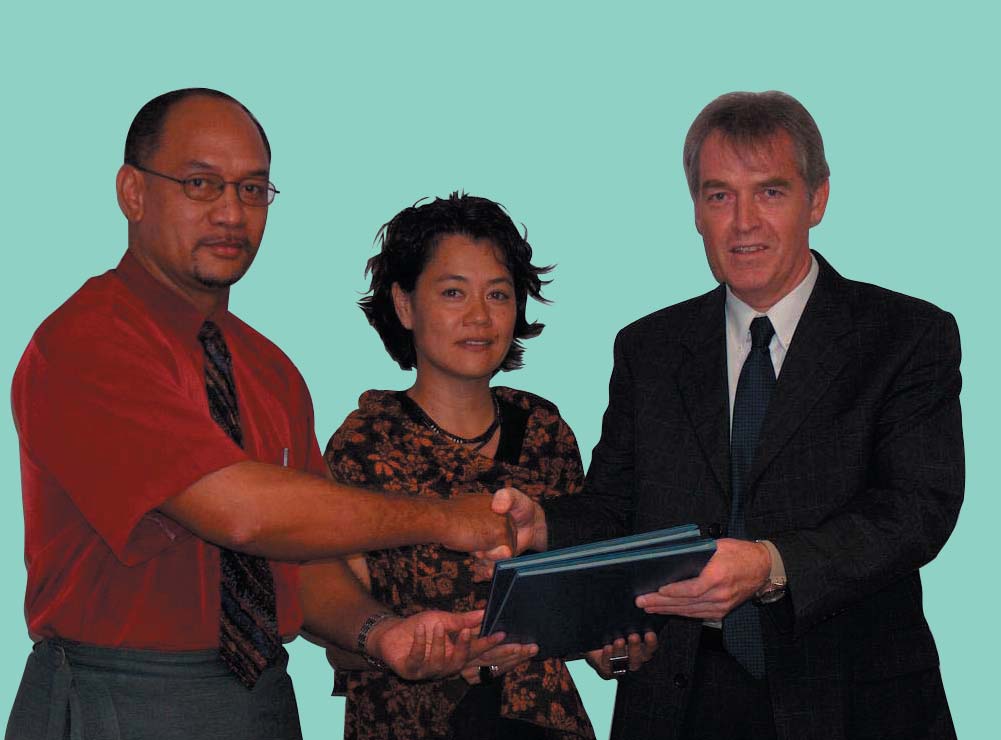
A fi nancing agreement worth Euro 2.6 million
SOP
(FJ$5.7 million) for the extension was signed on
the afternoon of Wednesday, 11 February 2004,
by the Head of the European Delegation for the
Pacifi c, Mr Frans Baan and the Deputy Secretary
General of the Pacifi c Island Forum Secretariat.
Mr Iosefa Maiava signed in his capacity
as Deputy Regional Authorising Offi cer
for the European Development Fund
regional programme.
This takes total funding for the Project to
Euro 9.6 million (FJ$21 million).
The also takes the total number of Pacifi c
Island states to benefi t from the EU
Project to fourteen. These are namely:
20
Appendix 1: SUMMARY OF 2004 FUNDING BY PROGRAMME
ANTICIPATED SOURCE
GRAND TOTAL OCEAN & TOTAL COMMUNITY TOTAL COMMUNITY
TOTAL
TOTAL
OF FUNDS
TOTAL
ISLANDS
LIFELINES
RISK CORPORATE DIRECTORATE
PROGRAMME
PROGRAMME
PROGRAMME
SERVICES
A: DONOR FUNDING
ACIAR
5,000
5,000
Australia Marine Science &
Technology
145, 547
145, 547
Australia-Annual Grant
1,561,356
883,055
80,520
597,781
Australia-Special Grant
172,163
125,651
46,512
BOM Australia
11,628
11,628
CFTC
295,200
CTA
66,667
66,667
Danish/EU
329,870
329,870
EMA
143,256
143,256
ESCAP
10,000
10,000
European Union EDF 8
4,097,945
1,238,835
1,779,260
908,029
171,822
Fiji
18,000
18,000
FSM
32,000
32,000
New Zealand-Annual Grant
805,175
63,790
460,341
159,868
121,176
New Zealand-Special Grant
529,097
212,255
316,842
OFDA
50,374
50,374
Taiwan (ROC)
132,037
17,776
114,260
UNDESA
300,000
150,000
150,000
UNESCO-IOC
67,358
67,358
UNEP
179,070
179,070
79,070
100,000
United Kingdom (ODI)
113,500
113,500
United Kingdom/DFID
95,780
95,780
VARIOUS
42,060
42,060
TOTAL DONOR FUNDING
9,203,082
3,012,340
3,383,023
2,472,660
292,998
42,060
B: TOTAL REGULAR BUDGET
2,097,141
36,500
208,281
0
1,287,918
564,442
(principally membership
contributions)
TOTAL 2004 REVISED
BUDGET
11,300,223
3,048,840
3,591,304
2,472,660
1,580,916
606,502
TOTAL 2005 APPROVED
14,168,775
4,119,108
5,247,191
2,379,709
1,828,067
594,700
BUDGET
21























Appendix 2: REPORTS & PUBLICATIONS UPDATE (as at 31 October 2004)
CORPORATE PUBLICATIONS
Proceedings of the Thirty-second Session, hosted by the Government of Niue in Alofi , Niue, 17-27 September 2003.
SOPAC Annual Report Summary 2003.
SOPAC News 2003(3), 2003(4), 2004(1), 2004(2).
SOPAC Business Plan 2004 (SOPAC Miscellaneous Report 560).
SOPAC NewsUpdate, 11 issues distributed electronically via SOPAC-Net.
TECHNICAL REPORTS
346 Lal, A., 2001, Survey Report SOPAC DGPS Reference Station, Tamavua, Fiji Islands, October 2001.
348 Lal, A., 2001, Survey of Ravodrau Bay beach profi led, Deuba, Fiji Islands, October 2001.
354 Dunlop-Stewart 2002, Quantitative assessment of risk to infrastructure due to large natural catastrophes in the Port
Vila-Mele area, Vanuatu. Consultancy Report. SOPAC Technical Report 354.
355 Okamoto, N., 2002, Summary of the Japan/SOPAC Deep-Sea Mineral Resources Research Program Triple Junction in
North Fiji Basin, Hakurei Maru No. 2 Cruise Fiji. [CONFIDENTIAL]
357 Roy Marshall & Collin Harris (Metropolitan Fire & Emergency Services Board: Kiribati Fire Risk Assessment Project,
Report prepared on behalf of the South Pacifi c Applied Geoscience Commission (SOPAC), 8-22 August 2001.
360 Smith, R., 2003, Sand and gravel resources of Majuro Atoll, Marshall Islands. SOPAC Technical Report 360.
361 Butcher, A.S., Overmars, M., Atauea, N., 2003, Investigating the remaining phosphate deposits of Banaba (Ocean
Island): a reconnaissance survey.
362 Smith, R., 2003, Manihiki and Penrhyn Atoll Oceanographic Monitoring Buoys an application of Coastal GOOS.
363 Mario, R., 2003, Renewable energy training needs assessment in Pacifi c Island Developing States.
364 2004, Consultants Report Biomass resource assessment utilisation and management for six Pacifi c Islands Countries
(Imperial College (London) Consultants).
365 2004, Consultants Report A Master Development Plan for the Sustainable Development of the Biomass Resources of
Fiji, Kiribati, Samoa, Tonga, Tuvalu and Vanuatu.
366 Smith, R., 2003, Multibeam surveys Ulithi Atoll and Yap Harbour, Yap State, Federated States of Micronesia.
368 Matakiviti, A., Pham, T., 2003, Review of the Fiji 1993 Rural Electrifi cation Policy. Review Report Final.
369 Pratt, C.R., Kaly, U.L., Mitchell, J., Howorth, R., 2004, The Environmental Vulnerability Index (EVI): Update and Final
Steps to Completion.
370 2004, Consultants Report Synthesis Report for the islands nations of Fiji, Kiribati, Samoa, Tonga, Tuvalu, Vanuatu.
Consultancy by Imperial College, London.
CRUISE REPORTS
152 Okamoto, N., 2002, Preliminary Cruise Report on the Japan/SOPAC Deepsea Cooperative Mineral Resources Study
Programme, R/V Hakurei Maru No.2, Marshall Islands. [CONFIDENTIAL]
153 Binns, R.A., (et. al) 2002, Exploration and mining report 939C. Final Cruise Report RV Franklin, FR--02/2002 "BISMARCK
2002." Submarine hydrothermal and volcanic activity in the Western Bismarck Island Arc, Papua New Guinea.
[CONFIDENTIAL until 31 August 2003]
PRELIMINARY REPORT
136 Mario, R., 2004, Wave gauge deployment and multibeam mapping near Muani Village, Kadavu, Fiji Islands.
MISCELLANEOUS REPORTS
427 SOPAC Disaster Management Unit, 2000, Scoping the professional development requirement for disaster/risk
management in the South Pacifi c. [RESTRICTED]
428 SOPAC Disaster Management Unit, 2001, Warning systems in national disaster management planning a guide to
warning systems for national hazards in Guam, February 2001. [RESTRICTED]
429 SOPAC Disaster Management Unit, 2001, Warning systems in national disaster management planning a guide for
planner and policy makers in Fiji, February 2001. [RESTRICTED]
22







REPORTS & PUBLICATIONS UPDATE ... continued
430 Barr, J., 2000, Civil crisis in Pacifi c Island Countries a framework for delivery of humanitarian assistance to those in
need. [Paper prepared for SOPAC and the Forum Secretariat for consideration by the Forum Offi cials Committee in
October 2000]. [RESTRICTED]
437 Kojima, K., 2001, Research programme for environmental study on hydrothermal deposits a proposal. [RESTRICTED]
442 Dawe, P., 2001, Summary of SOPAC Water Demand Management and Conservation activities in the Pacifi c region.
448 Shorten, G.G., 2001, Seismic risk in Pacifi c cities: implications for planning, building code legislation, and urban search
and rescue services. Presented at Australian Earthquake Engineering Society Conference, `Earthquake Codes in the Real
World', Canberra, 21-23 November 2001.
456 Channan, L., 2002, Workshops on water quality surveillance and safety, Fiji, September & November 2001.
457 Channan, L., 2002, Vanuatu water quality database user manual.
462 Pratt, C.E., 2002, Regional Maritime Boundaries Project Consultation, 24-26 April 2002, Nadi, Fiji Summary Record.
470 White, O., (Compiler), 2003, Strategic Management Planning Workshop, Summary Report, Centra Hotel Pacifi c Harbour,
12-14 June 2002.
490 Carpenter, C., Lawedrau, A., Pratt, C., 2002, GIWA Documents, Sub-Region 62, The Pacifi c Islands Freshwater
Shortage [Case Studies]. [DRAFT restricted].
495 EU-EDF8/SOPAC Project, 2003, Reduce vulnerability of Pacifi c ACP States through integrated planning and management
(Island Systems Management) in the sectors impacting on hazards, aggregates and water resources. Evaluation of
Tenders for Core ICT Equipment for Project Staff. [RESTRICTED]
500 Guild, R., Allinson, L., Taufao, S., 2003, Pacifi c Islands and the WSIS: Report of conference and side events
Opportunities for the Pacifi c islands region.
501 Allinson, L., 2003, Fourth meeting of European Community/Member States Experts on Information Society and
Development, Borschette Centre, Brussells, 20-21 January 2003 ICT for Development in the Pacifi c.
502 Allinson, L., 2003, Fourth meeting of European Community/Member States Experts on Information Society and
Development, Borschette Centre, Brussells, 20-21 January 2003 Reducing vulnerability of Pacifi c island countries: a
new SOPAC-EU regional project using ICT, including GIS and Remote Sensing tools.
503 Allinson, L., 2003, Review of ICT needs for the South Pacifi c Tourism Organisation. [RESTRICTED]
508 SOPAC Secretariat, 2003, Pilot Project for the establishment of a national network connected to the Internet for the
Solomon Government. [RESTRICTED]
509 Mitchell, J., 2003, Capacity building workshop on raising awareness on persistent organic pollutants (POPs) in the
Pacifi c, 26-30 May 2003, Tanoa International Hotel, Nadi, Fiji.
510 Naidu, A.V., 2003, Training workshop in applications of SPSLCMP Information/Data Products to Modelling Development.
"Storm Trak" Storm surge and tidal modelling and analysis system. Fiji Meteorological Services Training Centre, Nadi, Fiji
Islands, 3-5 June 2003.
511 Mario, R., 2003, Third Round-table Meeting on Climate Change, Climate Variability and Sea Level Rise, 10 May 2003,
Outrigger Hotel, Sigatoka, Fiji Islands.
512 SOPAC Secretariat, 2003, Eleventh Pacifi c Regional Disaster Managers Meeting and Communities at Risk Conference,
5-7 May 2003, Outrigger Hotel, Sigatoka, Fiji Summary Record.
515 Sanday, R., 2003, Good governance the key to sustainable development: a conceptual framework.
516 Pratt, C.R., Mitchell, J., 2003, EVI Country Profi le Review Barbados.
517 Pratt, C.R., Mitchell, J., 2003, EVI Country Profi le Review Botswana
518 Pratt, C.R., Mitchell, J., 2003, EVI Country Profi le Review Cook Islands
519 Pratt, C.R., Mitchell, J., 2003, EVI Country Profi le Review Fiji Islands
520 Pratt, C.R., Mitchell, J., 2003, EVI Country Profi le Review Federated States of Micronesia
521 Pratt, C.R., Mitchell, J., 2003, EVI Country Profi le Review Kiribati
522 Pratt, C.R., Mitchell, J., 2003, EVI Country Profi le Review Marshall Islands
523 Pratt, C.R., Mitchell, J., 2003, EVI Country Profi le Review Nauru
524 Pratt, C.R., Mitchell, J., 2003, EVI Country Profi le Review New Zealand
23








REPORTS & PUBLICATIONS UPDATE ... continued
525 Pratt, C.R., Mitchell, J., 2003, EVI Country Profi le Review Niue
526 Pratt, C.R., Mitchell, J., 2003, EVI Country Profi le Review Palau
527 Pratt, C.R., Mitchell, J., 2003, EVI Country Profi le Review Papua New Guinea
528 Pratt, C.R., Mitchell, J., 2003, EVI Country Profi le Review Tonga
529 Pratt, C.R., Mitchell, J., 2003, EVI Country Profi le Review Tuvalu
530 Pratt, C.R., Mitchell, J., 2003, EVI Country Profi le Review Vanuatu
531 Pratt, C.R., Mitchell, J., 2003, EVI Country Profi le Review Samoa
532 Pratt, C.R., Mitchell, J., 2003, EVI Country Profi le Review Bangladesh
533 Pratt, C.R., Mitchell, J., 2003, EVI Country Profi le Review Costa Rica
534 Pratt, C.R., Mitchell, J., 2003, EVI Country Profi le Review Greece
535 Pratt, C.R., Mitchell, J., 2003, EVI Country Profi le Review Jamaica
536 Pratt, C.R., Mitchell, J., 2003, EVI Country Profi le Review Kyrgyzstan
537 Pratt, C.R., Mitchell, J., 2003, EVI Country Profi le Review Nepal
538 Pratt, C.R., Mitchell, J., 2003, EVI Country Profi le Review Philippines
539 Pratt, C.R., Mitchell, J., 2003, EVI Country Profi le Review Singapore
540 Pratt, C.R., Mitchell, J., 2003, EVI Country Profi le Review St Lucia
541 Pratt, C.R., Mitchell, J., 2003, EVI Country Profi le Review Thailand
542 Pratt, C.R., Mitchell, J., 2003, EVI Country Profi le Review Trinidad & Tobago
549 SOPAC Secretariat, 2003, STAR Abstracts 2003.
550 Shorten, G., 2003, Catastrophe Insurance Pilot Project, Port Vila, Vanuatu: Developing Risk-Management Options
for Disasters in the Pacifi c Region. Project Summary. [Summary brochure based on the detailed report SOPAC Joint
Contribution Report 147.]
551 Howorth, R., 2003, The past, present, future status of geoscience-related work supporting sustainable development in
the Pacifi c islands.
552 White, O., (Compiler), 2003, SOPAC Gender Policy.
553 Matakiviti, A., 2003, Integrated energy planning a tool for sustainable development : a case study.
554 Carpenter, C., Jones, P., 2004, An overview of integrated water resource management in Pacifi c island countries: a
national and regional assessment.
555 SOPAC Secretariat, 2003, Energy for Life Regional Earth Day in the Pacifi c 2003.
556 Xue, C., Howorth, R., 2003, Natural and artifi cial connections between atoll islets in the Pacifi c, their process and
environmental impact.
557 Mario, R., 2003, Pilot training programme on solar photovoltaic project development.
558 Allinson, L., 2004, Tuvalu ICT Department: review and recommendations of ICT activities, 25 February 2004.
560 SOPAC Business Plan 2004.
561 USP Solutions, 2004, Proposal for Research Project Economic Impact of Natural Disasters on Development in the
Pacifi c. CONFIDENTIAL.
562 SOPAC Secretariat, 2004, Renewable Energy Save My Islands Home. (Regional Earth Day 2004 Flipchart for Schools.
563 Allinson, L., 2004, Kiribati MNRD LAN-WAN-based information system (MNRDIS): Report and recommendations.
November 2003 revision. 14 November 2003.
564 Allinson, L., 2004, Marshall Islands Ministry of Foreign Affairs network-based information systems: Report and
recommendations. 18 November 2003.
565 Xue, C., Howorth, R., He, C., 2004, Environmental impact of artifi cial harbours in tropic Pacifi c oceanic islands. (Reprint)
in Journal of Ocean, University of China, 3(1): 99-105. April 30, 2004.
24













REPORTS & PUBLICATIONS UPDATE ... continued
566 Ali, R.R., 2004, Marine Scientifi c Research Cruise Database User Manual.
567 Ali, R.R., 2004, Marine Scientifi c Research Cruise Database Data Dictionary.
568 Martin, F., 2004, Reducing vulnerabilities via a web map server.
569 Matakiviti, A., 2004, Regional Biomass Project Assessment and Training Final Report. June 2004.
570 Mario, R., 2004, Renewables for sustainability Can renewables make a difference?
571 SOPAC Library Manual, June 2004. [RESTRICTED]
572 SOPAC Publications & Library Policy, Edition August 2004. [RESTRICTED]
573 SOPAC Secretariat, February 2004, Ocean Issues and Challenges within SOPAC Responsibilities. (Prepared for the Pacifi c
Islands Regional Ocean Forum, 2-6 February 2004, USP, Suva, Fiji.
574 SOPAC Secretariat, 2004, SOPAC ICT, Library and Publishing Guidelines, Edition August 2004.
576 Collen, J., (Compiler), 2004, Abstracts of Papers presented at the STAR Session 2004.
TRAINING REPORTS
92
Prasad, S., 2001, Library attachment at SOPAC Secretariat, 13-17 August 2001 (for Caroline Joel, Clerk/Typist,
Department of Geology, Mines & Water Resources, Port Vila, Vanuatu).
98
Sili, A.T., 2002, Training attachment at SOPAC. [RESTRICTED]
100 Stephen, M., 2002, Fellowship Training at the IT Section, SOPAC Secretariat. [RESTRICTED]
101 Mario, R., 2002, Tonga Energy Planning Unit training attachment at the SOPAC Secretariat [RESTRICTED]
102 Maharaj, R.J., Naidu, A.V., Dobui, F., 2002, Basic Earth Sciences and Marine Geology Course details and results [for the
period] 4 November 2002 4 May 2003, Progressive Report III. [RESTRICTED]
106 Maharaj, R.J., 2003, Earthquakes: Seismic cycle, strain and hazards an introduction.
107 Maharaj, R.J., 2003, Earth Materials, Marine Geology and Earth History: Course details and results, Progressive Report
IV. [RESTRICTED]
108 Mario, R., 2003, Pacifi c Islands Forum Diesel Maintenance Programme.
109 Hemstock, S., Deepchand, K.S., (Consultants), 2003, In-country Training Report Regional Biomass Assessment Project.
110 Maharaj, R.J., 2004, COASTS Erosion, Management and Engineering: an introduction. (USP, BSc. Earth Science Year
3 SC301 Applied Geoscience Lecture Series III)
111 Mario, R., 2004, Demand Side Management Training with the Fiji Department of Energy and Fiji Electricity Authority, 2-
13 February 2004.
112 Maharaj, R.J., Naidu, A., 2004, Earth Materials, Marine Geology and Earth History, Course details and results,
Progressive Report V. [RESTRICTED]
EU-SOPAC (EDF8) PROJECT REPORTS
16
Proceedings of the 2nd Vanuatu Multi-Stakeholder Consultations, Melanesian Hotel, Port Vila, Vanuatu, 27 August 2003.
17
Proceedings of the 2nd Solomon Islands, Multi-Stakeholder Consultations, King Solomon Hotel, Honiara, Solomon
Islands, 16th October 2003.
18
Proceedings of the 2nd Papua New Guinea, Multi-Stakeholder Consultations, Ministry of Mining & Geology, Konedobu,
Port Moresby, 22nd October 2003.
19
Proceedings of the 3rd Fiji Multi-Stakeholder Consultations, Tradewinds Hotel, Suva, Fiji, 13 August 2003.
20
Proceedings of the 2nd National Tuvalu, Multi-Stakeholder Consultations, Telecom Conference Centre, Funafuti, Tuvalu,
29th October 2003.
21
Proceedings of the 2nd National Tonga Multi-Stakeholder Consultations, Pacifi c Royale Hotel, Nuku'alofa, Tonga, 03rd
October 2003.
22
Proceedings of the 2nd Samoan Multi-Stakeholder Consultations, Ministry of Foreign Affairs Conference Room, Apia, 04
December 2003.
23
Tonga Country Mission Report, 17 November - 8 December 2003 (RESTRICTED).
25




















REPORTS & PUBLICATION UPDATE ... continued
24
Kiribati Country Mission Report, 12-18 December 2003 [RESTRICTED]
25
Fiji Country Mission Report, 14-30 January 2004 [RESTRICTED]
26
Vanuatu Country Mission Report, 4-9 April 2004.
27
Vanuatu Country Mission Report, 25 April-2 May 2004.
28
Project Report on Progress: Intermediate Report for the period July 2003 to December 2003.
29
Project Report on the 2004 Work Plan and Budget. [RESTRICTED]
30
Proceedings of the 4th National Fiji Multi-Stakeholder Consultations, Namosi Provincial House, Navua, 9 December
2003.
31
Samoa Country Mission Report, 28 February-6 March 2004.
EU-SOPAC INFORMATION BROCHURES
1
General Information (December 2002).
2
Swath Mapping (May 2003).
3
Introduction to Island Systems Management (September 2003).
4
Remote Sensing and GIS (December 2003)
5
Resource Information Centre (December 2003)
6
Open GIS Data Sharing (December 2003).
BATHYMETRIC MAP SERIES
1:25 000 Eastern Majuro Multibeam Bathymetry Map (Restricted until January 2005)
1:3500 Yap Harbour Bathymetry Map (Restricted until January 2005)
JOINT CONTRIBUTION REPORT
175 ADB/SOPAC, December 2003, [Final Proceedings of the] Pacifi c Consultation on Water in Small Island Countries,
Sigatoka, Fiji Islands, 29 July - 3 August 2002 Pacifi c Preparatory Meeting for the 3rd World Water Forum, 16-23
March 2003, Kyoto, Japan. SOPAC Joint Contribution 175.
RESTRICTED CIRCULATION REPORTS
Data Release Reports
11
Smith, R., 2003, Manihiki and Penrhyn Atoll Oceanographic Monitoring Buoys Monthly Data Report No.1 December
2003. [RESTRICTED]
12
Smith, R., 2004, Manihiki and Penrhyn Atoll Oceanographic Monitoring Buoys Monthly Data Report No.2 January
2004. [RESTRICTED]
13
Smith, R., 2004, Manihiki and Penrhyn Atoll Oceanographic Monitoring Buoys Monthly Data Report No.3 February
2004. [RESTRICTED]
14
Smith, R., 2004, Manihiki and Penrhyn Atoll Oceanographic Monitoring Buoys Monthly Data Report No.4 March 2004.
[RESTRICTED]
15
Smith, R., 2004, Manihiki and Penrhyn Atoll Oceanographic Monitoring Buoys Monthly Data Report No.5 April 2004.
[RESTRICTED]
16
Smith, R., 2004, Manihiki and Penrhyn Atoll Oceanographic Monitoring Buoys Monthly Data Report No.6 May 2004.
[RESTRICTED]
Trip reports
30 Trip reports (current reporting period)
20 Trip reports (from backlog)
26
Appendix 3: SECRETARIAT STAFF LIST (as at September 2004)
POSITION
NAME
COUNTRY
DATE
CONTRACT
CONTRACT
OF ORIGIN
JOINED
START
END
SOPAC
DIRECTORATE
Director
Cristelle Pratt
New Zealand
May 2000
Feb 2004
Feb 2007
Deputy Director
Russell Howorth
New Zealand
Oct 1986
Mar 2002
Mar 2005
Executive Assistant
Litia Waradi
Fiji
Apr 1989
Jan 2004
Dec 2006
Executive Planning Offi cer
Kakala Vave
Fiji
May 2003
May 2004
May 2005
OCEAN & ISLANDS PROGRAMME
Manager Ocean & Islands
Bhaskar Rao
Fiji
May 2004
May 2004
May 2007
Senior Adviser Physical Oceanography
Jens Kruger
United Kingdom
Sept 2004
Sept 2004
Sept 2007
Senior Adviser Resource Economist
Vacant
Senior Adviser Marine Geophysics
Robert Smith
Australia
May 1988
July 2004
July 2007
Senior Adviser Aggregates
Akuila Tawake
Fiji
Oct 2003
Oct 2003
Oct 2006
Senior Adviser Geoscience Training
Russell Maharaj
Trinidad & Tobago
Nov 2001
May 2004
May 2005
Senior Adviser Marine Geoscience
Vacant
Adviser Technical (Electronics)
Simon Young
Fiji
Jan 1993
Jan 2002
Jan 2005
PI-GOOS Coordinator
Sarah Grimes
Australia
Aug 2004
Aug 2004
Aug 2005
Adviser Sustainable Development
Netatua Prescott
Tonga
Aug 2004
Aug 2004
Aug 2007
Adviser Aggregates & Coastal Process
Arthur Webb
United Kingdom
Jul 2004
Jul 2004
Jul 2007
Project Offi cer 1 Technical (Marine)
Quan Chung
Fiji
Jan 2003
Jan 2003
Jan 2006
Project Offi cer 2 Technical (Surveying)
Andrick Lal
Fiji
Aug 2001
Aug 2004
Aug 2007
Project Offi cer 3 Technical (Geoscience)
Sekove Motuiwaca
Fiji
Apr 1980
Jan 2004
Dec 2006
Project Offi cer 4 Technical (Electronics)
Peni Musunamasi
Fiji
Jun 1989
Jan 2004
Dec 2006
Project Offi cer 5 Technical (Mechanics)
Setareki Ratu
Fiji
Oct 1986
Jan 2004
Dec 2006
Adviser Resource Economics
Emily McKenzie
United Kingdom
Oct 2003
May 2003
May 2004
Programme Assistant Ocean & Islands
Frances Dobui
Fiji
Oct 2003
Oct 2003
Oct 2006
Project Offi cer 6 Maritime Boundaries
Emily Artack
Fiji
May 2004
Oct 2003
Oct 2005
Project Offi cer 7 Geoscience Training
Arti Naidu
Fiji
May 2002
May 2004
May 2005
COMMUNITY LIFELINES PROGRAMME
Manager Community Lifelines
Paul Fairbairn
New Zealand
Jan 1998
Sep 2003
Sep 2006
Senior Adviser ICT
Leslie Allinson
Australia
Nov 1992
Nov 1998
Nov 2004
Senior Adviser EU Team Leader Water
Stephen Booth
United Kingdom
Feb 2003
Feb 2003
Feb 2006
Resources Specialist
Senior Adviser EU GIS and Remote Sensing
Wolf Forstreuter
Germany
Jan 1999
Jan 2003
Jan 2006
Senior Adviser EU ICT Specialist
Franck Martin
France
Sept 1993
Jan 2003
Jan 2006
Adviser Water / Hydrogeology
Marc Overmars
Netherlands
Apr 2000
Sept 2003
Sept 2004
Adviser Energy
Anare Matakiviti
Fiji
Feb 2000
Feb 2003
Feb 2006
Adviser Water Resources, Supply & Sanitation Vacant
UN Associate Expert
Jan Cloin
Netherlands
Nov 2003
Nov 2003
Nov 2006
Project Manager PIESAP Project
Gerhard Zieroth
Germany
Aug 2004
Aug 2004
Aug 2007
Water Engineer
Sarah Davies
Australia
June 2004
June 2004
June 2006
Project Offi cer 8 Energy
Rupeni Mario
Fiji
Oct 1998
Mar 2004
Mar 2005
Project Offi cer 9 ICT Network and Security
Graeme Frost
Fiji
Mar 1992
Jan 2004
Dec 2006
Project Offi cer 10 GIS & Remote Sensing
Vacant
(SOPAC/EU)
Programme Assistant Community Lifelines
Arieta Navatoga
Fiji
Oct 2003
Oct 2003
Oct 2006
Assistant Project Offi cer 1 Water & Sanitation
Vacant
Project Offi cer 11 Water & Sanitation
Rhonda Bower
Fiji
Nov 1998
Feb 2004
Feb 2005
Project Offi cer 12 Water Sanitation
Alena lawedrau
Fiji
May 2003
May 2004
May 2005
Assistant Project Offi cer 13 Energy
Yogita Bhikabhai
Fiji
Jan 2002
Jan 2004
Jan 2005
Assistant Project Offi cer 14 Water Quality
Sarabjeet Singh
Fiji
June 2004
June 2004
June 2005
Project Offi cer 15 GIS/RS ICT
Elizabeth lomani
Fiji
Feb 2004
Feb 2004
Feb 2005
27





STAFF LIST ... continued
COUNTRY
DATE
CONTRACT
CONTRACT
POSITION
NAME
OF ORIGIN
JOINED
END
START
SOPAC
COMMUNITY LIFELINES PROGRAMME ... continued
Project Offi cer 16 GIS/RS ICT
Joy Papao
Solomon Islands
June 2004
June 2004
June 2005
EU Intern Fiji
Vilisi Tokalauvere
Fiji
Feb 2004
Feb 2004
Feb 2005
Energy Attachment
Alex Whippy
Fiji
Jan 2004
Jan 2004
Dec 2004
ICT Attachment
Daryl Woo
Fiji
Oct 2003
Oct 2003
Dec 2004
COMMUNITY RISK PROGRAMME
Manager Community Risk
Alan Mearns
Australia
June 2000
June 2003
June 2006
Senior Adviser Risk
Michael Bonte
Germany
June 2003
June 2003
June 2006
Disaster Mitigation Adviser
Atu Kaloumaira
Fiji
Dec 2000
Dec 2003
Dec 2006
Programme Director PDRMP
Kathryn Hawley
United States of America
Feb 2001
Feb 2001
Feb 2004
Adviser Hazards Assessment
Litea Biukoto
Fiji
Apr 2003
Apr 2003
Sep 2003
UN Associate Expert
Noud Leenders
Germany
Aug 2000
Jan 2003
Jan 2004
Project Offi cer 17 PDRMP
Monika Swamy
Fiji
Aug 2004
Aug 2004
Aug 2007
Project Offi cer 18 PEMTAG
Tukatara Tangi
Cook Islands
Sept 2004
Sept 2004
Sept 2007
Research and Planning Offi cer
Kata Duaibe
Fiji
Apr 2004
Apr 2004
Apr 2005
Programme Assistant Community Risk
Paulina Ravouvou
Fiji
Aug 2004
Aug 2004
Apr 2005
Assistant Project Offi cer 19
Jonathan Mitchell
Fiji
Dec 2002
Feb 2003
Feb 2006
CORPORATE SERVICES
Manager Corporate Services
Mohinish Kumar
Fiji
Mar 1998
Sept 2003
Sept 2006
Adviser Publications
Mereseini (Lala) Bukarau
Fiji
Nov 1985
Sept 2003
Sept 2006
Accountant
Makereta Kaurasi
Fiji
Apr 1998
Apr 2004
Apr 2007
Conference & Travel Offi cer
Laisa Baravilala-Baoa
Fiji
Jul 1987
May 2003
May 2006
Administration Offi cer
Karen Datta
Australia
July 2001
July 2001
July 2004
Project Offi cer 20 Library
Dorene Naidu
Fiji
Sept 2004
Sept 2004
Sept 2007
Finance Services Offi cer I
James Ram
Fiji
May 2000
Jan 2003
Jan 2006
Assistant Administration Offi cer
Subha Ram
Fiji
Sept 2004
Jan 2003
Jan 2006
SOPAC/EU Project
Project Offi cer 21 System Administrator
Sakaio Manoa
Fiji
Jan 2004
Jan 2004
Jan 2006
Project Offi cer II Publish./Graphic Arts
Reuben Vulawalu
Fiji
Apr 2001
Mar 2004
Mar 2007
Receptionist/Clerk
Unaisi Bainiloga
Fiji
Feb 1987
Jan 2004
Dec 2006
Driver/Clerk
Enele Gaunavou
Fiji
Jul 1988
Jan 2004
Dec 2006
Assistant Project Offi cer 22 Web Developer
Vacant
Assistant Project Offi cer 23 ICT Training
Avinash Prasad
Fiji
June 1999
Jan 2004
Dec 2006
Offi ce Assistant/Cleaner
Salestino Niu Daurewa
Fiji
Sep 1987
Jan 2004
Dec 2006
Assistant Finance Offi cer III
Emi Nofaga
Fiji
Aug 2002
Mar 2004
Mar 2005
Security Offi cer
Cama Temo
Fiji
Sep 2002
Jan 2004
Dec 2004
Security Offi cer
Waitisoni Tuberi
Fiji
Sep 2002
Jan 2004
Dec 2004
Assistant Project Offi cer IV
Elenoa Rokodi
Fiji
Feb 2003
Feb 2004
Feb 2005
Publications/Library
Carpenter
Nand Kumar
Fiji
June 1998
Jan 2005
Jan 2006
Assistant Carpenter
Ajay Chand
Fiji
Dec 2000
Jan 2005
Jan 2006
Gardner
Are Waione
Fiji
Mar 1996
Jan 2005
Jan 2006
28






Appendix 4: LIST OF ACRONYMS
AOSIS
Alliance of Small Island States
BPoA+10
Barbados Programme of Action for Small Island Developing States
CESMG
Certifi cate in Earth Science and Marine Geology
CHARM
Comprehensive Hazard and Risk Management
CLP
Community Lifelines Programme
CROP
Committee of Regional Organisations in the Pacifi c
CRP
Community Risk Programme
CSD
Commission of Sustainable Development
EEZ
Exclusive Economic Zone
EMA
Emergency Managament Australia
EOC
Emergency OPerations Centre
ESCAP
Economics and Social Commission for Asia and the Pacifi c
ESCOs
Energy Service Companies
EU
European Union
EDF8
8th European Development Fund
EVI
Environmental Vulnerability Index
FSchM
Fiji School of Medicine
GIS
Global Information Systems
GPS
GLobal Positioning Systems
ICT
Information Communication Technology
ICU
Island Climate Update
IFRC
International Federation of Red Cross
I-GOOS
Intergovernmental Committee for GOOS
ISA
International Seabed Authority
ISDR
International Strategy for Disaster Reduction
ISM
Islands Systems Management
ISP
Internet Service Provider
MOU
Memorandum of Understanding
MFESB
Melbourne Metropolitan Fire and Emergency Services Board
MSR
Marine Scientifi c Research
NDMO
National Disaster Management Offi ce
NZAID
New Zealand Agency for International Development
OCHA
UN Offi ce for the Coordination of Humanitarian Affairs
OIP
Ocean & Islands Programme
PacInet
Pacifi c Inet
PDC
Pacifi c Diasater Centre
PEG
Pacifi c Energy and Gender Network
PEMTAG
Pacifi c Emergency Management Training Advisory Group
PICs
Pacifi c Island Countries
PIEP
Pacifi c Islands Energy Poilcy
PIEPSAP
Pacifi c Islands Energy Policy and Strategic Action Planning Project
PIIPP
Pacifi c Islands Information and Communication Technologies Policy and Strategic Plan
PIROF
Pacifi c Islands Regional Ocean Forum
PIROP
Pacifi c Islands Regional Ocean Policy
PIRMBIS
Pacifi c Islands Regional Maritime Boundaries Project Information Sysytems
PV
Photovoltaic
RAP
Regional Action Plan
SEAFRAME Sea Level Fine Resolution Acoustic Measuring Equipment
SIDS
Small Island Developing States
SOPAC
South Pacifi c Applied Geoscience Commission
SPSLCMP
South Pacifi c Sea Level and Climate Monitoring Project
TAF/OFDA The Aisa Foundation/Offi ce of the US Foreign Disaster Assistance
TC
Tropical Cyclone
UNCLOS
United Nations Convention on the Law of the Sea
USP
University of the South Pacifi c
USP-IAS
University of the South Pacifi c - Institute of Applied Sciences
UV
Ultra-violet
WHO
World Health Organisation
WSIS
World Summit on the Information Society
WWF
World Water Forum
29
30
31
32