


SOUTH PACIFIC APPLIED GEOSCIENCE COMMISSION































































S O U T H P A C I F I C A P P L I E D G E O S C I E N C E C O M M I S S I O N
DISCLAIMER
The opinions and views expressed in this document do not
necessarily state or represent those of SOPAC,
neither does it imply endorsement by SOPAC.
The mention of products, technologies, companies does not
imply recommendation or endorsement by SOPAC,
neither does it imply that these are necessarily
the best available for the purpose.
Published by
South Pacific Applied Geoscience Commission (SOPAC)
July 2002
2
































































CONTENTS
Contents
INTRODUCTION
4
What is SOPAC?
What does SOPAC do?
Who benefits from SOPAC?
Who pays for SOPAC?
FOREWORD BY THE DIRECTOR
5
WORK PROGRAMME REPORTS
7
RESOURCE DEVELOPMENT PROGRAMME
Mineral Resources
7
Water Resources
9
Energy
12
ENVIRONMENTAL SCIENCE PROGRAMME
Coastal
15
Hazard Assessment
17
Ocean
18
NATIONAL CAPACITY DEVELOPMENT PROGRAMME
Information Technology
22
Disaster Management
24
Human Resources Development
28
Publications and Library
29
CORPORATE SERVICES PROGRAMME
Finance and Administration
31
Work Programme Management
32
Environmental Vulnerability Index (EVI) Project
32
APPENDICES
Appendix 1: Summary of 2001 Donor funding by programmes
34
Appendix 2: List of Reports & Publications
35
Appendix 3: Secretarial Staff List
43
Appendix 4: 2001 Revised Budget and 2002 Approved Budget
46
Appendix 5: List of Acronyms
47
3































































S O U T H P A C I F I C A P P L I E D G E O S C I E N C E C O M M I S S I O N
INTRODUCTION
Introduction
What is SOPAC?
SOPAC is the South Pacific Applied Geoscience Commission. It is an inter-governmental, regional
organisation dedicated to providing services to promote sustainable development in the countries it
serves. SOPAC's work is carried out through its Secretariat, based in Suva. The work programme is
reviewed annually by the Governing Council assisted by: Secretariat representatives (SOPAC), a
Technical Advisory Group (TAG), and a Science, Technology and Resources Network (STAR).
What does SOPAC do?
SOPAC's work focuses on providing assistance to its member countries in three key areas:
minerals, water and energy resource identification, promotion, and development; environmental
geoscience issues; and human resource development in the geoscience field and disaster
management. To effectively provide these services SOPAC maintains an information technology
unit, provides publication and library services, and offers technical and field services for specific
project work.
Who benefits from SOPAC?
Member countries are Australia, Cook Islands, Federated States of Micronesia, Fiji Islands, Guam,
Kiribati, Marshall Islands, Nauru, New Zealand, Niue, Papua New Guinea, Samoa, Solomon Islands,
Kingdom of Tonga, Tuvalu, and Vanuatu. French Polynesia and New Caledonia are associate
members. Any island member country can request assistance from SOPAC. Benefits accrue to
island member countries directly through the provision of basic geological knowledge. And
indirectly, through improvements in land and ocean use, leading to improved health through water
and sanitation provision, wealth generation through the development of mineral resources, hazard
and disaster management and more sustainable development by taking into account the geo-
environmental impacts of developments.
Who pays for SOPAC?
SOPAC is funded by member-country contributions and supported by the following donors:
Australia, Fiji Islands, Canada, France, Japan, Korea, New Caledonia, New Zealand, Office of US
Foreign Disaster Assistance, People's Republic of China, Taiwan, the United Kingdom, the USAID/
GII, the Commonwealth Secretariat, the European Union, and the UN family. Where donors have
provided assistance for specific activities in the work programme, either at the regional or country
level, this is acknowledged in this Annual Report Summary.
4
































































FOREWORD BY THE DIRECTOR
Foreword by the Director
The records of recent SOPAC Governing Council meetings will
show that SOPAC has not, nor should it have, escaped the call
to become more strategic. As a result, during the 2001 annual
reporting period, the Commission embarked on a journey to do
just that "be more strategic in its business."
The Secretariat mapped out the journey, and it was clear that
the exercise was going to take time and span at least two years,
and more than one Council meeting. The first milestone, at the
2001 Council meeting was the approval of its new Corporate
Plan 2002-2004. It clearly states what is SOPAC's business with
a vision to reduce the vulnerability of the people of the Pacific
and assist them in sustainably developing their natural resources,
especially their non-living resources.
Work is ongoing on this journey to be more strategic,and more
milestones will emerge during the next annual reporting period.
I have during my time as Director, continued to articulate the need to make a difference and be able to
demonstrate it. Certainly, Council's approval of its new Corporate Plan sends a clear message of collective
ownership of the Commission, as opposed to one where Council acts as auditors of the Secretariat who for
some mysterious reason are seen as the "proxy owners."
Last year I pressed you, as owners of this organisation, to express your views and opinions on our
performance and we're pleased to present a number of "unedited" responses to that encouragement as our
box stories for the year 2001.
In the introduction of my report to the 2001 Council Meeting to demonstrate how we attempt to make a
difference to the lives of many people I highlighted three work programme activities. I would not like these to
be lost and therefore repeat them here:
·
Our immediate response to the Cook Islands to assist in determining the cause of and
providing a manageable solution to the disease outbreak in pearl oysters in Manihiki
Lagoon.
·
Our immediate response to Tuvalu to repair the Internet service provider (ISP) and
restore connection with the outside world.
·
Our support to the Pacific Island Missions in New York to champion the case in the
UNCLOS States Parties meeting to extend the 10-year rule for submission of claims to
the Continental Shelf Commission. This is of direct, and immediate, benefit to the
Federated States of Micronesia, Fiji, Papua New Guinea, Solomon Islands and Tonga.
Also during the year, I am pleased to highlight that SOPAC published a policy paper on its philosophy and
approach to poverty alleviation.
The level of activity in the Work Programme in the 2001 reporting period remained steady, with staff and
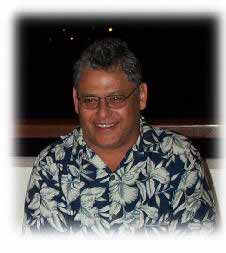
budget being similar to 2000. In closing, I would to register a deep personal loss and indeed the loss of a most
senior geologist in the Pacific region. Jackson Lum passed away mid-year finally losing the battle with cancer.
Finally, may I put on public record my appreciation to all stakeholders and in particular our development
partners who continue to support the Commission and through us our member countries.
Alf Simpson
Director
July 2002
5

































































S O U T H P A C I F I C A P P L I E D G E O S C I E N C E C O M M I S S I O N
Jane Mulryan, policy analyst and Pacific Regional
Coordinator in the Development Cooperation
Division of the New Zealand Ministry of Foreign
Affairs and Trade in 2001, began her short, but
fruitful, association with SOPAC in 1999.
"My role was to coordinate New Zealand's
relationship with Pacific regional agencies by
developing a greater understanding of their
activities and an overview of their place in the
region (including making the linkages with the
policies considered and approved by the Forum
Leaders, both at the Leaders' Meeting and other key meetings, such as the
Finance and Economic Ministers Meeting). Attendance at annual meetings
such as the SOPAC Council were important components of this position.
"SOPAC is a very important agent in delivering technical programmes that
make a difference to people's lives at the grassroots level in the Pacific. To
me, it puts the `human' face on science; which by its technical nature can
often be a complete mystery to non-scientists such as myself.
"SOPAC is unique in terms of the relationship it has with the wider scientific
community, and this interaction is one of its great strengths. Another strength
is the vision showed by current management in terms of articulating the
relationship between SOPAC's work programme and poverty alleviation, the
latter being key focus for donors in considering how best to allocate their
funding. I hope other agencies will emulate this approach. Other
groundbreaking activities that SOPAC has developed include the
environmental vulnerability index and the Pacific cities project, and New
Zealand considers these to be valuable contributions to the international
work on poverty and vulnerability.
"In the three years I have been dealing with SOPAC, I have noted a marked
improvement in its planning processes and reporting to Council. There is still
room to improve its processes of project design and proposal preparation,
and monitoring and evaluation, but I know the Director is aware of this and
looking at how it can be achieved.
"I have no doubt that SOPAC has matured into a professional organisation
that is addressing the needs of its members. It has the technical expertise to
deliver its objectives. My hope for the future is that it will continue to attract
appropriate levels of funding and build on these, expanding the donor base."
6
6


































































































WORK PROGRAMME REPORTS
W o r k P r o g r a m me R e p o r t s
MINERAL RESOURCES
The greatest event in the Secretariat's calendar for the year 2001, was the tragedy of losing Jackson
Lum, Marine Geologist and Head of the Mineral Resources Unit, who died on May 31, after a long
battle with cancer. Aside from the disappearance of his professional expertise his reporting and
administrative duties as Unit Head were sorely missed. The bulk of his Unit-Head responsibilities
were undertaken jointly by Craig Pratt (EVI Project Leader) and Robin Koshy (outgoing Resource
Economist), which included the annual report tabled here.
Investment for the development and exploitation of mineral resources can be extremely expensive
and usually carries a high financial risk for the investor. With several member countries at various
phases of mineral development; activities undertaken by the Mineral Resources Unit in 2001, were
for advice and specialist training primarily in mineral policy development and mineral potential
assessment and promotion. The need to strengthen national capacity and governance, as well as the
promotion of marine mineral scientific research to determine the potential of the vast offshore
areas of member countries was identified as priority areas.
Development of a regional capacity to manage deep-sea mineral information in island member
countries was boosted with the installation of a regional deep-sea mineral database under the
supervision of the JICA expert resident at the SOPAC Secretariat. Funding is currently being sort
from Japan for converting the database into a more user-friendly and standard format like MapInfo,
to allow the incorporation of other existing data sets. The promotion of the mineral potential of
member countries is expected to also be enhanced with the provision of readily-accessible data.
The JICA expert also drafted a master plan for an environmental impact study into deep-sea
hydrothermal deposits mining. This was in response to the rising interest in deep-sea mining and
emerging associated concern on its impact on the marine environment.
Secretariat staff at Jackson Lum's gravesite located at his hometown, Ba,
on the northwestern coast of Viti Levu, Fiji.
7

























































































S O U T H P A C I F I C A P P L I E D G E O S C I E N C E C O M M I S S I O N
A minerals promotional brochure was developed and designed for the Vanuatu
Government. It's publication is subject to Cabinet approval.
The Secretariat continued it's ongoing advisory role in mineral policy development work to requesting
member countries in 2001. An in-country workshop envisaged to review the Draft Fiji Offshore Mineral
Policy could not be carried out in 2001 for lack of funding support. A similar task for the Solomon
Islands was deferred to 2002 because of continuing political instability there. Other policy development
assistance carried out included the completion of all activities associated with a fair and comprehensive
policy for assessing compensation due to landowners from mineral development activities in Fiji. A draft
paper was completed and submitted for parliamentary consideration.
Mineral potential assessment and development work carried out in 2001 included the ongoing market
study of the supply and demand for gypsum, a task undertaken on behalf of the Republic of Kiribati; and
the study of international trends in the supply and demand for manganese, undertaken for the Cook
Islands. Field activities and data analysis were completed on the island of Banaba for the remaining
phosphate on the island. The advisory assistance to the Gold Ridge in the Solomon Islands was
suspended due to the closure of the mine, but is expected to be resumed if and when the mine
reopens. A drilling survey was also undertaken in conjunction with the Fiji Mineral Resources
Department at the Nasivi detrital gold potential in the vicinity of the Emperor Gold Mine in Vatukoula.
Final analysis is pending to assess the viability of developing this gold potential in Fiji.
The new three-year SOPAC-Japan Deep-Sea Cooperative Minerals Programme for the Cook Islands,
Fiji and the Marshall Islands completed its first cruise in Cook Islands waters. Planning and pre-cruise
training for the Fiji cruise was also completed.
Annual activities of the SOPAC Petroleum Data Bank based at the Australian Geological Survey
Organisation in Canberra included the completion of the production of CD Roms of available
information on Solomon Islands, Vanuatu, Fiji and Tonga. Updating, digitising, maintenance and
promotion of the data sets continued. Seven data requests were handled during 2001, three on the
Solomon Islands and two each for Tonga and Vanuatu.
Notable promotional activities of the Unit included the development of a brochure in conjunction with
the Vanuatu Department of Geology, Mines and Rural Water Supply for the Vanuatu mineral industry
and the completion of the compilation by external editors of the Pacific Exploration and Technology
(PET) 1998 Conference papers. All the elements for a super-gloss Vanuatu publication were submitted
to Vanuatu and its publication is pending and subject to Cabinet approval. The Pacific Exploration and
Technology (1998) technical bulletin to promote the mineral potential of SOPAC member countries is
expected to be published in the latter part of 2002.
8
































































WATER RESOURCES
WATER RESOURCES
Three-Year DFID Project comes on line
The signing of the DFID(UK)-funded " Water and Sanitation Specialist Project" in March 2001, was
a key event in the year for the Water Resources Unit. The project provides secure funding for the
Unit Head for the next three years. The new Unit Head, Clive Carpenter, took up his position in
April 2001.
The main objective of the DFID project is to assist Pacific island countries to improve the
sustainable management of their water supplies, sanitation and hygiene in the region, with emphasis
on targeting poverty alleviation and improving gender equality. The project has set aside funds for
regional and national consultation on strategic development, technical guideline preparation,
technical assistance and public awareness campaigns, in-country training, regional networking and
research. The total funding available for project activities from April 2001 to April 2004 is GBP
138,000 (F$ 450,000).
The project enables the development of regional strategies in water, sanitation and hygiene,
allowing SOPAC to prioritise its interventions in the region based upon international guiding
principles, and maximise the benefit of its activities to the region as a whole. Specific to this, the
Water Resources Unit undertook a review of all needs assessments completed in the region since
1994 and having identified the priority issues for the region, developed a strategic approach for the
SOPAC Water Resources Unit for the next three years, based upon the actions required to address
the needs and the capacity of the Unit to deliver these activities. The "Water, Sanitation and
Hygiene Strategies for SOPAC 2001-2004" were approved by Governing Council in the 30th Annual
Session and are available from the SOPAC library (SOPAC Miscellaneous Report 444). The
document contains an eight-point policy statement and details the seven strategic programmes of
work for the unit. These provide the framework in which all future work by the Unit will be
undertaken.
First Pacific region Wastewater Policy and Strategy completed
The other major achievement for the year was the design and facilitation of a year-long regional
consultation to develop a regional policy and strategic action plan on wastewater. As much as 80%
of all marine pollution comes from land-based activities, the majority of which are due to untreated
sewage. Two preparatory consultations in Auckland and Apia early in the year set the stage for
working groups to develop the input for a regional workshop for all stakeholders in wastewater
management that was held immediately before the SOPAC Governing Council 30th Annual Session
in Majuro, Republic of Marshall Islands.
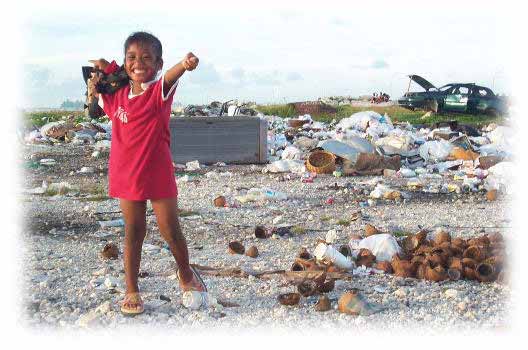
Girl playing between the rubbish on the small island of Ebeye, Republic of the Marshall
Islands.
9
















































































S O U T H P A C I F I C A P P L I E D G E O S C I E N C E C O M M I S S I O N
The Workshop was co-hosted with UNEP
(Global Plan for Action), Pacific Water
Association and the South Pacific Regional
Environment Programme and organised
specifically to develop a regional Framework
for Action to address the major concern of
wastewater pollution of river and marine
ecosystems, and its increasing impact on
human health. The meeting was attended by
fifteen Pacific island countries,
representatives from CROP, WHO,
UNESCO, UNEP/Global Plan for Action and
additional resources persons from Australia,
new Zealand and the United States. The
meeting was highly successful with the first
ever regionally endorsed Pacific Wastewater
Policy Statement and Pacific Wastewater
Framework for Action. Other outcomes
included the recommendations for a Pacific
Wastewater Focal Group, which is now
being developed by SOPAC. Both
documents were subsequently approved by
the SOPAC Governing Council.
The policy and strategy not only represent
an agreement to the regional activities
Wastewater system on Banaba, Kiribati.
required to achieve sustainable wastewater
management, and thereby form the future
work programme for SOPAC in wastewater and sanitation, but also provide a catalyst to action for
individual national countries and map out the areas to be addressed and possible solutions required
to successfully manage the increasing problem of wastewater in the island environment.
World Water Day 2001 `Water and Health" hailed another success
Yet again SOPAC took the lead role in organising the regional preparations for the annual World
Water Day celebrations in the Pacific. Celebrated each year on 22 March, this year saw the Water
Resources Unit in Samoa to coincide with the Pacific Water Association annual general meeting.
Generously supported by the staff of the Samoa Water Authority, the activities in Samoa included
public awareness raising events at local schools and the launching of the region-wide school poster
competition.
A prize giving ceremony for the regional competition was held later in the year at SOPAC, and was
attended by His Excellency Michael Price, the British High Commissioner to Fiji. Over five hundred
entries had been received by national co-ordinators before selecting the top hundred to be
considered by the SOPAC staff. The overall winner came from Samoa. The public awareness
generated by the prize giving ceremony itself has already successfully secured funds for a more
ambitious World Water Day campaign next year.
Further highlights from the strategic work programme areas are presented below:
WATER DEMAND MANAGEMENT
Hydraulic Modelling
Preliminary work commenced in the Cook Islands, Fiji and Vanuatu, to provide assistance on the
review and development of modelling approaches of water supply distribution systems. This
method uses advanced computer techniques to assess the efficiency of systems and can be used to
assist with leakage reduction and general asset management.
Training has been provided to counterpart staff in the Public Works Department, Fiji and the Rural
Water Supply section of Department of Geology, Mines and Water Resources, Vanuatu.
10










































































WATER RESOURCES
Leakage Detection and Assessment
The successful three-year capacity building
programme in setting up national Water
Demand Management Units in national
utiltities continued. Notably Majuro Water
and Sewage Corporation were assisted in
the development of in-house expertise.
Rainwater Harvesting
A water-supply GIS was created for Funifuti
to enable the Tuvalu Public Works
Department to more effectively manage
their input to maintaining and redesigning
roof catchments to overcome drought
periods. This work has already resulted in a
follow-up two projects with UNEP, located
in Tonga, which will look at water quality
and community participation aspects of
rainwater harvesting.
WATER RESOURCES MANAGEMENT
Water Resources Assessments
Groundwater resources assessments were
completed on Banaba Island, Kiribati, on
Majuro Atoll, Marshall Islands, to assess the
viability of abstracting groundwater
compared to rainwater harvesting and to
improve the management of the freshwater
Boy fetching water at the "Oasis", a communal
lens through the drought periods,
distribution point for desalinated water on
respectively. Technical support was also
Ebeye, Republic of the Marshall Islands.
provided to international researchers
working with the Fiji government in
northern Viti levu.
The Water Resources Unit also designed and ran the Hydrogeology Modules of the BSc Applied
Geology at the University of the South Pacific. Twelve students from five countries attended the
course.
Water Quality Data Management
SOPAC staff have been developing a water quality database, for use of regulators, environmental
protectors and water suppliers alike, to enable better management of resources and operation and
maintenance of supply systems. The database was successfully installed in both the Environment
Protection Agency and Majuro Water and Sewage Corporation in Majuro, Marshall islands, and the
Department of Geology, Mines and Water Resources in Vanuatu.
SANITATION AND HYGIENE PROMOTION
School Awareness Materials
In addition to the Pacific Wastewater Consultation and World Water Day events, a Water Education
and Awareness Kit for Schools has been developed in conjunction with SPREP. The first draft of the
kit was completed and approved for circulation on a limited basis to test their applicability and
relevance. The kit is currently being piloted in a selection of schools in the region, and other
relevant organisations.
Sanitation Assistance
Technical and logistical assistance was provided to the Environment Protection Agency staff on
Ebeye, Kwajelein Atoll, Marshall Islands, in the review of wastewater management on the island and
the need for improved hygiene awareness and promotion campaigns.
11










































































S O U T H P A C I F I C A P P L I E D G E O S C I E N C E C O M M I S S I O N
ENERGY
One of the highlights of 2001 would have to be the involvement in preparing a regional position
paper on energy for submission to the Commission of Sustainable Development 9th Session (CSD9)
process in New York in April 2001 and its adoption as a background paper.
The SOPAC Energy Unit along with the Pacific island countries provided technical support to the
Pacific island missions in New York during the CSD9 negotiations. The CSD 9 paper has become a
"blueprint" for the energy sector and has helped the region towards the primary goal of
contributing to the global agenda of sustainable development. This sound basis provides a platform
for the SOPAC Regional Energy Programme.
Regional Energy Policy At CROP's thirteenth meeting in Apia, Samoa from 22-23 May 2001, it
was directed that the Energy Working Group develop a Regional Energy Policy. SOPAC through the
CROP Energy Working Group is assisting with the preparation of a Regional Energy Policy.
It is proposed that the draft policy will be made available to Meetings of the CROP organisations
and at the Regional Energy Meeting scheduled for mid 2002. The policy will also be used as a basis
for discussions and preparations for the World Summit on Sustainable Development on from 26
August to 4 September at Johannesburg, South Africa.
Energy Resource Assessment Monitoring and assessing the indigenous energy resource
potential of the region and determining the feasibility of development and utilisation is a prime area
of interest as this will assist in leading towards more extensive use of renewable energy sources and
sustainable development. There have been many technological developments in the utilisation of
ocean-based energy resources, wind, biomass and land-based energy resources such as geothermal
for power generation. The development of these potential new initiatives is constrained by the
unavailability of monitored and assessed data.
In light of this, SOPAC continues to support wind resource monitoring, has commenced a regional
biomass resource assessment programme and developed with the US Geothermal Industries a
terms of reference seeking funding for an exploratory deep drilling programme to confirm the
resource.
Energy Conservation and Efficiency Energy conservation and efficiency programmes are an
essential component of the Unit's programme. They have a significant impact on economic and
social development within a country and have the ultimate goal of reducing energy bills and
detrimental environment impacts. SOPAC through its small energy projects programme has
provided funding assistance to member countries in support of their national energy conservation
and efficiency activities. With the increased awareness on the impact of climate change and climate
variability at a regional and global scale, SOPAC is developing a concept paper on energy
conservation and efficiency for submission to GEF for funding.
I-Kiribati children collect firewood and coconut residue for domestic use.
Biomass still plays a vital role in meeting the energy needs of the domestic sector
in the Pacific islands.
12























































































ENERGY
In addition, a Demand Side Management (DSM) programme has been developed to review
previous DSM studies and design, and implement at least two DSM demonstration projects. This
will build on previous work carried out under an earlier UNDP programme where the DSM
potential was identified in ten Pacific island countries. Based on these studies and the current need
to address the reduction of greenhouse gas emissions it is considered relevant to revisit this
potential area of energy savings. A consultant has been identified and it is anticipated that the
project will commence in mid 2002.
Pacific Danish Environmental Education Programme As a result of a feasibility study carried
out in the region in 1997, the Danish government through the UNEP Collaborative Centre on
Energy and Environment indicated interest to fund this programme. The programme will involve
the installation of a grid-connected demonstration wind turbine, a regional workshop and the set up
of a post-graduate course in wind energy at the University of the South Pacific. Arrangements for
the wind turbine site have been finalised with the Fiji Islands government. Course modules are
currently being developed with the University of the South Pacific. It is anticipated that the
commissioning of the wind turbine will be carried out in July 2002.
The project will assist member countries with the development of their wind power programmes
through training and capacity building.
In addition to the above key activities, there are ongoing projects that the regional energy
programme continues to provide assistance to member countries. These are:
·
Energy Information Awareness and Dissemination
·
Technical Assistance on Energy Supply and Demand Database
·
Energy Technology and Information Database
·
National Energy Policy Guidelines and Statement, and Rural Electrification Policy
·
Training and Technical Assistance
·
Regional Earth Day Programme Schools Energy Education
·
Pacific Regional Energy Assessment 2000
·
Regional Energy Meeting 2002 and
·
Small Energy Projects Programme
Earth Day 2001 Essay & Poster competition for schools in the Pacific Islands drew an
overwhelming response from students in the region.
13

































































S O U T H P A C I F I C A P P L I E D G E O S C I E N C E C O M M I S S I O N
Vitolio Lui, Deputy Secretary for Foreign Affairs for
the Government of Samoa (at the time of writing),
began his long association with SOPAC way back in
1980 when he was one in the group of regional aid
coordinators that participated in UN processes that
allocated UNDP regional aid that financed the
activities of UN projects, one of which was converted
to SOPAC. He became more intimately involved with
SOPAC affairs from 1991, when his regular attendance
at SOPAC annual meetings began.
"When I first attended a SOPAC Session, the documentation was not well
organised and often difficult to follow. Governance policies and guidelines
were basic or not documented and financial and staff regulations were
inadequate. As a result, meeting procedure and organisation was not always
orderly or helpful. The Council meeting record was fragmented and so brief it
was sometimes shorter than the list of participants. The work programme
was clustered around disparate national requests without apparent
framework or theme. Suggestions for change were not often welcome.
"It has been my pleasure and satisfaction to witness over these years,
particularly in recent years, the SOPAC Council and Secretariat transform
from the above, to an organisation whose work programme has grown in
resources and sophistication to one of the largest and versatile in the region
and whose documentation is among the best presented, transparent and
readable. Governance procedures are now well documented, transparent and
modernised. The Council's record of proceedings is now one of the most
comprehensive and educational references among CROP agencies.
"The Secretariat, once timid to entertain change is now initiating change.
SOPAC's work, ranging from coastal mapping and protection to electronic
communication and the use of satellite images, is valued both regionally and
internationally. SOPAC has truly come of age.
"The Secretariat is now pretty much established in terms of process,
capability and resources to move ahead with confidence. The Secretariat,
nevertheless would have to remain vigilant in maintaining its professional and
achievement orientation. Management should constantly review its ethics to
ensure that in carrying out the organisation's work, it adheres and respects
the organisation's policies and regulations.
"Staff should never lose sight of the fact that they are in SOPAC to serve the
needs and priorities of generally very poor island countries and not their
own."
14
14






































































COASTAL
CO ASTAL
Understanding the physical and environmental processes that influence the sustainability,
management and protection of coastal resources is fundamental to development.
The management of coastal areas is of considerable concern for the region. For many islands land is
an extremely valuable and scarce commodity. However, the development of coastal structures, and
modification of the coastal environment without proper knowledge of how these alterations will
affect the area, has resulted in coastal erosion and degradation. Underpinning this degrading of the
natural environment, it appears that many island administrations and populations do not have a
scientific understanding of the dynamic processes that build and sustain their islands. In other words
the nature of coastal zones, the diversity of users and the range of activities the coastal programme
supports, presents a complex and varied management problem. Much, if not most, of the coastal
development undertaken today requires higher resolution bathymetry to better characterise the
littoral oceanographic processes and hazards to navigation. The integration of high-resolution
imagery to build a seamless geographical information system that encompasses whole island systems
provides a fundamental tool for planning and development in a sustainable manner.
During the year ties were forged with the AusAID-funded regional tide monitoring project
currently administered by Australian Marine Science & Technology Limited. The Coastal Unit's
technical resource personnel who undertook unit activities in 2001, were provided by Australia, the
People's Republic of China, the Commonwealth Secretariat and the Korea Institute of Geology,
Mining and Minerals.
SOPAC's marine geophysical capability is dedicated to the region to carry out detailed, continuous
bathymetric and seismic reflection profiling, as well as sediment sampling, current measurements
and temperature-density-salinity spot profiles; and high-resolution swath mapping, using state-of-
the-art multi-beam echo sounders. Capacity is now available and able to delineate a complete
underwater landscape with greater accuracy and in a fraction of the time required to use the single-
beam echo sounder.
During the reporting period eight field surveys were completed in Cook Islands, Fiji, Federated
States of Micronesia, Kiribati, Nauru and New Caledonia. The complex and varied nature of the
coastal zone and its uses is reflected in the diverse range of activities completed during the year.
These included the geophysical and geological phases of an outfall study, a geophysical study for
port development, a survey to quantify sand resources, a sedimentation study in a bay for harbour
development, an equipment support for a flood-alleviation study and the preparation of equipment
for a coral reef monitoring programme.
Multi-beam sidescan imagery from a pearl farm in Manihiki Lagoon, Cook Islands
showing clearly the anchor lines and oyster-carrying chapplets suspended in the water
column. Such data can be used to gauge farming density in a environment which is
normally hidden from view.
15












































































S O U T H P A C I F I C A P P L I E D G E O S C I E N C E C O M M I S S I O N
Coastal programme activities for 2001 included:
·
The upgrading of the interactive graphical ocean database system to a Microsoft access
database format for archiving water quality conductivity, temperature and pressure data from
within the region.
·
Updating the regional shallow-water bathymetry database with multibeam survey data from
Cook islands, Fiji, New Caledonia and Vanuatu.
·
Addition of a new Triton tide level, doppler current and wave gauge to upgrade ocean and
coastal survey capabilities.
·
Completed a major field programme for the formulation of an island system management
database
for Manihiki Atoll in the Cook Islands.
·
Completed a coastal erosion assessment for Tagaqe, Village on the coral coast, Nadroga, Fiji.
·
Completed a series of seabed surveys to aid the design and replacement of the Kinoya seabed
outfall for the city of Suva, Fiji.
·
Completed a multibeam survey for the Port of Suva development plans for Rokobili as a new
port terminal.
·
Completed a sand resource assessment for the supply of carbonate for the production of
Portland cement in Fiji.
·
An evaluation of sedimentation problems in the port of Draunibota Harbour, Suva, Fiji.
·
A coastal erosion assessment for Malem, Kosrae in the Federated States of Micronesia was
completed through assistance from the People's Republic of China.
·
Completed a vulnerability assessment for Pohnpei the Pacific Islands Climate Change
Assistance Programme coordination.
·
An assessment of vulnerability to accelerated sea-level rise in South Tarawa was completed
through assistance from the People's Republic of China.
·
Project funding secured and terms of reference formulated for a project dealing with offshore
sand recovery and environmental impacts in Majuro, Republic of the Marshall Islands.
·
A series of maps depicting detailed bathymetry of Nauru was compiled from multibeam
data.
·
A coastal erosion monitoring programme and advice on response strategies was completed for
the State of Nauru with assistance from the People's Republic of China.
·
Monitoring and assessment of the Anibare Small-Boat Harbour Development project was
completed with assistance provided by the Commonwealth Secretariat.
·
A multibeam survey of the lagoon and forereef slope of Cap Bocage, near Moneo was
completed for route planning and design for a submarine tailings outfall.
·
A report detailing an assessment for marine aggregate resources and sand mining in Vava'u,
Tonga was completed.
The seabed of Manihiki Lagoon based on multibeam bathymetry data showing depths from 0
to 70 metres. The "honeycomb texture" of the lagoon seafloor is a result of a complex set of
climate, tectonic and hydrologic processes.
16





































































HAZARD ASSESSMENT
HAZARD ASSESSMENT
While reporting on the various tasks of Pacific Cities was the major emphasis of the Hazard
Assessment Unit's work load for the year, the forward-looking integrated risk management
approach throughout the Secretariat and the SOPAC region was the main guiding principle for the
presentation of the data collected so far. The concept progresses the Pacific Cities into the new
phase of using the accumulated data to analyse risks and presenting scenarios for reducing
vulnerability in each city. The activities of the ongoing Pacific Cities programme therefore form a
subset of the CHARM programme (see the report under Disaster Management for an introduction
to the CHARM programme).
In 2001, as part of the integration of all hazard identification and risk analysis activities with disaster
mitigation and training activities, a number of presentations were made at various local, regional and
international conferences, workshops and venues. The presentations were to promote results, raise
awareness and develop collaborative ventures in the Pacific cities themselves, among development
partners in Asia and the Pacific; and to potential donors.
A comprehensive hazard and risk assessment was conducted on the Mele Bay area, Vanuatu, as a
demonstration project of the integrated scientific-traditional community approach to strengthening
resilience in member countries. The comprehensive assessment included conducting a GPS land
survey, an aerial photo survey and a preliminary building assets survey of the study area in
preparation for aerial photography/digital elevation modelling. Field survey results were combined
with climate, geophysical and other relevant historical data sets to carry out various modelling
scenarios for the area. This integrated scientific approach is expected to be combined with a
traditional community approach to improve the resilience of the community to natural disasters.
Within the broader context of disaster mitigation, the Mele Bay study is the pilot project in the
Pacific for a comprehensive scheme, being developed by the World Bank, for the provision of
insurance for catastrophic events in developing countries.
In the reporting activities for the five cities of the Pacific Cities Project, data CDs were published
and distributed for Suva, Port Vila, Honiara, Apia and Nuku'alofa. The Second Edition of the
Geophysical Institute of Israel/USAID study: "Site-Specific Earthquake Hazard Determinations in
Capital Cities in the South Pacific" was also published and released for distribution.
Suva hosted the SOPAC Regional Workshop on Building Safer Urban Communities. Additional work
in Suva, included compilation of a bathymetric database for Suva Harbour. An earthquake
microzoning report for Apia was prepared along with digital elevation model and orthophoto. Aerial
photography was also conducted in Apia during the period. Risk analysis work in Nuku'alofa
included completing a building assets survey for the city. Port Vila and the Mele Bay areas in Vanuatu
were well covered with bathymetric database compilation and various models developed for
different aspects of risk to the community and other assets. Tasks were carried out in conjunction
with the ongoing work under the `catastrophe insurance' and `strengthening community resilience'
concepts of the Unit's work programme for 2001.
Surveying building assets in Nuku'alofa. A Tongan surveyor being
shown how to use the GPS equipment.
17





































































S O U T H P A C I F I C A P P L I E D G E O S C I E N C E C O M M I S S I O N
OCEAN
The signing by Australia and the Secretariat of a Letter of Agreement for the inception phase of the
Maritimes Boundaries Delimitation Project was a key event in the year for the Ocean Unit. Regional
decision makers deemed the Maritime Delimitation Boundaries Project better housed at SOPAC
than at the Forum Fisheries Agency given that the main mechanism for delimiting boundaries is
geoscience, as opposed to bioscience. As the primary donor for this fundamental yet visionary
initiative, which seeks to assist Pacific States to define maritime and extended continental shelf
boundaries to declare sovereignty and secure access to known and potential economic marine
resources, Australia is commended for continuing it's commitment to the Project.
Under SOPAC's mandate to coordinate Law of the Sea related issues in the SOPAC region, the
Director of the SOPAC Secretariat was re-elected to the Legal and Technical Commission of the
International Seabed Authority. In addition to this, a number of papers were prepared and
presented at international fora on behalf of the region. These included two papers prepared and
presented in May at the Second UN Informal Consultative Process on Oceans and the Law of the
Sea one on "Initiatives and Priorities of Ocean Issues in the Pacific Region" and the other was "A
Pacific Model for Improving Structure and Effectiveness in Marine Science and the Development
and Transfer of Technology." The Ocean Unit was also heavily involved in the drafting of "A Pacific
Islands Regional Ocean Policy" by the CROP-Marine Sector Working Group.
Further highlights from the 2001 Ocean Unit tasks are presented below under the following three
components: Ocean Observing Systems; Marine Scientific Research; and, Maritime Boundaries
Delimitation.
Ocean Observing Systems
Collaboration and cooperation continued with international (global) ocean observing systems
(GOOS) such as the Triangle Trans-Ocean Buoy Network and the International Argo Project to
facilitate buoy and float deployment, maintenance and data retrieval and accessibility in the SOPAC
region. Representatives from Fiji, Papua New Guinea and Kiribati attended a training workshop in
Japan, in February, on ocean observing systems in the West and Central Pacific Ocean region. The
representatives of the same countries who attended the earlier ocean observing system workshop
with the addition of representatives from the Marshall Islands, the Federated States of Micronesia
and the Secretariat attended a further Argo science-planning meeting for the Pacific Region, in
Japan, in March.
PacificGOOS activities in line with the global objectives of GOOS for developing a regionally
relevant, global ocean observing system that is sustained and integrated, saw a draft PacificGOOS
Strategic Plan completed; the strengthening of current relationships; and the signing of a
Memorandum of Understanding as a partner to SEREAD. SEREAD is a pilot PacificGOOS project
for awareness raising of Argo floats in selected Pacific secondary schools. These PacificGOOS
initiatives resulted from recommendations of the "Regional Workshop on Coastal Global Ocean
Observing System for the Pacific Region" held in Apia, in August 2000.
The location of autonomous Argo buoys as of July 2002. The buoys have been deployed as
part of the International Argo Project. [Source: http://argo.jcommops.org]
18


































































































OCEAN
Regional participants with their Japanese hosts and instructors at the month-long workshop on
the Asia/Western Equatorial Pacific Ocean Study Network organised by the Japan Marine
Science and Technology Centre.
As potential contributions to the global ocean observing system or GOOS products and services,
new initiatives and proposals were developed for long-term environmental monitoring in various
lagoons in the Cook Islands, Fiji and Kiribati.
Marine Scientific Research (MSR)
A regional workshop to discuss marine scientific research issues and the broadening aspects of the
responsibilities of participating states in managing their exclusive economic zones was
recommended by the 29th Session of the Governing Council. Funding for the workshop was sought
and secured from the Korean Ministry of Ocean and Maritime Affairs and Fisheries, the Metal
Mining Agency of Japan, the Japan Marine Science and Technology Centre and the Government of
Papua New Guinea, and the workshop convened in Port Moresby in Papua New Guinea in
February-March. The three-day workshop provided an appropriate forum for all stakeholders,
wherein key issues of concern in marine scientific research were addressed through constructive
dialogue between SOPAC coastal states and organisations from researching states.
Recommendations to resolve these issues were agreed to by workshop participants as the proactive
way forward.
Further to this initiative, a Pacific Islands Regional Marine Scientific Research Guidelines paper was
prepared; a review of the current SOPAC Marine Scientific Research cruise database was
undertaken and coordination of cruise activities in the region were provided for cruise initiatives in
Kiribati, Fiji, Papua New Guinea, Vanuatu and the Federated States of Micronesia. Reports on both
the marine research guidelines and the review of the cruise database are logged as miscellaneous
reports at the Secretariat.
It is a requirement, under provisions within UNCLOS, for all research organisations undertaking
geoscientific research activities within the exclusive economic zone of a coastal State to seek their
consent to conduct research activities, to invite onboard participation and, to furnish copies of data
collected during, and reports produced following, the research cruises.
19








































































S O U T H P A C I F I C A P P L I E D G E O S C I E N C E C O M M I S S I O N
Maritime Boundaries Delimitation
The Maritime Boundaries Delimitation Project Design Document (MBD-PDD) was completed with
the technical assistance of AusAID. Their independent appraisal was received, with advice that an
inception phase was required before approval for full project implementation would be considered.
The inception phase mainly involved the effective transfer of existing data and information from the
Forum Fisheries Agency to SOPAC; a review and comprehensive inventory of FFA outputs;
independent quality assurance and control of existing data and information; stakeholder
consultation to gauge commitment and determine priorities of project activities; finalisation of the
project design document; and, security of co-financing partners. As the inception phase of the
MBDP required the recruitment of a project co-ordinator, the position Manager-Ocean Affairs was
advertised, with the position to be filled January 2002.
Programming arrangements, through inclusion as a key activity within the MBD-PDD as the
renewal of former effective partnerships, were put in place to facilitate the enormous task of
updating the Regional Bathymetry Map of the Southwest Pacific Region. First published nearly
twenty years ago in 1983 and with more than 10,000 maps in circulation, the update of the regional
chart is long overdue. The increased SOPAC membership since 1990 to cover the Central-West
and Northern Pacific; the vast volume of accessible digital data; the increased use of state-of-the-art
seafloor mapping technology; and the existence of sufficient staffing and resources within the Ocean
Unit, are factors that make it timely and appropriate to update the chart. The update will expand
the geographic scope of the chart and incorporate the latest digital data and technology. The chart
will be a vital resource for fishers, managers of harbours and ports, researchers and developers of
both the extractive and non-extractive resources in the SOPAC region.
Data collection to facilitate the preparation of preliminary claims for extended continental shelf
jurisdiction is underway for several SOPAC member countries. Claims by participating states are to
be based upon sound geological, geophysical and bathymetry evidence. To this end, it was an
indispensable first step to collect, collate and assess all existing data and information on the areas in
question, to properly justify claims to extended continental shelf jurisdiction by member states.
While collation of data and information have commenced for the Federated States of Micronesia,
Fiji, Papua New Guinea, Solomon Islands and Tonga, only Tonga has progressed to a near-complete
desktop review. Aside from drawing on their bilateral NZODA funds to support the desktop study,
the Government of Tonga also sought NZODA support to acquire 130-line km of deep multi-
channel seismic data, in support of their extended continental shelf claim. A confidential report was
prepared and a meeting was held in Tonga in June to discuss the findings of the preliminary desktop
study.
As a complementary task to justifying preliminary claims to extended continental shelf jurisdictions,
collecting and evaluating all existing geological data and information, as well as assisting States
through the claims preparation process, has been programmed into the Maritime Boundaries
Delimitation Project.
The Hakurei Maru No. 2 owned by the Metal Mining Agency of Japan, which successfully
drilled polymetallic massive sulphide mounds in the North Fiji Basin, during its research
campaign in December 2001.
20


































































Yves Lafoy, a public servant of the French territory of New
Caledonia, is a geologist by profession. He has had an
association with SOPAC since 1991, the same number of
years that New Caledonia has been Associate Member of
SOPAC.
"The Associate Membership in SOPAC was desired by the
authorities in New Caledonia to maintain a presence in the
southwest Pacific region through the sharing of scientific
and technical expertise between member countries. In
support of this, New Caledonia established a specific work
programme within the framework of its associate membership that would
neither diminish the resources of the other member countries nor overload
the Secretariat.
"Apart from the technology [sharing], New Caledonia wanted to benefit
from SOPAC's expertise in the lagoonal areas within the Pacific. We paid
SOPAC for surveys conducted in 1999, because we did not have the
technology in the country at that time.
"Within the ZoNéCo programme that aims at assessing the non-living and
living resources of New Caledonia's EEZ, the lagoon area remains under-
explored.
"We are mainly interested in: locating potential sites for submarine tailings
outfall; and identifying carbonate resources (onland and nearshore) to
chemically neutralise nickel tailings.
"Our expertise that could be shared with other SOPAC member countries
are
·
non-living and living resources assessment expertise (ZoNéCo
programme);
·
environmentally-friendly mining (nickel); and
·
training (mining, remote sensing, marine geology) through linkages
between SOPAC, USP, University of New Caledonia, Institute de
Recherche pour le Developpement and Service des Mines et de
l'Energie."
21
21































































S O U T H P A C I F I C A P P L I E D G E O S C I E N C E C O M M I S S I O N
INFORMATION TECHNOLOGY
In 2001, the Information Technology Unit (ITU) continued its focus on the two task development
areas of Information and Communication Technologies (ICT) and GIS and Remote Sensing that
were originally rationalised in 2000.
Information and Communication Technologies The most important activity during 2001 was
the Pacific Regional ICT Strategy meeting organised jointly with The Secretariat of the Pacific
Community and the Forum Secretariat. Held in Nouméa in August 2001, the meeting drafted a
regional ICT plan for submission to countries. Meanwhile the work of ITU inside the CROP ICT
Working Group has increased to be able to prepare recommendations and directions for the
Telecommunication Minister meeting in April 2002.
ITU is also participating in international fora such as the Internet Society (ISOC) annual meeting
INET2001 and ICANN meetings. The participation of ITU, presents ICT issues faced by Pacific
Islands, and allows these advisory boards to steer ICT development with Pacific Islands' issues in
mind.
ITU also participated in the development of many network infrastructures in our member
countries, the most visible example is the continuous support to the Internet Service Provider
managed by the Tuvalu Government, and the inter-departmental network of the Kiribati Ministry of
Natural Resources Development.
In terms of conferencing, ITU has acquired wireless technologies, which allow participants to
SOPAC conferences to check their e-mail and surf the Internet from their laptop, from anywhere
inside the conference room.
ITU has been studying the emergence of new Open Source software to be used in Pacific Islands.
GNU/Linux operating system has been deployed in SOPAC and in some countries to leverage the
cost of proprietary software solutions as well as to increase the resilience of organisations against
attacks and viruses. Further exciting developments in this area are expected.
SOPACNet A schematic diagram of the Local Area Network/Wide Area Network for the
SOPAC Secretariat and Fiji Internet Group.
22










































































INFORMATION TECHNOLOGY
ITU is still supporting the Fiji Internet Group to provide affordable Internet access to developing
partners in Fiji. This is an important aspect of the role of SOPAC in being able to communicate and
report effectively with its member countries.
Finally ITU has increased the development of its international image by enhancing its web site
(www.sopac.org), putting more databases online, more reports, more maps and creating a forum
for broad stakeholder participation in the activities of SOPAC. Participation of Pacific Islanders in
the day-to-day activities of SOPAC will increase.
GIS and Remote Sensing ITU is continuing the promotion of Geographic Information Systems
(GIS) and Remote Sensing technologies throughout the region by organising several workshops in
the Federated States of Micronesia and the Marshall Islands, publishing the GIS & Remote Sensing
Newsletter in collaboration with the University of the South Pacific and finally with the acquisition
and processing of high-resolution satellite images (4 m to 1 m ground resolution).
This last activity has largely increased during 2001 and is now a major component in many of
SOPAC activities. ITU is working closely with the Pacific Disaster Centre to share imagery of the
region.
The two workshops and developments in Federated States of Micronesia and Marshall Islands were
focused on vegetation-change mapping using IKONOS satellite imagery as well as historical aerial
photography.
Using GIS and Remote Sensing technologies, ITU has compiled several image backdrops to be used
digitally in many Pacific Islands.
ITU has also worked with the Fiji Meteorological Office to develop expertise in tracking cyclones
and displaying and communicating climate changes via GIS.
Amazing new developments ITU participated actively in re-organising SOPAC through the
building of the new SOPAC Corporate Plan. The unit will now be part of the Community Lifelines
and Corporate Services key programme areas, while having impact in all other key programme
areas. This new re-organisation will allow ITU to respond more effectively to member countries
requests in ICT or GIS and Remote Sensing.
In the same manner, the role of ITU has been essential in drafting some of the components of the
SOPAC/EU project on Island Systems Management. This new SOPAC initiative will provide
member countries better access to accurate and timely information necessary for the management
of their ecosystems and resources via the use of imagery acquisition, data warehousing and
communication systems to ensure all stakeholders have seamless access to relevant information.
IKONOS satellite image of the Outrigger Hotel, Majuro, Marshall Islands, pan-sharpened to
1-m resolution on the ground.
23




















































































































S O U T H P A C I F I C A P P L I E D G E O S C I E N C E C O M M I S S I O N
DISASTER MANAGEMENT
Meeting the challenge
The second year of the Disaster Management Project provided a number of challenges for the staff
at the Disaster Management Unit (DMU) as we continued to advocate for and support a broader
approach to disaster reduction and risk management within the region.
The size of the challenge becomes clear to anyone who is familiar with the size of the Pacific and
just how isolated and vulnerable our communities are to the many hazards and risks that exist in
this part of the world.
The Development of CHARM
One of the major activities for the DMU has been in assisting Pacific Islands Countries to develop an
improved disaster reduction capability through the adoption of an integrated and whole of country
approach to risk management, which is defined as Comprehensive Hazard and Risk Management
(CHARM). CHARM is essentially a programming tool within the context of an integrated national
development planning process.
The development of CHARM in the Pacific is consistent with the regional vision of overcoming
vulnerability to the effects of natural hazards, environment damage and other threats and very much
aligned to the United Nations International Strategy for Disaster Reduction initiative. Charm has
been developed through a consultation process with stakeholder countries and is currently being
introduced in Kiribati, Fiji, Tonga and Vanuatu.
Australia and New Zealand have provided the initial support funding for CHARM however; as
national risk reduction priorities are identified through the use of this tool other international donor
support will be required.
In partnership with the Queensland Department of Emergency Services Counter Disaster and
Rescue Services Division the DMU have developed CHARM regional guidelines, which will assist
Pacific Island Countries to adopt and implement this broader community risk management
approach.
Community risk management programmes that are linked to hazards and their impact on
development programmes and community resilience are cross cutting and therefore require the
integrated support and cooperation of national governments, regional organisations, NGOs and in
many cases the private sector to be successfully implemented.
The Honourable James Cecil Cocker, Minister for Works and Disaster Relief Activities,
launching the first of the CHARM workshops: Sensitisation and Strategic Planning Workshop
at the Kahana Resort, Tonga.
24
































































DISASTER MANAGEMENT
The CHARM programming approach will therefore:
·
Intrinsically link development priorities and programmes of individual countries
·
Clearly identify gaps within existing or proposed country project activities
·
Enable SOPAC to work closer with its regional partners and to develop the Community Risk
Programme annual work plan and activities schedule around clearly identified country needs
and
priorities
Community risk management, using the CHARM approach, is a new concept that requires training
and skills enhancement of national development planners and disaster managers. The potential
benefits are a systematic process for analysing and evaluating risks in all development programmes.
The concept of CHARM has the endorsement of the SOPAC Member Countries and therefore
international donors will be encouraged to support its successful implementation over the next
three to five years as a mechanism for strengthening community resilience and enhancing
sustainable development in the region. To assist Pacific Island countries to implement this
programme, CHARM regional guidelines have been developed.
During 2001 the development of CHARM gained momentum on many fronts.
·
It is being introduced in-country through three separate Workshops CHARM I Sensitisation
and Strategic Planning, CHARM II Multi-Agency Introduction to the CHARM Tool, and CHARM
III Programming Follow-Up.
·
Workshops were conducted in Tonga and Vanuatu and, as they were the first in this new
initiative, they really served more to assist in the consolidation of the development processes
of the Regional CHARM Guideline. As an outcome of the Vanuatu workshop, work started on
the development of a "How-To Manual" to adapt the regional CHARM guideline for Vanuatu
national use. Staff from the Queensland Department of Emergency Services have been
heavily involved with the CHARM guideline development.
·
Presentations on CHARM introducing it to high-level official members of the National Disaster
Management Committee were undertaken respectively in the Marshall Islands and Palau.
·
The draft Regional CHARM Guideline was finalised in September at the 10th Pacific Disaster
Management Meeting and the decision subsequently endorsed by SOPAC Governing Council.
The Guideline has since been prepared to be ready for printing early in 2002.
·
Following the growing success in strategic partnership with Queensland Department of
Emergency Services, Australia, approaches were made to New Zealand and Hawaii. A
presentation of SOPAC and DMU programmes to the New Zealand Ministry of Civil Defence
and Emergency Service in mid-December was successful in obtaining support for New
Zealand involvement in DMU regional programmes, particularly CHARM implementation.
Memorandums of Understanding are being drafted to delineate the areas of mutual support
and cooperation.
·
In November a high-level advocacy team consisting of Dr Langi Kavaliku, Tonga and Roger
Jones, Australia were appointed to assist the DMU to promote the concept of CHARM to
national governments.
·
The development of the Public Safety Risk Management Course will provide formal training in
the concepts of CHARM.
Professional Development Activities
Establishing a sustainable capacity to design, implement, manage and evaluate national disaster and
risk management programmes will only be achieved by enhancing the existing skills and
competencies of disaster reduction practitioners. The DMU Professional Development programme
has specifically targeted the following areas of capacity building:
·
A Comprehensive training needs analysis has been conducted and training and development
gaps have been clearly identified.
·
All existing training courses have been reviewed, new courses are being developed, and a
number of work-study and training opportunities have been provided.
Negotiations are currently taking place for professional development courses to be
institutionalised within recognised training establishments.
·
An annual evaluation of national capacities will commence in 2002.
25


















































































S O U T H P A C I F I C A P P L I E D G E O S C I E N C E C O M
DISA M I S S I O N
STER MANAGEMENT
Representatives of SOPAC and partner organisations at the Australian Emergency
Management Institute to develop the Pacific Public Safety Risk Management Course.
Training Needs Analysis
A major achievement during 2001 was the completion of a comprehensive professional
development training needs analysis. This was conducted by Dr Joe Griffin from Australia and
copies of his findings have been provided to member countries to assist with the human resource
capacity building process for disaster management practitioners in a wide range of organisations
including response agencies, NGOs, disaster committees and the staff of national disaster
management offices.
Regional, sub-regional and national training plans developed will be based on identified needs as
specified in the report. Consolidation of training needs will also be determined by follow-up
country consultations, work-place assessments and through discussions between national training
providers and disaster managers represented on the National Training Advisory Committee.
It is planned to establish a regional training advisory committee to consist of local, regional and
international educational institutions, as well as disaster managers from the region, to discuss
regional training needs.
Disaster Reduction and Risk Management Training Courses
A training policy has been developed, which includes policies on course development, course
review and course evaluation. These policies will provide standard formats in the formulation and
review of courses.
Over the years, there have been courses sponsored by the UN South Pacific Disaster Reduction
Project, Office for Foreign Disaster Assistance and Australian Institute of Emergency Management.
As outlined in the Professional Development Needs Analysis report, the programmes conducted
provide an excellent basis for the strengthening of the delivery of disaster and risk management
professional development throughout the region by a variety of means.
One of the major training gaps that was identified was in the area of management and
understanding the application of risk management practices to strengthening community resilience
and sustainability. To address this identified need, a new Public Safety and Risk Management Course
is being developed which will be linked to a recognised university qualification.
SOPAC DMU, in partnership with Asian Disaster Preparedness Centre, Australian Emergency
Management Institute, The Asia Foundation/US Office of Foreign Disaster Assistance and
Swinburne University of Technology, are currently developing the Public Safety Risk Management
course which aims to provide middle to senior-level managers with knowledge, skills and tools to
more effectively perform their roles and responsibilities in disaster reduction and risk management
in their countries.
An Executive Leadership course is also planned for the latter part of 2002, and this will also be
developed in a partnership arrangement.
The DMU are also working with the University of the South Pacific to develop risk management
training courses for the Pacific.
26




































































DISASTER MANAGEMENT
Training Courses Institutionalised
It was felt that one of the ways of raising the profile of disaster reduction and risk management in
the region was to offer qualifications from recognised training establishments. Hence the collegial
approach to the development and delivery of courses.
Discussions have been conducted with local, regional and international institutions to introduce
disaster reduction and risk management courses into their suite of programmes.
National Training Advisory Committees have been established in Fiji and Palau, and it is planned for
similar committees to be set up in other countries. The committees are made up of disaster
managers and training providers to encourage the inclusion of disaster reduction and risk
management courses into training establishment's programmes of study.
Annual Evaluation of National Capacities
Evaluations of national capacities will be conducted by the Project Monitoring and Evaluation
Group. A diagnostic tool will be developed to ensure the appropriateness of training provided.
Evaluation will be conducted to identify improvements or enhancements to training.
Partnerships
During 2001 a number of strategic partnerships were developed by the DMU to more effectively
coordinate capacity building activities in the region. One of the most important partnerships is with
The Asia Foundation/Office of Foreign Disaster Assistance (TAF/OFDA), which has been very active
in the Pacific for a number of years developing and delivering a range of training and development
activities.
To ensure continued cooperation with the DMU, TAF/OFDA have funded two positions for training
support staff to be attached to the DMU office. All TAF/OFDA programmes are now integrated as
part of the regional training programme for the Pacific. TAF/OFDA will continue to support in-
country and regional training programmes and will further develop two additional courses in 2002.
Through the development of partnerships with Rotary International Queensland they arranged for
two Emergency Medical Response vehicles to be donated to the Samoa Volunteer Fire Service.
To support the strengthening of the Fire services in Pacific Island countries the Melbourne Fire and
Emergency Service and the New South Wales Fire Service have generously donated vehicles and
equipment to the Cook Islands and Tonga.
SOPAC coordinated the donation of two emergency vehicles by Rotary International
Queensland to the Samoa Volunteer Fire Service. The vehicles were presented by
representatives of the Samoa Rotary Club to the Police Commissioner and Fire Service
representatives.
27




























































































































S O U T H P A C I F I C A P P L I E D G E O S C I E N C E C O M M I S S I O N
HUMAN RESOURCES DEVELOPMENT
The year 2001 was a relatively quiet one for the HRD unit at the SOPAC Secretariat. While
numerous fellowship training attachments were undertaken under the auspices of the other units at
the Secretariat, a Training Coordinator was not appointed to revive activities in this unit until
November 2001.
With support from the Commonwealth Fund for Technical Cooperation, Dr Russell Maharaj from
Trinidad & Tobago was recruited for six months solely to complete the current three-year cycle of
the SOPAC Earth Science and Marine Geology Certificate Programme (ESMG). The current cycle
was suspended after Year 2 in 2000, following the May 2000 civil unrest crisis in Fiji.
Following the Training Coordinator's recruitment, two project assistants were also hired to prepare
for Year 3 of the current ESMG cycle and assist with project work. The teaching of the courses to
complete the current cycle was scheduled to be carried out from January-April 2002.
With future funding looking more likely to be secured in the new year for a full-time Training
Coordinator, the human resources development component of the SOPAC Work Programme is
expected to have a more active year in 2002.
Earth Science and Marine Geology students, who began their final year of studies (after the
disruption in May 2000) in November 2001.
"SOPAC's role should remain strictly as a regional
geoscientific information centre, only coordinating
geoscientific projects/ programmes crossing international
boundaries. To use the Secretariat to carry out member-
country projects should be discouraged. Member-
country projects instead should be coordinated so that
donor countries should plan with and carry out the
project with the host country, so that it will be
sustainable, boost institutional capacity and develop local
staff.
Perhaps SOPAC might want to discuss short-term (1
month) and long-term (12 months) secondments to
needy countries to assist in their programmes. A big
organisation out of reach in Fiji is of no use to anyone.
Further, geoscientific libraries and its information infrastructure in various countries
should be boosted in manpower and resources and most importantly be electronically
accessible and networked with the SOPAC information and library services and
archives; so that SOPAC's fundamental charter is realised by all its member countries
and seen to be implemented."
Stevie Nion is currently Deputy Secretary of the Department of Mining in Papua New
Guinea.
28





















































































PUBLICATIONS AND LIBRARY
PUBLICATIONS AND LIBRARY
The complement of staff in the publication and library service of the Secretariat was raised to four
in 2001, with the addition of a Publishing/Graphics Arts Assistant. Reuben Vulawalu, a Fiji Institute of
Technology School of Printing graduate, joined the team in March. His entry was clearly seen in the
sudden proliferation of images onto the covers of SOPAC corporate publications, and the all-round
facelift given to most of our routine publications and reports. We expect this increase in capacity to
be reflected in the new year by a more regular and timely production of flagship publications like
the annual report and quarterly newsletters.
A new record was set in the year 2001 with 135 internally-produced reports (first time past 100)
processed within the editorial/publishing process which includes soliciting for technical editorial
assistance from external sources and a more rigorous peer review process. This higher volume is
the effect of the full integration into SOPAC's publication processes of the energy and disaster
management projects which had transferred into SOPAC. It is also due in part to the presence of
the EVI Project.
While good progress was made on the electronic capturing of historical reports to complete the
electronic record of all SOPAC reports and publications the task is proving daunting when taken
together with the ongoing task of keeping an active and . Even with one full-time staff dedicated to
the task, it is still a time-consuming exercise. While scanning a whole loose-leafed document is
quick with a document feeder, the document is then processed page by page with an optical
character recognition software, which is then checked line-by-line against the original document.
When this process is considered along with the fact that the SOPAC Secretariat has at least thirteen
report series that each have a substantial amount of historical data to be captured, this task is
envisaged to be ongoing for the next five years. The five years will include the follow-up work that
will be the next logical step in the mammoth task of digitising all hardcopy data, which will be the
digitising of large-format resource material like charts and maps.
Assistance to member countries with geoscience reference collections was requested by the
Vanuatu Department of Geology, Mines and Water Resources for an assessment and reorganisation
of the Department library, neglected since the departure of the then Library Technician in 1998. Ms
Caroline Joel, the clerk/typist assigned to look after the Vanuatu Department Library undertook a
week-long fellowship attachment at the SOPAC Library in August, when she was trained in the
basic skills of librarianship. The training rounded off with the SOPAC Librarian accompanying Ms
Joel back to Port Vila and the pair physically reorganising the Library, and updating the Library
Catalogue and Manual. Enough skills were transferred for the trainee to maintain the reorganised
Library collection, but it is recommended that the skills base be upgraded after two years.
Other activities that utilised a considerable portion of staff time were preparations of Work
Program documentation for the 30th Session of the SOPAC Governing Council, held in October in
Majuro, Republic of the Marshall Islands. The Publications Coordinator was also Rapporteur of the
Meeting, and was responsible for producing the Proceedings of the annual Council meeting.
Support to various international and regional women in environment; and science and technology
NGOs and networks was provided through production of newsletters and general IT support
including database development advice and maintenance.
Phylis Solo from the Solomon Islands underwent training in basic library skills at the Secretariat
during 2001, an activity postponed in 2000 because of the problems in the Solomon Islands and
Fiji.
29

































































S O U T H P A C I F I C A P P L I E D G E O S C I E N C E C O M M I S S I O N
"This organisation is so damned good, it's unbelievable!"
declares the first scientist and staff member of the SOPAC
Secretariat. Loren Kroenke established the technical
secretariat for the UN project that eventually evolved into
SOPAC, the regional organization in the early 1970s. A
geophysicist by profession, he is currently based at the
University of Hawaii at their School of Ocean and Earth
Science Technology.
Dr Kroenke watched the organization grow from one where
he was the sole round-the-year technical advisory on all matters geoscientific in
the Pacific to one where the chief technical representative would declare in 2001,
that scientists "from within the region are making extremely valuable and clearly
articulated presentations." He was the Secretariat's first Project Manager from
1974 and 1976 and it's only staff member for most of that time, with memories
still fresh in his mind of hours that grew into weeks and months of poring over
charts and maps of member countries with his draftsmen helpers from the Fiji
Mineral Resources Department on the floor of the building accommodation
provided by the Department.
The Secretariat's first and only home, so far, has been the Fiji Mineral Resources
Department, as the vision and drive to establish the body that is now SOPAC,
belonged to the then representative of Fiji, Ronald Richmond who became the
first local Director of Mineral Development in 1973. Ronald Richmond was a
regular participant at the UN/ECAFE (later ESCAP) meetings of the SOPAC
equivalent body for Asia and the Far East, CCOP/EA, from where the idea to
create SOPAC was birthed. When the first Technical Secretariat office was
established by the fledgling body in 1974, Ronald Richmond (Fiji) offered
accommodation, and Loren Kroenke moved office into the compound, under
UNDP sponsorship.
Working closely with SOPAC member country representatives, Dr Kroenke
managed, early on, to launch numerous offshore survey cruises in member
country waters, using the M/V Savaii, M/V Ata, and the M/V Ravikai, among others.
With considerable support from New Zealand, he was also able to initiate
publication of SOPAC's first Proceedings volumes, Technical Bulletins, and South
Pacific Marine Geological Notes.
Dr Kroenke returned to the Secretariat for one year, from mid 1980 to mid 1981,
as SOPAC's structural geologist. Travelling from country to country, he compiled
information on the geological framework of the SOPAC region, incorporating
much of it into Technical Bulletin 6 (Cenozoic Tectonic Development of the
Southwest Pacific) that was published in 1984. From 1985 on, he chaired the
SOPAC Tectonics Working Group (now the Science, Technology and Resources
Network, abbreviated STAR).
Dr Kroenke has attended every single annual meeting of the organisation in its
various forms, except one, when he was at sea on board the Drillship Joides
Resolution, drilling into the Ontong Java Plateau. He saw the accelerated growth
of the organization once it became free of UN control, which was good for a
season. SOPAC retained the Technical Advisory Group (TAG) from the old order
and has over the years of rapid expansion since 1990, strengthened the ties with
what is largely an external body, and made them closer.
"This closeness of TAG, the Secretariat and the member countries should be a
model for other regional organizations worldwide. SOPAC is truly a regional
organization with global support. It's the only organization I know in the world
that is like this, and I attribute the success of this model to the people involved."
30
30














































































FINANCE AND ADMINISTRATION
FINANCE AND ADMINISTRATION
The work of the Finance and Administration Unit throughout the year focused on ensuring the
following services were provided:
·
Professional financial services,
·
Advice to management on financial matters,
·
Timely management, donor, financial and audit reports,
·
Assistance in the preparation of Work Programme and Budget,
·
Professional personnel services which included ongoing job sizing and the phasing in of a new
Performance Management System at the Secretariat,
·
Administration, office and property support services which include relocation and refurbishing
of Units' work spaces,
·
Design, implementation and maintenance of operational systems,
·
Development and maintenance of project databases,
·
Implementation, operation and maintenance of finance package funded by Australia (Sun
Business Account, Fixed Asset Register & Purchase Order module).
Timely preparation and reporting to donors and support agencies included the following:
Australia
Prepared financial reports on Australia's annual and special funding to SOPAC
for the annual SOPAC/Australia high-level consultation.
New Zealand
Prepared financial reports on New Zealand's annual and special funding to
SOPAC for the annual SOPAC/New Zealand high-level consultation.
UNDP
Financial reporting included follow up for reimbursement of funds.
Other Funding
Ad-hoc reports and financial statements for new and ad-hoc donor funding
provided during the year.
Participants at the 30th Session of SOPAC hosted by the Republic of the Marshall Islands
in Majuro, in October 2001, after the opening ceremony by the Honourable President of
the Republic, HE Kessai H. Note.
31































































S O U T H P A C I F I C A P P L I E D G E O S C I E N C E C O M M I S S I O N
WORK PROGRAMME MANAGEMENT
Work Programme management is ongoing and specific reports are tabled in this volume under the
various units.
The major management preoccupation in 2001 was the crafting of the SOPAC Corporate Plan for
the period 2002-2004. Several consultations took place during the year among all the stakeholders,
and a corporate workshop that involved the SOPAC Chair and Suva-based member country
representations and the Secretariat finally arrived at a first draft which was subjected to further
refinement before a final draft was ready to put before Council.
SOPAC Governing Council's 30th Meeting was hosted in Majuro by the Government of the Republic
of Marshall Islands. The 30th Council meeting appointed Dr Russell Howorth the new Deputy
Director of the Secretariat and approved the creation of a new position of Executive Officer to
enhance the management team. The Council Meeting was preceded in Majuro by the Regional
Meeting of Stakeholders in Wastewater Management, fully reported on in the Water Resources
Unit report in this document.
The death of mineral geologist, Jackson Lum, at the end of May naturally affected the overall
delivery of the Mineral Resource Unit work programme for the year. His Unit Head responsibilities
were shouldered jointly by Craig Pratt, EVI Project Leader and Robin Koshy, Resource Economist
(until October 2001). This tragedy cast a shadow over what was a fruitful and eventful year for
SOPAC, the region and for that matter, the world.
EVI PROJECT
Since 1998, when SOPAC first initiated the Environmental Vulnerability Index (EVI) Project,
significant progress has been made towards achieving its primary goal of formulating a methodology
for determining the environmental vulnerability of countries.
Completion of the first two phases of EVI development has seen the formulation of a workable
framework for measuring environmental vulnerability of states and extensive exposure of the EVI
model to expert peer review. Preliminary testing of the EVI was also carried out on several Pacific
countries including: Fiji, Tuvalu, Samoa and Vanuatu.
Generous support from New Zealand, Ireland, Norway and Italy has enabled the project to
undertake Phase III, aimed at comprehensive mathematical testing of the EVI using real country
data. Recommendations made at the Expert EVI Think Tank in Fiji, 1999, stressed that at least 15
countries that characterise the possible global extremes for environmental systems should be
represented in our testing process. This has required the support of several non-Pacific countries in
the provision of environmental vulnerability data for use in the testing and refinement of the EVI to
ensure its global applicability, workability and robustness.
Efforts by the EVI team to compile country environmental vulnerability data profiles both
internationally and regionally continue. Focus on compilation of environmental vulnerability profiles
for SOPAC member countries has resulted in significant progress with the successful compilation of
13 Pacific country EVI data profiles, all with over 80% of the required data. To facilitate this work,
each country has been visited by the SOPAC EVI team to establish and strengthen links with
government agencies; build capacity to identify, collect and collate environmental vulnerability data
and most importantly use the EVI tool. Australia and New Zealand have initiated compilation of EVI
data profiles while other SOPAC member countries including Solomon Islands, Guam, New
Caledonia and French Polynesia have yet to begin environmental vulnerability data collection.
To facilitate greater involvement of countries outside of the Pacific, SOPAC has strengthened links
with the United Nations Environment Programme . This resulted in the co-convening of a Global
EVI Meeting at UNEP's International Environment House in Geneva, Switzerland from 27 29
August 2001. The meeting was successful with several representatives from non-Pacific countries
including Bangladesh, Greece, Kyrgyzstan, Malta, Nepal, Philippines and Thailand attending and also
contributing essential environmental vulnerability data needed for Phase III. Expressions of interest
in participating in the EVI project have been received from several other countries and some
progress has been made in compiling their country environmental vulnerability profiles. The
countries include Barbados, Botswana, Costa Rica, Jamaica, Kenya, Mauritius, St Lucia, Singapore
and Trinidad.
32















































































EVI PROJECT
Participants at the Global EVI Meeting co-hosted and organised by UNEP and
SOPAC, 27-29 August 2001, Geneva, Switzerland.
Several other activities have been undertaken by the EVI team to promote awareness of the EVI
project and issues surrounding environmental vulnerability. An EVI booklet has been produced to
provide a simple easy to understand introduction to the issue of environmental vulnerability and
how the EVI works.
The EVI team continues to make presentations at various regional and international fora and
maintain a discussion website which provides access to all material being produced by the project.
Positive reactions to the website indicate that it has proven to be a valuable way of maintaining
communication links with participants in the project. The EVI team has also enhanced this link
recently by initiating a regular newsletter to keep participants better informed of progress with the
project.
Two scientific papers have also been prepared and submitted to international scientific peer-
reviewed journals for publication to raise awareness and establish the scientific validity of the EVI.
The papers include The Environmental Vulnerability Index and Profiles: Outcome-focused Environmental
Management at the Scale of Countries and Smart Indicators, Environmental Vulnerability Index (EVI) and
describing ecosystem health.
The target for the project for 2002 is to compile sufficient environmental vulnerability data and
country profiles to comprehensively test and refine the EVI into a robust workable tool.
33































































S O U T H P A C I F I C A P P L I E D G E O S C I E N C E C O M M I S S I O N
APPENDIX 1: SUMMARY OF 2001 DONOR FUNDING (BY PROGRAM)
ANTICIPATED SOURCE
GRAND
RESOURCE
ENVIRONMENTAL
NATIONAL CORPORATE
WORK
OF FUNDS
TOTAL
DEVELOPMENT
SCIENCE
CAPACITY
SERVICES
PROGRAM
PROGRAM
PROGRAM DEVELOPMENT
PROGRAM MANAGEMENT
PROGRAM
AUSTRALIA:
Annual Grant
482,987
164,987
318,000
Special Grant
593,558
142,200
132,012
461,546
CANADA/CUSO
142,200
CFTC
260,630
84,500
176,130
CHINA
140,500
140,500
DFID
587,296
217,000
133,729
236,567
EMA
23,529
23,529
FIJI
103,000
103,000
FRANCE
193,449
26,449
167,000
GEF
14,000
14,000
ITALY
223,423
223,423
(UNDESA Trust Fund)
JAPAN
95,000
95,000
KOREA
40,000
20,000
20,000
NEW CALEDONIA
106,500
106,500
NEW ZEALAND:
56,000
Annual Grant
373,094
246,000
71,094
NZ Special Grant
465,814
85,789
380,025
Norway
150,928
0
150,928
OFDA
47,983
47,983
TAIWAN/ROC
308,000
21,000
287,000
UNEP/GPA
208,333
208,333
UNITED KINGDOM
122,000
122,000
(ODI)
UNITED NATION
194,700
154,000
30,700
10,000
(UN)
VANUATU
5,000
5,000
Total Budget
4,811,924
1,495,309
1,453,484
1,815,464
0
430,351
34
































































APPENDIX 2
APPENDIX 2: LIST OF REPORTS & PUBLICATIONS (AS AT 15 AUGUST 2001)
PROCEEDINGS
Proceedings of the Twenty-ninth Session (hosted by the Government of the Republic of Kiribati) in
Tarawa, Kiribati, 26 September 4 October 2000, 152 pages.
SOPAC TECHNICAL REPORT
Smith, R. 2001. Assessment of sand reserve, Lease 6, Nukubuco Reef, Laucala Bay, Suva, Fiji Islands.
SOPAC Technical Report 283 (in prep.)
Wong, L.W., Lum, J. 2001. Detrital gold assessment: Drilling, Nasivi Delta, Tavua, Fiji Islands, 17
November 04 December 1999. SOPAC Technical Report 289.
Shorten, G. & others 2001. Site-specific earthquake hazard determinations in capital cities in the
South Pacific, 2nd Edition. SOPAC Technical Report 300.
Butcher, A.S. & others 2000. Hydrogeological investigations in the Asau area, Savai'I, Samoa. SOPAC
Technical Report 304.
Smith, R. 2000. Hydrodynamic simulation with MIKE 21 for Abaiang Atoll, Kiribati. SOPAC
Technical Report 312. Restricted.
Lelaurin, J. 2000. Hydrodynamic simulation with MIKE21 of Abaiang Atoll, Kiribati. SOPAC
Technical Report 313: 35 p.
Tereapii, T., Fairbairn, P. 2000. Report on energy audit Aitutaki Island Power Supply, Aitutaki - Cook
Islands 16-17 June 2000. SOPAC Technical Report 314
Teakle, G., Biukoto, L. 2001. Building damage assessment, Suva, Fiji Islands. SOPAC Technical
Report 315: 32 p.; 2 app.
Maharaj, R.J. 2001. Evaluation of the impacts of harbour engineering, Anibare Bay, Republic of
Nauru (RON). SOPAC Technical Report 316.
Maharaj, R.J., Assessment of coastal engineering and environmental impacts of a boat harbour
facility at Anibare Bay, Nauru. SOPAC Technical Report 317 (in prep).
Mario, R. 2000. Efficiency monitoring of solar hot water systems in the Fiji Islands and the Kingdom
of Tonga. SOPAC Technical Report 318: 26 p.; 3 annexes
Wong, L.W., Lum, J. 2001. Preliminary report on detrital gold assessment: diamond drilling, Nasivi
Delta, Tavua, Fiji Islands. SOPAC Technical Report 319.
Kojima, K. 2001. Summary of report on the cooperative study project on the deepsea mineral
resources in selected offshore areas of the SOPAC region: sea area of the Republic of the Fiji
Islands. SOPAC Technical Report 320: 42 p.; 9 app.; 21 figs.; 4 tables
Burke, E. 2000. Environmentally sound technologies for wastewater and stormwater management
in small island developing states in the Pacific. SOPAC Technical Report 321.
Chao-Xiong He, Assessment of the vulnerability of Bairiki, Bikenibeu and Bonriki (South Tarawa,
Kiribati) to accelerated sea-level rise. SOPAC Technical Report 322. (in prep)
Chao-Xiong He, Coastal erosion monitoring and advice on response strategies Nauru. SOPAC
Technical Report 323. (in prep)
Atkinson, J.E., Collen, J.D. 2000. Environmental setting of Namuka Reef, Suva, Fiji Islands. SOPAC
Technical Report 324: 19 p.; 10 figs.; 4 tables
Kojima, K. 2001. Japan/SOPAC deepsea mineral resources programme: a synthesis of the first
stage (1985-1999). SOPAC Technical Report 325: 143 p.; 6 app.; 128 figs.; 35 tables.
Smith, R. 2001. Multibeam bathymetry Moneo Lagoon, Northern Province, New Caledonia.
SOPAC Technical Report 326: 14 p.; 6 app.; 4 figs.; 1 table
35































































S O U T H P A C I F I C A P P L I E D G E O S C I E N C E C O M M I S S I O N
Mario, R. 2001. The regional institutional wood fired stoves project in the Fiji Islands, Kiribati,
Tonga and Tuvalu (An evaluation of Phase II/Stage One). SOPAC Technical Report 327: 18 p.; 1
annex
Yeo, S. 2001. A review of flooding in Macuata Province Fiji Islands: April 2000. SOPAC Technical
Report 328: 20 p.; app.; figs.; tables.
Smith, R. 2001. Interpretation of seismic reflection data for Rade De Kone and Rade De
Pouembout Lagoons, Koniambo, Northern Province, New Caledonia. SOPAC Technical Report
329: 13 p.; 5 figs;
Smith, R. 2001. Multibeam survey for Kinoya Sewer Outfall, Laucala Bay, Fiji Islands. SOPAC
Technical Report 330.
Smith, R., Sharma, S., Frost, G. 2001. Water quality analysis, Manihiki Lagoon, Cook Islands. SOPAC
Technical Report 331. (in prep.)
Chung, Q., Smith R., 2001. Lagoon Sand Resources Vava'u, Kingdom of Tonga SOPAC Technical
Report 332. (in prep)
Atkins, C., Chung, Q., Gallois, M., Smith, R., Coastal Change Taqage, Nadroga Fiji), SOPAC
Technical Report 333. (in prep)
Overmars, M. 2001. Water resources assessment of Banaba Island. SOPAC Technical Report 334.
Smith, R., Motuiwaca, S. 2001. Vibro-coring investigations, Kinoya sewer outfall, Laucala Bay, Fiji
Islands. SOPAC Technical Report 337.
Yeo, S. 2001. A review of flooding in Apia, Samoa, April 2001. SOPAC Technical Report 338.
Smith, R. 2001. Sedimentation in Draunibota Bay, northwest Suva Harbour, Fiji. SOPAC Technical
Report 339.
SOPAC CRUISE REPORT
Binns, R., Dekker, D., Franzmann, P. 2001. Cruise Summary R/V Franklin FR 03/00, Binatang-2000
Cruise. SOPAC Cruise Report 150.
SOPAC PRELIMINARY REPORTS
McLeod, H. 2000. Draft Compensation Policy for Fiji's Mineral Sector. SOPAC Preliminary Report
123.
Maharaj, R.J. 2000. Coastal engineering of a rip-rap revetment system for shoreline protection,
Yaren district, Republic of Nauru (RON). SOPAC Preliminary Report 124: 48 p.; 32 figs.; 1 table
Teakle, G., Biukoto, L. 2000. GPS control survey, South Tarawa, Kiribati, 3-4 October 2000.
SOPAC Preliminary Report 125: 18 p.; 8 att.; 5 tables, 1 fig.
Teakle, G., Swamy, M. 2001. Preliminary site-specific earthquake hazard determinations for Apia,
Upolu, Samoa. SOPAC Preliminary Report 126: 50 p.
Maharaj, R.J. 2001. Assessment of coastal engineering and environmental impacts of a boat
harbour facility, Anibare Bay, Republic of Nauru (RON). SOPAC Preliminary Report 127: 51 p.; 1
app.; 34 figs.; 2 tables.
Kojima, K. 2001. Preliminary report on the results of the Japan/SOPAC deepsea mineral resources
survey in the Cook Islands waters. SOPAC Preliminary Report 129: 13 p.
Smith, R. 2000. Preliminary multibeam survey report for Moneo Northern Provice, New
Caledonia. SOPAC Preliminary Report 130: 12 p.; 4 app.; 6 figs.
Dawe, P. 2001. Review of the Rotuma water supply and distribution system, Fiji Islands. SOPAC
Preliminary Report 131: 16 p.; 2 app.
Smith, R. 2001. Resource evaluation of lease 6, Nukubuco Reef, Laucala Bay, Suva, Fiji Islands.
SOPAC Preliminary Report 133: 21 p.; 3 app.
36
































































APPENDIX 2
SOPAC MISCELLANEOUS REPORT
Mario, R., Tareti, T. 2000. Energy Information Database User Manual for Member Country Energy
Offices. SOPAC Miscellaneous Report 377.
South Pacific Applied Geoscience Commission (SOPAC) 2000. Imagery: 8th EDF Pacific Regional
Indicative Program: reducing the vulnerability of Pacific Island states: an island systems management
approach. SOPAC Miscellaneous Report 385. RESTRICTED.
South Pacific Applied Geoscience Commission (SOPAC) 2000. ICT Equipment: 8th EDF Pacific
Regional Indicative Program: reducing the vulnerability of Pacific Island States: an island systems
management approach. SOPAC Miscellaneous Report 386: 21 p. RESTRICTED.
Collen, J., Howorth, R. (eds.) 2000. Abstracts of papers presented at the STAR session 2000.
SOPAC Miscellaneous Report 387: 50 p.
Allinson, L. 2000. LAN/WAN proposal for Republic of Nauru Government. SOPAC Miscellaneous
Report 388: 26 p. RESTRICTED.
Allinson, L. 2000. Registry upgrade proposal for Republic of Nauru Government. SOPAC
Miscellaneous Report 389: 21 p. RESTRICTED.
Allinson, L. 2000. ISP upgrade proposal for Republic of Nauru Government. SOPAC Miscellaneous
Report 390: 5 p. RESTRICTED.
Allinson, L. 2000. GIS and remote sensing workshop proposal for Republic of Nauru Government.
SOPAC Miscellaneous Report 391: 10 p.; 3 app. RESTRICTED.
Siwatibau, S., Muller, P. 2000. SOPAC-SPC integration study. Report. SOPAC Miscellaneous Report
392: 48 p.
Mario, R. 2000. Energy Audit of the South Pacific Applied Geoscience Commission. SOPAC
Miscellaneous Report 393.
Mario, R. 2001. Used batteries in the Fiji. SOPAC Miscellaneous Report 394.
Dawe, P. 2000. Workshop on Hydraulic Network Modelling with WaterCAD, 16-20 October
2000. SOPAC Miscellaneous Report 395: 49 p.; 5 app.
Channan, L. 2000. Water quality database, user manual. SOPAC Miscellaneous Report 396: 18 p.
Mearns, A., Overmars, M. 2000. Guidelines for water and sanitation utilities risk management
planning. SOPAC Miscellaneous Report 397: 21 p.
Maharaj, R.J. 2000. Geology and sustainable development challenges for the new Millennium.
Report of the 31st International Geological Congress (IGC) Rio De Janiero, Brazil, 6-17 August
2000. SOPAC Miscellaneous Report 398: 15 p. Note: Abstracts of two conference papers
Maharaj, R.J. 2000. Pacific Islands at risk: foreshore development and its implications for
vulnerability and adaptation to climate change: report of the APN/SURVAS/LOICZ Joint conference
on coastal impacts of climate change in the Asia-Pacific region, 14-18 November 2000, APN Center,
Kobe, Japan. SOPAC Miscellaneous Report 399: 39 p.
Mario, R. 2001. The National Energy Supply/Demand Database Manual, Tuvalu. SOPAC
Miscellaneous Report 400. (in prep.)
Allinson, L., Forstreuter, W. 2001. Proposal - establishment of GIS for Kiribati Power Utilities
Board (PUB). SOPAC Miscellaneous Report 401: 5 p. Note: RESTRICTED.
Allinson, L. 2000. Proposal for establishment of meteorological GIS environment for risk
reduction. SOPAC Miscellaneous Report 402: 3 p. RESTRICTED.
Allinson, L. 2000. Proposal to implement SPDRP Virtual Library. SOPAC Miscellaneous Report
403: 3 p. RESTRICTED.
37































































S O U T H P A C I F I C A P P L I E D G E O S C I E N C E C O M M I S S I O N
Maharaj, R.J. 2001. Monitoring and control of coral reef dredging. Engineering and environmental
implications in Pacific SIDS. SOPAC Miscellaneous Report 404: 16 p.
Pratt, C., Koshy, R., Kaly, U., Pal, R. (et al.) 2001. Progress report: Environmental Vulnerability
Index (EVI) Project: progress towards a global EVI. SOPAC Miscellaneous Report 405: 20 p.
Mario, R. 2001. Hybrid energy systems and their potential in the Pacific Islands. SOPAC
Miscellaneous Report 406. (in prep)
Maharaj, R.J. 2001. Assessment of dredged coral rubble for construction in the Federated States of
Micronesia. SOPAC Miscellaneous Report 407: 8 p.
Maharaj, R.J. 2001. Assessment of quarried volcanic rock for construction in the Federated States
of Micronesia. SOPAC Miscellaneous Report 408: 8 p.
Pratt, C. 2001. Regional workshop on the issues and challenges of marine scientific research in the
Pacific - summary record - 27 February - 1 March 2001, Port Moresby, Papua New Guinea. SOPAC
Miscellaneous Report 409: 17 p.; 2 annexes
South Pacific Applied Geoscience Commission (SOPAC). Disaster Management Unit 2001. Report
on Regional Advocacy Strategy Workshop, Suva, Fiji Islands, 14-15 February 2001. SOPAC
Miscellaneous Report 410: 9 p.; 4 annexes
Hardstaff, P., Allinson, L. 2001. Regional information and communication technologies needs
assessment and project planning conference. Planning session 1. Mon 2 - Tue 3 April 2001, SPC,
Noumea. SOPAC Miscellaneous Report 411: 3 p.; 5 annexes. RESTRICTED.
Allinson, L. 2001. Proposal to upgrade Vanuatu mineral resources database. Department of
Geology, Mines and Water Resources, Port Vila, Vanuatu. SOPAC Miscellaneous Report 412: 4 p.; 1
attachment . RESTRICTED.
Allinson, L. 2001. Proposal to implement a communications network (LAN-WAN), Department of
Geology, Mines and Water Resources, Port Vila, Vanuatu. SOPAC Miscellaneous Report 413: 4 p.; 2
app. RESTRICTED.
Allinson, L. 2001. Proposal to conduct national GIS and remote sensing workshop. Department of
Geology, Mines and Water Resources, Port Vila, Vanuatu. SOPAC Miscellaneous Report 414: 2 p.; 2
app. RESTRICTED.
Pratt, C., Howorth, R. 2001. Ocean issues in the Pacific region in 2000: initiatives and priorities.
SOPAC Miscellaneous Report 415: 19 p.
Dawe, P. 2001. Course on basic hydraulics for the Vanuatu Rural Water Supply. SOPAC
Miscellaneous Report 419: 5 p.; 4 app.
South Pacific Applied Geoscience Commission (SOPAC) 2001. Proposal to establish a GIS for
Pohnpei Power Utilities Corporation. SOPAC Miscellaneous Report 420: 11 p.; 7 attachments.
RESTRICTED.
Maharaj, R.J. 2001. Commonwealth Secretariat/CFTC Expert Terminal Report June 1998-June 2001.
SOPAC Miscellaneous Report 421: 8 p. RESTRICTED.
Allinson, L. 2001. Tuvalu ISP re-establishment report and upgrade proposal. SOPAC Miscellaneous
Report 422: 14 p.; 6 attachments. RESTRICTED.
Allinson, L. 2001. Proposal to conduct GIS and Remote Sensing Workshop, Ministry of Natural
Resources, Energy and Environment, Funafuti, Tuvalu. SOPAC Miscellaneous Report 423: 2 p.; 1
attachment. RESTRICTED.
SOPAC. 2001. 10th PIMRIS Steering Committee Meeting. Report of SOPAC Library. SOPAC
Miscellaneous Report 424: 2 p.
Bower, R., Graham, B., Dworsky, M., Overmars, M. 2001. Consultation meeeting of stakeholders
in sewage management, 2 February 2001, Auckland, New Zealand. SOPAC Miscellaneous Report
425: 21 p.; 2 app.
38
































































APPENDIX 2
Bower, R., Channan, L., Overmars, M. 2001. Consultation Meeting of stakeholders in sewage
management, 23 March 2001, Apia, Samoa. SOPAC Miscellaneous Report 426: 15 p.; 2 app.
SOPAC Disaster Management Unit, 2000. Scoping the Professional Development Requirement for
Disaster/Risk Management in the South Pacific. SOPAC Miscellaneous Report 427 (in prep).
SOPAC Disaster Management Unit, 2001. Warning Systems in National Disaster Management
Planning A guide to Warning Systems for Natural Hazards in Guam, February 2001. SOPAC
Miscellaneous Report 428.
SOPAC Disaster Management Unit, 2001. Warning Systems in National Disaster Management
Planning A guide for planners and policy makers in Fiji, February 2001. SOPAC Miscellaneous
Report 429.
Barr, J., 2000. Civil crisis in Pacific Islands Countries A framework for delivery of humanitarian
assistance to those in need. [Paper prepared for SOPAC and the Forum Secretariat for
consideration by the Forum Officials Committee in October 2000). SOPAC Miscellaneous Report
430.
Pratt, C. 2001. Review of the SOPAC Cruise Database. SOPAC Miscellaneous Report 431 (in prep).
Pratt, C. 2001. Data and Information Catalogue for the Solomon Islands. Preliminary phase to
preparing a claim for an extended continental shelf. SOPAC Miscellaneous Report 432 (in prep).
Pratt, C. 2001. Data and Information Catalogue for the Federated States of Micronesia. Preliminary
phase to preparing a claim for an extended continental shelf. SOPAC Miscellaneous Report 433 (in
prep).
Pratt, C. 2001. Data and Information Catalogue for Papua New Guinea. Preliminary phase to
preparing a claim for an extended continental shelf. SOPAC Miscellaneous Report 434 (in prep).
Pratt, C. 2001. Data and Information Catalogue for Fiji. Preliminary phase to preparing a claim for
an extended continental shelf. SOPAC Miscellaneous Report 435 (in prep).
Pratt, C. 2001. Draft Pacific Islands Regional Marine Scientific Research Guidelines. SOPAC
Miscellaneous Report 436 (in prep).
Kojima, K. 2001. Research programme for Environmental Study on hydrothermal deposits a
proposal. SOPAC Miscellaneous Report 437. RESTRICTED.
SOPAC Secretariat. ITPACNet 2001. SOPAC Miscellaneous Report 438.
Mario, R. 2001. Results of Energy Audit of the South Pacific Applied Geoscience Commission
(SOPAC). SOPAC Miscellaneous Report 439.
SOPAC DATA RELEASE REPORTS (NEW)
Biukoto, L. & others, 2001. Pacific Cities CD, Apia, Samoa, Version 1.0. GIS Hazards Database.
SOPAC Data Release Report 1.
Biukoto, L. & others, 2001. Pacific Cities CD, Honiara, Solomon Islands, Version 1.0. GIS Hazards
Database. SOPAC Data Release Report 2.
Biukoto, L. & others, 2001. Pacific Cities CD, Nuku'alofa, Tonga, Version 1.0. GIS Hazards
Database. SOPAC Data Release Report 3.
Biukoto, L. & others, 2001. Pacific Cities CD, Port Vila, Vanuatu, Version 1.0. GIS Hazards
Database. SOPAC Data Release Report 4.
Biukoto, L. & others, 2001. Pacific Cities CD, Suva, Fiji Islands, Version 1.0. GIS Hazards Database.
SOPAC Data Release Report 5.
Mario, R., Tareti, T., 2001. Energy Information Database User Manual for Regional Organisations.
SOPAC Data Release Report 6. (in prep)
39































































S O U T H P A C I F I C A P P L I E D G E O S C I E N C E C O M M I S S I O N
Mario, R., Tareti, T., 2001. Regional Energy Information Database User Manual. SOPAC Data
Release Report 7. (in prep)
Mario, R. 2001. The National Energy Supply/Demand Database Manual Samoa. SOPAC Data
Release Report 8. (in prep)
Mario, R. 2001. The National Energy Supply/Demand Database Manual Solomon Islands. SOPAC
Data Release Report 9. (in prep).
SOPAC TRAINING REPORT
Fairbairn, P.L. 2000. Report on the SPF maintenance and training workshop, Tokyo and Yokohama,
Japan, 17-24 July 2000. SOPAC Training Report 86: 13 p.
Lelaurin, J. 2000. Hydrodynamic simulation with Mike 21 of Abaiang Atoll, Kiribati. SOPAC
Training Report 87: 65 p.
Prasad, S. 2000. Library attachment at SOPAC Secretariat (for Phyllis Solo, Technical Records
Clerk, Division of Geology, Solomon Islands) 20-24 November 2000. SOPAC Training Report 88: 5
p.; 3 annexes.
Moly, Y. 2000. Realisation of a bathymetric map "Abaiang Lagoon". SOPAC Training Report 89: 11
p.; CD-ROM. RESTRICTED.
Butcher, A., Fepuleai, A. 2000. Report on the 2000 courses for the certificate in Earth Science and
Marine Geology. SOPAC Training Report 90: 18 p.; 3 app.
Maharaj, R.J., Beaches and Shorelines. Guidelines for monitoring, data collection & evaluation, skills
for development. SOPAC Training Report 91.
SOPAC TRIP REPORT
Bower, R. 2000. Commonwealth Young Professionals Millennium Conference: report of visit to
the United Kingdom, 14 March 2000. SOPAC Trip Report 270: 11 p.; 7 annexes
Bower, R. 2000. Report of visit to Kiribati Islands 22 February - 2 March 2000. SOPAC Trip Report
271: 10 p.; 4 app.
Pratt, C. 2000. Environmental Vulnerability Index Vanuatu data profile: summary trip report, July
1999. SOPAC Trip Report 272: 8 p.
Pratt, C., Pal, R. 2000. Environmental vulnerability Index Samoa data profile: summary trip report,
August 1999. SOPAC Trip Report 273: 7 p.
McLeod, H., Pal, R. 2000. Environmental Vulnerability Index Fiji data profile: summary trip report,
December 1999. SOPAC Trip Report 274: 7 p.
Pratt, C., Pal, R. 2000. Environmental Vulnerability Index Kiribati data profile: summary trip report,
April 2000. SOPAC Trip Report 275: 8 p.
Pratt, C., Pal, R. 2000. Environmental Vulnerability Index Nauru data profile: summary trip report,
April 2000. SOPAC Trip Report 276: 8 p.
Pal, R., Koshy, R. 2000. Environmental Vulnerability Index Tonga data profile: summary trip report,
July 2000. SOPAC Trip Report 277: 9 p.
Pratt, C. 2000. Environmental Vulnerability Index Cook Islands data profile: summary trip report,
August 2000. SOPAC Trip Report 278: 9 p.
Allinson, L. 2000. Trip report - Nauru - address ITU tasks. SOPAC Trip Report 279: 10 p.
Koshy, R. 2001. Environmental Vulnerability Index: Federated States of Micronesia Data Profile:
summary trip report. SOPAC Trip Report 280: 16 p.
40
































































APPENDIX 2
Koshy, R. 2000. Environmental Vulnerability Index: Palau Data Profile: summary trip report. SOPAC
Trip Report 281: 13 p.
Pal, R. 2000. Environmental Vulnerability Index: Marshall Islands Data Profiles: summary trip report.
SOPAC Trip Report 282: 6 p.; 2 tables
Pal, R. 2000. Environmental Vulnerability Index: Niue Data Profiles: summary trip report. SOPAC
Trip Report 283: 5 p.; 3 tables
Pal, R., Sale-Mario, E. 2001. Environmental Vulnerability Index: Papua New Guinea data profiles:
summary trip report. SOPAC Trip Report 284: 10 p.; 3 tables
Pratt, C. 2000. Caribbean mission: Country Environmental Vulnerability Data Profiles: Barbados,
Jamaica, St Lucia, Trinidad & Tobago. Summary Trip report. SOPAC Trip Report 285 : 13 p.
Overmars, M. 2001. Report of visit to Ocho Rios, Jamaica, 19-23 February 2001. SOPAC Trip
Report 286: 5 p.
Mearns, A. 2001. Visit to Australia and the Solomon Island, 18-31 March 2001. SOPAC Trip Report
287: 5 p.
Allinson, L. 2001. Trip Report : New Caledonia and Vanuatu, 31 March 2001 10 April 2001.
SOPAC Trip Report 289.
Allinson, L., Forstreuter, W. 2001. Trip Report : SPC 14th Regional Conference of Permanent Heads
of Agriculture and Livestock Production Services, 30 April 4 May 2001, Tanoa Hotel, Nadi, Fiji
Islands. SOPAC Trip Report 290.
Allinson, L. 2001. Trip Report, Tuvalu, 18 June 2 July 2001. SOPAC Trip Report 292.
Overmars, M. & others. 2001. Report of visit to Samoa, 19-30 March 2001. SOPAC Trip Report
293.
Overmars, M. 2001. Report of a visit to Samoa, 7-11 June 2000. SOPAC Trip Report 294.
Butcher, A., Overmars, M. 2001. Report of a visit to Nauru, 22-24 August 2000. SOPAC Trip Report
295.
Channan, L., Overmars, M. 2001. Report of a visit to Marshall Islands, 16-20 October 2000. SOPAC
Trip Report 296.
Overmars, M., Bower, R. 2001. Report to management on missions to IHP meeting in Christchurch
and to WSSCC meeting in Foz do Iguassu, Brazil. SOPAC Trip Report 297.
Bower, R. 2001. Water Supply and Sanitation Collaborative Council (WSSCC), 24-29 November
2000, Foz do Iguassu, Brazil. SOPAC Trip Report 298.
Butcher, A., Overmars, M. 2001. Report of visit to Banaba, 1-22 August 2000. SOPAC Trip Report
299.
Fairbairn, P. 2001. Report on Energy Mission to Niue, 26th July 2nd August 2001. SOPAC Trip
Report 300.
Fairbairn, P. 2001. Report on Energy Mission to Tonga, 24-26 July & 3 August 2001. SOPAC Trip
Report 301.
SOPAC Joint Contribution
Briguglio, L., Kaly, U., Pratt, C. (eds). 1999. Report of the meeting of experts on the environmental
vulnerability index, Valletta, Malta 29 November - 3 December 1999. (SOPAC Joint Contribution
133). 36 p., 5 app.
SOPAC, IOC. 2000. Report of the Regional Workshop Coastal Global Ocean Observing System for
the Pacific region, Apia, Samoa 16-17 August 2000. (SOPAC Joint Contribution 134). 53 p., 8 app.
41































































S O U T H P A C I F I C A P P L I E D G E O S C I E N C E C O M M I S S I O N
Tappin, D.R. 2001. Preliminary report on a potential extended continental shelf claim by the
Kingdom of Tonga from a consultancy between the Kingdom of Tonga and the British Geological
Survey. (SOPAC Joint Contribution 135). RESTRICTED
JAMSTEC. 2001. Preliminary report of SOS-4 Cruise (NT01-01) off Vanimo-Sissano-Aitape,
Northern Coast of Papua New Guinea. 8-20 February 2001. R/V Natsushima. (SOPAC Joint
Contribution 136). Note: includes CD-ROM
Japan International Cooperation Agency (JICA), Metal Mining Agency of Japan (MMAJ). 2001. Report
on the cooperative study project on the deepsea mineral resources in selected offshore areas of the
SOPAC region (volume 1) sea area of the Cook Islands. (SOPAC Joint Contribution 137).
ROUTINE PUBLISHING PROJECTS
Annual Report Summary 2000
1 issue of SOPAC News
2 issues of Pacific GIS & RS News
1 issue of Hazardous Times & 1 issue of Risky Business, formerly Hazardous Times (DMU)
1 issue of SOPAC Water & Sanitation newsletter (WRU)
NON-ROUTINE CORPORATE PUBLISHING PROJECTS
SOPAC Poverty Policy Paper: "Poverty Alleviation, SOPAC's Philosophy and Approach." SOPAC
Miscellaneous Report 370. January 2001.
SOPAC Library Services leaflet (in response to public demand)
UN South Pacific Disaster Reduction Program (SPDRP):
Publishing projects transferred to PLU for completion at the closure of the Project
1. Regional El Niņo Social and Economic Drought Impact Assessment and Mitigation Study/by
Chris Lightfoot. SOPAC Technical Report 303.
2. Gender, Households, Community and Disaster Management: Case studies from the Pacific
Islands/by Penelope Schoeffel Meleisea.
3. Vulnerability Reduction package by FSPI Island Consulting to include:
· A Community Training Guide for Pacific Island Countries;
· Lessons Learnt from Community-Level Disaster Preparedness Training in Pacific Island
Countries;
· Community Disaster Preparedness Training Kit, Palau & Community-Level Vulnerability
Reduction Training Report; and
· Community Vulnerability Disaster Reduction Vanuatu Trial
4. Suva Earthquake Risk Management Scenario Pilot Project (SERMP) Summary Report/by
Shane Cronin to be co-produced in one package with "Workshop Report on Implications of
Kadavu Volcanic Hazards to Development in Eastern and Central Division," Workshop for
Central & Eastern Divisions Government Officials conducted by Shane Cronin
5. Savai'i, Volcanic Hazards Project, Samoa, October 2000/by Shane Cronin, Paul Taylor &
Faatoia Malele.
6. Emergency Operations Centres : A Training Manual for Pacific Island Countries/by Joe Barr.
7. Damage and Needs Assessment Course package:
· Instructor Guide
· Student Workbook
42
































































APPENDIX 3
APPENDIX 3: SECRETARIAT STAFF LIST (AS AT AUGUST 2001)
Part A: Established Staff
For SOPAC employees the date they joined SOPAC together with the start and finish dates of the
current contract is given.
For SOPAC staff provided "inkind" by donors and support organisations/agencies the date they
joined SOPAC is given (shown in italics).
SECTIONS
NAME
COUNTRY
DATE
CONTRACT
CONTRACT
OF ORIGIN
JOINED
START
END
SOPAC
RESOURCE DEVELOPMENT PROGRAMME
1 Programme Assistant
Laisa Baravilala-Baoa Fiji
Jul 1987
Jan 2001
Dec 2004
Mineral Resources Unit
2 Marine Geologist
Jackson Lum
Fiji
Oct 1998
Oct 1998
May 2001
3 Offshore Geologist
Kazuhiro Kojima
Japan
Mar 1999
Mar 1999
Mar 2001
4 Resource Economist
Robin Koshy
India
Oct 1999
Oct 1999
Oct 2001
5 Senior Geology Technician
Sekove Motuiwaca
Fiji
April 1980
Jan 2001
Dec 2004
Water Resources Unit
6 Water & Sanitation Specialist
Clive Carpenter
United Kingdom April 2001
April 2001
April 2004
7 Economist Civil Engineer
vacant
8 Hydrogeologist
Marc Overmars
Netherlands
April 2000
April 2000
March 2002
9 Hydraulic Enginner
vacant
10 Workshop Assistant
Setareki Ratu
Fiji
Oct 1986
Jan 2001
Dec 2004
Energy Unit
11 Energy Coordinator
Paul Fairbairn
New Zealand
Jan 1998
Jan 1998
Jan 2004
12 Energy Advisor
Anare Matakaviti
Fiji
Feb 2000
Feb 2000
Feb 2003
ENVIRONMENTAL SCIENCE PROGRAMME
13 Programme Assistant
Sisilia Gravelle
Fiji
Sep 1998
Jan 2001
Dec 2004
Coastal Unit
14 Marine Geophysicist
Robert Smith
Australia
May1998
Jul 2001
Jul 2004
15 Coastal Geologist
Russell Maharaj
Trinidad & Tobago Jan 1998
Jan 1998
Jun 2001
16 Coastal Geologist
Chao Xoing He
China
Jul 1998
Sept 1998
Sept 2001
17 Senior Electronics Technician
Simon Young
Fiji
Jan 1993
Jan 1996
Jan 2002
18 Electronics Technician
Peni Musunamasi
Fiji
Jun 1989
Jan 2001
Dec 2004
19 Assistant Surveyor
Andrick Lal
Fiji
Aug 2001
Aug 2001
Aug 2004
Hazard Assessment Unit
20 Coastal Engineering Geologist
Graham Shorten
Australia
Oct 1995
Jan 1999
Jan 2002
21 Technical Support Assistant
Graeme Frost
Fiji
Mar 1992
Jan 2001
Dec 2004
Ocean Unit
22 Marine Affairs Advisor
Cristelle Pratt
New Zealand
May 2000
May 2000
May 2002
NATIONAL CAPACITY DEVELOPMENT PROGRAMME
23 Programme Assistant
vacant
Human Resource
Development Unit
24 Training Coordinator
vacant
Disaster Management Unit
25 Disaster Management Coordinator
Alan Mearns
Australia
June 2000
Jun 2000
Jun 2003
26 Disaster Management Adviser
Atu Kaloumaira
Fiji
Dec 2000
Jan 2000
Dec 2004
27 Professional Development Officer
Dawn Tuiloma
Samoa
Feb 2001
Feb 2001
Feb 2004
28 Disaster Management Trainer
Lesu Waqaniburotu
Fiji
Dec 2001
Dec 2001
Dec 2003
Support Officer
29 Programme Assistant
Vive Vuruya
Fiji
Sept 1998
Jan 2001
Dec 2004
43































































S O U T H P A C I F I C A P P L I E D G E O S C I E N C E C O M M I S S I O N
SECTIONS
NAME
COUNTRY
DATE
DATE
DATE
OF ORIGIN
JOINED
CONTRACT
CONTRACT
SOPAC
STARTED
EXPIRES
NATIONAL CAPACITY DEVELOPMENT PROGRAMME
Information Technology Unit
30 Information Technology Manager
Les Allinson
Australia
Nov 1992
Nov 1998
Nov 2001
31 Database Development Officer
Frank Martin
France
Sep 1993
April 2000
April 2003
32 Computer Geologist
Myriam Gallois
France
Aug 2000
Aug 2000
Nov 2001
33 Information Technology Officer
Timoci (Jim) Tora
Fiji
May 2001
May 2001
May 2004
Publications and Library Unit
34 Publications Coordinator
Mereseini Bukarau
Fiji
Nov 1985
Oct 2000
Sept 2003
35 Library / Programme Assistant
Sunita Prasad
Fiji
May 1989
Jan 2001
Dec 2004
36 Publishing/Graphic Arts Assistant
Reuben Vulawalu
Fiji
April 2001
Mar 2001
Mar 2004
CORPORATE SERVICES PROGRAMME
37 Programme Assistant
Annette Warbrooke
Fiji
Oct 1990
Jan 2001
Dec 2004
38 Executive Assistant
Litia Waradi
Fiji
Apr 1989
Jan 2001
Dec 2004
Management Unit
39 Director
Alfred Simpson
Fiji
Feb 1995
Feb 2001
Feb 2004
40 Deputy Director
vacant
41 Programme Manager
Russell Howorth
New Zealand
Mar 1998
Mar 1998
Mar 2002
42 Finance & Administration
Mohinish Kumar
Fiji
Mar 1998
Mar 2001
Mar 2004
Controller
Finance Unit
43 Accountant
Makereta Kaurasi
Fiji
Apr 1998
Apr 2001
Apr 2004
44 Assistant Accountant
James Ram
Fiji
May 2000
Jan 2001
Dec 2004
Administration Unit
45 Administrative Assistant
Nazmeen Whippy
Fiji
July 1986
Jan 2001
Apr 2001
46 Administrative Officer
Karen Datta
Australia
July 2001
Jul 2001
July 2004
47 Receptionist / Clerk
Unaisi Bainiloga
Fiji
Feb 1987
Jan 2001
Dec 2004
48 Driver / Clerk
Enele Gaunavou
Fiji
July 1988
Jan 2001
Dec 2004
49 Office Assistant Cleaner
Niu Daurewa
Fiji
Sep 1987
Jan 2001
Dec 2004
44
































































APPENDIX 3
Part B: SOPAC non-established staff on short-term consultancies/contracts related to
specific projects
SECTIONS
NAME
COUNTRY
DATE
CONTRACT
CONTRACT
OF ORIGIN
JOINED
START
END
SOPAC
Mineral Resources Unit
EVI Project Coordinator
Craig Pratt
United Kingdom Aug 1998
Feb 2001
Feb 2002
EVI Project Assistant
Emma Sale Mario
Fiji
Feb 2001
Feb 2001
Feb 2002
Water Resources Unit
Sanitation Project Officer
Rhonda Bower
Fiji
Nov 1998 Mar 2001
Mar 2002
CUSO Volunteer
Paula Dawe
Canada
Nov 1999 Nov 1999
Nov 2001
Water Quality Officer
Lina Channan
Fiji
Aug 1999
Mar 2001
Mar 2002
Energy Unit
Consultant
Rupeni Mario
Fiji
Oct 1998
Mar 2001
Mar 2002
Coastal Unit
Short-Term Assistant COU I
Shereen Sharma
Fiji
Aug 1999
Jan 2001
Dec 2001
Short-Term Assistant COU II
Quan Chung
Fiji
Aug 1999
Jan 2001
Dec 2001
Hazard Assessment Unit
Geohazards Project Assistant
Monika Swamy
Fiji
Jan 1998
Jan 2001
Dec 2001
Short-Term Assistant HAU I
Purnima Naidu
Fiji
Aug 2000
Aug 2001
Aug 2002
Oceans Unit
Short-Term Assistant OCU I
Famiza Yunus
Fiji
Jan 1999
Aug 2001
Dec 2001
Disaster Management Unit
Hazard & Information Management
Litea Biukoto
Fiji
Mar 1998
Aug 2001
Dec 2001
Adviser
Information Technology Unit
Remote Sensing Specialist
Wolf Forstreuter
German
Jan 1999
Jul 2001
Jul 2002
Short-Term Assistant ITU I
Anthony Browne
Fiji
Feb 1998
July 2001
Dec 2001
Short-Term Assistant ITU II
Avinash Prasad
Fiji
Jun 1999
Feb 2001
Dec 2001
Short-Term Assistant ITU III
Elizabeth Matalomani
Fiji
Oct 2000
Oct 2000
Dec 2001
Publications and Library Unit
Short-Term Assistant PLU I
Abigail Duiabe
Fiji
Jul 1999
June 2001
Dec 2001
Finance Unit
Temporary General Accounts Clerk
Abdul Dean
Fiji
Feb 1997
June 2001
June 2002
45































































S O U T H P A C I F I C A P P L I E D G E O S C I E N C E C O M M I S S I O N
APPENDIX 4: 2001 REVISED BUDGET & 2002 APPROVED BUDGET
Summary of Anticipated Income (including in-kind support contribution) and
Expenditure by Programmes
2001
2002
Revised
Approved
Budget
Budget
F$
F$
PROGRAMME HEADS
Resource Development Programme
1,717,731
2,397,350
Environmental Science Programme
1,582,984
2,561,366
National Capacity Development Programme
2,147,781
2,733,000
Corporate Services Programme
1,061,000
1,274,500
Work Program Management Programme
683,351
138,000
TOTAL
7,192,847
9,104,216
46
































































APPENDIX 5
APPENDIX 5: LIST OF ACRONYMS
Argo
Array for Real-time Geostrophic Oceanography
CHARM
Comprehensive Hazards and Risk Management
CROP
Committee of Regional Organisations of the Pacific
DFID
Department for International Development (UK)
EEZ
Exclusive Economic Zone
EU
European Union
EVI
Environmental Vulnerability Index
GEF
Global Environmental Facility (World Bank-UNEP-UNDP)
GIS
Geographic Information Systems
ICANN
The Internet Corporation of Assigned Names and Numbers (www.icann.org)
INET
The name for the annual Internet Conference of the Internet Society
(www.isoc.org)
JICA
Japan International Cooperation Agency
MMAJ
Metal Mining Agency of Japan
NGO
Non-Government Organisations
SPREP
South Pacific Regional Environment Programme
UNEP
United Nations Environment Programme
UNESCO
United Nations Educational Scientific and Cultural Organisation
USP
University of the South Pacific
WHO
World Health Organisation
47

































































S O U T H P A C I F I C A P P L I E D G E O S C I E N C E C O M M I S S I O N
48