
newsletter
Issue 24, January - April 2010
Subscribe/Unsubscribe
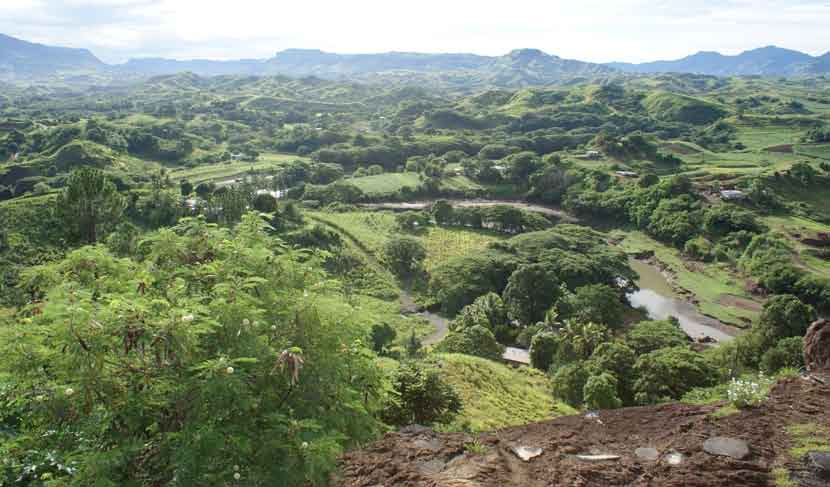
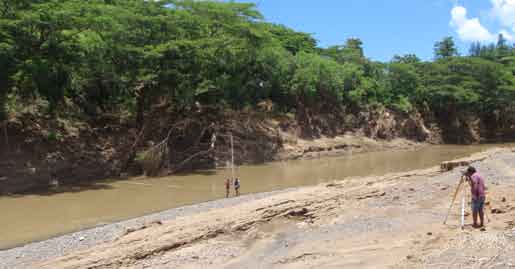
The Nadi River winds it's way through the Nadi Basin
Welcome to the 24th official mail-out of the Pacific Partnership Initiative on Sustainable Water
Management. This Quarterly Newslet er provides Water and Sanitation information to Pacific member
governments, professionals, NGOs, CBOs, researchers, private sector and counterparts in the donor
community who are interested in water sector issues and initiatives.
We would appreciate your assistance in forwarding the newslet er to other col eagues who may be
interested in this initiative so that it reaches the widest possible audience.
If you wish to print this newslet er, a PDF version is also available on the new SOPAC Water website:
www.pacificwater.org/pages.cfm/water-governance/pacific-partnership-initiative/e-newsletter-
subscription/
Pacific Partnership Initiative on Sustainable Water Management
1
www.pacificwater.org
Contents
World Water Day, March 22,
Welcome to the 24th newsletter of the Pacific Partnership Initiative on
2010
Sustainable Water Management.
- Tuvalu
This month of April marks exactly eight years since the Asian Development
- Papua New Guinea
Bank and SOPAC jointly started the extensive consultative process that
eventually led to the Pacific Regional Action Plan on Sustainable Water
- Fiji
Management and its associated Partnership Initiative.
- Samoa
Since then, attention to water and sanitation in the Pacific region has increased
markedly with many countries and partners taking action to improve the
Keeping Your Water Supply
management of water resources and address vital water supply and sanitation
Safe - Republic of Marshall
issues.
Islands
Despite these extra efforts it is clear from the latest WHO/UNICEF Joint
Monitoring Report (featured in one of the newsletter articles) that the Pacific
WANI strengthens water
region as a whole will be unlikely to meet the Water and Sanitation Millennium
management in Fiji and
Development Goal Targets.
Samoa
As we have entered the last five years of the "Water for Life Decade" (2005-
Domestic wells in Nauru
2015) it is essential that the call for action on water and sanitation is renewed
and invigorated.
Vanuatu GEF Pacific IWRM
With this new outlook of the Partnership Newsletter we would like to contribute
Project kicks off
to increasing the attention to Water and Sanitation and mobilise renewed
commitment and action in the region.
Re-establishing Laloki River
Gauging Stations, PNG
We appreciate your contributions to future issues of the newsletter and we
highly value your assistance in disseminating the information to others so that
Community to Cabinet: Village
it reaches the widest possible audience.
Water Management Planning
If you would like to comment on any articles or submit stories on your activities,
in Niue
upcoming events, vacancies or recent reports for the next newsletter please
forward them to SOPAC Water Communications Advisor Tiy Chung (tiy@
The Nadi Basin Catchment
sopac.org), or IWRM Project Officer Subhashni Raj (subhashni@sopac.org) at
Committee, Fiji
the SOPAC Secretariat. The next newsletter will be released late July 2010.
Nearly 3000 affected by PNG
Your feedback and inputs are most appreciated and we look forward to the
cholera outbreak
next action-packed five years!
Marc Overmars
Typhoid outbreak in Fiji
marc@sopac.org
How can Typhoid and Cholera
Facilitator of the Pacific Partnership Initiative on Sustainable Water
fever be prevented?
Management
WHO and UNICEF launch
Information on partners and their activities and products can be found through
Joint Monitoring Programme
the following hyperlinks on www.pacificwater.org
report
Did you know...? Facts and
figures about the Pacific
Islands
Water websites
Water calendar 2010
2
Pacific Partnership Initiative on Sustainable Water Management
Pacific Partnership Initiative on Sustainable Water Management
www.
w pa
p c
a ificw
c a
w te
a r
te .or
o g
r
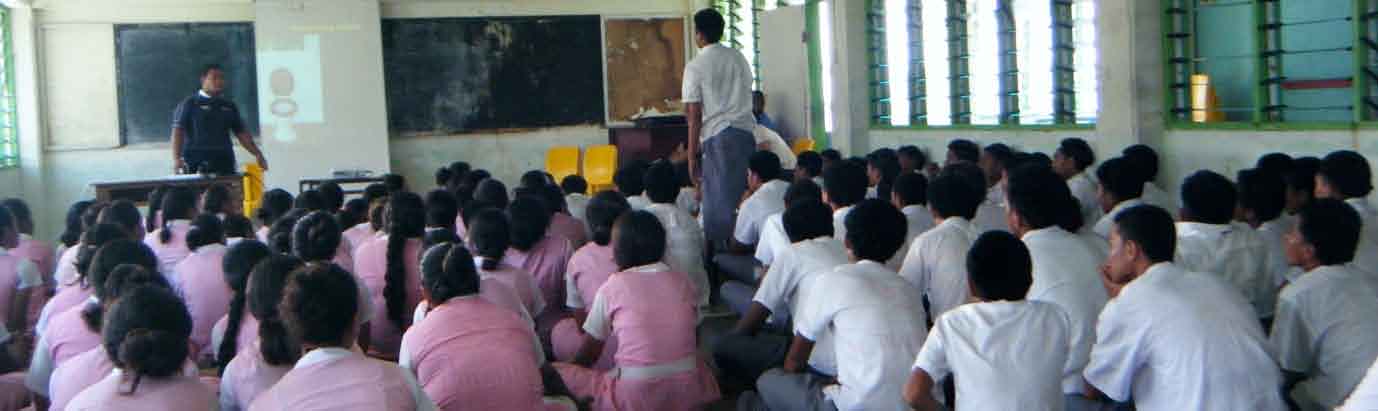
Fetuvalu Secondary School students learn about wastewater pollution and Composting Toilets
World Water Day, March 22, 2010
Tuvalu takes World Water Day to the children of
Funafuti with games and important lessons for all
For World Water Day 2010, Tuvalu's Integrated Water Resource Management (IWRM) and
Pacific Adaption to Climate Change (PACC) projects joined the Department of Health to
create a range of activities to raise awareness among children and their families.
In Tuvalu, several water related issues affect the community. These include water quality,
water shortages and wastewater pollution. These issues affect everyone and can be
dealt with at a household level through correct household water management.
During the week-long events, the Department of Health took part in awareness raising by
highlighting the need to boil water and discussing water quality and hygiene on radio.
Information booklets were also distributed.
IWRM and PACC spent the week working with school students by giving presentations
and taking questions on topics from water catchment and storage to conservation and
maintenance. Fun workbooks were given to the students to reiterate what they had learnt
and contained activities they could complete with their families.
IWRM emphasised the dangers of wastewater pollution and introduced composting
toilets to address water shortages and reduce pollution.
Nauti Primary school learn about H S water quality
PACC highlighted the need for clean water, teaching students how to keep their water
2
testing
clean and monitor its quality. H S testing used by the Department of Health to assess
2
bacteria levels in water tanks was demonstrated to students.
The highlight of the week was "Primary Challenge". This quiz, modelled on the TV show
"University Challenge", had contestants represent their schools and compete against
each other in a quiz based on World Water Day. Topics included rainwater harvesting,
storage and conservation, clean water, hygiene and sanitation. The event was highly
entertaining - members of the audience took part in interval activities and enjoyed the
competition, which Nauti primary school won. The event was also broadcast on radio
and made into a film.
Due to difficulties in accessing schools on the outer-islands, only children on the capital
island of Funafuti took part in the events. However, the day was so successful that outer
island primary schools requested materials so that they can reproduce the quiz and
Primary school students cheer for their team in
activities at home.
Tuvalu's World Water Day Quiz
For further information contact, Catherine Moulogo: catherine.moulogo@live.co.uk
Pacific Partnership Initiative on Sustainable Water Management
Pacific Partnership Initiative on Sustainable Water Management
3
www.
w pa
p c
a ificw
c a
w te
a r
te .or
o g
r
www.pacificwater.org
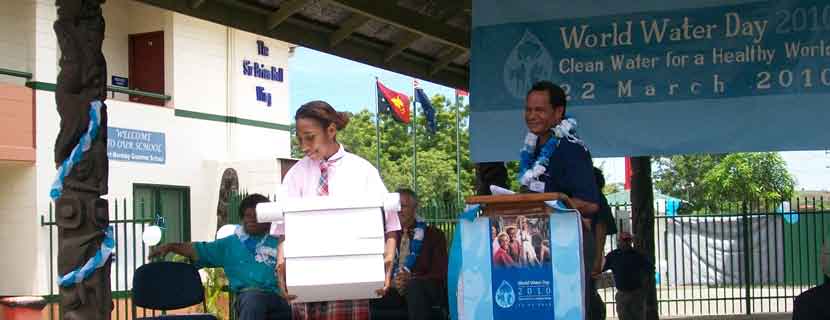
Tony Kuman hands out prizes to students during PNG World Water Day launch.
World Water Day in PNG "Safe water for a Healthy
Papua New Guinea"
The launch of World Water Day in PNG went off with a big splash. Tony Kuman and
his team did a fantastic job organising a gathering of distinguished people interested
in water quality. The Secretary for the Department of Environment and Conservation, Dr
Wari Iamo, opened World Water Day at Port Moresby Grammar School by explaining
the role the government and his agency played in this year's theme: "Communicating
Challenges and Opportunities Safe Water for a Healthy PNG".
Dr Iamo highlighted the lead role his agency played in the maintenance of ecosystems
and monitoring of water use and the challenges faced by PNG and its environment
to provide safe water in a time of rapid industrial and agricultural development, high
population growth, urbanisation, and climate change.
The water supply sector was well represented with the Managing Director of PNG Water
Board, Patrick Amini, emphasizing the priority need for his sector to provide safe quality
water to the communities they serve and of the need to keep up with developments in
water treatment technology. Billy Imar, General Manager of Port Moresby's water supplier
Eda Ranu, reiterated these comments and described the activities Eda Ranu takes to
ensure the city has access to safe quality water. The acting Head of Delegation of the
European Union Dr Kay Beese detailed the support the EU was providing to improve the
availability and access to safe drinking water in rural communities.
Major water suppliers used the day to promote their agencies and operations. The
Governor of the National Capital District, the Hon. Powers Parkop, reminded water
suppliers that they needed to improve the effectiveness and efficiency of water service
delivery. He urged them to address the quality of their infrastructure and the high levels
of water loss.
Support for World Water Day came from over a dozen major commercial enterprises,
whose generous sponsorship made the event possible and attracted considerable
publicity. A four page World Water Day supplement was included in The National
newspaper and there was national TV coverage of the event. The publicity generated
by World Water Day resulted in both national newspapers placing follow up news and
editorials relating to global and national water issues. In relation to this year's goal of
raising water awareness, PNG's activities can be seen as a success.
Students listen to speakers at PNG World Water Day.
For further information contact, Tony Kuman: tkuman@dec.gov.pg
4
Pacific Partnership Initiative on Sustainable Water Management
Pacific Partnership Initiative on Sustainable Water Management
www.
w pa
p c
a ificw
c a
w te
a r
te .or
o g
r
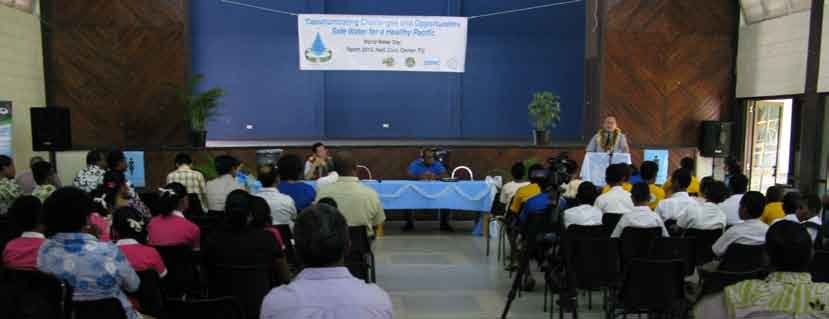
Dr Russell Howarth addresses Worlld Water Day participants in Nadi, Fiji. ©SOPAC
World Water Day in Fiji
In Fiji World Water Day celebrations were delayed a week due to Hurricane Tomas. The
national celebration was launched in Nadi on Friday March 26th and led by the Pacific
Islands Applied Geoscience Commission's (SOPAC) Water Programme in partnership
with Live and Learn Environment Education. The Econesian Society also launched its
own event at the University of the South Pacific in collaboration with the Pacific Centre
for Environment and Sustainable Development.
At the World Water Day launch SOPAC Director, Dr Russell Howarth, highlighted the fact
that more time and effort and necessary resources are needed throughout the Pacific to
ensure people are provided with secure access to safe water.
"Historically there has remained the problem of poor supply and quality of freshwater
resources, a lack of adequate sanitation, and a limited capacity to deal with these issues,"
Dr Howarth said. "At the national level there are often a multitude of agencies that deal
with water and the fragmented management of this resource is compounded with a
lack of overarching policy, outdated laws, and poor administration capacity."
Dr Howarth said there needed to be more commitment to water resource monitoring
and assessment so that countries had hydrological data at hand to better manage their
resources and provide design data for infrastructure projects "especially given climate
change and the adaption measures necessary to mitigate its direct effects".
He cautioned that there is no "quick fix" solution and highlighted the work being done
by SOPAC and its partners to remedy water issues across the region.
SOPAC and Live and Learn, with funding from Taiwan (Republic of China), provided
participating school students and community representatives with user friendly water
quality awareness packs that teach people how to improve water quality by protecting
and sustainably managing water and waterways. These awareness packs were also
sent to other Pacific Island countries.
At USP's Laucala campus, the Econesian Society highlighted water related issues and
emphasized the importance of saving water. The event was launched with the theme
`Turn it Off' and `Keep it Off'. Apart from display and information booths setup on site, a
survey was conducted to find out how the level water consciousness among university
students and staff.
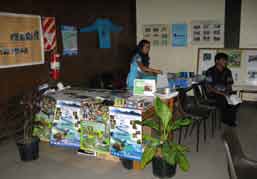
The Fiji World Water Day information booth.
©SOPAC
For further information contact, Tony Kuman: tkuman@dec.gov.pg
For further information contact, Tiy Chung: tiy@sopac.org
Pacific Partnership Initiative on Sustainable Water Management
Pacific Partnership Initiative on Sustainable Water Management
5
www.
w pa
p c
a ificw
c a
w te
a r
te .or
o g
r
www.pacificwater.org









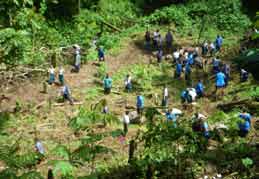
The Samoa IWRM project bus was used to transport students to the World Water Day event.
Clean Water for a Healthy Samoa
Samoa's theme for World Water Day (WWD) 2010 was "Clean Water for a Healthy
Samoa". The day was an ideal opportunity for the Samoa Integrated Water Resources
Management (IWRM) project to raise awareness and build capacity around IWRM
concepts. Government officials and stakeholders from different sectors were invited to
the opening ceremony and Year 12 science students from colleges around Upolu and
Savaii were invited to take part in planned awareness and capacity building activities.
Buses displaying the IWRM project signs were used to pick up students early that
morning from as far as the Mulifanua Wharf on the eastern side of Upolu Island.
More then 300 people attended the ceremony, including the Deputy Prime Minister of
Samoa, the Honourable Misa Telefoni, and the Australian, New Zealand and Chinese High
Commissioners. The event was officially opened by the Ministry of Natural Resources and
Environment's CEO Susuga Taulealeausumai Laavasa Malua who welcomed everyone
and explained this year's theme. The keynote speech was given by the Minister of
Natural Resources & Environment, the Honourable Faumuina Liuga Tiatia, who focussed
on the meaning of WWD and its importance to the Samoan people.
The morning's events ended with an invitation for officials to take part in a tree planting
ceremony, which not only marked WWD but also served as the Watershed contribution
to the Samoa One Million Tree campaign.
The rest of the day focussed on awareness and capacity building activities for the school
students. It started with a presentation from the Hydrology section of the Ministry of
Natural Resources and Environment's (MNRE) Water Resources Division, the Ministry
of Health, and the Samoa Water Authority. The joint presentation addressed challenges
and solutions to achieve clean water and enhanced awareness on the relationship
between quality of our water resources and our drinking water.
The presentation was followed by field trips that included more tree planting around
watershed catchments and a water quality monitoring exercise where students and
the public were able to test water quality on five sites around the Loimata o Apaula
catchment. Parameters such as turbidity, temperature, saturation, acidity, and dissolved
oxygen were tested using portable kits organised for the day.
The day ended with a session where students reviewed and discussed their water
tests results and attending schools were presented with World Water Day Participation
Certificates to commemorate this special day. It was a very successful day and made
possible through the generous sponsorship of the Water Sector Support Program
Student's planting trees in the catchment area.
(WaSSP), the Samoa IWRM Project and the tireless efforts of the Ministry of Natural and
Environment's Water Resource Division personnel who made sure the venue and sites
were ready for the occasion.
For further information contact, Sam Semisi: sam.semisi@mnre.gov.ws
6
Pacific Partnership Initiative on Sustainable Water Management
Pacific Partnership Initiative on Sustainable Water Management
www.
w pa
p c
a ificw
c a
w te
a r
te .or
o g
r
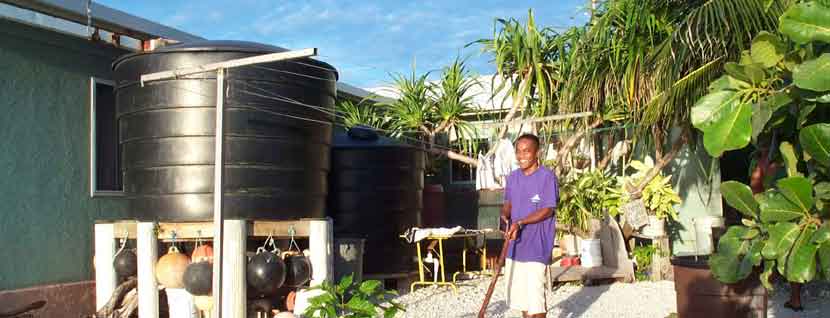








Water tanks on Majuro, Republic of Marshall Islands. ©SOPAC
Keeping Your Water Supply Safe -
Republic of Marshall Islands
The Republic of Marshall Islands Environmental Protection Agency (RMI EPA) is
empowering communities to ensure the safety of their drinking water by making them
aware of possible contamination risks to their water supply and providing possible
solutions.
According to Abraham Hicking, Chief Water Quality Monitoring, RMI EPA, identifying and
managing the risks of water supply contamination can be relatively simple through the
use of sanitary surveys or the drinking water safety planning approach.
"Keeping your water supply safe, for example your rainwater harvesting system, requires
simple steps such as cleaning roofs and guttering, periodic cleaning of inside of tanks
and having screen covers on inlet pipes," Mr Hicking explained.
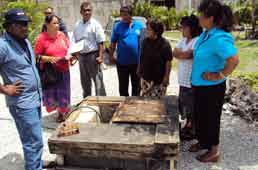
The RMI EPA translated sanitary survey forms into Marshallese and conducted training
for community facilitators to assist them take the message `keeping your water supply
safe' to communities.
Community-based training was held from March 10-12, 2010, on Majuro and included
representatives from the Ministry of Health, Majuro Water and Sewerage Company,
Economic Planning Policy and Statistics Office, the NGO Women United Together in
Marshall Islands, Marshall Islands Conservation Society, Majuro Local Government,
Internal Affairs and several high schools.
The training was facilitated by SOPAC and the World Health Organisation (WHO) in
partnership with the RMI EPA. The Australian and New Zealand governments (through
their Drinking Water Safety Planning and Water Quality Management programmes) and
the European Union (through their EDF9 B-envelope project) provided funding.
Trainees test ground water. ©SOPAC
For further information contact,
Abraham Hicking: ahicking@ntamar.net
Tasleem Hasan: tasleem@sopac.org
For further information contact, Sam Semisi: sam.semisi@mnre.gov.ws
Pacific Partnership Initiative on Sustainable Water Management
Pacific Partnership Initiative on Sustainable Water Management
7
www.
w pa
p c
a ificw
c a
w te
a r
te .or
o g
r
www.pacificwater.org
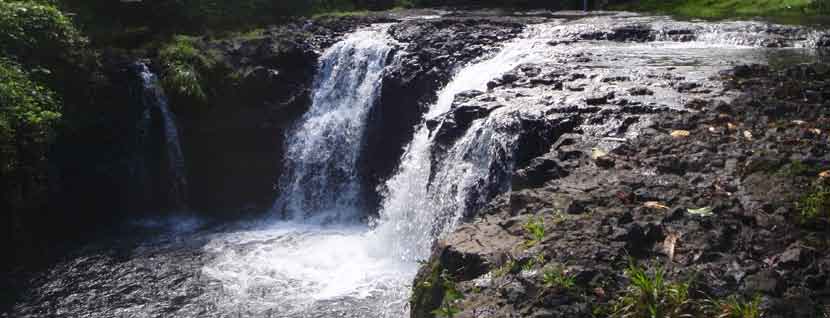
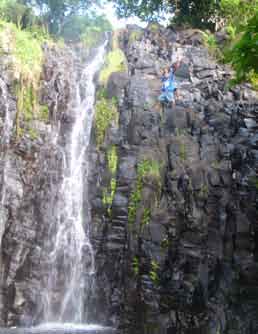
Togitogiga falls, Samoa. ©SOPAC
WANI strengthens water management
in Fiji and Samoa
Pacific Islands are experiencing increasing pressures on water resources due to growing
populations, infrastructure development, and climatic fluctuations. The International Union
for Conservation of Nature (IUCN), member and partner organisations are strengthening
forces to support Integrated Water Resource Management in Oceania region.
Through four demonstration projects, IUCN's Water and Nature Initiative (WANI) focuses
on good governance, payments for ecosystem services, and learning and leadership,
with the aim to improve the quality and sustainability of water resources in the region.
The initiative started in the Pacific in 2008 with the establishment and initial development
of WANI projects in Kadavu and the Nadi Basin in Fiji, and the Togitogiga Watershed in
Samoa. Complementing the three WANI projects, is the Pacific Learning and Leadership
project in collaboration with SOPAC (Pacific Islands Applied Geoscience Commission)
Regional Pacific IWRM projects.
IUCN aims to support the management of Fiji's water resources and watershed ecosystem
services, currently in decline due to land use changes, altered river flow patterns and
degraded ecosystem services. These problems are compounded by effects, like altered
rainfall pattens, of climate change.
Water management in Fiji, including tourism and forestry projects, has generally followed
a "top-down" approach. WANI's Kadavu and Nadi watershed projects aim to demonstrate
a watershed management model based upon participatory community approaches,
sound economic valuation and ecosystem management benefitting biodiversity and the
livelihoods that depend on them.
For the Nadi project, WANI helped establish the Nadi Basin Catchment Committee
to provide appropriate stakeholder engagement in the development of a Flood Risk
Management Plan and complements the Regional GEF Pacific IWRM's Nadi Catchment
Project.
In Kadavu, three Locally Managed Marine Area Networks (LMMA) sites provided the
location for work to begin on up-scaling the participatory model to include ridge-to-
reef management. This bottom-up model will provide a cost-effective and integrated
sustainable water resource management approach that can be replicated to other sites
in Fiji, and the Pacific.
Villages on Nakata waterfall, Kadavu, Fiji. ©IUCN
8
Pacific Partnership Initiative on Sustainable Water Management
Pacific Partnership Initiative on Sustainable Water Management
www.
w pa
p c
a ificw
c a
w te
a r
te .or
o g
r
The Togitogiga Catchment is WANI's selected demonstration project in Samoa.
Located on the eastern Upolu Island, Togitogiga is the main source of water supply
for downstream communities and has a unique biodiversity. It is also well known for
recreational purposes as part of the "Togitogiga National Park". This catchment area
has become significantly degraded due to increasing population and development
pressures, soil erosion, sedimentation, and water pollution. The project also aims to
develop and implement a watershed management plan that creates a balance between
anthropogenic demands on the catchment and biodiversity conservation.
Experiences and lessons learnt from Nadi, Kadavu and Samoa will influence WANI's 4th
project in the region, the Pacific Learning and Leadership Programme. This project aims
to address the shortfall in awareness and knowledge within Pacific Island countries,
advocate the WANI principles and support SOPAC's Regional Pacific IWRM projects.
WANI in Oceania works in partnership with the University of the South Pacific, Samoa -
Ministry of Natural Resources and Environment, Fiji - Land and Water Resources Ministry
(LWRM), and SOPAC.
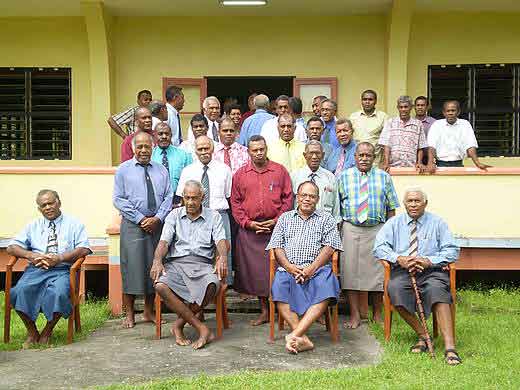
Village elders in Kadavu, Fiji. ©IUCN
For more information on the WANI Toolkits, visit:
http://www.iucn.org/about/work/programmes/water/resources/toolkits/
Project photos are available upon request. Bios and contacts of IUCN water
experts are available online: http://cms.iucn.org/about/work/programmes/water/
wp_contacts/index.cfm
Pacific Partnership Initiative on Sustainable Water Management
Pacific Partnership Initiative on Sustainable Water Management
9
www.
w pa
p c
a ificw
c a
w te
a r
te .or
o g
r
www.pacificwater.org
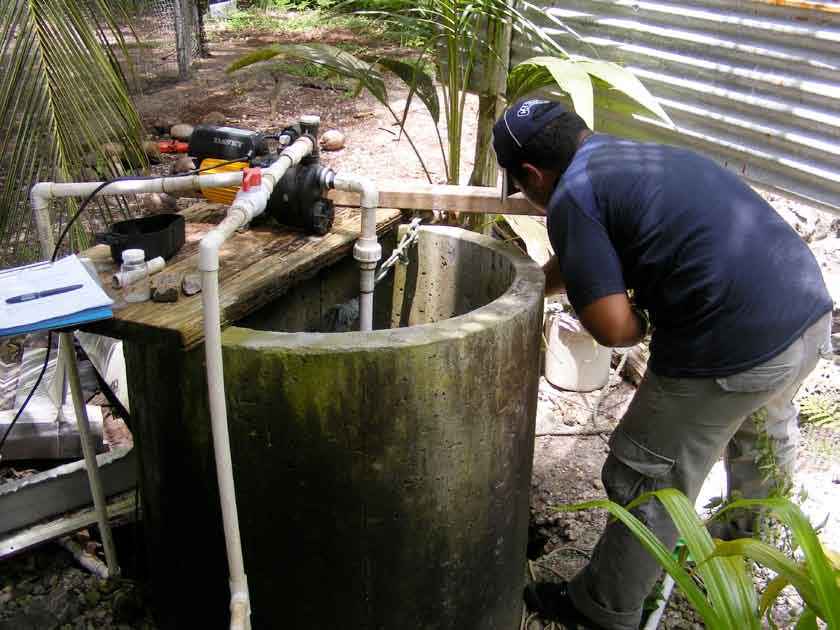
Shallow domestic well survey being undertaken in Nauru. ©SOPAC
Domestic wells in Nauru
Nauru relies upon rainwater harvesting and desalination for its potable water needs.
According to current estimates, between 600 to 700 households also rely on shallow
domestic wells for much of their non-potable needs including bathing, washing, and
toilet flushing. The mostly brackish groundwater is an important resource for communities
and reduces the need for costly desalinated water.
During March and early April the first comprehensive survey of domestic wells in Nauru
was conducted. The Government of Nauru, in conjunction with the Pacific Island Applied
Geoscience Commission (SOPAC), carried out the survey of household wells and
collected information to find out how many people use well water, the quality of water in
each well, usage, and potential areas of groundwater contamination.
Sanitary surveys were conducted to assess the risk of contamination to individual wells.
The results will be used to promote safe use and development of the water resource
and were made available to communities through district based workshops.
SOPAC conducted the survey and community workshops with the assistance from the
Nauru Department of Health, two Nauruan field assistants and Louis Bouchet, a junior
professional. Louis is completing his Masters in Integrated Water Resource Management
at the International Water Centre in Brisbane and was based in Nauru for 9 weeks.
The survey information will be entered into a spatial database (GIS) to allow analysis of
the shallow groundwater, including use distribution, water quality and areas of current
contamination. This information will complement information from rainwater harvesting
surveys collected by SOPAC over the last 2 years. Together the surveys will provide a
complete understanding of the water needs, demands and current reliance of Nauru on
available water sources.
The survey and district workshops are expected to be completed by the end of April.
Reporting and initial groundwater maps identifying at risk areas, will be available later in
June.
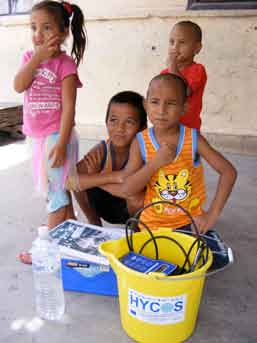
Children with HYCOS monitoring equipment.
For further information contact,
©SOPAC
Russ Kun: secretary.cie@naurugov.nr
Peter Sinclair: peter@sopac.org
10
Pacific Partnership Initiative on Sustainable Water Management
Pacific Partnership Initiative on Sustainable Water Management
www.
w pa
p c
a ificw
c a
w te
a r
te .or
o g
r
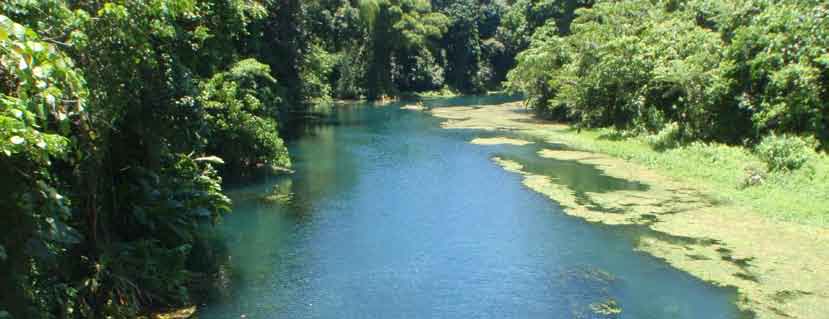
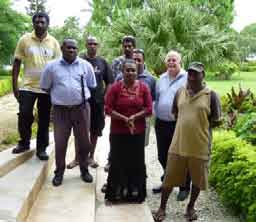
The Sarakata River, Vanuatu. ©SOPAC
Vanuatu GEF Pacific IWRM Project
kicks off
The Vanuatu GEF Pacific IWRM Project has hit the ground, with Rossette Kalmert
finally being contracted as the Project Manager. Rossette has moved to Luganville on
Santo Island to coordinate this project based in the Sarakata catchment. Rossette has
established a Project Office within the Lands Building and has a consultant reviewing
and providing recommendations on the project design.
An inception workshop was convened from March 30-31, 2010 to: (a) familiarise the new
SANMA Water Advisory Committee members with the Vanuatu IWRM Demonstration
Project; (b) review the project status; (c) review and endorse the logframe; (d) review and
endorse the implementation work plan; (e) review the proposed TOR for SANMA Water
Advisory Committee to act as the Project Steering Committee; and (f) review and agree
on membership of the SANMA Water Advisory Committee.
Members of the existing SANMA Water Committee gathered under the Chairmanship of
Charlie Nari - Provincial Manager PWD. The meeting was also attended by Marc Wilson
GEF Pacific Regional Project Manager.
Groups were formed to review the logframe and implementation work plan in order to
assist the finalisation of these for endorsement. There was a general level of concern at
the scope of the work to be completed within the remaining 4 years of the project and
some complaints about the delayed start. As the Director of Water Resources was not
present the reasons for the delay were not determined. Mr Wilson informed the meeting
that countries had been informed in April 2009 that funding was available to commence
the Projects.
The working groups emphasized the need to adequately resource the project's awareness
activities and also to ensure that project activities were regularly communicated to
communities and in particular land owners in the catchment.
The SANMA water committee currently only has National, Provincial and Municipal officers
and there was much discussion about the inclusion of non government stakeholders. In
the end it was agreed that the Chair and Secretary of the Sarakata Catchment Group, the
Chair of the SANMA Council of Chiefs, the President of the SANMA Tourism Association,
President of the Chinese Association, and a Women's Representative should be invited
to join the SANMA Water Committee.
For further information contact,
Rossette Kalmert (centre) with members of the
Read more: www.pacific-iwrm.org/component/content/article/1-latest-news/64-
Russ Kun: secretary.cie@naurugov.nr
SANMA Water Committee.
iwrm-demo-inception-workshop-vanuatu.html
Peter Sinclair: peter@sopac.org
For more information contact, Marc Wilson: m.wilson@sopac.org
Pacific Partnership Initiative on Sustainable Water Management
Pacific Partnership Initiative on Sustainable Water Management
11
www.
w pa
p c
a ificw
c a
w te
a r
te .or
o g
r
www.pacificwater.org
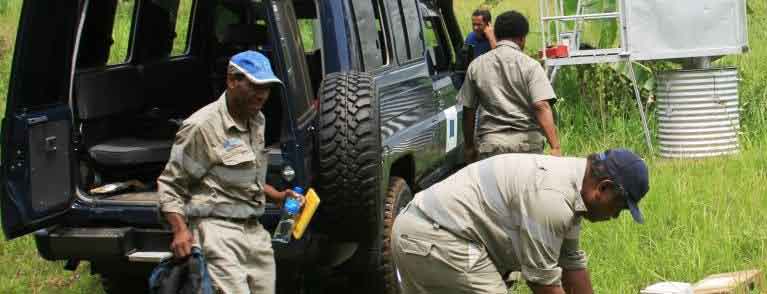
The PNG team in action. ©SOPAC
Re-establishing Laloki River Gauging
Stations
Port Moresby is booming! New buildings are going up and new 5 star hotels are being
built. The resource boom, in particular the multi-billion dollar LNG project, is fueling the
economy and Port Moresby is the entrance point. Projected growth is 10% per annum
for at least the next 5 years. Just getting a hotel room in Port Moresby is now a challenge
and proves the theory of supply and demand: high demand equals silly room prices.
So what has this to do with the heading? All this growth needs water! More drinking
water and more electricity sourced primarily from the Sirinumu Dam which relies on the
Laloki and Goldie catchments. There is little hydrological data, however, to determine
whether these catchments can handle increased growth.
In the late 1950s and early 1960s hydrology stations were established to provide
information to determine if a dam would provide reliable water and electricity for Port
Moresby. The Sirinumu Dam was built in the late 1960's and by independence, in 1975,
serviced a population of about 70,000. It now serves many more. The 2000 census
recorded a population of about 260,000 and current estimates place the population at
over 500,000. This places serious demands on services.
The impacts of rapid population growth can also be seen in the growth of squatter
settlements in the Laloki catchment and in the increase in commercial and government
activity. This development has not been constrained by land use restrictions that would
support water quality or optimize river flows. Hydrology stations are of paramount
importance in providing information on water availability in such a stressed system.
However, the five stations established on the Laloki to provide this information were
virtually abandoned by the mid 1990s.
Therefore, no data has been collected for 15 years in Port Moresby's primary catchment
area. During this period the Bureau of Water Resources, which at one stage had 40
employees, was transferred to the Department of Environment and Conservation. Some
staff were transferred into the Water Resources Management Branch but gradually human
and operational resources were eroded and hydrology services all but abandoned.
A late 90's review of PNG's Hydrological Service needs recommended the five Laloki
stations be reestablished and that PNG needed a minimum of 72 stations nationally. At
the time there were none operational.
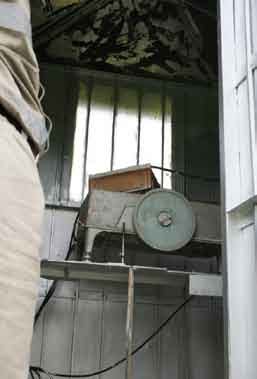
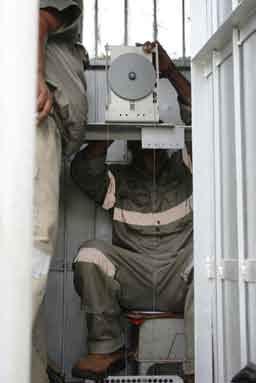
The old Stephens logger that has been in place for
almost 50 years.
12
Pacific Partnership Initiative on Sustainable Water Management
Pacific Partnership Initiative on Sustainable Water Management
www.
w pa
p c
a ificw
c a
w te
a r
te .or
o g
r
The Pacific HYCOS program sought to reestablish priority stations in the Laloki and
Ramu Rivers and procured equipment to do this in 2007. All four stations on the Laloki
catchment were supposed to be reopened by mid 2008 and a new station was to be
constructed on the Goldie River. A station was established on the Ramu in mid 2008 but
is no longer operational.
The first Laloki Station, `GS1', was reestablished in May 2009. This month Marc Wilson,
Global Environment Fund (GEF) Pacific IWRM Regional Manager, visited PNG for the
inception, and to review progress, of the GEF funded Laloki Catchment Management
Project. He was able to visit the area with the project manager, Tony Kuman, to download
the data of `GS1' and to replace the old Stevens Logger at `GS2' (which has been in
place for about 50 years) with new equipment. Fortunately the old gauging structures
and sheds are still in place as it would be impossible to build these now due to cost
and land access issues.
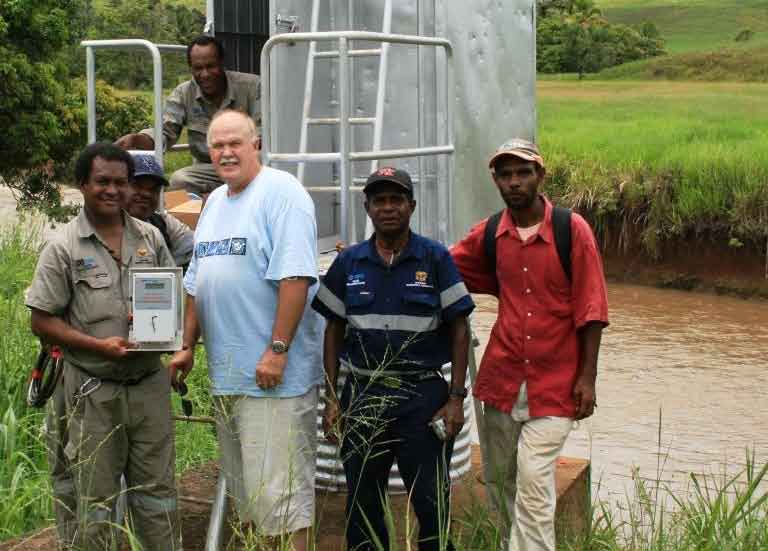
They visited the area with some of the few remaining "water boys" (actually "water oldies"),
who completed the installation. The trip was made possible due to the availability of a
vehicle kindly donated by the EU funded B Envelope programme and Tony Kuman's
ongoing commitment to the PNG hydrological service.
So of the five essential Laloki and Goldie River stations two are now installed and
operational with only three to go. But the news is not all good because in late November
last year the level tape was displaced from the recorder wheel at GS1 and no records have
been obtained since because no one has been back to routinely check equipment.
The new logger is installed.
The GEF Pacific IWRM Laloki Catchment Project will form a Catchment Committee
comprised of government and non government stakeholders. It is hoped that this
Committee will ensure the stations are reestablished, routinely monitored and maintained,
as the data collected will form the basis of the project's catchment model, which is being
developed to provide effective and risk averse catchment management.
In meetings with PNG Power and Eda Ranu it is evident that they are in desperate
need for such information. Perhaps the wheel has turned and there is now a realization
that managing the water resources of the catchment successfully, depends on the
availability of basic hydrological data.
PNG's water `oldies' and Marc Wilson, after a succesful installation at Laloki.
For more information contact,
Marc Wilson: m.wilson@sopac.org
Pacific Partnership Initiative on Sustainable Water Management
Pacific Partnership Initiative on Sustainable Water Management
13
www.
w pa
p c
a ificw
c a
w te
a r
te .or
o g
r
www.pacificwater.org
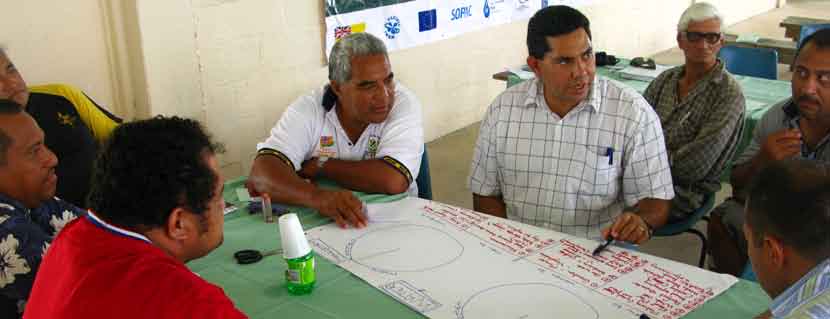
Men from Alofi South discuss gender roles and responsibilities for village water management. ©Tiy Chung/SOPAC
Community to Cabinet: Village Water
Management Planning in Niue
Niue's size and resource base enable it to be among the front runners of Integrated
Water Resources Management (IWRM) implementation in the Pacific. Where other
countries are piloting IWRM in "demonstration" areas and gaining confidence by IWRM-
walking before they start IWRM-running, Niue's pilot area is Niue: so Niue is learning to
walk and run at the same time.
The multi-sectoral apex body, Niue Water Steering Committee (NWSC), was formed
almost immediately after IWRM project start-up, in May 2009 and mandated to guide the
various aspects of national water and wastewater policy, planning and management.
With `top level' interventions underway Niue turned its attention, in February 2010, to the
`bottom' and two pilot communities, Alofi North and Alofi South committed to preparing
Village Water Management Plans (VWMPs). Thereby making real the vertical dimension
of `integration' that is explicit within an IWRM approach and expressed as "Bring together
stakeholders from different sectors and groups to plan and manage water [...]". Or, more
succinctly, from Community to Cabinet, from Cabinet to Community.
The Chair of each Village Council called 20-30 participants to attend a 2-day workshop
to produce their VWMP. Invited participants represented different groups in each village
(older, younger, professional, business, self-employed, family-based, men, and women)
and around 20-30% of the community households. Participants ranged from Directors
of government departments through octogenarian householders, prominent business
people and youth leaders.
On day 1 of each workshop, gender groups analysed and prioritised the water issues and
opportunities that they faced. The gender groups recombined to review their outputs and
through consultation reached consensus on the village priority issues. On day 2, mixed
groups identified the outcomes they wanted for each priority water `issue' or `opportunity'
and proceeded to develop an action plan for achieving their desired outcomes.
Action plans in both communities included activities that could be initiated by the
community with minimal and readily available support (eg materials for a Village Water
Use Efficiency awareness campaign); activities that simply required capacity development
from PWD Water (eg village level training in basic plumbing maintenance skills); activities
that would reach desired outcomes only if government departments take the lead (eg
water quality testing and reporting of source-to-tap samples; zoned and secure solid
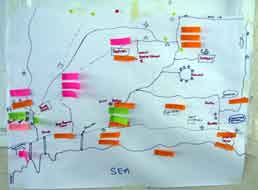
Alofi South water issues and actions map.
and hazardous waste disposal systems); and activities dependent on supplementary
©Tiy Chung/SOPAC
financial and/or technical resources from government or donors (e.g. upgrading of septic
tanks and rainwater storage).
14
Pacific Partnership Initiative on Sustainable Water Management
Pacific Partnership Initiative on Sustainable Water Management
www.
w pa
p c
a ificw
c a
w te
a r
te .or
o g
r
In a lighter mood, overnight thinking led to a whole array of possible slogans from which
the communities will select one as a signature for its plan and its activities.
`Don't be a drip: don't
The challenge now for Niue is to maintain the impetus that the planning process created
waste a drop'
and to convert it to action. Each village has identified a task force to carry its VWMP
forward by finalising the details of its content, steering its implementation, monitoring its
progress, and regular reporting to the Village Council.
`Be Water Wise'
The IWRM Project Management Unit (PMU) is committed to facilitating the process of
getting NWSC approval for VWMPs and their submission to Cabinet for endorsement.
The unit will also match VWMP priorities with national budget allocations and ensure that
VWMPs are linked to the soon to be prepared National Water Plan. Finally, it will support
`No water, no future'
villages prepare project proposals to access funds from other sources. Nominated PMU
staff be liaisons for each community and attend Village Council meetings and water
task force sessions. With these anchors in place, plan implementation is expected by
mid-year; and results soon after!
`Water. We drink
together, We act
together'
`Water care is people
care'
Community slogans developed by participants.
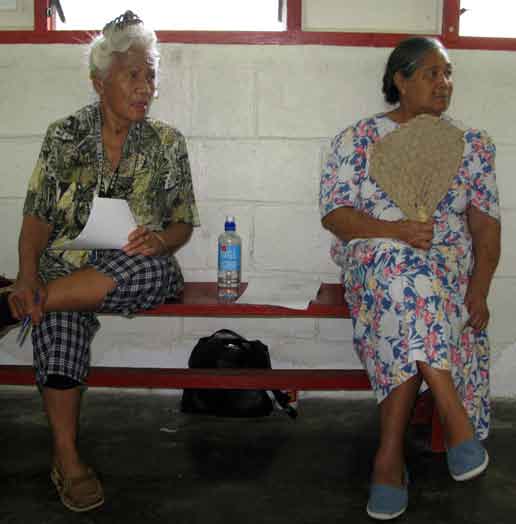
Women listen to presentations at Alofi North. All sectors of the community were well represented at the
planning meetings. ©Tiy Chung/SOPAC
For more information contact,
Andre Siohane: waterworks@mail.gov.nu
Pacific Partnership Initiative on Sustainable Water Management
Pacific Partnership Initiative on Sustainable Water Management
15
www.
w pa
p c
a ificw
c a
w te
a r
te .or
o g
r
www.pacificwater.org
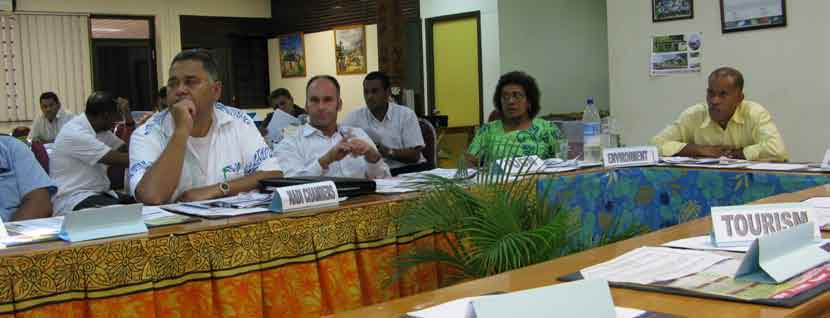
Nadi Basin Catchment Committee meeting March 24, 2010. ©SOPAC
The Nadi Basin Catchment Committee
An integral part of the IWRM Nadi Demonstration Project was to put in place a proper
governance structure that would oversee and coordinate the project's implementation.
This was done through the establishment of the Nadi Basin Catchment Committee
(NBCC).
Main purpose and role
The NBCC is tasked to guide the Project Management Unit (PMU) and the Land and
Water Resource Management (LAWRM) Division through the planning and decision
making process for the IWRM Nadi Demo Project and to oversee its implementation.
The first tasks of the NBCC were to agree on the NBCC Terms of Reference (TOR),
constitution and membership and the formation of the subcommittee. On completion of
the project in 2013, it is envisaged that the NBCC will continue to function as the body
authorised to plan and co-ordinate the sustainable development and management of
the Nadi catchment water resources.
Strength and decision making powers
The NBCC benefits from being a multisectoral body at management level, which
represents the strength, capacity, policies and enforcement powers of the departments
and organizations involved. The NBCC is yet to be formally mandated under the reviewed
Land and Water Conservation Improvement Act, which still awaits proper cabinet
endorsement. However, in July 2009, the LAWRM Division secured cabinet endorsement
of the IWRM Nadi Demo Project, which permitted the formation of the NBCC and the
appointment of 23 interim NBCC members.
NBCC Members
Nominated interim members represent the key land and water resources stakeholders
(both land and water managers and land and water users) within the Nadi Basin, including
the IWRM Focal Point for Fiji. The Project Management Unit under the LAWRM Division
acts as the secretariat for the NBCC. The 23 interim members include government
representatives, statutory bodies, provincial offices and community representatives,
academia, NGOs and regional organization reps.
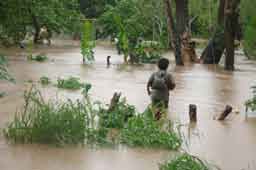
A women wades through floodawaters during
the cataostrophic floods in Nadi, January, 2009.
©SOPAC
16
Pacific Partnership Initiative on Sustainable Water Management
Pacific Partnership Initiative on Sustainable Water Management
www.
w pa
p c
a ificw
c a
w te
a r
te .or
o g
r
Progress of the NBCC
From its inception in 2008, the NBCC has come a long way. It started initially as a
working group. On August 20, 2009, interim appointments were issued to relevant key
stakeholders to become members of NBCC. To date the NBCC has held four quarterly
meetings. Issues of interest and discussion in meetings range from water issues,
landuse, flood mitigation and protection, water supply, development plans, policies and
legislations, gravel extraction, etc. All of which pertain to the Nadi Basin situation. A Terms
of Reference for the NBCC has been developed with collective input of members.
Currently the NBCC is working on establishing subcommittees to focus specifically on
the four project components: Community Liason, Technical, Governance and Planning,
Land and Water Use. The direction and decision of the NBCC has also been sought on
proposed work programs for implementation in the Nadi Basin. NBCC members have
supported and assisted the installation of water level recorders, a flood early-warning
system, initiated proper land use practices in the upper and mid catchment areas and
initiated contact with communities.
What is envisioned for the NBCC
The NBCC may still be in its infancy but it is moving forward with long term plans for the
effective management of the Nadi Basin Catchment area. Its future aims are to:
A representative from the Fiji Trade and Investament
· Formulate and finalize a Stakeholder Engagement Plan, with clearly defined
Board addresses the NBCC. ©SOPAC
participation, contribution and responsibilities for key players and stakeholders.
· Complete the formation of the four subcommittees, which should result in more
proactive participation of NBCC members in the planning and decision making
process.
· Ensure that Cabinet recognizes, strengthens and mandates the NBCC's role by
endorsing the Land and Water Conservation Improvement Act.
· Oversee the smooth implementation of activities, and achieve outputs, which are in
line with the IWRM Demonstration Project Proposal. This will include the authorizing,
vetting and endorsing of project and PMU annual work plans, writing routine and
special reports, and sub-project proposals etc.
On completion of the IWRM Nadi Demo Project in 2013, the aim is for the NBCC to
continue its function as the body authorised to plan and co-ordinate the monitoring
of IWRM in the Nadi Demo Project area and participate in initiatives such as the
development of Integrated Water Resources Management policies.
Hydrologists measure floodwater levels after the January 2009 floods. ©SOPAC
For more information contact,
Senivasa Waqairamasi: senivasa.waqairamasi@environment.gov.fj
Pacific Partnership Initiative on Sustainable Water Management
Pacific Partnership Initiative on Sustainable Water Management
17
www.
w pa
p c
a ificw
c a
w te
a r
te .or
o g
r
www.pacificwater.org

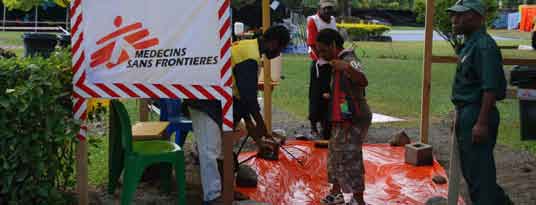
A man is given a footbath to reduce the spread of the disease at Medicins Sans Frontiers (MSF) Cholera Treatment Centre in Lae. ©Sally McMillan/MSF
Nearly 3000 affected by PNG cholera
outbreak
April 12, 2010: More than 2,900 people in Papua New Guinea have been infected with
cholera since an outbreak began eight months ago.
The country's first cholera outbreak in 50 years is affecting three adjoining northern
provinces, Madang, Morobe and East Sepik.
The World Health Organisation's representative in PNG, Dr Eigil Sorensen, says 500
people got the disease in the second half of March, but the infection rate has since
eased.
"The latest figures as of end of March is 2907 cases. Although what we've seen within
the last two three weeks that it seems to be slowing down, in particular in the East Sepik,
but also in Madang, while there're still a large number of cases in Morobe province
occurring."
Dr Sorensen says there were about 10 new infections over the last fortnight.
He says while the rate is slowing down, it could be due to its natural cycle.
(RNZI)
Cholera the facts
A person may get cholera by drinking water or eating food contaminated with the cholera
bacterium.
Cholera is an acute infection of the intestine, caused by a bacteria called Vibrio cholerae.
The illness begins suddenly with painless watery diarrhoea, nausea and vomiting. Most
people who become infected have very mild diarrhoea or may not even have any
symptoms
Severe cholera cases have very bad diarrhoea and vomiting, which may cause rapid
dehydration and death.
If untreated, 50% of people with severe cholera will die, but prompt and adequate
treatment reduces this to less than 1% of cases.
Vibrio cholerae: This nasty bug kills approximately
120,000 worldwide annually.
18
Pacific Partnership Initiative on Sustainable Water Management
Pacific Partnership Initiative on Sustainable Water Management
www.
w pa
p c
a ificw
c a
w te
a r
te .or
o g
r
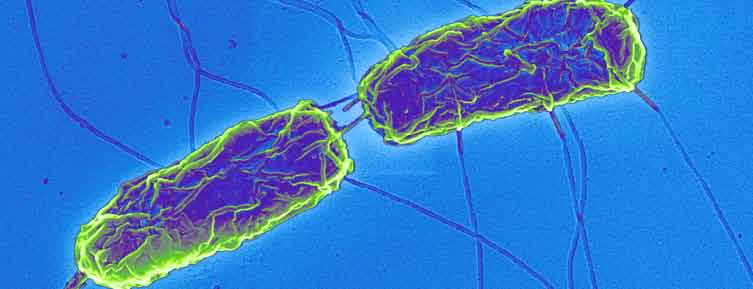
A closeup of Salmonella typhi the bacteria that cause Typhoid.
Typhoid outbreak in Fiji
Typhoid fever is one of the major public health issues in Fiji. The numbers of reported
cases has increased since 2004. Although most cases were reported in the Northern
division, cases have also been reported throughout the country.
After an outbreak of Typhoid was noticed in the Jitu State settlement in Suva in
February this year, epidemiologists and environmental specialists from the World Health
Organisation (WHO) and Fiji Ministry of Health were sent to investigate.
The investigation found that most of the settlement's inhabitants used pit latrines and that
waste from these latrines went directly into drains without any treatment by septic tanks.
Results of samples collected from the drain and nearby creek found that all of the water
was contaminated. It is assumed that this contaminated water caused the disease both
directly and indirectly.
Fiji has many issues with water supply, especially in rural areas. However, even when
treated water is provided, good personal hygiene practices, such as properly washing
hands or ensuring water tanks are not contaminated, are often missing.
To improve hygiene and sanitation systems to prevent the disease, many interventions
have been done through government action plans. It is important to continuously
implement these activities by working closely with all stakeholders.
What is Typhoid?
Typhoid fever is an infectious disease caused by the bacteria; Salmonella typhi. Once
the bacteria enter a person's body, it multiplies and spreads from the intestines into the
bloodstream.
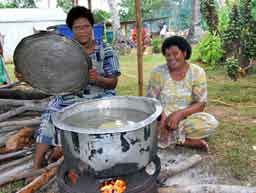
Typhoid fever is a water borne disease, which spreads from direct contact with water
contaminated with excrement from an infected person. The disease is mainly transmitted
via unsafe drinking water, food, and inadequate sewage disposal. The lack of a safe
water supply, poor hygiene and poor waste water disposal can all cause the disease.
Ensuring that water is clean, food properly prepared, and good hygiene and sanitation
(especially proper sewage disposal) practices can help prevent the spread of the
disease.
Women at Dratabu village in Nadi boil water to
prevent typhoid. ©Fiji Times
Pacific Partnership Initiative on Sustainable Water Management
Pacific Partnership Initiative on Sustainable Water Management
19
www.
w pa
p c
a ificw
c a
w te
a r
te .or
o g
r
www.pacificwater.org
How can Typhoid and Cholera fever be
prevented?
· Use treated water, or boil all water from an untreated source.
· Do not allow waste water to be used for irrigating the garden
· Wash vegetables thoroughly in safe water if they are to be eaten raw
· Do not gather shellfish from areas that may be contaminated by human waste.
· Cook food thoroughly and serve hot,
· Cover and refrigerate leftovers.
· Use a proper toilet with sanitary waste disposal that is at least 30m away from a
water source.
· Do not let children or pets play in areas contaminated by human waste, such as
areas of open defecation, near leaking septic tanks or sewers, or in contaminated
rivers or sea water.
· Wash and dry hands thoroughly after using the toilet or changing nappies.
· Hands should be washed thoroughly with soap and water for 20 seconds and dried
for a further 20 seconds using a clean cloth or disposable towel.
· Soiled clothing and linen should be washed with hot soapy water separately from
that of other family members..
· Items such as face cloths and towels should be kept for individual use.
· Someone with a Typhoid or Cholera infection should not prepare food for others in
the family until they are fully recovered and no longer infectious.
· In households where someone is recovering from Typhoid or Cholera, you should
disinfect toilet seats, flush handles, wash basin taps and toilet door handles daily
using a hypochlorite based solution, such as Janola or Domestos. The solution
should be wiped over the surface and left in contact for at least half an hour.
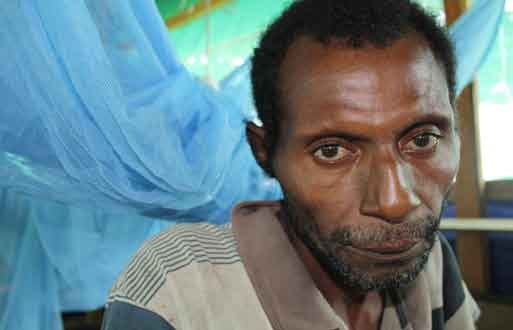
A victim of Cholera: Willie Kagoe, 47, of Barana Village, 160 km outside Madang. ©David Swanson/IRIN
For more information contact,
Alan Freshwater: alan@sopac.org
20
Pacific Partnership Initiative on Sustainable Water Management
Pacific Partnership Initiative on Sustainable Water Management
www.
w pa
p c
a ificw
c a
w te
a r
te .or
o g
r




















WHO and UNICEF launch Joint
With only five years to Go
until the MDG tarGet Date
Monitoring Programme report on
2.6 billion people do not use
884 million people do not use an
improved sanitation
improved source of drinking-water
· Although1.3billionpeoplehavegainedaccess
· The world is on track to meet the MDG
toimprovedsanitationsince1990,theworld
drinking-water target. In developing regions,
Progress on Sanitation and Drinking
islikelytomisstheMDGsanitationtargetby
84% of the population uses an improved
abillionpeople.
sourceofdrinking-water.
· Open defecation rates have decreased from
· In urban areas the use of improved sources
25%in1990to17%in2008.Worldwide,1.1
of drinking-water has been maintained at
billion people practise open defecation, a
96% since 2000, with over 1 billion more
declineof167millionsince1990.
peoplenowusingsuchasourcethanin1990.
However, this increase is barely keeping up
Water 2010
· With only 45% of the rural population using
withurbanpopulationgrowth.
improvedsanitation,ruralareaslagfarbehind
urbanareas,wheretherateis76%.
· Thenumberofpeoplelivinginruralareaswho
do not use an improved source of drinking-
· Seven out of ten people without improved
waterisoverfivetimesthenumberlivingin
sanitationliveinruralareas,butthenumber
urbanareas.
of people in urban areas without improved
sanitation is increasing because of rapid
· Worldwide, 37% of people not using an
The new WHO/UNICEF Joint Monitoring Programme (JMP) report Progress on Sanitation
growthinurbanpopulations.
improved source of drinking-water live in
Sub-SaharanAfrica.
and Drinking-Water 2010 Update Report, released March 15, 2010 says the world is on
track to meet or even exceed the drinking-water target of the Millennium Development
Goals (MDGs), with 87% of the world's population or approximately 5.9 billion people
using safe drinking-water sources. However the report also points out that with almost
39% of the world's population, or over 2.6 billion people, continuing to live without
improved sanitation facilities much more needs to be done to meet the sanitation MDG
target.
The JMP report 2010 presents the current status and trends in 209 countries or territories
towards reaching the drinking-water and sanitation Millennium Development Goals
(MDGs) targets, and an assessment as to what these trends reveal.
WorldHealthOrganization
UnitedNationChildren'sFund
AvenueAppia20
3UNPlaza
1211Geneva27,Switzerland
NewYork,NY10017USA
The report provides the clearest picture to date of the use of improved sanitation facilities
and improved sources of drinking-water throughout the world. The report is aimed to
help policy-makers, donors, government and nongovernment agencies decide what
needs to be done and where to focus their efforts to achieve these goals.
The WHO/UNICEF Joint Monitoring Programme for Water Supply and Sanitation is the
official UN mechanism tasked with monitoring progress towards MDG Target 7 on
drinking water supply and sanitation. The report includes information from household
surveys and censuses completed during the 19852008 period.
A record number of nearly 300 datasets were added to the global database for this year's
report. Importantly, the latest data has not yet registered the impact of the International
Year of Sanitation (2008), which is hoped will make a significant difference to the rate of
progress towards the MDG sanitation target
Of course there is no simple one solution or `one size fits all' approach that can be taken
globally. This is especially true in the Pacific region where many factors such as water
source, type of facilities, geographic location and vulnerable groups may need more
adapted mechanisms in order to address water safety, sanitation and hygiene issues.
The Pacific Water Supply Sanitation and Hygiene (WASH) Coalition, especially the WHO
South Pacific Office, United Nations Children Fund - UNICEF Pacific, SOPAC and other
partners are looking at opportunities to enable Pacific island countries to provide relevant
water and sanitation data to be included in Joint Monitoring Programme reporting. The
challenge includes the validation process used by the Joint Monitoring Programme as
well as the specific methodology established for collection of data.
For more information on the JMP report 2010 contact,
WHO Media centre: mediainquiries@who.int
Nada Osseiran: osseirann@who.int
WHO South Pacific Office, Kamal Khatri: khatrik@wpro.who.int
Pacific Partnership Initiative on Sustainable Water Management
Pacific Partnership Initiative on Sustainable Water Management
21
www.
w pa
p c
a ificw
c a
w te
a r
te .or
o g
r
www.pacificwater.org


W
A
Did you know...? Facts and figures
TER IN A CHANGING WORLD
The United
Nations
WATER
UNITED NATIONS
World Water
WMO
Development
IN A
about the Pacific Islands
Report 3
CHANGING
UN-Water is a mechanism with 25
member agencies to strengthen coordination
WORLD
·
and coherence among all United Nations bodies
There are about 30,000 islands in the Pacific Ocean, only 2,000 of which are inhabited.
that deal with freshwater issues: from water
supply, sanitation and health to climate, food, energy,
environment, disasters and sustainable water resources
Many of the populated islands are less than 10 km2, while some, especially atolls,
management for socioeconomic development. Established
in 2003 by the High-Level Committee on Programmes of
the United Nations, it evolved from many years of close
The United Nations W
are less than 1 km2. The 18 Pacific Island countries and territories considered in this
collaboration among UN agencies. UN-Water is not
another agency; through task forces and programmes
led and hosted by various members, it adds value to
P O V E R T Y ·
E ·
D
study account for 550,000 km2 of land and some 7 million inhabitants spread across
existing activities and fosters cooperation and
E
G
M
N
WORLD BANK
information sharing among UN agencies
O
A
and stakeholder representatives.
G
H
180 million km2 of ocean about 36% of the earth's surface.
R
orld W
C
A
E
P
ater Development Report 3
T
T · C I
A
N
V
H
I
· Average annual rainfall varies considerably in the tropical Pacific, from over
M
I
E
Including UNDESA, UNECE, UNESCAP, UNECA, UNECLAC, UNESCWA, UNCTAD
I
C
S
L
4,000 mm to less than 500 mm. The higher altitudes of volcanic islands receive
C
M
L
·
R
·
I
more rain, with about a 10% increase per 100 metre rise in elevation.
The news media are full of talk of crises in climate change, energy and food and
S
N
·
S
troubled financial markets. These crises are linked to each other and to water resources
E
I
management. Unresolved, they may lead to increasing political insecurity and conflict.
P
S
I
R
N
Water is required to meet our fundamental needs and rising living standards and
G
to sustain our planet's fragile ecosystems. Pressures on the resource come from a
Programme Assessment W
·
orld W
R
R
The limited freshwater supply in small Pacific islands is used for various purposes,
growing and mobile population, social and cultural change, economic development
C
E
C
and technological change. Adding complexity and risk is climate change, with
ater
O
impacts on the resource as well as on the sources of pressure on water.
I
L
V
N
including for towns, industrial activities, agriculture and forestry, tourism, environmental
The challenges, though substantial, are not insurmountable. The Report shows how some
A
V
S
countries have responded. Progress in providing drinking water is heartening, with the
B
O
U
Millennium Development Goal target on track in most regions. But other areas remain
A
needs and mining. Non-consumptive uses include hydropower generation (e.g. in
unaddressed, and after decades of inaction, the problems in water systems are enormous
O
G
T
M
and will worsen if left unattended.
L
·
E
P
G
T
Fiji, Samoa and Vanuatu), navigation and recreation.
Leaders in the water sector can inform decisions outside their domain and manage
·
I
water resources to achieve agreed socioeconomic objectives and environmental
E
O
integrity. Leaders in government, the private sector and civil society determine these
D
N
objectives and allocate human and financial resources to meet them. Recognizing
A
·
R
G
this responsibility, they must act now!
T
O
·
V
E
C
E
N
·
A
N
R
To meet growing demand, naturally occurring water resources are supplemented
with non-conventional ones. The former are surface water, groundwater and
rainwater collection; the latter include desalination, imports, wastewater recycling
and use of seawater or brackish water for selected purposes where potable water
is not needed.
· Some islands, including in Fiji and Tonga, have imported water as an emergency
measure during severe drought. In some instances, people move from water-scarce
islands to others nearby with more water. On many small islands, local or imported
bottled water is an alternative for drinking water, although it costs more than water
supplied by local water authorities.
· Many small islands, particularly coral atolls and small limestone islands, generally do
not have sufficient water resources for irrigated agriculture, or suitable soil conditions.
Irrigation on small islands thus tends to occur on a relatively minor scale except in
cases like that of Fiji, where agriculture primarily water-intensive cultivation of sugar
cane as a cash crop is the largest water user.
The section "Did You Know...?" is taken from the 3rd World Water Development Report
"Water in a Changing World". http://www.unesco.org/water/wwap/wwdr/wwdr3/
22
Pacific Partnership Initiative on Sustainable Water Management
Pacific Partnership Initiative on Sustainable Water Management
www.
w pa
p c
a ificw
c a
w te
a r
te .or
o g
r

selected
water websites
ADB Water for All
PI-GOOS
http://www.adb.org/water/
http://www.pi-goos.org/
Asia Pacific Knowledge Hub (APKH)
SIDSNET
http://www.apwf-knowledgehubs.net/
http://www.sidsnet.org/
AusAID
SOPAC water
http://www.ausaid.gov.au/
http://www.pacificwater.org/
Australian development Gateway
SPC
http://www.developmentgateway.com.au/jahia/
http://www.spc.int/corp/
Jahia/lang/en/pid/9
SPREP Pacific Adaptation to Climate Change
Cap-Net
http://www.sprep.org/climate_change/PACC/
http://www.cap-net.org/
index.asp
Climate Front Lines
Stockholm International Water Institute
http://climatefrontlines.org/
http://www.siwi.org/
Co-operative programme on water and climate
The International Commission on Irrigation and
http://waterandclimate.org/
Drainage (ICID)
http://www.icid.org/
East-west center
http://www.eastwestcenter.org/
UN-Water
http://www.unwater.org/flashindex.html
ESCAP
http://www.unescap.org/esd/water/activities/
UNEP
http://www.unep.org/themes/freshwater/
European Union
http://www.euwi.net/
UNESCAP
http://www.unescap.org/
FSM IWRM Website
http://www.fsmpio.fm/FSMIWRM/index.html
UNESCO
http://www.unesco.org/water/
GEF Pacific IWRM
http://www.pacific-iwrm.org/
UNFCCC
http://unfccc.int/2860.php
Gender and water alliance
http://www.genderandwater.org/
USGS
http://hi.water.usgs.gov/
Global Water Partnership
http://www.gwpforum.org/servlet/PSP
UNU
http://www.inweh.unu.edu/
IRC International Water and Sanitation Centre
http://www.irc.nl/
USP
www.usp.ac.fj
Island Climate Update
http://www.niwa.co.nz/our-science/pacific-rim/
Water Governance Facility
publications/all/icu
http://www.watergovernance.org/
IWCAM
Water Virtual Learning Center(WVLC),
http://www.cep.unep.org/iwcam
University of the South Pacific
http://www.usp.ac.fj/index.php?id=4043
Japan Water Forum
http://www.waterforum.jp/eng/
WHO
http://www.who.int/water_sanitation_health/en/
Niue IWRM Website
http://vainiue.gov.nu/
WMO
http://www.wmo.int/pages/themes/water/index_
NIWA
en.html
http://www.niwa.co.nz/
World Bank
NZAID
http://www.worldbank.org/html/extdr/thematic.htm
http://www.nzaid.govt.nz/
World Water Council
Pacific ENSO Update
http://worldwatercouncil.org/
http://www.soest.hawaii.edu/MET/Enso/
WSSCC
Pacific Water Association
http://www.wsscc.org/
http://www.pacificwaterassociation.org
Pacific Partnership Initiative on Sustainable Water Management
Pacific Partnership Initiative on Sustainable Water Management
23
www.
w pa
p c
a ificw
c a
w te
a r
te .or
o g
r
www.pacificwater.org

water
calendar 2010
Date
2010
Event
Location
Details
19-22 April
Sustainable Solutions Girona,
The main objective of the conference is to jointly discuss recent aspects related to
for Small Water and
Spain
sustainable solutions for small water and wastewater systems (SWWS) within a framework
Wastewater Treatment
of sharing experiences from the scientific, engineering, operation and governance points
Systems
of view within an international scope. The definition of small was initially related to those
treatment systems serving less than 2000 p.e. Nevertheless, in the last years that definition
has been expanded to include industrial water and wastewater systems with loading rates
similar to small urban systems. http://s2small2010.udg.edu/iwa/
22 April
World Earth Day
Worldwide
For the 40th anniversary of Earth Day in 2010, the world is in greater peril than ever, but
there is also unprecedented opportunity to build a new future. Earth Day has the power
to bring about historic advances in climate policy, renewable energy and green jobs and
catalyze millions who make personal commitments to sustainability - A Billion Acts of
GreenTM mobilizing the power of people to create change by taking small steps in our
homes, our schools and our businesses that add up to an enormous collective action. Earth
Day 40 is a pivotal opportunity for people, corporations, and governments to join together
to create a global green economy. Our coordinated efforts now will be recognized by future
generations as a turning point.
http://www.earthday.net/node/77
17-22 May
WSSCC National
Geneva,
Coordinators Planning Switzerland
Meeting
22 May
International Day for
Worldwide
The United Nations proclaimed May 22 The International Day for Biological Diversity (IDB)
Biodiversity
to increase understanding and awareness of biodiversity issues. The theme for this year is
"Biodiversity for Development". The first and foremost purpose of all related Action Days,
therefore, is to raise public and political awareness, at the national and international levels,
of the significance of ecosystems and biodiversity for human well-being. The International
Year of Biodiversity 2010 provides excellent opportunities to scale up this approach and
create a global mosaic of the value and meaning of ecosystems to humankind. Simultaneous
Biodiversity Action Days in up to 50 countries will broaden public awareness of the CBD
and its objectives, and will stimulate the political debate around options for its preservation
and sustainable use.
5 June
World Environment
worlwide.
Commemorated yearly on 5 June, World Environment Day is one of the principal vehicles
Day
through which the United Nations stimulates worldwide awareness of the environment and
enhances political attention and action
http://www.unep.org/wed/2009/english/index.asp
8 June
World Oceans Day
Worldwide
World Ocean Day is an opportunity every year to honor the world's ocean, celebrate the
products the ocean provides, such as seafood, as well as marine life itself for aquariums,
pets, and also a time to appreciate its own intrinsic value. The ocean also provides sea-
lanes for international trade. Global pollution and over-consumption of fish have resulted
in drastically dwindling population of the majority of species. The Ocean Project, working
in partnership with the World Ocean Network, has been promoting WOD since 2003 with
its network of over 900 organizations and others throughout the world. These groups have
been working to build greater awareness of the crucial role of the ocean in our lives and the
important ways people can help. World Ocean Day provides an opportunity to get directly
involved in protecting our future, through a new mindset and personal and community
action and involvement beach cleanups, educational programs, art contests, film festivals,
sustainable seafood events, and other planed activities help to raise consciousness of how
our lives depend on the ocean http://theoceanproject.org/wod/index.php
continued next page...
24
Pacific Partnership Initiative on Sustainable Water Management
Pacific Partnership Initiative on Sustainable Water Management
www.
w pa
p c
a ificw
c a
w te
a r
te .or
o g
r

water
calendar 2010
Date
2010
Event
Location
Details
28 June - 2 July
Singapore
Singapore, The Water Convention, under the theme `Sustainable Water Solutions for Cities Clean and
International Water
Singapore
Affordable Water' aims to bring together researchers, industry leaders, and practitioners to
Week
share and learn a wide range of areas, such as water technology solutions, planning and
management of water resources, utility practices, and water quality and protection of public
health. In particular, the theme this year has been chosen to focus on the financing and
governance aspects of the water industry. The themes and topics in the Water Convention
will be designed to examine specifically the trends and challenges facing East Asia, Asia-
Pacific, and the Middle East regions. http://www.siww.com.sg/
28 June
Asia Pacific Water
Singapore
The outcome of the APWMF will be a summary of the event highlights and key ideas (akin
Ministers
to SIWW's publications -"Solutions" and "Blue Paper"), and is proposed to be presented at
the 2nd Asia Pacific Water Summit.
5-7 July
Young Water
Sydney,
The YWPC2010 will provide a forum for young researchers and professionals working in
Professionals
Australia
water and wastewater research, technology and management to present their work and
Conference
meet their peers from all over the world. The Conference will consist of papers and posters
presentations, career development workshops for all sectors of the water/ wastewater
industry and unparalleled networking opportunities. The attendees also will have the
opportunity to discover the many unique aspects of this area in New South Wales.
http://www.iwa-ywpc.org/templates/ld_templates/layout_670267.aspx?ObjectId=679496
19-23 July
EU and GEF IWRM
The Regional Steering Committee (RSC) meeting for both the EU and GEF Integrated
combined Regional
Water Resources Management (IWRM) programme will be held simultaneously in Palau
Steering Committee
from the 19-23 of July 2010.The RSC meeting will be an opportunity for the countries to
Meeting19
meet with the Programme Managers to discuss the progress made and ways forward. This
will be combined with targeted training and presentations from the countries involved in the
project.
26 August
World Rivers Day
World Rivers Day is a global celebration of the world's waterways, observed every last
Sunday in September. Established in 2005, it highlights the many values of rivers and
strives to increase public awareness while encouraging the improved stewardship of rivers
around the world. World Rivers Day occurs annually on the last Sunday in September.
5-11 September World Water Stock
The World Water Week in Stockholm is the annual meeting place for the planet's most
holm, Sweden
urgent water-related issues. Organized by the Stockholm International Water Institute, it
brings together experts, practitioners, decision makers and leaders from around the globe to
exchange ideas, foster new thinking and develop solutions. The thematic scope frames the
key issues and discussion points related to the 2010 theme "The Water Quality Challenge
- Prevention, Wise Use and Abatement". The intention is to deepen the understanding of,
stimulate ideas on, and engage the water community around the challenges related to
water quality. http://www.worldwaterweek.org/
13-15 September Pacific Water
www.pacificwaterassociation.org
Conference
19-24 September IWA World Water
The International Water Association (IWA) World Water Congress & Exhibition is a high
Congress & Exhibition
profile international event attracting thousands of water professionals and organizations
from across the globe. It is a biennial event organised by the IWA. This event attracts 3,000
researchers, academics, utility managers and water technology suppliers and provides a
unique opportunity to learn of the latest research findings and operational practices from
around the world through a series of scientific sessions and workshops. Although most
utilities face similar problems, it is exciting to learn of the different solutions that have been
found and implemented in other parts of the world. http://www.cwwa.ca/IWA%20World%20
Water%20Congress_e.asp
4-6 November
WHO IWA Water
International Network of Drinking-Water Quality Regulators: Announcement Call for Planning
Conference
Committee Representation - WHO-IWA Water Safety Conference, 2010
Pacific Partnership Initiative on Sustainable Water Management
Pacific Partnership Initiative on Sustainable Water Management
25
www.
w pa
p c
a ificw
c a
w te
a r
te .or
o g
r
www.pacificwater.org
26
Pacific Partnership Initiative on Sustainable Water Management
www.pacificwater.org
Document Outline