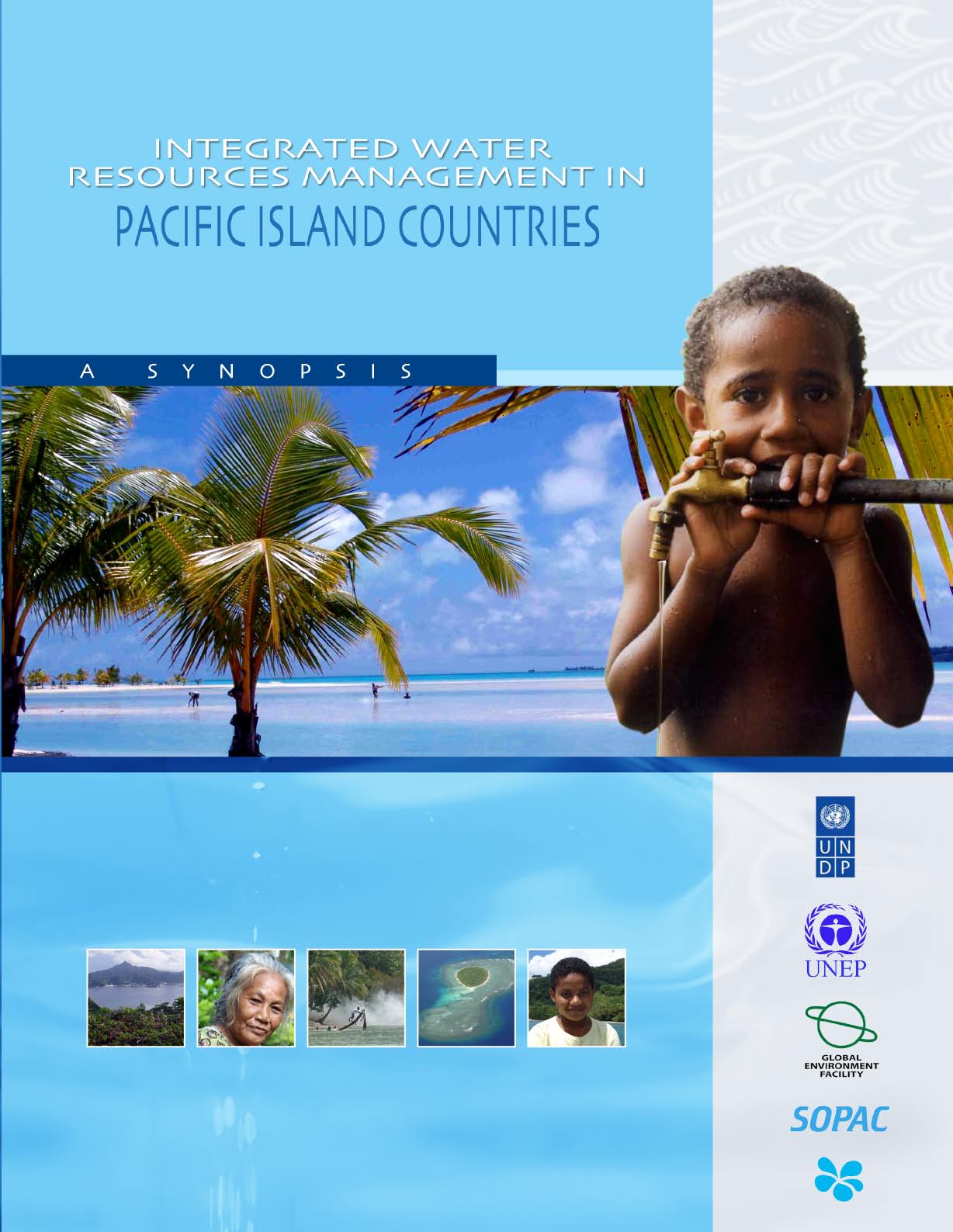


Integrated Water Resources Management
in Pacific Island Countries
A Synopsis
Compiled by GWP Consultants, United Kingdom
in conjunction with the
Pacific Islands Applied Geoscience Commission, Fiji
and published by Dreamwise Limited, Fiji
Permission is granted to duplicate materials for non-commercial, non-profit purposes only provided
acknowledgement is given. All other rights are reserved.
Integrated Water Resources Management in Pacific Island
Countries: A Synopsis/GWP Consultants. SOPAC: , 2007
46 p.:ill. ; 30cm
1. Water management
2. Water resources Pacific Islands
I.
SOPAC Joint Contribution Report 192
II.
Title
III.
GWP Consultants
Acknowledgements
This publication represents the combined efforts and achievements of numerous organisations, government
departments, communities and individuals from the Pacific that were involved with the development of the
Diagnostic Reports for the project countries and to whom we are deeply grateful.
We acknowledge the financial assistance provided by the Global Environment Facility (GEF) and the technical
assistance provided by the United Nations Development Programme (UNDP) and the United Nations Environment
Programme (UNEP).
Finally, we would like to recognise the efforts of Clive Carpenter of GWP Consultants who was the principal author
of the publication and Leonard Ganilau, Dreamwise, Fiji for graphic design and layout.
Abbreviations
ADB
Asian Development Bank
PICs
Pacific Island Countries
CBOs
Community Based Organisations
PNG
Papua New Guinea
CIA
Central Intelligence Agency
RMI
Republic of the Marshall Islands
CSD
Commission on Sustainable Development
SIDS
Small Island Developing States
EIA
Environmental Impact Assessment
SIWA
Solomon Islands Water Authority
EU
European Union
SOPAC
Pacific Islands Applied Geoscience
Commission
FSM
Federated States of Micronesia
sq km
Square kilometre (1 km x 1 km)
GDP
Gross Domestic Product
TDS
Total Dissolved Solid
GEF
Global Environment Facility
UN
United Nations
GoN
Government of Niue
UNDP
United Nations Development Programme
GPA
Global Programme of Action for
the Protection of the Marine Environment
UNEP
United Nations Environment Programme
from Land-Based Activities
US
United States (of America)
GWP
Global Water Partnership
VIBA
Vanuatu Island Bungalow Association
ICZM
Integrated Coastal Zone Management
WEHAB Water, Energy, Health, Agriculture and
IWRM
Integrated Water Resources Management
Biodiversity
IWCAM Integrated Watershed and Coastal Area
WF
Water Facility
Management
WHO
World Health Organisation
lpd
litres per capita per day
WSSD
World Summit on Sustainable Development
MDGs
Millennium Development Goals
(held in Johannesburg in 2002)
MHMS
Ministry of Health and Medical Services
WUE
Water Use Efficiency
MPA
Marine Protected/Conservation Area
WWF-5 5th World Water Forum (to be held in
Turkey in 2009)
MRD
Mineral Resources Department (Fiji)
NGOs
Non Governmental Organisations
Pacific
Pacific Regional Action Plan on Sustainable
RAP
Water Management
INTEGRATED WATER RESOURCE MANAGEMENT IN PACIFIC ISLAND COUNTRIES - A SYNOPSIS
Preface
Local approaches to Integrated Water Resources Management (IWRM) have been practiced in the Pacific Islands
region for centuries by local communities through their observations of traditional coastal, land and water resources
management measures which have sustained islands' resources for hundreds of years.
However, our islands have changed with issues such as rapid population growth, increasing urbanisation, damage
to water catchments resulting from deforestation, poor waste management practices leading to water pollution,
and climate change posing serious challenges to Pacific Island Countries in respect of how they achieve sustainable
management of their water resources.
Consequently, the Global Environment Facility (GEF) through the United Nations Development Programme
(UNDP), United Nations Environment Programme (UNEP) and the Pacific Islands Applied Geoscience Commission
(SOPAC) have developed a project on "Sustainable Integrated Water Resources and Wastewater Management" in
Pacific Island Countries (Pacific IWRM Project).
The Pacific IWRM Project responds to a call from the region to address these challenges and is founded on the
regionally endorsed Pacific Regional Action Plan on Sustainable Water Management (Pacific RAP). This plan aims to
improve the assessment and monitoring of water resources, reduce water pollution, improve access to technologies,
strengthen institutional arrangements, and leverage additional financial resources in support of IWRM.
The Pacific IWRM Project provides the region an opportunity to build on the successful practices from the past
whilst addressing the complexities of sustainable development in this modern age and developing and implementing
dynamic and innovative IWRM approaches. The project methodology adopts the use of demonstrations of
sustainable water management in specific catchments and aquifers in each country, as a catalyst for further
expansion on the approach throughout the country, thereby resulting in better, more effective national water
resources management.
The Pacific IWRM programme represents the first strategic step in the development of IWRM planning and
implementation in the Pacific Islands region. This approach is consistent with the United Nations advocacy of
IWRM as the means to accelerating progress towards achieving the water and sanitation related Millennium
Development Goals - the IWRM Road Map. The responsibility now lies with Pacific Island governments and our
international development partners to support, sustained IWRM implementation in the Pacific.
The Pacific IWRM Synopsis contains on overview of Small Island Developing States' water issues and the application
of IWRM in Pacific SIDS, through the GEF-funded demonstrations. I commend this publication to you which is a
result of the insight and knowledge gained during the process of developing the Pacific IWRM Project. We hope
that you view it as making both a useful and invaluable contribution to the promotion and advocacy of IWRM in
the Pacific Islands region and beyond.
With Thanks
Cristelle Pratt
Director
SOPAC Secretariat
vi

INTEGRATED WATER RESOURCE MANAGEMENT IN PACIFIC ISLAND COUNTRIES - A SYNOPSIS
Contents
Acknowledgements
Preface
1. Executive Summary
2
2. IWRM Country Profiles
7
2.1 Cook Islands
8
2.2 Federated States of Micronesia
10
2.3 Fiji
12
2.4 Kiribati
14
2.5 Marshall Islands
16
2.6 Nauru
18
2.7 Niue
20
2.8 Palau
22
2.9 Papua New Guinea
24
2.10 Samoa
26
2.11 Solomon Islands
28
2.12 Tonga
30
2.13 Tuvalu
32
2.14 Vanuatu
34
3. Barriers to Achieving IWRM in SIDS
36
4. Solutions to Achieving IWRM in SIDS 38
Bibliography
42
1
INTEGRATED WATER RESOURCE MANAGEMENT IN PACIFIC ISLAND COUNTRIES - A SYNOPSIS
1. EXECUTIVE SUMMARY
Sustainable development requires a balance to be
for all sector users. For some SIDS these pressures and
maintained between the needs of economic
demands are now close to exceeding the natural carrying
development, public health and environmental
capacity of the islands and watersheds, especially those
protection. Inevitably these three pillars of sustainability
hosting the country capitals with higher population
create competing and sometimes opposing pressures
densities.
and demands upon the limited land and water resources
of countries.
Pacific SIDS are having to address these challenges
whilst recognising they have limited human and
Whilst many countries have made great progress to
financial resources, and do not have the benefits of the
realising sustainable development and achieving the
economies of scale that larger countries can utilise.
Millennium Development Goals (MDGs) and targets,
such endeavour has been generally made through
Integrated Water Resources Management
sectoral approaches. In doing so the competitive
and SIDS
demands of different sectors have become difficult to
manage, with increasing stress placed upon water
Integrated Water Resources Management (IWRM) is a
resources as pollution increases and populations
planning and management approach which aims to
continue to grow.
manage both water and land resources through
improved sectoral collaboration and partnership
Pacific Small Island States Water Issues
between the government functions and those of civil
society. It specifically focuses on establishing and
Where Small Island Developing States (SIDS) differ
improving the linkages between land and water
with other countries is the immediacy of these problems,
management, competing sectors, government agencies,
and the limit of their capacity to respond. With limited
civil society, and the private sector. The United Nations
land mass and even more limited natural water
considers IWRM to be of such importance to achieving
resources, the pressures of economic development
the MDGs it agreed an IWRM National Plan development
coupled with climate change associated climate
target of 2005, and has now developed an IWRM Road
variability make water shortages, flooding, soil erosion,
Map for delivering the MDGs.
chemical pollution and salinisation a present day reality
2
INTEGRATED WATER RESOURCE MANAGEMENT IN PACIFIC ISLAND COUNTRIES - A SYNOPSIS
...IWRM as a solution to managing and protecting water
resources, improving governance arrangements and
therefore improving water supply and sanitation provision...
· Vulnerability to climate variability resulting in rapid
onset of flooding and droughts;
· Insufficient political and public awareness of the
critical role of water in supporting economic
development, public health and environmental
protection;
· Excessive urban water demand due to high water
losses and poor water conservation and inadequate
drinking water treatment due to limited technical
resources;
· Inadequate wastewater management resulting in
widespread freshwater and coastal water pollution
due to reliance upon on-site septic tanks and poorly
maintained sewerage systems;
· Fragmented national water governance due to little
formal communication and coordination between
government departments;
The potential importance of IWRM to SIDS has been
stated within the Pacific Regional Action Plan on
· Conflicts between national versus traditional rights,
Sustainable Water Management (Pacific RAP) in 2002,
especially balancing the needs of land and water
which specifically identifies IWRM as a solution to
resources planning with customary land ownership;
managing and protecting water resources, improving
· Inadequate financing of water and sanitation
governance arrangements and therefore improving
provision due to poor cost-recovery but also a lack
water supply and sanitation provision. The Pacific RAP
of `economies of scale' for funding resources, health
was formally endorsed by the Pacific Heads of State in
and environmental protection; and
2003.
· Weak linkages to other stakeholders both within the
Pacific SIDS IWRM Barriers
water sector but particularly to other economic
Country diagnostic studies have revealed the barriers
sectors, public health and the environment.
the SIDS have to overcome to implement IWRM. These
include:
· Limited and fragile water resources susceptible to
over-exploitation and pollution, but with little
technical management capacity to exploit and
protect them;
3
INTEGRATED WATER RESOURCE MANAGEMENT IN PACIFIC ISLAND COUNTRIES - A SYNOPSIS
IWRM Solutions
1. Introduction to Integrated Water Resources
Countries identified the need to build upon existing
Management (IWRM)
activities by improving the coordinating and integrating
1.1 What is IWRM?
planning and management, moving away from sectoral
and institutional delivery, to more effective and efficient
Integrated Water Resources Management (IWRM)
collaborative implementation using:
is a planning and management approach which aims
to manage both water and land resources through
· IWRM Apex (over-arching) Bodies
improved sectoral collaboration and partnership
· Integrated Land Use Planning
between the government functions and those of
civil society.
· Water Resources Assessment and Quality
Monitoring
IWRM therefore takes appropriate account of the
important physical, social, economic and cultural
· Watershed and Land Use Management
linkages within a water resources system, such as:
· Demand Management and Water
· Physical linkages between land use and surface
Use Efficiency
and groundwater quantity and quality;
· Water Rights, Policies and Legislation
· Economic linkages between various, and
· Water Resources Information and Management
sometimes competing, water uses;
Systems
· Social linkages between water development
· Education, Awareness Raising and
schemes and potential beneficiaries or those
Civil Society Engagement
adversely affected; and
Specific examples of the application of these approaches
· Institutional linkages, both horizontally and
prioritised by the countries are:
vertically, among various formal and non-formal
stakeholder institutions.
· Drought Preparedness
· Flood Management and
· Water Quality improvements through
Watershed Management
Cross-sectoral Integration
The IWRM Road Map and the
Role of International Fora
Enabling
Environment
Two IWRM programmes have recently commenced in
the Pacific, one addressing long term IWRM Planning,
Institutional
the other focussing on reducing environmental stress
Framework
Water for
Water for
Water &
Water
through the application of IWRM approaches at a
Management
People
Food
Nature
for other
demonstration project level. These programmes have
Instruments
uses
enabled the SIDS to commence development of National
Donor Wishes
IWRM plans whilst simultaneously demonstrating
IWRM benefits for priority issues in critical areas.
National
Government Will
However country-wide implementation of SIDS IWRM
Adapted from GWP TAC Background Paper No. 4, 2004
Plans and replication of the demonstration projects will
require a much greater political and financial
commitment and prioritisation of SIDS IWRM, both at
the country level and internationally.
4
INTEGRATED WATER RESOURCE MANAGEMENT IN PACIFIC ISLAND COUNTRIES - A SYNOPSIS
The Global Water Partnership (GWP), one of the
1.3 Why is IWRM a priority to Small Island
foremost global advocates of IWRM, describes IWRM
Developing States?
as:
The potential importance of IWRM to Small Island
`IWRM is a process which promotes the co-ordinated
Developing States can be clearly seen by referring to
development and management of water, land and
the Water in Small Island Countries Statement at the
related resources, in order to maximise the resultant
3rd World Water Forum in 2003. This Statement
economic and social welfare in an equitable manner
identified three critical challenges to achieving
without compromising the sustainability of vital
sustainable water management in SIDS, namely:
ecosystems.'
· Fragile and limited water resources highly
1.2 How does IWRM relate to the Millennium
vulnerable to climatic variability;
Development Goals?
· Water supply and sanitation provision restricted by
Sustainable development requires a balance to be
human and financial resources; and
maintained between the needs of economic
development, public health and environmental
· Complex water governance arrangements.
protection. Inevitably these three pillars of sustainability
In response to these challenges, the Pacific SIDS
create competing and sometimes opposing pressures
developed the Pacific Regional Action Plan on
and demands upon the limited land and water resources
Sustainable Water Management (Pacific RAP) in 2002,
of countries.
in advance of the World Summit on Sustainable
Whilst many countries have made great progress to
Development (WSSD). The Pacific RAP specifically
realising sustainable development and achieving the
identifies IWRM as a solution to managing and
Millennium Development Goals and the related Water
protecting water resources, improving governance
and Sanitation Targets, such endeavour has been
arrangements and therefore improving water supply
generally made through sectoral approaches. In doing
and sanitation provision. The Pacific RAP was formally
so the competitive demands of different sectors are
endorsed by the Pacific Heads of State in 2003. The
difficult to manage, and the result is a continued
Pacific RAP aims to improve the assessment and
increase in population growth, land use and water
monitoring of water resources, reduce water pollution,
usage.
improve access to technologies, strengthen institutional
arrangements, and leverage additional financial
In 2002 the United Nations not only prioritised the
resources in support of IWRM.
delivery of the Water-Related Targets, within the
WEHAB (Water, Energy, Health, Agriculture and
Where SIDS differ with other countries is the immediacy
Biodiversity) Initiative, but recognised the contribution
of these problems, and the limit of their capacity to
water plays to achieving the other WEHAB priorities
respond. With limited land mass and even more limited
and the MDGs in general. In response the international
natural water resources, the pressures of economic
community agreed to an IWRM Target for the
development coupled with climate change associated
development of National IWRM and Water Use
climate variability make water shortages, flooding, soil
Efficiency (WUE) Plans by 2005, in time for the
erosion, chemical pollution and salination a present day
commencement of the Water for Life Decade.
reality for all sector users. For some SIDS these pressures
and demands are now close to exceeding the natural
Whilst this initial Target has now passed, UN-Water is
carrying capacity of the islands and watersheds,
now promoting an IWRM Road Map to deliver the
especially those hosting the country capitals with higher
original Target and to achieve the MDGs by 2015. The
population densities.
contribution that IWRM can make to realising all the
MDGs is therefore fully recognised by the international
SIDS need to act now to address these issues, but are
community.
hampered by small populations which limit the amount
of technical capacity in-country as well as the economic
base from which to finance mitigation measures. In
such circumstances, IWRM, which aims to improve
5
INTEGRATED WATER RESOURCE MANAGEMENT IN PACIFIC ISLAND COUNTRIES - A SYNOPSIS
integration of existing agencies, stakeholders, sectoral
reductions in public health expenditure, increases in
planning and activities, provides an ideal way to use the
coastal tourist revenue, and reductions in water supply
existing but limited capacity and funding within SIDS to
treatment costs. Understanding these benefits and
their best effect.
demonstrating them is fundamental to the credibility
For SIDS, who have to face the extreme climatic impacts
of IWRM.
of drought and flooding on a near annual basis, as well
In order for these benefits to be realised, IWRM has to
as increasing water demand and man made pollution,
have a significant impact within the watersheds and
IWRM can improve economic productivity, improve
aquifers. This means that the percentage of the
public health and protect the natural and built
catchment area or water balance being altered has to be
environment. There is therefore tangible financial
sufficiently large, and that the impacts of these
benefit to adopting and implementing IWRM.
management changes can be observed in a reasonable
1.4 Why is SIDS IWRM important to the rest
timescale. For continental countries and international
of the World?
river basins, these are long term objectives to which
these catchments will respond slowly over time. These
IWRM is being promoted throughout the world as a
timescales are out of synchronicity with the realities of
planning and management approach which improves
modern day governmental priority and political office
not only water and land management but results in
residency.
economic, social and environmental benefits.
In order to demonstrate the credibility of IWRM to the
IWRM is a move away from `business as usual' and
global audience it is important to have examples of
requires a long term commitment and effort by all
IWRM success as soon as possible. Achieving IWRM
stakeholders to achieve more sustainable development.
success quickly is most likely to be accomplished where
It is therefore important that the amount of benefit
the hydrological systems (catchments and aquifers) are
resulting from IWRM is worth the effort put in by these
small and as a result limited water and land management
stakeholders. This is especially the case where some
changes can have a catchment wide impact, and the
stakeholders will perceive their contribution and efforts
catchments will respond to these changes rapidly. Small
as a loss of revenue or productivity.
Island Developing States provide the ideal hydrological
environment for demonstrating IWRM approaches and
The importance of tangible benefits as demonstrated
achieving tangible and quantifiable benefits. SIDS
by IWRM Indicators cannot be overestimated. Such
IWRM success can be a powerful catalyst to IWRM
tangible benefits might include a reduction in flood
implementation worldwide.
damage, an increase in hydropower generation,
6
INTEGRATED WATER RESOURCE MANAGEMENT IN PACIFIC ISLAND COUNTRIES - A SYNOPSIS
2. IWRM
COUNTRY
PROFILES
INTEGRATED WATER RESOURCE MANAGEMENT IN PACIFIC ISLAND COUNTRIES - A SYNOPSIS
2.1 COOK ISLANDS
Description: 15 widely dispersed islands, divided into
Area
235 sq. km
the Southern Group, comprising volcanic islands
Population
15,017 (2001 census)
(including Rarotonga) and the Northern Group
comprising coral atolls.
Population Density 64 person/sq. km
Economy: The key economic sectors include agriculture
Rainfall
2,100 mm/year. Wet season
and fisheries (13%), tourism (63%), black pearls,
from December to March
offshore banking. Economic development is hindered
GDP
NZ$ 232 million (2005 est)
by isolation from foreign markets, lack of natural
resources, periodic devastation from natural disasters,
GDP/capita
NZ$ 12,878 (2005 est)
and inadequate infrastructure. The main economy base
Land Use
arable land: 17%
is agriculture with copra and citrus fruits being the
major export. Limited manufacturing focuses on fruit
permanent crops: 13%
processing, clothing and handicrafts.
other: 70%
Water Availability: Surface water on the volcanic islands
Water Consumption 1200 lpd (Rarotonga, 1987);
of the Southern Group (including Rarotonga) and
100-150 lpd in Aitu.
groundwater and rainwater on the coral atolls of the
Northern Group. Some imported bottled water. Water
tankers have been used in periods of drought to
transport potable water to resorts and outlying islands.
Island Vulnerability: Simultaneous increases in rainfall
in the southern Cook Islands and reduced rainfall in the
Northern Cook Islands occur during El Nino events.
Cyclones are also associated with El Nino events.
Flooding during storm surges and drought are therefore
of major concern. Aquifer saline intrusion is reported in
the outer islands. Although agriculture presents
problems for water resources, particularly through high
water demand (supplied by the reticulated system) and
piggery runoff, the major land use and water quality
concern is from poorly functioning septic tanks.
Development on the Rarotonga has lead to increased
sediment and nutrients entering the lagoon system,
causing damage to the corals and the lagoon.
Power Generation: There is no use of renewable
electricity production.
Health: The World Health Organisation (WHO) reports
that the standard of health in the Cook Islands is high.
The infant mortality rate was 28.6 per 1000 live births
in 2005. The water supplies in Rarotonga and the outer
islands are neither properly filtered nor disinfected. The
main water related diseases are diarrhoea (835 cases in
2003) and dengue fever. A water supply and sanitation
improvement programme, with the building of flush
toilets in all schools and health centres on the outer
islands has enhanced the reduction in infectious
diseases. Environment and Tourism: The Cook Islands
8
INTEGRATED WATER RESOURCE MANAGEMENT IN PACIFIC ISLAND COUNTRIES - A SYNOPSIS
economy is largely dependent on tourism, the major
resources management; lack of cost recovery associated
attraction being the clean and clear lagoon waters. The
with water supply; land tenure and land use rights; and
lagoon-reef systems are important food sources for
a lack of human resources and appropriate IWRM
Cook Islanders and are use commercially for black pearl
capacity.
production on Manihki and Penrhyn. In the Cook Islands
there are several reserves and sanctuaries created for
IWRM Solutions
habitat protection and biodiversity reasons. Suwarrow,
The Cook Islands identified it is already carrying some
in the Northern Cook Island group, was declared a
of the IWRM Tools required. Water resources
National Park in 1978. It is a breeding ground for rare
monitoring, disaster management planning and climate
species of turtles and crabs and it is an important sea-
change adaptation measures are already being practiced
bird breeding site not only for the Cook Islands but for
to some extent and/or are scheduled for further
the region and the world. There are major concerns
implementation.
about eutrophication in the Rarotonga lagoons.
Community awareness of land use, freshwater-coastal
IWRM Barriers
linkages, improved water supply infrastructure, water
The Cook Islands identified the following barriers
demand management and water quality monitoring
preventing IWRM implementation:
have some activities but need considerable strengthening
through IWRM.
Reticulated water supply leakage; drought season water
shortages due to reliance on rainfall harvesting and
Areas requiring considerable attention are institutional
ephemeral streams; contamination of groundwater due
arrangements (including policy and legislative changes),
to septic tank leakage; piggeries near streams and no
financing and wastewater treatment.
buffer areas; cyclone associated flooding; poor
The IWRM demonstration project is expected to target
understanding of linkages between catchment land
the protection of the Rarotonga lagoons (a major
management and impacts upon freshwater and coastal
tourist attraction) through wastewater management
water quality; high reticulated water usage due to
improvements and understanding groundwater linkages
agricultural supply; high sediment run-off; poor inter-
to lagoon water discharge.
agency coordination, e.g. water quality monitoring;
lack of ownership of wastewater treatment; lack of
An economic evaluation of the avoidable costs
clear and over-arching legal framework for water
associated with IWRM for Rarotonga alone has been
estimated at NZ$ 7.4 Million per annum (3% of GDP).
9
INTEGRATED WATER RESOURCE MANAGEMENT IN PACIFIC ISLAND COUNTRIES - A SYNOPSIS
2.2 Federated States of Micronesia
The need for improved disaster
Area
700 sq. km
Population
108,000 (2006, ADB)
management planning is
Population Density 154 person/sq. km
recognised at the state level.
Rainfall
3000-4900 mm/year. Wet
Description: 4 major island groups consisting of 607
season from June to October.
islands spread out over more than 2.5 million sq. km
which vary geologically from high mountainous islands
GDP
US$ 244.7 million (2006, ADB)
to low lying coral atolls and volcanic outcroppings on
GDP/capita
US$ 2266 (2006, ADB)
Pohnpei, Kosrae, and Chuuk.
Land Use
arable land: 5.7%
Economy: Key economic sectors are agriculture
(subsistence farming), agroforestry, fisheries and
permanent crops: 45.7%
tourism (plus some high grade phosphate deposits).
Other (forest): 48.6% (CIA
GDP is not equally distributed between the four states.
World Factbook, 2005)
Geographical isolation and poorly developed
infrastructure are the major impediments to
development. 80% of people depend on subsistence or
semi-subsistence livelihoods (75% of household
income).
Water Availability: Surface water is in the form of small,
intermittent streams that drain catchments of limited
aerial extent. Groundwater on volcanic islands is
abstracted from small, dispersed zones of sedimentary
deposits, weathered volcanic and weathered schist,
suitable for multiple, low to medium yielding wells. On
raised coralline islands, and in those coastal areas
composed of coral sand deposits and lagoon sediments,
groundwater is abstracted from the freshwater lens by
shallow hand-dug wells. Rainwater harvesting is
concentrated mainly in the outer islands and rural areas.
Competition has led to a reduction in price of bottled
filtered water. Bottled water is therefore a popular
form of potable water consumption in FSM.
Island Vulnerability: The island groups of Yap, Chuuk
and their adjoining outer islands are particularly prone
to typhoons, extended drought, landslides, tidal erosion
and extensive floods. Drought is perceived to be
occurring with increasing frequency and intensity.
Siltation of the fringing reefs as a result of deforestation
and subsequent erosion is causing significant damage
to traditional marine food supplies. Urbanisation,
pollution, poorly planned development, inappropriate
farming practices, over-exploitation of marine resources
and destruction of habitat have also been identified as
concerns by stakeholders. The country's fragmented
composition of small islands and its dependence on
subsistence agriculture and tourism make it vulnerable
to such natural and man-made disasters.
10
INTEGRATED WATER RESOURCE MANAGEMENT IN PACIFIC ISLAND COUNTRIES - A SYNOPSIS
Power Generation: The only hydropower plant in FSM
IWRM Barriers
is on Pohnpei, which has a capacity of 1.7 MegaWatts.
This is a supplementary power supply.
The Federated States of Micronesia have identified the
following IWRM challenges:
Health: Major health concerns are water related
diseases, especially cholera (resulting in an epidemic in
Vulnerability to climate change and climatic extremes
Pohnpei in 2000), leptospirosis, hepatitis and amoeba,
(droughts and floods); deforestation of watersheds and
which are all endemic. With the expansion of potable
resultant sedimentation of lagoons and coastal areas;
water, the incidence of water related diseases is
water-related disease through poor sanitation and lack
decreasing. However all rural community water systems
of effective wastewater treatment; lack of awareness
are untreated and the outer islands (which rely on
on water-related diseases; sustainability of power utility
rainwater collection) remain at risk.
subsidisation of water supply; lack of water resources
management technical capacity; land access issues
Environment and Tourism: The biodiversity and natural
(especially in Chuuk), loss of biodiversity through
heritage of the FSM is both globally significant and the
deforestation and lagoon degradation.
foundation for the country's long term economic self-
sufficiency. The islands of FSM contain over 1,000 plant
IWRM Solutions
species, at least 200 that are found nowhere else on
Earth. Its reefs, which provide coastal protection and
The National Sustainable Council has launched
the source of livelihood for a majority of the local
initiatives on public education and watershed
population, are home to nearly 1,000 species of fish and
protection.
more than 350 species of hard coral. Decline in
Each State has its own programme on watershed and
biodiversity is clearly linked to factors such as increased
coastal management. The Pohnpei Nature Conservation
centralisation and urbanisation of the population, very
Society programme is the longest running formal
high population growth rates, commercialisation
catchment protection initiative in the Pacific.
including increased exportation of natural resources,
reliance on imported commodities and increasing
The need for improved disaster management planning
consumer demands. Maintaining the habitats and
is recognised at the state level.
ecosystems that nurture biodiversity is crucial for
The following are reported as recognised as priority
sustaining economic interests such as fishing, agriculture
IWRM areas for improvement: capacity building in the
and tourism. However, pollution from improperly
water and environmental sanitation sector planning;
located pig pens and toilets that discharge directly or
support and prioritisation of IWRM by communities
indirectly into the rivers have affected many of the
and politicians; conjunctive use of rainwater harvesting,
popular waterfalls and rivers used by tourists, with
stream flows and groundwater; wastewater
consequences for public health, the watershed
management improvements; and using tariffs to
ecosystem and the economy.
adequately fund water supply and wastewater
treatment operation and maintenance.
11
INTEGRATED WATER RESOURCE MANAGEMENT IN PACIFIC ISLAND COUNTRIES - A SYNOPSIS
2.3 FIJI
Area
18,333 sq. km
Description: Over 300 islands, of which a third are
Population
850,000 (World Bank, 2005)
inhabited. Three main islands, with major urban areas
Population Density 46 person/sq. km
on Viti Levu and Vanua Levu. The archipelago is
comprised of volcanic peaks and low lying coral islands
Rainfall
2000-3000 mm/year
Economy: One of the most developed of the Pacific
GDP
$5.594 billion (2006 est., CIA
Islands, endowed with forest, mineral and fishery
World Factbook)
resources. Sugar exports and rising tourism are the
major source of foreign exchange. Sugar represents
GDP/capita
$6,200 (2006 est., CIA World
one-third of industrial activity. Long-term economic
Factbook)
problems include low investment and uncertain land
Land Use
arable land: 11%
ownership rights. Limited gold metal mining has
occurred in past decades. Bottled water exports have
permanent crops: 4.6%
increased rapidly in recent years.
other: 84.4% (CIA World
Water Availability: Surface water is used as the main
Factbook, 2005)
source of supply for all major towns on the larger, high
Water consumption Urban 200 lpd, semi-urban 150
islands of Fiji, as well as for industry and irrigation.
lpd, rural 100 lpd
Some small, low-lying islands rely exclusively on
groundwater and may or may not use rainwater.
Rainwater harvesting is widespread in Fiji, but
improvements are required to sustain supply during
droughts.
Island Vulnerability: Flooding is currently a very high
priority political issue for Fiji, in light of serious flooding
which has occurred throughout various parts of the
country over the last few years. These floods caused
loss of life and significant damage to property and
infrastructure as well as disrupting economic activity
and affecting the lives of communities on the largest of
the Fiji Islands. Drought is also a serious issue. During
1998, half of the country had no significant rainfall for
more than seven months and food was distributed by
the government to 105,000 people. Logging and
progressive removal of forest cover may cause flood
peaking to become more extreme in the future. On
small, low-lying islands, groundwater resources may be
very vulnerable to over-exploitation and contamination.
Industrial pollution, urban drainage and sewage are
cause for concern on large islands.
Power Generation: 80.6% of electricity was produced
from renewable sources (2004, UN), specifically
hydropower.
Health: Even though 70% of the population has access
to treated, metered reticulated water, continuity of
supply is not ideal and maybe in question, particularly
in the drier months. Wells on many small islands are
12
INTEGRATED WATER RESOURCE MANAGEMENT IN PACIFIC ISLAND COUNTRIES - A SYNOPSIS
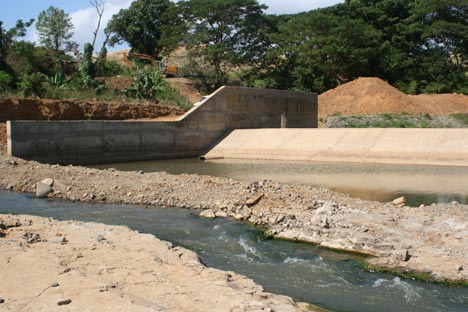
Development in Fiji Islands over the last 15 years has been severely
constrained by a succession of political coups. However, there is much
optimism in both the community and government as reflected in the
Governments Strategic Development Plan 2003-2005.
contaminated with faecal coliform due principally to a
IWRM Solutions
lack of sanitation and awareness.
The government has made a number of IWRM related
Environment and Tourism: The health of the near-shore
initiatives in the past five years, including: creation of
environment is of particularly high importance, owing
the National Water Committee - a coordinating
to tourism development along the coast. Development
committee of officials to meet under the chairing of
in Fiji Islands over the last 15 years has been severely
MRD; development of a draft national water policy
constrained by a succession of political coups. However,
which has been accepted subject to consultation, which
there is much optimism in both the community and
has not yet taken place; and commitments to consider
government as reflected in the Governments Strategic
new water resources legislation and national
Development Plan 2003-2005.
coordinating arrangements (as stated in the draft policy
IWRM Barriers
which reflects earlier cabinet decisions).
Fiji identified the following IWRM Barriers:
Fiji recognises it needs IWRM Tools and approaches to
overcome the identified barriers, including: IWRM
A lack of water resources management technical
policies and legislation; improved coordination,
capacity and formal responsibilities; a lack of public
information and data; water resources planning;
awareness on water conservation and water pollution;
technical capacity building; public information; and
land tenure and water rights, conflicting policies and
awareness raising.
unclear legislation; a lack of effective formal
coordination; and inadequate planning mechanisms.
13
INTEGRATED WATER RESOURCE MANAGEMENT IN PACIFIC ISLAND COUNTRIES - A SYNOPSIS
2.4 KIRIBATI
Area
811 sq. km
Description: 32 low lying coral islands and one raised
coral island in three main island groups, the Gilberts,
Population
92,428 (2005 census)
Phoenix and Line Islands, scattered over three million
Population Density 127 person/sq. km
km2 of the central and western Pacific Twelve of these
islands are currently unoccupied. Most islands are
Rainfall
2048 mm/year (1000 to 3,200
usually not more than 2 km wide, and, except for the
mm/year across country)
raised island of Banaba, are not more than 6 m above
GDP
$240 million (2006 est., CIA
sea level.
World Factbook)
Economy: The islands have few natural resources. The
GDP/capita
$2,800 (2004 est., CIA World
phosphate was exhausted at the time of independence.
Factbook)
Copra, fishing and seaweed now form the bulk of
production and exports. Tourism represents about one-
Land Use
arable land: 2.7%
fifth of GDP. Development is constrained by a shortage
permanent crops: 48%
of skilled workers, weak infrastructure and remoteness
from international markets.
other: 49.3% (2005, CIA
World Factbook)
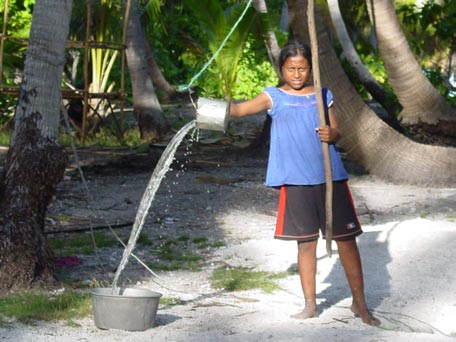
Water Availability: Rainwater, shallow unconfined
groundwater (generally within less than 2 m of the
Water consumption est. 30-100 litres/person/day
surface), imported water or desalination. Seawater is
used by many for washing. Of five desalination plants
installed in Kiribati over the past seven years only one is
partly operational on the island of Banaba. The raised
island of Banaba uniquely has fresh water pools in
subterranean caves that could serve as an emergency
source of water in times of severe drought.
Island Vulnerability: Kiribati is subject to frequent, long
and severe droughts. In most households that rely on
rainwater harvesting for a substantial portion of their
freshwater supply, storage volumes are seldom
sufficient to last through the major droughts. Sea level
rise is considered the greatest threat posed by global
warming to low small islands; ultimately sea levels will
inundate low lying islands. There is the potential for the
sea to overtop parts or even whole islands during storm
surge, periodically leading to destruction of
infrastructure, salinisation of some fresh groundwater
and the death of breadfruit trees. Rapid population
increase since 1963 and inward migration to South
Tarawa are pushing sanitation and water supply to the
limit of sustainability. Heavy reliance on imported fuel
could lead to major power outages and reticulated
water shortages. Limited land area poses problems for
solid waste disposal.
Power Generation: Fuel is imported. There is no
renewable electricity production (2004, UN).
Health: Close, communal living in island communities,
continuing urbanisation of islands with limited land
14
INTEGRATED WATER RESOURCE MANAGEMENT IN PACIFIC ISLAND COUNTRIES - A SYNOPSIS
area and use of untreated water from domestic dug
wells for water in both urban and rural areas means
that there is the potential for the spread of water-borne
diseases such as typhus and cholera. There was a cholera
outbreak in Tarawa in 1977, prior to the installation of
the saltwater sewage system. The alarming infant
mortality rate due to diarrhoeal disease in Kiribati is
amongst the highest in the Pacific and in 2005 just over
1 in 3 of the South Tarawa population was affected by
diarrhoea and dysentery. Encroachment of settlements
on water reserves in South Tarawa and the reluctance
to enforce existing regulations increase the risk of major
disease outbreaks, despite water treatment. Pit latrines
have been installed in rural areas with assistance from
Ministry of Health and Medical Services (MHMS)
Environmental Health Unit.
are: highly variable and inadequate levels of service;
high levels of leakage and unaccounted for water loss at
Environment and Tourism: Special reserves have been
household levels; low levels of cost recovery and non-
created to protect wildlife and their habitats. Kiritimati,
financially viable operations; increasing water demand
the largest island in Kiribati, has major wildlife
and usage; limited available and relevant technical skills
sanctuaries identified for its world-famous birdlife.
and capacity; insufficient knowledge and understanding
These sites are removed from human settlement and
for planning and management; inadequate attention
water supply lenses and are protected by law. Kiritimati
paid to wastewater disposal and sanitation; inadequate
was used during the 1950's and 60's for nuclear testing.
appreciation of responsible water management and use
There is relatively little tourism in Kiribati although
by communities; limited community involvement in
there is potential for an expansion, particularly in the
water service planning, management and delivery;
northern Gilberts and in Kiritimati.
uncoordinated
development
across
sectors;
IWRM Barriers
deteriorating water quality and quantity at supply
sources; inappropriate land use in water reserves; and
The key challenges in the water resource sector have
in rural areas, lack of safe water supplies and
been investigated in much detail in recent years. These
sanitation.
are: limited freshwater resources; sustainability of
water harvesting; impacts of settlement and land use
IWRM Solutions
on water quality; fragmented control, management
Kiribati has outlined a possible integrated IWRM
and protection of water resources; increasing demands
strategy, commencing with the establishment in
for water resources; insufficient knowledge and
February 2007 of the National Water and Sanitation
understanding of water resources nationwide; social
Coordination Committee to report to the national
and environmental impacts of water abstraction
government on water resources management, water
proposals; land ownership in water reserves; limited
demand management, health and environmental
use of rainwater harvesting; lack of community
impacts, policy and regulations. Kiribati recognises it
understanding and appreciation of responsible water
requires additional IWRM support for a national water
management; lack of conservation incentives; limited
policy, plans and legislation, more sustainable water
community involvement in water resource management
supply and sanitation systems through the introduction
and protection; impacts of human waste; lack of
of a tariff system, capacity building in water resources
national water policy and legislation; impacts of
assessment, increased community participation,
droughts and storm surges on groundwater; and
participatory groundwater protection, increased
predicted impacts of climate change.
rainwater harvesting, and new water sources for South
In the water and sanitation services sector the challenges
Tarawa.
15
INTEGRATED WATER RESOURCE MANAGEMENT IN PACIFIC ISLAND COUNTRIES - A SYNOPSIS
2.5 MARSHALL ISLANDS
Area
181 sq. km (SOPAC)
Description: Two roughly parallel chains of 29 coral
atolls and 5 single coral islands. Mostly low coral
Population
50,840 (1999 census)
limestone and sand.
Population Density 281 person sq. km
Economy: Agriculture is primarily subsistence. Tourism
Rainfall
2000 to 4000 mm/year
employs less than 10% of labour force. There is a US
(2000mm/year in the
military base on Kwajalein, which provides rental
northern atolls to 4000 mm/
income. The main opportunity for additional revenue is
year in the southern atolls).
from existing natural resources
Wet season from mid-April to
Water Availability: There is a rainfall gradient, with
December
heavier rainfall in the southern atolls and islands and
GDP
$115 million (2001 est., CIA
less rainfall in the northern atolls and islands. Household
World Factbook)
rainwater harvesting is practised heavily on Majuro
(71% of households) and the Outer Islands, and less so
GDP/capita
$2,900 (2005 est., CIA World
on Ebeye (22% of households). Rainwater is harvested
Factbook)
on Majuro using the airport runway as a catchment
Land Use
arable land: 11.1%
area pumped to a series of reservoirs, which feed a
reticulated distribution system. There is some
permanent crops: 44.4%
groundwater use on Majuro and the Outer Islands, but
other: 44.5% (2005, CIA
almost none on Ebeye. Several reverse osmosis units on
World Factbook)
Majuro are used during dry periods. At least two Majuro
companies also use desalination to produce and sell
Water consumption 100 litres/person/day on
bottled drinking water. The importation, sale and
Majuro and Ebeye, less on
consumption of bottled drinking water is also on the
Outer Islands
rise in Majuro and Ebeye. Many Ebeye households rely
on importation of water from the US military base on
neighbouring Kwajalein Island.
Island Vulnerability: Like many PICs, the fragmented
and isolated nature of the country, the location of its
settlements along the coast, high population density
and low relief make the RMI vulnerable to a number of
natural and man-made types of disasters. These include:
typhoons, tropical depressions, storm surge, flooding,
sea level rise (and other climate change effects),
droughts, fires, marine oil spills, water supply pollution
and disease outbreaks. Urbanisation, population
growth, high-risk development practices and power
supply insecurity also contribute to island
vulnerability.
Power Generation: Reliance on imported fuel.
Health: Water quality is becoming an increasingly
critical health issue due to increased urbanisation,
population growth and mounting economic challenges
faced by many households and families. Health risks are
posed by contaminated and polluted home rainwater
storage, wells, and coastal areas. Lagoons and coastal
waters tested showed elevated bacterial contamination,
16
INTEGRATED WATER RESOURCE MANAGEMENT IN PACIFIC ISLAND COUNTRIES - A SYNOPSIS
IWRM Barriers
Mixed forest communities,
The Marshall Islands reports the following
IWRM challenges:
freshwater and brackish water bodies Natural water scarcity; under-resourced Public Utilities;
and marine areas are home to a wide
water resources contamination; weak conservation and
range of endemic species of plants
demand management; non-integrated management;
water resources assessment and monitoring remains
and animals.
limited; weak disaster and emergency planning and
preparedness; training and capacity building needs are
particularly in the urban areas of Majuro and Ebeye.
high; no overall water sector strategy; high vulnerability
Risk factors for outer islands are also high, stemming
to marine floods and droughts; sea level rise; lack of
mostly from unsanitary home rainwater catchment and
disaster preparedness; limited awareness and limited
collection systems. The number of gastrointestinal cases
awareness efforts; no targeting of government and
has climbed sharply from 2001 to 2004 and in late 2000
traditional leaders; limited funding; limited engagement
and early 2001, an outbreak of cholera occurred on
of women; unreliable water supply and sanitation
Ebeye and Lae Islands.
systems; organizational weakness; overlapping
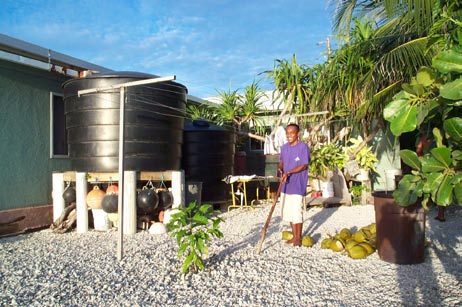
Environment and Tourism: Mixed forest communities,
authorities and outdated policies; institutional
freshwater and brackish water bodies and marine areas
weaknesses; ignoring traditional authority; weak
are home to a wide range of endemic species of plants
compliance; non-integrated institutions; financial
and animals. Endangered species found in the RMI
performance of utilities poor; and water leakage and
include: blue whale, sperm whale, Micronesian pigeon,
theft.
leatherback turtle, and the hawksbill turtle. Coral reefs,
IWRM Solutions
coastal beaches and coastal mangrove areas are
particularly critical as they help prevent erosion. These
The Marshall Islands developed an outline plan for
critical areas are under increasing pressures from urban
addressing these issues. The responses included:
development, sea walls, pollution and other threats,
and deterioration of these habitats directly affects
Improved water resources assessment, monitoring and
tourism potential. A number of new hotel and resort
management; improved demand management;
investments are currently underway, commercial and
improved disaster preparedness, capacity building;
private cruising tourism is growing, and in 2007, Majuro
improved climate forecasting and drought planning;
Atoll received its first direct charter flights from Japan.
awareness campaigns; targeting of political and
However, local operators are increasingly concerned
traditional leaders; expanded rainwater harvesting and
over rising lagoon pollution and other environmental
wastewater treatment capacities; water resources
threats. Tourism is also placing pressure on local water
strategy
and
legislation;
clear
institutional
resources, through increase potable water demand and
responsibilities; water safety plans; civil society
increased wastewater production.
engagement; improved utility financial performance
(tariffs and billing); appropriate budgetary funding for
environmental health and environmental protection.
17
INTEGRATED WATER RESOURCE MANAGEMENT IN PACIFIC ISLAND COUNTRIES - A SYNOPSIS
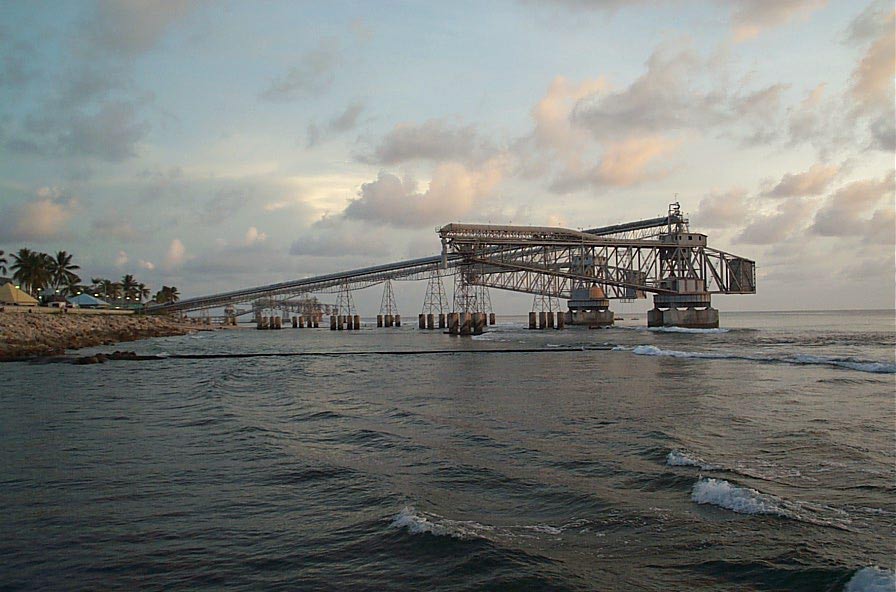
2.6 NAURU
Description: As the world's smallest independent
Area
22 sq. km
republic, the tiny state of Nauru consists of one 22 km2
Population
8,500 (2005, est.)
island and is 1 of the 3 great phosphate islands of the
Pacific Ocean (although reserves are now depleted).
Population Density 386 person/sq. km
Nauru is an isolated uplifted limestone island located
Rainfall
2,090 mm/year
just south of the equator, surrounded by a fringing coral
reef some 120 to 300 metres wide. A narrow coastal
GDP
$60 million (2005 est., CIA
plain surrounds a raised coral limestone plateau of
World Factbook)
pinnacles and outcrops, the latter 70% and 30% of the
GDP/capita
$5,000 (2005 est., CIA World
island land area respectively. The limestone plateau has
Factbook)
been the focus of extensive phosphate mining for the
past 80 years which is to be finally phased out in the
Land Use
arable land: 0%
next 10 ten years.
permanent crops: 0%
Economy: Revenues of this tiny island have traditionally
other (mining related
come from exports of phosphates, but reserves are now
activities, public buildings and
depleted. Few other resources exist. The rehabilitation
residences): 100% (2005, CIA
of mined land and the replacement of income from
World Factbook)
phosphates are serious long-term problems. Off-shore
banking and export of coconut products contribute to
Water consumption 40 litres/person/day (totally
the economy.
reliant on desalinated water
until plant failure in 2001)
Water Availability: Sources of freshwater for Nauru's
island communities are restricted to rainwater, imported
water, shallow unconfined groundwater and limited
desalination. The need for reliable power supply and
appropriate technical capacity to run the desalination
plant means that it has been out of action for several
years. Seawater and non-potable well water (from
shallow groundwater bores next to houses) are used by
many for bathing. Apart from Buada Lagoon, there are
no surface freshwater resources on Nauru apart from a
few brackish ponds near the base of the escarpment,
mostly on the north-east of the island, and an
underground lake in Moqua Cave in the southeast.
Island Vulnerability: Nauru is susceptible to natural
disasters including severe droughts and the threat of
sea level rise. Groundwater pollution from seawater
intrusion due to over-pumping, contamination from
seawater sewerage systems and leachate from mining
and residential waste, fish stock depletion, power supply
insecurity and food scarcity are also major issues. The
drought from 1998 to 2001 stretched the water
resources on the island and highlighted the urgent need
for a sustainable water supply system. The drought
resulted in overuse of the lens and a decline in water
quality, leading to rising health and environmental
issues due to seepage from household sewage pits into
the increasingly brackish and contaminated
groundwater.
18
INTEGRATED WATER RESOURCE MANAGEMENT IN PACIFIC ISLAND COUNTRIES - A SYNOPSIS
Power Generation: Reliance on imported fuel.
the lack of a legal and policy framework for water
Health: There is no routine water quality testing
resource ownership and management - groundwater is
program for potable and non-potable water supplies
owned by the landowners and not the nation and there
due to lack of capacity, although previous studies have
is no legislative framework for water resources,
found elevated levels of TDS and E coli in potable and
sanitation and environmental matters; capacity building
non-potable water supplies. Contaminated groundwater
in the area of integrated management - there is a
is thought to be the cause. The hospital is under-
shortage of capable people for water management and
resourced, with frequent power and water interruptions.
for maintenance of existing facilities; poor waste water
The incidence of water borne diseases is therefore not
treatment in septic tank systems and cess pits, seepage
documented.
of nutrients to groundwater and into the lagoon;
climatic vulnerability in water supply, particularly to
Environment: To date, phosphate mining has disturbed
drought; and high power demand for desalination.
or destroyed 1,400 ha of the 2,200 ha of Nauru. Hence
it has had a massive impact on the terrestrial
IWRM Solutions
environment. It is planned to rehabilitate the mined
Nauru has identified the following IWRM solutions:
land over the next 20 to 30 years, and replant it. An area
water resources must be managed in an integrated way,
of 124 ha has been allocated to agriculture. This would
based on a scientific understanding of the sustainable
place a very heavy demand on the groundwater
supply; a good appreciation of the demand for water; a
resource. There is also concern that reef ecosystems are
sustainable delivery system; and an integration of
stressed and that there has been a substantial reduction
cultural perceptions, ownership rights and practical
in the number of fish caught on the reef. This is
economics; a National Water Plan; a National Sanitation
attributed to the increase in fishing pressure for
Plan; improved drought supplies using conjunctive use
subsistence, as a consequence of the recent financial
(rainwater and groundwater); improved community
crisis.
engagement; water conservation; improved wastewater
IWRM Barriers
management; establishment of a National Water and
Sanitation Committee; improved financing through
Nauru reports the key water resource management
greater cost-recovery tariffs.
issues that would benefit from an IWRM approach are:
19
INTEGRATED WATER RESOURCE MANAGEMENT IN PACIFIC ISLAND COUNTRIES - A SYNOPSIS
2.7 NIUE
Area
259 sq. km
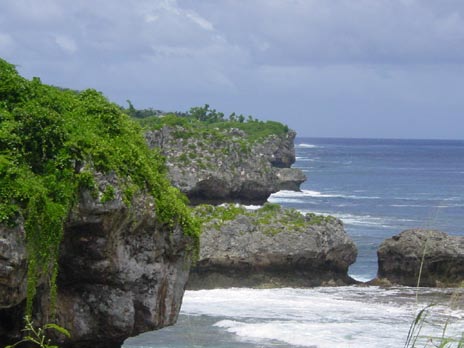
Description: Single raised karstic coral atoll with highest
259 sq. km
elevations around the rim (60m) and a lower plateau
Population
1,625 (GoN statistics, 2006)
(former lagoon) in the centre (35m).
Population Density 6.3 persons/sq. km
Economy: Agriculture is mostly subsistence, though
Rainfall
2,180 mm/year. Wet season
there has been investment in vanilla and nonu
between December and
production for export. Limited industry concentrates
March.
on fruit processing, honey and coconut cream. Eco-
March.
tourism is being promoted.
GDP
$13 million (GoN statistics,
2003)
Water Availability: There is no surface runoff in the
2003)
form of streams, rivers and lakes. As such water for
GDP/capita
$7,700 (GoN statistics, 2003)
residential and commercial consumption can only be
Land Use
arable land: 11.5%
drawn from the karstic aquifer groundwater lens.
arable land: 11.5%
Historically Niueans used cave water and coastal springs
permanent crops: 15.4%
for their water supply. A limited amount of bottled
other: 73.1% (CIA World
fresh water is imported for sale from New Zealand as
Factbook, 2005), including
alternative source which mostly caters for tourists. A
64% forest (GoN, 2004)
desalination plant at a fish processing factory is for
64% forest (GoN, 2004)
industrial use.
Water consumption 350 litres/person/day (2004
est. SOPAC)
Island Vulnerability: Niue is prone to damage from
est. SOPAC)
natural disasters such as cyclones, drought, and
potentially from earthquakes. Man-made disasters
include marine oil spills and pollution from agrichemicals
such as paraquat (herbicide) and human waste.
Vulnerability is exacerbated by very limited human
resources and technical capacity.
Power Generation: Dependence on imported fuel.
Health: To date Niue is fortunate that its underground
water source is still free from pollution and
contamination. Water related diseases do not prevail
on Niue although in the past cases of diarrhoea and
intestinal infections have been reported to Health
department, and the public were notified urgently to
ensure that water for drinking was to be boiled. No data
exists on the prevalence of water borne diseases.
Groundwater and rainwater storage is untreated, except
following Cyclone Heta as a precautionary measure.
Environment and Tourism: Significant concerns about
the negative impacts of deforestation gave rise to the
Huvalu Forest Conservation area located on the south-
eastern side of the island. The site, containing
approximately 75% of the remaining forest on Niue,
complements and strengthens traditional conservation
methods, activities and sustainable use. Two recognised
marine protected areas (MPA) have been set up, both
on the north-western side of the island. These are
20
INTEGRATED WATER RESOURCE MANAGEMENT IN PACIFIC ISLAND COUNTRIES - A SYNOPSIS
examples of the watershed and coastal management
assessment; formulate and implement strategies to
measures that are required to allay concerns relating to
utilize appropriate methods and technologies for water
the potential degradation of attractive natural or
supply and sanitation systems; implement strategies to
historical sites and the future of the tourism industry.
protect watersheds and the remaining forest from
IWRM Barriers
further depletions; strengthen capacity development to
enhance the collection and application of climate
Niue has noted the deficiencies in its capacity to
information to cope with climate variability and change;
efficiently adopt and embrace IWRM principles to
promote hazard assessment and risk management
conduct proper planning, development, and sustainable
rather than disaster response; set up a high quality
management of its limited and vulnerable water
participatory framework; include water and sanitation
resources. Its lack of capacity institutional and human,
in the formal education system; improve the
geographical isolation and financial dependence are
communication and coordination of all stakeholders in
major obstacles which are further compounded by the
sustainable water and wastewater management
continued decline in population due to emigration.
including government, NGOs, Civil Society and Private
Recent cyclone damage has resulted in a relocation of a
Sector; identify appropriate institution, infrastructure,
significant proportion of the population further into
and information to support sustainable water and waste
the centre of the island. This has highlighted fears of
water management; continue collaboration with
inappropriate land use and inadequate wastewater
regional and international partnership; develop a
treatment impacting upon the main groundwater
comprehensive consultative process to develop shared
wellfields.
IWRM national; strengthening national instruments,
national vision, policies, plans and legislation; promote
IWRM Solutions
an appropriate institutional arrangements and
Niue has reported a wide range of activities it would
sufficiently resourced; develop national leadership in
like to consider within an IWRM strategy. These
water resources; create a better environment for
include:
investment by public and private sector; improved
operational
efficiency,
using
benchmarking,
Strengthen capacity to conduct water resources
development of water-loss reduction programmes.
21
INTEGRATED WATER RESOURCE MANAGEMENT IN PACIFIC ISLAND COUNTRIES - A SYNOPSIS
2.8 PALAU
Area
487 sq. km
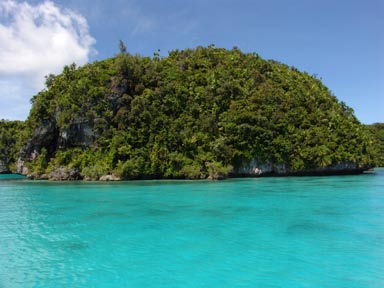
Description: Republic of Palau is comprised of 350
islands. Two main inhabited islands, Koror and
Population
20,000 (2005)
Babeldaob. A range of island settings, including volcanic,
Population Density 44.6 persons/sq. km (245
raised and low coral islands and atolls.
person/sq. km in Koror and
Economy: Primarily tourism, subsistence agriculture
Airai states)
and fishing.
Rainfall
3700 mm/year.Wet season
Water Availability: Surface water is abundant and
between June and August.
largely continuous. The Ngerikiil River and Ngerimel
GDP
$124.5 million (2004 est., CIA
Dam supply the Koror/Airai Water treatment plant on
World Factbook)
the island of Babeldaob. The islands of Peleliu, Angaur
and Kayangel rely on groundwater for their public
GDP/capita
$7,600 (2005 est., CIA World
water supply systems. 90% of people living in Palau
Factbook)
have access to piped treated water. The platform islands
Land Use
arable land: 8.7%
and low atolls get their water from aquifers and
household rainwater harvesting systems. Bottled water
permanent crops: 4.4%
is imported. Currently there is a proposal to reuse
other: 86.9% 2005 (CIA World
wastewater from a newly constructed sewage treatment
Factbook, 2005)
plant, mainly for irrigation purposes.
Water consumption 700 litres/person/day (Koror/
Island Vulnerability: EL Nino impacts on Palau are felt
Airai); 150 litres/person/day
heavily when the dry season is extended from its usual
(southwest islands)
1.5 months to 2-3 months. In the period after this, La
Nina, higher than average rainfall is expected along
with more intense and more frequent storms. Palau
remains vulnerable to man-made disasters such as fires,
marine oil spills, disease outbreaks, high-risk and
unplanned development and chemical and sewage
pollution of water supplies. The increasing number of
tourists visiting the islands is putting a strain on the
existing wastewater treatment systems. Hotels are
required to have their own wastewater treatment
facilities but most rely on the public system, thus
pushing the system beyond its maximum capacity.
Power Generation: Reliance on imported fuel for
electricity generation.
Health: Because most of the water supply systems are
treated, water borne disease incidence relating to the
public water supply is low. Of greater concern are
individual household catchments. The Division of
Environmental Health is using the hydrogen sulphide
test to test for bacterial contamination in household
catchments. Most of the outbreaks of water-borne
illness come in cluster outbreaks, usually from campers
in the forests using rivers directly as a drinking water
source. Dengue fever is a concern due to the large
number of mosquitoes and larvae at the ponding
systems of the Malakal Treatment Plant. According to
22
INTEGRATED WATER RESOURCE MANAGEMENT IN PACIFIC ISLAND COUNTRIES - A SYNOPSIS
the Division of Environmental Health, small dengue
resources due to increasing population and urbanisation;
outbreaks occur at least once a year, with larger
watershed misuse and sediment erosion; deforestation
outbreaks happening every 2 to 3 years.
and pesticide use; inadequate wastewater management;
Environment and Tourism: Palau is home to the
sectoral management approaches and a lack of
internationally renowned `Rock' islands. In 2006, the
connectivity; increasing tourism pressures; vulnerability
number of tourists was four times the population of
to natural and man-made disasters; lack of water
Palau. Unintentional damage caused by tourists (e.g.
resources assessment and monitoring; little disaster
coral damage, congestion, increase use of personal
preparedness; too many awareness programmes but
watercrafts) has led the State of Koror to pass legislation
not enough community involvement; ineffective water
to delineate tourist activity areas and a tour guide
demand management; over-reliance on unenforceable
certification program for the Rock Islands tour
regulatory approaches; insufficient water tariffs;
companies was developed. Projects are in place to
reliance on donor funding; weak linkages to ecosystem
develop more hotels. Most of these proposed
and public health.
developments are high-end boutique cottages that
IWRM Solutions
cater to a limited number of people per year. For the
most part, the developers have a vested interest in
Palau has identified it requires the following IWRM
protecting the environments that their customers come
strategies to compliment its existing activities:
to enjoy. However, there is the potential for larger-
A national water resources committee; awareness
scale hotels to develop within the watersheds, thus
raising and community advocacy; integrated land use
creating more wastewater and putting strain on the
and water resources information and planning; research
environment and infrastructure.
on effective regulatory approaches, water resources
IWRM Barriers
management, sanitation, ecosystem protection; linkage
capacity building.
Palau has reported the following major concerns:
Increasing demand for and contamination of water
23
INTEGRATED WATER RESOURCE MANAGEMENT IN PACIFIC ISLAND COUNTRIES - A SYNOPSIS
2.9 PAPUA NEW GUINEA
Area
462,840 sq. km
Description: Several large high volcanic islands and
numerous high volcanic and coral atolls.
Population
5.9 million (2005 est. WHO)
Economy: Subsistence and commercial agriculture
Population Density
12.9 person/sq. km
(including food crops, fishing, livestock, hunting),
Rainfall
1000 - 8000 mm/yr. Wet
forestry, mining, crude oil production and petroleum
season from late December
refinery
to mid-April
Water Availability: Water resources include surface
GDP
$15.41 billion (2006 est., CIA
fresh water from streams, rivers, lakes, ponds, reservoirs,
World Factbook)
estuaries and swamps; groundwater from confined and
unconfined aquifers; surface and subsurface brackish
GDP/capita
$2,700 (2006 est., CIA World
water showing varying degrees of salinity; rainwater
Factbook)
harvesting; and effluent water, which can be treated
Land Use
arable land: 0.5%
and recycled. A few commercial establishments in the
drier areas of the country operate small desalination
permanent crops: 1.4%
plants to supplement their water supply during the dry
other: 98.1% (CIA World
seasons. In rural PNG, only 20% of the population have
Factbook, 2005), of which
access to an improved water supply which include public
standpipes, boreholes, protected wells or springs In the
78% forest
urban areas which PNG Waterboard services, 91% have
access to treated and reticulated water but only 60% of
these households get piped water directly into their
houses. In its nationwide urban water supply network
the PNG Waterboard has succeeded in reducing
unaccounted for water from the 1987 level of 50% to
the present level of 31%.
Island Vulnerability: Due to its location on the
intersection of the Australian plate and the Pacific plate,
many parts of PNG are vulnerable to the effects of
natural disasters. These include tsunamis, earthquakes,
volcanic eruptions and landslides. Flooding, droughts
and saline intrusion are also common. Wastewater
discharge from large urban centres, mining, logging and
major agricultural activities, increased sediment,
bacterial and chemical pollution from untreated waste
streams and improper solid waste management. As a
consequence, destruction will continue to be caused to
aquatic flora and fauna and the health of people
downstream will be affected.
Power Generation: Papua New Guinea has large
hydropower stations in Rabaul, Kainantu and Port
Moresby. Smaller scale and micro-scale plants also
generate electricity. National oil and gas supplies are
also consumed.
Health: 78% of the population (more than four million
people) do not have access to safe sanitation services.
Diarrhoea is the number one cause of mortality and
24
INTEGRATED WATER RESOURCE MANAGEMENT IN PACIFIC ISLAND COUNTRIES - A SYNOPSIS
...establishment of a national water committee, formulation of a national
vision for water resources, development of a national water resources
management policy, review and finalisation of a national water services policy,
review of institutional mechanisms and capacity building in water resources
management, disaster preparedness, awareness raising, water supply and
sanitation services, institutional reform and sustainable financing...
morbidity in the country and 2.9% of all deaths are
pressure induced by rapid population growth as well as
caused by typhoid. The current low access to potable
runoff and point source pollutant laden discharges from
water and safe sanitation increased the risk of a Cholera
mining, logging, agriculture, infrastructure development
epidemic. Adverse impacts on water resources in
and industrial processing, entering surface and
catchments arise from road construction, agriculture,
groundwater bodies. While existing regulatory controls
logging, mining and improper disposal of solid and
are in place to minimize these impacts, better monitoring
human waste. This is major cause for concern as 60% of
and compliance arrangements are required to regulate
the rural population obtain drinking water directly from
these activities. In order to overcome the constraints
a natural source and preparation. The Department of
imposed by limited regulatory funding from the
Health has been promoting better hygiene, improved
government,
monitoring
networks
involving
sanitation and proper solid waste disposal throughout
partnerships with private sector, NGOs and local
the country but it needs the support of other government
landowners should be seriously pursued. Rural water
agencies, provincial and local level governments as well
supply access is limited and wastewater access
as NGOs and CBOs.
nationwide inadequate.
Environment and Tourism: PNG has a variety of
IWRM Solutions
terrestrial, coastal and marine ecosystems ranging from
glacier covered high mountain peaks, through humid
In order to safeguard the availability of water with
tropical forests and swampy lowlands to pristine coral
respect to quantity and quality to maintain ecological
reefs. Forest cover is the dominant vegetation in Papua
integrity, cater for natural and anthropogenic water
New Guinea. Forests cover 360,000 km2 (78 %) of the
uses as well as minimize impacts arising from floods,
total land area. These forests, the extensive mangrove
droughts and climate change, Papua New Guinea
forests that characterise the major river deltas along
identify there is an urgent need to apply integrated
the southern coast of Papua New Guinea and the coral
water resources management involving all stakeholders
reefs are all of global biodiversity significance. The main
and focusing on catchment units. Several institutional,
threats to these interconnected ecosystems are activities
legislative, operational, strategic, capacity, public
such as commercial logging, commercial agriculture,
consciousness and resource related barriers have been
subsistence agriculture, road clearance, mining and
identified for appropriate treatment in order to achieve
petroleum developments, industrial and sewage
effective IWRM in PNG. These include the establishment
effluents as well, as indiscriminate solid waste disposal.
of a national water committee, formulation of a national
The impact on watersheds by tourism is minimal mainly
vision for water resources, development of a national
because the concentration of rural based eco-tourism
water resources management policy, review and
facilities and the annual volume of incoming tourists is
finalisation of a national water services policy, review
relatively low.
of institutional mechanisms and capacity building in
water resources management, disaster preparedness,
IWRM Barriers
awareness raising, water supply and sanitation services,
Water resources availability in terms of quantity and
institutional reform and sustainable financing.
quality is coming under increasing threat from the
25
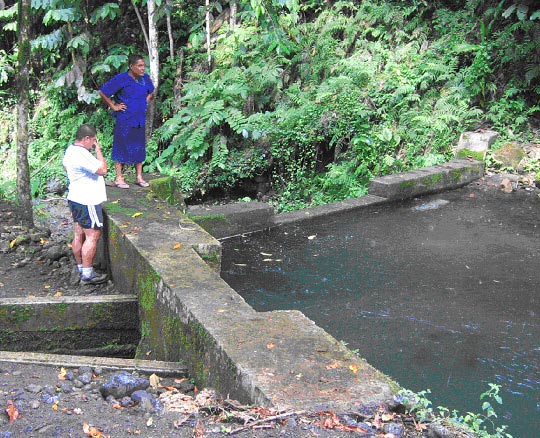
INTEGRATED WATER RESOURCE MANAGEMENT IN PACIFIC ISLAND COUNTRIES - A SYNOPSIS
2.10 SAMOA
Area
2,820 sq. km
Description: Two main islands (Upolu and Savaii) and
several smaller islands, plus some uninhabited islets. A
Population
180,000
narrow coastal plain with volcanic rugged mountains in
Population Density 63.5 person/sq. km
the interior.
Rainfall
3000 mm/year. Wet season
Economy: Two-thirds of the labour force are engaged
from November to March.
in agriculture, which provides 90% of exports (coconut
cream, coconut oil and copra). Limited manufacturing
GDP
$1.218 billion (2006 est., CIA
concentrates on agricultural products. Fisheries
World Factbook)
resources appear to be falling. Tourism is growing and
GDP/capita
$2,100 (2005 est., CIA World
now represents 25% of the GDP. The economy of Samoa
Factbook)
has traditionally been dependent on development aid
and family remittances from overseas
Land Use
arable land: 21.1%
Water Availability: Water supply in northern, eastern
permanent crops: 24.3%
and southern Upolu and eastern Savaii is from surface
other: 54.6% (2005, CIA
water intakes, where as that for western Upolu and rest
World Factbook)
of Savaii is from groundwater. Water shortages are
reported during the dry season, especially during
Water consumption 230 litres/person/day (Samoa
extended dry periods associated with the ENSO, in the
Water Authority)
Apia area on Upolu (served by surface water intakes)
and in the Falealupo Peninsula on Savaii (where
groundwater is often brackish saline and the population
relies upon rainwater harvesting). Water consumption
in Apia has been controlled through the introduction of
metering.
Island Vulnerability: Flooding associated with cyclones
and storm surge is exacerbated by small catchments
and steep slope gradients. El Nino related dry periods
can cause urban water supply problems in Apia, even if
rainfall is reduced for relatively short periods. Population
growth, increased urbanisation and an increase in major
developments put pressure on natural resources and
result in land degradation, waste generation and land
and water pollution.
Power Generation: There are five micro-hydropower
stations, all in Upolu, which provide about 40% of the
national requirement. Sediment erosion is threatening
hydropower generation and has resulted in the
abandonment of the Fulausou hydropower plant.
Health: Improved access to drinking water is high in
urban areas (90%, 2004, UN) as well as rural areas
(87%, 2004, UN). However, only around a third of the
population of Samoa receive treated water and, even
when treated, only 85% of samples taken pass the
relevant standards. 1 in 60 people attend hospital each
year for treatment of water borne diseases.
26
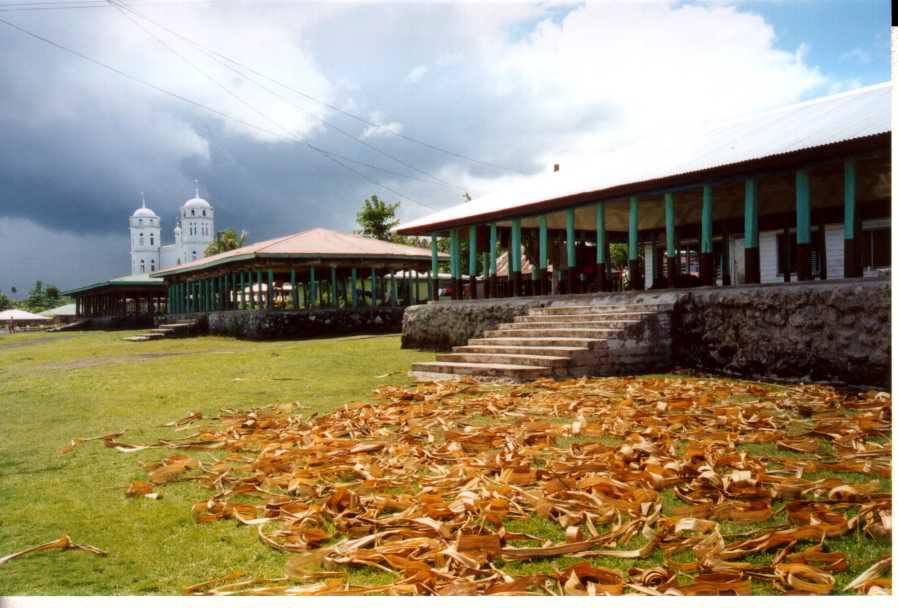
INTEGRATED WATER RESOURCE MANAGEMENT IN PACIFIC ISLAND COUNTRIES - A SYNOPSIS
Environment and Tourism: Tourism in Samoa is
management and solid waste management in the lower
growing. All resorts are located on the coast. Tourism
catchments, and increasing vegetation clearance due to
contributes to heavy water demand and high wastewater
urban expansion and cash cropping in the upper
production and thus places pressure on the watershed
catchments not only reduces low flows and increases
as well as the near-shore environment. Increased coastal
flash run-off, but also is resulting in perceived increases
development impinges on reefs, mangroves and other
in erosion, sediment loading and nutrient enrichment
habitats, which contribute to the protection of the
of the water courses. Collectively these increasing
terrestrial environment from storm waves, tsunamis
pressures are perceived to be impacting upon public
and coastal erosion. The impact of integrated coastal
water quality, public health and causing degradation of
and catchment management on the terrestrial and
environmental habitat.
marine environments as well as the economy is
recognised.
IWRM Solutions
IWRM Barriers
Samoa is proposing an IWRM approach, the ethos of
which is to build on the activities undertaken to date
Samoa has identified some significant barriers to
(water resources assessment and monitoring,
achieving IWRM, despite having some of the more
participatory watershed management, integrated
integrated water governance in the Pacific. These
disaster preparedness, institutionalisation of traditional
include:
governance rights, extensive water demand
A lack of natural water storage resulting rapid onset of
management, water safety planning, wastewater
low flow levels within several weeks and conversely
management improvements, country-wide civil society
very rapid flooding events; water and energy demand
consultation, the integrated multi-agency water
increasing despite water demand management
committee, appropriate water supply tariffs) and to
measures; increasing population and land use pressures,
improve the coordinated and integrated planning and
especially around the capital area, land degradation in
management of these activities, moving away from
the catchments is a concern; inadequate wastewater
sectoral and institutional delivery, to more effective
and efficient collaborative implementation.
27
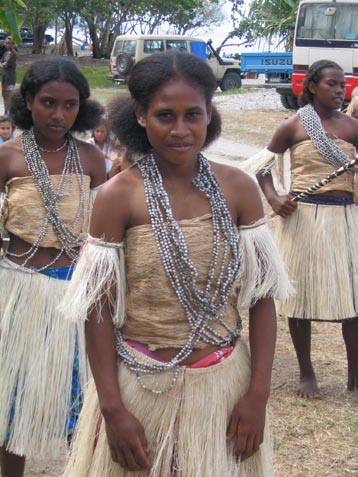
INTEGRATED WATER RESOURCE MANAGEMENT IN PACIFIC ISLAND COUNTRIES - A SYNOPSIS
2.11 SOLOMON ISLANDS
Description: About 1000 scattered islands comprised of
Area
30,000 sq.km
volcanic peaks and low lying coral islands, divided into 9
Population
409,042 (1999 census)
provinces
Population Density 13 person/sq. km
Economy: The economy consists of a mixed subsistence
sector on which over 80% of the population depend,
Rainfall
1,500-5,000 mm/year. Wet
and a small monetised sector dominated by large-scale
season from November
commercial enterprises. Log exports remain the major
to April
foreign exchange earner for the country Over-reliance
GDP
$230 million (1999, ADB)
on one commodity magnifies the country's susceptibility
to external shocks. The islands are rich in undeveloped
GDP/capita
$510 (1999, ADB)
mineral resources.
Land Use
arable land: 0.6%
Water Availability: Water resources availability in
permanent crops: 2%
Solomon Islands varies considerably for each island. It
ranges from sizeable rivers to small streams from high
other: 97.4% (CIA World
mountainous and dense rainforest islands to rainwater
Factbook, 2005)
harvesting and thin fresh water lens of underground
Water consumption 150 litres/person/day
aquifers of the small low-lying atolls and islets.
(urban areas)
Island Vulnerability: Cyclones, flooding and drought
affect the Solomon Islands. Sea level rise also poses a
threat. Soil erosion and increased sediment load in rivers
result from human activities such as subsistence
farming, logging and developments and residential
housing. Untreated sewage, industrial discharges,
leakage from oil storage tanks, human disturbances to
vegetation, mine drainage and leaching from mine
waste, and drainage from the residues of agricultural
fertilizers and pesticides pollute water bodies, the
extent of which is not well understood due to lack of
data.
Power Generation: Significant potential for hydropower
generation
Health: Water quality analysis is a major problem. Most
of the existing laboratories are incapable of undertaking
the necessary analysis as specified in the International
standards for water quality. Faecal coliform and high
nutrients detected in samples taken from boreholes
suggest waste water leachate contamination from
overflowing septic tanks during heavy rains.
Environment and Tourism: Solomon Islands is
recognised for its high level of biological diversity in
terrestrial and marine environments. The coral reefs,
shallow lagoons and mangroves of Solomon Islands are
amongst the most biologically diverse in the world.
However, many reefs are at risk due to continued
exploitation for food and other resources through the
28
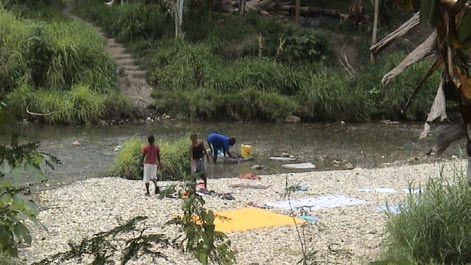
INTEGRATED WATER RESOURCE MANAGEMENT IN PACIFIC ISLAND COUNTRIES - A SYNOPSIS
use of unsustainable and destructive harvesting
lack of financial resources - only urban areas supplied by
methods. Industrial and agricultural and sewage
SIWA are commercially viable, whereas provincial
pollution of water courses, logging and coastal
governments lack of qualified staff and funds to
development also threaten mangrove habitiat. Tourism
properly maintain rural water supply systems.
is still a small sector and has little impact on watershed
and coastal ecosystems at present.
IWRM Solutions
IWRM Barriers
The Solomon Islands recognises the need for the
following IWRM solutions, some of which it has already
The Solomon Islands has identified the following
initiated:
barriers to achieving IWRM:
Hydrology equipment and hydrology training for
A lack of comprehensive water assessment;
resource assessment; water conservation and reuse;
inappropriate water resources governance and
pollution prevention; establishment of a national water
legislative framework, poor coordinative approach by
quality guideline committee; awareness programs on
organizations responsible for water; inadequacy of
hydrology; disaster preparedness; community based
River Waters Act; lack of capacity to ensure water
monitoring
programs;
high
level
advocacy;
analyses in-country; threat from logging and mining;
improvements to wastewater treatment or discharges;
flooding and droughts and no hydrological stations
shared water resources information; integrated and
with capability for flood warning; low level of national
linked institutional arrangements and policy and
literacy; lack of basic water related data to back up
legislative framework; capacity building; financial
awareness program; women are not included in decision
restructuring of SIWA to improve revenue and
making process for water; ageing infrastructure for
sustainability of service in urban area; effective billing
water and wastewater services; lack of monitoring and
systems for cost recovery; public-private partnership
enforcement; lack of appropriate technologies and
and robust regulatory oversight.
procedures; lack of training; no national water resources
policy; no comprehensive water resources legislation;
29
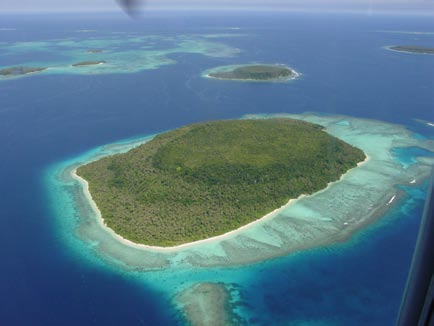
INTEGRATED WATER RESOURCE MANAGEMENT IN PACIFIC ISLAND COUNTRIES - A SYNOPSIS
2.12 TONGA
Area
747 sq. km
Description: Archipelago of 172 named islands, of which
36 are inhabited. The archipelago comprises a western
Population
114,600 (2006 est.)
line of steep sided volcanic islands and an eastern line of
Population Density
127 person/sq. km
generally low-lying limestone and mixed geology
islands
Rainfall
1689 - 2185 mm/year. Wet
season from November
Economy: Tonga, a small, open, South Pacific island
to April
economy, has a narrow export base in agricultural
goods. Squash, coconuts, bananas, and vanilla beans are
GDP
$178.5 million (2004 est., CIA
the main crops, and agricultural exports make up two-
World Factbook)
thirds of total exports. The country must import a high
GDP/capita
$2,200 (2005 est., CIA World
proportion of its food, mainly from New Zealand.
Factbook)
Tourism is the second-largest source of hard currency
earnings following remittances. The country remains
Land Use
arable land: 20%
dependent on external aid and remittances from Tongan
permanent crops: 14.7%
communities overseas to offset its trade deficit. Tonga
has a reasonably sound basic infrastructure and well-
other: 65.3% (2005, CIA
developed social services.
World Factbook)
Water Availability: The water resources of Tonga are
Water consumption 170 litres/day
primarily in the form of groundwater. Surface water
(Nuku'alofa area est., 1998)
resources are not present on most islands, except `Eua
and some of the volcanic islands including Niuafo'ou
and Niuatoputapu. Groundwater is normally pumped
from drilled wells and some old dug wells, some of
which are over 50 meters deep. The water supplies for
the main urban centres: Nuku'alofa (Tongatapu),
Pangai (Ha'apai) and Neiafu (Vava'u), and some villages'
water supplies are also source from groundwater.
Rainwater is the supplementary source of portable
water and is mainly collected from the rooftop and
stored in reinforce concrete, fibre glass and galvanizes
iron tanks. There are currently no functioning
desalination systems in Tonga. Domestic greywater is
commonly re-used for livestock especially pigs. Bottled
water is increasingly being imported from Fiji and Asia,
but is mainly used by ex-patriates and tourists.
Island Vulnerability: Cyclones which occur in the
kingdom on an average of once a year can inundate low
lying areas causing surcharge of sewage and other
contaminants. Earthquakes and volcanic eruptions can
cause infrastructure damage and derogation of water
supplies. Extended drought reduces re-charge of
groundwater, concentrates contaminants, reduces food
production for subsistence and income, and may
increase incidence of communicable diseases due to in
adequate water for hygiene purposes. Saltwater
intrusion of groundwater can also reduce potable
supplies. Man-made disasters include chemical pollution
30
INTEGRATED WATER RESOURCE MANAGEMENT IN PACIFIC ISLAND COUNTRIES - A SYNOPSIS
IWRM Barriers
...to facilitate co-operation and
Tonga reports the following constraints on implementing
sharing of resources and information, national IWRM approaches:
and to nurture traditional and
There is no functioning information or data exchange
cultural values and knowledge of
systems on water resources or `National Hydrological
resource management...
Network' for water resources assessment and
monitoring;
demand
management
measures,
from pesticides and fertilisers, oil, fuel, industrial
augmenting water supply, drought vulnerability
chemicals, which can rapidly infiltrate the porous soils,
assessment and climate forecasting are all recognised as
and biological pollution from septic tanks, pit latrines,
being important but are not yet adequately supported;
and pigs. In the case of Nuku'alofa township, the aquifer
wastewater management is almost entirely in the hands
had to be abandoned as pollution caused an increase in
of the householder as all sanitation treatment in Tonga
diarrhoea.
is on-site, there is no centralised reticulated sewerage
system in Tonga; no comprehensive law in Tonga
Power Generation: Reliance on imported fuel for
dealing with issues of ownership, management and
electricity generation.
protection of water resources; no specific land use
Health: Reticulated water from the Tonga Water Board
policy; complex traditional land tenure system; lack of
and village water systems is treated and is delivered to
control of groundwater abstraction rates, sanitation
80% of households. Rainwater harvesting systems are
and solid waste disposal practices, the use of
connected to 60% of households and wells provide
agrichemicals, and deforestation; inadequate funding
supplementary groundwater supply to 3% of
for rural water supply and sanitation.
households. This water is not treated. In 1999 and 2000
IWRM Solutions
the incidence of diarrhoea related diseases peaked
during drought conditions, which led to the assumption
Tonga report the emphasis on IWRM solutions should
that reduced water supply had led to unhygienic
be to build on existing skills and relationships, to
conditions and practices in many communities. This
facilitate co-operation and sharing of resources and
may have been exacerbated by greater concentration of
information, and to nurture traditional and cultural
contaminants and drawn down from point sources of
values and knowledge of resource management.
pollution such as septic tanks to water supply sources
such as wells and village pumps. It has been observed
This includes: comprehensive water resources legislation
that dengue outbreaks are more common in cyclone
(providing for effective planning, assessment,
seasons when hot humid conditions are favourable to
development, control, monitoring and protection of
reproduction.
water resources); clear institutional mandates and co-
ordinate other agencies in supporting roles, providing
Environment and Tourism: Tonga has a variety of
an opportunity for integrated planning and ongoing
habitats that are rich in biodiversity. These include
adaptive development of a national water policy and
forests, mangroves and coral reefs. Some damage to
strategy; a partnership approach with the community
coral reefs has been sustained (e.g. from destruction for
to ensure compliance, including water users and
aggregates and die-off due to nutrient run-off). Over-
landholders who are providing access to groundwater;
hunting threatens the native sea turtle population.
a National Water Resources Committee will be
Under the Parks and reserves Act of 1976 five marine
established to keep all stakeholders involved and
parks have been designated on Tongatapu. The parks
informed, and to assess training and capacity building
cover 250 hectares of coral reef, which is 10% of Tonga's
requirements; strengthened and integrated (multi-
total coral system. None of the other island groups have
agency) water resources monitoring programme
marine parks although surveys have been conducted
including monitoring systems and information
with this intention in mind. Deforestation is a serious
databases; water resources technical capacity building;
concern as more and more land is cleared for agriculture
improved wastewater management using eco-sanitation
and settlement. Nutrient run-off and increased
technologies;
improved
rainwater
harvesting;
sedimentation also threatens to trigger an algal bloom
improvements to farming practises (organic
and silting up of the lagoons.
approaches).
31
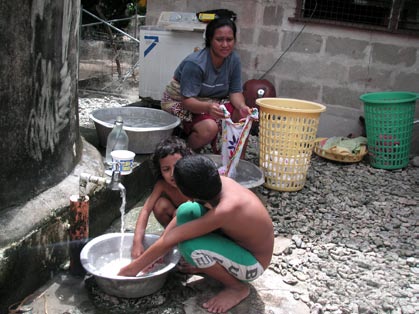
INTEGRATED WATER RESOURCE MANAGEMENT IN PACIFIC ISLAND COUNTRIES - A SYNOPSIS
2.13 TUVALU
Area
26 sq. km
Description: 9 very low-lying coral atolls comprised of
very coarse coral sand and gravel. Limited fresh
Population
11,000 (2007 est.)
groundwater lens formation and heavy reliance on
Population Density 425 person/sq km
rainwater harvesting
Rainfall
3569 mm/year (Funafuti,
Economy: Government revenue comes from the income
Falkland and Woodroffe,
generated by the Tuvalu Tonga Trust (capital), the
1997). Wet season November
`dotTV' internet domain (asset) and from fishing licenses
to April
granted to foreign fishing companies (natural
resources). The private sector contributes approximately
GDP
$14.94 million (2002 est., CIA
30% of GDP of which half is from external
World Factbook)
remittances.
GDP/capita
$1,600 (2002 est., CIA World
Water Availability: Since there are no streams or rivers
Factbook)
and groundwater is not potable, most water needs must
Land Use
arable land: 0%
be met by rainwater catchment systems with storage
facilities. Groundwater is a non-potable, secondary
permanent crops: 66.7%
source, used on islands where salinity is not prohibitively
other: 33.3% (2005, CIA World
high and in times of drought. Desalination plants were
Factbook)
installed on Funafuti, Vaitupu and Nanumaga after
Tuvalu experienced drought in 1999. Some bottled
Water consumption < 50 litres/person/day
water is imported. Natural brackish ponds are the
construction and cleaning of pig pens and for dumping
rubbish.
Island Vulnerability: The natural disasters that can
affect Tuvalu include cyclones (not common but highly
destructive when they do occur) and drought, both of
which could be exacerbated by climate variability and
change and sea-level rise. Human activities/practices
also contribute to vulnerability to disaster. Insufficient
capacity and storage and poor construction and
maintenance of rainwater harvesting systems means
that supply is depleted in dry spells of one or two weeks.
The community then relies on the government tanker
to transport water from the national reserves. Poorly
controlled waste disposal is still commonplace
throughout Tuvalu. Pollution of groundwater and
marine waters from inappropriate sanitation systems
and animal waste (especially pigs) is a serious threat.
Increase in population and the growth in demand for
permanent housing and infrastructure in Funafuti has
resulted in an increased demand for sand and gravel for
building and construction purposes. The sourcing of
aggregate from coastal environments is increasing the
risk of coastal erosion and flooding. Increasing
population and limited land for subsistence farming,
especially in the capital Funafuti is leading to dependence
on imported food.
32
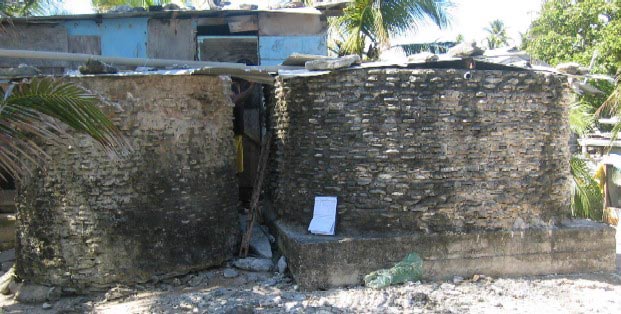
INTEGRATED WATER RESOURCE MANAGEMENT IN PACIFIC ISLAND COUNTRIES - A SYNOPSIS
IWRM Barriers
Tuvalu reports the following major challenges to
implementing national IWRM plans:
No National Hydrological Network for water resources
assessment and monitoring; high vulnerability to
climate variability due to reliance on rainwater
harvesting; no community-based monitoring of quality;
limited maintenance of rainwater harvesting systems;
limited water conservation and demand management
activities; inadequate wastewater management;
Power Generation: Heavy oil dependence. Small, solar-
pollution from solid and liquid wastes, coastal erosion;
powered backup pumps in shallow wells used during
sea level rise; limited financial resources and technical
droughts.
support available to households; a lack of knowledge
and awareness of people within the community of the
Health: In 1990 there was an outbreak of cholera. There
environmental impacts caused by `un-managed'
were 1809 reported cases of severe diarrhoea between
wastewater on surrounding marine and freshwater
July and November that year. It was considered that
quality; a lack of waste management legislation and
the outbreak was due to inadequate hygiene resulting
enforcement; inadequate funding; complex formal and
from lack of water, and contamination of water supplies
informal governance structures; no national water
and the lagoon water due to poor sanitation. There
plan; no water storage regulations; land disputes; no
were 2449 cases of acute respiration infections from
land use policy; and limited linkages between different
June to October, and a conjunctivitis outbreak, in
sector stakeholders.
November. All of these problems are associated with
sub-standard hygiene and high household densities,
IWRM Solutions
which is exacerbated by disease transmission by flies.
Many children under five have diarrhoea and intestinal
Tuvalu considers any IWRM framework must address
parasites. Environment and Tourism: A Marine
the three key issues of adequate rainwater harvesting,
Conservation Area (MPA) encompassing 33 km2 of
improved wastewater management to reduce the
marine and terrestrial habitats has been established on
contamination of valuable drought resistant
the capital atoll of Funafuti in Tuvalu. Fish, coral and
groundwater resources and protection of the marine
algae surveys have been conducted to measure the
shore fisheries from land based pollution (especially
`health' of the reef. As a result its success, other islands
wastewater). This strategy identifies:
such as Nui, Vaitupu, and Nukufetau are interested in
Need to refurbish or supplement fresh water resources
setting up MPAs in support of their traditional marine
by improving rainwater harvesting systems, and
management systems. It has been estimated that the
expanding the use of groundwater resources; demand
net economic value of the MPA is $162,120 per annum
management; improvements in the management of
and relates to increased fisheries productivity, coastal
wastewater; collaboration of government institutions,
protection from healthy coral reefs, improved
non-government and community-based organisations
opportunities for eco-tourism, dive tourism, ocean
and in particular householders themselves; trial of
recreation and similar income generating activities
waterless zero discharge sanitation systems (reducing
(ADB 2003). Promotion of the MPA and the conservation
water demand and groundwater pollution); strengthen
work that is being undertaken there would be a useful
the National Water and Sanitation Committee; review
focus for marketing Tuvalu tourism, and increased
existing legislation; increase capacity building in water
visitor numbers would help to generate funds to support
resources assessment, integrated planning, demand
the MPA. However facilities for visitors need to clearly
management, cost recovery, community liaison and
demonstrate sustainable water resources and
appropriate household water supply and sanitation
wastewater management.
technologies.
33
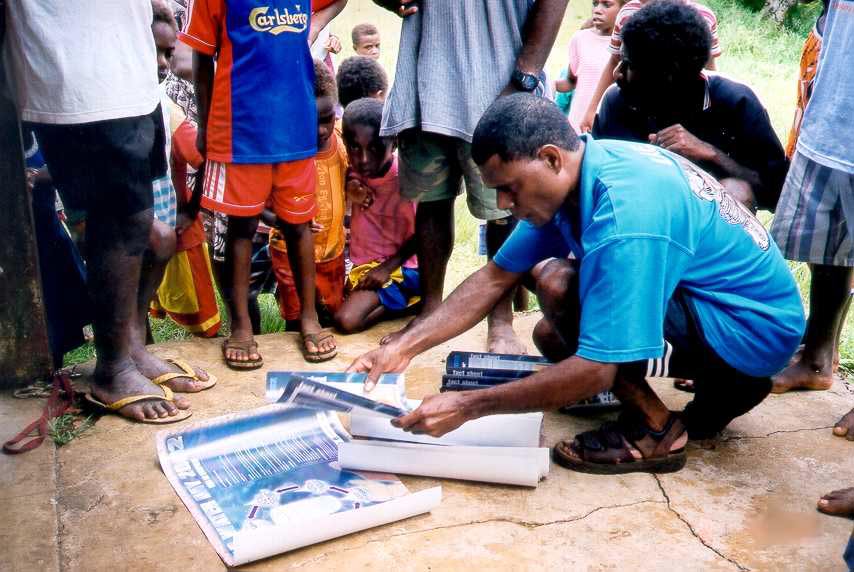
INTEGRATED WATER RESOURCE MANAGEMENT IN PACIFIC ISLAND COUNTRIES - A SYNOPSIS
2.14 VANUATU
Area
12,281 sq. km
Description: Archipelago of over 80 islands, of which
69 are inhabited. Volcanic and raised limestone islands.
Population
200,000
81% of the population live in rural areas and are
Population Density 16 person/sq. km
mainly occupied in subsistence and small holder
farming with the remaining 19% of the population
Rainfall
2000 - 4000 mm/year. Wet
living in the two main urban areas of Port Vila on
season from November to
Efate and Luganville on Santo.
April, with cyclones from
Economy: Based primarily on small-scale agriculture
December to April
that provides a living for 65% of the population. Fishing,
GDP
$739 million (2006 est., CIA
offshore financial services and tourism are the other
World Factbook)
mainstays of the economy. Negligible mineral deposits.
GDP/capita
$2,900 (2003 est., CIA World
Water Availability: All larger islands have groundwater
Factbook)
and many also have surface water resources. Some
smaller islands such Mataso & Buninga in the Shepard's
Land Use
arable land: 1.6%
Group, all of Torres Group, and small islands off
permanent crops: 7%
Malekula and Santo have neither ground nor surface
water. During times of national disaster such as cyclone
other: 91.4% (2005, CIA
damage to islands relying on rainwater catchment, the
World Factbook), of which
National Disaster Management Office has provided a
75% natural vegetation
desalination plant as a temporary measure. Bottled
water is increasingly used in Port Vila and other urban
areas.
Island Vulnerability: Vanuatu is situated on the Ring of
Fire and is in the centre of the South Pacific's Cyclone
Alley. It is vulnerable to natural disasters such as
tsunamis, earthquakes, volcanic eruptions, and cyclones
and is known as the most disaster prone country in the
South Pacific. Atolls, low-lying islands, and low-lying
coastal areas of Vanuatu are particularly susceptible to
erosion, flooding and inundation during tsunamis,
storm surges, high seas, sea level rise and periods of
intense rainfall. Vanuatu's population is concentrated
along the coastal environment that plays a vital role in
the subsistence and commercial life of ni-Vanuatu.
Increased human activity in this coastal environment is
placing greater pressure on sensitive areas such as
beaches, coral reefs and mangroves.
Power Generation: Electricity is produced by
hydropower plants on Vanuatu. Fuel is also imported.
Health: Scabies, skin diseases and malaria are water
related diseases and are the three of the most common
health issues in Vanuatu. Poor drainage and waste
management provide pools of water that are favorable
breeding sites for the malaria mosquito. Unmanaged
and uncontrolled sanitation and wastewater are also
major concerns for health. Whilst there are currently
34
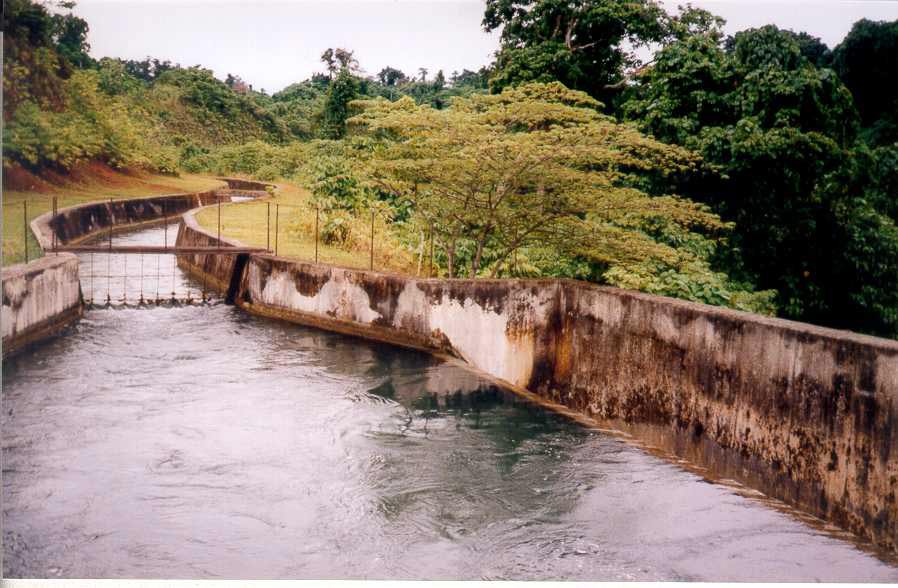
INTEGRATED WATER RESOURCE MANAGEMENT IN PACIFIC ISLAND COUNTRIES - A SYNOPSIS
no major issues related to this there is concern
poor waste management; all government and municipal
particularly in high-density areas that should a problem
water supply providers are severely constrained by
emerge it will be difficult to control, especially as
limited human and financial resources; sectoral planning
communicable diseases account for a large proportion
has not met resource management needs, failed to
of illness and death in Vanuatu. The tourism industry is
address customary land tenure and resource ownership
also under threat from poor sanitation facilities. The
issues; lack of capacity to interpret, implement and
Vanuatu Island Bungalow Association (VIBA) is
enforce existing legislation; lack of sustainability and
participating in the Eco-Sanitation Program in an
coordination of external interventions; lacks a national
attempt to introduce more hygienic and more acceptable
land-use policy.
sanitation to remote tourist locations. Community
awareness programs are continuously improving.
IWRM Solutions
Environment and Tourism: There are seventeen reserves
Vanuatu suggests an IWRM strategy framework
in Vanuatu that cover a range of habitats including
targeting research, public awareness, capacity building,
coastal areas, inland areas, forests and waterways.
and policy and institutional development.
Despite the biodiversity study undertaken by the
Research focuses on water resources management,
Environment Unit there is still a lack of research and
ecosystem inventory and stress reduction approaches,
knowledge of habitats and endangered species. Outside
health and links to water quality, appropriate sustainable
the system of reserves, no formal sectoral linkages are
sanitation, disaster vulnerability reduction measures,
currently known to plan for or manage coastal
impact assessments and information management.
development or the impacts of land based activities on
waterways and coastal ecosystems. It has been
Public awareness focuses on resources and information
suggested that eco-tourism is promoted as a means to
provided to NGOs who are already delivering community
protect the environment.
awareness programs and government departments
integrating community awareness into their core
IWRM Barriers
responsibilities and using NGOs to implement their
Vanuatu has reported the following constraints upon
programmes.
achieving national IWRM approaches:
Capacity building focuses on leadership, strategic
Lack of planned methodical water resource assessment
planning and coordination mechanisms and approaches,
and monitoring; declining ground water levels and
and technical skills especially in water resources
quality due to septic tank use and cattle grazing; decline
management, sanitation and data management.
in coastal water quality where septic tanks are used;
Policy and institutional development focuses on
poorly prepared for climatic and geological disasters;
legislative reviews and reforms, land policies including
government awareness programs infrequent and sector
land ownership, service provision and regulation, tariffs
based; lack of a coordinated approach between
and subsidies, and IWRM application in inter-agency
government and NGOs; lack of involvement of women;
programmes.
conflicts with custom land tenure and resource
ownership; logistical difficulty of reaching outer islands
A Pacific regional review of IWRM practise in the Pacific
on a regular basis; water supply does not meet demand;
SIDS in 2004 reported there was an increase in
35
INTEGRATED WATER RESOURCE MANAGEMENT IN PACIFIC ISLAND COUNTRIES - A SYNOPSIS
3. BARRIERS TO ACHIEVING IWRM IN SIDS
integrated planning and management in recent years in
some countries, however whilst the Pacific has a strong
traditional and cultural understanding of the connection
between land and fresh water activities and the coastal
environment (95% of the Pacific population live within
a kilometre of the seas and most rely on both the land
and sea for their livelihood), this was not apparent in
any formal policy or institutional way. It is not surprising
therefore that the 2005 IWRM Target for IWRM and
WUE Plans was not achieved by any PIC, as indeed it
was not by many countries in the world.
A more detailed diagnostic analysis of IWRM in the
Pacific Region at the country level has been carried out
in 2006-2007 and completed for 14 PICs as part of the
Global Environment Facility supported Pacific IWRM
programme development. These country diagnostic
reports provide the clearest picture yet as to why the
Pacific SIDS are struggling to adopt and implement
vulnerable to climate variability, be it dry periods and
IWRM.
subsequent drought or wet periods and rapid flooding.
The time lag between a climatic extreme and a water
Ultimately, like all IWRM challenges, the barriers relate
shortage could be as small as a week for those countries
to overcoming the existing demands for and availability
entirely reliant on rainwater, to a month for those
of water, existing land usage and associated pollution
reliant on surface water and six months for some
potential and the capacity of people and organisations
groundwater bodies. Flooding, especially that associated
to overcome these issues.
with cyclonic rainfall events, can be near instantaneous,
The main barriers are provided below with supporting
and outside of Papua New Guinea, arrive less than 6
information.
hours after the rain storms. The ability to manage such
rapid on-set of drought and flooding (sometimes
Limited and Fragile Water Resources all countries concurrently) within the countries was limited.
identified their available water resources were of very
Insufficient Political and Public Awareness
limited size, mostly due to small land mass areas and
most
close proximity to coastlines. In the more populace
countries identified that there was limited political
areas, population densities (especially on capital atoll
understanding of the economic and public health
islands) can become so great that water demand exceeds
importance of water, except that is during periods of
water availability. In some volcanic islands competing
drought and flooding. Because water is actually
water demand in urban catchments results in complete
important to every sector, no one agency or sector has
loss of stream flows and degradation of downstream
responsibility, the issue has no political champion, and
users supplies. Water quality degradation in urban
the issue does not get the political support, be it
areas, and especially in low-lying atoll islands (where
budgetary, institutional or prioritisation it requires.
groundwater is <1m below ground surface) from
Similarly, whilst the public generally understands the
numerous dispersed sources was widely sited. All
value of water to their daily lives, it is either assumed to
countries identified a lack of water resources expertise
be always available or given insufficient priority over
and subsequent baseline knowledge as being a
other issues (e.g. health, education, income), despite
fundamental barrier to any informed decision-making
being implicitly important to achieving these more
on water resources management and protection,
valued family goals.
including IWRM.
Excessive Water Demand and Inadequate Water
Vulnerability to Climate Variability all countries Treatment most urban areas in the Pacific are supplied
recognised that their water resources were not only
water by urban service providers. A shortage of technical
small in size, but due to this small size they were highly
capacity, as well as inadequate funding, is often sited in
36
INTEGRATED WATER RESOURCE MANAGEMENT IN PACIFIC ISLAND COUNTRIES - A SYNOPSIS
there was very little formal communication and
coordination both at the planning and the
implementation stages between these departments,
ministries and agencies, when it came to water resources
allocation, usage, pollution prevention, monitoring and
management. Where attempts at integration have been
made, some were overly ambitious (following `western'
models) and lacked not only the political and institutional
commitment required to sustain them but also had not
taken into account the limited capacity of the countries
themselves to fulfil these functions.
National Government vs. Traditional Governance
Conflicts almost without exception, the countries
reported there were traditional values, beliefs and rights
that if not adequately recognised, considered, consulted
and resolved could become significant if not
the reports as the reasons behind high water losses
insurmountable barriers to any forms of water and land
(leakages, theft, poor metering) in the systems.
management. The most obvious of these is the issue of
However in some countries per capita household
customary land ownership, and the associated rights of
demands are still excessively high, despite water
land usage, access, purchase and even water usage.
conservation campaigns. Water treatment plants often
Whilst many of the countries were aware how these
operate beyond their design limits, and fail to cope with
conflicts could be resolved, usually through extensive
high flows, especially during periods of high turbidity. A
community engagement, these approaches rarely
lack of sufficient drinking water quality monitoring in
coincided with the shorter timescales associated with
many countries then fails to ensure these problems are
engineering project implementation.
resolved quickly.
Inadequate Financing the size of the Pacific SIDS
Inadequate Wastewater Management within the populations and economies prevents the `economies of
14 PICs, only a few capital areas have any sewerage
scale' being available as they are in larger countries. The
systems, with the vast majority of the Pacific populace
costs of operating a water service provider, a regulator,
dependent upon on-site sanitation systems, most of
an environmental health department or a water
which are unmanaged and therefore ineffective.
resources agency, are higher per capita, thus resulting
Groundwater pollution is wide spread, especially in the
in limited human and financial resources available to
low-lying atoll countries. Of the capital areas serviced
fulfil these functions. Insufficient cost-recovery be it
by sewerage systems, few and perhaps none, work to
due to cultural, political or technical reasons, by water
the original design standards, discharging untreated or
and wastewater service providers contributes to under
inadequately treated sewage effluent into the near
staffing, inadequate maintenance levels and thus water
shore environment and local fisheries. Inadequate
losses, water and wastewater treatment failures and
wastewater management was identified as the single
pollution.
largest cause of freshwater contamination in the Pacific
Weak linkages to Other Sectors
by the UNEP International Waters Programme.
some countries
have made progress in improving the linkages within
Fragmented National Water Governance all the water sector per se, including the water provider,
countries identified that although water resources and
water resources protection agency and the
supply were important to many if not all sectors,
environmental health department. However linkages
including public health, fisheries, tourism, the
beyond the water sector remain weak, with no formal
environment, power generation, commercial enterprises
or informal linkages at any levels between the water
and the government administrative function, and were
sector and agriculture, forestry, tourism, power
also impacted upon and affected by these sectors as
generation and environment. With so little linkages,
well as others, including forestry and agriculture, that
the inertia for creating institutional reform is
considerable.
37
INTEGRATED WATER RESOURCE MANAGEMENT IN PACIFIC ISLAND COUNTRIES - A SYNOPSIS
4. SOLUTIONS TO ACHIEVING IWRM IN SIDS
4.1 IWRM Pacific Style
In developing IWRM strategies in SIDS it is important
to recognise that whilst IWRM remains a relatively new
"brand" in the Pacific Islands, the concept and the
approaches it embodies has been practised at a
traditional level for centuries in the Pacific Islands.
The idea that all activities affect each other, given the
very small landmasses in the Pacific, is well understood
by people living in the islands. The concept of competing
land pressures, the choice of whether to use precious
land for a plantation, a water reserve, a school or
recreation area, are appreciated at the household,
village and community level. In particular, every coastal
village community understands the connection between
activities on the land and in the sea, as they impact on
freshwater, fisheries stock and coral reefs.
Transboundary river basins - the scale at which IWRM
first took hold and was seen to be of value, is not an
issue in the Pacific. Basins or catchments are generally
too small to manage individually except at the
community level, and with no international land borders
in the region, `transboundary' in the Pacific refers to
marine pollution and migratory fish stocks. Capacity
building, advocacy and awareness raising are most
effective at the national level, but have regional level
implications.
Cyclone and drought events, to which the PICs are
especially vulnerable (due to the small size of the
catchments and aquifers and therefore the lack of
natural storage) affect all water users. The need for
In response to this islands have started to look at
national drought and disaster preparedness plans (as
managing water resources not only within the
opposed to sector wide plans) are two forms of climatic
watershed but also the receiving coastal waters. In the
extreme water resources management, recognised as
Pacific this management concept has been referred to
national priorities in many PICs, and which to a greater
as "Ridge to Reef" or "Hilltops 2 Oceans - H2O". In the
or lesser extent show signs of more integration.
Caribbean it is known as "White Water to Blue Water".
Since the late 1990's mounting evidence, collected
There is therefore some relevant experience in the
through international programmes such as the UNEP
region of awareness, advocacy and existing programmes,
GPA suggested, that pollution on land from inadequate
from which to develop IWRM policies, strategies and
wastewater disposal, increased sediment erosion, and
activities, as demonstrated by the findings of the
industrial discharges were impacting upon coastal water
country IWRM diagnostic reports. The formalisation of
quality and fishing stocks. This pollution has had an
these IWRM strategies and implementation programmes
impact on entire island wide food security as well as
must build on this baseline, as well as that in other SIDS
valuable tourist revenue, and has also led to recognition
regions, such as the Caribbean with its regional
for the need for more integrated land and coastal-
"Integrated Watershed and Coastal Area Management"
marine management (often referred to as Integrated
(IWCAM) Initiative.
Coastal Zone Management ICZM).
38
INTEGRATED WATER RESOURCE MANAGEMENT IN PACIFIC ISLAND COUNTRIES - A SYNOPSIS
4.2 A Synopsis of IWRM Tools from the Pacific
Nearly all of these activities, tasks and functions are
Country Assessments
being addressed to some extent in all the countries, but
crucially from an IWRM perspective, most of these are
Despite the hydrological, geomorphological, economic
being undertaken at either the institutional scale or the
and cultural diversity of the Pacific Island Countries, the
sectoral level. There is therefore relatively little
solutions they identified to achieving IWRM were
integration of these functions between ministries,
consistent and are summarised in the list below. Clearly
between sectors, and between government and civil
not all are relevant to all countries (e.g. hydropower is
society stakeholders.
not applicable in atoll and karst islands, where surface
water is absent). Notable by it's absence from the list is
4.3 Integration of existing Water Resources
irrigation which is entirely rain fed in the Pacific
Management
Region.
A comparison of the Pacific IWRM requirements with
· Water Resources Management
that of globally accepted IWRM best practice is
worthwhile. The Global Water Partnership (GWP), a
· Upper Catchment Watershed Management
key IWRM advocate, identifies 3 main areas of action as
· Flood and Drought Management
part of what it refers to as its IWRM Toolbox. These are
the:
· Public Awareness and Education
· Enabling Environment including national policies,
· Community Engagement and Ownership
the legislative framework and adequate water
· Sustainable Rural Livelihoods
funding;
· Water Demand Management
· Institutional Roles including well defined
responsibilities, capacity building to undertake those
· Water Quality Management
functions, and coordination between these agencies;
· Wastewater Management
and
· Hydropower Generation
· Management Instruments including water
resources assessment, demand management, public
· Lower Catchment Urban and Coastal Planning
awareness and education, water allocation
· IWRM Partnership and Planning
mechanisms, regulations, EIA, risk assessment and
management tools (e.g. flood and drought)
· Legislative Reform
economic tools (e.g. tariffs and subsidies) and
· Cost Recovery and Appropriate Tariff Setting
information management and exchange.
· Regulatory/Management Funding
A rapid comparison between the required IWRM
measures derived from the diagnostic reports and the
· Sustainable Land Management
GWP list clearly shows that the national reviews
· Public Health protection
identified all of these IWRM issues.
· Environmental Protection
The focus therefore for the countries now is to create
and improve linkages across the sectors and scales
(communities, watershed, islands, nation), and build
capacity within and between the stakeholders in
utilising the management instruments and tools. This is
most likely to achieve political, institutional and general
public support in the short term by addressing the most
obvious pressing key priority issues in each country.
39

INTEGRATED WATER RESOURCE MANAGEMENT IN PACIFIC ISLAND COUNTRIES - A SYNOPSIS
The countries identified the following integrated (cross-
4.4 The Pacific Response to the IWRM Challenge
sectoral) approaches to deliver IWRM policy, planning
and management implementation by improving inter-
The recognition of the importance of IWRM as
agency communication, coordination and work
demonstrated by the Heads of State endorsement in
programme execution:
2003 of the Pacific Regional Action Plan on Sustainable
Water Management has provided considerable leverage
· An IWRM Apex (over-arching) Body
for the Pacific Region to secure resources to promote
· Integrated Land Use Planning
IWRM at the regional and country level.
· Water Resources Assessment and Quality
Two specific programmes, developed in 2004-2005 and
Monitoring
approved in 2006-2007 target IWRM capacity, advocacy
and awareness raising at the national level, supported
· Watershed and Land Use Management
by regional activities:
· Demand Management and Water Use Efficiency
· GEF-funded UNDP UNEP IWRM Demonstration
· Water Rights, Policies and Legislation
Projects (2008 2011) US$ 12 Million
· Water Resources Information and Management
· EU WF-funded IWRM Planning Programme (2008
Systems
2010) US$ 3 Million
· Education, Awareness Raising and Civil Society
The GEF IWRM project focuses on immediate IWRM
Engagement
implementation of critical issues in priority areas in
each country. The project is designed to reduce
Specific examples of the application of these approaches
environmental stress through the use of IWRM
prioritised by the countries were:
approaches, and to demonstrate the benefits of these
· drought preparedness
approaches to country stakeholders (government and
civil society) and encourage replication at the
· flood management and
catchment, country and international scale.
· water quality improvements through watershed
The EU Water Facility IWRM Planning Programme
management.
focuses on more medium term objectives, including the
establishment of IWRM policies, strategies and plans
for each country.
The two programmes have been designed together and
provide complimentary and mutually beneficial support
40
INTEGRATED WATER RESOURCE MANAGEMENT IN PACIFIC ISLAND COUNTRIES - A SYNOPSIS
to each other. The GEF project demonstrates short term
4.5 Pacific SIDS IWRM Implementation and the
tangible benefits of IWRM which are so important to
IWRM Road Map
the IWRM credibility required for the longer term
IWRM planning programme, whereas the EU
The Pacific SIDS have to date positioned themselves
programme
provides
the
replication
and
well through national political commitment,
institutionalisation required to sustain the IWRM
development agency engagement and stakeholder
functions practiced within the demonstration projects.
advocacy to secure support for the initial stages of
Collectively, the two programmes provide the Pacific
IWRM development.
SIDS with the means to commence the IWRM process,
IWRM Plans should be in place by 2009 and
by undertaking the situation or needs analysis (the
demonstration scale IWRM implementation projects in
diagnostic reports), which leads to policy development,
the most critical catchments completed by 2011.
strategy choice, and finally the development of National
Resolving the water resources management problems
IWRM Plans, whilst carrying out demonstration scale
country wide by 2015 however requires a much greater
implementation and evaluation of IWRM changes to
level of support.
the enabling environment, institutional roles and
management approaches/tools.
The implementation of the IWRM and WUE Plans
nationwide will require a concerted effort beyond that
required for IWRM plan development and demonstration
project. That effort will require political commitment
Initiation
Vision / Policy
to IWRM prioritisation, public and government
stakeholder ownership and support, and for the SIDS,
external assistance (both technical and financial).
Situation
Analysis
Pacific Island Countries need to champion the support
Evaluation
of SIDS IWRM nationally and internationally, and
secure the domestic and international commitments
Work Plan
they need to implement their IWRM Plans.
The annual Commission on Sustainable Development,
Strategy
tri-annual World Water Forums and one of events such
Implement
Choice
as the Asia-Pacific Water Summit, provide high profile
opportunities to not only report on Pacific SIDS progress
towards achieving IWRM success, but more importantly
IWRM Plan
provide the opportunity to secure national government,
civil society and international development agency
support and commitments to IWRM implementation
Full scale and sustainable implementation of the IWRM
and reaching the MDG targets.
Plans follows on after these programmes.
41
INTEGRATED WATER RESOURCE MANAGEMENT IN PACIFIC ISLAND COUNTRIES - A SYNOPSIS
Bibliography
ADB and SOPAC. 2002. Pacific Regional Action Plan on Sustainable Water Management, Suva, Fiji, SOPAC
Miscellaneous Report 547. SOPAC Secretariat, Suva.
ADB and SOPAC. 2003. Proceedings of the Pacific Regional Consultation on Water in Small Islands Countries,
(eds) (2003), Sigatoka, Fiji Islands, 29 July 3 August 2002, Carpenter, C., Stubbs, J., Overmars, M., Asian
Development Bank and South Pacific Applied Geoscience Council, Suva, Fiji, SOPAC Join Contribution Report.
SOPAC Secretariat, Suva.
Joint Caribbean- Pacific Programme for Action on Water and Climate (2003), Kyoto, Japan.
Kupa, L., and Simpson, A., (eds) (2006): Pacific Position Paper 4th World Water Forum, Apia, Samoa.
Overmars, M. 2003. Water in Small Island Countries Session Statement (2003), 3rd World Water Forum, Kyoto,
Japan.
Recommendations Oceania Follow-up meeting (2004), Wellington, New Zealand.
SOPAC.2007. Integrated Water Resource Management Diagnostic Report Cook Islands. Tim Davie, Draft SOPAC
Miscellaneous Report 635. SOPAC Secretariat, Suva.
SOPAC.2007. Integrated Water Resource Management Diagnostic Report Federated States of Micronesia.
Leerenson Airens and Tim Davie, Draft SOPAC Miscellaneous Report 636. SOPAC Secretariat, Suva.
SOPAC.2007. Integrated Water Resource Management Diagnostic Report Fiji Islands. Paul Taylor, Draft SOPAC
Miscellaneous Report 637. SOPAC Secretariat, Suva.
SOPAC.2007. Integrated Water Resource Management Diagnostic Report Kiribati, Taboia Metutera and Ian
White, Draft SOPAC Miscellaneous Report 638. SOPAC Secretariat, Suva.
SOPAC.2007. Integrated Water Resource Management Diagnostic Report Republic of the Marshall Islands. Ben
Graham, Draft SOPAC Miscellaneous Report 639. SOPAC Secretariat, Suva.
SOPAC.2007. Integrated Water Resource Management Diagnostic Report Nauru. Ian Wallis and Lisa Russ, Draft
SOPAC Miscellaneous Report 640. SOPAC Secretariat, Suva.
SOPAC.2007. Integrated Water Resource Management Diagnostic Report Niue. Andre Siohane and Ahohiva Levi,
Draft SOPAC Miscellaneous Report 641. SOPAC Secretariat, Suva.
SOPAC.2007. Integrated Water Resource Management Diagnostic Report Palau. Environmental Quality
Protection Board, Draft SOPAC Miscellaneous Report 642. SOPAC Secretariat, Suva.
SOPAC.2007. Integrated Water Resource Management Diagnostic Report Papua New Guinea. Narua Lovai, Draft
SOPAC Miscellaneous Report 643. SOPAC Secretariat, Suva.
42
INTEGRATED WATER RESOURCE MANAGEMENT IN PACIFIC ISLAND COUNTRIES - A SYNOPSIS
SOPAC.2007. Integrated Water Resource Management Diagnostic Report Samoa. Clive Carpenter, Draft SOPAC
Miscellaneous Report 644. SOPAC Secretariat, Suva.
SOPAC.2007. Integrated Water Resource Management Diagnostic Report Solomon Islands. Ministry of Mines
and Energy, Water Resources Division, Solomon Islands, Draft SOPAC Miscellaneous Report 645. SOPAC
Secretariat, Suva.
SOPAC.2007. Integrated Water Resource Management Diagnostic Report Tonga. Leonie Crennan, Draft SOPAC
Miscellaneous Report 646. SOPAC Secretariat, Suva.
SOPAC.2007. Integrated Water Resource Management Diagnostic Report Tuvalu. Leonie Crennan, Draft SOPAC
Miscellaneous Report 647. SOPAC Secretariat, Suva.
SOPAC.2007. Integrated Water Resource Management Diagnostic Report Vanuatu. Ruth Marsh, Draft SOPAC
Miscellaneous Report 648. SOPAC Secretariat, Suva.
SOPAC. 2006. Pacific Partnership Initiative on Sustainable Water Management Progress Report, Suva, Fiji, SOPAC
(2006). SOPAC Secretariat, Suva.
SOPAC. 2006. Pacific Partnership Initiative on Sustainable Water Management Action Matrix, Suva, Fiji, SOPAC
(2006). SOPAC Secretariat, Suva.
SOPAC. 2005. Water and Sanitation Issues and Strategic Responses in the Pacific, Pacific Brief for the Report of
the Secretary- General to CSD 13, Views from National and Regional Consultations and Initiatives, Suva, Fiji ,
Overmars, M., SOPAC (2005). SOPAC Secretariat, Suva.
SOPAC. 2004. Preliminary Sector Analysis for Water, Sanitation and Hygiene, Paper prepared for Pacific Island
Forum Secretariat for the Pacific Cooperation Plan, Suva, Fiji, SOPAC (2004). SOPAC Secretariat, Suva.
SOPAC. 2003. Pacific Dialogue on Water and Climate Synthesis Report, South Pacific Applied Geoscience Council,
Suva, Fiji, Scott, D., Overmars, M., Falkland, T., Carpenter, C., SOPAC Miscellaneous Report 491. SOPAC
Secretariat, Suva.
SOPAC. 2002. Pacific Regional Wastewater Policy Statement and Framework for Action. In Regional Meeting
of Stakeholders in Wastewater Management, 10-15 October 2001, Majuro, Marshall Islands, Bower, R.,
Carpenter, C., Overmars, M., SOPAC Miscellaneous Report 451. SOPAC Secretariat, Suva.
SOPAC. 2002. Pacific Type II Partnership on Sustainable Water Management, Suva, Fiji, Overmars, M., SOPAC
(2002). SOPAC Secretariat, Suva.
Water in Small Island Countries Portfolio of Water Actions (2003), Kyoto, Japan
43
INTEGRATED WATER RESOURCE MANAGEMENT IN PACIFIC ISLAND COUNTRIES - A SYNOPSIS
44
INTEGRATED WATER RESOURCE MANAGEMENT IN PACIFIC ISLAND COUNTRIES - A SYNOPSIS