





Perspectives on water and climate change adaptation
W o r l d W a t e r F o r u m
Adapting to climate change
in water resources and water services
in Caribbean and Pacific small
island countries
This Perspective Document is part of a series of 16 papers on «Water and Climate Change
Adaptation»
`Climate change and adaptation' is a central topic on the 5th World Water Forum. It is the lead theme for
the political and thematic processes, the topic of a High Level Panel session, and a focus in several docu-
ments and sessions of the regional processes.
To provide background and depth to the political process, thematic sessions and the regions, and to
ensure that viewpoints of a variety of stakeholders are shared, dozens of experts were invited on a volun-
tary basis to provide their perspective on critical issues relating to climate change and water in the form of
a Perspective Document.
Led by a consortium comprising the Co-operative Programme on Water and Climate (CPWC), the Inter-
national Water Association (IWA), IUCN and the World Water Council, the initiative resulted in this
series comprising 16 perspectives on water, climate change and adaptation.
Participants were invited to contribute perspectives from three categories:
1 Hot spots These papers are mainly concerned with specific locations where climate change effects
are felt or will be felt within the next years and where urgent action is needed within the water sector.
The hotspots selected are: Mountains (number 1), Small islands (3), Arid regions (9) and `Deltas and
coastal cities' (13).
2 Sub-sectoral perspectives Specific papers were prepared from a water-user perspective taking into
account the impacts on the sub-sector and describing how the sub-sector can deal with the issues.
The sectors selected are: Environment (2), Food (5), `Water supply and sanitation: the urban poor' (7),
Business (8), Water industry (10), Energy (12) and `Water supply and sanitation' (14).
3 Enabling mechanisms These documents provide an overview of enabling mechanisms that make
adaptation possible. The mechanisms selected are: Planning (4), Governance (6), Finance (11), Engi-
neering (15) and `Integrated Water Resources Management (IWRM) and Strategic Environmental
Assessment (SEA)' (16).
The consortium has performed an interim analysis of all Perspective Documents and has synthesized the
initial results in a working paper presenting an introduction to and summaries of the Perspective
Documents and key messages resembling each of the 16 perspectives which will be presented and
discussed during the 5th World Water Forum in Istanbul. The discussions in Istanbul are expected to
provide feedback and come up with sug· gestions for further development of the working paper as well as
the Perspective Documents. It is expected that after the Forum all docu· ments will be revised and peer-
reviewed before being published.
3
Adapting to climate change in water resources
and water services in Caribbean and
Pacific small island countries
This document serves as a contribution to the 5th World Water Forum (Istanbul, 2009) from a
small island countries' perspective on Topic 1.1 of the Forum: "Adapting to climate change in
water resources and water services: understanding the impact of climate change, vulnerability
assessment and adaptation measures".
Lead author: Marc Overmars, Water Adviser; SOPAC, Pacific Islands Applied Geoscience
Commission, Private Mail Bag, GPO, Suva, Fiji Islands, Tel: 679 338 1377, Fax: 679 337 0040,
marc@sopac.org, www.pacificwater.org.
Co-author: Sasha Beth Gottlieb, Technical Coordinator; GEF-IWCAM Project Coordination Unit,
c/o Caribbean Environmental Health Institute, The Morne, P.O. Box 1111, Castries, St. Lucia, Tel:
758 452-2501, 452-1412, Fax: 758 453-2721, sgottlieb@cehi.org.lc, www.iwcam.org.
Adapting to climate change in water resources
and water services in Caribbean and
Pacific small island countries
Since the 3rd World Water Forum (Kyoto, 2003) the Caribbean and Pacific region have been
collaborating as part of the global Dialogue on Water and Climate (DWC) initiative, which works
»to improve the capacity in water resources management to cope with the impacts of increasing
variability of the world's climate, by establishing a platform through which policymakers and
water resources managers have better access to, and make better use of, information generated
by climatologists and meteorologists« (www.waterandclimate.org).
Respective dialogues held in each region in prepa-
solid background for this perspective document for
ration for the 3rd World Water Forum resulted in a
the 5th World Water Forum.
Joint Programme for Action on Water and Climate
SOPAC2 and CEHI3 as lead coordinating agencies
(JPfA) which guided the implementation of various
for water and sanitation in respectively the Pacific
coping and adaptation strategies over the past years
and Caribbean region have formalized their
in Small Island Developing States (SIDS) of the
collaboration through a MOU between both organi-
Caribbean and the Pacific (Annex 1).
zations signed at Kyoto and have since been working
At the review of the United Nations Barbados
together on a variety of issues related to integrated
Programme of Action for the Sustainable Develop-
water resource management and related adaptation
ment of Small Island Developing States (Mauritius,
to climate change.
2005) the Caribbean and Pacific nations reiterated
Since Kyoto, SOPAC and CEHI have mobilized
their commitment to SIDS SIDS cooperation with
funding for the implementation of the 3rd World
the Joint Programme for Action for Water and Cli-
Water Forum's SIDS portfolio of water actions
mate and the international community was invited to including: Integrated Water Resources Management;
support the implementation of the JPfA and broaden
Hydrological Cycle Observing System; water demand
it to all Small Island Developing States regions
management; water quality capacity-building; water
including the Atlantic and Indian Ocean (Annex 2).
governance; regional water partnerships; and inter-
The Mauritius strategy highlighted the impor-
SIDS water partnerships.
tance of both water resources and climate change
As coordinator for the Pacific & Oceania sub-
and requested the international community to pro-
region under the Asia Pacific Water Forum, SOPAC
vide assistance to Small Island Developing States for
facilitated a review of the Pacific Partnership Initia-
the implementation of priority actions as submitted
tive on Sustainable Water Management4 under which
to the 3rd World Water Forum Portfolio of Water
the above priority actions were financed in the Pacific
Actions for small island countries through, amongst
and the 3rd progress report of the partnership is
others, the Global Environment Facility (GEF), the
guiding the region's contribution to the 5th World
World Water Assessment Programme (WWAP), the
Water Forum.
Global Programme of Action (GPA) and the EU
`Water for Life Initiative'.
The results from the Caribbean and Pacific dia-
logues on water and climate have been documented
in the respective synthesis reports.1 They closely
2
examine the issues to better understand and plan for
Pacific Islands Applied Geoscience Commission,
the impacts of climate change and climate vulner-
www.pacificwater.org.
3
ability on water resources in SIDS, thus providing a
Caribbean Environmental Health Institute,
www.cehi.org.lc.
4 The
3rd Partnership Steering Committee Meeting,
1
Springer (2002) and Scott et al (2002).
September 2008, Apia, Samoa.
1
In general the perspective document aims to provide
further guidance to the efforts in SIDS regions in
coping and adaptation related to water resources
management and provision of water services.
The first chapter deals with general water and climate
issues in small island countries. Chapter Two exam-
ines the coping and adaptation strategies adopted by
SIDS and the advances made in implementation and
the need to mainstream climate adaptation into water
resources management and disaster risk reduction.
The final chapter deals with the political will and
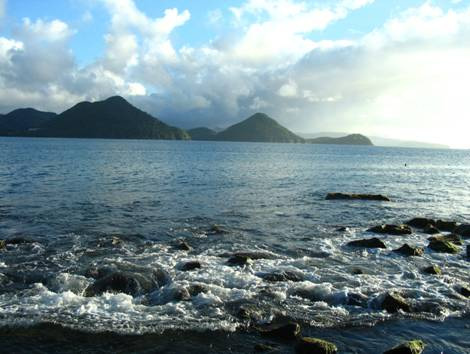
View from Pigeon Island in Saint Lucia (Donna Spencer).
need for additional financing to the water and sani-
tation sector.
CEHI in turn is coordinating the Caribbean's
position at the 5th World Water Forum through the
Americas Regional Process leading to the 5th World
1
Water and climate in small island coun-
Water Forum, with the formulation of a position
tries
paper prepared with support from the Inter-Ameri-
can Development Bank (IADB) and the World Bank.
Small island countries are no different from other
Additionally, CEHI continues to strengthen its man-
countries in that freshwater is essential to human
date of integrating watershed and coastal areas man-
existence and a major requirement in agricultural
agement (IWCAM) in the Caribbean region under its
and other commercial production systems. However,
programme portfolio and, as such, has undertaken
the ability of the island countries to effectively man-
many related activities.
age the water sector differs in Small Island Devel-
This perspective document will:
oping States (SIDS), as they are constrained by their
1 provide examples of `no regrets' approaches,
small size, isolation, fragility, natural vulnerability,
applied in small island countries to cope with
and a limited human, financial and natural resource
current climate variability and adapt to future
base.
climate change, at different levels ranging from
Increasingly variable rainfall, cyclones / hurri-
communities, local administrations and national
canes, accelerating storm water runoff, floods,
governments.
droughts, decreasing water quality and increasing
2 demonstrate the need for a sound knowledge
demand for water are so significant in many small
base and information system, as well as a better
island countries that they threaten the economic
understanding of the relation between water
development and the health of their peoples.
resources, water and health, and climatic
extremes.
3 discuss the need for integrated approaches such
as offered by integrated water resources manage-
ment and drinking water safety planning, and
how these concepts can mainstream climate
adaptation and should be linked to disaster risk
reduction and disaster management.
4 influence policy and decision-makers of small
island countries, and mobilize increased efforts
to take funding for adaptation in the water sector
up in the broader development finance discus-
sions.
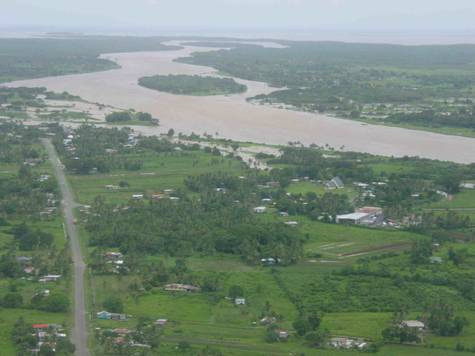
Flooding in Fiji's Rewa Delta (Photo by Marc Overmars).
2
The Intergovernmental Panel on Climate Change
Glacial melt, water and SIDS
(IPCC) continues to report that expected climatic
changes will stimulate an increase in extreme
The impacts of glacial melt on SIDS are predicted to
weather events that include higher maximum tem-
be especially destructive, both in the short and long-
peratures, increased number of hot days, more
term, including changes in water temperature, salin-
intense rainfall over some areas, increased droughts
ity, and sea level rise. The GEF-Funded Mainstream-
in others, and an increased frequency and severity of
ing Adaptation to Climate Change (MACC) project
tropical cyclones / hurricanes. Although global cli-
highlighted some of these impacts as:
mate predictions are being made through advanced
· Beach erosion: As the sea level rises, more of the
models the uncertainty over the expected climate
Caribbean SIDS beaches will be reclaimed by the
changes for small island countries is hampering an
Atlantic Ocean and Caribbean Sea.
adequate response. Low skill levels of climate fore-
· Salinisation of soil, aquifers, and estuaries: Sea
casts are preventing reliable predictions exceeding a
level rise will bring salt and brackish waters into
period of 3 months. However, the expected increase
the soil, aquifers and estuaries, thus threatening
in climatic extremes should provide sufficient incen-
drinking water supplies, agriculture, and impor-
tives to `no regrets' approaches dealing with both
tant coastal ecosystems.
floods and droughts.
· Degradation of mangroves, seagrass beds and
Although the contribution of small island coun-
coral reefs: The degradation would be caused by
tries to greenhouse gas emissions is globally insig-
the salinisation and beach erosion, as mentioned
nificant and rank amongst the lowest in the world,
above. Additionally, the sea level rise will trans-
the islands face arguably the heaviest and most
late into a diminished amount of light reaching
immediate burden of climate change such as sea
coral reefs and sea grass beds. The consequence
storm surges and sea level rise affecting the low lying
of their destruction is far reaching, including
atoll islands in the Pacific and in the Caribbean as
decreased fish stocks that live and feed in and
well.
around the reefs; elimination of natural protec-
Unless something is done soon, the severe water
tion from storm surges; decreased tourism activi-
problems across both the Pacific and Caribbean
ties on the reefs, such as snorkeling, scuba div-
regions will considerably worsen under the influence
ing, and fishing; and a decrease in valuable bio-
of climate change. This message was conveyed by
logical diversity.
several Pacific leaders attending the 1st Asia Pacific
· Enhanced storm surges: To further complicate
the matter of diminished protection from storm
surges, as mentioned above, the higher sea level,
combined with other climatic changes, will bring
about enhanced storm surges, wrecking more
havoc on coastal ecosystems and communities
than before.
· Coastal inundation: With over 90% of popula-
tions and economic activities located in the
coastal zones of Caribbean SIDS, flooding will
have a negative impact on economic livelihoods
and human life.
Water Summit5 hosted by Japan in December 2007,
and shared by high-level delegates at the October
2007 launch of the initiative for the development of a
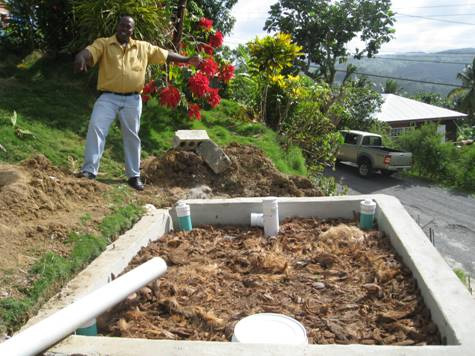
Accessible technology solutions, such as this wetlands filtration
system, are being constructed in Saint Lucia as part of an overall
5
approach to managing wastewater in a changing climate. (Photo
Message from Beppu, 1st Asia Pacific Water Summit,
by Donna Spencer).
December 2007, Beppu.
3
Caribbean Regional Climate Change Strategy at the
CARICOM Secretariat in Guyana.
1.1 Challenges and constraints
The challenges and constraints of sustainable water
resources management in Pacific and Caribbean
island countries and territories were categorized into
three broad thematic areas at the regional consulta-
tion on Water in Small Island Countries held in
preparation for the 3rd World Water Forum in Kyoto
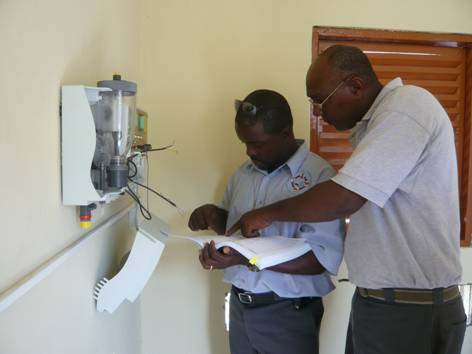
Water Utilities in SIDS, such as these technicians from St. Kitts,
2003 . These are:
are working to address increasing demand and the challenges of
1 Pacific and Caribbean island countries and terri-
climate change. (Photo by Halla Sahley)
tories have uniquely fragile water resources due
to their small size, lack of natural storage. Com-
peting land use and vulnerability to natural and
1.2 Joint programme for action on water & cli-
anthropogenic hazards, including drought,
mate
cyclones and urban pollution. This requires
detailed water resources monitoring and manage- In March 2003, ADB and SOPAC facilitated the Water in
ment and improving collaboration with meteoro-
Small Island Countries sessions at the 3rd World Water
logical forecasting services;
Forum. The global SIDS position that resulted from these
2 Water service providers face challenging con-
sessions was mainly the result of the Dialogue on Water &
straints to sustaining water and wastewater provi- Climate (DWC) session which linked the Pacific and
sion due to the lack of both human and financial
Caribbean regions together on water and climate issues.
resource bases, which restrict the availability of
The close collaboration between the Caribbean
experienced staff and investment, and effective-
and Pacific regions during preparatory work for the
ness of cost recovery. Future action is required in
3rd World Water Forum resulted in the formation of
human resources development, water demand
the Joint Caribbean-Pacific Programme for Action on
management and improving cost recovery;
Water & Climate (JPfA).
3 Water governance is highly complex due to the
The JPfA comprises 22 action elements, common
specific socio-political and cultural structures
to both the Pacific and Caribbean regional consulta-
relating to traditional community, tribal and
tion outcomes, covering four collaborative areas:
inter-island practices, rights and interests. These
research, advocacy and awareness, capacity-building
are all interwoven with past colonial and
and governance. From this immediate priority,
'modern' practices and instruments. These
actions were identified in six areas. The JPfA takes an
require programmes to develop awareness, advo-
Integrated Water Resources Management approach
cacy, and political will at all levels to create a
to addressing water and climate issues in SIDS, as
framework for integrated water resources mana-
demonstrated by the Integrating Watershed and
gement.
Coastal Area Management (IWCAM) in the Carib-
bean, under CEHI and now accompanied by the
Pacific Sustainable Integrated Water Resources and
Wastewater Management Programme (Pacific
IWRM) under SOPAC. The JPfA promotes the trans-
fer of knowledge, expertise, positional statements
and personnel between the two regions to the benefit
of the 34 countries involved.
4
· develop a national implementation strategy for
mitigating and adapting to climate change in the
long term.
In a synthesis of Pacific preliminary national vulner-
ability assessments, Hay and Sem (2000) note the
following adaptations with relevance to water
resources, which are also applicable to Caribbean
SIDS:
· Improved management and maintenance of exist-
ing water supply systems has been identified as a
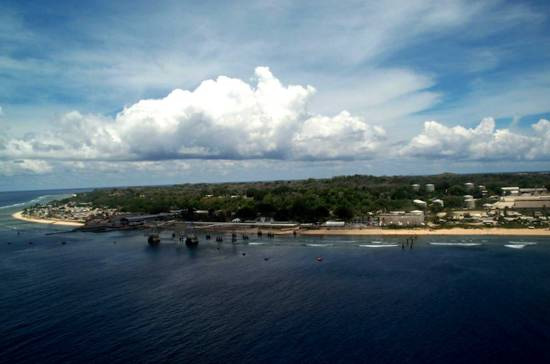
Raised limestone island of Nauru which is depending on rain-
high priority response, due to the relatively low
water harvesting and desalination. (Photo by Marc Overmars)
costs associated with reducing system losses and
improving water quality;
At the 3rd World Water Forum global SIDS agreed · Centralized water treatment to improve water
to six priority actions, referred to as the Small Island
quality is considered viable for most urban cen-
Countries Portfolio of Water Actions namely:
tres, but at the village level it is argued that more
· Water resources management through the Hydro-
cost-effective measures need to be developed;
logical Cycle Observing System (HYCOS);
· User-pay systems may have to be more wide-
· Water demand management programme;
spread;
· Drinking water quality monitoring;
· Catchment protection and conservation are also
· Improving water governance;
considered to be relatively low cost measures that
· Regional Type II Water Partnership support;
would help ensure that supplies are maintained
· Interregional SIDS water partnership support
during adverse conditions. Such measures would
through the JPfA.
have wider environmental benefits, such as
reduced erosion and soil loss and maintenance of
2
Vulnerability and adaptation assess-
biodiversity and land productivity.
ments
· Drought and flood preparedness strategies
should be developed, as appropriate, including
As reported in the Pacific Synthesis Report on Water
identification of responsibilities for pre-defined
and Climate (Scott et al, 2002) vulnerability and
actions;
adaptation assessments in relation to climate change · While increasing water storage capacity through
are required of signatory countries to the United
the increased use of water tanks and/or the con-
struction of small-scale dams is acknowledged to
Nations Framework Convention on Climate Change
be expensive, the added security in the supply of
(UNFCCC). The Pacific Islands Climate Change
water may well justify such expenditure;
Assistance Programme (PICCAP) was developed to
assist with the reporting, training and capacity-
building required under the Convention. Climate
Change Country Teams established under PICCAP
undertook to:
· prepare inventories of greenhouse gas sources
and sinks;
· identify and evaluate emission reduction strate-
gies;
· assess vulnerability to climate change;
· develop adaptation options;
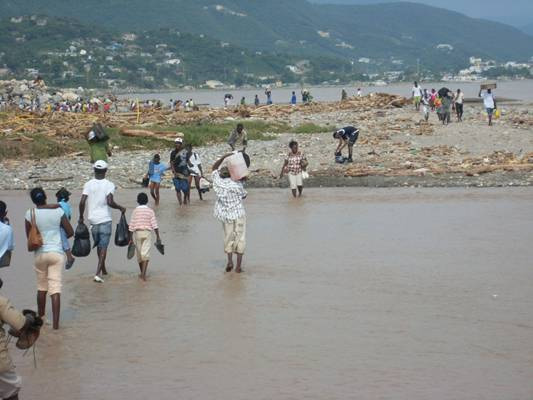
Jamaicans crossing the Hope River following flooding from Hur-
ricane Gustav. (Photo by Franklin McDonald)
5
hence their ability to accommodate the added
stresses arising from changes in climate and sea
level;
· given the limited area and low elevation of the
inhabitable lands, the most direct and severe
effects of climate and sea level changes will be
increasing risks of coastal erosion, flooding and
inundation; these effects are exacerbated by the
combination of seasonal storms, high tides and
storm surges;
· other direct consequences of anticipated climate
and sea level changes will likely include: reduc-
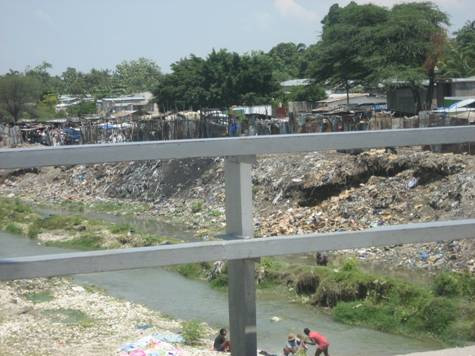
Poor, unregulated settlements on the river's edge in Haiti are
tion in subsistence and commercial agricultural
highly prone to flooding. (Photo by Vincent Sweeney)
production of such crops as taro, bananas and
· Development of runways and other impermeable
coconut; decreased security of potable and other
surfaces such as water catchments is seen as pos-
water supplies; increased risk of dengue fever,
sible, but an extreme measure in most instances.
malaria, cholera and diarrhoeal diseases; and
Priority should be given to collecting water from
decreased human comfort, especially in houses
the roofs of buildings;
constructed in western style and materials (espe-
· Measures to protect groundwater resources need
cially in the Pacific);
to be evaluated and adopted, including those that
· groundwater
resources
of the lowlands of high
limit pollution and the potential for saltwater
islands and atolls may be affected by flooding and
intrusion;
inundation from sea level rise; water catchments
· The limited groundwater resources that are as yet
of smaller, low-lying islands will be at risk from
unutilized in the outer islands of many countries
any changes in frequency of extreme events;
could be investigated and, where appropriate,
· the overall impact of changes in climate and sea
measures implemented for their protection,
level will likely be cumulative and determined by
enhancement and sustainable use;
the interactions and synergies between the
· The development of desalination facilities is con-
stresses and their effects; and
sidered to be an option for supplementing water
· the current lack of detailed regional and national
supplies during times of drought, but in most
information on climate and sea level changes,
instances the high costs are seen as preventing
including changes in variability and extremes
this being considered as a widespread adaptation
have resulted in most assessments being limited
option.
to using current knowledge to answer `what if'
questions regarding environmental and human
Amongst the many assessment findings summarized
responses to possible stresses.
by Hay (2000) the following are most relevant to
The first of these findings is particularly significant
water and climate:
since it implies that, in most parts of the Pacific and
· climate variability, development, social change
Caribbean regions, present problems resulting from
and the rapid population growth being experien-
increasing demand for water and increasing pollu-
ced by most small island countries are already
tion of water may be much more significant that the
placing pressure on sensitive environmental and
anticipated affects of climate change.
human systems, and these impacts would be
The final finding is also significant in that it
exacerbated if the anticipated changes in climate
refers to climate variability. In reporting obligations,
and sea level (including extreme events) did mate- The UNFCCC referred specifically to climate change
rialize;
(rather than to climate variability and change), possi-
· land use changes, including settlement and use of bly reflecting the perspective of climate change
marginal lands for agriculture, are decreasing the science existing at the time the Convention was
natural resilience of environmental systems and
drafted. A greater appreciation of the role of variabil-
ity has developed and it is now generally recognized
6
that the impacts of climate change are likely to be
intense hurricanes resulting in billions of dollars in
experienced through changes in variability. These
damage and thousands of deaths caused mainly by
considerations suggest that managing water
flooding. Of the Caribbean countries, Haiti has suf-
resources for variability and extremes is fundamental fered the extreme consequences on account of the
to the issue of adapting to climate change in the
severe degradation of its forests with great loss to life
longer term.
and property.
That conclusion is also supported by the vulner-
ability and adaptation assessments completed for Fiji Some key recommendations derived from these con-
and Kiribati (World Bank, 2000) which provide
clusions include:
examples of climate change impacts on water
· the adoption of a `no regrets' adaptation policy;
resources in high and low islands and reach the con-
· development of a broad consultative process for
clusions that:
implementing adaptation;
· Pacific Island countries are already experiencing
· require adaptation screening for major develop-
severe impacts from climate events;
ment projects;
· island vulnerability to climate events is growing
· strengthen socio-economic analysis of adaptation
independently of climate change;
options.
· climate change is likely to impose major incre-
These recommendations reflect the need for the
mental social and economic costs on Pacific
mainstreaming of climate change adaptation policies
Island countries; and
into water resources management.
· acting now to reduce present day vulnerability
The guidebook on `Surviving Climate Change in
could go a long way toward diminishing the
Small Islands' provides an overview for the assess-
effects of future climate change.
ment of vulnerability of water resources to climate
In the Caribbean region the impacts of rising tem-
changes (Emma L. Tompkins et al, 2005).
peratures are being linked to the recent and very
active hurricane seasons which have spawned several
Table1: Assessment of vulnerability.
Climate change
Exposure
Who or what affected
Sea level rise and saltwater intrusion
Salinisation of water lenses
Human consumption and health
Less fresh water available
Water suppliers
Plant nurseries and parks
Biodiversity, protected areas
Reduced average rainfall
Less fresh water available
Aquifer recharge rates
Droughts
Cisterns and reservoirs
Biodiversity
Increased evaporation rates
Soil erosion
Farming community; crop yields
Biodiversity
Increased rainfall intensity
Runoff and soil erosion
Reduction in crop production
Sedimentation of water bodies
Blocked storm water wells
Adapted from: Hurlston (2004).
The table above shows that climate change is likely to on cisterns may have to consider other means of
increase the exposure of small islands to water short-
accessing water.
ages for various reasons. Specific groups are likely to
be sensitive, for example, those who rely on subsis-
tence agricultural production and families who rely
7
3 Coping
and
adaptation
The Global Water Partnership states in their latest
policy brief that the best approach to manage the
impact of climate change on water is that guided by
the philosophy and methodology of Integrated Water
Resources Management (GWP, 2007). It also states
that the best way for countries to build the capacity to
adapt to climate change will be to improve their abil-
ity to cope with today's climate variability.
For small islands, climate change is just one of
many serious challenges with which they are con-
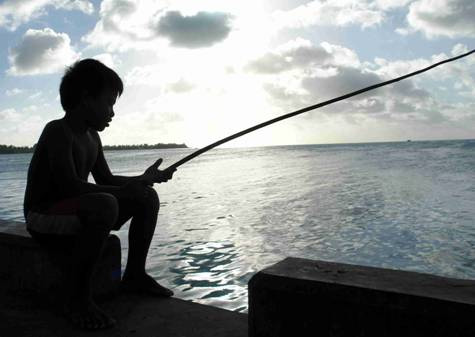
Many islanders rely on coastal resources. (Photo by Marc
fronted. Adaptation to climate change impacts cer-
Overmars)
tainly requires integration of appropriate risk reduc-
· Key Message 1: Strengthen the capacity of small
tion strategies within other sectoral policy initiatives
island countries to conduct water resources
such as in water resources management (Emma L.
assessment and monitoring as a key component
Tompkins et al, 2005).
of sustainable water resources management.
In the Pacific region, concentration on the poten-
· Key Message 2: There is a need for capacity
tial impacts of climate change on small island com-
development to enhance the application of cli-
munities has even deflected attention and resources
mate information to cope with climate variability
away from the immediate and serious day-to-day
and change.
problems faced by small island nations, particularly
· Key Message 3: Change the paradigm for dealing
in water resources (White I. et al, 2007). The above
with Island Vulnerability from disaster response
obviously does not preclude the application of coping
to hazard assessment and risk management, par-
strategies and adaptation measures to climate varia-
ticularly in Integrated Water Resource Manage-
bility and change, which, on the contrary, is essential
ment (IWRM).
for the sustainable management of water resources
in small island countries and territories.
Actions have been undertaken to address each of the
Regarding the vulnerability of small island coun-
key messages not only in the Pacific but also in other
tries and territories to climate variability and change
SIDS regions.
as well as anthropogenic influences, the required
coping and adaptation strategies have been articu-
lated under a specific theme of `Island Vulnerability'
3.1 Water resources monitoring and
in the Pacific Regional Action Plan on Sustainable
assessment
Water Management (SOPAC, 2002) as follows:
There is a need to invest in adequate water resources
monitoring and assessments in order to cope with
climatic extremes, both droughts (often related to
ENSO events) and flooding (often linked to the
occurrence of cyclones/hurricanes).
Insufficient understanding and knowledge on
how rivers respond to extreme rainfall or how resil-
ient aquifers are in prolonged periods of drought will
compromise the provision of freshwater supplies.
This requires the increased capacity of National
Hydrological Services in flood and drought forecast-
ing as well as a stronger collaboration between them,
water resources managers and water utilities.
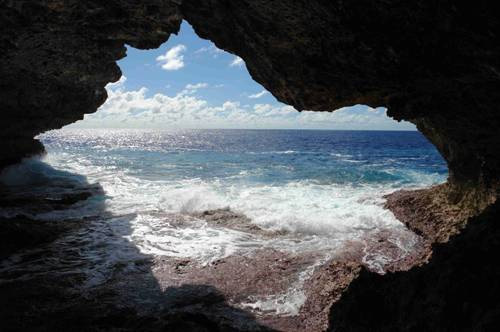
Raised limestone island of Niue also known as the `Rock of
Polynesia'. (Photo by Marc Overmars)
8
Awareness of the effects of floods and droughts
on drinking water quality needs to be increased
through closer engagement between water users and
water suppliers. Increased health surveillance and
water quality monitoring should be encouraged espe-
cially in times of disasters.
As examples, the Pacific and Caribbean Hydrological
Cycle Observing Systems are now being established
through support from the European Union Water
Facility and the French Government respectively.
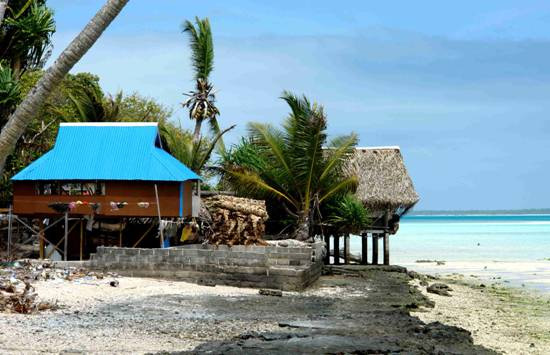
Water resources on atoll islands like South Tarawa in Kiribati are
Water quality monitoring is being supported through being affected by climate variability and change. (Photo by Marc
NZAID in the Pacific, and the Institut de recherche
Overmars)
pour le développement (France), the Caribbean
resources agencies and their response capability to
Environmental Health Institute and the Caribbean
extreme phenomena; (c) integration of these agen-
Institute for Meteorology and Hydrology in the
cies into the region's development decision-making;
Caribbean region.
and (d) improved cooperation among the region's
The Pacific HYCOS programme is providing sup-
national water agencies, including the real-time cir-
port to National Hydrological Services in the region
culation of water and environment data.
and is building their capacity in flood and drought
forecasting as well as in basic monitoring of water
resources. This information is essential for any cli-
mate adaptation initiative whether they focus on
domestic (water supply), agricultural (irrigation) or
industrial (hydropower) use of water. The need for
thorough analysis of hydro(geo)logical information
and water quality, as well as water quantity data, is
frequently overlooked by adaptation programmes
which sometimes make assumptions on the impacts
of climate on water resources without adequate
research. If we do not know how aquifers respond to
droughts or how rivers respond to floods it will be
impossible to make sensible decisions on adaptation
measures which are aiming to deal with the increase
of climatic extremes.
The Carib-HYCOS project seeks to enhance natu-
ral disaster mitigation capabilities by the use of
modern flood forecasting and warning systems;
strengthen water management capabilities by
improving the knowledge base of water resources
concerning quantity, quality and use; increase
exchange of information and experience, particularly
during natural disasters; and develop technological
capabilities (including training and technology
transfer) appropriate to the circumstances and reali-
ties of each country. It is expected that the project
implementation will result in: (a) better understand-
ing of the regional hydrological phenomena and
trends in order to rationalize the use of water
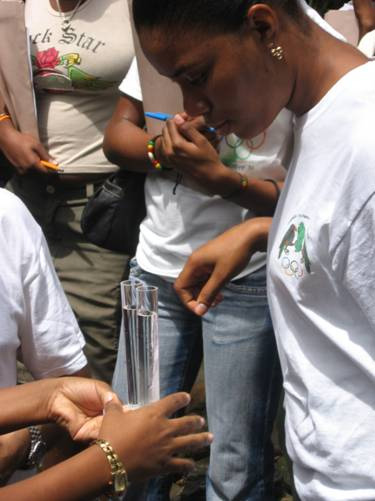
Water Quality Monitoring in Dominica. (Photo by Sasha Beth
resources; (b) modernization of the region's water
Gottlieb)
9
adopted by both the utility and the general public,
will enhance the ability of Pacific and Caribbean
island countries and territories to overcome droughts
and maintain sufficient standards of drinking water
quality.
The Pacific Island Climate Update (ICU) sup-
ported by NZAID provides such information to end-
users in the Pacific in a regional overview, whereas
the strengthening of NMSs is being undertaken
under an AusAID-funded climate prediction pro-
gramme. Both are linked to climate centres in the
Pacific islands, the United States, France, Australia
and New Zealand.
In the Caribbean, a joint collaboration between
the Caribbean Community Climate Change Centre
(CCCCC), the Caribbean Institute for Meteorology
and Hydrology (CIMH) and the Brace Center for
Water Resources Management of McGill University
will see the development of a Caribbean Drought and
Precipitation Monitoring Network for the region that
will be hosted at the CIMH.
Through the analyses of rainfall data and use of
GIS in Tuvalu, under the Pacific HYCOS programme,
support is provided to an AusAID and EU-funded
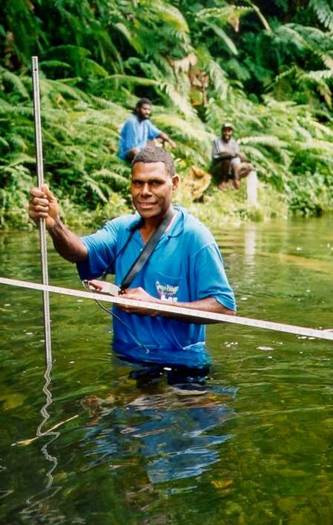
Hydrological monitoring, such as on the island of Espirito Santo,
initiative, Vulnerability and Adaptation, to provide all
Vanuatu, is essential for water resources management in small
households on the main atoll of Funafuti with a
island countries. (Photo by Marc Overmars)
rainwater harvesting tank in order to provide a stra-
tegic water storage to overcome extended periods of
droughts which are often linked to ENSO episodes.
3.2 Using climate information
The UNEP, through CEHI, is supporting similar
efforts in Caribbean SIDS by using GIS-assisted
There is a need to make use of climate forecasts to
mapping methods of rainfall capture potential and
support decision-makers in the water sector.
water availability to promote the practice of rainwater
Research into the interaction of the ocean and
harvesting in water stressed parts of the region.
atmosphere over the last two decades has resulted in
an impressive ability to observe and account for many
of the factors governing climatic variability at the
seasonal and inter-annual time scale.
National Meteorological Services are being
strengthened in their capacity to develop techniques
that are able to produce climate forecasts of modest
skill, but this information is not easily accessible and
available for interpretation by water resources and
water supply managers. Particularly for the rainfall
dependent low lying atoll islands, strategies to cope
with extended periods of drought will largely depend
on their ability to make interpretations of three-
monthly rainfall forecasts.
Strategic storage of rainwater and the introduc-
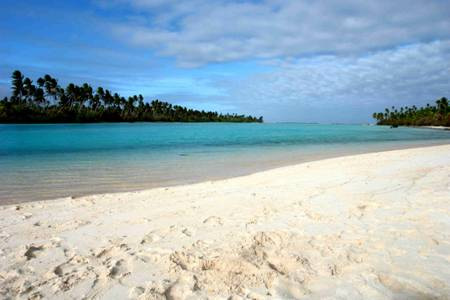
Outer islands in the Pacific are depending on increasingly vari-
tion of water saving or water conservation measures
able rainfall (Photo by Marc Overmars)
10
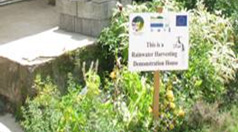
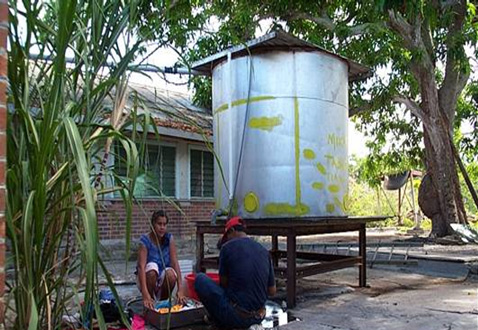

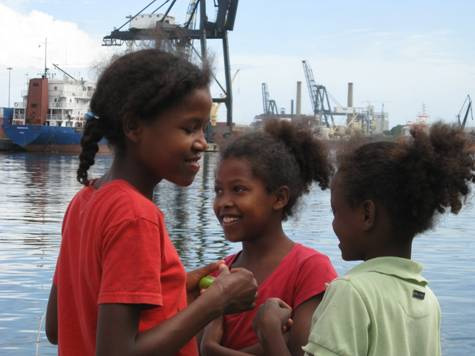
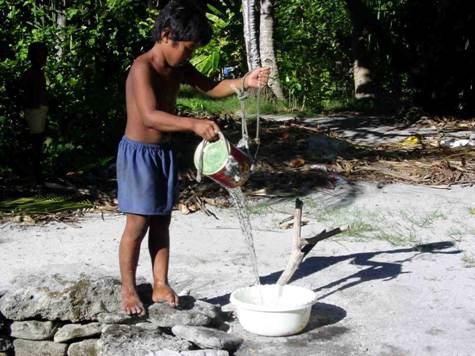
reserves, low lying atolls or raised limestone islands.
Improved hygiene behaviour and awareness of the
linkages between drinking water and health are
essential, and participatory approaches and commu-
nity-based monitoring are needed for urban as well
as rural communities.
The introduction of DWSP is promoted in the
Rainwater harvesting such as on Banaba, Kiribati (l) and
Pacific through an AusAID-funded programme by
Mabouya Valley, Saint Lucia (r) has been under utilised in many
SOPAC in collaboration with WHO, whereas the U.S.
small island countries. (Photos by Marc Overmars and Donna
Centers for Disease Control and Prevention (CDC) is
Spencer)
promoting this new concept together with CEHI in
the Caribbean.
3.3 Mainstreaming risk management
There is a need to mainstream risk management into
water supply and water resources management,
building on the integrated approaches adopted by
Pacific and Caribbean island countries and territories
such as Drinking Water Safety Planning (DWSP) and
Integrated Water Resources Management.
Drinking Water Safety Planning is defined as "a
comprehensive risk assessment and risk manage-
ment approach that encompasses all steps in the
water supply from 'catchment to consumer' to con-
Children are particularly vulnerable to the adverse impacts of
sistently ensure the safety of water supplies" (WHO,
climate change, felt in the lower reaches of watersheds, such as
2004). It addresses all aspects of drinking water sup-
the Haina Watershed in the Dominican Republic. (Photo by
ply through an integrated approach focusing on the
Donna Spencer)
control of abstraction, treatment and delivery of
drinking water in combination with attention for
An example of an appropriate adaptation strategy for
awareness and behaviour change.
water is provided by Tonga where the nationally-
This requires close collaboration between the
developed Drinking Water Safety Plan by the Tonga
water supplier, the water quality and health regulator Water Board and the Ministry of Health guided the
and the water resources managers in conjunction
scoping of an EU-funded drought resilience building
with a strong participation of communities living in
project valued at 1.1 million euros focused on risk
catchments of high volcanic islands, on top of water
prevention instead of response. In the Caribbean, the
Spanish Town water supply system in Jamaica was
the first pilot of a DWSP approach through the joint
collaboration between the local National Water
Commission and the CDC. The approach is presently
being replicated in Guyana (part of the Caribbean yet
on the South American mainland), again in partner-
ship with the CDC and CEHI. The collective experi-
ences of both countries will be applied when intro-
ducing the process to the other Caribbean SIDS.
The concept and the approaches which IWRM
embodies - namely, the need to take a holistic
approach to ensure the socio-cultural, technical,
Pollution of vulnerable groundwater lenses are a major concern
economic and environmental factors are taken into
for many small island countries. (Photo by Marc Overmars)
11
account in the development and management of
including climate variability before they can adapt to
water resources - has been practiced at a traditional
future climate changes.
level for centuries in some islands.
A recent WHO/SOPAC report revealed that the
For small island countries and territories these
annual incidence of diarrhoeal diseases in the Pacific
IWRM plans would need to include drought and dis-
still nearly matches the numbers of its inhabitants
aster preparedness plans. Pollution on land from
with 6.7 million cases of acute diarrhoea each year,
inadequate wastewater disposal, increased sediment
responsible for the annual death of 2,800 people,
erosion and industrial discharges are impacting
most of them children less than 5 years old. Country
upon coastal water quality and fisheries stock which
statistics on access to improved sanitation and
sustain entire island populations. This requires small improved drinking water indicate that on average
island countries and territories to look at managing
approximately only half of the total population of the
water resources not only within the watershed but
Pacific island countries are served with any form of
also the receiving coastal waters.
improved sanitation or drinking water
The introduction of IWRM in SIDS is being pro-
(WHO/SOPAC, 2008).
moted through the GEF-IWCAM Programme by
CEHI and the Pacific IWRM Programme by SOPAC
under the Global Environment Facility and EU Water
Facility.
Through close alignment of climate adaptation
programmes also funded through the GEF in the
Caribbean (CPACC, MACC, and SPACC) and the
Pacific (PACC) the opportunity arises to ensure that
flood and drought management is being addressed
in the countries concerned within an IWRM frame-
work. Use can be made of the established APEX
bodies that can function as National Water and Cli-
mate Committees and steering committees for both
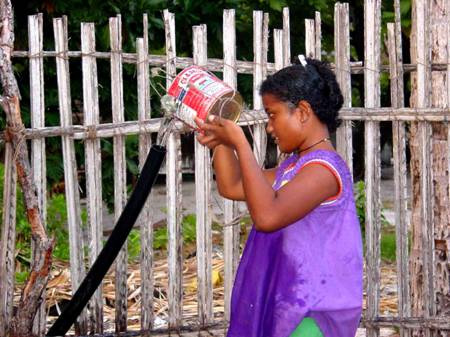
Providing safe drinking water to communities is posing increas-
adaptation and integration of water resources man-
ing challenges to small island countries. (Photo by Marc
agement.
Overmars)
At present there is still a disconnect between risk
management, climate adaptation and water
In the Caribbean, flood events associated with
resources management with receiving small island
successive tropical storms and hurricanes in recent
countries, donors and supporting agencies working
years have prompted stepped-up surveillance and
in different silos foregoing the principles of main-
monitoring by national public health agencies in
streaming in ongoing natural resources management terms of control of outbreaks of dengue fever and
processes.
diarrhoeal diseases. Although in most countries of
This needs to be changed through interventions
the Caribbean access to potable drinking water is
at the highest levels such as through the Prime
upwards of 80% (with the exception of Haiti), inter-
Minister's Office, Ministries of Planning or Finance
ruptions to water supply following storms is a sig-
and guided by a sound information base on water
nificant risk factor in terms of maintaining health
and climate.
and sanitation.
The 1st Asia-Pacific Water Summit held in
December 2007 in Beppu, Japan, was attended by six
4
Political will and financing
Pacific Island Leaders from the Federated States of
Micronesia, Palau, Tuvalu, Nauru, Niue and Kiribati,
It is generally recognized that improving the way we
as well as Ministers from Fiji, the Cook Islands and
use and manage our water today will make it easier to Papua New Guinea. SOPAC, as focal point for the
address the challenges of tomorrow. With respect to
Oceania component of the Asia-Pacific Water Forum,
climate change it is evident that SIDS will have to
provided support to countries participating in the
deal with the current challenges and constraints
12
Summit and facilitated a special session on water and
climate in small island countries.
The large participation by Pacific Heads of State
at this Summit was a testament of their strong politi-
cal commitment to meeting future water challenges
and their efforts to cope with an increasingly variable
climate, and adapt to the future effects of global cli-
mate change.
The Pacific leaders attending the summit in
Beppu reaffirmed their commitment to give the
highest priority to water and sanitation in economic
and development plans; improve governance, effi-
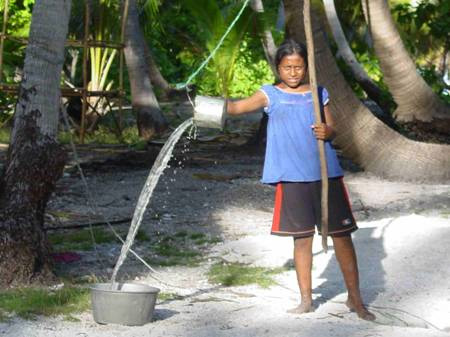
Improving access to water and sanitation requires political will
ciency, transparency and equity in all aspects related
(Photo by Marc Overmars)
to the management of water, particularly as it
impacts on poor communities; take urgent and
Heads of Government meeting (July 2008), a
effective action to prevent and reduce the risks of
Regional Task Force on Climate Change was estab-
flood, drought and other water-related disasters; and lished to provide technical advice to participants,
support the region's vulnerable small island states in specifically focusing on COPS negotiations.
their efforts to protect lives and livelihoods from the
Combined with adequate priority given to water
impacts of climate change (APWF, 2007).
and sanitation in national development plans and
The Summit specifically raised attention to the
strategies, these actions will provide the best
opportunity that presents itself at this moment: to
approaches to achieve the MDG target of halving the
mainstream Climate Adaptation, Disaster Risk
proportion of people without access to safe drinking
Reduction and Water Safety Planning into Integrated
water and basic sanitation by 2015 and to be prepared
Water Resources Management.
for the future. Harmonization of donor agency pro-
The commitment shown at Beppu still needs to
grammes are in this respect key to maximizing the
be converted into action but signs of countries link-
impact of actions, and this would need to be sup-
ing national priorities such as improving access to
ported by a regional framework for monitoring
safe drinking water and sanitation to climate adapta-
investments and results.
tion efforts and risk reduction are promising, such as
in Tuvalu, Kiribati, Tonga, the Marshall Islands and
Nauru.
Acknowledgements
Commitments from donors to increase funding
for both climate adaptation and water and sanitation
We would like to acknowledge the valuable contri-
are promising as demonstrated by AusAID, EU, GEF, bution of the following persons who made the com-
World Bank and other donor agencies. Rather than
pletion of this article possible: Dr Christopher Cox,
implementing `quick fixes' focused on infrastruc-
Programme Director, and Mrs Patricia Aquing,
tural improvements, adequate attention should be
Executive Director of the Caribbean Environmental
paid to the building of local capacity to improve the
Health Institute; Mr Vincent Sweeney, Regional Pro-
management of water services and resources in order ject Coordinator of the GEF-IWCAM Project; and the
to achieve a degree of sustainability of interventions.
Water Sector of SOPAC.
Climate change issues are addressed at the
regional level by the Council for Trade and Economic
(COTED) of the Caribbean Community (CARICOM).
References
Additionally, Caribbean Heads of Government have
included climate change as a specific item on the
Asia Pacific Water Forum (2007). Message from
agenda of their meetings. Currently, the Prime
Beppu 1st Asia Pacific Water Summit, Decem-
Minister of Saint Lucia has the responsibility within
ber 2007, Beppu, Japan.
the CARICOM Cabinet for climate change and sus-
GWP (2005). Policy Brief 4: Catalyzing Change: A
tainable development issues. At the last Caribbean
Handbook for Developing Integrated Water
13
Resources Management (IWRM) and Water Effi-
White, I. et al (2007). Society-Water Cycle Interac-
ciency Strategies. GWP. Stockholm, Sweden.
tions in the Central Pacific: Impediments to
Hay, J. E. (2000). Climate change and small island
Meeting the UN Millennium Goals for Freshwater
states: A popular summary of science-based
and Sanitation. In: Proceedings 1st International
findings and perspectives, and their links with
Symposium Water and Better Human Life in the
policy. Presentation to 2nd Alliance of Small
Future. RIHN, Kyoto, Japan.
Island States (AOSIS) workshop on climate
WHO/SOPAC (2008). Sanitation, hygiene and
change negotiations, management and strategy,
drinking water in Pacific island countries, Con-
Apia, Samoa.
verting commitment into action. World Health
Hay, J. E. & Sem G. (2000). Vulnerability and adap-
Organization, Manila, Philippines.
tation: evaluation and regional synthesis of
WHO (2004). Guidelines for Drinking Water Quality:
national assessments of vulnerability and adapta-
3rd Edition. World Health Organization. Geneva,
tion to climate change. South Pacific Regional
Switzerland.
Environment Programme, Apia, Samoa.
World Bank (2000). Adapting to Climate Change.
Hurlston, L.-A. (2004) Global Climate Change and
Vol. IV in Cities, Seas and Storms, Managing
The Cayman Islands: Impacts, Vulnerability and
Change in Pacific Island Economies. Papua New
Adaptation. Report prepared during a visiting
Guinea and Pacific Island Country Unit, World
fellowship in the Tyndall Centre for Climate
Bank, Washington, US.
Change Research, University of East Anglia,
Norwich, UK.
Scott, D., Overmars, M., Falkland, A. & Carpenter,
Marc Overmars
C. (2003). Synthesis Report Pacific Dialogue on
SOPAC, Pacific Islands Applied Geoscience
Water and Climate, SOPAC, Suva, Fiji.
Commission, Private Mail Bag, GPO, Suva, Fiji Islands
SOPAC (2002), Pacific Regional Action Plan on Sus-
marc@sopac.org, www.pacificwater.org
tainable Water Management. ADB and SOPAC,
Suva, Fiji.
Sasha Beth Gottlieb
Springer, C. (2002). Water and Climate Change in
GEF-IWCAM Project Coordination Unit, c/o Caribbean
the Caribbean. CEHI, St Lucia.
Environmental Health Institute, The Morne, P.O. Box
Tompkins, E. L. et al (2005). Surviving Climate
1111, Castries, St. Lucia
Change in Small Islands: A Guidebook. Tyndall
sgottlieb@cehi.org.lc, www.iwcam.org
Centre for Climate Change Research, Norwich,
UK.
14
Annex 1
JOINT CARIBBEAN AND PACIFIC PROGRAMME FOR ACTION
ON WATER AND CLIMATE
A. RESEARCH (11 Action Elements)
1) Strengthen the application of climate information and strengthen the links between
meteorological and hydrological services;
2) Strengthen institutional capacity for data generation;
3) Develop rainfall and drought prediction schemes based on existing models;
4) Enable regional support to develop water application of climate information and
prediction;
5) Implement a programme of climate analysis for assessment of extreme weather
events; develop minimum standards for risk assessments;
6) Implement actions to strengthen national capacity (equipment, training, etc.) using the
model outlined in the Pacific Hydrological Cycle Observation System (HYCOS)
proposal and recommendations regarding water quality;
7) Implement a programme of targeted applied research projects to address knowledge
gaps in line with recommendations and priorities presented;
8) Develop and/or implement minimum standards for conducting island water resources
assessment and monitoring;
9) Implement appropriate water quality testing capability and associated training at local,
national and regional levels;
10) Strengthen and enhance communication and information exchange between national
agencies involved with meteorological, hydrological and water quality data collection
programmes (including water supply agencies and health departments);
11) Utilize the research capabilities at regional science institutions;
B. PUBLIC EDUCATION, AWARENESS AND OUTREACH (4 Action Elements)
1) Provide high level briefings on the value of hazard assessment and risk management
tools;
2) Support community participation in appropriate water quality testing programmes
targeted at environmental education and awareness of communities, using existing
and proposed programmes as models;
3) Recognize the value of informal community groups;
4) Include the media as a specific institution.
C. EDUCATION AND TRAINING (2 Action Elements)
1) Enhance education and career development opportunities in the water sector;
2) Implement hydrological training for technicians in line with the recommendations
presented in a proposal to meet training needs;
D. POLICY AND INSTITUTIONAL DEVELOPMENT (5 Action Elements)
1) Build environment to facilitate the emergence of an IWRM framework;
2) Incorporate the community in policy development at the ground level;
3) Build capacity in the use of a risk management approach to integrated resource
management, in EIAs;
4) Develop appropriate policy/legislative instruments;
5) Harmonize legislation, regulations and policy.
15
Annex 2
Mauritius Strategy for the Further
Implementation of the Programme of Action for the
Sustainable Development of Small Island Developing States
Port Louis, Mauritius, 15 January 2005
V. Freshwater resources
27. Small Island Developing States continue to face water management and water access
challenges, caused in part by deficiencies in water availability, water catchment and storage,
pollution of water resources, saline intrusion (which may be exacerbated, inter alia, by sea-
level rise, unsustainable management of water resources, and climate variability and climate
change) and leakage in the delivery system. Sustained urban water supply and sanitation
systems are constrained by a lack of human, institutional and financial resources. The access to
safe drinking water, the provision of sanitation and the promotion of hygiene are the
foundations of human dignity, public health and economic and social development and are
among the priorities for Small Island Developing States.
28. Small Island Developing States in the Caribbean and the Pacific regions have demonstrated
their commitment to SIDS SIDS cooperation with the Joint Programme for Action for Water
and Climate. The international community is invited to support the implementation of this
programme, and the proposal to broaden it to all Small Island Developing States regions.
29. Further action is required by Small Island Developing States, with the necessary support
from the international community, to meet the Millennium Development Goals and World
Summit on Sustainable Development 2015 targets on sustainable access to safe drinking water
and sanitation, hygiene, and the production of integrated water resources management and
efficiency plans by 2005.
30. The international community is requested to provide assistance to Small Island Developing
States for capacity-building for the development and further implementation of freshwater and
sanitation programmes, and the promotion of integrated water resources
management, including through the Global Environment Facility focal areas, where
appropriate, the World Water Assessment Programme, and through support to the Global
Programme of Action Coordination Office and the EU "Water for Life Initiative".
31. The Fourth World Water Forum, to be held in Mexico City in March 2006, and its
preparatory process will be an opportunity for the Small Island Developing States to continue
to seek international support to build self-reliance and implement their agreed priority actions
as submitted to the Third World Water Forum Portfolio of Water Action, namely: integrated
water resources management (including using the Hydrological Cycle Observing System);
water demand management; water quality capacity-building; water governance; regional water
partnerships; and inter-small island developing State water partnerships.
16