Nile B as in Init iat iv e
Nile Transbound ary Environmental Action Project (NTE AP)
The Nile Environment
A QUARTERLY NEWSLETTER OF NTEAP
Volume 1, Issue 3
October-December 2004
Editorial
Prince of Orange Visits NBI
T
Prince of Orange
his is the last issue in 2004. The NTEAP
Visits NBI The
has attempted to keep our readers abreast of
Prince of Orange,
progress and events related to NBI. The last
quarter of 2004 saw the conduct of important
Crown Prince
meetings. In November the Prince of Orange
Wil em Alexander
visited the NBI headquarters and held a meeting
of the Nether-
with the Nile Council of Ministers.
lands, a world
renowned water
The first water quality monitoring regional meeting
Ambassador vis-
was conducted in Cairo from December 20 to 22
ited the Nile Basin
2004. The meeting was attended by 18 Nile water
Initiative Secre-
quality monitoring working group members, two
government nominated water quality experts from
tariat on Friday 5th
each of the NBI countries. The meeting discussed
November, 2004.
on the status of water quality monitoring in the
He was received
respective countries, and plans for the next year.
at the Secretariat
The meeting was honored by the presence of H.E
by the Nile Coun-
Hon. Dr. Mahmoud Abu Zeid, Minister of Water
cil of Ministers led by the Chairperson, Hon. Martha Karua, Minister of Water Re-
Resources and Irrigation and H.E. Hon. Eng.
sources for Kenya. The Prince was impressed by the progress made and wished the
Maged George, Minister of Environment along
NBI success. The Prince was accompanied by H.E. Yoka Brandt, the Netherlands
with the TAC and steering committee member of
Ambassador to Uganda and other officials from the Netherlands Government. (see
NTEAP.
NBI Press Release at www.nilebasin.org for the full coverage of the news).
The Environment Education and Awareness
component successfully conducted national
workshops in the eight NBI countries (except Environmental Security Workshop
Rwanda) and established national working
groups. The microgrants regional workshop was
conducted in Khartoum, Sudan from December 6
to 9 2004 which discussed and drafted the re-
gional microgrants strategy.
The organization of these workshops needed
careful planning and coordination. All of the work-
shops have achieved their intended objectives.
Besides the project related workshops the staff of
NTEAP have also participated at other national
and international workshops. There is no doubt
that these meetings have improved the visibility of
the NBI and NTEAP.
This issue of our newsletter provides highlights of
the workshops held in the last quarter of 2004.
Gedion Asfaw, RPM
Inside this issue:
Editorial 1
Prince of Orange Visit
1
Environmental Security workshop
1
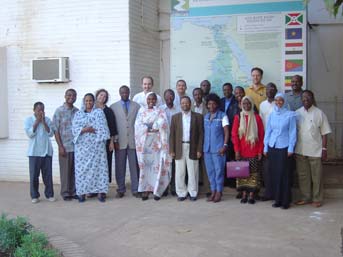
A n international workshop on environmental security in Eastern Africa took place
Microgrants workshop
2
from 14 to 15 October 2004 in Kampala, Uganda. H.E Hon. Colonel Kahinda Otafire,
Partnership EE&A
2
Minister of Water, Lands and Environment made the official opening statement at the
Monitoring & evaluation
2
workshop, here seen flanked by Executive Directors of Foundation for Environmental
Water Quality Monitoring Workshop 3
Security and Sustainability and Partnership for African Environmental Sustainability
Twinning arrangements
3
along with H.E the Ambassador of Ethiopia to Uganda, The Executive Director of
Readers Corner
3
NEMA of Uganda, USAID and other officials. The RPM of NTEAP presented a paper
SVP News
4
on environmental security in the Nile Basin.
NTEAP Progress 2004
4
PAGE 2
THE NI LE ENVIRONMENT
VOLUME 1, ISSUE 3
Micro-grants - First regional Workshop
T
was enriched by presentations made by the RPM and Lead Specialists were also instru-
he PMU in Khartoum hosted the First Regional SGP National Coordinators on their respec- mental in providing the participants with guid-
Micro-Grants Workshop. Participants in the tive field experiences as well as highlighting ance related to the integration of the different
Workshop included the Small Grants Pro- some of the best practices and lessons project components into the Micro-Grants
gramme (SGP) National Coordinators who learned from those experiences.
Program. The RPM in both his opening and
also coordinate the Micro-Grants Programme
closing remarks stressed the importance of
in their respective countries (Egypt, Kenya,
deriving best practices from the field activities
Uganda, Tanzania). In addition, the newly
as wel as establishing linkages with other
recruited SGP Coordinator for Rwanda and
components and NBI Programmes. He also
the National Micro-Grant Coordinator for Su-
emphasized the importance of team work.
dan were also present. The participants list
Presentations on creating synergies with the
also included the newly recruited Local Micro-
Environmental Education & Awareness com-
Grants Coordinators for Egypt, Kenya,
ponent as well as the Water Quality Compo-
Uganda and Tanzania. Burundi, Democratic
nent were made. In addition, the M&E Lead
Republic of Congo and Ethiopia were repre-
Specialist presented the approach that should
sented by their respective NTEAP National
be taken in monitoring the Micro grants at the
Project Coordinators. The resource people
local, national, and regional levels.
for the Workshop were Mr. Marco van der
Ree of UNOPS, New York, Ms. Astrid Hillers
The Regional Workshop laid the foundation
from the World Bank and Mr. Michael Wells a
for the regional Micro-grant strategy, which
free lance consultant.
when finalized will provide the important input
The newly recruited national and local coordi- to guide in the development of the national
The main objective of the Workshop was to nators also provided their own insights on the action plans.
develop the outline of Regional Micro-Grants Micro-Grants Programme through illustrations
Strategy as well as to agree on the framework of experiences that they have acquired from Amir Baker, Micro grants Lead Specialist
for the National Action Plans. The Workshop previous work done in their countries. The
Partnership - The way to go with awareness creation
quires partnership and networking.
The coordination and establishment of link-
T he Nile basin is home to about 160 million
ages role of the working group is the engine
people, of these majority live in rural areas How then does one ensure that strong of partnership. While linking one practitioner
and depend directly on land and water re-
linkages and partnership are not only or one project to another, synergies will be
sources for shelter, income and energy. Six formed but also sustainable?. In order to developed, have focused and powerful cam-
of the ten Nile basin countries are among the answer this question, the NTEAP--EE&A paigns which will reach wider audience.
world's poorest with a GDP of less than component embarked in a process of identi-
US$250. Such grinding poverty in combina-
fication of interested partners and establish-
To make sure that a diversity of issues,
tion with very rapid population growth has ing links.
ideas, and skills, the working group members
put enormous pressure on the natural re-
were participatory but carefully selected.
sources and ecological systems on which
Although there were small variations between
economic development is based.
countries, the members included media, pri-
`Participation ensures ownership `
vate sector, relevant government ministries,
Environmental education and awareness is
Universities and the civil societies. In some
one of the tools which is being used to stimu-
cases communities were also included. As
late sustainable economic growth as an ef-
The process of establishing partnership was the working groups meets to deliberate on
forts to reduce poverty in the basin. Change through formation of national working issues, more lessons will be learnt on how
of behavior which leads into action is almost groups. The working groups will play a best EE&A could change peoples lives for the
personal. This coupled with the many threats coordination and supervisory role in each better.
facing the Nile requires a consolidated effort country while formulating and steering the
from all stakeholders and more so EE&A
Maushe Kidundo, Environmental Education Lead
implementation of EE&A activities from all
practitioners from the entire basin. This re-
Specialist
practitioners within the country.
Monitoring and Evaluation
the overall process, including provision of
A
be developed by the NTEAP for all of its
session was devoted during the First resources and time was considered as a components.
Regional Micro-Grants Workshop to the is-
critical issue as these were major constraints
sue of the Monitoring and evaluation of the
in most of the cases.
The yearly independent evaluation exer-
Micro-Grants. The presentations and subse-
cises that would be conducted for the Mi-
quent discussions that followed focused on
M&E framework that would be developed for cro-grants was also discussed at the Micro-
the approach that would be undertaken to
the Micro-Grants will be part and parcel of the
Grants Workshop. The objective of these
monitor and evaluate the micro-grant activi-
overall M&E Framework that is developed for
country level yearly reviews/evaluations is
ties. Building on the model adopted by the
the entire Project. Important outputs gener-
to ensure that the activities funded through
Global Small Grants Program (SGP), the ated from the M&E work would be the les-
micro-grants are addressing the intended
approach would be to monitor activities at the
sons learned and best practices. Those out-
need and that community involvement is
local, national as well as regional levels. The
puts will be disseminated through different present. Moreover, the evaluations are
discussion was enriched through sharing of
mechanisms, including the periodic NTEAP intended to highlight if corrective measures
accumulated experiences of the SGP Coordi-
Newsletter, the web-site, workshops and need to be undertaken including re-
nators with the workshop participants. The
meetings as well as through publications and
modifying the design.
participatory nature of the process was very
brochures. The dissemination approach will
much emphasized. Moreover, the need to constitute an important element of the com-
Intisar Salih, Monitoring and Evaluation Lead
plan and integrate the M&E activities within
munications and outreach strategy that will Specialist
PAGE 3
T HE NILE ENVIRO NMENT
VOLU ME 1, ISSUE 3
Basin-wide Water Quality Monitoring- First Regional Workshop
of the inaugural meeting was to examine the challenges facing
water quality management in the region, especially in view of the
increase in pollution loads into receiving water bodies. Such
challenges include low prioritization of water quality management
issues, lack of or poorly equipped laboratories, few trained and
experienced personnel. In addition, there is a lack of common
agreed upon methods of sampling, testing and data interpreta-
tion. There is also a need to establish transboundary sampling
stations for the whole basin.
The RWQWG met under the auspices of the NTEAP, whose
water quality component has the objective of enhancing water
quality monitoring capabilities of the Nile Basin countries, as well
as initiating dialogue and creating awareness on the importance
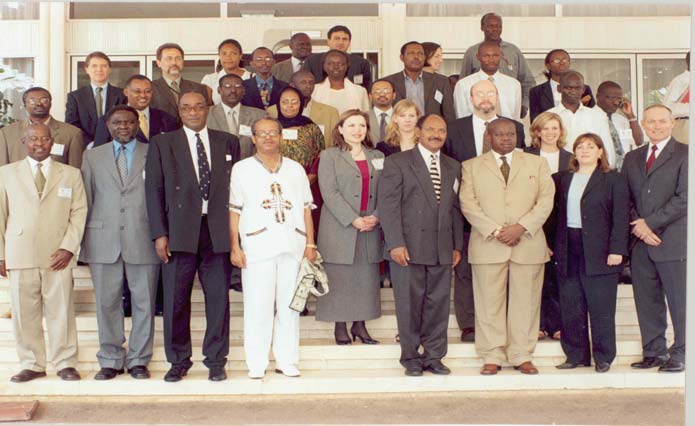
of effective water quality management. The meeting in Cairo was
graced by the presence of H. E. Dr. Mahmoud Abu Zeid, Minister
for Water Resources & Irrigation, Egypt and H.E. Eng. Maged
George, Minister of State of Environment, Egypt. The Regional
Project Manager of NTEAP, Mr. Gedion Asfaw expressed his
gratitude to both Ministers for their presence and stated that their
F
presence is a living testimony to the commitment of the Govern-
rom the 20th to 22nd of December 2004, the Regional Water
ment of Egypt to the objectives of the NBI.
Quality Working Group (RWQG), which is a technical committee
of water quality experts from the Nile basin countries, had its
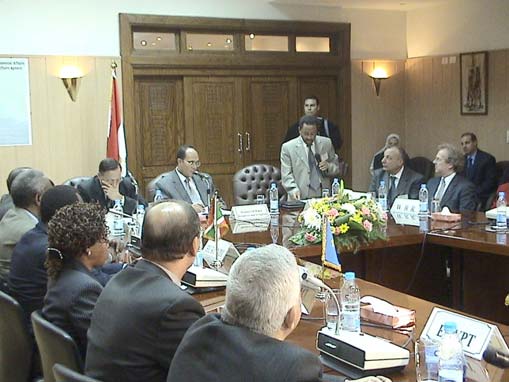
The two ministers and the Regional Project Manager are seen
inaugural meeting at the Nile water Sector, Naser City, Cairo,
here inaugurating the Regional Water Quality Working Group
Egypt. The group comprised of two senior technical officers
during the official opening session of the workshop.
nominated by their governments, mainly from the ministries of
water and environment from Burundi, DRC, Ethiopia, Egypt,
John Omwenga, WQLS-NTEAP Water Quality Component
Kenya, Rwanda, Sudan, Tanzania and Uganda. The main focus
Twinning Arrangements NGOs-CBOs
G
countries that they operate in.
closely and learning from the NGO. The
rassroot Institutions at the community
NGO would also benefit by building a part-
level are normally represented through It is thus important to identify a formula that nership at the grassroot level which would
Community Based Organizations (CBOs). would allow the CBOs to operate well, in facilitate its work as well as allow it to at-
CBOs articulate the interests of the commu-
the Nile riparian countries, taking into ac-
tract additional funding.
nities and voice their views. A major dis-
count the major handicaps that they face.
tinction between CBOs and NGOs is that An excellent model which has been applied As part of the capacity building work di-
,NGOs in most cases have the capacity to elsewhere is to create a twinning arrange-
rected towards fragile CBOs, the Micro-
implement development related activities, ment between a CBO and an NGO. This Grant sub-component will encourage such
as they are able to mobilize technical and mutually beneficial arrangement would community level partnerships building on
financial resources much easier than allow the CBO to benefit from the legal the successful models generated else-
CBOs. The ability of CBOs to attract fund-
status of the NGO allowing its work to be where.
ing and carry out development work is fur-
recognized and validated. It would also
ther curtailed by the fact that CBOs are, provide the CBO with the opportunity to Amir Baker, Microgrants Lead Specialist
normally, not legally registered within the enhance its capacity through working
Readers corner
W ithin the framework of strengthening relations
among the Nile Basin countries, the Egyptian Ministry
of Foreign Affairs is currently in dialogue with the basin
countries to discuss means of activating cooperation
among the countries at al levels. In this respect, Egypt
is hosting a series of meetings for promotion of trade
under the COMESA during the months of November
and December 2004 and January 2005.
Ithar Khalil, NTEAP National Project Coordinator, Egypt


PAGE 4
T HE NILE ENVIRO NMENT
VOLUME 1, ISSUE 3
N IL E B AS I N INI T I AT IV E
NILE T RAN S BO UN DARY
SVP NEWS
ENVI RONM ENTA L AC TI ON
PROJ EC T (NT E AP)
Al Jamhuria Street
House No. 2, Plot 15
P. O. Box 2891
Khartoum, Sudan
Phone: 249-183-784206/26
Fax: 249-183-784248
Email: info@nileteap.org
Visit us at:
www.nileteap.org
Editorial Committee
Gedion Asfaw, Chair
Amir Baker, member
Intisar Salih, member
John Omwenga,
member
Maushe
Kidundo,member &
Secretary
Mohammed Rahim,
layout and publishing
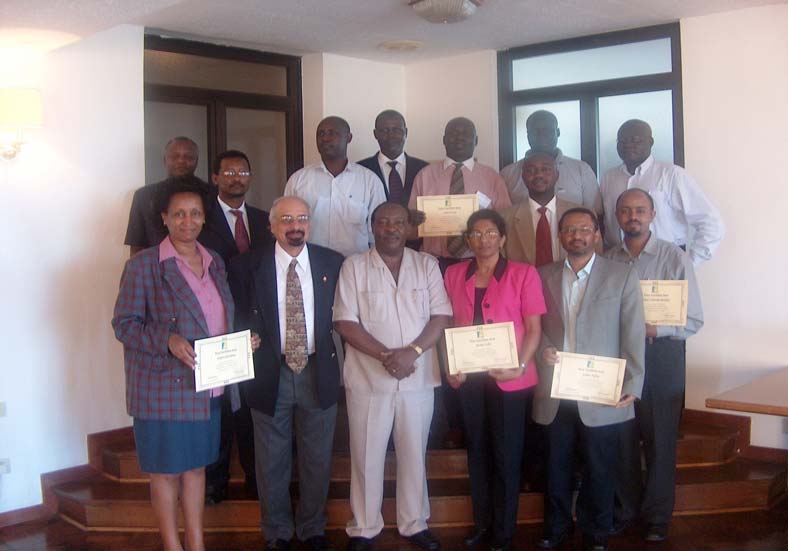
T he SVP Coordination Project of Nile SEC organized a two week procurement training
assistant
at its headquarters in which SVP project managers and finance and procurement special-
ists and Nile SEC staff participated. The training was given by Mr. Subash Dhingra who
did an excel ent job. The Executive Director, Mr. Patrick Kahangire is seen here with the
participants after the certificate awarding ceremony.
The NTEAP welcomes Mr. Gordon
Mumbo (left), RPM of Confidence Building
and Stakeholder Involvement Project ; Dr.
Putting the
Canisius Kanangire (center), RPM of Ap-
Shared Vision into
plied Training Project and Mr.Ernest Ka-
goro (right), Finance/ Procurement Spe-
Action
cialist of the Applied Training Project.
NTEAP Progress Report 2004
T he Nile Transboundary Environmental Action Project (NTEAP) has successfully accomplished most of the activities as planned in
the approved work plan for 2004. The World Bank Mission of November 2004 noted in its aid memoir "the significant positive progress
made towards implementing the first year work plan as wel as the necessary planning for 2005".
The major achievements of 2004 include the following:
·
All project start up activities including office renovation, furnishing , equipping, international and local staff recruitment, recruit-
ment of national project coordinators in 8 of the NBI countries, procurement of project vehicles and office equipment, setting up
of imprest account, financial and administrative systems, publishing of 3 issues of project newsletters, establishing and manag-
ing a project website were successfully conducted and finalized;
·
The Community-level land, forest and water conservation component conducted the first regional microgrants workshop, final-
ized the microgrants strategy and operational manual, recruited local microgrant coordinators for Egypt, Kenya, Tanzania,
Uganda and a national microgrant coordinator for Sudan.
·
The Environment Education and Awareness component established EE&A working groups in 8 of the NBI countries, produced
and disseminated EE&A materials , initial EE&A reviews were also commissioned in 8 of the NBI countries;
·
The Basin-wide Water quality Monitoring component established a regional working group composed of two members from each
of the NBI countries, commissioned national baseline studies in all of the NBI countries, prepared a draft training module;
The project has produced and submitted to relevant bodies monthly, quarterly reports and has developed project progress tracking
matrix. It is in the process of developing a monitoring and evaluation strategy and action plan which will commence after the finaliza-
tion of the baselines studies which are currently underway. Successful working visits to most of the NBI countries were also con-
ducted by the staff of the NTEAP during 2004. We look forward for a more productive year in 2005.
Gedion Asfaw, Regional Project Manager