Nile Basin Initiative
Nile Tr ansbound ary Environment al Action Projec t (NTEAP)
The Nile Environment
A QUARTERLY NEWSLETTER OF NTEAP
Volume 1, issue 2
July-September 2004
Editorial
NTEAP mission to NBI countries
COLLABORATIVE EFFORTS: NILETEAP MAY BUILD ON EXISITING
T he third quarter of 2004 has come to an
end. Actually for the NTEAP it is the first
quarter since the project's work plan was EFFORTS A CASE OF SOME NGO WORK ALONG THE NILE IN UGANDA
approved at the end of May 2004 by the Lessons from the field : Nabanyumya Robert NPC, Uganda
Steering Committee.
The first half of 2004 was devoted to the
start up activities which included renovation, O ne of the Major threats to the Nile river environment is land degradation. There is how-
ever, a saying that one by one makes a bundle. Some efforts have been undertaken to
address the threats of land degradation along the Nile by governments and non-government
equipping and furnishing of project office organizations through the UNDP/GEF Small Grants Programme(SGP) in Uganda One such
including recruitment of international and effort is a project run by an NGO- the Integrated Conservation and Development Initiative
local support staff. National Project Coordi-
(IRDI) in Kamuli district of Uganda. The project aims to reduce land degradation along the
nators (NPCs) in the NBI countries were banks of river Nile in the sub-counties of Balawoli and Kisozi in Kamuli district where agricul-
also recruited during this period.
ture forms the major source of livelihood in the river's catchment area. Here poor agricultural
Right after the approval of the work plan the
practices and unsustainable harvesting of woodlands have exposed the banks to land degra-
PMU team deliberated on detailed tasks dation. Opening up of fragile land near the river for farming resulting from land shortage esca-
necessary to implement the planned activi-
lated the problem. When the NILETEAP joint mission visited Uganda in August 2004, one of
ties including a daily calander of major ac-
the NGOs Visited was IRIDI.
tivities. The Team then conducted brief visits
to riparian countries. These missions were
planned and executed in accordance with
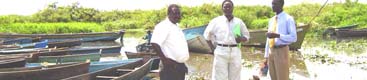
From left to right: Uganda National Pro-
set objectives and detailed program.
ject Coordinator, Nabanyumya Robert,
The newly recruited NPCs did excellent job
John Omwenga, Water Quality Lead
in organizing these missions . The PMU
Specialist and District Environment offi-
Team gained invaluable experience and
cer, Nakasongola during a filed tour
succeeded in acquainting numerous institu-
around L.Kyoga, in August 2004
tions and individuals with the NBI and
NTEAP.
Missions to the NBI countries will always be
important activities of NTEAP as these will To address the Land degradation problem, the IRDI project strategy involves:
"provide forum to discuss development
paths for the Nile with a wide range of stake-
holders". We encourage sharing of experi-
·
Making sustainable use of woodlands profitable as an incentive for conservation: This
ence among all stakeholders as depicted in
has involved using beekeeping as an economically and environmentally viable way to
this issue under the title "Collaborative Ef-
use woodlands and is being supported both to provide an incentive for tree planting
forts" . Thus the focus of this issue is on the
as bee forage as well as protect the existing ones.
NTEAP missions to Nile riparian countries, ·
Promoting sustainable agriculture as a means of rehabilitating soils: This can reduce
which we hope have contributed to the
the need for communities to encroach on river banks as new and fertile farmlands
strengthening of the spirit of cooperation
when their farms further upland are too degraded to be productive. Emphasis is being
among the NBI stakeholders.
put on the staple food crops in the area.
Gedion Asfaw, Regional Project Manager
·
Reducing loss of biodiversity by checking the rate of harvest of woodlands for char-
coal and fuel wood:This is being done by promoting tree planting through agroforestry
and woodlot establishment and use of energy conservation technologies.
Inside this issue:
Editorial 1
·
Creating a cond
ucive policy environment for conservation of river bank : IRDI is con-
tributing through overseeing the formulation of byelaws and engaging local leaders in
PMU Missions
1
the conservation process.
Micro-grants - Impressions from the Basin countries 2
The outcome is that communities are now using efficient energy technologies, namely, energy
Transboundary Environmental Education and Awareness:
saving cook stoves and fireless cookers and are practicing kitchen energy management.
participatory planning process
2
Communities have also started to adopt sustainable land management practices, that is, sus-
tainable agriculture, agro-forestry, woodlot establishment and beekeeping.
Monitoring and Evaluation: Echoes from the Field 2
Basin-wide Water Quality Monitoring
3
NTEAP needs to assess the replicability of such approaches and promote them in other ripar-
ian countries through its micro grants component. Grass root NGOs and community based
Signs of Cooperation
3
organizations are encouraged to come up as partners to help address environmental threats
News and Events
4
facing the Nile.
Readers Corner
4
The Nile Environment from hence forth will be published on recycled
Trans Boundary Waters - Need for Integrated Water Quality
paper. Our maiden issue was published on a glossy paper hopping you will
Management
4
keep it as a memorabilia.





PAGE 2
THE NILE ENVIRONMENT
VOLUME 1, ISSUE 2
Micro-grants - Impressions from the Basin countries
I n spite of a bumpy start for the Micro- smaller results. Hence, there is a need for tional Steering Committee members, who find
Grants Program, the component man-
the GEF/SGP to carry out an appraisal mis-
it challenging to engage in activities that in-
aged to overcome some of the obstacles it
sion in Ethiopia to develop the SGP, so that
volve more than one country, but question the
faced. Field visits to the different riparian the Micro-Grants Program can function approach to measuring the transboundary
countries produced some positive results through it.
outcomes and impacts.
especially in Egypt and Ethiopia, where
there was some reluctance on the part of An interesting observation, while visiting the
The field visits were extremely useful as they
the NTEAP counterparts to agree with the source of the Blue Nile in Bahr Dar, Ethiopia
were an opportunity to expose the activities of
designated host institutions for the Micro-
was the extent and magnitude of land degra-
the component to a wider audience, have an
Grants Program. Discussions were ex-
dation to the arable land as a result of soil
overview of the ongoing Small Grant activi-
tremely fruitful and revealed a positive level
erosion caused by water and wind. While ties, discuss the implementation approach of
of understanding, which focused on accept-
there are several attempts to mitigate the the project and forge partnerships with differ-
ing the conceptual aspects relating to the situation, the impact is not large enough and
ent stakeholders specially NGOs.
Micro-grant Program including the merits requires more efforts, both financial and
generated by its structural base, which technical. The NTEAP will provide support by
Amir Baker, Micro grants Lead Specialist
rests on the experience of the GEF Small launching a rapid assessment study and
Grants Program. The host institution in availing some of the Micro-Grant funds for
Egypt, which was carrying the GEF/SGP pilot mitigation activities that could be repli-
for the last seven years, was eventually cated elsewhere.
accepted to host the Micro-grants Program.
The other three countries visited, namely
Setting up of a well-structured SGP in Kenya, Tanzania and Uganda, which have
Ethiopia was considered a basis for having
already the GEF/SGP functioning have ex-
a functional Micro-Grants Program. That pressed great enthusiasm to have on board
level of convergence, while challenging, for
the Micro-grants Program. Interesting de-
a newly starting SGP/MC, reflects the reali-
bates on the Transboundary nature of the
zation that it is more beneficial to adopt an
Micro-Grant Program, however, reflected the
integrated programmatic approach, rather need for elaboration on the subject, espe-
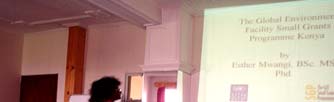
Presentation of Kenya's GEF/Small Grants Program , made at the
than a stand-alone model, which may reap
cially among members of the GEF/SGP Na-
Micro-Grant Meeting in Ethiopia during the recent PMU Mission.
Transboundary Environmental Education and awareness- Participatory planning
individuals and an idea of which options
rent norm for projects similar objectives.
L ocal and national public awareness
campaigns linked to specific environ-
are possible. The EE&A component has
mental issues have been quite effective on a
taken a two pronged approach in achieving
The second step is ensuring a bottom-up
limited scale in some Nile countries, How-
this; visits to several Nile basin countries
approach in activities formulation. The com-
ever, most of the environmental threats of
and a conducting EE&A reviews in each
ponent has planned for national workshops,
the Nile are transboundary (TB) in nature
country. While the reviews are planned for
bringing together national EE&A stake-
which require beyond the borders environ-
October 2004, the country visits elicited a
holders. The forum will also encourage net-
mental education and campaigns. Develop-
lot of information which is used in the plan-
working and sharing of information.
ing TB activities require participation of
ning process. Of funda-
As a third step, a regional EE&A
stakeholders from all countries. Involving
mental importance is the
workshop is planned for Novem-
stakeholders in planning, in most cases
diversity and level of
`Participation ensures
ber 2004. This forum, which
ensures ownership and smooth implementa-
EE&A activities of the five
brings together EE&A practitio-
tion. This article highlights the process of
countries (Egypt, Ethiopia,
ownership `
ners from all the Nile countries,
developing TB EE&A activities in a participa-
Sudan (Khartoum), Tan-
will stimulate an environment to
tory manner.
zania and Uganda) vis-
exchange experiences and sub-
ited. Interaction with key stakeholders
sequently develop TB cooperative EE&A
The first step is to conduct a rapid assess-
during these visits also helped in highlight-
activities. Stakeholders participation is a
ment of existing and planned EE&A activities
ing issues of some planned activities like,
slow and time talking process; however, it
within the basin. This step is important as it
university students exchange and the es-
ensures sustainability
gives a sense of history of environmental
tablishment of school networks without
issues, knowledge of the key institutions and
provision of hardware while this is the cur-
Maushe Kidundo, Environmental Education Lead
Specialist
Monitoring and Evaluation: Echoes from the Field
develop SMART indicators for the project.
M issions to different NBI countries gave
The missions also helped in highlighting the
NTEAP staff an opportunity to interact These indicators and the consolidated infor-
field based techniques in M&E of micro-grants
and provided a platform to discuss activity mation are critical for the Monitoring and activities. NTEAP can incorporate the lessons
implementation at the country level. Field Evaluation Strategy. The strategy will take learnt by Uganda and Egypt GEF/Small grants.
visits confirmed that NTEAP is not starting into account existing M&E databases within
The monitoring of the Microgrant Program will
from zero as there are existing activities
be integrated in the existing monitoring system
where NTEAP can build on and foster part-
where SGP is currently running, while also im-
nerships. Although the situation varies from
proving existing systems through encouraging
one country to the other, it is evident that
sharing of best practices and exchange of infor-
there is a wealth of information that exists in
mation between countries.
each country. However, there is need to
compile and identify gaps which will be filled
The missions were not only informative but also
by carrying out baseline studies.
helpful in planning and implementing an NTEAP
M&E system which will fit into the main NBI
NTEAP has planned to carry out several
system and could be used effectively by both
studies through national consultants who will
partners and NBI countries for planning and
work closely with NPCs and coordinated by
decision making.
Lead Specialists. National baselines will be NBI countries and will work closely with M&E
compiled to establish the regional picture departments within the environmental agen-
Intisar Ali Salih, Monitoring and Evaluation Lead
which an international consultant will use to cies and the NBI Secretariat.
Specialist




PAGE 3
THE NILE ENVIRONMENT
VOLUME 1, ISSUE 2
Basin-wide Water Quality Monitoring Initiatives
N TEAP notes with appreciation, that some countries to advanced and specialized trans boundary nature of water quality and
many Water Quality Initiatives are in others. For example, there exist Isotope pollution control issues is also essential.
being undertaken by the countries visited tracer analysis and air quality monitoring
ie; Egypt, Ethiopia, Kenya, Tanzania, facilities in Sudan and Egypt respectively. NTEAP requested all riparian countries to
Uganda and Sudan on water quality moni-
One important observation is that some labo-
nominate water quality working group mem-
toring initiatives, and overall water re-
ratories in the Basin have been internation-
bers and acknowledges the following nomi-
sources management. It was also gratifying ally accredited and are participating in water nations to the Regional Water Quality Work-
to note that all countries have created fully quality assurance programs.
ing Group:
fledged Ministries or Departments of Water.
The following are the major highlights of the
Whereas some laboratories have highly Mr. Boniface Nyakageni and Mr.Joseph
mission with regards to water quality:
qualified, well-trained and experienced staff, Ndyaegamiye (BURUNDI)
others may require support. It was observed
Most countries have well-established water that water quality monitoring is solely a gov-
Mr. Mbe-Mpie Mafuka, and Ms Mayele
quality monitoring networks from which
Mukonkole (DRC)
water quality samples are taken for testing
and data interpretation.
Dr. Tarik A. Tawfic, and Mr. Mohamed Ah-
med Abdel-Khalek, (EGYPT)
It was also noted that the countries have
set up institutional and legal frameworks
Mr. Zeleke Chafamo Shashore, and Mr.
and developed water resources manage-
Solomon Gebretsadik (ETHIOPIA)
ment strategies and formulated water qual-
Mr. Mohamed Khalafalla Ahmed Ali and Ms
ity standards and regulations, but enforce-
Nadia Babiker Shakak (SUDAN)
ment needs to be enhanced. Water quality
and pollution control units have been estab-
Dr. Hassan Mujengera and Mr. Dickson
lished in the countries, but the level of exe-
Rutagemwa (TANZANIA)
cution varies from country to country.
The Basin-wide Water Quality Monitoring
Some water quality data is available in the
Component hopes to receive outstanding
countries and can be readily shared or ernment venture, and there is a need to in-
nominations from Uganda, Kenya and
accessed on request.
volve more stakeholders and communities in Rwanda. Meanwhile, a Regional Water
the exercise.
Quality Working Group Meeting is planned
There is a disparity in the level and number
for late in the year, in order to discuss basin-
of water laboratories in the countries. Some There is a need to encourage joint trans wide water quality baseline studies, man-
countries have well-established laboratories
boundary water quality activities leading to agement and review and develop action
with modern instruments, while others re-
ultimate basin-wide, information exchange, plans.
quire investing more in training personnel and data sharing and networking.
and the procurement of more modern labo-
John Omwenga , Water Quality Monitoring
ratory equipment. The scope of analysis Enhancing awareness at all levels on the
varied from routine water quality testing in
Signs of Cooperation
PMU Facilitates ENSAP Meeting
T he PMU was honored to facilitate the working meeting of the ENSAP project team and will endeavor to be of service to all NBI family
members. We thank Barbara Miller for her encouraging remarks. Nile Environment
will appreciate if our readers provide us with news of cooperation and collaboration
among the Nile family to share it with all under this column. RPM
Dear Gideon and Environment PMU Friends
On behalf of the ENSAP Flood Preparedness Project team, we wish to thank you for the
very warm hospitality and tremendous support that we received at the Environment
PMU in Khartoum. It is an excellent working environment, and It is wonderful to feel
that there is now an 'NBI' home in Khartoum. Once again Environment is helping to set
the tone for the NBI, as your spirit of cooperation across NBI programs is a visible sign
of the strength and growth of the Initiative. It is quite exciting to know that there will
soon be similar NBI 'homes' throughout the Basin.
Barbara Miller
Nile Team, World Bank
Africa Region, Nile Coordination Unit (AFTNL)
Members of the ENSAP Project Team at the PMU, July 11-14 2004
NGO and Government Cooperation in Egypt
I n the frame of the Ministry of Irrigation and Water Resources new policy of collaborating with civil societies and NGOs in the conservation
of the Nile and its protection against pollution, the Water Resources Protection Association has started the formulation of an association of
water users of one of the irrigation canals in Aswan in cooperation with the Ministry and the Swiss Development Fund. The canal is 5 km in
length and stretches in two Districts in the southernmost Governorate of Egypt. The NGO has also provided equipment for canal cleaning and
periodic maintenance to the farmers, as well as technical and administrative assistance to sustain the work. As such, this is considered a
major precedence in the collaboration between the oldest and one of the strongest Egyptian Ministries and NGOs in the protection of the Nile.
Ithar Khalil, NPC Egypt
PAGE 4
THE NILE ENVIRONMENT
VOLUME 1, ISSUE 2
N IL E BA SIN IN IT IA TI VE
N IL E T RA NSBO UN DA RY
News and Events
E NV IR ONM ENT A L
UNESCO Chair of Sudan Organized Training
Al Jamhuria Street
House No. 2, Plot 15
T he training course was organized in Khartoum in the period between 5-10/09/2004. The course was
supported by UN International Network for Capacity Building in addition to other international organi-
zations and local water institutions in the region
Phone: 249-183-784206/26
Fax: 249-183-784248
The course which is held annually was intended to build a common platform on knowledge in integrated
Email: info@nileteap.org
water resources management among the region capacity building institutions; and establish linkage &
partnerships for training. Thirty two senior & mid level professionals and trainers from the Nile Basin, Arab
East & Northern Africa countries working in water related institutions participated in the training course
.Such type of cooperation may also be useful for NTEAP training activities. The NTEAP thanks the
Visit us at:
UNESCO Chair in Sudan for inviting NTEAP to participate at the training opening and closing sessions
www.nileteap.org
and for availing the training material.
Minister Appreciates Newsletter-The NTEAP first Issue Newsletter was distributed to NTEAP
stakeholders & partners in Sudan. H.E. Minister of Environment & Physical Development of Sudan appre-
Editorial
ciated the effort and additional copies were distributed by his office to members of the council of minis-
ters.
Committee
Gedion Asfaw,
Chair
Readers corner
Amir Baker,
Dear Gedion,
Dear Gedion
Mr. Asfaw,
member
Thanks for the newsletter, it is
Congratulation on your first Must congratulate you and staff
Intisar Salih,
very informative and I am sure i
newsletter. Very informative on the maiden issue of the NT
t took you much effort to pre-
and interesting. Please add us
EAP Newsletter.
member
pare. Hope to maintain the
(IUCN EARO through myself)
It is impressive and excellent re
channels of communication
to your mailing list in future.
ading. Please keep it up.
always open.
Geoffrey Howard, IUCN Nairobi
Mohamed Bayoumi, UNDP,
Kenya
Alexandra Karekaho, UNDP
Cairo, Egypt
Uganda
Dear Gedion,
Dear Dr. Nadir Awad,
Thanks for sending to me the fir
We are pleased to extend to
st issue of NTEAP newsletter.
you our thanks for receiving the
Please accept my warm con-
first issue of the NTEAP News-
gratulations.
letter and also congratulate you
Putting the
for this wonderful start.
Dr. Nadir Awad,
Shared Vision into
Rafaa Asham Alla
Chair Steering Committee of Deputy Director of Documenta-
Action
NTEAP, Khartoum, Sudan
tion and Information Center,
Sudan
Trans Boundary Waters - Need for Enhanced Integrated Water Quality
Management
water demand in each riparian country,
T he Nile River's drainage area straddles
comprehensive approach to sustainable
ten countries. In managing shared
irrigation or industrial water uses, water
fresh water resources was recognized in
water resources, we must consider both
quality is a key factor.
the identification of integrated water re-
water quality and quantity as two faces of
sources management, encompassing water
the same coin. In addition we should also
Another often forgotten aspect of water
quality assessment as the first programme
consider the complex inter linkages be-
quality management is the handling of
area in Chapter 18 of Agenda 21.
tween water availability and human activi-
waste water. Since water has the unique
ties including settlement, health and devel-
property of being cleaned over and over
As most of the national water resources in
opment. Other issues to be considered
again after being dirtied, water re-use and
many countries face depletion, there is
include, legal and institutional issues, popu-
re-cycling is a practice that should be en-
urgent need to effectively manage in an
lation and demography, socio-economics,
couraged especially in those countries ex-
integrated manner and to usefully develop
politics and culture which fundamentally
periencing water scarcity; but being con-
the shared water resources, bearing in
and ultimately affect the manner in which
scious of water quality and health stan-
mind that water quality is of paramount
water quality and quantity are managed.
dards.
importance. Hence the need for enhanced
trans boundary integrated water quality
We should never forget as we often do the
While addressing the complex hydrological
monitoring, an activity which is being sup-
water needs of nature in maintaining critical
issues in the complex Nile river system and
ported by Basin wide Water Quality Moni-
and delicate natural and often cross-border
the development of projects therein, water
toring Component of the NTEAP.
ecosystems as a specific and important
quality issues must always be borne in
water use. The importance of water quality
mind, and where feasible water quality
John Omwenga, Water Quality Lead Specialist
is inherent in all aspects of water resources
impacts predicted and mitigation measures
management. Whatever the focus of the
proposed. Indeed the need to appreciate a