Ni le B as in In it iat iv e
N i le T ra ns b ou nd a ry E nv ir on ment al A ct io n P r o je c t (N TE AP )
The Nile Environment
A QUARTERLY NEWSLETTER OF NTEAP
Volume 1, Issue 1
April-June 2004
Editorial
T
Project launched by Head of State
his is the maiden issue of the Nile
Transboundary Environmental Action
Project (NTEAP) quarterly Newsletter.
The NTEAP is one of the seven projects
under the Nile Basin Initiative Shared Vision
Program. The objective of this project is to
provide a strategic environmental framework
for the environmental y sustainable develop-
ment of the Nile River Basin, to improve the
understanding of the relationship between
water resources development and environ-
mental conservation in the Basin, and to
provide a forum to discuss development
paths for the Nile with a wide range of stake-
holders. This Newsletter will be one of the
instruments the project intends to use as a
forum "to discuss development paths for the
Nile with a wide range of stakeholders."
Providing a "strategic environmental frame-
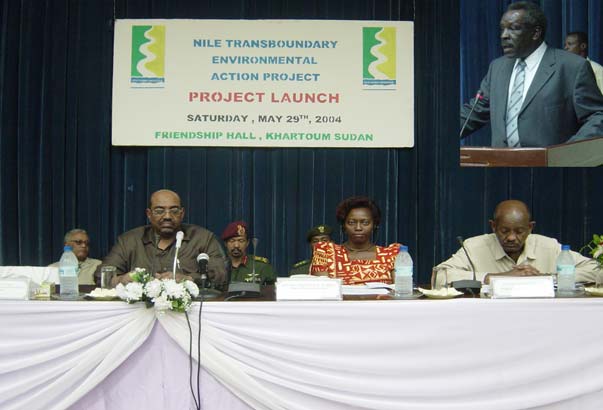
President of the Republic of Sudan, L. General Omar El Bashir presiding over the project's launch. Inset: H.E
the Minister of Environment addressing the meeting
work for the environmental y sustainable
development of the Nile River Basin" requires
geographical boundaries, local considered by Nile-COM.
understanding of all aspects of the river T
and international ef orts are
basin, the countries of the basin, their politi-
he President of the Republic required to overcome the dan- In his brief, the Executive Director
cal systems, development and environmental of the Sudan, L. General Omar El- gers and threats posed by envi- of the Nile Basin Initiative, Mr.
policies, culture and aspiration of the people , Bashir launched the Nile Trans- ronmental degradation. The NBI Meraji Msuya commended the
the opportunities and constraints that support boundary Environmental Action is a reflection of the level of Nile Council of Ministers for the
or impede cooperative management of the Project at the Friendship Hall in awareness of the people of the support and guidance provided in
basin and many other factors. Ultimately it Khartoum on 29th May 2004. The region of these issues", the the NBI process. "Since the inau-
requires putting in place an agreed environ- launch ceremony begun by a wel- President said. The President guration of the Nile Basin Initia-
mental governance/ framework/regime for come speech of H.E the Minister of thanked the Nile COM, develop- tive in 1999, there have been a
the Nile Basin. This endeavor will require the Environment and Physical Develop- ment partners and all those who lot of interactions at all levels in
genuine involvement of the citizens of the ment, Major General Al-Tigani have contributed to the realiza- this complex, but doable coopera-
Nile Basin. We at the PMU are confident of Adam Al-Tahir. The president was tion of the project.
tive process. With the proper
your full support in this worthwhile endeavor. invited to address the meeting by
guidance of the Nile Basin Coun-
Hon. Martha Karua, Kenyan cil of Ministers, this process is
Welcome and let us promote constructive,
H.E Engineer Kamal Ali Mohamed Minister of Water Resources beginning to culminate into pro-
positive and forward-looking dialogue on our who also welcomed the launch
jects rolling out as we witness
Nile environment.
participants.
Management and Development,
who is also the Chairperson of today", he said.
Gedion Asfaw, Regional Project Manager
In his speech, the Sudanese Presi- the Nile Basin Council of Minis-
dent expressed his joy that the ters (Nile-COM) noted that "Our Representatives from the Cana-
launch coincided with the dawning success depends on our ability dian International Development
Inside this issue:
of peace in Sudan which he said to work as a team to overcome Agency (CIDA), the United Na-
was beneficial to all countries of the the hurdles and exploit the op- tions Development Programme
Editorial
1
basin.
portunities that exist. This (UNDP), the World Bank and the
Project Launch
1
means that co-operation and United Nations Office for Project
Microgrants 2
The President recalled the 1972 only cooperation is the key to Services (UNOPS) pledged their
EE and awareness
2
Stockholm Conference and the our future. .At al cost, we must commitment and continuing sup-
Monitoring and Evaluation
2
1992 Earth Summit in commemora- maintain our commitment to the port to the NBI process to bring
Water and Environment
3
tion of the World Environment Day process. She also expressed tangible benefits to the peoples of
People and Places
3
in which he expressed his concern appreciation to the NBI develop- the Basin.
Readers Corner
3
over the reluctance of developed ment partners for their support Maushe Kidundo, Environmental
Project Implementation Briefs
4
countries to fulfil their financial and appealed to them to con- Education Lead Specialist
Nile Information
4
commitment. "Since environmental tinue providing assistance to the
hazards are not restricted within next generation of projects being
PAGE 2
T HE NILE ENVIRO NMENT
VOLU ME 1, ISSUE 1
Micro-grants - A tool to advocate for environmental conservation
W
The Micro-grants funding facility of the NTEAP
a decade ago. It will also endeavor to carry out
aims at introducing innovative, environmental y
capacity building programs targeting NGOs,
hile some of the environmental
sound and friendly pilot activities that would
NGO networks and Government staf in project
threats that plague the Nile Basin are due to
allow the riparian communities to conserve the
implementation and environmental conserva-
natural occurrences such as floods, recurrent
tion activities. The program will dif er from the
droughts and soil erosion, many are caused by
GEF SGP in that it will focus primarily on trans-
practices of the inhabitants of the Basin. These
boundary based projects that will address
practices do not only damage the eco-system
trans-boundary related issues affecting the
of the basin but also erode the capacity of the
basin. The Program is also gender-sensitive,
communities of the Basin to sustain an ade-
hence, one of the main target groups of the
quate level of livelihood. Moreover, the inability
Program are women, who constitute over 50%
of the riparian countries to capitalize meaning-
of the inhabitants of the basin. Through their
fully on the natural resources of the basin has
grass root institutional structures, women will
further aggravated the rampant poverty that
be able to tap into the micro-grant resources to
af licts the basin. Hence, the basin has wit-
benefit their communities and advocate for
nessed increased degradation of its environ-
environmental conservation through out the
ment resulting from the reliance of the commu-
natural resources and utilize them ef ectively
basin.
nities on the fragile natural resources of the
for their sustained livelihoods. The Program,
basin for livelihoods; and adopting environmen-
which is community driven, will build on the
Amir Baker, Micro grants Lead Specialist
tally destructive coping mechanisms to sustain
experience of the successful Smal Grant Pro-
their livelihoods.
gram that was introduced by UNDP/GEF over
Environmental Awareness - Changing Attitude
ary networking.
support university level student transfers and
(vi) facilitate the development of a university
K nowledge alone doesn't harm or help Public information and awareness will be level course or module on environmental edu-
the environment. Human attitudes don't harm
achieved through formation of national working
cation specifically on Nile basin environmental
or help the environment. Human behaviors, on
groups. The working group will plan and imple-
issues. The success and sustainability of this
the other hand, have greatly harmed, yet hold
ment through selected NGOs and Government
program depends on sharing of information
a great deal of hope for helping, the environ-
Institution both national and transboundary
among the riparian countries. The program will
ment. In order to maintain the Nile river basins
awareness activities
develop and support exist-
environmental sustainability, change in human
including campaigns,
ing networks within the
behavior, supported by knowledge and attitude
production and distribu-
basin. On an annual basis
`Changing attitude and
must be addressed. In realizing its importance,
tion of awareness
the program will hold a
the Nile Transboundary Environmental Action
materials, demonstra-
behavior
regional workshop to facili-
Project has an environmental education and
tion of good environ-
tate information exchange
public awareness program. The main objective
mental practices, etc.
of the Nile Basin communities `
and develop transboundary
of the program is to deepen public awareness
action plans. Other net-
Environmental educa-
on Nile environmental issues which affect all its
working tools like discussion
tion within schools and tertiary institutions will
communities. The program has three main
groups on the internet will be explored, includ-
involve (i) networking secondary schools (ii)
areas of focus (i) public information and aware-
ing the use of a newslet er like this one.
conducting teachers training (iii) supporting
ness (ii) environmental education and aware-
transboundary environmental demonstration
Maushe Kidundo, Environmental Education
ness in education institutions (secondary
within schools (iv) initiate an award scheme (v)
Lead Specialist
schools and universities) and (iii) transbound-
Monitoring and Evaluation - Tracking inputs and impacts
indicators of progress and ultimately success.
A
from national coordinators describing progress
and highlighting the main constraints. These
NTEAP will employ a
s the NTEAP starts its implementation
inputs will be reviewed and used as guidance
variety of M&E tools to
process and as the activities start to take
instruments when preparing work plans.
track progress and
shape on the ground, it is important to set-up a
assess outcomes and
proper monitoring and evaluation mechanism
Monitoring and Evaluation will provide our
impacts. The tools
in place. The M&E structure will allow us to
development partners with first hand informa-
range from simple feed-
monitor the progress of each component as-
tion on progress and wil also, support the
back questionnaires to
certaining that the whole program is on track
efforts of deriving and documenting lessons
exhaustive monitoring
and did not deviate from its original course. In
learned as wel as compiling best practices for
visits and quantitative
addition, the M&E process will allow us to
wider dissemination.
and qualitative data
introduce changes in the implementation
analysis derived from the field and compared
Intisar Salih, Monitoring and Evaluation Lead
strategies or even re-think the design if the
to baseline data collected in the early stages of
Specialist
results on the ground justify so. M&E has
implementation. In our M&E ef orts in NTEAP,
become an important element in implementa-
we will also rely on analytical reports received
tion exercise as it provides timely and accurate
V OLUME 1, ISSUE 1
THE NI LE ENVIRONMENT
PAGE 3
Water and Environment - Water Quality Monitoring
W
Some of the major threats facing fresh
waters within the Nile basin include; en-
ater is a finite and life sustaining
demic water scarcity, uneven distribution
resource and covers about 70 % of the
both in time and space, increased pol ution
physical environment, Fresh water re-
from domestic, agricultural and industrial
sources on the other hand are scarce and
sources, gross water quality deterioration
are unevenly distributed. The amount of
leading to serious health and economic
water available globally is about 1.4 billion
problems, upstream soil erosion leading to
cubic kilometers. Of this amount, 97 % is
increased turbidity and color as well as
saline, and is in seas and oceans and is a
reservoir sedimentation, gross wetlands
habitat to diverse marine ecosystems. Of
and catchments destruction, and eutrophica-
establishment of the current status of
the 3 % fresh water, only less than 1 % is
tion due to high levels of nutrient contami-
surface water quality in the Nile and its
found in lakes and rivers, supporting all our
nants in the water.
river and lake systems. This will lay the
developmental activities. Surprisingly 2 %
foundation and ground work for subse-
of the available fresh water resources is
The Basin wide Water Quality Monitoring
quent planned water quality control activi-
locked up in glacial ice at the poles. The
Component is one of the six Components of
ties, all aimed at the assessment, conser-
fresh water in rivers and lakes, thus needs
the Nile Trans boundary Environmental
vation, protection and wise management of
Action Project (NTEAP) and is a trans
to be managed well for our sustenance
our common and shared water resources
and that of future generations.
boundary intervention aimed at enhancing
for our own use and for the preservation of
the water quality monitoring capacities of the
aquatic biodiversity and the physical envi-
Globally fresh water is becoming an en-
riparian countries as well as raise the level
ronment as a whole. The environment
dangered resource. In the past, there was
of awareness on the importance of overall
belongs to all off us ,lets all work together
little or no water pol ution and most of the
water resources and water quality assess-
to ensure that both water and other envi-
rivers and lakes were in a pristine state. In
ment, as an important management tool.
ronmental resources are sustainably man-
modern times, water pollution is on the
aged.
increase and gross quality deterioration is
This Component starts implementing its
activities with the initial formation of a Re-
evident in many water bodies.
John Omwenga - Water Quality Monitoring
gional Water Quality Working Group and the
People and places
A
tive Director of Nile SEC and JB Col ier of
the World Bank at the end of the mission's
World Bank supervision mission visit.
composed of JB Collier, Astrid Hillers,
Dr. Hasan Hassan visited the PMU Barbra Miller, Nile Team, SVP Cluster
between March 28 and April 5 2004. The Leader, World Bank, was in Khartoum
mission had detailed discussions on the between April 2nd and 7th 2004 with re-
NTEAPwork plan and achievements to gards to flood control project study.
date with the PMU staff. The mission
also met with H.E the Minister of Irriga- The Ministry of Irrigation and Water Re-
tion and Water Resources , H.E. the sources was the host for the mission. She
Minister of Environment and Physical met with H.E. the Minister of Environment
Development of Sudan and the Nile TAC and Physical Development. She also held
member of Sudan. An Aid memoire discussions with the RPM and the Lead
specialists at the PMU
JB Collier ,WB with H.E Kamal Ali Mohamed Minister of Irrigation and Water
which commended the progress made
Resources of Sudan and D.r Osman Hamad, Nile TAC member
by the NTEAP was signed by the Execu- Gedion Asfaw, Regional Project Manager
Readers corner
This corner is devoted to opinions and let-
Speech of the President of Sudan began with
"Our success depends on our ability to work as a
ters of our readers.
a quotation from Prophet Mohammed
team to overcome the hurdles and exploit the
opportunities that exist. This means that co-
In this first issue we wil share with you some
"All people are free partners
operation and only cooperation is the key to
excerpts from the speeches delivered at the
our future": Hon. Martha Karua, Nile COM
NTEAP launch.
in three things, water,
Chair
"A historic regional initiative indeed at a
vegetation which springs
"Cooperation is indeed a truly powerful tool and it
historic moment in the Sudan.": Dr. Heba El-
is a driver for enhancing the potential of Nile
spontaneously and fire"
Kohly, Ag.UNDP Res.Rep. Sudan.
Basin countries as you confront the challenges
ahead of you.." Nigel Fisher, Exec. Director,
"..the NBI is a unique process that has been
(Referring to the Sudan peace agreement at
UNOPS.
conceived and nurtured, and is owned by the
the time the NTEAP Launch)
riparian states.: Meraji Msuya, ED. Nile SEC
Gedion Asfaw, Regional Project Manager
PAGE 4
T HE NILE ENVIRO NMENT
VOLUME 1, ISSUE 1
NI LE BASI N I NITI ATIVE
NI LE TRANSBOUND ARY
Project Implementation Brief - The NTEAP Project
ENVIR ONMENTAL ACTI ON
PR OJ ECT (NTEAP )
Al Jamhuria Street
House No. 2, Plot 15
P. O. Box 2891
Khartoum, Sudan
T he Nile Transboundary Environmental Action Project is one of the eight projects under the Nile Basin Initia-
tive shared Vision Program (SVP). This five years program became operational in October 2003. The NTEAP is
hosted by Sudan and located in Khartoum. The Project was operationalized in October 2003,and will have a life of
Phone: 249-183-784206/26
five years. It will support the development of a basin-wide framework for actions to address high priority trans-
Fax: 249-183-784248
Email: info@nileteap.org
boundary environmental issues within the context of the Nile Basin initiative's Strategic Action Program
The main objective of the project is to provide a strategic environmental framework for the management of the transbound-
Visit us at:
ary waters and environment challenges in the Nile river basin. Specifically, the project wil : (i) Improve the understanding of
www.nileteap.org
the relationship of water resources development and environment, (ii) Provide forum to discuss development paths for the
Nile with a wide range of stakeholders (iii) Enhance basin-wide cooperation and environmental awareness and
(iv) Enhance environmental management capacities of the basin-wide institutions and the NBI.
Editorial Committee
The NTEAP has six components: (ii) Institutional Strengthening to Facilitate Regional Cooperation (i ) Community-Level
Gedion Asfaw, Chair
Land, Forest and Water Conservation (iii) Environmental Education & Awareness (iv) Wetlands and Biodiversity Conserva-
Amir Baker, member
tion (v) Water Quality Monitoring and Monitoring & Evaluation.
Intisar Salih, member
John Omwenga, member
Expected Project Outputs. The expected outputs include (i) Increased regional cooperation in environmental
Maushe Kidundo,member
and water management fields (ii) Increased basin-wide community action and cooperation in land and water man-
& Secretary
agement (iii) Increased number of basin-wide networks of environmental and water professionals and increased
Mohammed Rahim,
number of experts knowledgeable on the environment (iv) Greater appreciation
layout and publishing
of river hydrology and more informed discussion of development paths (v) Ex-
assistant
panded information, knowledge base and know-how on land and water re- During the first & second quar-
sources available to professionals and NGOs (vi) Greater awareness of the ter of 2004:
linkages between macro/sectoral policies and the environment and (vii) Greater · PMU office was renovated,
awareness and increased capacity on transboundary water quality threats
furnished & equipped
Project Implementation The project shall be implemented in a manner that
upholds the spirit of the Nile Basin Initiative, ensuring that (i) Riparian ownership · 4 Lead Specialists,8 National
of the Environment Project is maintained (ii) Cooperation and trust among the
Project Coordinators 15 local
Nile countries are enhanced (iv) Capacity is built within the Basin to manage
support staff were recruited
and implement basin-wide projects and (v) The Environment Project is imple-
mented with the highest quality and fiduciary standards
· 2004 work plan was com-
pleted, steering commit ee
Putting the
Financial and Technical Support The NTEAP is owned and implemented by the
meeting held and approved
Shared Vision into NBI countries through financial and technical assistant of UNDP and the World Bank.
CIDA has provided financial support to the Nile Basin Trust Fund. UNOPS provides · NTEAP was of icially launched
Action
support services in the implementation of NTEAP. The total budget for the five year
by H.E Lieutenant General
period amounts to 43.6 million dol ars, including contributions from the riparian coun-
Omar Al Bashir , President of
tries. NTEAP Brochure, May 2004
Sudan
Nile information - The Nile Basin Initiative
Basin water resources."
T
1. Nile Transboundary Environmental Action
2. Nile Basin Regional Power Trade
he Nile Basin Initiative (NBI) is a transi-
The Initiative provides a unique forum for the 3. Efficient Water Use for Agricultural Produc-
tional mechanism that includes the ten Nile ripar-
countries of the Nile to move forward a coopera- tion
ian countries as equal members in a regional tive process to realize tangible benefits in the 4. Water Resources Planning and Manage-
partnership to promote economic development Basin and build a solid foundation of trust and
ment
and fight poverty throughout the basin. The vision confidence. The Nile-COM serves as the highest
of the NBI is "to achieve sustainable socio-
5. Confidence-Building and Stakeholder In-
decision-making body of the NBI. Chairmanship of
economic development through the equitable
volvement (Communications)
the Nile-COM is rotated annually. The Nile-COM
utilization of, and benefit from, the common Nile is supported by a Nile Technical Advisory Commit- 6. Applied Training
Basin water
tee (Nile-TAC), which is composed of two senior 7. Socio-Economic Development and Benefit-
officials from each member country. The NBI
Sharing
Formally launched in February 1999 by the Coun-
maintains a secretariat, the Nile-SEC, located in 8. SVP Coordination
cil of Ministers of Water Affairs of the Nile Basin Entebbe, Uganda. The Secretariat began opera-
States, the Initiative includes all Nile countries tions in June 1999 and was officially launched on The NBI countries include Burundi, D. R.
and provides an agreed basin-wide framework to September 3, 1999.
Congo, Egypt, Ethiopia, Kenya, Rwanda,
fight poverty and promote socio-economic devel-
Sudan, Tanzania and Uganda. Eritrea cur-
opment in the region. The Initiative is guided by a The SVP includes eight projects: seven basin- rently has an observer status and has ex-
Shared Vision "to achieve sustainable socio-
wide thematic projects and one project focused on pressed its intention to become a ful member
economic development through the equitable building the capacity of the Nile-SEC for program soon.
utilization of, and benefit from, the common Nile execution and coordination.
NBI documents