This report was compiled by:
Susan Taljaard (CSIR, Stellenbosch)
This report was reviewed by:
Dr Pedro M S Monteiro (CSIR, Stellenbosch)
Dr Des Lord (D. A. Lord & Associates Pty Ltd, Perth, Australia)
This report also includes feedback that was received from key stakeholders attending the
Work sessions that were held in each of the three countries:
Namibia: 25 and 26 January 2005
Angola: 7 and 8 February 2005
South Africa: 10 and 11 February 2005
CSIR Report No CSIR/NRE/ECO/ER/2006/0011/C
EXECUTIVE SUMMARY
(RECOMMENDED WATER AND SEDIMENT QUALITY GUIDELINES
FOR THE BCLME REGION IN A NUTSHELL)
The United Nations Office for Project Services ("UNOPS") commissioned the CSIR (South
Africa) to conduct this project, of which the main purpose was to obtain:
· A set of recommended water and sediment quality guidelines for a range of
biogeochemical and microbiological quality variables, in order to sustain natural
ecosystem functioning, as well as to support designated beneficial uses, in coastal areas
of the BCLME region
· Best Practice Protocols for the implementation (or application) of these quality guidelines
in the management of the coastal areas in the BCLME region.
An important secondary objective was to get acceptance from key stakeholders in the three
countries on the proposed guidelines and protocols. This was achieved through work
sessions and training workshops held in each of the three countries to which key
stakeholders were invited. The outputs from this project were also incorporated into an
updatable web-based information system (temporary web address:
www.wamsys.co.za/bclme).
The ultimate goal in marine water quality management is to keep the marine environment
suitable (or fit) for all designated uses. To achieve this goal, the quality objectives set for a
particular marine environment should be aimed at protecting the biodiversity and functioning
of marine aquatic ecosystems, as well as designated uses of the marine environment (also
referred to as beneficial uses). It is proposed that three designated uses of marine waters
be recognised for the BCLME region, namely:
· Marine aquaculture (including collection of seafood for human consumption)
· Recreational use
· Industrial uses.
BCLME Project BEHP/LBMP/03/04
Page i
Final
January 2006
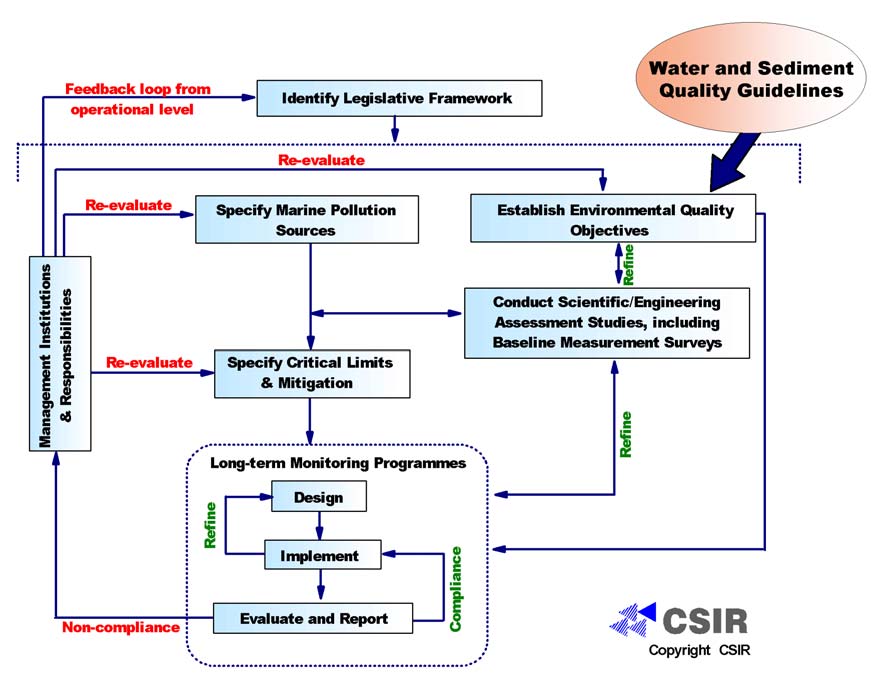
The recommended water and sediment quality guidelines, as part of this section, provide
guidance to managers, local governing authorities and scientists to set site-specific
environmental quality objectives within a study area for the protection of marine aquatic
ecosystems and other designated uses. Therefore, in the larger integrated and ecosystem-
based framework, within which marine water quality is managed, water and sediment quality
guidelines play a major role in setting environmental quality objectives, as illustrated below:
Below is a summary of the constituent categories for which recommended water and
sediment quality are provided for different designated uses as part of this study:
MARINE
MARINE
INDUSTRIAL
TYPE OF QUALITY GUIDELINE
AQUATIC
RECREATION
AQUACULTURE
USES
ECOSYSTEMS
Objectionable Matter/ Aesthetics
Yes Yes
Physico-chemical variables
Yes
Refer to Marine
Aquatic Ecosystem
Refer to Drinking
Water
Nutrients
Yes
Guidelines
Water Guidelines
Based on site-
Toxic substances
Yes
specific
requirements of
Microbiological indicators
- Yes
Yes
industrial use in
the area
Tainting substances
- Yes -
Refer to Marine
Sediment
Toxic Substances
Yes
Aquatic Ecosystem
-
Guidelines
BCLME Project BEHP/LBMP/03/04
Page ii
Final
January 2006
As a rule of thumb, it is recommended that the following simple application rules apply:
1. Compliance with quality guideline values for the Protection of marine aquatic ecosystems
should be aimed at in all coastal waters, except in approved sacrificial zones, e.g. near
wastewater discharges and certain areas within harbours.
2. In addition to (1), the classification system recommended for Marine aquaculture should
be applied in areas where shellfish are collected or cultured for human consumption so
as to manage human health risks. The assumption is that the health of the organisms is
catered for under the Protection of Marine Aquatic Ecosystems (referring to 1).
3. In addition to (1), the aesthetic quality guidelines, as well as the classification system
ranking waters in terms of human health risks for Recreational use, should be applied in
related areas. With reference to toxic substances, it is recommended that suitable
Drinking water quality guidelines be consulted to make preliminary risk assessments,
where these substances are expected to present at levels that could pose a risk to
human health (following the example of the WHO, 2003).
4. In addition to (1), site specific water quality guidelines, based on the requirements of
local Industries, should be applied, where and if applicable.
The recommended quality guidelines and protocols for implementation, as listed below, have
been drawn from a review of international water and sediment quality guidelines. As
information is developed further for specific conditions in the BCLME region, these may be
modified, following the principle of adaptive management.
Recommended Water and Sediment Quality Guidelines: Protection of Marine Aquatic
Ecosystems
Water quality guidelines for the protection of aquatic ecosystems are recommended for the
following constituent categories:
· Objectionable matter
· Physico-chemical
variables
· Nutrients
· Toxic
substances.
Sediment quality guideline values are generally specified only for the protection of aquatic
ecosystems, in particular for toxic substances.
BCLME Project BEHP/LBMP/03/04
Page iii
Final
January 2006
Recommended water quality guidelines for objectionable matter (aesthetic):
PROPOSED GUIDELINE
Water should not contain litter, floating particulate matter, debris, oil, grease, wax, scum, foam or any similar
floating materials and residues from land-based sources in concentrations that may cause nuisance.
Water should not contain materials from non-natural land-based sources which will settle to form objectionable
deposits.
Water should not contain submerged objects and other subsurface hazards which arise from non-natural
origins and which would be a danger, cause nuisance or interfere with any designated/recognized use.
Water should not contain substances producing objectionable colour, odour, taste, or turbidity.
Recommended water quality guidelines for physico-chemical variables:
VARIABLE
PROPOSED WATER QUALITY GUIDELINE
Where an appropriate reference system(s) is available, and there are sufficient data for
the reference system, the guideline value should be determined as the range defined by
Temperature
the 20%ile and 80%ile of the seasonal distribution for the reference system. Test
data: Median concentration for the period
Where an appropriate reference system(s) is available, and there are sufficient data for
the reference system, the guideline value should be determined as the 20%ile or 80%ile
Salinity
of the reference system(s) distribution, depending upon whether low salinity or high
salinity effects are being considered. Test data: Median concentration for the period
Where an appropriate reference system(s) is available, and there are sufficient data for
the reference system, the guideline value range should be determined as the range
defined by the 20%ile and 80%ile of the seasonal distribution for the reference system.
pH
pH changes of more than 0.5 pH unit from the seasonal maximum or minimum defined
by the reference systems should be fully investigated.
Test data: Median concentration for the period
Turbidity
Where an appropriate reference system(s) is available and there are sufficient data for
the reference system, the guideline values should be determined as the 80%ile of the
reference system(s) distribution.
Suspended solids
Additionally, the natural euphotic depth (Zeu) should not be permitted to change by more
than 10%.
Test data: Median concentration for period
Where an appropriate reference system(s) is available, and there are sufficient data for
the reference system, the guideline value should be determined as the 20%ile of the
reference system(s) distribution.
Dissolved oxygen
Where possible, the guideline value should be obtained during low flow and high
temperature periods when DO concentrations are likely to be at their lowest.
Test data: Median DO concentration for the period, calculated using the lowest diurnal
DO concentrations.
BCLME Project BEHP/LBMP/03/04
Page iv
Final
January 2006
Recommended water quality guidelines for nutrients:
VARIABLE
PROPOSED WATER QUALITY GUIDELINE
Where an appropriate reference system(s) is available and there are sufficient data for
Chlorophyll a
the reference system, the guideline value should be determined as the 80%ile of the
reference system(s) distribution.
Nutrient concentrations in the water column should not result in chlorophyll a, turbidity
and/or dissolved oxygen levels that are outside the recommended water quality
guideline range (see above). This range should be established by using either
suitable statistical or mathematical modelling techniques.
Nutrients
Alternatively, where a modelling approach may be difficult to implement, nutrient
concentrations can be derived using the Reference system data approach: Where an
appropriate reference system(s) is available and there are sufficient data for the
reference system, the guideline value should be determined as the 80%ile of the
reference system(s) distribution.
Recommended water quality guidelines for toxic substances:
TOXIC SUBSTANCES
RECOMMENDED GUIDELINE VALUE in µg/
Total Ammonia-N
910
Total Residual Chlorine-Cl
3
Cyanide (CN-) 4
Fluoride(F-)
5 000
Sulfides (S-)
1
Phenol
400
Polychlorinated Biphenyls (PCBs)
0.03*
Trace metals (as Total metal):
Arsenic
As(III) - 2.3; As(V) - 4.5
Cadmium
5.5
Chromium
Cr (III) - 10; Cr (VI) - 4.4
Cobalt
1
Copper
1.3
Lead
4.4
Mercury
0.4
Nickel
70
Silver
1.4
Sn (as Tributyltin)
0.006
Vanadium 100
Zinc
15
Aromatic Hydrocarbons (C6-C9 simple hydrocarbons - volatile):
Benzene (C6)
500
Toluene (C7)
180
Ethylbenzene (C8)
5
Xylene (C8)
Ortho - 350; Para - 75; Meta - 200
Naphthalene (C9)
70
Poly-Aromatic Hydrocarbons (< C15 - acute toxicity with short half-life in water)
Anthracene (C14)
0.4
Phenanthrene (C14)
4
Poly-Aromatic Hydrocarbons (> C15, chronic toxicity, with longer half-life in water)
Fluoranthene (C15)
1.7
Benzo(a)pyrene (C20)
0.4
Pesticides:
DDT
0.001
Dieldrin
0.002
Endrin
0.002
BCLME Project BEHP/LBMP/03/04
Page v
Final
January 2006
Recommended sediment quality guidelines for toxic substances:
RECOMMENDED GUIDELINE
PROBABLE
TOXIC SUBSTANCES
VALUE
EFFECT CONCENTRATION
TRACE METALS (mg/kg dry weight)
Antimony
-
-
Arsenic
7.24
41.6
Cadmium
0.68
4.21
Chromium 52.3
160
Copper
18.7
108
Lead
30.2
112
Mercury
0.13
0.7
Nickel
15.9
42.8
Silver
0.73
1.77
Tin as Tributyltin-Sn
0.005
0.07
Zinc
124
271
TOXIC ORGANIC COMPOUNDS (µg/kg dry weight normalized to 1% organic carbon)
Total PAHs
1684
16770
Low Molecular PAHs
312
1442
Acenaphthene
6.71
88.9
Acenaphthalene
44
640
Anthracene
46.9
245
Fluorene
21.2
144
2-methyl naphthalene
-
-
Naphthalene
34.6
391
Phenanthrene
86.7
544
High Molecular Weight PAHs
655
6676
Benzo(a)anthracene
74.8
693
Benzo(a) pyrene
88.8
763
Dibenzo(a,h)anthracene
6.22
135
Chrysene
108
846
Fluoranthene
113
1494
Pyrene
153
1398
Toxaphene
-
-
Total DDT
3.89
51.7
p p DDE
2.2
27
Chlordane 2.26
4.79
Dieldrin 0.72
4.3
Total PCBs
21.6
189
Recommended water and sediment quality guidelines for the protection of marine aquatic
ecosystems should be applied as benchmarks, following a risk assessment or phased
approach as illustrated below:
BCLME Project BEHP/LBMP/03/04
Page vi
Final
January 2006
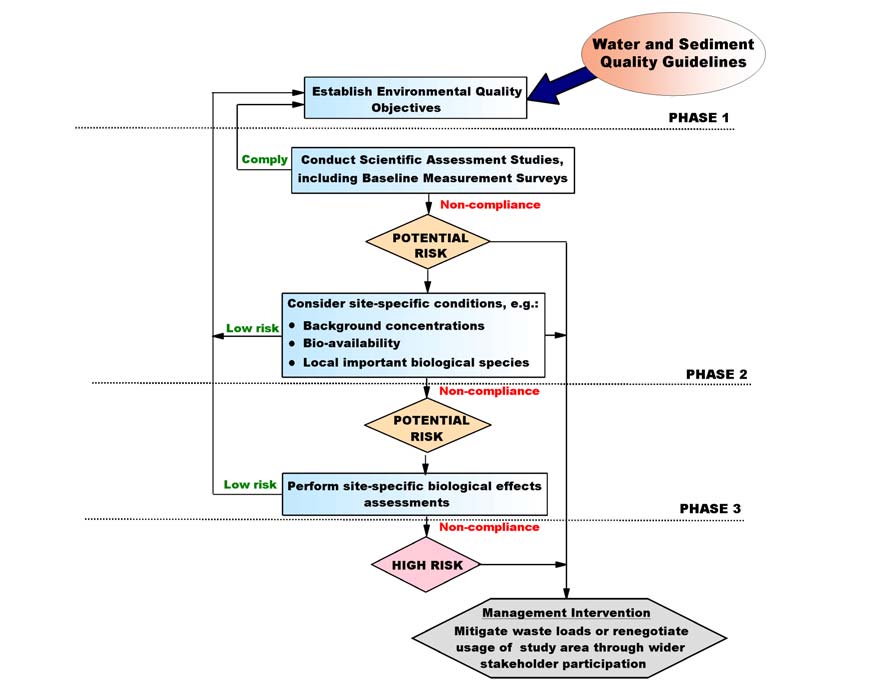
Where scientific assessment studies or monitoring results reveal that recommended quality
guideline values are exceeded, this should trigger the incorporation of additional information
or further investigation to determine whether or not a real risk to the ecosystem exists, and,
where necessary, to adjust the guideline values for site-specific conditions.
Quality guideline values should be compared with the median of the measured or simulated
data set. Where a guideline value was based on professional judgement, the rationale for
the selection of such a value should be provided and a process should be put in place
whereby the adopted value is reviewed and supported or modified in light of emerging
information, following the principle of adaptive management.
Recommended Water and Sediment Quality Guidelines: Marine Aquaculture
In terms of water quality guidelines for marine aquaculture (including the collection and
harvesting of living stock for human consumption), the following are important
considerations:
BCLME Project BEHP/LBMP/03/04
Page vii
Final
January 2006
· Protection of the health of the aquatic ecosystem so as to ensure sustainable production
and quality of products
· Protection of the health of human consumers
· Tainting of seafood products.
With reference to the protection of aquatic organisms used in the culture and harvesting of
seafood, it is recommended that the water quality guidelines proposed for the Protection of
aquatic ecosystems be applied, rather than developing a separate series of quality
guidelines.
With reference to the protection of human consumers, it is proposed that the allowable limits
of toxic substances and human pathogens in food products be controlled through legislation.
In terms of shellfish growing areas, microbiological recommended water quality guidelines
aimed at mitigating human health risks are as follows:
INDICATOR
PROPOSED WATER QUALITY GUIDELINE
Median concentrations should not exceed 14 Most Probable Number (MPN) per 100 ml
Faecal coliform
with not more than 10% of the samples exceeding 43 MPN per 100 ml for a 5-tube, 3-
dilution method.
Estimated threshold concentrations for tainting substances are listed below:
THRESHOLD CONCENTRATIONS ABOVE WHICH
TAINTING SUBSTANCE
TAINTING IS LIKELY TO OCCUR (mg/)
Acenaphthene
0.02
Acetophenone
0.5
Acrylonitrile
18
Copper
1
m-cresol
0.2
o-cresol
0.4
p-cresol
0.12
Cresylic acids (meta, para)
0.2
Chlorobenzene
-
n-butylmercaptan
0.06
o-sec. butylphenol
0.3
p-tert. butylphenol
0.03
2-chlorophenol 0.001
3-chlorophenol 0.001
3-chlorophenol 0.001
o-chlorophenol
0.001
p-chlorophenol
0.01
2,3-dinitrophenol
0.08
2,4,6-trinitrophenol
0.002
2,3 dichlorophenol
0.00004
2,4-dichlorophenol
0.001
2,5-dichlorophenol
0.023
2,6-dichlorophenol
0.035
3,4-dichlorophenol
0.0003
BCLME Project BEHP/LBMP/03/04
Page viii
Final
January 2006
THRESHOLD CONCENTRATIONS ABOVE WHICH
TAINTING SUBSTANCE
TAINTING IS LIKELY TO OCCUR (mg/)
2-methyl-4-chlorophenol
0.75
2-methyl-6-cholorophenol
0.003
3-methyl-4-chlorophenol
0.02 3
o-phenylphenol
1
Pentachlorophenol
0.03
Phenol
1
2,3,4,6-tetrachlorophenol
0.001
2,4,5-trichlorophenol 0.001
2,3,5-trichlorophenol
0.001
2,4,6-trichlorophenol
0.003
2,4-dimethylphenol
0.4
Dimethylamine
7
Diphenyloxide
0.05
B,B-dichlorodiethyl ether
0.09
o-dichlorobenzene
< 0.25
p-dichlorobenzene 0.25
Ethylbenzene
0.25
Momochlorobenzene 0.02
Ethanethiol
0.24
Ethylacrylate
0.6
Formaldehyde
95
Gasoline/Petrol
0.005
Guaicol
0.082
Kerosene
0.1
Kerosene plus kaolin
1
Hexachlorocyclopentadiene
0.001
Isopropylbenzene
0.25
Naphtha
0.1
Naphthalene
1
Naphthol
0.5
2-Naphthol
0.3
Nitrobenzene
0.03
a-methylstyrene
0.25
Oil, emulsifiable
15
Pyridine
5
Pyrocatechol
0.8
Pyrogallol
0.5
Quinoline
0.5
p-quinone
0.5
Styrene
0.25
Toluene
0.25
Outboard motor fuel as exhaust
0.5
Zinc
5
It is recommended that a classification system for shellfish growing areas be adopted for the
BCLME region and that a dedicated task team be convened to decide on the final approach
for the classification system. In the interim, it is recommended that the classification be
based on the results for Sanitary Surveys that consist of:
· Identification and evaluation of all potential and actual pollution sources (Shoreline
Survey)
· Monitoring of growing waters and shellfish to determine the most suitable classification
for the shellfish harvesting area (Bacteriological Survey).
BCLME Project BEHP/LBMP/03/04
Page ix
Final
January 2006
The recommended classification system for the BCLME region that is provided is as follows:
CLASS
DESCRIPTION
Approved areas need to be free from pollution and shellfish from such areas are suitable
Approved
for direct human consumption of raw shellfish.
Where areas are subjected to limited, intermittent pollution caused by discharges from
wastewater treatment facilities, seasonal populations, non-point source pollution, or
boating activity, they can be classified as conditionally approved or conditional ly
restricted.
However, it must be shown that the shellfish harvesting area will be open for the
purposes of harvesting shel fish for a reasonable period of time and the factors
Conditionally
determining this period are known, predictable and are not so complex as to preclude a
approved/restricted
reasonable management approach.
When `open' for shellfish harvesting for direct human consumption, the water quality in
the area must comply with the limits as specified for `Approved' area. When `closed' for
direct consumption but `open' to harvesting for relaying or depuration, the requirements
of `Restricted' area must be met. At times when the area is `closed' for all harvesting,
then the requirements of `Prohibited Areas' apply.
Restricted areas are subject to a limited degree of pollution. However, the level of faecal
Restricted
pollution, human pathogens and toxic or deleterious substances are at such a level) that
shellfish can be made fit for human consumption by either relaying or depuration.
An area is classified as `Prohibited' for shellfish harvesting if no comprehensive survey
has been conducted or where a survey finds that the area is:
· adjacent to a sewage treatment plant outfall or other point source outfall with public
health significance
· contaminated by (an) unpredictable pollution source(s)
· contaminated
with
faecal
waste so that the shellfish may be vectors for disease
micro-organisms
Prohibited
· affected by algae which contain biotoxin(s) sufficient to cause a public health risk
· contaminated with poisonous or deleterious substances whereby the quality of
shellfish may be affected.
NOTE: Where an event such as a flood, storm or marine biotoxin outbreak occurs in
either `Approved' or `Restricted' areas, these can also be classified as temporarily
`Prohibited' area.
BCLME Project BEHP/LBMP/03/04
Page x
Final
January 2006
Requirements associated with each class in the recommended (interim) classification system
are:
CLASS
REQUIREMENTS
A sanitation survey must be completed according to specification and be reviewed
annually. The area shall not be contaminated with faecal coliform (as listed) and shall
not contain pathogens or hazardous concentrations of toxic substances or marine
biotoxins (an approved shellfish growing area may be temporarily made a prohibited
area, e.g. when a flood, storm or marine biotoxin event occurs). Evidence of potential
pollution sources such as sewage lift station overflows, direct sewage discharges,
septic tank seepage, etc., is sufficient to exclude the growing waters from the approved
category.
Approved
Faecal coliform median/geometric mean of water sample results must not exceed
14/100 ml and the estimated 90th percentile must not exceed 21/100 ml (using
Membrane Filtration) or 14/100 ml and the estimated 90th percentile must not exceed
43/100 ml for a 5-tube decimal dilution test, or 49/100 ml for a 3-tube decimal dilution
test (using Most Probable Number [MPN]).
Total coliform median/geometric mean of water sample results must not exceed 70/100
ml and the estimated 90th percentile must not exceed 230/100 ml for a 5-tube decimal
dilution test, or 330/100 ml for a 3-tube decimal dilution test (using MPN).
Factors determining this period are known, predictable and are not so complex as to
preclude a reasonable management approach. A management plan must be
developed for every conditionally approved/restricted area.
Conditionally
When `open' for shellfish harvesting for direct human consumption, the water quality in
approved/restricted
the area must comply with the limits as specified for `Approved' area. When `closed' for
direct consumption but `open' to harvesting for relaying or depuration, the requirements
of `Restricted' area must be met. At times when the area is `closed' for all harvesting,
then the requirements of `Prohibited Areas' apply.
Faecal coliform median/geometric mean of water sample results must not exceed
70/100 ml and the estimated 90th percentile must not exceed 85/100 ml (using
Membrane Filtration) or 88/100 ml and the estimated 90th percentile must not exceed
260/100 ml for a 5-tube decimal dilution test, or 300/100 ml for a 3-tube decimal dilution
Restricted
test (using MPN).
Total coliform median/geometric mean of water sample results must not exceed
700/100 ml and the estimated 90th percentile must not exceed 2300/100 ml for a 5-tube
decimal dilution test, or 3300/100 ml for a 3-tube decimal dilution test (using MPN).
Prohibited area
No requirements specified.
It is, however, recommended that a dedicated task team, consisting of marine aquaculture
specialists and responsible authorities from the different countries in the BCLME region, be
convened to decide on the final approach to the classification of shellfish growing areas in
the region. This process has already been initiated as part of another project in the BCLME
Programme (Project EV/HAB/04/Shellsan Development of a shellfish sanitation
programme model for application in consort with the microalgal toxins component).
Recommended Water and Sediment Quality Guidelines: Recreation
In terms of water quality, the following key aspects are important in relation to recreational
use of coastal waters:
BCLME Project BEHP/LBMP/03/04
Page xi
Final
January 2006
· Aesthetics
· Protection of human health relating to toxic substances
· Protection of human health relating to microbiological contaminants.
For recreational areas, the water quality guidelines related to aesthetics are similar to those
listed under objectionable matter in the Protection of Marine Aquatic Ecosystems (see
above).
With reference to toxic substances, it is recommended that suitable Drinking water quality
guidelines be consulted to make preliminary risk assessments in areas where these
substances are expected to be present at levels that pose a risk to human health.
As for microbiological indicators, it is recommended that both E. coli and Enterococci (faecal
streptococci) be used as indicator organisms. It is also recommended that instead of using
`single' target values that classify a beach as either `safe' or `unsafe', a range of target
values be derived corresponding to different levels of risk:
CATEGORY
95th PERCENTILE OF
ENTEROCOCCI per 100 ml*
ESTIMATED RISK PER EXPOSURE
A <40
<1% gastrointestinal (GI)illness risk
<0.3% acute febrile respiratory (AFRI) risk
B
40 200
15% GI illness risk
0.31.9% AFRI risk
C
201 500
510% GI illness risk
1.93.9% AFRI risk
D >
500
>10% GI illness risk
>3.9% AFRI risk
It is recommended that the BCLME region adopt a beach classification system, rather than
the traditional approach of classifying recreational waters as either safe or unsafe. With
reference to water quality, the classification should be based on both a sanitary survey as
well as routine microbiological surveys. The classification rating should be re-evaluated on
an annual basis.
Recommended classification system for recreational areas:
Microbiological Quality Assessment Category
(95th percentile enterococci/100 ml see Table above)
A
B
C
D
Exceptional
(<40)
(41-200)
(201-500)
(>500)
circumstances
Very Low
Very good
Very good
Fair
Follow-up
Low
Very good
Good
Fair
Follow-up
Sanitary
Moderate
Good Good Fair Poor Action
Inspection
High
Good Fair Poor
Very
poor
Category
Very high
Follow-up Fair Poor Very
poor
Exceptional
circumstances
Action
BCLME Project BEHP/LBMP/03/04
Page xii
Final
January 2006
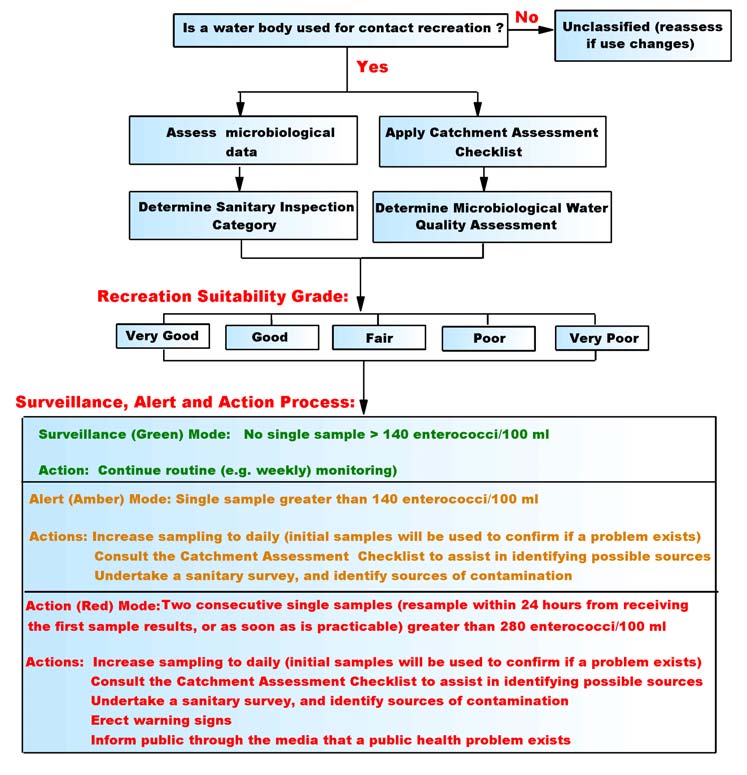
The implementation of the classification system, as well as the proposed day-to-day
management system, is schematically illustrated below:
The Way Forward
· The recommended guidelines still need to be officially approved and adopted by
responsible authorities in each of the three countries. It is recommended that the output
of this project be used as a starting point for such initiatives.
· The quality guidelines and protocols developed as part of this project form an integral
part of the management framework for land-based marine pollution sources
(developed as part of another BCLME project BEHP/LBMP/03/01).
In the interim, until such time as a management framework and quality guidelines have
been incorporated in official government policy, it is proposed that the quality guidelines
developed as part of this project, together with the proposed management framework,
BCLME Project BEHP/LBMP/03/04
Page xiii
Final
January 2006
be applied as preliminary tools towards improving the management of the water quality
in coastal areas of the BCLME region.
· As part of the official water and sediment quality guidelines to be adopted in each of the
three countries, it is recommended that the preferred analytical methods for the
different chemical and microbiological variables also be included.
· The updatable web-based information system (temporary web address
www.wamsys.co.za/bclme) that was developed as part of this project can be a very
useful decision-support and educational tool provided that it is maintained and updated
regularly. In the short to medium term, it is recommended that one or more of the
BCLME offices within the three countries takes on this responsibility.
· To facilitate wider capacity building in the BCLME region of the management of marine
pollution in coastal areas, it is strongly recommended that the output of this project be
included in a training course. In this regard, the Train-Sea-Coast/Benguela Course
Development Unit is considered the ideal platform from which to develop and present
such training (www.ioisa.org.za/tsc/index.htm).
BCLME Project BEHP/LBMP/03/04
Page xiv
Final
January 2006
RESUMO EXECUTIVO
(LINHAS MESTRAS RECOMENDADAS PARA A QUALIDADE DA ÁGUA E
SEDIMENTOS PARA DA REGIÃO DO BCLME EM SUMÁRIO)
o Gabinete das Nações Unidas Para Prestação de Serviços "UNOPS") contratou o CSIR
(África do Sul) para executar este projecto, cujo objectivo principal era o de obter:
· Um conjunto de linhas mestras sobre qualidade da água e sedimentos para uma gama
de variáveis de qualidade biogeoquímicas e microbiológicas, de modo a sustentar o
funcionamento de um ecossistema natural, assim como apoiar os usuários nas áreas
costeiras da região do BCLME.
· Protocolos de Boa Prática para a implementação (ou aplicação) destas linhas mestras
no que se refere à gestão das áreas costeiras na região do BCLME.
O objectivo secundario de relevo foi a aceitação pelos "stakeholders" dos três paises das
linhas mestras propostas e dos protocolos. Isto foi levado a efeito atravéz das sessões de
trabalhos e "workshops"de treino nos tres paises aos quais os mesmos "stakeholders"
foram convidados. Os productos deste projecto foram integrados num sistema informatico
da "web" que poderá ser actualizado (endereço web temporário:
www.wamsys.co.za/bclme).
O objectivo primario na gestão da qualidade da água marinha é o de manter o ambiente
marinho adequado (ou saudável) para todos os usos apontados. Para atingir este fim, os
objectivos estabelecidos para um ambiente marinho em particular devem apontar para a
protecção à biodiversidade e funcionamento dos ecosistemas aquático-marinhos, bem
como para os usos designados do ambiente marinho (também referidos como usos de
benefício). É proposto que três usuários para a região do BCLME sejam reconhecidos a
saber:
· Aquacultura marinha (incluindo recolha de marisco para consumo humano)
· Uso recreativo
· Usos industriais
As linhas mestras sobre qualidade de água e sedimentos recomendadas, como parte desta
secção, fornecem orientações aos gestores, autoridades de governo locais e cientistas de
BCLME Project BEHP/LBMP/03/04
Page xv
Final
January 2006
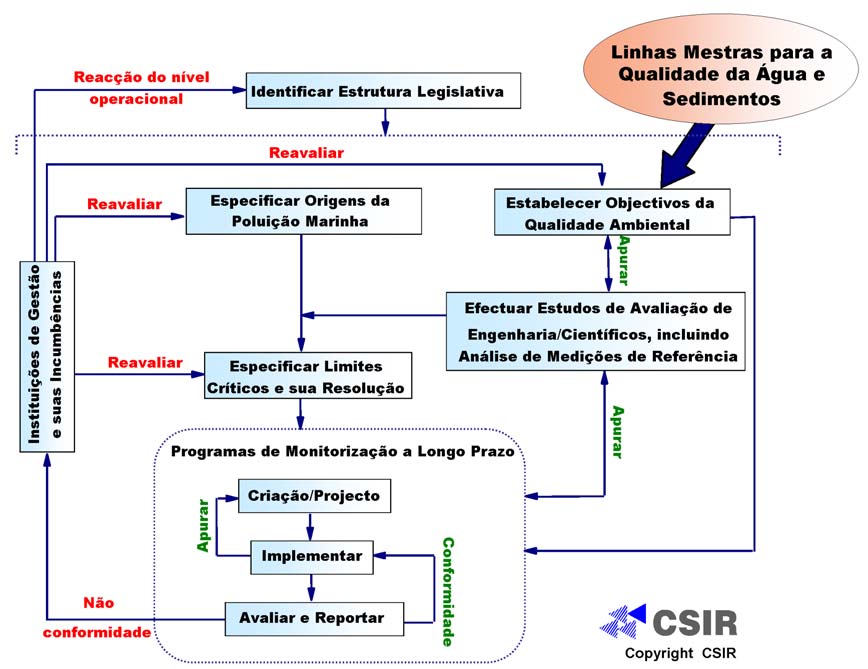
modo a definirem objectivos de qualidade ambiental específicos numa área de estudo para
a protecção dos ecossistemas aquático- marinhos e outros usos designados.
Consequentemente, nos grandes sistemas integrados e ecossistemas onde a qualidade da
água do mar é gerida, as linhas mestras da qualidade da água e sedimentos
desempenham um papel importante na implementação dos objectivos da qualidade
ambiental como ilustrado abaixo:
Indica-se abaixo um resumo das categorias constituintes para as quais a qualidade da água
e sedimentos recomendadas, são fornecidos para diferentes usuários como parte do
presente estudo:
TIPO DE LINHAS MESTRAS PARA A
ECOSISTEMAS
AQUACULTURA
FINS
AQUÁTICO
RECRIAÇÃO
QUALIDADE DE ÁGUA
MARINHA
INDUSTRIAIS
MARINHOS
Matéria objectável /Estética
Sim
Sim
Refere-se a
Variáveis físico-químicas
Sim
orientações do
Refere-se a
Água
Nutrientes Sim
ecosistema aquático-
orientações para
marinho
água potável
Baseado em
Substâncias tóxicas
Sim
requisitos
Indicações microbiológicas
-
Sim
Sim
específicos de
fins industriais
Substâncias contaminantes
-
Sim
-
na zona
Refere-se a
Sedimentos
orientações do
Substâncias tóxicas
Sim
-
ecosistema aquático-
marinho
BCLME Project BEHP/LBMP/03/04
Page xvi
Final
January 2006
Como regras básicas, recomenda-se que sejam aplicadas as seguintes regras simples:
1. A conformidade com os valores orientativos de qualidade para Protecção dos
ecosistemas aquático-marinhos deve ser um dos objectivos em todas as águas
costeiras, excepto em certas zonas já aprovadas, ou seja, junto a áreas de descarga de
águas residuais e certas áreas junto aos portos.
2. Adicionalmente ao ponto (1), a classificação do sistema recomendado para aquacultura
marinha deve ser aplicada em áreas onde existe recolha de marisco ou em cultivo para
consumo humano, de modo a gerir os riscos de saúde para o ser humano. Assume-se
que a condição sanitária dos organismos é devidamente tida em conta, ao abrigo da
Protecção dos Ecosistemas Aquático-marinhos (referindo ponto 1).
3. Adicionalmente ao ponto (1), as linhas mestras de qualidade estética, bem como o
sistema de classificação que categorizam as águas para uso de recriação
relativamente aos riscos de saúde para o ser humano devem ser aplicadas nas
respectivas áreas. Quanto a substâncias tóxicas, recomenda-se a consulta das Linhas
mestras para qualidade de água potável, a fim de ser efectuada uma análise de risco
preliminar, onde se espera que tais substâncias apresentem níveis que possam colocar
a saúde pública em risco (seguindo o exemplo da OMS [WHO, 2003]).
4. Em adição ao ponto (1), as orientações da qualidade específica da água, baseada nos
requisitos das indústrias locais, devem ser usadas sempre que aplicáveis.
As orientações e protocolos de qualidade recomendados para implementação, como se
indica abaixo, foram criadas a partir de uma revisão de orientações para a qualidade da
água e sedimentos a nível internacional. Uma vez que a informação se desenvolve a partir
de condições específicas na região do BCLME, podem as mesmas ser alteradas, seguindo
o princípio de gestão adaptável.
Linhas Mestras Recomendadas para a Qualidade da Água e Sedimentos: Protecção
dos Ecosistemas Aquático-Marinhos
São recomendadas as seguintes orientações de qualidade para a água dos ecosistemas,
dentro das várias áreas:
· Matéria objectável
· Variáveis físico-químicas
· Nutrientes
· Substâncias
tóxicas.
BCLME Project BEHP/LBMP/03/04
Page xvii
Final
January 2006
Os valores da qualidade de sedimentos são normalmente especificados apenas para a
protecção de ecosistemas aquáticos, em particular para substâncias tóxicas.
Linhas mestras recomendadas para a qualidade da água no que respeita a matéria
objectável (estética):
DIRECTRIZ PROPOSTA
A água não deve conter lixos, partículas de matérias flutuantes, detritos, óleo, gordura, cera, escuma, espuma
ou materiais e resíduos flutuantes similares provenientes de fontes terrestres em concentrações que poderão
causar incómodos.
A água não deverá conter materiais provenientes de fontes terrestres não naturais os quais assentarão para
formar depósitos objectáveis.
A água não deverá conter objectos submersos e outros riscos na subsuperfície que sejam de origem não
natural e os quais podem constituir perigo, causar riscos ou interferir com qualquer uso
designado/reconhecido.
A água não deverá conter substâncias produtoras de cor, odor, sabor ou turvação objectáveis.
Linhas mestras recomendadas para a qualidade da água no que respeita a variáveis físico-
químicas:
VARIÁVEL
DIRECTRIZ PROPOSTA PARA A QUALIDADE DE ÁGUA
Quando um sistema ou sistemas de referência apropriados estão disponíveis, e
existem dados suficientes para o sistema de referência, o valor directriz da distribuição
Temperatura
sazonal deverá ser definido pelo valor de 20% e 80% da distribuição sazonal para o
sistema de referência. Teste de dados: Concentração mediana (ou média) para o
período.
Quando um sistema ou sistemas de referência apropriados estão disponíveis, e
existem dados suficientes para o sistema de referência, o valor directriz da distribuição
Salinidade
sazonal deverá ser definido pelo valor de 20% e 80% da distribuição do(s) sistema(s)
de referência, dependendo se os efeitos de baixa ou alta salinidade estão a ser
considerados. Teste de dados: Concentração mediana (ou média) para o período.
Quando um sistema ou sistemas de referência apropriados estão disponíveis, e
existem dados suficientes para o sistema de referência, o valor directriz da distribuição
sazonal deverá ser definido pelo valor de 20% e 80% da distribuição do(s) sistema(s)
de referência
pH
Mudanças de pH superiores a 0.5 unidades de pH do máximo ou mínimo sazonal
definidos pelos sistemas de referência deverão ser investigados por inteiro.
Teste de dados: Concentração mediana (ou média) para o período
Turvação
Quando um sistema ou sistemas de referência apropriados estão disponíveis, e
existem dados suficientes para o sistema de referência, o valor directriz da distribuição
sazonal deverá ser definido pelo valor de 20% e 80% da distribuição do(s) sistema(s)
de referência
Sólidos suspensos
Adicionalmente, não deve ser permitido mudar a profundidade natural (Zeu) em mais de
10%.
Teste de dados: Concentração mediana (ou média) para o período
Quando um sistema ou sistemas de referência apropriados estão disponíveis, e
existem dados suficientes para o sistema de referência, o valor directriz da distribuição
sazonal deverá ser definido pelo valor de 20% e 80% da distribuição do(s) sistema(s)
Oxigénio dissolvido
de referência.
Quando possível o valor directriz deverá ser obtido durante períodos de baixa corrente
e alta temperatura quando as concentrações de OD têm maior probabilidade de
BCLME Project BEHP/LBMP/03/04
Page xviii
Final
January 2006
VARIÁVEL
DIRECTRIZ PROPOSTA PARA A QUALIDADE DE ÁGUA
apresentar os seus valores mais baixos.
Teste de dados: Concentração mediana de OD para o período, calculada, usando as
concentrações diurnas mais baixas de OD
Linhas mestras recomendadas para a qualidade da água no que respeita a nutrientes:
VARIÁVEL
DIRECTRIZ PROPOSTA PARA A QUALIDADE DE ÁGUA
Quando um sistema ou sistemas de referência apropriados estão disponíveis, e
existem dados suficientes para o sistema de referência, o valor directriz da
Clorofila a
distribuição sazonal deverá ser definido pelo valor de 20% e 80% da distribuição
do(s) sistema(s) de referência.
Concentrações de nutrientes na coluna de água não devem resultar em clorofila a,
turvidade e/ou níveis de oxigénio dissolvido fora do intervalo recomendado na
directriz de qualidade de água (ver acima). Tal deverá ser estabelecido utilizando
técnicas de modelagem estatísticas ou matemáticas apropriadas.
Nutrientes
Em alternativa, onde uma abordagem de modelação pode ser difícil de implementar,
a concentração de nutrientes pode ser derivada utilizando uma abordagem de
sistema de dados Referenciais: Quando um sistema ou sistemas de referência
apropriados estão disponíveis, e existem dados suficientes para o sistema de
referência, o valor directriz da distribuição sazonal deverá ser definido pelo valor de
20% e 80% da distribuição do(s) sistema(s) de referência.
Linhas mestras recomendadas para a qualidade da água no que respeita a susbtâncias
tóxicas:
SUBSTÂNCIAS
VALOR DIRECTRIZ RECOMENDADO em µg/
Total Amoníaco-N
910
Total Residual Cloro-Cl
3
Cianeto (CN-) 4
Fluoreto(F-)
5 000
Sulfuro (S-)
1
Fenol
400
Poli Cloretos Biphenyls (PCBs)
0.03
Vestígios metálicos (em metal Total):
Arsénico
As(III) - 2.3; As(V) - 4.5
Cádmio 5.5
Crómio
Cr (III) - 10; Cr (VI) - 4.4
Cobalto
1
Cobre
1.3
Chumbo 4.4
Mercúrio
0.4
Níquel
70
Prata
1.4
Sn (tal como Tributyltin) 0.006
Vanádio 100
Zínco
15
Hidrocarbonetos Aromáticos (C6-C9 hidrocarbonetos simples - volátil):
Benzeno (C6)
500
Toluene (C7)
180
Etilbenzeno (C8)
5
Xylene (C8)
Ortho - 350; Para - 75; Meta - 200
Naftaleno (C9)
70
Hidrocarbonetos Poli-Aromáticos (< C15 toxicidade elevada com baixa duração de vida em água)
Antraceno (C14)
0.4
Fenantreno (C14)
BCLME Project BEHP/LBMP/03/04
Page xix
Final
January 2006
SUBSTÂNCIAS
VALOR DIRECTRIZ RECOMENDADO em µg/
Hidrocarbonetos Poli-Aromáticos (> C15, toxicidade crónica, com maior duração de vida na água)
Fluoranteno (C15)
1.7
Benzo(a) pireno (C20)
0.4
Pesticidas:
DDT
0.001
Dieldrina
0.002
Endrina
0.002
Linhas mestras recomendadas para a qualidade dos sedimentos no que respeita a
substâncias tóxicas:
VALOR DE DIRECTRIZ
EFEITO DE CONCENTRAÇÃO
SUBSTÂNCIAS TÓXICAS
RECOMENDADO
PROVÁVEL
VESTÍGIOS METÁLICOS (mg/kg peso em seco)
Antimónio -
-
Arsénico 7.24
41.6
Cádmio 0.68
4.21
Crómio 52.3
160
Cobre 18.7
108
Chumbo 30.2
112
Mercúrio 0.13
0.7
Níquel 15.9
42.8
Prata 0.73
1.77
Estanho tal como Tributyltin-Sn 0.005
0.07
Zínco 124
271
COMPOSTOS ORGÂNICOS TÓXICOS (µg/kg peso seco normalizado para 1% carvão orgânico)
Total PAHs
1684
16770
Baixo Valor Molecular PAHs
312
1442
Acenafteno
6.71
88.9
Acenaftaleno
44
640
Antraceno
46.9
245
Fluoreto
21.2
144
2-metilo naftaleno
-
-
Naftaleno
34.6
391
Fenantreno
86.7
544
Alto Peso Molecular PAHs
655
6676
Benzo(a) antraceno
74.8
693
Benzo(a) pireno
88.8
763
Dibenzo(a,h)antraceno
6.22
135
Criseno
108
846
Fluoranteno
113
1494
Pireno
153
1398
Toxofilo
-
-
Total DDT
3.89
51.7
p p DDE
2.2
27
Cloreto 2.26
4.79
Dieldrina 0.72
4.3
Total PCBs
21.6
189
BCLME Project BEHP/LBMP/03/04
Page xx
Final
January 2006
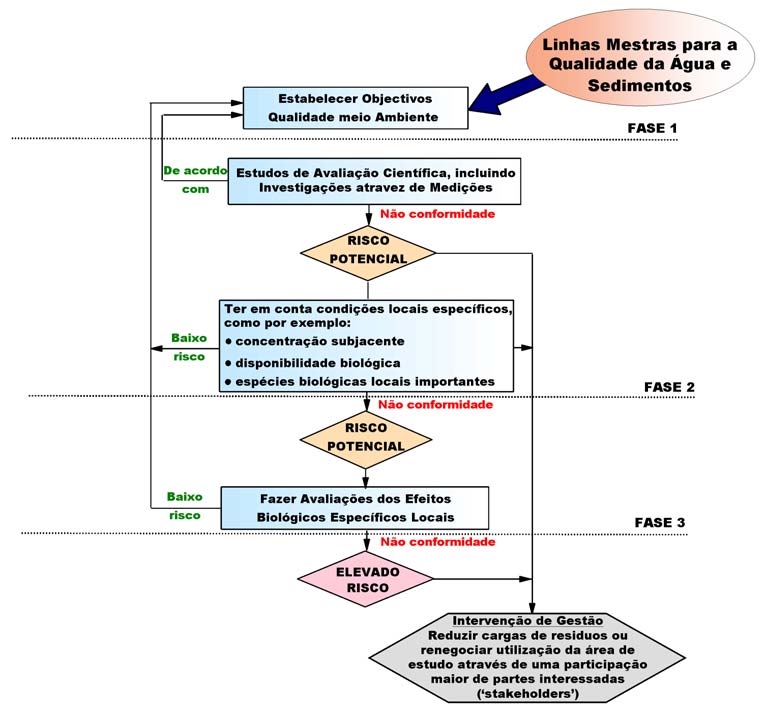
As linhas mestras recomendadas para a qualidade da água e sedimentos para protecção
dos ecossistemas aquático - marinhos devem ser aplicados como referências, no
seguimento de uma avaliação de risco ou aproximação por fases, como ilustrado abaixo:
Sempre que os estudos de avaliação científica ou os resultados da verificação revelem que
os valores de qualidade recomendados são excedidos, dever-se á produzir informação
suplementar ou efectuar-se mais investigação, a fim de determinar se existe ou não um
factor de risco real para o ecossistema e, sempre que necessário, ajustar esses valores
para condições locais específicas.
Os valores de qualidade orientativos devem ser comparados com os dados medidos ou
simulados. Se um valor orientativo tiver tido por base um julgamento profissional, a
fundamentação lógica para a selecção desse valor deve ser fornecida e deve ser
implementado um processo, onde o valor adoptado seja revisto e apoiado ou modificado, à
luz da informação ora emergente, seguindo o princípio de gestão adaptável.
BCLME Project BEHP/LBMP/03/04
Page xxi
Final
January 2006
Linhas mestras recomendadas para a qualidade da água e sedimentos: aquacultura
marinha
No que diz respeito às orientações da qualidade da água para aquacultura marinha
(incluindo a recolha de seres vivos para consumo humano), estas são considerações
importantes:
· Protecção do estado de saúde do ecosistema aquático, de modo a assegurar uma
produção sustentável e produtos de qualidade
· Protecção do estado de saúde dos consumidores humanos
· Contaminação de marisco.
Fazendo referência à protecção de organismos aquáticos utilizados na cultura e recolha de
pescado, recomenda-se que as orientações da qualidade da água propostas para a
Protecção dos ecosistemas aquáticos sejam aplicadas, em vez de recorrer a uma série de
orientações separadas.
Quanto à protecção dos consumidores humanos, propõe-se que os limites admitidos de
substâncias tóxicas e micróbios patogénicos em produtos alimentares sejam controlados
através de legislação.
No que concerne as áreas de crescimento de marisco, as orientações microbiológicas
recomendadas procuram reduzir os riscos de saúde humano como se indica:
INDICADOR
DIRECTRIZ PROPOSTA PARA A QUALIDADE DE ÁGUA
Concentrações medianas não deverão exceder 14 Número Mais Provável
Coliforme fecal
(NMP) por 100 ml com não mais de 10% das amostras a exceder 43 NMP por
100 ml por um tubo de 5, método de diluição 3.
Concentrações limite estimadas para substâncias contaminadoras são dadas abaixo:
LIMIARES DE CONCENTRAÇÕES ACIMA DOS
SUBSTÂNCIA CONTAMINADORA
QUAIS A CONTAMINAÇÃO É PROVÁVEL
ACONTECER (mg/)
Acenafeteno 0.02
Acetofenona
0.5
Acrilonitrilo 18
Cobre
1
m-cresol
0.2
o-cresol
0.4
p-cresol
0.12
Ácidos cresílicos (meta, para)
0.2
Clorobenzina
-
n-butilmercaptano
0.06
BCLME Project BEHP/LBMP/03/04
Page xxii
Final
January 2006
LIMIARES DE CONCENTRAÇÕES ACIMA DOS
SUBSTÂNCIA CONTAMINADORA
QUAIS A CONTAMINAÇÃO É PROVÁVEL
ACONTECER (mg/)
o-sec. butilfenol
0.3
p-tert. butilfenol
0.03
2-clorofenol 0.001
3- clorofenol
0.001
3- clorofenol
0.001
o- clorofenol
0.001
p- clorofenol
0.01
2,3-dinitrofenol
0.08
2,4,6-trinitrofenol
0.002
2,3 diclorofenol
0.00004
2,4-diclorofenol
0.001
2,5- diclorofenol
0.023
2,6- diclorofenol
0.035
3,4- diclorofenol
0.0003
2-metil-4-clorofenol
0.75
2-metil-6-clorofenol
0.003
3-metil-4-clorofenol
0.02 3
o-fenifenol
1
Pentaclorofenol
0.03
Fenol
1
2,3,4,6-tetraclorofenol
0.001
2,4,5-triclorofenol 0.001
2,3,5-triclorofenol
0.001
2,4,6-tricorofenol
0.003
2,4-dimetilfenol
0.4
Dimetilamina
7
Difenilóxido
0.05
B,B-diclorodietil éter
0.09
o-diclorobenzeno
< 0.25
p-diclorobenzeno 0.25
Etilbenzeno
0.25
Momoclorobenzeno 0.02
Etanatiol
0.24
Etilacrilato
0.6
Formaldeide
95
Gasolina 0.005
Guaicol
0.082
Querosene
0.1
Querosene plus caolín
1
Hexaclorociclopentadieno
0.001
Isopropilbenzeno
0.25
Nafta 0.1
Naftaleno
1
Naftol
0.5
2-Naftol
0.3
Nitrobenzeno
0.03
a-metilestireno
0.25
Óleo, emulsificável
15
Piridino
5
Pirocatecol
0.8
Pirogalol
0.5
Quinolino
0.5
p-quinona
0.5
Estireno
0.25
Tolueno
0.25
Combustão de fuel em motores fora de bordo
0.5
Zinco
5
BCLME Project BEHP/LBMP/03/04
Page xxiii
Final
January 2006
Recomenda-se que seja adoptado pela região do BCLME um sistema de classificação para
as áreas de crescimento de marisco e que um grupo de trabalho dedicado seja nomeado, a
fim de tomar decisões quanto à abordagem final a ter no que respeita ao sistema de
classificação. Neste entretanto, recomenda-se que essa classificação assente nos
resultados das Análises Sanitárias, que consistem em:
· Identificação e avaliação de todas as origens potenciais e reais de poluição
(investigação costeira)
· Avaliação de águas em crescimento e marisco para determinar a classificação mais
adequada para as áreas de recolha de marisco (Análise bacteriológica).
O sistema de classificação recomendado para a região do BCLME é a seguinte:
CLASSE
DESCRIÇÃO
As áreas aprovadas devem estar isentas de poluição e o marisco daí oriundo é próprio
Aprovado
para consumo humano directo de marisco em cru.
Nas áreas sujeitas ou limitadas a poluição intermitente causada por descargas de
tratamentos de águas residuais, populações sazonais, poluição não identificada, ou
actividades náuticas, podem ser classificadas como "aprovadas condicionalmente" e/ou
restringidas.
No entanto, deve ser elucidado que a área de recolha e apanha do marisco estará
Aprovado
aberta para a apanha de marisco durante um período de tempo razoável e que os
condicionalmente
factores que determinam este período são conhecidos, previsíveis e não são
/restringido
complexos ao ponto de ir contra uma gestão razoável.
Quando "abertas" para a apanha de marisco para consume humano directo, a
qualidade da água na área deve estar de acordo com os limites tal como especificados
para "Áreas aprovadas". Quando "fechadas" para consumo directo, mas "abertas" para
a apanha devido a reposição ou depuração, devem ser cumpridos os requisitos de
"Área restringida". Alturas há em que a área está "fechada" para qualquer tipo de
recolha e nesse caso aplicar-se-ão os requisitos de "Áreas proibidas".
As áreas restringidas estão sujeitas a um grau de poluição limitado. No entanto, o nível
de poluição fecal, micróbios patogénicos humanos e substâncias tóxicas ou perniciosas
Restringido
atingem um tal nível que o marisco pode estar bom para consumo humano, ou por
recolocação ou por depuração.
Uma área é classificada como "Proibida" se não tiver sido efectuada uma análise
profunda ou sempre que uma análise verifique a existência de:
· Unidade adjacente de tratamentos de águas residuais ou outra origem semelhante
com repercussões significativas na saúde pública
· Contaminação devido a causas de poluição imprevisíveis
· Contaminação por restos fecais, fazendo com que o marisco seja vector de
doenças micro-orgânicas
Proibido
· Algas que contenham biotoxinas suficientes para causar risco de saúde pública
· Contaminação com substâncias venenosas ou nocivas que possam afectar o
marisco.
NOTA: Quando ocorrer uma cheia, tempestade ou contaminação marítima por
biotoxinas em áreas "Aprovadas" ou "Restringidas", estas podem ser também
classificas temporariamente como áreas "Proibidas".
BCLME Project BEHP/LBMP/03/04
Page xxiv
Final
January 2006
Os requisitos associados a cada classe nos sistemas de classificação recomendados (no
entretanto) são:
CLASSE
REQUISITOS
Deve ser feita um levantamento sanitário de fundo, segundo as especificações, a
qual deve ser revista anualmente. A área não deve estar contaminada com resíduos
fecais coliformes (como listados) e não deve ter micróbios patogénicos ou
concentrações perigosas de substâncias tóxicas ou biotoxinas marinhas (uma área
de marisco aprovada pode ser temporariamente declarada "área proibida" quando,
por ex., houver cheias, tempestades ou contaminação por biotoxinas). A evidência de
causas de poluição potencial, tais como provenientes de estações de tratamentos de
esgotos, descargas de esgotos directas, de tanques sépticos, etc, é mais do que
Aprovado
razão para excluir qualquer área da categoria de "aprovado".
Os resultados das amostras de coliformes fecais medianas/geométricas não devem
exceder os 14/100 ml e o percentil 90 estimado não deve ser superior a 21/100 ml
(usando Membrana de Filtragem) ou 14/100 ml e o percentil 90 estimado não deve
ser superior a 43/100ml para um ensaio de diluição decimal a-5-tubos, ou 49/100 ml
para um ensaio de diluição decimal a-3-tubos (usando Número Mais Provável
(MPN)).
Os factores que determinam este período são conhecidos e não são tão complexos
ao ponto de impossibilitar uma abordagem de gestão razoável. Deve ser
desenvolvido um plano de gestão para cada área condicionalmente
aprovada/restringida.
Aprovado
condicionalmente
Quando "abertas" para a apanha de marisco para consume humano directo, a
/restringido
qualidade da água na área deve estar de acordo com os limites tal como
especificados para "Áreas aprovadas". Quando "fechadas" para consumo directo,
mas "abertas" para a apanha devido a reposição ou depuração, devem ser cumpridos
os requisitos de "Área restringida". Alturas há em que a área está "fechada" para
qualquer tipo de recolha e nesse caso aplicar-se-ão os requisitos de "Áreas
proibidas".
Os resultados das amostras de coliformes fecais medianos/geométricos não devem
exceder 70/100 ml e o percentil 90 estimado não deve ser superior a 85/100 ml
(usando Membrana de Filtragem) ou 881/00 ml e o percentil 90 estimado não deve
ser superior a 260/100 ml para um ensaio de diluição decimal a-5-tubos, ou 300/100
ml para um ensaio de diluição decimal a-3-tubos (usando Número Mais Provável
Restringido
(MPN)).
Os resultados das amostras de coliformes fecais medianos/geométricos não devem
exceder 700/100 ml e o percentil 90 estimado não deve ser superior s 2300/100 ml
para um ensaio de deluição decimal a-5-tubos, ou 3300/100 para um ensaio de
diluição decimal a-3-tubos (usando Número Mais Provável (MPN)).
Área proibida
Sem requisitos especificados
Contudo, recomenda-se que uma equipa técnica, formada por especialistas em aquacultura
e autoridades responsáveis dos diferentes países na região do BCLME, seja formada para
decidir no tipo de abordagem final para a classificação das áreas de cultivo de marisco
nesta região. Este processo foi já iniciado, como parte de um outro Programa do BCLME
(Projecto EV/HAB/04/Shellsan - Development of a shellfish sanitation Desenvolvimento de
cuidados sanitários para cultivo de marisco), um modelo de aplicação em conjunto com
componente de toxinas de microalgas.
BCLME Project BEHP/LBMP/03/04
Page xxv
Final
January 2006
Linhas mestras recomendadas para a qualidade da água e sedimentos: actividades
de recreio
Em termos de qualidade da água, os pontos chave seguintes são importantes no que se
refere à utilização recreativa das águas costeiras:
· Estética
· Protecção da saúde pública face a substâncias tóxicas
· Protecção da saúde pública face a contaminantes microbiológicos.
Para áreas de recreio, as orientações da qualidade da água que se prendem com o aspecto
estético são semelhantes às apresentadas na lista sob o título matérias objectáveis, em
Protecção dos ecosistemas aquático-marinhos (ver acima).
Quanto a substâncias tóxicas, recomenda-se a consulta das orientações para a qualidade
da água potável, de modo a fazer-se uma avaliação preliminar dos riscos nas áreas onde
tais substâncias podem apresentar-se a níveis que ponham em causa a saúde pública.
Quanto a indicadores microbiológicos, recomenda-se que tanto o E.coli e o Enterococci
(faecal streptococci) sejam usados como organismos indicadores. Recomenda-se, por outro
lado, que em vez de utilizar valores-alvo "singulares" que classifiquem uma praia de
"segura" ou "não segura", seja feita uma derivativa de valores-alvo que correspondam a
níveis de risco diferentes:
95° PERCENTIL DE
CATEGORIA
RISCO ESTIMADO POR EXPOSIÇÃO
ENTEROCOCCI por 100 ml
<1% risco de doença gastrointestinal (GI)
A <40 <0.3% risco de febre respiratória aguda (AFRI)
15% risco de doença GI
B
40 200
0.31.9% risco de AFRI
510% risco de doença GI
C
201 500
1.93.9% risco de AFRI
>10% risco de doença GI
D >
500
>3.9% risco de AFRI
Recomenda-se que a região do BCLME adopte um sistema de classificação de praias em
vez de fazer a abordagem tradicional de classificação de águas para a prática de
actividades de recreio como sendo seguras ou não seguras. Reportando-nos à qualidade da
água, a classificação deve ser baseada tanto na análise sanitária como nas análises
microbiológicas de rotina. O índice de classificação deve ser reavaliado anualmente.
BCLME Project BEHP/LBMP/03/04
Page xxvi
Final
January 2006
Sistema de classificação recomendado para áreas de recreio:
Categoria de Avaliação Qualidade Microbiológica
(percentile 95 enterococci/100 ml ver Tabela acima de )
A
B
C
D
Circunstâncias
(<40)
(41-200)
(201-500)
(>500)
excepcionais
Muito baixa
Muito boa
Muito boa
Razoável
A seguir
Baixa
Muito boa
Boa
Razoável
A seguir
Categoria
Moderada
Boa Boa
Razoável
Fraca
Acção
de
Alta
Boa Razoável Fraca Muito
fraca
Inspecção
Muito alta
A seguir
Razoável
Fraca
Muito fraca
sanitária Circunstâncias
excepcionais
Acção
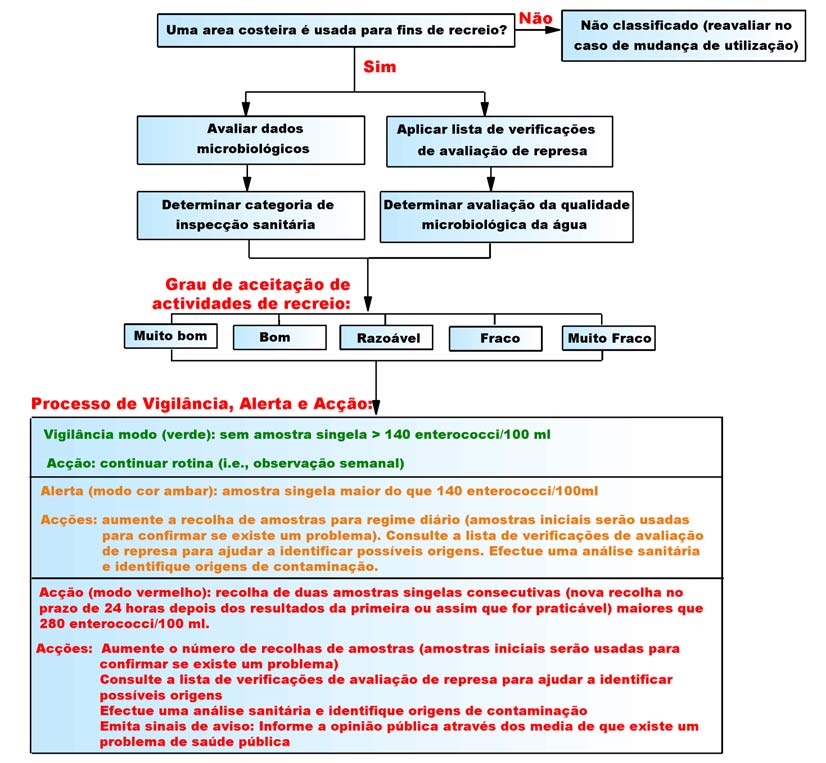
A implementação do sistema de classificação, bem como do sistema de gestão dia-a-dia
proposto, é esquematizado abaixo:
BCLME Project BEHP/LBMP/03/04
Page xxvii
Final
January 2006
O caminho a seguir
· As linhas mestras recomendadas necessitam todavia de serem oficialmente
aprovadas e adoptadas pelas autoridades responsáveis em cada um dos três países.
Recomenda-se que o resultado deste projecto seja usado como ponto de partida de tais
iniciativas.
· As linhas mestras de qualidade e protocolos desenvolvidos como fazendo parte deste
projecto formam parte integral da estrutura de gestão das origens da poluição marinha
(concebido como parte de um outro projecto BCLME - o BEHP/LBMP/03/01).
· Neste entretanto, até que a estrutura de gestão e as orientações de qualidade tenham
sido incorporadas na política oficial do governo, propõe-se que essas linhas mestras
concebidas como parte do projecto, em conjunto com a estrutura de gestão proposta,
sejam aplicadas como ferramentas preliminares com vista à melhoria da gestão da
qualidade da água nas áreas costeiras da região do BCLME.
· Como parte das orientações oficiais da qualidade da água e sedimentos a serem
adoptadas em cada um dos três países, recomenda-se que também sejam incluídos os
métodos analíticos de eleição para as diferentes variáveis químicas e microbiológicas.
· O sistema de informação actualizável com suporte na Internet (endereço web
temporário: www.wamsys.co.za/bclme) criado como parte deste projecto pode ser útil
para apoiar a tomada de decisão e como ferramenta educativa, desde que mantido e
actualizado com regularidade. A curto e médio prazo, recomenda-se que um ou mais
escritórios do BCLME no âmbito dos três países seja por esse facto responsável.
· A fim de facilitar uma maior e mais vasta capacidade de construção no seio da região do
BCLME no que respeita à gestão da poluição marinha nas áreas costeiras, é fortemente
recomendado que os resultados deste projecto sejam incluídos num curso de
formação. Assim sendo, a Unidade de Desenvolvimento do Curso (Train-Sea-
Coast/Benguela Course Development Unit) é tido como a plataforma ideal para
desenvolver e a presentar essa formação (www.ioisa.org.za/tsc/index.htm).
BCLME Project BEHP/LBMP/03/04
Page xxviii
Final
January 2006
TABLE OF CONTENTS
EXECUTIVE SUMMARY ......................................................................................................................................... i
TABLE OF CONTENTS ......................................................................................................................................xxix
LIST OF TABLES ............................................................................................................................................... xxxii
LIST OF FIGURES............................................................................................................................................ xxxiii
ACRONYMS, SYMBOLS AND ABBREVIATIONS ............................................................................................ xxxiv
INTRODUCTION ______________________________________________________________________ 1
1. SCOPE OF WORK ____________________________________________________________________ 2
2. PROJECT APPROACH AND METHODOLOGY _____________________________________________ 3
3. CURRENT STATUS IN BCLME REGION___________________________________________________ 7
SECTION 1. INTERNATIONAL REVIEW - WATER QUALITY GUIDELINES FOR
PROTECTION OF MARINE AQUATIC ECOSYSTEMS ________________________1-1
1.1
INTRODUCTION __________________________________________________________________ 1-2
1.2
INTERNATIONAL APPROACH AND METHODOLOGY ___________________________________ 1-5
1.2.1 Objectionable matter __________________________________________________________ 1-5
1.2.2 Physico-chemical variables _____________________________________________________ 1-6
1.2.3 Nutrients ____________________________________________________________________ 1-9
1.2.4 Toxic Substances ____________________________________________________________ 1-12
1.3
INTERNATIONAL IMPLEMENTATION PRACTICES ____________________________________ 1-23
SECTION 2. INTERNATIONAL REVIEW - SEDIMENT QUALITY GUIDELINES FOR
THE PROTECTION OF MARINE AQUATIC ECOSYSTEMS ____________________2-1
2.1
INTRODUCTION __________________________________________________________________ 2-2
2.2
INTERNATIONAL APPROACH AND METHODOLOGIES _________________________________ 2-3
2.2.1
National Status and Trends Program Approach (effects range approach) _________________ 2-7
2.2.2 Equilibrium Partitioning Approach (US-EPA) _____________________________________ 2-13
2.3
INTERNATIONAL IMPLEMENTATION PRACTICES ____________________________________ 2-14
BCLME Project BEHP/LBMP/03/04
Page xxix
Final
January 2006
SECTION 3. INTERNATIONAL REVIEW - WATER QUALITY GUIDELINES FOR
MARINE AQUACULTURE_______________________________________________3-1
3.1
INTRODUCTION __________________________________________________________________ 3-2
3.2
INTERNATIONAL APPROACH AND METHODOLOGY ___________________________________ 3-4
3.2.1 Protection of Aquatic Organism Health____________________________________________ 3-4
3.2.2 Protection of Human Health ____________________________________________________ 3-5
3.2.3 Tainting of Seafood Products ____________________________________________________ 3-9
3.3
INTERNATIONAL IMPLEMENTATION PRACTICES _____________________________________ 3-9
3.3.1 National Shellfish Sanitation Program Approach ___________________________________ 3-10
3.3.2 European Union's Approach ___________________________________________________ 3-14
SECTION 4. INTERNATIONAL REVIEW - WATER QUALITY GUIDELINES FOR
RECREATION ________________________________________________________4-1
4.1
INTRODUCTION __________________________________________________________________ 4-2
4.2
INTERNATIONAL APPROACH AND METHODOLOGY ___________________________________ 4-3
4.2.1 Aesthetics ___________________________________________________________________ 4-4
4.2.2 Toxic Substances _____________________________________________________________ 4-6
4.2.3 Microbiological contaminants ___________________________________________________ 4-6
4.3
INTERNATIONAL IMPLEMENTATION PRACTICES ____________________________________ 4-10
4.3.1
World Health Organisation Approach _____________________________________________ 4-11
4.3.2 European Union Approach_____________________________________________________ 4-14
4.3.3 Blue Flag Campaign _________________________________________________________ 4-16
4.3.4 Canada ____________________________________________________________________ 4-18
SECTION 5. INTERNATIONAL REVIEW - WATER QUALITY GUIDELINES FOR
INDUSTRIAL USE _____________________________________________________5-1
SECTION 6. RECOMMENDED WATER AND SEDIMENT QUALITY GUIDELINES FOR
COASTAL AREAS IN THE BCLME REGION________________________________6-1
6.1
RECOMMENDED BENEFICIAL USES_________________________________________________ 6-2
6.2
RECOMMENDED WATER QUALITY GUIDELINES: PROTECTION OF MARINE AQUATIC
ECOSYSTEMS ___________________________________________________________________ 6-3
6.2.1 Approach and Methodology _____________________________________________________ 6-3
6.2.2 Protocol for Implementation ____________________________________________________ 6-9
6.3
RECOMMENDED SEDIMENT QUALITY GUIDELINES: PROTECTION OF MARINE AQUATIC
ECOSYSTEMS __________________________________________________________________ 6-10
6.3.1 Approach and Methodology ____________________________________________________ 6-10
6.3.2 Protocol for Implementation ___________________________________________________ 6-12
BCLME Project BEHP/LBMP/03/04
Page xxx
Final
January 2006
6.4
RECOMMENDED WATER QUALITY GUIDELINES: MARINE AQUACULTURE ______________ 6-13
6.4.1 Approach and Methodology ____________________________________________________ 6-13
6.4.2 Protocol for Implementation ___________________________________________________ 6-16
6.5
RECOMMENDED WATER QUALITY GUIDELINES: RECREATION________________________ 6-19
6.5.1 Approach and Methodology ____________________________________________________ 6-19
6.5.2 Protocol for Implementation ___________________________________________________ 6-20
SECTION 7. THE WAY FORWARD _______________________________________7-1
SECTION 8. REFERENCES _____________________________________________8-1
Appendix A
Summary of International Marine Water Quality Guideline Values for the
Protection of Marine Aquatic Ecosystems·
Appendix B
Summary of International Sediment Quality Guideline Values for the
Protection of Marine Aquatic Ecosystems
Appendix C
Summary of International Marine Water Quality Guideline Values for Marine
Aquaculture.
Appendix D
User Manual for Web-based Information System
BCLME Project BEHP/LBMP/03/04
Page xxxi
Final
January 2006
LIST OF TABLES
TABLE 1.1: Summary of the minimum toxicological data requirements for the derivation of water quality
guidelines for the protection of marine aquatic ecosystems: Toxic substances.......................1-14
TABLE 3.1: South African legal standards for chemical and microbiological constituents in the flesh of
shellfish and fish used for human consumption ..........................................................................3-5
TABLE 3.3: Summary of National Shellfish Sanitation Program classification approach for shellfish growing
areas ..........................................................................................................................................3-12
TABLE 3.4: EC: Classification of shellfish growing areas ...........................................................................3-14
TABLE 4.1
Summary of available water quality guidelines related to aesthetics ...........................................4-5
TABLE 4.2
Summary of microbiological water quality guidelines recommended for recreational waters
(marine)........................................................................................................................................4-7
TABLE 4.3: The World Health Organisation microbiological target values recommended for recreational
waters (representing different risk levels) (WHO, 2003)...............................................................4-8
TABLE 4.4: The European Union proposed microbiological target values recommended for recreational
waters (representing different risk levels) (CEC, 2002)................................................................4-9
TABLE 4.5: The World Health Organisation Recreational Classification system ..........................................4-12
TABLE 4.6: The European Union Recreational Classification system (CEC, 2002)......................................4-15
TABLE 4.7
Blue Flag Campaign: South African Criteria related to Water Quality .......................................4-17
TABLE 6.1: Summary of constituent categories for the recommended water and sediment quality for different
designated uses ...........................................................................................................................6-2
TABLE 6.2
Recommended water quality guidelines for objectionable matter (aesthetic) for coastal areas in
the BCLME region........................................................................................................................6-4
TABLE 6.3 Recommended water quality guidelines for physico-chemical variables in coastal areas of the
BCLME region..............................................................................................................................6-5
TABLE 6.4 Recommended water quality guidelines for nutrients in coastal areas of the BCLME region .....6-7
TABLE 6.5 Recommended water quality guidelines for toxic substances for coastal areas in the BCLME
region (current South African guideline values listed in brackets where available) .....................6-8
TABLE 6.6
Recommended interim sediment quality guidelines for the Protection of marine aquatic
ecosystems in coastal areas of the BCLME region....................................................................6-11
TABLE 6.7
Recommended microbiological indicator guidelines for areas where shellfish are collected or
cultured for direct human consumption in the BCLME region ....................................................6-14
TABLE 6.8
Recommended guidelines for tainting substances in areas used for marine aquaculture in the
BCLME region............................................................................................................................6-15
TABLE 6.9
Recommended (interim) classification system of shellfish growing areas in the BCLME region 6-17
TABLE 6.10: Summary of requirements associated with each class in the recommended (interim) classification
system of shellfish growing areas in the BCLME region...........................................................6-18
BCLME Project BEHP/LBMP/03/04
Page xxxii
Final
January 2006
TABLE 6.11: Recommended water quality guidelines for microbiological indicator organisms versus risk rates
for coastal areas in the BCLME region .....................................................................................6-20
TABLE 6.12: Recommended classification system for recreational areas in coastal areas of the BCLME
region........................................................................................................................................6-21
LIST OF FIGURES
Figure 1.1:
Schematic illustration of the guideline derivation procedures followed for Australia and New
Zealand (adapted from ANZECC, 2000)...................................................................................1-16
Figure 1.2:
Schematic illustration of the guideline (criterion) derivation procedures followed by the US-EPA
(adapted from Russo, 2002) .....................................................................................................1-17
Figure 1.3:
Schematic illustration of the guideline derivation procedures followed for Canada (adapted from
CCME, 1999a)..........................................................................................................................1-19
Figure 1.4:
Implementation of water quality guidelines in the broader water quality management framework
(adapted from ANZECC, 2000) ................................................................................................1-24
Figure 1.5:
Decision tree framework for assessing toxic substances in ambient waters using water quality
guidelines (ANZECC, 2000) .....................................................................................................1-25
Figure 1.6:
Implementation of water quality guidelines in Canada (adapted from CCME, 1999a)..............1-26
Figure 2.1:
Canadian protocol for the derivation of sediment quality guidelines
(adapted from CCME, 1995).....................................................................................................2-11
Figure 2.2:
Implementation of sediment quality guidelines in Canada (adapted from CCME, 1995).........2-15
Figure 2.3:
Application of sediment quality guidelines in Australia and New Zealand as part of monitoring
programmes (ANZECC, 2000) .................................................................................................2-16
Figure 4.1:
The recreational beach grading process of the WHO (adapted from WHO, 2003)...................4-12
Figure 4.2:
New Zealand grading and surveillance, alert and action process for the management of
recreational use of marine waters (adapted from New Zealand Land Ministry of Environment,
2003) ........................................................................................................................................4-14
Figure 6.1:
Schematic illustration of the recommended implementation process of recommended water
quality guidelines in the coastal zone of the BCLME region .......................................................6-9
Figure 6.2:
Grading, surveillance, alert and action process for the management of recreational use of marine
waters recommended for the BCLME region............................................................................6-22
BCLME Project BEHP/LBMP/03/04
Page xxxiii
Final
January 2006
ACRONYMS, SYMBOLS AND ABBREVIATIONS
ACR
Acute-Chronic Ratio
ANZECC
Australia and New Zealand Environment and Conservation Council
ANZFA
Australia New Zealand Food Authority
AQUIRE
Aquatic Toxicity Information Retrieval Database
Agriculture and Resource Management Council of Australia and New
ARMCANZ
Zealand
ASSAC
Australian Shellfish Sanitation Advisory Committee
AWRC
Australian Water Resources Council
BCF
Bio-Concentration Factor
BCLME
Benguela Current Large Marine Ecosystem
BOD
Biochemical Oxygen Demand
CCC
Criteria Continuous Concentration
CCME
Canadian Council of Ministers of the Environment
CCREM
Canadian Council of Resource and Environment Ministers
CEC
Council of European Community
CF
Conversion Factor
CMC
Criteria Maximum Concentration
COD
Chemical Oxygen Demand
CWA
Clean Water Act, United States
DEAT
Department of Environmental Affairs and Tourism (South Africa)
DWAF
Department of Water Affairs and Forestry (South Africa)
EC
European Community
Effective concentration the dosage at which the desired response is
EC50
present for 50 % of the population
EqP
Equilibrium Partitioning
ERL
Effect Range Low
ERM
Effect Range Median
FEE
Foundation for Environmental Education
IRIS
Integrated Risk Information System
LC50
Concentration that is lethal to 50% of the test organisms
LOEC
Lowest Observable Effects Concentration
BCLME Project BEHP/LBMP/03/04
Page xxxiv
Final
January 2006
MAF
Ministry of Agriculture and Fisheries (New Zealand)
MATC
Maximum Acceptable Toxicant Concentration
MHSPE
Ministry for Housing, Spatial Planning and Environment, Netherlands
NHMRC
National Health and Medical Research Council (Australia)
NOAA
National Oceanic and Atmospheric Administration (United States)
NOEC
No Observable Effect Concentration
NSSP
National Shellfish Sanitation Program
PAH
Polyaromatic hydrocarbon
PCB
Polychlorinated biphenyl
PEL
Probable Effect Level
OECD
Organisation for Economic Co-Operation and Development
RSA
Republic of South Africa
SQG
Sediment Quality Guidelines
TEL
Threshold Effect Level
UNEP
United Nations Environmental Program
US-EPA
United States Environmental Protection Agency
US-FDA
United States Food and Drug Administration
WQG
Water Quality Guideline
WHO
World Health Organisation
WRc
Water Research Centre
BCLME Project BEHP/LBMP/03/04
Page xxxv
Final
January 2006
INTRODUCTION
BCLME Project BEHP/LBMP/03/04
Page 1
Introduction
January 2006
Final
1. SCOPE
OF
WORK
The United Nations Office for Project Services ("UNOPS") commissioned the CSIR (South
Africa) to develop a common set of quality guidelines for the coastal areas in the BCLME
region.
The main purpose of this project is to obtain:
· A set of recommended water and sediment quality guidelines for a range of
biogeochemical and microbiological quality variables, in order to sustain natural
ecosystem functioning, as well as to support designated beneficial uses, in coastal areas
of the BCLME region
· Best Practice Protocols for the implementation (or application) of these quality guidelines
in the management of the coastal areas in the BCLME region.
The above were achieved through a critical review of:
· International and national water and sediment quality guidelines and their applicability to
the BCLME region, as well as the approach and methodology followed in setting such
guidelines
· International best practice in terms of the implementation of quality guidelines in the
management of coastal areas.
In the Introduction to this Report, the Scope of Work (Chapter 1) is followed by a chapter
on the Project Approach and Methodology (Chapter 2), providing an overview of the
standing and role of quality guidelines, as well as the approach that was followed in
developing the recommended water and sediment quality guidelines for the BCLME region.
Chapter 3 (Current Status in the BCLME Region) provides an overview of existing practices
in the countries within the BCLME region.
The critical reviews of international sediment and quality guidelines are provided in Sections
1 to 6):
· Section 1: International review on water quality guidelines for the protection of marine
aquatic ecosystems
· Section 2: International review on sediment quality guidelines for the protection of
marine aquatic ecosystems
BCLME Project BEHP/LBMP/03/04
Page 2
Introduction
January 2006
Final
· Section 3: International review on water quality guidelines for Marine Aquaculture
· Section 4: International review on water quality guidelines for Recreation
· Section 5: International review on water quality guidelines for Industrial use
Each of these sections provides an overview of the approach and methodology that were
used by different countries in the development of quality guidelines, as well as an overview
of international implementation practices. The preferred approach and methodology for the
BCLME regions, as well as the preferred implementation practices, are also substantiated in
each of these sections.
Section 6 provides an overview of the recommended quality guidelines and recommended
protocols for implementation proposed for the coastal zone in the BCLME region.
Appendices to this Report contain the following:
· Appendix A: Summary of International Marine Water Quality Guideline Values for the
Protection of Marine Aquatic Ecosystems
· Appendix B: Summary of International Sediment Quality Guideline Values for the
Protection of Marine Aquatic Ecosystems
· Appendix C: Summary of International Marine Water Quality Guideline Values for
Marine Aquaculture.
· Appendix D: User Manual for the Web-based Information System (temporary web
address: www.wamsys.co.za.
2.
PROJECT APPROACH AND METHODOLOGY
The ultimate goal in the management of marine (coastal) water resources is to keep the
environment suitable for all designated uses both existing and future uses (this includes
the `use' of designated areas for biodiversity protection and ecosystem functioning).
Such uses can usually only be maintained if the aquatic marine ecosystem is also protected
from degradation. In turn, the integrity of aquatic marine ecosystems depends on a number
of factors, including:
· Water and sediment quality (referring to the biogeochemical status)
BCLME Project BEHP/LBMP/03/04
Page 3
Introduction
January 2006
Final
· Water flows (referring to river inflows)
· Physical habitat (referring to water circulation processes, sediment type and climatic
conditions)
· Availability of suitable migrations or recruitment routes
· Food web integrity and availability.
Important uses of coastal waters that also rely on suitable water quality are, for example,
recreation and marine aquaculture. However, it should be noted that water quality is but
one of numerous factors that influences suitability. For example, the suitability of coastal
areas for recreation is also influenced by:
· Beach
safety
· Climatic conditions (cold, heat and sunlight)
· Contamination of beach sand
· Dangerous aquatic organisms.
Therefore, in order to effectively manage coastal marine ecosystems so that they remain
suitable for designated use, measurable targets or objectives should be set for each of the
above-mentioned parameters. In this regard, water and sediment quality guidelines are
developed to provide guidance to managers and local governing authorities in setting site-
specific quality objectives for water and sediment quality, where such parameters are
identified as being of potential concern.
A water (or sediment) quality guideline is a numerical concentration limit or narrative
statement that is recommended for the support and maintenance of a designated water use.
They are not standards (i.e. legally enforceable values), and should not be regarded as
such.
Within the larger management framework for marine pollution, water and sediment quality
guidelines are therefore typically used to assist in the derivation of site-specific
environmental quality objectives for a particular study area, as illustrated below:
BCLME Project BEHP/LBMP/03/04
Page 4
Introduction
January 2006
Final
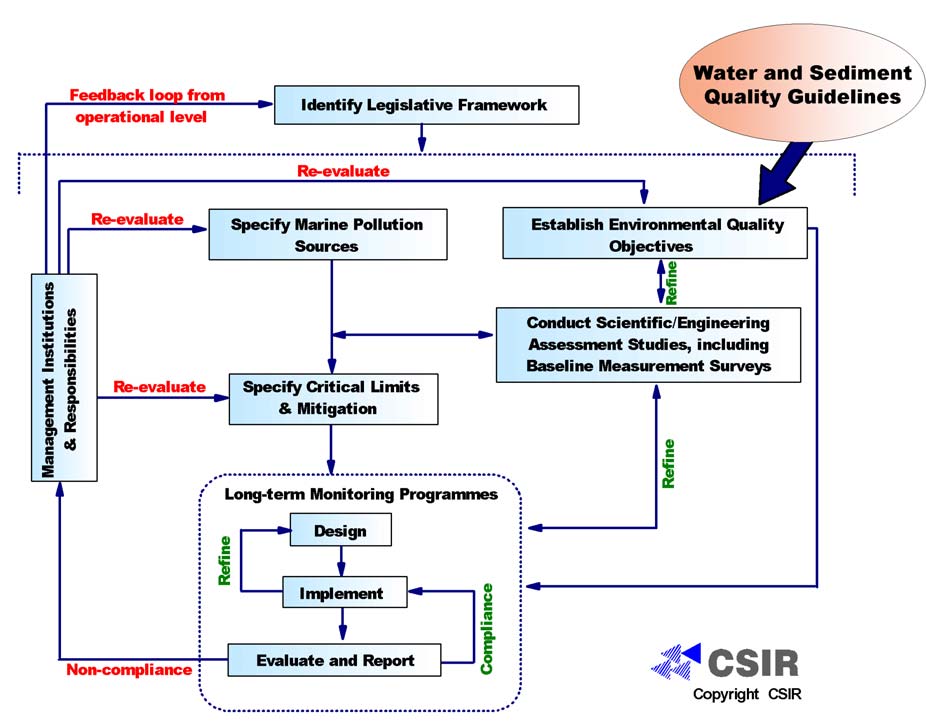
This above-mentioned framework is discussed in detail in another BCLME project, namely,
Baseline Assessment of Sources and Management of Land-based Marine Pollution in the
BCLME Region (Project BEHP/LBMP/03/01).
NOTE:
Environmental Quality objectives are the specific quality targets agreed among stakeholders, or set by local
jurisdictions. They are based on water and sediment quality guidelines but may be modified by other
inputs, such as social, cultural, economic or political constraints. The relative importance placed on the
quality guidelines and these other, potentially very important but less tangible, considerations would be site-
specific, and therefore would be determined on a case by case basis. Quality objectives are therefore
established at a local level to protect and support the designated uses, and against them performance can be
measured. The site-specific objectives may be adopted into legislation to become standards.
BCLME Project BEHP/LBMP/03/04
Page 5
Introduction
January 2006
Final
It is very important to realise that the existence of national (or regional) quality guidelines
does not imply that environmental quality should be degraded to those levels. A continuous
effort should be made to ensure that coastal marine resources are of the highest attainable
quality, taking into account principles such as:
· Precautionary
approach
· Pollution
prevention
· Waste
minimisation
· Recycling and re-use
· Best available or best attainable technologies.
NOTE: Difference between uniform effluent standards and water quality guidelines
The Uniform Effluent Standard Approach has been followed extensively throughout the world to manage
and control waste discharges, particularly from land. Uniform effluent standards are legally enforceable
limits to which waste stream or effluents must comply prior to discharging into a water resource. These
uniform limits were applied widely and did not necessarily take into account the assimilative capacity of the
receiving water environment (particularly with reference to physico-chemical variables, nutrients and other
naturally occurring chemicals such as trace metals) or cumulative and synergistic effects related to other
marine pollution sources in a particular area.
Also, when such uniform effluent limits were applied to a discharge into calm, near-stagnant water bodies
they could have been insufficient to adequately protect the marine environment and its uses while, when
applied to a discharge into dynamic, well-flushed water bodies, such limits could have been too stringent.
The World Bank's General Environmental Emission Guidelines (World Bank Group, 1998), for example,
fall within the `uniform effluent ` category, in that they specify emission limits.
To address these shortfalls[one word], many countries adopted the Receiving Water Quality Objectives
Approach, in which, in short, the physical, chemical and biological processes and uses of a particular
(receiving) water resource dictate the `limits of discharge'. In turn, this approach led to the development of
national (or regional) water and sediment quality guidelines so as to assist managers and local governing
authorities in setting objectives for water and sediment quality in a particular area.
The Receiving Water Quality Approach (and the use of quality guidelines) does not mean that standards
can no longer be set for waste or effluent discharges, but rather that these standards are determined by the
physical, chemical and biological processes and assimilative capacity of the receiving water resource, as
well as its designated uses.
Uniform effluent standards also still have a role, particularly in terms of controlling the discharge of
hazardous chemicals that bio-accumulate in the environment with severe adverse effects on aquatic
ecosystems. These standards are usually based on best available (or best attainable) technologies in the
treatment of waste and are enforced for particular industry types so as to pressurise industries to apply
such technologies (e.g. the World Bank provides emission guidelines related to specific industries World
Bank Group, 2004).
In the European Union, in addition to setting water and sediment quality guidelines for hazardous
substances, uniform effluent standards are also enforced for a number of hazardous chemicals, i.e. priority
substances (CEC, 2000).
BCLME Project BEHP/LBMP/03/04
Page 6
Introduction
January 2006
Final
For the purposes of this project, the marine water and sediment quality guidelines from the
following countries or organisations, considered to be the global leaders in this regard, were
included in the critical review:
· Australia & New Zealand
· United States of America
· European Community
· Canada
· World Health Organisation
· South
Africa.
The World Bank Environmental Guidelines are not discussed as part this study, as these are
emission guidelines and do not directly apply to the receiving environment (World Bank
Group, 2004).
3.
CURRENT STATUS IN BCLME REGION
As far as could be established, within in the BCLME region, only South Africa currently has
an official set of Water quality guidelines for coastal marine waters (DWAF, 1995b). None of
the three countries in the region, however, has official Sediment quality guidelines for the
coastal region.
In 1991, South Africa's Department of Water Affairs and Forestry (DWAF) published the
Water quality management policies and strategies in the RSA (RSA DWAF, 1991). These
were further elaborated in Procedures to assess effluent discharge impacts, published in
1995 (RSA DWAF 1995a) and are currently being updated (RSA DWAF, 2002). These
policies and strategies changed the DWAF's approach to water quality management from
the Uniform Effluent Standard approach (i.e. enforcing compliance to General and Special
Standard) to the Receiving Water Quality Objectives approach. As the department is also
being responsible for the management and control of land-based wastewater discharges to
the marine environment, it commissioned a project to determine South African Water Quality
Guidelines for Coastal Marine Waters (RSA DWAF, 1995b). This was done in consultation
BCLME Project BEHP/LBMP/03/04
Page 7
Introduction
January 2006
Final
with marine scientists and other relevant government departments, e.g. Department of
Environmental Affairs and Tourism (DEAT).
The documents provide guidance on setting water quality target values for the protection of
the natural marine environment, as well as for designated beneficial uses of marine waters
that, in the case of South Africa, are subdivided into three categories, namely:
· Marine aquaculture (including collection of seafood for human consumption)
· Recreational use
· Industrial uses (e.g. taking in cooling water and water for fish processing and/or marine
aquaculture).
The recommended target values in the 1995 version are still largely based on the initial set of
values that was drawn up by an ad hoc working committee back in 1984 (Lusher, 1984). In
1992, the Water Research Commission convened a two-day workshop to review these
guidelines. This workshop was attended by a broad spectrum of representatives from the
scientific/engineering community, national and local authorities, industries and environmental
organisations. In essence, the group found that most of the guidelines recommended in
1984 still constituted the best suitable ones for South Africa, taking into account the absence
of any new local information on such matters (DWAF, 1992). Therefore, although the 1995
set of documents (RSA DWAF, 1995b) provides extensive background information
necessary for the application of water quality guidelines, the recommended target values for
different variables are essentially still the same as those proposed in 1984 (Lusher, 1984;
RSA DWAF, 1992).
Namibia is in the process of revising its legislation and policies with regard to disposal of
land-derived wastewater to the marine environment. In most instances, the Uniform Effluent
Standard approach, requiring compliance to General Standards issued under the Water Act
54 of 1956, is still being used (Mr Roland Roeis, Department of Water Affairs, Namibia, pers.
comm.).
In terms of quality requirements related to marine aquaculture, Namibia is in the process of
designing a shellfish sanitation programme that will satisfy both the European Union as well
BCLME Project BEHP/LBMP/03/04
Page 8
Introduction
January 2006
Final
as the United States Food and Drug Association (US FDA) requirements (Bronwen Currie,
Ministry of Fisheries and Marine Resources, Namibia, pers. comm.).
In Angola, international legislation is used for managing the quality of water intended for
human consumption, in particular the European Commission's Council Directive 98/83/EC.
This directive includes guidelines provided by the World Health Organisation.
The Biological and Aquatic Resources Act (adopted in October 2004) to some extent also
includes aquaculture and quality of marine products - Lei 6-A/04 (Maria Paulina Paulo &
Domingas Paim, Angola, pers. comm.). The law sets out the principles and objectives of the
use of biological and aquatic resources, the regulations governing fishing and the granting of
fishing rights, special rules for the protection of aquatic resources and ecosystems,
regulations on fishing vessels and ports, scientific research, the monitoring of resources and
the licensing of fish processing and marketing establishments, as well as control and
management, activities harmful to resources and ecosystems, and procedures for dealing
with breaches of the law (www.un.int/angola/newsletter13.htm).
BCLME Project BEHP/LBMP/03/04
Page 9
Introduction
January 2006
Final
SECTION 1.
INTERNATIONAL REVIEW - WATER QUALITY
GUIDELINES FOR PROTECTION OF MARINE
AQUATIC ECOSYSTEMS
BCLME Project BEHP/LBMP/03/04
Page 1-1
Section 1
January 2006
Final
1.1 INTRODUCTION
Water quality guidelines for the protection of marine aquatic ecosystems from the following
countries and regions were included in the review.
i.
Australia and New Zealand
The Australian and New Zealand Guidelines for Fresh and Marine Water Quality (ANZECC,
2000) provide comprehensive information and procedures for setting water guideline values.
In the case of these two countries, water quality guideline values are defined as the
concentration of biogeochemical variables below which there is a low risk that adverse
biological effects will occur.
NOTE:
To assist regional groups in setting environmental values and water quality targets for their
catchments/region, Water Quality Targets: A Handbook was published by Environment Australia in 2002
(www.deh.gov.au/water/quality/targets/handbook/) . The handbook outlines the steps to be followed in
setting default targets derived from the published guidelines in The Australian and New Zealand Guidelines
for Fresh and Marine Water Quality. When used in conjunction with Water Quality Targets: On Line
(www.ea.gov.au/water/quality/targets), this handbook simplifies the task of setting water quality targets. It is
not prescriptive and is intended as a tool for assisting the planning process.
ii.
United States of America
The United States Environmental Protection Agency (US-EPA) compiled national
recommended water quality criteria for the protection of aquatic ecosystems as required
under Section 304(a) of the Clean Water Act (CWA) (US-EPA, 1986a; 2001; 2002a). Their
criteria provide guidance to States and Tribes in adopting their own water quality standards
under Section 303(c) of the CWA.
The US-EPA water quality guidelines, or criteria as they are referred to, are extensive.
Unlike, for example, Australia and New Zealand where an approach and methodology for the
derivation of target values are specified for different categories of variables - e.g. physico-
chemical variables, nutrients and toxic substances, the US-EPA lists a Federal Register
citation, a US-EPA document number or an Integrated Risk Information System (IRIS) entry
(www.epa.gov/iris/index.html) for each variable. Therefore, the information pertinent to the
derivation of individual criteria is very extensive. Relevant information on a single variable
may even be captured in more than one document. Within the constraints (time and
resources) of this project, it was not possible to distill the approach and methodology used
in deriving criteria for each and every variable listed in their guideline document. However,
BCLME Project BEHP/LBMP/03/04
Page 1-2
Section 1
January 2006
Final
where a generic approach and methodology have been provided for a category of variables
(e.g. trace metals), these are discussed in further detail.
The US-EPA does, however, follow a generic process when developing new criteria for a
specific variable or re-assessing an existing criterion, which is as follows (US-EPA, 1999):
· Undertake a comprehensive review of available data and information
· Publish a notice in the Federal Register and on the Internet announcing its assessment
or reassessment of the pollutant for public comment
· Utilise information obtained from the review and the public to develop draft
recommended water quality criteria
· Conduct peer review of the draft criteria as well as publish a notice in the Federal
Register and on the Internet of the availability of the draft water quality criteria and solicit
public comment
· Prepare a response document for the record
· Revise the draft criteria as necessary, and announce the availability of the final water
quality criteria in the Federal Register and on the Internet.
ii. Canada
In 1987, the Canadian Council of Resource and Environment Ministers (CCREM) published
the Canadian Water Quality Guidelines (CCREM, 1987). In 1999, the Canadian Council of
Ministers of the Environment published the Canadian Environmental Quality Guidelines,
which integrated national environmental quality guidelines for all environmental media,
including water (drinking water, recreational water, water for aquatic life, irrigation water, and
livestock water), soil (agricultural, residential/ parkland, commercial, and industrial land
uses), sediment, tissue residue (for wildlife consumers of aquatic biota), and air (for human
health, vegetation, animals, materials, and aesthetic atmospheric properties) (CCME,
1999b). The Canadian protocol for the derivation of water quality guidelines for the
protection of aquatic life is described in CCME (1999a).
A summary document of the Canadian Environmental Quality Guidelines (as revised in
2002) has been consulted to obtain specific guideline values for different substances
(CCME, 2002).
BCLME Project BEHP/LBMP/03/04
Page 1-3
Section 1
January 2006
Final
iii. European
Community
In October 2000, the European Parliament and the Council adopted the Water Framework
Directive, which establishes a framework for Community action in the field of water policy,
including coastal waters (CEC, 2000). In this regard, the Water Framework Directive
provides guidance to Member States to set their own environmental quality standards. This
Water Framework Directive repealed and will be repealing a number of other Directives,
including Council Directive on Water pollution by discharges of certain dangerous
substances (CEC, 1976b). The Water Framework Directive does not give specfic
environmental quality standards for physico-chemical variables and nutrients, other than
providing narrative targets associated with different classes (i.e. High, Good, Moderate).
High status waters are considered to be near pristine. For the purposes of this review, the
narrative target for `Good Status' is therefore quoted as being equivalent to `water quality
guidelines' as used elsewhere (CEC, 2000) .
In addition to providing general guidance on setting environmental quality standards, the
Water Framework Directive also identifies a list of priority (toxic) substances for which the
the Council is responsible for setting specific environmental quality standards for the
protection of aquatic ecosystems. Such standards have been derived for about 18 priority
substances. The approach and methodology followed in deriving such standards are
comprehensively discussed in the EC Directives on the particular substance or suite of
substances (CEC, 1983, 1984a, 1984b, 1986, 1988, 1990).
iv. South
Africa
The South African Water Quality Guidelines for Coastal Marine Waters for the Natural
Environment (equivalent to Protection of Aquatic Ecosystems) are included as part of a
series of documents on this matter (RSA DWAF, 1995b). The recommended target (or
guideline) values for the protection of the marine aquatic ecosystems, however, are still
largely based on the initial set of values that were derived by an ad hoc working committee
in 1984 (Lusher, 1984).
In the belief that simplicity is more likely to succeed in practice, only those physico-chemical
properties that have the most marked importance to marine communities have been
considered (Lusher, 1984). In the absence of any documented evidence of harmful effects
of nutrients along the South African coast (at the time), narrative target values governing
nutrient concentrations, rather than numerical levels, were proposed (Lusher, 1984). In the
BCLME Project BEHP/LBMP/03/04
Page 1-4
Section 1
January 2006
Final
case of toxic substances (i.e. trace metals), the Maximum Allowable Toxicant Concentration
(MATC) was selected as the guideline value, where a reasonable set of reliable chronic
toxicity data were available from studies on marine organisms (chronic toxicity is defined as
an observable toxic effect after exposure for an extended period of time equal to the lifespan
of the organism or the span of more than one generation). Where data appeared unreliable,
a more conservative level was selected, with guidance from available international
guidelines (Lusher, 1984).
1.2 INTERNATIONAL
APPROACH AND METHODOLOGY
The approach and methodologies applied by the international community to derive water
quality guidelines for the protection of aquatic ecosystems appear to be different for the
different sub-categories of substances, namely:
· Objectionable matter
· Physico-chemical
variables
· Nutrients
· Toxic
substances.
For this reason, the approach and methodologies for the different sub-categories are
discussed separately.
The water quality guidelines for the protection of marine aquatic ecosystems, recommended
by the countries and organisations included in this review, are summarised in Appendix A.
1.2.1 Objectionable matter
Although guidelines related to the presence of objectionable matter are typically linked to
recreational waters (in which case they are referred to as Aesthetic guidelines) (RSA DWAF,
1995b; ANZECC, 2000a; CEC, 2002; CMNHW, 1992), objectionable matter can also be a
concern in terms of the protection of marine aquatic organisms, for example, litter and other
plastic pollution. Water quality guidelines related to objectionable matter or aesthetic issues
are usually narrative and typically require that areas be free from:
· Objectionable floating matter or oily films
· Non-natural matter that will settle to form objectionable deposits on the seabed
· Submerged objects and other subsurface hazards that arise from non-natural origins and
which would be a danger to recreational users
BCLME Project BEHP/LBMP/03/04
Page 1-5
Section 1
January 2006
Final
· Objectionable smells or odours.
Currently, it is only South Africa in the BCLME region that has explicitly listed recommended
quality guidelines for objectionable matter/aesthetics relating to the protection of marine
aquatic ecosystems (DWAF, 1995b):
Water should not contain floating particulate matter, debris, oil, grease, wax, scum, foam or any similar
floating materials and residues from land-based sources in concentrations that may cause nuisance.
Water should not contain materials from non-natural land-based sources which will settle to form
putrescence.
Water should not contain submerged objects and other subsurface hazards which arise from non-natural
origins and which would be a danger, cause nuisance or interfere with any designated/recognized use.
Proposed approach and methodology for the BCLME region:
For the BCLME region, it is proposed that the South African guideline for aesthetic quality be
adopted.
1.2.2 Physico-chemical
variables
Physico-chemical variables typically include temperature, salinity, pH, dissolved oxygen,
turbidity and suspended solids. Different approaches can be applied in deriving water
quality guideline values for these variables, including (ANZECC, 2000):
· Biological and ecological effects data, obtained from biological effects tests using local
biota and local waters. Ecological effects data are obtained through site- or ecosystem-
specific laboratory and field experiments. Such data can also be derived from relevant
scientific literature.
· Reference system data, obtained from either the same (undisturbed) ecosystem or from
a regional reference ecosystem.
· Predictive modelling, which is particularly useful for certain variables whose disturbance
occurs through transformation in the environment. In these cases, because of other
factors involved, there may not be a direct relationship between the ambient
concentration of the variable and the biological response, but there is often a relationship
between flux and biological response.
· Professional judgement is used in cases in which there are insufficient data to derive
quality guidelines. Such judgement should be supported by appropriate scientific
information.
BCLME Project BEHP/LBMP/03/04
Page 1-6
Section 1
January 2006
Final
In many instances, the guideline documents from the different countries were not explicit
about the approach that was followed, but based on the rationale or motivations provided for
setting a particular value, it appears as if the biological and ecological effects data and the
reference system data routes were mostly applied in the case of physico-chemical variables
(ANCEZZ, 2000; CCREM, 1987; CEC, 2000; US-EPA, 2000a, 2002a). The Australian and
New Zealand document provided the most useful (and practical) guidance in this regard
(ANCEZZ, 2000).
The physico-chemical characteristics of marine waters are usually site-specific and often
also subject to large natural variability. Water quality guideline values therefore need to be
as specific as possible to each ecosystem. This, in turn, requires site-specific data on the
statistical distribution of a physico-chemical variable, obtained from a specific site (or an
appropriate reference site), as well as information on the ecological and biological effects of
such physico-chemical variables. Guideline values are then defined by taking into account
natural variability as well as ecological or biological effects (e.g. meaningful changes to the
biology or ecology should not occur).
However, where there is insufficient information on biological and ecological effects to
determine an acceptable change from the reference condition, it is recommended that an
appropriate percentile of data collected on a physico-chemical variable from a specific site
(or an appropriate reference site) be used to derive the guideline values (the percentile
represents a measure that can be applied to data whether they be normally or non-normally
distributed). ANCEZZ (2000) recommended that the guideline concentrations be determined
as either the 20th or the 80th percentile of the reference system(s) distribution, or as the
range defined by these percentiles, depending on whether trigger values need to be set for a
low concentration limit, a high concentration limit or both. This choice of the percentile
values was arbitrary, but considered to be reasonably conservative. This concept is
graphically illustrated below:
BCLME Project BEHP/LBMP/03/04
Page 1-7
Section 1
January 2006
Final
Monthly data collected over a two-year period were considered to be sufficient to indicate
ecosystem variability and can be used to derive guideline values for variables that do not
show large seasonal- or event-scale effects. However, in ecosystems where concentrations
of physico-chemical variables and the ecological and biological responses can be influenced
by strong seasonal- or event-scale effects, it will be necessary to monitor (or model) so as to
detect these seasonal influences or events. Therefore, where seasonal- or event-driven
processes dominate, data need to be grouped and guideline values need to be derived for
corresponding key periods. As an interim measure, where few reference data are available
and seasonal and event influences poorly defined, single guideline values could be derived
from available data based on professional judgement.
Proposed approach and methodology for the BCLME region:
Taking into account the large variability in the physico-chemical characteristics of marine
aquatic ecosystems within the BCLME region, it is recommended that water quality guidelines
for physico-chemical variables be based on the Reference system data and/or Biological and
ecological effects data approaches.
As it is envisaged that there will be limited biological and ecological effect data for most physico-
chemical variables for the BCLME region, it is recommended that, in such instances, the method
put forward by ANZECC (2000) be applied. This method uses an appropriate percentile (e.g. 20th
and/or 80th percentile) of the physico-chemical data collected from a specific site (or an
appropriate reference site) to derive water quality guideline value/s.
Where few reference data are available and seasonal and event influences poorly defined, single
guideline values could be derived from available data based on professional judgement, as an
interim measure.
NOTE: The South African guidelines provide mainly narrative statements for physico-chemical
variables that can easily be accommodated in the above-mentioned approach. Where numerical
guidelines are provided, the approach and methodology whereby these were derived are not clear
(RSA DWAF, 1995). A more transparent approach is therefore proposed for the larger BCLME
region.
BCLME Project BEHP/LBMP/03/04
Page 1-8
Section 1
January 2006
Final
1.2.3 Nutrients
Nutrients typically refer to dissolved inorganic nutrients (i.e. nitrate, nitrite, ammonium,
reactive phosphate and reactive silicate) as well as particulate and dissolved organic
nutrients (mainly carbon and nitrogen).
In the case of nutrients, impact or disturbance occurs through transformations in the
environment. Because of other factors involved, there may not be a direct relationship
between the ambient concentration of these variables and the biological response, but there
is often a relationship between flux and biological response. For example, the concentration
of dissolved inorganic nitrogen and phosphate measured in the water column reflects the net
effect of the rate at which these nutrients are taken up by the primary producers and the rate
at which they are regenerated. A very low nutrient concentration could therefore indicate that
a particular nutrient is essentially depleted from the water column and is therefore limiting
primary production in the water column, but equally could simply be the net result of a very
rapid uptake and release of the nutrient. Furthermore, these processes tend to occur over
different time-scales - turnover of inorganic nitrogen and phosphate pools may be measured
in minutes, algal growth processes occur over periods of hours, days or weeks and loading
rates of nitrogen and phosphate may be seasonal (ANZECC, 2000).
As a result, predictive modelling (dynamic simulation) has become a very useful tool for
deriving water quality guideline values for nutrients, in addition to the other approaches, e.g.
Biological and ecological effects data and Reference system data approaches (ANZECC,
2000; CEC, 2000; US-EPA, 2001).
Although ANZECC (2000) recognises the advantages of using predictive modelling in setting
water quality guideline values for nutrients, the Reference system data approach is still
applied. It is recommended that, where an appropriate local reference system(s) is
available, the guideline value for the causative (e.g. inorganic nitrogen and phosphate) as
well as response (e.g. Chlorophyll a) variables be determined as the 80th percentile of the
reference system(s) distribution. Where possible, the guideline value should be obtained for
that part of the seasonal or flow period when the probability of aquatic plant growth is most
likely.
In terms of using the modelling approach, the US-EPA provides extensive guidance through
the Nutrient Criteria Technical Guidance Manual for Estuarine and Coastal Marine Waters
BCLME Project BEHP/LBMP/03/04
Page 1-9
Section 1
January 2006
Final
(US-EPA, 2001). Its definition of `nutrient criteria' includes numerical values for both
causative (e.g. inorganic nitrogen and phosphate) as well as response (e.g. algal biomass
and water clarity) variables that are required to assess potential eutrophic conditions (in
waters that already experience hypoxia, dissolved oxygen should be added as a response
variable).
The approach put forward by the US-EPA consists of a number of key steps, which can be
summarised as follows:
· Establishment of reference condition and assessment of historical information -
reference conditions in terms of nutrient related characteristics are required to provide a
site-specific benchmark. Such information may be available from the literature but can
also be obtained from the least affected sites remaining (e.g. areas of minimally
developed shoreline, areas of least intrusive use or areas fed by rivers that are from
least developed catchments). It is also important to assess historical information, in
particular, to reveal the nutrient quality and to deduce the ambient, natural nutrient levels
associated with periods of algal blooms (or eutrophication).
· Application of environmental water quality modelling in this regard, models are usually
applied to reduce ecosystem complexity to a manageable level, to improve the scientific
basis for development of theory, to provide a framework for making and testing
predictions and to increase understanding of cause-and-effect relationships. Both
empirical and mathematical models have been applied.
Statistical models are empirical and are derived from observations. To be useful as
predictive tools, relationships must have a basis, typically represented by conceptual
models. However, extrapolation from empirical data is known to be uncertain. Thus,
these models are most reliable when applied within the range of observations used to
construct the model. Empirical models are typically useful if only a sub-system of the
larger ecosystem is of primary interest.
Mathematical models are capable of addressing many more details of underlying
processes when properly calibrated and validated. They also tend to be more useful
forecasting (extrapolation) tools than simpler models, because they tend to include a
greater representation of the physics, chemistry, and biology of the system being
modelled. For example, these models can be used to (1) Develop a relationship
BCLME Project BEHP/LBMP/03/04
Page 1-10
Section 1
January 2006
Final
between external nutrient loads and resulting nutrient concentrations, which can then be
used to define allowable loads; (2) Define the relationship between nutrient
concentrations and other endpoints of concern, such as biomass or dissolved oxygen;
(3) Provide an increased understanding of the factors affecting nutrient concentrations,
such as the relative importance of point and non-point source loads; and (4) Simulate
relationships between light attenuation and expected depth of primary production.
· Assessment and refinement of initial water quality guidelines the US-EPA requires that
proposed guidelines be assessed by regional specialists prior to application. The
refinement process also needs to include verification either by field trials or by use of an
existing database of assured quality.
Recommended approach and methodology for the BCLME region:
Taking into account that the impact or disturbance caused by nutrients occurs through
transformation in the environment and that there may, therefore, not be a direct relationship
between the ambient nutrient concentration and the biological response, it is recommended that
the Predictive modelling approach be the preferred method for setting site-specific water quality
guidelines in the BCLME region.
However, where this approach may be difficult to implement, it is recommended that the
Reference system data approach be applied using appropriate local reference system(s), the
80th percentile of the reference system distribution for both causative (e.g. inorganic nitrogen and
phosphate) and response (e.g. Chlorophyll a) variables is derived as a guideline value (where
possible, these should be obtained for that part of the seasonal or flow period when the
probability of aquatic plant growth is most likely).
Where few reference data are available and seasonal and event influences poorly defined, single
guideline values could be derived from available data (e.g. information from related areas linking
ambient, natural nutrient levels with period of algal blooms) based on professional judgement, as
an interim measure.
NOTE: The South African guidelines provide only a broad narrative statement with regard to
nutrients and could easily be accommodated in the above-mentioned approach (RSA DWAF,
1995).
BCLME Project BEHP/LBMP/03/04
Page 1-11
Section 1
January 2006
Final
1.2.4 Toxic
Substances
Toxic substances can typically be categorised into:
· General toxicants (including substances such as ammonia, chlorine, sulphide, phenol
cyanide and fluoride)
· Trace metals (including arsenic, cadmium, chromium, lead, mercury, nickel, vanadium
and zinc)
· Volatile organic carbons (e.g. benzene, ethyl-benzene, toluene and xylene)
· Poly-aromatic
hydrocarbons
· Poly-chlorinated biphenyls (PCBs)
· Pesticides.
In setting guideline values for toxic substances, the Ecological and biological effects data
approach is mainly used (ANZECC, 2000, CCME, 1999; CEC, 1983, 1984a, 1984b, 1986,
1988, 1990; Russo, 2002). For the purposes of this review, the focus will be on the
approach and methodologies followed in Australia and New Zealand (ANZECC, 2000), US-
EPA (Russo, 2002) and Canada (CCME, 1999a).
NOTE:
No-Observable-EffectsConcentration (NOEC) is the highest test concentration that does not cause a
significant effect while the Lowest-Observable-Effects Concentration (LOEC) is the lowest test
concentration that does cause an effect. Although NOEC and LOEC figures are dependent on the choice
of the tester, overall, NOECs are broadly around 2.5 times lower than LOECs (ANZECC, 2000)
For the development of national water quality guideline values, toxicological databases - of
which the US-EPA's AQUIRE (Aquatic Toxicological Information and Retrieval Database)
appears to be the most popular - are regularly used to obtain relevant data (US-EPA, 1994;
ANZECC, 2000; Russo, 2002).
A minimum set of aquatic toxicological data is required to set water quality guideline values
for toxic substances. The specific data requirements tend to vary from one country to
another. Furthermore, because the quality and type of toxicity data varied greatly from one
substance to another, the reliability of the guideline values varied. Depending on the quality
and type of data available, Australia and New Zealand, for example, categorised their
guideline values into (1) high reliability, (2) moderate reliability, and (3) low reliability, while
Canada distinguished between (1) full and (2) interim guidelines (ANZECC, 2000; CCME,
1999a). Although the EC Directives and US-EPA do provide guidance on minimum data
BCLME Project BEHP/LBMP/03/04
Page 1-12
Section 1
January 2006
Final
requirements, they do not make allowance for different categories of `confidence' (CEC,
2000; Russo, 2002).
NOTE:
Data collated in preparation for deriving water quality guideline values for toxic substances for Australia
and New Zealand included (ANZECC, 2000):
· Overseas criteria documents, particularly those produced by the United States (US-EPA 1986a),
Canada (CCREM 1987), the Netherlands (MHSPE 1994), Denmark (Samsoe-Petersen & Pedersen
1995), United Kingdom (e.g. Mance et al. 1984a-c, 1988a-e, Mance & Yates, 1988a-b) and the previous
ANZECC (1992) guidelines.
· US-EPA AQUIRE (1994) (Aquatic Toxicology Information and Retrieval) database, which has over
100 000 entries
· Papers containing field mesocosm, chronic NOEC and LOEC data and those papers containing LC50
data on the same species
· Data on the Australasian Ecotoxicology Database (EPA of NSW and Australasian Society for
Ecotoxicology; Warne et al. 1998) which contains around 3500 entries
· Reviews on ecotoxicology of a particular chemical
· Data on physico-properties, especially KOW values, and bio-concentration factor (BCF) data.
The minimum toxicological data requirements specified by the different countries and
organisations is summarised in Table 1.1. Stringent data evaluation procedures apply which
are too comprehensive to discuss in detail as part of this review, but can be obtained from
the literature listed in Table 1.1.
BCLME Project BEHP/LBMP/03/04
Page 1-13
Section 1
January 2006
Final
TABLE 1.1:
Summary of the minimum toxicological data requirements for the derivation of water quality guidelines for the protection of marine
aquatic ecosystems: Toxic substances
CONFIDENCE
COUNTRY
MINIMUM TOXICOLOGICAL DATA REQUIREMENTS
CATEGORY
No-Observable-Effect Concentration (NOEC) data of suitable quality from chronic or sub-chronic tests for 5 or more
species belonging to at least four different taxonomic groups. Alternatively, NOEC data from at least 3 well-conducted
field or mesocosm studies that:
· Include fish and shellfish or data related to these
High Reliability · Include components that represent basic properties of ecosystems (e.g. nutrient cycling, trophic structures)
Australia and
· Are of sufficient duration to account for life-history of organisms and fate of the toxic substance
New Zealand1
· Have rigorous experimental design with adequate controls and exposure/effect data (i.e. at least 3 treatments plus
control)
· Have sufficient replication to give adequate statistical power
Medium
LC
Reliability
50 or EC50 of suitable quality for 5 or more species belonging to at least four different taxonomic groups.
At least 3 chronic NOEC values or at least 3 acute LC
Low Reliability
50 or EC50 values. Alternatively, use freshwater quality guideline,
where available
· At least 3 studies on 3 or more temperate marine fish species, including at least 2 chronic
Full
· At least 2 chronic studies on 2 or more temperate marine invertebrate species from different classes
· At least 1 study on a temperate marine vascular plant or marine algal species
· At least 2 acute and/or chronic studies on 2 or more marine fish species, one of which is a temperate species
· At least 2 acute and/or chronic studies on 2 or more marine invertebrate species from different classes, one of which
is a temperate species
Canada2
· (Where toxicity data indicate that a plant species is most sensitive, then that data must be included)
In addition, data on the fate and behaviour of the substance are required, such as:
Interim
· Mobility of substance and the components of the aquatic environment where it is like to be distributed
· Kinds of chemical and biological reactions that take place during transport and after deposition
· Eventual chemical form
· Persistence of substance in water, sediment and biota
It is not required to have information on all of the above, but the intent is to determine the major environmental pathways
of the variable in the aquatic environment
BCLME Project BEHP/LBMP/03/04
Page 1-14
Section 1
January 2006
Final
TABLE 1.1: continued...
CONFIDENCE
COUNTRY
MINIMUM TOXICOLOGICAL DATA REQUIREMENTS
CATEGORY
· Acute toxicity test results with at least 1 animal species in at least 8 different families so as to include 2 families in the
phylum Chordata, 1 family in a phylum other than Arthropoda or Chordata, either the Mysidae or Penaeidae family, 3
other families not in Chordata, and any other family
US-EPA3
No level
· Acute-chronic ratios with species in aquatic families in at least 3 different phyla, one fish, one invertebrate and one in
specified
an acutely sensitive saltwater species (the other 2 may be freshwater)
· At least one acceptable toxicity test on a saltwater alga or vascular plant
· At least one acceptable bio-concentration factor determined with an appropriate saltwater species, if a maximum
permissible tissue concentration is available
Where possible, both acute and chronic data shall be obtained for the taxa set out below that are relevant for the water
European
body type concerned, as well as any other aquatic taxa for which data are available. The `base set' of taxa is:
No level
· algae
and/or
macrophytes
Community4
specified
· daphnia or representative organisms for saline waters
· fish
1: For details refer to ANZECC, 2000
2: For details refer to CCME, 1999a
3: For details refer to US-EPA (1985) and Russo (2002)
4: For details refer to CEC, 2000
BCLME Project BEHP/LBMP/03/04
Page 1-15
Section 1
January 2006
Final
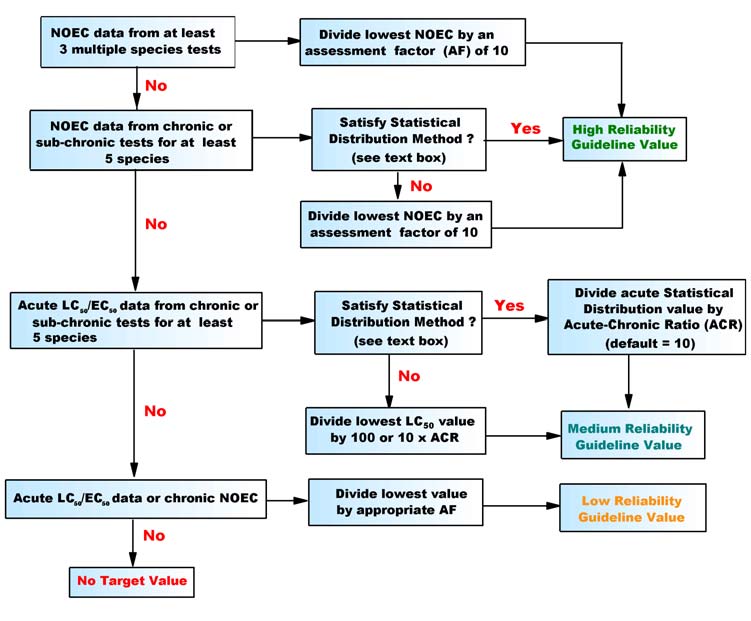
The approach and methodology that is followed in Australia and New Zealand to derive
water quality guidelines for toxic substances are schematically illustrated in Figure 1.1.
Figure 1.1:
Schematic illustration of the guideline derivation procedures followed for
Australia and New Zealand (adapted from ANZECC, 2000)
Recommended Application Factors (AF) for deriving low reliability guideline values, based
on those proposed by the OECD (1992), are as follows (ANZECC, 2000):
· Apply an assessment factor of 1000 to the lowest acute LC50 or EC50 value within a
dataset on only one or two aquatic species or a factor of 200 to limited chronic data
· Apply a factor of 100 to the lowest acute LC50, EC50 value within a data set comprising, at
a minimum, algae, crustaceans and fish
· Apply a factor of 20 (OECD (1992) recommends a factor of 10) to the lowest chronic
NOEC value within a dataset comprising, at a minimum, algae, crustaceans and fish.
It has been recommended that, in cases in which toxicity data or guideline values were
missing for marine waters but available for fresh water, managers may use freshwater
figures as tentative working levels (OECD 1992), taking into account any known salinity
effects.
BCLME Project BEHP/LBMP/03/04
Page 1-16
Section 1
January 2006
Final
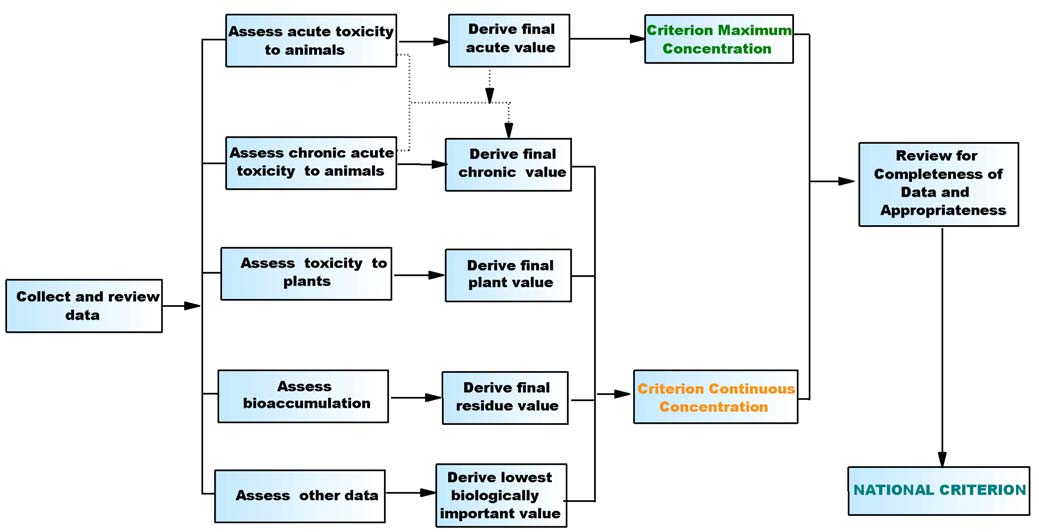
NOTE: STATISTICAL DISTRIBUTION METHOD
The statistical distribution method that was used by the Australians to determine high
reliability guideline trigger values is schematically illustrated below:
95 percentile: Toxicant concentration that will
protect 95% of species with 50% certainty
Figure 1.2 schematically illustrates the US-EPA approach and methodology to derive water
quality guidelines for toxic substances.
Figure 1.2:
Schematic illustration of the guideline (criterion) derivation procedures
followed by the US-EPA (adapted from Russo, 2002)
BCLME Project BEHP/LBMP/03/04
Page 1-17
Section 1
January 2006
Final
Final values referred to in Figure 1.2 are calculated as follows:
· Final acute values are calculated as an estimate of the concentration of the substance
corresponding to a cumulative probability of 0.05 in the acute toxicity data from the
genera with which acceptable tests have been conducted (if the acute value for a
commercially or recreationally important species is lower than the calculated value, then
the value of that species is accepted as the final value)
· Final chronic values are calculated as the geometric mean of the Lowest-Observable-
Effects Concentration (LOEC) and the No-Observable-EffectsConcentration (NOEC)
from the chronic data sets
· Final plant values are calculated as the lowest result from a 96-h test conducted with an
alga or a chronic test conducted on an aquatic vascular plant
· Final residue values are calculated by dividing the maximum permissible tissue
concentration (e.g. a US Food and Drug Administration action level for fish oil or the
edible portion of fish or shellfish) divided by an appropriate bio-concentration factor
(BCF).
The US-EPA water criteria provide two guideline values for toxic substances, based on the
level of exposure, namely (US-EPA, 2002a; Russo, 2002):
· Criterion Maximum Concentration (CMC), which is an estimate of the highest
concentration of a material in surface water to which an aquatic community can be
exposed briefly without resulting in an unacceptable effect = one half of the final acute
value
· Criterion Continuous Concentration (CCC) is an estimate of the highest concentration of
a material in surface water to which an aquatic community can be exposed indefinitely
without resulting in an unacceptable effect = lowest of the final chronic value, final plant
value and final residue value.
Note that the US-EPA water quality guidelines for trace metals, as revised in 2002 listed in
Appendix A are expressed as dissolved metal concentrations in the water column. These
concentrations were calculated from the aquatic life criteria (US-EPA, 1986a), which were
initially expressed in terms of total recoverable metal. The term "Conversion Factor" (CF)
represents the recommended conversion factor used to convert a metal criterion expressed
as the total recoverable fraction in the water column to a criterion expressed as the dissolved
fraction in the water column (US-EPA, 2002a).
BCLME Project BEHP/LBMP/03/04
Page 1-18
Section 1
January 2006
Final
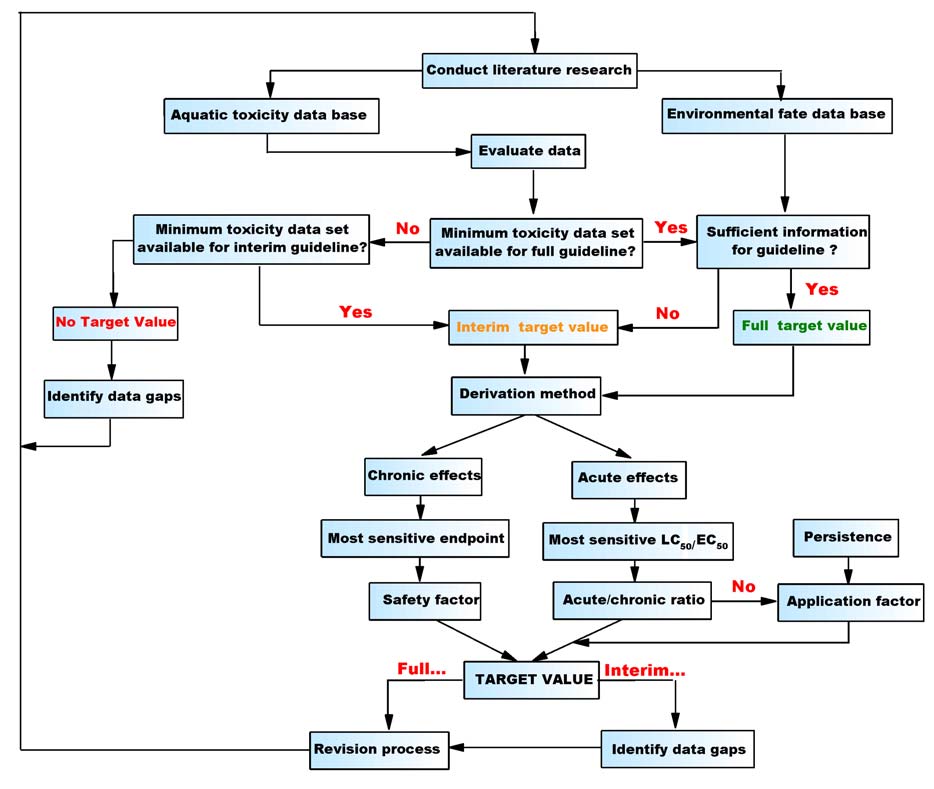
The guideline derivation procedures followed in Canada are illustrated in Figure 1.3
Figure 1.3:
Schematic illustration of the guideline derivation procedures followed for
Canada (adapted from CCME, 1999a)
Guideline values are derived from the lowest-observable-effect concentration (LOEC) from a
chronic study, using a non-lethal endpoint for the most sensitive life stage of the most
sensitive aquatic species investigated. The most sensitive LOEC is multiplied by a safety
factor of 0.1 to arrive at a guideline value. This safety factor has been chosen to account for
differences in sensitivity to a variable due to differences in species, laboratory versus field
conditions, and test endpoints.
Where the above-mentioned data are not available, guideline values can be derived from
acute studies by converting short-term median lethal or median effective concentrations
(LC50, EC50) to long-term no-effect concentrations. Acute/chronic ratios (ACRs) are used to
convert the median lethal results of a short-term study to an estimated long-term no-effect
BCLME Project BEHP/LBMP/03/04
Page 1-19
Section 1
January 2006
Final
concentration. An ACR is calculated by dividing an LC50 or EC50 by the no-observed-effect
concentration (NOEC) from a chronic exposure test for the same species. In the event that
ACRs are not available, the alternate method of choice for deriving a guideline value from an
acute study is to multiply the LC50 or EC50 value by a universal application factor. The
application factor (AF) for non-persistent variables (t½ in water < 8 weeks) is 0.05; for
persistent variables, the AF is 0.01.
Unless otherwise specified, a guideline value for toxic substances refers to the total
concentration in an unfiltered sample. Total concentrations will apply unless it can be
demonstrated that (a) the relationship between variable fractions and their toxicity is firmly
established, and (b) analytical techniques have been developed that unequivocally identify
the toxic fraction of a variable in a consistent manner using routine field-verified
measurements (CCME, 1999a).
In the case of the European Union, the ultimate aim of the Water Framework Directive is to
achieve the elimination of priority hazardous substances and contribute to achieving
concentrations in the marine environment of near background values for naturally occurring
substances. Thirty-three substances or groups of substances are currently on the list of
priority substances, including biocides, metals and other groups like polyaromatic
hydrocarbons (PAH). The complete list is given below.
(europa.eu.int/comm/environment/water/water-framework/priority_substances.htm).
PRIORITY SUBSTANCES
Alachor Fluoranthene Pentachlorobenzene
Anthrene Hexachlorobenzene
Pentachlorophenol
Atraziner Hexachlorobutadiene
Polyaromatic
hydrocarbons
Benzene Hexachlorocyclohexane
(Benzo(a)pyrene
Brominated diphenylethers
(gamma-isomer, Lindane)
Benzo(b)fluoroanthene
Cadmium and its compounds
Isoproturon Benzo(g,h,i)perylene
C10-13 chloroalkanes
Lead and its compounds Benzo(k)fluoroanthene
Chlorfenvinphos
Mercury and its compounds
Indeno(1,2,3-cd)pyrene
Chlorpyrifos Naphthalene Simazine
1,2-Dichloroethane
Nickel and its compounds
Tributyltin compounds
Dichloromethane Nonylphenols
Tributyl-cation
Di(2-ethylhexyl)phthalate 4-(para)-nonylphenol Trichlorobenzene
Diuron Octylphenols
Trichloromethane
(chloroform)
Endosulfan (para-tert-octylphenol)
Trifluralin
(apha-endosulfan)
BCLME Project BEHP/LBMP/03/04
Page 1-20
Section 1
January 2006
Final
It is the responsibility of the Council to specify emission limit values and environmental
quality objectives for these priority substances. Such limits have already been set for 18
substances in five specific directives, also called 'daughter' directives:
· Council Directive on limit values and quality objectives for mercury discharges by the
chlor-alkali electrolysis industry (CEC, 1982)
· Council Directive on limit values and quality objectives for cadmium discharges (CEC,
1983)
· Council Directive on limit values and quality objectives for mercury discharges by sectors
other than the chlor-alkali electrolysis industry (CEC, 1984a)
· Council Directive on limit values and quality objectives for the discharges of
hexachlorocyclohexane (CEC, 1984b)
· Council Directive on limit values and quality objectives for discharges of certain
dangerous substances in List I of the Annex to Directive 76/464/EEC (CEC 1976b, 1986,
1988 & 1990).
The Water Framework Directive also provides a list of pollutants for which member states
must set environmental quality standards (CEC, 2000), namely:
INDICATIVE LIST OF THE MAIN POLLUTANTS
Organohalogen compounds and substances which may form such compounds in the aquatic
environment
Organophosphorous compounds
Organotin compounds
Substances and preparations, or breakdown products of such, which have been proved to
possess carcinogenic or mutagenic properties or properties which may affect steroidogenic,
thyroid, reproduction or other endocrine-related functions in or via the aquatic environment
Persistent hydrocarbons and persistent and bioaccumulable organic toxic substances
Cyanides
Metals and their compounds
Arsenic and its compounds
Biocides and plant protection products
Materials in suspension
Substances which contribute to eutrophication (in particular, nitrates and phosphates)
Substances which have an unfavourable influence on the oxygen balance (and can be measured
using parameters such as BOD, COD, etc.)
BCLME Project BEHP/LBMP/03/04
Page 1-21
Section 1
January 2006
Final
The following procedure applies to the setting of a maximum annual average concentration
(further details are provided in the Water Framework Directive document [CEC, 2000]):
· Safety factors to be used are as follows:
SAFETY
FACTOR
At least one acute L(E)C50 from each of three trophic levels of the base set
1000
One chronic NOEC (either fish or daphnia or a representative organism for
100
saline waters)
Two chronic NOECs from species representing two trophic levels (fish
50
and/or daphnia or a representative organism for saline waters and/or algae)
Chronic NOECs from at least three species (normally fish, daphnia or a
representative organism for saline waters and algae) representing three
10
trophic levels
Other cases, including field data or model ecosystems, which allow more
Case-by-case
precise safety factors to be calculated and applied
assessment
· Where data on persistence and bioaccumulation are available, these shall be taken into
account in deriving the final value of the environmental quality standard
· The standard thus derived should be compared with any evidence from field studies.
Where anomalies appear, the derivation shall be reviewed to allow a more precise safety
factor to be calculated
· The standard derived shall be subject to peer review and public consultation, including
allowing for a more precise safety factor to be calculated, if required.
Proposed approach and methodology for the BCLME region:
For the BCLME region the approach and methodology followed in Australia and New Zealand
are proposed (ANZECC, 2000). In the process of determining a suitable approach and
methodology, ANZECC (2000) conducted a critical review of procedures followed elsewhere,
(including those discussed in this document). Their approach and method are also considered to
be the most conservative in that guideline values are derived from NOEC data, rather than
LOEC data (as is the case in Canada).
As it is unlikely that there will be sufficient (and appropriate) toxicological data available from
the BCLME region to refine the guideline values, it is further recommended that the Australian
and New Zealand guideline values for toxic substances be adopted until such time as these could
be refined for the BCLME region. The Australia and New Zealand guidelines constitute the only
set of guidelines that was refined with data from the southern hemisphere, making it more
appropriate to the BCLME region that those sets developed with data from the northern
hemisphere only (e.g. for USA, Canada and Europe).
NOTE: Although the target values recommended for South Africa (RSA DWF, 1995b) are
within the same order as most of the ANZECC guidelines, the selection criteria are not that
transparent, other than that the Maximum Acceptable Toxicant Concentration (MATC) approach
was followed. Also, these guidelines date back to 1984. For the larger BCLME region, it is
therefore recommended that a more recent and more transparent approach be selected.
BCLME Project BEHP/LBMP/03/04
Page 1-22
Section 1
January 2006
Final
1.3 INTERNATIONAL IMPLEMENTATION PRACTICES
Water quality guideline values are not designed to be used as `magic numbers' or threshold
values at which an environmental problem is inferred if they are exceeded, i.e. they are
usually NOT standards (legally enforceable values). Water quality guideline values are
primarily used to set targets for water quality (or water quality objectives), within broader
management strategies, so as to sustain marine aquatic health in the long term. They can
also be used as benchmarks for water quality data obtained either through monitoring
programmes or simulated through modelling studies (e.g. to asses potential impacts from
future developments).
Water quality guideline values are set at a national or federal level to provide guidance to
local managers and responsible authorities to derive site-specific quality. The aim is to set
these guideline values at reasonably conservative levels, so that adverse biological affects
are not expected when the concentrations in the water column are below or at the guideline
value. The potential for adverse biological effects is recognised when guideline values are
exceeded (CCME, 1995). Water quality guideline values are typically based on bio-available
concentrations, and hence are relatively conservative when compared with total
concentrations in the marine environment (comparing total concentrations with guideline
values is therefore seen as a simple and low-cost point of departure).
Refinement of water quality guideline values can occur on different levels (ANZECC, 2000):
· Values can be adjusted and refined upfront, based on site-specific information on key
physical and chemical variables in the marine environment. For example, the toxicity
and bioavailability of some metals (e.g. copper, zinc and cadmium) are strongly
influenced by water quality characteristics such as dissolved organic matter and pH and
the toxicity of different metal species.
· After continuous and extensive monitoring show that exceedances of a guideline value
are consistently assessed as posing no risk to the ecosystem.
· Where it is shown that natural background concentrations of a particular variable exceed
the guideline values.
BCLME Project BEHP/LBMP/03/04
Page 1-23
Section 1
January 2006
Final
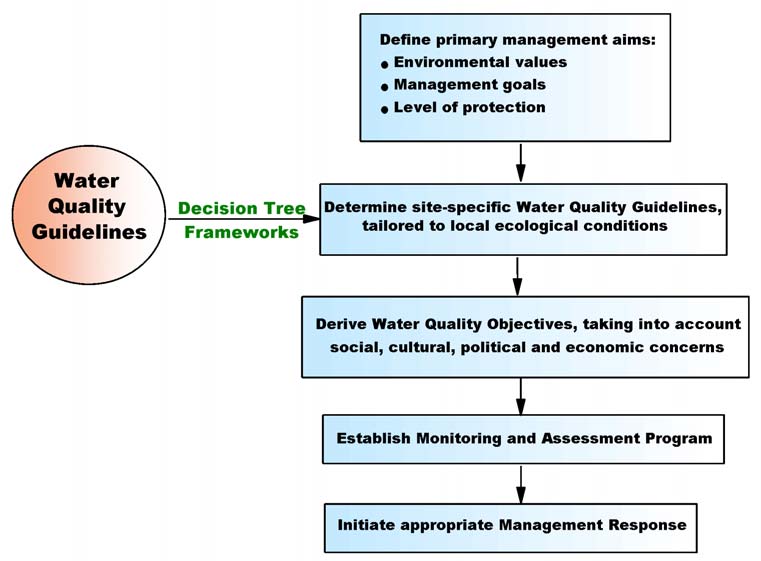
Internationally, a risk assessment or phased approach is typically followed: Where guideline
values are exceeded, this triggers the incorporation of additional information or further
investigation to determine whether or not a real risk to the ecosystem exists and, where
possible, to adjust the guideline values for site-specific conditions (ANZECC, 2000).
This is illustrated by the Australian and New Zealand approach (Figure 1.4). ANZECC
(2000) recommends that, for these assessments, water quality guideline values be
compared with the median or average (whichever is considered most appropriate) of the
measured or simulated data set. Statistically, the median usually represents the most
robust descriptor of the test site data.
Figure 1.4:
Implementation of water quality guidelines in the broader water quality
management framework (adapted from ANZECC, 2000)
To adapt water quality guideline values for a particular site, a risk assessment approach,
using decision tree frameworks is used (example illustrated in Figure 1.5). In these
frameworks, exceedance of recommended water quality guideline values `triggers' further
investigation. The subsequent investigation then aims to assess whether exceedances will
result in adverse biological effects by accounting for site-specific environmental factors that
can modify the effect of the variable. Although in some cases this will require more work, it
will result in much more realistic goals for management and therefore has the potential to
reduce both costs and confrontation. These frameworks provide a structured approach
BCLME Project BEHP/LBMP/03/04
Page 1-24
Section 1
January 2006
Final
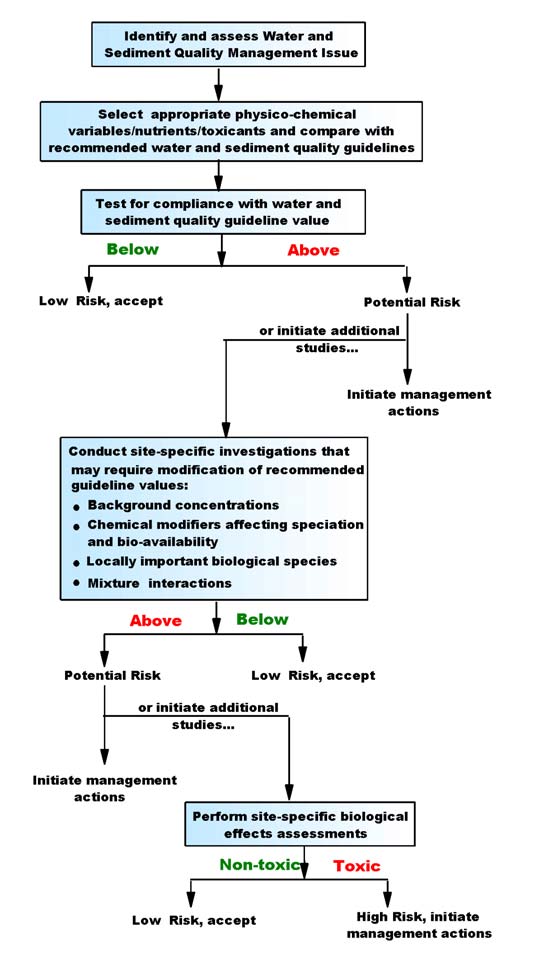
within which to reduce the amount of conservatism necessarily incorporated in the guideline
values, and so produce values more appropriate to a particular environment (ANZECC,
2000).
Figure 1.5:
Decision tree framework for assessing toxic substances in ambient waters
using water quality guidelines (ANZECC, 2000)
Similar to the Australian approach, the Canadian water quality guideline values are also not
used as blanket values for national water quality, as variations in environmental conditions
will affect water quality in different ways and many of the guideline values may need to be
modified according to local conditions, such as assimilative capacity, sensitivity of
BCLME Project BEHP/LBMP/03/04
Page 1-25
Section 1
January 2006
Final
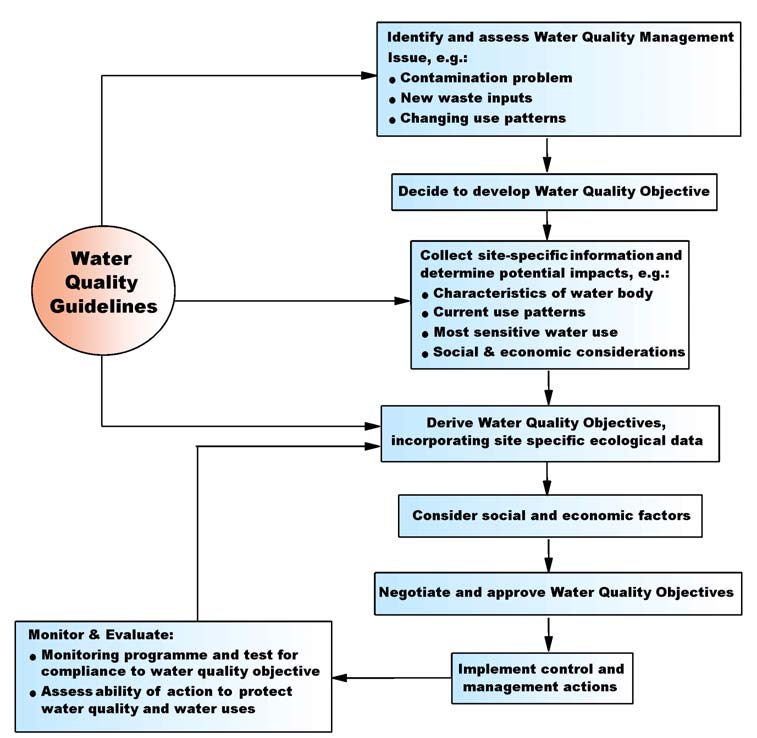
endangered species, and habitat (Figure 1.6). Using the generic water quality guideline
values to set site-specific water quality objectives requires an understanding of the physical
and biological characteristics of the water body and an understanding of the behaviour of a
substance once it is introduced into the aquatic environment (CCME, 1999a).
Figure 1.6: Implementation of water quality guidelines in Canada (adapted from CCME, 1999a)
Section 304(a)(1) of the Clean Water Act (USA) requires that the EPA develop criteria for
water quality that accurately reflect the latest scientific knowledge (US-EPA, 2004). These
criteria are based solely on data and scientific judgements on pollutant concentrations and
environmental or human health effects. Section 304(a) also provides guidance to states and
tribes in adopting water quality standards. Criteria are developed for the protection of aquatic
life as well as for human health. States and authorised tribes adopt water quality criteria with
sufficient coverage of parameters and of adequate stringency to protect designated uses.
In adopting such criteria, States and Tribes may (US-EPA, 2004):
BCLME Project BEHP/LBMP/03/04
Page 1-26
Section 1
January 2006
Final
· adopt the criteria that EPA publishes under section 304(a) of the Clean Water Act
· modify the section 304(a) criteria to reflect site-specific conditions, or
· adopt criteria based on other scientifically-defensible methods.
The US-EPA therefore also recognises that water quality guideline values are recommended
numerical and descriptive values for assisting states and tribes in developing site-specific
water quality standards by taking local conditions into account.
In the European Union waters (including marine waters), the use of water determines the
level to which quality of water needs to be protected (CEC, 2003). In contrast to some uses
for which water is protected only in specified areas (e.g. recreation or culture of shellfish),
ecological protection should apply to all waters: The central requirement of the European
Treaty is that the natural environment (aquatic ecosystems) be protected to a high level in its
entirety.
To protect aquatic ecosystems, it was realised that no quality standards can be set which
apply across the Community. Therefore, to cover all surface waters, the Water Framework
Directive introduced a concept of setting a general requirement for ecological protection, and
a general minimum chemical standard (CEC, 2000).
Good ecological status is defined, in Annex V of the Water Framework Directive, in terms of
the quality of the biological community, the hydrological characteristics and the physico-
chemical characteristics. In this regard, members need to set site-specific standards that will
ensure that conditions defined as indicative of a `good eclogical status' are attained.
Good chemical status, in turn, is defined in terms of compliance with all the quality standards
established for substances (toxic) at European level. In this regard, some numerical
chemical standards are provided at European level (in so-called 'daughter' directives (CEC,
1982, 1983, CEC, 1984a, CEC, 1984b, CEC 1976b, 1986, 1988 & 1990)), while for others
Annex X of the Water Framework Directive provides guidance on how such standards
should be determined (also refer to Chapter 2 of this Section).
BCLME Project BEHP/LBMP/03/04
Page 1-27
Section 1
January 2006
Final
Proposal for the BCLME region:
It is proposed that the recommended water quality guidelines for the BCLME region be applied
as benchmarks following a risk assessment or phased approach where, if the values are
exceeded, the incorporation of additional information or further investigation is triggered to
determine whether or not a real risk to the ecosystem exists and, where possible, to adjust the
guideline values for site specific conditions.
Water quality guideline values should be compared with the median of the measured or simulated
data set.
Water quality guidelines are valuable tools for assisting in managing complex systems (such as
an aquatic marine ecosystem) in a phased approach. As part of the initial phases, guidelines
provide a means of `screening' for potential adverse biological effects related to the chemical
quality of the water column.
BCLME Project BEHP/LBMP/03/04
Page 1-28
Section 1
January 2006
Final
SECTION 2.
INTERNATIONAL REVIEW - SEDIMENT QUALITY
GUIDELINES FOR THE PROTECTION OF MARINE
AQUATIC ECOSYSTEMS
BCLME Project BEHP/LBMP/03/04
Page 2-1
Section 2
January 2006
Final
2.1 INTRODUCTION
Sediments are an important component of aquatic ecosystems and provide a habitat for
many benthic (and epibenthic) organisms. In addition, sediment found in depositional
areas tends to integrate (or accumulate) contaminant inputs over time - many toxic and
accumulative substances form associations with particulate matter (either biogenic or
lithogenic), which eventually becomes incorporated into bed sediments. Consequently,
sediments can also act as a long-term source of toxic substances to the aquatic
environment, not only to benthic organisms, but also to overlying waters.
Sediment quality guideline values for the protection of marine aquatic ecosystems from the
following countries and regions were included in the review:
i.
United States of America
The National Oceanic and Atmospheric Administration (NOAA) in the United States
developed a set of sediment quality guideline values that was originally intended to provide a
means of interpreting sediment monitoring data, collected as part of the National Status and
Trends Program (Long and Morgan, 1990; revised by Long et al. 1995, NOAA, 1999). In the
late 1990s, MacDonald and co-workers expanded on the NOAA approach when they
developed a set of saltwater sediment quality guideline values for the State of Florida (USA),
Department of Environmental Protection (MacDonald et al., 1996). They expanded the
saltwater database that was originally used by Long and co-workers with additional data on
saltwater. The procedures that were developed as part of these two studies currently form
the basis for the derivation of sediment quality guideline values worldwide, e.g. Australia and
New Zealand (ANZECC, 2000), and Canada (1995).
To assist regulatory authorities in making decisions concerning contaminated sediments, the
US-EPA also embarked on studies to develop sediment quality guidelines, primarily for non-
ionic organic compounds. From the available literature, guidance in this regard has been
documented for dieldrin, endrin and a mixture of PAHs (US-EPA 2003c, d & e).
BCLME Project BEHP/LBMP/03/04
Page 2-2
Section 2
January 2006
Final
ii.
Australia and New Zealand
Few reliable data on sediment toxicity are available for either Australia or New Zealand from
which to derive sediment quality guidelines. With little likelihood of further data forthcoming
in the immediate future, these countries opted to use best available overseas guidelines and
to refine them with local knowledge of local baseline concentrations, as well as by using
local effects data, as and when such data become available (ANZECC, 2000). The interim
sediment quality guideline values adopted by Australia and New Zealand are based
primarily on the approach followed by NOAA (USA) (NOAA, 1999; Long et al., 1995).
iii. Canada
In 1988, Environment Canada commissioned a study to review and evaluate available
approaches used to develop sediment quality guidelines in the world (CCME, 1995). This
resulted in the development of a formal protocol for the development of sediment quality
guidelines, which is based primarily on the approach and methodology used by MacDonald
et al. (1996) in the derivation of sediment quality guidelines for the State of Florida (USA).
A summary document of the Canadian Environmental Quality Guidelines (as revised in
2002) has been consulted to obtain specific guidelines values for different substances
(CCME, 2002). Unless otherwise specified, sediment quality guidelines refer to the total
concentration of the substance in surficial sediments (e.g. upper few centimetres).
2.2 INTERNATIONAL
APPROACH AND METHODOLOGIES
Ideally, sediment quality guidelines should be developed from detailed dose-response data
that describe the acute and chronic toxicity of individual substances in sediments to sensitive
life stages of sensitive aquatic organisms. Such data should be generated in controlled
laboratory studies in which the influence of important environmental variables affecting
bioavailability (and toxicity) are identified and quantified. Subsequently, the results from the
laboratory studies should be validated in field trials to ensure that any guideline value
derived from such data will be applicable to a broad range of locations. A detailed
understanding of site-specific factors that influence bioavailability and toxicity (e.g. total
organic carbon, sediment grain size and acid volatile sulphide) is also required so as to
define and predict the extent to which such modifiers will affect toxicity under field situations.
However, in most countries, such detailed data are usually not available and are also very
costly to collate. In response to the identified need for sediment quality guidelines,
BCLME Project BEHP/LBMP/03/04
Page 2-3
Section 2
January 2006
Final
numerous approaches were investigated worldwide, taking into account practicality, scientific
defensibility and wide applicability.
Sediment quality guideline values for the protection of marine aquatic ecosystems,
recommended by the countries and organisations included in this review, are summarised in
Appendix B.
Sediment quality guideline values are generally only specified for the protection of aquatic
ecosystems, in particular in terms of toxic substances. Approaches that have been
documented as being used in the derivation of sediment quality guidelines for toxic
substances include:
i. Effects
range
approach
The effect range approach involves the use of large effects databases, for which
concentrations have been measured in sediment and the biological effects
simultaneously recorded. Such data can be obtained through field, laboratory and/or
modelling studies. Sediment quality guideline values are then derived using statistical
analyses of matching sediment chemistry and biological effects data.
This approach requires sufficient amounts of matching sediment chemistry and
biological effects data, collected from sediments with different physical and geo-
chemical characteristics and from numerous locations so as to provide a basis for
establishing guideline values that should be widely applicable. The use of data collated
through field studies, in which mixtures of substances occur within samples, is also
considered to maximise applicability to most real-world situations. Furthermore, data
from a variety of toxicological end-points are also likely to broaden the applicability of
guideline values derived through this approach (Long and McDonald, 1998).
The effects-based approach is also thought to be the most ecological relevant and
scientifically defensible approach as it relies directly on observed biological effects of
sediment associated substances (whereas , for example, equilibrium partitioning models
are based only on indirect biological effects see later) (CMME, 1995).
BCLME Project BEHP/LBMP/03/04
Page 2-4
Section 2
January 2006
Final
ii. Screening level concentrations
This approach uses field data and patterns of co-occurrence in sediments of specific
contaminant concentrations and specific benthic biota. For a particular species, the
screening level concentration is estimated as the concentration which co-occurs with
95% of a particular organism. Sediment quality guideline values are then derived by
determining screening level concentrations for a number of species (ANZECC, 2000).
iii. Apparent effects threshold
The apparent effects threshold is defined as the sediment concentration above which
statistically significant (p< 0.5) biological effects are always observed for a given data
set. The approach involves collection of matched biological effects data from tests
carried out on sub-samples from the same field sample. Impacted and non-impacted
sites are measured and the statistical significance of adverse biological effects is tested
(ANZECC, 2000).
iv. Sediment quality triad
This approach involves data from three separate measurements: sediment chemistry,
sediment bioassays, and in situ biological effects and is conducted at the community or
ecosystem level. Chemical (and physical) measurements are also taken to assess the
level of contamination, as well as other parameters which may influence the abundance
of biota. The bioassay data provide information on the toxicity of the contaminants,
while the in situ biological measurements assess histopathological abnormalities,
community structure and other parameters that can be related to sediment chemistry
(ANZECC, 2000).
v. Spiked sediment toxicity tests
The spiked sediment toxicity approach involves the mixing and equilibration of
sediments with a contaminant spike, added either to sediment slurry or to overlying
water. The information generated provides precise dose-response data on specific toxic
substances, as well as quantitative data on interactive effects of substances. This
approach can also account specifically for factors influencing toxicity of substances in
sediments.
Although results obtained from such controlled laboratory tests have a high degree of
precision, they require field validation. This approach is therefore usually best applied in
BCLME Project BEHP/LBMP/03/04
Page 2-5
Section 2
January 2006
Final
combination with, for example, the effects range approach and is typically included in
databases used in the effects range approach (CCME, 1995; ANZECC, 2000).
vi. Equilibrium partitioning models
The equilibrium partitioning (EqP) approach primarily derives sediment quality guideline
values by defining the contaminant concentration in the sediment that is in equilibrium
with the quality guideline value of the particular contaminant in the pore water. In most
cases, the (surface) water quality guideline value (as discussed earlier) is applied. This
approach is most widely applied to non-ionic organic compounds primarily because it is
well-established that the partitioning is dominated by sediment organic carbon (this
approach is less advanced in terms of trace metals, as metal bioavailability is often
dependent on more than one phase in the sediments) (ANZECC, 2000).
Where this approach is applied to non-ionic organic compounds (e.g. PAHs), the
sediment/pore water partitioning coefficient, KD, needs to be related to the organic
carbon partitioning coefficient, KOC and fOC, the fraction by weight of organic carbon:
KD = KOCfOC
The sediment quality guideline (SQG) value can therefore be calculated from a water
quality guideline (WQG) value as follows:
SQG = KOCfOC WQG
Although the approach is attractive to many regulators, it is important to realise that
partitioning coefficients are dependent on sediment type (% fine fraction) and this needs
to be taken into consideration when applying guidelines derived though EqP models.
Also, this approach assumes that benthic organisms are as sensitive to toxic effects
from a particular substance as water column organisms (water quality guideline values
are based on their sensitivity) (ANZECC, 2000).
Outputs from EqP models are therefore also best applied in conjunction with, for
example, the effect range approach. Data generated from EqP models for non-ionic
organic compounds are also incorporated in databases used in the effect range
approach (ANZECC, 2000).
BCLME Project BEHP/LBMP/03/04
Page 2-6
Section 2
January 2006
Final
The effects range approach is currently the most widely accepted approach for sediment
guideline development, often utilising data generated through some of the other approaches
(CCME, 1995; MacDonald et al., 1996; NOAA, 1999; ANZECC, 2000). In this regard, the
National Status and Trends Program approach of NOAA is most widely applied throughout
the world. This approach is discussed in greater detail in the following sections. The
equilibrium partitioning (EqP) approach, which is primarily applied by the US-EPA, is also
discussed.
2.2.1 National Status and Trends Program Approach (effects range approach)
Long and his co-workers were the first to investigate and implement the effects range
approach on a comprehensive level (Long and Morgan, 1990, revised by Long et al., 1995
using only salt-water data). The approach was originally developed to provide a means of
interpreting sediment monitoring data collected throughout the United States as part of the
National Status and Trends Program of the National Oceanic and Atmospheric
Administration in the United States known as the National Status and Trends Program
Approach (NOAA, 1999). For this project, an extensive data set on matching sediment
chemistry and biological effects was collated into a database, derived from field, laboratory
and modelling studies performed on sediments with different physical and geo-chemical
characteristics and from numerous locations so as to provide a basis for establishing
guidelines that should be widely applicable throughout North America.
The majority of data used to derive the guideline values were from field studies in which a
mixture of substances occurred in the samples, thus maximising the applicability for the
guidelines to most real-world situations (Long & MacDonald, 1998). Data on each
substance were organised into an ascending data table, for both effect data (i.e. data for
which end-points showed adverse biological effects) and no-effect data (i.e. data for which
end-points showed no adverse biological effects).
From the ascending data tables, threshold values were calculated from the effect data (i.e.
excluding no-effect data) as follows:
· Effect Range-Low (ERL) value: 10th percentile of the effect data, representing a threshold
value below which adverse effects are unlikely to occur
· Effect Range-Median (ERM) value: 50th percentile of the effect data, representing a
threshold value above which adverse effects frequently occur.
BCLME Project BEHP/LBMP/03/04
Page 2-7
Section 2
January 2006
Final
In the late 1990s, MacDonald and co-workers put forward an alternative method to the
original National Status and Trends Program Approach when they developed a set of
saltwater sediment quality guidelines for the Florida (USA) Department of Environmental
Protection (MacDonald et al., 1996). They expanded the original database with additional
data on saltwater and also revised the database by carefully screening data (the updated
database is referred to as BEDS (Biological Effects Database for Sediments) (CCME, 1995).
NOTE:
Each BEDS record included information on (CCME, 1995):
· Location
· Concentration of (expressed as total of on a dry weight basis)
· Biological response observed
· Test duration
· Species tested or benthic community assessed
· Information on factors that could influence bioavailability, e.g. total organic carbon, grain size and
acid volatile sulphide)
Strict criteria are also applied in the quality control of data for inclusion in BEDS (CCME, 1995)
The threshold values calculated by MacDonald et al. (1996) differed from those calculated
earlier in that no-effect data were used rather than effect data:
· Threshold effect level (TEL): Calculated as the square root of the product of the lower
15th percentile of the effect data and the 50th percentile of the no-effect data,
representing a threshold value below which adverse biological affects are unlikely to
occur (i.e. represents no significant hazard to aquatic organisms)
· Probable effect level (PEL): Calculated as the square root of the product of the lower 50th
percentile of the effect data and the 85th percentile of the no-effect data, representing a
threshold value above which adverse biological affects usually or always occur
BCLME Project BEHP/LBMP/03/04
Page 2-8
Section 2
January 2006
Final
However, a comparison of the threshold values from the two studies of `unlikely occurrence
of adverse biological effects' (ERL and TEL) and `adverse biological effects usually or
always occurring' (ERM and PEL) showed remarkable similarity (on average they vary within
a factor of 2) even though they were derived differently (ANZECC, 2000; CCME, 1995; Long
and MacDonald, 1998).
Furthermore, studies on the reliability and predictability of these thresholds found that ERL
and TEL values provided reliable and predictive tools for identifying concentrations of
chemicals in sediments that are unlikely to be associated with adverse biological effects (to
test predictability large independent data sets compiled from studies of the Atlantic, Gulf and
Pacific coasts were used). It was concluded that these guideline values provided a
scientifically defensible basis for assessing the quality of soft sediments in marine and
estuarine environments (Long and MacDonald, 1998).
Key to the National Status and Trends Program Approach is that it defines concentration
ranges (rather than absolute values) to provide more flexible interpretative tools with broader
application: By deriving two threshold values, i.e. a `low' (ERL/TEL) and a `median'
(ERM/PEL), three ranges of concentration are defined, namely, those that are rarely,
occasionally and frequently associated with adverse biological effects, as illustrated below
(CCME 1995, Long and MacDonald, 1998).
BCLME Project BEHP/LBMP/03/04
Page 2-9
Section 2
January 2006
Final
Canada, Australia and New Zealand opted for the National Status and Trends approach,
after a critical review of international approaches (CCME, 1995; ANZECC, 2000).
As few reliable data on sediment toxicity were available for either Australia or New Zealand,
it was decided to adopt the ERL/ERM values as applied in the National Status and Trends
Program (NOAA, 1999; Long et al., 1995). The `low' value corresponds to the ERL of the
NOAA listing, while the `high' value corresponds to the ERM value. The `low' or ERL value is
used at the `trigger value'. For substances that were considered important, but for which the
National Status and Trends Program did not propose target values, other international
sources were used. For example, guidelines for tributyltin were estimated on the basis of
equilibrium partitioning, based on data summarised from the US-EPA (ANCEZZ, 2000),
while values for lindane were taken from MacDonald et al. (1996).
To provide a standardised approach to the derivation of sediment quality guidelines, the
Canadians developed a formal protocol, with the National Status and Trends Program
Approach forming an integral part (CCME, 1995) (Figure 2.1). This protocol has also been
adopted by Australia and New Zealand for any future revision of their sediment guideline
values (ANZECC, 2000).
In applying this protocol, the following are important considerations to take into account:
· In deriving sediment quality guidelines for the protection of an aquatic ecosystem, all
components (e.g. bacteria, algae, macrophytes, invertebrates and fish) need to be
considered, if data are available, focusing on ecologically relevant species
· Sediment quality guidelines are to be refined as new and relevant scientific data become
available (following the Adaptive Management Approach)
· Interim sediment quality guidelines are developed where insufficient data are available.
BCLME Project BEHP/LBMP/03/04
Page 2-10
Section 2
January 2006
Final
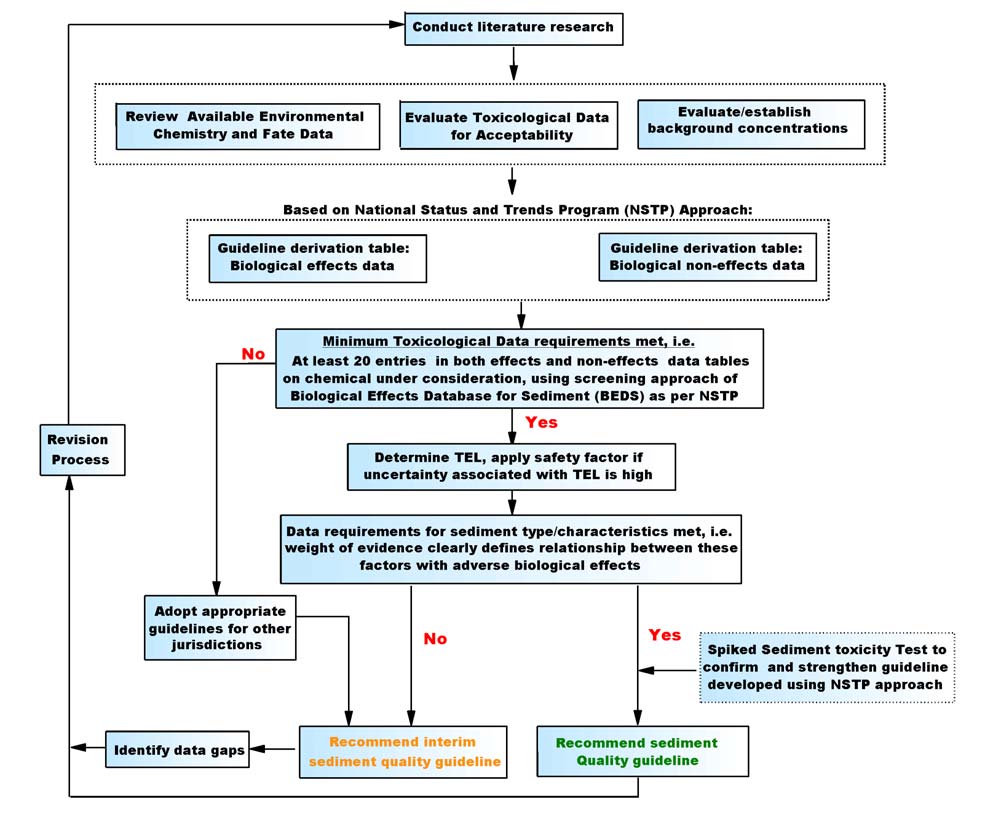
Figure 2.1:
Canadian protocol for the derivation of sediment quality guidelines (adapted
from CCME, 1995)
Where insufficient data are available to derive sediment quality guidelines, suitable interim
sediment quality guidelines should be derived from other jurisdictions, using the following
default process that gives preference to biological effect-based values (CCME, 1995):
· Select the lowest sediment quality guidelines that incorporate data on effects of
sediment-associated substances on sediment dwelling organisms (e.g. effects range
approach, screening level concentrations, apparent effects threshold or sediment quality
triad)
· For non-ionic organic compounds select the lower value obtained using the EqP and
water quality guidelines approach (if a water quality guideline exists and if no biological
effect based values are available)
BCLME Project BEHP/LBMP/03/04
Page 2-11
Section 2
January 2006
Final
Select the upper background limit (at a particular site) if an interim sediment guideline cannot
be derived using the above procedures or if the value obtained through the above
procedures is below the upper background concentration of the substance at the particular
site
NOTE:
An important aspect that is clearly highlighted in the Canadian protocol is the consideration of background
concentrations of naturally occurring chemicals, e.g. in the case of trace metals. This information should
be considered in the site-specific application of sediment quality guidelines, since generically determined
sediment quality guidelines may be lower than the respective naturally occurring substances at a particular
site. This is therefore an important component that needs to be considered when deriving (site-specific) a
quality objective for a particular site from (generic) nationally derived quality guidelines. A method that is
commonly used to distinguish between the probable origin of trace metals (i.e. natural versus
anthropogenic) involves the determination of the ratio of trace metal concentrations to that of a reference
element at a number of uncontaminated sites (such ratios are relatively constant in the earth's crust).
Elements that are typically used in this regard are aluminium, iron and lithium. The relationship between
the trace element and reference element is typically linear. Usually anthropogenic enrichment of the trace
element is suspected when the trace element to reference element (e.g. aluminium) at a site exceeds the
upper 95% confidence limit, calculated from a simple linear regression (CCME, 1995).
Currently, most of the sediment quality guidelines for Canada are interim guideline values,
derived from other jurisdictions. The guidelines values adopted are those put forward by
MacDonald et al. (1996) using the PEL/TEL approach rather than the ERL/ERM approach
(CCME, 2002).
Guidelines developed in terms of the National Status and Trends Program Approach do
have a number of limitations that should be taken into account (Long and MacDonald, 1998),
namely:
· There are many substances that could be highly toxic for which SQG are currently not
available
· These guidelines do not address bioaccumulation pathways
· These guidelines are not toxicity thresholds, i.e. there is no certainty that they will always
correctly predict toxicity or non-toxicity
· These guidelines are best applied in conjunction with measures such as toxicity tests
and/or benthic community surveys and/or bioaccumulation tests, particularly in
sediments showing intermediate concentrations
· Care should be taken when using the sediment quality guidelines to identify the
contaminants that are actually causing toxicity in sediments with complex mixtures of
BCLME Project BEHP/LBMP/03/04
Page 2-12
Section 2
January 2006
Final
chemicals. Other, more precise methods, such as spiked sediment toxicity tests, should
rather be applied to confirm which chemicals actually warrant the greatest concern.
2.2.2 Equilibrium Partitioning Approach (US-EPA)
To assist regulatory authorities in making decisions concerning contaminated sediments, the
US-EPA embarked on studies to develop defensible equilibrium partitioning sediment
benchmarks (i.e. sediment quality guidelines based on the EqP approach), primarily for non-
ionic organic compounds. From the available literature, guidance in this regard has been
documented for dieldrin, endrin and a mixture of PAHs (US-EPA 2003c, d & e).
The US-EPA also highlights the limitations of using this approach, namely:
· EqP models derive sediment guideline values from water quality guideline values and
the partition coefficient between sediment/pore water, assuming that the level of
protection provided by the water quality guideline for a particular substance is similar to
that required by benthic organisms. These guidelines are therefore not considered
suitable where locally important benthic species are very sensitive or where sediment
organic carbon is less than 0.2%, the reason being that, at such low organic carbon
concentrations, second-order effects such as particle size and adsorption to non-organic
mineral fractions become more important (US-UPA, 2003e, ANZECC, 2000)
· Antagonistic, additive or synergistic effects of other sediment contaminants in
combination with the specific substance are not addressed
· Potential for bioaccumulation and trophic transfer is not addressed.
As a result, guidelines derived from EqP models should not be used as stand-alone or pass-
fail criteria for all applications but, rather, exceedances of these values could trigger
collection of additional assessment data.
BCLME Project BEHP/LBMP/03/04
Page 2-13
Section 2
January 2006
Final
Proposed approach and methodology for the BCLME region:
It is recommended that, for the BCLME region, the Canadian protocol (which incorporates the
National Trends and Status Program Approach) be adopted for the derivation of sediment quality
guidelines (CCME, 1995).
Although this approach does have limitations (as discussed earlier), it appears to be accepted
worldwide as the preferred option (CCME, 1995; NOAA, 1999; ANZECC, 2000).
Whilst it is unlikely that there will be sufficient (and appropriate) toxicological data available
from the BCLME region to refine sediment guideline values, it is further recommended that the
NOAA guidelines (TEL/PEL), as per MacDonald et al. (1996), be adopted as interim sediment
quality guidelines for toxic substances until such time as these can be refined for the region.
MacDonald et al. (1996) expanded the original database used by Long et al. (1995) with additional
data on salt water and also revised the database by carefully screening data.
Also, studies on the reliability and predictability of these thresholds found that TEL values
provide reliable and predictive tools for identifying concentrations of chemicals in sediments that
are unlikely to be associated with adverse biological effects (to test predictability, a large
independent data set compiled from studies of the Atlantic, Gulf and Pacific coasts was used). It
was concluded that these guidelines provide a scientifically defensible basis for assessing the
quality of soft sediments in marine and estuarine environments (Long and MacDonald, 1998).
2.3 INTERNATIONAL IMPLEMENTATION PRACTICES
Sediment quality guidelines are primarily used to set targets for sediment quality (or
sediment quality objectives), within broader management strategies, so as to sustain marine
aquatic health in the long term. They can also be used as benchmarks for sediment
chemistry data, either obtained through monitoring programmes or simulated through
modelling studies (e.g. to asses potential impacts from future developments).
Guidelines are usually set at a national or federal level to provide guidance to local
managers and responsible authorities to derive site-specific quality objectives or
benchmarks. The aim is to set guideline values at reasonably conservative levels, so that
adverse biological affects are not predicted when the concentration of a sediment-associated
toxic substance is below or at the guideline value. The potential for adverse biological
effects is recognised when guideline values are exceeded (CCME, 1995).
Still, sediment quality guidelines are NOT standards (i.e. legally enforceable numbers) and it
is essential to further investigate site-specific factors, for example, site background
concentrations, bio-availability of toxic substances, and susceptibility of local biological
communities to the toxic effects of a toxic substance.
BCLME Project BEHP/LBMP/03/04
Page 2-14
Section 2
January 2006
Final
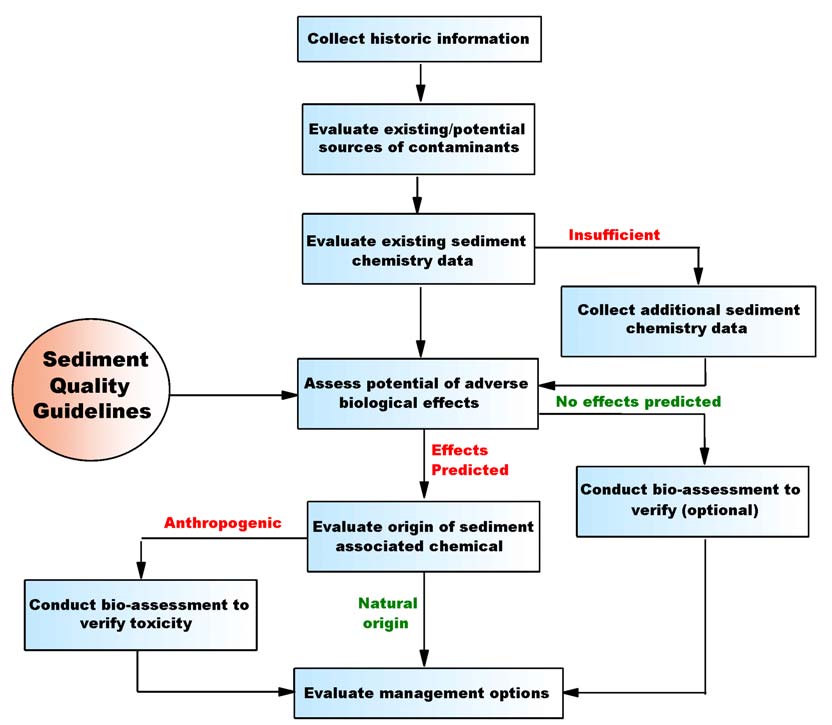
In essence, sediment quality guidelines (like water quality guidelines) are a means of dealing
with a complex issue (i.e. the aquatic marine ecosystem) in a phased approach, their
application being the first phase.
In a recent review of international sediment quality criteria, Burton (2002) also emphasised
the limitation of sediment quality guidelines and concluded that such guidelines should be
used only in a "screening" manner or in a "weight-of-evidence" approach. Aquatic
ecosystems (including sediments) must be assessed in a `holistic' manner, in which multiple
other components are assessed (e.g., habitat, hydrodynamics, resident biota, toxicity and
physico-chemistry) by using integrated approaches.
The above-mentioned caution is echoed in the implementation of sediment quality guidelines
worldwide (CCME, 1995; ANZECC, 2000), as illustrated by the Canadian approach
(Figure 2.2) (CCME, 1995).
Figure 2.2:
Implementation of sediment quality guidelines in Canada
(adapted from CCME, 1995)
BCLME Project BEHP/LBMP/03/04
Page 2-15
Section 2
January 2006
Final
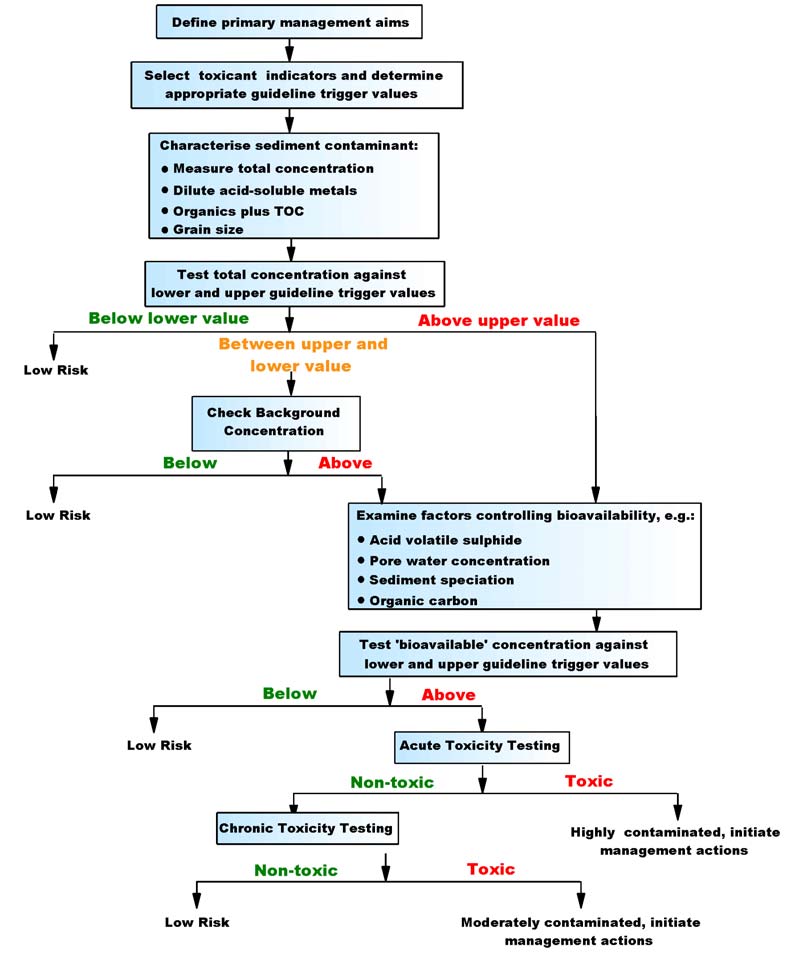
Whilst the Australian and New Zealand approach is focused mainly on the use of sediment
quality guidelines as a benchmark for assessing monitoring data, it also highlights the
importance of taking local biogeochemical and ecological factors into account (Figure 2.3)
Figure 2.3:
Application of sediment quality guidelines in Australia and New Zealand as part
of monitoring programmes (ANZECC, 2000)
BCLME Project BEHP/LBMP/03/04
Page 2-16
Section 2
January 2006
Final
Proposed approach and methodology for the BCLME region:
It is proposed that the recommended sediment quality guidelines for the BCLME region be
applied as benchmarks, following a risk assessment or phased approach, for which exceeded
values will trigger the incorporation of additional information or further investigation to
determine whether or not a real risk to the ecosystem exists and, where possible, to adjust the
guideline values for site specific conditions.
Sediment quality guideline values should be compared with the median of the measured or
simulated data set.
Similar to water quality guidelines, sediment quality guidelines are valuable tools for assisting in
managing complex systems (such as aquatic marine ecosystems) in a phased approach. As part of
the initial phases, guidelines provide a means of `screening' for potential adverse biological
effects related to the chemical quality of sediments.
BCLME Project BEHP/LBMP/03/04
Page 2-17
Section 2
January 2006
Final
SECTION 3.
INTERNATIONAL REVIEW - WATER QUALITY
GUIDELINES FOR MARINE AQUACULTURE
BCLME Project BEHP/LBMP/03/04
Page 3-1
Section 3
January 2006
Final
3.1 INTRODUCTION
Marine aquaculture refers to the farming of marine (or estuarine) organisms, either in off-
stream (land-based) facilities or in-stream in marine and estuarine environments. Marine
aquaculture typically focuses on seaweeds, shellfish, crustaceans and fish culture.
Water quality related requirements that apply to marine aquacultureare also relevant to
activities in which marine organisms are collected (e.g. subsistence use) or harvested from
natural stocks for human usages (e.g. fisheries). These include activities such as:
· Seaweed collection (e.g. Gracilaria)
· Shellfish collection (for human consumption)
· Recreational fishing
· Subsistence
fishing
· Commercial
fisheries.
In terms of setting water quality guideline values for marine aquaculture, current practice in
the following countries was reviewed:
i. European
Union
In terms of water quality management, the focus within the European Union is primarily on
shellfish. Water quality requirements are documented in two main directives, namely:
· EC Shellfish Waters Directive (CEC, 1979) providing limits for waters in which shellfish
are cultured for human consumption
· EC Shellfish Hygiene Directive (CEC, 1991) providing limits for substances in shellfish
flesh and a means of classifying shellfish growing areas.
ii.
Australia and New Zealand
The Australian and New Zealand water quality guidelines provide general guideline values
for the protection of local aquaculture species in Australia and New Zealand (ANZECC,
2000).
The Shellfish Industry in Australia and New Zealand is controlled and managed in terms of
the Australian Shellfish Quality Assurance Program and the New Zealand Shellfish Quality
Assurance Circular. These include the classification of safe shellfish-growing areas to
BCLME Project BEHP/LBMP/03/04
Page 3-2
Section 3
January 2006
Final
permit commercial harvesting for domestic and/or export markets. The classification is
based on a sanitary survey and a microbiological survey (Australian Shellfish Quality
Assurance Advisory Committee, 2002; MAF, 1995).
iii. United
States
The US-EPA's ambient water quality criteria provide guidelines aimed at minimising the risk
of adverse effects occurring to humans from chronic (lifetime) exposure to substances
through consumption of organisms obtained from surface waters (US-EPA, 2000b; US-EPA,
2002a).
The National Shellfish Sanitation Program (NSSP) of the United States Food and Drug
Administration also requires that shellfish growing areas be classified on the basis of a
sanitary survey (documenting all factors that have a bearing on water quality in a shellfish
growing area). This includes microbiological surveys (US-FDA, 2003).
iii. Canada
In Canada, the Department of Fisheries and Ocean is the leading federal agency for
aquaculture and acts as both a regulator and enabler of the aquaculture sector (www.dfo-
mpo.gc.ca/aquaculture/main_e.htm). The Canadian Shellfish Sanitation Program (CSSP) is
jointly administered by the Department of Fisheries and Oceans, Canadian Food Inspection
Agency, and Environment Canada. Its primary objective is to protect the public from the
consumption of contaminated shellfish by controlling the recreational and commercial
harvesting of all shellfish within Canada (CFIA, DFO & EC, 2004). The Canadian Shellfish
Sanitation Program follows closely the United States National Shellfish Sanitation Program
(US-FDA, 2003).
iv. South
Africa
The South African Water Quality Guidelines for Coastal Marine Waters also contain a set of
recommended target values related to marine aquaculture (RSA DWAF, 1995b). Target
values pertaining to the protection of human consumers are limited to microbiological
indicator organisms. Although, at the time, faecal coliforms were considered to be the most
appropriate indicator for the South African situation, the shortcoming of these indicators was
realised. It was therefore suggested that additional tests may be desirable when inspection
of the environment suggests a potential health risk (RSA DWAF, 1992).
BCLME Project BEHP/LBMP/03/04
Page 3-3
Section 3
January 2006
Final
3.2 INTERNATIONAL
APPROACH AND METHODOLOGY
In terms of water quality requirements for marine aquaculture, the key issues to consider
are:
· Protection of the health of the aquatic ecosystem so as to ensure sustainable production
and quality of products
· Protection of the health of human consumers
· Tainting of seafood products.
3.2.1 Protection of Aquatic Organism Health
It can generally be accepted that the health of organisms used for aquaculture purposes will
be protected if the water quality meets requirements as laid down for the protection of
aquatic ecosystems (particularly where the activity relies on natural stocks) (RSA DWAF,
1995; ANCEZZ, 2000).
Although countries like Australia and New Zealand do specify separate water quality
guidelines for marine aquaculture, these are provided as a general guide for the protection of
local aquaculture species (ANZECC, 2000, also summarised in Appendix C). The guidelines
are based primarily on available international information relating to aquaculture, as well as
on personal experience of local industry specialists. Their guidelines, however, do
recommended that, for aquaculture species for which guidelines are not available or where
such activities rely on wild populations of fish, crustaceans or shellfish species, the water
quality guidelines for the protection of aquatic ecosystems be consulted (refer to Section 1).
At present, the European Union also specifies separate water quality limits for physico-
chemical variables and toxic substances related to the protection of organisms in shellfish
waters (no details were provided on the approach and methodology that were followed in
setting these target values) (CEC, 1979, also summarised in Appendix C). The EC,
however, envisages that water quality target values related to the health of aquatic
organisms will eventually be consolidated in the Water Framework Directive, which requires
the establishment of a comprehensive chemical and biological monitoring system for coastal
waters to be implemented by 2006 (CEC, 2000; CEC, 2002).
BCLME Project BEHP/LBMP/03/04
Page 3-4
Section 3
January 2006
Final
3.2.2 Protection of Human Health
To protect human consumers, the allowable limits of toxic substances and human pathogens
in seafood are usually legislated (i.e. limits are specified as legally enforceable standards).
Therefore, even though water quality guideline values may be recommended for marine
aquaculture (e.g. as in the US-EPA, 2002a), the legally binding limits set for toxic
substances and human pathogens ultimately need to be complied with water quality
guideline values should therefore be applied together with such legislation.
NOTE:
An approach to link the concentration in organisms (as specified in legislation) to a
recommended guideline value for surface waters (or sediments), the bioaccumulation approach,
is sometimes also applied: Where the uptake of a chemical is not controlled by the organism's
metabolism, a concentration of the chemical in the organism will be proportional to the
concentration of the chemical in the water or food (or sediment). This can be calculated by
applying known bio-concentration factors (BCF) (ANZECC, 2000)
In South Africa, for example, the legal limits for chemical and human pathogens in seafood
are specified under the Foodstuffs, Cosmetics and Disinfectants Act (No. 54 of 1972) and
are provided in (Table 3.1):
· Regulation - Marine food (Department of Health, 1973)
· Regulations related to metals and foodstuffs (Department of Health, 1994)
TABLE 3.1:
South African legal standards for chemical and microbiological constituents in
the flesh of shellfish and fish used for human consumption
STANDARD
PARAMETER
Shellfish
Fish
Aesthetic characteristics
No decomposition shall have occurred
Arsenic
3 µg/g (wet mass)
1 µg/g (wet mass)
Antimony
1. µg/g (wet mass)
1 µg/g (wet mass)
Cadmium
3 µg/g (wet mass)
1 µg/g (wet mass)
Copper
50 µg/g (wet mass)
30 µg/g (wet mass)
Lead
4 µg/g (wet mass)
1 µg/g (wet mass)
Mercury (as methyl mercury)
1 µg/g (wet mass)
0.5 µg/g (wet mass)
Tin
40 µg/g (wet mass)
40 µg/g (wet mass)
Zinc
300 µg/g (wet mass)
40 µg/g (wet mass)
500 per 100 g (uncooked)
E. coli Type I
1 000 per 100 g (cooked)
Salmonella
0 (uncooked and cooked)
Shigella
0 (uncooked and cooked)
Vibrio sp.
0 (uncooked and cooked)
Staphylococcus aureus
10 per g (uncooked and cooked)
(coagulate +)
Antibiotics
None shall be present
BCLME Project BEHP/LBMP/03/04
Page 3-5
Section 3
January 2006
Final
Another example is formed by the requirements of the European Union, as set out in the
Shellfish Hygiene Directive (Table 3.2) (CEC, 1991).
TABLE 3.2: EC Requirements concerning live bivalve molluscs (CEC, 1991)
Live bivalve molluscs intended for immediate human consumption must comply with the following
requirements:
1. The possession of visual characteristics associated with freshness and viability, including shells free of
dirt, an adequate response to percussion, and normal amounts of intravalvular liquid.
2. They must contain less than 300 faecal coliforms or less than 230 E. Coli per 100 g of mollusc flesh and
intravalvular liquid based on a five-tube, three-dilution MPN-test or any other bacteriological
procedure shown to be of equivalent accuracy.
3. They must not contain salmonella in 25 g of mollusc flesh.
4. They must not contain toxic or objectionable compounds occurring naturally or added to the
environment such as those listed in the Annex to Directive 79/923/EEC in such quantities that the
calculated dietary intake exceeds the permissible daily intake, or that the taste of the molluscs may be
impaired. (The Commission shall determine the testing methods for checking the chemical criteria and
the limit values applicable.)
5. The upper limits as regards the radionuclide contents must not exceed the limits for foodstuffs as laid
down by the Community.
6. The total Paralytic Shellfish Poison (PSP) content in the edible parts of molluscs (the whole body or any
part edible separately) must not exceed 80 microgrammes per 100 g of mollusc flesh in accordance with
the biological testing method - in association if necessary with a chemical method for detection of
Saxitoxin - or any other method recognized in accordance with the procedure laid down in the
Directive. If the results are challenged, the reference method shall be the biological method.
7. The customary biological testing methods must not give a positive result to the presence of Diarrhetic
Shellfish Poison (DSP) in the edible parts of molluscs (the whole body or any part edible separately).
8. In the absence of routine virus testing procedures and the establishment of virological standards, health
checks must be based on faecal bacteria counts.
When there is scientific evidence indicating the need to introduce other health checks or to amend the
parameters in this Chapter for the purpose of protecting public health, such measures must be adopted in
accordance with the procedure laid down in the Directive.
Similar standards, applying elsewhere in the world, include:
· Australia and New Zealand Food Standards Code (ANZFA 1996, and updates) these
standards are continually under review and can be examined on their website
(www.foodstandards.gov.au/foodstandardscode/)
· United States Food and Drug Administration's website on Seafood Information and
Resources (US FDA, 2004), as well as the National Shellfish Sanitation Program (US
FDA, 2003)
BCLME Project BEHP/LBMP/03/04
Page 3-6
Section 3
January 2006
Final
The US-EPA (2002a) also provides guidelines for toxic substances in waters in which
organisms are collected for human consumption (summarised in Appendix C). These
target values were primarily derived using the Methodology for deriving ambient water
quality criteria for the protection of human health (US-EPA, 2000b)
· Canadian Food Inspection Agency, which specifies action levels for different seafood
products (Canadian Food Inspection Agency, 2004).
NOTE:
Shellfish imported to the European Union must comply with the standards laid down in the
Shellfish Directive (CEC, 1991).
In the USA, shellfish imports must meet both Federal and State requirements to gain free
access to US markets. In addition, fresh and fresh frozen molluscan shellfish products must
meet the specific temperature, microbiological, and identification standards contained in the
NSSP. The NSSP standards have been adopted into state law and are enforced by both
federal and state officials. The NSSP standards apply equally to both domestic and imported
fresh and frozen shellfish (FDA, 2003).
The protection of the health of consumers is mainly a concern with shellfish farming or where
these organisms are harvested from natural stocks. Shellfish, such as mussels and oysters,
are filter feeders. These organisms filter food from the water in which they live and tend to
retain contaminants, which often accumulate to high concentrations in their tissue, not only
toxic substances, but also pathogenic organisms.
As human pathogenic organisms (such as bacteria, protozoa and viruses) are usually very
expensive to measure on a routine basis, most countries opted for the use of microbiological
indicator organisms (i.e. micro-organisms that may not pose a major human health risk, but
that are indicative of the presence of human pathogens).
Faecal coliform is universally used at the indicator organism for detecting risk to human
consumers in shellfish waters. The US-EPA, Canada, Australia and New Zealand all use the
same guideline value, namely:
Median faecal coliform concentration should not exceed 14 Most Probable Number (MPN) per 100 ml
with not more than 10% of the samples exceeding 43 MPN per 100 ml for a 5-tube, 3-dilution method.
BCLME Project BEHP/LBMP/03/04
Page 3-7
Section 3
January 2006
Final
This guideline value appears to originate from the 1986 Water Quality Criteria published by
the US-EPA (Gold Book) (US-EPA, 1986a). At the time, it was accepted through
international agreement that the microbiological criterion for shellfish water should be 70 total
coliforms per 100 ml, using a median MPN with no more than 10% of the values exceeding
230 total coliforms (no evidence of disease outbreaks from consumption of raw shellfish
grown in water meeting this criterion could be demonstrated). This criterion was considered
to be a practical limit when supported by a sanitary survey, acceptable quality of shellfish
meat and good epidemiological evidence (US-EPA, 1986a). Furthermore, the National
Shellfish Sanitation Program initiated studies through which total coliform data could be
related to numbers of faecal coliforms. These studies showed that the total coliform count
should be set equivalent to a faecal coliform count.
The target values recommended for South Africa (RSA DWAF, 1995b) differ slightly:
Maximum acceptable faecal coliform count should be (using the membrane filtering technique):
· 20 for 80% of the samples (i.e. median values)
· 60 in 90% of the samples (i.e. less than 10 % should exceed this value)
The 1984 guideline values that were recommended for shellfish water for South Africa closely resembled
those of the US-EPA and others (Lusher, 1984):
Maximum acceptable faecal coliform count should be:
· 15 for 50% of the samples (i.e. median values)
· 45 in 90% of the samples (i.e. less than 10 % should exceed this value)
In 1992, the Water Research Commission convened a two-day workshop to review these guidelines. This
workshop was attended by a broad spectrum of representatives from the scientific/engineering community,
national and local authorities, industries and environmental organisations (DWAF, 1992). At this
workshop, specialists modified the South African guidelines to the current values. Unfortunately, no clear
reasoning for this change was documented at the time.
Interestingly, the interim guideline values currently recommended by the European Union are
the least stringent (CEC, 1979):
Pending adoption of a directive on the protection of consumers, faecal coliform counts in water in
which live shellfish directly edible to man should not exceed 300 counts/100 ml in 75% of the
samples based on quarterly sampling over 12 months.
BCLME Project BEHP/LBMP/03/04
Page 3-8
Section 3
January 2006
Final
3.2.3 Tainting of Seafood Products
Tainting substances refer to a large variety of chemicals, usually organics, which can taint
marine products, thus affecting their quality and market price. These substances can
seriously affect the palatability of seafood, resulting in major adverse impacts to the
aquaculture and wild-capture fishing industries.
Estimated threshold concentrations above which tainting of aquatic food can be expected
have been provided for South Africa, Australia and New Zealand and by the US-EPA (RSA
DWAF, 1995b; ANZECC, 2000; US-EPA, 2002a) and are similar throughout. These are
summarised in Appendix C.
Proposed approach and methodology for the BCLME region:
With reference to the protection of aquatic organisms used in the culture and harvesting of
seafood, it is proposed that the water quality guidelines proposed for the protection of aquatic
ecosystems be applied, rather than developing a separate series of quality guidelines. This
simplified approach seems to be the international trend, particularly where these activities rely on
natural stocks. This approach is also current practice in South Africa (RSA DWAF, 1995b).
With reference to the protection of human consumers, it is proposed that the allowable limits of
toxic substances and human pathogens be controlled through legislation, as is the norm
internationally. Where such standards are currently not in place, it is recommended that the
relevant Government Departments be approached to initiate such legislation.
In terms of shellfish growing areas, it is proposed that the water quality guideline values for
bacteria (faecal coliform) put forward by the US-EPA (and which have been adopted by most
other countries) also be adopted for the BCLME region (US-EPA, 1986a). However, this
guideline must be supported by a sanitary survey, as well as acceptable quality of shellfish meat
(i.e. as required by legislation).
Estimated threshold concentrations for tainting substances, as listed for South Africa, Australia
and New Zealand and by the US-EPA (RSA DWAF 1995b; ANCEZZ, 2000; US-EPA, 2002a),
can also be used to provide guidance in the BCLME region.
3.3 INTERNATIONAL IMPLEMENTATION PRACTICES
The protection of the health of consumers is mainly a concern with shellfish farming or where
these organisms are harvested from natural stocks. An approach that is increasingly being
implemented as part of the management and control of shellfish industries, in particular,
shellfish growing areas, is the classification approach (CEC, 1991; Australian Shellfish
Quality Assurance Advisory Committee, 2002; MAF, 1995; US-FDA, 2003).
BCLME Project BEHP/LBMP/03/04
Page 3-9
Section 3
January 2006
Final
3.3.1 National Shellfish Sanitation Program Approach
This classification approach finds its origin in the United States where it was first
implemented by the United States Food and Drug Administration as part of the National
Shellfish Sanitation Program (NSSP) (US-FDA, 2003).
This approach tends to move away from the traditional approach of classifying waters as
either safe or unsafe for shellfish culture or harvesting (based on a percentage compliance
with a faecal index organism) to a ranking approach. The classification of coastal and
estuarine areas for the harvesting of shellfish (e.g. clams, oysters, scallops, mussels and
other bivalve molluscs) is based on the results of Sanitary Surveys that consist of:
· Identification and evaluation of all potential and actual pollution sources (Shoreline
Survey) -- requiring studies to identify and quantify pollution sources and estimate the
movement, dilution and dispersion of pollutants in the receiving environment
· Monitoring of growing waters and shellfish to determine the most suitable classification
for the shellfish harvesting area (Bacteriological Survey) -- this refers to the
measurement of faecal indicator levels in the growing areas.
Re-surveys are conducted regularly to determine if sanitary conditions have undergone
significant change.
The NSSP approach largely forms the basis of the classification approaches applied in
Australia, New Zealand and Canada (Australian Shellfish Quality Assurance Advisory
Committee, 2002; MAF, 1995; CFIA, DFO & EC, 2004).
BCLME Project BEHP/LBMP/03/04
Page 3-10
Section 3
January 2006
Final
Although there are some minor differences in the classification sub-categories proposed by
different countries, these generally include:
CLASS
DESCRIPTION
Approved areas need to be free from pollution, and shellfish from such areas
Approved
are suitable for direct human consumption of raw shellfish.
Where areas are subjected to limited, intermittent pollution caused by
discharges from wastewater treatment facilities, seasonal populations, non-
point source pollution, or boating activity [the area can be classified as
conditionally approved or conditionally restricted.
However, it must be shown that the shellfish harvesting area will be open for
the purposes of harvesting shellfish for a reasonable period of time and the
Conditionally
factors determining this period are known, predictable and are not so complex
approved/restricted as to preclude a reasonable management approach.
When `open' for shellfish harvesting for direct human consumption, the water
quality in the area must comply with the limits as specified for `Approved' area.
When `closed' for direct consumption but `open' to harvesting for relaying or
depuration, the requirements of `Restricted' area must be met. At times when
the area is `closed' for all harvesting, then the requirements of `Prohibited
Areas' apply.
Restricted areas are subject to a limited degree of pollution. However, the
level of faecal pollution, human pathogens and toxic or deleterious substances
Restricted
are at such a level that shellfish can be made fit for human consumption by
either relaying or depuration.
An area is classified as `Prohibited' for shellfish harvesting if no
comprehensive survey has been conducted or where a survey finds that the
area is:
· adjacent to a sewage treatment plant outfall or other point source outfall
with public health significance
· contaminated by (an) unpredictable pollution source(s)
· contaminated with faecal waste so that the shellfish may be vectors for
disease micro-organisms
Prohibited
· affected by algae which contain biotoxin(s) sufficient to cause a public
health risk
· contaminated by poisonous or deleterious substances which may
detrimentally affect the quality of shellfish.
NOTE: Where an event such as a flood, storm or marine biotoxin outbreak
occurs in either `Approved' or `Restricted' areas, these can also be classified
as temporarily `Prohibited' areas.
The general, water quality-related requirements pertaining to each of these classes are
summarised in Table 3.3 (distilled from Australian Shellfish Quality Assurance Advisory
Committee, 2002; MAF, 1995; CFIA, DFO & EC, 2004).
BCLME Project BEHP/LBMP/03/04
Page 3-11
Section 3
January 2006
Final
TABLE 3.3:
Summary of National Shellfish Sanitation Program classification approach for shellfish growing areas
CLASS
REQUIREMENTS3
A sanitation survey must be completed according to specification to be reviewed annually. The area shall not be contaminated with
faecal coliform (as listed) and shall not contain pathogens or hazardous concentrations of toxic substances or marine biotoxins (an
approved shellfish growing area may be temporarily made a prohibited area, e.g. when a flood, storm or marine biotoxin event
occurs). Evidence of potential pollution sources, such as sewage lift station overflows, direct sewage discharges, septic tank
seepage, etc., is sufficient to exclude the growing waters from the approved category.
Systematic Random Sampling Strategy1: Faecal coliform median/geometric mean of water sample results must not exceed 14/100
ml and the estimated 90th percentile must not exceed 21/100 ml (using Membrane Filtration) or 14/100 ml and the estimated 90th
percentile must not exceed 43/100 ml for a 5 tube decimal dilution test, or 49/100 ml for a 3 tube decimal dilution test (using Most
Approved
Probable Number [MPN]).
Total coliform median/geometric mean of water sample results must not exceed 70/100 ml and the estimated 90th percentile must
not exceed 230/100 ml for a 5 tube decimal dilution test, or 330/100 ml for a 3 tube decimal dilution test (using MPN).
Adverse Pollution Sampling Strategy2: Faecal coliform median/geometric mean of water sample results must not exceed 14/100 ml
and not more than 10% of samples must exceed 21/100 ml (using Membrane Filtration) or 14/100 ml and no more than 10% of
samples must exceed 43/100 ml for a 5 tube decimal dilution test, or 49/100 ml for a 3 tube decimal dilution test (using MPN)
Total coliform median/geometric mean of water sample results must not exceed 70/100 ml and no more than 10% of samples must
exceed 230/100 ml for a 5 tube decimal dilution test, or 330/100 ml for a 3 tube decimal dilution test (using MPN).
Factors determining this period are known, predictable and are not so complex as to preclude a reasonable management approach.
A management plan must be/shall be developed for every conditionally approved/restricted area.
Conditionally
When `open' for shellfish harvesting for direct human consumption, the water quality in the area must comply with the limits as
approved/restricted specified for `Approved' area. When `closed' for direct consumption but `open' to harvesting for relaying or depuration, the
requirements of `Restricted' area must be met. At times when the area is `closed' for all harvesting, then the requirements of
`Prohibited Areas' apply.
Systematic Random Sampling Strategy: Faecal coliform median/geometric mean of water sample results must not exceed 70/100 ml
and the estimated 90th percentile must not exceed 85/100 ml (using Membrane Filtration) or 88/100 ml and the estimated 90th
percentile must not exceed 260/100 ml for a 5 tube decimal dilution test, or 300/100 ml for a 3 tube decimal dilution test (using MPN).
Restricted
Total coliform median/geometric mean of water sample results must not exceed 700/100 ml and the estimated 90th percentile must
not exceed 2300/100 ml for a 5 tube decimal dilution test, or 3300/100 ml for a 3 tube decimal dilution test (using MPN).
BCLME Project BEHP/LBMP/03/04
Page 3-12
Section 3
January 2006
Final
CLASS
REQUIREMENTS3
Adverse Pollution Sampling Strategy: Faecal coliform median/geometric mean of water sample results must not exceed 70/100 ml
and not more than 10% of the samples must exceed 85/100 ml (using Membrane Filtration) or 88/100 ml and not more than 10% of
the samples must exceed 260/100 ml for a 5 tube decimal dilution test, or 300/100 ml for a 3 tube decimal dilution test (using MPN)
Total coliform median/geometric mean of water sample results must not exceed 700/100 ml and not more than 10% of the samples
must exceed 2300/100 ml for a 5 tube decimal dilution test, or 3300/100 ml for a 3 tube decimal dilution test (using MPN)
Prohibited area
Does not meet requirements as above
1: Systematic random sampling means a method of water sampling and data analysis (which may be applied to a growing area which is not impacted by point source pollution)
2: Adverse pollution sampling strategy means a water quality sampling programme designed to target the adverse pollution conditions described in the growing area management plan
3: The implementation and interpretation of the microbiological limits is subject to some understanding of statistical shortcomings (which are discussed in further detail in US FDA, 2003)
BCLME Project BEHP/LBMP/03/04
Page 3-13
Section 3
January 2006
Final
3.3.2 European Union's Approach
The classification approach applied by the European Union, as set out in the Shellfish
Hygiene Directive (CEC, 1991), differs from that of the NSSP (US-FDA, 2003) in that it
classifies shellfish growing areas on the basis of the limits of constituents in shellfish flesh.
The classification systems consist of 3 classes (Table 3.4)
TABLE 3.4: EC: Classification of shellfish growing areas
Life bivalve molluscs from these areas must meet the requirements as set out in Table 3.2
Class A
and can be sold direct for consumption
Live bivalve molluscs from these areas must not exceed the limits of a five-tube, three-
dilution MPN-test of 6 000 faecal coliforms per 100 g of flesh or 4 600 E. Coli per 100 g of
Class B
flesh in 90 % of samples. Organisms can be collected but only placed on the market for
human consumption after treatment in a purification centre, after relaying. After
purification or relaying, all the requirements set out Table 3.2 must be met.
Live bivalve molluscs from these areas must not exceed the limits of a five-tube, three-
dilution MPN-test of 60 000 faecal coliforms per 100 g of flesh. Organisms can be
collected but placed on the market only after relaying over a long period (at least two
Class C
months), whether or not combined with purification, or after intensive purification for a
period to be fixed in accordance with the Directive. After purification or relaying, all the
requirements set out Table 3.2 must be met.
Waters below Class C are prohibited for Shellfish harvesting.
Proposed approach and methodology for the BCLME region:
It is proposed that a system be put in place on the basis of a classification of shellfish growing
areas in the BCLME region. It is envisaged that the location of major export markets may
eventually dictate the approach that will have to be followed. It is recommended that a dedicated
task team, consisting of marine aquaculture specialists and representatives from the responsible
authorities from the different countries in the BCLME region, be convened to decide on the final
approach for the classification of shellfish growing areas in the BCLME.
In the interim, unless dictated otherwise, it is proposed that the National Shellfish Sanitation
Program approach be followed for the classification of shellfish growing areas in the BCLME
region. This approach is considered to be more practical in terms of implementation, as it
classifies areas based on the condition of the growing area, rather than, for example the
European Union's approach, which is based on levels in shellfish flesh (a more indirect manner
of classification). The NSSP's approach is also the most widely used internationally.
BCLME Project BEHP/LBMP/03/04
Page 3-14
Section 3
January 2006
Final
SECTION 4.
INTERNATIONAL REVIEW - WATER QUALITY
GUIDELINES FOR RECREATION
BCLME Project BEHP/LBMP/03/04
Page 4-1
Section 4
January 2006
Final
4.1 INTRODUCTION
Water quality guidelines for recreational use of coastal waters have received much attention
worldwide. For the purpose of this review, the criteria and guidelines from the following
countries and organisations were reviewed:
i.
World Health Organisation
The World Health Organisation (WHO) published a document entitled Guidelines for Safe
Recreational Water Environments (WHO, 2003). These guidelines are intended to be used
as the basis for the development of international and national approaches (including
standards and regulations) to manage recreational water environments.
ii. New
Zealand
New Zealand has recently updated its microbiological water quality guidelines for
recreational areas (New Zealand Land Ministry of Environment, 2003). The new approach
largely adopted the revised WHO approach as documented in `Annapolis Protocol' (WHO,
1999) and the Guidelines for Safe Recreational Water Environments (WHO, 2003).
iii. Australia
Australia is in the process of revising its water quality guidelines for recreation in alignment
with recent developments put forward by the WHO (1998, 2003). Until these revised
guidelines are endorsed, water quality guidelines in recreational waters will be applied as per
ANZECC (2000).
iv. European
Union
In the European Union, bathing water target values are set as binding standards and
incorporated in European environmental legislation, namely the Council Directive on Bathing
Water Quality (CEC, 1976a). However, since 1976, epidemiological knowledge has
progressed and managerial methods have improved with the result that, in 2002, the
Commission adopted a proposal for a revised Directive of the European Parliament and of
the Council concerning the Quality of Bathing Water (CEC, 2002).
BCLME Project BEHP/LBMP/03/04
Page 4-2
Section 4
January 2006
Final
NOTE:
The 1976 Directive established 19 parameters, against the then prevailing background of knowledge and
experience, existing problems in water quality and the fact that the Directive was amongst the very first
pieces of European Union water legislation. The 2002 proposal drastically reduced the number of
parameters to 2 key microbiological parameters in the new Directive, complemented by visual inspection
(algae bloom, oil). The reasons for this reduction were:
· Microbiological pollution is, in the vast majority of cases, the limiting factor for achieving good bathing
water quality.
· Water Framework Directive (refer to section 4.4) has established a comprehensive and biological
monitoring system for coastal waters to be implemented by 2006.
v.
Canada
In preparing the Canadian water quality guidelines for recreational water quality, a working
group thoroughly reviewed the existing (international) criteria, current indicators of hygienic
quality, water quality data from recreational areas in various parts of Canada and pertinent
epidemiological studies (CMNHW, 1992).
vi. United
States
In terms of recreational use, the US-EPA water quality guidelines focus on microbiological
parameters, in particular for primary contact recreation (US-EPA, 1986b, 2002b). The US-
EPA also provides limited guidance on setting target values for toxic substances for
recreational waters (US-EPA, 2000b).
vii. South
Africa
A sub-series of guidelines, including water quality for recreational use, is included in the
series South African Water Quality Guidelines for coastal marine waters (DWAF, 1995b).
4.2 INTERNATIONAL
APPROACH AND METHODOLOGY
Recreational use of coastal waters fits into different categories, based on the degree of
water contact, (ANZECC, 2000; RSA DWAF, 1995b; WHO, 2003) namely:
· Whole-body (or primary) contact--recreational activity in which the whole body or the
face and trunk are frequently immersed or the face is frequently wetted by spray, and
where it is likely that some water will be swallowed, e.g., swimming, diving.
· Incidental (or secondary) contact--recreational activity in which only the limbs are
regularly wetted and in which greater contact (including swallowing water) is unusual,
e.g. boating, fishing, wading.
BCLME Project BEHP/LBMP/03/04
Page 4-3
Section 4
January 2006
Final
· No contact--recreational activity in which there is normally no contact with water (e.g.
angling from shore), or where water is incidental to enjoyment of the activity (such as
sunbathing on a beach).
In terms of water quality, the following key aspects are important in relation to recreational
use of coastal waters:
· Aesthetics
· Protection of human health relating to toxic substances
· Protection of human health relating to microbiological contaminants.
4.2.1 Aesthetics
Water quality guidelines related to aesthetic issues are usually narrative and typically require
that areas be free from (RSA DWAF, 1995b; ANZECC, 2000a; CEC, 2002; CMNHW, 1992):
· Objectionable floating matter or oily films
· Non-natural matter that will settle to form objectionable deposits on the seabed
· Submerged objects and other subsurface hazards which arise from non-natural origins
and which would be a danger to recreational users
· Objectionable smells or odours.
Such guidelines usually apply to all the categories of recreational used, as described above.
Examples of available water quality guidelines that are recommended for the aesthetic
quality of recreational waters are summarised in Table 4.1.
BCLME Project BEHP/LBMP/03/04
Page 4-4
Section 4
January 2006
Final
TABLE 4.1
Summary of available water quality guidelines related to aesthetics
COUNTRY
GUIDELINE
Natural visual clarity should not be reduced by more than 20%. Natural hue of the
water should not be changed by more than 10 points on the Munsell Scale
Natural reflectance of the water should not be changed by more than 50%.
Horizontal sighting of a 200 mm diameter black disc should exceed 1.6 m.
Macrophytes, phytoplankton scums, filamentous algal mats, sewage fungus,
Australia
leeches, etc. should not be present in excessive amounts.
Direct contact activities should be discouraged if algal levels of 15 00020 000
cells/m are present, depending on the algal species.
Oil and petrols should not be noticeable as a visible film on the water nor should
they be detectable by odour
Turbidity and colour should not be so intense as to impede visibility in areas used
for swimming e.g. 100 platinum-cobalt (Pt-Co) units or 50 Nephelometric Turbidity
Units (NTU).
Water should be sufficiently clear that a Secchi disc is visible at a minimum depth
of 1.2 m.
Water should be as free as possible from nuisance organisms that could affect
swimmers. Nuisance is defined as something that can cause harm or is annoying,
unpleasant, or obnoxious
Canada
Water should be free from substances attributable to wastewater or other
discharges in amounts that would interfere with the existence of life forms of
aesthetic value a) materials that will settle to form objectionable deposits b)
floating debris, oil, scum, and other matter c) substances producing objectionable
colour, odour, taste, or turbidity d) substances and conditions or combinations
thereof in concentrations that produce undesirable aquatic life.
Oil or petrols should not be present in concentrations that: a) can be detected as a
visible film, sheen, or discolouration on the surface b) can be detected by odour c)
can form deposits on shorelines and bottom sediments that are detectable by
sight or odour.
Negative results to be obtained for phytoplankton blooms & macro-algae
proliferation (where physically sensitive to such occurrences), either based on cell
counts, toxicity test or visual inspections (based on the 95 percentile)
EC (proposed)
Mineral oils (visual & olfactory inspection): No film visible on surface of water and
no odour
Tarry residues and floating materials such as wood, plastic, glass, rubber or any
other waste substance should be absent (Visual inspection)
Water should not contain floating particulate matter, debris, oil, grease, wax,
scum, foam or any similar floating materials and residues from land-based
sources in concentrations that may cause nuisance.
Water should not contain materials from non-natural land-based sources which
South Africa
will settle to form putrescence.
Water should not contain submerged objects and other subsurface hazards which
arise from non-natural origins and which would be a danger, cause nuisance or
interfere with any designated/recognized use.
BCLME Project BEHP/LBMP/03/04
Page 4-5
Section 4
January 2006
Final
4.2.2 Toxic
Substances
Although international guidance on setting quality targets for toxic substances in recreational
waters is available, e.g. US-EPA (2002b), the WHO, in its studies, concluded that the
concentrations in which these substances occur, generally do not seem to represent a
serious health risk for recreational users (WHO, 2003). In most cases, the concentrations of
contaminants are found to be below drinking-water target values. The WHO therefore
recommends that, as long as care is taken in their application, the WHO Guidelines for
Drinking-water Quality (WHO, 2004) can be used as a starting point for preliminary risk
assessments. These guideline values relate, in most cases, to lifetime exposure following
consumption of 2 litres of drinking-water per day. For recreational water contact, an intake of
200 ml per day--100 ml per recreational session with two sessions per day--is considered a
reasonable assumption. This approach may, however, not apply to substances of which the
effects are related to direct contact with water, e.g. skin irritations. A similar approach is
recommended in the Australian guidelines, in which the 1987 drinking water guidelines for
toxic substances were applied (NHMRC & AWRC, 1987). However, those guidelines have
since been revised and updated (NHMRC & ARMCANZ, 1996 updated 2001).
Water quality guidelines for toxic substances typically apply to the category: Primary
Contract Recreation and to a lesser extent to the Category: Secondary Contact Recreation.
4.2.3 Microbiological
contaminants
The most important (and most researched) aspect of water quality guidelines for recreation
waters relates to the selection of microbiological indicators that have the most appropriate
`quantifiable relationship between the density of an indicator in the water and the potential
human health risks involved in the water's recreational use' (US-EPA, 1986a).
In this regard, most countries found enterococci to be the most suitable indicator for marine
waters (ANZECC, 2000; CMNHW, 1992; US-EPA, 1986a; US-EPA, 2002b; WHO, 2003,
New Zealand Minister of Environment, 2003) (Table 4.2). A number of deficiencies with
using faecal coliform as indicator organism of health risks in marine waters have been
documented (McBride et al., 1991) and recent epidemiological studies also showed poorer
relationships between faecal coliform densities and illness rates in bathers than are obtained
using enterococci (Cabelli 1983a & 1983b, Cabelli et al. 1982 & 1983). Furthermore, there is
now considerable evidence that faecal coliforms die off faster than pathogens under certain
BCLME Project BEHP/LBMP/03/04
Page 4-6
Section 4
January 2006
Final
circumstances and may, therefore, go undetected during beach monitoring programmes,
resulting in the disease risks being underestimated (CMNHW, 1992).
TABLE 4.2
Summary of microbiological water quality guidelines recommended for
recreational waters (marine)
COUNTRY
GUIDELINE
35 counts/100 ml (enterococci), based on the geometric mean of at least 5
samples, taken during a period not to exceed 30 days. Single sample max should
not exceed:
US-EPA
· 104 for designated beach area (75%ile)
· 158 for moderate full body recreation (82%ile)
· 276 for lightly used full body contact (90%ile)
· 501 for infrequent full body contact (95%ile)
Primary contact: 35 counts/100 ml (enterococci) based on the median
concentration over bathing season (maximum number in any sample: 60100
counts/100 ml), alternatively...
150 counts/100ml (faecal coliform) based on the median concentration over the
bathing season (minimum of 5 samples taken at regular intervals not exceeding 1
month, 4 out of 5 samples containing less than 600 counts/100 ml)
Secondary contact: 230 counts/100 ml (enterococci) based on the median
concentration over bathing season (maximum number in any 1 sample: 450700
Australia
counts/100 ml), alternatively...
1000 counts/100ml (faecal coliform) based on the median concentration over
bathing season should not exceed 1000 counts/100 ml (minimum of 5 samples
taken at regular intervals not exceeding 1 month, 4 out of 5 samples containing
less than 4000 counts/100 ml
NOTE: Although the Australian guideline also recommends limits for faecal
coliform, enterococci is the preferred indicator for marine waters (ANZECC,
2000a)
35 counts/100 ml (enterococci) based on the geometric mean of at least 5
samples, taken during a period not to exceed 30 days. Resample if any sample
exceeds 70 counts/100ml.
If it can be demonstrated that either faecal coliform or E. coli are suitable
Canada
indicators:
200 counts/100ml (faecal coliform) based on the geometric mean of at least 5
samples, taken during a period not to exceed 30 days. Resample if any sample
exceeds 400 counts/100 ml
WHO
Refer to Table 4.3
New Zealand
EC
Refer to Table 4.4
Maximum acceptable count per 100 ml of faecal coliforms:
100 in 80 % of samples
South Africa
2000 in 95 % of samples
(if exceeded apply the same target values to E. coli)
The enterococci guideline recommended by the US-EPA was originally based on a series of
epidemiological studies conducted by the UP-EPA, based on an (`acceptable') illness rate of
BCLME Project BEHP/LBMP/03/04
Page 4-7
Section 4
January 2006
Final
19 illnesses per 1000 for marine waters (this criterion is primarily aimed at protecting
recreational users from acute gastrointestinal illness and may not provide protection against
other waterborne diseases, such as eye, ear, skin, and upper respiratory infections, nor
illnesses that may be transmitted from swimmer to swimmer) (US-EPA, 1986a; US-EPA,
2002b). This guideline value has also been adopted by other countries, e.g. Australia and
Canada (ANZECC, 2000; CMNHW, 1992), with some modifications (Table 4.2).
The WHO also found that, in marine waters, only intestinal enterococci (faecal streptococci)
showed a doseresponse relationship for both gastrointestinal illness (GI) and acute febrile
respiratory illness (AFRI) (WHO, 2003). Instead of using `single' target values that classify a
beach either as `safe' or `unsafe', the WHO opted for a range of target values corresponding
to different levels of risk. The target values for different risk levels were derived from a
number of key studies and are based on exposure of healthy adult bathers to marine waters
in temperate north European waters (WHO, 2003) (Table 4.3).
TABLE 4.3: The World Health Organisation microbiological target values
recommended for recreational waters (representing different risk levels) (WHO,
2003)
95th PERCENTILE OF
CATEGORY
ESTIMATED RISK PER EXPOSURE
ENTEROCOCCI per 100 ml
<1% gastrointestinal (GI) illness risk
A <40
<0.3% acute febrile respiratory (AFRI) risk
15% GI illness risk
B
40 200
0.31.9% AFRI risk
510% GI illness risk
C
201 500
1.93.9% AFRI risk
>10% GI illness risk
D >
500
>3.9% AFRI risk
The above approach has also been adopted by New Zealand (New Zealand Minister of
Environment, 2003).
The European Union is currently also proposing a revision of its water quality guidelines for
recreation (CEC, 2002). Where the 1976 Directive used three microbiological parameters,
i.e. total coliforms, faecal coliform and faecal streptococci (CEC, 1976), investigations for the
revised directive found that intestinal enterococci and Escherichia coli provide the best
match between faecal pollution and health impacts in recreational waters. The target values
are based on the 95 percentile evaluation of the log10 normal probability density function of
microbiological data acquired from bathing beaches. These values are equivalent to a risk
of 5% (Good Quality) and 3% (Excellent quality) for contracting gastro-enteritis and to a risk
BCLME Project BEHP/LBMP/03/04
Page 4-8
Section 4
January 2006
Final
of 2.5% (Good Quality) and 1% (Excellent quality) for contracting acute febrile respiratory
illness. Furthermore, research undertaken by the WHO also indicated that E. coli to
Enterococci ratios ranging from 2 to 3 would be appropriate to reflect equal risk (CEC, 2002).
Based on these latest studies, the Commission is proposing guideline values for intestinal
Enterococci and E. coli concentrations in bathing water as set out in Table 4.4.
TABLE 4.4:
The European Union proposed microbiological target values recommended for
recreational waters (representing different risk levels) (CEC, 2002)
EXCELLENT
GOOD
POOR
Enterococci (95 percentile) or
<100 cfu/100 ml
< 200 cfu/100 ml
> 200 cfu/100 ml
E. coli (95 percentile)
< 250 cfu/100 ml
< 500 cfu/100 ml
> 500 cfu/100 ml
cfu = colony forming unit
South Africa still uses faecal coliform as a broad-spectrum indicator of faecal pollution and
the sanitary quality of water at the time considered the most appropriate for their situation
(RSA DWAF, 1992; RSA DWAF, 1995b) (Table 4.2). Potential shortcomings of using faecal
coliform as indicator, however, were realised and as a result additional tests (including
enterococci, human viruses and/or coliphages) were also recommended where inspection of
beaches suggested potential health risks.
NOTE:
It has been noted that faecal coliform and E. coli, although not well correlated with health risks, may be
used as indicators in addition to enterococci in environmental conditions in which enterococci levels alone
may be misleading.
For example, E. coli rather than Enterococci should be used as an indicator wherever the primary source
of faecal contamination is a waste stabilisation pond (WSP). Enterococci are damaged in WSP, whereas
faecal coliforms that emerge from a pond appear to be more sunlight resistant than those that enter it.
Thus WSP enterococci are inactivated in receiving water faster than WSP faecal coliforms (New Zealand
Ministry of Environment, 2003).
Also, while it is correct to infer that water exceeding the guideline values poses an unacceptable health
risk, the converse is not necessarily true. This is because wastewater may be treated to a level where the
indicator bacteria concentrations are very low, but pathogens such as viruses and protozoa may still be
present at substantial concentrations. This would require the generation of statistically robust data to
establish that the treatment process produces an effluent that meets the guideline indicator bacteria values,
but at the same time is capable of destroying pathogenic micro-organisms. Also, wastewater plants may not
always operate 100% of the time (e.g. during high water flows) (New Zealand Ministry of Environment,
2003).
BCLME Project BEHP/LBMP/03/04
Page 4-9
Section 4
January 2006
Final
Proposed approach and methodology for the BCLME region:
For the BCLME region, it is proposed that water quality guidelines for recreational areas be
provided for aesthetic quality (narrative) as well as for microbiological indicators.
As illustrated in Table 4.1, water guidelines related to aesthetic quality are quite similar and it is
proposed that the South African guideline for aesthetic quality be adopted.
With reference to toxic substances, it is proposed that suitable Drinking water quality guidelines
be consulted to make preliminary risk assessments in recreational areas where toxic substances
could be present at levels posing a risk to human health (following the example of the WHO,
2003). Drinking water quality guidelines relate, in most cases, to lifetime exposure following
consumption of 2 litres of drinking water per day. For recreational water contact, an intake of
200 ml per day--100 ml per recreational session with two sessions per day--may often be
reasonably assumed. This approach may, however, not apply to substances of which the effects
are related to direct contact with water, e.g. skin irritations.
As for microbiological indicators, it is recommended that both E. coli and Enterococci be used as
indicator organisms. The reasoning is that, although Enterococci is considered to be most
suitable for marine waters, instances have been documented where E. coli (faecal coliforms) may
be more suitable, e.g. where faecal pollution originates for a waste stabilisation pond (WSP).
Also, in South Africa, E. coli (faecal coliforms) have been used as indicator organisms for several
years and it will therefore be crucial to run a dual system, for continuation.
It is also proposed that, instead of using `single' target values that classify a beach as either `safe'
or `unsafe', a range of target values be derived corresponding to different levels of risk. As it is
envisaged that there will not be sufficient epidemiological data from the BCLME region to
customise such values, it is recommended that the risk-based target values of the WHO (2003) be
adopted. In this regard, research undertaken by the WHO indicated that E. coli to Enterococci
ratios ranging from 2 to 3 reflect equal risk (CEC, 2002).
4.3 INTERNATIONAL IMPLEMENTATION PRACTICES
Throughout the world, the implementation of beach water quality guidelines is tending to
move away from the traditional approach of classifying recreational waters as either safe or
unsafe (based on a percentage compliance with a faecal indicator organism) to an approach
of ranking recreational waters, i.e. recognising a gradient of health risks with increasing
faecal pollution of human and animal origin. This approach requires that a range of water
quality categories be defined and that individual locations be classified according to the level
of potential health risks.
Both the World Health Organisation and the European Union are in support of using such a
holistic approach, with countries like New Zealand and, soon, Australia following suit (WHO,
2003, CEC, 2002; ANZECC, 2000; New Zealand Land Ministry of Environment, 2003). The
Blue Flag Initiative (FEE, 2004) and Canada (CMNHW, 1992) also propose a more holistic
BCLME Project BEHP/LBMP/03/04
Page 4-10
Section 4
January 2006
Final
approach to the management of recreational area, but do not necessarily allow for different
classes associated with different risk rates.
4.3.1 World Health Organisation Approach
Where the traditional approach for managing beach water quality is primarily based on
microbiological quality, the WHO's new approach is more holistic (WHO, 2003). It
recognises that potential risks or hazards associated with recreational water environments
comprise different categories, namely:
· physical hazards (leading, for example, to drowning or injury)
· cold, heat and sunlight
· (microbiological) water quality
· contamination of beach sand
· algae and their toxic products
· chemical and physical agents (e.g. toxic substances)
· presence of dangerous aquatic organisms.
With reference to microbiological quality, classification or ranking is primarily based upon a
combination of:
· degree of influence of (human) faecal material (sanitary inspection)
· counts of faecal bacteria (microbiological quality assessment).
The aim of the sanitation inspection is to identify all sources of faecal pollution (particularly
human faecal pollution). In this regard, the three most important sources of human faecal
contamination are:
· sewage (e.g. wastewater discharges, sewage pump station overflow, seepage from
septic/conservancy tanks, contaminated storm-water run-off)
· riverine discharges (e.g. where river is receiving sewage discharges)
· contamination from bathers (e.g. excreta)
· shipping and boating activities (e.g. inappropriate sewage disposal practices).
The Recreational Classification of a beach is based on the Sanitary Inspection Category and
Microbiological Quality Assessment Category (using the microbiological guideline values as
provided in Table 4.3) and is derived as illustrated in Table 4.5. The recreational beach
grading process of the WHO is summarised in Figure 4.1.
BCLME Project BEHP/LBMP/03/04
Page 4-11
Section 4
January 2006
Final
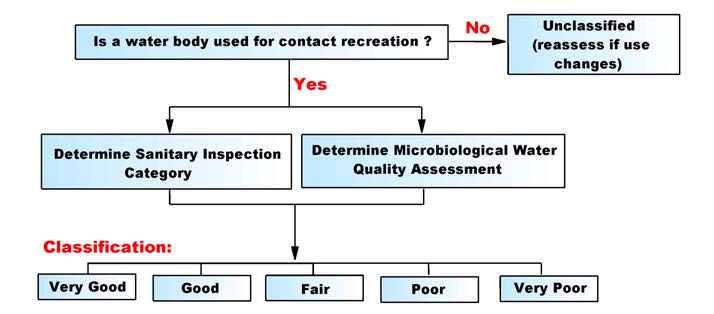
TABLE 4.5:
The World Health Organisation Recreational Classification system
Microbiological Quality Assessment Category
(95th percentile enterococci/100 ml)
A
B
C
D
Exceptional
(<40)
(41-200)
(201-500)
(>500)
circumstances
Very Low
Very good
Very good
Fair
Follow-up
Low
Very Good
Good
Fair
Follow-up
Sanitary
Moderate
Good Good Fair Poor Action
Inspection
High
Good Fair Poor
Very
poor
Category
Very high
Follow-up Fair Poor Very
poor
Exceptional
Action
circumstances
NOTE
In the microbial water quality assessment, the sampling programme should be representative of the range
of conditions in the recreational water environment while it is being used, and a sufficient number of
samples should be collected. The precision of the estimate of the 95th percentile is higher when sample
numbers are increased. For example, the number of results available can be increased significantly by
pooling data from multiple years, unless there is reason to believe that local (pollution) conditions have
changed. For practical purposes, data on at least 100 samples from a 5-year period and a rolling 5-year
data set can be used for water quality assessment purposes.
Figure 4.1:
The recreational beach grading process of the WHO (adapted from WHO, 2003)
In terms of day-to-day management, this approach also provides a means of assessing
whether immediate actions need to be implemented to reduce exposure. For example,
managers can identify periods when water quality is poor and then ensure that advisory
notices are put out warning the public of increased risk. The management component of this
approach has been further developed as part of the New Zealand guidelines (see below).
BCLME Project BEHP/LBMP/03/04
Page 4-12
Section 4
January 2006
Final
In essence, this approach is seen to have the benefit of protecting public health, but also of
providing the potential both to improve the classification of a location through low-cost
measures as well as to enable the safe use of areas for certain periods that might otherwise
be considered inappropriate for recreational use.
New Zealand also applies the WHO approach with some modifications. In the case of New
Zealand, recreational areas are also classified in terms of a qualitative risk grading of the
catchment (sanitary survey), supported by the direct measurement of appropriate faecal
indicators (microbiological quality assessment) (New Zealand Land Ministry of Environment,
2003).
In addition, alert and action guideline levels are used for surveillance throughout the bathing
season (i.e. for the day-to-day management). The `Suitability for Recreation Grade' is
allocated to a site through a risk assessment approach, by combining historical
microbiological results and sanitary inspection information, which provide an assessment of
the condition at any given time. Single samples are used to identify any immediate health
risk as part of the day-to-day management of recreational beaches. For New Zealand, the
grading, surveillance, alert and action process is illustrated in Figure 4.2.
A detailed Catchment Assessment (or Sanitary Survey) checklist is provided in the New
Zealand Guideline Document (New Zealand Minister of Environment, 2003).
BCLME Project BEHP/LBMP/03/04
Page 4-13
Section 4
January 2006
Final
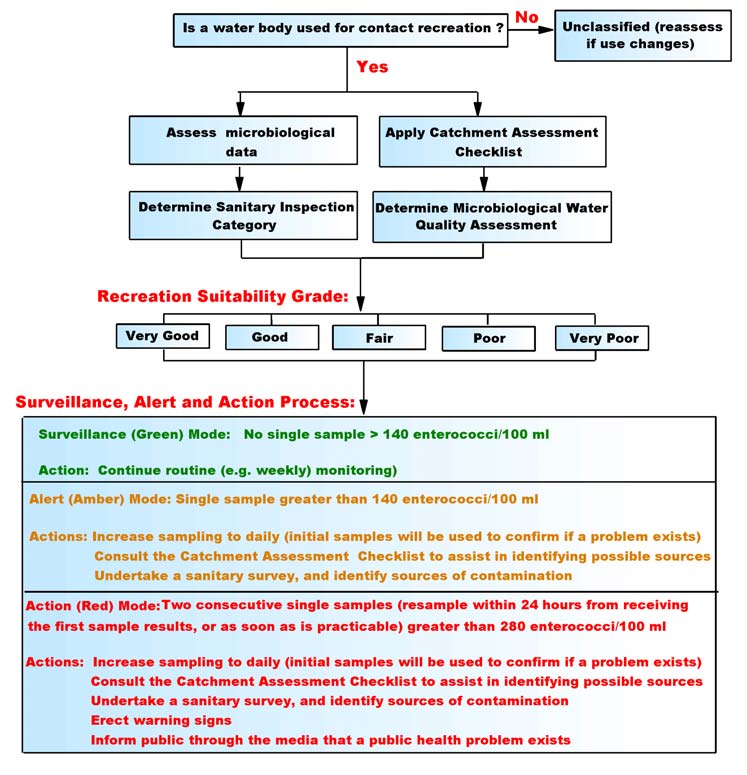
Figure 4.2:
New Zealand grading and surveillance, alert and action process for the
management of recreational use of marine waters
(adapted from New Zealand Land Ministry of Environment, 2003)
4.3.2 European Union Approach
In the European Union, bathing water target values are set as binding standards and
incorporated in European environmental legislation, namely Council Directive on Bathing
Water Quality (CEC, 1976a). In 2002, the Commission adopted a proposal for a revised
Directive of the European Parliament and of the Council concerning the Quality of Bathing
Water (CEC, 2002).
Similar to the WHO approach, the revised Directive proposes that beaches be classified, in
this instance, as "Poor", "Good" or "Excellent" (mainly based on microbiological and
aesthetic qualities). At the end of each bathing season, monitored data collected during the
BCLME Project BEHP/LBMP/03/04
Page 4-14
Section 4
January 2006
Final
last three years are assessed. The requirements for different classes are illustrated in Table
4.6.
TABLE 4.6:
The European Union Recreational Classification system (CEC, 2002)
EXCELLENT
GOOD
POOR
Enterococci (95 percentile)
<100 cfu/100 ml
< 200 cfu/100 ml
> 200 cfu/100 ml
or
E. coli (95 percentile)
< 250 cfu/100 ml
< 500 cfu/100 ml
> 500 cfu/100 ml
Phytoplankton blooms & macro-algae
proliferation (where physically sensitive
to such occurrences), either based on
- Negative
result -
cell counts, toxicity test or visual
inspections (95 percentile)
Mineral oils (visual & olfactory
No film visible on
inspection)
-
surface of water
-
and no odour
Tarry residues and floating materials
such as wood, plastic, glass, rubber or
any other waste substance (Visual
- Absence -
inspection)
Length of bathing season and
management measures reflect other
Yes - -
recreational activities practised
cfu = colony forming unit
The Commission further proposes a legally binding Good Quality value and an Excellent
Quality guide value for intestinal Enterococci and E. coli concentration in bathing waters.
Therefore, a minimum classification of Good and full monitoring of all parameters are
needed to ensure that bathing water conforms to the Directive. However, if a Good
classification cannot be reached, a bathing beach will still be regarded as conforming to the
Directive on condition that appropriate measures are taken to bring the water quality into
compliance within a three-year period. Measures must also be taken to inform the public and
to prevent human exposure to pollution. The revised Directive also proposes that member
states consult and allow all interested parties to participate in the classification process
(CEC, 2002).
NOTE:
To prevent misinterpretation, the revised EC Directive proposes that statistical data analysis of the 95
percentile be conducted as follows (CEC, 2002):
· take the log10 value of all bacterial enumerations in the data sequence to be evaluated
· calculate the arithmetical mean of the log10 values (µ)
· calculate the standard deviation of the log10 values ().
The upper 95 percentile point of the data probability density function is derived from the following
equation: 95 percentile = antilog ((µ)+(1.65 x )).
BCLME Project BEHP/LBMP/03/04
Page 4-15
Section 4
January 2006
Final
4.3.3 Blue Flag Campaign
The Blue Flag campaign is an international initiative that was started in the mid-1980s to
encourage local authorities to provide clean and safe beaches for local populations and
tourists (UNEP, 1996). It is a voluntary and non-punitive scheme and is targeted at local
authorities, the general public and the tourism industry. The main objectives of the Blue Flag
campaign are to:
· improve understanding of the coastal environment
· promote the incorporation of environmental issues in the decision-making processes of
local authorities and their partners.
In essence, beaches that meet specific criteria are annually awarded a Blue Flag, which can
be used as part of the local tourism marketing strategy. Areas for which specific criteria are
assigned are:
· water quality
· beach management and safety
· environmental information and education.
Although not legally required, South Africa (through its Department of Environmental Affairs
and Tourism) initiated the Blue Flag Campaign to encourage socio-economic development
and to improve coastal livelihoods through better management of marine and coastal-related
resources. Detailed criteria differ slightly from one region to another. For example, the
South African criteria for water quality are listed in Table 4.7 (FEE, 2004).
BCLME Project BEHP/LBMP/03/04
Page 4-16
Section 4
January 2006
Final
TABLE 4.7
Blue Flag Campaign: South African Criteria related to Water Quality
CRITERIA
CRITERIA AIM
GUIDANCE NOTES
· In order to be eligible for the Blue Flag award, a
beach must comply with the bathing water quality
requirements in the previous Blue Flag season
· Samples must be taken every 2 weeks during the
Blue Flag season
· Sampling must begin 2 weeks before the start of
the Blue Flag season
· Samples should be taken where the daily
average density of bathers is highest. If the
beach is long and/or there are possible sources
of pollution (e.g. outlets), additional samples must
be taken. Samples should preferably be taken 30
The Blue Flag beach must
Compliance with
cm below the surface of the water
comply with recreational
recreational
bathing water quality
·
An independent accredited laboratory is
bathing water
standards for faecal
responsible for the samplings and must
quality
coliform
undertake all sample analyses.
· Faecal coliform: Guideline value: 100/100 ml
(max 20% of the test results higher than the
guideline value). Imperative values: 2000/100 ml
(max 5% of the test results higher than the
imperative value)
· If compliance with the guideline and imperative
values cannot be met during a Blue Flag season,
the Flag must immediately be withdrawn
· The results of the analyses must be displayed in
the water quality display on the Notice Board
(icons with smiling and frowning faces plus date)
Outlets must be clean at all times. Check daily
Ensure that a beach area
During stormwater flows, clean outlets and
Management of
has no pollution from
surrounding areas daily
stormwater
stormwater or any other
pollution
When regular water sampling coincides with storm-
effluents
water flows, then water samples must also be taken
in storm-water outlets
Compliance with
Provide a statement that all requirements of the
Ensure that oil pollution
National Oil
National Oil Spill Contingency Plan are met
contingency plans are in
Pollution
place, up to date and ready
Contingency
In case of oil pollution, implement the Oil Spill
for implementation
Plans
Contingency Plan
The applicable Planning or Building Department of
the local authority must provide a written statement
All Blue Flag beaches must that all buildings on the Blue Flag beach meet local
Compliance with
comply with the applicable
building regulations
Planning
building regulations and
All new developments must follow the Integrated
Legislation
environmental management Environmental Management (IEM) procedure as
procedures
stipulated by the Integrated Environmental
Management procedures available from the
DEAT
BCLME Project BEHP/LBMP/03/04
Page 4-17
Section 4
January 2006
Final
4.3.4 Canada
The holistic approach followed by Canada in assessing and managing the quality of
recreational waters includes the following (CMNHW, 1992):
· Environmental health assessments. An annual assessment is carried out prior to the
bathing season in order to identify all potential sources of contamination and physical
hazards that could affect the recreational area.
· Epidemiological evidence. Wherever possible, surveillance for bather illness or injuries is
established, which can either be comprehensive epidemiological studies or formal and
informal reporting from physicians and hospital emergency departments.
· Indicator organism monitoring. Routine microbiological monitoring of a recreational area
is carried out, the frequency of which is determined by the usage of the area, the
environmental health assessment, and epidemiological evidence.
· Presence of pathogens. Tests for pathogenic organisms are carried out when there have
been reports of illnesses, when there is suspected illness of undetermined cause, or
when levels of an indicator organism demonstrate a continuous suspected hazard.
Proposal for the BCLME region:
It is proposed that the BCLME region adopt a beach classification system, rather than the
traditional approach of classifying recreational waters as either safe or unsafe (based on a
percentage compliance with a faecal indicator organism). With reference to water quality, the
classification should be based on both a sanitary survey as well as routine microbiological
surveys. The classification rating should be re-evaluated on an annual basis.
As it is envisaged that there will not be sufficient epidemiological data from the BCLME region to
customise such systems, it is recommended that the classification system of the WHO (2003) and
New Zealand (New Zealand Minister of Environment, 2003) be adopted, as it is currently the
most widely used in the world.
In addition to a classification system, it is also recommended that a day-to-day management
system be adopted. In this regard, the New Zealand approach is considered to be most useful
(New Zealand Minister of Environment, 2003).
Where beaches are earmarked as (international) tourist destinations, authorities are encouraged
to subscribe to the Blue Flag, not only to provide safe beaches, but also as a marketing tool..
BCLME Project BEHP/LBMP/03/04
Page 4-18
Section 4
January 2006
Final
SECTION 5.
INTERNATIONAL REVIEW - WATER QUALITY
GUIDELINES FOR INDUSTRIAL USE
BCLME Project BEHP/LBMP/03/04
Page 5-1
Section 6
January 2006
Final
Water quality guidelines for industrial uses of coastal marine water, other than marine
aquaculture, do not seem to be addressed explicitly in other international guideline
documents. The South African guidelines do provide limited guidelines for different industrial
uses, realising that these are very much dependent on the type of industry (DWAF, 1995b).
These guidelines recognise the following activities as industrial (beneficial) uses of marine
water that require an acceptable water quality:
· Seafood
processing
· Salt
production
· Desalination
· Aquariums and oceanariums
· Harbours and ports
· Cooling water intake
· Ballast water intake
· Coastal
mining
· Make-up water for offshore marine outfalls
· Exploration
drilling
· Scaling
and
scrubbing.
The water quality guidelines for these uses are mainly focused on water quality matters
related to industrial processes, i.e. where water quality may interfere with the mechanical
operations or with the industrial processes. In the industrial uses of seawater, additional
factors may also be of importance, e.g. human health aspects where the products will be
used for human consumption, or biological health, where marine organisms are included in
the process.
ANZECC (2000) concluded, after extensive consultation with representative industrial
groups, that no specific guidance for industrial water use will be provided, because industrial
water requirements are so varied (both within and between industries) and sources of water
for industry have other coincidental environmental values that tend to drive management of
the resource. However, industrial water use continues to be a recognised environmental
value that has high economic benefit and must therefore be given adequate consideration
during the planning and management of water resources.
Proposal for the BCLME region:
It is proposed that industrial water use be recognised as a (beneficial) use of marine waters in the
BCLME region. However, as a result of the large variation in water quality requirements that
are mainly driven by specific processes and technologies applied by industries, water quality
guideline values should be derived site-specifically, based on the specific requirements of
industries in the area.
BCLME Project BEHP/LBMP/03/04
Page 5-2
Section 6
January 2006
Final
SECTION 6.
RECOMMENDED WATER AND SEDIMENT
QUALITY GUIDELINES FOR COASTAL AREAS IN
THE BCLME REGION
BCLME Project BEHP/LBMP/03/04
Page 6-1
Section 6
January 2006
Final
6.1 RECOMMENDED BENEFICIAL USES
The ultimate goal in marine water quality management is to keep the marine environment
suitable (or fit) for all designated uses. To achieve this goal, the quality objectives set for a
particular marine environment should be aimed at protecting the biodiversity and functioning
of marine aquatic ecosystems, as well as designated uses of the marine environment (also
referred to as beneficial uses). It is proposed that three designated uses of marine waters
be recognised for the BCLME region, namely:
· Marine aquaculture (including collection of seafood for human consumption)
· Recreational use
· Industrial use.
The recommended water and sediment quality guidelines that are part of this section provide
guidance to managers, local governing authorities and scientists to set site-specific
environmental quality objectives within a study area for the protection of marine aquatic
ecosystems and other designated uses.
A summary of the constituent categories, for which recommended water and sediment
quality are provided for different designated uses, as part of this study, is given in Table 6.1.
TABLE 6.1:
Summary of constituent categories for the recommended water and sediment
quality for different designated uses
MARINE
MARINE
INDUSTRIAL
TYPE OF QUALITY GUIDELINE
AQUATIC
RECREATION
AQUACULTURE
USES*
ECOSYSTEMS
Objectionable Matter/ Aesthetics
Yes Yes
Physico-chemical variables
Yes
Refer to Marine
Aquatic Ecosystem
Refer to Drinking
Water
Nutrients
Yes
Guidelines
Water Guidelines
Based on site-
Toxic substances
Yes
specific
requirements of
Microbiological indicators
- Yes
Yes
industrial use in
the area
Tainting substances
-
Yes
-
Refer to Marine
Sediment
Toxic Substances
Yes
Aquatic Ecosystem
-
Guidelines
* Refer to Section 5
BCLME Project BEHP/LBMP/03/04
Page 6-2
Section 6
January 2006
Final
As a rule of thumb, it is recommended that the following simple application rules apply:
1. Compliance with quality guideline values for the Protection of marine aquatic ecosystems
should be aimed at in all coastal waters, except in approved sacrificial zones, e.g. near
wastewater discharges and certain areas within harbours.
2. In addition to (1), the classification system recommended for Marine aquaculture should
be applied in areas where shellfish are collected or cultured for human consumption so
as to manage human health risks. The assumption is that the health of the organisms is
catered for under the Protection of marine aquatic ecosystems (referring to 1).
3. In addition to (1), the aesthetic quality guidelines, as well as the classification system
ranking waters in terms of human health risks for Recreational use, should be applied in
relevant areas. With reference to toxic substances, it is recommended that suitable
Drinking water quality guidelines be consulted to make preliminary risk assessments,
where these substances are expected to present at levels that could pose a risk to
human health (following the example of the WHO, 2003).
4. In addition to (1), site-specific water quality guidelines, based on the requirements of
local industries, should be applied, where and if applicable.
6.2 RECOMMENDED
WATER
QUALITY GUIDELINES:
PROTECTION OF MARINE AQUATIC ECOSYSTEMS
6.2.1 Approach and Methodology
Water quality guidelines for the protection of aquatic ecosystems are recommended for the
following constituent categories:
· Objectionable matter
· Physico-chemical
variables
· Nutrients
· Toxic
substances.
i. Objectionable
matter
For objectionable matter, it is recommended that the narrative quality guideline from South
Africa be adopted (DWAF, 1995b) (Table 6.2).
BCLME Project BEHP/LBMP/03/04
Page 6-3
Section 6
January 2006
Final
TABLE 6.2
Recommended water quality guidelines for objectionable matter (aesthetic) for
coastal areas in the BCLME region
PROPERTY
PROPOSED GUIDELINE
Water should not contain litter, floating particulate matter, debris, oil, grease, wax,
scum, foam or any similar floating materials and residues from land-based
sources in concentrations that may cause nuisance.
Water should not contain materials from non-natural land-based sources which
will settle to form objectionable deposits.
Aesthetics
Water should not contain submerged objects and other subsurface hazards which
arise from non-natural origins and which would be a danger, cause nuisance or
interfere with any designated/recognized use.
Water should not contain substances producing objectionable colour, odour, taste,
or turbidity.
ii. Physico-chemical
variables
Following the international trend and taking into account the large variability in the physico-
chemical characteristics of marine aquatic ecosystems within the BCLME region, it is
recommended that water quality guideline values for physico-chemical variables be based
on the Reference system data and/or Biological and ecological effects data approaches
(refer to Section 1, Chapter 2).
As it is envisaged that biological and ecological effect data for most physico-chemical
variables will be limited for the BCLME region, it is recommended that the emphasis be
placed on the Reference system data approach and methodology, as applied in ANZECC
(2000). This method uses an appropriate percentile (i.e. 20th and/or 80th percentile) of the
physico-chemical data collected from a specific site (or an appropriate reference site) to
derive water quality guideline value/s. The best approach is to capture such data from a
specific area prior to anticipated changes, through well-designed baseline measurement
programmes.
Where few reference data are available and seasonal and event influences poorly defined,
single guideline values could be derived from available data based on professional
judgement, as an interim measure.
NOTE:
The South African guidelines provide mainly narrative statements for physico-chemical variables which
can easily be accommodated in the above-mentioned approach. Where numerical guidelines are provided,
the approach and methodology whereby these were derived are not clear (RSA DWAF, 1995). A more
transparent approach is therefore proposed for the larger BCLME region.
BCLME Project BEHP/LBMP/03/04
Page 6-4
Section 6
January 2006
Final
The recommended water quality guidelines for physico-chemical variables for the BCLME
region are provided in Table 6.3.
TABLE 6.3
Recommended water quality guidelines for physico-chemical variables in
coastal areas of the BCLME region
VARIABLE
PROPOSED WATER QUALITY GUIDELINE
Where an appropriate reference system(s) is available, and there are sufficient
data for the reference system, the guideline value should be determined as the
Temperature
range defined by the 20%ile and 80%ile of the seasonal distribution for the
reference system. Test data: Median concentration for the period
Where an appropriate reference system(s) is available, and there are sufficient
data for the reference system, the guideline value should be determined as the
Salinity
20%ile or 80%ile of the reference system(s) distribution, depending upon
whether low salinity or high salinity effects are being considered. Test data:
Median concentration for the period
Where an appropriate reference system(s) is available, and there are sufficient
data for the reference system, the guideline value range should be determined
as the range defined by the 20%ile and 80%ile of the seasonal distribution for
the reference system.
pH
pH changes of more than 0.5 pH units from the seasonal maximum or minimum
defined by the reference systems should be fully investigated.
Test data: Median concentration for the period
Turbidity
Where an appropriate reference system(s) is available and there are sufficient
data for the reference system, the guideline values should be determined as the
80%ile of the reference system(s) distribution.
Suspended solids
Additionally, the natural euphotic depth (Zeu) should not be permitted to change
by more than 10%.
Test data: Median concentration for period
Where an appropriate reference system(s) is available, and there are sufficient
data for the reference system, the guideline value should be determined as the
20%ile of the reference system(s) distribution.
Dissolved oxygen
Where possible, the guideline value should be obtained during low flow and high
temperature periods when DO concentrations are likely to be at their lowest.
Test data: Median DO concentration for the period, calculated by using the
lowest diurnal DO concentrations
Monthly data collected over a two-year period are considered to be sufficient to indicate
ecosystem variability and can be used to derive guideline values for variables that do not
show large seasonal or event-scale effects. However, in ecosystems in which
concentrations of physico-chemical variables and the ecological and biological responses
can be influenced by strong seasonal andscale effects, it will be necessary to monitor
(and/or model) so as to detect these seasonal influences or events. Therefore, where
BCLME Project BEHP/LBMP/03/04
Page 6-5
Section 6
January 2006
Final
seasonal or event-driven processes dominate, data need to be grouped and guideline values
need to be derived for corresponding key periods.
The concept of using 20th or the 80th percentiles of the reference system(s) distribution is
schematically illustrated below:
iii. Nutrients
Taking into account that the impact of nutrients on aquatic ecosystems occurs through
transformations and there may, therefore, not be a direct relationship between the ambient
nutrient concentration and the biological response, it is recommended that the Predictive
modelling approach be the preferred method for setting site-specific water quality guidelines
in the BCLME region (refer to Section 1, Chapter 2). To be able to derive guideline values
for nutrients, it is necessary to also set target values for parameters that could be impacted
on, for example, chlorophyll a (indicator of algal blooms), turbidity (as a result of algal
blooms) and dissolved oxygen (affected by organic nutrient inputs and subsequent
degradation of algal biomass). The recommended water quality guidelines for nutrients,
(and related parameters) for the BCLME region are provided in Table 6.4.
BCLME Project BEHP/LBMP/03/04
Page 6-6
Section 6
January 2006
Final
TABLE 6.4
Recommended water quality guidelines for nutrients in coastal
areas of the BCLME region
VARIABLE
PROPOSED WATER QUALITY GUIDELINE
Where an appropriate reference system(s) is available and there are
Chlorophyll a
sufficient data for the reference system, the guideline value should be
determined as the 80%ile of the reference system(s) distribution.
Dissolved oxygen
Refer to Table 6.3
Turbidity
Refer to Table 6.3
Nutrient concentrations in the water column should not result in chlorophyll a,
turbidity and/or dissolved oxygen levels that are outside the recommended
water quality guideline range (see above). This range should be established
by using either suitable statistical or mathematical modelling techniques.
Nutrients
Alternatively, where a modelling approach may be difficult to implement,
nutrient concentrations can be derived using the Reference system data
approach: Where an appropriate reference system(s) is available and there
are sufficient data for the reference system, the guideline value should be
determined as the 80%ile of the reference system(s) distribution.
Where few reference data are available and seasonal and event influences poorly defined,
single guideline values could be derived from available data (e.g. information from related
areas linking ambient, natural nutrient levels with period of algal blooms) based on
professional judgement, as an interim measure (i.e. until such time as measurement
programmes can be implemented to obtain the desired data).
NOTE:
The South African guidelines provide only a broad narrative statement with regard to nutrients and could
easily be accommodated in the above-mentioned approach (RSA DWAF, 1995b).
iv. Toxic
substances
For the BCLME region, the Australian and New Zealand approach and methodology are
recommended (ANZECC, 2000): In the process of determining a suitable approach and
methodology, ANZECC (2000) conducted a critical review of procedures followed elsewhere,
many of which are also discussed in this document. Their approach and method are also
considered to be most conservative (or rigorous), in that guideline values are derived from
No-observable-effects concentration (NOEC) data, rather than Lowest-observable-effects
concentration (LOEC) data (as is the case in Canada) (refer to Section 1, Chapter 2).
As it is unlikely that there will be sufficient (and appropriate) toxicological data available from
the BCLME region to derive specific guideline values, it is further recommended that the
Australian and New Zealand guideline values for toxic substances be adopted until such
time as these could be refined for the region (ANZECC, 2000). These are the only
guidelines that were refined with data from the southern hemisphere, making them more
BCLME Project BEHP/LBMP/03/04
Page 6-7
Section 6
January 2006
Final
appropriate to the BCLME region compared with values that were developed for northern
hemisphere data only (e.g. for USA, Canada and Europe).
The recommended water quality guidelines for toxic substances for the BCLME region are
listed in Table 6.5.
TABLE 6.5
Recommended water quality guidelines for toxic substances for coastal areas
in the BCLME region (current South African guideline values listed in
brackets where available)
TOXIC SUBSTANCES
RECOMMENDED GUIDELINE VALUE in µg/
Total Ammonia-N
910 (600)
Total Residual Chlorine-Cl
3
Cyanide (CN-) 4
(12)
Fluoride(F-)
(5 000)
Sulfides (S-)
1
Phenol 400
Polychlorinated Biphenyls (PCBs)
0.03*
Trace metals (as Total metal):
Arsenic
As(III) - 2.3; As(V) - 4.5 (12)
Cadmium
5.5 (4)
Chromium
Cr (III) - 10; Cr (VI) - 4.4 (8)
Cobalt 1
Copper
1.3 (5)
Lead
4.4 (12)
Mercury
0.4 (0.3)
Nickel
70 (25)
Silver
1.4 (5)
Sn (as Tributyltin)
0.006
Vanadium 100
Zinc
15 (25)
Aromatic Hydrocarbons (C6-C9 simple hydrocarbons - volatile):
Benzene (C6)
500
Toluene (C7)
180
Ethylbenzene (C8)
5
Xylene (C8)
Ortho - 350; Para - 75; Meta - 200
Naphthalene (C9)
70
Poly-Aromatic Hydrocarbons (< C15 - acute toxicity with short half-life in water)
Anthracene (C14)
0.4
Phenanthrene (C14)
4
Poly-Aromatic Hydrocarbons (> C15, chronic toxicity, with longer half-life in water)
Fluoranthene (C15)
1.7
Benzo(a)pyrene (C20)
0.4
Pesticides:
DDT
0.001
Dieldrin
0.002
Endrin
0.002
*
No values are recommended in ANZECC (2000) interim values derived from the US-EPA
criteria (2002a)
NOTE:
Although the target values recommended for South Africa (RSA DWF, 1995b) (listed in brackets in
Table 6.5) are within the same order as most of the ANZECC guidelines, the selection criteria of the South
African guidelines are not transparent, other than that Maximum Acceptable Toxicant Concentrations
(MATC) were used the South African values were also last updated in 1984. For the larger BCLME
region, it is therefore recommended that a more recent and more transparent approach be selected.
BCLME Project BEHP/LBMP/03/04
Page 6-8
Section 6
January 2006
Final
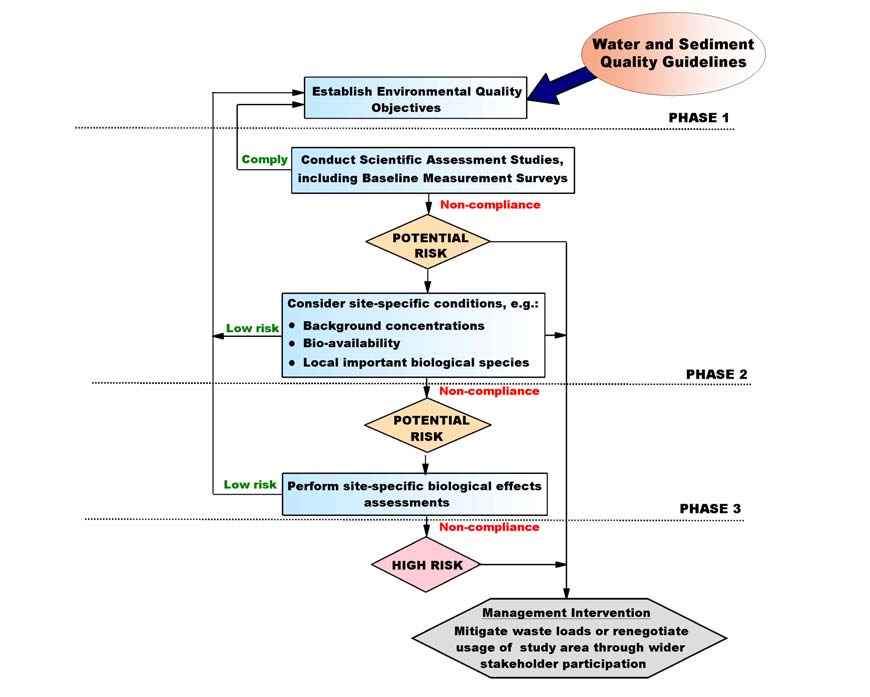
6.2.2 Protocol for Implementation
Following international best practice, it is recommended that water quality guidelines for the
protection of marine aquatic ecosystems in the BCLME region be applied as benchmarks,
following a risk assessment or phased approach as illustrated in Figure 6.1.
Figure 6.1:
Schematic illustration of the recommended implementation process of
recommended water quality guidelines in the coastal zone of the BCLME region
Where scientific assessments studies or monitoring results reveal that recommended quality
guideline values are exceeded, this should trigger the incorporation of additional information
or further investigation to determine whether or not a real risk to the ecosystem exists, and,
where necessary, to adjust the guideline values for site-specific conditions (refer to Section
1, Chapter 3).
Quality guideline values should be compared with the median of the measured or simulated
data set. Where a guideline value was based on professional judgement, the rationale for
the selection of such a value should be provided and a process should be put in place
BCLME Project BEHP/LBMP/03/04
Page 6-9
Section 6
January 2006
Final
whereby the adopted value is reviewed and supported or modified in light of emerging
information, following the principle of adaptive management.
6.3 RECOMMENDED SEDIMENT QUALITY GUIDELINES:
PROTECTION OF MARINE AQUATIC ECOSYSTEMS
6.3.1 Approach and Methodology
Sediment quality guideline values are generally only specified for the protection of aquatic
ecosystems, in particular for toxic substances.
For the BCLME region, it is recommended that the Canadian protocol (which incorporates
the National Trends and Status Program Approach) be adopted for the derivation of
sediment quality guidelines (CCME, 1995). Although this approach does have limitations (as
discussed earlier), it appears to be accepted worldwide as the preferred option (CCME,
1995; NOAA, 1999; ANZECC, 2000) (refer to Section 2, Chapter 2).
Whilst it is unlikely that there will be sufficient (and appropriate) toxicological data available
from the BCLME region to refine sediment guideline values, it is further recommended that
the NOAA guidelines (TEL/PEL), as per MacDonald et al. (1996), be adopted as interim
sediment quality guidelines for toxic substances until such time as these could be refined for
the region. MacDonald et al. (1996) expanded the original database used by Long et al.
(1995) with additional data on saltwater and also revised the database by carefully screening
data.
Also, studies on the reliability and predictability of these thresholds found that they provided
reliable and predictive tools for identifying concentrations of chemicals in sediments that are
unlikely to be associated with adverse biological effects (to test predictability a large
independent data set compiled from studies of the Atlantic, Gulf and Pacific coasts was
used). It was concluded that these guidelines provide a scientifically defensible basis for
assessing the quality of soft sediments in marine and estuarine environments (Long and
MacDonald, 1998).
The recommended (interim) sediment quality guidelines for toxic substances for the BCLME
region are listed in Table 6.6.
BCLME Project BEHP/LBMP/03/04
Page 6-10
Section 6
January 2006
Final
TABLE 6.6
Recommended interim sediment quality guidelines for the Protection of marine
aquatic ecosystems in coastal areas of the BCLME region
TOXIC SUBSTANCES
RECOMMENDED
PROBABLE
GUIDELINE VALUE
EFFECT CONCENTRATION
TRACE METALS (mg/kg dry weight)
Antimony
-
-
Arsenic
7.24
41.6
Cadmium
0.68
4.21
Chromium 52.3
160
Copper
18.7
108
Lead
30.2
112
Mercury
0.13
0.7
Nickel
15.9
42.8
Silver
0.73
1.77
Tin as Tributyltin-Sn*
0.005
0.07
Zinc
124
271
TOXIC ORGANIC COMPOUNDS (µg/kg dry weight normalized to 1% organic carbon)
Total PAHs
1684
16770
Low Molecular PAHs
312
1442
Acenaphthene
6.71
88.9
Acenaphthalene
44
640
Anthracene
46.9
245
Fluorene
21.2
144
2-methyl naphthalene
-
-
Naphthalene
34.6
391
Phenanthrene
86.7
544
High Molecular Weight PAHs
655
6676
Benzo(a)anthracene
74.8
693
Benzo(a) pyrene
88.8
763
Dibenzo(a,h)anthracene
6.22
135
Chrysene
108
846
Fluoranthene
113
1494
Pyrene
153
1398
Toxaphene
-
-
Total DDT
3.89
51.7
p p DDE
2.2
27
Chlordane 2.26
4.79
Dieldrin 0.72
4.3
Total PCBs
21.6
189
*
Guidelines for tributyltin were estimated on the basis of equilibrium partitioning, based on data summarised
from the US-EPA (ANCEZZ, 2000)
By deriving two threshold values (i.e. a recommended guideline value and a probable effect
concentration), three ranges of concentration are defined, namely, those that are rarely,
occasionally and frequently associated with adverse biological effects as illustrated below:
BCLME Project BEHP/LBMP/03/04
Page 6-11
Section 6
January 2006
Final
6.3.2 Protocol for Implementation
Similar to the implementation practice recommended for water quality guidelines, it is
recommended that sediment quality guidelines for the BCLME region be applied as
benchmarks, following a risk assessment or phased approach: When scientific assessment
studies or monitoring indicate that the recommended quality guideline values are exceeded,
this should trigger the incorporation of additional information or further investigation to
determine whether or not a real risk to the ecosystem exists, and, where necessary, to
adjust the guideline values for site-specific conditions (refer to Section 2, Chapter 3). The
recommended approach is schematically illustrated in Figure 6.1.
As with water quality guidelines, sediment quality guidelines are valuable tools for assisting
in managing complex systems (such as an aquatic marine ecosystem) in a phased
approach. As part of the initial phase, guidelines provide a means of `screening' for potential
adverse biological effects related to sediment quality.
BCLME Project BEHP/LBMP/03/04
Page 6-12
Section 6
January 2006
Final
6.4 RECOMMENDED
WATER
QUALITY GUIDELINES: MARINE
AQUACULTURE
6.4.1 Approach and Methodology
In terms of water quality guidelines for marine aquaculture, the following key issues are
considered:
· Protection of the health of the aquatic ecosystem so as to ensure sustainable
production and quality of products
· Protection of the health of human consumers
· Tainting of seafood products.
With reference to the protection of aquatic organisms used in the culture and harvesting of
seafood, it is recommended that the water quality guidelines proposed for the Protection of
aquatic ecosystems be applied (refer to Section 6, Chapter 1), rather than developing a
separate series of quality guidelines. This simplified approach seems to be the international
trend, particularly where these activities rely on natural stocks. It is also current practice in
South Africa (RSA DWAF, 1995b).
With reference to the protection of human consumers, it is proposed that the allowable limits
of toxic substances and human pathogens in food products be controlled through legislation,
as is the norm internationally (refer to Section 3, Chapter 2). Where such standards are
currently not in place in countries in the BCLME region, it is recommended that the relevant
government departments be approached to initiate such legislation.
In terms of shellfish growing areas, it is proposed that the water quality guidelines put
forward by the US-EPA (and which have been adopted by most other countries) also be
adopted for the BCLME region (US-EPA, 1986a) (Table 6.7). However, these guidelines
must be supported by a sanitary survey (as is illustrated in Chapter 4.2 of this Section), as
well as legislation specifying acceptable quality of shellfish meat (see above).
BCLME Project BEHP/LBMP/03/04
Page 6-13
Section 6
January 2006
Final
NOTE:
Shellfish exported to the European Union must comply with the standards laid down in the
Shellfish Directive (CEC, 1991).
In the USA, shellfish imports must meet both Federal and State requirements to gain free access
to US markets. In addition, fresh and fresh frozen molluscan shellfish products must meet the
specific temperature, microbiological, and identification standards contained in the NSSP. The
NSSP standards have been adopted into state law and are enforced by both federal and state
officials. The NSSP standards apply equally to both domestic and imported fresh and frozen
shellfish (FDA, 2003).
TABLE 6.7
Recommended microbiological indicator guidelines for areas where shellfish
are collected or cultured for direct human consumption in the BCLME region
INDICATOR
PROPOSED WATER QUALITY GUIDELINE
Median concentrations should not exceed 14 Most Probable Number (MPN)
Faecal coliform
per 100 ml with not more than 10% of the samples exceeding 43 MPN per 100
ml for a 5-tube, 3-dilution method.
NOTE:
The target values recommended for South Africa (DWAF, 1995b) differ slightly:
Maximum acceptable faecal coliform count should be (using the membrane filtering technique):
· 20 for 80% of the samples (i.e. median values)
· 60 in 90% of the samples (i.e. less than 10 % should exceed this value)
The 1984 guideline values that were recommended for shellfish water for South Africa closely resembled
those of the US-EPA and others (Lusher, 1984):
Maximum acceptable faecal coliform count should be:
· 15 for 50% of the samples (i.e. median values)
· 45 in 90% of the samples (i.e. less than 10 % should exceed this value)
In 1992, the Water Research Commission convened a two-day workshop to review these guidelines. This
workshop was attended by a broad spectrum of representatives from the scientific/engineering community,
national and local authorities, industries and environmental organisations (DWAF, 1992). At this
workshop, specialists modified the South African guidelines to the current values. Unfortunately, no clear
reasoning for this change was documented at the time.
Estimated threshold concentrations for tainting substances, as listed for South Africa,
Australia and New Zealand and by the US-EPA (RSA, DWAF, ANCEZZ, 2000; US-EPA,
2002a), can also be used to provide guidance in the BCLME region (Table 6.8).
BCLME Project BEHP/LBMP/03/04
Page 6-14
Section 6
January 2006
Final
TABLE 6.8
Recommended guidelines for tainting substances in areas used for marine
aquaculture in the BCLME region
TAINTING SUBSTANCE
THRESHOLD CONCENTRATIONS ABOVE WHICH
TAINTING IS LIKELY TO OCCUR (mg/)
Acenaphthene
0.02
Acetophenone
0.5
Acrylonitrile
18
Copper
1
m-cresol
0.2
o-cresol
0.4
p-cresol
0.12
Cresylic acids (meta, para)
0.2
Chlorobenzene
-
n-butylmercaptan
0.06
o-sec. butylphenol
0.3
p-tert. butylphenol
0.03
2-chlorophenol 0.001
3-chlorophenol 0.001
3-chlorophenol 0.001
o-chlorophenol
0.001
p-chlorophenol
0.01
2,3-dinitrophenol
0.08
2,4,6-trinitrophenol
0.002
2,3 dichlorophenol
0.00004
2,4-dichlorophenol
0.001
2,5-dichlorophenol
0.023
2,6-dichlorophenol
0.035
3,4-dichlorophenol
0.0003
2-methyl-4-chlorophenol
0.75
2-methyl-6-cholorophenol
0.003
3-methyl-4-chlorophenol
0.02 3
o-phenylphenol
1
Pentachlorophenol
0.03
Phenol
1
2,3,4,6-tetrachlorophenol
0.001
2,4,5-trichlorophenol 0.001
2,3,5-trichlorophenol
0.001
2,4,6-trichlorophenol
0.003
2,4-dimethylphenol
0.4
Dimethylamine
7
Diphenyloxide
0.05
B,B-dichlorodiethyl ether
0.09
o-dichlorobenzene
< 0.25
p-dichlorobenzene 0.25
Ethylbenzene
0.25
Momochlorobenzene 0.02
Ethanethiol
0.24
Ethylacrylate
0.6
Formaldehyde
95
Gasoline/Petrol
0.005
Guaicol
0.082
Kerosene
0.1
Kerosene plus kaolin
1
Hexachlorocyclopentadiene
0.001
Isopropylbenzene
0.25
BCLME Project BEHP/LBMP/03/04
Page 6-15
Section 6
January 2006
Final
TAINTING SUBSTANCE
THRESHOLD CONCENTRATIONS ABOVE WHICH
TAINTING IS LIKELY TO OCCUR (mg/)
Naphtha
0.1
Naphthalene
1
Naphthol
0.5
2-Naphthol
0.3
Nitrobenzene
0.03
a-methylstyrene
0.25
Oil, emulsifiable
15
Pyridine
5
Pyrocatechol
0.8
Pyrogallol
0.5
Quinoline
0.5
p-quinone
0.5
Styrene
0.25
Toluene
0.25
Outboard motor fuel as exhaust
0.5
Zinc
5
6.4.2 Protocol for Implementation
It is recommended that a classification system for shellfish growing areas be adopted for the
BCLME region (refer to Section 3, Chapter 3).
It is envisaged that the location of major export markets may eventually dictate the approach
that will have to be followed. It is, therefore, recommended that a dedicated task team,
consisting of marine aquaculture specialists and responsible authorities from the different
countries in the BCLME region, be convened to decide on the final approach for the
classification of shellfish growing areas in the BCLME (e.g. a task group). This process has
already been initiated as part of another project in the BCLME Programme (Project
EV/HAB/04/Shellsan Development of a shellfish sanitation programme model for
application in consort with the microalgal toxins component). This project is being
undertaken under the leadership of the Ministry of Fisheries and Marine Resources,
Namibia.
In the interim, unless dictated otherwise, it is recommended that the National Shellfish
Sanitation Program (NSSP) approach, applied by the United States Food and Drug
Administration, be followed for the classification of shellfish growing areas in the BCLME
region (US-FDA, 2003). This approach is considered to be the most practical in terms of
implementation, as it classifies areas on the basis of the condition of the waters in the
growing area, rather than, for example, the European Union's approach, which classifies
areas on the basis of levels of contaminants in shellfish flesh. The NSSP's approach is also
the most widely used internationally (refer to Section 3, Chapter 3). The NSSP approach
BCLME Project BEHP/LBMP/03/04
Page 6-16
Section 6
January 2006
Final
also tends to move away from the traditional approach of classifying waters as either safe or
unsafe for shellfish culture or harvesting (based on a percentage compliance with faecal
index organism) to a ranking approach.
The classification of coastal and estuarine areas for the harvesting of shellfish (e.g. clams,
oysters, scallops, mussels and other bivalve molluscs) is based on the results for Sanitary
Surveys that consist of:
· Identification and evaluation of all potential and actual pollution sources (Shoreline
Survey) -- this survey describes the studies required to identify and quantify pollution
sources and estimate the movement, dilution and dispersion of pollutants in the receiving
environment
· Monitoring of growing waters and shellfish to determine the most suitable classification
for the shellfish harvesting area (Bacteriological Survey) -- this survey refers to the
measurement of faecal indicator levels in the growing areas.
Resurveys are conducted regularly to determine if sanitary conditions have undergone
significant change.
The recommended classification system for the BCLME region is provided in Tables 6.9 and
6.10.
TABLE 6.9
Recommended (interim) classification system of shellfish growing areas in the
BCLME region
CLASS
DESCRIPTION
Approved
Approved areas need to be free from pollution and shellfish from such areas
are suitable for direct human consumption of raw shellfish.
Where areas are subjected to limited, intermittent pollution caused by
discharges from wastewater treatment facilities, seasonal populations, non-
point source pollution, or boating activity they can be classified as
conditionally approved or conditionally restricted.
However, it must be shown that the shellfish harvesting area will be open for
the purposes of harvesting shellfish for a reasonable period of time and the
Conditionally
factors determining this period are known, predictable and are not so complex
approved/restricted as to preclude a reasonable management approach.
When `open' for shellfish harvesting for direct human consumption, the water
quality in the area must comply with the limits as specified for `Approved' area.
When `closed' for direct consumption but `open' for harvesting for relaying or
depuration, the requirements of `Restricted' area must be met. At times when
the area is `closed' for all harvesting, then the requirements of `Prohibited
Areas' apply.
Restricted
Restricted areas are subject to a limited degree of pollution. However, the
level of faecal pollution, human pathogens and toxic or deleterious substances
BCLME Project BEHP/LBMP/03/04
Page 6-17
Section 6
January 2006
Final
is such that shellfish can be made fit for human consumption by either
relaying or depuration.
An area is classified as `Prohibited' for shellfish harvesting if no
comprehensive survey has been conducted or where a survey finds that the
area is:
· adjacent to a sewage treatment plant outfall or other point source outfall
with public health significance
· contaminated by (an) unpredictable pollution source(s)
· contaminated with faecal waste so that the shellfish may be vectors for
Prohibited
disease micro-organisms
· affected by algae which contain biotoxin(s) sufficient to cause a public
health risk
· contaminated with poisonous or deleterious substances whereby the
quality of shellfish may be affected.
NOTE: Where an event such as a flood, storm or marine biotoxin outbreak
occurs in either `Approved' or `Restricted' areas, these can also be classified
as temporarily `Prohibited' areas.
TABLE 6.10: Summary of requirements associated with each class in the recommended
(interim) classification system of shellfish growing areas in the BCLME region
CLASS
REQUIREMENTS*
A sanitation survey must be completed according to specification to be
reviewed annually. The area shall not be contaminated with faecal coliform
(as listed) and shall not contain pathogens or hazardous concentrations of
toxic substances or marine biotoxins (an approved shellfish growing area
may be temporarily made a prohibited area, e.g. when a flood, storm or
marine biotoxin event occurs). Evidence of potential pollution sources, such
as sewage lift station overflows, direct sewage discharges, septic tank
seepage, etc., is sufficient to exclude the growing waters from the approved
category.
Approved
Faecal coliform median/geometric mean of water sample results must not
exceed 14/100 ml and the estimated 90th percentile must not exceed 21/100
ml (using Membrane Filtration) or 14/100 ml and the estimated 90th
percentile must not exceed 43/100 ml for a 5 tube decimal dilution test, or
49/100 ml for a 3 tube decimal dilution test (using Most Probable Number
[MPN])
Total coliform median/geometric mean of water sample results must not
exceed 70/100 ml and the estimated 90th percentile must not exceed
230/100 ml for a 5 tube decimal dilution test, or 330/100 ml for a 3 tube
decimal dilution test (using MPN).
Factors determining this period are known, predictable and are not so
complex as to preclude a reasonable management approach. A
management plan must be developed for every conditionally
approved/restricted area.
Conditionally
When `open' for shellfish harvesting for direct human consumption, the water
approved/restricted quality in the area must comply with the limits as specified for `Approved'
area. When `closed' for direct consumption but `open' for harvesting for
relaying or depuration, the requirements of `Restricted' area must be met. At
times when the area is `closed' for all harvesting, then the requirements of
`Prohibited Areas' apply.
Faecal coliform median/geometric mean of water sample results must not
Restricted
exceed 70/100 ml and the estimated 90th percentile must not exceed 85/100
ml (using Membrane Filtration) or 88/100 ml and the estimated 90th
BCLME Project BEHP/LBMP/03/04
Page 6-18
Section 6
January 2006
Final
CLASS
REQUIREMENTS*
percentile must not exceed 260/100 ml for a 5 tube decimal dilution test, or
300/100 ml for a 3 tube decimal dilution test (using MPN)
Total coliform median/geometric mean of water sample results must not
exceed 700/100 ml and the estimated 90th percentile must not exceed
2300/100 ml for a 5 tube decimal dilution test, or 3300/100 ml for a 3 tube
decimal dilution test (using MPN)
Prohibited area
No requirements specified
*: The implementation and interpretation of the microbiological limits are subject to some understanding of statistical
shortcomings which are discussed in further detail in US FDA, 2003)
6.5 RECOMMENDED
WATER
QUALITY GUIDELINES:
RECREATION
6.5.1 Approach and Methodology
In terms of water quality, the following key aspects are important in relation to recreational
use of coastal waters:
· Aesthetics
· Protection of human health relating to toxic substances
· Protection of human health relating to microbiological contaminants.
For the BCLME region, it is recommended that water quality guidelines for recreational areas
be provided for aesthetic quality (narrative), as well as for microbiological indicators. With
reference to toxic substances, it is recommended that suitable Drinking water quality
guidelines be consulted to make preliminary risk assessments in areas where these
substances are expected to be present at levels that pose a risk to human health (following
the example of the WHO, 2003). Drinking-water quality guidelines relate, in most cases, to
lifetime exposure following consumption of 2 litres of drinking-water per day. For recreational
water contact, an intake of 200 ml per day--100 ml per recreational session with two
sessions per day--may often be reasonably assumed (this approach may, however, not
apply to substances of which the effects are related to direct contact with water, e.g. skin
irritation) (refer to Section 4, Chapter 2).
For aesthetics, it is proposed that the narrative guidelines from South Africa be adopted
(DWAF, 1995b) (Table 6.2).
BCLME Project BEHP/LBMP/03/04
Page 6-19
Section 6
January 2006
Final
As for microbiological indicators, it is recommended that both E. coli and Enterococci (faecal
streptococci) be used as indicator organisms. The reasoning is that, although Enterococci is
considered to be most suitable for marine waters, instances have been documented in which
E. coli may be more suitable, e.g. where faecal pollution originates from a waste stabilisation
pond (WSP). Also, in South Africa, E. coli (faecal coliforms) have been used as indicator
organisms for several years and it will therefore be crucial to run a dual system, for
continuity. In this regard, research undertaken by the WHO indicated that E. coli to
Enterococci ratios ranging from 2 to 3 reflect equal risk (CEC, 2002).
It is also recommended that, instead of using `single' target values that classify a beach
either `safe' or `unsafe', a range of target values be derived corresponding to different levels
of risk. As it is envisaged that there will not be sufficient epidemiological data from the
BCLME region to customise values for the region, it is recommended that the risk-based
target values of the WHO (2003) be adopted (Table 6.11).
TABLE 6.11: Recommended water quality guidelines for microbiological indicator organisms
versus risk rates for coastal areas in the BCLME region
95th PERCENTILE OF
CATEGORY
ESTIMATED RISK PER EXPOSURE
ENTEROCOCCI per 100 ml*
<1% gastrointestinal (GI) illness risk
A <40
<0.3% acute febrile respiratory (AFRI) risk
15% GI illness risk
B
40 200
0.31.9% AFRI risk
510% GI illness risk
C
201 500
1.93.9% AFRI risk
>10% GI illness risk
D >
500
>3.9% AFRI risk
6.5.2 Protocol for Implementation
It is recommended that the BCLME region adopt a beach classification system, rather than
the traditional approach of classifying recreational waters as either safe or unsafe (based on
a percentage compliance with a faecal indicator organism). With reference to water quality,
the classification should be based on both a sanitary survey, as well routine microbiological
surveys. The classification rating should be re-evaluated on an annual basis (refer to
Section 4, Chapter 4).
An example of a sanitary survey checklist is provided in the document of the New Zealand
Minister of Environment (2003) (www.mfe.govt.nz/publications/water/microbiological-quality-
jun03/).
BCLME Project BEHP/LBMP/03/04
Page 6-20
Section 6
January 2006
Final
In this regard, it is recommended that the classification system of the WHO (2003) and New
Zealand (New Zealand Minister of Environment, 2003) be adopted, as it is currently the most
widely used worldwide (Table 6.12).
NOTE
In the microbial water quality assessment, the sampling programme should be representative of the range
of conditions in the recreational water environment while it is being used and a sufficient number of
samples should be collected. The precision of the estimate of the 95th percentile is higher when sample
numbers are increased. For example, the number of results available can be increased significantly by
pooling data from multiple years, unless there is reason to believe that local (pollution) conditions have
changed. For practical purposes, data on at least 100 samples from a 5-year period and a rolling 5-year
data set can be used for water quality assessment purposes.
TABLE 6.12: Recommended classification system for recreational areas in
coastal areas of the BCLME region
Microbiological Quality Assessment Category
(95th percentile enterococci/100 ml refer to Table 6.11)
A
B
C
D
Exceptional
(<40)
(41-200)
(201-500)
(>500)
circumstances
Very Low
Very good
Very good
Fair
Follow-up
Low
Very Good
Good
Fair
Follow-up
Sanitary
Moderate
Good Good Fair Poor Action
Inspection
High
Good Fair Poor
Very
poor
Category
Very high
Follow-up Fair Poor Very
poor
Exceptional
circumstances
Action
In addition to a classification system, it is also recommended that a day-to-day management
system be adopted. In this regard, the New Zealand approach is considered to be most
useful (New Zealand Minister of Environment, 2003) (Figure 6.2).
BCLME Project BEHP/LBMP/03/04
Page 6-21
Section 6
January 2006
Final
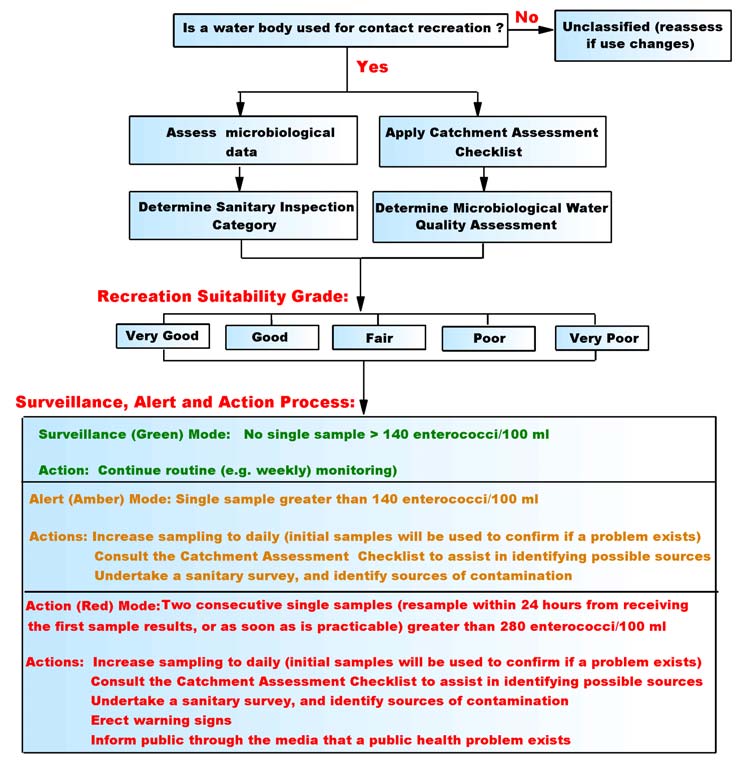
Figure 6.2:
Grading, surveillance, alert and action process for the management of
recreational use of marine waters recommended for the BCLME region
Where beaches are earmarked as (international) tourist destinations, authorities are
encouraged to subscribe to the Blue Flag Initiative, not only to provide safe beaches, but
also as marketing tool (FEE, 2004).
BCLME Project BEHP/LBMP/03/04
Page 6-22
Section 6
January 2006
Final
SECTION 7.
THE WAY FORWARD
BCLME Project BEHP/LBMP/03/04
Page 7-1
Section 7
January 2006
Final
The main purpose of this project was to develop a set of recommended water and sediment
quality guidelines for a range of biogeochemical and microbiological quality variables in
order to sustain natural ecosystem functioning, as well as support designated beneficial
uses, in coastal areas of the BCLME region. A further aim was to recommend best practice
protocols for the implementation (or application) of these quality guidelines in the
management of the coastal areas in the BCLME region.
The above were achieved through a critical review of international water and sediment
quality guidelines and of international best practice in terms of the implementation of quality
guidelines in the management of coastal areas (Sections 1 to 5).
The recommended set of water and sediment quality guidelines for coastal areas of the
BCLME regions (Section 6) was distilled from what was considered international best
practice, but what would also be practical and applicable to the coastal areas of the BCLME
region. As information is developed further for specific conditions in the BCLME region,
these guidelines may be modified, following the principle of adaptive management.
An important secondary objective was to get acceptance from key stakeholders in the three
countries on the proposed guidelines and protocols. This was achieved through work
sessions held in each of the three countries to which key stakeholders were invited. At the
work sessions, the proposed guidelines and protocols were introduced and participants were
given the opportunity to provide their input. This was followed by training workshops in each
of the three countries, where key stakeholders were given preliminary training in the
application quality guidelines in the context of a marine water quality management
framework.
The quality guidelines and protocols were also included in an updatable web-based
information system that was developed jointly for this project and BCLME Project
BEHP/LBMP/03/01 - Baseline assessment of sources and management of marine pollution.
The following points relate to the way forward:
· The recommended guidelines still need to be officially approved and adopted by
responsible authorities in each of the three countries. It may well be that individual
countries require further refinement or adjustment of these guidelines to meet
requirements that might be specific to their own countries.
BCLME Project BEHP/LBMP/03/04
Page 7-2
Section 7
January 2006
Final
In the case of South Africa, the South African Water Quality Guidelines for Coastal
Marine Waters (DWAF, 1995b) will still stand as the country's official guidelines.
However, although the 1995 documents provide extensive background information,
necessary for the application of water quality guidelines that are still valid, the
recommended guideline values for different variables are essentially still the same as
when proposed in 1984 (Lusher, 1984; RSA DWAF, 1992). It is therefore
recommended that the South African water quality guidelines be re-evaluated by the
relevant authorities, taking into account latest international practice. The outputs from
this study can also be used as a starting point in this regard.
· The quality guidelines and protocols developed as part of this project form an integral
part of the management framework for land-based marine pollution sources
(developed as part of another BCLME project BEHP/LBMP/03/01). The project's
particular link to the framework is through the establishment of environmental quality
objectives.
In the interim, until such time as a management framework and quality guidelines have
been incorporated in official government policy, it is proposed that the quality guidelines
developed as part of this project, together with the proposed management framework
(referring to Project BEHP/LBMP/03/01), be applied as preliminary tools towards
improving the management of the water quality in coastal areas of the BCLME region.
· In adopting official water and sediment quality guidelines, it is recommended that
preferred analytical methods for different chemical and microbiological variables also
be included. Although techniques should be scientifically sound, it is also important that
constraints with regard to infrastructure and analytical facilities within each of the three
countries be taken into account. In this regard, analytical scientists with relevant
expertise in marine analytical techniques need to be consulted (as this aspect was not
within the scope of the current project).
NOTE:
The following literature can be consulted for details on analytical procedures pertaining to marine
environmental samples:
· Grasshoff et a.l (1999) Methods of seawater analysis
· Strickland and Parsons (1972) A practical handbook of seawater analysis
· Jones and Laslett (1994) Methods for analysis of trace metals in marine and other samples
· Waldock et al. (1989) - The determination of total tin and organotin compounds in environmental
samples
· Kelly et al. (2000) - Methods for analysis for hydrocarbons and polycyclic aromatic hydrocarbons
(PAH) in marine samples
BCLME Project BEHP/LBMP/03/04
Page 7-3
Section 7
January 2006
Final
· The updatable web-based information system (temporary web address
www.wamsys.co.za/bclme), which was developed as part of this project, can be a very
useful decision-support and educational tool for marine water quality management in the
coastal areas of the BCLME region. However, its usefulness in the future will rely
strongly on the system being maintained and updated regularly. It is therefore important
that a dedicated `administrative home' for the system be provided once this project is
terminated. In the short to medium term, it is recommended that one or more of the
BCLME offices within the three countries take on this responsibility.
· Although training workshops did form part of this project, they targeted only a limited
number of stakeholders in each of the three countries. To facilitate wider capacity
building in the BCLME region on management of marine pollution in coastal areas, it is
strongly recommended that the output of this project be included in a training course.
In this regard, the Train-Sea-Coast/Benguela Course Development Unit is considered
the ideal platform through which to develop and present such training
(www.ioisa.org.za/tsc/index.htm).
BCLME Project BEHP/LBMP/03/04
Page 7-4
Section 7
January 2006
Final
SECTION 8.
REFERENCES
BCLME Project BEHP/LBMP/03/04
Page 8-1
Section 8
January 2006
Final
AUSTRALIA AND NEW ZEALAND ENVIRONMENT AND CONSERVATION COUNCIL
(ANZECC) 1992 - Australian water quality guidelines for fresh and marine waters. National
Water Quality Management Strategy Paper No 4, Australian and New Zealand Environment
and Conservation Council, Canberra.
AUSTRALIA AND NEW ZEALAND ENVIRONMENT AND CONSERVATION COUNCIL
(ANZECC) 2000 - Australian and New Zealand guidelines for fresh and marine water quality.
National Water Quality Management Strategy No 4. Canberra, Australia.
(www.deh.gov.au/water/quality/nwqms/introduction/).
AUSTRALIA NEW ZEALAND FOOD AUTHORITY (ANZFA) 1996 - Food standards code.
Australian Government Publishing Service, Canberra (including amendments to June 1996).
AUSTRALIAN SHELLFISH SANITATION ADVISORY COMMITTEE (ASSAC) 1997 -
Australian shellfish sanitation control program operations manual. Australian Shellfish
Sanitation Advisory Committee, Canberra.
BROWN, V M, GARDINER, J and YATES, J 1984 - Proposed environmental quality
standards for List II substances in water: Inorganic lead. WRc Technical Report TR 208.
BURTON, G A 2002 - Sediment quality criteria in use around the world. Limnology 3(2): 65-
75. Springer Verlag, Tokyo.
CABELLI, VJ 1983a - Public health and water quality significance of viral diseases
transmitted by drinking water and recreational water. Water Science and Technology 15, 1
15.
CABELLI VJ 1983b - Health effects criteria for marine recreational waters. EPA 600/1-
80/031. US Environmental Protection Agency, Cincinnati, Ohio.
CABELLI VJ, DUFOUR AP, McCABE LJ & LEVIN MA 1982 - Swimming-associated
gastroenteritis and water quality. American Journal of Epidemiology 115, 606616.
CABELLI VJ, DUFOUR AP, McCABE LJ & LEVIN MA 1983 - A marine recreational water
quality criterion consistent with indicator concepts and risk analysis. Journal of the Water
Pollution Control Federation 55, 13061314.
BCLME Project BEHP/LBMP/03/04
Page 8-2
Section 8
January 2006
Final
CANADIAN COUNCIL OF RESOURCE AND ENVIRONMENT MINISTERS (CCREM) 1987
- Canadian water quality guidelines. Prepared by Task Force on Water Quality Guidelines,
Environment Canada, Ontario.
CANADIAN COUNCIL OF MINISTERS OF THE ENVIRONMENT (CCME) 1995 - Protocols
for the derivation of Canadian sediment quality guidelines for the protection of aquatic life.
(www.ec.gc.ca/ceqg-rcqe/English/Ceqg/Sediment/default.cfm).
CANADIAN COUNCIL OF MINISTERS OF THE ENVIRONMENT (CCME) 1999a - A
protocol for the derivation of water quality guidelines for the protection of aquatic life.
Originally published in April 1991 as Appendix IX to CCREM (1987). (www.ec.gc.ca/CEQG-
RCQE/English/Ceqg/Water/default.cfm).
CANADIAN COUNCIL OF MINISTERS OF THE ENVIRONMENT (CCME) 1999b -
Canadian Environmental Quality Guidelines. Publication available from CCME.
(http://www.ccme.ca/publications/).
CANADIAN COUNCIL OF MINISTERS OF THE ENVIRONMENT (CCME) 2002 - Summary
of existing Canadian Environmental Quality Guidelines (updated 2002)
(www.ccme.ca/assets/pdf/e1_06.pdf).
CANADIAN MINISTER OF NATIONAL HEALTH AND WELFARE (CMNHW) 1992 -
Guidelines for Canadian Recreational Water Quality. Ottawa. ISBN 0-660-14239-2
(www.hc-sc.gc.ca/ewh-semt/pubs/water-eau/guide_water-1992-guide_eau_e.html).
CANADIAN FOOD INSPECTION AGENCY 2004 - Fish, Seafood and Production
(www.inspection.gc.ca/english/anima/fispoi/fispoie.shtml).
CANADIAN FOOD INSPECTION AGENCY, DEPARTMENT OF FISHERIES AND OCEAN
& ENVIRONMENT CANADA (CFIA, DFO & EC) 2004 - Canadian shellfish sanitation
program. Manual of operations (www.ns.ec.gc.ca/epb/sfish/cssp.html) &
(www.inspection.gc.ca/english/anima/fispoi/manman/cssppccsm/toctdme.shtml)
COUNCIL OF EUROPEAN COMMUNITY (CEC) 1976a - Council Directive of 8 December
1975 concerning the quality of bathing water (76/160/EEC). Published in Official Journal of
the European Communities (//europa.eu.int/water/water-bathing/index_en.html)
BCLME Project BEHP/LBMP/03/04
Page 8-3
Section 8
January 2006
Final
COUNCIL OF EUROPEAN COMMUNITY (CEC) 1976b - Council Directive of 4 May 1976 on
pollution caused by certain dangerous substances discharged into the aquatic environment
of the Community (76/464/EEC). Published in Official Journal of the European Communities
(//europa.eu.int/comm/environment/water/water-dangersub/76_464.htm).
COUNCIL OF EUROPEAN COMMUNITY (CEC) 1979 - Council Directive of 30 October
1979 on the quality required of shellfish waters (79/923/EEC). Published in Official Journal of
the European Communities (www.defra.gov.uk/environment/water/quality/shellfish/).
COUNCIL OF EUROPEAN COMMUNITY (CEC) 1982 - Council Directive of 22 March 1982
on limit values and quality objectives for mercury discharges by the chlor-alkali electrolysis
industry (CEC, 1982)82/176/EEC). Published in Official Journal of the European
Communities europa.eu.int/comm/environment/water/water-dangersub/spec_directives.htm.
COUNCIL OF EUROPEAN COMMUNITY (CEC) 1983 - Council Directive of 26 September
1983 on limit values and quality objectives for cadmium discharges (83/513/EEC).
Published in Official Journal of the European Communities.
europa.eu.int/comm/environment/water/water-dangersub/spec_directives.htm.
COUNCIL OF EUROPEAN COMMUNITY (CEC) 1984a - Council Directive of 8 March 1984
on limit values and quality objectives for mercury discharges by sectors other than the chlor-
alkali electrolysis industry (84/156/EEC). Published in Official Journal of the European
Communities. europa.eu.int/comm/environment/water/water-dangersub/spec_directives.htm.
COUNCIL OF EUROPEAN COMMUNITY (CEC) 1984b - Council Directive of 9 October
1984 on limit values and quality objectives for the discharges of hexachlorocyclohexane
(84/491/EEC). Published in Official Journal of the European Communities
europa.eu.int/comm/environment/water/water-dangersub/spec_directives.htm.
COUNCIL OF EUROPEAN COMMUNITY (CEC) 1986 - Council Directive of 12 June 1986
on limit values and quality objectives for discharges of certain dangerous substances in List I
of the Annex to Directive 76/464/EEC (86/280/EEC as amended by 88/347/EEC and
90/415/EEC). Published in Official Journal of the European Communities.
europa.eu.int/comm/environment/water/water-dangersub/spec_directives.htm.
BCLME Project BEHP/LBMP/03/04
Page 8-4
Section 8
January 2006
Final
COUNCIL OF EUROPEAN COMMUNITY (CEC) 1988 Council Directive 88/347/EEC of 16
June 1988 amending Annex II to Directive 86/280/EEC on limit values and quality objectives
for discharges of certain dangerous substances in List I of the Annex to Directive
76/464/EEC. europa.eu.int/comm/environment/water/water-dangersub/spec_directives.htm.
COUNCIL OF EUROPEAN COMMUNITY (CEC) 1990 - Council Directive 90/415/EEC of 27
July 1990 amending Annex II to Directive 86/280/EEC on limit values and quality objectives
for discharges of certain dangerous substances included in List I of the Annex to Directive
76/464/EEC europa.eu.int/comm/environment/water/water-dangersub/spec_directives.htm.
COUNCIL OF EUROPEAN COMMUNITY (CEC) 1991 - Council Directive of 15 July 1991
laying down the health conditions for the production and the placing on the market of live
bivalve molluscs (91/492/EEC). Published in Official Journal of the European Communities
(//europa.eu.int/comm/food/fs/sfp/mr/mr02_en.pdf).
COUNCIL OF EUROPEAN COMMUNITY (CEC) 2000 - Directive 2000/60/EC of the
European Parliament and of the Council of 23 October 2000 establishing a framework for
Community action in the field of water policy. Published in Official Journal of the European
Communities (europa.eu.int/comm/environment/water/water-framework/index_en.html)
COUNCIL OF EUROPEAN COMMUNITY (CEC) 2002 - Proposal for a Directive of the
European Parliament and of the Council concerning the quality of bathing water. COM
(2002) 581 final. (//europa.eu.int/water/water-bathing/index_en.html).
COUNCIL OF EUROPEAN COMMUNITY (CEC) 2003 - Introduction to the new EU Water
Framework Directive (//europa.eu.int/comm/environment/water/water-
framework/overview.html).
DEPARTMENT OF HEALTH 1973 - Regulations of Marine Foods. Government Notice No
R. 2064 of 2 November 1973. Pretoria, South Africa.
DEPARTMENT OF HEALTH 1994 - Regulations related to metals in foodstuffs. Government
Notice No R. 1518 of 9 September 1994. Pretoria, South Africa.
FOUNDATION FOR ENVIRONMENTAL EDUCATION (FEE) 2004 - Blue Flag Campaign
(www.blueflag.org/ ).
BCLME Project BEHP/LBMP/03/04
Page 8-5
Section 8
January 2006
Final
GRASSHOFF, K, EHRHARDT, M and KREMLING, K (eds) 1999 - Methods of Seawater
Analysis. Edition 3 - Revised and enlarged Edition. Wiley-VCH, Weinheim. ISBN 3-527-
29589-5
KELLY, C A, LAW, R J and EMERSON, H S 2000 - Methods for analysis for hydrocarbons
and polycyclic aromatic hydrocarbons (PAH) in marine samples. Aquatic Environment
Protection: Analytical methods 12. Ministry of Agriculture, Fisheries and Food, Directory of
Fisheries Research. Lowestoft (www.cefas.co.uk/publications/aquatic/aepam12.pdf).
JONES, B R and LASLETT, R E 1994 - Methods for analysis of trace metals in marine and
other samples. Aquatic Environment Protection: Analytical methods 11. Ministry of
Agriculture, Fisheries and Food, Directory of Fisheries Research. Lowestof
(www.cefas.co.uk/publications/aquatic/aepam11.pdf).
LONG, E R AND MORGAN, L G 1990 - The potential for biological effects of sediment-
sorbed contaminants tested in the National Status and Trends Program. NOAATechnical
Memorandum, NOS OMA 52, Seattle, Washington.
LONG, E R, MacDONALD, D D, SMITH, S L and CALDER, F D 1995 - Incidence of adverse
biological effects within ranges of concentrations in marine and estuarine sediments.
Environmental Management 19(1): 81-97.
LONG E R and MACDONALD D D 1998 - Recommended uses of empirically-derived
sediment quality guidelines for marine and estuarine ecosystems. Human Ecol. Risk Assess.
4, 10191039.
LUSHER, J A (Ed) 1984 - Water quality criteria for the South African coastal zone. South
African National Scientific Programme Report 92. Pretoria, South Africa.
MACDONALD D D, CARR R S, CALDER F D, LONG E R and INGERSOLL C G 1996 -
Development and evaluation of sediment quality guidelines for Florida coastal waters.
Ecotoxicology 5, 253-278.
BCLME Project BEHP/LBMP/03/04
Page 8-6
Section 8
January 2006
Final
MINISTRY OF AGRICULTURE AND FISHERIES, NEW ZEALAND (MAF) 1995 - Shellfish
Quality Assurance Circular. Industry Agreed Implementation Standard 005.1
(www.nzfsa.govt.nz/animalproducts/seafood/iais/5/index.htm).
MANCE GA & YATES J 1984b - Proposed environmental quality standards for List II
substances in water: Zinc. Water Research Centre (WRc) Technical Report TR 209. United
Kingdom.
MANCE GA & YATES J 1984a - Proposed environmental quality standards for List II
substances in water: Nickel. Water Research Centre (WRc) Technical Report TR 211.
United Kingdom.
MANCE G, BROWN V M, GARDINER J & YATES 1984a - Proposed environmental quality
standards for List II substances in water: Chromium. Water Research Centre (WRc)
Technical Report TR 207. United Kingdom.
MANCE G, BROWN V M & YATES 1984b - Proposed environmental quality standards for
List II substances in water: Copper. Water Research Centre (WRc) Technical Report TR
210. United Kingdom.
MANCE G, MUSSELWHITE C & BROWN V M 1984c - Proposed environmental quality
standards for List II substances in water: Arsenic. Water Research Centre (WRc) Technical
Report TR 212. United Kingdom.
MANCE GA & YATES J 1988a - Proposed environmental quality standards for list II
substances in water: Zinc. Water Research Centre (WRc) Technical Report TR 209. United
Kingdom.
MANCE GA & YATES J 1988b - Proposed environmental quality standards for list II
substances in water: Nickel. Water Research Centre (WRc) Technical Report TR 211.
United Kingdom.
MANCE G, O'DONNELL AR & CAMPBELL JA 1988a - Proposed environmental quality
standards for list II substances in water: Sulphide. Water Research Centre (WRc) Technical
Report TR 257. United Kingdom.
BCLME Project BEHP/LBMP/03/04
Page 8-7
Section 8
January 2006
Final
MANCE GA, O'DONNELL AR, CAMPBELL JA & GUNN AM 1988b - Proposed
environmental quality standards for list II substances in water: Inorganic tin. Water Research
Centre (WRc) Technical Report TR 254. United Kingdom.
MANCE GA, NORTON R & O'DONNELL AR 1988c - Proposed environmental quality
standards for list II substances in water: Vanadium. Water Research Centre (WRc)
Technical Report TR 253. United Kingdom.
MANCE GA, O'DONNELL AR & SMITH PR 1988d - Proposed environmental quality
standards for list II substances in water: Boron. Water Research Centre (WRc) Technical
Report TR 260. United Kingdom.
MANCE GA & CAMPBELL JA 1988e - Proposed environmental quality standards for list II
substances in water: Iron. Water Research Centre (WRc) Technical Report TR 260. United
Kingdom.
McBRIDE G B, COOPER A B & TILL D G 1991 - Microbial water quality guidelines for
recreation and shellfish gathering waters in New Zealand. NZ Department of Health,
Wellington.
MINISTRY FOR HOUSING, SPATIAL PLANNING AND ENVIRONMENT (MHSPE) 1994 -
Environmental quality objectives in the Netherlands. The Hague, Netherlands.
NATIONAL HEALTH AND MEDICAL RESEARCH COUNCIL & AUSTRALIAN WATER
RESOURCES COUNCIL (HMRC & AWRC) 1987 - Guidelines for drinking water quality in
Australia. Australian Government Publishing Service, Canberra.
NATIONAL HEALTH AND MEDICAL RESEARCH COUNCIL & AGRICULTURE AND
RESOURCE MANAGEMENT Council of Australia and New Zealand (NHMRC & ARMCANZ)
1996 updated 2001 - Australian drinking water guidelines. ISBN 0 642 24462 6.
(www.waterquality.crc.org.au/aboutdw_adwg.htm).
NATIONAL OCEANIC AND ATMOSPHERIC ADMINISTRATION (NOAA) 1999 - Sediment
Quality Guidelines developed for the National Status and Trends Program. 6 December
1999. Office of Response and Restoration, National Ocean Service
(//archive.orr.noaa.gov/cpr/sediment/SQGs.html).
BCLME Project BEHP/LBMP/03/04
Page 8-8
Section 8
January 2006
Final
NEW ZEALAND, MINISTRY OF ENVIRONMENT 2003 - Microbiological water quality
guidelines for marine and freshwater recreational area. ISBN: 0-478-24091-0. ME number:
474. Wellington, New Zealand (www.mfe.govt.nz/publications/water/microbiological-quality-
jun03/)
ORGANISATION FOR ECONOMIC CO-OPERATION AND DEVELOPMENT (OECD) 1992 -
Report of the OECD workshop on extrapolation of laboratory aquatic toxicity data to the real
environment. OECD Environment Monographs No 59, Organisation for Economic Co-
operation and Development, Paris.
REPUBLIC OF SOUTH AFRICA DEPARTMENT OF WATER AFFAIRS AND FORESTRY
(RSA DWAF) 1991 - Water quality management policies and strategies in the RSA.
Pretoria, South Africa.
REPUBLIC OF SOUTH AFRICA DEPARTMENT OF WATER AFFAIRS AND FORESTRY
(RSA DWAF) 1992 - Interim Report: Water Quality Guidelines for the South African coastal
zone. Pretoria, South Africa.
REPUBLIC OF SOUTH AFRICA DEPARTMENT OF WATER AFFAIRS AND FORESTRY
(RSA DWAF) 1995a - South African Water Quality Management Series. Procedures to
assess effluent discharge impacts. First Edition. Water Research Commission Report TT
64/94. Pretoria, South Africa.
REPUBLIC OF SOUTH AFRICA DEPARTMENT OF WATER AFFAIRS AND FORESTRY
(RSA DWAF) 1995b - South African water quality guidelines for coastal marine waters.
Volume 1. Natural Environment. Volume 2. Recreation. Volume 3. Industrial use. Volume
4. Mariculture. Pretoria.
REPUBLIC OF SOUTH AFRICA DEPARTMENT OF WATER AFFAIRS AND FORESTRY
(RSA DWAF) 2002 - National Water Quality Management Framework. Water Quality
Management Sub-series No. MS 7. Draft 2. Pretoria.
RUSSO, RC 2002 - Development of marine water quality criteria for the USA. Marine
Pollution Bulletin 45: 84-91.
BCLME Project BEHP/LBMP/03/04
Page 8-9
Section 8
January 2006
Final
SAMSOE-PETERSEN L & PEDERSEN F (eds) 1995 - Water quality criteria for selected
priority substances, Working Report, TI 44. Water Quality Institute, Danish Environmental
Protection Agency, Copenhagen, Denmark.
SEAGER, J, WOLFF, E W and Cooper, V A 1988 - Proposed environmental quality
standards for List II substances in water. Ammonia. WRc report No TR26O.
STRICKLAND, J D H and PARSONS, T R 1972 - A practical handbook of seawater analysis.
Published by Fisheries Research Board of Canada, Ottawa. Bulletin 167.
UNITED NATIONS ENVIRONMENTAL PROGRAM (UNEP) 1996 - Awards for improving the
coastal environment: The example of the Blue Flag. Joint publication of UNEP, World
Tourism Organisation and the Foundation of Environmental Education in Europe. ISBN 92-
807-1625-5.
UNITED STATES ENVIRONMENTAL PROTECTION AGENCY (US-EPA) 1985 - Guidelines
for Deriving Numerical National Water Quality Criteria for the Protection of Aquatic
Organisms and Their Uses. January 1985. EPA Number: 822R85100. Office of Research
and Development , Washington DC.
UNITED STATES ENVIRONMENTAL PROTECTION AGENCY (US-EPA) 1986a - Quality
criteria for water. US Environmental Protection Agency, Washington DC.
UNITED STATES ENVIRONMENTAL PROTECTION AGENCY (US-EPA) 1986b - Ambient
water quality criteria for bacteria. January 1986. EPA440/5-84-002.
(www.epa.gov/waterscience/criteria/bacteria/).
UNITED STATES ENVIRONMENTAL PROTECTION AGENCY (US-EPA) 1989 - Ambient
water quality criteria for ammonia (saltwater). April 1989. EPA-440/5-88-004.
(www.epa.gov/ost/pc/ambientwqc/ammoniasalt1989.pdf).
UNITED STATES ENVIRONMENTAL PROTECTION AGENCY AQUATIC TOXICITY
INFORMATION RETRIEVAL DATABASE (US-EPA AQUIRE) 1994 - AQUIRE standard
operating procedures. Washington, DC.
BCLME Project BEHP/LBMP/03/04
Page 8-10
Section 8
January 2006
Final
UNITED STATES ENVIRONMENTAL PROTECTION AGENCY (US-EPA) 1999 - National
recommended water quality criteria Corrected. April 1999. EPA 822-Z-99-001.
UNITED STATES ENVIRONMENTAL PROTECTION AGENCY (US-EPA) 2000a - Ambient
Aquatic Life Water Quality Criteria for Dissolved Oxygen (Saltwater): Cape Cod to Cape
Hatteras. November 2000. EPA-822-R-00-012
(epa.gov/waterscience/criteria/dissolved/docriteria.html).
UNITED STATES ENVIRONMENTAL PROTECTION AGENCY (US-EPA) 2000b -
Methodology for deriving ambient water quality criteria for the protection of human health.
October 2000. EPA-822-B-00-004
(epa.gov/waterscience/criteria/humanhealth/method/method.html).
UNITED STATES ENVIRONMENTAL PROTECTION AGENCY (US-EPA) 2001 - Nutrient
Criteria Technical Guidance Manual Estuarine and Coastal Marine Waters. October 2001.
EPA-822-B-01-003. (www.epa.gov/waterscience/criteria/nutrient/guidance/marine/).
UNITED STATES ENVIRONMENTAL PROTECTION AGENCY (US-EPA) 2002a - National
Recommended Water Quality Criteria. November 2002. EPA-822-R-02-047.
(www.epa.gov/waterscience/criteria/wqcriteria.html).
UNITED STATES ENVIRONMENTAL PROTECTION AGENCY (US-EPA) 2002b -
Implementation Guidance for Ambient Water Quality Criteria for Bacteria. May 2002 Draft.
EPA-823-B-02-003 (www.epa.gov/waterscience/criteria/bacteria/).
UNITED STATES ENVIRONMENTAL PROTECTION AGENCY (US-EPA) 2003a - Ambient
aquatic life water quality criteria for tributyltin final. December 2003. EPA 822-R-03-031.
(www.epa.gov/waterscience/criteria/tributyltin/).
UNITED STATES ENVIRONMENTAL PROTECTION AGENCY (US-EPA) 2003b - Human
Health Fact Sheet: Revised national recommended water quality criteria. December
2003. EPA-822-F-03-012 (www.epa.gov/waterscience/criteria/humanhealth/15table-fs.htm).
BCLME Project BEHP/LBMP/03/04
Page 8-11
Section 8
January 2006
Final
UNITED STATES ENVIRONMENTAL PROTECTION AGENCY (US-EPA) 2003c -
Procedures for the Derivation of Equilibrium Partitioning Sediment Benchmarks (ESBs) for
the Protection of Benthic Organisms: Endrin. August 2003. EPA/600/R-02/009
(www.epa.gov/nheerl/publications/files/endrin.pdf)
UNITED STATES ENVIRONMENTAL PROTECTION AGENCY (US-EPA) 2003d -
Procedures for the Derivation of Equilibrium Partitioning Sediment Benchmarks (ESBs) for
the Protection of Benthic Organisms: Dieldrin. August 2003. EPA/600/R-02/010
(www.epa.gov/nheerl/publications/files/dieldrin.pdf)
UNITED STATES ENVIRONMENTAL PROTECTION AGENCY (US-EPA) 2003e -
Procedures for the Derivation of Equilibrium Partitioning Sediment Benchmarks (ESBs) for
the Protection of Benthic Organisms: PAH Mixtures. November 2003. EPA/600/R-02/013
(www.epa.gov/nheerl/publications/files/PAHESB.pdf)
UNITED STATES ENVIRONMENTAL PROTECTION AGENCY (US-EPA) 2004 - Water
Quality Standards (www.epa.gov/waterscience/standards/about/crit.htm).
UNITED STATES FOOD AND DRUG ADMINISTRATION (US FDA) 2003 - National
Shellfish Sanitation Program Model Ordinance. 2003 Revision. U.S. Department of Health
and Human Services (www.cfsan.fda.gov/~ear/nss2-toc.html)
UNITED STATES FOOD AND DRUG ADMINISTRATION (US FDA) 2004 - Seafood
Information and Resources (vm.cfsan.fda.gov/seafood1.html)
WALDOCK, M J, WALTE, M E, SMITH, D J and LAW, R J 1989 - The determination of total
tin and organo-tin compounds in environmental samples. Aquatic Environment Protection:
Analytical methods 4. Ministry of Agriculture, Fisheries and Food, Directory of Fisheries
Research. Lowestof (www.cefas.co.uk/publications/aquatic/aepam4.pdf).
WARNE M ST J, WESTBURY A-M & SUNDERAM R I M 1998 - A compilation of data on the
toxicity of substances to species in Australasia. Part 1: Pesticides. Australasian Journal of
Ecotoxicology 4, 93144.
BCLME Project BEHP/LBMP/03/04
Page 8-12
Section 8
January 2006
Final
WOLFF, E W, SEAGER, J, COOPER, V A and ORR, J 1988 Proposed environmental
quality standards for List II substances in water: pH. WRc Technical Report TR 259.
WORLD BANK GROUP 1998 - Pollution Prevention and Abatement Handbook
(//lnweb18.worldbank.org/ESSD/envext.nsf/51ByDocName/PollutionManagement ).
WORLD BANK GROUP 2004 Environmental, Health and Safety Guidelines
(www.ifc.org/ifcext/enviro.nsf/Content/PoliciesandGuidelines).
WORLD HEALTH ORGANISATION (WHO) 1999 - Health-based monitoring of recreational
waters: The feasibility of a new approach (The "Annapolis Protocol"). World Health
Organisation. WHO/SDE/WSH/99.1. Geneva.
WORLD HEALTH ORGANISATION (WHO) 2003 - Guidelines for Safe Recreational Water
Environments. Volume 1: coastal and freshwaters. Geneva. ISBN 92 4 154580 1
(www.who.int/water_sanitation_health/bathing/srwe1/en/).
WORLD HEALTH ORGANISATION (WHO) 2004 - WHO Guidelines for drinking-water
quality, third edition Volume 1: Recommendations Geneva. ISBN 92 4 154638 7.
(www.who.int/water_sanitation_health/dwq/guidelines/en/).
ZABER, T R, SEAGER, J and OAKLEY, S D 1988 Proposed environmental quality
standards for List II substances in water: Organotins. WRC Technical Report TR 255.
BCLME Project BEHP/LBMP/03/04
Page 8-13
Section 8
January 2006
Final