|
PROJECT Development PrepAration (pdf) PROPOSAL |
|
Agency’s Project ID: 3246 GEFSEC Project ID: Country: Belarus, Russian Federation, Ukraine Project Title Implementation of Priority Interventions of the Dnipro Basin Strategic Action Program: Chemical Industrial Pollution Reduction and The Development of Joint Institutional Arrangements. GEF Agency: UNDP Other Executing Agency(ies): UNOPS, UNIDO Duration: 36 Months GEF Focal Area: International Waters GEF Operational Program: OP 8 GEF Strategic Priority: IW 1 Estimated Starting Date: July 2007 Estimated WP Entry Date: Nov 2006 Pipeline Entry Date: July 2004 |
|
Financing Plan (US$) | |
|
GEF Project/Component | |
|
Project(*) |
$7,000,000 |
| PDF A |
|
| PDF B |
$700,000 |
| PDF C |
|
|
Sub-Total GEF |
$7,700,000 |
|
Project Co-financing (estimated) | |
| GEF Agency |
TBD |
|
Government(**) |
$7,700,000 |
| Bilateral |
TBD |
| Others |
300,000 |
|
Sub-Total Co-financing: |
$8,000,000 |
|
Total Project Financing: |
$15,700,000 |
|
PDF Co-financing (***) | |
| GEF Agency |
TBD |
|
National Contribution |
$1,520,000 |
| Others |
TBD |
|
Sub-Total Co-financing: |
$1.520,000 |
|
Total Project Financing: |
$17,220,000 |
|
(*) Estimated budget (**) The riparian countries will finance SAP activities, which compliment PDF B , FP II activities and provide in-kind contributions as well. (***) details provided in Part II, section F - Budget | |
|
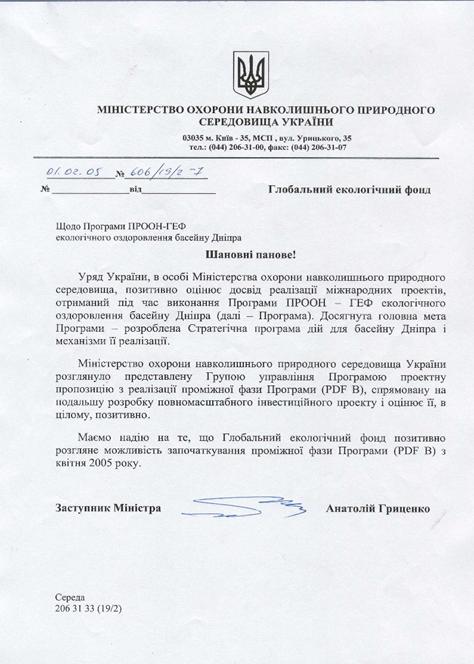
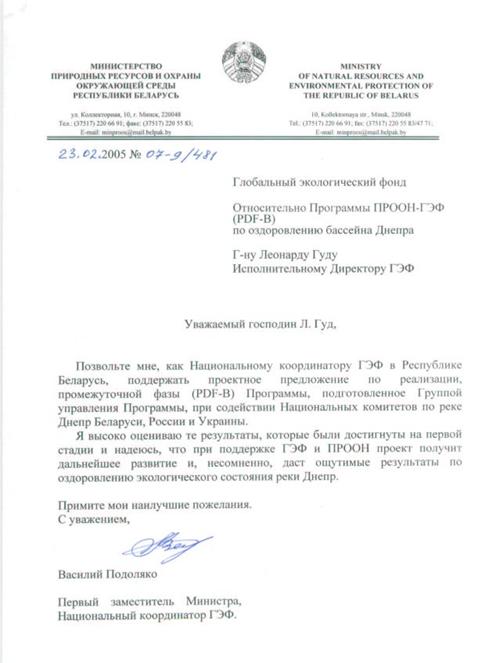
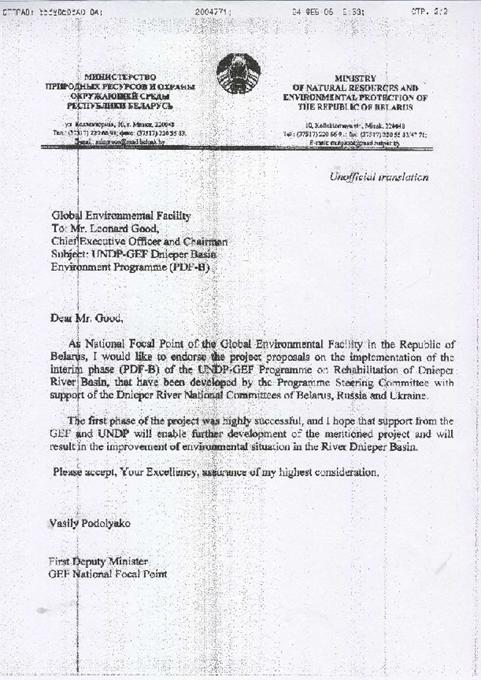
Record of endorsement on behalf of the Governments:
|
Date: 1 February 2005
Date: 23 February 2005
|
This proposal has been prepared in accordance with GEF policies and procedures and meets the standards of the GEF Project Review Criteria for PDF B approval. | |
|
Executive Coordinator |
Mr. Juerg Staudenmann, Water Governance Advisor Project Contact Person |
|
Date: 6 April 2005 |
Tel. and email:, +421-2-59337250, juerg.staudenmann@undp.org |

Contents
1 The Full Sized Project Proposal (2007-2010) 4
2 The PDF B Proposal (2005 – 2007) 5
C Program and Policy Conformity. 7
1 Program Designation and Conformity. 7
2.1 The Full Sized Project: 10
Component 2: Transboundary Monitoring and Indicators Program for SAP implementation; 12
Component 3: Harmonization of environmental legislation. 14
Component 4: Sustainable Institutional and Management Structures for SAP implementation 15
2.2.1 No Further GEF Investment 17
2.2.2 Developing a Multi-sectoral Project Proposal 17
E Institutional Coordination and Support 22
1 Core Commitments and Linkages. 22
PART II - PROJECT DEVELOPMENT PREPARATION.. 24
A Description of Proposed PDF Activities. 24
1 Pilot Projects for Small Industries. 25
1.1 Identifying a Priority Vodokanal and Associated Industries in Each Country. 25
1.2 Sustainable Financing of Pre-treatment and Cleaner Production Methods. 26
1.3 Regulation and Monitoring Procedures for Small Industries. 28
1.4 Support from Cleaner Production Centres. 29
2 Transboundary Monitoring. 30
2.1 Transboundary Water Quality Monitoring. 30
2.2 Broader Environmental Monitoring. 32
4 Institutional Development for SAP Implementation. 34
5 FPP – Final Design, Monitoring and Reporting. 35
5.1 The Logical Framework Analysis. 36
5.2 Reporting and Monitoring Framework. 36
5.3 Incremental Cost Analysis. 37
5.5 Single Project Reports. 38
6 General Project Management during the PDF B.. 39
F Co financing of the PDF B project 46
PART III – RESPONSE TO REVIEWS. 47
B - Other IAs and relevant ExAs. 47
C - STAP. ………………………………………………………………………………..47
ANNEX 1 - AGREEMENT ON COOPERATION IN THE FIELD OF USE AND PROTECTION OF THE DNIPRO BASIN.. 48
ANNEX 2 – TDA EXECUTIVE SUMMARY.. 53
ANNEX 3 - EXAMPLES OF REGIONAL AND NATIONAL PROJECTS LINKED TO SAP OBJECTIVES 55
ANNEX 4. ACRONYMS / ABBREVIATIONS. 57
ANNEX 5. Endorsement letter - Ukraine. 58
ANNEX 6. Endorsement letter – Belarus. 60
PART I - PROJECT CONCEPT
A Summary
This PDF B project provides the link between the previous GEF investment in the Dnipro Basin, the development and country adoption of the Dnipro Basin Strategic Action Program, and the future GEF support to a Full-Sized Project Proposal to directly address the priority International Waters issue of industrial chemical pollution.
The development of the Dnipro Basin Strategic Action Program (SAP) followed on from concerns expressed in the 1990s about the progressive degradation of the Dnipro River ecosystem, particularly in the middle and lower reaches. These concerns tied in closely with those raised over the degradation of the Black Sea environment, which led to the GEF support of the Black Sea Transboundary Diagnostic Analysis ( TDA) and the Black Sea SAP. This in turn linked with the Danube SAP, now institutionally connected to the Black Sea program through the “Strategic Partnership addressing Transboundary Priorities in the Danube/Black Sea Basin”.
The GEF project supporting the development of the Dnipro Basin SAP was approved in December 1999 by the GEF Council, and became effective with inception workshop in 2001.
The development of the Dnipro TDA and SAP was the result of the joint effort of the three riparian countries (Republic of Belarus, Russian Federation, and Ukraine), assisted by international executing agencies. These included UNOPS (United Nations Office of Project Services), UNIDO (United Nations Industrial Development Organisation), IDRC (International Development Research Centre, Canada), IAEA (International Atomic Energy Agency), and UNEP (United Nations Environment Program).
The SAP is a policy document, negotiated and endorsed by three riparian countries, to be implemented at the highest level of executive power. The SAP focuses on six transboundary priority areas for action to resolve the most urgent issues identified in the TDA: chemical pollution, modification of ecosystems, modification of the hydrological regime, eutrophication, flooding and high ground water levels, and radio nuclide pollution.
Of these, the first priority is industrial chemical pollution. This can be categorised as coming from two main industrial sub-sectors, the major industrial complexes, generally with their own treatment facilities, and the groups of smaller urban based industries that discharge effluents through the municipal facilities, the Vodokanals.
Following a review of current donor activities and trends, it appears that major industries may be able to attract investment through other funding agencies. This leaves the more complex tasks of dealing with the large numbers of small industries that cumulatively pose major pollution threats, with the parallel concerns of financing mechanisms and regulation in a sector, which is rapidly becoming more privatised.
1 The Full Sized Project Proposal (2007-2010)
The GEF Full-Sized Project will therefore address the priority issue of industrial chemical pollution emanating from the smaller urban industries discharging waste through the Vodokanals.
The overall objective of the FPP is to reduce transboundary industrial chemical pollution from small industries currently discharging through municipal waste systems.
This will be addressed through four specific objectives and components:
Objective 1: To introduce cleaner production methods to small industries – including sustainable financing mechanisms and local regulation and monitoring procedures;
Component 1: Pilot Projects to introduce cleaner production methods to small industries discharging through Vodokanals, including sustainable financing mechanisms and local regulation and monitoring procedures
Objective 2: To provide information on the status and progress of the SAP implementation program to the Dnipro Basin management bodies, and to allow prompt decisions and responses to emergency situations;
Component 2: Transboundary Monitoring and Indicators Program for SAP implementation;
Objective 3: To introduce harmonised environmental legislation to the three countries, in line with those prevailing in the EU;
Component 3: Harmonization of environmental legislation,
Objective 4: To establish key institutional and management structures within the wider SAP management bodies.
Component 4: Sustainable Institutional and Management Structures for SAP implementation.
2 The PDF B Proposal (2005 – 2007)
The objective of the PDF B project is to prepare the Full-Sized Project Proposal that will reduce transboundary industrial chemical pollution in the Dnipro Basin.
The PDF B project will prepare detailed costed proposals for a number of pilot investments in implementing cleaner production technologies in existing small industries currently discharging through municipal waste systems. In addition the PDF B will review the options for establishing a regional Cleaner Production Centre, to assist companies in rationalising their production processes while saving money on raw materials, energy, water and water treatment.
The PDF B will also prepare parallel proposals for supporting the institutional development of the SAP management bodies, to supervise and implement activities in the SAP, as well as proposals dealing with the regional issues of transboundary monitoring and harmonisation of environmental legislation with that of the EU.
Finally the PDF B will carry out a review and update of the Stakeholder Analysis, informally carried out under the previous phase of GEF assistance. The PDF B project will prepare a comprehensive Project Monitoring Plan, backed by a detailed LFA, an Incremental Cost Analysis and overall project budget.
B Country ownership
1 Country Eligibility
The proposal is eligible under the GEF OP-8 International Waters, Waterbody-based Operational Program and falls under International Waters Strategic Priority IW-1, Catalyse financial resource mobilization for implementation of reforms and stress reduction measures agreed through TDA-SAP or equivalent processes. The three countries are eligible for country assistance from the World Bank and from UNDP Technical Assistance Grants.
2 Country Drivenness
The three countries have jointly developed a Strategic Action Program for the Dnipro River Basin, as well as National Action Programs to carry out interventions to manage pollution and other national and transboundary issues. This project proposal is consistent with the National environmental strategies adopted by the three countries.
In Belarus the key principles in their environmental policies, are set out in the “National Sustainable Development Strategy of Belarus (1997)”, which includes the rational use and protection of water resources.
The “Russian Federation Environmental Doctrine (2002)” emphasises the need for the sustainable use of natural resources, and specifically introduces the “user/polluter pays” principle into environmental management.
In 1991, Ukraine adopted the law “On the Protection of the Natural Environment”, which in turn guided their policy - “Main Directions of the National Policy of Ukraine in the Field of Environment Protection, Nature Resource Use and Environmental Safety”. This policy document recognises the need to work at the basin level, both on environmental rehabilitation and water quality improvements.
While at present there is no single legal framework for environmental cooperation between the three countries, there are existing bilateral agreements between all three countries on the joint use and protection of transboundary waters.
However, in order to provide a stronger joint commitment to action, the countries have drawn up an “Agreement on Cooperation in the Field of Management and Protection of the Dnipro Basin” (The Agreement – Annex 1). This document forms the first part of the SAP and will be endorsed at the highest levels of Government in the three countries; this will then become the main instrument for national and regional actions to implement the SAP.
In the meantime, Ukraine has already made significant commitments to implementing some of the proposed actions in the SAP and the Ukraine NAP. Ukraine’s head start is due in large part to its pre-existing National Programme of Ecological Rehabilitation of the Dnipro River Basin and Improvement of the Drinking Water that was passed into law on 27 February 1997. An amount of 4.2 billion UAH (approx. 2.4 billion USD) was committed for the period 1997 - 2010. Such funding has enabled the removal of minor sluices and cleaning of tributaries, both of which have led to improvements in water quality, with positive responses from local NGOs.
C Program and Policy Conformity
1 Program Designation and Conformity
The project falls under Operational Program Number 8, Waterbody-based Programs and IW SP-1, Implementation of Strategic Action Programs.
The project addresses significant transboundary environmental concerns in the Dnipro Basin, a water-body shared by the three countries, the Republic of Belarus, the Russian Federation and Ukraine. The importance of these transboundary issues has been demonstrated in the Transboundary Diagnostic Analysis and the Strategic Action Program, prepared under the current GEF/UNDP project RER/99/G31/A/1G/31.
The SAP development project demonstrated national commitments to joint environmental management, incorporating priority investments into national plans and supporting and establishing an institutional infrastructure necessary to ensure the long-term success of these interventions. These have included the development of the Agreement, the creation of national and regional stakeholder institutions with responsibility for, initially supervising and advising the project, and subsequently functioning as the main SAP advisory and executive bodies
The FPP project will build on previous regional experience of the joint management of shared water bodies, including the on-going GEF programs supporting the improved management of the Black Sea, the Danube and the Caspian Sea. In doing so, the project will also provides lessons for joint management of other water bodies in the Europe and Central Asia countries (ECA), and deal with issues relating to EU Accession countries and harmonisation with EU Legislation.
The PDF B project, as a necessary precursor to the FPP, clearly conforms to the same GEF policy and strategy priorities as the FPP. At the same time, the PDF B will bring donors and other public and private agencies, to leverage co-financing for the FPP and for other supporting priority actions identified in the TDA and SAP[1].
2 Project Design
The starting point of the design of the full sized project is the analysis of the major transboundary issues of the basin, prioritised in the TDA and SAP, developed under the previous GEF project.
The prioritisation criteria included: the transboundary nature of an issue; the scale of impacts on the Dnipro Basin and Black Sea ecosystems; the scale of impacts of an issue on economic activities, the environment and human health; linkages with other environmental issues and economic sectors; and expected multiple benefits.
On the basis of the above criteria, the TDA and the SAP identified six priority regional environmental issues.
Table 1 Priority Environmental Issues identified in the TDA and the SAP
|
Regional Priority of |
Priority Sectors | ||||||
|
Industry |
Agriculture |
Fisheries |
Municipal services |
Transport |
Energy |
Chornobyl | |
|
1 Chemical pollution |
1 |
2 |
6 |
3 |
4 |
5 |
- |
|
2 Loss of biodiversity/ecosystems |
5 |
1 |
3 |
4 |
6 |
2 |
- |
|
3 Changed river flow |
5 |
2 |
6 |
4 |
3 |
1 |
- |
|
4 Eutrophication |
3 |
1 |
4 |
2 |
6 |
5 |
- |
|
5 Radio nuclide Pollution |
2 |
- |
- |
- |
- |
3 |
1 |
|
6 Flooding and high groundwater |
2 |
1 |
- |
3 |
4 |
- |
- |
The major environmental issue throughout the region is chemical pollution, stemming directly from Industrial Production[2].
The Water Pollution Index, adopted by all three countries as a tool to assess surface water quality, generally shows increasing water pollution as the river flows downstream, to levels described as “moderately polluted”. Concentrations of metal contaminants are relatively high in transboundary sections of the river, with fishery Maximum Acceptable Concentrations (MAC) exceeded in all water samples (including zinc, copper, lead and arsenic ).
The general pattern of industrial and urban development in the Dnipro Basin has been along the main Dnipro River and major tributaries, with heavy chemical, metallurgical and agro-industries dominating the major industrial complexes.
With deteriorating economic conditions within the region in the 1980s and 1990s, industrial production declined. However, many of the remaining industries are using outdated processes, discharging significant levels of pollutants.
It is only recently that there has been a reversal of this economic decline, with an expansion of industrial production. In addition there has been a major trend towards privatisation in all three countries, particularly of the smaller industries.
The key document prepared as an input to the SAP and TDA dealing with pollution, is the “Identification and Analysis of Pollution Sources (Hot Spots) – Priority Investment Portfolio”[3].
This report divides priority pollution hot spots into waste discharged from “Vodokanals” (municipal water and sanitation agencies) and other site-specific pollution sources. The Vodokanals process wastewater from residential areas as well industrial effluents.
Table 2 Priority Pollution Hotspots
| Vodokanals |
Other Priority Pollution Sources | |
|
Belarus |
4 |
1 x Refinery Treatment Facility |
|
Russia |
4 |
Intensive Livestock Production Units |
|
Ukraine |
7 |
3 x Metallurgical Combined Works |
While the volume of industrial waste treated by the Vodokanals is generally much less than the volume of domestic waste, the constituents of industrial waste are often the major concern in the treatment processes[4]. The priority concern in the SAP is the combined impact of waste discharged by small industries to the Vodokanals. In many cases these enterprises are either in the private sector or in the process of being transferred to the private sector.
Map 1 Dnipro Basin Priority Pollution Hotspots[5]
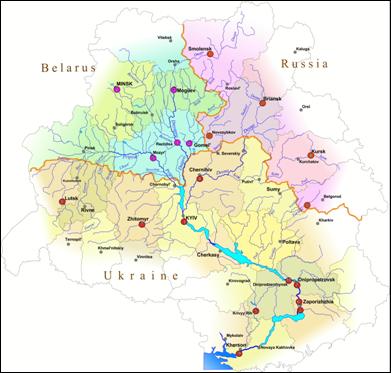
In addition, while some donors have been approached to resolve industrial pollution and production constraints for some of the major industries[6], at present no donors have shown their willingness to support the introduction of cleaner production technologies into the smaller industries. This is a clear “gap” that should be addressed by the GEF within the framework of the SAP.
2.1 The Full Sized Project:
Implementation of Priority Interventions of the Dnipro Basin Strategic Action Program: Chemical Industrial Pollution Reduction and the Development of Joint Institutional Arrangements.
The long-term objective of the full sized project focuses on the key issues identified in the TDA and SAP.
The overall objective of the project is to reduce transboundary industrial chemical pollution from small industries currently discharging through municipal waste systems.
This is effectively a refinement of the key objective of the previous GEF supported SAP development project, which was “…to remedy the serious environmental effects of transboundary pollution and habitat degradation in the Dnipro Basin…”.
The FPP has four main components, discussed below. These have been developed on the basis of best knowledge, largely from information gathered together in the TDA and SAP. However, the process of data collection and analysis is on going.
The PDF B Project will finalize these components of the FPP through a process of discussion and stakeholder analysis, and develop detailed budgets supported by a clear monitoring program. The details of the PDF B activities are presented in Part II of this document.
Component 1: Pilot Projects to introduce cleaner production methods to small industries including sustainable financing mechanisms and local regulation and monitoring procedures
This objective will be achieved through three project outputs, the introduction of appropriate technologies, supported by a sustainable financing system, regulated and monitored by local institutions.
Output 1.1: Cleaner production processes installed in one or more small industries in one or more priority Vodokanals in each country
The project will direct a number of pilot investments to existing small industries, currently discharging through the Vodokanals, to implement a range of cleaner production technologies, including retrofitting cleaner production systems and pre-treatment of effluents. This would assist companies in rationalising their production processes and save money on raw materials, energy, water and water treatment.
The objective is to achieve a win-win situation: enhanced profits through more efficient environmentally sound production; and environmental gains through minimised pollution.
The project will draw on lessons from the Danube TEST Project – Transfer of Environmentally Sound Technology. This approach adopts a critical path analysis, starting with the financial viability of the enterprise, following by a cleaner production assessment, which identifies pollutant reduction measures that an enterprise could undertake using available financial resources. This is followed by an industrial management assessment is undertaken. At the end of these two assessments (cleaner production and industrial management), the enterprise would have sufficient information about its production processes and problems to undertake an environmentally sound technology assessment. The EST assessment would identify the combination of best available techniques (combination of process change, pre-treatment and final treatment) and best available practice (sectoral environmental control strategies and measures) that would bring the enterprise into compliance with environmental norms.
An additional investment under consideration is the establishment of a regional Cleaner Production Centre. This would be based on the experience of establishing the Czech Cleaner Production Centre, which has operated since 1994 under a very similar industrial, institutional and economic development background[7].
Many of these small industries are now in the private sector, or in the process of being privatised, as a result there are a whole new set of accompanying issues that require attention, including financing mechanisms, and regulatory and legislative control mechanisms.
Output 1.2: Sustainable Financing Mechanisms introduced to support the implementation of Cleaner Production Methods in Small Industries
The focus of this component will be on the private sector, and there is already considerable experience to draw on from within the region.
Options could include soft loans, tax incentives, licensing and tariffs, an approach adopted in the EBRD/GEF project proposal “Danube Pollution Reduction Program – Financing of Pollution Reduction Projects by Local Financial Intermediaries”.
The initial investment costs could be met through loans, either at “soft” rates, or with the incremental cost component of cleaner production provided as a grant, or with the loans discountable against future taxes[8]. The tax options could include incentives for future maintenance of facilities and reduced effluent challenge – taxes on effluent load and discharge, or tax reductions on reduced effluent load and discharge[9].
However, both existing and proposed financial mechanisms need to be supported by legislation and regulating institutions.
Output 1.3: Appropriate Regulation and Monitoring Procedures introduced for Small Industries discharging into Vodokanals
Clearly this component links closely with the previous output, sustainable financing mechanisms, as these mechanisms would become a component of regulatory procedures.
There are three elements to this intervention, defining acceptable discharge patterns, introducing legal and institutional regulatory mechanisms, and establishing appropriate monitoring procedures..
As a starting point, the impacts of different pollutants need to be considered, and different approaches reviewed to setting standards. With some pollutants the water quality objectives may be set by the total annual load of a particular pollutant or group of pollutants, or by the maximum acceptable concentration of that pollutant in the effluent.
There are then effectively two approaches to regulation, end of pipe control and process based control. The objective of the two approaches is the same – to limit the discharge of pollutants at the point of discharge to “acceptable” levels. While traditionally the end of pipe approach has been most commonly adopted, the “process-based control” approach is now strongly promoted by the EU through the 1996 “Integrated Pollution Prevention and Control Directive". This authorizes a specific industrial process (cleaner production technology or pre-treatment facility), occasionally in conjunction with limited, or site specific, effluent quality specification.
The present institutional arrangements for regulation are constrained by lack of resources, and in many cases historical conflicts between the need to encourage industrial production and the need to protect the environment. Regulations tend to be set at national levels, with little room for local flexibility. The GEF pilot projects will explore the possibility of establishing local government bylaws to allow municipal authorities to set their own criteria according to local conditions – including Best Available Technology (or best available technology not entailing excessive costs BATNEEC).
The final component is monitoring compliance and effectiveness of operation. Whether regulation is through process control or emission levels and patterns, the objective is to reduce emissions. The key will be to monitor at the point of discharge to indicate either compliance or the effectiveness of the allowed process. Secondly monitoring will be carried out at the point of discharge of the Vodokanal – or of the quality of processed sludge.
Outcomes:· Reduced pollution loads to the Dnipro from small industries/vodokanals
· Improved profitability of selected small enterprises
· Reduced use of local and imported raw materials
· Improved local legal and regulatory frameworks for small industries
Component 2: Transboundary Monitoring and Indicators Program for SAP implementation;
One of the principles incorporated into all SAPs is the free exchange of information. This is specifically written into the Dnipro River Basin “Agreement”, the formal starting point for the three countries to implement the SAP. Article 9 deals with the establishment of a Transboundary Monitoring Program and the collection and analysis of information, including transboundary pollution loads and sources of contamination. Article 10 deals with the establishment of an “Interstate Environmental Data Base”, an on-line resource for the distribution and free exchange of environmental information.
An outline transboundary monitoring program has been developed by the Intergovernmental Monitoring Group established during the development of the SAP. The program takes into account recommendations of the UN ECE Working Group on environmental monitoring and assessment established within the framework of the Convention on the Protection and Use of Transboundary Watercourses and International Lakes (Helsinki, 1992).
As it stands, the Transboundary Monitoring Program is focused on specific quantifiable river water parameters. To establish the success of the SAP, a wider framework is required, including the use of Process Indicators, Stress Reduction Indicators and Environmental Status Indicators. The project will broaden the remit of the TMP and include parameters based on the framework drawn up by the International Waters Task Force (IWTF) and presented in a GEF report in 2002[10]. The program will also draw on the proposals for Transboundary Monitoring prepared by the TACIS Transboundary Water Quality Monitoring Project, which had a particular focus on the major Dnipro tributary, the Pripyat River[11].
The project will support the establishment of the regional targeted transboundary monitoring program with information needs and end-users clearly identified. This will run in conjunction with national monitoring programs and is therefore clearly an incremental cost associated with the international management of a shared river basin.
The development of a full monitoring program, as designed by the Intergovernmental Monitoring Group established during the development of the SAP, would be implemented over fifteen years, in three stages. By the end of Stage 1, the first five years, the monitoring component will have produced the following Outputs:
· Output 2.1: Laboratories and hydrological stations re-equipped to minimum agreed regional standards;
· Output 2.2: Measurement quality control system established, including inter-laboratory comparative analysis;
· Output 2.3: Completed inventory of transboundary water pollution sources, including diffuse sources;
· Output 2.4: Coordinated classification of water quality and mass transfer assessment methods developed;
· Output 2.5: Comprehensive expeditionary inspections of Dnipro basin transboundary locations completed
· Output 2.6: System of process, stress reduction and environmental status indicators adopted and reporting mechanisms agreed
Outcomes: Effective and sustainable mechanisms in place for monitoring long-term SAP implementation.
Component 3: Harmonization of environmental legislation
One of the actions proposed in the SAP is the “harmonization of legislation relating to the prevention of chemical, nutrient and radio nuclide pollution in line with EU approaches”
Considerable work has already been undertaken during the development of the TDA and the SAP, and the conclusions presented in two reports. These were the “Harmonization of Environmental Legislation of The Dnipro River Countries with the Legislation of EU Member States”, prepared by the National Working Groups of Belarus, Russia and Ukraine; and “Environmental Legislation of Russia, Ukraine and Byelorussia Compared with the Principles of EU Environmental Law”, prepared by UNIDO[12].
The three countries are parties to the ECE (UN) Convention on the Protection and Use of Transboundary Water Bodies and International Lakes”. While originally focused on the member countries of the Economic Commission for Europe, this convention has been extended to include other shared water bodies.
This is a specific issue for Ukraine, where the government advocates joining the EU and strengthening ties with Europe. While Belarus and the Russian Federation have not expressed interest in joining the EU, they are none the less interested in some areas of harmonization, especially where it might be useful in advancing the process of reforms in their governments.
It is clear that the harmonization of legislation is often a long-term process, and the SAP envisages this is as taking up to fifteen years to complete. However, it is likely that changes will be introduced gradually, and the project will advise on implementing appropriate legislative changes as they are developed, and will monitor compliance with this legislation as it is implemented.
The main areas of concern fall under the six EU directives.
|
Document |
Priority |
|
Framework Directive 2000/60/ЕС, which establishes the guidelines for the activity in the sphere of water policy. |
I |
|
Directive 96/61/ЕС on integrated prevention of pollution and control [6] |
II |
|
Directive 91/271/ЕЕС on municipal sanitary water treatment [7] |
II |
|
Directive 80/788/ЕЕС on drinking water quality |
III |
|
Directive 76/160/ЕЕС on water quality in recreational bathing areas |
III |
|
Directive 91/676/ЕЕС on the protection of water from nitrates arriving to natural environment with agricultural waste |
III |
· Output 3.1: Framework Directive 2000/60/ЕС Water Policy – additional policy issues included as addenda to the Agreement and incorporated into the revised SAP;
· Output 3.2: Directive 96/61/ЕС Integrated Pollution Control –.action programs developed to eliminate of the discharge of contaminants included in List 1 and the reduction of the discharge of contaminants included in List 2 of the Directive. A comparison of each article of the Directive with national legislation in the format of concordance tables, and a timetable for introduction of changes and amendments to national legislation.
· Output 3.3: Directive 91/271/ЕЕС Municipal Sanitary Water Treatment – legislation modified to set timetable for provision of systems for inhabited centres of over 15,000 people and subsequently 2,000 to 15,000. Environmentally sensitive areas classified and specific guidelines developed. Adoption of EU monitoring practices.
· Output 3.4: Directive 80/788/ЕЕС Drinking Water Quality – adoption of EU drinking water quality standards (or maintain higher standards if local legislation already requires it), develop a timetable for introduction of changes and amendments to national legislation.
· Output 3.5: Directive 76/160/ЕЕС Water Quality in Recreational Bathing Areas – adoption of EU drinking recreational bathing water quality standards, develop a timetable for introduction of changes and amendments to national legislation.
· Output 3.6: Directive 91/676/ЕЕС – Protection of Water from Nitrates from Agricultural Waste – a comparison of each article of the Directive with national legislation in the format of concordance tables.
Outcome: Improved national and regional legislative frameworks for transboundary pollution reduction in the Dnipro River basin.
Component 4: Sustainable Institutional and Management Structures for SAP implementation
The Agreement proposes an outline institutional framework to supervise the functioning of the SAP. Article 4 states that the countries will establish the Dnipro Basin Commission, to be assisted by a permanent secretariat, responsible for providing organizational and technical support. This in turn is advised by the Dnipro Basin Council, a permanent body including government bodies, scientific research organizations; major water users (industries and institutions) and non-governmental environmental organizations and other community groups.
One of the key tasks of the management body will be to monitor and report on the progress of implementing the SAP and to revise the TDA and SAP in response to changes in environmental challenges.
Figure 1 Proposed Institutional Structure to Implement the SAP[13]
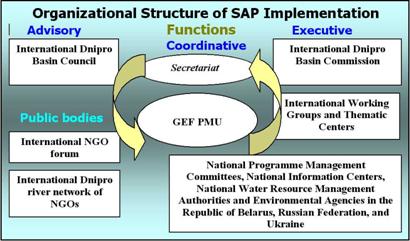
Most of the proposed institutional bodies are already functioning – even if only in a fledgling role – under the GEF SAP development project.
One of the major tasks of the management body will be to attract and coordinate bi-lateral and multi-lateral co-financing for projects. By the time the full project is initiated there will have been two Donor Conferences, the first held in 2004 and the second proposed for 2006. The objective of these conferences is to confirm co-financing for SAP activities, both those included in the proposed full project, and other parallel activities that are considered as priorities in the SAP. This approach to Donor coordination will be included as a regular procedure within the SAP management activities and may be supported by the full sized project.
Clearly there are major costs associated with establishing and running this institutional framework. The overall costs will vary according to the size of the institutions, the frequency of meetings, attendance at meetings and required outputs[14]. The three countries will cover the principal costs of setting up and starting to run the Commission and Secretariat; the full sized project will provide technical assistance and some preliminary support to the processes of establishing and running these bodies.
Outputs:· Output 4.1: Agreed timetable and regular meetings of management bodies and records of meetings publicly available;
· Output 4.2: Confirmed and sustainable budgetary provisions for supporting the SAP management bodies;
· Output 4.3: Regular reporting procedures in place, including the interpretation of monitoring data to guide decision making and policy modification;
· Output 4.4: Stakeholder involvement expanded to include private sectors, specifically private industries and CBOs and other local organisations in areas affected by SAP interventions;
· Output 4.5: 5 Year revised and updated SAP and TDA, in response to impacts of SAP implementation projects, new challenges and modified environmental quality objectives, annual amendments as required.
Outcomes: Permanent and sustainable multi-country institutional (policy and executive) and participatory mechanisms established and operational for long-term integrated management of the Dnipro River basin.
2.2 Project Alternatives
2.2.1 No Further GEF Investment
The GEF has already made a considerable investment in supporting the regional development of the SAP and in defining preliminary interventions to counteract major environmental issues, especially those of a transboundary nature.
This involvement goes back to 1995, when the three countries agreed upon a memorandum requesting UNDP assistance in the development of a GEF Environmental Management Plan for the Dnipro Basin. In 1996, a preliminary grant was made available (RER/95/G42/A/1G/31) for the compilation of data for the preparation of a TDA. In parallel with this the International Development Research Centre (IDRC Canada) had been developing a series of independent initiatives focused on the rehabilitation of the Dnipro River Basin.
In 1999, the GEF agreed to fund the full development of the SAP and TDA, with UNDP as the Implementing Agency. This program was managed by UNOPS as the Executing Agency, and continued to involve IDRC as well as bringing in UNIDO and the IAEA for specialist support to specific studies.
Meanwhile, the initial focus of the GEF and Implementing Agencies in developing the Black Sea SAP, has expanded into the GEF Strategic Partnership addressing Transboundary Priorities in the Danube/Black Sea Basin. By definition this includes the Dnipro Basin, and indeed Belarus, the Russian Federation and Ukraine are specifically included in recent projects.
Given the previous and on-going support, it would be inconsistent for the GEF not to fund the development of a full project proposal on the management of transboundary industrial chemical pollution, addressing this regional priority for the Dnipro Basin and the Black Sea.
2.2.2 Developing a Multi-sectoral Project Proposal
One option for GEF involvement would be to support the SAP across a wide range of multi-sectoral interventions, establishing a more holistic program of management.
However, this is contrary to the fundamental concept of the SAP, which accepts that there will always be resource constraints, and therefore sets priorities for interventions. The regional priority identified in the TDA and the SAP is industrial chemical pollution. If resources are adequate to significantly address this issue, then this would, by definition become the focus of the next phase of GEF activities.
In addition, other projects and other agencies have already committed themselves to actions in other sectors, both at the national and regional levels.
Indeed the World Bank-GEF Investment Fund, under the Strategic Partnership addressing Transboundary Priorities in the Danube/Black Sea Basin, will finance a range of initiatives to reduce nutrient load into the Black Sea, and while mentioning only the Danube, specifically includes Russia, Belarus and Ukraine[15].
The GEF has also been approached to fund biodiversity projects both specifically linked to the Dnipro[16] and more generally in the basin, dealing with forestry, grasslands and agriculture. The EBRD is also financing investments in agribusiness and industry to improve performance and reduce pollution, although so far these are largely limited to Ukraine.
While the SAP is in itself a mechanism to supervise and report on the management of multi-sectoral and regionally prioritised interventions, it is also a mechanism for setting priorities. Given resource constraints the GEF should focus on the development of institutional implementing mechanisms for the SAP and direct interventions in industrial chemical pollution, the regional priority identified in the SAP and TDA.
3 Sustainability
The preliminary investments in developing the SAP and TDA, and in the preparation of a FPP, are not designed as sustainable planning processes, however the subsequent management of the SAP and the interventions implemented under the SAP must be institutionally and financially sustainable.
The FPP will focus on smaller industries discharging untreated or partially treated waste into municipal systems. In many cases it is these industries that are the focus for privatisation. As part of the study, and as criteria for investment, the project will review the technical and financial sustainability of these interventions.
At the SAP management level, the project will look at the proposed management structures and recommend low cost management systems, including a limited secretariat and targeted meetings. The “Agreement” commits the participating countries to “Convene”, “Establish”, and to “Provide the legal support to and ensure the sustainable operation” of the Commission, the Council, the Secretariat and the International NGO Forum.
The agreement specifies a time-frame for reviewing and if necessary revising the TDA and the SAP – every five years.
However, the main indication of real commitment to implementing the SAP is when the countries themselves undertake the financing of the SAP management bodies, and of the activities indicated in the SAP and NAPs. To some extent, this has already occurred in Ukraine, where certain activities listed in the NAP have been carried out in advance of formal approval of the Agreement or the SAP.
4 Replicability
The lessons from the project are particularly relevant to the other CIS and NIS countries, many of which have the same heritage of water management and environmental legislation, and are undergoing similar problems of environmental degradation and industrial and economic transformation.
The previous GEF project, developing the Dnipro Basin SAP, had the benefit of two closely related programmes, the Black Sea and the Danube SAPs, which have developed into the GEF Strategic Partnership Addressing Transboundary Priorities in the Danube/Black Sea Basin. In addition, the project was able to access information from other SAP planning exercises held throughout the world, including the Tumen River, Lake Tanganyika and the Caspian Sea[17].
The co-operation required by the three countries to jointly develop an agreed TDA and SAP, was greatly enhanced by their common heritage in terms of scientific background, environmental legislation and economic development.
The move to ever-closer ties with the EU, largely supported through TACIS, has introduced other common elements. The revised TACIS council regulation, running from 2000 to 2006, focuses on six aspects, including institutional and legal reform, environmental protection and private sector and economic development.
The project has developed a web site, specifically to publicise project activities[18], the site has a dual English and Russian interface. Copies of project reports and other relevant materials can be downloaded from the site. Many of the reports are in both languages. The site also hosts a discussion forum, in Russian.
As a component of the SAP, this site will be further developed and expanded, and a full web based environmental database will also be established (http://www.dnipro-ecobase.org.ua). The results of future SAP interventions will be published and available in English and Russian on the project web site, along with evaluations of the processes used to develop these interventions. SAP management reports will also be made publicly available.
Within the GEF structure, the lessons from the preparation of the Dnipro SAP will feed into IW LEARN[19] and the training programme currently under development, “The TDA/SAP approach in the GEF International Waters Programme”. Following on from this, the implementation of priority institutional and technical interventions to reduce chemical pollution will all provide replicable lessons for other programmes throughout the region.
Of immediate relevance to other donor agencies is the continued river basin management planning process underway on the Pripyat River[20], a major tributary of the Dnipro, as part of the EU/TACIS funded Transboundary Water Quality Project. This project deals with three other shared river bodies, where, at present only water quality monitoring is taking place. However, in the future this is hoped to extend to management planning, at which point the experiences of preparing a TDA and SAP and subsequently implementing the SAP, become immediately relevant.
The focus of the GEF FPP on waste treatment and cleaner production processes in smaller and often privatised industries, reflects an economic and industrial development situation that is similar throughout much of the CIS. The pilot projects initiated by the GEF under the full project, will therefore provide models that could be replicated in many of the CIS countries. This information will be available in English and Russian on the project web site, and will be made available at regional and international conferences.
As part of the FPP, the project will participate in regional meetings of the GEF Black Sea and Danube River programmes, and through UNIDO in regional meetings on Cleaner Production Technologies.
5 Stakeholder Involvement
During the preparation of the TDA and the SAP, considerable attention was paid to involving a broad range of stakeholders in the determination of environmental and social priorities and in identifying appropriate interventions.
While planning systems differ in each of the participating countries, formal government planning mechanisms involving ministries, research institutions and parastatals, were supplemented through the creation of an International NGO Forum, supported by the International Dnipro River NGO Network.
In order to ensure the continuation of this broad stakeholder involvement in the implementation of the SAP, the project established the International Dnipro Basin Council. The first council meetings were held in 2003. This structure will continue as an advisory body to the SAP management organization, including the proposed International Dnipro Basin Commission supported by the secretariat.
According to the Council by-law, each riparian country is represented by 23 members drawn from Natural Resources and Environmental Ministries, leading scientific and research institutions and organisations, other government bodies, local self-government bodies of the riparian regions (oblasts), environmental non-governmental organisations and other non-governmental bodies.
The Council may invite observers and experts from other interested ministries and other central government bodies, local executive bodies, local self-government bodies, manufacturing enterprises, scientific institutions and civic organisations of the riparian countries as well as representatives from international organisations.
In addition, during the previous project phase, the preparation of the TDA and SAP, the project provided support to the International Dnipro River NGO Network. Under the framework of implementing the SAP, public and non-governmental organisations will continue to play an important role in the rehabilitation of the Dnipro Basin at all levels.
The SAP includes the following actions to enhance public participation and ownership.
· The enhancement of national legal systems to support public initiatives and ensure the active and effective participation of non-governmental organisations in the implementation of the Dnipro Basin Rehabilitation Program;
· The acknowledgement and consideration of the interests of the public, as a matter of priority, in the process of formulation and implementation of local environmental action plans;
· The monitoring of SAP implementation by the public;
· Dissemination of information on the state of the Dnipro Basin and participation of the NGOs in this process;
· The integration of environmental considerations into educational programs adopted in the riparian countries, and active involvement of the NGOs in the promotion of the integrated basin management approach.
This same process of public participation and formal stakeholder involvement through the NGO Forum and the Council, will advise on the preparation of the Full Sized Project, as well as providing links with broader funding mechanisms, and reviewing the preliminary implementation of the SAP.
The FPP will include some initial financing to the International Dnipro River Network / International Dnipro Forum of Environmental NGOs, however long term financing will be negotiated as part of the overall costs of SAP management and with support from other NGO sources and from the private sector.
D Financing
1 Financing Plan
GEF will commit $7,700,000 to finance the PDF B and full sized project. In addition the full sized project expects to receive co-financing from a range of sources. As a starting point, this will include national government contributions(for SAP implementation via NAPs), other agencies and the private sector. Parallel financing, dealing with other aspects of transboundary pollution, is already under consideration through alternative GEF financing channels and other international funding agencies.
Following the first Donors Conference, the World Bank has clarified their interests in jointly supporting elements of the SAP. The Pollution Reduction in Industry Loan (under preparation for the Ukraine) is targeting many of the industrial environmental hot spots as identified by the SAP. More generally, the bank supports reforms in the environmental sector under Programmatic Adjustment Loans (PAL II is currently underway) - through indexing environmental fees and fines and through the introduction of Integrated Pollution Permits for Industrial Enterprises. The bank is also proposing to establish a Municipal Development Fund Project (under preparation), which would finance priority investments in water supply/wastewater treatment and municipal solid waste management.
The EBRD is in discussion with the three countries on the provision of loans to small industries, loosely based on their experience of previous investments in the region. In December 2003, the EBRD stated that one of their key objectives for the Ukraine was the support of private sector development through establishing credit lines and equity funding in joint ventures and local private companies. Similar financial commitments are indicated in their “Statement of cumulative net commitments” to Russia and Belarus.
The previously referred to EBRD/GEF partnered “Danube Pollution Reduction Program”, which led to the successful development of a Credit Facility in Slovenia, could serve as a possible model for implementation in the Dnipro basin as well. Assuming an appropriate degree of bank reform in the riparian countries, together with a necessary supporting regulatory framework, such a Facility could be used to finance reductions in water pollutants with specific attention to toxic substances. The main focus would again be on industries, small and mid-sized municipalities, and large livestock farms to reduce their impact on surface and groundwater. The Facility would build on previous experience from the Danube basin together with proposals for reducing/eliminating hot-spots contained in the Dnipro SAP. Such a Facility would bring in new investment financing, channelled by local commercial banks to the private and municipal sectors, and softened with GEF grant funding. The final result would be a sustainable example of financial intermediary/private sector partnership in water pollution reduction.
2 Cost Effectiveness
The success of direct investment in the introduction of Clean Production Processes to small industries, depends on the cost effectiveness of the enterprises and the proposed production systems.
The objective is for a win-win situation, with enhanced profits through more efficient environmentally sound production; with environmental gains through minimised pollution. The starting point for the TEST approach piloted under the Danube SAP, is that the target enterprise must be initially financially viable over a five year period, to merit investment in improved production technologies. In many cases the need is for retrofitting facilities to keep the industries competitive while reducing emissions and complying with local regulations. A starting point is often the introduction of energy reducing processes, leading to immediate financial returns that can then be reinvested in other aspects of cleaner production.
E Institutional Coordination and Support
1 Core Commitments and Linkages
The World Bank has endorsed the new 2004 to 2007 Country Assistance Strategy for Ukraine[21]. The World Bank has existing Country Assistance Strategies with the Russian Federation covering the period 2003 to 2005 and with Belarus covering the period 2002 to 2004[22]. The project proposals are coherent with the proposed strategies for development outlined in the three CAS documents.
2 Consultation, Coordination and Collaboration between and Among Implementing Agencies, Executing Agencies and the GEF Secretariat
The preceding GEF project, “The Preparation of a Strategic Action Programme (SAP) for the Dnipro River Basin and Development of SAP Implementation Mechanisms”, directly involved a number of Implementing Agencies and Executing Agencies.
The Implementing Agency was UNDP, and the Executing Agency was UNOPS. Both agencies were able to bring in considerable International Waters expertise, both from projects in the area (the Caspian Sea, the Black Sea, the Danube) as well as projects in other regions.
Much of the evaluation of industrial development and pollution was carried out under the guidance of UNIDO[23], as well as the review on Environmental Legislation. The IAEA had the responsibility for reviewing management of nuclear facilities and disposal sites, and for recommending reforms as inputs for the SAP. UNEP provided limited support recruiting a consultancy group to present the GIWA[24] methodology to a preliminary TDA workshop.
Finally the project participated in the 2nd GEF Biennial International Waters Conference, which took place Sept. 25-29, 2002 in Dalian, China.
The input from these agencies has been incorporated in the SAP and TDA, and has led to the development of the specific proposals incorporated in the full sized project.
The Implementing Agency of the full project is expected to be UNDP and again the executing agency UNOPS. Expertise from UNIDO will be drawn on to further develop the pilot projects to introduce cleaner production methods and effluent pre-treatment to small industries, typically in the private sector.
The FPP is expected to bring in and/or work in parallel with a wider range of agencies, including the World Bank and the EBRD.
PART II - PROJECT DEVELOPMENT PREPARATION
A Description of Proposed PDF Activities
The GEF has been involved in the development of the Dnipro Basin Strategic Action Program since 1995.
The main project became effective in September 2000, with the inception workshop held in March 2001. The project prepared a Transboundary Diagnostic Analysis[25] completed in 2003 and a Strategic Action Program, completed in 2004. The project also prepared the “Agreement on Cooperation in the Field of Use and Protection of the Dnipro Basin”[26] The Agreement will commit the three countries to an agreed policy on environmental protection for the Dnipro Basin and to implementing actions listed in the SAP and in National Action Programs, drawn up under the auspices of the SAP.
However, the information provided in the SAP and TDA is insufficient to prepare detailed project proposals that comply with GEF or other donor requirements. As a result a PDF B project is required to prepare a Full-Sized Project Proposal, with sufficient detail to implement and monitor project interventions.
The SAP has identified that the regional priority is the need to address industrial chemical pollution. Within this broad sector, other agencies are proposing to address problems in some of the major industrial complexes, leaving out the issue of pollution generated by the many smaller industries that discharge effluents through municipal waste facilities – the Vodokanals.
The Development Objective of a PDF B is the same as for the FPP that is being prepared, “To reduce transboundary industrial chemical pollution from small industries currently discharging through municipal waste systems”.
The Immediate Objective of a PDF B project is “To provide information requisite to complete project proposals and necessary documentation[27]” for a Full Project Proposal.
The PDF B Project will therefore prepare a Full-Sized Project Proposal addressing the problems of cleaner production and effluent pre-treatment for smaller and in many cases privatised industries, discharging through the Vodokanals. This will also address issues of sustainable financing mechanisms and legal and regulatory requirements.
However, as the implementation of these activities will take place within the framework of the SAP, supported by regional and national legislation, the project will also deal with the institutional development of the SAP management bodies. It will also address transboundary monitoring issues to provide key information to these management bodies on the effectiveness of SAP implementation.
B PDF Block B Outputs
Part I of this PDF B proposal, drawing on the Concept Paper, defines the Development Objective, derived from the SAP/TDA priorities. It also then describes the project under four components each with it’s own Immediate Objective, and set of outputs.
However, these four components and their associated outputs have not been fully developed and must be taken as indicative of the expected outputs and activities of the FPP. The role of the PDF B project is to fully develop these components, through a process of analysis and dialogue, and to prepare detailed project budgets and supporting project monitoring systems.
Component 1: Pilot Projects for Small Industries.
Immediate Objective 1: To introduce cleaner production methods to small industries discharging through Vodokanals – including sustainable financing mechanisms and local regulation and monitoring procedures.
Component 2: Transboundary Monitoring.
Immediate Objective 2: To provide information on the status and progress of the SAP implementation programme to the Dnipro Basin management bodies, and to allow prompt decisions and responses to emergency situations.
Component 3: Harmonization of Environmental Legislation.
Immediate Objective 3: To introduce harmonised environmental legislation to the three countries, in line with those prevailing in the EU.
Component 4: Institutional Development for SAP Implementation.
Immediate Objective 4: To establish key institutional and management structures within the wider SAP management bodies.
In addition the PDF B project will prepare a budgeted proposal for managing and monitoring the implementation of the FPP, following the standard GEF and implementing agencies guidelines on project monitoring procedures,
1 Pilot Projects for Small Industries
From the SAP and the TDA and supporting documents, it is clear that chemical industrial pollution is the regional priority, and within this broad sector, the major gap is in the reduction and treatment of waste from small industries. The main direct intervention to be developed under the PDF B will be to finance pilot projects introducing cleaner production methods and effluent pre-treatment to small industries to reduce the discharge of significant transboundary pollutants into municipal waste treatment systems.
In many cases these small industries are privatised or are in the process of being privatised, against a background of legislation and regulation that was largely developed for state enterprises.
1.1 Identifying a Priority Vodokanal and Associated Industries in Each Country
Output: An agreed set of Vodokanals and associated small industries, in which the FPP will start work on introducing pilot projects
An initial workshop will be held in each country to agree on the process that will be followed to identify a priority Vodokanal and associated industries, and tasks assigned to national experts and institutions. In certain circumstances more than one Vodokanal might be identified, however this will dilute impacts and add considerably to the overheads of management supervision.
An initial listing of possible target Vodokanals has been prepared on the basis of the studies carried out as inputs to the TDA and SAP. This list is not exclusive, and additional sites may be considered.
Table 3 Vodokanals from which Pilot Projects will be identified for Cleaner Production Methods and Pre-treatment of Effluents from Small Industries
|
Country/Vodokanal |
Industries/ some pre-treatment |
Comments |
|
Belarus |
||
|
Retchitsa Vodokanal |
ND / 0 |
Industrial effluent forms 1/3 of treated waste |
|
Minsk Vodokanal |
ND |
|
|
Mogilev Gorvodokanal |
ND |
Man-made fibres, heavy metals and other waste |
| Gomelvodokanal |
ND |
|
|
Russia |
||
|
Smolensk Vodokanal |
50 / 20 |
Mainly Food and Electronics |
|
Briansk Vodokanal |
ND |
States industries have “pre-treatment if required” |
|
Novozybkov Vodokanal |
ND |
|
|
Kursk Vodokanal |
ND |
Industrial effluents exceed MAC |
|
Ukraine |
||
| Kyiv Vodokanal |
300 / 65 |
Heavy metal contamination of sludge |
|
Dnipropetrovsk Vodokanal |
130 / 30 |
Mainly Food, Electronics and Engineering |
|
Zaporizhya Vodokanal[28] |
90 / 15 |
Metallurgical, Food, Electronics and Engineering |
|
Chernihiv Vodokanal |
40 / 10 |
Heavy metal contamination of sludge |
|
Zhytomyr Vodokanal |
40 / 9 |
Mainly Food, Electronics and Engineering |
|
Loutsk Vodokanal |
30 / 4 |
Food, Engineering and Processing |
|
Kherson Vodokanal |
45 / 10 |
Mainly Food, Electronics and Engineering |
The first task is to review the state of the industries discharging effluents into the proposed priority Vodokanals in each country, and identify a single Vodokanal for initial pilot sites in each country. The basis for this selection need not be the worst pollution scenario, it could be a Vodokanal with an appropriate range of small/privatised industries, or indeed a Vodokanal where co-financing can be clearly identified dealing with municipal waste treatment or to provide loans to small industries.
This will be followed by a National Management Committee meeting, again one in each country, to agree on the priority Vodokanal.
While in some cases the options for introducing improved technology will be very clear with only one possible solution, in most cases there will be a range of options, and the decision will have to be based on financial viability as well as technical soundness.
1.2 Sustainable Financing of Pre-treatment and Cleaner Production Methods
Output: A Review of Sustainable Financing Instruments for the maintenance of pilot project facilities, and for future investment in the same technologies for industries in other Vodokanals.
In parallel with identifying pilot project sites and technological options to reduce pollution, the PDF B Project will carry out a review of sustainable financing mechanisms for maintenance and investment in cleaner production technologies and pre-treatment facilities.
Any decision on “appropriate” technology needs to evaluate the costs of implementing the technology, under different financial scenarios. The objective is to achieve a win-win situation, with more efficient production systems reducing costs and reducing pollution.
The PDF B project will draw on the lessons learned from the Danube TEST Project (Transfer of Environmentally Sound Technology). The development of this approach has been strongly supported by UNIDO, and following on from the Danube is being adopted the Mediterranean Action Plan (TEST-MAP).
This approach adopts a critical path analysis, starting with the financial viability of the enterprise, following with a cleaner production assessment, which identifies pollutant reduction measures that an enterprise could undertake using available financial resources. This is followed by an industrial management assessment. At the end of these two assessments (cleaner production and industrial management), the enterprise would have sufficient information about its production processes and problems to undertake an environmentally sound technology assessment. The EST assessment would identify the combination of best available techniques (combination of process change, pre-treatment and final treatment) and best available practice (sectoral environmental control strategies and measures) that would bring the enterprise into compliance with environmental norms.
Initial meetings will be arranged with the Danube and MAP TEST teams, to discuss the problems and successes of their approaches and their adoption regionally as a planning tool.
However, the “financial viability” of investing in cleaner production technology, depends as much on the financial environment as on the direct costs of implementing a new technology.
As a first step, national workshops will be held to review the available financing mechanisms and to establish the scope of the study. National experts will then prepare a report for the PMU of the specific options available or under consideration.
The tax options could include incentives for future maintenance of facilities and reduced effluent challenge – taxes on effluent load and discharge, or tax reductions on reduced effluent load and discharge[29].
However, this is only one component and it is clear that for other industries to adopt pilot project technologies it will be necessary to provide additional incentives for initial investments. One option would be through the provision of loans through local financing institutions, these could either be at “soft” rates, or with the incremental cost component of cleaner production provided as a grant, or with the loans discountable against future taxes[30].
Other considerations include cost effectiveness and administrative feasibility, transparency in operation and flexibility to allow for modifications as new information is obtained.
The PDF B project will also draw on lessons learned from the National Pollution Reduction Project in Slovenia. In that regard it will build on EBRD’s extensive experience in extending credit lines through local commercial banks in Central and Eastern Europe. Of particular relevance are the Bank’s EU co-funded environmental credit line in Hungary and its joint EBRD/EU regional credit facility to support small and medium-sized enterprises (SMEs) in the ten EU accession countries. Under the latter facility, EU grants are used to provide a package of incentives to encourage local FIs to embark upon new financing instruments and activities which, for commercial reasons, they cannot and would not undertake purely on their own.
The PMU will prepare a budgeted project proposal to be included in the FPP to introduce appropriate financing mechanisms for introducing cleaner production technologies to industries in the pilot project vodokanals. In addition it will be necessary to budget for the introduction of new planning methodologies based on the TEST approach or some other integrated planning tool.
1.3 Regulation and Monitoring Procedures for Small Industries
Output: A budgeted project proposal to introduce appropriate regulatory and monitoring procedures for pilot project facilities.
This component links directly to the previous components. The regulations may specify approved technologies or allowable emissions. Regulations may also specify what financial incentives are available to encourage adoption and adherence to cleaner production processes. Regulations are also likely to include fines to encourage compliance with regulations on allowable emissions. Finally monitoring will show whether water quality targets are being met or whether allowable emissions are being exceeded.
Again, this exercise will start with national workshops. These will need to consider three aspects: acceptable discharge patterns, and legal and institutional regulatory options and appropriate monitoring procedures. National experts will be identified to carry out a review of the local situation as it applies nationally and to specific Vodokanals.
These national reviews will be passed to the PMU who will be responsible for bringing them together as a single project component and preparing a budgeted proposal to introduce new regulations and monitoring procedures for pilot project areas, to be implemented under the FPP.
As a starting point, the impacts of different pollutants need to be considered, and different approaches reviewed to setting standards. With some pollutants the water quality objectives may be set by the total annual load of a particular pollutant or group of pollutants, or by the maximum acceptable concentration of that pollutant in the effluent.
There are then effectively two approaches to regulation, end of pipe control and process based control. The objective of the two approaches is the same – to limit the discharge of pollutants at the point of discharge to “acceptable” levels. While traditionally the end of pipe approach has been most commonly adopted, the “process-based control” approach is now strongly promoted by the EU through the 1996 “Integrated Pollution Prevention and Control Directive". This authorises a specific industrial process (cleaner production technology or pre-treatment facility), occasionally in conjunction with limited, or site specific, effluent quality specification.
The present institutional arrangements for regulation are constrained by lack of resources, and in many cases historical conflicts between the need to encourage industrial production and the need to protect the environment. Regulations tend to be set at national levels, with little room for local flexibility. It may be possible, within the context of the GEF pilot projects, to explore the possibility of establishing local government bylaws to allow municipal authorities to set their own criteria according to local conditions – including Best Available Technology (or best available technology not entailing excessive costs BATNEEC).
The final component is monitoring compliance and effectiveness of operation. Whether regulation is through process control or emission levels and patterns, the objective is to reduce emissions. The key will be to monitor at the point of discharge to indicate either compliance or the effectiveness of the allowed process. Secondly monitoring will need to be carried out at the point of discharge of the Vodokanal – or the quality of processed sludge. In general these monitoring procedures are well known, but constrained by lack of resources.
1.4 Support from Cleaner Production Centres
Output: A Review of the Need/Options for Establishing a Cleaner Production Centre.
From the previous discussions, it is clear that the evaluation of the potential for introducing cleaner production is a complex exercise, bringing together a wide range of expertise from many different fields.
One response to this has been the creation of “Cleaner Production Centres”, typically an advisory body to both industry and government. This is the approach that is being promoted by UNIDO, and has led to the establishment of 31 National Cleaner Production Centres since the program was initiated in 1994.
UNIDO states that their programs “build national CP capacity, fostering dialogue between industry and government and enhancing investments for transfer and development of environmentally sound technologies.” UNIDO claim their program “increases competitiveness, facilitates market access and strengthens the productive capacity of developing economies taking into consideration the other two dimensions of sustainable development, environmental compliance and social development”.
The program already has significant coverage in the region, with fully established centres operating in the Czech Republic, the Slovak Republic and in Hungary. The Russian Federation has a fully established sector specific centre in Moscow, dealing with the Oil and Gas Industries. A second more general centre is under establishment in St`Petersburg, the North West International Cleaner Production and Environmental Management Centre.
In addition UNIDO is supporting the establishment of a Cleaner Technology Centre in the Ukraine[31].
The PDF B project will contact UNIDO and the relevant national CPCs and establish what level of support they can presently provide to the FPP. The PMU will review the need to establish additional centres, or to build on the capacity of existing centres to support activities in pilot project sites. An additional option might be to establish a regional centre, although UNIDO emphasize the need to adopt and adjust to local conditions. This may be less critical in a region with countries with a similar heritage in legislation and regulation, and at similar levels of industrial development.
2 Transboundary Monitoring
Output: A budgeted project proposal for inclusion in the FPP to establish and maintain a Transboundary Monitoring Program.
Within this proposal monitoring is required to deal with two separate aspects:
· Monitoring environmental and socio-economic changes to demonstrate the effectiveness of project or SAP interventions, and changes that may indicate the need for modified or new project interventions;
· Monitoring the effectiveness of project implementation.
The first element of monitoring is discussed in this section, while the second element, project monitoring is expanded on in Section 5 dealing with the Analysis and Review of the Full Sized Project.
Guidance on both aspects is available from a number of sources, including the GEF and Implementing Agencies[32].
2.1 Transboundary Water Quality Monitoring
Considerable attention has been paid to water quality monitoring during the development of the TDA and SAP. Article 9 of the Agreement specifically states that the parties will facilitate the implementation of the Transboundary Monitoring Program (TMP) – as detailed in the Annex in the SAP. The program was developed by the Intergovernmental Monitoring Group working through the Regional Thematic Centre for Pollution Monitoring established by the GEF project at the Ukrainian Research Institute of Environmental Problems in Kharkiv.
The stated objective is:
· to provide information to the Dnipro Basin management bodies, to allow them to assess the progress and success of the SAP implementation program and to modify the proposed actions and priorities as necessary…
· in a timely and accessible manner to allow prompt decisions and responses to emergency situations and to provide a basis for the settlement of potential conflicts over transboundary pollution, between the countries.
However, as described in the Agreement, the focus of the Transboundary Monitoring Program is on measuring and presenting water quality parameters. This emphasis reflects the main interests and work programs and the historical role of the Institutes involved in drawing up the monitoring program.
Map 2 Monitoring Stations for the Transboundary Monitoring Program
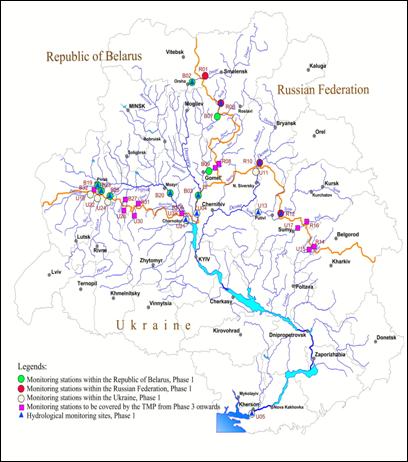
The water quality program has been formulated in three stages. The first stage uses the existing national monitoring system and modifies procedures to take into account the specific objectives of transboundary monitoring. The second stage involves the provision of new equipment and facilities for laboratories and hydrological posts as required to provide the priority information set necessary to evaluate the implementation of the SAP. The third stage completes the process with the incorporation of additional monitoring stations and the collection of the full agreed data set.
In addition, the traditional approach to monitoring chemical and biological water quality indicators has been under modification on other projects, particularly the TACIS Transboundary Water Quality Monitoring Project and the proposals for the Pripyat River and the Seversky-Donets Rivers[33].
Given the advanced state of planning for this sub-component, the PMU will prepare a detailed budget and project proposal, based on the SAP, the TMP annex and the Thematic Centre reports, as well as the conclusions of the TACIS report. This will be presented as a separately identifiable component of a broader monitoring programme.
While clearly a key parameter in any river monitoring program, water quality would usually be considered as only one element of a wider monitoring framework required to support management.
2.2 Broader Environmental Monitoring
Broader frameworks for environmental monitoring and evaluation are typically based on variations of the “Pressure, State, Response” approach[34], which seeks to answer three questions: Why are changes occurring? What are the changes to the environment? And what is being done about it?
The preferred GEF approach, drawn up by the International Waters Task Force (IWTF) is presented in their report - Monitoring and Evaluation Indicators for GEF International Waters Projects. However, there are continued developments in techniques and concepts, and no single solution will fit all international waters projects.
In terms of the specific interventions proposed for the FPP, aimed at reducing pollution from the smaller industries discharging through the Vodokanals, the M&E program could include the following indicators:
State / Environmental Status: change in chemical load at the point of discharge, change in volume and pattern of discharge, change in the chemical load at other transboundary points on the river, and longer term change in the aquatic flora and fauna;
Pressure / Stress Reduction: number and type of factories discharging waste through the Vodokanals, change in number and type of factories using cleaner production processes.
Response / Process: Change in legal/regulatory framework to encourage adoption of cleaner production processes or discourage pollution, institution building to support change, stakeholder involvement in planning/legislative processes, establishment of National Cleaner Production centres.
The PMU will prepare an initial position paper on the development of a broader M&E framework for presentation to the Joint Management Committee and the National Management Committees. Further discussions will then be held with the Regional Thematic Centre, and the counterpart national organisations.
The PMU, with the support of M&E experts from the three countries will then prepare a budgeted proposal for a broad Monitoring and Evaluation System for the FPP that will provide decision makers and stakeholders with timely information on the progress of the SAP and projects implemented under the SAP.
This M&E proposal will include as one sub-component of the Environmental Status Indicators, a modified transboundary water quality program, based on and extending the model presented in the Agreement.
3 Harmonised Legislation
Output: A budgeted proposal for inclusion in the FPP to monitor and review legislative changes in the three countries.
The objective is to ensure that there is coherence in achieving the aims of pollution control legislation between the three countries and in line with EU approaches.
The Agreement and the SAP specifically state that the countries will “Harmonise the environmental legislation of the riparian countries of the Dnipro Basin with that of the EU”. The takes on special significance for two reasons.
· The Dnipro River has a significant impact on the condition of the near-shore water and ecosystem of the western section of the Black Sea adjoining the two countries Romania and Bulgaria. Both countries have submitted formal applications and may become EU member states under the next review, expected in 2007.
· The Ukraine has stated that it would like to become an “associated member” of the EU in the near future and hopes to submit an application for full membership at some stage[35]. This would then require modifying national legislation to match the legislation of EU.
In addition the Republic of Belarus and the Russian Federation are also interested in bringing national legislation in line with the EU, particularly where it might be useful in supporting the process of reformation.
Again considerable work has already been undertaken on reviewing legislation, and the conclusions have been presented in two reports. These are the “Harmonisation of Environmental Legislation of The Dnipro River Countries with the Legislation of EU Member States”, prepared by the National Working Groups of Belarus, Russia and Ukraine; and “Environmental Legislation of Russia, Ukraine and Byelorussia Compared with the Principles of EU Environmental Law”, prepared by UNIDO.
On the basis of the above documents, and the supporting work available to the PMU office, the PMU will prepare a detailed budget and project proposal for monitoring and reporting on legislative changes and harmonization, to be included in the FPP.
However, it is clear that there is a strong national commitment that has already led to the initiation of legislative change, the FPP will support the process through monitoring and reporting on change, leaving the implementation of the program to national institutions that have already shown they have the resources to deal with these issues.
Given that water policy and codes in the three countries have evolved from a common heritage, the needs for legislative changes in one country are likely to be reflected in the other two countries. The same will apply to the process of negotiation and review required to modify legislation. The immediate benefits from monitoring and information transfer will be significant.
The draft PMU proposal will be passed to the Regional Thematic Centre based at the Centre of Russian Register of Hydro-Technical Constructions and State Water Cadastre of the Ministry of Natural Resources of the Russian Federation, and through the Regional Centre to the national counterpart organizations. A meeting of national legal/environmental experts will then be held to agree on final proposals.
The PMU will then prepare a final budgeted proposal to be included in the FPP.
4 Institutional Development for SAP Implementation
Output: A budgeted project proposal for inclusion in the FPP to provide support to establish the proposed SAP institutional and management structures.
Both the Agreement and the SAP are very specific in their description of the institutional framework for implementing the SAP (Figure 1 Proposed Institutional Structure to Implement the SAP, Page 16).
A Conference of Parties is proposed in the Agreement as the supreme body responsible for managing the Dnipro Basin. They will establish the Dnipro Basin Commission who will be assisted by a Secretariat. In support of this, as advisory bodies there will be the Dnipro Basin Council, with representatives from central and local government, scientific research and advisory institutions, industry, NGOs and community groups. In addition there will be specific NGO representation through the International NGO Forum and the International Dnipro River Network of NGOs.
However, the functions of the management bodies are not so clearly defined. The main tasks of the SAP management bodies can be summarized as follows:
· Сoordinate and report on regional interventions listed in the SAP;
· Coordinate the monitoring programme covering water quality and the impact of SAP interventions;
· Prepare annual “addendums to the SAP dealing with new projects as they become active;
· Prepare ad hoc reports dealing with emergency spills and other issues;
· Prepare an annual report on SAP progress;
· Prepare a five year report on SAP progress;
· Coordinate the preparation of five year revisions of the SAP and TDA;
· Act as a channel of communication between the three countries, covering national interventions carried out in support of or within the framework if the SAP;
· Ensure that public participation is incorporated into the decision making process, at three levels as described in the SAP, International, National and Local;
· Promote the SAP among both national and international funding agencies, sourcing and directing funds to priority SAP and National activities.
There will be major costs associated with establishing and running this institutional framework. The overall costs will vary according to the size of the institutions, the frequency of meetings, attendance at meetings and required outputs.
Most of the proposed institutional bodies are already functioning – even if only in a fledgling role – under the GEF SAP development project. As a result the PDF B has clear information on potential costs as well the requirements for further institutional development.
The three countries will cover the principal costs of setting up and starting to run the Commission and Secretariat; the FPP would provide technical assistance and some preliminary support to the processes of establishing and running these bodies.
One of the immediate major tasks of the management body will be to attract and coordinate bi-lateral and multi-lateral co-financing for projects.
The PMU will prepare a budgeted proposal to be included in the FPP, covering limited technical support and institution building. This will be presented to the steering committee for approval, and modified if required.
The PMU will organize a second Donors Conference[36]. The objective of this second conference will be to confirm co-financing for SAP activities, both those included in the proposed FPP, and other parallel activities that are considered as priorities in the SAP. This approach to Donor coordination may then be included as a regular procedure within the SAP management activities.
5 FPP – Final Design, Monitoring and Reporting
Output: A Single Project Document including a Logical Framework Analysis, Incremental Cost Analysis, Final Budget, and Project Monitoring Plan
In order to bring coherence to projects financed under the GEF, the GEF and Implementing Agencies have prepared a number of guidelines on project design and management, and project monitoring and reporting.
However, the process of designing a project require a number of parallel and interlinked activities. Tools required for improving project design then provide the indicators to a monitoring program. Financial and economic evaluations feed both into an Incremental Costs Analysis – to demonstrate compliance with GEF financing policy, and into detailed project budgeting from project management and accounting purposes.
The main tasks that will have to be carried out by the PMU under the PDF B, are as follows:
· Logical Framework Analysis
· Reporting and Monitoring Framework
· Incremental Cost Analysis
· Final Project Budget
· Single Project Document
5.1 The Logical Framework Analysis
As a starting point the PMU will need to develop a Logical Framework which considers the project as a whole (i.e. including co financing). Again guidance is given in the 2004 M&E guidelines, specifically in Annex III - an LFA Reader.
Through a process of discussion with relevant national counterparts, the PMU will draw up a draft LFA, indicating objectives, outputs, inputs/activities, measurable performance indicators, risks and assumptions for the various sub-components identified in the previous sections: the Pilot Projects; Transboundary Monitoring; Legislation and Institutional Development.
The draft LFA will then be presented at a regional meeting to regional and national counterpart staff, where a final LFA will be agreed.
5.2 Reporting and Monitoring Framework
The GEF and Implementing Agencies have comprehensive guidelines on project monitoring procedures. While these are under constant revision, the latest guidelines from UNDP were presented as a working document, “Measuring and Demonstrating Impact”, in April 2004[37]. This report covers both the GEF M&E functions and UNDP Project Monitoring and Evaluation Systems.
The guideline differentiates between the role of the GEF and the role of the implementing agency, as well as the project management and the executing agency. The guideline states that “The Logical Framework matrix provides performance and impact indicators for project implementation along with their corresponding means of verification. These will form the basis on which the project's M&E system will be built.”
Based on the LFA the PMU will prepare a draft monitoring plan, this will identify targets, indicators and milestones. The PMU will identify and incorporate, as appropriate, indicators from the Transboundary Monitoring program into the Project M&E. Finally the PMU will identify specific staffing requirements and the role of individual project staff in managing the M&E process.
Following the guidelines, the main M&E output is regular reports, prepared for the Executing Agency, the Implementing Agency and the GEF. The monitoring plan will therefore include the following reports:
|
· Quarterly Reports |
For UNDP and the Executing Agency |
|
· Annual Project Reports |
For UNDP |
|
· Annual Tripartite Review |
For UNDP |
|
· Annual Project Implementation Review |
For GEF |
|
· Midterm Evaluation |
For UNDP |
|
· Terminal Evaluation |
For UNDP within 6 months of closing project |
|
· Outcome Evaluation |
For UNDP – if required |
The PMU will send the draft project M&E proposal to national and regional counterpart staff, making it clear that this is for project performance monitoring as required by the GEF and Implementing Agencies, and is in addition to the transboundary monitoring program.
Based on responses, the PMU will finalize and cost a proposal for Project M&E for incorporation in the final project document.
5.3 Incremental Cost Analysis
The Global Environment Facility (GEF) is one source of funding for global environmental actions. Its purpose, set out in the 1994 Instrument[38], is to provide new and additional resources for the "agreed incremental costs of measures to achieve agreed global environmental benefits". In the case of international waters projects, demonstrating transboundary benefits rather than broader global benefits.
Following further discussions, in 1996 the GEF prepared a document on Incremental Costs (GEF/C.7/Inf.5), which included an approach to estimating agreed full incremental costs. At the same time the GEF released two supporting reports: Streamlined Procedures; and Paradigm Cases focusing on biodiversity examples. While these were reviewed in 1998/99 there has been little further guidance on managing the analysis process.
The process for calculating incremental costs is complex and work continues on drawing up simple definitive procedures. Meanwhile, the PMU may find it helpful to use as examples, recently completed incremental cost analyses on other projects.
The incremental cost analysis is expected to include:
· Incremental Cost Estimates based on the costs of inputs in the project logical framework.
· A description of the baseline conditions.
· A description of project outputs that result in transboundary benefits.
· A description of project outputs that result in joint transboundary and national environmental benefits.
· A description of project outputs that result in national environmental benefits.
· A description of the process used to jointly estimate incremental cost with in-country project partner.
The report will include a simple table showing transboundary benefits, national benefits and costs, for the baseline scenario, the alternative proposal including transboundary benefits, and the incremental costs.
The PMU will review the need for bringing in an economist with experience of incremental cost analysis from one of the partner agencies (or possibly from IWLearn[39]).
The PMU will draw up a draft report on the Incremental cost analysis, covering the above aspects. This will be presented at a regional meeting to regional and national counterpart staff, where a final version will be agreed for inclusion as annex to the FPP document.
5.4 Final Project Budget
The PMU will bring together the draft budgets for all project components, standardizing costs where appropriate. It is at this point that the PMU will identify any cost overlaps between components, as well as the added direct costs of project management.
As a starting point the PMU will draw up a staff list, including both technical support and administrative staff. Given the scale and complexity of the FPP, due consideration must be given to financial management.
It is expected that the future management team for the FPP, will be based in one of the three countries for the duration of the project. While the host country may make office space available, an allowance should be made for renting an office for the project period.
There are then a number of additional costs associated with the office and provision of central services that may not be covered by the component budgets. These will include office overheads, management of a library/resource centre, translation services, report production and reproduction, joint meetings and hire of facilities, communications and travel organization.
The PMU will then prepare a single project budget proposal, including the costs of implementing agency project review – linked to the formal M&E and reporting cycle, and the executing agency overheads.
5.5 Single Project Reports
The final requirement is for the PMU to prepare two “single” reports: The Project Executive Summary and the Project Document or “ProDoc”.
These reports form the end of the process of project design, which started with preparing the “Concept Paper” and presenting it to the GEF for “Pipeline” approval. This confirms that the project is eligible for GEF funding, conforming with GEF strategy, with the GEF program to which it would contribute, and with other GEF policies.
The next step is to prepare a PDF proposal, applying for a grant from the Project Development Facility to cover a detailed planning period. This is the current stage of the project. The main output of the next PDF planning stage, are the two documents, the Project Executive Summary and the ProDoc.
· The Executive Summary is a 10 page summary of the final project proposal presented to the GEF for approval. The document is finalized in response to comments from GEFSEC, implementing and executing agencies, the STAP and experts from the STAP Roster.
· The ProDoc is prepared by the implementing agency or by the project on behalf of the implementing agency. The document has a signature page that is signed by the UNDP and the host countries. The ProDoc becomes the legal agreement between the UNDP, the Executing Agency and the National Governments to implement the project.
The PMU will prepare a draft ProDoc and its associated Executive Summary. Early drafts should be circulated among the implementing agencies for comments, and discussed as appropriate with other donor agencies that may be involved in parallel activities or in co financing opportunities within this project.
The PMU will hold a regional workshop to discuss the two documents. However, the emphasis should be on the ProDoc, as this will eventually be the document that the host governments sign. With the agreement and responses of the participating governments, the PMU will then prepare a final draft Project Document. This will be passed to UNDP for presentation to the GEF.
The PMU will finalize the Prodocfollowing receipt of comments from the agencies listed above, and on the basis of these changes will finalize the ProDoc and Executive Summary.
6 General Project Management during the PDF B
In addition to the specific outputs of the PDF B project towards the FPP, there are a number of general support activities that will be provided by the PMU.
As a starting point it is assumed that the PMU will be staffed as follows: Senior Project Advisor/CTA (full time, reducing to part time following the acceptance of the FPP by the GEF); Project Manager/River Basin Expert; Project Support Officer; and Financial Administrator.
In addition to technical inputs to the preparation of the FPP, the office will provide library resources, communications, report duplication and translation services, and will organize national and regional meetings. There will continue to be some overheads and administration resources associated with the continued functioning of the national offices in Belarus and Russia.
Finally, while there do not appear to be any set procedures for the evaluation of PDF B projects, there will be a number of management and evaluation activities that will be carried out by or supported by the PMU. However, given the extended time frame of this PDF B, the project will loosely follow the UNDP/GEF M&E guidelines.
The most critical management meetings will continue to be the annual Steering Committee meetings, which will generally be held back to back with the project Joint Management Committee meetings.
The first set of meetings are expected to include a Joint Management Committee Meeting to suggest modifications and approve the proposed work plan for the PDF B. This will then be followed by three National Management Committee meetings to review and approve the national consultation processes. These should take place in May/June 2005.
The first SCM is scheduled for February 2006, and in addition to their normal TORs the SC will be asked to review the first draft of the FPP, which will be complete with the exception of the project M&E, the LFA and incremental cost analysis. UNDP will participate in this meeting which can be considered as both a tri-partite review and the mid-term evaluation.
The second SCM is scheduled for February 2007, by which time it is anticipated that the FPP will have been approved by the GEF, and a final ProDoc provided to UNDP. Again UNDP will be a participant in this meeting, which can be considered as both a tri-partite review and the Terminal/Final evaluation of the PDF B.
This meeting will provide the opportunity for UNDP to discuss the details of the FPP with the national and regional organisations who will be largely responsible for supervising and implementing the project.
In terms of regular administrative reporting, the PMU will provide quarterly reports to the executing agency and UNDP, and an annual project report to UNDP. The PMU will also assist UNDP/GEF in preparing the annual Project Implementation Review.
C Justification
The GEF involvement in the Dnipro Basin is part of a wider involvement in the region, centred on the Black Sea.
The Black Sea is now widely recognized as one of the regional seas most damaged by human activity. Its drainage basin covers over one third of the European continent including major areas of seventeen countries, fourteen of which are undergoing a profound economic and political transition from centrally-planned to market economies.
The management of the Black Sea is the shared responsibility of the six coastal countries: Bulgaria, Georgia, Romania, Russian Federation, Turkey, and Ukraine. However, the environmental problems of the Black Sea reflect the environmental problems of the river systems that flow into it. After initial involvement in the Black Sea Environmental Program, GEF support expanded to other Black Sea programs and then to the Danube, and now specifically relates these issues through the formation of the Strategic Partnership on the Danube/Black Sea Basin. The Dnipro Basin SAP is the second major GEF supported planning exercise for an international river flowing into the Black Sea.
Further GEF Investment in the Dnipro Basin adds value to previous investments in the region.
The previous GEF involvement in the Dnipro Basin, developing the TDA and the SAP, has moved the planning process forward to the point at which priorities for investment have been clearly identified. However within the SAP these proposed activities have not been developed into detailed budgeted project proposals.
The GEF could finance a SAP priority investment program without further project development, however this would commit GEF funds to a very open ended process project, with little idea of the final costs that would be incurred.
The SAP has highlighted one priority sector of major interest to the GEF international waters program, the management of transboundary pollution, in this case industrial chemical pollution. The Priority Investment Program, drawn up by UNIDO, indicates a major problem in the discharge of industrial waste through municipal systems, the Vodokanals. As previously indicated the basin countries are going through a period of profound political and economic change, and one result is the privatisation of many of these smaller industries, another area of particular interest to the GEF.
The PDF B project will prepare a Full-Sized Project Proposal with sufficient detail for GEF review. The FPP deals with issues of major interest to the GEF International Waters Program, including direct investment in pilot projects to introduce cleaner production methods, financial and regulatory mechanisms to ensure long-term viability, as well as public involvement, private investment, and transparency.
D Timetable
Present funding for the development of the SAP and the TDA will extend until March 2005. The PDF B project will start in April, 2005.
The project timetable is largely defined by the GEF project cycle timetables, and the periods required for negotiations with the Implementing Agencies, the Executing Agencies and the host countries.
The project will have a first draft of the FPP activities and budgets completed by January 2006, in time for review and approval by the Steering Committee in February. By May 2006, the PMU will have completed a proposal for project monitoring, and prepare an incremental cost analysis and a Logical Framework. The final draft FPP will be presented to the GEF in July 2006.
The PMU will then provide responses to any GEF comments on the project proposal stemming from reviews by the STAP, GEF Secretariat, the Implementing Agencies and relevant Executing Agencies. The final FPP, incorporating these responses is expected to be presented to the fall 2006 session of the GEF Council .
Following GEF Council approval, the PMU will finalize (‘appraise’) the UNDP ProDoc, including addressing GEF Council comments, finalizing implementation arrangements, etc.. This will be discussed at National Management Meetings in October 2006, and completed and passed to UNDP by January 2007. This will then be discussed at a Steering Committee Meeting in February 2007, attended by a UNDP review mission.
The PMU will then initiate handover procedures to ensure that the FPP can start activities in July 2007.