

PROJECT DEVELOPMENT FACILITY
REQUEST FOR PIPELINE ENTRY APPROVAL
AGENCY'S PROJECT ID: WB PROMMA II P082950
GEFSEC P
FINANCING PLAN (US$)
ROJECT ID:
C
GEF A
OUNTRY: Mexico
LLOCATION
PROJECT TITLE: Water Resources Management
Project (estimated)
9,000,000
Project II IWRM in the Lerma-Chapala-Santiago
Project Co-financing
90,000,000
River Basin
(estimated)
GEF AGENCY: World Bank (IBRD)
PDF A*
OTHER EXECUTING AGENCY(IES): Mexico
PDF B**
National Water Commission (CNA)
PDF C
DURATION: Five (5) years
Sub-Total GEF PDF
GEF FOCAL AREA:
PDF CO-FINANCING (details provided in
GEF OPERATIONAL PROGRAM: OP 10
Part II, Section E Budget)
GEF STRATEGIC PRIORITY: International Waters
IBRD/IDA/IFC
(IW-3)
Government
ESTIMATED STARTING DATE: May 2006
E
Contribution
STIMATED WP ENTRY DATE:
P
Others
IPELINE ENTRY DATE: (July 2004)
Sub-Total PDF Co-
financing:
Total PDF Project
Financing:
* Indicate approval date of PDFA:
** If supplemental, indicate amount and date of
originally approved PDF:
RECORD OF ENDORSEMENT ON BEHALF OF THE GOVERNMENT:
(Enter Name, Position, Ministry)
Date: (Month, day, year)
This proposal has been prepared in accordance with GEF policies and procedures and meets the
standards of the GEF Project Review Criteria for approval.
Jocelyne Albert
Regional Coordinator
Steve Gorman
Tel: (202) 473-3458
GEF Executive Coordinator, World Bank
Email: jalbert@worldbank.org
Date: (07/06/04)
1
PART I - PROJECT CONCEPT
A - SUMMARY
BACKGROUND
Mexico has critical and urgent water related problems including the overexploitation and
contamination of surface water and groundwater resources in the most important regions of
the country in terms of population and contribution to GDP. The present situation is clearly
not sustainable in the medium and long term. If not addressed soon, this situation will
become an obstacle to continued economic development and will have serious social impacts
including the possible abandonment of important parts of the country by significant parts of
the population.
Mexico is at the vanguard of developing countries in many aspects of water resources
management and use. Under the ongoing Water Resources Management Project (Programa
para la Modernización del Manejo del Agua - PROMMA), Mexico has made significant
improvements in: (a) monitoring and assessment of surface and groundwater quantity and
quality; (b) improvements in the operation of hydraulic infrastructure and dam safety; (c)
improve meteorological and hydrological forecasting; (d) water resources planning at the
basin level; (e) water rights administration and discharge control; (f) river basin council and
aquifer committee establishment and strengthening; and (g) preparation of studies related to
the integrated and sustainable management of water in some areas with overexploited
aquifers.
THE LERMA-CHAPALA-SANTIAGO BASIN
The Lerma-Chapala-Santiago River Basin incorporates about 15% of the population and 33%
of the GDP of Mexico. The resources in the region are crucial to the lives of close to 15
million people including the cities of Guadalajara and Mexico City. The rural population is
currently 32%. Regional socio-economic development has been triggered by water
availability and industrial and agricultural production per capita have surpassed national
levels. This region boasts 9,200 industries which generate 33% of the GDP and 20% of all
national commerce occurs within this basin. Furthermore, it currently comprises over 1
million hectares of irrigated agriculture in Mexico (1/8 of all irrigated land in Mexico). The
basin is also significant because of its biodiversity and its ecological habitats. The Chapala,
Patzcuaro and Cuitzeo lakes; the Monarch Butterfly Sanctuary; Nevado de Toluca and the
Lerma headwaters are all located within its boundaries. In the Lake Chapala sub-basin alone,
there are over 7,000 native plants, in excess of 170 mammals, 525 species of birds and more
than 300 aquatic species. It provides a habitat to a variety of fish including the popocha
now a threatened endemic species, white fish and charales as well as a number of migratory
birds from North America during the winter, including the White pelicans migrating from
central Canada. The outlet of the Santiago River is located near the town of San Blas, an
improtant ecotourism location in large part because of its mangroves and biodiversity.
The Lerma-Chapala-Santiago basin includes fractions of the states of Colima, Nayarit,
Aguascalientes, Mexico, Querétaro, Guanajuato, Jalisco, Zacatecas and Michoacán. The
basin is a tropical region with an area of 192,000 km2, an average temperature of 19°C, and
2
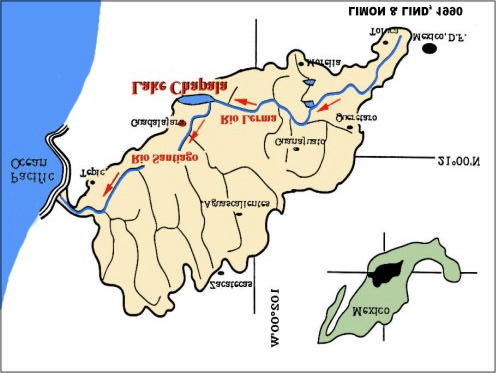
an average rainfall of 671 mm a-1, mainly concentrated in the summer, from which a mean
run-off of 5.19 km3 is derived. The River Lerma with a length of 750 km originates in
Mexico's central high plateau at an altitude above 3,000 m above sea level (masl). The river
ends in Lake Chapala (1,510 masl) which is the largest tropical lake in Mexico, 77 km long
and 23 km wide. The maximum storage capacity of the lake is 8.13 km3 and the surface area
is about 110,000 ha. The lake is also rather shallow; its average depth is 7.2 m, with a
maximum of just 16m. The 547km long River Santiago arises from Lake Chapala and flows
westwards finally reaching the Pacific Ocean. The Santiago River basin is less developed in
terms of population and economic activity, except for Guadalajara, the second largest city in
Mexico, and with a metropolitan area with more than 3.5 million inhabitants. It regulates the
LermaSantiago water basin (the Lerma River is the main water supplier to the lake, which is
then drained by the Santiago River and has been an important climate regulator in the
region).
The region has been divided into 5 sub-regions for water management and planning
purposes: Upper, Middle and Lower Lerma; Upper and Lower Santiago. In the sub-regions
of the Upper, Middle and Lower Lerma and the Upper Santiago, demand exceeds the natural
water resources availability, while the converse is true for the sub-regions of the Lower
Santiago and the Jalisco coastal zone. Based on data from the Secretariat of Environment
and Natural Resources (Secretaría del Medio Ambiente y Recursos Naturales, SEMARNAT)
14,500 hm3/year of water is extracted for consumptive uses, 51% of which come from
surface water sources and 49% from underground sources. 79% of this volume is used for
irrigation, 11% for urban water supply, 9% in industry and 1% for tourism, recreation and
fishing collectively.
3
PROBLEMS
As a result of increased human activity in the water basin over a short period of time, the
basin now has the following major problems: water scarcity, pollution of surface waters,
over-exploitation and contamination of groundwater, deforestation, soil erosion, loss of
biodiversity and increasing falling levels of the major lakes. Conflicts derived from the
water-using sectors (mainly for irrigation and potable water supplies), combined with the
general discharge of untreated effluents, have given rise to serious regional, and local, water
quantity and quality problems. This has been exacerbated by a reduction in forest cover and
soil degradation as a result of commercial logging, land conversion for cultivation and over-
grazing by livestock.
Lake Chapala in particular, has suffered a series of important transformations that would
otherwise have taken much longer. Its waters have been polluted by municipal, industrial and
agricultural liquid wastes mainly from the Lerma River, which receives wastewaters along
large sections of its course, and runs for around 700 km to the lake. The erosion caused by
deforestation and by changes in land use across the Lerma basin has led to an increased flow
of sediments into the lake. This, in turn, has increased water turbidity, affecting the lake's
biological production. The accumulation of sediments has contributed to a loss of depth,
which is already quite serious due to the decreasing amount of water supplied by the Lerma
River. The shallowness of the lake has increased its water temperature, leading to higher
evaporation rates. Increasingly, large areas of the lake's surface are being invaded by lirio
acuático (water hyacinth), a plant that feeds on the nutrients that have flowed into the lake.
The water hyacinth exacerbates the loss of water through evaporation, limits light penetration
into the water and constrains the free movement of boats, thus having an impact on fishing
and recreational activities. Although different studies catalogue the pollution of the lake's
waters differently, it is acknowledged that the presence of organic matter, detergents, heavy
metals and pesticides has decreased fish stocks. (Some endemic species, such as the popocha,
are about to become extinct.) The lake's pollution also poses a threat to human health
through the consumption of contaminated fish and is an economic challenge for the more
than 2,000 local residents who still depend on fishing for their livelihoods.
It is also one of the most over-committed water basins in the world, with total water
depletion exceeding supply by an average 10% in past years. Some 26,000 deep water wells
operate within the Lerma-Chapala basin, with very low efficiency rates, due to their high
electricity consumption and rather low water yields. Almost 70% of all 38 aquifers in the
region are overexploited. Unchecked groundwater pumping has produced declines in aquifer
levels of 2.1 m/yr (overexploitation is estimated at about 1 billion m3/year), while surface
water depletion exceeds availability in all but the wettest years, when considering the needs
for environmental purposes including inflows to Lake Chapala. The situation is particularly
serious in the Lerma Basin, where more than 50% of the catalogued aquifers are over-
exploited (annual recharge deficit of 690 hm3) and in the Upper Santiago region where the
deficit in annual recharge is 540 hm3/year.
Industries as well as most towns, located in the basin are mainly supplied by groundwater
sources (90 per cent). The most important industries concentrate their activities on meat,
dairy and other agricultural produce, beverages, pulp and paper, leather goods, petrochemical
4
and chemical products, all with little or no emphasis on wastewater treatment and recycling.
Development in the Lerma-Chapala basin is largely sustained by intense water use. Industries
in the basin generate around 0.608 × 10³ m3 a-1 wastewater with 48,130 t a-1 biochemical
oxygen demand (BOD) coming from urban waste and 424,260 t a-1 chemical oxygen demand
(COD) coming from industrial discharges. In addition, only about 30% of municipal waste
water is being treated. These high organic and inorganic pollutant loads and the insufficient
wastewater treatment capacity have intensified water quality problems and severely reduced
water availability. Diffuse pollution caused by drainage containing fertiliser and insecticide
residues from irrigated areas, together with solid waste washed away by rain from rural
households lacking domestic waste disposal systems for excreta and rubbish, have also
contributed to the water quality problems. The contamination reaches to and affects the
Mexican Pacific coastal zone and the Pacific Central American Coastal Large Marine
Ecosystem.
At the same time, from Lake Chapala, water is pumped for the municipal water supply for
Guadalajara's more than 3.5 million population. Lake Chapala's outlet, River (Rio Grande
de) Santiago receives the drainage of Guadalajara. With regard to water resources,
Guadalajara is significant to the river basin in two ways. The first relates to satisfying its
water demand, where there is continued stress upon Lake Chapala, depleting local aquifers,
and the ecological, social and economic conflicts; and the second relates to the discharge of
untreated urban and industrial wastewater. The Santiago River is the natural drainage path
from Lake Chapala to the Pacific Ocean, and receives around 9,000 l3 s-1 of polluted water
from Guadalajara. It now sustains very little life along long stretches of its 547 km before
reaching the ocean, impacting on natural ecosystems and affecting the use of its water by
other cities, smaller towns and farmers.
ACHIEVEMENTS TO DATE
Some progress has been made relating to the issues of zoning, water uses, sanitation, rational
water use and management. Specifically, as a direct result of a Master Water Plan and in
close co-ordination, the National Water Commission (Comisión Nacional del Agua; CNA)
and the Lerma-Chapala Basin Council has implemented an ambitious "Large-Scale Sewage
Treatment Program" to clean up the pollution in the region. The wastewater treatment
programme was planned in three stages. The first stage, which ended in December 1994, was
aimed at reducing the organic pollution impact on the Lerma River basin by 50 per cent and
by 65 per cent in Lake Chapala. The goal was to build and operate 48 plants for municipal
waste-water treatment, with an overall capacity of 3,700 1 s-1. Global capital investments
have been close to 367 million pesos (approximately US$ 80 million). The second stage of
the Lerma-Chapala clean-up programme, which is already under way, aims to increase
treatment capacity to 10,670 1 s-1 of municipal and industrial wastewater by means of
constructing and operating 52 new plants and expanding five existing facilities, with a total
investment of 1,200 million pesos (US$ 150 million). By 1997, 45 plants with a treatment
capacity of 5,720 l3 s-1 were operating on a regular basis with an average running efficiency
of around 70 per cent. A third stage of the Large-Scale Sewage Treatment Program includes
building 50 additional facilities orientated to meet the needs of small townships and rural
communities is planned. These plants will boast a total treatment capacity of 1,833 1 s-1.
5
NEEDS
Today, water quality on the main river reaches has significantly improved. Yet, there is still a
long way to go. Lake Chapala is the largest natural lake in Mexico and also a major source
of water for Guadalajara, Mexico's second largest city. Many small townships and rural
dwellings still lack adequate sanitation and there are more than 9,200 industries in the basin.
Though there has been an established river basin council in the Lerma-Chapala Basin since
1992, there have been periods of relative inactivity and reorganization has been needed at
least once. In addition, while it has been found that BOD has been reduced, all the treatment
plants built for urban wastewater are traditional and, therefore, nutrient removal is practically
nil. Agricultural discharges loaded with fertilizers and pesticides are largely not being
considered. From the case of the LermaChapala basin, the inextricable linkages between
urbanrural issues, in which a solution for one sector can be obtained at the expense of other
groups in society are evident, which then emphasizes the need for integrated and sustainable
management of the water resources. In addition, all of these basin problems contribute to, or
are related to, environmental problems in the coastal zone which include: sedimentation;
oligotrophication of coastal waters; alteration of river flow regimes; reductions in numbers
and diversity of fish populations; and increased incidence of endemic diseases.
The Lerma-Chapala Santiago system is not only fundamental to the economy of Mexico, but
to the hydrological balance of its occidental region, the environmental equilibrium of the
Pacific Central American Coastal Large Marine Ecosystem, the preservation of biodiversity
and the climate. In addition, Lake Chapala is of historic, ethnic and cultural importance to
the country and its people. Some of the most important original towns like the Huicholes,
even today still keep their sacred places in the hearth of the lake. For the original civilizations
of the region, the water, and particularly Lake Chapala, constitute sacred places, symbols of
their identity and of their vision of life. Lake Chapala has been declared part of Mexico's
national heritage and measures are needed to ensure its protection.
In this context, there is urgent need for incorporation of land-based environmental concerns
into development policies, plans and programs for the Lerma-Chapala-Santiago Basin for the
protection of the lake, the freshwater courses and its coastal zone; and, for an integrated
approach to management of the basin and the coastal zone. The World Bank will continue as
a strategic partner of Mexico in its water-related activities, and the Water Resources
Management Project II (PROMMA II) would build upon the progress made under
PROMMA I which has laid the foundation for further improvements as well as begin to
address the serious water resources problems directly with water users in this critical river
basin. The GEF support is sought to complement and enhance PROMMA II by bringing
international best practices on integrated water resources management (IWRM) in terms of
both quantity and quality.
6
B - COUNTRY OWNERSHIP
1. COUNTRY ELIGIBILITY
2. COUNTRY DRIVENNESS
Mexican objectives as iterated in the 2001-2006 National Water Plan are: (a) to achieve
integrated and sustainable management of water resources in the country's basins and
aquifers with the participation of water users; (b) to increase water use efficiencies in
irrigated agriculture and in municipal and industrial use; (c) to promote efficient financial
management in water resources related activities; (d) to reduce the risk and mitigate the
effects of floods and droughts; and (e) to decentralize operation functions presently realized
by central government agencies to states, municipalities and users. The 20012006
Environment and Natural Resources Program (ENRP) provides a framework for the
country's environmental policy. One of the underlying pillars of the ENRP is (a) integrated
ecosystem management: focus on ecological rather than political boundaries in the
management of water, land, air quality, forests and biodiversity.
On April 15, 2004, a new Country Assistance Strategy (CAS) by the World Bank in
partnership with Mexico was introduced which projects about $1.2 billion a year in new
lending between July 2004 and June 2008, in order to support the development agenda of
Mexico. The CAS focuses on fighting poverty and inequality, increasing competitiveness,
strengthening institutions, and promoting environmental sustainability in the country.
Specifically in terms of environmental governance (No.48) since the mid-1990s,
decentralization has become a key policy priority. Agreed priority issues include: (a)
overexploitation of surface and ground water; (b) minimizing use of scarce water resource
for low value crops; (c) lack of a strategic consensus between key stakeholders; (d)
inadequate water rights administration (mainly due to over-allocation of water rights); and (e)
high subsidies for pumping groundwater and inappropriate pricing of water.
The National Congress approved a new National Water Law (Ley de Aguas Nacionales,
LAN) in December 1992 and its regulations in January 1994. Significant changes to the law
were recently enacted including the role of key water agencies such as CNA; polluter fines;
and the permitting process. The new law also strongly emphasizes decentralization and water
resources management at the river basin level. The LAN sets out broad based mandates for
the development and implementation of plans and policies related to water resources
management. The responsibility for responding to these mandates was assigned to Mexico's
National Water Commission (Comisi6n Nacional del Agua, CNA). The stated objective of
the law is "to regulate the extraction, use, distribution and control of the nation's waters as
well as preserve their quantity and quality in order to achieve sustainable integral
development". A key title of the new law deals with the "Prevention and Control of
Contamination, and Responsibility for Environmental Damages." So, in accordance with the
National Water Plan and the LAN, CNA has set a new agenda to manage the nation's water
resources considering all uses and the preservation of the environment. In this context, the
proposed GEF financing will accompany and leverage a large WB lending operation
(PROMMA II) which jointly will support the implementation and further definition of the
new principles established in the LAN, especially those related to the issues of public
participation, decentralization and institutional strengthening for sustainable water
7
management. The basin approach aims to operationalize IWRM for the enhanced
sustainability of the basin ecosystems and the coastal and marine environment, and will serve
as a model to be replicated in other basins.
C PROGRAM AND POLICY CONFORMITY
1. PROGRAM DESIGNATION AND CONFORMITY
The contamination and over-exploitation of surface and ground waters, the progressive
deforestation and soil degradation affecting the basin's water resources and biodiversity are
not limited by the national border, but also have broad consequences, as they affect the
coastal zone and marine ecosystems, including the migratory species. Therefore, the primary
objective of the project is to catalyze a more integrated approach to water resources
management in the Lerma-Chapala-Santiago Basin to improve the basin, adjacent coastal and
marine environments, particularly by reducing water pollution and water scarcity. The
project would also consider the need for environmental flows in rivers, flood plains,
wetlands, lakes and into coastal and estuary waters. The integrated framework would allow
better understanding of important surface-subsurface and water quality interactions, and
facilitate important new management approaches. As such, the proposed actions are
consistent with the GEF principle of linking project elements with major cross-cutting issues
such as land degradation and mitigation of persistent organic pollutants.
The proposed GEF grant therefore falls under Operational Program 10 of the International
Waters Focal Area, and specifically under IW-3 of OP10: the Contaminant-Based Program.
Moreover, the project has direct relevance for the Global Programme of Action (GPA) for
the Protection of the Marine Environment from Land-based activities. OP 10 is also the only
International Waters program which does not require the project to be tied to a multi-country
collaborative effort.
In accordance with OP 10, the project will support innovative interventions in IWRM
addressing water quantity and water quality issues in an integrated manner. The project will
demonstrate new and cost-effective measures to reduce land-based sources of pollution and
to reduce water consumption to sustainable levels, while at the same time allocating and
managing water resources to meet environmental needs within the basin including outflows
to the sea. The global benefits are an international demonstration of innovative
improvements in IWRM in the basin and improvements in the coastal and marine
environment, and the demonstration-dissemination-replication regionally and nationwide of
compliance with the GPA.
The GEF projects in the Sao Francisco basin in Brazil and the Hai basin in China have
similarities with the proposed project. All three projects are dealing with highly complex
water resources management issues and support moving towards sustainable IWRM in
critically important river basins. Twinning relationships and interchanges will be sought
with these projects in order to enhance the complimentarity and transfer of lessons learned.
2. PROJECT DESIGN
8
The proposed GEF-project addresses an important missing link in efforts to improve IWRM
in the Lerma-Chapala-Santiago Basin. Other GEF and Mexican initiatives are addressing
different aspects of water resources management but have yet to achieve much success
because of lack of an integrated approach. Consistent with Par. 10.5 for GEF Operational
Programme 10, the project would "play a catalytic role in demonstrating ways to overcome
barriers to the adoption of best practices limiting contamination of international waters."
The general approach taken would be to develop an IWRM framework and a top-down and
bottom-up approach with participation of water users and other stakeholders, to deal with
water scarcity, groundwater mining, and water pollution. The proposed project would
significantly enhance and co-finance PROMMA II by bringing international best practices
including innovative new practices to IWRM in the Lerma-Chapala-Santiago Basin.
Improving water resources management and reducing pollution into the ocean is best done
within an IWRM framework. Although government policy calls for an integrated framework,
inter-jurisdictional and inter-administrative cooperation often proves difficult in practice. The
GEF grant would provide support to overcome institutional barriers and provide a powerful
demonstration effect. The international expertise that will accompany the GEF project will
provide Mexico with a broad range of management experiences and instruments upon which
to draw.
The GEF project will serve as a complement and link to the PROMMA II project and within
this context, the project development objectives are: (a) to improve conditions for sustainable
IWRM and use through integrated planning and actions; and (b) to detain the accelerated
decline in both quantity and quality of water resources in the Lerma-Chapala-Santiago river
basin. Building upon previous studies, including PROMMA I, this project also aims to
promote environmentally sustainable development of the basin as a means of managing
environmental degradation of the coastal zone. The project will include the identification and
implementation of appropriate solutions, for incorporation of land-based environmental
concerns affecting the coastal zone into the development policies, plans and programs.
The proposed PROMMA II project will have three components and the GEF grant will
support complementary aspects of each. The PROMMA II project objectives and
components are detailed in Annex 1.
The first component of PROMMA II would support 'top-down' actions in order to
consolidate and strengthen policies, strategies, plans and actions in an integrated manner at
the central level and in priority basins in the central and northern part of the country where
there is serious overexploitation and contamination of water resources. This component will
support improvements in IWRM including both technical and institutional aspects in the
Lerma-Chapala-Santiago basin. During the PDF-B grant preparation phase, a preliminary
IWRM plan for the Lerma-Chapala-Santiago basin will be developed and agreed. This will
explicitly define the series of activities and actions to be implemented and the deliverables
during the project implementation phase.
9
GEF COMPONENT 1 - Development of an IWRM Plan
Under the first component, the GEF grant will include support for refining and detailing the
IWRM plan and preparation of strategic studies and policy inititatives on different aspects of
IWRM in the basin, in support of: (a) monitoring and assessment of surface water and
groundwater in terms of quantity and quality, including the classification of discharges and
receiving water bodies as set out in the new National Water Law (LAN - Ley De Aguas
Nationales); (b) public participation, decentralization and institutional strengthening for
sustainable water management under the new National Water Law; (c) introduction of new
remote sensing technologies to estimate actual evapotranspiration (ET) and the utilization of
these techniques in water resources management on a basin-wide basis; (d) development and
implementation of a unified water data base; (e) improvements in basin water and
environment modeling; (f) improvements in the norms and related systems for water rights
administration and water fee collection; (g) demand management of water; (h) reducing non-
recoverable water losses and for wastewater reuse; and (i) reductions in sedimentation,
oligotrophication of coastal waters and improvements in numbers and diversity of fish
populations in the coastal zone.
Expected Outcomes
The outputs of the component 1 will include development of strategic studies and an IWRM
plan in support of an integrated approach and vision for the management of the Lerma-
Chapala-Santiago Basin and its coastal zone; improved quantification of water use, use
conflicts and hydrological management; an evaluation of the environmental impacts of the
river basin on the coastal zone; an assessment of different scenarios for basin management to
minimize detrimental impacts on the estuary and coastal zone.
The second component of PROMMA II would support 'bottom-up' actions on specific
projects in about 5 sub-basins within priority basins, at least 3 of which (supported by the
GEF grant) would be within the Lerma-Chapala-Santiago River Basin. These projects would
benefit from the experience, methodology and lessons learned in PROMMA I. This would
include participatory approaches to reducing water pollution and reducing water consumption
in local areas working with water user groups and local communities. ET management using
remote sensing technologies would be used in local areas to achieve improvements in water
productivity and reductions in water consumption.
GEF COMPONENT 2 - Demonstration projects
The GEF grant will specifically support several practical studies and tentatively 3 small
demonstration projects in sub-basins within the Lerma-Chapala-Santiago basin, that will
provide direction and a sound basis for the PROMMA II second component actions, in
aspects such as: (a) pollution control including discharge control, wastewater management in
towns and rural areas, land/runoff models and systems to control non-point source pollution,
and sediment and nutrient load reduction; (b) demand management including water
measurement, pricing, water rights management and leakage control; (c) water savings in
irrigated agriculture including ET management; (d) wastewater reuse substituting wastewater
for overexploited groundwater use; (e) ecological restoration and (f) coastal zone
management. In line with the Global Programme of Action (GPA) for the Protection of the
10
Marine Environment from Land-based activities, the projects will demonstrate a commitment
to action on the ground involving different stakeholder groups; generate awareness, support
and incentives for the continued development of the basin; contribute to development of a
model that can be replicated and updated.
Expected Outcomes
The outputs of the component 2 will include practical studies and demonstration projects for
improved river basin and coastal zone environmental management dealing with water use
conservation, biodiversity protection, pollution reduction and prevention, and sustainable
production activities. Public and stakeholder participation through hands on-type
involvement of communities in the remedial measures will also be improved.
The third component of PROMMA II would support institutional development and project
management at the central, regional, state and local levels, and specialized training related to
project implementation in areas such as IWRM, project management, communication and
awareness building.
GEF COMPONENT 3 - Development and Strengthening of water user organizations,
river basin councils and aquifer committees.
In component 3, the GEF grant would support development and strengthening of these
entities in the Lerma-Chapala-Santiago basin and would include consensus building, conflict
management and other techniques to help reach agreements amongst water users and local
communities to achieve sustainable IWRM.
Expected Outcomes
The outputs of this component will include improved organizational structure, capacities and
capabilities needed to implement the new Water Law reforms; improved public participation
mechanisms; strengthened stakeholders' involvement and public-private partnerships in the
basin management and implementation of remedial actions.
GEF COMPONENT 4 - Support to the 4th World Water Forum
The GEF grant would also support activities related to the 4th World Water Forum to be held
in Mexico in March 2006. The PROMMA II project with emphasis on the GEF supported
activities would be highlighted as a practical example of how severe water quantity and water
quality management problems are being addressed in one of Mexico's most critical and
important basins. Although it is anticipated that the grant/loan will not become effective
until May 2006, project preparation funding and the retroactive financing under the IBRD
loan would be used to support 4th World Water Forum related activities.
Expected Outcomes
Presentation, dissemination and demonstration at the 4th World Water Forum of an example
of freshwater basin and coastal zone development and management using IWRM approaches
in a complex and important river basin system.
3. SUSTAINABILITY (INCLUDING FINANCIAL SUSTAINABILITY)
11
The project would work directly with and strengthen the existing Lerma-Santiago River
Basin Council and the auxiliary sub-basin commissions and aquifer committees, which have
considerable interest and commitment to achieving and sustaining integrated water resources
management in the basin. The project would also strengthen federal and local water
agencies. The project would also support the definition and adoption of sustainable financing
mechanisms to implement plans developed under the project and future programs in the
basin. Financial management and operational development plans would be a condition for
financing and would be monitored during project implementation. The project would support
implementation of the new National Water Law in the Lerma-Chapala-Santiago basin
supporting the operationalization of a regionalized and river-basin approach to water
resources management as invisioned in the new law, both in terms of IWRM and financial
sustainability. The new law includes a requirement to define and implement a water
financing system, and the project will support the operationalization of this system in the
Lerma-Chapala-Santiago basin.
4. REPLICABILITY
This project will only support improvements in integrated water resources management in the
Lerma-Chapala-Santiago river basin - a small portion of the areas in northern and central
Mexico suffering from unsustainable use and management of water resources. But, since
Mexico has identified the need for achieving sustainable management of water resources as a
priority national objective and is committed to replicating good practices demonstrated under
the project, the Project will be designed to be highly replicable. The development of
demonstration projects at the county level provides an excellent opportunity for replicability
because the water and environment issues in much of the northern and central parts of
Mexico are very similar to those being experienced in the Lerma-Chapala-Santiago basin and
the local project areas in the basin. Successful demonstration projects in this Basin would
therefore be very applicable for replication throughout the northern and central regions. The
Project will include significant interaction amongst the project areas in the form of study
tours and workshops to the different project areas so that they learn from each other. In
addition, the practical integrated water and environment approaches to be implemented in the
Project address problems of water scarcity and pollution that are common in many other parts
of the world. Therefore the potential for global replicability is also large. Many of the project
activities will support implementation of the new National Water Law in the Lerma-Chapala-
Santiago basin and this will serve as a powerful example for implementation of the new law
in other parts of the country.
5. STAKEHOLDER INVOLVEMENT/INTENDED BENEFICIARIES
Mexico has a history of water user participation in irrigation and through river basin councils
and aquifer committees. The National Water Commission (Comisión Nacional de Agua
CNA) and the Lerma-Chapala Basin Council will therefore be major stakeholders. The
project would build on their experience and work to utilize it in developing more concrete
sustainable water resources management goals in local specific areas. Water User
Associations (WUAs) will also be involved as 'bottom -up' approaches are key to this project.
Lake Chapala is considered a national treasure so there is strong national and local support
12
for preserving the lake - the relevant agencies working on this effort will also be involved.
During project preparation a Stakeholder participation plan will be developed.
D - FINANCING
1) FINANCING PLAN
US$ 9.0 MILLION, GEF GRANT
2) CO-FINANCING
US$ 50.0 MILLION, PROMMA II LOAN
US$ 40.0 MILLION, GOVERNMENT OF MEXICO (GOM)
E - INSTITUTIONAL COORDINATION AND SUPPORT
1) CORE COMMITMENTS AND LINKAGES
The implementation arrangements will build upon the existing management structures within
the National Water Commission for the PROMMA project and preparation arrangements for
the PROMMA II project. The following agencies will be involved in project preparation
and implementation:
CNA, National Water Commision (COMISIÓN NACIONAL DE AGUA)
SEMARNAT, Secretariat of Environment and Natural Resources (Secretaría del Medio
Ambiente y Recursos Naturales)
NAFIN - National Finaciera (national development financing agency)
SAGARPA, Agriculture & Rural Development Ministry
SHCP, Finance & Public Credit Ministry
WMO (World Meteorological Organization - OMM - Organizacion Mundial de
Meteorologia)
The state governments of Guanajuato, Queretaro, Aguasclaientes, Jalisco
The Lerma-Chapala River Basin Council
Technical aquifer committees for aquifers within the basin
2) CONSULTATION, COORDINATION AND COLLABORATION BETWEEN AND AMONG
IMPLEMENTING AGENCIES, EXECUTING AGENCIES, AND THE GEF SECRETARIAT, IF
APPROPRIATE.
In executing this project, some collaboration will be sought with the GEF projects in the Sao
Francisco basin in Brazil and the Hai basin in China in order to enhance the complimentarity
and transfer of lessons learned. Possible collaboration with UNEP/OAS will also be
considered as WB has established good relations with UNEP/OAS in Mexico and
UNEP/OAS has demonstrated experience in the water sector there. UNEP/OAS could
possibly focus on the formulation of the Environmental Strategic Action Program with
specific emphasis on the environmentally sensitive areas such as Lake Chapala, wetlands,
coastal zones, mangroves, and the like. This collaboration will be explored and detailed
further in PDF-B preparation.
13
3) IMPLEMENTATION/EXECUTION ARRANGEMENTS
A Project Coordinating Committee and with participation from the various Ministries, will
be responsible for coordinating the smooth implementation of the Project.
High-level Steering Committees headed by Vice Ministers and a Project Management Office
will be responsible for implementing their parts of the Project in coordination with each
other, at the sub-basin level and with the municipalities. Leading groups and the Project
Management Office will be responsible for implementing their parts of the Project in
coordination with each other.
Monitoring and Evaluation
A detailed monitoring and evaluation (M&E) plan will be developed during project
preparation and carried out during project implementation. The M&E plan will include the
monitoring of specific measurable indicators, the baseline information for which will be
determined during project preparation. Measurable indicators will include items such as:
- Reduction in total pollution from point sources by type and source.
- Reduction in fertilizer application rates.
- Reduction in annual withdrawals of surface water and groundwater.
- Increase in amount of water subject to recycling and reuse schemes.
Annual information relative to project implementation and the measurable indicators will be
collected and evaluated, and consolidated into an annual report.
14
ANNEX 1
PROJECT CONCEPT NOTE
MEXICO
Water Resources Management Project II PROMMA II
1. Key development issues and rationale for Bank involvement
Mexico has critical and urgent water related problems including the overexploitation and
contamination of surface water and groundwater resources in the most important regions of the
country in terms of population and contribution to GDP. The present situation is clearly not
sustainable in the medium and long term. If not addressed soon, this situation will become an
obstacle to continued economic development and will have serious social impacts including the
possible abandonment of important parts of the country by significant parts of the population.
The Bank has a long history of assistance to Mexico in water resources management, irrigation
and drainage and water supply and sanitation. Beginning in 1975, the Bank and UNDP
supported Mexico in the development of the first comprehensive national water plan. Drafting
of the modern 1992 water law was supported by Bank and FAO assistance. (A new version of
the Law has recently been approved by the Mexican congress and is awaiting signature by the
President.) A series of irrigation and drainage and water supply and sanitation projects have
greatly assisted Mexico in development of hydraulic infrastructure and in major institutional
reform.
Mexico is at the vanguard of developing countries in many aspects of water resources
management and use. Under the ongoing Water Resources Management Project (Programa
para la Modernización del Manejo del Agua - PROMMA), Mexico has made significant
improvements in: (a) monitoring and assessment of surface and groundwater quantity and
quality; (b) improvements in the operation of hydraulic infrastructure and dam safety; (c)
improve meteorological and hydrological forecasting; (d) water resources planning at the basin
level; (e) water rights administration and discharge control; (f) river basin council and aquifer
committee establishment and strengthening; and (g) preparation of studies related to the
integrated and sustainable management of water in some areas with overexploited aquifers.
The Bank is presently supporting the recently approved Irrigation and Drainage Modernization
Project and is supporting the preparation of a new operation to finance infrastructure and new
management approaches in water supply and sanitation in urban areas. In addition, there is
ongoing sector work on water rights and additional sector work on different aspects of water
resources management and use is planned for the coming years, including the economic value of
water, water governance and institutionality, water related environmental health and water
quality management.
The Bank should continue as a strategic partner of Mexico in water related activities. Mexico
still has a long way to go to achieve sustainable integrated water resources management and use.
The Water Resources Management Project II (PROMMA II) would build upon the progress
made under PROMMA and begin to address and solve the serious water resources problems
15
directly with water users in critical river basin and aquifers. The foundation laid by the first
project will enable this further improvement.
a. Proposed project development objective(s)
Mexican objectives as iterated in the 2001-2006 National Water Plan are: (a) to achieve
integrated and sustainable management of water resources in the country's basins and aquifers
with the participation of water users; (b) to increase water use efficiencies in irrigated agriculture
and in municipal and industrial use; (c) to promote efficient financial management in water
resources related activities; (d) to reduce the risk and mitigate the effects of floods and droughts;
and (e) to decentralize operation functions presently realized by central government agencies to
states, municipalities and users.
Within this context, the Project Development Objectives are: (a) to improve conditions for
sustainable integrated water resources management and use; and (b) to detain the accelerated
deterioration of water resources in selected areas.
To achieve these objectives, Project activities would be designed recognizing that water
resources management is both a top-down and a bottom-up undertaking. Top-down aspects
include policies, laws, standards, allocation of water between uses and technical assistance.
Bottom-up aspects recognize that effective water resources management requires the direct
participation of water users and other stakeholders. Integrated water resources management
includes: (a) surface water and groundwater in terms of both quantity and quality; (b) the reuse
of treated effluent; (c) economic valuation of water as a scarce resource in the agriculture,
industrial and service sectors; (d) protecting and preserving the environment; (e) flood and
drought management; and (f) institutional integration of the various private and public support
programs from different levels (international, national, state, municipal, local)
3. Preliminary project description
The proposed PROMMA II would have three components with a total cost estimated at US$180
Million financed with an IBRD loan of US$100 Million and US$80 Million of national
counterpart funds.
The first component would support top-down actions in order to consolidate and strengthen
policies, strategies, plans and actions in an integrated manner at the central level and in priority
basins in the central and northern part of the country where there is serious overexploitation and
contamination of water resources. The principal activities under the component would include:
(a) consolidate and strengthen programs to improve monitoring and assessment of surface water
and groundwater in terms of quantity and quality, including the classification of discharges and
receiving water bodies as set out in the National Water Law; (b) improving flood management
and control; (c) introduction of new remote sensing technologies to estimate actual
evapotranspiration (ET) and the utilization of these techniques in water resources management;
(d) develop and implement a unified water data base; (e) improve water resources planning and
the evaluation and prioritization of investments; (f) establish regional centers to apply and
disseminate advanced technologies for water savings and economic valorization in irrigated
16
agriculture; (g) improve the norms and related systems for water rights administration and water
fee collection; (h) design and test tariffing schemes to improve demand management of water;
and (i) design and test schemes for reducing non-recoverable water losses and for water reuse.
The second component would support bottom-up actions on specific projects in sub-basins
within priority basins. These projects would benefit from the experience, methodology and
lessons learned in PROMMA and would include: (a) concrete actions related to integrated and
sustainable management and use of water resources for both surface water and groundwater in
terms of quantity and quality such as local effective water rights administration and discharge
control, as well as pricing/measurement and valuation actions, including water rights buy back;
(b) actions in water supply and sanitation and modernization of irrigated agriculture such as
wastewater reuse, cropping pattern adjustments and deficit irrigation; (c) intersectoral transfer of
water to improve socioeconomic productivity and environmental benefits; and (d) regulation of
water rights in aquifers and basins in accordance with the National Water Law. The projects
would need to contribute directly and measurably to reductions in the overexploitation and/or
contamination of water resources and would address: (a) preparation, financial design and
mechanisms, appraisal, and implementation support of water resources management schemes;
(b) development and implementation of innovative actions aimed at improving the efficiency and
economic valuation of water use in irrigated agriculture, water supply and sanitation, industrial
use, including water reuse; and (c) the design and introduction of strategies and instruments that
contribute to innovative financing mechanisms in the water sector. The amount of funding to
implement all of the bottom-up actions would be large and would require mobilizing financing
from different sources including international, national, state, municipal and private. PROMMA
II would include the establishment of a fund to stimulate/leverage investments in these bottom-
up actions. The process of preparing the projects would be carried out with the direct and
constant participation of water users and other stakeholders under the leadership of local
authorities, who would assume the responsibility for their implementation, with the participation
and assistance of the CNA general subdirectorates, and regional and state management units.
The projects would be demonstration in character, with the objective of learning from the
experiences and dissemination of the acquired knowledge in other parts of the country.
The third component would support institutional development and project management support
at the central, regional, state and local levels, and specialized training related to project
implementation in areas such as integrated water resources management, project management,
and communication and awareness building. This component would support programs in
communication, awareness building and responsibility taking of authorities, water users, and
society in terms of the value and vulnerability of water resources and approaches for its
sustainable integrated management and use.
4. Potential risks and mitigation
The National Water Commission (Comisión Nacional de Agua CNA) historically has been a
large hierarchical centralized institution. During the implementation of PROMMA there has
been a strong push to regionalize and decentralize activities, which has been only partially
successful. Early in the implementation of PROMMA CNA was reorganized to include 13
hydrographic regions who's borders are defined by hydrologic boundaries and not by
17
administrative (state lines) ones. The three biggest difficulties in fully implementing the
regionalization and decentralization objectives has been: (a) lack of financing mechanisms at the
regional and state levels; (b) lack of qualified personnel in the regional and state offices; and (c)
a continuing central inertia. There is also a lack of coordinated integrated action at the local level
of the different federal, state and local actors. PROMMA II would include an institutional
strengthening and communication program and the installation of groups of contracted
professionals at the different levels to support project implementation.
Successful implementation of the specific projects under the second component will require
financing from other as yet unidentified sources. PROMMA II will support the design of
financing approaches and will include funds for stimulating/leveraging investments.
It will be essential for PROMMA II success that CNA give high priority and allocate sufficient
budget during the entire project implementation period.
5. Issues on which the team seeks guidance
To effectively implement sustainable WRM at the river basin and aquifer levels strong high-
level understanding of the issues and political support are required. To what extent should we
continue to work with CNA to try to address these issues and should we try to seek a high-level
consensus on approaches? Should we try to involve other government and private entities at
the national level and try to stimulate broad national consensus/support? To what extent
should we try to stimulate the adoption of national policies related water valuation and
opportunity cost issues particularly in consideration of politically sensitive low-value irrigated
agricultural uses?
6. Proposed preparation schedule and resource estimate
Concept Review:
January 2004
Decision Meeting:
September 2004
Appraisal:
December 2004
Negotiations:
February 2005
Board:
April 2005
Signing:
July 2005
Effectiveness:
October 2005
Resource estimate requirements for preparation are $300,000 BB and $500,000 PHRD.
The Task Team has been preliminarily defined as follows: Douglas Olson (TTL), Lea Braslavsky
(Procurement), Dan Boyce (Financial Management), Teresa Roncal (Operations), Miles Scott-
Brown (Environment), Maria Elena Castro (Social), Marta Molares-Halberg (Legal), Regis
Cunningham (Financial Officer), Cecilia Maria Balchun (Financial Analyst), and Gloria Leiva
(Team Assistant).
18
MEXICO
Water Resources Management Project II
CONTENTS
Page
1. Key development issues and rationale for Bank involvement ........................................... 15
2. Proposed project development objective(s)......................................................................... 16
3. Preliminary project description............................................................................................ 16
4. Potential risks and mitigation............................................................................................... 17
5. Issues on which the team seeks guidance ............................................................................. 18
6. Proposed preparation schedule, team composition, and resource estimate ..................... 18
19
PART II RESPONSE TO REVIEWS
A - CONVENTION SECRETARIAT
EMAIL FROM SARA GRASLUND (GEF)
DATED: 7/2/2004
it was nice meeting you yesterday. This is from me and Andrea just to let you know that you will receive
the review sheet on Tuesday (review sheet not received) and that we expect the concept to enter the
pipeline after we receive it on Wednesday.
The main points for the revision would be:
1. background developed to describe environmental values as well as environmental status in the basin
as a whole, including its coastal area. Background has been improved as recommended. See pages
2-6.
2. clarified/increased GPA justification (so that it is clear from the beginning of the concept) Done
throughout.
3. short description of PROMMA II and GEF components/activities/outcomes, and justification for why
GEF would fund those activities. - PROMMA II PCN attached in Annex 1; GEF components, activities
and outcomes explained in Section C2. See pages 8-11.
20
B - OTHER IAS AND RELEVANT EXAS
COMMENTS FROM UNEP
REVIEW OF PROPOSED INTEGRATED WATER RESOURCES MANAGEMENT PROPOSAL FOR
THE LERMA-CHAPAL-SANTIAGO RIVER BASIN (MEXICO)
This Concept Paper proposes that a GEF International Water project be prepared and supported for the
Lerma-Chapala-Santiago River Basin of Mexico.
In general, UNEP welcomes the idea. UNEP especially welcomes the concept as UNEP (1) had already
initiated work, through the Organization of American States (OAS), with the Secretariat/Ministry of
Environment and Natural Resources (SEMARNAT), and (2) had presented the idea as part of its pipeline
to the 18 May 2004 IWTF without any reaction from GEF Sec or the World Bank. We note that the
Mexican Water Agency (CNA or Conagua) of SEMARNAT is selected as the Executing Agency for this
World Bank initiative.
Although the actual intent of this initiative, as outlined in the current version of the Concept Paper, would
benefit from some clarification (see below comments), UNEP suggests that both UNEP-OAS and the
World Bank collaborate in the Lerma-Chapala-Santiago River Basin, with the World Bank dealing with
sanitation matters and UNEP helping Mexico to advance its environmentally sound management of the
basin and its coastal zone through the formulation of an Environmental Strategic Action Programme
(SAP). This latter component would build on the existing Water Master Plan, and empower the newly
revised Water Law and agreement between the five riparian States in the recovery of the Basin.
The following comments are presented to benefit the present Concept Paper.
Overall comments
UNEP is concerned that the project, as currently envisioned, does not meet the GEF International Waters
criteria, which are designed to permit single country projects in areas of global significance. As you are
aware, UNEP is currently executing a project in the Pantanal of Brasil under Operational Program 9
(OP9). Arguably, the Lerma-Chapala-Santiago River Basin is not of similar stature to this ecosystem,
which is documented as the world's largest wetland, containing numerous endemic species, and at risk
from human activities in its drainage basin.
Likewise, we are concerned that the Lerma-Chapala-Santiago River Basin may not fulfill the requirements
for a case study within the Global Programme of Action for the Protection of the Marine Environment from
Land-Based Activities. To our knowledge, this Basin has not previously been identified with the
assessments currently ongoing and supported in part by the GEF of this Protocol. As you also are aware,
UNEP is currently completing work on the Sao Francisco River Basin project in Brasil, in which the
coastal zone and nearshore areas of the South West Atlantic Large Marine Ecosystem was fully
integrated into the project right from the earliest days of project development. To this end, the connection
between the Lerma-Chapala-Santiago River Basin and the Pacific Ocean is not well developed in this
Concept Paper, and does not appear to be integrated into the proposal.
Additional information to Sections A and C1 to address OP10 and GPA relevance. The global
benefits are an international demonstration of innovative improvements in IWRM in the basin and
improvements in the coastal and marine environment, and the demonstration-dissemination-
replication regionally and nationwide of compliance with the GPA.
Section A would benefit from quantitative information with respect to the definition of issues at stake for
the Basin as well as their global significance. The Objective statement needs to be further clarified as the
value added of having the GEF involved in such project is not clearly stated. Indeed, in its current form, it
is rather difficult to grasp what the project will do and how incremental the proposed activities are in
21
relation to PROMMA. The achievements of PROMMA I and the objectives of PROMMA II should be
further defined outlining linkages to, and complementarities with, the proposed GEF funded activities.
Additional information has been added to Section C2 to clarify the proposed GEF activities and
their incrementality in regard to PROMMA II.
The Concept Paper cover sheet refers to April 2006 as the estimated starting date when WP entry is
shown as May 2006. Consequently, the proposal would benefit from some clarification with respect to the
intended project cycle. Is there a PDF-B phase prior to the envisaged project?
A PDF-B preparation phase is planned to begin in September 2004.
The outlined co-financing of US$180M is comprised of the PROMMA II loan (US$100M), which is
anticipated to be approved in April 2006, and US$80M from Mexico. What is the envisaged course of
action should the proposed PROMMA II loan not be accepted by Mexico. Not only the proposed co-
financing but also the intended activities seem to be closely tied to the existence of such loan.
The GEF Project and PROMMA II are highly linked. PROMMA II preparation has been requested by
Mexico and is scheduled for early FY06 Bank Board approval. If the Mexicans change their minds
or the Board does not approve PROMMA II, then the GEF Project would need to be restructured or
cancelled.
Specific Comments:
In addition, we have a number of specific concerns:
· In the third paragraph on page 2, line 17--The word "turbulence" should be "turbidity." However,
research in South Africa would suggest that, rather than limiting aquatic productivity, turbidity
compresses production within the euphotic zone to a much narrower band of surface water than
would be the case in a comparable clear water body [see R.C. Hart & B.R. Allanson, Limnological
Criteria for Management of Water Quality in the Southern Hemisphere, South African National
Scientific Programmes Report No. 93, 1984, as cited in S.-O. Ryding & W. Rast, The Control of
Eutrophication of Lakes and Reservoirs, Unesco Man and the Biosphere Series Volume 1, 1989].
In line 21, lirio acuatico should be translated as water hyacinth, the more commonly known name
of the plant.
· In the first paragraph of page 4, treatment capacities are stated variously as l s-1 and m3s-1,
which values should be standardized. The extent of implementation of the phase I project
(PROMMA I), completed in December 1994, should be indicated; the comment toward the end of
the paragraph that reports 1997 data does not allow the reviewer to determine the success of the
phase I project, but rather confuses the issue by reporting partial implementation of both Phase I
and phase II (PROMMA II) projects. In any event, neither project seems to have achieved
complete implementation as the 45 plants reported in 1997 represent three fewer plants than
were proposed to have been constructed by the end of 1994. These results should be elaborated.
· In the second paragraph on page 4, line 4--The term "sanitary conditions" should probably be
"sanitation" as rural dwellings may lack sanitary conditions but towns generally are not considered
to be unsanitary.
· In paragraph two on page 5, each of the three proposed components are described as including
the same elements--"Participatory" management, for example, is part of Component 1 and
Component 2 (lines 9 and 17); "strengthening existing water user organizations" is part of
Component 1 and Component 3 (lines 10 and 27).
22
· In paragraph two on page 5, lines 12 and 13--If there are five demonstration sites, "at least 3 of
which would be within the Lerma-Chapala-Santiago River Basin," where are the others? If they
are outside of this basin, then the argument that this is a basin of global importance cannot be
true and the project will not fit the requirements of OP 10.
· In paragraph two on page 5, it should be noted that "remote sensing technologies" cannot be
used to "achieve improvements in water productivity..."--Remote sensing technologies can be
used to identify areas of water production and areas of water deficit in a graphical format that
allow other measures, such as regulatory requirements, interbasin transfers, and water use
charges, to be used to manage the available resources in a sustainable manner.
· In paragraph three on page 5, there is a major problem with numbering of activities, points (b)
and (c) being duplicated. More seriously, however, activity (a) duplicates efforts currently being
funded through the GEF International Waters portfolio that is examining lessons learned on the
global scale. We are also concerned that the first activity (c) and the second activity (b) will have
little lasting value except to the individuals involved in the study tours. It would be more profitable
to develop skills within the Basin, or at least within the country, that will remain in the country, and
to support these through an ongoing process of "twinning" institutions, than to finance a few study
tours.
· In paragraph two on page 6, we are not aware that GEF support can be "retroactive."
· In paragraphs one and two on page 7 is the first mention of the Lerma-Chapala-Santiago River
Basin as an element of the Global Programme of Action for the Protection of the Marine
Environment from Land-Based Activities, and the first explicit recognition that the Lerma-Chapala-
Santiago River Basin is not an international (multi-country) river system; however, in paragraph
two, the citation to paragraph 10.5 of OP 10 clearly indicates that the project should "play a
catalytic role in ... international waters" [emphasis added], suggesting that this proposal is not a
good "fit" within OP 10.
· In paragraph two on page 7, although usually loans are considered as co-financing to GEF
projects, it is stated that the "proposed project would significantly enhance and co-finance
PROMMA II..." when the cover page states that the co-financing to this project is envisaged to
come from PROMMA II (US$100M). This should be clarified.
· In paragraph three on page 7, the assessment of sustainability is not balanced by an assessment
of risk. This assessment should perhaps back reference the experience(s) summarized in
paragraph one on page 4, which indicates that there is some element of risk based on previous
experiences in the Lerma-Chapala subbasin.
· In paragraph one on page 9, we wonder in what capacity WMO is listed as a collaborating agency
in the proposed project? Perhaps this list of potential partners should refer to the UN agencies
generally, subject to further specific delineation during the project phase or during the project
preparation phase, if one is to be proposed. Further, SEMARNAT, the parent institution of the
CNA is not included amongst the envisaged partners.
In paragraph two on page 9, the phrase "if appropriate" is not appropriate and should
be deleted.
In paragraph three on page 9, the execution arrangement is not very clear and a small
organigram would help visualize the intended execution arrangements.
In closing, it seems that this initiative, in its current, form does not appear to be a good "fit" with the GEF
project criteria and operation programs within the International Waters portfolio. While we have no doubt
23
that the proposal is worthwhile and should be supported once refined, currently the use of GEF
International Waters funding does not seem warranted or appropriate to these efforts. Hence, UNEP is,
hereby, offering its collaboration to expand its focus and make this proposal a joint environmental
management project, consistent with the GEF IW vision either under OP9 or 10 in which UNEP-OAS has
demonstrated extensive experience throughout Latin America and the Caribbean.
Collaboration with UNEP/OAS will be explored during preparation for the PDF-B grant.
24