Annexes to the Project Document
(Excluding GEF Executive Summary)
ANNEX 1
Logical Framework (Also Appendix B of GEF
Executive Summary)
ANNEX 3:
Map of the Sixaola Binational River Basin
ANNEX 4: Project
Execution
Framework
Anexo I
Página 1 de 8
ANNEX 1 (Also Annex B GEF Executive Summary) : LOGICAL FRAMEWORK
NARRATIVE SUMMARY
VERIFIABLE OUTCOME INDICATORS
MEANS OF VERIFICATION
ASSUMPTIONS
GOAL: To contribute to the After 3 years of having finalized the Project:
a. Aerial photography and official statistics
Priority of the actors in
improvement of the health and a. the area of natural forest cover in the Basin is the same or has
of forest coverage from environmental
both countries is
integrity of the ecosystems, as
expanded compared to the level at the end of Year 1 (XX ha.
authorities (ANAM and MINAE)
maintained with regard to
well as the well-being of the
Baseline to be established during Year 1);
b. Socio-economic statistics MIDEPLAN-
the sustainable
population in the Binational b. the Social Development Index (Costa Rica) and Human
MEF
development of the
Sixaola River Basin
Development Index (Panama) in the Basin are the same with respect c. Statistics
from
MIDEPLAN-MEF
Binational Sixaola River
to the baseline at the beginning of the Project (Baseline IDS: 0 and d. Reports on the monitoring of waters and
Basin
IDH: 0.608);
soils from
c. annual public investment for the binational integrated ecosystem e. Reports on the monitoring of biodiversity,
management in the Basin has increased compared to marginal
from the System of Territorial
contributions at the beginning of the Project (Baseline: to be
Information
established at the end of Year 1);
d. the water quality in the Binational Sixaola River Basin is stabilized
as shown by a maintenance of the Biotic Integrity Index in the
Yorkín watershed at regular level (3 on a scale of 1-5, where 1 is
poor and 5 is excellent), which is the level at the beginning of the
Project1;
e. the populations of key species in the representative ecosystems in
the Basin maintain stability compared to their levels at the end of
Year 1 (Baseline: to be established during Year 1);
PURPOSE: To contribute to
At the end of the project:
General for all: Evaluation at the mid-term and
Priority of the actors in
the sustainable use and
a. the Binational Commission for the Sixaola River Basin is operating at the end, and Project Performance
both countries is
conservation of biodiversity,
efficiently and is taking decisions in a participatory manner based Monitoring Reports (IDB) and Project
maintained with regard to
water, and soil resources,
on accurate technical information (Baseline: at the beginning of the Implementation Reports (GEF)
the sustainable
through the creation of an
Project the Commission will have been formally established, but a. Minutes of meetings of the Bi-national
development of the
enabling environment for the
with no practical experiences in taking decisions, and the
Commission of the Basin; POAs Bi-
Binational Sixaola River
integrated and cross-cutting
Territorial Information System is marginally used).
national Basin Commission and updated
Basin
management of the Binational
b. land-use conflicts, defined in terms of optimal vs actual land-use,
SIT
Governments from both
Sixaola River Basin
has been reduced by a third compared to the level at the end of Year b. Aerial or satellite photographs and/ or
countries collaborate in the
1 (Baseline to be established during Year 1);
flights over the area
development and
c. alternative sustainable financing sources leveraged at the national or c. Financial reports of the Bi-national
enactment of the legal
local level are covering at least 10% of the recurrent costs related to
Commission of the Sixaola River Basin
framework, policies and
1 This water quality indicator may be complemented by other cost-effective indicators.
Anexo I
Página 2 de 8
NARRATIVE SUMMARY
VERIFIABLE OUTCOME INDICATORS
MEANS OF VERIFICATION
ASSUMPTIONS
the integrated binational management of the Basin compared to d. Field visits and reports of the System of
regulations for the
marginal domestic allocations at the beginning of the Project;
Territorial Information
integrated management of
d. at least 20% of the land-surface dedicated to agro-chemically e. Reports of the Commissions of the
the Basin
intensive banana production at the beginning of the Project is shifted
protected areas and the evaluations on the
Private owners and farmers
to organic production (Baseline: 12,400 hectares of pesticide
implementation of the management plans
within the Basin perceive
intensive banana production at the beginning of the Project);
benefits derived from the
e. critical elements of the management plans of the transboundary
development of sustainable
protected areas are harmonized between the two countries and
management activities
management actions are carried out according to these harmonized
Co-financing is delivered
plans (Baseline: at the beginning of the Costa Rican and Panamaian
in an opportune manner
sectors of PILA, San San-Pond Sak and Gandoca-Manzanillo have
separate plans);
NARRATIVE SUMMARY
VERIFIABLE OUTPUT INDICATORS
MEANS OF VERIFICATION
ASSUMPTIONS
OBJECTIVE 1: To strengthen the bi-national institutional framework for an integrated management and enhancement of technical and operational capacities of the institutions
involved, indigenous organizations, and civil society organizations
Activity 1.a: Strengthen the
a. At the end of year two, 10 ANAM-MINAE staff members, trained
a. Evaluation documents of the progress of
Institutions, indigenous
technical and operational
(and equipped) in water quality control and protected area
the implementation of the institution's
organizations, and civil
capacities of key stakeholders
management (Baseline: limited capacity and equipment for the basin
Strengthening Plans.
society organizations
of the Basin (regional and
at the beginning of the Project);
b. Evaluation documents of the progress in
perceive benefits derived
local public institutions and
b. At the end of year two, 12 MAG-MIDA/ Ministry of Health staff
the implementation of the institution's
from the development of the
social actors)
members trained (and equipped) in the control and use of
Strengthening Plans.
Project
agrochemicals (Baseline: limited capacity and equipment for the
c. Receipt documents for equipment and
Specific responsibilities are
basin at the beginning of the Project);
supplies.
assigned by the institutions
c. At the end of year two, 16 staff members (MIDA-MAG-ANAM
d. Visits to the ADIs to prove physical
and other stakeholders in
Municipalities) trained in environmental-territorial planning and
location and technical and human means
order to maintain and update
management (Baseline: limited capacity and equipment for the basin
available to the Environmental Units
the TIS
at the beginning of the Project);
created
The ADI and municipalities
d. At the end of year one, Territorial Information System installed and
e. Registries of assistance and evaluation
are willing to assign the
operative in 6 key institutions and inter-institutional updating protocol
report of the training sessions.
counterpart personnel team
established (Baseline: system not completely installed);
f. Memoirs of workshops, evaluations of the
for the environmental units
e. At the end of the Project, 2 environmental units created and equipped
events, and lists of participants
in Indigenous Governments (Baseline: environmental units are not
g. Training reports
established);
h. Training reports
f. 15 community leaders trained in norms and instruments for the
monitoring and protection of natural resources (Baseline: leaders not
Anexo I
Página 3 de 8
NARRATIVE SUMMARY
VERIFIABLE OUTPUT INDICATORS
MEANS OF VERIFICATION
ASSUMPTIONS
trained in monitoring and protection of natural resource
management);
g. 20 workshops 20/ 30 assistants- for the promotion and training of
communities for their collaboration in supervision and monitoring
actions (environmental / water quality) (Baseline: no formal
workshops for communities are held in the Basin);
h. 10 organizations (ASADAS / Community Aqueducts) strengthened in
technical aspects for micro watershed management (Baseline: to be
established at the end of year one);
Activity 1.b: Strengthen the
a. The Bi-national Basin Commission will meet at least 2 times per
a. Reports of the Bi-national Commission of
The governments of Costa
bi-national coordination
year (Base line: the Commission does not exist);
the Basin
Rica and Panama continue
frameworks
b. Developed legal instruments based on the Bi-national Agreement
b. Document of Legal Analysis
to be willing to allocate
(Permanent Bi-national Commission) to facilitate future bi-national
c. Project database and Web page operating
resources for the Basin
project management (Base Line: Agreement presents weaknesses
in the basin
Priority of the stakeholders
for the implementation of projects);
d. Memoirs of symposium-forums
in both countries is
c. At the end of year 2, database of projects operating in the basin and
e. Memoirs of advances made in the
maintained with regard to
web page elaborated (Base Line: database does not exists);
implementation of the Action Plan of the
the relevance of the Bi-
d. Organization of at least 1 workshop per year for information-
PILA and Wetlands Bi-national
national Sixaola River Basin
coordination of donors and developers of projects in the basin (Base
Commission
The financers and executors
line: does not exist)
of projects in the basin
e. At the end of year 1, Action Plans of PILA and Wetlands Bi-
willing to collaborate and
national Commissions defined, and the viability of the integration
share information
of both of them in a single ASPT commission analyzed (Base line:
the PILA and Wetland commissions are not coordinated)
Anexo I
Página 4 de 8
NARRATIVE SUMMARY
VERIFIABLE OUTPUT INDICATORS
MEANS OF VERIFICATION
ASSUMPTIONS
Activity 1.c: Enhance
a. At the end of the project, 2 instruments for the consolidation of
a. Document on a feasibility analysis of the
The legal frameworks of the
sustainable financing for the
systems selected and in a piloting phase, that will permit to cover
Trust Fund and agreements for its
countries allow to establish
management of the basin
the recurrent costs associated to the management and protection of
creation and management
the bi-national trust fund
natural resources (charge of entrance fees to protected areas, charge
b. Feasibility document and progress reports
The institutions allocate
for pollution activities, user fees, voluntary contributions) (Base
on its piloting
human resources for piloting
line: in some protected areas there are entrance fees);
the strategies of financial
b. At the end of year 3, viability analysis and financing strategy for the
sustainability
establishment of a watershed trust fund (Base line: does not exist at
the beginning of the project);
Activity 1.d: Development of
a. At the end of the project, 20 primary and secondary schools in the
a. Reports on the evaluation of results Formal and informal
awareness and capitalization
basin participate in interactive programs of environmental
regarding the effectiveness of the
educational sector, as well
of knowledge related to the
awareness (Base line: none one does this currently);
awareness
as the civil society are
sustainable use and
b. At the end of the project 100 indigenous youngsters (between 15
b. Oral reports of the beneficiaries
involved with the Project
conservation of biodiversity,
and 25 years of age) will have participated in horizontal activities
c. Newsletters, Website, and other
development
water, and soil
and exchanges in traditional knowledge with grandparents of the
dissemination instruments
Means of communication
community (Base line: to be established during year 1);
d. Documents proving the participation in
collaborate in the project's
c. At the end of year 1, there will be periodic newsletters, a web page
Basin Management Forums
activities
(# of hits), and other means for the dissemination of results and
e. Reports on the attendance to forums
lessons learned from the project (Base line: none of the former
f. Reports on the evaluation of results
currently exist);
regarding the effectiveness of the training
d. At the end of the Project 10 actors of the Basin will have
sessions
participated in different forums for the exchange of experiences in
the management of basins and transboundary protected areas (Base
line: nobody from the basin assists to forums for sharing practical
experiences in managing the basin in a binational manner );
e. 300 producers trained in techniques and successful experiences in
organic-agroecological production and sustainable management of
the RRNN (Base line: to be established during year 1);
OBJECTIVE 2 To promote the adoption of productive models that are compatible with the conservation and sustainable use of the water and soil resources
Activity 2.a: Development of
a. At the end of the project, a code of good practices and certification
a. Agreements with farmers and companies
Farmers, banana
incentive mechanisms to
mechanisms achieved with at least 3 associations of independent
b. Evidence of granting of recognitions
companies, the banking
promote environmentally
producers and 2 banana companies (Base line: to be established
c. Memoirs of meetings and dialogues and
system, and credit
sustainable productive
during year 1);
manual of procedures of the credit entities
programs can foresee
practices
b. At the end of year 3, incentives (prizes) of public recognition for the
d. Bi-national report on the feasibility of the
benefits from their
Anexo I
Página 5 de 8
NARRATIVE SUMMARY
VERIFIABLE OUTPUT INDICATORS
MEANS OF VERIFICATION
ASSUMPTIONS
adoption of good practices in the basin designed and/ or adapted
instruments and action plan
participation in the
(Base line: no current public recognition exists regarding the use of
e. Application instruments published
project's activities
sustainable practices);
International markets for
c. As of the second year, the creation of a dialogue table with credit-
purchasing environmental
financial institutions and/ or credit programs for the consideration of
goods and services
environmental criteria in the allocation of resources (Base line: :no
continue growing
current dialogue with institutions / credit programs exists);
The government of
d. By the end of the project, instruments (legal-economic) of bi-
Panama is willing to
national application developed for the reduction of contamination of
strength the legal
the waters (Base line: to be refined during year 1);
framework for allowing
e. By the end of the project, a strengthened system for the application
the national payment
of incentives in the Basin established in the Law on the Use,
system for environmental
Management, and Conservation of Soils (CR) and the General
services to function
Environmental Law (PN) (Base line: to be refined during year 1);
Governments in both
countries collaborate in
the development and
enactment of the legal
framework, policies, and
regulations for an
integrated management of
the Basin
Activity 2.b: Promotion for
a. By the end of the project, at least 200 small farmers would have
a. Reports-memoirs of actions of horizontal
Private owners and
the adoption and replication
participated in exchanges-visits to model farms in sustainable
training and evaluation of its
farmers within the Basin
of sustainable productive
practices and integrated models (Base line: to be established during
effectiveness
perceive benefits derived
practices
year 1);
b. Financial fund reports and performance
from the development of
b. At the end of year 3, a seed fund to promote the adoption of
reports of the projects financed
activities of sustainable
sustainable practices that at the end of the project will benefit at least c. Field
visits
management
150 new farmers that adopt or expand the surface destined to
Farmers perceive tangible
farming with friendly environmental or traditional practices (Base
benefits
Line: 1080 organic farmers APTA members would benefit from
Co-financing is realized
this fund which does not exists-)
in an opportune manner
c. Pilot experiences implemented in the low basin to shift intense
cultivations in the use of agrochemicals to more environmentally
friendly production (at least 2,440 hectares, which represents a shift
of 20% from the current extension of agro-chemically intensive
production) (Baseline: 12,200 hectares use agrochemicals
Anexo I
Página 6 de 8
NARRATIVE SUMMARY
VERIFIABLE OUTPUT INDICATORS
MEANS OF VERIFICATION
ASSUMPTIONS
intensively);
d. At least an additional 240 km2 of indigenous agro-forestry systems
established, contributing to the consolidation of biological corridors
(Baseline: 1,200 hectares);
Activity 2.c: Consolidation of a. Elaboration of the water and soil quality baseline at the end of year
a. Base line published and updated in the
Inhabitants, producers,
an integrated water and soil
one (Baseline: does not exists);
Territorial Information System
associations perceive
monitoring system
b. Realization of at least one annual monitoring activity with
b. Operation reports and documents of the
benefits from being
community participation (as of year 3) (Baseline: only limited
monitoring system
involved in the bi-national
monitoring activity is being done with community participation);
c. Reports on the establishment of the
water quality system
c. Bi-national Agrochemical Registration established at end of year 3
registry
Specific responsibilities
(Baseline: no binational agrochemical registrys, only nationally);
are assigned by the
institutions and other
stakeholders to maintain
and update the system
Activity 2 d.: Enhancement
a. At least two Plans (or instruments of territorial-environmental
a. Elaborated plans and acts of approval
Innovative mechanisms
of the functional land-use
management) are designed and approved by key institutions (Year 3) b. Elaborated plans and acts of approval
for maintaining the
planning in the basin
(Baseline: no formal binational land use plan exists);
dialogue among
b. Management plans of at least two critical areas of the indigenous
institutions and
territories elaborated (year 2) and implemented by UA indigenous
indigenous communities
fostered by the project (Baseline: management plans in indigenous
are enhanced with the
territories are in incipient state);
development of the
c. Management Plan for the Basin formulated by the end of the Project
project
(Baseline: no binational management plan for the basin exists);
Stakeholders collaborate
in the development and
enactment of the legal
framework, policies, and
regulations for a
functional territorial
management.
Activity 2.f: Improvement of
a. Inventory, diagnosis, and criteria for intervention at micro-
a. Report on inventory, diagnosis, and Participation of the
micro-watershed management
watersheds elaborated at the end of year 3 (Base line: does not exist
intervention criteria in micro-watersheds
communities and
with community participation
at the beginning of the Project);
b. Progress Reports on the Project
authorities responsible for
b. At least 3 participative projects of micro-watershed management at
the administration of
implementation level at the end of year 4 (Base line: does not exist
aqueducts is achieved
at the beginning of the Project);
Anexo I
Página 7 de 8
NARRATIVE SUMMARY
VERIFIABLE OUTPUT INDICATORS
MEANS OF VERIFICATION
ASSUMPTIONS
OBJECTIVE 3: To promote the conservation and sustainable use of globally important biodiversity
Activity 3.a: Harmonization
a. Legal and political framework for the co-management of
a. Report on the new legal/ political Priority of the stakeholders
and implementation of
transboundary protected areas defined and harmonized by the end of
framework
in both countries continues
management plans of
year 3 (Base line: to be established at the beginning of the project);
b. Agreement Document, management
with regard to the ERDS
transboundary protected
b. At least two agreements of co-management of some sectors of the
plan, and reports on advances
objectives in the Bi-national
areas
PILA elaborated, negotiated, and put into action with Indigenous
c. Documents on harmonized criteria and
Sixaola River Basin
Authorities by the end of the Project (Base line: no formal co-
zoning maps
Governments of both
management agreement exists in the basin);
d. Progress reports on the implementation
countries collaborate in the
c. Critical elements of the management plans of the transboundary
of the action plans
development and enactment
protected areas are harmonized between both countries, including
of the legal framework,
zoning and management criteria (with particular focus on border
policies, and regulations for
areas, indigenous areas and marine zones) (Base line: PILA CR and
a joint management of the
PILA PN, Gandoca Manzanillo and San San-Pond Sak have
protected areas
separate management plans for each country, but they are not
harmonized);
d. By the end of the Project 10% of the priority activities formulated in
the Action Plans of PILA and Wetlands Bi-national Commissions
(for example, joint monitoring and supervision) will have been put
into action (Base line: PILA CR and PILA PN, Gandoca Manzanillo
and San San-Pond Sak have separate management plans for each
country, but they are not harmonized);
Activity 3.b: Establishment
a. At the end of year 1, Baseline consolidated and monitoring system
a. Use of base line information and Governments of Panama
of an integrated monitoring
put in place jointly by both countries with stakeholder involvement
registries of updating
and Costa Rica adopt the
system of terrestrial and
(including harmonization of methods, databases) (Base line: does
b. Monitoring reports on biodiversity
same protocols in the
aquatic biodiversity
not exist at the beginning of the Project);
monitoring of biodiversity
b. At the end of the project, integrated monitoring system of
with the support of
biodiversity in operation with the participation of the stakeholders
environmental,
involved (Base line: Partial monitoring of specific segments eg.
organizations, indigenous,
manatee but not in a systematic and integrated manner);
and other projects that
operate in the basin.
Activity 3.c: Promotion of
a. Action Plan prepared for the recovery of biological corridors carried
a. Document of the Action Plan
Will and interest of the
ecosystem connectivity
out in a participative manner in both countries at the end of year 2
b. Training and pilot project reports
owners of the land to
through biological corridors
and approved by competent authorities in year 3. (Base line: does
collaborate and provide a
not exist at the beginning of the Project);
counterpart either in species
b. At least 50 farmers located in critical areas for restoration are trained
or directly as a result of the
(horizontal workshops-training) and receive technical assistance and
benefits perceived
Anexo I
Página 8 de 8
NARRATIVE SUMMARY
VERIFIABLE OUTPUT INDICATORS
MEANS OF VERIFICATION
ASSUMPTIONS
support for restoration projects in riverbeds, critical areas, and
biological corridors (at least 1 km2) (Base line: to be established
during year 1);
Activity 3.d Promotion of
a. Systematized experiences in sustainable use of the biodiversity and
a. Public documents of the systematization
Alternatives proposed on
alternative livelihoods based
its results diffused among the productive sectors in the Basin (Base
b. Publishing of interactive guides and
the sustainable use of
on the sustainable use of
line: does not exist at the beginning of the Project);
evaluation reports on the effectiveness of
biodiversity have an
biodiversity
b. Interactive guidelines on alternative livelihoods based on the
the training
effective demand
sustainable use of biodiversity are prepared in a participative manner c. Memoirs of meetings and manual of Credit sources with special
and at least 300 inhabitants of the Basin will have received practical
procedures and new financial conditions are available for
training on their application (Base line: does not exist at the
instruments
producers which require
beginning of the Project);
d. Feasibility studies accessible to the
financing their initiatives
c. As of the third year, creation of a dialogue with credit- financial
public and reports on the advances of the
institutions and/ or credit programs for the development of
projects
innovative credit institutions to promote productive activities
compatible with the sustainable use of biodiversity (Base line: :no
current dialogue with institutions / credit programs exists);
d. By the end of the project, at least 10 feasibility studies of initiatives
proposed by beneficiaries interested in developing measures of
alternative livelihoods based on the sustainable use of the
biodiversity must have been made and the 5 most promising ones
will have financing (Base line: does not exist at the beginning of the
Project);
Annex 3: Map of the Binational Sixaola River Basin
Annex 4: Project Execution Framework
P e r m a n e n t B i n a t i o n a l C o m m i s s i o n ( M I D E P L A N / M E F )
B in a t io n a l C o m m is s io n f o r t h e
S ix a o la R iv e r B a s in
B in a t io n a l T e c h n ic a l
C o s ta R ic a
E x e c u t in g U n it
M IN A E
ID B
F in a n c ia l
P a n a m a
M a n a g e m e n t
A N A M
F ir m
S u b - C o m m i t t e e
S u b - C o m m i t t e e
S u b - C o m m i t t e e
f o r U p p e r B a s i n
f o r M i d d l e B a s i n
f o r L o w e r B a s i n
Appendix A:
Incremental Cost Analysis
APPENDIX A: Incremental Cost Analysis
A. Background
1.1
The Binational Sixaola River Basin covers an area of 289,000 hectares that stretches from the
Caribbean coastland to mountainous regions of Talamanca in Costa Rica and Central in Panama,
reaching a maximum altitude of 3,820 meters above sea level. It hosts spectacular biodiversity and
ecosystems of global importance. The Talamanca-Central mountain range contains at least 10% of the
main habitat types of the planet and the mountainous region has been classified as one of the 200 global
priority ecoregions.
1.2
Fifty percent of the basin has protected area status, of which several are of transboundary nature (La
Amistad International Park - PILA, San San-Pond Sak and Gandoca Manzanillo). There are also six
indigenous territories, four in Costa Rica (the indigenous reserves Bri Bri of Keköldi, Talamanca,
Cabécar of Talamanca and Telire) and two in Panama (Bri Bri and Naso). The human population in the
Basin is 33,500, of which 58% are indigenous, 38% ladinos and 4% afrodescendants.
1.3
The forests in the Basin capture an estimated 2,685 mm of precipitation on an annual basis, resulting in
an average multiannual flow of 172 m3/s, representing a volume of 5,456,000 m3/year. While the water
quality in the upper river basin is generally good, the waters in the middle and lower basin suffer from
pollution mainly from agriculture (mainly agrochemicals) and human settlements, as well as
sedimentation as a result of erosion due to land degradation in localized segments of the Basin.
1.4
In 1991, the Vice-presidents of the Central America countries signed Resolution No 4-91 agreeing to
promote the development of transboundary areas in an effort to achieve regional integration. Further
that year, the two governments signed an agreement on frontier protected areas, officially establishing
the transboundary protected area of PILA, as well as the Costa Rica-Panama Border Cooperation
Development Agreement. The latter agreement established a Permanent Binational Commission
(headed by the Ministry of Economic Planning - MIDEPLAN in Costa Rica and the Ministry of
Economy and Finance - MEF in Panama) with the mandate to promote an integrated Binational Sixaola
River Basin Sustainable Management Program.
1.5
This ambition progressed and in 2003-2004 a Regional Strategy for the Sustainable Development
(RSDS) of the Binational Sixaola River Basin was formulated in a participatory manner with the
support of an IDB grant. The RSDS is conceived as a comprehensive effort on the part of both countries
that considers short-, medium-, and long-range views and interventions in different areas: strengthening
of the local/territorial management capacity, production diversification, natural resource management,
vulnerability reduction, and basic infrastructure. The Bank has approved two related sustainable
development programs (1439/OC-PN and 1556/OC-CR) to finance priority interventions in each
country. Effective integrated management of the Basin and its ecosystems, however, requires additional
support for which non-reimbursable GEF funding is requested. The following section summarizes the
baseline situation.
B.
Analysis of baseline situation
1.6
Although the overall environmental condition in the Binational Sixaola River Basin is relatively good, a
series of emerging and interrelated problems affecting the biodiversity, water and soil resources are
threatening the medium and long-term functional integrity of its ecosystems. Some of these threats
appear to be relatively localized to certain segments of the Basin, but there is an eminent risk that these
problems spread and worsen if priority and urgent actions are not taken.
1.7
A summary of the main direct threats to the integrity of Sixaola's biodiversity, land and water resources
are as follows: (i) hunting and extraction of flora and fauna; (ii) over fishing and harmful fishing
practices; (iii) logging; (iv) agricultural encroachment, inappropriate subsistence agricultural practices
and large-scale commercial crops; (v) conversion of land to cattle ranching; and (vi) water pollution due
to human and animal wastes, and agrochemical run-off.
1.8
These direct threats, which are present on both sides of the border, have their origin in the following set
of interrelated root causes: (i) limited sustainable alternative livelihoods, (ii) unsustainable economic
activities are poorly regulated, monitored and controlled, and (iii) institutional limitations to mainstream
ecological management objectives within the development agenda, including budget constraints and
lack of technical and operational capacities among all stakeholders. Furthermore, it is evident that a
-
2
-
situation involving two countries with parallel institutions with varying technical and operational
capacities at the local level, three sub-basins (upper, middle and lower) with very different problems
and realities, as well as interaction between multiple economic, social and ethnic sectors, demand an
integral approach in order to respond effectively to this multifaceted situation. An analysis of prior and
current project interventions, however, showed a tendency to focus on single productive sectors, ethnic
groups, or areas, evidencing a failure to not fully take into consideration the interrelated nature of the
problems in the basin.
1.9
In this context, biodiversity loss cannot be halted without addressing problems related to the need of
increasing alternative livelihoods and sustainable economic activities. Land degradation processes
cannot be reversed without ensuring proper land use, through the promotion of collaborative territorial
management arrangements involving the local inhabitants and the institutions, which need to be
technically and operationally strengthened, acting under the appropriate regulatory and incentive
framework and guided by reliable information. The integrity of the water system of the Binational
Sixaola River Basin can only be achieved if the forested lands are preserved and pollution levels are
reduced, which requires effective mainstreaming of ecological considerations in the development of the
basin. Long-term shifts in investments and expenditure by public national and local institutions, as well
as private producers, in favor of measures that will counteract the emerging trends towards
environmental degradation in the basin is required in order to prevent further negative impacts that are
likely to be more costly to mitigate once they appear.
C.
Analysis of GEF Alternative Scenario
1.10
The GEF Alternative will build upon and complement the ongoing programs and activities of the
baseline scenario. Through the baseline activities alone it will not be possible to achieve a development
that is consistent with the sustainable use and conservation of the Basin's biodiversity, land and water
resources.
1.11
The Project has the objective to contribute to the sustainable use and conservation of biodiversity,
water, and soil resources, through the creation of an enabling environment for the integrated and cross-
cutting management of the Binational Sixaola River Basin.
1.12
The project will achieve this objective through a series of activities divided into three main components:
1.13
Component 1: Strengthening of institutional frameworks and technical and operational capacities
required for integrated management. This component will be achieved through the following activities:
(i) strengthen the technical and operational capacities of key stakeholders; (ii) strengthen the binational
coordination frameworks; (iii) enhance sustainable financing for the management of the basin; and (iv)
raise awareness and capitalize knowledge related to the sustainable use and conservation of
biodiversity, water and soil resources.
1.14
Component 2: Promotion of productive practices compatible with conservation and sustainable use of
water and soil resources. This component consists of the following activities: (i) develop incentive
mechanisms to promote environmentally sustainable productive practices; (ii) promote the adoption and
replication of sustainable productive practices; (iii) consolidate an integrated water and soil monitoring
system; (iv) enhance functional land-use planning in the basin; and (v) improve the management of
micro-watersheds with community participation
1.15
Component 3: Conservation and Sustainable Use of Biodiversity. This component will be achieved
through the following activities: (i) harmonize and implement the management plans of the trans-
boundary protected areas; (ii) establish an integrated monitoring system of terrestrial and aquatic
biodiversity; (iii) promote ecosystem connectivity through biological corridors; and (iv) promote
alternative livelihoods based on the sustainable use of biodiversity
1.16
The intervention will result in global environmental benefits within three of the GEF's focal areas.
Specific benefits in biodiversity include, among others: enhanced conservation and sustainable use of
species, protection of habitats, maintenance of ecological functions (such as gene flow), and protection
of buffer zones and biological corridors. In terms of reducing land degradation, the benefits include
eliminating harmful practices thereby enhancing resilience and integrity of this ecosystem of global
importance (promoting appropriate land use and reduction of soil erosion) and capitalization of
traditional indigenous knowledge in sustainable land management. Specific benefits in international
2
-
3
-
waters include reduction of contamination of the binational water body (sedimentation, liquid and solid
wastes, and agrochemicals) and maintenance of hydrological functions. In accordance with the
objectives of OP 12, the project will generate global benefits through an integrated approach to basin-
wide management, thus securing long-term, cross-cutting, synergic, holistic and sustainable protection
of the region's resources.
1.17
National and regional benefits include, among others: (i) improved technical and operational
capacities of institutions, civil society organizations, local governments and indigenous authorities for
integrated management, (ii) improved general environmental awareness among the stakeholders; (iii)
improved environmental monitoring and enhanced access to environmental information systems to
facilitate public and private investment decisions and planning, (iv) enhanced transboundary protected
area management effectiveness, and (iv) alternative sources of funding for environmental management
identified and leveraged. The project will also contribute to achieve regional objectives, related, for
example to the consolidation of the Mesoamerican Biological Corridor and the implementation of the
Mesoamerican Sustainable Development Initiative of the Plan Puebla Panama.
1.18
Local benefits include, among others: (i) improved alternative livelihood options and protein sources
based on the sustainable use of biodiversity, land and water resources, (ii) improved local socio-
economic conditions through reduced water pollution and land degradation, including reduced
occurrence of gastrointestinal diseases for the population, (iii) improved access to water and sanitation
facilities, (iv) reduced vulnerability to natural hazards through the regeneration of river banks and
critical areas, (v) improved prospects for sustainable nature-based tourism, and (vi) increased capacity
of national institutions to protect public goods against free riders will enhance the long-term carrying
capacity of the Basin. The achievement of benefits at local and national levels will largely be financed
by non-GEF co-financing.
D. Co-financing
1.19
The estimated total co-financing for the proposed Project is US$15,875,000, which will complement the
GEF grant of US$3,500,000. The co-financing corresponds to loans from the Inter-American
Development Bank (IDB) to Costa Rica and Panama and local counterpart funding. Associated funding
of approximately US$980,000 is expected from The Nature Conservancy (TNC), Conservation
International (CI) and the European Commission.
1.20
The Inter-American Development Bank is financing two programs which constitute co-financing of the
GEF alternative1: (a) Sixaola Binational River Basin Sustainable Development Program in Costa Rica
(1556/OC-CR) for a total of US$12,000,000 million with investments in the following areas: (i)
environment and natural resources management and vulnerability reduction, (ii) productive
diversification (iii) public services and basic infrastructure, and (iv) strengthening of management
capacities at the local level, as well as at the basin and binational levels; and (b) Multiphase Program for
Sustainable Development of Bocas del Toro in Panama (1439/OC-PN) for a total of US$16,900,000
million with investments in the following areas: (i) strengthening management capacities of local and
provincial institutions and civil society organizations, (ii) sustainable management of natural resources
and productive development, and (iii) basic services and transport infrastructure. These programs will
provide important national and local benefits, which are complementary to the global environmental
benefits generated by the GEF-financed activities2.
1.21
During the PDF B phase, approximately US$980,000 in associated funding was identified as follows.
TNC is supporting ANAM and MINAE in their work to strengthen the Binational Commission for
PILA (estimated associated funding: US$420,000). This work includes formulation of management
plans, monitoring of biodiversity, promotion of co-management schemes and capacity building of local
guard and surveillance teams. In addition, the project promoted sustainable use of biodiversity,
including hunting, fishing, tourism, medicinal plants, animal husbandry, and non-timber forest products.
Another course of associated financing is from CI, which is financing a monitoring program for the
manatee in San San Pond Sak, as well as a danta monitoring program in PILA and in the indigenous
territories. CI also supports the connectivity of the Talamanca-Caribe Biological Corridor (estimated
associated funding: US$360,000). Both, TNC and CI staff, have contributed to the current project
1 Only the portions of these Programs directly applicable to the intervention are considered as co-financing
2 Only the portions of these Programs directly applicable to the intervention are considered as co-financing.
3
-
4
-
design through their participation in preparatory workshops and planning meetings. It is expected that
these institutions will be key partners during the execution of this project. Finally, it is expected that the
European Commission will support the strengthening of the technical capacities of the municipality of
Talamanca municipality in Costa Rica Corridor (estimated associated funding: US$200,000).
E.
Analysis and Calculation of the Incremental Costs
1.22
A summary analysis of baseline and incremental costs is presented in Table 1.
Table 1
Component
Baseline3
Incremental
Total
1: Strengthening of institutional
frameworks and technical and operational
capacities required for integrated
management
1,516,173
4,025,000
5,541,173
2: Promotion of productive practices
compatible with conservation and
sustainable use of water and soil resources
4,181,135
10,725,000
14,906,135
3: Conservation and Sustainable Use of
Biodiversity
1,300,800
2,105,000
3,405,800
Other Costs
0
2,520,000
2,520,000
Totals
6,998,108
19,375,000
26,373,108
F. Alternative
1.23
A summarized analysis of the costs (values) represented under the baseline scenario and the incremental
costs necessary to achieve globally important benefits pursued under the GEF alternative is presented in
Table 2. For each component, the domestic benefits are analyzed, and then at the global level for both
the baseline scenario and the GEF Alternative.
3 The baseline costs were calculated on the basis of current and projected government expenditures in the Basin for the
lifetime of the Project, as well as funds from other projects carried out by civil society and productive associations.
4
-
5
-
Table 2. Incremental Costs Matrix
Objective/Activity
Category
Cost
Local Benefits
Global Benefits
US$
COMPONENT 1:
Baseline
1,516,173 Despite efforts to develop a
The prospects for reducing land
Strengthening of
Regional Sustainable
and water degradation and
institutional
Development Strategy for the improving the conservation of
frameworks and
basin, there is an apparent
globally important biodiversity
technical and
lack of functional binational
will be constrained by the lack
operational capacities
institutional frameworks, as
of a harmonized and integrated
required for integrated
well as incipient technical
management framework for the
management
and operational capacities of
Binational Sixaola River Basin.
the involved local and
regional authorities
(including the indigenous
ones), as well as civil society
organizations, to effectively
apply integrated management
and planning practices in a
coordinated and participatory
manner.
GEF
5,541,173 Technical and operational
A model for binational basin
Alternative
capacities of institutions, civil management tested and lessons
society organizations, local
learned will be disseminated,
governments and indigenous
including: integrated
authorities for integrated
institutional frameworks,
management improved.
sustainable financing
Improved access to
mechanisms. Improved
environmental information
capacities for integrated
systems and general
management of transboundary
awareness. Alternative
territories, in particular
sources of funding for
protected areas and indigenous
environmental management
territories. Capitalization of
identified and leveraged.
traditional indigenous
knowledge.
Total
4,025,000 The GEF will cover 23% of the incremental costs under this
Incremental
component.
Cost
GEF
925,000
5
-
6
-
Objective/Activity
Category
Cost
Local Benefits
Global Benefits
US$
COMPONENT 2:
Baseline
4,181,135 The two countries have some
In localized areas of the Basin
Promotion of
regulations with regards to
economic activities will
productive practices
promoting adequate land-use, continue to be carried out by
compatible with
but due to undeveloped
some actors (in particular
conservation and
complementary instruments,
indigenous communities) in
sustainable use of water
the application and
way that is compatible with its
and soil resources
enforcement is limited.
ecological characteristics.
Although some producers
However, due to a lack of
would benefit from access to
regulatory, policy and
credit and technical
management frameworks,
assistance for enhancing their including limited opportunities
productive performance,
for co-management and local
scarce opportunities for the
involvement, there is a risk that
majority of the actors will not the pressure over the resources
allow for such a sustainable
will turn unsustainable resulting
transformation, thus reducing
in biodiversity loss, soil and
the potential improvements in water degradation.
economic and environmental
terms. The coverage of basic
water and sanitation services
is benefiting a limited
segment of the population,
with an increasing morbidity
due to contaminated water.
GEF
14,906,135 Reduced water pollution and
By contributing to a shift from
Alternative
soil degradation will improve
unsustainable productive
local socio-economic
practices in the middle and
conditions. Environmental
lower basin towards sustainable
monitoring will facilitate
use of environmental goods and
public and private investment services, ecosystem resilience
decisions and planning. Local and integrity will be improved,
producers will diversify their
soil fertility and stability will be
production and participate in
enhanced, and the
markets for organic products.
environmental conditions and
A reduction on land-use
hydrological functions of the
conflicts. Water supply
binational Sixaola River will
improved by the sustainable
improved. The effectiveness in
management of micro-
applying binational instruments
watersheds. Improved access
for pollution control will be
to water and sanitation
demonstrated and replicated in
facilities.
other transboundary settings.
Total
10,725,000 The GEF will cover 12% of the incremental costs under this
Incremental
component.
Cost
Incremental
1,290,000
Cost GEF
6
-
7
-
Objective/Activity
Category
Cost
Local Benefits
Global Benefits
US$
COMPONENT 3:
Baseline
1,300,800 Under the current policy
The emerging trends that
Conservation and
framework, the management
threaten biodiversity, including
Sustainable Use of
of protected areas will
hunting, illegal extraction,
Biodiversity
continue to depend largely on logging, degradation of aquatic
public efforts and resources,
habitats will continue to
with scarce opportunities for
intensify and reduce the
the participation of civil
functional integrity of the Basin
society. Although some
fragile ecosystems.
producers may benefit from
Management plans for
sustainable use of
transboundary protected areas
biodiversity such as eco-
will continue to be developed
tourism and breeding of
and implemented
native species of flora and
independently, limiting
fauna for commercial use,
potential synergies and
limited market opportunities
management effectiveness.
and incentives reduce the
attractiveness of such
options.
GEF
3,405,800 The local population in the
The prospects for conserving
Alternative
Basin will benefit from an
globally important biodiversity
increase in alternative
will be increased through the
livelihood options and protein implementation of innovative
sources based on the
co-management models
sustainable use of
involving local populations, in
biodiversity. Through the
particular indigenous
harmonization of
communities, as well as
management plans and
enhanced connectivity through
binational collaboration, the
the consolidation of biological
effectiveness of
corridors. Biodiversity
transboundary protected areas monitoring will facilitate global
management will increase.
priority setting for conservation
Regeneration of river banks
expenditures..
and critical areas will reduce
the vulnerability to natural
hazards. The prospects of
developing sustainable
nature-based tourism will be
improved.
Total
2,105,000 The GEF will cover 29% of the incremental costs under this
Incremental
component.
Cost
Incremental
600,000
Cost GEF
Other costs
Baseline
0 N/A
N/A
GEF
2,520,000 N/A
N/A
Alternative
Total
2,520,000 These costs are associated with Project management.
Incremental
Cost
Incremental
685,000
Cost GEF
7
-
8
-
Objective/Activity
Category
Cost
Local Benefits
Global Benefits
US$
TOTALS
Baseline
6,998,108 Includes activities carried out by government institutions,
indigenous authorities and productive associations
GEF
26,373,108 Includes GEF funding, government co-financing from Costa
Alternative
Rica and Panama and co-financing from IDB-funded
Total
19,375,000 sustainable development programs in the Basin.
Incremental
Cost
Incremental
3,500,000 Does not include US$500,000 from GEF PDB B
Cost GEF
8
`
Appendix C:
STAP Review
ANNEX C STAP ROSTER REVIEW
STAP ROSTER TECHNICAL REVIEW OF THE PROPOSED GEF PROJECT:
"INTEGRATED ECOSYSTEM MANAGEMENT IN THE SIXAOLA BINATIONAL
RIVER BASIN"
(COSTA RICA AND PANAMA)
by J. A. Thornton PhD PH CLM
Managing Director
International Environmental Management Services Ltd United States of America
Introduction
This review responds to a request from the Inter-American Development Bank (IDB) to
provide a technical review of the proposed Multifocal Area GEF project entitled
Integrated Ecosystem Management of the Sixaola Binational River Basin.
I note that I am a designated expert on the STAP Roster of Experts with particular
experience and knowledge concerning lake and watershed management. I have served as
Government Hydrobiologist with the Zimbabwe Government, Chief Limnologist with the
South African National Institute for Water Research, Head of Environmental Planning for
the City of Cape Town (South Africa), and, most recently, as Principal Environmental
Planner with the Southeastern Wisconsin Regional Planning Commission, a position that
I hold concurrent with my position as Managing Director of International Environmental
Management Services Ltd, a not-for-profit corporation providing environmental
education and planning services to governments worldwide. In each of these positions, I
have had oversight of projects and programs designed to manage multiple water uses in
complex basins, and to develop appropriate and affordable measures to maximize human
use of, while minimizing human impacts on, the aquatic environment. I am a licensed
Professional Hydrologist in the State of Wisconsin and a North American Lake
Management Society Certified Lake Manager.
This review is based upon a thorough review of the project document, consisting inter
alia of the Project Executive Summary (16 pages), the Project Document (30 pages),
Annexes A (Incremental Cost Analysis), B (Logical Framework), E (the Tracking Tools
for GEF Biodiversity Focal Area Strategic Priorities One and Two), F (Monitoring and
Evaluation Plan), and 3 (Map of the Sixaola Binational River Basin). Other, relevant
documents served as reference sources, including the GEF Operational Strategy, Agenda
21, and related materials.
Scope of the Review
This review addresses, seriatim, the issues identified in the Terms of Reference for the
Scientific and Technical Appraisal Panel (STAP) Review.
Key Issues
Key issue 1. Scientific and technical soundness of the project. The proposed program sets
forth a series of related but different and appropriate interventions within the three
hydrologically linked areas of the Basin. It includes actions designed to: empower
previously disadvantaged communities in the upper portions of the Sixaola River
Binational Basin, providing alternative livelihoods for indigenous communities within
and adjacent to protected mountainous areas and reserves; develop appropriate
agriculture in the middle portions of the basin where inappropriate and unsustainable land
management measures are contributing to serious land degradation and water pollution;
and reduce dependency on synthetic organic chemicals used in agriculture within the
heavily farmed lower portions of the river basin. These actions are supported by related
programs of institutional strengthening and capacity, focused on the management of
natural reserves and globally significant protected areas in the headwaters of the Sixaola
River Binational Basin, and on the empowerment of the indigenous communities forming
the population of these areas. Related programs of institutional strengthening and
capacity building support agricultural extension in the largely agricultural and urbanising
lower and middle portions of the basin. In all three sub-basins, identified stakeholders are
proposed to be involved in decisions relating to alternative livelihoods, land management,
and economic development, the latter based upon sustainable alternatives to those
practices currently being implemented within the Basin. The project builds on the
findings and achievements of the project development activities, having clearly defined
(quantitative) and achievable goals--the only possible exception to this being the water
quality goal which suggests that the Index of Biotic Integrity (IBI) score for the system
could be improved from a "good" rating of 3 to a "very good" rating of 4. In this
reviewer's experience, such scores are very difficult to shift, especially if the basis for the
current score in heavily influenced by the natural state of the stream system (and only
influenced in a relatively minor way by the anthropogenic impacts). Maintaining an IBI
rating of "good" should not be viewed as a failure on the part of the project, while
improving the IBI rating to "very good" would clearly be an indication of exceptional
performance. In any event, reducing or containing the inappropriate land usage within the
upper and middle subbasins, and a reduction in the use of synthetic organic chemicals in
the lower subbasin, should maintain or improve the IBI score in a measurable way,
especially in the longer term. Goals are established for the short (project mid-term
review), moderate (end of project), and longer term (three years after the end of the
project). The incremental nature of the proposed interventions is clearly established and
linked to the transboundary and inter sub-basin transfer of contaminants and impacts of
land degradation. In the upper sub-basin, these interventions are clearly linked to
protection of biodiversity in established natural areas and binational reserves, all of which
are identified by global programs and conventions as areas of significant concern. In
these areas, the project builds on complementary interventions and involvements by
nongovernmental (including Conservation International, CI, and The Nature
Conservancy, TNC) and governmental and intergovernmental (binational commission)
partners. IDB cofinancing and governmental support of the project is clearly identified
and allocated in an appropriate manner.
Key issue 2. Identification of global environmental benefits and/or drawbacks of the
project, and consistency with the goals of the GEF. The proposed project addresses the
major causes of environmental stress within the aquatic environment of the Sixaola River
system and its tributary streams, flowing into the Caribbean Sea. While the nearshore
marine linkage is not well developed, the benefits of the implementation of sound river
basin management practices are identified. Consequently, the water quality benefits
proposed to be achieved within the Binational Basin will be transferred to the coastal
zone and associated Large Marine Ecosystem (LME). Both land and water resources
within the Sixaola River Binational Basin have been identified as being at risk, with
concomitant impacts on biodiversity. Specific provision in the project is made for the
improvement of existing environmentally protected areas and consideration of creation of
new protected areas within the Basin. Given the globally significant headwater areas and
reserves that comprise the headwaters, the project has clearly described and identified
global benefit. Further, given the watershed based approach to managing the Binational
Basin, the project clearly fits within the GEF multiple focal area operational program (OP
12), and meets the requirements established for integrated river basin management under
the applicable Millennium Goals and related conventions and instruments. Clear linkages
between this project and ongoing and related GEF and other initiatives in Central
America and the Caribbean are identified, and mechanisms identified to promote
replication (through liaison with, inter alia, the GEF-supported IW:LEARN project--in
this regard, further linkage and information dissemination through the regional Inter-
American Water Resources Network, IWRN, operated with the technical support of the
Organisation of American States, OAS, is recommended).
Key issue 3. Regional context. The participation in this project of both riparian countries,
and related jurisdictional units, argues persuasively that adequate and appropriate
consideration has been given to the regional context of the project. Strengthening and
institutional development of the existing Binational institutions responsible for the
management of the headwater protected areas (including the management agency of the
La Amistad International Park, PILA, and the Binational Commission for the Sixaola
River Basin established pursuant to the Costa Rica-Panama Border Development
Cooperation Agreement) firmly establishes the regional provenance of the project.
Key issue 4. Replicability. The project document clearly identifies the relevant regional
and national policies, programs and legal/administrative frameworks within which the
project is to be conducted. These frameworks appear to fully support the project goals
and objectives and should sustain and replicate the project activities. Where there are
weaknesses identified in these policies and strategies, the project proposes to strengthen
institutions and build capacities to enhance the ability of the countries to fulfill their
obligations with respect to management of the shared transboundary resource and
adjacent coastal marine waters. Further, the project has a clear plan for community and
stakeholder involvement and participation, including the active involvement of
previously disadvantaged groups, women and indigenous peoples. Beyond the limits of
the Basin, the project has identified appropriate mechanisms for the dissemination of
lessons learned (see the note above regarding inclusion of the IWRN as a regional
mechanism for dissemination of lessons learned). These linkages are important elements
for the potential replicability of the project.
Key issue 5. Sustainability of the project. The aspect of sustainability addressed in
various and appropriate ways within the project document. Key to the sustainability of
the project is the active involvement and participation of stakeholders in each of the three
major subbasins. Of particular note is the involvement of communities in the
development of sustainable alternatives to current unsustainable economic development
practices within the watershed. Where these practices are historically established, and
hence virtually impossible to shift in any significant way (e.g., in the lower subbasin),
practical and practicable measures are proposed to reduce the current levels of negative
impact created by these economic activities. Elsewhere, implementation of sustainable
alternatives, through provision of relevant extension services, training programs, and
institutional strengthening as well as community-based application of alternative
practices, is designed to provide for the future economic growth of the basin communities
in a manner likely to protect and preserve the natural resource base of this
environmentally sensitive Binational Basin. In this way, and with the participation of
existing agencies and institutions within the basin, appropriately strengthened through
targeted training and institutional development activities included within the scope of the
proposed project, the project team has ensured the sustainability of the project supported
interventions to the fullest extent practicable and possible.
Key issue 6. Targeted Research Projects. Successful practices, well documented, will
become the basis for replication elsewhere in the BInational Basin and add to the existing
best management practices data base being compiled by the GEF-IW focal area within
the IW:LEARN program. It is essential that the lessons learned be well documented, that
that both success and failure of specific management measures be recorded. In the realms
of river basin management, knowledge of what has failed to work is equally as valuable
as knowledge of those measures that have proven successful. To this end, the inclusion of
environmental monitoring activities within the project will provide the technical and
scientific documentation necessary to clearly demonstrate the benefits of interventions
and share those outcomes with other river basin managers and basin management
authorities worldwide.
Secondary Issues
Secondary issue 1. Linkage to other focal areas. This project is formulated as a
Multifocal Area project under OP 12 (Integrated Ecosystem Management) of the GEF
Operational Strategy. The project has been specifically linked to the international waters,
biodiversity and land degradation focal areas. These linkages are well developed and
fully justified. The proposed project also has a clear linkage to the Global Program of
Action for the Prevention of Marine Pollution from Land-Based Activities.
Secondary issue 2. Linkages to other proposals. The project recognizes the
complementarities between the implementation of the strategic actions and related
initiatives being carried out in the Central American region. Specifically, the project
proposes to develop strong linkages with related GEF-funded programs in the Region,
and with ongoing initiatives being carried out by other donors, such as the TNC, CI, and
European Union (EU) during the execution of the project. Linkages with the GEF-
supported San Juan River Basin project, conducted in the binational basin shared by
Costa Rica and Nicargua, also should be pursued as the lessons learned may enhance the
potential for success of the Sixaola River Basin program.
Secondary issue 3. Other beneficial or damaging environmental effects. The project has
no known or obvious damaging environmental impacts associated with the activities
proposed to be executed. The beneficial impacts of the project have been fully identified
in the project documents.
Secondary issue 4. Degree of involvement of stakeholders in the project. Stakeholder
involvement includes involvement by appropriate governmental agencies, private sector
operators, and civil society organizations. The active involvement and participation of
these stakeholders was a key feature of the project development activities. This level of
involvement and participation is proposed to be continue during the project.
Secondary issue 5. Capacity building aspects. Capacity building and institutional
strengthening is focused on the existing agencies and entities at both the binational and
national levels. Capacity building is indicated for both the binational management
agencies for the transboundary park(s) and park staff, with related strengthening of the
associated national agencies of both countries. Informational programming is indicated to
enahnce the participation of local stakeholders in the project. Further, the dissemination
of knowledge and information within the Binational Basin, the Latin American and
Caribbean Region, and beyond (through mechanisms such as IW:LEARN) are clearly
included within the scope of the project.
Secondary issue 6. Innovativeness. Development of appropriate management practices
for the integrated management of river basin within the context of its watershed is a
continuing process in much of the world. In particular, the issue of headwater protection,
identified in the project document, is an area where this project could demonstrate
innovation that would potentially result in not only new approaches but also to eminently
transferable approaches to addressing this concern.
General Conclusion and Recommendations
Overall, it is the conclusion of this reviewer that the proposed project, Integrated
Ecosystem Management of the Sixaola Binational River Basin, is broadly and wholly
consistent with the GEF Multifocal Area Operational Program 12 (Integrated Ecosystem
Management), its broader philosophy, and funding criteria. Consequently, this reviewer
recommends this project for funding under OP 12 of the GEF Operational Strategy.
Appendix C1:
Response of the Executing Agency to
STAP Review
INTEGRATED ECOSYSTEM MANAGAMENT IN THE SIXAOLA BINATIONAL RIVER BASIN
(RS-X1017)
ANNEX C1 RESPONSES BY THE EXECUTING AGENCY TO THE STAP REVIEW
STAP Comment 1: The project builds on the findings and achievements of the project
development activities, having clearly defined (quantitative) and achievable goals--the
only possible exception to this being the water quality goal which suggests that the Index
of Biotic Integrity (IBI) score for the system could be improved from a "good" rating of 3
to a "very good" rating of 4. In this reviewer's experience, such scores are very difficult
to shift, especially if the basis for the current score in heavily influenced by the natural
state of the stream system (and only influenced in a relatively minor way by the
anthropogenic impacts). Maintaining an IBI rating of "good" should not be viewed as a
failure on the part of the project, while improving the IBI rating to "very good" would
clearly be an indication of exceptional performance. In any event, reducing or containing
the inappropriate land usage within the upper and middle subbasins, and a reduction in
the use of synthetic organic chemicals in the lower subbasin, should maintain or improve
the IBI score in a measurable way, especially in the longer term.
ExA Response 1: Albeit its limitations (as indicated above), the Index of Biotic Integrity
(IBI) has been selected because it is one of the few indicators on water quality that is
actually being monitored in the Basin. We would therefore propose to keep this indicator,
although with the adjustment to maintain level 3 rather than increasing to level 4. In
addition, however, during the project start-up phase, possible complimentary and cost-
effective water quality indicators will also be considered.
STAP Comment 2: While the nearshore marine linkage is not well developed, the benefits
of the implementation of sound river basin management practices are identified.
Consequently, the water quality benefits proposed to be achieved within the Binational
Basin will be transferred to the coastal zone and associated Large Marine Ecosystem
(LME).
ExA Response 2: In Component 3 (harmonize and implement the management plans for
the transboundary protected areas), activities will be added to improve the binational
management of the marine areas associated with the coastal transboundary protected
areas of Gandoca Manzanillo (Costa Rica) and San San-Pond Sak (Panama), including
development of a harmonized zoning scheme, management criteria and water quality and
biodiversity monitoring.
STAP Comment 3: Clear linkages between this project and ongoing and related GEF and
other initiatives in Central America and the Caribbean are identified, and mechanisms
identified to promote replication (through liaison with, inter alia, the GEF-supported
IW:LEARN project--in this regard, further linkage and information dissemination
through the regional Inter-American Water Resources Network, IWRN, operated with the
technical support of the Organisation of American States, OAS, is recommended).
ExA Response 3: In Component 1 (raise awareness and capitalize knowledge related to
the suatainable use and conservation of biodiversity, water and soil) further linkages and
information dissemination will be ensured through the regional Inter-American Water
Resources Network, IWRN, operated with the technical support of the Organisation of
American States, OAS.
STAP Comment 4: Linkages with the GEF-supported San Juan River Basin project,
conducted in the binational basin shared by Costa Rica and Nicaragua, should also be
pursued as the lessons learned may enhance the potential for success of the Sixaola River
Basin program.
ExA Response 4: In Component 1 (raise awareness and capitalize knowledge related to
the sustainable use and conservation of biodiversity, water and soil) linkages with the
GEF-supported San Juan River Basin project will also be promoted, including exchanges
amongst the involved stakeholders.
STAP Comment 5: Development of appropriate management practices for the integrated
management of river basin within the context of its watershed is a continuing process in
much of the world. In particular, the issue of headwater protection, identified in the
project document, is an area where this project could demonstrate innovation that would
potentially result in not only new approaches but also to eminently transferable
approaches to addressing this concern.
ExA Response 5: In Component 1 (raise awareness and capitalize knowledge related to
the sustainable use and conservation of biodiversity, water and soil) lessons learned in
headwater protection, among others, will be shared with other projects and initiatives.
Appendix D: Copies of Endorsement Letters GEF
Focal Points
Appendix E1:
BD-1 "Catalyzing Sustainability of
Protected Areas" GEF Tracking Tool
Tracking Tool for GEF Biodiversity Focal Area Strategic Priority One:
Catalyzing Sustainability of Protected Areas
Integrated Ecosystem Managament in the Binational
Sixaola River Basin (RS-X1017)
Appendix E1: Tracking Tool for
GEF Biodiversity Focal Area Strategic Priority One:
"Catalyzing Sustainability
of Protected Areas"1
1 This is a translation from Spanish.
1
Tracking Tool for GEF Biodiversity Focal Area Strategic Priority One:
Catalyzing Sustainability of Protected Areas
Section One: Project General Information
1. Project name:
Integrated Ecosystem Management of the Sixaola Binational River Basin
2. Country (ies):
Costa Rica and Panama
National Project:_______ Regional Project X Global Project:_________
3. Name of reviewers completing tracking tool and completion dates:
Name
Title
Agency
Work Program
1. Nelson Elizondo Torres 1. Director PILA Costa 1. MINAE-SINAC
Inclusion
2. Benigno Villamonte
Rica
2. ANAM
3. José Masif
2. Director PILA
3. MINAE-SINAC
4. Hernández Bonilla
Panama
4. ANAM
3. Director. Gandoca
(in consultation with
Manzanilla Wildlife
consultant team and
Refuge (Costa Rica)
the IDB)
4. Director San San
Pond Sak RAMSAR
Site (Panamá)
Project Mid-
term
Final
Evaluation/proje
ct completion
4. Funding information
GEF support:_____________3.500.000___
Co-financing:____________15,875,000___
Total Funding:__________19,375,000___
5. Project duration: Planned 4 years Actual _______ years
2
Tracking Tool for GEF Biodiversity Focal Area Strategic Priority One:
Catalyzing Sustainability of Protected Areas
6. a. GEF Agency: UNDP UNEP World Bank ADB
AfDB (X) IADB EBRD FAO IFAD UNIDO
6. b. Lead Project Executing Agency (ies):
INTER-AMERICAN DEVELOPMENT BANK (IDB)
7. GEF Operational Program:
drylands (OP 1)
coastal, marine, freshwater (OP 2)
forests (OP 3)
mountains (OP 4)
agro-biodiversity (OP 13)
X integrated ecosystem management (OP 12)
sustainable land management (OP 15)
Other Operational Program not listed above:__________________________
8. Project Summary (one paragraph):
The proposed Project will contribute to address a series of interrelated and
emerging threats to the biodiversity, water and land resources in the Sixaola
Binational River Basin shared by Costa Rica and Panama. This will be achieved
by promoting an integrated ecosystem management approach, involving and
empowering stakeholders in the two countries. The proposal is consistent with the
Regional Sustainable Development Strategy (RSDS) for the binational Sixaola
River Basin which has been formulated jointly and in a participatory manner by
the involved stakeholders. The Strategy will be implemented through two national
programs, the Sustainable Development Program of Bocas del Toro in Panama,
and the Sustainable Development Program for Sixaola in Costa Rica, both
financed by loans from the Inter-American Development Bank. The GEF
resources will serve to cover the incremental costs related to the global benefits of
integrated management of the Basin, and each national program will serve to
cover the investments necessary to create a true, sustainable development model
for the benefit of local populations as well as the two countries as a whole.
9. Project Development Objective:
Contribute to the improvement of the health and integrity of the ecosystems, as
well as the wellbeing of the population in the Sixaola Binational River Basin
3
Tracking Tool for GEF Biodiversity Focal Area Strategic Priority One:
Catalyzing Sustainability of Protected Areas
10. Project Purpose/Immediate Objective:
Contribute to the sustainable use and conservation of biodiversity, water, and soil
resources, through the creation of an enabling environment and integral, cross-
cutting management of the Sixaola Binational River Basin
11. Expected Outcomes (GEF-related):
The project consists of three Outcomes as follows:
Outcome 1: strengthen the binational institutional framework for integrated basin
management and enhance the required technical and operational capacities of the
involved institutions, indigenous organizations, and civil society organizations
Outcome 2: promote the adoption of productive models that are compatible with
the conservation and sustainable use of the water and soil resources
Outcome 3: promote the conservation and sustainable use of globally important
biodiversity.
12. Types of Protected Area Activities Supported:
12. a. Please select all activities that are being supported through the project.
X Enabling Environment (please check each activity below)
X Policy, legislation, regulation
X Capacity building
Capacity building budget:____560.000 US$ (of the GEF resources)
(Please record budgets for capacity building if they are clearly identified as
a discrete budget line.)
The technical and operational capacities of the regional branches of eight key
public institutions involved in the management of the basin will be strengthened
in the following manner: (i) based on existing strengthening plans2; the technical
and operational capacities of MINAE and ANAM will be strengthened,
particularly in the areas of water pollution control and protected area
management, both through on-the-job training of technical staff and the
provision of monitoring, mobilization, communication and surveillance
2 In the case of MINAE, the recent recommendations from the General Controllers Office, as well as the
Financial Strategy for the PILA, will be followed. In the cases of ANAM y MIDA, the IDB-funded
1439/OC-PN Program has elaborated a strengthening plan.
4
Tracking Tool for GEF Biodiversity Focal Area Strategic Priority One:
Catalyzing Sustainability of Protected Areas
equipment3; (ii) technical staff from MAG-MIDA and the respective Ministries
of Health will receive practical training on the control of agro-chemical use, and
equipment will be provided for the establishment of a modern binational agro-
chemical registry; (iii) technical staff of MAG-MIDA, the Municipalities of
Talamanca and Changuinola and ANAM will receive practical training on land-
use planning4; and (iv) installation of the Territorial Information System5 (incl.
basic hardware and software that enables inter-institutional communication).
Recognizing the need for enhanced capacities amongst social actors to actively
participate in the sustainable management of natural resources, the following
activities will be financed: (i) facilitating the development of environmental
management capacities of the Indigenous Authorities6; (ii) technical training of
personnel from aqueduct associations (ASADAS) in watershed management
practices; and (iii) awareness raising of local actors (civil society, indigenous
communities) on the legal and regulatory framework for natural resources
management, as well as practical training on participatory environmental
monitoring, conflict resolution and surveillance.
X Education and awareness raising
X Institutional arrangements
X Finance and incentives
_ X
Replication and scaling up
X Management practices related to status of biodiversity
12. b. Is carbon sequestration an objective of the project (This question is included for
purposes related to the GEF-3 targets for the Climate Change focal area)
____Yes __ X __No
The estimated amount of carbon sequestered is:
647,444 tons CO2
3
It is expected that this equipment will be managed by ANAM and MINAE, but part of the equipment will
likely also be used by local actors involved in monitoring and surveillance activities.
4 Including awareness raising on the existence and utility of the Indicative and Functional Land Use Plan
developed during the formulation of the RSDS), in particular methodologies for the development and
application of corresponding management, legal and regulatory instruments.
5
The Territorial Information System was designed as a strategic planning tool during the formulation of the
RSDS.
6 Including technical capacity building that embraces traditional knowledge and methods, as well as the
introduction of pertinent outside approaches, and the provision of basic equipment required for the
functioning of environmental units. These activities will be coordinated with the Integrated Ecosystem
Management in Indigenous Communities Project.
5
13. Project Replication Strategy
13. a . Does the project specify budget, activities, and outputs for implementing the
replication strategy? Yes_ X __ No___
13. b. For all projects, please complete box below. An example is provided.
Replication Quantification Measure
Replication
Achievement Achievement
Target
at Mid-term at Final
Foreseen
Evaluation
Evaluation
at project
of Project
of Project
start
Hectares of restored landscape contributing to
100 ha.
biological corridors
Hectares of new indigenous agroforestry
240 ha
systems
Hectares of agro-chemically intensive
2,400 ha
agriculture shifted to sustainable production
Protected area co-management contracts under
2
operation
14. Scope and Scale of Project:
Please complete the following statements.
14.a. The project is working in:
___a single protected area
_ X __multiple protected areas
____national protected area system
14.b. The level of the intervention is:
____ global
_ X ___regional
____national
____subnational
14. c. Please complete the table below. An example is completed.
Targets and Timeframe
Foreseen at project
Achievement Achievement
start
at Mid-term at Final
Evaluation
Evaluation
Project Coverage
of Project
of Project
Gandoca-Manzanillo National Wildlife Refuge
Land: 4,900 Ha
Sea: 4,500 Ha
San San-Pond Sak Wetland of International
Land: 22,000 Ha*
Importance
Sea: 4,500 Ha
La Amistad International Park (PILA) CR
Land: 115,251 Ha**
La Amistad International Park (PILA) PN
Land: 16,836 Ha**
* Counting both inside and outside Basin borders
** Only counting portion within the Basin as direct interventions will be focused there (the other portion of the protected area will indirectly
benefit from harmonization efforts)
14. d. Please complete the table below for the protected areas that are the target of the GEF intervention. Use NA for not applicable.
Examples are provided below.
Name of Protected
Is this a
Area in
Global designation or
Local Designation of
IUCN Category for each
Area
new
Hectares
priority lists
Protected Area (E.g,
Protected Area7
protected
(E.g., Biosphere
indigenous reserve,
I II III IV V VI
area?
Reserve, World
private reserve, etc.)
Please
Heritage site, Ramsar
answer yes
site, WWF Global 200, ,
or no.
etc.)
Gandoca-Manzanillo
No 4,876
RAMSAR National Wildlife
x
Wildlife Refuge
Refuge
(RAMSAR Site)
San San Pond Sak
No 20,025 RAMSAR
Wetland of
x
Wetland of
International
International
Importance
Importance
La Amistad
No
174,881 Biosphere Reserve and
National
Park
x
International Park
World Heritage Site
(PILA) Costa Rica
La Amistad
No
207,000 Biosphere Reserve and
National Park
International Park
World Heritage Site
(PILA) Panama
7
I. Strict Nature Reserve/Wilderness Area: managed mainly for science or wilderness protection
II. National Park: managed mainly for ecosystem protection and recreation
III. Natural Monument: managed mainly for conservation of specific natural features
IV. Habitat/Species Management Area: managed mainly for conservation through management intervention
V. Protected Landscape/Seascape: managed mainly for landscape/seascape protection and recreation
VI. Managed Resource Protected Area: managed mainly for the sustainable use of natural ecosystems
7
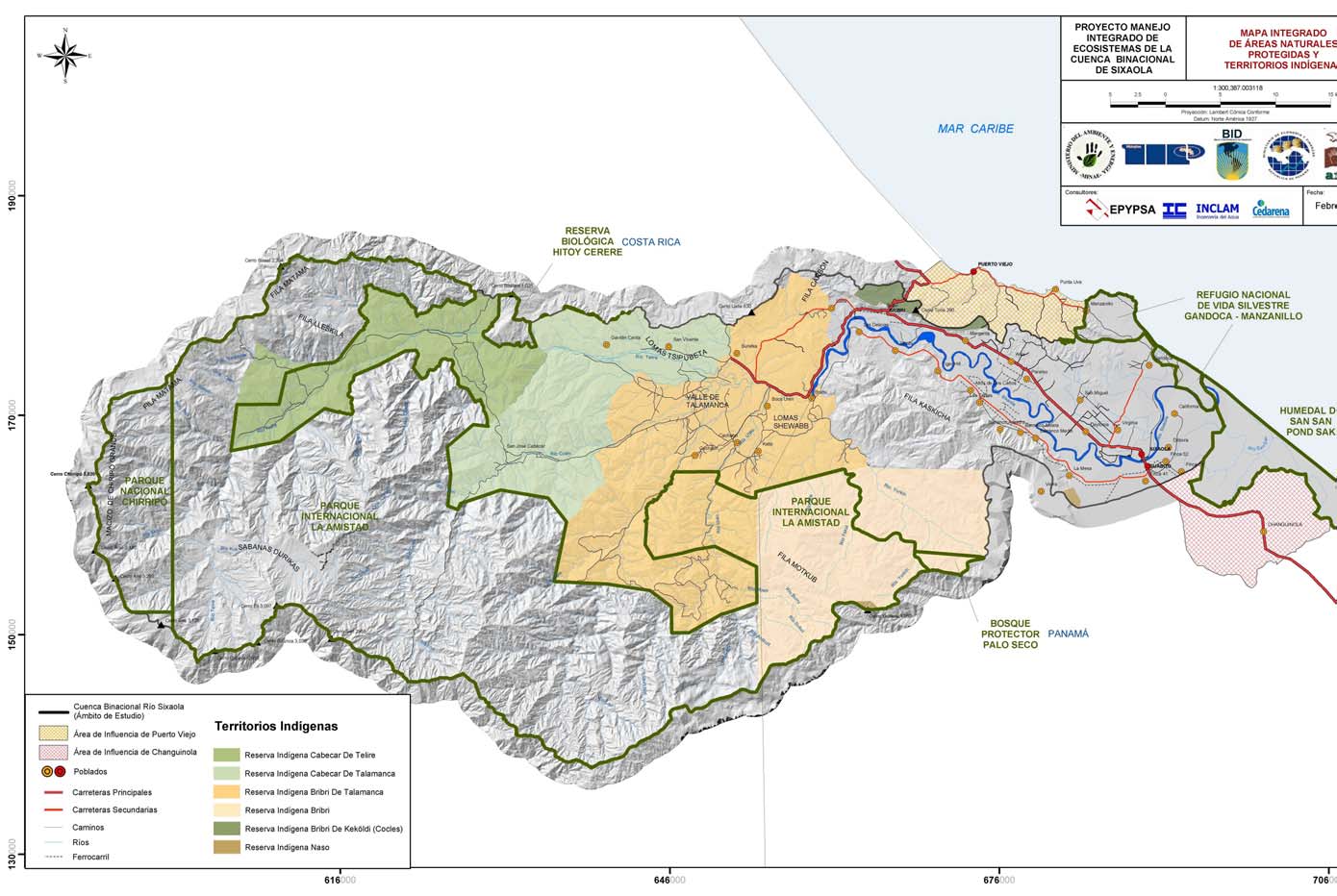
8
Section Two: Site-Level Management Effectiveness Tracking Tool for Protected Areas
Reporting Progress in Protected Areas: Data Sheet 1
Gandoca-Manzanillo National Wildlife Refuge (REGAMA)
Name of protected area
Location of protected area (country,
Salamanca Ecoregion, Southeast Costa Rica (Limon Province)
ecoregion, and if possible map reference)
Date of establishment (distinguish between
Agreed
Gazetted
agreed and gazetted*)
Executive Decree
Gazette # 206 of 29/10/1985
#16614-MAG
29/10/85
Ownership details (i.e.
owner, tenure rights etc)
Private properties and State
Management Authority
La Amistad-Caribbean Conservation Area (ACLA-C) of the Nacional Conservation Area System
(SINAC) of the Ministry of Environment and Energy (MINAE)
Size of protected area (ha)
4.876 ha
Number of staff
Permanent: 5
Temporary:
Annual budget (US$)
54.780
Designations (IUCN category,
World Heritage, Ramsar etc)
RAMSAR
Protect and conserve habitats of species, with special interest in migratory aquatic
Reasons for designation
birds of transcontinental importance
Brief details of World Bank
funded project or projects in PA
Not necessary for GEF-funded projects.
Brief details of WWF funded
project or projects in PA
Not necessary for GEF-funded projects.
Brief details of other relevant
Protection and monitoring of turtles on behalf of the NGO (ANAI). Dolphin study on
projects in PA
behalf of Fundación Delfín
List the two primary protected area objectives
Objective 1
Protection of wetlands and flooded forests.
Objective 2
Protection of bird species of transcontinental importance
List the top two most important threats to the PA (and indicate reasons why these were chosen)
Threat 1
Tourism in the buffer zone and within the refuge
Threat 2
Pollution from solid and liquid wastes
List top two critical management activities
Control of construction development
Activity 1
Activity 2
Pollution control
9
Name/s of reviewer (including people consulted):
José Masis (Administrator), Earl Junier Libdo, Olman Morales and Ceidi Meléndez (La Amistad-
Caribbean Conservation Area (ACLA-C) of the Nacional Conservation Area System
(SINAC) of the Ministry of Environment and Energy (MINAE)
Contact details (email etc.):
José Masis: Telephone: 00 506 759 90 01
Earl Junier: Telephone: 00 506 795 31 70. lfjw@costarricense.cr
Olman Morales: Telephone: 00 506 755 04 55 olmanmorales@costarricense.cr
olmanmorales@yahoo.com
Ceidi Meléndez: Telephone: 00 506 795 31 70
Date assessment carried out (Day/Month/Year):
Earl Junier: 7 March 2006
Olman Morales: 9 March 2006
Ceidi Meléndez: 6 March 2006
10
Issue
Criteria
Score
Comments
Next steps
1. Legal status
The protected area is not gazetted
0
Note: see fourth option for private
reserves
Does the
The government has agreed that the
1
protected area
protected area should be gazetted but the
have legal status? process has not yet begun
The protected area is in the process of being
2
gazetted but the process is still incomplete
Context
The protected area has been legally gazetted
3 (x) The Wildlife Refuge is officially established by
(or in the case of private reserves is owned by
Executive Decree , Oficial Gazette of the
a trust or similar)
Republic of Costa Rica #206 de 29/10/1985
2. Protected area There are no mechanisms for controlling
0
regulations
inappropriate land use and activities in the
protected area
Are inappropriate Mechanisms for controlling inappropriate land
land uses and
use and activities in the protected area exist
1
activities (e.g.
but there are major problems in implementing
poaching)
them effectively
controlled?
Mechanisms for controlling inappropriate land
2 (x)
Internal zoning is required,
use and activities in the protected area exist
The local population participates in the
development of management criteria
but there are some problems in effectively
activities of the protected area through the and land/sea-use criteria need to be
Context
implementing them
Advisory Committee, which is subdivided in harmonized with nearby San San Pond
the Manzanillo Zonal Committee and the
Sak RAMSAR Site (see next protected
Gandoca Zonal Committee.
area)
Environmental organizations that do not form
part of the Advisory Committee, disagree over
the intensity of human use that the
Management Plan permits in the Refuge
(REGAMA).
11
Issue
Criteria
Score
Comments
Next steps
Mechanisms for controlling inappropriate land
3
use and activities in the protected area exist
and are being effectively implemented
3. Law
The staff have no effective
0
Possible issue for comment: What
enforcement
capacity/resources to enforce protected
happens if people are arrested?
area legislation and regulations
Can staff enforce There are major deficiencies in staff
1
protected area
capacity/resources to enforce protected
rules well
area legislation and regulations (e.g. lack of
enough?
skills, no patrol budget)
The staff have acceptable
2 (x) Rangers can detain people who undertake
Provide operational resources to
capacity/resources to enforce protected
unlawful activities in the protected area.
facilitate enforcement.
Context
area legislation and regulations but some
Procedural guarantees exit for the detention. A
deficiencies remain
person can be detained for only 24 hours, so
the rapid action of the prosecutor is important.
The staff have excellent capacity/resources to
3
enforce protected area legislation and
Regulations
12
Issue
Criteria
Score
Comments
Next steps
4. Protected area No firm objectives have been agreed for the
0
objectives
protected area
Have objectives
The protected area has agreed objectives,
1
been agreed?
but is not managed according to these
Objectives
The protected area has agreed objectives,
2 (x) The lack of technical and human means
Development of action plans, technical
Planning
but these are only partially implemented
impede fully reaching the stated objectives. capacity building of staff
The protected area has agreed objectives
3
and is managed to meet these objectives
5. Protected area Inadequacies in design mean achieving the
0
Possible issue to comment: does protected
design
protected areas major management
Area contain different management zones
objectives of the protected area is impossible
and are these well maintained?
Does the
Inadequacies in design mean that
1
protected area
achievement of major objectives are
need enlarging,
constrained to some extent
corridors etc to
Design is not significantly constraining
2
meet its
achievement of major objectives, but could
objectives?
be improved
Reserve design features are particularly aiding
3 (x) The design of the protected area is adequate No need to enlarge, although
Planning
achievement of major objectives of the
for the stated objectives. Also, not only
management needs to be improved in
protected area
territorial spaces are incorporated, but the
marine zone.
body of water and marine zone (although
management can be improve din marine
zone).
6. Protected area The boundary of the protected area is not
0
Possible issue to comment: are there
boundary known
by the management authority or local
tenure disagreements affecting PA?
13
Issue
Criteria
Score
Comments
Next steps
demarcation residents/neighbouring
land
users
The boundary of the protected area is known
1
Is the boundary
by the management authority but is not
known and
known by local residents/neighbouring land
demarcated?
users
The boundary of the protected area is known
2 (x) The limits of the Park are known by the
Internal zoning needs to be improved.
Context
by both the management authority and local
environmental and local authorities and the Awareness raising required
residents but is not appropriately demarcated
local communities, although they are not
Enhanced collaboration with San San
physically marked. Any person who wants to Pond Sak in Panama
buy or sell land solicits certification of proof
Marine boundary demarcated and
from MINAE that the limits of the protected
socialized.
area are not affected.
The boundary of the protected area is known
3
by the management authority and local
residents and is appropriately demarcated
14
Issue
Criteria
Score
Comments
Next steps
7. Management
There is no management plan for the
0
plan
protected area
Is there a
A management plan is being prepared or has
1
management
been prepared but is not being implemented
plan and is it
An approved management plan exists but it is
2 (x) The Management Plan is approved and
Internal zoning (both land and sea) needs
being
only being partially implemented because of
implemented with local participation through to be harmonized with San San Pond Sak,
implemented?
funding constraints or other problems
the Advisory Committee, structured in the joint monitoring with San San Pond Sak
Zonal Committees of Gandoca and
Manzanillo.
An approved management plan exists and is
3
Planning
being implemented
Additional points
The planning process allows adequate
+1 (x) The Management is elaborated and will be
opportunity for key stakeholders to influence
reviewed at its time with the participation of
the management plan
key social agents.
There is an established schedule and process
+1 (x) A periodic process of review of the
for periodic review and updating of the
Management Plan exists.
management plan
The results of monitoring, research and
+1 (x) The results of routine monitoring and
Strengthen monitoring activities and
evaluation are routinely incorporated into
evaluation serves as lessons learned to
collaborate with San San Pond Sak on
Planning
planning
incorporate them into the Management
binational monitoring efforts.
Plan in its later revisions.
8. Regular work
No regular work plan exists
0
plan
A regular work plan exists but activities are not
1
Is there an annual monitored against the plan's targets
work plan?
A regular work plan exists and actions are
2 (x) A regular work plan (Annual Operative
Support the development of action plans,
monitored against the plan's targets, but
Plan) exists and the actions are monitored in collaboration with San San Pond Sak
many activities are not completed
with respect to the work goals, but some
activities are not complete, due to the lack
of economic resources to deal with them.
15
Issue
Criteria
Score
Comments
Next steps
A regular work plan exists, actions are
3
Planning/Outputs monitored against the plan's targets and most
or all prescribed activities are completed
9. Resource
There is little or no information available on the
0
inventory
critical habitats, species and cultural values of
the protected area
Do you have
Information on the critical habitats, species
1 (x) Limited investigation, monitoring and study Binational monitoring should take place
enough
and cultural values of the protected area is
of critical habitat, species and cultural
information to
not sufficient to support planning and decision
values exists, but is not enough for planning More data required on water and soil
manage the
making
and decision making regarding the
quality
area?
protected area. Up to now, the information
available is partial and scientific studies
Data on management effectiveness need
have been centered on very specific
to be improved.
elements (turtles, bioprospecting of marine
moluscs- INBio
Development integrated information
system
ANAI association collaborates in the
process of monitoring of marine turtles,
Disseminate information
contributing valuable data for the
management of reptiles.
The ANAI association has begun a project
of monitoring fish, which contributes
valuable data for the management of fish
populations.
Studies are being made of dolphins by the
Dolphin Foundation, which will contribute
valuable data for their management)
16
Issue
Criteria
Score
Comments
Next steps
Information on the critical habitats, species
2
and cultural values of the protected area is
sufficient for key areas of planning/decision
Context
making but the necessary survey work is not
being maintained
Information concerning on the critical
3
habitats, species and cultural values of the
protected area is sufficient to support
planning and decision making and is being
maintained
10. Research
There is no survey or research work taking
0
place in the protected area
Is there a
programme of
management-
orientated survey
and research
work?
There is some ad hoc survey and research
1 (x) A Research Plan developed by the
Targeted research grants program to
work
environmental authorities does not exist.
promote research on topics that will
Through NGOs very focalized research is facilitate adaptive management.
carried out on elements of conservation,
but lacking research in more elements of
conservation, above all in ecosystems.
There is considerable survey and research
2
work but it is not directed towards the needs
of protected area management
Inputs
There is a comprehensive, integrated
3
programme of survey and research work,
which is relevant to management needs
11. Resource
Requirements for active management of
0
management
critical ecosystems, species and cultural
values have not been assessed
17
Issue
Criteria
Score
Comments
Next steps
Is the protected
Requirements for active management of
1
area adequately
critical ecosystems, species and cultural
managed (e.g.
values are known but are not being
for fire, invasive
addressed
species,
Requirements for active management of
2 (x) The environmental authority knows the
Binational collaboration should be
poaching)?
critical ecosystems, species and cultural
need for active management, but a only a enhanced and technical training of staff
values are only being partially addressed
part of the plan has been implemented due and additional operational resources
to lack of technical and human resources. required.
Process
Requirements for active management of
3
critical ecosystems, species and cultural
values are being substantially or fully
addressed
18
Issue
Criteria
Score
Comments
Next steps
12. Staff numbers There are no staff
0
Are there enough Staff numbers are inadequate for critical
1 (x) The availablity of personnel to address the
people employed management activities
management of critical and non-critical
Technical and operational capacities will
to manage the
activities is scarce. Only 5 people are
be strengthened.
protected area?
designated for this.
Staff numbers are below optimum level for
2
critical management activities
Inputs
Staff numbers are adequate for the
3
management needs of the site
13. Personnel
Problems with personnel management
0
management
constrain the achievement of major
management objectives
Are the staff
Problems with personnel management
1
managed well
partially constrain the achievement of major
enough?
management objectives
Personnel management is adequate to the
2 (x)
Managament capacities will
Process
achievement of major management
Personnel management could be improved. be strengthened.
objectives but could be improved
Personnel management is excellent and aids
3
the achievement major management
objectives
14. Staff training
Staff are untrained
0
Is there enough
Staff training and skills are low relative to the
1
training for staff?
needs of the protected area
Staff training and skills are adequate, but
2 (x) More training so that personnel are better
Technical and operational capacities will
could be further improved to fully achieve the
trained, above all for surveillance.
be strengthened.
objectives of management
19
Issue
Criteria
Score
Comments
Next steps
Inputs/Process
Staff training and skills are in tune with the
3
management needs of the protected area,
and with anticipated future needs
15. Current
There is no budget for the protected area
0
budget
Is the current
The available budget is inadequate for basic
1 (x) The budget assigned to the protected area is Innovative financial mechanisms will be
budget sufficient? management needs and presents a serious
inadequate and scarce to attend to he
designed and implemented for supporting
Inputs
constraint to the capacity to manage
management needs. Money is available only protected area management.
for operation, which constitutes an important
limitation.
The available budget is acceptable, but
2
could be further improved to fully achieve
effective management
The available budget is sufficient and meets
3
the full management needs of the protected
area
16. Security of
There is no secure budget for the protected
0
budget
area and management is wholly reliant on
outside or year by year funding
Is the budget
There is very little secure budget and the
1 (x) The budget is unsecure. Resources are
The project will promote enhanced
secure?
protected area could not function
requested from central MINAE, in function of Government commitment for allocated
adequately without outside funding
operational costs that need to be incurred,
resources for the management of the
which makes the action and planning of the protected area and sustainable financing
protected area authority difficult.
alternatives will be developed.
There is a reasonably secure core budget for
2
the protected area but many innovations and
Inputs
initiatives are reliant on outside funding
There is a secure budget for the protected
3
area and its management needs on a multi-
year cycle
20
Issue
Criteria
Score
Comments
Next steps
17. Management Budget management is poor and significantly
0
of budget
undermines effectiveness
Budget management is poor and constrains
1 (x) The budget assigned to the protected area is Development of more targeted action
Is the budget
effectiveness
very poor, which makes difficult the
plans and improve planning capacities of
managed to
effectiveness of management of the area.
staff.
The budget is used for operational costs.
meet critical
Budget management is adequate but could
2
management
be improved
needs?
Budget management is excellent and aids
3
Process
effectiveness
18. Equipment
There are little or no equipment and facilities
0
There are some equipment and facilities but
1
these are wholly inadequate
Are there
There are equipment and facilities, but still
2 (x) Equipment and facilities are scarce, which Operational capacities need to be
adequate
some major gaps that constrain management
makes management difficult (some signs in strengthened, including visitation
equipment and
Manzanillo, picnic areas in Manzanillo and infrastructure.
facilities?
administrative buildings and shelters for
rangers, police and volunteers in Manzanillo
y Gandoca).
There are adequate equipment and facilities
3
21
Issue
Criteria
Score
Comments
Next steps
19. Maintenance
There is little or no maintenance of equipment
0
of equipment
and facilities
Is equipment
There is some ad hoc maintenance of
1
adequately
equipment and facilities
maintained?
There is maintenance of equipment and
2 (x) Equipment of the protected area is
Develop and put in place a more rigorous
facilities, but there are some important gaps in
maintained, but some of them take time
maintenance plan, with clear
Process
maintenance
until they are repaired or renewed (signage)responsibilities and timetables.
Equipment and facilities are well maintained
3
20. Education
There is no education and awareness
0 (x) There is no formalized education program The project will support a locally adapted
and awareness
programme
undertaken by the environmental authority environmental awareness raising
programme
of the protected area because of lack of
program, as well as an interactive program
budget. The environmental organizations for children and youth developed in
CBTC and ANAI undertake some actions of association with primary and secondary
environmental education (schools in
schools, as well as civil society
Gandoca, Mata Limón and Manzanillo), but
it is not a program continued in time.
Is there a planned There is a limited and ad hoc education and
1
education
awareness programme, but no overall
programme?
planning for this
There is a planned education and awareness
2
Process
programme but there are still serious gaps
There is a planned and effective education
3
and awareness programme fully linked to the
objectives and needs of the protected area
21. State and
There is no contact between managers and
0
commercial
neighbouring official or corporate land users
22
Issue
Criteria
Score
Comments
Next steps
neighbours
There is limited contact between managers
1 (x) The contact between the environmental
Involve as many stakeholders as possible
Is there co-
and neighboring official or corporate land
authority that manages the protected area during the Project lifetime (and beyond)
operation with
users
and the owners of the land around the
Increase contacts between environmental
refuge is sporadic but it exists.
authorities and land-owners for
collaborative management.
adjacent land
There is regular contact between managers
2
users?
and neighboring official or corporate land
users, but only limited co-operation
Process
There is regular contact between managers
3
and neighboring official or corporate land
users, and substantial co-operation on
management
22. Indigenous
Indigenous and traditional peoples have no
0 (x) Only a small sector of the protected area Enhance collaboration with nearby
people
input into decisions relating to the
borders with the Bri Bri indigenous territory indigenous communities.
management of the protected area
of Keköldi. The indigenous authority is not
consulted, though it participates in the
forestry committee.
23
Issue
Criteria
Store
Comments
Next steps
Do indigenous
Indigenous and traditional peoples have
1 (x)
Only a small sector of the protected area
Enhance collaboration with nearby
and traditional
some input into discussions relating to
borders with the Bri Bri indigenous territory indigenous communities.
peoples resident
management but no direct involvement in
of Keköldi. The indigenous authority is not
or regularly using the resulting decisions
consulted, though it participates in the
the PA have input
forestry committee.
to management
decisions?
Indigenous and traditional peoples directly
2
contribute to some decisions relating to
management
Process
Indigenous and traditional peoples directly
3
participate in making decisions relating to
management
23. Local
Local communities have no input into
0
communities
decisions relating to the management of the
protected area
Do local
Local communities have some input into
1
communities
discussions relating to management but no
resident or near
direct involvement in the resulting decisions
the protected
Local communities directly contribute to some
2
area have input
decisions relating to management
24
Issue
Criteria
Store
Comments
Next steps
Local communities directly participate in
3 (x)
Continue strengthening liaisons between
making decisions relating to management
Private and public lands exist in the
local communities and environmental
wildlife refuge, which has led to the
authorities in decisions related to
existence of an organizational structure management.
in which the local population participates
in the management of the protected
area. The structure is made up of the
national governmental environmental
authority, MINAE, the Municipality of
Talamanca and the Development
Associations of Gandoca and Manzanillo
and by three NGOs present in the zone,
ANAI, APROGAN and ADECOMAGA.
These organizations conform the
Advisory Committee, which is subdivided
into the Manzanillo Zonal Committee
and the Gandoca Zonal
The function of the Zonal Committees is
to apply and oversee the compliance of
the Refuge Management Plan, issuing or
denying the resource use permits among
other things..
Additional points
There is open communication and trust
+1(x)
There is constant communication between Special attention to improve
between local stakeholders and protected
the environmental authority of the protected communication with indigenous
area managers
area and the local population.
communities and local inhabitants will be
considered.
Outputs
Programs to enhance local community
+1
welfare, while conserving protected area
resources, are being implemented
24. Visitor facilities There are no visitor facilities and services
0
Possible issue for comment: Do visitors
25
Issue
Criteria
Store
Comments
Next steps
damage the protected area?
Visitor facilities and services are
1
Inappropriate for current levels of visitation or
Are visitor facilities
are under construction
(for tourists,
pilgrims etc) good
enough?
Visitor facilities and services are adequate for
2 (x)
The facilities that visitors of the protected
Promotion of tourism development
current levels of visitation but could be
area find are limited to posters and
creating production chains between the
improved
brochures and meteorological information coastal area and the middle and upper
on the MINAE web page, making it
sub-basins will improve the enabling
necessary to improve the facilities.
conditions for tourism (including facilities).
The impacts that tourists tend to cause are
limited to movement on the existing paths,
some fire pits and some garbage disposal
areas.
Outputs
Visitor facilities and services are excellent for
3
current levels of visitation
25. Commercial
There is little or no contact between
0
Possible issue for comment: examples
tourism
managers and tourism operators using the
of
contributions
protected area
26
Issue
Criteria
Score
Comments
Next steps
There is contact between managers and
1
Do commercial
tourism operators but this is largely confined to
tour operators
administrative or regulatory matters
contribute to
There is limited co-operation between
2
protected area
managers and tourism operators to enhance
management?
visitor experiences and maintain protected
area values
Process
There is excellent co-operation between
3 (x)
Good cooperation exists between the
Continue collaboration between authorities
managers and tourism operators to enhance
environmental authority of the protected
and tourism operators.
visitor experiences, protect values and resolve
area and the foreign and local tourist agents
conflicts
26. Fees
Although fees are theoretically applied, they
0 (x)
A tariff is not charged for entering the
Development of a financial plan, including
If fees (tourism,
are not collected
protected area
an analysis of the possibility to charge an
entrance fee and pilot.
fines) are applied, The fee is collected, but it goes straight to
1
do they help
central government and is not returned to the
protected area
protected area or its environs
management?
The fee is collected, but is disbursed to the
2
local authority rather than the protected area
Outputs
There is a fee for visiting the protected area
3
that helps to support this and/or other
protected areas
27. Condition
Important biodiversity, ecological and cultural
Possible issue for comment: It is
assessment
values are being severely degraded
important to provide details of the
Is the protected
Some biodiversity, ecological and cultural
1
biodiversity, ecological or cultural
area being
values are being severely degraded
values being affected
managed
consistent to its
objectives?
Some biodiversity, ecological and cultural
2 (x) Important biodiversity, ecological and
The integrated monitoring and evaluation
values are being partially degraded but the
cultural values exist that are not degraded, system to be developed by the Project will
most important values have not been
although discrepancies exist in the intensity contribute to shed light on this issue.
significantly impacted
of human use that the Management Plan
permits and the opinion of local
environmental organizations.
Outcomes
Biodiversity, ecological and cultural values are
27
Issue
Criteria
Score
Comments
Next steps
predominantly
intact
3
Additional points
There are active programmes for restoration
of degraded areas within the protected area
+1
Outputs
and/or the protected area buffer zone
28. Access
Protection systems (patrols, permits etc) are
0
assessment
ineffective in controlling access or use of the
reserve in accordance with designated
objectives
28
Issue
Criteria
Score
Comments
Next st
Is
Protection systems are only partially effective
1
access/resource
in controlling access or use of the reserve in
use sufficiently
accordance with designated objectives
controlled?
Protection systems are moderately effective in
2 (x) The systems of protection can be improved Operational
controlling access or use of the reserve in
to make the control of access and use more strengthening for
Outcomes
accordance with designated objectives
effective, increasing the technical and
enhanced access
human means are now scarce.
control.
Protection systems are largely or wholly
3
effective in controlling access or use of the
reserve in accordance with designated
objectives
29. Economic
The existence of the protected area has
0
Possible issue for comment: how does
benefit
reduced the options for economic
national or regional development
assessment development of the local communities
impact on the protected area?
The existence of the protected area has
1
Is the protected
neither damaged nor benefited the local
area providing
economy
economic
There is some flow of economic benefits to
2
benefits to local
local communities from the existence of the
communities?
protected area but this is of minor significance
to the regional economy
There is a significant or major flow of
3 (x) The local population benefits in an
New alternative
Outcomes
economic benefits to local communities from
important way from the existence of the
livelihoods based on
activities in and around the protected area
protected area, since the management of the sustainable use
(e.g. employment of locals, locally operated
tourists are in the hands of tour operators of biodiversity should
commercial tours etc)
from the vicinity of Puerto Viejo; the four
be developed
local communities control the lodging,
(incl. eco-tourism)
(Gandoca y Manzanillo) and transport; the
guides are of the local population, the
dolphin watching boats are of the local
population, etc. Each year, 300 volunteer-
tourists come to Gandoca to manage the
turtles, leaving some $57.000.
30. Monitoring
There is no monitoring and evaluation in the
0
and evaluation
protected area
29
Are management There is some ad hoc monitoring and
1
activities
evaluation, but no overall strategy and/or no
monitored
regular collection of results
against
There is an agreed and implemented
2
performance?
monitoring and evaluation system but results
are not systematically used for management
A good monitoring and evaluation system
3 (x) A system of monitoring and evaluating the Monitoring systems
Planning/Process exists, is well implemented and used in
performance of the Administration of the
for biodiversity, water
adaptive management
protected areas of Costa Rica exists. The and land will be
local population participates in this system, improved.
contributing their vision through the
Advisory Committee. The results of the
monitoring and evaluation system are used
in the management of the protected area.
TOTAL SCORE
56
30
Reporting Progress in Protected areas: Data Sheet
Humedal de Importancia Internacional San San Poond Sack (HIISSPS)
Name of protected area
Location of protected area (country,
Panamá. Provincia de Bocas del Toro. Distrito de Changuinola
ecoregion, and if possible map reference)
Date of establishment (distinguish between
Agreed
Gazetted
agreed and gazetted*)
Resolution of the
Board of Directors
020-94 del August 2, Gaceta Oficial #22617 del 7 de septiembre de 1994
1994 of the National
Authority of the
Environment
(ANAM),
Ownership details (i.e.
owner, tenure rights etc)
Private and state properties exist
Management Authority
National Authority of the Environment of Panama (ANAM)
Size of protected area (ha)
20.025 ha
Number of staff
Permanent: 3
Temporary: 12 volunteers of the Association of Friends of the
COSAT and Nature (AAMVECONA)
Annual budget (US$)
9.500
Designations (IUCN category,
World Heritage, Ramsar etc)
RAMSAR wetland, Biosphere Reserve and World Heritage site
Protect and conserve habitats of many wild species with special interest in aquatic
Reasons for designation
migratory birds of transcontinental importance.
Brief details of World Bank
funded project or projects in PA
Not necessary for GEF-funded projects.
Brief details of WWF funded
project or projects in PA
Not necessary for GEF-funded projects.
Brief details of other relevant
The AAMVECONA association with support of the environmental association Conservation
projects in PA
International has implemented a program of monitoring of manatee and of water quality, the
latter in collaboration with National University of Panama (Regional de Changhuinola). The
investment of Conservation International is $250.000.
List the two primary protected area objectives
Objective 1
Protection of a rich variety of wetlands.
Conservation of the Beach of Changuinola, as a site of importance for marine turtles, as well
Objective 2
as the manatee.
List the top two most important threats to the PA (and indicate reasons why these were chosen)
Contamination of water by agrochemicals and waste. This menace has been chosen because of the fragility
Threat 1
of the water resource to contamination by agrochemicals.
31
Extraction of wood, hunting and poaching of turtle egs, This second menace affect key elements of
Threat 2
conservation of wetlands.
List top two critical management activities
Reduce water pollution
Activity 1
Develop income generating activities for the local communities in and around the wetland and increase
Activity 2
resources provided by the National Environmental Authority (ANAM)
Name/s of assessor (including people consulted): Hernández Bonilla. Coordinador Regional de
Áreas Protegidas de la Autoridead Nacional del Ambiente de Panamá (ANAM)
Contact details (email etc.): Teléfono: 00 507 758 66 03. hbonilla63@latinmail.com
Date assessment carried out (Day/Month/Year): 6, 8 y 10 de marzo de 2006
* Or formal y established in the case of private protected areas
32
Issue
Criteria
Score
Comments
Next steps
1. Legal status
The protected area is not gazetted
0
Note: see fourth option for private
reserves
Does the
The government has agreed that the
1
protected area
protected area should be gazetted but the
have legal status? process has not yet begun
The protected area is in the process of being
2
gazetted but the process is still incomplete
Context
The protected area has been legally gazetted
3 (x) The protected area has a creation
(or in the case of private reserves is owned by
agreement published in the official Gazette
a trust or similar)
of the Republic of Panama # 22617 on
07/09/1994
2. Protected area There are no mechanisms for controlling
0
regulations
inappropriate land use and activities in the
protected area
Are inappropriate Mechanisms for controlling inappropriate land
land uses and
use and activities in the protected area exist
1
activities (e.g.
but there are major problems in implementing
poaching)
Them effectively
controlled?
Mechanisms for controlling inappropriate land
2 (x) Control mechanisms exist, but the
Internal zoning is required development of
use and activities in the protected area exist
difficulties of movement (swamps) and the management criteria and a land and sea-
but there are some problems in effectively
lack of human, technical and material
use need to be harmonized with nearby
Context
implementing them
means create a situation in which these
Gandoca-Manzanillo National Wildife
means cannot be implemented in an
Refuge (see previous protected area)
efficient form.
Mechanisms for controlling inappropriate land
3
use and activities in the protected area exist
and are being effectively implemented
3. Law
The staff have no effective
0
Possible issue for comment: What
enforcement
capacity/resources to enforce protected
happens if people are arrested?
area legislation and regulations
33
Issue
Criteria
Score
Comments
Next steps
Can staff enforce There are major deficiencies in staff
1 (x) The scarcity of human and technical
Provide operational resources to facilitate
protected area
capacity/resources to enforce protected
resources to apply the regulatory norms of enforcement
rules well
area legislation and regulations (e.g. lack of
the Protected Area is an important
enough?
skills, no patrol budget)
restriction that must be overcome.
The rangers can detain people in the
protected area for unlawfull activities.
Procedural guarantees exist for the
detention.
The staff have acceptable
2
capacity/resources to enforce protected
Context
area legislation and regulations but some
deficiencies remain
The staff have excellent capacity/resources to
3
enforce protected area legislation and
Regulations
34
Issue
Criteria
Score
Comments
Next steps
4. Protected area No firm objectives have been agreed for the
0
objectives
protected area
Have objectives
The protected area has agreed objectives,
1
been agreed?
but is not managed according to these
Objectives
The protected area has agreed objectives,
2 (x) The objectives of preservation of the
Develop action plans, technical capacity
Planning
but these are only partially implemented
wetland is complied with in part, but the
building of staff
lack of economic resources impedes the
full accomplishment of the objectives.
Agencies and non-governmental
organizations are being worked with to
leverage resources and facilitate
compliance with the conservation
objectives
The protected area has agreed objectives
3
and is managed to meet these objectives
5. Protected area Inadequacies in design mean achieving the
0
Possible issue for comment: does the
design
protected areas major management
protected area contain different
objectives of the protected area is impossible
management zones and are these well
maintained?
35
Issue
Criteria
Score
Comments
Next steps
Does the
Inadequacies in design mean that
1 (x) The design of the limits of the wetland is The possibility of broadening the
protected area
achievement of major objectives are
not altogether adequate, since it should protection environment of the wetland to
need enlarging,
constrained to some extent
include areas outside the protected area, the San San River is being studied, with
to facilitate the movement of the manatee. the object of contecting the Wild
Nor is there a good design in relation to Protected Area with the La Amistad
the marine zone, since the wetland does International Park. In this manner it is
not formally include marine areas.
possible to protect the area for the
movement of manatee. Expansion to the
marine zone is also needed.
corridors etc to
Design is not significantly constraining
2
meet its
achievement of major objectives, but could
objectives?
be improved
Reserve design features are particularly aiding
3
Planning
achievement of major objectives of the
protected area
6. Protected area The boundary of the protected area is not
0
Possible issue for comment: are there
boundary known
by the management authority or local
tenure disagreements affecting the
demarcation
residents/neighbouring land users
protected area?
The boundary of the protected area is known
1
Is the boundary
by the management authority but is not
known and
known by local residents/neighbouring land
demarcated?
users
36
Issue
Criteria
Score
Comments
Next steps
The boundary of the protected area is known
2 (x) The limits of the wetland are known by the The PRONAT project is supposed to
Context
by both the management authority and local
environmental, and local authorities and by demarcate the protected area, but to date
residents but is not appropriately demarcated
the residents . To date it is not
this has not been made a reality.
demarcated, although the geographic
coordinates of the protected area are
Internal zoning needs to be improved
relatively known.
Awareness raising required
The property owners who live in its
Enhanced collaboration with Gandoca-
environs request the National
Manzanillo in Costa Rica
Environmental Authority of Panama
(ANAM) to certify that their properties are
not within the protected area, when it is
necessary for the transactions of
properties.
The boundary of the protected area is known
3
by the management authority and local
residents and is appropriately demarcated
37
Issue
Criteria
Score
Comments
Next steps
7. Management
There is no management plan for the
0
plan
protected area
Is there a
A management plan is being prepared or has
1
management
been prepared but is not being implemented
plan and is it
An approved management plan exists but it is
2 (x) The Management Plan is not being
Internal zoning needs to be harmonized
being
only being partially implemented because of
implemented in its totality.
with Gandoca-Mazanillo, joint monitoring
implemented?
funding constraints or other problems
The support of the interested environmental with Gandoca Manzanillo
agencies is sought to help implement the
Management Plan
An approved management plan exists and is
3
Planning
being implemented
Additional points
The planning process allows adequate
+1 (x) The Management Plan was elaborated and
opportunity for key stakeholders to influence
approved a short time ago. It will be revised
the management plan
at the appropriate time with the participation
of the key social agents.
There is an established schedule and process
+1
for periodic review and updating of the
management plan
The results of monitoring, research and
+1
evaluation are routinely incorporated into
Planning
planning
8. Regular work
No regular work plan exists
0
plan
A regular work plan exists but activities are not
1
Is there an annual monitored against the plan's targets
work plan?
A regular work plan exists and actions are
2 (x) A regular work plan exists and the actions Support to the development of action
monitored against the plan's targets, but
are monitored with respect to the work
plans, in collaboration with Gandoca-
Many activities are not completed
goals, but many activities are not completed Manzanillo
due to the lack of economic resources.
A regular work plan exists, actions are
3
Planning/Outputs monitored against the plan's targets and most
or all prescribed activities are completed
9. Resource
There is little or no information available on the
0
inventory
critical habitats, species and cultural values of
the protected area
38
Issue
Criteria
Score
Comments
Next steps
Do you have
Information on the critical habitats, species
1
Limited research, monitoring and studies of Binational monitoring processes will take
enough
and cultural values of the protected area is
critical habitats, species and cultural values place
information to
not sufficient to support planning and decision
to facilitate planning and decision making in
manage the
making
the protected area takes place. Up to this More data required on water and soil
area?
time, the available information ;however, is quality
partial and the scientific studies have been
centered in very specific aspects
Data on management effectiveness could
(monitoring of turtles and manatee). With be improved
the financing of donors the monitoring of
manatee is continued (Conservation
Development integrated information
International and Natura Foundation).
Disseminate information
39
Issue
Criteria
Score
Comments
Next steps
Information on the critical habitats, species
2
and cultural values of the protected area is
sufficient for key areas of planning/decision
Context
making but the necessary survey work is not
being maintained
Information concerning on the critical
3
habitats, species and cultural values of the
protected area is sufficient to support
planning and decision making and is being
maintained
10. Research
There is no survey or research work taking
0
Place in the protected area
Is there a
programme of
management-
There is some ad hoc survey and research
orientated survey
1 (x) A work plan exists with relation to the
Targeted research grants program to
Work
monitoring and investigation of marine
promote research on topics that will
and research
turtles and manatees. Investigation and
facilitate adaptive management
work?
monitoring of more elements of
conservation (for example birds) is lacking.
There is considerable survey and research
2
work but it is not directed towards the needs
of protected area management
Inputs
There is a comprehensive, integrated
3
programme of survey and research work,
Which is relevant to management needs
11. Resource
Requirements for active management of
0
management
critical ecosystems, species and cultural
values have not been assessed
Is the protected
Requirements for active management of
1
area adequately
critical ecosystems, species and cultural
managed (e.g.
values are known but are not being
for fire, invasive
addressed
species,
Requirements for active management of
2 (x) The needs of management are known, but Binational collaboration should be
poaching)?
critical ecosystems, species and cultural
are only partially accomplished, mainly due enhanced and technical training of staff
values are only being partially addressed
to lack of personnel and budget
and additional operational resources
required
40
Issue
Criteria
Score
Comments
Next steps
Process
Requirements for active management of
3
critical ecosystems, species and cultural
values are being substantially or fully
addressed
41
Issue
Criteria
Score
Comments
Next steps
12. Staff numbers There are no staff
0
Are there enough Staff numbers are inadequate for critical
1
people employed management activities
to manage the
protected area?
Staff numbers are below optimum level for
2 (x) There are only three people assigned to the Technical and operational capacities will
critical management activities
protected area, supported by some 12
be strengthened
volunteers from AAMVECONA
More people are needed to improve the
conservation objectives. It is estimated that
the optimum would be 10-12 people
(environmental education, protected area
coordinator, a person in charge of research
and rangers)
Inputs
Staff numbers are adequate for the
3
management needs of the site
13. Personnel
Problems with personnel management
0
management
constrain the achievement of major
management objectives
Are the staff
Problems with personnel management
1
managed well
partially constrain the achievement of major
enough?
management objectives
Personnel management is adequate to the
2 (x) The wetland management personnel are Technical and operational capacities will
Process
achievement of major management
trained, although they could improve their be strengthened
objectives but could be improved
efficiency.
Personnel management is excellent and aids
3
the achievement major management
objectives
14. Staff training
Staff are untrained
0
Is there enough
Staff training and skills are low relative to the
1
training for staff?
needs of the protected area
42
Issue
Criteria
Score
Comments
Next steps
Staff training and skills are adequate, but
2 (x) The personnel who manage the wetland Technical and operational capacities will
are trained, although training courses are be strengthened
still necessary to improve their formation
could be further improved to fully achieve the
and comply with the management
objectives of management
objectives.
Inputs/Process
Staff training and skills are in tune with the
3
management needs of the protected area,
and with anticipated future needs
15. Current
There is no budget for the protected area
0
budget
The available budget is inadequate for basic
1 (x) Budget exists (US$9.500 in 2006), but it is Innovate financial mechanisms will be
Is the current
management needs and presents a serious
very insufficient to attend to the
designed and implemented for supporting
budget sufficient? constraint to the capacity to manage
conservation needs of the Wetland
protected area management
Funds are required to finance needs.
Natura Foundation is going to support the
monitoring of manatee beginning in 2006.
TNC is going to support with the purchase
of land for the construction of a visitors
reception and interpretation center.
The available budget is acceptable, but
2
could be further improved to fully achieve
effective management
43
Issue
Criteria
Score
Comments
Next steps
Inputs
The available budget is sufficient and meets
3
the full management needs of the protected
area
16. Security of
There is no secure budget for the protected
0
budget
area and management is wholly reliant on
outside or year by year funding
Is the budget
There is very little secure budget and the
1 (x) Security exists in terms of the budget that The Project will promote enhanced
secure?
protected area could not function
FIDECO trust provides (a national fund for Govemment commitment for allocated
adequately without outside funding
protected areas), although it has a very
resources for the management of the
scarce budget.
protected area and sustainable financing
alternatives will to developed
There is a reasonably secure core budget for
2
the protected area but many innovations and
Inputs
initiatives are reliant on outside funding
There is a secure budget for the protected
3
area and its management needs on a multi-
year cycle
17. Management Budget management is poor and significantly
0 (x) The budget is extremely poor for the
Develop more targeted action plans and
of budget
undermines effectiveness
important needs of wetland protection
improve planning capacities of staff
activities.
Budget management is poor and constrains
1
Is the budget
effectiveness
managed to
meet critical
Budget management is adequate but could
2
management
be improved
needs?
Budget management is excellent and aids
3
Process
effectiveness
44
Issue
Criteria
Score
Comments
Next steps
18. Equipment
There are little or no equipment and facilities
0 (x) The equipment and facilities are very poor. Operational capacities need to be
Terrestrial and marine equipping need to be strengthened, including visitation
improved.
infrastructure
A refuge with rooms exists, but it is not
adequate for the use of management and
tourist personnel.
TNC is going to support in the purchase of
land for the construction of a visitor and
interpretation center for the wetland, as well
as a small pier with canoes for
management and tourist personnel.
Are there
There are some equipment and facilities but
1
adequate
these are wholly inadequate
equipment and
facilities?
There are equipment and facilities, but still
2
some major gaps that constrain management
There are adequate equipment and facilities
3
Process
45
Issue
Criteria
Score
Comments
Next steps
19. Maintenance
There is little or no maintenance of equipment
0 (x) The maintenance of equipment is very
Develop and put in place a more rigorous
of equipment
and facilities
poor, because of a scarce existing budget. maintenance plan, with clear
responsibilities and timetables
Is equipment
There is some ad hoc maintenance of
1
adequately
equipment and facilities
maintained?
There is maintenance of equipment and
2
facilities, but there are some important gaps in
Process
maintenance
Equipment and facilities are well maintained
3
20. Education
There is no education and awareness
0 (x) A formalized plan of education does not
The project will support a locally adapted
and awareness
programme
exist because of lack of personnel. With the environmental awareness raising
programme
scarce resources available some activities program, as well as an interactive program
are supported by the FIDECO (national)
for children and youth developed in
trust.
association with primary and secondary
schools, as well as civil society
Is there a planned There is a limited and ad hoc education and
1
education
awareness programme, but no overall
programme?
planning for this
There is a planned education and awareness
2
Process
programme but there are still serious gaps
There is a planned and effective education
3
and awareness programme fully linked to the
objectives and needs of the protected area
21. State and
There is no contact between managers and
0
commercial
neighbouring official or corporate land users
neighbours
There is limited contact between managers
1
Is there co-
and neighbouring official or corporate land
operation with
users
adjacent land
There is regular contact between managers
2 (x) Some contact and collaboration with users Involve as many stakeholders as possible
users?
and neighbouring official or corporate land
from land bordering the wetland
during the Project lifetime (and beyond)
users, but only limited co-operation
(community groups, small producers,
pretends to increase contacts between
banana growers (Bocas Fruit Company), environmental authorities and land owners
although these contacts could be
increased.
46
Issue
Criteria
Score
Comments
Next steps
Process
There is regular contact between managers
3
and neighbouring official or corporate land
users, and substantial co-operation on
management
22. Indigenous
Indigenous and traditional peoples have no
0 (x) Indigenous communities do not exist in the Improve collaboration with nearby
people
input into decisions relating to the
interior or environs of the San San Pond
indigenous groups.
management of the protected area
Sack wetland. In the environs of the San
San there exist families of Ngöbe-Bugle
indigenous groups who live outside the
territory.
47
Issue
Criteria
Score
Comments
Next steps
Do indigenous
Indigenous and traditional peoples have
1
and traditional
some input into discussions relating to
peoples resident
management but no direct involvement in
or regularly using the resulting decisions
the PA have input Indigenous and traditional peoples directly
2
to management
contribute to some decisions relating to
decisions?
management
Process
Indigenous and traditional peoples directly
3
participate in making decisions relating to
management
23. Local
Local communities have no input into
0
communities
decisions relating to the management of the
protected area
Do local
Local communities have some input into
1
communities
discussions relating to management but no
resident or near
direct involvement in the resulting decisions
the protected
Local communities directly contribute to some 2 (x)
The local communities formulate
The Project aims to continue
area have input
decisions relating to management
suggestions and are consulted for decision strengthening liaisons between local
to management
making.
communities and environmental
decisions?
authorities in decisions related to
Process
management
Local communities directly participate in
3
making decisions relating to management
Additional points
There is open communication and trust
+1
Good communication exists between the
Continue this communication, with special
between local stakeholders and protected
(x)
authority which manages the wetland and attention to improve communication with
area managers
social and productive agents in the
communities
environs.
48
Issue
Criteria
Score
Comments
Next steps
Outputs
Programmes to enhance local community
+1
welfare, while conserving protected area
resources, are being implemented
24. Visitor facilities There are no visitor facilities and services
0
Possible issue for comment: Do visitors
Promotion of tourism development
damage the protected area?
creating production chains between the
coastal area ad the middle and upper sub-
There are no facilities or services for
basins will improve the enabling
attention to tourists.
conditions for tourism (including facilities)
Tourists create no environmental damage.
Visitor facilities and services are
1
Inappropriate for current levels of visitation or
Are visitor facilities
are under construction
(for tourists,
pilgrims etc) good
enough?
Visitor facilities and services are adequate for
2
current levels of visitation but could be
improved
Outputs
Visitor facilities and services are excellent for
3
current levels of visitation
25. Commercial
There is little or no contact between
0 (x)
Possible issue for comment: examples
tourism
managers and tourism operators using the
of
contributions
Project's activities will promote the
protected area
collaboration between authorities and
Tourists who come to San San go on their tourism operators
own. No tour operates for the time being.
49
Issue
Criteria
Score
Comments
Next steps
There is contact between managers and
1
Do commercial
tourism operators but this is largely confined to
tour operators
administrative or regulatory matters
contribute to
There is limited co-operation between
2
protected area
managers and tourism operators to enhance
management?
visitor experiences and maintain protected
area values
Process
There is excellent co-operation between
3
managers and tourism operators to enhance
visitor experiences, protect values and resolve
conflicts
26. Fees
Although fees are theoretically applied, they
0
If fees (tourism,
are not collected
fines) are applied, The fee is collected, but it goes straight to
1 (x)
A visitors fee of 3 Balboas is charged to
The project will support the development
do they help
central government and is not returned to the
foreigners and 1 Balboa to nationals. The of a financial plan to assure more
protected area
protected area or its environs
money does not stay with the Wetland
resources.
Administration, goes into a central cashier
of the government, without any part going
to wetland environmental authority.
management?
The fee is collected, but is disbursed to the
2
local authority rather than the protected area
Outputs
There is a fee for visiting the protected area
3
that helps to support this and/or other
protected areas
27. Condition
Important biodiversity, ecological and cultural
Possible issue for comment: It is
assessment
values are being severely degraded
important to provide details of the
Is the protected
Some biodiversity, ecological and cultural
1
biodiversity, ecological or cultural
area being
managed
consistent to its
objectives?
50
Issue
Criteria
Score
Comments
Next steps
values are being severely degraded
values being affected
Some biodiversity, ecological and cultural
2 (x) The water resources are mostly affected by The integrated monitoring and evaluation
values are being partially degraded but the
the drainage of water from banana
system to be developed by the Project will
most important values have not been
plantations and flow of residual urban
contribute improve the information base
significantly impacted
water. There is also certain damage to
required for decision making.
mangroves.
Outcomes
Biodiversity, ecological and cultural values are
predominantly
intact
3
Additional points
There are active programmes for restoration
of degraded areas within the protected area
+1
There are no programmes for the
Support ecosystem restoration.
Outputs
and/or the protected area buffer zone
(x)
restoration of degraded ecosystems
28. Access
Protection systems (patrols, permits etc) are
0 (x)
The system of control of human access to Operational strengthening for enhanced
assessment
ineffective in controlling access or use of the
the wetland is currently very deficient,
access control.
reserve in accordance with designated
although the physical characteristics of the
objectives
broad swampy zones contribute to its
protection, since it makes human access
difficult.
51
Issue
Criteria
Score
Comments
Next steps
Is
Protection systems are only partially effective
1
access/resource
in controlling access or use of the reserve in
use sufficiently
accordance with designated objectives
controlled?
Protection systems are moderately effective in
2
controlling access or use of the reserve in
Outcomes
accordance with designated objectives
Protection systems are largely or wholly
3
effective in controlling access or use of the
reserve in accordance with designated
objectives
29. Economic
The existence of the protected area has
0
Possible issue for comment: how does
benefit
reduced the options for economic
national or regional development
assessment development of the local communities
impact on the protected area?
The existence of the protected area has
1
Is the protected
neither damaged nor benefited the local
area providing
economy
economic
There is some flow of economic benefits to
2 (x) The main part of the community of the
Development of a tourism promotion
benefits to local
local communities from the existence of the
environs of San San work in the banana
and development plan.
communities?
protected area but this is of minor significance
plantations. Some organizations of
to the regional economy
inhabitants in the environs and interior of
San San benefit from the wetland, obtaining
donations that enable them to collaborate in
conservation efforts. Today, due to the fact
that San San is not very publicized and no
equipment exists to receive tourists no
economic activity is being generated that
benefits the population.
There is a significant or major flow of
3
Outcomes
economic benefits to local communities from
activities in and around the protected area
(e.g. employment of locals, locally operated
commercial tours etc)
30. Monitoring
There is no monitoring and evaluation in the
0
and evaluation
protected area
52
Are management There is some ad hoc monitoring and
1
activities
evaluation, but no overall strategy and/or no
monitored
regular collection of results
against
There is an agreed and implemented
2 (x) A monitoring and evaluation system has Monitoring systems for biodiversity,
performance?
monitoring and evaluation system but results
existed for actions in the wetland for 5
water and land will be improved.
are not systematically used for management
years, in which communities, NGOs and
private companies participate.
An annual workshop is made with civil
society to analyze the actions taken. The
results are incorporated in the management
of the protected area.
A good monitoring and evaluation system
3
Planning/Process exists, is well implemented and used in
adaptive management
TOTAL SCORE
40
53
Reporting Progress in Protected areas: Data Sheet
Name of protected area
Parque Internacional La Amistad (PILA)
Location of protected area (country,
Ecoregión Talamanca, Sureste de Costa Rica, provincia de Limón (Área de
ecoregion, and if possible map reference)
Conservación Amistad-Caribe)
Date of establishment (distinguish between Agreed:
Gazetted
agreed and gazetted*)
Executive Decree #13324-A Año 1982. Semestre 1. Tomo 1. Pág. 110
22-02-82 (Creación)
Executive Decree # 16848-
MAG 20-02-86
Gazette # 36 de 02/02/186
(Amplification)
Executive Decree #21199-
MIRENEM 23-04-92
(Change to Talamanca
Gazette # 78 de 23/04/1991
National Park)
Ownership details (i.e.
Land of the Costa Rican State
owner, tenure rights etc)
Management Authority
La Amistad-Caribe (ACLA-C) Conservation Area of the Natioanl System of Conservation Areas
(SINAC) of the Ministry of Environment and Energy (MINAE) de Costa Rica
Size of protected area (ha)
174.881 ha
Number of staff
Permanent: 0
Temporary: 0
6
Annual budget (US$)
There is no budget to specifically attent to the PILA from the ACLA-C
Designations (IUCN category,
World Heritage, Ramsar etc)
Biosphere Reserve and World Heritage Site
The great biodivesty of international importance that it possesses.
Reasons for designation
Brief details of World Bank
funded project or projects in PA
Not necessary for GEF-funded projects.
Brief details of WWF funded
project or projects in PA
Not necessary for GEF-funded projects.
Brief details of other relevant
The environmental NGOs support certain aspects of the conservation of the PILA. TNC
projects in PA
supports the Costa Rica-Panama Binational Commission on PILA, design of the monitoring
of the elements of conservation, etc. This NGO invests in the totality of the Amistad
Biosphere Reserve some US$200,000. Conservation International has supported
monitoring of the danta.
54
List the two primary protected area objectives
Objective 1
Conservation of biodiversity (vegetal, floral y fauna)
Objective 2
Protection of the water resource
List the top two most important threats to the PA (and indicate reasons why these were chosen)
Agricultural activities in the búfer zones in the Pacific side of the Park.
Threat 1
In the Yorkin sub-basin, migratory movements and settlements
Threat 2
List top two critical management activities
Activity 1
Control of illegal activities (extraction of fauna and flora)
Activity 2
Monitoring of biodiversity
Name/s of assessor (including people consulted):
Earl Junier Libdo and Carlos Vargas (La Amistad Caribe ACLA-C Conservatin Area-, of the National
System of Conservation Areas (SINAC) of the Ministery of Environment and Energy (MINAE) of Costa
Rica
Contact details (email etc.):
Eartl Junier Libdo:
Teléfono: 00 506 795 31 70. lfjw@costarricense.cr
Carlos Vargas:
Teléfono:00 506 795 31 70
Date assessment carried out (Day/Month/Year):
Earl Junier Libdo: 7 y 10 de marzo de 2006
Carlos Vargas: 10 de marzo de 2006
Or formal y established in the case of private protected areas
55
Issue
Criteria
Score
Comments
Next steps
1. Legal status
The protected area is not gazetted
0
Note: see fourth option for private
reserves
Does the
The government has agreed that the
1
protected area
protected area should be gazetted but the
have legal status? process has not yet begun
The protected area is in the process of being
2
gazetted but the process is still incomplete
Context
The protected area has been legally gazetted
3 (x) The protected area has creation and
(or in the case of private reserves is owned by
amplification decrees that have been
a trust or similar)
published in the Oficial Gazette of the
Republic of Costa Rica.
The Executive Decrees of creation,
amplification and creation of Talamanca
National Park appears in the following:
Gazettes of the Republic of Costa Rica.
Creation of the PILA: Year 1982. Quarter
1. Tomo 1. Pág. 110
Amplification: Gazette # 36 de 02/02/1986
Creation of Talamanca National Park
Gazette # 78 of 23/04/1992
2. Protected area There are no mechanisms for controlling
0
Regulations
inappropriate land use and activities in the
protected area
Are inappropriate Mechanisms for controlling inappropriate land
land uses and
use and activities in the protected area exist
1 (x) Mechanisms of control exist, but the broken Internal zoning is required development of
activities (e.g.
but there are major problems in implementing
terrain, the lack of access and equipment in management criteria and land-use criteria
poaching)
them effectively
the Park, as well as the scarcity of material need to be harmonized with nearby PILA
and human means make for a situation in in Panama
which the implementation is not effective.
56
Issue
Criteria
Score
Comments
Next steps
controlled?
Mechanisms for controlling inappropriate land
2
use and activities in the protected area exist
but there are some problems in effectively
Context
implementing them
Mechanisms for controlling inappropriate land
3
use and activities in the protected area exist
And are being effectively implemented
3. Law
The staff have no effective
0
Possible issue for comment: What
Enforcement
capacity/resources to enforce protected
happens if people are arrested?
area legislation and regulations
Can staff enforce There are major deficiencies in staff
1 (x) The fundamental problem of the PILA is the Provide operational resources to facilitate
protected area
capacity/resources to enforce protected
scarcity of human and technical resources enforcement
rules well
area legislation and regulations (e.g. lack of
to apply the regulatory norms of the
enough?
skills, no patrol budget)
protected area
The park rangers can detain people who
carry out unlawful activities in the protected
area. Procedural guarantees exist for the
detentions. A person can be detained for
only 24 hours, so the rapid action of the
prosecutor is important.
The staff have acceptable
2
capacity/resources to enforce protected
Context
area legislation and regulations but some
deficiencies remain
The staff have excellent capacity/resources to
3
enforce protected area legislation and
Regulations
57
Issue
Criteria
Score
Comments
Next steps
4. Protected area No firm objectives have been agreed for the
0
Objectives
protected area
Have objectives
The protected area has agreed objectives,
1
been agreed?
but is not managed according to these
Objectives
The protected area has agreed objectives,
2 (x) The objective of preservation of water
A project is under way to increase the
Planning
but these are only partially implemented
resources, through the conservation of the number of indigenous guards through
forests is complied with. Nonetheless, the transfer of personnel from IDA and
objective of biodiversity conservation is
MINAE to the Bri Bri of Talamanca
only partially completed, since problems of Integral Development (ADITIBRI), to
illegal and extraction of species and flora exercise the tasks of surveillance of the
and fauna exist, mainly due to lack of
PILA (shared responsibility).
human and technical resources.
The protected area has agreed objectives
3
and is managed to meet these objectives
5. Protected area Inadequacies in design mean achieving the
0
Possible issue for comment: does the
Design
protected areas major management
protected area contain different
objectives of the protected area is impossible
management zones and are these
Does the
Inadequacies in design mean that
1 well
maintained?
protected area
achievement of major objectives are
corridors etc to
Design is not significantly constraining
2 (x) The design of the park is adequate for the Development of an action plan to make
meet its
achievement of major objectives, but could
stated objectives, since they encompass effective the internal zoning of the PILA
objectives?
be improved
the forests that produce water and enable and orchestrate the existing overlaps.
the movement of fauna. Nonetheless, a
problem of overlap exists between the
PILA and Bri Bri of Talamanca (La Isla
sector) and Cabecar of Telire territories.
These overlaps need attention from the
environmental authority of Costa Rica
(MINAE) and indigenous organizations.
No internal zoning exists, although this is
conceived of in the Management Plan.
58
Issue
Criteria
Score
Comments
Next steps
Reserve design features are particularly aiding
3
Planning
achievement of major objectives of the
protected area
6. Protected area The boundary of the protected area is not
0
Possible issue for comment: are there
boundary known
by the management authority or local
tenure disagreements affecting the
demarcation
residents/neighbouring land users
protected area?
The boundary of the protected area is known
1 (x) The borders of the Park have not been
Internal zoning needs to be improved
Is the boundary
by the management authority but is not
demarcated. The boundaries are relatively Awareness raising required
known and
known by local residents/neighbouring land
known by the environmental authority of Enhanced collaboration with PILA
demarcated?
users
the management of the Park and known Panamá
with difficulty on part of the local and
indigenous communities. Problems of
overlap exist between the Park and the Bri
Bri dof Talamanca and Cabécar of Telire
indigenous territories.
Two problems exist in relation to land
tenure.
1.In the extreme northeast of the PILA
there are 2 small farms that have been
established in the Park. A process of
action against them has not begun.
2. A problem of overlap exists between the
PILA and Bri Bri of Talamanca (sector de
La Isla) and Cabécar de Telire territories.
These overlaps need negotiation
processes between the environmental
authority of Costa Rica (MINAE) and the
indigenous organizations that still have not
been initiated.
59
Issue
Criteria
Score
Comments
Next steps
The boundary of the protected area is known
2
Context
by both the management authority and local
residents but is not appropriately demarcated
The boundary of the protected area is known
3
by the management authority and local
residents and is appropriately demarcated
60
Issue
Criteria
Score
Comments
Next steps
7. Management
There is no management plan for the
0 (x) At the current time, the Management Plan Finish reviewing the management plan
plan
protected area
is being reviewed. The prior Management and start implementation.
Plan was never implemented.
Internal zoning needs to be harmonized
with PILA in Panamá, joint monitoring with
PILA in Panamá
Is there a
A management plan is being prepared or has
1
management
been prepared but is not being implemented
plan and is it
An approved management plan exists but it is
2
being
only being partially implemented because of
implemented?
funding constraints or other problems
An approved management plan exists and is
3
Planning
being implemented
Additional points
The planning process allows adequate
+1 (x) The Management Plan is being reviewed
opportunity for key stakeholders to influence
with the participation of key social actors,
the management plan
above all indigenous who have had a broad
participation.
There is an established schedule and process
+1 (x) A periodic process of review of the
for periodic review and updating of the
Management Plan exists.
management plan
The results of monitoring, research and
+1
evaluation are routinely incorporated into
Planning
planning
8. Regular work
No regular work plan exists
0 (x) A regular work plan does not exist, but
Support development of action plans, in
plan
rather sporadic and specific actions.
collaboration with PILA in Panamá
A regular work plan exists but activities are not
1
Is there an annual monitored against the plan's targets
work plan?
A regular work plan exists and actions are
2
monitored against the plan's targets, but
many activities are not completed
A regular work plan exists, actions are
3
Planning/Outputs monitored against the plan's targets and most
or all prescribed activities are completed
61
Issue
Criteria
Score
Comments
Next steps
9. Resource
There is little or no information available on the
0
inventory
critical habitats, species and cultural values of
the protected area
Do you have
Information on the critical habitats, species
1 (x) Limited research, monitoring and studies of Binational monitoring should take place
enough
and cultural values of the protected area is
critical habitats, species and cultural values,
information to
not sufficient to support planning and decision
is carried out to facilitate planning and
More data required on water and soil
manage the
making
decision making for the functioning of the quality
area?
protected area. Up to now, the available
information is partial and the scientific
Data on management effectiveness could
studies have been centred in very specific be improved
elements.
Development integrated information
With support of the TNC, a system is being system
designed to monitor 6 elements of
conservation of the PILA. This design is
Disseminate information
currently in the consensus phase between
TNC, the Panamanian and Costa Rican
scientific communities and the
environmental authorities (MINAE and
ANAM)
62
Issue
Criteria
Score
Comments
Next steps
Information on the critical habitats, species
2
and cultural values of the protected area is
sufficient for key areas of planning/decision
Context
making but the necessary survey work is not
being maintained
Information concerning on the critical
3
habitats, species and cultural values of the
protected area is sufficient to support
planning and decision making and is being
maintained
10. Research
There is no survey or research work taking
0 (x) A Research Plan promoted by the
Targeted research grants program to
place in the protected area
environmental authority does not exist. Very promote research on tropics that will
Is there a
focalized research is done through the
facilitate adaptive management
programme of
NGOs toward certain conservation
management-
elements (tapir Meralvis-), lacking
orientated survey
research in critical conservation elements.
and research
work?
The Management Plan foresees research
and carrying out a workshop with
international scientists who have studied
certain elements of conservation of the
Park. The lack of budget impedes putting
the research program into effect.
There is some ad hoc survey and research
1
work
There is considerable survey and research
2
work but it is not directed towards the needs
of protected area management
Inputs
There is a comprehensive, integrated
3
programme of survey and research work,
which is relevant to management needs
63
Issue
Criteria
Score
Comments
Next steps
11. Resource
Requirements for active management of
0
management
critical ecosystems, species and cultural
values have not been assessed
Is the protected
Requirements for active management of
1 (x) Requirements for being able to manage
Binational collaboration should be
area adequately
critical ecosystems, species and cultural
biodiversity are known, but they have not enhanced and technical training to staff
managed (e.g.
values are known but are not being
been established due to lack of budget and and additional operational resources
for fire, invasive
addressed
technical and human means.
required
species,
poaching)?
Requirements for active management of
2
critical ecosystems, species and cultural
values are only being partially addressed
Process
Requirements for active management of
3
critical ecosystems, species and cultural
values are being substantially or fully
addressed
64
Issue
Criteria
Score
Comments
Next steps
12. Staff numbers There are no staff
0 (x) There is no personnel assigned specifically Support the mechanisms so that
to the National Park.
personnel can be assigned to the Park.
On occasions, personnel of the La Amistad-
Caribe Conservation Area(ACLA-C) carry
out operations.
Are there enough Staff numbers are inadequate for critical
1
people employed management activities
to manage the
protected area?
Staff numbers are below optimum level for
2
critical management activities
Inputs
Staff numbers are adequate for the
3
management needs of the site
13. Personnel
Problems with personnel management
0 (x) There is no personnel assigned specifically Support the mechanisms so that
management
constrain the achievement of major
to the National Park.
personnel can be assigned to the Park.
management objectives
Are the staff
Problems with personnel management
1
managed well
partially constrain the achievement of major
enough?
management objectives
Personnel management is adequate to the
2
Process
achievement of major management
objectives but could be improved
Personnel management is excellent and aids
3
the achievement major management
objectives
14. Staff training
Staff are untrained
0 (x) There is no personnel assigned specifically Support the mechanisms so that trained
to the National Park.
personnel can be assigned to the Park.
Is there enough
Staff training and skills are low relative to the
1
training for staff?
needs of the protected area
Staff training and skills are adequate, but
2
could be further improved to fully achieve the
objectives of management
Inputs/Process
Staff training and skills are in tune with the
3
management needs of the protected area,
and with anticipated future needs
65
Issue
Criteria
Score
Comments
Next steps
15. Current
There is no budget for the protected area
0
There is no budget from ACLA-c (SINAC- Innovative financial mechanisms will be
MINAE) assigned to specifically attend to designed and implemented for supporting
the PILA
PA management
TNC supports certain conservation
activities.
budget
The available budget is inadequate for basic
1
Is the current
management needs and presents a serious
budget sufficient? constraint to the capacity to manage
The available budget is acceptable, but
2
could be further improved to fully achieve
effective management
66
Issue
Criteria
Score
Comments
Next steps
Inputs
The available budget is sufficient and meets
3
the full management needs of the protected
area
16. Security of
There is no secure budget for the protected
0 (x)
The project will promote enhanced
budget
area and management is wholly reliant on
There is no budget assigned to the La
Govemment commitment for allocated
outside or year by year funding
Amistad International Park (PILA).
resources for the management of the
protected area and sustainable financing
alternatives will be developed
Is the budget
There is very little secure budget and the
1
secure?
protected area could not function
adequately without outside funding
There is a reasonably secure core budget for
2
the protected area but many innovations and
Inputs
initiatives are reliant on outside funding
There is a secure budget for the protected
3
area and its management needs on a multi-
year cycle
17. Management Budget management is poor and significantly
0 (x) There is no budget assigned to the La
Develop more targeted action plans and
of budget
undermines effectiveness
Amistad International Park (PILA).
improve planning capacities of staff
Budget management is poor and constrains
1
Is the budget
effectiveness
managed to
meet critical
Budget management is adequate but could
2
management
be improved
needs?
Budget management is excellent and aids
3
Process
effectiveness
18. Equipment
There are little or no equipment and facilities
0 (x) No equipment or facilities exist.
Operational capacities need to be
strengthened, including visitation
infrastructure
Are there
There are some equipment and facilities but
1
adequate
these are wholly inadequate
equipment and
facilities?
There are equipment and facilities, but still
2
some major gaps that constrain management
67
Issue
Criteria
Score
Comments
Next steps
There are adequate equipment and facilities
3
Process
68
Issue
Criteria
Score
Comments
Next steps
19. Maintenance
There is little or no maintenance of equipment
0 (x) There is no type of equipment nor other
The project will support the conditions for
of equipment
and facilities
facilities, either for the environmental
the creation of basic equipment and
authority that manages the PILA or for
facilities
tourists.
Is equipment
There is some ad hoc maintenance of
1
adequately
equipment and facilities
maintained?
There is maintenance of equipment and
2
facilities, but there are some important gaps in
Process
maintenance
Equipment and facilities are well maintained
3
20. Education
There is no education and awareness
0 (x) There are no education plans.
The project will support a locally adapted
and awareness
programme
environmental awareness raising
programme
program, as well as an interactive program
for children and youth developed in
association with primary and secondary
schools, as well as civil society
Is there a planned There is a limited and ad hoc education and
1
education
awareness programme, but no overall
programme?
planning for this
There is a planned education and awareness
2
Process
programme but there are still serious gaps
There is a planned and effective education
3
and awareness programme fully linked to the
objectives and needs of the protected area
21. State and
There is no contact between managers and
0
commercial
neighbouring official or corporate land users
neighbours
There is limited contact between managers
1
Is there co-
and neighbouring official or corporate land
operation with
users
adjacent land
There is regular contact between managers
2
users?
and neighbouring official or corporate land
users, but only limited co-operation
69
Issue
Criteria
Score
Comments
Next steps
Process
There is regular contact between managers
3 (x) The environmental authority of the PILA Contacts between the environmental
and neighbouring official or corporate land
(Amistad-Caribe Conservation AreaACLA-authority and indigenous communities for
users, and substantial co-operation on
C-) maintains constant contacts with Bri Bri will continue.
management
of Talamanca and Cabécar of Talamanca
and Telire indigenous communities that
border with the park.
22. Indigenous
Indigenous and traditional peoples have no
0
people
input into decisions relating to the
management of the protected area
70
Issue
Criteria
Score
Comments
Next steps
Do indigenous
Indigenous and traditional peoples have
1 (x)
The indigenous communities that live in the The ACLA-C (MINAE) is strengthening
and traditional
some input into discussions relating to
buffer zone of the PILA (Bri Bri of
participation of Bri Bri and Cabecar
peoples resident
management but no direct involvement in
Talamanca and Cabécar of Talamanca and indigenous communities in relation to
or regularly using the resulting decisions
Telire) participate in an intense manner in surveillance of the PILA. An agreement is
the PA have input
decisions on the management of the park. being materialized between MINAE and
to management
In fact, the strategy of the environmental the Bri Bri Integral Development
decisions?
(La Amistad-Caribe Conservation Area
Association of Costa Rica, to transfer 5
ACLA-C-) is that the indigenous
titles of resource guards to said
communities share responsibility in the
Indigenous Authority, to make possible the
management of the PILA involving them in surveillancee of PILA indigenous
decision making.
territories.
The PILA (ACLA-C) environmental
authority is designing a structure to allow
for a more shared management of the
Park.
Indigenous and traditional peoples directly
2
contribute to some decisions relating to
management
Process
Indigenous and traditional peoples directly
3
participate in making decisions relating to
management
23. Local
Local communities have no input into
0 (x)
Except for the Cabécar of Telire and
communities
decisions relating to the management of the
Cabécar and Bri Bri of Talamanca,
protected area
territories, there are no lcoal communities
established in or near the PILA
Do local
Local communities have some input into
1
communities
discussions relating to management but no
resident or near
direct involvement in the resulting decisions
the protected
Local communities directly contribute to some
2
area have input
decisions relating to management
to management
Local communities directly participate in
3
decisions?
making decisions relating to management
Process
Additional points
There is open communication and trust
+1
There is sufficient confidence and good
between local stakeholders and protected
(x)
relations between indigenous leaders and
area managers
the environmental management authority
of the PILA.
71
Issue
Criteria
Score
Comments
Next steps
Outputs
Programmes to enhance local community
+1
welfare, while conserving protected area
resources, are being implemented
24. Visitor facilities There are no visitor facilities and services
0 (x)
Possible issue for comment: Do visitors
damage the protected area?
Create the conditions for establishing
minimum services and facilities for
There is no kind of facility or services so attention to visitors.
that visitors can come tot he park. In fact
there is no flow of visitors to the PILA.
Visitors travel around the indigenous
territories (some 200 annually), with
sporadic visits in the external borders of
the PILA.
Visitor facilities and services are
1
Inappropriate for current levels of visitation or
Are visitor facilities
are under construction
(for tourists,
pilgrims etc) good
enough?
Visitor facilities and services are adequate for
2
current levels of visitation but could be
improved
Outputs
Visitor facilities and services are excellent for
3
current levels of visitation
25. Commercial
There is little or no contact between
0 (x)
Possible issue for comment: examples
Create conditions for establishing
tourism
managers and tourism operators using the
of contributions
mechanisms for attracting tourists to the
protected area
PILA.
No tourist arrive to the PILA
72
Issue
Criteria
Score
Comments
Next steps
There is contact between managers and
1
Do commercial
tourism operators but this is largely confined to
tour operators
administrative or regulatory matters
contribute to
There is limited co-operation between
2
protected area
managers and tourism operators to enhance
management?
visitor experiences and maintain protected
area values
Process
There is excellent co-operation between
3
managers and tourism operators to enhance
visitor experiences, protect values and resolve
conflicts
26. Fees
Although fees are theoretically applied, they
0 (x)
A fee for access to the PILA has not been The development of a financial plan,
If fees (tourism,
are not collected
designed.
including an analysis of the possibility to
charge an entrance fee and pilot it.
fines) are applied, The fee is collected, but it goes straight to
1
do they help
central government and is not returned to the
protected area
protected area or its environs
management?
The fee is collected, but is disbursed to the
2
local authority rather than the protected area
Outputs
There is a fee for visiting the protected area
3
that helps to support this and/or other
protected areas
27. Condition
Important biodiversity, ecological and cultural
Possible issue for comment: It is
assessment
values are being severely degraded
important to provide details of the
Is the protected
Some biodiversity, ecological and cultural
1
biodiversity, ecological or cultural
area being
values are being severely degraded
values being affected
managed
consistent to its
objectives?
Some biodiversity, ecological and cultural
2
values are being partially degraded but the
most important values have not been
significantly impacted
73
Issue
Criteria
Score
Comments
Next steps
Outcomes
Biodiversity, ecological and cultural values are
The biodiversity, the ecology and the
Promote binational collaboration
cultural values are maintained in sufficiently
good conservation state. Due to the
difficulty of human access and the
existence of extensive indigenous territories
in the buffer zone, makes that human
impacts marginal in the PILA, but are rather
concentrated in the indigenous territories.
predominantly
intact
3 (x)
Additional points
There are active programmes for restoration
Are there restoration programs of degrade
d
of degraded areas within the protected area
+1
areas in the protected area or in the buffer
Outputs
and/or the protected area buffer zone
zone?
28. Access
Protection systems (patrols, permits etc) are
0
assessment
ineffective in controlling access or use of the
reserve in accordance with designated
objectives
74
Issue
Criteria
Score
Comments
Next steps
Is
Protection systems are only partially effective
1
access/resource
in controlling access or use of the reserve in
use sufficiently
accordance with designated objectives
controlled?
Protection systems are moderately effective in
2
controlling access or use of the reserve in
Outcomes
accordance with designated objectives
Protection systems are largely or wholly
3 (x) The large difficulties of access to the PILA Promote binational collaboration
effective in controlling access or use of the
and having to go through the indigenous
reserve in accordance with designated
territories in the first place, constitutes an
objectives
effective system of protection of the park,
which facilitates reaching conservation
objectives.
29. Economic
The existence of the protected area has
0
Possible issue for comment: how does
benefit
reduced the options for economic
national or regional development
assessment development of the local communities
impact on the protected area?
The existence of the protected area has
1
Is the protected
neither damaged nor benefited the local
area providing
economy
economic
There is some flow of economic benefits to
2
benefits to local
local communities from the existence of the
communities?
protected area but this is of minor significance
to the regional economy
There is a significant or major flow of
3 (x) The Bri Bri and Cabecar indigenous
Develop further sustainable alternative
Outcomes
economic benefits to local communities from
communities are benefited by all the
livelihoods based on the protected area.
activities in and around the protected area
environmental goods and services that the
(e.g. employment of locals, locally operated
park provides to the indigenous territory:
commercial tours etc)
good quality water, fauna of gastronomic
value, dispersion of plants, etc.
30. Monitoring
There is no monitoring and evaluation in the
0 (x) A system of monitoring and evaluation of Support of the application of the
and evaluation
protected area
the functioning of the National Park does
monitoring system in the PILA.
not exist.
Are management There is some ad hoc monitoring and
1
activities
evaluation, but no overall strategy and/or no
monitored
regular collection of results
against
There is an agreed and implemented
2
performance?
monitoring and evaluation system but results
are not systematically used for management
A good monitoring and evaluation system
3
Planning/Process exists, is well implemented and used in
75
adaptive management
TOTAL SCORE
28
Reporting Progress in Protected areas: Data Sheet
Parque Internacional La Amistad (PILA)
Name of protected area
Location of protected area (country,
Panama (Province of Bocas del Toro. District of Changhinola and
ecoregion, and if possible map reference)
Province of Chiriquí).
Date of establishment (distinguish between
Agreed:
Gazetted:
agreed and gazetted*)
Resolution of Board Oficial Gazette #21129 of September 9, 1998
of Director 21-88 of
2/9/88
Ownership details (i.e.
Lands of the State, with the presence of human communities in the phase of making their
owner, tenure rights etc)
regularizing their situation.
Management Authority
National Environmental Authority of Panama (ANAM)
Size of protected area (ha)
207,000 hactares
Number of staff
Permanent: 2
Temporary: 30 voluntarios
Annual budget (US$)
70.000
Designations (IUCN category,
World Heritage, Ramsar etc)
Biosphere Reserve and World Heritage Site
The great biodiversity of international importance that it possesses.
Reasons for designation
Brief details of World Bank
funded project or projects in PA
Not necessary for GEF-funded projects.
Brief details of WWF funded
project or projects in PA
Not necessary for GEF-funded projects.
Brief details of other relevant
Teh TNC environmental organization suports disctict protected areaects of the PILA in a
projects in PA
sum close to US$200.000 of investment.
List the two primary protected area objectives
Conservation of the region with the greatest potential for water in the country.
Objective 1
Bi-national effort (Panama-Costa Rica) for conservation of high lands of Talamanca-Central mountain
Objective 2
range of great biodiversity of international importance.
List the top two most important threats to the PA (and indicate reasons why these were chosen)
Extensive cattle ranching, penetration of human groups (indigenous) and future hydroelectric projects
Threat 1
Extraction of lumber, species of flora (orchids) and fauna of commercial value.
Threat 2
List top two critical management activities
Control of illegal activities
Activity 1
Co-management of the park with the indigenous Naso population.
Activity 2
77
Name/s of assessor (including people consulted):
Benigno Villamonte Alvarez. Panamanian National Environmental Authority, Bocas del Toro Region. Chief of
La Amistad International Park (Caribbean sector)
Contact details (email etc.):
Teléfono 00 507 758 66 03. zoivilla29@latinmail.com
Date assessment carried out (Day/Month/Year):
6 y 7 de marzo de 2006
Or formal y established in the case of private protected areas
78
Issue
Criteria
Score
Comments
Next steps
1. Legal status
The protected area is not gazetted
0
Note: see fourth option for private
reserves
Does the
The government has agreed that the
1
protected area
protected area should be gazetted but the
have legal status? process has not yet begun
The protected area is in the process of being
2
gazetted but the process is still incomplete
Context
The protected area has been legally gazetted
3 (x) The agreement for the creation of the
(or in the case of private reserves is owned by
protected area was published in the official
a trust or similar)
Gazette # 21129 of 09/09/1988
2. Protected area There are no mechanisms for controlling
0
regulations
inappropriate land use and activities in the
protected area
Are inappropriate Mechanisms for controlling inappropriate land
land uses and
use and activities in the protected area exist
1
activities (e.g.
but there are major problems in implementing
poaching)
them effectively
controlled?
Mechanisms for controlling inappropriate land
2 (x) Mechanisms exist for the control of the
Internal zoning is required, development of
use and activities in the protected area exist
inappropriate use of soil and activities. The management criteria and land use criteria
but there are some problems in effectively
Problem arose of the difficulty of access of need to be harmonized with nearby PILA
Context
implementing them
vigilance teams to the PILA. The Naso-
in Costa Rica
Teribe indigenous of the neighboring Palo
Seco Protector Forest collaborates in
vigilance so that inappropriate uses are not
developed.
Mechanisms for controlling inappropriate land
3
use and activities in the protected area exist
and are being effectively implemented
3. Law
The staff have no effective
0
Possible issue for comment: What
enforcement
capacity/resources to enforce protected
happens if people are arrested?
area legislation and regulations
79
Issue
Criteria
Score
Comments
Next steps
Can staff enforce There are major deficiencies in staff
1 (x) The fundamental problem of the PILA is the Provide operational resources to facilitate
protected area
capacity/resources to enforce protected
scarcity of human and technical resources enforcement
rules well
area legislation and regulations (e.g. lack of
to apply the regulatory norms of the
enough?
skills, no patrol budget)
protected area.
The park rangers can detain people who
carry out unlawful activities in the protected
area. Procedural guarantees exist for the
detention.
The staff have acceptable
2
capacity/resources to enforce protected
Context
area legislation and regulations but some
Deficiencies remain
The staff have excellent capacity/resources to
3
enforce protected area legislation and
Regulations
80
Issue
Criteria
Score
Comments
Next steps
4. Protected area No firm objectives have been agreed for the
0
objectives
protected area
Have objectives
The protected area has agreed objectives,
1
been agreed?
but is not managed according to these
Objectives
The protected area has agreed objectives,
2 (x) The lack of adequate budget and
Develop action plans, technical capacity
Planning
but these are only partially implemented
personnel make the full compliance of the building of staff
stated objects of the Management Plan
difficult.
The protected area has agreed objectives
3
and is managed to meet these objectives
5. Protected area Inadequacies in design mean achieving the
0
Possible issue for comment: does the
design
protected areas major management
protected area contain different
objectives of the protected area is impossible
management zones and are these
Does the
Inadequacies in design mean that
1 well
maintained?
protected area
achievement of major objectives are
need enlarging,
constrained to some extent
corridors etc to
Design is not significantly constraining
2 (x) The design of the Park is adequate for the
meet its
achievement of major objectives, but could
stated objectives, since they include
objectives?
be improved
forests that produce water and facilitate
the movement of fauna.
Reserve design features are particularly aiding
3
Planning
achievement of major objectives of the
protected area
6. Protected area The boundary of the protected area is not
0
Possible issue for comment: are there
boundary known
by the management authority or local
tenure disagreements affecting the
demarcation residents/neighbouring land users
protected area?
The boundary of the protected area is known
1
Is the boundary
by the management authority but is not
known and
known by local residents/neighbouring land
demarcated?
Users
81
Issue
Criteria
Score
Comments
Next steps
The boundary of the protected area is known
2 (x) An important part of the PILA is
Internal zoning needs to be improved
Context
by both the management authority and local
demarcated and this demarcation is
Awareness raising required. Enhanced
residents but is not appropriately demarcated
known by environmental, local and
collaboration with PILA in Costa Rica
community authorities. Nonetheless, part
of the materials that mark the border
(posts, signs, etc.) have deteriorated which
makes it difficult to see the demarcation
with exactitude.
In critical places, the demarcation of the
PILA (sector Yorkin) is being improved,
through the installation of signs.
The boundary of the protected area is known
3
by the management authority and local
residents and is appropriately demarcated
82
Issue
Criteria
Score
Comments
Next steps
7. Management
There is no management plan for the
0
plan
protected area
Is there a
A management plan is being prepared or has
1
management
been prepared but is not being implemented
plan and is it
An approved management plan exists but it is
2 (x) The Management Plan is being
Internal zoning needs to be harmonized
being
only being partially implemented because of
implemented only in some of its parts, since with PILA in Costa Rica, joint monitoring
implemented?
Funding constraints or other problems
economic capacity to totally implement it is with PILA in Costa Rica
lacking.,
An approved management plan exists and is
3
Planning
being implemented
Additional points
The planning process allows adequate
+1 (x) The Management Plan was elaborated a
opportunity for key stakeholders to influence
short time ago and will be reviewed at the
the management plan
appropriate moment. with the participation
of the key social agents.
There is an established schedule and process
+1
for periodic review and updating of the
management plan
The results of monitoring, research and
+1
evaluation are routinely incorporated into
Planning
planning
8. Regular work
No regular work plan exists
0
plan
A regular work plan exists but activities are not
1
Is there an annual monitored against the plan's targets
work plan?
A regular work plan exists and actions are
2 (x) A regular work plan exists and the actions Support development of action plans, in
monitored against the plan's targets, but
are being monitored with respect to the
collaboration with PILA in Costa Rica
many activities are not completed
work goals, but some activities are not
completed.
A regular work plan exists, actions are
3
Planning/Outputs monitored against the plan's targets and most
or all prescribed activities are completed
9. Resource
There is little or no information available on the
0
inventory
critical habitats, species and cultural values of
the protected area
83
Do you have
Information on the critical habitats, species
1 (x) Research, monitoring and studies of critical Binational monitoring should take place
enough
and cultural values of the protected area is
habitat, species and cultural values that
information to
not sufficient to support planning and decision
permit having qualified information for
More data required on water and soil
manage the
Making
planning and helping in decision making in quality
area?
the action of the protected area is lacking.
To this moment, the available information is Data on management effectiveness could
partial and the scientific studies have been be improved
centered on very specific elements.
Development integrated information
With support of TNC a system is being
system
designed for monitoring 6 elements of
conservation of the PILA. This design is in Disseminate information
the phase of consensus between TNC, the
Panamanian and Costa Rican scientific
community and the environmental
authorities (MINAE y ANAM).
84
Issue
Criteria
Score
Comments
Next steps
Information on the critical habitats, species
2
and cultural values of the protected area is
sufficient for key areas of planning/decision
Context
making but the necessary survey work is not
being maintained
Information concerning on the critical
3
habitats, species and cultural values of the
protected area is sufficient to support
planning and decision making and is being
maintained
10. Research
There is no survey or research work taking
0 (x) There is not a research plan per se,
Targeted research grants program to
place in the protected area
although in the Management Plan this was promote research on topics that will
Is there a
suggested. Nonetheless , scientists are
facilitate adaptive management
programme of
supported with logistic means.
management-
orientated survey There is some ad hoc survey and research
1
and research
Work
work?
There is considerable survey and research
2
work but it is not directed towards the needs
of protected area management
Inputs
There is a comprehensive, integrated
3
programme of survey and research work,
which is relevant to management needs
11. Resource
Requirements for active management of
0
management
critical ecosystems, species and cultural
values have not been assessed
Is the protected
Requirements for active management of
1
area adequately
critical ecosystems, species and cultural
managed (e.g.
values are known but are not being
for fire, invasive
addressed
species,
Requirements for active management of
2 (x) Lack of technical and management
Binational collaboration should be
poaching)?
critical ecosystems, species and cultural
capacities.
enhanced and technical training of staff
values are only being partially addressed
,
and additional operational resources
required
Process
Requirements for active management of
3
critical ecosystems, species and cultural
values are being substantially or fully
addressed
85
Issue
Criteria
Score
Comments
Next steps
12. Staff numbers There are no staff
0
Are there enough Staff numbers are inadequate for critical
1 (x) There are only 2 people assigned to the
Technical and operational capacities will
people employed management activities
protected area, supported by some 30
be strengthened
to manage the
volunteers. The personnel assigned is
protected area?
clearly insufficient to attend to the needs of
the PILA.
The Plan of Volunteer Guards continues to
be implemented through agreements with
NGOs, which has an objective improving
the lack of personnel, strengthening the
environmental education activities,
ecotourism and protection of the PILA.
Staff numbers are below optimum level for
2
critical management activities
Inputs
Staff numbers are adequate for the
3
management needs of the site
13. Personnel
Problems with personnel management
0
management
constrain the achievement of major
management objectives
Are the staff
Problems with personnel management
1 (x) The fundamental problem with the
Technical and operational capacities will
managed well
partially constrain the achievement of major
personnel derives from the weakness and be strengthened.
enough?
management objectives
technical insufficiencies (both in the
management and operational personnel)
Better personnel needs to be selected and
adequately trained, with the object of
contributing to managing with greater
efficiency the management objectives.
Personnel management is adequate to the
2
Process
achievement of major management
objectives but could be improved
Personnel management is excellent and aids
3
the achievement major management
objectives
86
Issue
Criteria
Score
Comments
Next steps
14. Staff training
Staff are untrained
0
Is there enough
Staff training and skills are low relative to the
1
training for staff?
needs of the protected area
Staff training and skills are adequate, but
2 (x) The personnel that manages the PILA is Technical and operational capacities will
could be further improved to fully achieve the
trained, but there is need of further
be strengthened.
objectives of management
strengthening in order to comply with the
management objectives.
Inputs/Process
Staff training and skills are in tune with the
3
management needs of the protected area,
and with anticipated future needs
15. Current
There is no budget for the protected area
0
budget
The available budget is inadequate for basic
1 (x) There is an annual budget assigned to the Innovative financial mechanisms will be
Is the current
management needs and presents a serious
protected area (US$70.000 in 2006), but it designed and implemented for supporting
budget sufficient? constraint to the capacity to manage
is insufficient to attend to all the PILA
protected area management
management needs.
The available budget is acceptable, but
2
could be further improved to fully achieve
effective management
87
Issue
Criteria
Score
Comments
Next steps
Inputs
The available budget is sufficient and meets
3
the full management needs of the protected
Area
16. Security of
There is no secure budget for the protected
0
budget
area and management is wholly reliant on
Outside or year by year funding
Is the budget
There is very little secure budget and the
1
secure?
protected area could not function
adequately without outside funding
There is a reasonably secure core budget for
2 (x) The resources come from FIDECO trust The project will promote enhanced
the protected area but many innovations and
(national trust fund). There is however
Government commitment for allocated
Inputs
initiatives are reliant on outside funding
insecurity in the annual budget for the Park resources for the management of the
as it varies annually.
protected area and sustainable financing
alternatives will be developed
There is a secure budget for the protected
3
area and its management needs on a multi-
year cycle
17. Management Budget management is poor and significantly
0
of budget
undermines effectiveness
Budget management is poor and constrains
1 (x) The budget is poor and limits the
Develop more targeted action plans and
Is the budget
effectiveness
effectiveness of conservation actions.
improve planning capacities of staff
managed to
meet critical
Budget management is adequate but could
2
management
be improved
needs?
Budget management is excellent and aids
3
Process
effectiveness
88
Issue
Criteria
Score
Comments
Next steps
18. Equipment
There are little or no equipment and facilities
0
The equipment and the facilities are very
Operational capacities need to be
poor. In the neighboring protected area, the strengthened, including visitation
Palo Seco Protection Forest in Wetso, there infrastructure
is a ecological center that does not form
part of the pILA, but its equipment is used
for the PILA.
In Guabo (Yorkín) in the sector of Boca
Chica there are refuges, but suffer form lack
of maintenance. The inexistence of roads
obligates the rangers and technicians to go
on foot through the PILA, since there are no
vehicles nor horses or mules.
Are there
There are some equipment and facilities but
1
adequate
these are wholly inadequate
equipment and
facilities?
There are equipment and facilities, but still
2
some major gaps that constrain management
There are adequate equipment and facilities
3
Process
89
Issue
Criteria
Score
Comments
Next steps
19. Maintenance
There is little or no maintenance of equipment
0 (x) Little maintenance is given to the very
Develop a plan for the sustainablity of the
of equipment
and facilities
scarce existing equipment.
maintenance of existing equipment.
Is equipment
There is some ad hoc maintenance of
1
adequately
equipment and facilities
maintained?
There is maintenance of equipment and
2
facilities, but there are some important gaps in
Process
maintenance
Equipment and facilities are well maintained
3
20. Education
There is no education and awareness
0 (x) There is no educational program.
The project will support a locally adapted
and awareness
programme
environmental awareness raising
programme
program, as well as an interactive program
The educational program will be designed for children and youth developed in
in the budget for 2006, to be implemented association with primary and secondary
in the year 2007, the budget for the
schools, as well as civil society
educational program has been assigned by
the FIDECO (national trust fund), to be
applied to communities, educators, schools
and volunteers. It is estimated that the
funds will not be sufficient.
Is there a planned There is a limited and ad hoc education and
1
education
awareness programme, but no overall
programme?
planning for this
There is a planned education and awareness
2
Process
programme but there are still serious gaps
There is a planned and effective education
3
and awareness programme fully linked to the
objectives and needs of the protected area
21. State and
There is no contact between managers and
0
commercial
neighbouring official or corporate land users
90
Issue
Criteria
Score
Comments
Next steps
neighbours
There is limited contact between managers
1 (x) The contacts are limited fundamentally to Involve as many stakeholders as possible
Is there co-
and neighbouring official or corporate land
the Naso-Teribe indigenous population of during the Project lifetime (and beyond)
operation with
Users
the neighboring Palo Seco Protection
pretends to increase contacts between
Forest protected area. The Naso population environmental authorities and land-owners
are full collaborators with the PILA
Administration.
Contacts are being initiated with Bri Bri
indigenous population of Panama (Yorkin
sector).
adjacent land
There is regular contact between managers
2
users?
and neighbouring official or corporate land
users, but only limited co-operation
Process
There is regular contact between managers
3
and neighbouring official or corporate land
users, and substantial co-operation on
management
22. Indigenous
Indigenous and traditional peoples have no
0
people
input into decisions relating to the
management of the protected area
91
Issue
Criteria
Store
Comments
Next steps
Do indigenous
Indigenous and traditional peoples have
1 (x)
The Naso indigenous population that live in Co-management activities, as well as
and traditional
some input into discussions relating to
the buffer zone of the PILA formulate
others (horizontal exchanges, land-use
peoples resident
management but no direct involvement in
suggestions to the administration of the
planning) are intended to involve
or regularly using the resulting decisions
PILA, although they do not participate
indigenous communities deeply in the
the PA have input
directly in the decision making.
integrated management of the protected
to management
area
decisions?
Indigenous and traditional peoples directly
2
contribute to some decisions relating to
management
Process
Indigenous and traditional peoples directly
3
participate in making decisions relating to
management
23. Local
Local communities have no input into
0
communities
decisions relating to the management of the
protected area
Do local
Local communities have some input into
1
communities
discussions relating to management but no
resident or near
direct involvement in the resulting decisions
the protected
Local communities directly contribute to some 2 (x)
The local communities contribute to a
Co-management activities, as well as
area have input
decisions relating to management
certain extent to the decisions, formulating others horizontal exchanges, land-use
to management
ideas, suggestions.
planning) are intended to involve
decisions?
indigenous communities deeply in the
Process
integrated management of the protected
area
Local communities directly participate in
3
Making decisions relating to management
Additional points
There is open communication and trust
+1
Good communication exists between the Continue this communication, with special
between local stakeholders and protected
(x)
environmental authority of the PILA and the attention to improve communication with
area managers
indigenous communities, above all with the indigenous communities
Naso Terib ethnic group.
Outputs
Programmes to enhance local community
+1
welfare, while conserving protected area
resources, are being implemented
92
Issue
Criteria
Store
Comments
Next steps
24. Visitor facilities There are no visitor facilities and services
0 (x)
Possible issue for comment: Do visitors Promotion of tourism development
damage the protected area?
creating production chains between the
upper sub-basins and the middle and
There are no facilities for use by visitors. In coastal area will improve the enabling
the neighboring population of Wetso (an
conditions for tourism (including facilities)
area protected by the Palo Seco Protection
Forest) an ecological center managed by
the indigenous Naso-Teribe indigenous
population counteracts these deficiencies.
Damages are not produced by tourists,
except for those derived by the use of
paths.
Visitor facilities and services are
1
Inappropriate for current levels of visitation or
Are visitor facilities
are under construction
(for tourists,
pilgrims etc) good
enough?
Visitor facilities and services are adequate for
2
current levels of visitation but could be
improved
Outputs
Visitor facilities and services are excellent for
3
Current levels of visitation
25. Commercial
There is little or no contact between managers 0 (x)
Possible issue for comment: examples of Creation of collaboration between
tourism
and tourism operators using the
contributions
authorities and tourism operators
protected area
There is no contact between the tourism
operators and the PILA administration,
since the tourists who arrive do so without
using these tourism operators.
Operators in Costa Rica have visited the
administration of the PILA to explore the
possibilities of collaboration in this area.
93
Issue
Criteria
Score
Comments
Next steps
There is contact between managers and
1
Do commercial
tourism operators but this is largely confined to
tour operators
administrative or regulatory matters
contribute to
There is limited co-operation between
2
protected area
managers and tourism operators to enhance
management?
visitor experiences and maintain protected
area values
Process
There is excellent co-operation between
3
managers and tourism operators to enhance
visitor experiences, protect values and resolve
conflicts
26. Fees
Although fees are theoretically applied, they
0
If fees (tourism,
are not collected
fines) are applied, The fee is collected, but it goes straight to
1
do they help
central government and is not returned to the
protected area
protected area or its environs
management?
The fee is collected, but is disbursed to the
2
local authority rather than the protected area
Outputs
There is a fee for visiting the protected area
3 (x)
An entrance fee is charged for entering the The entrance fee to the PILA will be
that helps to support this and/or other
PILA (3 Balboas for foreigners and 1
increased shortly to obtain more
protected areas
Balboa for nationals).
economiic resources to 5 Balboas for
foreigners and 2 Balboas for nationals.
The money does not remain with the
Administration of the Park, but rahter goes
to the central government, without any part
going to the Administration of the PILA
27. Condition
Important biodiversity, ecological and cultural
Possible issue for comment: It is
assessment
values are being severely degraded
important to provide details of the
Is the protected
Some biodiversity, ecological and cultural
1
biodiversity, ecological or cultural
area being
values are being severely degraded
values being affected
managed
94
Issue
Criteria
Score
Comments
Next steps
Some biodiversity, ecological and cultural
2 (x) Of the 16,836 hectares of the PILA that The integrated monitoring and evaluation
values are being partially degraded but the
foms part of the Binational Sixaola River system to be developed by the Project will
most important values have not been
Basin, 4,000 hectares have been
contribute to shed Light on this issue
significantly impacted
deforested and converted to pasture,
affecting forests, fauna, soil and water.
This process is largely driven by Latinos (in
the majority) and some indigenous
populations of the Ngöbe-Buglé ethnic
group.
Outcomes
Biodiversity, ecological and cultural values are
predominantly
intact
3
Additional points
There are active programmes for restoration
To date, no program of restoration of
Support putting into action the plans of
degraded areas has been implemented in restoring the degraded ecosystems.
the interior of the PILA and its buffer area.
of degraded areas within the protected area
+1
Outputs
and/or the protected area buffer zone
(x)
28. Access
Protection systems (patrols, permits etc) are
0
assessment
ineffective in controlling access or use of the
reserve in accordance with designated
objectives
95
Issue
Criteria
Score
Comments
Next steps
Is
Protection systems are only partially effective
1
access/resource
in controlling access or use of the reserve in
use sufficiently
accordance with designated objectives
controlled?
Protection systems are moderately effective in
2 (x) The only existing system of protection for Promote co-management arrangements.
controlling access or use of the reserve in
the control of access to the PILA and
Outcomes
accordance with designated objectives
avoiding the development of inadequate
uses of the land are the resource guards
and the participation of volunteers and
Naso Teribe indigenous of the buffer area.
The effectiveness of this system is relatively
good.
Protection systems are largely or wholly
3
effective in controlling access or use of the
reserve in accordance with designated
objectives
29. Economic
The existence of the protected area has
0
Possible issue for comment: how does
benefit
reduced the options for economic
National or regional development
assessment development of the local communities
impact on the protected area?
The existence of the protected area has
1
Is the protected
neither damaged nor benefited the local
area providing
economy
economic
There is some flow of economic benefits to
2 (x) The Naso-Teribe indigenous population
New alternative livelihoods based on
benefits to local
local communities from the existence of the
has been economically favored by the
the sustainable use of biodiversity
communities?
protected area but this is of minor significance
existence of the PILA, although not in an
should be developed (incl. eco-tourism)
to the regional economy
intense form. The indigenous sell the food
products to the tourists and work in
development of infrastructure in the PILA.
There is a significant or major flow of
3
Outcomes
economic benefits to local communities from
activities in and around the protected area
(e.g. employment of locals, locally operated
commercial tours etc)
30. Monitoring
There is no monitoring and evaluation in the
0
and evaluation
protected area
Are management There is some ad hoc monitoring and
1
activities
evaluation, but no overall strategy and/or no
monitored
regular collection of results
against
There is an agreed and implemented
2
performance?
monitoring and evaluation system but results
are not systematically used for management
A good monitoring and evaluation system
3 (x) The PILA has a monitoring and evaluation Monitoring systems for biodiversity,
Planning/Process exists, is well implemented and used in
strategy that is carried out every year in
water and land will be improved.
adaptive management
close contact with the principal social
actors.
45
96
TOTAL
Appendix E2:
BD-2 "Mainstreaming Biodiversity
in Production Landscapes and
Sectors" GEF Tracking Tool
Tracking Tool for GEF Biodiversity Focal Area Strategic Priority Two:
Mainstreaming Biodiversity in Production Landscapes and Sectors
Integrated Ecosystem Managament in the Binational Sixaola
River Basin (RS-X1017)
Appendix E2:Tracking Tool for
GEF Biodiversity Focal Area Strategic Priority Two:
"Mainstreaming Biodiversity in
Production Landscapes and Sectors" 1
1 This is a translation from Spanish.
1
Tracking Tool for GEF Biodiversity Focal Area Strategic Priority Two:
Mainstreaming Biodiversity in Production Landscapes and Sectors
I. Project General Information
1. Project name:
Integrated Ecosystem Management of the Sixaola Binational River Basin
2. Country (ies):
Costa Rica and Panama
National Project:_______ Regional Project:__X__ Global Project:_________
3. Name of reviewers completing tracking tool and completion dates:
Name
Title
Agency
Work Program
Inclusion
IDB (Henrik Franklin),
Consultancy Firm
Project
IDB
(EPYPSA/INCLAM/CEDARENA)
Team
Leader
Project Mid-term
Final
Evaluation/project
completion
4. Funding information
GEF support:_____________3,500,000___
Co-financing:____________15,875,000___
Total Funding:__________19,375,000___
5. Project duration: Planned___4____ years Actual _______ years
6. a. GEF Agency: UNDP UNEP World Bank ADB AfDB
(X) IADB EBRD FAO IFAD UNIDO
2
Tracking Tool for GEF Biodiversity Focal Area Strategic Priority Two:
Mainstreaming Biodiversity in Production Landscapes and Sectors
6. b. Lead Project Executing Agency (ies):
INTERAMERICAN DEVELOPMENT BANK (IADB)
7. GEF Operational Program:
drylands (OP 1)
coastal, marine, freshwater (OP 2)
forests (OP 3)
mountains (OP 4)
agro-biodiversity (OP 13)
X integrated ecosystem management (OP 12)
sustainable land management (OP 15)
Other Operational Program not listed above:__________________________
8. Project Summary (one paragraph):
The proposed Project will contribute to address a series of interrelated and emerging
threats to the biodiversity, water and land resources in the Sixaola Bi-national River
Basin shared by Costa Rica and Panama. This will be achieved by promoting an
integrated ecosystem management approach, involving and empowering stakeholders
in the two countries. The proposal is consistent with the Regional Sustainable
Development Strategy (RSDS) for the bi-national Sixaola River Basin, which has
been formulated jointly and in a participatory manner by the involved stakeholders.
The Strategy will be implemented through two national programs, the Sustainable
Development Program of Bocas del Toro in Panama, and the Sustainable
Development Program for Sixaola in Costa Rica, both financed through loans from
the Inter-American Development Bank. The GEF resources will serve to cover the
incremental costs related to the global benefits of integrated management of the
Basin, and each national program will serve to cover the investments necessary to
create a true, sustainable development model for the benefit of local populations as
well as the two countries as a whole.
9. Project Development Objective:
Contribute to the improvement of the health and integrity of the ecosystems, as well as the
well-being of the population in the bi-national Sixaola River basin
10. Project Purpose/Immediate Objective:
Contribute to the sustainable use and conservation of biodiversity, water, and soil
resources, through the creation of an enabling environment and integral, cross-cutting
management of the bi-national Sixaola River basin
3
Tracking Tool for GEF Biodiversity Focal Area Strategic Priority Two:
Mainstreaming Biodiversity in Production Landscapes and Sectors
11. Expected Outcomes (GEF-related):
The project consists of three Outcomes as follows:
Outcome 1: strengthen the bi-national institutional framework for integrated basin
management and enhance the required technical and operational capacities of the
involved institutions, indigenous organizations, and civil society organizations
Outcome 2: promote the adoption of productive models that are compatible with the
conservation and sustainable use of the water and soil resources
Outcome 3: promote the conservation and sustainable use of globally important
biodiversity.
12. Production sectors and/or ecosystem services directly targeted by project:
12. a. Please identify the main production sectors involved in the project. Please put "P" for
sectors that are primarily and directly targeted by the project, and "S" for those that are
secondary or incidentally affected by the project.
Agriculture: P
Fisheries:
Forestry: P
Tourism: S
Mining:_______
Oil:__________
Transportation:_________
Other (please specify):___________
12. b. For projects that are targeting the conservation or sustainable use of ecosystems goods
and services, please specify the goods or services that are being targeted, for example, water,
genetic resources, recreational, etc:
1. Water
2. Soils
3. Recreation
4. Biodiversity
4
Tracking Tool for GEF Biodiversity Focal Area Strategic Priority Two:
Mainstreaming Biodiversity in Production Landscapes and Sectors
II. Project Landscape/Seascape Coverage
13. a. What is the extent (in hectares) of the landscape or seascape where the project will
directly or indirectly contribute to biodiversity conservation or sustainable use of its
components? An example is provided in the table below.
Targets and Timeframe
Foreseen at
Achievement at
Achievement
(See explanatory note)
project start
Mid-term
at Final
Evaluation of
Evaluation
Project
of Project
Project Coverage
Landscape/seascape2 area
Sixaola Binational
directly3 covered by the project
Basin: 290,000 ha
(ha)
(Land) and
9,000 ha (Sea)
Landscape/seascape area
indirectly4
Does not apply
covered by the project (ha)
Explanation for indirect coverage numbers: Not applicable
2 For projects working in seascapes (large marine ecosystems, fisheries etc.) please provide coverage
figures and include explanatory text as necessary if reporting in hectares is not applicable or feasible.
3 Direct coverage refers to the area that is targeted by the project's site intervention. For example, a project
may be mainstreaming biodiversity into floodplain management in a pilot area of 1,000 hectares that is part
of a much larger floodplain of 10,000 hectares.
4 Using the example in footnote 5 above, the same project may, for example, "indirectly" cover or influence
the remaining 9,000 hectares of the floodplain through promoting learning exchanges and training at the
project site as part of an awareness raising and capacity building strategy for the rest of the floodplain.
Please explain the basis for extrapolation of indirect coverage when completing this part of the table.
5
Tracking Tool for GEF Biodiversity Focal Area Strategic Priority Two:
Mainstreaming Biodiversity in Production Landscapes and Sectors
13. b. Are there Protected Areas within the landscape/seascape covered by the project? If so,
names these PAs, their IUCN or national PA category, and their extent in hectares.
Name of Protected
IUCN and/or national category of
Extent in hectares of PA
Areas
PA
1.
International Park La
II. National Park/National Park in
174,881 ha
Amistad (PILA)
Costa Rica
(Costa Rica)
2.
Wild Life Refuge
V. Protected Landscape/Seascape
Gandoca Manzanillo
/Refugio Nacional de Vida Silvestre
Land: 4,876 ha
(REGAMA) (Costa
in Costa Rica
Marine: 4,500 ha
Rica)
3
International Park La
II. National Park/ National Park in
207,000 ha
Amistad (PILA)
Panama
(Panama)
4. Swamp
of
VI. Managed Resource Protected
Land: 20,025 ha
International
Area/Swamp of International
Marine: 4,500 ha
Importance San San
Importance in Panama
Pond Sack (HIISSPS)
III. Management Practices Applied
14.a. Within the scope and objectives of the project, please identify in the table below the
management practices employed by project beneficiaries that integrate biodiversity
considerations and the area of coverage of these management practices? Note: this could
range from farmers applying organic agricultural practices, forest management agencies
managing forests per Forest Stewardship Council (FSC) guidelines or other forest
certification schemes, traditional fishermen practicing sustainable fisheries management, or
industries satisfying other similar agreed international standards, etc. An example is provided
in the table below.
Targets and Timeframe Area of coverage
Achievement at Mid-term
Achievement at Final
foreseen at start of
Evaluation of Project
Evaluation of Project
project
Specific management
practices that integrate BD
1.Agroforesty system
2,440 hectares of
agro-forestry
systems in the
indigenous
territories of the
middle basin
2.Organic cacao, plantain and
Achieve the
banana
conversion of 240
hectares of intense
cultivations into less
intensive ones in the
low basin
6
Tracking Tool for GEF Biodiversity Focal Area Strategic Priority Two:
Mainstreaming Biodiversity in Production Landscapes and Sectors
14. b. Is the project promoting the conservation and sustainable use of wild species or landraces?
__X_Yes___No
If yes, please list the wild species (WS) or landraces (L):
Species (Genus sp., and
Wild Species (please check Landrace (please check if this is
common name) (*)
if this is a wild species)
a landrace)
1. Ctenosaura
quiquecarinata and
Yes
No
Ctenosaura similis
(Iguana)
Orchids Yes
No
Heliconias Yes
No
(*) These are animal or vegetable species currently subject to pressure by human use,
for which sustainable breeding will be promoted (breeding farms and production
nurseries for ornamental plants). The project will also have a positive impact on other
species of flora and fauna that have not been listed in the table
14. c. For the species identified above, or other target species of the project not included in
the list above (E.g., domesticated species), please list the species, check the boxes as
appropriate regarding the application of a certification system, and identify the certification
system being used in the project, if any. An example is provided in the table below.
Certification A
A certification
Name of
A certification
certification
system will be
certification
system will not
system is
used
system if
be used
Species
being used
being used
1. Ctenosaura
quiquecarinata and
No
No
Ctenosaura similis
(Iguana)
Orchids No
No
Heliconias No
No
7
Tracking Tool for GEF Biodiversity Focal Area Strategic Priority Two:
Mainstreaming Biodiversity in Production Landscapes and Sectors
14. d. Is carbon sequestration an objective of the project?
Yes
(X) No
If yes, the estimated amount of carbon sequestered is:
IV. Market Transformation and Mainstreaming Biodiversity
15. a. For those projects that have identified market transformation as a project
objective, please describe the project's ability to integrate biodiversity considerations into the
mainstream economy by measuring the market changes to which the project contributed.
The sectors and subsectors and measures of impact in the table below are illustrative
examples, only. Please complete per the objectives and specifics of the project.
Name of the
Unit of measure Market
Market
Market
market that the
of market
condition at
condition at
condition at
project seeks to
impact
the start of the midterm
final evaluation
affect (sector
project
evaluation of
of the project
and sub-sector)
project
Sustainable
agriculture :
Does not apply
Agro-forestry
Sustainable
agriculture:
Does not apply
organic banana
and cacao
15. b. Please also note which (if any) market changes were directly caused by the project.
___________________________________________________________________________
___________________________________________________________________________
___________________________________________________________________________
___________________________________________________________________________
___________________________________________________________________________
___________________________________________________________________________
___________________________________________________________________________
___________________________________________________________________________
___________________________________________________________________________
8
Tracking Tool for GEF Biodiversity Focal Area Strategic Priority Two:
Mainstreaming Biodiversity in Production Landscapes and Sectors
V. Improved Livelihoods
16. For those projects that have identified improving the livelihoods of a beneficiary
population based on sustainable use /harvesting as a project objective, please list the
targets identified in the logframe and record progress at the mid-term and final evaluation. An
example is provided in the table below
Improved
Number of
Please
Improvement
Achievement
Achievement
Livelihood
targeted
identify local Foreseen at
at Mid-term
at Final
Measure
beneficiaries or
project start
Evaluation of
Evaluation of
(if known)
indigenous
Project
Project
communities
project is
working with
Support for
a. 120
a. 240 new ha
agro-forestry
producers
under indigenous
systems
agro-forestry
systems
b. Support
b. 200 people
b. 10 feasibility
development
studies and 5
of sustainable
pilot initiatives
use of native
species
(orchids,
heliconias,
Bri Bris in
breeding of
Panamá and
fauna) and
Talamanca
eco-tourism
(Costa Rica)
initiatives
and Cabécar
of Talamanca
(Costa Rica)
and other
non-
indigenous
communities
in the two
countries
c. N/A
c. At least 1 new
c. Promote
instruments
dialogue with
developed
credit
institutions
for
developing
innovative
instruments
to support
alternative
livelihoods
based on the
sustainable
use of
biodiversity
9
Tracking Tool for GEF Biodiversity Focal Area Strategic Priority Two:
Mainstreaming Biodiversity in Production Landscapes and Sectors
10
Tracking Tool for GEF Biodiversity Focal Area Strategic Priority Two:
Mainstreaming Biodiversity in Production Landscapes and Sectors
VI. Project Replication Strategy
17. a . Does the project specify budget, activities, and outputs for implementing the
replication strategy? Yes___X__ No___
COMMENT: The repeatability has been considered a fundamental action and is
contemplated as a transversal action included in the project's three components
17. b. Is the replication strategy promoting incentive measures & instruments (e.g. trust
funds, payments for environmental services, certification) within and beyond project
boundaries?
Yes_ X __ No____
If yes, please list the incentive measures or instruments being promoted:
1. Payment for environmental services
2. Establishment of a Trust Fund for the Basin
3. Definition of projects of public recognition for companies that adopt better practices;
adaptation of recognitions such as the blue flag that are also being granted to companies in
Costa Rica
4. Collaboration so producers can obtain certification of their organic production
17. c. For all projects, please complete box below. Two examples are provided.
Replication Quantification Measure
Replication
Achievement Achievement
(Examples: hectares of certified products, Target
at Mid-term at Final
number of resource users participating in Foreseen
Evaluation
Evaluation
payment for environmental services
at project
of Project
of Project
programs, businesses established, etc.)
start
Hectares of restored landscape contributing to
100 ha
biological corridors
Hectares of new indigenous agroforestry
240 ha
systems
Hectares of agro-chemically intensive
2,440
agriculture shifted to sustainable production
Protected area co-management contracts under
2
operation
11
Tracking Tool for GEF Biodiversity Focal Area Strategic Priority Two:
Mainstreaming Biodiversity in Production Landscapes and Sectors
VII. Enabling Environment
For those projects that have identified addressing policy, legislation, regulations, and their implementation as project objectives,
please complete the following series of questions: 18a, 18b, 18c.
An example for a project that focused on the agriculture sector is provided in 18 a, b, and c.
18. a. Please complete this table at work program inclusion for each sector that is a primary or a secondary focus of the project.
Please answer YES or NO to each statement under the sectors that are a focus of the project.
Agriculture Fisheries Forestry Tourism Other
Other
Sector
(please
(please
specify) specify)
Statement: Please answer YES or NO for each sector that
is a focus of the project.
Biodiversity considerations are mentioned in sector policy
YES
YES
YES
Biodiversity considerations are mentioned in sector policy
YES
YES YES
through specific legislation
Regulations are in place to implement the legislation
YES
YES
YES
The regulations are under implementation
NO
NO
NO
The implementation of regulations is enforced
NO
NO
NO
Enforcement of regulations is monitored
NO
NO
NO
12
Tracking Tool for GEF Biodiversity Focal Area Strategic Priority Two:
Mainstreaming Biodiversity in Production Landscapes and Sectors
18. b . Please complete this table at the project mid-term for each sector that is a primary or a secondary focus of the project.
Please answer YES or NO to each statement under the sectors that are a focus of the project.
Agriculture Fisheries Forestry Tourism Other
Other
Sector
(please
(please
specify) specify)
Statement: Please answer YES or NO for each sector that
is a focus of the project.
Biodiversity considerations are mentioned in sector policy
Biodiversity considerations are mentioned in sector policy
through specific legislation
Regulations are in place to implement the legislation
The regulations are under implementation
The implementation of regulations is enforced
Enforcement of regulations is monitored
13
Tracking Tool for GEF Biodiversity Focal Area Strategic Priority Two:
Mainstreaming Biodiversity in Production Landscapes and Sectors
18. c. Please complete this table at project closure for each sector that is a primary or a secondary focus of the project.
Please answer YES or NO to each statement under the sectors that are a focus of the project.
Agriculture Fisheries Forestry
Tourism
Other
Other
Sector
(please
(please
specify) specify)
Statement: Please answer YES or NO for each sector
that is a focus of the project.
Biodiversity considerations are mentioned in sector policy
Biodiversity considerations are mentioned in sector policy
through specific legislation
Regulations are in place to implement the legislation
The regulations are under implementation
The implementation of regulations is enforced
Enforcement of regulations is monitored
All projects please complete this question at the project mid-term evaluation and at the final evaluation, if relevant:
18. d. Within the scope and objectives of the project, has the private sector undertaken voluntary measures to incorporate biodiversity
considerations in production? If yes, please provide brief explanation and specifically mention the sectors involved.
An example of this could be a mining company minimizing the impacts on biodiversity by using low-impact exploration techniques and by
developing plans for restoration of biodiversity after exploration as part of the site management plan.
__________________________________________________________________________________________________________________
__________________________________________________________________________________________________________________
__________________________________________________________________________________________________________________
_________________________________
14
Tracking Tool for GEF Biodiversity Focal Area Strategic Priority Two:
Mainstreaming Biodiversity in Production Landscapes and Sectors
VIII. Mainstreaming biodiversity into the GEF Implementing Agencies' Programs
19. At each time juncture of the project (work program inclusion, mid-term evaluation, and final evaluation), please check the box that depicts
the status of mainstreaming biodiversity through the implementation of this project with on-going GEF Implementing Agencies' development
assistance, sector, lending, or other technical assistance programs.
Time
Work Program
Mid-Term
Final Evaluation
Frame
Inclusion
Evaluation
Status of Mainstreaming
The project is not linked to IA development
assistance, sector, lending programs, or other
technical assistance programs.
The project is indirectly linked to IAs
development assistance, sector, lending programs
or other technical assistance programs.
The project has direct links to IAs development
YES
assistance, sector, lending programs or other
technical assistance programs.
Sixaola Binatonal
River Basin
Sustainable
Development Program
Bocas del Toro
Sustainable
Development Program
The project is demonstrating strong and sustained
YES
complementarity with on-going planned
programs.
15
Tracking Tool for GEF Biodiversity Focal Area Strategic Priority Two:
Mainstreaming Biodiversity in Production Landscapes and Sectors
IX. Other Impacts
20. Please briefly summarize other impacts that the project has had on mainstreaming biodiversity that have not been recorded above.
The project contemplates a dialogue with Costa Rica and Panama's public and private credit institutions in order to achieve the establishment
of credit lines in special conditions that take into consideration the specifics of the projects of sustainable use of biodiversity.
16
Appendix F:
Monitoring and Evaluation Plan
APPENDIX F: Monitoring and Evaluation Plan
A.
Monitoring and reporting structures
1.1
The following periodic reporting instruments will facilitate the monitoring and evaluation
of Project results and impacts, as well as facilitate the adaptive management on behalf of
the Project Executing Unit and provide guidance to the planning and management
decisions of the Binational Commission for the Sixaola River Basin.
1.2
Day-to-day monitoring. The Project will operate based on detailed Annual Work Plans
developed by the beginning of each project year. These work plans will define activities
to be carried out and results to be generated throughout the year. The work plan will have
a series of short-term process indicators that define project delivery. The Project team
will perform day-to-day monitoring of these indicators to ensure that the project
intervention is on-track and delivers the expected results. The Annual Work Plans will be
approved by the Binational Commission for the Sixaola River Basin, which will
empower the stakeholders in the Basin and enhance their interest and commitment to the
intervention.
1.3
Mid-year Progress Reports. Half-way through each Project year, the Project team will
write a summary report to IDB/GEF and the Binational Commission for the Sixaola
River Basin, in order to inform on the progress made during the first six months
execution of the Annual Work Plan. The Mid-year Progress Report will focus on short-
term results and challenges, and will be less detailed than the Annual Project Report.
1.4
Annual Reviews. At the end of each Project year, the Project team will elaborate an
Annual Project Report to summarize project results. The annual report should include
considerations on: (i) project performance over the past year, including key results
produced and, where possible, information on the progress on the Project objective, (ii)
identification of constraints and unforeseen barriers for the Project in its work to achieve
its objectives, the reasons for these constraints, and what is being done to overcome them,
(iii) expenditure reports, (iv) lessons learned, and (v) recommendations for adaptive
management of the Project strategy to optimize impact of the intervention.
1.5
GEF Project Implementation Review. In addition to the Annual Project Report, the
Project team will elaborate a compulsory GEF Project Implementation Review (PIR), in
collaboration with the designated IDB task manager. The PIR is collected, reviewed and
analyzed by the IDB before it is sent to the GEF Independent M&E unit.
1.6
Reports and publications. To document the lessons learned and knowledge generated
through the Project intervention, the Project executing team will elaborate technical
reports on a variety of issues, not least on integrated ecosystem management approaches.
These reports will: (i) hold the Project team accountable with regard to its responsibility
to generate technical results at the highest level, (b) help summarize and document the
Project's results, and (c) serve to disseminate and replicate the Project's lessons learned
and knowledge to interested parties in the participating countries, in the wider region, as
well as world-wide.
1.7
Results which are deemed particularly important and that are of interest beyond the
Sixaola River Basin will be disseminated through Project Publications. These
publications can be scientific or technical, and made available in the form of journal
articles, multimedia publications etc. Collaboration will also be sought with regional and
national academic and training institutions (eg. CATIE, EARTH, CATHALAC) in terms
of dissemination of best practice and involving students and researchers in matters
relating to the integrated management of the Basin. The Project's publication strategy
will be determined in collaboration with the IDB and executing partner institutions. A
Project web-site will also facilitate dissemination of results. Socialization of Project
results will also be ensured at both formal and informal local events and meetings (for
example amongst indigenous communities).
B.
Independent evaluations
1.8.
Mid-term Review. A mid-term review1 will be carried out when 50% of the GEF
resources have been disbursed or after 24 months after the Project contract goes into
effect, whichever comes first. The review will determine if the project strategy is
generating the desired impact, or if adjustments are necessary to ensure the achievement
of Project objectives. The review team will focus on the effectiveness, efficiency and
timeliness of project implementation. It will highlight issues that requires decision and
action, and it will provide preliminary lessons learned about Project design,
implementation, and management. Particular attention will be paid to the question if the
involved institutions seem to be internalizing and mainstreaming Project results into their
work, as well as progress to ensure financial sustainability of the Project, but the review
team will scrutinize progress on all of the project's indicators. Progress in the BD1 and
BD2 Tracking Tools will also be assessed in a participatory manner during the mid-term
review. Recommendation of the Mid-term Review will be an important input for the
Project staff, as well as for IDB and the implementing partners, in assessing progress, as
well as possible needs for change during the second half of the Project's lifespan.
1.9.
Final Evaluation. By the end of the Project, a Final Evaluation will be performed, to
determine if the Project indeed reached its objectives. The evaluation will be performed
by an independent team of experienced expert(s), retained by the IDB. The evaluation
team will evaluate the Project's results both in terms of ensuring global environmental
benefits, as well as local and national benefits. The evaluation team will identify lessons
learned and particular successful Project results, and these will be disseminated broadly
in the two countries, and to other IDB and GEF financed projects in the region. The team
will moreover evaluate the sustainability of Project results, and recommend to the
involved parties how they could further enhance sustainability. Finally, progress in the
BD1 and BD2 Tracking Tools will also be assessed in a participatory manner during the
final evaluation.
1 The Mid-term and final evaluations will be performed by a team of consultants contracted by the IDB, using the fee
resources provided by the GEF.
2
1.10. Other evaluations. In addition to the compulsory independent Mid-term Review and
Final Evaluation, the Project may participate in program-specific or thematic evaluations
performed by the GEF Evaluation Office to determine effectiveness and impact of the
overall GEF portfolio. The Project may also participate in evaluations of country
programs to determine effectiveness of the Project portfolios of participating institutions.
C.
Learning and knowledge sharing
1.11. In addition to publications and reports mentioned above, the lessons learned and
knowledge generated throughout the project intervention will be shared widely through
networking with interested parties outside the basin. To increase dialogue, the project will
participate in information exchange and learning network, such as those promoted by
GEF, CCAD, IUCN, CATHALAC, such as IW/LEARN, Global Transboundary
Protected Areas Network of World Commission Protected Areas/IUCN and the Global
Water Partnership, and other technical forums. The Project will sponsor several national,
binational and regional workshops on topics related to the development of the Project.
D.
Monitoring Plan
1.12. Monitoring Strategy. Building on existing initiatives promoted by associated partners2 in
the Basin, the Project Executing Unit will coordinate the collaborative development of a
permanent, integrated and cost-effective monitoring system for the state of the Basin's
biodiversity, soil, and water resources will be established (see Project Components 2, 3)
to facilitate decision making-processes and adaptive management by the stakeholders.
These systems will be internalized in existing institutions (through agreements clearly
defining responsibilities), involving their staff and other local stakeholders, in order to
ensure continuity after the life of the Project3. This system will not only provide valuable
information on the state of the Basin linked to some of the Project indicators at the Goal
and Purpose level 4defined in the log frame matrix (Annex B to the GEF Executive
Summary), but will also be used for the continuous monitoring of Project effects
(results). Within the first year, the Project Executing Unit will ensure the consolidation of
the baseline information for all indicators in the log-frame. The total estimated costs for
monitoring and evaluation are US$285,0005 (See Table 1).
1.13. As per IDB guidance, monitoring and evaluation at the Project level will be oriented by
the following key questions: (1) Is the Project successfully contributing to mainstreaming
biodiversity considerations in Basin planning and development and catalyzing the
sustainability of the transboundary protected areas?, (2) Are producers internalizing
2 For example in the Sustainable Development Program in Bocas del Toro (1439/OC-PN), TNC, CI, ANAI.
3 The project will actively use the GEF BD-1 and BD-2 Tracking Tools to measure the effectiveness of protected area
management and the mainstreaming of biodiversity into production landscapes.
4 These indicators have been selected following GEF guidance in IW, including regional process indicators (eg. related to the
functioning of the Binational Commission), stress reduction indicators (eg. related to changes in productive habits, and
environmental indicators (eg. changes in state of the biodiversity, water and land resources)
5 These costs include US$50,000 for the Mid-term Review and Final Evaluation which will be covered by the GEF fee to the
IDB (in other words they are not charged to the GEF grant of the Full Size Project)
3
sustainable production methods, thereby contributing to reduce land degradation
processes and contamination of rivers and streams?, (3) Is the Basin wide governance
structure enabling the involved stakeholders (institutions, social, ethnic, and other civil
society groups) to function in an effective and coordinated manner to reach the goals
outlined in the Regional Sustainable Development Strategy (RSDS)?, (4) Is the Project
contributing to enable basic integrated basin management functions to be financially
sustainable in the long term?, and (5) Is the Project contributing to enhance the
environmental quality of the Basin?
1.17. Data Collection and Analysis. Some monitoring activities can be done through desk-
study of written documents, such as reports, work plans, and meeting minutes. Other
information related to regional process indicators 6(e.g. the effectiveness and efficiency
of the binational institutional set-up), will be done mainly through evaluations and
interviews with institutional actors and stakeholders, as well as the review of meeting
reports, minutes and agreements of the Binational Commission for the Sixaola River
Basin. In terms of stress reduction indicators, (eg. the extent to which farmers shift
towards more sustainable land use practices compatible with the conservation of
biodiversity, soil and water resources) will be assessed using both direct (eg. # of hectares
of sustainable production) and indirect (eg. amount of resources dedicated to sustainable
production in the Basin). Finally, environmental indicators (eg. water quality, soil
condition, ecosystem health) will be measured through a combination of cost-effective
methodologies, including inventories, aerial imagery, participatory methods (eg.
reporting of illegal hunting, observed wildlife amongst local population and tourists),
measurement of the Biotic Integrity Index (bioindicator which is already being used in
the Basin to determine water quality).
1.18. Table 1 below summarizes the monitoring plan for the outcome indicators at the Project
Goal and Purpose level7, indicating: (a) definition of the outcome indicator, (b) indication
of the type of indicator (see footnote 4 above), (c) correspondence to key IDB questions
(see paragraph 1.13 above), (d) baseline value and target, (e) method/means of
verification, (f) periodicity, (g) responsible party, (h) an indication of the expenditure
category (component # or administrative costs), and (i) the estimated costs associated
with the monitoring of each indicator.
6 See footnote 4.
7 The output indicators at the component/activity level will be monitored on a continuous basis by the Project Executing Unit.
4
Table 1: Tentative monitoring plan of indicators at the goal and purpose level
Type of
Responding
Charged to
Indicator (see
to key IDB
Component or
Baseline value and
Method/Means
Perio-
Responsible
Impact Indicator
footnote 4
question (see
Administrative
Cost
target
of verification
dicity
Party
US $
above)
paragraph
Costs?
1.13 above)
GOAL LEVEL
Three years after the end of the Project, Environmental 1
Baseline
:
Aerial
Every 2
Project
Component 3
12,000
the area of natural forest cover in the
261,700 hectares
photography
years
Executing
Basin is the same or has expanded
Target:
Unit (PEU)
compared to the level at the end of Year 1
at least 261,700
Official forest
ANAM,
hectares
cover statistics
MINAE
Three years after the end of the Project, N/A N/A
Baseline : SDI: 0
National surveys Every 2
PEU
Administrative
500
the Social Development Index (SDI)
and HDI: 0.608
and statistics
years
MEF
(costs related
(Costa Rica) and Human Development
Target: SDI and
MIDEPLAN staff time of
Index (HDI) (Panama) express
HDI improved
PEU)
improvements compared with level at the
end of year one of the project
Three years after the end of the Project, Regional
4 Baseline:
Review of public Yearly PEU
Administrative
500
annual public investment for the process
To be determined by institutions'
MEF
(costs related
binational integrated ecosystem
end of Year 1
work plans and
MIDEPLAN staff time of
management in the Basin has increased
Target: an increase
budgets
PEU)
compared to marginal annual
by 10%
contributions at beginning of the Project
Three years after the end of the Project, Environmental 5
Baseline: BII level
Monitoring
Yearly PEU
Component 2
40,000
water quality in the Binational Sixaola
at Yorkin micro-
reports of the BII
MINAE
River Basin is the same or has improved
watershed: good (3)8
ANAM
compared to the level at the end of Year
Target: BII level at
Academic
1, as shown by the Biotic Integrity Index
Yorkin micro-
Institution,
(BII) in the Yorkín micro-watershed
watershed: at least
NGO tbd
good (3)
Three years after the end of the Project, Environmental 5
Baseline and Target: Biodiversity
Every 2
PEU
Component 3
110,000
populations of key species in the
Baseline levels and
Monitoring
years
representative ecosystems in the Basin
targets for indicator
(inventories)
maintain stability compared to their levels
species will be
at the end of Year 1
generated during
year 1
8 The scale goes from 1-5 where, 1 is poor and 5 is excellent. During the Project start-up phase, complementary water quality indicators will also be considered.
Table 1: Tentative monitoring plan of indicators at the goal and purpose level
Type of
Responding
Charged to
Indicator (see
to key IDB
Component or
Baseline value and
Method/Means
Perio-
Responsible
Impact Indicator
footnote 4
question (see
Administrative
Cost
target
of verification
dicity
Party
US $
above)
paragraph
Costs?
1.13 above)
PURPOSE LEVEL
At the end of the Project, the Binational
Regional
3 Baseline: at the
Review of
Yearly PEU
Administrative
3,500
Commission for the Sixaola River Basin
process
project start up, the
meeting minutes
(costs related
is operating efficiently and is taking
Commission will
and agreements
Binational
staff time of
decisions in a participatory manner based
have been formally
of the Binational
Commission PEU)
on accurate technical information
created, but it would
Commission for
for the Basin
not have practical
the Basin
experience.
Territorial
Number of site
Information System
visits to the TIS
(TIS) exists but is
underused
Target: Commission
established, working
efficiently and
making decisions
based in accurate
information.
By the end of the Project, land-use Strees
1 and 2
Baseline levels and
Aerial
Every 2
PEU
Component 2
20,000
conflicts, defined in terms of optimal vs reduction
targets will be
photograph, over years
actual land-use, have been reduced by a
generated during
flights and field
third compared to the level at the end of
year 1
inspections, as
Year 1.
well as
participatory
methods
(interviews with
farmers)
By the end of the Project, alternative Regional
4 Baseline: levels will
Review of public Every 2
PEU
Administrative
3,500
sustainable financing sources leveraged at process
be generated during
institutions'
years
(costs related
the national or local level are covering at
year 1
work plans and
staff time of
least 10% of the recurrent costs related to
budgets
PEU)
6
Table 1: Tentative monitoring plan of indicators at the goal and purpose level
Type of
Responding
Charged to
Indicator (see
to key IDB
Component or
Baseline value and
Method/Means
Perio-
Responsible
Impact Indicator
footnote 4
question (see
Administrative
Cost
target
of verification
dicity
Party
US $
above)
paragraph
Costs?
1.13 above)
the integrated binational management of
Target: 10% of
the Basin compared to marginal domestic
recurrent costs for
Records of the
allocations at the beginning of the Project
Basin management
Basin Trust Fund
are covered with
alternative resources
Financing
agreements
By the end of the Project, at least 20% of Stress
2 Baseline: 12,400
Field inspections Every 2
PEU
Administrative
5,000
the land-surface dedicated to agro- reduction
hectares of banana
and interviews
years
(costs related
chemically intensive banana production at
production with
staff time of
the beginning of the Project is shifted to
intensive use of
PEU)
sustainable production
agrochemicals
Target: 2,440
hectares converted to
sustainable
production.
By the end of the Project, ·critical
Regional
2 and 3
Baseline: at the
Reports from
Every 2
PEU
Component 3
20,000
elements of the management plans of the
process
begining of the
Trans/boundary
years
transboundary protected areas are
Project PILA CR
Protected Areas
Trans-
harmonized between the two countries
and PN have
Commissions on
boundary
and management actions are carried out
separate plans ,as did the
Protected
according to these plans
San do San Pond
implementation
Areas
Sak and Gandoca
of management
Commissions
Manzanillo
plans
Target: critical
elements of the
Contracted
management plans
evaluation on
are harmonized
management
effectiveness
SUBTOTAL
215,000
Costs related to monitoring report writing, data management by Project Executing Unit staff (US$5,000/year)
20,000
Mid-term review and final evaluation
50,000
TOTAL
285,000
7
Appendix G:
Threat and Root Cause Analysis
APPENDIX G
THREATS AND ROOT CAUSES ANALYSIS1
A. Background on the environmental conditions in the Sixaola Binational River Basin
Biogeographical aspects2
The Binational Sixaola River Basin is located on the Caribbean slope of the Talamanca
(Costa Rica)-Central (Panama) mountain range, in the SE extremes of Costa Rica and NW
of Panama, with the geographic coordinates: 9º 15' and 9º 40' N latitude and 82º 50' and
83º 30' W longitude. The Basin has a drainage area of 289,000 hectares, of which 81%
belongs to Costa Rica and 19% to Panama. Its borders, in the NW-SE direction, are located
in the Fila Carbón watershed, to the N in the Tsibúpeta, Kirióbeta ridges and part of Fila
Carbón. From the W and S-SE, the Basin is defined by the Talamanca-Central mountain
range (coinciding with the Pacific-Atlantic divide); with very dynamic mountains in the
Chirripó Grande massif (3.820 m.a.l.s.) -the highest point of the Basin-. To the, S the Basin
is located in the Fila Kaskicha.
The Basin is composed of three large morphological divisions: Coastal marine plains,
characterized by the coastal influence in regard to the origin of the mountainous forms and
the main processes occurring within them. Flood plains, connected to the most important
water courses (Sixaola and Telire), and Mountains, that occupy close to 70% of the
watershed, from the area surrounding the coastal plains to the W extreme of the watershed.
Different elevations and morphologies of the Basin allow three distinct sectors with unique
characteristics to be identified: the upper sub-basin, areas of higher elevation and
orographical complications; the middle sub-basin, corresponding to the Talamanca valley
and the hillsides of the mountains that surround it; and, lastly the lower sub-basin,
corresponding to the Sixaola River valley, the surrounding medium mountains and coastal
plains.
The orographical difficulties of the physical-natural environment influence the distribution
of the 33,500 people inhabiting the Basin3. In the upper sub-basin, there are 848 people
from the Bri Bri and Cabécar ethnic groups (0.42 inhab/hectare); in the middle, 8,375 (16.4
inhab/ hectare), of which 94% are indigenous populations from the same ethnic groups. The
indigenous territories are located in the middle sub-basin, where 8,375 people are located in
two well defined sectors: the Talamanca valley and the Yorkín sub-basin. In the first one,
there are 7,231 people, and in the second 1,119 people, the majority being indigenous
populations. In the lower part of the basin, 24,358 people live (72.5 inhab/ hectare),
dominated mainly by the Latin population and in fewer numbers, Afrodesendents and
1 This document constitutes a completion to the analysis of the threats and root causes presented in the main
document.
2 Study of the physical-natural environment and demography. Regional Strategy of the Sixaola Binational
River Basin, 2003.
3 Of the total inhabitants: 19,500 (58%) live in Costa Rica (Talamanca region) and 14,000 (42%) in Panama
(District of Changinola).
1
native indigenous (Bri Bri and Cabécar) and non-native indigenous (Ngöbe-Buglé)
populations.
Biological Diversity
The Basin contains spectacular biodiversity and ecosystems of global importance.
Representing one of the few larger tracts of virtually untouched forest in Central America
the basin boasts impressive species density and endemism (Kappelle and Brown, 2001). It
also harbors important populations of threatened and endangered species of top
conservation priority and represents valuable resting and feeding areas for migratory bird
species.
A large part of the Basin (about 89%) is covered with forests that contain a variety of
ecosystems including rare and fragile paramo and cienaga4. The Talamanca-Central
mountain range contains at least 10% of the main habitat types of the planet (Sayce and
Sotomayor, 2004), and the mountainous region has been classified as one of the 200 global
priority ecoregions defined by GEF (Olson et al. 2001). In the upper river sub-basin, the La
Amistad International Park (PILA) alone harbors an estimated 4% of the planet's terrestrial
species (Chaverri et al, 1997), including some 10,000 species of superior plants and more
than 40,000 inferior and non-vascular plants. Approximately 80% of the mosses and the
majority of the 900 species of lichen known in Costa Rica can be found here, as well as
1,000 ferns and 1,000 orchid species (TNC, 2002).
At least 30-40% of plant species (depending on group) are endemic to this area. As to
fauna, the Talamanca mountain range harbors more than 400 bird species, including the
quetzal (Pharomachrus mocinno), bare-necked umbrellabird (Cepnalopterus glabricollis),
harpy eagle (Harpia harpyja) and bellbird (Procnias tricarunculata). Near to 215 mammal
species have been registered, including the puma (Felix concolor), jaguar (Pantera onca),
capuchin monkey (Cebus capuchinus) as well as probably the largest population of Baird's
tapir (Tapirus bairdii) in Central America. Within the park 263 species of amphibians and
reptiles have been identified (TNC, 2002). The coastal areas are home to threatened species
such as the crocodile (Crocodylus acutus), the cayman (Caiman crocodilus) as well as the
manatee (Trichechus manatus). Several species of sea turtles nest in the area, namely the
leatherback turtle (Dermochelys coriacea), loggerhead (Caretta caretta), hawksbill
(Eretmochelys imbricata) and green turtle (Chelonia mydas)5.
The Basin's spectacular biodiversity is the result of two main causes: a strong existing
elevation gradient, which varies from 3,820 m.a.s.l. at mount Chirripó to the Caribbean sea
level (0 m), as well as being part of the vast biological connection (Talamanca-Central
mountain range) communicating the North and South American sub-continents, allowing
the movement of biodiversity and genetic exchange of meta-populations (Heckadon, 2001).
4 Elements for creating the Monitoring Program for PILA conservation targets. Report on the binational
workshop of experts from Costa Rica and Panama. TNC, 2004.
5 ANAI, 2003 and Management Plans of the ASP San San Pond Sak Wetland (ANAM) and Gandoca-
Manzanillo Wildlife Refuge (ACLA-C).
2
STATUS OF SOME SPECIES OF THE SIXAOLA BINATIONAL RIVER BASIN
THE WORLD CONSERVATION UNION (IUCN)
FLORA
STATUS
Peraman (Symphonia globulifera)
Zamia (Zamia skinneri)
Vulnerable
Eschweilera calyculata
Heliconia (Heliconia xanthovillosa) Rare
MAMMALS
STATUS
Jaguar (Panthera onca)
Near
Threatened
CITES CONVENTION
MAMMALS
STATUS
Spider monkey (Ateles geoffroyi)
Mantled howler monkey (Alouatta palliata)
White-faced capuchin (Cebus capucinus)
Appendix 1
Jaguar (Panthera onca)
Ocelot (Leopardus pardalis)
Jaguarundi (Herpailurus yaguarondi)
Collared peccary (Tayassu tajacu).
Appendix 2
BIRDS
STATUS
Resplendent quetzal (Pharomachrus mocinno)
Appendix 1
FLORA
STATUS
Orchids: Lady of the Night Orchid (Brassavola nodosa),Large-lipped Encyclia (Encyclia cordigera),
Winged Encyclia (Encyclia alata), Night-scented orchid (Epidendrum nocturnum), Epidendrum sp.,
Egerton's Trigonidium (Trigonidium egertonianum),Vanilla sp, Sobralia sp; Catasetum sp. Maxillaria Appendix 2
sp., Pleurothallis sp., Scaphyglottis sp. Stelis sp. Ferns: Tree fern (Alsophila cuspidata), (Alsophila
erinacea)
BIRDS
STATUS
Rufous-tailed hummingbird (Amazilia tzacatl)
GrayCreek Hummingbird (Glaucis hirsuta)
Eastern long-tailed hermit (Phaethornis superciliosus)
Band-tailed Barbthroat (Threnetes ruckeri)
Crane Hawk (Geranospiza caerulescens)
Laughing Falcon (Herpetotheres cachinnans)
Mottled Owl (Ciccaba virgata)
Broad-winged hawk (Buteo platypterus)
Osprey (Pandion haliaetus)
Blue-Headed Parrot (Pionus menstruus)
Appendix 2
Olive-throated Parakeet (Aratinga nana)
Brown-hooded Parrot (Pionopsitta haematotis)
Red-lored parrot (Amazona autumnalis)
sulphur-winged parakeet (Pyrrhura hoffmanni),
Green Hermit (Phaethornis guy)
Little Hermit (Phaethornis longuemareus)
Green-crowned Brilliant (Heliodoxa jacula),
Swallow-tailed Kite (Elanoides forficatus)
Double-toothed Kite (Harpagus bidentatus)
Short-billed pigeon (Columba nigrirostris)
White-tipped sicklebill (Eutoxeres aquila)
Crowned Woodnymph (Thaluronia colombica)
Green-fronted Lancebill (Doryfera ludoviciae)
Violet sabrewing (Campylopterus hemileucurus)
Green Violet-ear (Colibri thalassinus)
Stripe-tailed Hummingbird (Eupherusa eximia)
Purple-throated mountain gem hummingbird (Lampornis calolaema)
Keel-billed toucan (Ramphastos sulfuratus).
AMPHIBIANS
STATUS
Strawberry poison dart frog (Dendrobates pumilio)
Green and black poison dart frog (Dendrobates auratus)
Appendix 2
Source: RSDS, 2003
3
The outstanding richness of biological diversity is reflected in its extensive protected area
system. A total of six protected areas can be found in the basin, covering an area of 143,400
hectares (121,400 hectares in Costa Rica and 220,000 hectares in Panama). The protected
areas are: (i) La Amistad International Park shared between Costa Rica and Panama. The
park was created in 1988 and is declared a Biosphere Reserve and World Heritage Site; (ii)
Chirripó National Park, Costa Rica; (iii) Hitoy Cerere Biological Reserve, Costa Rica; (iv)
Gandoca/Manzanillo Wildlife Refuge, Costa Rica; (v) San San Pond Sak Wetlands,
Panama. RAMSAR site; (vi) Palo Seco Protection Forest, Panama. RAMSAR site. Of
those areas previously mentioned, only the PILA (an extensive area of 133,000 hectares) as
well as Gandoca Manzanillo and San San Pond Sak are found within the Basin (RSDS,
2003).
The Mesoamerican Biological Corridor is represented in the Basin through the Talamanca-
Caribe corridor in Costa Rica, and the Atlántico Panameño corridor, occupying a total of
101,000 hectares. Both corridors link mountainous, forested areas of the Talamanca-Central
mountain range with the Caribbean Sea, and allow interconnection of high-, medium-, and
lowland forest with the fluvial plains of the Sixaola River to the coastal Caribbean
ecosystems. These corridors allow a flow of fauna and flora and thereby genetic exchange
of meta-populations and migration of species.
The Basin contains six indigenous territories, four in Costa Rica (the indigenous reserves
Bri Bri de KeköLdi, Talamanca, Cabécar de Talamanca and Telire, totalling an area of
86,700 hectares) and two in Panama (Bri Bri and Naso totaling 26,100 hectares), even
though the two latter still lack the legal status of "comarca or formal indigenous territory
in Panamanian territory". The indigenous territories contain important extensions of
forest, serving as buffer zones to the protected areas, as well as maintaining a function as
biological corridors (RSDS, 2003).
WILDLIFE PROTECTED AREAS AND INDIGENOUS TERRITORIES OF THE SIXAOLA
BINATIONAL RIVER BASIN
WILDLIFE PROTECTED AREAS (ASP)
Extension (hectares)
Chirripó National Park
12,500
La Amistad International Park (Costa Rican Sector)
115,300
Hitoy Cerere Biological Reserve
1,300
Gandoca-Manzanillo Wildlife Refuge
2,400
La Amistad International Park (Panamanian Sector)
16,800
Palo Seco Protector Forest
800
San San Pond Sak Wetland of International Importance
4,400
SUBTOTAL ASP
143,400
INDIGENOUS RESERVES IN COSTA RICAN TERRIORTY
Extension (hectares)
Brí Brí de KeköLdi Indigenous Reserve
1,200
Brí Brí de Salamanca Indigenous Reserve
45,400
Cabécar de Salamanca Indigenous Reserve
23,000
Cabécar de Telire Indigenous Reserve
17,200
SUB TOTAL INDIGENOUS RESERVES
86,700
TOTAL PROTECTED AREA + INDIGENOUS RESERVES
230,100
Source: RSDS, 2003
4
Environmental Goods and Services
Water resources: The large area of forest covering the Basin (261,704 hectares -88.80%-)
is mostly confined to the protected areas and indigenous territories, offering an important
hydro environmental service, by efficiently controlling runoff and the infiltration processes
of the water into the soil and channeling it through the rivers to six hydrographic sub-basins
(Yorkin, Uren, Lari, Coén, Telire and Sixaola). Water captured by the forests allows water
to be supplied to 33,500 people through streams and springs (upper and middle sub-basins)
and subterranean resources (lower sub-basins) (RSDS, 2003).
The forests in the Basin capture an estimated 2,685 mm of precipitation on an annual basis,
resulting in an average multiannual flow of 172 m3/s, representing a volume of 5,456,000
m3/year. The majority of the water produced in the basin originates from the terrain within
Chirripó National Park and La Amistad International Park, making the latter protected area
an important reserve of water for the biodiversity as well as the population and economic
activities of the basin6.
The population settled in the basin is supplied by surface waters of streams and springs
(upper and middle sub-basins), as well as aquifer resources (lower sub-basin). The security
of the supply (quantity of the resource) and its quality depends as much on rain as on forest
cover to ensure the production of the water resource.
Parts of the water courses are important means of communication within the interior of the
Basin (primarily Indigenous Territories), permitting the transportation of people and
merchandise (banana and cacao), in a terrestrial environment where communication by land
is complicated, due to the orographic features of the land and the existence of extensive and
impenetrable forests. The boats used are small in size (canoes or wooden boats).
While the water quality in the upper sub- basin is generally good, the waters in the middle
and lower sub-basins suffer from pollution, mainly from agriculture and human settlements.
In the Yorkín and Brai watersheds (in the middle sub-basin), for example, the Biotic
Integrity Index7, which reflects the health of the aquatic ecosystem, has a regular level (3
on a scale of 1-5), indicating that water pollution and sedimentation are affecting the
aquatic environment.
Soil resources: The forest cover protects the fragile soils in the mountainous areas. The
soils in this part of the Basin are not appropriate for agriculture due to their limited depth
and they are highly vulnerable to soil erosion if the forest cover is removed due to the steep
slopes and the continuous rainfall throughout the year. The lands appropriate for agriculture
are mainly located in the Talamanca valley (middle sub-basin) inhabited by Bri Bri and
Cabécar indigenous populations, which cultivate organic bananas (2,500 hectares), a
combination of organic cacao and banana in an agro-forestry system (3,600 hectares), and
6 Characterization of the Hydrology of the Sixaola Binational River Basin. RSDS, 2003.
7This is a bioindicator measured by the local non-governmental organization ANAI, analyzing the presence of
certain indicator species that indirectly reflects the quality of the aquatic environment in terms of pollutants
and sedimentation. The gradient goes from very poor, poor, regular, good and excellent.
5
in the lower part of the Basin where extensive commercial banana plantations (12,000
hectares) take advantage of the fertile flood plain.
The process of land degradation is incipient and is localized mainly in the following areas:
(i) in the margins of the indigenous territories of Bri Bri and Cabécar (middle sub-basin);
(ii) in the Yorkín sub-basin, associated with cattle grazing promoted by Latinos and non-
native indigenous inhabitants (Ngöbe-Buglé); (iii) in the Panamanian side of PILA; and (iv)
on the hillsides and flood plain in the lower sub-basin. At least 3,350 hectares in these areas
are subject to conflicting land use, which contributes to land degradation and soil erosion.
In these areas, slash-and-burn practices to prepare for cattle grazing contributes to soil
erosion during the heavy rains affecting the area throughout the year (EPYPSA, 2006).
6
7
Other environmental goods and services
Scenic Beauty: Lately, the environmental service related to scenic beauty offered by
forests, indigenous agro-forestry systems and their culture8, coastal ecosystems, as well as
the biodiversity they host, is allowing the development of an incipient tourist sector. This is
being developed mainly in the lower and middle parts. In the lower sub-basin, tourism is
being initiated by ATEC, ASACODE and ACODEFO, emphasizing ANAI's sea turtle
conservation Project, which allows 260 eco-tourists a year to visit the Gandoca-Manzanillo
wetland and, leave behind an economic benefit of US$ 57,000 (ANAI, 2003). The Tourist
Network of Talamanca also operates in the lower and in middle sub-basins9 and over the
last two years (2003-2005) has succeeded in attracting 6,338 tourists. An initiative
orientated towards promoting tourism in the indigenous territories exists (Costa Rica-
Panama Indigenous Tourism Network); however, at this moment it does not have sufficient
demand.
VISITOR REGISTRATION IN THE TALAMANCA TOURIST NETWORK
AUGUST 2003-JULY 2005
August 2003-July 2004 August 2004-July 2005
El Yüe Agro-tourism farm
85
102
Casa Calateas
106
269
Educational Farm
1655
1048
Keköldi 1139
1196
Casacode 135
78
Yorkín
231
294
TOTAL 3351
2987
Source: 2005-2006 Marketing Plan. Talamanca Community Ecotourism Network
In this context, tourism could constitute a dynamic sector with the potential of having a
significant impact on some communities, but at the moment is not sufficiently developed.
However, even though the Basin has unique "attractions" based on its physical-natural and
cultural conditions, which have generated important expectations (nature, adventure, ethnic,
academic-scientific tourism, etc.), "tourism products" have just barely been developed.
Insufficient articulation, difficulties in commercializing and in promoting the product, as
well as the scarcity of lodging10, are some of the factors limiting the consolidation of
tourism as a productive alternative in the Basin.
Carbon sequestration: The forests, together with the indigenous agro-forestry systems,
have the potential for carbon capture and sequestration (environmental service) of 647,444
tons (2,373.961 tons of CO2) contributing to the reduction of the effects of climate change
(Alpizar, Edwin. 2006).
Natural hazard vulnerability reduction. The forest cover in the Basin also mitigates the
effects of natural disasters such as tropical storms and earthquakes, acting as a regulating
8 The basin contains the largest indigenous population of Costa Rica: 9,348 people.
9 The Talamanca Community Ecotourism Network is a group that integrates 12 farmer and indigenous
community organizations, located from the Carbón River basin to the boarder zone with Panama.
10 The majority of the lodging is offered in the lower basin, 24, mostly concentrated in the area of Sixaola -5-
and Bri Bri -4-, and middle, 11 (RSDS, 2003).
8
sponge during torrential rains, reducing vulnerability to flash floods, mudslides and
landslides. It has the same effect in terms of holding and stabilizing steep slopes and hill
land areas during earthquakes.
In the following two sections the main threats and root causes to the degradation of the
water, land and biodiversity resources in the Basin are presented. These occur on both sides
of the border between the two countries.
B. Threats to land, water and biodiversity resources
Agricultural encroachment, inappropriate subsistence agricultural practices and
large-scale commercial crops
Although productive areas in the middle sub-basin are still dominated by sustainable agro-
forestry and silvo-pastoral practices, as local population levels and livelihood needs
increase, agricultural encroachment is bound to spread throughout the middle sub-basin.
Currently, encroachment is particularly heavy in the Yorkín watershed, but can also be
observed elsewhere (Piedemontes in the lower sub-basin of Sixaola, area of mount Uatsi,
Mirador, among others).
Increasingly, unsustainable practices can be observed, including reduced fallows, slash-
and-burn agriculture and agriculture on steep slopes (for example, see pasture techniques
described in the following paragraph). Some of the more evident results are nutrient
depletion and soil degradation, which are contributing towards declining farm productivity.
This is also a primary contributor towards habitat fragmentation, affecting some of the
biological corridors in the area.
Additionally, monocultures of banana in the lower sub-basin have affected the agro-
biodiversity present in that part of the Basin; due to the massive use of agrochemicals and
intensive human intervention, making the presence of fauna associated with musaceas agro-
systems notably difficult.
Conversion of land to cattle ranching
In the Basin as a whole, cattle ranching activity is less important compared to the rearing of
smaller species (pigs and birds). In spite of this, some sectors of the Basin have suffered
from the conversion of forested areas to pasture for cattle. This practice is found mainly in
the marginal sectors of the Bri Bri and Cabécar Indigenous Territories (middle sub-basin);
in the Yorkín river watershedn, where it is associated with the pasture techniques developed
by non-native indigenous (Ngöbe-Buglé) and some Latin populations (ACTEIBRI and
ASOGUDABRI, 2006); in the Panamanian sectors of the PILA; and along the inferior
mountain slopes of the lower Sixaola basin (RSDS, 2003). In fact, of the approximately
17,000 ha. of the PILA Panama that forms part of the Basin, an estimated 4,000 hectares
have been converted to grazing areas.
In the Bri Bri and Cabécar Indigenous Territories of the middle sub-basin, a trend has been
observed toward changing pasture lands into banana plantations. However, some
9
indigenous communities, Cabécar, have used primary forests to establish cattle ranches11,
and in the indigenous area of Bri Bri, most of the cattle ranches are found in the community
of Shiroles, some of them having more than 200 head of cattle. In the Costa Rican sector of
the lower sub-basin, the communities of Gandoca and San Miguel (150 km2 of pasture)
practice cattle ranching activities at a small scale, while in the Panamanian side, 8,000 head
of cattle distributed among 18 farms have been identified. Six thousand of these cattle are
distributed among Agroganadera Caribe and Ganaderas Boca, the rest are divided between
16 producers characterized as possessing small ranches (between 5 and 50 animals). In the
lower sub-basin, the tendency to substitute the use of cattle for the cultivation of plantain
and banana is also observed12.
The technique used for clearing pastures is the burning of plant cover, which produces soil
run-off once the rains begin, and as a result, the release of materials that eventually settle in
the rivers. The process of sedimentation in the Yorkín River, a consequence of soil erosion,
is causing habitat loss for fish species (ANAI, 2003). The real problem of cattle ranching
depends on the form with which it is practiced, since the traditional technique is one hectare
per head of cattle, which requires large amounts of land to maintain a relatively small
ranch. The importance of this source of pressure on the natural resources is not its area, but
its capacity to rapidly degrade soils and the difficulty recovering those soils that have been
stripped of forest.
The problem with cattle ranching in the Bri Bri and Cabécares indigenous territories of
Costa Rica is not very prominent since the use of cattle is rare, given that it is not a typical
economic activity of the indigenous groups, especially among the Bri Bris. On the other
hand, on the Panamanian side of the Basin this activity represents a considerable threat to
the evergreen tropical broad-leaved montane rainforest, upper montane and sub-montane
forests in the areas of Culebra and Nueva Zelandia; the evergreen tropical broad-leaved
sub-montane rainforest in the Bajo Colibrí area and the Tscuí River; and the evergreen
tropical broad-leaved lowland rainforest of the Boca Chica and Tscuí River areas. Some
small scale cattle ranches have also been identified in the Mogli River area. In the
Panamanian sector of the PILA, deforested areas that have been converted to agricultural
lands and cattle ranches are observed in Monte Azul and in the vicinity of Culebra (RSDS,
2003).
Water pollution due to human and animal wastes, and run-off of agrochemicals
The degradation of the Basin's water resources is a problem of utmost concern and has two
main origins: human settlements and intensive agriculture; and a secondary origin, cattle
ranching activity. However, the degradation of the water resource is manifested at different
intensities in each sector of the Basin (upper, middle and lower), depending on the density
of human populations and the type of economic activities practiced within the territory
(RSDS, 2.003)
11 J. Piedrahita. Talamanca faces the second millennium. Strategies for Sustainable Development, 1999.
12 Cattle ranching Census of 1984 (Costa Rica) and estimations from the Ministry of Cattle Ranching
Development of Panama.
10
Generally speaking, the water quality of the upper sub-basin is good, since the population is
sparse (848 people) and the economic activity is of subsistence. However, specific
problems regarding the water quality are presented from a combination of the domestic use
of water from the rivers and streams, washing clothes (contributes nutrients and chlorine
has a toxic effect on aquatic organisms), and the inadequate management of the
population's residual waters, which carry contaminates to the water courses and to the
potable water source13, resulting in a high rate of gastrointestinal sickness. The most serious
problems of water contamination for human consumption are detected in Alto Telire and
Durinak (RSDS, 2003).
Problems in the middle basin increase because it is more densely populated (8,352 people),
and there is greater economic activity (mostly agriculture and in lesser amounts, cattle
ranching). The inhabitants lack the service of sewer systems, latrines and septic tanks
dominate, which require cleaning and isolation, conditions that are not always guaranteed
(the same situation occurs in the lower sub-basin). Approximately 53% of the population
gets their water from water courses and springs that have problems with water quality, a
result of the lack of instruments necessary for territorial planning that allows grouping
populated units in location to the water sources, a situation that promotes high incidence of
gastrointestinal sickness and intestinal parasites14.
Water quality has also declined in the middle sub-basin due to the existence of increased
cattle ranching activity, mostly in the Yorkín river sub-basin, which results in run-off from
animal excrements when it rains and also carries contaminates (nitrates) down towards the
fluvial courses. In regards to the contribution of contaminates from agricultural origin,
organic agriculture (cacao, plantain) dominates the middle sub-basin and intensive
agriculture that uses pesticides is limited, although it has certain implications in the
contribution to contamination. In the area corresponding to the upper sub-basin of the
Yorkín River and the Panamanian PILA, Ngöbes-Buglés indigenous communities were
identified whose sanitary habits are affecting the water quality, since their cultural practices
do not follow the use of latrines, but instead defecate directly into water courses, resulting
in the contamination of waters that are used for human consumption by the Bri Bri
indigenous population inhabiting the middle section of the Yorkín river sub-basin
(ACTEIBRI and ASOGUADABRI, 2006).
Water quality problems in the lower sub-basin increase due to the fact that it is the most
densely populated area, with the highest number of people (24,300 people), and most
economic activity: agriculture, service sector and, in fewer numbers, cattle ranches, located
mainly on the Panamanian side. The rural aqueducts that supply water to the population are
contaminated by fecal matter15, and those communities that do have piped water have
problems with the lack of or deficiencies in its treatment. An important percentage of the
lower basin population lack sewer system service and, occasionally produces the stagnation
of residual waters, which give off bad odors and act as mosquito breeding grounds, putting
13 This problem worsens since 83% of the upper sub-basin population lacks a potable water source through
aqueducts, obtaining their water from springs and water courses (RSDS, 2003).
14 Diagnostic of the Health of the Basin Population, RSDS, 2003. Based on information from EBAIS and the
Ministries of Health of Panama and Costa Rica.
15 Dr. Oscar Bermúdez, Costa Rican Ministry of Health, 2003.
11
the health of the public at high risk (populations located between Paraíso and Sixaola). In
the San San Pond Sak Wetland (RAMSAR) data are reported on contamination of rivers
and streams generating health problems for its inhabitants. None of the lower basin
settlements possess water treatment systems, so the wastes are released directly into the
Sixaola River (RSDS, 2003).
In the lower sub-basin, intensive agriculture is responsible for the majority of the water
pollution as well as degradation of coastal wetlands and forest ecosystems bordering the
plantations. Massive use of agrochemicals (pesticides and fertilizers) contributes an
important volume of contaminants to the binational waters of the Sixaola River and,
eventually, to the international waters of the Caribbean Sea. In this regard, both countries
face important challenges to be solved, since they appear in the countries with the highest
consumption of pesticides per habitant, per hectare. For example, in Panama the average
annual consumption is 3 kilograms per each of the country's habitants, which surpasses the
world average by almost 6 times16. In both countries, the banana sector traditionally appears
as one of the main consumers. In Costa Rica it is reported as one of the industries using the
most agrochemicals (consuming between 50% and 60% of the country's pesticides) and
produces the most cases of intoxication and secondary effects.17. On the Panamanian side,
banana production in Changuinola reports a rate of pesticide application that reaches
75kg/hectare/year18.
In the specific case of banana plantations, application of agrochemicals causes them to seep
into ground water (which supplies water to a part of the population), as well as run-off
through the banana plantation's drainage canals towards the water courses. An important
part of pesticide application for pest control is carried out by aerial means, resulting in
pesticide dispersion, not only in the soil of the plantations, and in its drainage system, but
also in human settlements, protected coastal wetlands and forest formations neighboring the
areas of cultivation (RSDS, 2003).
The use of pesticides may be impacting fauna species and the water quality of protected
coastal wetlands (Gandoca-Manzanillo and San San Pond Sak important manatee
population-). Pesticide run-off is then transported via the banana plantation's drainage
canals to those protected areas (especially to the San San Pond Sak Wetland) by way of
small water courses and the strong pumps used to evacuate drainage water from the large
plantations, adding those pesticides arriving through aerial spraying. Currently, no
integrated studies have been developed for showing the effects that pesticides may be
having on fauna and flora, as well as the sanitary repercussions (digestive, respiratory, etc.)
on the human population settled in the area where these events occur. The permanent threat
of water contamination through pesticides applied by aerial means (small planes), is
reinforced by the vulnerability of the local society not having the necessary infrastructure
available to protect them. The poor quality of water for human consumption in the lower
sub-basin of Sixaola has been recognized, and as the population should collect and
16 CICLAC, Panama: Diagnosis of Problematic related to the residual content of pesticides in food Panama,
May 2000.
17 National Plan of Environmental Policies ECO 2005, 1996.
18 CICLAC, May 2000.
12
manipulate rain water to satisfy their needs, exposing themselves to the residual
agrochemicals (RSDS, 2003).
Another big problem that occurs in the water courses of the basin is related to the dumping
of plastics used in banana plantations. These plastics are used in mass quantities in the
plantations of the lower basin, and with less intensity in the middle basin (Indigenous
Territories) (ASOPARAISO and ACOMUITA, 2006). Because of the lack of an adequate
system for their collection, storage and transport to the treatment plant, the plastics are
thrown into the water courses, being swept away by the rivers (Telire, Sixaola,...) that latter
deposit the majority of them along their banks, resulting in an important accumulation of
plastics along the length of the Sixaola River comprised between Las Delicias and Las
Tablas19. The problem with the plastics is not just a mere visual impact, but it is the fact
that they are impregnated with agrochemical substances that are washed away by the rain,
adding yet more contaminants to the waters. Plastic waste and other agricultural solid
waste, end up in the international waters of the Caribbean Sea, contaminating it, and
affecting marine ecosystems.
Logging
While deforestation in the Basin in general is not alarming, some zones show a serious
increase in unsustainable extraction of timber. In the Gandoca-Manzanillo National
Wildlife Refuge, areas affected by illegal extraction of forest resources have been
identified, carried out by those social classes with few economic resources in order to
supplement their income (Gandoca River and Middle and Mata Limón streams). Other
problems identified are the limited efficiency of the Management Plans for managing
primary forests, as well as the clearing of paths and paving roads in order to extract wood
(which results in the conversion of these roads for public use such as El Paraíso-Puerto
Viejo route, Daytona-San Miguel and Gandoca routes) (RSDS, 2003).
In the Bri Bri de KeköLdi Indigenous Reserve, paths have been cleared and roads paved,
which may encourage future wood extraction (and furtive hunting), especially taking into
consideration the comparative advantages offered by being close to the national highway 36
(RSDS, 2003).
In the Palo Seco Protector Forest the extraction of timber-yielding trees and deforestation
problems have been reported. These problems are directly related to the migration and
colonization phenomena by those inside the interior, whose most visible impact is the
deforestation of extensive forested areas in order to create settlements, pastures for cattle,
agriculture and wood extraction. Furthermore, it is important to consider the population
increase along the entire length of the highway, as well as the construction of housing for
settlers, the majority originating from the Chiriquí province, rising the demand for wood
(Palo Seco Protector Forest Management Plan, 2003).
19 State inspection of the banks and waters of the Telire and Sixaola Rivers. January 2006. EPYPSA.
13
Lastly, timber-yielding trees such as the loquat are illegally extracted in the Panamanian
sector of the Yorkín River sub-basin, and then transported to the Costa Rican sector of the
basin for later commercialization (CBTC, 2006).
Over fishing and harmful fishing practices
Fishing activities are mainly carried out in the water courses of the Indigenous Territories
along the continental range of the Sixaola River Binational Basin, and in lesser amounts, in
the rivers and streams of the Wildlife Protected Areas bordering the Indigenous Territories.
Fishing is carried out mainly for subsistence and non-commercial nature, and has the
objective of acquiring protein by the indigenous populations for the purpose of
supplementing their diet. However, according to ACOMUITA (2006), this activity is
regarded as unsustainable in two ways: the types of fishing practices used (poison,
explosives and non-selective nets) and the quantity of the fisheries resource extracted,
provoking excessive fishing effort in relation to the ability of the resource to regenerate.
In the Cabécar Indigenous Reserve of Talamanca, the use of chemical poisons for fishing is
reported, resulting in massive fish kills, water contamination and negative impacts on other
species of animals not targeted by fishing (RSDS, 2003). In the rivers of the Yorkín sub-
basin, Bri Bri Indigenous Territory of Panama, the indigenous populations of the area
declare that "pressure from fishing is very strong and indiscriminate", resulting in a
scarcity of large fish of all species in the Brai River and upstream waters of Yorkín20. In the
Palo Seco Protector Forest, fishing with nests is reported, implying non-selective extraction
of all sizes of fish, negatively impacting the juvenile populations; and lastly, in the
Panamanian part of La Amistad International Park excessive fishing occurs, especially in
the Changuinola, Teribe and Tscuí rivers and the streams Boca Chica and Bonyic. The most
demanded species are the bobo (Joturus pichardi) and mojarras (Archocentrus spp.,
Astatheros spp y Parachromis spp.), which are some of the conservation targets in this
natural area (Panamanian PILA Management Plan, 2003).
Hunting and extraction of flora and fauna.
One of the most important problems detected in the binational Basin is the hunting and
illegal taking of pets, which provokes the extraction of some species of animals for human
consumption, occasionally for their commercialization, and on other occasions yield to the
population's fear of certain mammals (RSDS, 2003). The hunting and extraction of pets can
be negatively compromising the actual populations of those species most endangered. In
neither of the two countries, Costa Rica or Panama, exist any systematic and continuous
official studies known that determine if the rate of extraction of individuals is attuned to the
rate of recruitment of the animal populations21, although on the Panamanian side, there are
20 O. Mclarney, William, Barquero Elizondo, Julio and Mafla Herrera Maribel (June 2003): Biomonitoring in the Yorkín
River Basin. Bri Bri Indigenous Territory of Panama/Costa Rica. Report presented to the Asociación Unión Guabo-Cable
Bri Bri de Panamá (ASOGUADABRI-PA). Biomonitoring Project of Talamanca/Valle de la Estrella, ANAI-CORREDOR
BIOLÓGICO TALAMANCA-CARIBE (CBTC)
21 Illegal Hunting. Pages 22-23 of the Guide for Conservation Actions in the Binational La Amistad Site. Series:
Supporting management and protection efforts of the tropical biodiversity nº 1. The Nature Conservancy, 2006.
14
indications that certain species of fauna have disappeared as a result of the hunting
pressures.
In the Costa Rican sector of the binational Basin, hunting practices are mainly carried out
by indigenous communities, with the purpose of supplementing their diet, both in the areas
within their Reserves as well as in the protected areas of La Amistad International Park and
Hitoy Cerere Biological Reserve. The problem is aggravated by the fact that in these two
protected areas hunting has also been reported for the commercialization of wild animal
meat and to supplement their income. In the case of the Bri Bri de KeköLdi Indigenous
Reserve and the Gandoca-Manzanillo Wildlife Refuge, hunting has been observed in most
part by neighbors (RSDS, 2003).
In the Panamanian sector, hunting of wild animals has been confirmed in the San San Pond
Sak Wetland as well as the hunting of sea turtles to sell their meat and harvesting their
eggs22, while in the Palo Seco Protector Forest, illegal hunting has been observed by using
dogs23.
In the Naso Indigenous Reserve, the decline of some wildlife populations has been reported
as a result of fragmented habitats, as well as by the pressure exerted by clandestine hunters
and by the same indigenous populations. The animals taken from the forest are usually
small sized mammals, such as armadillos, agoutis, rabbits and, in fewer quantities, birds.
Species subjected to hunting in this area include; tapirs, collared peccaries, wild boars, red
brocket deer, white-tailed deer, spider monkeys, jaguars, howler monkeys, agoutis,
armadillos, rabbits and jackrabbits. In communities like Sieyik y Siekin, these species are
no longer observed, but they were present in the area.
SOME SPECIES OF ANIMALS CONSUMED IN THE
COMUNITIES AND HUMAN ESTABLISHMENTS OF PALO
SECO PROTECTOR FOREST
Common name
Scientific name
Red-tailed Squirrel
Sciurus granatensis
Nine-banded Armadillo
Dasypus novemcinctus
Paca
Agouti paca
Kinkajou, Honeybears
Potos flavus
White-nosed Coati
Nasua narica
Panther cat, Ocelot
Felis pardalis
White-faced capuchin
Cebus capucinus
Spider monkey
Ateles geoffroyi
Mantled howler monkey
Alouatta palliata
Hoffman's Sloth
Choloepus hoffmani
Agouti
Dasyprocta punctata
White-lipped peccary
Tayassu pecari
Spiny rat
Proechymis semispinosus
22 In the San San Pond Sak Wetland the Association Friends and Neighbors of the Coast and Nature (AAMVECONA) are
present, working in coordination with the national Environmental Authority of Panama (ANAM); one of their objectives
is to decrease the poaching and killing of leatherback turtles.
23 Management Plans of the San San Pond Sak Wetland and Palo Seco Protector Forest, 2003.
15
SOME SPECIES OF ANIMALS CONSUMED IN THE
COMUNITIES AND HUMAN ESTABLISHMENTS OF PALO
SECO PROTECTOR FOREST
Common name
Scientific name
Collared peccary
Tayassu tajacu
Margay
Felis wiedii
White-tailed deer
Odocoileus virginianus
Red brocket deer
Mazama americana
Crimson-crested Woodpecker
Campephilus melanoleucos
Blue-Headed Pionus
Pionus menstruus
Red-lored parrot
Amazona autumnales
Mealy parrot
Amazona farinose
Belted Kingfisher
Ceryle alcyon
Gray-headed Chachalaca
Ortalis cinereiceps
White-tipped Dove
Leptotila verreauxi
Crested guan
Penelope purpurascens
Great Curassow
Crax rubra
Ruddy Quail-Dove
Geotrygon sp.
Breeding parrots
Aratinga
Collared aracari
Pteroglossus torquatus
Keel-billed toucan
Ramphastos sulfuratus
Green iguana
Iguana iguana
Common slider
Trachemys scripta
Source: Adapted from ANCON-CEPSA, 2003.
As for the jaguar (Panthera onca) the inhabitants of Palo Seco Protector Forest say that it is
hunted out of fear. This feline is believed to represent a threat to the people and, therefore,
jaguar in the forested areas tends to be hunted. When this happens, the skin of the animal is
removed and sold. This has been reported in the area of Teribe (Palo Seco Protector Forest
Management Plan, 2003).
In the Panamanian part of the La Amistad International Park data indicate excessive
hunting on species such as the tapir (Tapirus bairdii), jaguar (Panthera onca) and other
species important given their commercial value. These species are the paca (Agouti paca),
deer (Mazama americana), peccary (Tayassu tajacu), agouti (Dasyprocta punctata).
Besides, some species of large birds such as the black guan (Chamaepetes unicolor), great
tinamou (Tinamus major), little tinamou (Crypturellus soui), highland tinamou (Notharcus
bonapartei), grey-headed chachalaca (Ortalis cinereiceps) and the great curassow (Crax
rubra) are also hunted. These species are protected under Panamanian wildlife laws due to
the decline in populations experienced over the past few years, mainly owing to habitat
destruction and clandestine hunting (PILA Management Plan-Panama, 2003).
16
FAUNA SPECIES THAT HISTORICALLY HAVE BEEN OBSERVED IN THE AREAS
ADJACENT TO THE PANAMANIAN PILA, BUT ARE LONGER PRESENT 24
Common name
Scientific name
Mantled howler monkey
Alouatta palliata
Giant anteater
Myrmecophaga tridáctila
White-tailed deer
Odocoileus virginianus
Harpy eagle
Harpia harpya
Grey-headed chachalaca
Ortalis cinereiceps
Great Curassow
Crax rubra
Yellow crowned parrot
Amazona ochrocephala
Red macaw
Ara chloroptera
Green macaw
Ara a. ambigua
Source: Adapted from ANCON-CEPSA, 2003.
In the Panamanian side of the La Amistad International Park, data are reports of
considerable extractions of tree ferns and orchids for their commercialization, which has
caused a reduction in these species within the protected area. This situation is also reported
on the Costa Rican side, as well as in other natural areas of the binational basin (RSDS,
2003).
24 According to the inhabitants of the Naso Teribe Indigenous Territory and other surrounding communities
(Panamanian sector of the basin), the species indicated in the table are no longer present within their territory.
17


18
C. Main root causes
The main root causes contributing to the loss of biodiversity, the degradation of land
resources and the deterioration of the binational water body, include:
Limited sustainable alternative livelihoods. Poverty is widespread throughout the Basin, but
particularly rampant in the upper and middle parts, where the economic activities currently
practiced by the human population are largely limited to an intensification of agricultural
practices and the illegal extraction of flora and fauna in response to both protein needs and
economic driving forces. The problem is compounded because the poor, often the
indigenous communities, tend to have limited access to government services, including
support to enhance productivity and commercialization, as well as credit support. This
constitutes a key problem in those areas, because it correlates to a propensity against
technological innovation. While commercial production is increasing in the lower sub-
basin, the remaining areas remain very isolated in terms of sustainable livelihood
alternatives. The consumption needs of the increasing population must therefore be
absorbed by a limited pool of natural resources, leading to overexploitation.
Unsustainable economic activities are poorly regulated, monitored and controlled.
Unsustainable activities such as illegal logging, intensive agriculture (agro-chemical
intensive), destructive fishing applying dynamite and poison and extensive cattle grazing
are taking place in a context of a weak and unharmonized (between the two countries and
between sectors) regulatory, standards and control frameworks, including limited
opportunities for co-management and local involvement. Furthermore, there is an
insufficient presence of adequately trained and equipped personell25 with responsibility for
monitoring and controlling such activities. This situation is further aggravated by the fact
that local inhabitants and producers seem to remain largely unaware of the advantages of
conserving and sustainably managing native flora and fauna and agro-biodiversity, and of
the existing natural resources protection laws and regulations.
Institutional limitations to mainstream ecological management objectives within the
development agenda. Despite recent efforts to develop the RSDS, there is an apparent lack
of functional binational institutional frameworks, as well as incipient technical and
operational capacities26 of the involved local and regional authorities (including the
indigenous ones), as well as civil society organizations, to effectively apply integrated
management and planning practices in a coordinated and participatory manner.
25 This includes personnel from public institutions at the regional and local level, as well as indigenous communities
and civil society organizations.
26 This includes, among others, the need for a basinwide information system and coordination mechanisms.
19
Long term
Increased
Health problems
reduction in
vulnerability of
in local
ecosystem carrying
local population
population
capacity
Effects on
Reduced capacity
Reduced access
Local Population
of watershed to
Increased risk of
to clean potable
retain water
flooding
water
BIODIVERSITY LOSS
LAND DEGRADATION
DEGRADATION OF BI-NATIONAL WATER BODY
Effects on
Reduced soil fertility
Habitat
Habitat
Reduced stability
Reduced water
Species loss
and ecosystem
Global Environment
reduction
fragmentation
of Sixaola River
quality
resilience
Hunting and
Over fishing and
Agricultural encroachment,
Conversion of
Water contamination
extraction of flora
harmful fishing
Logging
inappropriate subsistence
land to cattle
due to human and
Direct threats
and fauna
practices
agricultural practices and
ranching
animal wastes, and
large-scale commercial crops
agrochemical run-off
Limited sustainable alternative livelihoods
Unsustainable economic activities are poorly
Institutional limitations to mainstream
Poverty
regulated, monitored and control ed
ecological management objectives within the
Increase in population
development agenda
Root causes
Poor frameworks for regulation, standards, and control
Scarcity of agricultural lands
Government personnel poorly equipped and trained
Lack of bi-national institutional frameworks
Economic isolation
Weak technical and operational institutional capacity
Limited access to government services
Locals don't participate in governance
Sector-by-sector approaches to planning
20
Appendix H:
Stakeholder participation summary
and plan (In Spanish)
APENDICE H: PROCESO DE CONSULTA E INVOLUCRAMIENTO DE LOS
ACTORES INTERESADOS
A. Antecedentes: Estrategia Regional de Desarrollo Sostenible de la Cuenca del Río Sixaola
El proceso de formulación del proyecto "Manejo Integrado de Ecosistemas de la Cuenca
Binacional del Río Sixaola" forma parte de un proceso más amplio iniciado en el 2003,
promovido por los Gobiernos de Costa Rica y Panamá, con el apoyo del Banco Interamericano de
Desarrollo (BID), mediante el cual se elaboró la Estrategia Regional de Desarrollo Sostenible de
la Cuenca Binacional del Río Sixaola (ERDS).
Este se caracterizó por ser un proceso altamente participativo, en el cual intervinieron
instituciones sectoriales nacionales y con presencia en la cuenca, instituciones regionales,
Gobiernos Locales, Gobiernos Indígenas, así como diversos sectores, tales como el productivo,
ambientalista, indígena, organizaciones comunitarias de base, organizaciones de mujeres, entre
otros. La formulación de una visión de desarrollo sostenible conjunta para esta región,
caracterizada por ser una de las más pobres, vulnerables y más rezagadas dentro de los dos
países, demandó un trabajo intenso que se materializó en varias reuniones, tanto en el nivel
central con funcionarios de alto nivel (Ministros de Economía, Planificación, Ambiente, Obras
Públicas) y técnicos, como en el nivel local.
Los encuentros en el nivel local se materializaron en talleres nacionales y binacionales que
contaron con la participación de más de 300 personas, así como en diversas reuniones específicas
y bilaterales.
La ERDS culminó con el apoyo favorable de todos los actores, y con el compromiso de gestionar
fondos que permitan su implementación. Dentro de este contexto, ambos gobiernos solicitan al
BID la realización de dos programas de nivel nacional: Programas de Desarrollo Sostenible de
Bocas del Toro (Panamá), y Programa de Desarrollo Sostenible de Sixaola (Costa Rica). Estos
programas integrales impulsarán diversas acciones en los territorios de cada país, sin embargo,
fue notorio que para el abordaje de varios de los problemas ambientales, era necesario la
realización de un proyecto binacional, para lo cual se tomó la decisión de formular un proyecto
GEF.
B. Proceso de Consulta Efectuado durante la preparación del PDF-B "Manejo Integrado de
Ecosistemas en la Cuenca Binacional del Río Sixaola"
El proceso de consulta y participación iniciado en 2003 con la ERDS ha servido de base y se ha
profundizado durante el proceso de formulación del proyecto "Manejo Integrado de Ecosistemas
en la Cuenca Binacional del Río Sixaola". El mismo se realizó con la participación de los
Ministerios de Ambiente y de Planificación de Costa Rica (MINAE-MIDEPLAN) y del
Ministerio de Economía y Finanzas (MEF) y la Autoridad Nacional Ambiental (ANAM) de
Panamá.
Se definió una estrategia de participación basada en la experiencia generada con la formulación
de la ERDS, en donde se identificó como herramienta más estratégica la comunicación directa
con los actores materializada en reuniones específicas y talleres. Varias de las reuniones se
realizaron en los propios espacios de estos actores, entendidos como los territorios indígenas, las
oficinas de las asociaciones de productores y de base, el salón comunal de la comunidad, y los
restaurantes de los poblados de la cuenca. Durante las mismas, los consultores trabajaron con
líderes locales que cumplieron un papel de promotores sociales, facilitando así la comunicación y
el diálogo. Entre las principales reuniones que se llevaron a cabo en el espacio territorial de la
cuenca, se encuentran las realizadas con los actores e instituciones de ambos países, dentro de las
cuales destacan:
Sector Indígena
ADITIBRI: Asociación de Desarrollo Integral de la Reserva Indígena Talamanca Bribri
ADITICA: Asociación de Desarrollo Integral de la Reserva Indígena Talamanca Cabécar
ACTEIBRI: Asociación Conservacionista del Territorio Indígena Bri Bri de Panamá
IRIRIA: Asociación Iriria
ASOGUADABRI Asociación Unión Guabo Dacle Bribri Panamá
RED INDÍGENA DE TURISMO COSTA RICA-PANAMÁ
COMUNIDAD INDÍGENA SHUAAB,
Sector Productivo
APTA Asociación de Pequeños Productores de Talamanca
ASOPARAISO Asociación de Pequeños Productores de Baja Talamanca
APRODEF Asociación de Productores de Desarrollo Fronterizo
COCABO Cooperativa de Cacao de Servicios Múltiples
Sector Ambiental
AAMVECONA: Asociación de Amigos y Vecinos de la Costa y la Naturaleza
CBTC: Corredor Biológico Talamanca Caribe
ASACODE: Asociación Sanmigueleña de Conservación y Desarrollo
Comité Zonal del Refugio de Vida Silvestre Gandoca-Manzanillo
COORDINADORA DE SINAPROC EN COMUNIDAD LAS DELICIAS
Organizaciones de Mujeres
Asociación Damas Rurales de Las Tablas hasta Las Delicias.
ACOMUITA: Asociación Comisión Mujeres Indígenas Bribris de Talamanca
Institucional
ACLAC-C: Área de Conservación La Amistad Caribe
ANAM-regional: Autoridad Nacional del Ambiente
2
MIDA: Ministerio de Desarrollo Agropecuario
Estas reuniones fueron complementadas con reuniones en San José y ciudad de Panamá en donde
se establecieron contactos con representantes de estos mismos sectores, pero que tienen presencia
también en el nivel central, así como representantes de diversas instituciones. Entre las
principales reuniones que se realizaron en las reuniones en San José se encuentran:
Sector Indígena:
ACICAFOC: Asociación Coordinadora Indígena Campesina de Agroforestería Comunitaria
Sector Ambiental:
TNC: Tha Nature Conservancy
CI: Conservation Internacional
Instituciones
MEF: Ministerio de Economía y Finanzas
MIDEPLAN: Ministerio de Planificación
MINAE: Ministerio de Ambiente y Energía
FONAFIFO: Fondo de Financiamiento Forestal
ANAM; Autoridad Nacional Ambiental
IDAAN: Instituto de Acueductos y Alcantarillados Nacionales
Ministerio de Salud Panamá
Estas reuniones se complementaron con 3 talleres binacionales, que contaron con la participación
de más 120 representantes de instituciones y organizaciones claves. El primero de ellos sirvió
para revisar el marco lógico y efectuar el análisis de problemas; el segundo fue un taller dedicado
en exclusiva a la discusión de propuestas concretas para las Áreas Silvestres Protegidas y
biodiversidad; y, el tercero fue un taller de revisión y consulta de la propuesta de intervención.
Otro aspecto que vale la pena rescatar, es la elaboración de un documento de actualización de
"Agentes Sociales y sus Agendas", mediante el cual se identificó las relaciones entre los actores,
sus intereses, y sus conflictos actuales y potenciales, sobre todo los relacionados con el manejo
de recursos naturales. A continuación se presenta un resumen de los principales encuentros.
1.
Primer Taller Binacional. Bri Bri y Punta Cocles (Costa Rica), 18 y 19 de enero de
2006
El primero de los talleres binacionales se desarrolló del 18 al 19 de enero de 2006 en la región del
Caribe de Costa Rica (Bribri y Punta Cocles). A él acudieron 69 representantes de instituciones
de nivel nacional, regional, así como actores de la sociedad civil de ambos países. En la siguiente
tabla se presenta la lista de participantes.
3
LISTADO DE PARTICIPANTES EN EL PRIMER TALLER BINACIONAL
(18-19/01/2006)
NOMBRE Y APELLIDOS
INSTITUCIÓN A LA QUE REPRESENTAN
Israel Barrera
Ministerio de Economía y Finanzas de Panamá (MEF)
Georgina Osorio
Ministerio de Economía y Finanzas de Panamá (MEF)
Darysbeth Martinez (Cambio Climático) Autoridad Nacional Ambiental de Panamá (ANAM-Central)
Carlos Melgarejo (Forestal)
Autoridad Nacional Ambiental de Panamá (ANAM-Central)
Roberto Galán (Hidrico)
Autoridad Nacional Ambiental de Panamá (ANAM-Central)
Ingeniero Musaquites
Autoridad Nacional Ambiental de Panamá (ANAM-Changuinola)
Valentín Pineda
Autoridad Nacional Ambiental de Panamá (ANAM-Changuinola)
Lionel Quiroz
Autorizad Nacional Ambiental de Panamá-PILA
José Armando Díaz
Instituto de Acueductos y Alcantarillados (IDAAN) Bocas del Toro
Gladicin Serrano
Ministerio de Desarrollo Agropecuariio (MIDA)- Bocas del Toro
Sebastián Castillo
Sistema Nacional de Protección Civil (SINAPROC)
Dr. Hermes Bustamante
Ministerio de Salud de Panamá (MINSA)
Jorge Romero
Programa de Desarrollo Sostenible de Bocas del Toro
Virginia Abrego
Municipalidad de Changuinola
Mario Abrego
H.R Corregimiento Las Tablas
Antonio Wedemburg
Corregimiento Guabito
Eldis Barnes
Universidad de Panamá-Regional de Changuinola
Asociación de Amigos y Vecinos de la Costa y la Naturaleza (AAMVECONA). Humedal de
Eustaquio Arauz
San Sand Pond Sack
Sergio Salinas Rigoberto Lopez
Asociación Protectora Las Delicias
Norman Woods
Cooperativa de Cacao Bocatoreña (COCABO)
Vicente Romero
Asociación Conservacionista del Territorio Indígena Bri Bri de Panamá (ACTEIBRI)
Luís Fallas
Ministerio de Planificación Económica de Costa Rica (MIDEPLAN)
Yalili Céspedes
Ministerio de Planificación Económica de Costa Rica (MIDEPLAN)
Sharon Jones
JAPDEVA
Gilbert Rodríguez
Ministerio de Planificación Económica de Costa Rica (MIDEPLAN)
Gabriela Mora
Sistema Nacional de Áreas de Conservación (SINAC) / MINAE / Costa Rica
Lesbia Sevil a
Sistema Nacional de Áreas de Conservación (SINAC) / MINAE / Costa Rica
Jenny Ash
Sistema Nacional de Áreas de Conservación (SINAC) / MINAE / Costa Rica
Área de Conservación La Amistad-Caribe (ACLA-C) del Sistema Nacional de Áreas de
Edwin Cyrus
Conservación (SINAC) del Ministerio de Ambiente y Energía (MINAE) de Costa Rica
Área de Conservación La Amistad-Caribe (ACLA-C) del Sistema Nacional de Áreas de
Marcelo Pacheco
Conservación (SINAC) del Ministerio de Ambiente y Energía (MINAE) de Costa Rica
Área de Conservación La Amistad-Caribe (ACLA-C) del Sistema Nacional de Áreas de
Olman Morales
Conservación (SINAC) del Ministerio de Ambiente y Energía (MINAE) de Costa Rica
Sistema Nacional de Áreas de Conservación (SINAC) del Ministerio de Ambiente y
Marco Vinicio Araya
Energía (MINAE) de Costa Rica
Ramón Araya
Comisión Nacional de Emergencias de Costa Rica (CNE)
Dr.Rodrigo Marín
Ministerio Salud Regional de Costa Rica
Lloyd Foster
Ministerio de Agricultura de Costa Rica (Guápiles)
Alberto Garcia en su lugar
Fondo Nacional de Financiamiento Forestal (FONAFIFO)
Luís Sánchez y Nelson
Sistema Nacional de Áreas de Conservación (SINAC)- PILA
Rugeli Morales
Municipalidad de Talamanca
Felipe Carazo
The Nature Conservancy (TNC)
Manuel Ramírez
Conservación Internacional (CI)
Julio Barquero
PROARCA
Rosa Bustillos
Corredor Biológico Talamanca-Caribe (CBTC)
Emily Yozell
ADECOMAGA
Benson Venegas
ANAI
Walter Rodríguez
Asociación de Pequeños Productores de Talamanca (APPTA)
Guillermo Rodríguez
Asociación de Desarrollo Integral del Territorio Indígena Bri Bri de Talamanca (ADITIBRI)
Faustina Torres o Marina Lopez
Asociación Comisión de Mujeres Indígenas Bribris de Talamanca (ACOMUITA)
Francisco Morales
Asociación de Desarrollo Integral del Territorio Indígena Cabécar de Talamanca
4
LISTADO DE PARTICIPANTES EN EL PRIMER TALLER BINACIONAL
(18-19/01/2006)
NOMBRE Y APELLIDOS
INSTITUCIÓN A LA QUE REPRESENTAN
(ADITICA)
Asociación Coordinadora Indígena Campesina de Agroforestería Comunitaria
Levi Sucre
(ACICAFOC)
Gabriel Jacome
STRI
Henrik Franklin
BID Washigton
Luis Hernando Hintze
BID Costa Rica
Hilario Villalvilla
EPYPSA/INCLAM/CEDARENA
Andrea Meza
EPYPSA/INCLAM/CEDARENA
Raúl Gallardo
EPYPSA/INCLAM/CEDARENA
Luís Fernando Sage
EPYPSA/INCLAM/CEDARENA
Carlos Borge
EPYPSA/INCLAM/CEDARENA
Delroy Barton
EPYPSA/INCLAM/CEDARENA
Leif Pedersen
EPYPSA/INCLAM/CEDARENA
Johny Cuevas
EPYPSA/INCLAM/CEDARENA
José Agustin Espino
EPYPSA/INCLAM/CEDARENA
Ramón Alvarado
EPYPSA/INCLAM/CEDARENA
Jessica Jones
EPYPSA/INCLAM/CEDARENA
Luis Azcarate
EPYPSA/INCLAM/CEDARENA
Edwin Alpizar
EPYPSA/INCLAM/CEDARENA
Rolando Castro
EPYPSA/INCLAM/CEDARENA
El taller tuvo como objetivo presentar el Concepto de Proyecto GEF (lanzamiento) a las
instituciones y organizaciones de la sociedad civil, e iniciar el diálogo para la preparación del
esquema de intervención del proyecto. Previo a la realización del taller se aclaró el alcance y las
características de un proyecto GEF. Esto era fundamental ya que algunos de los actores
consideraban una intervención de corte más de desarrollo rural, y no tanto ambiental. De aquí,
que como objetivos del proyecto se establecieron los siguientes:
(i)
esclarecer conjuntamente los alcances del Proyecto GEF de línea operacional OP-12;
(ii)
identificar, desde la óptica del proyecto GEF, los principales problemas ambientales
de la cuenca binacional del río Sixaola;
(iii) discutir y valorar los componentes del proyecto (primer acercamiento para
elaboración de marco lógico del proyecto);
(iv)
plantear esquema de ejecución del proyecto
La metodología del taller se estructuró de la siguiente manera, una primer parte (efectuada el día
18) en donde se realizaron presentaciones en plenaria con una respectiva sesión de preguntas, y la
cual fue complementada con con mesas de trabajo; y una segunda parte (sesión del día 19), en
donde se trabajó en plenaria con un grupo más reducido de participantes.
Las presentaciones en plenaria versaron sobre 3 ejes principales: (1) presentación de antecedentes
del proceso en relación con la Estrategia de Desarrollo Sostenible, (2) presentación del
diagnóstico ambiental de la cuenca, y (3) presentación explicativa de lo que son los proyectos
GEF, y sobre todo lo que son los proyectos que se enmarcan en el Programa Operacional 12 (OP
12). Esto fue altamente productivo porque permitió que los actores expresaran lo que consideran
5
son los principales problemas ambientales que se viven en la cuenca, pero sobre todo permitió
que los participantes discutieran y aclararan sus dudas con respecto a las posibles áreas que un
proyecto OP12 puede financiar.
Posteriormente se establecieron tres mesas de trabajo para analizar los principales problemas, las
causas raíz, y los efectos mas importantes en términos de degradación ambiental, de los que
comenzaron a perfilarse como los ejes aglutinadores a ser trabajados como componentes del
proyecto: biodiversidad, degradación de suelos, y contaminación de las aguas (aguas
internacionales).
En la mesa se concluyó que en general la cuenca tiene un grado aceptable de cobertura de
boscosa, pero que sin embargo se están presentando procesos localizados de cambio de uso de
suelo (subcuenca del río Yorkín potrerización) o prácticas agrícolas no sostenibles (como
siembra de cultivos no permanentes en las márgenes de los ríos) que efectivamente están
contribuyendo a degradar el suelo. Igualmente fue intensa la discusión en relación con el tema del
uso de agroquímicos, y las causas y efectos en las utilización de estos productos. En esta mesa
hubo una importante discusión acerca de la pobreza como causa o consecuencia del problema
ambiental, y la estrecha relación que ésta tiene con el actual modelo productivo de la cuenca baja
(modelo agroindustrial-exportador basado en el monocultivo de musáceas), en donde existe
concentración de la tenencia de la tierra en pocos grandes propietarios (fincas bananeras de
trasnacionales y fincas de costarricenses y panameños). Si bien no se logró a llegar a un acuerdo
acerca de si es posible transformar completamente ese modelo, al menos se llegó a la conclusión
de la importancia de trabajar en fomentar la adopción de prácticas productivas como las que se
desarrollan en la cuenca media, y de mejorar los controles sobre las fincas bananeras.
Con los participantes se llegó a la conclusión de la importancia en definir un grupo más reducido
para el trabajo posterior, de forma tal que los próximos talleres antes de contar con una propuesta
totalmente articulada, pudieran ser más operativos. Así el taller del 19 se realizó con un grupo de
30 personas. En este segundo día, se abordaron dos temas: revisión y validación de los
componentes del proyecto, lo cual se convirtió en el primer acercamiento para la elaboración del
marco lógico, y en la discusión inicial (definición de principios) para el establecimiento de una
propuesta de ejecución.
En relación con el primer punto, se discutió nuevamente la pertinencia o no de establecer como
uno de los componentes del proyecto el tema del cambio climático. Para muchos, la alta
existencia de una masa boscosa importante dentro de la cuenca es una contribución al cambio
climático, por cuanto se están evitando emisiones. En torno a este punto fue necesario aclarar los
aspectos que el GEF financia relacionados con el cambio climático. Por una parte se aclaró las
limitaciones del tema bosques-conservación vistos desde una perspectiva del cambio climático y
se aclaró que otro sería el escenario si se estuviera planteando la reforestación. Por otra parte se
dejó aclaró que al GEF le interesa apoyar sobre todo proyectos que claramente contribuyan a
disminuir emisiones de gases de efecto invernadero (por ejemplo energías limpias), y que
realmente, por el bajo nivel de desarrollo dentro de la cuenca, este no es un espacio en donde se
estén desarrollando actividades con notables emisiones de estos gases. Luego de profundizar en
otros ámbitos de la realidad de la cuenca, se llegó al consenso de que el proyecto debe abordar los
diferentes espacios territoriales de la cuenca (alta, media, baja) respetando las distintas
6
particularidades presentes en cada uno de esos ámbitos. Dentro de este contexto, se avaló que el
proyecto, la ser integral (OP 12) debía abordar las siguientes áreas focales GEF :
biodiversidad: entendida en un enfoque amplio de inclusión de la población en el cuidado y
manejo de ésta, y no limitada a las áreas protegidas
aguas internacionales: el problema principal de la cuenca. Este recurso es uno de los más
afectados por el escurrimiento de agroquímicos, los vertidos orgánicos, y el crecimiento
desordenado de la población y las actividades comerciales (daño a nacientes, uso de aguas
subterráneas sin control)
degradación de suelos: en cuanto a la degradación de la calidad del mismo, y su pérdida
(erosión y sedimentación), procesos que por las características de la cuenca, pueden
transformase en casi-irreversibles si llegan a suceder. De aquí la importancia de trabajar en
evitar y controlar los focos de problemas que comienzan a verse especialmente en algunos
sectores de la cuenca media.
Con base en los anteriores aspectos, los participantes coincidieron en que el proyecto debía
estructurarse en tres componentes:
Fortalecimiento del marco legal e institucional binacional para el manejo integrado de la
cuenca: aspecto fundamental debe ser la creación de capacidades de actores claves, y la
facilitación de su participación en esta gestión.
Promoción de modelos productivos compatibles con el uso y conservación del suelo y agua
Uso sostenible de la biodiversidad: respetando el enfoque anteriormente expuesto
En cuanto al segundo punto, estructura de ejecución, los representantes del sector indígena y de la
sociedad civil, fueron enfáticos en señalar en que el éxito del proyecto y su sostenibilidad están
estrechamente relacionados con garantizar su participación durante el proyecto. Los
representantes institucionales recalcaron que era necesario garantizar esa participación, pero que
también era fundamental buscar fórmulas para diseñar estructuras operativas para la toma de
decisiones. La discusión en cuanto a este tema concluyó con la definición de los principios que la
estructura debía respetar, y el encargo a la consultora en articular propuestas que debían ser
discutidas en un próximo taller. Así los principios acordados fueron los siguientes:
Promover el establecimiento de una estructura que se fundamente en un enfoque territorial y
basado en la unidad cuenca como eje de planificación.
Establecer una estructura que sirva como base para la creación de un Organismo de Cuenca
que permanezca en el tiempo, aun después de finalizado el proyecto GEF Sixaola.
Fortalecer la gestión descentralizada-local como base para lograr una gestión integral de la
Cuenca Binacional.
Aprovechar el marco legal binacional existente (Convenio entre el Gobierno de la República
de Costa Rica y el Gobierno de la República de Panamá sobre Cooperación para el
Desarrollo Fronterizo y su Anexo en adelante referido como el Convenio Binacional
Fronterizo).
Fortalecer los esfuerzos de integración entre Costa Rica y Panamá
Capitalizar las experiencias de conservación y desarrollo sostenible que han operado y que
funcionan actualmente en la cuenca.
7
Propiciar que las instancias sectoriales con presencia en la región, los Municipios y la
población local sean participantes y beneficiarios directos en el proyecto, de forma tal que se
garantice la sostenibilidad en el tiempo de las estructuras propuestas, así como de las
actividades desarrolladas.
Generar una estructura eficiente, poco costosa para el manejo de los fondos y la facilitación
técnica del proyecto.
2.
Taller binacional de Áreas Silvestres Protegidas (ASP) y Biodiversidad. Changuinola
(Panamá), 9 de febrero de 2006
El 9 de febrero de 2006 se realizó un taller específico sobre ASP y Biodiversidad de la Cuenca
Binacional del Río Sixaola, en la sede Regional de ANAM en Changuinola (Panamá), al cual
acudieron 13 participantes:
LISTADO DE PARTICIPANTES EN EL TALLER BINACIONAL
DE ÁREAS SILVESTRES PROTEGIDAS (09/02/2006)
NOMBRE Y APELLIDOS
INSTITUCIÓN A LA QUE REPRESENTA
Valentín Pineda
Administrador Regional ANAM
Hernández Bonilla
ANAM
Tomás Mora
ANAM
Benigno Villamonte Álvarez
PILA Caribe-ANAM
Nelson Elizondo Torres
Administrador PILA-Pacífico
MINAE-Costa Rica
Earl Junier Libdo
MINAE-Costa Rica
Martín Bermúdez Guillén
Corredor Biológico Talamanca-Caribe (CBTC)
Ángel González
UICN
Arcadio Aguilar
UICN-Alianza Bocas
Abelardo Torres
ADITIBRI
Hilario Villalvilla Asenjo
EPYPSA/INCLAM/CEDARENA
Carlos Borge
EPYPSA/INCLAM/CEDARENA
Ramón Alvarado Quirós
EPYPSA/INCLAM/CEDARENA
El objetivo fue analizar las necesidades en materia de protección y manejo sostenible de la
biodiversidad y ASP en la cuenca, para lo cual se preparó un borrador de propuestas de
intervención para ser incorporadas al proyecto GEF, que fue analizado y discutido por los agentes
que acudieron al mismo. El paquete de propuestas se estructuró en cuatro ámbitos de actuación:
ámbito marco, el conjunto de la Reserva de la Biosfera Amistad, de la cual forma parte la cuenca
del Sixaola; ámbito del Parque Internacional La Amistad (PILA), que constituye el área
protegida binacional emblemática y nuclear de la RBA; cuenca del Sixaola, ámbito estricto de
actuación del GEF; y ámbitos territoriales de la cuenca de los ríos Yorkín y Urén, así como de
los humedales protegidos de San San Pond Sack y Refugio de Vida Silvestre
Gandoca_Manzanillo, que presentan problemáticas concretas que requieran de actuaciones
específicas.
8
En el taller fueron discutidas las acciones propuestas, de lo cual resultó un importante paquete de
intervenciones, las cuales fueron validadas en los días posteriores a la celebración del taller por
las autoridades ambientales, ONG,s ambientalistas y dirigencia indígena centrales, contando con
un consenso importante.
3.
Segundo Taller Binacional General. Isla Colón, Bocas del Toro (Panamá), 20 a 22 de
febrero de 2006
Este taller se desarrolló del 20 al 22 del mes de febrero de 2006 en la isla Colón, en Bocas del
Toro (Panamá). De acuerdo con lo establecido en el primer taller binacional, se organizó un taller
con los representantes claves de los actores definidos como críticos para el proceso para lograr así
con lo cual se invitaron a los mimos representantes que participaron durante el segundo día del
taller anterior. A continuación se desglosa la lista de participantes:
LISTADO DE PARTICIPANTES EN EL SEGUNDO TALLER BINACIONAL
(20, 21 Y 22/02/2006)
NOMBRE Y APELLIDOS
INSTITUCIÓN A LA QUE REPRESENTA
Israel Barrera
Ministerio de Economía y Finanzas de Panamá (MEF)
Georgina Osorio
Ministerio de Economía y Finanzas de Panamá (MEF)
Yalili
Céspedes
Ministerio de Planificación Económica de Costa Rica
(MIDEPLAN)
Luís Fallas Calderón
Ministerio de Planificación Económica de Costa Rica
(MIDEPLAN)
Gilberto Rodríguez Zúñiga
Ministerio de Planificación Económica de Costa Rica
(MIDEPLAN)
Sharon Jonnes
JAPDEVA
Jorge Romero
Programa de Desarrollo Sostenible de Bocas del Toro
Yamil Thomas
Programa de Desarrollo Sostenible de Bocas del Toro
Carlos Melgarejo
Autoridad Nacional Ambiental de Panamá (ANAM)
Roberto Galán
Autoridad Nacional Ambiental de Panamá (ANAM)
Darisbeth Martínez
Autoridad Nacional Ambiental de Panamá (ANAM)
René Rodríguez
Autoridad Nacional Ambiental de Panamá (ANAM)
Benigno Villamonte
ANAM-PILA
Lesbia Sevilla
SINAC-MINAE Costa Rica
Marcelo Pacheco
ACLAC-SINAC-MINAE Costa Rica
Gladylin Serrano
Ministerio de Desarrollo Agropecuario-Bocas del Toro
Bill Mclanney
Asociación Ambientalista ANAI
Maribel Mafla
Asociación Ambientalista ANAI
Rosa Bustillo
Corredor Biológico Talamanca-Caribe
Juan Obando
AAMVECONA
Vicente Romero
ACTEIBRI
Sebastián Díaz
ADITIBRI
Maira Olivier Blanco
ADITIBRI
Norman Wood
COCABO-ACICAFOC
Rodrigo Coloane
BID/Panamá
Luis Hernando Hintze
BID/Costa Rica
Henrik Franklin
BID/RE2-EN2
Henry Salazar
BID/SDS-ENV
Ana María Linares
BID/ RE2-EN2
Luis Fernando Sage
EPYPSA/INCLAM/CEDARENA
José Armando Díaz Díaz
EPYPSA/INCLAM/CEDARENA
Del Roy Barton
EPYPSA/INCLAM/CEDARENA
9
Jesica Young
EPYPSA/INCLAM/CEDARENA
Gabriela Cuadrado
EPYPSA/INCLAM/CEDARENA
Hilario Villalvilla Asenjo EPYPSA/INCLAM/CEDARENA
Andrea Meza Murillo
EPYPSA/INCLAM/CEDARENA
Rolando Castro
EPYPSA/INCLAM/CEDARENA
Ramón Alvarado Quirós
EPYPSA/INCLAM/CEDARENA
Los objetivos planteados en este segundo taller binacional estuvieron relacionados con la
validación de dos aspectos básicos del proyecto: (i) revisión y validación del marco lógico y
propuesta de intervención; y (ii) validación del esquema de ejecución y arreglos institucionales
necesarios para el proyecto.
El primer día del evento se realizó una presentación de la propuesta de intervención del proyecto,
así como de la propuesta de ejecución por parte del equipo consultor. Se discutió ampliamente la
propuesta de ejecución. Si bien se propuso una estructura de ejecución binacional y altamente
participativa, fue necesario realizar una reunión aparte entre los representantes de los Gobiernos y
la agencia ejecutora para aclarar detalles de los arreglos institucionales necesarios para operar el
proyecto. Durante esta reunión, los Gobiernos acordaron que ambos firmarían el contrato con la
agencia ejecutora, por lo cual se convertirían en co-ejecutores, y que para estos efectos, basaban
su decisión en el marco legal que brinda el Convenio de Cooperación Fronterizo Costa Rica-
Panamá, contribuyendo así con en el proceso de integración entre ambos países. Sin embargo,
ante la ausencia de personería jurídica por parte del Convenio, se llegó a la siguiente propuesta :
Se establecería una Comisión Binacional de Cuenca integrada por representantes
institucionales y de la sociedad civil, que se espera sea la semilla para consolidar un órgano
gestor de cuenca. Esta comisión se basaría en subcomités de cuenca (alta, media, baja) para
asegurar la participación de los actores que están más cerca de los recursos.
Se establecería una Unidad Ejecutora Binacional (con base en el Convenio) con
representantes del ANAM, MINAE, y el equipo técnico que se contrate para el proyecto (1
Coordinador y dos técnicos de refuerzo)
Se contrataría a una entidad para la estricta administración de fondos: esto por cuanto, la
unidad ejecutora que nace del convenio no cuenta con personería jurídica, y se quiere contar
con una estructura que permita una administración eficiente y ágil de los recursos.
El segundo día de reunión se realizó un trabajo en grupos, para lo cual se establecieron mesas de
trabajo de acuerdo con los 3 componentes del proyecto: (i) fortalecimiento institucional; (ii)
aguas y suelos, y (iii) protección y uso sostenible de la biodiversidad. En esas mesas se facilitaron
discusiones que permitieron establecer actividades prioritarias y metas que el proyecto debía
alcanzar. Estos fueron los insumos fundamentales que se utilizaron para la elaboración final del
marco lógico.
Este trabajo se cerró con una plenaria en la que los grupos de trabajo expusieron los resultados de
su trabajo dando recomendaciones concretas para el Marco Lógico. Durante la tarde de ese día, se
estableció un equipo de trabajo compuesto por representantes de los Gobiernos, el Equipo BID, y
la firma consultora para incorporar los insumos en la elaboración de una propuesta de marco
lógico.
10
D.
Estrategia para Facilitar la Participación del Público durante la Ejecución del GEF
Sixaola
La Cuenca Binacional del Río Sixaola cuenta con un tejido asociativo amplio, especialmente
notorio en el sector costarricense, y aunque un poco menos notorio, igualmente demandante en el
sector panameño. Estos actores cuentan con un conocimiento inigualable de la zona y sus
recursos, han generado basta experiencia en proyectos de conservación y son por lo tanto, pieza
fundamental para el buen desempeño de este proyecto. Los diferentes sectores (institucionales,
productivos, ambientalistas, de base) se reconocen responsables y beneficiarios directos del
patrimonio natural de la cuenca, y desde esta óptica demandan una participación activa en la
toma de decisiones del proyecto.
Son estos aspectos los que han generado que el tema participativo se convierta en uno los
principios rectores en la definición del proyecto. El involucramiento de estos actores se
garantizará de diversas maneras:
Mediante su participación en los procesos de planificación del proyecto: la cual se logrará
a través de los sub-comités de cuenca, cuya principal función es la identificación y
priorización de problemas y soluciones que están afectando cada uno de los ámbitos de la
cuenca (alta, media, baja). Estos sub-comités deberán retroalimentar y asesorar a la Unidad
Ejecutora Binacional en sus decisiones, y serán el espacio que permitirá que las decisiones se
tomen más cercana física y administrativamente al recurso, garantizando así un balance entre
los intereses públicos y locales, poniendo así en práctica el enfoque ecosistémico.
Mediante su participación en la aprobación del Plan Operativo Anual: el plan constituye
la hoja ruta del proyecto, y la participación de los actores en este nivel representa una
participación directa en las decisiones de asignación de fondos. Se ha definido que la
Comisión Binacional de Cuenca, será la entidad que aprobará el POA. Igualmente se ha
definido que esta Comisión contará con la participación de diversos sectores del nivel
institucional (MAG-MIDA, MINAE-ANAM, Ministerios de Salud, Municipalidades, CNE-
SINAPROC), y del nivel social (sector indígena, productivo, ambientalista, de base).
Mediante su participación en la Unidad Ejecutora: la unidad contará con la participación
de un funcionario de MINAE, otro de ANAM y el equipo consultor de soporte que se
contrate. Un aspecto que se discutió y se decidió posteriormente fue la necesidad de incluir 1
representante indígena, que también participe en el día de las decisiones, y los aspectos
ejecutivos del proyecto.
La participación de estos actores sociales e institucionales en estos tres ámbitos permitirán que
estos actores sean los protagonistas de este proyecto, aumentando así las posibilidades de
sostenibilidad después de terminado el proyecto. Su participación en estos tres niveles tiene el
doble propósito de permitir su fortalecimiento mediante el acompañamiento técnico que se
realizará, así como parte del proceso que debe efectuar el equipo técnico que se contrate para la
Unidad Ejecutor Binacional.
11
El Proyecto también ha establecido una serie de mecanismos para facilitar la socialización, entre
otros los siguientes: programas interactivos de sensibilización ambiental, intercambios
horizontales, medios de divulgación (página web, boletines), participación en foros, intercambios
de experiencias, para asegurar el intercambio de experiencias y la difusión de conocimiento y de
lecciones aprendidas, todas orientadas a fortalecer las capacidades de estos actores y a consolidar
este patrimonio humano.
12
Appendix I: Copies of Co-financing Commitment
Letters