UNITED NATIONS ENVIRONMENT PROGRAMME
GLOBAL ENVIRONMENT FACILITY
CONCEPT DOCUMENT FOR THE INTEGRATED AND SUSTAINABLE MANAGEMENT
OF TRANSBOUNDARY WATER RESOURCES IN THE AMAZON RIVER BASIN
Countries:
Bolivia, Brazil, Colombia, Ecuador, Guyana, Peru, Suriname,
and Venezuela.
Eligibility:
Participating countries are eligible for financing under paragraph
9b of the Instrument.
GEF Focal Area:
International Waters OP # 9
Cross-cutting Areas:
Climate Change Adaptation
Project Title:
Integrated and Sustainable Management of Transboundary Water
Resources in the Amazon River Basin.
Strategic Priority:
IW Priority No.2/Climate Change Adaptation
Requesting Agency:
UNEP
Regional Executing Agency:
General Secretariat of the Organization of American
States (GS/OAS)
Local Executing Agency:
Organization of the Amazon Cooperation Treaty (OTCA), in
cooperation with the following national institutions:
Bolivia: National Hydrology and Meteorology Service
Brazil:
National Water Agency/Ministry of the
Environment (ANA/MMA)
Colombia: Institute of Hydrology, Meteorology, and
Environmental Studies
Ecuador:
National Water Resources Board
Guyana:
Guyana Water Authority
Peru:
National Institute of Natural Resources
(INRENA)
Suriname:
Ministry of Public Works/Hydraulic Research
Division
Venezuela: Directorate of Hydrographic Basins/Ministry of
Environment
- 1 -
Project Costs:
To be determined during the execution of Project
Development Facility, Block B (PDF-B) program.
Estimated at US $ 10.7 million from the GEF Grant Fund
for an initial phase, including a PDF-B grant of US $
700,000.
Financing Plan
(preliminary and indicative):
Full details of baseline and co-financing will be determined
during project preparation:
GEF:
US $ 10.7 million
Countries:
US $ 5-6 million
Other*:
US $ 5-6 million
Project Duration:
To be determined during the PDF-B phase;
(preliminary)
Estimated at 6 years, as follows:
PDF-B phase (1.5 years);
first phase of project execution (4.5 years)
Preparation Costs:
US $ 1.4 million for 23 months, with a US $ 700,000 GEF-
IW PDF-B grant
Work Program submission:
July 2006 Inter-session Council Work Program
* Other = inter alia UNEP, OAS, WMO, CAF, IDB, etc, as per negotiations
- 2 -
TABLE OF CONTENTS
Page
A. Background
4
Description of the Basin
4
Environmental aspects
6
Political framework
7-8
Global context and rationale for the project
8-9
B. Regional priorities, programs and activities
10-11
C. Structure of the project
11
General objective
11
Specific objectives
11
Priority areas for action
12-19
D. Institutional arrangements for project implementation,
Public participation and sustainability
19
Institutional arrangements
20
Public participation
21
Sustainability
22
E. Monitoring and evaluation
22
F. Information on the project proponents
22
G. Information on the proposed Regional Execution Agency
24
H. Links with programs and activities of the Implementation Agency
24
I. Project preparation plan
27
Table of activities by component
28
Budget for the execution of Block B
32
Results and outputs of Block B
33
J. List of annexes
37
Annexes
1. Text of the Amazon Cooperation Treaty (TCA)
2. Protocol of Amendment for the Creation of the OTCA
3. National Permanat Committees of OTCA
4. Endorsement letter from Brazil (SEAIN)
5. Endorsement letter from OTCA
6. GEF Sec.'s review and IA's response
7. World Bank's comments and IA's response
- 3 -
A. BACKGROUND
Description of the Basin
The Amazon River Basin occupies the entire central and eastern area of South America, lying to the
east of the Andes mountain range and extending from the Guyana Plateau in the north to the
Brazilian Plateau in the south. Its altitude ranges from 4,000 m in the western mountain range to
sea level. The Basin covers more than 6,100,000 km², or 44% of the land area of the South
American continent, extending into Bolivia, Brazil, Colombia, Ecuador, Guyana, Peru, Suriname,
and Venezuela. The Amazon River, which runs for approximately 7,100 km from its source in Peru
to the Atlantic Coast of Brazil, is the world's longest, widest, and deepest river. Its discharge of
approximately 210,000 m³ per second exceeds the combined discharge of the world's nine next
largest rivers. Its hydrological characteristics are unique. The dense vegetation and large volumes
of water that circulate throughout its extensive drainage network produce clouds over the Basin that
generate high levels of precipitation and release heat, affecting the regional and global climate
through tropical circulation patterns.
Most of the Basin is covered by tropical rainforest, accounting for more than 56% of all broad leaf
forests in the world. The governments of the Amazonian countries have set aside approximately
6% of the region's area, or nearly 40 million ha (400,000 km²), as national parks and protected
areas. The Amazon River Basin's enormous natural wealth has resulted in the development and
survival of unique forms of life. Its ecosystems are
characterized by great biodiversity, with more than
30,000 plant species, nearly 2,000 fish species, 60
reptile
species, 35 mammal families, and
approximately 1,800 bird species. The Amazon
River Basin is also an important source of natural
resources for human economic development. It
contains some of the world's largest known reserves
of bauxite (nearly 15% of the world total), and
industries within the Basin are some of the largest
suppliers of iron and steel to world markets. Wood
and wood byproducts, gold, and tin are other
products from the Basin that are increasingly in
demand for export.
The Basin has widely varying climatic and topographic characteristics, with elevations ranging from
sea level at the River's mouth, to an altitude of 6,500 m in the Andes. Precipitation levels range
from 200 mm per year in the Andes to more than 6,000 mm per year in the foothills and plains.
Seasonal variations in rainfall are the result of movements in the inter-tropical convergence zone
(ITCZ), with periods of maximum precipitation occurring during the months of March through June
in the northern hemisphere, and December through March in the southern hemisphere.
The Amazon River system is divided into 10 sub basins, the largest of which in area are the Negro,
Xingú, Madeira, Tapajós, and Juruá sub basins. The Negro River subbasin (comprised of the Negro
and Branco river systems) is the largest in area, accounting for nearly one-fourth of the Basin's total
land surface. In terms of discharge, from a hydrological standpoint, an estimated 65% the Basin's
- 4 -
total flows into the Atlantic Ocean comes from the Solimoes and Madeira river sub basins,
originating in the Andes and comprising about 60% of the Basin's land area. About 15% of the flow
is from the Negro River subbasin. The greatest demand for water is found in the Madeira, Tapajós,
and Xingú sub basins, where irrigation accounts for 90% of the demand.
The region's soils are generally characterized by a high degree of acidity; very poor buffering
capacity; very low calcium, magnesium and potassium contents; low levels of phosphorus; and a
high aluminum content. The soil's natural fertility is generally very low, with little structural
stability or permeability, contributing to a high susceptibility to erosion. In the middle basin, only
about 0.01% of the soil is estimated to be of a quality suitable for permanent or regular cultivation
of fodder and essential crops, with about 6% being of fair quality for annual or permanent
cultivation or pasturage. In the upper basin, nearly 20% of the soil has been classified as at risk in
classes III and IV.
The population of the Amazon River Basin is estimated at approximately 10 million persons, mostly
concentrated in urban areas (Iquitos, Leticia, Manaus, Río Branco, Porto Velho, Boa Vista, and
Macapá, among others) along the river and its main tributaries. A high percentage of the total
population consists of indigenous communities settled mainly along the banks of the river and its
tributaries, and belonging, inter alia, to the following ethnolinguistic groups: Quichua, Inga,
Secoya, Huitoto, Andoque, Ynomami, Waimiri, Atroari, Matis, Mayorum, and Ticuna. In recent
decades, there has been an accelerated process of immigration into, and settlement within, the
Amazon River Basin. Population growth rates range from 5.2% to 7.2%, well above the national
averages for the Amazon countries. These factors, combined with the high levels of poverty, place
constant pressure on the region's natural resources, and in particular on residual native forests.
Overall, the level of economic development in the region's interior is very low. Public and private
investment is minimal, with limited infrastructure for meeting basic health care, sanitation,
education, and energy requirements. Most of the Basin's area is accessible only by boat. One of
the main economic activities in the Amazon region of Ecuador is petroleum exploration and
production, while there are significant natural gas reserves in the Peruvian portion of the Basin.
Nevertheless, regional production is very limited, consisting largely of agricultural, livestock and
fish productionmainly for internal consumptionas well as production of forest products.
Agriculture generally consists of low-tech, low-yield subsistence farming in the drier highlands,
characterized by regular migrations that result in tree-felling, burn off, cultivation, and fallow
periods, as well as periodic plantings on the banks of the River. There are a few commercial
production areas in the upper basin, consisting largely of coffee, palm, and cacao plantations. Illicit
crops are grown in large quantities in the Andean foothills. Both activities affect the behavior of the
local population and the level of environmental pollution, given the intensive use of agrochemicals.
Livestock production is incipient, low-tech, and geared toward internal consumption.
Fishing is of fundamental importance, commercially as well as in terms of food security for the
population. This traditional, small-scale activity is closely connected with the river's hydrological
cycle. In the lower basin, the pressure on fish resources is significant, with commercial catches of
nearly 100,000 tons per year. Settlement, the introduction of modern fishing practices, and the use
of chemicals appear to have adversely affected the aquatic life of the region, primarily in the upper
basin.
- 5 -
Environmental Issues and Concerns
The mountainous portions of the Amazon River Basin, consisting of the eastern slope of the Andes
in Bolivia, Peru, Ecuador, and Colombia, account for a little over 12% of the total land area of the
Basin. Given the abundant rainfall and steep topography, the Andes are subject to severe erosion,
with more than 1,000 tons/km2/year of sediment flowing toward the Atlantic Ocean. Measurements
in the upper Madeira River subbasin indicate that, of the 3,200 tons/km2/year of sediment produced,
up to 60% reaches no farther than the Andean foothills, at which point, the sharply reduced
longitudinal gradients lower the stream's carrying capacity resulting in internal sediment deposition
within the Basin. Overall, the Amazon River transports an average of 600 to 800 million tons of
sediment annually, with the majority of the sediment coming from the Solimoes (62%) and Madeira
(35%) river sub basins and originating in the Andes.
Given its expansive drainage system, the Amazon Basin is significantly affected by ENSO-type
climatic variations (those causing a substantial decline in precipitation), considerably increasing the
areas at risk from fire and defoliation. The last "El Niño" event of 1997 caused the worst drought
in 25 years in the Amazon Basin. The drop in water levels in the Amazon River and its tributaries
was substantial (Rio Negro alone registered a flow 8.6 meters lower than normal), drying-up areas
usually flooded and altering ecological conditions that increased fire hazards throughout the Basin.
Millions of acres of burned forest reduced visibility, caused respiratory problems, and closed
airports at times. Lagoons and ecosystems became isolated because of drought, stranding recently
hatched turtles, for example, and concentrating predators into smaller areas. Reduced river flows
also caused power rationing and a reduction in river transport capabilities.
Current anthropogenic pressures on the Basin (defoliation, agriculture, mining, urbanization, etc.)
are altering the condition of the plant cover and soils, which, in turn, modify and increase the area's
vulnerability to climatic cycles. Studies indicate that changes in soil moisture and evaporation,
caused by deforestation, can lead to persistent drought. Deforestation has increased significantly in
recent years. In 1960, the deforested area in the Brazilian portion of the Basin totaled 97,600 km².
With the major influx of people into the Region beginning in the 1980s, this deforested area has
increased nearly six-fold, encompassing a total of 569,269 km² by 1999. Data published by INPE
for 1999 and 2000 indicate a rate of deforestation of about 17,259 km² and 19,836 km²,
respectively. The deforestation processes differ from one portion of the Basin to the next. In the
upper basin, where anthropogenic pressures on resources are greater, the rate of deforestation is
high, while, in the middle and lower basins, forest extraction activities are limitedif highly
selectivegiven the area's relative isolation, lack of infrastructure, and the heterogeneity of tree
species per unit of land area. The main commercial species include cedar, caoba, aceite,
aguacatillo, balsam, brazil, and rosewood. Around populated areas, major new settlements are
accompanied by deforestation. Deforestation in the upper basin and at the edges of the middle and
lower basins, and the clearing of plant cover for pasture creation, have led to significant soil loss,
increasing sedimentation, altering drainage conditions, and increasing the likelihood of flooding in
normally unaffected areas.
The main environmental problems affecting the project area can be summarized as follows:
1. Anthropogenic pressures, exacerbated by climatic variability--especially droughts,
contributing to the destruction of fragile ecosystems, especially in the Andean foothills,
owing to the uncontrolled expansion of agriculture and fishing.
- 6 -
2. Deforestation and clearing of plant cover, mainly in the upper basin, causing soil loss and
erosion, reduced biodiversity, and sedimentation in the rivers. In the middle and lower
basins, the problems of deforestation are associated with the over-exploitation of high-value
forest species.
3. Water pollution, resulting mainly from the indiscriminate use of agricultural pesticides; the
dumping of solid wastes and wastewater from populated areas; the use of persistent
chemicals in connection with the cultivation of illicit crops; the use of mercury in gold
mining (garimpos) and as a result of natural and anthropogenic alteration of soils; and, in
Ecuador, crude oil spills.
There are already signs that economic activity and settlement processes are having adverse effects
on the region's environment, though these have not been fully quantified for the Amazon River
Basin as a whole. The available data and information suggest that the impacts thus far have been
minimal in the middle and lower basins, largely because of their relative isolation and limited
development in terms of infrastructure, ports, and avenues of communication with the interior of
each country. Nonetheless, given the high population growth rates, massive and uncoordinated
settlement processes, the expansion of agriculture and fishing from the west, and the growth in
external demand for high-unit-value products such as animal hides, fine woods, gold, and coca
leaves, the medium and longer term impacts can be expected to be more severe. The disappearance
of plant life from river banks, sedimentation, changes in the course of the Amazon River, and water
pollution are among the forms of ecological degradation already afflicting the region. In populated
areas, many of the more severe forms of degradation are associated with human activities, and result
from poor land use practices, exacerbated by lack of land use planning, minimal enforcement of
environment protection laws and policies, and absence of effective land tenure programs. These
issues must be addressed in order to avert the more severe and irreversible effects foreseeable over
the medium and long term if current trends are not altered.
Political Framework
The participating countries are signatories to the Amazon Cooperation Treaty (TCA), a legal
instrument signed in 1978 for the purpose of fostering integrated and sustainable development of
the Amazon River Basin through bilateral or joint activities among the countries involved. Among
the Treaty's objectives, particular importance is assigned to the implementation of joint activities
and exchanges of information to promote harmonious development in the Amazon territories, so as
to insure better environmental protection and the rational use of water resources (see Articles V and
XV of the TCA, appended hereto as Annex 1).
The issue of water resources in the Amazon River Basin, and the need to manage them in an
integrated fashion, has always been an important topic in the fora, discussions, and initiatives of the
TCA. The First International Seminar on Hydrology and Climatology in the Amazon, held in 1984,
revealed the need for, and the countries' commitment to, promoting the establishment of a
hydrometeorological database for shared use by all member countries of the TCA. In this regard, the
countries agreed to the exchange of specialists in the hydrology and meteorology within the
Amazon region, the strengthening of technical cooperation in hydrology and climatology, the
priority of seeking international financing for use in this area, and the control of water pollution,
sedimentation, and erosion within the Amazon River Basin. Some of these initiatives have been
carried out, though only partially, by Special Commissions of the TCA.
- 7 -
Subsequently, in 2002, the International Seminar on the Future of the TCA, held in Manaus, Brazil,
underscored the need to establish a framework for coordinated action among the TCA countries for
the integrated management of water resources throughout the Amazon hydrographic basin. The
shared problems of frequent flooding and pollution, and the importance of a better understanding
their causes and mechanisms to mitigate their economic, social, and environmental effects, provided
the impetus for agreement. To this end, representatives of the Brazilian National Water Agency
(ANA) introduced a proposal for an institutional framework for action to prepare a water resources
project covering the entire Amazon River Basin. The aim of this proposal was to effectively initiate
integrated water resources management within the world's largest hydrographic basin. This
initiative coincided with the start of operations of the Organization of the Amazon Cooperation
Treaty (OTCA), an entity created in 1998 by means of a Protocol of Amendment of the TCA as a
mechanism for institutionally improving and strengthening the process of cooperation among the
countries within the framework of the TCA.
The project proposal was officially presented during the Eleventh Regular Meeting of the Amazon
Cooperation Council (CCH) and the Eleventh Meeting of the Foreign Affairs Ministers of the TCA,
held in Santa Cruz de la Sierra, Bolivia, during November 2002. During this latter meeting, the
Ministers welcomed the proposal presented by the OTCA to hold a technical meeting in Brasilia,
Brazil, to continue the process of preparing the project proposal with a view to presenting it for
consideration by the Global Environment Facility (GEF). The Declaration of Santa Cruz, signed by
the foreign affairs ministers of the Amazon countries, stresses "the importance of water resource
management and conservation in the Amazon Basin and the need to integrate and harmonize the
initiatives and efforts of each country." It further expresses the concern of the foreign affairs
ministers over "the progressive melting of glaciers in the Andes Mountain Range, which could have
severe consequences for the sustainability of the Amazonian forest."
Subsequently, during July 2003, the OTCA, with support from the General Secretariat of the
Organization of American States and the National Water Agency of Brazil, held a follow-up
technical meeting in Brasilia in conjunction with a meeting of the DELTAmerica MSP (UNEP-
OAS) steering committee. This meeting was attended by the focal points of the Inter-American
Water Resources Network (IWRN), who prepared a preliminary document presenting the
conceptual basis for a Program for Sustainable Water Resource Management in the Amazon River
Basin. The results of this technical meeting, and the document resulting from the meeting, were
then presented to a meeting of the Coordination Committee of the Amazon Cooperation Council,
wherein the countries highlighted the strategic character of the proposal and jointly undertook to
make it a reality.
Global Context and Rationale for the Project
The Amazon River Basin is the planet's largest, most biologically diverse watershed and the ocean's
largest single source of continental waters and nutrients. The volume of precipitation in the
Amazon region totals more than 15 trillion m³ per year and is critical to the global hydrological
cycle.
Development efforts in recent decades have led to significant changes in the region's environment,
which are understood to be altering the hydrological cycle and causing atmospheric variations both
- 8 -
regionally and globally, inasmuch as precipitation levels, evaporation rates, and runoff are being
affected. These environmental changes are expected to continue and increase in the coming years
and decades. There will be more roads and highways into the region's interior, greater demands in
international markets for agricultural and forest products, new waves of migration and settlement,
further oil exploration and development, and the rapid growth of cities and towns in the region's
interior. As a result, the current problems of deforestation, erosion, sedimentation, and water
pollution can be expected to worsen, and the alteration of water, energy, carbon, and nutrient cycles
resulting from changes in plant cover can be expected to produce local, regional, and global climatic
and environmental consequences.
The need for a framework for joint action of a preventive nature, as well as in guiding the
development process, is increasingly evident given the global importance of this hydrographic basin
and the growing threats to a biome that, to date, has been relatively unaffected by human settlement.
The current institutional dynamic, with the creation and operationalization of the Organization of
the Amazon Cooperation Treaty (OTCA), provides an excellent opportunity to strengthen and
support the movement by the Amazon countries toward the integrated management of their shared
water resources. Institutional development and strengthening, the coordination of policies and
activities within the Basin, the generation and exchange of technical and scientific knowledge and
information, the development of shared and harmonious legal regimes, the effective coordination of
projects and initiatives in the region, and the identification of the principal current and emerging
problems and joint solutions to those problems, are some of the aspects that could be addressed on a
coordinated and coherent basis, laying the groundwork for the sustainable management and
development of the planet's largest watershed.
Another important consideration is the large number of studies and activities being conducted by
countries and research centers on environmental problems affecting the Amazon River Basin.
There are numerous projects and initiatives, with both national and international financing
(underway and programmed) that, though important in terms of their specific impact, remain
isolated and generally national in scope. The efforts do not realistically allow for the joint
preventive action needed to protect or sustainably utilize the Basin's water resources, which are of
decisive importance for the survival of a key biome sustained by the world's largest watershed. The
aim of this project is to develop a framework for joint action among the eight countries of the
Amazon River Basin so as to integrate and rationalize these current efforts and find joint solutions
to the principal transboundary problems affecting the water resources of the region.
This will clearly be a long-term effort. The development of an institutional structure for the
coordinated management of the Amazon region is recent and still fragile. The challenge, in terms of
hemispheric scale and the number of countries sharing responsibility (eight countries within the
TCA), is great. All eight are developing countries, and their economic and technical capacities have
evolved in very different ways, both in terms of scale as well as related institutional and legal
frameworks. Accordingly, the project would be divided into three four-year phases: the first for
planning and development of institutional capacity; the second for implementation of jointly
identified strategic activities; and the third for strengthening sustainable and integrated water
resources management in the Basin.
- 9 -
B. REGIONAL PRIORITIES, PROGRAMS, AND ACTIVITIES
The OTCA has developed its Plan of Action, the Program for Sustainable Water Resource
Management in the Amazon, for the period from 2003 through 2005, in accordance with the
guidelines established by the Meetings of Presidents and of the Foreign Affairs Ministers of the
Amazon Countries, the Organization's highest policy and decision-making bodies. The Second
Meeting of the Presidents of the Amazon Countries, held in Manaus, Brazil, during February 1992,
with due consideration of issues identified in connection with the United Nations Conference on
Environment and Development, agreed the following position with respect to the issue of water
resources management:
1. Environmentally appropriate water resource management is essential for the preservation of
ecosystems, the protection of health, and the promotion of well-being.
2. The close correlation between integrated water resource management and the protection of
marine and land ecosystems, biological diversity, and rational soil use should be recognized.
Sustainable water resource development programs at the local, national, regional, and global
levels, and the necessary means to implement them, must therefore be identified.
3. Particularly significant, in this connection, are measures adopted at the national and regional
levels for land use planning, conservation, and integrated watershed management. Such
measures are essential to ensure that water resources are used appropriately for productive
activities such as irrigation, fishing, energy production, and transportation, and to control
pollutants through environmental prevention and control measures in respect of irrigation
and the protection of human health.
4. The quality of life in a community correlates closely with the availability of treated fresh
water in amounts and of a quality commensurate with the community's needs, requiring that
precise water supply targets be established and achieved within a predetermined period of
time, over the next decade.
5. Institutional development, training, public information and awareness, education, and the
availability of financial resources are prerequisites for integrated water resource
management. National efforts to integrate management of the region's watersheds should be
recognized and supported through cooperation by the international community.
In accordance with Article V of the Treaty (see Annex 1), the Foreign Affairs Ministers, meeting
for the first time in October 1980, in Belem, Brazil, recommended to the authorities of this regional
cooperation mechanism that studies be conducted on the Amazon's water resources. Following that
decision, subsequent ministerial meetings emphasized the importance of joint action in the area of
water resources and land management, to ensure environmentally appropriate use and adherence to
criteria for conservation, use, and rational management.
As indicated earlier in this document, the Foreign Affairs Ministers, meeting in Santa Cruz de la
Sierra, Bolivia, during November 2002, decided to move ahead with this initiative. The Amazon
Cooperation Council (CCA) welcomed the proposed project, and agreed to hold a first working
meeting of the member countries of the Organization of the Amazon Cooperation Treaty to discuss
- 10 -
the preliminary Concept Document. Accordingly, in Brasilia, Brazil, on July 25, 2003, the
Permanent Secretariat of the Organization of the Amazon Cooperation Treaty (PS-OTCA)
organized the First Working Meeting of institutions responsible for water resource management in
the OTCA member countries.
The execution of this program will address, in a crosscutting manner, the strategic priorities of
Amazon basin countries with respect to production and the sustainable use of biodiversity;
knowledge creation and technology transfer; regional integration; job and income generation;
political structures; capacity building and institutional strengthening, as fundamental steps toward
sustainable development in the region.
C. STRUCTURE OF THE PROJECT
General Objective
To strengthen the institutional framework for planning and executing, in a coordinated and coherent
manner, activities for the protection and sustainable management of the land and water resources of
the Amazon River Basin, endeavoring to realize a shared vision for sustainable development in the
region, based upon the protection and integrated management of transboundary water resources and
adaptation to climatic changes.
Specific Objectives
i.
Make progress toward the integrated management of land and water resources, and
adaptation to climatic variation and change, through more effective decision-making by the
relevant national institutions, based upon the forecast impacts of climatic variations and
changes on land and water resources.
ii.
Strengthen the shared strategic vision for the Basin as the basis for integrated land and water
resource planning and management, adaptation to climatic change, and sustainable
development.
iii.
Strengthen the technical-institutional structure for the identification of land and water
resources at risk of environmental impairment (critical areas or "hot spots") in order to
recommend measures, plans, and projects to protect and/or rehabilitate them and, in
association with in the responsible institutions in each country, initiate remedial measures.
iv.
Generate more knowledge about the types and sources of water pollution in the Basin,
monitor them, and attack their root causes.
v.
Assess the vulnerability of ecosystems and local communities to climatic variations,
particularly droughts, analyzing adaptation options to altered flows in the glacial headwater
areas and other vulnerable regions.
vi.
Make progress toward the harmonization of legal framework, the development of economic
instruments, technical and institutional capacities, and public participation and involvement
for the management of land and water resources in the Basin.
vii.
Strengthen the TCA Secretariat as an effective coordination agency for countries in the
Basin in the short-, medium-, and long-terms.
- 11 -
PRIORITY AREAS FOR ACTION
Detailed determination of project components and activities will take place during the project
preparation phase, based upon the results of studies to be conducted and the public participation and
involvement process. However, based on preliminary consultations and the results of seminars,
meetings and workshops held to discuss the conceptual underpinnings of this initiative, the project
has been designed around six pillars, or principal components, whose execution, including the
activities to be conducted during the preparation phase, will help to establish a political-institutional
structure for action based on the Amazon Cooperation Treaty. Through such a strategic approach, it
is proposed to establish a framework for actions to promote sustainable development in the region.
As noted above, the project is envisaged as a long-term activity, to be carried out in three phases.
The first phase will consist of strategic planning and institutional strengthening, including the
development of a transboundary diagnostic analysis (TDA) of the Basin and preparation of a
Framework Strategic Action Program (Framework SAP). These actions will be carried out at the
subbasin level in response to major environmental problems (actual and potential) affecting the
region, particularly those relating to land and water resources. Pilot demonstration projects will be
carried out in areas to be determined during the project preparation phase, so as to provide
information on the economic, social, and environmental feasibility of the interventions proposed.
The second phase will seek to implement the strategic actions identified, and to consolidate the
institutional strengthening measures initiated during the first phase of the project. The third and
final phase is designed to strengthen the sustainability of the measures taken in response to the
Framework SAP, consolidating the integrated and joint management of the land and water resources
of the Basin by the Amazon countries, at the subbasin level.
The total cost of the project will be determined during the preparation phase. The cost of the first
phase is expected to be about US $ 23 million, US $ 10 million of which is anticipated to be
financed by the GEF, with US $ 10 million in counterpart funding from the participating countries
and US $ 3 million from other sources, including the CAF and participating agencies.
The Components, expected results, and outcomes of the initial, 4-5 year phase are as follows:
COMPONENT 1. Consolidation of a shared vision for the Amazon River Basin and formulation
of a Transboundary Diagnostic Analysis (TDA) for the Amazon River Basin
This Component will consolidate and disseminate a shared "Vision" for the Amazon River Basin to
be developed during the project preparation phase and agreed by the eight countries of the Basin.
Through this Component, governmental institutions responsible for land and water resources
management and the environment, academic institutions, private enterprise, nongovernmental
organizations (NGOs), and civil society, in general, will develop and share major strategic
objectives for the Basin, particularly with respect to transboundary issues requiring coordinated and
joint action in areas related to the protection and sustainable use of land and water resources,
adaptation to hydrological variability and climate change. The development of a "Vision for the
Amazon River Basin" is a political and technical objective of the highest order, with which Amazon
basin countries will achieve a consensus about the critical aspects and areas for action, establishing
the basis for the Framework Strategic Action Program for the protection of their shared heritage,
and facilitating the participation and financial support of other entities.
- 12 -
Indicative Activities
A Transboundary Diagnostic Analysis (TDA) of the Amazon River Basin will be undertaken, using
an inclusive and participatory methodology, at the level of the entire Basin, endeavoring to define
the direct causes and root causes of shared transboundary problems limiting sustainable
development in the Basin. During TDA formulation, particular emphasis will be given to the
identification of transboundary factors that pose risks to, or threaten, the integrated and sustainable
use of water and hydrobiological resources in the Basin, seeking to characterize existing and
foreseeable pollution, and to identify threats and "hot spots", with a view of promoting the framing
of agreements for the sharing of scientific research and studies on the Amazon's aquatic
biodiversity, and the harmonization and regulation of shared use of its waterbodies and land
resources. The extensive consultation process envisioned for the TDA will also analyze critical
socio-economic issues affecting local communities and indigenous groups, including health and
sanitation, mining pollution, and drought/flood impacts, among others.
A preliminary TDA will be developed during the PDF-B project preparation phase, by pooling
scientific and technical knowledge and arranging for the organized participation of different sectors
of society, including academia, governmental institutions, NGOs, indigenous groups, etc. The
focus initially will be on the principal sub basins with a view to subsequent integration at the Basin
level. The threats identified at the subbasin level will be utilized to develop pilot demonstration
projects in critical geographic and subject areas with the participation and involvement of affected
groups, stakeholders, and financing agencies. These pilot demonstration projects will endeavor to
forge alliances and associations for the future execution of the Framework Strategic Action
Program. Particular emphasis will be placed on legal- and policy-related factors contributing to
failures of enforcement and resource management leading to anthropogenically-induced
environmental concerns in each of the major sub basins.
Expected Results and Outputs
· A Transboundary Diagnostic Analysis (TDA) of the Amazon River Basin, agreed by the eight
countries, with the main environmental issues, their possible root causes, and "hot spots" within
the Basin defined and identified at the subbasin level.
· A documented analysis of the principal threats to hydrobiological resources from land-based
activities in critical areas of the Basin, by subbasin.
· An analysis of the political and legal framework governing the development and management of
the Amazon River Basin, with an emphasis on reconciling policy conflicts, rationalizing sectoral
demands and requirements, and coordinating actions for the sustainable development of the land
and water resources of the Basin.
· A Framework Strategic Action Program (Framework SAP), agreed by the eight countries,
outlining the policy, legal, and institutional reforms needed to address the critical issues within
each subbasin as identified in the TDA, to be implemented during subsequent phases of the
project.
· A consolidated Vision for the sustainable development of the Basin, agreed by the eight
countries, with established mechanisms and processes for its promotion and dissemination
within the region.
- 13 -
· Strategic alliances and agreements established among countries (within the framework of the
TCA) and with financing agencies identified and briefed for the execution of priority
transboundary activities.
· Identified and jointly implemented measures, within identified "hot spots," to combat water
pollution and deterioration of water quality, to promote the exchange of knowledge and
technologies, and to enhance mechanisms for multinational and inter-institutional cooperation,
including the development and/or harmonization of laws, regulations, and operating protocols.
Anticipated Outcomes
§ Improved management of shared land and water resources within the Amazon River Basin
as a result of targeted application of resources to address priority transboundary problems,
and adoption and utilization of shared procedures and processes to effectively address
priority transboundary concerns
§ Enhanced coordination of resources at all levels of government and civil society within the
Basin.
§ Laws, regulations, and operational protocols for the sustainable management or the Basin's
land and water resources harmonized and integrated across sectoral and jurisdictional
boundaries.
COMPONENT 2. Institutional Strengthening and Capacity Building for Integrated Water
Resource Management in the Amazon River Basin
The strengthening of the institutional and technical capacities of Basin-wide, national, and sub-
national institutions to implement a shared vision is critical to overcome the current fragmented
efforts taking place in the Amazon Basin. This Component seeks to strengthen the technical and
managerial capacity of water resource management institutions responsible for the sustainable
management of the Basin, to support the regional coordinating role of OTCA, and to strengthen the
capacity of Basin institutions to exchange information and experiences on matters pertaining to land
use, water resources, climate, and meteorology. Specific efforts will be made to upgrade the
existing hydrometeorological stations in the upper, middle, and lower Amazon River Basins, in
order to improve, qualitatively as well as quantitatively, the availability of necessary hydrological,
physical-chemical, and biological information within the Basin at appropriate spatial and temporal
resolutions.
Indicative Activities
During the project preparation phase, opportunities and needs for institutional capacity building will
be identified, particularly in relation to integrated water resources management, so as to design the
activities to be implemented during the first phase of the project. Preliminary designs for an
enhanced, integrated hydrometeorological system will also be developed during the project
preparation phase, with the participation of the hydrological and meteorological agencies in each
country, and with a view to addressing stakeholder needs and requirements for such information.
- 14 -
Expected Results and Outputs
· Strengthened capacity of national water agencies and sub-national institutions to implement the
Framework Strategic Action program and reforms identified during the TDA/SAP formulation
process.
· Interministerial and intersectoral mechanisms for encouraging the participation and involvement
of all relevant ministeries and organizations from civil society in the process of developing the
project document, TDA, Framework SAP, and Vision for the Amazon River Basin. Established
institutional arrangements for project execution, including the participation of civil society and
indigenous groups, with an emphasis on the most vulnerable communities.
· Strengthened capacity of the OTCA to coordinate with sectoral ministries, civil society, and
stakeholders in general the formulation and implementation of plans and programs for
integrated water resource management and sustainable development within the Basin.
· An operational hydrological-environmental information and decision support system (DSS)
implemented and operating in each country, to support decision-making in the Amazon River
Basin, oriented initially toward assisting the Basin countries and their communities in dealing
with hydrological variability due to climate change and associated droughts and reduced
instream flows.
· An operational information system for the exchange of data and experiences among Amazon
countries in the fields of land and water resource management, climate, and meteorology, and a
Documentation Center for the Amazon River Basin established within the framework of the
OTCA and consistent with the standards of IW-LEARN.
· A project document, agreed by the countries within the framework of the OTCA, for a second,
implementation phase.
Anticipated Outcomes
§ Improved management of shared land and water resources within the Amazon River Basin,
at both basin and subbasin level, based upon effective institutional arrangements and a
shared information and knowledge base.
§ Enhanced coordination, collaboration, and communication between governmental units and
civil society at all levels within the Basin.
§ Implementation of an agreed Framework SAP involving the active participation and
involvement of all levels of government and civil society within the Basin.
§ Better public policy relating to the management of shared land and water resources
consequent to the improved level of knowledge and enhanced dissemination of information
at all levels of government and civil society.
§ Accessible data informing stakeholder decisions at all levels of government and civil society
in the Basin.
COMPONENT 3. Forecasting the hydrological impact of climate variation and change and the
implications for development
This Component will build a scientifically-based consensus on climate, within and among the
Amazon countries, in the interest of environmentally sustainable development and the prevention of
- 15 -
losses due to extreme events in the Basin. Specifically, the objective of this Component will be to
strengthen the capacity for forecasting the impacts and consequences of climatic variation (in the
short- and medium-terms) and change (in the longer term) on the land and water resources of the
Amazon River Basin. Development of this capacity will include obtaining or producing forecasts
with respect to: (i) global climate variation and change; (ii) regional climate variation and related
phenomena (i.e., ENSO); (iii) climate variation and change in selected areas of the Basin; (iv)
hydrological trends in the Basin and its principal sub basins, including its glacial headwaters; (v)
trends in the sediment loads and surface discharges of the major rivers of the Basin; and, (vi)
extreme hydrological events (droughts and floods). This Component also will aim to consolidate
and strengthen the preparation and execution of joint research projects, and promote the exchange
of scientific information, knowledge, and experiences among the relevant agencies in the
participating countries. This Component will seek to encourage closer contacts between the
scientific community and decision-makers, and to strengthen joint research groups on specific
priority topics, thereby helping to shape a new generation of scientists resident within the Basin.
This Component will complement efforts to acquire and disseminate information of the land and
water resources, and climate, of the Basin to all stakeholders and interested persons within the Basin
and elsewhere.
Expected Results and Outputs
· New research programs into climatic trends and their effects within the Amazon River Basin
conducted by staff in academia and meteorological research institutions within the Basin.
· An operational hydroclimatological and soil use forecasting system installed within the Amazon
River Basin, providing data for enhanced forecasting and drought/flood modeling capacity at
both the Basin and subbasin levels.
· An assessment of the vulnerability of specific communities and ecosystems to extreme
hydrological events, especially droughts and drought-induced fires, at the subbasin level.
· Identified options to assist the most vulnerable communities and identified ecosystems to adapt
to extreme hydrological events, initially focused on drought management and response at the
subbasin level and in the headwater areas of the Amazon River system.
· Defined and agreed strategic actions identified in the Framework SAP for reducing the impacts
of development on climate variation and change, through horizontal cooperation and with
international support within the Amazon River Basin.
Anticipated Outcomes
§ Trained and motivated human resources exist within the Basin and are actively employed in
integrated land and water resources management activities at all levels of government and civil
society.
§ Lives and property protected from extreme climatological events and natural hazards.
§ Coordinated interventions within the Basin, adequately supported by human, financial, and
institutional investment from within and outside the Basin.
COMPONENT 4. Integrated and sustainable management of land and water resources
Whereas Components 1 and 2 specifically target the political-legal and institutional factors
contributing to the degradation of land and water resources in the Basin, at the subbasin level, this
- 16 -
Component will focus actions on the geographic manifestations of these failures, targeting not only
critical environmental issues, but also related socio-economic development problems in selected
"hot spots", as identified through the TDA and public participation processes. Specifically, this
Component will seek to implement sustainable land-use and conservation measures, promote the
rehabilitation of degraded lands and waters, and initiate the adoption of sustainable land-use
systems and water management practices in critical and vulnerable communities and ecosystems
(i.e., in specific "hot spots"). Priority socio-economic issues like human health, sanitation, and
poverty alleviation, as identified at the World Summit on Sustainable Development (WSSD), will
also be important aspects of this Component.
Indicative Activities
Based on the results of the preliminary TDA and Vision processes, and the assessments of
vulnerability of specific at-risk communities and ecosystems to climatic variability and change
conducted under Component 3, actions in this Component will aim to alleviate existing, and/or
prevent future, environmental degradation caused by land-based activities (mining, deforestation,
urbanization, and their related runoff and pollutant discharges). Specifically, activities will be
directed toward controlling transboundary pollution, preventing and monitoring soil degradation
resulting from deforestation and inadequate land use, preventing the physical and biological
degradation of critical habitats, and developing and implementing measures to control the
overexploitation of natural resources, particular hydrobiological resources, within selected,
vulnerable communities and ecosystems. To this end, environmental zoning and/or land-use plans
will be prepared and/or updated for critical areas, where necessary, so as to direct productive
activities and settlements toward places with the capacity to support them, while protecting areas
where water resources and natural ecosystems are most at risk.
Expected Results and Outputs
§ Documented analyses of the principal threats to hydrobiological resources from land-based
activities in identified critical areas of the Basin, by subbasin.
§ Harmonization, strengthening and implementation of environmental zoning and land-use
plans for selected at-risk areas.
-
§ Sustainable development (income-generating) plans and programs prepared and
implemented at the community level.
§ Dissemination of appropriate technologies for optimal and sustainable use of
hydrobiological resources.
§ Reduced pollution and contamination caused by the indiscriminate use of agricultural
pesticides, wastewater from populated areas, mercury in gold mining, and as a result of
natural and anthropogenic alteration of soils.
§ Action plans and community programs developed to improve health and sanitation
conditions in selected areas.
§ Numbers or acres of land subjected to sustainable management practices, contributing to
improved public health, welfare, and economic well-being.
- 17 -
Anticipated Outcomes
§ Improved management of shared land and water resources within the Amazon River Basin
as a result of targeted application of resources to address priority transboundary problems,
and adoption and utilization of shared procedures and processes to effectively address
priority transboundary concerns.
§ Stakeholder processes and procedures become sustainable, optimizing the utilization and
conservation of shared land and water resources.
§ Effective governmental and nongovernmental organizations actively involved and engaged
in sustainable economic activities.
§ Land-based best management practices are adopted and implemented within the Basin,
leading to improved water quality, sanitation, human health, and sustainable economic
activity.
COMPONENT 5. Public participation for integrated management of water resources in the
Amazon River Basin
This Component consists of activities for the sharing of experiences and knowledge, the exchange
of information, and the participation of civil society and stakeholders in the decision making
processes required for project design and implementation, and in general terms, for sustainable land
and water resource management and development in the Basin.
Three groups of activities are envisioned:
i.
The empowerment of participation and involvement by civil society through disseminating
information to communities, corporations, organizations, public gatherings, and the media
(including radio, television, Internet, print media, newsletters, etc.); through consultations
with communities and affected groups, including indigenous populations, NGOs, and the
private sector within the Basin; and through the identification and implementation of
consultative processes to empower communities and affected groups within the decision-
making framework of the Basin and the participating countries.
ii.
The generation and dissemination of scientific and technical knowledge on the Basin's water
resources, land and water use and management, climatic variation and change, water quality
and sediments, aquatic biodiversity and fisheries, and hydrogeology, and the dissemination
of information of general interest to the public, scholars at all levels from primary to tertiary,
and other entities concerned with the Amazon River Basin.
iii.
The execution of pilot demonstration projects replicating best practices, in terms of
methodological approaches, results, and recommendations in other representative areas of
the Amazon River Basin. These projects, conducted as activities within the Components of
this project, identify and address the principal transboundary problems of environmental
degradation within priority areas for action at the national and multinational levels. The
results of these projects will form inputs to the Framework Strategic Action Program to be
implemented during the second stage of the project. The selection of pilot demonstration
projects will be made during the project preparation phase, and in close consultation with the
affected local groups. These projects are expected to focus on water quality (pollution from
mining and "garimpos"), environmental sanitation, potable water supply, sustainable fishing
- 18 -
and fish farming, hydrological warning and response systems for droughts and floods, the
rehabilitation of impaired areas, and land use and soil conservation.
Expected Results and Outputs
· Local implementation teams formed in each subbasin, involving, among others,
stakeholders, NGOs, indigenous groups, and the private sector. Teams actively involved in
project design and execution.
· Periodic consultations through public meetings for feedback to project steering committee.
· Documented project ownership and the active involvement of affected communities and
groups, participating in the design, execution, and evaluation of the pilot demonstration
projects.
· Information compiled and synthesized in technical documents on the technical, economic,
social, and environmental feasibility of the practices to be implemented during the following
phase in the control the principle environmental problems identified.
§ Hectares of degraded land and water ecosystems rehabilitated, and lands and waters
protected from degradation, within the Basin
Anticipated Outcomes
§ Improved management of shared land and water resources within the Amazon River Basin
as a result of targeted application of resources to address priority transboundary problems.
§ Enhanced involvement and participation by stakeholders at all levels of government and
civil society within the Basin.
§ Trained human resources, effectively supported by appropriate institutions and adequately
financed, available to local communities and stakeholder organizations within the Basin.
§ Sustainable land and water use policies and practices adopted by stakeholders in the
economic development of the Basin.
§ Sustained public investment in, and support for, effective public policies supporting
sustainable development of the land and water resources of the Amazon River Basin.
D. INSTITUTIONAL ARRANGEMENTS FOR PROJECT IMPLEMENTATION, PUBLIC
PARTICIPATION, AND SUSTAINABILITY
Institutional Arrangements
The OTCA is the agency designated by the eight signatory countries of the Amazon Cooperation
Treaty as the local executing agency for this project. The OTCA will receive technical and
administrative support in developing and implementing the project from the General Secretariat of
the Organization of American States, through the Unit for Sustainable Development and
Environment, and the OAS National Offices in the participating countries, and from the United
Nations Environment Program (UNEP), as GEF implementing agency for this project.
The OTCA will coordinate the activities to be undertaken by the countries in terms of this proposal.
Project execution will be coordinated in each country by the National Permanent Committees of the
TCA, multisectoral entities established by the countries for implementation and application of the
Treaty. (Annex 3 presents the institutions that make up each of the National Permanent Committees
participating in this project). These Committees will act as interministerial and intersectoral
- 19 -
committees for the purposes of the project, serving as focal points for not only governmental but
also societal participation and involvement in the project. The National Permanent Committees of
the TCA embody the country-level commitment to the project, under the coordination of the
Secretary General of the OTCA, who will act as Project Director during the preparation phase. In
this capacity, the Secretary General will coordinate the technical work of the project and will
supervise preparation of the project brief.
The GS/OAS, as the regional executing agency, and in consultation with the OTCA and UNEP, will
hire the Project Technical Coordinator, who will be the specialist responsible for programming,
coordinating, and supervising the technical work of the project, in close coordination and
cooperation with the OTCA, UNEP and GS/OAS. The Technical Coordinator will work at the
OTCA headquarters in Brasilia and will travel from time to time to the Amazon countries as
necessary in support of the project activities.
The institutions responsible for water resource management in each country--the designated
national focal points for the Inter-American Water Resource Network (IWRN)--will act as the
National Executing Agencies for the project. These institutions will have responsibility for
monitoring and executing the technical activities of the project, in coordination with and supported
by the Permanent National Commissions, as described above. The National Executing Agencies
have been tentatively identified as follows:
§ Bolivia: National Hydrology and Meteorology Service
§ Brazil: National Water Agency (ANA)/Ministry of Environment
§ Colombia: Institute of Hydrology, Meteorology, and Environmental Studies
§ Ecuador: National Water Resources Board
§ Guyana: Guyana Water Authority/Hydraulic Research Division
§ Peru: National Institute of Natural Resources (INRENA)
§ Suriname: Ministry of Public Works
§ Venezuela: Directorate of Hydrographic Basins/Ministry of Environment.
During the project preparation phase, the National Executing Agencies will be responsible for
coordinating and conducting, within each country, the seminars, workshops, hearings, and other
activities to ensure the participation and involvement of academic institutions, civil society,
indigenous groups, stakeholder organizations, and institutions engaged in activities relevant to the
project. These Agencies also will endeavor to incorporate the results of these consultations in the
technical proposals to be implemented during the project. It is envisioned that the National
Executing Agencies will facilitate day-to-day interministerial discussion, coordination, and
participation in project activities, and ensure the active involvement of sister units of government
having interests and mandates in the area of land and water resource management in the Amazon
River Basin.
The National Executing Agencies, together with the OTCA, GS/OAS, and UNEP, will form part of
a Technical Committee, which will meet regularly to review and discuss progress, achievements,
and difficulties encountered in project execution. This Committee will address the scientific and
technical aspects of the project for the Amazon River Basin as a whole. Representatives of the other
GEF implementing agencies (UNEP, World Bank) and of regional and international financing
- 20 -
agencies (CAF, IDB, etc.) will be invited to attend and participate in meetings of the Technical
Committee, in an ex officio capacity.
A Steering Committee will also be set up to establish general guidelines for the work and supervise
overall implementation of the project. This Steering Committee will be structured along the same
lines as the Amazon Cooperation Council (CCA) (see section F), and act through the CCA
Coordination Committee, as the Treaty authority responsible for ensuring that activities undertaken
in the Basin are consistent with the aims of the Treaty. The CCA Coordination Committee is tasked
by the CCA with taking decisions concerning the bilateral or multilateral execution of projects and
studies. For the purposes of the project, representatives of GS/OAS and UNEP, as well as other
agencies and entities cooperating in the project, will be invited to attend meetings of the Steering
Committee.
Public Participation and Involvement
The present project proposal is based upon the results of various seminars, workshops and meetings
conducted within the framework of the Amazon Cooperation Treaty. The basic elements of the
project were discussed during the meeting of the IWRN focal points from the Amazon River Basin
countries, convened at the margins of the DELTAmerica MSP (UNEP-OAS) meeting, with the
participation of the National Hydrology and Meteorology Service of Bolivia; the National Water
Agency (ANA), the Secretariat for Water Resources (SRH), and the Ministry of Environment of
Brazil; the Institute of Hydrology, Meteorology, and Environmental Studies of Colombia; the
National Water Resources Board of Ecuador; the National Institute of Natural Resources
(INRENA) of Peru; and the Department of Hydrographic Basins of the Ministry of Environment of
Venezuela.
During the project preparation phase, activities will be designed to ensure greater and more
effective participation and involvement by civil society, particularly by stakeholders and indigenous
groups, at the level of the principal sub basins. For each subbasin, a program of meetings and
consultations with civil society will be conducted, involving local authorities, universities, academic
and research groups, governmental institutions, NGOs, industry, etc. A series of pilot
demonstration projects also will be conducted in each subbasin to address the issues and areas most
representative of the transboundary problems affecting the specific area. In this way, the direct
participation and involvement of affected communities in the selection and characterization of
priority problems, and in the development of the technical proposals to solve them, will be
facilitated. A Public Participation Program and Public Involvement Plan will be developed during
the project preparation phase for implementation during subsequent phases of the project.
Sustainability
Sustainability of the project is related to the strengthening of the OTCA and participating national
institutions (particularly those concerned with water resource management), the direct involvement
and participation of affected communities, the involvement of financing agencies during the initial
stages of project execution, and the incorporation of project results in the environmental agendas of
each country and each of the economic sectors involved. The participation of the Permanent
National Commissions of the TCA, as Interministerial Committees, and the National Executing
Agencies will enhance the sustainability of the project and contribute to the replication of
sustainable practices within the Amazon River Basin. The participation and involvement of these
- 21 -
agencies, as well as agencies of local government, stakeholder organizations, and other interested
groups from within civil society, will ensure that adequate institutional, human, and financial
resources are available to implement agreed strategic actions in the Basin.
E. MONITORING AND EVALUATION
UNEP, as the GEF implementing agency and in cooperation with the GS/OAS as regional executing
agency, will ensure that the project meets the GEF reporting and financial management
requirements. In addition, UNEP, GS/OAS, and the OTCA within the framework of the Steering
Committee will be responsible for defining and supervising compliance with monitoring and
evaluation indicators to be defined during the initial stages of the project. The definition and use of
indicators for process, stress reduction, and environmental status will form an integral part of the
entire project. These indicators, to be established for each of the project Components, will be
defined during the project preparation phase and agreed to by the Steering Committee. The
objective of monitoring is to help improve, and if necessary revise or modify, the project work
program and to create a basis for project evaluation. Supervision will be conducted by the
implementing agency through the regional executing agency and through direct participation in
Steering Committee meetings.
During the project preparation phase, a comprehensive monitoring and evaluation plan will be
prepared taking into account the GEF indicators for international waters, as well as other relevant
indicators for the final products and results as established for each Component. The plan will
provide a mechanism for periodic monitoring and evaluation using the agreed indicators to follow
project progress from start to finish. All of the indicators will be quantified with numerical and
chronological targets. Verification measures will also be described. During the project preparation
phase, efforts will be made to collect all of the necessary reference data and identify any
information gaps to be filled during the initial stages of project execution.
F. INFORMATION ON THE PROJECT PROPONENTS
Since the Amazon Cooperation Treaty was signed on July 3, 1978, Bolivia, Brazil, Colombia,
Ecuador, Guyana, Peru, Suriname, and Venezuela have been deeply and broadly committed to joint
activities to promote harmonious development in the region, the characteristics of which were
clearly conceived and defined in the Treaty. This singular commitment has now given the Amazon
countries a wide selection of policies and strategies through which to achieve sustainable
development goals for the region.
A quarter century after the Treaty entered into force, and with a view to developing sustainable
responses to shared concerns within the vastness and complexity of the Amazon River Basin, and
based upon an integrated and comprehensive Vision, the States Parties decided to institutionalized
this cooperation by creating the Organization of the Amazon Cooperation Treaty with its own
Permanent Secretary, headquartered in Brasilia, Brazil. This new Organization entered fully into
operation during January 2003, marking a historic milestone in terms of efforts to achieve more
efficient and effective coordination of policies and strategies in pursuit of the sustainable
development of the Amazon River Basin. The active participation of other societal actors is a key
element of this new organization's operating philosophy and mandate.
- 22 -
The institutional structure of the Organization of the Amazon Cooperation Treaty (OTCA)
comprises the following:
i.
Meetings of Ministers of Foreign Affairs (MRE) are the highest Treaty authority,
with responsibility for establishing basic guidelines for a common policy and
evaluating the Organization's work, programs, and projects.
ii.
Amazon Cooperation Council (CCA) forms a high level diplomatic organ responsible
for ensuring compliance with Treaty objectives and purposes, examining proposals,
making recommendations, and ensuring compliance with decisions taken by the
Meetings of Foreign Affairs Ministers.
iii.
Permanent Secretariat is the executive body responsible for promoting and
executing the cooperation activities agreed to by the Meetings of Foreign Affairs
Ministers and the Amazon Cooperation Council.
iv.
Coordination Committee of the Amazon Cooperation Council (CCOOR) forms an
auxiliary, consultative entity within the CCA, composed of diplomats from the States
Parties stationed in Brazil.
v.
Special Commissions, at the operational-sectoral level, have responsibility for
studying and promoting activities in response to specific problems or issues,
including: environment, science and technology, indigenous affairs, health,
transportation, communications and infrastructure, and tourism.
vi.
Permanent National Commissions (CNPs) are the highest political, advisory,
consultative, and coordinating authorities for sustainable development of the
Amazon River Basin in each of the countries concerned. The Permanent National
Commissions are responsible for ensuring proper application of the Amazon
Cooperation Treaty in each country and supervising compliance with and execution
of the decisions taken and agreements reached by the Treaty's governing bodies. The
CNPs are inter-ministerial and ensure a crosscutting approach to activities within the
Basin through the participation of different governmental bodies directly or
indirectly responsible for executing programs or projects in the Amazon River Basin.
When considered necessary, the CNPs can draw on participation from other state and
national agencies, academia, nongovernmental organizations, and the private sector,
among others.
G. INFORMATION ON THE PROPOSED REGIONAL EXECUTION AGENCY
The OAS is the oldest regional association of nations in the world, dating back to the First
American International Conference, held in 1890, in Washington, DC. It constitutes a regional
agency within the framework of the United Nations. The Organization's Charter was signed in
Bogotá, Colombia, in 1948, as amended by the Protocol of Buenos Aires which entered into force in
- 23 -
1970. Today, the OAS is composed of 26 Member States. The Organization's General Secretariat,
its central, permanent organ, is headquartered in Washington, DC.
According to its Charter, the essential purposes of the Organization of American States (OAS)
include: strengthening the peace and security of the continent; preventing possible causes of
difficulties and ensuring the peaceful settlement of disputes that may arise among the Member
States; providing for common action in the event of aggression; seeking solution of political,
judicial, and economic problems that may arise among the States; and, promoting, through
cooperative action, the economic, social, and cultural development of the Member States.
The Unit for Sustainable Development and Environment (USDE) is the primary technical
instrument of the OAS General Secretariat responsible for responding to the needs of Member
States in the area of sustainable economic development. The areas addressed by the USDE include
transboundary water resource management, reduction of vulnerability to natural hazards, public
participation in decision-making, climate change and sea level rise, coastal area management,
renewable energy planning, and biodiversity.
Since its establishment in 1963, the Unit has evolved from an office dedicated to the preparation of
natural resource inventories in various countries to one whose main activity is to follow up the
mandates of Agenda 21, and the Summit of the Americas on Sustainable Development held in
Bolivia. The USDE assists Member States in the preparation of projects for the purpose of
obtaining loans or grants from bilateral and multilateral agencies, and nongovernmental, academic,
and research organizations. The value of the current portfolio of projects executed by the USDE in
cooperation with the countries, UNEP and/or World Bank is approximately US $44 million, and
includes the Bermejo, Upper Paraguay, San Francisco, Guaraní, and la Plata Basin projects financed
by the GEF.
H. LINKS WITH PROGRAMS AND ACTIVITIES OF THE IMPLEMENTING AGENCY
AND GEF
UNEP Programs and Activities
The project activities are consistent with the UNEP Environmentally Sound Management of Inland
Waters (EMINWA) integrated watershed management planning process and related, regional seas
programmes, and with the UNEP-GEF Plan of Action for Complementarity, which provides the
framework for GEF projects. The project activities conform to the UNEP-GEF III strategy, which is
based on the following four pillars:
1. Environmental evaluations, analysis, and research.
2. Development and demonstration of tools and methodologies for improving environmental
management.
3. Strengthening of national capacities for implementing commitments undertaken as by
signatories of environmental conventions and agreements.
4. Management of transboundary ecosystems, through developing a portfolio of GEF projects
based on experience gained during previous projects and initiatives in each global region,
- 24 -
including the formulation of Transboundary Diagnostic Analyses and Strategic Action
Programs, with emphasis on interventions in respect of integrated water resource and land
management in the major watersheds of Latin America.
In Latin America, UNEP is partnership with the OAS and together with the riparian countries is
currently the GEF Implementing Agency for a portfolio of approximately US$ 29 million of GEF
grant which includes the Bermejo, Upper Paraguay-Pantanal, Sao Francisco, Plata and
DELTAmerica projects.
GEF Programs and Activities
Among the various initiatives being developed with GEF financing in the Amazon River Basin,
those most directly related to this proposal include:
· Program for Protected Areas in the Amazon Region (ARPA): The aim of this program is to
expand and consolidate protected areas within the Amazon Region of Brazil. The objectives of
the first phase include: creating new protected areas totaling 18 million ha; consolidating 7
million ha under strict protection; establishing and operating a fund for the establishment and
management of protected areas; and establishing a system for monitoring and evaluating the
status of protected areas. Focal Area: Biodiversity. GEF Financing: US $ 30.3 million.
· National Biodiversity Project (PROBIO): The objectives of this project are to: 1) cooperate with
the Government of Brazil in initiating a program for the conservation and sustainable use of
biodiversity, encouraging the development of subprojects and facilitating joint efforts between
the public and private sectors, and disseminating information on biodiversity; and, 2) promote
and support alliances between government, nonprofit organizations, academic institutions, and
the private sector in improving the conservation and sustainable management of biodiversity.
Focal Area: Biodiversity. GEF Financing: US $ 10 million.
· Regional Strategy for the Conservation and Sustainable Use of Natural Resources in the
Amazon Region: This regional project seeks to: 1) develop geographic information systems
compatible at the regional level, and 2) strengthen national institutions for the management of
protected areas, the rehabilitation of degraded areas, the implementation of zoning and land use
plans, information sharing, and cooperation with the Amazon Cooperation Treaty in the
development of regional strategies. The project includes activities with indigenous groups to
identify traditional knowledge and promote the adoption of these practices by other
communities at the regional level. Focal Area: Biodiversity. GEF Financing: US $ 4.5 million
(project completed).
· Renewable Energy Systems in the Peruvian Amazon Region: The objective of this project is to
remove technical, financial, institutional, and information-related obstacles to the development
of renewable energy in the region. The project includes: 1) the installation and operation of
RAPS systems; 2) training for the operators of private RAPS systems; 3) establishment of
energy efficiency programs; 4) identification and promotion of income-generating activities; 5)
coordination, monitoring, and evaluation of RAPS system operations; and 6) promotion of
dialogue on renewable energy and rural electrification policies. Focal Area: Climate Change.
GEF Financing: US $ 748,000.
- 25 -
· Conservation of Biodiversity and Natural Resource Management at the Community Level in the
Nanay River Basin: This project broadens conservation efforts and enhances the participation
and involvement of local actors in the management of protected areas and in sustainable use of
resources by creating the area known as the Allapahuayo-Mishana Reserve (in the Nanay River
Basin). The project outputs include a proposal for a new protected area in the upper basin,
appropriate management plans; and the sustainable use of natural resources in this River Basin.
Focal Area: Biodiversity. GEF Financing: US $ 773,000.
· AQUA-BIO: This project is intended to support the formulation of a long-term strategy for
sustainable management of the Amazon River Basin within Brazil, including the conservation of
aquatic biodiversity and fisheries management. The project will focus its activities in the lower
portion of the Basin (near the mouth) and in the main tributaries of the middle basin. The
project will target the management of water and other natural resources in the Basin, and the
main priority areas of environmental impact (e.g., sedimentation, impact of hydroelectric power,
etc.), with a special emphasis on the conservation of aquatic biodiversity. The project also is
intended to improve the management of natural resources in the Basin through the participation
of local groups, the development of a legal and institutional framework supportive of
sustainable resource development in the Basin, and, in particular, the sustainable development
of water resources. Focal Area: Multiple. GEF Financing: US $ 211,000 (PDF, Block B
proposal).
· Management of Protected Areas in the Peruvian Amazon Region: This project is designed to
improve the conservation and sustainable utilization of biodiversity in the Amazon region of
Peru, involving indigenous communities in the management of protected areas. The project
components include, inter alia: the preparation of planning documents and conduct of a
consultative process for the creation of new protected areas and the permanent classification of
three reserves; the establishment of committees to manage protected areas and community alert
and monitoring systems; the training of indigenous leaders; and the implementation of a public
awareness program. Focal Area: Biodiversity. GEF Financing: US $ 10.3 million.
The aim of the present project proposal, in part, is to coordinate current and programmed activities
so as to enhance complementarity and synergy, and avoid duplication. Designed as a Basin-level
activity to be coordinated by the OTCA, this proposal provides a framework for the better
integration and dissemination of the results and outputs of current activities, as well as those of the
activities proposed as part of this project, thereby improving opportunities for sustainable
replication of best practices.
The development of basin-scale agreements, programmes, plans, and policies is wholly consistent
with the process established at the World Summit on Sustainable Development (WSSD), wherein
water resources were identified as a major component not only of economic development but also in
achieving sustainable utilisation of shared natural resources. This project responds specifically to
WSSD Programmes of Intervention (POI) paragraphs 23-25, 27, 38, 60, 67 and 104. These priority
issues are internalised within the GEF International Waters focal area in Strategic Priority IW-1,
which seeks to catalyse financial resources for the sustainable management of freshwater resources
through the TDA-SAP, or equivalent, process.
- 26 -
I. PROJECT PREPARATION PLAN
This proposal is the result of priorities and needs indicated by the Amazon countries in various fora,
seminars, and technical meetings held within the framework of the Amazon Cooperation Treaty.
Countries have stressed the need to establish a common framework for action in the Amazon River
Basin so as to jointly address the main environmental problems affecting them, and to provide
guidance and coordination of sustainable development of the Basin. The Permanent Secretariat of
the Organization of the Amazon Cooperation Treaty (OTCA), as the agency responsible for
implementing the objectives of the Treaty, has expressed an interest in obtaining financial support
from the Global Environment Facility (GEF) for the formulation of a project to strengthen the
institutional framework for planning and executing activities for the protection and sustainable
management of water resources in the Amazon Basin. A key element of the project is to create and
implement a shared vision for sustainable development in the region, based on the protection and
integrated management of its transboundary water resources and adaptation to climate changes.
PDF Block B financing in the amount of US $ 700,000 is requested from the GEF to prepare this
project, to be executed over a period of 18 months. As noted above, the proposed project produces
local, regional, and global benefits. The grant resources will be used mainly to define the project
components in greater detail, develop a Vision for the Basin, and conduct a preliminary diagnostic
assessment, with active participation by, and consultations with, the affected communities and
stakeholders. Table 1 shows the activities to be conducted during project preparation. Table 2 shows
an indicative budget, assuming contributions from the GEF, the countries, and the participating
agencies.
Completion of these project development activities within 18 months, as shown in Table 3, will
allow the eight Basin countries, within the framework of the OTCA as local executing agency, to
define the parameters, establish terms of reference, and determine the components and activities to
be included in the GEF project. The outcome of the activities set forth below will be the preparation
of a project document (Project Brief) for the project. This document will not only guide the
application for GEF funds, but also stimulate parallel actions to strengthen the Basin vision and its
integrated management.
The preparation of the project will involve the institutions in each country responsible for defining
the policies required for the sustainable and integrated management of water resources, including
substantive participation from the appropriate national environmental institutions, NGOs and
stakeholders, should water resources responsibilities be spread across several agencies. Six core
elements form the PDF-B activities, and are set forth below.
Budget for the Execution of the PDF Block B Activities (indicative and preliminary)
The total estimated cost for the project preparation phase is US $ 1.4 million: US $ 700,000 to be
requested from the GEF in the form of a Block B grant; US $ 600,000 in-kind, including personnel,
office space, and equipment for the activities to be provided by the participating countries as
cofinancing; and US $ 100,000 to be provided by the participating agencies. Table 2 shows the
estimated costs and financing sources envisaged for each of the activities shown in Table 1.
- 27 -
Table 1. Activities to be conducted during the project preparation phase, by Component
Component
Activities
1.Vision for the Basin and § Compilation and analysis of primary and secondary
Transboundary Diagnostic
information and formulation of the transboundary diagnostic
Analysis (Definition of
analysis at the subbasin level.
strategic objectives; § Provision of specialized technical support to, and consultations
identification of principal
with, the OTCA General Secretariat to develop a Vision for
transboundary problems,
the Basin, and preliminary identification of the principal
possible courses of action,
transboundary problems, with the participation of the national
and monitoring and
focal points of the IWRN.
evaluation indicators at the § Conduct of national public participation and consultation
subbasin level)
workshops, and three regional and international seminars.
§ Convening of political and technical meetings within the
framework of the TCA, including agreement of appropriate
Monitoring and Evaluation Plan, indicators, and milestones.
§ Consultations with the OTCA on the preparation and
administration of cooperation activities, projects and
coordinated measures to strengthen and shape a shared Vision,
and to develop and execute the Framework Strategic Action
Program (Framework SAP).
§ Definition of the scope and terms of reference for activities
needed to prepare the Framework SAP, and identification of
priority activities at the subbasin level.
§ Publication and dissemination of the results.
2.Institutional Strengthening § Compilation of the institutional analyses and proposals already
and Capacity Building for
prepared for the Amazon River Basin.
Integrated Water Resource § Identification of existing sources of information on the
Management
Amazon River Basin and preparation of a digital map,
including existing information centers and systems.
§ Specialized consultations to analyze the institutional
strengthening needs of institutions responsible for water
resource management, and holding of an international seminar-
workshop to agree the preliminary project proposal.
§ Preparation of a study and technical proposal for the
implementation of horizontal cooperation activities,
traineeships, institutional liaisons between agencies, and inter-
ministerial coordination capacity between governmental units
concerned with water resources management in the Amazon
countries.
§ Development of a conceptual basis and terms of reference for
the design and implementation of the Decision Support System
(DSS) in each country and for the OTCA.
§ Preparation of proposals for strengthening existing water
resource information systems, including inter-institutional
coordination activities and integrating the hydrometeorological
and user networks of the Amazon countries.
§ Definition of activities for the technical-institutional
- 28 -
strengthening of the OTCA for the purposes of planning and
coordinating integrated water resources management in the
Basin, including the establishment of technical management
mechanisms or fora for guiding efforts of third parties
interested in supporting and promoting the formulation and
execution of the Framework SAP and strengthening
institutional, technical, and financial capacity in the Basin.
3. Forecasting the § Execution of specialized consultancies to define the conceptual
hydrological impacts of
basis and terms of reference for the design and operation of the
climatic variation and
hydroclimatological forecasting system.
adaptation to change
§ Conduct of an international multidisciplinary (climate,
hydrology, edaphology, soil use, ecology, etc.) workshop to
define the technical basis for the forecasting system to be
developed, identification of priority geographic areas and at-
risk communities and ecosystems, definition of research
capacity, gaps and needs, and determination of strategic
courses of action to be carried out jointly by the Basin
countries.
§ Preparation of a technical proposal and terms of reference for
the strengthening of academic and meteorological institutions
in the region.
§ Provision of Joint technical support for the OTCA in
identifying joint projects to facilitate the exchange of scientific
information, knowledge, and experiences among the
institutions working in this area in the Amazon region.
4.Integrated and sustainable § Compilation and analysis of existing information on water
management of water use
resources, and their value in the hydrological cycle and in the
provision of goods and services for society and for nature.
§ Collection, compilation, and dissemination of information on
related initiatives and projects in the region using the IWRN in
a manner consistent with the principles of IW-LEARN.
§ Preliminary investigation into the legal aspects of agreed
priority issues (such as fishing and fish farming, mining and
water pollution control, and climatic variability and droughts
in the Amazon countries), and identification of similarities and
opportunities for standardization and joint action.
§ Completion of new or refined land-use and environmental
zoning maps and materials for critical communities and
ecosystems ("hot spots").
§ Preparation of the conceptual basis and terms of reference for
studies on aquatic ecosystems and biodiversity, identifying
"hotspots" and developing proposals for joint action to reverse
and prevent deterioration, through the participation of local
populations and indigenous groups (in coordination with the
formulation of the TDA and Framework SAP).
§ Development of technical proposals for the coordination and
harmonization of the knowledge and work of national
institutions and laboratories responsible for the management of
- 29 -
institutions and laboratories responsible for the management of
water quality, including the harmonization of analytical
approaches and methodologies, and horizontal cooperation
between national agencies with responsibilities in this area.
§ Preparation of informational materials to heighten community
awareness, in particular with respect to the prevention and
management of pollution in critical areas, and the management
of fisheries and key aquatic species (in coordination with
Component 5).
5. Public participation for § Preparation of conceptual designs and terms of reference for
the sustainable management
the execution of environmental information programs (public
of water resources
awareness, training, and formal and informal education
programs) to heighten awareness and improve understanding
of water quality and land-based pollution in the most
vulnerable communities.
§ Preparation of the Public Participation Program and Public
Involvement Plan, consistent with the principles of the ISP, to
be implemented during project execution, including in specific
local communities and indigenous groups.
§ Development of the conceptual basis and technical proposals
for the acquisition and dissemination of technical and scientific
information on land and water resources, among resource
professionals, at all levels of government and in the private
sector, and dissemination of useful information about the
Amazon River Basin to the general public.
§ Identification and selection of pilot demonstration projects to
be conducted during the first phase of the project, and
preparation of the terms of reference for this purpose, utilizing
the Basin Vision, the preliminary of the TDA process, and the
program of consultations with local communities conducted
during the project preparation phase.
- 30 -
Table 2. Indicative budget for the preparation of a program for the integrated and
sustainable management of the transboundary water resources of the Amazon River
Basin.
Activity
Amount (US $ x 1,000)
GEF
Countries Agencies
Total
1.Vision for the Basin and Transboundary
Diagnostic Analysis (Definition of strategic
objectives; identification of principal
transboundary problems, possible courses of 225
195
100
520
action, and monitoring and evaluation indicators
at the subbasin level)
2. Institutional strengthening and capacity
building for integrated water resources 185
180
0
365
management in the Basin
3. Forecasting the hydrological impacts of 90
80
0
170
climatic variation and adaptation to change
4.Integrated and sustainable management of 80
80
0
160
water use
5. Public participation for the sustainable 70
65
0
135
management of water resources
50
0
0
50
Contingencies
700
600
100
1400
TOTAL
Results and Outputs of the PDF-B
The most important output of the PDF-B process will be the preparation of the project brief,
and a defined Vision for the sustainable development of the Basin, with an agreed scope and
terms of reference for the development of a program of strategic action between the
countries and among society. Specifically, outputs of the execution of the PDF Block B
program will include:
i)
Strengthening of the capacity of the OTCA to formulate programs and projects, co-
ordinate the execution of activities between countries, and catalyse co-operation and
financing within the Amazon River Basin;
ii)
Preparation of the TORs for the preparation of the Framework SAP for the Basin;
intra-Basin traineeships, cooperation activities, and institutional arrangements; design
and implementation of the DSS; strengthening and integration of the information
systems within the Basin; design and operation of a shared hydrometeorological
system; preparation of strategies for the integrated aquatic biodiversity and
- 31 -
ecosystem management and action plans to address "hot spots" within the shared
Basin; development of common analytical protocols for water quality monitoring and
management; design and execution of environmental education, public involvement
and participation, and technical exchange programs; and, identification and selection
of pilot demonstration projects;
iii)
A stakeholder and public participation plan and involvement program;
iv)
An agreed Monitoring and Evaluation plan;
v)
Definition of the technical and instrumental basis, with appropriate terms of
reference, for implementing a Decision Support System in the Amazon River Basin;
vi)
Identification of a group of concrete demonstration projects to quantify critical topics
and areas, capable of being executed during the period of the formulation of the
Framework SAP, that will provide information and experience in the integrated
management of the water resources of the Basin, their costs and feasibilities, to be
incorporated into the Framework SAP;
vii)
Publication of a group of technical documents containing:
· a Vision for the sustainable development of the Basin agreed among the eight
countries as it relates to shared water resources in the Basin,
· a framework for the Transboundary Diagnostic Analysis (TDA) aimed at
identifying the root causes of, and priorities for action to address, the main
environmental problems in the Basin;
· a preliminary characterisation of the primary and secondary data sources from
which to determine and quantify the principal transboundary problems facing the
Basin that will form the basis of the TDA;
· a proposal and operating protocol for the strengthening and operation of a shared
data collection and dissemination network and hydrometeorological forecasting
network
· the development of an institutional analysis, highlighting potential areas for
cooperation in the area of management of transboundary water resources, and a
proposal for a DSS to support decision-making at all levels of society within the
Basin at a subbasin level;
· the development of a program of public participation and stakeholder
involvement at the subbasin level consistent with the ISP;
· an analysis of the current legal and jurisdictional framework for the management
of shared transboundary water resources in the Basin and proposals for
harmonizing the existing systems to enhance sustainable use of the common
resources;
· the definition of indicators of success included within an agreed Monitoring and
Evaluation plan; and
· a cartographic base map of the Basin, linked to up-to-date economic, social, and
environmental information consistent with the protocols of IW:LEARN.
- 32 -
Table 3. Preliminary timetable of project preparation activities.
QUARTER
ACTIVITIES
1
2
3
4
5
6
7
8
1.Vision for the Basin and Transboundary Diagnostic Analysis (Definition of strategic
objectives; identification of principal transboundary problems, possible courses of action,
and monitoring and evaluation indicators at the subbasin level)
§ Compilation of primary and secondary information sources
§ Development of a Vision for the Basin, and identification of the transboundary problems.
§ Conduct of national public participation workshops, and regional/international seminars.
§ Convening of political and technical meetings within the framework of the TCA.
§ Preparation and administration of activities to develop the Framework SAP.
§ Identification of priority activities at the subbasin level.
§ Publication and dissemination of the results.
2. Institutional strengthening and capacity building for water resource management
§ Compilation of the institutional analyses and proposals for the Amazon River Basin.
§ Analysis of institutional strengthening, and conduct of an international workshop.
§ Proposals for horizontal cooperation activities in the Amazon countries.
§ Definition of activities for the technical-institutional strengthening of the OTCA.
§ Preparation of a digital map, including existing information centers and systems.
§ Design and implementation of the DSS in each country and for the OTCA.
§ Proposals for strengthening water resource information systems and user networks.
3. Forecasting the hydrological impact of climatic variation and adaptation to change
§ Terms of reference for the hydroclimatological forecasting system.
§ Conduct of an international multidisciplinary workshop on the forecasting systems.
§ Terms of reference for the strengthening of academic and meteorological institutions.
§ Exchange of scientific information, knowledge, and experiences among the institutions.
- 33 -
QUARTER
ACTIVITIES
1
2
3
4
5
6
7
8
4.Integrated and sustainable management of water use
§ Analysis of the value of water in the provision of goods/services for society and nature.
§ Collection and compilation of information on related initiatives and projects in the region.
§ Preliminary investigation into the legal aspects of fishing and fish farming.
§ Identification of "hotspots" and developing proposals for joint action.
§ Technical proposals for the coordination and harmonization of institutions/laboratories.
§ Preparation of educational materials to heighten community awareness.
5. Public participation for the sustainable management of water resources
§ Terms of reference for the execution of environmental education programs.
§ Preparation of the Public Participation Program and Public Involvement Plan.
§ Technical proposals for the acquisition and dissemination of scientific information.
§ Identification and selection of pilot demonstration projects.
Monitoring and Evaluation
34
List of Annexes
8. Text of the Amazon Cooperation Treaty (TCA)
9. Protocol of Amendment for the Creation of the OTCA
10. National Permanat Committees of OTCA
11. Endorsement letter from Brazil (SEAIN)
12. Endorsement letter from OTCA
13. GEF Sec.'s review and IA's response
14. World Bank's comments and IA's response
- 35 -
Annex 1
Amazon Cooperation Treaty
Treaty for Amazonian Cooperation
The Republics of Bolivia, Brazil, Colombia, Ecuador, Guyana, Peru, Suriname and
Venezuela,
CONSCIOUS of the importance to each one of the Parties of their respective
Amazonian regions as an integral part of their respective territories,
INSPIRED by the common aim of pooling the efforts being made, both within their
respective territories as well as among them-selves, to promote the harmonious
development of the Amazon region, to permit an equitable distribution of the
benefits of said development among the Contracting Parties so as to raise the
standard of living of their peoples and so as to achieve total incorporation of their
Amazonian territories into their respective national economies,
CONSCIOUS of the usefulness of sharing national experiences in matters pertaining
to the promotion of regional development,
CONSIDERING that, so as to achieve overall development of their respective
Amazonian territories, it is necessary to maintain a balance between economic
growth and conservation of the environment,
CONSCIOUS that both socio-economic development as well as conservation of the
environment are responsibilities inherent in the sovereignty of each State, and that
cooperation among the Contracting Parties shall facilitate fulfillment of these
responsibilities, by continuing and expanding the joint efforts being made for the
ecological conservation of the Amazon region,
CONFIDENT that cooperation among the Latin American nations on specific
matters which they have in common shall contribute to progress on the road towards
the integration and solidarity of all Latin America,
CONVINCED that this Treaty represents the beginning of a process of cooperation
which shall benefit their respective countries and the Amazon region as a whole,
RESOLVE to sign the following Treaty:
ARTICLE I
The Contracting Parties agree to undertake joint actions and efforts to promote the
harmonious development of their respective Amazonian territories in such a way that
these joint actions produce equitable and mutually beneficial results and achieve also
36
the preservation of the environment, and the conservation and rational utilization of
the natural resources of those territories.
PARAGRAPH: to this end, they would exchange information and prepare
operational agreements and understandings as well as the pertinent legal instruments
which will permit the aims of the present Treaty to be attained.
ARTICLE II
This Treaty shall be in force in the territories of the Contracting Parties in the
Amazonian Basin as well as in any territory of a Contracting Party which, by virtue
of its geographical, ecological or economic characteristics is considered closely
connected with that Basin.
ARTICLE III
In accordance with and without prejudice to the rights granted by unilateral acts, to
the provisions of bilateral treaties among the Parties and to the principles and rules of
International Law, the Contracting parties mutually guarantee on a reciprocal basis
that there shall be complete freedom of commercial navigation on the Amazon and
other international Amazonian rivers, observing the fiscal and police regulations in
force now or in the future within the territory of each. Such regulations should,
insofar as possible, be uniform and favor said navigation and trade.
PARAGRAPH: This article shall not apply to cabotage.
ARTICLE IV
The Contracting Parties declare that the exclusive use and utilization of natural
resources within their respective territories is a right inherent in the sovereignty of
each state and that the exercise of this right shall not be subject to any restrictions
other than those arising from International Law.
ARTICLE V
Taking account of the importance and multiplicity of the functions which the
Amazonian rivers have in the process of economic and social development of the
region, the Contracting Parties shall make efforts aimed at achieving rational
utilization of the hydro resources.
ARTICLE VI
In order to enable the Amazonian rivers to become an effective communication link
among the Contracting Parties and with the Atlantic Ocean, the riparian states
interested in any specific problem affecting free and unimpeded navigation shall, as
circumstances may warrant, undertake national, bilateral or multilateral measures
aimed at improving and making the said rivers navigable.
37
PARAGRAPH: For this purpose, they shall carry out studies into the means for
eliminating physical obstacles to the said navigation as well as the economic and
financial implications so as to put into effect the most appropriate operational
measures.
ARTICLE VII
Taking into account the need for the exploitation of the flora and fauna of the
Amazon region to be rationally planned so as to maintain the ecological balance
within the region and preserve the species, the Contracting Parties decide to:
a. Promote scientific research and exchange information and technical personnel
among the competent agencies within the respective countries so as to increase their
knowledge of the flora and fauna of their Amazon territories and prevent and control
diseases in said territories.
b. Establish a regular system for the proper exchange of information on the
conservationist measures adopted or to be adopted by each State in its Amazonian
territories; these shall be the subject of an annual report to be presented by each
country.
ARTICLE VIII
The Contracting Parties decide to promote coordination of the present health services
in their respective Amazonian territories and to take other appropriate measures to
improve the sanitary conditions in the region and perfect methods for preventing and
combating epidemics.
ARTICLE IX
The Contracting Parties agree to establish close cooperation in the fields of scientific
and technological research, for the purpose of creating more suitable conditions for
the acceleration of the economic and social development of the region.
PARAGRAPH ONE: For purposes of this Treaty, the technical and scientific
cooperation among the Contracting Parties may be as follows:
a. Joint or coordinated implementation of research and development programs;
b. Creation and operation of research institutions or centers for improvement and
experimental production;
c. Organization of seminars and conferences, exchange of information and
documentation, and organization of means for their dissemination.
PARAGRAPH TWO: The Contracting Parties may, whensoever they deem it
necessary and convenient, request the participation of international agencies in the
execution of studies, programs and projects resulting from the forms of technical and
scientific cooperation defined in Paragraph One of this Article.
38
ARTICLE X
The Contracting Parties agree on the advisability of creating a suitable physical
infrastructure among their respective countries, especially in relation to
transportation and communications. They therefore undertake to study the most
harmonious ways of establishing or improving road, river, air and
telecommunication links bearing in mind the plans and programs of each country
aimed at attaining the priority goal of fully incorporating those respective
Amazonian territories into their respective national economies,
ARTICLE XI
In order to increase the rational utilization of the human and natural resources of
their respective Amazonian territories, the Contracting Parties agree to encourage
joint studies and measures aimed at promoting the economic and social development
of said territories and generating complementary methods for reinforcing the actions
envisaged in the national plans of their respective territories.
ARTICLE XII
The Contracting Parties recognize the benefit to be derived by developing, under
equitable and mutually beneficial conditions, retail trade of products for local
consumption among the respective Amazonian border populations, by means of
suitable bilateral or multilateral agreements.
ARTICLE XIII
The Contracting Parties shall cooperate to increase the flow of tourists, both national
and from third countries, in their respective Amazonian territories, without prejudice
to national regulations for the protection of indigenous cultures and natural
resources.
ARTICLE XIV
The Contracting Parties shall cooperate in ensuring that measures adopted for the
conservation of ethnological, and archeological wealth of the Amazon region are
effective.
ARTICLE XV
The Contracting Parties shall seek to maintain a permanent exchange of information
and cooperation among themselves and with the agencies for Latin American
cooperation in the areas pertaining to matters covered by this Treaty.
39
ARTICLE XVI
The decisions and commitments adopted by the Contracting Parties under this Treaty
shall not be to the detriment of projects and undertakings executed within their
respective territories, according. to International Law and fair practice between
neighboring and friendly countries.
ARTICLE XVII
The Contracting Parties shall present initiatives for undertaking studies for the
elaboration of programs of common interest for developing their Amazonian
territories and in general terms provide for the fulfillment of the actions
contemplated in the present Treaty.
PARAGRAPH: The Contracting Parties agree to give special attention to the
consideration of initiatives presented by the least developed countries which require
joint action and efforts by the Contracting Parties.
ARTICLE XVIII
Nothing contained in this Treaty shall in any way limit the rights of the Contracting
Parties to conclude bilateral or multilateral agreements on specific or generic
matters, provided that these are not contrary to the achievement of the common aims
for cooperation in the Amazonian region stated in this instrument.
ARTICLE XIX
Neither the signing of this Treaty nor its execution shall have any effect on any other
international treaties in force between the Parties nor on any differences with regard
to limits or territorial rights which may exist between the Parties nor shall the signing
or implementation of this Treaty be interpreted or invoked to imply acceptance or
renunciation, affirmation or modification, direct or indirect, express or tacit, of the
position or interpretation that each Contracting Party may hold on these matters.
ARTICLE XX
Notwithstanding the fact that more adequate frequency for meetings can be
established at a later date, the Ministers of Foreign Affairs of the Contracting Parties
shall convene meetings when deemed opportune or advisable, in order to establish
the basic guidelines for common policies, for assessing and evaluating the general
development or the process of Amazonian cooperation and for taking decisions
designed to carry out the aims set out in this document.
PARAGRAPH ONE: Meetings of Foreign Affairs Ministers shall be convened at
the request of any of the Contracting Parties, provided that the request has the
support of no fewer than four Member States.
40
PARAGRAPH TWO: The first Meeting of Foreign Affairs Ministers shall be held
within a period of two years following the date of entry into force of this Treaty. The
venue and date of the first meeting shall be established by agreement among the
Ministries of Foreign Affairs of the Contracting Parties.
PARAGRAPH THREE: Designation of the host country for the meetings shall be
by rotation and in alphabetical order.
ARTICLE XXI
The Amazonian Cooperation Council comprising of top level diplomatic
representatives shall meet once a year. Its duties shall be as follows:
1 . To ensure that the aims and objectives of the Treaty are complied with.
2. To be responsible for carrying out the decisions taken at meetings of Foreign
Affairs Ministers.
3. To recommend to the Parties the advisability and the appropriateness of convening
meetings of Foreign Affairs Ministers and of drawing-up the corresponding Agenda.
4. To take under consideration initiatives and plans present by the Parties as well as
to adopt decisions for undertaking bilateral or multilateral studies and plans, the
execution of which as the case may be, shall be the duty of the Permanent National
Commissions.
5. To evaluate the implementation of plans of bilateral or multilateral interest.
6. To draw-up the Rules and Regulations for its proper functioning.
PARAGRAPH ONE: The Council shall hold special meetings through the initiative
of any of the Contracting Parties with the support of the majority of the rest.
PARAGRAPH TWO: The venue of regular meetings shall be rotated in
alphabetical order among the Contracting Parties.
ARTICLE XXII
The functions of the Secretariat shall be performed Pro Tempore by the Contracting
Party in whose territory the next regular meeting of the Amazonian Cooperation
Council is scheduled to be held.
PARAGRAPH: The Pro Tempore Secretariat shall send the pertinent
documentation to the Parties.
41
ARTICLE XXIII
The Contracting Parties shall create Permanent National Commissions charged with
enforcing in their respective territories the provisions set out in this Treaty, as well as
carrying out the decisions taken at meetings of Foreign Affairs Ministers Amazonian
Cooperation Council, without jeopardizing other tasks assigned them by the State.
ARTICLE XXIV
Whenever necessary, the Contracting Parties may set up special Commissions to
study specific problems or matters related to the aims of this Treaty.
ARTICLE XXV
Decisions at meetings held in accordance with Articles XX and XXI shall always
require the unanimous vote of the Member Countries of his Treaty. Decisions made
at meetings held in accordance with Article XXIV shall always require the
unanimous vote of the participating countries.
ARTICLE XXVI
The Contracting Parties agree that the present Treaty shall not be susceptible to
interpretative reservation or statements.
ARTICLE XXVII
This Treaty shall remain in force for an unlimited period of time, and shall not be
open to adherence.
ARTICLE XXVIII
This Treaty shall be ratified by all the Contracting parties and the instruments of
ratification shall be deposited with the Government of the Federative Republic of
Brazil.
42
PARAGRAPH ONE: This Treaty shall become effective thirty days after the last
instrument of ratification has been deposited by the Contracting Parties.
PARAGRAPH TWO: The intention to denounce this Treaty shall be communicated
by a Contracting Party to the remaining Contracting Parties at least ninety days prior
to formal delivery of the instrument of denunciation to the Government of the
Federative Republic o Brazil. This Treaty shall cease to have effect for the
Contracting Party denouncing it one year after the denunciation has been formalized.
PARAGRAPH THREE: This Treaty shall be drawn up in English, Dutch,
Portuguese and Spanish, all having equal validity.
IN WITNESS WHERE OF the undersigned Ministers of Foreign Affairs have signed
the present Treaty.
EXECUTED in the city of, Brasilia on July 3, 1978, to be deposited in the archives
of the Ministry of Foreign Affairs of Brazil which shall provide the other signatory
countries with true copies.
For the Government of the Republic of Bolivia
Oscar Adriazola Valda
For the Government of the Federative Republic of Brazil
Antonio F. Azeredo Da Silveira
For the Government of the Republic of Colombia
Indalecio Lievano Aguirre
For the Government of the Republic of Ecuador
Jose Ayala Lasso
For the Government of the Cooperative Republic of Guyana
Rashleigh Esmond Jackson
For the Government of the Republic of Peru
Jose de la Puente Radbill
For the Government of the Republic of Suriname
Henck Alfonsus Eugene Arron
For the Government of the Republic of Venezuela
Simon Alberto Consalvi
43
Annex 2
Protocol of Amendment for the Creation of the Organization of the Amazon Cooperation
Treaty (OTCA)
The Republics of Bolivia, Brazil, Colombia, Ecuador, Guyana, Peru, Suriname and Venezuela:
Reasserting the principles and objectives of the Amazon Cooperation Treaty,
Taking into account the convenience of institutionally improving and strengthening the cooperation
process developed under the auspices of the aforementioned instrument,
Do hereby agree to:
I)
Create the Organization of the Amazon Cooperation Treaty (OTCA), with corporate body
status, and empowered to enter into agreements with Contracting Parties, non-member
States and other International organizations.
II) Modify Article XXII of the text of the Treaty as follows:
The Organization of the Amazon Cooperation Treaty will have a Permanent Secretariat,
based in Brasilia, which will be responsible for implementing the objectives established in
the Treaty in conformity with the decisions taken in the meetings of Ministers of Foreign
Affairs and the Amazon Cooperation Council.
Paragraph one: The powers and functions of the Permanent Secretariat and of its head will
be established in the regulations, which will be approved by the Ministers of Foreign Affairs
of the Contracting Parties.
Paragraph two: The Permanent Secretariat will prepare, in coordination with the Contracting
Parties, its work plans and program of Activities, as well as its budget-program, which will
need to be approved by the Amazon Cooperation Council.
Paragraph three: The Permanent Secretariat will be headed by a Secretary General, who will
be empowered to enter into agreements on behalf of the Organization of the Amazon
Cooperation Treaty, whenever the Contracting Parties unanimously authorize him/her to do
so.
III) This amendment will be subject to compliance with the internal constitutional requirements
of all Contracting Parties and will enter into force on the date of the receipt, by the
Government of the Federal Republic of Brazil, of the last note by means of which the
compliance with such requirements is advised.
Subscribed hereto in Caracas, this fourteenth day of the month of December of nineteen ninety
eight, in eight (8) original copies, in the languages of Spanish, English, Portuguese and Dutch, all
equally authentic.
44
Annex 3
National Permanent Committees of the Treaty for Amazonian Cooperation
Bolivia
The NPC of Bolivia is currently being restructured. It is to be presided by the Ministry of Foreign Affairs
and Cultural Affairs, and composed of the following Viceministries:
- Viceministry of Government Coordination
- Viceministry of Sustainable Development
- Viceministry of Planning
- Viceministry of Natural Resources and Environment
- Viceministry of Transportation
- Viceministry of Education
- Viceministry of Science and Technology
- Viceministry of Health
- Viceministry of Agriculture and Fisheries
- Viceministry of Indigenous Affairs
- Viceministry of Tourism
- Viceministry of Defense
- Civil society, international cooperation agencies, as invited by the NPC.
Brazil
Instituted by Presidential decree on November 8, 2002, the NPC of Brazil includes representatives from:
- Minister of Foreign Affairs, who presides the Committee;
- Ministry of Environment and Planning;
- Ministry of Science and Technology;
- Ministry of Justice;
- Ministry of Health;
- Ministry of Development, Industry, and Trade;
- Ministry of Education, Sports, and Tourism;
- Ministry of Transport, Communication;
- Ministry of Defense;
Colombia
The Colombian NPC is being restructured. It is expected to be composed of:
- Ministry of Foreign Affairs
- Ministry of Interior and Justice
- Ministry of National Defense
- Ministry of Social Protection
- Ministry of Environment, Housing, and Territorial Development
- Ministry of Trade, Industry, and Tourism
- Ministry of Transport
- Ministry of Education
- Department of National Planning
- 45 -
- Colombian Institute for the Development of Science and Technology-(COLCIENCIAS)
- Colombian Institute for Amazonian Research SINCHI
Ecuador
The NPC of Ecuador is composed of:
- Ministry of Foreign Affairs, who presides the Committee
- Ministry of National Defense
- National Planning Office ODEPLAN
- Institute for the Ecodevelopment of the Ecuadorian Amazon Region-ECORAE, which acts as
Technical Secretariat of the NPC.
Guyana
- Ministry of Foreign Affairs, who presides the Committee
- National Geologic Commission
- Institute for Applied Science and Technology
- Ministry of Public Works and Communication
- Ministry of Agriculture
- Ministry of Education
- Ministry of Health
- Ministry of Tourism, Industry and Trade
- Ministry if Defense
- Office for National Statistics
- Guyana University
Perú
- Ministry of Foreign Affairs, who presides the Committee
- Ministry of Defense
- Ministry of Education
- Ministry of Trade and Tourism;
- Ministry of Health
- Ministry of Transport and Communication;
- Ministry for Women Development and Human Development;
- National Environmental Council
- National Council for Science and Technology
- National Institute for Natural Resources
- National Agrarian University
- Institute for Amazon Research, which acts as Technical Secretariat
- National Commission for Amazon Communities and Indigenous groups
- Peruvian Agency for International Cooperation
46
Suriname
- The NPC of Suriname is composed of the Ministries and Institutions responsible for the Special
Commissions of the Amazon Cooperation Treaty: Health, Education, Environment, Science and
Technology, Communication and Transport, Indigenous Affairs, Tourism.
Note: The Government of Surinam is presently restructuring the NPC in light of the recent
institutionalization of the Treaty with the creation of OTCA.
Venezuela
- Ministry of Foreign Affairs, which presides the CNP;
- Ministry of Internal Affairs;
- Ministry of Finance;
- Ministry of Defense
- Ministry of Development
- Ministry of Education;
- Ministry of Sanitation and Social Assistance
- Ministry of Agriculture;
- Ministry of Transport and Communication
- Ministry of Justice
- Ministry of Energy and Mines
- Ministry if Environment and Renewable Natural Resources;
- President of the Central Coordination and Planning Office of the Presidency of the Republic
- Director of the Venezuelan Corporation of the Guayanas
- President of the National Institute for Scientific and Technological Research
47
Annex 4
Endorsement letter from OTCA
- 48 -
49
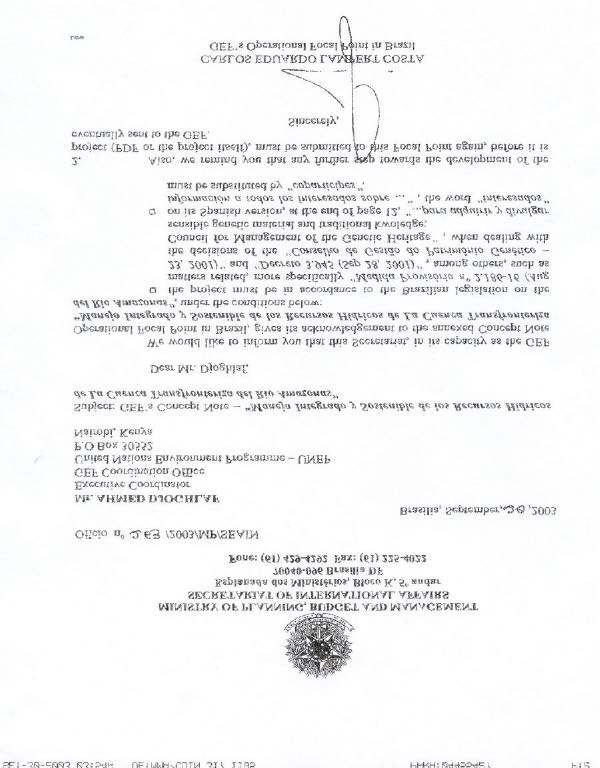
Annex 5
GEF Operational Focal Point Endorsement
50
Annex 6
GEF Sec Review Sheet and IA's response
GEF Sec. Review sheet
See separate Acrobat File
IA's response
Comments from the review sheet were discussed at the Bilateral meeting held on 29 October 2003
and further addressed in a revised concept. Overall all comments were addressed while
maintaining the essential elements on which countries have agreed.
With a view to streamline the project design as per GEF Sec's recommendations, component 2 and
3 have been combined into a single component that is component 2. Environmental education
activities were removed from component 6 and incorporated as a facet in each other components.
The focus on drought and fires related with extreme climatic variations during El nino years has
been incorporated in component 3. Component 3 will now also undertake an assessment of the
vulnerability of ecosystems and communities and will undertake an analysis of adaptation options.
Component 4 " Integrated Land and Water Management and protection of Aquatic Ecosystems" has
been revised to take into consideration the land and water linkage, especially with respect to water
quality aspects affecting critical ecosystems and resources.
Component 5 has been revised to underline the role of public participation in decision making.
The role of OTCA and the Inter-ministerial committees have been made more clear and Annex 3
provides the list of ministries participating in the committees for each of the riparian countries.
Suitable reference to IW:LEARN, the ISP and WSSD were done as appropriate.
- 51 -
Annex 7
World Bank comment IA's response
World Bank Comments
Please find attached comments from my World Bank colleagues on the above referenced GEF
Proposal:
We feel the proposal is extremely ambitious and is trying to do too many things over a huge land
area - ranging from transboundary diagnostic analysis - TDA (a huge effort in itself for a Basin like
the Amazon) to integration and sustainable management of land and water use and the protection of
aquatic ecosystems (component 5) and environmental education (component 6). There are some
activities that would make sense to start developing on a basin wide basis, such as the TDA (comp.
1), institutional strengthening for cooperation among countries (comp 2); and hydro-environmental
systems, so that all countries would develop the same or compatible systems for the whole basin
(comp 3). These 3 components would already constitute a challenging full plate of activities to be
implemented Basin-wide in a single project, and would be clearly under the mandate of UNEP. The
other components seem to add complexity to an already very complex project, and most of them
would be better planned and executed at the country level.
In the course of preparing the AquaBio GEF project in Brazil, the World Bank team met some time
ago (over a year ago) with staff from ANA (National Water Agency), the executing agency in
Brazil for the proposed UNEP project. At the time we discussed interaction between their proposal
(still at rudimentary stages at the time) and the AquaBio. At that time, their proposal was strictly
focused on water resources management - institutional aspects across countries in the basin, shared
monitoring systems and predictive models, transboundary analysis. We agreed that the proposals
were complementary since AquaBio would be focusing on "on the ground" activities for sustainable
land-water management, on environmental education, while also working on a smaller scale to
identify problems in two sub-basins, and testing models of participatory river basin management
for the Brazilian Amazon. It was agreed that those models could serve as pilots for future
expansion to other sub-basins within Brazil and other Amazonian countries. We also agreed to
work very closely on a monitoring system for the sub-basins under the AquaBio, using what ANA
already had for water resources and combining with the system developed under the ProVarzea
(PPG7) for monitoring of commercial fisheries. After that meeting there was another meeting
between ANA and AquaBio staff in the Ministry of Environment, but after that ANA had no
communication with the AquaBio team.
The current UNEP proposal now also includes the types of activities contemplated by the AquaBio
(components 5 and 6), which may be very hard to implement under a project that has such a wide
scope of area and activities - and involves 8 countries. Adding these components both complicates
the project and also overlaps with activities in the AquaBio Project. The Bank team has also been
visited by David MacGrath, a researcher working in the Brazilian Amazon, with a proposal for a
GEF Medium sized project focused on community management of land/aquatic resources. After
talking with him it was understood that this proposal was originally planned to be part of this larger
UNEP project, but since the proponents were coming to the conclusion that such a large and
- 52 -
complex project would take a very long time to materialize, they were trying to go ahead
independently with a Medium sized proposal.
Overall- at this time, knowing the difficulties of implementing things in the Amazon through the
PPG7 and other Bank work in the region, we feel that existing proposal is too complex and would
need to be simplified to increase its chances of success.
Since this project's main objective is to get a consensus with other countries (the 'shared vision') on
the Amazon Basin, it is fully consistent with OTCA objectives. One would expect that most of the
funds would be used in travel and meetings, i.e., it would focus on coordination, exchange of
experience, and reaching a common view. Probably little would be done in the field except the
upgrade of existing meteorological stations and pilot demonstration projects. On one hand, it is very
important to have a shared vision among the countries, on the other hand, there is the risk that this
vision reflects only that of a few organizations. For instance, local executing agencies may have
narrow objectives (Bolivia hydrology and Meteorology service; Colombia Institute of Hydrology;
Suriname hydraulic research division), although there are executing agencies in some countries with
a broader objective (Peru National Institute of Natural Resources). In this context, component 6
(participation) is very important. The component mentions the execution of pilot demonstration
subprojects to replicate best practices. This would be difficult with limited resources for the 6
countries. ProVarzea (a water resource management project for the Brazilian Amazon within the
Rainforest Pilot Program) already has some $4 million for subprojects, and there are many other
initiatives in the Amazon. The proposed project should rather assess and disseminate the lessons
learned from existing projects instead.
Minor Technical comments from the Bank team. Page 4 (Background) mentions the Amazon as the
world's longest river. Most sources quote the Nile as the longest river (with 6.695 km) and the
Amazon as the second longest. However, a Brazilian from INPA recently used new satellite
maps and claims that the Amazon is the longest. Page 5 mentions the population of the Basin at 10
million concentrated mostly in urban areas and that a high percentage of the total population consist
of indigenous communities settled along the river banks and tributaries. We estimate the population
much higher than 10 million. The Brazilian Amazon has more than 15 million people, and although
there are many indigenous communities, this is not a high percentage of the population. In the next
paragraph about land use, it does not mention mining or soya. Page 6, the INPE data on
deforestation for 2000 is 18.226 (not 19.836), and the data for 1999 is correct.
We hope you find these comments useful in moving forward.
Best Regards,
Karin J. Shepardson
Sr. Regional Coordinator
World Bank
Latin America and Caribbean Region
Tel. (202) 473-8954
Fax (202) 676-9373
53
IA's Response
Overall the comments from the World Bank are quite supportive of the concept. As mentioned
above and as reflected in the revised concept, the design has been simplified while maintaining the
essential elements on which the countries have agreed.
This concept design team has taken good note of the points raised by the World Bank with respect
to the AQUABIO project and as reflected in the original concept document, the design team was
aware of the numerous but regional and sub regional activities going on in the basin. Due
collaboration will be ensured with the AQUABIO project via ANA which is playing a key role in
both projects for the Brazilian portion of the Basin.
54