UNITED NATIONS DEVELOPMENT PROGRAMME
Regional Project with participation from the governments of:
Bulgaria, Georgia, Romania, Russian Federation, Turkey, Ukraine
Project Budget Number:
Summary of UNDP and Cost-Sharing
RER/01/G33/A/1G/31
UNDP:
Current Previous Change
Project Title:
TRAC (1&2)
Control of eutrophication, hazardous
TRAC (3)
substances and related measures for
Other (GEF)
$6,000,000
rehabilitating the Black Sea ecosystem:
Regional Program
Tranche 2
Cost Sharing:
Project Short Title:
Government
Financial Inst.
Black Sea Ecosystem Recovery Project
Executing Agent:
UNOPS
Sub Total:
$6,000,000
Implementing Agent:
Parallel Financing:
$5,332,106
UNOPS
GEF Implementing Agency:
UNDP
GRAND TOTAL
$11,332,106
GEF Focal area:
International Waters
GEF Operational Program:
GEF Strategic Priority:
OP8
IW-1
Project site:
Beneficiary Countries:
Istanbul, Turkey
Bulgaria, Georgia, Romania, Russian Federation, Turkey,
Ukraine
Estimated Start Date:
Estimated End Date (Tranche 2):
July 2004
June 2007
Classification Information
ACC sector & sub-sector
Primary type of intervention
0400 Natural resources
0410 Water resources planning and development
DCAS sector &sub-sector
Secondary type of intervention
Primary area of focus/ sub-focus
Primary target beneficiaries
Secondary area of focus/ sub-focus
Secondary target beneficiaries
Programme Officer: Nick Remple, Regional Coordinator, UNDP-GEF RBEC
Brief Description
The project in its Tranche 2 will continue supporting the Black Sea regional aspects of the Black Sea Partnership for Nutrient Control. It
will assist and strengthen the role of the Black Sea Commission (of the Bucharest Convention for the Protection of the Black Sea against
Pollution) and ensure the provision of a suite of harmonised legal and policy instruments for tackling the problem of eutrophication, and
release of certain hazardous substances, and to facilitate ecosystem recovery. An important feature of the project is its encouragement of
broad stakeholder participation. This will be achieved by inter-sectoral co-ordination, the provision of small grants to local initiatives and
support for public information and environmental education. The project will also enable a new suite of indicators for monitoring the
effectiveness of the measures taken by the Partnership. These indicators, together with targeted scientific studies, will help to set new
regional nutrient control targets within the concept of adaptive management. The PDF-B study has revealed that making a remarkable
progress in the attainment of these objectives would require at least a five years of concerted action at the wider basin level. Unfortunately,
owing to funding constraints, a two-phased approach had to be taken for the implementation of the overall strategy. Phasing was based on
a reconsideration of the relative priorities of achieving certain targets and evaluation of the need for earlier delivery of certain project
Outputs which will be essential inputs for the implementation of other activities envisaged for the 5 years integrated project. . The current
project will be part of the broader multi-donor Black Sea Environmental Programme and clear mechanisms will be established for donor
co-ordination and for co-ordination and the sharing of objectives with the Danube and Dnipro GEF Projects.
On behalf of
Name
Date
Signature
the
Governments
of:
Bulgaria
------------------------
--------------
------------------------
Georgia
------------------------
--------------
------------------------
Romania
------------------------
--------------
------------------------
Russian
Federation
------------------------
--------------
------------------------
Republic of
Turkey
------------------------
--------------
------------------------
Ukraine
----------------------------
--------------
------------------------
-
On Behalf of:
UNDP
--------------------------
--------------
------------------------
---
UNOPS
--------------------------
--------------
------------------------
---
RER/01/G33/A/1G/31: Control of eutrophication, hazardous substa nces and related measures for rehabilitating the Black Sea ecosystem: Tranche 2
SUMMARY
1. IDENTIFIERS
PROJECT NUMBER: RER/01/G33/A/1G/31
PROJECT NAME Control of eutrophication, hazardous substances and related measures for
rehabilitating the Black Sea ecosystem (Tranche 2)
DURATION 3 years (July 2004 June 2007)
IMPLEMENTING AGENCY UNDP
EXECUTING AGENCY UNOPS
REQUESTING COUNTRIES Bulgaria, Georgia, Romania, Russian Federation, Turkey and
Ukraine
ELIGIBILITY Eligible under paragraph 9(b) of GEF Instrument
GEF FOCAL AREA International Waters
GEF PROGRAMMING FRAMEWORK GEF Operational Strategy for International Waters/
Waterbody-Based Operational Programme (#8)
2. SUMMARY
The long-term development objective of the proposed Black Sea Ecosystem Recovery Project
(BSERP) is to contrib ute to sustainable human development in the Black Sea area through
reinforcing the cooperation and the capacities of the Black Sea countries to take effective
measures in reducing nutrients and other hazardous substances to such levels necessary to permit
Black Sea ecosystems to recover to similar conditions as those observed in the 1960s. The
overall objective of the project is to ensure (i) that all of the Black Sea countries take concrete
measures (including investment activities) in the eutrophication causing sectors to reduce load of
nutrients and hazardous substances on the Black Sea ecosystem and, (ii) that major findings and
recommendations of the project have been incorporated in national policies, strategies and, where
possible, in national legisla tion.
The overall objective of the BSERP is to support participating countries in the development of
national policies and legislation and the definition of priority actions to avoid that discharge of
nitrogen and phosphorus to the Black Sea exceed those levels as observed in 1997. This will
require countries to adopt strategies and measures that permit economic development whilst
Project Document for Phase II (Tranche 2)
i
April 2004
RER/01/G33/A/1G/31: Control of eutrophication, hazardous substa nces and related measures for rehabilitating the Black Sea ecosystem: Tranche 2
ensuring the rehabilitation of coastal and marine ecosystems through pollution control and
reduction of nutrients and hazardous substances. At the end of the Project Tranche II, it is
expected that the institutional mechanism of the Black Sea Commission is reinforced and fully
operational ensuring cooperation between all Black Sea countries to efficiently implement joint
policies and actions and operate common management and control mechanisms.
Specific objectives of the BSERP from May 2004-April 2007 are (i) to reinforce regional
cooperation under the Black Sea Convention, (ii) to set up institutional and legal instruments and
to define priority actions at regional and national levels to assure sustainable coastal zone
management, (iii) to protect of coastal and marine ecosystems and habitats in order to secure
sustainable use of coastal and marine resources. To accomplish these objectives, the project will
build up on the results achieved during Tranche I. (Jan 2002-April 2004).
3. COSTS AND FINANCING (USD)
Project Tranche 1
Project Tranche 2
GEF
Project
4,000,000 USD
6 000,000 USD
PDF-B
350,000 USD
Subtotal GEF
4,350,000 USD
6 000,000 USD
Co-Financing
Government/ others 4,052,366 USD
5 332 106 USD
Total Project Cost
8,402,366 USD
11 332 106 USD
4. ASSOCIATED FINANCING (Appendix F)
Ø Government:
$788,976,676 USD
Ø UNDP:
$16,325,000 USD
Ø Bilateral, EU & NGO: $17,716,802 USD
Total Baseline Costs: $828,371,588 USD
5. GEF OPERATIONAL FOCAL POINT ENDORSEMENTS (Appendix O)
Bulgaria 10 Feb 2004
Georgia - 5 March 2004
Romania 9 Feb 2004
Russian Federation 12 March 2004
Turkey - 19 Feb 2004
Ukraine 18 Feb 2004
6. IMPLEMENTING AGENCY CONTACT
Mr. Nick Remple
Project Document for Phase II (Tranche 2)
ii
April 2004
RER/01/G33/A/1G/31: Control of eutrophication, hazardous substa nces and related measures for rehabilitating the Black Sea ecosystem: Tranche 2
UNDP Regional Bureau for Europe and CIS
Grösslingova 35
811 09 Bratislava, Slovakia
Tel: +421 2 59337-458 / Fax: +421 2 59337-450
nick.remple@undp.org
Project Document for Phase II (Tranche 2)
iii
April 2004
RER/01/G33/A/1G/31: Control of eutrophication, hazardous substa nces and related measures for rehabilitating the Black Sea ecosystem: Tranche 2
Preface
In accordance with the outcomes of the previous interventions in the region, the Black Sea
Commission (BSC) and the International Commission for the Protection of the Danube River
Basin (ICPDR) have initiated contacts on a wider Black Sea basin scale. Accordingly, the BSC
received support for the implementation of measures related to eutrophication and the control of
hazardous substances, as outlined within the Black Sea Strategic Action Plan. In September
2001, the GEF Council approved Tranche 1 to carry out the first phase of the UNDP/GEF Project
"Control of eutrophication, hazardous substances and related measures for rehabilitating the
Black Sea ecosystem". Although the initial Project Document had been prepared with a total
budget of 9.5 million USD, due to funding constraints, the Black Sea Ecosystem Recovery
Project (BSERP) was split into two parts (phases) to be funded by two separate tranches. The
ICPDR received support, for the Danube Regional Project (DRP) also in two tranches. The two
integrated project proposals each require GEF assistance for a total of five years. In addition, a
Nutrient Investment Facility will act to develop the mechanism of funding of priority projects
identified by the countries in the Black Sea basin as a whole.
The project (BSERP) supports regional aspects of nutrient control in the Black Sea coastal
countries. It also aims to strengthen the role of the Black Sea Commission to ensure (i) the
formulation, adoption, and implementation of a suite of harmonized legal and policy instruments
for tackling the problem of eutrophication and release of certain hazardous substances; (ii) to
facilitate ecosystem recovery, including through sustainable use of living marine resources, and
(iii) to encourage broad stakeholder participation. This will be achieved by inter-ministerial
consultations, provision of small grants to local initiatives, support for release of information to
the public and environmental training/education. The project will employ a new set of indicators
for monitoring the effectiveness of the measures taken by the countries. These indicators,
together with targeted scientific studies, will help to set new regional nutrient control targets and
to adopt action plans which will be implemented through an adaptive management scheme.
Although a two-years phased approach had to be taken for the implementation of the overall
strategy owing to funding constraints, a remarkable progress in the attainment of these objectives
would require at least a five years of concerted action at the wider basin level.
The GEF Black Sea/Danube Basin Strategic Partnership shall provide assistance to the BSC and
ICPDR to reinforce their activities in terms of policy/legislative reforms and enforcement of
environmental regulations (with particular attention to the reduction of nutrients and toxic
substances). The regional projects, individually and jointly, will facilitate a coherent approach for
policy and legislative measures to be introduced by the participating countries at the national,
regional and wider basin levels. The two regional projects, and the Nutrient Investment Facility
shall cross-fertilise each other through inter-alia, demonstrating the efficiency and
environmental effectiveness of laws and policies to be introduced by the regional projects in
investment projects implemented under the Nutrient Investment Facility, thus enhancing their
replicability; elaborating and implementing the most suitable and feasible mix of management
instruments; highlighting the significance of certain interventions/investments, in terms of
environmental-economic costs and benefits.
Project Document for Phase II (Tranche 2)
iv
April 2004
RER/01/G33/A/1G/31: Control of eutrophication, hazardous substa nces and related measures for rehabilitating the Black Sea ecosystem: Tranche 2
Rationale for Receiving the Tranche 2 Funding of the BSERP
Because of the decision to split the BSERP into 2 Phases, it is critical that the 2nd tranche of
funding be made available in time to assure continuity between the two phases. Phase 1 of the
BSERP began officially in April 2002 and will be concluded by April end 2003. As of February
2004, 22 of the 27 components of Phase 1 are under implementation, with the vast majority (16)
carrying on through into Phase 2. For practical reasons, 5 of the activities that could not been
started in Phase 1 will be initiated in Phase 2.
In a similar fashion to the DRP, Phase 1 of the BSERP was designed as to prepare concepts,
methodologies, policies, capacity building etc. that will be implemented in Phase 2. Therefore, to
assure full project implementation and to achieve the ultimate goals of the Black Sea Ecosystem
Project in its entirety (both Phases), this Project Document for Phase 2 of the BSERP is being
submitted for the remaining funding (2nd tranche).
Progress in the Implementation of Phase 1 of the BSERP
The first year of implementation of the UNDP/GEF first phase has been assessed as
"unsatisfactory" in the latest APR/PIR Review (April 2003) (see Appendix L for the full
APR/PIR.). This assessment may appear debatable since many of the project activities were
initiated only after the replacement of the Project Coordinator during July 2003. The
implementation schedule of BSERP activities were re-planned during July 2003 to deliver the
expected results of Phase 1, with a minimum of activities transferred to Phase 2. As an
indication, the Tranche 2 proposal contains a table (Table 27) developed to demonstrate progress
and results expected by the end of Phase 1. This table is based on the Objectives/Outputs/Success
Criteria table that formed part of the original Framework BriefGEF Strategic Partnership on the
Danube/Black Sea Basin.
The outputs of the current Phase 1 activities will set the basis for full implementation in Phase 2
to achieve the desired objective of the BSERP. In coordination with the DRP, EU policies
(agriculture, industry, municipalities, coastal wetland management etc.), economic assessment,
pilot activities etc. are currently being prepared for operation in Phase 2. Coastal zone
management planning tools (related to the EU WFD for transitional and coastal waters) will also
be initiated during Phase 2. Concepts for improving BSC systems (water quality, accident
prevention and warning, emissions, etc.) are being developed and the information system (BSIS)
is being enhanced, whereas training needs are being assessed, prioritized and then programmes
developed as the basis for specific activities for improvement in Phase 2.
Public participation mechanisms are being developed or strengthened (via `Umbrella' NGO
networks), activities at the local and regional level for pollution reduction are being prepared
(Small Grants Programme) and public awareness activities are being organized (BSERP
Communications Strategy.) Finally, appropriate monitoring and evaluation systems, according to
GEF policies, are being designed and put in place such that progress can be measured by the end
of Phase 2.
Project Document for Phase II (Tranche 2)
v
April 2004
RER/01/G33/A/1G/31: Control of eutrophication, hazardous substa nces and related measures for rehabilitating the Black Sea ecosystem: Tranche 2
In summary, the implementation of Phase 1 activities has progressed as follows:
Objective 1: Support the integration of a sustainable Secretariat for the Bucharest Convention
Support has been given to the work of Advisory Groups through project staff and consultants. A
survey was undertaken to evaluate the data gathering, assessment and exchange capacity and
needs of Advisory Groups and Activity Centres. The institutional set-up of the Black Sea
Commission's framework is strengthened by the involvement of additional resources both human
and financial.
A task force (DABLAS Task Force) was established as a platform for common decision-making
and encouraging investments for environmental protection, in particular for reduction of
eutrophication. BSERP participates in the process. A Joint Technical Working Group was also
established with the mandate to develop harmonized monitoring systems, common assessment
of the ecological status of inputs of nutrients and other hazardous substances, compatible
reporting formats for input loads and the assessed ecological status, and formulate of appropriate
measures to limit discharge of nutrients.
In relation to the production of public awareness material, the PIU has been responsible for
publishing the `Popular version of the Blacks Sea SAP' in Bulgarian, Turkish and, Romanian,
languages1. The newsletter `Black Sea Shared' was also published in English and posted on web
in all local languages. A table-top calendar for the promotion of the Black Sea Environmental
programme and introducing partners in the process was published for 2003. A reference book for
coastguards, fishing communities are currently under preparation. A web page for the project had
been developed and upgraded continuously, providing information on project related activities
and a modern means of communicating with partners.
Objective 2: Regional actions for improving LBA legislation to control eutrophication and for
tackling emergent problems
An in-depth study and stakeholder consultations at the national and regional levels by the
UNEP/GPA team on existing legislation, policies and practices, and identification of gaps and
prospects for change was delayed until recently due to limited data availability. Before
suggesting commitments for the region and individual countries, the analysis and planning
process must be undertaken by the UNEP/GPA, taking full account of economic, social, and
political realities of the region such as the EU accession. This in-depth study is currently
underway. Further cooperation on the initiatives of the EU has been coordinated for the latter half
of Phase 1 and for Phase 2 with the DRP.
The study of emergent issues in the Black Sea and their social and economic root causes based
on application of the GIWA methodology was also delayed during Phase 1. This was due to a
lengthy disagreement of the planned activities of the GIWA team by the Permanent Secretariat
who regarded the inadequacy and validity of data as a major constraint to the overall assessment.
This activity is currently underway following a decision of the Project Steering Committee for
1 English, Russian and Ukrainian were published previously
Project Document for Phase II (Tranche 2)
vi
April 2004
RER/01/G33/A/1G/31: Control of eutrophication, hazardous substa nces and related measures for rehabilitating the Black Sea ecosystem: Tranche 2
the PIU to employ governmentally approved national consultants to provide the necessary data
on behalf of the GIWA team.
Project Document for Phase II (Tranche 2)
vii
April 2004
RER/01/G33/A/1G/31: Control of eutrophication, hazardous substa nces and related measures for rehabilitating the Black Sea ecosystem: Tranche 2
Objective 3: Assist countries to improve their knowledge of the process of eutrophication in the
Black Sea
An Advisory Board composed of select scientists from coastal countries was established with a
view to prepare the research programme for the International Study Group (ISG). The Advisory
Board evaluated 79 international proposals. Selected representatives of the chosen research
projects met in January 2003 for the 1st meeting of the ISG in order to prepare the first draft of
the research plan. Three separate research cruises were agreed upon and planned by the ISG in
detail. Other research activities, which are currently underway, include (i) the extended
monitoring of nutrients (organic and inorganic) and hazardous substance inputs to the Black Sea
from the Danube river, (ii) remote sensing (historical and current) using SeaWifs in combination
with the research surveys to determine the necessary algorithms required to accurately calculate
the level of chlorophyll a (phytoplankton growth) by satellite, add (iii) shore-based investigation
of macrophytes (incl. workshop and training programme for regional representatives). The first
of the research cruises (benthic survey) was carried out successfully during September/October
2003. A pelagic research cruise planned for September/October was postponed until March/April
2003 (Phase 1) due to difficulties in signing contract with a local vessel. A further cruise is
planned for winter 2004.
Objective 4: Introduce new sectoral policies and laws, and a system of process, stress reduction
and environmental status indicators for monitoring the effectiveness of measures to control
eutrophication (and harmful substances where appropriate)
The project suffered a delay in reaching an agreement on the methodology to be applied for
analysing the relevant economic sectors (see also 2 above) and formulating measures for the
reduction of nutrients and hazardous substances. Implementation of this activity was revised in
late 2003. A number of interventions have been planned for initiation during the latter part of
Phase 1. These include an agreement with the DRP on joint project implementation and the set
up an institutional framework of the project implementation, which will strengthen the present
cooperation and eventually lead to setting up of national and coastal inter-sectoral committees.
Environmental status indicators suggested in PDF-B phase were introduced to different Advisory
Groups of the BSC for their review and feedback. The BSC Secretariat subsequently elaborated
draft indicator-based reporting formats for continuous formal reporting to the BSC. BSERP
provided support to the BSC in implementing of the reporting and developing a proper storage
and retrieval means as a part of the Black Sea Information System (BSIS). Along with this, the
BSERP has also planned a 10 years historical data (environmental and socio-economic)
compilation exercise which will be used for setting the background and justifying the validity of
the final set of indicators to be adopted. The BSERP on its part is currently developing the
architecture for relational databases in which the results of the data collation exercise will be
entered. The databases will be accessible through the internet.
With the support of the BSERP, the basic approach for integrated monitoring and assessment
programme for Black Sea (BSIMAP) has been established by the PS of the BSC. A pilot
monitoring programme for environmental status indicators, as agreed by the JTWG of the BSC
and the ICPDR, has also been designed and is currently underway. The environmental status
indicators will be assessed by the PIU for their `fitness-for-purpose' in the Black Sea region.
Project Document for Phase II (Tranche 2)
viii
April 2004
RER/01/G33/A/1G/31: Control of eutrophication, hazardous substa nces and related measures for rehabilitating the Black Sea ecosystem: Tranche 2
Objective 5: Support the Commission in their periodic review of Adaptive Management
objectives.
This activity in Phase 1 is represented by cost-benefit analysis of the national strategies for
reduction of nutrients and hazardous substances. Since the national strategies will not completed
until midway through Phase 2 (in association with the DRP), this activity is planned accordingly.
Project Document for Phase II (Tranche 2)
ix
April 2004
RER/01/G33/A/1G/31: Control of eutrophication, hazardous substa nces and related measures for rehabilitating the Black Sea ecosystem: Tranche 2
Objective 6: Assist the public in implementing activities to reduce eutrophication through a
programme of grants for small projects and support to regional NGOs.
In relation to the Small-Grants Programme (SGP), 17 projects totalling 320,000 USD were sub-
contracted in December 2002-January 2003 with completion dates of December 2003. A strategy
for the second call has been drafted and is currently under discussion. Following its adoption by
the NGO communities, a second call will be made in early 2004.
A directory of Black Sea wetlands was prepared by international (Wetlands International) and
local (NGOs) partners together with detailed recommendations on wetland conservation. A
number of activities were held by NGOs on the International Black Sea Day, supported by the
PS/PIU through press releases issued in all local languages, the newsletter published in English
and posting on web on local languages. Preparations are also under way for making a video
movie to acknowledge local populations with their ecological and economical significance. In
relation to environmental education, measures were instigated to enrich the local character of the
scientific contents of an educatio n draft study pack. This was carried out to better coordinate with
national education authorities operating in the region. The education study pack will be finalized
and published in the latter part of Phase 1 (early 2004).
There was a delay in the operation of the Black Sea Train Sea Coast course development for
agricultural management of nutrients in coastal regions. Completion of course planned for end
2003 with first delivery in the Black Sea coastal region in March 2004.
Objective 7: Formulate proposals for market-based or alternative economic instruments for
limiting nutrient emissions and establish private-public sector partnerships for environmental
protection in the Black Sea.
The methodology for environmental and economic analysis developed during Phase 1 will be
further developed in Phase 2 in association with the DRP. A detailed analysis of existing
international and regional economic instruments for nutrient reduction was successfully carried
out during Phase 1 of the BSERP. Activities have also been initiated in a number of riparian
countries in the field of public-private sector partnership. The first phase has concentrated on (i)
the analysis of the relevant stakeholders in the Black Sea riparian countries, (i) the legal base in
each country and (iii) recommendation for future partnerships.
An updated priority investment portfolio prepared as part of (by technical and financing sub-
committees) DABLAS Task Force established by the BS and Danube Commissions and
supported by the EC. A separate activity was also initiated by the BSERP to determine the
potential of the local and/or regional financial intermediaries as a means of channeling funding to
small/medium sized bankable projects related to nutrient limitation and habitat restoration.
Objective 8: Fisheries exploited within its maximum sustainable yield and incorporating
measures to protect ecologically sensitive areas.
Project Document for Phase II (Tranche 2)
x
April 2004
RER/01/G33/A/1G/31: Control of eutrophication, hazardous substa nces and related measures for rehabilitating the Black Sea ecosystem: Tranche 2
A background document, prepared with support from the BSERP for the Activity Group on
fisheries, suggested the main management and conservation issues that need to be incorporated in
a regional fishery management strategy. With a view to study the status and trends, a regional
data compilation and evaluation exercise was undertaken. Results were evaluated and a realistic
set of indicators for ecosystem-based fisheries have been devised. As a pilot activity, demersal
resources were studied in depth. Coordination with international expert institutions (FAO-
GFCM) for the inclusion of a regional coordinated stock assessment in GFCM work-programme
was made and a proposal was drafted for submission by countries' fisheries authorities to FAO.
A guidebook on Responsible Fisheries in the Black Sea to be published in all local languages and
widely distributed to the local managers, fishermen and public is under preparation
Issues to Be Considered for Tranche 2
The BSERP will, in cooperation with the DRP, support the implementation of the EU WFD in
relation to the project objectives. A major challenge for Phase 2 implementation will be to assure
that non-EU Accession countries can participate in implementing the EU WFD. The BSERP will
act to strengthen the countries' abilities to participate on an equal basis within a regional
framework. Phase 2 will continue to focus on priorities for capacity building in the Black Sea
riparian countries, focusing on the most central needs within the BSC and its Permanent
Secretariat, the NGOs and other key stakeholders. The BSERP will also provide relevant support
to ensure that the `grassroots' NGOs and NGO networks are strengthened in their capacities to
take action and mobilize support for pollution reduction in the coastal zone.
Short Description of the Project Document
The relationship between the activities described in the original framework (December
2001) and the Project Document for Tranche 2
In order to meet the current needs of the Black Sea Commission, the Phase 2 of the BSERP has
been slightly modified from the original project document. However, the original text of the
Project Document has been principally retained to assure authenticity as this brief has already
been endorsed by all Black Sea countries. Revisions were made to the original project activities
of Phase 2 in order: (i) to reflect changing situations in the region, i.e. the implementation of the
EU WFD and the Marine Strategy, (ii) to respond to the lack of involvement of beneficiaries by
the creation of new institutional arrangements for project implementation in each of the six
countries, and (iii) to reinforce cooperation with the DRP for activities related to policy
guidelines, legal and institutional instruments for reduction of nutrients and hazardous substances
from land-based sources. The DRB are currently in the process of agreeing relevant measures for
Bulgaria, Romania and Ukraine. The BSERP will act to extend these activities in Georgia, the
Russian Federation and Turkey.
B. Outputs planned for Phase 2
Phase 2 of the BSERP contains 16 project components with 85 activities. The following
immediate outputs are designed to respond to the overall development objective:
Project Document for Phase II (Tranche 2)
xi
April 2004
RER/01/G33/A/1G/31: Control of eutrophication, hazardous substa nces and related measures for rehabilitating the Black Sea ecosystem: Tranche 2
§ Supporting the consolidation and operation of institutional mechanism for
cooperation under the Black Sea Convention;
§ Development of policy guidelines, legal and institutional instruments for nutrient
reduction from LBA, and protection of ecosystems of the Black Sea and its coastal
zones;
§ Development of economic instruments and promotion of investment opportunities
in coastal zones for pollution control and protection of Black Sea ecosystems;
§ Development of operational systems for monitoring, information management and
research under the Black Sea Convention;
§ Strengthening of public participation in environmental protection through access
to information, stakeholder training and awareness raining and implementation of
community actions (Small Grants Programme).
Project Document for Phase II (Tranche 2)
xii
April 2004
RER/01/G33/A/1G/31: Control of eutrophication, hazardous substa nces and related measures for rehabilitating the Black Sea ecosystem: Tranche 2
Table of Contents
1
BACKGROUND INFORMATION ..................................................................... 1
1.1 General..................................................................................................................... 1
1.2 Context of the Black Sea Ecosystem Recovery Project .......................................... 1
1.2.1
The Black Sea Basin ...................................................................................... 4
1.2.2
Political, Demographic and Economic Issues................................................ 7
1.3 The Bucharest Convention ...................................................................................... 8
1.3.1
Structure and contents .................................................................................... 8
1.3.2
Implementation............................................................................................... 9
1.4 The Odessa Declaration and the BSSAP ............................................................... 11
1.4.1
The Odessa Ministerial Declaration............................................................. 11
1.4.2
The Black Sea Strategic Action Plan (BSSAP) ........................................... 12
1.4.3
Programmatic framework: The Black Sea Environmental Programme (BSEP)
...................................................................................................................... 13
1.4.4
National legal and policy tools ..................................................................... 14
1.4.5
National resources and commitment ............................................................ 14
1.5 Cooperation between the Black Sea Commission (BSC) and the ICPDR ............ 15
1.5.1
Findings of the Joint Ad-hoc Technical Working Group of the BSC and the
ICPDR .......................................................................................................... 15
1.5.2
Cooperation between the BSERP/BSC and the DRP/ICPDR for Phase II.. 16
2
STRATEGY FOR USE OF UNDP/GEF RESOURCES .................................. 18
2.1 Relationship to UNDP's mandate.......................................................................... 18
2.2 Identification of alternative strategies ................................................................... 18
2.3 Relationship to the GEF International Waters Focal Area .................................... 19
3
IMMEDIATE PROJECT OBJECTIVES ......................................................... 20
3.1 Long and medium term objective s ........................................................................ 20
3.2 Strategy for reaching the objectives ...................................................................... 21
3.3 Beneficiaries .......................................................................................................... 21
4
PROJECT DESCRIPTION, OBJECTIVES, OUTPUTS, OUTCOMES, AND
ACTIVITIES ........................................................................................................ 23
4.1 Introduction............................................................................................................ 23
4.2 Specific Objectives, Outputs and Activities for Phase 2 ....................................... 23
4.2.1
Objective 1: Supporting the consolidation and operation of institutional
mechanism for cooperation under the Black Sea Convention ..................... 23
4.2.2
Objective 2: Development of policy guidelines, legal and institutional
instruments for pollution reduction from LBA, and protection of ecosystems of the
Black Sea and its coastal zones. ................................................................... 27
4.2.3
Objective 3: Development of economic instruments and promotion of investment
opportunities in coastal zones for pollution control and protection of Black Sea
ecosystems.................................................................................................... 34
4.2.4
Objective 4: Development of operational systems for monitoring, information
management and research under the Black Sea Convention........................ 36
Project Document for Phase II (Tranche 2)
xiii
April 2004
RER/01/G33/A/1G/31: Control of eutrophication, hazardous substa nces and related measures for rehabilitating the Black Sea ecosystem: Tranche 2
4.2.5
Objective 5: Strengthening of public participation in environmental protection
through access to information, stakeholder training and awareness raining and
implementation of community actions (Small Grants Programme)............. 40
5
INPUTS................................................................................................................. 44
5.1 Government Inputs ................................................................................................ 44
5.1.1
Bulgaria ........................................................................................................ 45
5.1.2
Georgia ......................................................................................................... 47
5.1.3
Romania ....................................................................................................... 47
5.1.4
The Russian Federation................................................................................ 49
5.1.5
Turkey .......................................................................................................... 49
5.1.6
Ukraine ......................................................................................................... 51
5.2 Input of the Black Sea Commission (BSC) and BS Countries contributions to the Black
Sea Commission................................................................................................ 51
5.3 GEF Inputs............................................................................................................. 52
5.4 UNDP Inputs ......................................................................................................... 52
5.5 UNEP Inputs .......................................................................................................... 55
5.6 EC-TACIS (EuropeAid) Inputs ............................................................................. 55
6
INCREMENTAL COSTS ANALYSIS.............................................................. 56
6.1 Broad Development Goal ...................................................................................... 56
6.2 Baseline.................................................................................................................. 56
6.3 Global Environmental Objective ........................................................................... 57
6.4 GEF Project Activities ........................................................................................... 57
6.5 System Boundary................................................................................................... 58
6.6 Calculation of Baseline and Incremental Costs ..................................................... 59
7
RISKS AND PRIOR OBLIGATIONS .............................................................. 61
7.1 Risks and steps taken to minimise them................................................................ 61
7.2 Prior obligations and prerequisites ........................................................................ 68
8
INSTITUTIONAL FRAMEWORK AND IMPLEMENTATION
ARRANGEMENTS ............................................................................................. 69
8.1 Institutional Arrangements .................................................................................... 69
8.1.1
Strategic Partnership .................................................................................... 69
8.1.2
Institutional Structure of the project............................................................. 69
Project Management ........................................................................................................71
The Project Implementation Unit (PIU) ..........................................................................71
Institutional Set Up in the countries ................................................................................72
9
PROJECT MONITORING AND EVALUATION .......................................... 75
10
LEGAL CONTEXT............................................................................................. 78
11
WORKPLAN ....................................................................................................... 79
11.1 Project Management Sheets................................................................................... 79
11.2 Implementation Schedule ...................................................................................... 79
12
PROJECT BUDGET AND FINANCING ......................................................... 81
12.1 Budget description................................................................................................. 81
Project Document for Phase II (Tranche 2)
xiv
April 2004
RER/01/G33/A/1G/31: Control of eutrophication, hazardous substa nces and related measures for rehabilitating the Black Sea ecosystem: Tranche 2
12.1.1 Project Personnel.......................................................................................... 81
12.1.2 Subcontracts ................................................................................................. 82
12.1.3 Fellowships and Training ............................................................................. 82
12.1.4 Equipment .................................................................................................... 83
12.1.5 Miscellaneous ............................................................................................... 87
12.1.6 Agency Support Costs .................................................................................. 87
12.2 Detailed Breakdown of Budget Implementation Per Year .................................... 88
13
SUSTAINABILITY AND PARTICIPATION .................................................. 91
13.1 Institutional capacities and arrangements .............................................................. 91
13.2 Government commitment ...................................................................................... 92
13.3 Stakeholder participation....................................................................................... 92
14
LESSONS LEARNED ......................................................................................... 94
14.1 Lessons Learned in Preparing the BSERP ............................................................. 94
14.2 Lessons Learned During Implementation of Phase 1 of the BSERP ..................... 97
15
COST-EFFECTIVENESS .................................................................................. 99
Literature .......................................................................................................................... 101
List of Appendices
Appendix A..................................................................Review of Project Progress in Phase I
......................................................................................................................... 102
Appendix B..................................Terms of Reference of the International Project Personnel
......................................................................................................................... 113
Appendix C ........................................................... Relevant Legally Binding Documentation
......................................................................................................................... 125
Appendix D.......................................................The Black Sea/Danube Strategic Partnership
......................................................................................................................... 125
Appendix E ......................................................................... Explanatory Note of the BSC/PS
......................................................................................................................... 131
Appendix F....................................................Incremental Costs Analysis and Matrix Costs
......................................................................................................................... 135
Appendix G..................................Letters from the Ministries on Countries' Inputs (pdf file)
......................................................................................................................... 139
Appendix H.........Logical Frame Matrix Project Tranche 2 (Objectives, Outputs, Activities, and
Outcomes) ....................................................................................................... 149
Appendix I Detailed Breakdown of Phase II Budget for All Categories and Per Objectives and
Activities ......................................................................................................... 177
Appendix J Project Management Sheets for PhaseII ......................................................... 196
Appendix K .....................................BSERP Implementation Schedule for Phase II (pdf file)
......................................................................................................................... 227
Appendix L .....................................................................................APR/PIR as of June 2003
......................................................................................................................... 222
Project Document for Phase II (Tranche 2)
xv
April 2004
RER/01/G33/A/1G/31: Control of eutrophication, hazardous substa nces and related measures for rehabilitating the Black Sea ecosystem: Tranche 2
Appendix M ...................................................................................................... STAP Review
......................................................................................................................... 251
Appendix N ...................................................................................Response to STAP Review
......................................................................................................................... 261
Appendix O ............................................................. Countries Endorsement Letters (pdf file)
......................................................................................................................... 273
Appendix P........................................GEF Secretariat Concept Agreement Review (pdf file)
......................................................................................................................... 279
Appendix Q .......................... PIU Response to GEF Secretariat Concept Agreement Review
......................................................................................................................... 290
Appendix R............................................................................................. World Bank Review
......................................................................................................................... 304
Appendix S................................................................................PIU Response to WB Review
......................................................................................................................... 306
Appendix T ....Development of Indicators for Monitoring and Evaluation of Project Results
......................................................................................................................... 311
Appendix U..................................Economic Instruments for the Protection of the Black Sea
......................................................................................................................... 330
Appendix V.............Memorandum of Understanding between the ICPBS and ICPDR on
Common Strategic Goals (pdf file)...................................................379
Annexe A Black Sea Commission Co-financing
Annexe B Europe Aid input
List of Tables
Table 1
The Estimated Input of Total Nitroge n into the Black Sea [1] ........................... 2
Table 2
The Estimated Input of Total Phosphorus to the Black Sea [1].......................... 2
Table 4
The Population of Black Sea Costal Zone and Black Sea Basin, 1997-1999 [1]7
Table 5
Coordination Between the BSERP and DRP .................................................... 17
Table 6
Summary of Input of the Black Sea Countries (2004-2006) ............................ 44
Table 7
Sewerage and sewage treatment plants construction works in Bulgaria .......... 46
Table 8
Internationally Funded Project in Bulgaria within 2004-2006 ......................... 46
Table 9
Total Input from Bulgaria within 2004-2006.................................................... 46
Table 10 Total Input from Georgia within 2004-2006 .................................................... 47
Table 11 Total Input from Romania within 2004-2006 ................................................... 47
Table 12 Total Input from Russia within 2004-2006....................................................... 49
Table 13 Total Input from Turkey within 2004-2006 (Estimates are based on 2004 amounts)
........................................................................................................................... 51
Table 14 Total Input from Ukraine within 2004-2006 (Estimates are based on 2004 amounts)
........................................................................................................................... 51
Table 15 Summary Table of the BSC and BS Countries Contribution, USD ................. 51
Table 16 Total UNDP input (Estimated) ......................................................................... 54
Table 17 Total EuropeAid Input (estimated) within 2004-2006...................................... 55
Table 18 Assumptions, Risks, and Measures................................................................... 63
Table 19 Monitoring and Evaluation Scheme .................................................................. 77
Project Document for Phase II (Tranche 2)
xvi
April 2004
RER/01/G33/A/1G/31: Control of eutrophication, hazardous substa nces and related measures for rehabilitating the Black Sea ecosystem: Tranche 2
Table 20 Estimated Costs of the Project Personnel and Other Related Costs ................. 81
Table 21 List of Project Components for Phase II of the BSERP ................................... 84
Table 22 Indicative Costs of Fellowship and Training Events - Phase II of the BSERP, US$
........................................................................................................................... 86
Table 23 Equipment to be Provided by the Project in Phase II, US$ .............................. 86
Table 24 Miscellaneous Costs, US$ ................................................................................ 87
Table 25 Agency Support Costs, US$ ............................................................................. 87
Table 26 Detailed Breakdown of the Phase II Budget per Year...................................... 88
Table 27 Progress of Implementation of Project Objectives in Phase I and Linkage to Phase II
Activities ......................................................................................................... 108
Table 28 Utilisation of Phase I Funding (Forecasted against Actual) ........................... 111
Table 29 Detailed Breakdown of Phase II Budget for All Categories and Per Objectives and
Activities ......................................................................................................... 177
List of Figures
Figure 1
Implementation Chart for the Project Implementation. .................................... 74
Figure 2 International and Local Sub-Contract............................................................... 82
Figure 3
Dynamics of Funds Utilisation in Phase I of the Project ................................ 111
Project Document for Phase II (Tranche 2)
xvii
April 2004
RER/01/G33/A/1G/31: Control of eutrophication, hazardous substa nces and related measures for rehabilitating the Black Sea ecosystem: Tranche 2
List of Abbreviations
Abbreviation
Definition/Explanation
ACCOBAMS
The Agreement on Conservation of the Cetaceans of the Black Sea, the
Mediterranean Sea and the contiguous Atlantic area
AG
The Advisory Group of the Black Sea Commission
AG CBD
The AG of the Black Sea Commission on Conservation of Biological Diversity
AG ESAS
The AG of the Black Sea Commission on Environmental Safety Aspects of
Shipping
AG FOMLR
The AG of the Black Sea Commission on Fisheries and Other Marine Living
Resources
AG ICZM
The AG of the Black Sea Commission on Integrated Coastal Zone Management
AG LBS
The AG of the Black Sea Commission on Land Bases Sources of Pollution
AG PMA
The AG of the Black Sea Commission on Pollution Monitoring and Assessment
APR
Annual Project Review
ARENA
A Regional Capacity Building and Networking Programme to Upgrade Monitoring
and Forecasting Activity in the Black Sea Basin, Financed by the EU
BAP
Best Agricultural Practices
BAT
Best Available Technology
BOD
Biological Oxygen Demand
BSC
(Istanbul ) Commission for the Protection of the Black Sea Against Pollution (the
body responsible for the implementation of the Bucharest Convention)
BSEC
Black Sea Economic Cooperation
BSEEP
Black Sea Environmental Education Project
BSEP
Black Sea Environmental Programme
BSERP
The Black Sea Ecosystems Recovery Project
BSIMAP
The Black Sea Monitoring and Assessment Programme of the Black Sea
Commission
BSIS
The Black Sea Information System
BSSAP, BS-SAP
The Black Sea Strategic Action Plan
CEC
Commission of European Communities (European Union)
CIEI
Coastal Zone Industrial Emission Inventory
COD
Chemical Oxygen Demand
CPBSAP
The Convention on Protection of the Black Sea Against Pollution
CTA
Chief Technical Adviser
DABLAS
The Danube Black Sea Task Force (Investment Projects)
DANUBIS
Danube Information System
DANUBS
The project daNUbs 'Nutrient Management in the Danube Basin and its Impact on
the Black Sea'
D-BS JTWG
The Danube-Black Sea Joint Technical Working Group
DPSIR
Driving-Force, Pressure, Status, Impact and Response indicators
DRP
The GEF UNDP Danube Regional Project
EEA
European Environmental Agency
EIA
Environmental Impact Assessment
ELME
The European Lifestyles and their effect on Large Marine Ecosystems. EU 6th
Framework Research Project
Project Document for Phase II (Tranche 2)
xviii
April 2004
RER/01/G33/A/1G/31: Control of eutrophication, hazardous substa nces and related measures for rehabilitating the Black Sea ecosystem: Tranche 2
Abbreviation
Definition/Explanation
EMIS EG
Emission Expert Groups of the ICPDR
EU Tacis
EU Programme on Technical Assistance to CIS countries (EuropeAid)
ExecSumm
The Executive Summary of BSERP Tranche 2 ProDoc
FAO
Food and Agriculture Organisation of the United Nations
GDP
Gross Domestic Product
GEF
Global Environment Facility
GEF LEARN
Learning Exchange and Resource Network
GFCM
General Fisheries Council for the Mediterranean
GIS
Geographic Information System
GIWA
The Global International Waters Assessment
GOOS
The Global Oceanographic Observation System
GPA
The Global Programme of Action
HELCOM
The Helsinki Commission
ICPDR
The International Commission for the Protection of the Danube River
ICZM
Integrated Coastal Zone Management
IFI
International Financial Institution
IMO
International Maritime Organisation
IOC of UNESCO
Intergovernmental Oceanographic Commission
ISG
Ad-hoc International Study Group for eutrophication in the Black Sea (established
by the PIU)
ISPA
Instrument for Structural Policies for Pre -Accession
IW
International Waters
JPMG
Joint Project Management Group (for the project between the BSC and the
IAs/donors)
JRC
Joint Research Centre
JWG
Joint Working Group of the ICPDR and BSC (may be extended to the Dnipro
Comm. etc.)
LBA
Land Based Activities
LBS
Land Bases Sources of Pollution
M&E
Monitoring and Evaluation
MOE
Ministry of the Environment (exact title and status varies between countries)
MoU
Memorandum of Understanding
MPA
Marine Protected Area
N
Nitrogen
NATO
North-Atlantic Treaty Organisation
NGO
Non-Governmental Organisation
NPC
National Project Coordinator appointed by the respective Governments
OECD
Organisation for Economic Co -operation and Development
OP
GEF Operational Program
OSPAR
The Oslo and Paris Convention for the Protection of the Marine Environment of the
North-East Atlantic
P
Phosphorus
P, SR, and ES
Process, Stress Reduction and Environmental State indicators
PABSEC
Parliamentary Assembly to the Black Sea Economic Cooperation
PCU
Programme Coordinating Unit
Project Document for Phase II (Tranche 2)
xix
April 2004
RER/01/G33/A/1G/31: Control of eutrophication, hazardous substa nces and related measures for rehabilitating the Black Sea ecosystem: Tranche 2
Abbreviation
Definition/Explanation
PDF-B
Project Development Facility of the GEF
PIR
Project Implementation Review
PIU
Project Implementation Unit of the current project
PMS
Project Management Sheet
PPP
Private Sector Public Partnerships
PPS
Public Participation Specialist
ProDoc
Project Document for Tranche 2
PS
Permanent Secretariat of the Black Sea Commission
QA/QC
Quality Assurance and Quality Control
RAC
The Regional Activity Centre of the Black Sea Commission
SAP
GEF Strategic Action Programme
SAPARD
Special Accession Programme for Agriculture and Rural Development
SC
Steering Committee established for the execution of the current project
Sectoral Focal Point
Person or persons specifically responsible for this programme within a given
national sector
SGP
Small Grants Programme within BSERP Tranche 1 and Tranche 2
SIA
Significant Impact Areas
SOP
laboratory Standard Operating Procedures
STAP
GEF Scientific and Technical Advisory Panel
TDA
Transboundary Diagnostic Analysis
Technical Focal Point
Person or institution responsible for providing national specialist input to a given
Advisory Group
TOR
Terms of Reference
Train-Sea Coast
TRAIN-SEA -COAST Programme funded by the GEF
UNDOALOS
United Nations Division for Ocean Affairs and the Law of the Sea
UNDP-COs
Country Offices of the United Nations Development Programme
UNDP-GEF
UNDP GEF Unit
UNEP
United Nations Environment Programme
UNOPS
United Nations Office for Project Services
VTOPIS
Black Sea Vessel Traffic Oil Pollution Information System
WB
World Bank
WFD
The Water Framework Directive of the EU
WHO
World Health Organisation
WMO
World Meteorological Organisation
WWF
World Wide Fund for Nature
WWTP
Waste Water Treatment Plant
Project Document for Phase II (Tranche 2)
xx
April 2004
RER/01/G33/A/1G/31: Control of eutrophication, hazardous substa nces and related measures for rehabilitating the Black Sea ecosystem: Tranche 2
1 BACKGROUND INFORMATION
1.1 General
1.2 Context of the Black Sea Ecosystem Recovery Project
1. Following the signing of the Convention for the (Bucharest) Convention on the Protection
of the Black Sea Against Pollution in 1992, international support was provided to the Black
Sea coastal states for facilitating the implementation of the Convention. The UNDP/GEF,
through the Black Sea Environmental Programme which consists of two consecutive regional
projects implemented between 1993 - 1998, has been instrumental in helping to convert the
political commitment made by the Convention to regional action. The European Community
(through its Phare and Tacis Programmes) and a number of other bilateral donors provided
additional support to this regional initiative, which broadened the coverage of the Bucharest
Convention to sustainable development of the marine and coastal areas of the Black Sea, and
enhanced the regional management capacity. During this period, the regional coordinating
organ envisaged by the Convention (Black Sea Commission and its Secretariat) also became
operational and is currently exercising its legal and political authority and responsibilities.
2. GEF intervention enabled identification of environmental problems threatening the Black
Sea marine and coastal ecosystems; elaboration of a Transboundary Diagnostic Analysis
(TDA) - which not only indicated the problems beyond national jurisdictions, but also their
root causes as well as actions proposed to eliminate them-, adoption of the Strategic Action
Plan for the protection and Rehabilitation of the Black Sea; development of National Action
Plans compatible with the regional SAP; establishment of a regional network of institutions
responsible for further developing and implementing different components of the Plan;
enhancing the capacity of these institutions for better environmental management through
training and policy analysis / development; and elaboration of a list of projects consisting of
largest domestic &industrial waste water sources and of all sources emitting toxics in coastal
countries (hot spots analysis), out of which a portfolio of 49 investment projects2 of regional
significance3 was also prepared. It was calculated that implementation of these investments
which comprise of construction of new facilities, extension, rehabilitation/upgrading of
existing infrastructure, in-plant precautions, would reduce the pollution emerging from the
coastal states to a very high extent. The respective data are reflected in the tables below.
2 Bulgaria 9, Georgia 6, Romania 6,Russian Federation 8, Turkey 10, Ukraine 10
3 Transboundary effects of these hot spots include diminishing of the water quality, decline in productive capacity and
fisheries, destruction of wetlands, of habitats of fauna, of migratory fauna, landscape destruction, accidents causing
transboundary pollution, tourism losses, health hazards etc.
Project Document for Phase II (Tranche 2)
1
April 2004
RER/01/G33/A/1G/31: Control of eutrophication, hazardous substa nces and related measures for rehabilitating the Black Sea ecosystem: Tranche 2
Table 1
The Estimated Input of Total Nitrogen into the Black Sea [1]
Country
Inputs, thousand tons per year
Domestic
Industrial
Riverine
Subtotal
Bulgaria
2.5
71.0
19.2
92.7
Georgia
0.9
44.4
132.0
177.3
Romania
9.5
31.0
36.3
78.6
Russian Federation
0.4
0
62.3
62.7
Turkey
1.6
0
0.0
1.6
Ukraine
5.4
0.6
32.0
38.0
Other countries
198.3
Subtotal
20.3
146.9
281.8
647.3
Table 2
The Estimated Input of Total Phosphorus to the Black Sea [1]
Country
Inputs , thousand tons per year
Domestic
Industrial
Riverine
Subtotal
Bulgaria
0.7
0.0
1.9
2.6
Georgia
0.3
0.3
11.111.6
Romania
2.6
1.7
5.79.9
Russian Federation
0.5
0.0
6.16.6
Turkey
0.4
0
00.4
Ukraine
2.2
0.1
3.6
5.9
Other countries
13.6
Subtotal
6.7
2.0
28.2
50.5
3. On the other hand, the TDA has indicated that 30 % percent of the nutrients (mainly
nitrogen and phosphorus compounds) which causes the most severe problem of the Black Sea
in terms of its coverage and impacts on ecosystems, eutrophication, was emerging from
countries other than the coastal ones which are located in the wide water catchment basin of
the Black Sea.
4. In accordance with the Outputs of the previous interventions in the region, the Black Sea
Commission and the International Commission for the Protection of the Danube River Basin
have initiated the first contacts on a wider Black Sea basin scale, and have received GEF PDF-
B funding with a view to further develop legal, policy and technical measures to reduce the
discharges of nutrients and other toxic substances in the Danube and in the Sea itself. The
projects that have been thus prepared are comprehensive of reduction of pollution from point
and non-point sources, conservation of wetlands, floodplains, and critical marine habitats (in
particular fisheries spawning and nursery areas), setting of water quality standards, prevention
of accidental pollution, floods and river basin management. The two integrated project
proposals requiring GEF assistance for a total of five years, and accompanying investment
support shall complement the activities of the BSC and the ICPDR.
5. The new GEF assistance, i.e. Black Sea -Danube River Basin Strategic Partnership was
designed as three complementary components:
a) Two Regional Projects for the Black Sea and the Danube River Basin which
will be implemented in two Phases between (2002- 2003) and (2004- 2006);
Project Document for Phase II (Tranche 2)
2
April 2004
RER/01/G33/A/1G/31: Control of eutrophication, hazardous substa nces and related measures for rehabilitating the Black Sea ecosystem: Tranche 2
b) A series of country-related investment projects executed through the World
Bank-GEF Nutrient Investment Facility;
c) Other GEF and donor interventions in the basin targeting reduction of
nutrients/toxic pollutants and restoration of critical habitats.
6. The GEF Black Sea/Danube Basin Strategic Partnership provides assistance to the BSC
and ICPDR to reinforce their activities in terms of policy/legislative reforms and enforcement
of environmental regulations (with particular attention to the reduction of nutrients and toxic
substances). The regional projects, individually and jointly, facilitate a coherent approach for
policy and legislative measures to be introduced by the participating countries at the national,
regional and wider basin levels. The two regional projects, and the Nutrient Investment
Facility cross-fertilize each other through inter alia, demonstrating the efficiency and
environmental effectiveness of laws and policies to be introduced by the regional projects in
investment projects implemented under the Nutrient Investment Facility, thus enhancing their
replicability; elaborating and implementing the most suitable and feasible mix of management
instruments, including the economic instruments; highlighting the significance of certain
interventions investments - in terms of environmental-economic costs and benefits etc.
7. Through the PDF-B funding a comprehensive project proposal of 5 years duration aiming
to address the three highest priority transboundary problems of the Black Sea (namely
eutrophication, discharge of toxic substances including oil, loss of critical benthic habitats and
wetlands) and to highlight emerging ones was prepared. However, due to funding constraints
experienced by the GEF, the Black Sea Ecosystem Recovery Project proposal, alike the
Danube River Basin Project was split into two implementation Phases. The third component of
the Strategic Partnership, the Nutrient Investment Facility was also phased -into three- owing
to the same funding constraints. The implementation schedule adopted for the Strategic
Partnership was as follows:
§ May 2001 tranche- Black Sea regional project: Control of eutrophication,
hazardous substances and related measures for rehabilitating the Black Sea
ecosystem: Phase I. 2 year technical assistance, with a budget of 4,000,000$
(excluding the PDB-B funding of 349,920$); First envelope of Nutrient
Investment Facility (Black Sea and Danube basin countries): 20 million $.
§ December 2001 tranche - Second envelope of Nutrient Investment Facility:
US$ 25 million.
§ May 2002 tranche- Black Sea regional project: Control of eutrophication,
hazardous substances and related measures for rehabilitating the Black Sea
ecosystem: Phase 2, consisting of 3 years technical assistance, with a budget of
5,555,000 $.
§ November 2002 tranche- Third envelope of Nutrient Investment Facility: US$
25 million.
8. In phasing the comprehensive Black Sea regional project prepared under the PDF-B and
submitted for the November 2000 Council Meeting, the total duration (2 years followed by 3
years, in total five years), and the total budget of the regional project (with $349,000 for PDF-
B, $4,000,000 for Phase I, and 5,555,000 for Phase 2 have been left as same. The immediate
objectives, planned activities and expected Outputs that are included in the original proposal
Project Document for Phase II (Tranche 2)
3
April 2004
RER/01/G33/A/1G/31: Control of eutrophication, hazardous substa nces and related measures for rehabilitating the Black Sea ecosystem: Tranche 2
have also been preserved, but were distributed among the two phases taking the following
concerns into consideration:
§ Logical sequencing of tasks (such as postponing the tasks that require the
availability of the products of earlier activities as input, and vice versa);
§ Compatibility with the Commission's own work-programme and the need for
responding to its immediate needs;
§ Not distorting the budgetary allocations made in the original proposal for
various project components;
§ Achieving concrete results in the first phase which the Commission's network
itself would be able to sustain onwards and which would be further enriched
and replicated during the second phase.
9. Effective implementation of the first phase of the project which was approved by the GEF
Council at its 9-11 May 2001 meeting, timely delivery of its Outputs, enhanced commitment
of the beneficiary countries at the national as well as at the regional level are the most
important factors which will contribute to the achievement of the long term objective of
reducing the levels of nutrients and other hazardous substances to such levels necessary to
permit Black Sea ecosystems to recover to similar conditions as those observed in the 1960s.
These are at the same time basic indicators which will warrant GEF and other donor support
following the completion of the first phase.
1.2.1
The Black Sea Basin
10. The Black Sea is the most isolated
from the World Ocean - connected to the
Black Sea in Figures:
Oceans via the Mediterranean Sea through
the Bosphorus, Dardanelle and Gibraltar
Geographical Coordinates
46°33' - 40°56' N.
and 27°27'-41°42' E.
straits and with the Sea of Azov in the
northeast through the Kerch Strait. The
Drainage Area
2 000,000 km2
Total Shoreline:
4 340 km
ratio of its surface and its catchment area
exceeds 6. For this reason, the Black Sea
Bulgaria
300 km
Georgia
310 km
is very vulnerable to pressure from land
Romania
225 km
based human activity and its health is
The Russian Federation
475 km
Turkey
1400 km
equally dependent from the coastal and
Ukraine
1628 km
non-coastal states of its basin.
Area of Water Surface
432000 km2
River inflow
340,6 km3
11. The large European rivers, the Danube,
Water volume
547 000 km3
Maximal depth
2,212 m
Dnieper and Don via the Sea of Azov,
Salinity
18 % o - 22% o
flow into this sea but its only tenuous link
Average fresh water balance
3.7 - 441 km3
with other seas is with the Mediterranean
through the Bosphorus Strait, the Sea of
Black Sea biological species
Fungi, algae, higher plants
1,619
Marmora and the Dardanelle. The
Invertebrates
1,983
Bosphorus is essentially a narrow
Fishes
168
elongated shallow channel approximately
Marine mammals
4
31 km long, with a width varying between
0.7-3.5 km and a depth of 39 to 100 m.
Project Document for Phase II (Tranche 2)
4
April 2004
RER/01/G33/A/1G/31: Control of eutrophication, hazardous substa nces and related measures for rehabilitating the Black Sea ecosystem: Tranche 2
12. The main rivers: Rioni, Kodori and Inguri Chorokh, Kyzyl-Irmak, Eshil-Irmak, Sakarya,
Southern Bug and Dnister also flow into the Black Sea. The seabed is divided into the shelf,
the continental slope and the deep-sea depression. The shelf occupies a large area in the north-
western part of the Black Sea, where it is over 200 km wide and has a depth ranging from 0 to
160 meters. In other parts of the sea it has a depth of less than 100 m and a width of 2.2 to 15
km. Near the Caucasian and Anatolian coasts the shelf is only a narrow intermittent strip.
13. The thin upper layer of marine water (up to 150 m) supports the unique biological life in
the Black Sea ecosystem. The deeper and more dense water layers are saturated with
hydrogen sulphide, that over thousands years, accumulated from decaying organic matter in
the Black Sea. Due to the unique geomorphologic structure and specific hydrochemical
conditions, specific organisms, basically on the level of protozoa, bacteria, and some multi-
cellular invertebrates inhabit the deep-sea waters. Knowledge about biological forms of life in
the deep waters of the Black Sea is very limited. The disturbance of the natural balance
between the two layers could trigger irreversible damage to the people and ecosystem of the
Black Sea (Source: State of the Environment of the Black Sea 1996-2000. Publication of the
Commission on the Protection of the Black Sea Against Pollution, Istanbul 2002).
14. Isolation from the flushing effects of the open ocean, coupled with its huge catchment, has
made the Black Sea particularly susceptible to eutrophication (the phenomenon that results
from an over-enrichment of the sea by plant nutrients). Eutrophication has led to radical
changes in the Black Sea ecosystem in the past three decades with a major transboundary
impact on biological diversity and human use of the sea, including fisheries and recreation.
The North Western shelf of the Black Sea for example, was converted from a unique system
based upon rich and extensive beds of red algae and bivalves, to an anoxic "dead zone", the
seasonal occurrence of which persists until present time. The nitrogen and phosphorus
compounds triggering eutrophication come from all over the Black Sea Basin. The Black Sea
Transboundary Diagnostic Analysis (1996) indicates that, in 1992, 70% of the nutrients were
coming from the six Black Sea countries (three of which - Romania, Bulgaria and Ukraine -
discharge much of their nutrient load through the Danube) and the remaining 30% comes from
the non-coastal countries, mostly of the upper Danube. Studies by the Danube Basin
Environmental Programme suggest that about half the nutrients discharged to the river are
from agriculture, one quarter from industry and a similar proportion from domestic sources.
The current loads of nutrients entering the Black Sea from the Danube has fallen in recent
years due to the collapse of the economies of most lower Danube and former Soviet countries,
the measures taken to reduce nutrient discharge in the upper Danube countries, and the
implementation of a ban in polyphosphate detergents in some countries. Current phosphate
levels appear to be roughly the same as in the 1960s but total nitrogen levels are still at least
four times as high as those observed during tha t period. There is evidence of some recovery in
Black Sea ecosystems but these observations lack scientific rigour owing to the collapse of
infrastructure to monitor and evaluate changes in the system. It is widely considered however,
that nutrient discharges are likely to rise again with consequent damage to the Black Sea,
unless action is taken to implement nutrient discharge control measures as part of the
economic development strategies. A brief description of the main root causes and action areas
is presented in Table 3 below.
Project Document for Phase II (Tranche 2)
5
April 2004
Table 3
The Main Root Causes and Action Areas [1]
RER/01/G33/A/1G/31: Control of eutrophication, hazardous substances and related measures for rehabilitati
ng the Black Sea ecosystem: Tranche 2
Main root causes
Perceived major
Transboundary
Main
Action
1 Poor legal framework at the regional · Poorly defined environmental laws and regulations
problems
elements
Root
areas
and national level
·
Regionally incompatible laws and regulations
·
Ineffective EIAs/ Environmental audits
Causes
*
Decline in Black Sea
Virtually all fisheries
1,2,5
B,
2 Inadequate implementation of
·
Inadequate compliance and trend monitoring
Commercial Fish
resources are shared or
available regulatory instruments
·
Lack of international coordination
Stocks
trans-zonal [straddling]
3,4
A, C
·
Ineffective inspectorates
and management requires
·
Poorly planned urban/ industrial/ recreational/agricultural
the effort of more than
3 Inadequate planning at all levels
development
one country
·
Poor inter-sectoral coordination
Loss of habitats,
Biotic resources are often
1,2,3,4,
B,
4
·
Inappropriate erosion control
notably wetlands and
mobile or migratory.
·
Inefficient contingency plans
shelf areas,
Wetlands provide nursery 5
A,C
Insufficient public involvement
·
Lack of general awareness of environmental issues
supporting important
grounds and may also
·
Deficient public participation Apparent lack of
biotic resources
assimilate transboundary
transparency
pollutants
·
Poor identification of stakeholders/ rights of access
Loss or imminent loss
Endemic and/or rare
1,2,3,
B,
5 Inadequate financial mechanisms and · Ineffective economic instruments
of endangered species
species are of regional
support
·
Unsustainable subsidies Low value assigned to
and their genomes
and global significance.
4,5
A,C
environment within national economic policies
·
Poor perception of opportunities for development
Replacement of
Exotic species are a
1,2,4,5
A,B
indigenous Black Sea
global transboundary
species with exotic
problem. Entire Black Sea
ones
affected and may become
vector for extra-regional
contamination
Areas where action is proposed
Degradation of the
Reduction of regional
2,3,4,5
A,B,C
A Control of pollution
·
Assessment of the discharge of chemical and micro-
Black Sea landscape
value of Black Sea
biological contaminants to coastal and marine areas
tourism.
·
Monitoring of the levels and effects of pollutants for
compliance and for long-term trends
Inadequate protection Black Sea coastlines are
1,2,3,5
A
·
Location of hot-spots and options for remedial action.
of marine and coastal
short and transboundary
·
Reduction and regulation of operational discharges from
resources from
pollution is highly likely
point sources, vessels and by dumping.
maritime accidents
following accidental
·
Prevention of emergencies and contingency planning
spills.
·
B Living resources management
Commercially exploited resources
Unsanitary conditions Transboundary human
1,2,3,4,
B,C
·
Biodiversity protection
in many beaches,
health problems from
·
Protection of habitats and landscape
bathing waters and
exposure. Region-wide
5
Sustainable human development
·
Improving land use planning in urban and industrial areas
shellfish-growing
loss of revenue.
C
·
Development of sustainable tourism and aquaculture
areas
·
Involving the public in environmental decision-making
Project Document for Phase II (Tranche 2)
6
April 2004
RER/01/G33/A/1G/31: Control of eutrophication, hazardous substances and related measures for rehabilitati ng the Black Sea ecosystem: Tranche 2
15. Failure to tackle the problem of eutrophication in a holistic manner would severely
constrain future development in the region. Activities such as tourism development, fisheries,
public health, are intimately related to the quality of shared marine waters. Resolving the
problem is not merely a matter of reducing the discharge of nutrients but involves protective
measures to help vital ecosystems to become re-established, fisheries and other living
resources to be exploited in a sustainable manner and chemical contamination to be strictly
controlled. The present project adopts the necessary integrated strategy and is a vital
component in a wider GEF Black Sea Basin Strategic Partnership that includes separate GEF
interventions in the Danube and the Dnipro, a number of biodiversity projects and the World
Bank GEF Nutrient Investment Facility (to provide the necessary support for key investment
actions).
1.2.2
Political, Demographic and Economic Issues
16. The Black Sea coastal zone is densely populated with approximately 16 million inhabitants
and with 4 million tourists visiting the seacoast in summer seasons. For all Black Sea coastal
zones except of Turkey, the demographic trends are negative.
Table 4
The Population of Black Sea Costal Zone and Black Sea Basin, 1997-1999 [1]
Country
Costal Population*
Basin Wide Population
Black Sea Coast
Black Sea Basin
Bulgaria
714,000
Georgia
650,000
2,000,000
Romania
745,954
Russian Federation
1,159,000
18,288,000
Turkey
6,700,000
17,998,440
Ukraine
6,800,000
47,412,000
Total
16,768,954
17. A few decades of inadequate management of marine resources and pollution from the
economic activities by the population in the Black Sea basin destroyed the ecosystem of the
Black Sea and drastically reduced its biological resources.
18. The analysis of economic data shows a positive trend of stable growth of GDP in six the
Black Sea riparian countries. The annual growth of GDP in these countries in year 2002 was
4.3% for Bulgaria, 5.4% for Georgia, 4.3% for Romania 4.3%, 4.3% for Russian Federation,
7.8% for Turkey and 4.5% for Ukraine (Source: The World Bank Group). From other
prospective, these countries of the Black Sea region are facing serious economic and financial
problems in responding to the objectives of the Convention of Protection of the Black Sea
Against Pollution and implementing measures for pollution reduction and for environmental
protection. This shows the need to assist these countries and makes evident the responsibilities
of the international community to respond to the regional and global concerns of
environmental protection.
19. In general terms, the six Black Sea riparian countries can be categorized and characterized
as follows:
Romania and Bulgaria
Project Document for Phase II (Tranche 2)
7
April 2004
RER/01/G33/A/1G/31: Control of eutrophication, hazardous substances and related measures for rehabilitati ng the Black Sea ecosystem: Tranche 2
20. Romania and Bulgaria are both Black Sea countries and they are also both located in the
lower Danube River Basin. They are both in this sense, polluters and victims of pollution to
the Black Sea. Both countries are still in a challenging period of political, social and economic
transition. Romania and Bulgaria are in the process of EU Accession and have clear priorities
in meeting the requirements for potential entry in 2007. The EU Council endorsed detailed
roadmaps and adopted revised Accession Partnerships for Bulgaria and Romania.
Georgia, Russian Federation and Ukraine
21. Ukraine is a Black Sea country that contributes to Black Sea pollution as well as suffers
from the degradation of Black Sea ecosystems. Ukraine has the longest coastal line of the
Black Sea and is also located in the lower Danube River Basin. Georgia and Russian
Federation they are both located in the Black Sea basin, and they are both polluters and
victims of pollution to the Black Sea. All three countries face important economic problems
and are in phases of political and social transition. Whereas environmental concerns are of
high importance, the financial means for investments are very limited. Particularly critical is
also the fact that their legal and administrative framework is still to a certain extent determined
by the former central planning structures and therefore is not yet in compliance with the
requirements of the process of economic liberalization and privatisation.
Turkey
22. Turkey is a country of the Black Sea basin that has the second longest coastal line along
the Black Sea. Turkey contributes to Black Sea pollution as well as suffers from the
degradation of Black Sea ecosystems. As regards the economic criteria, Turkey has
significantly improved the functioning of its market economy, while macroeconomic
imbalances remain. Also, Turkey's financial means for investments into environment
protection and rehabilitation activities are limited. Turkey is EU Candidate Country that has
to achieve a compliance with three sets of accession criteria the political, economic and
acquis criteria - established by the 1993 Copenhagen European Council.
1.3 The Bucharest Convention
23. The Convention and its three Protocols 4 were adopted by the Diplomatic Conference on
the Protection of the Black Sea against Pollution held in Bucharest on 21 April 1992, and
deposited with the Government of Romania. The Convention, as well as the Land-Based
Sources Protocol and the Emergency Response Protocol, entered into force on 15 January
1994, in accordance with Art. XXVIII of the Convention, i.e. sixty days after their fourth
ratification.
1.3.1
Structure and contents
24. The name "Bucharest Convention" actually refers not only to the framework convention
itself, the Convention for the Protection of the Black Sea, but also to its five Resolutions, and
4 Protocol on Protection of the Black Sea Marine Environment Against Pollution From Land-Based Sources, Protocol on
Cooperation in Combating Pollution of the Black Sea Marine Environment by Oil and Other Harmful Substances in Emergency
Situations and Protocol on the Protection of the Black Sea Marine Environment Against Pollution by Dumping.
Project Document for Phase II (Tranche 2)
8
April 2004
RER/01/G33/A/1G/31: Control of eutrophication, hazardous substances and related measures for rehabilitati ng the Black Sea ecosystem: Tranche 2
three Protocols: the Land-Based Sources Protocol, the Emergency Response Protocol, and the
Dumping Protocol. The Land-Based Source Protocol and Dumping Protocol are accompanied
by annexes containing so-called black and grey lists. In accordance with general practice,
pollution by the substances and matter on the black lists (annex I), categorised as hazardous,
needs to be prevented and eliminated by the Contracting Parties. Pollution by substances on
the grey lists (annex II), categorised as noxious, need to be reduced and where possible
eliminated. In the case of land-based sources, there is an additional Annex III, which
prescribes restrictions to which discharges of substances and matters listed in annex II should
be subject to. Furthermore, dumping of wastes and materials containing the noxious
substances contained in annex II requires a prior special permit from "the competent national
authorities", while, according to annex III, dumping of all other wastes and materials requires
a prior general permit.
25. The Convention addresses five of the six generally recognised sources of marine pollution
land-based (in Art. VII and Protocol), vessel-source (Art. VIII), ocean dumping (Art. X and
Protocol), exploitation of the seabed of the continental shelf or margin (Art. XI), from or
through the atmosphere (Art. XII). The only source not covered is exploitation of the seabed
of the international area, simply because the Black Sea does not contain territory which falls
under this definition. It also deals extensively with emergency response (Art. IX and
Protocol), a term which refers to the use of techniques to prevent pollution arising from
accidents, since the Black Sea.
1.3.2
Implementation
26. The provisions of the Bucharest Convention require implementation by the six Contracting
Parties: the Black Sea coastal states. They are, bound to implement the provisions since the
Convention is part of the legislation of all six countries. In practice however, some countries
were not immediately capable to implement it, mostly because of economic constraints. The
Convention does not provide for special enforcement techniques, such as a dispute settlement
mechanism (the traditio nal enforcement technique, which is however not necessarily useful in
case of environmental matters, where prevention rather than resolving or restoration is
required) or a compliance reporting procedure, but, "in order to achieve the purposes of the
Convention", it does provide for the establishment of a Commission for the Protection of the
Black Sea, which shall consist of at least one representative of each Contracting Party. (Art.
XVII). The Commission shall, inter alia, promote the implementation of the Convention,
inform the Contracting Parties of its work, and assist them by making recommendations on
measures necessary for achieving the aims of the convention, and on recommendations of
possible amendments to the convention and protocols (Art. XVIII). The Convention further
determines that the "Commission shall be assisted in its activities by a permanent Secretariat"
(Art. XVII).
27. As a result of economic difficulties and the need to resume host country agreements, there
was a considerable delay before the Secretariat became operational. This finally occurred in
September 2000 and it is now fully functional, albeit with reduced number of staff.
The BSEP and the BSC
Project Document for Phase II (Tranche 2)
9
April 2004
RER/01/G33/A/1G/31: Control of eutrophication, hazardous substances and related measures for rehabilitati ng the Black Sea ecosystem: Tranche 2
28. The Black Sea Environmental Programme (BSEP, see section (f, iii)) was launched in June
1993. The Programme included a number of interventions by the GEF (and other donors), the
first of which was entitled `Project for the Environmental Management of the Black Sea,
approved under the GEF Pilot Phase). Its first task was to help create a strong international
network of institutions, specialists and other stakeholders. The BSEP established its
headquarters in Istanbul with the support of the Government of Turkey. The Programme was
governed by a Steering Committee that included senior government officials from all Black
Sea countries, the sponsoring organisations (the GEF and other donors), and representatives of
the Black Sea NGO forum (as observers). In order to spread the technical responsibilities of
the programme throughout the region and to make best use of the excellent specialists in the
region, a system of Regional Activity Centres and Working Parties was devised. Each country
agreed to sponsor one of its existing institutions as a regional centre for a particular field of
expertise. The regional centres in turn organised Working Parties, specialist networks
involving institutions from all six Black Sea countries. Using this structure, it was possible to
bring together specialists who had sometimes not been able to co-operate previously. All of
the institutions were provided with equipment (computers, analytical instruments, etc.) and
specialist training and a new and productive dialogue began.
29. The BSEP Working Parties completed a series of background studies that enabled a
Transboundary Diagnostic Analysis to be finalised in June 1996. On the basis of this
comprehensive report senior government officials negotiated the Black Sea Strategic Action
Plan (BS-SAP), signed on October 31st at a Ministerial Conference in Istanbul. The consensus
on the BS-SAP was very broad. It provides a very modern approach to environmental policy
making and agrees on the following key matters:
§ That the principle cause for the decline of the Black Sea ecosystem is
eutrophication;
§ That without full co-operation with riparian countries of the main tributary
rivers (Danube and Dnipro) this problem cannot be addressed;
§ That the institutional structure of the BSEP should be incorporated into that of
the Istanbul Commission for the Bucharest Convention;
§ That an adaptive management approach should be adopted for the control of
pollution in the Black Sea;
§ That biological diversity and fisheries concerns should be part of the future
agenda of the Commission;
§ That greater stakeholder participation and transparency should be ensured (in
line with the provisions of the Aarhus Convention.
30. Following the signature of the BS-SAP, GEF funding was sustained, albeit at a lower
level, in order to enable countries to complete National Black Sea Strategic Action
Programmes and for the ne gotiations on the institutionalisation of the Istanbul Commission's
Secretariat to be completed. This was a very protracted three-year process as countries
struggled to overcome technical and legal issues of establishing the Secretariat. In the
meantime however, progress was made in implementing part of the BS-SAP thanks to GEF
seed money and considerable support from the European Commission by Tacis or and DG XI
(currently DG Environment). The main achievements were:
Project Document for Phase II (Tranche 2)
10
April 2004
RER/01/G33/A/1G/31: Control of eutrophication, hazardous substances and related measures for rehabilitati ng the Black Sea ecosystem: Tranche 2
§ Establishment of the ad-hoc technical working group with the ICPDR and joint
analysis of the problem of eutrophication in the Black Sea, including
recommendations for target for nutrient control;
§ Continued support to the BSEP Activity Centres and real progress through
demonstration projects in the areas of data quality control, oil spill response,
coastal zone management, aquaculture and biological diversity;
§ Strengthening of the programme for public participation, particularly through
the Tacis small grants initiative, largely focussed on actio ns around Black Sea
(as a reminder of commitments to the BS-SAP);
§ Publication of the State of Pollution in the Black Sea report and the Black Sea
Red Data Book;
§ Agreement on a new set of water quality objectives to propose to the BSC as
required by the BS-SAP.
31. In April 2000, a breakthrough was finally made in the negotiations for establishing the
Commission's Secretariat. The Secretariat became operational in October 2000, following the
selection of its senior officials at an extraordinary session of the BSC on September 10-11,
2000. Four countries (Bulgaria, Romania, Turkey and Ukraine) made their financial
contributions to the Commission. In addition, the Republic of Turkey is providing the facilities
for the Secretariat, to be shared with the PIU.
1.4 The Odessa Declaration and the BSSAP
1.4.1
The Odessa Ministerial Declaration
32. The Bucharest Convention itself is a legal and diplomatic tool for joint action and does not
set out to establish environmental policy goals (e.g. targets for reducing the loads of specific
pollutants etc.). It also does not establish any regulatory mechanism for exploitation or
development of the natural environment (e.g. straddled marine resources or specially protected
areas). In order to develop a common policy framework, a clear "Declaration of
Environmental Quality Objectives" was considered necessary. Following the initiative of the
Government of Ukraine and employing the stewardship of UNEP, a Ministerial Declaration
was formulated during nine months of negotiations and signed by all six countries in Odessa in
April 1993 (the "Odessa Declaration"). This Declaration was a pragmatic and innovative
policy statement that sets environmental goals and a time frame to guide management regimes
and associated investments. It was the first policy agreement on regional seas to reflect the
philosophy of UNCED, Agenda 21, and features a heavy emphasis on accountability, periodic
review and public awareness. These features represented a major conceptual shift in a public
statement from countries of the region, particularly those emerging from totalitarianism.
33. The Odessa Declaration consists of a preamble, a general policy statement and nineteen
specific actions. These actions were designed to facilitate the rapid development of practical
measures for controlling pollution from land-based and marine sources (including the
harmonisation of environmental standards); to restore, conserve and manage natural resources;
to respond to environmental emergencies; to improve the assessment of contaminants and their
Project Document for Phase II (Tranche 2)
11
April 2004
RER/01/G33/A/1G/31: Control of eutrophication, hazardous substances and related measures for rehabilitati ng the Black Sea ecosystem: Tranche 2
sources; to introduce integrated coastal zone management policies and compulsory
environmental impact assessments; and to create a transparent and balanced mechanism for
reviewing and updating the Declaration on a triennial basis. The Declaration was designed to
provide a basis for a flexible but continuous process for taking decisions on coordinated
national action towards common goals at present and in the future. Its clear objectives and
specific time-frames were to guide and stimulate implementation of the Bucharest Convention.
On the 7th of April 1996 the first triennium came to its end. A report commissioned by UNEP
evaluated to what extent the Odessa Declaration has succeeded to serve as `agenda' for
implementation of regional measures, in accordance with the Bucharest Convention. The
results of this analysis were encouraging even despite the lack of formal implementation of the
Bucharest Convention. The Odessa Declaration had given a strong signal to donors,
particularly the newly created Global Environment Facility, that the Black Sea countries were
willing and able to cooperate on restoring and protecting this severely damaged and unique
shared environment. This paved the way for financial assistance to be granted for
implementation of the Odessa Declaration.
34. The Odessa Declaration was seen from the outset as an interim policy arrangement. It
signatories called upon the GEF partners to assist them with the development of a
medium/long-term action plan for the protection of the Black Sea. It thus set the wheels in
motion for a much more comprehensive strategy of which the Declaration itself was to be one
of the building blocks.
1.4.2
The Black Sea Strategic Action Plan (BSSAP)
35. The Development of the Black Sea Action Plan followed a carefully implemented
technical process spanning over two years. The first step was the integration of an effective
institutional network, a matter described in the previous section. The network was then asked
to conduct an analysis of Black Sea problems within the field of specialisation of each
"Working Party" (Biodiversity, Emergency Response, Fisheries, Pollution levels and effects,
Pollution Sources, Legislation, Integrated Coastal Zone Management, etc.) The thematic
analysis were conducted at a national level and then integrated regionally. In the case of
sources and levels of pollution, new reliable information had to be gathered, a remarkable
accomplishment in such a short time and one which required the cooperation of many national
and international actors. A similar situation occurred in the case of fisheries. The thematic
analyses were then gathered together and studied intensively by a group of regional and
international specialists in order to construct a "Transboundary Diagnostic Analysis" (TDA) of
the Black Sea.
36. The Black Sea TDA is a technical document which, in a highly analytical manner,
examines the root causes of Black Sea degradation and options for actions which may be taken
to address them. It examines each major environmental problem, the "stakeholders" involved
in the problem (who is responsible? who has to act?) and the uncertainties in the information
describing the problem (do we need more information and if so what kind?). It then proposes
solutions, often giving various options and attempts to set a time frame and cost for the
solutions. Some of the solutions require policy changes, some require capital investments.
They are all part of a holistic management approach that does not limit itself to end-of-pipe
Project Document for Phase II (Tranche 2)
12
April 2004
RER/01/G33/A/1G/31: Control of eutrophication, hazardous substances and related measures for rehabilitati ng the Black Sea ecosystem: Tranche 2
solutions but encourages the development of more environmentally sustainable economic
activities.
37. The BS-SAP5 was developed from June to October 1996 as a direct consequence of the
TDA. It is a negotiated document, prepared during a series of meetings between senior
environmental officials of all six Black Sea coastal countries and adopted (following in-
country cabinet consultations) at a Ministerial Conference, celebrated in Istanbul on 31
October, 1996. The Plan, only 29 pages in length, contains 59 specific commitments on policy
regarding measures to reduce pollution, improve living resources management, encourage
human development in a manner which does not prejudice the environment, and to take steps
towards improving financing for environmental projects. In adopting this plan, the Black Sea
governments have committed themselves to a process of profound reform in the manner in
which environmental issues are addressed in the Black Sea and its basin.
38. Notable features of the BS-SAP include its emphasis on integration of pollution control
efforts with those of the Danube River, the adoption of a system of economic instruments to
regulate existing sources of pollution (and to avoid new ones), enhanced protection status for
sensitive coastal and marine habitats, inter-sectoral planning and management of coastal
regions and greatly improved transparency and public participation. Implementation of the
BS-SAP is currently somewhat behind schedule. This does not imply that there is no
implementation at all but recent reports clearly indicate that the governments are not meeting
the deadlines they set for themselves. There are many reasons for this, including the delays in
completing the institutional arrangements described earlier and the continuing economic
difficulties confronted by many of the countries. In its April 2000 meeting, the Black Sea
Commission reiterated its commitment to oversee implementation of the BS-SAP. They also
agreed to approach the GEF and the European Commission for renewed support to help them
achieve this objective.
1.4.3
Programmatic framework: The Black Sea Environmental Programme (BSEP)
39. The support provided to the governments for implementing the Odessa Declaration and for
developing and implementing the Black Sea Strategic Action Plan, took the form of a series of
GEF, Tacis and Phare projects, and smaller donor initiatives, coordinated within a loosely
defined programmatic framework described as the Black Sea Environmental Programme
(BSEP). The BSEP `label' served an important function of making the various interventions
coherent and comprehensible to the public and to the governments. It is also attracted donor
interest to the increasingly popular cause of `Saving the Black Sea', to which the BSEP label
became closely associated. The GEF project PCU became de-facto, the Secretariat for BSEP
(though this arrangement was never formalised). This enabled staff from other projects (e.g.
the Tacis Black Sea Project) to be seconded to the PCU and for the Directorate General for
Environment of the EC to grant emergency funding to the unit during a period (1999-2000) of
absence of GEF support.
5 BSEP (1996) Strategic Action Plan for the Rehabilitation and Protection of the Black Sea, Istanbul, Turkey, 31 October
1996, 29pp.
Project Document for Phase II (Tranche 2)
13
April 2004
RER/01/G33/A/1G/31: Control of eutrophication, hazardous substances and related measures for rehabilitati ng the Black Sea ecosystem: Tranche 2
40. Following the signature of the BS-SAP, the BSEP label continued to be applied to all
interventions supporting the implementation of the Plan. The scope and form of the BSEP was
defined by the BS-SAP though it ownership has passed to the Commission for the Bucharest
Convention for the Protection of the Black Sea against Pollution (a rather more difficult title
for the general public to grasp). Recently, the Black Sea Commission has agreed to formalise
the BSEP as `a coordinated programme of interventions designed to support the
implementation of the 1996 Black Sea Strategic Action Plan for the Protection and
Rehabilitation of the Black Sea' under its own aegis. Coordination of the projects within the
BSEP will be ensured through the Joint Project Management Group in which all interventions
in the Black Sea region at a programme or project level are represented.
1.4.4
National legal and policy tools
41. National legal systems for environmental protection are characterised by their diversity
and rate of change. The legal systems of the former COMECON countries, heavily dependent
upon strict water quality standards, are gradually being replaced by a more flexible and
integrated `system-based' approach. This is particularly true of the countries seeking accession
to the EU (Bulgaria, Romania and Turkey) where the new EC Framework Water Directive has
become the guiding principle for protecting water bodies and adjacent areas. A similar
approach is being pursued in Ukraine. Most countries have a queue of new legislation awaiting
parliamentary approval and environmental management depends on a mixture of laws and
institutional structures from the past together with the new laws. The BS-SAP takes a
pragmatic approach and recognises the need to harmonise the objectives of laws and
regulations, rather than the laws themselves.
42. The BS-SAP also envisaged the development of National Black Sea Strategic Action
Programmes that should provide a clear policy statement, at the national level, on how the
provisions of the regional SAP are to be implemented. These National Plans were developed
with the help of funding from the regional GEF intervention, implemented in the period 1997-
1999. GEF-PDF-B support also enabled completion of reviews of the current legal, policy and
institutional provisions for limiting nutrient discharges to the aquatic environment at the
national level in the year 2000.
1.4.5
National resources and commitment
43. Each of the Black Sea Countries has a legal and institutional framework sufficient to
enable its full participation in the project and has expressed its written commitment to make its
own infrastructure and resources available for project implementation. As a result of previous
interventions by the GEF and its partners within the framework of the BSEP, as well as
country-based capacity building programmes, all six countries have received substantial
support with equipment and training. The present project therefore focuses on consolidating
and integrating these building blocks for the purposes of addressing the specific project
objectives.
44. The level of commitment of the participating countries can be judged by the following
criteria:
Project Document for Phase II (Tranche 2)
14
April 2004
RER/01/G33/A/1G/31: Control of eutrophication, hazardous substances and related measures for rehabilitati ng the Black Sea ecosystem: Tranche 2
§ All six countries have been consistent in their participation in the BSEP process
in general and the UNDP/GEF projects in particular, since its establishment in
1991.
§ All six countries have contributed expertise and information in the development
of previous interventions, the BS-SAP and the preparation of the present
project.
§ All six countries are providing in-kind resources for the development of the
project (the project `baseline', valued at US$ 9,916,920).
§ The countries have agreed to support the Secretariat of the Commission for the
Bucharest Convention with a total cash contribution estimated at US$ 800,000
for the 2 year period (yet two of the countries, Russia and Georgia, have to
fulfil their commitment).
§ Senior government officials are currently discussing a Ministerial meeting to
reiterate their commitment to this process.
1.5 Cooperation between the Black Sea Commission (BSC) and the
ICPDR
45. In 1998, the BSC and the ICPDR jointly established a Working Group, which analysed the
causes and the effects of eutrophication in the Black Sea.
1.5.1
Findings of the Joint Ad-hoc Technical Working Group of the BSC and the
ICPDR
46. In its findings, the Working Group indicated that the loads entering the Black Sea from the
Danube had fallen in recent years due to the collapse of the economy of many transition
countries s formerly attached to the Soviet Block, the measures undertaken to reduce nutrient
discharges in the upper Danube countries, in particular Germany and Austria, and a decline in
the use of phosphate in detergent.
47. The Working Group concluded that in spite of the evidence of recovery in the Black Sea
ecosystems, there were still concerns that the nutrient discharges to the Black Sea in line
with the expected economic growth were likely to rise again unless action was taken to
implement nutrient discharge control measures as part of economic development strategies.
The Working Group went on to define the possible objectives and strategies, which are
presently included in the Memorandum of Understanding between the BSC and the ICPDR, as
follows:
§ the long-term goal is defined as a recovery of the Black Sea ecosystems to
conditions similar to those in 1960;
§ as a mid-term goal, measures should be taken to prevent discharges of nutrients
and hazardous substances from exceeding the levels of 1997;
§ inputs of nutrients and hazardous substances should be assessed, monitoring
and sampling procedures should be determined, and the results should be
reported.
Project Document for Phase II (Tranche 2)
15
April 2004
RER/01/G33/A/1G/31: Control of eutrophication, hazardous substances and related measures for rehabilitati ng the Black Sea ecosystem: Tranche 2
48. Based on these results in order to facilitate and support the implementation of the
Memorandum of Understanding within the Phase I of DRP the Joint Danube/Black Sea
Technical Working Group has been revitalized. Both Commissions approved a new TOR and
Work Program for the Group, focused on the development of ecological status indicators for
the Black Sea, on the development of a regional monitoring program for the Black Sea and on
updating of the assessment on point and non-point sources of pollution and the ecological
status of the Black Sea, including eutrophication (cause-effect analysis).
1.5.2
Cooperation between the BSERP/BSC and the DRP/ICPDR for Phase II
49. The BSERP and DRP are two regional projects overlapping both territorially and
technically. Three of the six Black Sea countries6 are simultaneously involved in the activities
of both projects. This is why; a close cooperation between the two projects is the only way to
implement the tasks of the programme in a coherent and cost-effective way. In order to ensure
such cooperation, a series of joint coordination meetings were held in both Istanbul and
Vienna between representatives of both projects (the BSERP and DRP) and both international
Commissions (the BSC and ICPRD).
50. Work programmes of the two GEF projects are lined up correspondingly between
themselves, and those of the Commissions.
6 Bulgaria, Romania, and Ukraine.
Project Document for Phase II (Tranche 2)
16
April 2004
RER/01/G33/A/1G/31: Control of eutrophication, hazardous substances and related measures for rehabilitati ng the Black Sea ecosystem: Tranche 2
Table 5
Coordination Between the BSERP and DRP
Objectives/Outputs of the Phase II Programmes
Coordination with the Danube Regional Project and ICPDR
Objective 1: Supporting the consolidation and operation of institutional mechanism for
There is an intention to use the same international consultants as in the DRP, which
cooperation under the Black Sea Convention
will provide for a coordinated facilitating of the process of the establishment of
national inter-ministerial bodies, extension of the experience gained in Bulgaria,
Romania and Ukraine to Georgia, Russia, Turkey
Objective 2: Development of policy guidelines, legal and institutional instruments for
1) Link to the ICPDR/DRP on implementation of WFD in coastal areas (in
nutrient reduction from LBA, and protection of ecosystems of the Black Sea and its coastal
particular in Romania);
zones
2) Build on results achieved by the DRP in the policy development and
concepts for BAP in BG, RO, and UA. Extend the corresponding activities
to Georgia, Russia, Turkey;
3) Cooperate with the DRP on BAT related activities for BG, RO, and UA.
Build on Industrial policies developed for the Danube, adapt to the actual
situation in the Black Sea countries;
4) Incorporate policies and technologies developed by the DRP for municipal
sector for BG, RO, and UA (the Danube Pollution Reduction Programme);
5) Link to ICPDR database developed for DABLAS.
Objective 3: Development of economic instruments and promotion of investment
Extend the corresponding activities of the DRP to RU, TR, GE; include teams of
opportunities in coastal zones for pollution control and protection of Black Sea ecosystems
international Consultants, who were used in the DRP; Provide national consultants
from the Black Sea countries
Objective 4: Development of operational systems for monitoring, information
1) Data and methodology from ICPDR cruises in Danube delta;
management and research under the Black Sea Convention
2) Emission data from DANUBS will be used;
3) Incorporation with the DRP for BG, RO and UA, BSERP - in 3 other
countries
Objective 5: Strengthening of public participation in environmental protection through
access to information, stakeholder training and awareness raising and implementation of
Coordinate with the DRP on modalities of execution, selection of project and
community actions (Small Grants Programme)
evaluation of projects within SGP.
Project Document for Phase II (Tranche 2)
17
April 2004
RER/01/G33/A/1G/31: Control of eutrophication, hazardous substances and related measures for rehabilitati ng the Black Sea ecosystem: Tranche 2
2 STRATEGY FOR USE OF UNDP/GEF RESOURCES
2.1 Relationship to UNDP's mandate
51. The principal reason for UNDP involvement in this project is that this project falls under two
of the key UNDP mandates i.e. governance and environmental protection. The project,
involving Bulgaria, Georgia, Romania, Russia, Turkey and Ukraine brings the countries closer
together in achieving common goals. The current project was developed as part of the
International Waters Portfolio of the UNDP-GEF. UNDP has been the lead agency in this
process from the outset.
52. UNDP has country offices in all six beneficiary countries. The UNDP Resident Coordinator
in Turkey will act as the Principal Project Resident Representative for the duration of the project.
2.2 Identification of alternative strategies
53. Governments are fully aware of the problems afflicting the Black Sea but do not feel fully
empowered to resolve them. Since the early 1990s, economies have collapsed in all countries
except Turkey and much of the infrastructure has deteriorated due to the need to spend limited
revenues on other immediate priorities. Even routine monitoring of the Black Sea ceased from
the late 1980s in all countries except Romania. However, the previous GEF interventions helped
to keep protection of the Black Sea firmly on the international and national agenda and led to a
number of positive actions. These included the establishment of a new policy and institutional
framework, a very large capacity-building effort and pilot studies and investments (very
significant ones in the case of Romania and to a lesser degree Bulgaria and Georgia). Work to
support public involvement and the diffusion of information also continued. These interventions
helped to raise the baseline from the 1993 inception level to the present one. They have also led
to "buy in" by the governments to the Bucharest Convention Secretariat and other measures to
afford better protection to the Sea itself.
54. Despite the previous projects however, the central issue of eutrophication control remains.
The "business as usual" development scenario would, inter alia, include projects to invest in
more cost-effective agriculture and to develop waste treatment to a level that would satisfy the
immediate imperative of improving public health, encourage economic recovery and protect
adjacent natural areas. Such projects would be unlikely to mitigate eutrophication; indeed that
would probably exacerbate it.
55. At the same time, it should be noted that economic decline has brought temporary relief to
the Black Sea since the discharge of nutrients and certain hazardous substances has also
decreased. There is an unprecedented opportunity to adopt a new development approach working
from the current very low baseline. This window of opportunity will most likely be a very small
one.
Project Document for Phase II (Tranche 2)
18
April 2004
RER/01/G33/A/1G/31: Control of eutrophication, hazardous substances and related measures for rehabilitati ng the Black Sea ecosystem: Tranche 2
GEF Alternative
56. The GEF alternative consists of practical steps towards:
a) better understanding of the situation at all levels;
b) common environmental objectives;
c) a reappraisal of values, both economic and ethical;
d) the availability of cost-effective practical alternatives to current practices;
e) their institutionalization in education, policy and law,
f) effective structures for implementation; and
g) statutory procedures for monitoring compliance, trends and emerging issues.
57. This will be accomplished through GEF support to key measures that would be unachievable
without the active co-operation of the six countries in the region, the seventeen countries in the
wider basin and of the wider international community. The GEF alternative will achieve its
global and regional objectives in the through the following immediate objectives:
1. Supporting the consolidation and operation of institutional mechanism for cooperation
under the Black Sea Convention
2. Development of policy guidelines, legal and institutional instruments for pollution
reduction from LBA, and protection of ecosystems of the Black Sea and its coastal zones
3. Development of economic instruments and promotion of investment opportunities in
coastal zones for pollution control and protection of Black Sea ecosystems
4. Development of operational systems for monitoring, information management and
research under the Black Sea Convention
5. Strengthening of public participation in environmental protection through access to
information, stakeholder training and awareness raining and implementation of
community actions (Small Grants Programme)
58. The Black Sea project is highly replicable. Eutrophication is a problem common to many
enclosed and semi-enclosed seas and is one that is likely to increase in the future if measures are
not taken to adopt practices that result in decreased nutrient discharges to rivers, the coastal zone
and the atmosphere.
2.3 Relationship to the GEF International Waters Focal Area
59. The project is an integral part of the GEF Danube/Black Sea Basin Programmatic Approach.
This enables a process of goal setting and adaptive management for the entire 17 country 2
million square kilometres Black Sea Catchment area. The approach is fully consistent with the
guidance for GEF Operational Programme Number 8, "Waterbody-based Operational
Programme." The goal of this Operational Programme is to assist countries in making changes in
the ways that human activities are conducted in different sectors so that the particular waterbody
and its multi-country drainage basin can sustainably support the human activities. Projects in this
OP focus mainly on seriously threatened waterbodies and the most imminent transboundary
threats to their ecosystems as described in the Operational Strategy. Consequently, priority is
placed on changing sectoral policies and activities responsible for the most serious root causes
needed to solve the top priority transboundary environmental concerns.
Project Document for Phase II (Tranche 2)
19
April 2004
RER/01/G33/A/1G/31: Control of eutrophication, hazardous substances and related measures for rehabilitati ng the Black Sea ecosystem: Tranche 2
3 IMMEDIATE PROJECT OBJECTIVES
60. The objectives, expected Outputs and activities of this project have been driven by the results
of the TDA and the SAP that were developed by the countries as part of their work under the
previous GEF projects. They are also driven by the recently published Pollution Assessment of
the Black Sea (Black Sea Technical Series No. 10, UN Publications New York) the work of the
ad hoc working group between the ICPDR and the BSC, and the results of the studies published
during execution of the PDF-B. These studies clearly demonstrate the overriding significance of
eutrophication as the transboundary issue having greatest long-term impact on the Black Sea. It
is also the issue involving more stakeholders distributed over a wider geographical area than any
of the other issues impacting the Black Sea. There are a number of other transboundary issues
requiring attention however, some of which may be the subject of action by other donors:
§ A major decline in Black Sea commercial fish stocks and non-optimal harvesting
of living resources;
§ Introduction of exotic species by ships and releases from aquaculture;
§ High accident risk of tankers, especially in the Istanbul Straits;
§ Deterioration in beach and near-shore habitat quality due to marine-based sources
of oil and garbage as a result of tanker operations and disposal of garbage at sea;
§ Physical destruction and alteration of coastal habitats and landscapes;
§ Lack of full understanding of the distribution of toxic organic compounds.
3.1 Long and medium term objectives
61. The long-term and intermediate objectives of the project are those established by the Joint
ad-hoc Working Group between the BSC and the ICPDR (1999), namely:
§ The long-term objective is for all Black Sea basin countries to take measures to
reduce nutrient levels and other hazardous substances to such levels necessary to
permit Black Sea ecosystems to recover to similar conditions as those observed in
the 1960s.
§ As an intermediate objective, urgent control measures should be taken by all
countries in the Black Sea basin, in order to avoid that discharges of nitrogen and
phosphorus to the Black Sea exceed those levels observed in 1997. This will
require countries to adopt and declare strategies that permit economic
development whilst ensuring appropriate practices and measures to limit nutrient
discharge, and to rehabilitate ecosystems which assimilate nitrogen and
phosphorus. This target, monitored and reported annually, shall be reviewed in
2007 with a view to considering further measures which may be required for
meeting the long-term objective.
62. This project has been developed and coordinated in parallel with the World Bank/GEF
Partnership Investment Facility for Nutrient Reduction to help stimulate investments towards
these goals.
Project Document for Phase II (Tranche 2)
20
April 2004
RER/01/G33/A/1G/31: Control of eutrophication, hazardous substances and related measures for rehabilitati ng the Black Sea ecosystem: Tranche 2
3.2 Strategy for reaching the objectives
63. The main focus of the current proposal is the issue of eutrophication. This requires
coordinated actions to achieve three sub-objectives:
§ Reduction of the nitrogen and phosphorus loads to the Black Sea;
§ Enhancement of the service function of wetlands and benthic (seabed) plant
communities for the assimilation of nutrients;
§ Improved management of critical habitats to permit economic recovery of
fisheries in parallel with improvements to the ecosystem.
64. In addition to the above, and where appropriate, attention will also be given to transboundary
contamination by hazardous substances, particularly where these have similar sources to
nutrients. Phase 2 of the project will give attention to oil pollution (a significant problem in the
Black Sea), by further developing and implementing measures that may reduce the risk of
spillage by ships.
65. The actions identified in the current project are far-reaching and involve activities by the
national and local governments, regional organisations, the GEF, other donors, the private sector,
NGOs and the public in general. Eutrophication on the Black Sea results from the failure of a
wide range of sectors to understand the relationship between their activities and the decline of
remote marine and coastal ecosystems. Reversal of this situation requires: (a) better
understanding of the situation at all levels; (b) common environmental objectives; (c) a
reappraisal of values, both economic and ethical; (d) the availability of cost-effective practical
alternatives to current practices; (e) their institutionalisation in education, policy and law, (f)
effective structures for implementation; and (g) statutory procedures for monitoring compliance,
trends and emerging issues. The current project seeks to address each of these requirements in
order to control eutrophication in a sustainable manner.
66. Effective reduction of eutrophication in the Black Sea requires the full co-operation between
all 17 countries within the Basin. The present project builds on the co-operation already
established between the BSC and the ICPDR, extending this further to include the proposed
Dnipro Commission. The cooperation builds on a process of joint goal setting based upon the
adaptive management approach. It will enable the Basin countries to complete the first iteration
in this process and to set new targets for the future, based upon objective technical information
and pragmatic economic considerations.
3.3 Beneficiaries
67. The current project is expected to result in a wide spectrum of beneficiaries, especially when
taking into account the long-term implications for sustainable development in the Black Sea
region. In the shorter term, the beneficiaries are described as follows:
Project Document for Phase II (Tranche 2)
21
April 2004
RER/01/G33/A/1G/31: Control of eutrophication, hazardous substances and related measures for rehabilitati ng the Black Sea ecosystem: Tranche 2
§ The Commission for the Bucharest Convention (BSC) through a greatly
enhanced capacity to fulfil its mandate with respect to the implementation of the
Bucharest Convention and the BS-SAP;
§ National Governments through support with the development and co-ordination
of effective policies to tackle the problem of eutrophication (as well as other
forms of transboundary pollution) and the rehabilitation of the Black Sea
ecosystem;
§ Local Governments by improved participation in tackling environmental issues
that are beyond their immediate jurisdiction and by sharing experiences with
others on ways of doing this;
§ Non-Governmental Organisations through support with their work, focussed on
local-level efforts designed to contribute significantly to the overall objectives of
the project;
§ Teachers, educational establishments, and major stakeholder groups, such as
farmers and fishermen by providing information, materials and networking to
support their essential role in empowering society to resolve and prevent key
environmental issues affecting the integrity of the Black Sea and the sustainable
use of its resources:
§ Public at large, through improved water quality and public health conditions and
rehabilitation of recreational values.
68. Successful implementation of the project will result in global benefits. These result from the
contribution that a healthy Black Sea ecosystem will make to reducing environmental stress on
the global marine environment, the global importance of conserving habitats and biological
diversity, and the replicability value of a project that addresses one of the major threats to
regional seas world-wide.
Project Document for Phase II (Tranche 2)
22
April 2004
RER/01/G33/A/1G/31: Control of eutrophication, hazardous substances and related measures for rehabilitati ng the Black Sea ecosystem: Tranche 2
4 PROJECT DESCRIPTION, OBJECTIVES, OUTPUTS,
OUTCOMES, AND ACTIVITIES
4.1 Introduction
69. The long-term development objective of the proposed Black Sea Ecosystem Recovery
Project is to contribute to sustainable human development in the Black Sea area through
reinforcing the cooperation and the capacities of the Black Sea countries to take effective
measures in reducing nutrients and other hazardous substances to such levels necessary to permit
Black Sea ecosystems to recover to similar conditions as those observed in the 1960s. The
overall objective of the project is to ensure (i) that all of the Black Sea countries take concrete
measures (including investment activities) in the eutrophication causing sectors to reduce load of
nutrients and hazardous substances on the Black Sea ecosystem and, (ii) that major findings and
recommendations of the project have been incorporated in national policies, strategies and,
where possible, in national legislation.
70. The overall objective of the BSERP is to support participating countries in the development
of national policies and legislation and the definition of priority actions to avoid that discharge of
nitrogen and phosphorus to the Black Sea exceed those levels as observed in 1997. This will
require countries to adopt strategies and measures that permit economic development whilst
ensuring the rehabilitation of coastal and marine ecosystems through pollution control and
reduction of nutrients and hazardous substances. At the end of the Project Phase II, it is expected
that the institutional mechanism of the Black Sea Commission is reinforced and fully operational
ensuring cooperation between all Black Sea countries to efficiently implement joint policies and
actions and operate common management and control mechanisms.
71. Specific objectives of the BSERP are (i) to reinforce regional cooperation under the Black
Sea Convention, (ii) to set up institutional and legal instruments and to define priority actions at
regional and national levels to assure sustainable coastal zone management, (iii) to protect of
coastal and marine ecosystems and habitats in order to secure sustainable use of coastal and
marine resources. To accomplish these objectives, the project will build up on the results of
Phase I.
4.2 Specific Objectives, Outputs and Activities for Phase 2
72. The logical framework which shows the objectives, verifiable indicators and sources,
assumptions and risks of the activities planned for Phase 2 is presented in Error! Reference
source not found.. A description of the activities planned for Phase 2 is presented below.
4.2.1
Objective 1: Supporting the consolidation and operation of institutional
mechanism for cooperation under the Black Sea Convention
Project Document for Phase II (Tranche 2)
23
April 2004
RER/01/G33/A/1G/31: Control of eutrophication, hazardous substances and related measures for rehabilitati ng the Black Sea ecosystem: Tranche 2
73. The mechanism for institutionalizing the Black Sea Commission and its Secretariat with the
GEF Implementing Agencies, as agreed during the meeting of the Istanbul Commission held on
25-26 April, 2000, was devised to sustain the work of the Black Sea Environmental Programme.
This arrangement proved cumbersome and inefficient and, accordingly, has been revised for
Phase 2 of the project (described in detail in Section 11). For the present project, the key
management bodies will be the Project Steering Committee (SC) at an executive level and the
Project Implementation Unit for project implementation itself. The Project Coordinator will have
executive responsibility for the PIU itself. The PIU will act in a semi-autonomous manner. It will
continue to share the facilities of the Secretariat. Staff of the PIU and the Secretariat will liaise
closely on a day-to-day basis and be mutually supportive but with clearly defined individual
responsibilities. The PIU will continue to provide technical support to the Secretariat of the
Permanent Secretariat for establishing regional `expert' groups, national Inter-Ministerial Bodies
and for assisting with the administration of the Advisory Groups, Activity Centres and their
respective Focal Points. These will operate in the manner described in the BS-SAP, in most cases
supported by a blend of National and donor funding. The project has been designed to give
maximum support to the Commission and its Permanent Secretariat but to clearly distinguish
project (i.e. limited term) elements from those that should be sustained by the countries
themselves.
74. The Work Programme of the BSERP has been revised to fully include the requirements of
Black Sea Commission. The implementation of the EU Water Framework Directive is of top
priority for the ICPDR and is also part of the commitments of the Black Sea Commission
regarding transitional, coastal and marine waters. The primary purpose of the Directive is to
establish a framework for the protection of inland surface waters, transitional waters, coastal
waters and groundwater. The Danube river basin district will include the coastal waters of
Romania along the full length of its coastline as well as the Ukrainian coastal waters extending
along the hydrological boundaries of the Danube river basin. The Danube-Black Sea Joint
Technical Working Group have specified monitoring tasks related to coastal waters and will to
develop the methodological approach in regard to achieving the good status of the coastal waters
in the Black Sea. On a practical level, cooperation with the GEF Danube Regional Project has
been agreed during Phase 2 in order to assist the Black Sea countries to establish or strengthen
national coordinating mechanisms to assure nutrient reduction and sustainable management of
coastal and marine ecosystems. The PIU activities will also include support for cooperation with
the GEF Dnepr Regional Project during this phase of the project.
75. The current PIU will continue to operate at the project level to ensure the management of its
activities and the delivery of Outputs. In summary, GEF support will continue to focus on
enhancing the work of Commission to address the key issues that are the subject of the present
proposal and to help it achieve long-term sustainability.
Output 1.1: Operational structures and management tools of the Black Sea Commission further developed
and functioning.
76. Continued support will be provided to the BS Project Steering Group to assure regional
cooperation and efficient implementation of project activities. The PIU will further assist the
Project Document for Phase II (Tranche 2)
24
April 2004
RER/01/G33/A/1G/31: Control of eutrophication, hazardous substances and related measures for rehabilitati ng the Black Sea ecosystem: Tranche 2
Black Sea countries to establish or strengthen national coordinating mechanisms to assure
nutrient reduction and sustainable management of coastal and marine ecosystems. In this regard,
cooperation with the GEF Danube Regional Project has been planned for related activities to be
undertaken in Bulgaria, Romania and Ukraine. Logistic support will continue to be provided to
the Black Sea Commission, its Permanent Secretariat and the Advisory Groups (co-ordinated by
Regional Activity Centres) to facilitate implementation of the Black Sea Strategic Action Plan
(BSSAP) and the project activities.
77. The BSERP will further support the work of the Danube-Black Sea Joint Technical Working
Group, to assure efficient implementation of the MoU and of the related Joint Work Program.
The latter programme includes the development and routine monitoring of environmental status
indicators in the Black Sea to demonstrate changes over time in Black Sea ecosystems. Support
for the cooperation of the BSC with other river basin commissions in the Black Sea Basin (e.g.
GEF/UNDP Dnepr Regional Project) will also be provided.
78. The success of this objective is dependant on sufficient budgetary means of the BSC
Secretariat and sufficient support from Contracting Parties for the work of the national and
regional bodies of the BSC. Financial support is also required from the Contracting parties at the
national level to support the work of the D-BS JTWG.
79. Criteria for success will be represented by: (i) the BS Project Steering Group continuing its
operation and meeting on a regular basis to follow-up and evaluate the BSERP performance; (ii)
National Coordinating Mechanisms reinforced or set by 2005 in all BS countries; (iii) Advisory
Groups operational through logistic support from BSERP (continuous); (iv) the work
programme of D-BS JTWG fully implemented in 2006 through joint support from BSERP and
DRP; Contacts established with all BS river basin commissions.
80. Outcomes for Output 1.1: Operational structures and management tools of the Black Sea
Commission further developed and functioning:
1. BSERP activities are closely linked to the real needs of the riparian countries in the
implementation of the Bucharest Convention through timely interventions of the Project
Steering Committee established in Tranche 1
2. Nutrient reduction strategies and sustainable management of the marine ecosystems in
the counties are strengthened by effective national coordination (inter-ministerial)
mechanisms. Inter-Ministerial Coordinating Mechanisms are functioning in at least 2 Black
Sea in order to develop, implement and follow up national policies, legislation and projects
for nutrient reduction and pollution control.
3. Revised TDA becomes the basis of development of regional and national strategies for
reduction of nutrients and hazardous substance until 2010,
4, Regional and National SAPs provide for a coherent logistical implementation of the
management of nutrients and hazardous substance in riparian countries and the Black Sea
as a whole.
5. Ability of 6 riparian countries to jointly manage the resources of the Black Sea through
measures to protect the marine ecosystem led by the BSC and coordinated by the
Permanent Secretariat.
6. Joint policy-making framework established and functioning in the Black Sea region
(including the Danube River Basin) for reduction of discharges of nutrients and hazardous
substances into the Black Sea. The understanding of the impacts from the Danube and the
Dnipro to the Black Sea ecosystem is improved and potential risks associated with nutrients
and hazardous substances is considerably reduced by 2010.
Project Document for Phase II (Tranche 2)
25
April 2004
RER/01/G33/A/1G/31: Control of eutrophication, hazardous substances and related measures for rehabilitati ng the Black Sea ecosystem: Tranche 2
Output 1.2: Black Sea Project Implementation Unit of the Istanbul Commission (BS-PIU) fully operational
for implementing Phase II of the BSERP.
81. The PIU will act to assure efficient implementation of the UNDP-GEF Black Sea Recovery
Project (BSERP) with the aim to reinforce and support the activities of the Black Sea
Commission. The PIU will operate with three professional (CTA, Monitoring and Evaluation and
Information Specialist and a regional officer for harmonisation of EU water policies) and 5
supporting staff (accountant, contract manager, public relations officer, secretary and driver).
82. The greatest risk to the successful completion of the BS ERP objectives would be insufficient
support from Governments for project implementation due to political or financial constraints
and insufficient human capacities as well as inadequate adaptation of project objectives and
activities to national conditions. The strategy adopted for Phase 2 also depends markedly on the
access to information by the riparian Governments, the consequence of which will markedly
affect the performance of sub-contractors and/or international consultants as well as the national
consultants. According to the decision of the Project Steering Committee (Sept 2003) it was
recommended to establish support offices, which would provide an efficacious mechanism to
support the project activities in the countries. This arrangement will also provide the necessary
support to the work of international consultants, as well as aiding the PIU with the role of
supervising the national consultants who are responsible for facilitating the gathering of
information at the national level.
83. The six Black Sea Commissioners have agreed to provide premises for the project offices as
an in-kind contribution. Country coordinating experts have been nominated by the Black Sea
Commissioners /National Coordinators and recently employed by the project until the end of the
Phase 1 (April 04). The structure of the proposed institutional set up is described in detail in
Section 11. It is the aim of the project to build on the achievements in Phase 1 and further
establish and operate a project support structure at the national level in order to facilitate
cooperation between the BSREP and the National Commissioners. Accordingly, corresponding
funds have been allocated in the budget for Phase II (see Table 26, Budget Line 1701).
84. The PIU activities will reinforce cooperation with the DRP (and the UNDP/GEF Dnepr
Project) to efficiently coordinate project activities to avoid duplication of interventions and
assure effective use of funds. Further cooperation with be established with other projects of
technical assistance operating in the Black Sea region to assure coordination and complementary
of measures (e.g. W.B. Strategic Partnership Programme in Bulgaria, Georgia and Romania, EU
EuropeAid projects, etc.).
85. The development of a set of monitoring and evaluation indicators are currently being devised
by the PIU for the assessment of the overall impact of project in the Black Sea region. Success
criteria for this Output will include: (i) legal and institutional instruments in all BS countries
improved to reach EU or international standards and monitoring and coordinating mechanisms of
BSC fully operational by end 2006; (ii) the further establishment of a project support structures
in the countries, becoming fully operational starting mid-2004; (iii) activities between BSERP
and DRP fully coordinated and jointly implemented where appropriate (continuous); (iv)
Project Document for Phase II (Tranche 2)
26
April 2004
RER/01/G33/A/1G/31: Control of eutrophication, hazardous substances and related measures for rehabilitati ng the Black Sea ecosystem: Tranche 2
information exchange with other BS environmental projects and Agencies established and
implementation of activities coordinated (continuous); (vi) the development of specific indicators
(e.g. process indicators) to demonstrate efficient implementation of project activities to be
applied in the GEF project evaluation as from mid 2005 onwards.
86. Outcomes for Output 1.2: Black Sea Project Implementation Unit of the Istanbul
Commission (BS-PIU) fully operational for implementing Phase II of the BSERP:
1. The project is implemented according to the programme reaching at least 80% of
envisaged tangible results.
2. BSC/PS is efficiently supported through a continuous assistance from the PIU in order to
implement the BSC's approved workplan and budget for 2004 (and further).
4.2.2
Objective 2: Development of policy guidelines, legal and institutional instruments
for pollution reduction from LBA, and protection of ecosystems of the Black Sea and its
coastal zones.
87. Work conducted during the PDF-B phase of the project by UNEP has shown that there is a
significant gap between the existing Protocol for the Control of Land Based Sources of Pollution
of the Bucharest Convention and the requirements for meeting the goals of limiting nutrient
loads to the Black Sea to their 1997 levels.
Output 2.1: Protocol for Land-based Activities (LBA) revised and submitted for national
negotiation.
88. This objective was initiated in Phase 1 of the project to assist the Commission and
Contracting Parties to close this legislative gap. Phase 1 activities were planned to provide a
policy paper and technical recommendations for regional consultation regarding the revision of
the LBA protocol. The policy paper includes (i) a review of the implementation of the current
Protocol and obstacles to be overcome; (ii) an examination of the gaps in the current protocol
with respect to national legislation, GPA implementation and the EC Framework Water Policy
(including implementation of all the relevant Directives, particularly for countries in accession);
(iii) a description of the current advances toward the establishment of monitoring, compliance
and enforcement arrangements under the protocol in its revised form; and (iv) a mechanisms for
reporting and data exchange in the revised protocol. UNEP is currently heavily involved in the
development of a new LBA Protocol. A number of local consultants/focal points have been
employed to support the activity and to facilitate the adoption of the document being developed
and adjusted to the real situation of the Black Sea countries. It is expected that the technical
activity will be completed by 2004 end. The official adoption of the new Protocol by the Black
Sea countries is expected to be concluded before the end of Tranche 2.
89. The policy paper and technical recommendations shall be presented to a technical meeting of
the BSC (or more than one if needed) during first year of Phase 2. This will involve
representatives and technical advisers selected by the Commissioners. At the end of the technical
meetings a draft revised Protocol will be completed for submission to the Commission. It will
enter a formal process of governmental review, approval and ratification to be determined
Project Document for Phase II (Tranche 2)
27
April 2004
RER/01/G33/A/1G/31: Control of eutrophication, hazardous substances and related measures for rehabilitati ng the Black Sea ecosystem: Tranche 2
according to the rules and procedures of the Commission itself. It is assumed that cooperation of
all Contracting will be assured for approval of the LBA Protocol by the BSC and in following
national negotiation (taking into account that accession countries adopt national legislation in
line with EU requirements.
90. Outcome for Output 2.1:
Revised Protocol becomes a legally binding management document in 2005 used in the
activities of the BSC and riparian countries in-line with the EU requirements.
Output 2.2: Strengthen Integrated Coastal Zone Management in line with EU Directives and
promotion of Best Practices for ICZM as developed by BSC/TACIS, to assure reduction of
nutrients and hazardous substances from coastal areas into the Black Sea.
91. The 3rd Meeting of the Advisory Group on Development of the Common Methodologies for
the Integrated Coastal Zone Management recently reviewed the existing draft ICZM documents
and discussed the further steps which are necessary for development of the Black Sea ICZM
Strategy and Code of Coastal Conduct (included in the current BSC Work Program). ICZM
policies and strategies for the Black Sea coastal states (1999), developed by the ICZM Activity
Centre, Krasnodar, Russian Federation, are currently valid., although on the operation level a
logistical plan of action has not yet been discussed by the ICZM Advisory Group. Revision of
ICZM report and ICZM policies and strategies is considered to necessary. The decision on the
Regional Code of Conduct shall be made after developing the above document for reaching a
wider public in coastal management. The PIU will assist in finalizing concept and guidelines for
coastal zone management (developed by Tacis Project) and in developing national strategies for
ICZM, taking into account principal objectives of the EU WFD and other existing and emerging
EU Directives for management of marine ecosystems. The project will also concentrate on the
strengthening of the ICZM National Focal Points of the BSC to implement recommendations and
guidelines prepared by pilot projects for coastal zone management and for rehabilitation of
coastal wetlands and transitional waters and support efficient management of relevant
information and indicator based data on coastal and marine ecosystems in all Black Sea
countries.
92. The current EU TACIS project has provided technical assistance on ICZM components to
Black Sea Commission by means of workshops and the conceptualisation and implementation of
a pilot ICZM project. In Phase 2, the BSERP will aim to develop an ICZM pilot project which
concentrates on testing the concept and guidelines for ICZM as developed by BSC/Tacis. The
BSERP, in association with the WB project in Bulgaria, will conceptualise, design and assist in
implementing a pilot project for restoration and management of wetlands with the aim to
enhance nutrient absorption capacities. The project will also undertake to assist in
implementation of a pilot project for the establishment of marine protected areas (e.g. Vama -
Veche, in Bulgarian-Romanian trans-boundary zone).
93. It will be essential for the success of the project that all Black Sea countries cooperate in
adopting and introducing concept of ICZM and provide sufficient engagement (financial and
human capacity constraints) from national and local Government to support activities of ICZM
Centres. It is also necessary that sufficient support is provided from Government and local
administration for implementation of Pilot Projects on ICZM, wetlands restoration and protection
Project Document for Phase II (Tranche 2)
28
April 2004
RER/01/G33/A/1G/31: Control of eutrophication, hazardous substances and related measures for rehabilitati ng the Black Sea ecosystem: Tranche 2
of marine ecosystems. Sufficient interest and support from private stakeholders and NGOs to
cooperate in the implementation of Pilot Projects will also be required.
94. Success Criteria will include: (i) concepts and guidelines for coastal zone management
reviewed by the end 2004 and concepts for national strategies developed; (ii) an outline and
work program for Pilot Project for testing of ICZM concept developed by end-2004 and project
successfully implemented by end-2006; final evaluation report available by March 2007;
Preparation of a pilot project for marine protected area is Finalised by Dec 2004 and
implementation successfully started demonstrating new concepts for the marine protection; (iii)
preparation of a pilot project for restoration and management of wetlands is Finalised by Dec
2004 and implementation successfully started demonstrating new concepts for wetland
management; and (iv) ICZM National Focal Points strengthened and supported throughout the
Phase II in all Black Sea countries.
95. Outcomes for Output 2.2: Strengthen Integrated Coastal Zone Management
1. The concepts and guidelines for ICZM are incorporated in the national strategies and
local planning by 2006 in the riparian countries.
2. A Pilot Project Is Developed For Testing Concept And Guidelines For ICZM As
Developed By BSC/TACIS by mid-2005 and implemented within the life-time of the
project.
3. The capacity of the BSC to coordinate the ICZM planning process is strengthened
through tools and mechanisms developed.
4. National FPs are trained to provide relevant information and indicator-based data on the
coastal and marine ecosystems in all Black Sea counties, which will contribute to the
effective production of a regular reporting on the state of the environment.
Output 2.3: Agricultural sector policy reviewed and concepts of BAP proposed for application
at national level to assure reduction of nutrients and other hazardous substances from agricultural
point and non point sources or pollution in coastal areas of the Black Sea.
96. In order to determine the impact of agriculture on the coastal waters of the Black Sea, a
Coastal Zone Agricultural Emission Inventory (CAEI) on agricultural point and non point
sources of pollution will be carried out according to the methodology prepared under the DPR.
This methodology has been developed to take into account the emissions of nutrients and
hazardous substances in the coastal zones of Bulgaria and Romania, the latter falling under the
remit of the ICPDR. The BSERP will extend the methodology to all of the Black Sea countries in
order to make an inventory of agriculturally generated pollution in all coastal regions. The
BSERP will also undertake an inventory on important agrochemicals in terms of national
production, import and their use (mode of application, misuse, and environmental impact) and
potential for reduction.
97. The DRP has recently reviewed relevant agricultural policies, legal instruments and their
actual state of enforcement, and are in the process of identifying existing programs for promotion
of Best Agricultural Practices (BAP) in Bulgaria, Romania and Ukraine. The BSERP will act in
Phase 2 to extend the review to the remaining Black Sea countries. The objective of this activity
is to prepare or, where existing, further develop mechanisms for introduction of Best
Project Document for Phase II (Tranche 2)
29
April 2004
RER/01/G33/A/1G/31: Control of eutrophication, hazardous substances and related measures for rehabilitati ng the Black Sea ecosystem: Tranche 2
Agricultural Practices in all Black sea countries, taking into account country specific
institutional, administrative and economic issues (e.g. incentives). The activity will centre around
the organisation of a series of workshops on modalities for introduction of Best Agricultural
Practices in Black Sea countries with particular attention to agriculture in coastal zones
(Cooperation with GEF DRP in organizing workshops in Bulgaria, Romania and Ukraine).
Participants from relevant ministries, agricultural associations, financing institutions and
international agencies (EC, UNDP, WB, bilateral donors, etc) will be invited to attend.
98. In order to achieve a successful Output, the Cooperation of Governments in providing
necessary information and data and the preparedness of Government and local administration to
revise agricultural policies and to introduce BAP though national extension services (limited
financial means and human capacities) must be assured. Taking into account special know-how,
financial and marketing considerations, regional farmers might not adopt BAP without subsidies
99. Success criteria for this activity include: (i) an agricultural emission inventory for BS coastal
countries prepared for BG and RO by end 2004 (in cooperation with the DRP), for UA, RU, GE
and TR by mid 2005; (ii) a report on agricultural policy review and programs for BAP for RU,
GE and TR available by end 2005 based on common methodology developed by DRP; (iii) an
inventory on important agrochemicals for RU, GE and TR available by end 2005, based on
common methodology developed by DRP; (iv) concepts for introduction of BAP for RU, GE and
TR available by end 2005 based on common methodology developed by DRP; adoption in
national policy and practical application at least in coastal zones expected by end 2006; and (v)
concepts for nutrient reduction and application of BAP known and accepted by Government and
stakeholders (farmers associations, NGOs) in the countries through information and training
workshops in 2005.
100. Outcomes for Output 2.3: Agricultural sector policy:
1. The integration of water quality objectives related to agriculture nutrient pollution (i,e, N
and P) into agriculture policies increased in 6 Black Sea countries.
2. New agricultural policies for controlling non-point sources of pollution from agriculture
accepted by policy makers based on broadly disseminated nation-specific BAP concepts.
3. Agricultural emission/load inventory will contribute to the updating/identifying of key
areas for both pollution and biodiversity/sensitive areas as a part of TDA and SAP
3. BAP accepted by farmers in the field in the Black Sea riparian countries.
4. 50 farmers in the Black Sea coastal region aware of and applying best agricultural
practices.
Output 2.4: Policies and legislation for application of BAT in the industrial and transport
sectors reviewed and proposed for national adoption to assure reduction of nutrients (N and P)
and dangerous substances
101. In order to determine the impact of the industrial and transport sector on the coastal
waters of the Black Sea, a Coastal Zone Industrial Emission Inventory (CIEI) will be established
on industrial and transport (e.g. harbours) activities, taking into account emissions of nutrients
and toxic substances in the coastal zones of the Black Sea. This methodology has been developed
by the DBR to take into account the emissions of nutrients and hazardous substances in Bulgaria,
Romania and Ukraine. The BSERP will extend the methodology to all of the Black Sea countries
Project Document for Phase II (Tranche 2)
30
April 2004
RER/01/G33/A/1G/31: Control of eutrophication, hazardous substances and related measures for rehabilitati ng the Black Sea ecosystem: Tranche 2
The BSERP will also undertake to develop criteria for the selection of "hot spots" and
subsequently revise those previously identified in the industrial and transport sectors which have
been regarded as having a significant impact on coastal waters (recreation resorts, fish spawning
areas, etc.). This activity will provide a clear definition of Significant Impact Areas (SIA) of
pollution from industrial and transport activities and provide an analysis of their cause-effect
relationship.
102. For Bulgaria, Romania and Ukraine, the DRP has recently reviewed relevant policies,
legal instruments and their actual state of enforcement, and are in the process of developing
appropriate mechanisms for step-by-step introduction of BAT, taking into account regulatory and
legal issues, awareness raising, fines, economic incentives, etc. The BSERP will act in Phase 2 to
extend the review and the modality for the implementation of BAT to the remaining Black Sea
countries. The BS ERP will also develop the concept for networking amongst technical and
economic experts and decision makers to exchange information and to promote innovative and
environment friendly technologies for reduction of nutrients and hazardous substances (see also
Output 4.2). This will be organised, in part, by holding national workshops with participants
from relevant ministries, industrial and transport managers, banking institutions, to discuss
modalities for introducing BAT, and for obtaining financial support for innovative technologies.
103. A review of industrial and transport emissions in the coastal region is wholly dependant
on the cooperation of Governments and industrial private sector in providing necessary
information and data.
104. It is assumed in carrying out activities in these sectors that Government and local
administration are prepared to revise industrial emission standards and to introduce BAT though
national advisory services for cleaner industrial technologies. To successfully complete this
activity, the BSERP will rely on the preparedness of the public and private industrial sector to
adopt BAT (in relation to technological know-how and financial considerations).
105. Success criteria will include: (i) an industrial emission inventory prepared for coastal
zone of all BS countries by the end 2004; (ii) industrial and transport emission related "hot
spots" for all BS countries in coastal zone identified and impact evaluated by mid 2005; (iii) an
analytical report on industrial production involving N and P and hazardous substances in coastal
areas of the BS finalised by end 2005; (iv) an analytical report on policies and legal and
institutional instruments to control industrial pollution with focus on dangerous substances for
RU, GE and TR available by end 2005 (BG, RO, and UA under DRP); (v) concepts for
introduction of BAT for industrial and transport sector for RU, GE and TR available by mid
2005; (vi) adoption of BAT in national policy and practical application at least in two coastal
zones expected by end 2006, and (vii) concepts for reduction of nutrients and dangerous
substances and for application of BAT are known and accepted by Government officials and
stakeholders (industrial and transport firms, NGOs) in RU, GE and TR through information and
training workshops organised in 2005.
106. Outcomes for Output 2.4: Policies and legislation for application of BAT in the industrial
and transport:
Project Document for Phase II (Tranche 2)
31
April 2004
RER/01/G33/A/1G/31: Control of eutrophication, hazardous substances and related measures for rehabilitati ng the Black Sea ecosystem: Tranche 2
1. The integration of water quality objectives related to industrial pollution (priority
substances according to the Bucharest Convention list) into industrial policy and regulatory
framework according to EU Directive on Integrated Pollution and Prevention Control
enhanced in 6 Black Sea countries.
2. Priorities for pollution reduction in National Action Programmes revised , based on
improved methodology for emissions inventories (reflecting the EU directives requirements
on reporting) and on better understanding of cause and effect relationships.
3. Emission inventory and criteria for "hot-spot" will contribute to the updating/identifying
of key areas for both pollution and biodiversity/sensitive areas as a part of TDA and SAP
Output 2.5: Policies and legal instruments for pollution reduction for the municipal sector
assessed and affordable (cost recovery) technical solutions for municipal wastewater treatment
provided for national/local implementation.
107. In Phase 2, the BSERP will establish basin-wide Coastal Zone Municipal Emission
Inventory (CMEI) for agglomerations in excess of 15,000 population equivalents (p.e),
indicating emissions of BOD/COD, nutrients and toxic substances and compiling information on
existing or planned sewer or collector systems and existing or planned WWTP in the coastal
zones of the Black Sea. The BSERP will also undertake to develop criteria for the selection of
"hot spots" (see also Output 2.4) and subsequently revise those previously identified in the
municipal sector which have been regarded as having a significant impact on coastal waters. This
activity will provide a clear definition of Significant Impact Areas (SIA) of pollution from
municipal activities and provide an analysis of their cause-effect relationship.
108. For Bulgaria, Romania and Ukraine, the DRP has recently reviewed relevant existing
legal and institutional mechanisms for pollution control from urban sources and is in the process
of proposing measures for harmonizing national legislation with the requirements of the EU
Urban Wastewater Directive. The BSERP will extend the methodology to all of the Black Sea
countries and, in cooperation with the DRP, review measures for compliance with national
legislation and propose economic (incentives, fines) and technical solutions (appropriate and
affordable technologies). This activity will be based around workshops organised wit h
participants from relevant ministries, municipalities and local Government to develop and/or
updated legislation and to introduce affordable technical solutions for municipal wastewater
management.
109. For the success of the BSERP, it is essential that Governments, local administration and
municipalities cooperate in providing necessary information and data. It is also important that the
ICPDR and EMIS EG provide assistance to the BSERP to develop methodology as applied in
Danube countries - Bulgaria, Romania and Ukraine.
110. Success criteria will include: (i) a Municipal Emission Inventory prepared for coastal
zone of all BS countries by end 2004; (ii) a review of municipal "hot spots" in coastal zone for
all BS countries and impact evaluated by mid 2005; (iii) an analytical report on existing legal and
institutional instruments to control pollution from urban sources for RU, GE and TR available by
end 2005 (based on methodology as applied in Danube countries) and concepts for
harmonisation of national laws with EU requirements developed; (iv) mechanisms for
compliance with legislation developed and concepts for economic and technical solutions
developed for RU, GE and TR by mid 2006 and proposed to Governments for application; (v)
concepts for revision of legislation and practical solutions for municipal wastewater treatment
Project Document for Phase II (Tranche 2)
32
April 2004
RER/01/G33/A/1G/31: Control of eutrophication, hazardous substances and related measures for rehabilitati ng the Black Sea ecosystem: Tranche 2
are known and accepted by Government officials and stakeholders (municipalities, waterworks,
NGOs) in RU, GE and TR though information and training in workshops organised in 2005.
111. Outcomes for Output 2.5: Policies and legal instruments for pollution reduction for the
municipal sector:
1. Proposals are accepted for national/local policy options to improve collection of water
and wastewater service tariffs and fees in all 6 Black Sea countries.
2. Effective mechanisms for identifying "hot-spots" based on the internationally accepted
criteria, including the EU WFD, are developed by 2005 end. This will contribute to the
updating/identifying of key hot-spots for both pollution and biodiversity/s ensitive areas as a
part of TDA and SAP.
3. Representatives from relevant ministries, municipalities and local Government are
trained in approaches to develop and/or updated legislation and to introduce affordable
technical solutions for municipal wastewater management.
Output 2.6 The Convention on Responsible fisheries finalised and proposals for fisheries-free
zones developed, Preparatory activities on transboundary fish stock assessment completed.
112. The current irrational exploitation of fish stocks in the Black Sea has been recognised in
the Black Sea Strategic Action Plan (Articles 58 and 59) through a call for the implementation
of a number of specific measures to regulate fishing effort and to assess stocks. Additionally a
new Fisheries Convention is being negotiated between all six Black Sea countries. In current
circumstances, the heavy disturbance of the Black Sea floor by inappropriate fishing practices is
unlikely to permit recovery of many of the habitats (such as Phyllophora beds). Unless an
environmental dimension is introduced to fisheries management in the Black Sea, many of the
potential benefits accrued by GEF funding of nutrient reduction will be lost. The present
objective therefore seeks to provide technical support to the overall process of rational
exploitation of marine living resources without undue interference with the delicate negotiations
going on between the Black Sea countries on the new Convention. The promotion of modern
approaches to management such as fisheries no take zones (sometimes known as stock
replenishment zones) or Marine Protected Areas represents a powerful win-win solution however
as it accrues benefits to the fisheries (especially where these have proven difficult to regulate
because of illegal practices), to the natural environment (for biological diversity conservation)
and to the local stakeholders (through diversification of employment).
113. The BSERP will assist the Black Sea Commission in developing a legally binding
document on Fisheries in the Black Sea and support the negotiation process at the national level.
This activity will be supported by the development a concept paper and methodology to reinforce
the implementation of the future document on fisheries for the assessment of migratory
population of fish species and their relationship with sensitive habitats and current fishing
practices. The BSERP will also carry out the preparation and delivery of a study on sensitive
habitats and nursery grounds, which will be used to prepare recommendations for the
establishment of fisheries-free zones and marine protected areas in the Black Sea with particular
focus on the NW Shelf. Support will be provided to the BSC for the preparation of annexes on
fisheries-free zones and marine protected areas to be introduced in the Protocol on Protection of
Biological and Landscape Diversity of the Bucharest Convention. In order to disseminate
information to the relevant stakeholders in each Black Sea country, the project includes an
Project Document for Phase II (Tranche 2)
33
April 2004
RER/01/G33/A/1G/31: Control of eutrophication, hazardous substances and related measures for rehabilitati ng the Black Sea ecosystem: Tranche 2
activity to prepare and implement training and information seminars for the fishermen
community on proposed fisheries-free zones and sustainable exploitation of fish resources in the
Black Sea. There is a risk to the project that the national negotiation process may not go
smoothly in obtaining agreement on a legally binding document on sustainable fishery
management, and that the BSC may also not reach agreement in time for the preparation on the
Annex for the establishment of fisheries-free zones and marine protected areas.
114. Success criteria include: (i) a legally binding document on Fisheries developed by end
2004 and the result of national negotiations reported and taken into account in the document; (ii)
a report on the study on sensitive habitats and nursery grounds with recommendations for the
establishment of fisheries-free zones and marine protected areas ready by end 2005; (iii) a
concept paper and outline study on migrating fish population and nursery grounds available by
mid 2005 and search for financial support initiated, and (iv) ensuring that the communities of
fishermen are informed and conscious on sustainable fishing practices and fisheries free zones by
end 2006.
115. Outcomes for Output 2.6: A legally binding document on fisheries and proposals for
fisheries-free zones:
1, The text of the Fisheries Convention on Fisheries is finalised and presented to riparian
governments b y 2005 end.
2. Recommendations for the establishment of fisheries-free zones and marine protected
areas in the Black Sea are accepted by the BSC and riparian countries and a working plan is
implemented in national strategies.
3. Fishing communities in the Black Sea countries are aware of the fishery free zones, as
well as of principles of the sustainable exploitation of stocks in-line with national strategies.
4.2.3
Objective 3: Development of economic instruments and promotion of investment
opportunities in coastal zones for pollution control and protection of Black Sea ecosystems.
Output 3.1 Overall economic analysis carried out to derive a set of socio-economic
(performance) indicators linked to cost-effective measures in respect to reduction of nutrients
and hazardous substances
116. The main activity within this objective is a socio-economic analysis of the application of
economic instruments for protecting the Black Sea from pollution (with a special emphasis on
nutrient control). The analysis will be conducted on a country by country basis using a carefully
coordinated approach to ensure regional comparability. In this manner improvements may be
suggested in order to attain regionally agreed objectives.
117. Guidelines and templates for the socio-economic analysis for Black Sea countries will be
prepared in line with the methodological approach developed by the DRP for economic analysis
under the EU WFD. The DRP has carried out such analysis in Bulgaria, Romania and Ukraine,
and the BSERP will extend this analysis to the other Black Sea countries. This activity will also
build on results of root cause analysis of environmental degradation carried out in Phase 1.
Socio-economic analysis will be carried out at national level and will identify significant
Project Document for Phase II (Tranche 2)
34
April 2004
RER/01/G33/A/1G/31: Control of eutrophication, hazardous substances and related measures for rehabilitati ng the Black Sea ecosystem: Tranche 2
deficiencies regarding water supply and wastewater legislation, including water pollution
charges, fines and incentives. The PIU will organise consultation and information meeting with
Government officials, national consultants and other holders of information to explore
possibilities for cost recovery for water services. The results of socio-economic analysis will be
summarised and disseminated at the national level to evalua te the mechanisms for cost recovery
for water services in line with EU WFD guidelines. The PIU will prepare a summary report on
socio-economic situation in Black Sea coastal countries and make judgment about the most cost-
effective combination of measures in respect to reduction of nutrients and hazardous substances.
118. Success criteria will include: (i) guidelines and templates for socio-economic analysis
prepared by end 2004 in line with existing methodologies; (ii) the production of national reports
on socio-economic analysis available by mid-2005; (iii) consultation and information workshops
organised end 2005 to amend and endorse national reports; (iv) a second draft of national reports
available after workshop; (v) a summary report on socio economic analysis, focusing on coastal
zones, including programme of measures for agriculture, industry and urban sectors with cost
estimation and selection of most cost-effective solutions available by beginning 2006 and
endorsed by the relevant BSC Expert Group.
119. Outcome for Output 3.1 Overall Economic Analysis:
Socio-economic (performance) indicators linked to cost-effective measures in respect to
reduction of nutrients and hazardous substances by mid-2005
Output 3.2: Investment programme for industrial and municipal wastewater treatment and other
infrastructural measures in Black Sea coastal zones submitted to IFIs.
120. For the current project to be successful, it must assist the BSC to take measures that are
financially sustainable. The lack of funding for environmental protection has been a perennial
problem in the Black Sea region. Innovative approaches cannot simply be imported from the
West as the circumstances of countries in transition are unique and complex; they must be
created with full understanding of the priorities and economic realities of the region. Currently,
environmental protection is not high on the political agenda though it is becoming increasingly
important for the three countries seeking accession to the EU (Bulgaria, Romania, and Turkey).
121. It is important to have closer dialogue with the economy sector (treasuries, ministries of
finance and economy), the private sector and with financial institutions such as the Black Sea
Regional Development Bank. For the first phase of the project, a series of activities are
underway, the results of which will enable the Commission to initiate pragmatic options for
improving financing, especially in the regional context that parallels national action for the
implementation of the Strategic Partnership. The project will further evaluate (i) the potential of
the local and/or regional financial intermediaries (e.g. Black Sea Regional Development Bank)
as a means of channelling funds to small/medium sized bankable projects in the Black Sea
coastal zone, and (ii) opportunities for public-private partnership for investment projects in the
Black sea costal zone (e.g., municipal water supply and wastewater treatment, fishing and fish
processing, environmental friendly industrial production, e.g. production of phosphate-free
detergents, new technologies in organic farming, etc.).
Project Document for Phase II (Tranche 2)
35
April 2004
RER/01/G33/A/1G/31: Control of eutrophication, hazardous substances and related measures for rehabilitati ng the Black Sea ecosystem: Tranche 2
122. Phase 2 will include activities related to the preparation of investment programmes for
municipal, industrial and other infrastructural projects in coastal zones of the Black Sea to reduce
nutrients and hazardous substances affecting Black Sea waters and coastal ecosystems (in line
with guidelines established by the DABLAS Task Force). Investment projects will be prioritised
at the national and regional levels, taking into account environmental, economic and financial
(bankability) considerations in applying DABLAS prioritisation methodology. The project will
organise, in cooperation with DABLAS Task Force, a donor conference (IFI and bilateral
donors) to mobilize financial support for the implementation of industrial pollution reduction,
municipal WWTP and other infrastructural measures to protect coastal waters and ecosystems of
the Black Sea.
123. Successful implementation of this activity will include: (i) investment programmes
prepared in line with templates set up for DABLAS database by mid 2005 for municipal,
industrial and other infrastructural projects for all Black Sea countries (coastal zones) and
priorities identified; (ii) identification, by mid 2005, of potential local and/or regional financing
institutions or intermediaries in RU, GE and TR; (iii) the potential for public private partnerships
(list of firms or organizations) in RU, GE and TR identified by mid 2005, and (iv) holding a
Donor Conference for Black Sea coastal zones organized in 2005 in one of the Black Sea
countries presenting at least 20 priority projects for donor support.
124. Outcomes for 3.2 Investment programme for industrial and municipal wastewater
treatment and other infrastructural measures:
1. Investment programmes prepared in line with templates set up for DABLAS data base
(ICPDR) by mid 2005 for municipal, industrial and other infrastructural projects for all
Black Sea countries (coastal zones) and priorities identified
2. A Donor Conference for Black Sea coastal zones organised in 2005 in one of the Black
Sea countries presenting at least 20 small to medium sized priority projects for donor
support.
3. Involvement of interaction between the private sector and GEF is further developed in
the Black Sea countries (in-line with evolving GEF strategy).
4.2.4
Objective 4: Development of operational systems for monitoring, information
management and research under the Black Sea Convention
Output 4.1: Black Sea Integrated Monitoring and Assessment Programme (BSIMAP)
developed for coastal zones and marine ecosystems in creating and introducing operational tools
and indicators to evaluate changes over time in the coastal and marine environment
125. Phase 2 activities will continue to provide support to the BSC for the upgrading of the
BSIMAP, including relevant chemical and biological indicators and optimisation of sampling
sites, taking into account the main principles of the EU WFD for coastal and transitional waters,
the forthcoming EU marine Strategy and other marine monitoring programs currently in use. In
line with this activity, the project will further establish and implement QA/QC procedures
including inter-institutional calibration exercises for chemical and ecological monitoring and the
development of the laboratory Standard Operating Procedures (SOP). A training course will be
delivered by the PIU on modern assessment techniques and the production of SOPs.
Project Document for Phase II (Tranche 2)
36
April 2004
RER/01/G33/A/1G/31: Control of eutrophication, hazardous substances and related measures for rehabilitati ng the Black Sea ecosystem: Tranche 2
126. A specific aim of this activity to strengthen the capacitates of identified monitoring
institutions through staff training as needed for improved ecological monitoring, and provide,
where necessary, basic monitoring equipment. The project will provide financial support to the
BSC to prepare a complete set of technical documents for the implementation for the operation
of the BSIMAP (handbook), building on the results of the corresponding activities from the
Tacis project. The sustainability of the BSIMAP is however questionable since national
monitoring institutions may, in future years, lack necessary financial commitment from their
Governments for the sampling and laboratory analysis prescribed.
127. As in Phase 1, the project will provide support for pilot projects designed to test the
BSIMAP with emphasis on the harmonisation of methodologies for environmental (biological)
status indicators, hazardous substances, spatial coverage and regional scopes. These pilot
activities will be designed in cooperation with the BSC Permanent Secretariat and the Advisory
Group on Pollution Monitoring and Assessment.
128. A pilot project will be designed, in cooperation with the Advisory Group for
Environmental Safety Aspects of Shipping, to test the development of a Black Sea Vessel Traffic
Oil Pollution Information System (VTOPIS). This will involve the investigation of the possible
options for implementation of the digital selective calling transponders for automatic
identification of ships in terms of geographical coverage and hardware. Commercially available
software and hardware for similar information systems, including satellite remote sensing and
the Marine Electronic Highway technology will also be assessed. A further pilot investigation
will be conducted to test the effectiveness of radar satellite in the Black Sea region as an early
warning system for the detection of oil slicks on the sea surface.
129. Success criteria will include: (i) a Black Sea Monitoring Programme based on relevant
chemical and biological indicators, fully operational by mid 2005 with full cooperation of
national institutions (laboratories) taking into account EU requirements for marine and costal
zone monitoring and applying QA/QC procedures; (ii) monitoring institutions in all BS countries
operational, (iii) the preparation, production and dissemination of a handbook for operation of
BSIMAP; (iv) staff trained as needed and basic equipment (where necessary) supplied by mid
2005; (v) pilot project to test the monitoring program set up by mid 2005, running test program
up to end 2006; (vi) laboratory technicians familiar with application of SOPs; (vii) a pilot
project to test Black Sea Vessel Traffic Oil Pollution Information System developed by mid-
2004 and the results available by end 2005.
130. Outcomes for Output 4.1: Black Sea Integrated Monitoring and Assessment Programme
(BSIMAP):
1. BSIMAP becomes an effective tool for the monitoring and indicator-based assessment of
the status and dynamics (including forecasts) of the Black Sea ecosystem by 2007.
2, BSIMAP provides indicator based reporting of the state and trend of the nutrient (and
hazardous substances) loading to the Black Sea.
3. Practical tools are developed to demonstrate the effectiveness of VTOPIS in the Black
Sea through a pilot project by 2005 end.
Project Document for Phase II (Tranche 2)
37
April 2004
RER/01/G33/A/1G/31: Control of eutrophication, hazardous substances and related measures for rehabilitati ng the Black Sea ecosystem: Tranche 2
Output 4.2: Black Sea Information System including tools for GIS, mapping and remote
sensing developed to support the activities of the BSC and implementation of the BSSAP.
131. Project activities will continue to support the development and the operation of the Black
Sea Information System (BSIS), administered at the premises of the BSC/PIU (intranet) and
ensure that it is widely used by all Black Sea expert bodies, activity centres and other operational
bodies under the Black Sea Commission, as well as accessible to the public (internet). Improved
reporting formats according to the needs of the BCS will be produced with user friendly interface
to assure coherent and analytical presentation of data and information. In Phase 2 the PIU will
link all Contracting Parties of the Black Sea Commission to the BSIS, which implies the
establishment of operational units at the national level to communicate also in case of accidental
emergency situations. The PIU will also assure links with regional and global information
systems (e.g. SeaSearch, Black Sea GOOS, DANUBIS, Black Sea Database etc).
132. Special interactive web sites will be prepared by the PIU for public information and
response with particular attention to new technologies in the agricultural and in the industrial
sectors (BAP/BAT), in urban wastewater treatment, coastal zone management, etc. The project
will develop and operate the Black Sea GIS including textual, numerical and digital mapping
information, as well as appropriate data base and reporting formats. In cooperation with the Joint
Research Centre (JRC), the project will manage the downloading, interpretation and distribution
(on a regular basis agreed by the BSC) of SeaWifs colour scan satellite data, and assure extended
use of GIS. Further assistance will be provided in preparing coherent outline and drafting of the
State of the Environment Report, as required by the BS SAP; Training will be initiated at the
national level, by means of a series of workshops, to train users in the best use of the tools made
available by the system (interactive web site, update of database, etc).
.
133. The project support structure will be used to ensure that the Black Sea Contracting Parties
provide in time and quality information needed to compile the Annual status report, and that
Governments be provide the timely delivery of information required for production of regional
Black Sea maps and other data and information for GIS. There is a risk to the sustainability of
the BSIS since the BSC might not have sufficient funds to assure future operation and
maintenance of the information system.
134. Success criteria will include: (i) State of the Environment Reports (annual and 5-year);
(ii) a Black Sea Information system fully established and operational by mid 2005 within intranet
area and for the public access (Internet) and operational units established at national level in all
BS countries to facilitate exchange of information and emergency messages; (iii) a Black Sea
GIS including mapping tools and download of satellite data operational by end 2005 and
accessible by all contracting parties and public users; (iv) training of members of BSC bodies
and staff of national operational units or information centres as well as NGO representatives by
2005 to make full use of the BS Information System.
135. Outcomes for Output 4.2: Black Sea Information System including tools for GIS,
mapping and remote sensing:
Project Document for Phase II (Tranche 2)
38
April 2004
RER/01/G33/A/1G/31: Control of eutrophication, hazardous substances and related measures for rehabilitati ng the Black Sea ecosystem: Tranche 2
1. Management of information for the BSC on work to manage the Black Sea basin
enhanced for 50 experts involved in the BSC (Secretariat, RACs, FP, experts working
groups etc.) by the improvement of the BSIS as evidenced by an expansion of the
information available as well as the use of the system.
2. The data exchange and reporting procedures within the implementation of the Bucharest
Convention (RACs, FPs, BSC/PS), as well as with the EEA is supported by the BSIS.
3. Increased public awareness of Black Sea problems, issues and solutions (including
initiatives of the BSC, NGOs etc.) due to an improved, more user-friendly and interactive
BSC and project web sites respectively as evidenced by an increase in hits to the web
pages from 500 hits per month in 2003 to 2,000 hits per month in 2006.
Output 4.3: Research Programme designed and implemented to assess input of nutrients and
hazardous substance in the Black Sea
136. The main issue to be to examined in order to develop a coherent environmental
management-driven research programme, is what are the main gaps in setting targets for nutrient
control in the Black Sea and how can these be closed or reduced by good and cost-effective
science. It is important that the International Study Group (ISG) formed during Phase 1 should
continue to represent a joint planning exercise. Holistic oceanographic research always involves
complex planning in order to match the requirements of different research groups. The work has
been designed to incorporate the latest techniques for oceanographic research use. The results of
the studies must be fully credible to external reviewers at the end of the process. This work must
not be regarded as a pretext for routine monitoring nor a capacity-building exercis e. The task is
clearly to solve or reduce the scientific uncertainties that may impede the process of reducing
eutrophication in the Black Sea. Research activities have been designed so that local scientists
will benefit greatly by (a) having access to new techniques, (b) working with the best specialists
in the region in other related fields, (c) sharing information and, (d) publishing first class
scientific papers. The PIU will prepare and organise a scientific Black Sea Conference in 2006 to
present and discuss results from all ISG activities including results from surveys and identify
further knowledge gaps.
137. Two survey cruises will be carried out in the Black Sea with special emphasis on impact
assessment in the NW Shelf based on research programme agreed in Phase 1 (Aug/Sept 2004
and Jan. 2005). The project will identify sources for additional funding to extend present
programme to other recognized impact areas of the Black Sea. The project will continue to
support other research activities initiated by the ISG in Phase 1. These include the monitoring of
riverine input and remote sensing activities of chlorophyll-a.
138. An essential research activity will be carried out in Phase 2 to assess the impact of
atmospheric deposition of nutrients to the Black Sea. This will involve the setting-up of simple
collection stations throughout the Black Sea coastal region to monitor the annual rate of
deposition of nutrients and particle-bound pollutants. The movement of atmospheric pollutants
from the land to the Black Sea and their content in the sea will be calculated using a combination
of meteorological models designed under the EU ARENA project and nutrient analysis
undertaken during the research cruises.
139. The project will also support the development of a rapid assessment methodology for
diffuse and point sources in the Black Sea basin (taking into account the developments of the
DANUBIS models). The rapid assessment methodology, devised by the University of Plymouth,
will be tested in the Black Sea region. The activity will involve the collection of data on a
Project Document for Phase II (Tranche 2)
39
April 2004
RER/01/G33/A/1G/31: Control of eutrophication, hazardous substances and related measures for rehabilitati ng the Black Sea ecosystem: Tranche 2
national level for potential loads and effective loads of nutrients to surface and groundwater,
each divided into domestic, industrial, livestock, arable farming, and atmospheric/background
loads. Basic loading factors and export coefficients have been derived by the University of
Plymouth and algorithms defined to automatically adjust these values according to commune-
specific considerations. The results of the study will provide essential information required for
priority planning of nutrient reduction strategies by the BSC.
140. Finally, under this activity, a desk-study will be conducted in cooperation with the DRP
to determine the need to reduce phosphorus in detergents. The objective of the study will be to
obtain baseline information and evaluation of transaction cost for the Black sea riparian
countries.
141. Success criteria will include: (i) results of first survey cruises available during 2005 and
funds requested for additional extension of survey cruises to other recognized impact areas; (ii)
a scientific study on nutrient inputs by atmospheric deposition concluded by end 2006; (iii)
models adapted and tested building up on the results of regional pilot project(s) for nutrient
export from point and diffuse land-based sources; (iv) a report on baseline data on phosphorus in
detergents and estimation of transaction costs available end 2004, and (v) scientific documents
prepared and Black Sea Conference organized in 2006.
142. Outcome for Output 4.3: Research Programme designed and implemented:
Knowledge on the functioning of the Black Sea ecosystem is improved and results of the
target-based research programme are integrated in the decision making process (e.g. setting
of realistic water quality objectives, assessment of impacts and their effects, etc.)
4.2.5
Objective 5: Strengthening of public participation in environmental protection
through access to information, stakeholder training and awareness raining and
implementation of community actions (Small Grants Progra mme)
Output 5.1: NGOs structures and activities reinforced though support for institutional
development and community actions in awareness raising, training and education7 on the issues
related to the management of nutrients and hazardous substances.
143. It is important to clarify that the project will not act as a direct funding mechanism to the
existing/future structures of NGO Coordination in the region. The project will continue to
support their projects, submitted on a competitive basis, and their participation in specific events.
The objective is to act as a resource centre that will allow the regional NGO movement to
develop and flourish without outside influence.
144. The PIU will develop criteria and evaluate the effectiveness of NGOs in environmental
protection of the coastal and marine ecosystems (on the basis of Phase I Small Grants
Programme) and design programme the implementation of the following activities: (i) support to
the "Umbrella" NGOs through capacity building in form of regional consultation meetings and
reinforcement of communication and information management; (ii) organising stakeholder
7 Coordinate NGO support with GEF DRP to assure coherence in approach and join resources for NGO support (training,
information management, etc.)
Project Document for Phase II (Tranche 2)
40
April 2004
RER/01/G33/A/1G/31: Control of eutrophication, hazardous substances and related measures for rehabilitati ng the Black Sea ecosystem: Tranche 2
training in environmental protection of coastal areas (with emphasis on nutrient and hazardous
substances) and protection of marine ecosystems as part of the Train Sea Coast programme, and
(iv) to support the production and distribution of NGO publications in national languages on
nutrient reduction and hazardous substances. The project will strive to (i) enhance cooperation
between Government and NGOs, (ii) increase the professional capacities in NGOs and to
improve their capacities and experience in fund raising.
145. As mentioned above, the project activities will support the on-going work of Train Sea
Coast (TSC) programme in order to provide stakeholder training for nutrient reduction. This
project provides tailor-made demonstration-level training with a high degree of replicability. The
TSC is a GEF funded programme for conducting training needs analysis and developing a joint
menu of training courses tailored to the specific needs of the GEF IW Projects. The United
Nations Division for Ocean Affairs and the Law of the Sea, Office of Legal Affairs
(UNDOALOS) coordinates and acts as the Central Support Unit of the TRAIN-SEA-COAST
Programme. The TSC has established a Black Sea Course Development Unit in Romania and
have trained experts on the standard methodology employed by the TSC. The Black Sea TSC
Course Development Unit, in close cooperation with the PIU has recently developed a training
course on the impacts of the agriculture sector on water and soil pollution, in particular on
eutrophication. Following course validation by the Central Support Unit, the project will support
the delivery of the course to a core group of agricultural specialists and or ma nagers of farming
establishments from the region who will further train farmers.
146. Success criteria will include: (i) the development, by end 2004, of set of criteria to
evaluate the effectiveness of NGOs in environmental protection; (ii) optimal operation of Black
Sea NGO umbrella organisations achieved by 2006; (iii) increased knowledge and awareness of
NGOs on coastal zone management, reduction of nutrients and toxics are improved by mid 2005,
and (iv) the regular publishing in national languages of NGO publications related to nutrient and
hazardous substances.
147. Outcomes for Output 5.1: NGOs structures and activities reinforced:
1. Community involvement increased through an expanded and strengthened network (5
times increase of NGOs involved within the life-time of the project ) to undertake
awareness raising and pollution reduction activities in 6 Black Sea countries;
2. Sustainable operation of the "Umbrella NGOs" achieved , leading the further expansion
and effectiveness of the network;
3. Active involvement of the "Umbrella NGOs" members in policy development and
pollution reduction activities assured through partnerships with the national governments
(e.g. activities to involve the public in the Management/Planning process in the frame of the
EU Water Framework Directive etc.)
4. The Black Sea Day will continue to be an annual event and a platform to raise awareness
on control of nutrients and hazardous substances in riparian countries.
5. BSC/PS has become a public oriented institution through enhanced quality of
communication and by using awareness raising tools and sustainable means of
communication (including periodic ones) and the web-page.
Project Document for Phase II (Tranche 2)
41
April 2004
RER/01/G33/A/1G/31: Control of eutrophication, hazardous substances and related measures for rehabilitati ng the Black Sea ecosystem: Tranche 2
Output 5.2: Community actions for awareness raising and environmental protection
implemented with funding from GEF "Small Grants Programme" targeted specifically at the
support/participation in the management of nutrients and hazardous substances
148. A Small Grants Committee will be established to formulate a detailed proposal for a
transparent mechanism to review and prioritise a second tranche of proposals, for
implementation in the second phase of the project. The committee will define the type of projects
eligible for GEF SGP support and will develop methodology and procedures for selection of
projects, follow up of programme implementation and final evaluation of results. Following
discussion and eventual approval of this mechanism by the Steering Committee, a second call
shall be issued and evaluated. For the second tranche, the committee will identify, in line with
above methodology, a selection of projects from NGOs in the Black Sea countries aimed at
reduction of nutrients and hazardous substances in the frame of coastal zone management and
protection of marine ecosystems. The PIU will ensure an eva luation the results of the second
tranche of community-based projects financed in the frame of the GEF "Small Grants
Programme" through an independent evaluator. The evaluation will focus on professional
capacities in NGOs to reach expected results, their project management and use of funds,
reporting skills and level of cooperation from local administration or Government.
149. Success criteria will include: (i) an evaluation report on results of 1st tranche of SGM
available by mid 2004 allowing recommendations to be taken into account for implementing 2nd
tranche of SGP; (ii) a methodology and procedures prepared and selection of projects for
implementing 2nd tranche of SGP is achieved by end 2004; (iii) efficient and effective NGO
involvement in coastal zone management and pollution control through good organisation and
careful follow up of SGP implementation (end 2004 to end 2006), and (v) an evaluation report
on implementation of 2nd tranche of SGP available by 2007.
150. Outcomes for Output 5.2: Community actio ns for awareness raising and environmental
protection:
1. Awareness of nutrient pollution and hazardous substance problems in the Black Sea
basin and involvement of the Black Sea communities in 6 countries enhanced via 15-20
national small grant funded projects led by national environmental NGOs;
2. NGOs play a significant role at the national/local level to ensure effective consultative
mechanisms between the local/national governments and a wider public.
Output 5.3: Public information on reduction of nutrients and hazardous substances, their effect
on the Black Sea ecosystem, and the recovery measures are disseminated to the public at large
(i.e., by means of the Communication Strategy, Educational Programme, Public awareness
campaigns, media coverage
151. Phase 2 will further conceptualise and implement, in line with Communication Strategy
developed in Phase I, public information and awareness raising campaigns on sustainable coastal
zone management and protection of coastal and marine ecosystems in all Black Sea countries (to be
translated in national languages by Governmental department or NGO concerned). The project will
also continue assistance in developing and producing information material on management of
Project Document for Phase II (Tranche 2)
42
April 2004
RER/01/G33/A/1G/31: Control of eutrophication, hazardous substances and related measures for rehabilitati ng the Black Sea ecosystem: Tranche 2
coastal zones and marine ecosystems (with focus on eutrophication), reduction of nutrients and
hazardous substances, recovery of Black Sea ecosystems, sustainable fisheries, etc.
152. The project will employ a Public Relations Officer from the region to continue to develop
and produce, in line with Communication Strategy, materials for public press and mass media on
subjects related to management of coastal zones and marine ecosystems (with focus on
eutrophication and sustainable fisheries), reduction of nutrients and toxic substances, and recovery
of Black Sea ecosystems. The public relations officer will further develop an interactive web site for
public information and response (see also Activity 4.2.5). In relation to the mass media, the PIU
team will act to encourage the production of a popular documentary film on the Black Sea
environmental protection based on the script developed in Phase I and identify relevant sources for
financial support (Donors, IFIs, other stakeholders). It must be assumed that the script developed in
Phase I is supported by all of the potential sponsors of the film production.
153. Further support will be provided to promote environmental education in schools through the
development and introduction of specific messages for nutrient reduction and sustainable
management of the coastal zone and marine ecosystems (through the Black Sea Environmental
Education Programme, BSEEP). At the end of the project, the effects and impact of public
information, education and awareness raising campaigns will be evaluated according to GEF
procedures for monitoring and evaluation. In an attempt to promote environmental issues to the
public as a whole, it is important for the Government to participate in awareness raising campaigns.
It is apparent that NGOs may play an important role if financial incentives will be provided.
154. Success criteria will include: (i) evidence that decision makers of public and private sector,
opinion leaders and the general public are better informed and sensitised on issues related to coastal
zone management and protection of coastal and marine ecosystems (continuous until end of the
BSERP); (ii) sufficient and reliable information for mass media purposes, prepared and published
(continuous until end of the BSERP); (iii) environmental education in schools introduced through
BSC/BSERP initiative by mid 2006; (iv) the identification of funding sources for the documentary
film by end 2005 and its production by 2007; (v) basin-wide information material on management of
coastal zones and marine ecosystems, reduction of nutrients and toxics, sustainable fisheries, etc.,
periodically published and presented on interactive web site for public information and response
(continuous until end of BSERP), and (vi) an evaluation report on results of communication strategy
and awareness raising activities available in 3/2007.
155. Outcome for Output 5.3: Public information and awareness for environmental issues
reinforced:
Awareness of public in overall Black Sea on the importance of pollution reduction and
environmental challenges has been enhanced through targeted communication activities and
campaigns (farmers, municipalities, wetland mangers, environmental NGOs, etc.)
Project Document for Phase II (Tranche 2)
43
April 2004
RER/01/G33/A/1G/31: Control of eutrophication, hazardous substances and related measures for rehabilitati ng the Black Sea ecosystem: Tranche 2
5
INPUTS
5.1 Government Inputs
156. All six Governments continue to be strongly committed to the enhancement and
implementation of the BSSAP, and to the attainment of the project objectives, in particular
reduction of nutrients and other toxic substances discharging into the Black Sea. In all coastal
states, substantial reforms in the legislative framework for environmental protection are on their
way, and investment programmes which are financed through state and local budgets and other
sources cover Black Sea hot-spots.
157. Each Government will provide necessary staff time and facilities with a view to ensure
that the national coordinating mechanisms are functioning in a proper and timely manner, and
governmental institutions and other stakeholders actively participating in the activities and
mechanisms for the current project. At the national level, this involves improved performance of
environmental institutions, including inspectorates; enhanced policy integration with other
sectoral ministries; and facilitation of public awareness and stakeholder participation. At the
regional level, it involves fulfillment of the programmatic and budgetary commitments made vis-
a-vis the Bucharest Convention and the BSSAP.
158. The total input of the Black Sea countries amounts to USD 812,046,589 (see Table 6
below).
Table 6
Summary of Input of the Black Sea Countries (2004-2006)
Country
USD
% of Total
Bulgaria
309,632,812
39.2%
Georgia
6,686,400
0.8%
Romania
328,357,920
41.6%
Russian Federation
58,884,211
7.5%
Turkey
1,488,549
0.2%
Ukraine
83,926,784
10.6%
Sub-Total
788,976,676
100%
Associated Financing (Bilateral, EU and NGO)
23,069,912
Sub-Total
23,069,912
TOTAL
812,046,588
159. A more detailed description of the funding available in each of the Black Sea countries,
as well as a breakdown of inputs are presented onwards in this section.
Project Document for Phase II (Tranche 2)
44
April 2004
RER/01/G33/A/1G/31: Control of eutrophication, hazardous substances and related measures for rehabilitati ng the Black Sea ecosystem: Tranche 2
5.1.1
Bulgaria
160. The foreseen expenditures on the Black Sea protection activities for the period 2004-2006
from the Bulgarian government and international donors total to USD 317,904,774 (see Table 9)
and will comprise of:
a) Sewerage and sewage treatment plants construction works Danube and Black
Sea basin (source - Programme for implementation of Directive 91/271) (see
Table 7),
Project Document for Phase II (Tranche 2)
45
April 2004
RER/01/G33/A/1G/31: Control of eutrophication, hazardous substances and related measures for rehabilitati ng the Black Sea ecosystem: Tranche 2
Table 7
Sewerage and sewage treatment plants construction works in Bulgaria
River Basin
Euro
Rate
USD
Vit basin
3,915,000
1.24378
4,869,399
Dobrudzha basin
14,995,000
18,650,481
Danube basin
5,783,000
7,192,780
Iskar basin
35,732,000
44,442,747
Kamchia basin
26,961,000
33,533,553
Ogosta basin
15,852,000
19,716,401
Osam basin
17,970,000
22,350,727
Provadijska basin
6,423,000
7,988,799
Rusenski lom basin
15,525,000
19,309,685
Black Sea coast
51,889,000
64,538,500
Yantra
28,900,000
35,945,242
Total
223,945,000
278,538,312
b) Projects running - international funding
Table 8
Internationally Funded Project in Bulgaria within 2004-2006
Project
Donor
Euro
Rate
USD
Integrated monitoring Bulgarian BS coast
PHARE
2,150,760 1.24378 2,675,072
Institutional strengthening of Danube basin
PHARE
1,000,000
1,243,780
directorates for implementation of the WFD twinning
Pilot project for environmental risk
Republic
500,000
621,890
assessment in the lower Danube and Iskar
of Italy
Total
3,650, 760
4,540,742
c) Scientific projects and activities of the Institute of Oceanology Varna, funded
by the Bulgarian government and international donors - 15 projects related to the
Black Sea environment approximately Euro 3,000,000 (USD 3,731,220).
d) Landslides - restoration and prevention activities programme of Oblast Varna -
Euro 25,000,000 (USD 31,094,500)
Table 9
Total Input from Bulgaria within 2004-2006
River Basin
Euro
Rate
USD
Sewerage and sewage treatment plants
223,945,000
1.24378
278,538,312
construction works in Bulgaria
Internationally Funded Project in Bulgaria within
3,650,760
4,540,742
2004-2006
Scientific projects and activities of the Institute of
3,000,000
3,731,220
Oceanology Varna
Landslides - restoration and prevention activities
25,000,000
31,094,500
Total 255,595,760
317,904,774
161. A copy of the official letter from the Deputy Minister of the Bulgarian Ministry of
Project Document for Phase II (Tranche 2)
46
April 2004
RER/01/G33/A/1G/31: Control of eutrophication, hazardous substances and related measures for rehabilitati ng the Black Sea ecosystem: Tranche 2
Environment and Water containing the information above is included in Appendix G.
5.1.2
Georgia
162. Input from Georgia are presented in Table 10. A copy of the official letter containing the
information above is presented in Appendix G.
Table 10 Total Input from Georgia within 2004-2006
Project
USD
1. Integrated Coastal Management Project
- the WB loan to the Georgian government
4,400,000
- GEF grant
1,300,000
- Grant provided by the government of the Netherlands
1,000,000
- Contribution of the Georgian government
900,000
Sub-Total
7,600,000
2. Programmes of the government of Georgia for the rehabilitation
and protection of the Black Sea environment (estimate has been made
prorated on the basis of 2004)
- Flood protection (Rioni River basin) 3*31,000 GEL (1
USD=2.12 GEL)
43,900
- Artificial restoration of stock of sturgeon species (3*30,000
GEL)
42,500
Sub-Total
86,400
TOTAL
7,686,400
5.1.3
Romania
163. Input from Romania (both governmental and from bilateral donors) will total USD
332,553,190 .in the coming years. The activities will mainly include projects related to the
upgrading of the WWTPs and rehabilitation and protection of the coastal zone against erosion, as
well as the EU funded activities and support from the government of the Netherlands. Details of
the Romanian contribution are presented in Table 11 below. A copy of the corresponding official
letter from the Ministry of Agriculture, Forests, Waters and Environment is included in
Appendix G.
Table 11 Total Input from Romania within 2004-2006
Project
Euro
Rate
USD
1. WWTPs upgrading, rehabilitation of
sewage network, waste water pumping
96,000,000
1.24378 119,402,880
stations, rehabilitation of waste water
discharging pipelines (repair, extending,
diffusion sys tems)
2. Rehabilitation and protection of the
168,000,000
208,955,040
Project Document for Phase II (Tranche 2)
47
April 2004
RER/01/G33/A/1G/31: Control of eutrophication, hazardous substances and related measures for rehabilitati ng the Black Sea ecosystem: Tranche 2
coastal zone against erosion (light and
heavy solutions, monitoring) Prorated
from 2004-2008.
Project Document for Phase II (Tranche 2)
48
April 2004
RER/01/G33/A/1G/31: Control of eutrophication, hazardous substances and related measures for rehabilitati ng the Black Sea ecosystem: Tranche 2
Project
Euro
Rate
USD
3. Implementation of the WFD and ICZM
in transitional and coastal waters in
503,000
625,621
Romania
4. PHARE Integrated Monitoring of the
Black Sea littoral between Midia and
2,870,0008
3,569,649
Vama Veche
Total
7,686,400
332,553,190
5.1.4
The Russian Federation
164. According to the Governmental decree of the Russian Federation No 581 from
08/08/2001 the Federal Targeted Programme "South of Russia" has been established, which
included a series of measures on the construction of WWTPs in the territory of the Black Sea
basin (including the Azov sea basin). The measures are accounted for the period to 2006.
165. The Programme is directed at the creation of needed conditions for the sustainable
development of the southern territories of Russia, as well as at the improvement of the socio-
economic situation. The Programme includes the implementation of a number of projects and
measures for improvement of the present state of water resources, continuation of the present
pace of the development of municipal systems, prevention of emerge ncy situations, rehabilitation
of the water ecosystems.
166. A detailed distribution of funds within the Programme "South of Russia" is presented in
Table 12 below. A copy of the official letter is included in Appendix G.
Table 12 Total Input from Russia within 2004-2006
Activities
Year(s)
RUB
Rate
USD
General Env. Measures
2003
144,000,000
28.5
5,066,667
General Env. Measures
2004
316,800,000
11,115,789
Contribution of enterprises
2004
250,000,000
8,771,930
General Env. Measures not incl. in
2004-
item 2.
2006
967,000,000
33,929,825
Total 1,678,200,000
58,884,211
5.1.5
Turkey
167. The contribution from the Turkey comprises the two projects approved by the State
Planning Organisation for 2004 within the Investment Programme for Turkey and a EU funded
8 Contribution of the Romanian government for this project is 670,000 Euro.
Project Document for Phase II (Tranche 2)
49
April 2004
RER/01/G33/A/1G/31: Control of eutrophication, hazardous substances and related measures for rehabilitati ng the Black Sea ecosystem: Tranche 2
project "Identification of Heavy Investment Projects In-Line with Environmental AQUIS". To
estimate the Turkish input for the period 2004-2006, the corresponding amounts were
proportionally increased. A more detailed breakdown is presented in below. An official letter
from the Ministry of Environment and Forests of Republic of Turkey is included in Appendix G.
Project Document for Phase II (Tranche 2)
50
April 2004
RER/01/G33/A/1G/31: Control of eutrophication, hazardous substances and related measures for rehabilitati ng the Black Sea ecosystem: Tranche 2
Table 13 Total Input from Turkey within 2004-2006 (Estimates are based on 2004
amounts)
Project
TRL
Rate
USD
National Action Plan for the Land Based
200,000,000,000
1,310,000
458,015
Pollution Sources
*3 years
450,000,000,000
1,030,534
Pollution Monitoring and Assessment
*3 years
Euro
Rate
USD
Identification of Heavy Investment
Projects In-Line with Environmental
AQUIS
6,000,000
1.24378 7,462,680
Total
8,951,230
5.1.6
Ukraine
168. National and international programmes and activities aimed at the improvement of the
Black Sea Environment scheduled for 2004 total USD. A summary presented in , and a detailed
breakdown is included in the official letter from the Ministry of Environmental Protection of
Ukraine (see Appendix G).
Table 14 Total Input from Ukraine within 2004-2006 (Estimates are based on 2004 amounts)
Activities
UAH
Rate
USD
National Funding
447,329,800
5.33
83,926,784
International Funding
2,140,0009
Total
86,066,784
5.2 Input of the Black Sea Commission (BSC) and BS Countries
contributions to the Black Sea Commission
169. The Black Sea Commission has approved the Black Sea Ecosystem Recovery Project and
included actions to support the project objectives into its own work-programme and budget.
Moreover, the working programmes of the BSC (Appendix C, item 2) and BSERP have been
closely coordinated and lined up. A detailed explanatory note provided by the Permanent
Secretariat of the BSC is included in Appendix E. A summary of the note is presented in Table
15.
Table 15 Summary Table of the BSC and BS Countries Contribution, USD
Budget Item
2003-2004
2004-2005
2005-2006
Total
BSC Budget
261,360
261,360
261,360
784,080
9 This amount does not include a Tacis Project "Black Sea Investment Facility" (EuropeAid/116448/C/SV/Multi), which is
presented in this chapter separately as an EU input.
Project Document for Phase II (Tranche 2)
51
April 2004
RER/01/G33/A/1G/31: Control of eutrophication, hazardous substances and related measures for rehabilitati ng the Black Sea ecosystem: Tranche 2
BSC AGs
118,000
118,000
118,000
354,000
Joint Activities
0
0
0
0
Others
44,776
44,776
89,552
Total, USD
424,136
424,136
379,360
1,227,632
170. Work-programme and budget of the Black Sea Commission for the period 1 July 2004
June 2007, and the indicative budget and work-programme for 2003 2004 is given in Appendix
C. The Government of the Republic of Turkey is also providing the facilities for the PIU in
accordance with the ''Memorandum of Understanding between the Government of the Republic
of Turkey and the United Nations Development Programme on the establishment of the Project
Implementation Unit of the project entitled 'Control of eutrophication, hazardous substances and
related measures for rehabilitating the Black Sea ecosystem: Phase1' and subsequent projects"
given in Appendix C.
171. The Governments have also agreed to expand their cooperative action to safeguard the
Black Sea beyond the immediate political borders of the Black Sea, and through the Black Sea
Commission, have negotiated a Memorandum of Understanding on common strategic goals with
the International Commission for the Protection of the Danube River (ICPDR). The European
Commission has also decided to support this cooperation process. The Draft MOU which is
given in Appendix C.
5.3 GEF Inputs
172. The GEF has allocated an amount of US$ 4,000,000 for the implementation of this
project phase (not including the PDF-B of $349,920), as well as US$ 5,500,000 for the second
phase. According to the estimates of the real needs to implement Phase 2 it is requested a 5%
increases to the amount allocated for Phase 2. The amount requested for Phase 2 total US$
5,768,000.The indicative timeframe for the Phase 2 is July 2004-June 2007. The total amount of
the GEF input is estimated as US$_10,117,920.
5.4 UNDP Inputs
173. As the Implementing Agency, UNDP will support the Strategic Partnership and the Black
Sea Ecosystem Recovery Project through interventions in UNDP Environment and Governance
focus areas under Country Cooperation Frameworks and Regional Cooperation Frameworks. It
will backstop the project with its own staff members and financing both from the headquarters
and locally from the Country Offices in all six coastal states. The UN Resident Coordinator and
the Representative of the UNDP in Turkey will be the Principal Resident Representative for the
Project. He will be kept informed of all substantive developments of the Project for his onwards
coordination with the Government of the host country as well as with UN Resident
Project Document for Phase II (Tranche 2)
52
April 2004
RER/01/G33/A/1G/31: Control of eutrophication, hazardous substances and related measures for rehabilitati ng the Black Sea ecosystem: Tranche 2
Coordinators/UNDP Representatives in other beneficiary Governments and other international
organizations with a view to better integrate other activities at the country/region level with
GEF programming.
174. UNDP provides support to Danube/Black Sea basin issues through projects in the
environmental focus area such as:
· Bulgaria: National Capacity Self-Assessment for Global Environmental Management
($198,300; 2002-2004)
· Bulgaria: Biodiversity Enabling Activities ($404,706; 1998-2003)
· Ukraine: Urban Environmental Governance ($100,000; 2003-2006)
· Ukraine: Chernobyl Recovery Program ($325,000; 2002-2005).
· Georgia: Capacity Building for the Ministry of Environment ($500,000; 1998-2003)
175. The Strategic Partnership for the Black Sea and Danube River Basin has a strong focus
on facilitating legal, policy and institutional reform in support of transboundary pollution
reduction. These new laws, policies and institutions can only be effective if they have the
appropriate level of trust, legitimacy and credibility in civil society. In addition, as has been the
case in the West, environmental protection is being propelled more and more by public demand.
UNDP is supporting the empowerment of individuals and NGOs with skills and information to
increase their involvement in the environmental policymaking and enforcement processes. For
the next two years UNDP will provide assistance totaling nearly $10 million to the Black Sea
riparian countries in support of governance, democracy and public participation. Also, nearly $
3 million will be provided to the Black Sea riparian countries through the Energy and
Environment Programme of UNDP during next two years.
176. In addition, through the GEF Small Grants Programme in Turkey, UNDP supported
project on protection of the sturgeon, a threatened the Black Sea fish ($30,000, 2000-2003).
177. Through its ongoing support to Environment and Governance in the Central European
and CIS countries, UNDP will continue to provide the framework for successful implementation
of the key reforms envisioned under the Programmatic Approach. Within the next two years
UNDP will support, inter alia, the following projects which support the goals of the current
project:
· Implementing Local Agenda 21's in Turkey: (launched in 1997); $1,000,000.
· Turkey: National Programme to Combat Desertification; $200,000.
· Ukraine: Governance Programme (increasing citizen participation in governance
processes, reform of public sector institutions, increasing accountability and transparency
Project Document for Phase II (Tranche 2)
53
April 2004
RER/01/G33/A/1G/31: Control of eutrophication, hazardous substances and related measures for rehabilitati ng the Black Sea ecosystem: Tranche 2
in government, and decentralization and strengthening of local government); launched in
2002; $1,300,000.
178. The total input of the UNDP is estimated as US$ 16,325,000 (see Table 16).
Table 16 Total UNDP input (Estimated)
Activities
USD
Bulgaria: National Capacity Self-Assessment for Global Environmental
198,300
Management
Bulgaria: Biodiversity Enabling Activities
404,706
Ukraine: Urban Environmental Governance
$100,000
Ukraine: Chernobyl Recovery Program
325,000
Georgia: Capacity Building for the Ministry of Environment
500,000
Support of governance, democracy and public participation in the BS
countries
10,000,000
Energy and Environment Programme for the Black Sea countries
3,000,000
Implementing Local Agenda 21's in Turkey
1,000,000
Turkey: National Programme to Combat Desertification
200,000
Ukraine: Governance Programme
1,300,000
Total
16,325,000
Project Document for Phase II (Tranche 2)
54
April 2004
RER/01/G33/A/1G/31: Control of eutrophication, hazardous substances and related measures for rehabilitati ng the Black Sea ecosystem: Tranche 2
5.5 UNEP Inputs
179. UNEP will provide experienced specialist personnel for implementing the following
elements of this project assigned to it through an Inter-Agency Agreement:
· to lead the process of reviewing and revising the legislative background and support
further implementation of the GPA process in the region under the guidance of UNEP
through an inter-agency agreement.
· Identification and analysis of emerging transboundary problems and evaluation of the
cost effectiveness of interventions to correct current and emerging transboundary
problems.
5.6 EC-TACIS (EuropeAid) Inputs
180. The European Union is a major political and financial actor in project area mainly
through its enlargement and NIS relations' policies. The enlargement of the EU to the thirteen
candidate countries, three of which are the beneficiary countries for the current project (Bulgaria,
Romania, and Turkey) will involve:
· The adoption and implementation by these countries of the EU environmental legislation
and standards as a prerequisite for their entry into the Union
· The financial assistance by the EU to these countries toward the development of the
infrastructures necessary for the implementation of the EU legislation
181. The financial assistance will involve primarily the pre-accession financial instruments
PHARE, ISPA, SAPARD, and others as appropriate. These amounts have been included in the
corresponding paragraphs of this section.
182. A separate regional activities is the Tacis Project "Black Sea Investment Facility"
(EuropeAid/116448/C/SV/Multi), which totals to EUR 3,300,000. This amount has been
indicated by the Ukrainian Ministry of Environmental Protection (Appendix G).
Table 17 Total EuropeAid Input (estimated) within 2004-2006
Project
Euro
Rate
USD
Project "Black Sea Investment Facility"
3,300,000
1.24378 4,104,474
Project Document for Phase II (Tranche 2)
55
April 2004
RER/01/G33/A/1G/31: Control of eutrophication, hazardous substances and related measures for rehabilitati ng the Black Sea ecosystem: Tranche 2
6 INCREMENTAL COSTS ANALYSIS
6.1 Broad Development Goal
183. The Black Sea Basin is an extensive unique ecosystem in which the balance between the
non-living and living resources on one hand and human population on the other has been
repeatedly disturbed. Due to the numerous environmental disturbances the ecological status of
the Black Sea changed drastically. All riparian countries, as well as numerous donor countries
and a number of the International Financial Institutions are urgently seeking to address the
environmental protection of transboundary waters under the Bucharest Convention.
184. The current economic conditions of the countries in transition do not allow them to fully
respond to the needs for environmental protection and implementation of pollution control
measures. Therefore, the GEF project will assist the countries in transition to respond to regional
and global environmental issues with particular attention to pollution control and nutrient
reduction. The Black Sea Transboundary Diagnostic Analysis (1996) indicates that, in 1992,
70% of the nutrients were coming from the six Black Sea countries (three of which - Romania,
Bulgaria and Ukraine - discharge much of their nutrient load through the Danube) and the
remaining 30% comes from the non-coastal countries, mostly of the upper Danube.
§ Significant degradation of water quality and ecosystems
§ Increased nutrient loads to the Black Sea
§ Reduced quality of life and human health
§ Limited capability to create a sustainable mechanism for co-operation that will be
embodied in an international legal and policy framework for co-operation in
protection and sustainable use of the Black Sea resources.
185. The long-term development objective of the current Project is to contribute to sustainable
human development and promotion of economic activities in the BSERP through reinforcing the
capacities of the participating countries in developing effective mechanisms for regional
cooperation and coordination, in order to ensure protection of international waters, sustainable
management of natural resources and biodiversity.
6.2 Baseline
186. The need for protection and management of the Black Sea Basin environment and its
resources has preoccupied the riparian countries for many years. Recently, largely as a
consequence of the development of previous interventions of the UNDP/GEF Black Sea
Project Document for Phase II (Tranche 2)
56
April 2004
RER/01/G33/A/1G/31: Control of eutrophication, hazardous substances and related measures for rehabilitati ng the Black Sea ecosystem: Tranche 2
Ecosystems Recovery Project, there has been an increasing awareness that legal measures and
projects to reduce emissions from point and non-point sources of pollution are urgently needed,
in particular measures that will substantively contribute to reducing the transport of nutrients, in
particular nitrates to the Black Sea.
187. However, national mechanisms for pollution control in transition countries are often not
fully operational and the inter-ministerial structures for transboundary cooperation in water
related environmental issues are weak or missing in most, if not all, of the countries. Ongoing
programs form an important part of the project baseline. In addition, there is financial support
being provided by international and bilateral organisations. Contributions came from EU
TACIS/EuropAid, GEF/UNDP, the World Bank, and other multilateral and bilateral donors as
well as from international NGOs.
6.3 Global Environmental Objective
188. The global environmental objective of the current project is to ensure a regional approach
to (i) the development of national policies and legislation and, (ii) the identification of priority
measures and actions for nutrient reduction and pollution control, so as to obtain maximum long-
term benefits while protecting human health and ecological integrity and ensuring sustainability.
189. The potential global and regional benefits are likely to be substantial, including the
protection of international waters, sustainable management of natural resources and the
maintenance of a diverse aquatic ecosystem. The project will also develop effective mechanisms
for regional co-operation and co-ordination geared towards the implementation of pollution
control and nutrient reduction measures. The GEF interventions will be accompanied by the
current support through bilateral and multilateral programmes in the basin.
6.4 GEF Project Activities
190. GEF will provide the catalytic support for incremental costs associated with the
development of nutrient reduction policies and the creation of efficient mechanisms for regional
co-operation under the Bucharest Convention to assure efficient control and monitoring of
transboundary benefits of the reduction of nutrients and hazardous substances within the Black
Sea Basin.
191. The approach would be consistent with the guidance for the GEF "Waterbody-based
Operational Programme." For this project, the goal is to assist the Black Sea countries in making
changes in the ways that human activities are conducted in different sectors so that the Black Sea
and its multi-country drainage basin can support in a sustainable manner the human activities.
Projects in this Operational Programme focus mainly on seriously threatened water bodies and
Project Document for Phase II (Tranche 2)
57
April 2004
RER/01/G33/A/1G/31: Control of eutrophication, hazardous substances and related measures for rehabilitati ng the Black Sea ecosystem: Tranche 2
the most imminent transboundary threats to their ecosystems as described in the Operational
Strategy. Consequently, priority is placed on changing sectoral policies and activities responsible
for the most serious root causes needed to solve the top priority transboundary environmental
concerns which is given for this present project by the pollution and nutrient reduction.
192. The GEF alternative would support the proposed project in:
§ Developing nutrient reduction policies and legal instruments and measures for
exacting compliance;
§ Strengthening institutional mechanism and building capacity for transboundary
cooperation in nutrient reduction;
§ Raising awareness and reinforcing NGO participation in implementing "Small
Grants Programme";
§ Strengthening the monitoring and information mechanisms on transboundary
pollution control and nutrient reduction.
193. This regional project represents a motivating case in which the improvement of
transboundary co-operation and co-ordination will help the BSC and the countries to reinforce
their efforts aimed at an efficient implementation of the BSSAP.
194. In addition, improved transboundary co-operation will provide a better basis for the
sustainable use of natural resources and the conservation of biological diversity in the Black Sea
basin. The cost of doing this is evidently incremental to the national efforts of all thirteen
countries, focused on maximising environmental benefits through comprehensive global and
domestic environmental management strategies.
195. In its 1st Phase, the Project has reinforced existing implementation mechanisms, analysed
and initiated preparation of the methodological and practical approaches for various project
components and organised workshops to train experts/specialists from the riparian Black Sea
countries in technical, legal and economic aspects of management of coastal zone and protection
of marine ecosystems, as well as pollution reduction. The 2nd Phase of the Project will build up
on the results of the 1st Phase and assure full implementation of all project components and
efficient achievement of set targets for sustainable management of waters and protection of
ecosystems in the Black Sea.
6.5 System Boundary
196. For the purpose of this project, the area of GEF interventions is limited to the marine and
coastal zone of the Black Sea, as regards the international water boundaries, and beyond this, the
natural resources of the Black Sea countries, as regards the natural resources management and
Project Document for Phase II (Tranche 2)
58
April 2004
RER/01/G33/A/1G/31: Control of eutrophication, hazardous substances and related measures for rehabilitati ng the Black Sea ecosystem: Tranche 2
biodiversity conservation objectives.
197. The project will inevitably result in a large number of domestic and regional impacts and
benefits and attention has been paid to include these within the system boundary. The
participating countries include Bulgaria, Georgia, Romania, The Russian Federation, Turkey,
and Ukraine.
198. Over the long-term, a variety of domestic benefits would be gained through the
implementation of the proposed project. The most valuable domestic benefits to be gained from
the project are associated with substantially strengthened institutional and human capacity in
pollution control and water quality assessment, increased technical knowledge and public
awareness of Black Sea environmental issues and transboundary co-operation, and improved
national capacities in environmental legislation and enforcement as well as in natural resources
management.
199. Bilateral and multilateral programmes focused on domestic improvements in water
management and pollution control have been included within the baseline in order to clearly
distinguish between actions most likely to result in domestic benefits (baseline bilateral projects)
and those that will mainly result in regional and global ones (the present project).
6.6 Calculation of Baseline and Incremental Costs
200. The description and calculation of baseline and incremental costs can adequately be done
for technical investment projects designed for the protection and management of international
waters, respectively the conservation of biodiversity. In these cases it is possible to determine for
each expected Output and for each activity the respective baseline and incremental costs and
analyse the resulting domestic and global benefits.
201. In the case of the BSERP costs are considered to be the GEF project cost of $6,000,000.
The special contributions of the BSC, participating countries and institutions for implementing
the BSSAP, which amount to 1,227,632 USD (Appendix E), as well as a Tacis Project, which
amounts to $4,104,474 are considered as "incremental" co-financing costs. The total amount of
the incremental co-financing costs is $5,332,106. The BSERP Project, with a total financial
support of $6,000,000 (Tranche 2) will reinforce - in addition to the investments described under
"baseline" cost - the capacities of the BSC and the participating countries to address adequately
the problem of nutrient reduction. "Incremental" costs are specially defined to strengthen
transboundary cooperation under the Black Sea Strategic Action Plan for the development of
national policies and legislation and the identification of jointly implemented priority actions for
nutrient reduction leading to the restoration of the Black Sea ecosystems.
Project Document for Phase II (Tranche 2)
59
April 2004
RER/01/G33/A/1G/31: Control of eutrophication, hazardous substances and related measures for rehabilitati ng the Black Sea ecosystem: Tranche 2
202. For the definition of "baseline" costs, with a total of 828.37 million USD, only indirectly
related with project activities, can be identified in relation to non-structural projects for the
development of policies, legislation, institutional mechanisms and enforcement systems, which
are financed in the frame of technical assistance projects from bilateral and international sources:
§ Bilateral Assistance and EU programme for CIS countries GEF, WB,
Tacis/EuropeAid, Dutch Government, etc 17,716,802 USD;
203. Detailed presentation of the incremental costs is included in Appendix F, page 135.
Project Document for Phase II (Tranche 2)
60
April 2004
RER/01/G33/A/1G/31: Control of eutrophication, hazardous substances and related measures for rehabilitati ng the Black Sea ecosystem: Tranche 2
7 RISKS AND PRIOR OBLIGATIONS
7.1 Risks and steps taken to minimise them
204. Risks identified for the implementation of the project are mainly linked to the political
and economic restructuring in all of the beneficiary countries. In addition a number of
operational risks associated with delays in coordinating arrangements may emerge.
205. The last 10 years have witnessed frequent changes in the Governments throughout the
region, resulting with relatively varied policy priorities, and a considerable turnover of senior
government officials. Although there have been important advances in development and
implementation of environmental policies, such changes have had negative impacts on the
regional initiatives for environmental protection from time to time. These effects have ranged
from weakening of the willingness of one or more countries to cooperate, which unfortunately
caused a loss of momentum in some regional initiatives; to intervals in the decision-making
process/a slow pace in endorsement/enforcement of policy decisions, and to delays in the
delivery of some of the project outputs. In addition, the slow pace in reforming other sectoral
policies - municipalities, democratisation, investments, etc.-has negative effects on effective and
timely implementation of environmental projects. Although not widespread, geo-political
conflicts in some parts of the region have also hampered enforcement of environmental
protection measures. However it is believed that factors such as: the establishment of the
Permanent Secretariat, enactment of the Commission budget, the EU accession prospects which
will be supported by a Communication on the Black Sea and the Danube River Basin, and a
number of additional regional/sub-regional projects/initiatives are all supportive of an increased
level of cooperation and mutual accountability in the region which will reduce the political risks
associated with the implementation of the Black Sea Ecosystem Recovery Project.
206. In all of the countries the state of the economy continues to be a concern. The state of the
economy and rate of transition in the market conditions varies considerably between countries.
Financing constraints exist in every country in the region. Investment priorities are frequently
shifted towards areas with marginal or even negative environmental benefits in weak economies,
while macro-economic balances do not allow for additional borrowing in some others where a
considerable number of pollution control investments are already going on. Under these
conditions, the risks in meeting the baseline costs of nutrient reduction in the Black Sea region
will continue to prevail. However, it has been noted that some of the risks associated with the
economical conditions are reduced/eliminated to a great extent by a careful design of loan
agreements, deployment of additional efforts to increase the capacity of municipalities to
Project Document for Phase II (Tranche 2)
61
April 2004
RER/01/G33/A/1G/31: Control of eutrophication, hazardous substances and related measures for rehabilitati ng the Black Sea ecosystem: Tranche 2
manage and repay such loans, a speedy privatization process taking due consideration of
environmental cost/benefits, and establishing public-private partnerships.
Project Document for Phase II (Tranche 2)
62
April 2004
RER/01/G33/A/1G/31: Control of eutrophication, hazardous substances and related measures for rehabilitati ng the Black Sea ecosystem: Tranche 2
Table 18 Assumptions, Risks, and Measures
Assumptions
Risks
Degree
Planned measure
1. Long-term development Objective:
·
Financial and human capacity resources are
·
Low priority for environmental issues due to
Medium
·
Close inter-linkages between the Commission and
directed from national and local Government to
unfavourable conditions in countries with transitional
the Project mechanisms;
support the project activities.
economies and political instability in the region.
·
Continuous dialogue with other political actors
and the donor community with a view to ensure
that regional responsibilities are also properly
addressed in donor assistance programmes;
·
Promoting cooperation and accountability
through the BSC, the Steering Committee and
other mechanisms.
·
Local authorities are willing to cooperate in project ·
Efficient working linkages /networking can not be
Medium
·
Facilitation of networking through the BSC,
implementation where this is required;
established.
BSEC and other platforms;
governments facilitate participation of local
·
Contacts with local administrations involved in
administrations in project activities
implementation of projects under Partnership
Investment Facility; supported by other donors
participating in the BSEP- Steering Committee
and Local Agenda 21 initiatives.
2. Overall Objectives:
Objective 1: Supporting the consolidation and operation of institutional mechanism for cooperation under the Black Sea Convention
·
All Contracting Parties provide financial
·
Insufficient budgetary means of the BSC Secretariat
Medium
·
Consideration at Tripartite Review Meeting;
contributions in time and support national and
through delayed or omitted payment of contributions and
regional bodies cooperating under the BSC.
insufficient support from Contracting Parties to the work
of national and regional bodies of the BSC.
·
The countries in the basin are willing to establish a
· The effective implementation of the BSC-ICPDR
L o w
·
Facilitation of high level consultations with the
permanent mechanism for co-operation
(Danube) MOU is achieved
participation of major policy actors (respective
constituencies in GEF Council, EC);
·
Emergence of other river basin commissions (e.g. Dnipro)
·
Facilitation of basin-wide high level policy
in the Black Sea Basin is delayed
consultations, including within GEF Council.
· Adaptation of project objectives and activities to
·
Inadequate adaptation of project objectives and activities
Medium
·
Coordination/task sharing by the PIU and the
national conditions;
to national conditions;
Permanent Secretariat.
Project Document for Phase II (Tranche 2)
63
April 2004
RER/01/G33/A/1G/31: Control of eutrophication, hazardous substances and related measures for rehabilitati ng the Black Sea ecosystem: Tranche 2
Assumptions
Risks
Degree
Planned measure
· Adequate performance of international and
·
Inadequate performance of sub-contractors and/or
L o w
·
Countries provide premises and logistical support
national consultants;
international consultants;
to the Project Support Structure;
·
Inadequate professional performance of national
·
National consultants proposed by Government.
consultants proposed by Government and/or no access to
information;
·
Sufficient access to information through national
·
Bureaucratic obstacles in information exchange at the
L o w
·
Information flow from each country managed by
Governments.
regional level;
national person nominated by the BS
·
Governments may rely on informal or not specialized
Commissioner;
coordinating mechanisms.
·
Collaborate with the Secretariat to establish the
legal and technical basis of information/data
exchange.
Objective 2: Development of policy guidelines, legal and institutional instruments for pollution reduction from LBA, and pr otection of ecosystems of the Black Sea
and its coastal zones.
·
LBA Protocol recognized as a useful political tool; ·
Lack of political will to enforce the LBA Protocol to the
Medium
·
A careful assessment of national/regional
·
Political commitment existing and financial means
Bucharest Convention; Insufficient engagement (financial
legislation and enforcement mechanisms, and
sufficient to revise and apply legislation;
and human capacity constraints) from national and local
design of a feasible and phased approach for the
·
Cooperation of all Governments (and private
Government to support activities; insufficient access to
region (e.g. environmental quality objectives);
sector) in providing necessary information and
information.
·
Harmonization with EU policies that are
data is assured.
·
Slow decision making and ratification process
imperative for the 3 accession countries;
·
Cooperation with the relevant bodies of
legislators' platforms such as PABSEC.
·
Widely acknowledging local communities on BS-
SAP and the Aarhus Convention in project
activities;
·
Promoting exchange of information within and
between thematic working groups;
·
Publicly accessible programme materials in all
Black Sea languages, including through the web.
·
Sufficient national support for implementation of
·
Insufficient support from Government and local
Medium
·
Written confirmation of the willingness of the
pilot projects for ICZM provided; All Black Sea
administration for implementation of Pilot Projects on
respective sectors to develop and implement
countries will cooperate in adopting and
ICZM, wetlands restoration and protection of marine
measures within their own areas of responsibility;
introducing concept of ICZM.
ecosystems; Insufficient interest and support from private
·
Thematic networks established and workshops
stakeholders and NGOs to cooperate in the
(national / international) held;
implementation of Pilot Projects.
Project Document for Phase II (Tranche 2)
64
April 2004
RER/01/G33/A/1G/31: Control of eutrophication, hazardous substances and related measures for rehabilitati ng the Black Sea ecosystem: Tranche 2
Assumptions
Risks
Degree
Planned measure
·
Preparedness of Government, local administration
·
Taking into account special know-how, financial and
Medium
·
Inter-governmental committees established;
and private sector to revise sectoral policies and to
marketing considerations farmers might not adopt BAP
·
Technical publications made; training
work together to introduce BAP and BAT.
without subsidies;
programmes held;
·
Limited financial resources and insufficient technological
·
Web-based dialogue promoted and materials
know how will not allow municipalities to introduce BAT
disseminated;
for urban wastewater collection and treatment.
·
Coordination with other regional/global sectoral
cooperation initiatives;
·
National negotiation process successful to develop
·
Absence of technical data and information needed for
Medium
·
Gathering of technical information and data to
legally binding document on Fisheries;
policy planning;
facilitate the negotiation process;
·
BSC reaches agreement in time on Annex for the
·
Proposed policies are not compatible with ecosystem
·
Facilitating interim measures such as fisheries
establishment of fisheries-free zones and marine
based fisheries;
free zones to allow for restoration of macrophyte
protected areas.
·
Missing control and competition between fishermen
habitats and recovery of nursery grounds,
leading to violation of fishing regulations and of fisheries-
measures to limit fishing, establishment of Marine
free zones.
Protected Areas;
·
Enhanced coordination with other regional seas
programmes and global platforms (e.g. UNEP-
FAO);
·
Willingness to share data/information freely,
·
Social, legislative and institutional bottlenecks hindering
L o w
·
Specific mechanisms for the participation
through the PIU information base.
full stakeholder participation
of all stakeholders;
·
Support to networking of stakeholders;
·
Enhanced collaboration with other regional
sectoral initiatives/ programmes and with
RECs;
·
Dissemination of project outputs to specific
target groups;
·
Targeted training- education programmes
and awareness raising campaigns.
Project Document for Phase II (Tranche 2)
65
April 2004
RER/01/G33/A/1G/31: Control of eutrophication, hazardous substances and related measures for rehabilitati ng the Black Sea ecosystem: Tranche 2
Assumptions
Risks
Degree
Planned measure
Objective 3: Development of economic instruments and promotion of investment opportunities in coastal zones for pollution control and protection of Black Sea
ecosystems
·
Cooperation of Governments, in providing
·
Necessary information and data might not be obtained
L o w
·
Raising issues concerning the right to free
necessary information and data; required
from central an local Governments and public and private
circulation of information on project outputs and
information is accessible for international and
banking sector;
issues in formal platforms such as the BSC;
national experts deployed by the project.
·
Bureaucratic obstacles in information exchange at the
·
Collaborate with the Secretariat to establish the
regional level.
legal and technical basis of information/data
exchange
·
Facilitation of networking through the BSC,
BSEC, and other platforms.
·
Cooperation of risk friendly financing institutions
·
Uncertain legal conditions and administrative stumbling
Medium
·
Opportunities for public-private partnerships and
and donors to support implementation of
block discourage foreign investors to enter private-public
donor assistance in implementing demonstration
investment projects.
partnerships.
projects are sought.
·
Commitment of IFIs incl. GEF-WB and bilateral
·
Priorities for financing change.
L o w
·
Close collaboration with projects funded under
donors to support the implementations of
Partnership Investment Facility;
investment projects with grants and soft loans.
·
Contacts with local administrations involved in
implementation of projects under Partnership
Investment Facility; supported by other donors
participating in the BSEP-JPMG and Local
Agenda 21 initiatives.
Objective 4: Development of operational systems for monitoring, information management and research under the Black Sea Convention
·
Timely supply of reliable data from all national
·
National monitoring institutions may lack necessary
High
·
Collaborate with the Secretariat to establish the
monitoring stations.
financial means and equipment for sampling and
legal and technical basis of information/data
laboratory work and certain national monitoring
exchange.
institutions may not supply reliable data in time.
·
A regional monitoring and assessment network
·
BSC Advisory Group not properly
Medium
·
Support provided directly to the project via
and a data exchange system is available and
functioning/sustainability is under risk.
national project office staff;
functioning; countries are willing to participate in
·
Project assistance for the pilot environmental
relevant project activities.
status monitoring programme will be made on a
formal basis so as to ensure delivery of
output/data by each beneficiary country.
Project Document for Phase II (Tranche 2)
66
April 2004
RER/01/G33/A/1G/31: Control of eutrophication, hazardous substances and related measures for rehabilitati ng the Black Sea ecosystem: Tranche 2
Assumptions
Risks
Degree
Planned measure
·
Scientific and technical capacity available at the
·
Required level of scientific expertise can not be
L o w
·
Close coordination with other ongoing scientific
region will be used to the maximum extent,
guaranteed
institutions/ programmes
outside expertise will be channelled in the project
·
A further two surveys are planned and will
where neede d
conducted on the basis of targeted research as
agreed by the International Study Group
responsible for marine research in the BSERP;
·
Support from all Black Sea countries to establish
·
Governments may not provide in time required scientific
L o w
·
Collaborate with the Secretariat to establish
national information units linked to the Black Sea
data and other information for production of regional
the legal and technical basis of
Information System;
Black Sea maps and information for GIS, resulting in the
information/data exchange
Black Sea Contracting Parties not providing the
·
Support provided directly to the project via
information in time and quality as needed to compile the
national project office staff;
Annual status report
Objective 5: Strengthening of public participation in environmental protection through access to information, stakeholder training and awareness raising and
implementation of community actions (Small Grants Programme)
·
NGOs in the region have been involved in
·
Insufficient technical competence of NGOs to reach
L o w
·
Facilitation of dialogue among the NGOs;
capacity building exercises during the past 10
expected results; conflicts arise among the NGOs/NGO
·
Facilitation of a continuous communication
years and have capacity for the successful
groupings competing for projects funded by donors
between the PIU/Secretariat and the NGO
execution of Small Grants;
community in the region.
·
Continued/enhanced willingness of NGOs to
·
NGOs priorities do not match with project priorities
L o w
·
Ensuring involvement of grassroots organisations
participate in project implementation
and local communities through facilitation of
networking between them;
·
Continuous flow of information /supporting
materials from the PIU.
·
Existence of independently funded regional
·
NGOs/NGO networks become dependent on donors'
Medium
·
Liaise with donors, international NGOs and the
network(s) of NGOs acting autonomously
funding and can not sustain themselves
RECS for assisting the NGO community in the
region in capacity building and fund raising.
·
Stakeholder awareness of the purpose of the BSC
·
Cooperation between Government and NGOs missing or
High
·
Facilitation of collaborative arrangements
and related bodies is increased within the region
not productive, resulting in a weak or non existing
between NGOs and Government;
Government response to translate messages in national
·
Facilitation of donors' support to project related
languages and to participate in awareness raising
NGO activities.
campaigns;
Project Document for Phase II (Tranche 2)
67
April 2004
RER/01/G33/A/1G/31: Control of eutrophication, hazardous substances and related measures for rehabilitati ng the Black Sea ecosystem: Tranche 2
207. The last decade of regional environmental cooperation contains a number of failures
in sustaining the technical institutions and coordination mechanisms, which resulted in a lower
level of attainment of common objectives. For example, the 6 years delay in establishing the
regional coordinating mechanism envisaged in the Bucharest Conventio n has hindered the
proper follow-up of the commitments made in the BSSAP. Inability to sustain the regional
activity centres (for example, reduced budgets for activities, inability to pay salaries for the
staff) provided by the hosting Governments as an in-kind contribution has delayed the delivery
of project outputs. Although such risks still remain, regional cooperation has recently gained a
new momentum with the establishment of the Permanent Secretariat of the BSC, and its
budget becoming operational- with provision to support the Regional Activity Centres. The
EU accession process which involves Bulgaria and Romania; and programmes such as
TACIS/EuropeAid to support the environmental policies and pre-investment studies are other
factors which ultimately are instrumental in reducing the operational risks associated with
implementation of the current project.
208. Risks which might have a specific impact on the implementation of activities and/or
delivery of outputs, their likelihood and measures proposed to minimize them are listed in
Table 18.
7.2 Prior obligations and prerequisites
209. Each of the beneficiary Governments are eligible for GEF funding, have participated in
the consultations for project preparation, and are committed to actively participate in the
implementation of its second phase. They have designated a senior official as the GEF Focal
Point as well as a National Focal Point exclusively responsible for ensuring the Government's
participation in the current project.
210. The Black Sea Commission has also endorsed the Project and agreed to render its
policy guidance throughout its duration. The BSC agreed to support the project
implementation by integrating the project objectives and activities of its own work-
programme, budget and regional coordination mechanisms. The Commission has adopted its
budget and work-programme for the implementation of the second phase which will become
operational by July 2004, and an indicative budget and work-programme for 2004 to 2007 is
provided in Appendix E. The BSC continues to provide for the joint use of its premises with
the PIU Appendix C (the Headquarters Agreement).
211. There are no further prior obligations or prerequisit es to be fulfilled prior to UNDP
approval of the project.
Project Document for Phase II (Tranche 2)
68
April 2004
RER/01/G33/A/1G/31: Control of eutrophication, hazardous substances and related measures for rehabilitati ng the Black Sea ecosystem: Tranche 2
8 INSTITUTIONAL FRAMEWORK AND
IMPLEMENTATION ARRANGEMENTS
8.1 Institutional Arrangements
212. In close collaboration with the BSC, the project implementation will be coordinated
through the PIU with UNOPS as the Executing Agency on behalf of the recipient countries
and the UNDP. The Project Co-ordinator and his team under the guidance of BSC, and
through support to the Permanent Secretariat, will have the mandate to organise and
coordinate the planning process and implementation activities in line with the project
document, and to ensure under the UNOPS, proper management of GEF project funds.
213. UNOPS, as the Executing Agency for the project, will coordinate the recruitment of
the PIU Coordinator and a core staff of specialists in accordance with the funding available in
the project budget, in close consultation with the beneficiary countries and the Black Sea
Commission.
8.1.1
Strategic Partnership
214. The GEF Black Sea/Danube Basin Strategic Partnership shall provide assistance to the
BSC and ICPDR to reinforce their activities in terms of policy/legislative reforms and
enforcement of environmental regulations (with particular attention to the reduction of
nutrients and toxic substances). The regional projects, individually and jointly, will facilitate a
coherent approach for policy and legislative measures to be introduced by the participating
countries at the national, regional and wider basin levels. The BSERP and DRP regional
projects and the World Bank Nutrient Investment Facility shall cross-fertilise each other
through inter alia, demonstrating the efficiency and environmental effectiveness of laws and
policies to be introduced by the regional projects in investment projects implemented under
the Nutrient Investment Facility. This will enhance their replicability; elaborating and
implementing the most suitable and feasible mix of management instruments, including the
economic instruments; highlighting the significance of certain interventions -investments- in
terms of environmental-economic costs and benefits etc.
8.1.2
Institutional Structure of the project
215. The Institutional Structure for the implementation of the project will comprise of the
following main components:
Project Document for Phase II (Tranche 2)
69
April 2004
RER/01/G33/A/1G/31: Control of eutrophication, hazardous substances and related measures for rehabilitati ng the Black Sea ecosystem: Tranche 2
§ Management of the Project, the Black Sea Commission and the Project Steering
Committee;
§ The Project Implementation Unit (PIU);
§ Support structure in each of the Black Sea countries.
Project Document for Phase II (Tranche 2)
70
April 2004
RER/01/G33/A/1G/31: Control of eutrophication, hazardous substances and related measures for rehabilitati ng the Black Sea ecosystem: Tranche 2
Project Management
Black Sea Commission
216. The Black Sea Commission has been established to oversee the international, regional and
national activities related to the Black Sea environment. Participation of the project team in the
annual meetings of the Black Sea Commission, started in Phase I, will continue in Phase II.
Regular reporting of the Project to the BSC provides for a timely account of the needs of the
Black Sea Commission in project related activities. Major decisions of the project also require
adoption by the BSC.
Steering Committee
217. Another management arrangement within the project implementation is the operation of
the project Steering Committee. The project Steering Committee, which was set up in Phase I,
will continue operation to review and adopt the work-plans for the project. The CTA will liaise
with the National Coordinators, the Black Sea Commissioners, representatives from the donor
organisation, IFIs and NGO representatives to prepare a draft updated work-plan which shall be
submitted to the Steering Committee for its adoption at least one month before its meeting. The
CTA will be responsible for the conduc t of project activities in line with the revised work-plan
and the budget. The Annual Project Report (APR) to be prepared by the CTA will include
detailed information on the implementation of the Workplan, inter alia, achievement of project
objectives and delivery of project Outputs in accordance with the Workplan.
The Project Implementation Unit (PIU)
218. The PIU will provide technical support to the Permanent Secretariat for the attainment
of the objectives defined in the current project document, in particular for:
§ establishing basin-wide consultative groups;
§ establishment and functioning of national inter-ministerial bodies;
§ Reinforcing the legal background on the Protocol to the Bucharest Convention
for LBA, promoting implementation;
§ Facilitating technical support to the Commissions' Advisory Groups and
Activity Centres for the tasks specified in this project document;
§ Supporting information transfer and regularly updating existing information on
the Black Sea;
§ Diffusion of project Outputs through newsletters, posters, technical reports,
public information bulletins;
§ Management of the Small Grants Programme;
§ Developing/updating/maintaining the existing BSEP website, etc.
Project Document for Phase II (Tranche 2)
71
April 2004
RER/01/G33/A/1G/31: Control of eutrophication, hazardous substances and related measures for rehabilitati ng the Black Sea ecosystem: Tranche 2
219. The GEF-PIU will operate as a semi-autonomous unit within the BSEP. It will be hosted
by the Black Sea Commission and share the facilities of the Permanent Secretariat of the
Commission provided by the Government of Turkey. The Commission and the Government will
reaffirm their consent for the use of the premises of the Commission by the GEF-PIU through
exchange of letters.
220. The status of international/local staff hired for project implementation through the UNOPS
or the UN Country Office shall correspond to that of UN Project Personnel, following the grading
applied throughout the UN System (ICSC grading) and the local staff or temporary staff grading
where applicable. They shall follow the rules and regulations applicable to UN Project Staff and
enjoy the privileges and immunities granted to such staff by the Government of the Republic of
Turkey and by the Governments of the region.
221. The proposed initial core staff (full terms of reference given as Appendix B) for the
fulfilment of the tasks specified above shall consist of the following:
§ Programme Coordinator (C TA)
§ Monitoring and Evaluation and Information Specialist/Deputy Project Manager
§ Eutrophication/Marine Pollution Specialist
§ Regional Support Officer for Harmonisation with the EU Water Policies
Institutional Set Up in the countries
222. Experience of the project implementation in Phase I proved that the arrangements
described above are not fully sufficient for a day-to-day cooperation with the beneficiary
countries. According to the decision of the Project Steering Committee (Sept 2003) it was
recommended to establish support offices, which would provide an efficacious mechanism to
support the project activities in the countries. The six Black Sea Commissioners have agrees to
provide premises for the project offices as an in-kind contribution. Country coordinating experts
have been nominated by the Black Sea Commissioners/National Coordinators and recently
employed by the project until the end of the Phase I (April 04). The structure of the proposed
institutional set up is presented in Figure 1. Corresponding funds have been allocated in the
budget for Phase II (see Table 26, Budget Line 1701).
223. The main responsibilities of the coordinating experts will be:
§ To liaise directly with the sectoral ministries. The PIU will contract national
sectoral experts on an ad-hoc basis according to the developed work
programme;
§ To facilitate day-to-day communication between the Project (PIU) and the
stakeholders in a corresponding country,
§ To coordinate homogeneous implementation of the project activities at the local
level;
Project Document for Phase II (Tranche 2)
72
April 2004
RER/01/G33/A/1G/31: Control of eutrophication, hazardous substances and related measures for rehabilitati ng the Black Sea ecosystem: Tranche 2
§ To report to the Representative of their Countries in the Black Sea Commission
on activities of the project in the country;
§ To instruct specialists to report to them with a pre-determined time-frame
concerning specific studies/task forces;
§ To support international consultants deployed by the project in the country;
§ To coordinate collection of sectoral information at the national and local levels;
§ To provide unified reporting in predefined formats from the country;
§ To ensure needed quality and reliability of data and information provided by
the country.
224. As a trial exercise, the coordinating experts have been contracted by the project for the
period Dec 2003 April 2004. The efficiency of such a set up will be assessed closer to the end of
Phase I (April 2004), however, it is believed that such a tool will provide for an effective
implementation of the project activities on a national and sub-country levels.
Project Document for Phase II (Tranche 2)
73
April 2004
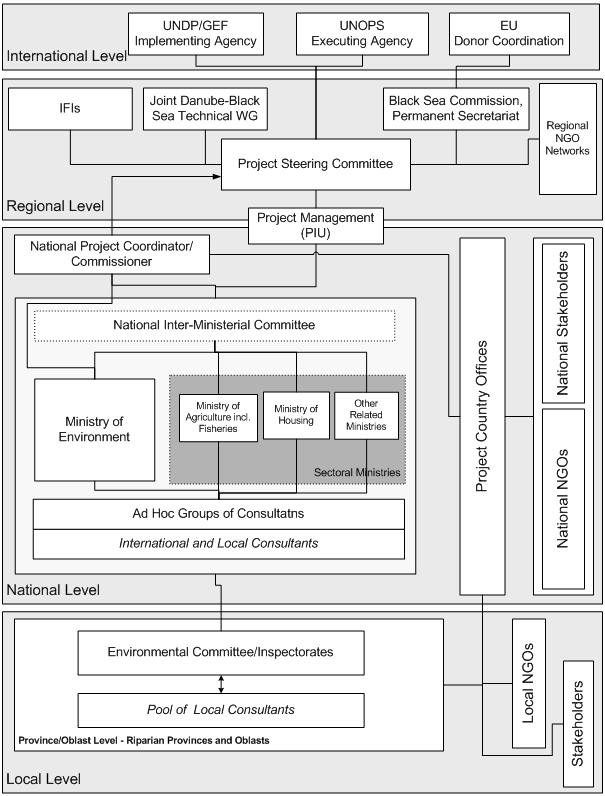
RER/01/G33/A/1G/31: Control of eutrophication, hazardous substances and related measures for rehabilitati ng the Black Sea ecosystem: Tranche 2
Figure 1 Implementation Chart for the Project Implementation.
Project Document for Phase II (Tranche 2)
74
April 2004
RER/01/G33/A/1G/31: Control of eutrophication, hazardous substances and related measures for rehabilitati ng the Black Sea ecosystem: Tranche 2
9 PROJECT MONITORING AND EVALUATION
225. The project will be subject to monitoring and evaluation through the following
mechanisms:
- Steering Committee: A joint review by the representatives of Governments, GEF
Implementing Agencies and observers such as, donors, NGOs, and other stakeholders.
The Steering Committee will meet regularly twice a year. Ad hoc Meetings can also
be organised upon the request of the members of the Committee, the CTA or the IAs
provided that budgetary resources are available. Details on the composition and tasks
of SC are described in paragraphs 142-144 above.
- Tripartite Review: In line with UNDP procedures the project will be subject to
Tripartite Review (TPR) once every twelve months. The CTA will prepare a draft
Annual Project Report (APR) and formulate recommendations for adjustment of
strategies and activities where necessary. The APR shall be prepared at least two
months in advance of the TPR to allow review by UNDP and UNDP-GEF prior to the
meeting. The TPR will review and adopt the APR as appropriate.
- GEF Project Implementation Review: In line with GEF procedures the project will be
subject to annual Project Implementation Review (PIR). The CTA will prepare a draft
PIR report and formulate recommendations for adjustment of strategies and activities
where necessary.
- External Evaluation: During the last quarter of its implementation period, an external
team of specialists selected by UNDP-GEF will evaluate the Project with a view to
assess the processes employed, Outputs produced and their impacts, and lessons
learned.
- Quarterly Reporting: The PIU will be providing a summary report on progress of the
project implementation to the Steering Committee members. The report will also
reflect the progress in each of the riparian countries, as provided by the CTLs.
Quarterly repots for the last quarters of each year will be included in the Annual
Programme Reports.
226. Timing of the monitoring and evaluation events are presented in
Project Document for Phase II (Tranche 2)
75
April 2004
RER/01/G33/A/1G/31: Control of eutrophication, hazardous substances and related measures for rehabilitati ng the Black Sea ecosystem: Tranche 2
Table 19 below. The process indicators have been considered important at the stage of the
project design and development; therefore, mainly the process indicators were included in the
Project Document and the Executive Summary. On the other hand, the state and stress
reduction indicators are addressed to a needed extent in the project activities. The whole set of
indicators being developed in both GEF (process, state, state reduction) and DPSIR structure
are presented in a separate report. It should be mentioned; however, that the presented set of
indicators has not been finalised and properly discussed with the parties involved, and can not
be considered as final. The recent developments in EEA and EC have to be also taken into
account. A summary of a report, which reflects the development of P, SR, and ES indicators
are included as a separate annex to both ExecSumm (Annex G of the ExecSumm) and ProDoc
(Appendix T)
Project Document for Phase II (Tranche 2)
76
April 2004
RER/01/G33/A/1G/31: Control of eutrophication, hazardous substances and related measures for rehabilitati ng the Black Sea ecosystem: Tranche 2
Table 19 Monitoring and Evaluation Scheme
Year 1
Year 2
Year 3
Activity / Report
1
2
3
4
1
2
3
4
1
2
3
4
Inception Report with
Project Implementation Plan
Quarterly Progress Reports to
SC
Annual Programme Report
*
*
*
Tripartite Review and Report
Project Implementation
*
*
Review
Mid-term Evaluation
*
*
Final Evaluation
Terminal Report
Audit
* the APR and the PIR have been combined into 1 report.
** the project consists of 2 phases. Therefore the Mid-term review should take place at the beginning of Phase 2.
Project Document for Phase II (Tranche 2)
77
April 2004
RER/01/G33/A/1G/31: Control of eutrophication, hazardous substances and related measures for rehabilitati ng the Black Sea ecosystem: Tranche 2
10 LEGAL CONTEXT
227. UNDP is implementing the project in consultation with the BSC. The Governments of
all eligible participating countries ha ve taken all preparatory measures for government in-kind
contribution and have designated senior officials as GEF Focal Points. All contracting parties
to the BSC have been actively supporting the implementation of the project during Phase 1.
The Commissioners of the Contracting Parties to the Bucharest Convention are leading the
process of project implementation at the national level and will continue to do so during Phase
2.
228. At the regional level, the Permanent Secretariat of the BSC will continue to liaise with
project staff to ensure efficient coordination of project implementation. The Project Steering
Committee (composed of the BSC, UNDP and UNOPS representatives) has been meeting
twice a year to provide guidance to project implementation and will continue to do so during
phase 2 implementation.
229. There are no further prerequisites or obligations to be fulfilled prior to UNDP approval
of Phase 2 of the project. Implementation arrangements between UNOPS as the executing
agency and the Contracting parties (through the PIU) is functioning very well.
230. The following types of revisions may be made to this project document with the
signature of the UNDP only, provided the organization is assured that the other signatories of
the project document have no objections to the proposed changes:
§ Revision in, or addition of, any of the annexes to the project document.
§ Revisions which do not involve significant changes in the immediate
objectives, outputs or activities of the project, but are caused by the
rearrangement of the inputs already agreed to or by cost increases due to
inflation.
§ Mandatory annual revisions, which rephrase the delivery of agreed, project
inputs or increased expert or other costs due to inflation or taking into account
agency expenditures flexibility.
Project Document for Phase II (Tranche 2)
78
April 2004
RER/01/G33/A/1G/31: Control of eutrophication, hazardous substances and related measures for rehabilitati ng the Black Sea ecosystem: Tranche 2
11 WORKPLAN
11.1 Project Management Sheets
231. For each Objective and related activities and outputs a Project Management Sheet
(PMS) has been prepared to present the implementation steps and the timeframe for Phase 2 of
the Project, indicating the coherence and complementarities of activities and expected results
in the two phases of the Project. Further, implementation arrangements are indicated to
demonstrate the involvement of the corresponding parties and other links of cooperation as
necessary prerequisites for efficient project implementation.
232. The Project Management Sheets are the base for the development of the Work
Programme/ Project Implementation Plan which have been developed and will be elaborated
on at the beginning of Phase 2 of the project (an Inception Phase of Phase 2 of the project).
Taking into account the activities and expected outputs described in the PMS, Project
Components have been developed within the implementation of the first phase of the project,
regrouping one or more actives to constitute a coherent and integrated implementation
approach. The Project Components have facilitated establishing of subcontracts which will
further continue in the second phase.
233. Other activities and related outputs described in the PMS will be carried out by
international and national consultant under the direct guidance and supervision of the Project
Coordinator. Sub-contractors and consultants need to closely cooperate with the BSC and its
AGs to respond to the specific requirements in implementing the Danube River Protection
Convention and in responding to principles of the GEF international waters.
234. The Project Management Sheets (Appendix J) represent a summary of:
1. Activities of the project in Phase 2
2. A concise description of status of the activities at the end of Phase 1
3. The major implementation steps for each of the activities in Phase 2
4. Specific outputs of each activity in Phase 2 of the Project
5. Implementation arrangements, which include the main key parties to be involved in
the implementation of the activities
6. Indicative timeframe for the implementation of each of activities.
11.2 Implementation Schedule
Project Document for Phase II (Tranche 2)
79
April 2004
RER/01/G33/A/1G/31: Control of eutrophication, hazardous substances and related measures for rehabilitati ng the Black Sea ecosystem: Tranche 2
235. The Project Implementation Schedule at the end of this chapter represents the time
frame for the second phase as indicated in the Project Management Sheets in a graphical form
( Appendix K on page 227).
Project Document for Phase II (Tranche 2)
80
April 2004
RER/01/G33/A/1G/31: Control of eutrophication, hazardous substances and related measures for rehabilitati ng the Black Sea ecosystem: Tranche 2
12 PROJECT BUDGET AND FINANCING
12.1 Budget description
236. The total budget foreseen of the Black Sea Ecosystems Recovery Project phase 2, is
6,000,000 USD. The funds allocation with respect to the project components is in Table 21 of this
document, and a detailed breakdown per each individual activity/Output/objectiv in Appendix I.
12.1.1 Project Personnel
237. The Core Project Team will consist of10:
§ The Chief Technical Advisor (Project Manager);
§ The Monitoring and Evaluation and Information Specialist (Deputy Project
Manager);
§ The Eutrophication/Marine Pollution Specialist;
§ The Regional Support Officer for Harmonisation with the EU Water Policies
(Support and Liaison Officer),
§ and five support staff.
238. International Experts and National Professional Project Personnel will work under
supervision of the Project Manager.
Table 20 Estimated Costs of the Project Personnel and Other Related Costs
% of Budget
% of Total
Person/
Project Personnel11
Budget
for Project
Project
Month
Personnel
Budget
International Project Staff /
120
806,000
50%
14.02%
Experts
Administrative Support Staff
144
334,800
21%
5.82%
Public Relation Officer
36
90,000
6%
1.57%
International Consultants
4
80,000
5%
1.39%
Coordinating Experts in Each
324
162,000
10%
2.82%
Country
Duty Travel
100,000
6%
1.74%
Mission Costs
40,000
2%
0.70%
Total
1,612,800
100%
28.06%
10 ToR for the International Project Personnel are presented in Appendix B.
11 Costs of the Project Personnel include international staff, administrative and support staff (including Public Relation
Officer), travelling, international consultants to support the PIU in general management and evaluation of the project results,
coordinating experts in each of the Black Sea countries, duty travel, and mission costs (UNDP/UNOPS).
Project Document for Phase II (Tranche 2)
81
April 2004
RER/01/G33/A/1G/31: Control of eutrophication, hazardous substances and related measures for rehabilitati ng the Black Sea ecosystem: Tranche 2
239. The funds for duty travel are foreseen for the project staff to travel within the region to
attend meeting, workshops and to participate in international for a related to the project
activities. Mission Costs (Official Travel) are to finance travel of UNDP/GEF and UNOPS
staff to attend key meetings in the region and participate in evaluation meetings during the
project.
12.1.2 Subcontracts
240. Significant part of work for the project will be carried out by specialised international
and national subcontractors.
Figure 2 International and Local Sub-
241. Amount foreseen for sub-
Contract
contracting of all international and
Foreseen in Phase II of the BSERP, ths. US$
national organisations/ institutes/
companies total US$ 1,880,000 (34% of
the total budget without support costs,
International Contractors
550
UNOPS 8 %).
242. Comparison of international and
national sub-contracts12 are presented in
Figure 2.
243. The list of the selected Project
1 330
National Contractors
Components/Work Packages, which are
foreseen to be subcontracted, is presented in
Table 21. In Table 21 not only labour costs
are presented, but also all related spendings.
12.1.3 Fellowships and Training
244. During the period July 2004 - July 2007 a number of workshops/training
events/seminars are foreseen. The budget covers expenditures related to workshop
organisation and participation (travel, DSA, accommodation, meeting facilities, stationary,
etc). Costs for preparation of documentation (e.g. training materials) are covered under
Miscellaneous. Workshop guidance (facilitator, expertise) has to be covered from the
corresponding budget lines for international and/or national consultants.
245. The costs of the fellowship and training events are extracted from the budget allocated
for the activities of Phase II of the project (presented in Table 21) and amount to US$ 433,000.
The indicative costs of the individual fellowship and training events are presented in Table 22
below (see page 86).
12 Only labour costs are included in this chart. Other costs, i.e. procurement of equipment, publications, meetings, etc. are
presented separately in the budget.
Project Document for Phase II (Tranche 2)
82
April 2004
RER/01/G33/A/1G/31: Control of eutrophication, hazardous substances and related measures for rehabilitati ng the Black Sea ecosystem: Tranche 2
12.1.4 Equipment
246. The project foresees purchase of equipment and supplies for the running the project
office. This includes one light vehicle for the project team. Other equipment is foreseen to
reinforce national laboratories, to support national information systems in order to improve the
capacities of the Black Sea Commission/Permanent Secretariat and provide for a sound
information exchange in the Black Sea region. Detailed allocations in the budget to procure all
types of equipment in Phase II of the project are presented in Table 23 (see page 86).
Project Document for Phase II (Tranche 2)
83
April 2004
RER/01/G33/A/1G/31: Control of eutrophication, hazardous substances and related measures for rehabilitati ng the Black Sea ecosystem: Tranche 2
Table 21 List of Project Components for Phase II of the BSERP
% of
Man
Sub-
% of
Project Components
Outputs/
Meetings,
Travel, Equipment
Publications,
Budget
Total
Activities
Power,
USD
USD
, USD
USD
Total,
for Work Project
USD
USD
Packages Budget
Operational structures and management tools of the
406,600
21,000
1
1.1
83 000
510 600 13.9%
9%
Black Sea Commission
Protocol for Land-based Activities (LBA) revised and
2
2.1
20,000 10,000
30,000 0.8%
0%
submitted for national negotiation.
Integrated Coastal Zone Management in line with EU
3
Directives and in testing concept for Best Practices for
2.2
210,000 10,000 20,000
20,000
260,000 7.1%
4%
ICZM
Agricultural sector policy reviewed and concepts of
4
2.3
110,000 30,000 20,000
160,000 4.4%
3%
BAP proposed
Policies and legislation for application of BAT in the
5
industrial and transport sectors
2.4
120,000 30,000 10,000
160,000 4.5%
3%
Policies and legal instruments for pollution reduction
6
2.5
80,000 30,000 10,000
for the municipal sector
120,000 3.4%
2%
A legally binding document on fisheries and proposals
7
2.6
50,000 20,000 20,000
90,000 2.4%
1%
for fisheries-free zones
8
Economic analysis for the Black Sea countries
3.1
110,000 30,000 20,000
170,000 4.6%
2.83%
Investment programme for industrial and municipal
9
wastewater treatment and other infrastructural
3.2
50,000 60,000 20,000
130,000 3.5%
2%
measures in Black Sea coastal zones
Black Sea Integrated Monitoring and Assessment
4.1.1 -
10
220,000 30,000 30,000
120,000
Programme (BSIMAP)
4.1.6
400,000 11.0%
7%
Pilot project for a Black Sea Vessel Traffic Oil
11
4.1.7
90,000
90,000 2.4%
1%
Pollution Information System (VTOPIS)
Project Document for Phase II (Tranche 2)
84
April 2004
RER/01/G33/A/1G/31: Control of eutrophication, hazardous substances and related measures for rehabilitati ng the Black Sea ecosystem: Tranche 2
Table 21 List of Project Work Packages/Components for Phase II of the BSERP (continued)
Outputs
% of
Man
Sub-
% of
Project Components
/
Meeting
Travel
Equipm
Publications,
Budget
Total
Activitie
Power,
s, USD
USD
ent, USD
USD
Total,
for Work Project
s
USD
USD
Packages Budget
The Black Sea Information System (BSIS) including
12
4.2
90,000 30,000 10,000 60,000
190,000 5.3%
3%
tools for WWW, GIS, mapping and remote sensing
13 Two survey cruises in the Black Sea
4.3.1
300,000
30,000 50,000
380,000 10.3%
6%
Study on inputs of nutrients to the Black Sea by
14
4.3.2
100,000 10,000
40,000
150,000 4.1%
atmospheric deposition
2%
Rapid assessment methodology for diffuse sources in
15
4.3.3
40,000 10,000
50,000 1.4%
the Black Sea basin
1%
16 Study for the use of phosphorus in detergents
4.3.4
30,000
0,000
30,000 1.0%
1%
17 Scientific Black Sea Conference (2006)
4.3.5
20,000 40,000 0,000
60,000 1.8%
1%
18 NGOs structures and activities
5.1
90,000
0,000
60,000
160,000 4.4%
3%
Community actions for awareness raising and
19 environmental protection (including Small Grant
5.2
360,000
0,000
360,000 9.9%
6%
Programme)
Public information and awareness for environmental
20
5.3
20,000 0,000 10,000
100,000 140,000 3.8%
2%
issues
Sub-Total, US$
2,548,600
433,000
244,000
290,000
160,000
3,675,600
100%
61.26
%
TOTAL, US$
3,675,600
Project Document for Phase II (Tranche 2)
85
April 2004
RER/01/G33/A/1G/31: Control of eutrophication, hazardous substances and related measures for rehabilitati ng the Black Sea ecosystem: Tranche 2
247. The specifications of the equipment will be developed by the Project Manger in
cooperation with the Permanent Secretariat of the Black Sea Commission and the Advisory
Groups. Purchases will follow the procurement rules of UNOPS.
Table 22 Indicative Costs of Fellowship and Training Events - Phase II of the BSERP,
US$
% of
% of
Project
Total
Fellowship and Training
Budget for
Output
Budget
Meetings
Project
Budget
Information Management
4.2
30,000
7%
0.52%
Implementation of Danube-Black Sea
1.1
30,000
7%
0.52%
MoU
1.1, 2.1,
38 000
9%
0.66%
National Coordination
3.1
Project Management
1.1
30,000
7%
0.52%
1.1, 2.2,
10,000
3%
0.26%
Regional Cooperation
5.1
Sectoral Meetings/Training
2.2 - 2.6
110,000
27%
2.00%
Donor Conference
3.2
50,000
12%
0.87%
Socio-Economic Analysis
3.1
20,000
5%
0.35%
Investment Development
3.2
10,000
2%
0.17%
Monitoring and Research
4.1, 4.3
40,000
10%
0.78%
Assessment Methodologies
4.1
10,000
2%
0.17%
Scientific Conference
4.3
40,000
9%
0.70%
NGO Training
Part of SGP
Total
433,000
100%
7.53%
Table 23 Equipment to be Provided by the Project in Phase II, US$
% of
% of
Project
Total
Type of Equipment
Budget for
Output
Budget
Equipment
Project
Budget
Office equipment for PIU
gpc13
30,000
8%
0.52%
Expendable equipment for PIU
gpc
30,000
8%
0.52%
Local Procurement (Vehicle)
gpc
20,000
5%
0.35%
Office equipment for the Black Sea
40,000
11%
0.70%
2.2, 4.2
countries
Black Sea Information System (BSIS)
4.2
40,000
11%
0.70%
Monitoring Equipment
4.1, 4.4
210,000
57%
3.65%
Total
370,000
100%
6%
13 gpc General Project Costs.
Project Document for Phase II (Tranche 2)
86
April 2004
RER/01/G33/A/1G/31: Control of eutrophication, hazardous substances and related measures for rehabilitati ng the Black Sea ecosystem: Tranche 2
12.1.5 Miscellaneous
248. The item Miscellaneous covers general costs for operation and maintenance, report
printing and publishing (including production of awareness raising materials project
Objective 5).
Table 24 Miscellaneous Costs, US$
Project
% of
% of Total
Miscellaneous Costs
Output
Budget
Budget for
Project
Equipment
Budget
Operation and maintenance
gpc
167,156
48%
2.91%
Reports Printing and Publishing
gpc
20,000
6%
0.35%
Publications within different activities
all
60,000
17%
1.04%
Production of awareness raising material
5.3
100,000
29%
1.74%
Total
347,156
100%
6%
12.1.6 Agency Support Costs
249. Of the total project costs 8 percent are made available for Project Execution (UNOPS
Executing Agency).
Table 25 Agency Support Costs, US$
Agency Support Costs
Budget, US$
Project Support Costs (8%)
444,444
Project Document for Phase II (Tranche 2)
87
April 2004
RER/01/G33/A/1G/31: Control of eutrophication, hazardous substances and related measures for rehabilitati ng the Black Sea ecosystem: Tranche 2
12.2 Detailed Breakdown of Budget Implementation Per Year
Table 26 Detailed Breakdown of the Phase II Budget per Year
Man-
2004
2005
2006
2007
B/L Output
Description
months
Total
6 months
12 months
12 months
6 months
10
$2,625,400
$584,900
$893,800
$798,300
$331,400
110
International Professional Project Staff
1101
1.2
Project Coordinator-P5
36
300,000
50,000
100,000
100,000
50,000
1102
1.2
Monitoring & Evaluation and Information Specialist -
36
L4
219,000
36,500
73,000
73,000
36,500
1103
1.3
Eutrophication Expert - L3
36
219,000
36,500
73,000
73,000
36,500
1104
1.2
Regional Support Officer for Harmonisation with the EU
12
68,000
34,000
34,000
Water Policies - L3
subtotal
120
$806,000
$157,000
$280,000
$246,000
$123,000
115
International Consultants
1151
1.1.2
Institutional Expert(s)
1
63,000
5,000
26,000
27,000
5,000
1152
2.6
Fisheries Expert(s)
3
30,000
4,500
10,500
11,000
4,000
1153
3.2
Investment Development
3
30,000
11,000
19,000
1154
4.2
Experts on Information Management and Systems (incl.
6
20,000
6,000
7,000
7,000
Web, GIS, etc.)
1155
4.3.6
Experts on Detergents
1
20,000
20,000
1156
gpc*
General Logistical Support
1
90,000
20,000
20,000
30,000
20,000
1157 5.1,5.2,5.3 NGO Experts/Environmental Education Specialists
2
35,000
26,200
3,300
800
4,700
subtotal
32
$288,000
$86,700
$84,800
$75,800
$40,700
13
Administrative and Support Staff
1301
1.2
Financial Administrator
36
108,000
18,000
36,000
36,000
18,000
1302
1.2
Contract Administrator
36
108,000
18,000
36,000
36,000
18,000
1303 1.2, 5, gpc Public Relation Officer
36
90,000
15,000
30,000
30,000
15,000
1304
1.2
Secretary
36
54,000
9,000
18,000
18,000
9,000
1305
1.2
Driver
36
64,800
10,800
21,600
21,600
10,800
subtotal
180
$424,800
$70,800
$141,600
$141,600
$70,800
15
Duty Travel
1501
1.2
PIU Travel
100,000
20,000
30,000
30,000
20,000
1502
All
Activity Related Travel
activities
261,000
55,000
80,000
80,000
29,000
1601
1.2
UNDP/UNOPS
24,000
6,000
6,000
6,000
6,000
1602
1.2
Project Evaluation
16,000
4,000
4,000
4,000
4,000
subtotal
$401,000
$85,000
$120,000
$120,000
$59,000
17
National Professional Project Personnel
1701
gpc
Coordinating Experts in Each Country
108
162,000
27,000
54,000
54,000
27,000
1702
1.2
Institutional Expert(s)
1
43,600
900
20,900
20,900
900
1703
2.2
ICZM Specialists
108
130,000
50,000
37,000
38,000
5,000
1704
2.3
Agricultural Sector and Policy Experts
50
60,000
12,000
36,000
12,000
0
1705
2.4
Industrial/Municipal Waste Water Treatment Experts
50
60,000
10,000
20,000
30,000
1706
2.5
Policy and Legal Instruments Experts
42
50,000
10,000
25,000
15,000
1707
2.6
Fisheries Expert(s)
17
20,000
3,000
9,000
7,000
1,000
1708
3.1
Socio-Economic Analysis
38
45,000
21,000
12,000
12,000
1709
3.2
Investment Development
17
20,000
8,500
11,500
1710
4.1
Tranboundary Monitoring Systems and Indicators
33
40,000
14,000
26,000
1711
4.2
Experts on Information Management and Systems (incl.
38
45,000
17,000
12,000
12,000
4,000
Web, GIS, etc.)
1712
4.3
Experts on Detergents
8
10,000
10,000
1713
4.3.5
General Logistical Support for Scientific Conference
8
10,000
10,000
1714
5.3
Environmental Education Specialists
8
10,000
2,000
4,000
4,000
10
subtotal
588
$705,600
$185,400
$267,400
$214,900
$37,900
Project Document for Phase II (Tranche 2)
88
April 2004
RER/01/G33/A/1G/31: Control of eutrophication, hazardous substances and related measures for rehabilitati ng the Black Sea ecosystem: Tranche 2
Man-
2004
2005
2006
2007
B/L Output
Description
months
Total
6 months
12 months
12 months
6 months
20
Subcontracts
$1,780,000
$484,500
$732,000
$460,500
$53,000
2101
1.1.3
Renew Trans-boundary Diagnostic Analysis (TDA)
50,000
40,000
10,000
2102
1.1.4
Review and update Black Sea Strategic Action Plan
50,000
20,000
30,000
(BSSAP)
2103
1.1.5
Support to the Permanent Secretariat of the BSC
200,000
40,000
50,000
70,000
40,000
2104
2.1.1
IAEA UNEP Revised Land Based Protocol
2
20,000
20,000
2105
2.2
ICZM Activities including Pilot Projects
8
80,000
30,000
28,000
19,000
3,000
2106
2.3
Agricultural sector policy and BAP
5
50,000
12,000
32,000
6,000
2107
2.4
Policies/Legislation for Application of BAT in
6
60,000
10,000
20,000
30,000
Industrial/Transport Sector
2108
2.5
Policies/Legal Instruments for Municipal Pollution
3
30,000
7,500
15,000
7,500
Reduction
2109
3.1
Economic Analysis for the Black Sea Countries
7
70,000
20,000
27,000
23,000
2110
4.1
Further Development of BSIMAP incl QA/QC,
180,000
40,000
80,000
60,000
indicators, and pilot exersices
2111
4.1.7
Pilot Project on VTOPIS
9
90,000
30,000
60,000
2112
4.2.7
Download and Distribute Satellite Data
3
30,000
15,000
15,000
2113
4.3.1
Two Survey Cruises in Black Sea
300,000
200,000
100,000
2114
4.3.2
Inputs of Nutrients to Black Sea by Atmospheric
100,000
30,000
40,000
30,000
Deposition
2115
4.3.3
Rapid Assessment Methodology for Ddiffuse Sources
4
40,000
20,000
20,000
2116
5.1.2
Support to "Umbrella" NGOs
33
40,000
10,000
10,000
10,000
10,000
2117
5.1.3
Stakeholder Training in Sustainable Coastal Zone
4
40,000
40,000
Management
2118
5.2.3
Small Grant Programme (SGP)
350,000
175,000
175,000
30
Fellowships, Training and Meetings
$433,000
$88,500
$179,500
$128,500
$36,500
3201
4.2
Information Management
30,000
2,000
6,000
15,000
7,000
3202
1.1.4
Implementation of Danube-Black Sea MoU
30,000
7,000
7,000
8,000
8,000
3203 1.1,2.1,3.1 National Coordination
38,000
5,500
17,500
7,500
7,500
3204
1.1.1
Project Management
30,000
8,000
6,000
6,000
10,000
3205 1.1,2.2,5.3 Regional Cooperation
15,000
4,000
9,000
1,000
1,000
3206
**
Sectoral Meetings/Training
115,000
35,000
42,000
35,000
3,000
3207
3.2.5
Donor Conference
50,000
50,000
3208
3.1
Socio-Economic Analysis
20,000
4,000
6,000
10,000
3209
3.2.1
Investment Development
10,000
5,000
5,000
3210
4.1,4.3
Monitoring and Research
45,000
18,000
21,000
6,000
3211
4.1.6
Assessment Methodologies
10,000
10,000
3212
4.3.5
Scientific Conference
40,000
40,000
40
Equipment
$370,000
$132,500
$142,500
$77,500
$17,500
4501
gpc
Office equipment for PIU
30,000
10,000
10,000
5,000
5,000
4502
gpc
Expendable equipment for PIU
30,000
7,500
7,500
7,500
7,500
4503
gpc
Local Procurement (Vehicle)
20,000
20,000
4504
2.2.5,
Office equipment for the Black Sea countries
4.2.3
40,000
20,000
20,000
4505
4.2.1,
Equipment for the Black Sea Information System (BSIS)
4.2.6
40,000
15,000
15,000
5,000
5,000
4506
4.1, 4.3
Monitoring Equipment
210,000
80,000
90,000
40,000
50
Miscellaneous
$347,156
$69,646
$96,219
$126,219
$55,073
5201
gpc
Operation and maintenance
36
167,156
37,146
55,719
55,719
18,573
5202
5.1.4
Publications within different activities
60,000
15,000
15,000
15,000
15,000
5203 5.3.1,5.3.3 Production of awareness raising material
100,000
12,500
22,500
52,500
12,500
5204
gpc
Reports Printing and Publishing
20,000
5,000
3,000
3,000
9,000
90
PROJECT TOTAL
5,555,556
1,360,046
2,044,019
1,591,019
493,473
93
SUPPORT COSTS
9301
SUPPORT COST 8%
444,444
108,804
163,521
127,281
39,478
99
GRAND TOTAL
6,000,000
1,468,849
2,207,540
1,718,300
532,951
Note: * - gpc - General Project Components
100%
24%
38%
29%
9%
Project Document for Phase II (Tranche 2)
89
April 2004
RER/01/G33/A/1G/31: Control of eutrophication, hazardous substances and related measures for rehabilitati ng the Black Sea ecosystem: Tranche 2
** - 2.2.1, 2.3.1, 2.3.5, 2.4.1, 2.4.6, 2.5.1, 2.5.5, 2.6.1, 2.6.2, 2.6.5.
Project Document for Phase II (Tranche 2)
90
April 2004
RER/01/G33/A/1G/31: Control of eutrophication, hazardous substances and related measures for rehabilitati ng the Black Sea ecosystem: Tranche 2
13 SUSTAINABILITY AND PARTICIPATION
250. The Black Sea Ecosystem Recovery Project (Phases I and II) has to be seen as a logical
continuation of the GEF assistance to the Black Sea Environmental Program. The BSERP has
established the necessary conditions for the BSC and for the Black Sea riparian countries to
assure efficient implementation of policies and measures for pollution reduction and resource
management. The proposed Phase 2 of the BSERP can build on a very favourable framework
for sustainability and participation already reinforced in Phase I, and on the findings and
recommendations of:
§ The Declaration on the Protection of the Black Sea (Odessa, 1993) that is basic
framework of agreement;
§ The BS-SAP 1996 as the agreed-upon policy document of the Black Sea
environment protection focusing on policies and strategies for pollution control
and resource management;
§ The Declaration to the Convention on the Protection of the Black Sea Against
Pollution (Sofia, 2002);
§ The National Strategic Action Programmes for rehabilitation and protection of
the Black Sea;
§ Results of the Danube-Black Sea Task Force (DABLAS) Working Group on
Project Prioritization "Prioritization of Municipal Investment Projects in the
Danube River Basin", revising the lists of national projects of the ICPDR Joint
Action Programme and selection of municipal priority projects.
13.1 Institutional capacities and arrangements
251. With its entry into force on the beginning of 1994, the Convention on the Protection of
the Black Sea Against Pollution became the overall legal instrument for cooperation and water
management in the Black Sea Basin. Since 2000 all bodies of the BSC, the Expert Groups and
the BSC Permanent Secretariat have been fully operational. The primary objective of the
Black Sea Ecosystem Recovery Project is to support the BSC in order to achieve a well-
balanced integrated implementation of the BS-SAP. It is assured that there is a full developed
and functioning institutional framework for project performance.
252. Within the Phase I of the BSERP the institutional framework of the BSC and all
participating the Black Sea riparian countries have been further reinforced and appropriate
arrangements in particular with BSC Expert Groups were developed. As the BSC is
Project Document for Phase II (Tranche 2)
91
April 2004
RER/01/G33/A/1G/31: Control of eutrophication, hazardous substances and related measures for rehabilitati ng the Black Sea ecosystem: Tranche 2
permanently sustained via financial contributions of the member states, the GEF intervention
would further support and strengthen the BSC and its Expert Groups to improve technical and
management capacities for the implementation of nutrient reduction measures identified in the
BS-SAP.
253. The participation of the European Union is assured in the BSERP through the work of
the Joint Danube/Black Sea Technical Working Group that has been revitalized during the
Phase I of the BSERP.
13.2 Government commitment
254. All the Black Sea riparian countries have actively participated in the frame of the
elaboration of the BS-SAP and have provided all necessary information for the preparation of
the present Project Document (PDF-Block B activities) and thus demonstrated their interest in
and commitment to pollution control, nutrient reduction and sustainable water management.
Further, it should be noticed that two Danube countries (Bulgaria and Romania) and Turkey
are actually preparing for accession to the European Union and are therefore committed to
applying the European water directives and guidelines for pollution reduction with particular
attention to the EU Nitrate Directive, the Urban Waste Water Directive and the
implementation of the new EU Water Framework Directive. The EU WFD in the Phase1 of
the DRP has already provided very good platform for mobilizing all national governments
towards participation and coordination of their efforts within ICPDR. The application of
elements of WFD will be considered by other three the Black Sea countries (Georgia, Russia
and Ukraine) within the Phase II of BSERP.
255. Legal Frame: The Convention on the Protection of the Black Sea Against Pollution is a
legally binding instrument, which provides a solid framework and a legal basis for
cooperation, including enforcement. The International Commission for the Protection of the
Black Sea (BSC) has been established according to the Convention provision (Art. XVII), and
has its seat in Istanbul, Turkey. The BSC and its bodies are responsible for the implementation
of the Convention.
13.3 Stakeholder participation
256. The development of NGOs and support to "umbrella organisations" for the Black Sea
NGOs was an essential contribution of the previous GEF assistance to assure public
participation in the planning and plan implementation processes. Small Grants Program
successfully conducted within the Phase I of BSERP has facilitated the implementation of
community-based projects in the Black Sea riparian countries. It is envisaged within the
Project Document for Phase II (Tranche 2)
92
April 2004
RER/01/G33/A/1G/31: Control of eutrophication, hazardous substances and related measures for rehabilitati ng the Black Sea ecosystem: Tranche 2
Phase II of BSERP to continue implementation of GEF Small Grants Programme for NGOs in
the Black Sea riparian countries. Since the BSERP is in the 1st phase providing support for
strengthening and reinforcement of NGOs capacities, it is assured that the existing structures
of local NGOs and NGOs "umbrella organisations" will play an important role in the
implementation of the GEF Black Sea Ecosystem Recovery Project and in the development
and application of new policies and regulation to improve water quality and to assure rational
use of resources.
Project Document for Phase II (Tranche 2)
93
April 2004
RER/01/G33/A/1G/31: Control of eutrophication, hazardous substances and related measures for rehabilitati ng the Black Sea ecosystem: Tranche 2
14LESSONS LEARNED
14.1 Lessons Learned in Preparing the BSERP
257. Prior to the 1990s, little or no action had been taken to protect the Black Sea. Political
differences during the Soviet era, coupled with a lack of gene ral knowledge of the
environmental situation resulted in an absence of effective response. Perestroika changed this
and by 1992 the Black Sea countries were ready and willing to co-operate. They had just
signed the Bucharest Convention. However, they still lacked the policies which would enable
necessary measures to protect the sea. Agenda 21 provided a good model for a first Black Sea
Ministerial Declaration, the Odessa Declaration. Indeed, the Black Sea was the first region to
take up the challenge of Rio. This inspired the GEF and other donors, particularly the
European Union, to provide more than US$17 million support to the region to help implement
the Odessa Declaration and to formulate the longer-term Black Sea Strategic Action Plan.
258. The Black Sea Environmental Programme (BSEP) was launched in June 1993. The
Programme included a number of interventions by the GEF (and other donors), the first of
which was entitled `Project for the Environmental Management of the Black Sea, approved
under the GEF Pilot Phase). Its first task was to help create a strong international network of
institutions, specialists and other stakeholders. The BSEP established its headquarters in
Istanbul with the support of the Government of Turkey. In order to spread the technical
responsibilities of the programme throughout the region and to make best use of the excellent
specialists in the region, a system of Regional Activity Centres and Working Parties was
devised. Each country agreed to sponsor one of its existing institutions as a regional centre for
a particular field of expertise. The regional centres in turn organised Working Parties,
specialist networks involving institutions from all six Black Sea countries. Using this
structure, it was possible to bring together specialists who had sometimes not been able to co-
operate previously.
259. The BSEP Working Parties completed a series of background studies that enabled a
Transboundary Diagnostic Analysis (TDA) to be finalised in June 1996. On the basis of this
comprehensive report senior government officials negotiated the Black Sea Strategic Action
Plan (BS-SAP), signed on October 31st at a Ministerial Conference in Istanbul. The consensus
on the BS-SAP was very broad. It provides a very modern approach to environmental policy
making and agrees on the following key matters:
Project Document for Phase II (Tranche 2)
94
April 2004
RER/01/G33/A/1G/31: Control of eutrophication, hazardous substances and related measures for rehabilitati ng the Black Sea ecosystem: Tranche 2
§ That the principle cause for the decline of the Black Sea ecosystem is
eutrophication;
§ That without full co-operation with riparian countries of the main tributary
rivers (Danube and Dnipro) this problem cannot be addressed;
§ That the institutional structure of the BSEP should be incorporated into that of
the Istanbul Commission for the Bucharest Convention;
§ That an adaptive management approach should be adopted for the control of
pollution in the Black Sea;
§ That biological diversity and fisheries concerns should be part of the future
agenda of the Commission;
§ That greater stakeholder participation and transparency should be ensured (in
line with the provisions of the Aarhus Convention.
260. Following the signature of the BS-SAP, GEF funding was sustained, albeit at a lower
level, in order to enable countries to complete National Black Sea Strategic Action
Programmes and for the negotiations on the institutionalisation of the Istanbul Commission's
Secretariat to be completed. This was a very protracted three-year process as countries
struggled to overcome technical and legal issues of establishing the Secretariat. In the
meantime however, progress was made in implementing part of the BS-SAP thanks to GEF
seed money and considerable support from the European Commission by TACIS or and DG
XI (currently DG Environment). The main achievements were:
§ Establishment of the ad-hoc technical working group with the ICPDR and joint
analysis of the problem of eutrophication in the Bla ck Sea, including
recommendations for target for nutrient control;
§ Continued support to the BSEP Activity Centres and real progress through
demonstration projects in the areas of data quality control, oil spill response,
coastal zone management, aquaculture and biological diversity;
§ Strengthening of the programme for public participation, particularly through
the Tacis small grants initiative, largely focussed on actions around Black Sea
(as a reminder of commitments to the BS-SAP);
§ Publication of the State of Pollution in the Black Sea report and the Black Sea
Red Data Book;
§ Agreement on a new set of water quality objectives to propose to the BSC as
required by the BS-SAP.
261. In April 2000, a breakthrough was finally made in the negotiations for establishing the
Commission's Secretariat. The Secretariat became operational in October 2000, following the
selection of its senior officials at an extraordinary session of the BSC on September 10-11,
2000. Four countries (Bulgaria, Romania, Turkey and Ukraine) made their financial
Project Document for Phase II (Tranche 2)
95
April 2004
RER/01/G33/A/1G/31: Control of eutrophication, hazardous substances and related measures for rehabilitati ng the Black Sea ecosystem: Tranche 2
contributions to the Commission. In addition, the Republic of Turkey is providing the facilities
for the Secretariat, to be shared with the PIU.
262. Key lessons learned in previous PDF-B project activities were determined in the
process of preparing the overall Black Sea Ecosystem Recovery Project in 2000-2001. Some
important lessons have been learned from a range of GEF and other environmental planning
projects. In the frame of this project, the Black Sea countries cooperating under the PDF-B
have achieved important results in terms of capacity building and institutional strengthening.
The planning process in elaborating the TDA and the BS-SAP, which involved stakeholders
from the local governments, scientific institutions and NGOs, had created a high momentum
in adopting GEF operational principles for the protection of international waters and
ecosystems. Further, the interaction with other organisation, in particular the EU TACIS, the
World Bank, the EBRD, etc., and joint actions with the DRP have set new standards for
regional cooperation. These positive achievements will be consolidated in implementing the
Danube / Black Sea Basin Strategic Partnership.
263. The PDF-B of BSEP indicated how time consuming and difficult it is to set up
institutional structures, information networks and to introduce new approaches of planning in
countries that are in a continuous process of political and economic transition. Based on this
experience, it is recommended that wherever possible - the newly created institutional
settings, networks and methodological tools should be reinforced through the BSERP in close
cooperation with DRP. Special emphasis should be put on the maximum utilization of the
participatory approach that is now fully understood and accepted by the participating
countries.
264. In many transition countries, the policy and legal frame is presently being reviewed
and adjusted, focusing in particular on unclear land ownership and uncontrolled resource
management (forestry, mining, etc.), which lead to environmental degradation and damage. In
many countries, compliance with environmental laws and regulations is not controlled and is
consequently very low. This is partially due to structural and organisational weaknesses and
more to budgetary limitations. Inter-ministerial coordination is another common and serious
problem for project implementation when coordinating structures are missing at national
levels. The involvement and cooperation of all relevant governmental bodies, in particular the
Ministry of Environment, Ministry of Economy, Ministry of Agriculture, of Foreign Affairs,
etc. is essential in the early project preparation phase.
265. Another lesson learned is that project activities conducted by international expert
teams without close integration and cooperation with experts from the relevant the Black Sea
riparian countries are often not recognized. In the frame of the Black Sea Environmental
Project Document for Phase II (Tranche 2)
96
April 2004
RER/01/G33/A/1G/31: Control of eutrophication, hazardous substances and related measures for rehabilitati ng the Black Sea ecosystem: Tranche 2
Program many project components have failed to be sufficiently coordinated with the BSC
and its Expert Groups and thus did not respond to the expressed needs of the beneficiaries. It is
therefore recommended that all project components should be carried out in close cooperation
with the BSC's expert bodies and that highly qualified national experts/consultants available
in all the Black Sea riparian countries should be contracted.
14.2 Lessons Learned During Implementation of Phase 1 of the BSERP
266. Some further lessons have been learned based on experience gained in the
implementation of Phase 1 of the BSERP to date. The establishment of intensive cooperation
with the BSC and its structures (co-executing agency and primary beneficiary) and improving
administrative and technical capacities to cooperate enhances the effectiveness of project
implementation. The BSC was formed to implement the Convention on Protection of the
Black Sea Against Pollution (CPBSAP).
267. By proactively working together with the BSC at various levels, i.e. the Secretariat, the
respective BSC Expert Groups and respective National Governments, the GEF project has
established good cooperation. The project participates, together with relevant contractors
where appropriate, in all Expert Groups Meetings organised by the BSC. In this way the
BSERP has a full overview and understanding and can thereby provide the best assistance and
input into the further development of the work. Further, these commonly implemented
activities serve to improve administrative and technical capacities at the National level based
on guidelines and requirements set by the BSC and the BSERP. In this way, the GEF project
plays a catalytic role in stimulating the Black Sea riparian countries to meet their
commitments to the CPBSAP and BS-SAP. This encourages national governments to develop
appropriate structures for regional cooperation that is thereby facilitating the strengthening of
good governance in the Black Sea Basin.
268. One of the lessons learned is the benefit of a close link between global environmental
objectives and an appropriate legislative framework. Particular attention has been paid to the
EU Water Framework Directive (WFD) that represents very comprehensive water legislation.
It provides an excellent basis for the implementation of particular activities of the BSERP
given commonly shared principles such as a basin-wide holistic approach, ecosystem
management etc. By linking project activities within the Phase II closely with the WFD, the
BSERP is increasing the ability to meet global environmental objectives in the frame of the
project, and is also establishing the basis for the sustainability of project results as well as the
mechanisms for ongoing improvements after the life of the project.
269. The BSERP has put a large emphasis on supporting increased public participation in
Project Document for Phase II (Tranche 2)
97
April 2004
RER/01/G33/A/1G/31: Control of eutrophication, hazardous substances and related measures for rehabilitati ng the Black Sea ecosystem: Tranche 2
the Black Sea riparian countries. An important lesson learned is that it is critical to focus on
developing appropriate public participation mechanisms and strategies given specific level of
activity (regional, national and local.) The BSERP is developing grassroots level (bottoms-up)
activities via the Small Grants Programme, as well as is supporting the development of the
NGOs "umbrella organisations" which, as a regional network is capable of working at all
levels, regional, national or local levels through its constituent members. Also, the BSERP
will assist national governments to incorporate public participation in coastal zone
management at the regional, national and local levels. In addition to the above-mentioned
activities, there are considerations to develop a specific project component to improve access
to information for key stakeholders and to enhance their abilities to address priority issues of
pollution in the Black Sea riparian countries.
270. For designing the surveys a small group of scientists (Advisory Board) who were well
informed on the specific scientific uncertainties preventing a clear understanding of the
linkages between the causes and impacts of eutrophication in the Black Sea were nominated
by the PIU to identify research topics, expected Outputs, required format for the proposals and
the evaluation criteria. Based on this a call for proposals on the scientific work to be
undertaken was prepared; and only after this all-scientific groups in the region were invited to
take part in the process. The members of the Advisory Board, after reviewing all proposals
and selecting the scientific teams which will execute the surveys, took part in the detailed
design process for the surveys conducted by the wider study group- although in general they
did not take part in the proposals to be implemented. In summary, a cascaded planning
approach was taken. As a result it was it was possible to mainstream the original objective of
`reducing management uncertainties' through the cruises against pure `scientific inquiry' .The
pre-set topical issues, scientific quality criteria and the transparent process for evaluation
reduced the potential for conflict of interests between the numerous scientific groups. This
lesson serves as a good example for the need to clearly differentiate specific roles expected
from various partners; for example decision making /implementation role versus scientific
advice and taken into consideration while planning specific measures to enhance the
efficiency/efficacy of the Advisory Groups and Regional Activity Centres. Second lesson from
the same experience is the need for enhanced transparency as a means of reducing possible
conflicts.
Project Document for Phase II (Tranche 2)
98
April 2004
RER/01/G33/A/1G/31: Control of eutrophication, hazardous substances and related measures for rehabilitati ng the Black Sea ecosystem: Tranche 2
15 COST-EFFECTIVENESS
271. Taking into account the social and economic development which will take place in the
last decade in the Black Sea countries and considering the EU approximation process and the
need to adapt environmental standards to international and EU directives for three riparian
countries (Bulgaria, Romania and Turkey), it is evident that investments in environmental
protection and management of resources are necessary to assure a sustainable development in
the countries of the Black Sea Basin.
272. It is to be expected that most the Black Sea riparian countries - mainly those in
transition will in the next five to seven years see their GDP grow at an annual rate of 4-5 %.
This economic growth will be the result of economic recovery in transition countries and new
investments in industry, agriculture and services. The development and implementation of
adequate environmental standards and mechanisms for compliance is, therefore, essential to
assure sustainable development in the region.
273. It was calculated (Transboundary Diagnostic Analysis, 1996) that implementation of
49 investment projects in the Black Sea riparian countries which comprise of construction of
new facilities, extension, rehabilitation/upgrading of existing structure, in-plant precautions
would lead to a very high extent of annual reduction of nitrogen for 61.5% and phosphorus for
79 % in case of point sources in costal countries, and for 23% and 13% respectively from
coastal countries to transboundary rivers.
274. Non-point sources of pollution in relation to land use and agricultural activities
represent about half of all nutrients, in particular nitrogen, discharged into the Black Sea. It is
assumed that through the development and implementation of policies, legislation and
mechanism for compliance, nutrient emissions from non-point sources (land use and
agriculture) can be considerably reduced. In respect of this assumption, the actual estimations
for the five-year project (according to the DRP methodology) show that development and
implementation of appropriate policies and legislation will lead to a reduction of nitrogen for
10.9% and phosphorus for 8.2 % respectively of total nutrient loads discharged into the Black
Sea.
275. According to the methodology on cost-effectiveness, the project contribution into the
limitation of nutrients load could be estimated as 20% of the value for capital investments for
nutrient reduction from non-point sources of pollution. Taking into consideration this
assumption, the value of capital investments in case of BSERP is equal to 47.8 million USD
for the period of 5 years (considering the UNDP-GEF BSERP project costs of 4.0 million
Project Document for Phase II (Tranche 2)
99
April 2004
RER/01/G33/A/1G/31: Control of eutrophication, hazardous substances and related measures for rehabilitati ng the Black Sea ecosystem: Tranche 2
USD for the 1st period of 2 years (April 2002 April 2004) and taking into account additional
investments of 6,000,000 USD in the 2nd Phase of the project (July 2004 to June 2007)).
276. The cost-effectiveness of this Project lies in the opportunity to improve water quality
in general and to reduce nutrients load (and other hazardous substances) in particular, thus
contributing to the rehabilitation of the Black Sea ecosystems.
Project Document for Phase II (Tranche 2)
100
April 2004
RER/01/G33/A/1G/31: Control of eutrophication, hazardous substances and related measures for rehabilitati ng the Black Sea ecosystem: Tranche 2
Literature
1. State of the Environment of the Black Sea 1996-2000. Publication of the Commission on
the Protection of the Black Sea Against Pollution, Istanbul 2002.
2. Project Document, The UNDP-GEF Black Sea Ecosystems Recovery Project:
RER/01/G33/A/1G/31: Control Of Eutrophication, Hazardous Substances And Related
Measures For Rehabilitating The Black Sea Ecosystem: Phase1 (2000).
3. Project Brief, The Danube Regional Project, March 2003.
Project Document for Phase II (Tranche 2)
101
April 2004
RER/01/G33/A/1G/31: Control of eutrophication, hazardous substances and related measures for rehabilitati ng the Black Sea ecosystem: Tranche 2
Appendix A Review of Project Progress in Phase I
In this section a brief review is presented on the progress of activities within Phase I of the
projects, as well as the corresponding budget utilisation. A total of 27 activities were planned
for implementation in Phase 1, 4 of which have been fully completed with 18 activities
currently on-going (all but two will be continued into Phase 2). Of the 5 activities not started
in Phase 1, all have been rescheduled until Phase 2.
Implementation of the Project Activities
Objective 1: Support the integration of a sustainable Secretariat for the Bucharest
Convention
Support has been given to the work of Advisory Groups (AGs) through project staff and
consultants. Capacity and performance of the AGs is ensured through staff time allocation for
regional tasks. Capacity and commitment for serving for regional needs by the Regional
Activity Centres has still to be improved. A surve y was undertaken to evaluate the data
gathering, assessment and exchange capacity and needs of Advisory Groups and Regional
Activity Centres (RACs). The institutional set-up of the Black Sea Commission's framework
is strengthened by the involvement of additional resources both human and financial.
Equipment needs against functions of the focal points and Activity Centres were assessed and
a short and medium term procurement plan was prepared and cost sharing arrangements with
the EU Tacis project were agreed upon. Procurement of needed equipment has been initiated.
EU Tacis Assistance for the Black Sea Environmental programme was launched in summer
2002. The Tacis Project provides support for the three NIS countries together with the Black
sea Commission. The Commission also received two additional grants from the EC in 2002. A
number of activities, as well as other issues, are co-financed by the mentioned projects. This
provides for a better cooperation of the resource deployment in the Black Sea region.
The Memorandum concerning cooperation between the Black Sea and Danube Commissions
was signed in November 2001. A task force (DABLAS Task Force) was established as a
platform for common decision making and encouraging investments for environmental
protection, in particular for reduction of eutrophication. BSERP participates in the process. A
Joint Technical Working Group was also established with the mandate to Develop
harmonised monitoring systems, common assessment of the ecological status of inputs of
nutrients and other hazardous substances, compatible reporting formats for input loads and the
assessed ecological status, and formulate of appropriate measures to limit discharge of
nutrients. Besides regular meetings (at least twice a year), electronic forum has been set up on
the Project web site to facilitate operational exchange of opinions and form a means for
discussions.
Project Document for Phase II (Tranche 2)
102
April 2004
RER/01/G33/A/1G/31: Control of eutrophication, hazardous substances and related measures for rehabilitati ng the Black Sea ecosystem: Tranche 2
In relation to the production of public awareness material, the PIU has been responsible for
publishing the `Popular version of the Blacks Sea SAP' in Bulgarian, Turkish and, Romanian,
languages14. The newsletter `Black Sea Shared' was also published in English and posted on
web in all local languages. A table-top calendar for the promotion of the Black Sea
Environmental programme and introducing partners in the process was published for 2003. A
reference book for coastguards, fishing communities are currently under preparation. A web
page for the project had been developed and upgraded continuously, providing information on
project related activities and a modern means of communicating with partners.
Objective 2: Regional actions for improving LBA legislation to control eutrophication
and for tackling emergent problems
An in-depth study and stakeholder consultations at the national and regional levels by the
UNEP/GPA team on existing legislation, policies and practices, and identification of gaps and
prospects for change was delayed until recently due to a number of constraints. Data
availability is a major constraint in conducting the referred analysis. The real situation is that
environmental data is fragmented and obsolete, and is not assessed against socio-economic
data. In order to improve the situation and to speed up implementation of this tasks a number
of activities are being have been initiated, such as involvement of a consultancy specialised in
the corresponding field, as well as reaching out into the region by involvement of a number of
individual foreign and local consultants to support the UNEP/GPA team. Before suggesting
commitments for the region and individual countries, the analysis and planning process must
be undertaken by the UNEP/GPA, taking full account of economic, social, and political
realities of the region such as the EU accession. This in-depth study is currently underway.
Further cooperation on the initiatives of the EU has been coordinated for the latter half of
Phase 1 and for Phase 2.with the DRP.
The study of emergent issues in the Black Sea and their social and economic root causes based
on application of the GIWA methodology was also delayed during Phase 1. This was due to a
lengthy disagreement of the planned activities of the GIWA team by the Permanent Secretariat
who regarded the inadequacy and validity of data as a major constraint to the overall
assessment. This activity is currently underway following a decision of the Project Steering
Committee for the PIU to employ governmentally approved national consultants to provide the
necessary data on behalf of the GIWA team.
Objective 3: Assist countries to improve their knowledge of the process of eutrophication
in the Black Sea
An Advisory Board composed of select scientists from coastal countries was established with
a view to prepare the research programme for the International Study Group (ISG). Previous
scientific survey results were reviewed by the Advisory Board and proposals for research were
agreed in 8 fields, each related to the management of nutrients and hazardous substances in the
Black Sea. The Advisory Board evaluated 79 international proposals. Selected representatives
of the chosen research projects met in January 2003 for the 1st meeting of the ISG in order to
prepare the first draft of the research plan. Three surveys each having two legs were agreed
14 English, Russian and Ukrainian were published previously.
Project Document for Phase II (Tranche 2)
103
April 2004
RER/01/G33/A/1G/31: Control of eutrophication, hazardous substances and related measures for rehabilitati ng the Black Sea ecosystem: Tranche 2
upon and planned by the ISG in detail. Currently all contractual and logistical issues are being
finalised. Other research activities, which are currently underway, include (i) the extended
monitoring of nutrients (organic and inorganic) and hazardous substance inputs to the Black
Sea from the Danube river, (ii) remote sensing (historical and current) using SeaWifs in
combination with the research surveys to determine the necessary algorithms required to
accurately calculate the level of chlorophyll a (phytoplankton growth) by satellite, add (iii)
shore-based investigation of macrophytes (incl. workshop and training programme for
regional representatives).
The first of the research cruises (benthic survey) was carried out successfully during
September/October 2003. A pelagic research cruise planned for September/October was
postponed until March/April 2003 (Phase 1) due to difficulties in signing contract with a local
vessel. A further cruise is planned for winter 2004.
Objective 4: Introduce new sectoral policies and laws, and a system of process, stress
reduction and environmental status indicators for monitoring the effectiveness of
measures to control eutrophication (and harmful substances where appropriate)
The project suffered a delay in reaching an agreement on the methodology to be applied for
analysing the relevant economic sectors (see also 2.above) and formulating measures for the
reduction of nutrients and hazardous substances. Implementation of this activity was revised in
late 2003. This task as originally intended could not be fulfilled without proven inter-
ministerial cooperation or the direct involvement of stakeholders. A number of interventions
were planned for initiation during the latter part of Phase 1. These include an agreement with
the DRP on joint project implementation and the set up an institutional framework of the
project implementation, which will strengthen the present cooperation and eventually lead to
setting up of national and coastal inter-sectoral committees.
Environmental status indicators suggested in PDF-B phase were introduced to different
Advisory Groups of the BSC for their review and feedback. The BSC Secretariat subsequently
elaborated draft indicator-based reporting formats for continuous formal reporting to the BSC.
BSERP provided support to the BSC in implementing of the reporting and developing a proper
storage and retrieval means as a part of the Black Sea Information System. Along with this,
the BSERP has also planned a 10 years historical data (environmental and socio-economic)
compilation exercise which will be used for setting the background and justifying the validity
of the final set of indicators to be adopted.
The BSERP consultant and BSC PS Staff conducted a survey of data and information
gathering and exchange capacities of the network of institutions that are nominated for
undertaking certain tasks within the framework of BSC. A draft strategy was elaborated for
data and information exchange and submitted to the Advisory Group. The BSERP on its part
is currently developing the architecture for relational databases in which the results of the data
collation exercise will be entered. The databases will be accessible through the internet.
The basic approach for integrated monitoring and assessment programme for Black Sea
(BSIMAP) has been established by the PS of BSC. After intensive consultations with the BSC
PS and the corresponding Advisory Group (PMA), a pilot monitoring programme for
environmental status indicators, as agreed by the JTWG of the BSC and the ICPDR, has been
Project Document for Phase II (Tranche 2)
104
April 2004
RER/01/G33/A/1G/31: Control of eutrophication, hazardous substances and related measures for rehabilitati ng the Black Sea ecosystem: Tranche 2
designed and is currently underway. In order to ensure sustainability, the status-monitoring
programme has to be an integral part of the BSIMAP.
Objective 5: Support the Commission in their periodic review of Adaptive Management
objectives.
This activity in Phase 1 is represented by cost-benefit analysis of the national strategies for
reduction of nutrients and hazardous substances. Since the national strategies will not
completed until midway through Phase 2 (in association with the DRP), this activity is
planned accordingly.
Objective 6: Assist the public in implementing activities to reduce eutrophication
through a programme of grants for small projects and support to regional NGOs.
In relation to the Small-Grants Programme (SGP), 17 projects totalling 320,000 USD were
sub-contracted in December 2002-January 2003 with completion dates of December 2003.
Most of the sub-contracted projects incorporate a training component and lists will be
available during the final evaluation of projects, scheduled for December 2003/January 2004.
A strategy for the second call has been drafted and is currently under discussion. Following its
adoption by the NGO communities, a second call will be made in early 2004.
A directory of Black Sea wetlands was prepared by interna tional (Wetlands International) and
local (NGOs) partners together with detailed recommendations on wetland conservation. A
number of activities were held by NGOs on the International Black Sea Day., supported by the
PS/PIU through press releases issued in all local languages, the newsletter published in
English and posting on web on local languages. Preparations are also under way for making a
video movie to acknowledge local populations with their ecological and economical
significance. In relation to environmental education, measures were instigated to enrich the
local character of the scientific contents of an education draft study pack. This was carried out
to better coordinate with national education authorities operating in the region. The education
study pack will be finalized and published in the latter part of Phase 1 (early 2004).
There was a delay in the operation of the Black Sea Train Sea Coast course development for
agricultural management of nutrients in coastal regions. Following a curricula development
workshop, held in Istanbul in February 2003, the course development unit proceeded to train
new course developers. Completion of course planned for end 2003 with first delivery in the
Black Sea coastal region in January 2004.
Objective 7: Fo rmulate proposals for market-based or alternative economic instruments
for limiting nutrient emissions and establish private-public sector partnerships for
environmental protection in the Black Sea.
The methodology for environmental and economic analysis developed during Phase 1 will be
further developed in Phase 2 in association with the DRP. A detailed analysis of existing
international and regional economic instruments for nutrient reduction was successfully
carried out during Phase 1 of the BSERP.
Project Document for Phase II (Tranche 2)
105
April 2004
RER/01/G33/A/1G/31: Control of eutrophication, hazardous substances and related measures for rehabilitati ng the Black Sea ecosystem: Tranche 2
Activities have also been initiated in a number of riparian countries in the field of public-
private sector partnership. The first phase has concentrated on (i) the analysis of the relevant
stakeholders in the Black Sea riparian countries, (i) the legal base in each country and (iii)
recommendation for future partnerships.
An updated priority investment portfolio prepared as part of (by technical and financing sub-
committees) DABLAS Task Force established by the BS and Danube Commissions and
supported by the EC. A separate activity was also initiated by the BSERP to determine the
potential of the local and/or regional financial intermediaries as a means of channelling
funding to small/medium sized bankable projects related to nutrient limitation and habitat
restoration.
Objective 8: Fisheries exploited within its maximum sustainable yield and incorporating
measures to protect ecologically sensitive areas.
Support was provided to the meetings of the AG Fisheries, where negotiations where restarted
after 5 years. A background document suggesting main management and conservation issues
that need to be incorporated in a regional strategy and legal instrument was elaborated by an
international consultant. An ad hoc working group was created to work on fisheries related
indicators. With a view to study the status and trends, a regional data compilation and
evaluation exercise was undertaken through a team of national consultants as part of the
formal reporting procedure for the BSC. Results were evaluated at a regional workshop to
identify information gaps, establish a decision support system to be continuously operated,
with the proper set of indicators for ecosystem-based fisheries. Required interventions at the
regional level were identified. As a pilot activity, demersal resources were studied in depth.
Coordination with international expert institutions (FAO-GFCM) for the inclusion of a
regional coordinated stock assessment in GFCM work-programme was made and a proposal
was drafted for submission by countries' fisheries authorities to FAO. A guidebook on
Responsible Fisheries in the Black Sea to be published in all local languages and widely
distributed to the local managers, fishermen and public is under preparation.
Utilisation of Phase I Budget
This section includes a brief description of the utilisation of the budget allocated for Phase I of
the Project. Since the management team changed in early July 2003, all estimates are made for
the period before and after July 2003.
Up until July 2003 the spending, which corresponded to the project activities, were at the level
of 1,138,051 USD (from project start until July 2003), which was considerably lower than the
needed rate of utilisation of the funds available. Following the budget revision in July 2003, a
new work programme was established and executed.
The programme included a planned increase in the implementation of all project components.
In accordance, a revised budget for the remainder of 2003 and 2004 was developed and is
currently being implemented. The actual spend up to the end of 2003 has been estimated as
being 2,768,764 USD. There is shortfall of 61,245 USD against the forecast spend in 2003.
Project Document for Phase II (Tranche 2)
106
April 2004
RER/01/G33/A/1G/31: Control of eutrophication, hazardous substances and related measures for rehabilitati ng the Black Sea ecosystem: Tranche 2
The remaining funds, which total 1,231,232 USD, are fully planned to be disbursed between
January and July 2004. Table 28 and Figure 3 below show the dynamics of the spending
during Phase I of the Project.
Project Document for Phase II (Tranche 2)
107
April 2004
RER/01/G33/A/1G/31: Control of eutrophication, hazardous substances and related measures for rehabilitati ng the Black Sea ecosystem: Tranche 2
Table 27 Progress of Implementation of Proje ct Objectives in Phase I and Linkage to Phase II Activities
STATUS
OBJECTIVES (Activities)
SUCCESS CRITERIA
(in relation to project activities)
Phase 1
Incorporation
into Phase 215
Objective 1:
Programme Implementation Unit (PIU) fully staffed and
On-going/
Continued as
Support the integration of a sustainable
operational./Joint Management Committee established and
Revised
1.1.1 and 1.2.1
Secretariat for the Bucharest Convention
operational
Advisory Groups and Activity Centres operational and
On-going
Continued as
engaged in addressing transboundary issues
1.1.3
Istanbul Commission able to raise funding for transboundary
On-going
Continued as
projects
1.2.4
Inter-Commission Working Group operating and setting
Not started
Planned as
common management objectives
1.1.2
Information in the public domain throughout the Black Sea
On-going
Continued as
coastal region regarding the transboundary problems and
5.1.4 and 5.3.5
solutions offered.
Objective 2:
New LBA Protocol approved and endorsed
On-going
Continued as
Regional actions for improving LBA
2.1.1 and 2.1.2
legislation to control eutrophication and for
Black Sea Futures report approved by the Istanbul
On-going
Not Planned
tackling emergent problems.
Commission and published.
Objective 3:
Integration of international Study Group on Black Sea
On-going
Continued as
Assist countries to improve their knowledge
Eutrophication. Peer reviewed study plan.
4.3.1
of the process of eutrophication in the Black
Completion of surveys and studies of nutrient sources,
On-going
Continued as
Sea
sinks/fluxes
4.3.1
Publication of State of the Black Sea Report, 2003
Completed
Copies of the satellite colour scan maps and explanatory
On-going
Continued as
reports distributed widely in all six Black Sea countries.
4.3.1
15 Details could be found in Error! Reference source not found.: Logical Frame Matrix for Project Tranche 2 Objectives, Outputs and Activities.
Project Document for Phase II (Tranche 2)
108
April 2004
RER/01/G33/A/1G/31: Control of eutrophication, hazardous substances and related measures for rehabilitati ng the Black Sea ecosystem: Tranche 2
Table 27 Progress of Implementation of Project Objectives in Phase I and Linkage to Phase II Activities
(continued)
STATUS
OBJECTIVES (Activities)
SUCCESS CRITERIA
(in relation to project activities)
Phase 1
Incorporation
into Phase 2
Objective 4:
Written agreement of the agricultural, industrial and municipal
Not
Revised as 2.2.1,
Introduce new sectoral policies and
government sectors in each country to cooperate on specific indicators
started
2.3.2, 2.4.3, 2.5.3
laws, and a system of process, stress and to help to develop and implement measures within their area of
and 2.6.3
reduction and environmental status
responsibility.
indicators for monitoring the
Adopted new system of process, stress reduction and environment status
On-going
Continued as
effectiveness of measures to control indicators employed. Indicator data used to enforce existing/new laws,
4.1.1
eutrophication (and harmful
policies and regulations and for regional status and trends reports
substances)
Publishing of the pilot status monitoring report
On-going
Continued as
4.4.1 4.1.5
Use of the information base by all six countries
On-going
Continued as
4.2.1
Objective 5:
Publication and positive reception of the Benefit-cost study
Not
Planned as 3.1.1
Support the Commission in their
started
3.1.5
periodic review of Adaptive
Management objectives.
Objective 6:
Full implementation of first tranche of projects (independent review).
Completed
Assist the public in implementing
Successful second call for proposals
On-going
Continued as
activities to reduce eutrophication
5.2.1 5.2.5
through a programme of grants for
Effective contribution of NGO evidenced by the establishment of a
On-going
Continued as
small projects and support to
regional NGO WG on nutrient reduction, media reports and presence at
5.1.2
regional NGOs
significant regional open meetings
Increased number of wetlands protected and/or restored
Not
Planned as 2.2.3
started
Lists of people trained (from each Black Sea country) through Train Sea
On-going
Continued as
Coast.
5.1.3
Project Document for Phase II (Tranche 2)
109
April 2004
RER/01/G33/A/1G/31: Control of eutrophication, hazardous substances and related measures for rehabilitati ng the Black Sea ecosystem: Tranche 2
Table 27 Progress of Implementation of Project Objectives in Phase I and Linkage to Phase II Activities
(continued)
STATUS
OBJECTIVES (Activities)
SUCCESS CRITERIA
(in relation to project activities)
Phase 1
Incorporation
into Phase 2
Objective 7:
Reports of actions taken within countries to correct identified
Completed
Formulate proposals for market-based or
gaps in the application of economic instruments.
alternative economic instruments for limiting
Highlight opportunities for public-private sector partnership in On-going
Continued as
nutrient emissions and establish private-public measures to limit nutrients within the coastal zone of the Black
3.2.4
sector partnerships for environmental
Sea
protection in the Black Sea.
Review of potential nutrient-related investments channelled
Completed Continued as
through regional or national development banks
3.2.3
Objective 8:
Reports proposing effective protection of sensitive habitats as
On-going
Continued as
Fisheries exploited within its maximum
fisheries free zones and the subsequent adoption of a
2.6.2
sustainable yield and incorporating measures
significant number of these areas.
to protect ecologically sensitive areas.
Evidence of a successful dialogue between the Bucharest
Not
Planned as 2.6.1,
Convention and Fisheries Convention Secretariat/ negotiating
started
2.63 and 2.6.4
bodies.
Documentary evidence of the progress towards the conclusion
On-going
Not planned
of the new Biological and Landscape Diversity Protocol to the
Bucharest Convention (prepared with BSEP (GEF and Tacis)
funding.
Project Document for Phase II (Tranche 2)
110
April 2004
RER/01/G33/A/1G/31: Control of eutrophication, hazardous substances and related measures for rehabilitati ng the Black Sea ecosystem: Tranche 2
Table 28 Utilisation of Phase I Funding (Forecasted against Actual)
Total
Planned for 2003 according to Revision
Actually
2004
Budget Line Cluster
Project
2002
01/07/2003
Committed
according to
Budget
and Spent
Revision
After
Actual
Planned for
Total 2003
in
01/07/2003
01/07/2003
Spend
Jul - Dec
2003
Revision
Jan-Jul
2003
200316
319
PIU International Staff
723 849
200
186
114 401
315 261
315 261
89 401
860
PIU Local Support Staff
203 566 70 801
42 919
40 673
83 592
83 592
49 173
International Consultants
189 205 24 545
0,034
77 013
82 047
82 613
National Consultants
302 406 12 991
3 215
161 650
164 865
124 550
116
1 316 619
Sub-contracts
1 011
12 253
470 886
483 139
412 367
799
293
Procurement of Equipment
601 179 33 037
4 197
474 251
478 448
89 693
Travel
130 401 12 121
4 456
54 162
58 618
34 456
59 662
Meetings/Training
328 852 86 149
63 446
129 623
193 069
88 446
49 635
Publications
143 078 25 172
17 075
12 000
29 075
20,000
88 831
Sub-Total
3 634
700
353 1 534 658 1 888 114
1 863
1 045 925
334
295
456
375
Contingency
69 365
34 527
34 527
34 838
Support Costs (8%)
296 296 56 024
28 276
125 535
151 049
149 070
89 223
TOTAL
3 999
756
381 1 694 720 2 073 690
2 012
1 169 987
996
319
732
445
Underspent against planned in 2003
61 245
Figure 3 Dynamics of Funds Utilisation in Phase I of the Project
US$
4 500 000
3 999 996
4 000 000
3 500 000
3 000 000
2 768 764
2 500 000
2 000 000
1 138 051
1 500 000
756 319
1 000 000
500 000
0
Jan-Jun
Jul-Dec
Jan-Jun
Jul-Dec
Jan-Apr
Jan-Jul
2002
2002
2003
2003
2004
2004
Spend Plus Committed
Cummulative Spend Plus Committed
16 Year 2003 is split because there was a change in management team in early 2003.
Project Document for Phase II (Tranche 2)
111
April 2004
RER/01/G33/A/1G/31: Control of eutrophication, hazardous substances and related measures for rehabilitati ng the Black Sea ecosystem: Tranche 2
Project Document for Phase II (Tranche 2)
112
April 2004
RER/01/G33/A/1G/31: Control of eutrophication, hazardous substances and related measures for rehabilitati ng the Black Sea ecosystem: Tranche 2
Appendix B Terms of Reference of the International
Project Personnel
1. Job Description - Programme Coordinator
General
The Programme Coordinator shall be responsible for the overall management of all aspects of
the current project. He/She shall liaise closely with the National Coordinators appointed by the
beneficiary Government and the representatives of the GEF partners and other donors. He/she
shall be responsible for all substantive, managerial and financial reports from the Project.
He/She will provide overall supervision for all staff of the Project Implementation Unit (GEF-
PIU) as well as guiding and supervising all external policy relations. He/she shall consult with,
and coordinate closely with the executing and implementing agencies.
The responsibilities of the PIU of relevance to this post include:
§ Detailed planning, budgeting and timely implementation of the project
activities;
§ Overall coordination of the relevant activities of donors, participants in the
funding and implementation of the overall Black Sea Environmental
Programme;
§ Regular reporting to the Steering Committee on project progress through
coordination meetings;
§ Strengthening of project institutional network within the Black Sea riparian
countries, (including ad hoc technical expert groups, as well as the Advisory
Groups and regional Activity Centres of the Black Sea Commission) for the
tasks specified in the current project document as well as the participation of
NGOs and other stakeholders in project implementation;
§ Establishment and functioning of national inter-ministerial bodies;
§ Elaboration of nutrient management strategies which will incorporate revisions
and amendments in laws and policies, and relevant indicators (process and
stress reduction indicators) for government approval;
§ Assessing the economic cost and benefits of the actions proposed in the nutrient
management strategies;
§ Reinforcing the legal background and promoting the implementation of GPA;
§ Management of the Small Grants Programme;
§ Diffusing project Outputs through newsletters, posters, technical reports, public
information bulletins;
§ Developing/updating/maintaining the existing BSEP web site jointly with the
Permanent Secretariat.
Project Document for Phase II (Tranche 2)
113
April 2004
RER/01/G33/A/1G/31: Control of eutrophication, hazardous substances and related measures for rehabilitati ng the Black Sea ecosystem: Tranche 2
§ Preparation of progress reports concerning programme activities.
§ Drafting of addenda to the BSSAP in line with the Outputs of the project
§ Further development of the BSC information base;
Duties
The Programme Coordinator will have the following specific duties to:
§ Manage the PIU, its staff, budget and Imprest fund;
§ Prepare the annual work plan of the programme on the basis of the Project
Document, in close consultation with the National Coordinators, GEF Partners,
relevant donors and the Permanent Secretariat;
§ Ensure overall coordination of the activities described in the work plan and the
consistency between the various programme elements and related activities
provided or funded by other donor organisations;
§ Prepare and oversee the development of Terms of Reference for consultants and
contractors;
§ Submit substantive and operational reports from the Programme;
§ Assist the Black Sea Commission in the integration of its Secretariat and
institutional network and to plan activities jointly between the GEF-PIU and the
Permanent Secretariat;
§ Foster and establish links with other related Black Sea basin programmes in
particular those for the Danube River Basin and Dnipro, and where appropriate,
with other regional International Waters programmes.
§ Coordinate the preparation of background documents on policies and good
practices in the three sectors concerned aiming to reduce the emission of
nutrients and other toxic substances in other parts of the world;
§ Oversee the design of a common strategy and format for the six countries for
the elaboration of national nutrient management, and for the efficient
functioning of the national inter-ministerial committees;
§ Coordinate the work of the inter-ministerial committees for the elaboration of
national nutrient management strategies and for the identification of relevant
process and stress reduction indicators;
§ Facilitate the formal approval process for the national nutrient management
strategies;
§ Coordinate the synthesis of national nutrient management strategies into a
regional plan as a supplement to the Black Sea-SAP for submission to the Black
Sea Commission;
§ Coordinate with the National Project Coordinators, national inter-ministerial
committees and teams performing other activities under the current regional
project (such as that of the International Study Group or the cost-benefit
Project Document for Phase II (Tranche 2)
114
April 2004
RER/01/G33/A/1G/31: Control of eutrophication, hazardous substances and related measures for rehabilitati ng the Black Sea ecosystem: Tranche 2
analysis), as well as the World Bank which is implementing sectoral
restructuring and investment programmes under the Partnership Investment
Facility;
§ Further establish linkages with relevant UN agencies or other global or regional
organisations such as the OECD, EC with a view to obtain their support on
thematic issues and for possible mainstreaming of project objectives in their
work throughout the region;
§ Ensure that the information gathered during the activities under his
responsibility is disseminated through publications and/or web-site as
appropriate.
Skills and experience required:
§ Post-graduate degree in Environmental Management or a directly related field
(e.g. applied marine science, natural resources economics, etc.)
§ At least fifteen years experience in fields related to the assignment. At least ten
years experience at a senior project management level. Demonstrated
diplomatic and negotiating skills.
§ Familiarity with the goals and procedures of international organisations, in
particular those of the GEF partners (UNDP, UNEP, World Bank).
§ Familiarity with the environmental problems of the region, and with nutrient
reduction policies and practices elsewhere;
§ Excellent knowledge of English.
§ Familiarity with the coastal countries, knowledge of one of their languages
would be an asset.
Duty station: Istanbul, Turkey
Duration: One year on a fixed term contract
Suggested post level P5
Project Document for Phase II (Tranche 2)
115
April 2004
RER/01/G33/A/1G/31: Control of eutrophication, hazardous substances and related measures for rehabilitati ng the Black Sea ecosystem: Tranche 2
2. Job Description Deputy Project Manager/Monitoring and
Evaluation and Information Specialist.
The Monitoring and Evaluation and Information specialist/Deputy Project Manager will
support the Project Manager in the detailed planning and implementation of the project
activities and act as Project Manager in his absence. He will also be responsible for a number
of environmental monitoring related, as well as all information and database (including GIS)
related activities of the project. His responsibility will also be the updating, further
development of the system established under the earlier stages of BSEP. He will work closely
with other projects carried out under the overall BSEP framework, with those under the
Strategic Partnership, with other information networks established under regional or
international organisations (e.g. GEF, UNEP, EEA, OECD, NATO) or programmes. He/she
shall work under the supervision of the Project Coordinator within the PIU.
The responsibilities of the PIU of relevance to this post include:
§ Development and implementation of a set of monitoring and evaluation
indicators for the project evaluation and assessment of the project results;
§ Coordination, where appropriate, of the relevant activities of donors,
participants in the funding and implementation of the overall Black Sea
Environmental Programme, technical coordination with the international and
regional programmes in the Black Sea;
§ Detailed planning, budgeting and timely implementation of tasks related to the
environmental monitoring (including some indicator-related activities), as well
as the activities aimed at the strengthening of decision support informational
and analytical tools;
§ Pilot implementation of the environmental status programme;
§ Design and implementation of a Data Assessment Strategy for the Black Sea
region, on the basis of existing data assessment methodologies the development
of a set of standardised tools to be further applied in the Black Sea basin (with
an account of EU accession process);
§ Holding of training event(s)/workshop(s) on statistical assessment techniques
and tools developed;
§ Implementation of the Information Strategy developed within the BSERP
(Phase I)
§ Continuation of the development and implementation of the BSC information
base including databases, database management application and GIS system(s),
web-based in particular;
§ Continuation of the development and maintenance of the Project web site, the
development of the Intranet network within the join office of the Permanent
Secretariat of the Black Sea Commission and the BSERP PIU.
Project Document for Phase II (Tranche 2)
116
April 2004
RER/01/G33/A/1G/31: Control of eutrophication, hazardous substances and related measures for rehabilitati ng the Black Sea ecosystem: Tranche 2
§ Collection and dissemination of information on policy, economic, scientific and
technical issues related to the programme;
§ Production of technical reports, newsletters and non-technical leaflets and
progress reports concerning programme activities.
Duties
The Monitoring and Evaluation and Information Development specialist will have the
following specific duties:
§ Support the Project Manager in all aspects of the administration and overall
management of the Project.
§ Develop and implement of a set of monitoring and evaluation indicators for the
project evaluation and assessment of the project results
§ Participate in planning, budgeting and timely implementation of tasks related to
the environmental monitoring and informational support analytical tools;
§ Continue the implementation of the common Information strategy and
corresponding reporting formats for the six countries for the implementation of
the Black Sea Information System, and all Advisory Groups, as well as those
needed for information exchange with the ICPDR and the GEF UNDP Danube
Regional Project;
§ Liaise, where appropriate, with relevant UN agencies or other global or regional
organisations such as the OECD, EC with a view to obtain their support on
thematic issues and for possible mainstreaming of project objectives in their work
throughout the region;
§ Cooperate within his/her responsibilities with both the Black Sea regional and
international programmes. Coordinate implementation of the tasks under his/her
responsibility with the National Project Coordinators and teams performing
activities under the current regional project;
§ Coordinate activities related to the development and implementation of the
monitoring and evaluation indicators for the project implementation and
evaluation of the project results;
§ Adopt existing data assessment methodologies in the Black Sea region, design and
draft a set of manuals needed for the implementation of the methodologies,
provide needed training where appropriate;
§ Ensure that the information gathered during the activities under his/her
responsibility is disseminated through publications and/or web-site as appropriate.
§ Supervise upgrading of information products (including the Project web site, GIS)
developed during the earlier stages of BSEP; to supervise data exchange and
maintenance of the data communications network between BSEP cooperating
institutions;
Project Document for Phase II (Tranche 2)
117
April 2004
RER/01/G33/A/1G/31: Control of eutrophication, hazardous substances and related measures for rehabilitati ng the Black Sea ecosystem: Tranche 2
§ Up keeping and running of all computer hardware and software in the PIU,
including the establishment of an equip ment register.
§ Liaise with other programmes/projects, donors, and other organisations involved
in establishing and managing scientific and substantial data and information on
the marine and coastal environment, in particular pertaining to the Black Sea with
a view to identify ways in which the Black Sea data and information can be
integrated with on-going programmes.
§ Preparation of progress reports concerning programme activities.
Duty station: Istanbul, Turkey;
Duration: One year on an ALD contract;
Suggested post level L4.
Project Document for Phase II (Tranche 2)
118
April 2004
RER/01/G33/A/1G/31: Control of eutrophication, hazardous substances and related measures for rehabilitati ng the Black Sea ecosystem: Tranche 2
3. Job Description Eutrophication/Marine Pollution Specialist
The Eutrophication/Marine Pollution Specialist will, under the supervision of the Project
Coordinator, be responsible for coordinating the programme activities for developing and
implementing research, monitoring and modelling approaches for nutrient (and hazardous
substances) management strategies in the Black Sea coastal countries. She/he shall be based in
the Project Implementation Unit (PIU), already established for this purpose. She/he will
closely coordinate with (i) the International Study Group which will plan, coordinate and
evaluate the results of the special surveys, (ii) the Permanent Secretariat of the Black Sea
Commission, who are responsible for the developme nt of the Black Sea Integrated Monitoring
and Assessment Programme, (3) the project team responsible for the development and use of a
rapid assessment methodology for estimation of point and diffuse sources entering the Black
Sea from its basin, and (4) the project team which will study the costs and benefits of the
actions proposed in the sectoral master plans and strategies. His/her duties will include daily
administrative tasks associated with the overall management of the programme.
The responsibilities of the PIU of relevance to this post include:
· Review of historical data relating to the concentration and dynamics of nutrients and
hazardous substances in the Black Sea; Publish in peer reviewed journal;
· Coordination of the BSERP nutrient research activities;
· Coordination of two BSC pilot monitoring exercises;
· Coordinate the design of a decision support system for the environmental management
of the Black Sea (liaise with HELCOM for the adaptation of a working model
currently used for the Baltic Sea);
· Elaboration of recommendations for improvement of such or introduction of new
instruments for the control of eutrophication and pollution by other high priority toxic
substances at the national and regional levels;
· Coordinating new sectoral policies and a system of indicators for monitoring the
effectiveness of measures to control eutrophication and pollution by hazardous
substances;
· Providing support for the assessing the economic cost and benefits of the actions
proposed in the sectoral nutrient reduction master-plans;
· Production of technical reports, contribution towards newsletters and non-technical
leaflets and progress reports concerning programme activities.
Duties
The Eutrophication/Marine Pollution Specialist will have the following specific duties:
· Liaise with the ISG for planning, coordination and evaluation of the results of the
special surveys, including in particular, (i) nutrient cycling/dynamics, (ii) hindcasting
Project Document for Phase II (Tranche 2)
119
April 2004
RER/01/G33/A/1G/31: Control of eutrophication, hazardous substances and related measures for rehabilitati ng the Black Sea ecosystem: Tranche 2
of nutrient levels, (iii) classification transitional and coastal waters (vi) factors
determining whether nutrient enrichment results in eutrophication;
· Coordinating the review of nutrient research in the Black Sea region
· Coordinate with the Black Sea Permanent Secretariat and it's Advisory Groups with
respect to the development, and implementation (including QA/QC) of the Black Sea
Integrated Monitoring and Assessment Programme. She/he will be responsible for
coordinating two pilot programmes which are planned to be carried out by the national
laboratories designated under the BSIMAP;
· Liaise with the project team responsible for the development of a rapid assessment
methodology for the estimation of point and diffuse sources entering the Black Sea
from its basin;
· Provide advice and technical specifications for estuary and coastal water models (GIS-
based) for predicting nutrient loadings, concentrations and eutrophication of rivers and
lakes;
· Liaise with HELCOM and regional experts for the adaptation of the Baltic Sea's
decision support system for environmental management for use in the Black Sea;
· Design a common strategy and format for the six countries for the elaboration of
national sectoral nutrient reduction reviews,
· Support the work of the inter-ministerial committees for the elaboration of national
sectoral nutrient reductio n master-plans and for the identification of relevant process
and stress reduction indicators;
· Coordinate the synthesis of national sectoral nutrient reduction master-plans into a
regional plan as a supplement to the Black Sea-SAP for submission to the Black Sea
Commission;
· Ensure that the information gathered during the activities under his/her responsibility is
disseminated through publications and/or the project web-site as appropriate.
· Elaboration of recommendations for improvement of such or introduction of new
instruments for the control of eutrophication and pollution by other high priority toxic
substances at the national and regional levels;
· Introducing new sectoral policies and a system of environmental status indicators for
monitoring the effectiveness of measures to control eutrophication;
Requirements
Skills and experience required:
· A degree and post-graduate experience in marine pollution with an emphasis on
eutrophication research in transitional and coastal waters;
Project Document for Phase II (Tranche 2)
120
April 2004
RER/01/G33/A/1G/31: Control of eutrophication, hazardous substances and related measures for rehabilitati ng the Black Sea ecosystem: Tranche 2
· At least ten years experience in similar international posts dealing with nutrient
management of water bodies and international scientific/environmental management
projects.
· Familiarity with the environmental problems of the region, and with nutrient reduction
policies and practices elsewhere;
· Full fluency (spoken and written) in English. Working knowledge of another Black
Sea (preferably Russian) language is essential.
Duty station: Istanbul, Turkey
Duration: One year on an ALD contract
Suggested post level: L4
Project Document for Phase II (Tranche 2)
121
April 2004
RER/01/G33/A/1G/31: Control of eutrophication, hazardous substances and related measures for rehabilitati ng the Black Sea ecosystem: Tranche 2
4. Job Description Regional Support Officer for Harmonisation with
the EU Water Policies
General
In respect of implementation necessary measures and coordination activities in the area of the
Black Sea ecosystem protection and rehabilitation, the Regional Support Officer for
Harmonisation with the EU Water Policies will, under the supervision of the Project
Coordinator, be responsible for the project components designed for providing appropriate
support to the Commission on Protection of the Black Sea Against Pollution in its activities
related to the establishment of the common platform with EU for economic development
issues in relation with the Water Framework Directive (WFD) and the proposed Marine
Strategy.
While three the Black Sea riparian countries (candidate countries: Bulgaria, Romania and
Turkey) are under the process of accession to the European Union and have obligations to
implement the respective measure on protection and rehabilitation of the Black Sea according
to the WFD, it is important to approximate these measures of the candidate countries with the
measures undertaken in this field by other three the Black Sea countries (Georgia, Russian
Federation and Ukraine). It will synergize the efforts of all countries in the Black Sea basin in
context of its environment protection and rehabilitation. She/he will establish direct working
linkages with the representatives of respective governmental agencies, local municipalities and
private business companies in the Black Sea region as well as with partners in the Danube and
Dnipro basins in context of facilitation of the approximation process.
The duties of the Regional Support Officer for Harmonisation with the EU Water Policies will
include daily administrative tasks associated with the overall management of the programme.
She/he shall be based in the Project Implementation Unit (PIU), already established for this
purpose.
The responsibilities of the PIU of relevance to this post include:
§ Provide support to PS of BSC in respect of establishing a common platform
with EU for economic development issues in relation with the WFD and the
proposed Marine Strategy.
§ Coordinating, where appropriate, with the relevant activities of donors,
participants in the funding and implementation of the overall Black Sea
Environmental Programme;
§ Diffusion of information about the status of the Black Sea environment and last
trends in the field of its protection and rehabilitation through the different
means of information dissemination with the purpose to increase public
awareness in this field.
Duties
The Regional Support Officer for Harmonisation with the EU Water Policies will have the
following specific duties:
1. Maintain the Project liaisons in respect of informing the wider public in the Black Sea
riparian countries those are not under accession to EU about activities and
Project Document for Phase II (Tranche 2)
122
April 2004
RER/01/G33/A/1G/31: Control of eutrophication, hazardous substances and related measures for rehabilitati ng the Black Sea ecosystem: Tranche 2
achievements in the process of implementation of the WFD and Marine Strategy to
coordinate their efforts in the field of protection and rehabilitation of the Black Sea
environment.
2. Facilitate activities rela ted to the support to the BSC in respect of creation the common
platform with EU for economic development issues in relation with the WFD and the
proposed Marine Strategy. It will include the following:
§ The economic analysis of water use within the Black Sea coastal area;
§ The economic assessment of potential measures for reaching good water status;
§ The assessment of the recovery of the costs of water services
3. In respect of activities mentioned in the point 2, the following steps should be
facilitated:
§ Characterization of the Black Sea basin;
§ Identification of the coastal zones not achieving the environmental objectives of
the Strategic Action Plan on Rehabilitation and Protection the Black Sea.
§ Support in development of the programme of measures to be integrated in the
coastal zone management plans through cost-effective analysis.
4. Identify the group of experts that could be involved in the project activities and
maintain relations with them in respect of completion particular project tasks.
5. Formulation of terms of references for the experts on respective project activities.
6. Provide necessary information and technical support to the three Black Sea countries
(Georgia, Russian Federation and Ukraine) in their activities related to approximation
of the measures on the protection and rehabilitation of the Black Sea in respect with
the same measures introduced by other three the Black Sea countries (Bulgaria,
Romania and Turkey) those are candidate countries for accession to the EU.
7. Liaise with other teams participating in the implementation of the Strategic Partnership
in the Black Sea, Danube and Dnipro River basins and with the global NGO networks;
8. Assist in organizing consultations (including meetings) with other stakeholder groups,
for introducing and implement ing programme activities;
9. Liaison with the project partners, particularly with DRP, in respect to the sharing
information about WFD and Marine Strategy in the BS countries that are not under EU
accession process.
10. Collaborate with the project team working on data and information management and
contribute to the web-site.
Requirements
§ Post-graduate degree in environmental management or a directly related field.
Project Document for Phase II (Tranche 2)
123
April 2004
RER/01/G33/A/1G/31: Control of eutrophication, hazardous substances and related measures for rehabilitati ng the Black Sea ecosystem: Tranche 2
§ Demonstrable application of the harmonisation of the EU and national water
policies;
§ At least five years direct experience with the coordination of foreign assistance
programs.
§ Familiarity with the problems of the Black Sea region.
§ Full fluency (spoken and written) in English and another Black Sea language.
Duty station: Istanbul, Turkey;
Duration: One year ALD contract;
Suggested post level: L3.
Project Document for Phase II (Tranche 2)
124
April 2004
RER/01/G33/A/1G/31: Control of eutrophication, hazardous substances and related measures for rehabilitati ng the Black Sea ecosystem: Tranche 2
Appendix C Relevant Legally Binding Documentation
This Appendix contains:
1. The Headquarters Agreement Between the Government of Turkey and BSC
2. MoU between the BSC and the European Environmental Agency (EEA)
3. MoU between the PS of the Agreement on Conservation of Cetaceans of the Black Sea,
the Mediterranean Sea and the contiguous Atlantic area Permanent Secretariat of the BSC
4. MoU between the Black Sea Commission and ICPDR (Danube)
5. Work Programme of the BSC for 2003-2004.
Project Document for Phase II (Tranche 2)
125
April 2004
RER/01/G33/A/1G/31: Control of eutrophication, hazardous substances and related measures for rehabilitati ng the Black Sea ecosystem: Tranche 2
HEADQUARTERS AGREEMENT BETWEEN THE GOVERNMENT OF THE
REPUBLIC OF TURKEY AND THE COMMISSION ON THE PROTECTION OF
BLACK SEA AGAINST POLLUTION
The Government of the Republic of Turkey and the Commission on the Protection of the
Black Sea Against Pollution;
Having regard to paragraph 11 of the Article XVII of the Convention on the Protection of
the Black Sea Against Pollution;
taking into account paragraph 6 of the Article XVII of the Convention as per which the
headquarters of the Commission and the Secretariat shall be established in Istanbul;
taking into account paragraph 8 of the Article XVII of the Convention according to which
Representatives, Alternate Representatives, Advisers and Experts of the Contracting Parties shall
enjoy in the territory of the respective Contracting Parties diplomatic privileges and immunities
in accordance with international law;
taking into account the Agreement on Privileges and Immunities of the Commission on
the Protection of the Black Sea Against Pollution;
considering that the Government of Turkey is also hosting the Programme Co-ordination
Unit of the regional project entitled "Black Sea Environmental Programme", the objective of
which is to assist the coastal States of the Black Sea for implementing the Convention, have
agreed as follows:
Article I
Definitions
For the purposes of this Agreement:
a) "Convention" means the Convention on the Protection of the Black Sea Against
Pollution signed in Bucharest, 21 April 1992;
b) "Contracting Party" means the State Party to the Convention;
c) "the Commission" means the Commission on the Protection of the Black Sea Against
Pollution established in accordance with paragraph 1 of the Article XVII of the Convention and
includes its Secretariat and other subsidiary bodies;
d) "the Secretariat" means the permanent body of the Commission to be established in
accordance with paragraph 6 of the Article XVII of the Convention;
e) "Government" means the Government of the Republic of Turkey;
f) "the Host Contracting Party" means, as the case may be, the Contracting Party on the
territory of which the Headquarters or premises of the Commission are located, a meeting of the
Commission or of its organ is held and where any staff member of the Secretariat is while
exercising mission for the Commission;
g) "Representatives of Contracting Parties" means Representatives, Alternative
Representatives and other members of delegations sent by Contracting Parties to participate in the
meetings held by the Commission or its organ, including Advisers and Experts of delegations.
h) "the Executive Director" means the principal administrator of the Secretariat;
i) "the Officials of the Secretariat" means the Executive Director and other officials
appointed by the Commission and are subject to the staff regulations adopted by the Commission;
Project Document for Phase II (Tranche 2)
126
April 2004
RER/01/G33/A/1G/31: Control of eutrophication, hazardous substances and related measures for rehabilitati ng the Black Sea ecosystem: Tranche 2
j) "the support staff" means the auxiliary, administrative and technical staff appointed by
the Executive Director, including those who are locally recruited and assigned to hourly rates of
payment and are subject to the staff regulations adopted by the Commission.
k) "premises of the Commission" means the buildings or parts of buildings and the land
ancillary thereto, irrespective of ownership, used by the Commission, on a permanent or
temporary basis, to carry out its functions.
Article 2
Interpretation
This Agreement shall be interpreted in light of its primary objective of enabling the
Commission at its Headquarters in the Republic of Turkey (city of Istanbul) to discharge its
responsibilities and fulfil its purposes and functions effectively.
Article 3
Juridical Personality
The Commission shall possess juridical personality. The Commission shall have the
capacity:
a) to contract;
b) to acquire and dispose of immovable and movable property;
c) to institute legal proceedings.
Article 4
Immunity from Legal Proceedings
1. Within the scope of its activities, the Commission shall enjoy immunity from any form
of legal proceedings, except in the case of:
a) civil action by a third party for damages arising out of an accident caused by a vehicle
belonging to or operated on behalf of the Commission, where these damages are not recoverable
from insurance;
b) civil action relating to death or personal injury caused by an act or omission of the
Commission or its staff member.
2. Without prejudice to the provision of paragraph 1 of this article, the property and assets
of the Commission wherever located and by whomsoever held, shall be immune from search,
requisition, confiscation, expropriation and any other form of interference, whether by executive,
administrative, judicial or legislative action.
Article 5
Premises
1. The Government shall provide a convenient building to the Commission free of rent for
an unlimited time. The location of the permanent headquarters of the Commission will be
selected in consultation with the Commission. The premises of the Commission may be changed
upon mutual agreement.
2. The Government shall undertake to facilitate the acquisition or hire of additional
premises by the Commission at such time as they may be needed.
3. Any location other than the Commission premises which may be used in concurrence
with the Government for meetings convened by the Parties or the Commission shall be
temporarily considered as a part of the headquarters.
Project Document for Phase II (Tranche 2)
127
April 2004
RER/01/G33/A/1G/31: Control of eutrophication, hazardous substances and related measures for rehabilitati ng the Black Sea ecosystem: Tranche 2
4. The Governme nt and the Commission may jointly agree to allow for the temporary or
permanent use of the headquarters by third parties involved in studies or programmes pertaining
to the Black Sea.
5. The premises of the Commission shall be supplied with necessary public services,
including electricity, water, sewerage, gas, post, telephone, facsimile, telex, modem, electronic
mail, drainage, collection of refuse and fire protection; and that such public services are rendered
on terms not less favourable than that accorded by the Government to other inter-governmental
specialised agencies.
6. The premises of the Commission shall be inviolable.
7. The Government of the Host Contracting Party shall provide appropriate security
consistent with the status of the Commission as an Inter-Governmental Organisation against any
intrusion or damage and to prevent any disturbance of the peace nearby or in the premises of the
Commission.
Article 6
Funds and Currencies
Within the scope of its functions, without being restricted by financial controls,
regulations or moratoria of any kind, other than exercised by the Contracting Parties jointly, the
Commission:
a) may hold funds, gold or currency, of any kind and operate accounts in any currency;
b) may freely transfer their funds, gold or currency, from one country to another or within
the Host Contracting Party and convert any currency held by it into any other currency.
Article 7
Inviolability of Archives
The archives of the Commission shall be inviolable wherever located or by whomsoever
held. The term "archives" means all records, correspondence, documents, manuscripts,
photographs, films and recordings belonging to or held by the Commission or by any physical or
juridical persons nominated by the Commission to this effect.
Article 8
Expenditures
1. The Government shall meet 40 % of the total amount of initial expenditures regarding
the establishment of the Headquarters of the Commission. The remaining 60 % of the total
amount shall be met by the other Contracting Parties.
For a period of three years, the Government shall meet 40 % of the operational expenses
of the Commission. The remaining 60 % of such expenses shall be met by the other Contracting
Parties.
2. a) Equipment such as computers, printers, CD-ROM units, facsimile and photocopying
machines, modem and other equipment required by the Commission and the Secretariat will be
purchased from the budget of the Commission.
b) Furniture and other office elements/systems will be purchased from the budget of the
Commission.
Project Document for Phase II (Tranche 2)
128
April 2004
RER/01/G33/A/1G/31: Control of eutrophication, hazardous substances and related measures for rehabilitati ng the Black Sea ecosystem: Tranche 2
c) All maintenance and operational expenses regarding (a) and (b) above will be covered
from the budget of the Commission.
d) The running costs, such as electricity and water supply (including air
conditioning/cooling), telephone, facsimile, E-mail and other communication charges, cleaning,
routine keep-up and sanitary services of the Secretariat will be covered from the budget of the
Commission.
Article 9
Exemption from Customs and Excise Duties
1. The Commission, its assets, income and other property shall be exempt:
a) from all direct taxes, including income and corporate taxes: it is understood, however,
that the Commission will not claim exemption from taxes which are in fact no more than charges
for public utility services;
b) from customs duties and restric tions on imports and exports in respect of articles
imported or exported by the Commission for its official use and its publications with the
exception of charges levied for specific services which may be imposed on the Commission by
reason of such imports and exports; it is understood, however, that articles imported under such
exemption will not be sold in the country to which they were imported except under conditions
agreed to with the Government concerned;
c) for the purposes of this article, the term duties means custom duties, taxes and related
charges which are established, or can be established, in accordance with regulations of the
respective Contracting Parties.
2. The Commission shall not, as a general rule, claim exemption from excise duties and
from taxes such as VAT on the sale of services or movable and immovable property which form
part of the price to be paid. Nevertheless, when the Commission is making important purchases
for official use of services or property on which such duties and taxes have been charged or are
chargeable, the Government of the concerned Contracting Party shall, whenever possible, make
appropriate administrative arrangements for the remission or return of the amount of duty or tax.
Article 10
Communications and Publications
1. The Commission shall enjoy, in the territory of Turkey, for its official communications,
treatment not less favourable than that accorded by the Government to other UN specialised
agencies in the matter of priorities, rates and taxes on mails, cables, telegrams, radiograms,
telephotos, telephone and other communications, and press rates for information to the press,
television and radio.
2. No censorship shall be applied to the official correspondence and other official
communications of the Commission.
Article 11
Contacts with the Government
The Executive Director is authorised to contact the Government directly for issues
pertaining to the activities and to the day to day management of the Secretariat. However the
Project Document for Phase II (Tranche 2)
129
April 2004
RER/01/G33/A/1G/31: Control of eutrophication, hazardous substances and related measures for rehabilitati ng the Black Sea ecosystem: Tranche 2
counterpart of the Government on substantial issues shall be the Commission through its
Chairman.
Article 12
Representatives of the Contracting Parties
and the Chairman of the Commission
1. Representatives of Contracting Parties and the Chairman of the Commission, while
exercising their functions and during their journeys to and from the place of meetings, enjoy the
diplomatic privileges and immunities as stated in paragraph 8 of the Article XVII of the
Convention. This provision is not applicable between a representative and the authorities of the
Contracting Parties of which he or she is a national or a permanent resident.
2. Privileges and immunities accorded to persons, mentioned in paragraph 1 of the
present article, are intended to safeguard the independent exercise of their functions in connection
with the Commission and are not for the personal benefit of the individuals themselves.
Consequently, it is incumbent on a Contracting Party to waive the immunity of its representatives
or national acting as the Chairman of the Commission, if in the opinion of the Contracting Party,
the immunity would impede the course of justice, and where it can be waived without prejudice
to the purpose for which the immunity is accorded.
Article 13
Officials of the Secretariat
1. Officials of the Secretariat shall be immune from legal processes in respect of words
spoken or written and all acts performed by them in the exercise of their official functions or to
produce official correspondence and documents relating thereto;
2. Officials of the Secretariat except those who are the nationals of the Republic of Turkey
and permanent foreign residents shall enjoy within and with respect to the Republic of Turkey the
following privileges and immunities:
a) Exemption from taxation in respect of salaries and emoluments paid to them by the
Commission and on the same conditions as are enjoyed by the officials of the United Nations of
comparable rank in the territory of the Republic of Turkey in accordance with the "Convention
on the Privileges and Immunities of the United Nations" (1946);
b) Exemption in respect of themselves, their spouses and their dependents of under age 18
from immigration restrictions, aliens registration, from all personal services, from all public
services of any kind whatsoever, and from military obligations such as those connected with
requisitioning, military contributions and billeting in the territories of the Republic of Turkey;
c) Privileges in respect of exchange facilities as are accorded to officials of comparable
rank of United Nations of comparable rank in the Republic of Turkey, in accordance with the
"Convention on the Privileges and Immunities of the United Nations" (1946);
d) With their spouses and relatives dependent on them, the same repatriation facilities in
time of international crises as accorded to officials of comparable rank of the United Nations in
the territory of the Republic of Turkey, in accordance with the "Convention on the Privileges and
Immunities of the United Nations" (1946);
e) The right to import free of duty their furniture and effects at the time of first taking up
their post in the Republic of Turkey, as provided for by the "Convention on the Privileges and
Immunities of the United Nations" (1946) with respect to officials of the United Nations.
Project Document for Phase II (Tranche 2)
130
April 2004
RER/01/G33/A/1G/31: Control of eutrophication, hazardous substances and related measures for rehabilitati ng the Black Sea ecosystem: Tranche 2
If the officials of the Secretariat on the termination of their functions export furniture and
effects to which this paragraphs applies, they shall be exempt from any customs duties, except
payments for services, which may be imposed by reason of such export.
3. Privileges and immunities are granted to officials in the interests of the Commission
only and not for the personal benefit of the individuals themselves. The Commission shall have
the right and the duty to waive the immunity of the officials of the Secretariat, including the
Executive Director in any case where, in its opinion the immunity would impede the course of
the justice and can be waived.
4. With the purpose of facilitating the performance of their functions, identification cards
with the same effect of the residence permits shall be issued to them, their spouses and their
dependents of under age of 18, by the Government.
Article 14
Support Staff of the Secretariat
1. The support staff of the Secretariat are under no obligation to give evidenc e concerning
matters connected with the exercise of their functions, or to produce official correspondence and
documents relating thereto;
2. The support staff of the Secretariat except those who are the nationals of the Republic
of Turkey and permanent foreign residents in its territory:
a) shall with respect to services rendered for the Secretariat be exempt from any
obligations in regard to work permits imposed by the laws and regulations of the Republic of
Turkey concerning the employment of foreign labour;
b) shall be exempt from dues and taxes on wages which they receive for their services;
c) shall be exempt of all personal services, from all public of any kind whatsoever and
from military obligations such as those connected with requisitioning, military contributions and
billeting in the territory of the Republic of Turkey.
3. With regard to the support staff of the Secretariat except those who are the nationals of
the Republic of Turkey and permanent foreign residents in its territory, the Government shall
issue identification cards in conformity with their status. These identification cards will be used
in 1ieu of residence permits.
4. The Executive Director shall have the right and the duty to waive the immunity of a
member of the support staff provided for in paragraph 1 of this article in any case where, in his or
her opinion the immunity would impede the course of justice and can be waived.
Article 15
Social Security
The provisions of the Vienna Convention on Diplomatic Relations, dated 18 April 1961
shall be applicable to the officials of the Secretariat in matters concerning social security.
Article 16
Cooperation
The Commission shall cooperate at all times with the competent authorities of the
Government to facilitate proper administration of justice, to secure the observance of police
regulations and to prevent the occurrence of abuses in connection with the privileges, immunities
and facilities mentioned in Articles 13 and 14 above.
Article 17
Project Document for Phase II (Tranche 2)
131
April 2004
RER/01/G33/A/1G/31: Control of eutrophication, hazardous substances and related measures for rehabilitati ng the Black Sea ecosystem: Tranche 2
Notificati on of appointments
The Executive Director shall annually send to the Government, a list of all the officials and
support staff of the Secretariat. The Executive Director on behalf of the Commission shall inform
the Government when an official of the Secretariat takes up or relinquishes his duties. The
Executive Director shall in each case indicate whether or not the individual concerned is a
national of or resident in the Republic of Turkey.
Article 18
Amendments
The Commission and the Government may at any time propose an amendment to this
Agreement and it can be amended through negotiation between the Commission and the
Government.
Article 19
Settlement of Disputes
Any dispute that may arise from the interpretation and implementation of this Agreement
shall be resolved through negotiation between the Government and the Commission.
Article 20
Entry into force and termination
The present agreement shall enter into force on the date following the day the Depositary
receives written information from the Government of Turkey on the ratification of this agreement
in accordance with the national procedures, and shall be valid as long as the location of the
headquarters is in Istanbul.
In the event of the headquarters of the Commission being moved from the territory of the
Republic of Turkey, this Agreement shall cease to be in force after a reasonable period required
for such transfer and the disposal of the property of the Commission in the Republic of Turkey
upon the decision taken by the Contracting Parties.
Done in Istanbul, on the 28th day of the month April two thousand in the English and
Turkish languages, in three copies, both texts being equally authentic which are going to be
maintained by the Depositary, by the Government of the Republic of Turkey and by the Black
Sea Commission.
On behalf of the Commission
On behalf of the Government of the
Republic of Turkey
Project Document for Phase II (Tranche 2)
132
April 2004
RER/01/G33/A/1G/31: Control of eutrophication, hazardous substances and related measures for rehabilitati ng the Black Sea ecosystem: Tranche 2
MEMORANDUM OF UNDERSTANDING
BETWEEN THE COMMISSION ON THE PROTECTION OF THE BLACK SEA
AGAINST POLLUTION (BSC) AND
THE EUROPEAN ENVIRONMENT AGENCY (EEA)
The Commission on the Protection of the Black Sea Against Pollution (hereinafter
referred as "the Commission") and the European Environment Agency (hereinafter
referred as "the Agency")
RECOGNIZING that the Commission
a.
was established in order to promote and coordinate common policies and regional
actions under the 1992 Convention on the Protection of the Black Sea Against
Pollution which was signed in Bucharest on 21 April 1992, including its Protocols
(Bucharest 21 April 1992) on Protection of the Black Sea Marine Environment
against Pollution from Land-Based Sources; on Co-operation in Combating Pollution
of the Black Sea Marine Environment by Oil and Other Harmful Substances in
Emergency Situations, on the Protection of the Black Sea Marine Environment
against Pollution by Dumping and the Black Sea Biodiversity and Landscape
Conservation Protocol (Sofia 14 June 2002);
b.
has established the regional institutional and expert network under the Convention in
monitoring and assessment of pollution; in pollution control from the land-based
sources; in conservation of biological diversity, in environmental safety aspects of
shipping, in environmental aspects of management of fisheries and other marine
living resources, and in integrated costal zone management;
c.
seeks, where appropriate, to cooperate with competent regional organisations and
other competent international organisations and competent bodies;
RECOGNIZING that the Agency
a.
was established by a Council Regulation (EEC) Number 1210/90 of 7 May 1990
amended by Council Regulation 933/1999 of 29 April 1999 of the European
Community with the aim of producing objective, reliable and comparable information
for the implementation and the further development of the European environment
policy;
b.
has established, in cooperation with the Member States, a European Environment
Information and Observation Network, having as one of its elements, a network of
European Topic Centres set up to carry out particular tasks identified in the Annual
and Multi Annual Work Programmes;
c.
seeks to cooperate with other relevant national, regional and global environmental
programmes and institutions.
RECOGNIZING that both the Commission and the EEA are intergovernmental
organisations which ensure the observance of the normal standards of public bodies in their
work.
Have reached understanding on the following:
Project Document for Phase II (Tranche 2)
133
April 2004
RER/01/G33/A/1G/31: Control of eutrophication, hazardous substances and related measures for rehabilitati ng the Black Sea ecosystem: Tranche 2
General
1. The aim of this Memorandum of Understanding (hereinafter referred to as "the
Memorandum") is to set up the cooperation between the Commission and the Agency on
the basis of the principles of reciprocity and work sharing.
2. Cooperation between the Commission and the Agency shall, inter alia, be focused on
ensuring mutual compatibility of data, information and approaches to information
provision and dissemination in the environmental field, based on their respective Work
Programmes and avoiding duplication of efforts.
3. The principles of reciprocity and work sharing implies a free flow of mutually useful
information and data between the two organisations that should not be paid for.
4. However, if the Commission or the EEA require assistance from the other organisation
for the implementation of specific projects which are not included in the Work
Programme of the other organisation, then the Commission or the EEA should be ready
to award contracts for the implementation of such projects, following normal contractual
agreements and procedures.
5. Cooperation between the Commission and the Agency at the strategic level shall be
made with reference to the Commission's annual work programmes of the Commission
and its Advisory on the one hand and the Agency's annual and multi-annual work
programmes on the other hand. The Commission and the Agency will develop, approve
and implement a Work Plan for the implementation of this Memorandum.
6. The working link between the Commission and the Agency will be handled at an
appropriate level, complemented by review meetings between the Coordinator of the
Commission and the Executive Director of the Agency, at a frequency established by
them. The Executive Secretary of OSPAR, of HELCOM and of the Barcelona
Convention UNEP-MAP Secretariats shall be invited to attend these meetings. Other
relevant international organizations may be invited to attend these meetings.
Cooperation with European Topic Centres
7. Cooperation between the Commission and the European Topic Centres on Water
(ETC/WTR), on Nature Protection and Biodiversity (ETC/NPB) and on Terrestrial
Environment including coastal zones- (ETC/TE) will be established within the `Inter-
Regional Forum' (IRF) operated under the responsibility of the ETC/WTR. Cooperation
will focus on the following topics:
a.
promotion of new methodologies for monitoring;
b.
provision of data products and information;
c.
harmonisation of reporting procedures and requirements;
d.
review and use of assessment techniques and tools;
8. A representative of the Agency will be invited to participate in meetings of the
Commission as well as representatives of the ETC/WTR, ETC/NPB and of the ETC/TE
in the relevant meetings of the Advisory Groups.
Project Document for Phase II (Tranche 2)
134
April 2004
RER/01/G33/A/1G/31: Control of eutrophication, hazardous substances and related measures for rehabilitati ng the Black Sea ecosystem: Tranche 2
9. 9.
Travel and accommodation expenses of one representative of the Commission
participating the IRF conference or workshop will be reimbursed by the ETC/WTR.
10. Cooperation on specific topics will be established between the Commission and other
European Topic Centres, for example, the European Topic Centre on Air and Climate
Change and the European Topic Centre on Waste and Material Flows.
Assessment reports
11. The Commission will contribute to the establishment of European-wide assessment
reports on marine environmental issues of the Agency, using work carried out within the
framework of the Commission's joint monitoring and assessment activities.
Disputes
12. If there is any dispute between the Commission and the Agency concerning the
implementation of this memorandum, both sides shall endeavour to resolve it by
agreement reached through consultation. If there is any difficulty in reaching such
agreement, the Executive Directors of the Commission and the Agency may designate
one person each who will than invite a suitable third person who is not employed by or
an office holder in either the Commission or the Agency, to assist the m on a honorary
basis in considering the matter and making a recommendation for the resolution of the
dispute.
The Memorandum of Understanding
13. This MoU may be amended by mutual agreement. Such amendment will come into
force on the date such amendment is signed by the two parties.
14. Either party may terminate this MoU by giving six months notice to the other party.
15. This MoU will come into effect upon signature.
For the Black Sea Commission
For the EEA
Signature :
Signature :
Zaal Lomtadze
Gordon McInnes
BSC Chairmen
Acting Executive Director
Date: May 2003
Project Document for Phase II (Tranche 2)
135
April 2004
RER/01/G33/A/1G/31: Control of eutrophication, hazardous substances and related measures for rehabilitati ng the Black Sea ecosystem: Tranche 2
MEMORANDUM OF COOPERATION
between the Permanent Secretariat of the Agreement on Conservation of Cetaceans of the Black
Sea, the Mediterranean Sea and the contiguous Atlantic area
and
the Permanent Secretariat of the Commission for the Protection of the Black Sea Against
Pollution
concerning the Sub-regional Coordinating Unit for the Black Sea
The Permanent Secretariat of the Agreement on Conservation of the Cetaceans of the Black Sea,
the Mediterranean Sea and the contiguous Atlantic area (ACCOBAMS) as referred as "the
Agreement", hereafter referred to as the Permanent Secretariat of the Agreement
And
The Permanent Secretariat of the Commission for the Protection of the Black Sea Against
Pollution
hereafter referred to as the Black Sea Commission Permanent Secretariat
stressing that:
- ACCOBAMS was born of an inter-convention process including Bucharest, Barcelona,
Bern and Bonn Conventions;
- the Preamble to the Agreement refers to the Convention for the Protection of the Black
Sea Against Pollution adopted in 1992;
- Resolution 3, adopted at the Diplomatic Conference on the Protection of the Black Sea,
Bucharest, April 21-22, 1992, inviting "other intergovernmental organisation to cooperate
with the Contracting Parties and/or the Commission by preparing and implementing
specific programmes and projects, with a view to fulfilling the objectives of the
Convention"
- The Declaration on the Protection of the Black Sea, Odessa, April 6-7, 1993;
- The Strategic Action Plan for the Rehabilitation and Protection of the Black Sea adopted
in 1996 includes conservation measures for the marine mammals as foreseen also in the
Agreement's Conservation Plan;
Evoking:
- Article I.3.j describing the two sub-regions of the geographical scope of the Agreement:
"the Black Sea" and "the Mediterranean and the contiguous Atlantic area"
- Article III.4 providing for, amongst other things, granting permanent observer status to
the Permanent Secretariats of the other regional conventions and agreements concerned
inter alia with the conservation of cetaceans;
- Article V of the Agreement instituting sub-regional coordinating units and defining their
functions;
- Article III, 7 c stating that the Parties to the Agreement will designate "in each sub-region,
within an existing institution, a Coordination Unit";
Project Document for Phase II (Tranche 2)
136
April 2004
RER/01/G33/A/1G/31: Control of eutrophication, hazardous substances and related measures for rehabilitati ng the Black Sea ecosystem: Tranche 2
- the recommendation made to the Agreement's Interim Permanent Secretariat17 by the
signatories of the Final Act of the negotiation Meeting of the ACCOBAMS (Monaco, 24
November 1996)18, that it would approach relevant inter-governmental organisations of
the Black Sea and the Mediterranean, with a view to identifying the Sub-regional
Coordinating Units envisaged in Article V of the Agreement;
Evoking also
- Article VIII of the Bucharest Convention calling on the Black sea Commission to
cooperate with competent international organizations, especially with a view to
developing appropriate programmes or obtaining assistance in order to achieve the
purposes of this Convention.
- The Odessa Declaration recognizing that the rehabilitation, protection and preservation of
the Black Sea can be ensured only through bilateral and multilateral cooperation,
including cooperation with relevant international organizations;
- The Declaration on the Conservation of Black sea Marine Mammals, issued from the First
International Symposium on the Marine Mammals of the Black sea (Istanbul, 27-30 June
1994) under the auspices of UNEP and Black Sea Environmental Program which inter
alia calls the Governments of the Black Sea Countries "to conclude an Agreement under
the Bonn Convention for the conservation of marine mammals of the Black Sea" on the
basis of elements annexed to the Declaration.
-
Acknowledging
- That ACCOBAMS' Conservation Plan and the Strategic Action Plan for the
Rehabilitation and the Protection of Black Sea present a set of converging goals on
marine mammals conservation, confirming the potential synergies between the two Plans;
- That ACCOBAMS Conservation Plan fits with the recommendation of the Odessa
Declaration "to encourage the development of comprehensive and coordinated plans for
the restoration and conservation of biodiversity in the Black Sea" and "to take appropriate
measures for the restoration and conservation of biodiversity in the Black Sea in the spirit
of the 1992 Biodiversity Convention."
- That ACCOBAMS could be another link with and UNEP-OCA/PAC Regional Seas
Program on training of environment specialist and protection of endangered species;
- That ACCOBAMS upgrade Black Sea Cetacean Action Plan at an compulsory level;
Underlining some common concerns, inter alia:
- Adoption and enforcement of national legislation
- Assessment and managements of human/marine biodiversity interaction including
tourism and fisheries;
- Reinforcement of anti pollution measures;
- Attenuation of Fisheries interactions impact on biodiversity;
- Habitat protection, stressing the need to establish and improve nature conservation
areas, which as ACCOBAMS stated, should be, as far as possible, established within
the framework of appropriate instruments;
- Research and monitoring;
17 By the time the Permanent Secretariat of the Black Sea Commission was not yet established
18 In particular by the 5 Black Sea Countries present
Project Document for Phase II (Tranche 2)
137
April 2004
RER/01/G33/A/1G/31: Control of eutrophication, hazardous substances and related measures for rehabilitati ng the Black Sea ecosystem: Tranche 2
- Capacity building, collection and dissemination of information, training and education;
covering public awareness and participation;
- Response to emergency situations;
- Implementation the Convention on Biological Diversity on a regional context;
Have agreed upon the following:
The Black Sea Commission Permanent Secretariat will be granted the permanent observer status
to the Contracting Parties meetings pursuant to Article III. 4 of the Agreement.
The functions related to the ACCOBAMS Sub-regional Coordination Unit for the Black Sea
(BSSRCU) are entrusted to the Black Sea Commission Permanent Secretariat. The activities of
the BSSRCU will focus on the Black Sea as defined by Article I of the ACCOBAMS.
Roles and functions of the BSSRCU :
The BSSRCU's functions will consist in19:
- facilitating and promoting the implementation of the Conservation Plan of ACCOBAMS
taking in consideration the guidance of the Meeting of the Parties to the Agreement;
- collecting and assessing the information which will allow the aims of implementing the
ACCOBAMS to be better reached, and an appropriate broadcasting of this information
provided for;
- providing administrative and technical support at the ACCOBAMS Black Sea sub region
level for the meetings of the Scientific Committee and preparing a report for the meeting of
the Contracting Parties of the ACCOBAMS through the Permanent Secretariat of the
Agreement on the implementation of the activities carried out within the ACCOBAMS
framework in the area covered by the BSRCU.
The Black Sea Commission Permanent Secretariat will provide the link with the measures and
activities of the Strategic Action Plan for the Rehabilitation and Protection of the Black Sea, with
the view of ensuring that the activities carried out within the ACCOBAMS framework and those
carried out in the context of the Strategic Action Plan for the Rehabilitation and Protection of the
Black Sea are in synergy to the extent possible.
The BSSRCU representative will attend the meetings of the Scientific Committee of
ACCOBAMS and will assist the Agreement Permanent Secretariat in ensuring the Permanent
Secretariat functions of these meetings.
Furthermore, in consultation with the Scientific Committee and the Permanent Secretariat of the
Agreement, the BSSRCU:
- will facilitate the preparation of a series of international reviews or publications, to be
updated regularly including:
· reports on the status and trends of populations, as well as gaps in scientific knowledge;
· a sub-regional directory of important areas for cetaceans;
· a sub-regional directory of national authorities, research and rescue centres, scientists and
non-governmental organisations concerned with cetaceans.
19 ACCOBAMS Article V
Project Document for Phase II (Tranche 2)
138
April 2004
RER/01/G33/A/1G/31: Control of eutrophication, hazardous substances and related measures for rehabilitati ng the Black Sea ecosystem: Tranche 2
- will cooperate with the Permanent Secretariat of the Agreement to prepare guidelines dealing
inter alia with:
· the reduction or elimination, as far as possible of adverse human/cetacean interactions;
· habitats protection and natural resources management methods as they relate to cetaceans;
· emergency in case of massive stranding, major pollution event or epizootics;
· rescue methods for wounded or sick animals
ACCOBAMS Permanent Secretariat will,
- Present sub regional priorities and their budgetary implications, drafted in collaboration
with BSSRCU, for consideration by its Meeting of the Parties;
- Look for financial resources oriented to these priorities, through the supplementary
conservation Funds;
- Facilitate sub regional NGO participation to ACCOBAMS implementation and
education
- Stress the need of capacity building for the sub region and facilitate exchanges with the
Mediterranean and Atlantic contiguous zone sub region;
- Provide the Permanent Secretariat for the Commission for the Black Sea with the
information and documentation that are necessary for implementing the present
Memorandum, and will take the necessary steps to facilitate BSSRCU missions in the
countries of the region.
Practical and financial arrangements
The Permanent Secretariat of the Agreement and the Black Sea Commission Permanent
Secretariat will consult together with a view to ensuring that the ACCOBAMS, the Convention
on the Protection of the Black Sea Against the Pollution and the Strategic Action Plan in the field
of biodiversity, as well as any other related activity, will be harmoniously implemented, and will
ensure as far as their means permit that meetings and other events organized within the
ACCOBAMS framework and that of the Convention on the Protection of the Black Sea Against
the Pollution and the Strategic Actio n Plan on the relevant field will be co organised, organized
back to back, or permit that their respective representatives take part as observers in order to
achieve the most effective use of the funds available;
The Permanent Secretariat for the Commission for the Black Sea will assign to one of its experts
to guarantee the monitoring of the technical implementation of the present Memorandum and will
be the technical vis-à-vis of the Permanent Secretariat of the Agreement.
In order to facilitate the implementation of the present memorandum a programme-budget is
established according to the priorities defined by the Contracting Parties to ACCOBAMS and
approved by the Black Sea Commission. It will be part of the ACCOBAMS budget and could be
presented in the annex to this Memorandum and could be jointly amended by the two parties to
take into account the decisions of the ACCOBAMS Contracting Parties and funds availability.
The activities of the BSSRCU mentioned in the "Roles and Functions of the BSSRCU" part of
this Memorandum will be implemented as far as funded by this programme-budget.
Project Document for Phase II (Tranche 2)
139
April 2004
RER/01/G33/A/1G/31: Control of eutrophication, hazardous substances and related measures for rehabilitati ng the Black Sea ecosystem: Tranche 2
These funds shall be used to implement activities that are additional or complementary to those
carried out by the Commission on the Protection of the Black Sea Against Pollution within the
framework of the implementation of the Convention on the Protection of the Black Sea Against
Pollution and the Strategic Action Plan. For the activities within the Black Sea Convention and
Action Plan or within ACCOBAMS implementation whose objectives are in conformity, co-
funding mechanism should be, as far as possible, explored.
The Permanent Secretariat of the Agreement and the Permanent Secretariat of the Commission on
the Protection of the Black Sea Against Pollution will act together to obtain supplementary
funding to that provided by the Agreement Parties' contributions.
The Permanent Secretariat of the Commission for the Black Sea, after consultation with the
Agreement Permanent Secretariat, could subcontract the carrying out of certain activities covered
by the present Memorandum of Cooperation. But it does remain the sole responsible vis-à-vis of
the Permanent Secretariat of the Agreement for the activities in question.
Before 31 January every year, the Permanent Secretariat BSSRCU will make an annual report on
the activities being carried on in the context of the present Memorandum, including information
on use of the budget set aside for the BSSRCU. Preparation of any other reports could be
stipulated by the two Permanent Secretariats on case-by-case basis and taking into account the
resources availability
Legal rights on the products of activities
All the legal rights world-wide concerning the products (documents, maps, drawings and
photographs, etc) of activities being carried on in the context of the present Memorandum of
Agreement belong to the Permanent Secretariat of the Agreement and to the Permanent
Secretariat of the Commission for the Black Sea. Both Parties may use as they find convenient
the said products for non-commercial purposes.
Confidentiality
As a general rule, any information or product directly concerning the present Memorandum of
Cooperation or related to it, including documentation, correspondence, preliminary and final
reports, and audio-visual material, is open for public consultation. But when one of the two
Parties believes that the circumstances require confidentiality, it may request the other Party to
treat the information or product in question as confidential information or a confidential product.
Duration and Amendment
This memorandum will go on until the next Meeting of the Parties of ACCOBAMS and could be
renewed by tacit agreement, taking into account that, pursuant to article III .8and V.1 of the
Agreement, at each their ordinary session the Meeting of the Parties will review, as appropriate,
the arrangements of the sub-regional Coordination units.
Entering into force
The present memorandum of cooperation will enter into force one month after its signature by
both Parties.
Project Document for Phase II (Tranche 2)
140
April 2004
RER/01/G33/A/1G/31: Control of eutrophication, hazardous substances and related measures for rehabilitati ng the Black Sea ecosystem: Tranche 2
Denunciation
The present memorandum could be denunciated on decision of ACCOBAMS Contracting Parties
(or its Bureau) or Black Sea Commission. The denunciation shall take effect sixty days after
notification by written to both Permanent Secretariats.
Done in Sofia on the 14th day of the month of June in two copirs in the English language.
....
For the Black sea Commission Permanent Secretariat
(signed)
Plamen Dzhadzhev,
BSC PS Executive Director
For ACCOBAMS Permanent Secretariat
(signed)
Marie-Christine Van Klaveren
ACCOBAMS Executive Secretary
Project Document for Phase II (Tranche 2)
141
April 2004
RER/01/G33/A/1G/31: Control of eutrophication, hazardous substances and related measures for rehabilitati ng the Black Sea ecosystem: Tranche 2
APPENDIX
Programme and funds availability for the period 2002-2004
The activities proposed below, for the first implementation period (2002-2204), were worked out taking into account the provisions of
ACCOBAMS and the priorities adopted within the Strategic Action Plan of the Bucharest Convention and approved by the Contracting Parties to
ACCOBAMS. Their actual implementation will be subject to funds availability.
Activities
Estimated
Other
Term
budget
sources
Elaboration of the Black Sea directory of
national authorities, research and rescue
centres, and non-governmental organisations
dealing with cetaceans
6 months
Products: Electronic-format directory that can
be installed on website and printed
Code of conduct for strandings of live
cetaceans
18 months
Product: Code of conduct
Workshop on interaction with fishing
24 months
Products: Technical documentation
Workshop
Cetacean Survey in the Black Sea
Product: Report on the cetacean populations in
the Black Sea, including the results of the
assignment
Technical assistance and information
gathering in countries
Product: 2 missions per year, contact with the
concerned bodies, information-gathering,
awareness
The unit's internal expenses (communications,
staff, participation at ACCOBAMS meetings,
etc.)
Project Document for Phase II (Tranche 2)
142
April 2004
RER/01/G33/A/1G/31: Control of eutrophication, hazardous substances and related measures for rehabilitati ng the Black Sea ecosystem: Tranche 2
Work Programme of the BSC (2003-2004)
I. Improvement of the capacity of the Commission network
Area of Work
Activity
Leading
Partners
Estimated cost
Agencies
Enhancing the operational capacity
Maintenance of the office and
BSC-
PIU, TACIS
Being estimated
of the Commission
financial management system
Secretariat
as well as the improvement of
the general administrative
practices of the secretariat
Enhancement of the commission capacity to
Prolongation of the activities of the
GEF PIU
ACs and AGs,
Being estimated, GEF BS
conduct and manage practical studies
international study group (ISG) -
BSC, Secretariat experts from the
project
conduct the practical studies to
region and elsewhere,
support the decision making process
selected on the basis
of the BSC. Reporting to the PIU and
of scientific merits
the BSC.
and experience.
Direct involvement in project coordination
Participation in the Joint Project
BSC-Secretariat
GEF PIU, PIU
BSC budget contribution
activities.
Management Group and in the
TACIS
(estimated in other sections),
steering bodies the GEF and TACIS
GEF, TACIS project budgets
BS Projects.
Coordination of joint projects with
the EC and other possible partners.
Project Document for Phase II (Tranche 2)
119
April 2004
RER/01/G33/A/1G/31: Control of eutrophication, hazardous substances and related measures for rehabilitati ng the Black Sea ecosystem: Tranche 2
Area of Work
Activity
Leading
Partners
Estimated cost
Agencies
Capacity building of AG on Information
Strengthening of AG on Information Management. Amendment BSC-
GEF PIU, EC DGE, GEF PIU, EC DGE, BSC
Management. Further development of
of TOR of the AG. Finalisation of the assessment of
Secretariat
EEA ARENA, JRC
Secretariat
information strategy; improvement of an
information needs and agreement on information release and
information system for the BSC network
sharing procedures.
and BSEP.
Maintenance and improvement of BSC PS/GEF PIU intranet,
database design and development, improved web presence
through design of web page(s), enhancing public outreach,
regional networking, extranet, etc.
Methodological guidance for the Black
Development of the ToRs of the AGs further;
BSC-
PIU, TACIS
Budgeted in Section II
Sea Institutional and Expert Network
implementation and control of the of the reporting mechanism
Secretariat
Enlargement of the cooperation with
Setting up or strengthening the cooperation arrangements with
Permanent
BSEC
Budgeted in Section II
other organisations of relevance.
EC DGE, BSEC, PABSEC, ACCOBAMS, EEA, ICPDR, EU
Secretariat
PABSEC
JRC etc.; development and negotiation of Memoranda of
ACCOBAMS
Understanding where appropriate.
EEA, ICPDR, etc..
Establish joint mechanisms for
Further consultations with the Dnipro Project Management Unit
GEF PIU,
UNDP-GEF
GEF BS project
cooperation between the BSC and the
Secretariat
(+ICPDR, GEF Dnipro
other existing formal river basin
project cost sharing)
commissions in the Black Sea Basin
Improvement of the reporting process
Initiation the preparation of the five-year reports;
BSC PS
EEA, BSERP, EC
Establishment of an expert group
DGE, Tacis
Preparation of an indicator based annual report for 2004
BS Network
General coordination
Annual commission Meeting (s)
BSC/secret
Commission Budget,
ariat
Project Document for Phase II (Tranche 2)
120
April 2004
RER/01/G33/A/1G/31: Control of eutrophication, hazardous substances and related measures for rehabilitati ng the Black Sea ecosystem: Tranche 2
II. Policy Actions
Area of Work
Activity
Leading Agencies
Partners
Estimated cost
·
Further development of harmonized Water Quality
Two joint meetings of AG on Pollution
BSC Secretariat
GEF PIU, Tacis, EEA
GEF PIU, Tacis, BSC budget
Objectives and Water Quality Standards in order to
Monitoring and Assessment, LBS and
reduce the inputs of pollutants and setting up an
Biodiversity
appropriate timeframe for their introduction in the
Conduct of studies for further assessment of
GEF PIU, Tacis
BSC Secretariat, EEA
Being estimated, GEF PIU,
environmental management practice of the states
the inflows, methodology, eco-system
Tacis
response and economic impacts, etc.
Establishment of Expert Groups supported
by the GEF Project
·
Implementation of the BS Integrated Monitoring and
Meeting of the Advisory Group on Pollution BSC Secretariat
GEF PIU, Tacis, EEA
BSC budget, Tacis project,
Assessment Programme (BSIMAP) in compliance
Monitoring and Assessment- national
EEA
with the Bucharest Convention. The programme
monitoring authorities, expertise
shall be revised based on GEF project results of pilot Workshop on the assessment methodologies
surveys and the national monitoring programmes
Compilation with a view to further
and the principles of the WFD as well. Regional
harmonization of existing quality
capacity building for development and
criteria/assessment standards (relevant for
implementation of the independent quality
the marine strategy)
assurance/control. Approval of the programme for
2005.
·
Study on the management of dredged spoils in the
Setting up of an Ad hoc Expert group
BSC Secretariat
IMO,
GEF PIU, Tacis, BSC budget
BS (Dumping Protocol)
supported by the GEF project on
GEF PIU
....
Management of Dredged Spoils;
London Convention
Organisation of workshop with participation
Secretariat (to be invited)
of experts from the region and outside,
including the Secretariat of the London
Convention to identify the approach and
issues to amend the existing Dumping
Protocol to the Bucharest Convention
1 meeting of the ESAS AG
·
Control of trans-frontier movement of hazardous
Establishment of an Expert Group on trans-
BSC Secretariat
GEF PIU
-
waste in the Black Sea area.
frontier movement of hazardous waste in the
Black Sea area and elaboration of a draft
Protocol to the Bucharest Convention in
consultations with relevant convention
secretariats (Basel, Barcelona) and with
international organisations.
·
Revision of the Regional Guidance on monitoring of
Establishment of an Expert Group on
BSC Secretariat
WHO, EEA, PIU
the bathing water quality.
revision of the Regional Guidance on
GEF PIU
monitoring of the bathing water quality.
Meeting of representatives of the national
health authorities, selected members of the
PMA and LBS AGs, WHO, EEA
Project Document for Phase II (Tranche 2)
121
April 2004
RER/01/G33/A/1G/31: Control of eutrophication, hazardous substances and related measures for rehabilitati ng the Black Sea ecosystem: Tranche 2
Area of Work
Activity
Leading Agencies
Partners
Estimated cost
·
Assessment of the actual pollution inputs (municipal
Development of Regional guidelines for
BSC Secretariat
GEF PIU, Tacis, UNEP-
GEF PIU, Tacis, ICPDR
and riverine base don the WFD20[1])
assessment of the municipal discharges
GPA, ICPDR, GEF
Commission budget ....
Development of Regional guidelines for the
Dnipro Project, EEA
assessment of riverine inputs
·
Revision of the draft LBS Protocol to the
Analyses of the implementation of the
BSC Secretariat
National authorities, GEF
Being estimated, GEF PIU
Convention taking into consideration the
current Protocol and needs assessment for
PIU, UNEP GPA
implications of the EU Water Framework Directive
its revision; transfer, where appropriate, of
and the guidance of the GPA.
the basic principles of the GPA and WFD to
the draft amended protocol.
Initiation of the process of updating of the
Black Sea TDA
Establishment of relevant expert groups;
Meeting of the AG LBS
·
To finalize the draft text of the Strategy on
1 meeting of the Advisory Group on the
BSC Secretariat
GEF PIU, Tacis
Tacis, GEF-PIU being
Biological Diversity and Landscape Protection and
Conservation of Biological Diversity,
estimated
prepare a Regional Biodiversity Protection Action
consolidation of the draft landscape strategy
Plan
in the draft biodiversity strategy
1 meeting of the ICZM AG
1 meeting AG CBD/ICZM
Technical reports on biodiversity and
landscape conservation to be used for the
finalization of the strategy
·
Conservation of the cetaceans in the Black Sea
Performing secretariat functions and sub
BSC Secretariat,
All relevant conventions
Being estimated,
ACCOBAMS sub-region
regional coordination for the
ACCOBAMS
ACCOBAMS, BSC
implementation of the ACCOBAMS in the
Secretariat
Commission ......
Black Sea. Assisting the organisation of the
Second Meeting of ACCOBAMS Scientific
Committee in Istanbul
Initiate establishment of Black Sea
Cetaceans Observation Network
·
Classification of marine habitats
Identification and development of
BSC PS, EEA
BS Network GEF
classification of marine habitats;
Tacis
Work on marine habitat mapping
1 meeting of the CBD AG
1 joint meeting of the CBD and FOMLR
AGs
·
Development of the annexes to the Protocol on the
Establishment of an Expert Group
BSC PS
BSERP, Tacis,
Conservation of the Biological and Landscape
Meetings of the CBD AG
Secretariats of relevant
Diversity
international conventions
20 Procedures for the other sources of pollution inputs will be developed in 2003 - 2005
Project Document for Phase II (Tranche 2)
122
April 2004
RER/01/G33/A/1G/31: Control of eutrophication, hazardous substances and related measures for rehabilitati ng the Black Sea ecosystem: Tranche 2
Area of Work
Activity
Leading Agencies
Partners
Estimated cost
·
Support to the process of concluding the regional
2 meetings of the re-constituted AG on
BSC
National authorities, GEF
GEF PIU, BSC budget ....
Fisheries Convention negotiations, particularly in
Fisheries, joint meeting with the AG on the
PIU, BSEC
relationship with the need to protect key habitats.
Conservation of Biological Diversity
FAO,
·
Increasing the knowledge on the transboundary
Preparatory work on an assessment of
BSC PS; GEF PIU
FAO,
GEF PIU
aspects of the fisheries in the Black Sea
transboundary populations of fish species
and their relationship with sensitive habitats
and current fishing practices. Establishment
of an Expert Group supported by BSERP
Meeting of the AG FOMLR.
·
Implementation of the MoU with the EEA and the
Production of a joint report for 2004 and
BSC PS, EEA
BS Network, GEF, Tacis,
proposed work plan under this MoU
relevant data collection and setting up the
EC DGE
process of preparation of the five-year
report in compliance with the BS SAP
Compilation of list of Black Sea projects
and development of mechanisms for
integration of scientific data into European
and Black Sea regional reporting
Ensure regular flow of data between two
institutions
Testing of shared use of GIS system;
organising a working meeting at EEA/GIS
Team
·
To develop the second part of the National and
Meeting of the Advisory Group on
BSC Secretariat
IMO, BSERP
$ ..... BSC budget
Regional Contingency Plans
Environmental and Safety Aspects of
BS Network
Shipping- Consultants
Maintenance and update of the operational
information for the implementation of the
Contingency Plan
Identification and mapping of the sensitive
areas
·
Preventing the introduction of exotic species
Participation in the GLOBALLAST
BSC PS, ESAS
BSERP, BS Network
program
IMO AC
·
Finalization of a regional ICZM Strategy.
Finalization of country technical ICZM
BSC Secretariat
GEF PIU, Tacis, BS
Being estimated, Tacis project,
reports.
Tacis
Network
BSC budget. .....
Finalization of the ICZM Strategy;
Compilation of a list of best ICZM practices
Establishing cooperation with the European
Landscape convention
2 meetings of the ICZM Group.
·
Promote region-wide cooperation for the reduction
Two meetings of the Joint working group
BSC, Secretariat
UNDP-GEF
GEF BS project
of pollution input Implementation of the MOU
between the BSC and the ICPDR
ICPDR
(+ICPDR cost sharing)
between the BSC and the ICPDR, as agreed on
Consultative meetings with the ICPDR
November 26, 2000, Brussels.
Executive Secretary and Danube GEF
Project CTA
Development and submitting a report on the
Project Document for Phase II (Tranche 2)
123
April 2004
RER/01/G33/A/1G/31: Control of eutrophication, hazardous substances and related measures for rehabilitati ng the Black Sea ecosystem: Tranche 2
Area of Work
Activity
Leading Agencies
Partners
Estimated cost
activities of the JTWG to the BSC (and
ICPDR)
·
Promote region-wide cooperation in the investment
Participation in DABLAS Task Force.
BSC Secretariat
EC DGE, ICPDR, GEF
EC DGE, GEF PIU
sector
PIU
Commission budget ......
·
Involve local and/or regional financial
Identification and subsequent consultations
GEF PIU
Banking/finance sector
GEF funding
intermediaries (e.g. Black Sea Trade and
with the possible local and regional
BSC Secretariat
Development Bank) for financial management and
financial intermediaries, report
disbursement of small/medium sized bankable
projects related to nutrient limitation and habitat
restoration.
·
Cooperation with other international programmes
Representing the Commission at meetings,
BSC Secretariat
EC DGE, GEF PIU, Tacis,
and organisations, especially in the case observer
conferences, workshops and other fora,
Commission budget, others
status is granted to the BSC
presentations, delivering lectures, reports,
$ .......
etc.
·
Introduction of the principles of the EU Water
Analysis of the implications of the enacting
BSC Secretariat
ICPDR, EC DGE, Tacis
Tacis,
Framework Directive in the Activities of the
of the Directive. Strengthening of an ad hoc
Commission budget, $ ........
Commission
working group
·
Elaboration of the European Marine Strategy
Participation in the IOCF and its working
BSC PS
BSERP, Tacis
groups
·
Strengthening and coordination of the work of
Preparation for biennial scientific
BSC, GEF PIU,
NATO, BS GOOS
Being estimated, BSC, GEF
national and research institutions in the region.
conference for 2005
scientific community
PIU Commission budget .....
ARENA, etc.
·
Enhancing public awareness of the Bucharest
Support to the NGO community incl. the
GEF PIU
NGO community incl.
GEF PIU
Convention and BS SAP. Increasing the public
BSNN for increased involvement in
BSC Secretariat
BSNN, ministries of
Tacis
participation in the Black Sea process.
regional aspects of reduction of
Tacis
education
eutrophication and work on environmental
education in schools.
Production of a Position Paper on the
public access to environmental information
and the right to be involved in the decision
making process
Project Document for Phase II (Tranche 2)
124
April 2004
RER/01/G33/A/1G/31: Control of eutrophication, hazardous substances and related measures for rehabilitati ng the Black Sea ecosystem: Tranche 2
Appendix D The Black Sea/Danube Strategic Partnership
Introduction
Recognizing that eutrophication is a major ecological threat to the fragile Black Sea ecosystem and
that the Danube is a major nutrients source for the Black Sea, Black Sea Commission and the
International Commission on the Protection of the Danube River have decided to join efforts in
order to reduce nutrient inputs from Danube and protect the Black Sea environment from further
degradation. They reconfirm their commitments by signing the Memorandum of Understanding in
Brussels, November
2001. In order to facilitate the practical steps of this cooperation the Joint Danube Black Sea
Working Group comprised of the representative of the Secretariats of both Commissions and experts
of the highest level of expertise on the related issues has been established.
In order to contribute to the safeguard from further deterioration of the Black Sea ecosystems,
targeted at meeting long term and short term goals of the wider Black Sea basins a Memorandum of
Understanding between the Commission for the Protection of the Black Sea against pollution and
the International Commission for the Protection of the Danube River was signed in Brussels, 26
November 2001.
The Memorandum of Understanding (Appendix C) implements a framework for agreeing on long
term and intermediate common goals and providing expertise in addressing these by providing
expertise as required. The first meeting of the Black Sea-Danube Joint Technical Group took place
in Istanbul
13-14 May at the Permanent Secretariat main office.
Objectives
The main objectives of the working group are within its mandate, to concentrate during the initial
phase on technical terms with particular attention to:
§ Assessment of inputs of nutrients and other hazardous substances to the Black Sea
proper and to the Sea of Azov.
§ Developing of a monitoring system including sampling procedures and building up of a
common Analytical Quality Assurance system
§ Assessment of the ecological status of the Black Sea proper and the Sea of Azov and
assurance of comparability of data
§ Development of reporting formats for input loads and the assessed ecological status
§ Adoption of appropriate measures to limit discharge of nutrients and hazardous
substances and to rehabilitate ecosystems while assuring economic development in the
region.
Only in a second phase and based on the results obtained from monitoring and analytical
assessment, the D-BS-JWG should develop strategies for the limitation of the discharge of nutrients
and hazardous substances.
Project Document for Phase II (Tranche 2)
125
April 2004
RER/01/G33/A/1G/31: Control of eutrophication, hazardous substances and related measures for rehabilitati ng the Black Sea ecosystem: Tranche 2
The D-BS-JWG should make its reports to both Commissions, which will take necessary steps to
initiate appropriate measures.
Project Document for Phase II (Tranche 2)
126
April 2004
RER/01/G33/A/1G/31: Control of eutrophication, hazardous substances and related measures for rehabilitati ng the Black Sea ecosystem: Tranche 2
Key Issues of the Work Programme of the Joint Technical Working Group
Key Issues of the Work Programme of the Joint Technical Working Group Taking into account that
the ICPDR has already developed major tools for monitoring and assessment for water quality
control (TNMN, AQC), it has been recognized that the BSC has to deploy special efforts to reach
similar conditions of monitoring and emission control in the Black Sea Convention area. Only then,
joint reporting as required by the MoU can successfully be implemented. In this context the
following key issues for the implementation of a joint work programme have been identified:
List of Activities
No.
Activity
Timeframe
1
Description and assessment of existing monitoring systems in the Black
Nov 2002
Sea Convention area (institutional responsibilities and data availability at
the national and regional levels, etc.)
2
Development of a regional monitoring programme for the Black Sea
Sep 2005
Convention area including:
a. Monitoring programs for load inputs (riverine, coastal point sources
and diffuse sources incl. airborne pollution)
b. Monitoring programmes for ecological status in the Black Sea (incl.
remote sensing)
c. Monitoring programmes for coastal waters in line with the EU Water
Framework Directive
d. Analytical quality assurance system
3
Development of ecological status indicators in the Black Sea Convention area
Nov 2002
4
Review methodology and update assessment in the Black Sea
Method:
Convention area on:
May 03
a. point and non-point sources of pollution (cause)
b. ecological status of the Black Sea incl. eutrophication (effect)
Assessment Dec 04
c. ecological status of coastal waters taking into account the EU WFD
5
Implementation of WFD in coastal waters: Cooperation with the
Continuously as
ICPDR River Basin Management Expert Group and the BSC WFD
required
Expert Group to develop methodological approach and guidelines for
achieving the good status of coastal waters in the Black Sea
6
Development and update (when necessary) of reporting format and
Nov 2002
procedures for the annual report to both commissions on the input
loads and assessed ecological status (based on identified indicators) in
the Black Sea Convention area
7
Draft annual report to both commissions in line with procedures set
June 2003,
out in #5.
8
Development of reporting format and procedures for periodic
June 2004
reporting (5 years) on measures undertaken for the reduction of
nutrients and hazardous substances in the DRB in line with JAP and in
the Black Sea Convention area in line with the SAP with particular
attention to:
a. Implementation of policy measures addressing reduction of
nutrients and hazardous substances from diffuse sources of
pollution with particular attention to the EU WFD to achieve good
status in coastal waters
b. Implementation of investment projects addressing reduction of
nutrients and hazardous substances from point sources of
pollution
c. Analysis of results on monitoring of loads and ecological status
Project Document for Phase II (Tranche 2)
127
April 2004
RER/01/G33/A/1G/31: Control of eutrophication, hazardous substances and related measures for rehabilitati ng the Black Sea ecosystem: Tranche 2
No.
Activity
Timeframe
with particular attention to coastal waters
9
Draft report to both commissions in line with procedures set out in #7
June 2007
10
In relation to the findings, draft recommendations, taking into account
As appropriate
the Outputs/results of economic analysis of nutrient reduction
measures done under GEF Projects on appropriate measures to limit
discharge of nutrients and hazardous substances
11
Develop mechanism for enhancing information sharing on strategic
Continuously
goals and programmes for reduction of nutrients
and hazardous substances in the DRB and the Black Sea Convention area.
Terms of Reference for the DBS Joint Technical Working Group
1. Scope of the Working Group
The mandate of this 'Joint Technical Working Group' between the Black Sea Commission and the
ICPDR is to reinforce the cooperation and to develop appropriate mechanisms for the
implementation of the MoU between the BSC and the ICPDR on common strategic goals.
2. Objective of the Working Group
To create a common base of understanding and agreement on the changes over time of the Black
Sea ecosystem, and the causes of these changes, and to report to both commissions on the results,
recommending strategies and practical measures for remedial actions.
3. Key Activities of the Working Group
§ Description and assessment of existing monitoring systems in the Black Sea
Convention area (institutional responsibilities and data availability at the national and
regional levels, etc.)
§ Development of a regional monitoring programme for the Black Sea Convention area.
§ Development of ecological status indicators in the Black Sea Convention area.
§ Review methodology and update assessment in the Black Sea Convention area.
§ Development and update (when necessary) of reporting format and procedures for the
annual report to both commissions on the input loads and assessed ecological status
(based on identified indicators) in the Black Sea Convention area
§ Draft annual report to both commissions in line with procedures set out in #5.
§ Development of reporting format and procedures for periodic reporting (5 years) on
measures undertaken for the reduction of nutrients and hazardous substances in the
DRB in line with JAP and in the Black Sea Convention area in line with the SAP.
§ Draft report to both commissions in line with procedures set out in #7.
§ In relation to the findings, draft recommendations, taking into account the
Outputs/results of economic analysis of nutrient reduction measures done under GEF
Projects on appropriate measures to limit discharge of nutrients and hazardous
substances.
Project Document for Phase II (Tranche 2)
128
April 2004
RER/01/G33/A/1G/31: Control of eutrophication, hazardous substances and related measures for rehabilitati ng the Black Sea ecosystem: Tranche 2
§ Develop mechanism for enhancing information sharing on strategic goals and
programmes for reduction of nutrients and hazardous substances in the DRB and the
Black Sea Convention area.
Project Document for Phase II (Tranche 2)
129
April 2004
RER/01/G33/A/1G/31: Control of eutrophication, hazardous substances and related measures for rehabilitati ng the Black Sea ecosystem: Tranche 2
4. Definition of the Working Group and its Reporting Obligations
This 'Joint Technical Working Group' will be constituted upon agreement of both the BSC and
the ICPDR. The results and recommendations prepared by the Group will serve to provide
guidance for decision-making at the level of the Commissions.
All reports of the Joint Technical Working Group will be prepared in line with the work
programme and will be submitted to both Commissions for approval and further action and to the
GEF.
To fulfil its mandate the Joint Technical Working Group will take into account the strategies and
measures of the ICPDR JAP and the BS SAP.
The Working Group activities will be supported by both the Danube and the Black Sea GEF
Regional Projects.
5. Composition of the Working Group
The composition of the Joint Technical Working Group is as follows:
For the ICPDR:
1. The Chairman of the MLIM EG (Monitoring, Laboratory and Information Management),
2. The Chairman of the EMIS EG (Emission),
3. Representative of the Permanent Secretariat with expertise in technical and scientific
issues;
For the Danube/BS countries (contracting parties to both conventions):
Experts with technical/scientific expertise from Bulgaria, Romania and Ukraine, proposed by
both the respective Head of Delegation to the ICPDR and the Black Sea Commission member.
For the Black Sea Commission:
Experts with technical/scientific expertise from Georgia, Russian Federation and Turkey and
representatives (3) of the Permanent Secretariat/Advisory Group to the BSC.
For the UNDP-GEF Projects the Project Manager or his/her representative.
The Working Group may consult other groups and individuals as it deems necessary to carry out
its tasks.
Chairmanship The Joint Technical Working Group will select the Chairman amongst its
members. The chairmanship shall alternate on an annual basis between the representatives of the
ICPDR and the BSC.
Project Document for Phase II (Tranche 2)
130
April 2004
RER/01/G33/A/1G/31: Control of eutrophication, hazardous substances and related measures for rehabilitati ng the Black Sea ecosystem: Tranche 2
Appendix E Explanatory Note of the BSC/PS
Total BSC and BS countries contributions
The overall budget of the BSC and its Permanent Secretariat comrises the following:
a) BSC PS annual budget;
b) BSC advisory groups
c) Participating count ries
d) Others
Total Contributions
a) BSC PS
Year
2003-2004
2004-2005
2005-2006
Total
Operational BSC Budget,
261,360
261,360
261,360
784,080
USD
b) BSC PS
Year
2003-2004
2004-2005
2005-2006
Total
Advisory groups, USD
118,000
118,000
118,000
354,000
c) Joint activities of the participating countries
Year
2004
2005
2006
Total
Joint activities, USD
0
0
0
0
d) Other
Year
2004
2005
2006
Total
European Commission, USD
44,77621
44,776
0
89,552
Summary Table of the BSC and BS countries contribution
Budget Item
2003-2004
2004-2005
2005-2006
Total
BSC Budget
261,360
261,360
261,360
784,080
BSC AGs
118,000
118,000
118,000
354,000
Joint Activities
0
0
0
0
Others
44,776
44,776
89,552
Total
424,136
424,136
379,360
1,227,632
21 The contribution of the EC is Euro 36,000 a year. The exchange rate applied is 1Euro =
1.24378 USD.
Project Document for Phase II (Tranche 2)
131
April 2004
RER/01/G33/A/1G/31: Control of eutrophication, hazardous substances and related measures for rehabilitati ng the Black Sea ecosystem: Tranche 2
Annex A: BSC Budget
Summary of the contributions of the Contracting Parties
2004
2005
2006
Bulgaria
43,560
43,560
43,560
Georgia
43,560
43,560
43,560
Romania
43,560
43,560
43,560
Russian Federation
43,560
43,560
43,560
Turkey
43,560
43,560
43,560
Ukraine
43,560
43,560
43,560
Total
261,360
261,360
261,360
Budget for the year 2003-2004 (USD)
Contracting Parties
Contribution share (%)
Amounts (USD)
Bulgaria
16.67
43,560
Georgia
16.67
43,560
Romania
16.67
43,560
Russian Federation
16.67
43,560
Turkey
16.67
43,560
Ukraine
16.67
43,560
Total contribution
100
261,360
DG AidCo
Euro 36,000
Total Expenditure
Operational Costs (USD)
39,360
Personnel Costs (USD)
150,000
Activities under the Work Program (USD)
72,000
Total
261 360
Seconded staff by EC DG AidCo
Euro 36 000
Budget for the year 2004-2005 (USD)
Contracting Parties
Contribution share (%)
Amounts (USD)
Bulgaria
16.67
43,560
Georgia
16.67
43,560
Romania
16.67
43,560
Russian Federation
16.67
43,560
Turkey
16.67
43,560
Ukraine
16.67
43,560
Total contribution
100
261,360
DG AidCo
Euro 36 000
Total Expenditure
Operational Costs (USD)
39 360
Personnel Costs (USD)
150,000
Activities under the Work Program (USD)
72 000
Project Document for Phase II (Tranche 2)
132
April 2004
RER/01/G33/A/1G/31: Control of eutrophication, hazardous substances and related measures for rehabilitati ng the Black Sea ecosystem: Tranche 2
Total
261 360
Seconded staff by EC DG AidCo
Euro 36 000
Budget for the year 2005-2006 (USD)
Contracting Parties
Contribution share (%)
Amounts
Bulgaria
16.67
43,560
Georgia
16.67
43,560
Romania
16.67
43,560
Russian Federation
16.67
43,560
Turkey
16.67
43,560
Ukraine
16.67
43,560
Total contribution
100
261 360
Total Expenditure
Operational Costs (USD)
39 360
Personnel Costs (USD)
150,000
Activities under the Work Program (USD)
72 000
Total
261 360
Expenditures per Advisory Groups
Advisory
2003-2004
2004-2005
2005-2006
Total
Group
Domestic
7,200
7,200
7,200
21,600
AG ESAS
Meetings
8,000
8,000
8,000
24,000
Subtotal
15,200
15,200
15,200
45,600
Domestic
7,200
7,200
7,200
21,600
AG FOMLIR
Meetings
8,000
8,000
8,000
24,000
Subtotal
15,200
15,200
15,200
45,600
Domestic
7,200
7,200
7,200
21,600
AG PMA
Meetings
8,000
8,000
8,000
24,000
Subtotal
15,200
15,200
15,200
45,600
Domestic
7,200
7,200
7,200
21,600
AG ICZM
Meetings
8,000
8,000
8,000
24,000
Subtotal
15,200
15,200
15,200
45,600
Project Document for Phase II (Tranche 2)
133
April 2004
RER/01/G33/A/1G/31: Control of eutrophication, hazardous substances and related measures for rehabilitati ng the Black Sea ecosystem: Tranche 2
Advisory
2003-2004 2004-2005 2005-2006
Total
Group
Domestic
7,200
7,200
7,200
21,600
AG CBD
Meetings
8,000
8,000
8,000
24,000
Subtotal
15,200
15,200
15,200
45,600
Domestic
7,200
7,200
7,200
21,600
AG LBS
Meetings
8,000
8,000
8,000
24,000
Subtotal
15,200
15,200
15,200
45,600
Domestic
5,400
5,400
5,400
16,200
AG IM
Meetings
8,000
8,000
8,000
24,000
Subtotal
13,400
13,400
13,400
40,200
Domestic
5,400
5,400
5,400
16,200
EG WFD
Meetings
8,000
8,000
8,000
24,000
Subtotal
13,400
13,400
13,400
40,200
Total
118,000
118,000
118,000
354,000
Activities
ESAS
FOMLIR
PMA
ICZM
CBD
LBS
IM
WFD
Countries
m-d
US$
m-d US$
m-d US$
m-d US$
m-d
US$
m-d
US$
m-d
US$
m-d
US$
Bulgaria
90
2700
30
900
30
900
30
900
30
900
30
900
30
900
30
900
Georgia
30
900
30
900
30
900
30
900
90
2700
30
900
30
900
30
900
Romania
30
900
90
2700
30
900
30
900
30
900
30
900
30
900
30
900
Russia
30
900
30
900
30
900
90
2700
30
900
30
900
30
900
30
900
Turkey
30
900
30
900
30
900
30
900
30
900
90
270
30
900
30
900
0
Ukraine
30
900
30
900
90 2700
30
900
30
900
30
900
30
900
30
900
Total 7200
7200
7200
7200
7200
7200
5400
5400
Calculations are made based on the assumption that the average expenditures in the region and
for the time period in question amount to 30 USD/d
The average expenditures for a meeting of an advisory group amount to USD 8,000.
Project Document for Phase II (Tranche 2)
134
April 2004
RER/01/G33/A/1G/31: Control of eutrophication, hazardous substances and related measures for rehabilitati ng the Black Sea ecosystem: Tranche 2
Appendix F Incremental Costs Analysis and Matrix Costs
Outputs
Baseline Costs (USD)
Alternative
Incremental Costs (USD)
Governmen
UNDP
Bilat.
EU
Total
Costs (USD)
EuropeAi
BSC
GEF
Total
ts
Donors
Baseline
d
Incremental
1.1 Operational structures and management
109,601,559
2,267,805
743,633
2,461,149
115,074,146
116,477,381
570,178
170,538
662,519
1,403,234
tools of the Black Sea Commission further
developed and functioning.
1.2 Black Sea Project Implementation Unit of
0
0
0
0
0
1,230,800
0
0
1,230,800
1,230,800
the BSERP is fully operational for
implementing Tranche II of the project.
Subtotal
109,601,559
2,267,805
743,633
2,461,149
115,074,146
117,708,181
570,178
170,538
1,893,319
2,634,034
2.1 Protocol for Land-based Activities (LBA)
6,439,575
133,244
43,692
144,603
6,761,113
6,843,559
33,500
10,020
38,926
82,446
revised and submitted for national
negotiation.
2.2 Strengthen Integrated Coastal Zone
55,809,646
1,154,777
378,662
1,253,229
58,596,314
59,310,848
290,337
86,839
337,358
714,534
Management in line with EU Directives and
promotion of Best Practices for ICZM as
developed by BSC/TACIS, to assure
reduction of nutrients and hazardous
substances from coastal areas into the Black
Sea.
2.3 Agricultural sector policy reviewed and
34,344,398
710,632
233,023
771,218
36,059,270
36,498,983
178,669
53,439
207,605
439,713
concepts of BAP proposed for application at
national level to assure reduction of nutrients
and other hazardous substances from
agricultural point and non point sources or
pollution in coastal areas of the Black Sea.
2.4 Policies and legislation for application of
35,417,660
732,840
240,304
795,318
37,186,123
37,639,577
184,252
55,109
214,092
453,454
BAT in the industrial and transport sectors
reviewed and proposed for national adoption
to assure reduction of nutrients (N and P) and
dangerous substances
Project Document for Phase II (Tranche 2)
135
April 2004
RER/01/G33/A/1G/31: Control of eutrophication, hazardous substances and related measures for rehabilitati ng the Black Sea ecosystem: Tranche 2
Outputs
Baseline Costs (USD)
Alternative Costs
Incremental Costs (USD)
Governments
UNDP
Bilat.
EU
Total Baseline
(USD)
EuropeAid
BSC
GEF
Total
Donors
Incremental
2.5 Policies and legal
26,831,561
555,181 182,049
602,514
28,171,305
28,514,831 139,585
41,749 162,191
343,526
instruments for pollution
reduction for the municipal
sector assessed and affordable
(cost recovery) technical
solutions for municipal
wastewater treatment provided
for national/local
implementation.
2.6 The Convention on
19,318,724
399,731 131,075
433,810
20,283,340
20,530,678 100,501
30,060 116,778
247,339
Reponsible fisheries finalised
and proposals for fisheries-free
zones developed, Preparatory
activities on transboundary fish
stock assessment completed.
Subtotal
178,161,563
3,686,405
1,208,804
4,000,693
187,057,465
189,338,476
926,846
277,216
1,076,950
2,281,011
3.1 Overall economic analysis
36,490,923
755,047 247,586
819,419
38,312,975
38,780,170 189,836
56,779 220,580
467,195
carried out to derive a set of
socio-economic (performance)
indicators linked to cost-
effective measures in respect to
reduction of nutrients and
hazardous substances
3.2 Investment programme for
27,904,823
577,389 189,331
626,615
29,298,157
29,655,424 145,169
43,419 168,679
357,267
industrial and municipal
wastewater treatment and other
infrastructural measures in
Black Sea coastal zones
submitted to IFIs.
Subtotal
64,395,746
1,332,436
436,917
1,446,033
67,611,132
68,435,594
335,004
100,198
389,259
824,462
4.1 Black Sea Integrated
106,252,980 2,198,519 720,913 2,385,955 111,558,368 112,918,730 552,757 165,328 642,277 1,360,362
Monitoring and Assessment
Programme (BSIMAP)
developed for coastal zones and
marine ecosystems in creating
and introducing operational
tools and indicators to evaluate
changes over time in the coastal
Project Document for Phase II (Tranche 2)
136
April 2004
RER/01/G33/A/1G/31: Control of eutrophication, hazardous substances and related measures for rehabilitati ng the Black Sea ecosystem: Tranche 2
and marine environment.
4.2 Black Sea Information
41,857,235
866,083 283,996
939,922
43,947,236
44,483,136 217,753
65,129 253,018
535,900
System including tools for GIS,
mapping and remote sensing
developed to support the
activities of the BSC and
implementation of the BSSAP.
Project Document for Phase II (Tranche 2)
137
April 2004
RER/01/G33/A/1G/31: Control of eutrophication, hazardous substances and related measures for rehabilitati ng the Black Sea ecosystem: Tranche 2
Outputs
Baseline Costs (USD)
Alternative
Incremental Costs (USD)
Governments
UNDP
Bilat. Donors
EU
Total
Costs (USD)
EuropeAid
BSC
GEF
Total
Baseline
Incremental
4.3 Research Programme designed and
145,963,6 3,020,18
990,346 3,277,67
153,251,8 155,120,67 759,343 227,11
882,320
1,868,780
implemented to assess input of nutrients and
90
7
6
99
9
7
hazardous substance in the Black Sea
Subtotal
294,073,905
6,084,789
1,995,255
6,603,553
308,757,502
312,522,545
1,529,853
457,573
1,777,616
3,765,042
5.1 NGOs structures and activities reinforced
34,344,39
710,632
233,023 771,218
36,059,2 36,498,983 178,669 53,439 207,605
439,713
though support for institutional development
and community actions in awareness raising,
8
70
training and education22 on the issues related
to the management of nutrients and
hazardous substances.
5.2 Community actions for awareness raising
78,348,15 1,621,13
531,583 1,759,34
82,260,2 83,263,306 407,589 121,90
473,598
1,003,095
and environmental protection implemented
with funding from GEF "Small Grants
7
0
1
10
8
Programme" targeted specifically at the
support/participation in the management of
nutrients and hazardous substances
5.3 Public information on reduction of
30,051,34
621,803
203,895 674,816
31,551,8 31,936,610 156,335 46,759 181,654
384,749
nutrients and hazardous substances, their
effect on the Black Sea ecosystem, and the
8
62
recovery measures are disseminated to the
public at large (i,e, by means of the
Communication Strategy, Educational
Programme, Public awareness campaigns,
media coverage),
Subtotal
142,743,903
2,953,565
968,500
3,205,374
149,871,342
151,698,899
742,593
222,107
862,857
1,827,557
TOTAL 788,976,676 16,325,000
5,353,110
17,716,802
828,371,588
839,703,694
4,104,474
1,227,632
6,000,000
11,332,106
22 Coordinate NGO support with GEF DRP to assure coherence in approach and join resources for NGO support (training, information management, etc.)
Project Document for Phase II (Tranche 2)
138
April 2004
RER/01/G33/A/1G/31: Control of eutrophication, hazardous substances and related measures for rehabilitati ng the Black Sea ecosystem: Tranche 2
Appendix G Letters from the Ministries on Countries'
Inputs (pdf file)
Project Document for Phase II (Tranche 2)
139
April 2004
RER/01/G33/A/1G/31: Control of eutrophication, hazardous substances and related measures for rehabilitati ng the Black Sea ecosystem: Tranche 2
Appendix H Logical Frame Matrix Project Tranche 2 (Objectives, Outputs, Activities, and
Outcomes)
Objectives/Purpose
Objectively Verifiable Indicators
Sources of Verification
Assumptions (A) and Risks (R)
1. Long-term development
Overall Project Objective: All Black Sea
· 5-year State of the Environment
R Low priority for
Objective:
countries have taken concrete measures
Reports, with a revised TDA as
environmental issues;
(including investment activities) in the
The long-term development objective of the
eutrophication causing sectors to avoid that
an annex, of the BSC as from
R Unfavourable conditions in
proposed Black Sea Recovery Project is to
discharge of nitrogen and phosphorus (and
2004 onwards;
countries with transitional
contribute to sustainable human development
hazardous substances) to the Black Sea exceed
economies;
in the Black Sea area through reinforcing the
· Reports of Danube - Black Sea
those levels as observed in 1997. The major
cooperation and the capacities of the Black
Joint Technical Working Group,
R Political instability in the
findings and recommendations of the project
Sea countries to take effective measures in
have been incorporated in national policies,
available in 2004 and subsequent
region;
reducing nutrients and other hazardous
strategies and, where possible, in national
years.
A The Black Sea countries
substances to such levels necessary to permit
legislation. This will lead to the improvement
Black Sea ecosystems to recover to similar
· Indicator based State of
will create favourable
of the Black Sea ecosystem by decreasing of
conditions as those observed in the 1960s.
Environment Report (2007)
conditions for investment
loads of nutrients and hazardous substances.
shows the reduction of nutrient
activities to mitigate
and hazardous substances load
nutrient
ultimately reaching the levels not
emissions/discharges and
exceeding those observed in
pollution by hazardous
1997,
substances,
2. Overall Objective:
Objective 1: At the end of the Project · Annual report of the BSC
A All Contracting Parties
The overall objective of the Black Sea
Tranche II, the institutional
Secretariat;
provide financial
Recovery Project is to support participating
mechanism of the Black Sea
· Organisation al and operational
contributions in time and
countries in the development of national
Commission are reinforced and fully
chart of the BSC
support national and
policies and legislation and the definition and
operational ensuring cooperation
regional bodies cooperating
implementation of priority actions to avoid
between all Black Sea countries to
· Progress reports from Activity
that discharge of nitrogen and phosphorus to
efficiently implement joint policies
Centres and Advisory Groups.
under the BSC;
the Black Sea exceed those levels as observed
and actions and operate common
in 1997. This will require countries to adopt
management and control mechanisms;
strategies and measures that permit economic
development whilst ensuring the rehabilitation
of coastal and marine ecosystems through
pollution control and reduction of nutrients
and hazardous substances.
Project Document for Phase II (Tranche 2)
149
April 2004
RER/01/G33/A/1G/31: Control of eutrophication, hazardous substances and related measures for rehabilitati ng the Black Sea ecosystem: Tranche 2
Objectives/Purpose
Objectively Verifiable Indicators
Sources of Verification
Assumptions (A) and Risks (R)
Specific Objective of Tranche II:
Objective 2: Policies and legal and institutional
§
Revised Protocol for Land-based
A LBA Protocol recognised as a
instruments in all Black Sea countries are revised
Activities adopted by BSC;
useful political tool;
To reinforce regional cooperation under the
and reinforced to assure sustainable coastal zone
Black Sea Convention, to set up institutional
§
Revised national policies and measures
and marine resource management while reducing
A Sufficient national support for
and legal instruments and define the priority
for compliance in the agricultural,
nutrients and hazardous substances though the
implementation of pilot projects
actions according to the BSSAP at regional and
industrial, transport and municipal
application and translation into concrete actions
for ICZM provided;
national levels to assure sustainable coastal zone
sectors and introduction of BAP and
of revised policies and legislation in the
management, the protection of coastal and
BAT for reduction of nutrients and
A Political commitment existing and
agricultural, industrial, transport and municipal
marine ecosystems and habitats in order to
hazardous substances;
financial means sufficient to revise
sectors.
secure sustainable use of coastal and marine
§
Progress reports on implementation of
and apply legislation;
resources. To do this, the project will build up
Pilot Projects for ICZM;
R Missing co ntrol and competition
on the results of Tranche I.
§
Revised Fisheries Protocol adopted by
between fishermen leading to
BSC and ratified by 2006;
violation of fishing regulations and
3. Purpose of the Project:
§
Resolution from BSC adopting the
of fisheries-free zones.
To support and reinforce the structures and the
document on fisheries-free zones and
activities of the Black Sea Commission as well
marine protected areas as Annex to the
as to reinforce at the national level the
Protocols of the Bucharest Convention;
development of legal and institutional
instruments and investment programmes for
Objective 3: Economic analysis in taking into
§
Summary report on socio-economic
A Reports from DRP for BG, RO
pollution control, rehabilitation and sustainable
account the principles of EU WFD guidelines is
analysis in all Black Sea countries
and UA available in time;
management of coastal and marine ecosystems
carried out in all Black Sea countries and most
including evaluation of cost recovery
in providing a framework for coordination,
cost-effective measures for pollution control and
mechanisms for water services;
A Cooperation from national level
dissemination and replication of successful
water use are identified and control systems (incl.
and provision of data and
§
Effective system for socially acceptable
measures for coastal zone management,
pollution charges, fines and incentives) are
information assured;
pollution charges, fines and incentives
protection of habitats and marine ecosystems
developed and accepted at the national level in
proposed for all Black sea countries;
A Commitment of IFIs incl. GEF-
and sustainable exploitation of resources.
the Black Sea counties.
§
DABLAS PPC donor conference
WB and bilateral donors to
organised and financial support for 1/3
support the implementations of
of prioritised investment projects for
investment projects with grants
municipal, industrial and transport sector
and soft loans.
obtained.
Project Document for Phase II (Tranche 2)
150
April 2004
RER/01/G33/A/1G/31: Control of eutrophication, hazardous substances and related measures for rehabilitati ng the Black Sea ecosystem: Tranche 2
Objectives/Purpose
Objectively Verifiable Indicators
Sources of Verification
Assumptions (A) and Risks (R)
Objective 4: Institutional and organisational
§
Periodical reports on Black Sea status
A Timely supply of reliable data from
mechanisms for transboundary cooperation in
based on data and information provided
all national monitoring stations;
water quality monitoring and information
by Black Sea Monitoring and Assessment
management including GIS are established and
Programme (BSIMAP) available to the
A Support provided and Permissions
fully operational at the regional and national level
public as a part of the BSC State of
granted by the countries in time to
by 2006 to assess water quality and nutrient
Environment Report;
organise Black Sea surveys;
reduction to the Black Sea; at the same time,
§
Results of Black Sea surveys and other
A Support from all Black Sea
results from scientific research on nutrient
scientific research projects taken into
countries to establish national
reduction and eutrophication are available to
account to specify indicators for the
information units linked to the
enhance reporting on the status of the Black Sea.
Black Sea Monitoring Programme;
Black Sea Information System;
§
Web site of Black Sea Information
System including GIS and data bank
user friendly designed (2005) and fully
used by all Black Sea countries;
Objective 5: The civil society and in particular
§
NGOs are trained and are participating
R Insufficient technical competence
national NGOs in all Black Sea countries are at
as from 2005 onwards in pilot projects
of NGOs;
the end of the Project informed and proactively
for coastal zone management;
participating in national programmes for nutrient
R Governments reluctance to work
§
Environmental education is introduced
reduction, coastal zone management and
with NGOs;
as part of pilot programme in selected
protection of coastal and marine ecosystems.
schools ;
R Missing cooperation between
§
The GEF Small Grants Programme is
NGOs;
fully implemented in 2007 with at least
R "Umbrella" NGOs have not
70% of all projects with sustainable
sufficient capacities to mobilize
results;
sufficient own financial resources.
§
Waste/litter disposal on beaches and
shores is reduced through environmental
awareness campaigns.
Project Document for Phase II (Tranche 2)
151
April 2004
RER/01/G33/A/1G/31: Control of eutrophication, hazardous substances and related measures for rehabilitati ng the Black Sea ecosystem: Tranche 2
OBJECTIVE 1: Supporting the consolidation and operation of institutional mechanism for cooperation under the Black Sea Convention
Outputs
Objectively Verifiable Indicators / Results
Sources of Verification
Assumptions (A) and Risks (R)
Output 1.1:
1. BS Project Steering Committee continues its
§
Progress reports of the Steering
R Insufficient budgetary means of the
Operational structures and
operation and meets on a regular basis to follow-
Committee;
BSC Secretariat through delayed or
management tools of the
up and evaluate BSERP performance;
§
Final evaluation report on
omitted payment of contributions and
Black Sea Commission
2. National Coordinating Mechanisms reinforced or
establishment of inter-ministerial
insufficient support from Contracting
further developed and
set by 2005 in all BS countries;
coordinating mechanisms in all Black
Parties to the work of national and
functioning.
3. TDA is reviewed by 2005 end and attached as an
Sea countries;
regional bodies of the BSC;
annex to the State of Environment Report (due in
§
An annex containing the TDA will
R Governments may rely on informal or
2007);
appear in the SoE report of the BSC
not specialized coordinating
4. BSSAP is reviewed by mid 2006. National SAPs
in 2007;
mechanisms;
are produced by national governments in-line with §
Minutes of the BSC Meeting
A Needed information for TDA is
the revised BSSAP by 2006 end.
approving the revised BSSAP
provided and accepted by the
5. Advisory Groups operational through logistic
countries.
§
The national documents containing
support from BSERP (continuous);
approval of national SAPs;
R Governments are unwilling to provide
6. Work programme of D-BS JTWG fully
support/mechanisms for the
§
Expenditures on activities supporting
implemented in 2006 through joint support from
implementation of national SAPs
the Permanent Secretariat;
BSERP and DRP;
R Insufficient support from national level
§
Annual Progress reports of the D-BS
7. Contacts established with the GEF UNDP Dnipro
to the work of the D-BS JTWG.
JTWG presented to both
Regional Project,
Commissions;
§
Modalities of cooperation developed
with the GEF/UNDP Dnipro
Regional Project.
Activities:
1.1.1 Continue supporting the BS Project Steering Committee to assure regional cooperation and efficient implementation of project activities,
1.1.2 Assist the Black Sea countries to establish or strengthen national coordinating mechanisms to assure nutrient reduction and sustainable management of coastal and
marine ecosystems (for Bulgaria, Romania and Ukraine cooperation with the GEF Danube Regional Project),
1.1.3 Renew the Trans-boundary Diagnostic Analysis on the basis of the activities initiated in Tranche 1,
1.1.4 Revie w and update the Black Sea Strategic Action Plan (BSSAP)
1.1.5 Provide logistic support to the Black Sea Commission, its Permanent Secretariat and the Advisory Groups (co-ordinated by Regional Activity Centres) to facilitate
implementation of the Black Sea Strategic Action Plan (BSSAP) and the project activities,
1.1.6 Support the work of the Danube Black Sea Joint Working Group, to assure efficient implementation of the MoU and of the related Joint Work Program (Black
Sea indicators to demonstrate changes over time in Black Sea ecosystems),
1.1.7 Support the cooperation with the GEF UNDP Dnipro Regional Project.
Project Document for Phase II (Tranche 2)
152
April 2004
RER/01/G33/A/1G/31: Control of eutrophication, hazardous substances and related measures for rehabilitati ng the Black Sea ecosystem: Tranche 2
Continued...
OBJECTIVE 1: Supporting the consolidation and operation of institutional mechanism for cooperation under the Black Sea Convention
Outputs
Objectively Verifiable Indicators / Results
Sources of Verification
Assumptions (A) and Risks (R)
Output 1.1:
Operational structures and management tools of the Black Sea Commission further developed and functioning.
Outcomes:
1. BSERP activities are closely linked to the real needs of the riparian countries in the implementation of the Bucharest Convention through timely interventions of the Project
Steering Committee established in Tranche 1
2. Nutrient reduction strategies and sustainable management of the marine ecosystems in the counties are strengthened by effective national coordination (inter-ministerial)
mechanisms. Inter-Ministerial Coordinating Mechanisms are functioning in at least 2 Black Sea in order to develop, implement and follow up national policies, legislation and
projects for nutrient reduction and pollution control.
3. Revised TDA becomes the basis of development of regional and national strategies for reduction of nutrients and hazardous substance until 2010,
4, Regional and National SAPs provide for a coherent logistical implementation of the management of nutrients and hazardous substance in riparian countries and the Black Sea as
a whole.
5. Ability of 6 riparian countries to jointly manage the resources of the Black Sea through measures to protect the marine ecosystem led by the BSC and coordinated by the
Permanent Secretariat.
6. Joint policy-making framework established and functioning in the Black Sea region (including the Danube River Basin) for reduction of discharges of nutrients and hazardous
substances into the Black Sea. The understanding of the impacts from the Danube and the Dnipro to the Black Sea ecosystem is improved and potential risks associated with
nutrients and hazardous substances is considerably reduced by 2010.
Project Document for Phase II (Tranche 2)
153
April 2004
RER/01/G33/A/1G/31: Control of eutrophication, hazardous substances and related measures for rehabilitati ng the Black Sea ecosystem: Tranche 2
OBJECTIVE 1 : Supporting the consolidation and operation of institutional mechanism for cooperation under the Black Sea Convention
Outputs
Objectively Verifiable Indicators / Results
Sources of Verification
Assumptions (A) and Risks (R)
Output 1.2:
1. Legal and institutional instruments for control of the
§
Progress reports of the
R Insufficient support from Governments for
Black Sea Project
nutrient and hazardous substances input to the Black
BSERP Steering Group;
project implementation due to political or
Implementation Unit of the
Sea from agricultural and mu nicipal sectors in all BS
§
Progress reports in line with
financial constraints and insufficient
BSERP (BSERP-PIU) fully
countries improved. Monitoring and coordinating
reporting requirements of the
human capacities;
operational for
mechanisms of the BSC fully operational by end
BSERP;
R Inadequate adaptation of project objectives
implementing Tranche II of
2006;
§
Periodic activity reports from
and activities to national conditions;
the Project.
2. Project Support Structures established in the countries
Project Support Structures;
R Inadequate performance of sub-contractors
and operational starting mid-2004.
§
Agreements with DRP on
and/or international consultants;
3. Activities between BSERP and DRP fully coordinated
joint project implementation
R Inadequate professional performance of
and jointly implemented where appropriate
and respective progress
national consultants proposed by
(continuous);
reports;
Government and/or no access to
4. Information exchange with other BS environmental
§
GEF Project evaluation report
information;
projects and Agencies established and implementation
using specific indicators
A Countries provide premises and logistical
of activities coordinated (continuous);
developed;
support to the Project Support Structure.
5. Specific indicators (e.g. process indicators) to
demonstrate efficient implementation of project
activities applied in GEF project evaluation as from
mid 2005 onwards;
Activities:
1.2.1 Assure efficient implementation of the UNDP-GEF Black Sea Recovery Project (BSERP) with the aim to reinforce and support the activities of the Black Sea
Commission,
1.2.2 Further establish and operate the Project Support Structure at national level to facilitate cooperation between the BSREP and the National Commissioners, to provide
support to the work of international consultants, to supervise activities of national consultants and to facilitate gathering of information at the national level,
1.2.3 Reinforce cooperation with the DRP and the UNDP/GEF Dnepr Project to efficiently coordinate project activities to avoid duplication of interventions and assure
effective use of funds,
1.2.4 Reinforce cooperation with other projects of technical assistance operating in the Black Sea region to assure coordination and complementary of measures (e.g. W.B.
Partnership Programme, EU EuropeAid projects, etc.),
1.2.5 Development of indicators for project evaluation with particular attention to process indicators for GEF project evaluation.
Outcomes:
1. The project is implemented according to the programme reaching at least 80% of envisaged tangible results.
2. BSC/PS is efficiently supported through a continuous assistance from the PIU in order to implement the BSC's approved workplan and budget for 2004 (and further).
Project Document for Phase II (Tranche 2)
154
April 2004
RER/01/G33/A/1G/31: Control of eutrophication, hazardous substances and related measures for rehabilitati ng the Black Sea ecosystem: Tranche 2
OBJECTIVE 2: Development of Policy Guidelines, Legal and Institutional Instruments for Pollution Reduction from LBA, and Protection of Ecosystems of the Black
Sea and its Coastal Zones
Outputs
Objectively Verifiable Indicators / Results
Sources of Verification
Assumptions (A) and Risks (R)
Output 2.1:
1, Revised Protocol on LBA adopted by BSC and submitted
§
Resolution of the BSC Meeting on
A Cooperation of all Contracting
Protocol for Land-based
for national negotiation by the end 2004.
approval of LBA Protocol;
assured for approval in BSC and in
Activities (LBA) revised and
following national negotiation
2, Protocol signed by countries in 2005?
§
Report from Contracting Parties on
submitted for national
results of national negotiation.
(taking into account that accession
negotiation.
countries adopt national legislation
in line with EU requirements).
Activities:
2.1.1 Finalise the revision of the LBA Protocol (follow-up activity from Tranche I) and submit to the BSC for approval,
2.1.2 Facilitating the process for national negotiation.
Outcomes:
1. Revised Protocol becomes a legally binding management document in 2005 used in the activities of the BSC and riparian countries in-line with the EU requirements.
Project Document for Phase II (Tranche 2)
155
April 2004
RER/01/G33/A/1G/31: Control of eutrophication, hazardous substances and related measures for rehabilitati ng the Black Sea ecosystem: Tranche 2
OBJECTIVE 2: Development of Policy Guidelines, Legal and Institutional Instruments for Pollution Reduction from LBA, and Protection of Ecosystems of the Black Sea
and its Coastal Zones
Outputs
Objectively Verifiable Indicators / Results
Sources of Verification
Assumptions (A) and Risks (R)
Output 2.2:
1. Concepts and guidelines for coastal zone management
§
Reviewed concept paper and
A All Black Sea countries will cooperate in
Strengthen Integrated
reviewed by the end 2004 and concepts for national strategies
guidelines for coastal zone
adopting and introducing concept of
Coastal Zone Management
developed for inclusion in the planning at the local level;
management;
ICZM;
in line with EU Directives
2. Outline and work program for Pilot Project for testing of
§
Project outline and work program
R Insufficient support from Government
and promotion of Best
ICZM concept developed by end-2004 and project
for ICZM Pilot Project;
and local administration for
Practices for ICZM as
successfully implemented by end-2006; final evaluation
§
Progress reports on implementation
implementation of Pilot Projects on
developed by BSC/TACIS,
report available by March 2007;
of ICZM Pilot Project;
ICZM, wetlands restoration and
to assure reduction of
3. Preparation of a pilot project for marine protected area is
§
Project outline and progress reports
protection of marine ecosystems;
nutrients and hazardous
Finalised by Dec 2004 and implementation successfully
on restoration and management of
R Insufficient interest and support from
substances from coastal
started demonstrating new concepts for the marine protection;
wetlands;
private stakeholders and NGOs to
areas into the Black Sea.
4. Preparation of a pilot project for restoration and management
§
Progress reports on implementation
cooperate in the implementation of Pilot
of wetlands is Finalised by Dec 2004 and implementation
Projects;
of pilot project for marine
successfully started demonstrating new concepts for wetland
protected areas;
R Insufficient engagement (financial and
management;
§
Reports of the Advisory Group on
human capacity constraints) from
5. ICZM National Focal Points of the BSC are strengthened and
national and local Government to
ICZM to the Black Sea
supported throughout the Tranche II in all Black Sea
support activities of ICZM Centres.
Commission.
countries.
Activities:
2.2.1 Assist in finalizing concept and guidelines for coastal zone management (developed by TACIS Project) and in developing national strategies for ICZM, taking into account
principal objectives of the EU WFD and other existing and emerging EU Directives for management of marine ecosystems;
2.2.2 Develop pilot project for testing concept and guidelines for ICZM as developed by BSC/TACIS,
2.2.3 Conceptualise, design and assist in implementing pilot project for restoration and management of wetlands and transitional waters with the aim to enhance nutrient absorption
capacities (in association with the WB project23 in Bulgaria);
2.2.4 Conceptualise, design and assist in implementing pilot project for marine protected areas (e.g. Vama -Veche, in Bulgarian-Romanian trans-boundary zone);
2.2.5 Strengthening of the ICZM National Focal Points of the BSC to implement recommendations and guidelines prepared by pilot projects for coastal zone management and for
rehabilitation of coastal wetlands and transitional waters and support efficient management of relevant information and indicator based data on coastal and marine ecosystems
in all Black Sea countries.
23 The World Bank financed project on the wetlands is coordinated by the Ministry of Environment and Water in Bulgaria.
Project Document for Phase II (Tranche 2)
156
April 2004
RER/01/G33/A/1G/31: Control of eutrophication, hazardous substances and related measures for rehabilitati ng the Black Sea ecosystem: Tranche 2
Continued..
OBJECTIVE 2: Development of Policy Guidelines, Legal and Institutional Instruments for Pollution Reduction from LBA, and Protection of Ecosystems of the Black Sea
and its Coastal Zones
Outputs
Objectively Verifiable Indicators / Results
Sources of Verification
Assumptions (A) and Risks (R)
Output 2.2:
Strengthen Integrated Coastal Zone Management in line with EU Directives and in testing concept for Best Practices for ICZM as developed by BSC/TACIS, to assure reduction of
nutrients and hazardous substances from coastal areas into the Black Sea.
Outcomes:
1. The concepts and guidelines for ICZM are incorporated in the national strategies and local planning by 2006 in the riparian countries.
2. A Pilot Project Is Developed For Testing Concept And Guidelines For ICZM As Developed By BSC/TACIS by mid-2005 and implemented within the life -time of the project.
3. The capacity of the BSC to coordinate the ICZM planning process is strengthened through tools and mechanisms developed.
4. National FPs are trained to provide relevant information and indicator-based data on the coastal and marine ecosystems in all Black Sea counties, which will contribute to the
effective production of a regular reporting on the state of the environment.
Project Document for Phase II (Tranche 2)
157
April 2004
RER/01/G33/A/1G/31: Control of eutrophication, hazardous substances and related measures for rehabilitati ng the Black Sea ecosystem: Tranche 2
OBJECTIVE 2: Development of Policy Guidelines, Legal and Institutional Instruments for Pollution Reduction from LBA, and Protection of Ecosystems of the Black Sea
and its Coastal Zones
Outputs
Objectively Verifiable Indicators / Results
Sources of Verification
Assumptions (A) and Risks (R)
Output 2.3:
1. Emission Inventory for pollution from agriculture prepared
§
Emission Inventory for agricultural
A Cooperation of Governments in
Agricultural sector policy
for BG and RO by end 2004 (in cooperation with the DRP),
point and non point sources of
providing necessary information and
reviewed and concepts of
for UA, RU, GE and TR by mid 2005;
pollution;
data assured;
BAP proposed for
2. Report on agricultural policy review and programs for BAP
§
Report on agricultural policy
A Cooperation with the DRP assured for
application at national level
for RU, GE and TR available by end 2005 based on common
review;
activities in BG, RO and UA, extension
to assure reduction of
methodology developed by DRP;
§
Inventory on important
of activities in RU, GE, and TR;
nutrients and other
3. Inventory on important agrochemicals for RU, GE and TR
agrochemicals;
A Preparedness of Government and local
hazardous substances from
available by end 2005, based on common methodology
§
Evaluation report on adoption and
administration to revise agricultural
agricultural point and non
developed by DRP;
application of BAT by the
policies and to introduce BAP though
point sources or pollution in
4. Concepts for introduction of BAP for RU, GE and TR
Governmental agencies and farmers
national extension services (limited
coastal areas of the Black
available by end 2005 based on common methodology
at national level in 6 Black Sea
financial means and human capacities);
Sea.
developed by DRP; adoption in national policy and practical
countries.
R Taking into account special know-how,
application at least in coastal zones expected by end 2006;
financial and marketing considerations
5. Concepts for nutrient reduction accepted and application of
farmers might not adopt BAP without
BAP by Government and stakeholders (farmers associations,
subsidies.
NGOs) in the countries through information and training
workshops in 2005.
Activities:
2.3.1 Establish Coastal Zone Agricultural Emission Inventory (CAEI) on agricultural point and non point sources of pollution, taking into account emissions of nutrients and
hazardous substances in the coastal zones of the Black Sea;
2.3.2 Review relevant agricultural policies, legal instruments and their actual state of enforcement, and identify existing programs for promotion of Best Agricultural Practices (BAP)
in Black Sea countries;
2.3.3 Undertake an inventory on important agrochemicals in terms of national production, import and their use (mode of application, misuse and its root causes, environmental
impact) and potential for reduction;
2.3.4 Prepare or, where existing, further develop mechanisms for introduction of Best Agricultural Practices in all Black sea countries, taking into account country specific
institutional, administrative and economic issues (e.g. incentives);
2.3.5 Organise workshops to disseminate information about best agricultural practices with participants from relevant ministries (e.g. outreach staff from agricultural ministries),
agricultural associations (farmers' associations), financing institutions and international agencies (EC, UNDP, WB, bilateral donors, etc) on modalities for introduction of BAPs
in Black Sea countries with particular attention to agriculture in coastal zones (Cooperation with GEF DRP in organising workshops in Bulgaria, Romania and Ukraine).
Project Document for Phase II (Tranche 2)
158
April 2004
RER/01/G33/A/1G/31: Control of eutrophication, hazardous substances and related measures for rehabilitati ng the Black Sea ecosystem: Tranche 2
Continued..
OBJECTIVE 2: Development of Policy Guidelines, Legal and Institutional Instruments for Pollution Reduction from LBA, and Protection of Ecosystems of the Black Sea
and its Coastal Zones
Outputs
Objectively Verifiable Indicators / Results
Sources of Verification
Assumptions (A) and Risks (R)
Output 2.3:
Agricultural sector policy reviewed and concepts of BAP proposed for application at national level to assure reduction of nutrients and other hazardous substances from agricultural
point and non point sources or pollution in coastal areas of the Black Sea.
Outcomes:
1. The integration of water quality objectives related to agriculture nutrient pollution (i,e, N and P) into agriculture policies increased in 6 Black Sea countries.
2. New agricultural policies for controlling non-point sources of pollution from agriculture accepted by policy makers based on broadly disseminated nation-specific BAP concepts.
3. Agricultural emission/load inventory will contribute to the updating/identifying of key areas for both pollution and biodiversity/sensitive areas as a part of TDA and SAP
3. BAP accepted by farmers in the field in the Black Sea riparian countries.
4. 50 farmers in the Black Sea coastal region aware of and applying best agricultural practices.
Project Document for Phase II (Tranche 2)
159
April 2004
RER/01/G33/A/1G/31: Control of eutrophication, hazardous substances and related measures for rehabilitati ng the Black Sea ecosystem: Tranche 2
OBJECTIVE 2: Development of Policy Guidelines, Legal and Institutional Instruments for Pollution Reduction from LBA, and Protection of Ecosystems of the Black Sea
and its Coastal Zones
Outputs
Objectively Verifiable Indicators / Results
Sources of Verification
Assumptions (A) and Risks (R)
Output 2.4:
1. Industrial Emission Inventory prepared for coastal zone of all
§
Report on emission inventory
A Cooperation of Governments and
Policies and legislation for
BS countries by the end 2004;
and hot spot analysis;
industrial private sector in providing
application of BAT in the
2. Industrial and transport emission related "hot spots" for all BS
§
Study on industrial sources and
necessary information and data;
industrial and transport
countries in coastal zone identified and impact evaluated by mid
uses of N and P;
A Preparedness of Government and local
sectors reviewed and
2005;
§
Report on industrial policies
administration to revise industrial
proposed for national
3. Analytical report on industrial production involving N and P
and regulations for emissions
emission standards and to introduce
adoption to assure reduction
and hazardous substances in coastal areas of the BS finalised by
and storage of waste;
BAT though national advisory services
of nutrients (N and P) and
end 2005;
§
Concept paper for policy
for cleaner industrial technologies
dangerous substances, and
4. Analytical report on policies and legal and institutional
(limited financial means and human
change and introduction of
adopted (at least in coastal
instruments to control industrial pollution with focus on
capacities);
BAT;
zones by 2006)
dangerous substances for RU, GE and TR available by end 2005 § Evaluation report on
A Cooperation is established with the GEF
(BG, RO, and UA under DRP);
DRP for Bulgaria, Romania and Ukraine;
introduction of BAT in the
5. Concepts for introduction of BAT for industrial and transport
BSERP other BS countries.
industrial sector in Black Sea
sector for RU, GE and TR available by mid 2005;
countries;
A Preparedness of public and private
6. Adoption of BAT in national policy and practical application at
industrial sector to adopt BAT
least in coastal zones expected by end 2006;
§
Workshop(s) documents.
(technological know-how and financial
7. Concepts for reduction of nutrients and dangerous substances
considerations);
and for application of BAT are known and accepted by
Government officials and stakeholders (industrial and transport
firms, NGOs) in RU, GE and TR through information and
training workshops organised in 2005.
Activities:
2.4.1 Establish Coastal Zone Industrial Emission Inventory (CIEI) on industrial and transport (e.g. harbours) activities, taking into account emissions of nutrients and toxic
substances in the coastal zones of the Black Sea;
2.4.2 Develop criteria and revise industrial and transport related "hot spots" having a significant impact on coastal waters (recreation resorts, fish spawning areas, etc.); define
Significant Impact Areas (SIA) of pollution from industrial and transport activities (analyze cause-effect relationship);
2.4.3 Review policies and relevant existing legislation for industrial pollution control and identify enforcement mechanisms at national level;
2.4.4 Develop appropriate mechanisms for step-by-step introduction of BAT, taking into account regulatory and legal issues, awareness raising, fines, economic incentives, etc.;
2.4.5 Facilitate/ establish networking amongst technical and economic experts and decision makers to exchange information and to promote innovative and environment friendly
technologies for reduction of nutrients and hazardous substances (see also Output 4.2);
2.4.6 Organise workshops with participants from relevant ministries, industrial and transport managers, banking institutions, to discuss modalities for introducing BAT, and for
obtaining financial support for innovative technologies.
Project Document for Phase II (Tranche 2)
160
April 2004
RER/01/G33/A/1G/31: Control of eutrophication, hazardous substances and related measures for rehabilitati ng the Black Sea ecosystem: Tranche 2
Continued..
OBJECTIVE 2: Development of Policy Guidelines, Legal and Institutional Instruments for Pollution Reduction from LBA, and Protection of Ecosystems of the Black Sea
and its Coastal Zones
Outputs
Objectively Verifiable Indicators / Results
Sources of Verification
Assumptions (A) and Risks (R)
Output 2.4:
Policies and legislation for application of BAT in the industrial and transport sectors reviewed and proposed for national adoption to assure reduction of nutrients (N and P) and
dangerous substances, and adopted (at least in coastal zones by 2006)
Outcomes:
1. The integration of water quality objectives related to industrial pollution (priority substances according to the Bucharest Convention list) into industrial policy and regulatory
framework according to EU Directive on Integrated Pollution and Prevention Control enhanced in 6 Black Sea countries.
2. Priorities for pollution reduction in National Action Programmes revised , based on improved methodology for emissions inventories (reflecting the EU directives requirements on
reporting) and on better understanding of cause and effect relationships.
3. Emission inventory and criteria for "hot-spot" will contribute to the updating/identifying of key areas for both pollution and biodiversity/sensitive areas as a part of TDA and SAP.
Project Document for Phase II (Tranche 2)
161
April 2004
RER/01/G33/A/1G/31: Control of eutrophication, hazardous substances and related measures for rehabilitati ng the Black Sea ecosystem: Tranche 2
OBJECTIVE 2: Development of Policy Guidelines, Legal and Institutional Instruments for Pollution Reduction from LBA, and Protection of Ecosystems of the Black Sea
and its Coastal Zones
Outputs
Objectively Verifiable Indicators / Results
Sources of Verification
Assumptions (A) and Risks (R)
Output 2.5:
1. Municipal Emission Inventory prepared for coastal zone of all BS
§
Report on emission inventory and hot
A Governments, local
Policies and legal
countries by end 2004;
spot analysis;
administration and
instruments for
2. Municipal "hot spots" in coastal zone for all BS countries reviewed and
§
Report on existing legal and
municipalities cooperate in
pollution reduction
impact evaluated by mid 2005;
institutional instruments for pollution
providing necessary information
for the municipal
3. Analytical report on existing legal and institutional instruments to control
control from urban sources and
and data;
sector assessed and
pollution from urban sources for RU, GE and TR available by end 2005
proposed harmonization with EU
A ICPDR and EMIS EG provide
affordable (cost
(based on methodology as applied in Danube countries) and concepts for
legislation;
assistance to develop
recovery) technical
harmonisation of national laws with EU requirements developed;
§
Concept paper for introduction of
methodology as applied in
solutions for
4. Mechanisms for compliance with legislation developed and concepts for
economic and technical solution for
Danube countries - Bulgaria,
municipal wastewater
economic and technical solutions developed for RU, GE and TR by mid
compliance with legal requirements in
Romania and Ukraine.
treatment provided
2006 and proposed to Governments for application;
urban wastewater management;
R Limited financial resources and
for national/local
5. Concepts for revision of legislation and practical solutions for municipal
§
Evaluation report on introduction of
insufficient technological know
implementation.
wastewater treatment are known and accepted by Government officials
regulations and appropriate
how will not allow
and stakeholders (municipalities, waterworks, NGOs) in RU, GE and TR
technologies for urban wastewater
municipalities to introduce
though information and training in workshops organised in 2005.
treatment in Black Sea countries.
appropriate technologies for
urban wastewater collection and
treatment.
Activities:
2.5.1 Establish basin-wide Coastal Zone Municipal Emission Inventory (CMEI) for agglomerations over 5,000 PE, indicating emissions of BOD/COD, nutrients and toxic
substances and compiling information on existing or planned sewer or collector systems and existing or planned WWTP in the coastal zones of the Black Sea;
2.5.2 Develop criteria and identify in the coastal zones municipal "hot spots" having a significant impact on coastal waters, in particular recreation resorts, fish spawning areas, etc.
(analyze the cause-effect relationship);
2.5.3 Review relevant existing legal and institutional mechanisms for pollution control from urban sources and propose measures for harmonizing national legislation with the
requirements of the EU Urban Wastewater Directive;
2.5.4 Review measures for compliance with national legislation and propose economic (incentives, fines) and technical solutions (appropriate and affordable technologies);
2.5.5 Organise workshops in Black Sea countries with participants from relevant ministries, municipalities and local Government to develop and/or updated legislation and to
introduce affordable technical solutions for municipal wastewater management.
Outcomes:
1. Proposals are accepted for national/local policy options to improve collection of water and wastewater service tariffs and fees in all 6 Black Sea countries.
2. Effective mechanisms for identifying "hot-spots" based on the internationally accepted criteria, including the EU WFD, are developed by 2005 end. This will contribute to the
updating/identifying of key hot-spots for both pollution and biodiversity/sensitive areas as a part of TDA and SAP.
3. Representatives from relevant ministries, municipalities and local Government are trained in approaches to develop and/or updated legislation and to introduce affordable technical
solutions for municipal wastewater management.
Project Document for Phase II (Tranche 2)
162
April 2004
RER/01/G33/A/1G/31: Control of eutrophication, hazardous substances and related measures for rehabilitati ng the Black Sea ecosystem: Tranche 2
OBJECTIVE 2: Development of Policy Guidelines, Legal and Institutional Instruments for Pollution Reduction from LBA, and Protection of Ecosystems of the Black Sea
and its Coastal Zones
Outputs
Objectively Verifiable Indicators / Results
Sources of Verification
Assumptions (A) and Risks (R)
Output 2.6 24:
1. Text of the Convention on Responsible Fisheries
§
Resolution of the BCS meeting on the
A National negotiation process successful
The Convention on
developed for presentation to the riparian governments
legally binding Document on Fisheries;
to develop legally binding document on
Responsible fisheries
by end 2005 and result on national negotiations
§
Report with recommendations for the
Fisheries;
finalised and proposals for
reported and taken into account in the document
establishment of fisheries-free zones and
A BSC reaches agreement in time on
fisheries-free zones
2. Report on study on sensitive habitats and nursery
marine protected areas;
Annex for the establishment of fisheries-
developed, Preparatory
grounds with recommendations for the establishment
§
Resolution of the BSC meeting on the
free zones and marine protected areas;
activities on transboundary
of fisheries-free zones and marine protected areas
prepared Annexes on fisheries-free zones
A Cooperation with GFCM and FAO
fish stock assessment
ready by end 2005;
and marine protected areas;
assured to provide advice in migratory
completed.
3. Concept paper and outline of study on migrating fish
§
Resolution of the BSC meeting on the
stock assessment;
population and nursery grounds available by mid 2005
Concept paper on assessment of migrating
R Financial resources and technical
and search for financial support initiated.
fish population and nursery grounds
cooperation not available to carry out
4. Fishermen communities informed and conscious on
§
Information materials on sustainable
full-scale stock assessment.
sustainable fishing practices and fisheries free zones by
fishing practices and fisheries-free zones.
R Ukraine is unable at the present stage to
end 2006;
§
A fishery free zone related section in the
commit to further international
5. The working plan to develop fisheries free zones is
draft Fisheries Convention
conventions (by Decree)
developed in association with the riparian governments
by mid 2005,
Activities:
2.6.1
Assist the Black Sea Commission in developing a legally binding document on Fisheries and support the negotiation process at the national level;
2.6.2
Prepare outline and carry out study on sensitive habitats and nursery grounds and prepare recommendations for the establishment of fisheries-free zones and marine
protected areas in the Black Sea with particular focus on the NW Shelf;
2.6.3
Support the preparation of annexes on fisheries-free zones and marine protected areas to be introduced in the Protocol on Protection of Biological and Landscape Diversity
of the Bucharest Convention;
2.6.4
Develop concept paper and methodology to reinforce the implementation of the future document on fisheries prepared under 2.6.1 for the assessment of migratory
population of fish species and their relationship with sensitive habitats and current fishing practices;
2.6.5
Prepare and implement training and information seminars for the fishermen community on proposed fisheries-free zones and sustainable exploitation of fish resources in the
Black Sea;
2.6.6
Working Plan to monitor observance of the fisheries-free zones,
24 To carry out activities for Output 2.6, contacts shall be established with the General Fisheries Council for the Mediterranean (GFCM) and FAO to provide advice and to
participate in relevant meetings and workshops.
Project Document for Phase II (Tranche 2)
163
April 2004
RER/01/G33/A/1G/31: Control of eutrophication, hazardous substances and related measures for rehabilitati ng the Black Sea ecosystem: Tranche 2
Continued..
OBJECTIVE 2: Development of Policy Guidelines, Legal and Institutional Instruments for Pollution Reduction from LBA, and Protection of Ecosystems of the Black Sea
and its Coastal Zones
Outputs
Objectively Verifiable Indicators / Results
Sources of Verification
Assumptions (A) and Risks (R)
Output 2.6 25:
A legally binding document on fisheries and proposals for fisheries-free zones developed, as well as preparatory activities on transboundary fish stock assessment completed.
Outcomes:
1, The text of the Fisheries Convention on Fisheries is finalised and presented to riparian governments b y 2005 end.
2. Recommendations for the establishment of fisheries-free zones and marine protected areas in the Black Sea are accepted by the BSC and riparian countries and a working plan is
implemented in national strategies.
3. Fishing communities in the Black Sea countries are aware of the fishery free zones, as well as of principles of the sustainable exploitation of stocks in-line with national strategies.
25 To carry out activities for Output 2.6, contacts shall be established with the General Fisheries Council for the Mediterranean (GFCM) and FAO to provide advice and to
participate in relevant meetings and workshops.
Project Document for Phase II (Tranche 2)
164
April 2004
RER/01/G33/A/1G/31: Control of eutrophication, hazardous substances and related measures for rehabilitati ng the Black Sea ecosystem: Tranche 2
OBJECTIVE 3: Development of economic instruments and promotion of investment opportunities in coastal zones for pollution control and protection of Black Sea
ecosystems
Outputs
Objectively Verifiable Indicators / Results
Sources of Verification
Assumptions (A) and Risks (R)
Output 3.1
1. Guidelines and templates for socio-economic analysis
§
Guidelines and templates for socio-
A Cooperation of Governments, in
Overall economic analysis
prepared by end 2004 in line with existing
economic analysis;
providing necessary information and
carried out to derive a set of
methodologies26;
§
National reports on socio-economic
data;
socio-economic
2. First national reports on socio-economic analysis
analysis on the current status of water
A Preparedness of the Governments and
(performance) indicators
available by mid-2005;
supply/wastewater legislation;
local administrations to implement
linked to cost-effective
3. Consultation and information workshops organised end
§
Summary report on socio economic
proposed programme of measures
measures in respect to
2005 to amend and endorse national reports;
analysis for costal zones of BS countries
(limited financial means and human
reduction of nutrients and
capacities);
4. Second draft of national reports available after workshop;
including programme of measures with
hazardous substances
A Required information is accessible for
5. Summary report on socio economic analysis, focusing on
cost estimation and selection of most
international and national experts
coastal zones, including programme of measures for
cost-effective solutions.
deployed by the project.
agriculture, industry and urban sectors with cost
estimation and selection of most cost-effective solutions
available by beginning 2006 and endorsed by BSC Expert
Group;
Activities:
3.1.1
Prepare guidelines and templates for the socio-economic analysis for Black Sea countries in applying the methodological approach developed for economic analysis under
the EU WFD, and in building on results from Tranche I on root cause analysis of environmental degradation;
3.1.2
Carry our socio-economic analysis at national level and identify significant deficiencies regarding water supply and wastewater legislation, including water pollution
charges, fines and incentives);
3.1.3
Organise consultation and information meeting with Government officials, national consultants and other holders of information to explore possibilities for cost recovery for
water services;
3.1.4
Summarise results of socio-economic analysis at national level and evaluate the mechanisms for cost recovery for water services in line with EU WFD guidelines;
3.1.5
Prepare summary report on socio-economic situation in Black Sea coastal countries and make judgment about the most cost-effective combination of measures in respect to
reduction of nutrients and hazardous substances27.
26 Most activities for Bulgaria, Romania and Ukraine accomplished in Phase I of the GEF DRP; same methodology can be applied by the BSERP for Georgia, Russia and Turkey.
27 This activity can only be carried out when Outputs 2.3, 2.4 and 2.5 as well as 3.2 are available.
Project Document for Phase II (Tranche 2)
165
April 2004
RER/01/G33/A/1G/31: Control of eutrophication, hazardous substances and related measures for rehabilitati ng the Black Sea ecosystem: Tranche 2
Continued..
OBJECTIVE 3: Development of economic instruments and promotion of investment opportunities in coastal zones for pollution control and protection of Black Sea
ecosystems
Outputs
Objectively Verifiable Indicators / Results
Sources of Verification
Assumptions (A) and Risks (R)
Output 3.1
Overall economic analysis for the Black Sea countries carried out to derive a set of socio-economic (performance) indicators linked to cost-effective measures in respect to reduction
of nutrients and hazardous substances,
Outcomes:
1. Socio-economic (performance) indicators linked to cost-effective measures in respect to reduction of nutrients and hazardous substances by mid-2005.
Project Document for Phase II (Tranche 2)
166
April 2004
RER/01/G33/A/1G/31: Control of eutrophication, hazardous substances and related measures for rehabilitati ng the Black Sea ecosystem: Tranche 2
OBJECTIVE 3: Development of economic instruments and promotion of investment opportunities in coastal zones for pollution control and protection of Black Sea
ecosystems
Outputs
Objectively Verifiable Indicators / Results
Sources of Verification
Assumptions (A) and Risks (R)
Output 3.2:
1. 2. Investment programmes developed in line with
§
Programme with investment projects
R Necessary information and data might
Investment programme for
templates set up for DABLAS data base (ICPDR) by mid
for the municipal, industrial and
not be obtained from central an local
industrial and municipal
2005 for municipal, industrial and other infrastructural
transport sectors available in database
Governments and public and private
wastewater treatment and
projects for all Black Sea countries (coastal zones) and
for consultation and defining of
banking sector
other infrastructural
priorities identified;
priorities according to chosen
R Uncertain legal conditions and
measures in Black Sea
2. Potential of local and/or regional financing institutions or
indicators;
administrative stumbling block
coastal zones submitted to
intermediaries in RU, GE and TR are actively engaged by §
Report and listing of regional and local
discourage foreign investors to enter
IFIs.
mid 2005;
banking institutions having capacities to
private-public partnerships;
3. Pilot projects related to Public Private Partnerships in RU,
function as intermediaries for project
A Cooperation of risk friendly financing
GE and TR for agricultural, industrial or municipal
financing;
institutions and donors to support
sectors are developed by mid 2005 (implementation of the § Report on the Donor Conference.
implementation of investment projects28;
pilot projects is envisaged within a new GEF regional
initiative);
4. A Donor Conference for Black Sea coastal zones
organised in 2005 in one of the Black Sea countries
jointly with the IFIs.(i.e. EBRD/WB/EIB)
Activities:
3.2.1 Prepare investment programmes for municipal, industrial and other infrastructural projects in coastal zones of the Black Sea to reduce nutrients and hazardous substances
affecting Black Sea waters and coastal ecosystems (in line with guidelines established by the DABLAS-PPC);
3.2.2 Prioritise investment projects at national and regional level in taking into account environmental, economic and financial (bankability) considerations in applying DABLAS
prioritisation methodology;
3.2.3 Evaluate the potential of the local and/or regional financial intermediaries (e.g. Black Sea Regional Development Bank) as a means of channelling funds to small/medium sized
bankable projects in the Black Sea coastal zone;
3.2.4 Examine opportunities for public-private partnership for investment projects in the Black sea costal zone (e.g., municipal water supply and wastewater treatment, fishing and
fish processing, environmental friendly industrial production, e.g. production of phosphate-free detergents, new technologies in organic farming, etc.);
3.2.5 Organise, in cooperation with DABLAS PPC donor conference (IFI and bilateral donors) to mobilize financial support for the implementation of industrial pollution reduction,
municipal WWTP and other infrastructural measures to protect coastal waters and ecosystems of the Black Sea.
28 Activities to be carried out in line with the DABLAS-PPC requirements.
Project Document for Phase II (Tranche 2)
167
April 2004
RER/01/G33/A/1G/31: Control of eutrophication, hazardous substances and related measures for rehabilitati ng the Black Sea ecosystem: Tranche 2
Continued..
OBJECTIVE 3: Development of economic instruments and promotion of investment opportunities in coastal zones for pollution control and protection of Black Sea
ecosystems
Outputs
Objectively Verifiable Indicators / Results
Sources of Verification
Assumptions (A) and Risks (R)
Output 3.2:
Investment programme for industrial and municipal wastewater treatment and other infrastructural measures in Black Sea coastal zones prepared for submission to international
funding agencies.
Outcomes:
1. Investment programmes prepared in line with templates set up for DABLAS data base (ICPDR) by mid 2005 for municipal, industrial and other infrastructural projects for all
Black Sea countries (coastal zones) and priorities identified
2. A Donor Conference for Black Sea coastal zones organised in 2005 in one of the Black Sea countries presenting at least 20 small to medium sized priority projects for donor
support.
3. Involvement of interaction between the private sector and GEF is further developed in the Black Sea countries (in-line with evolving GEF strategy).
Project Document for Phase II (Tranche 2)
168
April 2004
RER/01/G33/A/1G/31: Control of eutrophication, hazardous substances and related measures for rehabilitati ng the Black Sea ecosystem: Tranche 2
OBJECTIVE 4: Development of operational systems for monitoring, information management and research under the Black Sea Convention
Outputs
Objectively Verifiable Indicators / Results
Sources of Verification
Assumptions (A) and Risks (R)
Output 4.1:
1. 2. Black Sea Monitoring Programme based on relevant chemical and
§
Indicator based annual reports on
R National monitoring institutions
Black Sea Integrated
biological indicators, fully operational by mid 2005 with full
Black Sea status including
may lack necessary financial means
Monitoring and
cooperation of national institutions (laboratories) taking into account
harmonized data from all national
and equipment for sampling and
Assessment Programme
EU requirements for marine and costal zone monitoring and applying
monitoring stations;
laboratory work;
(BSIMAP) functioning/
QA/QC procedures;
§
5-year State of Environment
R Certain national monitoring
operational for coastal
3. 4. Monitoring institutions in all BS countries operational, handbook
reports reflecting the load of
institutions may not supply reliable
zones and marine
for operation of BSIMAP prepared, staff trained as needed and basic
nutrient (hazardous substance)
data in time;
ecosystems in creating and
equipment (where necessary) supplied by mid 2005;
entering the Black Sea relative to
R Financial support might not be
introducing operational
5. Pilot project to test monitoring program set up by mid 2005,
1997 levels.
available to produce annual
tools and indicators to
running test program up to end 2006;
§
Report on monitoring test
summary reports on Black Sea
evaluate changes over
6. Laboratory technicians are familiar with application of SOPs
program and with
status;
time in the coastal and
7. Pilot project to test Black Sea Vessel Traffic Oil Pollution
recommendations to set up full
A Relevant national units of the BSC
marine environment.
Information System developed by mid-2004 and results available by
scale monitoring system;
support the pilot project in their
end 2005.
§
Test results of the VTOPIS.
respective countries.
Activities:
4.1.1 Further develop and/or upgrade the BSIMAP including relevant chemical and biological indicators and optimisation of sampling sites, taking into account the main principles of
the EU WFD for coastal and transitional waters, the forthcoming EU marine Strategy and other marine monitoring programs currently in use;
4.1.2 Establish and imp lement QA/QC procedures including inter-institutional calibration exercises for chemical and ecological monitoring and the development of the Standard
Operating Procedures (SOP);
4.1.3 Strengthen the capacitates of identified monitoring institutions through staff training as needed for improved ecological monitoring, and provide, where necessary, basic
monitoring equipment;
4.1.4 Prepare a complete set of technical documents for the implementation for the operation of the BSIMAP (handbook), building on the results of the corresponding activities from
the TACIS project;
4.1.5 Develop pilot projects and carry out testing of the monitoring programme with emphasis on environment status indicators, hazardous substances, spatial coverage and regional
scopes;
4.1.6 Organise workshops on application of modern assessment techniques and SOPs;
4.1.7 Design and assist implementing a pilot project within the development of a Black Sea Vessel Traffic Oil Pollution Information System (VTOPIS).
Outcomes:
1. BSIMAP becomes an effective tool for the monitoring and indicator-based assessment of the status and dynamics (including forecasts) of the Black Sea ecosystem by 2007.
2, BSIMAP provides indicator based reporting of the state and trend of the nutrient (and hazardous substances) loading to the Black Sea.
3. Practical tools are developed to demonstrate the effectiveness of VTOPIS in the Black Sea through a pilot project by 2005 end.
Project Document for Phase II (Tranche 2)
169
April 2004
RER/01/G33/A/1G/31: Control of eutrophication, hazardous substances and related measures for rehabilitati ng the Black Sea ecosystem: Tranche 2
OBJECTIVE 4: Development of operational systems for monitoring, information management and research under the Black Sea Convention
Outputs
Objectively Verifiable Indicators / Results
Sources of Verification
Assumptions (A) and Risks (R)
Output 4.2:
1. State of the Environment Report (5-year),
§
State of the Environment Reports (5-
R Black Sea Contracting Parties do not
Black Sea Information
2. 6. Black Sea Information system fully established and
year);
provide in time and quality information
System including tools for
operational by mid 2005 within intranet area and for the
§
Web site: www.bserp.org ;
needed to compile the Annual status
GIS, mapping and remote
public access (Internet) and operational units established at
§
Overview maps of Black Sea Basin used
report;
sensing developed to support
national level in all BS countries to facilitate exchange of
for planning purposes by all Black Sea
R Governments may not provide in time
the activities of the BSC and
information and emergency messages;
countries;
required information for production of
implementation of the
7. 8. Black Sea GIS including mapping tools and
§
Reports from the ICZM Centres to the
regional Black Sea maps and other data
BSSAP.
download of satellite data operational by end 2005 and
and information for GIS;
BSC with all information required for
accessible by all contracting parties and public users;
R BSC might not have sufficient funds to
9. All members of BSC bodies and staff of national
the development of State of the
assure sustainable operation and
operational units or information centres as well as NGO
Environment Report.
maintenance of the information system;
representatives have received training by 2005 to make fully
use of the BS Information System.
Activities:
4.2.1 Support the development and the operation of the Black Sea Information System (BSIS), administered at the premises of the BSC/PIU (intranet) and ensure that it is widely
used by all Black Sea expert bodies, activity centres and other operational bodies under the Black Sea Commission (these bodies have been supported by BSERP PIU within
Tranche 1 and have the required technical capacity to use the system).
4.2.2 Improve reporting formats with user friendly interface to assure coherent and analytical presentation of data and information;
4.2.3 Link all Contracting Parties of the Black Sea Commission to the BSIS, which implies the establishment of operational units at the national level to communicate also in case of
accidental emergency situations,
4.2.4 Assure links with regional and global information systems (e.g. SeaSearch, Black Sea GOOS, DANUBIS, Black Sea Database29, IW:LEARN etc),
4.2.5 Prepare special interactive web sites for public information and response with particular attention to new technologies in the agricultural and in the industrial sectors
(BAP/BAT), in urban wastewater treatment, coastal zone management, etc;
4.2.6 Develop and operate the Black Sea GIS including textual, numerical and digital mapping information, appropriate data base and reporting formats,
4.2.7 In cooperation with the Joint Research Centre (JRC) download, interpret and distribute on a regular basis SeaWifs colour scan satellite data, and assure extended use of GIS,
4.2.8 Assist in preparing coherent outline and drafting of the State of the Environment Report, as required by the BS SAP;
4.2.9 Launch training at the national level and organise a series of workshops to train users in the best use of the tools made available by the system (interactive web site, update of
database, etc).
29 This database was developed under the NATO TU-Black Sea Project. It is operated by the METU Institute in Erdemli (Turkey).
Project Document for Phase II (Tranche 2)
170
April 2004
RER/01/G33/A/1G/31: Control of eutrophication, hazardous substances and related measures for rehabilitati ng the Black Sea ecosystem: Tranche 2
Continued..
OBJECTIVE 4: Development of operational systems for monitoring, information management and research under the Black Sea Convention
Outputs
Objectively Verifiable Indicators / Results
Sources of Verification
Assumptions (A) and Risks (R)
Output 4.2:
Black Sea Information System including tools for GIS, mapping and remote sensing developed
Outcomes:
1. Management of information for the BSC on work to manage the Black Sea basin enhanced for 50 experts involved in the BSC (Secretariat, RACs, FP, experts working groups
etc.) by the improvement of the BSIS as evidenced by an expansion of the information available as well as the use of the system.
2. The data exchange and reporting procedures within the implementation of the Bucharest Convention (RACs, FPs, BSC/PS), as well as with the EEA is supported by the BSIS.
3. Increased public awareness of Black Sea problems, issues and solutions (including initiatives of the BSC, NGOs etc.) due to an improved, more user-friendly and interactive BSC
and project web sites respectively as evidenced by an increase in hits to the web pages from 500 hits per month in 2003 to 2,000 hits per month in 2006.
Project Document for Phase II (Tranche 2)
171
April 2004
RER/01/G33/A/1G/31: Control of eutrophication, hazardous substances and related measures for rehabilitati ng the Black Sea ecosystem: Tranche 2
OBJECTIVE 4: Development of operational systems for monitoring, information management and research under the Black Sea Convention
Outputs
Objectively Verifiable Indicators / Results
Sources of Verification
Assumptions (A) and Risks (R)
Output 4.3:
1. Results of first survey cruises available during 2005;
§
Analytical reports on survey;
R Government and institutions are
Research Programme
2. Funds requested for additional extension of survey cruises §
Letters of requests and negotiations for
reluctant to provide scientific data and
designed and implemented to
to other recognized impact areas;
additional funding;
information free of charge for various
assess input of nutrients and
3. Scientific study on nutrient inputs by atmospheric
§
Publication on atmospheric deposition
foreseen scientific studies;
hazardous substance in the
deposition is concluded by end 2006;
of nutrients;
A For extension of research program
Black Sea
(surveys cruises) additional funding will
4. Models adapted and tested building up on the results of
§
Model in use for the development of a
be made available;
regional pilot project(s);
river basin management plan in at least
5. Report on baseline data on phosphorus in detergents and
on of the Black Sea countries;
estimation of transaction costs available end 2004
§
Report on base line data on present use
6. Preparatory documents prepared and Black Sea
of phosphorus in detergents;
Conference organised in 2006.
§
Proceedings of the ISG Black Sea
Conference
Activities:
4.3.1 Carry out survey cruises in the Black Sea with special emphasis on impact assessment in the NW Shelf based on existing research programme (Aug/Sept 2004 and Jan. 2005);
and identify sources for additional funding to extend present programme to other recognized impact areas of the Black Sea;
4.3.2 Prepare and carry out study on inputs of nutrients to the Black Sea by atmospheric deposition;
4.3.3 Further develop/adapt rapid assessment methodology for diffuse sources in the Black Sea basin (taking into account DANUBS models),
4.3.4 Conducting a study for the use of phosphorus in detergents with the aim to obtain baseline information and evaluation of transaction cost for the Black sea riparian countries;
4.3.5 Prepare and organise scientific Black Sea Conference in 2006 to present and discuss results from all ISG activities including results from surveys and identify further
knowledge gaps.
Outcomes:
1. Knowledge on the functioning of the Black Sea ecosystem is improved and results of the target-based research programme are integrated in the decision making process (e.g.
setting of realistic water quality objectives, assessment of impacts and their effects, etc.)
Project Document for Phase II (Tranche 2)
172
April 2004
RER/01/G33/A/1G/31: Control of eutrophication, hazardous substances and related measures for rehabilitati ng the Black Sea ecosystem: Tranche 2
OBJECTIVE 5: Strengthening of public participation in environmental protection through access to information, stakeholder training and awareness raining and
implementation of community actions (Small Grants Programme)
Outputs
Objectively Verifiable Indicators / Results
Sources of Verification
Assumptions (A) and Risks (R)
Output 5.1:
1. Set of criteria to evaluate the efficiency of NGO activities
§
Evaluation report on NGO activities;
R Insufficient professional capacities in
NGOs structures and
in relation to supporting the management of nutrients and
§
Numbers of NGOs and members
NGOs;
activities reinforced though
hazardous substances developed by end 2004;
registered in Umbrella Organisations
R Low capacities and experience in fund
support for institutional
2. Optimal operation of Black Sea NGO umbrella
having observer status in the BSC;
raising;
development and community
organisations is achieved by 2006;
§
Number of NGOs and members
R Cooperation between Government and
actions in awareness raising,
participating in ICZM Pilot Project;
NGOs not productive.
training and education30 on
3. Knowledge and awareness on coastal zone management,
§
NGO publications, web-sites.
the issues related to the
reduction of nutrients and hazardous substances are
management of nutrients and
improved by mid 2005;
hazardous substances.
4. NGO publications related to nutrient and hazardous
substances, in national languages, are regularly published.
Activities:
5.1.1 Develop criteria and evaluate the effectiveness of NGOs in the support of management of nutrients and hazardous substances within the coastal zone and marine ecosystems
(on the basis of Tranche I Small Grants Programme) and design programme for the implementation of 5.1.2 - 5.1.4,
5.1.2 Provide support to the "Umbrella" NGOs through capacity building in form of regional consultation meetings and reinforcement of communication and information
management (NGO website),
5.1.3 Organise stakeholder training in environmental protection of coastal areas (with emphasis on nutrient and hazardous substances) and protection of marine ecosystems as part
of the Train Sea Coast programme,
5.1.4 Support the production and distribution of NGO publications in national languages on nutrient reduction and hazardous substances.
Outcomes:
1. Community involvement increased through an expanded and strengthened network (5 times increase of NGOs involved within the life-time of the project ) to undertake
awareness raising and pollution reduction activities in 6 Black Sea countries;
2. Sustainable operation of the "Umbrella NGOs" achieved, leading the further expansion and effectiveness of the network;
3. Active involvement of the "Umbrella NGOs" members in policy development and pollution reduction activities assured through partnerships with the national governments (e.g.
activities to involve the public in the Management/Planning process in the frame of the EU Water Framework Directive etc.)
4. The Black Sea Day will continue to be an annual event and a platform to raise awareness on control of nutrients and hazardous substances in riparian countries.
5. BSC/PS has become a public oriented institution through enhanced quality of communication and by using awareness raising tools and sustainable means of communication
(including periodic ones) and the web-page.
Project Document for Phase II (Tranche 2)
173
April 2004
RER/01/G33/A/1G/31: Control of eutrophication, hazardous substances and related measures for rehabilitati ng the Black Sea ecosystem: Tranche 2
OBJECTIVE 5: Strengthening of public participation in environmental protection through access to information, stakeholder training and awareness raining and
implementation of community actions (Small Grants Programme)
Outputs
Objectively Verifiable Indicators / Results
Sources of Verification
Assumptions (A) and Risks (R)
Output 5.2:
1. Evaluation report on results of 1st tranche of SGM is
§
Evaluation report on 1st tranche of
R Insufficient professional capacities in
Community actions for
available in mid 2004 and recommendations are taken
SGP;
NGOs to reach expected results;
awareness raising and
into account for implementing 2nd tranche of SGP;
§
Developed methodology and list of
R Inefficient management and use of
environmental protection
2. 3. Based on experience of 1st tranche, methodology and
approved projects for financial support
funds;
implemented with funding
procedures are prepared and selection of projects for
in 2nd tranche;
R Insufficient reporting skills,
from GEF "Small Grants
implementing 2nd tranche of SGP is achieved by end
§
Final evaluation report on
R Missing cooperation from local
Programme" targeted
2004;
performance in project
administration or Government;
specifically at the
4. Efficient and effective NGO involvement in coastal zone
implementation and efficiency of
support/participation in the
management and pollution control is assured through
results produced.
management of nutrients and
good organisation and careful follow up of SGP
hazardous substances
implementation (end 2004 to end 2006) according the set
of criteria developed in Output 5,1.
5. Evaluation report on implementation of 2nd tranche of
SGP is available beginning 2007.
Activities:
5.2.1 Evaluate results of the first tranche of community based projects financed in the frame of the GEF "Small Grants Programme" through an independent evaluation firm;
5.2.2 Define type of projects eligible for GEF SGP support and develop methodology and procedures for selection of projects, follow up of programme implementation and final
evaluation of results,
5.2.3 For second tranche, identify, in line with above methodology, projects for reduction of nutrients and hazardous substances in the frame of coastal zone management and
protection of marine ecosystems (The Black Sea Environmental Education Programme, BSEEP);
5.2.4 Assure efficient implementation and follow up of GEF SGP in Black Sea coastal areas through subcontracting experienced firm or organisation;
5.2.5 Evaluate results of the second tranche of community-based projects financed in the frame of the GEF "Small Grants Programme" through an independent evaluator.
Outcomes:
1, Awareness of nutrient pollution and hazardous substance problems in the Black Sea basin and involvement of the Black Sea communities in 6 countries enhanced via 15-20
national small grant funded projects led by national environmental NGOs;
2. NGOs play a significant role at the national/local level to ensure effective consultative mechanisms between the local/national governments and a wider public.
Project Document for Phase II (Tranche 2)
174
April 2004
RER/01/G33/A/1G/31: Control of eutrophication, hazardous substances and related measures for rehabilitati ng the Black Sea ecosystem: Tranche 2
OBJECTIVE 5: Strengthening of public participation in environmental protection through access to information, stakeholder training and awareness raining and
implementation of community actions (Small Grants Programme)
Outputs
Objectively Verifiable Indicators / Results
Sources of Verification
Assumptions (A) and Risks (R)
Output 5.3:
1. Decision makers of public and private sector, opinion leaders and the
§
Mid term evaluation in Project
R Weak or non existing
general public are better informed and sensitised on issues related to
Government response to translate
Public information on
Progress report; response in
coastal zone management and protection of coastal and marine ecosystems
interactive web site;
messages in national languages
reduction of nutrients
(continuous until end of the BSERP);
and to participate in awareness
and hazardous
§
Articles from newspapers,
raising campaigns;
substances, their effect
2. Sufficient and reliable information for mass media purposes are prepared
journals, broadcasts etc,
on the Black Sea
and published (continuous until end of the BSERP);
§
School education curriculum
A The script developed in Tranche
ecosystem, and the
3. Environmental education in schools is introduced through BSC/BSERP
§
Documentary film on
I is supported by the potential
recovery measures are
initiative by mid 2006;
environmental protection of the
sponsors of the film production;
disseminated to the
4. Funding sources for the documentary film are identified by end 2005 and it
Black Sea;
A NGOs may play an important
public at large (i.e., by
is produced by 2007.
§
Posters, leaflets, film clips etc.
role if financial incentives will be
means of the
provided.
5. 6. Basin-wide information material on management of coastal zones and
produced;
Communication Strategy,
marine ecosystems, reduction of nutrients and toxics, sustainable fisheries,
§
Evaluation report on
Educational Programme,
etc., are periodically published and presented on interactive web site for
Public awareness
communication strategy based on
public information and response (continuous until end of BSERP);
campaigns, media
regional questionnaire.
7. Evaluation of communication strategy and awareness raising activities is
coverage),
completed by 3/2007.
Activities:
5.3.1 Conceptualise and implement in line with Communication Strategy developed in Tranche I, public information and awareness raising campaigns on sustainable sectoral
management for control of nutrients and hazardous substance in the coastal zone for protection of coastal and marine ecosystems in all Black Sea countries (to be translated in
national languages by Governmental department or NGO concerned),
5.3.2 Develop and produce, in line with Communication Strategy, materials for public press and mass media on subjects related to management of coastal zones and marine
ecosystems (with focus on eutrophication and sustainable fisheries),
5.3.3 Support environmental education in schools through the development and introduction of specific messages for nutrient reduction and sustainable management of the coastal
zone and marine ecosystems (through the Black Sea Environmental Education Programme, BSEEP),
5.3.4 Encourage the production of a popular documentary film on the Black Sea environmental protection with a positive message on eutrophication (based on the script developed
in Tranche I and identify relevant sources for financial support),
5.3.5 Assist in developing and producing information material on management of coastal zones and marine ecosystems (with focus on eutrophication), reduction of nutrients and
hazardous substances, recovery of Black Sea ecosystems, sustainable fisheries, etc.
5.3.6 Prepare interactive web site for public information and response (see also Activity 4.2.5);
5.3.7 Evaluate at the end of the GEF BSERP the effects and impact of public information and awareness raising campaigns.
Project Document for Phase II (Tranche 2)
175
April 2004
RER/01/G33/A/1G/31: Control of eutrophication, hazardous substances and related measures for rehabilitati ng the Black Sea ecosystem: Tranche 2
Continued..
OBJECTIVE 5: Strengthening of public participation in environmental protection through access to information, stakeholder traini ng and awareness raining and
implementation of community actions (Small Grants Programme)
Outputs
Objectively Verifiable Indicators / Results
Sources of Verification
Assumptions (A) and Risks (R)
Output 5.3:
Public information and awareness for environmental issues reinforced through special publications and cooperation with mass media to disseminate information on nutrient reduction and
sustainable coastal zone management and protection of marine ecosystems.
Outcomes:
1
Awareness of public in overall Black Sea on the importance of pollution reduction and environmental challenges has been enhanced through targeted communication activities
and campaigns (farmers, municipalities, wetland mangers, environmental NGOs, etc.)
Project Document for Phase II (Tranche 2)
176
April 2004
RER/01/G33/A/1G/31: Control of eutrophication, hazardous substances and related measures for rehabilitati ng the Black Sea ecosystem: Tranche 2
Appendix I
Detailed Breakdown of Phase II Budget for All Categories and Per
Objectives and Activities
Table 29 Detailed Breakdown of Phase II Budget for All Categories and Per Objectives and Activities
Objectively Verifiable Indicators
Total
Contracts
Procure-
Meetings
Publi-
Intern.
Travel
National
Sub-
Intern.
National
ment
cations
Experts
Exp.
Experts
Contracts,
Compani
Companies
7+9+10
11 + 12
es
1
2
3
4
5
6
7
8
9
10
11
12
<<<
<<<
Objective 1: Supporting the consolidation and
510,600
406,600
0
83,000
0
63,000
21,000
43,600
300,000
100,000
200,000
operation of institutional mechanism for cooperation
under the Black Sea Convention
Output 1.1: Operational structures and management
$510,600
$406,600
$0
$83,000
$0
$63,000
$21,000
$43,600
$300,000 $100,000
$200,000
tools of the Black Sea Commission further developed
and functioning.
1.1.1 Continue supporting the BS Project Steering Group
$30,000
$0
$30,000
$0
to assure regional cooperation and efficient
implementation of project activities
1.1.2 Assist the Black Sea countries to establish or
$45,600
$23,600
$18,000
$20,000
$4,000
$3,600
$0
strengthen national coordinating mechanisms to assure
nutrient reduction and sustainable management of coastal
and marine ecosystems
1.1.3 Renew the Trans-boundary Diagnostic Analysis on
$100,000
$90,000
$25,000 $10,000 $15,000
$50,000 $50,000
the basis of the activities initiated in Tranche 1
1.1.4 Review and update the Black Sea Strategic Action
$100,000
$93,000
$18,000
$7,000 $25,000
$50,000 $50,000
Plan (BSSAP)
1.1.5 Provide logistic support to the Black Sea
$200,000 $200,000
$200,000
$200,000
Commission, its Permanent Secretariat and the Advisory
Groups (co-ordinated by Regional Activity Centres) to
facilitate implementation of the Black Sea Strategic
Action Plan (BSSAP) and the project activities
1.1.6 Support the work of the Danube Black Sea Joint
$30,000
$0
$30,000
$0
Working Group, to assure efficient implementation of the
MoU and of the related Joint Work Program
1.1.7 Support the cooperation with the GEF UNDP
$5,000
$0
$5,000
$0
Project Document for Phase II (Tranche 2)
177
April 2004
RER/01/G33/A/1G/31: Control of eutrophication, hazardous substances and related measures for rehabilitati ng the Black Sea ecosystem: Tranche 2
Objectively Verifiable Indicators
Total
Contracts
Procure-
Meetings
Publi-
Intern.
Travel
National
Sub-
Intern.
National
ment
cations
Experts
Exp.
Experts
Contracts,
Compani
Companies
7+9+10
11 + 12
es
1
2
3
4
5
6
7
8
9
10
11
12
<<<
<<<
Dnipro Regional Project
Output 1.2: Black Sea Project Implemen-tation Unit
$0
$0
$0
$0
$0
$0
$0
$0
$0
$0
$0
of the Istanbul Commission (BS-PIU) fully
operational for implementing Phase II of the BSERP.
1.2.1 Assure efficient implementation of the UNDP-GEF
$0
$0
$0
Black Sea Recovery Project (BSERP) with the aim to
reinforce and support the activities of the Black Sea
Commission
1.2.2 Further establish and operate the Project Support
$0
$0
$0
Structure at national level to facilitate cooperation
between the BSREP and the National Commissioners, to
provide support to the work of international consultants,
to supervise activities of national consultants and to
facilitate gathering of information at the national level
1.2.3 Reinforce cooperation with the DRP and the
$0
$0
$0
UNDP/GEF Dnepr Project to efficiently coordinate
project activities to avoid duplication of interventions and
assure effective use of funds
1.2.4 Reinforce cooperation with other projects of
$0
$0
$0
technical assistance operating in the Black Sea region to
assure coordination and complementary of measures
1.2.5 Development of indicators for project evaluation
$0
$0
$0
with particular attention to process indicators for GEF
project evaluation
Objective 2: Development of policy guidelines, legal
830,000
590,000 20,000
130,000
0
30,000
90,000 320,000
240,000 240,000
0
and institutional instruments for nutrient reduction
from LBA, and protection of ecosystems of the Black
Sea and its coastal zones
Output 2.1: Protocol for Land-based Activities (LBA)
$30,000
$20,000
$0
$10,000
$0
$0
$0
$0
$20,000 $20,000
$0
in Black Sea countries ratified and taken into account
in national legislation.
2.1.1 Finalise the revision of the LBA Protocol (follow-
$20,000
$20,000
$20,000 $20,000
up activity from Phase I) and submit to the BSC for
approval
Project Document for Phase II (Tranche 2)
178
April 2004
RER/01/G33/A/1G/31: Control of eutrophication, hazardous substances and related measures for rehabilitati ng the Black Sea ecosystem: Tranche 2
Objectively Verifiable Indicators
Total
Contracts
Procure-
Meetings
Publi-
Intern.
Travel
National
Sub-
Intern.
National
ment
cations
Experts
Exp.
Experts
Contracts,
Compani
Companies
7+9+10
11 + 12
es
1
2
3
4
5
6
7
8
9
10
11
12
<<<
<<<
2.1.2 Facilitating the process for national negotiation
$10,000
$0
$10,000
Project Document for Phase II (Tranche 2)
179
April 2004
RER/01/G33/A/1G/31: Control of eutrophication, hazardous substances and related measures for rehabilitati ng the Black Sea ecosystem: Tranche 2
Objectively Verifiable Indicators
Total
Contracts
Procure-
Meetings
Publi-
Intern.
Travel
National
Sub-
Intern.
National
ment
cations
Experts
Exp.
Experts
Contract, Companies Companies
7+9+10
11 + 12
1
2
3
4
5
6
7
8
9
10
11
12
<<<
<<<
Output 2.2: Strengthen Integrated Coastal Zone
$260,000 $210,000 $20,000
$10,000
$0
$0 $20,000 $130,00
$80,000
$80,000
$0
Management in line with EU Directives and
0
promotion of Best Practices for ICZM as
developed by BSC/TACIS, to assure reduction of
nutrients and hazardous substances from coastal
areas into the Black Sea.
2.2.1 Assist in finalizing concept and guidelines for
$85,000
$80,000
$5,000
$50,000 $30,000
$30,000
coastal zone management (developed by TACIS
Project) and in developing national strategies for
ICZM, taking into account principal objectives of the
EU WFD and other existing and emerging EU
Directives for management of marine ecosystems
2.2.2 Develop pilot project for testing concept and
$70,000
$60,000
$10,000 $40,000 $20,000
$20,000
guidelines for ICZM as developed by BSC/TACIS
2.2.3 Conceptualise, design and assist in
$80,000
$70,000
$10,000 $40,000 $30,000
$30,000
implementing pilot project for restoration and
management of wetlands and transitional waters with
the aim to enhance nutrient absorption capacities (in
association with the WB project in Bulgaria)
2.2.4 Conceptualise, design and assist in
$5,000
$0
$5,000
$0
implementing pilot project for marine protected areas
(e.g. Vama -Veche, in Bulgarian-Romanian trans-
boundary zone)
2.2.5 Strengthening of the ICZM National Focal
$20,000
$0 $20,000
$0
Points of the BSC to implement recommendations and
guidelines prepared by pilot projects for coastal zone
management and for rehabilitation of coastal wetlands
and transitional waters and support efficient
management of relevant information and indicator
based data on coastal and marine ecosystems in all
Black Sea countries
Project Document for Phase II (Tranche 2)
180
April 2004
RER/01/G33/A/1G/31: Control of eutrophication, hazardous substances and related measures for rehabilitati ng the Black Sea ecosystem: Tranche 2
Objectively Verifiable Indicators
Total
Contracts
Procure
Meetings
Publi-
Intern.
Travel
National
Sub-
Intern.
National
-ment
cations
Experts
Exp.
Experts
Contracts,
Companies Companies
7+9+10
11 + 12
1
2
3
4
5
6
7
8
9
10
11
12
<<<
<<<
Output 2.3: Agricultural sector policy reviewed and
$160,00
$110,000
$0
$30,000
$0
$0 $20,000 $60,000
$50,000
$50,000
$0
concepts of BAP proposed for application at national
0
level to assure reduction of nutrients and other
hazardous substances from agricultural point and
non point sources or pollution in coastal areas of the
Black Sea.
2.3.1 Establish Coastal Zone Agricultural Emission
$35,000
$20,000
$10,000
$5,000 $10,000
$10,000
$10,000
Inventory (CAEI) on agricultural point and non point
sources of pollution, taking into account emissions of
nutrients and hazardous substances in the coastal zones
of the Black Sea
2.3.2 Review relevant agricultural policies, legal
$25,000
$20,000
$5,000 $10,000
$10,000
$10,000
instruments and their actual state of enforcement, and
identify existing programs for promotion of Best
Agricultural Practices (BAP) in Black Sea countries
2.3.3 Undertake an inventory on important
$25,000
$20,000
$5,000 $10,000
$10,000
$10,000
agrochemicals in terms of national production, import
and their use (mode of application, misuse,
environmental impact) and potential for reduction
2.3.4 Prepare or, where existing, further develop
$35,000
$30,000
$5,000 $20,000
$10,000
$10,000
mechanisms for introduction of Best Agricultural
Practices in all Black sea countries, taking into account
country specific institutional, administrative and
economic issues (e.g. incentives)
2.3.5 Organise workshops to disseminate information
$40,000
$20,000
$20,000
$10,000
$10,000
$10,000
about best agricultural practices with participants from
relevant ministries (e.g. outreach staff from agricultural
ministries), agricultural associations (farmers'
associations), financing institutions and international
agencies (EC, UNDP, WB, bilateral donors, etc) on
modalities for introduction of BAPs in Black Sea
countries with particular attention to agriculture in
Project Document for Phase II (Tranche 2)
181
April 2004
RER/01/G33/A/1G/31: Control of eutrophication, hazardous substances and related measures for rehabilitati ng the Black Sea ecosystem: Tranche 2
coastal zones
Project Document for Phase II (Tranche 2)
182
April 2004
RER/01/G33/A/1G/31: Control of eutrophication, hazardous substances and related measures for rehabilitati ng the Black Sea ecosystem: Tranche 2
Objectively Verifiable Indicators
Total
Contracts
Procure
Meetings
Publi-
Intern.
Travel
National
Sub-
Intern.
National
-ment
cations
Expert
Exp.
Experts
Contracts,
Companies
Compani
7+9+10
s
11 + 12
es
1
2
3
4
5
6
7
8
9
10
11
12
<<<
<<<
Output 2.4: Policies and legislation for application of
$165,00
$120,00
$0 $30,000
$0
$0 $15,000 $60,000
$60,000
$60,000
$0
BAT in the industrial and transport sectors reviewed
0
0
and proposed for national adoption to assure
reduction of nutrients (N and P) and dangerous
substances
2.4.1 Establish basin-wide Coastal Zone Industrial
$30,000
$20,000
$10,000
$10,000
$10,000
$10,000
Emission Inventory (CIEI) on industrial and transport
(e.g. harbors) activities, taking into account emissions of
nutrients and toxic substances in the coastal zones of the
Black Sea;
2.4.2 Develop criteria and revise industrial and transport
$20,000
$20,000
$10,000
$10,000
$10,000
related "hot spots" having a significant impact on coastal
waters (recreation resorts, fish spawning areas, etc.);
define Significant Impact Areas (SIA) of pollution from
industrial and transport activities (analyse cause-effect
relationship)
2.4.3 Review policies and relevant existing legislation for
$27,500
$20,000
$7,500 $10,000
$10,000
$10,000
industrial pollution control and identify enforcement
mechanisms at national level
2.4.4 Develop appropriate mechanisms for step-by-step
$20,000
$20,000
$10,000
$10,000
$10,000
introduction of BAT, taking into account regulatory and
legal issues, awareness raising, fines, economic incentives,
etc
2.4.5 Develop concept for networking amongst technical
$27,500
$20,000
$7,500 $10,000
$10,000
$10,000
and economic experts and decision makers to exchange
information and to promote innovative and environment
friendly technologies for reduction of nutrients and
hazardous substances
2.4.6 Organise workshops with participants from relevant
$40,000
$20,000
$20,000
$10,000
$10,000
$10,000
ministries, industrial and transport managers, banking
institutions, to discuss modalities for introducing BAT,
Project Document for Phase II (Tranche 2)
183
April 2004
RER/01/G33/A/1G/31: Control of eutrophication, hazardous substances and related measures for rehabilitati ng the Black Sea ecosystem: Tranche 2
and for obtaining financial support for innovative
technologies
Project Document for Phase II (Tranche 2)
184
April 2004
RER/01/G33/A/1G/31: Control of eutrophication, hazardous substances and related measures for rehabilitati ng the Black Sea ecosystem: Tranche 2
Objectively Verifiable Indicators
Total
Contracts
Procure
Meetings
Publi-
Intern.
Travel
National
Sub-
Intern.
National
-ment
cations
Expert
Exp.
Experts
Contracts,
Companies
Companies
7+9+10
s
11 + 12
1
2
3
4
5
6
7
8
9
10
11
12
<<<
<<<
Output 2.5: Policies and legal instruments for
$125,000
$80,000
$0
$30,000
$0
$0 $15,000
$50,000
$30,000
$30,000
$0
pollution reduction for the municipal sector assessed
and affordable (cost recovery) technical solutions for
municipal wastewater treatment provided for
national/local implementation.
2.5.1 Establish basin-wide Coastal Zone Municipal
$27,500
$17,500
$10,000
$10,000
$7,500
$7,500
Emission Inventory (CMEI) for agglomerations over
5,000 PE, indicating emissions of BOD/COD, nutrients
and toxic substances and compiling information on
existing or planned sewer or collector systems and
existing or planned WWTP in the coastal zones of the
Black Sea
2.5.2 Develop criteria and identify in the coastal zones
$25,000
$17,500
$7,500 $10,000
$7,500
$7,500
municipal "hot spots" having a significant impact on
coastal waters, in particular recreation resorts, fish
spawning areas, etc. (analyse the cause-effect
relationship)
2.5.3 Review relevant existing legal and institutional
$17,500
$17,500
$10,000
$7,500
$7,500
mechanisms for pollution control from urban sources
and propose measures for harmonizing national
legislation with the requirements of the EU Urban
Wastewater Directive
2.5.4 Review measures for compliance with national
$25,000
$17,500
$7,500 $10,000
$7,500
$7,500
legislation and propose economic (incentives, fines) and
technical solutions (appropriate and affordable
technologies)
2.5.5 Organise workshops in Black Sea countries with
$30,000
$10,000
$20,000
$10,000
$0
participants from relevant ministries, municipalities and
local Government to develop and/or updated legislation
and to introduce affordable technical solutions for
municipal wastewater management
Project Document for Phase II (Tranche 2)
185
April 2004
RER/01/G33/A/1G/31: Control of eutrophication, hazardous substances and related measures for rehabilitati ng the Black Sea ecosystem: Tranche 2
Objecti vely Verifiable Indicators
Total
Contracts Procur
Meetings
Publi-
Intern.
Travel Exp.
National
Sub-
Intern.
National
e-ment
cations
Experts
Experts
Contracts,
Compan
Companies
7+9+10
11 + 12
ies
1
2
3
4
5
6
7
8
9
10
11
12
<<<
<<<
Output 2.6: The Convention on Responsible
$90,000
$50,000
$0
$20,000
$0
$30,000
$20,000
$20,000
$0
$0
$0
fisheries finalised and proposals for fisheries-free
zones developed, Preparatory activities on
transboundary fish stock assessment completed.
2.6.1 Assist the Black Sea Commission in developing a
$25,000
$9,000
$6,000
$5,000
$10,000
$4,000
$0
legally binding document on Fisheries and support the
negotiation process at the national level
2.6.2 Prepare outline and carry out study on sensitive
$15,000
$9,000
$6,000
$5,000
$4,000
$0
habitats and nursery grounds and prepare
recommendations for the establishment of fisheries-
free zones and marine protected areas in the Black Sea
with particular focus on the NW Shelf
2.6.3 Support the preparation of annexes on fisheries-
$14,000
$9,000
$5,000
$5,000
$4,000
$0
free zones and marine protected areas to be introduced
in the Protocol on Protection of Biological and
Landscape Diversity of the Bucharest Convention
2.6.6 Working Plan to monitor observance of the
fisheries-free zones
2.6.4 Develop concept paper and methodology to
$9,000
$9,000
$5,000
$4,000
$0
reinforce the implementation of the future document on
fisheries prepared under 2.6.1 for the assessment of
migratory population of fish species and their
relationship with sensitive habitats and current fishing
practices
2.6.5 Prepare and implement training and information
$27,000 $14,000
$8,000
$10,000
$5,000
$4,000
$0
seminars for the fishermen community on proposed
fisheries-free zones and sustainable exploitation of fish
resources in the Black Sea
Project Document for Phase II (Tranche 2)
186
April 2004
RER/01/G33/A/1G/31: Control of eutrophication, hazardous substances and related measures for rehabilitati ng the Black Sea ecosystem: Tranche 2
Objectively Verifiable Indicators
Total
Contracts
Procur
Meetings
Publi-
Intern.
Travel
National
Sub-
Intern.
National
e-ment
cations
Experts
Exp.
Experts
Contracts,
Companies Companies
7+9+10
11 + 12
1
2
3
4
5
6
7
8
9
10
11
12
<<<
<<<
Objective 3: Development of economic instruments
$300,000 $165,000
0
90,000
0 30,000
45,000
65,000
70,000
70,000
0
and promotion of investment opportunities in coastal
zones for pollution control and protection of Black
Sea ecosystems
Output 3.1 Overall economic analysis carried out to
$170,000 $115,000
$0 $30,000
$0
$0 $25,000 $45,000
$70,000
$70,000
$0
derive a set of socio-economic (performance)
indicators linked to cost-effective measures in respect
to reduction of nutrients and hazardous substances
3.1.1 Prepare guidelines and templates for the socio-
$26,000
$26,000
$12,000
$14,000
$14,000
economic analysis for Black Sea countries in applying
the methodological approach developed for economic
analysis under the EU WFD, and in building on results
from Phase I on root cause analysis of environmental
degradation
3.1.2 Carry our socio-economic analysis at national
$60,000
$35,000
$10,000
$15,000 $21,000
$14,000
$14,000
level and identify significant deficiencies regarding
water supply and wastewater legislation, including water
pollution charges, fines and incentives)
3.1.3 Organise consultation and information meeting
$24,000
$14,000
$10,000
$14,000
$14,000
with Government officials, national consultants and
other holders of information to explore possibilities for
cost recovery for water services
3.1.4 Summarise results of socio-economic analysis at
$14,000
$14,000
$14,000
$14,000
national level and evaluate the mechanisms for cost
recovery for water services in line with EU WFD
guidelines
3.1.5 Prepare summary report on socio-economic
$46,000
$26,000
$10,000
$10,000 $12,000
$14,000
$14,000
situation in Black Sea coastal countries and make
judgment about the most cost-effective combination of
measures in respect to reduction of nutrients and
hazardous substances
Project Document for Phase II (Tranche 2)
187
April 2004
RER/01/G33/A/1G/31: Control of eutrophication, hazardous substances and related measures for rehabilitati ng the Black Sea ecosystem: Tranche 2
Objectively Verifiable Indicators
Total
Contracts
Procur
Meetings
Publi-
Intern.
Travel
National
Sub-
Intern.
National
e-ment
cations
Experts
Exp.
Experts
Contracts,
Companies
Companies
7+9+10
11 + 12
1
2
3
4
5
6
7
8
9
10
11
12
<<<
<<<
Output 3.2: Investment programme for
$130,000
$50,000
$0
$60,000
$0
$30,000
$20,000
$20,000
$0
$0
$0
industrial and municipal wastewater treatment
and other infrastructural measures in Black Sea
coastal zones submitted to IFIs.
3.2.1 Prepare investment programmes for
$35,000
$15,000
$10,000
$10,000 $10,000
$5,000
$0
municipal, industrial and other infrastructural
projects in coastal zones of the Black Sea to reduce
nutrients and hazardous substances affecting Black
Sea waters and coastal ecosystems (in line with
guidelines established by the DABALS -PPC)
3.2.2 Prioritise investment projects at national and
$25,000
$15,000
$10,000 $10,000
$5,000
$0
regional level in taking into account environmental,
economic and financial (bankability) considerations
in applying DABALS prioritisation methodology
3.2.3 Evaluate the potential of the local and/or
$10,000
$10,000
$5,000
$5,000
$0
regional financial intermediaries (e.g. Black Sea
Regional Development Bank) as a means of
channelling funds to small/medium sized bankable
projects in the Black Sea coastal zone
3.2.4 Examine opportunities for public-private
$10,000
$10,000
$5,000
$5,000
$0
partnership for investment projects in the Black sea
costal zone (e.g., municipal water supply and
wastewater treatment, fishing and fish processing,
environmental friendly industrial production, e.g.
production of phosphate-free detergents, new
technologies in organic farming, etc.)
3.2.5 Organise, in cooperation with DABLAS PPC
$50,000
$0
$50,000
$0
donor conference (IFI and bilateral donors) to
mobilize financial support for the implementation
of industrial pollution reduction, municipal WWTP
and other infrastructural measures to protect coastal
waters and ecosystems of the Black Sea
Project Document for Phase II (Tranche 2)
188
April 2004
RER/01/G33/A/1G/31: Control of eutrophication, hazardous substances and related measures for rehabilitati ng the Black Sea ecosystem: Tranche 2
Objectively Verifiable Indicators
Total
Contracts
Procure-
Meetings
Publi-
Intern.
Travel
National
Sub-
Intern.
National
ment
cations
Experts
Exp.
Experts
Contracts,
Companies Companies
7+9+10
11 + 12
1
2
3
4
5
6
7
8
9
10
11
12
<<<
<<<
Objective 4: Development of operational systems
1,370,000
895,000
270,000
125,000
0
50,000
80,000
105,000
740,000
200,000
540,000
for monitoring, information management and
research under the Black Sea Convention
Output 4.1: Black Sea Integrated Monitoring and
$495,000 $310,000 $120,000 $35,000
$0
$0 $30,000 $40,000
270,000 $170,000 $100,000
Assessment Programme (BSIMAP) developed for
coastal zones and marine ecosystems in creating and
introducing operational tools and indicators to
evaluate changes over time in the coastal and marine
environment.
4.1.1 Further develop and/or upgrade the BSIMAP
$39,000
$29,000
$10,000
$9,000
$20,000
$20,000
including relevant chemical and biological indicators
and optimisation of sampling sites, taking into account
the main principles of the EU WFD for coastal and
transitional waters, the forthcoming EU marine Strategy
and other marine monitoring programs currently in use
4.1.2 Establish and implement QA/QC procedures
$79,000
$59,000
$20,000
$9,000
$50,000
$50,000
including inter-institutional calibration exercises for
chemical and ecological monitoring and the
development of the Standard Operating Procedures
(SOP)
4.1.3 Strengthen the capacitates of identified monitoring
$89,000
$9,000
$60,000 $20,000
$9,000
$0
institutions through staff training as needed for
improved ecological monitoring, and provide, where
necessary, basic monitoring equipment
4.1.4 Prepare a complete set of technical documents for
$14,000
$14,000
$4,000
$10,000
$10,000
the implementation for the operation of the BSIMAP
(handbook), building on the results of the corresponding
activities from the TACIS project
4.1.5 Develop pilot projects and carry out testing of the
$165,000 $100,000
$60,000
$5,000
$100,000
$100,000
monitoring programme with emphasis on environment
status indicators, hazardous substances, spatial coverage
and regional scopes
Project Document for Phase II (Tranche 2)
189
April 2004
RER/01/G33/A/1G/31: Control of eutrophication, hazardous substances and related measures for rehabilitati ng the Black Sea ecosystem: Tranche 2
4.1.6 Organise workshops on application of modern
$19,000
$9,000
$10,000
$9,000
$0
assessment techniques and SOPs
Project Document for Phase II (Tranche 2)
190
April 2004
RER/01/G33/A/1G/31: Control of eutrophication, hazardous substances and related measures for rehabilitati ng the Black Sea ecosystem: Tranche 2
Objectively Verifiable Indicators
Total
Contracts
Procure-
Meetings
Publi-
Intern.
Travel
National
Sub-
Intern.
National
ment
cations
Experts
Exp.
Experts
Contracts,
Companies Companie
7+9+10
11 + 12
s
1
2
3
4
5
6
7
8
9
10
11
12
<<<
<<<
4.1.7 Design and assist implementing a pilot project
$90,00
$90,000
$90,000
$90,000
within the development of a Black Sea Vessel Traffic
0
Oil Pollution Information System (VTOPIS)
Output 4.2: Black Sea Information System including
195,000
$95,000
$60,000
$30,000
$0
$20,000
$10,000
$45,000
$30,000
$0
$30,000
tools for GIS, mapping and remote sensing developed
to support the activities of the BSC and
implementation of the BSSAP.
4.2.1 Support the development and the operation of the
$45,00
$10,000 $20,000
$5,000
$10,000 $10,000
$0
Black Sea Information System (BSIS), administered at
0
the premises of the BSC/PIU (intranet) and ensure that
it is widely used by all Black Sea expert bodies, activity
centers and other operational bodies under the Black Sea
Commission, as well as accessible to the public
(internet)
4.2.2 Improve reporting formats with user friendly
$1,000
$1,000
$1,000
$0
interface to assure coherent and analytical presentation
of data and information
4.2.3 Link all Contracting Parties of the Black Sea
$23,00
$3,000 $20,000
$3,000
$0
Commission to the BSIS, which implies the
0
establishment of operational units at the national level to
communicate also in case of accidental eme rgency
situations
4.2.4 Assure links with regional and global information
$7,000
$7,000
$5,000
$2,000
$0
systems (e.g. SeaSearch, Black Sea GOOS, DANUBIS,
Black Sea Database , etc)
4.2.5 Prepare special interactive web sites for public
$2,000
$2,000
$2,000
$0
information and response with particular attention to
new technologies in the agricultural and in the industrial
sectors (BAP/BAT), in urban wastewater treatment,
coastal zone management, etc
4.2.6 Develop and operate the Black Sea GIS including
$50,00
$25,000 $20,000
$5,000
$15,000
$10,000
$0
textual, numerical and digital mapping information,
0
appropriate data base and reporting formats
Project Document for Phase II (Tranche 2)
191
April 2004
RER/01/G33/A/1G/31: Control of eutrophication, hazardous substances and related measures for rehabilitati ng the Black Sea ecosystem: Tranche 2
Objective ly Verifiable Indicators
Total
Contracts
Procure-
Meetings
Publi-
Intern.
Travel
National
Sub-
Intern.
National
ment
cations
Experts
Exp.
Experts
Contracts,
Compani
Companies
7+9+10
11 + 12
es
1
2
3
4
5
6
7
8
9
10
11
12
<<<
<<<
4.2.7 In cooperation with the Joint Research Centre
$40,00
$40,000
$10,000
$30,000
$30,000
(JRC) download, interpret and distribute on a regular
0
basis Sea Wifs colour scan satellite data, and assure
extended use of GIS
4.2.8 Assist in preparing coherent outline and drafting of
$5,000
$5,000
$5,000
$0
the State of the Environment Report, as required by the
BS SAP
4.2.9 Launch training at the national level and organize
$22,00
$2,000
$20,000
$2,000
$0
a series of workshops to train users in the best use of the
0
tools made available by the system (interactive web site,
update of database, etc)
Output 4.3: Research Programme designed and
680,000
$490,000
$90,000
$60,000
$0
$30,000
40,000
$20,000
$440,000 $30,000
$410,000
implemented to assess input of nutrients and
hazardous substance in the Black Sea
4.3.1 Carry out survey cruises in the Black Sea with
$380,0
$300,000 $50,000
$30,000
$300,000 $30,000
$270,000
special emphasis on impact assessment in the NW Shelf
00
based on existing research programme (Aug/Sept 2004
and Jan. 2005); and identify sources for additional
funding to extend present programme to other
recognized impact areas of the Black Sea
4.3.2 Prepare and carry out study on inputs of nutrients
$150,0
$100,000 $40,000 $10,000
$100,000
$100,000
to the Black Sea by atmospheric deposition
00
4.3.3 Further develop/adapt rapid assessment
$50,00
$40,000
$10,000
$40,000
$40,000
methodology for diffuse sources in the Black Sea basin
0
(taking into account DANUBS models)
4.3.4 Conducting a study for the use of phosphorus in
$35,00
$30,000
$20,000
$5,000 $10,000
$0
detergents with the aim to obtain baseline information
0
and evaluation of transaction cost for the Black sea
riparian countries
4.3.5 Prepare and organise scientific Black Sea
$65,00
$20,000
$40,000
$10,000
$5,000 $10,000
$0
Conference in 2006 to present and discuss results from
0
all ISG activities including results from surveys and
identify further knowledge gap
Project Document for Phase II (Tranche 2)
192
April 2004
RER/01/G33/A/1G/31: Control of eutrophication, hazardous substances and related measures for rehabilitati ng the Black Sea ecosystem: Tranche 2
Objectively Verifiable Indicators
Total
Contracts
Procure
Meetings
Publi-
Intern.
Travel
Nationa
Sub-
Intern.
National
-ment
cations
Experts
Exp.
l
Contracts,
Companies
Companies
7+9+10
Experts
11 + 12
1
2
3
4
5
6
7
8
9
10
11
12
<<<
<<<
Objective 5: Strengthening of public participation in
665,000
475,000
0
5,000
160,000
35,000 25,000 10,000
430,000
40,000
390,000
environmental protection through access to
information, stakeholder training and awareness
raining and implementation of community actions
(Small Grants Programme)
Output 5.1: NGOs structures and activities reinforced
$160,00
$95,000
$0
$0
$60,000
$15,000 $5,000
$0
$80,000
$40,000
$40,000
though support for institutional development and
0
community actions in awareness raising, training and
education on the issues related to the management of
nutrients and hazardous substances.
5.1.1 Develop criteria and evaluate the effectiveness of
$20,00
$15,000
$15,000 $5,000
$0
NGOs in the support of management of nutrients and
0
hazardous substances within the coastal zone and marine
ecosystems (on the basis of Tranche I Small Grants
Programme) and design programme for the
implementation of 5.1.2 - 5.1.4
5.1.2 Provide support to the "Umbrella" NGOs and the
$40,00
$40,000
$40,000
$40,000
Black Sea Environmental Education Programme (BSEEP)
0
through capacity building in form of regional consultation
meetings and reinforcement of communication and
information management (NGO website),
5.1.3 Organise stakeholder training in sustainable coastal
$40,00
$40,000
$40,000
$40,000
zone management (reduction of nutrients and toxics
0
substances) and protection of marine ecosystems as part of
the Train Sea Coast programme,
5.1.4 Support the production and distribution of NGO
$60,00
$0
$60,000
$0
publications in national languages related to the project
0
objectives.
Project Document for Phase II (Tranche 2)
193
April 2004
RER/01/G33/A/1G/31: Control of eutrophication, hazardous substances and related measures for rehabilitati ng the Black Sea ecosystem: Tranche 2
Objectively Verifiable Indicators
Total
Contracts
Procure
Meetings
Publi-
Intern.
Travel
Nationa
Sub-
Intern.
National
-ment
cations
Experts
Exp.
l
Contracts,
Companies
Companies
7+9+10
Experts
11 + 12
1
2
3
4
5
6
7
8
9
10
11
12
<<<
<<<
Output 5.2: Community actions for awareness raising
365,000
$360,000
$0
$0
$0 $10,000 $5,000
$0
$350,000
$0
$350,000
and environmental protection implemented with
funding from GEF "Small Grants Programme"
targeted specifically at the support/participation in the
management of nutrients and hazardous substances
5.2.1 Evaluate results of the first tranche of
$2,500
$2,500
$2,500
$0
$0
community based projects financed in the frame of the
GEF "Small Grants Programme" through an independent
evaluation firm;
5.2.2 Define type of projects eligible for GEF SGP
$2,500
$2,500
$2,500
$0
support and develop methodology and procedures for
selection of projects, follow up of programme
implementation and final evaluation of results,
5.2.3 For second tranche, identify, in line with above
$350,000 $350,000
$350,000
$350,000
methodology, projects for reduction of nutrients and
hazardous substances in coastal area,
5.2.4 Assure efficient implementation and follow up
$0
$0
$0
of GEF SGP in Black Sea coastal areas through
subcontracting experienced firm or organisation ,
5.2.5 Evaluate results of the second tranche of
$10,000
$5,000
$5,000 $5,000
$0
community based projects financed in the frame of the
GEF "Small Grants Programme" through an independent
evaluation.
Project Document for Phase II (Tranche 2)
194
April 2004
RER/01/G33/A/1G/31: Control of eutrophication, hazardous substances and related measures for rehabilitati ng the Black Sea ecosystem: Tranche 2
Objectively Verifiable Indicators
Total
Contracts
Proc
Meetings
Publi-
Intern.
Travel
National
Sub-
Intern.
National
cations
Experts
Exp.
Experts
Contracts, Companies Companies
7+9+10
11 + 12
1
2
3
4
5
6
7
8
9
10
11
12
<<<
<<<
Output 5.3: Public information on reduction of nutrients and
$140,000
$20,000
$0
$5,000
100,000 $10,000
15,000
$10,000
$0
$0
$0
hazardous substances, their effect on the Black Sea ecosystem,
and the recovery measures are disseminated to the public at
large (i.e. by means of the Communication Strategy, Educational
Programme, Public awareness campaigns, media coverage)
5.3.1 Conceptualise and implement in line with Communication
$55,500
$3,000
$50,000 $3,000 $2,500
$0
Strategy developed in Phase I, public information and awareness
raising campaigns on sustainable coastal zone management and
protection of coastal and marine ecosystems in all Black Sea
countries (to be translated in national languages by Governmental
department or NGO concerned)
5.3.2 Develop and produce, in line with Communication
$0
$0
$0
Strategy, materials for public press and mass media on subjects
related to management of coastal zones and marine ecosystems (with
focus on eutrophication and sustainable fisheries), reduction of
nutrients and toxic substances, and recovery of Black Sea
ecosystems
5.3.3 Support environmental education in schools through the
$65,500
$13,000
$50,000 $3,000 $2,500 $10,000
$0
development and introduction of specific messages for nutrient
reduction and sustainable management of the coastal zone and
marine ecosystems (the Black Sea Environmental Education
Programme, BSEEP)
5.3.4 Encourage the production of a popular documentary film
$10,000
$0
$5,000
$5,000
$0
on the Black Sea environmental protection based on the script
developed in Phase I and identify relevant sources for financial
support
5.3.5 Assist in developing and producing information material
$0
$0
$0
$0
on management of coastal zones and marine ecosystems (with focus
on eutrophication), reduction of nutrients and hazardous substances,
recovery of Black Sea ecosystems, sustainable fisheries, etc.
5.3.6 Prepare interactive web site for public information (see
$0
$0
$0
$0
also Activity 4.2.5)
Project Document for Phase II (Tranche 2)
195
April 2004
RER/01/G33/A/1G/31: Control of eutrophication, hazardous substances and related measures for rehabilitati ng the Black Sea ecosystem: Tranche 2
Appendix J
Project Management Sheets for Phase II
Project Document for Phase II (Tranche 2)
196
April 2004
RER/01/G33/A/1G/31: Control of eutrophication, hazardous substances and related measures for rehabilitati ng the Black Sea ecosystem: Tranche 2
PROJECT MANAGEMENT SHEET
Objective 1: Supporting the consolidation and operation of institutional mechanism for cooperation under the Black Sea Convention
Output: 1.1 Operational structures and management tools of the Black Sea Commission further developed and functioning.
Activities
Status at
Implementation Steps in Phase II
Specific Outputs in Phase II
Implementation
Resp.
Indicative
the End of
Arrangements
(PIU)31
Time
Phase I
Frame
1.1.1 Continue supporting the BS
Continuous - Continued cooperation with the
BS Project Steering Group
BSC, BSC Permanent
CTA,
2 Q 2004-
Project Steering Group to assure
members of the BS Project Steering continues its operation and
Sec., BSERP, UNDP,
MEIS/DPM 3 Q 2006
regional cooperation and efficient
Group
meets on a regular basis to
UNOPS, GEF
implementation of project activities,
- Conduct regular meetings of the BS follow-up and evaluate BSERP
Project SG
performance;
1.1.2 Assist the Black Sea countries to
Planned for - Cooperation with the GEF Danube
National Coordinating
BSC, ICPDR, BSERP,
CTA,
2 Q 2004
establish or strengthen national
Phase 2
Regional Project (for related
Mechanisms reinforced or set by DRP
MEIS/DPM 2 Q
coordinating mechanisms to assure
activities to be undertaken in
2005 in all BS countries;
2007
nutrient reduction and sustainable
Bulgaria, Romania and Ukraine).
management of coastal and marine
- Extension of inter-ministerial
ecosystems
model to Georgia, Russia and
Turkey
1.1.3 Renew the Trans-boundary
Planned for - Data collection exercise was
Renewed TDA to become an
BSC, BSC Permanent
CTA,
1Q 2005
Diagnostic Analysis on the basis of the
Phase 2
initiated in Tranche 1
annex to the SoE report of the
Sec., BSERP, GIWA
MEIS/DPM 2 Q 2006
activities initiated in Tranche 1
- Contract concluded with GIWA
BSC
1.1.4 Review and update the Black Sea
Planned for None
BSSAP updated
BSC, BSC Permanent
CTA,
3Q 2005
Strategic Action Plan (BSSAP)
Phase 2
Sec., BSERP,
MEIS/DPM 4 Q 2006
1.1.5 Provide logistic support to the
Continuous - Identify workplan of the BSC, PS
Advisory Groups operational
BSC Permanent Sec.,
CTA,
2 Q 2004
Black Sea Commission, its Permanent
and AGs
through logistic support from
BSERP, RACS, AGs,
MEIS/DPM 2 Q
Secretariat and the Advisory Groups (co-
- Logistic arrangements
BSERP (continuous);
FPs
2007
ordinated by Regional Activity Centres)
to facilitate implementation of the Black
Sea Strategic Action Plan (BSSAP) and
the project activities
1.1.6 Support the work of the Danube
Continuous - Implement joint working program
Work programme of D-BS
BSC, ICPDR, BSERP,
CTA,
2 Q 2004
Black Sea Joint Working Group, to
and evaluate results
JTWG fully implemented in
DRP
MEIS/DPM 2 Q
assure efficient implementation of the
- Further organize regular meetings
2006 through joint support from
2007
MoU and of the related Joint Work
of joint WG
BSERP and DRP;
Program
1.1.7 Support the cooperation with the
Planned for - Maintain working relations with
Contacts established with all BS
BSC, ICPDR, BSC
CTA,
2 Q 2004
GEF UNDP Dnipro Regional Project
Phase 2
other river commissions
river basin commissions
Permanent Sec,
MEIS/DPM 2 Q
- Plan together joint activities
BSERP, DRP Dnipro
2007
Project Document for Phase II (Tranche 2)
197
April 2004
RER/01/G33/A/1G/31: Control of eutrophication, hazardous substances and related measures for rehabilitati ng the Black Sea ecosystem: Tranche 2
Regional Project
Project Document for Phase II (Tranche 2)
198
April 2004
RER/01/G33/A/1G/31: Control of eutrophication, hazardous substances and related measures for rehabilitati ng the Black Sea ecosystem: Tranche 2
PROJECT MANAGEMENT SHEET
Objective 1: Supporting the consolidation and operation of institutional mechanism for cooperation under the Black Sea Convention
Output: 1.2 Black Sea Project Implementation Unit of the Istanbul Commission (BS-PIU) fully operational for implementing Phase II of the BSERP.
Activities
Status at the End of
Implementation Steps in
Specific Outputs in Phase II
Implementation
Resp.
Indica
Phase I
Phase II
Arrangements
(PIU)
tive
Time
Frame
1.2.1 Assure efficient implementation of
Continuous
- Permanent contacts and
Legal and institutional
BSC, BSC
CTA,
2 Q
the UNDP-GEF Black Sea Recovery
cooperation with the members
instruments in all BS countries
Permanent Sec.,
MEIS/
2004
Project (BSERP) with the aim to reinforce
of the BS Project Steering
DPM
improved to reach EU or
BSERP, UNDP,
2 Q
and support the activities of the Black Sea
Group
international standards and
UNOPS, GEF
2007
Commission
- Organise regular meetings of monitoring and coordinating
the BS Project SG
mechanisms of BSC fully
operational by end 2006
1.2.2 Further establish and operate the
Support structure
- Ensure each country office
Project Support Structures
BSERP, CTLs,
CTA,
2 Q
Project Support Structure at national level
initiated in later stages of has full compliment of staff
established in the countries and
BSC, BSC
MEIS/
2004
to facilitate cooperation between the
Phase 1. Project offices
required to support project
operational starting mid-2004.
Permanent
DPM
2 Q
BSREP and the National Commissioners,
created and equipment
activities
Secretariat,
2007
to provide support to the work of
provided. country team
International and
international consultants, to supervise
(CTL) and secretarial
local consultants
activities of national consultants and to
support nominated and
facilitate gathering of information at the
contracted for each
national level
country.
1.2.3 Reinforce cooperation with the DRP
Planned for Phase 2
- Organise regular meetings of Activities between BSERP and
BSC, ICPDR, BSC
CTA,
2 Q
and the UNDP/GEF Dnepr Project to
the joint working groups
DRP fully coordinated and jointly Permanent Sec,
MEIS/
2004
efficiently coordinate project activities to
implemented where appropriate
BSERP, DRP
DPM
2 Q
avoid duplication of interventions and
(continuous)
Dnipro Regional
2007
assure effective use of funds
Project
1.2.4 Reinforce cooperation with other
Continuous liaison with
- Initiate liaison of donors to
Information exchange with other
BSC, ICPDR, BSC
CTA,
2 Q
projects of technical assistance operating
EU donor support in the
coordinate activities in the
BS environmental projects and
Permanent Sec,
MEIS/
2004
in the Black Sea region to assure
region
region
Agencies established and
BSERP, DRP
DPM
2 Q
coordination and complementary of
(TACIS/EuropeAid)
- Exchange of information
implementation of activities
2007
measures
between donors
coordinated (continuous)
1.2.5 Development of indicators for project Project evaluation and
- Develop process indicators
Specific indicators (e.g. process
BSC, ICPDR,
CTA,
2 Q
evaluation with particular attention to
process indicators
- Agree with GEF/UNDP/BSC indicators) to demonstrate
BSC/PS, BSERP,
MEIS/
2004
process indicators for GEF project
selected in line with the
- Provide internal and external efficient implementation of
DRP Dnipro
DPM
2 Q
evaluation
DRB
review of project based on
project activities applied in GEF
Regional, internat.
2007
selected indicators
project evaluation as from mid
consultant
Project Document for Phase II (Tranche 2)
199
April 2004
RER/01/G33/A/1G/31: Control of eutrophication, hazardous substances and related measures for rehabilitati ng the Black Sea ecosystem: Tranche 2
2005 onwards
Project Document for Phase II (Tranche 2)
200
April 2004
RER/01/G33/A/1G/31: Control of eutrophication, hazardous substances and related measures for rehabilitati ng the Black Sea ecosystem: Tranche 2
PROJECT MANAGEMENT SHEET
Objective 2: Development of policy guidelines, legal and institutional instruments for pollution reduction from LBA, and protection of ecosystems of the Black Sea
and its coastal zones
Output: 2.1 Protocol for Land-based Activities (LBA) revised and submitted for national negotiation
Activities
Status at the End
Implementation Steps in
Specific Outputs in Phase II
Implementation
Resp.
Indicative
of Phase I
Phase II
Arrangements
(PIU)
Time Frame
2.1.1 Finalise the revision
-Consultation
-Present the policy paper
Revised Protocol on LBA
UNEP, BSC,
CTA, EE
3 Q 2004 1
of the LBA Protocol
meeting held with
and technical
adopted by BSC and submitted BSC Permanent
Q 2005
(follow-up activity from
stakeholders
recommendations to a
for national negotiation by the
Sec, EU, BSERP,
Phase I) and submit to the
- questionnaire
technical meeting of the
end 2004
LBS AG and FPs
BSC for approval
provided for
BSC (or more than one if
national
needed) during first year of
consultation to
Phase 2.
determine needs
-Involve representatives
for updated
and technical advisers
Protocol.
selected by the
- preparation of a
Commissioners.
policy paper
-Complete a draft revised
Protocol for submission to
the Commission.
2.1.2 Facilitating the
Planned for Phase
-Conduct a formal process
Report from Contracting
CTA
1 Q 2005 2
process for national
2
of governmental review,
Parties on results of national
Q 2007
negotiation
approval and ratification
negotiation.
according to the rules and
procedures of the
Commission itself.
-Assure a cooperation of
all Contracting parties for
approval of the LBA
Protocol by the BSC and in
following national
negotiation (taking into
account that accession
countries adopt national
legislation in line with EU
requirements
Project Document for Phase II (Tranche 2)
201
April 2004
RER/01/G33/A/1G/31: Control of eutrophication, hazardous substances and related measures for rehabilitati ng the Black Sea ecosystem: Tranche 2
PROJECT MANAGEMENT SHEET
Objective 2: Development of policy guidelines, legal and institutional instruments for pollution reduction from LBA, and protection of ecosystems of the Black Sea
and its coastal zones
Output: 2.2 Strengthen Integrated Coastal Zone Management in line with EU Directives and promotion of Best Practices for ICZM as developed by BSC/TACIS,
to assure reduction of nutrients and hazardous substances from coastal areas into the Black Sea.
Activities
Status at the
Implementation Steps in
Specific Outputs in Phase II
Implementation
Resp.
Indicative
End of Phase I
Phase II
Arrangements
(PIU)
Time Frame
2.2.1 Assist in finalizing concept Planned
-Develop national strategies
Concepts and guidelines for
BSC, BSC
EE
3 Q 2004 1
and guidelines for coastal zone
for Phase 2
for ICZM, taking into
coastal zone management
Permanent Sec,
Q 2005
management (developed by
account principal objectives
reviewed by the end 2004 and BSERP, ICZM
TACIS Project) and in
of the EU WFD and other
concepts for national
AG EuropeAid,
developing national strategies
existing and emerging EU
strategies developed
International and
for ICZM, taking into account
Directives for management
local consultants,
principal objectives of the EU
of marine ecosystems.
WFD and other existing and
-Strengthen of the ICZM
emerging EU Directives for
National Focal Points of the
management of marine
BSC (equipment and
ecosystems
training)
Planned
- Proposal on pilot project
Outline and work program for
EE
1 Q 2005 2
for Phase 2
Pilot Project for testing of
Q 2007
2.2.2 Develop pilot project for
ICZM concept developed by
testing concept and guidelines
end-2004 and project
for ICZM as developed by
successfully implemented by
BSC/TACIS
end-2006; final evaluation
report available by March
2007;
2.2.3 Conceptualise, design and
Planned
- Proposal on concept and
Preparation of a pilot project
EE
1 Q 2005 1
assist in implementing pilot
for Phase 2
design of the pilot project
for marine protected area is
Q 2007
project for restoration and
-Selection of project
Finalised by Dec 2004 and
management of wetlands and
implementation organization
implementation successfully
transitional waters with the aim
- Assistance with
started demonstrating new
to enhance nutrient absorption
implementation of pilot
concepts for the marine
capacities (in association with
project
protection
the WB project in Bulgaria)
- Further dissemination of the
pilot project results
Project Document for Phase II (Tranche 2)
202
April 2004
RER/01/G33/A/1G/31: Control of eutrophication, hazardous substances and related measures for rehabilitati ng the Black Sea ecosystem: Tranche 2
Output: 2.2 (Continued)
Activities
Status at the
Implementati on Steps in
Specific Outputs in Phase II
Implementation
Resp.
Indicative
End of Phase I
Phase II
Arrangements
(PIU)
Time Frame
Planned for
- Proposal on concept and
Preparation of a pilot project
BSC, BSC
EE
3 Q 2004 - 1
Phase 2
design of the pilot project
for restoration and
Permanent Sec,
Q 2005
2.2.4 Conceptualise, design
and assist in implementing
-Selection of project
management of wetlands is
BSERP, ICZM
implementation
Finalised by Dec 2004 and
AG, FOMLR
pilot project for marine
organization
implementation successfully
AG, International
protected areas (e.g. Vama -
Veche, in Bulgarian-
- Assistance with
started demonstrating new
and local
implementation of pilot
concepts for wetland
consultants
Romanian trans-boundary
project
management
zone)
- Further dissemination of
the pilot project results
2.2.5 Strengthening of the
Planned for
- Provide appropriate
ICZM National Focal Points
BSC, BSC
EE
1 Q 2005 1
ICZM National Focal Points Phase 2
assistance to the ICZM
are strengthened and supported Permanent Sec,
Q 2006
of the BSC to implement
NFPs of the BSC
throughout the Phase 2 in all
BSERP, ICZM
recommendations and
- Support to the ICZM
Black Sea countries
AG, International
guidelines prepared by pilot
NFPs to create data
and local
projects for coastal zone
management centres for
consultants
management and for
timely reporting of agreed
rehabilitation of coastal
indicators
wetlands and transitional
waters and support efficient
management of relevant
information and indicator
based data on coastal and
marine ecosystems in all
Black Sea countries
Project Document for Phase II (Tranche 2)
203
April 2004
RER/01/G33/A/1G/31: Control of eutrophication, hazardous substances and related measures for rehabilitati ng the Black Sea ecosystem: Tranche 2
PROJECT MANAGEMENT SHEET
Objective 2: Development of policy guidelines, legal and institutional instruments for pollution reduction from LBA, and protection of ecosystems of the Black Sea
and its coastal zones
Output: 2.3 Agricultural sector policy reviewed and concepts of BAP proposed for application at national level to assure reduction of nutrients and other hazardous
substances from agricultural point and non point sources or pollution in coastal areas of the Black Sea.
Activities
Status at
Implementation Steps in
Specific Outputs in Phase II
Implementation
Resp.
Indicative
the End of
Phase II
Arrangements
(PIU)
Time
Phase I
Frame
Planned for
- Data collection by FPs of
Emission Inventory for BS coastal countries BSC, BSC
MEIS/
3 Q 2004 -1
2.3.1 Establish Coastal Zone
Phase 2
LBS/ICZM Advisory groups
prepared for BG and RO by end 2004 (in
Permanent Sec,
DPM ,
Q 2005
Agricultural Emission Inventory
- Data entry in BSIS
cooperation with the DRP), for UA, RU, GE
BSERP, DRB,
EE
(CAEI) on agricultural point and
and TR by mid 2005
LBS IDE AGs
non point sources of pollution,
national
taking into account emissions of
Ministries of
nutrients and hazardous substances
Agriculture,
in the coastal zones of the Black Sea
International and
local consultants,
2.3.2 Review relevant agricultural
Planned for
- Analyze results and formulate Report on agricultural policy review and
BSC, BSC
HO-
3 Q 2004 -1
policies, legal instruments and their
Phase 2
recommendations on
programs for BAP for RU, GE and TR
Permanent Sec,
EU,EE Q 2005
actual state of enforcement, and
appropriate use of agricultural
available by end 2005 based on common
BSERP, LBS
identify existing programs for
policies and legal instruments
methodology developed by DRP
IDE Ags, national
promotion of Best Agricultural
- Coordinate promotion of the
reps. From
Practices (BAP) in Black Sea
BAP in the BS countries
Ministries of
countries
Agriculture and
2.3.3 Undertake an inventory on
Planned for
- Data collection by FPs of
Inventory on important agrochemicals for
environment,
EE
3 Q 2004 -1
important agrochemicals in terms of Phase 2
LBS and ICZM as well s
RU, GE and TR available by end 2005,
WB-APCP,
Q 2005
national production, import and
collection by appropriate
based on common methodology developed
International and
their use (mode of application,
stakeholders
by DRP
local consultants
misuse, environmental impact) and
- Data entry in BSIS
potential for reduction
2.3.4 Prepare or, where existing,
Planned for
-National stakeholder
Concepts for introduction of BAP for RU,
EE,
3 Q 2005
further develop mechanisms for
Phase 2
assessment of response to the
GE and TR available by end 2005 based on
HO-EU 1 Q 2007
introduction of Best Agricultural
introduction of BAP
common methodology developed by DRP;
Practices in all Black sea countries,
- Develop agreed mechanisms
adoption in national policy and practical
taking into account country specific
for introduction of Best
application at least in coastal zones expected
institutional, administrative and
Agricultural Practices in all
by end 2006
economic issues (e.g. incentives)
Black sea countries
Project Document for Phase II (Tranche 2)
204
April 2004
RER/01/G33/A/1G/31: Control of eutrophication, hazardous substances and related measures for rehabilitati ng the Black Sea ecosystem: Tranche 2
Output: 2.3 (Continued)
Activities
Status at
Implementation Steps in
Specific Outputs in Phase II
Implementation
Resp.
Indicative
the End of
Phase II
Arrangements
(PIU)
Time
Phase I
Frame
2.3.5 Organise workshops to
Planned for
-Workshops on BAP
Concepts for nutrient reduction and
BSC, BSC
EE,
1 Q 2005
disseminate information about best
Phase 2
implemented;
application of BAP known and accepted by
Permanent Sec,
HO-EU, 1 Q 2006
agricultural practices with
- Appropriate workshops
Government and stakeholders (farmers
BSERP, IFIs,
MEIS/
participants from relevant ministries
outcomes broadly disseminated
associations, NGOs) in the countries
UNDP, EC, WB
DPM
(e.g. outreach staff from agricultural
through information and training workshops APCP, national
ministries), agricultural associations
in 2005
reps from
(farmers' associations), financing
Ministries of
institutions and international
Agriculture and
agencies (EC, UNDP, WB, bilateral
environment
donors, etc) on modalities for
introduction of BAPs in Black Sea
countries with particular attention to
agriculture in coastal zones
Project Document for Phase II (Tranche 2)
205
April 2004
RER/01/G33/A/1G/31: Control of eutrophication, hazardous substances and related measures for rehabilitati ng the Black Sea ecosystem: Tranche 2
PROJECT MANAGEMENT SHEET
Objective 2: Development of policy guidelines, legal and institutional instruments for pollution reduction from LBA, and protection of ecosystems of the Black Sea
and its coastal zones
Output: 2.4 Policies and legislation for application of BAT in the industrial and transport sectors reviewed and proposed for national adoption to assure reduction of
nutrients (N and P) and dangerous substances
Activities
Status at the
Implementation Steps in Phase II
Specific Outputs in Phase
Implementation
Resp.
Indicative
End of Phase
II
Arrangements
(PIU)
Time
I
Frame
Planned for
- Data collection by FPs of LBS/ICZM
Industrial Emission
BSC Permanent
MEIS/
3 Q 2004
2.4.1 Establish basin-wide Coastal
Phase 2
Advisory groups
Inventory prepared for
Sec, BSERP,
DPM ,
1 Q
Zone Industrial Emission Inventory
- Data entry in BSIS
coastal zone of all BS
DRB, LBS, ICZM
EE
2005
(CIEI) on industrial and transport (e.g.
countries by the end 2004
and IDE Ags,
harbors) activities, taking into account
national reps.
emissions of nutrients and toxic
from local
substances in the coastal zones of the
government,
Black Sea;
International and
local consultants
Planned for
- Conduct international review of criteria
1. Industrial and transport
BSC, BSC
EE
1 Q 2005
Phase 2
for designation of SIAs in the coastal and emission related "hot spots"
Permanent Sec,
1 Q
2.4.2 Develop criteria and revise
industrial and transport related "hot
marine waters of the Black Sea
for all BS countries in coastal BSERP, LBS,
2006
- Select appropriate criteria together with
zone identified and impact
ICZM and
spots" having a significant impact on
the BSCs Ags
evaluated by mid 2005
FOLMR Ags,
coastal waters (recreation resorts, fish
spawning areas, etc.); define
- prioritise national hotspots according to 2. Analytical report on
International
agreed criteria
industrial production
consultants
Significant Impact Areas (SIA) of
-review the impact of prioritised pollution involving N and P and
pollution from industrial and transport
activities (analyse cause-effect
sources on the environmental status of the hazardous substances in
marine environment
coastal areas of the BS
relationship)
- Carry out identification of Significant
finalised by end 2005
Impact Areas
Planned for
- Review appropriate policies
Analytical report on policies
BSC Permanent
HO-EU
1 Q 2005
Phase 2
- Analyze results and formulate
and legal and institutional
Sec, BSERP,
1 Q
2.4.3 Review policies and relevant
recommendations on appropriate use of
instruments to control
LBS, ICZM and
2006
existing legislation for industrial
industrial policies and legal instruments
industrial pollution with
IDE Ags, national
pollution control and identify
focus on dangerous
reps. from local
enforcement mechanisms at national
substances for RU, GE and
government,
level
TR available by end 2005
International and
(BG, RO, and UA under
local consultants
DRP)
Project Document for Phase II (Tranche 2)
206
April 2004
RER/01/G33/A/1G/31: Control of eutrophication, hazardous substances and related measures for rehabilitati ng the Black Sea ecosystem: Tranche 2
Output: 2.4 (Continued)
Activities
Status at the
Implementation Steps in Phase II
Specific Outputs in Phase II
Implementation
Resp.
Indicative
End of Phase
Arrangements
(PIU)
Time
I
Frame
2.4.4 Develop appropriate mechanisms
Planned for
-Identify and evaluate appropriate
Concepts for introduction of
HO-EU,
1 Q 2006
for step-by-step introduction of BAT,
Phase 2
implementation concepts for
BAT for industrial and
EE
1 Q
taking into account regulatory and legal
incorporation of water policies and
transport sector for RU, GE
2007
issues, awareness raising, fines,
regulations into the national BAT
and TR available by mid
economic incentives, etc
frameworks
2005
MEIS/
2.4.5 Develop concept for networking
Planned for
- Meeting of technical, economic and
Adoption of BAT in national
BSC Permanent
1 Q 2006
DPM , EE
amongst technical and economic
Phase 2
governmental stakeholders
policy and practical
Sec, BSERP,
1 Q
experts and decision makers to
- Prepare concept paper for modality of
application at least in coastal
LBS, ICZM and
2007
exchange information and to promote
communication for stakeholders in
zones expected by end 2006
IDE Ags, ad hoc
innovative and environment friendly
respect to information exchange and BAT
economic expert
technologies for reduction of nutrients
- National dissemination and consultation
group, national
and hazardous substances
- Establish agreed model for networking
reps. from local
government,
International and
local consultants
EE
2.4.6 Organise workshops with
Planned for
- Organise and conduct national
Concepts for reduction of
BSC Permanent
1 Q 2006
participants from relevant ministries,
Phase 2
workshops on incorporation of water
nutrients and dangerous
Sec, BSERP,
1 Q
industrial and transport managers,
policies and regulations into the BAT
substances and for
ICZM Ag,
2007
banking institutions, to discuss
framework
application of BAT are
regional IFIs,
modalities for introducing BAT, and
known and accepted by
national reps.
for obtaining financial support for
Government officials and
from local
innovative technologies
stakeholders (industrial and
government,
transport firms, NGOs) in
International and
RU, GE and TR through
local consultants
information and training
workshops organised in 2005
Project Document for Phase II (Tranche 2)
207
April 2004
RER/01/G33/A/1G/31: Control of eutrophication, hazardous substances and related measures for rehabilitati ng the Black Sea ecosystem: Tranche 2
PROJECT MANAGEMENT SHEET
Objective 2: Development of policy guidelines, legal and institutional instruments for pollution reduction from LBA, and protection of ecosystems of the Black Sea
and its coastal zones
Output: 2.5 Policies and legal instruments for pollution reduction for the municipal sector assessed and affordable (cost recovery) technical solutions for municipal
wastewater treatment provided for national/local implementation.
Activities
Status at
Implementation Steps in Phase II
Specific Outputs in Phase II
Implementation
Resp.
Indicative
the End of
Arrangements
(PIU)
Time Frame
Phase I
2.5.1 Establish basin-wide Coastal
Planned for
- Data collection by FPs of
Municipal Emission Inventory
BSC/PS, BSERP,
MEIS/
3 Q 2004 1 Q
Zone Municipal Emission Inventory
Phase 2
LBS/ICZM Advisory groups
prepared for coastal zone of all
DRB, LBS,
DPM ,
2005
(CMEI) for agglomerations over 5,000
- Data entry in BSIS
EE
BS countries by end 2004
ICZM and IDE
PE, indicating emissions of
Ags, national
BOD/COD, nutrients and toxic
reps. from local
substances and compiling information
government and
on existing or planned sewer or
municipalities,
collector systems and existing or
International and
planned WWTP in the coastal zones
local consultants
of the Black Sea
Planned for
-Conduct international review of
Municipal "hot spots" in coastal
BSC, BSC/PS,
EE
1 Q 2005 1 Q
2.5.2 Develop criteria and identify in
Phase 2
criteria for designation of
zone for all BS countries
BSERP, DRB,
2006
the coastal zones municipal "hot
significant impact areas in the
reviewed and impact evaluated by LBS, ICZM,
spots" having a significant impact on
coastal and marine waters of the
mid 2005
FOMLR Ags,
coastal waters, in particular recreation
Black Sea
representatives
resorts, fish spawning areas, etc.
- Select appropriate criteria together
from local
(analyse the cause-effect relationship)
with the BSCs Ags
government and
- prioritise national hotspots
municipalities,
according to agreed criteria
International and
-review the impact of prioritised
local consultants
pollution sources on the
environmental status of the marine
environment
2.5.3 Review relevant existing legal
Planned for
- Analyze results and formulate
Analytical report on existing legal
HO-EU
1 Q 2005 1 Q
and institutional mechanisms for
Phase 2
proposal on harmonization of
and institutional instruments to
2006
pollution control from urban sources
national legislation with EU UWD
control pollution from urban
and propose measures for harmonizing
sources for RU, GE and TR
national legislation with the
available by end 2005 (based on
requirements of the EU Urban
methodology as applied in
Wastewater Directive
Danube countries) and concepts
for harmonisation of national laws
with EU requirements developed
Project Document for Phase II (Tranche 2)
208
April 2004
RER/01/G33/A/1G/31: Control of eutrophication, hazardous substances and related measures for rehabilitati ng the Black Sea ecosystem: Tranche 2
Output: 2.5 (Continued)
Activities
Status at
Implementation Steps in Phase II
Specific Outputs in Phase II
Implementation
Resp.
Indicative
the End of
Arrangements
(PIU)
Time Frame
Phase I
BSC, BSC/PS,
EE
2.5.4 Review measures for compliance Planned for
- conduct national reviews
Mechanisms for compliance with
1 Q 2006 1 Q
with national legislation and propose
Phase 2
- analyze results and formulate
legislation developed and
BSERP, DRB,
2007
economic (incentives, fines) and
proposal on economic and technical concepts for economic and
LBS, ICZM,
technical solutions (appropriate and
solutions in respect of pollution
technical solutions developed for
FOMLR Ags,
affordable technologies)
control from urban sources
RU, GE and TR by mid 2006 and
representatives
proposed to Governments for
from local
application
government and
EE
2.5.5 Organise workshops in Black
Planned for
- Organise national workshops for
Concepts for revision of
municipalities,
1 Q 2005 1 Q
International and
Sea countries with participants from
Phase 2
all relevant stakeholders
legislation and practical solutions
2007
local consultants
relevant ministries, municipalities and
for municipal wastewater
local Government to develop and/or
treatment are known and accepted
updated legislation and to introduce
by Government officials and
affordable technical solutions for
stakeholders (municipalities,
municipal wastewater management
waterworks, NGOs) in RU, GE
and TR though information and
training in workshops organised
in 2005
Project Document for Phase II (Tranche 2)
209
April 2004
RER/01/G33/A/1G/31: Control of eutrophication, hazardous substances and related measures for rehabilitati ng the Black Sea ecosystem: Tranche 2
PROJECT MANAGEMENT SHEET
Objective 2: Development of policy guidelines, legal and institutional instruments for pollution reduction from LBA, and protection of ecosystems of the Black Sea and its coastal
zones
Output: 2.6 32 The Convention on Responsible fisheries finalised and proposals for fisheries-free zones developed, Preparatory activities on transboundary fish stock assessment
completed.
Activities
Status at End
Implementation Steps in Phase II
Specific Outputs in Phase II
Implementation
Resp.
Indicative
of Phase I
Arrangements
(PIU)
Time
Frame
Planned for
-Facilitation of meetings of the BSC Legally binding document on
BCS, BSC
MEIS/
3 Q 2004 -
2.6.1 Assist the Black Sea Commission in
Phase 2
Permanent Secretariat and the
Fisheries developed by end 2004 and
DPM
Permanent Sec,
1 Q 2005
developing a legally binding document on
FOMLR Ag to discuss form and
BSERP,
Fisheries and support the negotiation
result on national negotiations
content of legally binding document reported and taken into account in the FOMLR Ag,
process at the national level
document
national
Planned for
- Prepare and initiate study to
Report on study on sensitive habitats
ministerial reps.
MEIS/
3 Q 2004 -
2.6.2 Prepare outline and carry out study
phase 2
identify sensitive areas in the
and nursery grounds with
International and
DPM
1 Q 2005
on sensitive habitats and nursery grounds
marine ecosystem according to
local consultants
and prepare recommendations for the
recommendations for the
international legislation
establishment of fisheries-free zones
establishment of fisheries-free zones and
- Provide recommendations for the
and marine protected areas ready by
marine protected areas in the Black Sea
BSC
with particular focus on the NW Shelf
end 2005;
2.6.3 Support the preparation of annexes
Planned for
-FOLMR AG to produce
The preparation of annexes on
MEIS/
1 Q 2005
on fisheries-free zones and marine
Phase 2
recommendations for the
fisheries-free zones and marine
DPM
1 Q
protected areas to be introduced in the
establishment of national fishery
protected areas
2007
Protocol on Protection of Biological and
free zones in the Black Sea
Landscape Diversity of the Bucharest
Convention
2.6.6 Working Plan to monitor observance
of the fisheries-free zones
2.6.4 Develop concept paper and
Planned for
-Concept paper prepared for
Concept paper and outline of study on
MEIS/
1 Q 2005
methodology to reinforce the
Phase 2
assessment of migratory species in
migrating fish population and nursery
DPM
1 Q
implementation of the future document on
the Black Sea
grounds available by mid 2005 and
2007
fisheries prepared under 2.6.1 for the
- Carry out study of relationship of
search for financial support initiated.
assessment of migratory population of fish
migratory species and the
species and their relationship with
environmental status of the costal
sensitive habitats and current fishing
and marine waters of the Black Sea.
practices
Project Document for Phase II (Tranche 2)
210
April 2004
RER/01/G33/A/1G/31: Control of eutrophication, hazardous substances and related measures for rehabilitati ng the Black Sea ecosystem: Tranche 2
2.6.5 Prepare and implement training and
Planned for
Design of training course
Fishermen communities informed and BSC/PS, BSERP, MEIS/
1 Q 2006
information seminars for the fishermen
Phase 2
Identify stakeholders
conscious on sustainable fishing
FOMLR Ag,
DPM
1 Q
community on proposed fisheries-free
Provide training seminar to reps. of
practices and fisheries free zones by
International and
2007
zones and sustainable exploitation of fish
national fishing communities
end 2006;
local consultants
resources in the Black Sea
Project Document for Phase II (Tranche 2)
211
April 2004
RER/01/G33/A/1G/31: Control of eutrophication, hazardous substances and related measures for rehabilitati ng the Black Sea ecosystem: Tranche 2
PROJECT MANAGEMENT SHEET
Objective 3: Development of economic instruments and promotion of investment opportunities in coastal zones for pollution control and protection of Black Sea
ecosystems
Output: 3.1 Overall economic analysis carried out to derive a set of socio-economic (performance) indicators linked to cost-effective measures in respect to
reduction of nutrients and hazardous substances
Activities
Status at the
Implementation Steps in
Specific Outputs in Phase II
Implementation
Resp.
Indicative
End of Phase I
Phase II
Arrangements
(PIU)
Time
Frame
3.1.1 Prepare guidelines and
Socio-economic - Design Terms of Reference
Guidelines and templates for socio-
BSC, BSC
MEIS/
3 Q 2004
templates for the socio-economic
and root-cause
and appropriate guidelines for
economic analysis prepared by end
DPM
Permanent Sec.,
1 Q 2005
analysis for Black Sea countries in
analysis
the national experts
2004 in line with existing
BSERP, UNEP,
applying the methodological
initiated by
methodologies33
ad hoc EU Water
approach developed for economic
GIWA
Framework
analysis under the EU WFD, and in
Group,
building on results from Phase I on
international and
root cause analysis of environmental
local consultants
degradation
3.1.2 Carry our socio-economic
Planned for
- Assist in elaboration of
First national reports on socio-
MEIS/
3 Q 2004 -
analysis at national level and
Phase 2
national socio-economic
economic analysis available by mid-
DPM
1 Q 2005
identify significant deficiencies
analysis
2005
regarding water supply and
wastewater legislation, including
water pollution charges, fines and
incentives)
3.1.3 Organise consultation and
Planned for
- Organise national workshops
Consultation and information
BSC, BSC
MEIS/
1 Q 2005
information meeting with
Phase 2
on cost recovery for water
workshops organised end 2005 to
Permanent Sec.,
DPM
1 Q 2006
Government officials, national
services
amend and endorse national reports
BSERP, DRB,
consultants and other holders of
local government
information to explore possibilities
and municipality
for cost recovery for water services
reps. international
and local
consultants
Project Document for Phase II (Tranche 2)
212
April 2004
RER/01/G33/A/1G/31: Control of eutrophication, hazardous substances and related measures for rehabilitati ng the Black Sea ecosystem: Tranche 2
Output: 3.1 (Continued)
Activities
Status at the
Implementation Steps in
Specific Outputs in Phase II
Implementation
Resp.
Indicative
End of Phase I
Phase II
Arrangements
(PIU)
Time
Frame
3.1.4 Summarise results of socio-
Planned for
- Report on socio-economic
Second draft of national reports
BSC, BSC
MEIS/
1 Q 2005
economic analysis at national
Phase 2
analysis and proposal on
available after workshop
DPM
Permanent Sec.,
1 Q 2007
level and evaluate the
building on the
implementation of mechanism
BSERP, UNEP,
mechanisms for cost recovery for
results from
for cost recovery for water
ad hoc EU Water
water services in line with EU
GIWA in Phase services
Framework
WFD guidelines
1
Group,
3.1.5 Prepare summary report on
- Analyze a socio-economic
Summary report on socio economic
international and
MEIS/
1 Q 2006
socio-economic situation in Black
situation in the BS countries
analysis, focusing on coastal zones,
local consultants
DPM
1 Q 2007
Sea coastal countries and make
and make proposal on measure
including programme of measures for
judgment about the most cost-
in respect of reduction nutrients agriculture, industry and urban sectors
effective combination of
and hazardous substances
with cost estimation and selection of
measures in respect to reduction
most cost-effective solutions available
of nutrients and hazardous
beginning 2006 endorsed by BSC
substances
Expert Group
Project Document for Phase II (Tranche 2)
213
April 2004
RER/01/G33/A/1G/31: Control of eutrophication, hazardous substances and related measures for rehabilitati ng the Black Sea ecosystem: Tranche 2
PROJECT MANAGEMENT SHEET
Objective 3: Development of economic instruments and promotion of investment opportunities in coastal zones for pollution control and protection of Black Sea ecosystems
Output: 3.2 Investment programme for industrial and municipal wastewater treatment and other infrastructural measures in Black Sea coastal zones submitted to IFIs.
Activities
Status at the
Implementation Steps in Phase II
Specific Outputs in Phase
Implementation
Resp.
Indicativ
End of Phase
II
Arrangements
(PIU)
e Time
I
Frame
3.2.1 Prepare investment programmes for
Planned for
- Prioritise inventory of pollution sources
(3.2.1-3.2.2) Investment
BSC, BSC
CTA
3 Q 2004
municipal, industrial and other infrastructural
Phase 2
in agriculture, industrial and municipal
programmes prepared in
Permanent Sec.,
1 Q
projects in coastal zones of the Black Sea to
sectors (taking into account criteria for
line with templates set up
BSERP, WB
2006
reduce nutrients and hazardous substances
hotspot identification (section 2.5.2) in the for DABLAS data base
(IFIs), EU,
affecting Black Sea waters and coastal
coastal zone of each Black Sea country
(ICPDR) by mid 2005 for
Dablas Task
ecosystems (in line with guidelines established
- Prepare investment guidelines for
municipal, industrial and
Force,
by the DABALS-PPC)
selected project
other infrastructural
International and
3.2.2 Prioritise investment projects at national
Planned for
- Prioritise selected projects at national and projects for all Black Sea
local consultants.
CTA
3 Q 2004
and regional level in taking into account
Phase 2
regional level
countries (coastal zones)
1 Q
environmental, economic and financial
and priorities identified
2006
(bankability) considerations in applying
DABALS prioritisation methodology
3.2.3 Evaluate the potential of the local and/or
Report
- Analyze the potential small/medium
Potential of local and/or
BSC, BSC
CTA
1 Q 2005
regional financial intermediaries (e.g. Black Sea
finalised with
sized bankable projects on limitation
regional financing
Permanent Sec.,
1 Q
Regional Development Bank) as a means of
recommendati
nutrients load and hazardous substances
institutions or
BSERP, WB
2006
channelling funds to small/medium sized
ons for Phase
- Report on potential regional and national
intermediaries in RU, GE
regional IFIs,
bankable projects in the Black Sea coastal zone
2 activities
financial intermediaries
and TR identified by mid
International and
2005
local consultants
3.2.4 Examine opportunities for public-private
Report
- Analyze potential forms of public-private Potential for public private
BSC, BSC
CTA
3 Q 2004
partnership for investment projects in the Black
highlighting
sector partnership and investment projects
partnerships (list of firms
Permanent Sec.,
1 Q
sea costal zone (e.g., municipal water supply and legal issues
in respect of limitation nutrients and
or organisations) in RU,
BSERP, DRB,
2006
wastewater treatment, fishing and fish
and
hazardous substances at the regional and
GE and TR identified by
local government
processing, environmental friendly industrial
opportunities
national levels
mid 2005
and municipality
production, e.g. production of phosphate-free
for PPP in
- Make appropriate recommendations on
reps. internation
detergents, new technologies in organic farming, each country
public-private sector partnership
and local
etc.)
consultants
3.2.5 Organise, in cooperation with DABLAS
Planned for
- Prepare analysis on measures related to
A Donor Conference for
BSC, BSC
CTA
3 Q 2005
PPC donor conference (IFI and bilateral donors)
Phase 2
protection coastal waters and ecosystems
Black Sea coastal zones
Permanent Sec.,
1 Q
to mobilize financial support for the
of the Black Sea
organised in 2005 in one of BSERP, WB
2006
implementation of industrial pollution reduction,
- Organise and conduct donors conference
the Black Sea countries
(IFIs), EU,
municipal WWTP and other infrastructural
presenting at least 20
Dablas Task
measures to protect coastal waters and
priority projects for donor
Force, local
ecosystems of the Black Sea
support
government and
municipality reps.
Project Document for Phase II (Tranche 2)
214
April 2004
RER/01/G33/A/1G/31: Control of eutrophication, hazardous substances and related measures for rehabilitati ng the Black Sea ecosystem: Tranche 2
PROJECT MANAGEMENT SHEET
Objective 4: Development of operational systems for monitoring, information management and research under the Black Sea Convention
Output: 4.1 Black Sea Integrated Monitoring and Assessment Programme (BSIMAP) developed for coastal zones and marine ecosystems in creating and
introducing operational tools and indicators to evaluate changes over time in the coastal and marine environment.
Activities
Status at the End of
Implementation Steps in Phase II
Specific Outputs in
Implementation
Resp.
Indicative
Phase I
Phase II
Arrangements
(PIU)
Time Frame
(4.1.1-4.1.2) Black
BCS, BSC
MEIS/
4.1.1 Further develop and/or upgrade the Pilot monitoring
Design of further pilot monitoring
3 Q 2004 1
DPM
BSIMAP including relevant chemical
programme
programmes for monitoring of
Sea Monitoring
Permanent Sec,
Q 2006
and biological indicators and
completed, This
hazardous substances and the
Programme based on
EEA, BSERP,
optimisation of sampling sites, taking
included: (i) selection determination of effective regional
relevant chemical and
IAEA, relevant
into account the main principles of the
of environmental
spatial coverage
biological indicators,
Ags, PMA RAC,
EU WFD for coastal and transitional
status indicators (ii)
fully operational by
Independent
waters, the forthcoming EU marine
harmonisation of
mid 2005 with full
international
Strategy and other marine monitoring
methodologies and
cooperation of
consultant
programs currently in use
(iii) development of
national institutions
an appropriate
(laboratories) taking
QA/QC systemf or
into account EU
national monitoring
requirements for
laboratories
marine and costal
4.1.2 Establish and implement QA/QC
Needs analysis
- Continued QA/QC development in
zone monitoring and
MEIS/
3 Q 2004 1
procedures including inter-institutional
undertaken in all
the Black Sea region for biological
applying QA/QC
DPM
Q 2006
calibration exercises for chemical and
designated Black Sea
and chemical parameters prescribed
procedures
ecological monitoring and the
monitoring
within BSIMAP
development of the Standard Operating
laboratories
- Drafting of SOPs for national
Procedures (SOP)
monitoring laboratories
4.1.3 Strengthen the capacitates of
-Provide training as necessary
(4.1.3-4.1.4)
MEIS/
3 Q 2004 1
identified monitoring institutions
DPM
Monitoring
Q 2006
through staff training as needed for
institutions in all BS
improved ecological monitoring, and
countries operational,
provide, where necessary, basic
handbook for
monitoring equipment
operation of BSIMAP
4.1.4 Prepare a complete set of technical
BSIMAP handbook
-facilitate a meeting to determine the
prepared, staff trained
MEIS/
3 Q 2004 1
documents for the implementation for
to be developed in
contents and sources of information
as needed and basic
DPM
Q 2006
the operation of the BSIMAP
Phase 2
for inclusion in a BSIMAP
equipment (where
(handbook), building on the results of
operational handbook
necessary) supplied
the corresponding activities from the
-contract local consultants to collate
by mid 2005
TACIS project
necessary information
-undertake national translation
Project Document for Phase II (Tranche 2)
215
April 2004
RER/01/G33/A/1G/31: Control of eutrophication, hazardous substances and related measures for rehabilitati ng the Black Sea ecosystem: Tranche 2
Output: 4.1 (Continued)
Activities
Status at the End of
Implementation Steps in Phase II
Specific Outputs in
Implementation
Resp.
Indicative
Phase I
Phase II
Arrangements
(PIU)
Time Frame
4.1.5 Develop pilot projects and carry
See 4.1.1
- Proposal on implementation of pilot Pilot project to test
BCS, BSC
MEIS/
1 Q 2006 1
out testing of the monitoring
project and testing monitoring
monitoring program
DPM
Permanent Sec,
Q 2007
programme with emphasis on
program
set up by mid 2005,
EEA, BSERP,
environment status indicators,
running test program
IAEA, relevant
hazardous substances, spatial coverage
up to end 2006
Ags, PMA RAC,
and regional scopes
Independent
4.1.6 Organise workshops on
See 4.1.2
- Workshop implemented;
Laboratory
international
MEIS/
3 Q 2004 1
application of modern assessment
appropriate workshop documentation technicians are
consultant
DPM
Q 2006
techniques and SOPs
broadly disseminated
familiar with
application of SOPs
MEIS/
4.1.7 Design and assist implementing a
Scoping study
- Proposal on implementation of pilot Pilot project to test
3 Q 2004 1
DPM
pilot project within the development of
undertaken by ESAS
project
Black Sea Vessel
Q 2006
a Black Sea Vessel Traffic Oil
Ag representatives
Traffic Oil Pollution
Pollution Information System
Information System
(VTOPIS)
developed by mid-
2004 and results
available by end
2005.
Project Document for Phase II (Tranche 2)
216
April 2004
RER/01/G33/A/1G/31: Control of eutrophication, hazardous substances and related measures for rehabilitati ng the Black Sea ecosystem: Tranche 2
PROJECT MANAGEMENT SHEET
Objective 4: Development of operational systems for monitoring, information management and research under the Black Sea Convention
Output: 4.2 Black Sea Information System including tools for GIS, mapping and remote sensing developed to support the activities of the BSC and implementation
of the BSSAP.
Activities
Status at the End
Implementation Steps in
Specific Outputs
Implementation
Resp.
Indicative Time
of Phase I
Phase II
in Phase II
Arrangements
(PIU)
Frame
4.2.1 Support the development and the
-Informational
-Further development and
State of the
BCS, BSC Permanent Sec,
MEIS/
3 Q 2004 1 Q
operation of the Black Sea Information
strategy developed
implementation of reporting
Environment
DPM
EEA, BSERP, relevant Ags,
2007
System (BSIS), administered at the
-Equipment
tools
Report (annual
International and local
premises of the BSC/PIU (intranet) and procured for Ags to -development of GIS and
and 5-year)
consultants
ensure that it is widely used by all
support the set-up
web interface of the system
Black Sea expert bodies, activity
and functioning of
-initiate regional training
centers and other operational bodies
BSIS
-development of manuals
under the Black Sea Commission, as
and documentation of the
well as accessible to the public
system
(internet)
(4.2.2-4.2.6)
MEIS/
4.2.2 Improve reporting formats with
- Reporting formats
3 Q 2004 1 Q
DPM
user friendly interface to assure
for all Ags
Black Sea
2005
coherent and analytical presentation of
developed in the
Information
data and information
format of EEA
system fully
-Database has been
established and
designed and
operational by
developed
mid 2005 within
- Databases are
intranet area and
being populated
for the public
with data
access (Internet)
4.2.3 Link all Contracting Parties of the
Planned for Phase
and operational
MEIS/
3 Q 2004 1 Q
Black Sea Co mmission to the BSIS,
2
DPM
units established
2006
which implies the establishment of
at national level
operational units at the national level to
in all BS
communicate also in case of accidental
countries to
emergency situations
facilitate
4.2.4 Assure links with regional and
Planned for Phase
exchange of
BCS, BSC Permanent Sec,
MEIS/
3 Q 2004 1 Q
global information systems (e.g.
2
information and
EEA, BSERP, DRB , relevant
DPM
2007
SeaSearch, Black Sea GOOS,
emergency
Ags, International and local
DANUBIS, Black Sea Database , etc)
message
consultants
Project Document for Phase II (Tranche 2)
217
April 2004
RER/01/G33/A/1G/31: Control of eutrophication, hazardous substances and related measures for rehabilitati ng the Black Sea ecosystem: Tranche 2
Output: 4.2 (Continued)
Activities
Status at the End of Implementation Steps in Phase II
Specific Outputs in Phase II
Implementati
Resp.
Indicativ
Phase I
on
(PIU)
e Time
Arrangements
Frame
4.2.5 Prepare special interactive web
-Informational
- Further development and
As above
BCS, BSC
MEIS/
1 Q 2006
sites for public information and response
strategy developed
implementation of interactive web
DPM
Permanent
1 Q
with particular attention to new
-Equipment procured sites
Sec, EEA,
2007
technologies in the agricultural and in the for Ags to support
BSERP, DRB,
industrial sectors (BAP/BAT), in urban
the set-up and
WB APCP,
wastewater treatment, coastal zone
functioning of web
relevant Ags,
management, etc
sites
International
and local
MEIS/
4.2.6 Develop and operate the Black Sea
-Development of GIS and web
1 Q 2005
DPM
GIS including textual, numerical and
interface of the system
consultants
1 Q
digital mapping information, appropriate
-initiate regional training
2007
data base and reporting formats
-development of manuals and
documentation of the system
-data assessment
-Data assessment methodologies
(4.2.7-4.2.8) Black Sea GIS including BCS, BSC
MEIS/
3 Q 2004
DPM
mapping tools and download of
4.2.7 In cooperation with the Joint
methodologies
documented (including all
Permanent
1 Q
agreed
statistical approaches and
satellite data operational by end 2005 Sec, EEA,
2006
Research Centre (JRC) download,
-Equipment procured recommended software packages)
and accessible by all contracting
JRC, BSERP,
interpret and distribute on a regular basis
parties and public users
Sea Wifs colour scan satellite data, and
for Ags to support
- Training programme designed
relevant AGs,
the set-up and
and executed in the Black Sea
International
assure extended use of GIS
functioning of BSI
region
and local
-remote sensing
-Continued remote sensing of
consultants
procedure initiated
eutrophication to determine
in Phase 1 as part of
specific algorithms for the Black
ISG activities
transitional, coastal and marine
waters.
MEIS/
4.2.8 Assist in preparing coherent outline
-Information strategy -Data collated and analysed in
BSC
3 Q 2004
DPM,
and drafting of the State of the
agreed. State of
terms of specified indicators, as
Permanent
1 Q
EE
Environment Report, as required by the
Environment report
designated under the BSIS
Sec, EEA,
2005
BS SAP
planned for Phase 2
BSERP, DRB,
relevant Ags,
International
and local
consultants
4.2.9 Launch training at the national level Planned for Phase 2
-Design and deliver training
All members of BSC bodies and
BSC
MEIS/
1 Q 2005
and organise a series of workshops to
programme
staff of national operational units or
Permanent
DPM
1 Q
train users in the best use of the tools
information centres as well as NGO
Sec, EEA,
2007
made available by the system (interactive
representatives have received
JRC, BSERP,
Project Document for Phase II (Tranche 2)
218
April 2004
RER/01/G33/A/1G/31: Control of eutrophication, hazardous substances and related measures for rehabilitati ng the Black Sea ecosystem: Tranche 2
web site, update of database, etc)
training by 2005 to make fully use
Intern. and
of the BS Information System.
local
consultants
Project Document for Phase II (Tranche 2)
219
April 2004
RER/01/G33/A/1G/31: Control of eutrophication, hazardous substances and related measures for rehabilitati ng the Black Sea ecosystem: Tranche 2
PROJECT MANAGEMENT SHEET
Objective 4: Development of operational systems for monitoring, information management and research under the Black Sea Convention
Output: 4.3 Research Programme designed and implemented to assess input of nutrients and hazardous substance in the Black Sea
Activities
Status at the End of
Implementation Steps in
Specific Outputs in
Implementation
Resp.
Indicative
Phase I
Phase II
Phase II
Arrangements
(PIU)
Time Frame
4.3.1 Carry out survey cruises in the
- research plan agreed
- conduct further cruises to
-Results of first survey
BCS, BSC
CTA, EE
3 Q 2004 1
Black Sea with special emphasis on
by BSC
complete information gaps
cruises available during
Permanent Sec,
Q 2006
impact assessment in the NW Shelf
- ISG members
- undertake data analysis for
2005
BSERP, ISG,
based on existing research
contracted to carry out physical, chemical, geo-
- Funds requested for
relevant AGs
programme (Aug/Sept 2004 and Jan.
target-based research
chemical and biological
additional extension of
2005); and identify sources for
-Two cruises
research studies
survey cruises to other
additional funding to extend present
completed by end
- presentation of research
recognized impact areas
programme to other recognized
Phase 1
results in BSC Scientific
impact areas of the Black Sea
Conference
-publication of research
results in international peer
reviewed journal
- incorporation of research
results into decision-making
procedures
4.3.2 Prepare and carry out study on
- research plan
- conduct study covering
Scientific study on
BCS, BSC
EE, CTA
3 Q 2004 1
inputs of nutrients to the Black Sea
designed for phase 2
atmospheric deposition to the nutrient inputs by
Permanent Sec,
Q 2007
by atmospheric deposition
study
Black Sea (one year study)
atmospheric deposition is
EEA, BSERP,
- coordinate study with
concluded by end 2006
ISG, EU
ARENA project to predict
ARENA, local
meteorological influence on
consultants
transport of contaminants
-develop model for prediction
of atmospheric deposition of
nutrients and hazardous
substances from land to the
Black Sea
Project Document for Phase II (Tranche 2)
220
April 2004
RER/01/G33/A/1G/31: Control of eutrophication, hazardous substances and related measures for rehabilitati ng the Black Sea ecosystem: Tranche 2
Activities
Status at the End of
Implementation Steps in
Specific Outputs in
Implementation
Resp.
Indicative
Phase I
Phase II
Phase II
Arrangements
(PIU)
Time Frame
4.3.3 Further develop/adapt rapid
-workshop held to
- Develop methodology for
Models adapted and
BCS, BSC
EE
3 Q 2004 1
assessment methodology for diffuse
agree the approach for rapid assessment of diffuse
tested building up on the
Permanent Sec,
Q 2006
sources in the Black Sea basin
assessment of diffuse
sources from the Black Sea
results of regional pilot
river basin
(taking into account DANUBS
sources in the Black
basin
project(s)
commissions,
models)
Sea region
- data collection as 2.3.1 and
BSERP, DRB
- pilot monitoring
2.4.1 for population of
(DANUBS),
programme initiated in derived model
relevant AGs,
Phase 1 (Kamchia
(methodological approach)
International and
river basin, Bulgaria)
- testing of rapid assessment
local consultants
to calculate the export
methodology in selected
of nutrients from river
regions of the Black Sea
to the sea
coastal zone
4.3.4 Conducting a study for the use
Planned for Phase 2
- Liaise with the European
Report on baseline data
BCS, BSC
EE
3 Q 2004 1
of phosphorus in detergents with the
detergent industry trade
on phosphorus in
Permanent Sec,
Q 2005
aim to obtain baseline information
association to obtain
detergents and estimation
EU (DGIII),
and evaluation of transaction cost for
information relating to the
of transaction costs
BSERP, DRB,
the Black sea riparian countries
regional use of detergents
available end 2004
Detergent trade
(type, usage and costs)
Association,
- based on available
International and
information, review the
local consultants
impact of detergents on the
Black Sea marine ecosystem
- liaise with the detergent
industry, the EU (DGIII) and
the ICPDR (DRB) to reach
agreement for the future use
of detergents in the region
4.3.5 Prepare and organise scientific
Black Sea Scientific
- logistical operations by BS
Preparatory documents
BCS, BSC
CTA
1 Q 2006 1
Black Sea Conference in 2006 to
Conference
Scientific Conference
prepared and Black Sea
Permanent Sec,
Q 2007
present and discuss results from all
Committee established Committee
Conference organised in
BSERP, ISG,
ISG activities including results from
- review of research
2006
International
surveys and identify further
conducted within the BS-SAP
organisations
knowledge gaps
- recommendations for review
(NATO, EU),
of BS-SAP and determination
international and
of financial resources
local consultants.
required to achieve measures
Project Document for Phase II (Tranche 2)
221
April 2004
RER/01/G33/A/1G/31: Control of eutrophication, hazardous substances and related measures for rehabilitati ng the Black Sea ecosystem: Tranche 2
PROJECT MANAGEMENT SHEET
Objective 5: Strengthening of public participation in environmental protection through access to information, stakeholder training and awareness raining and
implementation of community actions (Small Grants Programme)
Output: 5.1 NGOs structures and activities reinforced though support for institutional development and community actions in awareness raising, training and
education on the issues related to the management of nutrients and hazardous substances .34.
Activities
Status at the End
Implementation Steps in
Specific Outputs in Phase II
Implementation
Resp.
Indicative
of Phase I
Phase II
Arrangements
(PIU)
Time Frame
5.1.1 Develop criteria and evaluate the - Development of
- Analyze outcomes of the
Set of criteria developed by end
BCS, BSC
PRO
3 Q 2004 1
effectiveness of NGOs in the support of
criteria initiated
SGP/Phase I
2004
Permanent Sec,
Q 2005
management of nutrients and hazardous
- Proposal on
BSERP, NGOs.
substances within the coastal zone and
implementation of activities
marine ecosystems (on the basis of
5.1.2-5.1.4
Tranche I Small Grants Programme)
and design programme for the
implementation of 5.1.2 - 5.1.4
5.1.2 Provide support to the
- communication
- Support the building
Optimal operation of Black Sea
BSERP, NGOs,
PRO
3 Q 2004 2
"Umbrella" NGOs and the Black Sea
strategy adopted by capacities of "Umbrella"
NGO umbrella organisations is
local consultants
Q 2007
Environmental Education Programme
the BSC
NGOs to undertake joint
achieved by 2006
(BSEEP) through capacity building in
activities in respect of
form of regional consultation meetings
limitation load of nutrients
and reinforcement of communication
and hazardous substances
and information management (NGO
website),
5.1.3 Organise stakeholder training in
Stakeholder
Training organized;
Knowledge and awareness on
BSERP, BSC
PRO
1 Q 2005 1
sustainable coastal zone management
training programme appropriate training
coastal zone management,
Permanent Sec.,
Q 2006
(reduction of nutrients and toxics
for management of
documentation on
reduction of nutrients and toxics
NGOs, Train Sea
substances) and protection of marine
agricultural sector
environmental protection of
are improved by mid 2005
Coast
ecosystems as part of the Train Sea
prepared under
coastal areas broadly
Coast programme,
Train Sea Coast
disseminated
programme
5.1.4 Support the production and
Material provided
- Collate and edit and
NGO publications related to
BSERP, NGO,
PRO
3 Q 2004 2
distribution of NGO publications in
by NGOs taking
publish appropriate material nutrient and hazardous
Project Offices
Q 2007
national languages related to the project part in Phase 1 SGP on nutrient reduction and
substances, in national languages,
objectives.
hazardous substances
are regularly published
Project Document for Phase II (Tranche 2)
222
April 2004
RER/01/G33/A/1G/31: Control of eutrophication, hazardous substances and related measures for rehabilitati ng the Black Sea ecosystem: Tranche 2
PROJECT MANAGEMENT SHEET
Objective 5: Strengthening of public participation in environmental protection through access to information, stakeholder training and awareness raining and
implementation of community actions (Small Grants Programme)
Output: 5.2 Community actions for awareness raising and environmental protection implemented with funding from GEF "Small Grants Programme" targeted
specifically at the support/participation in the management of nutrients and hazardous substances
Activities
Status at the End
Implementation Steps in
Specific Outputs in Phase
Implementation
Resp. Indicative
of Phase I
Phase II
II
Arrangements
(PIU)
Time
Frame
5.2.1 Evaluate results of the first tranche Planned for Phase
- Select appropriate
Evaluation report on results
BCS, BSC Permanent
PRO
3 Q 2004
of community based projects financed in the
1 end/Phase 2 start independent organization to
of 1st tranche of SGM is
Sec, BSERP, NGOs,
1 Q
frame of the GEF "Small Grants
(on-going)
conduct further evaluation of available in mid 2004 and
Independent international
2005
Programme" through an independent
effectiveness of SGP
recommendations are taken
consultant
evaluation firm;
-Review Final Reports on
into account for
SGP/Phase I
implementing 2nd tranche of
SGP;
5.2.2 Define type of projects eligible for Planned for Phase
- Develop a proposal on
(5.2.2-5.2.3) Based on
BCS, BSC Permanent
PRO
1 Q 2005
GEF SGP support and develop methodology
2 (according to the eligibility criteria and
experience of 1st tranche,
Sec, BSERP, NGOs
4 Q
and procedures for selection of projects,
decision of 2nd
selection procedure for
methodology and procedures
2005
follow up of programme implementation and Steering
countries consideration
are prepared and selection of
final evaluation of results,
Commitee held in
according to the GEF policy
projects for implementing 2nd
September 2003).
- Establish Selection
tranche of SGP is achieved
Committee on SGP
by end 2004
according to the GEF policy
5.2.3 For second tranche, identify, in
Planned for Phase
- Select eligible projects
BCS, BSC Permanent
PRO
2 Q 2005
line with above methodology, projects for
2
- Provide appropriate funds
Sec, BSERP, NGOs
4 Q
reduction of nutrients and hazardous
for projects implementation
2006
substances in coastal area,
5.2.4 Assure efficient implementation
Responsibility of
- Contract on the tender base Efficient and effective NGO
BSERP, NGO `umbrella'
PRO
3 Q 2005
and follow up of GEF SGP in Black Sea
NGO coordination organization that will
involvement in coastal zone
organisation
1 Q
coastal areas through subcontracting
gradually passed
conduct appropriate
management and pollution
2007
experienced firm or organisation ,
to NGO
activities in respect of SGP
control is assured through
`umbrella'
to secure its efficient
good organisation and careful
organisation in the implementation and follow
follow up of SGP
latter stages of
up
implementation (end 2004 to
phase 1
- Approve related workplan
end 2006)
5.2.5 Evaluate results of the second
Planned for 2nd
- Selection of appropriate
Evaluation report on
BCS, BSC Permanent
PRO
2 Q 2007
tranche of community based projects
Phase
company
implementation of 2nd
Sec, BSERP, NGOs,
financed in the frame of the GEF "Small
- Design and approval of
tranche of SGP is available
Independent international
Grants Programme" through an independent
evaluation methodology
beginning 2007
consultant
Project Document for Phase II (Tranche 2)
223
April 2004
RER/01/G33/A/1G/31: Control of eutrophication, hazardous substances and related measures for rehabilitati ng the Black Sea ecosystem: Tranche 2
evaluation.
Project Document for Phase II (Tranche 2)
224
April 2004
RER/01/G33/A/1G/31: Control of eutrophication, hazardous substances and related measures for rehabilitati ng the Black Sea ecosystem: Tranche 2
PROJECT MANAGEMENT SHEET
Objective 5: Strengthening of public participation in environmental protection through access to information, stakeholder training and awareness raining and
implementation of community actions (Small Grants Programme)
Output: 5.3 Public information on reduction of nutrients and hazardous substances, their effect on the Black Sea ecosystem, and the recovery measures are disseminated to the
public at large (i.e. by means of the Communication Strategy, Educational Programme, Public awareness campaigns, media coverage)
Activities
Status at the End
Implementation Steps in
Specific Outputs in Phase II
Implementation
Resp.
Indicative
of Phase I
Phase II
Arrangements
(PIU)
Time Frame
5.3.1 Conceptualise and
Initiated in phase
- Proposal on public
Decision makers of public and
BSC, BSERP,
PRO
3 Q 2004 2
implement in line with Communication
1 through NGO
awareness campaign on
private sector, opinion leaders
DRB, NGOs,
Q 2007
Strategy developed in Phase I, public
networks as part
sustainable coastal zone
and the general public are better relevant AGs
information and awareness raising
of SG projects.
management and marine
informed and sensitised on
campaigns on sustainable coastal zone
ecosystems in the BS
issues related to coastal zone
management and protection of coastal
countries
and marine ecosystems in all Black Sea
management and protection of
countries (to be translated in national
- Organise translation of
coastal and marine ecosystems
languages by Governmental
related materials on public
(continuous until end of the
department or NGO concerned)
awareness campaigns into
BSERP)
the national languages
5.3.2 Develop and produce, in line
Content provided
- Develop and edit
Sufficient and reliable
BSC Permanent
PRO
3 Q 2004 2
with Communication Strategy,
from SGP in
materials for mass media
information for mass media
Secretariat,
Q 2007
materials for public press and mass
Phase 1
and public press
purposes are prepared and
BSERP, NGOs,
media on subjects related to
- Involve different means
RECs,
management of coastal zones and
published (continuous until end
marine ecosystems (with focus on
of media into the process
of the BSERP)
International and
eutrophication and sustainable
of information
local consultants
fisheries), reduction of nutrients and
dissemination
toxic substances, and recovery of Black
Sea ecosystems
PRO
5.3.3 Support environmental
-Education study-
- Finalize and publish
Environmental education in
3 Q 2004 4
education in schools through the
pack developed
education materials
schools is introduced through
Q 2006
development and introduction of
and partly
- Organise national pilot
BSC/BSERP initiative by mid
specific messages for nutrient
disseminated in
testing of education
2006
reduction and sustainable management
the region
materials
of the coastal zone and marine
-Evaluate results of pilot
ecosystems (the Black Sea
testing program and
Environmental Education Programme,
formulate
BSEEP)
recommendations on
further implementation of
BSEEP
Project Document for Phase II (Tranche 2)
225
April 2004
RER/01/G33/A/1G/31: Control of eutrophication, hazardous substances and related measures for rehabilitati ng the Black Sea ecosystem: Tranche 2
Output: 5.3 (Continued)
Activities
Status at the End
Implementation Steps in
Specific Outputs in Phase II
Implementation
Resp.
Indicative
of Phase I
Phase II
Arrangements
(PIU)
Time Frame
5.3.4 Encourage the production of
- Ad hoc movie
- Establish a Creative Team
Funding sources for the
BSERP, ad hoc
PRO
3 Q 2004 1
a popular documentary film on the
group established
on the Black Sea movie
documentary film are
movie group
Q 2006
Black Sea environmental protection
to produce story-
- Develop a proposal on the
identified by end 2005 and it
based on the script developed in Phase
board for
Black Sea movie for further
is produced by 2007
I and identify relevant sources for
documentary and
consideration by
financial support
to determine the
donors/sponsor
pre- and post
- Contact potential donors for
production costs
financial support for the
-identification of
movie production process
potential donors
- finalisation of
proposal
5.3.5 Assist in developing and
Continuous
- Collect, edit and produce
(5.3.5-5.3.6) Basin-wide
BSERP, BSC
PRO
3 Q 2004 -2
producing information material on
production of
information materials
information material on
Ags, NGOs,
Q 2007
management of coastal zones and
material
- Disseminate materials
management of coastal zones International and
marine ecosystems (with focus on
disseminated by
among respective
and marine ecosystems,
local consultants
eutrophication), reduction of nutrients
and hazardous substances, recovery of
through website
stakeholders in the BS
reduction of nutrients and
Black Sea ecosystems, sustainable
and NGO network countries
toxics, sustainable fisheries,
fisheries, etc.
(updated project
etc., are periodically
materials,
published and presented on
newsletters etc.)
interactive web site for public
5.3.6 Prepare interactive web site
Continuous
- Develop materials for web-
information and response
BSERP, NGO
PRO
3 Q 2004 2
for public information (see also
development
site
(continuous until end of
network
Q 2007
Activity 4.2.5)
- Regular update of the web-
BSERP)
site
- Disseminate information
about web-site among related
stakeholders
5.3.7 Evaluate at the end of the
Planned for Phase
- Prepare evaluation
Evaluation report on results
BSERP,
PRO
2 Q 2007
GEF BSERP the effects and impact 2
methodology
of communication strategy
independent
of public information and
- Analyze effect and impact
and awareness raising
international
awareness raising campaigns
of public awareness
activities is available in
consultant,
campaigns and make
3/2007
UNDP, GEF
appropriate proposal on
public awareness activities
Project Document for Phase II (Tranche 2)
226
April 2004
RER/01/G33/A/1G/31: Control of eutrophication, hazardous substances and related measures for rehabilitati ng the Black Sea ecosystem: Tranche 2
Appendix K BSERP Implementation Schedule for Phase
II
Project Document for Phase II (Tranche 2)
227
April 2004
RER/01/G33/A/1G/31: Control of eutrophication, hazardous substances and related measures for rehabilitating the Black Sea ecosystem: Phase2
Appendix L APR/PIR as of June 2003
OFFICIAL TITLE:
Control of eutrophication, hazardous substances and related measures for
rehabilitating the Black Sea ecosystem: Phase1
UNDP PROJECT NUMBER: RER/01/G33/A/1G/31
GEF PROJECT
NUMBER:
DATE OF REPORT:
May 2003
-
Date of Last APR:
1. BASIC PROJECT IDENTIFIERS- Please enter all date (DD/MMM/YEAR)
COUNTRY
Regional (Bulgaria, Georgia, Romania, Russian Federation, Turkey, Ukraine)
FOCAL AREA
International Waters
OPERATIONAL PROGRAMME
8 (Water-body based)
DATE OF ENTRY IN WP
May 2001
PRODOC SIGNATURE DATE
19 December 2001
DURATION (MONTHS)
24
1.1 BRIEF PROJECT DESCRIPTION -Please limit to maximum 100 words.
The project (BSERP) supports regional aspects of nutrient control in the Black Sea coastal countries. It also aims to strengthen the role of the
Black Sea Commission to ensure the formulation, adoption, and implementation of a suite of harmonized legal and policy instruments for
tackling the problem of eutrophication and release of certain hazardous substances; and to facilitate ecosystem recovery, including through
sustainable use of living marine resources. It encourages broad stakeholder participation. This will be achieved by inter-sectoral consultations,
provision of small grants to local initiatives, support for release of information to the public and environmental training/education. The project
will employ a new set of indicators for monitoring the effectiveness of the measures taken by the countries. These indicators, together with
targeted scientific studies, will help to set new regional nutrient control targets and to adopt action plans which will be implemented through an
adaptive management scheme. Although a two-years phased approach had to be taken for the implementation of the overall strategy owing to
funding constraints, meaningful progress in the attainment of these objectives would require at least five years of concerted action at the basin-
wide level so the overall project is designed as a 5 year intervention, funded by GEF in two tranches.
1.2 BASIC FINANCIAL DATA Please present all financial values in millions (e.g. 3,502,000 = 3.502)
Funding Source
Institution Name (Acronym,
Proposed Financing
Actual Financing
if any)
A. GEF FUNDING
$4,000,000
$4,000,000
UNDP (TRAC)
UN AGENCY
A.UNDP
a. $240,000
$240,000
B.UNEP
b. $55,000
$55,000
C.WMO
c. $12,000
$12,000
GOVERNMENT (CASH )
GOVERNMENT (IN-KIND)
BLACK SEA COMMISSION
$726,000
A.$726,000
BLACK SEA BENEFICIARY COUNTRIES
$200,000
B $200,000
GOVERNMENT OF TURKEY
-
FINANCING
$150,000
C.$150,000
O
BILATERAL DONORS
EU-TACIS
3,000,000
2,800,000
C
MULTILATERAL DONORS
B.
REGIONAL BANKS
NON-GOVERNMENTAL ORG.
PRIVATE SECTOR
OTHER
BLACK SEA ECONOMIC COOPERATION
$28,000
$28,000
TOTAL COFINANCING
$4,052,366
$3,876,275
TOTAL FUNDING (A+B)
$8,052,366
$7,876,275
Project Document for Phase II (Tranche 2)
222
April 2004
2. PROJECT PERFORMANCE
SRF Goal (*):
Environmentally sustainable development to reduce human poverty
SRF Sub Goal (*)
Strategic Area of Support (*)
(*) The UNDP Country Office will fill out these fields
2.1 DEVELOPMENT OBJECTIVE- Please rate each objective, not each individual indicator.
Indicators
Actual Level Achieved
2002
2003
Development Objective
(Include Target Value & Time Frame)
(please provide brief description) Rating Rating
35
The long-term
Reduction of the
· Effective regional /basin-wide structures for · Black Sea Commission is not NA
U
objective is for all
nitrogen and
implementation; statutory procedures for
fully operational at mid-2003;
Black Sea basin
phosphorus loads to
monitoring compliance, trends and
countries to take
a Black Sea Danube Task
emerging issues; Black sea Commission
measures to reduce
the Black Sea;
fully functioning (2002); Basin-wide
Force established for
nutrient levels and
decision making process in place (2002) ;
consultation and decision
other hazardous
regional mandatory reporting (2002), basin
making at the basin-wide
substances to such
wide reporting (2002)
level; reporting requirements
levels necessary to
permit Black Sea
partially agreed and
ecosystems to recover
implemented (limited); core
to similar conditions as
· Better understanding of emissions, impacts
set of reporting requirements
those observed in the
and responses; (end of Phase 1)
for the basin agreed;
1960s.
S
RER/01/G33/A/1G/31: Control of eutrophication, hazardous substances and related measures for rehabilitating the Black Sea ecosystem: Phase2
· Setting common environmental objectives
(end of Phase 1)
· Data gathering and exchange
initiated for all Black Sea
U
Commission Advisory
Groups;
· None yet established at the
regional or national levels
(despite the broad objective to
revert back to the conditions
in 1960s and not to exceed
1997 levels)
· Identification and adoption of cost-effective · National and regional level
U
practical alternatives to current practices
legal measures are yet to be
(legal, administrative, investments); (end
studied; feasibility of sectoral
of Phase 1)
and environmental measures
need to be studied for each
country and for the region.;
high priority investment
requirements studied
(DABLAS) but yet to be
financed.
Project Document for Phase II (Tranche 2)
224
April 2004
RER/01/G33/A/1G/31: Control of eutrophication, hazardous substances and related measures for rehabilitating the Black Sea ecosystem: Phase2
Enhancement of the
· Better understanding of emissions, impacts · Environmental Status monitoring
U
service function of
and responses
has been initiated according to the
wetlands and benthic
Black Sea Commissions wishes
(seabed) plant
which differ from the original
communities for the
project brief. This initial exercise is
assimilation of nutrients;
not expected to yield the expected
capacity-building envisaged in the
project document.
S
· Conservation principles and methodologies · A Protocol on Biodiversity adopted,
S
available
strategy and methodologies yet to be
developed and adopted
U
· Conservation status introduced and
· Limited; at the national level only
coverage is extended
U
· Stakeholders involved in process
· Involvement limited to several NGO
projects implemented
· Rehabilitation project(s) implemented
· As above
Project Document for Phase II (Tranche 2)
225
April 2004
RER/01/G33/A/1G/31: Control of eutrophication, hazardous substances and related measures for rehabilitating the Black Sea ecosystem: Phase2
Improved
· Establishment of a regional
· Intergovernmental
U
management of
management regime
negotiations have not been
critical habitats to
initiated
permit economic
· Studying state of fish and other
S
recovery of
living resources and their habitats
· Data gathering and exchange
fisheries in parallel
initiative launched; stock
with improvements
assessment plan currently
to the ecosystem
· Implementing ecosystem based
being developed;
S
fisheries
· Evaluation of national
fisheries management and
S
requirements of EBF being
·
Pilot implementation of protected
studied
areas,
· Preliminary data assessment
U
for identifying priority areas
· Awareness and stakeholder
· Publications under
participation
preparation; direct
involvement of sector
managers not carried out as
planned
OVERALL RATING
U
Project Document for Phase II (Tranche 2)
226
April 2004
RER/01/G33/A/1G/31: Control of eutrophication, hazardous substances and related measures for rehabilitating the Black Sea ecosystem: Phase2
2.2.1 IMMEDIATE OBJECTIVE ASSUMPTIONS & RISKS
IO #
Assumption
Risk (measured as the
probability that the
assumption will not hold)36
1.
Continued country commitments for environmental protection, in particular, nutrient reduction at
S
the national level
2.
Continued commitment at the regional level; all countries actively participate in BSC and/or Project implementation
S
3.
The countries in the wider basin are willing to establish a permanent mechanism for co-operation
M
4.
Economic, financial and technological constraints hamper adoption and implementation of key measures
H
5.
Economic and social reforms, regional integration processes, and donor assistance in the region will continue to
H
considerably improve governance and work in favor of eliminating bottlenecks hindering cross-sectoral integration
and full stakeholder participation in project implementation
6.
A sustainable and effective data and information sharing, and decision support system is established at the regional
M
and basin wide levels
Project Document for Phase II (Tranche 2)
227
April 2004
RER/01/G33/A/1G/31: Control of eutrophication, hazardous substances and related measures for rehabilitating the Black Sea ecosystem: Phase2
2.2 IMMEDIATE OBJECTIVES -Please rate each objective, not each individual indicator.
#
Immediate Objective
Indicators
Actual Level Achieved
2002
2003
(Include Target Value & Time
(please provide brief description)
Rating Rating
Frame)
37
Programme Implementation Unit (PIU) fully
Staffing was gradually completed. By January 2003 all core staff were
1 Support the integration of a
U
sustainable Secretariat for the
staffed and operational
appointed. Unfortunately during the first year of the project, 2
Bucharest Convention
professional and one supporting staff members contracts were
cancelled causing much disruption to the project as a whole.
Establish and operate the BSEP Joint
Steering Committee convened in May 2002 . Next meeting is called for
S
Programme Management Group, the BSEP
early May 2003. BSEP Executive Board is functioning. Joint planning
Executive Board and the Project Steering
of activities, cost sharing for activities and routine operation exercised.
Group
Joint Project Management Group could provide programmatic guidance
at all times, and during Steering Committee or BSC meetings in
particular.
A meeting which was intended to be the 2nd Steering Committee, was
held in May 2003. Due to insufficiently low level of representation by
the countries, the meeting was turned into a Consultative Meeting. A
number of major implementation issues of the project implementation
have been discussed and the major concerns expressed. A decision has
been made to call the 2nd Steering Committee of the Project in 18-19
September 2003.
Advisory Groups and Activity Centres
Support has been given to the work of Advisory groups through project
S
operational and engaged in addressing
staff and consultants. Equipment needs against functions of the focal
transboundary issues
points and Activity Centres were assessed and a short and medium term
procurement plan was prepared and cost sharing arrangements with the
Tacis project were agreed upon.
Procurement of needed equipment has been initiated. Some delays are
observed from the countries to provide adopted lists, although the
situation is different in different countries.
A number of meetings of the Advisory groups have been supported by
the project.
Capacity and performance of the Advisory groups is ensured through
staff time allocation for regional tasks. Capacity and commitment for
serving for regional needs by the Regional Activity Centers still has to
be improved. A survey was undertaken to evaluate the data gathering,
assessment and exchange capacity and needs of Advisory Groups and
Activity Centers. The institutional set-up of the Black Sea
Commission's framework is strengthened by the involvement of
additional resources both human and financial.
Project Document for Phase II (Tranche 2)
228
April 2004
RER/01/G33/A/1G/31: Control of eutrophication, hazardous substances and related measures for rehabilitating the Black Sea ecosystem: Phase2
2.2 IMMEDIATE OBJECTIVES -Please rate each objective, not each individual indicator.
#
Immediate Objective
Indicators
Actual Level Achieved
2002
2003
(Include Target Value & Time
(please provide brief description)
Rating Rating
Frame)
37
Istanbul Commission able to raise funding for
EU Tacis Assistance for the Black Sea Environmental programme was
Support the integration of a
S
sustainable Secretariat for the
transboundary projects
launched in summer 2002. Project is providing support for the three
Bucharest Convention
NIS countries together with the Black sea Commission. The
(continued)
Commission also received two additional grants from the EC in 2002.
A number of activities, as well as other issues, are co-financed by the
mentioned projects. This provides for a better cooperation of the
resource deployment in the Black Sea region.
A Joint Management Committee is established
The Memorandum concerning cooperation between the Black Sea and
S
between the Black Sea and Danube
Danube Commissions was signed in November 2001.. A task force
Commissions for basin wide decision making
(DABLAS Task Force) was established as a platform for common
decision making and encouraging investments for environmental
protection, in particular for reduction of eutrophication. BSERP
participates in the process. Also A Joint Technical Working Group was
established with the mandate to develop harmonized monitoring
systems, common assessment of the ecological status of inputs of
nutrients and other hazardous substances, compatible reporting formats
for input loads and the assessed ecological status, and formulate
appropriate measures to limit discharge of nutrients. Besides regular
meetings (at least twice a year), electronic forum has been set up on the
Project web site to facilitate operational exchange of opinions and form
a means for discussions.
Information in the public domain throughout
Popular version of the Blacks Sea SAP was published in Bulgarian,
S
the Black Sea coastal region regarding the
Turkish and, Romanian, languages. *(English, Russian and Ukranian
transboundary problems and solutions offered.
were published previously)
The newsletter Black Sea Shared was published in English and posted
on web in all local languages. A table-top calendar for the promotion of
the Black Sea Environmental programme and introducing partners in
the process was published for 2003. A reference book for coast guards,
fishing communities, etc. is under preparation.. A web page for the
project had been developed and upgraded continuously, providing
information on project related activities and a modern means of
communicating with partners.
OBJECTIVE 1 - OVERALL RATING
S
Project Document for Phase II (Tranche 2)
229
April 2004
RER/01/G33/A/1G/31: Control of eutrophication, hazardous substances and related measures for rehabilitating the Black Sea ecosystem: Phase2
2.2 IMMEDIATE OBJECTIVES -Please rate each objective, not each individual indicator.
#
Immediate Objective
Indicators
Actual Level Achieved
2002
2003
(Include Target Value & Time
(please provide brief description)
Rating Rating
Frame)
37
In depth study and stakeholder consultations at
This activity has been delayed due to a number of constraints. Data
2 Regional actions for
U
improving LBA legislation to
the national and regional levels on existing
availability is a major constraint in conducting the referred analysis.
control eutrophication and for
legislation, policies and practices, and
The real situation is that environmental data is fragmented and
tackling emergent problems.
identification of gaps and prospects for change
obsolete, and is not assessed against socio-economic data. Addressing
non point sources mainly emanating from the agriculture sector is also
essential in addition to point sources. In order to improve the situation
and to speed up implementation of these tasks a number of activities
have been initiated, such as involvement of a consultancy specialised in
the corresponding field, as well as reaching out into the region by
involvement of a number of individual foreign and local consultants,
and setting up of meetings. Redistribution of project resources,
thematic and geographical prioritisation, revision of implementation
arrangements is also suggested.
Study of emergent issues in the Black Sea and
Inadequacy and validity of data is a constraint for employing the
U
their social and economic root causes based on
methodology for the assessment. The GIWA methodology has to be
application of the GIWA methodology.
further strengthened with quantified analysis. Intervention/decision is
required by the Project Steering Committee. An alternative approach is
being developed. Both approaches will be presented and discussed at
the coming meeting.
Clear commitments made at the national and
Before suggesting commitments for the region and individual countries,
U
regional levels, for legal, administrative and
the analysis and planning process referred to above has to be
technical measures
undertaken, taking full account of economic, social, and political
realities of the region such as the EU accession process. Otherwise
possible commitments will be unrealistic and could hardly be fulfilled.
The project has not succeeded to make any significant impact in this
area except by the formation of an ad-hoc EU Water framework
Working group.
OBJECTIVE 2 - OVERALL RATING
U
Integration of international study group on An Advisory Board composed of select scientists from coastal
3 Assist countries to improve
S
their knowledge of the process Black Sea Eutrophication.
countries, PIU was established with a view to prepare the TOR for the
of eutrophication in the Black
ISG. Two meetings were held for this purpose. Previous scientific
Sea
survey results were reviewed and proposals were called in 8 different
fields. The Advisory Board evaluated proposals. ISG met in January
2003 to prepare the first draft of the survey plan. 3 surveys each having
two legs were agreed upon and planned in detail. Currently all
contractual and logistical issues are being finalised.
Peer reviewed study plan
Contracting is under way.
S
Project Document for Phase II (Tranche 2)
230
April 2004
RER/01/G33/A/1G/31: Control of eutrophication, hazardous substances and related measures for rehabilitating the Black Sea ecosystem: Phase2
2.2 IMMEDIATE OBJECTIVES -Please rate each objective, not each individual indicator.
#
Immediate Objective
Indicators
Actual Level Achieved
2002
2003
(Include Target Value & Time
(please provide brief description)
Rating Rating
Frame)
37
Completion of 2 surveys in 2002 and studies of
Surveys planned in summer and winter 2003 and spring 2004. The
S
nutrient sources, sinks and fluxes.
slight delay in completing the surveys and assessment is due to the
extensive work that was required to plan the surveys, the formal
procedures for obtaining necessary permits and intrinsic characteristics
of the study and is hardly avoidable.
Publication of State of the Black Sea Report,
Will be delayed until summer 2004 as agreed with the Permanent
S
2003
Secretariat to the Black Sea Commission
Copies of the satellite color scan maps and
The interpretation and delivery of satellite data has been delayed due to
explanatory reports distributed widely in all six
the postponement of one of the cruises
U
Black Sea countries
OBJECTIVE 3 - OVERALL RATING
S
Written agreement of the agricultural, industrial
Delay in reaching an agreement on the methodology to be applied for
4 Introduce new sectoral
U
policies and laws, and a
and municipal government sectors in each
analysing the sectors (see also 2. above) and formulating measures.
system of process, stress
country to cooperate on specific indicators and
Implementation will start following the Steering Committee. Problems
reduction and environmental
to help to develop and implement measures
encountered in establishing direct working linkages with sector
status indicators for
within their area of responsibility.
managers in countries. ToRs for country team leaders are prepared,
monitoring the effectiveness
national teams could not be established. This task cannot be fulfilled
of measures to control
without direct involvement of stakeholders. A number of interventions
eutrophication (and harmful
are being planned. One of the planned activities is to set up an
substances where appropriate)
institutional framework of the project implementation, which will
strengthen the present cooperation and eventually lead to setting up of
national and coastal inter-sectoral committees.
Adopted new system of process, stress
Status and process indicators suggested in PDF-B phase were
S
reduction and environment status indicators
introduced to different Advisory Groups of the BSC for their review
employed, in parallel with the work
and feedback. No feedback was received. The BSC Secretariat
undertaken during the PDF-B phase.
elaborated draft reporting formats for continuous formal reporting to
the BSC. BSERP supports the BSC in implementing the reporting and
developing a proper storage and retrieval means as a part of the Black
Sea Information System. Along with this, the BSERP has also planned
a 10 years historical data (environmental and socio-economic)
compilation exercise which will be used for setting the background and
justifying the validity of the final set of indicators to be adopted.
Indicator data used to enforce existing/new
An effort to close the environmental and socio-economic data gap is
U
laws, policies and regulations regulation and for essential initially. The process of data requirements for the choice of
regional status and trends reports
indicators for all Black Sea Activities related to process, status and
stress reduction indicators has been delayed due to lengthy discussions
and responses of the Black Sea Commissions various Advisory groups
Project Document for Phase II (Tranche 2)
231
April 2004
RER/01/G33/A/1G/31: Control of eutrophication, hazardous substances and related measures for rehabilitating the Black Sea ecosystem: Phase2
2.2 IMMEDIATE OBJECTIVES -Please rate each objective, not each individual indicator.
#
Immediate Objective
Indicators
Actual Level Achieved
2002
2003
(Include Target Value & Time
(please provide brief description)
Rating Rating
Frame)
37
Conduct a pilot status-monitoring programme
The basic approach for integrated monitoring and assessment
U
and publish its report.
programme for Black Sea (BSIMAP) has been established by the PS of
BSC. In order to ensure sustainability, the status-monitoring
programme has to be an integral part of BSIMAP.
After intensive consultations with the BSC PS and the corresponding
Advisory Group (PMA), a pilot monitoring programme has been
designed. Presently, contracts are agreed with the countries to conduct
pilot monitoring exercise and sample at agreed locations and depths in
Sept, Nov and Dec 2003. The pilot exercise does not represent the
needs of the Black Sea with respect to harmonisation of methodologies
and the required implementation of QA/QC measures to ensure a
sound pollution monitoring and assessment programme.
Use of the information base by all six countries. The BSERP consultant and BSC PS Staff conducted a survey of data
S
and information gathering and exchange capacities of the network of
institutions that are nominated for undertaking certain tasks within the
framework of BSC . A draft strategy was elaborated for data and
information exchange and submitted to the Advisory Group. The
BSERP on its part is currently developing the architecture for relational
databases in which the results of the data collation exercise will be
entered. The databases will be accessible through the internet.
OBJECTIVE 4 - OVERALL RATING
U
PIU specialist appointed
Appointment was delayed until November. Though the specialist
5 Support the Commission in
U
their periodic review of
resigned in April 2003. To compensate, corresponding responsibilities
Adaptive Management
were split between existing PIU team members and external consultants
objectives.
(both international and local).
A team of specialists from the region and
Planned, but with the departure of the PIU specialist, this activity has
U
outside appointed for this work
not been carried out
Economic benefit/cost studies of the actions
Planned for the second phase.
U
proposed in the Sectoral Master Plans and the
National strategies completed
OBJECTIVE 5 OVERALL RATING
U
Project Document for Phase II (Tranche 2)
232
April 2004
RER/01/G33/A/1G/31: Control of eutrophication, hazardous substances and related measures for rehabilitating the Black Sea ecosystem: Phase2
2.2 IMMEDIATE OBJECTIVES -Please rate each objective, not each individual indicator.
#
Immediate Objective
Indicators
Actual Level Achieved
2002
2003
(Include Target Value & Time
(please provide brief description)
Rating Rating
Frame)
37
Public Participation specialist appointed
Specialist appointed for July -end 2002 period replaced by another
6 Assist the public in
U
implementing activities to
specialist in January 2003. Choice of the new Public participation
reduce eutrophication through
specialist was not received warmly in the region since the person
a programme of grants for
chosen was not thought to have the required qualification requested in
small projects and support to
the ToR. This caused a slowdown and confusion within this area of the
regional NGOs.
project.
Full implementation of first tranche of 29
All projects (17) sub-contracted in December 2002-January 2003 with
S
projects (independent review).
completion dates December 2003. An independent review will be made
in the last quarter of 2003.
Successful second call for proposals.
A strategy for the second call is drafted and is under discussion.
S
Following its adoption by the NGO communities and RECs a second
call will be made in summer 2003.
Effective contribution of NGOs evidenced by
A number of activities were held by NGOs on the International Black
S
the establishment of a regional NGO WG on
Sea Day. These were supported by the PS/PIU through press releases
nutrient reduction, media reports and presence
issued in all local languages, the newsletter published in English and
at significant regional open meetings.
posted on web on local languages.
Increased number of wetlands protected and/or
A directory of Black Sea wetlands was prepared by international
U
restored
(Wetlands International) and local (NGOs) partners together with
detailed recommendations on wetland conservation. This was carried
out independently from the BSERP. Small NGO projects portfolio
includes a number of projects on this topic. Coordination with EU and
WB projects in this field needs to be initiated.
Lists of trained people from coastal countries
Most of the sub-contracted projects incorporate a training component
U
and lists will be available during interim (summer 2003) and final
evaluation (end 2003) of projects. Further capacity building is required
to complement the relatively small number of people trained as a result
of involvement in the NGO Small Grants Programme
Environmental Education Study Pack
Discussions to enrich the local character of the scientific contents of the
S
Published and incorporated in education
draft study pack, to better coordinate with national education
programmes in the region.
authorities as well as Regional Environmental Centers operating in the
region are ongoing. Pack will be finalized and published in the second
half of 2003.
Train Sea Coast Stakeholder training course on
There was a delay in the operation of the Black Sea Course
S
agriculture/environment prepared, validated and Development Unit originally designated; the Unit was relocated and
delivered to trainers
new course developers were trained; curricula development workshop
was held in Istanbul in February 2003. Completion of course planned
for end 2003, first delivery in January 2004.
OBJECTIVE 6 OVERALL RATING
S
Project Document for Phase II (Tranche 2)
233
April 2004
RER/01/G33/A/1G/31: Control of eutrophication, hazardous substances and related measures for rehabilitating the Black Sea ecosystem: Phase2
2.2 IMMEDIATE OBJECTIVES -Please rate each objective, not each individual indicator.
#
Immediate Objective
Indicators
Actual Level Achieved
2002
2003
(Include Target Value & Time
(please provide brief description)
Rating Rating
Frame)
37
`Gap analysis' showing difference between the
The methodology for environmental and economic analysis is
7 Formulate proposals for
S
market-based or alternative
current use of economic instruments and those
developed and is currently under discussion among partners and
economic instruments for
that would be required for the effective
beneficiaries. A special contract is prepared for a detailed analysis of
limiting nutrient emissions
implementation of national nutrient reduction
existing economic instruments. International experts and consultants
and establish private-public
strategies is undertaken. (end 2002) Reports of will be supported by contracted by the Project local consultants.
sector partnerships for
actions taken received (2003).
environmental protection in
the Black Sea.
Opportunities for public-private sector
Activities initiated in a number of riparian countries in the field of
S
partnership (e.g. introduction of phosphate free
public-private sector partnership. The first step is an analysis of the
detergents, new technology, organic farming,
stakeholder involvement. This is being currently contracted out.
etc.) within countries identified.
Loans for nutrient-related investments
An updated priority investment portfolio prepared as part of (by
S
channelled
technical and financing sub-committees) DABLAS Task Force
established by the BS and Danube Commissions and supported by the
EC. Progress is to be reviewed April 2003 onwards. A separate
initiative of the BSERP is to hold discussions with a number of
International Financial Institutions (IFIs), who will be interested to
cooperate in this field. An international consultant is involved, as well
as numerous local consultants will be involved in nearest future.
Potential of the local and/or regional financial
Small size projects will be identified as part of the activities described
S
intermediaries as a means of channelling
above
funding to small/medium sized bankable
projects related to nutrient limitation and
habitat restoration
OBJECTIVE 7 OVERALL RATING
S
8 Fisheries exploited within its Concluding the negotiations of regional
Support was provided to the first (int. experts) and second (int. experts,
S
maximum sustainable yield
Fisheries Convention, particularly in
full list of participants) meetings of the AG Fisheries where
and incorporating measures to
relationship with the need to protect key
negotiations where restarted after 5 years. A background document
protect ecologically sensitive
habitats (2003 and onwards)
suggesting main management and conservation issues that need to be
areas.
incorporated in a regional strategy and legal instrument was elaborated
by an international consultant. An ad hoc working group has been
created to work on fisheries related indicators.
Project Document for Phase II (Tranche 2)
234
April 2004
RER/01/G33/A/1G/31: Control of eutrophication, hazardous substances and related measures for rehabilitating the Black Sea ecosystem: Phase2
2.2 IMMEDIATE OBJECTIVES -Please rate each objective, not each individual indicator.
#
Immediate Objective
Indicators
Actual Level Achieved
2002
2003
(Include Target Value & Time
(please provide brief description)
Rating Rating
Frame)
37
Assessment of transboundary populations of
With a view to study the status and trends, a regional data compilation
S
fish species and their relationship with sensitive and evaluation exercise was undertaken through a team of national
habitats and current fishing practices (early
consultants as part of the formal reporting procedure for the BSC.
2003)
Results were evaluated at a regional workshop to identify information
gaps, establish a decision support system to be continuously operated,
with the proper set of indicators for ecosystem based fisheries.
Required interventions at the regional level were identified. As a pilot
activity demersal resources were studied in depth. Coordination with
international expert institutions (FAO-GFCM) for the inclusion of a
regional coordinated stock assessment in GFCM work-programme was
made and a proposal was drafted for submission by countries' fisheries
authorities to FAO.
Preliminary study on the evaluation of potential
Protocol signed by Governments in 2002. Tacis is providing
S
fisheries-free zones and Marine Protected
assistance for finalising a regional biodiversity strategy and action plan,
Areas, their promotion with Black Sea
which includes a SPA regime. Selection of areas of significance and
governments and stakeholders; their
formulation of measures for their conservation will be undertaken in
incorporation into the Landscape and Biological the second half of 2003, possibly through a demonstration project.
Diversity Protocol to the Bucharest Convention
Training of coast guards etc. for their
A guidebook on Responsible Fisheries in the Black Sea to be
S
enforcement
published in all local languages and widely distributed to the
local managers, fishermen and public is under preparation.
Follow-up and further stakeholder involvement will be
necessary in order to make an impact of on the local
community involved in fisheries.
OBJECTVE 8 - OVERALL RATING
S
Project Document for Phase II (Tranche 2)
235
April 2004
RER/01/G33/A/1G/31: Control of eutrophication, hazardous substances and related measures for rehabilitating the Black Sea ecosystem: Phase2
2.2.1 IMMEDIATE OBJECTIVE ASSUMPTIONS & RISKS
IO #
Assumption
Risk (measured as the
probability that the
assumption will not hold)
38
1
Environmental protection, in particular, nutrient reduction maintains its priority at the national level
S
1
Black Sea Commission works efficiently, long-term security in commitments is assured and correspond
S
to the magnitude of the tasks
1
BSC Secretariat is functioning and fully staffed;
S
1
Governments support Advisory Groups and Activity Centers, and monitor their performance
M
1
BSC continues to integrate project objectives into its own work-programme
L
1
The harmonious integration of the project and its PIU into the overall strategy and implementation
L
framework of the BSC.
1
The countries in the basin will establish a permanent mechanism for co-operation at an early stage
M
2
Financial and technological constraints in enforcement may reduce willingness to adopt new legislation;
S
3
Appropriate research institutions to undertake the task can not be identified/task is not undertaken
S
properly
3
Required level of scientific expertise can be guaranteed and 2 marine surveys can be undertaken in a
M
cost-effective manner
4
Governments support involvement of their own sectoral management structures in project
S
implementation and cross sectoral integration; direct and effective working linkages with national
sectoral bodies can be established;
4
Scientific and technical capacity available at the region can back-up management decisions and
L
enforcement
4
Major policy reform is not possible in short term
M
4
A regional monitoring and assessment network and a data exchange system is available and functioning
L
4
No or limited experience with team-working (of sectoral and environmental experts);
S
Project Document for Phase II (Tranche 2)
236
April 2004
RER/01/G33/A/1G/31: Control of eutrophication, hazardous substances and related measures for rehabilitating the Black Sea ecosystem: Phase2
2,4
Failure by one or more countries in contributing to data gathering/exchange in environmental and
S
economic sectors
2,4
Efficient working linkages /networking can not be established to involve local administrations and
S
stakeholders in project activities
2,4
Causes of impacts are not properly highlighted or quantified;
M
Data/information for the completion of national/ region wide benefit/cost study is not available;
2,4
High level participation from key sectors can not be ensured
S
6
Existence of independently funded regional network(s) of NGOs acting autonomously
M
NGOs/NGO networks may become dependent on donors' funding and can not sustain themselves
6
Continued/enhanced willingness of NGOs to participate in project implementation
L
6
Conflicts arise among the NGOs/NGO groupings competing for projects funded by donors
M
8
Willingness to conclude the fisheries convention for the Black Sea
M
8
Proposed policies are not compatible with ecosystem based fisheries
M
4, 7
Inadequate technical and managerial experience in environmental and sectoral integration
M
5,7
Problems in meeting the baseline costs
M
5,7
Inadequate support for incremental costs
M
2,4, 8
Slow decision-making and ratification processes and weak enforcement hinder adoption and
S
implementation of legal and policy measures.
2,4,6,8
Social, legislative and institutional bottlenecks hinder full stakeholder participation
M
2,4,7,8
Absence of technical data and information needed for policy planning
S
2,4,7,8
Social, legal and institutional bottlenecks hinder sharing data/information freely through the PIU
S
information base.
4,5,7,8
Decision makers are not convinced of correcting policy failures
S
Project Document for Phase II (Tranche 2)
237
April 2004
RER/01/G33/A/1G/31: Control of eutrophication, hazardous substances and related measures for rehabilitating the Black Sea ecosystem: Phase2
3. IMPLEMENTATION ISSUES
Please list three main challenges experienced during implementation. Please describe adaptation
approaches or remedial action either already taken or planned to solve them
1. Unavailability of data and information is a major constraint which limits the capacity of the BSERP to conduct
the analysis/assessments and planning referred to in objectives 2, 4, 5, 7 and 8. Data and information gathered in
earlier phases of BSEP are inaccessible in general.
a. Time series of data on the state of environment is not available and unreliable. At present, there is limited monitoring
through out the region, and results are being reported to the BSC, however, sampling, analysis, and data processing
methodologies have not been harmonized and quality assurance/control is missing. Integration of these different
national monitoring programmes into regionally coordinated monitoring programme is required. However, this will
require additional resources and time, and will hardly be available during Phase 1 of the project. The commitments
have to be formalized, reliability of the results has to be assured, institutional responsibilities have to be clarified, and
local resources have to be mobilized. This problem will be brought to the attention of the Project Steering Committee
and the Black Sea Commission for their decision.
b. Access to socio-economic data and information is essential for quantitative analysis of the causes and impacts of
eutrophication, and for planning of sectoral measures that need to be taken. This data should be made accessible for the
project, and evaluated under the guidance of the sectoral authorities. The PIU does not have direct access to these
authorities yet. There is a need for facilitation of this process by national project counterparts. To overcome this, an
institutional framework is being created in the countries, which will closely involve national and coastal levels in the
countries, as well as the Black Sea Commission and the PIU.
c. Data and information gathered in the past and to be collated by PIU during Phase 1 of BSERP or by the BSC PS
have to be stored in inter-relational data-bases, and used for management. A strategy has been proposed by the BSERP
and submitted to the attention of the BSC organs. Agreement on the data and information exchange strategy and
action plan by the Project Steering Committee and BSC, and instructions as appropriate are required.
2. Regional objectives cannot be attained and benefits can not be harvested at the regional level unless all
countries participate in project implementation in an effective manner and are accountable to each other. The
institutional framework of the regional project is based on the network of institutions that take part in the work of
the Black Sea Commission. Project implementation efficiency is critically dependent on the efficacy of the BSC
as a regional decision making and executing organ. However experience shows that this requires specific
measures which ascertain that the status and responsibilities envisaged for the Commission and its subsidiary
bodies comply with the duties expected of them. Specific measures to introduce inter-sessional execution and
delivery, to assure national and regional accountability, to monitor performance, and burden sharing are
required. Holding annual meetings of Contracting Parties; adoption of Terms of References for National Project
Coordinators and National Focal Points for Advisory Groups and their assignment accordingly; formalizing
reporting requirements at the national and regional level; differentiating and clarifying management
responsibilities against scientific/technical advise for Focal Points and Regional Activity Centers; justifying the
qualifications of Regional Activity Centers against specific Terms of References, confirmation of administrative
and financial support provided to Regional Activity Centers by the Governments are some possible measures that
could be taken. Experience until now has shown that without these measures, concerted regional actions can not
be undertaken, country ownership and stakeholder involvement can not be assured. For example, staggered
processes for the organization of the work of Advisory Groups and Activity Centers hinders effective project
support for activities which are intended for execution and further sustenance by these regional structures.
3. Coordination with some partners was not successful to the desired extent. For example, no linkages were
established with the European Commission which is expected to be dominant factor in the three accession
countries as well as others for major environmental and sectoral reforms and programmes. This comment is not
applicable to the DABLAS Task Force which is primarily involved in promoting investments or to the Tacis
however. A more effective dialogue may possibly be facilitated at a higher level. Also certain accession countries
may wish to assume a leading role for activities aiming at sectoral reforms (Immediate Objective 4) based on their
experiences to comply with the requirements of the European Acquis. Similarly, the coordinating arrangements
with UNEP suggested as the Implementing Agency for Objective 2 on the methodology and organization still yet
Project Document for Phase II (Tranche 2)
238
April 2004
RER/01/G33/A/1G/31: Control of eutrophication, hazardous substances and related measures for rehabilitating the Black Sea ecosystem: Phase2
to be established. Mutual agreement on the methodologies applied, co-financing, staff inputs, consultancy
requirements, timing of activities need to be agreed at the Steering Committee Meeting.
4. LESSONS LEARNED/GOOD PRACTICE
Please describe briefly the key lessons and examples of good practice that have resulted from project
implementation during the year. .
1. Since the start-up of the project, work-programme coordination and cost sharing arrangements with the
Permanent Secretariat and the Tacis Project Team located within the same premises with the PIU have gradually
improved. Involvement of the Permanent Secretariat of the Black Sea Commission as well as the Tacis team
(and vice versa) in project planning and implementation helps better coordination and burden sharing at the
project level. This is an example that justifies the project strategy to provide support to the Black Sea
Commission, the regional legal coordinating body as the basic means of providing support to the individual Black
Sea coastal states for their efforts to protect the Black Sea. Further strengthening of the current practice will help
better mainstreaming of regional objectives into different interventions by donors and beneficiaries, cost effective
use of financial resources available, and to enhanced institutional and financial sustainability of the regional
initiative.
2. For designing the surveys a small group of scientists (Advisory Board) who were well informed on the specific
scientific uncertainties preventing a clear understanding of the linkages between the causes and impacts of
eutrophication in the Black Sea were nominated by the PIU to identify research topics, expected outputs,
required format for the proposals and the evaluation criteria. Based on this a call for proposals on the scientific
work to be undertaken was prepared; and only after this all-scientific groups in the region were invited to take
part in the process. The members of the Advisory Board, after reviewing all proposals and selecting the scientific
teams which will execute the surveys, took part in the detailed design process for the surveys conducted by the
wider study group- although in general they did not take part in the proposals to be implemented. In summary, a
cascaded planning approach was taken. As a result it was it was possible to mainstream the original objective of
`reducing management uncertainties' through the cruises against pure `scientific inquiry' .The pre -set topical
issues, scientific quality criteria and the transparent process for evaluation reduced the potential for conflict of
interests between the numerous scientific groups. This lesson serves as a good example for the need to clearly
differentiate specific roles expected from various partners; for example decision making /implementation role
versus scientific advice and taken into consideration while planning specific measures to enhance the
efficiency/efficacy of the Advisory Groups and Regional Activity Centres. Second lesson from the same
experience is the need for enhanced transparency as a means of reducing possible conflicts.
Project Document for Phase II (Tranche 2)
239
April 2004
RER/01/G33/A/1G/31: Control of eutrophication, hazardous substances and related measures for rehabilitating the Black Sea ecosystem: Phase2
5. SYNERGIES, DEMONSTRATION AND CATALYTIC EFFECTS
5.1 Have there been any interactions/synergies with similar projects in the country/region during
project preparation and/or implementation?
At the Black Sea scale there are regular contacts with the Tacis project at the programmatic and operational level.
Programmatic and operational linkages have been established and formalized with the Danube Commission and
the GEF Danube Regional Project in the wider basin. Similarly the GEF Dniepr project team is regularly
contacted for harmonized planning and implementation of monitoring and assessment. Cooperation with the
Mediterranean Action Plan (GEF Bio-SAP) at the technical level (expertise). The managers of the three
agricultural sector projects in the region were invited to the project inception workshop and one participated.
Here it should be noted that their participation necessitated BSERP funding. It is suggested that necessary funding
and performance criteria should be incorporated in the projects executed by all GEF IAs in the region, in
particular under the Strategic Partnership. The initiative to facilitate interaction between these projects (WB web-
site) is remarkable and may possible be extended to share the databases (country and WB consent needed).
Similarly access to sector analysis and supporting data) made by different IAs will considerably assist the
accomplishment of project tasks.
5.2 Describe efforts to disseminate lessons and transferring knowledge that have had or are expected
to have demonstration and replication effects.
A workshop was organis ed in order to transfer the knowledge and lessons gathered outside the region (US,
Danube, UK. Pacific) for modeling of contribution of point and diffuse pollution (including through atmosphere)
sources to overall nutrient budgets which will eventually be used for elaboration of reduction strategies and river
basin management plans. A demonstration project is under preparation.
Also staff input and coordination with Ukraine is continuing with a view to develop and implement a MSP (for
submission to the GEF by Ukraine) to test the application of a number of low cost nutrient elimination
technologies. If implemented these will have a demonstration effect all through the Black Sea region.
5.3 How has the project contributed to bringing about policy or legislation changes in the country,
changes in the Implementing Agency or other donor strategies- or private business practices- to give
stronger emphasis to global environment issues?
The results of the PDF-B phase and the approval of the BSERP Phase 1 has largely contributed to allocation of
funds by the European Unit to nutrient reduction in the Tacis eligible countries in the region. In line with the
recommendations made in earlier GEF financed projects and PDF B phase have contributed to the conclusion of a
Memorandum of Understanding between the Black Sea and Danube Commissions for setting common objectives
and coordinated implementation. To support this initiative a Task Force (DABLAS) was established and is
facilitating project preparation and international donor coordination for project financing. Project is providing
direct technical and financial support to the work of the Joint Technical Working Group that will develop
harmonized monitoring systems, common assessment of the ecological status of inputs of nutrients and other
hazardous substances, compatible reporting formats for input loads and the assessed ecological status, and
formulate of appropriate measures to limit discharge of nutrients.
Project Document for Phase II (Tranche 2)
240
April 2004
RER/01/G33/A/1G/31: Control of eutrophication, hazardous substances and related measures for rehabilitating the Black Sea ecosystem: Phase2
6. PARTNERSHIP STRATERGIES
Please mention any partnerships/strategic collaboration agreements established with other
institutions, civil society organizations or the business community in order to achieve project
objectives. If the project works with a private for profit- organization , please also respond to
questions on Annex I at the end of this questionnaire.
A. An Inter-agency agreement is drafted and submitted to UNOPS and IAEA for subcontracting IAEA, in
particular the Marine Environment Laboratory in Monaco, to provide the following consultancy, training, and
procurement services,
capacity and needs assessment & QA/QC support:
Ø Visit laboratories designated to form the regional marine laboratory network and evaluate their capacity to
undertake the analyses prescribed in the monitoring programme.
Ø Conduct 3 inter-comparison exercises for 6 to 10 laboratories.
Ø Training in analytical chemistry.
Ø Conduct QA/QC and methodological training with respect to selected analyses prescribed in the monitoring
programme in six laboratories designated;
Ø Advise on the requirements for the procurement of equipment and consumables for the pilot monitoring
programmes.
Ø Procure equipment and consumables.
Ø Consultancy with respect to cruises
Ø Advise on cruise planning and attend ISG meetings as necessary
Ø Participate in one cruise (30 days)
Ø Provide technical assistance and advice on the procurement of equipment and consumables for the cruises.
Ø Procure equipment and consumables
B. A Letter of Agreement was signed between the PIU and the Romanian National Institute for Marine Research
and Development on cost sharing for procurement of equipment for the National Focal Points and Activity
Centers (procurement of a Server for the NIMRD (6500$ by PIU 593 $ by NIMRD)
C. TACIS Assistance for BSEP has contributed to the organization of the Workshop for Responsible Fisheries
and the Case of Demersal Fish Sources by cost sharing participation of 5 experts/government specialists from
Georgia and Ukraine. (5,942 Euro)
D. Letter of Agreement between PIU and Turkish Marine Research Foundation, TUDAV (not-for profit- NGO)
for co-sponsoring the Workshop for Responsible Fisheries and the Case of Demersal Fish Sources. TUDAV
provided scientific and financial support to the Workshop (see below).
7. RESOURCES LEVERAGED
Apart from the co-financing contributions reflected in the budget, how has the project mobilized
additional financial resources for either addressing global environmental concerns or financing
baseline activities during implementation? Please indicate the amounts and sources of leveraged
resources.
A Letter of Agreement was signed between PIU and Turkish Marine Research Foundation, TUDAV (not-for
profit- NGO) for co-sponsoring the Workshop for Responsible Fisheries and the Case of Demersal Fish Sources.
TUDAV contributed to local transportation costs and publication of proceedings of the scientific symposium held
(5,000$) as part of the workshop.
The following institutions provided technical expertise (staff time free of charge) to the Kamchia Workshop on
Modeling Nutrient Exports and covered travel costs of their experts: UNESCO IOC (2 experts); U.S. Army
Engineer Research and Development Center, European Research Office (1 expert); University of Kiel, Germany,
Institute of Marine Research & Danubis Project (1 expert);
The following organisations provided technical expertise (staff time free of charge) to technical meetings and
workshops: Mediterranean Action Plan /Regional Activity Center for Specially Protected Areas (1 expert) to Joint
Project Document for Phase II (Tranche 2)
241
April 2004
RER/01/G33/A/1G/31: Control of eutrophication, hazardous substances and related measures for rehabilitating the Black Sea ecosystem: Phase2
Meeting of the Advisory Groups on Fisheries and Biodiversity; the FAO-GFCM (2 experts) to the same meeting
and the Responsible Fisheries Workshop.
Project Document for Phase II (Tranche 2)
242
April 2004
RER/01/G33/A/1G/31: Control of eutrophication, hazardous substances and related measures for rehabilitating the Black Sea ecosystem: Phase2
8. SOFT ASSISTANCE
Soft assistance contributes to the outcome and/or outputs. This section aims to identify activities or
issues conducted not envisaged in the workplan yet with concrete results ensuring progress towards the
outcome. This section of the PIR/APR contribute to the CO reporting section on "advocacy and policy
dialogue"and allows the country office and the project to work in the same direction in advocacy and
dialogue. If soft assistance is not an issue for the project or too sensitive to address, this section can be
left empty
9. MONITORING AND EVALUATION
Type of Report
Date (DD-MMM-YR)
Report Available/comments
Field Visits
Annual Project Review
Tripartite Review
18-19 Sept 2003
Not yet available
Mid-Term Evaluation
Final Evaluation
10. FINANCIAL INFORMATION- From project start-up to date of this report.
Cumulative planned disbursement 4.0
($millions)
Cumulative actual disbursement ($millions)
2.0
Timing of disbursements
50%
(percentage of planned vs. actual
expenditures)
Date/Period of First Disbursement
Jan 2002
Project Document for Phase II (Tranche 2)
243
April 2004
RER/01/G33/A/1G/31: Control of eutrophication, hazardous substances and related measures for rehabilitating the Black Sea ecosystem: Phase2
11. PROCUREMENT DATA
Note : For projects or project components executed by UNOPS this section must not be filled in -
data will be provided by UNOPS headquarters -.
Please report the US$ value (in Thousands) of UNDP/GEF Payments to Supplying Countries for
Procurement in GEF Donor Countries. Please enter Project expenditure from project start up to the
date of this report into the matrix against the donor country supplying the personnel, sub-contract,
equipment and training to the project. Please report only on contracts over US$ 2000.
Supplying Country
Personnel
Sub-contracts Equipment
Training
Total
(only donor countries)
(in US$)
(in US$)
(in US$)
(in US$)
(in US$)
UK
160
37
197
France
98
98
12. Audit Requirements for Government and NGO Executed Projects
The UN Board of Auditors has established that an annual audit is necessary for all Nationally Executed
and NGO Executed GEF projects, whose expenditures for the calendar year (January - December )
exceed $20,000. Expenditures below that amount are subject to normal UNDP audit procedures,
which is once in the project's lifetime.
According to the above regulations, please indicate:
Ø For which calendar year's expenditures, an audited financial statements have been issued;
Ø Which will be next calendar year for which an audit will next occur :
Ø Date of Submission to HQ UNDP Office of Audit
and Performance Review, National Execution Audit Section:
Ø If the report has not been received from the Government or NGO, please comment on actions taken
by the Country Office to ensure compliance.
Ø If the Audit Report contains negative comments, please indicate what actions have been taken by
the Government or NGO.
Project Document for Phase II (Tranche 2)
244
April 2004
RER/01/G33/A/1G/31: Control of eutrophication, hazardous substances and related measures for rehabilitating the Black Sea ecosystem: Phase2
13. NGO INVOLVEMENT
PLEASE ENTER THE FOLLOWING INFORMATION INTO THE TABLE BELOW FOR EACH NGO INVOLVED IN THE PROJECT:
Full Name:
Please list the full name of the NGO.
Acronym:
The official initials of the NGO's name.
Type:
Please refer to PIR instructions for "Type" classification.
Role:
Please refer to PIR instructions for "Role" classifications.
Activity:
Brief description of services provided by NGO.
$ Value:
USD $ value (in Thousands) of contracted project services assigned to NGO (if applicable).
Country
Full Name
Acronym
Type
Project Stage
Role
Activity
$ Value of
(Do not give acronym only!)
contracted
services
Bg
Black Sea Coastal Association, Varna
BSCA
NGO
Implementation
provider of
Promotion of Constructed Wetlands for
12,640
project services
Wastewater Treatment in Small Coastal
Communities in Bulgaria, Public outreach
Bg
Greener Bourgas Foundation
CBO
Implementation
provider of
Promotion of organic (chemical-free)
13,000
project services
agriculture and farming
Production of visual, educational materials
for the general public and Farmers
Regional
Black Sea NGO Network (BSNN)
BSNN
IGO
Implementation
provider of
Black Sea wide NGO Networking toward
29,989
project services
Recovery of Black Sea Ecosystem, Capacity
Building,
Public outreach
RF
NGO
Implementation
provider of
Recovery of Kolkhida-type flora and fauna in
5,050
Sochi Branch of the Russian
project services
local wetland and legalising the protection
Geographic Society
status of the site as a nature monument.,
Production of visual educational materials for
authorities; advocacy
RF
Environmental Center of Sochi
CBO
Implementation
provider of
Wetland Education for Children; Production
10,610
project services
of visual, educational materials students
RF
Sports and Health Society "Sailing
Sailing
CBO
Implementation
provider of
"The Green Filter for the polluted drains";
13,566
Academy"
Academy
project services
Production of visual educational materials for
schools, local authorities and general public;
Project Document for Phase II (Tranche 2)
245
April 2004
RER/01/G33/A/1G/31: Control of eutrophication, hazardous substances and related measures for rehabilitating the Black Sea ecosystem: Phase2
Country
Full Name
Acronym
Type
Project Stage
Role
Activity
$ Value of
(Do not give acronym only!)
contracted
services
Ro
G.E.S.S. -- The Group for Underwater
GESS
NGO
Implementation
provider of
Black Sea Public Awareness Project;
21,565
and Speleological Exploration
project services
Production of visual, educational materials
for the general public and students
Ro
UNESCO Pro Natura -- Association for
UNESCO-
NGO
Implementation
provider of
Black Sea Basin Environmental Issues On-
12,440
Action in Protected Areas
Pro Natura
project services
line; Production of visual, educational
materials for the general public and NGOs
Ro
Prietenii Pamantului (Earth Friends)
NGO
Implementation
provider of
Water is Life - production of visual
13,260
project services
educational materials for schools, local
authorities and the general public; Promotion
of organic (chemical-free) agriculture and
farming
Ro
M are Nostrum
MN
NGO
Implementation
provider of
Voluntary Program in the Romanian coastal
21,069
project services
watershed to control and reduce agricultural
pollution; Production of visual, educational
materials for the general public and students
Tr
Turkish Environmental and Woodland
TURCEK
NGO
Implementation
provider of
Coordinated Public Awareness and
18,240
Protection Society, Istanbul
project services
Participation Project of the Turkish Black
Sea NGOs; Production of visual educational
materials for schools, local authorities and
general public
Advocacy
Tr
The Black Sea Environmentalists
KARCEV
CBO
Implementation
provider of
Raising the public awareness on the effects
12,000
(Trabzon)
project services
of pollution on environment, human health
and wildlife in Trabzon; Production of visual
educational materials for schools, local
authorities and
Ukr
Regional Black Sea NGOs Network
BSNN
NGO
Implementation
provider of
Clean Water (Preparation and
10,000
project services
Implementation of Pilot Project on Wetland
Restoration at Lower Dnieper); Restoration
and conservation of wetlands
Project Document for Phase II (Tranche 2)
246
April 2004
RER/01/G33/A/1G/31: Control of eutrophication, hazardous substances and related measures for rehabilitating the Black Sea ecosystem: Phase2
Country
Full Name
Acronym
Type
Project Stage
Role
Activity
$ Value of
(Do not give acronym only!)
contracted
services
Ukr
Institute of Ecology INECO South
INECO
NGO
Implementation
provider of
Promote Cost-effective water
9,250
Branch
project services
treatment facilities for small coastal
communities in Ukraine; Low-
technology waste water treatment
Public outreach
Ukr
Odessa Branch of the International
NGO
Implementation
provider of
Restoration and conservation of
9,353
Socio-ecological Union
project services
wetlands; The Revival of the
Dniester mouth region Pledge of
decrease of a eutrophication level in
a northwest part of Black Sea
Ukr
Sevastopol Environmental Organisation
"SECAMP
CBO
Implementation
provider of
Public Information Campaign "Stop
9,998
"SECAMP-2000"
-2000"
project services
Black Sea eutrophication syndrome
-- a role for everyone"; Production
of visual educational materials for
schools, local authorities and
general public
Ukr
Fund of Natural Sciences and Ecology
NGO
Implementation
provider of
Series of video films "The Life of
12,510
(Odessa)
project services
the Sea Coast"; Production of visual
educational materials for schools,
local authorities and general public
All providers of project services (total contracted amount)
234,540
Worldwide Fund for Nature
WWF
IGO
non-compensated
Marine and coastal biodiversity
policy or
conservation,
advisory role
Wetlands International
WI
IGO
non-compensated
Directory of Black Sea Wetlands,
policy or
recommendations for wetland
advisory
conservation in the Black Sea
region
Project Document for Phase II (Tranche 2)
247
April 2004
RER/01/G33/A/1G/31: Control of eutrophication, hazardous substances and related measures for rehabilitating the Black Sea ecosystem: Phase2
PLEASE INDICATE FACTORS THAT HAVE FACILITATED OR CONTRIBUTED TO NGO INVOLVEMENT:
Previous assistance from GEF has contributed to an increased awareness on the problems of the Black Sea among the local communities. Also it helped in voluntary gathering of local or national
NGOs to jointly undertake actions for safeguarding the Black Sea. Other donors also supported regional initiatives. As a result, a number of regional NGO networks were founded. (ie Black Sea
NGO Network, International Black Sea Partners). On the other hand, the existence of Regional Environmental Centers established through the process of Environment for Europe (REC Budapest,
REC Caucasus) is an additional factor that contributes to wider outreach.
Web-based communications have a certain potential (see constraints below as well) to further involve NGOs. The NGO registry, and the e-groups discussion platform made available on the web page
of the BSERP are notable in this respect.
PLEASE INDICATE FACTORS THAT HAVE CONSTRAINED NGO INVOLVEMENT:
The current portfolio of small projects was identified on the basis of the projects submitted to the Project Implementation Unit during the PDF-B phase. Although a large number of projects were
submitted at that time, discussions during the BSERP Inception Workshop (May 2002) indicate that a comparatively limited number of NGOs received and were able to respond to the
announcement. Since there was some delay in the starting up of the BSERP, updating of projects became necessary. In order to follow up with the originally applied application/selection process, a
closed call was made among the NGOs, whose projects were marked as high/medium priority, also asking them to mainstream with the other activities specified in the Project Document. Out of the
25 NGOs only 17 resubmitted their revised proposals.
In general, the capacity of NGOs to formulate and implement projects is rather weak. Out of the very many NGO project proposals submitted, only a few were partially/totally satisfying basic
eligibility principles such as proper linkages between the objective and the activity/output, or compliance with GEF objectives, or efficient budget management; hence were not approved. The PIU is
currently developing (with RECs) a region- wide capacity building activity to provide training to the NGOs in the region for improved project cycle management.
Language is a basic problem hindering wider outreach and participation. To overcome this, BSERP is encouraging clustering among local NGOs and CBOs. Also translation of documents intended
for wider public information into local languages is facilitated (published or posted on web) .
Limited access to web based communications is another factor constraining possible direct involvement of NGOs and CBOs. Facilitation of this access through the small projects funded under the
BSERP portfolio is therefore encouraged.
In order to facilitate access to the BSERP small project grants by a larger number of NGOs and CBOs, and to enhance the involvement of the NGOs and other stakeholder groups in project related
activities, the BSERP-PIU has elaborated a draft strategy for supporting small projects as well as a draft communications strategy which is currently being under discussion with the NGO
community. (www.blacksea-environment.org )
Project Document for Phase II (Tranche 2)
248
April 2004
RER/01/G33/A/1G/31: Control of eutrophication, hazardous substances and related measures for rehabilitating the Black Sea ecosystem: Phase2
Annex 1
Private Sector Involvement in UNDP-GEF Projects under Implementation
As part of the PIR process it is important to ascertain the degree to which UNDP-GEF projects
work with private (for-profit) companies beyond that of the traditional sub-contracting
relationship. This refers to companies, which contribute to a project as opposed to receive
financing from it.
A. If the project is benefiting from such private sector resources please answer the following
five questions for each company involved in the project.
1. What is the name and type of company (local, national, multi-national)?
2. What economic sector does the company work in (e.g. tourism, fisheries, forestry,
agriculture)?
3. What resources/benefits is the company bringing to the project and how do they help
achieve the project objectives? This could include:
§ Reduce industrial impact on the environment such as pollution, deforestation and
habitat loss and exhausting natural resources through adopting best practices and
working more closely with governments and local communities.
§ Advice on viability of a sustainable livelihood particularly during the early stages
of project implementation.
§ Support for community development through the provision of industry unique
technical and commercial (marketing, financial planning) expertise, transfer of
technology such as old equipment, investment in infrastructure to assist micro-
enterprise development, access to existing markets and provision of new ones
through offering to purchase goods from project beneficiaries
§ Engage in national policy dialogue with governments to inform on sector planning
which will facilitate development
§ Provide small to medium grants as co-financing either specific activities as agreed
in the project document or for general project budget.
4. How is the company being involved in project implementation (being consulted as part of
project activities, working jointly on project activities, participating in steering
committees, carrying out parallel activities with project beneficiaries)?
5. What benefit is the company deriving from contributing to the project?
Project Document for Phase II (Tranche 2)
249
April 2004
RER/01/G33/A/1G/31: Control of eutrophication, hazardous substances and related measures for rehabilitating the Black Sea ecosystem: Phase2
B. If the project has not involved companies but could benefit from their resources please
explain, given sufficient resources, what could be potentially done within the project to
develop such partnerships.
Project Document for Phase II (Tranche 2)
250
April 2004
RER/01/G33/A/1G/31: Control of eutrophication, hazardous substances and related measures for rehabilitating the Black Sea ecosystem: Phase2
Appendix M STAP Review
Donald M. Anderson
February 27, 2004
Background
Until the 1960s, the Black Sea was known for its productive fishery and scenic beauty, and as a
resort destination for millions of people. Since that time, massive over-enrichment of the sea by
nitrogen and pho sphorus from agriculture, municipal, and industrial sources has seriously
degraded the ecosystem, disrupted fisheries, reduced biodiversity, and resulted in billions of
dollars of economic losses to regional economies. Pollution from 17 countries has created this
transboundary water quality problem. Through two GEF assisted projects, the affected countries
have identified the excessive release of nutrient pollution from agriculture, municipal, and
industrial sources as the top priority problem and release of toxic substances and loss of benthic
habitat as additional priorities. The Black Sea Ecosystem Recovery Program (BSERP) was
formulated to address these problem areas.
The overall objective of the BSERP is to support participating countries in the development of
national policies and legislation and the definition of priority actions to limit the discharge of
nitrogen and phosphorus to the Black Sea to levels below those of 1997. Specific objectives of
the BSERP Phase 2 project are: 1) to reinforce regional cooperation under the Black Sea
Convention; 2) to set up institutional and legal instruments and to define priority actions at
regional and national levels to assure sustainable coastal zone management; and 3) to protect
coastal and marine ecosystems and habitats in order to secure sustainable use of coastal and
marine resources.
Scientific and technical soundness of the project
The BSERP is based on a solid scientific assessment of the nature and causes of ecosystem and
water quality degradation in the Black Sea. This knowledge was collected and synthesized during
the formulation of the Black Sea Action Plan. In particular, a highly technical Transboundary
Diagnostic Analysis (TDA) of the Black Sea was produced that identified the root causes of
Black Sea degradation and suggested actions which could be taken to address them. The BSERP
was formulated to address the three highest priority transboundary problems of the Black Sea
(namely eutrophication, discharge of toxic substances including oil, and loss of critical benthic
habitats and wetlands).
Although the stated goal of the BSERP is to reduce nutrient loads to levels below those of 1997,
the program's long-term development goal is to take measures that "permit Black Sea ecosystems
to recover to conditions similar to those observed in the 1960s". This is a questionable goal,
since the data and knowledge of ecosystem structure and health in the 1060s was undoubtedly
limited, and it will indeed be difficult to achieve a target that is so tenuous and uncertain. Despite
Project Document for Phase II (Tranche 2)
251
April 2004
RER/01/G33/A/1G/31: Control of eutrophication, hazardous substances and related measures for rehabilitating the Black Sea ecosystem: Phase2
this reservation, the goal is an admirable one, and in the absence of a more rigorous alternative,
should be maintained.
I offer the following specific and general comments on the Phase 2 Brief of the BSERP.
Scientific Expertise.
Under International Consultants (Table 25), I see no provision for a consultant with expertise in
eutrophication or the role of nitrogen or phosphorus in phytoplankton dynamics. Likewise, in
Table 20, I do not see a subcontract specified for any oversight of nitrogen and phosphorus
issues. I do not know the specific background of the new Project Coordinator in this regard, and
wonder if he or she has demonstrated expertise in this central topic. If not, it would seem that
some review of the nutrient data to be obtained from the survey cruises and the various national
assessments and historical analyses might be needed. Likewise, if numerical model runs are
conducted (as suggested below), an expert familiar with phytoplankton nutrient dynamics would
be invaluable in interpreting the results.
Some of the issues to be considered as data become available, and as intervention strategies are
considered, are, for example, what is actually limiting phytoplankton growth in different areas of
the Black Sea. In some eutrophic waters, nitrogen and phosphorus levels are so high that
nutrients do not limit phytoplankton growth. Light or other environmental factors become the
critical determinant of the level of algal biomass achieved. In those circumstances, reducing
nutrient inputs may not result in a decrease in primary productivity or algal biomass. In an
analogous fashion, given the nutrient loadings presented in the Brief, it may well be that in
nearshore waters of the Black Sea, phosphorus is the nutrient that will be depleted first, thereby
limiting further development of the phytoplankton population, despite the presence of an
overabundance of nitrogen. The implications of this are profound, since strategies to reduce
nitrogen might not have any appreciable effect on algal biomass, (at least in nearshore receiving
waters) whereas efforts to reduce phosphorus (which is typically much less costly to remove from
wastewater treatment plants) might have direct positive effects. In such a situation, more
environmental benefit (or a more immediate environmental benefit) might accrue to one
particular nutrient reduction strategy compared to another.
Another issue that may influence the net effect of pollution control strategies is the supply of
nutrients to coastal waters from natural mechanisms, such as regeneration from bottom
sediments. It would not surprise me to learn that the amount of phosphorus released from bottom
sediments in the Black Sea is roughly equivalent to that supplied in river runoff, as that has been
observed in other parts of the world. Here again, pollution reduction strategies may not have the
effect that is anticipated. Yet another factor to be evaluated is the form of the nitrogen or
phosphorus entering the Black Sea. It is becoming increasingly apparent that urea and other
forms of organic nitrogen are preferred nutrients for some forms of algae, including a number of
species that are toxic or harmful. In this context, not only should monitoring programs be
including organic nutrients in their analyses, but research programs should consider the relative
importance of the different forms of the major nutrients. These are examples of a number of
issues that an expert in phytoplankton and eutrophication could assess, to the great benefit of this
project.
Project Document for Phase II (Tranche 2)
252
April 2004
RER/01/G33/A/1G/31: Control of eutrophication, hazardous substances and related measures for rehabilitating the Black Sea ecosystem: Phase2
Another apparent gap in this program relates to the value of numerical models in managing water
quality. A coupled, physical/biological model of the Black Sea would be of great utility in
assessing the relative importance of different nutrient reduction strategies, and in developing an
understanding of the mechanisms underlying observed ecosystem and water quality conditions.
Presumably, such a model exists for the Black Sea, but I see no mention of it in this Brief, nor do
I see any indication that the output from such a model is being used in the decision-making
process. To be of use, the model would have to be calibrated against extensive field
observations, some of which are being planned through the cruises and monitoring activities of
BSERP. I would ask the PIU to clarify whether numerical models are being used in this project,
and if so, how BSERP is utilizing their data. There is mention of a model to be used for "rapid
assessment methodology" (though I am not sure what that actually means), devised by the
University of Plymouth. This is an activity of the BSC that involves the collection of data on
nutrient loads to surface and groundwater from domestic, industrial, agricultural, and atmospheric
sources. From what I understand, however, these values are not being used to drive a coupled
hydrodynamic/water quality model, which is what I am advocating. Such models have been used
to great utility in projects dealing with regional pollution issues in Massachusetts Bay (USA),
San Francisco Bay (USA), and Hong Kong, to name but a few. This would be one activity that
the scientific Advisory Board could foster in its future deliberations on funding for research
programs. The needs of modelers should also be taken into consideration in designing the
research cruises planned for Objective 4.
Data Consistency and Management.
A critical aspect of any regional project of this type is the consistency and compatibility of data.
This need has been recognized by BSERP, the BSC, and other organizations involved in
monitoring Black Sea water quality, fisheries, and ecosystem health. It would appear that the
scientific Advisory Board established by the BSERP is in the appropriate position to push for
standard data formats and measurement methodologies. It was not clear, however, whether this
important aspect of coordination was being required of each of the BSERP research projects
either by the PIU or the Advisory Board. If not, then a data management policy for the research
projects and cruises should be implemented by the PIU.
At the monitoring level, it is clear from the activities planned for Objective 4 that method and
data standardization are recognized priorities for BSERP. This will, however, be a considerable
challenge, given the different capabilities and political and economic conditions of the countries
involved. On the positive side, I note that the basic approach for integrated monitoring and
assessment (BSIMAP) has been established by the BSC, and that a pilot monitoring program for
environmental status indicators was recommended by the Joint Technical Working Group of the
BSC. This is a major step forward but this effort is apparently only at the planning stage. The
challenge will be to get the beneficiary countries to launch sustained monitoring programs using
these procedures. It needs to be clarified in the Brief how this transition to operational modeling
will be accomplished, especially given the demands of the EU with respect to water quality
certification. Three of the six countries participating in the BSERP will need to establish
monitoring programs that are acceptable to the EU, and thus might not want to commit to a BSC
program that uses different methods or has different sampling objectives.
Project Document for Phase II (Tranche 2)
253
April 2004
RER/01/G33/A/1G/31: Control of eutrophication, hazardous substances and related measures for rehabilitating the Black Sea ecosystem: Phase2
Adequacy of technologies.
Not a lot of detail is provided in the Brief on the types of strategies or technologies to be used to
reduce nutrient pollution, or to build up fisheries or ecosystem health. In fact, the progress report
states that "The project suffered a delay in reaching an agreement on the methodology to be
applied for ........ formulating measures for the reduction of nutrients and hazardous
substances." The use of marine protected sites is offered as an example of a strategy to be
considered for habitat restoration and fisheries enhancement, and this technology should be
encouraged. Even though comparable detail is not provided in the context of reduction of non-
point source pollution from agriculture, for example, I am hopeful that appropriate technologies
will be utilized, as these are generally included under the heading of Best Agricultural Practices,
which will be among the training options to be offered by the BSERP. In this regard, none of the
technologies needed to achieve the pollution reduc tion objectives of the BSERP are
technologically challenging or require technical innovation before implementation. This is a
positive. The major obstacle to implementation will be the commitment from the Black Sea
riparian countries and their farmers to this type of environmental policy.
Institutional Arrangements.
A diverse array of working groups, commissions, projects, and countries are all involved in one
way or another with the focal issues of the BSERP. Accordingly, a major project requirement is
for effective networking and coordination. Indeed, I attribute part of the slow progress on a
number of planned activities in Phase 1 of this project to the time and effort required to establish
working relationships with numerous programs, commissions, secretariats, and working groups.
This was surely a challenging task, especially since the Permanent Secretariat of the BSC was
only established in 2000. One of the major accomplishments of Phase 1 of the BSERP is the
establishment of a close working relationship with the BSC. The BSC was formed to implement
the Convention on Protection of the Black Sea Against Pollution, and is thus the primary entity in
regional efforts to control pollution. By proactively working with the BSC at various levels,
(e.g., with the Secretariat or with BSC Expert Groups) the BSERP is privy to current issues and
activities, and can thus provide directed assistance and input to further the development of that
work. The establishment of a Permanent Secretariat for the BSC is clearly a major positive factor
to help the BSERP better focus its participation in regional pollution control efforts.
Another positive on the institutional or organizational aspect of this project is the effort to merge
BSERP activities with relevant legislative frameworks. A good example is the recognition of the
EU Water Framework Directive (WFD) as a guide or framework for specific activities of the
BSERP. By linking project activities within Phase 2 closely with the WFD, the BSERP can
strengthen the sustainability of its project activities.
At the national level, the BSERP recognizes the need for inter-ministerial consultation and
coordination. The involvement and cooperation of all relevant governmental bodies, in particular
the Ministries of Environment, Economy, Agriculture and Foreign Affairs, are given a high
priority in Phase 2, as should be the case.
Project Document for Phase II (Tranche 2)
254
April 2004
RER/01/G33/A/1G/31: Control of eutrophication, hazardous substances and related measures for rehabilitating the Black Sea ecosystem: Phase2
In this context, a major concern is the commitment of the six beneficiary countries at the national
and regional levels. Economic and political forces will cause this commitment to fluctuate, and
this is likely to reduce project outputs. Nevertheless, actions such as the support of the Permanent
Secretariat of the BSC or the construction or upgrading of wastewater treatment plants suggest
that pollution control policies will continue to receive sufficient priority among these countries to
warrant optimism for BSERP project success and sustainability.
Global Environmental Benefits and GEF Relevance.
The Black Sea is a major water body that directly or indirectly affects dozens of countries as well
as adjacent seas and oceans. This project thus has clear global environmental benefits. It also fits
perfectly with the strategic thrust of the GEF IW program. Indeed, it is hard to imagine a project
that has more relevance to the GEF mission. In particular, the BSERP will assist six countries to
better understand the environmental issues of their international waters and to work
collaboratively to address those problems, it will build capacity in pollution reduction, water
quality, coastal zone management, and coastal oceanography, and will implement measures that
address the priority transboundary issues - eutrophication, discharge of toxic substances, and loss
of critical benthic habitats and wetlands. The BSERP has the potential to be a jewel in the GEF
crown.
Regional Context.
Here again, the BSERP fits perfectly with the multi-national scope of GEF IW projects. Six
countries are directly involved in the project, but a total of 17 are part of the Black Sea
watershed, and thus are linked to the policies and activities of the project.
I was pleased to see a recognition of a common problem in projects of this type that activities
conducted by international experts without close integration and cooperation with experts from
the involved countries are often not given serious consideration, and recommendations often go
unheeded. The BSERP brief states that all project components will be carried out in close
cooperation with the BSC's expert bodies and that highly qualified national experts/consultants
from the Black Sea riparian countries will be fully involved as well. It is important that this
policy be continued in Phase 2, even if this involves a shift of resources from other project
elements.
Replicability of the Project.
Many of the activities and experiences of this project are relevant to similar projects in other parts
of the world. Numerous countries share water bodies or coastlines, and many of these are
threatened by eut rophication and toxic substances, especially in developing parts of the world.
Just as the BSERP project will benefit from water quality policies established among member
countries of the European Union, other countries or regions can benefit from the policies,
procedures, and legislation formulated by the BSERP for coordinated pollution control.
Sustainability of the Project.
Project Document for Phase II (Tranche 2)
255
April 2004
RER/01/G33/A/1G/31: Control of eutrophication, hazardous substances and related measures for rehabilitating the Black Sea ecosystem: Phase2
Sustainability remains a significant unknown for the BSERP, but as long as expectations are not
too high and time-frames too short, the benefits from this GEF project should be long lasting.
The six countries involved have already shown a reasonable level of commitment to
environmental control, despite difficult economic and political situations. They are providing
financial support for the BSC Permanent Secretariat, are contributing significant in-kind support
in terms of wastewater treatment construction and upgrades, are conducting monitoring of the
coastal waters to provide baseline data, and are willing to endorse the BSERP project.
These multi-country financial arrangements, such as the support for the permanent Secretariat,
can contribute to long-term sustainability. The BSERP has also plans to involve the private
sector, inter-governmental financial institutions, and other entities in project implementation, and
this should also lead to a long-term commitment to the objectives and ideals of the program. An
underlying reason for my optimism is that the Black Sea is widely recognized to have been
severely damaged by the countries that surround it, and the negative effects are clear, dramatic,
and easily linked to substantial economic losses. These are the factors that attract public
attention, as well as the attention of politicians. Given this, it is highly likely that efforts to clean
up the Black Sea will be sustained for many years, although the nature and rate of those efforts
will likely fluctuate significantly with political and economic conditions.
In this context, it is of note that the BSERP is itself a continuation of the GEF Black Sea
Environmental Program. The BSERP also builds on the findings and recommendations of the
Declaration on the Protection of the Black Sea, the Black Sea Strategic Action Program, national
Strategic Action Plans for rehabilitatio n and protection of the Black Sea, and several other
programs and task forces.
Linkages to other Focal Areas.
The most obvious linkage between the BSERP and other GEF focal areas is in biodiversity. It is
well established that the environmental degradation of the Black Sea (from pollution, over-
fishing, and other human activities) has drastically affected biodiversity at all levels of the
region's ecosystems. Ecosystem stress has been significant, and the outlook for the future is
ominous as the regional economies improve.
There is also a linkage to the GEF land degradation focal area, as some of the agricultural
practices that lead to enhanced pollution of the Black Sea are also degrading the land, such as
through increased erosion, and build-up of minerals and nutrient salts in soils.
Stakeholder Involvement.
Public communication and involvement are emphasized heavily in the BSERP, and this is as it
should be. A Public Information specialist will be part of the core PIU team, and numerous
planned activities will educate the public about the nature of the pollution threat to the Black Sea
and the steps that can be taken to alleviate it through time. This type of public education has
proven to have a long-term payoff in other projects of this type. Further stakeholder involvement
will occur through small grants to NGOs.
Capacity Building.
Project Document for Phase II (Tranche 2)
256
April 2004
RER/01/G33/A/1G/31: Control of eutrophication, hazardous substances and related measures for rehabilitating the Black Sea ecosystem: Phase2
Capacity building is an important aspect of the BSERP. It is evident in plans for training
courses, in development of monitoring program design, support of a regional information system
and GIS database, and other related activities. I was concerned to read that there was a delay in
the "Black Sea Train Sea Coast" course development for agricultural management of nutrients in
coastal regions. This seems to be a major element of the effort to reduce agricultural nutrient
pollution, yet the BSERP has not made much progress in this direction at all. The PIU should
clarify the nature of the delay in Phase 1, and the steps that will be taken in Phase 2 to rectify the
situation.
Innovativeness of the Project.
The BSERP approach to control of eutrophication and coastal degradation is innovative because
it does not simply target the pollution sources, as is often done in other programs. The BSERP
approach is to tackle the problem in a holistic manner, recognizing that resolution of the problem
is not simply a matter of reducing nutrient loads, but involves protective measures to help vital
ecosystems become re-established, fisheries and other living resources to be exploited in a
sustainable manner and chemical contamination to be controlled. This approach is certainly more
challenging as well, as it involves many different constituencies, overlapping agency
jurisdictions, and multiple approaches to mitigation.
General Comments
Presumably as a result of the latest APR/PIR Review (April 2003) which rated Phase 1 progress
as "unsatisfactory", the Project Coordinator was replaced in July 2003. The implementation
schedule of BSERP activities was then revised and a new spending schedule for project funds
developed. Since this major project reorganization occurred only 7 months ago, it is very
difficult for this reviewer to assess whether this change will lead to better project implementation
and satisfactory progress in Phase 2. Project oversight was apparently deficient, and one hopes
that a new Project Coordinator or CTA will remedy the situation. However, I would like the
Brief to acknowledge past problems, and specifying steps that will be taken in Phase 2 to better
assess and monitor progress during project execution. Paragraph 208 specifies a review structure
composed of a Project Steering Committee, a Tripartite Review (TPR), a GEF Project
Implementation Review, and an External Evaluation. Presumably, this structure has not changed
from that used in Phase 1, but from an external perspective at least, I would argue that this system
did not work. Will anything new be done to increase oversight, or monitor progress? For
example, what can the project Steering Committee (SC) do to better monitor progress? In
paragraph 200, the text suggests that two meetings per year will be held for the SC to review
progress on the basis of a report prepared by the CTA. Is this sufficient? What assurances are
there that the SC will be able to identify shortfalls in project output in Phase 2, when this did not
happen in Phase 1? Alternatively, will the Tripartite Review or the Project Implementation
Review be able to detect shortcomings in time to remedy them? Can the PIU suggest some
additional steps to gauge and monitor progress? For example, should there be formal (quarterly?)
progress reports produced by the CTA and sent to the Steering Committee? Obviously, project
oversight should be a key issue in Phase 2, yet I see no evidence that anything has changed in this
regard, other than the new Project Coordinator. I note also that in Section 14 (Lessons Learned),
there is no discussion of the problems encountered that led to delays and incomplete project
Project Document for Phase II (Tranche 2)
257
April 2004
RER/01/G33/A/1G/31: Control of eutrophication, hazardous substances and related measures for rehabilitating the Black Sea ecosystem: Phase2
activities in Phase 1. The PIU should acknowledge the problems it encountered and tell us how it
plans to avoid them in Phase 2.
A related comment is that Appendix A was provided to list progress, but the detail provided is
not sufficient to indicate actual accomplishments as opposed to plans or expectations.
Furthermore, many actions are listed in that Appendix that are not specified as BSERP activities,
and that may well be actions planned and implemented by other organizations such as the GEF
UNDP Danube Regional Project (DRP) or working groups such as the Joint Working Group of
the ICPDR and BSC. In effect, this reviewer is concerned that actual BSERP progress is being
embellished by the inclusion of actions taken by other regional programs and groups.
Accordingly, the Preface, as well as Appendix A and Table 26 should be modified to indicate,
where possible, the specific role of BSERP in the "progress" that is listed. For example, the text
states that "The Memorandum concerning cooperation between the Black Sea and Danube
Commissions was signed in November 2001. A task force (DABLAS Task Force) was
established as a platform for common decision making and encouraging investments for
environmental protection, ........ BSERP participates in the process." What does this mean? Is
BSERP a member of the Task Force? If not, is this truly a project accomplishment? Likewise,
"A Joint Technical Working Group was established with the mandate to develop harmonized
monitoring systems, common assessment of the ecological status of inputs of nutrients and other
hazardous substances." The implication is that BSERP established this Joint Technical Working
Group, but I wonder if this is the case. These and other activities listed under project progress
should be clarified so the role BSERP has taken is more evident. I raise this issue because this
reviewer is asked to assess the likelihood for satisfactory progress in Phase 2, yet that assessment
requires some knowledge of the true effectiveness or accomplishments of the present BSERP
PIU.
Another serious concern is that Phase 2 project activities are numerous and diverse (16 project
components with 85 different activities). Problems with full project implementation were clearly
encountered in Phase 1, and steps were taken to improve the situation. One was to hire a new
Project Coordinator, and the other was to establish support offices in each of the 6 countries to
support the project activities in those countries. Five-month contracts have been awarded to
coordinating experts in each country, with the expectation that their effectiveness will be
evaluated at the end of April and a decision made as to whether to continue this approach. I fully
endorse the need for additional staff support, and hope that this strategy proves effective. If it
does, the national support offices should be continued. If not, then an alternative support
structure will be needed.
Again on the staffing issue in paragraph 204, the core staff of the PIU are listed as: a
Programme Coordinator (CTA); a Monitoring and Evaluation and Information Specialist/Deputy
Project Manager; and a Regional Support Officer for Harmonisation with EU Water Policies. I
am doubtful that this small group of individuals (one of whom is only on staff for one year) can
effectively oversee all 85 proposed activities, produce the many reports that are promised, and
coordinate and attend all the meetings that will be held. Phase 2 might thus have the same
backlog of incomplete or delayed activities that characterized Phase 1. In this regard, Project
Management Sheets (Appendix J) are potentially useful tools for guiding the progress of
individual project activities. As I read through these, I wonder who will be the responsible
individual(s) for each of the activities. The sheets list the main parties to be involved in the
Project Document for Phase II (Tranche 2)
258
April 2004
RER/01/G33/A/1G/31: Control of eutrophication, hazardous substances and related measures for rehabilitating the Black Sea ecosystem: Phase2
implementation of these activities, but these are organizational entities such as the BSC, the BSC
Permanent Secretariat, or simply BSERP. No specification is given on the BSERP staff who will
be involved. Perhaps an additional column could be added to these sheets to indicate the
individual responsible for the action (e.g., the CTA, an external consultant, an in-country
coordinating expert, etc.). In this way, a manager, a reviewer, or an oversight committee could
begin to see which individuals are over-committed so that steps could be taken to either drop
activities, or add staff. This would also help in project management, as each staff member would
could readily identify the activities require their attent ion.
A final comment concerns the budget. Through July 2003, project spending was considerably
lower than proposed for Phase 1. Following the budget revision and appointment of a new Project
Coordinator in July 2003, a new work program was established and executed. A revised budget
for the remainder of 2003 and 2004 was developed and is currently being implemented. In effect,
an accelerated spending plan has been put in place in which 70% of the project budget will be
spent in less than 10 months. In one sense, this is welcome news, as it suggests that incomplete
or delayed project activities will be undertaken. On the other hand, one wonders if this additional
spending is driven by the need to spend out the budget, rather than by what can realistically be
accomplished by the project staff. In other words, please assure us that the accelerated spending
to close out Phase 1 will not lead to inefficiencies and reduced oversight by an over-committed
PIU
Overview
The BSERP is a complex, multi-faceted program being conducted in a changing and challenging
political and economic environment. The latter considerations have clearly hampered progress in
Phase 1, as has some level of inadequate management or oversight by the Project Coordinator
and several review or oversight committees. It is clear that significant challenges were
encountered during project start-up, and it is therefore logical to wonder if Phase 2 will suffer
from the same problems. This is a major concern that needs to be addressed if Phase 2 funds are
to approved. My view is that it would be unwise to extrapolate future productivity on the basis of
the first years of project effort. Steps have been taken to change the pace of work and the
management has changed as well. I would thus recommend that the project continue into Phase 2.
Another major concern relates to the commitment from the six beneficiary countries at the
national and regional levels. Economic and political forces will cause this commitment to
fluctuate, and this is sure to reduce project outputs from the optimistic levels of the Brief.
Nevertheless, actions such as the multi-lateral financial support of the Permanent Secretariat of
the BSC and commitment of millions of dollars to wastewater treatment projects suggest that
pollution control policies will continue to receive sufficient priority among these countries to
warrant optimism for BSERP project success and sustainability.
Many other aspects of the project also argue strongly for a continuation. The BSERP fits
perfectly with the GEF mandate for IW projects, and addresses a societal problem of great
importance, not only in the Black Sea region, but worldwide as well. It is difficult to imagine a
project that fits this mandate any better. To its credit, the BSERP is attempting to tackle the
problem of eutrophication in a holistic or comprehensive manner, recognizing that the solution is
not merely a matter of reducing the discharge of nutrients but involves protective measures to
help vital ecosystems become re-established, fisheries and other living resources to be exploited
Project Document for Phase II (Tranche 2)
259
April 2004
RER/01/G33/A/1G/31: Control of eutrophication, hazardous substances and related measures for rehabilitating the Black Sea ecosystem: Phase2
in a sustainable manner and chemical contamination to be controlled. In this context, it should be
noted that economic decline has brought temporary relief to the Black Sea since the discharge of
nutrients and hazardous substances has also decreased. There is therefore an opportunity to adopt
a new development approach at a time when the region is starting to rebuild its infrastructure and
change its policies. This window of opportunity is open now, but will most likely be a very small
one.
Yet another positive factor is that the proposed project is an important component in a wider GEF
Black Sea Basin Strategic Partnership that includes separate GEF interventions in the Danube
and the Dnipro, several biodiversity projects, and the World Bank GEF Nutrient Investment
Facility.
Overall, the BSERP should receive Phase 2 funding, but with strong recommendations for tighter
project oversight, and perhaps a realistic appraisal of staffing commitments relative to proposed
activities. It may come down to a choice between hiring additional support staff and national
experts, versus dropping certain activities or outputs.
Project Document for Phase II (Tranche 2)
260
April 2004
RER/01/G33/A/1G/31: Control of eutrophication, hazardous substances and related measures for rehabilitating the Black Sea ecosystem: Phase2
Appendix N Response to STAP Review
by
Pat Reynolds, CTA
March 5th, 2004
The BSERP PIU has taken into consideration all of the identified problems and recommendations
of the STAP review (Appendix M). For ease of reference, the acknowledgement of the
comments/recommendations and the response of the PIU is provided in a tabulated form
according to the headings of the specific and general comments provided. The Project Document
has been be altered to reflect all of the recommendations of the STAP review and responses of
the PIU.
The PIU would like to thank the reviewer for his valuable comments. These have allowed for
more extended presentation of the PIU's position on a number of issues, which are considered as
important for successful project implementation by both the reviewer and PIU.
Project Document for Phase II (Tranche 2)
261
April 2004


RER/01/G33/A/1G/31: Control of eutrophication, hazardous substances and related measures for rehabilitating the Black Sea ecosystem: Phase2
STAP Review: BSERP PIU Respons e
Section
Identified problem/recommendation
BSERP PIU Response
by STAP review39
Scientific expertise
P Project personnel not planned to include
The PIU agree with the reviewer's comments and will include a core staff member to manage
expertise on eutrophication or phytoplankton
and coordinate all activities in relation to eutrophication and phytoplankton dynamics.
nutrient dynamics
P No subcontracts envisaged for phytoplankton The essential studies proposed by the reviewer, which include determination of nutrient
nutrient dynamics
limitation; phytoplankton nutrient dynamics; sediment/water flux determination and
R Revie w of data as and when available from
quantification of the different nutrient forms entering the Black Sea are all included in the ISG
cruises and monitoring programmes to
work-plan during 2004-2007 (i.e. Phase 1 and 2).
substantiate effective control strategies for
nutrients entering coastal waters
As a support to the new staff member, the PIU to outsource a variety of data analysis and
R Numerical models required for
assessment from cruise and monitoring studies to international and regional experts involved in
phytoplankton nutrient dynamics
the International Study Group activities.
R Assessment of historical data sets
R Organic nutrient analysis should be included
in research and monitoring programmes
Project Document for Phase II (Tranche 2)
262
April 2004
RER/01/G33/A/1G/31: Control of eutrophication, hazardous substances and related measures for rehabilitating the Black Sea ecosystem: Phase2
Section
Identified problem/recommendation
BSERP PIU Response
by STAP review39
P Water quality management of the Black Sea
It was not the original intention of the BSERP to produce an output which describes a
will not be supported by the development of
physical/biological model of the Black Sea. Various physical/biological models do exist for the
decision-support tools
Black Sea but are limited with respect to the accuracy of calculations/observations for spatial
and temporal rate processes.
Q Are numerical models being used in BSERP
and if so, how?
The focus of the BSERP, through the ISG activities, has been placed on the determination of
factors controlling the movement and interaction of nutrients and hazardous substances in the
coastal zone, transitional and marine waters within different environmental compartments. In
addition, hydrodynamic and meteorological modelling is being conducted by the EU under
their ARENA project, of which the BSERP is a stakeholder. With a numerical description of
the nutrient dynamics, hydrodynamics and meteorological processes to hand, the attainment of
such a physical/biological model would be within the scope of the BSERP.
The BSERP is also on the advisory board of a further related EU project, the `European
Lifestyles and their effect on Large Marine Ecosystems' (ELME)40. The EU project, which is
coordinated by the Chairperson of the ISG activities, Professor Laurence Mee (Plymouth
University, UK), brings together the resources of 28 institutions from the EU and aims to
provide scenario development modelling to predict the ecological impact on the four European
Seas (NW Atlantic, Mediterranean, Baltic and Black Seas) with respect to future European
policy development (e.g. accession process) incorporating the socio-economic changes, based
on current and projected trends. The BSERP will act to support the involvement of countries
outside of the EU Accession process.
The Commissions responsible for the protection of the European Seas are all represented in the
EU project, and thus the ELME will serve to enhance cooperation between the regional
Commissions. One notable mode of cooperation through the ELME project that will aide the
Black Sea is the development of a decision-support system related to eutrophication, which has
been recently completed by the HELCOM for the Baltic Sea. This approach will serve as a
template for development of a similar system for the Black Sea. The data generated by the ISG,
pilot monitoring activities, ARENA41 and land-based nutrient exports modelling (see below)
will serve to populate the Black Sea decision-support model.
Project Document for Phase II (Tranche 2)
263
April 2004
RER/01/G33/A/1G/31: Control of eutrophication, hazardous substances and related measures for rehabilitating the Black Sea ecosystem: Phase2
Section
Identified problem/recommendation
BSERP PIU Response
by STAP review
R The term `rapid assessment methodology'
The employment of a `rapid assessment methodology' refers to the development of a nutrient
requires clarification
export model to indicate and prioritise the major point and diffuse sources entering the Black
Sea from the whole basin. This methodology will be carried out in conjunction with the GEF
Danube regional project and will take into account the prior studies in the region such as the
ongoing EU DANUBS model and the BSERP Kamchia river basin model, the latter being a
demonstration project carried out in the first phase of the BSERP. The methodology, which
relies on statistical data sets reflecting sectoral activities, has been used successfully in
situations where monitoring data is limited or unreliable. The output of this activity will be
linked to the decision-support system described above.
Data consistency and management
P - Obtaining consistency and compatibility of
Data consistency will be ensured through the Black Sea Information System (BSIS) by use of
data
recognised statistical techniques for data management. Data compatibility with the European
Environmental Agency (EEA) and other Regional Sea Commissions is one of the key
functions of the Pollution Monitoring and Assessment (PMA) Advisory Group to the Black
Sea Commission. The BSERP supports the PMA Advisory group financially and technically.
A joint EEA/JRC42/BSC/BSERP workshop on the assessment methodologies is planned for
April 2004. This workshop will be held in Istanbul.
P - Pilot monitoring only at the planning stage
Pilot monitoring is well underway in Phase 1. This activity is currently carried out by
regionally laboratories who have been designated by the riparian countries to take part in the
Black Sea Integrated Monitoring and Assessment Programme (BSIMAP). The activity
includes the regional harmonisation and QA/QC approach for biological, chemical and
physical determinants prescribed in the BSIMAP. The activity includes the delivery of
historical data sets to the PIU for analysis of the suitability/responsiveness and robustness of
indicators of environmental status as agreed by the JTWG of the BSC and the ICPDR.
Evaluation of historical data sets will be carried out in accordance with the methodologies
derived by the EEA.
A regional workshop to assess the results of the current Pilot Monitoring exercise will be held
in July 2004. This workshop will also include the design of future pilot monitoring efforts, e.g.
hazardous chemical assessment and spatial coverage.
Project Document for Phase II (Tranche 2)
264
April 2004
RER/01/G33/A/1G/31: Control of eutrophication, hazardous substances and related measures for rehabilitating the Black Sea ecosystem: Phase2
Section
Identified problem/recommendation by
BSERP PIU Response
STAP review
P Water quality assessments conforming to EU
The BSIMAP has been designed to meet the EU requirements for water quality assessments
guidelines may not be adopted in all Black
according to the EU WFD. It is correct to assume that those countries that are not in accession to the
Sea countries
EU will not have a legal obligation to conform to the requirements of the EU and as such may not
adopt the EU guidelines. However, the BSIMAP has been designed not to enforce EU legislation, but
rather to promote harmonisation of water quality objectives, standards and assessment
methodologies.
Adequacy of technologies
P Not enough detail in strategies and
As noted by the reviewer, `none of the technologies needed to achieve pollution reduction objectives
technologies for nutrient reduction and
of the BSERP are technologically challenging or require technical innovation before
ecosystem recovery strategies
implementation'. The BSERP has recognised that further development is required, not in the
available technologies (such as wetland restoration), but rather in the institutional capacity and
logical framework required to ensure that financial support is cost-effective and administered
efficiently.
P Country commitment to project
Country commitment to project implementation is always a risk. To ensure continued commitment by
implementation
the riparian countries, in Phase 1 the BSERP initiated the creation of country project offices which
are supported by key country staff who will act to support the project activities throughout the second
phase, as well as to support the existing obligations/requirements of the countries signatory to the
Bucharest Convention. The BSERP has successfully adopted in Phase 1 of BSERP a policy of
working with the Black Sea Commissioners directly through the country offices.
In order to maintain the country commitment, the involvement of all stakeholders is essential. This is
a key concern and challenge of the BSERP. A recent regional coastal zone stakeholder assessment
clearly showed that the planning process is not in the least consultative. In phase 2, the BSERP aims
to bridge this gap by means of a) incorporating public relations officers within the country staff
teams, b) enhanced public awareness programmes; c) training of regulatory and NGOs and d) the
development of public-private partnerships (PPPs) for environmental management
The readiness of each of the countries to accept loans for investment in environmental management
of the Black Sea will be assured by the development of the essential institutional structures which
are inter-ministerial and inter-sectoral in nature and, where relevant, incorporate PPPs.
Project Document for Phase II (Tranche 2)
265
April 2004
RER/01/G33/A/1G/31: Control of eutrophication, hazardous substances and related measures for rehabilitating the Black Sea ecosystem: Phase2
Section
Identified problem/recommendation by
BSERP PIU Response
STAP review
R Marine Protected Areas should be encouraged Phase 2 of the BSERP will conceptualise, design and assist in implementing a pilot project for marine
as a strategy for habitat restoration and
areas in the Bulgarian-Romanian transboundary zone (Vama-Veche). This model will serve as a
ecosystem health
template for the creation of further MPAs in the Black Sea region.
Institutional arrangements
P Achieving effective networking and
Effective networking has been achieved during Phase 1 although this undoubtedly had an impact on
coordination resulting in slow progress in
the progress achieved to date with respect to the activities planned. The latter half of Phase 1 has
Phase 1
focussed on the establishment of working arrangements for Phase 2 with the ICPDR, DRP, IFIs,
EU/EEA and other regional Seas Commissions, as well as the inter-ministerial, inter-sectoral and
national institutional bodies acting as stakeholders in the environmental management of the Black
Sea.
P Country commitments may fluctuate during
See above `Adequacy of Technologies' - P Country commitment to project implementation
the lifetime of the project
R Proactive cooperation with the Black Sea
The BSERP has established adequate cooperation with the BSC and its various Advisory Bodies as
Commission at various levels
well as being responsible for the creation of ad-hoc experts groups. This will be continued through
the whole of Phase 2.
R Recognition of EU WFD
The importance of the EU WFD (and the forthcoming EU Marine Strategy) are fully recognised by
the BSC and are included in its work-plan, which is wholly supported by the BSERP. The PIU will
continue working closely in Phase 2 with the EEA by means of its organisational centre responsible
for inland, transitional and coastal waters (WRc, UK). The PIU also actively supports the
participation of members of the BS Permanent Secretariat within the relevant working groups of the
EU.
R Inter-ministerial coordination must have high
Agreed. At the start of Phase 2, coordination will be assured with the ICPDR and DRP for Bulgaria,
priority in the project
Romania and Ukraine with further elaboration by BSERP in Georgia, Russia and Turkey during the
second Phase. This activity will start in early Phase 2 and will continue through the life -time of the
project. Inter-ministerial representation will be sought during the Black Sea Donor Conference to be
held back-to-back with the Black Sea Scientific Conference and Black Sea Commission Meeting in
October 2006.
Project Document for Phase II (Tranche 2)
266
April 2004
RER/01/G33/A/1G/31: Control of eutrophication, hazardous substances and related measures for rehabilitating the Black Sea ecosystem: Phase2
Section
Identified problem/recommendation by
BSERP PIU Response
STAP review
Global environmental benefits and GEF relevance
No comments required. The PIU agree with the reviewer.
Regional context
No comments required. The PIU agree with the reviewer.
Replicability of the project
No comments required. The PIU agree with the reviewer.
Sustainability of the project
No comments required. The PIU agree with the reviewer.
Linkages to other focal areas
No comments required. The PIU agree with the reviewer.
Stakeholder involvement
No comments required. The PIU agree with the reviewer.
Capacity building
Q Black Sea `Train Sea Coast' course
In the Phase 1 project Document, it was envisaged that Train Sea Coast (TSC) course development
development for agricultural management of
for agricultural management would be completed and delivery of the course would have been
nutrients delayed, explain why?
initiated within the Black Sea region. Unfortunately, due to circumstances outside of the control of
the BSERP, the required progress in this area was not achieved, i.e. the course material has only
recently been completed. The problem stems from the fact that the TSC is not directly responsible to
the BSERP. In other words, the BSERP is an end-user of the TSC and in this capacity cannot
influence the speed, at which the course development takes place. Since the course material for
agricultural management training is now complete, the BSERP does not envisage any further delays
with the implementation of the TSC programme in the Black Sea region.
Innovativeness of the project
No comments required. The PIU agree with the reviewer.
Project Document for Phase II (Tranche 2)
267
April 2004
RER/01/G33/A/1G/31: Control of eutrophication, hazardous substances and related measures for rehabilitating the Black Sea ecosystem: Phase2
Section
Identified problem/recommendation by
BSERP PIU Response
STAP review
General comments
P - Project oversights
a) acknowledge past problems and specify steps to The PIU team recognises the management problems encountered in Phase 1 of the project. It would
be taken in Phase 2
not be correct to assume that the previous management of the project was alone responsible for the
lack of progress achieved in Phase 1. The riparian countries and the Permanent Secretariat of the
BSC must also share responsibility for the slow progress in the project implementation. However, the
PIU agree with the reviewer's comments to acknowledge past problems and specify appropriate steps
that will ensure that progress in Phase 2 does not meet with the same blockages. The following
project oversights occurred in Phase 1.
· 4 out of 7 of the PIU core team were changed in the first 1.5 years of Phase 1
leading to a lack of consistency in project implementation: Staffing structure
and activities refocused during the latter half of Phase 1. With respect to the
support staff, changes were made by the creation of a position for a contract
manager and the replacement of the financial administrator (see below). The
b) increased monitoring by SC
professional staff included a new CTA, a Monitoring and Evaluation and
c) additional steps required to gauge and monitor
Information specialist and a Public Participation Specialist. The latter role
progress by PIU
proved difficult since there is a conflict in choosing an individual for this
d) no evidence of management change from Phase
post, i.e. the position requires extensive public participation experience with
1
e) no acknowledgement of previous problems
acceptance of the individual in the Black Sea region deemed critical for the
encountered in Phase 1 or how they will be
success of the activity. In Phase 1 BSERP has selected 2 individuals, the first
avoided in Phase 2
of which failed to implement the activities required, and the replacement was
f) progress insufficient to indicate actual
not accepted by a number of NGOs in the region due to lack of relevant
accomplishments
Project Document for Phase II (Tranche 2)
268
April 2004
RER/01/G33/A/1G/31: Control of eutrophication, hazardous substances and related measures for rehabilitating the Black Sea ecosystem: Phase2
Section
Identified problem/recommendation by
BSERP PIU Response
STAP review
g) actual progress of project is embellished by
actions taken by other regional programmes or
groups
Project Document for Phase II (Tranche 2)
269
April 2004
RER/01/G33/A/1G/31: Control of eutrophication, hazardous substances and related measures for rehabilitating the Black Sea ecosystem: Phase2
Section
Identified problem/recommendation by
BSERP PIU Response
STAP review
P programme activities numerous and diverse
The original project activities planned for both Phase 1 and 2 were numerous and diverse. The PIU
clearly recognised this situation and subsequently re-focussed the activities originally planned for
Phase 2. This is in-part evidenced by the reduction of main objectives in Phase 1 and 2 from eight to
five, respectively.
Since the BSERP is tackling the Black Sea Ecosystem recovery from a holistic viewpoint, it would
be difficult to undertake such a programme which excluded the activities planned for Phase 2. It is
evident that there is a need for further support to (i) the Black Sea Permanent Secretariat (which has
only been in operation since 2000 and is still understaffed), (ii) the development of policy guidelines,
(iii) the development of economic instruments and investment opportunities, (iv) the development for
operational systems and information management and (v) further strengthening in public
participation in the region.
R need for further staff support
Agreed. Answered in the section relating to `Scientific Expertise'.
Project Document for Phase II (Tranche 2)
270
April 2004
RER/01/G33/A/1G/31: Control of eutrophication, hazardous substances and related measures for rehabilitating the Black Sea ecosystem: Phase2
Section
Identified problem/recommendation by
BSERP PIU Response
STAP review
R Support to national project offices should be
Although this is a financial burden to the project, the positive value of such an institutional set-up in
continued
each country out ways the negative aspects considerably. It would be inconceivable for the BSERP to
manage the activities without such a structure in place. The direct linkage of the country team leaders
to their respective Black Sea Commissioner ensures that the implementation of project activities is
under the auspice of the government, i.e. data collection, environmental management planning.
National experts are employed by the BSERP only after agreement with the country Commissioner.
The intention of setting-up national project offices is also linked to sustainability. It is expected that
such offices will in the future remain as ministerial nodes for the management of the Black Sea.
P With staffing specified in Phase 2, the PIU
The inclusion of an eutrophication expert to the core project staff will alleviate this problem. Project
would not be able to oversee all project
management data sheets have been altered to reflect the responsibilities of the PIU team. Another
activities as well as produce reports and
means of ensuring a coherent oversight of the project from the countries perspective is the newly
participate in meetings
established project country offices.
Q Was the budget spending in Phase 1 driven by There is no doubt that the spending of the project monies could be interpreted as a `spend-out'.
the need to spend out the monies?
However, it must be borne in mind that when the change of management of the PIU took place in
July 2003, it was evident to the Steering Committee that few activities had actually been initiated
since the start of the project in April 2002 (reference to Objectives 2 and 4 in particular). As a
response, the new management team initiated activities in all of the 8 objectives of the BSERP. Since
the management change over, the project has delivered in excess of 150 contracts to international and
regional companies and individual experts to initiate the activities in preparation of Phase 2.
In order to aide with the capacity-building and development of an institutional structure, the majority
of contracts were provided to regional experts in Phase 1. In each area of activity, the PIU chose an
international `mentor' to aid in the coordination and direction of the activity. This approach will be
continued throughout Phase 2.
Project Document for Phase II (Tranche 2)
271
April 2004
RER/01/G33/A/1G/31: Control of eutrophication, hazardous substances and related measures for rehabilitating the Black Sea ecosystem: Phase2
Overview
P Inadequate management during Phase 1 with
This is very much appreciated by the PIU. Interventions to improve the situation are:
respect to coordination and performance
· The CTA and Deputy Manager of the Project have additional related tasks for the
monitoring
monitoring and evaluation of the progress in the project implementation;
· A set of process indicators for the monitoring and implementation of the project are being
developed and currently under discussion between the DRP, BSERP, ICPDR, BSC. This
activity will be completed before the start of Phase 2
· The involvement of each riparian country in monitoring and evaluation of the project
implementation has increased through regular (monthly) reporting by each Country Team
Leader. This was introduced in Nov 2003.
· Quarterly reporting by the PIU on the project's progress will be initiated in Phase 2. The
recipients of the progress report will be members of the Project Steering Committee.
· The project management team have planned additional visits to each riparian country in
order to discuss project implementation issues with the Black Sea Commissioners, National
Coordinators, and country project office staff.
R Possible choice between hiring additional
Recommended option is not to drop any activities, since they have been agreed and supported by the
support staff/experts versus dropping certain
countries, as well as by international commissions (BSC, ICPDR). The preferred choice of the PIU
activities or outputs
would be to increase the budget of the project sufficiently to allow support for an additional
professional international staff member with experience in eutrophication and nutrient dynamics.
This idea has been preliminary agreed with the UNDP's Principal Technical Advisor for International
Waters.
Istanbul, Turkey
March 5th, 2004
Project Document for Phase II (Tranche 2)
272
April 2004
RER/01/G33/A/1G/31: Control of eutrophication, hazardous substances and related measures for rehabilitating the Black Sea ecosystem: Phase2
Appendix O Countries Endorsement Letters (pdf file)
Project Document for Phase II (Tranche 2)
273
April 2004
RER/01/G33/A/1G/31: Control of eutrophication, hazardous substances and related measures for rehabilitating the Black Sea ecosystem: Phase2
Appendix P GEF Secretariat Concept Agreement
Review (pdf file)
Project Document for Phase II (Tranche 2)
279
April 2004
RER/01/G33/A/1G/31: Control of eutrophication, hazardous substances and related measures for rehabilitating the Black Sea ecosystem: Phase2
Appendix Q PIU Response to GEF Secretariat Concept Agreement Review
No
Identified pro blem/recommendation by the
BSERP PIU Response
review
1. COUNTRY OWNERSHIP
Country Eligibility:
1
Have Russia and Georgia paid their contributions to Payments have been made as follows (year start 1st September):
the BSC? It will be expected at CEO endorsement
2000/2001 all except Georgia
that they have. If not, they will not be eligible.
2001/2002 all except Georgia and Ukraine
2002/2003 all except Georgia and Ukraine
2003/2004 Romania and Russia paid. Bulgaria and Turkey expected to
pay.
Country Drivenness:
None
Endorsement :
2
Endorsement letters from all six governments are
now included (March 17)
2. PROGRAM AND POLICY CONFORMITY
Program Designation and Conformity
None
Project Design
3
The root causes of the concerns identified in
Text and a table presenting the main root causes and priority areas have
Tranche 1 should be briefly presented in the
been added to the ExecSumm (Section 1a).
Executive Summary as a background to the
proposed activities.
4
Adaptive management should be used, e.g., TDAs
A TDA will be conducted and reported before the end of Tranche 2. This
should be conducted cyclically (every 5 years). The
activity has been added in Output 1.1. The forthcoming SOER will be
fifth year State of the Environment report should
reported in 2007, which will coincide with the completion of the project.
include the TDA as an annex. The TDA should
include a map showing pollution hot spots and
sensitive habitats.
Project Document for Phase II (Tranche 2)
290
April 2004
RER/01/G33/A/1G/31: Control of eutrophication, hazardous substances and related measures for rehabilitating the Black Sea ecosystem: Phase2
No
Identified pro blem/recommendation by the
BSERP PIU Response
review
5
The State of the Environment reports should
Agreed.
preferably be produced every 5 years only, and not
annually (fewer quality publications capturing real
observed changes are better than annual reports
where the issues are not seen in perspective).
6
The SAP(s) should be revised at the end of the
The SAP will be revised and reported before the end of Tranche 2. This
project.
activity has also been added in Output 1.1.
7
The proposal refers to Strategic Action Plans -
Agreed. The corresponding changes are made in par. 30, 42, 251, and
should be Strategic Action Programs?
261 of the Project Document.
8
The LBA legal component is unclear. It would be
UNEP is currently heavily involved in the development of a new LBA
expected that the countries sign the document before Protocol. A number of local consultants/focal points have been
the end of the project.
employed to support the activity and to facilitate the adoption of the
document being developed and adjusted to the real situation of the Black
Sea countries. It is expected that the technical activity will be completed
by 2004 end. The official adoption of the new Protocol by the Black Sea
countries is expected to be concluded before the end of Tranche 2.
Change is introduced in par. 88 of the Project Document and Section 1a
of the ExecSumm.
9
We understand that a Fisheries Convention will be
Currently, the draft of the Fisheries Convention exists but it is not
negotiated. The brief is unclear about what will be
finalised due to problems in the countries, i.e. the institutional set-up.
accomplished.
The BSC have spent some time to determine how the problem should be
solved and by whom. Most of the countries agree that there should be a
Convention. However, Ukraine stated that it is impossible for them to
sign such a Convention since they have, by Decree, a cap on signing
International Conventions.
The text of the Convention has been negotiated in the Fisheries and
Other Marine Living Resources (FOMLR) Advisory Group to the BSC.
Unfortunately, since scientists have been involved to date and not
resource managers, the draft is not yet in an adequate state to be
officially presented to Governments.
Project Document for Phase II (Tranche 2)
291
April 2004
RER/01/G33/A/1G/31: Control of eutrophication, hazardous substances and related measures for rehabilitating the Black Sea ecosystem: Phase2
No
Identified pro blem/recommendation by the
BSERP PIU Response
review
The BSERP will act as a mediator in Tranche 2 to support the
consultation and negotiations of the Fisheries Convention. In doing so,
the project will facilitate and coordinate the relationship between the
future document and the new Biodiversity Protocol to the Bucharest
Convention (two annexes will be common to both documents). The
project will aide the finalisation of the text. A core element of the
fisheries Convention will be the introduction of a quota system. There is
a problem related to the establishment of a quota system, i.e. stock
assessment. It will certainly not be possible to organise a stock
assessment within the scope of the project since the species are
migratory such an exercise will require substantial resources.
However, it will be possible for the project to negotiate the
methodology, without which it would not be possible to reach any
agreement on the Convention. Since it is not necessary to complete an
assessment to finalise the Convention, there is no reason why the project
could not be able to produce a document for official presentation to the
Black Sea countries within Tranche 2.
10
The SGP work should be clarified. Like the Danube The previous Black Sea TDA (produced in 1995) as well as the National
SGP they should targeted to hot spots of nutrient
Black Sea Environmental Studies (Turkey, 1998, Ukraine, 1998)
toxic substances pollution.
specifically studied and ranked pressures on the Black Sea environment
from land-based sources and prioritised "hot spots", which required
attention and urgent actions. These totalled to 49. In all coastal states,
industries are generally connected to municipal wastewater treatment
systems, and, therefore, mixed waste waters are discharged from
municipal sources. For this reason, the priority point sources of
pollution, sometimes referred as "hot spots" and described in Black Sea
TDA, are presumably presented by municipal wastewater treatment
plants or port treatme nt facilities.
All Black Sea coastal states, in particular, those countries with
Project Document for Phase II (Tranche 2)
292
April 2004
RER/01/G33/A/1G/31: Control of eutrophication, hazardous substances and related measures for rehabilitating the Black Sea ecosystem: Phase2
No
Identified pro blem/recommendation by the
BSERP PIU Response
review
transitional economies, do not have sufficient economic power to resolve
the existing problems in the municipal sector to which most of the
priority sources of pollution belong. In a majority of the Black Sea
coastal states the construction of wastewater treatment facilities is not
sufficient for eliminating pollution from priority sources of pollution.
Their sewer systems, built in 1960 -1970s, also need upgrading. For
example, in Ukraine over 25 % of sewer and water supply pipelines are
completely worn out which results in two accidents per year for every 1
km of sewer pipelines. As a result, frequent accidental discharges of
untreated wastewaters occur and/or technological requirements for
discharged waters are not fully met.
The process of upgrading and installation of new waste-water treatment
municipal facilities requires sufficient investments (beyond the capacity
of the current project) from the international financial institutions and
local governments. In this context, the only one opportunity to use very
limited SGP funds for the issue of "hot spots" is implementation public
awareness projects. During tranche 1 of the BSERP, one project dealt
with the issue of "hot spots". The project was funded and successfully
implemented by a Turkish NGO. The lessons learnt and best practices
of this SGP project will be disseminated among related stakeholders. It
has a good potential for further replication under the BSERP
SGP/Tranche 2. Also, each SGP project within Tranche 1 contained a
public awareness component on the Black Sea environmental problems
(including "hot spots").
Nevertheless, the issue of "hot spots" in the Black Sea riparian countries
could be addressed through the SGP projects in the field of restoration
and protection of wetlands and constructed wetlands that play significant
role in the process of limitation of load of nutrients and other hazardous
substances discharged by municipalities. Within the Tranche 1 several
Project Document for Phase II (Tranche 2)
293
April 2004
RER/01/G33/A/1G/31: Control of eutrophication, hazardous substances and related measures for rehabilitating the Black Sea ecosystem: Phase2
No
Identified pro blem/recommendation by the
BSERP PIU Response
review
SGP projects were successfully implemented in the area of constructed
wetlands and protection and restoration of the wetlands. They
demonstrated good potential for further replication and dissemination in
the Black Sea riparian countries and could be recommended for further
funding under the BSERP SGP. Furthermore, agriculture could be
considered as a significant source of nutrients and other hazardous
substances (diffusion pollution). It is deemed important to promote
environment friendly agriculture technologies and practices (BAPs) in
the Black Sea countries in order to reduce the load of nutrients and other
hazardous substances. Likewise, it will be important to continue
providing funds to the SGP projects related to the promotion of organic
farming and other environment friendly agriculture techniques. The
positive experience in this area has been demonstrated by several SGP
projects within Tranche 1
11
It should be clarified how the socio-economic
A study of the past, present and future activities of all the different
analysis will be used to achieve pollution reduction
sectors in the riparian countries would provide essential information on
in the Black Sea.
the pressures that impact on the Black Sea ecosystem. Economic and
social parameters are known to be "root causes" of such pressures and so
developing a good understanding of this so-called "external
environment" forms the basis of any preventative, mitigatory and
remedial strategy needed to guide land-based activities needed in turn to
improve or at least stabilize and prevent further degradation of the BS
ecosystem and of fresh water resources. Information required will be in
the fields of: (i) economic ($ value of production, GDP contribution etc.)
and social (Employment etc), (ii) natural resources ( volume of
production/extraction, resulting area of land use changes/ conversion
etc.), (iii) environmental engineering (e.g. existing production and
treatment technology and effluent quality) and (iv) environmental
ecology (in stream and marine water quality as defined by various
environmental status indicators).
Sustainability (including financial sustainability)
Project Document for Phase II (Tranche 2)
294
April 2004
RER/01/G33/A/1G/31: Control of eutrophication, hazardous substances and related measures for rehabilitating the Black Sea ecosystem: Phase2
No
Identified pro blem/recommendation by the
BSERP PIU Response
review
12
It should be described how the main objective of the The development of strategic action programmes will be a driving force
project, reduced N and P loads to the Black Sea, can for assuring and maintaining nutrient reduction in the Black Sea region.
be ensured after the project has ended.
In order to financially support this, a series of activities are being
developed and planned, .e.g. a donor conference highlighting a series of
bankable projects, the DABLAS activities, the use of local financial
intermediaries to channel funds to small and medium sized projects to
the coastal zones and the development of public-private partnerships (the
latter potentially as a new GEF regional initiative).
13
The project should include a revision of the SAP at
The SAP will be revised and reported before the end of Tranche 2. This
the end of the project. The revised SAP should be a
activity has also been added in Output 1.1.
driving force for activities following the project.
14
Details of the Donors' Conference are unclear.
The project has initiated preparation of a joint event in October 2005
WB/EBRD/EIB should be involved and hold the
(encompassing the `Black Sea day') expected to comprise of a two-day
conference.
scientific/NGO meeting held back to back with a two day Donors'
conference. This will be immediately followed by a one day BSC
meeting. The intention of the combined meeting is to ensure linkage
between the science, investment development and stakeholder
involvement. The project will act to focus the scientific/NGO output for
presentation to the donors/IFIs, i.e. presentation of bankable projects,
problems identified and solutions proposed. The Donor conference will
also be expected include the regional inter-ministerial representation, i.e.
Ministries of Agriculture, Fisheries, Economy etc. The output of the
Donors' conference will be expected to ensure national buy-
in/commitment to the overall development process in the region. The
Donors' Conference will be prepared and held jointly with the IFIs.(i.e.
EBRD/WB/EIB). Corresponding changes to the text have been
introduced in Output 3.2 of the LogFrame matrix (ExecSumm and
ProDoc)
15
Other issues that could be discussed under
The project management team understands the importance of the
sustainability are: capacity building; demonstrating
mentioned activities. A series of training events are planned for Tranche
economic benefits from the project
2. Most outputs of the project include a corresponding training activity,
Project Document for Phase II (Tranche 2)
295
April 2004
RER/01/G33/A/1G/31: Control of eutrophication, hazardous substances and related measures for rehabilitating the Black Sea ecosystem: Phase2
No
Identified pro blem/recommendation by the
BSERP PIU Response
review
activities/objectives; ownership by
e.g. hands-on training, workshops, awareness campaigns, information
project beneficiaries.
seminars. Within Tranche 1 a series of educational materials have been
developed (educational study pack, booklet on responsible fisheries,
book on exotic species/intruders to the Black Sea and the development
of a novel `Educational Dome' (the latter can be viewed on
www.snackshow.com/bsp).
The economic benefits from project activities will be achieved in time by
implementation of environmentally friendly strategies and capital
investment and other bankable projects in the region.
Ownership by project beneficiaries has been instigated in Tranche 1 by
the design of implementation of the project institutional structure in the
Black Sea region (project offices in riparian countries, ad-hoc expert
groups, increased frequency of SC meetings, increased involvement of
the BS Commissioners in the project activities, supporting of the BSC
activities in the countries etc.).
16
The proposal should acknowledge that the
This has been reflected in all assumptions within objectives 1, 2 and 3 of
sustainability of the project depends on the reforms
the log-frame matrix. The national reforms are readdressed within the
actually undertaken by the participating countries.
Executive Summary of the Project Document
Replicability:
17
The following two features are necessary for
1. Agree. Objectives 2 and 3 of the Project would adequately contribute
replicability:
to the overall reform and policy guidelines backed by legal/institutional
1. Achievements of national and regional reforms
instruments for reduction of pollution from land-based sources. These
that decrease nutrient pollution.
will include corresponding activities related to the development and
2. The Donors' conference, which can spur
adoption of a new LBA protocol, coastal zone management procedures,
investments.
implementation of BAPs, BATs, finalising of the text of the Fisheries
Convention including an annex for the Marine protecting areas with an
observation plan, identification of hot-spots and introduction of control
measures for pollution reduction, prioritisation of municipal WWTP
(re)construction with reference to the DABLAS Task force, setting up of
Project Document for Phase II (Tranche 2)
296
April 2004
RER/01/G33/A/1G/31: Control of eutrophication, hazardous substances and related measures for rehabilitating the Black Sea ecosystem: Phase2
No
Identified pro blem/recommendation by the
BSERP PIU Response
review
financial intermediaries for the administration and management of small
to medium sized investment projects, etc. These activities are outlined in
Objectives 2 and 3.
2. Donor conference see 14 above
Stakeholder Involvement:
18
Have stakeholders been involved in the project
Yes. One of the activities of Tranche 1 was to perform stakeholder
development?
mapping and assessment (completed in Bulgaria, Georgia, Russia and
Turkey; under completion in Ukraine and planned to be undertaken in
Romania in late April 2004). In the development of the project document
for Tranche 2, consultations have been held with the BSC and its
Permanent secretariat, ICPDR, DRP, and regional NGOs, The latter have
been involved in the project development indirectly by incorporation of
the main results of Tranche 1 activities (i.e. SGP, training events,
Educational Study Pack, Responsible fisheries booklet). The outputs
from all consultations have been generally incorporated into the project
document. The corresponding changes are introduced in Section 1d -
Stakeholder Involvement.
19
Regarding NGOs: what happened to the Black Sea
The Black Sea NGO Forum, the first regional level attempt of NGOs for
environment forUm43?
cooperative activities aimed at the protection sand rehabilitation of the
Black Sea. The Forum was inspired and supported by the Black Sea
Environmental Programme (BSEP), established in 1993 by the
governments of the six BS countries for implementation of the Bucharest
Convention for the protection and rehabilitation of the BS. It is financed
mainly by GEF, the inter-governmental financial mechanism addressing
critical threats to the global environment. Till 1997 the Forum conducted
its activity mainly at the annual meetings of 12 representatives from the
6 BS countries, who discussed the environmental problems of the Black
Sea and progress of BSEP. Started as a rather informal structure, the
Forum remained a discus sion group without decision-making
capabilities. Therefore, planning and consistent NGO activity was not to
be expected. With the exception of NGO activities marking the
Project Document for Phase II (Tranche 2)
297
April 2004
RER/01/G33/A/1G/31: Control of eutrophication, hazardous substances and related measures for rehabilitating the Black Sea ecosystem: Phase2
No
Identified pro blem/recommendation by the
BSERP PIU Response
review
International Black Sea Day (31 October) financed directly by BSEP, the
Forum had very limited capacity for effective influence on the regional
decision making process or for concrete steps in solving regional
environmental problems. The Forum stopped its activities in 1998. At
the present moment several regional NGOs "umbrella organizations"
operate in the Black Sea riparian countries. The Black Sea NGO
Network (BSNN) came into existence as a result of the development of
the NGO community in all the countries surrounding the Black Sea
Currently the BSNN has observer status to the BSC meetings. Further
observer status will be provided to any NGO (network) which is able to
fulfil the criteria developed by the BSC.
20
Clarify the SGP-plan.
According to the UNDP GEF/SGP Operational Guidelines in line with
recommendations of the 2nd Project Steering Committee Meeting
(September 2003), the PIU has introduced the following approach to the
implementation of the Small Grants Programme within BSERP/Tranche
2:
1. After the final approval of eligibility and selection criteria
proposed to the countries within BSERP/Tranche 1, the PIU will
announce the Second Call for SGP proposals. The PIU will
disseminate information on the eligibility and selection criteria,
as well as guidelines on preparation and submission of project
concepts.
2. After identification of problem/threat in GEF Focal Area and
Operational Program, NGOs will prepare project concepts in
close consultations with PIU and members of SGP Selection
Committee. The SGP Selection Committee (SGP-SC) will be
established in early Phase 2 in-line with the GEF policy.
3. All submitted project concepts will be evaluated by members of
the SGP-SC. Feedback on project concepts will be also
provided. After that, NGOs will be able to transform their
Project Document for Phase II (Tranche 2)
298
April 2004
RER/01/G33/A/1G/31: Control of eutrophication, hazardous substances and related measures for rehabilitating the Black Sea ecosystem: Phase2
No
Identified pro blem/recommendation by the
BSERP PIU Response
review
project concepts into project proposal documents and submit
these proposals for review and selection to the members of SGP-
SC.
4. Submitted project proposal could be approved, rejected or
recommended for improvement by the members of SGP-SC.
Approved proposals will be contracted out.
5. To monitor the implementation process, each of the SGP project
recipients will be asked to submit an Interim Reports.
6. At the end of the SGP project the grant recipient has to submit
Final Report.
The results of the SGP projects, lessons learned and best practices will
be disseminated by PIU among project stakeholders. Disbursements will
follow the approval of financial reports.
Monitoring and Evaluation:
21
Process indicators, stress reduction indicators and
The process indicators have been considered important at the stage of the
environmental status indicators should be presented. project design and development; therefore, mainly the process indicators
The proposal mainly present process indicators,
were included in the Project Document. On the other hand, the state and
while environmental status indicators are lacking
stress reduction indicators are addressed to a needed extent in the project
(e.g. improved or sustained nutrient levels).
activities. The whole set of indicators being developed in both GEF
(process, state, state reduction) and DPSIR structure are presented in a
separate report. It should be mentioned, however, that the presented set
of indicators has not been finalised and properly discussed with the
parties involved, and cannot be considered as final. The recent
developments in EEA and EC have to be also taken into account. A
summary of a report, which reflects the development of P, SR, and ES
indicators are included as a separate annex to both ExecSumm (Annex
G) and ProDoc (Appendix P)
22
Generally, the outcomes and indicators should be
The LogFrame has been revisited and the following Outcomes have been
more specific. GEF support for the first 12 years
revised:
should be reflected in the specificity of the proposed
· Output 1.1: outcomes 3 and 4 have been added, outcome 6
Project Document for Phase II (Tranche 2)
299
April 2004
RER/01/G33/A/1G/31: Control of eutrophication, hazardous substances and related measures for rehabilitating the Black Sea ecosystem: Phase2
No
Identified pro blem/recommendation by the
BSERP PIU Response
review
outcomes and indicators, e.g., specific reforms in
wording changed;
specific nations, sectors and specific planned
· Output 2.1: outcome 1 the deadline has been changed from `by
investments.
2005' to `in 2005';
· Output 2.2.: outcome 1 wording changed;
· Output 2.3.: outcome 1 wording changed, outcome 3 has been
added;
· Output 2.4.: outcomes 1 and 2 wording changed, outcome 3 has
been added;
· Output 2.5.: outcomes 1 and 2 wording changed;
· Output 2.6.: outcomes 1 and 2 wording changed;
· Output 3.1: outcome 1 reformulated;
· Output 3.2.: outcome 2 wording changed;
· Output 4.1.: outcome 2 has been added;
· Output 5.1.: outcome 4 wording changed;
· Output 5.2: outcomes 1 and 2 wording changed.
23
How should the reduction of N loads with 11% and
The figures of 11% of N and 8% of P reduction are estimates for the
P with 8% (p. 8 Exec. Summ.) be measured?
nutrient reduction from the Danube over to the Black Sea. The figures
have been included simply to indicate the effectiveness of similar to the
BSERP's activities in the Danube countries. As far as the Black Sea is
concerned, real estimates of the total nutrient reduction have been
introduced in Tranche 1 and will be developed further in Tranche 2. The
approach to estimating the real nutrient reduction in the Black Sea
depends on the data availability and reliability and will result from a
series of inter-related activities of BSERP (some of the activities have
been started in Tranche 1 of the project). These activities include:
· Monitoring of riverine nutrient loads (the Danube and Kerch
Straight) within research activities of the project (Tranche 1)
· Atmospheric deposition of nutrients to the Black Sea (planned
for Tranche 2)
· Data collection (current and historical) for sectoral land base
sources and the state of environment and coastal zone (Tranche 1
Project Document for Phase II (Tranche 2)
300
April 2004
RER/01/G33/A/1G/31: Control of eutrophication, hazardous substances and related measures for rehabilitating the Black Sea ecosystem: Phase2
No
Identified pro blem/recommendation by the
BSERP PIU Response
review
and 2)
· Pilot Marine Monitoring of a set of 15 indicators of
eutrophication (11 of those have been agreed within the Joint
Technical Working Group activities with the ICPDR/DRP)
(Tranche 1)
· Spatial coverage Pilot Monitoring (planned for Tranche 2)
· Data assessment methodologies (Tranche 1 and 2)
· QA/QC procedures harmonisation under an IAA with the IAEA
in Monaco
· Links to the other organisations/marine conventions (EU Joint
Research Centre, EEA Coastal and Inla nd Waters Centre)
· Establishment of the Coastal Information-Analytical Centres
(Output 2.2) and strengthening of the focal points of the Black
Sea Commission
24
Output 2.4 (p 24 Exec. Summ.): "Policies and
Agreed, the Project Document has been changed accordingly.
legislation xxx reviewed and proposed xxx" is not
adequate. It
should be "enacted" or "implemented" instead of
"reviewed and proposed"
25
Output 1.1 (p 18 Exec Summ): "xxx developed and
Agreed. This is a very important point. The intention of the project is to
functioning". Documentation of functioning will be
develop a set of M&E indicators for the implementation of the Bucharest
needed.
Convention. Further verifiable indicators have been included in the
Project Document to reflect this.
26
Revised TDA and SAP should be included as
Agreed. Further activities to review the TDA and SAP have been
process indicators.
introduced in the Project Document (Output 1.1). Correspondingly, the
revised TDA and SAP have also been included as process indicators.
3. FINANCING
Financing Plan
27
Appendix G "Letters from the ministries on
Electronic version of the letters exists only in a PDF form. This is why,
countries' inputs". Missing?
only a PDF version of the ProDoc contains the full set of documents.
Please, address the PDF-format Project Document.
Project Document for Phase II (Tranche 2)
301
April 2004
RER/01/G33/A/1G/31: Control of eutrophication, hazardous substances and related measures for rehabilitating the Black Sea ecosystem: Phase2
No
Identified pro blem/recommendation by the
BSERP PIU Response
review
Implementing Agency Fees
None
4. INSTITUTIONAL COORDINATION AND SUPPORT
Core Commitments and Linkages
None
Consultation, Coordination, Collaboration between IAs, and IAs and EAs, if appropriate
28
Links with the Danube Basin project and the WB
· Links to the Danube basin programme has been ensured by the
Investment Fund should be clarified.
involvement in the design and development of the Project
Document for Tranche 2 the former ICPDR Executive Director,
Mr. Joachim Bendow. This was intended to ensure the coherence
of the programmes and compatibility of the results.
· BSERP CTA also participated in the WB meeting of the APCP in
Buchrest.
· Another intention is using the same consultants (and,
consequently, the methodologies) in implementation of both
projects.
· Coordination Meetings of donors/IFIs, Commissions, regional
GEF projects have been planned (2 per year).
· Both projects are actively supporting activities within the
Danube-Black Sea JTWG.
5. RESPONSE TO REVIEWS
Council
None
Convention Secretariat
None
GEF Secretariat
None
Other IAs and RDBs
None
STAP
Project Document for Phase II (Tranche 2)
302
April 2004
RER/01/G33/A/1G/31: Control of eutrophication, hazardous substances and related measures for rehabilitating the Black Sea ecosystem: Phase2
No
Identified pro blem/recommendation by the
BSERP PIU Response
review
None
Review by expert from STAP Roster
29
STAP roster response is now included and some
No comments.
changes in the project done accordingly.
30
The progress/problems in Tranche I should be
Agreed. The ExecSumm has been changed accordingly. A separate
summarized in the Executive Summary (since most
chapter has been included in the ExecSumm.
council members only read that). (Expected at Work
Program inclusion). The project should be revised to
reduce the number of activities. (Expected at CEO
endorsement).
Istanbul, Turkey
April 2nd, 2004
Project Document for Phase II (Tranche 2)
303
April 2004
RER/01/G33/A/1G/31: Control of eutrophication, hazardous substances and related measures for rehabilitating the Black Sea ecosystem: Phase2
Appendix R World Bank Review
From: Mzeki@worldbank.org [mailto:Mzeki@worldbank.org] On Behalf Of Ebattaglini@worldbank.org
Sent: 30 March 2004 13:52
To: frank.pinto@undp.org; yannick.glemarec@undp.org; undpgef@undp.org
Cc: ahmed.djoghlaf@unep.org; kritins.mclaughlin@rona.unep.org; gefprojects@unep.org; kennedyw@ebrd.com;
gcoordination@thegef.org; Aduda@thegef.org; Amerla@thegef.org; wbgefoperations@worldbank.org;
Mhatziolos@worldbank.org; Pdewees@worldbank.org; Pkrzyzanowski@worldbank.org;
Adamianova@worldbank.org; tarin@worldbank.org; Smaber@worldbank.org; Mbromhead@worldbank.org;
Jgoldberg@worldbank.org; Jsrivastava@worldbank.org; MSehgal@worldbank.org; Anacev@worldbank.org;
Drachita@worldbank.org; Smanghee@worldbank.org; Vloksha@worldbank.org; Ebattaglini@worldbank.org;
Mzeki@worldbank.org; Rkhanna2@worldbank.org; Swedderburn@worldbank.org; Daryal@worldbank.org
Subject: IW/OP-8 REGIONAL:Europe: Control of Eutrophication, hazardous substances and related measures
for rehabilitating the Black Sea
ecosystem: Tranche 2
Dear Frank:
Further to my email of March 22, 2004 I am providing below more comments on UNDP's above proposal from
our regional colleagues, who have been traveling on mission and only recently had the opportunity to review the
proposal. We apologise for the delay and hope the following will still be of use.
This is an extremely ambitious project--as discussed by the STAP reviewer, it includes some 16 project
components and 85 activities. It is doubtful, given the challenge of getting a coordinated and sustained
commitment of all 6 Black Sea riparians to this effort, that the proposed staffing and financial resources are
adeqaute to carry this off. From experience elsewhere with regional projects, successful implementation requires
a skilled and fully staffed project coordination unit, focused on delivering a limited number of key outcomes. We
fully concur with the STAP reviewer's recommendation to reduce the number of activities and increase the
number of PCU staff (either full time or available on retainer) to oversee project implementation.
In many instances, the time required to achieve project outputs (and outcomes) is seriously underestimated.
Examples include the fishery legislation described in Output 2.6 ( A legally binding document on fisheries and
proposals for fisheries-free zones developed by end of 2004 and as stated in the outcome section to be enforced
by 2005). There are few things more controversial than fishery agreements and jointly deciding on no take zones
in the region, however necessary, will require a strong environmental education campaign involving fishermen
and policymakers, as well as alternative economic activities to engage fishermen who would otherwise fish in
these areas. Strong surveillance, monitoring and enforcement capacity will also be required to implement the
proposed fishery free zones.
Another example of a process that will likely require significantly more time and resources to develop is the
regional environmental montioring program for the Black Sea (see Output 4.1). A standardized monitoring
program that includes relevant indicators and is consistent with the EU WFD is extremly important and would
constitute a major outcome of the project. Based on experience, developing such a systematic protocol and
identifiying and training those responsible for carrying out the monitoring,will require at least two years to
develop. Identifying the resources and incentives to sustain such an effort is another challenge that will need to
be addressed, to ensure that the monitoring continues well after the project ends.
Under Output 3.2--Preparing investment programs for industrial and municipal wastewater treatment, it is
strongly recommended that the Project Team coordinate with the Bank in developing these investments, for
access to the Bank-administered Nutrient Reduction Facility. It will be important to get donor buy-in to proposed
investments well upstream of any donor's conference. It may be somewhat ambitious to prepare 20 priority
projects for donor support by 2005. A smaller number of well prepared investments would have a greater chance
of getting funded and launched within the project's life (or shortly after this phase ends).
Project Document for Phase II (Tranche 2)
304
April 2004
RER/01/G33/A/1G/31: Control of eutrophication, hazardous substances and related measures for rehabilitating the Black Sea ecosystem: Phase2
Furthermore, the project would benefit from stronger collaboration with existing intitiatives in the region and
more explicit opportunities for information-sharing (workshops, joint research, etc). Also, the monitoring
activities could be further strengthened and unified to rapidly identify nutrient/pollutants entering the system (and
the polluters!) and use this information to identify hotspots, but also to influence policy-makers to take action and
eventually to develop an active and dynamic water quality model.
The true success in meeting the objectives of the project may actually be beyond its reach - influencing the
practices of farmers all around the Black Sea who contribute to the high nutrient levels. This will require a
change in incentives and national policies over the long-term, but the project could at least initiate these processes
and demonstrate successful models which support these goals. We actually have some pretty good models for
nutrient reduction by farmers in the Poland Rural Environmental Project (where farmers engaged in manure
management and better land use), in Romania and in Georgia. All these are GEF/Bank projects designed to
implement the TDA/SAP, and need to be scaled up.
Best regards.
Emilia Battaglini
GEF Regional Coordinator, Europe and Central Asia
The World Bank
tel (202) 473-3232; fax (202) 614-0696/7/8; ebattaglini@worldbank.org
Project Document for Phase II (Tranche 2)
305
April 2004
RER/01/G33/A/1G/31: Control of eutrophication, hazardous substances and related measures for rehabilitating the Black Sea ecosystem: Phase2
Appendix S PIU Response to WB Review
Identified problem/recommendation by WB review
BSERP PIU Response
This is an extremely ambitious project - as discussed by the
The initial design of the project, which started in early 2002, contained 8
STAP reviewer, it includes some 16 project components and overall objectives. Tranche 2 Project Document has been reduced to 5
85 activities. It is doubtful, given the challenge of ge tting a
objectives, as agreed with the interested parties (BSC, ICPDR, DRP and
coordinated and sustained commitment of all 6 Black Sea
NGOs), without changing the overall project emphasis. The project
riparians to this effort, that the proposed staffing and
management agrees that reaching the ambitious project objectives is
financial resources are adequate to carry this off. From
possible only if the PIU is adequately staffed and equipped. Following
experience elsewhere with regional projects, successful
the STAP reviewer's recommendations, the project professional team has
implementation requires a skilled and fully staffed project
included a full-time position for a eutrophication/marine monitoring
coordination unit, focused on delivering a limited number of specialist. In addition, the PIU are supported in each of the objectives
key outcomes. We fully concur with the STAP reviewer's
planned for Tranche 2 by recognized international consultants with
recommendation to reduce the number of activities and
extensive regional experience. The role of the consultants is two-fold,
increase the number of PCU staff (either full time or
i.e. to provide methodological and technical guidance to the PIU as well
available on retainer) to oversee project implementation.
as providing their essential experience in relation to regional capacity-
building
In many instances, the time required to achieve project
A number of outputs planned for Tranche 2 depend entirely on Tranche 1
outputs (and outcomes) is seriously underestimated.
activities and results. A legally binding document for fisheries is one of
Examples include the fishery legislation described in Output these examples. The project has previously supported a regional meeting
2.6 (A legally binding document on fisheries and proposals
of Black Sea national legal representatives (Cile, Turkey, May 2003)
for fisheries-free zones developed by end of 2004 and as
from the Ministries of Foreign Affairs and Black Sea Commission
stated in the outcome section to be enforced by 2005).
representatives to discuss the details on how to approach the development
There are few things more controversial than fishery
of a legally binding instrument on fisheries. The activities in the Project
agreements and jointly deciding on no take zones in the
Document for Tranche 2 are indeed a continuation of activities
region, however necessary, will require a strong
previously started in Tranche 1. However, the Project Management
environmental education campaign involving fishermen and shares the concerns expressed by the reviewer. Corresponding changes
policymakers, as well as alternative economic activities to
have been incorporated in the Project Document with extension of the
engage fishermen who would otherwise fish in these areas.
timeframe for output 2.6 for a period of one year.
Strong surveillance, monitoring and enforcement capacity
Project Document for Phase II (Tranche 2)
306
April 2004
RER/01/G33/A/1G/31: Control of eutrophication, hazardous substances and related measures for rehabilitating the Black Sea ecosystem: Phase2
Identified problem/recommendation by WB review
BSERP PIU Response
will also be required to implement the proposed fishery free
zones.
Project Document for Phase II (Tranche 2)
307
April 2004
RER/01/G33/A/1G/31: Control of eutrophication, hazardous substances and related measures for rehabilitating the Black Sea ecosystem: Phase2
Identified problem/recommendation by WB review
BSERP PIU Response
Another example of a process that will likely require
The development of the regional environmental monitoring program for
significantly more time and resources to develop is the
the Black Sea has been underway for a substantial period of time. Indeed,
regional environmental monitoring program for the Black
in 2000, the Black Sea Commission employed a pollution monitoring
Sea (see Output 4.1). A standardized monitoring program
and assessment officer responsible for the development of an integrated
that includes relevant indicators and is consistent with the
regional environmental monitoring programme as well as harmonisation
EU WFD is extremely important and would constitute a
of the methodologies and certification procedures. In Tranc he 1, the PIU
major outcome of the project. Based on experience,
supported a number of activities towards the further development of the
developing such a systematic protocol and identifying and
regional monitoring programme, namely pilot monitoring of
training those responsible for carrying out the monitoring,
eutrophication indicators, the introduction of acceptable and effective
will require at least two years to develop. Identifying the
QA/QC procedures (IA agreement with IAEA, Monaco).
resources and incentives to sustain such an effort is another
challenge that will need to be addressed, to ensure that the
monitoring continues well after the project ends.
Under Output 3.2--Preparing investment programs for
The project management strongly agree with the recommendation for
industrial and municipal wastewater treatment, it is strongly
coordination with Bank for the development of investments related to
recommended that the Project Team coordinate with the
nutrient reduction and regards this as a priority. To date, the coordination
Bank in developing these investments, for access to the
between the PIU and the Bank has been ineffective both in terms of
Bank-administered Nutrient Reduction Facility. It will be
strategy and more importantly logistics. This must be a `two-way street'.
important to get donor buy-in to proposed investments well
Donor/IFI coordination meetings have recently been planned (twice
upstream of any donor's conference. It may be somewhat
yearly) to consolidate the approach to coordination. The PIU has the
ambitious to prepare 20 priority projects for donor support
intention of identifying at least three small to medium sized investment
by 2005. A smaller number of well prepared investments
projects (1-5 M USD) in each of the 6 Black Sea countries related to the
would have a greater chance of getting funded and launched
management of nutrient reduction, i.e. rehabilitation of key wetlands,
within the project's life (or shortly after this phase ends).
introduction of BAP in the agricultural sector, the development of BAT
in the industrial and municipal sectors and the development of Public
Private Partnerships.
Project Document for Phase II (Tranche 2)
308
April 2004
RER/01/G33/A/1G/31: Control of eutrophication, hazardous substances and related measures for rehabilitating the Black Sea ecosystem: Phase2
Identified problem/recommendation by WB review
BSERP PIU Response
Furthermore, the project would benefit from stronger
The project management agree that collaboration with exisitng initiatives
collaboration with existing initiatives in the region and more will be beneficial. Accordingly, the Project Document has been focussed
explicit opportunities for information-sharing (workshops,
on the mechanism of cooperation and commonality of the work plans of
joint research, etc). Also, the monitoring activities could be
the ICPDR/DRP for three of the six countries (Bulgaria, Romania and
further strengthened and unified to rapidly identify
Ukraine). A priority example of a cooperative initiative between the DRP
nutrient/pollutants entering the system (and the polluters!)
and the BSERP is inter-ministerial coordination planned early in Tranche
and use this information to identify hotspots, but also to
2 (Output 1.1/1.2). Monitoring activities/emission inventories and hotspot
influence policy-makers to take action and event ually to
identification have also been included in Tranche 2 to provide
develop an active and dynamic water quality model.
identification and sources of nutrient/pollutants entering the Black Sea
(Outputs 2.3, 2.4 and 2.5). The BSERP is also on the advisory board of a
further related EU project, the `European Lifestyles and their effect on
Large Marine Ecosystems' (ELME)44. The EU project, which is
coordinated by the Chairperson of the ISG activities, Professor Laurence
Mee (Plymouth University, UK), brings together the resources of 28
institutions from the EU and aims to provide scenario development
modelling to predict the ecological impact on the four European Seas
(NW Atlantic, Mediterranean, Baltic and Black Seas) with respect to
future European policy development (e.g. accession process)
incorporating the socio-economic changes, based on current and
projected trends. The BSERP will act to provide support (costs associated
with meeting attendance only) for the involvement of countries outside of
the EU Accession process. Cooperation through the ELME project will
aide the Black Sea in the development of a decision-support system
related to eutrophication (recently completed by the HELCOM for the
Baltic Sea). The HELCOM approach will serve as a template for
development of a similar system for the Black Sea. The data generated by
current and planned research activities (ISG), pilot monitoring activities,
ARENA45 and land-based nutrient export modelling will serve to
populate a Black Sea decision-support model.
Project Document for Phase II (Tranche 2)
309
April 2004
RER/01/G33/A/1G/31: Control of eutrophication, hazardous substances and related measures for rehabilitating the Black Sea ecosystem: Phase2
Identified problem/recommendation by WB review
BSERP PIU Response
The true success in meeting the objectives of the project
The project team agrees that a number of activities are heavily dependent
may actually be beyond its reach - influencing the practices
on the countries' willingness on the one hand, and the real situation (i.e.
of farmers all around the Black Sea who contribute to the
legislation and regulatory base, cultural peculiarities, etc.) in the
high nutrient levels. This will require a change in incentives countries, on the other hand. This is why the project has been designed to
and national policies over the long-term, but the project
initiate these processes rather than to implement them. Successful
could at least initiate these processes and demonstrate
capacity building and knowledge of countries specificities is vital. For
successful models which support these goals. We actually
this reason, the Project Document contains a series of training events
have some pretty good models for nutrient reduction by
(hands-on training, workshops, seminars, etc.) and public awareness
farmers in the Poland Rural Environmental Project (where
campaigns aimed at a wider public and communities along with strategic
farmers engaged in manure management and better land
interventions at the highest executive and governing level (e.g. inter-
use), in Romania and in Georgia. All these are GEF/Bank
ministerial committees). Economic instruments developed in Tranche 1,
projects designed to implement the TDA/SAP, and need to
for introduction into the Black Sea region, have to be acceptable for the
be scaled up.
governmental level and understandable and economically attractive to the
farmers, for instance.
Istanbul, Turkey
April 2nd, 2004
Project Document for Phase II (Tranche 2)
310
April 2004
RER/01/G33/A/1G/31: Control of eutrophication, hazardous substances and related measures for rehabilitating the Black Sea ecosystem: Phase2
Appendix T Development of Indicators for Monitoring
and Evaluation of Project Results
by Dr. Jan Dogterom, Drs. J.P.E. van Leeuwen, N. Koopmans, G. Robijn. Draft final report was
submitted and discussed with the PIU in March 2004.
1. Introduction and background information
The Convention for the Protection of the Black Sea against Pollution (Bucharest Convention) and
its 2 protocols came into force in January 1994. The Convention is the institutional frame for
pollution control and protection of the Black Sea and it sets a platform for sustainable use of
ecological resources and coherent marine management. The Black Sea countries have established
the Commission for the Protection of the Black Sea (BSC) to support implementation of the
Bucharest Convention.
At present, UNDP/GEF is the major contributor providing support in the frame of the Black Sea
Ecosystem Recovery Project (BSERP) and, through this project, is the main international donor
to support implementation of the Convention. The Council of the GEF has to be informed on an
annual basis by all projects, financed by GEF, on the performance of the projects. Monitoring and
Evaluation (M & E) of project results is an indispensable tool for project management. This
indicator system should allow to monitor and evaluate project performance and has to comply
with the reporting requirements of the GEF Council.
The process of transboundary cooperation has been further stimulated by the requirements of the
new Water Framework Directive (WFD) of the European Union (EU), which came into force on
22 December 2000. The Parties to the Bucharest Convention are Candidate-Member or have
adopted the EU water policy into their national water policy. The WFD formulates reporting
requirements of Member States to the EU to facilitate the evaluation by the Commission of the
progress towards the achievement of the WFD objectives. At present methodologies for reporting
are being designed and tested. In this context, a system of indicators to monitor and evaluate
policy compliance is needed, which should comply with the WFD reporting requirements.
2. Problem definition
a. Why a system of indicators
The improvement of environmental quality in general, incl. in coastal areas and seas, requires
many measures, ranging from the establishment of institutional structures to increasing public
awareness, or to investments. The process consists of very many, usually small, steps over a
considerable period of time. Information collection on the process itself and its results, and
proper interpretation and use of this information is crucial for efficient use of scarce resources. A
Project Document for Phase II (Tranche 2)
311
March 2004
RER/01/G33/A/1G/31: Control of eutrophication, hazardous substances and related measures for rehabilitating the Black Sea ecosystem: Phase2
transparent system of information collection and interpretation is therefore a major activity in
marine management.
The efforts of the Black Sea countries to protect the Black Sea are supported by a series of donors
of which GEF/UNDP is the most important one at the moment. In December 2001, Phase 1 of the
GEF-BSERP started. It is expected, that the Project will continue with Phase 2 per 1 July 2004.
According Objective 4, the Project will support the development of indicators for project M & E.
The development and application of such a system is required by the donors to the GEF,
represented by the GEF Council. The GEF follows its own methodology with regard to the
selection of an indicator system, and the proposed system should comply with the requirements
of the GEF International Waters Task Force (IWTF, see ref. 4).
At the same time, the new EU-WFD puts new and high requirements on the EU Member States
with regard to reporting (art. 15 of WFD). The BSC will report on the basis of the WFD
requirements, further made operational by the European Environmental Agency (EEA, see ref. 10
and 11).
3. Concepts
a. General
Application of environmental indicators became a serious reporting tool in the early nineties with
OECD started applying indicators in the national environmental performance reviews (see ref.
15) and with UNEP developing global environmental outlooks (see ref. 16). The concept of
indicators initially included the cycle: pressure- state-response with OECD distinguishing
pressure as indirect pressures (economic activities, demographic developments) and direct
pressures (emissions etc). Indicators according this cycle were proposed for environmental issues
like climate change, ozone depletion, eutrophication, water resources, biological diversity etc.
The cycle was extended in 1994 with impact indicators, proposed by RIVM (see ref. 19). EEA
replaced the OECD definition for pressures in 1999 by 2 distinct indicator types: driving forces
and pressures (see ref. 20). Since then the concept of the cycle: driving force-pressure-state-
impact-response (DPSIR) is widely accepted, eg also by UNECE (see ref. 6) and is now being
made operational by EEA (see ref. 17).
EEA is applying this set of indicators for assessment of water resources on the basis of issues:
ecological quality, eutrophication, pollution with hazardous substances and water quantity (see
ref. 10). The use of the DPSIR cycle however shows that the same individual indicator can be
relevant in each issue. This is shown by the latest report of EEA on water (see ref. 10). It is thus
questionable whether the issue approach is the most efficient in terms of transparency. In this
report an other choice has been made: the DPSIR cycle has been applied in an integrated way,
not separating the individual indicators on basis of issues. This approach is considered more
appropriate to support decision-making in integrated water resources management. Neither of the
concepts mentioned so far addresses the issue of the baseline. The concept of using a baseline is
proposed by the GEF Waters Program Indicators Steering Group (see ref. 1) and further stressed
by the WB GEF Secretariat (see ref. 4). This concept has been included in the proposals for
indicators in this report. The GEF M & E indicator concept is different from the ones developed
Project Document for Phase II (Tranche 2)
312
March 2004
RER/01/G33/A/1G/31: Control of eutrophication, hazardous substances and related measures for rehabilitating the Black Sea ecosystem: Phase2
by OECD, UNEP and EEA, since it serves a different purpose. In the following paragraphs a
more detailed description of each concept is presented.
b. Indicators for GEF M & E reporting requirements
The development of an indicator framework for M & E of GEF International Waters Projects
started in 1996 by the former GEF-IWTF. In the 1996 Guidelines for WB-GEF international
water projects the distinction was made between performance and process indicators.
Performance indicators relate to the environmental and socio-economic impact of a project.
Environmental performance indicators measure the project's specific contribution to the solution
of specific environmental problems. These indicators use the PSR-framework: for each of the
components pressure, state and responses indicators should be formulated. Socio-economic
impact assessments require another set of indicators, socio-economic indicators.
According to the 1996 Guidelines, in addition to monitoring performance vis-a-vis project
objectives, M&E procedures should also monitor progress in project activities designed to
accomplish the stated project objectives. This is measured by process indicators. Traditionally
process indicators relate to project inputs and project outputs, like procurement and delivery of
goods and services. The 1996 Guidelines recognized the increasing importance of capacity-
building, human resource development, and stakeholder involvement for sustainable project
outcomes, and recommended that process indicators for these activities should be developed
The importance of process indicators is stressed even more in the 2002 GEF M&E indicators (see
ref. 7), and in the description of the impleme ntation of the general policy for the International
Waters Projects (see ref. 4). It is recognized that the reversal of environmental degradation in
complex transboundary waters may take decades. Even meaningful commitments to joint
management improvements may take 15-20 years. This means that process indicators are needed
to monitor the actual step-by-step progress toward the adoption of the joint management regimes,
country-based reforms, and priority investments. In addition to these process indicators two other
types of indicators are recommended, i.e. Stress reduction indicators, and Environmental status
indicators. c. Indicators for WFD and EEA reporting requirements
The reporting requirements for the WFD are described in art. 15. This article refers to articles 5, 8
and 13, incl. annex VII. In these articles, the principles of information and data collection and
assessment (art. 5 and 8) and for the content of the River Basin Management Plan (art. 13 and
annex VII) are laid down. These principles are further elaborated in the Guidance Documents,
which have been produced by the EU to support harmonized implementation of the WFD. The
purpose of the system of reporting is to evaluate policy performance of the EU Member States.
At present there is general consensus among international organizations to apply the DPSIR
(Driving Force indicator, Pressure indicator, State indicator, Impact indicator, Response
indicator) cycle for the assessment of success of environmental policy. The EU-WFD has
accepted this approach as the basis for reporting (see ref. 5).
d. GEF and WFD compared
Project Document for Phase II (Tranche 2)
313
March 2004
RER/01/G33/A/1G/31: Control of eutrophication, hazardous substances and related measures for rehabilitating the Black Sea ecosystem: Phase2
Although serving different purposes, there is a relationship between process indicators, stress
reduction indicators and environmental status indicators on the one hand, and the components D,
P, S, I, R in the WFD framework on the other hand.
Process indicators, relating to legislation, institution building, etc., are in the present situation in
the Black Sea area not real response indicators, in the sense of the DPSIR-cycle. Rather they are
indicators of progress in the pre-response phase. Building up institutions, inter-governmental
cooperation, legislation etc. are necessary pre-conditions for responding. In this sense the GEF-
project should help the Black Sea countries to use the WFD-system in the future, by assisting in
the development of different components.
Stress reduction, on the other hand, can be seen as a response in the meaning of the WFD cycle.
It is, however, mainly one kind of response, namely direct reduction of pressure. In the WFD
cycle different responses are distinguished.
For environmental status indicators according to the GEF it seems, that there is no difference
with the status indicators according to the WFD.
In conclusion, there seem to be some possibilities for using indicators developed in the GEF-
project also for WFD reporting requirements, but they seem also to be limited. It is still important
to keep in mind that GEF related indicators should preferably be compatible with WFD
indicators.
e. Indicator selection criteria and data and information
requirements
i. Selection criteria
The OECD (see ref. 15 and 18), UNEP (see ref. 16) and very recently EEA (see ref. 17) have
published criteria for selection of environmental indicators. The lists of these 3 international
organisations show more or less overlap. For the selection of indicators for M & E of the BSERP,
criteria have been derived from these lists by combining different criteria from the lists and
simplify them for the specific purposes of M & E according the GEF requirements.
For the selection of indicators the following criteria have been applied:
1. Policy relevant (indicators must support decisions);
2. Analytically sound (indicators must be scientifically and technically well founded and
robust);
3. Representative (indicators should give an adequate picture of the situation);
4. Measurable (indicators must be based on data readily available, well documented, and
Project Document for Phase II (Tranche 2)
314
March 2004
RER/01/G33/A/1G/31: Control of eutrophication, hazardous substances and related measures for rehabilitating the Black Sea ecosystem: Phase2
updated at regular intervals); it should be possible to define the baseline;
5. Structural (indicators must be connectable with each other, for instance according to an
input-output-outcome scheme);
6. Indicators should have communicative power.
ii. Data and information requirements
Although the indicator system proposed serves primarily the GEF reporting purpose, it would be
highly preferable if selected indicators use the same data sets or other sources of information
which are shared with the BSC. The indicators need raw data sets and information, which has
been or will be collected by GEF-BSERP and/or the BSC Secretariat. The Secretariat has set up,
with help of UNDP/GEF and other donors, an extensive system of data and information
collection: the Black Sea Integrated Monitoring and Assessment Programme (BSIMAP). Data are
collected in existing reporting procedures. Collecting data is costly, and the collection of new
types of data or information should be avoided, unless it appears, that data or information, critical
for monitoring and evaluating project results and/ or policy compliance by BSC members, is
missing.
A large dataset is being collected. The reporting includes 6 templates, which cover the following
topics:
· Conservation of Biological Conservation (CBD);
· Pollution Monitoring and Assessment (PMA);
· Integrated Coastal Zone Management (ICZM);
· Land Bases Sources (LBS);
· Fisheries and Marine Living Resources (FOMLR)
· Environmental Safety Aspects of Shipping (ESAS)
Each template consists of a long list of variables, which include legal aspects, organisational
aspects, biological, physical and chemical parameters, and many others. These lists of variables
are considered a long list, which has been used for the selection of a full set and a core list of
variables or parameters, that are proposed to be included in the system of project performance
indicators.
iii. The problem of the baseline
The indicator system proposed assesses different types of changes: environmental quality,
capacity for waste water treatment, institutional settings, public awareness, biodiversity etc.
These changes need to be assessed in relation to the process of marine management over time.
Therefore, the situation at the start of the process has to be defined: the baseline. According the
GEF International Waters Program (GEF-IWP) Indicators Steering Group, the definition of the
baseline is the following:
Project Document for Phase II (Tranche 2)
315
March 2004
RER/01/G33/A/1G/31: Control of eutrophication, hazardous substances and related measures for rehabilitating the Black Sea ecosystem: Phase2
"The situation that existed at the beginning of a Project, defined in terms of intergovernmental
institutional arrangements, human activities, which degrade the environment or environment
status."
This definition is related to the specific use of an indicator system for the assessment of the
process. It concerns indicators of the (change of the) institutional arrangements and human
activities, which degrade the environment. It does not include indicators on the (change of the)
environment itself. A number of questions have been considered:
1. Using this definition, is the baseline the situation in the basin at the start of the 1st GEF
Environmental Program for the Black Sea Basin (BSEP) in 1993 or at the beginning of
the present GEF-BSERP in 2001? This limited interpretation would probably be enough
for the GEF Council.
2. Is it necessary to use a broader definition for the baseline, and to include the
environmental status of the basin at the beginning of the BSEP or at the moment of
signing the Bucharest Convention, or the establishment of the BSC Secretariat?
3. Is it preferable to connect the baseline to an environmental objective: the situation in
1997, being the intermediate objective of both the BSC and ICPDR.
For the GEF-DRP a decision on the baseline had to be taken as well. Since the ICPDR has a
reliable database on pressures, status and investments (responses) in the Danube basin since
1996, 1996 has been chosen as the baseline. For the GEF-BSERP and the BSC, the database is
still under construction. At this moment, only a system of indicators for M & E of the BSERP is
proposed and therefore the start of phase I of the BSERP in 2001 is proposed as the baseline.
4. Proposed system of indicators for GEF M & E
a. Introduction
The proposed selection of categories of indicators and individual indicators for GEF M & E is
presented in this chapter. The process indicators should have a direct relationship with the
objectives, outputs and outcomes, as presented in the Project Document of the BSERP, in
particular with the Logical Framework Matrix (LFM). The stress reduction indicators consist of
indicators related to implementation of policies; this implies development, implementation and
enforcement of policy measures, such as new legislation and regulations, but also investments as
a result of policy implementation. According the GEF M & E definition, loads of pollutants are
an environmental stress. In the DPSIR cycle, loads of pollutants are pressures and policy
enforcement and investments are responses. In the GEF M & E system this distinction cannot be
made. Therefore, loads are presented here under stress reduction indicators. State indicators are
clearly defined. The categories proposed are based on the present structure of the database.
Project Document for Phase II (Tranche 2)
316
March 2004
RER/01/G33/A/1G/31: Control of eutrophication, hazardous substances and related measures for rehabilitating the Black Sea ecosystem: Phase2
b. Categories of indicators
i. Process indicators
The basis for selection of process indicators is found in the BSERP Phase II Project Document, in
particular the LFM. Ideally the system of process indicators should be part of the LFM of a
project. For each objective outputs, outcomes and the related quantifiable indicators should be
formulated and methods to measure progress and quality should be defined in advance.
In the LFM of the BSERP, this is only partly done. In order to be able to apply a consistent set of
indicators, the structure of the project document and the LFM have to be consistent as a start. The
grouping of objectives and the formulation of outputs and outcomes in the Phase I document and
LFM is not considered consistent. This has been repaired in the Phase II document and LFM. The
Phase II LFM has been taken as the starting point and objectives, outputs and outcomes of the
Phase I LFM have been rearranged to fit. This way, the categories of process indicators can be
directly copied from the project objectives. The following categories are therefore proposed:
1. Consolidation and operation of institutional mechanisms for cooperation under the BSC
2. Development of policy guidelines and legal and institutional instruments
3. Development of economic instruments and promotion of investment opportunities
4. Development of operational systems for monitoring, information management and research
5. Strengthening of public participation
ii. Stress reduction indicators
These indicators should measure the result of interventions by the Black Sea countries that result
in improvement of the environmental conditions. These interventions are formulated in policy
and legal documents as the Bucharest Convention, the Black Sea Strategic Action Plan (SAP)
and other international and national legal documents and regulations. Such interventions should
be followed by investments, which should result in a reduction of pollutant loads and recovery of
the ecosystem. Any policy cannot succeed without stakeholder involvement and sufficient public
support. Therefore implementation of programmes for stakeholder involvement and public
awareness rising are considered to contribute to stress reduction. The following categories are
proposed:
1. Implementation and enforcement of regional and national legislation and regulations
2. Investments
3. Reduction of pollutant loads by river and the atmosphere
4. Implementation of stakeholder involvement and public awareness raising programmes
iii. State indicators
The stress reduction interventions should result in improvement of the environmental conditions
in the coastal zone of the Black Sea and the sea itself. The state indicators should reflect these
conditions. The BSC is collecting a vast amount of data on the Black Sea status. The categories
Project Document for Phase II (Tranche 2)
317
March 2004
RER/01/G33/A/1G/31: Control of eutrophication, hazardous substances and related measures for rehabilitating the Black Sea ecosystem: Phase2
proposed should be based on the information collected at one hand; on the other hand the quality
of the ecosystem has to be covered as well. The following categories are therefore proposed:
1. Water quality
2. Ecological quality
3. Biota contamination
4. Sediment quality
5. Fish stocks
Project Document for Phase II (Tranche 2)
318
March 2004
RER/01/G33/A/1G/31: Control of eutrophication, hazardous substances and related measures for rehabilitating the Black Sea ecosystem: Phase2
c. Individual indicators
i. Process indicators
The GEF has accepted a Result Based Management approach. This means that the emphasis
should lie on output and outcome indicators, as the overall performance of the process is
measured in these terms. Economy and efficiency are of course necessary, but are in RBM
considered mainly as an internal responsibility of the management of the process, with only
limited reporting requirements.
The delivery of outputs as planned (timeliness, quantity etc.) is also the responsibility of the
management of the process, and it should explicitly be held accountable for this. Whether the
outputs will have the desired outcomes, is the joint responsibility of the management and the
other stakeholders. They should assess if the outputs in principle have the desired quality. Even
when the quality is high, the desired outcome can be absent, due to other factors as the political
situation, absence of funding etc.
ii. Framework
The framework used for identification of output and outcome indicators is derived from the
Value for Money Analysis (VMA). One starts a production process with a budget. With the
budget inputs are bought, usually manpower and materials. With the inputs certain outputs are
produced: products and services or activities. The outputs lead to outcomes. In general that is a
satisfied customer. In this case the customer (the GEF Council) is satisfied when there are
observable changes in development and/or ecological conditions.
Process indicators are indicators, which measure the budget, inputs, outputs and outcomes, or the
relationships between them. The most important relationships are:
· inputs/budget an indicator for the economy of the process;
· outputs/inputs an indicator for the efficiency;
· outcome/outputs an indicator for the effectiveness, or quality;
· outcome/budget an indicator for the value for money; it is the product of the
aforementioned three indicators. Economy * efficiency * effectiveness = Value for
Money.
The LFM of the Phase II project document has been taken as the departing point and for each
activity outputs and outcomes have been distinguished. The tables in Annex I present these
activities, the related outputs and outcomes and the individual indicators proposed to measure
progress and quality. There are some blank fields in the tables, where outputs are found in the
LFM, but corresponding outcomes are missing (indicated by Not Found: NF). This can mean two
things: either it has been a deliberate choice not to formulate outcomes, or the outcomes are
simply forgotten. In Chapter 6 some examples of individual process indicators will be presented
in detail with proposals for measuring progress and quality.
In the 1st column of the tables in annex I, it can be indicated whether or not a specific activity has
been completed in Phase I. It is possible in principle to do the evaluation of these activities by
using the proposed indicators. For those activities that continue in Phase II, it is recommended to
Project Document for Phase II (Tranche 2)
319
March 2004
RER/01/G33/A/1G/31: Control of eutrophication, hazardous substances and related measures for rehabilitating the Black Sea ecosystem: Phase2
apply the process indicators for both Phase I and II at the same time, considering Phase I and II as
one project.
iii. Stress reduction indicators
The individual stress reduction indicators, grouped according the 4 defined categories, can be
found in Annex II. This list is at present considered a provisional list. The following
considerations should be regarded and discussed before a final list can be proposed:
· Since 3 Black Sea countries will be EU member in the future, it seems logical to use
implementation of EU policy and legislation as a reference. However, 3 countries will not
be member. It depends on the parties in the BSC whether EU policy can be used as the
point of reference; the advantage of the EU approach is, that at least for 3 countries
compliance with EU policy is mandatory.
· The interventions agreed in the BS-SAP could be the reference as an alternative to the EU
policy approach; the SAP however has no legal basis.
· Development and application of indicator systems is a priority topic in the EEA (see ref.
17); decisions on a core list will be expected end of March 2004; it is expected that for
selected indicators descriptive sheets will be (have been) produced to provide guidance
for presentation.
· Application of indicators require high quality data collection and interpretation; the
BSIMS is still developing. Final selection of indicators and development of BSIMS is an
iterative process and therefore BSIMS should be discussed as well.
· It is possible to distinguish a long list and a core list, the core list being the list to be
published and the long list having the purpose of supporting management decisions at the
level of the BSC
· A clear distinction could be made of indicators to be reported at national level in the
Black Sea countries and indicators to be reported by the BSC to support transboundary
cooperation
iv. State indicators
The individual state indicators, grouped according the 5 defined categories, can be found in
Annex III. This list is at present considered a provisional list. The following considerations
should be regarded and discussed before a final list can be proposed:
· Since 3 Black Sea countries will be EU member in the future, it seems logical to use
implementation of EU policy and legislation as a reference. However, 3 countries will not
be member. It depends on the parties in the BSC whether EU policy can be used as the
point of reference; the advantage of the EU approach is, that at least for 3 countries
compliance with EU policy will be mandatory.
· The interventions agreed in the BS-SAP could be the reference as an alternative to the EU
policy approach; the SAP however has no legal basis.
· Development and application of indicator systems is a priority topic in the EEA (see ref.
17); decisions on a core list will be expected end of March 2004; it is expected that for
selected indicators descriptive sheets will be (have been) produced to guide presentation.
Project Document for Phase II (Tranche 2)
320
March 2004
RER/01/G33/A/1G/31: Control of eutrophication, hazardous substances and related measures for rehabilitating the Black Sea ecosystem: Phase2
· Application of indicators requires high quality data collection and interpretation; the
BSIMS is still deve loping. Final selection of indicators and development of BSIMS is an
iterative process and therefore BSIMS should be discussed as well.
· It is possible to distinguish a long list and a core list, the core list being the list to be
published and the long list having the purpose of supporting management decisions at the
level of the BSC
· A clear distinction could be made of indicators to be reported at national level in the
Black Sea countries and indicators to be reported by the BSC to support regional
cooperation and implementation of the Bucharest Convention.
Project Document for Phase II (Tranche 2)
321
March 2004
RER/01/G33/A/1G/31: Control of eutrophication, hazardous substances and related measures for rehabilitating the Black Sea ecosystem: Phase2
5. Discussion
In this report, a proposal for an indicator system for GEF M & E is presented. The main issues to
discuss have been formulated in chapter 4. Final decisions on a long list and core list depend on
answers to these questions and should primarily be taken by the end users. At the same time, the
use of indicators in water management is topic of an ongoing debate in the EU and the EEA (see
ref. 17). Also for GEF M & E this debate is relevant, since indicators systems for either GEF or
EU should preferably be harmonized. It is at present not clear what the outcome of the EU debate
will be although answers are expected in the near future. EEA will probably present
methodologies for quantification and presentation of the selected list of indicators. A beginning
has been made already with the production of these descriptive sheets.
EEA has chosen in its recent report (see ref. 10 and par. 4.1) to use the DPSIR cycle in the
context of issues: eutrophication, pollution with hazardous substances etc. For GEF M & E this
question seems not to be relevant. For policy compliance assessment this approach has
advantages. The proposed system for stress reduction and state indicators in this report could be
rearranged on an issue basis. Many indicators are related to different issues and thus should be
reported under a number of issues. The choice for a yes/no issue related presentation could be
taken after the final list of core indicators has been chosen. Finally, the use of aggregated
indicators should be investigated also after some of these questions have been answered.
6. Proposal for the development of an indicator system to assess
policy compliance by the Black Sea countries
The indicator system for GEF M & E serves specifically the reporting requirements for the GEF
BSERP to the GEF Council. In par. 4.3, the principles of the reporting requirements for EU
Member States in the frame of the WFD for policy compliance evaluation has been described. A
proposal for an indicator system for the Danube basin for the latter purpose has been presented to
the GEF-DRP and the ICPDR. A similar system of indicators to evaluate policy compliance of
the parties to the Bucharest Convention is yet to be developed.
The basis of policy compliance evaluation by the Black Sea countries is provided by the
provisions of the Bucharest Convention and its protocols, further elaborated in the BS-SAP. For 3
countries, Romania, Bulgaria and Turkey, the requirements of the WFD will also apply in the
future since it is expected, that they will become EU member. The proposed system for the
Danube basin can be used as a starting point for further development of such a system for the
Black Sea countries. The principles will be the same, even for the countries not becoming EU
member in the foreseeable future and there is overlap with the proposed GEF M & E indicator
system. In chapter 4, a number of considerations have been presented to discuss before the
proposal for the GEF M & E indicator system will be finalized. It seems premature to start
working on a proposal for the development of an indicator system for policy compliance until
these issues have been discussed and the GEF system has been finalized, the more so since the
WFD indicator system for the Danube is also still under discussion and EEA is still working on a
proposal for a core list of environmental indicators. It is proposed to postpone the development of
Project Document for Phase II (Tranche 2)
322
March 2004
RER/01/G33/A/1G/31: Control of eutrophication, hazardous substances and related measures for rehabilitating the Black Sea ecosystem: Phase2
a proposal to develop policy compliance indicators for the Black Sea countries until the GEF
systems for the BSERP and DRP and the WFD system for the DRP have been concluded.
LITERATURE
1. Draft for Discussion at the second biennial GEF International Waters Conference, Dalian,
China, September 25-29, 2002, by the GEF Internatio nal Waters Program Indicators
Steering Group
2. Development of process, stress reduction and environmental status indicators to monitor
nutrient reduction and its effects in the Danube river and the Black Sea, by the ICPDR
with UNDP/GEF Assistance, August 2000
3. Conceptual Framework to develop and use Water Indicators by Manual Winograd et al.
August 1999, CIAT and World Bank, Cali, Columbia
4. Monitoring and Evaluation Indicators for GEF International Waters Project, Monitoring
and Evaluation Working Paper 10, Al Duda, November 2002
5. Guidance for the analysis of pressures and impacts in accordance with the Water
Framework Directive, EU Impress working group, page 15, November 2002.
6. Guidelines on Monitoring and Assessment of Transboundary Rivers, UN-ECE Task
Force on Monitoring and Assessment, page 22, March 2000
7. GEF, Monitoring and Evaluation Polices and Procedures, Global Environment Facility,
Washington DC, 2002
8. Integrating Capacity Development into Project Design and Evaluation, Approach and
Frameworks, Lusthaus, Adrien & Morgan, GEF Monitoring and Evaluation Working
Paper 5, December 2000.
9. EEA, Environmental benchmarking for local authorities, Bolli et al., 2001
10. EEA, Europe's water: an indicator based assessment, Topic Report 1/2003, November
2003.
11. Testing of indicators for the marine and coastal environment in Europe, parts 1, 2 and 3,
Technical reports no.s 84, 85 and 86, European Environment Agency, 2002.
12. Indicators to monitor the effectiveness of coastal zone management, BSERP document,
2003.
13. Stephen Olsen et al., A Common Framework for Learning from ICM Experience, Coastal
Resources Center, University of Rhode Island
14. Latvian Environment Agency, Environmental indicators in Latvia, 2002
15. OECD, OECD Core set of indicators for environmental performance reviews,
Environment Monographs, no. 83, 1993
16. UNEP, An overview of environmental indicators: state of the art and perspectives,
UNEP/EATR.94-01, 1994
17. EEA, Internal document, Doc.EEA/BU/32/06, EEA Core set of indicators, 2004
Project Document for Phase II (Tranche 2)
323
March 2004
RER/01/G33/A/1G/31: Control of eutrophication, hazardous substances and related measures for rehabilitating the Black Sea ecosystem: Phase2
18. OECD, Environmental Indicators: towards sustainable development, 2001
19. RIVM, Towards a global environmental outlook II: scanning the global environment,
designing a framework for UNEP's reporting functions, 1994
20. EEA, Environment in the European Union at the turn of the century, 1999
21. S.O. Funtowicz et al., Information tools for environmental policy under conditions of
complexity, EEA, 1999
22. S.M. Garcia et al., The FAO guidelines for the development and use of indicators for
sustainable development of marine capture fisheries and an Australian example of their
application, Ocean and Coastal Management, 43, 537-556, 2000
23. USAID, Monitoring the Policy Reform Process, Recent Practices in Monitoring and
Evaluation Tips, 2000, Number 14.
24. EEA, Progress in Coastal Management: Indicator Fact Sheet ICZM, TEC003.
25. Committee for the activities of the Council of Europe, European Code of Conduct for
Coastal Zones, 1999.
26. S.B. Olsen e.a., A Manual for Assessing Progress in Coastal Management, Rhode Island,
1999.
27. Y. Henocque, "Development of process indicators for coastal zone management
assessment in France", Ocean & Coastal Management 46 (2003) 363-379.
28. Government Audit Policy Directorate of The Netherlands Ministry of Finance,
Government Governance, 2000. (http://www.minfin.nl)
29. Nutrients as a transboundary Pressure in the DRB, ICPDR-UNDP/GEF, February 2004
Websites:
30. BSC: bsc-commission.org
31. BSERP: blacksea-environment.org
32. ICPDR: icpdr.org
33. EEA: eea.eu.int
34. EU: europe.eu.int
35. OECD: oecd.org
36. GEF: gefweb.org
37. WB: worldbank.org
38. Latvia: lva.gov.lv
Project Document for Phase II (Tranche 2)
324
March 2004
RER/01/G33/A/1G/31: Control of eutrophication, hazardous substances and related measures for rehabilitating the Black Sea ecosystem: Phase2
ANNEX I:
Process indicators
Ph1 Ph2 Outputs
Indicators
Outcome
indicators
1. Consolidation and operation of institutional mechanisms for cooperation under the BSC
1.2
PIU
Number of staff
Progress project
$$ contract; exhaustion budget
operational
Functioning
Meetings, attendance
Evaluation progress
Assessment stakeholders
BS Steering
project, advice
Group
Advisory
Number, scope,
Advices
Assessment stakeholders
Groups
meetings, attendance
functioning
Coordination
Formulation common
Common activities
Assessment stakeholders
activities
management
BSERP &
objectives
DRP
1.1
Mechanism
Frequency exchange
Learning effects
Self-assessment River Basin Committees
for exchange
information; scope
of
subjects
information
with BS River
Basin
Committees
1.2
Exchange of
Number of
Learning effects
Assessment stakeholders
information
organizations
with other BS
involved; frequency
environmental exchange
projects and
information; scope
agencies
subjects
1.2
Establishment Number of staff;
Support
Scope activities; assessment stakeholders
national
financial and human
project
capacity support from
support
government and
systems
NGO's
1.1
National
Breadth involvement
Coordination national
Scope activities; assessment stakeholders
Coordinating
departments, local
activities
Mechanisms
administrations and
reinforced or
other organizations
set up
2. Development of policy guidelines and legal and institutional instruments
2.1 Protocol for
Y/n
Acceptance by BSC and
Review/approval/ratification
LBA revised
individual governments
and submitted
for national
negotiation
2.2 Concepts for
Y/n
ICZM
N.F.
N.F.
reviewed and
concepts for
national
strategies
developed
2.2 Pilot project
Scope project;
Demonstration marine
Dissemination results Assessment
for marine
Financial and human protection
stakeholders
protected area
capacity support
Project Document for Phase II (Tranche 2)
325
March 2004
RER/01/G33/A/1G/31: Control of eutrophication, hazardous substances and related measures for rehabilitating the Black Sea ecosystem: Phase2
started
from government,
local administrations
and NGO's
2.2 Pilot project
Scope project;
Demonstration wetland
Dissemination results Assessment
for restoration
Financial and human management
stakeholders
and
capacity support
management
from government,
of wetlands
local administrations
started
and NGO's
2.2 ICZM
Financial and human Scope and quality
Assessment stakeholders
National Focal
capacity support
products
Points
from government
strengthened
and local
and supported
administrations
2.3 Proposals for
Assessment
Adoption BAP in national
Application in coastal zones; assessment by
BAP
stakeholders
policy
stakeholders; dissemination results
Involvement
governments and
other stakeholders,
as assessed by these
stakeholders and
PIU
2.4 Proposals for
Assessment
Adoption BAT in national
Application in coastal zones; assessment by
BAT in
stakeholders
policy
stakeholders; dissemination results
industrial and
Involvement
transport
governments and
sectors
other stakeholders,
as assessed by these
stakeholders and
PIU
2.5 Proposals for
Assessment
policies for
stakeholders
N.F.
N.F.
pollution
Involvement
reduction for
governments and
the municipal
other stakeholders,
sector
as assessed by these
stakeholders and
PIU
2.6 Proposals
Assessment
fisheries-free
stakeholders
N.F.
N.F.
zones and a
Involvement
legal binding
governments and
document on
other stakeholders,
fisheries
as assessed by these
stakeholders and
PIU
3. Development of economic instruments and promotion of investment opportunities
3.1
Proposals for
Assessment
application of
stakeholders
N.F.
N.F.
economic
Involvement
instruments for governments and
nutrient control other stakeholders,
as assessed by these
stakeholders and
PIU
3.2
Investment
Involvement
programme,
governments and
N.F.
N.F.
including
other stakeholders,
prioritization,
as assessed by these
for WWTP's
stakeholders and
PIU; involvement
Project Document for Phase II (Tranche 2)
326
March 2004
RER/01/G33/A/1G/31: Control of eutrophication, hazardous substances and related measures for rehabilitating the Black Sea ecosystem: Phase2
IFI and bilateral
donors
4. Development of operational systems for monitoring, information management and research
4.1
Proposal for
Accordance to EU
BS monitoring programme Monitoring institutions in all BS countries
BS Monitoring
requirements;
operational
operational; adherence to QA/QC procedures
Programme
4.2
BSIS
Intranet and internet Exchange of information
Frequency of use; speed of exchange of
operational
sites established
emergency messages; quality of Environment
Reports (peer assessment)
4.3
Research
Quality (peer
Research programme
Number of national scientists involved;
Programme
review)
implemented; capacity
number of reviewed scientific papers;
designed
building with local
scientists
5. Strengthening of public participation
5.1
Support for
Participation in
Improvement capacities
Enhanced cooperation between governments
NGO's by
workshops;
and NGO as assessed by parties; improved
regional
assessment quality
capacity for fundraising ($$)
consultation
by participants
meetings and
stakeholder
training
5.1
Support for
Number,
Increased awareness with
Public polling
NGO
dissemination
the public
publications
5.2
Small Grants
Number, scope,
Increased awareness with
Public polling; involvement third parties;
Programme
activities
the public; capacity
building with NGO's
5.3
Information for Frequency and
Increased awareness with
Public polling
mass media
number of
the public
publications/broadc
asts; scope subjects
5.3
Environmental
Number of pupils
Increased awareness
Self-assessment by pupils
education in
reached; quality
schools
assessed by teachers
and pupils
Project Document for Phase II (Tranche 2)
327
March 2004
RER/01/G33/A/1G/31: Control of eutrophication, hazardous substances and related measures for rehabilitating the Black Sea ecosystem: Phase2
ANNEX II:
Stress reduction indicators
1. Implementation and enforcement of regional and national legislation and regulations
1. Implementation of Bucharest Convention and its protocols (unit: compliance)
2. Implementation of Fisheries Convention (FISH08; FISH13; FISH14; FOMLR reporting list,
unit: ratification and compliance)
3. Implementation of EU Water Framework Directive, 2000/60/EC (WEC08; unit: compliance
with time schedule per article)
4. Implementation of EU Nitrates Directive, 91/676/EC (WEC08; AGRI06; AGRI07; unit:
designated areas)
5. Implementation of EU Urban Waste Water Treatment Directive, 91/271/EC (WEU09;
WEU16; WEC08; unit: % waste water treated, % population connected)
6. Implementation of EU Habitat Directive, 92/43/EC (BDIV06; BDIV10; BDIV12; unit :
designated areas)
7. Implementation of EU Bird Directive, 79/409/EC (BDIV08; unit: designated areas)
8. Implementation of EU ICZM recommendations (TECO1; TECO2; TECO3; ICZM reporting
list, unit: adoption and enforcement)
9. Implementation of Bern Convention (CBD reporting list, unit: ratification and compliance)
10. Implementation of contingency planning (ESAS reporting list, unit: adoption and
enforcement)
11. Implementation of wetland and lagoons management plans (unit: adoption and enforcement)
12. Implementation of non-indigenous species management plan (unit: adoption and
enforcement)
13. Implementation of sustainable tourism master plan (TOUR12; TOUR16; unit: adoption and
enforcement)
2. Investments (unit: Euro)
14. Investments in canalization and municipal waste water treatment plants (WWTP-M)
(WEU09; WEU16)
15. Investments in industrial waste water treatment plants (WWTP-I)
16. Investments in clean technology (BAT)
17. Investments in best agricultural practice (BAP), (WEC08; AGRI06; AGRI17)
18. Investments in renewable energy
19. Investments in cleaning of waste dump sites (TEP01)
20. Investments in safe shipping and pollution abatement equipment (ESAS reporting list)
3. Reduction of pollutant loads by river and the atmosphere (unit: tons, frequency, LBS and ESAS reporting lists)
21. Reduction of organic pollution loads (WEU05; WEU08)
22. Reduction of nitrogen loads (WEU06; WEU07)
23. Reduction of phosphorous loads (WEU06; WEU07)
24. Reduction of accidental/oil spills (WHS10; WHS11; WHS12; WHS15)
25. Reduction of metal loads (WHS07; WHS08; WHS09)
26. Reduction of organic micropollutant loads (WHS07; WHS08; WHS09)
27. Reduction of bacteriological and viral pollution (WEU11)
4. Implementation of stakeholder involvement and public awareness raising programmes
Project Document for Phase II (Tranche 2)
328
March 2004
RER/01/G33/A/1G/31: Control of eutrophication, hazardous substances and related measures for rehabilitating the Black Sea ecosystem: Phase2
28. Implementation of Arhus Convention (unit: ratification and compliance)
29. Implementation of EU Water Framework Directive, 2000/60/EC (unit: compliance with
article 14)
ANNEX III:
State indicators
1. Water quality (unit: concentration)
1. PMA parameter list (WHS04; WEU04; WEU11; WEU13; WEU14; WEU15)
2. Ecological quality (WEU12; WEU13; WEU14; WEC01; WEC02; WEC06; unit: reference values, index,
frequency, hectares)
2. CBD parameter list
3. Flagship species
4. Non-indigenous species (WEC07)
5. Protected areas(BDIV06; BDIV12; WEC03, c and d: aquatic habitat quality; TELCO5:
landscape diversity)
3. Biota contamination (unit: concentration)
6. PMA parameter list (WHS06; WHS14; FISH07a)
4. Sediment quality (unit: concentration)
7. PMA parameter list (WHS05)
5. Fish stocks (FISH01; FISH05; FISH11; units: tons/ biomass)
8. FOLMR parameter list
9. Annex II, Table 7 John Caddy
Project Document for Phase II (Tranche 2)
329
March 2004
RER/01/G33/A/1G/31: Control of eutrophication, hazardous substances and related measures for rehabilitating the Black Sea ecosystem: Phase2
Appendix U Economic Instruments for the Protection
of the Black Sea
By eftec, 16 Percy Street, London W1T 1DT, tel: 44 (0) 20 7580 5383, fax: 44 (0) 20
7580 5385, email: eftec@eftec.co.uk, www.eftec.co.uk
1. INTRODUCTION
1.1. Objectives
This study is undertaken to address the Activity 7.1 of Objective 7 of the Project
Implementation Plan of the Black Sea Ecosystem Recovery Project (BSERP). Thus, it
aims to "review the implementation of economic instruments for protecting the Black Sea
from pollution (including nutrients) on a country-by-country basis and suggest
improvements where relevant".
The tasks include:
· carrying out a study on economic instruments based on the currently readily
information;
· gathering information about specific economic instruments in each the Black Sea
country through the questionnaire;
· reviewing the application of economic instruments in each of the priority
economy sector in the Black Sea riparian countries with the objective of reducing
the eutrophication problem in the Black Sea; and
· providing the terms of references for Phase II of the BSERP of the work to
develop detailed design to prepare short listed economic instruments for
implementation.
1.2 Scope and methodology
This report builds on the work completed to date or ongoing in other parts of the Project
as well as other literature (such as the OECD / EEA database and reviews of
environmental policies in the countries of Eastern Europe, Caucasus and Central Asia
(EECCA)). Among the work completed for the Black Sea Ecosystem Recovery Project,
the discussion paper by Barr and Reynolds46 is of special importance as its Appendix C
lists relevant economic instruments and provides examples of their use in Europe in
general and the region in particular.
In expanding the currently available work, the scope of this study is defined in terms of
the priority environmental problems and economic sectors. The priority environmental
problem is euthrophication. Therefore, the review of economic instruments is limited to
those which can be used to address this problem. The priority economic sectors are
determined as: households, industry and agriculture. This affects the selection of
Project Document for Phase II (Tranche 2)
330
March 2004
RER/01/G33/A/1G/31: Control of eutrophication, hazardous substances and related measures for rehabilitating the Black Sea ecosystem: Phase2
economic instruments to those that are relevant to these sectors. Finally, economic
instruments that could be relevant at a single country level and those that are relevant at
the regional level are covered in the review.
The study is to be undertaken by a team of local experts and international consultants.
This first report is the product of the international consultants, while the final report
especially the shortlist of recommended economic instruments will be the product of
the whole team.
1.3 Report structure
The report contains six chapters in total. Following this introduction, there area:
Chapter 2 contains general information about economic instruments. This aims to
provide information to all readers as well as provide a consistent set of definitions for
local experts to follow when they prepare the national review reports.
Chapter 3 presents the current experience with economic instruments in the Black Sea
countries (Sections 3.1 3.6). The Chapter is organised in terms of the Black Sea
countries. Each country chapter will be a summary of the National Review Reports to be
prepared by the local experts. This summary will include an overview and information
about the experience with economic instruments in each country in households, industry
and agriculture sectors, and other economic sectors if relevant to the solution of
euthrophication of the Black Sea. The chapter summarises the common elements of the
experience in the region (Section 3.7) and, for comparison, international experience
(Section 3.8).
Chapter 4 contains the short list of economic instruments. These will be the instruments
the study team recommends for taking forward in Phase 2 of BSERP. While all three
priority (and possibly other) economic sectors will be kept in mind when reviewing the
experience of economic instruments in the region, recommendations may concentrate on
the sectors that are the most important or that offer the most feasible conditions for
successful implementation of economic instruments. Such sectors could be different for
different countries (to be completed).
Chapter 5 contains conclusions and next steps (to be completed).
Chapter 6 references.
The report also contains a number of Annexes. Currently, there is one Annex, namely,
National Review Report outline. Another Annex will be terms of reference for
undertaking detailed design projects for the recommended economic instruments.
2. ECONOMIC INSTRUMENTS
2.1 What are and why economic instruments?
A comprehensive definition of economic instruments (EIs) is a rather difficult task
because of the diverse set of policy measures comprising them. Generally, it is
Project Document for Phase II (Tranche 2)
331
March 2004
RER/01/G33/A/1G/31: Control of eutrophication, hazardous substances and related measures for rehabilitating the Black Sea ecosystem: Phase2
distinguished between market-based economic instruments and non-market based ones.
The main focus of this report is directed to the former but the latter are not completely
excluded in the study because the effectiveness of EIs in reality depends on the right mix
of the two types, i.e. to develop a policy package combining market-based and non
market-based economic instruments.
The theoretical rationale behind this type of intervention is to secure an optimal level of
pollution and to achieve optimum rates of resource use and depletion. The key difference
between the two types is that the former relies on the market mechanisms as markets are
seen as an efficient means to the allocation of scarce resources and the latter rely on
regulations.
The practical reason for implementing market-based economic instruments is to send out
a signal that the use of a resource imposes costs on others, i.e. some form of external
costs which are not covered in the price of the product or service. To overcome such
environmental problems economic instruments, such as environmental taxes, can be
introduced aiming to serve as an incentive both to be more efficient in resource use
(thereby decreasing total demand and reducing environmental damag) and/or generating
revenue. These two aims can at times be mutually exclusive. For example, a tax that is
high enough to create an incentive for polluters to stop polluting would not generate
much revenue since polluters would rather spend to reduce pollution than pay the tax.
The main reasons for many environmental problems, such as environmental pollution or
the over-extraction of natural resources, can be traced back to two fundamental causes: (i)
policy failure and (ii) market failure.
(i) Policy failure arises from government policies that generate `perverse' incentives
with regard to the uses of resources and pollution behaviour. In other words, these
policies encourage overexploitation of resources and excessive amount of waste and
other emissions. The policy failure shows itself in the form of environmentally damaging
subsidies. These are those subsidies that are put in place to enhance the competitiveness
of certain products, processes, economic sectors, or regions and that together with the
prevailing taxation regime (unintentionally) discriminate against sound environmental
practices. Furthermore, such environmentally damaging subsides can be found in the
water pricing regimes preventing water users from facing the full cost of water use.
To recommend and implement new economic instruments to reduce pollution, while such
environmentally damaging subsidies are still in place cannot be an efficient policy.
Therefore, policy analysis, and this study which is an input to policy analysis, has to
investigate the existence of environmentally damaging subsidies in relevant economic
sectors and country. Identification and removal of such subsidies will not only have
environmental benefits and lead to substantial budgetary savings but often with the
consequence of the users of the natural resources facing higher bills. Removing subsidies
is by no means easy especially considering the political, competitiveness and
distributional implications.
Project Document for Phase II (Tranche 2)
332
March 2004
RER/01/G33/A/1G/31: Control of eutrophication, hazardous substances and related measures for rehabilitating the Black Sea ecosystem: Phase2
However, examining policy failures in the context of `perverse' incentives and answering
the questions how to overcome and/or abolish them is crucial for this study. Therefore, an
analysis of the institutional framework and the economic and legal institutions
implemented in the different countries will be undertaken.
(ii) Market failure , on the other hand, refers to the lack of actual markets for certain
environmental goods or services and/or the failure of conventional markets to consider
the environmental impacts of man-made goods and services or exploitation of natural
resources. In other words, prices in actual markets generally do not reflect the `true' or
`full' cost of producing the goods and services, leading again to overexploitation of
natural resources and excessive amounts of waste and other pollution. The environmental
impacts, therefore, are external to the market mechanism, and are often referred to as
`externalities'. The use of economic instruments, such as taxes, is a common approach to
internalise these externalities in the price of the goods and services and as mentioned
above is in accordance with the polluter pays principle.
Economic instruments, in particular taxes and charges, have been introduced as one way
to implement the Polluter Pays Principle (PPP), which has become widely accepted as the
general framework for internalising environmental externalities. In 1972, the principle
was adopted by the OECD Council as an economic principle for allocating the costs of
pollution prevention and control (OECD 1972). The primary concern of the Council in
1972 was to address the international economic and trade implications of environmental
policies. The OECD recommendation provides guidelines that place restrictions on the
role of government subsidies in order to ensure that polluters pay the costs of protection
measures made necessary by their activities. With regard to environmental protection
measures, the Council (OECD 1972, Annex, A.4) found that they `...should not be
accompanied by subsidies that would create significant distortions in international trade
and investment .' Rather, by placing costs of pollution prevention on polluters, the PPP
demands that the cost of protection activities be reflected in the market prices of goods
and services.
The integration of environmental concerns into economic growth and development
policies has emerged as a priority concern of modern environmental policies since the
1970s. During the 1970s and 1980s, environmental policies in industrialised countries of
the OECD were based primarily on a system of regulations. However, it became
increasingly recognised that traditional regulatory environmental policy, despite some
successes, failed to address new environmental pressures and prevent further
unacceptable environmental damage. Moreover, these policies imposed potentially high
costs to achieve environmental quality objectives. In recent years, economic instruments,
as opposed to "command and control" regulations, have been recognised for their
flexibility and cost-effectiveness in attaining environmental objectives (OECD 2001,
EEA 2000). However, examples show that economic instruments can only be effective
under the condition of the existence of a functioning institutional framework47 as a report
published by World Bank summarises:
Project Document for Phase II (Tranche 2)
333
March 2004
RER/01/G33/A/1G/31: Control of eutrophication, hazardous substances and related measures for rehabilitating the Black Sea ecosystem: Phase2
`In a country where environmental regulations are not enforced and environmental
agencies are weak, economic instruments are not of much help either. Introducing
pollution charges should go along with improving the overall environmental policy
framework and strengthening the institutional capacities of environmental agencies'
(World Bank 1998, p. 166)
Another reason for the widespread application of market-based environmental policy
instruments was their successful implementation. Examples of this are water effluent
charges in several European countries, such as France, Germany and the Netherlands, in
the 1970s/80s coming as a consequence of substantial water pollution problems in many
rivers, like the river Rhine.
As mentioned above, policy makers showed a growing interest in market-based
instruments for environmental policy during the 1980s. An early indication of this change
was the emphasis given to economic instruments in environmental policy by the report of
the World Commission for Environment and Development in 1987. Furthermore, the Rio
Declaration on Environment and Development (1992) discussed economic instruments,
and in particular the Principle 16 states:
`National authorities should endeavour to promote the internalisation of environmental
costs and the use of economic instruments, taking into account the approach that the
polluter should, in principle, bear the cost of pollution, with due regard to the public
interest and without distorting international trade and investment.'
The advantages of the use of economic instrument s is furthermore highlighted in a recent
EC publication (EC 2000, p.3): `The use of economic instruments, such as taxes,
subsidies or other incentive payments, or tradable emission permits, will frequently offer
a more effective means of achieving environmental policy objectives than traditional
environmental policy instruments such as direct regulation of polluting activities.'
The interest in the implementation of market-based instruments became an essential part
of policy to combat environmental pollution, such as climate change and water pollution,
in many European countries. Such development did not exclusively occur in those
countries but also in many developing countries and countries undergoing transition to
market economy. Countries of Eastern Europe, Caucasus and Central Asia (EECCA) as
well as Central and Eastern European Countries (CEECs) introduced economic
instruments for environmental policy in the early 1990s or even earlier. However, a major
difference in the instruments implemented in western European countries compared to
the situation in the economies in transition can be recognised: the former relied mainly on
product taxes, such as energy taxes, while the latter introduced a rather complex system
of pollution charges covering a very large number of air emissions and water effluents
and in addition the generation of solid wastes.
2.2 Types of economic instruments
Project Document for Phase II (Tranche 2)
334
March 2004
RER/01/G33/A/1G/31: Control of eutrophication, hazardous substances and related measures for rehabilitating the Black Sea ecosystem: Phase2
As mentioned above market-based economic instruments (EIs) comprise a rather broad
group of policy instruments. Their common element is found in their reliance on market
price mechanisms to internalise costs and provide financial incentives to economic actors.
Because of their flexibility, these economic instruments are traditionally discussed in
contrast to regulatory or "command-and-control" instruments. While theoretical
treatments often consider market-based EIs as alternatives or substitutes to regulatory
instruments, the margin between the two is sometimes very narrow. Many of the most
effective examples of achieving environmental policy targets illustrate that regulatory and
economic instruments are interrelated and complementary.
Moreover, several environmental pressures exist for which the application of market-
based economic instruments is not an effective policy tool. For example, economic
instruments may not be appropriate in areas such as hazardous wastes, or concentrated
"hot spot" pollution areas that pose a risk to public health. In such cases, the use of EIs is
limited and needs to be utilised in conjunction with other policy measures.
Evaluations of the different instruments applied in environmental policies show that EIs
are regularly introduced in parallel with other policy measures, so it is often difficult to
isolate the impact of the instrument when reviewing environmental quality trends.
Some of the most common economic instruments in use today can be distinguished
between
those that use the (existing) markets; and
those that create new markets.
Instruments that use the existing markets involve moving towards free market prices on
the one hand (by removing or reducing subsidies and perverse incentives, i.e. policy
failures) and moving beyond free market prices (by addressing market failure) on the
other.
Instruments that create new markets are a rather new approach to solving environmental
problems. These instruments are affecting prices not directly but by designing an
institutional and regulatory framework addressing current shortcomings and failures in
environmental policy.
2.2.1 Economic instruments using existing markets
Economic instruments belonging to this group are generally more common today and the
following instruments belong to this category.
Subsidy removal or reduction is a classic and well-known example of policy reform:
reduction in or elimination of subsidies normally results in reduced environmental
impacts (from reduced use of the previously subsidized factors) and monetary savings to
the Governments. Subsidy removal, however, is only the first step.
Project Document for Phase II (Tranche 2)
335
March 2004
RER/01/G33/A/1G/31: Control of eutrophication, hazardous substances and related measures for rehabilitating the Black Sea ecosystem: Phase2
Environmental taxes and charges can then be used to reflect the additional costs to
others (externalities) that are created by the use of resources. Environmental taxes and
charges can be based on emissions, inputs and outputs. Based on varying concepts of the
role and purpose of these instruments in practice, however, a generally accepted
definition of the term "environmental taxes and charges" does not exist in current
literature.
The current widely accepted definition by the European Commission, the European
Statistical Office (Eurostat) and the OECD is based on the rationale that an
environmental tax is defined through the tax base. According to this definition, an
environmental tax is `a tax whose tax base is a physical unit (or a proxy of it) that has a
proven specific negative impact on the environment' (OECD 1997 and EC 1997).
Further, a distinction is generally made between the terms tax and charge. `Taxes are
defined as: compulsory, unrequited payments to general government. Taxes are
unrequited in the sense that benefits provided by government to taxpayers are not
normally in proportion to their payments. Charges or fees are defined as compulsory
requited payments to either general government or to bodies outside general government,
such as for instance an environmental fund or a water management board' (OECD
1999).
This distinction is important for the analysis in the Black Sea region. While taxes may be
earmarked for certain purposes -- and are in some OECD countries as well as in CEECs
and EECCAs -- the term charge has generally been applied in CEE and EECCA when
their explicit role is for raising revenues for environmental funds.
As environmental concerns received greater attention, environmental taxes were
recognised by public policy makers for their potential to simultaneously address
environmental concerns, finance public services, raise public revenues and potentially
replace other taxes. Today, a commonly used classification of taxes and charges
distinguishes between three types, based on their function in public/environmental policy:
· revenue-raising taxes, which may influence behaviour but still yield substantial
revenues over and above that required for related environmental services or regulation.
· incentive taxes, which are levied with the objective of cha nging environmentally
damaging behaviour without the intention to raise revenues. Indeed, the success of such a
tax may be judged by the extent to which initial revenues from it fall as behaviour
changes.
· cost-covering charges or user charges/fees, whereby those making use of the
environment contribute to or cover the cost. This type of EIs recognises that many
individuals as well as the economic sectors receive important benefits from the use of the
environment, but may pay very little or nothing for this right, often leading to poor levels
of service or overuse of the resource. The introduction of user charges is one way to
capture part of this benefit, improve levels of management and service, and share the
Project Document for Phase II (Tranche 2)
336
March 2004
RER/01/G33/A/1G/31: Control of eutrophication, hazardous substances and related measures for rehabilitating the Black Sea ecosystem: Phase2
benefits from exploiting natural resources. User charges are, for example, being increased
for public provision of water and sanitation services, thereby allowing for an improved
level of service and increased overall welfare. The level of a cost-covering charge is
determined by the service it is intended to deliver and revenues are primarily used to
finance collective services, e.g. water supply, wastewater and waste collection.
These three types of environmental taxes are not mutually exclusive: a cost-covering
charge may have incentive effects, for example to encourage the rational use of water, an
incentive tax may raise revenues, and revenue-raising tax may be partially used for
related environmental purposes. In particular, cost-recovery user charges must resemble
pure market prices for a good or service, and play an important role both as a financing
tool for public services, i.e. covering the full-costs of delivering the service and incentive
instruments that reduce environmental pressures. In practice, the design of overall tax
regimes and the environmental concerns being addressed tend to influence which of these
functions is primarily being served. Moreover, the type of instruments selected may also
determine their impact on broader public policies.
Markets are also useful in establishment of performance bonds and deposit-refund
systems . In both cases a financial bond or deposit is used to guarantee compliance with
the desired outcome such as meeting environmental standards or by correctly disposing
of waste products. The existence of the deposit or bond helps ensure that the financial
costs of non-compliance are sufficiently high that firms and individuals take the
necessary steps to protect the environment.
A last category of economic instruments that use existing markets is targeted subsidies,
where an explicit subsidy is offered to achieve a socially desirable outcome. Although
these go against the general trend of subsidy removal, there are cases when such
subsidies may be justified. This could especially be the case for projects for pub lic-
private partnerships or small/medium sized bankable projects. In fact, the Global
Environment Facility projects like the Black Sea Ecosystem Recovery Project can be said
to be a form of targeted subsidy.
2.2.2. Economic instrument creating new markets
The second group of economic instruments, i.e. those that create new markets, involves
defining property rights, privatising and decentralizing, establishing tradable permits and
rights, and creating international offsets.
Establishing property rights, privatisation and decentralization can play an important
role in moving many aspects of environmental management out of the state sector, which
is often starved for capital, and into more commercial operations where there is strong
incentive both to ge nerate revenue and to make investments that will increase revenue in
the future. Water and sanitation works are typical examples of these.
Tradable permits and rights involve the explicit creation of a market in environmental
resources, encouraging efficient use and fostering the recognition that these resources are
Project Document for Phase II (Tranche 2)
337
March 2004
RER/01/G33/A/1G/31: Control of eutrophication, hazardous substances and related measures for rehabilitating the Black Sea ecosystem: Phase2
scarce and valuable. For the tradable permits to function well, first, the permit must
actually create a property right. Second, the question of initial allocations of permits must
be handled equitably. Finally, there must be no artificial obstructions to trading permits.
International offset systems extend the notion of a market for environmental resources
across country boundaries, permitting firms and institutions to meet environmental
objectives by purchasing abatement wherever on the globe it is cheapest. Carbon offsets
and joint implementation projects are examples of this. Again the potential for
international offset systems or a regional tradable permit system for the Black Sea will be
explored during this study taking into account the lack of relevant experience in the
region and the extent to which a trading market can work effectively. `Debt for nature or
environment swaps' can be characterised as a form of such international offset systems.
The concept behind this approach is to reduce the debt burden of a country by making an
agreement between the indebted country and the creditor countries. This deal grants the
possibility to write off some of the debt on the condition that the released funds are used
for environmental protection.
In addition to these economic instruments, voluntary approaches have increasingly been
used (e.g. currently the UK government is negotiating a voluntary agreement with
pesticide producers and farmers). There are many different types of voluntary
approaches, with an equally wide range of terminology used to describe them. However,
they can be usefully classified into the following three broad categories:
unilateral commitments: where individual firms, or groups of firms set up environmental
improvement programmes without any external involvement and communicate these to
their stakeholders;
public voluntary schemes: where public bodies develop general schemes that define
minimum standards of performance, and individual firms decide whether to join (eco-
labelling is an example for this type of economic instrument); and
voluntary or negotiated agreements: where Government interacts with firms (either
individually or collectively) to agree a performance target (or targets) and to define the
commitments and/or obligations of both sides.
To date, the experience with economic instruments belonging to this second group, such
as the voluntary agreements implemented in the industrial and agriculture sectors in the
Black Sea countries is not extensive. Nevertheless, this study includes voluntary
approaches in the list of economic instruments at least with a view to assess their
potential use in the future.
2.2.3 Summary
Finally, regardless of the type of economic instrument, the importance of the institutional
framework has to be mentioned. Any environmental policy tool requires a well-structured
and enforced regulatory system to be in place. This is especially the case for the removal
of environmentally damaging subsidies and the introduction of any new economic
Project Document for Phase II (Tranche 2)
338
March 2004
RER/01/G33/A/1G/31: Control of eutrophication, hazardous substances and related measures for rehabilitating the Black Sea ecosystem: Phase2
instruments. These require not only a well-functioning environmental policy but also well
functioning markets as well as economic, taxation and financial systems to be in place.
There are many examples around the world of perfectly designed pollution charge
systems not being effective due to the lack of a well functioning institutional framework,
weak enforcement authorities and hence ineffective environmental policy. In order to
avoid this fate, this study will also focus on the currently available institutional
framework in the countries, likely future changes (e.g. the influence of EU policies) and
the requirements for institutional framework if new economic instruments are to be
implemented. While some requirements are complex and may be difficult to implement
in the short term, others such as ensuring that user fees increase at least at the level of
inflation (e.g. currently not implemented in Turkey) so as not to loose their impact are
much simpler.
Table 2.1 presents the types of economic instruments a review of this kind should look at
considering each of the relevant sectors and pollution types.
Project Document for Phase II (Tranche 2)
339
March 2004
RER/01/G33/A/1G/31: Control of eutrophication, hazardous substances and related measures for rehabilitating the Black Sea ecosystem: Phase2
Table 2.1: A general typology of economic instruments
Sector
Using markets
Subsidy removal /
Environmental taxes on
Cost covering charges - user fees
Perform-
Targeted
reduction
for
bonds/depo subsidies
Emissions
Inputs
Products
Nat.
Services
sit refunds
(outputs)
resources
Water resources
Reduction in water
Water
1.)Water pricing
subsidy
resources
2.)Watershed
taxes
protection charges
Sustainable
Reduction in
Taxes on
Subsidies for
agriculture / soil
agriculture subsidies
pesticides and
phasing out
protection
fertilisers
pesticides
and fertilisers
Biodiversity/protect
Reduction in land
Bio
1.)Watershed
Habitat
ed areas
conversion subsidies
prospectin protection charges
protection
g fees
2.)Park entrance fees
subsidies
Air pollution
Reduction in energy
Emission
1.)Energy
Environment Royalties
Refund
Subsidies for
subsidies
taxes
taxes
ally related
for fossil
systems
industrial /
2.)Differentiat
product taxes fuel
(for
household
ed gasoline
extraction
example for energy
prices
sulphur)
saving
measures
Water pollution
Reduction in
Water
Sewage charges
Tax relief
wastewater subsidy
effluent
and
taxes
subsidised
credit for
environment
al investment
Solid waste
Reduction in waste
Waste
User fees for waste
Deposit-
Credit/subsid
subsidy
disposal
management
refund
y policy
taxes
systems
Hazardous
Reduction in
Product taxes
Bond for
waste/toxic
agrochemical
waste
340
RER/01/G33/A/1G/31: Control of eutrophication, hazardous substances and related measures for rehabilitating the Black Sea ecosystem: Phase2
chemicals
subsidies
treatment
341
RER/01/G33/A/1G/31: Control of eutrophication, hazardous substances and related measures for rehabilitating the Black Sea ecosystem: Phase2
Table 2.1: Continued...
Sector
Creating markets
Property
Tradable
International offset
Voluntary approaches
rights/decentralization
permits/rights systems
Water resources
Water rights
Water markets Water trading across
borders
Sustainable agriculture
1.)Land ownership
Transferable
2.)Participatory irrigation
development
management
rights
Biodiversity/protected
Biodiversity patents and bio International
Tradable conservation
areas
prospecting rights
tradable
credits; debt-for-
conservation
nature swaps
credits
Air pollution
1.) Environmental liability
1.) Tradable
Joint implementation
2.)Private energy
emission
on carbon offsets
production
permits
2.)Auction
able permits
for ODS
Water pollution
Environmental liability
Tradable
Industry wide approach
wastewater
of Detergent free
discharge
washing powder
permits
Solid waste
Environmental liability
Tradable recycled
contents
Hazardous waste/toxic
Environmental liability
Tradable
International offset
chemicals
permits/rights systems
342
RER/01/G33/A/1G/31: Control of eutrophication, hazardous substances and related measures for rehabilitating the Black Sea ecosystem: Phase2
2.3 Implementation and efficiency criteria
The list discussed in Section 2.2 only serves as example explaining the variety
between the different types of economic instruments (EIs). Considering the big
variety of EIs it is not surprising that the process of selecting the most effective EIs
for addressing specific environmental problems is not an easy task. Governments
everywhere in the world developed strategies to tackle environmental problems with
the general aim of improving the quality of the environment.
Political interventions aiming to correct policy and/or market failures can lead to an
improvement in environmental quality and to a greater economic efficiency. As
discussed above quite different possibilities for intervention to correct these failures
exist. What all of them have in common is that they can be effective only when
environmental policy objectives are clearly identified at the beginning of the policy
making process. After identifying the environmental policy objectives governments
should assess the rationale for getting involved, i.e. why is there a need for
government interventions for achieving some predetermined targets. Governments
should further evaluate the costs and benefits of interventions. As briefly mentioned
above, the selection process of the most appropriate EIs must be done in the context
of the prevailing administrative and institutional framework. Finally, the selected
economic instruments have to be implemented, while measures and mechanisms
should simultaneously be put in place to evaluate and monitor the progress made in
achieving the policy objectives. This last step allows quick action if it becomes
necessary to adjust and revise the instruments.
This process of determining necessary steps undertaken by governments for
intervening into markets aiming to improve environmental quality does not specify
the details about the EIs should actually look like, i.e. the exact design of the EIs has
to be developed in a further process. For example, the actual tax design depends on
other factors and in particular on the function it should serve, whether to be a
incentive tax or a revenue -raising tax.
As part of the process of selecting the suitable EIs for tackling individual
environmental problems, questions relating to the actual design and measures to
assess and evaluate the EIs should be addressed. The latter point of assessing the
efficiency of instruments is of great importance but rarely done in practice. The
following criteria can be seen as a guidance for undertaking such an analysis. The list
is certainly not complete but covers the main issues:
cost-efficiency of the instrument: e.g. if there are large differences in abatement
costs between polluters, there may be considerable cost savings in all economic
instruments over regulatory measures;
capacity of the instrument to achieve the environment objectives: e.g. permits
perform better since the number of permits is set equal to the emissions target. Taxes
have higher risk of underachieving, especially if the tax level is set too low so that
polluters prefer to pay the tax rather than change use or emission behaviour;
dynamic efficiency: e.g. instruments can encourage innovation in production
processes that cut resource use and emissions as well as save money;
343
RER/01/G33/A/1G/31: Control of eutrophication, hazardous substances and related measures for rehabilitating the Black Sea ecosystem: Phase2
complex environmental criteria / difficulty in monitoring : e.g. when
environmental processes are complex and emissions are hard to monitor, more blunt
instruments like input or output taxes will have to be preferred;
vested interests and concern for distributional issues: e.g. although this depends on
the socio-economic, political and cultural characteristics of each country, on the
whole taxes are more difficult to ensure political acceptability for than ta rgeted
subsidies. This is not to say that instruments that will not have initial political support
should be discarded. It is rather a point about designing and presenting new
instruments in a way that takes potential political difficulties into account;
the numbers of agents (users or polluters ): e.g. if there is a very small number of
polluters or resource users, voluntary approaches may be better to implement, while
tradable permits work best if there is a intermediate (not too many and not too few)
numb er of users or polluters;
rent seeking or strategic behaviour induced by the instrument : e.g. subsidies, no
matter how carefully targeted, are likely to encourage strategic behaviour while
tradable permits may be used as a barrier to entry into a sector; and
requirements for institutional framework for successful implementation: e.g. a
functioning institutional framework does not only cover formal rules but also
`informal constraints on human behavior, such as conventions and norms' (Söderholm
1999).
Many of the above criteria can also be found in the list developed by the OECD for
assessing the effectiveness of taxes and charges (see Box 1; OECD 2001, pp. 45).
Box 1 The OECD evaluation criteria
· The environmental effectiveness of a tax can be measured as the extent to which the
tax delivers its environmental objectives. The quantitative emissions reduction effect
of a tax depends on the response of the polluter to the price incentive.
· Economic efficiency has two aspects. Environmentally related taxes exploit the
different opportunities for abatement within a sector, and within an economy, by
creating incentives for those firms, or sectors, with the lowest abatement costs to
undertake most abatement of the polluting activity, resulting in an efficie nt cost-
minimising pattern of abatement activity. A measure of economic efficiency is
therefore the extent to which there is a tendency to equalise abatement costs across
pollution sources.
· It would also be useful to have a measure of dynamic efficiency. Environmentally
related taxation creates incentives for firms to develop new technologies and
techniques that might abate more cheaply, therefore a possible test is to appraise the
type and cost of abatement before and after a tax is levied.
· It is important to design environmentally related taxes to achieve environmental and
revenue objectives whilst minimising the administrative costs of operating the tax.
Many environmentally related taxes are added to, or modify, existing taxation in order
to reduce administrative costs. However, many taxes, such as on that carbon/energy
have multiple exemptions and rebates, including rebates linked to negotiated
agreements, that may be costly to administer. Administrative costs could be compared
to other taxation, for example VAT and to total revenues collected.
344
RER/01/G33/A/1G/31: Control of eutrophication, hazardous substances and related measures for rehabilitating the Black Sea ecosystem: Phase2
· A potential advantage of some environmentally related taxes compared to command
and control approaches, is a reduction in compliance costs for business or households.
Industry can decide how to respond to a tax, whereas with regulation this flexibility is
limited. Compliance costs include any extra costs of operating less polluting
production technology, and the administrative costs of measuring and verifying
compliance. Households may also incur additional expense and loss of utility due to
changing consumption patterns.
· The revenues raised by a tax on emissions, activity, or product depend on the
behavioural response of the taxpayers to the charge. Revenues are not a good
indicator of the environmental effectiveness of a tax. If producers respond to a tax by
reducing output and/or investing in abatement activities then the taxable item (the
emissions) will reduce, as will revenues. If the price elasticity of the taxed product or
activity is low (in absolute value), an increased tax rate could cause revenues to
increase.
· Environmentally related taxation will also impact more generally on the economy
and on producer and consumer behaviour. It is difficult to disentangle and quantify
these "soft" effects that may include changes in the general price level, technology
mix, employment, international trade, and income distribution and changes in
producer or consumer attitudes and awareness of environmental issues. Where
possible qualitative information on these effects could be given.
A sometimes hotly debated theme in the economic literature is the question whether
EIs should be used extensively in developing countries and countries in transition to a
market economy. One of arguments for implementing econo mic instruments in these
countries is as Bell notes that `some advisors flatly promised that economic
instruments would have lower institutional and human resource requirements than
command and control (Bell 2002, p. 10)'. However, Bell questions this argument as
`a glittering and ultimately incorrect promise in countries with small and
underfunded environment ministries (Bell 2002, p.10)'.
Other constraints impairing the effectiveness of economic instruments for
environmental policy, especially of environmental taxes and charges, in economies in
transition are discussed by Söderholm (1999) in detail. He identifies the lack of
functioning markets and no viable economic and social institutions are factors
accountable for this situation. Furthermore, a rathe r lax monitoring and enforcing
environmental compliance is another a factor obstructing the overall good experience
gained with EIs in reducing environmental pollution. This is why Chapter 3 not only
provides a review of EIs in use in the Black Sea countries but also discuses the
institutional frameworks which are in place in the different countries.
Annex to Chapter 2
List of Criteria used by ECOTEC et al. to evaluate Environmental Taxes and Charges
(reference: ECOTEC et al 2001). This list serves illus trative purposes; i.e. it raises
questions to be answered when the effectiveness of EIs are assessed.
Tax Design
345
RER/01/G33/A/1G/31: Control of eutrophication, hazardous substances and related measures for rehabilitating the Black Sea ecosystem: Phase2
Current Level (past and future profiles)
What is the point of application of the tax?
Was there an externality evaluation supporting the design of the tax?
Was there an ex ante assessment carried out?
Process Development of the Tax
Date of `first discussion'
Date of first implementation
Date of changes in the tax system
Organisations Roles
Who designed the tax?
Who is responsible for the implementation/administration (tax collection)?
Who decides whether there are any exemptions?
What has been the development of exemptions over time?
Percentage of tax collection in cash
Intentionality of Tax
Was the tax initially aimed to
have a significant incentive effect for the natural resource management?
primarily to raise revenue for particular environmental activities (and thus have
indirect environmental effect);
simply raise revenue for the exchequer.
Portfolio of Policy Instruments Complementarity and Substitutability of Taxes
with other Instruments
Have the taxes been implemented on their own, or part of whole package of
instruments (describe)?
Have the taxes substituted for another instrument?
Has the discussion of taxes led to the implementation of alternative instruments to
taxes (e.g. voluntary agreements)?
Is there a developing relationship with other instruments in the policy instrument
portfolio?
Effect and Effectiveness of the Tax
Was the tax designed to have an incentive effect?
Are there any cases of `win-win' effects (environment and efficiency)?
Have there been any other effects of the tax - technology or technique innovation
etc.?
Have there been an perverse incentives (evasion etc)?
Effect on Producers
What are the key sectors affected?
What are the price effects at the different stages of the value chain?
What is the level of tax as a percentage of the cost of production and / or sales price
To what extent are the price increases passed on through the value chain?
Effect on Consumers
Which consumers are affected?
What is the tax/level share of price?
346
RER/01/G33/A/1G/31: Control of eutrophication, hazardous substances and related measures for rehabilitating the Black Sea ecosystem: Phase2
Have any concerns been raised by consumers of the affect of the tax/levy, and if so
what are they and which are important?
Equity and Distributional effects
Are there significa nt differences of tax burden across different sectors of the
economy?
Are there significant differences of tax burden across different household (income)
groups?
Is there quantitative evidence for significant regional (geographical) effects?
What are these differences, and are there any specifically disadvantaged groups?
Is there quantitative evidence for significant distributional effects?
Are there measures in place to compensate for distributional effects, and what are
these?
If only qualitative data is available are the distributional effects of significance?
Trade and Competition Issues
Have concerns been raised regarding adverse affects on competition, and what have
these been?
What evidence is there of adverse affects on competition?
Who have been the winners and losers? (link to price effects)
Have there been any trade implications, and what has been the effect? (link to
competition)
Revenue
What revenue has been raised? (year by year profile)
Who determines the use of revenues? Are these revenue s earmarked or not (i.e. is
there hypothecation)?
What is the mechanism for revenue recycling?
What are the revenues used for (activities, sectors, tax shifts)?
Does the use of the revenues lead to any likely positive environmental effects?
What is the le vel of revenue as a percentage of GDP, and as a percentage of sector
turnover?
Employment
Have any concerns been raised on the employment impacts of the environmental
tax/charge?
Is there any evidence for this concern?
Is there any indication /estimation of positive effects of taxes/charges on
employment?
Are there any cases of win-win effects (environment benefit and employment
gains)?
Administrative and Compliance Cost
Who is managing the tax at the level of government?
Is there an administrative burden and what constitutes this burden?
Is there a cost estimate for this burden?
If only qualitative evidence is available, would it be fair to say that the
administrative burden is (a) large (b) medium (c) small (d) insignificant.
347
RER/01/G33/A/1G/31: Control of eutrophication, hazardous substances and related measures for rehabilitating the Black Sea ecosystem: Phase2
3. OVERVIEW OF CURRENT EXPERIENCE WITH
ECONOMIC INSTRUMENTS
After having discussed the underlying rationale for implementing economic
instruments for environmental policy and the different types of them in a rather
general and theoretical way, this Chapter reviews EIs which are currently in place in
the Black Sea countries. This review is a component of the overall task of Black Sea
Ecosystem Recovery Project (BSERP) aiming to identify, assess policies that improve
the water quality in the Black Sea including nutrient and hazardous pollution
reduction.
A caveat has to be made at the beginning of this section because the focus is directed
to reviewing economic instruments aiming to generate sustainable solutions to the
pollution problem in the Black Sea, i.e. `to maintain (or reduce) nutrients (and
hazardousness substances) to 1997 levels' (Parr and Reynolds XXXX, p.12). This
means that only those EIs which are addressing this pollution problem are studied.
The priority sectors in this context are agriculture, industry and households as
identified by Parr and Reynolds (XXXX, pp. 12) requiring that both point and non-
point (or stationary and diffuse) sources of pollution will have to be considered. These
two distinct types of pollution sources are crucial not only in estimating the pollution
burden but they also require different policy approaches and economic instruments
dealing with the pollution they generate.
Sections 3.1 3.6 presents a format for the summary of the National Review Reports.
The information currently contained in these sections will be checked and updated.
Within each of these subsections, the following structure is anticipated for the
sections households, industry and agriculture:
history of EIs in the sector;
description (similar to the information you already have here);
advantages / achievements (what and why) of the EIs;
disadvantages / failures (what and why) of the EIs;
Future changes (planned to be discarded / remain as is / expanded, changed);
Priorities for future for the sector in general.
Table 2.1 above provides a generic list of EIs, i.e. a list of economic instruments
addressing environmental policy objectives in different environmental themes.
However considering the priority environmental problems and economic sectors
covered by this study, it is not surprising that the national reviews will contain a
shorter list of EIs focusing on environmental problems associated with water.
3.1 Bulgaria
3.1.1 Overview
Background information concerning water management policy and EIs can be found
in EC 2000b, Öko 2001, Speck et al. 2001a and 2001b.
348
RER/01/G33/A/1G/31: Control of eutrophication, hazardous substances and related measures for rehabilitating the Black Sea ecosystem: Phase2
A new water law is in place since January 28,2000 introduction of the principle of
full cost recovery (higher tariffs are expected to meet infrastructure costs without any
subsidies).
349
RER/01/G33/A/1G/31: Control of eutrophication, hazardous substances and related measures for rehabilitating the Black Sea ecosystem: Phase2
Short overview of EIs used in Bulgaria
Economic
Agri.
Ind.
Hhold
Comments
Reference
instrument
User charges for
Yes
yes
Yes
EC 2000,
water supply
Speck et al.
2001, Öko
2001.
User charges for
yes
yes
Yes
Included in
EC 2000,
wastewater
water
Speck et al.
services
consumption
2001, Öko
charge
2001.
Water abstraction
Yes
yes
yes
EC 2000
tax
(since
Jan.
2001)
Effluent tax /
No
no
no
charges
Non-compliance
yes
Applicable for
EC 2000
fee effluent tax /
direct
charge
discharges
Water abstraction
No trade with
EC 2000
permits and
permits is
effluent licenses
envisaged
VAT
yes
yes
20% for user
EC 2000
fess paid by hh
and industry
Subsidies
Yes
yes
yes
No full cost
EC 2000
recovery
investment
costs are not
covered by
water pricing
Tax on pesticides,
No
no
Speck et al
etc (agricultural
2001
inputs)
Voluntary
No legislation
Parr and
approaches: Eco-
in place
Reynolds
labelling of
products
3.1.2 Households
Household tariff structure volumetric uniform charge.
EC 2000: Household water pricing in 2000 (e xchange rate 1.956 BGL/EUR)
Drinking water price:
0.7 BGL/m3
(0.36 EUR/m3)
Watewater price:
0.13 BGL/m3
(0.07 EUR/m3)
Total:
0.83 BGL/m3
(0.43 EUR/m3)
3.1.3 Industry
350
RER/01/G33/A/1G/31: Control of eutrophication, hazardous substances and related measures for rehabilitating the Black Sea ecosystem: Phase2
EC 2000: drinking water 0.43 0.45 EUR/m3 and sewerage 0.04 EUR/m3
plus treated wastewater: rates are depending on the concentration of O2/l BOD5 and
have been between 0.18 0.31 EUR/m3
Total tariff: between 0.65 and 0.8 EUR/m3
EC 2000: No price difference between industrial waters (untreated water for industrial
uses) and drinking water used by industry.
3.1.4 Agriculture
Pollution by fertilisers and pesticides has dramatically decreased particularly during
transition phase. For example, the 1997 level of total artificial fertilisers was 16
percent of the 1981 level.
Also, 185.8 kg of ammonium per 100 hectares was used in 1985, which was reduced
by 1994 to 61.8 kg per 100 hectares.
Annual Application Rates for Artificial Fertilisers in kg/ha
Year
Nitrogen
Phosphates
Potassium
Total
(P2O5)
(K2O)
1981
109.94
90.16
26.84
226.98
1995
27.6
2.68
0.03
30.69
1996
32.36
2.76
0.03
35.61
1997
38.77
3.63
0.4
42.76
1997 level as
30
3.5
0.6
16
% of 1981
level
Source: Öko 2001.
Agricultural water pricing: 0.011 0.091 EUR/m3 (at the end of the 1990s) (Öko
2001).
3.1.5 Other econo mic sectors (if relevant)
Bulgaria environmental fund exist; revenues from the water pollution non-
compliance fee are allocated to the environmental fund (Speck et al 2001 funds),
3.2 Georgia
3.2.1 Overview
Background information concerning water mana gement policy and EIs can be found
in EC 2002 and 2003, OECD 1999a, 1999c, 2000a, 2003a, 2003b.
OECD 2000a key environmental issues relevant for this project:
Low quality of water supplies due to inadequate treatment and inadequate wastewater
discharges
Insufficient treatment of wastewater (EC 2002: Water supply and sewage companies
are responsible for more than 90% of the BOD discharge. The main point surface of
pollution to the surface water is the municipal wastewater sector).
Georgia is a contributor to the heavy pollution of the Black Sea among the major
Georgian emission sources are discharges from shipping, municipal waste water,
351
RER/01/G33/A/1G/31: Control of eutrophication, hazardous substances and related measures for rehabilitating the Black Sea ecosystem: Phase2
agricultural runoff, effluents from industry in the coastal zone, and waste dumped in
the sea or on the beaches.
Short overview of EIs used in Georgia
Economic
Agri.
Ind.
Hhold
Comments
Reference
instrument
User charge for
Yes
Yes
Yes
Charges are
OECD
water supply
cover a minor
2000a
share of the costs
of services
User charge for
Yes
Yes
Yes
Charges are
OECD
wastewater
cover a minor
2000a
services
share of the costs
of services
Water abstraction
Yes (but Yes
Yes
In effect since
OECD
tax
too low
1994
2000a;
and
(groundwater)
OECD
therefore
and 1998 (surface 2003a; EC
exempt)
water)
2002 and
The rate is an ad-
2003
valorem tax:
surface water: 3-
10% of market
price48;
groundwater 2-
8% of market
price
Effluent tax /
yes
Yes
In effect since
OECD
charges
1993
2000a; EC
2002
Non-compliance
yes
Yes
Liability/fines
Parr and
fee effluent tax /
Reynolds,
charge
OECD
2000a; EC
2002
Water abstraction
permits and
effluent licenses
VAT
yes
User charges are
subject to VAT
Subsidies
Tax on pesticides,
No
No
etc (agricultural
inputs)
Voluntary
yes
Only labelling
Parr and
approaches
Reynolds
Tax on land
yes
Tax depends on
OECD
352
RER/01/G33/A/1G/31: Control of eutrophication, hazardous substances and related measures for rehabilitating the Black Sea ecosystem: Phase2
the quality and
(Georgia)
location of the
land
Taxes and charges in Georgia emphasis on their revenue -raising function and not
based on incentive function
Evaluation of the system in 1999 (OECD 2000a): system of pollutio n taxes and
charges is too complex to administer; up to 350 pollutants are subject to the pollution
charge.
Lack of monitoring
Collection rate of revenue of taxes is weak what is rate of collection efficiency?
EC 2002: none of the wastewater treatment facilities are able to provide biological
treatment
3.2.2 Households
OECD 2003b (Figure 1.2 page 53) water tariffs for supply and wastewater services
in 2001
Georgia: 0.067 USD/m3
Tariff for water supply service:
Residential customer (households): 0.053 USD/m3
Tariff for wastewater service:
Residential customer (households): 0.014 USD/m3
3.2.3 Industry
OECD 2003b: Tariff for water supply service (2001):
Other customers (industry)
0.203 USD/m3
Tariff for wastewater service:
Other customers (industry)
0.072 USD/m3
Total:
0.275 USD/m3
3.2.4 Agriculture
3.2.5 Other economic sectors (if relevant)
OECD 2000a attempts to establish an environmental fund but without success
Revenues from environmental taxes and charges go to regional budgets use of these
revenues is not earmarked for environmental investments,
3.3 Romania
3.3.1 Overview
Background information concerning water management policy and EIs can be found
in EC 2000b, Öko 2001, Speck et al 2001a and 2001b,
Short overview of EIs used in Romania
353
RER/01/G33/A/1G/31: Control of eutrophication, hazardous substances and related measures for rehabilitating the Black Sea ecosystem: Phase2
Economic
Agri.
Ind.
Hhold
Comments
Reference
instrument
User charge
yes
yes
yes
EC 2000b,
Speck et al
2001a
User charge
yes
yes
yes
EC 2000b,
Speck et al
2001a
Water abstraction
yes
yes
yes
Differentiated
EC 2000b,
tax
between type of
Speck et al
water body and
2001a
usage:
Effluent tax /
yes
Yes
EC 2000b,
charges
Speck et al
2001a
Non-compliance
yes
yes
EC 2000b,
fee effluent tax /
Speck et al
charge
2001a
Water abstraction
No trade between
EC 2000b
permits and
licenses currently
effluent licenses
VAT
yes
On user charges
18%
Subsidies
Tax on pesticides,
no
no
Proposed by
EC 2000b
etc (agricultural
Government
inputs)
Voluntary
Phosphorous free
Parr and
approaches: Eco-
detergents under
Reynolds
labelling of
discussion
products
EC 2000: hidden and cross subsidies are in place
EC 2000: raw water price (water abstraction fee) covers O&M costs no capital costs
(covered by government appropriations)
3.3.2 Households
EC 2000: charging structure is based on volumetric rates
Households which are not metered charges are based on number of residents in each
unit
Speck et al 2001a: average tariff for 2000: exchange rate 19,947 ROL/m3
drinking water
2,100 ROL/m3
0.11 EUR/m3
sewage
300 ROL/m3
0.02 EUR/m3
total
2,400 ROL/m3
0.13 EUR/m3
3.3.3 Industry
354
RER/01/G33/A/1G/31: Control of eutrophication, hazardous substances and related measures for rehabilitating the Black Sea ecosystem: Phase2
Speck et al 2001a: average tariff for 2000: exchange rate 19,947 ROL/m3
drinking water
550 ROL/m3
0.03 EUR/m3
sewage
300 ROL/m3
0.02 EUR/m3
total
2,400 ROL/m3
0.05 EUR/m3
3.3.4 Agriculture
Öko 2001 and EC 2000b: Industry pays the highest price for raw water (abstraction
tax) then agriculture and the lowest price is paid by households.
Öko 2001: The main polluters in agriculture have been large animal husbandry units,
crop and fruit-tree farms, mechanic al companies, and agricultural land and forest
owners, regardless of their ownership type.
Some agricultural products are tax exempt or a lower VAT rate is levied on products.
3.3.5 Other economic sectors (if relevant)
The establishment of an environmental fund is under discussion (Speck et al 2001a).
3.4 The Russian Federation
3.4.1 Overview
Background information concerning water management policy and EIs can be found
in OECD 2000b, 2003a and 2003b, Speck and Martusevich 2003,
Short overview of EIs used in Russia
Economic
Agri.
Ind.
Hhold
Comments
Reference
instrument
User charge for
Yes
yes
Yes
OECD
water supply
2003a,
2003b
User charge for
yes
Yes
yes
OECD
wastewater
2003a,
2003b
Water abstraction
yes
Yes
Irrigation is tax-
OECD
tax
exempt
2000b
Effluent tax /
yes
yes
Yes
Speck and
charges
Martusevich
(2003)
Non-compliance
yes
Yes
yes
Speck and
fee effluent tax /
Martusevich
charge
(2003)
Water abstraction
(agr.
yes
yes
SW: 2-12.7
OECD 2003
permits and
exempt)
USD/1000m3
and OECD
effluent licenses
GW: 2-12.7
2003-EAP
USD/1000m3
VAT
yes
user charge
Subsidies
Tax on pesticides, no
No
etc (agricultural
inputs)
355
RER/01/G33/A/1G/31: Control of eutrophication, hazardous substances and related measures for rehabilitating the Black Sea ecosystem: Phase2
Economic
Tax incentives
Parr and
incentives
for
Reynolds
environmentally
friendly process
technologies and
products
Tax on discharges
Tax is not related OECD 2003
of wastewater
to pollution load
but on the
assimilative
capacity of water
bodies!
Environmentally
OECD 2003
liability
- EAP
3.4.2 Households
OECD 2003b (Figure 1.2 page 53) water tariffs for supply and wastewater services
in 2001
Russia: 0.193 USD/m3
Tariff for water supply service:
Residential customer (households): 0.108 USD/m3
Tariff for wastewater service:
Residential customer (households): 0.084 USD/m3
Total
0.192 USD/m3
3.4.3 Industry
Industrial users cross-subsidise private households.
OECD 2003b: Tariff for water supply service (2001):
Other customers (industry)
0.219 USD/m3
Tariff for wastewater service:
Other customers (industry)
0.175 USD/m3
Total:
0.394 USD/m3
3.4.4 Agriculture
3.4.5 Other economic sectors (if relevant)
OECD 2003b, p.95: Unlike Ukraine, tariffs for Russian budgetary organisations are
supposed to be set at the same level as their residential counterparts in most cases.
The State Committee for Construction reported in 2001 that cross-subsidies for water
services did not exceed two times. At the same time, according to the 2001 survey of
90 water utilities, tariffs for water/wastewater services for other customers were 3.6
times as high as tariffs for households and budgetary organisations. The survey also
revealed a trend towards reducing cross-subsidies. Cross-subsidies are expected to
be phased out in Russia by 2004.
Environmental funds exist in Russia however, the national fund was abolished;
regional funds still exist.
3.5 Turkey
356
RER/01/G33/A/1G/31: Control of eutrophication, hazardous substances and related measures for rehabilitating the Black Sea ecosystem: Phase2
3.5.1 Overview
Background information concerning water management policy and EIs can be found
in OECD 1999b
357
RER/01/G33/A/1G/31: Control of eutrophication, hazardous substances and related measures for rehabilitating the Black Sea ecosystem: Phase2
Short overview of EIs used in Turkey
Economic
Agri.
Ind.
Hhold
Comments
Reference
instrument
User fees (water
consumption
charge)
User fees (sewage
treatment charge)
Water abstraction
Yes
There is no
tax
abstraction
charge for
agricultural water
use but for other
usages
Effluent tax /
Yes
yes
charges
Non-compliance
fee effluent tax /
charge
Water abstraction
yes
permits and
effluent licenses
VAT
15
Subsidies
Tax on pesticides,
etc (agricultural
inputs)
OECD/EEA database on economic instruments:
The following instruments are listed:
Wastewater user charges varies by municipalities
Charge on water pollution
Support for treatment facilities
Charge on fisheries
3.5.2 Households
3.5.3 Industry
3.5.4 Agriculture
OECD 1999b, p.15: Turkey: 77 per cent of water is used in agriculture (OECD
3.5.5 Other economic sectors (if relevant)
Environmental fund existed but abolished in 2002.
3.6 Ukraine
3.6.1 Overview
Background information concerning water management policy and EIs can be found
in OECD 2000c, 2003a and 2003b,
Key environmental issues (OECD 2000c ) relevant for this project:
Environmental rehabilitation of the freshwater reserves and improvement of drinking
water quality
358
RER/01/G33/A/1G/31: Control of eutrophication, hazardous substances and related measures for rehabilitating the Black Sea ecosystem: Phase2
New construction and reconstruction of municipal and industrial sewage treatment
plants
Protection the Black Sea and the Sea of Azov against pollution and further improving
their environmental state
Short overview of EIs used in Ukraine
Economic
Agri.
Ind.
Hhold
Comments
Reference
instrument
User charges for
yes
yes
Yes
OECD
water supply
2000c and
OECD
2003a/b
User charges for
yes
yes
yes
OECD
wastewater
2000c and
services
OECD
2003a/b
Water abstraction
Yes
yes
yes
Water resource
OECD
tax
(reduced
tax rate is
2000c
rate of
differentiated
OECD
20% -
between water
2003 a/b
until
bodies and usage
2001)
SW: 3.8-22.5
USD/1000m3
GW: 7.5-23.5
USD/1000m3
Effluent tax /
yes
yes
OECD
charges
2000c
Non-compliance
yes
yes
OECD
fee effluent tax /
2000c
charge
Water abstraction
yes
yes
Yes
Trade in
OECD
permits and
discharge quotas
2000c
effluent licenses
are under
discussion
VAT
yes
Levied on user
charges
Subsidies
Tax on pesticides,
no
No
etc (agricultural
inputs)
Land tax
yes
Rate depends on
OECD-
quality and
Ukraine
location of the
land
OECD 2000c/2003a: Effluent tax/charge - Ukraine has reduced the number of
chargeable pollutants instead of 27 only 10 water pollutants are subject to effluent
charges (compared to Russia with 197 water pollutants and Georgia with 142)
359
RER/01/G33/A/1G/31: Control of eutrophication, hazardous substances and related measures for rehabilitating the Black Sea ecosystem: Phase2
3.6.2 Households
OECD 2003b (Figure 1.2 page 53) water tariffs for supply and wastewater services
in 2001
Ukraine: 0.158 USD/m3
Tariff for water supply service:
Residential customer (households): 0.095 USD/m3
Tariff for wastewater service:
Residential customer (households): 0.063 USD/m3
3.6.3 Industry
OECD 2003b Tariff for water supply service (2001):
Other customers (industry)
0.257 USD/m3
Tariff for wastewater service:
Other customers (industry)
0.160 USD/m3
Total:
0.412 USD/m3
3.6.4 Agriculture
3.6.5 Other economic sectors (if relevant)
OECD 2003b, p. 90: On the whole, Ukrainian water and wastewater enterprises
received UAH 430 million in budget funds (0.89% of the total consolidated budget
expenditures) in 2000 and UAH 158.3 million in 2001 (0.29%). Government support
of the Ukrainian water and wastewater sector was reduced significantly.
OECD 2003b, p. 94 re: cross-subsidisation:
In Ukraine, the highest tariffs, as a rule, are set for industrial and commercial
enterprises, somewhat lower tariffs are set for institutions and organisations funded
from state and local budgets (e.g. schools, hospitals, etc.), and the lowest tariffs are set
for residential consumers. In 2001, average Ukrainian water and wastewater tariffs for
residential customers were 2.5 to 2.7 times as low as the tariffs for industrial and
commercial customers and two times lower than for budgetary organisations
Environmental funds exist on the national, regional and local level (OECD 2000c);
revenues from pollution charges are allocated to these funds.
3.7 Summary of the use of economic instruments in Black Sea
countries
Comparison can only be done after data and information compilation has been
carried out by local experts
Some of the items to be discussed / summarised
which economic instruments are being used / implemented in the countries;
the institutional framework / set- up what are the differences between the countries;
the regulatory setting (discussion closely connected to economic instruments; i.e. self-
monitoring vs monitoring by governmental organisation, collection efficiency of
revenues, tax waivers / exemptions, enforcement, etc.)
physical infrastructure with regard to wastewater treatment facilities
360
RER/01/G33/A/1G/31: Control of eutrophication, hazardous substances and related measures for rehabilitating the Black Sea ecosystem: Phase2
importance of the agricultural sector (how important is the agricultural sector in terms
of contribution to GDP/labour force in the individual countries, including information
about the use of pesticides and fertilisers in the different countries)
findings concerning the effectiveness of economic instruments: the economic
instruments are not effective because of may reasons (result of different studies, i.e.
mainly based on Speck and Martusevich 2003 and OECD 2003a):
user charges are too low
cross-subsidies between different users (industry, agriculture, households)
effluent tax/charge rates are too low they do not fulfil the function of revenue-
raising nor do they provide any incentive function, i.e. reduction in environmental
pollution
the system of pollution charges is too complex (particular in Russia and in Georgia):
too many pollutants are subject to pollution charge and too many polluters have to pay
the EIs
system of monitoring and administering is not effective; i.e. lack of enforcement
institutional obstacles exist at the regulatory level
See National Review Report Outline provided separately.
361
RER/01/G33/A/1G/31: Control of eutrophication, hazardous substances and related measures for rehabilitating the Black Sea ecosystem: Phase2
Proposed tables for this chapter:
Table 3.7.1: Overview of environment taxes and charges in the water
sector
Country
Water
Water
User
User charges for
abstraction
effluent tax / charges for
sewage
tax
pollution
water
charges
Bulgaria
No
NCF
Yes
Yes
Georgia
Yes
Yes / NCF
Yes
Yes
Romania
Yes
Yes / NCF
Yes
Yes
Russian
Yes
Yes / NCF
Yes
Yes
Federation
Turkey
Ukraine
Yes
Yes / NCF
Yes
Yes
Notes: NCF- non compliance fee (charges on pollution in excess of established limits)
362
RER/01/G33/A/1G/31: Control of eutrophication, hazardous substances and related measures for rehabilitating the Black Sea ecosystem: Phase2
Table 3.7.2: User charges (in USD or EUR/m3) table has to be checked and updated
User charges for water supply service
User charges for wastewater services Total user charges
Country - reporting
Households Industry
Agriculture Households Industry
Agriculture Households Industry
Agriculture
year and currency
Bulgaria (2000) (in
0.36
0.43/0.45
0.07
0.04
0.43
0.65/0.5
USD / EUR49)
Georgia (2001) (in
0.053
0.203
0.014
0.072
0.067
0.275
USD)
Romania (2000) (in
0.11
0.03
0.02
0.02
0.13
0.05
EUR)
Russian Federation
0.108
0.219
0.084
0.175
0.192
0.394
(2001) (in USD)
Turkey
Ukraine (2001) (in
0.095
0.257
0.063
0.160
0.158
0.412
USD)
363
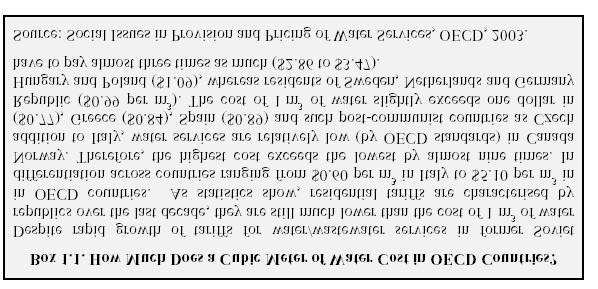
RER/01/G33/A/1G/31: Control of eutrophication, hazardous substances and related measures for rehabilitating the Black Sea ecosystem: Phase2
3.8 International experience with economic instruments
The rationale for this chapter is to reveal international experiences with regard to the use of
economic instruments for environmental policy, in particular, with respect to the water quality
problems in the Black Sea.
3.8.1 Water pricing user charges for water supply services and wastewater services
Differences in user charges for water services are not only a phenomenon in the Black Sea
countries but also in OECD countries as discussed in the box below (OECD 2003c):
3.8.2 Water supply50
Groundwater Tax in the Netherlands
In 1994, the Dutch government introduced a groundwater tax at the national level. A similar
tax at the regional level had already existed since 1983. The purpose of the tax is manifold: it
aims to raise revenue, but it is also intended to curb the use of groundwater and stimulate the
use of surface water. Groundwater is responsible for 70 per cent of the total water supply in
The Netherlands. Tax rates are differentiated between water uses, i.e. the agricultural sector
receives a 50% tax rebate meaning that the rate is 0.08 EUR/m3 as compared to the general tax
rate of 0.15 EUR/m3 which has to be paid by water works for water used for other purposes
(i.e. drinking water). . The water companies themselves monitor the volume of water
abstraction and all economic sectors (household, industry and agriculture) are affected by the
tax.
Indications are that the tax did indeed reduce the use of groundwater by up to 12 per cent. The
tax did raise the cost of water use by a significant percentage, of the order 40% for industries
supplied by water works, and in some exceptional cases of industries with self-extraction of
groundwater the tax occasionally led to an increase of more than 100 per cent. The
groundwater tax resulted in a 27 per cent increase in the average water tariff for supplying
drinking waters. Howeve r, total tax revenues generated by the groundwater tax amount to only
0.03 per cent of turnover of Dutch industry. So, although the increases in costs of water use
364
RER/01/G33/A/1G/31: Control of eutrophication, hazardous substances and related measures for rehabilitating the Black Sea ecosystem: Phase2
were significant in many cases, in terms of overall costs to industry, the changes were deemed
insignificant (ECOTEC, 2001).
Water Supply Tax in Denmark
The introduction of the water supply tax was part of a greater tax shifting programme (i.e.
ecological tax reform) in Denmark in the 1990s. The aim of this tax was to raise revenues to
reduce income tax and to increase the efficiency of water utilisation.
The tax was gradually introduced in 1994 and the final tax rate of 5 DKK/m3 (0.7 EUR/m3)
was reached in 199851. Only households and the service sector are subject to this tax. Industry
and agriculture have been effectively exempted from the tax. This final rate corresponded to
around 15-20% of the average water price (including sewage fees)(Ministry of Environment
and Energy, DEPA, 2000). This tax has been introduced with rather low administrative cost
since virtually all households were metered already, and as of January 1999, metering became
compulsory.
The main purpose of the tax was to make consumers pay for the natural resource, water, and
thereby act as an incentive to reduce water consumption. A secondary purpose was to affect a
decrease in the amount of sewage discharged, this being closely associated with the targeted
reduction in water consumption. A further aim of the tax was to increase the performance of
the water companies by minimising the leakage rate of water pipes.52
Water consumption in Denmark did decline significantly since the introduction of the tax, and
even the pipe leakage rate declined by 10 million m3. The Danish tax has too many
exemptions to promote resource use efficiency across the economy, but has induced additional
water savings estimated at about 13 per cent of residential use between 1994 and1999.
Tradable water rights in Chile
An interesting example of the application of another type of economic instrument is based on
the Chilean Water Code of 1981. This code established tradable water rights allocating water
to different user. Water rights in Chile are private assets, held separately from land ownership,
and these rights can be traded independently from trade in land. The provision of water and
sanitation services is through concessions. The government grants a service provider the
concession to provide water and sanitation services.
Tariffs are calculated at the marginal cost of the service provision. This has implied a drastic
increase in the price of water and sanitation services over the four year period during which
the system has been phased in. There is no explicit tax levied on water supply or the provision
of sanitation, but this system implied the removal of all subsidies from the sector.
3.8.3 Water pollution53
The Dutch wastewater scheme
The Netherlands has a waste water charge system which applies to the direct and indirect
discharges of organic material, nitrogen, mercury, cadmium, copper, zinc, lead, nickel,
chromium and arsenic into surface water bodies. There are effectively two different levy
systems for state and non-state waters. The former is regulated at the national level, and the
latter at the regional, provincial level and both schemes have been in place since the early
1970s.
365
RER/01/G33/A/1G/31: Control of eutrophication, hazardous substances and related measures for rehabilitating the Black Sea ecosystem: Phase2
The tax covers the costs of sewage treatment and resembles therefore an ordinary user fee.
However, in two important respects, it deviates from the cost recovery charge. The scheme
does not cover the costs of the sewer network, which is financed by a separate municipal fee.
The tax applies also to direct dischargers, i.e. industries and municipal treatment plants which
discharge to surface waters. The tax base is not the volume of water discharged but the
quantity of the actual pollutant discharged. The system is mainly based on a self-assessment
and monitoring, but is subject to sample control from the relevant authorities.
The regional water boards is the responsible authority for collecting the taxes for discharges to
regional water courses and their regional sewage treatment plants where as the government
collects the taxes based on the effluent discharged into state water.
Revenue from both taxes (state and non state waters) was earmarked for water quality
management tasks, including infrastructure investment in sewage treatment but also for
covering administrative costs such as permit awards and monitoring. However, this subsidy
scheme of providing financial resources for new investments expired at the end of 1996.
Another interesting aspect of the scheme was that some of the tax revenues were used to assist
industries which were identified as most likely to be most affected by the tax. The Dutch
Water Research Institute, RIZA, offered financial support to affected industries, such as pulp
and paper industry. Through close, concerted collaboration among public sewage specialists
and relevant experts from relevant private enterprises, it was possible to identify cost-effective
technological alternatives to conventional end-of-pipe measures.
According to the indicative multi-annual programme 1975-79 it was possible for the paper
industry to reduce emissions from 1.5 million inhabitant equivalent (i.e.) to 0.1-0.2 million i.e.
by a combination of cleaner technology and sewage treatment. For the sugar industry
emissions were reduced from 2.5 million i.e. to 0.005 million i.e. mainly by extensive
recirculation of water.
The tax was remarkably effective with a significant reduction in discharges since its
introduction. The net load on surface waters from discharges has been reduced from 45 million
inhabitant equivalents in 1970 to 4.6 million inhabitant equivalents in 1996, though clearly,
not all of this reduction can be attributed to the tax. The total revenue from the tax amounted
to 0.3 per cent of the sales value or 1 per cent of value added of all Dutch industry in 1996.
Initially, though, there was quite resistance from consumers who did not see themselves as
polluters, but it is now generally accepted.
The German wastewater tax
In Germany wastewater tax affects both direct and indirect dischargers to water. A direct
discharge fee is applicable to the 8,000 municipalities and 4,000 industries which discharge
waste water directly into a water course. This direct discharge fee is payable per unit of
damage unit calculated as either one of 50 kg of chemical oxygen demand (COD), 25 kg of
nitrogen, 3 kg of phosphorus etc. and interacts with the standards for sewage discharge in a
very complex way. The tax is reduced if the discharger adheres to the standards and is even
further reduced if the discharger performs better than the set standards.
366
RER/01/G33/A/1G/31: Control of eutrophication, hazardous substances and related measures for rehabilitating the Black Sea ecosystem: Phase2
Indirect discharges to a sewage plant are covered by the normal waste water user fee. Since the
treatment plant itself is subject to the wastewater discharge tax on direct dischargers, the
charge would be expected to be reflected in the user fee for wastewater services paid by those
to whom the service is provided.
The tax collected is distributed to the Länder authorities which have jurisdiction over water
management and the right to collect the taxes. The Länder are also responsible for the
monitoring and administration of the system. There is significant evidence that the tax
improved and reinforced compliance since many companies found it cheaper to improve on
water use in the production process than to introduce or extend sewage treatment. In that sense
the tax was very effective since its intention was not to raise revenue, but to encourage
compliance and to do even better than the standards. The emphasis on compliance also implied
that sewage treatment plants and industries invested in advanced treatment facilities.
It is certainly of great interest in the context of analysing water pollution in the Black Sea to
highlight some of the debates concerning the success or failure of the German effluent charge.
First of all it has to be said that: `it was never meant to reduce to a minimum the total cost of
pollution abatement, it was never meant to achieve allocative efficiency. From the beginning,
it was aimed at strengthening the implementation and enforcement of water legislation by
enabling (or forcing) the competent authorities to establish effective monitoring'54.
Important aspects of achieving such an aim are certainly to raise the public awareness
regarding water policy issues and to `consider capacity building as a separate function of
economic instruments. ... Capacity building can be beneficial on the side of the authorities
responsible for enforcing environmental legislation, as well as on the side of polluters'55.
From the perspective of the administration, such an economic instrument can be seen as a
policy tool for enforcing and strengthening direct regulation.
Because of the fact that the instrument was used partly to support the development of a well-
functioning regulatory infrastructure there would appear to be lessons to be learned from the
German approach.
Given the lack of regulatory capacity in many Black Sea countries at present, it would seem
quite appropriate to adopt an approach in which the tax was intended to assist the development
of regulatory capacity. At some stage, this has to be done anyway, and rather than trying to
find a mechanism to encourage compliance in the absence of any institut ional capacity to
ensure that compliance is indeed achieved, it may be wise to design the charge to support the
very regulatory capacity which is a pre-requisite for ensuring compliance with standards.
The Danish wastewater tax
The Danish authorities have introduced a mainly revenue raising waste water tax on direct
discharges into water courses. The tax applies to biological oxygen demand (BOD) nitrogen
and phosphorous at fixed rates per kilogram discharged. Though the main aim of the tax was
revenue raising, it had the added incentive of compliance to a set of standards, and to improve
the performance of waste water treatment processes. The tax accrues to the national fiscus, but
as a compromise the Danish government devotes a substantial portion thereof to an
367
RER/01/G33/A/1G/31: Control of eutrophication, hazardous substances and related measures for rehabilitating the Black Sea ecosystem: Phase2
independent Water Fund (whose aim is the protection of ground water resources), which
implies a degree of earmarking.
The Ministry of Taxation designed the tax, but the tax is collected by the customs and tax
agency. Some of the main polluting companies have been exempted for competitiveness
reasons, but overall the tax was very effective on those upon which it was levied, reducing the
level of discharges by between 20 and 25 per cent.
It is worthwhile to note that in the same period, emissions from those industries exempted
from the tax increased by between 15 and 20 percent, reducing the overall effectiveness
greatly.
The South American and Australian experience56
Water pollution is characterised as one of the main environmental problems in South
American countries, such as Brazil and Chile, and it is due to domestic effluents and industrial
discharges. In the 1990s around 50 percent of domestic sewage was collected by the general
sewerage system in Brazil. However, the treatment levels were rather low not exceeding 15
percent and it was estimated that investments of around 1 percent of Brazil's GDP would be
required to offer adequate sanitation levels (Huber et al, 1998, p.46), a similar situation as it is
the case in many CEE and EECCA countrie s.
Brazil and Chile implemented slightly different charging systems. Several Brazilian states
implemented sewage tariffs based on pollution content, and industrial effluent charges are
based on the content of organic matter as well as on suspended solids. Chile adopted another
system: the charges for the provision of water services are based on marginal cost pricing and
full cost recovery and additionally a surcharge of 7 percent on invested capital. Water charges
for effluent discharges are set on the basis of recovery of financial costs (Huber et al, 1998,
p31). This clearly meant that these charges do not correspond to the polluter pays principle
because of the lack of inclusion of environmental and resource costs.
The World Bank report states that the failure of these schemes with regard to introducing
pollution and usage criteria into the determination relates to the `lack of appropriate design of
the instrument, lack of information about impacts, incompatibility with the available
monitoring system, and inadequate planning of its coverage' (Huber et al, 1998, p31).
Probably the most illuminating proof of the failure of these charges is on the revenue side. It
was estimated that the potential revenue was about USD 90 million and actually only USD
116,000 were collected.
The structure of the water effluent charges implemented in the early 1990s in Australia is also
interesting. The actual level of the effluent charge implemented in South Australia depends on
a whole range of different criteria including a salinity factor and a pollutant factor (James,
1997). Of equal interest to the actual tariff setting procedure is the underlying strategy of
increasing the charge rates gradually over time with the intention of establishing an incentive-
based water effluent management system rather than a scheme designed simply to cover
operating and monitoring costs. This scheme follows the approach discussed in the World
Bank report above and is also closely linked to command-and-control regulations because all
discharges have to be licensed in South Australia. Advanced announcement of future increases
368
RER/01/G33/A/1G/31: Control of eutrophication, hazardous substances and related measures for rehabilitating the Black Sea ecosystem: Phase2
in taxes and charges, as in this case, could lead to dynamic efficiency gains since polluters
could invest in efficiency and pollution control now to avoid higher rates of tax in future.
3.8.4 Agricultural sector57
The use of pesticides and nitrogen emissions from agriculture cause environmental problems,
including the eutrophication of surface waters such as the Black Sea, and the pollution of
drinking waters. Several European countries implemented taxes levied on pesticides and
fertilisers to tackle this environmental problem and the European Union adopted the Nitrate
Directive in 1991 aiming to reduce nitrogen emissions.
International experiences show that taxation might be an effective instrument in reducing
emissions and the usage of pesticides and fertilizers. However, taxing these products is a
classic example of trying to control diffuse pollution meaning that the environmental impacts
are difficult to address because the actual emissions are influenced by different factors, such
the method of cultivation, the type of soil and chemicals application methods. The actual
design of the taxes is therefore of great importance for the effectiveness of them and it is
impossible to describe a `first-best' economic instruments. This is why the UK government
has been discussing a voluntary agreement with the agrochemical industry. The agreement
contains measures about the chemical mixture of pesticides and fertilisers and application
methods.
The Swedish pesticides tax
A pesticide charge, part of a larger agricultural programme of reducing environmental and
health risk associated with the use of pesticides was first introduced in Sweden in 1984 (See
also Parr and Reynolds, XXXX). The aim was to reduce the use of pesticides by 50 per cent
during the period 1986-1990 and to achieve a further reduction of 50 per cent until 1996.
Initially, the revenues of the charge were earmarked for financing pesticides action
programmes. The earmarked charge was replaced by a tax in 1995 and the revenues were
allocated to the state budget since then.
The current tax is levied as a fix amount of 20 SEK (2.2 EUR) applied to every kilogram of
active ingredient in the pesticide. It is difficult to assess the effectiveness of the tax. However,
in 1996 pesticides use expressed in kg per hectare in Sweden was around 0.5 kg per hectare,
while the EU average was 2.2 kg per hectare.
The Danish pesticides tax
The design of the Danish pesticides tax is quite different from the Swedish example
considering that the tax is an ad-valorem tax. However, the aims are very similar considering
that the Danish tax is part of the 1986 Danish National Pesticides Action Plan aiming to halve
the consumption of pesticides during a ten-year period and to shift consumption towards less
harmful pesticides. The problems associated with pesticides use are reflected in the tax design
because the tax is not differentiated according to toxicity or environmental impacts of different
pesticides. The ad valorem pesticide tax rates is on average 37 per cent of the retail price58.
The Swedish fertiliser tax
369
RER/01/G33/A/1G/31: Control of eutrophication, hazardous substances and related measures for rehabilitating the Black Sea ecosystem: Phase2
This tax shows quite some similarities with the Swedish pesticide tax discussed above. In 1984
it was introduced as an environmental charge for all chemical fertilisers and in 1994 the
scheme was transformed into a tax. This transfer led to a zero tax rate for potassium in
commercial fertilisers because it is assumed to have no negative environmental effects and in
addition a charge on phosphorous was eliminated and replaced by a tax levied on the cadmium
content of commercial fertilisers. The rate was set to 30 SEK (3.4 EUR) per gram of cadmium
taking into account a threshold of cadmium content exceeding 5 gram per tonne of
phosphorous. In addition the environmental tax amounts to around 1.8 SEK (0.2 EUR) per
kilogram of nitrogen. Revenues from the tax were originally used for financing environmental
projects and the tax amounted to around 20 per cent of the price of fertilisers in the mid 1990s
but which is still the case in 2000. The administration costs of this tax are reported to be
around 0.8 per cent of the revenues. Positive environmental effects in terms of a reduction of
fertilisers use by 10 20 per cent are attributed to the tax.
However, the current rate is too low considering some environmental policy objective of a
further N reduction of 7,850 tons for the year 2005. Based on the calculation carried out by the
Swedish Board of Agriculture in 1999 a six to eight fold increase of the tax on fertiliser-N to
between 10.5 and 15 SEK (1.2 1.7 EUR) per kg N would be required. This tax increase
would lead to a dramatic price increase, at least a doubling of the price of fertilisers if the
fertiliser industry would pass the tax payments completely onto the price of the product.
The Dutch scheme on nitrogen and phosphorous surplus 59
The Dutch government introduced a levy system on the nitrogen and the phosphate surplus in
1998 with the aim of reducing emissions. The design of this tax system is rather interesting
and is part of the `Minerals Accounting System (MINAS)' because taxes on nitrogen and
phosphorous (P2O5) surpluses must only be paid for exceedance of a threshold value, i.e. the
so called levy free surplus per hectare.
The crucial aspect of this system is that farmers must record all N and P2O5 inputs and
outputs so that a balance at farm level can be determined. The mineral balance, i.e. the N- and
P2O5 surplus per hectare, is calculated as input per hectare minus output per hectare. A levy-
free N and P2O5 surplus is allowed but which is reduced over time and only for the surplus
exceeding this standard a tax has to be paid.
The policy driver for setting up MINAS was the objectives laid down in the EU Nitrate
Directive. One of the objectives is to reduce and prevent surface and groundwater pollution
caused by nitrates from agricultural sources. Furthermore, this example clearly shows the need
for implementing a whole policy package covering economic instruments and regulatory
measures for effective environmental policy.
Trading regimes in the United States
The United States follows a different approach with regard to applying economic instruments
as compared to the situation in EU member states. The latter make regular use of taxes and
charges for environmental policy and the former favours trading permits and rights. As
discussed in Chapter 2 the main difference lies that European countries are relying on existing
markets and the United States is creating new markets. Parr and Reynolds XXXX mention
some examples of US experience in tradable rights with regard to water pollution, P and N,
370
RER/01/G33/A/1G/31: Control of eutrophication, hazardous substances and related measures for rehabilitating the Black Sea ecosystem: Phase2
and between point and non point, i.e. diffuse, sources. Favourable results of trading regimes
can be found in the literature.
3.8.5 Other economic instruments
A whole range of other economic instruments is applied in many countries. In Denmark, a
voluntary approach between the government and local authorities is reported aiming to phase
out pesticides use by local authorities (ECOTEC 2001).
Labelling standards are also a regularly used tool for restricting the use of chemicals in
agriculture. For example, an eco-labelling system was implemented in the Czech Republic in
1994 covering a variety of products, such as liquid cleaning agents, textile products, etc.
Furthermore, a voluntary approach of reducing the environmental impact of washing powder
has been established in 1995 (OECD/EEA database 2003
http://www1.oecd.org/scripts/env/ecoInst/index.htm).
As mentioned above, revenues generated by effluent charges and other environmental taxes
and charges are regular earmarked for environmental funds in many CEE and EECCA
countries. The major share of the budget of these environmental funds have been used for
financing environmental infrastructure investment in the water sector (Speck et al 2001b and
OECD 1999).
3.8.6 Appropriateness for Black Sea countries
The international experience demonstrates that economic instruments can have an important
signalling impact on water management issues. However, it has to be stressed that all these
examples of international experience with regard to the use of economic instruments serve
only illustrative purposes. This clearly implies that no unique `recipe' for the selection and
design of the appropriate economic instruments exists either in developed countries or in
economies in transition.
Similarly, it has to be recorded that economic instruments are `no panacea' for solving
environmental problems and for overcoming other problems including the lack of enforcement
capacity in countries studied in this report. The existence of a well functioning institutional
framework is a prerequisite that economic instruments are working effectively. Enforcement
requires not only technical expertise but also political support. Both features are regularly
neglected in the political life because they are not high on the political agenda. Reasons are
manifold reaching from the lack of technical equipment which is necessary for effective
enforcement to corruption. In particular, environmental institutions must often be regarded as
weak leading to a lax enforcement of economic instruments as well of regulatory measures.
Therefore, a direct transfer of economic instruments between is not recommended because the
institutional, administrative, regulatory background is different from country to country, i.e.
what works in one country need not to work in another country.
However, some of these problems can partly be solved in the process of designing economic
instruments as it was the case in the German wastewater tax. A similar approach was proposed
in Brazil60: the charge rates would be set at levels covering administrative and monitoring
371
RER/01/G33/A/1G/31: Control of eutrophication, hazardous substances and related measures for rehabilitating the Black Sea ecosystem: Phase2
costs at the beginning. A gradual increase of these rates would then follow over time taking
into account pollution patterns into the determination of the charges, i.e. extending the charge
base from a pure cost-covering charge to a charge with clear environme ntal features.
Furthermore, the Dutch experience with regard to the wastewater tax scheme is also of some
interest as a part of the revenues generated by the scheme have been used to financially
support sensitive economic sectors to adapt to the more stringent environmental regulations.
This approach allowed to eliminate and to reduce the potential negative consequences of more
stringent environmental protection measures for these economic sectors.
This section has to be elaborated in more detail after we get the individual country reports
knowing the country problems and the country-specific situation.
372
RER/01/G33/A/1G/31: Control of eutrophication, hazardous substances and related measures for rehabilitating the Black Sea ecosystem: Phase2
4. SHORT LIST OF ECONOMIC INSTRUMENTS
(RECOMMENDATIONS)
To be completed. A table like the following will be completed, in which each cell will give
some assessment of the likely success of the instrument in each country or a selection of
countries or the region as a whole. Note that there does not need to be a separate EI for each of
the priority sectors one EI (e.g. water pricing) could cover all three (and possibly other)
sectors. The table will be filled on the basis of the analysis from the national experts and will
be the product of the team workshop in early February.
EIs
Bulgaria Georgia Romania Russian
Turkey
Ukraine Regional
Federation
User
charges
Etc.
5. CONCLUSIONS AND NEXT STEPS
To be completed.
6. REFERENCES
Bell R. G., 2002, Are Market-Based Instruments the Right First Choice for Countries in
Transition? Resources Winter 2002 Issue 146, pp. 10 14.
ECOTEC et al., 2001, Study on the Economic and Environmental Implications of the Use of
Environmental Taxes and Charges in the European Union and Member States. Report for the
European Union.
http://europa.eu.int/comm/environment/enveco/taxation/environmental_taxes.htm.
Eunomia et al., 2003, Development of a Framework for Levy-Based Instruments for
Environmental Policy in South Africa, an internal report for National Treasury of South
Africa.
European Commission (EC), 1997, Proposal for a Council Directive Restructuring the
Community Framework for the Taxation of Energy Products, COM(97)30final, Brussels,
Belgium.
European Commission (EC), 2000a, Bridging our Needs and Responsibilities Together
Integrating Environmental Issues with Economic Policy, COM(2000)576final, Brussels,
Belgium.
European Commission (EC), 2000b, Water Pricing in selected Accession Countries to the
European Union, current policies and trends, A report produced for the European
Commission, DG Environment, Brussels, Belgium.
373
RER/01/G33/A/1G/31: Control of eutrophication, hazardous substances and related measures for rehabilitating the Black Sea ecosystem: Phase2
European Commission (EC), 2002, Support to the Implementation of Environmental Policies
and NEAPs in the NIS Sub-Project Georgia: Increasing the Effectiveness of Economic
Instruments Concept Paper: Revising the Georgian Pollution Tax System, Brussels, Belgium.
European Commission (EC), 2003, Support to the Implementation of Environmental Policies
and NEAPs in the NIS Sub-Project Georgia: Increasing the Effectiveness of Economic
Instruments Working Note: Georgian Natural Resource Tax System, Brussels, Belgium.
European Environment Agency (EEA), 2000, Environmental Taxes: Recent Developments in
Tools for Integration, Copenhagen, Denmark.
European Parliament, 2001, Effluent Charging Systems in the EU Member States, Working
Paper Environment Series ENVI 104 EN. www.europarl.eu.int
James D., 1997, Environmental Incentives Australian Experience with Economic Instruments
for Environmental Management, Environment Australia.
Huber R.M., J. Ruitenbeek and R. S. da Motta, 1998, Market Based Instruments for
Environmental Policymaking in Latin America and the Caribbean Lessons from eleven
Countries, World Bank Discussion Paper No. 381, World Bank, Washington, D.C., USA.
Ministry of Environment and Energy, DEPA, 2000, Economic Instruments in Environmental
Protection in Denmark, Copenhagen, Denmark.
Organisation for Economic Co-operation and Development (OECD), 1972, The Polluter Pays
Principle: Analysis and Recommendations, Paris, France.
Organisation for Economic Co-operation and Development (OECD), 1995, The Effectiveness
and Efficiency of Water Effluent Charge Systems: Case Study on Germany,
ENV/EPOC/GEEI(95)12, Paris, France.
Organisation for Economic Co-operation and Development (OECD), 1997, Evaluating
Economic Instruments for Environmental Policy, Paris, France.
Organisation for Economic Co-operation and Development (OECD), 1999a, Economic
Instruments for Pollution Control and Natural Resources Management in OECD Countries: A
Survey, Paris, France.
Organisation for Economic Co-operation and Development (OECD), 1999b, The Price of
Water Trends in OECD Countries, Paris, France.
Organisation for Economic Co-operation and Development (OECD), 1999c, Sourcebook on
Environmental Funds in Economies in Transition, Paris, France.
374
RER/01/G33/A/1G/31: Control of eutrophication, hazardous substances and related measures for rehabilitating the Black Sea ecosystem: Phase2
Organisation for Economic Co-operation and Development (OECD), 2000a, Economic
Instruments for Environmental Protection and Natural Resource Management: Georgia, EAP
TFS/DANCEE, Paris, France;
http://www.cowi.ru/almaty/documents.htm
Organisation for Economic Co-operation and Development (OECD), 2000b, Economic
Instruments for Environmental Protection and Natural Resource Management: Russian
Federation, EAP TFS/DANCEE, Paris, France;
http://www.cowi.ru/almaty/documents.htm
Organisation for Economic Co-operation and Development (OECD), 2000c, Economic
Instruments for Environmental Protection and Natural Resource Management: Ukraine, EAP
TFS/DANCEE, Paris, France;
http://www.cowi.ru/almaty/documents.htm
Organisation for Economic Co-operation and Development (OECD), 2001, Environmentally
Related Taxes in OECD Countries: Issues and Strategies, Paris, France.
Organisation for Economic Co-operation and Development (OECD), 2003a, The Use of
Economic Instruments for Pollution Control and Natural Resource Management in EECCA,
CCNM/ENV/EAP(2003)5, Paris, France.
Organisation for Economic Co-operation and Development (OECD), 2003b, Key Issues and
Recommendations for Consumer Protection: Affordability, Social Protection, and Public
Participation in Urban Waste Water Sector in Eastern Europe, Caucasus and Central Asia,
Paris, France.
Organisation for Economic Co-operation and Development (OECD), 2003c, Social Issues in
Provision and Pricing of Water Services, Paris, France.
Organisation for Economic Co-operation and Development (OECD), Database on Economic
Instruments, checked on October 7, 2003 at
http://www1.oecd.org/scripts/env/ecoInst/index.htm
Öko Inc, 2001, Agricultural Water Management Policies in Bulgaria, Hungary, Romania and
Slovakia, final report for the Regional Environmental Center for Central and Eastern Europe
(REC), Budapest, Hungary.
Parr B. and P. J. Reynolds, XXXX, The development of process, stress reduction and
environmental status indicators to monitor the effects of nutrients within the Black Sea Basin,
Draft Discussion Paper, Black Sea Implementation Unit, Istanbul, Turkey.
Schreiber H. et al., 2003, Harmonised Inventory of Point and Diffuse Emissions of Nitrogen
and Phosphorous for a Transboundary River Basin, a report of the Federal Ministry of the
Environment, Nature Conservation and Nuclear Safety, Research report 200 22 232, Berlin,
Germany.
375
RER/01/G33/A/1G/31: Control of eutrophication, hazardous substances and related measures for rehabilitating the Black Sea ecosystem: Phase2
Söderholm P., 1999, Environmentally Policy in Transition Economies: The Effectiveness of
Pollution Charges, Lulea University of Technology, Lulea, Sweden.
Speck S., J. McNicholas and M. Markovic, 2001a, Environmental Taxes in an Enlarged
Europe, The Regional Environmental Center for Central and Eastern Europe, Szentendre,
Hungary.
Speck S., J. McNicholas and M. Markovic, 2001b, Environmental Funds in the Candidate
Countries, The Regional Environmental Center for Central and Eastern Europe, Szentendre,
Hungary.
Speck S. and A. Martusevich, 2003, Reform of Pollution Charges in the Russian Federation:
Assessment of Progress and Opportunities and Constraints for Further Improvement, an
internal report for OECD, Paris, France.
World Bank, 1998, Pollution Prevention and Abatement Handbook, Washington, D.C., USA.
376
RER/01/G33/A/1G/31: Control of eutrophication, hazardous substances and related measures for rehabilitating the Black Sea ecosystem: Phase2
Annex 1: Glossary of Terms
Administrative
A one-off or recurring payment for a discharge permit (to discharge
fee for discharge effluents into natural waters). This is distinct from the effluent tax /
permits
charge because the amount to be paid is not connected to the amount of
effluents discharged.
Direct discharge The discharge of effluents or domestic sewage directly into natural
waters (with optional treatment before discharge).
Direct
Someone who discharges effluents or domestic sewage directly into
discharger
natural waters, e.g.: industrial plants that discharge effluents directly
into natural waters (with or without treatment); farmers that discharge
effluents directly into natural waters (with or without treatment);
households that discharge effluents directly into natural waters (with or
without treatment); or operators of municipal sewage treatment plants.
Domestic
Used water from households discharged into the sewer (system), or
sewage
after treatment into natural waters.
Effluent
Used water from industry, farms and others discharged directly into
natural waters or into the sewer (system) as well as the water
discharged from a municipal or industrial sewage treatment plant into
natural waters.
Effluent
The money paid by direct dischargers for the direct discharge of
tax/charge
effluents into natural waters. Usually, the charge is paid to a public or
para-statal authority. The tax/charge base is the qua nitity of the
effluent or pollutants, such as suspendid solids, BOD, COD.
Extraction
The money paid by companies, etc. extracting ground or surface water.
tax/charge
Tax is paid to public or para-statal authority. The tax/charge base is
generally the quantity of water extracted.
Indirect
The discharge of effluents or domestic sewage into the sewer system
discharge
(with or without pre-treatment).
Indirect
Someone who discharges effluents or domestic sewage into the sewer
discharger
system (with or without pre-treatment), e.g.: households discharging
domestic sewage into the sewer system; industry discharging effluents
into the sewer system; or farmers discharging effluents into the sewer
system.
Sewage
Installation that treats effluents, domestic sewage and rainwater
treatment plant
discharged into the sewer system. The operators or owners of
or wastewater
municipal sewage treatment plants may be municipalities, regional
treatment plant
authorities, private companies, or others.
377
RER/01/G33/A/1G/31: Control of eutrophication, hazardous substances and related measures for rehabilitating the Black Sea ecosystem: Phase2
Sewer (system)
Canal (system) that collects the effluents of different users and directs
them to a municipal sewage treatment plant.
User charge for
The money paid by water users (household, industry agriculture) for
water service
the delivery of water independent from water usage/purposes; i.e.
drinking water, cooling water, irrigation, etc.
The user charge can (but need not) consist of different components,
such as extraction tax, administration costs, costs associated with
transport and distribution of water, VAT.
User charge for
The money paid by household, industry, agriculture discharging
wastewater
effluents or domestic sewage directly into natural waters.
service direct
The user charge can (but need not) consist of different components,
discharge
such as administration costs, costs associated with transport and
distribution of wastewater direct into natural waters, effluent
tax/charge and VAT.
User charge for
The money paid by household, industry, agriculture discharging
wastewater
effluents or domestic sewage into the sewer system (with or without
service
pre-treatment).
indirect
The user charge can (but need not) consist of different components,
discharge
such as administration costs, costs associated with operating a
wastewater treatment plants, costs associated with transport and
distribution of wastewater direct into natural waters, effluent
tax/charge and VAT.
Reference: European Parliament 2001 and own discussion.
The term `user charge' is used as a synonym for `cost-covering charge' or `user fee'. The term
`tariff' is often used synonymously too.
User charges / tariffs have to be paid by water consumers and the revenues are collected by
water utilities. However, parts of the revenues have to be transferred to public authorities, i.e.
revenues collected as VAT payments and liabilities as a consequence of extraction tax/charge
and of effluent tax/charge.
378
Appendix V
Memorandum of Understanding between the ICPBS and ICPDR on
Common Strategic Goals (pdf file)
ANNEX A: CO-FINANCING BY THE BLACK SEA COMMISSION
Total BSC and BS countries contributions
The overall budget of the BSC and its Permanent Secretariat comprises the following:
e) BSC PS annual budget;
f) BSC advisory groups
g) Participating countries
h) Others
Total Contributions
e) BSC PS
Year
2003-2004
2004-2005
2005-2006
Total
Operational BSC Budget,
261,360
261,360
261,360
784,080
USD
f) BSC PS
Year
2003-2004
2004-2005
2005-2006
Total
Advisory groups, USD
118,000
118,000
118,000
354,000
g) Joint activities of the participating countries
Year
2004
2005
2006
Total
Joint activities, USD
0
0
0
0
h) Other
Year
2004
2005
2006
Total
European Commission, USD
44,77661
44,776
0
89,552
Summary Table of the BSC and BS countries contribution
Budget Item
2003-2004
2004-2005
2005-2006
Total
BSC Budget
261,360
261,360
261,360
784,080
BSC AGs
118,000
118,000
118,000
354,000
Joint Activities
0
0
0
0
Others
44,776
44,776
89,552
Total
424,136
424,136
379,360
1,227,632
380
BSC Budget
Summary of the contributions of the Contracting Parties
2004
2005
2006
Bulgaria
43,560
43,560
43,560
Georgia
43,560
43,560
43,560
Romania
43,560
43,560
43,560
Russian Federation
43,560
43,560
43,560
Turkey
43,560
43,560
43,560
Ukraine
43,560
43,560
43,560
Total
261,360
261,360
261,360
Budget for the year 2003-2004 (USD)
Contracting Parties
Contribution share (%)
Amounts (USD)
Bulgaria
16.67
43,560
Georgia
16.67
43,560
Romania
16.67
43,560
Russian Federation
16.67
43,560
Turkey
16.67
43,560
Ukraine
16.67
43,560
Total contribution
100
261,360
DG AidCo
Euro 36,000
Total Expenditure
Operational Costs (USD)
39,360
Personnel Costs (USD)
150,000
Activities under the Work Program (USD)
72,000
Total
261 360
Seconded staff by EC DG AidCo
Euro 36 000
Budget for the year 2004-2005 (USD)
Contracting Parties
Contribution share (%)
Amounts (USD)
Bulgaria
16.67
43,560
Georgia
16.67
43,560
Romania
16.67
43,560
Russian Federation
16.67
43,560
Turkey
16.67
43,560
Ukraine
16.67
43,560
Total contribution
100
261,360
DG AidCo
Euro 36 000
Total Expenditure
Operational Costs (USD)
39 360
Personnel Costs (USD)
150,000
Activities under the Work Program (USD)
72 000
Total
261 360
381
Seconded staff by EC DG AidCo
Euro 36 000
Budget for the year 2005-2006 (USD)
Contracting Parties
Contribution share (%)
Amounts
Bulgaria
16.67
43,560
Georgia
16.67
43,560
Romania
16.67
43,560
Russian Federation
16.67
43,560
Turkey
16.67
43,560
Ukraine
16.67
43,560
Total contribution
100
261 360
Total Expenditure
Operational Costs (USD)
39 360
Personnel Costs (USD)
150,000
Activities under the Work Program (USD)
72 000
Total
261 360
Expenditures per Advisory Groups
Advisory
2003-2004
2004-2005
2005-2006
Total
Group
Domestic
7,200
7,200
7,200
21,600
AG ESAS
Meetings
8,000
8,000
8,000
24,000
Subtotal
15,200
15,200
15,200
45,600
Domestic
7,200
7,200
7,200
21,600
AG FOMLIR
Meetings
8,000
8,000
8,000
24,000
Subtotal
15,200
15,200
15,200
45,600
Domestic
7,200
7,200
7,200
21,600
AG PMA
Meetings
8,000
8,000
8,000
24,000
Subtotal
15,200
15,200
15,200
45,600
Domestic
7,200
7,200
7,200
21,600
AG ICZM
Meetings
8,000
8,000
8,000
24,000
Subtotal
15,200
15,200
15,200
45,600
382
Advisory
2003-2004 2004-2005 2005-2006
Total
Group
Domestic
7,200
7,200
7,200
21,600
AG CBD
Meetings
8,000
8,000
8,000
24,000
Subtotal
15,200
15,200
15,200
45,600
Domestic
7,200
7,200
7,200
21,600
AG LBS
Meetings
8,000
8,000
8,000
24,000
Subtotal
15,200
15,200
15,200
45,600
Domestic
5,400
5,400
5,400
16,200
AG IM
Meetings
8,000
8,000
8,000
24,000
Subtotal
13,400
13,400
13,400
40,200
Domestic
5,400
5,400
5,400
16,200
EG WFD
Meetings
8,000
8,000
8,000
24,000
Subtotal
13,400
13,400
13,400
40,200
Total
118,000
118,000
118,000
354,000
Activities
ESAS
FOMLI
PMA
ICZM
CBD
LBS
IM
WFD
R
Countrie
m-d
US$
m-d US$
m-d US$
m-d US$
m-d
US$
m-d
US$
m-d
US$
m-d
US$
s
Bulgaria
90
2700
30
900
30
900
30
900
30
900
30
900
30
900
30
900
Georgia
30
900
30
900
30
900
30
900
90
2700
30
900
30
900
30
900
Romania
30
900
90
2700
30
900
30
900
30
900
30
900
30
900
30
900
Russia
30
900
30
900
30
900
90
2700
30
900
30
900
30
900
30
900
Turkey
30
900
30
900
30
900
30
900
30
900
90
270
30
900
30
900
0
Ukraine
30
900
30
900
90 2700
30
900
30
900
30
900
30
900
30
900
Total 7200
7200
7200
7200
7200
7200
5400
5400
Calculations are made based on the assumption that the average expenditures in the region and for
the time period in question amount to 30 USD/d
The average expenditures for a meeting of an advisory group amount to USD 8,000.
383
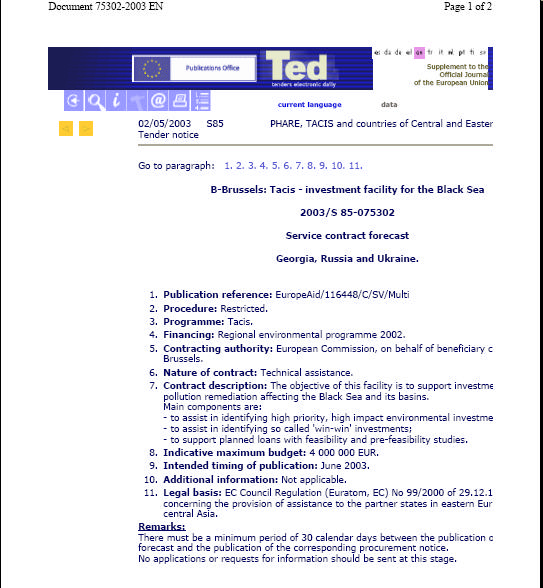

ANNEX B: EUROPEAID INPUT
384
385
386
UNDP-GEF Black Sea Ecosystem Recovery Project
Project Implementation Unit
Dolmabahce Sarayi, II. Hareket Kosku 80680 Besiktas, Istanbul - TURKEY
Tel: 90.212.310 29 24, 90.212.310 29 27
Fax: 90.212.227 99 33
e-mail: pjreynolds@blacksea-environment.org
web: www.bserp.org