


Global Ballast Water
Management Programme
Stopping the ballast
water stowaways!
A cooperative initiative of the Global Environment Facility,
United Nations Development Programme and International Maritime Organization.
GLOBAL BALLAST WATER MANAGEMENT PROGRAMME
The Problem
Marine species are being carried around the world in ships'
ballast water. When discharged into new environments,
they may become invasive and severely disrupt the
native ecology, impact economic activities such as
fisheries and cause disease and even death in humans.
Invasive marine species are one of the four
greatest threats to the world's oceans.
The other three are:
Land-based sources of marine pollution.
Over-exploitation of living marine
resources.
Physical alteration and destruction of
coastal and marine habitat.
What is Ballast Water?
Ballast is any material used to weight or balance an
object. One example is the sand-bags carried on
conventional hot-air balloons. These can be discarded to
lighten the balloon's load, allowing it to ascend.
In ships, ballast is used to maintain balance, stability and
structural integrity, especially when the ship is empty of
cargo. Ships have carried solid ballast, in the form of
rocks, sand and metal, for thousands of years. Modern
ships use water as ballast.
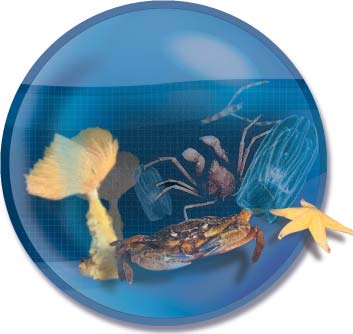
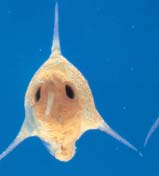
Crab larva - Roger Steene
Unwanted Stowaways
A problem may arise when ballast water taken
on by a ship contains unwanted marine organisms.
These may be bacteria and other microbes, planktonic
species, small invertebrates and the spores, eggs and
larvae of larger species.
The potential for species transfer is compounded by the
fact that almost all marine species have planktonic
stages in their life-cycle, which may be small enough to
pass through a ship's ballast water intake ports and
pumps. This means that species with adult stages that
are large or attached to the seabed, may still be
transported in ballast water.
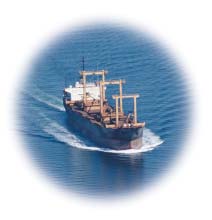
Ship discharging ballast - Steve Raaymakers

GLOBAL BALLAST WATER MANAGEMENT PROGRAMME
The Impacts
Most species carried in ships' ballast water do not
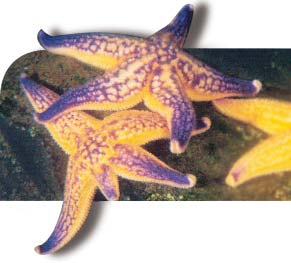
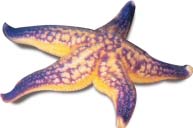
The North Pacific Seastar Asterias amurensis:
survive the voyage. Most of those that do, do not
Introduced to southern Australia.
survive when discharged into the new environment.
This voracious predator threatens commercial
Under certain circumstances some species do survive to
stocks of shellfish species such as oysters and
form viable populations, and may become serious pests.
scallops. This large Seastar is a prolific
breeder and in one estuary alone in
Impacts can be divided into three main
Tasmania reached an estimated total
categories:
population of nearly 30 million individuals,
at densities greater than any recorded in it's
native range.4
Ecological: when the native biodiversity and/or
ecological processes may be disrupted by the
invading species. It is estimated that
introduced marine species invade new
environments somewhere in the world on a
weekly to daily basis.1
Economical: when fisheries, coastal industry
and other commercial activities and resources
are disrupted by the invading species. It is
estimated that the cost of all invasive species
exceed US$138 billion per year in the USA
alone! 2
Human health: when toxic organisms, diseases
and pathogens are introduced through
ballast water, causing illness and even death
in humans.
There are hundreds of examples of severe ecological,
North Pacific Seastar - CSIRO Australia
economical and human health impacts from invasive
marine species around the world. Some outstanding
examples include:
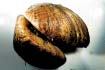
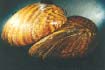
The European Zebra Mussel Dreissena
polymorpha: Introduced to the North
Toxic dinoflagellates: Spread to several
American Great Lakes. It has spread to infest
locations around the world through ships'
more than 40% of US waterways, fouls the
ballast water. Under favourable conditions
cooling-water intakes of industry. It may have
these micro algae may bloom to form `red
cost between US$750 million and US$1 billion
tides'. If absorbed into filter-feeding shellfish
in control measures from 1989 to 2000.3
such as oysters and scallops, they may release
toxins. This can cause paralysis or death in
humans who eat the contaminated shellfish.
Zebra Mussels - Sergei Olenin
Once established, it is virtually impossible
to control an invasive marine species.
Impacts are usually irreversible.
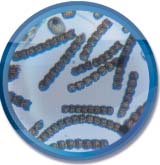
Toxic dinoflagellates - Gustaaf Hallegraeff



GLOBAL BALLAST WATER MANAGEMENT PROGRAMME
The Progress
Guidelines
Regulation
In response to this global
IMO member countries are also developing a new
threat, the International
international convention to provide a standardised,
Maritime Organization (IMO)
global regulatory regime for the management of ballast
has developed Guidelines for
water. Negotiations and drafting are at an advanced
the control and management
stage and it is anticipated that the convention will be
of ships' ballast water, to
adopted in 2003.
minimise the transfer of
harmful aquatic organisms
and pathogens - IMO
Assembly Resolution
A.868(20). The guidelines
recommend a number of
measures aimed at:
Minimising the uptake of organisms during
ballasting.
Research & Development
In recognition of the safety, operational and
Minimising the build-up of sediments in ballast
environmental limitations of the currently recommended
tanks, which may harbour organisms.
practice of ballast exchange at sea, there are a large
number of R&D projects being carried out around the
world to develop more effective ballast water treatment
Undertaking ballast water management
methods. Options being considered include:
measures, including ballast exchange at sea,
to minimise the transfer of organisms.
Mechanical and physical treatment such as
filtration, separation and sterilisation using
They also provide for vessel-specific ballast water
ozone, ultra-violet light, electric currents and
management plans, record keeping and reporting and
heat treatment.
port-based management practices. The Guidelines are
available on the GloBallast website,
Chemical treatment such as adding biocides to
http://globallast.imo.org.
ballast water to kill organisms.
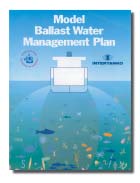
Model Management Plan
To assist ships in
complying with the
IMO Guidelines, the
International Chamber
of Shipping (ICS) and the
All of these possibilities currently require significant
International Association
further research. Any control measure that is developed
of Independent Tanker
must meet a number of criteria, including:
Owners (INTERTANKO)
have produced a
Model Ballast Water
It must be safe.
Management Plan.
It must be environmentally acceptable.
Contact ics@marisec.org
It must be cost-effective.
It must work.
The GloBallast website contains a global directory of
ballast water treatment R&D projects.

Facts & Figures
The Programme
Technical Assistance
Shipping carries more than 80% of the
world's commodities and is essential to
IMO has joined forces with the Global Environment
Facility (GEF) and the United Nations Development
the global economy.
Programme (UNDP) to assist developing countries to
reduce the transfer of invasive marine species in
ballast water.
A single bulk cargo ship of 200,000 tonnes can
carry up to 60,000 tonnes of ballast water.
The Global Ballast Water Management Programme
(GloBallast) is working through six initial demonstration
sites to implement the existing IMO guidelines and
Ballast water is essential to the balance,
prepare for the new international regulatory regime.
stability and structural integrity of a ship
when it is empty of cargo. Ships MUST
use ballast.
Activities
Technical assistance activities being carried out under
GloBallast include:
It is estimated that around 3 to 10 billion
tonnes of ballast water are carried around
the world each year. Studies are underway to
Education and awareness.
define this more clearly.5
Ballast water risk assessments.
Port baseline surveys.
It is estimated that more than 7,000 different
Ballast water sampling.
species are carried around the world in ships'
Training of port and shipping personnel in
ballast each day.6
ballast water management practices.
Assistance with laws and regulations.
It is estimated that the cost of all invasive
species is in the vicinity of US$138 billion per
Self financing mechanisms.
year in the USA alone!2
Shipping is increasing and greater quantities
of ballast water are being carried more
quickly and more frequently to an increasing
number of new destinations.
Invasive marine species are one of the four
greatest threats to our oceans.
The Global Ballast Water Management
Programme is working to address this threat.
The initial demonstration sites will be replicated in each
region as the programme develops.
IMO member countries are developing a new
international convention to provide a standardised,
global regulatory regime for the management of
ballast water.
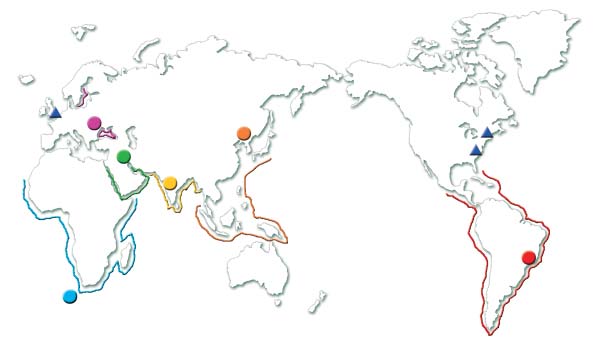
GloBallast Demonstration Sites
IMO
UNDP
GEF
Demonstration Site
Pilot Country
Region
Dalian
China
Asia/Pacific
Khark Is
I.R. Iran
ROPME Sea Area & Red Sea
Mumbai
India
South Asia
Odessa
Ukraine
Eastern Europe
Saldanha
South Africa
Africa
Sepetiba Brazil
South
America
UN Agencies
GEF - Washington DC
UNDP - New York
IMO - London
(Funding Agency)
(Implementing Agency)
(Executing Agency)



GLOBAL BALLAST WATER MANAGEMENT PROGRAMME
Programme Summary
Global Ballast Water
Management Programme
Development Objectives Assist developing countries to reduce the transfer of harmful aquatic organisms in
ships' ballast water.
Assist developing countries to implement the IMO Ballast Water guidelines (A.868(20))
and prepare for the new IMO Ballast Water Convention.
Timeline Initially three years March 2000 to March 2003, extended by 1 year to March 2004.
Initial funding US$7.4 million from Global Environment Facility (GEF). US$2.8 million support-in-kind
from participating countries.
Implementation United Nations Development Programme (UNDP).
Execution International Maritime Organization (IMO), through Programme Coordination Unit (PCU).
Recipients/beneficiaries Initially, six pilot countries/demonstration sites, to be replicated throughout regions.
Partners Shipping and port industries, international environmental non-government
organisations, other parties as programme develops.
Activities Establish Programme Coordination Unit at IMO, comprising Chief Technical Adviser,
Technical Adviser, Programme Assistant and support.
Establish Information Clearing House including website, databases/directories, library
collection, newsletter and global communications system.
Establish and support Lead Agency, Country Focal Point (CFP), Country Project Task
Force (CPTF) and CFP Assistant in each pilot country.
Establish Global coordination arrangements Global Project Task Force (GPTF).
Develop and implement communication, education and awareness raising
programmes.
Undertake Ballast Water Risk Assessments to assess risk of introductions of marine
species at each demonstration site.
Undertake Port Baseline Surveys of native biota and introduced marine species at
each demonstration site.
Develop Training Packages to train Lead Agency, port and shipping personnel in ballast
water management measures as contained in IMO guidelines.
Review legislation relevant to ballast water in each country and advise/assist
improvements.
Develop and implement National ballast water management plans for each pilot country.
Hold global R&D symposium to review scope for new ballast water management and
treatment measures and coordinate R&D agenda.
Develop Compliance Monitoring and Enforcement (CME) systems for each demonstration
site, including ballast water sampling equipment and training.
Form Regional Task Forces (RTFs), support RTF meetings and study tours to the
demonstration sites by personnel from neighbouring countries.
Identify long term economic instruments that can be used to resource in-country
ballast water management arrangements.
Hold Strategic Directions/Donor Conference to provide sustainable continuity of the
programme.

GLOBAL BALLAST WATER MANAGEMENT PROGRAMME
2nd Edition July 2002
Further Information
Programme Coordination Unit
Global Ballast Water Management Programme
International Maritime Organization
4 Albert Embankment London SE1 7SR United Kingdom
Tel +44 (0)20 7587 3247 or 3251
Fax +44 (0)20 7587 3261
Web http://globallast.imo.org
st & Associates
e
References
1.
Carlton, J.T. 2002. Personal Communication.
2.
Pimentel, D., Lach, L., Zuniga, L. and Morrison, D. 2000. Environmental and economic costs of nonindigenous species in
the United States. BioScience 50:53-65.
3.
O'Neill, C. R. 2000. Cited in: Carlton, J.T. 2001. Introduced Species in U.S. Coastal Waters: Environmental Impacts and
Management Priorities. Pew Oceans Commission, Arlington VA.
4.
C.L. Goggin (Ed.). 1998. Proceedings of a meeting on the biology and management of the introduced seastar Asterias
amurensis in Australian waters. Centre for Research on Introduced Marine Pests Technical Report No. 15 CSIRO, Hobart.
5.
Andersen, A.B., Gollasch, S. & Rigby, G. 2002. Personal Communications.
6.
Carlton, J. T. 1999. The scale and ecological consequences of biological invasions in the world's oceans, pp. 195-212. in:
Odd Terje Sandlund, Peter Johan Schei, and Ćuslaug Viken, editors, Invasive Species and Biodiversity Management.
Produced by the GloBallast PCU · Designed and printed by Daniel W
Kluwer Academic Publishers, Dordrecht, 431 pp.