UNDP Project Document
United Nations Development Program
International Maritime Organization
Building Partnerships to Assist Developing Countries to Reduce the Transfer of Harmful
Aquatic Organisms in Ships' Ballast Water (GloBallast Partnerships)
GloBallast Partnerships will assist developing countries to reduce the risk of aquatic bio-
invasions mediated by ships' ballast water and sediments and will expand and build on a
successfully completed GEF-UNDP-IMO pilot project (GloBallast Project). With the help
of tools developed and lessons learned from the pilot project, the GloBallast Partnerships
project will expand government and port management capacities, instigate legal, policy and
institutional reforms at the country level, develop mechanisms for sustainability, and drive
regional coordination and cooperation. The project will spur global efforts to design and test
technology solutions, and will enhance global knowledge management and marine
electronic communications to address the issue. The partnership effort is three-tiered,
involving global, regional and country-specific partners, representing government, industry
and non-governmental organizations. Private sector participation will be achieved through
establishing a GloBallast Industry Alliance with partners from major maritime companies.
13 countries, from 6 high priority regions, have agreed to take a lead partnering role
focusing especially on legal, policy and institutional reform. All told, more than 70
countries in 14 regions across the globe will participate, including the six pilot countries
whose expertise and capacities will be drawn on for this global scaling-up effort
i
Table of Contents
1
ELABORATION OF THE NARRATIVE.......................................................................................................... 1
1.1
SITUATION ANALYSIS ..................................................................................................................................... 1
1.1.1
Context and global significance................................................................................................................ 1
1.1.2
GEF, UNDP, IMO Consultations ............................................................................................................. 3
1.1.3
Threats, root causes and barriers analysis............................................................................................... 5
1.1.4
Institutional, sectoral and policy context.................................................................................................. 5
1.1.5
International Policy Context..................................................................................................................... 6
1.1.6
Regional Policy Context............................................................................................................................ 8
1.1.7
National Policy Context ............................................................................................................................ 8
1.1.8
Stakeholder analysis.................................................................................................................................. 8
1.1.9
Baseline analysis ....................................................................................................................................... 9
1.1.10
Alternative Scenario ........................................................................................................................... 10
1.2
STRATEGY..................................................................................................................................................... 12
1.2.1
Global Component: ................................................................................................................................. 13
1.2.2
Regional Component:.............................................................................................................................. 13
1.2.3
National Component: .............................................................................................................................. 15
1.2.4
Project Rationale and Policy Conformity............................................................................................... 18
1.2.5
Project Goal, Objective, Outcomes and Outputs/activities.................................................................... 19
1.2.6
Elaboration of Project Outcomes, Outputs and Activities ..................................................................... 22
1.2.7
Project Indicators, Risks and Assumptions ............................................................................................ 46
1.2.8
Expected global, national and local benefits.......................................................................................... 47
1.2.9
Country Ownership: Country Eligibility and Country Drivenness........................................................ 48
1.2.10
Sustainability ...................................................................................................................................... 53
1.3
MANAGEMENT ARRANGEMENTS .................................................................................................................. 61
1.3.1
Monitoring and Evaluation Plan and Budget......................................................................................... 62
1.3.2
Project Monitoring.................................................................................................................................. 63
1.3.3
Project Reporting .................................................................................................................................... 64
1.3.4
Independent Evaluation .......................................................................................................................... 66
1.3.5
Learning and Knowledge Sharing .......................................................................................................... 67
2
STRATEGIC RESULTS FRAMEWORK AND GEF INCREMENT......................................................... 72
2.1
INCREMENTAL COST ANALYSIS.................................................................................................................... 72
2.1.1
Project background ................................................................................................................................. 72
2.1.2
Incremental Cost Assessment.................................................................................................................. 72
2.1.3
Global Environmental Objective ............................................................................................................ 74
2.1.4
Alternative ............................................................................................................................................... 75
2.1.5
Incremental Cost Matrix ......................................................................................................................... 76
2.2
PROJECT DOCUMENT FOR CEO ENDORSEMENT AND DELEGATION OF AUTHORITY LETTER .................... 111
2.3
TOTAL BUDGET AND WORKPLAN............................................................................................................... 112
2.3.1
Project Budget....................................................................................................................................... 112
2.3.2
Work Plan.............................................................................................................................................. 118
ii
3
ADDITIONAL INFORMATION .................................................................................................................... 124
3.1
COUNTRY ENDORSEMENT LETTERS, CO-FINANCING LETTERS AND SUPPORT LETTERS ........................... 124
3.1.1
Index ...................................................................................................................................................... 124
3.2
GLOBALLAST PARTNERSHIP ORGANAGRAM.............................................................................................. 131
3.3
TERMS OF REFERENCES FOR KEY PROJECT STAFF AND MAIN SUB-CONTRACTS ......................................... 132
3.4
STAKEHOLDER INVOLVEMENT PLAN.......................................................................................................... 135
3.4.1
International Organizations: ................................................................................................................ 135
3.4.2
Environmental Organizations and Institutes........................................................................................ 135
3.4.3
Regional and National Government Partners ...................................................................................... 136
3.4.4
Industry.................................................................................................................................................. 136
3.4.5
Consultations......................................................................................................................................... 136
3.5
SUMMARY OF THE BALLAST WATER MANAGEMENT CONVENTION........................................................... 140
3.5.1
General Obligations.............................................................................................................................. 140
3.5.2
Reception Facilities............................................................................................................................... 140
3.5.3
Research and Monitoring...................................................................................................................... 140
3.5.4
Survey, Certification and Inspection .................................................................................................... 140
3.5.5
Technical Assistance and Regional Cooperation................................................................................. 140
3.5.6
Management and Control Requirements for Ships............................................................................... 140
3.5.7
Additional Measures ............................................................................................................................. 141
3.5.8
Ballast Water Exchange Standard ........................................................................................................ 142
3.5.9
Performance Standard .......................................................................................................................... 142
3.5.10
Ballast Water Management Prototype Technologies ...................................................................... 142
3.5.11
Review of Standards ......................................................................................................................... 142
3.5.12
Entry into Force ............................................................................................................................... 142
3.6
OUTCOME/ACTIVITY COMPARISON: CONCEPT NOTE AND PROJECT DOCUMENT...................................... 143
iii
Acronyms
ACC
Administrative Committee for Coordination (UNDP)
APR Annual
Project
Review
AWP Annual
Work
Plan
BCLME
Benguela Current Large Marine Ecosystem (GEF project)
BWES
Ballast Water Exchange Standards
BWM Ballast
Water
Management
BWMC
Ballast Water Management Convention
BWPS
Ballast Water Performance Standards
ACWA
African Coastal Waters Association
AWP Annual
Work
Plans
(UNDP)
BL
Budget Line (UNDP)
CAE
Country Assistance Evaluations (UNDP)
CBD Convention
on
Biodiversity
CDU
(Train-Sea-Coast) Course Development Unit
CEP
Caribbean Environment Program
CFP
Country Focal Point
CIESM
Mediterranean Science Commission
CMBL
(UNDP) Component and Budget Line
CME
Compliance monitoring & enforcement
COCATRAM
Central American Commission for Marine Transport
COP
Conference of the Parties
CPPS
Permanent Commission of the South Pacific
CTA
Chief Technical Advisor
DL
Distance Learning
DPD
Draft Project Document
DSS
Decision Support System
DWT Dead
Weight
Tonnage
EA
(GEF) Executing Agency
EBRD
European Bank for Reconstruction and Development
EEZ Exclusive
Economic
Zone
EEG
(UNDP) Energy and Environment Group
EMECS
Environmental Management of Enclosed Coastal Seas
ERP Enterprise
Resource
Planning
EU
European Union
FAO
Food and Agriculture Organization
FOEI
Friends of the Earth International
FSP
Full-Sized Project
GBP
GloBallast Partnerships Project
GCLME
Guinea Current Large Marine Ecosystem (GEF Project)
GDP
Gross Domestic Product
GEF Global
Environment
Facility
GEFSEC
Global Environment Facility Secretariat
GESAMP
Joint Group of Experts on the Scientific Aspects of Marine Environmental
Protection
GIA GloBallast
Industry
Alliance
GIS
Geographic Information Systems
GISIS
Global Integrated Shipping Information System (IMO)
GISP
Global Invasive Species Program
GIWA
Global International Waters Assessment (GEF project)
GMEIS
GloBallast Marine Electronic Information System
Global Program of Action (GPA) for the Protection of the Marine
GPA
Environment from Land-based Sources of Pollution
GPTF
Global Project Task Force (GloBallast)
HCLME
Humboldt Current Large Marine Ecosystem Project
HELCOM Helsinki
Commission
iv
IA
(GEF) Implementing Agency
IAS
Invasive Aquatic Species
IATF
(GEF International Waters) Inter-Agency Task Force
IBRD
(World Bank) International Bank for Reconstruction and Development
IC
Incremental Cost as defined by the GEF
ICZM
Integrated Coastal Zone Management
ICS
International Chamber of Shipping
IFI International
Financial
Institution
IMO International
Maritime
Organization
ISS Initial
Scoping
Study
ITCP Integrated
Technical
Co-operation Program (IMO)
IUCN
The World Conservation Union
IW
International Waters (GEF focal area)
IW:LEARN
International Waters Learning Exchange and Resource Network
IW- IMS
(IW:LEARN) International Waters Information Management System
IWRC
(IW:LEARN) International Waters Resource Centre
IWRM
Integrated Water Resource Management
LA Lead
Agency
LF
Logical Framework (Log frame)
LME
Large Marine Ecosystem
LPC Lead
Partner
Country
LPIR Legal,
Policy
and Institutional reforms
M&E
Monitoring and Evaluation
MAP Mediterranean
Action
Plan
MARPOL
International Convention for the Prevention of Pollution by Ships
MDG
Millennium Development Goals
MEH Marine
Electronic
Highway
MEPC
Marine Environment Protection Committee (IMO)
MoE
Ministry of Environment
MoFA
Ministry of Foreign Affairs
MOA Memorandum
of
Agreement
MOU Memorandum
of
Understanding
MSP
Medium-Sized Project
MTE Mid
Term
Evaluation
NBWMS
National Ballast Water Management Strategy
NC National
Coordinator
NFP
National Focal Point (GloBallast)
NGO
Non-Governmental Organization
NOAA
(US) National Oceanic and Atmospheric Administration
NPC National
Project
Coordinator
NTF
National Task Force
OAS
Organization of American States
OBIC (subcommittee
of
CoML)
OFP
(GEF) Operational Focal Point
OP
(GEF) Operational Program
OP10
(GEF) Operational Program 10 (Contaminant Based Operational Program)
OPS2
(GEF) Overall Performance Study 2
PAC
Project Appraisal Committee (of UNDP)
PAL
Partnership Activity Lead (partner within PCT)
P2
Public Participation
PC
Partner Country
PCU
Project Coordination Unit
PDF
Project Preparation and Development Facility
PDF-B
Project Preparation and Development Facility Block B Grant
Regional Organization for the Protection of the Environment of the Red Sea
PERSGA
and Gulf of Aden
PIR
Project Implementation Review
PSC
Port State Control
v
PSO
Port and Shipping Organization
PTA Principal
Technical
Advisor
R&D Research
and
Development
RAC/REMPEITC - Regional Activity Center / Regional Marine Pollution Emergency,
Carib
Information and Training Center Wider Caribbean
RAP
Regional Action Plan
RCO Regional
Coordinating
Organization
REMPEC
Regional Marine Pollution Emergency Centre for the Mediterranean Sea
ROAR Results-oriented
Annual
Report
(UNDP)
Regional Organization for the Protection of the Marine Environment -
ROPME
Kuwait
RTF
Regional Task Force
Euromed Cooperation on Maritime Safety and Prevention of Pollution from
SAFEMED
Ships
SAP
Strategic Action Plan
SBSTTA
Subsidiary Body on Scientific, Technical and Technological Advise (CBD)
SC
Steering Committee
SEA
South East Asia (region)
SIDS
Small Island Developing States
SIGGTO
Society of International Gas Tankers and Terminal Operators
SIP
Stakeholder Involvement Plan
SOLAS
International Convention for the Safety of Life at Sea (IMO)
SPREP
Secretariat of the Pacific Regional Environment Program
STAP
Scientific and Technical Advisory Panel
International Convention on Standards of Training, Certification and Watch
STCW
keeping for Seafarers
TA Technical
Advisor
TDA
Transboundary Diagnostic Analysis
TE Terminal
Evaluation
TOR
Terms of Reference
TPR
Tripartite Review
TSC
UN Train Sea Coast Program
TTPR Terminal
Tripartite
Review
TWM
Transboundary Water Management
UNCLOS
United Nations Convention on the Law of the Sea
UNDP
United Nations Development Program
UNECE
United Nations Economic Commission for Europe
UNEP United
Nations
Environment
Program
United Nations Environment Program / Carribbean / Regional Coordinating
UNEP CAR/RCU
Unit
UNESCO
United Nations Educational, Scientific and Cultural Organization
UNIDO
United Nations Industrial Development Organization
UNOPS
United Nations Office for Project Services
UNU
United Nations University
UNU-INWEH
United Nations University Institute for Water Education
URI University
of
Rhode
Island
UV Ultraviolet
(radiation)
WHO World
Health
Organization
WACAF
West and Central Africa
WRI
World Resources Institute
WSSD
World Summit on Sustainable Development
WWAP
World Water Assessment Program
WWF World
Wildlife
Fund
vi
1 Elaboration of the Narrative
1.1 Situation Analysis
1.1.1 Context and global significance
Shipping moves over 80% of the world's commodities and transfers approximately 3 to 5 billion
tons of ballast water internationally each year. A similar volume may also be transferred
domestically within countries and regions each year. Ballast water is absolutely essential to the
safe and efficient operation of modern shipping, providing balance and stability to un-laden ships.
Unfortunately, ballast water discharge can pose a serious environmental threat, in that more than
10,000 different species of aquatic microbes, plants and animals may be carried globally in
ballast water each day. When discharged into new environments, such species may become
invasive, disrupt the native ecology and/or have serious impacts on the economy and/or human
health. The introduction of aquatic species to new environments, including through ships' ballast
water and sediments, is considered to be one of the greatest threats to the world's freshwater,
coastal and marine environments. The global economic impacts of invasive aquatic species,
including through disruption to fisheries, fouling of coastal industry and infra-structure and
interference with human amenity, have been estimated at US $100 billion per year (1 billion =
109).
Developing countries are among the largest "importers" of ballast water due to their significant
exports of bulk commodities. Exports of oil, ores, phosphates and other raw materials and bulk
cargoes are in many cases the primary source of revenue for developing countries and an
important component of their national economies. On the other hand, developing countries are
frequently dependent on their coastal and marine environments as the main source of living for
coastal populations and as a major tourist attraction. Countries where ballast water is loaded, are
also under pressure to see that the ballast is safe enough to be discharged at the destination ports.
Invasion of the European Zebra Mussel (Dreisseina polymorpha) in the North American Great
Lakes in the 1980s, the Asian Golden Mussel (Limnoperna fortunei) in the inland waterways of
Argentina, Brazil, Paraguay and Uruguay threatening the whole Amazon Basin, the Comb Jelly
Fish (Mnemiopsis leidyi) in the Black Sea and Caspian Sea and the introduction of toxic
dinoflagellate algae in several new areas around the globe are some of the classic examples of
ballast water mediated bioinvasions. The severe economic and ecological impacts of these
invaders provide some of the starkest case studies of the potential negative effects of ballast water
introductions. The list of examples could continue as hundreds of aquatic bio-invasions have
been identified around the world.
The transfer of invasive aquatic species in ballast water stands now as the biggest and most
vexing environmental challenge facing the global shipping industry. There have been numerous
global calls for action at the international level and international law provides a strong mandate
for the adoption of relevant responses. The UN Convention on the Law of the Sea requires States
to work together "to prevent, reduce and control human caused pollution of the marine
environment, including the intentional or accidental introduction of harmful or alien species to a
particular part of the marine environment."
Controls on the introduction of alien species that threaten ecosystems are mandated under the
Convention on Biological Diversity (1992). The Convention recognizes invasive alien species as
being an important threat to biological diversity, and a serious impediment to conservation and
sustainable use of global, regional and local biodiversity. Article 8(h) of the Convention states
that:
1
` Contracting Parties to the Convention should, as far as possible and appropriate, prevent the
introduction of, control or eradicate those alien species which threaten ecosystems, habitats or
species.'
Adoption of the Ballast Water Management Convention (BWMC) in February 2004 provided a
much needed standardized, international regime to address this global threat arising from ballast
water transfer of invasive species. The proposed new phase of GloBallast will play a crucial role
in providing technical assistance to developing countries to enact legal, policy and institutional
reforms to implement the Convention, while the countries themselves will take the burden of
implementing the Convention. Although structured in the traditional IMO convention format
based on ship safety, cleaner seas and internationally agreed upon standards, the new instrument
clearly links with the United Nations Convention on the Law of the Sea (UNCLOS) and
UNEP/World Health Organization (WHO) biosecurity concepts and recognizes the sustainable
development and integrated management practices advocated at the World Summit on
Sustainable Development (WSSD) in the Plan of Implementation1.
Considering the seriousness of this global threat and responding to the global calls for urgent
action, a GEF/UNDP/IMO pilot project was executed from 1 March 2000 until 31 December
2004 focusing at capacity building, institutional strengthening and technical assistance in six pilot
countries representing six developing regions (Removing Barriers to the Effective Implementation
of Ballast Water Control and Management Measures in Developing Countries GloBallast Pilot
Project). The pilot phase was also designed to culminate in the establishment of cooperative
regional arrangements in each of the six pilot regions, and in the development of global tools and
systems that can be effectively used in any global scaling up and/or follow-up efforts of the GEF
intervention.
To date, an unprecedented momentum of concerted international action has been precipitated by
the GloBallast program, including in particular adoption of the Ballast Water Management
Convention in February 2004. IMO has received overwhelming demand from developing
countries worldwide for programmatic support for replication of GloBallast activities and
technical assistance. During its July 2003 session, the Marine Environment Protection
Committee (MEPC) of IMO, attended by 88 member States, acknowledged the substantial
contribution of GloBallast in addressing ballast water related problems and requested IMO to
approach UNDP, GEF and other potential donors and partners to explore the possibilities for up-
scaling and replication of the successful activities initiated during the pilot phase.
A result of the GloBallast pilot phase effort has been the continued leadership on ballast water
taken by the pilot countries. Brazil has signed the BWM Convention and South Africa has
recently taken the Cabinet decision to sign the Convention. The other four pilot countries have
not signed but are in the process of assessing impacts of ratification and identifying
implementation strategies. The Government of China has completed a study that looked into the
implication of ratification as a part of the process. India has progressed considerably in the
ratification process and has allocated US$600K for implementing the early activities such as
country-wide port base line surveys.
The BWMC was approved at IMO in February 2004. It has so far been signed / ratified by 9
countries. This pace is common for international environmental treaties and in no way suggests
problems for eventual entry into force. Even those countries that have been in the forefront of
ballast water management and enforcement efforts, including Australia, Canada, the US and New
Zealand, have yet to ratify the Convention, although these countries have unilateral requirements
for BWM.
1 WSSD POI 33 (b) " Accelerate the development of measures to address invasive alien species in ballast water.
Urge IMO International Convention on the Control and Management of Ship's Ballast Water and Sediments".
2
The Convention mentions 2008, 2012 and 2016 as years for phasing in BWM requirements and
this was done with a reasonable assurance by the IMO Member Countries that the Convention
will get entered into force within this time frame.
One hurdle to ratification is the lack of approved cost effective treatment technologies. The
technology review by the IMO countries (MEPC-54 in 2005) concluded that it is reasonable to
assume that technologies will be available by 2008, hence this concern shouldn't pose a major
long term risk. In the interim, ships can meet the BWMC requirements through ballast water
exchange in mid-ocean. IMO has also established a technology review committee as well as an
approval mechanism for potential active substances that can be used in ballast water treatment.
The basic approval of three or more such active substances in 2005-2006 indicates that the
confidence by the shipping industry and therefore the member governments to mandate the
requirement is much higher than before. As a consequence of these factors, an early entry into
force of the BWMC is distinctly possible, and GloBallast Partnerships can be instrumental in
hastening this process.
An extremely important development worldwide has been the major surge in research and
development (R&D) efforts to find more effective, technologically based systems for the
treatment of ships' ballast water to prevent the transfer of harmful organisms. The GloBallast
program, through its pilot phase, was working to assist this process. These efforts included the 1st
and 2nd International Ballast Water Treatment R&D Symposia in London in March 2001 and
July 2003 respectively, co-organizing the 1st and 2nd International Conference on Ballast Water
Management in Singapore in 2002 and 2004 respectively, developing and maintaining the Ballast
Water Treatment R&D Directory (http://globallast.imo.org/research/), directly funding R&D
activities in some of the GloBallast Pilot Countries and maintaining cooperative links with a
number of R&D projects and bodies. GloBallast Partnerships is designed to broaden and deepen
this cooperation with the maritime industries to spur development and utilization of cost-effective
methodologies and techniques for ballast water treatment, sediment disposal, ship to port
communications and to facilitate north-south technology transfer.
The GloBallast R&D Directory lists more than 100 projects worldwide and the list is expanding.
The R&D projects are based in countries as far-flung as Australia, Brazil, Canada, China,
Germany, India, Japan, New Zealand, Norway, Poland, Singapore, South Africa, the UK,
Ukraine and the USA. They comprise government programs, private initiatives, private-public
consortiums, local efforts, national programs and international alliances. However, one of the
difficulties faced by this diverse global R&D effort is the lack of effective lines of
communication between these groups and with governments and the shipping industry. Apart
from the efforts of GloBallast in the pilot phase, there is also a general lack of involvement of
developing countries. There is an increasing need to facilitate technology transfer towards
developing countries and ensure global sustainability through North-South collaboration.
Several North American and European countries have initiated programs and strategic action
plans to address the threat posed by invasive aquatic species (IAS) in ships' ballast water. During
the initial phase of GloBallast a number of these countries provided substantial support to the six
Pilot Countries (e.g. Australia/New Zealand support for risk assessment and port surveys,
HELCOM support for eastern Baltic workshop, Singapore subsidizing GloBallast countries at
their two Ballast Water R&D Conferences, UK and US support for GloBallast R&D
Symposiums, US funding for GloBallast in wider Caribbean through the White Water to Blue
Water program). This excellent foundation of collaboration between developed and developing
countries firmly established by GloBallast pilot project will be further developed in the
implementation of GloBallast Partnerships.
1.1.2 GEF, UNDP, IMO Consultations
During the design and development process for GloBallast Partnership Project (GBP), starting in
2003, a series of consultations have occurred between IMO, UNDP and the GEF Secretariat
3
(GEFSEC) to evaluate the work of the initial phase of GloBallast, discuss policy issues, analyze
the provisions of the newly adopted Ballast Water Management Convention and arrive at a
common understanding of the possible approaches to take. The GEFSEC emphasized:
a) The need for national level legal, policy and institutional reforms;
b) Importance to develop financially and institutionally sustainable Ballast Water Management
(BWM) strategies at the national level;
c) Incremental and strategic focus of GEF intervention in particularly vulnerable countries;
d) Objective of spurring North-South collaboration;
e) Opportunities for the project to instigate action on marine electronic information system
development, and linkages with the Marine Electronic Highway (MEH) development efforts;
and,
f) Desire to have the project foster a close partnership with industry.
All of these issues have been taken into account in this Project Document. Legal, policy and
institutional reform is the major focus of this coordinated effort with partnering countries (a),
financially sustainable strategies are to be a central feature in the development of national Ballast
Water Management Strategies (b). The six regions in which the partnering countries reside have
been selected for their high vulnerability, high needs and high marine biodiversity (c). Each of
the partner countries are GEF eligible developing countries. Their involvement should spur
south- north collaboration, recognizing the interest also amongst developing countries to
participate, (d). The project includes a series of outputs and activities focused on knowledge
management, including the development of a GloBallast Marine Electronic Information System
(GMEIS), to enhance communications on ballast water management. The GMEIS should in time
link with other marine information systems, including the Marine Electronic Highways (e). The
project includes as one of its most significant features a close association with industry, with the
GloBallast Industry Alliance (GIA) to be launched, and co-financing of around $ 20 million (f).
It was agreed that IMO and its Member States would take the burden of activities for
implementation of the Ballast Water Management Convention with GEF providing support for
incremental activities in highly sensitive countries and specific ecosystems that are of particular
global value and under serious threat from IAS.
Also, there is a close correlation between the recommendations of GEFSEC and the
recommendations provided at the GBP Global Inception Workshop, held in London, during 26-
27 July 2005. The key recommendations from the workshop, which have been incorporated into
the design and implementation of the full project, are:
The overriding objective of GBP should be to ultimately establish permanent, self-sustaining
legal, policy and institutional (LPI) arrangements in developing countries to ensure uniform
application of the international regime.
The project should seek to catalyze LPIR at the national level and utilize regional structures
as a mechanism to bring country representatives together for training and to discuss issues of
mutual concern.
The UNEP-Regional Seas provide logical geographical groupings for differentiating regions,
while within these the LMEs should constitute key management units.
The full-scale project should not only assist a few priority regions but should assist ALL
GEF-eligible regions i.e. take a truly global approach. Within this global approach
different levels and types of GEF assistance might be provided to different regions, based on
priority ranking.
The GloBallast Pilot Phase countries should participate in GloBallast Partnerships, providing
their expertise to the new partners, and continuing to push ballast water management efforts
in their countries and regions.
4
1.1.3 Threats, root causes and barriers analysis
Threats
The context and global significance discussion above has served to identify critical threats with
respect to ballast water as a vector for marine bio-invasions. As noted, the transfer of alien
marine species can pose a severe threat to human health and the environment, and may impose
significant economic consequences as well, for fisheries, tourism and industry (hydropower,
industrial cooling systems).
The threat is especially difficult because it stems from the performance of an activity that is
essential to the safe operation of shipping vessels. Modern shipping cannot operate without
ballast water, which provides balance and stability to un-laden ships. When a ship is empty of
cargo, it fills with ballast to maintain stability, trim and structural integrity. The ballast is
discharged when the ship loads cargo. A potentially serious environmental problem arises when
this ballast water contains aquatic life. There are thousands of aquatic species that may be carried
in ships' ballast water; basically anything that is small enough to pass through a ship's ballast
water intake ports and pumps. These include bacteria and other microbes, micro-algae, small
invertebrates and the eggs, spores, seeds, cysts and larvae of various aquatic plant and animal
species.
Root Causes
Despite the achievements by the GloBallast Pilot phase in the initial six pilot countries, the
knowledge base, legal/policy framework and technical and institutional capacity required to give
effect to an international regime for the control and management of ships' ballast water remain
severe constraints for most of the developing countries. The root causes associated with these
issues can be grouped in six categories as follows:
1.
International and cross boundary character of the shipping industry;
2.
Institutional and legal arrangements are insufficient or inadequate to address the ballast
water problem;
3.
Lack of readily available, cost effective and viable treatment technologies to prevent the
introduction of unwanted organisms in ships' ballast water;
4.
Broad lack of awareness regarding aquatic invasive species;
5.
Limited financial resources allocated to address ballast water issues; and,
6.
Poor and inconsistent regional cooperation.
If not adequately addressed, the lack of institutional capacities, legal arrangements, coordinated
stakeholder actions and technology solutions will continue to remain as major barriers to the
effective implementation of ballast water controls and management measures in developing
countries.
1.1.4 Institutional, sectoral and policy context
The transfer of invasive aquatic species is a global, trans-boundary problem. IAS do not
recognize national borders and the shipping industry crosses jurisdictional boundaries in the
conduct of trade. Consequently, international and regional co-operation, in addition to national-
level activities, are key elements of the strategy developed to address this issue. GloBallast
Partnerships has been designed to span all institutional levels with coordinated activities at the
global, regional and national levels, with attention paid also to ports- and ship-based
management.
The impact on biodiversity from shipping and ballast water management necessarily spans the
maritime transportation and environmental sectors, and solutions require a coordinated effort
5
between government, industry and interest groups across these sectors. GloBallast Partnerships
includes a global project task force (GPTF) with representation from the Partner governments,
international organizations, industry groups and environmental organizations. In addition, the
series of intended workshops and training opportunities will encompass experts from a variety of
disciplines and across several governmental agencies (port state control, maritime transportation,
ports management, environmental protection, fisheries and human health).
1.1.5 International Policy Context
The project builds from a strong base in international policy, including first and foremost the
newly adopted `International Convention for the Control and Management of Ships' Ballast
Water & Sediments.' This convention was adopted by consensus at a Diplomatic Conference at
IMO in London in February 2004. The Conference was attended by representatives of 74 States,
one Associate Member of IMO; and observers from two intergovernmental organizations and 18
non-governmental international organizations. The Convention will enter into force 12 months
after ratification by 30 States, representing 35 per cent of world merchant shipping tonnage.
Section IV Part V includes a summary of the Convention.
Under Article 2 General Obligations, Parties to the Convention undertake to give full and
complete effect to the provisions of the Convention and the Annex in order to prevent, minimize
and ultimately eliminate the transfer of harmful aquatic organisms and pathogens through the
control and management of ships' ballast water and sediments.
While IMO instruments were traditionally focused on flag States, the new global Convention
establishes concrete rights and responsibilities for the port and coastal States as well. IMO
coordinates Convention processes, reporting, information dissemination, and technical assistance
when requested. The responsibility of implementing the conventions lies, however, with IMO
member States and the very large majority of the costs related to the implementation process is
absorbed by the respective governments, shipping industry and interested donors.
At present, just 9 countries have ratified the Convention, collectively providing less than 3% of
the maritime shipping tonnage. While it is common for countries to move slowly when endorsing
a new international convention, the other main reasons that more countries have not yet come
forward are assumed to be:
Countries have a lack of institutional capacity, with maritime ministries having insufficient
finances and human resources to implement new ballast water management programs.
The complex and likely expensive technology solutions required for effectively treating
ballast water, which await further research and development and globally accepted
verification and approval mechanisms
BWM may be assigned a low priority for some coastal nations whose leadership may not be
aware of the significant biodiversity and economic implications.
GloBallast Partnerships is designed to positively impact on all of these reasons, by expanding
knowledge of the importance of this issue, building national capacities to achieve legal, policy
and institutional reforms and spurring continued private sector R&D efforts to develop cost
effective and viable treatment options.
Convention on Biological Diversity (CBD)
International action on invasive species, and the recognition of ships' ballast water as a potential
vector, is recognized through the Convention on Biological Diversity (CBD). The CBD
recognizes invasive alien species as being an important threat to biological diversity, a serious
impediment to conservation and sustainable use of global, regional and local biodiversity, with
significant undesirable impacts on the goods and services provided by ecosystems. The CBD
also recognizes the urgent need to address the impact of invasive species on native ecosystems.
Eradication, control and mitigation of their impacts combined with legislation and guidelines at
6
national, regional and international levels are some of the ways in which the Convention is
addressing this issue.
In the program of work of the Convention, invasive alien species are a key cross-cutting issue of
relevance to all five thematic areas; addressing marine and coastal biodiversity, agricultural
biodiversity, forest biodiversity, the biodiversity of inland waters, and dry and sub-humid lands.
The program of work of the CBD's `Jakarta Mandate on Marine and Coastal Biological
Diversity' identifies key operational objectives and priority activities within five key program
elements, among them `alien species and genotypes'. The three operational objectives identified
under program element five on alien species and genotypes, aim to:
achieve better understanding of the causes of the introduction of alien species and genotypes
and the impact of such introductions on biological diversity;
identify gaps in existing or proposed legal instruments, guidelines and procedures to
counteract the introduction of and the adverse effects exerted by alien species and genotypes;
paying particular attention to transboundary effects;
collect information on national and international actions to address these problems, with a
view to prepare for the development of a scientifically-based global strategy for dealing with
the prevention, control and eradication of those alien species which threaten marine and
coastal ecosystems, habitats and species; and
establish an `incident list' on introductions of alien species and genotypes, through the
national reporting process or any other appropriate means.
During its 8th meeting, the CBD's Subsidiary Body on Scientific, Technical and Technological
Advice (SBSTTA), reviewed the program of work on marine and coastal biodiversity, and
recommended that the Conference of the Parties (COP) confirm that the level of priority of its
elements still corresponds to global priorities. SBSTTA also recognized that some refinement to
the program of work was needed as a result of recent developments and new priorities, and
requested the CBD Executive Secretary to set clear targets for the implementation of activities,
taking into account the Plan of Implementation of the World Summit on Sustainable
Development and the Strategic Plan of the CBD. In regard to invasive alien species, the target set
for marine and coastal ecosystems is:
`All major pathways for potential alien invasive species in the marine and coastal environment
controlled'.
Under the CBD `Guiding Principles for the Prevention, Introduction and Mitigation of Impacts of
Invasive Alien Species' have been developed.
Parties to the CBD have recognized that there are major gaps in the global regulatory regime for
various vectors of invasive aquatic species, including ballast water. The CBD Secretariat, in
conjunction with Global Invasive Species Program (GISP) and UNEP Regional Seas, and
involvement of World Conservation Union (IUCN), held a workshop of relevant agencies in
Montreal in June 2005, to more clearly identify and define these gaps and develop a strategy to
address them, including definition of roles and responsibilities for different vectors between UN
agencies including IMO and other bodies, and the development of a Joint Global Work Plan on
Invasive Marine Species.
Decision VII/5 of the 7th Conference of the parties (COP 7) recognizes the program of work on
marine and coastal biological diversity, and encourages parties to the CBD to ratify the Ballast
Water Management Convention. The Decision includes Operational objective 5.2, "to put in
place mechanisms to control pathways, including shipping, trade and mariculture, for potential
alien species in the marine and coastal environment". 5.2 (b) declares "to implement measures to
address invasive alien species in ballast water, including through the International Convention for
the Control and Management of Ship's Ballast Water and Sediments".
7
1.1.6 Regional Policy Context
The foundation for a regional approach to ballast water / invasive species issues was laid during
the GloBallast pilot phase. As a result of the GloBallast pilot phase, Regional Tasks Forces
(RTFs) have been formed in the pilot regions and regional Strategic Action Plans (SAPs) on
ballast water control and management have been developed and adopted involving more than 60
countries. The regional SAPs are focussed on the protection of shared coastal and marine
environment through policy reforms at national level triggered by the Ballast Water Management
Convention.
Five of the six high priority regions identified to receive special attention during the GloBallast
Partnerships Project began their involvement during the GloBallast pilot phase. The pilot project
assisted the Mediterranean Action Plan (MAP), the Permanent Commission of the South Pacific
(CPPS) and the South Pacific Regional Environment Program (SPREP) to develop regional
strategies and activities on ballast water/IAS control and management, and had preliminary
contacts with the Caribbean Environment Program (CEP). In addition, GloBallast has been
assisting GEF International Waters "sister projects" focused on Large Marine Ecosystems
(LMEs), to frame their strategies and activities on ballast water/IAS control and management.
These include the three LMEs that will be involved in GBP for the West and Central coast of
Africa (WACAF): Canary, Benguela and Guinea Currents LMEs. The sixth regional cooperating
organization under GBP is the Regional Organization for the Protection of the Environment of
the Red Sea and Gulf of Aden Region (PERSGA), also the site of a recent GEF International
Waters project.
All six of the high priority regions have continued to develop their strategies for dealing with
marine invasive species, and in particular ballast water as a vector, during PDF-B phase of
GloBallast Partnerships. In three of the GBP regions (WACAF, PERSGA and SPREP), regional
action plans have been developed and Regional Task Forces have been established with a clear
mandate to support GloBallast Partnerships Project. In all six of the priority regions, in addition
to the 6 pilot country regions and two additional partnering regions (Caspian and Baltic), regional
mechanisms are already in place and there are organizations and committees tasked with the
responsibility to review regional options for better ballast water management. All six of the
regional coordinating organizations have endorsed GloBallast Partnerships (see Section IV part
I).
1.1.7 National Policy Context
To date, through the GloBallast initiatives, more than 130 countries and many regional
organizations and programs from all of the developing regions of the world have expressed their
genuine interest in becoming partners or being associated with GloBallast. Annexed to this DPD
are letters of endorsements from GEF Operational Focal points representing 17 countries, with an
additional 29 country endorsements from representatives of maritime and environmental
authorities.
As a result of the GloBallast pilot phase, the six initial Partner countries are committed to
continue and expand their ballast water related activities and have included ballast water
management and control in their national development and environment policies. They are also
prepared to share their experience and lessons learned with their neighbors and unanimously
support the principle that this issue can only be addressed successfully through concerted multi-
lateral action (refer to support letters from pilot countries in Section IV part I).
1.1.8 Stakeholder analysis
Ballast water problems are inter-disciplinary in nature, so the success of the project depends on
the full involvement of a broad group of stakeholders. Experience from the pilot phase has
provided a good indication of the main actors involved in the issue. Without precluding the
8
participation of additional partners, the following institutions and organizations are likely to be
involved and interact:
Maritime administrations
Environmental agencies
Ministries of agriculture (fisheries)
Ministries of health (quarantine and sanitary services)
Coast-guard and navy
Parliamentary committees for environmental protection
Shipping and port industry
Oil and gas industry
Mining industry
National and regional marine research institutions
Technology Developers
Regional and international organizations involved in ballast water management and control
Relevant NGOs
Local government agencies
Donor community and international financial institutions.
Full consultation with the key players will be ensured at the national level through the
establishment of National Task Forces (NTF). The National Focal Points (NFP), who will take
responsibility for the implementation of the project in their respective countries, will act as
chairpersons of the National Task Forces. In the stakeholder involvement plan the roles,
responsibilities and relationships among the stakeholders are outlined, and mechanisms for their
optimal involvement in the project activities are suggested. Clear roles and responsibilities can
ensure ownership and facilitate smooth implementation. The stakeholders will benefit throughout
the project from studies, workshops, training, reviews and legal and institutional analysis. They
will be granted access to the GloBallast Marine Electronic Information System (GMEIS) that will
be launched under the project, and will be invited to sit on the Global Project Task Force - the
steering structure and highest advisory body of the project. (note: consistent with other GEF
requirements, a full stakeholder involvement plan is included in Section IV, Part IV).
1.1.9 Baseline analysis
As detailed in the Incremental Cost Analysis (see DPD section 2.1), a financial baseline for the
project has been set at just over $ 900 million, over 5 years, established based on a `business as
usual' scenario where most countries are tending to their ship-related environmental management
activities with little effective regard for, or progress in, addressing ballast water-borne invasive
species issues. The baseline estimate adds up expenditures by Governments to manage ship-
based pollutions (spills, wastewater, solid wastes, air pollution etc), but not ballast water. Up
until the GloBallast pilot phase activities, and then the IMO BWM Convention, there has been
little attention given to the environmental consequences of ships' ballast, especially amongst
developing countries. None of the lead partnering countries for the upcoming project has as yet
ratified the BWM Convention, nor have they yet developed and/or strengthened their legal,
policy and institutional structures for ballast water management.
Despite the general awareness and the international momentum generated by the GloBallast
demonstration phase, the knowledge base, legal/policy framework and technical, financial and
institutional capacities required of developing countries to establish robust programs for the
control and management of ships' ballast water remain challenging. Efforts to date have tended
to be fragmented and under-funded. The lack of attention and coordination has been replicated at
9
the regional level. The absence of an integrated approach means that efforts to address the ballast
water problem will prove difficult without focused international assistance.
Because of the enormous technical, scientific, environmental, and economic implications, the
ballast water issue is more complex than most other ship-based pollution threats that countries
face. Under the baseline scenario, rapid and effective implementation of the Ballast Water
Management Convention (BWMC) could be severely restricted by a lack of capacity in
developing countries. It is anticipated that without further technical cooperation, and the proper
mobilization of existing resources, the BWMC will go through an unnecessarily long process of
implementation, leading to the proliferation of detrimental, and sometimes devastating, impacts
on coastal and inland populations, the marine environment, and aquatic biodiversity. Such a
scenario would also result in wasting the momentum generated by the GloBallast pilot phase.
Even among the group of highly industrialized countries that have at least some expertise in this
matter, implementation of BWM strategies has been limited, and under the baseline scenario
there is little hope for substantial technology and skills transfer from these countries to the
developing world. The much-needed exchange of information and concerted action at the global
level has been insufficient, lacking in consistency and internationally agreed standards.
A consequence of the awareness raising campaign conducted during the GloBallast pilot phase
has been the growing interest in ballast water issues in an increasing number of developing
countries. Encouraging responses have been received from many regional marine environment
protection organizations, indicating they plan to include the ballast water issue on their agenda of
priorities. UNEP Regional Seas Programs and regional GEF projects dealing with Large Marine
Ecosystems (LME) have expressed their interest in including ballast water management and
control in their regional strategies. However, these are only expressions of good intentions, and
are not likely to generate self-supporting mechanisms to properly address ballast water as a vector
for invasive aquatic species without GEF intervention.
The absence of support, and the lack of co-ordination and standardized approaches at regional
and global level, will discourage emerging initiatives and bring additional difficulties to the
implementation of an international regime for the control and management of ballast water,
which means that the transfer of unwanted species with its notorious impacts on the environment,
economy and human health will continue.
1.1.10 Alternative Scenario
With GEF providing its catalytic support, the alternative is a global, regional and country-based
programmatic framework for the sustainable replication of ballast water management and control
measures, ensuring that maximum benefits accrue from the foundation work achieved in the pilot
phase.
All of the government actions planned, and co-financing offered under GloBallast Partnerships
are considered additional, incremental measures. Likewise, the co-financing support from
industry, for research and development, the testing of new equipment and solutions, and the
holding of R&D symposia, are considered additional activities, with an expectation that
GloBallast Partnerships will help set the legal, policy and institutional framework for countries
that will facilitate technology adoption and diffusion among the shipping industry worldwide, in
response to the requirements and timetables set out in the BWM Convention. All told, the
incremental financing building from the GloBallast partnerships effort should reach just above
US $24 million
The aims and objectives of GloBallast Partnerships will be a logical extension of the pilot phase,
with a focus on national policy and legal reforms in targeted developing countries and an
emphasis on integrated management. The approach envisages:
10
Building on the achievements and momentum, and utilising the capacity and talent generated
by the pilot phase;
Replication of best-practices and technical activities in newly identified beneficiary countries
with the view to stimulate policy reforms at national level;
Supporting specially vulnerable and/or environmentally highly sensitive countries in their
efforts to enact legal reforms to implement the Ballast Water Management Convention;
Working towards advanced integration through other interested structures, mechanisms and
programs, including where optimal, GEF-IW LME projects and UNEP Regional Seas; and
Promoting collaboration with industry to facilitate the successful transfer of new technologies
from developed to developing countries.
Support for appropriate national institutional arrangements will be granted and regional
mechanisms will be used as catalysts for supporting national policy reforms. Compliance
Monitoring and Enforcement (CME) systems, which could not be developed due to the delay in
the adoption of the Ballast Water Management Convention, will be prepared in accordance with
the requirements of the IMO instrument. Formalized global communication systems through
identified lead agencies will be developed. Priority software and hardware will be designed and
direct logistic support from the more advanced countries will be sought. Standardised protocols
and methodology for conducting port biological surveys and risk assessments will be provided
with direct assistance from the capacity built in the pilot phase.
Specific training on ballast water management and control will be provided, based on the training
courses developed during the pilot phase, with emphasis on various responsibilities under the new
Ballast Water Management Convention. Sustainable financial and institutional arrangements for
the long-term management of ships' ballast water will be established, including the mobilization
of public and private sector funding.
The global information clearing house function established during the pilot phase will be
continued and further strengthened, in support of a uniform approach. Strategies to integrate the
ballast water programs with existing marine and coastal management schemes will be developed
and implemented.
In essence, the proposed GEF project will build on the findings, institutional settings and capacity
developed during the pilot phase. The results of this GEF intervention will include a measurable
reduction in risk from aquatic bio-invasions with a significant mitigation of the detrimental,
sometimes devastating, effects of ballast water transfers, better protection of marine coastal and
freshwater ecosystems and habitats and conservation of biodiversity.
Without this GEF intervention, the extremely significant progress achieved in the GloBallast pilot
phase will not be capitalized on, and the global benefits may well be lost. GEF support is being
sought to build on, optimize benefits from and continue the momentum generated by the GEF
investment in the pilot phase. The GEF intervention will demonstrate how GEF financing of
some incremental costs can massively catalyse major achievements at national level relating to
one of GEF's key strategic priorities.
11
1.2 Strategy
GloBallast Partnerships represents a continuation, expansion and refinement of the GloBallast
pilot phase. It also takes the effort to its logical next step developing a truly global partnership
that spurs government action and industry innovation in order to significantly reduce a major risk
to global biodiversity and human welfare. The strategy is ambitious, yet focused. While the
reach is global, other shipping based vectors for IAS have not been added, and all of the intended
outcomes, outputs and activities are directly focused towards improved management of ballast
water, and improved monitoring and mitigation of its impacts.
The strategy takes its basis from the legal, policy and institutional reform (LPI) roadmap
developed during the PDF-B phase which identified the critical milestones along the reform path
and associated capacity building needs. The critical elements of this roadmap are shown in figure
below. The project strategy also incorporated ways and means of catalyzing global technology
developments and better information sharing and communication mechanisms, to go hand in
hand with the LPI reform process, to reduce the gap between policy developments and
implementation.
Review (Legislations,
Policy Development
Policies and institutional
·
Principles
Arrangements)
·
Detailed Policy and NBWMS
Capacity Building
Global/regional harmony
Models/guidelines
Knowledge sharing
Technology solutions
Reform Phase
Implementation
·
Legislative Reform
·
Institutional Rationalisation
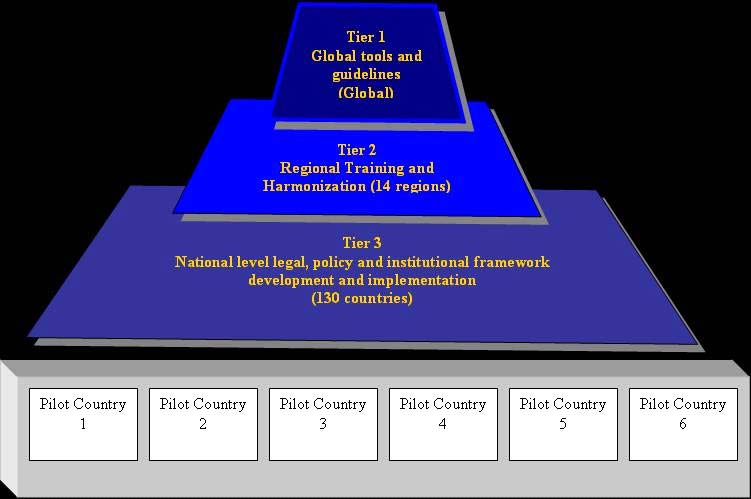
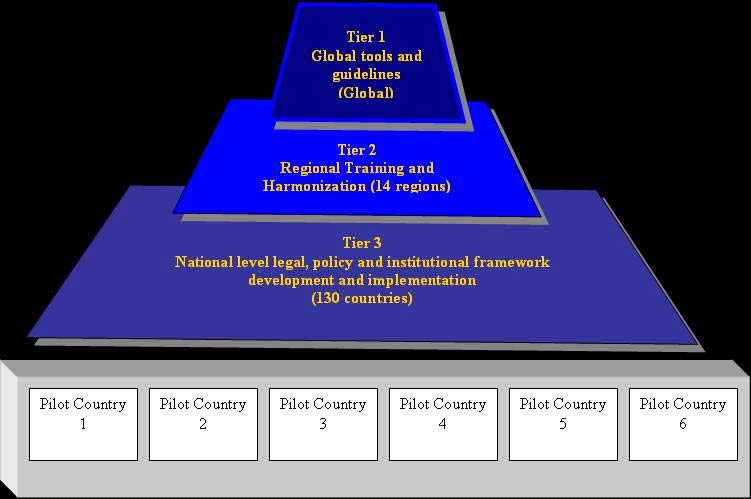
The strategy for GBP has been developed using a 3-tired approach:
1. A global component, managed in cooperation with IMO London, providing international
coordination and information dissemination, including the development of toolkits and
guidelines, and establishing a strong cooperation with industry and NGOs.
2. A regional component, providing regional coordination and harmonization, information
sharing, training, and capacity building in the application of ballast water management tools
and guidelines.
3. A significant country component, that establishes a fast track (Lead Partner Country-LPC)
and partner track (Partner Country-PC) process for GEF-eligible countries in the priority
regions. LPCs must commit to develop and implement a National Ballast Water Management
Strategy (NBWMS), and to adopt legal, policy and institutional Reforms (LPIR).
The three-tier approach is schematically represented below:
12
Le
L a
e d
a P
d art
a ne
rt ri
r
ne i ng
ri
Countr
tr
t ie
i s
e
1.2.1 Global Component:
The project will be managed globally through the Project Coordination Unit, based at IMO
headquarters in London, UK. As with the GloBallast pilot phase, the decision to house the PCU
headquarters in London is based from the synergistic effect of having the PCU in close proximity
to the ballast water office within IMO. Given the frequency of IMO member state participation
in the regular IMO meetings , in particular the MEPC, the PCU is in an ideal position to stay in
contact with member state representatives and to ensure that the momentum for addressing ballast
water management issues within the priority regions (and in other regions) continues to build.
Within the global component is included the Global Project Task Force (GPTF), providing
overall management advisory support for the project, and including as members regional and
country representatives as well as industry and environmental organization representatives.
There are also global outputs and activities focused on providing guidance and training to country
officials and experts on strategic planning and legal, policy and institutional reform, on the
management of risk based compliance systems, and the carrying out of marine biodiversity
surveys. In addition, global level activities include public awareness raising and the development
of knowledge management systems including the development of a GloBallast Marine Electronic
Information System (GMEIS). Of special note, the global component includes a major partnering
effort with industry to continue pushing R&D efforts on cost-effective ballast water treatment
technology solutions.
1.2.2 Regional Component:
Fourteen regions are involved in the effort. Based on the recommendations from the Global
Inception Meeting held in July, 2005, five regions are considered the priority regions, including
the Caribbean, Mediterranean, Pacific Coast of South America, Red Sea and Gulf of Aden and
West Coast of Africa. In addition, the South Pacific will receive support for its ongoing ballast
water strategy development. The next tier of cooperation concerns the regions of the GloBallast
Pilot countries, to ensure continuing momentum and to further the development and
implementation of regional action plans. These are: Southwest Atlantic coast of South America,
South East Asia, South Asia, Persian Gulf, West Indian Ocean (Southern and East Africa).
13
Additional linkages will be established with the Caspian and Baltic regions where there are
existing GEF projects which include Ballast Water Management Programs.
The regional component is first and foremost a mechanism to ensure that all countries in the
Partner regions have an opportunity to participate and learn from the activities undertaken by the
LPCs. To that end, the regions will play a coordinating role for developing national level
strategies, policies and programs. In addition, it is expected that the regional component brings
significant value-added to the long term sustainability efforts by bringing the ballast water agenda
to the regional convention discussions. The Regional Coordinating Organization (RCO)
identified within the existing regional structure has a close access to the key policy makers of the
countries and offer significant advantage in terms of achieving the most cost-effective
coordination among the regional countries to achieve the objectives of the project.
Selection of Regional Partners
The process of selecting regions and countries to participate in GloBallast Partnership has been
deliberate and participatory. The selection process began already at the end of the GloBallast
Pilot Phase, with more than 130 nations making inquiries through IMO MEPC how they could
participate in GloBallast activities. A consultant report was then commissioned at the start of the
PDF-B project, to help in the process of identifying high priority regions and countries based on
extensive background information collected. Then, in July 2005, during the PDF-B development
period, the issue was actively debated by the GloBallast GPTF. A ranking of regions was carried
out, built upon considerations of several criteria, including bio-invasion risk and vulnerability,
socioeconomic importance of the marine and coastal resources, and relative global and
transboundary significance. Other criteria driving the regional selection process were GEF
eligibility, region/country interest, the practicality of implementation, and links to other GEF
projects.
As a consequence of these discussions, the GloBallast Partnerships project identified six high
priority regions, which are set out in the following table together with their justification note:
Region
Justification / notes
Red Sea / Gulf Very high biodiversity values. High dependence of human population on
of Aden
coastal and marine resources. Extremely high level of shipping activity. Low
level of existing capacity. Representative of enclosed sea.
Wider
Very high level of species endemism. High dependence of human population
Caribbean
on coastal and marine resources. Extremely high level of shipping activity.
High vulnerability to bioinvasions. Low level of existing capacity in small
island developing States (SIDS). Representative of SIDS.
Mediterranean While the Med has a very high level of species endemism, a high dependence
Sea
of human population on coastal and marine resources and an extremely high
level of shipping activity, it is afforded medium priority for GEF funding
under GBP due to the significant scope for in-region funding. There is a
regional strategy already under development that provides a ready-made
vehicle for implementing GBP increasing chances of success.
14
South Pacific
While this region has high biodiversity values and an extremely high
(Pacific
dependence of human population on coastal and marine resources, it might be
Islands)
afforded a medium priority for GEF funding under GBP due to relatively low
levels of shipping activity. There is a regional strategy already under
development that provides a ready-made vehicle for implementing GBP
increasing chances of success.
W&C Africa
High biodiversity values, high dependence of human population on coastal
and marine resources, moderate shipping activity and low level of existing
capacity. There is some funding available for IAS/BW activities under
existing GEF projects (BC-LME and GC-LME) and the potential to include
IAS/BW in the CC-LME project.
South East
This region has relatively moderate biodiversity values, moderate dependence
Pacific
of human population on coastal and marine resources and relatively low levels
of shipping activity, but a low level of existing capacity, and therefore might
be accorded a medium rating.
These 6 regions provide a wide geographic distribution for project activities and allow the project
to focus on new region not covered under pilot phase, as can be seen in the global illustration
below.
GBP Region
Pilot Region
1.2.3 National Component:
The pre-eminent focus of GloBallast Partnerships is at the national level. It is recognized that
international measures can set the stage, and regional organizations can help to convene
countries, but it is at the national (and industry) levels where the real actions are taken to reduce
the risks from ship-borne invasive species. In particular, the national level activities are designed
to provide the tools and techniques to enable partnering countries to reform their legal, policy and
institutional structures in order to establish a risk-based and cost-effective approach to improved
15
ballast water management that will reduce the risks of shipping-caused marine bio-invasions.
GloBallast Partnerships will help partnering countries by providing a "roadmap" on how to
achieve legal, policy and institutional reforms, and then by assisting partnering countries to steer
the course.
Within the priority regions, a series of nation level actions will be carried out based on two
tracks:
1. The fast track involves Lead Partner Countries (LPCs), which have committed themselves to
developing national ballast water management strategies and policy reforms. In order to be
an LPC, each country had to provide a letter of endorsement and commitment to the project,
and to commit co-financing support. At the time of DPD submission, 13 countries have been
identified as Lead Partner Countries (LPCs). This designation has been arrived at based upon
the confirmed interest of these 13 states to play a leading role in GloBallast Partnerships. All
countries within the priority regions were invited to express their interest in being an LPC.
Due to time and financial constraints, a decision was made, and supported by the GPTF, to
have no more than 3 countries from any given region serve as LPCs. Each of the LPCs will
appoint a National Focal Point (NFP) and National Project Coordinator (NPC).
Each of the LPCs will play a catalytic role in their regions. While the LPCs will pioneer legal,
policy and institutional developments at the national level, the lessons learned and
experiences gained will be shared with other Partner Countries (PC) in each of the priority
regions. The LPCs will coordinate and host specific training and regional harmonization
activities and invite the other countries in the region to participate in these activities, thus
extending the benefits to all the other countries in the region.
2. The partner track involves countries in each priority region who are invited to participate in
the regional task force and in regional training and workshop activities. Partner countries are
required to officially endorse the project. Partner arrangements can and will be established
both with GEF and non-GEF eligible countries, on the condition that only GEF-eligible
countries are able to benefit from GEF funding. The non-GEF eligible countries in each
region will be invited to participate in workshops and will be urged to develop strategies and
policy reforms, but these countries are expected to provide all of their own financing. The
table below identifies those GEF-eligible countries that have officially endorsed the project
and are considered GloBallast Partner Countries. Those countries listed in bold and
underlined have submitted endorsements at the level of GEF OFP. It is expected that during
the course of the project, all of the countries in each region will become GloBallast partners.
Region Current
LPCs
Current Other GEF eligible
Non-GEF eligible
Partners (GEF-
eligible &
endorsed GBP):
Mediterranean Croatia,
Algeria, Libya
Albania, Bosnia and Cyprus, France,
Turkey
Morocco, Serbia
Herzegovina, Lebanon, Greece, Israel,
& Montenegro,
Italy, Malta,
Syria, Tunisia
Monaco, Slovenia,
Spain, EU
16
Caribbean Venezuela, Anguilla,
Dominican Republic,
USA, UK, France,
Jamaica,
Antigua &
Grenada, Guyana,
Dutch Kingdom
Trinidad &
Barbuda,
Honduras, Nicaragua,
Tobago,
Barbados, Belize, St. Kitts and Nevis, St.
Bahamas
Costa Rica,
Lucia, St. Vincent and
Haiti, Cuba,
Grenadines, Suriname
Dominica,
Gautemala,
Mexico,
CPPS Chile,
Ecuador,
+ Argentina
Columbia,
Panama, Peru
Argentina
PERSGA
Egypt, Jordan,
Djibouti, Sudan
Eritrea, Somalia
Saudi Arabia
Yemen
WACAF
Ghana
Angola, Benin
Cameroon, Cape
Guinea, Côte
Verde, Congo,
d'Ivoire, Sao
Democratic Republic of
Tome and
Congo, Equatorial
Principe, Sierra
Guinea, Gabon,
Leone
Gambia, Guinea-
Bissau, Liberia,
Mauritania, Namibia,
Nigeria, Senegal,
South Africa and Togo
SPREP
SPREP countries are developing a
Cook Islands,
Australia,
regional strategy (with IMO support) Federated States of
American Samoa,
and mobilizing resources to
Micronesia, Fiji,
France, French
implement the strategy. Discussions
Kiribati, Republic of
Polynesia, Guam,
with SPREP indicated the need for
the Marshall Islands,
New Caledonia,
support for certain regional capacity
Nauru, Niue, Palau,
New Zealand,
building activities only.
Papua New Guinea,
Northern Mariana
Samoa, Solomon
Islands, United
Islands, Tonga, Tuvalu
States of America
and Vanuatu.
and Wallis et
Futuna.
The designation of LPCs and PCs is not static. It may be that over the course of the project some
LPCs could slide due to less than satisfactory progress, and some Partner Countries may elevate
into the fast track based on their demonstrated eagerness to play a key role and the progress
achieved in ratification of Ballast Water Management Convention. Criteria, procedures and
responsibilities with respect to revising the status of partners will be developed by the PCU
during the initial months of project inception, subject to management committee (IMO/UNDP)
approval, and then included in Memorandums of Understanding with the lead agencies of each
LPC and also the RCO's. The agreements will be tabled for endorsement at the Project Inception
meeting of the GPTF.
The LPCs have signalled their interest to play a lead role through project endorsement and also
through their co-financing agreements. Current Partner Countries who wish to be considered for
escalation to an LPC role would be required also to indicate their co-financing commitment. The
limiting factors for additional LPCs will be the overall budget, and the management complexity
when more than 3 LPCs are active in a given region. Due to these constraints, it is expected that
the number of LPCs will only exceed 15 during the course of the project if additional co-
financing is brought to the table.
17
1.2.4 Project Rationale and Policy Conformity
Oceans cover 70% of our planet and nearly 50% of the world's population live in coastal areas
and therefore protection of the marine environment is beyond the scope of one country and has
global benefits. This is especially true for a marine environmental issue related to international
shipping, which is truly global in nature and any benefits accrued at national level will fully
contribute to the global benefits.
The GloBallast Partnership Project will directly support the GEF International Waters (GEF-IW)
Strategic Objective 2 (reiterated in GEF-4 IW Strategy to June 2007 Council) - to play a catalytic
role in addressing transboundary water concerns by assisting countries to utilize the full range of
technical assistance, economic, financial, regulatory and institutional reforms that are needed,
including active leveraging of co-financing. The project will significantly contribute to GEF-4
IW Strategic Programme I (SP-1): Restoring and sustaining coastal and marine fish stocks and
associated biological diversity reflecting the fact that substances (e.g. invasive species) toxic to
fish, biodiversity, and humans (hazardous algal blooms and paralytic shellfish disease) are
transferred across borders in ship ballast water (by far the largest vector); it will also directly
address SP-1 objective of supporting demonstrations addressing invasive species in ship ballast
water. The project will support several indicators of IW SP-1, including:
adoption/implementation of regional, national, and local policy/legal/institutional reforms;
improvements in fish stock and coastal habitat achieved; multi-agency partnerships for action
developed; and regional agreements/protocols enacted. The project will further support IW SP-I
GEF objective of engaging the business community to develop and implement solutions. Lastly,
the project is the principle vehicle for delivering SP-I programmatic impact of catalyzing State
ratifications of the new global ship ballast water management convention on invasive species
(Ballast Water Management Convention).
All the current LPCs have committed to take a lead in carrying out legal, policy and institutional
reforms and associated capacity building. All the partnering countries have expressed their
commitment to participate and contribute to the global endeavour. All the six initial Pilot
Countries have expressed their willingness to share their experience and their commitment to
foster technical cooperation. However, existing mechanisms to implement these commitments are
limited and hindered by a lack of communication and consistency. GEF support can ensure that
the growing interest of developing countries in the ballast water problem leads to action.
Specifically, with GEF support, sustainable mechanisms to properly address the issue will be
established and the often catastrophic effects of aquatic bio-invasions will be minimized and
possibly eliminated.
The new project will provide an opportunity for GEF to pursue its mandate related to reduction of
depletion of living resources and associated biodiversity caused by invasive species in ballast
water and to follow up on its own strategic priorities related to enabling long term policy reforms
"on the ground" at country level. Without this GEF intervention, the extremely significant
progress achieved in the GloBallast pilot phase will not be capitalized, and the global benefits
may well be lost. GEF support is being sought to build on, optimize benefits from and continue
the momentum generated by the GEF investment in the pilot phase. The GEF intervention will
demonstrate how GEF financing of some incremental costs can massively catalyze major
achievements at national, regional and global levels relating to one of GEF's key strategic
priorities.
Finally, the project will provide additional confirmation of the catalytic role of GEF in
demonstrating ways to overcome the barriers to the adoption of best practices limiting the transfer
of invasive species in ships' ballast water and will prove the effectiveness of GEF policy when
addressing global problem.
GloBallast Partnerships will provide a programmatic framework for the sustainable replication of
ballast water management and control measures, ensuring that maximum benefits accrue from the
18
foundation work achieved in the pilot phase. The aims and objectives of GloBallast Partnerships
will be a logical extension of the pilot phase, with a focus on national policy and legal reforms in
targeted developing countries and an emphasis on integrated management. The approach
envisaged for the new project would involve:
Building on the achievements and momentum, and utilizing the capacity and talent generated
by the pilot phase;
Replication of best-practices and technical activities in newly identified beneficiary countries
with the view to stimulate legal, policy and institutional reforms at national level;
Working towards advanced integration through other interested structures, mechanisms and
programs, including where optimal, GEF-IW LME projects and UNEP Regional Seas;
Promoting collaboration to facilitate the successful transfer of new technologies from
developed to developing countries.
Support for appropriate national institutional arrangements will be granted and regional
mechanisms will be used as catalysts for supporting national policy reforms. Generic Compliance
Monitoring and Enforcement (CME) systems will be prepared. Formalized communication
systems through identified lead agencies will be developed and early warning systems for
invasions and outbreaks will be established. Priority software and hardware will be designed and
direct logistic support from the more advanced countries will be sought. Some incremental
investments will be supported by the project to support technology development for ballast water
treatment and management. Standardized protocols and methodology for conducting port
biological surveys and risk assessments will be provided with direct assistance from the capacity
built in the pilot phase.
Specific training on ballast water management and control will be provided, based on the training
courses developed during the pilot phase, with emphasis on various responsibilities under the new
international regulatory frameworks. Sustainable financial and institutional arrangements for the
long-term management of ships' ballast water will be established, including the mobilization of
public and private sector funding.
The global information clearing house function established during the pilot phase will be
continued and further strengthened, in support of a uniform approach. Strategies to integrate the
ballast water programs with existing marine and coastal management schemes will be developed
and implemented.
In essence, the proposed GEF project will build on the findings, institutional settings and capacity
developed during the pilot phase. The results of this GEF intervention will include a measurable
reduction in risk of aquatic bio-invasions with a significant mitigation of the detrimental,
sometimes devastating, effects of ballast water transfers, better protection of marine and coastal
ecosystems and habitats and conservation of biodiversity.
The project will demonstrate practical ways of overcoming barriers to the adoption of best
practices that minimise the transfer of invasive species through shipping vectors and will harness
involvement of the UN agency specialized in addressing non-indigenous species in ships' ballast
water (IMO). Although clearly associated to an IW-4 GEF Strategic Programme (SP-1), the
project will help to develop strategic links across operational programs in the biodiversity focal
area and will contribute to an integrated approach to marine ecosystems management.
1.2.5 Project Goal, Objective, Outcomes and Outputs/activities
The overall goal of the GloBallast Partnership Project (GBP) is to reduce the risks and impacts of
marine bio-invasions caused by international shipping.
The objective of GBP is to assist vulnerable developing states and regions to implement
sustainable, risk-based mechanisms for the management and control of ships' ballast water and
sediments in order to minimize the adverse impacts of aquatic invasive species transferred by
19
ships. In the achievement of this objective, 4 outcomes have been identified, each with
corresponding outputs and activities, (see the project logical framework, Section IV).
The four key outcomes expected from the project are as follows:
1. Learning, evaluation and adaptive management increased
2. BWM Strategies in place, with legal, policy and institutional reforms developed,
implemented and sustained at national level
3. Knowledge management tools and marine monitoring systems are effectively utilized to
expand global public awareness and stakeholder support, improve understanding of ballast
water impacts on marine ecology, and enhance maritime sector communications.
4. Public-private partnerships developed to spur the development of cost-effective ballast water
technology solutions
It is expected that by the end of the project, all partnering countries can demonstrate significant
improvement in their legal, policy and institutional structures, with corresponding reduced risks
from ballast water borne marine bio-invasions. Such improvements in ballast water management
will require that each of the 13 Lead Partner countries (LPCs) establish institutional mechanisms
for carrying out the project (e.g. identifying a lead agency and establishing a national task force
(NTF), and that each NTF will take responsibility to develop a National Ballast Water
Management Strategy (NBWMS), which lays out the mechanisms the government intends to use,
including funding, to establish an effective and sustainable ballast water management program.
Within its national program, each LPC will ensure that all necessary legal instruments are in
place, a risk-based compliance monitoring and enforcement (CME) system is in operation, and a
financing scheme has been devised based on the "polluter pays" principal.
This GEF supported project coincides with IMO's continuing push for member states to ratify the
Ballast Water Convention so it can enter into force. Accordingly, one of the indicators of success
for the project's legal, policy and institutional reform process will be that during the course of the
project, all Lead Partner countries are expected to push for ratification of the IMO ballast water
management convention, with at least 10 LPCs having ratified and implementing the Convention
before the project has concluded. In addition, it is expected that in addition to the 13 LPCs, three
or more additional partner countries in each of the five priority regions will develop draft
NBWMS during the project, ensuring that at least 28 countries are implementing national
strategies for ballast water management.
A further indication of project success will be that member states of the Regional Seas
conventions and Large Marine Ecosystem programs will indicate their collective support, by
approving regional strategies and protocols on ballast water management.
The Project recognizes that technology solutions must go hand in hand with legal, policy and
institutional reforms in order to substantially reduce the risks of ballast borne invasive species.
As a consequence, the project includes a series of activities (see Outcome 4), designed to join
with industry in pursuit of cost-effective technology solutions for ballast water treatment and
sediments management. It is important to note that a successful conclusion of the project
assumes that during the 5 years of project implementation, research and development by industry
will escalate and effective technology solutions for ballast water treatment and sediment
management will be made available to shipping companies.
The following diagram graphically depicts the outcomes, outputs and activities to be carried out.
These are then further discussed as a narrative in the pages below, and then provided in Part II
using a Log Frame approach.
20
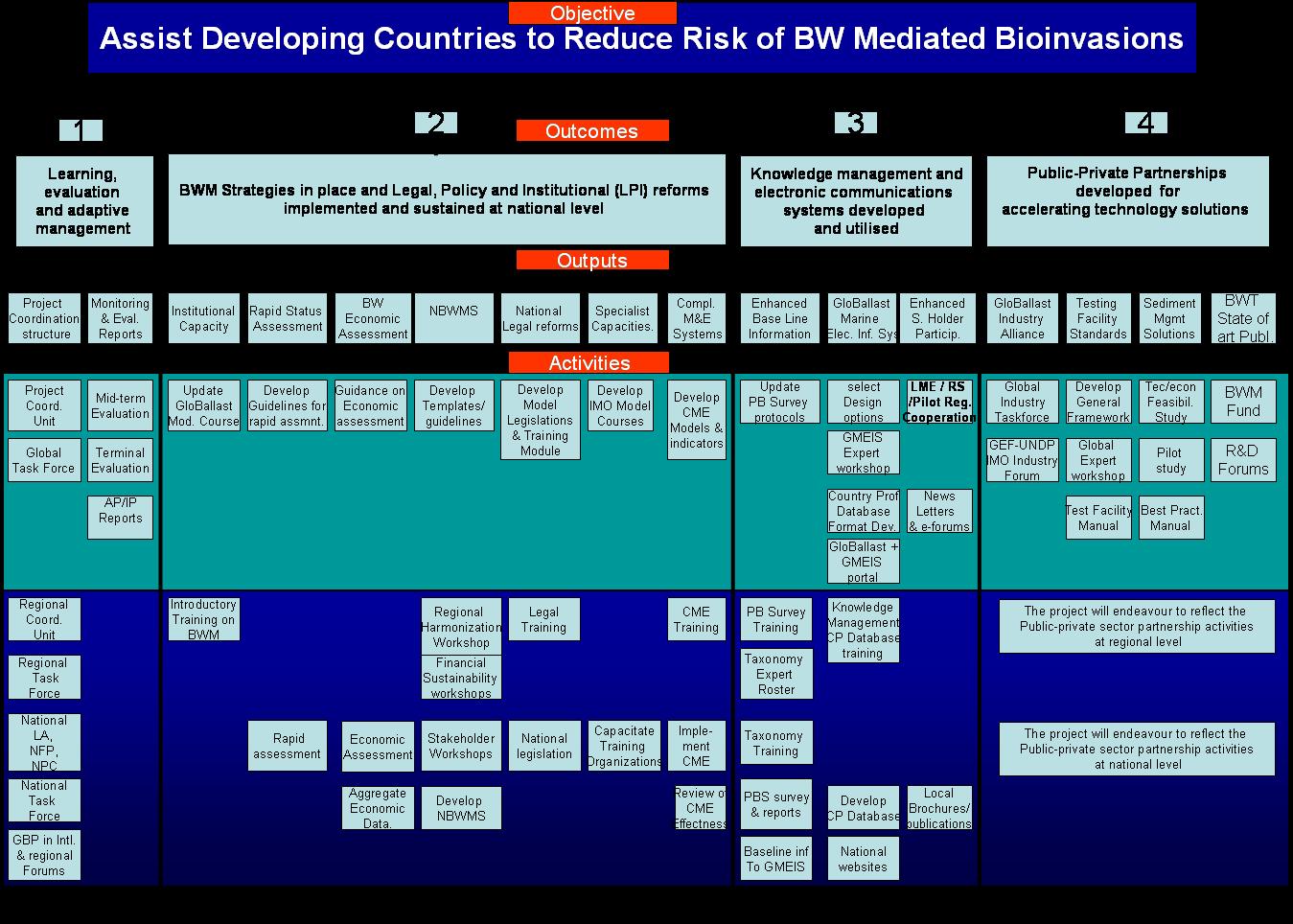
c
21
1.2.6 Elaboration of Project Outcomes, Outputs and Activities
The elaboration of outcomes, outputs and activities in this DPD have been developed consistent
with the initial concept note, taking into account the recommendations of the GEF Secretariat,
and also in response to the comments and recommendations of the GloBallast Project Task Force
(GPTF). Part IV, Section VI includes a table that identifies the original project concept note
outcomes and activities and how these have been fully taken into account in this DPD.
Outcome 1. Learning, evaluation and adaptive management increased
At the conclusion of GBP, it is expected that learning, evaluation and adaptive management will
be increased for all Partner countries. Within this outcome, the coordination and management
aspects of the project are established, and mechanisms are established for reporting and external
evaluation.
Output 1.1 Project Management and coordination structures in place at global, regional
and local level
During the inception phase project management and coordination structures will be set in place at
global, regional and local levels.
Activity 1.1.1 Establish and manage a Project Coordination Unit
A Project Coordination Unit (PCU) will be established at the London HQ of IMO, staffed by a
Chief Technical Advisor (P5), a Technical Advisor (P3), and an Administrative Assistant (G6).
Job descriptions will be prepared and agreed to with UNDP prior to project contract approval.
This three person PCU constitutes a lean organizational structure for a global project. It is
possible to operate effectively as a small coordination unit because of the regional and national
structures the project has established, and because of the administrative and technical
backstopping of IMO. The expectation is that the PCU can be quickly established and will be
fully functioning during the 2nd quarter of the 1st project year.
The PCU will be responsible for the day to day management of the project, including ensuring
that deadlines are met, financial and reporting requirements are adhered to, consultants are
effectively utilized, and the Partner countries are ably supported.
Activity 1.1.2 Global Project Task Force
GloBallast Partnerships will be managed through a Global Project Task Force, building on the
successful approach taken during the GloBallast pilot project. The GPTF has already functioned
during the PDF-B phase. During its planning workshop on July 6-7 2006, the GPTF included
participants from IMO, UNDP and the Regional Coordinating Organizations in 5 of the 6 priority
regions (SPREP was not represented). It also included representatives from other international
organizations and NGOs, and from the shipping industry. It is planned that this wide cross section
of stakeholders will be continued during GloBallast Partnerships, and will also include
representatives from the 13 Lead Partner countries. The following are the expected GPTF
members:
UNDP/GEF (1)
LPCs (5 in rotation - one from each region)
IMO (2)
Industry (2)
GloBallast PCU (1)
Environmental organizations / NGOs (2)
RCOs (6)
GBP pilot country representative (1-in rotation)
There are significant financial implications in establishing a large (20 member) GPTF, yet it is
imperative that the key project participants have an opportunity to periodically come together to
consider project status and operational aspects. To resolve these conflicting aspects, the GPTF
will meet on a biennial basis (e.g. 3 times, during yrs 1, 3 & 5). These three meetings will be
built around the three key operational events:
22
Inception meeting: agreeing on a detailed work plan and preparation of an inception report
Mid-term meeting: providing implementation status and an external mid term evaluation
Final meeting: discussing achievements, lessons learned and next steps / sustainability.
During the project years 2 & 4, an Executive Committee, composed of UNDP/GEF, IMO and the
PCU will convene to discuss project implementation, focusing on feedback from issues raised in
the annual APR/PIR reports.
Activity 1.1.3 Regional Coordinating Organizations
GloBallast Partnerships includes a close partnership with regional coordinating organizations
(RCO) from the targeted priority regions. These organizations have been identified based upon
their involvement in the UNEP-Regional Seas and Large Marine Ecosystems Programs. In some
regions, (Mediterranean and Caribbean), there are also direct financial and reporting relationships
to IMO. It is important to note that the linkage to regional organizations is in order to expand the
number of countries that can directly participate in GloBallast Partnerships. In addition to the 13
Lead Partner countries, it is anticipated that an additional 40 or more countries can participate in
and benefit from GloBallast Partnerships by utilizing the assistance of these regional
organizations.
During the 1st six months of the Inception Phase, formal arrangements, including as necessary the
development of Memorandums of Agreement will be established with each Regional
Coordinating Organization. These RCOs will each identify a coordinator responsible for GBP
activities during the 5 year project cycle.
Activity 1.1.4 Regional Task Force
The RCOs will each establish a Regional Task Force (RTF) comprised of each of the Partner
country representatives. It is planned that the RTFs will meet three times during the project, prior
to the three GPTF meetings. The RTFs will be open to all partnering countries in the regions,
who will each nominate the representatives. It is anticipated that the three RTF meetings will be
hosted jointly by the RCOs together with the LPCs from the region.
The aims of creating RTFs are:
To serve as a mechanism to expand Partner Country interest and involvement in GloBallast
Partnerships.
To raise issues and concerns, and generate regional status reports, for consideration at the
GPTF meetings.
To provide an opportunity for partnering countries to gather knowledge on the status of IMO
ballast water management issues, including guidance on implementing the Ballast Water
Management Convention
To develop recommendations for regional coordination on ballast water management issues
(for instance to agree on intra-regional ballast management requirements).
To identify mechanisms for national and regional sustainability on ballast water management
issues after the conclusion of GloBallast Partnerships.
Activity 1.1.5 LPC Coordination
The LPCs each will appoint a National Focal Point (NFP) representing the Government's Lead
Agency for ballast water management. It is assumed that the Lead Agency will most likely be
from the Government Maritime Authority. The NFP is expected to be a senior government
official who can speak on behalf of the lead agency, and who will serve on the GPTF. It is
further expected that each LPC will identify a National Coordinator (NC), who will provide day
to day management for GloBallast Partnerships, on behalf of the NFP. National Coordinators can
be specifically hired, or they can be current government officials, providing that at least 50% of
their time is designated to coordinate activities under GloBallast Partnerships.
23
The project plan envisions frequent contact between the NCOs & NFPs, RCO's and the PCU. In
addition to the opportunities afforded by workshops and task force meetings, there will be a
project management teleconference every 6 months, and a dedicated, password-protected project
management section of the GloBallast Partnerships website, to facilitate regular interventions.
Activity 1.1.6 National Task Forces
GloBallast Partnerships includes an additional governing task force at the national level. All of
the 13 LPCs will either develop new task forces or utilize appropriate existing task forces to
ensure:
Other pertinent government agencies (e.g. port state control, ports management,
transportation, environment and health) have an opportunity to express their views to the
Lead Agency regarding the implementation of GloBallast Partnerships, and can be called
upon to support legal, policy and institutional reforms.
Interested stakeholders from industry and the environmental community have an opportunity
to stay abreast of the strategies and actions being devised under GloBallast Partnerships.
The NTF meetings are expected to occur every year, and especially prior to the RTF and GPTF
meetings. In this way, the LPCs have an opportunity to formulate their positions and
recommendations prior to regional and then global decision-making meetings.
Activity 1.1.7 International and Regional Conventions and Forums
Based upon the experience from the GloBallast Pilot Phase, and the escalating requests to IMO
from international and regional organizations to know more about ballast water and invasives
issues, GloBallast Partnerships has been designed to include a specific budget to present
GloBallast Partnerships at international and regional conventions and forums. Usually in GEF
projects, this type of activity is channelled to the PCU management, and the travel demands
become overwhelming. For GloBallast Partnerships, the effort will be shared between the PCU
and experts within its regional and national partners. A budget has been set aside for GBP
representatives to attend 3 forums per year, including the GEF International Waters Conference,
COP 9&10 of the Convention on Biodiversity, and annual meetings of the UNEP-Regional Seas.
Output 1.2 Project monitoring, evaluation and reporting systems established and
implemented
The second set of outputs and activities within Outcome 1 involve monitoring and reporting
procedures during the project; (for a detailed discussion on the monitoring and reporting plan see
Section IV). Project monitoring, evaluation and reporting systems will be established and
implemented, to include mid term and final evaluations and the submission of Annual Project
Reviews (APR)/Project Implementation Review (PIR)s and other GEF/UNDP project monitoring
reports as required.
Activity 1.2.1 Mid term evaluation
The main focus of the mid term evaluation will be on the progress made to date, and whether
changing circumstances merit revisions in the work plans.
Activity 1.2.2 Final evaluation
The final evaluation will address project successes and shortcomings, lessons learned and
recommended next steps.
Activity 1.2.3 APR/IPR
The PCU will be responsible for the submission of APR/IPR and other progress reports.
24
Outcome 2. BWM Strategies in place, with legal, policy and institutional reforms
developed, implemented and sustained at national level
The project is designed to assist all of the Partner countries to develop, implement and enforce
legal, policy and institutional reforms (LPIR) in order to reduce the risk of bio-invasions from
ship ballasting activities. At project conclusion, each LPC is expected to be implementing a
National Ballast Water Management strategy (NBWMS), with revised legislation that conforms
to the Ballast Water Management Convention, and an enhanced compliance monitoring and
enforcement system. The NBWMS is expected to usher in a risk-based management approach in
each LPC, and to include measures that ensure financial sustainability under the "polluter pays"
principle.
The role of the RCOs will be to facilitate the participation of other partner countries in capacity
building activities, hosted by the LPCs.
Output 2.1 Institutional capacities are enhanced through a comprehensive training
program on Ballast water management
Institutional capacities will be increased amongst the Lead Partner and Partner Countries through
a globally developed, and locally executed training program, using the GloBallast Introductory
Modular Course for Ballast Water Management. This course was successfully developed, with
several trail runs, during the GloBallast pilot phase.
Activity 2.1.1 Update GloBallast Introductory Modular Course for Ballast Water
Management
During the GloBallast pilot phase, the project joined forces with the United Nations' Train-Sea-
Coast (TSC) Program to develop a specific training package suitable to train large numbers of
port, shipping personnel and other relevant stakeholders. The rationale behind this partnership
was in the advantages provided by the expertise and training methodology used by the TSC
Program, which were highly suitable for the GloBallast Program requirements.
The GloBallast training package was developed according to the UN Train-X methodology. The
training package contains 10 training modules and includes instructions on the application of
ballast water and sediment management procedures and maintenance of appropriate records and
logs in accordance with the IMO Guidelines. Each of the six GloBallast Pilot Countries carried
out training using the modular course, and each training event was externally evaluated in order
to identify opportunities for improvement and refinement. The training deliveries in all the six
countries and the feedback from the participants clearly indicated that the methodology was
highly suitable in achieving the objectives initially set out by the GloBallast Program. The recent
deliveries also highlighted the need for updating the modular course (developed in 2001), with
latest information and inclusion of a new module on BWMC.
Significant interest in the training package was expressed by neighboring countries in at least
three pilot regions (namely Africa, East Asia and South America), who were contemplating the
possibility of regional deliveries as part of their regional SAPs. Accordingly, a series of three
regional training offerings were carried out. These regional training concepts were well in line
with what GloBallast envisioned in the beginning, i.e., regional replication and multiplication of
GloBallast activities including training with the expertise developed in the Pilot countries under
the GloBallast project
During the training delivery several countries suggested that the Train-X course could serve as
the foundation for a future IMO model course on Ballast Water Management. It is expected that
during GloBallast Partnerships, the IMO model course will be developed, including an electronic-
module for distance learning.
The course manual will be completed during the project implementation phase (2nd Q, yr 1), and
the e-learning package, developed with industry support, will be completed by the end of the 1st
25
quarter, year 2. The e-module is planned to be developed and offered through GloBallast and the
IW: LEARN website.
Activity 2.1.2 Hold training courses on BWM using updated Modular Training Package
As soon as the modular training package has been updated, the course will be used to train more
than 250 stakeholders from pertinent ministries in 9 regions on the basics of ballast water
management. This aspect of the project includes a strong measure of co-financing from
international, regional and local partners. During the implementation stages there will be
consultations carried out with the Global Invasive Species Program (GISP) to consider possible
close linkages with their activities, including a planned GEF supported Global IAS capacity
building project.
A total of 9 training programs will be carried out. GEF financing will be used for 4 Training
Programs (CPPS, MED, PERSGA & SPREP). One Training Program, in the WACAF region,
will be funded jointly by IMO and the Guinea Current LME; one Training Program in the CAR
region will be funded by IMO using ITCP funding. Three additional training programs in the
Black, Baltic and Caspian Seas will be funded by EBRD.
Recognizing the expertise that was established during the GloBallast pilot phase, a number of the
course offerings will be carried out by pilot country experts.
Output 2.2 Risk-based, rapid status assessment reports are developed and used to guide
country activities
Status assessment reports will be developed by each of the 13 LPCs and used to guide country
activities. The expectation is that early in project year 2, all 13 LPCs will have identified their
key Ballast water Management issues, in the context of marine and coastal protection. Each will
have developed an action plan for their activities during GloBallast Partnerships. Also during
this early period, the LPCs will share their results and lessons learned with the other Partner
countries, during the first RTF meeting.
Activity 2.2.1 Develop template and guidelines for rapid assessments
A global template and guidelines for reporting will first be developed. The countries will then
develop their rapid assessments. The detailed guidance for aspects to include in the assessments
will be developed early in the inception phase, and are likely to include:
General Information on coastal marine ecology and native species.
Number and location of international maritime ports and their traffic mix (e.g. oil, minerals,
containers, tourists, etc.)
Information on quantity and source of ballast water received by the country
Incidences, known locations and impacts of past marine bio-invasions
Policies and legislation governing ballast water management
Review of the implications of BWMC ratification
Review of related marine policies and legislation (including UNCLOS and the CBD)
Analysis of current port state control practices and the compliance monitoring and
enforcement regime in place
A review of key stakeholders
Identification and listing of country-based ballast water, maritime and marine biology experts
and consultants, as well as technical and training institutes.
GloBallast pilot phase experts will assist in the development of the template based on their
experience from the pilot effort.
26
Activity 2.2.2 Develop rapid status assessments
It is expected that all 13 LPCs will have identified their key national issues for BW management,
their top priorities and plans for reforms within the Rapid Assessment Reports, and that all of the
reports will be completed by the end of 1st Q, yr 2
It is important to note that the assessments are not designed to be at the level of detail provided
for in GEF transboundary diagnostic analyses (TDAs). The emphasis is not to move through an
extensive set of stakeholder discussions in order to arrive at an understanding of root causes, but
rather to set the stage for the strategic planning exercise by determining key issues and current
status.
Output 2.3 Economic aspects of marine bio-invasions factored into national strategic
planning
In addition to being perceived as a major ecological problem, invasive aquatic species (IAS)
cause significant economic impacts through, inter alia, disruption to fisheries, fouling of coastal
industry and infra-structure, interference with human amenity and the costs of research,
monitoring and control and mitigation measures. Globally, such economic impacts are only
starting to be quantified, but are likely to exceed tens of billions of US dollars per year.
In late 2004 the GloBallast Pilot Project Coordination Unit (PCU) undertook an initial scoping
study (ISS) on the global economic impacts of invasive aquatic species. The ISS identified the
current state of knowledge in relation to both direct economic impacts, as well as the costs of
responding to IAS (response costs), as follows:
Direct economic impacts
Direct economic impacts are the actual monetary costs caused by the species in their invaded
environments, including any costs from, inter alia:
reductions in fisheries production,
closure / reductions in aquaculture,
physical impacts on coastal infrastructure (fouling),
reduction in economy of shipping (fouling), and
impacts / closure of recreational/tourism beaches.
The ISS identified seven specific aquatic bio-invasions that have relatively reasonable supporting
economic data. The data indicate that the direct economic impacts of these seven species alone,
are more than US $10 billion per year (1 billion = 109). It was estimated that the direct economic
impacts from all the current marine bioinvasions may be an order of magnitude higher (US$ 100
billion per year).
Response costs
Response costs are the costs incurred by society in responding to the problem, including any costs
of, inter alia:
prevention,
control & eradication,
research & monitoring,
education & communication,
regulation and compliance monitoring and enforcement,
the costs associated with the IMO Ballast Water Management Convention, and
the global effort to develop new ballast water treatment technologies
Overall, the projected costs for governments to respond globally are estimated at up to around US
$4 billion per year, or 4 % of the total global economic impacts
27
In order to provide a more informed basis for governments and industry to respond more
effectively to this problem, a comprehensive assessment and quantification of the global
economic impacts of aquatic bio-invasions is needed. Within GloBallast Partnerships, the
intention is to work in concert with other actors to carry out a comprehensive, longer-term, global
review of economic impacts. To this end, GloBallast Partnerships will especially focus its
attention on Response Costs, in particular the cost to governments to administer national ballast
water management programs, to carry through regulatory and institutional reforms, to implement
the relevant international conventions especially the BWMC, and to operate enhanced monitoring
and enforcement programs.
In addition to calculating response costs, each of the LPCs will be tasked with identifying
mechanisms to finance their programs in light of these costs. It is expected that the `polluter
pays' principal will guide the determination of funding schemes. These may include fee for
service arrangements that cover the cost of administering national ballast water management
programs. The results will be taken into account in the development of each NBWMS.
Activity 2.3.1 Develop guidance for economic assessments
The Global Invasive Species Program (GISP) is currently reviewing and testing methodologies
for assessing the economic impacts of bio-invasions in general. GloBallast Partnerships will
coordinate with the GISP efforts, and will ensure that cost assessment methodologies used are
consistent across the LPCs, allowing for comparisons and collating of results.
The guidance to be developed will be carried out using external consultants with economic
expertise. The Guidance will be available to the countries by the 2nd quarter, project yr 2. It will
provide step by step instructions on the use of models and calculations.
Activity 2.3.2 Develop national economic impact and response cost assessments, taking into
account the need for financial sustainability.
The timetable for LPC completion of their economic assessments is the 3rd quarter of project year
3. This will enable the results to be factored into the NBWM Strategies that each LPC is
developing.
It is assumed that there will be difficulties in identifying economic costs, both for direct economic
impacts and response costs. Using GEF support, the PCU will provide financial support to the
13 LPCs to help defray the cost of hiring economists to assist. Even with specialist assistance, it
is likely that a lack of data will make it difficult to ascertain many economic impacts, for instance
on the extent and reasons for reduction of fish species.
Activity 2.3.3 Aggregate economic information
The economic assessments will be compiled and utilized to generate a global report on the
economic impacts and management costs associated with ship ballast water transferred invasive
species. The report will be commissioned by the PCU, and ideally should involve persons that
helped to set the guidance for the economic assessments (2.3.1). In this way, the PCU can utilize
an economic team throughout the project, including for initial guidance development, LPC
assistance and then final compilation of results. The report, together with the guidance
document, will be published by the 2nd quarter, project year 4. It is planned that the report will be
published as a GloBallast Monograph and made available via the GloBallast Partnerships web
portal.
Output 2.4 National Ballast Water Management Strategy (NBWMS) developed and
implemented
Each LPC will adopt a National Ballast Water Management Strategy (NBWMS) and implement
it during the course of the project The NBWMS will cover all major facets of ballast water
management, including legal and policy issues, institutional strengthening, regional cooperation,
port environmental management, port state control enforcement, and flag state requirements. The
28
NBWMSs should specifically address the steps needed for ratification of the Ballast Water
Management Convention. GloBallast Partnerships will provide financial support, training, tools
and techniques, to help LPCs design and implement their NBWMSs. The 13 LPCs will have
approved Strategies completed by the end of yr 4. It is assumed that the Strategies will need to be
approved at cabinet of ministers level, and/or by national legislative bodies.
This outcome will be achieved through a step-wise process that starts from the development of
guidelines, then a series of national stakeholder meetings and regional harmonization workshops,
leading to the development of the national strategies. In addition, the achievement of outcomes
2.3: economic impacts and response costs, 2.5: legislative reforms and 2.7: compliance
monitoring and enforcement, all link directly into strategy development, providing inputs to the
Strategy and in turn being directed by the Strategy. This inter-linkage of inputs and outputs
suggests that drafts of the economic reports, legislative and financing options will need to be on
hand for the development of the NBWMS, and the final reports will then need to be completed
once political direction is achieved by approval of the strategy.
As an adjunct to the NBWMS effort, it is expected that the RCOs will spearhead an effort in their
respective organizations to achieve member state approvals for regional action plans addressing
ballast water and marine invasive species. These RAPs build from the positive momentum
achieved during the GloBallast Pilot Phase. Many of the Regional Seas have commenced this
process of developing action plans and strategies for ballast water management. (e.g. SPREP
draft strategy). All the six pilot regions have already developed a regional action plan. It is
expected that all of the new six priority regions will have a regional action plan (RAP) for BWM
approved and in place by the end of project year 4.
Activity 2.4.1 Develop guidelines for national BWMS development, including options for
financial sustainability
In order for the LPCs to launch their national planning efforts it will be important to provide
during the Inception Phase a set of recommended guidelines on the strategic planning process and
aspects to include. Such generic guidance will be developed and disseminated during the 1st
quarter of project year 2. The PCU will draw upon expertise from the pilot country experts,
based on their experience in developing NBWMSs.
Activity 2.4.2 Hold (a) regional harmonization (including regional LPI assessment) and (b)
Sustainability workshops
Within this activity, two sets of workshops are envisioned, occurring at the beginning of project
years 3 and 5. These workshops will also serve as the 2nd and 3rd (of 3) RTF meetings. All 6 of
the priority regions (including SPREP) will receive GEF support.
The first series of workshops is aimed towards regional harmonization, including consideration of
common issues and concerns, and progress on development of the Regional Action Plan. The
RAPs are expected to be developed and approved at regional conventions before the end of the
project.
The workshops will provide an opportunity for the LPCs to present information on their progress
to date, and lessons learned, on legal, policy and institutional reform and strategic planning. The
expectation is that these presentations will serve to boost the efforts of other Partner countries to
follow suit with their own strategies and reforms.
The second workshop in each region is aimed towards issues of sustainability. By the beginning
of year 5, the LPCs will have approved NBWMSs, and will be expected to share lessons learned
with the other regional Partner countries. The RAP should be either approved or pending member
state approvals. The BWM Convention should have been ratified by one or more countries in
each region, offering lessons learned on its implementation. Also, there should be results
available from some of the economic assessments and port baseline surveys carried out in the
29
region. All of these issues should be brought to the table, as well as agreement among the parties
on how to continue regional processes after the conclusion of GloBallast Partnerships.
Activity 2.4.3 Hold stakeholder workshops
In addition to the expectation that LPCs will develop national task forces, there is also an
expectation that there will be opportunities for interested stakeholders and the public to consider
and provide comments on the NBWMSs as they are drafted and approved. Public notice and
comment procedures are valuable tools for building support among interest groups and the public.
LPCs are expected to run at least 3 stakeholder meetings before the end of project year 3, which
may be split along geographic lines (e.g., a meeting in several ports with broad participation) or
national meetings segmented by interest group (e.g., shipping, environment, ports management).
In particular, it is expected that one of the stakeholder meetings will be dedicated to bringing
together high level ministry and elected officials as an aid to awareness raising and to boost
support for the legal and policy reform effort and institutional capacity building.
Activity 2.4.4 Develop and Implement National BWMSs
Developing strategies is only the initial step. The key to this activity will be to have the national
strategies developed, then approved and then implemented, with a demonstrated institutional and
financial commitment from each of the LPC governments. The plan is to have all NBWMSs
implemented by the end of year 4.
Flexibility is built into the program with respect to the timing of NBWMS development and
passage of new legislation (see outcome 2.5). Countries may take the path of approving strategies
that drive legislative change, or may implement new legislation that enables the strategy to be
approved and implemented. The rapid assessment should identify the procedure each LPC plans
to take. It should be noted that ratification of the BWM Convention will have a bearing on the
route LPCs decide to take.
The PCU will provide financial support to the LPCs for technical assistance on the NBWMS
effort. Strategies should include a summary of the rapid assessment findings, a set of strategy
options considered, the preferred options for government approval, and the means to continue the
program after the conclusion of GloBallast Partnerships. It should cover the full array of needed
government actions, including:
overarching institutional controls, coordination and capacities (including lead agency
selection, reducing jurisdictional overlaps, and institutional capacity issues)
current and proposed legislation and regulatory revisions
new port state control activities, including risk-based compliance monitoring and enforcement
mechanisms
coastal zone and port area environmental and biodiversity monitoring and protection
programs
developing the financial means to administer the ballast water management program,
including the use of administrative fees
Output 2.5 National legal reforms instituted
The implementation of effective ballast water management strategies will in most cases entail the
need to enhance national legal structures. The GBP project includes development of a generic
legal framework for ballast water management, supported by legal training on maritime and
ballast water legal issues. The legal instruments will enable countries to implement the Ballast
Water Management Convention and more generally to improve ballast water management
compliance and enforcement. There will be additional efforts at the regional level to link the
Ballast Water Management Convention to regional environmental conventions.
The intention is to develop effective legislative frameworks in each of the LPCs. This will
ideally include ratification of the Ballast Water Management Convention; however ratification is
30
not the only litmus test for success. Lacking parliamentary support for BWMC ratification, LPCs
can still enhance their legal systems and develop strategies that enable a risk-based approach and
reduced threat of bio-invasions.
Activity 2.5.1 Develop legal road map, model legislation and training manuals
During the PDF-B phase, effort has commenced on the development of guidance on LPIR
reform. This effort to develop a legal roadmap constitutes the starting point from which a robust
set of guidance documents will be developed and made available to the LPCs by the end of the 1st
project year. The PCU will manage an external consultancy for this assignment; with
contributions form the GB pilot country experts who worked on legislative aspects.
Aspects that are likely to be included are:
designation of lead agencies and their authorities
BW management responsibilities of flag state carriers.
content and submissions process for ballast water reporting forms;
operational requirements for the off loading and handling of ballast water sediments;
mid ocean exchange and then treatment standard requirements (based on the BWMC), taking
into account possible variances for intraregional shipping;
conditions for port state control authorities to board ships, sample ballast tanks, scrutinize
manifests, restrict ship operations and assess fines and penalties for failure to meet ballast
water management requirements; and
demarcation of specially protected areas in the coastal environment, where ballasting
operations may be restricted;
As noted in the project log frame, and project budget, the IMO will play a significant role in this
activity. In particular, the IMO MEPC will continue its development of technical guidance
documents for implementation of the BWM Convention. These guidance documents provide
clarification for IMO member states to implement the Convention. There will be a close synergy
between the MEPC guidance development activities, and the GloBallast Partnerships legal
assistance effort. The guidance documents from MEPC constitute a clarification and articulation
of the Convention requirements. The GloBallast Partnerships effort is designed to assist the
LPCs make this guidance operational. Whereas IMO-MEPC articulates WHAT to do, GloBallast
Partnerships will assist on HOW to do it.
Activity 2.5.2 Train LPC lawyers on developing legal frameworks for BWM
Ballast water management is a specialized field, and the legal aspects straddle maritime and
environmental law. Based on the experiences of the GloBallast pilot countries, it has been
recognized that some support is needed to acquaint national government lawyers with ballast
water management issues. The training will be done on an ad hoc, in-country basis, using as
much as possible experts and government lawyers from the pilot countries and other IMO
member states that are pioneers in establishing regulatory controls for ballast water management.
The involvement of maritime institutes in providing legal expertise will also be considered.
Activity 2.5.3 Develop national legislation
The LPCs are expected to complete their legislative efforts no later than the 1st quarter of project
year 4. This is not the deadline for completed drafts, but rather the deadline for enacted / revised
legislation. It should be noted that there are differing legal structures in Partner countries. Some
may ratify the BWMC and it then immediately becomes national law. Others may need to create
national laws that enable the ratification of international conventions.
Output 2.6 Specialist capacities improved for BWM
This outcome is designed to lay the groundwork for national and regional specialist expertise to
be available for ballast water techniques. This set of activities builds on the GloBallast pilot
31
country experience, and is designed to expand on the traditional close association that IMO has
had with maritime training institutes globally.
Activity 2.6.1 Develop model BWM (specialist) course
By the end of project year 3, selected maritime institutes in each region and among the LPCs, will
be training maritime experts in key aspects of ship-board BWM. IMO will finance this activity
and will incorporate the results into its series of Model Courses under the International
Convention on Standards of Training, Certification and Watch keeping for Seafarers (STCW)
Activity 2.6.2 Capacitate Training Institutes for delivery of introductory course and
specialized courses
International Maritime Organization does not approve training courses or institutes. This is a
privilege and responsibility of Member Governments who are Parties to the STCW Convention.
Nevertheless, it is possible under the GloBallast Partnerships to identify and encourage maritime
institutes to expand their capacities in order to be prepared for providing training services for
ballast water management, once the model courses are developed under STCW. These institutes
can also continue to provide the introductory GloBallast modular training course (see activity
2.1.2) as part of the regular curriculum. It is expected that by end of yr 4, there will be at least one
maritime institute in each LPC with the capacity to train sailors on BWM and to continue to
provide the GloBallast Introductory Course to other stakeholders. Accreditation by the Partner
countries will be encouraged, with the PCU providing suggested criteria.
Output 2.7 Compliance monitoring and enforcement indicators are developed and national
systems enhanced, with an emphasis on risk-based priority setting, and the use of voluntary
approaches
Enforcing ballast water management requirements typically involves port state control authorities
communicating with vessels as they come to port, reviewing ballast water reporting forms,
boarding selected ships to review documents and inspect equipment, and upon occasion using
sanctioning powers to quarantine or fine vessels for failure to meet their legal obligations.
During GloBallast Partnerships, effective methodologies and best practices for compliance
monitoring and enforcement (CME) will be identified and partnering countries will assess and
revise their existing CME systems. It is impractical to scrutinize and board all arriving ships at
busy international ports. Risk based approaches will need to be developed which identify and
focus attention on arriving ship that pose a higher risk of carrying invasive species.
Particular attention will be paid to the use of voluntary approaches, including certification
systems (e.g. ISO standards and `green award' certification) and other compliance incentives that
allow port state control authorities to have confidence that ship-board management systems are
functioning correctly so consequently they can reduce port-side inspections and paperwork.
By the end of yr 4, each LPC is expected to have developed an enhanced CME system, based on
their NBWMS. These CME systems will be evaluated at the end of project year 5. By the 2nd
quarter of project year 2, all shipping companies calling on LPC ports are expected to have
received model BWM plans. These model plans are being developed by the private sector, with
ICS and INTERTANKO (two industry NGOs) having already drafted their model ship BWM
plan. It is expected that by the end of project year 4, at least 35% of the merchant shipping fleet
calling on LPC ports indicates that their on-board BWM plans are being implemented. A follow
on questionnaire in mid yr 3 will identify shipping companies that are implementing the plans.
Activity 2.7.1 Develop and disseminate model CME framework, including indicators
As with other expected LPC outputs, the CME output will first start with a model framework and
guidance from the PCU, based upon lessons learned from the GB pilot phase (scoping study and
CME symposium), taking into account the experiences of countries that have been aggressively
pushing ballast water management for instance Australia and the USA, and recognizing the
32
changed seascape with approval of the BWM Convention and IMO guidelines. Emphasis will be
placed on voluntary approaches, streamlined procedures and risk-based priority setting. IMO-
MEPC will continue to develop the guidelines for Port State Control and these guidelines will be
used by GBP to develop the model CME framework.
A model CME framework, with options and including suggested indicators, will be developed by
the 3rd quarter of project year 2. Then, by the start of yr. 3, model CME framework is available
for LPCs to develop their revised CME systems.
GEF has been actively pushing project proponents to develop impact and performance indicators
following the International Waters Process, Stress Reduction and Environmental Status Results
Framework. For ballast water and invasive species, impact indicators pose a difficult challenge,
given the large volumes of ballast water being carried, the chance that infestations may have
come from hull fouling or other vectors, the microscopic size of many invaders, and the dormant
or otherwise unobserved period following dispersal and prior to obvious infestation. Who was at
fault, and what to do about it are extremely vexing considerations. Once an infestation has
occurred, `clean up' and eradication is practically impossible. Since impacts are difficult to
gauge, and infestations are essentially permanent, indicators need to focus on performance, for
example (GEF type in parentheses):
port state control measures are in place (process),
risk based approaches are being utilized (process),
legislation is in place and enforced (process, stress reduction)
high risk ships are receiving on board inspections (stress reduction)
sediment dump out facilities are in place and used (stress reduction)
financial mechanisms for administering BWM programs are established (process)
countries are ratifying the BWMC (process)
flagged vessels are installing and using proven treatment equipment and systems (stress
reduction)
flagged vessel are implementing on-ship BWMPs (stress reduction)
shippers are using certification programs and international standards to demonstrate
compliance (stress reduction)
Activity 2.7.2 Hold training workshops on CME
Each of the training programs envisioned under GBP is designed to address the particular
agencies and experts that can benefit from the training. In the case of CME, the focus of attention
is upon port state control authorities who are empowered to uphold national laws governing the
import and export of persons and materials into and out of the country. There are multiple
agencies that may be involved in this activity as it relates to ships and the control of ballast water
discharge:
Coast guard and naval authorities are tasked with protecting the coast from illegal entry.
Customs authorities ensure that the entry of goods and materials is regulated and that duties
are levied as required.
Health authorities enter into the picture if ships may pose a risk to human health through the
spread of communicable diseases.
Environmental authorities may be involved if there is legislation governing the discharge of
materials and pollutants into coastal areas and ports.
Public, parastatal or private port authorities are typically responsible for pollution abatement
within commercial port areas.
Depending on the particular BWM strategies and programs planned and in place in each of the
Partner Countries, persons will be selected to participate in a training program designed to
33
provide practical knowledge on CME management and the development of risk-based
approaches. It is planned that by the end year 3, at least 100 Port State Control Officers and CME
managers in partner countries have been trained.
Activity 2.7.3 Countries implement modified CME systems
Armed with a model CME framework, and CME training for key personnel, Lead and Partner
Countries are then expected to develop and implement improved CME systems. These should be
in place by the end of Project Year 4. The CME systems should link closely to and build from
the NBWM Strategies developed, and ideally should link directly to implementation of the BWM
Convention and related IMO Guidelines. In addition, all efforts will be made to harmonize the
CME systems at the regional level, using the existing Port State Control MOUs among the
regional countries.
Activity 2.7.4 Conduct follow up reviews of modified CME systems and develop lessons
learned study
Given that each of the LPCs should have a revised CME system operating for ballast water
management at the end of project year 4, GloBallast Partnerships includes a follow up activity
one year later to evaluate the extent to which these systems are in place and functioning as
intended. The PCU together with the RCOs will identify and hire independent experts to report
on progress with the CME reforms. Their findings and recommendations will be submitted back
to the LPCs for consideration and response, and will provide the basis for a concluding lessons
learned study on CME, and risk-based approaches.
The follow up reviews on CME development will provide the supporting documentation for a
study on lessons learned from the implementation of risk based CME systems for ballast water
management. In addition to the LPC results, the expert team hired for the effort will consider the
lessons from other Partner Countries within GloBallast, countries that have ratified the BWM
Convention and also from those IMO member states generally considered to be in the vanguard
of ballast water management, such as Australia, New Zealand and the United States. The study
report is planned for publication under the GloBallast Monograph Series.
Outcome 3. Knowledge management tools and marine monitoring systems are effectively
utilized to expand global public awareness and stakeholder support, improve
understanding of ballast water impacts on marine ecology, and enhance maritime sector
communications.
The GloBallast pilot phase project received well-deserved praise for its public awareness raising
efforts, its port baseline survey activities and the establishment of country profile databases.
These three sets of activities are often categorized separately as: public communications,
environmental monitoring and data collection. In fact, the three areas share a close affinity
within the concept of knowledge management. For GloBallast Partnerships, improved knowledge
management is an expected outcome, which will help to increase public awareness, improve
understanding of bio-invasion impacts on marine ecosystems, and enable enhanced
communication between key stakeholders at national, regional and global levels.
This knowledge management outcome is subdivided into three discreet outputs. The first involves
efforts to build a better understanding of the ecological impacts of bio-invasions and likely
vectors. This involves continuation, refinement and expansion of the GB pilot phase port
baseline survey work. The second output will establish the GloBallast Marine Electronic
Information System (GMEIS), designed to provide useful data and information to various
stakeholders, including the shipping industry using electronic / internet formats and platforms.
The third output involves continuing to build on the GloBallast public awareness success by
providing information on ballast water management for public consumption, using especially
print and video.
34
Output 3.1 Baseline information established on biodiversity and alien species presence in
major ports
Central to the consideration of marine invasive alien species risks is an understanding of the
current presence of invasives, and their environmental impacts. If coastal and port authorities
have limited knowledge of invasives problems, they have limited capacity to provide safeguards
and deterrents to prevent new invasions. The project will ensure that in each of the Lead Partner
countries and across the priority regions, environmental impacts of marine bio-invasions are
assessed.
Within this invasives monitoring output are a series of activities designed to establish survey
protocols, train persons from the partner regions on surveys and taxonomy, build co-sponsorship
support for carrying out port baseline surveys, and then capturing the resulting data and
information in formats that allow for this information to influence national and regional strategy
development. It is important to stress that GloBallast Partnerships will not directly fund the
carrying out of port baseline surveys. It will, however, encourage co-sponsorship from other
supporting organizations.
Activity 3.1.1 Update Port baseline survey protocols
The first activity under the port baseline survey output is an updating and enhancement exercise,
designed to learn from GloBallast pilot phase surveying efforts, as well as from the continuing
survey research carried out through other programs and institutes, (inter alia, the National
Institute of Water & Atmospheric Research Ltd. in New Zealand has carried out more than 37
port baseline surveys and 66 early detection and delimitation surveys for marine pests in New
Zealand and overseas). There is also a strong need to refine protocols and surveying
methodology to keep costs down, enable comparisons across port surveys internationally, and
stay abreast of technology improvements.
The PCU will utilize external experts to complete the revised protocols during the first quarter of
project year 2. Experts for the assignment will include persons who carried out survey training
efforts during the GB pilot phase as well as other recognized international experts.
3.1.2 Hold training workshops on port baseline survey design and implementation
During project years 2 & 3, GloBallast Partnerships will set the stage for future survey work by
running training workshops. 6 workshops are planned, hosted by one LPC each from CAR,
PERSGA, CPPS and WACAF and SPREP. Each of the workshops will include approximately 20
participants (including other Partner countries in the region). For the Mediterranean region,
funding will be provided by the SAFEMED Project, which is being implemented by the RCO,
REMPEC.
Ideally, port baselines should be done as part of a more wide ranging series of observations along
the coastal zone. Taking a snap shot of species presence within ports is useful but ignores the
dispersion effects of tides and currents. During GloBallast Partnerships, there will be a concerted
effort to link with ongoing companion efforts such as a planned GEF-UNEP-GISP (global)
Capacity Building Project on invasive species, as well as a planned GEF/UNEP invasive species
project offered by CABI for the Caribbean. Interest has also been indicated by several of the
LMEs, to utilize funds for coastal and port marine species surveys.
Activity 3.1.3 Develop country rosters of taxonomy experts
GloBallast Partnerships will provide an important service at the national, regional and global
levels in terms of identifying experts with the background for carrying out marine taxonomy
activities. This will not be a referral service, merely a database of names and CVs that LPCs and
RCOs can utilize to identify potential resources. The roster will also help to identify persons that
may be interested to participate in the taxonomy training (2.6.33) activity.
35
Activity 3.1.4 Train local taxonomists in generic tools and methodologies for marine
invasives detection and analysis
One of the major stumbling blocks to completion of the port baseline survey work during the
GBP pilot phase was the dearth of trained taxonomists available in the pilot countries to carry out
taxonomy work. In each case the results of the surveys were held up for months as taxonomists
grappled with the complex effort to identify hundreds of species and then consider their origin.
In each instance, taxonomists observed species not previously observed in the area, requiring
extensive analysis to determine whether they were native or alien. In many cases, the taxonomic
work suffered from a lack of available taxonomists trained for observing marine species. While it
takes long time and considerable resources to build a core of well trained taxonomists, a need was
identified to provide basic training on generic tools and methodologies for such taxonomy work,
related to invasive species. It is expected that content for the training program can utilize existing
similar training programs, such as the IOC capacity building program and / or Census of Marine
Life Project and both programs have formally expressed their interest to partner with GBP.
Activity 3.1.5 LPCs carry out baseline surveys and develop national marine invasives
reports
The pilot phase of GBP included a port baseline survey in one port area within each pilot country.
The cost of these surveys continues to escalate, reaching $100,000 or more per survey. With 13
LPCs, and another 20 or more Partner Countries, it has been agreed with the GPTF members that
the scale of GloBallast Partnerships precludes setting aside a portion of the GEF allotment to
finance baseline surveys in each country. Instead, the PCU will work together with each RCO
and the LPCs to identify additional sources of financial support for the survey work. Such
discussions have already been initiated during the PDF-B phase. As an example, cooperation
agreements have been already discussed with the Mediterranean Science Commission (CIESM)
who will raise resources for carrying out port baseline surveys in Mediterranean region. Similarly
the regional strategy for South Pacific region includes port baseline surveys and SPREP is
currently raising necessary resources to carry out these surveys that can follow the regional
training offered by GloBallast Partnerships. Another example is the funds set aside by
Venezuela and Jamaica in the Caribbean Region to conduct such surveys.
It is expected that each of the LPCs will succeed to raise sufficient funds for at least two baseline
surveys covering their major commercial ports, and that many of the Partner Countries will
likewise carry out surveys.
The results of the survey work, in addition to other available information from recent
international, regional and national coastal marine biodiversity and fish population assessments,
will be utilized by the LPCs to establish their reports on marine bioinvasions. The reports should
include the identity and location of known invasions and suspected vectors, impacts of invasions
on native marine flora and fauna, and any human health concerns (such as with red tide and
cholera). They will be completed by the 2nd quarter of project year 3. This should be viewed as
an iterative process, whereby the LPCs first tap any available data to include in their initial rapid
assessment (2.2.2). Then, once port baseline surveys have been carried out, the results will be
drawn up as a report. The findings should be utilized in the analysis on economic impacts and
costs (see Activity 2.3.2) and factored into the development of national ballast water management
strategies (see Activity 2.3.4).
Activity 3.1.6 Compile country baseline data and input into GMEIS (see Output 3.2)
During the GloBallast pilot phase, the pilot countries established country profile databases, which
among other information, included data compiled during the port baseline surveys, especially
including results on the type, number and locations of marine alien species. During GloBallast
Partnerships this effort will be continued and further refined, with the data entered into a more
robust information storage and retrieval system dubbed GMEIS (see Output 3.2). The plan
36
envisages a small amount of data entry assistance during year 5 to load data from the surveys into
GMEIS. In fact, data will be entered as it becomes available.
Output 3.2 GloBallast Marine Electronic Information System (GMEIS) established
Information technologies are key to managing the risk of invasives carried by ballast water.
Activities during the previous GloBallast Pilot project included the digitisation of hard copy
ballast water report forms, enabling data to be compared using a multivariate procedure to
determine the relative environmental similarity between ballast water source and destination
ports. A customized database was established providing tables and interfaces for storing and
managing information including risk species, taxonomic details, and bioregional distribution.
Integrated geographic information systems (GIS) were then used to manage and display risk
assessment information for the pilot port areas, including areas of high vulnerability and
sensitivity to invasive species. These initial steps set GloBallast on a course that under the
follow-on project will marshal information technologies and communications systems to improve
environmental stewardship in the international maritime community and in this process link
GloBallast Partnerships to other similar GEF funded projects such as Marine Electronic
Highways (MEH).
A key challenge will be to achieve compatibility and connectivity amongst marine information
systems, and to ensure there is quality assured data available. GloBallast Partnerships is well
positioned to help drive consistency and coordination within the emerging global marine
information infrastructure, through a set of global database and systems functionality activities.
GloBallast Partnerships will include as a major component the GMEIS (GloBallast Marine
Electronic Information System). Its objective is to reduce marine environmental risks while
enhancing shipping efficiencies, through the rapid communication, analysis and utilization of
global information on ballast water management and the marine environment. The effort is
designed to significantly reduce the global threat of marine bio-invasions by establishing and
linking databases and communications systems for use by the maritime industry, regulatory
bodies and the public. The effort is designed to build upon the information management lessons
learned during the GloBallast Pilots project, and set the foundation for a global system. The
expectation is that at the end of the project, GMEIS will provide the building blocks for an up-to-
date GloBallast marine information infrastructure. GMEIS, which will initially take the form of
an internet portal, is planned to be launched during yr 3, and by project year 5 should be fully
functioning, to include country profile data from each of the LPCs plus updated information from
the pilot countries and other partners.
It is expected that the development of GMEIS will in time have wider application within
maritime and shipping activities, highlighting options for electronic and internet based data and
communications. These investigations should have resonance with other ongoing investigations,
for instance to improve safety and navigational communications in narrow straits, which are the
focus of several GEF Marine Electronic Highway (MEH) projects currently being demonstrated
(e.g., Malacca Straits) or in the planning stages (West Indian Ocean MEH, Turkish Straits MEH,
Mediterranean MEH, etc.). The PCU has established close linkages with the Mediterranean and
Turkish Straits MEH projects during the PDF-b phase, including a detailed discussion amongst
UNDP, MEH Consultants and the PCU in New York in May, 2006. It is expected that the MEH
experts and project managers of all ongoing MEH projects will be involved in the global
workshops planned within Activity 3.2.2 and contribute to the design of the GMEIS.
It is important to clarify that GMEIS will be developed initially as a stand alone information
system, but will be conceived with a plan that it should dovetail with the existing IMO Global
Integrated Shipping Information System, (GISIS). The IMO GISIS provides a series of databases
covering:
Maritime Security: information communicated under the provisions of the International
Convention for the Safety of Life at Sea (SOLAS)
37
Condition assessment scheme: providing an electronic database for the implementation of the
CA Scheme
Recognized organizations: providing information submitted by Member States
Maritime casualties and incidences: providing data on casualties and incidences
Port reception facilities: including available data on facilities for the reception of ship-
generated waste.
There are seven key activities within the GMEIS component: a technology review (3.2.1), a
series of expert workshops leading to a protocol on systems architecture and functionality (3.2.2),
the development of a country profile data base format (3.2.3), training and technical assistance to
LPCs, (3.2.4) the development of country profile databases (3.2.5) and the development of a
global web portal (3.2.6) and LPC websites (3.2.7).
Activity 3.2.1 Identify GMEIS Design / Architecture Options
It will be important first to determine the current state of the art in maritime information systems
for ballast water management and for marine environmental protection in general. Consequently,
a review will be commissioned to consider present systems and those under development for:
monitoring and reporting of on-ship ballast water management;
port management logistics systems for ballast water reception facilities;
port control systems for ballast water management compliance;
data transmission / communication systems from ship to shore;
systems currently under trial for Marine Electronic Highways (MEH)
The review will conclude with an assessment and set of recommendations concerning the
technical and economic feasibility of developing maritime information systems for ballast water
management at regional and global scales, and options for the GMEIS architecture and design.
The report will be completed by the 1st quarter of Project Year 2.
Activity 3.2.2 Hold GMEIS expert workshop for design / architecture selection
For a global maritime information and communication system to be useful, inter-operability
amongst public and private sector users is needed. Also required is an effort to forge consensus
on the functionality of the system: what it will be used for, and the logical applications to
develop. Through a series of structured workshops, GloBallast Partnerships will bring together
leading experts in the fields of information technology, MEH system integration, maritime
operations and marine ecosystems protection, to provide a consensus set of recommendations on
systems architecture and functionality for the GMEIS.
The systems functionality exercise will also provide recommendations on the optimal ballast
water applications for GMEIS, setting out what can be achieved through harnessing spatial
information systems, the internet, satellites and other tools, to better manage ballast water and its
attendant risks. It is anticipated that a key outcome will be the general design for Marine Bio-
Invasion Risk Assessment and Prevention tools. Effective risk-based management approaches
should be greatly enhanced by use of GMEIS, as it should enable the rapid dissemination of up to
date, and integrated ballast water information, globally, and at country, port, and ship-specific
levels. Port state control authorities should be able to access the database to get information on
ships, their ballast water treatment systems on board, and environmental compliance track record,
and use this information to determine the level of scrutiny required to minimize the chances of
improper or illegal ballasting procedures. It is important to note that significant work was done
on risk management through the GloBallast Pilot Project and by several countries with active
ballast water management programs (Australia, New Zealand, US). This functionality effort will
build from the lessons learned from previous and ongoing risk assessment efforts.
38
It is planned that by mid project year 2, the expert meeting has occurred and a recommended
GMEIS architecture has been detailed.
Activity 3.2.3 Develop country profile database format and disseminate to Partner countries
At the beginning of the 2nd Project Year, the PCU will disseminate to the LPCs and other Partner
Countries a set of reference documents on how they should establish their country BWM profiles
and begin to set up national databases. The guidance will spring from the results of the experts
workshop (3.2.2) and are likely to be commissioned from experts who participated in that
workshop. The key is to establish user friendly formats that are adaptable to continuing
refinement, and which can be used with widely varying amounts of data. The formats should
enable entry of data concerning:
Ports compliance: providing country & port specific information on the regulatory requirements
governing ballast water management in each participating region, country and port.
Ballast water treatment technologies: enabling shipping companies to report, and port state
control managers to verify, the presence, type and performance parameters of treatment systems
on board each ship visiting LPC ports. In time, this information should enable the harnessing of
information on all recognized ballast water treatment system technologies in commercial use.
Marine Bio-Invasions: as previously noted in section 3.1.6, the aim is that in time information
can be entered that will enable the tracking and linking of marine bio-invasions globally. This
should include historical evidence and information on marine bio-invasions and their sources.
The database should enable alerts for significant risks, such as red tide and cholera outbreaks, as
well as the presence of known successful invaders (e.g. mussels). It should help to solidify the
evidence of higher invasion risks between ports with similar climactic and hydrological
conditions. Several marine bionvasion databases are currently operational and the aim of the
activity will be not to reinvent this, but rather make use of such databases in the GMEIS system.
Furthermore, this database effort will be linked to the information collection and dissemination
efforts of the Global Invasive Species Program (GISP) and the OBIS sub-component of the
Census of Marine Life Project.
Activity 3.2.4 Provide training and technical assistance on knowledge management and
database development for LPCs
In 3.2.6 there is mentioned the expectation that GloBallast Partnerships will outsource to obtain
web portal development and management assistance. It is intended that the company or
organization selected will also have the capacity to assist with training and technical assistance to
the LPCs and other partner countries on web and database development. Assistance will include:
detailed on-line instructions,
web-based and telephone hotlines for installation,
service and software use questions,
the availability of (duly licensed / proprietary) software downloads on a password protected
site,
limited on-site assistance in the event of major calamities, and
options for the use of offsite servers for data storage.
Training and technical assistance has been slated for project years 3 & 4, however the service
contract will be drawn up already by the beginning of project Year 2, enabling assistance earlier
for LPCs that are moving rapidly on their web and database activities.
Activity 3.2.5 Develop country profile databases
Activity 3.2.3 delineated the three database subsets envisioned. Each LPC is expected to develop
a database no later than the beginning of project year 4, using internal or outsourced local data
service providers. The LPCs are expected to fund their own basic hardware needs. A limited use
39
of GEF funds is envisioned for licensing proprietary software packages, especially if GIS-based
systems are used.
All assistance to LPCs and partner countries will be made contingent upon pre-agreements being
signed by the national lead agencies allowing for information sharing.
Activity 3.2.6 Develop and maintain GloBallast GMEIS web portal
GloBallast Partnerships will launch the GMEIS portal, which will integrate and make available
data collected during the course of the project. It will utilize some GIS and spatial formats to
enable rapid review of data for decision-making. It is likely that some portal sections will be
password protected, to enable its use for segments of the maritime community requiring detailed
and potentially sensitive information (i.e. which may include proprietary, patented and
copyrighted information). As possible, information developed within GMEIS will be provided to
a wider audience using multiple channels. In addition to the GloBallast Partnerships website, the
project will utilize GEF IW:Learn.
GloBallast has an existing web site (http://globallast.imo.org) that was used extensively during
the GloBallast pilot phase, (its e-forum site continues to be used daily by experts and officials).
During project year 1, the existing web site will be updated, and during the course of the project
will evolve into the GMEIS portal as new data and information is made available. Sustainability
of these efforts will be achieved when the GMEIS migrates into the IMO GISIS. Planned new
features of this website are:
a linked map providing regional and national information,
dedicated sub-sites for technology R&D and government management issues
a password protected sub site for regional and national partners, to include a chat space for
questions and answers, a section where the PCU and partners can post files, templates and
reports, and
a section for the above mentioned database and web installation and trouble shooting services
(3.2.4).
Activity 3.2.7 Launch and maintain national BWM websites
Each LPC is expected to have its GloBallast Partnerships national web site up and running early
in Yr 2. The purpose is not to impress an international audience, but rather to serve as a vehicle
for local participants, including national task force members, key stakeholders and local experts /
consultants, to gain access to up to date information on project progress, ballast water issues and
management aspects. It is expected that the web site will be launched in the national language,
with an option for posting some materials in English. The site should be up and running by the
1st quarter of project year 2. The LPCs are expected to provide their own financial and human
resources to establish the web sites, however the PCU will provide web page templates, based on
the Global site, which the LPCs can modify for their national use. All the national web sites will
be cross-linked with the global GloBallast web site to facilitate information exchange. Again,
cooperation will be sought with GEF IW:LEARN project in this aspect.
Activity 3.3 Stakeholder and public awareness of ballast water management and marine
bio-invasion issues is raised and sustained
This outcome is designed to ensure that interested stakeholders and the general public in all
partner regions and countries stay informed of the issues and project status. The outcome serves
to capture all project activities designed to create and disseminate printed and visual media,
including newsletters, pamphlets, posters and videos. In particular, the outcome is designed to
provide wide exposure for the GloBallast BBC documentary, produced and launched during the
PDF-B Phase, with generous backing from IMO and industry partners.
40
Activity 3.3.1 Stakeholder outreach to GB pilot regions, LMEs and Regional Seas
Even as the GloBallast Partnerships project is putting most emphasis on the development of
programs and strategies amongst the high priority regions and their countries, there is need to
extend the networking outside of these immediate partners, to ensure that the momentum for
improvement in ballast water management builds globally. In particular, there is a need to
continue contacts and information flow with the GB pilot countries and the regional
environmental organizations they are party to. So for instance, Ukraine, as a pilot country, and a
member of the Black Sea Convention, is expected to sustain its ballast water program
development during the pilot phase. GloBallast Partnerships will support these efforts by having
Ukraine and the Black Sea Commission as additional partners, sending them regular reports,
newsletters and information, and seeking co-sponsorship for their direct inclusion into GloBallast
Partnership events and activities. An example already developed during the PDF-B process has
been an agreement reached with EBRD to sponsor and host the GloBallast Model Training
Course in three regions: the Caspian, Black and Baltic Seas ($360,000 co-financing): also
ROPME, a regional organization in another pilot region, will allocate $225,000 for training
programs and regional and international cooperation in partnership with IMO and GloBallast and
I.R. Iran within the region providing its expertise developed during pilot phase.
As noted in several of the activities under the project, the GB Pilot countries will provide a source
of expertise for many GloBallast partnership training events and study exercises, including for
port baseline surveys, economic analyzes and CME development. As noted in the subsequent
discussion of activities under outcome 4 below, some of the pilot countries are also expected to
play important roles in R&D development for treatment technology testing and sediment
management facility design.
This activity assumes a mix of tools to build and sustain stakeholder momentum, including direct
contact, literature, participation in events, review of strategies and resolutions and in the case of
the pilot regions, some small scale financial support for the inclusion of pilot country experts in
regional workshops. Any direct support will be limited to use by and for GEF-eligible countries.
With respect to outreach to Regional Seas and LMEs that are not identified as partners for this
project, the expectation is to provide a steady stream of information and direct contacts, as well as
tools and guidance, and to urge that each take the initiative to address ballast water borne
invasives issues. It is expected that before the end of the project, all Regional Seas and LMEs will
include convention and protocol language supporting GloBallast Partnerships and urging their
member states to ratify the BWM Convention.
Activity 3.3.2 Publish and post quarterly newsletters
The PCU will take responsibility to publish the GloBallast newsletter on a quarterly basis (20 in
total). The newsletters will provide updates and features, with each issue spotlighting different
partner regions and countries, and highlighting breaking issues, such as R&D developments, and
features on countries that are ratifying and implementing the BWM convention.
A mailing list will be developed, with a push to have most mailings electronic, through email, to
minimize printing costs. The newsletters will be posted on the GloBallast website. The
newsletters will also be made available to interested persons through the GEF IW: LEARN
website. The newsletters will be sent to regional and local partners with a request that they make
additional translated and printed copies available through their mailing lists.
Activity 3.3.3 Develop, update and translate GloBallast brochures and publications
Visit any maritime or environmental protection office in the pilot countries, and many other
nations, and one will inevitably see tacked up on a wall a poster signaling the "10 of the most
unwanted" marine invasive species. This is just one example of the very successful printed
publicity campaign during the GloBallast pilot phase, which will continue during GloBallast
41
Partnerships. In particular, it is planned that many of the existing publications will be updated
and translated into additional languages.
Most notably, the plan is to disseminate widely the acclaimed IMO-BBC documentary "Invaders
from the Seas", launched in March 2006. Efforts will be made to get the documentary translated.
During the PDF-B discussions, the UNDP agreed to distribute the documentary to TV networks
in all developing countries in the GBP regions. Additionally, during GloBallast Partnerships, 600
copies of the documentary will be ordered and disseminated to the LPCs, RCOs and other
partners. The PCU plans to make the documentary, or at least excerpts, stream-able from the
GloBallast website.
Outcome 4. Public-private partnerships developed to spur the development of cost-effective
ballast water technology solutions
A crucial part of the effort to reduce the threat of invasive alien species carried by ballast water is
in the area of research and development into cost effective treatment solutions and the proper
disposal of ballast water tank sediments. GBP is planned to commence early in 2007, running
until 2012. As indicated in the BWM Convention, ships less than 5000 metric tons (inclusive)
will be required to have on-board treatment systems in place by 2009, with larger ships having an
extended deadline until 2012. This means that during the period of GBP, it is essential that the
current technology hurdles are overcome, and effective treatment solutions have been scale tested
and installed.
Past market studies (Royal Haskoning, Netherlands) have estimated that the total market for
ballast treatment technologies for the next 10 to 15 years may reach $ 15 billion or more as a
result of the BWM Convention requirements. This suggests that there is ample room for market
forces to drive innovation, and it strongly suggests that a close partnership with industry is crucial
if treatment solutions are to be achieved in the near term. Although several R&D efforts are
currently underway, one of the difficulties faced by this diverse global R&D effort is the lack of
effective lines of communication between these groups and with governments and the shipping
industry. Apart from the efforts of GloBallast in pilot phase, there is also a general lack of
involvement of developing countries. There is an increasing need to facilitate technology transfer
towards developing countries and ensure global sustainability through North-South collaboration.
The financing of outputs and activities under outcome 4 will be mostly financed by industry
partners.
Output 4.1 Strategic partnership forged with shipping industry
Technology development represents an aspect of the ballast water issue that is ideally suited to
industry involvement and leadership. The project will work with leading shipping and maritime
companies and organizations to establish the GloBallast Industry Alliance (GIA), to stimulate
continued R&D research, publicize advances in technology development and consider treatment
technology testing and test facility standards.
The GIA will include maritime industry leaders working together with GEF-UNDP-IMO to
create opportunities for the Project to positively influence industry practices while benefiting
from private sector strengths, including R&D knowledge and practical experience.
Engagement of industry in GloBallast Partnerships will contribute significantly to:
Replication of successful activities;
Sustainability of global environmental benefits;
Leveraging (human, technological and financial) resources;
Facilitating Industry input into policy developments and a positive pull for reform processes;
Development and dissemination of technological solutions to ballast water problems; and
Acceleration of research and development.
42
The Project has been identifying appropriate private sector entities for partnerships on the basis of
the following criteria:
Environmental performance and stewardship
Cost-effectiveness of partnership
Transparency
Industry drivenness
Catalytic role and leveraging financial and human resources and/or appropriate technology
Sustainability and replicability
During a joint-industry round-table organized by GloBallast and Lloyds in November 2005,
opportunities for partnerships between GloBallast and Industry were discussed.
Recommendations included:
1. Development of tailor-made training programs targeted at maritime industry / sea farers
2. Co-organizing global conferences/symposia etc focusing on technology developments, and
sharing of best practices by the industries
3. Establishing and facilitating a GloBallast-GEF-industry dialogue process at the global level to
identify emerging issues and opportunities for partnerships.
4. Activities that accelerate technology transfer and technology diffusion within industry
5. Activities aimed at accelerating technology verification and approval processes
6. Activities that accelerate development of globally uniform compliance monitoring and
enforcement practices through the development of guidelines/tool kits including electronic
information exchange systems for CME and, inter-regional cooperation
These recommendations have been taken up in the development of this set of outcomes under
GloBallast Partnerships.
GloBallast Industry Alliance Fund (GIA Fund)
The Strategic Partnership between GloBallast Partnerships and industry will be funded through:
The GloBallast Industry Alliance Fund, built up through annual subscriptions. So far, each of
the four founding industry partners: APL shipping, BP Shipping, British Maritime
Technologies and Vela Marine International, have committed to an annual $50,000 direct
cash contribution for the next five years, ensuring that even before the project has
commenced, one million dollars has already been committed to form the Fund. It is
anticipated that at least another 2 or more founding members will join by the end of 2007.
In-kind support through independent technology development efforts by GIA-Associate
Members who have agreed to share the results of these developments with GloBallast
Partnerships and to support technology diffusion and North-South technology transfer. Based
on the support letters provided by the GIA-Associate members, it is expected that significant
co-financing/parallel financing resources from industry will be leveraged during the
implementation of the project. The current such committed support amounts to $19 million,
10% of which has been identified as project co-financing..
Activity-specific partnership arrangements will also be established (such as was done for the
BBC documentary development during PDF-B phase) which will be negotiated and
concluded during the course of the Project. Such partnerships could be at the global, regional
or even national level depending on the activity and geographic locations. Contributions from
the industry in the form of expertise, direct financial support and other in-kind contributions
can form the basis of such partnerships.
The GIA Fund will be managed by GloBallast Partnerships with the advice of the Global Industry
Task Force, consisting of representatives from the industry partners, GEF and UNDP (see
43
Activity 4.1.1 below). The funds will be utilized over the course of the Project duration and will
also be used to leverage substantial co-financing from other co-sponsors, such as International
Financial Institutions. An organogram for the management of the GIA Fund is given in the figure
below:
Industry Task Force (ITF)
Chaired by Industry Rep.
Comprising reps from all partners.
Funding
Fund Manager
- GloBallast Program
- Industry
- Other Sponsors
Feedback
Activity Managers (Country,
organizations etc)
Output / Products
Global
Dissemination /
promotion
It is expected that a number of industry relevant activities that will also benefit the developing
regions would be undertaken using the fund. It is expected that GIA partners would contribute
financially and non-financially to undertake the pre-agreed activities.
Activity 4.1.1 The GIA will meet periodically to provide input to GloBallast Partnerships
Once the GIA is in operation, the members can decide how frequently they intend to meet. At a
minimum, it is expected that the industry members will meet during project years 1, 3 and 5, with
meetings held back to back with the Global Project Task Force Meetings. The Chair of the GIA
will be from one of the industry members on a rotational basis. The industry will also have
representation on the Global Project Task Force.
Activity 4.1.2 Hold biannual industry dialogues between GIA and the GloBallast Steering
Committee
The purpose of holding back to back GIA and GPTF meetings is so that an overlapping day can
be spent in joint session. These will constitute industry dialogues to enable discussions on the
convergence of industry and government interests, and the progress being made on solving BWM
technical hurdles.
Output 4.2 Globally agreed standards developed for ballast water technology test facilities
Industry agreed standards will be developed for ballast water technology testing facilities. The
aim is to set in place quality assurance / quality control procedures so that the shipping industry
44
and port state control authorities will have confidence in the testing results from facilities that
utilize these standards and procedures. Ballast water treatment equipment test facility standards
and inter-calibration procedures will be developed with the aid of a new testing facility to be fully
financed and developed by one of the Partner GBP countries. Preliminary discussions have been
held with India (GB Pilot country) to sponsor this exercise.
It is expected that by the end of yr 3, test facility standards and procedures for endorsement by
the several testing facilities will be under development (by the US, Australia, Norway, Singapore,
India). Based on this endorsement, it is anticipated that the standards and procedures can be
developed into IMO BWMC guidelines.
The process of facility standards development will follow the usual framework proposition,
workshop review and then standards development format.
Activity 4.2.1 Develop framework for ballast water treatment equipment test facility
standards and inter-calibration procedures
An expert assistance effort, midway through the second project year will draw up an initial
framework for the standards and procedures, identifying key issues and options for expert
agreement.
Activity 4.2.2 Hold expert's workshop to propose test facility standards and procedures
At the beginning of project year 3, an expert's workshop will be held, to include representation
from countries that are establishing treatment testing facilities. As it is intended for the GIA to
sponsor this initiative, there are no limitations on the participation of non-GEF eligible countries.
The workshop is expected to be held in India, as India offered to host this workshop.
Activity 4.2.3 Develop and disseminate standards and procedures manual for ballast water
treatment equipment test facility standards
Based on the resulting agreements reached at the experts workshop, a manual will then be
developed and all IMO member states will subsequently receive notice of the recommended
testing facility standards. This notice is expected to go out by the end of Project Year 3.
Output 4.3 Solutions devised and best practices publicised on port-based reception facilities
for ballast water tank sediments
It has been documented that sediments from ballast water tanks pose an additional threat of bio-
invasion. Consequently the BWMC requires the proper handling of sediments at all ports and
terminals where ballast tank cleaning occurs, (Article 5). While there has been significant efforts
put into developing treatment technologies since approval of the BWMC, relatively little has been
done to appraise member states of their options with respect to meeting sediment facility
requirements.
GloBallast Partnerships will facilitate a pilot study on ballast water sediment management. The
effort will be fully underwritten by the GIA Fund. An initial assessment will be carried out to
review engineering and facility options for sediment removal and disposal from ballast tanks. A
dry dock site in one of the partnering countries will then be selected for a pilot sediment facility,
with the results documented and made available to all government and industry partners and IMO
member states. The pilot site is planned for project year 4, with results made available during
year 5.
Activity 4.3.1 Identify dry dock site and conduct feasibility study for pilot sediment facility
The PCU, based on advice from the GIA will organize a techno-economic feasibility study to be
carried out on options for constructing a pilot sediment facility in one of the LPCs. The
feasibility study should be completed towards the end of project year 3.
45
Activity 4.3.2 Construct and manage pilot sediment facility
The pilot site should be constructed midway through project year 4, and made operational. A
start-up report will be required. It is assumed that in addition to GIA financial support, the host
country will provide in-kind support, including facility management.
Activity 4.3.3 Assess pilot facility operation and disseminate lessons learned
One year on after the pilot sediment facility has been made operational, the performance will be
reviewed and the resulting report disseminated to all partners. The PCU will hire an expert to do
the evaluation and reporting, to be competed by the 3rd quarter of project year 5, and available for
consideration at the final GPTF meeting. It is anticipated that the resulting report will then be
submitted for IMO MEPC review for consideration to include as BWM Convention guidance.
Output 4.4 State of the art in Ballast water treatment technology solutions identified and
publicized
With strong support from industry partners involved in the GloBallast Industry Alliance, the GBP
will set up a Ballast Water Management Innovation Fund (as a sub-set of the GIA Fund) to
support and promote cost effective technology solutions. An opportunity will be given for
countries within each priority region, and the pilot countries, to propose special projects dealing
with technical issues specific to ballast water management. The special projects fund will be
competitive, with countries required to submit proposals that will be screened by an expert
review panel convened by the PCU. Recognizing the quite advanced research into ballast water
treatment technologies, the awards selection criteria will favor other innovations, especially in IT
and communications systems, the design of risk-management tools and techniques as well as
comparative evaluations of technologies to establish best practices. A biennial R&D forum as
well as a global technology forum will be held to showcase technologies under development and
to disseminate results from work of the scientific community.
Activity 4.4.1 Establish Ballast Water Innovation Fund and support innovative projects
The Fund can be used to back innovative technology projects, and also to support on-board
testing of best currently available technologies for technology transfer/training purpose. The
PCU, together with the GIA-ITF, will send out request for proposals (RFPs). Once received, the
proposals will be reviewed by an independent expert panel. The Fund should be in place by the
end of the first Project year, with the awards made by the 3rd quarter of project year 2.
Depending on available funding, a second RFP can be considered during project year 4.
Activity 4.4.2 Hold biennial global R&D forums and biennial technology conferences
The PCU is set to establish, together with the GIA, a series of R&D conferences, timed to
coincide with the GIA / GPTF meetings during project years 3 & 5. It is planned for the GIA to
underwrite the costs of the conference and attendance from the LPCs. In addition, during Project
Years 2 &4, Singapore expressed its commitment to continue hosting the biennial Ballast Water
Technology Conferences, with the GBP PCU offering technical assistance.
1.2.7 Project Indicators, Risks and Assumptions
The project is intended to assist vulnerable developing states and regions to implement
sustainable, risk-based mechanisms for the management and control of ships' ballast water and
sediments in order to minimize the adverse impacts of aquatic invasive species transferred by
ships. Indications that this project objective has been met will be that by project completion, all
LPCs can demonstrate significant improvements in legal, policy and institutional structures, with
corresponding reduced risk of ballast water borne marine bio-invasions. Verification will be
through evidence that in all LPCs, there is a National Task Force in place with clearly designated
responsibilities of the Task Force Members and that there are approved NBWMSs in place, with
46
revised legal instruments and compliance monitoring and enforcement (CME) systems. In
addition, at least two thirds of the LPCs, will have ratified the Ballast Water Management
Convention during the course of the project. It is also expected that the Partnering Countries,
using the expertise developed and with the support of LPCs will, at the minimum, develop a draft
NBWMS during the course of the project. In order to achieving these indicators, it is assumed
there will be strong country buy-in amongst the LPCs, and significant industry support. Major
risks revolve around the critical need to identify cost effective technology solutions for ballast
water treatment.
With respect to each expected outcome, the risks and assumptions include:
The project team at global, regional and local levels will effectively coordinate the project,
and accomplish objectives in a timely fashion and within budget. Verification will be
provided through the monitoring and evaluation procedures and evidence of sustainability at
project completion.
Each LPC and priority region will be implementing an effective program of ballast water
management; evidenced by each LPC having a government approved NBWMS in place, and
all LPCs with revised legal structures, improved CME systems and a cadre of trained experts.
Cost effective technology solutions and standards will be developed, tested and promoted
through a successful partnership with industry, evidenced by testing facility standards
developed, sediment facility options piloted, R&D symposiums held, and a ballast water
management innovation fund launched.
Each LPC will be able to identify the significant environmental and economic impacts and
threats to biodiversity in their major port areas, verified through port baseline surveys and
economic impact assessments conducted, as well as training provided for more than 250
experts on surveys and taxonomy.
Sufficient information will be made available for countries to implement risk-based ballast
water management programs. Verification will be through evidence that a web portal is
operating as intended, a global database has been established, and the public awareness
program is in place. By the end of the project, the backbone for a Global Marine Electronic
Information Systems will be functional.
Indicators for the project have been set out in the Logical Framework (Section II Part II)
1.2.8 Expected global, national and local benefits
GloBallast Partnerships represents a unique example and a model of GEF assistance being used
during the early stages of implementation of an international regime related to GEF aims and
objectives with most of the burden associated with Convention Implementation activities shared
by the responsible UN Agency (IMO) together with the respective developing countries. The new
project will provide an opportunity for GEF to continue to catalytically pursue its priorities
related to IAS and to follow up on its own strategic priorities related to enabling long term policy
reforms "on the ground" at country level contributing to significant global environmental benefits
due to the very global nature of international shipping. The project will optimize benefits from
and continue the momentum generated by the GEF investment in the pilot phase. The GEF
intervention will demonstrate how GEF financing of some incremental costs can massively
catalyze major achievements at the national level relating to one of GEF's key strategic priorities.
Global, regional, national and local benefits will all derive from a successful reduction in the risk
of IAS carried by ships' ballast water.
47
1.2.9 Country Ownership: Country Eligibility and Country Drivenness
Country Eligibility:
The project will mainly fund participation of the developing countries with particularly
vulnerable or highly sensitive marine environments eligible for GEF support under paragraph
9(b) of the GEF Instrument. Non-eligible countries will be expected to finance their participation
in project activities
Country Drivenness
It was made clear to all potential LPCs that ratification was a high expectation for their efforts
during the project. All of the LPCs have indicated they intend to initiate legal, institutional and
policy reforms, and many have directly linked this to intended ratification of the BWMC.
Some partner countries have also indicated they intend to ratify, and one (Syria) has already
ratified. From the GloBallast Pilot Phase, Brazil has ratified and South Africa is on the verge.
Indications to IMO are that several other participating countries are currently working to ratify
and several countries, Iran for example, have taken it into their parliamentary process. In
addition, the Government of China has completed a study that looked into the implication of
ratification and has recommended to the Parliament to ratify the Convention. India has progressed
considerably in the ratification process and has allocated US $600K for implementing initial
activities such as country-wide port base line surveys.
The LPCs also comprise 13 of the 130 states that have requested assistance from GloBallast to
consider ballast water management issues in light of the convention being approved. Many of
these countries have included the issue of IAS and ballast water control and management in their
national priorities. All LPCs have been partcipating in the IMO-MEPC discussions for
developing the new ballast Water Management Convention and continue their involvement in the
development of associated technical guidelines through the MEPC process. The significant
priority assigned to ballast water issues by the member countries is evident from the fact that the
partcipation in IMO MEPC Ballast Water Working group has increased from around 14 member
States and organizations at the commencement of the GloBallast pilot phase in 2000, to 53 in
2003 and reached around 80 In 2006. Many developing countries are also party to the Convention
on Biological Diversity (CBD), the United Nations Convention on the Law of the Sea
(UNCLOS) and other international and regional instruments that have elements relating to IAS in
ships' ballast water.
The project has been endorsed and is supported by over 40 Partner Countries, all the regional
coordinating organizations and all the initial Pilot Countries. Formal agreements (MoUs) will be
concluded between GloBallast and the LPCs and RCOs. Signatures from most of these partners
are included in Section IV. The strong interest expressed by over 40 partnering countries, also
signals the high chances of the project making a significant global impact, especially since 37%
of the global merchant fleet are registered in these partnering countries as shown in the chart
below. It is expected that this percentage will be significantly higher once the remaining countries
join the partnership during the course of the project.
48
.. Chart 1.2.9 (1): Merchant fleet size of countries who provided official endorsement and
commitment to participate in GloBallast Partnership Project (in 000's of Dead Weight
Tonnage, DWT)
Note: Only countries that endorsed the project by the relevant ministry and expressed keen interest to
participate and contribute in GBP are accounted for. A number of GBP countries who have endorsed the
project, but with small number of registered ships (dwt) are grouped into "Other GBP Countries" for ease of
presentation in the graph. The chart represents over 40 countries that endorsed and supported the project
Panama
Other
Bahamas
Developing
China
Countries
India
36%
I.R. Iran
Antigua & Barbuda
Turkey
37%
Cayman Islands
Brazil
GloBallast
Belize
Countries
27%
Egypt
Venezuela
Developed
Croatia
Economies
Mexico
Chile
Other GBP Countries
0
50000
100000
Merchant Fleet registered under GBP countries,
Dead Weight Tonnage of Ships Registered (in Thousands)
other developing countries and developed
countries as a percentage of world maritime fleet
(expressed as % of total Dead Weight Tonnage)
Source: Review of Maritime Transport 2005, UNCTAD
Each of the RCOs has demonstrated their support for measures to address marine invasive species
and the threat posed by invasives transferred through ballast water. The following table lists each
of the 6 priority regions included under the project a listing of current actions specific to marine
invasives and ballast water management, and the co-financing commitments from each region
reflecting the very high level of interest from contracting parties of the regional conventions.
Region GBP
Plans, Protocols and Activities
Financial
Commitme
nt by RCO
South East $168,120
Plan Of Action for the Protection of the Marine Environment and
Pacific
Coastal Areas of the Southeast Pacific (Chile, Colombia, Ecuador,
Peru and Panama)
BWM relevant conventions and agreements:
Convention for the Protection of the Marine Environment and
Coastal Areas in the South East Pacific (1981)
Agreement on Regional Cooperation in Combating Pollution of
the South East Pacific by Hydrocarbons or other Harmful
Substances in Case of Emergency (1981)
Supplementary Protocol to the Agreement on Regional
Cooperation in Combating Pollution of the South East Pacific
49
by Hydrocarbons or other Harmful Substances (1983)
Protocol for the Conservation and Management of Protected
Marine and Coastal Areas of the South East Pacific
Protocol for the Protection of the South East Pacific Against
Radioactive Pollution (1989)
Key activities and meetings relevant to BWM:
Meeting of Experts to Analyze the Impacts of the Alien Species
in the Southeast Pacific held in 1998 in Vińa del Mar Chile
(CBD/CPPS).
Meeting of Experts on the Impacts of Alien Species in the
Southeast Pacific; the ballast water problem, held on July 2003
in Panama.
Meeting for the implementation of the GloBallast Partnership
Project (GEF/UNDP/IMO) in the Southeast Pacific countries,
held on February 2006 in Guayaquil, Ecuador.
Wider
$735, 800 Passage of Convention for the Protection and Development of the
Caribbean
Marine Environment of the Wider Caribbean Region (Cartagena
convention), includes Article 5 POLLUTION FROM SHIPS, and
Article 10, Specially Protected Areas
Cartagena convention includes SPAW (Specially Protected Areas
and Wildlife) protocol, with general obligation to take necessary
measures to protect, preserve and manage areas with special value
and threatened or endangered species. Article 12 includes measures
regulating the introduction of non-indigenous or genetically altered
species.
Decision X during the Eleventh Intergovernmental Meeting on the
Action Plan for the Caribbean Environment Program (2004) was to
"Request that the Secretariat further explore, in collaboration with
the International Maritime Organization, the RAC/REMPEITC-
Carib and other relevant agencies, the development of project
proposals and activities to address the problem of Ballast Water
Management and the associated threats of invasive species in the
Region, and Encourage member governments to become actively
involved in the GloBallast Program that is developed in the region."
UNEP CAR/RCU provided funds to support a regional meeting
February 2006 hosted by Venezuela: purpose consultation meeting
to identify the high priorities and needs for ballast water
management and opportunities to partner with GloBallast
Mediterra
$305,000
Convention for the Protection of the Mediterranean Sea Against
nean
Pollution (1976) Amended in 1995
Convention fort the Protection of the Marine Environment and the
Coastal Region of the Mediterranean.: Amendments entered in force
in July 2004
Protocols to the Barcelona Convention:
Dumping Protocol, 1976 (AM 1995)
Prevention and Emergency » Protocol, 2002, entered in force in
50
2004
Land-based Sources » Protocol, 1980 (AM 1996)
Specially Protected Areas » Protocol, 1995 (IF)
Offshore Protocol, 1994 (NIF)
Hazardous Wastes » Protocol, 1996 (NIF)
Integrated Coastal Zones Management Protocol
Action Plan concerning Species Introductions and Invasive
Species in the Mediterranean Sea (2003)
Plans and programs:
Guidelines for controlling the vectors of introduction into the
Mediterranean of non-indigenous species and invasive marine
species
A guide for risk analysis assessing the impacts of the
introduction of non-indigenous species.
The convening of a scientific workshop on non-indigenous
species in the Mediterranean (Rome, 6-7 December 2005).
The setting-up of a regional mechanism for collecting, compiling
and circulating information on invasive non-indigenous species
Regional project on fouling and ballast water and sediments
Develop and implement a regional project to overcome gaps for
the Mediterranean countries, and strengthen the capacities of the
countries to reduce the transfer of aquatic organisms via ships'
ballast water and sediments and hull fouling, in close
consultation with the IMO and GloBallast Partnerships.
14th Ordinary meeting of the Contracting parties to the
Barcelona Convention, 8-11 November, Slovenia for 2006-2007
requested the Convention Secretariat to participate in the GEF
GloBallast project to assist developing countries to address the
transfer of harmful aquatic organisms in ships' ballast water
Training
A regional training session to be organised (December 2007),
dealing with legislative and institutional aspects related to
controlling the introduction of non-indigenous marine species.
Red Sea
$807,750
PERSGA is the Secretariat of the Jeddah Convention., which
and Gulf
includes:
of Aden
Protocol on combating oil pollution- Feb, 1982
Protocol on pollution of land base sources - Sep, 2005
Protocol on marine biodiversity and marine protected areas-Dec,
2005
Regional Action Plan for Ballast Water Management was adopted
and regional task force was formed in a regional meeting held in
Jeddah, November 2005, participated by all PERSGA member
countries.
West and
Abidjan Convention recognizes invasive species as an issue
Central
GCLME TDA/SAP included ballast water/invasive species as a
51
Africa
priority area
GCLME developed a regional task force and regional action
plan for ballast water management in a regional workshop held
in Ghana in January 2005.
GCLME organising a regional training program on ballast water
management in early 2007, with funds committed.
BCLME is organizing a national training workshop on ballast
water management in Angola in 2006.
South
$592,000
Currently developing a regional strategy on Shipping-related
Pacific
Introduced Marine Pests In the Pacific Islands. Development of the
Strategy is an activity under SPREP's Pacific Ocean Pollution
Prevention Program (PACPOL), and is funded by the International
Maritime Organization (IMO).
In addition, each of the 13 LPCs have indicated their incremental financial commitment to the
project, as identified in the following table.
Region LPC
Financial
Commitment($)
SOUTH EAST PACIFIC
Argentina 857,000
Chile 628,000
Colomb
ia 223,629
CARIBBEAN
Venezuela 1,110,000
Jamaica 339,000
Trinidad&
413,000
Tobago
Bahama
s 418,600
MEDITERRANEAN
Turkey 410,000
Croatia 443,500
RED SEA & GULF OF
Egyp
t 337,500
ADEN
Yemen 337,500
Sudan 298,000
Jordan 337,500
WEST & CENTRAL
Ghana 501,400
AFRICA
Total $6,654,629
52
1.2.10 Sustainability
Environmental Sustainability
Conserving marine biodiversity is clearly agreed as one of the world's environmental issues of
greatest concern, and a reduction in the transfer of IAS through Ballast Water will help to protect
marine and freshwater biodiversity. The project will enable LPC to improve their ballast water
management systems, will help to stimulate research and development on treatment technologies
and sediment handling, and will enable improvements in global communications and information
on ballast water movements, which should drive improved risk management globally. The key to
environmental sustainability then is to have these activities continue on beyond project closure.
The best mechanism to ensure this sustainability is widespread ratification of the Ballast Water
Management Convention, amongst the 130 countries in the Partner regions. Convention
ratification will compel these States to develop the necessary national legislation that will drive
environmental management improvements at commercial ports and amongst flagged vessels.
Environmental sustainability will also be enhanced through the widespread training of persons in
Partner Countries on the techniques for carrying out port baseline surveys and handling the
related taxonomy issues. This training program will ensure that there exists a cadre of experts in
each country with the skills to continue carrying out surveys after the project has ended. This
aspect of sustainability is logical given evidence from the GloBallast pilot phase, where South
Africa and India, in particular, utilized the training from the one port survey under GloBallast and
then initiated an independent program to survey each of the other national maritime ports.
Social Sustainability
Social sustainability is less of an issue for the GloBallast Partnerships project as it might be for
more community based efforts tied to health, job creation or the provision of basic utility
services. In the case of GloBallast, social aspects primarily relate to maintaining the health of
coastal fisheries by protecting against invasives, which in turn sustains human health and
livelihoods. The promotion of public awareness through publications, the internet and
documentaries, will help to build public support for sustained, long term controls on ballast water
discharges.
Financial Sustainability
The project will move aggressively to loosen the financial constraints that so often make capacity
building projects difficult to sustain. So for example, the activities to be carried out under output
2.3, on the economic aspects of marine bio-invasions, will include efforts to calculate the cost of
administering national ballast water programs and will provide recommendations on how to cover
these costs. The guidance will emphasize the "polluter pays" principle, recognizing that the costs
of administering environmental programs should be supported by those whose actions are
responsible for the pollution problem. A brief discussion of the types of financing mechanisms
that will be analyzed under output 2.3 are discussed in the following section on financing
mechanisms.
Regional sustainability workshops will expand the financial support effort, providing lessons
learned and important funding information to partnering countries.
Strategic partnerships that have already been initiated with the Global Invasive Species Program
(GISP), the World Conservation Union (IUCN) and the United Nations Environment Program
(UNEP) will be expanded for the funding of specific activities of common interest. IUCN has
provided an endorsement of GloBallast (see Annex 3.1), and plans to allocate $400,000 to marine
invasive species prevention during the 5 year period of GloBallast Partnerships. Such alliances
will provide an extremely powerful mechanism to address invasive aquatic species from a
regional and global perspective in an integrated and meaningful way.
53
Expert advice and support to ensure the financial sustainability of the project will be sought from
International Financial Institutions (IFIs) (e.g. World Bank, Regional Development Banks, etc.)
or specialized international consultants. As an example, the European Bank for Reconstruction
and Development (EBRD) has committed significant resources to support BWM related capacity
building activities in the Black Sea, Baltic Sea and Caspian Sea countries, during the course of
the Project. As part of the financial strategy, incentives to stimulate investment into ballast water
related activities will be explored and barriers to private sector funding will be assessed and
measures implemented for their removal. Informal meetings will be held in line with resource
mobilization strategies to channel additional co-funding towards implementation of GloBallast
Partnerships activities. Financial sustainability for further technology development efforts beyond
the project duration will be ensured by expanding the Global Industry Alliance with an aim to set
up a revolving fund based on corporate annual memberships.
Financing Mechanisms
A major consideration in the financing discussion relates to who will bear most of the costs
associated with addressing the issue of ballast water mediated bioinvasions. It is reasonable to
assume that most of the burden related to preventing ballast water mediated bioinvasions will be
borne by the shipping industry as a direct result of the entry into force of the ballast water
management convention, and associated requirements for effective ballast water management.
The convention stipulates that ballast water has to be either exchanged at mid-sea or treated
onboard. In a very unlikely scenario, ballast water may be required to be discharged in a
designated ballast water discharge zone. Ship owners are expected to share most of the
responsibility of managing the issue and this is enforced through requirements to have
treatment equipment or BWM systems (such as exchange) in place. This way, they are already
bearing more than 99% of the costs associated with prevention of the IAS.
It is expected that ballast water exchange will cost ships 0.02 $ to 0.05 $ per ton of BW. Similarly
indications are that BW treatment cost will also be in the similar range (including capital costs
amortized over a life span of 20 years). If 5 cents per ton is taken as the average, then to treat the
5 billion tons of BW being transferred an year globally will cost 250 million per year for around
40,000 ships (international) each ship on average spending 6000$ per year. These are relatively
small costs for the shipping industry, especially taking into consideration the $100 million price
tag for new large vessel construction. Accordingly, the shipping industry is not expected to
vigorously oppose the BWM convention entering into force, and several ship owners are already
doing mid ocean ballast water exchange, as mandated by the US.
The GIA is a good indication that the industry is coming onboard to manage the issue. The GIA
is just a start and such initiatives have the potential to grow into a mechanism similar to the oil
spill compensation fund, which could then look into some of the incursion management.
Port/flag/coastal state efforts will be limited to the institutional infrastructure for CME, regular
environmental monitoring of the ports and very rarely, activities related to incursion
management. Most IMO member countries have a port state control regime in place, and an
institutional infrastructure for port state inspections, (wide variability in capacity and
effectiveness notwithstanding).
Ballast water management imposes relatively minor infrastructure requirements on ports. They do
not need to have huge BW reception facilities (unlike oily waste etc). If a sediment reception
facility is required, (very small infrastructure costs expected), this could be operated in a
commercial manner by a shipyard. Again, the project will develop guidelines for sediment
reception facilities.
The responsibility of port states and flag states are basically limited to monitoring, enforcement
and incursion management (if at all incursion is possible) what this entails is inspection of
perhaps less than 1% of the ships coming to the ports (risk assessment will keep these numbers
54
very low) and port states have already a port state control (PSC) regime in place. There are
regional port state control MOUs and regional mechanisms in place to assist the process. These
existing arrangements are therefore expected to bring significant sustainability even without
spending any significant additional resources to include BWM in the PSC regime.
The resources required for such activities will vary greatly between ports and countries
depending on the types of cargos handled, number of ship calls, port state control capacities, etc.,
however it is reasonable to expect that the funds required for such activities will be much less
than the costs associated with implementing other marine environmental protection requirements
(such as MARPOL).
In order to ensure sustainability it is important to ensure the funding for these activities and there
are a variety of approaches for countries to consider in financing the post-GBP activities:
Fees for port services, such as discharge of unmanaged ballast water in designated areas,
reception facilities for ballast water and/or sediments etc
Port fees directly levied to support BWM activities. This could be based on a per vessel basis,
or, based on cargo tonnage
Penalties in the event of accidental discharges and non-compliance.
Partnerships with in-kind and monetary contributions from major stakeholders who are
benefited from BWM (e.g., fishing, tourism, mariculture industries), other private and non-
governmental organizations
Money from the national budget for each country
Current fee structures in some of the ports in LPCs and PCs include fees for environmental
services, such as oily bilge water treatment and garbage disposal. Once services are provided, the
money generated through a fee-for-service system is likely to be fairly small, and specifically
designated for the costs of the services.
Another option is to levy special port fees on ships, earmarked for BWM activities. The levying
of port fees is common in the industry for a wide variety of purposes. For example, Guatemala
assesses fees on incoming ships to support its contribution to the Central American Commission
for Marine Transport [COCATRAM] and its port security program (Programa Seguridad
Portuaria). There is also precedent for assessing fees earmarked for BWM activities. Australia
has charged ships based on their tonnage of cargo to fund ongoing ballast water research
activities. The State of California in USA is charging such a levy to ships to fund activities
related to BWM. Special port fees have the potential to generate a significant amount of money;
however the across the board nature of this option departs from the polluter pay's concept, since
complying ship owners who are not harming the environment are assessed fees along with ship
owners in non-compliance.
Applying the polluter pay principle, there is a significant potential for governments to collect
fines and reimbursements from ship owners responsible for non-compliance and illegal discharge
of BW. However, the litigation process may take several years and hence, it is somewhat doubtful
that, in the event of a non-compliance, significant funds would be available to contribute to a
steady funding stream initially, until a revolving fund eventually offer a buffering capacity to
sustain cash-flow.
Partnerships with major stakeholders who may significantly benefit from preventing invasive
species (e.g. tourism industry, mariculture/aquaculture industries) as well as with other private
entities, such as oil companies working in the region, and nongovernmental organizations, such
as environmental groups, can provide in-kind and monetary contributions to BWM activities.
The GloBallast Industry Alliance (GIA) is an excellent start in this direction and based on lessons
learned from this pioneering initiative, such collaborations might be extended between national
governments and private entities to support special funding mechanisms, for example national
marine biosecurity revolving funds. The exact nature of any contributions would clearly depend
55
on the NBWMS of the country. Nevertheless, the interest displayed to date, suggests that
countries in several regions are likely to find willing partners in activities to protect shared
freshwater and coastal marine resources.
Money from the national budget is a potentially significant funding source, though it has the
caveat that funding may not be stable, because of competing budgetary needs. An encouraging
example, however, is the significant amount of funds allocated by the former pilot countries (e.g.,
India, I.R. Iran, South Africa and Brazil) to support post-GloBallast efforts, such as the
replication of port surveys and development of electronic systems for ballast water reporting.
Analyzing Financing Mechanisms
The funding of post-project activities could be a mix of funding mechanisms, with each of the
LPC countries choosing to use variety of funding mechanisms. Below is an analysis of each of
the funding mechanisms based on a range of characteristics, with a summary of the analysis
presented in the table below:
Table 1.2.10 (1): Funding Mechanisms and characteristics
(L- Low, M-Medium, H-High)
Financing
Fund Size
Stability
Exclusivity
Effectiveness Polluter pay Political
Mechanism
for BWM
of collection principle
feasibility
Fines and
H L H M H H
Penalties
Fees for
L L-M H M H H
Services
Special port
H H L-M H L L
fees
Government
H M-H L H L M
funds
Partnerships
M-H M-H H M-H H
H
with private
sector,
NGOS
Fund size considers the extent to which the mechanism can generate a significant amount of the
finding needed for BWM. Four of the above financing mechanisms have the potential to generate
large sums of money:
1. fees based on the tons of imports and exports from each port,
2. money from the government general fund,
3. fines and penalties (considering that the penalties will be severe enough to prevent non-
compliance) and,
4. partnership with major industry and other stakeholders.
Fines and penalties, in the case of non-compliance could generate significant funds (depending on
the level of penalties that a country decides upon), but there are significant risks that funds could
be tied up in lengthy litigation procedures. Fees for environmental services, such as the treatment
of ballast water sediments, are not significant generators of income, and shippers may avoid these
56
services if they become prohibitively expensive. Partnerships with private and non-governmental
organizations have an important role, with the potential for moderate to high contributions,
particularly of in-kind support.
In addition to the ability to generate significant funds, the stability of the funding sources from
year to year is an important criterion. Fees on imports and exports are relatively stable, as
historically the amount of shipping worldwide has steadily increased over the years. The general
fund is likely to be a stable funding source, assuming that the political will exists each year to
appropriate the necessary funding. Fines and penalties are not a stable source of funding, as they
are based on events that are difficult to predict. Fees on environmental sources are a relatively
stable source, though the ships in the region may not avail themselves of the offered services if
the costs are too high, and/or there are no compelling requirements to do so. Finally, partnerships
with private, non-governmental, and international organizations have the potential to be stable,
though this will depend on their own funding resources and whether they perceive the benefits to
justify the costs.
The criterion of exclusivity is linked to the stability of the funding source, and considers whether
the mechanism is likely to generate financing devoted exclusively to the project, or may be more
susceptible to funds being diverted to other competing needs. Any funding shared by multiple
activities has this potential weakness. Financing for BWM activities from the government's
general fund would presumably have to compete with a variety of other needs. However it is
expected that the GBP will raise sufficient political awareness of the issue and it is expected that
the governments would allocate sufficient resources to support the CME activities. On the other
hand, fees on imports and exports, and partnerships, can be designed so that they exclusively link
to the needs identified in the NBWMS. Similarly, fines/penalties and fees for environmental
services, such as treatment of sediments, would be linked directly to paying for the environmental
service.
In terms of effectiveness, this explores the complexity of mechanisms and the demand on
institutions to implement them. Most of the mechanisms involve working through institutions
already in place, including port and maritime authorities. Fees for environmental services, and
fees on imports and exports could be relatively easily collected through existing institutions at the
ports. Fines and reimbursements in the event of non-compliance have to date been difficult to
implement.
The polluter-pays principle is widely cited as a desirable criterion for paying for environmental
mitigation measures, first getting worldwide attention at the United Nations Conference on
Environment and Development held in Rio de Janeiro of Brazil in June 1992. For most of the
financing mechanisms described here, there is a strong connection between the source of funds
and the cause of the environmental problem. An exception is the special port fee which is applied
to all ships visiting the port. Also, fairing low in the polluter pay principle is the governmental
general funds, for which there is little connection between the need for BWM activities and the
source of the funds.
Political feasibility of any given financing mechanism is a critical factor. In practice, political
feasibility is difficult to specify in advance, as it depends on many factors. Generally, the larger
the funding required, the lower the political feasibility. And the more closely tied a funding
mechanism is to a particular entity or group of entities (in this case shipping industry may have
strong lobbying powers within the government), then the more likely there will be significant
resistance. Financing from the general fund may likely find less political resistance, at least in the
short-run, compared to fees on imports and exports. Fees for environmental services are generally
less contentious, in part because they have been voluntary to date, and rarely collected.
Money from the general fund is often desirable as it imposes fewer conflicts with specific
external; stakeholders, who might otherwise be required to pay a significant fraction of the costs,
as may occur under other financing mechanisms. Money from the general fund is also desirable
57
because it is potentially a large funding source. On the other hand, general fund budgets are very
rarely sufficient to meet all demands on government, so competition is high, and long term
financing is difficult to sustain.
In summary, the polluter pay principle applies to most of the above mechanisms except the port
fees and government funds. Most of the above mechanisms would have the potential to raise
enough funds to cover the expenditure on the government side, especially since most of the costs
associated with managing the issue will be borne by the ship owner.
Special Fee Based on Tons of Imports and Exports
Although there are several limitations in applying port fees, an analysis was conducted to
ascertain if port fees can generate sufficient funding. A special fee based on tons of imports and
exports has a number of variations, and has already been used for a variety of purposes in several
regions. The following table gives an idea of the import and export cargo volume handled by
ports in developing regions, to assess the feasibility of generating enough funds for BWM
activities through a special fee assessment.
Table 1.2.10 (2): Import and export statistics, for the ports in the Developing regions (year
2004, millions of tons) Source: Review of maritime Transport, 2005, UNCTAD
Region
Total goods loaded
Total good
Total goods
unloaded
handled
Developing countries in Africa
415.9
210.6
626.5
Developing Countries in America
913.5
378.7
1292.2
Developing Countries in Asia
1974.4
1448.1
3422.5
Developing Countries in Europe
19.1
20.2
39.3
Developing Countries in Oceania
6.4
11.6
18
Total 3329.3
2069.2
5398.5
Based on the import and export data in Table 2, the revenue that could be generated with a fee
ranging from $0.01 to $0.10 per ton can be estimated. A fee in this range would generate from
$54 million to $540 million annually, although with significant variation between the countries.
Competitive concerns should be expected with any proposal to raise port fees. It will, for
instance, be necessary to examine the size of the fee relative to the average cost per ton charged
to ships in some of the regions. As it turns out, a fee in the range discussed here, between $0.01
and $0.10, would likely represent a small percentage of the cost per ton that ports typically charge
for the use of their facilities (ranging from $1 per bulk liquid cargo to $20 for certain general
cargo). However concerns about competition between ports in the region, as well as with ports
outside the region, are an important consideration in the design of this type of funding
mechanism. There is likely to be high resistance from the ports for implementing a financing
mechanism that raises the cost of doing business, even if the percentage increase is quite small.
Decision-making on financial mechanisms
Decisions on the optimal set of financing mechanisms to sustain post-GBP activities for
management of ballast water in developing countries depends on a) identifying the required
budget to sustain BWM activities, especially including implementation of the BWM Convention;
and b) the country-specific feasibility of using various funding mechanisms to implement BWM
58
programs. It is premature at this juncture to suggest which financial models will work to sustain
country-based ballast water management efforts after 2011. The optimal set of mechanisms will
depend on the country, the NBWM Strategy, the industry-government relationships, political
support, and financial conditions. As a consequence, GloBallast is designed to assist the partner
countries to identify their requirements, resource needs and local strategies so they can identify a
suitable and sustainable financing strategy.
There are a number of approaches that countries participating in GBP may consider to provide
financing for BWM activities over the longer term. Generating money from Government general
funds, partnership with major stakeholders benefiting from BWM activities as well as imposing
penalties for non-compliance are some of the most feasible approaches that can provide a
significant core of funding for BWM activities. All these funding mechanisms support the
polluter pay principle.
Regardless of the types of funding mechanisms used, it is critical that all aspects of financing are
transparent. Stakeholders need to see how the money is collected, how much is collected, and that
it gets used as intended.
To reduce concerns over competition between ports, it may be desirable for countries in a region
to strive for a uniform approach on funding schemes. Regional cooperation and support of
regional conventions will play a key role in reducing port competition, and several GBP activities
are directed to bring in such a regional cooperation. If competitive concerns can be overcome,
and stakeholders see value in the BWM activities, then long-term financing of BWM activities is
achievable, and well within the capability of the developing countries participating in the
GloBallast Partnerships Project
Institutional Sustainability
Sustained governmental commitment is essential during and after GloBallast Partnerships. The
use of government-paid National Focal Points will help to ensure a long-term self-sustaining
basis. Long-term policy reforms at national level will be encouraged and integrated within
regional mechanisms. Specific provisions regarding ballast water management and control will be
included in the existing government cooperation mechanisms to ensure long-term governmental
commitment and continuation of ballast water activities after GEF's intervention. Integrating
GloBallast Partnerships with existing regional mechanisms will significantly help to reduce
administration costs and create inter-program synergies.
At the regional level, sustainability will be enhanced through the opportunities provided for non-
lead country participation, enabling all countries in the regions to receive basic tools and
mechanisms that can help improve port environmental management and reduce IAS threats. The
regional organizations will also be expected to actively promote regional cooperation on ballast
water management, including agreements on restricted ballast exchange areas and inter-regional
exemptions to ballast treatment and exchange requirements, providing a regional impetus for
continuation of activities after the project. In addition, it is expected that the regional task force
function will be institutionalized under the regional convention frameworks, thus sustaining the
regional cooperation efforts.
At the global level, as a result of the pilot phase of the project, IMO has created a strong
institutional basis by establishing the "Office for Ballast Water Management" and funding a
senior technical position and associated secretarial support. This, together with the adoption of
ballast water management as a new thematic priority of IMO's Integrated Technical Cooperation
Program will ensure the necessary sustainability at the global level during and beyond the
proposed period of the GloBallast Partnerships Project. In addition, IMO member States are
committed to an ongoing process of guidance development for the implementation of the BWM
Convention.
59
The project will encourage involvement of national/international non-governmental networks in
the implementation process to allow independent "watchdog" feedback and to maintain pressure
on the governments.
Partnership and participation are important for the successful implementation of GloBallast
activities in developing countries. The stakeholder analysis has indicated that key partners would
include relevant government agencies (maritime administrations, environment agencies, etc.),
scientific community, industry representatives, financial community (private and other donors),
GEF and its Implementing Agencies (IAs) and GEF "sister" projects. The active participation of
all the stakeholders will be ensured through the establishment of the National Task Forces (NTF)
and the roles and responsibilities of all partners will be stipulated in the DPDs. The following
institutional elements of the project will contribute to its sustainability beyond the end of the
project:
Increased awareness and commitment at political and decision-making levels regarding the
value of shared resources and the transboundary management issues affecting them,
The information base, tools, and models for management decision-making will have been
substantially increased
The project will focus on enhancing existing networks and institutions rather than creating
new ones,
The project will have a major emphasis on capacity building,
The project duration should contribute to the establishment and sustainability of the proposed
processes and mechanisms,
The project will seek to establish a culture of cooperation and networking among countries in
their respective regions and the mechanism to do so.
Replicability
Replication is a key feature of the three-tier implementation modality for GloBallast Partnerships.
This globally directed, regionally coordinated and country-based project is ideally suited to
replication and the sharing of best practices. Replication will be enabled through the following
mechanisms:
The work done by the LPCs will be shared regionally with other partner countries (PCs) and
replicated. As described in Section II on strategies for the national component of the project,
there is a fluid nature to the designation of LPCs and other partner countries in each region.
All countries that endorse the project in the priority regions will be treated as an active partner
and provided with information. The difference is only in the significantly higher level of
expected support, activity and outcomes by the LPCs. This set up should enable a strong
degree of replicability as well as pressure for the LPCs to perform. Initially designated LPCs
cannot assume that they will remain so unless they achieve expected outcomes, and ambitious
partnering countries will find themselves moving into LPC status, with resulting financial and
technical assistance being provided.
The training approach taken for LPI and CME development is a train-the trainers approach,
with project mechanisms in place to ensure that trained experts can in turn train other regional
and national colleagues; and
The close linkages being established with the Regional Seas and LMEs will ensure the
replication of project activities on a much broader scale.
Replication will be further enhanced through the networking efforts of the PCU and partners.
While the main focus is on 6 regions, there are 8 additional regions directly involved (from
the pilot phase countries and through the EBRD supported training workshops). This wide
level of inclusion should help with replication of lessons learned ands best practices. Further
opportunities to share knowledge will be achieved via the R&D forums (4.4.2) and
60
participation of GB partners in regional conventions (see activity 1.1.7). What's more,
through the GloBallast website / GMEIS portal, the GBP quarterly newsletters and the several
reports to be prepared as IMO monographs, there will be opportunities for other interested
countries to learn from the GBP efforts and replicate them
The project will provide useful lessons that can be adapted to other countries and regions.
GloBallast Partnerships will share its experience and findings with other GEF International
Waters projects involved in marine and coastal management (ICZM and LME) and will
provide the necessary tools to address the ballast water issue in an integrated manner.
The project will promote dissemination and replication of its best practices and lessons learnt
through the Globallast Marine Electronic Information System (GMEIS) and GloBallast Web
Portal, and through specialized communication projects such as GEF IW: LEARN. The training
package designed using Train-X methodology in the pilot phase will be enhanced and delivered
at new locations and will be made available worldwide through the maritime training institute
networks as well as through an e-learning module..
1.3 Management Arrangements
The project will be implemented by UNDP in cooperation with the International Maritime
Organization (IMO). IMO is the regulatory body of the United Nations responsible for the
development of rules and regulations regarding the safety and security of shipping and the
prevention of pollution from ships and has provided significant "added-value" during the
GloBallast Pilot Phase. As with most maritime instruments, IMO provides Secretariat support for
the Ballast Water Management Convention.
A GloBallast Project task Force (GPTF) will be established and will consist of representatives of
the LPCs, RCOs , UNDP/GEF, IMO, and other donors. The GPTF will approve the Project
Implementation Plan, SAPs and major project outputs.
GloBallast Partnerships will be managed by a Project Coordination Unit (PCU), consisting of a
Chief Technical Advisor (CTA), Technical Advisor (TA) and Administrative Assistant (AA).
The PCU will be housed at IMOs London Headquarters or at a suitable alternative location, and
will operate in close proximity and cooperation with the Office of Ballast Water Management, at
the IMO Secretariat which will offer significant technical and administrative backstopping to the
project. The PCU will consist of technical experts in ballast water management and the major
responsibility of these personnel will be to deliver the technical outcomes of the project including
training activities. Extensive use of technical expertise existing within PCU would ensure the
much needed cost-efficiency required by the tight budgets. External expertise will be hired only
to augment the technical expertise within PCU. The PCU will also assume day to day operational
control of the project, and will directly liaise with counterparts at the regional and country levels,
although such coordination/ administration will only take roughly 10 % of the PCU efforts.
The Regional Coordinating Organizations have been brought on board to serve as a coordinating
mechanisms for the more than 40 countries directly involved and in order to organise regional
workshops and seminars. In addition, the RCOs will serve as the financial conduit to the
participating countries, thus providing administrative support to the PCU and enabling the PCU
to effectively manage a global program with three staff.
Financial management will be through established procedures between UNDP and its co-
financing partner, IMO, and between IMO and other co-funders, such as the EBRD. In turn, the
IMO will enter into contractual arrangements with the regional coordinating organizations for the
dispensation of funds for LPC and partner country activities. This arrangement enables
GloBallast Partnerships to utilize existing financial arrangements and agreements established
between IMO and some of the RCOs (for instance REMPEC in the Mediterranean & REMPEITC
in the Caribbean). It also reduces some of the financial burdens on the PCU and IMO, as it
61
means, for example, that the RCOs will make the arrangements for the attendance at regional
workshops and training programs of representatives from partnering countries.
As indicated in the earlier section describing project outcomes, outputs and activities (see
Outcome 4), GloBallast Partnerships brings to the table a new dynamic partnership with industry.
Building from the strong relationships made during the pilot phase, the project will include
formation of the GloBallast Industry Alliance (GIA). Agreements will be established between
IMO and the GIA members, governing the use of funds, promotional credit, proprietary rights,
etc.
The existing cooperation with the Friends of the Earth International (FOEI), World Conservation
Union (IUCN) and other major environmental organizations with an interest in ballast water and
invasive species will continue and enhanced by inviting representation at the GPTF, and through
joint efforts to better identify and monitor bioinvasions in the coastal and port environments.
Since the GloBallast pilot phase, the World Wildlife Fund (WWF) has also indicated its support
for GloBallast Partnerships.
Various international guidelines on the management of invasive species produced by GISP,
IUCN and technical groups under the Convention on Biological Diversity (CBD) have adopted
an integrated approach. GloBallast Partnerships will follow this trend, while retaining its
technical focus on ballast water management. This will be achieved by liaising and collaborating
more closely with other international groups involved in matters related to invasive aquatic
species, such as GISP, IUCN, the United Nations Environment Program and its Regional Seas
Programs, the Convention on Biological Diversity, the International Council for the Exploration
of the Seas (ICES), the Intergovernmental Oceanographic Commission (IOC), the UN Food and
Agriculture Organization (FAO) and the World Health Organization (WHO). The successful
integration of GloBallast will rely on good coordination amongst the GEF, IMO and the above
organizations. To ensure this, the IMO and the relevant organizations, as described above, will be
involved from the outset through the implementation process and will be invited to the steering
committees. Several of these organizations have endorsed the project and agreed to cooperate in
various areas of common interest (see endorsement letters in part IV)
Note: in order to accord proper acknowledgement to GEF for providing funding, a GEF logo will
appear on all relevant GEF project publications, including among others, project hardware and
vehicles purchased with GEF funds. In addition, citation on publications funded by GEF under
GloBallast Partnerships will accord proper acknowledgment to GEF. The UNDP logo will be
made more prominent -- and separated from the GEF logo where possible, as UN visibility is
important for security purposes.
1.3.1 Monitoring and Evaluation Plan and Budget
Project monitoring and evaluation will be conducted in accordance with established UNDP and
GEF procedures and will be provided by the project team and IMO, with support from
UNDP/GEF. The Logical Framework Matrix in Annex 1 provides performance and impact
indicators for project implementation along with their corresponding means of verification. The
Logical Framework Matrix in Annex B also identifies the indicators in GEF Process (P), Stress
Reduction (SR) and Environmental Status (ES) framework for reporting in Annual APR/PIRs.
These will form the basis on which the project's Monitoring and Evaluation system will be built.
The following sections outline the principle components of the Monitoring and Evaluation Plan
and indicative cost estimates related to M&E activities. The project's Monitoring and Evaluation
Plan will be presented and finalized as part of the Project's Inception Report following a
collective fine-tuning of indicators, means of verification, and the full definition of project staff
M&E responsibilities.
62
1.3.2 Project Monitoring
Project Inception Phase
A Project Inception Workshop will be conducted with the full Global Project Task Force (GPTF)
including the project team, coordinators from the Regional Coordinating Organizations (RCOs),
the National Project Coordinators (NPCs) from the Lead Partner Countries (LPCs),
representatives from co-financing partners within the Global Industry Alliance and NGOs. The
GPTF includes representation from UNDP-GEF (HQs).
A fundamental objective of this Inception Workshop will be to assist the project team to
understand and take ownership of the project's goals and objectives, as well as finalize
preparation of the project's first annual work plan on the basis of the project's Log frame matrix.
This will include reviewing the log frame (indicators, means of verification, assumptions),
imparting additional detail as needed, and on the basis of this exercise finalize the Annual Work
Plan (AWP) with precise and measurable performance indicators, and in a manner consistent with
the expected outcomes for the project.
Additionally, the purpose and objective of the Inception Workshop (IW) will be to: (i) introduce
project staff with the UNDP-GEF HQ staff; (ii) detail the roles, support services and
complementary responsibilities of UNDP-GEF vis ŕ vis the project team; (iii) provide a detailed
overview of UNDP-GEF reporting and monitoring and evaluation (M&E) requirements, with
particular emphasis on the Annual Project Implementation Reviews (PIRs) and related
documentation, the Annual Project Report (APR), Tripartite Review Meetings, as well as mid-
term and final evaluations. Equally, the IW will provide an opportunity to inform the project team
on UNDP project related budgetary planning, budget reviews, and mandatory budget re-phasings.
The IW will also provide an opportunity for all parties to understand their roles, functions, and
responsibilities within the project's decision-making structures, including reporting and
communication lines, and conflict resolution mechanisms. The Terms of Reference for project
staff and decision-making structures will be discussed again, as needed, in order to clarify for all,
each party's responsibilities during the project's implementation phase.
Monitoring responsibilities and events
A detailed schedule of project review meetings will be developed by the project management, in
consultation with project implementation partners and stakeholder representatives and
incorporated in the Project Inception Report. Such a schedule will include: (i) tentative time
frames for Tripartite Reviews, Steering Committee Meetings, (or relevant advisory and/or
coordination mechanisms) and (ii) project related Monitoring and Evaluation activities.
Day to day monitoring of implementation progress will be the responsibility of the CTA based on
the project's Annual Work Plan and its indicators. The Project Team will inform the UNDP- GEF
IW Principal Technical Advisor (PTA) of any delays or difficulties faced during implementation
so that the appropriate support or corrective measures can be adopted in a timely and remedial
fashion.
The CTA and the PTA will fine-tune the progress and performance/impact indicators of the
project in consultation with the full project team at the Inception Workshop. Specific targets for
the first year implementation progress indicators together with their means of verification will be
developed at this Workshop. These will be used to assess whether implementation is proceeding
at the intended pace and in the right direction and will form part of the Annual Work Plan. The
regional coordinators and Lead Partner country coordinators will also take part in the Inception
Workshop in which a common vision of overall project goals will be established. Targets and
indicators for subsequent years would be defined annually as part of the internal evaluation and
planning processes undertaken by the project team.
63
Measurement of impact indicators related to global benefits will occur according to the schedules
defined in the GPTF Inception Workshop and tentatively outlined in the indicative Impact
Measurement Template at the end of this section. The measurement, of these will be undertaken
through specific studies that are part of the project activities (e.g. baseline assessments in each
LPC during project inception and LPC concluding reports).
Periodic monitoring of implementation progress will be undertaken by UNDP and IMO through
quarterly meetings with the CTA. In addition, the PTA will meet with IMO designated officials
and the project CTA during the three GPTF meetings (Inception, one interim and final meeting)
and the two executive management meeting in the second and fourth years. This will allow
parties to take stock and to troubleshoot any problems pertaining to the project in a timely fashion
to ensure smooth implementation of project activities.
Annual Monitoring will occur through the Tripartite Review (TPR). This is the highest policy-
level meeting of the parties directly involved in the implementation of a project. It is envisioned
that the TPRs will be held concurrent to the GPTF meetings. The first TPR will be held during
the GPTF Inception Meeting, which is scheduled for the beginning of the third quarter of project
year 1. The PCU (CTA) will prepare an Annual Project Report (APR) and submit it to IMO and
the UNDP-GEF IW PTA at least two weeks prior to the TPR for review and comments.
The APRs will be used as one of the basic documents for discussions in the TPR meetings. The
PCU (CTA) will present the APR to the TPR, highlighting policy issues and recommendations
for the decision of the TPR participants. The PCU (CTA) will also inform the participants of any
agreement reached by stakeholders during the APR preparation on how to resolve operational
issues. Separate reviews of each project component may also be conducted if necessary.
Terminal Tripartite Review (TTPR)
The terminal tripartite review will be held during the last month of project operations. This will
be additional to the GPTF terminal meeting, and will involve IMO and the UNDP-GEF PTA. The
PCU (CTA) is responsible for preparing the Terminal Report and submitting it to IMO and the
PTA in draft form at least two months in advance of the TTPR in order to allow review. The draft
Terminal Report will serve as the basis for discussions in the TTPR. The terminal tripartite
review will consider the implementation of the project as a whole, paying particular attention to
whether the project has achieved its stated objectives and contributed to the broader
environmental objective. It will decide whether any actions are still necessary, particularly in
relation to sustainability of project results, and will act as a vehicle through which lessons learnt
can be captured to feed into other projects being formulated or under implementation.
The TPR has the authority to suspend disbursement if project performance benchmarks are not
met. Benchmarks will be developed at the Inception Workshop, based on delivery rates, and
qualitative assessments of achievements of outputs.
1.3.3 Project Reporting
The CTA in conjunction with IMO and the PTA will be responsible for the preparation and
submission of the following reports that form part of the monitoring process. Items (a) through (f)
are mandatory and strictly related to monitoring, while (g) through (h) have a broader function
and the frequency and nature will be defined throughout implementation.
Inception Report (IR)
A Project Inception Report will be prepared immediately following the Inception Workshop. It
will include a detailed First Year/ Annual Work Plan divided in quarterly time-frames detailing
the activities and progress indicators that will guide implementation during the first year of the
project. This Work Plan will include the dates of specific workshops, activity completion
deadlines, country visits from the PCU and consultants, as well as time-frames for meetings of
64
the GPTF. The Report will also include the detailed project budget for the first full year of
implementation, prepared on the basis of the Annual Work Plan, and including any monitoring
and evaluation requirements to effectively measure project performance during the targeted 12
months time-frame. The Inception Report will include a more detailed narrative on the
institutional roles, responsibilities, coordinating actions and feedback mechanisms of project
related partners. In addition, a section will be included on progress to date on project
establishment and start-up activities and an update of any changed external conditions that may
effect project implementation.
When finalized the report will be circulated to project counterparts who will be given a period of
one calendar month in which to respond with comments or queries. Prior to this circulation of the
IR, the GloBallast project manager and the UNDP-GEF IW PTA will review the document.
Annual Project Report (APR) & Project Implementation Review (PIR)
The (merged) APR / PIR development process will be managed by the PCU. The APR / PIRs will
provide input to the GEF-UNDP IW reporting process and the Results Oriented Annual Report
(ROAR), as well as forming a key input to the Tripartite Project Review. The APR / PIRs will be
prepared prior to the Tripartite Project Review, to reflect progress achieved in meeting the
project's Annual Work Plan and to assess performance of the project in contributing to intended
outcomes through outputs and partnership work.
The format for the APR / PIRs will include the following:
An analysis of project performance over the reporting period, including outputs produced and,
where possible, information on the status of the outcome
The constraints experienced in the progress towards results and the reasons for these
The three (at most) major constraints to achievement of results
Annual Work Plans (AWP), UNDP Country Assistance Evaluations (CAE) and other
expenditure reports (Enterprise Resource Planning (ERP) generated)
Lessons learned
Clear recommendations for future orientation in addressing key problems in lack of progress
The PCU will utilize the UNDP/GEF harmonized format for APR / PIR development. The APR /
PIRs will be collected, reviewed and analyzed by the PTA, supported by the UNDP/GEF M&E
Unit. The APR / PIRs will be discussed in the GEF Interagency Focal Area Task Forces in or
around November each year. Consolidated reports by focal area will then be collated by the GEF
Independent M&E Unit based on the Task Force findings.
Quarterly Progress Reports
Short reports outlining the main updates in project progress will be developed quarterly by the
PCU. These reports will be submitted to IMO and the PTA, using the UNDP-developed format.
Periodic Thematic Reports
As and when called for by UNDP, UNDP-GEF or IMO, the project team will prepare Specific
Thematic Reports, focusing on specific issues or areas of activity (for example, IW:LEARN
"Experience Notes"). The request for a Thematic Report will be provided to the project team in
written form by UNDP and will clearly state the issue or activities that need to be reported on.
These reports can be used as a form of lessons learnt exercise, specific oversight in key areas, or
as troubleshooting exercises to evaluate and overcome obstacles and difficulties encountered.
UNDP is requested to minimize its requests for Thematic Reports, and when such are necessary
will allow reasonable timeframes for their preparation by the project team.
65
Project Terminal Report
During the last three months of the project the PCU will prepare the Project Terminal Report.
This comprehensive report will summarize all activities, achievements and outputs of the Project,
lessons learnt, objectives met or not achieved, structures and systems implemented, etc. and will
be the definitive statement of the Project's activities during its lifetime. It will also lay out
recommendations for any further steps that may need to be taken to ensure sustainability and
replicability of the Project's activities.
Technical Reports
As part of the Inception Report, the project team will prepare a draft Reports List, detailing the
technical reports that are expected to be prepared on key areas of activity during the course of the
Project, and tentative due dates. Where necessary this Reports List will be revised and updated,
and included in subsequent APRs. Technical Reports are anticipated to include:
1. Guidance Manual for Maritime IAS Status Assessments
2. Legal, Policy and Institutional Reform (LPIR) Roadmap
3. Guidance on the development of Ballast Water Management Plans (BWMPs)
4. Compliance Monitoring and Evaluation (CME) Framework for Ballast Water Management
5. Guidance on Economic Assessments for Maritime IAS
6. Draft Ballast Water Treatment Test Facility Standards
7. Ballast Water Sediment Facility Construction and Operations Guidance
8. Maritime IAS Status Assessments
9. Global Economic Impact of Marine Invasives
10. Ballast Water Management Technology: Status and Trends
11. Ballast Water Management Training Manual (general course) and E-learning module
12. GMEIS architecture and specifications
The reports will be produced by the PCU, some with the assistance of external consultants, some
through Project partners (such as the GIA). These technical reports will represent the project's
substantive contribution to the global effort to reduce the risk of ship-carried marine invasive
species. The reports will be used to disseminate relevant information and best practices at local,
national and international levels.
Project Publications
The project team will determine if any of the above Technical Reports merit formal publication,
and will also (in consultation with UNDP, IMO and other relevant stakeholder groups) plan and
produce these Publications in a consistent and recognizable format. In anticipation, Project
resources have been defined and allocated for these activities.
1.3.4 Independent Evaluation
The project will be subjected to two independent external evaluations as follows:
Mid-term Evaluation
An independent Mid-Term Evaluations will be undertaken, prior to the second GPTF meeting in
project year 3. The Mid-Term Evaluation will determine progress being made towards the
achievement of outcomes and will identify course correction as needed. It will focus on the
effectiveness, efficiency and timeliness of project implementation; will highlight issues requiring
66
decisions and actions; and will present initial lessons learned about project design,
implementation and management. Findings from the review will be considered at the GPTF
meeting and incorporated as recommendations for enhanced implementation during the last 2.5
years of the project. The organization, terms of reference and timing of the mid-term evaluation
will be decided after consultation between the parties to the DPD. The Terms of Reference for the
Mid-term evaluation will be prepared by GloBallast based on guidance from the PTA and IMO.
In line with recent GEF IW policy, MTE and TE's will be required to generate one or more GEF
IW "Experience Notes" for broad dissemination through IW:LEARN.
Final Evaluation
An independent Final Evaluation will take place three months prior to the terminal tripartite
review meeting, and final GPTF meeting. It will focus on the same issues as the combined mid-
term evaluations. The final evaluation will also look at impact and sustainability of results,
including the contribution to capacity development and the achievement of global environmental
goals. The Final Evaluation will also provide recommendations for follow-up activities. The
Terms of Reference for this evaluation will be prepared by GloBallast based on guidance from
the PTA and IMO. The Final Evaluation will also generate one or more IW "Experience Notes".
1.3.5 Learning and Knowledge Sharing
Results from the project will be disseminated within and beyond the project intervention zone
through the IMO publications office, as well as through the GEF IW:LEARN network. In
addition:
The CTA plus two additional GBP government participants will attend the GEF IW biennial
meetings.
Project team members will participate, as relevant and appropriate, in UNDP/GEF sponsored
networks, organized for Senior Personnel, working on projects that share common
characteristics.
Project team members will participate in the biennial Ballast Water R&D symposiums held
by the Government of Singapore. The project will also be represented at the regional seas
and large marine ecosystem member meeting. In addition, other scientific and policy-based
meetings and networks will be accessed, where a clear project benefit to project
implementation though lessons learned can be realised.
The project will identify, analyze, and share lessons learned that might be beneficial in the design
and implementation of similar future projects. The effort to identify and analyze lessons learned
is an on- going process, and represents one of the project's central contributions. As part of the
preparations for the 2nd through 4th GPTF meetings, the PCU will develop a lessons learned
report, using the UNDP/GEF approved format. The project budget includes sufficient resources
for these activities.
TABLE 1.3.4 (1): INDICATIVE MONITORING AND EVALUATION WORK PLAN AND
CORRESPONDING BUDGET
Type of M&E activity
Responsible Parties
Budget US$
Time frame
Excluding project
team Staff time
Inception Meeting
Chief Technical Advisor
$50,000 3rd Q, Yr 1
UNDP GEF IW PTA
Global Project Task Force
67
Inception Report
Project Team
None
Within 1 month
following IM
UNDP GEF IW PTA
Measurement of Means of CTA will oversee the hiring of $20,000 (estimate) Program to be finalized
Verification for Project
specific studies and institutions,
in Inception Phase and
Purpose Indicators
and delegate responsibilities to
IM. Measurements at
relevant team members
inception, mid term and
project conclusion
Measurement of Means of
Oversight by Project GEF
To be determined
Annually prior to
Verification for Project
Technical Advisor and
as part of the
APR/PIR and to the
Progress and Performance
Project Coordinator
Annual Work
definition of annual
(measured on an annual
Measurements by IMO and Plan's preparation. work plans
basis)
local IAs
Indicative cost:
$10,000
APR and PIR
Project Team
None Annually
UNDP GEF IW PTA
TPR and TPR report
Government Counterparts
None
Annually, upon receipt
of APR
Project team
UNDP GEF IW PTA
Global Project Task Force
CTA
$150,000 3rd Q, yr1 (Inception
Meetings
meeting) then 4th Q, yr.
UNDP GEF IW PTA
2; 2nd Q yr 4; and 4th Q,
Global Project Task Force
yr. 5 (final meeting)
Periodic status reports
Project team
$5,000
To be determined by
Project team and UNDP
GEF IW TA
Technical reports
Project team
$15,000
To be determined by
Project Team and
Hired consultants as needed
UNDP GEF IW TA
Mid-term External
Project team
$60,000 2nd
quarter
year
3
Evaluations (1)
UNDP GEF IW PTA
.
External Consultants (i.e.
evaluation team)
Final External Evaluation
Project team,
$80,000 At
the
end
of
project
implementation
UNDP GEF IW PTA
External Consultants (i.e.
evaluation team)
Terminal Report
Project team
None 3rd quarter year 5
UNDP-CO
External Consultant
Lessons learned
Project team
None Yearly
68
UNDP-GEF Regional
Coordinating Unit
(suggested formats for
documenting best practices,
etc)
Audit
UNDP-CO
$10,000 (average
Yearly
$2000 per year 5
Project team
years)
Visits to field sites
UNDP GEF IW PTA
$10,000 (average
Yearly
one visit per year)
Government representatives
US$ 410,000 *
TOTAL INDICATIVE COST
*Excluding project team staff time and UNDP staff and
travel expenses
69
TABLE 1.3.4 (2): IMPACT MEASUREMENT
Key
Target
Means of Verification
Sampling
Location
Impact
(Year 5)
freq.
Indicator
1
The project team at global, regional and local levels is Annual APR / PIR reviews
Annual
PCU, IMO
effectively coordinating the project, with objectives met,
HQ
and outputs completed in time and within budget
Annual Executive Committee / GPTF meetings
Satisfactory / Highly satisfactory ratings on all key
activities and outcomes during mid term and terminal
evaluations,
2
At project conclusion, each LPC is implementing an All LPCs have National Task Forces and approved Annual
LPCs in the
effective program of ballast water management in line
NBWMS in place, with revised legal structures,
priority
with the IMO Convention and any Regional Strategies.
improved CME systems and a cadre of trained experts
regions
During the project, each LPC is sharing the lessons
learned with other countries in the region
Regional Task Forces and Regional Action Plans are
in place in each cooperating region, with planned
workshops and meetings carried out as scheduled
Regional Coordinating Organizations are facilitating
the participation of other partnering countries in
capacity building activities hosted by LPCs
3
Sufficient information is available by the end of the GMEIS system is operational,
Annual
PCU, and
project for LPCs to implement risk-based ballast water
LPCs in the
management systems. All LMEs and regional Seas Web sites are in place in each of the 13 LPCs.
priority
programs globally have raised ballast water management Newsletters are published.
regions
as an important coastal zone concern, with their members
taking steps to address the issue. Momentum on GBM is
The GMEIS web portal includes information showing
sustained in the GB pilot regions.
ballast water protocols and strategies in each LME
and Regional Sea globally.
4
Cost effective technology solutions and testing standards A Global Industry Alliance is launched,
Annual
PCU &
are developed, tested and promoted through a successful
GIA
70
partnership with industry
Testing facility standards are developed,
Sediment facility options have been piloted,
At least 2 R&D symposiums held,
BWM Innovation Fund gets launched and supports at
least one set of innovative projects
71
2 STRATEGIC RESULTS FRAMEWORK AND GEF INCREMENT
2.1 Incremental Cost Analysis
2.1.1 Project background
As noted in the Project Introduction, GloBallast Partnerships will assist developing countries to
reduce the risk of aquatic bio-invasions mediated by ships' ballast water and sediments and will
expand and build on a successfully completed GEF-UNDP-IMO pilot project (GloBallast
Project). With the help of tools developed and lessons learned from the pilot project, the
GloBallast Partnerships project will expand government and port management capacities,
instigate legal, policy and institutional reforms at the country level, develop mechanisms for
sustainability, and drive regional coordination and cooperation. The project will spur global
efforts to design and test technology solutions, and will enhance global knowledge management
and marine electronic communications to address the issue. The partnership effort is three-tiered,
involving global, regional and country-specific partners, representing government, industry and
non-governmental organizations. Private sector participation will be achieved through
establishing a GloBallast Industry Alliance with partners from major maritime companies. 13
countries, from 6 high priority regions, have agreed to take a lead partnering role focusing
especially on legal, policy and institutional reform. All told, more than 70 countries in 14 regions
across the globe will participate, including the six pilot countries whose expertise and capacities
will be drawn on for this global scaling-up effort
2.1.2 Incremental Cost Assessment
The Incremental Cost Analysis (ICA) couples the planned activities of the project, their expected
costs, and planned project financing. As indicated in the following narrative and tables, the
project envisions leveraging US $5.64 million in GEF funding to achieve a total incremental
financing of $23.34 million. There is also a significant amount of parallel financing that greatly
supports the GloBallast effort, which is included in the attached endorsement letters but has not
been identified as direct co-financing. This includes $7.5 million that IMO will spend for MEPC
and GESAMP meetings. Also considered parallel but not co-finance funding is roughly $17.7
million that private sector partners have identified they will spend on research and development
for ballast water treatment and management technologies. Factoring just the direct co-financing,
the ratio of co-financing to GEF contribution is 2.8. Taking into account the parallel financing,
which the GloBallast pilot effort made possible, the total figure escalates to $48.5 million, a ratio
of 8 dollars raised for every 1 dollar of GEF funds.
Baseline
A financial baseline for the project has been set at $ 922 million, over 5 years, established using
a `business as usual' scenario where most countries are tending to their ship-related
environmental management activities with little effective regard for, or progress in, addressing
ballast water-borne invasive species issues. The baseline estimate adds up expenditures by
Governments to manage their marine environmental protection efforts, and then estimates the
percentage devoted to dealing with ship-based pollution sources: spills, wastewater, solid wastes,
air pollution etc., but not ballast water. Ballast water management is omitted because up until
recently, with passage of the IMO BWM Convention, there was little attention given to the
environmental consequences of ships' ballast, especially amongst the developing countries that
are the focus of this project. The lead partnering countries for GloBallast Partnerships have not
yet developed and/or strengthened their legal, policy and institutional structures for ballast water
management. Consequently, all of the government actions planned, and co-financing offered, are
considered additional measures.
72
Developing a precise figure for the baseline funding of relevant marine environmental
expenditures in the more than 40 countries involved in GloBallast Partnerships is exceedingly
difficult, therefore a number of proxies, estimates and interpolations have been used to establish a
rough estimate.
The following table (2.1.2 (1)) sets out baseline figures for GloBallast Partnerships, reaching US
$922 million over the expected five year period of the project. The figures are based on
information received from government sources in representative economies of GloBallast partner
countries. National expenditures for general funding of marine environmental protection are
aggregated. The figures also utilize GDP figures taken from theWorld Development Indicators
Database, (World Bank, 1 July 2006). It is important to note that the following assumptions have
been used to derive these figures:
The cost of response to marine pollution is roughly proportional to the percentage of
contaminants entering the sea from various sources. There are some clear indications (based
on previous studies) that pollution from maritime traffic contribute to roughly about 15% of
the total pollution load
Larger economies spend proportionately higher percentage of their GDP on environmental
protection, including marine environmental protection
% of GDP can be used as an approximate guideline to assess national expenditure
Different levels of % GDP were assigned to different groups of economies, based on some of
the representative values obtained from certain governments such as India and Iran
Marine environmental protection in general includes inter alia - pollution prevention and
response costs for maritime traffic related pollution, coastal zone protection, and
infrastructure such as port reception facilities
Expenditure by Governments to prevent ship-based pollution of marine environment (core
thematic baseline for GBP) is estimated based on the assumption that the proportion of this
expenditure is similar to the proportion of contaminant loading from maritime traffic to the
land-based pollution: around 12% on average (reference GESAMP report 1990).
Furthermore, a tapering proportion (15% to 8%) was used to take into account the variations
in shipping trade (trade in stronger economies will be higher than those of others)
Table 2.1.2 (1): Aggregate Baseline Expenditures Estimate
No. Partner
Countries
Total
Approximate Approximate
Approximate Approximate
(LPC, PC and GB GDP
Expenditure
Expenditure on percentage
expenditure
Pilots)
(2005)
on Marine Marine
of
on ship-
(in
Environment Environment
expenditure
based
Million
Protection as Protection in
on ship- pollution
US$)
Percentage
total (in million based
prevention
of GDP (%)
US$)
pollution
(in million
prevention
US$)
(%)
1 China
2228862
0.02
445.77
15
66.87
2 Brazil
794098
0.02
158.82
15
23.82
3 India
785468
0.02
160.00
15
24.00
4 Mexico
768438
0.02
153.69
15
23.05
5 Turkey
363300
0.02
72.66
15
10.90
6 South Africa
240152
0.02
48.03
15
7.20
7 Iran, Islamic Rep.
196343
0.01
20.00
12
2.40
8 Argentina
183309
0.01
18.33
12
2.20
9 Venezuela, RB
138857
0.01
13.89
12
1.67
10 Colombia
122309
0.01
12.23
12
1.47
11 Chile
115248
0.01
11.52
12
1.38
12 Algeria
102257
0.01
10.23
12
1.23
73
13 Egypt, Arab Rep.
89336
0.008
7.15
10
0.71
14 Ukraine
81664
0.008
6.53
10
0.65
15 Peru
78431
0.008
6.27
10
0.63
16 Morocco
51745
0.008
4.14
10
0.41
17 Libya
38756
0.008
3.10
10
0.31
18 Croatia
37412
0.008
2.99
10
0.30
19 Ecuador
36244
0.008
2.90
10
0.29
20 Guatemala
31683
0.005
1.58
8
0.13
21 Angola
28038
0.005
1.40
8
0.11
22 Sudan
27699
0.005
1.38
8
0.11
23 Costa Rica
19432
0.005
0.97
8
0.08
24 Côte d'Ivoire
16055
0.005
0.80
8
0.06
25 Panama
15467
0.005
0.77
8
0.06
26 Trinidad and 14762
0.005
0.74
8 0.06
Tobago
27 Yemen, Rep.
14452
0.005
0.72
8
0.06
28 Jordan
12861
0.005
0.64
8
0.05
29 Ghana
10695
0.005
0.53
8
0.04
30 Jamaica
9696
0.002
0.19
7
0.01
31 Bahamas, The
5502
0.002
0.11
7
0.01
32 Benin
4287
0.002
0.09
7
0.01
33 Haiti
4245
0.002
0.08
7
0.01
34 Barbados
2976
0.002
0.06
7
0.00
35 Guinea
2689
0.002
0.05
7
0.00
36 Sierra Leone
1193
0.002
0.02
7
0.00
37 Belize
1105
0.002
0.02
7
0.00
38 Antigua and 905
0.002
0.02
7 0.00
Barbuda
39 Djibouti
702
0.002
0.01
7
0.00
40 Dominica
279
0.002
0.01
7
0.00
41 Săo Tomé and
57
0.002
0.00
7 0.00
Principe
Total baseline for 2005 (in million US$)
170.31
Approximate total projected core thematic baseline for GBP partner countries
$922.10
(2007-2011), assuming an overall 2% annual growth in expenditure (in million US$)
2.1.3 Global Environmental Objective
The overall goal of the GloBallast Partnership Project is to reduce the risks and impacts of marine
bio-invasions caused by international shipping and the specific objective of GBP is to assist
vulnerable developing states and regions to implement sustainable, risk-based mechanisms for the
management and control of ships' ballast water and sediments in order to minimize the adverse
impacts of aquatic invasive species transferred by ships.
GloBallast Partnerships will provide a programmatic framework for the sustainable replication of
ballast water management and control measures, ensuring that maximum benefits accrue from the
foundation work achieved in the pilot phase. The aims and objectives of GloBallast Partnerships
focus on national policy and legal reforms in targeted developing countries and an emphasis on
integrated management. The approach will include:
Building on the achievements and momentum, and utilising the capacity and talent generated
by the pilot phase.
Replication of best-practices and technical activities in newly identified beneficiary countries
with the view to stimulate policy reforms at national level.
74
Supporting specially vulnerable and/or environmentally highly sensitive countries in their
efforts to enact legal reforms to implement the Ballast Water Management Convention.
Working towards advanced integration through other interested structures, mechanisms and
programs, including where optimal, GEF-IW LME projects and UNEP Regional Seas.
Promoting collaboration to facilitate the successful transfer of new technologies from
developed to developing countries.
2.1.4 Alternative
With GEF providing its catalytic support, the alternative is a global, regional and country-based
programmatic framework for the sustainable replication of ballast water management and control
measures, ensuring that maximum benefits accrue from the foundation work achieved in the pilot
phase.
All of the government actions planned, and co-financing offered under GloBallast Partnerships
are considered additional, incremental measures. Likewise, a portion of the co-financing support
from industry, for research and development, the testing of new equipment and solutions, and the
holding of R&D symposia, are considered additional activities, with an expectation that
GloBallast Partnerships will help set the legal, policy and institutional framework for countries
that will facilitate technology adoption and diffusion among the shipping industry worldwide, in
response to the requirements and timetables set out in the BWM Convention. All told, the
incremental financing building from the GloBallast partnerships effort should reach US $24.6
million.
Support for appropriate national institutional arrangements will be granted and regional
mechanisms will be used as catalysts for supporting national policy reforms. Generic Compliance
Monitoring and Enforcement (CME) systems, which could not be developed due to the delay in
the adoption of the Ballast Water Management Convention, will be prepared in accordance with
the requirements of the IMO instrument. Formalized communication systems through identified
lead agencies will be developed and early warning systems for invasions and outbreaks will be
established. Priority software and hardware will be designed and direct logistic support from the
more advanced countries will be sought. Some incremental investments will be supported by the
project to support technology development for ballast water treatment and management. Standardised
protocols and methodology for conducting port biological surveys and risk assessments will be
provided with direct assistance from the capacity built in the pilot phase.
Specific training on ballast water management and control will be provided, based on the training
courses developed during the pilot phase, with emphasis on various responsibilities under the new
Ballast Water Management Convention. Sustainable financial and institutional arrangements for
the long-term management of ships' ballast water will be established, including the mobilization
of public and private sector funding.
The global information clearing house function established during the pilot phase will be
continued and further strengthened, in support of a uniform approach. Strategies to integrate the
ballast water programs with existing marine and coastal management databases and maritime
information systems will be developed and implemented.
In essence, the proposed GEF project will build on the findings, institutional settings and capacity
developed during the pilot phase. The results of this GEF intervention should include a
measurable reduction in aquatic bio-invasions globally, with a significant mitigation of the
detrimental, sometimes devastating, effects of ballast water transfers, better protection of marine
and coastal ecosystems and habitats and conservation of biodiversity.
The following table sets out the anticipated financing for GloBallast Partnerships by GEF and
other partners:
75
Table 2.1.4 (1): Anticipated incremental financing
Total GEF funding
$ 6,387,840
A:
PDFB:
699,840
Full Project
5,688,000
Total Co-funding by partnering countries
$ 6,654,629
B:
Cash Contribution
In-kind contribution
6,654,629
Total Co-funding by regional coordinating organizations
$ 2,832,670
C:
Cash Contribution
304,000
In-kind contribution
2,528,670
Total Co-funding by IMO
$ 4,318,800
D:
Cash Contribution
914,000
In-kind contribution
11,773,000
Total Co-funding by Private Sector
$3,133,340
E:
Cash Contribution
1,000,000
In-kind contribution
19,533,400
Total Co-funding by Financial Institutions
$ 762,500
F:
Cash Contribution
362,500
In-kind contribution
400,000
TOTAL INCREMENT
$ 24,089,779
(TOTAL BASELINE )
($922,100,000)
TOTAL ALTERNATIVE
$946,189,779
IFI & IO
Private Sector
3%
GEF
13%
26%
IMO
18%
Regional Organisations
Partner Countries
12%
28%
2.1.5 Incremental Cost Matrix
In the following matrix is set out each of the four anticipated project outcomes (components) set
against incremental costs, and providing a narrative description. As noted in the baseline
discussion above, the baseline is established generally for shipping-based pollution abatement
and does not include specific actions with respect to ballast water management (given little or no
expenditures to date by the participating countries and stakeholders to deal with this
environmental problem). Consequently, only the alternative / incremental costs are broken down
by component. The financial figures provided are further detailed in the following table 2.1.5 (1):
Incremental Cost Co-financing Details. The subsequent table 2.1.5 (2) provides a detailed
breakout of how the IMO co-financing figure ($12, 687, 000) has been calculated.
76
.
Component
Baseline
Increment
Alternative
Overall Objective:
$922,100,000 GEF: 6,387,840*
Total Alternative:
To assist vulnerable developing countries to implement sustainable, risk-based mechanisms
IMO: 4,318,800
$946,141,779
for the management and control of ships' ballast water and sediments in order to minimize
GIA: 3,133,340
the adverse impacts of aquatic invasive species transferred by ships
RCO: 2,832,670
LPC: 6,654,629
IUCN: 400,000
EBRD: 362,500
Total: 24,089,779
(* includes GEF PDF-b
support: $699,840)
Explanatory note:
A financial baseline for the project has been set at $ 922 million, over 5 years, established using a `business as usual' scenario where most countries are tending to
their ship-related environmental management activities with little effective regard for, or progress in, addressing ballast water-borne invasive species issues. The
baseline estimate adds up expenditures by Governments to manage their marine environmental protection efforts, and then estimates the percentage devoted to
dealing with ship-based pollution sources: spills, wastewater, solid wastes, air pollution etc., but not ballast water. Ballast water management is omitted because
up until recently, with passage of the IMO BWM Convention, there was little attention given to the environmental consequences of ships' ballast, especially
amongst the developing countries that are the focus of this project.
Given that the baseline does not figure in ballast water management, all alternative funding, from GEF and other sources, comprise the increment. The $922
million baseline (over 5 years) is not further broken down in this chart since it is not directly relevant to the carrying out of the four project components.
The alternative scenario includes financing from GEF, IMO, the regional organizations (RCO) and lead partner countries (LPC), and from industry (GloBallast
Industry Alliance GIA).
Outcome 1:
GEF:
1,265,000
Learning, evaluation and adaptive management increased
RCO: 1,154,800
LPC: 1,304,500
Total: 3,724,300
Explanatory note:
This component includes the various costs associated with managing the GloBallast project at the international regional and country levels. The GEF portion
factors in the costs for staffing the PCU, (including Chief Technical Advisor (P5), a Technical Advisor (P3), and an Administrative Assistant (G6)), as well as
carrying out monitoring and evaluation activities, and attending international conferences. Nominal GEF support is included to bolster regional and country
77
Component
Baseline
Increment
Alternative
funding for the convening of task forces and coordinating with the PCU. The RCOs will each identify a coordinator responsible for GBP activities during the 5
year project cycle; and the LPCs each will appoint a National Focal Point (NFP) representing the Government's Lead Agency for ballast water management and
will identify a National Coordinator (NC). The regional and country cost calculations have been developed based upon the co-financing letters provided by each
of the RCOs and LPCs. In addition, a $362,500 cost borne by the European Bank of Reconstruction and Development (EBRD) has been added for the purposes of
holding Ballast Water Management Training Workshops for key government stakeholders in three additional regions (Black, Baltic and Caspian Seas).
Outcome 2:
GEF: 2,995,000
BWM Strategies in place, with legal, policy and institutional reforms developed, implemented
IMO: 3,582,400
and sustained at national level
EBRD: 362,500
RCO: 946,070
LPC: 3,070,150
Total: 10,956,120
Explanatory note:
The project is designed to assist all of the Partner countries to develop, implement and enforce legal, policy and institutional reforms (LPIR). The costs associated
with this outcome relate to the preparation of guidance, the convening of training workshops, and direct assistance to countries as they reform their laws, policies
and institutions, develop national ballast water management strategies, and implement compliance monitoring and enforcement programs.
Most of the IMO co-financing is included for the carrying out of activities within this outcome 2 ($12.1 m out of a total co-financing contribution of $12.6m). The
IMO co-financing estimates have been derived based on IMO ongoing and planned activities, as stipulated in the table in Annex G (see "Details of IMO
Incremental Co-Financing towards Achieving the Objectives of GloBallast Partnership Project in the next five years (2007-2011)"). For instance, the IMO
Ballast water Management Office and the IMO Marine Environmental Protection Committee (MEPC) will have regular meetings IMO HQ in London to discuss
the BWM Convention and to develop necessary guidelines.
Outcome 2 includes an extensive training program, based around the modular training course devised and successfully run during the GloBallast pilot phase. A
total of 9 training programs will be carried out (see output 2.2). GEF financing will be used for 4 Training Programs (CPPS, MED, PERSGA & SPREP). One
Training Program, in the WACAF region, will be funded jointly by IMO and the Guinea Current LME; one Training Program in the CAR region will be funded
by IMO using ITCP funding. The three additional training programs will be financed by EBRD for stakeholders in the Black, Baltic and Caspian Seas.
Outcome 3:
GEF:
1,198,000
Knowledge management tools and marine monitoring systems are effectively utilized to expand
IMO: 736,400
global public awareness and stakeholder support, improve understanding of ballast water
RCO: 731,800
impacts on marine ecology and enhance maritime sector communications
IUCN 400,000
LPC: 1,964,979
Total: 5,031,179
78
Component
Baseline
Increment
Alternative
Explanatory note:
The knowledge management outcome is subdivided into three discreet outputs. The first involves efforts to build a better understanding of the ecological impacts
of bio-invasions and likely vectors. This involves continuation, refinement and expansion of the GB pilot phase port baseline survey work. The second output
will establish the GloBallast Marine Electronic Information System (GMEIS), designed to provide useful data and information to various stakeholders, including
the shipping industry using electronic / internet formats and platforms. The third output involves continuing to build on the GloBallast public awareness success
by providing information on ballast water management for public consumption, using especially print and video.
The associated costs under the outcome stem primarily from strategy development, training, and tech support activities, with very limited software development
and supply. Project participants at the national and regional levels are expected to cover hardware costs.
The GEF increment will be utilized throughout each of the planned outputs, and most notably to conceptualize and plan for the Global Marine Electronic
Information System (GMEIS). Some GEF support will help the LPC to develop their dedicated BW web sites.
Within outcome 3, LPC country port environmental managers and taxonomists will get trained on how to carry out port baseline surveys, but it will be the
responsibility of the LPCs to identify additional funding for the actual carrying out of baseline surveys. 6 workshops are planned, hosted by one LPC each from
CAR, PERSGA, CPPS and WACAF and SPREP. Each of the workshops will include approximately 20 participants (including other Partner countries in the
region). For the Mediterranean region, funding will be provided by the SAFEMED Project, which is being implemented by the RCO, REMPEC.
IMO's co-financing for this outcome will underwrite most of the costs of developing and disseminating the GloBallast quarterly newsletter.
Outcome 4:
GEF: 230,000
Public-private partnerships developed to spur the development of cost effective ballast water
LPCs 315,000
technology solutions
Industry: 3,133,340
Total: 3,678,340
Explanatory note:
The technology development effort is, and should be, driven by industry. The costs associated with the development of cost-effective treatment technologies for
ballast water management are properly addressed through market forces, especially as the market for designing, testing, installing and operating on-board ballast
water treatment equipment may reach $15 billion through the next 15 years, taking into consideration 40,000 international ships and almost 1000 new ship
constructions per year.
The $3,133,340 in co-financing from industry is of two types. It includes cash contributions of $ 1 million from the founding partners of the GloBallast Industry
Alliance (GIA) (see co-finance commitment letters Annex H). The remaining $2,133,340 represents 10% of what industry partners have identified as R&D
investments they will make to design and test ballast water treatment technologies. It is anticipated that the membership of the GIA will expand during the project.
Initial projections are achieving between US $ 3 to 5 million in direct cash contribution co-financing from industry. The $1 million indicated to date has been
pledged in writing (Annex H).
The nominal GEF funding within this component ($230,000) provides technical oversight of GIA activities by the PCU, including nominal support to the GIA
innovation fund (4.4.1), and participation in industry roundtables and R&D forums (4.4.2). The GEF contribution will also help to establish standards for testing
facilities, to ensure global consistency by the national testing facilities and agencies that are approving treatment technologies.
79
Incremental Cost Co-financing Details
The following table provides an accounting of the co-financing contribution that has been indicated by GloBallast Partners. The amounts given were
provided by partners along with their project endorsement. In addition to the output and activity columns that correspond to the designations in the
Logical Framework and work plan there is also a column marked as linked. The co-sponsors filled in their financial tables using an early draft of the
Logical Framework that included a different numbering on the project components (outcomes, outputs and activities). The linked column therefore
aligns the sponsor financing tables with the DPD.
80
Table 2.1.5 (1) Incremental Cost Co-financing Details
Trinidad
Component 1, LPCs
Argentina Chile
Colombia Venezuela Jamaica &
Bahamas Turkey Croatia Egypt Yemen Sudan Jordan Ghana LPC
Total
Tobago
output activity
Linked
1.1 1.1.1
1.1.2
1.1.3
1.5
1.1.4
1.6
1.7 (a),
1.1.5
65,000 58,000 10,000
100,000 52,500 55,000 101,000 20,000 64,000
50,000 50,000 50,000 50,000 180,000
905500
1.7 (b)
1.1.6 1.8
15,000 18,000
80,000 39,000 15,000 132,000
15,000
15,000 15,000 15,000 15,000 10,000
399000
1.1.7
10.4c
1.2 1.2.1
1.2.2
1.2.3
1.3 1.3.1
Component
1
LPC
Subtotals
15,000 73,000 28,000
180,000 91,500 70,000 233,000 20,000 79,000
65,000 65,000 65,000 65,000 190,000 1,304,500
Trinidad
Component 2, LPCs
Argentina Chile
Colombia Venezuela Jamaica &
Bahamas Turkey Croatia Egypt Yemen Sudan Jordan Ghana LPC
Total
Tobago
output activity
Linked
2.1
2.1.1
0
2.1.2
5.3
105,000
67,000
30,000
20,000
32,500
12,000
266500
2.2
2.2.1
0
2.2.2 2.2
12,000 12,000
3,600 200,000 8,000 12,000
6,000
12,000
12,000 12,000 12,000 12,000 24,000
337600
2.3
2.3.1
0
2.3.2
9.5
6,000
20,000
4,000
8,000
38000
2.3.3
0
2.4
2.4.1
0
2.3 and
2.4.2
172,500 83,400
0 10,000
0
0
0 30,000 22,500
0
0
0 24,000
342400
3.2
2.4.3
3.3
33,000
15,000
21,000
40,500
33,000
8,000
33,000
33,000
33,000
33,000
5,400
287900
2.4.4 3.4
51,000 55,000 33,000
26,000 63,000 12,000 5,000 63,000
63,000 63,000 63,000 63,000 9,000
569000
2.5
2.5.1
0
2.5.2
4.2
57,500
27,800
20,000
7,500
8,000
120800
2.5.3 4.3
31,000 51,000 22,000
62,000 51,000
3,200 10,000 51,000
51,000 51,000 51,000 51,000 36,000
521200
2.6
2.6.1
0
2.6.2
5.4
18,000
11,400
7,150
150,000
2,500
7,000
7,000
6,500
6,500
6,500
12,000
234550
2.7
2.7.1
0
2.7.2
7.4
57,500
27,800
10,000
7,500
12,000
114800
2.7.3
7.5
10,000
10,000
14,950
9,000
10,000
17,000
10,000
10,000
10,000
10,000
10,000
3,000
123950
2.7.4
7.6
10,000
10,000
14,950
4,500
10,000
12,000
10,000
10,000
10,000
10,000
10,000
2,000
113450
Component 2 LPC Subtotals
185,50
3070,150
557,500 370,400 116,650 390,000 152,500 186,000
64,200 115,000 260,000
185,500 146,000 185,500 155,400
0
GloBallast Executive Summary
September 2006
81
Component 3, LPCs
Argentin
Chile Colombia
Venezuel
Jamaica Trinidad
Bahamas Turkey Croati
Egypt Yemen Sudan Jordan Ghana LPC
Total
a
a
&
a
Tobago
output activity
Linked
3.1
3.1.1
3.1.2
9.3
75,000
75,000
30,000
30,000
12,000
222,000
3.1.3
9.2
50,000
5,000
55,000
3.1.4
9.6
12,000 1,200
9.4 /
3.1.5
60,000 50,000 49979 300,000 70,000 60,000 53,200 65,000
70,000
60,000 60,000 60,000
60,000 80,000 1,098,179
Sp. P
3.1.6
3.2
3.2.1
3.2.2
3.2.3
3.2.4
8.3
57,500
27,800
10,000
20,000
7,500
10,000
132,800
3.2.5 8.4
27,000 27,000 29,000
25,000 27,000 6,000 40,000
27,000
27,000 27,000 27,000
27,000 32,000
348,000
3.2.6
3.2.7
10.4
4,800
2,400
5,000
5,000 17,200
3.3
3.3.1
3.3.2
10.2 +
3.3.3
20,000
54,800
5,000 79,800
Sp. P
104,50
Component 3 LPC SubTotals
219,500
184,600
78,979
340,000
95,000
157,000
116,400
165,000
87,000
87,000 87,000
87,000
156,000 1,964,979
0
Component 4, LPCs
Argentin
Chile Colombia
Venezuela
Jamaic
Trinidad
Bahamas Turkey Croati
Egypt Yemen Sudan Jordan Ghana LPC
Total
a
a
&
a
Tobago
output activity Linked
4.1 4.1.1
4.1.2
4.2 4.2.1
4.2.2
4.2.3
4.3 4.3.1
4.3.2
4.3.3
4.4 4.4.1
a
4.4.1 b
200,000
5,000
110,000
315,000
4.4.2
Component 4, LPC subtotals
200,000
5,000
110,000
315,000
339,00
443,50
337,50
337,50
Total LPC Co-financing
857,000
628,000
223,629
1,110,000
413,000
418,600
410,000
337,500
298,000
501,400
6,654,629
0
0
0
0
GloBallast Executive Summary
September 2006
82
Component 1, RCO's
and other co-sponsors
REMPEIT
CPPS
REMPEC
PERSGA
GCLME
SPREP
ROPME
RCO
Total
IUCN IMO EBRD GIA Total
C
output activity Linked
1.1
1.1.1
0
1.1.2
0
1.1.3
1.5
64,900
144,000
225,000
137,000
150,000
720900
720,900
1.1.4
1.6
28,900
120,000
150,000
298900
298,900
1.7 (a),
1.1.5
1.7 (b)
1.1.6
1.8
0
1.1.7
10.4c
5,000
10,000
10,000
110,000
135000
135,000
1.2
1.2.1
0
1.2.2
0
1.2.3
0
1.3
1.3.1
0
Component 1 RCO +
410,000
98,800 154,000 225,000 267,000
1,154,800 0 0 0
2,309,600
subtotals
Component 2, RCO's
and other co-sponsors
REMPEIT
CPPS
REMPEC
PERSGA
GCLME
SPREP
ROPME
RCO
Total
IUCN IMO EBRD GIA Total
C
output activity Linked
2.1
2.1.1
40,000
2.1.2
5.3
6,000
98,000
93,750
102,500
300250
348,000
362,500
1,277,250
2.2
2.2.1
530,250
2,893,250
2.2.2
2.2
337,600
2.3
2.3.1
0
2.3.2
9.5
38,000
2.3.3
0
2.4
2.4.1
1,136,650
2,943,250
2.3 and
2.4.2
30,320
189,600 0
172,500 0 0
392420 0 0 0
734,820
3.2
2.4.3
3.3
2.4.4
3.4
2.5
2.5.1
943250
2,943,250
2.5.2
4.2
6,000
63,200
57,500
126700
247,500
2.5.3
4.3
2.6
2.6.1
80,000
50,000
2.6.2
5.4
2.7
2.7.1
544,250
2,943,250
2.7.2
7.4
6,000
63,200
57,500
126700
241,500
GloBallast Executive Summary
September 2006
83
2.7.3
7.5
2.7.4
7.6
Component 2 RCO +
48,320 414,000
0 381,250
102,500
946,070
3,582,400 362,500
5837,040
subtotals
Component 3
REMPEIT
CPPS
REMPEC
PERSGA
GCLME
SPREP
ROPME
RCO
Total
IUCN IMO EBRD GIA Total
C
output activity Linked
3.1
3.1.1
0
3.1.2
9.3
6,000
80,600
80,000
75,000
79,500
321100
321100
3.1.3
9.2
9,000
24,000
27,000
60000
60000
3.1.4
9.6
200000
0
9.4 /
3.1.5
200000
0
Sp. P
3.1.6
0
3.2
3.2.1
0
3.2.2
35000
0
3.2.3
0
3.2.4
8.3
6,000
63,200
57,500
126700
40000
126700
3.2.5
8.4
0
3.2.6
40400
0
3.2.7
10.4
0
3.3
3.3.1
224,000
224000
224000
3.3.2
0
10.2 +
3.3.3
566000
566000
Sp. P
Component 3 RCO +
21000 167800 80000
159500 79500 224000 731800 400000 736400
0
0
2,600000
subtotals
Component 4
REMPEIT
CPPS
REMPEC
PERSGA
GCLME
SPREP
ROPME
RCO
Total
IUCN IMO EBRD GIA Total
C
output activity Linked
4.1
4.1.1
45,000
45,000
4.1.2
30,000
30,000
4.2
4.2.1
0
4.2.2
40,000
40,000
4.2.3
0
4.3
4.3.1
20,000
20,000
4.3.2
80,000
80,000
4.3.3
10,000
10,000
GloBallast Executive Summary
September 2006
84
4.4
4.4.1 a
1,000,000
1,000,000
4.4.1 b
2,023,340
2,023,340
4.4.2
200,000
200,000
Component 4 RCO +
3,448,340
3,448,340
subtotals
Total RCO & other co-
168,120
735,800
305,000
807,750
0
592,000
224,000
2,832,670
400,000
4,318,800
362,500
3,133,340
11,047,310
sponsor co-financing
GloBallast Executive Summary
September 2006
85
Table 2.1.5 (2) Further Details of IMO Incremental Co-Financing towards Achieving the
Objectives of GloBallast Partnership Project in the next five years (2007-2011)
The following table provides an accounting of the total co- and parallel financing that IMO will
provide for GloBallast Partnerships. While the MEPC-Ballast Water Working Group (BWWG)
and GESAMP-Ballast Water Working Group meetings are fully cost out in this table, only 10%
of these cost elements are included as direct co-financing to the project.
Activity
Cost Element
Total Cost (US$)
Basis of Cost Calculations
A. IMO Secrétariat Marine Environment Division
1) IMO Office for
HR Costs
1,800,000
1 full-time Professional at P5
Ballast Water
level x 5 years (200K per year)
Management: To act as
I full-time professional at P3
the full-time Secretariat
Level x 5 years (100K per
of the BWM
year)
Convention and to
1 Database-cum-
backstop technical
administrative Assistant (G5
cooperation activities
level): x 5 years (60K per
such as GloBallast
year)
Projects
0.5 month per person per
meeting x 3 persons (D1/D2
2) IMO MED- Other
levels) x US$20,000 per
Staff time (Director and
450,000
month x 12
2 Senior Deputy
MEPC/MSC(BLG) meetings
Directors)
in 5 years
0.3 month per person per year
x 3 persons (D1/D2 level) x
US$20,000 per month x 5
years towards senior
management support
Calculated as 10% of HR
3) Office Overheads
225,000
Costs
Sub-Total A 2,475,000
B: IMO Marine Environmental Protection Committee (MEPC) Contribution from IMO
Member Countries
Regular meetings of the Travel Costs
10% of 1,200,000
12 meetings (7 BWWGs and
MEPC-BW working
(120,000)
review meetings of MEPC and 5
group at IMO HQ in
BLG meetings during 2007-2011
London to discuss the
calculated based on 1 MEPC
BWM Convention and
meeting each in 2007, 2009, 2011,
to develop necessary
2 MEPC meeting in 2008, 2010, 1
guidelines
BLG sub-committee meetings
every year ), average 50 BW
experts discussing BWM agenda
items either in the plenary sessions
or in dedicated working / review
groups (range 30-80) x US$2000
per air-ticket (range $500 - $4,000)
DSA in London
10% of 1,680,000
7 days @ 400 US$ per day (UN
(168,000)
DSA rate for London) x 12
meetings x 50 delegates per
meeting
GloBallast Executive Summary
September 2006
86
Time of MEPC
10% of 1,680,000
7 days @ US400 per day (average
delegates/experts
(168,000)
of US$100 700 per day) x 12
meetings x 50 delegates per
meeting
In-country
10 % of 3,600,000 15 days of preparation per meeting
Preparations for
(360,000)
per delegate @ US400 per day
MEPC meeting
((average of US $50 750 per
day) x 12 meetings x 50 delegates
per meeting
IMO facilities for
10% of 60,000
5 days @ US$1000 per day x 12
meetings
(6,000)
meetings
Documentation &
10% of 360,000
5 staff x 1 month per meeting x
Translations
(36,000)
@6000 per month x 12 meetings
external
10% of 18,000
1 staff x 0.25 month per meeting x
communications
(1,800)
@US$6000 per month x 12
meetings
IMO GESAMP BW
Consultancy Fees,
10% of 700,000
100,000 per meeting (to review
Expert Group for
Travel and DSA of (70,000)
minimum two applications) x 7
Approval of Active
GESAMP experts
meetings back-to-back with MEPC
Substances used in
meetings
Ballast Water
Treatment
Sub-Total B 10% of $9,298,000
$929,800
C: IMO Integrated Technical Cooperation Projects
ITCP Projects
Training/technical
498,000
IMO Council Approved
consulting support
Budget for 2006-2007
for developing
Biennium = US$116,000 (two
regions
BWM training activities to be
conducted in 2007)
It is expected that similar level
of funding for training
activities will be available for
the 2008-2009 and 2010-2011
biennia, subject to IMO
Council Approval = US
$232,000
Sub-Total C
$348,000
D: Awareness Raising: Production of BBC TV Documentary on Ballast Water
BBC Contract
Production of a 50
566,000
During the PDF-B Phase, the cash
minutes TV
(Ł306,000)
funding was raised by IMO mainly
documentary
through industry sponsorships.
(exchange rate used Ł1: $1.85)
Sub-TotalD $566,000
Total (A+B+C+D) $4,318,800
Table 2.1.5 (3) Private Sector Co-Financing / parallel financing through Global Industry
Alliance (GIA)
Organization Amount
Type
Comments
GIA - Core Members
APL Shipping,
250,000
cash, direct $50,000 per year x 5 years
Singapore
GloBallast Executive Summary
September 2006
87
BP Shipping, UK
250,000
cash, direct $50,000 per year x 5 years
British Maritime
250,000
cash, direct $50,000 per year x 5 years
Technologies, UK
Vela Marine
250,000
cash, direct $50,000 per year x 5 years
International, UAE
sub-total
1,000,000
cash, direct
GIA - Associate Members
Degussa, Germany
10% of
cash,
$250K to 350K estimate
250,000 =
indirect
$25,000
Environmental
10% of
cash,
total for 5 years
Technologies Inc,
2,000,000 =
indirect
USA
$200,000
Ferrate Treatment
10% of
cash,
2-4 million during 2007-2008, 5 -10 million
Technologies, USA
7,000,000 =
indirect
2008-2011
$700,000
IESE, Singapore
10% of
cash,
1.5 million for technology development
1,500,000 =
indirect
$150,000
MetaFil AS, Norway
10% of
cash,
5,000,000 =
indirect
500,000
NIOZ, Netherlands
10% of
cash,
62,800 per year by NIOZ and 31400 per year
471,000 =
indirect
by CaTO Marine Systems
$47,100
NIWA, New Zealand
10% of
cash,
5.02 m NZ $ (1NZ$ = 0.62 US$)
3,112,400 =
indirect
$311,240
sub-total
$1,933,340
GIA Conference Partner
IESE, Singapore
$200,000
in-kind
towards holding the joint-international
conference series in Singapore (biannual,
$100K per annum)
Total Industry Co-
$3,133,340
financing for GIA
GloBallast Executive Summary
September 2006
88
2.2: PROJECT LOGICAL FRAMEWORK
23,389,939 *
Project Goal: To reduce the risks and impacts of ballast water mediated marine bio-invasions caused by international
Total
(*not including GEF PDF-
shipping.
budget
b support: $699, 840)
Sources of Verification
P: Process Indicator
Funding
Objective
Indicators
SR: Environmental Stress Reduction
Budget
Risks & Assumptions
Source
Indicator
E/WR: Environmental Status
Indicator
· All lead partnering countries
(LPCs) have assigned a Lead
5,688,000 GEF
Agency, formed a National Task
Force and developed National
Ballast Water Management
Strategy (NBWMS).
4,318,800 IMO
· Each LPC has revised its legal
By the end of the project,
instruments, instituted a risk-
IMO Member States will
To assist vulnerable developing
all partnering countries
based compliance monitoring and
continue to develop and
countries to implement
can demonstrate
enforcement (CME) system, and
3,133,340 GIA finalize all BWMC
sustainable, risk-based
significant improvement
established a sustainable financing
guidelines.
mechanisms for the management in legal, policy and
structure for their national ballast
Approved BW Treatment
and control of ships' ballast
400,000 IUCN
institutional structures,
water management program.
Technology solutions will
water and sediments in order to
with corresponding
be available in time for the
minimize the adverse impacts of
· All lead participating countries
reduced risk of ballast
are proceeding towards
362,500 EBRD shipping industry prior to
aquatic invasive species
water borne marine bio-
the BWMC entering into
transferred by ships
ratification of the IMO ballast
invasions
water management convention,
force
with at least 10 LPCS ratified and
2,832,670
RCO
implementing the Convention.
· At least 3 neighboring partnering
countries of each LPCs developed
draft NBWMS.
· The Regional Seas & LME
6,654,629 LPC
conventions in each partner region
GloBallast Executive Summary
September 2006
89
include approved provisions
supporting improved BWM, the
BWM convention and BWM
regional strategies.
Funding
Outcomes2:
Indicators
Sources of Verification
Budget
Risks & Assumptions
Source
The project team at
1,265,000 GEF
global, regional and local
Flexibility is built into the
Learning, evaluation and
levels is effectively
Satisfactory / Highly satisfactory
project for adaptive
1,154,800
RCOs
1
adaptive management increased
coordinating the project,
ratings on key activities and
management. IMO Office of
(P)
with objectives met, and
outcomes during terminal evaluation
BWM offers significant
outputs completed in time
1,304,500 LPCs backstopping support
and within budget
BWM Strategies in place, with
At project conclusion,
·
Country buy-in and political
By the end of the project, each
legal, policy and institutional
each LPC is
support is paramount to
2
LPC will have a National Task
reforms developed, implemented implementing an effective
2,995,000 GEF ensure LPIR and planning
and sustained at national level
program of ballast water
Force and approved NBWMS in
recommendations get
place
(P)
management in line with
carried out
2 Each of the key outcomes of the Project includes an indication of the type of indicator used. Most of the indicators for GloBallast Partnerships are Process (P) indicators. This is
reasonable given the nature of the environmental problem and its mitigation. GloBallast Partnerships is designed to reduce the threat of invasives through ships' ballasting operations,
however it is very difficult to detect specific invasive outbreaks as they are just starting, and virtually impossible to eradicate once the new species has established a foothold. The
pathways and proliferation of marine invasives through international shipping make it difficult to set specific stress reduction indicators. This is a risk-reduction effort, which by nature
is process driven. Nevertheless, several Stress Reduction (SR) indicators have been identified under Outcome 4 tied to specific demonstration projects for ballast sediment retention
and new treatment technologies
During the inception phase, each of the lead countries will develop their implementation plans, within which indicators will also be included, with emphasis on stress reduction where
feasible. So for instance, once ballast management requirements are in place, baselines can be established for the number of vessels being screened for compliance with ballast
management and reporting system requirements. In addition, once the Ballast Water Convention enters into force, baselines can be established for the number of ships that have
installed ballast treatment technologies and are implementing approved ballast management plans.
GloBallast Executive Summary
September 2006
90
the IMO Convention and
· All LPCs will have revised legal
any Regional Strategies.
structures, improved CME
During the project, each
systems and a cadre of trained
LPC is sharing the lessons
experts
3,582,400
IMO
learned with other
· Regional Task Forces and
countries in the region
Regional Action Plans in place
in each cooperating region by
the end of the Project
· Regional Coordinating
Amongst the partnering
362,500 EBRD
Organizations are facilitating the
regions, the aim is for
participation of other partnering
countries to develop and
countries in capacity building
agree on a regional BWM
946,070
RCOs
activities hosted by LPCs
strategy. Support of
Contracting Parties of the
Regional convention for
3,070,150 LPCs adopting the Regional
Strategy is essential, for
sustainability of efforts
Sufficient information is
available by the end of the
1,198,000 GEF
project for LPCs to
Flexibility for adaptive
Knowledge management tools
implement risk-based
736,400 IMO
·
management is assumed,
GMEIS system is operational,
and marine monitoring systems
ballast water management
with the PCU empowered to
are effectively utilized to expand
systems. All LMEs and
web sites are in place in each of
respond to information
global public awareness and
regional Seas programs
the 13 LPCs. Newsletters are
requests from (not yet
globally have raised
published. The GMEIS web
400,000 IUCN
3
stakeholder support, improve
participating) LMEs, and
understanding of ballast water
ballast water management
portal includes information
able to build in
impacts on marine ecology, and
as an important coastal
showing ballast water protocols
opportunities for GB pilot
zone concern, with their
and strategies in each LME and
731,800
RCO
enhance maritime sector
country experts to assist in
communications. (P)
members taking steps to
Regional Sea globally.
regional and global
address the issue.
activities.
Momentum on GBM is
sustained in the GB pilot
1,964,979 LPCs
regions.
Public-private partnerships
Cost effective technology
· A GloBallast Industry Alliance
The GloBallast Industry
4
developed to spur the
solutions and testing
is launched, testing facility
230,000 GEF Alliance is developed early
development of cost-effective
standards are developed,
standards are developed,
during year 1 and forms a
GloBallast Executive Summary
September 2006
91
ballast water technology
tested and promoted
sediment facility options have
close partnership, meeting
3,133,340 GIA
solutions (P and SR)
through a successful
been piloted, at least 2 R&D
regularly with GPTF
partnership with industry
symposiums held, and the BWM
Innovation Fund gets launched.
315,000 LPCs
Funding
Outcomes/Outputs/Activities
Indicator
Sources of Verification
Budget
Risks & Assumptions
Source
The project team at
1,265,000
GEF
global, regional and local
·
Flexibility is built into the
Satisfactory / Highly satisfactory
1,154,800
RCOs
project for adaptive
Learning, evaluation and
levels is effectively
1
ratings on key activities and
coordinating the project,
1,304,500
management. IMO Office of
adaptive management increased
outcomes during terminal
with objectives met, and
BWM offers significant
evaluation
LPCs
outputs completed in time
backstopping support
and within budget
· PCU, RCOs and LCPs up and
1,125,000 GEF
running by end of 2nd Q, yr 1.
GPTF, RTF and LPTF meetings
PCU provided with space
A successful partnership
held on schedule.
1,154,800 RCOs and support at IMO. RCOs
in place providing
Project Management and
able to monitor and
effective management and · Financial and project
1.1
coordination structures in place
coordinate participating
direction for GBP at
management carried out
at global, regional and local level
country activities. Lead
global, regional and
according to GEF & UNDP
Partnering Countries (LPCs)
country levels
guidelines
· Project completed on time and
1,304,500 LPCs able to achieve co-financing
within budget. Low staff
turnover, high country buy-in.
· By 2nd Q, yr 1, PCU is in place
PCU start up contingent on
with all experts hired and
Hire, equip and maintain
Project coordination is
timing of contract approval.
project coordination unit staff
properly staffed and
working. TORs drafted,
Agreements on IMO
1.1.1
positions advertised, experts
670,000
GEF
and office at IMO HQ
effectively managing
support arrangements.
GBP
selected. Verified via APR,
Availability of adequate
PIRs MTE and terminal
office space
evaluations
GloBallast Executive Summary
September 2006
92
Membership builds from the
GPTF is launched and
· 3 full GPTF meetings (6 RCO
GPTF developed during the
provides guidance and
members + 6 RTF
1st GBP
direction for GBP
representatives + Partners +
150,000
GEF
Establish and support Global
GEF-UNDP + IMO)
Off year executive meetings
1.1.2
Executive management
Project Task Force (GPTF)
developed in order to ensure
meetings are held to
· 2 executive management
close project oversight
provide annual project
meetings at IMO (GEF, UNDP,
while keeping GPTF costs
oversight
IMO)
down.
MOAs developed as needed
for RCOs not yet with
720,900
RCOs
RCOs organize for
financial connection to
Designate and coordinate with
regional activities and
· RCOs in place and MOAs
IMO. RCOs focus
1.1.3
regional coordinating
serve as financial conduit
especially on regional
organizations
completed by end of 2nd Q, yr 1
for PCU to LPCs
inclusion of non-LPCs. GEF
75,000 GEF support for hiring ad-hoc
administrative assistance
RCOs effectively
· 3, meetings (2 days) in each of
coordinate regional
the five regions: during
Task forces to develop
activities and ensure
inception, prior to mid term
298,900
RCOs
recommendations for
sustainability after project
GPTF and prior to final GPTF
regional convention support
Establish and maintain regional
completion. All
1.1.4
(2nd and 3rd meeting coincides
and member adoption of
task forces
partnering countries in the
with activities under 2.4.2) -
BWMC. Task forces to
region nominate RTF
20,000 per region for Inception
include maritime and
members, BWM
meeting and 10,000 per region
180,000
environmental interests
discussed in regional
for 2nd and 3rd meeting, (LPCs
GEF
forums
hosting the meetings).
LO should comprise the
maritime authorities. NFP is
Establish project coordination in Effective structure of
a top manager of the LO.
each LPC, including identifying
country coordination is
·
NPC is from middle level
1.1.5
lead organization (LO), national
established in each of the
NFPs and NPCs assigned by
905,500 LPCs staff and has allocated
LPCs
focal point and national project
13 lead participating
significant time to the
coordinator
countries (LPCs)
project. teleconferences
every 6 mo. CTA, RCOs
and LPC FPs
1.1.6
Establish and maintain National
Guidance and
· NTF meetings every other year,
399,000 LPCs Includes key ministries:
GloBallast Executive Summary
September 2006
93
Task Forces
recommendations for
prior to GPTF meetings
port state control,
national program.
transportation, environment,
Generating support for
health, ports management.
legal policy and
to include other stakeholder
institutional reform
involvement (industry and
(LPIR) and adoption of
NGO)
the ballast water
management convention
(BWMC)
GBP awareness and
50,000
Timing of international
stature is raised in
· GBP presence at 3 forums per
GEF
Represent and promote
meetings does not conflict
international and regional
GloBallast Partnerships in
year: IW conference, CBD COP
with other project activities.
1.1.7
forums through
international and regional
9&10, Regional Seas
Two persons form LPCs
participation of PCU,
conventions and forums
(participation by LPC or RCO or
plus PCU member to the IW
RCO and national focal
PCU)
135,000 RCOs conferences
points from LPCs
Monitoring and
evaluation support
Project monitoring, evaluation
M&E program carried out
provides timely assistance ·
1.2
and reporting systems
MTE and TE carried out on time
140,000 GEF based on GEF / UNDP
to keep project on track
established and implemented
and within budget.
procedures
and recommend strategies
to ease bottlenecks
Key is to have the mid term
Conduct mid term evaluation
Providing external
·
completed prior to the
1.2.1
and initiate mid course
recommendations on mid
Mid term Evaluation held prior
60,000 GEF
to yr 3 GPTF meeting
GPTF so recommendations
corrections
course corrections
can be taken into account.
At the end of GBP, the
Terminal evaluation in
project successes,
·
keeping with UNDP
1.2.2
Conduct terminal evaluation
shortcomings, lessons
Final evaluation and audit held
80,000 GEF
requirements. TE focused
learned and next step are
prior to final GPTF meeting
on lessons learned and
identified
sustainability
All reporting
requirements for GEF,
· Annual Project Reports (APR)
Develop and submit APR/PIRs
UNDP and IMO are
and Project Implementation
Requires timely reporting
1.2.3
and other required GEF/UNDP
observed and GPTF
Reviews (PIR) developed
(PCU internal)
GEF
of activities from the NFPs
project monitoring reports
receives timely updates
annually and submitted prior to
and RCOs
enabling proper
GPTF meetings.
management of the GBP
GloBallast Executive Summary
September 2006
94
· By the end of the project, each
LPC will have a National Task
2,995,000 GEF Country buy-in and political
Force and approved NBWMS in
support is paramount to
place
ensure LPIR and planning
At project conclusion,
· All LPCs will have revised legal
recommendations get
each LPC is
structures, improved CME
carried out
implementing an effective
systems and a cadre of trained
3,582,400
IMO
program of ballast water
Amongst the partnering
BWM Strategies in place, with
experts.
management in line with
regions, the aim is for
legal, policy and institutional
2
the IMO Convention and
· Regional Task Forces and
362,500 EBRD countries to develop and
reforms developed, implemented any Regional Strategies.
Regional Action Plans in place
agree on a regional BWM
and sustained at national level
During the project, each
in each cooperating region by
strategy. Support of
LPC is sharing the lessons
the end of the Project.
Contracting Parties of the
946,070 RCOs
learned with other
· Regional Coordinating
Regional convention for
countries in the region
Organizations are facilitating the
adopting the Regional
participation of other partnering
Strategy is essential, for
countries in capacity building
sustainability of efforts
3,070,150 LPCs
activities hosted by LPCs
· By end of yr 2, more than 250
370,000 GEF
stakeholders from pertinent
Existing BWM modular
ministries, industries and
By end of yr 2, key
course is updated to include
training institutes have
348,000 IMO
decision makers, industry
the BWM convention
participated in BWM modular
representatives and
requirements. Attention is
Institutional capacities are
course.
40,000 GIA
maritime training
paid to getting decision
enhanced through a
·
2.1
institutes in every priority
By end of yr 3, selected
makers in the pertinent
comprehensive training program region and LPC have
maritime institutes in each
362,500 EBRD ministries to attend.
on Ballast water management
been provided
region / LPC are training
Attendees are then kept in
introductory training on
maritime experts in all aspects of
the process via newsletter
ship-based BWM.
266,500 LPC
all aspects of BWM
mailings and follow on
· By end of yr 2, the BWM
events.
modular package is also made
300,250 RCO
available in an e-learning format.
· Completed course manual 2nd Q
Update GloBallast Introductory
Updated Modular course
Developed from initial
2.1.1
Modular Course for Ballast
yr 1, completed e-learning
ready for regional training
20,000
GEF
course offerings during
package 1st Q yr 2. GMEIS
Water Management
by 2nd Q year 1.
GBP1
portal posting. APR/PIR
GloBallast Executive Summary
September 2006
95
E-learning module
E-learning platform GIA
available for modular
40,000 GIA financed and developed
course instruction in yr 2
with IW Learn
· Total 9 training programs : 4
362,500 EBRD
Training Programs (CPPS,
MED, PERSGA & SPREP
funded by GEF);
348,000 IMO Support for specific
· 1 Training Program in WACAF
Regional training
By end of yr 2, more than
funded through IMO-GCLME
350,000
GEF
workshops through several
Hold training courses on BWM
250 stakeholders from
IAA;
sources, including EBRD,
2.1.2
using updated Modular Training pertinent ministries in
· 1 Training Program in CAR
IMO, GEF and participating
266,500 LPC
package
every GBP2 region
funded by IMO ITCP (Training
countries.
trained on BW basics
programs to be hosted one LPC
Globallast Pilot Countries
per region);
offering experts for training
· 5 additional training programs in
in GBP regions.
Black Sea, Baltic and Caspian
300,250 RCO
Sea to be funded by EBRD
(50,000 per training).
LPCs can quickly organize
345,000 GEF with the PCU to carry out
Early in project yr 2 all
LPCs have identified the
rapid assessments.
key issues of BWM and
Information is available
amongst the LPCs
marine invasive species
· 13 Rapid Assessment Reports
530,250 IMO
Risk-based, rapid status
and developed their LPC
concerning marine
completed by the end of 1st Q,
assessment reports are developed
biodiversity issues, ports
2.2
action plans under GBP.
and used to guide country
yr 2, covering all key aspects for
management and port state
LPCs have coordinated
activities
BWM and AIS. Verified by
their planned activities
control activities. The
report submission.
with the other
National Focal Points and
National Coordinators have
participating countries in
337,600 LPCs
the region
inter-ministerial support to
get information from other
ministries and institutes
Guidance is provided to
20,000
GEF
the LPCs during the 2nd Q · Guidelines and templates are
Globallast pilot (GBP)
of yr 1, enabling them to
experts will assist in
Develop template and guidelines
developed by PCU and
2.2.1
assess their situation with
developing the template
for rapid assessments
submitted to LPCs during 2nd Q,
respect to invasive species
yr 1, prior to GPTF inception
530,250 IMO based on experience from
and ballast water
meeting
pilot effort
management (BWM)
GloBallast Executive Summary
September 2006
96
Assessment is not a full
transboundary diagnostic
analysis (TDA) but meant to
enable rapid assessment for
325,000 GEF project planning.
All 13 LPCs have
Assessments should include
stakeholder reviews, expert
identified their key
national issues for BW
·
rosters, general info on
13 Rapid Assessment Reports
marine species and ecology,
2.2.2
Develop rapid status assessments management and have
completed by the end of 1st Q, yr
major ports and their traffic
identified their top
2
priorities and plans for
mix, pertinent policies and
reforms during GBP
legislation, implications of
ballast water management
337,600 LPCs convention (BWMC)
ratification, related
legislation (e.g. MARPOL
& CBD), & port state
control arrangements.
The economic impacts of
Data likely limited on the
marine invasive species is
370,000 GEF extent and reasons for
better understood, and
reduction of many fish
Economic aspects of marine bio-
· LPC specific and aggregated
economic impact as well
species. Effort requires that
2.3
invasions factored into national
economic impact reports
as management costs, are
each LPC assessment
strategic planning
completed by 3rd Q, yr 4
factored into strategic
38,000 LPCs utilized same economic
planning for ballast water
methodology, to enable
management
collating and comparisons
LPC economists are given
Able to utilize GISP
methodology tools
· Marine invasives economic
economic methodology as
Develop guidance for economic
2.3.1
enabling economic impact
assessment guidance completed
60,000 GEF baseline. Providing step by
assessments
assessments to be carried
2nd Q Yr 2
step instructions on the use
out
of models and calculations
Develop national economic
The economic
310,000 GEF Data likely limited on the
impact and response cost
consequences of marine
· Each LPC (13) completes an
extent and reasons for
2.3.2
assessments, taking into account
bio-invasions in each of
economic assessment by 3rd Q,
reduction of many fish
the need for financial
the LPCs is better
Yr 3.
species. Health statistics
sustainability
understood
38,000 LPCs may be difficult to access
GloBallast Executive Summary
September 2006
97
Requires that each LPC
Global economic impacts ·
assessment utilized same
and response costs of
Aggregate Economic
2.3.3
Aggregate economic information
30,000 GEF economic methodology, to
marine invasive species
Assessment Report completed,
enable collating and
better understood
2nd Q, Yr 4.
comparisons
NBWMSs are approved at
900,000 GEF cabinet of ministers level.
All lead countries and
·
RAP is officially brought
All 13 LPCs develop approved
1,136,650 IMO
priority regions have
under the regional
National Ballast Water
approved and are
BWMSs by the end of yr 4. All 6
convention framework.
Management Strategy
2.4
implementing strategic
priority regions (incl. SPREP)
392,420 RCOs NBWMSs specifically
(NBWMS) developed and
plans to reduce the risk of
have a regional action plan
address legal, policy and
implemented
bio-invasions from ship
(RAP) for BWM in place by end
institutional reforms and
ballast water
of yr. 4
ratification of the ballast
1,199,300 LPCs water management
convention
65,000 GEF
Develop guidelines for national
Guidance is developed
·
BWMS development, including
enabling the participating
PCU develops and disseminates
2.4.1
options for financial
countries to launch
guidance to RCOs and LPCs
during 1st Q, yr 2
sustainability
national planning efforts
1,136,650 IMO
· 5 regions, (20,000 per region x 2
200,000 GEF
meetings (2 day each), back to
Meetings serve as the 2nd
back with RTF meetings-
and 3rd RTF meetings; 1st
activity 1.1.4 (LPCs hosting the
meeting to consider issues
342,400 LPC
meetings).
and concerns in common:
Hold (a) regional harmonization
A regional ballast water
·
second meeting to adopt
(including regional LPI
management action plan
Draft Regional action plan
concrete proposal for
2.4.2
developed and submitted to
assessment) and (b)
approved in each of the 6
regional convention
Sustainability workshops
priority regions
regional convention meeting by
approval and to identify
2nd Q, Yr 5.
regional mechanisms for
· Builds from GBP national and
392,420 RCOs sustainability: 6th region for
regional planning efforts,
RBMP development is
amended to account for BWMC
SPREP
adoption.
GloBallast Executive Summary
September 2006
98
Interested industry and
287,900 LPCs
LPCs meet with key
NGO parties are able to
stakeholders to take
· At least 3 stakeholder meeting in
review the draft NBWMS
Hold national stakeholder
2.4.3
comment on draft BWM
and provide comments prior
workshops
each of the 13 LPCs, before the
Strategies, and ensure buy
end of yr.3
to completion; Lead partner
in once plans are adopted
215,000 GEF country (LPC) managed
process
420,000 GEF
All 13 LPCs have in place · All 13 LPCs develop approved
Plans include milestones
a national strategy
2.4.4
Develop national BWMSs
BWMSs by the end of yr 4, PCU
and schedules beyond the
addressing ballast water
provides technical assistance
conclusion of GBP
management
($20,000 per country)
569,000 LPC
Legal expertise available in
535,000 GEF
By the end of yr 4, all
LPCs to work with GBP
LPCs have instituted legal
experts on legislative
and regulatory changes
943,250 IMO
·
changes. NFPs devise
that improve BW
All LPCs adopt new legislation /
strategies to get new
2.5
National legal reforms instituted
management and adopt or
regulations to strengthen ballast
legislation approved through
water management by 1st Q yr 4
126,700 RCO
harmonize with the IMO
parliament. Industry and
Ballast Water
NGOs have been consulted
Management Convention
642,000 LPCs throughout legal effort, to
minimize opposition
· PCU thru consultancy to develop
35,000 GEF
By 1st Q yr 2, LPCs have
generic legal reform road map,
Builds from GB experience
Develop legal road map, model
tools available for
2.5.1
and PDF-b review; Experts
legislation and training manuals
revising BW legal
model legislation and template.
from GB to contribute
structures
Road map, model and manuals
943,250 IMO
developed by 4th Q, yr 1
220,000
GEF
Legal experts in priority
Legal road map, model
Train LPC lawyers on
regions trained on legal
· PCU to support LPCs with LPIR
legislation and training
2.5.2
developing legal frameworks for
126,700 RCO
aspects of BWM, by 2nd
module is prepared; Experts
BWM
technical consulting assistance
Q yr 3
from GB will assist
120,800 LPCs
GloBallast Executive Summary
September 2006
99
Includes comprehensive
review of pertinent national
521,200 LPCs
All LPCs adopt new
legislation; GBP provides
legislation / regulations
·
ad hoc assistance to
2.5.3
Develop national legislation
National legislation revised,
strengthening BWM by
country reports submitted
legislative effort during yr
1st Q yr 4
3; LPCs work to ratify and
280000 GEF implement BWM
Convention
· By the beginning of project yr.
65,000 GEF
2, there exists global, regional
Entry into force of the
and LPC rosters of taxonomists
Ballast Water Management
available to assist on coastal and
234,550 LPCs Convention will spur
Expertise on key facets of
port species surveys.
considerable interest
ballast water techniques
·
amongst countries and
Specialist capacities improved
and coastal biodiversity
By the end of year 3, 6 port
2.6
maritime institutes for
for BWM
monitoring is enhanced
species survey workshops have
specialist training. Other
across the participating
been held.
related programs, such as
countries and regions.
· By end of yr 4, selected
maritime institutes in each
80,000 IMO GISP, should be closely
region / LPC are training
linked for port survey
maritime experts in key aspects
training.
of ship-based BWM.
Expected roll out as BWMC
By end of yr 4, specialist
·
enters into force; Role of
Develop model BWM (specialist) course is prepared for
IMO completes specialist course
2.6.1
development, incorporating IMO
80,000 IMO GBP is to assist LPCs to
course
training institutes based
deliver model course in
on IMO Model Courses
STCW
maritime institutes
65,000 GEF Accreditation criteria is
By end of yr 5, sailors can ·
Capacitate Training Institutes
Training institutes identified 4th
developed to identify and
be trained to be a BWM
Q yr 4; At least 1 institute in
2.6.2
for delivery of Introductory
accredit institutes; Ad hoc
expert in any of the GBP
each of LPC offering BWM
course and specialized courses
support from PCU for LPC-
priority regions
specialist course during yr 5
234,550 LPCs led effort
By the end of yr 4, each
· By 2nd Q, yr 2, all Shipping
380,000 GEF CME systems include
Compliance monitoring and
LPC has developed /
approved mechanisms for
enforcement indicators are
companies calling on LPC ports
enhanced its CME
have received model BWM
544,250 IMO BW reporting, sampling,
developed and national systems
2.7
system. By end of year 4,
citations, and streamlined
enhanced, with an emphasis on
plans. Follow on questionnaire
35% of merchant shipping
in mid yr 3 identifies shipping
126,700 RCO procedures for low risk ship.
risk-based priority setting, and
fleet calling on LPC ports
companies implementing the
Voluntary approaches,
the use of voluntary approaches
indicates BWM plans
plans.
352,200 LPC including streamlined
GloBallast Executive Summary
September 2006
100
being implemented
procedures for ISO and
`green award' certification
are strongly supported
Build on CME activities
during GloBallast Pilot
60,000 GEF Phase (scoping study and
By start of yr. 3, model
CME symposium); Takes
Develop and disseminate model
CME framework is
· Model CME framework and
into account approval of the
2.7.1
CME framework, including
available for LPCs to
indicators developed, 3rd Q, Yr
BWM Convention and IMO
indicators
develop their revised
2
guidelines; Emphasis placed
CME systems
544,250 IMO on voluntary approaches,
streamlined procedures and
risk-based priority setting
By end of year 3, at least
150,000 GEF
100 Port State Control
Officers and CME
· Country CME managers trained,
Training of port state
Hold training workshops on
2.7.2
managers in partner
4th Q yr 3; Regional training
126,700 RCO control authorities - 5
CME
countries are trained on
workshop reports, APR/PIR
regions. $30,000
essential aspects of BW
114,800 LPC
CME
Technical assistance to 13
LPCs for implementing
By the end of yr 4, LPCs
130,000 GEF CMEs, Clear expectations
are effectively monitoring · By 2nd Q yr 4, all 13 LPCs have
on LPCs to improve CME
Countries implement modified
and enforcing BWM
2.7.3
regulations approved, procedures
systems; CME systems
CME systems
requirements based on
revised, budgets augmented for
utilize risk-based priority
new BWM laws and
revised CME programs
setting; LPC CME systems
procedures
123,950 LPC are harmonized with BWM
Convention
Follow up study developed
as part of concluding report
40,000 GEF
All 13 LPCs have
· PCU / RCOs to hire consultants
and sustainability
Conduct follow up reviews of
undertaken a review of
to report on progress with CME
recommendations; CME
2.7.4
modified CME systems and
CME improvements by
study to include # of BW
develop lessons learned study
reforms 1 yr after
end of yr 5
implementation by 5 regions.
report forms received, ships
113,450 LPC boarded, samples taken,
enforcement actions
GloBallast Executive Summary
September 2006
101
Sufficient information is
1,198,000 GEF
available by the end of the
project for LPCs to
Flexibility for adaptive
implement risk-based
Knowledge management tools
management is assumed,
ballast water management · GMEIS system is operational,
and marine monitoring systems
with the PCU empowered to
systems. All LMEs and
are effectively utilized to expand
web sites are in place in each of
736,400 IMO respond to information
regional Seas programs
the 13 LPCs. Newsletters are
global public awareness and
requests from (not yet
globally have raised
published. The GMEIS web
3
stakeholder support, improve
participating) LMEs, and
ballast water management
understanding of ballast water
portal includes information
able to build in
as an important coastal
showing ballast water protocols
impacts on marine ecology, and
opportunities for GB pilot
zone concern, with their
and strategies in each LME and
enhance maritime sector
country experts to assist in
members taking steps to
731,800 RCO
communications.
Regional Sea globally.
regional and global
address the issue.
activities.
Momentum on GBM is
sustained in the GB pilot
regions.
1,964,979 LPCs
385,000
GEF
· Baseline data from at least 1 port
55,000
IMO
By end of yr 3, LPCs
Actual survey assessments
Baseline information established
in each of the 13 LPCs
have detailed knowledge
carried out and funded by
3.1
on biodiversity and alien species
developed, plus expectation of
400,000 IUCN
of marine invasive species
other participating country
LPCs with additional
presence in major ports (SR)
risks, and presence
surveys, enabling ID of existing
cosponsor support
1,387,179 LPCs
invasive species prevalence
381,100
RCO
Lessons learned from
Builds from protocol
Update Port baseline survey
previous baseline surveys
·
improvement
3.1.1
PCU completes revised
25,000 GEF
protocols
are applied as revised
protocols; 1st Q yr 2
recommendations during
protocols
GB survey
GloBallast Executive Summary
September 2006
102
25,000 IMO
150,000 GEF
· 6 workshops (hosted by one LPC
each from CAR, PERSGA,
CPPS and WACAF and
321,100 RCO
Regional experts are
Hold training workshops on
SPREP), each with 20
Experienced trainers from
trained during yr 3 to
participants (including other
3.1.2
port baseline survey design and
GloBallast countries can be
carry out baseline port
implementation
participating countries in the
30,000 IMO utilized
invasive species surveys
region) + MED training to be
funded by SAFEMED Project
implemented by RCO for
Mediterranean Region.
222,000 LPC
Develop country, regional and
55,000 LPCs
Taxonomists are
Roster compiled by LCPs,
3.1.3
global rosters of taxonomy
·
identified in every LPC
Roster compiled 4th Q Yr 1
RCOs, PCU
experts
60,000 RCO
65,000 GEF
Train local taxonomists in
Able to utilize IOC capacity
Local expertise is raised
generic tools and methodologies
· 13 sessions carried out by 3rd Q
200,000 IUCN building program or Census
3.1.4
for marine taxonomy
for marine invasives detection
of Marine Life Project for
work in each LPC
year 2. 75 persons trained
and analysis
training content
12,000 LPC
PCU provides support to
LPCs provide
LPCs, including baseline
LPCs carry out baseline surveys
assessments and data on
·
survey training, and
3.1.5
and develop national marine
13 LPC reports completed by 2nd
biodiversity in major
130,000 GEF
Q yr 3.
technical assistance on
invasives reports
ports by end of yr 3
report and database
development; LPCs to seek
GloBallast Executive Summary
September 2006
103
co-financing to carry out
surveys and then develop
report; LPCs are able to
raise own funds and get
200,000 IUCN additional co-sponsors
conduct port baseline
surveys for 2 or more major
ports; Each LPC conducts at
least 2 commercial port
baseline surveys
1,098,179 LPC
Global marine electronic
LPC data is generated and
Compile country baseline data
information system is
·
provided in proper format
3.1.6
and input into GMEIS (see
enhanced through detailed
Data input received, entry
15,000 GEF
completed Q4, Yr 5
for easy collation and
activity 3.2)
LPC information on port
GMEIS input
area biodiversity
GMEIS will expand in use
370,000
GEF
to encompass other
environmental applications
and will provide seamless
126,700 RCO linkages with
· GMEIS launched during yr 3.
existing/upcoming safety
By project year 5, the backbone
Architecture is agreed to
and navigational
for a Globallast marine
115,400 IMO applications such as MEHs.
Global Marine Electronic
and data entered for
electronic information system
Database should enable
Information System (GMEIS)
launch and updating of
3.2
for BWM has been designed.
risk-based priority setting
for Ballast Water Management
Global Marine Electronic
·
for port state control
Established
Information System
Web portal as the front-end of
during yr s 3 - 5.
this system is operating, and a
authorities and greater
country profile database is in
clarity on country
place
requirements to shippers.
498,000 LPCs Shipping industry and other
stakeholders buy into the
GMEIS concept and are
willing to use this system
for BWM purposes
GloBallast Executive Summary
September 2006
104
Study identifies GMEIS
architecture options for
Identify GMEIS
Design options identified
·
3.2.1
Design options report,
25,000 GEF ballast, expandable to other
Design/architecture Options
and explained
completed by 1st Q, Yr 2
shipping & navigation
issues
70,000 GEF
By mid yr 2, top experts
·
have planned out the
Expert Workshop held (Marine
Workshop succeeds to
Hold GMEIS expert workshop
Electronic Highway experts,
3.2.2
GMEIS architecture, with
develop recommended
for design / architecture selection ballast water as 1st
other database developers) to
GMEIS architecture
application
finalize the global architecture
35,000 IMO
By mid yr 2, participating
Develop country profile database countries receive tools
·
User-friendly format is
3.2.3
format and disseminate to
and instruction for
Guidance developed and sent to
20,000 GEF developed that LPCs can
LPCs by 1st Q Yr 2
participating countries
developing Country
readily utilize
Profile / BW databases
125,000 GEF
Provide training and technical
During yrs 3&4, training
· IT consultancy team provides
126,700 RCO
assistance on knowledge
enables experts to manage
internet and (limited) on-site
Database guidance (3.2.3)
3.2.4
management and database
database development in
assistance (5, per LPC) or sub-
40,000 IMO developed
development for LPCs
participating countries
regional training
132,800 LPCs
LPCs have existing IT
Each LPC is able to
100,000 GEF hardware and software
develop a database of
·
Develop country profile
All LPC databases developed by
capacity; LPCs organize
3.2.5
information on marine
Yr 4, using local technical
databases
data entry; LPCs and PCU
invasive species and
assistance
pre-agreed on information
ballast water management
348,000 LPC sharing
GloBallast web site is
· Website updated and in
Scale up from existing
Develop and maintain GloBallast
3.2.6
updated for use in GBP
operation during year 1,
50,000 GEF GloBallast site; GMEIS
GMEIS web portal
during yr 1 and then gets
augmented as GMEIS by year 3
database enhancements
GloBallast Executive Summary
September 2006
105
major transformation to
ready by yr 3; Stakeholder
GMEIS portal during yr 3
40,400 IMO interest expands to utilize
portal features
Each LPC has a web site
17,200 LPCs
up and running early in
·
LPCs have financial and
Launch and maintain national
All lead participating country
3.2.7
Yr 2, as main access for
human resources to develop
BWM websites
websites developed and
public to project
operational by 1st Q yr 2,
125,000 GEF and maintain
information
Information made available
298,000
GEF
through various printed
media compliments the
GMEIS web porthole.
Interested stakeholders
Stakeholder outreach to the
3.3
Stakeholder and public
·
and the general public in
Timely publication of
79,800 LPC
awareness of ballast water
newsletters, printing and
pilot regions and to new
all GBP regions and
management and marine bio-
regional partners is
participating countries
dissemination of brochures, and
supported through other
invasion issues is raised and
stay informed of the
widespread dissemination of the
sustained
BBC documentary
566,000 IMO GEF funding (direct to
issues and project status
LMEs and regional seas).
224,000 RCO
Assumes a mix of tools to
build and sustain
stakeholder momentum,
including direct contact,
Momentum on ballast
·
literature, participation in
Prior to the conclusion of GBP,
3.3.1
water management is
160,000 GEF events, review of strategies
maintained in the GB
all LMEs and regional seas
and resolutions and in the
Stakeholder outreach to GB pilot pilot regions and extended
globally have addressed the
case of the pilot regions,
regions, LMEs and Regional
to new regions,
issue of ballast water borne
some small scale financial
Seas
networked through the
invasive species, through
support for the inclusion of
LME and regional Seas
strategies, protocols, white
pilot country experts in
structures
papers, etc.
regional workshops. Any
direct support will be
224,000 RCO limited to use by and for
GEF-eligible countries.
GloBallast Executive Summary
September 2006
106
Mailing list will need to be
Interested stakeholders
developed; Email preferred
Publish and post quarterly
are provided with regular
· 4 newsletters per yr, 20 total
to keep postage to a
3.3.2
88,000 GEF
newsletters
project updates by email
minimum; Newsletters also
posted on GMEIS portal
50,000 GEF Translation services are
Public awareness is raised
acquired; Builds from
through selected
· 2 new brochures, 2 publications
successful publications
Develop, update and translate
development, translation
updated, 4 translated, 600 copies
566,000 IMO
effort during GB, including
3.3.3
GloBallast brochures and
and dissemination of
10 most wanted poster;
publications
of BBC documentary
pamphlets, posters, and
distributed.
BBC documentary to be a
the BBC documentary
major feature of promotion
efforts
79,800 LPC
230,000
GEF
·
Cost effective technology
A GloBallast Industry Alliance
Public-private partnerships
The GloBallast Industry
solutions and testing
is launched, testing facility
315,000 LPC
developed to spur the
Alliance is developed early
standards are developed,
standards are developed,
4
development of cost-effective
during year 1 and forms a
tested and promoted
sediment facility options have
ballast water technology
close partnership, meeting
through a successful
been piloted, at least 2 R&D
solutions
regularly with GPTF
partnership with industry
symposiums held, and the BWM
Innovation Fund gets launched
3,133,340
GIA
Shipping industry enters
GloBallast Industry
into close partnership
·
Alliance successfully
with other key
At least 5 major maritime
launched with sufficient
stakeholders under GBP,
industry players agree to join the
Strategic partnership forged
industry support. MOA
4.1
through the GIA, helping
GIA. The GITF and industry
75,000 GIA
with shipping industry
signed between IMO and
to overcome major
dialogue meetings held
GIA members on purpose of
barriers in developing and
concurrent to GPTF meetings
alliance and use of funds.
implementing technology
throughout 5 yr project.
GIA fund established
solutions
GloBallast Executive Summary
September 2006
107
Shipping Industry
Set up a GloBallast Industry
·
Successful launch of a
organized throughout
3 GITF meetings held
Task Force to meet annually and
concurrent to industry dialogues
GloBallast Industry Alliance
4.1.1
project, providing timely
45,000 GIA
provide input to GloBallast
and approval of industry
advise and support to
and GPTF meetings. Minutes
Partnerships
funding
GBP
produced.
Throughout the project,
Hold biannual industry
structured discussions are
· Industry dialogues held
Sequencing of meetings
4.1.2
dialogues between GITF and the
held for the GPTF to
concurrent to the (3) GPTF
30,000 GIA GITF Industry Dialogue -
GloBallast Steering Committee
receive industry advice on
meetings.
GPTF
GBP
Testing facility for
Port States can mutually
70,000 GEF
·
standards review in GEF
accept technologies
By end of yr 3, test facility
eligible country. Countries
Globally agreed standards
approved based on
standards and procedures for
prepared to set-up test
4.2
developed for ballast water
internationally agreed
endorsement of test facilities are
facilities in different regions
technology test facilities
testing standards and test
developed into IMO BWMC
and are willing to cooperate
facilities
guidelines
40,000 GIA in developing common
standards for test facilities.
Frameworks are
·
Develop framework for ballast
developed that identify
PCU to develop general
Government and industry
framework for global
water treatment equipment test
the key issues and options
interest to devise uniform
4.2.1
standardization of test facilities.
40,000 GEF
facility standards and inter-
for expert agreement on
standards for testing BW
calibration procedures
test facility standards and
Framework developed by 2nd Q,
treatment technologies
procedures
Yr 2
Willingness of key non-
Test facility standards and
GEF countries (US,
Hold experts workshop to
procedures are agreed to
· GIA to sponsor 1 workshop.
Australia, Norway and
4.2.2
propose test facility standards
and proposed to IMO for
40,000 GIA Singapore etc) to work with
and procedures
adoption into BWMC
Workshop held by 1st Q y r3
GBP on unified test facility
guidelines
standards development
GloBallast Executive Summary
September 2006
108
GB or GBP lead country
will agree to host and pay
Develop and disseminate
·
for test facility construction:
standards and procedures
All IMO members receive
By end of yr 3, test facility
Consensus can be achieved
4.2.3
manual for ballast water
notice of recommended
standards and procedures are
30,000 GEF at experts meeting: IMO
treatment equipment test facility testing facility standards
developed into IMO BWMC
members will approve the
guidelines
standards
recommended standards and
procedures and include in
BWMC guidance
Based on pilot site results,
Solutions devised and best
all port authorities within
practices publicized on port-
·
priority regions receive
Pilot site constructed in Yr 4,
sediment pilot established in
4.3
based reception facilities for
110,000 GIA
recommendations on
with results evaluated and
one of the GBP LPCs
ballast water tank sediments
construction of sediment
disseminated in year 5.
(SR)
facilities
Identify dry dock site and
PCU to organize
·
GIA funding agreed to by
4.3.1
Feasibility study developed.
conduct feasibility study for
feasibility study;
20,000 GIA industry partners; Suitable
pilot sediment facility
completed by 1st Q, yr
Report issued to PCU 1st Q, yr 4
site is found
Pilot site constructed by
· Construction and management of
Construct and manage pilot
Host provides significant in-
4.3.2
3rd Q yr 4, and
1 pilot facility. Start up report
80,000 GIA
sediment facility (SR)
kind support
operational
available by 1st Q, yr 5,
Operational
pilot site activity is enough
recommendations are
·
to yield lessons learned and
made available to
PCU to hire consultancy for
Assess pilot facility operation
evaluation and reporting.
recommendations; IMO
4.3.3
participating countries
10,000 GIA
and disseminate lessons learned
members prepared to
during yr 5 on
Assessment report completed 3rd
include results into guidance
construction of sediment
Q yr 5
for BW Convention
facilities
Innovative solutions for
· Up to 10 innovative technology
GIA willing to sponsor
State of the art in Ballast water
projects provided with seed
ships to meet the BWMC
innovation effort. Singapore
4.4
treatment technology solutions
requirements are
money through GIA
160,000
GEF
willing to continue
identified and publicized (P/SR)
developed and publicized.
(alternatively, 3 to 4 best
sponsorship of Technology
currently available technologies
Conferences
tested onboard a ship for
technology transfer/training
315,000 LPC
purpose).
GloBallast Executive Summary
September 2006
109
· 2 technology conferences and 2
R&D forums held, with
2,908,340 GIA
participation by LPC scientists
and other representatives
· PCU to send request for
proposals (RFP) for Technology
1,000,000 GIA From GIA industry partners
Testing, proposals reviewed by
directly to support the
Expert panel and award
innovation fund
decisions by GIA and GBP
Awarding of funds using
60,000 GEF
Establish Ballast Water
Innovative research on
· Independent technology
transparent screening
4.4.1
Innovation Fund and support
BW technologies is
solutions development by R&D
procedures
innovative projects (P/SR)
supported
Sector within the GIA
315,000 LPC Private sector direct R&D
framework.
spend on GBP related issues
· Fund developed by 4th Q yr 1,
(e.g. sediment facilities,
1st awards by 3rd Q yr 2 2nd
testing facilities)
awards by 1st Q yr. 5. 20-25
1708,340 GIA
projects
Organizations continue
State of the art in BW
· R&D Forums and Technology
Hold biennial global R&D
hosting the ongoing
research and treatment
4.4.2
forums and biennial technology
Conferences (GBP funds used to
200,000 GIA Technology Conferences /
techniques are showcased
facilitate participation of LPC
conferences
IMO to provide venue for
every other year
nominees.
the R&D conference
GloBallast Executive Summary
September 2006
110
2.2 Project Document for CEO Endorsement and Delegation of Authority letter
(Annex B of the Executive Summary approved at Work Program (To be inserted after approval)
GloBallast Executive Summary
September 2006
111
2.3 Total Budget and Workplan
2.3.1 Project Budget
Atlas
GEF Outcome / ATLAS Activity
ERP/ATLAS Budget Description/Input
yr1 yr2 yr3 yr4 yr5
Budget
Source of Funds
Code
1
Learning, evaluation and adaptive management increased
71400
Chief Technical Advisor (Level P5)
27,000
27,000
27,000
27,000
27,000
135,000
GEF
71400
Technical Advisor (Level P3)
12,000
12,000
12,000
12,000
12,000
60,000
GEF
Hire, equip and maintain
1.1.1 project coordination unit staff
71400
Administrative Assistant (Level G6)
60,000
60,000
60,000
60,000
60,000
300,000
GEF
and office at IMO HQc
72500
PCU Office General
25,000
25,000
25,000
25,000
25,000
125,000
GEF
71600 PCU
Traveld
20,000
10,000
10,000
10,000
10,000
60,000
GEF
Establish and support Global
1.1.2
71300
Local Consultants
50,000
50,000
50,000
150,000
Project Task Force (GPTF)
GEF
Designate and coordinate with
1.1.3 regional coordinating
71300
Local Consultants
15,000
15,000
15,000
15,000
15,000
75,000
GEF
organisations
c The personnel cost under 1.1.1 represents only the costs associated with the project administration activities by the Project Coordination Unit. Costs associated with the technical
experts (CTA and TA), who will deliver most of the technical outcomes, are incorporated within the International Consultants components. Extensive use of technical expertise
existing within PCU would ensure the much needed cost-efficiency required by the tight budgets.
d The travel costs are primarily for PCU staff for the purpose of project management, administration and for outreach activities. Travel costs for technical workshops, training events
and travel costs for international experts are incorporated within the local and international consultant components, unless specified otherwise.
112
Establish and maintain regional
1.1.4
71300
Local Consultants
60,000
60,000
60,000
180,000
task forces
GEF
Represent and promote
GloBallast Partnerships in
1.1.7
71600
Travel
8,000
8,000
8,000
8,000
8,000
40,000
international and regional
GEF
conventions and forums
Conduct mid term evaluation
1.2.1 and initiate mid course
71200
International Consultants
60,000
60,000
GEF
corrections
Conduct terminal evaluation
1.2.2
71200
International Consultants
80,000
80,000
and project audit
GEF
Sub-Total
277,000
157,000
327,000
157,000 347,000 1,265,000
GEF
2
BWM Strategies in place, with legal, policy and institutional reforms developed, implemented and sustained at national level
Update GloBallast Introductory
2.1.1 Modular Course for Ballast
71200
International Consultants
20,000
20,000
GEF
Water Management
Hold training courses on BWM
71200
International Consultants
145,000
55,000
200,000
GEF
2.1.2 using updated Modular
Training Package
71300
Local Consultants
115,000
35,000
150,000
GEF
Develop template and guidelines
2.2.1
71200
International Consultants
20,000
20,000
for rapid assessments
GEF
71300
Local Consultants
130,000
65,000
195,000
2.2.2 Develop rapid status assessments
GEF
71200
International Consultants
65,000
65,000
130,000
113
Develop guidance for economic
2.3.1
71200
International Consultants
60,000
60,000
assessments
GEF
Develop national economic
71300
Local Consultants
50,000
170,000
220,000
impact and response cost
2.3.2 assessments, taking into account
GEF
the need for financial
sustainability
71200
International Consultants
90,000
90,000
2.3.3 Aggregate economic information
71200
International Consultants
30,000
30,000
GEF
Develop guidelines for national
BWMS development, including
2.4.1
71200
International Consultants
65,000
65,000
options for financial
GEF
sustainability
Hold (a) regional harmonisation
71200
International Consultants
75,000
75,000
150,000
GEF
(including regional LPI
2.4.2 assessment) and (b)
Sustainability workshops
71300
Local Consultants
25,000
25,000
50,000
GEF
Hold national stakeholder
2.4.3
71300
Local Consultants
65,000
75,000
75,000
215,000
workshops
GEF
71300
Local Consultants
120,000
130,000
250,000
2.4.4 Develop national BWMSs
GEF
71200
International Consultants
90,000
80,000
170,000
Develop legal road map, model
2.5.1
71200
International Consultants
35,000
35,000
legislation and training manuals
GEF
Train LPC lawyers on
2.5.2 developing legal frameworks for
71200
International Consultants
110,000
110,000
220,000
GEF
BWM
2.5.3 Develop national legislation
GEF
71200
International Consultants
20,000
60,000
40,000
120,000
114
71300
Local Consultants
40,000
80,000
40,000
160,000
Capacitate Training Institutes
2.6.2 for delivery of Introductory
71300
Local Consultants
65,000
65,000
GEF
course and specialized courses
Develop and disseminate model
2.7.1 CME framework, including
71200
International Consultants
60,000
60,000
GEF
indicators
71200
International Consultants
100,000
100,000
GEF
Hold training workshops on
2.7.2 CME
71300
Local Consultants
50,000
50,000
GEF
Countries implement modified
2.7.3
71300
Local Consultants
90,000
40,000
130,000
CME systems
GEF
Conduct follow up reviews of
2.7.4 modified CME systems and
71200
International Consultants
40,000
40,000
GEF
develop lessons learned study
Sub-Total
530,000
580,000
680,000
870,000 335,000 2,995,000
GEF
Knowledge management tools and marine monitoring systems are effectively utilised to expand global public awareness and stakeholder support, improve understanding of
3
ballast water impacts on marine ecology, and enhance maritime sector communications.
Update Port baseline survey
3.1.1
71200
International Consultants
25,000
25,000
protocols
GEF
71200
International Consultants
60,000
40,000
100,000
Hold training workshops on
GEF
3.1.2 port baseline survey design and
implementation
71300
Local Consultants
30,000
20,000
50,000
GEF
Train local taxonomists in
generic tools and methodologies
3.1.4
71200
International Consultants
40,000
25,000
65,000
for marine invasives detection
GEF
and analysis
115
LPCs carry out baseline surveys
3.1.5 and develop national marine
71300
Local Consultants
40,000
50,000
40,000
130,000
GEF
invasives reports
Compile country baseline data
3.1.6 and input into GMEIS (see
74100
Professional services
15,000
15,000
GEF
activity 3.2)
Identify GMEIS
3.2.1
71200
International Consultants
25,000
25,000
Design/architecture Options
GEF
71200
International Consultants
60,000
60,000
Hold GMEIS expert workshop
GEF
3.2.2 for design / architecture
selection
71600
Travel
10,000
10,000
GEF
Develop country profile
3.2.3 database format and disseminate
71200
International Consultants
20,000
20,000
GEF
to participating countries
Provide training and technical
assistance on knowledge
3.2.4
71200
International Consultants
15,000
30,000
30,000
50,000
125,000
management and database
GEF
development for LPCs
Develop country profile
3.2.5
71300
Local Consultants
25,000
25,000
25,000
25,000
100,000
databases
GEF
Develop and maintain
3.2.6
71200
International Consultants
10,000
10,000
10,000
10,000
10,000
50,000
GloBallast GMEIS web portal
GEF
Launch and maintain national
3.2.7
71300
Local Consultants
25,000
50,000
10,000
10,000
30,000
125,000
BWM websites
GEF
Stakeholder outreach to GB
3.3.1 pilot regions, LMEs and
71200
International Consultants
20,000
30,000
30,000
40,000
40,000
160,000
GEF
Regional Seas
Publish and post quarterly
3.3.2
72300
Materials and Goods
18,000
18,000
18,000
18,000
16,000
88,000
newsletters
GEF
Develop, update and translate
3.3.3 GloBallast brochures and
71200
International Consultants
10,000
10,000
10,000
10,000
10,000
50,000
GEF
publications
116
Sub-total
108,000
403,000
258,000
193,000 236,000 1,198,000
GEF
4
Public-private partnerships developed to spur the development of cost-effective ballast water technology solutions
Develop framework for ballast
water treatment equipment test
4.2.1
71200
International Consultants
40,000
40,000
facility standards and inter-
GEF
calibration procedures
Develop and disseminate
standards and procedures
4.2.3 manual for ballast water
71200
International Consultants
30,000
30,000
GEF
treatment equipment test facility
standards
Establish Ballast Water
4.4.1 Innovation Fund and support
71200
International Consultants
30,000
30,000
60,000
GEF
innovative projects
Hold biennial global R&D
4.4.2 forums and biennial technology
71600
Travel (Training for LPC Scientists)
50,000
50,000
100,000
GEF
conferences
Sub-total
0
70,000
80,000
30,000
50,000
230,000
GEF
Total
915,000 1,210,000 1,345,000 1,250,000 968,000 5,688,000
GEF
117
2.3.2 Work Plan
Outcomes/Outputs/Activities
Year 1
Year 2
Year 3
Year 4
Year 5
Q1 Q2 Q3 Q4 Q1 Q2 Q3 Q4 Q1 Q2 Q3 Q4 Q1 Q2 Q3 Q4 Q1 Q2 Q3 Q4
1
Learning, evaluation and adaptive management increased
1.1
Project Management and coordination structures in place at global,
regional and local level
1.1.1 Hire, equip and maintain project coordination unit staff and
office at IMO HQ
1.1.2 Establish and support Global Project Task Force (GPTF)
1.1.3 Designate and coordinate with regional coordinating
organizations
1.1.4 Establish and maintain regional task forces
1.1.5 Establish project coordination in each LPC, including
identifying lead organization (LO), national focal point and
national project coordinator
1.1.6 Establish and maintain National Task Forces
1.1.7 Represent and promote GloBallast Partnerships in
international and regional conventions and forums
1.2
Project monitoring, evaluation and reporting systems established and
implemented
1.2.1 Conduct mid term evaluation and initiate mid course
corrections
118
1.2.2 Conduct terminal evaluation
1.2.3 Develop and submit APR/PIRs and other required GEF/UNDP project monitoring
reports
2
BWM Strategies in place, with legal, policy and institutional reforms developed, implemented and sustained at national level
2.1
Institutional capacities are enhanced through a comprehensive training
program on Ballast water management
2.1.1 Update GloBallast Introductory Modular Course for Ballast
Water Management
2.1.2 Hold training courses on BWM using updated Modular
Training package
2.2
Risk-based, rapid status assessment reports are developed and used to
guide country activities
2.2.1 Develop template and guidelines for rapid assessments
2.2.2 Develop rapid status assessments
2.3
Economic aspects of marine bio-invasions factored into national strategic
planning
2.3.1 Develop guidance for economic assessments
2.3.2 Develop national economic impact and response cost assessments, taking
into account the need for financial sustainability
2.3.3 Aggregate economic information
2.4
National Ballast Water Management Strategy (NBWMS) developed and
implemented
119
2.4.1 Develop guidelines for national BWMS development, including
options for financial sustainability
2.4.2 Hold (a) regional harmonisation (including regional LPI assessment) and
(b) Sustainability workshops
2.4.3 Hold national stakeholder workshops
2.4.4 Develop national BWMSs
2.5
National legal reforms instituted
2.5.1 Develop legal road map, model legislation and training manuals
2.5.2 Train LPC lawyers on developing legal frameworks for BWM
2.5.3 Develop national legislation
2.6
Specialist capacities improved for BWM
2.6.1 Develop model BWM (specialist) course
2.6.2 Capacitate Training Institutes for delivery of Introductory course and
specialized courses
2.7
Compliance monitoring and enforcement indicators are developed and
national systems enhanced, with an emphasis on risk-based priority
setting, and the use of voluntary approaches
2.7.1 Develop and disseminate model CME framework, including
indicators
2.7.2 Hold training workshops on CME
2.7.3 Countries implement modified CME systems
120
2.7.4 Conduct follow up reviews of modified CME systems and develop lessons learned
study
3
Knowledge management tools and marine monitoring systems are effectively utilized to expand global public awareness and stakeholder
support, improve understanding of ballast water impacts on marine ecology, and enhance maritime sector communications.
3.1
Baseline information established on biodiversity and alien species
presence in major ports
3.1.1 Update Port baseline survey protocols
3.1.2 Hold training workshops on port baseline survey design and
implementation
3.1.3 Develop country, regional and global rosters of taxonomy
experts
3.1.4 Train local taxonomists in generic tools and methodologies for
marine invasives detection and analysis
3.1.5 LPCs carry out baseline surveys and develop national marine invasives
reports
3.1.6 Compile country baseline data and input into GMEIS (see activity 3.2)
3.2
Global Marine Electronic Information System (GMEIS) for Ballast Water
Management Established
3.2.1 Identify GMEIS Design/architecture Options
3.2.2 Hold GMEIS expert workshop for design / architecture
selection
3.2.3 Develop country profile database format and disseminate to
participating countries
121
3.2.4 Provide training and technical assistance on knowledge management and
database development for LPCs
3.2.5 Develop country profile databases
3.2.6 Develop and maintain GloBallast GMEIS web portal
3.2.7 Launch and maintain national BWM websites
3.3
Stakeholder and public awareness of ballast water management and
marine bio-invasion issues is raised and sustained
3.3.1 Stakeholder outreach to GB pilot regions, LMEs and Regional
Seas
3.3.2 Publish and post quarterly newsletters
3.3.3 Develop, update and translate GloBallast brochures and
publications
4
Public-private partnerships developed to spur the development of cost-effective ballast water technology solutions
4.1
Strategic partnership forged with shipping industry
4.1.1 Set up a Global Industry Task Force to meet annually and
provide input to GloBallast Partnerships
4.1.2 Hold biannual industry dialogues between GITF and the
GloBallast Steering Committee
122
4.2
Globally agreed standards developed for ballast water technology test
facilities
4.2.1 Develop framework for ballast water treatment equipment test
facility standards and inter-calibration procedures
4.2.2 Hold experts workshop to propose test facility standards and procedures
4.2.3 Develop and disseminate standards and procedures manual for ballast
water treatment equipment test facility standards
4.3
Solutions devised and best practices publicized on port-based reception
facilities for ballast water tank sediments
4.3.1 Identify dry dock site and conduct feasibility study for pilot sediment
facility
4.3.2 Construct and manage pilot sediment facility
4.3.3 Assess pilot facility operation and disseminate lessons learned
4.4
State of the art in Ballast water treatment technology solutions
identified and publicized
4.4.1 Establish Ballast Water Innovation Fund and support innovative
projects
4.4.2 Hold biennial global R&D forums and biennial technology
conferences
123
3 ADDITIONAL INFORMATION
3.1 Country Endorsement Letters, Co-financing Letters and Support Letters
(Electronic files attached and file names are given in brackets)
3.1.1 Index
ANNEX A: Country Endorsement / support letters by GEF National Focal Points (File
Name: ANNEX A - GEF OFP Endorsements (updated Oct 23))
No Country
GEF
NFP
Status
Date
1
Antigua & Barbuda
GEF OFP
Endorsed
25 May 2006
2 Bahamas
GEF
OFP
Endorsed 12
April
2006
3
Chile
GEF OFP
Endorsed
17 March 2006
4
Colombia
GEF OFP
Endorsed
16 March 2006
5
Croatia
GEF OFP
Endorsed
20 July 2006
6 Djibouti
GEF
OFP
Endorsed 09
April
2006
7
Ecuador
GEF OFP
Endorsed
09 March 2006
8
Egypt
GEF OFP
Endorsed
06 March 2006
9
Ghana
GEF OFP
Endorsed
02 August 2006
10 Haiti
GEF
OFP
Endorsed
01
June
2006
11
Jamaica
GEF OFP
Endorsed
24 July 2006
12 Jordan
GEF
OFP
Endorsed
03
June
2006
13
Libya
GEF OFP
Endorsed
26 August 2006
14
Panama
GEF PFP
Endorsed
09 March 2006
15
Peru
GEF OFP
Endorsed
23 March 2006
16 Sudan
GEF
OFP
Endorsed
04
June
2006
17
Tunisia
GEF OFP
Endorsed
23 September 2006
18
Turkey
GEF OFP
Endorsed
21 September 06
19 Yemen
GEF
OFP
Endorsed
24
June
2006
124
ANNEX B: Country Endorsement Letters by non-GEF Focal Points (File Name: ANNEX B
- non-GEF OFP Endorsements (updated Oct 23))
No Country
Organization
Status
Date
20
Algeria
Ministry of Transport
Endorsed
03 July 2006
21
Angola
Ministry of Transport
Endorsed
21 July 2006
22 Anguilla
Ministry
of
Endorsed 24
May
2006
Environment
23 Argentina
Perfectura
Naval
Endorsed
10 March 2006
Argentina
24
Barbados
Ministry of Tourism & Endorsed 31
August
2006
International Transport
25 Belize
Ministry
of
Agriculture
Endorsed
30 June 2006
and Fisheries
26 Benin
Ministry
of
Endorsed 21
August
2006
Environment
27 Brazil
Brazilian
Navy
Endorsed 20
July
2006
28
Canada
Transport Canada
Endorsed
17 August 2006
29 Cayman
Islands
Department
of
Endorsed
14 June 2006
Environment
30 China
Maritime
Safety
Endorsed
09 June 2006
Administration
31
Costa Rica
Advisor to GEF Focal
Endorsed
21 may 2006
Point
32 Cote
D'Ivoire
Ministry
of
Endorsed
23 June 2006
Environment
33
Cuba
Ministerio de Ciencia
Expression
15 June 2006
Tecnologia y Medio
of interest
Ambiente (CITMA)
34 Dominica
Ministry
of
Agriculture
Endorsed
14 June 2006
and Fisheries
35 Guatemala
Consejo
Nacional
de Endorsed
16 June 2006
Areas Protegidas
36 Guinea
Ministry
of
Endorsed 03
May
2006
Environment
37
I.R. Iran
Ministry of Roads and
Endorsed
20 May 2006
125
Transport
38 India
Ministry
of
Shipping, Endorsed 8
September
2006
Road Transport &
Highways
39 Mexico
Ministry
of
Endorsed 31
May
2006
Environment
40 Morocco
Ministry
of
Endorsed 11
September
Environment
41
Netherlands
GEF Council Member
Endorsed
02 June 2006
42
Sao Tome and Principe Ministry of Finance
Endorsed
10 February 2006
43
Sierra Leone
Ministry of Transport
Endorsed
3 April 2006
44 South
Africa
Department
of
Endorsed
28 June 2006
Transport
45
Trinidad and Tobago
Ministry of Works and
Endorsed 03
July
2006
Transport
46 Turks
and
Caicos
Dept. of Environment
Endorsed 30
May
2006
Islands
and Coastal Resources
47 Venezuela
Ministry
of
Endorsed 10
May
2006
Infrastructure
126
ANNEX C: Country Co-Financing Letters with Supporting Documents PART 1 (File
Name: ANNEX C - Country Co-financing Part 1 (updated Oct 23))
No Country
Co-financing
Commitment
by
Status
1
Argentina
Prefectura Naval Argentina
Confirmed
2
Bahamas
Port Department
Confirmed
3
Chile
DG Del Territorio Maritimo Y de Marina Confirmed
Mercante
ANNEX D: Country Co-Financing Letters with Supporting Documents PART II (File
Name: ANNEX D - Country Co-financing Part 2 (updated Oct 23))
4
Colombia
Ministry of Defence / DG Maritime
Confirmed
5
Croatia
Ministry of Sea, Tourism, Transport and
Confirmed
Development
6
Egypt
Ministry of Environment
Confirmed
ANNEX E: Country Co-Financing Letters with Supporting Documents PART III (File
Name: ANNEX E - Country Co-financing Part 3 (updated Oct 23))
7
Ghana
Ministry of Ports, Harbours and
Confirmed
Railways
8 Jamaica
Maritime
Authority
of
Jamaica
Confirmed
9
Jordan
Ministry of Planning and International
Confirmed
Cooperation
10
Sudan
Ministry of Environment
Confirmed
11
Trinidad and Tobago
Ministry of Works and Transport
Confirmed
12
Turkey
Prime Ministry- Secretariat for Maritime
Confirmed
Affairs
13
Venezuela
Ministry of Infrastructure Instituto
Confirmed
Nacional de los Espacios Acuaticos e
Insulares
14 Yemen
Maritime
Affairs
Authority
Confirmed
127
ANNEX F: Regional Coordinating Organization Co-Financing / support (File Name:
ANNEX F - RCO Co-financing (updated Oct 23))
No RCO
Co-financing
Commitment
by
Status
1 CPPS
Secretary
General
Confirmed
2 GCLME
Regional
Director
Confirmed
3 PERSGA
Secretary
General
Confirmed
4 RAC-REMPEITC Director
Confirmed
5 REMPEC
(MAP) Director
Confirmed
6 RAC-SPA
(MAP) Director
Confirmed
7 ROPME
Coordinator
Confirmed
8 SPREP
Director
Confirmed
ANNEX G: Cooperating Agency Co-financing and Parallel Financing (File Name: ANNEX
G - Cooperating Agency Co-financing (updated Oct 23))
No Organization
Co-financing
Commitment
by
Status
1 International
Maritime
Director, Marine Environment Division
Confirmed
Organization (IMO)
ANNEX H: Financial Institution and NGO Co-financing (File Name: ANNEX H -
Financial Institution and NGO Co-financing (Updated Oct 23))
No Organization
Co-financing
Commitment
by
Status
1 European
Bank
for Senior Environmental Advisor
Confirmed
Reconstruction &
Development (EBRD)
2 IUCN
Head,
Global
Marine Programme
Confirmed
128
ANNEX I: Private Sector Co-financing (File Name: ANNEX I - PS Co-financing (Oct 23))
1
BP Shipping
Director, Government and Industry
Confirmed
2 British
Maritime
Managing Director
Confirmed
Technologies
3 Vela
Marine
CEO Confirmed
International
4 American
President Vice-President Confirmed
Lines (APL)
ANNEX J: Private Sector Financing (Co-financing + Parallel Financing) (File Name:
ANNEX J - PS financing - Co-financing and parallel financing (Oct 23))
1
Degussa, Germany
Head, GCCAOP
Confirmed
2 ETI,
USA
CEO
Confirmed
3 FTT,
USA
CEO
Confirmed
4
IESE, Singapore
CEO and President
Confirmed
5 MetFil,
Norway
Director,
Development
Confirmed
6 NIOZ,
Netherlands Senior
Scientist
Confirmed
7
NIWA, New Zealand
General Manager
Confirmed
8 NIWA,
Norway
Research
Manager
Confirmed
9 Optimarin
AS,
CEO Confirmed
Norway
ANNEX K: Strategic Partner Endorsements (File Name: ANNEX K - Strategic Partner
Endorsements(Oct 23)
No Organization
Support Letter by
Status
1 Black
Sea
Executive Secretary
Confirmed
Commission
2
Census of Marine Life OBIS International Committee
Confirmed
(CoMl)/OBIS
3 CIESM
Director
General
Confirmed
4 Global
Invasive
Director Confirmed
Species Programme
129
(GISP)
5
Guinea Current Large
Regional Director
Confirmed
Marine Ecosystem
Project (GCLME)
6
Intl. Chamber of
Secretary General
Confirmed
Shipping (ICS)
7 INTERTANKO
Environmental Manager
Confirmed
NEPAD
Regional
Coordinator
Confirmed
8 World
Conservation Head, Marine Programme
Confirmed
Union (IUCN)
9 UNESCO-IOC
Assistant
Director General
Confirmed
130
3.2 GloBallast Partnership Organagram
GloBallast Partnership - Organogram
GEF (Funding Agency)
Strategic
Partners ($)
UNDP ( Implem. Agency)
ITF
NGO Group
IMO (Coop. Agency)
PCU ( Proj. Coordination)
GPTF (St. Committee)
RCO (Re
RCO (R g. coor
eg. coordi
dinatio
nati n)
on)
RTF
RTF
NFP
NFP
NTF
NTF
NPC
NPC
131
3.3 Terms of References for key project staff and main sub-contracts
A. Terms of Reference: Chief Technical Advisor (CTA), Level P5, International Hire
The CTA will be responsible for the overall co-ordination of all aspects of the GloBallast Partnership
Project in general, and in addition he/she shall be responsible for the delivery of a number of technical
activities involving training, capacity building in participating developing countries and liaise directly
with the units established under the project, i.e., the Global Project Task Force (GPTF), Regional Project
Task Forces (RPTFs), the National Project Task Forces (NPTFs), potential additional project donors,
private sector, national focal points and the representatives of Global Environment Facility (GEF)
partners, in order to co-ordinate the annual work plan for the Programme. While providing the necessary
project management services for the Project, the CTA's main responsibilities will be in the role as an
international ballast water management expert responsible for the delivery of the technical outcomes
through technical assistance activities and coordination of all related activities identified in the GloBallast
Partnership Project. The estimated number of staff-weeks for this position is 220.
The CTA will in particular:
1. Manage the GEF components of the Programme Co-ordination Unit (PCU), its staff, budget and
imprest funds if any;
2. Prepare the annual work plan of the Programme on the basis of the Project Document, in close
consultation and co-ordination with the GPTF, national focal points, GEF partners and relevant donors;
3. Co-ordinate and monitor the activities described in the work plan and provide progress reports to IMO
and UNDP as per the project monitoring and evaluation plan;
4. Ensure consistency between the various programme elements and related activities provided or funded
by other donor organizations;
5. Prepare and oversee the development of terms of reference for additional consultants and contractors
when needed;
6. Co-ordinate and oversee the preparation of reports from the Programme;
7. Foster and establish links with other related GEF programmes and, where appropriate, with other
regional international waters' programmes;
8. In the capacity as an international expert in ballast water management field, provide technical
assistance and capacity building services to the to the participating developing countries with an aim to
increase learning, evaluation and adaptive management, and to ensure ballast water management
strategies are in place, legal, policy and institutional reforms developed and implemented at national
levels.
Qualifications and Experience
Post-graduate degree in environmental science and engineering, marine engineering or a directly related
field (e.g. marine science, natural resources economics, etc.). At least fifteen years experience in related
fields, of which 8 years experience in ballast water management field and related capacity building
activities. Experience as a senior project manager. Demonstrated diplomatic and negotiating skills;
Familiarity with the goals and procedures of international organizations, in particular those of the GEF
partners (UNDP, IMO, World Bank); Excellent knowledge of spoken and written English; and familiarity
with the shipping industry and issues related to the industry in general; direct knowledge of or work
experience in one or more of the participating countries would be an asset.
132
B. Terms of Reference: Technical Advisor (TA), Level P3, International Hire
Under the supervision of the Chief Technical Adviser (CTA), the Technical Adviser (TA) will be
responsible for the delivery of a number of technical activities that includes training, capacity building
and coordination of the knowledge management and private-public partnership component of the
GloBallast Partnership Project. He/she shall be responsible for activities aimed at the collection of
information, exchange and networking between a wide range of project participants including government
officials, scientists, non-governmental organizations and the public at large. He/she will work closely with
institutional focal points, project lead agencies, specialized UN Agencies, international NGOs, national
and local NGOs, and will co-operate and encourage the activities of other donors in the area of project
communications. While providing the necessary project management services for the Project as requested
by CTA, the TA's main responsibilities will be in the role as an international expert responsible for the
delivery of the technical outcomes and coordination of all related activities. The estimated number of
staff-weeks for this position is 220.
The TA will have the following specific duties:
1. Generate and maintain a directory of all persons and institutions engaged in work related to the
implementation of the programme;
2. Supervise data exchange and the maintenance of the data communications network between and
among project related institutions and individuals;
3. Create, edit, and distribute a regular information bulletin on the programme;
4. Collect information on ballast water management options, related research projects and their
results, as well as on new invasions of aquatic species, on related financial implications and on
related remediation programmes;
5. Supervise the development of an electronic information and communications system as part of a
global resource information centre;
6. Supervise the development and maintenance of information management strategies;
7. Develop and maintain a World Wide Web home page for project;
8. Consult in the creation of and supervise the creation of awareness and education programmes in
each participating country;
9. Lead the development of a global marine electronic information system for ballast water
management
10. Supervise the technical activities identified under the Global Industry Alliance which is the
Private-Public Sector Partnership component of the GloBallast Partnership Project
11. Assist the CTA in delivering technical activities as per the Project Plan
12. Assist in the administration of other information-related communications systems as required by
CTA.
13. Carry out any other tasks as requested by the Chief Technical Advisor of the Project.
Qualifications and Experience:
Post-graduate degree in marine science, information management, natural resources economics or a
directly related field; At least five years experience in the international arena dealing with information
exchange and marine scientific/environmental management projects; Experience in international
communication technologies, computer data bases, web design and information systems; Experience in
the development of awareness and training programmes; Excellent knowledge of spoken and written
English; Familiarity with maritime transportation issues.
133
C. Terms of Reference: Administrative Assistant (AA), Level G6, Local Hire
As part of the GloBallast Programme Coordination Unit (PCU), the AA will perform a variety of
secretarial, coordinating, monitoring and administrative services to ensure the efficient daily running of
the PCU and in support of project/programme activities. The AA will work within the PCU with a
considerable degree of independence, ensuring the smooth functioning and continuity of the
projects/programmes and will receive directions from the Chief Technical Advisor on technical matters.
The estimated number of staff-weeks for this position is 220.
Typically, the incumbent will perform the following duties:
1. Draft correspondence and documents of an administrative nature in consultation with the CTA and
TA.
2. Coordinate the procurement activities for the PCU and support the financial control and
monitoring activities of the PCU.
3. Establish and maintain the filing system of technical documents and general internal and external
correspondence. Establish and update a proper computerized information system on on-going
activities, collaborating partners, activities of other international organizations related to the
Project. Access and retrieve information from relevant databases and update as required. Support
the TA in maintaining the GloBallast Information Clearinghouse.
4. Make administrative arrangements with regard to recruitment of additional consultants / experts
for the Project
5. Assist in the organization of meetings held by PCU (Global Task Force Meetings, working
groups, and symposia), i.e. make general administrative preparations, including providing
logistical support to the delegates such as sending invitation letters and other advises as necessary
and preparation of meeting documents. Provide administrative and secretarial support during the
meetings.
6. Identify and recruit temporary office staff, if required, and provides briefing and guidance to any
temporary staff on general office practices and procedures
Qualifications and Experience:
Equivalent to graduation from secondary school or equivalent technical or commercial school and
specialized training preferably in administration / management related fields. Basic training in
secretarial/administrative training, or equivalent work-related experience, including typing and proven
skills on standard office software. Work with computerized systems and databases. Demonstrated
managerial and communication skills. Considerable and progressively responsible experience in the
secretarial/clerical/administrative field. Knowledge and practical experience in ERP systems desirable.
Sound computer skills
134
3.4 Stakeholder Involvement Plan
Ballast water problems are inter-disciplinary in nature, so the success of the project depends on
the full involvement of a broad group of stakeholders. Experience from the pilot phase has given
a good indication of the main actors that be involved. Without precluding the participation of
additional partners, the following types of institutions and organizations are expected to play a
role:
International Organizations:
Donor community and international financial institutions.
Environmental Organizations & Institutes
National and regional marine research institutions
Relevant NGOs
Regional and National Government partners:
Maritime administrations
Environmental agencies
Ministries of agriculture (fisheries)
Ministries of health (quarantine and sanitary services)
Coast-guard and navy
Parliamentary committees for environmental protection
Industry:
Shipping and ports
Oil and gas
Mining
Each of these sectors is in turn discussed below, including mention of specific partnering
organizations and their expected roles in the project.
3.4.1 International Organizations:
The three key players are GEF (funding), UNDP (implementing) and IMO (cooperating). In
addition, UNEP is playing a supporting role with respect to its financial support for several of the
Regional Seas that are GloBallast RCOs, including the Mediterranean and Caribbean regions.
EBRD is providing direct support to the Black Sea, Caspian and Baltic Seas countries, to carry
out training on ballast water management using the IMO Model Course on Ballast Water
management.
3.4.2 Environmental Organizations and Institutes
IUCN and Friends of the Earth were participants in the GloBallast pilot phase GPTF. They are
continuing their involvement during the GloBallast Partnerships. IUCN has indicated a con-
financing of $400,000. WWF has also expressed its support and will be a partner organization.
In addition to continued involvement through the GPTF, environmental organizations will in
particular link with the efforts during GloBallast Partnerships to better understand the marine
ecology through port baseline surveys and taxonomy.
135
3.4.3 Regional and National Government Partners
Key stakeholders at the national level will be involved through the establishment of National
Task Forces. The National Focal Points, who will take responsibility for the implementation of
the project in their respective countries, will act as chairpersons of the National Task Forces. .
National stakeholders will benefit from studies, workshops, training, reviews and legal and
institutional analyzes. This is foremost a project designed to stimulate legal, policy and
institutional reforms in partnering countries. The project will include extensive interaction with
each country lead agency which is assumed to be the maritime authority). Other government
ministries, agencies and institutes that have responsibilities relevant to ballast water management
are to be included in National Task Forces. The other participating agencies are expected to
include: environment, transportation, agriculture (fisheries) health (quarantine and sanitary
services), and port state control authorities (coast guards and navy).
A series of training activities are scheduled, which will involve experts from various disciplines,
including:
Law: training in maritime and ballast water related law.
Port control and procedures compliance: training in risk-based compliance monitoring and
enforcement.
Port baseline survey research: training to carry out surveys
Taxonomy: co-sponsored training to prepare experts to carry out marine IAS taxonomy
activities.
3.4.4 Industry
GloBallast Partnerships recognizes that industry must play a crucial role in any effort to improve
ballast water management. A Global Industry Alliance (GIA) is being established parallel to the
project in order to provide advice and support as the project gets implemented. During the PDF-B
effort, three major shipping companies have pledged $50,000 per year to seed the GIA Fund,
which will be sued to support activities identified in Outcome (4) of the DPD, including:
sponsoring an industry forum for consultations back to back with the GPTF meetings.
Supporting efforts to establish standards for the operation of treatment technology testing
facilities
Supporting a pilot effort to develop options for sediment facilities
Sponsoring an innovation fund for promising new technologies
Co-hosting periodic R&D forums.
Sponsoring development and dissemination of ship-based ballast management & reporting
(industry sponsored effort to develop on-board ballast management plans
Cooperation with the International Association of Independent Tanker Owners (INTERTANKO),
Oil Companies International Marine Forum (OCIMF), and International Chamber of Shipping
Limited (ICS), whih was developed during the GBP pilot phase, will be continued.
3.4.5 Consultations
During the PDF-B phase, regional workshops / meetings were held in the high priority regions to
discuss GBP participation, to secure engagement and commitment from the Governments, to
identify and agree on the regional coordinating organization (RCO) and to identify key
stakeholders and partners, including shipping industry. These meetings were held as given in the
table:
136
Region Venue Date
Mediterranean
Protoroz, Slovenia
November 2005
Red sea and Gulf f Aden
Jeddah, Kingdom of Saudi November 2005
Arabia
West and Central Africa Accra, Ghana
February 2006
(GCLME region
Wider Caribbean
Caracas, Venezuela
February 2006
South East Pacific
Guayaquil, Ecuador
February 2006
Meeting of the Mediterranean countries were organized under the auspices of MAP, in
conjunction with the MAP-COP meeting in Slovenia. Separate discussions were then held with
the two regional organizations, REMPEC and RAC/SPA, who were identified as the potential
RCOs in the region. A draft implementation strategy for the region was discussed and it was
agreed that REMPEC would take the lead RCO role in the region with the support of RAC/SPA
in specific activities.
In the Red Sea and Gulf of Aden region, which was identified as the highest priority region in the
Global Inception workshop, the consultant undertook a detailed fact finding mission to discuss
the project with key stakeholders in the countries as well as to identify the current status of ballast
water management in these countries. This was followed by a regional meeting of the
government and industry representatives from the PERSGA member states, hosted by PERSGA.
This meeting also established a Regional Task Force and adopted a Regional Action Plan for
Ballast Water Management, which included participation of the PERSGA countries in GloBallast
Partnerships.
In the West and Central Africa region, the consultation process started with a regional meeting
organized by the GCLME PCU with participation of key government representatives from all
GCLME countries. The meeting participants also developed a regional action plan and agreed to
form a regional task force to implement the action plan. The meeting participants also
unanimously agreed that GCLME would be the ideal body to act as the regional coordinating
organization for the implementation of GBP.
The Wider Caribbean Regional Meeting was held in Venezuela, with strong participation from a
dozen wider Caribbean countries, and including a large number of maritime industry
representatives. The meeting was organized under the auspices of RAC-CAR and REMPEITC.
The meeting participants reviewed the various issues associated with ballast water transfer of
organisms in the region, identified high priority needs and potential strategic partnerships, and
indicated their strong support for GloBallast Partnerships.
All of the South East Pacific Countries (CPPS region) plus Argentina participated in a
consultation meeting organized by the CPPS Secretariat. All member countries of CPPS and
Argentina agreed to promote and participate in GloBallast Partnerships and all members
subsequently provided written endorsement letters for the project.
Parallel to the regional/country level consultations, the PCU during the PDF-B period carried out
numerous discussions with potential strategic partners, including the private sector. A
representative sampling of meetings is mentioned below:
Baltic Region: Meetings at the HELCOM maritime group meeting, Klaipeda, Lithuania
Caspian Region: Participation in the Caspian Environment Program Regional Inception
Meeting for Ballast Water Management
137
Global: Participation in the International Waters Meeting held in Brazil to discuss
partnerships with other sister GEF projects such as LMEs
Global: Attendance at the 3rd Oceans Forum held in Paris to discuss partnership opportunities
with various other Ocean related organizations
Global: Participation in the World Maritime Technology Conference to engage interest and
support from the technology developers and maritime industry
Global: Co-organized an industry round table in partnership with the Lloyds to seek interest
form maritime industry in participating in the Global Industry Alliance
Regional: Met with representatives of the European Bank for Reconstruction and
Development (EBRD) to mobilise interest and support of an FI in participating in the project
with a special emphasis on Eastern European Countries.
Private Sector: Set up meetings with potential industry partners including BP shipping,
Wallenius Marine, Vela International Marine, British Maritime Technologies, Shell, NOL
Singapore and Maritime and Port Authority of Singapore on forming a Global Industry
Alliance for ballast water management.
Private / NGO: Met with organizations involved in the development of maritime electronic
highways as well as global marine information systems to identify potential strategies for
developing a GloBallast Marine Electronic Information System (GMEIS).
Activities planned during implementation and evaluation, including topics, groups involved,
and outcomes.
During the Inception Phase, stakeholders at the several levels will be involved in initial
preparations and decision making leading up to the GPTF Inception Meeting. At the national
level, the National Task Forces will meet to agree on the national work plan and consider draft
results of the rapid assessments being carried out. Also during the inception phase, the national
focal points in each region will meet as a Regional task Force to share information and discuss
regional aspects of ballast water management. Then at the global level, the GPTF Inception
Meeting will be held, with decisions and agreements made on the work plan and activities to be
carried out during the 5 year project.
It is planned that in addition to getting the direct involvement of stakeholders in the National
Task Forces, partner countries will also involve stakeholders through the several stakeholder
meetings that are planned for consideration of the draft National Ballast Water Management
Strategies NBWMS). These stakeholder meetings at the national level are included as activity
2.4.3 in the Project Log Frame, (Section II, Part II).
During the mid term and final evaluations, the independent evaluators will receive a list of
stakeholders at the global, regional and national levels. A select number of partner countries will
be visited during each evaluation to hold interviews with the stakeholders and participants. The
evaluations will be timed so as to enable the opportunity for the evaluators to participate in some
of the NTF and RTF meetings, to see first hand the level of stakeholder involvement.
Long-term involvement of stakeholders in decision making and implementation
Ultimately, it will be the national governments that are called upon to maintain a long term
involvement in ballast water management and marine coastal protection. Sustainability requires
that legal policy and institutional reforms are carried out. In particular, long term involvement at
the national level will be greatly enhanced if countries ratify and implement the Ballast Water
Management Convention. GloBallast Partnerships is specifically focused on this LPIR effort.
Equally important for long term success is the close cooperation and active participation of the
maritime industries. It is essential that the pace of research and development continue and even
escalate, so that cost-effective treatment technologies are tested and ready for installation. It is
138
also critical that streamlined compliance procedures are established with industry to ensure that
ballast water management does not become an undue burden and delay on shippers and port
managers. The development of the Global Industry Alliance should help to ensure longer term
involvement of the shipping industry in this effort. The GIA is directly supporting and linked to,
but independent of, the GEF GloBallast Partnerships project. It is expected that the alliance will
continue as a marine invasives focused partnership between IMO and the shipping industry
through the course of GBP and beyond.
Impacts on beneficiaries and vulnerable groups, especially indigenous communities, women,
and displaced households.
There is a tendency for many marginal members of coastal-based societies to live immediately
adjacent to the seas and to depend on subsistence fishing and mariculture for their food and
livelihoods. The invasive of alien marine species can therefore have a direct effect on their health
and well being. To the extent that alien species can out-compete and otherwise decimate local
fish populations, as for instance is occurring with the comb jellyfish infestation in the Caspian
Sea, this can be debilitating to subsistence fishermen. Also, periodic blooms of toxic algae &
dinoflagelates, which may be linked to ballast management, puts a direct health threat into the
equation, for local populations that ingest contaminated shellfish.
GloBallast Partnerships, by working to reduce the risk of IAS transfer through shipping, should
have a positive impact on vulnerable coastal populations by reducing the chances that biological
invaders can arrive with their accompanying economic and health risks. National governments,
during their rapid risk assessments, and then NBWM Strategy development efforts, will consider
the health and economic consequences of current and potential future marine bio-invasions, and
will take note of the particular vulnerabilities of marginal populations (poor, displaced).
139
3.5 Summary of the Ballast water Management Convention
The major elements of the Ballast Water Management Convention are summarized below:
3.5.1 General Obligations
Under Article 2 General Obligations, Parties to the Convention undertake to give full and
complete effect to the provisions of the Convention and the Annex in order to prevent, minimize
and ultimately eliminate the transfer of harmful aquatic organisms and pathogens through ships'
ballast water and sediments. Parties are also given the right to take, individually or jointly with
other Parties, more stringent measures with respect to the prevention, reduction or elimination of
the transfer of harmful aquatic organisms and pathogens through ships' ballast water and
sediments, consistent with international law. It is also stipulated that Parties have the
responsibility to ensure that ballast water management practices do not cause greater harm than
they prevent to their environment, human health, property or resources, or those of other States.
3.5.2 Reception Facilities
Parties undertake to ensure that ports and terminals where cleaning or repair of ballast tanks
occurs, have adequate reception facilities for sediments.
3.5.3 Research and Monitoring
The Convention calls for Parties individually or jointly to promote and facilitate scientific and
technical research on ballast water management; and monitor the effects of ballast water
management in waters under their jurisdiction.
3.5.4 Survey, Certification and Inspection
Ships are required to be surveyed and certified (Article 7 Survey and Certification) and may be
inspected by port State control officers (Article 9 Inspection of Ships) who can verify that the
ship has a valid certificate; inspect the Ballast Water Record Book; and/or sample the ballast
water. If there are concerns, then a detailed inspection may be carried out and "the Party carrying
out the inspection shall take such steps as will ensure that the ship shall not discharge Ballast
Water until it can do so without presenting a threat of harm to the environment, human health,
property or resources." All possible efforts shall be made to avoid a ship being unduly detained or
delayed (Article 12 Undue Delay to Ships).
3.5.5 Technical Assistance and Regional Cooperation
The Convention encourages Parties, to provide support for those Parties which request technical
assistance to train personnel; to ensure the availability of relevant technology, equipment and
facilities; to initiate joint research and development programs; and to undertake other action
aimed at the effective implementation of the Convention.
3.5.6 Management and Control Requirements for Ships
Ships are required to have on board and implement a Ballast Water Management Plan approved
by the Administration (Regulation B-1). The Ballast Water Management Plan is specific to each
ship and includes a detailed description of the actions to be taken to implement the Ballast Water
Management requirements and practices. Ships must have a Ballast Water Record Book
(Regulation B-2) to record when ballast water is taken on board; circulated or treated for ballast
water management purposes; and discharged into the sea. It should also record when ballast water
is discharged to a reception facility and accidental or other exceptional discharges of ballast
water.
140
The specific requirements for ballast water management depending on the ballast capacity and
year of construction are summarized in the following table:
Table I. Requirements for Ballast Water Management as per IMO BWM Convention
Ship construction
Ballast capacity (cubic Control required
metres)
Before 2009
1500-5000
At least meet BWES or
BWPS up to 2014 then
BWPS
Before 2009
<1500 or >5000
At least meet BWES or
BWPS up to 2016 then
BWPS
In or after 2009
<5000
at least meet BWPS
In or after 2009 but before 5000 or more
at least meet BWES or
2012
BWPS up to 2016 then
BWPS
In or after 2012
5000 or more
at least meet BWPS
(BWES = BW Exchange Standard, BWPS = BW Performance Standard)
Under Regulation B-4 Ballast Water Exchange, all ships using ballast water exchange should,
whenever possible, conduct ballast water exchange at least 200 nautical miles from the nearest
land and in water at least 200 meters in depth, taking into account Guidelines developed by IMO.
In cases where the ship is unable to conduct ballast water exchange as above, this should be as far
from the nearest land as possible, and in all cases at least 50 nautical miles from the nearest land
and in water at least 200 meters in depth. When these requirements cannot be met, areas may be
designated where ships can conduct ballast water exchange. All ships shall remove and dispose of
sediments from spaces designated to carry ballast water in accordance with the provisions of the
ships' ballast water management plan.
3.5.7 Additional Measures
A Party, individually or jointly with other Parties, may impose on ships additional measures to
manage the ballast water and sediments. In these cases, the Party or Parties should consult with
adjoining or nearby States that may be affected and should communicate their intention to
establish additional measure(s) to the Organization at least 6 months prior, except in emergency
or epidemic situations. When appropriate, Parties will have to obtain the approval of IMO to
implement such additional requirements.
During the Convention development process, considerable efforts were focused on development
of appropriate standards for ballast water management. There is a ballast water exchange standard
and a ballast water performance standard.
141
3.5.8 Ballast Water Exchange Standard
Ships performing ballast water exchange shall do so with an efficiency of 95 per cent volumetric
exchange of ballast water. For ships exchanging ballast water by the pumping-through method,
pumping through three times the volume of each ballast water tank shall be considered to meet
the standard described. Pumping through less than three times the volume may be accepted
provided the ship can demonstrate that at least 95 percent volumetric exchange is met.
3.5.9 Performance Standard
Ships conducting ballast water management shall discharge less than 10 viable organisms per
cubic meter greater than or equal to 50 micrometers in minimum dimension and less than 10
viable organisms per milliliter less than 50 micrometers in minimum dimension and greater than
or equal to 10 micrometers in minimum dimension. In addition to this, the discharge of the
indicator microbes shall not exceed the concentrations specified in Regulation D-2.2 of the
Convention (i.e. Toxicogenic Vibrio cholerae (O1 and O139) with less than 1 colony forming
unit (cfu) per 100 milliliters or less than 1 cfu per 1 gram (wet weight) zooplankton samples;
Escherichia coli less than 250 cfu per 100 milliliters; Intestinal Enterococci less than 100 cfu per
100 milliliters). Ballast Water Management Systems must be approved by the Administration in
accordance with IMO Guidelines (Regulation D-3 Approval Requirements for Ballast Water
Management Systems). Ballast Water Management systems which make use of Active
Substances to comply with this Convention shall be approved by the Organization.
3.5.10 Ballast Water Management Prototype Technologies
These provisions allow for ships participating in a program approved by the Administration to
test and evaluate promising Ballast Water Treatment Technologies to have a leeway of five years
before having to comply with the standard in regulation D-2.
3.5.11 Review of Standards
Under regulation D-5 Review of Standards by the Organization, IMO is required to review the
Ballast Water Performance Standard, taking into account a number of criteria including safety
considerations; environmental acceptability; practicability; cost effectiveness and biological
effectiveness.
3.5.12 Entry into Force
The Convention will enter into force 12 months after ratification by 30 States, representing 35
per cent of world merchant shipping tonnage (Article 18 Entry into Force).
142
3.6 Outcome/Activity Comparison: Concept Note and Project Document.
Component/a
Concept Note project description
Match with Log Frame
ctivity
Component 1
Identification of the most appropriate
Set as Outcome 1, Learning, evaluation
strategies
and adaptive management
Activity 1.1
Review existing information regarding
Fully covered under the rapid
the quantity and quality of ballast
assessment output 2.2: Risk-based,
water discharges in the targeted
rapid status assessment reports are
countries and determine the existing
developed and used to guide country
and potential threats posed by
activities.
unmanaged ballast water discharges.
Activity 1.2
Conduct an initial assessment of the
Covered under Output 2.2
legal and institutional structures
related to ballast water management in
the targeted countries.
Develop a National Action Plan
The NAPs (now termed NBWMS) are
Activity 1.3
(NAP) that identifies and outlines the
handled under Output 2.4: National
most appropriate strategies to reduce
Ballast water Management Strategies
the rate of aquatic bio-
(NBWMS) devised and implemented.
invasions caused by invasive species
in ships' ballast water.
Outcome 1
Most appropriate strategies to address
This outcome will be achieved under
the ballast water issue tailored to the
Outcome 2: Ballast Water Management
specific needs of the targeted
Strategies in place, with legal, policy
countries identified and agreed upon.
and institutional reforms developed,
implemented and sustained at national
level.
Component 2
Implementation of legal, policy and
Covered under Output 2.5, within
institutional reforms at national level.
outcome 2.
Activity 2.1
Facilitate the establishment of
Handled under Activity 1.1.5, and then
institutional arrangements at national
further established during the NBWMS
level for enhanced cross-sectoral
activities, in particular stakeholder
participation in the
workshops (2.4.3)
implementation of the NAP.
Activity 2.2:
Develop communication and
Fully covered under Output 3.3
awareness-raising programs.
Activity 2.3
Establish national information
Provided for through creation of the
management centres linked to the
GMEIS, Output 3.2
existing databases on invasive aquatic
species at regional and
international level.
Activity 2.4
Develop risk assessment programs
Developed under the CME activities,
and decision support systems.
(Output 2.7)
Activity 2.5
Develop and implement compliance
Provided for through Output 2.7
monitoring and enforcement systems
Activity 2.6
Adapt and implement the generic
Covered under Output 2.1
capacity building package for ballast
water management and control
143
developed during the demonstration
phase of GloBallast
Activity 2.7
Promote the ratification and
The BWMS development (2.4), and
implementation of relevant
legal reform effort (2.5) are designed to
international instruments (e.g. Ballast
take into account the BW Convention.
Water Management Convention,
The CBD and other Convention issues
UNCLOS, CBD, etc.).
will also get taken into account through
(2.4), as well as in training for port
baseline surveys and reporting on
marine invasives reports (3.1)
Activity 2.8
Disseminate and share project results,
Knowledge management and the
best practices and lessons learnt
dissemination of project results is
through publications, dedicated
covered within Output 3.3.
websites, IW: LEARN, GEF IW
Conferences, etc.
Outcome 2
Legal, policy and institutional reforms
This outcome is handled directly
to minimize the impact of invasive
through the LPIR outputs and activities
species in ships' ballast water
within Outcome 2
implemented
Component 3:
Development of suitable mechanisms
Financial sustainability has been infused
to ensure financial sustainability
through many of the outputs, with
specific focus through Output 2.3, on
economic aspects. In addition, the
NBWMS effort will require that
Country's consider financial
sustainability for the strategies devised.
Activity 3.1
Ensure sustainability of project
The participating countries are expected
intervention by identifying most
to identify appropriate government
appropriate governmental
organizations first as the project lead
organizations for the long-term co-
agency and focal points get appointed
ordination of ballast water
(1.1.5) and then through the NBWMS
management and control.
development effort, (2.4)
Activity 3.2
Facilitate the implementation of
Output 2.3 covers the economic aspects.
specific measures (financial and
In addition, the development of the
institutional) to sustain the reforms
Global Industry Alliance (4.1) and
(e.g. port fees, government
related activities are designed to ensure
contributions, involvement of private
private sector participation. and outputs
sector, etc.).
Outcome 3
Financial and institutional
Fully covered within Outcome 2.
mechanisms to support control and
management of ships' ballast water
identified together with
responsible government agencies.
Component 4
Integration of ballast water
LME participation is facilitated through
management into broader effort to
the RCO structure (Activity 1.1.3). In
control invasive aquatic species at the
addition, the project provides for
Large Marine Ecosystem (LME) level.
outreach to other Regional seas and
LMEs as covered under Activity 1.1.7.
Establish co-operative links at
Cooperative links at the global level are
Activity 4.1
national, regional and international
expected through the GPTF (Activity
level, with organizations involved in
1.1.2). task Forces will also be
control of IAS (e.g. IUCN, GISP,
developed at the regional (1.1.4) and
UNEP, etc.).
national (1.1.5) levels. Stakeholder
workshops will be held as the countries
144
develop their BWMS, which involve
key stakeholders, including NGOs.
Activity 4.2
Exchange experience and share
Cooperative links and shared project
project results, best practices and
results provided for through the GMEIS
lessons learnt using established
and web portal development (3.2.6,
mechanisms for addressing invasive
3.2.7). Project participants will promote
species
GloBallast in regional and international
and biodiversity issues.
forums (1.1.7). Newsletters, print
publications and the BBC Documentary
on ballast water will be disseminated
(3.3)
Outcome 4:
Integrated approach to marine vectors
The integrated approach is included
for control of introduction of invasive
across the various outcomes, especially
species to new environments at LME
in completion of Outcomes 2 &3
level.
Component 5:
Development of effective monitoring
CME indicators are included in the
and evaluation indicators for ballast
CME output (2.7), with the specific
water management and control
activity 2.7.1 designed to develop a
measures
CME framework, with indicators,
Activity 5.1:
Identify the most appropriate
This will be established as part of the
institutional arrangement for
overall NBWMS development effort,
consolidating and reporting on agreed
covered under 2.4
indicator or monitoring and evaluation
of ballast water management and
control measures.
Activity 5.2:
Develop process, environmental status
During the rapid assessment effort, and
and stress reduction indicators for
NBWMS effort, consideration will be
ballast water management and control
given to these indicators. It should be
noted that the review of status and stress
indicators, etc. is typically utilized when
there are multiple pollution sources and
the direct relationship is unclear. With
Ballast Water, the vector, pathway and
potential harm are not in dispute. The
issue is how to effectively mitigate the
risks.
Activity 5.3:
Harmonize procedures for reporting
The development of global and regional
on process, environmental status and
tiers will enable harmonisation.
stress reduction indicators at regional
Development of the rapid assessments,
level.
NBWMS, and legal reforms (see
Outcome 2) will all build from global
templates.
Monitoring, evaluation and reporting
Monitoring and evaluation is covered
Outcome 5
processes in place
under Output 1.2. It is important to note
that there will also be a separate
evaluation mechanism for
implementation of the CME (see
Activity 2.7.4)
145
SIGNATURE PAGE
Country: ___________________
UNDAF Outcome(s)/Indicator(s):
_____________________________________
(Link to UNDAF outcome., If no UNDAF, leave blank)
Expected Outcome(s)/Indicator (s):
_____________________________________
(CP outcomes linked t the SRF/MYFF goal and service line)
_____________________________________
Expected Output(s)/Indicator(s):
_____________________________________
(CP outcomes linked t the SRF/MYFF goal and service line)
_____________________________________
Implementing partner: _________________________
(designated institution/cooperating agency)
Other Partners:
_________________________
_________________________
Program Period:_____________
Total budget:
____________
Program Component:_________
Allocated resources:
____________
Project Title:__________________
·
Government
____________
Project
ID: _________________
·
Regular
____________
Projec
t Duration: ______________
·
Other:
Ma
nagement Arrangement: ______
·
Donor _________
·
Donor _________
Agreed by (Government): _______________________________________________________
Agreed by (Implementing partner/Cooperating agency):______________________________
Agreed by (UNDP):_____________________________________________________________
146