




























Phytoplankton
Global Ballast Water
Management Programme
Identification Catalogue
G L O B A L L A S T M O N O G R A P H S E R I E S N O . 7
Phytoplankton
Identification Catalogue
Saldanha Bay
, South Africa
APRIL 2001
Saldanha Bay, South Africa
.dwa.uk.com
Lizeth Botes
GLOBALLAST MONOGRAPH SERIES
More Information?
el (+44) 020 7928 5888 www
Programme Coordination Unit
Global Ballast Water Management Programme
International Maritime Organization
4 Albert Embankment
London SE1 7SR United Kingdom
Tel: +44 (0)20 7587 3247 or 3251
est & Associates, London. T
Fax: +44 (0)20 7587 3261
Web: http://globallast.imo.org
NO.7
Marine and Coastal
University of
Management
Cape Town
A cooperative initiative of the Global Environment Facility,
United Nations Development Programme and International Maritime Organization.
Cover designed by Daniel W
GloBallast Monograph Series No. 7
Phytoplankton
Identification Catalogue
Saldanha Bay, South Africa
April 2001
Botes, L.1
Marine and Coastal
University of
Management
Cape Town
1 Marine and Coastal Management, Private Bag X2, Rogge Bay,
Cape Town 8012, South Africa.
lbotes@mcm.wcape.gov.za
International Maritime Organization
ISSN 1680-3078
Published in May 2003 by the
Programme Coordination Unit
Global Ballast Water Management Programme
International Maritime Organization
4 Albert Embankment, London SE1 7SR, UK
Tel +44 (0)20 7587 3251
Fax +44 (0)20 7587 3261
Email sraaymak@imo.org
Web http://globallast.imo.org
The correct citation of this report is:
Botes, L. 2003. Phytoplankton Identification Catalogue Saldanha Bay, South Africa, April 2001. GloBallast Monograph
Series No. 7. IMO London.
The Global Ballast Water Management Programme (GloBallast) is a cooperative initiative of the Global Environment Facility (GEF),
United Nations Development Programme (UNDP) and International Maritime Organization (IMO) to assist developing countries to reduce
the transfer of harmful organisms in ships' ballast water.
The GloBallast Monograph Series is published to disseminate information about and results from the programme, as part of the
programme's global information clearing-house functions.
The opinions expressed in this document are not necessarily those of GEF, UNDP or IMO.
Phytoplankton Identification Catalogue Saldanha Bay, South Africa
Acknowledgements
This work was funded by the GEF/UNDP/IMO Global Ballast Water Management Programme
(GloBallast).
Layout and formatting of this catalogue was undertaken by Leonard Webster of the GloBallast
Programme Coordination Unit.
I would like to thank Dr. Gustaaf Hallegraeff (University of Tasmania, Australia) for his constructive
comments on the manuscript and the Marine and Coastal Management Department of the South
African Department of Environmental Affairs and Tourism for the use of laboratory facilities.
i
GloBallast Monograph Series No. 7
Contents
Acknowledgements............................................................................................................... i
Introduction........................................................................................................................... 1
Diatoms ................................................................................................................................. 3
Ordered according to Hasle and Syvertsen (1977)
A. Centric Diatoms
DIVISION: BACILLARIOPHYTA
ORDER: BIDDULPHIALES
SUB-ORDER: COSCINODISCINEAE
Family: Thalassiosiraceae
Genus: Skeletonema
Species: costatum ..................................................................................................... 4
Genus: Thalassiosira
Species: anguste-lineata ........................................................................................... 5
Genus: Thalasiossira
Species: decipiens..................................................................................................... 6
Genus: Thalassiosira
Species: eccentrica ................................................................................................... 7
Genus: Thalassiosira
Species: hyalina ........................................................................................................ 8
Family: Melosiraceae
Genus: Melosira
Species: cf. spaerica ................................................................................................. 9
Genus: Stephanopyxis
Species: turris.......................................................................................................... 10
Family: Leptocylindraceae
Genus: Leptocylindricus
Species: danicus ..................................................................................................... 11
Genus: Corethron
Species: criophilum ................................................................................................. 12
Family: Coscinodiscaceae
Genus: Coscinodiscus
Species: granii ......................................................................................................... 13
Genus: Coscinodiscus
Species: stellaris...................................................................................................... 14
Family: Hemidiscaceae
Genus: Hemidiscus
Species: cuneiformis ............................................................................................... 15
Family: Heliopeltaceae
Genus: Actinoptychus
Species: splendens ................................................................................................. 16
SUB-ORDER:
RHIZOSOLENIICEAE
Family: Rhizosoleniaceae
Genus: Rhizosolenia
Species: hebetata.................................................................................................... 17
ii
Phytoplankton Identification Catalogue Saldanha Bay, South Africa
Genus: Rhizosolenia
Species: imbricata................................................................................................... 18
Genus: Guinardia
Species: delicatula .................................................................................................. 19
Genus: Guinardia
Species: striata........................................................................................................ 20
SUB-ORDER:
BIDDULPHIINEAE
Family: Hemiaulaceae
Genus: Eucampia
Species: zoodiacus ................................................................................................. 21
Family: Chaetocerotaceae
Genus: Chaetoceros
Species: capense.................................................................................................... 22
Genus: Chaetoceros
Species: constrictus ................................................................................................ 23
Genus: Chaetoceros
Species: didymus .................................................................................................... 24
Genus: Chaetoceros
Species: cf. lorenzianus .......................................................................................... 25
Genus: Chaetoceros
Species: sp.............................................................................................................. 26
Family: Lithodesmisceae
Genus: Ditylum
Species: brightwelli ................................................................................................. 27
B. Pennate Diatoms
DIVISION: BACILLARIOPHYTA
ORDER: BACILLARIALES
SUB-ORDER: FRAGILARIINIEAE
Family: Fragilariaceae
Genus: Asterionellopsis
Species: glacialis..................................................................................................... 28
Genus: Licmophora
Species: ehrenbergi ............................................................................................... 29
Genus: Striatella
Species: unipunctata............................................................................................... 30
Family: Thalassionemataceae
Genus: Thalassionema
Species: nitzschioides ............................................................................................. 31
Family: Naviculaceae
Genus: Navicula
Species: sp.............................................................................................................. 32
Genus: Navicula
Species: sp.............................................................................................................. 32
Genus: Pleurosigma
Species: capense.................................................................................................... 33
Genus: Pleurosigma
Species: directum.................................................................................................... 34
Family: Bacillariaceae
Genus: Nitzschia
Species: closterium ................................................................................................. 35
iii
GloBallast Monograph Series No. 7
Genus: Nitzschia
Species: sigma ........................................................................................................ 36
Genus: Pseudo-nitzschia
Species: australis .................................................................................................... 37
Genus: Pseudo-nitzschia
Species: delicatissima ............................................................................................. 38
Genus: Pseudo-nitzschia
Species: pungens .................................................................................................... 39
Dinoflagellates .................................................................................................................... 41
Ordered according to Steidinger and Tangen (1997)
DIVISION: DINOPHYTA
CLASS: DINOPHYCEAE
ORDER: PROROCENTRALES
Family: Prorocentraceae
Genus: Prorocentrum
Species: micans ...................................................................................................... 42
ORDER:
DINOPHYSIALES
Family: Dinophysiaceae
Genus: Dinophysis
Species: acuminata ................................................................................................. 43
Genus: Dinophysis
Species: fortii........................................................................................................... 44
Genus: Dinophysis
Species: rotundata................................................................................................... 45
ORDER:
GYMNODINIALES
Family: Gymnodiniaceae
Genus: Gyrodinium
Species: sp.............................................................................................................. 46
ORDER:
NOCTILUCALES
Family: Noctilucaceae
Genus: Noctiluca
Species: scintillans .................................................................................................. 47
Genus: Spatulodinium
Species: cf. pseudonoctiluca ................................................................................... 48
ORDER:
GONYAULACALES
Family: Ceratiaceae
Genus: Ceratium
Species: dens .......................................................................................................... 49
Genus: Ceratium
Species: furca.......................................................................................................... 50
Genus: Ceratium
Species: lineatum .................................................................................................... 51
Family: Goniodomataceae
Genus: Alexandrium
Species: catenella ................................................................................................... 52
iv
Phytoplankton Identification Catalogue Saldanha Bay, South Africa
Family: Gonyaulacaceae
Genus: Gonyaulax
Species: spinifera.................................................................................................... 53
Genus: Lingulodinium
Species: cf. polyedrum ............................................................................................ 54
ORDER:
PERIDINIALES
Family: Calciodinellaceae
Genus: Scrippsiella
Species: trochoidea................................................................................................. 55
Family: Kolkwitziellaceae
Genus: Preperidinium
Species: meunieri.................................................................................................... 56
Family: Protoperidiniaceae
Genus: Protoperidinium
Species: sp.............................................................................................................. 57
Genus: Protoperidinium
Species: conicoides ................................................................................................ 58
Genus: Protoperidinium
Species: denticulatum ............................................................................................. 59
Genus: Protoperidinium
Species: depressum................................................................................................ 60
Genus: Protoperidinium
Species: diabolum................................................................................................... 61
Genus: Protoperidinium
Species: excentricum .............................................................................................. 62
Genus: Protoperidinium
Species: obtusum.................................................................................................... 63
Genus: Protoperidinium
Species: pentagonum.............................................................................................. 64
Genus: Protoperidinium
Species: pyriforme .................................................................................................. 65
Genus: Protoperidinium
Species: subinerme................................................................................................. 66
Genus: Protoperidinium
Species: thorianum ................................................................................................. 67
Flagellates............................................................................................................................69
Ordered according to Throndsen (1997)
DIVISION: CHROMOPHYTA
CLASS: DICTYOCHOPHYCEAE
ORDER: DICTYOCHALES
Family: Dictyochaceae
Genus: Dictyocha
Species: octonaria................................................................................................... 70
DIVISION: CLOROPHYTA
CLASS: EUGLENOPHYCEAE
ORDER: EUGLENALES
Family: Eutreptiaceae
Genus: Eutreptiella
Species: gymnastica ............................................................................................... 71
v
GloBallast Monograph Series No. 7
Sample Locations............................................................................................................... 73
Diatoms......................................................................................................................................... 75
Dinoflagellates ............................................................................................................................. 76
Flagellates .................................................................................................................................... 76
References .......................................................................................................................... 77
vi
Phytoplankton Identification Catalogue Saldanha Bay, South Africa
Introduction
The International Maritime Organization (IMO), with funding provided by the Global Environment
Facility (GEF) through the United Nations Development Programme (UNDP), has initiated the Global
Ballast Water Management Programme (GloBallast).
The programme is aimed at reducing the transfer of harmful marine species in ships' ballast water, by
assisting developing countries to implement existing IMO voluntary guidelines on ballast water
management (IMO Assembly Resolution A.868(20)), and to prepare for the new international
convention on ballast water management currently being developed by IMO member countries.
The programme aims to achieve this by providing technical assistance, capacity building and
institutional strengthening to remove barriers to effective ballast water management arrangements in
developing countries, through six initial demonstration sites. These six sites are Sepetiba (Brazil);
Dalian (China); Mumbai (India); Kharg Island (Iran); Saldanha (South Africa) and Odessa (Ukraine).
The initial demonstration sites are intended to be representative of the six main developing regions of
the world; South America, East Asia, South Asia, Arab Countries/Persian Gulf, Africa and Eastern
Europe respectively. As the programme proceeds, it is intended to replicate these initial demonstration
sites throughout each region.
One of many technical activities being implemented by GloBallast at each demonstration site is the
instigation of port biological baseline surveys. These surveys utilise standardised methodologies
(Hewitt & Martin 2001) and are designed to provide baseline data on native marine biodiversity in
and around the port, and on the presence/absence of invasive aquatic species across all habitat types
and from all taxonomic groups. The surveys also provide the basis for long term monitoring of
invasive aquatic species in and around the port. This allows any existing invasions to be monitored
and managed, any new invasion to be detected and responded to, and also assists port States to
comply with section 10.3 of IMO Assembly Resolution A.868(20) and relevant sections of the draft
ballast water Convention, which, among other things, require port States to notify outbreaks of
harmful species.
This catalogue contains various phytoplankton species (investigated and photographed by means of a
light microscope) found in Saldanha Bay during the April 2001 port biological baseline survey.
Micrographs were taken with an Olympus B201 light microscope, equipped with an Olympus DO10
digital camera but without a micro-ocular vernier. Scale bars on micrographs are therefore
unfortunately absent.
Eighteen sampling sites within Saldanha Bay were sampled by means of net tows (20µm mesh). Each
sample was preserved in 5% formaldehyde buffered with CaCO3 AR grade, pH 7. A map of the site
and tables of diatom, dinoflagellates and flagellates species present/absent at each site are included at
the end of the catalogue. All species were typical to the area except for a Spatulodinium sp. (page 46
of catalogue, sp.1 in the Sample Location tables) and a Protoperidinium sp. (page 55 of catalogue,
sp.2 in the Sample Location tables).
Morphological features of species belonging to genera such as Chaetoseros, Thalassiosira,
Coscinodiscus, Navicula and Pseudo-nitzschia need to be investigated with electron microscopy in
order to be accurately identified. Unarmoured species, such as those belonging to the genus
Gyrodinium, need to be investigated live in order to be accurately identified (cells are deformed when
preserved with formaldehyde).
1
Diatoms
Diatom species encountered in the
study area are ordered according to
Hasle and Syvertsen (1997)
GloBallast Monograph Series No. 7
A. Centric Diatoms
Division: BACILLARIOPHYTA
Order: BIDDULPHIALES
Sub-order: COSCINODISCINEAE
Family: Thalassiosiraceae
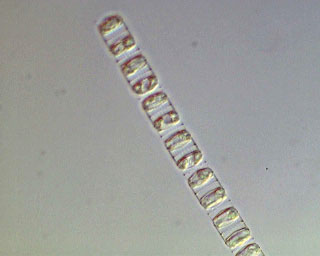
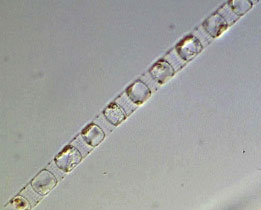
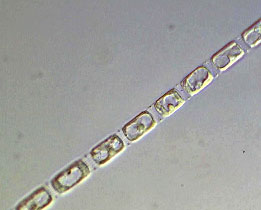
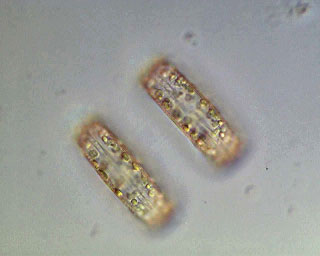
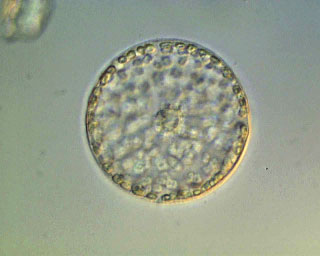
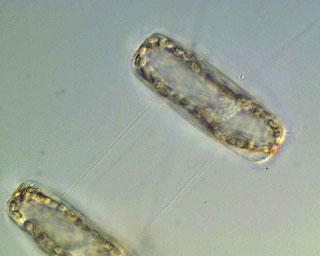
Skeletonema costatum
Cells cylindrical with rounded ends.
Cells form long straight chains, held together by fine marginal processus, parallel with
longitudinal axis.
Spines are straight and slender and unite with the spines of the next cell to form a junction.
Two chromatophores per cell.
Nucleus is central.
4
Phytoplankton Identification Catalogue Saldanha Bay, South Africa
A. Centric Diatoms
Division: BACILLARIOPHYTA
Order: BIDDULPHIALES
Sub-order: COSCINODISCINEAE
Family: Thalassiosiraceae
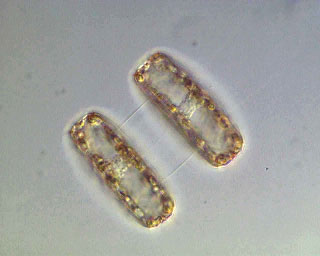
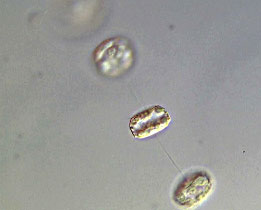
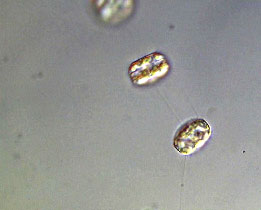
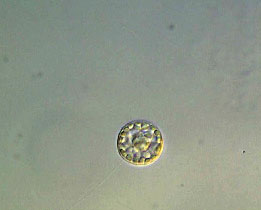
Thalassiosira anguste-lineata
Cells in girdle view are rectangular with the valve face flat or
slightly curved.
Valves are disc-shaped.
Cells connected by many connecting threads at some
distance from the valve centre.
5
GloBallast Monograph Series No. 7
A. Centric Diatoms
Division: BACILLARIOPHYTA
Order: BIDDULPHIALES
Sub-order: COSCINODISCINEAE
Family: Thalassiosiraceae
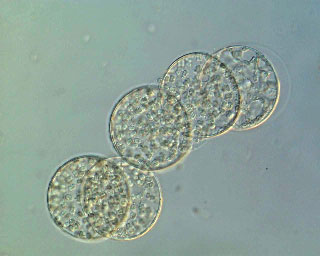
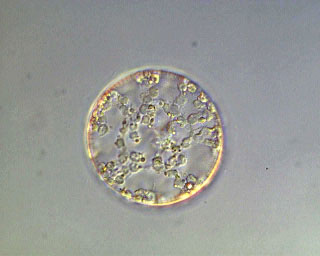
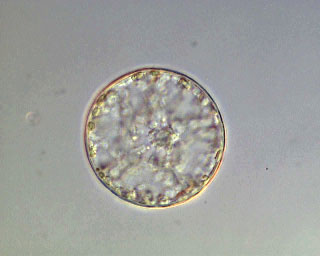
Thalasiossira decipiens
Cells in girdle view are rectangular to drum-shaped with the
valve face slightly curved/rounded.
Valves are disc-shaped.
Cells connected in a loose chain with one connecting thread.
Organic threads emerge from the marginal strutted processes.
Note:
Thalasiosira condensata somewhat similar but valves are slightly depressed in the middle
(T. decipiens has curved valves).
6
Phytoplankton Identification Catalogue Saldanha Bay, South Africa
A. Centric Diatoms
Division: BACILLARIOPHYTA
Order: BIDDULPHIALES
Sub-order: COSCINODISCINEAE
Family: Thalassiosiraceae
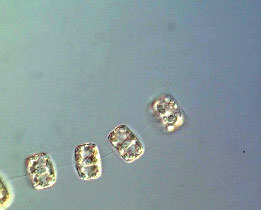
Thalassiosira eccentrica
Cells discoid, united in chains by a thick thread.
Cells furnished with short but fairly well pronounced marginal spinulae.
Chromatophores proportionally large, biscuit-formed, with a
single pyrenoid.
7
GloBallast Monograph Series No. 7
A. Centric Diatoms
Division: BACILLARIOPHYTA
Order: BIDDULPHIALES
Sub-order: COSCINODISCINEAE
Family: Thalassiosiraceae
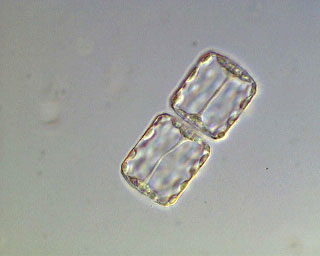
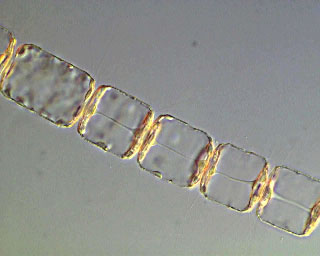
Thalassiosira hyalina
Girdle view of cells is rectangular, valve face round and flat.
One thick connecting thread.
Chromatophores 8-10 small plates.
8
Phytoplankton Identification Catalogue Saldanha Bay, South Africa
A. Centric Diatoms
Division: BACILLARIOPHYTA
Order: BIDDULPHIALES
Sub-order: COSCINODISCINEAE
Family: Melosiraceae
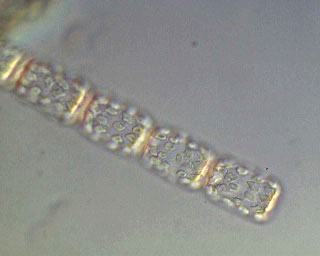
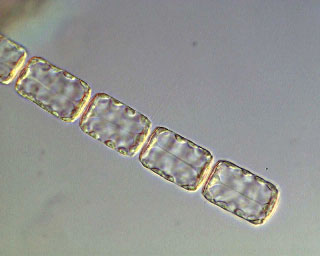
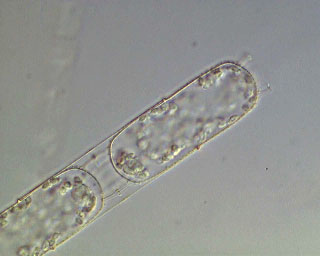
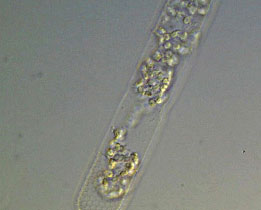
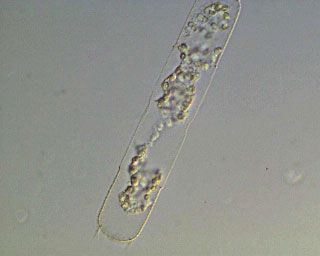
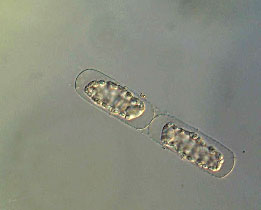
Melosira cf. spaerica
Connected to form long chains,
looking like a string of beads.
Several plate-like chromatophores.
Nucleus is central.
9
GloBallast Monograph Series No. 7
A. Centric Diatoms
Division: BACILLARIOPHYTA
Order: BIDDULPHIALES
Sub-order: COSCINODISCINEAE
Family: Melosiraceae
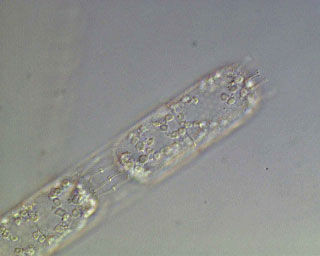
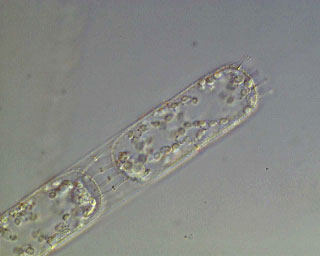
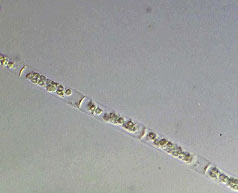
Stephanopyxis turris
Cells are cylindrical with convex valves.
Number of spines at the end of each cell with slightly thickened tips.
Spines attach with adjoining cells to form short chains, line of fusion midway between cells.
Hexagonal areolations.
Dividing cell
Recently divided cell
10
Phytoplankton Identification Catalogue Saldanha Bay, South Africa
A. Centric Diatoms
Division: BACILLARIOPHYTA
Order: BIDDULPHIALES
Sub-order: COSCINODISCINEAE
Family: Leptocylindraceae
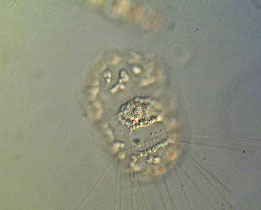
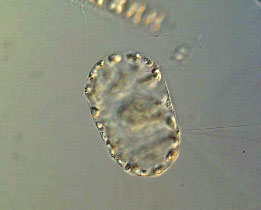
Leptocylindricus danicus
Cells cylindrical and slender.
Forms long stiff straight chains with only one cell wall between the two adjacent cells.
One cell is slightly concave and one cell slightly convex.
Numerous small rounded chloroplasts.
11
GloBallast Monograph Series No. 7
A. Centric Diatoms
Division: BACILLARIOPHYTA
Order: BIDDULPHIALES
Sub-order: COSCINODISCINEAE
Family: Leptocylindraceae
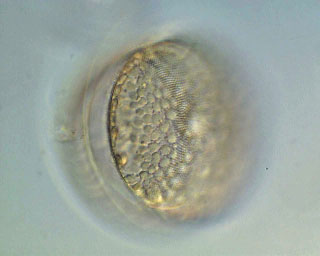
Corethron criophilum
Cells solitary and cylindrical.
Valves are strongly convex
and furnished with a marginal crown of well developed slender spines directed outwards at
an angle.
Numerous plate-like chromatophores.
12
Phytoplankton Identification Catalogue Saldanha Bay, South Africa
A. Centric Diatoms
Division: BACILLARIOPHYTA
Order: BIDDULPHIALES
Sub-order: COSCINODISCINEAE
Family: Coscinodiscaceae
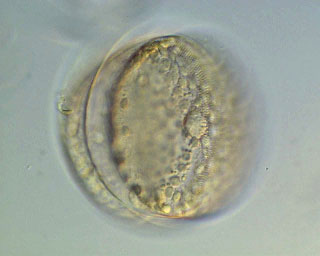
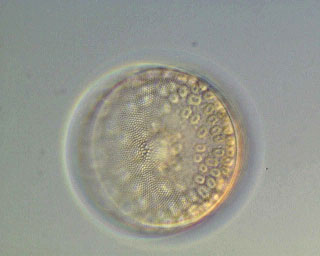
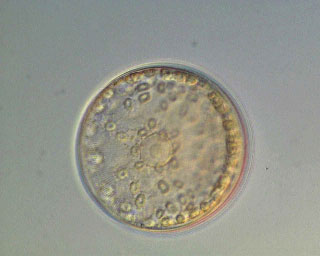
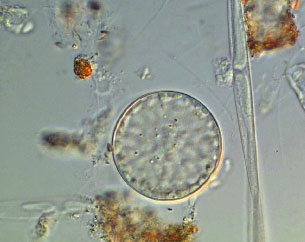
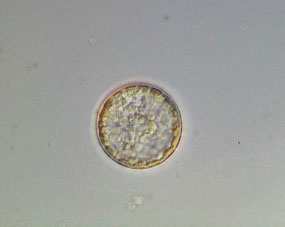
Coscinodiscus granii
Cell is asymmetric, one side much higher than the other.
Cell is wedge shaped in girdle view, valves are arched.
Cells are solitary.
Chloroplasts discoid and smooth in outline.
Mesh consists of fine lines radiating from a definite central rosette.
13
GloBallast Monograph Series No. 7
A. Centric Diatoms
Division: BACILLARIOPHYTA
Order: BIDDULPHIALES
Sub-order: COSCINODISCINEAE
Family: Coscinodiscaceae
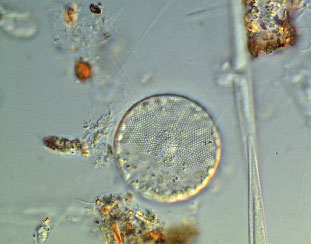
Coscinodiscus stellaris
Cells discoid, solitary.
Valves almost flat, areolated.
Meshes arranged in curved sectors, first curved line of each sector radiates from centre.
14
Phytoplankton Identification Catalogue Saldanha Bay, South Africa
A. Centric Diatoms
Division: BACILLARIOPHYTA
Order: BIDDULPHIALES
Sub-order: COSCINODISCINEAE
Family: Hemidiscaceae
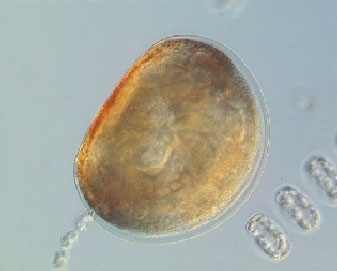
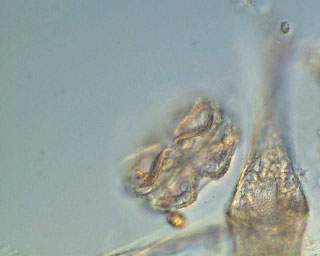
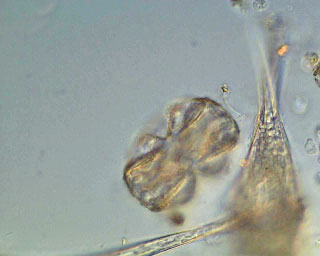
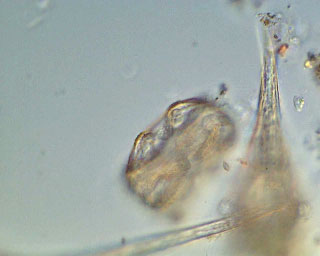
Hemidiscus cuneiformis
Cells cuneiform and solitary.
Valves semicircular, dorsal margin strongly convex, ventral margin weakly so.
15
GloBallast Monograph Series No. 7
A. Centric Diatoms
Division: BACILLARIOPHYTA
Order: BIDDULPHIALES
Sub-order: COSCINODISCINEAE
Family: Heliopeltaceae
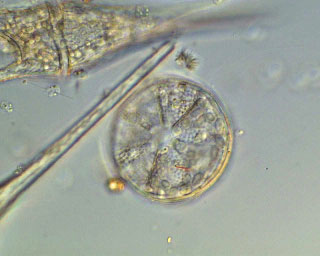
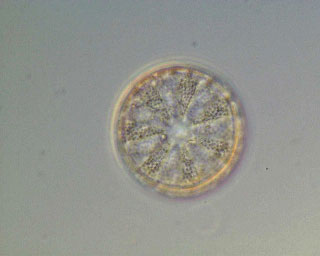
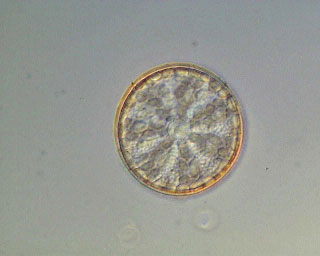
Actinoptychus splendens
Cells are discoid and solitary.
Valves radially undulate, divided into 10-20 sections, polygonal and areolated.
Nearly circular central area present.
Numerous chromatophores with plate-like bodies.
16
Phytoplankton Identification Catalogue Saldanha Bay, South Africa
A. Centric Diatoms
Division: BACILLARIOPHYTA
Order: BIDDULPHIALES
Sub-order: RHIZOSOLENIICEAE
Family: Rhizosoleniaceae
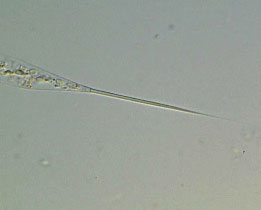
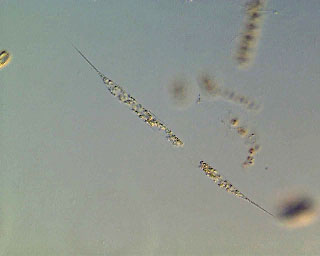
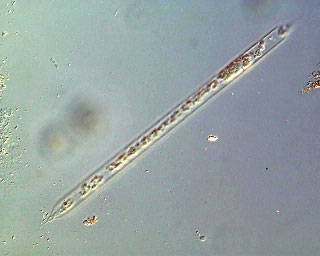
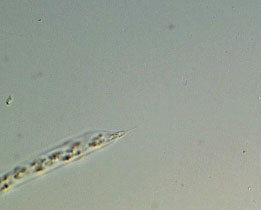
Rhizosolenia hebetata
Cells are cylindrical and long.
Valves drawn out, armed with a long, hair-like spine.
Numerous small chromatophores.
17
GloBallast Monograph Series No. 7
A. Centric Diatoms
Division: BACILLARIOPHYTA
Order: BIDDULPHIALES
Sub-order: RHIZOSOLENIICEAE
Family: Rhizosoleniaceae
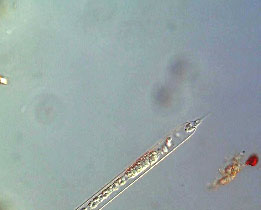
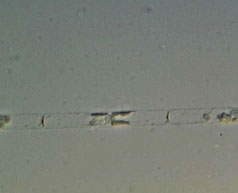
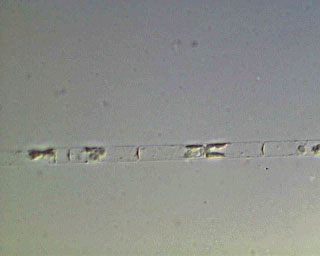
Rhizosolenia imbricata
Cells cylindrical.
Valves oblique and pointed.
Apical process hollow nearly all the way, with small wings at the base which run up to
about a third of the spine.
Chromatophores are numerous and small.
18
Phytoplankton Identification Catalogue Saldanha Bay, South Africa
A. Centric Diatoms
Division: BACILLARIOPHYTA
Order: BIDDULPHIALES
Sub-order: RHIZOSOLENIICEAE
Family: Rhizosoleniaceae
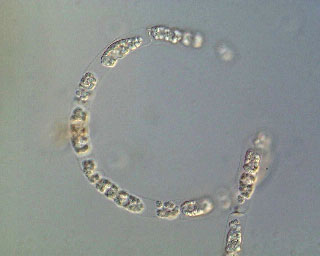
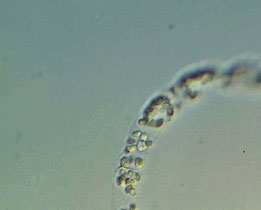
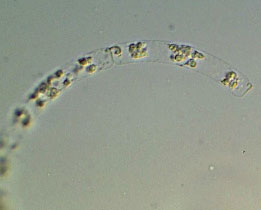
Guinardia delicatula
Cells cylindrical, longer than broad, in close-set straight chains.
Valves flat and only slightly rounded at the edges.
Spike-like attachment to next cell.
19
GloBallast Monograph Series No. 7
A. Centric Diatoms
Division: BACILLARIOPHYTA
Order: BIDDULPHIALES
Sub-order: RHIZOSOLENIICEAE
Family: Rhizosoleniaceae
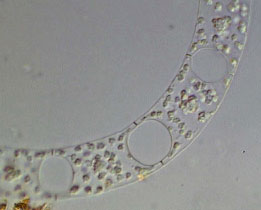
Guinardia striata
Cells in close set curved, often spiralling chains
Valves flat and rounded at the edges.
Chromatophores small and numerous.
20
Phytoplankton Identification Catalogue Saldanha Bay, South Africa
A. Centric Diatoms
Division: BACILLARIOPHYTA
Order: BIDDULPHIALES
Sub-order: BIDDULPHIINEAE
Family: Hemiaulaceae
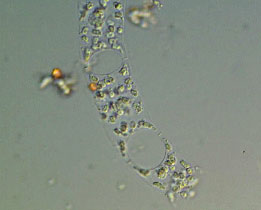
Eucampia zoodiacus
Cells flattened united by two blunt processes.
Chains helically coiled.
Apertures between two cells are circular in small cells and more elongated in larger cells.
Chromatophores small, numerous and scattered.
21
GloBallast Monograph Series No. 7
A. Centric Diatoms
Division: BACILLARIOPHYTA
Order: BIDDULPHIALES
Sub-order: BIDDULPHIINEAE
Family: Chaetocerotaceae
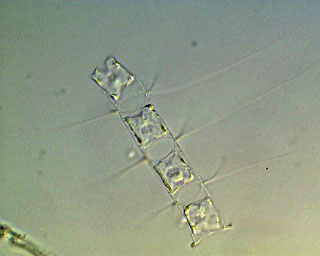
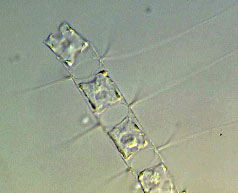
Chaetoceros capense
Long thin setae originate at corners,
united to form 4-8 cells per chain.
Valve surface concave and apertures eliptical.
Chromatophores irregularly shaped.
22
Phytoplankton Identification Catalogue Saldanha Bay, South Africa
A. Centric Diatoms
Division: BACILLARIOPHYTA
Order: BIDDULPHIALES
Sub-order: BIDDULPHIINEAE
Family: Chaetocerotaceae
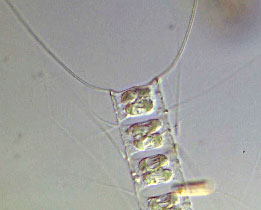
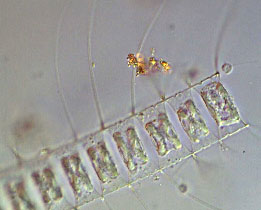
Chaetoceros constrictus
Valves with sharp corners and
concave but slightly raised in the centre.
Terminal setae acutely divergent.
Two chromatophores per cell.
23
GloBallast Monograph Series No. 7
A. Centric Diatoms
Division: BACILLARIOPHYTA
Order: BIDDULPHIALES
Sub-order: BIDDULPHIINEAE
Family: Chaetocerotaceae
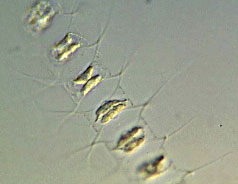
Chaetoceros didymus
Chains straight,
cells compressed in broad girdle view,
with concave end surfaces,
and a semicircular knob in the centre.
Two chromatophores present.
Note:
The inner setae of Chaetoceros didymus var. protuberens cross further out than in the type
species (as in this case).
24
Phytoplankton Identification Catalogue Saldanha Bay, South Africa
A. Centric Diatoms
Division: BACILLARIOPHYTA
Order: BIDDULPHIALES
Sub-order: BIDDULPHIINEAE
Family: Chaetocerotaceae
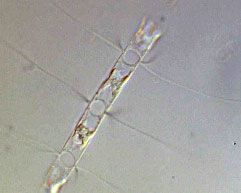
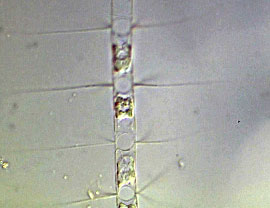
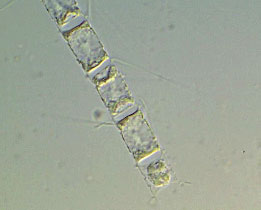
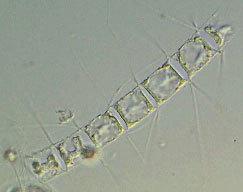
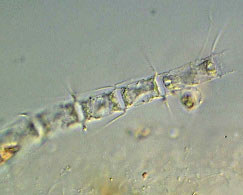
Chaetoceros cf. lorenzianus
Cells rectangular in girdle view.
Apertures polygonal to elliptical.
Setae fused only at point of exit from margin.
Chromatophores large and plate-like.
Note:
Chaetoceros lorenzianus have coarse setae.
25
GloBallast Monograph Series No. 7
A. Centric Diatoms
Division: BACILLARIOPHYTA
Order: BIDDULPHIALES
Sub-order: BIDDULPHIINEAE
Family: Chaetocerotaceae
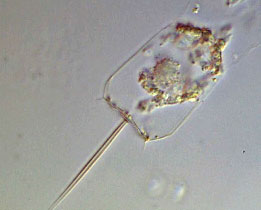
Chaetoceros sp.
Cell surface concave, slightly raised in the centre.
Aperture narrow.
Setae originate at cell corners but are directed in different directions.
Chromatophores large.
Resting spore.
26
Phytoplankton Identification Catalogue Saldanha Bay, South Africa
A. Centric Diatoms
Division: BACILLARIOPHYTA
Order: BIDDULPHIALES
Sub-order: BIDDULPHIINEAE
Family: Lithodesmisceae
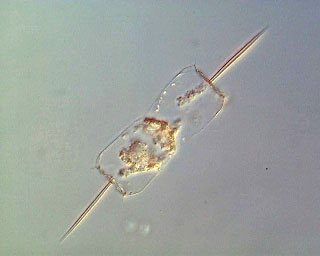
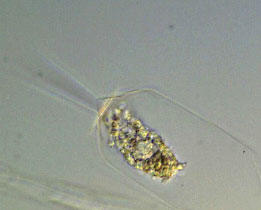
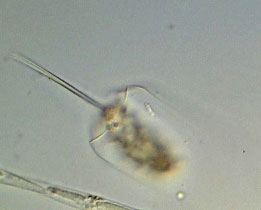
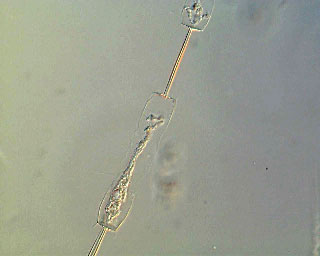
Ditylum brightwelli
Weakly siliceous cell walls.
Cells prism-shaped with strongly rounded angles.
Valves triangular with
central hollow labiale process.
Triangular marginal ridge present on the valve face.
27
GloBallast Monograph Series No. 7
B. Pennate Diatoms
Division: BACILLARIOPHYTA
Order: BACILLARIALES
Sub-order: FRAGILARIINIEAE
Family: Fragilariaceae
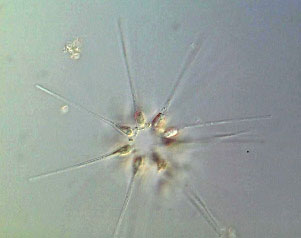
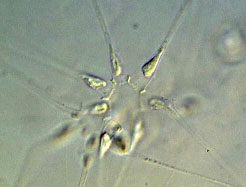
Asterionellopsis glacialis
Cells rod-like with distinctly dissimilar ends,
one end enlarged.
Larger ends united into star-like spiral colonies.
28
Phytoplankton Identification Catalogue Saldanha Bay, South Africa
B. Pennate Diatoms
Division: BACILLARIOPHYTA
Order: BACILLARIALES
Sub-order: FRAGILARIINIEAE
Family: Fragilariaceae
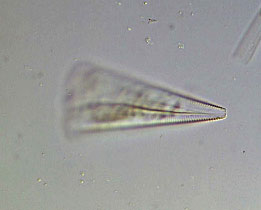
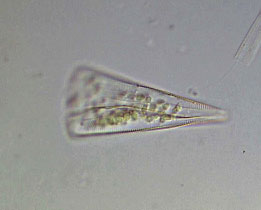
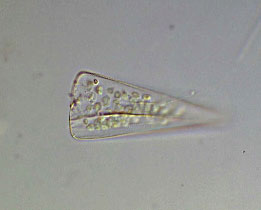
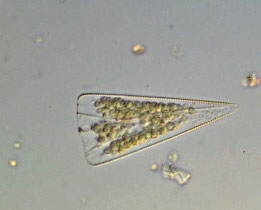
Licmophora ehrenbergii
Cells in girdle view are wedge-shaped with rounded corners.
Strong clear striations.
Chromatophores are granular.
29
GloBallast Monograph Series No. 7
B. Pennate Diatoms
Division: BACILLARIOPHYTA
Order: BACILLARIALES
Sub-order: FRAGILARIINIEAE
Family: Fragilariaceae
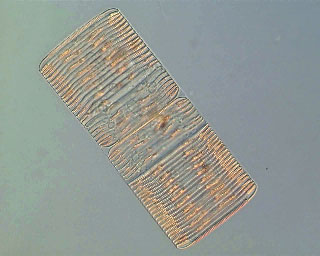
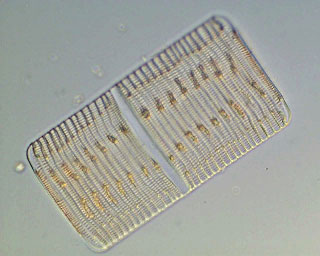
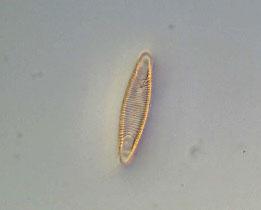
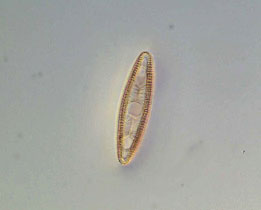
Striatella unipunctata
Tabular with corners appearing as being cut off.
Numerous open bands with narrow septa.
Valve view is lanceolate with distinct apical pore fields.
Sternum narrow.
Areolae in line systems.
Note:
Can be confused with Cerataulina dentata, which in valve view is circular.
30
Phytoplankton Identification Catalogue Saldanha Bay, South Africa
B. Pennate Diatoms
Division: BACILLARIOPHYTA
Order: BACILLARIALES
Sub-order: FRAGILARIINIEAE
Family: Thalassionemataceae
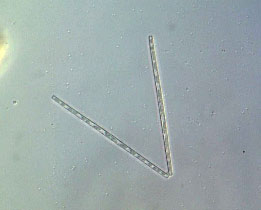
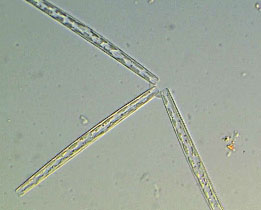
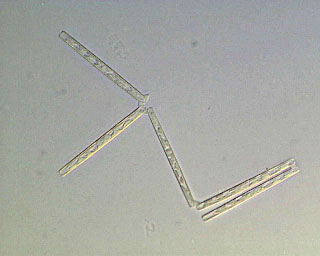
Thalassionema nitzschioides
Cells linear and narrow in girdle view with
bluntly rounded ends.
Cells united by a gelatinous cushion at one end into
zig-zag or star-shaped colonies.
Numerous small granular chromatophores present.
Along the margin of the valve face are a row of sawtooth-like spinulae.
31
GloBallast Monograph Series No. 7
B. Pennate Diatoms
Division: BACILLARIOPHYTA
Order: BACILLARIALES
Sub-order: FRAGILARIINIEAE
Family: Naviculaceae
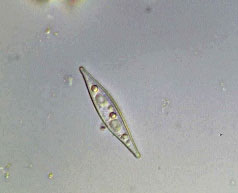
Navicula sp.
Two plate-like chloroplasts.
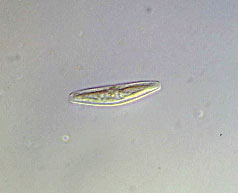
Navicula sp.
Two chloroplasts, each covering the girdle from end to end.
32
Phytoplankton Identification Catalogue Saldanha Bay, South Africa
B. Pennate Diatoms
Division: BACILLARIOPHYTA
Order: BACILLARIALES
Sub-order: FRAGILARIINIEAE
Family: Naviculaceae
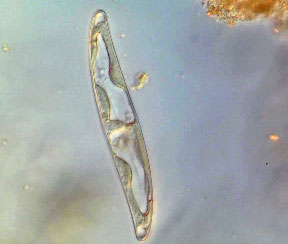
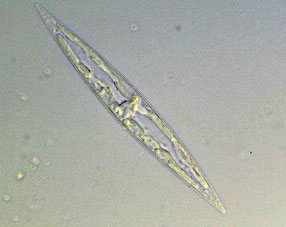
Pleurosigma capense
Cells elongated and sigmoid.
Chromatophore two bands, one to each valve.
Raphe more or less sigmoid and central.
33
GloBallast Monograph Series No. 7
B. Pennate Diatoms
Division: BACILLARIOPHYTA
Order: BACILLARIALES
Sub-order: FRAGILARIINIEAE
Family: Naviculaceae
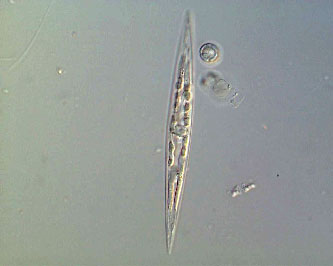
Pleurosigma directum
Cells elliptic-lanceolate.
Chromatophores present.
Raphe almost straight.
34
Phytoplankton Identification Catalogue Saldanha Bay, South Africa
B. Pennate Diatoms
Division: BACILLARIOPHYTA
Order: BACILLARIALES
Sub-order: FRAGILARIINIEAE
Family: Bacillariaceae
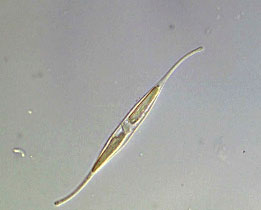
Nitzschia closterium
Cells solitary and slightly bend.
Ends of bent horns are hair-like.
Central nucleus and
two chromatophores.
35
GloBallast Monograph Series No. 7
B. Pennate Diatoms
Division: BACILLARIOPHYTA
Order: BACILLARIALES
Sub-order: FRAGILARIINIEAE
Family: Bacillariaceae
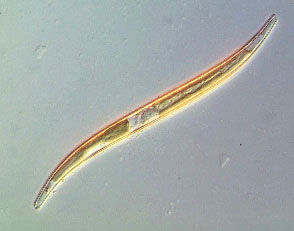
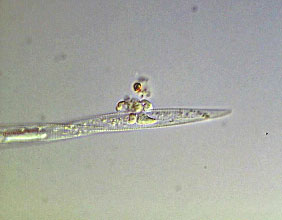
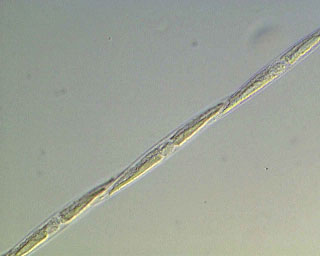
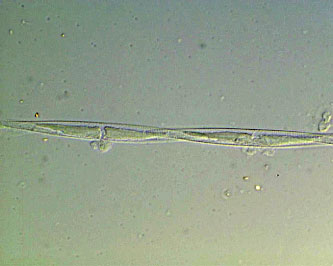
Nitzschia sigma
Valves linear and somewhat sigmoid.
Valve is finely striated.
Cells are fairly long.
Central nucleus and
two chromatophores.
36
Phytoplankton Identification Catalogue Saldanha Bay, South Africa
B. Pennate Diatoms
Division: BACILLARIOPHYTA
Order: BACILLARIALES
Sub-order: FRAGILARIINIEAE
Family: Bacillariaceae
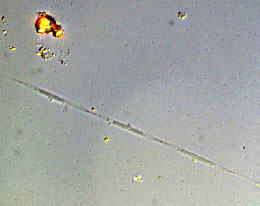
Pseudo-nitzschia australis
Cells joined at tips (overlap is 1/4 of cell).
Cells very wide.
Striations visible with light microscope.
Two chromatophores are present.
37
GloBallast Monograph Series No. 7
B. Pennate Diatoms
Division: BACILLARIOPHYTA
Order: BACILLARIALES
Sub-order: FRAGILARIINIEAE
Family: Bacillariaceae
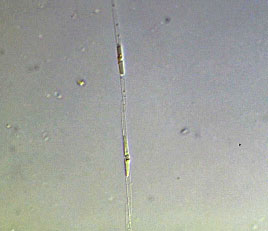
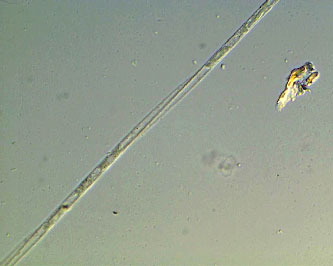
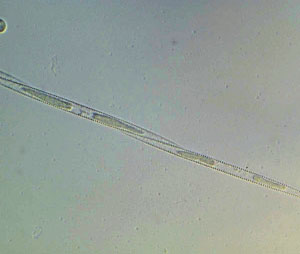
Pseudo-nitzschia delicatissima
Cells joined in short chains tip to tip (tip to tip overlap is 1/9 of cell).
Cells not very wide.
Striations not visible with light microscope.
Two chromatophores are present.
38
Phytoplankton Identification Catalogue Saldanha Bay, South Africa
B. Pennate Diatoms
Division: BACILLARIOPHYTA
Order: BACILLARIALES
Sub-order: FRAGILARIINIEAE
Family: Bacillariaceae
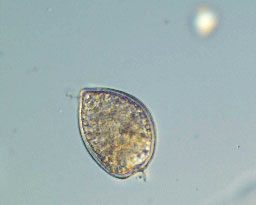
Pseudo-nitzschia pungens
Valves linear lanceolate and strongly tapered with pointed ends
Cell tips overlap with 1/3 of the cell.
Two chromatophores present.
Striations visible with light microscope.
Cell narrower than that of Pseudo-nitzschia seriata.
39
Dinoflagellates
Dinoflagellate species encountered in
the study area are ordered according
to Steidinger and Tangen (1997)
GloBallast Monograph Series No. 7
Dinoflagellates
Division: DYNOPHYTA
Class: DINOPHYCEAE
Order: PROROCENTRALES
Family: Prorocentraceae
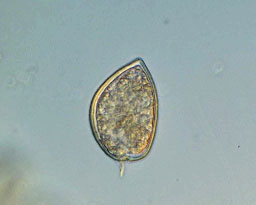
Prorocentrum micans
Cells are tear-drop shaped to heart shaped.
Rounded anterior end and a pointed posterior end.
In valve view have one convex side and one arched side.
The convex arch profile is typically in the middle of the cell where the cell is the broadest.
Prominent spine with a triangular wing is present.
42
Phytoplankton Identification Catalogue Saldanha Bay, South Africa
Dinoflagellates
Division: DYNOPHYTA
Class: DINOPHYCEAE
Order: DINOPHYSIALES
Family: Dinophysiaceae
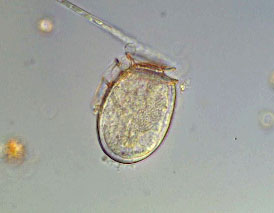
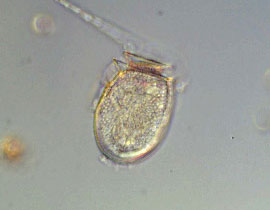
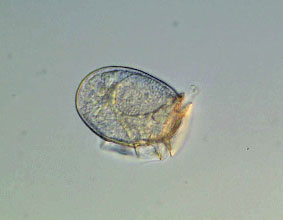
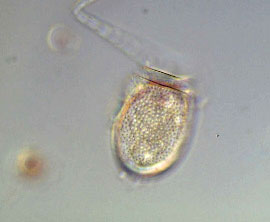
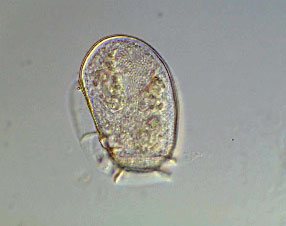
Dinophysis acuminata
Cell oval or elliptical in shape.
Left sulcal list is well developed, supported by 3 ribs and extends beyond the midpoint of
the cell.
Surface covered with areolae, each with a pore.
Posterior profile of hypotheca is rounded.
Epitheca is dorsoventrally reduced.
Nucleus.
43
GloBallast Monograph Series No. 7
Dinoflagellates
Division: DYNOPHYTA
Class: DINOPHYCEAE
Order: DINOPHYSIALES
Family: Dinophysiaceae
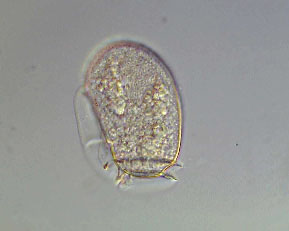
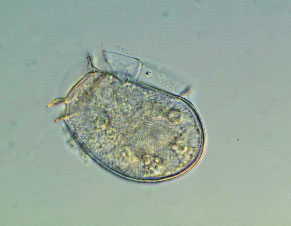
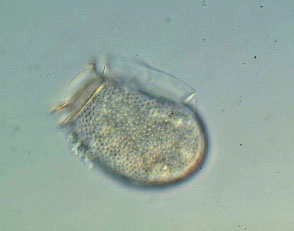
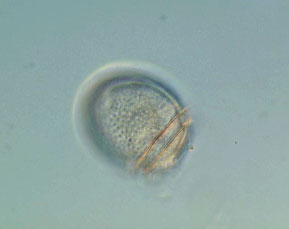
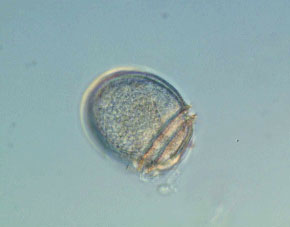
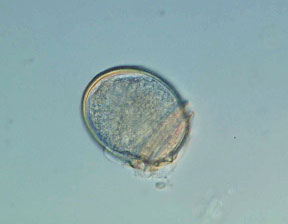
Dinophysis fortii
Cells are broadly sub-ovoid shaped.
Cell widest posteriorly.
Dorsal margin curved and ventral margin almost straight.
Left sulcul list long and can be up to 4/5 of the cell length.
Right sulcul list also well developed and can extend beyond the 2nd rib.
Surface of the valves have deep poroids, each with a pore.
Nucleus.
44
Phytoplankton Identification Catalogue Saldanha Bay, South Africa
Dinoflagellates
Division: DYNOPHYTA
Class: DINOPHYCEAE
Order: DINOPHYSIALES
Family: Dinophysiaceae
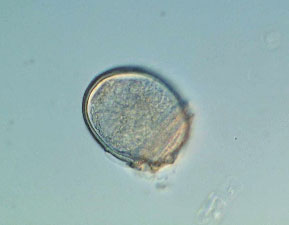
Dinophysis rotundata
In lateral view, cells are asymmetrically rounded to oval.
Epitheca is low and fairly evenly rounded and convex
Both anterior and posterior cingular lists are narrow and lack any ridges.
Sulcul lists extend about half the total length
The thecal plates are thin and finely areolated.
Nucleus.
45
GloBallast Monograph Series No. 7
Dinoflagellates
Division: DYNOPHYTA
Class: DINOPHYCEAE
Order: GYMNODINIALES
Family: Gymnodiniaceae
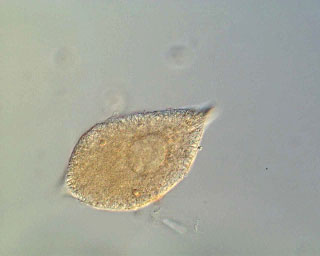
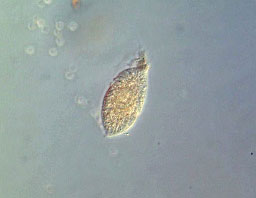
Gyrodinium sp.
Large spindle shaped asymmetric cell with slight longitudinal twist.
Cingulum narrow, displaced ~ 1/3 of the body length.
Big nucleus present.
46
Phytoplankton Identification Catalogue Saldanha Bay, South Africa
Dinoflagellates
Division: DYNOPHYTA
Class: DINOPHYCEAE
Order: NOCTILUCALES
Family: Noctilucaceae
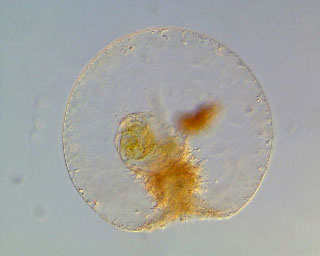
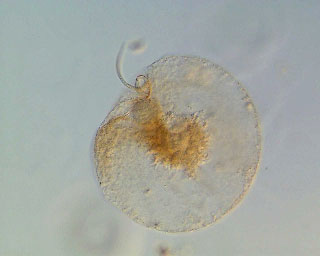
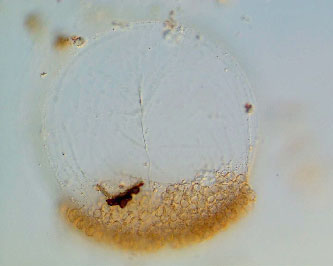
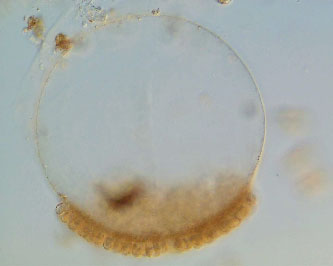
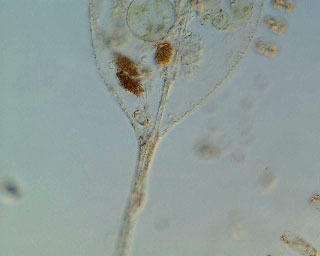
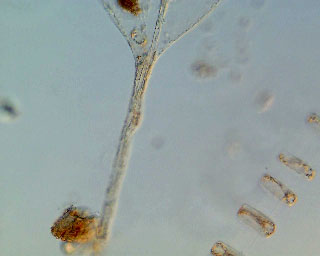
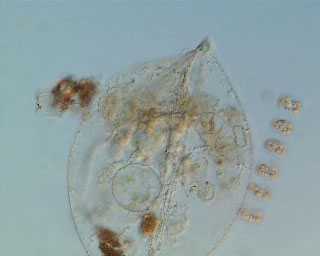
Noctiluca scintillans
Cells large, subspherical and inflated.
Cells not differentiated into epitheca and hypotheca.
Two flagella and a striated tentacle.
Numerous food vacuoles, often containing diatoms
Chloroplasts are absent and the cytoplasm is colourless.
Eucaryotic nucleus situated near the sulcus.
Zoospore formation.
47
GloBallast Monograph Series No. 7
Dinoflagellates
Division: DYNOPHYTA
Class: DINOPHYCEAE
Order: NOCTILUCALES
Family: Noctilucaceae
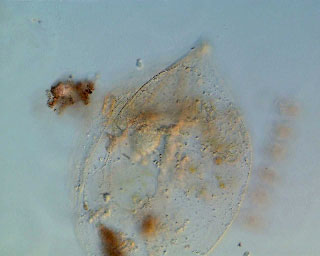
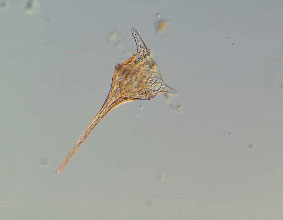
Spatulodinium cf. pseudonoctiluca
Very large cell looking inflated like Noctiluca scintillans.
Pointed anteriorly with straight tentacle posteriorly.
Food vacuoles contain diatoms.
48
Phytoplankton Identification Catalogue Saldanha Bay, South Africa
Dinoflagellates
Division: DYNOPHYTA
Class: DINOPHYCEAE
Order: GONYAULACALES
Family: Ceratiaceae
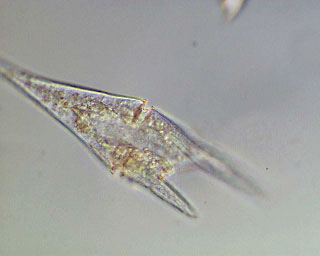
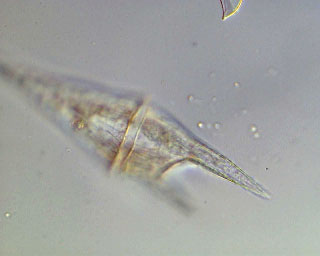
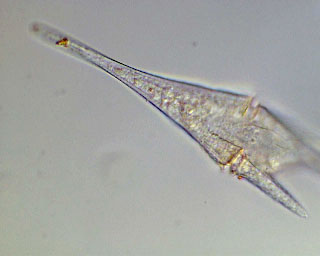
Ceratium dens
Pentagonal cell shape.
Epitheca forming a more or less equilateral triangle with a
sharp transition into a fairly long apical horn.
Hypotheca extends into two unequal antapical horns pointing in opposite directions.
49
GloBallast Monograph Series No. 7
Dinoflagellates
Division: DYNOPHYTA
Class: DINOPHYCEAE
Order: GONYAULACALES
Family: Ceratiaceae
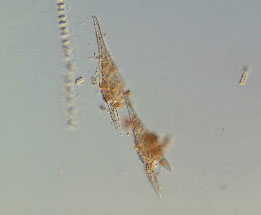
Ceratium furca
Large, straight body with cell being the widest either side of the girdle.
Two unequal, parallel or slightly divergent hypothecal horns, the right shorter than the left.
Epitheca tapering gradually into an apical horn.
Thecal plates thick and ornamented with surface ridges
Chain forming species.
50
Phytoplankton Identification Catalogue Saldanha Bay, South Africa
Dinoflagellates
Division: DYNOPHYTA
Class: DINOPHYCEAE
Order: GONYAULACALES
Family: Ceratiaceae
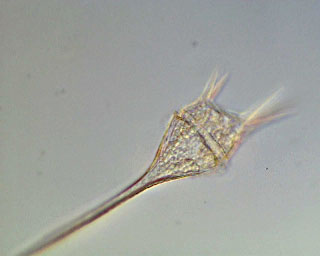
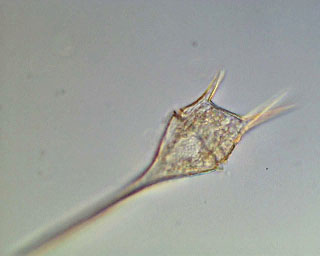
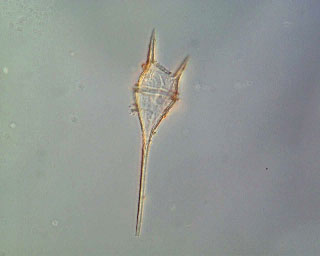
Ceratium lineatum
Pentagonal cell shape.
Epitheca forming a more or less equilateral triangle with a
sharp transition into a fairly long apical horn.
Hypotheca rather rectangular extended at the lower corners into
two unequal antapical horns which are straight but
diverge slightly, right horn shorter.
Thecal plates rather thin, not ornamented.
Nucleus.
51
GloBallast Monograph Series No. 7
Dinoflagellates
Division: DYNOPHYTA
Class: DINOPHYCEAE
Order: GONYAULACALES
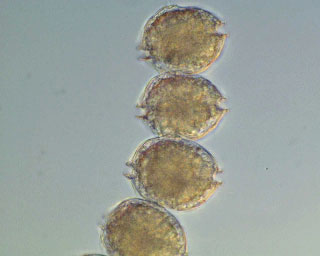
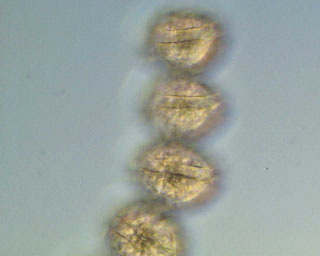
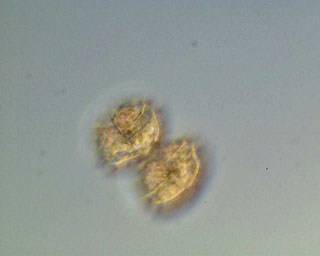
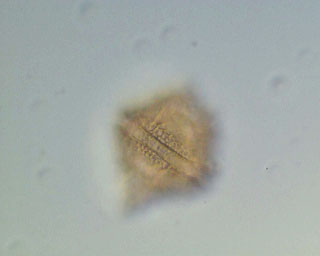
Family: Goniodomataceae
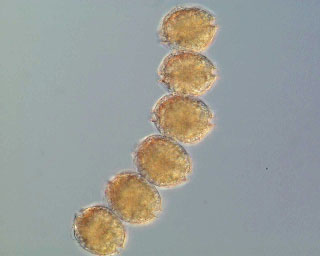
Alexandrium catenella
Chain forming species of 2-8 cells.
Cells globular, slightly wider than long.
Cingulum median, descending, displaced by its width.
Cingulum contains fins.
Antapex slightly concave.
Apex slightly convex.
52
Phytoplankton Identification Catalogue Saldanha Bay, South Africa
Dinoflagellates
Division: DYNOPHYTA
Class: DINOPHYCEAE
Order: GONYAULACALES
Family: Gonyaulacaceae
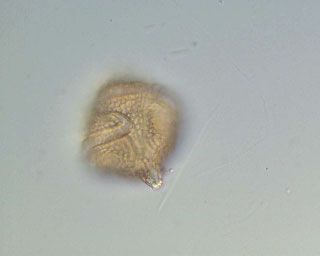
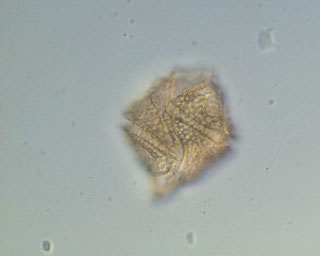
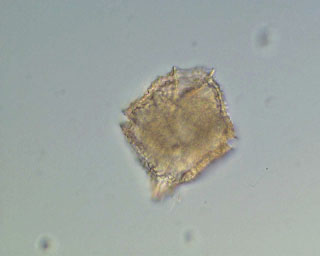
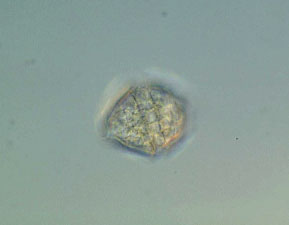
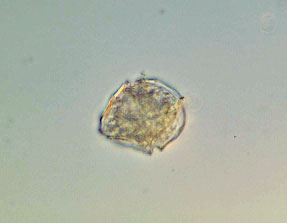
Gonyaulax spinifera
Cells thecate, elongated and tetragonal in dorso-ventral view.
Girdle relatively wide, descending in about twice its width with a large overhang.
Hypotheca bearing two antapical spines.
Epitheca with convex sides leading into an apical horn.
53
GloBallast Monograph Series No. 7
Dinoflagellates
Division: DYNOPHYTA
Class: DINOPHYCEAE
Order: GONYAULACALES
Family: Gonyaulacaceae
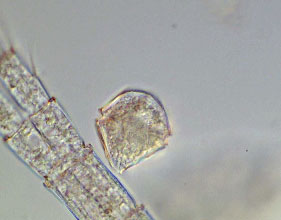
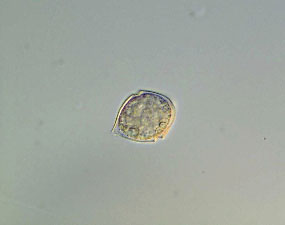
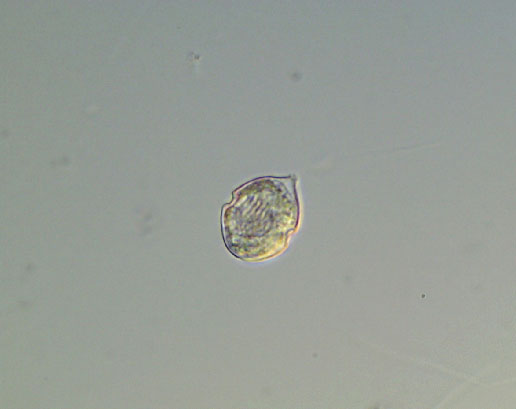
Lingulodinium cf. polyedrum
Cell polyedral shaped, without antapical spines and apical horn.
Girdle wide and almost equatorial.
Note:
L. polyedrum should have coarse areolation.
54
Phytoplankton Identification Catalogue Saldanha Bay, South Africa
Dinoflagellates
Division: DYNOPHYTA
Class: DINOPHYCEAE
Order: PERIDINIALES
Family: Calciodinellaceae
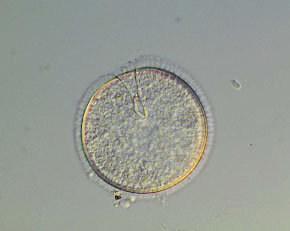
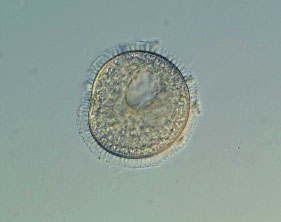
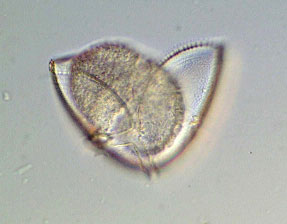
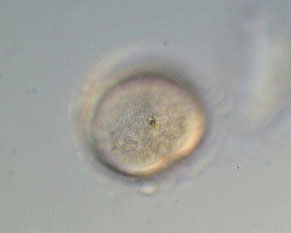
Scrippsiella trochoidea
Small pear shaped cell.
Epitheca is conical with a raised apex.
Hypotheca hemisperical with no antapical projections
Nucleus central.
Chloroplasts discoidal.
55
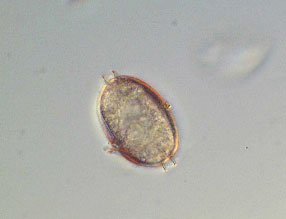
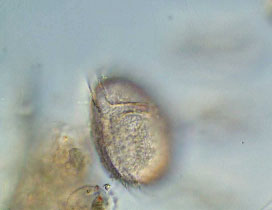
GloBallast Monograph Series No. 7
Dinoflagellates
Division: DYNOPHYTA
Class: DINOPHYCEAE
Order: PERIDINIALES
Family: Kolkwitziellaceae
Preperidinium meunieri (Synonym: Zygabikodinium lenticulatum)
Cells armoured and
almost circular in apical view
Epitheca with convex sides and small apical projection.
The girdle is equatorial,
not incised but bordered by lists supported by spines.
Hypotheca has convex sides.
The sulcus almost reaches the centre of the hypotheca and is bordered by a narrow list.
56
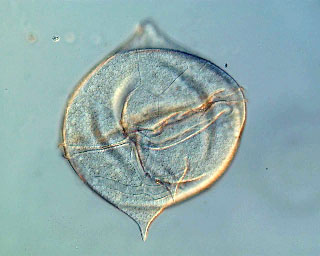
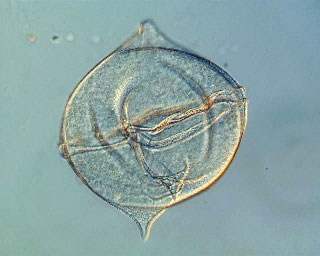
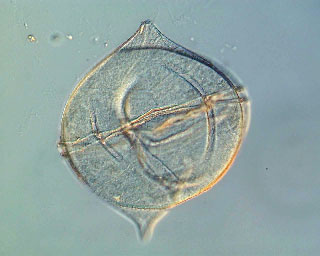
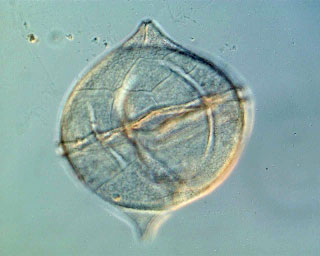
Phytoplankton Identification Catalogue Saldanha Bay, South Africa
Dinoflagellates
Division: DYNOPHYTA
Class: DINOPHYCEAE
Order: PERIDINIALES
Family: Protoperidiniaceae
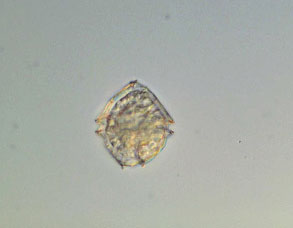
Protoperidinium sp.
Large round cell.
Epicone convex ending in a apical horn.
Hypocone convex ending in two antapical horns.
Thecal plates present.
Cingulum is circular and not very wide.
57
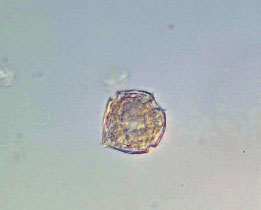
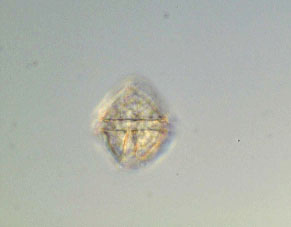
GloBallast Monograph Series No. 7
Dinoflagellates
Division: DYNOPHYTA
Class: DINOPHYCEAE
Order: PERIDINIALES
Family: Protoperidiniaceae
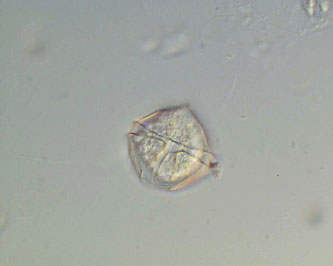
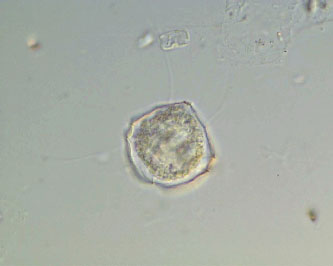
Protoperidinium conicoides
Epitheca slightly convex,
ending at the apex with a small projection.
Hypotheca also convex,
ending with tow spines at the antapex.
Sulcus deeply excavated, broadening posteriorly with
a characteristic twist on the left just below the girdle.
58
Phytoplankton Identification Catalogue Saldanha Bay, South Africa
Dinoflagellates
Division: DYNOPHYTA
Class: DINOPHYCEAE
Order: PERIDINIALES
Family: Protoperidiniaceae
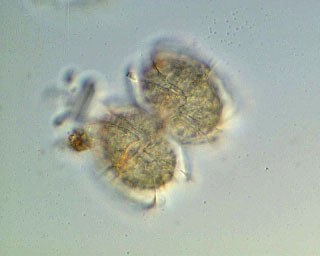
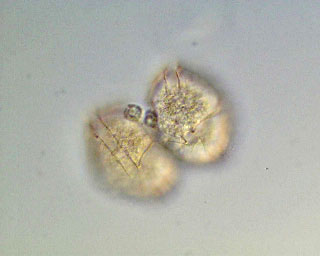
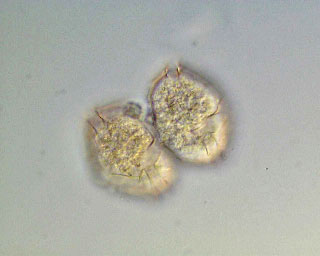
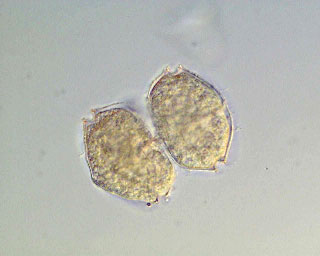
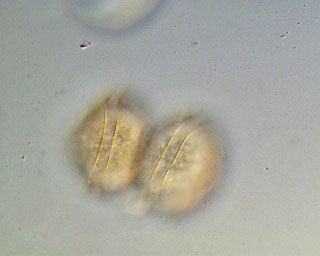
Protoperidinium denticulatum
Very distinctively shaped species in which some cells have a flat epitheca whilst others a
flat hypotheca.
Cingulum wide and displaced by one girdle width.
Sulcus is deep.
Often cells are found in pairs.
59
GloBallast Monograph Series No. 7
Dinoflagellates
Division: DYNOPHYTA
Class: DINOPHYCEAE
Order: PERIDINIALES
Family: Protoperidiniaceae
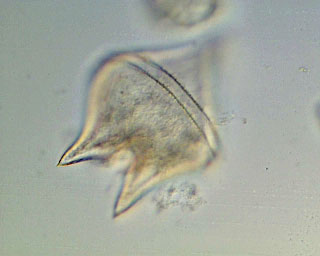
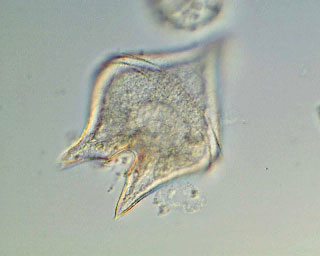
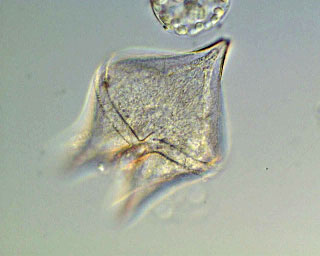
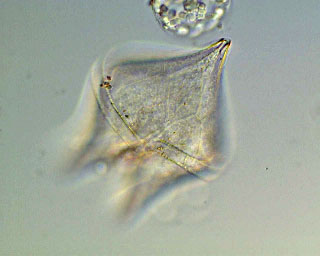
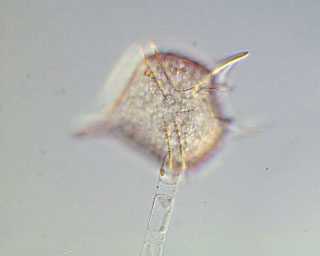
Protoperidinium depressum
Large cell with
prominent apical horn and
two divergent antapical horns.
Epitheca and hypotheca concave
Sulcus deeply excavated.
Cingulum is left-handed, unexcavated and bordered by lists
supported by spines.
Thecal plates.
60
Phytoplankton Identification Catalogue Saldanha Bay, South Africa
Dinoflagellates
Division: DYNOPHYTA
Class: DINOPHYCEAE
Order: PERIDINIALES
Family: Protoperidiniaceae
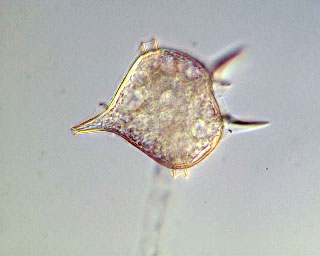
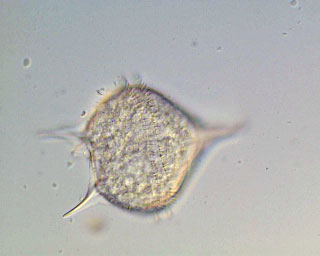
Protoperidinium diabolum
Cells are pear shaped and slightly dorso-ventrally flattened.
Long apical horn and
two long, winged antapical spines present.
Left spine has a small accessory spine at its base directed towards the right.
Cingulum is right-handed,
only slightly displaced,
not excavated but with prominent lists supported by spines.
61
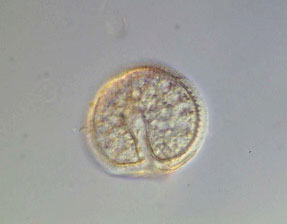
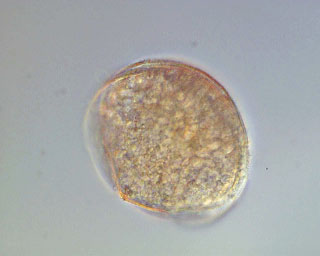
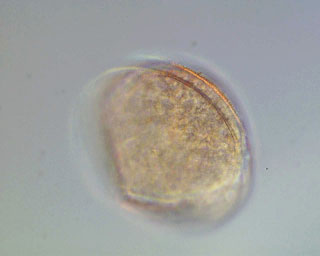
GloBallast Monograph Series No. 7
Dinoflagellates
Division: DYNOPHYTA
Class: DINOPHYCEAE
Order: PERIDINIALES
Family: Protoperidiniaceae
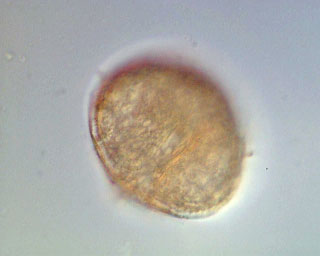
Protoperidinium excentricum
Cell is anteriorly-posteriorly compressed with the apical horn
offset to the left and ventral (apex-antapex axis is oblique).
Sulcus is deeply excavated and reaches beyond the centre of the hypotheca, the left
projecting further than the right.
Cingulum is excavated, bordered by lists supported by spines.
Hypotheca is flattened.
62
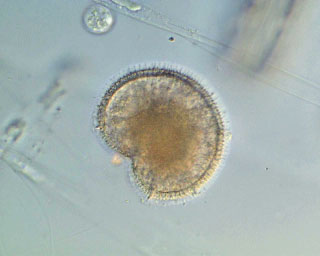
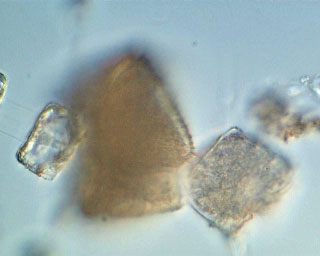
Phytoplankton Identification Catalogue Saldanha Bay, South Africa
Dinoflagellates
Division: DYNOPHYTA
Class: DINOPHYCEAE
Order: PERIDINIALES
Family: Protoperidiniaceae
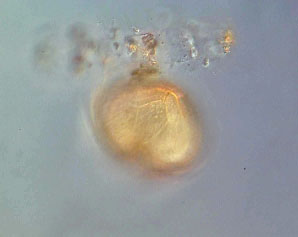
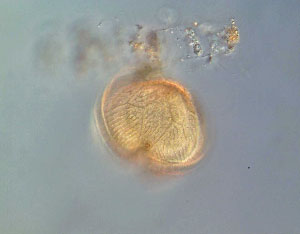
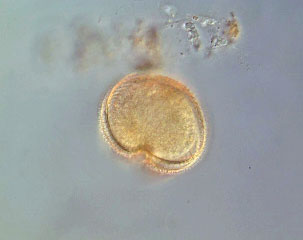
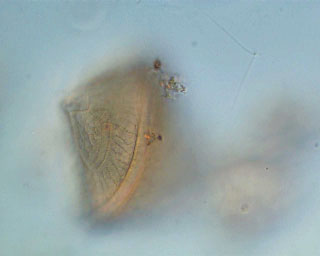
Protoperidinium obtusum
Cell has a blunt apex and
an irregular first apical plate.
Epitheca covered by longitudinal striations.
Hypotheca has two antapical horns.
Cingulum bordered by a list, supported by spines.
63
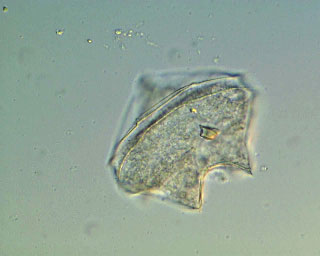
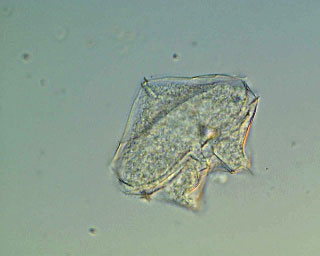
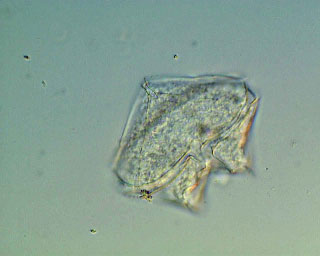
GloBallast Monograph Series No. 7
Dinoflagellates
Division: DYNOPHYTA
Class: DINOPHYCEAE
Order: PERIDINIALES
Family: Protoperidiniaceae
Protoperidinium pentagonum
Cell large to broadly pentagonal.
Sulcus short and shallow.
Cingulum descending.
Two antapical horns present.
64
Phytoplankton Identification Catalogue Saldanha Bay, South Africa
Dinoflagellates
Division: DYNOPHYTA
Class: DINOPHYCEAE
Order: PERIDINIALES
Family: Protoperidiniaceae
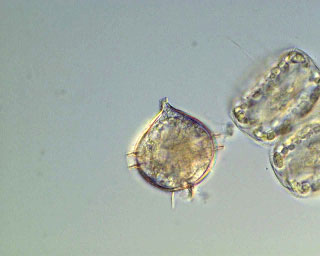
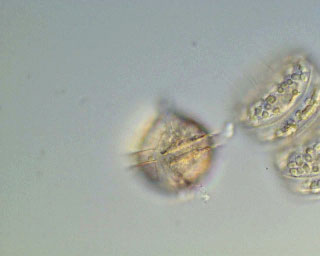
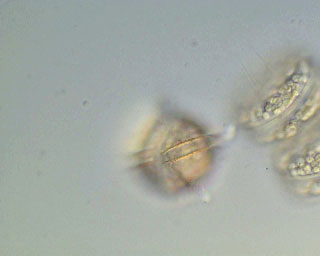
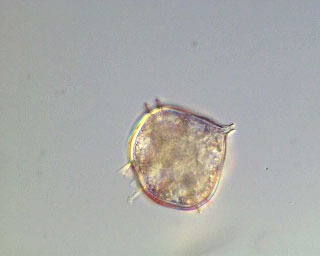
Protoperidinium pyriforme
Cells pear shaped with
straight-sided to convex epitheca,
ending in an apical horn.
Hypotheca is rounded bearing two winged spines.
Sulcus broadens slightly posteriorly.
Cingulum is bordered by lists supported by spines.
Note:
Protoperidinium steinii have longer antapical spines.
65
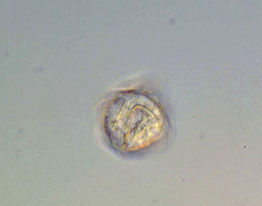
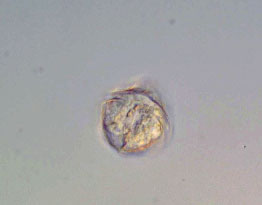
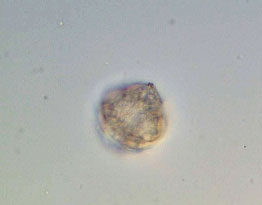
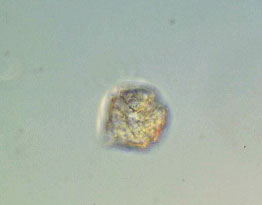
GloBallast Monograph Series No. 7
Dinoflagellates
Division: DYNOPHYTA
Class: DINOPHYCEAE
Order: PERIDINIALES
Family: Protoperidiniaceae
Protoperidinium subinerme
Cell almost circular in cross section.
Cingulum circular, not very displaced.
Sulcus widening antapically.
Epitheca is slightly convex and
hypotheca is straight sided with a flat base.
66
Phytoplankton Identification Catalogue Saldanha Bay, South Africa
Dinoflagellates
Division: DYNOPHYTA
Class: DINOPHYCEAE
Order: PERIDINIALES
Family: Protoperidiniaceae
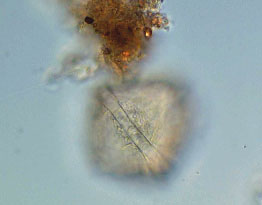
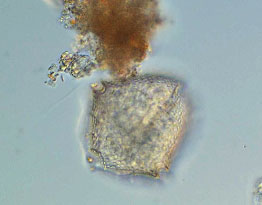
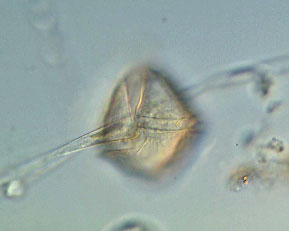
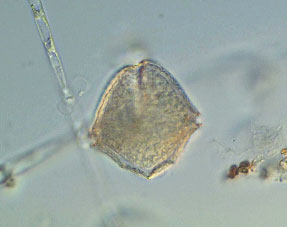
Protoperidinium thorianum
Rounded cell characterised by strong papillate or wavy thecal surface.
Hypotheca exceeds epitheca in length.
Sulcus widening posteriorly.
Cingulum wide and
displaced by one cingulum width.
67
Flagellates
Flagellate species encountered in
the study area are ordered
according to Throndsen (1997)
GloBallast Monograph Series No. 7
Flagellates
Division: CHROMOPHYTA
Class: DICTYOCHOPHYCEAE
Order: DICTYOCHALES
Family: Dictyochaceae
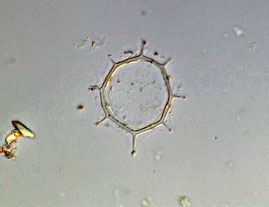
Dictyocha octonaria
Skeleton is cartwheel-like with eight spines.
70
Phytoplankton Identification Catalogue Saldanha Bay, South Africa
Flagellates
Division: CHLOROPHYTA
Class: EUGLENOPHYCEAE
Order: EUGLENALES
Family: Eutreptiaceae
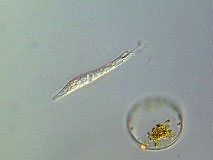
Eutreptiella gymnastica
Anterior end rounded
and the posterior end slightly pointed.
Single pyrenoid present.
Two flagella, unequal in length.
71
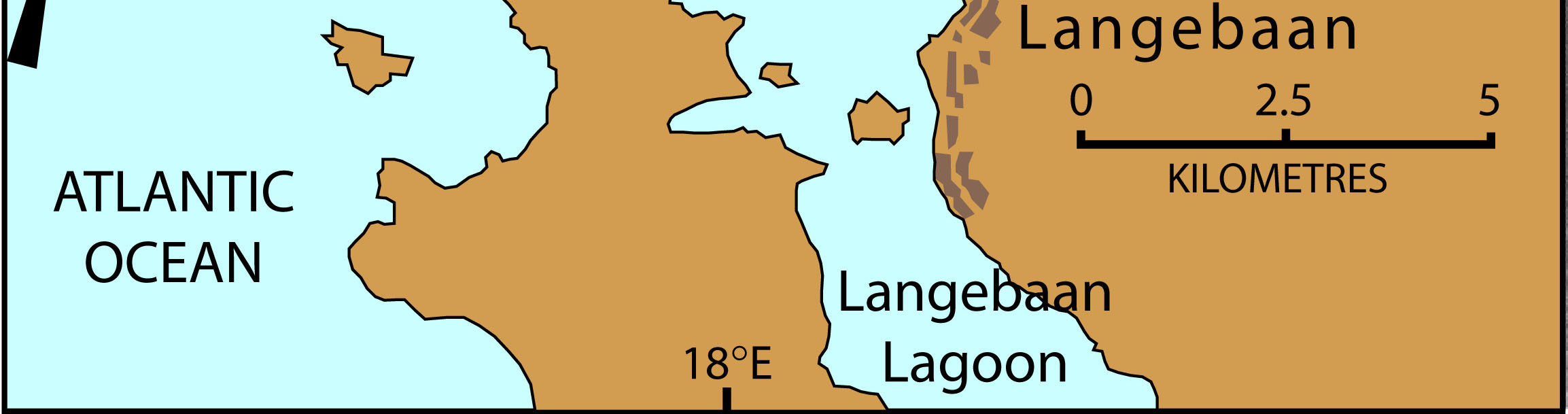
Sample Locations
GloBallast Monograph Series No. 7
1 Protea
Hotel
7 Station
3
13 Mykonos
outside
2 Tug
basin
8 Mykonos
marina
14 Channel outer
3 Mussel
rafts
9
Ore jetty dam corner
15 Small Bay middle
4 Ore
jetty
10 Seafarm dam - outside
16 Ore jetty corner west
5 Station
1
11 Shed to Mykonos 1
17 Mossgas
wall
6 Station
2
12 Shed to Mykonos 2
18 Long beach rocks
74
Phytoplankton Identification Catalogue Saldanha Bay, South Africa: Sample Locations
Diatoms
Sample Site (see map) 1 2 3 4 5 6 7 8 9 10 11 12 13 14 15 16 17 18
Genus cf.
species
Skeletonema
costatum
Thalasiosira
spp.
Melosira
sphaerica
Stephanopyxis
turris
Leptocylindricus
danicus
Corethron
criophilum
Coscinodiscus
spp.
Hemidiscus
cuneiformis
Actinoptychus
splendens
Rhizosolenia
hebetata
Rhizosolenia
imbricata
Guinardia
delicatula
Guinardia
striata
Eucampia
zodiacus
Chaetoceros
spp.
Ditylum
brightwelli
Asterionellopsis
glacialis
Licmophora
ehrenbergii
Striatella
unipunctata
Thalasionema
nitzschiodes
Navicula
spp.
Pleurosigma
capense
Pleurosigma
directum
Nitzschia
closterium
Nitzschia
sigma
Pseudo-nitzschia
spp.
Absence
Presence
75
GloBallast Monograph Series No. 7
Dinoflagellates
Sample Site (see map) 1 2 3 4 5 6 7 8 9 10 11 12 13 14 15 16 17 18
Genus
cf. species
Prorocentrum
micans
Dinophysis
acuminata
Dinophysis
fortii
Dinophysis
rotundata
Gyrodinium
sp.
Noctiluca
scintallans
Spataludinium
cf. pseudonoctiluca sp.1
Ceratium
dens
Ceratium
furca
Ceratium
lineatum
Alexandrium
catenella
Gonyolax
spinefera
Lingulodinium
polyedron
Scripsiella
trochoidea
Preperidinium
meunieri
Protoperidinium
sp.
sp.2
Protoperidinium
conicoides
Protoperidinium
denticulatum
Protoperidinium
depressum
Protoperidinium
diabolum
Protoperidinium
exentricum
Protoperidinium
obtusum
Protoperidinium
pentagonum
Protoperidinium
periforme
Protoperidinium
subinerme
Protoperidinium
thorianum
Absence
Presence
Spp. Not regularly sited in the area
Flagellates
Sample Site (see map) 1 2 3 4 5 6 7 8 9 10 11 12 13 14 15 16 17 18
Genus
cf. species
Dictyocha
octonaria
Eutreptiella
gymnastica
Absence
Presence
76
Phytoplankton Identification Catalogue Saldanha Bay, South Africa
References
Wood, E.J.F. 1968. Dinoflagellates of the Caribbean Sea and Adjacent Areas. University of Miami
Press, Florida.
Cupp, E.E. 1943. Marine Plankton Diatoms of the West Coast of North America. Bulletin of the
Scripps Institution of Oceanography of the Univ. of California. La Jolla, California Vol. 5, No. 1.
Hewitt, C.L. & Martin, R.B. 2001. Revised protocols for baseline surveys for introduced marine
species: survey design, sampling protocols and specimen handling. Centre for Research on Introduced
Marine Pests Technical Report No. 22. CSIRO Marine Research, Hobart.
Marangon,i C. 1998. The potential for the introduction of Alien phytoplankton by Shipping Ballast
Water: Observations in Saldanha Bay. Vol II, M.Sc. Thesis.
Tappan, H. 1917. The Paleobiology of plant protists. W.H. Freeman and Company, San Francisco,
Chpt. 4 & 7.
Sourina, A. 1986. Atlas du Phytoplancton Marin. Centre National de la Recher che Scientifique,
Paris, Vol I.
Ricard, M. 1987. Atlas du Phytoplancton Marin. Centre National de la Recher che Scientifique, Paris,
Vol II.
Dodge, J.D. 1982. Marine Dinoflagellates of the British Isles. Her Majesty's Stationary Office,
London.
Dodge, J.D. 1985. Atlas of Dinoflagellates. Ferrand Press, London.
Boden, B.P. 1950. Some marine planktonic diatoms from the west coast of South Africa (Contribution
from the Scripps Institution of Oceanography, New Series, No. 451) Transactions of the Royal.
Society of South Africa 32; pp. 321-434.
77





























Phytoplankton
Global Ballast Water
Management Programme
Identification Catalogue
G L O B A L L A S T M O N O G R A P H S E R I E S N O . 7
Phytoplankton
Identification Catalogue
Saldanha Bay
, South Africa
APRIL 2001
Saldanha Bay, South Africa
.dwa.uk.com
Lizeth Botes
GLOBALLAST MONOGRAPH SERIES
More Information?
el (+44) 020 7928 5888 www
Programme Coordination Unit
Global Ballast Water Management Programme
International Maritime Organization
4 Albert Embankment
London SE1 7SR United Kingdom
Tel: +44 (0)20 7587 3247 or 3251
est & Associates, London. T
Fax: +44 (0)20 7587 3261
Web: http://globallast.imo.org
NO.7
Marine and Coastal
University of
Management
Cape Town
A cooperative initiative of the Global Environment Facility,
United Nations Development Programme and International Maritime Organization.
Cover designed by Daniel W