SERBIA AND MONTENEGRO
SERBIA DANUBE RIVER ENTERPRISE POLLUTION REDUCTION PROJECT
(UNDER THE BSDP)
PROJECT DOCUMENT
EUROPE AND CENTRAL ASIA
ECSSD
|
Date: April 12, 2005
Country Director: Orsalia Kalantzopoulos
Sector Manager/Director: Marjory-Anne Bromhead
Project ID: P084604
Focal Area: International waters
Lending Instrument: Specific Investment Loan |
Team Leader: Tijen Arin
Sectors: General agriculture, fishing and forestry sector (40%);Agro-industry (30%);Central government administration (30%)
Themes: Pollution management and environmental health (P);Environmental policies and institutions (S)
Environmental screening category: Partial Assessment
Safeguard screening category: Limited impact |
|
Project Financing Data |
|
[ ] Loan [ ] Credit [X] Grant [ ] Guarantee |
[ ] Other: |
|
|
For Loans/Credits/Others: |
|
Total Bank financing (US$m.): 0.00 |
|
Proposed terms: |
|
Financing Plan (US$m) |
|
Source |
Local |
Foreign |
Total |
|
BORROWER/RECIPIENT |
0.50 |
0.10 |
0.60 |
|
GLOBAL ENVIRONMENT FACILITY |
2.87 |
6.15 |
9.02 |
|
LOCAL COMMUNITIES |
4.57 |
3.89 |
8.46 |
|
EC: EUROPEAN COMMISSION |
0.00 |
0.13 |
0.13 |
|
SWEDEN: SWEDISH INTL. DEV. COOPERATION AGENCY (SIDA) |
3.41 |
0.52 |
3.93 |
|
Total: |
11.35 |
10.79 |
22.14 |
|
|
Borrower: |
|
State Union of Serbia and Montenegro
Serbia and Montenegro |
|
|
Responsible Agency: |
|
Ministry of Agriculture, Forestry and Water Management
Serbia and Montenegro |
|
|
|
|
|
|
|
Estimated disbursements (Bank FY/US$m) |
FY
|
6 |
7 |
8 |
9 |
0 |
0 |
0 |
0 |
0 |
Annual
|
1.24 |
1.86 |
2.99 |
2.92 |
0.00 |
0.00 |
0.00 |
0.00 |
0.00 |
Cumulative
|
1.24 |
3.10 |
6.09 |
9.01 |
9.01 |
9.01 |
9.01 |
9.01 |
9.01 |
|
Project implementation period: Start August 2, 2005 End: August 2, 2009
Expected effectiveness date: August 2, 2005
Expected closing date: March 1, 2010 |
|
Does the project depart from the CAS in content or other significant respects? Ref. PAD A.3 |
[ ]Yes [X] No |
|
Does the project require any exceptions from Bank policies?
Ref. PAD D.7
Have these been approved by Bank management?
Is approval for any policy exception sought from the Board? |
[ ]Yes [X] No
[ ]Yes [ ] No
[ ]Yes [ ] No |
|
Does the project include any critical risks rated “substantial” or “high”?
Ref. PAD C.5 |
[X]Yes [ ] No |
|
Does the project meet the Regional criteria for readiness for implementation? Ref. PAD D.7 |
[X]Yes [ ] No |
|
Project development objective Ref. PAD B.2, Technical Annex 3
The development objective of the project is to reduce nutrient flows into bodies of water connected to the Danube River from selected Republic of Servia enterprises. |
|
Global Environment objective Ref. PAD B.2, Technical Annex 3
The development objective of the project is to reduce nutrient flows into bodies of water connected to the Danube River from selected Republic of Servia enterprises. |
|
Project description [one-sentence summary of each component] Ref. PAD B.3.a, Technical Annex 4
Component 1. Support to Policy and Regulatory Reform.
This component is to strengthen the policy and regulatory framework that regulates nutrient run-off and discharge from livestock farms and slaughterhouses, in line with the European Union Nitrate Directive.
Component 2: Investment in Nutrient Reduction.
This component is to demonstrate cost-effective methods by which livestock farms and slaughterhouses can reduce nutrient run-off and discharge into the Danube River basin, and to improve agricultural advisory service capacity to extend knowledge of these technologies.
Component 3: Water and Soil Quality Monitoring, Public Awareness Raising and Replication Strategy.
This component is threefold: to assess the impact of the project interventions on water and soil quality in the Serbian Danube Basin; to increase local communities?, enterprises? and policy makers? awareness of water pollution from livestock farms and slaughterhouses and of improvements made through the project; and to devise a strategy to replicate the project?s interventions in other parts of the Danube River Basin in Serbia and beyond.
Component 4: Project Management and Project Impact Monitoring.
This component will support project management, including project co-ordination and administration, procurement, financial management and reporting, and will carry out project results and outcome monitoring. |
|
Which safeguard policies are triggered, if any? Ref. PAD D.6, Technical Annex 10
Environmental Assessment (OP/BP/GP 4.01) |
|
Significant, non-standard conditions, if any, for:
Ref. PAD C.7 |
|
Board presentation:
Board presentation:
a) Identification of three eligible enterprises as beneficiary enterprises based on agreed-upon eligibility criteria and selection procedures, and receipt by the PPU, letters of intent to participate;
b) Finalization and clearance by the Bank of the project Operational Manual,
c) Establishment of the Project Technical advisory Committee; and
d) Receipt by the Bank from SaM and ROS approval of negotiated documents. |
|
Loan/credit effectiveness:
a) Execution of a satisfactory sub-grant agreement between SaM and Serbia;
b) Submission to the Bank of a satisfactory legal opinion from SaM attesting to (i) the validity and binding nature of the GA, following the GA ratification by the SaM Parliament; and (ii) the validity and binding nature of the sub-grant agreement between SaM and Serbia; and
c) Submission to the Bank of a satisfactory legal opinion from Serbia attesting to the validity and binding nature of the sub-grant agreement. |
|
Covenants applicable to project implementation:
The MAFWM is to maintain a satisfactory Financial Management System, including records and accounts, and to prepare financial statements in accordance with accounting standards satisfactory to the Bank. The MAFWM is to provide annual project accounts and audit reports to the Bank within five months of each fiscal year (with the audit to be carried out by independent auditors in accordance with International Standards on Auditing, and TORs satisfactory to the Bank). |
A. STRATEGIC CONTEXT AND RATIONALE
1. Country and sector issues
The former Federal Republic of Yugoslavia (FRY) was once considered the most advanced among the socialist bloc countries. Its economy underwent a significant decline in the 1990s as a result of the structural problems of the socialist economic system combined with the break-up of the federation, international isolation and ethnic conflicts. The same period also witnessed the collapse of a considerable number of industrial enterprises as well as decline in infrastructure and in government capacity to enforce regulations in a number of areas. Nevertheless, since 2000, the Serbia economy has made significant strides towards stability and growth. The Government of the Republic of Serbia (ROS) is now determined to tackle the challenge of employment generation and poverty reduction, especially in rural areas, through appropriate structural and policy reforms and increasing the international competitiveness of the economy as a whole.
Agriculture accounts for about 25 percent of Serbia’s Gross Domestic Product (GDP) and, as such, is the largest sector of the economy. Furthermore, agricultural products make up about 26 percent of Serbia’s exports. Meat and milk production contributes about 34 percent of agricultural output. Herd numbers also point to the significant role: In 2001, there were about 3.6 million pigs, 1.2 million cattle, 9.2 million poultry and 1.5 million sheep and goats in Serbia (including Kosovo). While Serbian agriculture remained resilient and provided foodstuffs for the population during the difficult years of the 1990s, it suffers from low crop productivity (cereal yields are a little more than half of those of the main cereal growing areas in the European Union (EU), and as such are significantly below potential) and loss of significant share of export markets, including markets for livestock products. Increasing international competitiveness in the agriculture sector is one of the pillars of the Government’s agricultural development strategy.
Serbian agriculture sector is characterized by a bi-polar farming structure: About 85 percent of Serbia’s cultivated land is farmed by over one million small private farms. Most private farms produce for own household consumption only and are engaged in non-farm activities for additional income. However, there is also an emerging group of dynamic, private commercial farms, accounting for about 5 percent of total cultivated area, which produce primarily for the market. These farms cultivate on average 10 hectares. The remaining 15 percent of the total cultivated area, approximately 0.8 million hectares, is cultivated by large corporate farms, comprising agrokombinats (AKs) and cooperative farms. In 2000 there were 411 farming AKs, with an average size of 1,600 hectares among which a few have more than 10,000 hectares. Both AKs and collective farms commonly also operate processing units. A large number of AKs underwent a first phase of privatization in the late 1990s which in most cases resulted in mixed employee and state ownership. During the past few years, some AKs have been further restructured and privatized.
There is also significant regional variation among production systems and products due to varying geographical and climatic differences. Agriculture in the low-lying and fertile Vojvodina is dominated by field and industrial crops, notably wheat, maize, sugar beet and sunflower. Intensive production of pigs, cattle and poultry is characteristic of the Vojvodina, in particular in large AKs, most of which have been partially privatized and / or are employee-owned. Producers in the Vojvodina are more strongly market-oriented than those in the rest of the country. This contrasts with Central Serbia, where rural areas are characterized by hilly topography, small farms and diverse farm production systems. Arable land is limited, but soil fertility and climatic conditions are favorable leading to fairly intensive production of high-value fruits (notably berries) and vegetable crops. As in Vojvodina, there is a high concentration of livestock; however, in Central Serbia, cattle for milk production predominate. The majority of agricultural land is privately owned. Southern Serbia, the poorest and least developed of the three regions, is characterized by mountainous geography and mostly dominated by ruminant production in extensive or semi-intensive systems.
Serbia has made the strategic choice to seek accession to the EU and harmonize its policies and legislation with those of the EU. Environmental sustainability of all economic production activities is one of the most prominent areas that require adjustment. The Government’s commitment to achieving this objective is reflected in the existing or evolving sector strategies for agricultural and rural development, water management and environment, the 2003 Poverty Reduction Strategy Paper (PRSP), and international agreements on the protection of the Danube and Sava Rivers.
Key Issues, Root Causes, and Threats
In the late 1990s, basin-wide water quality models placed FRY in third place with respect to nitrogen pollution and in second place with respect to phosphorus pollution among the sixteen Danube riparian countries. Serbia’s livestock sector is among the largest sources of water pollution in Serbia’s part of the Danube/Black Sea Basin. Agricultural and agro-industrial enterprises were identified as significant nutrient polluters. According to the National Review (NR) prepared for FRY in 1998 under the GEF-supported Danube Pollution Reduction Programme, livestock farms, and in particular very large pig farms that fatten more than 10,000 pigs per year, are significant nutrient polluters due to their inadequate manure storage practices and limited and improper use of recycled manure as fertilizer. Highly concentrated liquid waste is disposed of in lagoons, from which it penetrates the groundwater, especially in low-lying Vojvodina where the groundwater table is high. Most commonly, the liquid part of manure from the lagoons is directed without any treatment into drainage canals which channel it to the Danube or its tributaries.
Slaughterhouse waste also constitutes a significant source of nutrient pollution, especially in Vojvodina where there are 240 slaughterhouses. Slaughterhouses typically collect animal waste to storage tanks from which it is taken away by tankers for disposal into the municipal waste water system or into municipal landfill lagoons. This waste includes blood, gut content, solids including hoof and bristle, ears, and red water (the water that results from the washing and cleaning of carcasses). In recent years, the amount of waste to be disposed of has increased because use of bone meal as livestock feed has been discontinued (in accordance with EU practice on animal health). In a context of poor wastewater treatment and lack of sanitary landfills, this practice likely results in a high level of discharge into watercourses and leakage into groundwater.
The 1998 NR also identified Serbia’s large fertilizer factories as hotspot nutrient polluters. However, in recent years the continued operations of these factories have become doubtful as a result of their outdated technology, weak international competitive advantage, the collapse of raw material providing smelter industries and severe financial difficulties. These problems have also prevented their privatization. As a result of the old technology these factories posses, retrofitting them to make their operations more efficient and compliant with Serbia’s newly adopted laws on integrated environmental protection would be prohibitively expensive and GOS policy is not to support any partial retrofitting which would not be sustainable. At current time, one of the factories identified in the NR, Prahova is undergoing bankruptcy procedures, while the factories in Šabac and Pančevo are operating at very low capacity. As such, the factories do not constitute nutrient pollution hotspots any longer and it is highly unlikely that they will become such again. With regard to pollution legacy, a study carried out during project preparation on Zorka Šabac, where a phosphogypsum deposit has accumulated in the Sava River as a result of factory discharges over time, concluded that the vast majority of P contained in the pile has already been released in to the waterbody and only negligible amount continue to be released from the pile on an ongoing basis.
Local health effects of pollution from manure and slaughterhouse waste that is improperly disposed of are not measured, although the content of the waste suggests that health effects could be significant. Slaughterhouse waste is high in organic material and nitrogen content and may contain pathogens, including salmonella and shigella bacteria, parasite eggs, and amoebic eggs. This waste is believed to pose a public health threat, especially to those communities that live near dumpsites and scavenge on them. In addition, elevated concentrations of nitrates in groundwater, which is the main drinking water source in rural areas, can lead to fatalities among infants (the “blue baby syndrome”).
Regulatory Framework. There has been little incentive in the past for livestock farms and agro-processors to address these issues. Manure management in livestock farms is not regulated and nutrient run-off from farms is not monitored. There is a need for a policy and for regulations on how manure is to be stored properly and recycled as fertilizer in the context of a nutrient management plan. Also, there is a need for guidelines / regulations on alternative ways of recycling, including necessary pre-treatment, which would be in line with the EU Animal By-products Directive (ABD).
Farmers’ Knowledge on Nutrient Management. Nutrient management was not practiced in large AKs during the socialist period. Mineral fertilizers were made available at low cost or for free. On the other hand, smallholding private farmers have always recycled manure on their land, because they did not have access to the same type of service. Agricultural advisory services do not provide advice on nutrient management or proper manure handling. Although there are theoretical courses at the Agricultural Faculty on plant nutrient needs, agricultural advisors lack practical experience in this field.
Water Quality Monitoring. At present, surface and groundwater monitoring are addressed by the Water Law, “Regulations on Hazardous Substances in Waters,” the Official Bulletin of SRS (No. 31/82), “Regulations on Methods and Sampling for the Assessment of Wastewater Quality,” and the Official Bulletin of SRS (No. 47/83) governing surface and groundwater quality monitoring. Water quality monitoring is conducted by Republic of Serbia Hydrometeorological Service (HMS), which is responsible for measuring and recording quantities of wastewater discharged and submitting the data to the relevant public agency. Monitoring also includes tracking the performance of wastewater treatment facilities. The results of all testing are published annually. However, the implementation and enforcement of the Water Law has been hampered by a number of factors, including overlapping mandates among various government institutions and lack of enforcement capacity. Lack of personnel at the local level to monitor water quality on a regular basis and inadequacy of the fines for non-compliance have been other factors hampering enforcement.
Government of Serbia’s Response to the Key Issues
Legal and Regulatory Framework. The Parliament of ROS has recently enacted a new Law on Environmental Protection, and new laws on Environmental Impact Assessment (EIA), Strategic Environmental Impact Assessment (SEIA) and Integrated Pollution Prevention and Control (IPPC). Furthermore, an Environmental Protection Agency (EPA) was established in late 2003, although it is still in embryonic state. The Government has also drafted a new Water Law in an attempt to transpose the EU Water Framework Directive (WFD). The Government intends to harmonize its entire legal framework in the field of agriculture and environment with the EU acquis.
Enforcement Capacity. The Government is cooperating with the EU European Agency for Reconstruction (EAR) to strengthen the institutional capacity of the Ministry of Science and Environmental Protection’s (MSEP) Directorate for Environmental Protection (DEP), EPA and local environmental inspectorates.
Government Grant Support to Environmentally-Friendly Agriculture. In 2004, a rural development grant fund was established by the Ministry of Agriculture, Forestry and Water Management (MAFWM) with the objectives of helping to enhance the sustainability of primary agricultural production and of developing the rural economy and improving the livelihoods of rural households through diversification of income sources, by providing partial grants (20 – 50 percent of the value of investments) for farm improvements (notably for fruit, vegetable, mushroom, flower and livestock production), promotion of organic production, marketing improvements and village community development through non-agricultural economic activities, such as agro-tourism.
Reform of Agricultural Advisory Services. The Government plans to reform the agricultural advisory service with aim to make it more responsive to farmers’ needs in a competitive and EU environment. It has asked World Bank assistance for this as part of a Rural Business Environment Project. The Government intends to mainstream environmental concerns into advice provided to farmers and agro-processors.
Eligibility of Serbia and Montenegro for Global Environment Facility (GEF) Co-Financing
SAM has signed (in 2002) and ratified (in 2004) the Convention on Cooperation for the Protection and Sustainable Use of the Danube River (Danube Convention) (1994). SAM is also a member of the International Commission for the Protection of the Danube River (ICPDR) and its predecessor, FRY, was in full cooperation with the ICPDR during the 1990s. FRY participated in the preparation of the Danube River Transboundary Diagnostic Analysis, prepared a National Review (NR), held a National Planning Workshop in 1998, and contributed a national action plan for SAM to the Five Year Nutrient Reduction Action Plan (2000). In December 2002, SAM, as well as Croatia, Bosnia and Herzegovina and Slovenia, signed the Sava River Agreement with the aim of instituting integrated river basin management in the Sava River Basin.
Proposed Project’s Fit within Regional Inter-Governmental Agreements
The NR identified wastewaters from enterprises, notably from agro-processors, and large livestock (notably pig) farms as major contributors to the nutrient loads from SAM into the Danube and its tributaries. The proposed project will help SAM to meet the Five Year Nutrient Plan that was set out as a strategy to reduce that contribution to water pollution.
The project has been prepared in close coordination with the ICPDR. The project concept was presented at various regional meetings dealing with water quality management in the Danube and Black Sea Basin, and the team received useful and encouraging comments from ICPDR, EU and other basin country representatives.
2. Rationale for Bank involvement
The rationale for Bank involvement is twofold. First, the project complements and builds on the efforts of other development partners and the Government to strengthen the environmental management and restructure the agriculture sector to be more responsive to EU requirements for enhanced exports. Up to now, most of the international assistance has focused on technical assistance and institutional and technical capacity building, rather than providing investment funds for mitigating agricultural and agro-industrial pollution.
Second, the Bank has a comparative advantage in carrying out agricultural and agro-industrial pollution control. The Bank is the main implementing agency for the Investment Fund for Nutrient Reduction in the Danube and Black Sea Basin, and currently has a portfolio of twelve projects in the basin at various stages of implementation and preparation, each of which aims at reduction of nutrient pollution. The Bank has gained significant experience in implementing cost-effective methods to reduce nutrient run-off to the watercourses, building capacity on the part of implementing government agencies, monitoring project success in reducing nutrient run-off, and support to the revision of regulatory frameworks. The Bank also has substantial experience in industrial pollution control in the region involving mitigation and remediation investments and legal framework reform. Most projects in this portfolio involve harmonization with the EU environment related acquis.
3. Higher level objectives to which the project will contribute
The Country Assistance Strategy (CAS) for FY ’05 – ‘07 emphasizes environmental sustainability as an important component of economic growth. It states that “Achieving Goal 2: Creating a larger, more dynamic private sector will require progress in a number of difficult area. … further progress on cleaning up and protecting the environment is necessary to ensure quality economic growth over the medium term.” The CAS also makes specific reference to water pollution from industrial and agricultural sources and to the proposed project.
The project will also fulfill the goals of GEF Operational Program (OP) 8, the Waterbody-Based Operational Program under the GEF International Waters Focal Area. The project will be implemented under the GEF Strategic Partnership on the Danube and Black Sea Basin that was established to support the ICPDR and the Black Sea Commission in reducing nutrient pollution in the Danube River and Black Sea. The project will help Serbia reduce its nutrient discharges into the Danube from agricultural sources in the long run as specified in FRY/SAM’s Five Year Nutrient Reduction Plan submitted to the ICPDR. As such, the project will serve the OP’s long-term objective of undertaking a series of projects that involve helping groups of countries to work collaboratively, with the support of implementing agencies, in achieving changes in sectoral policies and activities so that transboundary environmental concerns about degradation of specific water bodies can be resolved.
B. PROJECT DESCRIPTION
1. Lending instrument
A specific investment grant will be used.
A portion of the GEF grant will be passed on to eligible enterprises in the form of grant co-financing for eligible investments (see Annex 4).
Swedish International Development Agency (SIDA) co-financing in the amount of approximately US$ 4 million will be administered by the Bank and pooled with the GEF grant without prior ear-marking. EU/EAR co-funding will be delivered to the Government directly in the form of equipment.
2. Project development objective and key indicators
The development objective of the project is that EU acquis compliant measures for reducing agricultural nutrient pollution in the Danube River are adopted in selected ROS enterprises.
The global environment objective of the project is to reduce nutrient flows into water bodies connected to the Danube River from selected ROS enterprises.
The following are key indicators:
1. Nutrient reduction sub-projects have been prepared and sub-grants awarded to at least 60 farms and four slaughterhouses to control nutrient run-off;
2. At least 65% of beneficiary farms and slaughterhouses implementing nutrient reduction plans properly two years after being awarded the sub-grant;
3. Point and non-point source nitrogen and phosphorus pollution flows into water courses connected to the Danube River from the Participating Enterprises have decreased substantially;
4. The EU Nitrate Directive is transposed through the Law on Fertilizers and the Development of a Code of Good Agricultural Practices.
5. Training and information center for environmentally friendly agriculture is established and integrated in the MAFWM agricultural advisory service system.
Nutrient Reduction. The estimated annual reduction of Nitrogen due to project interventions in 60 livestock farms and four slaughterhouses is estimated at 430 tons. The strengthening of agricultural advisory services and of the legal and policy framework and likely financial support from Government and EU sources, will replicate project interventions considerably in the next decades. Assuming that in 20 years 50 percent of livestock farms in Serbia adopt these practices, the reduction will amount to 8,000 tons / year.
3. Project components[1]
Component 1: Support to Policy and Regulatory Reform. (Total cost: US$ 0.22 m, of which GEF funding: US$ 0.20m and GOS funding: US$ 0.02m.)
The objective of this component is to strengthen the policy and regulatory framework that regulates nutrient run-off and discharge from livestock farms and slaughterhouses, in line with the EU Nitrate Directive (ND). In particular, the project will support (i) a study to identify nitrate-vulnerable areas in Serbia, (ii) development of an implementation plan for the EU ND, (iii) transposition of the EU ND into the Law on Fertilizers, and (iv) development of a Code of Good Agricultural Practices.
Component 2: Investment in Nutrient Reduction. (Total cost: US$ 17.87m, of which GEF funding: US$ 6.92m, beneficiary funding US$ 7.67m, SIDA funding: US$ 3.00m, and GOS funding: US$ 0.28m.)
The objective of this component is to demonstrate cost-effective methods by which livestock farms and slaughterhouses can reduce nutrient run-off and discharge into the Danube River and its tributaries, and to improve agricultural advisory service capacity to extend knowledge of these technologies. The project will support: (i) investments in manure management in livestock farms; (ii) investments in slaughterhouse animal waste management; (iii) the establishment of a Training and Information Center (TIC) for proper nutrient, manure and slaughterhouse waste management and training of environmental, veterinary, agricultural and water inspectors; and (iv) local advisory units (LAUs) to raise awareness among farmers and slaughterhouses of proper nutrient / manure and animal waste management and to assist enterprises participating in the project.
Investments in nutrient management in livestock farms will be supported through sub-grants to farms meeting pre-established eligibility and selection criteria. The investments will mainly consist of the establishment and implementation of a farm nutrient management plan (NMP), construction of proper manure storage facilities and purchase of incremental and essential field equipment for transporting and applying liquid and slid manure in the field. Geographical focus will be on Novi Sad, Vrbas, Šabac, Požarevac and surrounding municipalities, where livestock density and pollution levels are high. Grants of up to 60 percent or a maximum of Euro 120,000, of total investment cost will be provided to cover part of the cost of such investments in approximately 60 livestock farms. Eight pig and cattle farms of differing sizes will be selected for enhanced support as demonstration farms. These will be used to refine practices that are most suitable to local conditions, to demonstrate them to other interested farmers, to demonstrate alternative cropping and tillage practices on set-aside plots, and to monitor water and soil quality improvements as a result of the project interventions.
Grant support of up to 30 percent, or a maximum of Euro 120,000, will be offered to approximately eight large or very large slaughterhouses to finance acquisition of facilities and equipment for animal waste separation, treatment and land application. There will be no geographical limitation to eligibility other than being in the Danube River Basin (DRB) and in the ROS. The total cost of investment at each site is expected to range from US$ 350,000 – US$ 500,000 depending on the size of the enterprise; however, some enterprises may already have some of the equipment or facilities in which case the total investment cost will be lower. A section has been developed in the Operational Manual (OM) addressing nutrient, manure and slaughterhouse animal waste management and providing guidelines for the component.
The enterprise selection process which is detailed in the OM will include two stages: screening for eligibility and selection based on review of detailed project proposal. The eligibility and selection criteria will include ownership that is at least 51 percent private, financial viability, having no current tax arrears and being in the project region.
The project will also fund the establishment of a TIC in the Institute for Animal Husbandry (IAH) that will offer training to agricultural advisors, farmers, slaughterhouse managers, regulators, and environmental, veterinary, agricultural and water inspectors on proper manure and slaughterhouse animal waste management; and be a national repository of knowledge on evolving EU regulations in this field. The IAH’s own manure and slaughterhouse animal waste management facilities will be upgraded so that they can be used for demonstration purposes. TIC will be established as a self standing training unit in the IAH and will be managed by a half time logistical coordinator and two subject-matter course coordinators. As required, specialized subject matter experts will be contracted for the duration of the course to prepare the training material and provide the training. An OM detailing investments in activities by the TIC has been prepared.
Farmers and slaughterhouses will be offered advice on proper nutrient, manure and slaughterhouse waste management through three LAUs in the project region. Furthermore, the LAUs will assist eligible enterprises in preparing sub-project proposals. LAUs will be provided guidance in their activities through a detailed OM.
Component 3: Water and Soil Quality Monitoring, Public Awareness Raising and Replication Strategy. (Total cost: US$ 1.26m, of which GEF funding: US$ 0.77m, SIDA funding: US$ 0.24m, GOS funding: US$ 0.13m, and EAR funding: US$ 0.11m.)
The objective of this component is threefold: to assess the impact of the project interventions on water and soil quality in the Serbian Danube Basin; to increase local communities’, enterprises’ and policy makers’ awareness of water pollution from livestock farms and slaughterhouses and of improvements made through the project; and to devise a strategy to replicate the project’s interventions in other parts of the Danube River Basin in Serbia and beyond. This will be achieved through three sub-components: (a) Capacity Building and Support for Water and Soil Quality Monitoring; (b) Stakeholder Participation and Public Awareness Raising; and (c) Replication Strategy Development. A section of the OM addressing soil and water quality monitoring and a Stakeholder Participation and Public Awareness Plan (SPPAP) will be used in the implementation of this component.
Component 4: Project Management and Project Impact Monitoring. (Total cost: US$ 0.64m, of which GEF funding US$ 0.57m, and GOS funding: US$ 0.07m.)
This component will support project management, including project co-ordination and administration, procurement, financial management and all reporting. All project outcome and results monitoring will be carried out under this component as well.
A Project Implementation Unit (PIU) will be established to implement the project and to carry out day-to-day activities of the project under the overall supervision of the MAFWM. The PIU, on behalf of the responsible ministries, will provide for project co-ordination and administration of staff, procurement, financial management, reporting and overall project monitoring and evaluation activities for all components.
The PTAC will be established to provide overall direction and strategic oversight of the project; approve annual work programs, annual procurement plans and sub-project selections; ensure proper coordination of project activities among the ministries and agencies of Serbia involved in project implementation; and to oversee overall project monitoring, evaluation and reporting.
A section of the OM details the roles and responsibilities of individual government agencies and institutions, the PTAC and the PIU.
4. Lessons learned and reflected in the project design
The recently completed World Bank GEF Rural Environmental Protection Project in Poland, as well as ongoing agricultural pollution control projects in Romania and the Baltic Sea Region implemented by the World Bank, have provided a number of critical lessons that have been incorporated in the project design:
· An effective public awareness campaign aiming at increasing farmer awareness of the financial benefits of recycling manure as fertilizer is crucial to attracting farmers to participate in the project by contributing their own funds and labor to the investments. It was found that the public information task should be given to a full-time SPPAP specialist who would be housed in the PIU and would be in constant contact with the project LAUs and implementing agency staff and able to fine-tune the campaign according to developing needs, rather than to a public relations company that might not be so dynamic and flexible.
· To ensure the mainstreaming of environmentally-friendly practices into agricultural production, project components dealing with agriculture should be implemented by the ministry or agency in charge of agriculture. This will ensure that environmental concerns are mainstreamed in agricultural policies. On the other hand, water quality and other environmental impact monitoring should be the responsibility of the ministry or agency in charge of environmental protection.
· Investments must make financial sense to farmers if the farmers are to contribute their own funds and to maintain the investments. Operations and maintenance costs (financial costs as well as cost in time) must be factored into financial cost-benefit analyses of the investments.
· Capacity building among a large group of agricultural advisors on nutrient management is a precondition for the replicability of nutrient reduction methods introduced by the project.
5. Alternatives considered and reasons for rejection
The team considered a focus limited to smallholding farmers only, as was adopted in other parts of the Danube and Black Sea Basin, such as Romania, Turkey, Georgia, and Poland. This option was rejected because the FRY National Report on Danube Pollution submitted to the ICPDR clearly identified large-scale livestock farms as main polluters. Furthermore, smallholding Serbian farmers generally use manure as fertilizer and hence, unlike farmers in the above countries, do not constitute a major source of pollution. Nevertheless, the project’s support to advisory services and establishment of a Code of Good Agricultural Practices will also benefit smallholding farmers.
C. IMPLEMENTATION
1. Institutional and implementation arrangements
MAFWM will be the line ministry responsible for implementing the project. For this it will establish a PIU. The PIU will comprise a project director, an agricultural specialist, an environmental specialist, a financial officer, a procurement specialist, a SPPAP specialist, an administrative assistant/translator, and an office assistant. The PIU will facilitate contracting of technical specialists who will monitor and facilitate implementation tasks undertaken by the various ministries, institutions and contracted enterprises involved in implementation. MAFWM will provide office space for the PIU. The project will finance PIU costs, which will include the rehabilitation of office space, office equipment, supplies, travel and communications, and consultant payments and operating costs for four years.
The PIU will provide for project co-ordination and for administration of staff, procurement, financial-management reporting, and overall project monitoring and evaluation activities for all components. The PIU Director will report to the Assistant Minister of MAFWM in charge of agro-environmental issues. The PIU will, inter alia, (i) act as the overall project coordinating body on behalf of the MAFWM; (ii) facilitate inter-ministerial coordination; (iii) facilitate contracting of different institutions, e.g., the IAH and LAUs, to implement project activities; (iv) operate the investments grant programs; and (v) report to concerned authorities and the Bank.
The LAUs will assist eligible enterprises in preparing investment plans and grant applications. LAUs will be provided guidance in their activities through a detailed OM.
The PTAC will be established to provide overall direction and strategic oversight of the project; approve annual work programs, annual procurement plans and sub-project selections; ensure proper coordination of project activities among the ministries and agencies of Serbia involved in project implementation; and to oversee overall project monitoring, evaluation and reporting. The PTAC will be composed of six voting members, one from each of the MAFWM VD, Phytosanitary Directorate (PSD) and the Directorate for Water Management (DWM), the MSEP, the Secretariat for Environment and Sustainable Development of the Autonomous Province of Vojvodina (PSEPSD), and one agricultural economist designated by the MAFWM, plus five non-voting members representing the private sector, non-governmental organizations and local municipal authorities from project implementation areas. The PTAC will be chaired by the Assistant Minister of the MAFWM responsible for agro-environmental issues, who normally shall not be a voting member, except when necessary to cast a tie-breaking vote. The PIU will operate as a secretariat to the PTAC, and the PIU Director will act as PTAC secretary and will be an ex-officio, non-voting member of the PTAC.
Because the required capacities are new to MAFWM, the PIU will initially be composed of consultants. However, project activities will be mainstreamed into the regular activities of the relevant government agencies through the continuous involvement of a technical staff member of each ministry or agency involved. Several other factors will contribute to mainstreaming: the fact that MAFWM rather than another agency holds overall project responsibility, the housing of the PIU in the MAFWM premises, and capacity building among agricultural advisors in environmentally friendly agricultural practices.
Water quality monitoring will be undertaken by the HMS; IAH will be responsible for training activities; MSEP DEP will be responsible for public awareness activities; and EPA will be responsible for storing, utilization and reporting of all water quality analysis data generated by the project. The DWM will use these data for enforcement of laws for nutrient discharge generated by agro-industry.
2. Monitoring and evaluation of outcomes/results
The project will be tracked against agreed indicators, such as farmers’ satisfaction, number of enterprises participating in the project, number of farmers implementing farm management plans properly two years after receiving project support.
Water and soil quality monitoring. The project will provide funds to monitor water and soil quality for nutrients in each of the four project municipalities, in order to evaluate the impact of project interventions on nutrient discharges and run-off into the Danube River and its tributaries. The program will include monitoring of run-off and discharges to ground and surface water bodies in selected representative farms and all slaughterhouses participating in the project. The design of the monitoring plan emphasizes cost-effectiveness and replicability in other parts of the country.
The project will fund: (i) upgrading of the laboratory facilities of the HMS, supporting its national accreditation and to serve as the main water quality monitoring laboratory for the project; (ii) training for environmental monitoring specialists; (iii) data collection; (iv) quality assurance; and (v) reporting. Monitoring reports will be made available by the EPA to the public and the ICPDR in an easily accessible way. Operational details on the monitoring program may be found in Annex 3 Table “Arrangements for Results Monitoring”) and Annex 4 “Sub-Component 3A”.
3. Sustainability
The project design includes elements that will contribute to the sustainability of project interventions. These include:
(i) Increasing the awareness of the general public of the negative environmental and public health impacts of pollution from livestock farms and slaughterhouses. By publicizing the effect of discharge and run-off reduction and of enterprise practices on surface water quality, the project will seek to mobilize public pressure on enterprises to improve their practices.
(ii) Increasing the awareness of farmers of the financial benefits of better nutrient management, especially the benefits of properly substituting manure for mineral fertilizers.
(iii) Award of grant support only to enterprises that are financially viable and privately owned.
(iv) Strengthening of agricultural advisory services so that advice on proper manure/nutrient and slaughterhouse animal waste management is available to farmers on a regular basis. Furthermore, farmers themselves will be trained in the improved practices, so that lack of knowledge will not hamper continued implementation of project investments beyond the project period.
(v) On the “stick” side, development of regulations on proper manure and slaughterhouse animal waste management. The project will also enhance the enforcement capacity of environmental and agricultural inspectors through training on environmentally friendly agriculture. Environmental monitoring capacity will also be enhanced through the purchase of equipment to upgrade laboratories, training of staff and introduction of proper quality controls.
4. Critical risks and possible controversial aspects
|
Risk |
Mitigation Measure |
Risk Rating |
|
To Project Development and Global Objectives |
|
|
|
Given tight government budget conditions, counterpart financing to project activities may not materialize |
(i) Most project activities already part of part of MAFWM’s budgeted activities.
(ii) Counterpart financing requirements are kept negligible in comparison to MAFWM budget. .
(iii) Government is committed and will provide significant in-kind contribution . |
M |
To Component Results |
|
|
|
Possible spreading of animal diseases due to improper treatment of risky slaughterhouse animal waste, such as brain, spinal cord. |
(i) MAFWM VD is closely involved in the design of the component;
(ii) Waste management practices will strictly follow the EU ABD which takes a very cautious approach to animal waste management;
(iii) Project investments are limited to those slaughterhouses which are certified by the VD as properly managing TSE-specific risky waste. |
M |
|
Enterprises may not be able to provide the needed co-financing |
(i) Enterprises are interested in meeting Serbian / EU environmental standards in order to export their products;
(ii) Project activities are also eligible for funding under specific MAFWM grants for environmentally friendly agriculture, hence enterprises may apply for those for all or part of the non-GEFpart of the financing.
(iii) Enterprises may also borrow from commercial banks. GEF grant financing and the financial benefits expected from improved manure/nutrient/animal waste management will make them attractive to the banks. |
S |
|
Overall Risk Rating |
|
M |
|
Risk rating: H=High; S=Substantial; M = Modest; N = Negligible |
5. Grant conditions and covenants
Board Conditions:
a) Identification of three eligible enterprises as beneficiary enterprises based on agreed-upon eligibility criteria and selection procedures, and receipt by the PPU, letters of intent to participate;
b) Finalization and clearance by the Bank of the project OM;
c) Establishment of the PTAC; and
d) Receipt by the Bank from SAM and ROS approval of negotiated documents.
Effectiveness Conditions
a) Execution of a satisfactory sub-grant agreement between SaM and Serbia;
b) Submission to the Bank of a satisfactory legal opinion from SaM attesting to (i) the validity and binding nature of the GA, following the GA ratification by the SaM Parliament; and (ii) the validity and binding nature of the sub-grant agreement between SaM and Serbia; and
c) Submission to the Bank of a satisfactory legal opinion from Serbia attesting to the validity and binding nature of the sub-grant agreement.
Disbursement Condition: None
Financial Management Conditions: None
Financial Management Covenants: The MAFWM is to maintain a satisfactory Financial Management System, including records and accounts, and to prepare financial statements in accordance with accounting standards satisfactory to the Bank.
The MAFWM is to provide annual project accounts and audit reports to the Bank within five months of each fiscal year (with the audit to be carried out by independent auditors in accordance with International Standards on Auditing, and TORs satisfactory to the Bank).
D. APPRAISAL SUMMARY
1. Economic and financial analyses
A formal economic analysis is not required for GEF grant projects. An Incremental Cost Analysis is presented in Annex 15. The analysis indicates significant global environmental benefits the incremental costs of which will be funded through GEF and Swedish International Development Agency (SIDA) grants.
A qualitative fiscal-impact analysis indicated that while Government outlays for the project are negligible, in the medium and long term the project will have a positive impact on Government tax revenues because enterprises that institute proper environmental management practices and adhere to EU food safety and animal health standards are likely to gain market share in the EU meat and meat-products markets.
2. Technical
Farm nutrient/manure management. Most of the technology that the project will promote is simple and has been well tested in several ECA countries, including Poland, Romania and Baltic countries. The emphasis will be on the use of low-cost farm investments. The project will pay special attention to developing technical guidelines for the liquid-manure storage tanks and construction guidelines to ensure that the tanks stay watertight. OM sections on manure management will provide necessary technical guidelines. The OM sections developed for this sub-component will be strictly adhered to during the implementation of the project.
Slaughterhouse animal waste management. The project investments will be in line with the EU ABD and concentrate on waste classified as belonging to categories 2 and 3. Only farms that are certified by the VD as properly treating (incinerating) category 1 waste – including Special Risk Material – in accordance with the EU ABD, will receive project support. The project will focus on cost-effective segregation and storage of wastes. Assistance will be provided to support measures to handle and treat the different types of waste according to their classification, in order to achieve least-cost treatment and appropriate recycling for each. For some types of materials, the recycling options include transposition into products that can be fed to non-same-species animals, conversion to fertilizer, and treatment followed by safe recycling of nutrients to land. The spreading of blood and red water will be subject to Serbian hygiene regulations. This process is estimated to reduce the nitrogen content of the waste and wastewater by about 60 percent and the BOD content of the discharge water to acceptable municipal sewage levels. Facilities for the aerobic treatment of wastewater will not be eligible for funding under the project because of its high cost and also plans to develop regional wastewater treatment (WWT) facilities.
For both operations, as per Serbian regulations, certified specialized engineers will inspect facilities at critical stages of construction to ensure that they are in conformity with technical specifications.
3. Fiduciary
Procurement
The project will be managed by a PIU that will be established MAFWM. The PIU will perform coordination, management, supervision and monitoring functions. The PIU will be staffed with one procurement officer among its other staff. Additional procurement staff will be considered as and when needed.
An assessment of the capacity of the implementing agencies to implement procurement actions for the project was carried out by the Bank in October 2004. Key issues and risks concerning procurement for implementation of the project have been identified, and detailed procurement arrangements are specified in Annex 8.
Financial Management
A financial management review was undertaken in November 2004, to determine whether the financial management arrangements for the Project are acceptable to the Bank.
It has been concluded that the Project satisfies the Bank’s financial management requirements.
The SAM Country Financial Accountability Assessment (CFAA) report (2002) notes that there are a number of risks on the management of public funds in SAM. The risks to the public funds include: (a) poor public sector financial management in the past, (b) unfinished reforms - the new governments that were elected have commenced a process of major reform, which looks good as designed, but it is still too early to say if the reforms will be totally successful, (c) capacity constraints in both the Federal and Republic governments, (d) weak banking sectors, (e) weak audit capacity, (f) poor implementation capacity in line ministries, and (g) the lack of recent Bank implementation experiences within SAM. Since re-joining the World Bank, SAM has been using individual implementation units for each investment project (traditional PIU model), located within the relevant line ministries or project beneficiaries, to mitigate some of these risks.
During the period since the CFAA report was published, the number of commercial banks assessed as acceptable to hold Special Accounts has increased from 3 to 5 and the number of firms assessed as acceptable to audit Bank-financed projects has increased from 2 to 4, indicating an improvement in the fiduciary environment. Experience in implementing Bank-financed projects is increasing but the lending portfolio is still too young to be able to conclude that the Recipient has a thorough understanding of Bank operations.
Disbursements from the Grant Account will initially follow the report-based method, i.e. the Beneficiary will support requests for withdrawal of funds from the Grant Account with financial monitoring reports (FMR), including a schedule of estimated expenditures for the following two quarters. The Bank will review the first two FMRs and if the reports are not acceptable to the Bank may require the project to revert to “traditional” disbursement methodologies (SOEs, Summary Sheets, etc.)
4. Social
During project preparation, numerous consultations were carried out with the project’s stakeholders, including farmers; owners and managers of slaughterhouses; officials of central and regional government organizations dealing with environment and agriculture issues; agricultural extension officers; municipal leaders; and NGOs. Furthermore, a Social Assessment and Stakeholder Plan study was carried out to formally analyze stakeholders’ attitudes towards the country’s environment and the proposed interventions to address the pollution of the Danube. The study involved a combination of quantitative and qualitative research methods. Its key findings are summarized in Annex 16.
The overall social impact of the project is expected to be highly positive, given the project’s favorable impact on public health and the environment. Nevertheless, two aspects must be monitored well during the implementation phase. With regard to project activities supported by Component 2, it is critical that the selection of grant beneficiaries be conducted in a transparent manner according to pre-established, well-publicized eligibility and selection criteria. Failure to do so might result in a suspicious environment and limited support for project interventions by local communities. It may also undermine the chances of successfully replication the project interventions in other parts of the country. Furthermore, any potential preferential or unfavorable treatment of ethnic minorities will be avoided through strict adherence to pre-established, objective eligibility and selection criteria.
Gender aspects will be important in project implementation. In particular, gender analysis needs to be incorporated in the design of farm manure management plans and in the design and implementation of the public information campaign. With regard to manure management plans, especially in the case of family farms, it will be crucial for LAU advisors to take into account the current (pre-project) labor of division between male and female member of the family with regards to crop cultivation, livestock husbandry, and management of livestock manure. With regard to the public information campaign, possible gender specific differences in views on how nutrient pollution from livestock farms and slaughterhouses impacts human health and aquatic biodiversity. Annual public opinion polls will have to gauge these so that public awareness campaign messages may be adjusted effectively.
The project will support mechanisms to engage stakeholders in project implementation inform them about progress made and enlist their feedback. In fact, farms and slaughterhouses will be directly involved in project implementation since they will carry out sub-projects. The project will train and engage agricultural advisors to work with the former on designing nutrient management plans and provide feedback to the PIU on their needs and interests. Furthermore, the PIU will include a full time SPPAP specialist who will be tasked with information dissemination to stakeholders as well as organizing specialized events for sub-groups of stakeholders to ascertain their feedback and suggestions. Specifically, the project will support workshops and seminars that will help forge an informal alliance of local environmental NGOs and community-based organizations concerned with the degradation of the Danube River. There will also be annual public opinion surveys and stakeholder focus group interviews. Gender, equity and transparency issues will be paid specific attention to. It is anticipated that this plan with help establish broad and sustainable public support for reducing nutrient pollution to the Danube and replicating project interventions.
5. Environment
The project is rated an environmental category B. In accordance with the Bank's Operational Policy 4.0 requirements, an environmental assessment (EA) of the impact of the project was prepared by the Recipient. The EA identified the potential environmental impact of the civil works, facilities and equipment that are to be commissioned under the Project. An environmental management plan (EMP) was developed consisting of a set of mitigation, monitoring, and institutional measures to be taken during project implementation to eliminate adverse environmental, social and health impacts, offset them, or reduce them to acceptable levels. The EA and EMP were cleared by the Bank and disclosed within the country on November 16, 2004. Public consultations took place on November 22, 2004. A summary of the EA and environmental mitigating measures is provided in Annex 10.
6. Safeguard policies
In regard to the social safeguards, all investments envisaged under the project (Component 2) will be made on private land by the respective owners. Documentation of clear land ownership rights will be a selection criterion. The investments will not involve any land acquisition, eviction of tenants or restrictions of access. Hence, the Involuntary Resettlement safeguard policy is not triggered. The likelihood of the project supporting investments that could affect objects of cultural value in SAM has been assessed and is considered highly insignificant.
Project activities will not take place in any sensitive natural habitats hence the Natural Habitats safeguard policy is not triggered. It has also been determined that the Projects on International Waterways safeguard policy is not triggered since the project involves neither the use nor potential pollution of the international waterways.
|
Safeguard Policies Triggered by the Project |
Yes |
No |
|
Environmental Assessment (OP/BP/GP 4.01) |
[X] |
[ ] |
|
Natural Habitats (OP/BP 4.04) |
[ ] |
[X] |
|
Pest Management (OP 4.09) |
[ ] |
[X] |
|
Cultural Property (OPN 11.03, being revised as OP 4.11) |
[ ] |
[X] |
|
Involuntary Resettlement (OP/BP 4.12) |
[ ] |
[X] |
|
Indigenous Peoples (OD 4.20, being revised as OP 4.10) |
[ ] |
[X] |
|
Forests (OP/BP 4.36) |
[ ] |
[X] |
|
Safety of Dams (OP/BP 4.37) |
[ ] |
[X] |
|
Projects in Disputed Areas (OP/BP/GP 7.60)* |
[ ] |
[X] |
|
Projects on International Waterways (OP/BP/GP 7.50) |
[ ] |
[X] |
7. Policy Exceptions and Readiness
No exceptions from applicable policy have been requested.
The project will be ready for implementation by the time of the proposed Board date.
· A project preparation unit is operational and will coordinate the selection of PIU consultants to ensure smooth transition to project implementation;
· An OM is in near complete state, supplying technical guidelines for the implementation of each component.
· Counterpart funds have been budgeted.
· Identification of three participating enterprises is a condition of Board presentation.
· Bidding documents for the first year’s procurement are in preparation and will be complete.
Annex 1: Country and Sector or Program Background
SERBIA AND MONTENEGRO: SERBIA DANUBE RIVER ENTERPRISE POLLUTION REDUCTION
FRY was once considered the most advanced among the socialist bloc countries. Its economy underwent a significant decline in the 1990s as a result of the structural problems of the socialist economic system combined with the break-up of the federation, international isolation and ethnic conflicts. The same period also witnessed the collapse of a considerable number of industrial enterprises as well as decline in infrastructure and in government capacity to enforce regulations in a number of areas. Nevertheless, since 2000, the Serbian economy has made significant strides towards stability and growth. The Government of Serbia now determined to tackle the challenge of employment generation and poverty reduction, especially in rural areas, through appropriate structural and policy reforms and increasing the international competitiveness of the economy as a whole.
Agriculture accounts for about 25 percent of Serbia’s GDP and, as such, is the largest sector of the economy. Furthermore, agricultural products make up about 26 percent of Serbia’s exports. Meat and milk production contributes about 34 percent of agricultural output. Herd numbers also point to the significant role: In 2001, there were about 3.6 million pigs, 1.2 million cattle, 9.2 million poultry and 1.5 million sheep and goats in Serbia (including Kosovo). While Serbian agriculture remained resilient and provided foodstuffs for the population during the difficult years of the 1990s, it suffers from low crop productivity (cereal yields are a little more than half of those of the main cereal growing areas in the EU, and as such are significantly below potential) and loss of significant share of export markets, including markets for livestock products. Increasing international competitiveness in the agriculture sector is one of the pillars of the Government’s rural development policies.
Serbian agriculture sector is characterized by a bi-polar farming structure: About 85 percent of Serbia’s cultivated land is farmed by over one million small private farms. Most private farms produce for own household consumption only and are engaged in non-farm activities for additional income. However, there is also an emerging group of dynamic, private commercial farms, accounting for about 5 percent of total cultivated area, which produce primarily for the market. These farms cultivate on average 10 hectares. The remaining 15 percent of the total cultivated area, approximately, 0.8 million hectares, is cultivated by large corporate farms, comprising AKs and cooperative farms. In 2000 there were 411 farming AKs, with an average size of 1,600 hectares among which a few have more than 10,000 hectares. Both AKs and collective farms commonly also operate processing units. A large number of AKs underwent a first phase of privatization in the late 1990s which in most cases resulted in mixed employee and state ownership. During the past few years, some AKs have been further restructured and privatized.
There is also significant regional variation among production systems and products due to varying geographical and climatic differences. Agriculture in the low-lying and fertile Vojvodina is dominated by field and industrial crops, notably wheat, maize, sugar beet and sunflower. Intensive production of pigs, cattle and poultry is characteristic of the Vojvodina, in particular in large AKs, most of which have been partially privatized and / or are employee-owned. Producers in the Vojvodina are more strongly market-oriented than those in the rest of the country. This contrasts with Central Serbia, where rural areas are characterized by hilly topography, small farms and diverse farm production systems. Arable land is limited, but soil fertility and climatic conditions are favorable leading to fairly intensive production of high-value fruits (notably berries) and vegetable crops. As in Vojvodina, there is a high concentration of livestock; however, in Central Serbia, cattle for milk production predominate. The majority of agricultural land is privately owned. Southern Serbia, the poorest and least developed of the three regions, and characterized by mountainous geography, is mostly dominated by ruminant production in extensive or semi-intensive systems.
Serbia has made the strategic choice to join the EU and harmonize its policies and legislation with those of the EU. Environmental sustainability of all economic production activities is one of the most prominent areas that require adjustment. The Government’s commitment to achieving this objective is reflected in the existing or evolving sector strategies for rural development, water management and environment, the 2003 PRSP and international agreements on the Protection of the Danube and Sava Rivers.
The Government aims to achieve these goals through regulatory and structural reform and investment operations through its budgetary resources and through support from multilateral and bilateral sources. Through a proposed World Bank loan for an Irrigation and Drainage Rehabilitation Project, the Government is planning to rehabilitate its irrigation and drainage infrastructure in low lying Vojvodina and to some extent Central Serbia. In the field of environment, most relevant to the current project are the recently enacted laws on environmental protection, IPPC, EIA and SEIA which are modeled after the EU acquis communautaire.. EU EAR is providing support to the development of a National Environmental Action Plan (NEAP) and several Local Environmental Action Plans, the improvement of the hazardous waste management and to capacity building in the MSEP DEP and the newly founded EPA. In the field of agriculture, with EU/EAR funding, the government is upgrading the premises and equipment of existing veterinary, phyto-sanitary and food safety laboratories, training laboratory staff, and establishing a network of regional animal health, local food safety and local phyto-sanitary laboratories. MAFWM is supporting the rendering of slaughterhouse animal waste as well as the incineration special risk animal waste materials, in an effort to meet standards prescribed in the EU ABD. The Government has also requested World Bank project on Rural Business Environment whose focus is expected to be technical assistance for improving agricultural and agro-processing competitiveness, reforming the agricultural knowledge and information system, and improving the rural and farming credit system.
Key Issues, Root Causes, and Threats
In the late 1990s, basin-wide water quality models placed FRY in third place with respect to nitrogen pollution and in second place with respect to phosphorus pollution among the sixteen Danube riparian countries. Serbia’s livestock sector is among the largest sources of water pollution in Serbia’s part of the Danube/Black Sea Basin. Agricultural and agro-industrial enterprises were identified as significant nutrient polluters. Livestock farms, and in particular very large pig farms that fatten more than 10,000 pigs per year, are significant nutrient polluters due to their inadequate manure storage practices and limited and improper use of recycled manure as fertilizer. Highly concentrated liquid waste is disposed of in lagoons, from which it penetrates the groundwater, especially in the low-lying Vojvodina where the groundwater table is high. Most commonly, the liquid part of manure from the lagoons is directed into drainage canals which channel it to the Danube or its tributaries without treatment.
Slaughterhouse waste also constitutes a significant source of nutrient pollution, especially in Vojvodina where there are 240 slaughterhouses. Slaughterhouses typically collect animal waste to storage tanks from which it is taken away by tankers for disposal into the municipal waste water system or into municipal landfill lagoons. This waste includes blood, gut content, solids including hoof and bristle, ears, and red water (the water that results from the washing and cleaning of carcasses). In recent years, the waste to be disposed of has increased because use of bone meal as livestock feed has been discontinued (in accordance with EU practice on animal health). In a context of poor wastewater treatment and lack of sanitary landfills, this practice likely results in a high level of discharge into watercourses and leakage into groundwater.
Local health effects of pollution from manure and slaughterhouse waste that is improperly disposed of are not measured, although the content of the waste suggests that health effects could be significant. Slaughterhouse waste is high in organic material and nitrogen content and may contain pathogens, including salmonella and shigella bacteria, parasite eggs, and amoebic eggs. This waste is believed to pose a public health threat, especially to those communities that live near dumpsites and scavenge on them. In addition, elevated concentrations of nitrates in groundwater, which is the main drinking water source in rural areas, can lead to fatalities among infants (the “blue baby syndrome”).
Regulatory Framework. There has been little incentive in the past for livestock farms and agro-processors to address these issues. Manure management in livestock farms is not regulated and nutrient run-off from farms is not monitored. There is a need for a policy and for regulations on how manure is to be stored properly and recycled as fertilizer in the context of a nutrient management plan.
Regulations concerning slaughterhouse waste do not reflect the issue of the increased quantity of animal waste and the resulting pollution that has followed the discontinuation of recycling of animal by-products into bone meal that has occurred in response to heightened animal-health concerns in Europe. There is a need for guidelines / regulations on alternative ways of recycling, including necessary pre-treatment that would be in line with the EU ABD.
Farmers’ Knowledge on Nutrient Management. Nutrient management was not practiced in large AKs during the socialist period. Mineral fertilizers were made available at low cost or for free. On the other hand, smallholding private farmers have always recycled manure on their land, because they did not have access to the same type of service. Agricultural advisory services do not provide advice on nutrient management or proper manure handling. Although there are theoretical courses at the Agricultural Faculty on plant nutrient needs, agricultural advisors lack practical experience in this field.
Water Quality Monitoring. At present, surface and groundwater monitoring are addressed by the Law on Waters, “Regulations on Hazardous Substances in Waters,” the Official Bulletin of SRS (No. 31/82), “Regulations on Methods and Sampling for the Assessment of Wastewater Quality,” the Official Bulletin of SRS (No. 47/83) governing surface and groundwater quality monitoring. Water quality monitoring is conducted by Serbia’s HMS, which is responsible for measuring and recording quantities of wastewater discharged and submitting the data to the relevant public agency. Monitoring also includes tracking the performance of wastewater treatment facilities. The results of all testing are published annually. However, the implementation and enforcement of the Law on Waters has been hampered by a number of factors, including overlapping mandates among various government institutions and lack of enforcement capacity. Lack of personnel at the local level to monitor water quality on a regular basis and inadequacy of the fines for non-compliance have been other factors hampering enforcement.
Government of Serbia’s Response to the Key Issues
Legal and Regulatory Framework. Recognizing the need for reform in the regulatory framework and its enforcement, the Parliament of ROS has recently enacted a new Law on Environmental Protection and new laws on EIA, SEIA and IPPC. An EPA has been established, although it is still in embryonic state. The Government has also drafted a new Water Law in an attempt to transpose the EU WFD. The Government intends to harmonize its entire legal framework in the field of agriculture and environment with the EU acquis.
Enforcement Capacity. The Government is cooperating with the EU EAR to strengthen the institutional capacity of the MSEP DEP, EPA and local environmental inspectorates.
Government Grant Support to Environmentally-Friendly Agriculture. In 2004, a rural development grant fund was established with the objectives of helping to enhance the sustainability of primary agricultural production and support developing the rural economy and improving the livelihoods of rural households through diversification of income sources. The fund provides partial grants (20 – 50 percent of the value of investments) for farm improvements (notably for fruit, vegetable, mushroom, flower and livestock production), promotion of organic production, marketing improvements and village community development through non-agricultural economic activities such as agro-tourism.
Reform of Agricultural Advisory Services. The Government plans to reform the agricultural advisory service to be more responsive to farmers’ needs in a competitive and EU environment. It has asked World Bank assistance for this as part of a Rural Business Environment Project. It intends to mainstream environmental concerns into advice provided to farmers and agro-processors.
SAM’s Eligibility for Global Environment Facility (GEF) Co-Financing
SAM has signed (in 2002) and ratified (in 2004) the Convention on Cooperation for the Protection and Sustainable Use of the Danube River (Danube Convention) (1994). SAM is also a member of the ICPDR and its predecessor, FRY, was in full cooperation with the ICPDR during the 1990s. FRY participated in the preparation of the Danube River Transboundary Diagnostic Analysis, prepared a National Review (NR), held a National Planning Workshop in 1998, and contributed a national action plan for SAM to the Five Year Nutrient Reduction Action Plan (2000). Most recently, in December 2002, SAM as well as Croatia, Bosnia and Herzegovina and Slovenia signed the Sava River Agreement with the aim of instituting integrated river basin management in the Sava River basin.
Proposed Project’s Fit within Regional Inter-Governmental Agreements
The NR identified wastewaters from enterprises, notably from agro-processors, and large livestock (notably pig) farms as major contributors to the nutrient loads from SAM into the Danube and its tributaries. The proposed project will help SAM to meet the Five Year Nutrient Plan that was set out as a strategy to reduce that contribution to water pollution.
Annex 2: Major Related Projects Financed by the Bank and/or other Agencies
SERBIA AND MONTENEGRO: SERBIA DANUBE RIVER ENTERPRISE POLLUTION REDUCTION
|
Project Name |
ID# |
US$
Million |
Institution |
Approval Date/
Status |
IP/DO Rating (For Bank projects only) |
|
1. IBRD/IDA |
|
|
|
|
|
|
Serbia Irrigation and Drainage Rehabilitation Project (formerly Serbia Water Resources Management Project) |
P087964 |
25 |
MAFWM DWM |
03/29/2005
under preparation |
|
|
2. EU-CARDS (EAR): |
|
|
|
|
|
|
Capacity Building for EPA and MSEP DEP |
?? |
10.56* |
MSEP DEP |
2003
ongoing |
|
|
Reform of Serbian Food chain safety system |
|
9.24* |
MAFWM |
2003
ongoing |
|
|
Upgrading national laboratories for veterinary-sanitary and phyto-sanitary inspections |
|
7.92* |
MAFWM |
2002
ongoing |
|
|
Study to support Guiding Principles of EU Water Framework Directive |
|
TBD |
MAFWM/ DWM |
2005
planned |
|
|
Preparation of Sava River Basin Management Plan |
|
TBD |
MAFWM/ DWM |
2005
planned |
|
|
Preparation of Wastewater Management Plan for ROS |
|
TBD |
|
2005
planned |
|
|
Preparation of Water Resources Information Management System |
|
TBD |
MAFWM / DWM |
2005
planned |
|
|
3. GOVERNMENT OF NORWAY |
|
|
|
|
|
|
Feasibility study for "Revitalisation of the Grand Canal – DTD – and preparing the implementation of modern wastewater treatment facilities for towns and industries in the Backa area" |
|
1.98* |
MSEP DEP |
2003
ongoing through 2004 |
|
|
4. GOVERNEMNT OF FINLAND
Development of Environmental Legislation in SAM |
|
2.64* |
MSEP DEP |
2003
ongoing through 2005 |
|
*Currency conversion factor used: Euro 1 – USD 1.32.
TBD: Project costs and funding to be determined
Annex 3. Results Framework and Monitoring
SERBIA AND MONTENEGRO: SERBIA DANUBE RIVER ENTERPRISE POLLUTION REDUCTION
Results Framework
|
Project Development / Global Environmental Objective |
Outcome Indicators |
Use of Outcome Monitoring |
PDO:
EU acquis compliant measures for reducing agricultural nutrient pollution in the Danube River are adopted in selected ROS enterprises. GEO:
Nutrient flows into water bodies connected to the Danube River from selected enterprises of the ROS Serbia are reduced. |
Percentage of selected farms and slaughterhouses implementing nutrient management plan properly two years after project support.
Level of decrease of point and non-point source nutrient pollution flows into water bodies connected with the Danube River from participating enterprises. |
YR1-YR2 Gauge compliance of companies in grant program.
YR3 determine if strategy for compliance needs to be changed
YR5 feed into replication strategy and evaluation. |
|
Intermediate Results
One per Component |
Results Indicators for Each Component (Classified by GEF IW M&E Indicator type *) |
Use of Results Information |
|
Component 1
Policy and legal framework that regulates discharges and run-off of nutrients from farms is strengthened in line with the EU acquis. |
· Status of development of a Code of Good Agricultural Practices (PI)
· Status of development of a Law on Fertilizers and Fertilization (PI)
· Preparation of Nitrate Directive Implementation Plan (PI)
· Status of study on nitrate-sensitive areas (PI) |
To measure performance of project implementation |
|
Component 2A
Farm Nutrient Management Plans are developed and investments made on participating farms to control nutrient run-off in compliance with the EU acquis. |
· Number of farms for which Nutrient Management Plans have been developed (PI)
· Number of farms in target areas that have built manure platforms and/or slurry tanks (SRI)
· Percentage of farms meeting technical performance standards (SRI) |
Measure effectiveness of project implementation in promoting investment in farm nutrient management. Failure to achieve target values will trigger review of awareness raising activities in target areas and project incentives to adopt environmentally friendly activities. |
|
Component 2B
Slaughterhouse Animal Waste Management Plans are developed and investments are made in participating enterprises to control pollution |
Number of slaughterhouses that invest in proper animal waste management technology (SRI) |
Failure to achieve target values will trigger review of awareness raising activities in target areas and project incentives to adopt environmentally friendly activities. |
|
Component 2C
Training and information center for environmentally friendly agriculture is established and functioning. |
· Manure management and slaughterhouse animal waste management in place for demonstration and training (SRI)
· Number of TIC trainers trained (PI)
· Number of agricultural advisors trained (PI)
· Number of farmers trained (PI)
· Number of slaughterhouse managers trained (PI)
· Number of environmental inspectors trained (PI)
· Number of central and local policy makers trained (PI) |
To measure the success of the training program, failure to reach the target values will trigger a review of reasons for failure and adjustment in program characteristics |
|
Component 2D
Local Advisory Units provide satisfactory advice provided to eligible farms and slaughterhouses |
· Local Advisory Units established (PI)
· Percentage of beneficiary enterprises satisfied with LAU advice (PI) |
To gauge project implementation effectives. Lower than expected performance must lead to remedial measures |
|
Component 3A
Soil and Water Quality Monitoring Program for Nitrogen and Phosphorus is put in place, capacity to carry out program developed |
· Laboratory equipment installed and operational in upgraded laboratories (PI)
· Percentage of target number of water and soil quality monitoring staff in HMS and SSI trained (PI)
· Selected laboratories in project target areas equipped to perform soil testing (PI)
· Laboratory equipment installed and operational in Soil Science Institute (PI)
· Percentage of selected laboratories that follow quality guidelines in carrying out water and soil quality monitoring (PI) |
Measure the success of the capacity building program and make adjustments if target values are not reached |
|
Component 3B
Public awareness raised on water pollution from agricultural sources |
· Percentage of farmers in target areas aware of environmental issues in agriculture (ESI)
· Percentage of general public in project areas aware of water pollution caused by agriculture (ESI) |
To measure success of public campaign and make adjustments in case target values are not reached |
|
Component 3C
Replication strategy developed |
Status of strategy development (PI) |
To measure performance of project implementation |
|
Component 4
Project administration is satisfactory |
PIU and LAU performance |
Failure to manage the project effectively will lead to misuse of resources. |
* PI: Process Indicator; SRI: Stress Reduction Indicator; ESI: Environmental Stress Indicator.
The GEF International Water Monitoring and Evaluation Framework distinguishes among three types of indicators: Process Indicators (PI), Stress Reduction Indicators (SRI) and Environmental Stress Indicator (ESI). PIs assist in tracking domestic or regional institutional, policy, legislative and regulatory reforms necessary to bring about change in the transboundary water environment. SRIs relate to the specific on-the-ground measures that will alleviate the causes of the disruptions in an international water body. ESIs are measures of actual performance or success in restoring and protecting the targeted water body.
Arrangements for Results Monitoring
|
|
Baseline |
Target Values |
Data Collection and Reporting |
|
Project Development Objective |
Outcome Indicators |
YR1 |
YR2 |
YR3 |
YR4 |
Frequency and Reports |
Data Collection Instruments |
Responsibility for Data Collection |
|
EU acquis compliant measures for reducing agricultural nutrient pollution in the Danube River are adopted in selected ROS enterprises. |
Percentage of selected farms and slaughterhouses implementing nutrient management plan properly two years after project support. |
To be taken as enterprises enter program |
|
|
50%
|
65%
|
Annual PIU M&E report |
LAU survey among participating enterprises |
LAUs |
|
Global Environment Objective |
Outcome Indicators |
|
YR1 |
YR2 |
YR3 |
YR4 |
Frequency and Reports |
Data Collection Instruments |
Responsibility for Data Collection |
|
Nutrient flows into water bodies connected to the Danube River from selected enterprises of the ROS are reduced. |
Level of decrease of non-point source nutrient pollution flows into water bodies connected with the Danube River from participating enterprises. |
To be taken as enterprises enter program |
|
10%
|
15%
|
20%
|
· Annual PIU M&E report |
Water quality samples taken and analyzed under sub-component 3A. |
HMS (demonstration farms) and independent water quality laboratories (slaughterhouses) |
|
Level of decrease of point source nutrient pollution flows into water bodies connected with the Danube River from participating enterprises. |
To be taken as enterprises enter program |
|
30%
|
40%
|
50%
|
|
|
Intermediate Results |
Results Indicators for each Component |
|
|
|
|
|
|
|
|
|
Component 1A
Policy and legal framework that regulates discharges and run-off of nutrients from farms is strengthened in line with the EU acquis.. |
Status of development of a Code of Good Agricultural Practices |
|
Draft
|
Enacted by MAFWM |
|
|
PIU Annual Project Progress Report |
ROS Official Gazette |
PIU |
|
EU ND incorporated in Law on Fertilizers |
|
By-law enacted by MAFWM |
|
|
|
PIU Annual Project Progress Report |
ROS Official Gazette |
PIU |
|
Preparation of Nitrate Directive Implementation Plan |
|
|
Draft
|
Final
|
|
PIU Annual Project Progress Report |
|
PIU |
|
Status of study on nitrate sensitive areas |
|
|
Draft
|
Final
|
|
PIU Annual Project Progress Report |
|
PIU |
|
Component 2A
Farm Nutrient Management Plans are developed and investments made on participating farms to control nutrient run-off in compliance with the EU acquis. |
· Number of farms for which Nutrient Management Plans have been developed |
0 |
9
|
11 |
20 |
20 |
Annual LAU reports |
Approved nutrient management plans for participating farms |
LAUs |
|
Component 2B
Slaughterhouse Animal Waste Management Plans are developed and investments are made in participating enterprises to control pollution |
Number of slaughterhouses that have invested in proper animal waste management technology |
|
0 |
1 |
2 |
1 |
Biannual PIU reports and supervision mission reports |
PIU approved refunds to participating farms for investments completed |
PIU |
|
Component 2C
Training and information center for environmentally friendly agriculture is established and functional. |
· Manure management and slaughterhouse animal waste management for training in place |
|
Yes |
|
|
|
PIU Annual Performance Report |
To gauge project success. |
PIU |
|
· Number of TIC trainers trained |
|
8 |
|
|
|
PIU Annual Performance Report |
Certificates given upon successful completion of training |
PIU |
|
· Number of agricultural advisors trained |
|
20 |
20 |
20 |
20 |
PIU Annual Performance Report |
Certificates given upon successful completion of training |
PIU |
|
· Number of agricultural and veterinary inspectors trained |
|
20 |
100 |
200 |
100 |
PIU Annual Performance Report |
Certificates given upon successful completion of training |
PIU |
|
· Number of slaughterhouse managers trained |
|
10 |
10 |
10 |
10 |
PIU Annual Performance Report |
Certificates given upon successful completion of training |
PIU |
|
· Number of water quality and environmental inspectors trained |
|
20 |
15 |
15 |
15 |
PIU Annual Performance Report |
Certificates given upon successful completion of training |
PIU |
|
· Number of central and local policy makers trained |
|
10 |
10 |
10 |
10 |
|
|
|
|
Component 2D
Local Advisory Units provide satisfactory advice provided to eligible farms and slaughterhouses |
· Local Advisory Units established |
|
Yes |
|
|
|
PIU Annual Performance Report |
|
PIU |
|
· Percentage of beneficiary enterprises satisfied with LAU advice |
|
50% |
60%
|
70%
|
70%
|
Survey among beneficiary enterprises |
|
PIU |
|
Component 3A
Soil and Water Quality Monitoring Program for Nitrogen and Phosphorus in place, capacity to carry out program developed |
· Laboratory equipment installed and operational in Hydro-meteorological Institute |
|
Yes |
|
|
|
PIU Annual Performance reports |
Procurement invoices |
PIU |
|
· Percentage of target number of water and soil quality monitoring staff in HMS and SSI trained |
|
30% |
100% |
|
|
PIU Annual Performance reports |
Copies of training certificates |
PIU |
|
· Selected laboratories in project target areas equipped to perform soil testing
· Laboratory equipment installed and operational in Soil Science Institute |
|
Yes
Yes |
|
|
|
PIU Annual Performance reports
PIU Annual Performance reports |
Procurement invoices
Procurement invoices |
PIU
PIU |
|
· Percentage of selected laboratories that follow quality guidelines in carrying out water and soil quality monitoring |
|
100% |
100% |
100% |
100% |
Annual, JUAT quality control reports |
Annual quality control of selected laboratories by JUAT |
PIU |
|
Component 3B
Public awareness raised on water pollution from agricultural sources |
· Percentage of farmers in the target areas aware of environmental issues in agriculture |
To be assessed in public awareness survey prior at project begin |
10% |
20% |
30% |
40% |
Annual SPPAP report |
Annual public awareness surveys |
PIU |
|
· Percentage of general public in the project area aware of water pollution caused by agriculture |
To be assessed in public awareness survey prior at project begin |
10% |
15% |
20% |
30% |
Annual SPPAP report |
Annual public awareness surveys |
PIU |
|
Component 4D
Replication strategy developed |
Status of strategy development |
|
|
|
|
Yes |
PIU Annual Performance Report |
|
PIU |
|
Component 5
Project administration is satisfactory |
PIU and LAU performance |
|
S |
S |
S |
S |
Supervision mission reports |
Bank supervision missions |
Bank Task Team |
Annex 4: Detailed Project Description
SERBIA AND MONTENEGRO: SERBIA DANUBE RIVER ENTERPRISE POLLUTION REDUCTION
Project Development Objective and Summary Project Description[2]
The development objective of the project is that EU acquis compliant measures for reducing agricultural nutrient pollution in the Danube River are adopted in selected ROS enterprises.
The global environment objective of the project is to reduce nutrient flows into water bodies connected to the Danube River from selected ROS enterprises.
The project will achieve these objectives through activities grouped under three main components, (1) Support to Policy and Regulatory Reform, (2) Investments in Nutrient Reduction, and (3) Water and Soil Quality Monitoring, Public Awareness Raising and Replication Strategy. A fourth component will support project management and impact monitoring.
Component 1: Support to Policy and Regulatory Reform. (Total cost: US$ 0.22m, of which GEF funding: US$ 0.20m and GOS funding: US$ 0.02m.)
The objective of this component is to strengthen the policy and regulatory framework that regulates nutrient run-off and discharge from livestock farms and slaughterhouses, in line with the EU ND. In particular, the project will support
(i) a study to identify nitrate-vulnerable areas in Serbia,
(ii) the development of an implementation plan for the EU ND,
(iii) the transposition of the EU ND into the Law on Fertilizers, and
(iv) the development of a Code of Good Agricultural Practices.
Component 2: Investment in Nutrient Reduction. (Total cost: US$ 17.87m, of which GEF funding: US$ 6.92m, beneficiary funding US$ 7.67m, SIDA funding: US$ 3.00m, and GOS funding: US$ 0.28m.)
The objective of this component is to demonstrate to agricultural enterprises cost-effective methods to reduce nutrient run-off and discharge into the Danube River and its tributaries; and to improve agricultural advisory service capacity to extend knowledge and adoption of these technologies in the project area. The project will support a) investments in manure management in livestock farms; b) investments in slaughterhouse animal waste management; c) the establishment of a TIC to update the knowledge and skills of agricultural advisors, trainers, staff of MAFWM, MSEP DEP, local authorities and enterprise managers on proper nutrient, manure and slaughterhouse waste management; and d) LAUs to raise awareness among farmers and slaughterhouses on proper nutrient, manure and slaughterhouse animal waste management and assist enterprises participating in the project.
The project concept document submitted to the GEF Secretariat in May 2003 identified three publicly-owned polluting fertilizer factories, which if privatized and if found to have financial viability for the medium and long-terms, may be considered for GEF grant co-funded nutrient reduction investments. A review of the Serbian fertilizer industry and a thorough study on the Zorka Šabac fertilizer factory pointed out the highly doubtful prospects for the continued operations of these factories due to their outdated technology, weak international competitive advantage, the collapse of raw material providing smelter industries and severe financial difficulties. As explained under “Key Issues, Root Causes, and Threats” in Section A of this document, these factories currently do not operate or operate at very low capacity, as a result of which they no longer constitute nutrient pollution hotspots. Based on these considerations, it was agreed that the project concentrate on slaughterhouses, the other agro-processing hotspots identified in the concept, and livestock farms.
Sub-component 2A: Investments in Farm Manure Management. (Total cost: US$ 10.50m, of which GEF funding: US$ 5.83m, beneficiary funding: US$ 4.26m and SIDA funding: US$ 0.41m.)
This sub-component will provide grant financing for part of the cost of investments in equipment and storage facility needed for proper manure storage, handling and use in pig and cattle farms.
Geographical focus
The investments will focus on Novi Sad, Vrbas, Šabac, Požarevac and surrounding municipalities, all located in Serbia’s DRB. These focal areas were selected due to high density of pig and cattle farms causing a high level of nutrient (N and P) run-off into watercourses, good personnel capacity, commitment of local authorities and agricultural stations, and ease of access.
Technologies to be promoted. The project will support the development of a farm-level nutrient management plan for each participating farm to determine the farm’s requirements for nutrient application based on soil fertility analysis and type of crops grown, without causing leaching into the water courses. Furthermore, based on the number of animals kept on the farm, the nutrient management plan will prescribe the amount of nutrient deficiency that may be covered by application of manure from pigs and cattle in the farm and assess the need for purchased mineral fertilizers. The project will provide partial financing for the construction of storage facilities for manure and the purchase of incremental and essential field equipment for transporting and applying liquid and slid manure in the field. This will replace the current practice of dumping/discharging the manure into lagoons or directly into the watercourses. Farmers will avoid a financial cost by substituting manure for purchased mineral fertilizers in a sustainable manner.
Eligibility and selection of beneficiaries.
Beneficiary farms and sub-projects will be selected in a two- stage process: (1) screening for eligibility of interested enterprises based on eligibility criteria, and (2) review of sub-project proposals based on selection criteria.
Eligibility criteria for all farms will include the following: (1) location in one of the four focal areas; (2) majority-private ownership; (3) being registered in the Farm Registry System at the MAFWM; (4) minimum number of animals (eighteen livestock units).
Farms whose eligibility has been ascertained will prepare NMP-based sub-project proposals including evidence that the farms fulfill the following additional selection criteria: 1) financial viability of the farm as an enterprise, to be verified through a combination of business plans, records of past two years’ performance using end of year reports, accounts submitted for tax purposes, and information contained in the farm registry system; (2) absence of current tax arrears; (3) willingness to invest own and / or borrowed funds to complement project grant funds, (4) clear documentation on land ownership or agreement for the use of sufficient land for spreading the manure generated on the farm; (5) technical soundness of proposed manure storage facility and spreading equipment; (6) proof of availability of funds: own, commercial credits or grant from public grant schemes like the Rural Development Grant Scheme.
Livestock farms will be selected in a transparent manner, on a first-come, first-served basis, according to the above criteria that will be well-publicized. Selected farms will then be provided with up to 60% or a maximum of Euro 120,000 of the cost of adopting proper nutrient management technologies. This percentage is similar to the level of grant funding provided by the EU Structural Funds to agricultural and agro-processing enterprises for investments in environmentally friendly agricultural practices, such as those promoted under the project. Beneficiary co-financing will ensure that only farms that are committed to environmentally-friendly practices and to reducing nutrient discharges to water bodies will be supported. It is estimated that a total of approximately 60 farms of various sizes will be upgraded over a three year period.
Beneficiary enterprises will carry out procurement of the equipment and facilities based on World Bank procurement guidelines for “commercial practices” as detailed in Annex 8. Beneficiary enterprises will be reimbursed 60 percent, or a maximum of Euro 120,000, of the cost they have incurred after the PIU establishes that the construction and the equipment is in accordance with specifications approved as part of the application.
Demonstration Farms. Eight of the farms that receive grants will serve as demonstration farms. These farms will be used for demonstration purposes, farmer training and field days to raise awareness among farmers. They will also provide hands-on experience to local advisors working on the project in developing farm nutrient management plans, and advising farmers on their implementation. Together with the IAH, these farms will serve as sites for water and soil quality monitoring to assess the impact of the project (see Component 3). On some of the larger demonstration farms and on AIH, plots of land will be set aside to demonstrate alternative crop rotation and tillage practices that have elsewhere been shown to reduce nutrient run-off and leachate. Owners of demonstration farms will receive a higher grant amount than “regular” sub-grant beneficiaries as compensation for the burden of the extra commitments they have to make: agreement to let the farm ground be used regularly for water and soil quality monitoring, and to open the farms for demonstration, farmer training and field days, i.e., the demonstration purposes described above. The maximum percentage of grant funding will be equal to 70 percent of the total sub-project cost or Euro 140,000.
Management of the grant scheme. The grant scheme will be managed by MAFWM through the PIU and LAUs, while decision on the selection of farms for grant award will be made by the PTAC. The LAUs will announce the grant scheme among farmers in their respective focal areas. The PIU will screen interested farms for eligibility. The LAUs will assist eligible farms in preparing NMPs and sub-project proposals for grant co-financing. Applications will be collected by the PIU which will review them based on the above selection criteria and make a recommendation to the PTAC which will meet on a bi-monthly basis to approve or reject recommendations made by the PIU.
Project funds for the grant scheme will be allocated indicatively among pig and cattle farms 65 percent to 35 percent respectively, reflecting estimated relative contributions to nutrient loads to the Danube. However, in keeping with the first-come first-served principle of the grant scheme, these allocations will be indicative only and not used to discriminate against good proposals. Rather they will serve as benchmarks with which the portfolio is to be compared every six months to determine whether more attention should be paid to one group, through a more intense information campaign, expansion of geographical focal areas, and LAU outreach. Similar measures may be taken, should investments in one focal area lag significantly behind those in others. The PIU will conduct semi-annual portfolio reviews and submit them to the PTAC. The OM provides technical and operational guidelines.
Sub-component 2B: Investments in Slaughterhouse Animal Waste Management. (Total cost US$ 4.89m, of which SIDA funding: US$ 1.48m and beneficiary funding: US$ 3.41m.)
This sub-component will demonstrate reduction of water pollution from slaughterhouses through proper animal waste management.
Technologies to be promoted. Selected slaughterhouses will be provided with incentives to comply with the EU ABD. The project strategy will be to minimize and separate the different types of wastes that are produced in a slaughterhouse. Assistance will be provided with measures to handle and treat the different types of wastes according to their classification, in order to achieve the least cost for treatment and appropriate recycling for each. For some types of materials the recycling options include transposition into products that can be fed to non-same species animals, conversion to fertilizer and treatment followed by safe recycling of nutrients to land. The use of blood and red water will be subject to Serbian hygiene regulations. This process is estimated to reduce the nitrogen content of the waste and wastewater by about 60 percent. The interventions supported under the project will reduce pollutant concentration of the discharge water to a level that is acceptable to a regional or municipal WWT facility. Aerobic treatment of wastewater on individual enterprise will not be eligible under the project due to high cost and existing plans to develop regional or municipal wastewater treatment (WWT) facilities. This approach represents the most cost-effective use of limited available funds. The practices that will be promoted are in compliance with the provisions of the EU ABD. The project will support only those slaughterhouses in which the proper management of Special Risk Material, such as brain and spinal cord that may contain transferable diseases, is certified by MAFWM VD for safety.
The waste management strategy promoted by the project includes the following elements:
1. Separation facilities for materials that can be spread directly to land. The animal wastes before the slaughter, vehicle wash, and intestinal and stomach content is material which can be kept separate and handled, then recycled to land with minimum treatment. Assistance will include tanks to store intestinal content that has been passed fit to be spread directly to the land.
2. Blood from the blood collection trough would continue to be kept separate from the wash waters. This should be sent for processing into blood products, or where no market exists, a heated vessel should be supported for the heat treatment to meet the EU ABD requirement for the treatment of blood before it can be recycled to land. For recycling to land blood can be diluted with water or slurry.
3. Advice on minimization of the wastes and keeping solid non-edible animal by-product materials out of the cleaning water. Additional collection skips and wheeled bins may be supported.
4. To screen animal by-product material out of red water so that it is outside the EU ABD, the slaughterhouse can be provided with traps and separators so that at some stage there are 6mm screens to meet the EU ABD requirements. Other items that may be provided include i) traps, screens and storage at slaughter houses and ii) storage tanks for separated materials.
5. The provision of specialized equipment for recycling the sludge and other liquid wastes (of an acceptable sanitary standard) to land. The EU ABD paragraph 22 prohibits the spreading of animal by products to pasture land, therefore this application must be limited to land that is only used to grow arable crops.
6. To reduce nitrogen in the absence of municipal treatment plant, assistance with settlement, floatation and further sludge removal equipment installations will generate sludge that can be spread to land. This will achieve a diversion of 66% nitrogen and 77% phosphorus.
7. Assistance with composting, or anaerobic treatment for separated sludge to meet sanitization requirements under Serbian sludge controls.
8. The last element that can be assisted is the provision of biological aerobic treatment for waste water treatment to meet standards required by the MSEP. The liquid effluent from the floatation solids separation process can then be delivered to the municipal waste water treatment plant, where, it will have a much reduced load on the process. In future the investments required to construct improved biological treatment plants for municipal wastes will have to be borne by the wastes producers in the form of increased charges for treatment. Processors should consider the costs and benefit of installing their own biological aerobic treatment plant that is independent of the municipal system.
9. Where it is permitted by the state veterinary service, the sludge from the water treatment and flocculation processes may be placed to arable land without treatment.
The project will fund up to 30% or a maximum of Euro 120,000 of the investments in improving animal waste management. The rest of the cost will be financed by the enterprise through its own resources, credit or Government grant funding.
Eligibility and Selection of Beneficiaries
Beneficiary slaughterhouses and sub-projects will be selected in a two- stage process: (1) screening for eligibility of interested enterprises based on eligibility criteria, and (2) review of sub-project proposals based on selection criteria.
Eligibility criteria for slaughterhouses will include the following: (1) majority-private ownership; (2) being registered by the MAFWM VD and (3) minimum size, as defined in the OM. Given the small number of potentially eligible slaughterhouses, geographical location will not be an eligibility factor for slaughterhouses participating.
A slaughterhouse whose eligibility has been ascertained will prepare a sub-project proposal that is based on a slaughterhouse animal waste management plan and includes evidence that the enterprise fulfills the following additional selection criteria. (1) certification from the MAFWM VD that it properly incinerates Special Risk Material (brain, spinal cord) and renders inedible internal organs; (2) financial viability to be verified through a combination of business plans, records of past two years’ performance using end of year reports, accounts submitted for tax purposes, and information contained in the farm registry system; (3) proper business registration and no tax arrears; (4) willingness to invest own and / or borrowed funds to complement project grant funds; (5) proof of ownership of or agreement to use other owners’ land of sufficient size to spread land-applicable waste as described in the animal waste management plan; (6) technical soundness of interventions proposed, as reviewed by international specialist and certified by MAFWM VD; (7) proof of availability of funds: own, commercial credits or grant from public grant schemes like the Rural Development Grant Scheme; and (8) commitment to external water quality inspection during the next five years.
Management of the grant scheme. Livestock farms will be selected in a transparent manner, on a first-come, first-served basis, according to the above criteria that will be well-publicized. Eligibility of interested enterprises will be established by the PIU. Eligible enterprises are to hire advisors to develop slaughterhouse animal waste management plans, including investments needed, and to prepare formal grant co-funding requests. The PIU will receive applications, evaluate them according to the above selection criteria and submit a recommendation to the PTAC. The PTAC will make the final decision to approve or reject the request. Beneficiary enterprises will carry out procurement of the equipment and facilities based on World Bank procurement guidelines for “commercial practices” as detailed in Annex 8. Beneficiary enterprises will be reimbursed 30 percent, or a maximum of Euro 120,000, of the cost they have incurred after the PIU establishes that the construction and the equipment is accordance with specifications approved as part of the application. A section of the OM addressing this sub-component will be strictly adhered to.
Sub-component 2C: Support for Establishment of a Training and Information Center. (Total cost: US$ 1.26m, of which SIDA funding: US$ 1.12m and GOS funding US$ 0.14m.)
A TIC will be supported as a knowledge resource base, accreditation and training center for trainers, extension agents, staff of MAFWM and MSEP DEP, managers of farms and slaughterhouses. It will focus on the needs of the project to develop competent staff and support them with necessary knowledge and skills to reach the project objectives. The TIC will be located at the IAH, Belgrade-Zemun.
IAH is Serbia’s primary provider of technical advice to different farms for dairy cows, cattle breeding and fattening, pig, poultry and sheep farms, dairy plants, slaughterhouses, incubator stations/hatchers and small family farms. However, the staff is not up-to-date on policy and regulatory requirements, appropriate technologies for handling and use of farm manure and slaughterhouse animal wastes. IAH’s own farm and slaughterhouse do not meet the environmental standards and methodologies required by relevant EU directives or Serbian laws. Therefore the project will support IAH to become a model demonstration and training farm and improve the technical skills of their staff to become trainers for extension advisors, industry and policy enforcement staff of the relevant ministries and agencies. The MAFWM and MSEP DEP have indicated considerable interest in training agricultural, environmental, veterinary and water quality inspectors by TIC and the numbers may reach 600. Farmers and slaughterhouses will be offered advice on proper nutrient, manure and slaughterhouse waste management through three LAUs in the project and the TIC staff will back stop the LAU staff with knowledge information and training. An OM detailing investments in activities by the TIC has been prepared.
The TIC will be established as a self-standing unit and a half time staff from the IAH will be appointed as Training Logistics Coordinator. The logistics coordinator will be responsible for all administrative and logistical aspects of the training program. The IAH will also provide two half-time experts as course coordinators. The staff will include an animal specialist responsible for manure and slaughterhouse waste management, and an agronomist responsible for proper use of the manure and slaughterhouse waste, which is to be spread on land using proper crop nutrient management and crop rotation techniques. The IAH will identify subject-matter specialists to cover the areas of (i) policies, regulations, standards, EU ND and ABD; (ii) manure and slurry storage, handling, processing; (iii) plant nutrient management, use of animal waste on land, use of computer generated nutrient management plan; (iv) handling, treatment and recycling of slaughter house waste; (v) soil and water monitoring; (vi) agricultural architect/ civil engineer or equivalent to supervise construction of storage facilities, equipment and system design; and (vii) organization and effective operation of advisory services in the project area. The specialists will be contracted based on the need for their services to develop and deliver the courses. Provision of international consultants is made to train the trainers and to assist IAH in the preparation of the training material.
TIC trainers will be required to fully acquaint themselves with available technologies and information, web sites and published materials. In the area of their specialization, they will undergo training provided by national/international experts and obtain practical training and study tour in European countries to visit farms and agricultural enterprises where the system and techniques promoted by the project has been successfully applied. The Institute’s 360 ha pig, cattle and poultry farm and slaughterhouse will be upgraded during the first year of the project to perform good practices to reduce nutrient loads to water and will be used for demonstration and training purposes. The technical assistance activities will mainly improve the initial training of trainers and are expected to be completed by the end of the first year of project implementation.
Training will be provided to extension advisors operating in LAUs (see Sub-component 2D), farm managers, beneficiaries of project investments, staff of MAFWM and MSEP, and others interested in nutrient reduction activities identified by the project and/or by TIC trainers at the IAH and approved by PTAC. Such training activities will be funded by the project over the life of the project. The ministries will cover part of the cost of travel and per diem expenditures of their staff attending the training courses.
The TIC will build and maintain capacity for access to information on the relevant technologies. The information database will be continuously updated on changing EU agro-environmental requirements and directives, as well as on the best technologies and opportunities available worldwide. The TIC will: (i) compile knowledge on Serbian technologies and from abroad in order to meet both farmers’ needs and the EU requirements; (ii) develop relevant extension packages and training modules on selected topics for the project area; (iii) train trainers and providers of agricultural extension and advisory services and provide them with accreditation; (iv) train inspectors from MAFWM and MSEP and provide them with accreditation; (v) develop and implement a website system to serve as knowledge and learning tool. The system will include databases containing Serbian and EU legislation and requirements regarding EU ND and ABD.
The TIC will function under the supervision of the PIU. The PTAC will approve annual training programs to be delivered in the TIC based on information regarding:
· The training needs identified by the extension personnel who are in touch with farmers at the local level;
· Special needs assessments carried out in order to determine gaps in farmers’ knowledge on specific matters;
· Priorities set by the MAFWM and MSEP in order to meet the EU requirements;
· Training programs developed for the extension specialists with funds from other sources.
Most of the courses delivered by the TIC in the first two years of the project will be professional courses aimed at developing nutrient management plans for medium to large size farms and slaughterhouses, and enhancing the knowledge and understanding of the extension staff and accrediting them to provide advisory services as well as providing training to the inspectors responsible for enforcement of environmental laws. In the subsequent years, the TIC will also provide refresher training courses to upgrade the specialists’ capacities on a continuing basis.
The project will provide support for: (a) training to be delivered in the TIC; (b) technical assistance to strengthen the TIC capacity; (c) upgrading of existing facilities. The PIU will draw up an annual contract between MAFWM and the IAH and provide the funds for PTAC-approved annual training programs. Annual training programs will be agreed upon with the Bank. Courses will be expected to include accreditation of extension agents as required by the EU, while courses for MAFWM and MSEP will include training of inspectors. It will be expected that over time IAH will move to a charge-back system under which they will recover part or all the costs of training courses.
Sub-component 2D: Provision of Advice to Participating Enterprises. (Total cost: US$ 1.23m, of which GEF funding: 1.09m and GOS funding US$ 0.13m.)
The project will provide advisory services and necessary help to farmers - livestock producers and slaughterhouse operators. Through LAUs it will also disseminate information about the project and ensure proper implementation of the beneficiary level interventions in the project area.
Three LAUs will be established: one for Šabac, one for Požarevac and one to cover both Novi Sad and Vrbas. Each LAU will have at least one full time advisor/manager and one office assistant. Based on the workload and expertise required it will also have short-term or part-time individual agricultural advisors specialized in farm nutrient / manure management, slaughterhouse animal waste management, veterinary services and civil engineering. All LAU advisors will be selected on a competitive basis. Possession of a certificate by the TIC in manure and slaughterhouse animal waste management will be a key condition for selection. The LAUs will be responsible for providing technical assistance and necessary information requested by project beneficiaries, ensuring that project investments are appropriately used, conducting on-farm demonstrations ,field days and training for farmers, helping in developing nutrient management plans, conducting on-farm demonstration of good agricultural practices to reduce nutrient pollution, and undertaking other activities identified by PIU and PTAC. They will also interact with slaughterhouse managers regarding management and treatment of different waste streams. They will advise on appropriateness of treatments suitable for recycling to land and assist in the development of nutrient plans that incorporate the use of treated slaughterhouse waste.
Component 3: Water and Soil Quality Monitoring, Public Awareness Raising and Replication Strategy. (Total cost: US$ 1.26m, of which GEF funding: US$ 0.77m, SIDA funding: US$ 0.24m, GOS funding: US$ 0.13m, and EAR funding: US$ 0.11m.)
The objective of this component is threefold: (i) to assess the impact of the project investments on water and soil quality in the Serbian Danube Basin; (ii) to increase local communities’ and enterprises’ awareness of water pollution from livestock farms and slaughterhouses and of improvements made through the project; and (iii) to devise a strategy and build capacity to replicate project interventions in other parts of the Danube River Basin in Serbia and beyond. These will be achieved through three sub-components: 3A - Capacity Building and Support for Water and Soil Quality Monitoring; 3B - Public Awareness Campaign; and 3C - Replication Strategy Development.
Sub-component 3A: Capacity Building and Support for Soil and Wastewater Quality Monitoring. (Total cost US$ 0.69m, of which GEF funding US$ 0.27m, SIDA funding: US$ 0.24m, GOS funding: US$ 0.06m and EAR funding: US$ 0.11m.)
The subcomponent will finance a broad program of soil and water monitoring, and in addition, manure and soil analysis as required in support of nutrient management planning. Parameters of surface water, ground water, and soil quality to be monitored are presented in Table 1.
Table 1. Parameters of surface water, ground water, and soil quality to be monitored
|
Soil Quality Parameters |
Surface and Groundwater
Quality Parameters |
|
General Characterization |
Organic matter, pH, color, texture, hydraulic conductivity |
pH, turbidity, odor |
|
Water and soil quality hazard |
Organic-N, TKN
NO3-N, total P
|
NO3-N, and PO4-P in surface and groundwater.
Optional: fecal coliform/total coliform bacteria, dissolved oxygen, and BOD in surface water |
(i) Monitoring of water quality at the eight demonstration farms and the IAH. This monitoring program, to be undertaken by the laboratory of the HMS (and noted above in the description of component 2A), will aim to test the effect of agricultural practices introduced at the eight demonstration farms and the IAH to reduce the leaching of nitrogen and phosphorus to local surface and groundwater.
To that end, the project will install a network of about 10-12 piezometers (to an average depth of 15 m) and select one or two existing drinking water (ground) wells at each of the nine locations. All the piezometers at the nine sites (a total of about 110) will be installed under the supervision of the laboratory of the HMS of Serbia according to the “international standard design” for installation of piezometers for groundwater quality monitoring, and approved by the international consultant. All these piezometers and drinking-water wells will be sampled at least two times a year and analyzed for nutrients by the laboratory of the HMS.
At two demonstration farms, piezometers will be installed to measure trends in the quality of groundwater on the periphery of the farms’ former manure storage lagoons (that is, the lagoons that are currently used, but will be disused following project interventions). Three piezometers will be installed at each of the two to-be-disused lagoons.
The project will also collect water samples from local surface water bodies (streams, rivers, and/or open drainage and irrigation ditches) at these nine sites and quantify the reduction in nutrient loads to these local streams and rivers. Surface water samples will be collected monthly from March to November, and more-intense sampling will be done during the rainy period of April and May.
(ii) Monitoring of discharge/wastewater and of groundwater at the beneficiary slaughterhouses. A certified labs, to be selected on a competitive basis, will be responsible for monitoring the nitrogen and phosphorus concentration in liquid-discharge effluent of the beneficiary slaughterhouses after waste management systems are installed. In addition, groundwater quality will be monitored by the laboratory of the HMS: Two to four piezometers will be installed near the solid- and liquid-waste disposal sites to monitor their influence on groundwater quality.
(iii) Monitoring of soil quality at the eight demonstration farms and the IAH. As noted above in the description of subcomponent 2A, on some beneficiary farms (and at IAH), one-hectare plots will be used to demonstrate and promote the use of good agricultural management practices, such as crop rotation, tillage and nutrient management, in reducing the leaching of nitrogen and phosphorus to local ground water sources. The impact of these practices on soil quality will be monitored with the aim of providing demonstration studies to farmers and policy makers of Serbia. Soil samples at these nine sites will be analyzed by the Soil Science Institute (SSI) in Belgrade.
(iv) Soil monitoring and manure analysis at all beneficiary farms. Analyses of soil and manure samples will be undertaken in the course of preparation of nutrient management plans by local soil laboratories. The analyzing laboratories will be selected on a competitive basis.
In addition, this subcomponent will finance upgrade of laboratory equipment, monitoring equipment and implementation of QA/QC protocols for water quality monitoring at the laboratory of the HMS. It will finance upgrade of laboratory equipment for soil quality monitoring at the SSI in Belgrade and the soil labs selected for participation in the monitoring program. Water quality data generated under (i) and (ii) of the monitoring program above will be made available to EPA for sharing with the public and to the MAFWM DWM for regulatory enforcement. The project will also build the capacity of national institutes and regional laboratories by providing training to professional staff in select areas.
Data obtained from samples collected under (i) and (ii) will be entered in a model for the DRB of Serbia to predict nutrient load reductions due to the project.
Sub-component 3B: Stakeholder Participation and Public Awareness Raising (Total cost: US$ 0.54m, of which GEF funding US$ 0.48m, GOS funding: US$ 0.06m..)
A successful implementation of project activities outlined under components 1 and 2 will require stakeholder participation and an adequate level of awareness of the population living and working in the project area. To this end, the preparations of the project included the design of a SPPAP. The plan is largely based on broad stakeholder consultations carried out during project preparation, including but not limited to the Social Assessment study conducted in the fall of 2004 as well as a number of recent public opinion research surveys conducted by other entities in the country. The activities under this sub-component will aim to raise awareness of the general public, policy makers, local authorities and in particular of communities in the project target areas on the causes of water pollution and its impact on public health, the economy and ecosystems, locally and internationally. The activities funded under the STTAP will help communicate the project’s objectives and implementation arrangements and ensure that the allocation of grants to project beneficiaries is conducted in a transparent and non-conflict-prone fashion. Moreover, special attention will be drawn to immediate concerns that impact local communities in the project areas, namely groundwater pollution with nitrates and microbial contaminants, and its impact on public health, notably on the health of small children. The project will also publicize success cases of farms and slaughterhouses that adopted environmentally friendly manure and animal waste management practices. Finally, awareness will also be raised on the benefits and importance of joint action by countries in the Danube Basin.
This component will be implemented in close coordination with Sub-component 3A, whereby soil and water quality monitoring data will be made available to the public in an accessible manner. Information on polluters’ compliance with water quality regulations will also be shared with the public. The SPPAP will be coordinated by a SPPAP specialist housed in the PIU. The project will fund meetings, seminars, workshops; TV and radio programs; seminars and study tours for journalists to the project areas and demonstrations farms and slaughterhouses; information meetings with local officials; and publications, leaflets and other print materials. In addition, under this sub-component regular public opinion research will be carried out to gauge the success of the SPPAP and adjust to make it more effective as needed.
Sub-component 3C: Replication Strategy Development. (Total cost: US$ 0.03m, of which GEF funding US$ 0.02m.)
Project activities in the target areas are designed as a model to be replicated in other parts of the country and elsewhere in the region. The project will provide funds for a national strategy for replicating project activities incorporating experience gained during project implementation. The sub-component will also support specific activities, strongly related to those conducted under the sub-component 3B that will enhance the adoption of environmentally friendly manure and animal waste management practices in parts of Serbia and Montenegro that are outside the project areas. The strategy will also include a plan matching potential funding sources and modalities with replication scenarios. Future funding sources may include EU pre-accession and structural funds, bilateral and multilateral funds, Government and beneficiaries’ resources. Finally, the strategy will include lessons learnt from the implementation of the project in technical, financial and social aspects and make recommendations on ways to take these into account in replicating the interventions.
Component 4: Project Management and Project Impact Monitoring. (Total cost: US$ 0.64 million, of which GEF funding US$ 0.57 million and GOS funding: US$ 0.07 million.)
This component will support project management, including project co-ordination and administration, procurement, financial management and all reporting. All project outcome and results monitoring will be carried out under this component as well.
MAFWM will hold the overall project implementation responsibility given that it has legal mandate under the laws of the ROS for most of the activities supported by the project. This will ensure mainstreaming of environmental protection into livestock agricultural production and meat processing. It will undertake this responsibility through establishing a PIU.
A PIU will be established in the premises of MAFWM to carry out day-to-day activities of the project. The PIU, on behalf of the implementing ministries, will provide for project co-ordination and administration of staff, procurement, financial management reporting and overall project monitoring and evaluation activities for all components. The PIU will inter alia (i) act as the overall project coordinating body on behalf of the MAFWM; (ii) facilitate inter-ministerial coordination; (iii) facilitate contracting of different institutions e.g. the IAH, LAUs for implementing project activities; (iv) facilitate the operation of the investment grant programs; and (v) report to concerned authorities and the Bank. The PIU will facilitate contracting of technical specialists that will monitor and facilitate implementation by different agencies/departments of the ministries, institutions and contracted enterprises. The PIU will comprise a project director, an agricultural specialist, an environmental specialist, a financial officer, a procurement specialist, a SPPAP specialist, an administrative assistant/translator, and an office assistant. The PIU will facilitate contracting of technical specialists who will monitor and facilitate implementation tasks undertaken by the various ministries, institutions and contracted enterprises involved in implementation. MAFWM will provide office space for the PIU. The project will finance PIU costs, which will include the rehabilitation of office space, office equipment, supplies, travel and communications, and consultant payments and operating costs for four years.
The PTAC will be established to provide overall direction and strategic oversight of the project; approve annual work programs, annual procurement plans and sub-project selections; ensure proper coordination of project activities among the ministries and agencies of Serbia involved in project implementation; and to oversee overall project monitoring, evaluation and reporting. The PTAC will be composed of six voting members, one from each of the MAFWM VD, PSD, and DWM, the MSEP, the PSEPSD, and one agricultural economist designated by the MAFWM, plus five non-voting members representing the private sector, non-governmental organizations, and local municipal authorities from project implementation areas, and chaired by the Assistant Minister of the MAFWM responsible for agro-environmental issues, who normally shall not be a voting member, except when necessary to cast a tie-breaking vote. The PIU will operate as a secretariat to the PTAC, and the PIU Director will act as PTAC secretary and will be an ex-officio, non-voting member of the PTAC.
Project Performance Monitoring. A well-designed monitoring and evaluation (M&E) system will be critical for ensuring the project's timely and successful implementation, and enhancing its impact by a systematic analysis of lessons learned and their effective dissemination. Project performance monitoring will be the responsibility of the PIU. The project will be tracked against agreed indicators presented in Annex 3. The PIU will annually monitor and evaluate project performance through conducting beneficiary surveys. The results of M&E activities will be fed back into the implementation process as improved practices. The data collected under this activity will also be used for the public information campaign (Sub-component 3B).
 Annex 5 Project Costs
SERBIA AND MONTENEGRO: SERBIA DANUBE RIVER ENTERPRISE POLLUTION REDUCTION
|
Project Cost by Component/Activity |
Local
US $million |
Foreign
US $million |
Total
US $million |
|
Component 1. Support to Regulatory Reform and Capacity Building |
0.22 |
0.00 |
0.22 |
|
Sub-total Component 1 |
0.22 |
0.00 |
0.22 |
|
|
|
|
|
Component 2. Investment in Nutrient Reduction |
|
|
|
|
2A. Investments in Manure Management |
0.78 |
9.54 |
10.33 |
|
2B. Investments in Slaughterhouse Animal Waste Management |
4.87 |
0.02 |
4.89 |
|
2C.Establishment of Training and Information Center |
0.79 |
0.46 |
1.26 |
|
2D. Advice to Participating Enterprises |
1.23 |
0.00 |
1.23 |
|
Sub-total Component 2 |
7.67 |
10.03 |
17.70 |
|
|
|
|
|
Component 3. Water and Soil Quality Monitoring, Public Awareness Raising, and Replication Strategy |
|
|
|
|
3A. Water and Soil Quality Monitoring |
0.32 |
0.37 |
0.69 |
|
3B. Public Information Campaign |
0.54 |
0.00 |
0.54 |
|
3C. Replication Strategy Development |
0.03 |
0.00 |
0.03 |
|
Sub-total Component 3 |
0.89 |
0.37 |
1.26 |
|
|
|
|
|
Component 4. Project Management and Impact Monitoring |
0.60 |
0.04 |
0.64 |
|
Sub-total Component 4 |
0.60 |
0.04 |
0.64 |
|
|
|
|
|
Total Baseline Cost |
9.38 |
10.44 |
19.82 |
|
Physical Contingencies |
0.94 |
0.26 |
1.20 |
|
Price Contingencies |
1.03 |
0.10 |
1.13 |
|
Total Project Costs |
11.35 |
10.80 |
22.14 |
|
|
|
|
|
Total Financing Required |
11.35 |
10.80 |
22.14 |
Annex 6: Implementation Arrangements
SERBIA AND MONTENEGRO: SERBIA DANUBE RIVER ENTERPRISE POLLUTION REDUCTION
Overview
MAFWM will have the overall responsibility for project implementation. This is aimed to promote mainstreaming of environmental protection into livestock and crop production and slaughterhouse operations. MSEP DEP will be responsible for implementing some sub-components. A PIU established under the MAFWM will be responsible for day-to-day coordination of activities, supervision of consultants, works and services, procurement, financial management, and overall project impact monitoring. The PTAC will provide overall direction and strategic oversight of the project, approval of designated project activities, and ensuring proper coordination of activities among the ministries and agencies of the ROS that are involved in project implementation.
With regard to the flow of funds, a grant agreement (GA) will be signed with Serbia and Montenegro, which will in turn sign a subsidiary grant agreement (SGA) with the ROS. The GA and the SGA will specify the implementation arrangements for individual project components. Project implementation arrangements are presented in Diagram 1 of this Annex.
Implementation Roles and Responsibilities
MAFWM will have the overall responsibility for this project. In MAFWM, the Sector for Rural and Agriculture Development (SRAD) will have the overall responsibility for the project. Roles and responsibilities of specific agencies in the implementation of individual components and sub-components are as follows.
MAFWM’s Sector Analytics, Economics and Agrarian Policy will have overall supervision responsibility to produce a draft Code of Good Agricultural Practices, the transposition of the EU ND into the Law on Fertilizers and Fertilization, and a study to identify Nitrate Vulnerable Zones.
The supervision of investments in farm nutrient and slaughterhouse animal waste management will be the responsibility of the MAFWM SRAD. The LAUs will provide technical advice to eligible farms. The PIU will review applications against pre-determined eligibility and selection criteria, and make recommendations to the PTAC which will make the final decisions on selection of beneficiary enterprises for grant award. The PIU will authorize payment of grant funds to the selected enterprises after verifying that the investments have been carried out properly by contractors procured by the enterprises. The MAFWM VD inspectors will ensure that selected beneficiary enterprises abide by the ROS’s veterinary regulations, including the management of risky animal waste and take necessary precautions to reduce nutrient pollution of the water bodies.
The establishment of a TIC in the IAH will be supervised by MAFWM SRAD Capacity-building in the TIC will be administered by the PIU: investments in equipment and facilities to upgrade the Institute’s farm nutrient and slaughterhouse animal waste management practices will be procured and coordinated by the PIU. The initial training of TIC experts, who will later provide training to agricultural advisors, by an international expert company as well as study tours to EU country(ies) will also be coordinated by the PIU. The TIC, under the supervision of SRAD will then be responsible for organizing training courses on proper farm nutrient/manure management and slaughterhouse animal waste management to agricultural advisors, farmers, slaughterhouse managers, and agricultural and environmental regulators and inspectors. The TIC will also be repository for all EU regulations on these matters and will keep an up-to-date database which it will make available to all interested parties. TIC performance will be monitored by the PIU on behalf of MAFWM.
The SRAD will also be responsible for the sub-component that will support the provision of advice to selected farms and slaughterhouses through the LAUs. There will be three LAUs which will be groups of private agricultural advisors contracted with the support of the PIU and supervised by the PIU. The LAUs will help farms to develop farm nutrient management plans, prepare applications to the grant scheme and implement the NMPs, if approved for grant co-funding by the PTAC. As part of NMP development, LAUs will take soil and manure samples from the eligible farms and have these tested in local soil laboratories that will be procured by the PIU on a competitive basis. The LAUs will also assist those demonstration farms that are engaged in demonstration field trials of environmentally-friendly cropping practices. They will closely cooperate with the SSI in devising these trials and monitoring their impact on soil quality, including testing of soil samples which will be carried out in the laboratory of the SSI. They will also assist in public awareness campaigns by organizing farmer, livestock producer and slaughterhouse manager training, field days and overall dissemination of information and technology in the project areas.
The responsibility for water quality monitoring in selected farms, to assess the impact of improved manure management practices, will be shared by the HMS and MSEP DEP. Groundwater and surface water quality monitoring for nutrients on participating farms will be carried out by the HMS, including the collection and analysis of samples. The HMS will transfer the results to the PIU and the EPA. In the case of slaughterhouses receiving partial grants under the project, monitoring of discharge water quality will be the responsibility of MAFWM’s DWM through a competitively selected laboratory, while groundwater quality monitoring will be carried out by HMS. DWM will use discharge water quality data to monitor compliance by the slaughterhouses with discharge water quality standards specified in the sub-project grant agreement signed between the beneficiary enterprise and the Government. Further, DWM will follow legal procedures against non-compliant enterprises. The EPA will publish all sets of data in a fashion accessible to the general public and share them with the European EPA and the ICPDR.
Implementation responsibility for the SPPAP will rest with the MSEP DEP. The campaign will be coordinated by a SPPAP specialist who will be housed in the PIU. The specialist will coordinate closely with LAUs to take to farmers the message on the benefits of environmentally friendly agriculture and sharing experience in demonstration farms with other farmers, such as through field days. The SPPAP specialist will also ensure that the work is carried out in coordination with the Government Department for Communication and Information.
The MAFWM SRAD will be in charge of the development of a strategy to replicate the project interventions in other parts of the country as well as elsewhere in the region by sharing experiences gained. It will, through the PIU, supervise the work of the consultant hired to produce this strategy. Other Government agencies involved in the implementation of the project, notably DEP, DWM and VD, will bring to bear their experiences with the project implementation in this strategy as well.
The PIU will be established by MAFWM will ensure overall implementation of the project by different implementing agencies and carry out day-to-day activities of the project on behalf of MAFWM. The PIU will facilitate contracting of technical specialists who will monitor and facilitate implementation by different agencies/departments of the ministries, institutions and contracted enterprises. The PIU, on behalf of the implementing ministries, will provide for project co-ordination and administration of staff, procurement, financial management reporting and overall project monitoring and evaluation activities for all components. The PIU will inter alia (i) act as the overall project coordinating body on behalf of the MAFWM; (ii) facilitate inter-ministerial coordination; (iii) facilitate contracting of different institutions e.g. IAH, LAUs for implementing project activities; (iv) operate the investment grant programs; and (v) report to concerned authorities and the Bank. The PIU will comprise a project director, an agricultural specialist, an environmental specialist, a financial officer, a procurement specialist, a SPPAP specialist, an administrative assistant/translator and an office assistant. The PIU Director will report to the Assistant Minister of MAFWM and act as an Executing Secretary of the PTAC.
The PTAC will be established to provide overall direction and strategic oversight of the project. The PTAC will be composed of six voting members, one from each of the MAFWM VD, PSD, and DWM, the MSEP, the SEPSD, and one agricultural economist designated by the MAFWM, plus five non-voting members representing the private sector, non-governmental organizations, and local municipal authorities from project implementation areas, and chaired by the Assistant Minister of the MAFWM responsible for agro-environmental issues, who normally shall not be a voting member, except when necessary to cast a tie-breaking vote. The PIU will operate as a secretariat to the PTAC, and the PIU Director will act as PTAC secretary and will be an ex-officio, non-voting member of the PTAC.
The PTAC’s main roles are to provide overall guidelines, advice and approval for project activities, including: provision of approval of draft annual project implementation plans, action plans and disbursement plans developed by the PIU; provision of approval of OM and approvals of amendments to the OM addressing changes occurring during the course of project implementation; selection of enterprises and grant award; provision of approval to annual training programs to be delivered in the TIC based on information regarding:
· the training needs identified by the extension personnel who are in touch with farmers at the local level;
· special needs assessments carried out in order to determine gaps in farmers’ knowledge on specific matters;
· priorities set by the MAFWM and MSEP in order to meet the EU requirements;
· training programs developed for the extension specialists with funds from other sources; and
· ensuring that project implementation is in harmony with applicable environmental law, sub-laws and procedures.
Annex 7: Financial Management and Disbursement Arrangements
SERBIA AND MONTENEGRO: SERBIA DANUBE RIVER ENTERPRISE POLLUTION REDUCTION
Country Issues
The 2002 SAM CFAA report noted that there are a number of risks on the management of public funds in SAM. The risks to the public funds include: (a) poor public sector financial management in the past, (b) unfinished reforms - the new governments that were elected have commenced a process of major reform, which looks good as designed, but it is still too early to say if the reforms will be totally successful, (c) capacity constraints in both the Federal and Republic governments, (d) weak banking sectors, (e) weak audit capacity, (f) poor implementation capacity in line ministries, and (g) the lack of recent Bank implementation experiences within SAM. Since re-joining the membership of the World Bank, SAM has been using individual implementation units for each investment project (traditional PIU model), located within the relevant line ministries or project beneficiaries, to mitigate some of these risks.
However, during the period since the CFAA was published, the number of commercial banks assessed as acceptable to hold Special Accounts has increased from 3 to 5 and the number of firms assessed as acceptable to audit Bank-financed projects has increased from 2 to 4, indicating an improvement in the fiduciary environment. Experience in implementing Bank-financed projects is increasing but the lending portfolio is still too young to be able to conclude that the Recipient has a thorough understanding of Bank operations.
Strengths and Weaknesses
The members of the PPU have begun to develop some familiarity with Bank procurement and disbursement mechanisms. These staff may or may not be part of the PIU as staff will be selected on a competitive basis. On the other hand, familiarity with Bank procurement, financial management and disbursement procedures will be an important selection criterion. The PIU will also include a finance specialist capable of conducting financial viability analyses of interested enterprises as part of the beneficiary enterprise selection process. This will help mitigate the risk of unsustainability of project investments. All funds will be controlled centrally and expenditure will require line ministry approval in accordance with the regular operating procedures of the MAFWM. The financial eligibility criteria for beneficiary farms and slaughterhouses have been agreed and are included in the operations manual.
Funds Flow
The World Bank as Implementing Agency of the GEF will make grant funds available to the GOS through SAM under the Grant Agreement, governing the terms and conditions of the GEF grant and specifying the project. SAM would channel the funds to the ROS based on the Subsidiary Grant Agreement with terms and conditions satisfactory to the World Bank.
Project funds will flow from: (i) the World Bank, either via a Special Account established in a commercial bank acceptable to the Bank or by direct payment on the basis of direct payment withdrawal applications; and (ii) the MAFWM, via the Treasury at the Ministry of Finance on the basis of payment instructions submitted by the Ministry. The MAFWM will be responsible for financial management of all project components. With regard to project sub-components that are executed by the MSEP payments on such contracts for services, goods and works will be executed by the MAFWM only upon receipt of MSEP clearance from a substantive point of view. The MSEP will transfer funds to the budget of the MAFWM to provide counterpart funds for these contracts. All funds will be controlled centrally. There will be no local currency project accounts.
The SIDA and the EAR will co-finance the project. It is expected that a SIDA grant in the amount of approximately US$ 4.00 million will be finalized shortly and that the World Bank will be the administrating agency for this grant. The World Bank will prepare and send to SAM for signature a grant agreement between the World Bank and SAM for the SIDA grant in due course. FM arrangements for the SIDA grant will mirror those for the GEF grant. The EAR grant will be provided directly by the EAR, without World Bank involvement.
The mechanism for making grant payments has been determined and explained in Annex 4. Detailed guidelines are provided in the Project OM.
Staffing of the Accounting/Finance Function
A suitably qualified disbursement officer has been hired by the PPU to manage the current project preparation grant and is familiar with Bank requirements. The PIU will include a financial management specialist who will also be in charge of disbursement. This specialist will be selected on a competitive basis, however familiarity with World Bank financial management and disbursement procedures will be a selection condition.
Accounting Policies and Procedures
An Accounting and Finance manual, describing the functions of each member of the PIU and the internal control structure (including authorization limits, segregation of duties, regular reconciliation, etc.), has been prepared.
The PIU will prepare financial reports in Euro on the cash basis and will record financial commitments in memorandum accounts.
Internal Audit
There is no internal audit function. However, ex-ante controls are robust and the project will be subject to both Bank supervision and external audit.
External Audit
The PIU will be responsible for ensuring that Project financial statements are audited by an independent auditor acceptable to the Bank, in accordance with standards on auditing that are acceptable to the Bank. It was agreed during negotiations that auditing standards acceptable to the Bank are International Standards on Auditing promulgated by the International Federation of Accountants (IFAC). It was agreed during negotiations that auditors acceptable to the Bank are those auditors that have been unconditionally pre-qualified to audit Bank funded projects in SAM. The cost of the audit will be financed from the proceeds of the grant.
A Project audit report will be provided to the Bank within 5 months of the end of each fiscal year and also at the closing of the project. TORs for the audit of the Project financial statements were confirmed during negotiations.
Reporting and Monitoring
The PIU will prepare FMRs on a quarterly basis. The FMRs include:
· Project Sources and Uses of Funds
· Uses of Funds by Project Activity
· Special Account Statement
· Project progress report
· Procurement report
The first FMR will be furnished to the IDA not later than 45 days after the end of the first calendar quarter after the Effective Date, and will cover the period from the Effective Date to the end of the first calendar quarter.
Information Systems
The PIU utilises an off-the-shelf accounting package, designed for small business users. This package runs under MS Windows XP, contains adequate user access controls and is capable of automatically generating FMRs[3]. The same software is currently being used to manage other Bank-financed project in SAM.
Disbursement Arrangements
It is expected that the proceeds of the Grant will be disbursed over a period of 4 and a half years, which includes six months for the completion of accounts and the submission of withdrawal applications. Adequate counterpart funds are available for the first year of operations.
Disbursements from the Grant will initially follow the report-based method, i.e. the Beneficiary will support requests for withdrawal of funds from the Grant Account with FMRs, including a schedule of projected sources and applications of funds for the Project for the six-month period following the date of such request. The Bank will review the first two FMRs and if the reports are not acceptable to the Bank will require the project to revert to “traditional” disbursement methodologies (SOEs, Summary Sheets, etc.).
To facilitate timely project implementation, the PIU, with the assistance of the Ministry of Finance, will establish, maintain and operate, under conditions acceptable to the Bank, a special account in Euro, in a commercial bank acceptable to the Bank. In the case of the first request for withdrawal from the GEF Trust Fund Grant Account submitted to the Bank, the Recipient shall submit to the Bank only a statement with the projected sources and applications of funds for the Project for the six-month period following the date of such request.
Should the project revert to “traditional” disbursement methodologies, the Authorized Allocation for this special account would be Euro 0.6 million, representing about four months of average expenditures made through the special account. During the early stage of the project, the initial allocation to the special account would be limited to Euro 0.3 million. However, when the disbursements under the Grant have reached the level of Euro 1.5 million, the initial allocation may be increased up to the Authorized Allocation by submitting the relevant Application for withdrawal. Applications for replenishment of the special account would be submitted monthly or when one-third of the amount has been withdrawn, whichever occurs earlier. Documentation requirements for replenishment would follow standard Bank procedures as described in Disbursement Handbook, Chapter 6. Monthly bank statements of the special account, which have been reconciled by the PIU, would accompany all replenishment requests.
On April 13, 2004, Executive Directors approved a new policy framework governing the eligibility of expenditures in World Bank financing. The policy makes development objectives the primary determinant of Bank financing, while making sure that risks, such as those to fiscal sustainability and the use of Bank funds, are appropriately addressed. In doing so, it reduces the disconnect between the types of expenditures that borrowers need to incur to implement their development programs and those that the Bank may finance. Within broad country-specific financing parameters, it offers more flexibility and lower transactions costs in setting cost sharing arrangements. The proposed SAM Country Financing Parameters (CFPs), which will replace the Specific Disbursement Percentages (SDPs) that current guide project cost sharing arrangements, have not yet to be approved. However, in the expectation that approval will be granted prior to Board presentation, the cost sharing arrangements for this project have been determined based upon the proposed CFPs for SAM.
Table 1: Allocation of grant proceeds.
Amount of the
GEF Trust Fund Grant Allocated % of
(Expressed in Expenditures
Category Dollars) to be Financed
(1) Goods, works, consultants’ 2,620,000 89%
services, training, and incremental
operating costs
(2) Nutrient Reduction Sub-grants 5,500,000 100%
(3) Unallocated 900,000
_________
TOTAL $9,020,000
The Bank may require withdrawals from the GEF Trust Fund Grant Account to be made on the basis of statements of expenditure for expenditures under contracts for: (a) goods costing less than $100,000 equivalent per contract; (b) works costing less than $100,000 equivalent per contract; (c) services of individual consultants costing less than $25,000 equivalent per contract; (d) services of consulting firms costing less than $100,000 equivalent per contract; (e) training; and (f) incremental operating costs, all under such terms and conditions as the Bank shall specify by notice to the Recipient.
Financial Covenants
The MAFWM is to maintain a satisfactory Financial Management System, including records and accounts, and to prepare financial statements in accordance with accounting standards satisfactory to the Bank.
The MAFWM is to provide annual project accounts and audit reports to the Bank within five months of each fiscal year (with the audit to be carried out by independent auditors in accordance with International Standards on Auditing, and TORs satisfactory to the Bank).
Annex 8: Procurement Arrangements
SERBIA AND MONTENEGRO: SERBIA DANUBE RIVER ENTERPRISE POLLUTION REDUCTION
A. General
Procurement for the proposed project would be carried out in accordance with the World Bank's "Guidelines: Procurement under the IBRD Loans and IDA Credits" dated May 2004; and "Guidelines: Selection and Employment of Consultants by World Bank Borrowers" dated May 2004 and the provisions stipulated in the Legal Agreement. The various items under different expenditure categories are described in general below. For each contract to be financed by the Grant, the Procurement Plan indicates the procurement methods or consultant selection methods, estimated costs, prior review requirements and time frame agreed between the Recipient and the Bank. The Procurement Plan will be updated annually or as required to reflect the actual project implementation needs and improvements in institutional capacity.
(i) Goods and Equipment: Goods and equipment estimated to cost US$100,000 and more would be procured through International Competitive Bidding. Readily available off-the-shelf goods estimated to cost less than US$100,000 each may be procured through Shopping procedures on the basis of three written quotations obtained from qualified suppliers. In the procurement of IT hardware and software by Shopping, the firms operating in Serbia registered to the Bank's Web site and authorized by the main IT manufacturers should be solicited.
(ii) Civil Works: Civil works estimated to cost US$ 500,000 and more would be procured through International Competitive Bidding. Contracts estimated to cost less than US$ 500,000 would be procured through National Competitive Bidding. Smaller works estimated to cost less than US$100,000 each may be procured through Shopping procedures on the basis of three written price quotations and the contract awarded to the lowest priced quotation who has the necessary experience and financial resources to complete the works successfully.
(iii) Consultant Services: Consultant's services would include Quality and Cost Based Selections (QCBS), Fixed Budget Selection (FBS), Consultant Qualifications (CQ), Least Cost Selection (LCS), and Individual Consultants (IC). QCBS selection over US$100,000 would be advertised in UN Development Business on line version and DG-market (Gateway) and in local media (one newspaper of national circulation or the official gazette) from which a short list of six firms would be established. For contracts estimated to cost less than US$100,000, short lists may be based solely on national firms unless qualified international firms expressed interest. The contracts for audit services would be procured following the LCS method. Contracts estimated at less than US$100,000 would be procured following the CQ method. Individual consultants would be selected in accordance with Part V of the Consultants Guidelines.
(iv) Training: Training for the PIU staff would be conducted in accordance with a biannual training program that the PIU would submit to the Bank for its agreement before implementation.
(v) Procurement under Grant Scheme for implementation of sub-projects:
Under the Nutrient Reduction Investments Component; the project will support to finance i) investments in equipment and storage facility needed for proper nutrient/manure management in livestock farms, ii) investments in treatment facilities for nutrient/ animal waste in slaughterhouses and meat processing factories.
Specific criteria will apply to the sub-project appraisal and approval process, and the beneficiaries are required to meet specific eligibility criteria. Eligible beneficiaries are private enterprises and autonomous commercial enterprises in public sector such as large-scale privately owned farms, large-scale family owned farms and small-medium size family owned farms, large-sized private or socially owned slaughterhouses and meat processing facilities.
Procurement of goods, works and services for sub-projects would be conducted by beneficiaries. Procurement of goods, works and services under the sub-projects will be based on “Commercial Practices” of the country as described in Clause 3.12 of the Procurement Guidelines dated May 2004.
Procurement of goods and works estimated cost more than $500,000 per contract will be procured through ICB procedures. Procurement of services estimated to cost more than $200,000 per contract will be procured through QCBS procedures. And, all other contracts below these thresholds will be procured through commercial practices.
Specific procurement stages for this project will be outlined in the OM. Where possible, recipients will obtain three price quotations and select the contractor or supplier with the lowest cost who fulfills the requirements. The PIU will prior review all sub-projects from slaughterhouses and also first 5 sub-projects from each region, from procurement point of view. The PIU will carry out ex-post review of contracts carried out by recipients, not only regarding procurement, but also technical and financial aspects.
(vi) Procurement of Services from Public Agencies:
Soil Science Institute: In the scope of the project, various soil analysis will be performed, however there is no private sector laboratories in Serbia that can overtake responsibility of performing full soil analysis. Although some local laboratories would be upgraded to perform full soil analysis, the quality control over these small laboratories would be a problem. Considering the fact that, Soil Science Institute is a legally, managerially and financially autonomous agency, the detailed soil quality monitoring at a total cost not exceeding $16,000 for the whole project period will be awarded to this Institute through direct contracting.
Hydro-meteorological Institute: In the scope of the project, detailed water quality analysis will be performed for surface and ground water sources. None of the water analysis laboratories in Serbia has a capacity to do the comprehensive water analysis, therefore the HMS remains to be the only qualified agency to perform these water quality analysis. Even though the Institute is not a managerially and legally autonomous agency and it receives 98% of its funds from the government budget, it is not a dependent agency of the related ministries. Therefore, the detailed water quality monitoring at a total cost not exceeding $20,000 for the whole project period will be awarded to HMS through direct contracting.
Institute for Animal Husbandry: In the scope of the project, the farmers will be trained through demonstration farms regarding the best agricultural practices. The training has to be provided in local language and IAH is the only local agency with unique qualifications and no other private sector alternative is available for such services that has facilities to carry out this training. Considering the fact that the Institute is a legally, managerially and financially autonomous agency, the training of local advisory units at a total cost not to exceed $ 250,000 for the whole project period will be awarded to this Institute on a single source basis.
(vii) Incremental Operating Costs: The Grant would finance the incremental operations costs of the PIU. These would be incurred in accordance to an annual budget that the PIU would prepare and submit to the Bank for its approval before any expenditures are incurred. Incremental operation costs are operating costs incurred by the PIU and LAUs on account of project implementation for communications, utilities, office supplies and maintenance, fuel and vehicle operation and its maintenance, salaries of support staff, excluding those who are civil servants, and other reasonable and necessary activities directly related to Project implementation, management and monitoring as may be agreed upon by the Bank.
B. Assessment of the agency's capacity to implement procurement
The project will be managed by the PIU to be established in the MAFWM. The PIU will have coordination, management, supervision, monitoring function.
An assessment of the capacity of the implementing agencies to implement procurement actions for the project has been carried out by the Bank. The key issues and risks concerning procurement for implementation of the project have been identified and include the following:
- The PIU will be staffed with one procurement officer besides number of other staff and additional procurement staff will be considered as and when needed.
- The public procurement in Serbia has been legally regulated for the first time by the Law on Public Procurement enacted by the National Assembly of Republic of Serbia and has come into force in July 2002 and it has been modified recently by August 2004. For the consistent implementation of the law, a number of secondary legislations were prepared by the Public Procurement Office. Given the fact that number of implementing agencies involved in the project and no good public procurement practices established in the country yet; project implementation capacity is a serious concern.
The corrective measures which have been agreed are the following:
- The procurement file containing up to date procurement documents (guidelines, manuals, templates of procurement notices, standard bidding documents for procurement of goods and works, standard request for proposal documents for consultants services, evaluation report formats, regional and simplified procurement documents etc.) are provided to PPU at the appraisal mission and these will be updated at the time of Project Launch Workshop. The PIU is recommended to visit the Bank’s web-site frequently to ensure using the most updated procurement documents.
- The procurement staff experienced in Bank’s procurement procedures and familiar to the commercial procurement practices of the country will be hired for PIU. His/her performance shall be closely monitored by the Bank during first 6 months of the project implementation. Corrective measures such as hiring an additional part-time or full-time qualified procurement officer shall be considered in case of delays or failures to implement the agreed Procurement Plan.
- The procurement staff of PIU will attend procurement training seminars provided by the Bank and/or by ILO in Turin.
The overall project risk for procurement is "high risk".
C. Procurement Plan
The Borrower, at appraisal, developed a procurement plan for project implementation which provides the basis for the procurement methods. This plan has been agreed between the Borrower and the Bank Project Team on December 16, 2004 and is available in the offices of MAFWM in Belgrade. It will also be available in the project’s database and in the Bank’s external website. The Procurement Plan will be updated in agreement with the Bank Project Team annually or as required to reflect the actual project implementation needs and improvements in institutional capacity.
D. Frequency of Procurement Supervision
In addition to the prior review supervision to be carried out from Bank offices, the capacity assessment of the Implementing agency has recommended every 6 months supervision missions to visit the field to carry out post review of procurement actions.
E. Details of the Procurement Arrangements Involving International Competition
1. Goods, Works and Non-Consulting Services
(a) List of contract packages to be procured following ICB and direct contracting:
|
1 |
2 |
3 |
4 |
5 |
6 |
7 |
|
Ref. No. |
Contract
(Description) |
Estimated
Cost
($) |
Procurement
Method |
Domestic Preference
(yes/no) |
Review
by Bank
(Prior / Post) |
Expected
Bid-Opening
Date |
1
|
Equipment for HMS |
270,000
|
ICB
|
Yes
|
Prior
|
Aug 2005
|
2
|
Equipment for SSI and local soil labs |
240,000
|
ICB
|
Yes
|
Prior
|
Aug 2005
|
3
|
Soil Quality Monitoring (SSI) |
16,000
|
DC
|
No
|
Prior
|
Aug 2005
|
4
|
Water Quality Monitoring |
20,000
|
DC
|
No
|
Prior
|
Aug 2005
|
(b) ICB contracts estimated to cost above $100,000 per contract and all direct contracting will be subject to prior review by the Bank.
2. Consulting Services
(a) List of consulting assignments with short-list of international firms.
|
1 |
2 |
3 |
4 |
5 |
6 |
|
Ref. No. |
Description of Assignment |
Estimated
Cost
($) |
Selection
Method |
Review
by Bank
(Prior / Post) |
Expected
Proposals Submission
Date |
1
|
Training of Local Advisory Units (by IAH) |
250,000 |
SS
|
Prior |
|
2
|
Training of Trainers for Manure Management |
410,000 |
QCBS
|
Prior |
|
(b) Consultancy services estimated to cost above $100,000 per contract and all single source selection of consultants (firms) will be subject to prior review by the Bank.
(c) Short lists composed entirely of national consultants: Short lists of consultants for services estimated to cost less than $100,000 equivalent per contract, may be composed entirely of national consultants in accordance with the provisions of paragraph 2.7 of the Consultant Guidelines.
Annex 9: Economic and Financial Analysis
SERBIA AND MONTENEGRO: SERBIA DANUBE RIVER ENTERPRISE POLLUTION REDUCTION
Economic Analysis
A formal economic analysis is not required for GEF grant funded projects. An incremental cost analysis is provided in Annex 15.
Fiscal Impact Analysis
Regarding impact on government outlays, the following findings were made: The implementation of the sub-components 2A, “Investments in Manure Management” and 2B, “Investments in Slaughterhouse Animal Waste Management,” which account for about 75% of the project cost, will not lead to increased government expenditures as the selected farms and slaughterhouses will provide counterpart funding for the GEF and SIDA grant funds channeled to them . A limited Government contribution will be required for Component 1, “Support to Policy and Regulatory Reform,” Sub-Components 2C, “Establishment of a Training and Information Center” and 2D, “Provision of Advice to Participating Enterprises,” Component 3, “Water and Soil Quality Monitoring, Public Awareness Raising and Replication Strategy” and Component 4, “Project Management and Project Impact Monitoring”; these will involve counterpart funding from the Government to cover taxes and duties. The total government outlay to the project is estimated at some US$600,000 over a period of four years, or an annual average of some US$150,000.
A qualitative analysis of the impact on government revenues indicates that the impact of the project will likely be positive in the medium and long term. This is mainly due to increased tax revenues from enterprises that will be able to export to the EU thanks to meeting EU environmental standards in addition to animal health and food safety standards.
Annex 10: Safeguard Policy Issues
SERBIA AND MONTENEGRO: SERBIA DANUBE RIVER ENTERPRISE POLLUTION REDUCTION
Environmental Assessment OP /BP/GP 4.0
The project has been designed to provide a series of positive impacts on the environment, including reduction of Nitrogen, Phosphorus and other pollutant loads into water bodies, which will help prevent further deterioration of riverine and Black Sea ecosystems. Furthermore, public health hazards from high nitrate concentrations in the ground waters used for drinking purposes and contamination of surface waters used for bathing, fishing and other recreational purposes, will be reduced.
Some of the project activities under Component 2: Investments in Nutrient Reduction will involve construction activities which may lead to minor negative environmental impact. Based on these, the project is categorized as category “B”. The exact location of each of the investments will only be known as sub-projects are selected during project implementation. At the time of appraisal a generic description of possible investments is available, as detailed in Annex 4. The possible environmental impacts of these activities during construction and operation were analyzed, mitigation and monitoring measures devised and institutional responsibilities outlined. These were incorporated in an OM together with the generic EMP to guide sub-project investments so that they are in compliance with World Bank safeguards and ROS environmental requirements. A “negative” screening list of sub-project types which might pose more significant environmental issues and which are to be eliminated from further consideration under this project was also prepared. A summary of the Environmental Assessment is provided below. The detailed text of the EA is available upon request.
Summary of the Findings and Recommendations of the Environmental Assessment
Legal Provisions Applicable for EA. The national legislation relevant to EA consists of a two documents: (i) The Environmental Protection Law of the ROS, (hereinafter “Environmental Law”) Official Gazette of the Republic of Serbia, No. 66/91; with amendments published in OG RoS 53/93; 67/93; 48/94 and 53/95; and (ii) the Regulation on Environmental Impact Assessment of Facilities and Activities (hereinafter “EIA Regulation”), Official Gazette of the Republic of Serbia No.61/92. The Environmental Law of the ROS entrusts the Ministry of the Environment of Serbia (now Ministry of Science and Environment Protection – Directorate for Environment Protection) with overall environmental management in the republic, including EIA and respective review.
Range of Construction Activities under Component 2. In the case of pig farms potential activities include (i) construction of above-ground waste stores; (ii) provision and installation of slurry pumps; and (iii) provision and installation of slurry agitators. In the case of cattle farms they include (i) construction of farmyard manure stores for solid waste; and (ii) construction of a liquid waste storage tanks. Finally in the case of slaughterhouses the menu of possible activities include (i) repair to existing drains, sediment and fat traps; (ii) installation of treatment and screening facilities and separation equipment (screen size 6 mm); (iii) installation of flotation and separation tanks; and (iv) installation of sludge storage tanks.
Impact of investments in pig and cattle farms
During Construction: The standard construction works associated with the component include outdoor activities such as: removal of fertile top-soil, excavation for new lagoon or excavation for foundations for above-ground tank, lining of lagoon with concrete or erecting concrete foundations, construction of connecting facilities for pump, construction of gutters, installation or placement of above-ground tanks, construction of housing facilities for pumps and slurry agitators etc.
Adverse effects that may occur during the construction phase are: dust from excavation processes, exhaust emission and noise & vibrations from construction equipment and vehicles, disturbance of surrounding vegetation, soil pollution caused by oil and grease leakage and improper solid waste disposal. The main potential adverse environmental impact is likely to manifest itself by increased dust and noise emission. However, its negative impact will be felt only in close vicinity to location of future structure, and is estimated to be of a low intensity and temporary.
The construction company or other entity/person responsible for execution of such works has the responsibility to provide all necessary measures in order to mitigate the environmental impact during the construction phase. These activities should include, among others, fencing of the construction area, use of dust-absorbing screens to protect surrounding vegetation, implementation of measures to reduce surface run-off and erosion on site, observance of the legal requirements related to workers health and safety, compliance with construction work regulations, setting up of a construction waste management system, maintenance of vehicles and construction equipment in special places only.
During Operation: Execution of the designed measures will have positive impact on both the water and soil quality. No negative effects are foreseen if the structures are maintained properly and used according to standard operating practices. This positive impact will have direct consequences to reducing public health hazards.
Some adverse impact could be felt in close proximity to manure storage structures only due to odor. This impact will be felt particularly during unfavorable climate conditions (high temperatures, high air pressure, no wind). However, selection of the appropriate location for such structures in design/construction phase would in most cases reduce this impact to the minimum.
Impact of investments in slaughterhouses
During Construction: The infrastructure works will typically include clearing of drains and traps by removal of sediment and sludge, excavation for foundations, placing a foundations and execution of general civil works to house the screening and treatment facilities, separation tanks and sludge storage tanks.
The adverse effects that may occur during the construction phase are: dust from excavation processes, exhaust emission and noise & vibrations from construction equipment and vehicles, disturbance of surrounding vegetation, soil pollution caused by oil and grease leakage, soil and water pollution by improper handling of removed sediment and sludge as well as soil pollution by inadequate construction waste management and disposal. The main potential adverse environmental impact is likely to manifest itself by increased dust and noise emission. Significant negative effect may be felt upon soil and water quality in case of inappropriate sludge and construction waste management, which could also have negative impact on human health (on local population and construction workers alike). The negative impacts will in most cases be felt only in close vicinity to construction works, and are estimated to be of a low intensity and limited duration. However, impact related to sludge and sediment management could be more serious, both in number of affected persons as well as in its significance and duration.
The construction company or other entity/person responsible for execution of such works has the responsibility to provide all necessary measures in order to mitigate the environmental impact during the construction phase. These activities should include, among others, fencing of the construction area, use of dust-absorbing screens to protect surrounding vegetation, implementation of measures to reduce surface run-off and erosion on site, observance of the legal requirements related to workers health and safety, compliance with construction work regulations, design and strict observance of the sludge handling and management procedures, strict enforcement of use of the personal protective equipment for persons handling the sediment and sludge, setting up of a construction waste management system, maintenance of vehicles and construction equipment in special places only.
During operation: Similarly to above, the provision of screening, separation and treatment facilities for slaughterhouses will have positive impact by reducing pollution of river and groundwater sources, which will be felt through improved water and groundwater quality. No negative effects, if compared to the existing situation are foreseen if the structures are maintained properly and used according to standard operating practices.
Operation of treatment facilities will have direct positive impact to health of the local population. However, strict adherence to legal requirements in respect to use of personal health and safety equipment will be required in order to avoid potential negative impact of the works to operating staff.
During the operation potential negative effect can be felt (mostly related to human and animal health) if adequate sludge/waste management techniques are not designed and/or applied. Design of the sludge and waste management techniques should be based upon following criteria: separation of hazardous and non-hazardous waste at source, prevention of non-edible parts of animals from entering the main flow of waste system, management of hazardous waste according to positive legal requirements and ABD 2002/1774/EEC, spreading of non hazardous animal by-products to land used for growth of crops only.
Some adverse impact could also be felt in close proximity to fat traps, treatment and screening facilities and sludge storage tanks due to emission of odor. This impact will be felt particularly during unfavorable climate conditions (high temperatures, high air pressure, no wind). However, selection of the appropriate location for such structures in design/construction phase would in most cases reduce this impact to the minimum.
Institutional Arrangements.
One or more designated staff members of the PIU will be assigned “safeguard compliance” responsibility and will receive training. The PIU safeguard compliance member will also be responsible on behalf of the PIU for reviewing and approving environmental aspects of each proposal sub-project. This will be complementary to the MSEP-DEP local environmental and MAFWP WD inspectors’ routine inspections.
Due to the insignificant or low negative environmental impact during construction, no specific monitoring actions are necessary other than the usual ones taken by the environmental authorities.
After the construction and commissioning stage the external water, groundwater and soil monitoring program will be carried out by the project, according to detailed specifications provided under the project Component 3 and included in the OM. Additionally, each activity operator/owner will have to confirm to legal requirements as specified by various environmental authorities and other authorities with legal inspection attributions.
Other Safeguard Policies
In regard to the social safeguards, all investments envisaged under the project (Component 2) will be made on private land by the respective owners. Documentation of clear land ownership rights will be a selection criterion. The investments will not involve any land acquisition, eviction of tenants or restrictions of access. Hence, the Involuntary Resettlement safeguard policy is not triggered. The likelihood of the project supporting investments that could affect objects of cultural value in SAM has been assessed and is considered highly unlikely.
Project activities will not take place in any sensitive natural habitats, hence the Natural Habitats safeguard policy is not triggered. It has also been determined that the Projects on International Waterways safeguard policy is not triggered since the project involves neither the use nor potential pollution of the international waterways.
Annex 11: Project Preparation and Supervision
SERBIA AND MONTENEGRO: SERBIA DANUBE RIVER ENTERPRISE POLLUTION REDUCTION
|
Planned |
Actual |
PCN review
|
|
August 26, 2003 |
|
Initial PID to PIC |
|
March 9, 2004 |
|
Initial ISDS to PIC |
|
September 7, 2004 |
Appraisal
|
|
December 6, 2004 |
Negotiations
|
|
February 17, 2005 |
|
Board/RVP approval |
May 12, 2005 |
|
|
Planned date of effectiveness |
August 2, 2005 |
|
|
Planned date of mid-term review |
September 1, 2007 |
|
|
Planned completion date |
September 30, 2009 |
|
|
Planned closing date |
March 1, 2010 |
|
Bank staff and consultants who worked on the project included:
Name
|
Title |
Unit |
|
Bank staff: |
|
|
Tijen Arın
|
Task Team Leader |
ECSSD
|
Elmas Arısoy
|
Senior Procurement Specialist |
ECSPS
|
|
Valencia Copeland |
Program Assistant |
ECSSD
|
|
Joseph Paul Formoso |
Senior Finance Officer |
LOAG1
|
Miroslav Frick
|
Operations Analyst |
ECCYU
|
|
Michael Gascoyne |
Senior Financial Management Specialist |
ECSPS
|
|
Anders O. Halldin |
Senior Environmental Specialist |
ECSSD
|
Lucy Hancock
|
Operations Analyst |
ECSSD
|
Nikola Ille
|
Senior Rural Development Specialist |
ECSSD
|
Vesna Kostić
|
External Affairs Officer |
ECCYU
|
|
Barbara Letachowicz |
Operations Officer |
ECSSD
|
Jan Pakulski
|
Senior Social Development and Civil Society Specialist |
ECSSD
|
Gennady Pilch
|
Senior Counsel
|
LEGEC
|
|
Consultants |
|
|
Bernard Baratz
|
Environmental Specialist |
ECSSD
|
Nenad Brkić
|
Livestock Production Specialist |
ECSSD
|
Pierre Gerber
|
Livestock Policy Officer |
FAO
|
|
Rameshwar Kanwar |
Water and Soil Quality Monitoring Specialist |
ECSSD
|
|
Krzyzstof Skapski |
Manure Management Specialist |
FAO
|
|
Jitendra Srivastava |
Agriculturalist |
ECSSD
|
Miča Jovanović
|
Environmental Specialist |
ECSSD
|
Bank funds expended to date on project preparation:
1. Bank resources: US$280,000
2. FAO TCIE: US$ 50,000
3. Trust Funds: US$ 94,000
Estimated Approval and Supervision costs:
1. Remaining costs to approval: US$ 5,000
2. Estimated annual supervision cost: US$ 60,000
Annex 12: Documents in the Project File
SERBIA AND MONTENEGRO: SERBIA DANUBE RIVER ENTERPRISE POLLUTION REDUCTION
1. “Serbia Danube River Enterprise Reduction Pollution Reduction Project: Review of Options for Improved Manure Management and Nutrient Discharge Reduction from Meat Processing Industry and Slaughterhouses,” J.P. Metcalfe (Consultant), 16 August 2004.
2. “Serbia Danube River Enterprise Pollution Reduction Scheme: Report I. Financial Analysis of Measures for On-Farm Nutrient Management and Nutrient Discharge Reduction in Livestock Farms,” Dan Vadnjal, Nenad Brkić (Consultants) and Svetlana Turudić (PPU Financial Specialist), 30 July 2004.
3. “Serbia Danube River Enterprise Pollution Reduction Scheme: Report II. Financial Analysis of Measures for On-Farm Nutrient Management and Nutrient Discharge Reduction in Slaughterhouse and Meat Processing Facilities,” Dan Vadnjal, Nenad Brkić (Consultants) and Svetlana Turudić (PPU Financial Specialist), 30 July 2004.
4. “Serbia and Montenegro, Serbia Danube River Enterprise Pollution Reduction Project, FAO Consultant Report,” Pierre Gerber and Krzysztof Skapski (Consultants), 08 January 2004
5. “Water Quality Monitoring report”, Rameshwar Kanwar and Mića Jovanović (Consultants), 30 November 2004.
6. “Soil Quality Monitoring report”, Rameshwar Kanwar and Mirjana Zdravković (Consultants), 30 November 2004
7. “Action Plan on Public Information Campaign”, by Ivan Gržetić, (PPU Coordinator), 30 August 2004
8. “Report on the Assessment of Implementing Agency Capacity to Conduct Procurement under the Serbia Danube River Enterprise Pollution Reduction Project”, Elmas Arısoy, October 2004
9. “Environmental Assessment and Environmental Management Plan” by Luka Knezić, (Consultant), November 2004
10. Legal Framework Reform and Terms of References for Legislative Reform under Project Implementation, by Vladan Joldžić, (Consultant), 15 October 2004
11. Slaughterhouses assessment, by Živojin Blažić, (Consultant), 15 October 2004
12. Social assessment, by ERM, England, (Consulting agency), 30 September 2004
13. Design of the Grant Facility with Operational Manual, by Royal Haskoning, (Consulting agency), 30 November 2004
Annex 13: Statement of Loans and Credits
SERBIA AND MONTENEGRO: SERBIA DANUBE RIVER ENTERPRISE POLLUTION REDUCTION
|
|
|
Original Amount in US$ Millions |
|
|
Difference between expected and actual disbursements |
Project ID
|
FY |
Purpose
|
IBRD |
IDA |
SF |
GEF |
Cancel. |
Undisb. |
Orig. |
Frm. Rev’d |
P075207
|
2004
|
TRNSPT REHAB
|
0.00
|
55.00
|
0.00
|
0.00
|
0.00
|
55.27
|
0.00
|
0.00
|
P075343
|
2004
|
ENERGY EFF
|
0.00
|
21.00
|
0.00
|
0.00
|
0.00
|
20.28
|
0.00
|
0.00
|
P078311
|
2004
|
REAL ESTATE CADASTRE |
0.00
|
30.00
|
0.00
|
0.00
|
0.00
|
29.63
|
0.00
|
0.00
|
P079116
|
2004
|
ENVIRONMENT (MONTENEGRO) |
0.00
|
7.00
|
0.00
|
0.00
|
0.00
|
7.23
|
-0.06
|
0.00
|
P082223
|
2004
|
HEALTH SYSTEM (MONTENEGRO) |
0.00
|
7.00
|
0.00
|
0.00
|
0.00
|
7.16
|
0.00
|
0.00
|
P087470
|
2004
|
PENSION ADMIN
|
0.00
|
5.00
|
0.00
|
0.00
|
0.00
|
5.12
|
0.00
|
0.00
|
P077473
|
2003
|
EMG POWER LIC (MONTENEGRO) |
0.00
|
5.00
|
0.00
|
0.00
|
0.00
|
5.10
|
1.99
|
0.00
|
P077675
|
2003
|
HEALTH
|
0.00
|
20.00
|
0.00
|
0.00
|
0.00
|
21.07
|
4.21
|
0.00
|
P077732
|
2003
|
PRIV & REST OF BANKS/ENTPRS TA |
0.00
|
11.00
|
0.00
|
0.00
|
0.00
|
10.65
|
2.81
|
0.00
|
P078390
|
2003
|
SOSAC
|
0.00
|
80.00
|
0.00
|
0.00
|
0.00
|
43.67
|
37.43
|
0.00
|
P069374
|
2003
|
EMPLYMT PROMO LIL |
0.00
|
2.75
|
0.00
|
0.00
|
0.00
|
2.82
|
1.09
|
0.00
|
P074484
|
2003
|
EXP FIN FAC
|
0.00
|
11.50
|
0.00
|
0.00
|
0.00
|
12.51
|
14.53
|
0.00
|
P074868
|
2003
|
PFSAC 2
|
0.00
|
80.00
|
0.00
|
0.00
|
0.00
|
40.96
|
72.68
|
0.00
|
P074618
|
2002
|
MONTENEGRO ENV INFRA |
0.00
|
0.00
|
2.00
|
0.00
|
0.00
|
0.23
|
-1.77
|
-0.36
|
P074090
|
2002
|
TRADE & TRANSPORT FACILITATION IN SEE |
0.00
|
6.76
|
0.00
|
0.00
|
0.00
|
7.58
|
2.29
|
0.00
|
P074136
|
2002
|
EMG ELEC POWER RECN |
0.00
|
0.00
|
6.00
|
0.00
|
0.00
|
0.30
|
0.30
|
0.01
|
P075189
|
2002
|
EDUC IMPRVMT
|
0.00
|
10.00
|
0.00
|
0.00
|
0.00
|
8.81
|
1.72
|
0.00
|
P074127
|
2001
|
FIN SEC DEVT TA GRANT |
0.00
|
0.00
|
6.00
|
0.00
|
0.00
|
0.99
|
0.99
|
0.00
|
P074145
|
2001
|
PRIV SECT DEVT TA |
0.00
|
0.00
|
6.00
|
0.00
|
0.00
|
0.67
|
0.67
|
0.00
|
|
|
Total: |
0.00
|
352.01
|
20.00
|
0.00
|
0.00
|
280.05
|
138.88
|
- 0.35
|
SERBIA AND MONTENEGRO
STATEMENT OF IFC’s
Held and Disbursed Portfolio
In Millions of US Dollars
|
|
Committed |
Disbursed |
|
|
IFC |
|
IFC |
|
FY Approval
|
Company
|
Loan
|
Equity |
Quasi |
Partic. |
Loan
|
Equity |
Quasi |
Partic. |
1985
|
Energoinvest
|
9.50
|
0.00
|
0.00
|
0.00
|
9.50
|
0.00
|
0.00
|
0.00
|
1982/87
|
Igalo
|
3.35
|
0.00
|
0.00
|
0.00
|
3.35
|
0.00
|
0.00
|
0.00
|
1985
|
Jugobanka
|
0.00
|
0.00
|
0.00
|
1.13
|
0.00
|
0.00
|
0.00
|
1.13
|
2002
|
MEB Kosovo
|
0.00
|
1.11
|
0.00
|
0.00
|
0.00
|
1.11
|
0.00
|
0.00
|
2002/03
|
MFB Yugoslavia
|
0.00
|
1.00
|
0.00
|
0.00
|
0.00
|
1.00
|
0.00
|
0.00
|
1980
|
Monte Hotels
|
2.00
|
0.00
|
0.00
|
0.00
|
2.00
|
0.00
|
0.00
|
0.00
|
1980
|
Radoje
|
1.17
|
0.00
|
0.00
|
0.00
|
1.17
|
0.00
|
0.00
|
0.00
|
2002
|
Raiffeisen Yug
|
0.00
|
2.37
|
0.00
|
0.00
|
0.00
|
2.37
|
0.00
|
0.00
|
1977
|
TKA Cazin
|
4.13
|
0.00
|
0.00
|
0.00
|
4.13
|
0.00
|
0.00
|
0.00
|
2002
|
Tigar Tyre
|
19.40
|
0.00
|
4.11
|
0.00
|
19.40
|
0.00
|
4.11
|
0.00
|
1987/89
|
Vojvodjanska
|
27.03
|
0.00
|
0.00
|
7.64
|
27.03
|
0.00
|
0.00
|
7.64
|
|
Total portfilio: |
66.58
|
4.48
|
4.11
|
8.77
|
66.58
|
4.48
|
4.11
|
8.77
|
|
|
Approvals Pending Commitment |
FY Approval
|
Company
|
Loan |
Equity |
Quasi |
Partic. |
|
|
|
|
|
|
|
|
|
|
|
|
|
Total pending commitment: |
0.00
|
0.00
|
0.00
|
0.00
|
Annex 14: Country at a Glance
SERBIA AND MONTENEGRO: SERBIA DANUBE RIVER ENTERPRISE POLLUTION REDUCTION
Annex 15: Incremental Cost Analysis
SERBIA AND MONTENEGRO: SERBIA DANUBE RIVER ENTERPRISE POLLUTION REDUCTION
This annex discusses the Baseline and proposed GEF Alternative Scenarios with regard to the management of farm manure and slaughterhouse animal wastes from the point of view of impact on the water pollution in the Danube River and the Black Sea. The discussion reaches the conclusion that there are significant global benefits in terms of long-term water quality improvement and ecosystem conservation in the Danube River and Black Sea Basin that justify the incremental costs to be funded by the GEF and other financiers under the proposed project.
Introduction
The section of the Danube that flows through Serbia SAM is 588 km long. A segment of about 138 km constitutes the state border with Croatia, and about 213 km the state border with Romania. The Danube’s largest tributaries, the Drava, Sava and Tisa rivers, empty into the Danube River on Serbian territory, increasing its flow about 2.5 times. Other significant tributaries emptying into the Danube on SAM territory include the Velika Morava, Tamiš (flowing from Romania), and Timok, the latter constituting parts of the SAM-Bulgarian state border.
SAM is one of the largest contributors to the nitrogen (N) and phosphorus (P) pollution of the Danube River. The Danube Water Quality Model, developed in support of the Transboundary Diagnostic Analysis (TDA) for the Danube River, estimated SAM’s annual discharges at 72,000 N t/y and 7000 P t/y, representing 13% and 14% of total loads, respectively. These values place SAM third in N discharges and second in P discharges among the thirteen countries of the Danube River Basin. The National Review identified wastewaters from industrial enterprises, notably fertilizers and agro-processors, as the largest source of N and P in SAM’s portion of the Danube watershed.[4] The same document emphasizes runoff from large pig farms as a major contributor to nutrient loads from SAM into the Danube and its tributaries.
FRY actively participated in regional cooperation in the Danube Basin. Even during the difficult years of international isolation and ethnic conflict, FRY contributed to the preparation of background studies on pollution of the Danube River led by the ICPDR. SAM, the successor of FRY, signed (in 2002) and ratified (in 2004) the Convention on Cooperation for the Protection and Sustainable Use of the Danube River.
Baseline Scenario
The baseline scenario of managing nutrient loads from agricultural and agro-processing sources into the Danube River is best discussed in terms of the status and development in the policy and legal framework, management of livestock manure and slaughterhouse animal waste, investment initiatives, availability of advisory services to farmers and agro-processors on environmentally friendly production, and water quality monitoring.
Farm Manure Management and Slaughterhouse Animal Waste Management
Livestock farms, and in particular very large pig farms that fatten more than 10,000 pigs per year, are significant polluters of nutrients due to their inadequate manure storage practices and limited or improper recycling of manure as fertilizer. Highly-concentrated liquid and solid manure is disposed of in lagoons, from which nutrients and other pollutants penetrate the groundwater, especially in low-lying Vojvodina where the groundwater table is high. It is also common that the liquid from lagoons is directed without any treatment into drainage canals that channel it to the Danube or its tributaries.
Recycling of manure as natural fertilizer was abandoned especially by large farms during the socialist period of over 40 years when mineral fertilizers were provided by the state at minimum cost. Furthermore, agricultural advice did not include manure or nutrient management. As a result, large farms have neither the knowledge nor the equipment needed for proper manure or nutrient management. After the fall of the socialism, the large farms have encountered great financial bottlenecks influencing their ability to purchase mineral fertilizers as a result of which soil fertility has declined significantly. While farm managers recognize the value of manure as fertilizers, for the majority for them the priority for investment using their limited financial resources is in field equipment or in business expansion. In the absence of directed awareness raising, financial initiatives and legal imperatives (see below) they are unlikely to invest in manure management facilities or equipment.
Slaughterhouse animal waste also constitutes a significant source of nutrient pollution, especially in Vojvodina where there are 240 slaughterhouses. Slaughterhouses typically collect animal waste to storage tanks from which it is taken away by tankers for disposal into the municipal wastewater system or into municipal landfill lagoons. This waste includes blood, gut content, solids including hoof and bristle, ears, and red water (the water that results from the washing and cleaning of carcasses). In recent years, the amount of waste to be disposed of has increased because the use of bone meal as livestock feed has been discontinued in accordance with EU practice on animal health. Given the current poor level of wastewater treatment and lack of sanitary landfills, this practice likely results in a high level of discharge into the watercourses and leakage into the ground water.
MAFWM VD clearly recognizes the need for Serbian slaughterhouses that wish to export to the EU market to improve animal health practices and reduce water pollution. On the other hand, most slaughterhouses experience financial constraints, which make them focus on immediate needs for improved operations. There is also significant lack of technical knowledge on proper waste separation and recycling methods. In the absence of legal provisions for proper animal waste management enforced through well trained veterinary and agricultural inspectors, and of financial initiatives, it is unlikely that slaughterhouses will invest in technologies for animal waste separation that will improve the quality of wastewaters.
Policy and Legal Framework
GOS intends to take steps towards improving the policy and legal framework towards meeting EU standards in the area of environment and agriculture. A Council for Sustainable Development, comprising ministers of various sectoral ministries as well as NGO representatives, has been established with the goal of incorporating environmental concerns into sectoral polices and programs. With SIDA support, a Strategy for Sustainable Development is being developed. The recently enacted new laws on Environmental Protection, EIA, SEIA and IPPC have the potential to be useful tools in combating industrial pollution. The drafting of the EIA, SEIA and IPPC Laws was supported by the Republic of Finland as part of a Euro 2 million project entitled "Development of Environmental Legislation in Serbia and Montenegro," scheduled for implementation from 2002 to 2005. The project also supports activities towards the adoption of the principles set forth in the EU Directive on Free Access to Environmental Information, at the same time creating prerequisites for ratification as rapidly as possible of the Aarhus Convention on access to information, public participation and access to justice. The latter will help with enforcement of legal provisions which continues to be a significant problem.
GOS intends to reform water-related legislation and institutions in line with the EU WFD. A draft new Water Law has been developed and will undergo a stakeholder consultation process in early 2005. Through a USD 50,000 grant form the Bank Netherlands Water Partnership Program (BNWPP), the Bank will support this process. The Government and the EAR will also cooperate in this field through three planned, the cost of which is estimated approximately at EU 5 million: (i) a Study to support guiding principles of EU WFD, (ii) preparation of a wastewater management plan for the Republic Serbia and (iii) preparation of a River basin Management Plan for the Sava River.
Ongoing initiative aimed at institutional strengthening is will also contribute to improved enforcement in the long run. First, an EPA was established in late 2003. Currently in embryonic form, the Agency is in charge of compiling environmental monitoring data and to share the data with the European EPA in standard form. It is envisaged that over time it will gain autonomous status and play the role of an integrated monitor of pollution of all environmental media in line with the IPPC principle. Second, an EAR-funded project in the amount of Euro 8 million is supporting support institutional capacity building in the EPA and in the MSEP DEP. Third, a NEAP is being prepared under the same EAR project. The NEAP process which commenced in early 2004 and is expected to be completed in early 2005 involves a systemic approach including a series of stakeholder consultations. The NEAP will present a list of priorities and a strategy to finance these from local and international sources. Finally, since January 2004 SIDA has supported a project whose objective is to improve the environmental management capacity in MSEP DEP through technical assistance; institutional strengthening and capacity building activities. In particular the project assists MSEP DEP to rationalize its internal organization and administration, and make effective use of its present and future human resources. The project consists of two phases, the first being 24 months and the second (optional) phase of 18 months commencing only if the first phase is deemed successful. The project has a maximum budget of 7,000,000 SEK (approximately 770,000 Euro) for the two phases.
On the other hand, secondary legislation related to manure and slaughterhouse animal waste management has not been addressed and is likely to be in the backseat of the governmental priorities for regulatory reform for harmonization with EU acquis. Currently in Serbia, there are no legal provisions regulating the management of farm manure. Overflow of highly concentrated liquid, from storage lagoons to surface watercourses, outright dumping into drainage canals or rivers, and leaching of N and P into groundwater resources, are not monitored and do not lead to legal ramifications. Similarly, levels of fertilizer application (mineral or organic) on farm land are not regulated. On the other hand, there is awareness on the part of GOS, agricultural advisors and the NGO community of the need to reduce nutrient pollution and the opportunities manure provides for use as fertilizers to increase soil fertility at a time of financial constraints. MAFWM intends to transpose the EU ND through a by-law to the newly drafted Law on Fertilizers; however it needs technical assistance to achieve this goal.
Water pollution from agro-processors is also a chronic problem, with sugar refineries, vegetable oil refineries, slaughterhouses, yeast factories and breweries contributing most. Environmental standards do exist but they are problematic. The discharge water from a factory is not evaluated at the discharge point, but rather indirectly, through the ambient water quality. As such, the amount of discharged pollutants is not taken into consideration. Where ambient water quality is already very poor due to upstream pollution, the additional impact of individual polluters cannot be identified and penalized. Even where individual polluters are identified as surpassing legal limits, enforcement of the law is poor as a result of weaknesses in the poor court system and overlaps in authority. Nevertheless, there is growing awareness in the Serbian society of environmental degradation, including of the harmful impact of untreated discharges into water bodies by point-source polluters, especially where these are prominent and visible. MAFWM has drafted a New Veterinary Law. It intends to harmonize it with the EU ABD, however it needs technical assistance to achieve this.
Advice to Farmers and Slaughterhouses
Under the socialist regime, intensive agriculture was promoted which included the use of heavy subsidization of fertilizers and other inputs. The objective of agricultural advice was to maximize crop yields without attention to economic costs of subsidies or real profits by farmers. There is also a need for a substantial reform in the agricultural knowledge and information system to adjust to the needs of farmers in a market environment facing the challenge of competing the global market. In fact MAFWM is keenly aware of this need and plans to seek World Bank assistance to reform the system. Also missing is applied research in and agricultural advice to farmers on farm nutrient management based on crop rotations, soil type and climate. Educational institutions specializing in agricultural sciences do not offer any training in soil nutrient management. Advice to slaughterhouse managers on cost effective handling of non-risky animal waste, such as through recycling to land, is also non-existent. While there is some awareness of this need at the environmental and rural development policy making level and in some academic circles, in the face of limited resources, it is unlikely that a system for knowledge generation and extension on environmentally friendly agriculture will be mainstreamed in the reform unless there was a targeted effort and funding.
Water Quality Monitoring
FRY used to have a well developed water quality monitoring system mainly administered by hydrometeorological institutes at the federal and republic levels. With economic decline and especially during the difficult 1990s, the capacity of these institutes declined significantly. There are also only a few water analysis laboratories that are nationally accredited and even fewer that follow internationally accepted best practices in quality assurance and quality control. The EAR will support the Republic Hydrometeorological Institute through technical capacity building. The support will most likely not include nutrient monitoring related equipment and training unless there is an explicet program for nutrient load monitoring.
Summary on Baseline Scenario
The review of the Baseline scenario leads on two main conclusions. While there were several ongoing and planned activities to improve the environmental management capacity and some activities related to international river basin management and feasibility assessment of investments in reduction of pollution from agro-industrial enterprises, there is no effort focusing on nutrient reduction in an integrated manner. The total cost of the baseline scenario is USD 42.01 million.
Activities carried out under the Baseline scenario and their costs are listed in Table 1.
Table 1: Baseline Scenario Cost Estimation
|
Ongoing or planned activity |
Implementation Period |
Funding Source |
Cost (Mlln Dollars) |
|
1. Policy, Legal and Institutional Framework |
|
Development of Environmental Legislation in SAM |
2002 -2005 |
Government of Finland |
2.64 |
|
Development of Strategy for Sustainable Development |
2004 |
SIDA |
0.86 |
|
Technical Assistance to Stakeholder Consultations for Water Sector Institutional and Legal Reform |
2005 |
BNWPP |
0.05 |
|
Institutional Strengthening and Capacity Building |
2004 - 2006 |
SIDA |
1.01 |
|
Environmental Capacity Building Program |
2004 - 2006 |
EAR |
10.56 |
|
Preparation of Sava River Basin Management Plan |
2005-2006 |
EAR |
6.60* |
|
Preparation of Wastewater Management Plan for ROS |
2005 - 2006 |
EAR |
|
Study to support Guiding Principles of EU Water Framework Directive |
2005-2006 |
EAR |
|
Feasibility study for "Revitalisation of the Grand Canal – DTD – and preparing the implementation of modern wastewater treatment facilities for towns and industries in the Backa area" |
2003 - 2004 |
Government of Norway |
1.98 |
|
Sub-total |
|
|
23.70 |
|
2. Investments in Waste Management |
|
|
|
|
Hazardous Waste Treatment Facility |
2005 – 2007 |
EAR |
16.80 |
|
Sub-total |
|
|
16.80 |
|
3. Water Quality Monitoring and Public Awareness Raising |
|
Capacity building in water quality monitoring network |
2005-2006 |
EAR |
1.50* |
|
Raising awareness to importance of environment protection |
|
Canadian International Development Agency |
0.01 |
|
Sub-total |
|
|
1.51 |
|
Total |
|
|
42.01 |
Note: Euro amounts were converted to US $ using a rate of US$ 1.32 = 1 Euro.
* Approximate figure
GEF Alternative Scenario
The proposed project represents the GEF Alternative Scenario and aims to address the gaps discussed above in order to achieve global benefits associated with long-term nutrient reduction in the Danube River and the Black Sea. The development objective of the project is that EU acquis compliant measures for reducing agricultural nutrient pollution in the Danube River are adopted in selected ROS enterprises. The global environment objective of the project is to reduce nutrient flows into water bodies connected to the Danube River from selected enterprises of the ROS. The section will discuss the local and global benefits to be had from proposed individual project components.
Component 1. Support to Policy and Regulatory Reform will aim to strengthen the policy and regulatory framework that regulates nutrient run-off and discharge from livestock farms and slaughterhouses, in line with the EU ND. The local benefit of this is that Serbia in its quest to join the EU, will have taken another step to harmonize its environment related laws and regulations with the EU acquis, which is among the costliest and most time consuming in the approximation process. The global benefit is that having a Code of Good Agricultural Practices and a by-law to the Law on Fertilizers and Fertilization will provide the regulatory basis for proper nutrient and manure management and for the monitoring thereof. This will lend to the practices promoted and demonstrated under the project larger prospects of sustainability and replicability in the entire DRB in Serbia.
Component 2. Investment in Nutrient Reduction will aim to demonstrate cost-effective methods by livestock farms and slaughterhouses to reduce nutrient run-off and discharge into the Danube River and its tributaries; and to improve agricultural advisory service capacity to extend knowledge on these technologies. The reduction in Nitrogen leaching achieved through investment in proper manure storage and recycling on land is estimated at 3.55kg N/year/pig and 15.48 kg N/year/cow. The project targets 60 farms by the end of four years. Assuming proper manure management is supported on 30 cattle farms with an average of 100 heads of cattle each and 30 pig farms with an average of 2,000 fatteners per year each, the annual reduction in Nitrogen leaching to surface and ground waters is estimated at approximately 280 tons N / year. Furthermore, the reduction of N loads discharged from a large slaughterhouse that slaughters 150 pigs per hour is estimated at about 38 tons N / year. If by the end of four years four slaughterhouses of this size participate in the project, the total amount of N reduction from installing proper slaughterhouse animal waste management would be about 150 tons/ year. In total, this would yield a total annual reduction of about 430 tons N / year. It should be noted that the project interventions are not intended to cover the entire DRB in Serbia, but rather to provide demonstrations. The strengthening of agricultural advisory services to provide advice on nutrient management, including the establishment of a specialized TIC, along with the strengthening of legal and policy framework and likely financial support from Government and EU sources, will increase this amount considerably in the next decades. Assuming that in 20 years 50 percent of livestock farms in Serbia adopt these practices, the reduction will amount to 8,000 tons / year.
Awareness Raising and Replication Strategy Development to be supported under Component 3 will be also instrumental for the spreading of project interventions beyond the four project municipalities in the coming decades. The public awareness campaign will reach both the general public and the farming and agro-processing community and communicate the immediate financial, public health and ecosystem conservation benefits to be had from these better practices.
The GEF Alternative Scenario includes local benefits of the project, notably financial benefits from improved marketability of livestock products to the EU, financial benefits farmers from the use of manure as fertilizers and the avoidance of health hazards of water pollution. Given financial constraints and other immediate priorities that the GOS and individual enterprises have, investments to achieve these benefits, as well as global benefits, would occur at this time only through grant support provided by under the project. The GEF grant funds would leverage international donor, SIDA and EAR, funds as well as significant cash and in-kind contributions from local beneficiary and GOS.
The cost of the achieving the GEF Alternative Scenario is US$ 64.15 million. The incremental cost of the above global benefits is US$ 22.14 million. (Detailed costs by component are provided in Table 2 below.) Of this, US$ 9.02 million will be requested from the GEF under the Strategic Partnership on the Black Sea and Danube River, and the rest will be funded by combination of SIDA, Government of Serbia, and beneficiary enterprises.
Table 2: Incremental Cost Matrix (USD million)
|
Component |
Cost Category |
Cost
(US$ million) |
Local Benefits |
Global Benefits |
|
1. Support to Policy and Legal Reform |
Baseline
|
23.70 |
Steps taken for harmonization with EU acquis and increased capacity for environmental management |
Better management of international river, the Sava. |
|
With GEF Alternative |
23.97 |
Additional steps towards harmonizing with EU acquis |
Enhanced sustainability and replicability of nutrient reduction activities. |
Increment
|
0.27 (GEF: 0.24 ) |
|
|
|
2. Investments in Nutrient Reduction |
Baseline
|
16.80 |
Mitigation of public health hazards from improper management of hazardous waste. |
Mitigation of harmful effects on biodiversity of leachate from hazardous waste into water bodies. |
|
With GEF Alternative |
36.38 |
Financial gains from farm nutrient management; reduced cost of treating slaughterhouse wastewater in municipal WWT plants; increased competitiveness on EU exports markets for meat; reduced health risks from ground and surface water contamination; reduced cost of irrigation and drainage system rehabilitation; improved amenity value of clean river water. Compliance with international commitments. |
Demonstration of cost effective reduction of nutrient run-off and discharges into the Danube River and the Black Sea. Prospects of replication and sustainability improved thanks to incorporation of nutrient and slaughterhouse animal waste management in agricultural advice and strengthening of capacity in agricultural advisory services. |
Increment
|
19.58 (GEF: 7.15) |
|
|
|
3. Water and Soil Quality Monitoring, Public Awareness Raising and Replication Strategy. |
Baseline
|
1.51 |
|
|
|
With GEF Alternative |
3.03 |
Enhanced capacity of regulatory agencies to monitor water and soil quality.
Communities aware of importance of reducing pollution and repairing soil and water quality |
Improved monitoring will enhance credibility of regulations limiting activities that pollute international waterways. These efforts will have the support of the community because their benefits will be understood. |
Increment
|
1.52 (GEF: 0.94) |
|
|
|
4. Project Management and Impact Monitoring |
Baseline
|
0.00 |
|
|
|
With GEF Alternative |
0.78 |
Project implementation with fiduciary, environmental and social due diligence. |
Project implementation with financial, environmental and social due diligence. |
Increment
|
0.78 (GEF: 0.69 ) |
|
|
Total
|
Baseline
|
42.01 |
|
|
|
With GEF Alternative |
64.15 |
|
|
Increment
|
22.14 (GEF: 9.02) |
|
|
* Price and physical contingencies are included in the costs of the GEF Alternative Scenario
Annex 16: STAP Roster Review
SERBIA AND MONTENEGRO: SERBIA DANUBE RIVER ENTERPRISE POLLUTION REDUCTION
STAP Review of the
SERBIA AND MONTENEGRO
Serbia Danube River Enterprise Pollution Reduction Project
Richard Kenchington
RAC Marine Pty Ltd
PO Box 588
Jamison
ACT 2614
Australia
Scientific and technical soundness
The scientific and technical basis of the project is sound. It addresses the critical issue of reducing nutrient pollution of watersheds and soils draining into the Danube river system arising from intensive livestock rearing. It is a demonstration project, in four municipalities; Novi Sad, Vrbas, Šabac and Požarevac where livestock density and pollution levels are high. It is one of a suite of projects addressing agricultural and industrial pollution from catchments draining into the Danube and is consistent with the “Strategic Action Plan for the Protection and Rehabilitation of the Black Sea" (BSSAP), formulated with the assistance of the Global Environment Facility (GEF).
The proposal is designed to provide practical demonstration of implementation and benefits of agricultural pollution reduction projects in the context of SAM commitments as a party to the Convention on Cooperation for the Protection and Sustainable Use of the Danube River (Danube Convention) (1994) and a member of the International Commission for the Protection of the Danube River. It is also an important element of SAM preparation to meet requirements for entry into the European Union (EU). The project is soundly based on experience with similar appropriate technological approaches adopted in GEF projects in Baltic catchments and in neighbouring countries with Danube catchments.
Global environment benefits and costs
Nutrient pollution of the ground waters and soils draining into Danube has been identified as a human health issue for local populations. The effects on the river and thus on the Black sea have been identified as an environmental issue of global significance. If this project achieves its objectives it will have clear benefits in terms of local health, in demonstrating methods to address a significant source of nutrient pollution of the Danube in SAM and further downstream. With similar success in comparable projects being undertaken in other country catchments draining into the Black Sea this project will contribute to global goals of reduced agricultural pollution of the Black Sea
The context of GEF goals and guidelines
The project clearly addresses objectives of integrated land and water and water quality within the context of watershed agricultural and environmental management. It addresses the objectives of providing a basis for achieving sustainability and it applies the guidelines with respect to incremental costs and the log-frame. GEF Operational Program Number 8, “Waterbody Based Operational Program”, which focuses “on seriously threatened water-bodies and the most important trans-boundary threats to their ecosystems”. The Project is also consistent with GEF Operational Programs 12 “Integrated Ecosystem Management” and 9 “Integrated Land and Water Multiple Focal Areas Operational Program”.
Regional Context
Discussed above. The project is important in the context of the rehabilitation of the Danube River and the Black Sea.
Replicability
This project builds on experience of projects addressing agricultural pollution and watershed rehabilitation of major river systems draining into the Baltic Black and Mediterranean Seas. It is designed to provide local demonstration of appropriate methods with the longer objective of replicating and extending this experience in the broader context of SAM. The clearly stated intention in the design concept is that this demonstration will reduce nitrate pollution run-off by about 300 tons/year. This represents the first stage of a 20 year target to consolidate and further develop experience and capacity to replicate similar practices in other catchments achieving reduction of livestock husbandry nitrate pollution by 8,000 tons/year and contribute significantly to reduction of the estimated SAM contribution of 72,000 tons/year of Danube nitrate pollution from all sources.
Sustainability
There is substantial government commitment because Serbia has made the strategic choice to join the EU and harmonize its policies and legislation with those of the EU. This project addresses the key area of environmental sustainability of agricultural production activities which must be addressed if Serbia is to meet the guidelines for environmental sustainability of all economic activities. The approach of financial incentives for investment in sustainability demonstration projects should, under these circumstances, provide a sound basis for uptake, expansion and sustainability of use of the technologies. There may be further market incentives for uptake if this project can also lead to high value organic certification of agricultural and horticultural production. The key is to achieve community understanding of, and demand for, the benefits that will flow from adoption of the methods.
Contribution to future strategies and policies
Success with this project should contribute to the broader adoption of pollution minimizing agricultural practices and to achievement of compliance with EU guidelines for environmental sustainability.
Involvement of stakeholders
The project proposal addresses the issue of developing public awareness with a proposed expenditure equivalent to that for monitoring environmental parameters. The objectives are to increase awareness of the problems caused by water pollution and thus to increase community acceptance of and pressure for the introduction of the technologies.
There is no specific mention of a role for school based education. Development of school based curriculum elements would have to be addressed sensitively but other environmental projects have demonstrated the benefits of accelerating the acceptance of information into communities through school children having good information and discussing it within family groups. A useful technique can be to involve senior primary and secondary students in class exercises that use and discuss the results of simple monitoring techniques. In this case these could include pH, turbidity and odour testing. A further issue is to address the benefits that should arise from pollution reduction in terms of the human health and environmental service benefits of improved water quality.
Risk assessments
To the extent that I can judge, being unfamiliar with the field operating situation, the risks seem to be adequately discussed and I concur with the assessments
Costs
I have insufficient operational experience in the target area to make substantial comment on the detail of funding allocations. I note that $4.2 million is allocated for slaughterhouse applications and $11.40 for farm applications and that the balance of funding allocations to project elements appears reasonable.
I also note that at this stage the important issue of fertilizer factory hotspots cannot yet be addressed because none of the 3 fertilizer operations appears likely to qualify in the near future. It is certainly important that fertilizer operations be brought into the demonstration strategy but I am concerned that the reallocation approach as suggested could bring unreasonable uncertainty to the management of the farm and slaughterhouse components. Much would depend on the extent to which the scale and the scope of this project is known to the local communities but to the extent that a purchaser of one of the hotspot fertilizer factories would probably be a substantial private entrepreneur and that reallocation would probably come more from the farm than the slaughterhouse sector, there may be a risk of alienation of farmers if it could appear that “their” funding pool had been diverted to an entrepreneur. A solution could be to identify in the initial budget an amount to address the fertilizer issue, recognizing the uncertainty and providing for a review and reallocation to other sectors if by the end of year 2 it seems that it will not be possible to address the fertilizer issue in the 4 year project.
Conclusion
This is a soundly designed project drawing on the experience of similar projects to tackle critical issues of agricultural pollution in ways that appear to be appropriate to the socio-economic situation described for Serbia Montenegro. Subject to specific consideration of the strategy for addressing the fertilizer hotspot issue should this become feasible I recommend that this demonstration project should proceed.
R A Kenchington
RAC Marine Pty Ltd
3 December 2004
RESPONSE TO STAP REVIEW
The STAP Reviewer’s comment on the role of school based education is much appreciated and will be taken into account during the finalization of the Public Awareness Campaign Action Plan. The project may also fund a study tour to Romania where the Agricultural Pollution Control Project (also under the Black Sea Danube Partnership) has involved schoolchildren in public awareness activities.
At pre-appraisal stage the draft PAD which was sent to the STAP Reviewer for comments pointed out the impossibility of including a fertilizer factory in the project as a grant beneficiary for nutrient reduction due to the significant uncertainties their operations face. Nevertheless, at that time the PAD stated that should during the project implementation phase one of the factories be sold to a private entrepreneur with a clear business plan and intentions to upgrade the factories from an environmental point of view, then the project might consider providing grant support for nutrient reduction investments. At later stages of project preparation, in the light of thorough review of the Serbian fertilizer industry indicating serious financial, technological and economic competitiveness issues (discussed in Section A of this document), the Government and the Bank Team agreed to exclude the possibility of a fertilizer factory receiving grant funding form the project all together and focus all energy and funds on livestock farms and slaughterhouses and supporting institutional and legal capacity building measures.
The STAP Reviewer’s comment on the possibility of funding nutrient reduction remediation or mitigation investments in an eligible fertilizer factory was also taken into account. The Bank project team and the Government agreed with the comment and decided to delete reference the possibility of including fertilizer factories in the project to avoid the type of uncertainty mentioned by the STAP Reviewer and since the prospects of privatization of any of the enterprises is negligible. Page 37 of this document now states: "The project concept document submitted to the GEF Secretariat in May 2003 identified three publicly-owned polluting fertilizer factories, which if privatized and if found to have financial viability for the medium and log-terms, may be considered for GEF grant co-funded nutrient reduction investments. At that time, all three factories were slated for privatization and international privatization advisors were engaged. However, no progress has been made since then with regard to the privatization of these factories, which may be explained by the overall lack of competitiveness of Serbia’s fertilizer industry, the outdatedness of their technologies, the likely discontinuation of production in the associated smelter industries and their heavy debt burden. These issues were documented in detail in a study commissioned by the Bank during project preparation. The Government and the Bank believe strongly that the same factors will continue to prevent the privatization in these factories in the foreseeable future. Furthermore, all three of the factories are currently producing at minimal capacity which also leads to minimal if any ongoing nutrient discharges into the Danube River and its tributaries. Given the above problems, it is highly unlikely that they will return to previous levels of production which led to heavy pollution of the water courses. With regard to the possibility of using GEF funds for the remediation of an existing phosphogypsum deposit in the Sava River near one of the fertilizer factories, the above-mentioned study found that most of the P contained in the deposit has already been released into the waterbody with the result that ongoing release is negligible. Based on these considerations, it was agreed that the project concentrate on slaughterhouses, the other agro-processors identified in the concept, and livestock farms.“
Annex 17: Social Assessment and Stakeholder Plan
SERBIA AND MONTENEGRO: SERBIA DANUBE RIVER ENTERPRISE POLLUTION REDUCTION
During project preparation, numerous consultations were carried out with the project’s stakeholders, including farmers; owners and managers of slaughterhouses; officials of central and regional government organizations dealing with environment and agriculture issues; agricultural extension officers; municipal leaders; and NGOs. Furthermore, a Social Assessment and Stakeholder Plan study was carried out to formally analyze stakeholders’ attitudes towards the country’s environment and the proposed interventions to address the pollution of the Danube. The study involved a combination of quantitative and qualitative research methods.
A Social Assessment study (SA) was conducted in September 2004 in order to identify and analyze the potential social and environmental issues and impacts of the project on key stakeholder groups and to guide the design of the project so as to maximize its social benefits. The preparation of the SA study included both quantitative and qualitative research methods. The SA focused on 12 municipalities, six in Central Serbia and six in Vojvodina. In-depth interviews were conducted with 31 stakeholders, consisting mainly of representatives from the main polluting industries, NGO representatives and local government authorities. Six hundred face-to-face interviews were carried out among local residents of the twelve municipalities. From these interviews, it was possible to identify the major social and environmental risks and impacts likely to arise during project preparation and implementation.
Key Findings from the In-depth Interviews
· Awareness of the extent of pollution in the Danube River and/or its tributaries is low.
· There is no general consensus as to who the main polluters of the Danube are.
· The majority of informants could identify various types of polluting substances in the Danube River.
· Respondents agreed that the pollution had an adverse health impacts. Some said that the entire population is affected, others emphasized specific groups such as the poor, hospital patients, and residents living near the river.
· Informants highlighted a range of preventative measures, such as control of pesticide usage, introduction of clean technologies, construction of landfills and education campaigns.
· There is wide support for the legal enforcement of environmental compliance. Recommendations were made in three areas: introduce a system of high fines, enforce current laws, and comply with existing laws that are harmonized with EU standards.
· Informants proposed a variety of mitigation measures to offset negative impacts from Danube River pollution ranging from legal instruments to public education and treatment methodologies.
· Only several of the informants interviewed were aware of the project. Nevertheless, they expressed willingness to participate in the project and seek to apply their professional knowledge and insights. They will like to receive information at regular intervals and be apart of a two-way dialogue with project staff in which feedback is given on any ideas and proposals put forward.
· Informants were concerned that the State has not given sufficient priority to environmental issues to date, which is the reason why the situation is so dire. Some doubted the need for international expertise. Others feared that the funding will not be sufficient to tackle the problem.
· Informants listed various solutions to make sure the project is implemented in a sustainable way. These included: establishment of national or local quality control laboratories, professional training, a running inventory that documents the practices of the main polluters, and the introduction of eco-labeling.
· The role of the State, as defined by the informants, should be to enforce legal environmental compliance with EU standards, educate the public, provide financial incentives to industry to adopt environmentally friendly practices, initiate broader reforms in the farm sector, and develop national plans and strategies for pollution abatement.
· The role of NGOs should include educating and informing the public and media.
· Views were polarized on the role of the media. Whereas it was felt by some informants that the media has a very important role to play in public awareness and information dissemination, other informants objected to the media’s participation in the project because of media’s ties to political parties.
Key Findings of the Quantitative Survey
· Sixty-four percent of respondents believe that environmental protection should be a priority in their municipality. The other 36% feel that social and economic issues must be resolved before environmental issues can be addressed.
· The main environmental priorities were cited in order of importance: poor water quality, sewerage, waste collection, air quality, and the large number of street animals. Stray animals are considered to be a more severe public health problem than pollution from pig and cattle farms and noise from industries and traffic.
· One-third of respondents swim in the Danube River, roughly one-fourth fish, and a fewer percentage bathe and/or take water for animals or for their gardens. One-third of respondents consume local fish.
· Only 8% of respondents have ever been sick or know someone who has fallen ill from eating fish or swimming in the Danube River or the river running through their local city. Nevertheless, over 80% of the sample feel the Danube River is polluted and 85% are concerned that the pollution in the Danube may affect their health.
· Three percent of the sample depends exclusively on the river for their livelihood. The majority of them live at or below the poverty line.
· The majority of respondents receive information from TV. All other information sources, such as newspapers, radio, and the internet are markedly less significant.
· Respondents hold conflicting views about the extent of river pollution. Ninety-four percent of them agree with the statement that “Serbia is rich in waters of good quality”. An equal percentage agreed with the statement “We treat water resources poorly in Serbia”.
· There is general consensus that: environmental protection is needed, agricultural farms pollute rivers, enterprises should not dump their waste in the Danube River or its tributaries even if they provide local employment, polluters should be penalized, education in updated technologies is needed, and river pollution is a public health concern. Eighty percent of respondents stated they were willing to pay higher prices for uncontaminated food products and 78% reported willingness to pay higher prices for better quality tap water.
· Public trust in local government to enforce environmental laws is low, however trust in NGOs, the media, and private companies is even lower. There appears to be consensus that governmental authorities are the best-placed institution to carry out the project.
Gender Analysis
Gender aspects will be important in project implementation. In particular, gender analysis needs to be incorporated in the design of farm manure management plans and in the design and implementation of the public information campaign. With regard to manure management plans, especially in the case of family farms, it will be crucial for LAU advisors to take into account the current (pre-project) labor of division between male and female member of the family with regards to crop cultivation, livestock husbandry, and management of livestock manure. Nutrient management plans that excessively increase the workload of men or women in the family or are not in line with the preferences of either gender risk not being successful. Manure / nutrient management training of potential advisors will have to take into account this aspect. In large corporate farms and in slaughterhouses, gender aspects are likely not as acute, nevertheless attention needs to be paid to possible gender specific views on how best to manage manure and slaughterhouse animal waste, respectively and potential impact on gender relations within the enterprises.
With regard to the public information campaign, possible gender specific differences in views on how nutrient pollution from livestock farms and slaughterhouses impacts human health and aquatic biodiversity. The social assessment analysis seems to suggest that there might be higher awareness among women than among men of pollution from livestock farms. Messages to be used in the SPPAP will have to be tailored taking into account such differences in perception and preferences. Furthermore, annual public opinion polls will have to gauge them so that the messages may be adjusted effectively.
Poverty Impact Analysis
The primary objective of the project is environmental protection, rather than poverty reduction. Nevertheless, the project will have a positive impact on the welfare of participating enterprises and their employees. Farms that recycle manure on grains will see financial benefits as their need to purchase mineral fertilizers will be reduced and the fertility of their soils will be improved. Improved environmental management will help participating slaughterhouses, which comply with other veterinary and quality requirements, to obtain license to export their products to the EU and hence improve the job security of their employees and contribute to the local economy overall. Furthermore, using a broader definition of poverty, rural communities will also benefit form the reduced health risks associated with pollution and improved amenity values associated with better protected aquatic biodiversity.
Stakeholder Outreach
The project will support mechanisms to engage stakeholders in project implementation inform them about progress made and enlist their feedback. In fact, farms and slaughterhouses will be directly involved in project implementation since they will carry out sub-projects. The project will train and engage agricultural advisors to work with the former on designing nutrient management plans and provide feedback to the PIU on their needs and interests. Furthermore, the PIU will include a full time SPPAP specialist who will be tasked with information dissemination to stakeholders as well as organizing specialized events for sub-groups of stakeholders to ascertain their feedback and suggestions. Specifically, the project will support workshops and seminars that will help forge an informal alliance of local environmental NGOs and community-based organizations concerned with the degradation of the Danube River. There will also be annual public opinion surveys and stakeholder focus group interviews. Gender, equity and transparency issues will be paid specific attention to. It is anticipated that this plan with help establish broad and sustainable public support for reducing nutrient pollution to the Danube and replicating project interventions.
Annex 18: GEF Black Sea / Danube Partnership Program Issues
SERBIA AND MONTENEGRO: SERBIA DANUBE RIVER ENTERPRISE POLLUTION REDUCTION
Project Design
The project is consistent with the objectives and scope of the project concept approved by GEF Secretariat for pipeline entry in June 2003. The project design was further developed during preparation and adapted to the country and sector conditions prevailing at the time of appraisal. More specifically, the project concept listed three fertilizer factories among hotspot enterprises that the project would address for nutrient reduction. However, the present project design does not specifically include interventions in fertilizer factories. The reasons for this are as stated below.
The fertilizer factories mentioned in the concept were the HI Zorka Sabac Fertilizer Factory, the IHP Prahova Phosphate Fertilizer Factory, and HIP Azotara Pancevo. The concept note also stated that when operating at full capacity, the HI Zorka Sabac Fertilizer Factory emitted annually about 1,465tons of Nitrogen which was deposited on the Danube Basin through precipitation and disposing of about 40,000tons per year of phosphogypsum directly into the Sava River which is equivalent to about 200 tons of P”. At full capacity, IHP Prahova Phosphate Fertilizer Factory discharged into the Danube annually 570 tons of N and 4,760 tons of P. Finally, again at full capacity, HIP Azotara Pancevo discharged annually about 4,000tons of N into the Danube. The concept paper stated that “[t]he process of privatization presents an opportunity to address both types of damages in a way that represents a partnership between the private enterprise and the public regulator.”
The proposed concept involved that during project preparation concrete opportunities for co-financing nutrient reduction investments in privatized enterprises would be explored. The concept paper stated that “[e]nterprises that have been slated for restructuring and privatization will only be given support after ownership and financial issues have been clearly settled”. The interventions would include both ongoing (flow) and existing (stock) pollution emanating form the fertilizer factories. During project preparation the project team kept close dialogue with the Privatization Agency to explore opportunities for cooperation, in particular in the case of fertilizer factories. It also benefited from a study carried out under the Black Sea Danube Partnership on possible Phosphorus reducing technological interventions taking the HI Zorka Šabac Fertilizer Factory as a case study.
The project design does not include interventions from the fertilizer factories. The reasons for this are twofold: (i) Since June 2003, none of the above mentioned three fertilizer factories have been privatized. This is due to various reasons, including but not limited to large private and public debts, outdated technology, the discontinuation of the activities of associated smelters, and strong competition of foreign fertilizer production. In fact, all three factories are currently operating at very low capacity (as low as 10% in one case and on average about 30% in the other two cases according to estimates) which also means that their ongoing pollution levels are significantly below the levels that were realized when the factories operated at full capacity. (ii) In the case of the HI Zorka Šabac Fertilizer Factory, a detailed environmental study of the factory and gypsum pile that had been created in Sava River bed as a result of years of phosphogypsum discharges concluded that the vast majority of P contained in the pile has already been released in to the water body and only negligible amount continue to be released from the pile on an ongoing basis. Hence the removal of the pile was not worth the cost from a nutrient reduction point of view.
During project implementation, the project may be restructured to accommodate for the emergence of a feasible proposal to partially grant co-finance nutrient reducing investments in a majority privately-owned fertilizer factory if both the Government of Serbia and the Bank agree that a) the proposed intervention is technically sound and viable for the medium to long-term within the overall technological framework of the factory; b) the factory is financially viable; c) the proposed intervention fulfills GOS environmental regulations and Bank environmental guidelines; and d) the envisaged annual N and/or P reductions as a result of the interventions are at least as large as those to be achieved from investments in proper farm nutrient and slaughterhouse animal waste management at similar cost.
Co-financing
The co-financing directly provided by the World Bank as part of the project is approximately US$ 13 million. Parallel and leveraged financing from ongoing and planned donor and government activities in environmental, food quality and river basin management that support the GEF project are in the amount of approximately US$ 42 million (see Incremental Cost Analysis). This additional financing include (a) EU / EAR activities on capacity building in the Ministry of Science and Environmental Protection and the Environmental Protection Agency; reform of the Serbian food chain safety systems; upgrading of national laboratories for veterinary and phyto-sanitary inspections; legal and institutional harmonization with the EU Water Framework Directive; preparation of a Sava River Basin Management Plan; (b) the Government of Norway funded feasibility study for "Revitalisation of the Grand Canal – DTD – and preparing the implementation of modern wastewater treatment facilities for towns and industries in the Backa area. In fact, the Great Backa Canal flows through one of the four project focal areas; (c) Government of Finland funded efforts to strengthen environmental legislation in Serbia.
Furthermore, the 2005 – 2007 CAS for Serbia and Montenegro includes a Rural Business Environment Project in the amount of US$ 25 – 40 million which will aim at increasing the global competitiveness of the Serbian agriculture and agro-processing. The project is currently under preparation and is managed by the same Bank team managing the GEF project. The Bank project will support improving agricultural advice to farms and agro-processors on EU standards, including environmental requirements, and on environmentally friendly technologies. It may be comfortably said that that US$ 20-30 million of this investment will be in close support of the objectives of the GEF proposed project and hence may be considered co-financing which will be made available during project implementation.
In summary the overall co-financing leveraged by the GEF grant for nutrient reduction is estimated at about US$ 80 million bringing the leveraged co-financing ratio close to 1 (GEF) : to 9 (non-GEF).
Mainstreaming
The Serbia and Montenegro CAS for FY 05 – 07 makes explicit references to water pollution from agricultural and industrial sources and to nutrient pollution reduction through the project.
The proposed project is part of a relatively large Bank program aiming at environmentally friendly agricultural growth and harmonization with EU agricultural and environmental requirements. The program has been agreed on with the Government, documented in the FY'05-FY'07 CAS, supports MAFWM’s Agricultural Development Strategy, and has been well coordinated with EU and other donor efforts. The latter focus on food safety issues, water sub-sector institutional strengthening and environmental legal and institutional capacity building as discussed in Annex 1 and Annex 2 of this document. The Task Team Leader for the proposed project will also manage the Rural Business Environment Project and seek to ensure that synergies are materialized.
Key Indicators and Nutrient Reduction
The Key Indicators of the project include that “nutrient reduction sub-projects have been prepared and sub-grants awarded to at least 60 farms and four slaughterhouses to control nutrient run-off) (Page 11). The nutrient reduction to be achieved as a result of this estimated at 430 ton of N / year. (The estimation methodology is presented in Annex 15: Incremental Cost Analysis.) The strengthening of agricultural advisory services and of the legal and policy framework and likely financial support from Government and EU sources, will replicate project interventions considerably in the next decades. Assuming that in 20 years 50 percent of livestock farms in Serbia adopt these practices, the reduction will amount to 8,000 tons / year.
Monitoring and Evaluation
A costed monitoring plan with clear institutional division of labor is documented under sub-component 3A. The cost is estimated at US$ 0.69 million (see page 45 for details). Indicators and monitoring arrangements are also presented in tables titled “Results Framework” and “Arrangements for Results Monitoring” of Annex 3: Results Framework and Monitoring of this document. The indicators satisfy the GEF International Waters Monitoring and Evaluation Framework and in the Annex it is clearly indicated whether an indicator is a Process Indicator, a Stress Reduction Indicator or an Environmental Status Indicator. Hence Process Indicators are
· Status of development of a Code of Good Agricultural Practices
· Status of development of a Law on Fertilizers and Fertilization
· Preparation of Nitrate Directive Implementation Plan
· Status of study on nitrate-sensitive areas
· Number of farms for which Nutrient Management Plans have been developed
· Number of farms in target areas that have built manure platforms and/or slurry tanks
· Percentage of farms meeting technical performance standards (SRI)
· Number of TIC trainers trained
· Number of agricultural advisors trained
· Number of farmers trained
· Number of slaughterhouse managers trained
· Number of environmental inspectors trained
· Number of central and local policy makers trained
· Local Advisory Units established
· Percentage of beneficiary enterprises satisfied with LAU advice
· Laboratory equipment installed and operational in upgraded laboratories
· Percentage of target number of water and soil quality monitoring staff in HMS and SSI trained
· Selected laboratories in project target areas equipped to perform soil testing
· Laboratory equipment installed and operational in Soil Science Institute
· Percentage of selected laboratories that follow quality guidelines in carrying out water and soil quality monitoring
· Status of replication Strategy development
Stress Reduction Indicators are
· Number of farms in target areas that have built manure platforms and/or slurry tanks
· Percentage of farms meeting technical performance standards
Environmental Status Indicators are
· Percentage of farmers in target areas aware of environmental issues in agriculture
· Percentage of general public in project areas aware of water pollution caused by agriculture
Stakeholder Participation
A stakeholder participation and Public Awareness Plan has been prepared and will be implemented under Sub-component 3B: Stakeholder Participation and Public Awareness Raising. The objectives of the SPPAP are i) Ensuring adequate public awareness and understanding of the project interventions in communities directly affected by the project, including the employees of the polluting enterprises based in the project areas, (ii) Forging coalitions of stakeholders supporting project activities, particularly environmental NGOs, municipal authorities, parliamentarians, central and local media, etc., and (iii) Raising awareness among the general public regarding the pollution of the Danube, and nutrient pollution in particular, and mobilizing broad-based support for addressing SAM’s environmental problems."
Annex 19: Map
SERBIA AND MONTENEGRO: SERBIA DANUBE RIVER ENTERPRISE POLLUTION REDUCTION
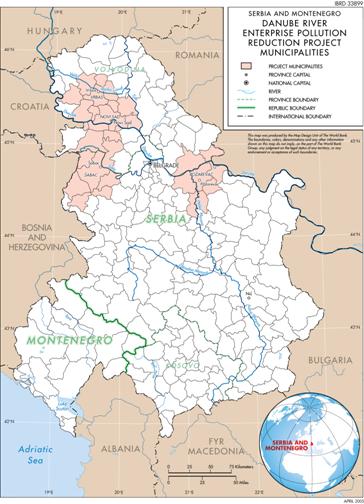
[1] Project costs reported in this section do not include price and quantity contingencies.
* By supporting the proposed project, the Bank does not intend to prejudice the final determination of the parties' claims on the disputed areas
[2] Project costs reported in this section are without price and quantity contingencies.
[3] Procurement planning reports are not integrated – these will be maintained on a spreadsheet.
[4] Source: Danube Pollution Reduction Programme, National Reviews, 1998 Federal Republic of Yugoslavia, Technical Report, Table 2.1.1


 Diagram 1: Project Implementation Arrangements