
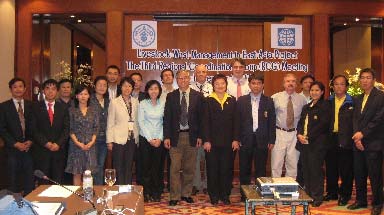
The Third RCG Meeting was arranged on 8 December 2008 in
Bangkok, Thailand
The third RCG meeting was held in Bangkok, Thailand on 8 December 2007, co-
hosted by the Department of Livestock Development. Regional Coordination
Group (RCG) members from Guangdong Province of China, Thailand, Vietnam,
FAO, and the task team leader of the World Bank, Mr. Weiguo Zhou, attended
the meeting. Progress reports of the participating countries and the RFO were
presented in the meeting. The concern of the delayed civil works was raised by
FAO and the World Bank. The countries confirmed to speed up the administrative
procedure and to commence the construction of waste treatment facilities in the
demonstration farms soonest as possible.
The meeting discussed on CDM project and requested Thai RCG members to
share their experience on the CDM project. China and Vietnam were interested
and would consider applying this project.
The Regional Facilitation Office (RFO) presented the project website
(www.lwmea.org) and urged the countries to send their reports/papers to upload
into the website. The RFO reported on the progress in the Decision Support Tools
(DST) development that international technical consultants and an IT expert for
the programming have been hired to develop the DST. National counterparts in
each country will be identified to support the DST development in providing local
information and data which will be loaded in the data bases. The final work-plan
will be distributed to the countries in early 2008. The next RCG meeting will be
held in Vietnam in October 2008.
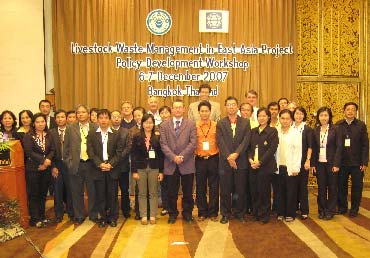
Policy Development Workshop was held during 6-7 December
2007 in Bangkok, Thailand
The Policy Development Workshop arranged during 6-7 December 2007. The
workshop was useful for countries in developing its replication strategy. Experts
from Denmark, the Netherlands and the U.S. reported on the policy changes
which were necessary to address the problem of animal waste in the countries
and whether the livestock density was or is beyond the carrying capacity of the
agriculture land. Of particular interest were the regulatory frameworks which
were established. The countries need FAO assistance on 1) EIA setting for the
new farms, licensing and capacity building, 2) data collecting, environmental
monitoring to guide the policy decision makers, 3) economics of waste
management, cost-benefit analysis. Two other areas that need support are
capacity building of the PMO and spatial distribution of livestock production. The
countries were appreciated for the arrangement made by FAO particularly in
providing simultaneous translation.
Field trip of the RCG members to visit the farms in Rachaburi on 9
December 2007
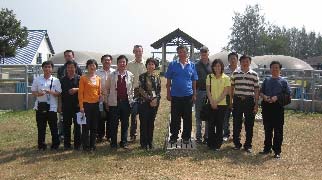
The RFO with the collaboration of the Department of Livestock Development
(DLD), Thailand arranged the field trip for RCG and PMO members from China,
Thailand and Vietnam to visit two large pig farms in Rachaburi on 9 December
2007.
The first farm was SMP Farm (number 3). With total area of 120 rai (1 Rai =
1,600 square meter), the farm keeps 21,000 pig heads in 21 units of evaporative
houses. The farm is under the Thai project of Biogas Production from Livestock
Farm which initiated in 1999. The owner use biogas technology to reduce
pollution and to obtain renewable energy for electricity use in the farm and for
sale to the grid. The biogas produced in the farm generated electricity of 2,000
kw-hr/day which is valued at 2,190,000 baht/year (about US $ 70 000). About
1,500 tons per year of digested and dried sludge (drying beds and with 15%
moisture) is sold to orchard farms in South Thailand with the revenues covering
the cost of the workers and giving a modest profit. The waste water is further
treated and reaches a quality that can be re-used on the farm for flushing the pig
houses and cleaning. More details of this farm are in www.lwmea.org , under
news.
The second farm was Udomdej farm. The area of the farm is 200 Rai. The farm
keeps 25,000 pig heads in 25 units of evaporated pig houses. The farm has
installed two sets of electricity generating system: 400 kw-hr and 800 kw-hr.
The 400 kw generator is used in the times of low demand to supply the
electricity necessary to run the farm. During the peak hours the 800 kw
generator provides electricity for the farm and feeds into the grid. Slurry passes
in a three lagoon system with biogas generation in the first two lagoons.
Molasses is added to generate more biogas. Details of the farm can be found in
www.lwmea.org, under meeting news.
Progress of Decision Support Tools (DST) Development
RFO aims to develop four Decision Support Tools (DST) on: 1) Manure
Management, 2) Monitoring and Evaluation , 3) Spatial Planning, and 4) Policy
Development. National counterparts for Manure Management DST in Vietnam,
Thailand and China have been identified to support the preparation of the DST.
On 10 December, the first coordinating meeting with Mr. Harald Menzi, Mr. Colin
Burton, the programmer and FAO officers was held in FAO, Rome. By June 2008,
FAO will come up with pilot DST for demonstration and testing. For Monitoring
and Evaluation DST, the countries were asked to send their comment on the
reports of Mr Hong Lim Choi and Mr Harald Menzi. The mission for spatial
planning DST will be in April 2008 conducted Mr. Gerrit Carsjen. A Policy
Development Workshop was arranged by FAO during 6-7 December 2007 and is
part of Policy DST development.
Clean Development Mechanism (CDM) project launched in Thailand,
August 2007
A Clean Development Mechanism (CDM) project was launched in Thailand as a
part of replication strategy for Livestock Waste Management in East Asia Project.
The orientation meetings for all participating farms were arranged in early
August 2007. The project will be implemented in ten farms (8 in Rachaburi and
one each in Cholburi and Chachongsao) with total around 130,000 standing pig
population. These farms are large or medium sized farms ranging from 8,000 to
30,000 pigs on each farm.
The proposed CDM project will install covered lagoons in the participating farms
to capture and utilize the biogas generated. The biogas will be used as fuel for
electricity generation (approximately 100-200 kw units per farm). The project is
targeted for an annual carbon credit up to 60,000 to (up to 0.3 million tCO2e by
2012) with an intension for the participating pig farms to benefit from both GEF
grant (LWMEA project) and carbon fund (CDM project).
Livestock's Long Shadow
"Livestock's long shadow - environmental issues and options" a new publication
from FAO by H. Steinfeld, P. Gerber, T. Wassenaar, V. Castel, M. Rosales, and C.
de Haan on the full impact of the livestock sector on environmental problems,
along with potential technical and policy approaches to mitigation. You can
download the publication from LEAD website:
http://www.virtualcentre.org/en/frame.htm
Korea Symposium
Arux Chaiakul, PMO Thailand, Pierre Gerber and Hans Wagner form FAO, upon
invitation by the Samsung Economic Research Institute in Seoul and the
Gyeonggi Do Province in Korea, attended a Symposium on Renewable Energy
Development Project on the Korean Peninsula and beyond. Korea, and the
Province in particular, with relatively large livestock numbers have a serious
problem to manage the animal waste. The Symposium which was attended by
over 250 personalities from leading Korean industries were briefed on the
seriousness of the problem. Pierre Gerber gave a general presentation on
Climate change, water pollution and renewable energy development. Hans
Wagner presented WB-GEF project and Arux Chaiakul reported on the
experiences in Thailand. The importance of the meeting was underlined by the
fact that the UN Secretary General sent a personal message to the meeting. In a
field trip, the seriousness of the problem was made very clear. We will now
explore the possibility of a GEF project which will include North and South Korea
and the Chinese Province of Heilongjiang.
Monteny report
With the demand pressure for fresh milk in large cities in India and in Pakistan
dairy colonies have established themselves in the vicinity of these large cities.
For these dairy colonies freshly lactating buffaloes and cows are bought from
rural areas and after lactation slaughtered. Most of these enterprises have very
little or no land. Manure disposal as fertilizer is not applied anymore due to a dis-
proportion between livestock numbers and cropping surface. Appropriate manure
storage or treatment facilities do not exist. Under such circumstances, the
balance between nutrients in animal excreta and nutrient demand of crops is
disrupted. This result in an increasing pressure on the environment: Increasing
nutrient and organic substance losses to ground and surface water by run-off
and leaching (eutrophication of watercourses and nitrate in groundwater) and to
the atmosphere by volatilisation (ammonia, methane, nitrous oxide) as well as
accumulation of heavy metals in the soil. Furthermore, there is a rising risk of
spreading pathogens that can endanger human and animal health and that the
population is harassed by odours. A consultant visited the two countries to
identify ways and means to address these issues. The report and the findings can
be found on the www.lwmea.org , under the environmental reports.